/
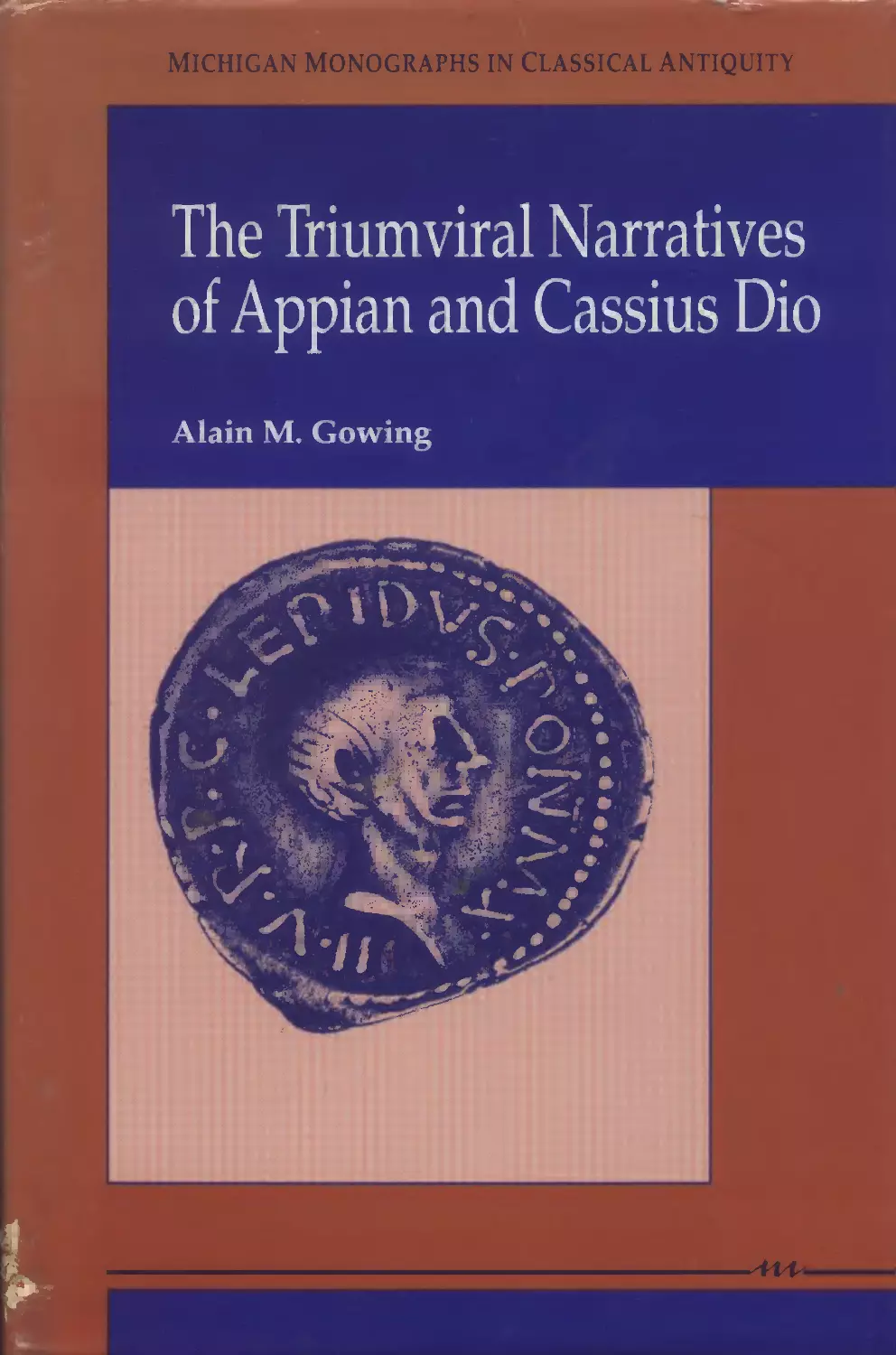


Author: Gowing A.M.
Tags: ancient and antique world ancient rome historiography ancient history
ISBN: 0-472-10294-X
Year: 1992


Text
                    MICHIGAN MONOGRAPHS IN CLASSICAL ANTIQUITY
The Play of Fictions: Studies in Ovid’s Metamorphoses Book 2
A. M. Keith
Homeric Misdirection: False Predictions in the Iliad
James V. Morrison
The Triumviral Narratives of Appian and Cassius Dio
Alain M. Gowing
The Stranger’s Welcome: Oral Theory and the Aesthetics of the
Homeric Hospitality Scene
Steve Reece

The Triumviral Narratives of
Appian and Cassius Dio
Alain M. Gowing
Ann Arbor
The University or Michigan Press

Copyright © by the University of Michigan 1992
All rights reserved
Published in the United States of America by
The University of Michigan Press
Manufactured in the United States of America
1995	1994 1993 1992 4 3 2 1
A CIP catalogue record for this book is available from the British Library.
Library of Congress Cataloging-in-Publication Data
Gowing, Alain M., 1953
The triumviral narratives of Appian and Cassius Dio / Alain M.
Gowing.
p. cm. — (Michigan monographs in classical antiquity)
Includes bibliographical references and index.
ISBN 0-472- 10294-X (alk. paper)
1.	Rome—History—Civil War, 43-31 B.C.—Historiography.
2.	Appianus, of Alexandria. Civil wars. 3. Cassius Dio Cocceianus.
Roman history. I. Title. II. Series.
DG268.G68 1992
937'.05O72—dc20	92-29116
CIP

. . . sapiens subtilisque lector debet non diversis conferre diversa, sed
singula expendere, nec deterius alio putare quod est in suo genere
perfectum.
Pliny Ep. 4.14.7

Preface
Since the completion in 1988 of the Bryn Mawr dissertation herein revised,
two major studies of Cassius Dio and Appian as well as several pertinent
articles have appeared. D. Fechner’s Untersuchungen zu Cassius Dios Sicht
der Romischen Republik (Hildesheim, 1986), which became available to me
too late to be of use in the original study, represents another in a series of
specialized efforts since Millar’s A Study of Cassius Dio (Oxford, 1964)
showed that Dio’s work warrants closer scrutiny. Of greater interest, perhaps,
because it is the only book-length treatment of Appian since Emilio Gabba’s
seminal Appiano e la storia delle guerre civili (Florence, 1955) to deal with
issues other than Quellenkritik, is B. Goldmann’s Einheitlichkeit und Eigen-
standigkeit der Historia Romana des Appian (Hildesheim, 1988). Neither
book has obviated the need for a study such as mine, though both corroborated
some of my conclusions to a significant degree. More importantly, they
confirmed my strong feeling that a comparison of Appian and Dio as histo¬
riographers was timely and in order. And while this might not seem a
particularly compelling justification, detailed studies of these historians in
English are still relatively few. It is hoped, therefore, that this book might
bring the issues involved in the study of Appian and Dio before a wider
readership.
It is customary to record in this place debts of gratitude, and in my case
those debts are especially numerous. They are owed to, among others, my
mentors at Bryn Mawr College, in particular Mabel Lang, R.T. Scott, and Julia
Gaisser, and my colleagues and students at the University of Washington. All
have contributed, wittingly or not, to whatever may be useful and good in this
study. I extend special thanks to my director David Potter of the University of
Michigan for his constant support of and interest in the project, both at the
dissertation stage and beyond. It has been a rare privilege indeed to have had
the benefit of his remarkable and profound knowledge of all aspects of ancient
history and historiography. In addition, I would like to express my deep

viii / Preface
appreciation to my editor Ellen Bauerle and the two anonymous referees. The
Graduate School of the University of Washington generously provided a grant
to defray the costs of photographs and map preparation; April Ryan of the
University’s Instructional Media Services designed and produced the maps.
And finally, heartfelt gratitude goes to my wife Anne and son Benjamin, at
whose patience and affection I never cease to marvel.
The rhetoric of Prefaces also demands that I conclude with the admission
that all remaining flaws and oversights are of course my own. I readily make
such an admission as one further demonstration that all rhetoric need not be
empty.

Contents
Texts and Abbreviations	xi
Introduction	1
Part 1:	Prolegomena	7
1.	An Alexandrian in Rome	9
2.	The Roman Senator from Bithynia	19
3.	Overview of the Triumviral Period in Appian and Dio:
Purposes, Perceptions, and Organization	33
4.	The Source Question	39
5.	The Historical Situation	51
Part 2: Persons	55
6.	Octavian’s Rise to Power	57
7.	Octavian’s Rival	95
8.	The Odd Triumvir Out	123
9.	Cicero’s Final Year	143
10.	The Tyrannicides	163
11.	The Republicans’ Last Hope	181
Part 3: Events	207
12.	Battles	209
13.	Speeches	225
14.	The Proscriptions	247

x / Contents
Part 4: A Final Context	271
15.	Appian as an Antonine Historian	273
16.	Dio as a Severan Historian	289
17.	Conclusion	295
Appendices	299
1.	Chronological Table of Events from the Ides of March 44 b.c.
to the Death of Sextus Pompey in 35	301
2.	Sextus Pompey and Neptune	309
3.	Appian’s and Dio’s Accounts of Philippi	311
4.	Did Appian Visit Philippi?	319
5.	The υπομνήματα of Appian BC 5.45.191	321
Works Cited	323
Index Locorum	335
Index	365
Illustrations	following	page	146

Texts and Abbreviations
References to Cassius Dio are to the edition of U.Ph. Boissevain, Cassii
Dionis Cocceiani Historiarum Romanarum quae supersunt, 5 vols. (vols. 1-
3: Text; vol. 4: Historical Index, edited by H. Smilda and U.Ph. Boissevain;
vol. 5: Greek Index compiled by W. Nawijn) (Berlin, 1895-1931; photo¬
reprint of 1-4, Berlin, 1955). Books 61-80 are cited throughout by Boisse-
vain’s divisions, with the traditional numbering provided in parentheses, e.g.,
80(79). 1.2. Readers using the Loeb edition should be aware that in those
volumes Boissevain’s book numbers are printed at the top of the page, the
traditional numbers in the margins. Appian is cited from the Teubner editions
of P. Viereck, A.G. Roos, and E. Gabba, Appiani Historia Romana I (Leipzig,
1962) and of L. Mendelssohn and P. Viereck, Appiani Historia Romana II
(Leipzig, 1905, reprinted 1986). Unless otherwise noted, all references to
Appian are to the Bella Civilia.
Except where noted, translations of Cassius Dio are by E. Cary, Dio’s
Roman History, 9 vols. (Loeb Classical Library, 1914-27) and those of
Appian by H. White, Appian’s Roman History, 4 vols. (Loeb Classical Li¬
brary, 1912-13). For Plutarch I have used the translation by B. Perrin,
Plutarch’s Lives, 11 vols. (Loeb Classical Library, 1914-26). Since Plutarch
is cited primarily in translation, references are to the chapter and section
numbers of Perrin’s edition. His section numbers differ from those of
Ziegler's Teubner edition, so I give in parenthesis and designate by “Z”
Ziegler’s section numbers: e.g., Plu. Ant. 6.6 (Z 7).
Fronto is cited from the 1988 Teubner edition of M.P.J. van den Hout;
translations are by C.R. Haines, The Correspondence of Marcus Cornelius
Fronto, 2 vols. (Loeb Classical Library, 1919-20). References will be given
to both editions, e.g., Ad Pium 10.2 = H 1:262 (i.e., Haines, vol. 1, p. 262).
Abbreviations of Latin authors and their works are as indicated on pp. ix-
xx of the Oxford Latin Dictionary (Oxford, 1982), and of Greek authors and
their works, on pp. xvi-xxxviii of Liddell, Scott, and Jones’ A Greek-English

xii / Texts and Abbreviations
Lexicon (Oxford, 1968). In references to his History Cassius Dio is therefore
abbreviated to D.C. in accordance with Liddell, Scott, and Jones.
Abbreviations of journals and periodicals are in accordance with those
found in L’Annee Philologique. After the first citation of an article or book in
the notes, subsequent references will be by author’s name alone or together
with a shortened title: these may be readily identified by referring to the Works
Cited. The following special abbreviations are used throughout:
BM	P.A. Brunt and J.M. Moore, eds. and trans. Res Gestae
Divi Augusti. Oxford, 1973.
Brunt, IM	P.A. Brunt. Italian Manpower 225 b.c.-a.d. 14. Ox¬
ford, 1971.
DG	W. Drumann and P. Groebe. Geschichte Roms in
seinem Obergang von der republikanischen zur mo-
narchischen Verfassung. 2d ed. 6 vols. Leipzig,
1899-1929.
FGrH	F. Jacoby. Die Fragmente der griechischen Historiker.
Berlin and Leiden, 1923-58.
Gabba BC 1	E. Gabba, ed. and trans. Appiani Bellorum Civilium
Liber Primus. 2d ed. Florence, 1967.
Gabba BC 5		, ed. and trans. Appiani Bellorum Civilium Li¬
ber Quintus. Florence, 1970.
Luce, AERRC	T.J. Luce, Jr. Appian’s Exposition of the Roman Re¬
publican Constitution. Ph.D. diss., Princeton Uni¬
versity, 1958.
Magnino BC 3	D. Magnino, ed. and trans. Appiani Bellorum Civilium
Liber Tertius. Florence, 1984.
Moles, PLOC	J.L. Moles, ed. Plutarch The Life of Cicero. Warmin¬
ster, England, 1988.
MRR	T.R.S. Broughton. The Magistrates of the Roman Re¬
public. 3 vols. Atlanta, Ga., 1986.
MV	Reference to the apparatus criticus of Mendelssohn
and Viereck. For clarity page and line number will
be cited as well as the location in the text.
Pelling, PLOA	C.B.R. Pelling, ed. Plutarch Life of Antony. Cam¬
bridge, 1988.
RE	Pauly-Wissowa, Real Encyclopadie der classischen
Altertumswissenschaft.

Text and Abbreviations / xiii
Reinhold, FRTP
SB
Syme, RR
Syme, AA
Woodman, VP
M. Reinhold. From Republic to Principate: An Histor¬
ical Commentary on Cassius Dio's Roman History,
Books 49-52 (36-29 B.C.). Atlanta, Ga., 1988.
Designates D.R. Shackleton Bailey’s editions of
Cicero’s correspondence (full bibliographic infor¬
mation in the Works Cited). I give the traditional
numerations as well as Shackleton Bailey’s: e.g.,
Att. 14.1 = SB 355.
Ronald Syme. The Roman Revolution. Oxford, 1939.
	. The Augustan Aristocracy. Oxford, 1986.
A.J. Woodman, ed. Velleius Paterculus:	The
Caesarian and Augustan Narrative (2.41-93).
Cambridge, 1983.

Introduction
“The Triumviral Period is tangled, chaotic and hideous.”
—R. Syme
Following his victory over Sextus Pompey in September of 36 B.C., the future
emperor Augustus commanded that all documents (γραμματεία) dealing with
the early years of the triumviral period be collected and burned (App.
5.132.548). It was a symbolic gesture whose message was clear: the events
following the Ides of March were to be forgotten. The memories were
unpleasant, to be sure, but that was not all that concerned Octavian. There was
a more sinister purpose, for those documents would contain much to embar¬
rass or even discredit a man who professed to be restoring the Republic.
Octavian was not so naive as to think he could erase the memory of those
years. Rather, this was just the first of several steps taken to ensure that history
would view events through Augustan eyes. In some measure, though largely
by accident rather than design, the effort succeeded. Contemporary histories
of the triumviral period have not survived, and outside of the meager account
of the imperial historian Velleius Paterculus (who had his own agenda), we are
reduced to the Histories of two Romanized Greeks writing two centuries or
more after the fact for a continuous narrative of the period.1
That circumstance alone has required close scrutiny of the reliability of
Appian and Dio as historical sources. The present study, however, is con¬
cerned primarily with historiography rather than history; with few exceptions
I have little to add to our knowledge of the historical facts of the triumviral
1 ■ Dio, Appian, and Velleius aside, the major extant literary sources are as follows. For the
period from the Ides to July of 43, Cicero’s correspondence and Philippics are of primary
importance. These may be supplemented by Plutarch’s Brutus and Cicero; Nicolaus of Damascus’
Vita Caesaris (for the Ides to October of 44); Nepos’ Life of Atticus, the Laudatio Turiae, and
some of the Elder Seneca’s Suasoriae and Controversiae all provide additional material for the
Penod of the proscriptions. For the period as a whole, Plutarch’s Antonius, Suetonius’ Divus
Augustus, Floras, the Periochae of Livy, and Augustus’ Res Gestae. Additional material in
Orosius, Aulus Gellius, Valerius Maximus; Tacitus’ occasional references back to the period also
provide some valuable insights.

2 / The Triumviral Narratives of Appian and Cassius Dio
period, and I make no claim to having attempted to produce a coherent
account of what happened between 44 and 35 b.c. I am proposing on the one
hand a reading of Appian and Dio that will illustrate two vastly different
approaches to and conceptions of both the period and historical writing, and
on the other, an interpretation of those differences as a function of a variety of
factors that transcend the question of source. In short, I intend to compare
Appian and Dio as interpreters rather than mere transmitters of history, as
authors whose works, however derivative, nevertheless provide valid evi¬
dence for the evolution of important historiographical trends and perspectives
between the second and early third centuries a.d.
This last assertion may elicit surprise and even suspicion from those who
persist in regarding Appian and Dio as essentially compilers who added little
of value or interest to what they found in their sources. In the case of Dio we
have beyond question passed the point where an apology must be made for
studying him as a historian in his own right. A series of analyses, beginning
with Fergus Millar’s groundbreaking A Study of Cassius Dio in 1964, has
shown him to be innovative and thoughtful in a variety of ways.2 An encour¬
aging sign of this increased attention has been the formation of a Dio Project,
under whose auspices a sorely needed commentary on the entire extant corpus
of Dio has been undertaken; the first installment, by Meyer Reinhold, has
already appeared. In addition, J.W. Rich has produced an excellent commen¬
tary on Books 53-55.9 (Cassius Dio. The Augustan Settlement [Warminster,
England, 1990]). Efforts such as these will put in the hands of scholars the sort
of apparatus long since available for and considered essential to the study of
the other major ancient historians. We have been awakened, in other words, to
the fact that the particulars of Dio’s work need reassessment on all levels.
Though B. Goldmann’s recent Einheitlichkeit und Eigenstandigkeit der
Historia Romana des Appian, among other studies, suggests that the trend is
reversing itself, Appian has still received less critical attention than Dio. On
the whole, however, subsequent to the appearance of Schweighaiiser’s 1785
text and commentary and his later “Exercitationes,” Appian found more
defenders than Dio.3 But studies such as Dominicus’ brief De indole Appiani
Alexandrini Graeci Romanarum rerum scriptoris (Coblentz, 1844) and
Wijnne’s more thorough De fide et auctoritate Appiani in bellis Romanorum
civilibus enarrandis (Groningen, 1855) credit Appian with more skill and
2.	Fechner (1-10) surveys and discusses the scholarship on Dio.
3.	“Exercitationes in Appiani Alexandrini Romanas Historias,” in Opuscula Academica II:
Commentationes Philologicae, 3-95 (StraBburg, 1806). For studies prior to Schweighaiiser,
largely unfavorable, see Goldmann, 2-3.

Introduction / 3
perspicacity than has generally been admitted in this century. Beginning in the
late nineteenth century, Appian was increasingly subjected to Quellen-
forschung, and he has not often emerged from that pall.4 Since 1955, studies
of Appian have been dominated by Emilio Gabba, whose Appiano e la storia
delle guerre civili remains the standard work on the subject. That book and
Gabba’s commentaries on Books 1 and 5 of the Bella Civilia, as well as his
many articles, are indispensable to any student of Appian or late Republican
history in general. But while Gabba did much to illuminate the tenor of
Appian’s work, his essential thesis, that the Bella Civilia derive directly and
almost in their entirety from the lost History of Asinius Pollio, has never
received wide acceptance.5 Nevertheless, with some exceptions (most notably
the work of Istvan Hahn), neither that thesis nor Gabba’s notions about
Appian’s methods have often been challenged.
Both authors therefore merit study in and of themselves, but when studied
in conjunction it becomes quite apparent that each has something to teach us
about the other. Most importantly, it will be clear that source criticism cannot
satisfactorily account for the striking distinctions that come to light. I do not
therefore intend to add in any substantial way to previous work done on the
sources of Appian and Dio, except to reiterate a view expressed generally by
Millar and others that such research, while inarguably valuable and vital, has
unduly affected our reading of their work and of Appian’s in particular. The
principal aim of this study is instead to compare Appian and Dio at a variety
of levels—as historians, as thinkers, as representatives of their age—through
an examination of their accounts of the period following the assassination of
Julius Caesar in March of 44 b.c. down to the death of Sextus Pompey in 35.
The choice of this period for such an exercise has been influenced by a
number of considerations, not the least of which are the survival of both
authors’ accounts of the period in intact condition and the termination of
4.	Summary of the various theories on Appian’s sources in N.I. Barbu, Les sources et
I originalite d’Appien dans le deuxi4me livre des guerres civiles (Paris, 1934) 2-6; see also B.
Haller, C. Asinius Pollio als Politiker und zeitkritischer Historiker (Ph.D. diss., Westfalischen
Wilhelms-Universitat, Munster, 1967) 106-12; W. Will, ed., Appian von Alexandria. Romische
Geschichte, vol. 2, translated by O. Veh (Stuttgart, 1989) 2-4.
5.	See M. Gelzer, review of Appiano e la storia delle guerre civili, edited by E. Gabba,
Gnomon 30 (1958): 888—89; id., review of Appiani Bellorum Civilium Liber Primus, edited by E.
Gabba, Gnomon 31 (1959): 179-81; E. Badian, “Appian and Asinius Pollio,” CR 8 (1958): 159—
62, A.H. McDonald, review of Appiano e la storia delle guerre civili, by E. Gabba, JRS 52
^®®): 186-87. A.B. Bosworth’s reassessment of Pollio’s politics casts further doubt on Gabba’s
*	es*s ( Asinius Pollio and Augustus,” Historia 21 [1972]: 441-73). Gabba’s approach was new,
1 ough the notion that Asinius Pollio lay behind Appian’s Bella Civilia was not (see S. Mazzarino,
pensiero storico classico, 3 vols. [Bari, 1966] 2:399, 533-35).

4 / The Triumviral Narratives of Appian and Cassius Dio
Appian’s extant Bella Civilia with Sextus’ demise.6 The circumstance is
fortuitous, for the events, personalities, and sheer importance of the triumviral
years could arouse even the dullest chronicler. There was ample material for
any historian eager to exercise his critical, descriptive, and didactic faculties,
and both Appian and Dio rose to the task with varying degrees of success.
The heart of this book, Parts 2 and 3, consists of nine representative studies
grouped under Persons and Events, rough but convenient rubrics denoting a
historian’s two principal concerns. These studies are largely self-contained
and independent of one another; each entails rather close, parallel readings
that serve to illustrate from different angles two disparate approaches to and
views of the triumviral period proper and, to an extent, events leading up to
the formation of the triumvirate. Part 2 focuses on Appian’s and Dio’s
treatment of seven key figures: the triumvirs themselves, Octavian, Antony,
Lepidus, and Cicero, the tyrannicides Brutus and Cassius (considered collec¬
tively), and Sextus Pompey. In order to avoid undue repetition, I have tried to
be selective, to focus on the salient aspects of these portrayals that best
illustrate the authors’ differing viewpoints and historiographical method. It
seemed best to discuss the characters individually: various traditions accreted
around each figure, and treating them in isolation permits a clearer view of
how Appian and Dio handled those traditions with sharply divergent results.
In Part 3, on the other hand, I turn to their handling of and narratological
approaches to important events—specifically, battles, speeches, and the
proscriptions.
A fundamental premise of this study is that each facet of Appian’s and
Dio’s triumviral narrative should be interpreted in light of their respective
purposes and experiences, insofar as we can know or reconstruct them. To that
end Parts 1 and 4 furnish a context for the analyses contained in Parts 2 and 3.
In Part 1 I briefly consider four areas, familiarity with which I believe to be
germane to an informed reading of their triumviral narratives: some biograph¬
ical considerations for both historians,7 their respective conceptions and
purposes in writing of the triumviral period generally, and the source question.
A fifth section will establish a cursory historical framework for the period
under consideration. In all of these areas I wish to make some preliminary
6.	In any event, Appian believed that for all intents and purposes the triumvirate ended in 36
after Lepidus had been edged out (5.1.3).
7.	My criteria in these sections have been 1) to identify factors of principal relevance to the
triumviral period and 2) to use as evidence only such material as may be considered apart from the
source question. The result has of necessity been a certain imbalance; the evidence for Dio’s
career and beliefs is broader and more certain than for Appian’s. For fuller biographical
treatments see Millar, Study, 5-27 for Dio and Luce, AERRC, 1-29 for Appian.

Introduction / 5
suggestions about the sort of influences at work on these historians as they
researched and wrote about the triumviral period, particularly in the case of
Appian. The social and literary milieu, an equally important influence, I leave
to Part 4. I make no apology for the apparent tendency to dwell on Appian
over Dio; our knowledge of Dio is in a far more advanced state than that of
Appian. This study will, I hope, in part remedy that unjustified imbalance.
Finally, I should add that I am not overly concerned with demonstrating
either Appian’s or Dio’s capacity for original thought or with pinpointing
precisely where and how they have departed from, improved upon, or other¬
wise altered their source material. My principal concern has been first to
describe significant similarities and differences between the narratives, but I
have not felt compelled to attempt an explanation of the differences at every
step of the way. To be sure, I do not hesitate to point out and discuss such
instances where revision or embellishment seem demonstrable or simply
likely; by the same token, I do not deny that much of what we observe can be
explained on one level as the consequence of variant sources. My reasons for
these views will be laid out in depth in Chapter 4, but I wish to stress from the
outset that in my opinion we cannot always come to the sort of firm conclu¬
sions about these authors and their texts that we might like.
Appian wrote in the relative stability of the Antonine principate; Dio, in a
period when revolution was virtually an everyday occurrence. The political
climate, as well as their own very different temperaments and experiences,
suggests that their views on the period of transition from Republic to Princi¬
pate would differ dramatically. Even a cursory reading of the two historians’
accounts of the triumviral period will confirm that this is indeed the case. But
both shared the notion that the assassination of Caesar and the ensuing years
of chaos resulted in the demise of the Republic and the beginnings of the
Principate. This view, predictable and correct, prompted both to pay close
attention to the genesis of the political system in which they lived and
participated. The similarity essentially ends here. Together they represent a
new breed of historian in which the Greek and Roman historiographical
traditions were united; individually they express two contrasting and unique
views of Rome’s past.

Part 1
Prolegomena

Chapter 1
An Alexandrian in Rome
Despite occasional concessions, some quite recent, that Quellenforschung has
produced inconclusive results as well as obscured the influence of Appian
himself, scholarly opinion has overwhelmingly deemed Appian’s chief value
to lie in his preservation of sources now lost to us.1 But one nineteenth-
century reader, who was little interested in source criticism, admired the Bella
Civilia: Karl Marx. His assessment of the historian has attracted the attention
of several scholars in the past few years and bears repeating:2 “As a relaxation
in the evenings I have been reading Appian on the Roman Civil Wars in the
original Greek text. A very valuable book. The chap is an Egyptian by birth.
Schlosser says he has ‘no soul,’ probably because he goes to the roots of the
material basis for these civil wars” (Marx to Engels, 27 February 1861).
Marx’ observations are valuable on two counts. First, because he draws
attention to Appian’s origins—although more properly and more significantly
he was Alexandrian. Second, because he remarks Appian’s unusual interest in
the financial motivations underlying the civil wars.
Not surprisingly, Marx’ admiration of Appian has caused him to be
scrutinized by a number of Marxist scholars.3 Whether one accepts or rejects
1 ■ E.g., Luce, AERRC, v-vi; E.L. Bowie, “Appian,” in The Cambridge History of Classical
Literature, edited by P.E. Easterling and B.W. Knox, Vol. 1: Greek Literature (Cambridge, 1985)
707-709, 888-89; P.J. Cuff, “Appian’s Romaica: A Note,” Athenaeum 61 (1983): 148-64, at 148
n. 1.
2.	G.E.M. De Ste. Croix, The Class Struggle in the Ancient Greek World (London, 1983) 24,
208; Cuff, “Appian’s Romaica148; H.-J. Kiihne, “Appians historiographische Leistung,” W.Z.
Rostock 18 (1969): 346 n. 16, citing the passage quoted above as well as Marx’ other references to
Appian. See also L. Perelli, II movimento popolare nell’ultimo secolo della Repubblica (Torino,
*982) 63 with n. 66; Will, 1; K. Brodersen, ed., Appian von Alexandria. Romische Geschichte,
v°l- 1, translated by O. Veh (Stuttgart, 1987) 5; id., “Die Buchtitelverzeichnisse, das Lexikon περί
und der Aufbau von Appians Werk,” WS 103 (1990): 49.
3- To Kiihne’s study add, among others, L. Havas, “Asinius Pollio and the Fall of the Roman
Republic,” ACD 16 (1980): 25-36; Y.Y. Zaborovsky, “Appian and the Roman civitas in the Last
Century of the Republic. Sources and Character of the Civil Wars," [in Russian with summary in

10 / The Triumviral Narratives of Appian and Cassius Dio
the validity of this approach to Appian, it cannot be denied that Appian
evinces an unusual sensitivity to and preoccupation with social issues and the
class struggle.4 In this lies one fundamental distinction between Appian’s and
Dio’s conception of the triumviral period. It is essential, therefore, to investi¬
gate the causes for Appian’s interests.
Appian concludes the Praefatio to his History with a few scraps of
biographical information:
Who I am, who have written these things, many indeed know, and I have
already indicated. To speak more plainly I am Appian of Alexandria, a man
who [attained] the highest place in my native country, and [have pleaded
causes in Rome] before emperors, until they deemed me worthy of being
made their procurator. And if any one has a great desire to learn more about
my affairs there is a special treatise of mine on that subject. (Praef 15.62)5
Much has been made of this passage, primarily for the scant and inconclusive
summation of Appian’s career in Rome. Appian draws equal attention, how¬
ever, to the fact that he is an Alexandrian who had gained some distinction in
his native city. While he does not claim Rome as his πατρίς,6 he is clearly
proud of his service to the emperors. In view of Appian’s emphasis, and of the
little use that critical literature has made of his origins,7 it will be useful to
digress briefly on the implications of the historian’s background.
English] VDI 158 (1981): 139-44.
4.	I mean the definition provided by De Ste. Croix (44): “the fundamental relationship
between classes (and their respective individual members), involving essentially exploitation, or
resistance to it.” Gabba once stringently denied that the emphasis on socioeconomic factors
evident in Appian is attributable to the historian himself. Rather, he argued, such interest is
limited to one section of his work (viz., BC 1) and hence probably derived from his source
(Appiano, 81-82, n. 1). Significantly, Gabba has now modified this position (“The Historians and
Augustus,” in Caesar Augustus: Seven Aspects, edited by F. Millar and E. Segal [Oxford, 1984]
61-88, 69 with n. 23). See also Perelli, 63.
5.	tls δέ ών ταΰτα συνέγραψα, πολλοί μέν ’ίσασι καί afrros προέφηνα, σαφέστερον
δ’είπεΐν, Άππιανός Άλεξανδρεύς, ές τα πρώτα ήκων έν τή πατρίδι, καί δίκαιη έν 'Ρώμτ)
συναγορεΰσας επί των βασιλέων, μέχρι με σφών έπιτροπεύειν ήξίωσαν. καί ε’ί τι*) σπουδή καί
τά λοιπά .μαθεΐν, έστι μοι καί περί τούτου συγγραφή. Such an aside is typical, and in this
instance perhaps an imitation of Arrian (An. 1.12.5, cf. Her. 1.2.5): see A.B. Bosworth, From
Arrian to Alexander (Oxford, 1988) 32-37; RA. Stadter, Arrian of Nicomedia (Chapel Hill, 1980)
64.
6.	So too does Dio regard Nicaea as his πατριέ (cf. 76[75]. 15.3, 80[80].5.2), though in
distinct contrast to Appian he more closely identifies himself with Rome. See G.J.D Aalders,
“Cassius Dio and the Greek World,” Mnemosyne 39 (1986): 282-304, 282—83; A.B. Bosworth,
“Arrian’s Literary Development,” CQ 22 (1972): 163-85, 174 n. 6; for Dio’s interest in Bithynia,
W. Ameling, “Cassius Dio und Bithynien,” FA 4 (1984): 123-38.
7.	Not that it has gone entirely unremarked: see esp. I. Hahn, “Appian and Alexandria,” [in

An Alexandrian in Rome / 11
More Greek than Egyptian, the city of Alexandria had a long and turbulent
history of civil disturbances. Such commotions, frequent and generally politi¬
cal in nature during the Ptolemaic period,8 worsened when the city fell under
Roman control. Alexandria in particular resisted Roman domination more
vigorously than any other provincial city. Roman negotiatores had been active
there since the end of the second century B.C.,9 but under Augustus the
Alexandrians, now members of the imperial province of Egypt, began increas¬
ingly to resent the political and economic restrictions imposed on them. To be
sure, large numbers of wealthy Alexandrians might enjoy the advantages of
Roman citizenship and regard Roman presence as beneficial; Alexandrian
citizens in general were exempt from the burdensome poll tax or laographia
that the Romans extracted from the provincial population (Lewis, 19, 27). But
nevertheless the vast majority of Greeks resident in Alexandria were neither
Roman citizens nor free from Roman taxation. As Rome assumed administra¬
tive responsibility for the city, civil offices became more or less devoid of any
real authority, and whatever autonomy existed under the Ptolemies was
virtually extinguished by Augustus. A particular sore point, the removal of the
Council by Augustus, completed a process begun by Euergetes II with the
dissolution of the Alexandrian Ecclesia (Fraser, 1:797). Thus the causes of the
hostility evident in the Ptolemaic period were merely aggravated by the
unwillingness of Augustus and his successors to restore a degree of indepen¬
dence that most other provincial cities enjoyed.
A considerable body of literature exists to illustrate Alexandrian resent¬
ment of the Romans. The most well known and most extreme in their
vehemence are the papyri known to us collectively as the Acta Alex¬
andrinorum, which record exchanges between various Roman emperors and
condemned Alexandrians. Whatever may be concluded about the historicity of
these fragments,10 two in particular, the Acta Isidori and the Acta Appiani,
reflect a very real bitterness toward Rome on the part of at least one segment
of the Alexandrian population. And while the patriots encountered therein are
Russian with summary in English] VDI 103 (1968): 72-85; Kiihne, 358; Mazzarino, 3:193-95.
See further Gabba, Appiano, 110; id., “Storici greci dell’impero romano da Augusto ai Severi,”
RSI 71 (1959): 375-76; J. Palm, Rom, Romertum und Imperium in der Griechischen Literatur der
Kaiserzeit (Lund, 1959) 75-77.
8· P.M. Fraser, Ptolemaic Alexandria, 3 vols. (Oxford, 1972) 1:82.
9.	See N. Lewis, Life in Egypt Under Roman Rule (Oxford, 1983) 12; Fraser, 1:89-90 with
notes, F. Heichelheim, Die auswartige Bevolkerung im Ptolemaerreich (Leipzig, 1925) 80-82.
10.	See V. Tcherikover and A. Fuks, eds. Corpus Papyrorum Judaicarum, 3 vols. (Cam-
ndge, Mass., 1957) 2:55-59; H. Musurillo, The Acts of the Pagan Martyrs (Oxford, 1954) 259-

12 / The Triumviral Narratives of Appian and Cassius Dio
doubtless extremists, we may be fairly confident that this literature enjoyed a
wide readership and thus served as a mouthpiece for anti-Roman
propaganda.11
Of more certain historical value is the βουλή-papyrus (Tcherikover 2: no.
150 = Musurillo I), a petition from the Alexandrians to the emperor Claudius
for permission to convene a council annually.12 The request would be renewed
repeatedly, but not granted until a.d. 200 by Septimius Severus. As
Tcherikover observes, the papyrus is significant not only for what it demands
but also for what it reveals about the upper-class Alexandrian. The aim of the
petition, to keep the Alexandrian πολίτευμα free from the influences of the
“uneducated and uncultured” (άθρετττοι καί άνάγωγοι, 1. 6), points to both the
haughtiness of its proponents and their feeling of helplessness to direct their
own affairs (Tcherikover, 2:27). The target is clearly the Jewish population of
Alexandria, whose grievances against the Romans were slight in comparison
to the treatment they received at the hands of the Alexandrian Greeks.
Jews had been in Alexandria since at least the early third century B.C., and
by the early Roman period they inhabited two out of the city’s five quarters
(Tcherikover, 1:3). Although they constituted a substantial part of the popula¬
tion and could be found at all levels of society, anti-Semitism was pervasive,
particularly among the Alexandrian Greeks (ibid., 24-25). With few excep¬
tions, the Roman emperors appear to have embarked on a systematic program
of barring Jews from positions of political influence (ibid., 25), a situation
aggravated by the imposition of the laographia directed specifically at Jews.13
Thus they were singled out for both political and economic repression by the
Romans and Alexandrian Greeks alike. Evidence of the friction between Jew
and Alexandrian may be found in the βουλή-papyrus and in the Edict of
Claudius, but the situation came to a head in a.d. 38, prior to the accession of
Claudius, with the Edict of Flaccus. Clearly the product of the anti-Semitic
faction in Alexandria, the edict reduced all Alexandrian Jews to the status of
11.	Tcherikover, 2:58-59; cf. Lewis, 199. Of particular interest, if only for the coincidence of
the name, are the Acta Appiani (Tcherikover, 2:no. 159a = Musurillo XI). Hahn cautiously
conjectures that this Appian may be a nephew or grand-nephew of the historian in “Pap-
yrologisches zum Namen Appians,” Philologus 117 (1973): 100-101. See further on the name
Luce, AERRC, 23-27.
12.	See Musurillo, 87-88; Tcherikover believes the emperor to be Augustus (2:27). The Edict
of Claudius (Tcherikover, 2: no. 153) appears to be a response to this or a similar request.
13.	See Tcherikover, 1:64. Initially, however, the relationship between Jews and Romans
seems to have been comparatively congenial, a situation that further irritated the Alexandrian
Greeks. See E.M. Smallwood, ed. and trans., Philonis Alexandrini Legatio ad Gaium (Leiden,
1961) 11-12. The most notable exception to the usual Roman practice was Philo’s nephew, Ti.
Julius Alexander, a Jew who eventually rose to the post of Prefect of Egypt ca. a.d. 68.

An Alexandrian in Rome / 13
“foreigners and aliens” (Philo Flacc. 54): rioting predictably ensued and was
quickly repressed by the first known pogrom in Jewish history (Tcherikover,
1-66). Despite Claudius’ short-lived efforts at reconciliation, the Jews con¬
tinued to suffer at the hands of both Romans and Alexandrians. We read
therefore of a debacle in 66 when, according to Josephus, 50,000 Jews were
slaughtered (BJ 2.497); of the founding by Vespasian of the repressive fiscus
Judaicus as punishment;14 and of almost daily confrontations between Jews
and their opponents (Tcherikover, 1:79-80, 86). It is during the great Jewish
revolt of 115-17 that we first hear of the historian Appian, who happened to
be a victim of that insurrection.15
Appian asserts that in his native land he rose e? τά πρώτα (Praef. 15.62).
The precise meaning of this is unclear,16 but he had doubtless worked his way
into the upper echelons of Alexandrian society. In view of his apparent
success as a barrister in Rome, he probably practiced law in Alexandria, in
which case he had most likely been involved in legal disputes between Jews
and Alexandrians. The observation that “many people know who I am”
implies a certain notoriety (ibid.). Whatever his status, the story of his escape
from the Jews, preserved in a surviving fragment, suggests that for one reason
or another he had been singled out for reprisal.17
This fragment merits particular consideration, for it reveals a number of
useful facts about the historian (my translation):
[1]	When I was fleeing the Jews on account of the war in progress in Egypt,
I was at one point going through Arabian Petra to the river where a skiff
was waiting to convey me to Pelusium. I thought that we were near the
skiff when a seabird squawked in the east and the Arab who was guiding
me along the road at night said he was troubled: “We’re lost,” he said. And
when it squawked again, “We’re really lost.”
14.	If we may accept a Vespasianic date (C.R Jones, The Roman World of Dio Chrysostom
[Cambridge, Mass., 1978] 36), D. Chr. 32, a harangue of the Alexandrians for their unruly
behavior, attests to the severity of the disturbances and Roman concern in this period. Cf. D.C.
65(66),8.
15.	Cf. Dio’s description at 68(68).32.1, where we read of the Jews “destroying both the
Romans and the Greeks.”
16.	White infers that Appian attained the rank of procurator (The Roman History of Appian of
Alexandria, vol. 1 [London, 1899] vii). But the positioning of the phrase indicates that this
occurred before Appian came to Rome and thus renders such an inference implausible. Schwartz
takes the phrase to mean that he had held one or more of the civil posts available to an
Alexandrian citizen (“Appianus,” RE 2 [1896]: 216).
I7· ft- 19 in Viereck, Roos, and Gabba, first identified by E. Miller, “Fragment inedit
Appien,” RA 19 (1869): 101-110. On its significance see F. Reuss, “Arrian und Appian,” RhM
54 (1899): 446-65, 463.

14 / The Triumviral Narratives of Appian and Cassius Dio
[2]	In my distress I looked around anxiously to see if there was anyone
about, though I saw no one—it was still very early in the morning and the
surrounding countryside was in a state of war. The Arab, who had con¬
sulted the bird a third time and was evidently pleased, said, “We are lost for
good reason and shall stick to the road.”
[3]	I began both to laugh, even though we were now going to get really lost,
and to despair for myself, since I was surrounded by enemies and could not
turn back on account of my pursuers, whom I had just begun to elude.
Though at a loss, I nonetheless yielded to the augury and followed.
[4]	As I was in this agitated state, another river unexpectedly came into
view—the one closest to Pelusium—together with a trireme headed there.
I boarded it and was saved. As it turned out, the skiff that was waiting for
me in the other river was captured by the Jews. I was delighted at this turn
of fortune and marvelled at the augury.
[5]	These people [viz., the Arabs] therefore are worshippers, seers, farmers,
knowledgeable about drugs, who in all likelihood found Egypt a compat¬
ible land and were pleased to discover people of similar skills and interests,
since its inhabitants are farmers and a people equally god-fearing and with
some knowledge of both drugs and stars.
This fragment has several implications for the reading of Appian’s account
of the triumviral period. In the first place, it illustrates first-hand experience
with stasis and its effects as well as with hostility to Roman oppression.
Appian himself certainly is not to be identified with the anti-Roman sentiment
of the Acta Alexandrinorum, but we should not discount the fact that he must
have been aware of and not wholly insensitive to the extreme anti-
Alexandrine prejudice ingrained in many Romans: that sentiment was still
very much alive in his own day.18 But as Appian knew, Alexandria had taught
Rome much (see Chapter 7, n. 60) and in the eyes of some possessed an
importance rivalling that of the caput mundi (see p. 279). Appian continued to
regard Alexandria as his πατρίς-, as evidenced not only by his explicit
statement to that effect but also by his frequent references to Egypt and even
18.	Anti-Alexandrine sentiment is commonplace in both Greek and Latin literature: see R·
MacMullen, Roman Social Relations (New Haven, 1974) 202-203 n. 3. On the whole question,
M. Reinhold, “Roman Attitudes Toward Egyptians,” AncW 3 (1980): 97-103; id., FRTP, 227-28;
J.RV.D. Balsdon, Romans and Aliens (Chapel Hill, 1979) 68-69.

An Alexandrian in Rome /	15
the very structure of his work.19 In short, Appian’s avowal that he wrote his
History in part to illustrate the peacefulness and stability of the present
through comparison with the past by no means implies that he would be
uncritical of the processes by which the Roman Empire was established,
particularly when they involved his own country.20
Secondly, Appian should not be wholly dissociated from the type of upper-
class Alexandrian mentality evident in the βουλή-papyrus. That is, he seems to
have felt no particular sympathy for the Jews, as his occasional references to
the Jewish disturbances suggest.21 On a broader level, Appian possessed a
typical aristocratic dislike for the rabble.22 This surfaces with particular point
in Mithridatica 28, a passage that documents another trait, his aversion for
philosophers.23 In this digression to “speak against” Aristion, Appian reviews
the various regimes of the Athenian’s “fellow philosophers” but doubts that
their attraction to philosophy was rooted in virtue so much as in “poverty” or
“lack of occupation.” He adds, “For we see many of them now, obscure and
poverty-stricken, wearing the garb of philosophy as a matter of necessity, and
railing bitterly at the rich and powerful, thus winning themselves a reputation,
not for despising riches and power, but for envying them. Those whom they
speak ill of show far greater wisdom in despising such men.” Such views
doubtless reflect Appian’s experience in Alexandria, where the sight of these
“philosophers” stationed on street comers was commonplace.24 The tone of
the passage is not inconsistent with that of the βουλή-papyrus.
Fragment 19 also raises questions about the Appian’s religious beliefs. He
obviously did not share his Arab guide’s superstition, but the episode does
seem to have brought about some sort of conversion. Thus when portents or
auguries occur in his History, we may be confident that these are not due to
historical convention alone: he in fact criticizes Julius Caesar and Alexander
19.	For references to Egypt see Gabba, Appiano, 110 n. 5, BC 1 on 4.14. Appian initially
intended to conclude his work with the point at which Egypt came under Roman rule (Praef.
14.60). See further O. Andrei, A. Claudius Charax di Pergamo (Bologna, 1984) 20 with n. 31;
J.M. Alonso-Nunez, “Appian and the World Empires,” Athenaeum 62 (1984): 640-44, 643 n. 20.
20.	See Praef. 11.44, BC 1.6.24, 4.16, with Gabba, Appiano, 3 ff.
21.	Syr. 50.252-53, BC 2.90.380. See V.A. Sirago, Involuzione politica e spirituale nell’im-
pero del II sec. (Naples, 1974) 130 with n. 60.
22.	Luce, AERRC, 48, Mazzarino, 3:188-89. Appian shares this perspective with Dio: see
Aalders, 298; Schwartz, “Cassius,” RE 3 (1899): 1691; Millar, Study, 13.
23.	See G. Kramer, Theologumena Appiani (Ph.D. diss., Breslau, 1899) 14 ff.; Kuhne, 367;
uce, AERRC, 13; A. Peretti, Luciano: Un intelletuale greco contro Roma (Florence, 1946) 47-
’ ^1~72, 101-102, 137. Cf. Dio’s criticism of Demetrius the Cynic at 65(66).13.
Cf. the criticism of Dio Chrysostom, Appian’s contemporary, at 32.8-11, 20, 39, 68, 97-

16 / The Triumviral Narratives of Appian and Cassius Dio
for failing to heed the prophecies and prodigies about their deaths (2.153).25
Still, this was not a man deeply religious in any formal sense. His writings
reveal instead a rudimentary, conventional theology with some commonly
recognized Herodotean overtones such as belief in the instability of τύχη and
divine retribution.26 He did firmly believe in divine intervention, however,
and quite often adduces it to explain otherwise inexplicable situations. Gener¬
ally this takes the form of θεοβλάβεια, whose function is defined at Syriaca
28.139: it “destroys . . . reasoning powers (as is always the case when
misfortunes multiply).” θεοβλάβεια, in other words, compels a man to act
contrary to his own nature. The term appears regularly throughout his work
and where encountered is likely to be Appian’s own addition.27
Such, then, are a few aspects of Appian’s Alexandrian experience that may
have influenced his perceptions of Roman history. Shortly after the Jewish
Revolt of 115-17, in the early years of Hadrian’s reign, Appian left Alex¬
andria for Rome. He was probably in his late twenties or early thirties and, as
far as we know, spent the remainder of his life in the capital. This yielded a
new range of experiences that ultimately led to his decision to compose a
comprehensive history of Rome, a project begun ca. a.d. 148 and completed
no earlier than 161 28
The specific posts held by Appian in Rome are unknown. The evidence
hinges on the historian’s brief notice, quoted above (p. 10), and on three letters
exchanged with his friend Fronto. On one view, the statement that he had
“pleaded cases before emperors” may only mean that he was a mere
causidicus or common lawyer, as Fronto implies in a letter to Antoninus Pius
renewing his request for a procuratorship for Appian (Ad Pium 10.2 = H
1:264). Otherwise, the argument goes, it is difficult to understand why Fronto
would have had to lobby so vigorously for Appian, who, had he held the more
25.	In contrast to Dio, however, Appian generally omits omens about specific individuals.
Exceptions: Syr. 56 (Seleucus); BC 1.97.453 (Sulla); 3.94.388 (Octavian); 5.79.334-35 (Antony).
This is a significant distinction between the two historians, for it suggests that Dio had a stronger
belief in predestination than Appian. Appian firmly believed that Divinity can intervene in the
lives of men or the affairs of state, but it is less clear that he regarded one’s fate as predetermined
or immutable.
26.	See A. Zerdik, Quaestiones Appianeae, I: “De Appiano Herodoti imitatore”; Π: “De
Appiano hiatus vitandi studioso” (Ph.D. diss., Kiel, 1886) 12-13. For Appian’s views on τύχη,
Goldmann, 45-49.
27.	The characters to whom Appian applies this or a similar expression (e.g., θεοΰ
βλάπτοντο;) reflect his view that the fall of the Republic was in some way divinely ordained: see
my “Appian and Cassius’ Speech before Philippi (Bella Civilia 4.90-100),” Phoenix 44 (1990):
158-81, 178 n. 58. See in general Goldmann, 33-44.
28.	For the terminus post quem, Luce, AERRC, 7-9; the terminus ante quem, J. vander Leest,
“Appian’s References to His Own Time,” AHB 3.6 (1989): 131-33, 132 with n. 11.

An Alexandrian in Rome / 17
prestigious post of advocatus fisci (defending the interests of the imperial fisc
against claimants), would have received a procuratorship as a matter of
course.29 On another interpretation, the phrase επί των βασιλέων must refer to
an actual period of tenure as advocatus fisci, and hence we may infer that he
must have subsequently attained the rank of procurator (so Schwartz, “Ap¬
pianus,” 216). But must Appian’s assertion that he was “deemed worthy to
serve as their procurator” (με σφών επιτρόπευε ιν ήξίωσαν) mean that he
really did hold the post?30 Fronto appears to imply the contrary. He empha¬
sizes Appian’s advanced years and that he is seeking the post only as the
crowning honor to his career (dignitatis enim suae in senectute omandae
causa, Ad Pium 10.2 = H 1:264). Champlin points to excusare, the last word
of the letter (as we have it), to suggest that Appian had indeed been granted
the post but would have politely refused the honor, as Fronto did a proconsul¬
ship.31 Appian’s gratitude to Fronto evident in the two letters that follow the
request to the emperor (Additam. 4-5 = H 1:264-78) is thereby resolved; nor
is Champlin’s notion refuted by Appian’s carefully worded notice on his
“procuratorship.”
Certainty is unobtainable, but despite Champlin’s argument it seems more
likely than not that Appian had held at least the post of advocatus fisci. This
would help explain both his interest in and knowledge of the financial
motivations underlying Rome’s conquests and taxation. Such concerns form a
consistent theme and have a demonstrable influence on his vision of Roman
rule.32 Rome’s “prudence” (εύβουλία), he writes in his Praefatio, consists in
not imposing its rule on “poverty-stricken and profitless tribes” (έπ! βάρβαρα
έθνη πενιχρά κα! άκερδή, Praef. 7.26).33 In Rome he had personally wit¬
29.	Essentially the view of Gabba (BC1, viii), citing Stein, Reuss, and Pflaum. For discussion
of Fronto’s and Appian’s correspondence see H.G. Pflaum, Les procurateurs equestres sous le
haut-empire remain (Paris, 1950) 204-205, and E. Champlin, Fronto and. Antonine Rome
(Cambridge, Mass., 1980) 98-100. See also Luce, AERRC, 14-15.
30.	Again, so Schwartz, “Appianus,” 216. Cf. White, The Roman History, viii and Gabba BC
1,	ix.
31.	fecerit exemplo nostro, si ipse quoque se tibi impetraverit excusare (Ad Pium 10.4 = H
1-264). The letter in fact begins with a reference to the two excusationes of Sextius Calpurnius.
See Champlin, 99—100; Gabba BC 1, ix, citing the earlier, similar theory of Nipperdey.
32.	In “Appian’s Romaica," Cuff collects and discusses all the pertinent passages to show that
this interest in finance is a thread that unifies, if somewhat unsatisfactorily, the various parts of
Appian s collective work. Goldmann (11 ff.) similarly views εύβουλία as a unifying theme. Cf.
Arist. Or. 35.32 K with C.P. Jones, “Aelius Aristides, ΕΙΣ ΒΑΣΙΛΕΑ,” JRS 62 (1972): 134-52,
148 with n. 129.
„ 33· Note the implicit criticism of the Romans for possessing a part of Britain that is not
/Profitable” (εύφορος-, Praef. 5.18). Dio similarly questions the results of Septimius Severus’
tern campaign (75[75].3.3; see Millar, Study, 82).

18 / The Triumviral Narratives of Appian and Cassius Dio
nessed the emperor refusing tribes such as these because they would be
“profitless” to him (ούδέν αύτφ χρησίμους έσομενους, ibid.). Rome retains
other nations out of honor, even though they are “costly” (έττιζημίου?, ibid.,
7.27). Appian dwells at particular length on the finances and materiel avail¬
able to “his own kings” (ibid., 10.38-42). And most significantly, he avers
that the final book of his work, now sadly lost, would deal with the military
strength of Rome and the imperial revenues, specifically those gleaned from
the provinces (ibid., 15.61). As an advocatus fisci, Appian would have been
uniquely qualified to compose such a work.
Appian’s experience in Rome was obviously a congenial one. His flourish¬
ing in the reign of Antoninus Pius should not be underestimated, particularly
in comparing his work to Dio’s, and it will be given further consideration in
Chapter 15. His admiration for the Romans and their empire is patent,34 but at
the same time he maintains the objectivity of an outsider, never quite for¬
feiting his provincial, Alexandrian perspective.
34. See esp. Praef. 11. In this connection see Alonso-Nunez.

Chapter 2
The Roman Senator from Bithynia
Dio was a very different sort of man with a very different range of experiences
from his predecessor. Whereas Appian entered Roman politics a relative
novice, Dio’s family had served Rome for several generations. As the son of a
senator and consul, Dio would have been reared and educated in the full
expectation that he would one day enjoy all the rank and privileges appropri¬
ate to his lineage. To judge from his career, he lived up to and surpassed that
expectation. But again unlike Appian’s career, that of Dio spanned a turbulent
period in Rome’s history, from Commodus to Severus Alexander; Appian had
known only Hadrian and Antoninus Pius. Dio experienced, in intimate fash¬
ion, nine emperors and was acutely aware that he stood at the threshold of the
empire’s decline (72[71].36.4). In light of these considerations, it is not
surprising to find that Dio approached the task of recording Rome’s past with
a perspective denied someone of Appian’s background and period.
Few would doubt that Dio was a man of strong opinions; whatever the
flaws of his History, his character and personality emerge—at first glance—
much more forcibly and identifiably than Appian’s. But with Dio we have an
advantage over Appian in the survival of substantial portions, albeit severely
epitomated, of his history of his own time, something that his predecessor in
any case appears not to have attempted. This presents the opportunity first to
compare Dio’s working methods in recording contemporary versus past
events, and second to observe his attitudes toward a number of issues that
surface in his triumviral narrative. Here the source question presents no
obstacles: the source is Dio himself.1 Perhaps precisely for this reason,
scholars have been more inclined to see in Dio’s earlier narrative the influence
°f his own experience than they have in Appian’s; we simply know more
!· See, e.g., 72(71).33.42, 73(72).4.2, 73(72).7.1, 73(72).18.3, 74(73).3.2, 75(74).14.5,
'7(76).16.4, 79(78).3.3, 79(78).8.4, 80(79).7.4, 80(79).18.3. Note too his disclaimer at
80(80).1.2-3.
19

20 / The Triumviral Narratives of Appian and Cassius Dio
about Dio. Any attempt to reconstruct Dio’s own biases and perspectives
should therefore begin with the account of his own times.2
Advised to do so by τό δαιμόνων, Cassius Dio concludes his Roman History
with a quotation from the Iliad, thereby directing a parting shot at the Roman
political scene in which he had spent most of his life (see Bering-Staschewski,
125 ff.):
Hector anon did Zeus lead forth out of the range of the missiles,
Out of the dust and the slaying of men and the blood and the uproar.
II.	11.163-64
This accurately conveys the mood in Dio’s Rome. At least as he describes it,
Rome was a veritable battleground where senators either submitted to fre¬
quently tyrannical emperors or perished. Retirement to his native Bithynia
provided respite from the pressures of public life, as had Capua during his
time in Italy (see 77[76].2.1). The account of his own period, from roughly
a.d. 180 to 229 and covered by Books 72(71)-80, affirms the notion that the
career of a senator under the Severans could be difficult, at least to a man of
principle as Dio seems to have been. In Dio’s words, the period following the
death of Marcus Aurelius in 180 was a time when Rome had deteriorated from
an “age of gold” to one of “rust and iron” (72[71].36.4).3 The key to survival
and political success, compromise tempered with a tactful silence, was a
course that Dio followed with certain misgivings. In evident relief he took his
final leave of Rome in 229.
Shortly after the gloomy pronouncement of 72(71).36.4, Dio remarks that
he will no longer rely on the accounts of others (έξ άλλοτρίας· παραδόσεων)
but rather on his own personal experience (έξ οικεία? . . . τηρήσεω?,
73[72].4.2). In view of his unusually distinguished career, that experience
would have been considerable: he had been praetor (195), provincial governor
(198-204? probably in the East), suffect consul (206), curator of Pergamum
and Smyrna (218-19), proconsul in Africa (200-201), then governor of
2.	See R. Bering-Staschewski, Romische Zeitgeschichte bei Cassius Dio (Bochum, 1981) 1-
7,	esp. 7; M. Reinhold and P.M. Swan, “Cassius Dio’s Assessment of Augustus,” in Between
Republic and Empire: Interpretations of Augustus and His Principate, edited by K.A. Raaflaub
and M. Toher (Berkeley, 1990) 155-73, 157.
3.	Hadrian had proclaimed a saeculum aureum in a.d. 121. See Aristid. Or. 26.106 K, with
comment ad loc. of J.H. Oliver, ed. and trans., ‘The Ruling Power. A Study of the Roman Empire
in the Second Century after Christ through the Roman Oration of Aelius Aristides,” TAPhA 4
(1953): 871-1003.

The Roman Senator from Bithynia / 21
Pannonia Inferior, and consul ordinarius in 229.4 He was thus remarkably
well placed to observe and record the inner workings of Roman politics. But
far from being a balanced, broad history of his own time, these later books
seem to have been largely anecdotal in nature and focused on much the same
concerns as the earlier books, the principate and the Senate.5 Indeed, the
account is wholly personal, yielding very little evidence that he relied on
anything but his own memory, experiences, and eyewitnesses or engaged in
the type of research apparent in previous books.6 Most likely he felt there was
no need; he possessed all the pertinent information either firsthand or through
reliable witnesses. Disappointing history, perhaps (by modem standards), but
a compelling glimpse into what a Bithynian senator who had spent the better
part of a lifetime pondering Rome considered memorable.
The Senate
The most striking aspect of Books 72(71)-80 is Dio’s portrait of the Senate.
He does not typically express outright hostility, but he does not cast that body
in a particularly favorable light. Judged by Dio’s account, a senator’s function
would seem to have been merely to bear silent witness to imperial eccen¬
tricities. Rarely do we observe the Senate debating an issue, offering an
opinion, or performing any administrative function other than perhaps to
honor the emperor or rubber-stamp a death sentence. Two incidents, given
particular attention by Dio, are typical of the Senate’s behavior.
The first is paradigmatic of the extent to which Dio considered “fear” (o
φόβο?) of the emperor a salient characteristic of senatorial life.7 Commodus,
4.	I follow T.D. Barnes’s reconstruction of the chronology of Dio’s career (“The Composition
of Dio’s History,” Phoenix 38 [1984]: 240-55). Cf. Reinhold, FRTP, xxiii-iv; M. Sa§el Kos, A
Historical Outline of the Region Between Aquileia, the Adriatic, and Sirmium in Cassius Dio and
Herodian (Ljubljana, 1986) 18-28; RM.M. Leunissen, Konsuln und Konsulare in der Zeit von
Commodus bis Serveus Alexander (180-235 n. Chr.) (Amsterdam, 1989) 163 with n. 147.
5.	See Millar, Study, 173. Caution is certainly warranted in drawing any conclusions about the
nature of these contemporary books, which survive largely in epitomes or excerpts, but it is still
possible to discern Dio’s principal concerns (see Bering-Staschewski, 6). For discussion of the
problems involved see RA. Brunt, “On Historical Fragments and Epitomes,” CQ 30 (1980): 477-
6.	At 73(72). 18.4 he complains that no one else (“among those who have any ability at
writing a worthy record of events”) had written an account that he could consult. He does mention
*	e memoirs of Severus but only to impugn their reliability (76[75].7.3); he likewise claims to
nave read Caracalla’s book (79[78].2). See Millar, Study, 121.
7 7' Cf· 73(72).21.2, 73(72).22.1, 74(73).2.3-4, 74(73).2.6, 74(73).12, 78(77).17.2,
.	80(79).2.5. Observe, however, that senators fear Commodus but not Pertinax
I 3].2.6): “bad” emperors were to be feared as a matter of course, but not so “good” emperors.

22 / The Triumviral Narratives of Appian and Cassius Dio
standing before the senators, brandished in one hand the freshly severed head
of an ostrich and in the other his bloodied sword: this, he said, is how he
would treat the Senate (73[72].21.1—2). No one, of course, objected to this
intimidation. Yet it is not “indignation” (λύπη) but “laughter” (γελως) that
overtakes them (73[72].21.2; cf. 74[73]. 16.3): Dio helped avert disaster by
distributing laurel leaves to chew on in order to conceal the Senators’ amuse¬
ment, one of the few instances of Dio taking any action in the Senate.8 On
another occasion, the Senate was considering the case of a certain Apronianus,
governor of Asia, who had been condemned for intending to use magic to
fulfill his nurse’s dream that he would one day be emperor. As evidence was
being gathered, it had surfaced that a “certain baldheaded senator” was
observed eavesdropping at the house of Apronianus. Alarmed at the possible
consequences of being found to possess information about Apronianus’ aspi¬
rations, those senators even slightly bald, Dio included, began to look about
fearfully, directing their “gaze upon those who were more or less bald” to
divert suspicion from themselves. The informer was brought in and, aided by
an “imperceptible nod,” identified Baebius Marcellinus as the “certain bald-
headed senator.” Marcellinus was subsequently executed (77[76].8).
Anticipating objections to such stories, Dio denies that he is “sullying the
dignity of history” by their inclusion (73[72].18.3; cf. Tac. Ann. 4.32). It is
precisely his point that everyone in Rome cowered before the emperor.9 If the
anecdotes seem inappropriate, inconsequential, or even silly, they neverthe¬
less reflect what Dio felt needed to be remembered, even if the stories
On its pernicious effects see 39.26.1, 42.1.4-5, 48.3.4; as a component of Caesar’s rule, 40.64.2,
41.8.2, 41.51.4-5.
8.	Cf. the similar story from reign of Claudius at 61(60).29.5-6. Herodian’s version of the
episode with Commodus (1.15.1-8) provides a useful contrast between the two historians: see F.
Kolb, Literarische Beziehungen zwischen Cassius Dio, Herodian und der Historia Augusta
(Bonn, 1972) 25-34; cf. G.W. Bowersock, “Cassius Dio and Herodian,” in The Cambridge
History of Classical Literature, edited by P.E. Easterling and B.W. Knox, Vol. 1: Greek Literature,
(Cambridge, 1985) 712-13, 891.
9.	Dio is particularly fond of exaggerating the effects of the emperor’s activities. He states,
for example, that “the whole world” (πάσα ή γη) was “devastated” (έπορθήθη) by Elagabalus
(78[77].10.3); or that Caracalla “devastated the whole land and the whole sea and left nothing
unharmed” (78[77].15.2); the “evil” (τό δεινόν) prevalent during Macrinus’ reign possessed the
whole world (πάσαν την οικουμένην, 79[78].26.1), almost a verbatim repetition of his prediction
for Commodus’ reign (73[72].24.2). Although certainly added for rhetorical effect, this is typical
of Dio’s perception of the emperor as the center of the world, whose actions affected all the
inhabitants of the empire. Cf. also 76(75).4.2, 78(77).12.3, and 80(80).3.1. On this perspective as
a characteristic of Roman historiography, see J. Vogt, “Orbis Romanus. Ein Beitrag zum
Sprachgebrauch und zur Vorstellungswelt des romischen Imperiaiismus,” in Orbis: Ausgewdhlte
Schriften zur Geschichte des Altertums, edited by F. Taeger and K. Christ (Freiburg, 1966) 151—
71.

The Roman Senator from Bithynia / 23
contradict his own assertion that “it is virtue that preserves the memory of
rulers” (74[73]. 14.2a). To Dio, at least, what mattered on a day-to-day basis
was not political issues, but how one eluded or survived imperial scrutiny. If a
senator had any real objections, they had best be disguised.10 At most what
could be hoped for was preservation of one’s dignity and, in the process, one’s
life.11 The Senate was no longer the place for the free exchange of ideas, but
rather a place to which one was, like Julius Solon, banished (έξωρίσθη,
73[72]. 12.3) and to which membership could be bought (ibid.). Significantly,
Dio never excuses his participation in such subservience: he consistently
refers to the senators as “we.”
Conversely, this should not be construed as unqualified approval of such
conduct. Those who summoned the courage to object to the emperor were
equally admirable. Thus on those occasions when Dio shifts from the vague
“we” to specific senators, he does so usually to furnish examples of those who
did not follow the crowd. Among them are men like Victorinus, a man
“second to none” for “moral excellence” (ή τής ψυχής αρετή) and “forensic
eloquence” (ή των λόγων παρασκευή): he took his own life to elude the
machinations of Perennis (73[72].ll); Claudius Pompeianus, who had risked
his life by absenting himself from Commodus’ games rather than witness the
son of Marcus Aurelius behave in such a disgusting fashion (73[72].20);
Cassius Clemens, who, while on trial before Septimius Severus, had not
concealed the truth (75[74].9.1); Quintilius Plautianus, a “man of the noblest
birth and long counted among the foremost members of the Senate,” who
lived in the country “interfering with no one’s business and doing aught
amiss”: he had been “put out of the way” (άνηρέθη), the victim of informers
(έσυκοφαντήθη, 77[76].7.4; cf. Pertinax’ treatment of Falco, who had learned
a similar lesson, at 74[73].8.5); Clarus, who had chosen to die rather than play
the informer (76[74],9.5-6). Why include these particular people and anec¬
10.	Dio is particularly fascinated by this aspect of political life, i.e., pretense vs. reality.
Pretense is a necessary defense mechanism for the senator (74[73].13.2), or for anyone dealing
with the emperor, such as Geta’s mother, who is made to feign joy at her son’s murder
(78[77].2.5). Cf. 42.28.4,45.37.5, and 53.11.4. Pretense could be practiced to excess (76[75].8.5).
Marcus Aurelius is praised for lack of pretense (72[71].34.4-5); Caracalla, criticized for his
pretense to piety (78[77].16.1). It often figures in Dio’s characterization of men in power: cf.
37.58.1 (of the first triumvirate); 44.38.7-8 (of Caesar); 45.11.1, 46.55.3, 48.54.5, 49.14.1,
9.18.7, 49.32.1-2, 50.1.1 (all with reference to the triumvirs); 53.12.3-4 (of Augustus). On the
passage see J.W. Rich, “Dio on Augustus,” in History as Text, edited by A. Cameron (Chapel
1. 1990) 86-110, 94, 100-101. Appian, too, often remarks upon the triumvirs’ (supposed)
Pretenses (e.g., 3.40.166).
^ 11. A typical notion in Dio. Cf. fr. 36.17: “It is requisite and blameless for all men to plan for
own safety, and if they get into any danger, to do anything whatsoever in order to be saved.”

24 / The Triumviral Narratives of Appian and Cassius Dio
dotes? Dio doubtless saw in them men who, in one way or another, gained
eminence by their refusal to submit to the emperor as Dio and the majority of
the Senate had done. Some were lucky enough to survive, like Cassius
Clemens, whose forthrightness won him the respect of Severus; most others
were not so fortunate. Significantly, the man Dio most highly regarded was
Aemilianus, one of Niger’s lieutenants, who “seemed to surpass all the
senators of that day” by “remaining neutral” (μεσεύων) and “watching
events” (75[74].6.2).12 But these men are exceptions to the rule and accorded
special notice because Dio considered them worthy of attention and respect.13
What then was the function of a senator? Dio did not linger long over this
issue. Of greater interest were the rank and privileges reserved for the
senatorial class; any task that might fall to a senator as a result of his rank was
of only secondary importance. Certainly, if the epitomes are reliable in this
instance, Dio appears to have given few details of what he did in any of his
own offices. Yet by contrast, he expresses some of his strongest opinions when
writing about the sullied dignity of the Senate. His indignation at the elevation
of Adventus to senatorial rank by Macrinus furnishes an example. He charges
Macrinus, whom he faults for low birth,14 with making Adventus city prefect
solely for the purpose of “polluting” the Senate chamber (μιάνη, 79[78].14.3).
And when awarded the “highest dignity of the Senate” (το μέγιστον τής
γερουσίας άξίωμα, i.e., a consulship), Adventus could not even “carry on a
conversation” (διαλεχθήναι, 79[78].14.2). Dio shows similar disdain for men
like Ulpius Julianus or Julianus Nestor (79[78].15.1). Whether Adventus
12.	Similar praise for Crassus at 39.30.2 (ώσπερ είώθει διά μέσου έχώρησεν), although it
appears to be a point of censure at 46.40.6 against the Senate and at 42.15.3 against M. Marcellus
Aeserninus. See also 41.46.1, where “taking the middle course” (μεσεύειν) is said to be common
in civil strife (cf. Thuc. 3.82.8).
13.	The same interests are operative in Dio’s flattering portrait of Cato (see 37.57.3, 39.22,
40.58, 42.13.2, 43.11.5). Consider the comment put in his mouth at 43.10.5 prior to his suicide:
“ ‘I, who have been brought up in freedom, with the right of free speech, cannot in my old age
change and learn slavery instead; but for you, who were both bom and brought up amid such a
condition, it is proper to serve the divinity [τόν δαίμονα] that presides over your fortunes.’ ”
While Dio’s Cato may be modeled on his Helvidius Priscus (see C.B.R. Pelling, “Plutarch and
Roman Politics,” in Past Perspectives, edited by I.S. Moxon, J.D. Smart, and A.J. Woodman
[Cambridge, 1986] 159-87, 169 n. 36), he—like the individuals remarked on above—also fulfills
Dio’s broader notion of the άνήρ αγαθός (on which see esp. fr. 43.31, fr. 97.2; Bk. 36.27.5-6,
40.58.4,	45.18.3; see U. Espinosa Ruiz, Debate Agrippa-Mecenas en Dion Cassio: Respuesta
senatorial a la crisis del imperio romano en epoca Severiana [Madrid, 1982] 135—40). The
contrast drawn between Helvidius Priscus and Thrasea Paetus encapsulates Dio’s views of how a
senator ought to behave under an emperor he did not like (65[66].12.2-3).
14.	δυσγένεια (79[78].15.3). Cf. Dio’s somewhat sneering assessment at 79(78).ll.

The Roman Senator from Bithynia / 25
performed his duty in an acceptable fashion is not revealed. What counted was
that he simply was beneath the dignity of the Senate.15
What the Senate could do was what the emperor wanted it to do. If an
investigation was required, it could be conducted only at the emperor’s
request (79[78].19.5). The Senate could confirm the emperor if, as in Julianus’
case, he so desired (74[73], 12-13.1), or not, as in the case of Macrinus
(79[78].16). But while Dio might disapprove the latter action, he and his
fellow senators were powerless (or unwilling) to oppose it. They might also be
required to supply the emperor with money or property.16 Simply put, the
Senate was an extension of imperial power with little or no say in running the
empire.17 While this may slightly distort historical fact, it is nevertheless the
impression given by a contemporary senator and two-time consul.
Dio never suggests, in his contemporary books at least, that the Senate
ought to have acted otherwise. I have already observed how unashamedly he
reports the behavior of the Senate, never attempting to exclude or even excuse
himself. While he may admire men like Claudius Pompeianus or Cassius
Clemens, he equally esteems victims like Matemianus and Datus who had
done no wrong “in being attentive to their emperor” (τον αύτοκράτορά σφων
περιέττοντες, 79[78].15.3; cf. Dio’s notice on Perennis at 73[72].10.1). To be
sure, they had perished unjustly, but at least they had fulfilled their function as
senators with dignity.
The Emperor
A senator’s duty first and foremost was therefore to serve the emperor. And in
principle, Dio had no objections to the Principate. On the contrary, as the
speech of Maecenas at 52.14-40 (among other passages) reveals, he believed
monarchy—or rather monarchy tempered with some democratic elements—
15.	The disapproval of defiling the Senate by adlecting unworthy individuals and the belief
that the “good men” should be in power is a persistent concern: cf. 40.57.2, 43.25.1-2 (Caesar
ensuring that the “purest element of the population preside” in the courts), 44.2.2, 48.34.4-5,
52.8, 52.19 (Maecenas advising Augustus to “clean up” the Senate), 52.25.7, 54.13.1. Dio’s is a
traditional senatorial perspective: see R.J.A. Talbert, The Senate of Imperial Rome (Princeton,
1984) 82-87, esp. 85.
16.	E.g., 73(72). 16, 75(74).8.4-5, 78(77).9. Cf. criticism of Julius Caesar at 43.24.
17.	Dio occasionally perceives the earlier Senate in the same way: cf. frs. 22.2, 11.4; 39.30.4,
42.28.4,	53.21.6. On the other hand, the dissatisfaction could be reciprocal: cf. Caracalla’s censure
°f the Senate’s laziness at 78(77).20.1 and Severus’ criticism at 76(75).8.2-3. Dio’s own view
Was ’^at the Senate ought to be consulted by the emperor on matters of importance (see Millar,
Study, 108, 111-12).

26 / The Triumviral Narratives of Appian and Cassius Dio
to be the only efficient means of ruling the Roman Empire.18 If the emperor
should happen to exhibit certain eccentricities, they would have to be borne
diplomatically.19 In a rare criticism of Pertinax (who failed to understand this
point), Dio does speak of “reform” (έπανορθοϋσθαι): but this requires “time
and wisdom” (74[73].10.3; cf. Augustus at 52.41.1-2).
Not that a bad emperor should be regarded as innocuous. Dio comments
that rebellions were frequent because “many men had entered upon the
supreme rule contrary to expectation and to merit” (80[79].7.3). And while it
is true that with the exceptions of Marcus Aurelius and Pertinax, Dio has little
good to say about his emperors, he attributes many of their failings to the
pernicious influence of others, notably the imperial freedmen.20 Such is the
case, for example, with Commodus, who was not “naturally wicked,” but
became the “slave of his companions,” i.e., of Perennis and Cleander
(73[72].l, cf. 73[72].12). The same notion obtains for Severus: he had come
under the influence of Plautianus to the point where Dio could call him merely
a “prefect” to the “emperor” Plautianus (76[75].15.1).21
What constituted a good emperor? Dio’s encomia of Marcus Aurelius and
Pertinax offer some clues.22 Marcus is praised for doing nothing “unseemly”
(εξω τοΰ προσήκοντος), “either by way of flattery or as the result of fear”
(72[71].3.4); for his humane treatment of even the “most stubborn foes”
18.	Dio’s views on monarchy are summarized and discussed by B. Manuwald, Cassius Dio
und Augustus: Philologische Untersuchungen zu den Biichem 45-56 des Dionischen
Geschichtswerkes, Palingenesia, no. 14 (Wiesbaden, 1979) 8-26. Maecenas’ speech has long
been considered a response to Dio’s own situation, and the bibliography on it is extensive: for a
summary of the scholarship to 1983 see Espinosa Ruiz, 31-33, to which add Fechner, 71-86; R.
Zawadzki, “Die Konzeption der romischen Staatsverfassung in der politischen Doktrin des
Cassius Dio,” AC 15 (1983): 271-318; W. Steidle, “Beobachtungen zum Geschichtswerk des
Cassius Dio,” WJ 14 (1988): 203-11.
19.	See E.M. Schtajerman, Die Krise der Sklavenhaltordnung im Westen des romischen
Reiches, translated from the Russian by W. Seyfarth (Berlin, 1964) 269. Dio criticizes the Senate
of 44 B.C. for failing to realize that a title did not determine the nature of a ruler, but his own
innate character and how he used his power (see esp. 44.51.3).
20.	Dio has little patience with this cadre: see 73(72). 10.2, 74(73).8. Conversely, the em¬
perors can corrupt: Severus “ruined the youth of Italy” (75[74].2.5) and Caracalla corrupted the
youth of Alexandria (78[77].24.2). The notion that one must guard against these external
influences is conventional: cf., e.g., Plu. Mor. 3F-4F; Cic. Phil. 1.33.
21.	Cf. 76(75).14.6, 15.5. Similar formulation for Tiberius and Sejanus (who shares many of
Plautianus’ characteristics) at 58.5.1. Dio anticipated Severus’ reign with such eagerness that he
wrote a pamphlet about the portents heralding the emperor’s accession (73[72].23), on which see
Z. Rubin, Civil War Propaganda and Historiography (Brussels, 1980) 24-25, 42-53.
22.	See Bering-Staschewski, 8-22, 37-46. Dio frequently assesses, or has his characters
assess, the qualities of a good leader or emperor: cf., e.g., frs. 12.9, 19 (Tarquin); Caesar’s
comments at 41.29.2 and again at 43.16; 45.2.7, 53.10 (Maecenas), 56.40.7.

The Roman Senator from Bithynia / 27
(72[71].14);23 his largess (72[71].32); his considerate demeanor toward the
Senate (72[71].33.2);24 his (apparent) piety (72[71].34.2); and his education
(72[71].35).25 Pertinax, that “excellent and upright man” (74[73].1.1), is
similarly complimented for his “democratic” deportment toward the Senate,
his affability, his openness and his frugality (74[73].3.4). He had revealed
himself to be “formidable in war26 and shrewd in peace,” bold, clement, and
consistent (75[74].5.6). Dio’s final words on him might be taken as the
formula for the good emperor: Pertinax was “dignified without sullenness,
gentle without humility, shrewd without knavery, just without excessive
strictness, frugal without stinginess, high-minded without boastfulness”
(75[74],5.7). Marcus Aurelius had “ruled better than any others who had ever
been in any position of power” (72[71].34.2); Pertinax had done everything
“that a good emperor should do” (74[73].5.2). And one final point: good
emperors do not kill senators 27
Bad emperors do, and predictably, they display contrary qualities. Com¬
modus is criticized for “lustful and cruel habits” (73[72].1.1), “many un¬
seemly deeds” (73[72].4.1), maltreatment of the Senate (73[72].7.3, 15, 16.3,
23.	Cf. 72(71).27.1; 72(71).30 (Marcus’ benevolent treatment of the rebel Cassius’ support¬
ers). Abstaining from reprisal is also the mark of a “good” emperor (see 80[79].3.2). Clementia,
or φιλανθρωπία, is of course one of the imperial virtues (see in general A. Wallace-Hadrill, “The
Emperor and His Virtues,” Historia 30 [1981]: 298-323; and for Dio’s conceptions M.A. Giua,
“Clemenza del sovrano e monarchia illuminata in Cassio Dione 55.14-22,” Athenaeum 59
[1981]: 317-37, esp. 324 ff.).
24.	Cf. on Vespasian at 65(66). 10.5-11.1.
25.	Another recurring concern, and good education (i.e., culture or παιδεία), or lack of it,
figures heavily in Dio’s character assessments: cf., e.g., frs. 40.3, 57.23-24,57.38, 83; Bk. 38.3.1,
42.42.4,	45.2.7 (Octavian’s good education), 55.20.2. Greek education is prized above others (cf.
fr. 54.3; Bk. 37.22.1, 45.2.7, and the comparison of Cato the Younger and Cato the Elder at
37.22.1). Good education is a mark of distinction for the well-bred senator: cf., e.g., Julianus
Asper at 78(77).5.3 or Thrasea Priscus at 78(77).5.5. This too is conventional: e.g., Plu. Mor. 4C,
5A-6A. See C.P. Jones, Culture and Society in Lucian (Cambridge, Mass., 1986) 149 ff.
26.	Dio is often impressed by good generalship: thus he praises Ulpius Marcellus
(73[72],8.3-6), a man whom in other respects he disliked; Martius Verus (71 [71].3.11) who
displayed “swiftness” and “good strategy,” the “true strength of a general”; Laetus (76[75].9.2),
Macrinus (79[78].28.3). Good military sense was one of Dio’s prerequisites for the “good”
emperor (cf. 78[77].13.2, 69[69].9 [Hadrian]). Avidius Cassius’ military prowess apparently led
Dio to conclude that he was “the sort one would desire to have as emperor” (72[71].22.2; cf. SHA
V. Avid. 5.5-8). Cf. Antony at 50.17.2 ff.
27.	Like Marcus Aurelius (72[71].28.2-4, 30), Septimius Severus is complimented for not
killing any senators to procure money (77[76].16.2; cf. Hadrian at 69[69].5.1), although he had
earlier violated his own maxim (75[74].2, cf. 77[76].7.3). Cf. 66(66).18.1 (Titus); 67(67). 11.2 ff.
(Domitian); 69(69).2.5, 69(69).23.2—3, 70(70). 1.2 (Hadrian). Useful discussion of this whole
issue in Dio’s period by P. Gamsey, Social Status and Legal Privilege in the Roman Empire
(Oxford, 1970) 43-49, 61-64.

28 / The Triumviral Narratives of Appian and Cassius Dio
21), lack of attention to the demands of his office (73[72].9.1, 10.2), and
cowardice (73[72].13.6; also Caracalla at 79[78].3.1 and Macrinus at
79[78].27.1). Dio is at his rhetorical best when he writes that in his zeal to
apply all manner of epithets to himself Commodus “surpassed absolutely all
mankind superlatively; so superlatively mad had the abandoned wretch
become”—άπλώς πάντας άνθρώττου? καθ’ύπερβολήν νικών· ουτω καθ’ύπερ-
βολήν εμεμήνει τό κάθαρμα (73[72].15.4). While Commodus and Severus
could be criticized for malice toward the Senate, Julianus is reprimanded for
the “servile fashion” in which he handled senators (74[73].14.1). Dio re¬
proaches both Commodus (73[72].7.3) and Caracalla (78[77].11.2) for their
contempt for men of education; Severus is said to have been “eager for more
[sc. education] than he obtained” (77[76].16.1). Caracalla is also faulted for
his obstinacy and unwillingness to hear other opinions (78[77].11.5; cf.
Commodus at 73[72].1.2 and contrast Pertinax at 74[73].3.4). That same
emperor learned “the penalty ... for an emperor when he practices deceit
upon his friends” (78[77].12.2; cf. 78[77].16.8). There is no need to catalog
here Dio’s many illustrations of these emperors’ failings. It is sufficient to
observe that Dio devotes substantial space to enumerating qualities that define
the undesirable emperor: inappropriate behavior if not downright depravity,
failure to listen to the advice of others, lack of education, inability to carry out
the imperial duties, contempt for and excessive financial demands made on the
Senate.
It must be noted, however, that Dio does not categorically castigate those
emperors of whom he disapproves. In fact, Dio strives to give something of a
balanced portrait. Thus he will commend Commodus’ “love of the beautiful”
(73[72].7.4), Caracalla’s physical vigor (which Marcus, Pertinax, and Severus
lacked), “shrewd understanding,” and ability (if somewhat accidental) to
express himself (78[77], 11.2-4). The summation of Severus’ reign typifies
Dio’s efforts at fairly assessing someone for whom he did not particularly care
(77[76],16-17).
Religious, Philosophical, and Ethical Beliefs
This last point has significance for our opinion of Dio as a historian. While he
could not have expected that the truthfulness of his account would not be
occasionally questioned (cf. fr. 1.2), there are nevertheless indications that Dio
made an attempt at being equitable. There is, to be sure, a degree of social
snobbery in Dio. There are even occasional traces of racism: Macrinus, being

The Roman Senator from Bithynia / 29
a Moor, is accused of cowardice (79[78].27.1);28 Caracalla possessed Gallic
“fickleness, cowardice, and recklessness,” African “harshness and cruelty,”
and Syrian “craftiness” (78[77].6.1a). But in that same passage Dio speaks
(without naming them) of the “virtues” of those races as well;29 his occasional
respect for the Moor Macrinus has already been noted. Though Pertinax had
little education and was a Ligurian of humble origins (74[73].3.1),30 Dio can
still admit that his virtues clearly outweighed those shortcomings, thereby
permitting hit*1 to achieve “increased dignity” (τής τοΰ μεί£ονος αύξήσεως)
in the course of his lifetime (75[74].5.7). There is bias here, but the historian
cannot be accused of being disinclined to present balanced portraits.
All people are subject, Dio insists, to the influence of Divinity (see esp. fr.
57.22). He records the usual omens and portents, though in contrast to Appian
he more readily employs them to explain historical events.31 But like Appian,
Dio firmly believes 10 divine intervention. This takes essentially three forms in
the History, as ό θεός, ή τύχη, and τό δαιμόνιον. Ό θεός is solely responsible
for the fate of the emperor (περί γάρ tol τής αύταρχίας ό θεός μόνος κρίνειν
δύναται, 72[71].3.4); or grants Marcus Aurelius victory over the Quadi
(72[71].8.1).32 Similarly, belief that ό θεός (or more precisely, in this in¬
stance, τό θεί('Λ’) was on their side is postulated as the reason for the courage
and confidence of Severus’ troops at the battle at Issus in 194 (75[74].7.7). It
was τό δαιμόΐΊ-ον, perhaps simply metonymy for ό θεός, that instructed Dio to
conclude his history with Homer’s verses (80[80].5.3). It also visited him in
his sleep, instructing him to write a pamphlet on the dreams and portents that
encouraged Severus to seek the principate (73[72].23.2).33 Further, τό δαιμό¬
νων had the power to prophesy (79[78].37.4).34 Τύχη, on the other hand,
28.	Dio was evidently repulsed by Macrinus’ possession of the Moor’s customary pierced ear.
He admits, hoover, that Macrinus’ “integrity threw even this drawback into the shade”
(79[78].l 1.1). Cf· Cincinnatus at fr. 23.2.
29.	Similar attempt at balance in describing Masinissa (fr. 57.50).
30.	Dio makes a point of observing that not all senators shared his respect for Pertinax’
frugality (cf. 74[73].3.4, 13.1). This rhetorical topos of the low-born man working his way to a
higher station in life >s still another recurring theme: cf. Bassaeus Rufus (72[71].5.2-3), The¬
ocritus the imperial freedman (78[77].21.2), Macrinus (79[78].14.4, 15.3-4), Marcus Agrippa
and Deccius Tnccianus (79[78].13.2-4), Adventus (79[78].14), or the centurions named at
80(79).7.2.
31.	E.g., 73(?2).24, 74(73).14.4, 75(74).3, 76(75).4.6-7, 77(76).2.1-2, 79(78).7, 79(78) 8 6
79(78).25, 79(78)-30.1, 79(78).37.4-5, 80(79).10.1.
32.	Cf. 72(71)· 10.5; fr. 6.3, 6.5; fr. 30.2-4; 52.36.1.
33.	He reports a vision of Severus that appeared to him after the emperor’s death again
instructing him “to write an account of all that was said and done” (79[78].10). Cf Arr An
6.28.6.
34.	Cf. Zon· 8.22; D.C. 37.38.2, 42.27.1, 42.58.2, 43.35.2, 45.4.4, 45.27.4-5, 51.17.4,

30 / The Triumviral Narratives of Appian and Cassius Dio
endowed Dio with the strength to continue his task (73[72].23.3-4);35 and
would also seem to be responsible for the station one might achieve in life, as
in the case of Bassaeus Rufus (72[71].5.3). So too was she powerful enough to
bestow “understanding upon the ignorant” (79[78].38.3). In short, τύχη could
make the difference between success and failure.36
These are not idle beliefs, but rather point to Stoic tendencies in Dio that go
far to explain the attitudes observed in the earlier books.37 We recall Dio’s
respect for the education of the “godfearing” (θεοσεβή?) Marcus Aurelius
(72[71].34ff.), who had favored Stoicism (71[71].1.3). Dio has Marcus utter a
particularly Stoic idea in an address to his troops: “ . . . why become angry at
Heaven [τό δαιμόνιον], which is all-powerful?” (72[71].24.1). Why resist, in
other words, an inexorable authority (cf. Cato at 43.10.5)? The same principle
may be seen at work in Dio’s own life, not only in his acceptance of a Divine
Will but also in his attitude toward the princeps. Stoicism could permit
reconciliation between one’s innate sense of right and service to an emperor
whom one despised. The Stoic would object to not monarchy, but rather
monarchy that deteriorated into tyranny and a tyrannical emperor who abused
his authority. But resistance could take many forms: for a man such as
Claudius Pompeianus (like that model of the Stoic senator, Thrasea Paetus,
before him), it could take the form of a public display. For a man such as Dio,
disapprobation found a safer outlet in the writing of history. The Stoic
believed man to be innately good, although his character could be affected by
various factors, hence the importance of the right education and the right
company. As previously observed, one of Dio’s themes is the pernicious
influence of others on people who, like Commodus, were not “naturally
wicked.”38 Other Stoic ideas are in evidence: the belief that the “wise man”
55.1.3-4. J. Puiggali has argued that Dio perceived a difference between τό δαιμόνιον and the
rarer ό δαίμων (“Les demons dans l’Histoire Romaine de Dio Cassius,” Latomus 43 [1984]: 876-
83), but at 79(78).7.4 and 79(78).11.1 Dio uses them without distinction to describe.the same
event.
35.	The idea recalls Plb. 1.4 and passim. Rubin (44-49) argues (wrongly, in my opinion) that
in 73(72).23 Dio identifies τό δαιμόνιον with τύχη and regards this as owing more to the
influence of Seyeran propaganda than Dio’s own beliefs.
36.	Seeesp. frs. 21.1 (difference between τό δαιμόνιον and τύχη; also 48.1.1), 36.22,40.37-
38; 37.20.3, 42.26.4, 44.27.2, 52.18.3-4, 53.5.4 (Augustus as agent of τύχη).
37.	Stoicism was of course prevalent among the senatorial class in the Empire, as discussed
most succinctly by P.A. Brunt in “Stoicism and the Principate,” PBSR 43 (1975): 7-35. On
Stoicism in the second and early third century, with particular reference to Dio, see Schtajerman,
251 ff.; see also Reinhold and Swan, 171.
38.	Brunt, “Stoicism,” 10-11. Dio shares with Livy (and others) the Stoic conception of
man’s character as something that “cannot change and that he is at twenty what he will be at fifty
and that what he is at fifty he must have been at twenty” (R.M. Ogilvie, A Commentary on Livy:

The Roman Senator from Bithynia / 31
should be involved in public affairs (Brunt, “Stoicism,” 16), that each man
“had a part to play,” a persona to adopt,39 that a “good man does not change
the rules, but obeys them more strictly” (ibid., cf. Dio on Pertinax at
74[73]. 10.3). Roman Stoicism was a distinctly senatorial philosophy, and as a
senator himself, Dio embraced it. The origin of such beliefs, however, may
precede his Roman days and reflect the fact that Stoicism flourished in his
native Bithynia during the early Principate (Jones, Roman World, 5).
The Army and the Struggle for Power
Dio’s contemporary history also discloses an important perspective on the
army and the means by which one became a ruler, a perspective that may
certainly be detected in his triumviral narrative as well. Dio conceived the
period starting at the death of Commodus as one of “violent wars and civil
strife” (πόλεμοι . . . και στάσεις μέγισται, 73[72].23.1); so too was the
triumviral period one of “seditions and civil wars” (στάσεις- . . . και πολέ¬
μους εμφυλίους, 44.1.2). In his study of the earlier era Dio doubtless would
have been alert to the similarities to his own period.40
Few emperors within Dio’s memory had entered the office peaceably. Most
often civil commotions accompanied the accession: this was particularly the
case with Severus in 193, and later in his reign in 196, Macrinus in 217, and
Elagabalus in 218. Understandably, civil strife was something Dio abhorred, a
sentiment reflected in Marcus Aurelius’ revulsion in a speech reported at
72(71).24-26. Marcus condemns such wars (72[71].24.1), but at the same
time maintains that they could serve a useful purpose: to demonstrate that the
“ancient virtue” of “goodness” (τά άγαθά) still exists (72[71].26.3). Most
Books 1-5 [Oxford, 1965] 463; cf. R. Syme, Tacitus, 2 vols. [Oxford, 1958] 1:421-22). See
Agrippa at 52.12.5-7, Livia at 55.14.7, 16.3 ff. See further on Dio and human nature Reinhold,
FRTP, 215-17; Rich, “Dio on Augustus,” 89 with n. 9; also useful, on Stoic views of human
nature generally, is B. Inwood, Ethics and Human Action in Early Stoicism (Oxford, 1985) 68. As
I shall argue, Dio’s preconceptions about human nature heavily influenced his portrait of (among
others) Octavian.
39.	Brunt, “Stoicism,” 13. Brunt (26) cites Tacitus’ phrase, agere senatorem (Ann. 16.28.2),
used of Thrasea Paetus.
40.	One similarity he might have noticed was the occasions on which Rome was subjected to
three pretenders or rulers at one time. In 193 Septimius Severus, Albinus, and Niger—styled the
Tpets avSpes—vied with one another for power. Their struggle was heralded by a portent bearing
a striking resemblance to that which (Dio says) preceded the formation of the triumvirate in 43
B.C. (74[73].14.4; cf. 45.17.5). Later, Septimius and his sons Caracalla and Geta are termed oi
τρεις (77[76].2.2-3). For the notion that Dio imposed on the triumviral period his experiences
during the civil wars of Septimius Severus see V. Fadinger, Die Begrundung des Principates.
Quellenkritische und staatsrechtliche Untersuchungen zu Cassius Dio und der Paral-
leliiberlieferung (Berlin, 1969) 77.

32 / The Triumviral Narratives of Appian and Cassius Dio
significantly, they supply a ruler with the chance to display his clemency and
hence “show to all mankind that there is a right way to deal even with civil
wars” (72[71].26.4). The correctness of this view, and Marcus’ success, are
made the focus of the subsequent chapters where Dio describes the φι¬
λανθρωπία with which Marcus treated the rebels. From a historiographical
point of view, then, civil wars could be made to yield valuable lessons or
insights into a leader’s qualities.
A critical factor in any emperor’s rise to power was the army, and Dio has
some strong opinions about this as well. Dio knew from personal experience
that the soldiers required a strong hand (cf. 80[80].4). He severely criticizes
Septimius Severus for placing more confidence in his troops than in the Senate
(75[74].2.3)41 and lauds Macrinus’ firm handling of the troops who, under the
lax Caracalla, had become a source of discontent (79[78].28; cf. Hadrian at
69[69].5.2). Similarly, Commodus is censured for creating in the army “an¬
other set of tyrants” (78[77].17.2). And Dio is quite adamant that however
much one might object to the emperor, use of the army to depose him was
deplorable.42
All of these views—on the Senate, the role of the emperor, divine interven¬
tion, the army, civil conflicts, etc.—shaped Dio’s perception of the triumviral
period. To be sure, the struggle begun on the Ides of March was initially
between two different forms of government, monarchy and democracy. After
Philippi, however, it was between the triumvirs themselves, and thus it closely
resembled the type of conflict with which Dio was personally familiar. Again
it must be emphasized that this was an experience alien to Appian, who
viewed the triumviral period from a sharply different vantage point.
41.	On his deathbed, Severus had advised his sons to “enrich the soldiers, and scorn all other
men” (77[76].15.2): Caracalla followed his lead (78[77].10.4). Dio disapproved (cf. 52.27; see
Schtajerman, 277 with n. 105; Reinhold and Swan, 164-65). See further on Dio’s views of the
emperor and the military J.B. Campbell, The Emperor and the Roman Army (Oxford, 1984) 175,
194-98, 401-404, 412-13. In the triumviral narrative, Dio will occasionally make explicit
comparisons to his own day, e.g., at 46.46.7 (Campbell, 194).
42.	Cf. Dio’s praise of Salvius Julianus’ restraint at 73(72).5. As revealed in the speech of
Maecenas, Dio believed that the army’s primary function was to preserve law and order (52.27;
see Millar, Study, 109; Campbell, 9).

Chapter 3
Overview of the Triumviral Period in
Appian and Dio: Purposes, Perceptions,
and Organization
As is the case with most reconstructions of the period, a survey like that
contained in Chapter 5 conceals the numerous discrepancies among the
various sources. In the case of Appian and Dio, these may be partly explained
by considering their varying purposes in writing history. In the absence of the
preface to Dio’s work, the clearest statement of his purposes is to be found at
73(72).23. He had received a favorable response from the emperor Septimius
Severus to his pamphlet on dreams and portents:
This letter I received about nightfall, and soon after fell asleep; and in my
dreams the Divine Power [τό δαιμόνιον] commanded me to write history.
Thus it was that I came to write the narrative with which I am at this
moment concerned. And inasmuch as it won the high approval, not only of
others, but, in particular, of Severus himself, I then conceived a desire to
compile [συνθεΐναι] a record of everything else that concerned the Ro¬
mans. (73[72].23.2—3)
This is a fairly clear—and very Roman—view of the purpose of historical
writing: gloriam quaerere, as another Roman historian put it (Sal. Cat. 1.3).
There is no indication here of a grand thesis or plan, no hint that Dio
envisioned historiography as anything more than an entertaining diversion.1
This is not to deny that Dio, like Sallust, valued the didactic possibilities. On
the contrary, Dio obviously intended his work to deliver useful lessons. But it
1.	Dio rates his “fine style” (κεκαλλιεπημενοις . . . λόγοι?) as highly as the truthfulness of
his account (fr. 1.2). On Dio’s purposes see Millar, Study, 73.
33

34 / The Triumviral Narratives of Appian and Cassius Dio
is nevertheless significant that in the passage quoted above he makes no
reference to that purpose.
Dio’s work was a vast undertaking, covering in eighty books Roman
history from its earliest beginnings down to his own time, a period of over a
thousand years. By his own testimony he spent ten years researching and
twelve more writing (73[72].23.5).2 While his treatment is in places under¬
standably superficial, the emphasis placed on the triumviral period, or more
broadly on the period of civil conflicts from 49 to 31 B.C., is remarkable. Dio
treats this eighteen-year stretch in Books 41-50; that is, over 12% of the entire
work is devoted to only 2% of the entire period covered by his History,3 By
contrast, the last nine books (72-80), which span his own period and represent
a little more than 10% of the work, detail the events of forty-five years or ca.
5% of the whole. In other words, Dio’s coverage of the transition from
Republic to Principate is the most detailed of any period, including his own.
Dio’s usual procedure is annalistic, though this is largely abandoned as he
approaches the period following Caesar’s death.4 Here the books are generally
organized around a specific event. Book 44 is reserved for the assassination,
while Books 45 and 46 form a connected pair. The former covers Octavian’s
entry into Rome and the subsequent conflict between Antony and Octavian. It
concludes with a lengthy speech by Cicero (45.18-47), the response to which
opens Book 46 (46.1-28). The remainder of that book is devoted to the events
of 43 B.C., and it concludes with the formation of the triumvirate, thus
extending from the conflict between Antony and Octavian to their union at
Bononia. Book 47 encompasses the proscriptions down to Philippi, from
December of 43 to the autumn of 42. Book 48 covers the longest period of
time, from the end of 42 to the early summer of 37. Here Dio treats the Bellum
Perusinum and the Bellum Siculum,5 the unifying thread of which appears to
be how Octavian dealt with the opposition, though the final defeat of Sextus
Pompey occupies the first eighteen chapters of Book 49. All of these books are
broken up by occasional digressions, such as 47.20-34 where he diverts to
Brutus and Cassius in the East in preparation for his account of the battles at
2.	For various theories on the dates of composition see Barnes.
3.	As the basis of my calculations I have used books, which are generally of consistent length,
i.e., ca. fifty chapters. Cf. the breakdown of Fechner, 10-11.
4.	See Millar, Study, 56; Manuwald, 27. See further on Dio’s annalistic technique Schwartz,
“Cassius,” 1687.
5.	Such divisions of the conflicts of the triumviral period (the Bellum Mutinense, Philippense,
Perusinum, Siculum, and Actiacum) were contemporary (cf. Prop. 2.1.27-29) and retained by the
historians (cf. Suet. Aug. 9, Flor. Epit. 2.15).

Overview of the Triumviral Period in Appian and Dio / 35
philippi. The need for such digressions usually results from Dio’s preoccupa¬
tion with Octavian. Thus it often happens that material is placed out of
chronological order (or occasionally compressed at first and expanded later) to
be brought in only when it becomes relevant to Octavian. This frequently
results in an erroneous impression of cause and result and a rather unsatisfac¬
tory sense of the relationship of events abroad to those in Italy.6
Dio’s view of the triumvirate as a body is entirely unfavorable. He bluntly
describes its form as an ολιγαρχία (48.34.1; cf. 46.55.2), its aim, δυναστεία7
(46.34.4, 46.55.2, 47.39.2), and its result, δουλεία (50.1.2); by comparison,
Caesar’s “sovereignty [μοναρχία] appeared all gold” (47.15.4), a telling and
perhaps deliberate allusion to his description of the transition from Marcus
Aurelius to Commodus (72[73].36.4). The triumvirs’ avowed and actual
purposes are shown to have been entirely different: the triumvirate itself was
merely a foil to their private ambitions (46.55.2-4). Octavian, Lepidus, and
Antony, in fact, are said to have hated one another thoroughly (46.54.4) and in
reality each wished to acquire absolute power for himself (παν τό κράτος,
47.1.1; cf. 47.18.1), a conviction that very much affects how Dio assesses their
actions.8 His opinion of the triumvirate as an institution is often at variance
with that of the triumvirs as individuals, and this occasionally involves Dio in
some difficulties. That is, his perception of Augustus did not always permit
belief that Octavian could have done anything deserving reproach.
It is essential to realize that Dio’s conception of and interest in the
triumviral period largely derive from its result, the Principate. There is a
constant looking forward, an overriding interest in Octavian and, accordingly,
less concern for characters like Sextus Pompey, Brutus, or Cassius. In Dio’s
view, history tended inexorably to the conclusion that Octavian would become
sole ruler; all else is subordinated to that premise. Study of the period was
useful only insofar as it demonstrated the need for monarchy and for a
monarch like Augustus.
Appian’s concerns are quite different. Certainly, as already remarked, one
aim was to extol the Roman Empire and show that Rome’s rise to greatness
was the inevitable result of superior military skill and remarkable good
fortune. His plan was first to record individually Rome’s foreign wars and the
point at which each major component of the empire came under Roman rule,
and then to treat separately Rome’s own civil wars down to Actium and the
6.	See Millar, Study, 60; Schwartz, “Cassius,” 1687-89.
7.	A loaded word in Dio: see in general Fechner, 104-105, 154-63.
8.	Similar view of the intentions of the first triumvirs at 37.55 ff. (cf. Flor. Epit. 2.16.6).

36 / The Triumviral Narratives of Appian and Cassius Dio
incorporation of Egypt into the empire. His account of the Augustan regime
appears to have been included in his Egyptian history.9
The point of all this is only vaguely discussed in the Praefatio. He
professes to be motivated by a desire to compare Rome with other nations
(Praef. 12.46), in the belief that such a history would be “of interest” to his
reader (ibid., 13.49). The civil wars are envisioned as merely one more step
along the road to monarchy and will be grouped according to the principal
antagonists: Marius and Sulla; Pompey and Caesar; Antony, Octavian, and the
tyrannicides; and finally Antony and Octavian themselves (ibid., 14.59-60).
But in the preface to the Bella Civilia, Appian proves more informative of his
purposes with reference to these specific conflicts. Here his theme will be the
Roman staseis and how they led to “harmony and monarchy.” He writes so
that his reader might know “the measureless ambition of men, their dreadful
lust of power, their unwearying perseverance, and the countless forms of evil”
(1.6.24).
Unlike Dio, then, Appian posits a unifying theme and didactic purpose; his
interest in the period per se is far more acute than Dio’s. Appian’s view of the
triumvirate must be understood in this context. Like Dio, Appian has not
much good to say about triumviral rule, but his opinion is not so explicitly
expressed. As Kiihne has pointed out, Appian does not apply to the triumvirs
individually the terms we might expect—e.g., δικτάτωρ, τύραννος, or
μόναρχος—though he rather indirectly characterizes them as such.10 But this
9.	For the divisions of Appian’s work see Viereck, Roos, and Gabba, v-viii; and esp. now
Brodersen, “Die Buchtitelverzeichnisse.” On the lost Egyptian history, T.J. Luce, “Appian’s
Egyptian History,” CP 59 (1964): 259-62; Brodersen, op. cit., and id., Appian von Alexandria, 2-
3.	Appian is acutely aware of the drawbacks of his chosen organization, and constantly provides
cross-references, e.g., Syr. 52.260; Hisp. 2, 63.265, 66.280; Hann. 1.2; III. 9.25, 30.86-88.
10.	E.g., ώδε [viz., by calling themselves triumviri] yap εδοξεν άντί δικτατόρων όνομάσαι
(4.2.6). Dio notes that they purposefully did not “lay claim to titles which were offensive and had
therefore been done away with”: he is specifically thinking of dictator, a title abolished by the lex
Antonia de dictatura in perpetuum tollenda in 44 (see D.C. 44.51.2, App. 3.25). Appian generally
refers to individual triumvirs as αύτοκρατώρ (e.g., Antony at 4.37.156-57 [see Kiihne, 353 with
nn. 86-89], Lepidus at 4.37.155), i.e., imperator, the title by which they were commonly
addressed. On the changing significance of the word in this period see R. Syme, “Imperator
Caesar: A Study in Nomenclature,” Historia 1 (1958): 172-88. In the inscriptions, the triumvirs
are collectively o'l Tpeig ανδρες τής των δημοσίων πραγμάτων διατάξεως (cf. D.C. 46.55.3:
tous τρεις πρός τε δι.οίκησι.ν καί προς κατάστασιν των πραγμάτων έπιμελητάς τέ Tivas καί
διορθωτάς; Αρρ. 4.8.31 [trans. of proscription edict]: “οί χειροτονηθεντες άρμόσαι, καί
διορθώσαι. τά κανά”); and individually αύτοκρατώρ. See J. Reynolds, Aphrodisias and Rome,
JRS Monograph 1 (London, 1982) no. 7; R.K. Sherk, ed., Roman Documents from the Greek East:
Senatus Consulta and Epistulae to the Age of Augustus (Baltimore, 1969) nos. 57 and 58; and J.
Bleicken, Zwischen Republik und Prinzipat. Zum Charakter des Zweiten Triumvirats (Gottingen,
1990) 11-16. See further on αύτοκρατώρ H.J. Mason, Greek Terms for Roman Institutions

Overview of the Triumviral Period in Appian and Dio / 37
is perhaps because Appian views them collectively rather than individually.
So, for instance, he has the triumvirs’ severest critics characterize their rule as
μοναρχία or τυραννίς.11 Despite the absence of overt criticism of the
triumvirs—Appian generally prefers to let facts speak for themselves—there
can be no doubt that Appian regarded triumviral rule as oppressive. Consider,
for instance, his description of the period following the treaty of Misenum:
When the Romans and Italians learned the news there was universal
rejoicing at the return of peace and at their deliverance from intestine war,
from the conscription of their sons, from the arrogance of guards, from the
running away of slaves, from the pillage of fields, from the ruin of
agriculture, and, above all, from the famine that had pressed upon them
with the greatest severity.12 (5.74.314).
Passages like this may be easily multiplied,13 and it is important to recognize
that this sort of perspective is missing in Dio. Their varying ways of charac¬
terizing the triumvirs—Dio with his politically charged terminology, Appian
seemingly unconcerned with such distinctions—illuminate Dio’s interest in
the politics of the period and Appian’s in the social issues.
Like Dio’s, Appian’s account of the period encompasses an unusual
amount of space. Of the five books and 656 chapters of the Bella Civilia,
which cover the years 133 to 35 B.C., 417 chapters or over three books (2.118—
5.145) are reserved for the period from the Ides of March down to the death of
Sextus in 35. Two-thirds of the Bella Civilia therefore cover less than a nine-
year period and comprise a considerably larger portion of text than that
devoted to any other part of his History, save perhaps the Egyptian books.14
(Toronto, 1974) s.v. and pp. 117-21. In an attempt to clarify the function of the triumvirs for his
Greek readers, Appian compares them to the Spartan harmosts (4.7.27).
11.	Cf. Cassius at 4.69.293,4.70.296,4.97.409; L. Antonius at 5.39.159 (τυραννίδα . . . των
τριών άνδρών), 5.39.161, 5.54.227-28. Cf. Oros. 6.18.20.
12.	πυθόμεναι δέ ή τε πόλις καί ή ’Ιταλία, έπαιάνιζον αύτίκα απαντες cos έττ'ι ειρήνη,
πολέμου τε άπαλλαγεντες επιχωρίου και ξεναγήσεως υιών και φρουρών ύβρεως καί
θεραπόντων αυτομολίας καί λεηλασίας πεδίων καί γεωργίας άργίας, ύπέρ απαντα δε τού
λιμοΰ, πιέσαντος αυτούς ές έσχατον, ώστε παροδεύουσιν αύτοΐς οια σωτήρσιν έγίγνοντο
θυσίαι.
13.	E.g. 4.13-15, 4.52.224, 5.12.48-50, 5.18, 5.67-68.
14.	While the imbalance may be a function of Appian’s source (so D. Magnino, “La
composizione del terzo libro delle Guerre Civili di Appiano,” in Saggi di letteratura e
storiografia antiche-Bibliotheca di Athenaeum, 2:99—132 [Como, 1983] 100), we cannot rule out
the possibility that Appian simply found the triumviral period more intriguing. It was also the
period when Egypt came into play, and on that account would have proved more interesting to
both Appian and his intended readership. See Will, 6.

38 / The Triumviral Narratives of Appian and Cassius Dio
As promised in the Praefatio and the preface to the Bella Civilia, the material
is organized around the various conflicts. Book 2 treats the genesis and course
of the conflict between Caesar and Pompey, culminating with Caesar’s death.
Book 3 focuses on the aftermath of the Ides down to the fall of 43. Book 4
begins with the formation of the triumvirate and concludes with the battle at
Philippi, while the subjects of Book 5 are the Bellum Perusinum and the
Bellum Siculum. Appian clearly intended Books 3-5 to form a complete
unit.15
Appian and Dio obviously deemed the period to be profoundly important,
though their purposes and approach were quite different. It remains to be seen
how their diverse perceptions and intents influenced the narratives.
15.	Cf. Praef. 14.59 and BC 1.6.25, and the remarks of Barbu, 1; Gabba, Appiano, 153, 242
ff.; Magnino BC 3, 9-10.

Chapter 4
The Source Question
The preceding discussion was deliberately restricted to areas where the source
question is not an issue and that provide a working knowledge of some
fundamental differences between the two historians. If nothing else, I hope to
have shown that explanations for the character of the text, apart from those
suggested by Quellenforschung, do exist and must be considered.1 In other
words, source criticism, while a valid avenue of analysis, should by no means
be allowed to obscure the fact that the historians themselves never intended
their readers to regard their work as translations or summaries of previous
work. On the contrary, it would seem self-evident that these Histories were
meant to convey their authors’ personal vision of and reflections on Roman
history. Still, it cannot be doubted that both triumviral narratives owe much to
the sources used in constructing them, and the implications of the source
criticism on Appian and Dio will not be ignored in this study. Nevertheless,
underlying many of the numerous investigations of Appian’s and Dio’s
sources are some assumptions that need to be acknowledged and modified. To
be sure, largely as a consequence of Millar’s A Study of Cassius Dio, the
results and even the very premise of the source criticism on Dio are no longer
given the same weight as they once were. This is not entirely true with respect
to Appian, though as will be apparent from what follows, I believe that much
of what Millar and others have to say about Dio and his use of the sources (or
what C.B.R. Pelling has to say about Plutarch’s use of his sources) may apply
equally well to Appian.
Quellenforschung involves two quite discrete lines of inquiry: first, the
identity of the source(s), and second, the use made of the sources, or more
1.	It is in any case clear that Quellenforschung is not the only useful exercise as far as Appian
and Dio are concerned, though this has been the opinion of several of their critics. Cf., e.g.,
Schwartz, “Appianus,” 217; E. Komemann, “Die unmittelbare Vorlage von Appians Emphylia,”
Klio 17 (1921): 33; Gabba BC 1, xix.

40 / The Triumviral Narratives of Appian and Cassius Dio
precisely, the composition question. With regard to the first, after more than a
century of scholarly debate, no clear consensus on the precise identity of the
sources used by either Appian or Dio has emerged. The candidates are many,
and the case for some is more compelling than for others. Few would now
doubt, for instance, that in some fashion (i.e., directly or indirectly) Asinius
Pollio’s lost History, a detailed account of the period from 60 b.c. to at least
the battle of Philippi in 42 if not beyond, was a major source for Appian and
perhaps a subsidiary source for Dio. Messalla Corvinus, who comes off well
in Book 5 of the Bella Civilia, had written commentarii beginning most
probably with Philippi and is another likely source for Appian (see Appendix
5 with n. 3). Both Dio and Appian cite Augustus’ Memoirs (see below), and
there is no reason to believe that they were not directly available. Livy, of
course, was long presumed to be Dio’s major source, though Manuwald has
considerably shaken that thesis. These are merely the most discussed pos¬
sibilities; the extent to which either Dio or Appian used less well-known
sources simply cannot be determined, though it should not be overlooked. In
any case, attempting to identify the source is really of greater interest to those
concerned with, for example, Asinius Pollio. Uncovering the names of their
sources is of only limited value to an understanding of Appian and Dio
themselves.
The second line of inquiry has more serious implications because it bears
on the question of originality. If it can be shown, for example, that Appian has
done little more than excerpt or translate a single source—this has been
suggested with the utmost seriousness and not often refuted2—then we cannot
(so it is assumed) very well talk about Appian’s perspective, because he will
have simply transmitted that of his source. This deserves some closer consid¬
eration. In the first place, the assumption—proceeding from what is re-
vealingly known as Nissen’s Law3 —that ancient historians usually followed
a single source to the exclusion of all others, is clearly not valid in the case of
either Appian or Dio. From their own testimony both worked from more than
one source.4 For the period in question Appian identifies by name only two
2.	So Gabba, Appiano, 213, 219. See Goldmann, 2-3 with notes.
3.	Argued at length in Kritische Untersuchungen ttber die Quellen der vierten undfiinften
Dekade des Livius (Berlin, 1863) but succinctly summarized in “Die Historien des Plinius,” RhM
28 [1871]: 500). On the impact of this theory see J. Wilkes, “Julio-Claudian Historians,” CW 65
(1972): 179-81.
4.	That Appian synthesized several sources has been suggested by Magnino, “La com-
posizione,” 103; cf. W. Steidle, “Beobachtungen zu Appians Emphylia,” Hermes 111 (1983):
402-405. For Dio, Fechner, 16-17 with n. 75.

The Source Question / 41
sources:5 L. Scribonius Libo, as a source for an anecdote about Bassus
(3.77.315),6 and Augustus’ Memoirs (4.110.463; 5.45.191; see Appendix 5).
Admittedly, these references cannot confirm personal inspection; he could
very well be passing on information found in an intermediary source. That, at
any rate, is the typical explanation for such phenomena, but several items
argue against its validity. One in particular needs to be mentioned at this
juncture.
On numerous occasions Appian produces a variety of anecdotes or expla¬
nations while refusing to commit himself one way or another to their truthful¬
ness.7 His assessment of the reasons why Marcus Brutus conspired against
Julius Caesar furnishes one example among many:8 “Whether Brutus was
ungrateful, or ignorant of his mother’s fault, or disbelieved it, or was ashamed
of it; whether he was such an ardent lover of liberty that he preferred his
country to everything, or whether, because he was a descendant of that Brutus
of the olden time who expelled the kings, he was aroused and shamed to this
deed principally by the people . .	(2.112.469). Here Appian has sum¬
marized a variety of potential causes for Brutus’ actions, some negative and
some positive. Did he extract this from a historical source? The greater
likelihood is that he did not.9 Objectivity of this sort, particularly where
Caesar’s assassins were concerned, is not characteristic of any of Appian’s
known predecessors—though it has been observed to be very much charac¬
teristic of Appian himself.10 Besides, he admits at several points that a number
of writers chronicled the events of which he writes (e.g., Praef. 12.45,
4.16.64).11 While not even this may be taken as irrefutable evidence that he
consulted them all, the most plausible inference, unless we choose to believe
5.	On one occasion he identifies Varro as a historian but not as source of information
(4.47.202). Asinius Pollio is named once as a source (2.82.346) but not for the triumviral period.
6.	But there is a textual difficulty with the name: see MV ad loc. p. 367, line 20. See Magnino
BC 3 ad loc. On Libo generally see H. Peter, Historicorum Romanorum Reliquiae, vol. 1
(Stuttgart, 1967) ccclxxvi-viii. On Appian’s possible use of him see L. Canfora, “Appiano e il
Liber Annalis di Libone,” SCO 12 (1963): 207-11; and Mazzarino, 2:399-402.
7.	The significance of this was remarked early on by E. Egger, Examen critique des historiens
anciens de la vie et du r£gne d’Auguste (Paris, 1844) 251.
8.	E.g., 2.110.459, 2.111.462, 2.124.518, 2.125.524, 3.5, 3.31, 3.39.157, 3.42.170, 3.44.182-
83, 4.113, 4.128.536, 5.77.325-27, 5.79.334, 5.91.383, 5.144.
9.	But debate over Brutus’ motivations in killing Caesar had become a topic in the rhetorical
schools (Sen. Ben. 2.20), so in this sense Appian’s version is not entirely original. It does,
however, indicate his willingness to present several sides to the story.
10.	See Gabba, Appiano, 165; Magnino BC 3, 17; Mazzarino, 2:400; White, The Roman
History, xvi. I see no cogent reason for attributing this objectivity solely to Appian’s source.
11.	These are merely the explicit statements; many more imply a plurality of sources: e.g.,
2.70, 3.8.29, 3.42.173, 3.84.347, 4.101.425, 4.112.471, 4.118.498.

42 / The Triumviral Narratives of Appian and Cassius Dio
that Appian has deliberately misrepresented himself, is that he was personally
familiar with variant versions and in the interest of historical objectivity
included them to permit his readers to form their own opinions. In short,
Appian was no mere copyist but a critical historian, as several passages
attest.12
Essentially the same conclusion obtains for Dio, though he speaks more
freely about his sources, or rather his attitude toward them, than Appian does.
He claims to have “read pretty nearly everything . . . that has been written by
anybody,” yet advises that he has nevertheless been selective (fr. 1.2). For the
period in question he identifies no work other than Augustus’ Memoirs
(44.35.3), though this clearly was not his only source.13 Despite the rhetorical
boast and his infrequent identification of sources, Dio displays a keen sen¬
sitivity to the historian’s task and to his own particular difficulties. In a chapter
of profound importance to the period under consideration, Dio complains (as
Tacitus before him in Hist. 1.1 and Ann. 1.1.2) that for a variety of reasons
trustworthy information was less readily obtainable for the imperial period
than for the Republic (53.19; cf. 54.15.1-3).14 Presumably, then, Dio believed
he had adequate sources for the triumviral period, though in distinct contrast
to Appian, he seldom cites variant versions or explicitly indicates a plurality
of sources. It will become readily apparent, however, that Dio applied a
critical eye to his sources.
The importance of the notion that both historians consulted not one but
several sources of information (though I should add that these are general¬
ly, but perhaps not exclusively, literary sources)15 must not be under-
12.	E.g., 2.70, 3.84.347, 4.19.73, 5.21.83.
13.	Like Appian, Dio prefers the vague and conventional “they say . . to naming his
sources: e.g., 44.13.1, 46.47.5, 48.48.5, 48.50.4, 49.25.5. See Schwartz, “Cassius,” 1709-10; for
Appian, G. Marasco, Appiano e la storia dei Seleucidi fino all’ascesa al trono di Antioco III
(Florence, 1982) 69. Gabba took these expressions in App. Syr. 56-57 to be proof of “un lavoro di
ricerca, o almeno di confronto fra piu fonti . . . dello stesso Appiano” (“Sul libro siriaco di
Appiano,” RAL ser. 8, 12 [1957]: 348); see further now K. Brodersen, Appians Abriss der
Seleukidengeschichte (“Syriake” 45,232-70,369) (Munich, 1989) 131 ff.
14.	This same sensitivity is evident in the account of his own times (see above pp. 20-21).
Dio cautions that he cannot report so accurately (ακριβώς) events that occurred while he was out
of Rome (80[80].1.2): he at least acknowledges the advantages of autopsy. Elsewhere, it is not so
much accuracy as detail that he claims is the advantage of being on the spot (73[72].18.4).
Manuwald (105 ff.) argued that 54.15 and 53.19 are simply comments lifted from a source, but
this is highly improbable and at odds with Manuwald’s own assessment of Dio’s procedure (see n.
25): see objections by C.B.R. Pelling, review of Cassius Dio und Augustus, by B. Manuwald,
Gnomon 55 (1983): 224; Rich, Cassius Dio, on 53.19.1-6.
15.	On Dio’s use of inscriptions and other monumental evidence, see D.R. Stuart, “The
Attitude of Cassius Dio towards Epigraphic Sources,” University of Michigan Studies 1 (1904):

The Source Question / 43
estimated.16 Even the historian who follows only one source is free to
compress, omit (something Lucian heartily recommends, Hist, conscr. 56),
and rearrange as he sees fit. Each of these processes will be observed in
Appian and Dio. But a historian working from more than one source, even
though he may regard a single source as authoritative, will be able to incorpo¬
rate extraneous pieces of information from texts or documents he considers
pertinent or merely interesting. Moreover, the use of more than one source
suggests that both Appian and Dio were familiar with variant and often
conflicting traditions: such an awareness, as we shall see, is in fact demon¬
strable. In other words, Dio in general follows the Augustan version, but he
knew the Pollio version and on occasion found therein material not provided
by his main source. Appian knew the Augustan version, but most often
(though not always) appears to favor the Pollio version. Instances of where the
two historians differ, then, may be legitimately regarded as the consequence of
a conscious choice.
What several scholars have posited as Dio’s method of composition may be
usefully recapitulated at this point.17 Dio claims to have spent ten years
researching and twelve more writing his History (73[72].23.5). While political
duties certainly prevented him from devoting all of his time to the task, the
assertion nevertheless says something about the effort and care that went into
the History, as well as something about Dio’s methods. This was not, however,
his first attempt at writing history; he had earlier published a pamphlet on the
dreams and portents heralding the accession of Septimius Severus; this led in
turn to an account of Septimius’ reign, the success of which encouraged Dio to
compose a comprehensive history of Rome (73[72].23; see Chapter 2, n. 21).
Dio probably composed his history diachronically and, given its length,
had little time and perhaps equally little inclination for extensive revision or
emendation. If the statement about an initial period of research at 73[72].23.5
is correct, then it seems likely that Dio, maybe aided by a notarius or two, read
through such sources as were available, or which Dio had preselected, making
101-47; and on his possible use of the acta, B. Baldwin, “The acta diuma,” Chiron 9 (1979);
189-203, esp. 196. To my knowledge, the only critics to remark on Appian’s use of such evidence
are Wijnne, 58 and esp. Egger, 251-53. Appian perhaps did not personally consult monumental
evidence as a matter of course, but on occasion autopsy is undeniable (e.g., the monument over
Pompey’s tomb [2.86] or the temple to Julius Caesar [2.148.616-18]). See further Luce, AERRC,
11-12.
16.	See the useful, pertinent remarks of J. Matthews, The Roman Empire of Ammianus
Marcellinus (Baltimore, 1989) 161 ff.
17.	See Millar, Study, 32-33; Rich, “Dio on Augustus,” 89-92, countering C.B.R. Pelling,
“Plutarch’s Method of Work in the Roman Lives,” JHS 99 (1979): 91-92, id., PLOA, 5-11. See
Pelling, PLOA, 31-33 for a succinct overview of how an ancient historian might compose.

44 / The Triumviral Narratives of Appian and Cassius Dio
notes and excerpting the material to be used in the composition stage: such
seems to be the procedure indicated by both Pliny and Lucian.18 In other
words, Dio’s procedure would not have been simply to select a single source
to keep in front of him as he worked. The source or sources would have been
available of course, to corroborate details or refresh the memory when needed,
but once the research was done and the groundwork laid, he would have
worked primarily from notes, excerpts, and his own memory.
We do not know precisely how Appian went about his task, but his
procedure perhaps did not vary significantly from that of Dio. That is, Appian
too may have engaged in an initial period of research, after he had settled on a
particular structure and approach, and that done, began to write, piecing
together an essentially original history (at least in terms of organization and
purpose) from the various sources he consulted.19 We cannot know whether
he both researched and composed his History seriatim, beginning with the
Reges and working through successive sections in turn, saving the Bella
Civilia until last. This is of course possible, but on the face of it seems
improbable. Appian is fairly scrupulous in providing his reader with the
means to navigate between monographs (see Chapter 3, n. 9); cross references
are plentiful, though they are not reliable guides to the dates of composition.20
Nevertheless, these and the detailed outline of the work at Praefatio 14-15,
which I believe was composed before Appian began to write the History
proper,21 indicate that from the outset he had a very clear idea of both the
structure of the whole work as well as the content of each component.
Theoretically, then, after formulating the outline of the entire History,
Appian began to research it accordingly. The ethnographic manner in which
he approached Roman history dictated using the sources in a slightly different
way from Dio. Augustus’ Memoirs, for instance, are cited in both the Illyrica
and the Bella Civilia (see Appendix 5); they had been read during an initial
18.	Plin. Ep. 5.8.12; Lucian Hist, conscr. 47-48. Lucian, of course, directs his injunctions to
writers of contemporary history, but that the research conducted by writers of events in the distant
past should be no less intense is suggested by Pliny’s remark vetera et scripta aliis? Parata
inquisitio, sed onerosa collatio (loc. cit.). On the use of assistants in historical research in
antiquity see H. Peter, Wahrheit und Kunst. Geschichtschreibung und Plagiat im klassischen
Altertum (Hildesheim, 1965) 440-43.
19.	Such a method is perhaps indicated by the words Appian uses to describe his task,
συνεγραψα καί συνήγαγον (1.6.24). On the concept, G. Avenarius, Lukians Schrift zur
Geschichtsschreibung (Meisenheim am Gian, 1956) 71-85, esp. 71 n. 2.
20.	For example, if we take Hisp. 14.53 and 56 at face value, we would conclude that the
Punica had been written before the Hispanica, but Pun. 2.10 contradicts this.
21.	At any rate, it certainly was written before the History was finished. See Viereck, Roos,
and Gabba, vi.

The Source Question / 45
phase of research, and the material found therein earmarked and allocated for
the appropriate division of the work (cf. Praef 13.49). It may be, as Hahn has
theorized, that Appian’s general principle was to follow a single source,
preferably contemporary, but that “dort, wo Appian mehrere zeitgenossische
Quellen vor Augen hatte, er dieselben miteinander verbunden und ihren Inhalt
mehr oder weniger kontaminiert hat.”22 This is an attractive theory (though I
do not believe Hahn takes it far enough),23 but in any event Appian would
have had to excerpt the source material according to its appropriateness to the
given subject matter.
It bears repeating that this need in no way obviate the possibility or even
the likelihood that one source was considered authoritative, even if it could
not provide all the desired information. It is, however, demonstrable on
several occasions that both excised, compressed, or rearranged material—
Dio, primarily to bend it to his own distinctive purposes; Appian, both for this
reason and because some material simply belonged elsewhere. Such a method
helps explain many of the sort of peculiarities that will be noted in the course
of this study: the occasionally confused chronology of otherwise detailed and
accurate facts; frequent references (in Appian, at least) to alternate versions;
details which, as we know from other sources, conflict with, say, Pollio’s
account; or internal inconsistencies that would be surprising in a contempo¬
rary account, but entirely understandable as the consequence of Appian’s and
Dio’s carelessness or inattention.24 The standard resolution to these
22.	I. Hahn, “Appian und seine Quellen,” in Romanitas-Christianitas: Untersuchungen zur
Geschichte und Literatur der Romischen Kaiserzeit, edited by G. Wirth, 251-76 (Berlin, 1982)
276.
23.	Hahn thinks on a rather grand scale, still subscribing to the single source theory for large,
self-contained sections of Appian’s work, and accepts Asinius Pollio as Appian’s source for
Books 2-5 of the Bella Civilia. But his theory clearly applies to still smaller sections: the account
of major campaigns, for instance, for which several good, contemporary sources were available.
Cf. Havas, 26 n. 9. Contemporaneity also seems to have been one of Arrian’s criteria in selecting
his sources for the Anabasis (cf. Praef. 2).
24.	Magnino collects all such errors in Book 3 (BC 3, 16-17). Schwartz believed that
Appian’s discrepancies derive from the source (“Appianus,” 226); so too E. Komemann, “Die
historische Schriftstellerei des C. Asinius Pollio zugleich ein Beitrag zur Quellenforschung iiber
Appian und Plutarch,” Jahrbiicher fiir class. Philologie, Suppl. 22, Heft 2 (1896): 575-77. As
Barbu before them (81), Luce (AERRC, 20 ff., 145-46) and Hahn (“Quellen,” 276) argued for
Appian’s carelessness. The question obviously admits of no sure answer, and is therefore an
unreliable indicator of Appian’s dependency on his sources. It is pressing matters, I think, to
believe with Gabba that these errors may be attributed to Pollio’s faulty memory (“Note sulla
polemica anticiceroniana di Asinio Pollione,” RSI69 [1957]: 337-39). Pollio may be convicted of
an occasional chronological faux pas (see, e.g., Pelling, PLOA, on 7.2-3), but not of the sort of
gross misrepresentations that occur in Appian; and Appian himself admits that he was little
concerned with matters of chronology (Praef. 13.50).

46 / The Triumviral Narratives of Appian and Cassius Dio
difficulties is to conjure an intermediate ignotus, whom (we are asked to
believe) the historian followed to the exclusion of other sources. That not only
contradicts the direct testimony of both historians, but is quite simply illogi¬
cal, given what we know about the writing of ancient history.
In addition, the extent to which both Appian and Dio attempted rhetorical
imitatio needs to be stressed. Dio’s debt to Thucydides, not only in terms of
his thought but his style as well, has long been acknowledged.25 Appian’s,
though less immediately apparent and certainly less studied, should not be
ignored (see, e.g., pp. 265-66). It seems eminently plausible that historians
writing in Greek would turn to recognized, established Greek models. Indeed,
this was such an integral part of ancient historical writing as to be virtually
required of any historian worthy of the name. Lucian nowhere criticizes
translation or what we might call plagiarism, but he does inveigh against bad
imitatio.26 One would in any case be hard pressed to explain the purpose of
producing little more than translations of well-known works, such as those of
Asinius Pollio or Livy, without acknowledging the fact.
Still, an important question remains: how can we distinguish between the
source and the actual contributions of the historian? This is admittedly a
difficult task, but the only sure test of an author’s dependence on his source—
when, as in the case of Appian or Dio, his primary sources have not
survived—is to compare his text to a parallel source, provided that one exists.
We do not often have that luxury with Appian and Dio. Plutarch, of course,
often provides the most useful comparanda; indeed, many studies have shown
that Plutarch and Appian (and often Dio as well) drew upon the same sources.
But if one works through, for example, Komemann’s tabulations (“Die histo-
rische Schriftstellerei,” 672-91), it becomes clear that Appian rarely if ever
produces versions of events that coincide precisely with Plutarch’s. Most
striking about such comparative studies of Appian and Plutarch is precisely
the fact that there are both similarities and differences. Appian is as likely to
be responsible for this as Plutarch: that is, while we now believe that Plutarch
25.	Dio provides a clear exposition of his Thucydidean methodology at 46.35.1: “it seems to
me to be particularly instructive, when one takes facts (τά <=ργα) as the basis of his reasoning
(tols λογισμοί?), investigates the nature of the former by the latter, and thus proves his reasoning
true by its correspondence with the facts.” Millar took this to be a mere “passing thought,” a
procedure by which in practice Dio failed to abide (Study, 45), but Manuwald has shown
otherwise (51-53, esp. 52 n. 119, 70, 129, 280-84). On the substantial influence of Thucydides
on Dio see further Rich, “Dio on Augustus,” 88-89 with nn. 3 and 9; Reinhold and Swan, 158—
59.
26.	Hist, corner. 15, 19, 26. The ability to produce a successful imitatio or mimesis was the
standard by which rhetors, poets, and historians were judged; for the canon of historians worthy
of imitation see D.H. Peri mimeseos 6.31.3.

The Source Question / 47
draws on and embellishes several sources, this is as plausible for Appian as it
is for Plutarch. The most we can say with any confidence is that they shared at
least one source in common.
If we are concerned, then, with determining the contributions of Appian
and Dio to their Histories, we need to establish some criteria. Emilio Gabba,
one of the very few source critics who recognized the necessity for this,
posited for Appian three such requirements, though the first two apply equally
well to Cassius Dio (Appiano, 220): first, isolate those instances that do not
reflect a distinctly pro-Republican or anti-Augustan bias—in other words, the
sort of bias more credible in an author close to the events than to one writing
in the second (or third) centuries; second, consider their compatibility with the
historian’s intent, i.e., in Appian’s case, to trace the revolutions that led to the
establishment of the Principate; and third, determine whether such instances
coincide with Appian’s moralistic purpose, i.e., to illustrate the prosperity of
Antonine Rome through comparison with the darker past.
The final two criteria, if admittedly vague, are viable, but the first require¬
ment (which Gabba allowed should be used with caution) requires some
additional qualifications. The detection of a bias extraneous to the historian—
a bias, that is, that seems to clash with the historian’s own—may indicate that
the historian has unwittingly transferred from his sources interpretations as
well as facts and failed to reconcile them with his own views. Dio is less
susceptible to this sort of criticism, largely because in certain respects he is a
more careful historian than Appian, and thus fewer inconsistencies emerge in
his work than in that of his predecessor. But to a degree this results from his
being also far less detailed than Appian and therefore less prone to the type of
internal discrepancies often evident in the Bella Civilia. In addition Dio is less
objective, more inclined to make his own opinions known, and hence less apt
to adopt interpretations that appear to conflict with his own views. Then, too,
Dio expresses stronger, more well-developed political ideas than Appian, as
studies such as Manuwald’s and Fechner’s (among others) have amply shown.
Thus there are few occasions where Dio appears inconsistent; what appear to
be inconsistencies are explained best by either Dio’s own complex perceptions
or the fact that he may express contradictory views, not as a consequence of
failing to adapt the source properly.
By contrast, Appian has frequently been faulted on the basis of inconsisten¬
cies, but objections usually center on Appian’s own supposedly fervent mon¬
archism (e.g., Gabba, Appiano, 112; cf. 211). Since this question will be
addressed throughout and in Chapter 15 in particular, I will here only briefly
anticipate my conclusion. While Appian’s account is commonly agreed to be

48 / The Triumviral Narratives of Appian and Cassius Dio
pro-Republican in tone, he occasionally interrupts the narrative to extol the
virtues of his own period (e.g., 4.16; see Gabba, Appiano, 3 ff.). There is
therefore an apparent contradiction between the tenor of his narrative and his
(presumed) political ideology. As I shall argue, it is misleading a) to speak of
pro- or anti-Republican biases in Appian and b) to presume a priori that
because he praised his own period Appian rejected Republican virtues. Re¬
spect for political ideals must not be confounded with preference for political
institutions,27 and Appian’s respect for Republican virtues is in no way
inconsistent with his own monarchism. It may, in fact, be simply a less highly
refined version of the Republicanism so often noted in his contemporary
Tacitus. On this view, Appian’s Bella Civilia yields few if any philosophical
inconsistencies that Quellenforschung can satisfactorily explain. We tread on
thin ice once we start rejecting as Appian’s opinion notions that simply seem
inconsistent with what we infer about his politics. They are, in short, a highly
unreliable indicator of Appian’s dependence on a source.
There are still other ways to determine departures from or embellishments
of a source. Indeed, some of the most useful work on Appian in the past two
decades has been done by scholars such as I. Hahn, T.J. Luce, RJ. Cuff, W.
Steidle, and B. Goldmann who, working essentially with ideas put forth in the
Praefatio and the preface to the Bella Civilia, have shown that Appian
consistently stresses certain themes throughout the whole of his History. Thus
Hahn focused on, among other things, Appian’s penchant for military fig¬
ures;28 Cuff observed a persistent interest in Roman finance (“Appian’s
Romaica”); Luce examined Appian’s preoccupation with the institutions of
the Roman Republic; Goldmann has collected and studied an array of themes,
ranging from his concept of θεοβλάβεια to schematic descriptions of battles;
Steidle likewise examined several themes, though his most interesting obser¬
vation is that Appian’s interest in legal matters, doubtless a reflection of his
own training, as discussed by Luce (AERRC, 13-15), influenced the way he
perceives historical events and the importance he attaches to them (Steidle,
“Appians Emphylia,” 404). For the most part Steidle’s comments center on
earlier portions of the Bella Civilia, but they will be seen to apply equally well
to Appian’s triumviral narrative. Similarly, Dio’s political preoccupations
have been studied at length, most recently by Fechner, who has shown with
27.	Ch. Wirszubski, Libertas as a Political Idea at Rome during the Late Republic and Early
Principate (Cambridge, 1950) 126-27.
28.	“Appianus TacticusAAntHung 18 (1970): 293—306, esp. 301-305. See now Goldmann,
6-23, esp. 51-56.

The Source Question / 49
clarity that these preoccupations color virtually every aspect of Dio’s
narrative.
These studies are valuable because they considerably expand the instances
where Appian or Dio may be supposed to be embellishing a source or at least
suggest why they should favor one source over another. Nevertheless, I
believe we must finally admit that the available evidence does not always
allow us to come to the firm conclusions about these texts that we might like.
For example, to what extent are the speeches original compositions, transla¬
tions, or embellishments? What has been omitted from the narrative that
existed in the source, and what has been altered? How faithfully, in other
words, has the historian adhered to the source, preserving its perceptions,
biases, and perhaps even its very structure, and to what extent has the historian
imposed his own view on his product? These are of course fascinating
questions, but in the absence of the actual sources used by either historian,
answers to them, however persuasively argued, must remain provisional.
To this point, I have posed relatively traditional queries. The real difficulty
with source criticism, at least as it has been practiced on Appian and Dio, is
that it has limited and controlled the way we interpret these texts. But even if
one could demonstrate beyond doubt that Appian’s Bella Civilia is based on
Asinius Pollio’s work, a crucial question would still remain unanswered: why
would Appian prefer the account of Asinius Pollio to that, say, of Livy?
Conversely, why would Dio prefer Livy (if indeed he did) to Asinius Pollio?
In short, what were the criteria by which Appian and Dio selected their
sources (cf. Fechner, 16)? And is not the fact that they convey vastly different
perspectives on the triumviral period in and of itself significant? Quellen-
forschung cannot resolve these questions, but they clearly demand our
attention.
I do not then deny that to a very large extent both historians may have
extracted interpretations as well as facts from their sources. While this may
not bode well for our opinion of Appian and Dio as original thinkers, it is in
any event a basic fact that both historians were faced with choices and made
them presumably on the basis of the extent to which the source in question
seemed authoritative and consistent with their own views.29 It is implausible
29.	Gabba makes precisely this observation about Appian’s source, not about Appian himself
(Appiano, 179). That is, the selectivity not attributable to Appian—who merely chose one source
and followed it uncritically. As a general rule, the position of Schtajerman (discussing the HA) is
more sound: “. . . ist es bedeutunglos, ob die Berichte, Dokumente und Reden [in the HA]
original oder von den Autoren erfunden sind. Wichtig ist lediglich, was die Autoren fur lob-
enswert hielten. . .” (275).

50 / The Triumviral Narratives of Appian and Cassius Dio
that historians in either Appian’s or Dio’s position, who undertake tasks of
such magnitude, would fail to formulate opinions or be insensitive to the slant
of their source. If they have indeed taken over from time to time their sources’
interpretations and perspectives, we are nevertheless justified in regarding
those interpretations and perspectives as their own. The exception, as already
stated, must be when they have failed to assimilate the sources’ viewpoint
with their own. Those instances are, I believe, few and far between.
For these reasons I have not adopted the practice, generally followed by
those who have concerned themselves with the source question, of persistently
attributing statements made by Appian or Dio to a source. If I risk crediting
Appian and Dio with perceptions that are not their own, I do so in the above¬
stated belief that such a distinction becomes relevant only when there seems to
be a discrepancy for which no reasonable explanation exists other than a
failure to assimilate the source. Otherwise it seems legitimate to use those
statements as evidence for what Appian or Dio himself believed. That is
certainly what they intended their readers to do, and it is my primary intent
that Appian and Dio here be read on their own terms.

Chapter 5
The Historical Situation
The complex events of this period, which will be generally familiar to every
student of Roman history, require some context (see Appendix 1 for a
chronological table). With the murder of Julius Caesar on the Ides of March
44 B.C., Rome was thrown into chaos. The leaders of the conspiracy, Marcus
Brutus (Fig. 8) and Gaius Cassius, clearly had not thought much beyond the
assassination itself. They had misjudged the people who, aroused principally
by the consul Antony (Fig. 5), responded with indignation rather than jubila¬
tion. The Senate was divided, diffident, ready to be led rather than to lead.
Although the assassins secured a vote of amnesty, the atmosphere was nev¬
ertheless hostile, and in mid-April they deemed it wise to leave the city. For
the remainder of the spring and most of the summer, they watched develop¬
ments in Rome with growing concern. The absence of Brutus and Cassius had
been given the semblance of legitimacy when on June 5 the Senate charged
them with grain collection, but by August it was evident that the situation in
Rome was irretrievable. At length they left Italy in the late summer and early
autumn for the provinces assigned them in August.
In Rome, Antony had set about consolidating his position, but not without
opposition: the arrival of Caesar’s heir in early May complicated matters. Far
from being the passive, submissive youth Antony had envisioned, Octavian
(Fig. 4) demonstrated that he would be Caesar’s heir in every respect. Over the
course of the summer Antony and Octavian vied for the support of the people.
Several attempts to effect a reconciliation failed, and by September a military
solution was imminent. In October Antony departed for Brundisium to take
charge of the troops transferred to his command from Macedonia, and from
there headed for Cisalpine Gaul to relieve Decimus Brutus of the governor¬
ship in accordance with a June plebiscite. At the same time, Octavian was
canvassing support among Caesar’s veterans in Campania.
51

52 / The Triumviral Narratives of Appian and Cassius Dio
Meanwhile Cicero, who had left Rome shortly after the Ides, returned to
Rome in late August and on September 2 launched his memorable series of
attacks on Antony with the delivery of the first Philippic. Not without some
misgivings, he threw his weight behind Octavian, whose assistance he real¬
ized was crucial to the defeat of Antony. For his part, Octavian too recognized
the necessity of supporting the Republican cause, at least temporarily. Thus in
January of 43 the campaign against Antony was entrusted to the consuls A.
Hirtius and C. Vibius Pansa together with Octavian. Hirtius and Octavian
subsequently marched to relieve Decimus Brutus, who had refused to relin¬
quish his command and found himself besieged by Antony at Mutina. In late
April, a defeated Antony fled for the Alps and a month later joined forces with
Aemilius Lepidus, much to the Senate’s dismay.
In June the Senate declared Lepidus (Fig. 6) a public enemy, as they had
Antony following Mutina, but with Hirtius and Pansa dead, the Senate
reluctantly sought Octavian’s assistance once again. On this occasion his help
came with a heavier price, as the Senate was forced to grant him a consulship
and agree to bring Caesar’s assassins to trial. The Senate’s support for him
was nonetheless tenuous, and Octavian had already laid the groundwork for an
alliance with Antony and Lepidus. Faced with such a possibility, the Senate
rescinded their decrees on the pair while Octavian was en route for Cisalpine
Gaul in November, ostensibly to confront Antony and Lepidus. The three
instead met outside of Bononia to conclude the agreement that resulted in the
formation of the triumvirate. Shortly thereafter the union was ratified in
Rome.
Although they had promised to “put straight” the Republic, the triumvirs’
rule proved oppressive. A brutal proscription was immediately put into effect
to rid themselves of their most bitter opponents (Cicero among them) and to
acquire money for the anticipated campaign against the Republicans in the
East. In the summer of 42, Antony left for Brundisium in preparation for the
crossing, Lepidus remained in Rome, and Octavian undertook a campaign
against Sextus Pompey (Fig. 9).
At the time of Caesar’s death, Sextus was continuing his father’s struggle
against Caesar’s generals in Spain. With difficulty, he had secured from the
Senate through the mediation of Lepidus the restitution of his family property,
which had long been in the hands of Antony. Despite this show of support
from the Senate, Sextus found himself, like Brutus and Cassius, a virtual exile.
In the autumn of 43, condemned by the lex Pedia and later proscribed, Sextus
removed to Sicily and from there managed to reduce Italy to a state of near
famine and launch a series of raids on the Italian mainland. Octavian’s efforts

The Historical Situation / 53
to defeat Sextus proved ineffective, but in the late summer of 42 a more
immediate concern surfaced: Brutus and Cassius were moving toward
Philippi.
The triumvirate’s victory on the Macedonian plain of Philippi in October of
42 temporarily broke the back of the Republican opposition. The empire was
redivided: to Antony went the East; to Octavian, Italy and Sicily; and to
Lepidus, after his partners’ suspicions about him were allayed, Africa. Antony
proceeded to Ephesus and thence to Alexandria in the company of Cleopatra.
Octavian in the meantime returned to find Rome in chaos. The depreda¬
tions of Sextus Pompey were taking their toll, and a coalition led by Antony’s
wife Fulvia and his brother, the consul Lucius Antonius, was wasting no time
in making use of the dissatisfaction. Octavian was now faced with a
disgruntled army and a populace weary of war and oppression. The conflict
with Fulvia and Lucius Antonius did not admit of a peaceful resolution, and
warfare erupted once again.
The eventual overthrow of Lucius at Perusia in late February of 40 left the
way clear for Octavian, and Antony hastened to Italy to reestablish his
position. Letters from his wife and brother, as well as envoys from Sextus
Pompey, had early on roused Antony’s suspicions. After Perusia, Octavian
had not only traveled to Transalpine Gaul to take over command of the troops
once their general Calenus had died—in violation of the triumvirs’ accord—
but he also seemed prepared to be reconciled with Sextus through his be¬
trothal to Scribonia, the sister of Sextus’ father-in-law Libo. Fulvia’s death
that summer mitigated the situation, but it appears to have been largely due to
the efforts of L. Cocceius and pressure from the troops that Antony and
Octavian settled their differences at Brundisium in early October. They subse¬
quently returned to Rome to put their affairs in order.
But Sextus Pompey had persistently put obstacles in the triumvirs’ way.
Not only had he virtually severed the grain supply to Italy, but he had also
provided refuge for many of the proscribed and the victims of Perusia and
thereby accrued sizable support. After the deaths of Brutus and Cassius, the
Republicans were now looking to Sextus as their last hope. In the face of
riotous conditions in the city and unrelenting demands for peace, Octavian and
Antony decided that it was best to come to terms with Sextus. The three men
met at Misenum in the early summer of 39 to compose their differences. The
agreement was short-lived, and by early 38 Octavian and Sextus were once
again at odds.
The war with Sextus stretched out over a period of three years and it was
only with great difficulty—and the capable generalship of Marcus Agrippa—

54 / The Triumviral Narratives of Appian and Cassius Dio
that Octavian eventually triumphed in the autumn of 36 in a naval battle off
Naulochus in Sicily. In the interim, Antony (now married to his partner’s sister
Octavia) had gone back to the East to continue his campaigns against the
troublesome Parthians, returning to Italy only briefly in the autumn of 37 to
renew the triumvirate for a second five-year term at Tarentum. Lepidus had
been suspect since Philippi, and when he foolishly gambled on the uncertain
loyalties of his troops after the defeat of Sextus at Naulochus, he was stripped
of his authority by Octavian. With Lepidus removed, and the Republican
opposition securely in check, the way was clear for the final struggle between
Antony and Octavian.

Part 2
Persons

Chapter 6
Octavian’s Rise to Power
As subjects of and participants in the political system to which the triumviral
period gave rise, Appian and Dio naturally paid particular attention to its
founder. With Dio we have the advantage of knowing his final pronouncement
on Augustus and his achievement. In Appian’s case we are not so fortunate,
but his general opinion may be surmised from various remarks scattered
throughout the extant work. A comparison of Appian’s and Dio’s Octavian
may be best appreciated by briefly considering their Augustus.
In the Praefatio Appian refers to Augustus only once, at 14.59, and then
only to identify the contents of the last two books of the Bella Civilia. In the
preface to the Bella Civilia proper he expands: Augustus, “superior in under¬
standing and skill” (συνέσει τε καί εμπειρία προύχων, 1.5.20), defeated
Antony and assumed a power greater even than Caesar’s, “no longer needing
any form of election, or authorization, or even pretence of it” (1.5.22). Appian
characteristically inserts the observation that Augustus’ greatest and last
acquisition was Egypt (1.5.21) and then concludes: “his government proved
both lasting and masterful, and being himself successful in all things and
dreaded by all [επιτυχή? πάντα και φοβερός ών], he left a lineage and
succession that held the supreme power in like manner after him” (1.5.23).
This somewhat guarded praise of Augustus’ rule reappears at 2.148.617 and
again at 4.16.62.1 In the latter passage Appian expresses astonishment that a
man of Augustus’ “dignity” (άξιώσις), who “established the government on a
1.	The φοβερός of 1.5.23 is two-edged and perhaps deliberately ambiguous: it may mean
simply “formidable in war” (cf., e.g., Hisp. 30.119, Syr. 11.43), a quality Appian admired in
Augustus, though he nowhere else applies the term to him (see next note)—but the passages cited
are military in nature. At Pun. 118.562, however, the term denotes a salient characteristic of a
tyrant: indeed, the same word is applied to Sulla at BC 1.101.471 and 1.106.499 (εϋτυχέστατον
• · · φοβερώτατον). “Dreaded by all” may be too melodramatic, but Appian clearly wants to
suggest that Augustus inspired fear, and not just on the battlefield.
57

58 / The Triumviral Narratives of Appian and Cassius Dio
firm foundation, and left his lineage and the name which is now supreme after
him,” should have sanctioned the proscriptions, though he deliberately and
tellingly declines to name him. The remaining references to Augustus do not
add much,2 but Appian’s admiration for his political achievement is apparent.
Dio’s opinion of Augustus has been exhaustively studied by Manuwald in
Cassius Dio und Augustus.3 That opinion is complex, but the most pertinent of
Manuwald’s conclusions to my purposes is that Dio’s handling of Octavian
does not differ significantly from that of Augustus. That is, there is no
discernible shift in the narrative method or point of view, although the
triumvir certainly appears in a less favorable light than the emperor (Man¬
uwald, 130; cf. Reinhold, FRTP, 12-14). It is essential to recognize that Dio
consistently distinguishes between a ruler’s public duties and his personal
wishes, which do not always coincide, and thus a two-sided picture of
Augustus emerges. Of his political achievement, on the other hand, Dio leaves
no doubt, as his final words on the Augustan regime confirm:	. . by
combining monarchy with democracy he preserved their freedom for them
and at the same time established order and security, so that they were free
alike from the license of a democracy and from the insolence of a tyranny,
living at once in a liberty of moderation and in a monarchy without terrors;
they were subjects of royalty, yet not slaves, and citizens of a democracy, yet
without discord” (56.43.4). Given what has been observed about Dio’s ac¬
count of his own time, this is high praise indeed. Augustus had fashioned what
Dio would term the ideal state.
This brief survey already reveals some of the essential distinctions between
Appian’s and Dio’s opinion of Augustus. Appian does not quibble: Augustus
had no need for even the pretense of democracy, and an essential component
of his rule was fear. To Dio, by fusing the best aspects of both democracy and
monarchy, Augustus established a regime where the ruled had no cause to fear
the ruler. Both approved of Augustus’ ends, but an examination of several
2.	Hisp. 102.443; Pun. 136.647; Syr. 50.254; Mith. 105.496, 121.598; III. 14.42, 30.86.
Appian’s account of Augustus’ Illyrian campaigns provides a vivid and essentially favorable
picture of the emperor’s military prowess (III. 16-28. The source is probably Augustus’ Memoirs:
see I. Dobias, Studie k Appianove knize Illyrske [Prague, 1929]; A. Migheli, “Le Memorie di
Augusto in Appiano, Illyr. 14-28,” Annali Facolta Lettere Cagliari 21 [1953]: 197-217). Cf.
App. Hann. 13.55-56: “Fabius . . . held to the belief that the only time to fight against a
consummate military genius is when necessity compels. This maxim, at a later time, was often
remembered by Augustus, who was slow to fight and preferred to win by art rather than by valour
[ούδ’οΰτος· ές μάχα^ μάλλον τόλμη ή τέχνη χρήσθαι].” See Goldmann, 9-10 with n. 13.
3.	Now to be read, however, in conjunction with Rich, “Dio on Augustus,” and Reinhold and
Swan.

Octavian’s Rise to Power / 59
important events involving Octavian’s rise to power will show that they did
not share the same opinion of either the means to those ends or the manner in
which his ascent should be narrated.
Entry into the Narrative and March on Rome
(April-May 44 b.c.)
On the Ides of March the eighteen-year-old Octavian was in Apollonia
pursuing an academic and military education preparatory to accompanying
Caesar on the Parthian campaign. Toward the end of the month he received a
letter from his mother Atia informing him of the assassination of his mentor
and benefactor Julius Caesar and urging an immediate return to Rome. He
crossed the Adriatic to a point south of Brundisium and proceeded to Lupiae,
where he learned the details of Caesar’s will. After acknowledging but
rejecting the counsel of Atia and his step-father Philippus to decline the
adoption, he set out for Puteoli and the home of Philippus. By April 21
Octavian was in Puteoli, where he delayed ten days before making the final
journey to Rome.
Although in retrospect the summoning of Octavian and his march on Rome
naturally seemed of great importance, at the time Cicero barely took notice of
the event. In a letter to Atticus dated to 12 April 44, he writes de Octavio,
susque deque, “it’s neither here nor there” (Att. 14.6.1 = SB 360; cf. Att. 14.5.3
= SB 359). Three additional letters acknowledge Octavian’s presence in
Puteoli, but what most impresses Cicero is the young heir’s devotion to him
{Att. 14.11.2 = SB 365, 14.12.2 = SB 366; cf. 14.10.3 = SB 364, all dated to the
period April 19-22). Of Octavian’s arrival in Rome we hear nothing. Clearly,
to a contemporary observer Octavian was not yet a major player.4 It is against
this background that we must assess how Appian and Dio usher Octavian into
their narrative.
After a book devoted to the assassination and its aftermath, almost half of
which is given over to Cicero’s amnesty speech and Antony’s funeral oration,
Dio opens Book 45 with an excursus on Octavian. To this point Dio has said
very little about Octavian, but two items in particular merit attention. At
44.35.2 he writes that when Caesar’s will was opened, it was discovered that
Octavian had been named Caesar’s heir and that Antony, D. Brutus, and
4.	See M.A. Levi, Ottaviano Capoparte, 2 vols. (Florence, 1933) 1:62.

60 / The Triumviral Narratives of Appian and Cassius Dio
“some of the other assassins” had been named his guardians and heirs to the
property “in case it should not come to him.”5 We read further at 44.53.5 the
surprising statement, unique to Dio, that Antony “despised” Octavian as “a
stripling and inexperienced in business” who “was refusing”6 “the inheritance
because it was troublesome and hard to manage.” This remark, however,
pertains more to Antony than Octavian and anticipates Dio’s attempts to
discredit Antony’s position: Dio knew perfectly well (as did Antony) that
Octavian would not refuse the inheritance.7 Still, the observation accurately
mirrors the attitude both of Antony, who wished to discourage any hopes
Octavian might raise, and of the Republicans, who were skeptical that the
“boy” could prove useful to their cause.8
After this tantalizing conclusion to Book 44, which paves the way for
Octavian’s entrance into the narrative, Book 45 commences with a full-blown
introduction to Caesar’s heir, a noteworthy departure from Dio’s usual prac¬
tice (see Millar, Study, 46). He digresses to sketch briefly Octavian’s back¬
ground, dwelling on the omens that accompanied his adolescence (45.1-2).9
Most importantly, Dio sets forth Octavian’s qualifications for rule. The re¬
quirements are familiar: he had been carefully educated by Caesar “in all the
5.	Cf. App. 3.16.60 with Magnino BC 3 ad loc. On the question of substitution in Caesar’s
will see W. Schmitthenner, Oktavian und das Testament Casars, Zetemata, no. 4 (Munich, 1952)
23-25.
6.	My translation. Cary’s rendering of άπωθουμένου as “had declined” misleadingly suggests
that Octavian had in some way formally rejected the inheritance; better to take it as coincident
with κατεφρόυησεν. Dio conveys the scheming of Antony here (see next note), not something
Octavian had actually done.
7.	In view of the clause in the will described in 44.35.2, it would have suited Antony’s
purpose to have it believed that Octavian had refused the inheritance. At 44.36.2 Dio has Antony
assert himself as (apparently) Caesar’s sole heir, something he could have done only if it were
believed that Octavian had indeed denied the adoption. The only grain of truth one might extract
is that both Atia and Philippus had attempted to dissuade Octavian from accepting (although Dio
reports none of their entreaties as do Appian and others), and according to Appian, until he
reached southern Italy and received copies of the will, he had yielded to their advice (3.10.34-35;
cf. D.C. 45.3.2). Strictly speaking, then, there was a period of about two to three weeks in which
Octavian could at least be said not to have acknowledged the inheritance and thus given the
appearance of having “refused” it, a situation Antony may have attempted to turn to his
advantage. We should not, therefore, with Schmitthenner (24 n. 2) dismiss Dio’s remarks as
“rhetorisch iibertrieben und ungenau.” See further on the difficulties with D.C. 44.53, p. 104.
8.	Antony and others disparagingly referred to him as the puer (cf. App. 3.43.176), a habit
that irritated Octavian (Suet. Aug. 12, D.C. 46.41.4; cf. Cic. Phil. 13.24). See Levi, 1:61 and esp.
J.H. McCarthy, “Octavianus Puer,” CP 26 (1931): 362-73.
9.	Two incidents seem particularly apt to Dio’s interests: Cicero’s dream about a boy lowered
from heaven “by golden chains to the Capitol” to receive a whip from lupiter (45.2.2); and
Octavian’s remark upon reaching manhood and having his tunic tear and fall to his feet: “ Ί shall
have the whole senatorial dignity beneath my feet’ ”—Dio wryly observes, “the outcome proved
in accordance with his words” (45.2.5-6; cf. 46.48.1).

Octavian’s Rise to Power / 61
arts that should be possessed by one who was destined to direct well and
worthily so great a power. Thus he was practised in oratory, not only in the
Latin language but in the Greek as well, was vigorously trained in military
service, and thoroughly instructed in politics and the art of government”
(45.2.7-8). In short, he had received the education afforded most young men
of aristocratic rank.
Appian brings Octavian into his narrative in less dramatic fashion. Book 3
begins with a summary of events following the Ides down to the meeting in
mid-April when the provinces were reassigned. At 3.9 Appian shifts his
attention to Octavian and briefly explains his presence in Apollonia. Like Dio,
Appian emphasizes that Octavian had been sent here principally to receive a
military education—not, however, because this was expected of a future ruler
but simply because he was soon to accompany Caesar on his expeditions to
the East (3.9.30). There is no attempt to foreshadow Octavian’s future great¬
ness, no list of ominous portents, no discussion of his background. Appian
instead proceeds straight to the situation at hand, stating at 3.9.32 that upon
receiving word of Caesar’s death at Apollonia Octavian was “overcome with
fear” (δέος· αυτόν έπεΐχε).10
Dio’s account of how Octavian received the news of his adoptive father’s
death and his deliberations thereupon is markedly different from that found in
Appian or, for that matter, in any other source. He correctly observes that
Octavian did not discover that he had been named Caesar’s heir until after
reaching Brundisium (45.3.1-2), but omits any mention of the fact, well
documented by Appian and other sources, that Octavian was offered and
weighed a variety of advice from friends and family. Rather, he avers that
although grieved at the death of his benefactor (43.3.1, a detail omitted by
Appian) Octavian nevertheless realized the necessity for cautious but swift
action. Soldiers and money were amassed and sent ahead (45.3.2); and when
he arrived in Brundisium, learned of his adoption and the waning support for
the tyrannicides, he “immediately assumed the name of Caesar, succeeded to
his estate, and began to busy himself with public affairs” (ibid.). This is all
rather abruptly narrated (in comparison to other accounts), but Dio wishes to
stress Octavian’s boldness and to play down the tradition that Octavian
initially yielded to the admonitions of his mother and step-father. This allows
Dio to draw a moral:
At the time he seemed to some to have acted recklessly and daringly in this,
but later, thanks to his good fortune and the successes he achieved, he
10.	A persistent problem for Octavian, according to Appian: cf. 4.86.362, 5.85.358,
5.118.489.

62 / The Triumviral Narratives of Appian and Cassius Dio
acquired a reputation for bravery for this act. For it has often happened that
men who were wrong in undertaking some project have gained a reputation
for good judgment, because they had the luck to gain their ends; while
others, who made the best possible choice, have been charged with folly
because they were not fortunate enough to attain their ends. (45.4.1-2)
Octavian’s purpose, to Dio at least, was not obscure: he “set out in pursuit of
objects such as had led to Caesar’s murder” (45.4.3), i.e., monarchy. Now this
doubtless reflects a principle of Dio’s Thucydidean approach to history, that
intentions may be inferred from results (cf. 46.35.1): that Octavian ultimately
established a monarchy must mean that he intended to do so from the outset.11
This principle, applied with regularity to Dio’s conception of Octavian (and
indeed to most of his characters), causes him here as elsewhere to credit
Octavian with intentions of questionable validity.
Appian’s account of the events prior to Octavian’s arrival in Rome, on the
other hand, is more in line with what may be gleaned from other sources.
Unlike Dio, who maintains that Octavian at first believed the murder had
received popular approval (45.3.1), Appian suggests that he was uncertain
about the situation in Rome.12 At 3.10.33 we are informed that “friends”13
advised a retreat to Macedonia until an opportunity arose to exact his ven¬
geance. Letters from Atia and Philippus, however, counseled a more cautious
tack and urged a return to Rome (3.10.34). Again Appian asserts that Octavian
had inadequate information about the mood in Rome and on the advice of
those letters crossed the Adriatic to Lupiae (3.10.35). Upon receiving more
accurate information about his situation—namely, that he had been adopted
by Caesar—he decided to accept in spite of additional cautions from his
relatives, and made for Brundisium (3.11.36-37).14
11.	“Revolution” Οεωτερίσαι) is in fact the word Dio initially uses to describe what was on
Octavian’s mind when he first learned of Caesar’s assassination in Apollonia (45.3.1). Cf. Nic.
Dam. Vit. Caes. 54, Tac. Ann. 1.10.1. See Pelling, PLOA on 19.1.
12.	This comment is odd and misleading; Octavian must have had some sense of the mood in
the city. In Nic. Dam. Vit. Caes. 39 we read that the messenger informed Octavian that Caesar’s
relatives were in great danger. See J. Bellemore, ed. and trans., Nicolaus of Damascus: Life of
Augustus (Bristol, 1984) ad loc.
13.	The text, bracketed as a gloss, reads ol φίλοι εκ 'Ρώμης; the parallel passage in Nic. Dam.
Vit. Caes. 41 confirms that this advice was offered to Octavian by friends at a meeting in
Apollonia. See MV ad loc. p. 301, lines 10-11.
14.	Appian has evidently conflated the communications to Octavian into these two sections:
Nicolaus tells of separate messages received at Lupiae and at Brundisium, and of varying advice
from different sets of friends (Vit. Caes. 48, 51-53, 55-57).

Octavian’s Rise to Power / 63
Enthusiastically received by the army at Brundisium, Octavian added the
name Caesar (3.11.38) and prepared for the journey to Rome.15 Appian’s
description of Octavian’s march to Rome is decidedly rhetorical, exaggerated,
and unique.16 “Multitudes of men from all sides flocked to him” (3.11.39), he
writes, and on the journey itself a “notable crowd which, like a torrent, grew
larger and larger each day” joined Octavian (3.12.40). Caesar’s veterans
greeted his heir eagerly, offering their support and criticizing Antony for his
failure to punish the assassins (3.12.41). After pausing at Tarracina, where he
was informed of the Senate’s most recent deliberations (3.12.42),17 Octavian
entered Rome. Appian, however, omits a detail included by Dio and corrobo¬
rated by other sources, that upon his arrival a halo surrounded the sun.18
Appian prefers not to dwell on omens and portents (see Chapter 1, n. 25)
and perhaps omits this last item because it suggested that Octavian was
somehow divinely inspired or guided. This, at least, is how Velleius depicts
the halo, velut coronam tanti mox viri capiti imponens (2.59.6). By contrast,
Dio interprets the omen as a clear sign of impending revolution: “Heaven . . .
15.	Cf. D.C. 45.5.1, Nic. Dam. Vit. Caes. 55 with Bellemore ad loc.
16.	Of the existing accounts, Appian’s is by far the most dramatic and includes elements of
the “entry scenes of great men” (see T.E.V. Pearce, “Notes on Cicero, in Pisonem,” CQ 20 [1970]:
313-16). Cf. Nic. Dam. Vit. Caes. 57. For discussion, Woodman, VP on 2.59.6; Manuwald, 31 n.
17; L. Canfora, Totalita e selezione nella storiografia classica (Bari, 1972) 131-33.
17.	In the absence of any formal chronology, 3.12.42 typifies Appian’s way of giving some
vague sense of the time involved and of reminding us of the situation to this point—although he
commits some egregious errors in the process. He notes that at Tarracina Octavian was told that
the provinces had been reassigned, with Brutus and Cassius receiving Crete and Cyrene in
exchange for Macedonia and Syria, that Sextus Pompey had been recalled, and that new members
had been enrolled in the Senate (3.12.42). This is consistent and correct as far as Appian’s own
narrative is concerned: he informed us of the enrollment of senators at 3.5.17, the reassignment of
the provinces at 3.8 (although at 3.8.29 he waffles as to which provinces Brutus and Cassius
received), and of Sextus’ restoration at 3.4. The principal difficulty involves Brutus and Cassius:
1)	Macedonia and Syria had not been assigned to them by Caesar (see Magnino BC 3 on 2.5); 2)
Cyrene and Crete were assigned to them at a meeting on August 1 (MRR 2:320-21), not at the
meeting of mid-April when Antony and Dolabella received (respectively) Macedonia and Syria
{MRR 2:315-16). See further U. Ehrenwirth, Kritisch-chronologische Untersuchungen fur die
Zeit vom 1. Juni bis zum 9. Oktober 44 v. Chr. (Ph.D. diss., Ludwig-Maximilians-Universitat,
Munich, 1971) 68-70; and esp. E.-M. Kniely, Quellenkritische Studien zur Tatigkeit des M.
Brutus im Osten (44-42 v. Chr.) (Ph.D. diss., Universitat Graz, 1973) 37-70. Appian’s error may
result from a misunderstanding of the information as it appears in Plu. Cic. 42.2 (Z 3) (cf. Ant. 14,
Brut. 19.3 [Z 5]), that Cicero had indeed proposed provinces for Brutus and Cassius prior to
Caesar’s burial, but the proposal was rejected: Appian appears to have taken this as fact, unsure as
to precisely when the conferral occurred.
18.	D.C. 45.4.5. Cf. Suet. Aug. 95, Sen. Nat. 1.2.1, Plin. Nat. 2.98, Oros. 6.20.5, Obseq. 68.
See also Veil. 2.59.6 and Woodman’s note. The omen was so ingrained in the Octavianic tradition
that it is difficult to believe Appian did not know about it, even if excluded in his primary source.

64 / The Triumviral Narratives of Appian and Cassius Dio
indicated all the confusion that would result to the Romans from it [i.e.,
Octavian’s audacious plan]” (τό μέντοι δαιμόνιον πάσαν ούκ άσαφώ? την
αύτόθεν μέλλουσάν σφισι ταραχήν εσεσθαι προεσήμηνεν, 45.4.4).19 This is
the first inkling that Dio will not construe Octavian’s actions as entirely
laudable (see Manuwald, 31). He follows the omen with yet another fore¬
shadowing of Octavian’s future greatness: “he managed and dealt with them
(sc. “public affairs”) more vigorously than any man in his prime, more
prudently than any graybeard” (45.5.1). Of his entrance into the city proper
Dio writes, “. . . he entered the city as if for the sole purpose of succeeding to
the inheritance, coming as a private citizen with only a few attendants, without
any display” (45.5.2).20 As Dio would have us believe from 45.4.3, Octavian
regarded his inheritance as something more substantial than money and a
name.21
In these introductory chapters Dio has focused not so much on Octavian
and the situation at hand as on what the emergence of Octavian portended for
Rome. This is standard procedure for Dio, who is generally less concerned
with constructing a close, detailed account of events, and more interested in
relating them to a larger context. In the process, however, he neglects to give
adequate weight to the influence of Octavian’s friends and particularly of his
relatives (an influence confirmed by other sources) and thus distorts our
perception of Octavian. But this is deliberate, for it makes Octavian appear an
independently minded young man, respected for his daring and initiative, who
early on had visions of succeeding to the monarchy Dio believes Caesar had
established. Appian is blind to neither the significance of Octavian nor his
popularity, as the exaggerated entry scene confirms, and depicts Caesar’s heir
as simply another factor in an unfolding drama to which he will pay close
attention. Appian thus eschews the type of introduction preferred by Dio and
places Octavian’s entry into the narrative in the midst of events following the
Ides. In light of history, both historians naturally perceived the event as being
of greater significance than a contemporary observer such as Cicero did, but
Appian has at least not gone to the same extremes as Dio to magnify the future
emperor.
19.	See Woodman, VP, p. 121. A similar portent is found as an omen of revolution in Philostr.
VA 8.23.
20.	Dio, in contrast to Appian and other sources (e.g., Obseq. 68), emphasizes the private and
subdued character of Octavian’s entry into the city (see Manuwald, 181 n. 61).
21.	Pace Magnino BC 3 on 13.44, who denies that Dio ascribes any political intentions to
Octavian. See Manuwald, 67, 185, 188.

Octavian’s Rise to Power / 65
Octavian Meets Antony
The disparate procedures of both historians become still more apparent as they
approach a principal point of interest, the rivalry between Octavian and
Antony, which first manifests itself in their narratives of the events of May-
October 44 b.c. (narratives both chronologically and factually confused).
Appian devotes considerably more space to these events than Dio, roughly
twenty-four chapters to Dio’s five. Whereas Appian wishes to establish the
grounds for the conflict between Octavian and Antony, because he views this
rivalry as germane to later developments, Dio is more interested in the
senatorial conflict the situation engendered. Thus Dio’s version of a Cicero¬
nian Philippics overshadows Book 45 (45.18-47, almost two-thirds of the
book) as Calenus’ response does Book 46 (46.1-28); less attention is paid to
the progress of the contention between the two future triumvirs.
Appian’s dramatic reenactment of their initial meeting in the latter half of
May (see n. 20) highlights the importance he attaches to this conflict. He
summarizes at 3.13.43 the fears expressed by Atia, Philippus, and others to
Octavian as he entered the city (cf. Suet. Aug. 8.2, Veil. 2.60.1): the Senate’s
decree of amnesty and the failure of the “all-powerful” Antony to meet
Octavian or to send anyone to do so presented, they argued, a clear threat.22
Through a speech reported in indirect discourse, Octavian assures his assem¬
bled friends and relatives that he will respectfully seek reconciliation with
both parties, the Senate and the consul Antony, while at the same time making
it clear that he was indeed Caesar’s heir and would act accordingly (3.13.44-
47).23 Again Atia’s influence is revealed: though encouraged by her son’s
demeanor, she nevertheless urged “art and patience rather than open boldness”
(τέχνη καί άνεξικακία μάλλον ή φανερά θρασύτητι, 3.14.48), a tack that
Octavian approved and a point to which Appian will shortly return. The
following day Octavian announced the acceptance of his inheritance before
22.	Appian seems unaware that Antony had actually left Rome ca. April 27-28 to recruit the
forces detailed at 3.5 and did not return until ca. May 18-21, after Octavian had arrived in Rome
(cf. Cic. Phil. 2.100; see Magnino BC 3 on 12.43; T. Rice Holmes, The Architect of the Roman
Empire, vol. 1 (Oxford, 1928) 190-91; H. Botermann, Die Soldaten und die romische Politik in
der Zeit von Caesars Tod bis zur Begriindung des Zweiten Triumvirats, Zetemata, no. 46 [Munich,
1968] 19 with n. 2).
23.	Schmitthenner (3), in contrast to other assessments (e.g., Gabba, Appiano, 154 with n. 2),
takes this speech to be Appian’s own composition. But the question seems to me not, as Gabba
wishes, whether we are in the presence of a tradition favorable to Octavian, but why Appian has
inserted it. He merely wishes to clarify Octavian’s position before proceeding to the paired
speeches of Antony and Octavian at 3.15-20, where the two sides will confront one another.

66 / The Triumviral Narratives of Appian and Cassius Dio
Gaius Antonius (3.14.49)24 and thereupon proceeded straight to Antony
(3.14.50).25
The paired speeches of Octavian and Antony function primarily as a means
of setting the scene for the subsequent chapters, of clarifying the respective
positions of the two protagonists. They also function as a device for charac¬
terizing both men; Octavian’s is his first directly reported speech in Appian
and therefore particularly important. It establishes, among other things, the
Augustan perspective on the murder of Caesar, a perspective that differs quite
noticeably (and quite understandably) from that expressed in Book 2. The
speech should be considered, however, in terms of its relation not to the
perspective of Book 2 but to the portrait of Octavian contained in the chapters
immediately preceding 3.15 where his speech begins, because it is here that
Appian clarifies Octavian’s position before he meets with Antony.26 The
connection between that scene and the speeches will become apparent.
24.	Appian has been faulted, perhaps too strongly, for prematurely designating Gaius here as
στρατηγοϋντα τής πόλεως, the praetor urbanus (MRR 2:319; cf. Magnino BC 3 on 14.49), a
function he did indeed take over from M. Brutus, who with Cassius had left the city in early April.
The difficulty is determining at what point he did so, though it is usually assumed not until after
Brutus left for the East at the end of August. It would appear that at least technically speaking
Brutus was still praetor urbanus in April: on April 11 Antony had made a special dispensation
allowing Brutus to be absent from the city for a period exceeding ten days (normally illegal for the
city praetor) (Cic Phil. 2.31). But on June 5, shortly after Octavian’s acceptance, Brutus was voted
charge of the grain supply. Appian knew that Caesar had designated Brutus and Cassius praetors
(2.112, 3.2.5), but also believed that they renounced their praetorships at some point after leaving
the city, not Italy (3.6.19; cf. D.C. 47.20.1-2). Brutus obviously was unable to discharge the
duties of the office, and it is difficult to believe that the city remained without an urban praetor
until the Ludi Apollinares of July 6-13, which C. Antonius organized for Brutus: Appian may
therefore not be wrong to believe that even as early as May Antonius was acting in Brutus’ place.
An additional solution, proposed by Luce, is that by the phrase στρατηγοϋντα τής πόλεως
Appian does not necessarily mean the praetor urbanus (AERRC, 64-67; id., “Appian’s Mag¬
isterial Terminology,” CP 56 [1961] 21-23).
25.	Appian conflates a period of several days into two. Octavian had arrived in Rome before
May 11 (Cic. Att. 14.20.5 = SB 374). Between his arrival and the meeting with Antony, which
cannot have taken place before May 18 at the earliest (see above n. 22), he also addressed the
people in a contio, as we learn from Cic. Att. 14.20.5 = SB 374 (May 11), 14.21.4 = SB 375 (May
11), 15.2.3 = SB 379 (May 18). This may be to what Appian refers at 3.14.49 (see Magnino BC 3
ad loc.); L. Antonius, as tribunus plebis, presided over that contio, and it would not be
uncharacteristic of Appian to confuse the brothers and thus these meetings.
26.	Gabba (Appiano, 155-59) subjects these chapters to a minute analysis in an attempt to
unravel what he perceives to be the various “threads” of which they are composed, some pro-
Antonian and others pro-Octavianic, and illustrate an alleged serious inconsistency in Appian, a
sharp shift from the essentially pro-Antonian tone of Book 2 to the “tono . . . decisamente
contrario ad Antonio” of the opening chapters of Book 3. But there are problems with his
characterization of this aspect of Book 2 (see, e.g., 2.124.518 with Barbu, 79-80); I prefer to
attribute this to Appian’s usual efforts at objectivity.

Octavian’s Rise to Power / 67
Let us first examine the speech in terms of how Octavian’s perspective
concurs with or departs from that of the historian. Octavian reproaches
Antony for failing to oppose the grant of amnesty to the tyrannicides, who, he
argues, are “murderers” by default (φονεΐ?, 3.15.54). While Appian certainly
disapproves of the assassination of Caesar (see pp. 164-65), he never applies
this term to his assassins. Octavian charges further that in order to obtain that
amnesty the assassins must have somehow corrupted the Senate and the
people (τής βουλή? και τοΰ δήμου . . . τινε? έφθάρατο ύπ’έκείνων, 3.15.54;
cf. 3.15.55). This is only partly true: as Appian has pointed out, the “govern¬
ment had been corrupt for a long time” (διεφθαρμένη? έκ πολλοΰ τής·
πολιτεία?, 2.120.504), thus facilitating the tyrannicides’ task of bribing
members of the Senate and the populace. Octavian’s suggestion that on March
21, the day after his funeral oration, Antony should have organized the
angered mobs against the assassins (3.15.56) overlooks the fact that (accord¬
ing to Appian) they had already fled (2.147.613, cf. 2.148.615).27 Further¬
more, the accusation that Antony did little to oppose the Senate, while true,
fails to recognize that Antony really was constrained to act in accordance with
their wishes, as Appian makes clear at several points (cf. 2.118.496-497, 124,
142.594-595). To be sure, Antony worked “both parties in turn” (παρά μέρο?
τεχνά£οντο?, 2.131.547) but the decision to safeguard the assassins was
made “under compulsion” (ύπό άνάγκη?, 2.132.554) and against Antony’s
better judgment. It was not therefore so much a question of should but could
Antony have acted otherwise.
In these respects, then, Octavian’s speech does not square with the histo¬
rian’s narrative. Octavian furthermore appears to have forgotten his promise:
his remarks are hardly an example of “art and patience” but rather of “open
boldness” (φανερά θρασύτητι). Confessing that he has spoken παρά τό
άρμόζον (3.16.60), Octavian begs indulgence for his bluntness (3.17.64) and
explains his impatience (3.17.62). Appian records Antony’s astonishment “at
his freedom of speech and his boldness” (τής τε παρρησία? καί τή? εύτολμί-
α?) and lack of respect (3.18.65). In the course of his response, Antony
upbraids Octavian for failing to show the respect required of “a younger man
addressing an older one” (πρεσβυτέρα) νεώτερον όντα, 3.19.71). Octavian,
we recall, had pledged to conduct himself just so, a νεώτερο? έ? πρεσβύτερον
27.	They had apparently left temporarily to escape the immediate danger and then returned
(the leaders, at least), departing for good in mid-April. See E. Becht, Regeste uber die Zeit von
Cdsars Ermordung bis zum Umschwung in der Politik des Antonius (Ph.D. diss., Freiburg im
Breisgau, 1911) 33; Pelling, PLOA on 15.1.

68 / The Triumviral Narratives of Appian and Cassius Dio
(3.13.44; cf. 5.63.267). Such verbal interplay cannot be accidental and reveals
Appian’s hand in the speech.28
Antony’s defense, essentially a point for point response to Octavian’s
accusations, fails, like Octavian’s speech, to correspond totally with the
perceptions of the historian.29 But Antony makes the valid point that Octavian
has failed to appreciate his position. In particular, he takes issue with Octa¬
vian’s evident intention to enlist the support of the people, and in light of the
way Appian will describe Octavian’s actions over the course of the ensuing
summer, his unusual concluding remark seems particularly apt: “ ‘The people,
however, as you ought to have learned from the Greek studies you have been
lately pursuing, are as unstable as the waves of the sea, now advancing, now
retreating. In like manner, among us also, the people are for ever exalting their
favourites, and casting them down again’ ” (3.20.76). The reference to Octa¬
vian’s “Greek studies,” though possibly lifted from his source, is just as likely
to be Appian’s own embellishment, meant as a comment on Octavian’s
innocent belief that the people could be counted on for unqualified support.30
Octavian seeks justice and the common good (3.13.44-45), but as Antony is
made to remark sardonically, a consul “must care for the common good rather
than for what is just” (2.130.545). This is the lesson Octavian must learn; the
entire passage, in fact, assumes increasing and perhaps purposeful irony as
events unfold in the chapters ahead.31
Detailed scenes such as this are a staple of Appian’s triumviral narrative
and typify the extent to which he attempts to get at what he perceives to be the
28.	The repetition of errors about the assignation of provinces (3.16.57-58, see n. 17 above)
seems a further indication that the speech is largely Appian’s own composition.
29.	Antony, for example, takes credit for arranging for the public reading of Caesar’s will and
for his burial, but at 2.136.569 we learn that this was a collective decision of the Senate (but cf.
Plu. Brut. 20.1-2 [Z 1-2]; Magnino BC 3 on 19.69). And Antony’s description of the tyrannicides
as ‘“hot-headed, blood-thirsty’” (ταχυεργεΐς καί φόνου πλήρει?, 3.19.69) certainly does not
reflect Appian’s view (cf. 4.132.553).
30.	The image goes back to Dem. 19.136 and became a rhetorical commonplace: see R.
Shilleto, ed., Demosthenes de falsa legatione (Cambridge, 1886) ad loc. Plb. 21.31.9-10 is not an
exact parallel, but see F.W. Walbank, Speeches in Greek Historians (Oxford, 1965) 14-15. Hahn
adduces D. Chr. 3.49 (again, not an exact parallel) as support for his contention that Antony here
impugns ochlokratia rather than demokratia (“Geschichtsphilosophische Motive in den Reden der
Emphylia,” in Studien zur Geschichte und Philosophie des Altertums, edited by J. Harmatta, 197—
203 [Amsterdam 1968] 202).
31.	Throughout his account of the summer of 44, as Octavian vied with Antony for the
support of the populace, Appian stresses the difficulties Octavian faced in dealing with the fickle
mob: e.g., when they misconstrue his purpose behind selling off his inherited property (3.21), then
quickly come back to his side during the Ludi Apollinares of July 6-13 (3.23); or when the
soldiers he attempts to enlist rapidly perform a volte-face, disdaining him one moment and
supporting him the next (3.42).

Octavian’s Rise to Power / 69
underlying causes of unrest. By contrast, however, Dio severely abbreviates
this event. He maintains that Octavian, upon entering the city, “did not utter
threats against any one nor show that he was displeased at what had occurred
and would take vengeance for it. Indeed, so far from demanding of Antony
any of the money that he had previously plundered, he actually paid court to
him, although he was insulted and wronged by him” (45.5.2-3). Thus Dio
condenses in these two sections what Appian details in eight chapters. His
information conflicts with what we have learned from Appian. While Octa¬
vian’s remarks at App. 3.13 should perhaps not be construed as “threats,” they
certainly convey displeasure, and in the course of his speech he specifically
demands money from Antony (3.17.62-64). Dio’s version, of course, is in line
with his consistently hostile treatment of Antony who, he believes, had indeed
made off with large sums of money following Caesar’s assassination
(44.53.3), a much stronger representation than that found in Appian (3.5.16;
see p. 104).
The respective positions of Appian and Dio with regard to the meeting
between Antony and Octavian become still clearer when one considers Plu¬
tarch’s version, the only other source for the gist of this conversation. He
writes:
The young man greeted Antony as his father’s friend, and reminded him of
the moneys deposited with him. For he was under obligation to give every
Roman seventy-five drachmas, according to the terms of Caesar’s will. But
Antony, at first despising him as a mere stripling,32 told him he was out of
his senses, and that in his utter lack of good judgment and of friends he was
taking up a crushing burden in the succession of Caesar. And when the
young man refused to listen to this, and demanded the moneys, Antony
kept saying and doing many things to insult him. (Ant. 16.1-2 [Z 2-5])
This offers a middle ground between the extremes of the two historians,
confirming Appian’s attempt at objectivity and Dio’s efforts to discredit
Antony. Appian has rejected the versions found in Dio and Velleius (2.60.3),
who maintain that Antony received Caesar’s heir contemptuously; whatever
irritation Appian’s Antony expresses, in any case, seems justified by the facts
as the historian tells them. At the same time Appian has expertly set the stage
for subsequent events by providing an insight into the positions of the two
protagonists. Dio, by contrast, was unconcerned to allot Antony any oppor¬
32.	ώς μειράκιου καταφρονών. Cf. D.C. 44.53.5: του μεν Όκταουίου ατε . . . μειράκιου . . .
[sc. Antony] κατεφρόυησεν.

70 / The Triumviral Narratives of Appian and Cassius Dio
tunity for defense and simply retained without reserve the tradition hostile to
him. In the process he has perverted or at best minimized what was to Appian
a significant episode in Octavian’s introduction to politics.
Octavian’s Consulship
In the months that followed the battle at Mutina on 21 April 43, Octavian set
about legitimating his political position. Opposition still existed, but in the
face of Octavian’s army and Cicero’s now unqualified support, that opposition
rapidly lost steam. Other factors came into play. By early June news reached
Rome that Lepidus had allied with Antony. The Senate moved swiftly to
declare him, as they had Antony, an enemy of the state and to enlist a leader
for the campaign against them. Various candidates were suggested, including
Sextus Pompey, Brutus, and Cassius. Once again, however, they turned to
Octavian, unaware that he had already reached an agreement with Antony. But
this time his cooperation came with a heavier price. In August Octavian
secured the consulship and, with the adoption confirmed, proceeded to bring
his father’s murderers to trial.
Dio’s narrative is consistently distinguished from Appian’s by a profound
fascination with the political climate in general and with the Senate in
particular. Unlike Appian, who generally views the people as victims of stasis,
Dio often perceives them as a contributing factor to it (e.g., 45.11.2-4, cf. Nic.
Dam. Vit. Caes. 111). This certainly adds an interesting dimension to his
narrative and is undoubtedly one way in which his own experience colors his
History. One occasionally senses, however, that despite his undeniable aver¬
sion toward maltreatment of the Senate, Dio believed that no one who had any
sense ought to have opposed Octavian. This is evident, for instance, in his
vivid description of the Senate meeting of April 26.
Like Appian and other sources, Dio asserts that Octavian was on this
occasion ill-treated by the Senate (46.39-40; cf. App. 3.74.304, Veil. 2.62.5,
Livy Per. 119). But Dio goes further. He mentions that the Senate passed a
decree abolishing “all the privileges the granting of which hitherto to any
individuals contrary to established custom had paved the way to supreme
power” (46.39.2). This and the decrees regarding the commands of Sextus
Pompey, Marcus Brutus, and Cassius, Dio concludes, were directed at Octa¬
vian. He analyzes: “For they wished neither to praise and honour them all, for
fear of raising their spirits still higher, nor to dishonour and neglect them all,
for fear of alienating them the more and as a consequence forcing them to

Octavian’s Rise to Power / 71
come to an agreement with one another. Hence they adopted a middle
course . . .” (46.40.5-6). As a further irritant, Dio states, they indis¬
criminately voted rewards to some and withheld them from others. Mes¬
sengers were sent not to Octavian but to his men (cf. Veil. 2.62.5). Yet their
loyalty to their leader was such that to a man they regarded the Senate’s offers
as an insult (46.41.1-2). Dio thus creates the impression that the Senate had
arrayed itself against Octavian but to no avail. Appian’s narrative of the events
following Mutina is quite different.
After a single chapter on the meeting of April 26 (3.74), Appian inserts a
fictionalized conversation between Octavian and the dying Pansa (3.75-76).33
The latter assesses the Senate’s attitude toward Octavian with surprising
frankness, freely admitting that they had played Octavian off Antony. His
speech contains much that we have heard before: “ ‘they were delighted with
your dissensions [διαφερομενοι? ύμΐν έφήσθησαν], thinking that you would
mutually destroy each other’ ”;34 “ ‘they complimented you as a young man
with specious and inexpensive honours’” (3.75.306; cf. 3.51.208, 64.263);
their “‘chief aim’” had been to weaken the Caesarians and strengthen the
Pompeians.35 Somewhat like the initial dialogue between Antony and Octa¬
vian, the speech functions as a means of reiterating the history of the Senate’s
relations with Octavian as well as foreshadowing subsequent events. Pansa
confesses that he and Hirtius had earlier contemplated a union with Antony
and advises Octavian to do the same (3.76.308; cf. 3.80.326).36 He then
bequeaths the army to Octavian, recognizing that the young man had been
bom to a “ ‘happy destiny’ ” (3.76.309). To protect Octavian from any reper¬
cussions he offers to hand over the legions nominally to his quaestor Tor¬
quatus (3.76.310). In this way Octavian manages to gain control over the
33.	Contents aside, the meeting is chronologically impossible as Appian puts it: Pansa was by
this point dead (see Cic. Ad Brut. 1.3a = SB 8, with H. Bengtson, “Untersuchungen zum
mutinenischen Krieg,” in Kleine Schriflen zur alten Geschichte, 479-531 [Munich, 1974] 509
with n. 67; O.E. Schmidt, “Der Tag der Schlacht von Mutina,” Jahr.filr Class. Phil. 145 [1892]:
322).
34.	3.75.306; cf. 3.21.79: tois τότε γιγνομένοις [i.e., the dissensions between Antony and
Octavian] έφήδοντο; and 3.61.249.
35.	3.75.307: πάσαν την Καίσαρος εταιρείαν καθελόντες άνάξειν την Πομπηίου; cf.
3.64.262: σαφώς είναι την μέν Πομπηίου μοίραν αύξόντων, την δέ Καίσαρος καθαιρούντων;
and Veil. 2.62.1. Dio expresses a similar thought, but in terms of Octavian and Antony rather than
along party lines (46.40.3).
36.	On the implausibility of this see Bengtson, “Untersuchungen,” 509-11. Antony had, in
fact, communicated with Hirtius and Octavian about a possible reconciliation (Cic. Phil. 13.22-
48, Veil. 2.65.1: see Gabba, Appiano, 169-70).

72 / The Triumviral Narratives of Appian and Cassius Dio
consular army, while at the same time acceding to the spirit of the Senate’s
wish that his legions be handed over to D. Brutus (see Brunt IM, 482).
Having established Octavian’s position following Mutina through his re¬
sponse to Decimus’ messengers and in this speech of Pansa (and having
digressed on the situation in the East at 3.77-79), Appian now focuses on
Octavian’s reaction to the Senate’s deliberations of April 26. As in Dio, he is
affronted (3.80.326) and, reasoning that “if Antony were destroyed he should
be despised still more,” Octavian decides to seek a reconciliation with his
recent enemy. Appian treats in some depth the way Octavian laid the ground¬
work for reconciliation by befriending the soldiers and officers of Antony
(3.80.327-29; cf. D.C. 46.41.5). As an additional measure, Octavian wrote
letters to Lepidus and Asinius Pollio. Appian summarizes their contents:
. . . Octavian wrote still more plainly to Lepidus and Asinius concerning
the indignities put upon himself and the rapid advancement of the mur¬
derers, causing them to fear, lest to secure the favor of the Pompeian
faction, each of the Caesarians should one by one be treated like Antony,
since he too was suffering the consequences of his own folly and contempt
of this fear. He advised that, for the sake of appearance, they should obey
the Senate, but that they should confer together for their own safety while
they could still do so, and reproach Antony for his conduct. (3.81.330-31)
This communication, entirely omitted by Dio, suggests that Octavian was
attempting to cover all bases and again points to Appian’s efforts to have his
reader understand precisely Octavian’s thoughts.37
The realization that the Senate no longer appeared to have any use for him
compelled Octavian to foster support elsewhere. On this both Appian and Dio
agree. But Octavian’s motivations and goals are put differently by Dio. Behind
all of Octavian’s actions, according to Dio, lay his desire to attain the
37.	It is important to understand that Appian does not indicate what Antony’s response to all
this was, and in fact to judge from his narrative no agreement was ever reached. Dio takes the
alliance as a fact (cf. 46.42.1, 51.5). He does not, however, as Botermann inferred (159-60 n. 4),
speak of separate negotiations. Velleius remarks the letters between Octavian and Antony, sum¬
marizing the contents of only the latter’s and implying that Antony had instigated the agreement
(2.65.1). All parties involved, however, communicated frequently: Antony had written to Lep¬
idus, Pollio, and Plancus (letters that D. Brutus claimed to have intercepted, Fam. 11.11.1 = SB
386, May 6); Pollio had written to Octavian (Fam. 10.33.3 = SB 409, early June). It is worth
noting that Plancus faulted Octavian for encouraging (or doing little to prevent) the alliance
between Antony and Lepidus (Fam. 10.24.6 = SB 428). The narratives of Appian and Dio support
this.

Octavian’s Rise to Power / 73
consulship. He includes, for instance, and does not refute, the notion that in
order to fulfill that desire Octavian purposefully orchestrated the deaths of
Hirtius and Pansa (46.39.1).38 Despite the absence of an explicit denial, Dio
does state that immediately following Mutina Octavian expected to be elected
consul (ibid.).39 But when the people (ol ev τη πόλει) learned of the way
Octavian’s army had stood by him in defiance of the Senate’s decrees, they
refused to vote him the office (46.41.3; cf. Cic. ad Brut. 1.10.3 = SB 17).
When he did not conceal his contempt (ev ούδειΛ λόγω τοΰτ’εσχε), they
softened and “voted that he should be chosen a praetor of the first rank and
later consul” (ibid.) This concession notwithstanding, Octavian was becoming
increasingly vexed at being referred to as “the boy.” Consequently he “turned
against their arms and their power” and sought an alliance with Antony
(46.41.5), for the moment abandoning, it seems, his quest for a consulship.
These are two contrasting views of Octavian’s motivations, each valid in its
way. From Dio’s account Octavian first appears to seek political power by
quasi-legitimate means and then, dissatisfied with the results, falls back on
other methods and an alliance with Antony. Dio continues to stress, as does
Suetonius, Octavian’s annoyance at being treated not on his own terms but
rather as a young, easily manipulated upstart (see n. 8). There is, moreover, a
distinct ruthlessness about Dio’s Octavian that is largely (though not entirely)
missing in Appian’s more detailed account, and this is another factor that
distinguishes Dio’s version.40 By contrast, Appian has suggested that an
alliance with Antony had been on Octavian’s mind even as he fought him at
Mutina. Pansa’s advice confirmed for him the wisdom of such a course, and
this was what he set out to achieve in late April and May.41 Whether or not he
secured a consulship was moot. Events soon conspired to renew his hopes.
38.	Cf. Suet. Aug. 11, Cic. Ad Brut. 1.6 = SB 12, and Tac. Ann. 1.10.2. See Holmes, 57 n. 4;
K. Scott, “The Political Propaganda of 44-30 B.C.,” MAAR 11 (1933): 18.
39.	This seems confirmed by an oblique reference in a letter from D. Brutus to Cicero dated
May 5 (Fam. 11.10.2 = SB 385; see H. Bellen, “Cicero und der Aufstieg Oktavians,” Gymnasium
92 [1985]: 178).
40.	A characteristic Dio especially stresses: cf. 45.14.2 ff., 46.52.2 (but cf. Agrippa at
52.18.2!), 47.37.3,48.16.2 ff. (Manuwald, 69 n. 188, citing H.A. Andersen, “Cassius Dio und die
Begrundung des Principates,” in Studies in Cassius Dio and Herodian [New York, 1975] 50 n.
141); see also Manuwald, 44.
41.	Whether Appian is correct to state that Octavian set out on this course even before
learning the mood in Rome cannot be determined. Suetonius expressly states that Lepidus and
Antony had joined first, and this induced Octavian to side with them {Aug. 12.1). See Holmes,
57-58, 68 n. 5.

74 / The Triumviral Narratives of Appian and Cassius Dio
According to Appian, when the Pompeians sought to fill the vacant consul¬
ships with their own candidates, Octavian threw his hat into the ring as well.
But in this endeavor he solicited Cicero’s support once again and even asked
the elder statesman to be his colleague (3.82.337, D.C. 46.42.2). The sole
reason he desired the office, so he asserted, was “to enjoy the title only, as a
means by which he could dismiss the army in a becoming manner” (3.82.337).
Although this entire episode has been deemed by some a fiction (see pp. 151-
52 with n. 29), Appian reports that the proposal intrigued Cicero. He warned
the Senate that negotiations between various provincial governors were in
progress and advised a more conciliatory attitude toward Caesar’s heir. The
Senate “laughed” at Cicero’s proposal and “on various accounts the election
was postponed by certain legal objections” (3.82.339-83.340).
In Appian, Octavian’s frustrated bid for the consulship has no bearing on
his decision to ally with Antony: this had in fact been reached some time
before. And while Dio has indicated that fear of Octavian caused the people to
stand in his way, Appian, again presaging subsequent occurrences, maintains
that he was primarily opposed by the relatives of the tyrannicides who feared
that Octavian, once consul, would bring them to trial (as happened)
(3.82.339).
Such was the situation in May of 43. By June 9 it was learned that Lepidus
had struck an agreement with Antony (D.C. 46.42.1, App. 3.83-84). The
reaction was predictable. According to Appian, the Senate frantically set
about seeking help from the East, from Africa, and reluctantly from Octavian,
whom they appointed general to serve with Decimus Brutus (App. 3.85, cf.
D.C. 46.51.5). The reason: they hoped to avert an alliance between Antony
and Octavian (3.85.352, cf. 350), unaware, according to Dio, that such an
alliance already existed (D.C. 46.42.1, 51.5).
Both Dio and Appian are in agreement that the situation renewed Octa¬
vian’s hopes for the consulship, and that Octavian prepared for war in
accordance with the Senate’s decrees but also stirred up the soldiers against
the Senate, urging them to seek the money that had been previously promised
(App. 3.86.353,42 D.C. 46.43.1). In July the soldiers sent a delegation to the
Senate in order to demand that their leader be made consul.43 But Appian is
42.	Appian says that the Senate responded by establishing a decemviral commission to deal
with the distributions (cf. Cic. Fam. 11.20.1 = SB 401) and by sending envoys to discuss the
matter, when Octavian was not present, with the two legions that had deserted Antony. He has
misplaced this event, which occurred in May (not July), and is described by Dio in its proper place
(46.41; cf. Veil. 2.62.5; see Magnino BC 3 on 86.353-55).
43.	Appian has created two separate delegations from the soldiers, an earlier one to demand

Octavian’s Rise to Power / 75
firm that Octavian roused them to this course, assigning him a speech in which
he frankly asks for the army’s assistance in gaining the consulship
(3.87.360;44 cf. D.C. 46.41.5). Appian states further that Octavian had briefed
the delegates on what arguments to use against the Senate’s objections to his
youth (3.88.361). Dio implies that the soldiers acted entirely on their own;
there is, at least, no explicit statement that Octavian intended this embassy to
demand the consulship (46.43.1). The Senate, in any case, refused their
request.
Octavian now prepared to march on Rome.45 En route he encountered
envoys from the Senate bearing money for the soldiers (App. 3.88.366, D.C.
46.44.2). Dio maintains that they had been sent as a ploy to dampen the army’s
enthusiasm, but the attempt failed (46.44.2-3). Appian, on the other hand,
suggests that Octavian secretly intercepted the envoys before they reached
their destination (3.88.366). As he neared the city Octavian learned that
among other concessions he would be allowed to stand for the consulship in
absentia (App. 3.90.370, D.C. 46.44.2). But even as Octavian was being
apprised of these decisions (App. 3.92.377), the Senate reversed its position
and decided to resist (App. 3.90.371, D.C. 46.44.4). When Octavian arrived at
the city gates, however, yet another volte-face occurred and he was admitted
without opposition.
the money (3.86.353) and a later one to demand the consulship for Octavian (3.88.361). Dio,
apparently correct, has only one embassy, whose aim was both the money and the consulship
(46.43.1). See Holmes, 213-14, Magnino BC 3 on 86.353.
44.	To this compare a similar address to the soldiers put in the mouth of Octavian at 3.48 with
regard to his efforts at securing a propraetorship, where he confesses, “ ‘I falsely pretend to be
serving them [i.e., the Senate]. Let us not be the first to expose this false pretence. If we usurp the
office they will accuse us of arrogance and violence, whereas if we are modest they will probably
give it of their own accord’ ” (3.48.195-96). It is highly improbable that in this situation Octavian
would have confessed, even if it were genuine, his duplicitous attitude toward the Senate (see
Botermann, 57-58, though cf. Holmes, 203-204), but here, as at 3.87.360, Appian attempts to
illuminate Octavian’s reasoning, albeit not in an entirely plausible manner.
45.	According to Dio, Octavian at this point summoned Antony and Lepidus (46.43.6)—
presumably as reinforcements should he encounter any resistance at Rome—but this is a very odd
assertion and unsupported by any other source. In general he handles the activities of Lepidus and
Antony during this period very awkwardly. Having narrated the activities of Octavian down to
August and indicated that Octavian then “made a pretence of making a campaign against Lepidus
and Antony” (46.50.1), Dio digresses to describe how the alliance between Antony and Lepidus
came about (46.50-52, already noted at 46.41.5). This is one example of how Dio, in his desire to
focus on Octavian, has failed to depict adequately the relationship between events. Note that Dio
remarks the soldiers’ noxious behavior during the march on Rome (46.44.1)—this was something
that interested him—but in no way blames Octavian; contrast this with his description of
Antony’s and Lepidus’ march on Rome in November (46.54.1-3).

76 / The Triumviral Narratives of Appian and Cassius Dio
Octavian’s arrival in August was obviously an event of the most profound
importance. Although the general outline of their narratives is the same and
neither account does Octavian any credit, Appian and Dio approach this
section with varying purposes. Appian visualizes a Senate which, faced with
the prospect of a “new tyranny” (έτέραν . . . τυραννίδα), found renewed
strength in the long-moribund ideal of libertas, ελευθερία (3.90.371-72). The
arrival of the recently summoned troops from Africa was interpreted as a
divine injunction to defend this freedom, and when Cicero reappeared, all the
former decrees were annulled (3.91.373). Interestingly, Appian asserts that
they hoped to persuade Octavian to seek the consulship by legitimate means
rather than by arms and “the opposite faction” to change sides once they
recognized that this was now a “contest for liberty” (3.91.375).46 Appian
captures in exceptionally dramatic fashion the arguments back and forth
(3.89) and then, shifting abruptly, the subsequent scramble to prepare for the
anticipated conflict (3.91). But with the advent of Octavian, “another wonder¬
ful and sudden change took place” (ήν τε αΰθις έτέρα θαυμάσιος άφνω
μεταβολή, 3.92.379). Nobility and commoners alike came out to greet him,
“omitting nothing that savoured of friendliness and weak compliance” (ούδέν
ένδέοντες· ή φιλοφροσύνη? ή θεραπεία? ασθενούς, 3.92.379-80). Appear¬
ances aside, the Senate was still holding out hopes of a successful resistance
because a rumor reached them that the Martian and Fourth legions had
deserted Octavian (3.93.3 83).47 When the news proved false, Octavian merely
laughed at them (έπιγελάσας αύτοΐς-, 3.94.386).
In contrast to this highly dramatic description, Dio accords the same events
a mere few sections (46.44.4-45.2). Unlike Appian, Dio shows no interest in
the human drama behind this historic powerplay, being far more concerned
with Octavian’s measures after he took the city. Here his narrative becomes
more detailed than Appian’s (D.C. 46.45.3-49; cf. App. 3.94-96), and he
takes the opportunity to make several comparisons to the practices of his own
day (46.46.3-4, 7) 48 Within those chapters, however, Dio roundly condemns
both sides: “To the senate he showed gratitude, but it was all fictitious and
assumed; for he was accepting as if it were a favour received from their
willing hands what he attained by applying force to them. And so they plumed
themselves on their behaviour, as if they had given him these privileges
voluntarily” (46.47.1-2). This assessment reflects Dio’s view of Octavian and
46.	This is precisely the tactic Appian says Brutus and Cassius employed to win support from
the populace (2.120.503-504).
47.	On this episode see Levi, 1:210 n. 1.
48.	See Kolb, 77-78.

Octavian’s Rise to Power / 77
his own particular perspective. What most disturbed Dio was the manner in
which the Senate had quailed before Octavian and how duplicitously they had
dealt with him. Conversely Dio cannot condone Octavian’s own policy of
deceit and pretense.49
It is important to note too what Dio believed to be Octavian’s goal.
According to Appian, all he wanted was a consulship (3.89.367); there is as
yet no indication in Appian that Octavian sought anything further. Dio, we
recall, has from the outset maintained that Octavian aimed at the supremacy
Caesar had enjoyed. The contrast between these two views is evident in the
manner in which the historians report the following incident. Both relate that
as Octavian was performing the sacrifices, twelve vultures appeared as during
the ceremony performed by Romulus at the founding of the city.50 Appian
merely reports the occurrence; Dio adds Octavian’s interpretation: “. . . com¬
paring it with Romulus and the omen that had befallen him, he expected to
obtain that king’s sovereignty [την μοναρχίαν αύτοΰ] as well” (46.46.3).
Thus Dio continues to keep before his readers’ eyes what he believed was
from the beginning Octavian’s ultimate goal, a monarchy. Octavian’s quest for
a consulship is constructed as merely one more step along that path. As a
member of the triumvirate he would come one step closer to fulfilling his
quest, and the Perusine War presented him with the first solid opportunity to
gain the upper hand over his partners.
Octavian and the Perusine War
Following Philippi it was agreed that Octavian would return to Rome to
arrange distributions of land to the soldiers while Antony would deal with
affairs in the East.51 In the redistribution of provinces Lepidus, now under
suspicion of collusion with Sextus, was edged out until his intentions could be
more accurately determined.52 Once back in Rome, in January of 41, Octavian
had to face a disgruntled army and a faction led by Antony’s wife, Fulvia, and
49.	Dio for instance criticizes Octavian for pretending to distribute to his soldiers money
from his own resources that was in fact from the public fund (46.46.5, cf. 46.48.2). As noted in
Chapter 2, in the account of his own times he is particularly critical of those emperors who
misused public money: see p. 25 with n. 16.
50.	D.C. 46.46.2-3 (he says that Octavian saw six vultures on one occasion and twelve on
another); App. 3.94.388. Cf. Suet. Aug. 95, Obseq. 69. See Manuwald, 199-200.
51.	App. 5.3.11, D.C. 48.2.2. Appian suggests that Octavian undertook the lighter task
because he was still ill.
52.	This at least is Appian’s explanation (5.3.12). Dio recognizes that Lepidus was being
carefully watched but implies that this was simply because Antony and Octavian now saw that
they had the upper hand (48.1.2). See further pp. 135-36.

78 / The Triumviral Narratives of Appian and Cassius Dio
brother, the consul Lucius Antonius, who were more than willing to profit by
that dissatisfaction. Despite several efforts to compose their differences,
hostilities erupted that culminated in the siege of Perusia in December of 41.
Appian and Dio devote approximately the same amount of space to the
complex events prior to the siege itself (D.C. 48.3-12, App. 5.12-30).53 Yet
while their general outline of events is the same, there are discernible,
dramatic differences in perspective and organization.54 Most significant is that
while Dio is at his most critical of Octavian in detailing the Perusine War,
other characters and events still receive comparatively short shrift. Appian, on
the other hand, reveals here once again his commiseration with a populace
oppressed by war. Appian’s narrative is not, like Dio’s, built entirely around
the individual protagonists. On the contrary, he seems equally if not more
interested in elucidating the sheer misery to which the Italian peninsula had
been reduced as a result of the triumvirs’ exactions. Hence his vivid descrip¬
tion of the hordes who poured into Rome to voice their dissatisfaction
(5.12.49-50, 14.59) or of the famine in Rome (5.18). Appian clearly per¬
ceived that the armies had gotten out of control, and in an exceptionally
dramatic chapter he fixes the blame squarely on the leaders (5.17.71). This
perspective acquires a particular significance in light of Appian’s accounts of
the Gracchan period or of the Social War of 91-88: there too he shows a
special interest in the consequences of social conflicts, especially those linked
with agrarian reform (e.g., 1.7.29, 1.27). While such a viewpoint must reflect
Appian’s source, it is pressing matters to deny that Appian appreciated its
historical value.55
Against this background arises the conflict between Lucius Antonius and
Octavian. Predictably, Appian favors neither one over the other. Lucius
Antonius, frankly described as a Republican and an opponent of the triumvi¬
53.	Dio’s overriding interest in the situation that led to the siege of Perusia is highlighted by
the short shrift he gives to the siege itself (D.C. 48.13-14; cf. App. 5.31-49).
54.	The salient points of Appian’s and Dio’s accounts are summarized by Levi, 2:219-22 and
Gabba BC 5, xxiii-xxxvi.
55.	This thematic unity in Appian’s Bella Civilia is commonly acknowledged: see esp.
Gabba, Appiano, 229-32; id., BC 5 xxvii ff.; Levi, 2:237-38. Against Gabba’s view that the
emphasis is due solely to the source, see C.B.R. Pelling, “Plutarch and Roman Politics,” 170-73,
esp. 173 with n. 54. See further on the unity of theme Cuff, “Appian’s Romaicaand id.,
“Prolegomena to a Critical Edition of Appian BC I,” Historia 16 (1967): 177-88; E. Trilla-Millas,
“Aspectos menos conocidos del triunvirato,” CFC 14 (1978): 366-67; Zaborovsky. It is an
indication of the proximity of Appian’s source to events that he so closely echoes the sentiments
reflected in the contemporary poetry: cf. Verg. Eel. 1, 9; G. 2.495 ff.; Hor. Epod. 2.46, 16; Prop.
1.21, 4.4.127-30 (see Gabba BC 5, xxvii; id., Appiano, 230).

Octavian’s Rise to Power / 79
rate (δημοτικώ και δυσχεραίνοντι τη των τριών άρχη), is complimented for
his assistance to the dispossessed farmers (5.19.74).56 At the same time,
Octavian is shown to have been sympathetic yet powerless to set things right
(5.15.60). Appian acutely describes the mutual dependency of general and
soldier that induced Octavian to consider their interests first (5.13). Perceiving
Octavian’s popularity with the soldiers, Appian maintains, a faction composed
of L. Antonius, Fulvia, and Manius, Mark Antony’s procurator, attempted to
delay the settlement of the colonies. Failing in this, they requested that the
oikists, at least, be chosen from among Antony’s followers (5.14.54-55).
Octavian’s compliance merely results in further dissatisfaction (5.14.58-59),
whereupon Appian details Octavian’s mounting difficulties at home and
abroad (5.15.60-61; cf. D.C. 48.7.4-5). The root of the problem then, from
Appian’s point of view, was a combination of the soldiers’ licence, exacer¬
bated by their leaders’ reluctance to impose discipline, and a war-weary
populace.
Dio focuses exclusively on the arrogant Lucius Antonius and the domineer¬
ing Fulvia;57 an unflattering digression on how Lucius and Fulvia contrived an
unmerited triumph serves to establish their characters (48.4). Before Octa¬
vian’s arrival in Rome, Dio maintains, there were those who had suspicions
about him (48.3.1), yet when he appeared, Lucius and Fulvia were initially
conciliatory, hoping to share in Octavian’s ηγεμονία. As time progressed—
and neither party got what it wanted—the situation erupted into “open
warfare” (48.5.1-2). Octavian forthwith divorced Claudia, Fulvia’s daughter
by Clodius, whom he had married as part of the agreement made at Bononia in
56.	Appian’s portrait of Lucius is one of the most unique and flattering of the entire Bella
Civilia. In sharp distinction to other sources, Appian creates in him a champion of the oppressed
and the Republic. In specific contrast to Dio, who links him with Antony from the Ides on (see
45.9), Lucius makes his first entry in Appian here. He is made to utter several important speeches
(see Chapter 13), which in effect establish a contrast between him and Octavian. Cicero is
uniformly hostile in both his correspondence and the Philippics (see J.M. Roddaz, “Lucius
Antonius,” Historia 37 [1988]: 330-34). Appian’s observation of Lucius’ assistance to the
oppressed farmers is paralleled by that of Sextus Pompey to the proscribed at 4.36.150-53,
5.143.597. On Lucius in Appian see Gabba, Appiano, 192-93; Syme, RR, 208 n. 1; and esp. M.
Sordi, “La guerra di Perugia e la fonte del 1. V dei Bella Civilia di Appiano,” Latomus 44 (1985):
302-16, and now Roddaz (op. cit.).
57.	Fulvia shoulders the blame in other sources: Livy Per. 125, Flor. Epil. 2.16, Plu. Ant. 30.2
(Z 4), Veil. 2.74.2-4 (conceiving Lucius and Fulvia as two separate factions). This of course
reflects the Augustan propaganda, direct evidence for which has been found in the emperor’s
verses preserved in Mart. 11.20 (see V. Gardthausen, Augustus und seine Zeit, 2 vols. (Leipzig,
1891) 2:93; Levi, 2:221; Scott, 25; Gabba BC 5, xliii-xliv). For the connection between Martial’s
epigram and the Perusinae glandes see J.P. Hallett, “Perusinae Glandes and the Changing Image
of Augustus,” AJAH 2 (1977): 151-71.

80 / The Triumviral Narratives of Appian and Cassius Dio
November of 43: Dio says he could no longer tolerate his mother-in-law’s
unpleasant disposition (48.5.3). From this point Lucius and Fulvia are said to
have “attempted to get control of affairs, pretending to be doing this on behalf
of Antony” (48.5.4). The land allotment subsequently becomes the issue on
which they based their respective hopes for power (48.6.1).
This is obviously a very different version from that of Appian. Dio
nowhere suggests that Octavian was experiencing difficulties with his troops
or that the populace’s dissatisfaction played any part in either side’s decisions.
The conflict is understood solely in terms of the personal conflict between
Octavian and his opponents. To be sure, Dio notes that both sides were vying
for the army’s favor (48.6.2) and that the dispossessed were angry with
Octavian, but both parties were essentially self-serving. The aid rendered by
Lucius and Fulvia to the dispossessed was mere exploitation of their “righ¬
teous indignation,” not an altruistic attempt at righting a wrong. Most curious
is the absence of Manius, who, in Appian’s version, inflames the jealous
Fulvia with rumors about Antony and Cleopatra (App. 5.19.75, cf.
5.66.278).58 Dio asserts that Lucius and Fulvia are acting independently of the
consul’s brother (48.5.4, 6.5); in Appian they not only appear to act in his
interests but actually write to him of their activities (App. 5.21.83).59
Despite the negative portrayal of Fulvia and Lucius, Dio is at first equally
unfavorable to Octavian. In contrast to Appian, who envisions Octavian in a
hopeless situation, Dio writes, “. . . it quickly came about that Caesar, in¬
asmuch as he was forcibly taking away the property of those who possessed
anything and was causing troubles and dangers on account of it, gave offence
to both parties” (48.7.3). But Dio promptly qualifies this and comes closer to
Appian’s view:
58.	Apart from Appian, we know Manius only from Mart. 11.20. See H. Buchheim, Die
Orientpolitik des Triumvim M. Antonius, AHAW, no. 3 (Heidelberg, 1960) 32.
59.	Appian hedges on this communication (cf. his doubts with regard to Antony’s letter to
Manius at 5.29.112), but it is corroborated by Plu. Ant. 30.2 (Z 3) (see Pelling, PLOA on 30.1). It
is difficult to know whether (or when) Antony knew of or sanctioned what his supporters were
doing in Italy, though Octavian clearly wished people to believe that Antony was privy to the
whole war (cf. App. 5.54.224). Appian remains consistently skeptical, yet admits that Antony had
“concealed intentions” (5.52.216). On the other hand, despite his own assertion that Lucius and
Fulvia acted in their own interests, Dio does maintain that Antony was constantly kept well
informed about events in Italy (48.27.1), and one must wonder if this were the case, why Antony
did little or nothing to stop Lucius and Fulvia. See further on this problem Gabba BC5, lv-lix;
Buchheim, 30-31; E. Groag, “Beitrage zur Geschichte des zweiten Triumvirats,” Klio 14 (1915):
43-51. Whatever his motives, Lucius certainly played on the loyalty of the troops to his brother:
coins were struck bearing the legend Pietas and the head of Mark Antony (D.C. 48.5.4). See esp.
Roddaz, 323-25, 342-43.

Octavian’s Rise to Power / 81
It was impossible, of course, for him to please both; for the one side wished
to run riot, the other to be unharmed, the one side to get the property of
others, the other to hold what was their own. And as often as he gave the
preference to the interests of this party or that, according as he found it
necessary, he incurred the hatred of the other [cf. Suet. Aug. 13.3]; and he
did not meet with so much gratitude for the favours he conferred as anger
for the concessions he refused to make. For the one class took as their due
all that was given them and regarded it as no kindness, while the other was
indignant on the ground that they were being robbed of their own belong¬
ings. And as a result he continued to offend either the one group or the
other, and to be reproached, now with being a friend of the people, and now
with being a friend of the army. (48.8.2-3)
The whole situation results in an important political lesson for Caesar’s heir:
“he . . . learned by actual experience that arms had no power to make the
injured feel friendly toward him, and that, while all those who would not
submit might perish by arms, yet it was out of the question for any one to be
compelled to love a person whom he does not wish to love” (48.8.4).60
Octavian therefore relented (ibid.).
Presumably, Dio here refers to what Appian details at 5.14.58, but there,
we recall, Octavian is yielding to Lucius’ and Fulvia’s demand that Antony’s
friends be appointed the oikists. Dio has trimmed his account, but the similar
outcome—the army’s anger directed against Octavian—suggests that both
historians had the same episode in mind. Dio is vague on the incident:
indignant soldiers set upon Octavian’s centurions and nearly killed the trium¬
vir himself (48.9.1-2). Appian reports two such attacks, one in the theater
(5.15.62-63, cf. Suet. Aug. 14) and another during a meeting in the Campus
Martius where the centurion Nonius was killed (5.16.65).
How does Octavian deal with these incidents? According to Dio the people
were mollified once the lands of their relatives had been restored (48.9.3).
Appian relates that Octavian displayed the requisite indulgence and proceeded
to divide the land: his plan worked, and the crowd was duly cowed (5.16.66-
67). But then Appian launches into one of the most vivid chapters in Book 5,
in which he discourses at length on the prevailing insubordination (5.17; see
Gabba BC 5 on 17.68-71). Thus he draws conclusions and observations from
60.	Augustus apparently learned the lesson: cf. his words at 53.10.5 and 55.16.5 (and Dio’s
criticism of Mithridates at 37.12.2). It is perhaps because Dio wants to make the entire episode a
lesson for the future emperor that he did not accept in full the Livian tradition (cf. Per. 125 and
Manuwald, 215-16).

82 / The Triumviral Narratives of Appian and Cassius Dio
the situation that Dio either failed to perceive or deemed insignificant. To Dio
what mattered were the lessons Octavian had learned; the details of the
historical situation were of secondary importance.61
In the attempt to resolve their difficulties, Dio’s Octavian proves more
conciliatory than Appian’s. According to Dio, the tension between army and
populace escalated into frequent confrontation in Rome and throughout Italy
(48.9.4-5; cf. App. 5.27). Fearing that the situation might get out of hand,
Octavian first appeals to Fulvia and Lucius “personally and on his own
responsibility” (48.10.2). This fails, so he seeks the intercession of the vet¬
erans. Rather than respond to the appeals, it seems, Lucius and Fulvia set out
to exploit Octavian’s weakened position: Lucius busily approached the vet¬
erans while Fulvia removed to Praeneste with a retinue of senators and
equestrians (48.10.3-4). Octavian thereupon sent friends, then envoys from
the veterans (48.11.1, though perhaps a doublet of 48.10.2), and finally
senators (48.11.4). Again, the efforts were all unsuccessful. At this point the
veterans took matters into their own hands and, at an assembly on the
Capitoline, appointed themselves arbiters, demanding that the two factions
present themselves for “trial” at Gabii (48.12.1-2; cf. App. 5.23).
In Dio’s account, then, there are at least four separate efforts by Octavian to
compose the situation, evidence that Dio is looking at the situation through
Augustan eyes. Appian also details four attempts, each of which, however, is
undertaken independently by either the officers or the optimates. At 5.18 he
summarizes the state of misery to which Italy had been reduced and its causes:
lack of effective leadership, famine, the depredations of war, the subversion of
justice (cf. 1.33.146). The situation is exacerbated by the growing conflict
between Lucius Antonius and Octavian, a conflict orchestrated primarily by
Manius and Fulvia (5.19). But during all of this Octavian makes no effort to
effect a reconciliation; in fact, officers are said to have been responsible for
the arbitration between Lucius and Octavian at Teanum (5.20).62 When the
61.	Dio, it may be noted, dramatically describes the outbreak of fighting in cities throughout
Italy (48.9.4-5)—this was worth telling—but makes no serious effort to go beyond the super¬
ficial causes of those disturbances. It bears repeating, however, that as a general rule Dio
disapproved of rewarding the soldiers with land: cf. 52.27 (Schtajerman, 277 w. n. 105). This may
explain why Dio is not wholly behind Octavian here.
62.	Gabba (BC 5 ad loc.) identifies this meeting with that noted by Dio at 48.10.2. Perhaps,
but it should be stressed that the order of events is different in Dio. Dio, who makes no mention of
Teanum or of the officers’ initiative, places Lucius’ attempts to detach the veterans from Octavian
(48.10.3) after the meeting rather than before, in contrast to Appian (5.19.76-77). Appian thereby
establishes a credible (and quite different) cause and effect for the encounter. Furthermore,
Appian has created three “factions”: those of Octavian, Lucius Antonius, and the soldiers
themselves, each with varying motives (see Gabba BC 5, xxviii). These divisions persist in

Octavian’s Rise to Power / 83
conditions set forth at Teanum were ignored, Lucius and Fulvia departed for
Praeneste (5.21.82; cf. D.C. 48.10.3-4, Veil. 2.74.3), where letters were
dispatched to Antony to inform him of the situation (5.21.83; cf. Plu. Ant. 30.2
[Z 3]). Another meeting is proposed—again by the officers—which Lucius
refuses to attend despite an embassy of optimates (5.21.84).63 Lucius ignores
one final request for an arbitration from the legions at Ancona (5.23; cf. D.C.
48.12.1-2); the next step is war.
Our impression from Dio is that the military conflict was precipitated by
the uncooperative Lucius and Fulvia, whose own desire for power obstructed
Octavian’s efforts at mediation. This type of analysis, which conceives events
strictly in terms of the personalities involved, is not at all uncommon in Dio.64
Appian does not discount the personality conflicts, but they are subordinated
to a variety of more serious and more credible causes.
Dio’s formulation persists in his account of the maneuvers culminating in
the siege of Perusia in December of 41. He avers that he will only “relate
briefly the points which are most worthy of mention” (48.13.1) or, in other
words, what Octavian did. Hence we learn of Octavian’s unsuccessful at¬
tempts on Nursia and Sentinum (48.13.2) and his pursuit of Lucius Antonius
(48.13.4-5), but very little of the activities of Lucius in Rome, of his co¬
generals Asinius Pollio and Ventidius, or of Agrippa and Salvidienus.65 The
successful prosecution of the war, however, depended largely on the actions of
Octavian’s generals, and no historian could claim to have rendered an accurate
Appian’s narrative even beyond the Perusine War (cf. the similar divisions cited by Cicero at Phil.
11.37).
63.	These events are doubtless those detailed by Dio in 48.11 where, however, Octavian (not
the officers) sends the embassies.
64.	It is, in fact, standard procedure for most Roman historians (see A.J. Woodman, ed.,
Velleius Paterculus: The Tiberian Narrative (2.94-131) [Cambridge, 1977] 32 ff.). Appian looks
for additional causes, and this is one factor that distinguishes the Bella Civilia. The difficulty with
Dio’s procedure is that as characters Lucius and Fulvia are left largely undeveloped.
65.	See Gabba BC 5, xxxi. Lucius’ allies (and M. Antony’s lieutenants) Asinius Pollio and
Ventidius were making their way south from the Gallic provinces in pursuit of Salvidienus, who
had been summoned from Spain to assist Octavian. Salvidienus sacked Sentinum, the siege of
which Octavian had abandoned when he learned that L. Antonius had gained control of Rome,
and Salvidienus eventually captured Nursia. Agrippa in the meantime had set out from Rome in
pursuit of Lucius, capturing Sutrium in the process. Caught between Agrippa and Salvidienus,
Lucius was driven into Perusia. During all this Octavian had remained in Rome, later traveling to
Perusia to conduct the siege. In short, the initial successes were scored by Octavian’s generals
rather than by Octavian himself. For modern discussions see M. Reinhold, “The Perusine War,”
CIV 26 (1933): 180-82; E. Gabba, “Lo svolgimento militare della guerra di Perugia,” in Melanges
Marcel Durry 215-23 (Paris, 1970); P. Wallmann, “Untersuchungen zu militarischen Problemen
des Perusinischen Krieges,” Talanta 6 (1974): 58-91.

84 / The Triumviral Narratives of Appian and Cassius Dio
account without even mentioning them. Dio makes no such claim, of course,
yet Appian, for all his flaws, does provide a far more detailed account of the
military operations both prior to and during the siege (5.31-49). His narrative
is formulated not simply to highlight Octavian but, again, to provide a
balanced overview.
This is not to say that Dio is entirely favorable to Octavian. His notices on
Nursia and Sentinum, for example, are hardly flattering. And he devotes
roughly equal space to the horrible consequences of the siege as to the siege
itself: “[L. Antonius] and some others obtained pardon, but most of the
senators and knights were put to death. And the story goes [και λόγος ye
εχει] that they did not merely suffer death in an ordinary form, but were led to
the altar consecrated to the former Caesar and were there sacrificed—three
hundred knights and many senators, among them Tiberius Cannutius who
previously during his tribuneship had assembled the populace for Caesar
Octavianus” (48.14.3-6). Dio has at least included, with qualifications, the
tradition hostile to Octavian; it likewise appears in Suetonius (Aug. 15) and
Seneca (Cl. 1.11.1). This, however, is precisely the type of behavior Dio
abhorred in his own emperors and it is not uncharacteristic that he should
include the story in his account (see Gabba BC 5, xxxi).
Appian, on the other hand, is less critical of Octavian. To be sure, Octavian
had intended to give the city over to his soldiers, but it was a certain Cestius
who set fire to his own house and caused the conflagration that destroyed the
city (5.49.204; cf. Veil. 2.74.4). A clear distinction is drawn between Octavian
and his soldiers: “. . . Octavian made peace with all of them [i.e., the Peru-
sians], but the soldiers did not desist from tumults against some of them until
the latter were killed” (5.49.207). Among those killed is the tribune Can¬
nutius; he is not, as in Dio, one of Octavian’s victims. No explicit criticism is
offered of the future emperor, though we should recall Appian’s notion that
lack of military discipline had contributed to the conflict in the first place and
for this the leaders received full blame (5.17.71). In any case, Appian says
nothing of the sacrifice at the altar; he has not followed the tradition hostile to
Octavian.66
66.	Neither Appian nor Dio followed the Livian tradition, which held that Octavian pros¬
ecuted the war citra ullum sanguinem and attributed to Octavian the sole responsibility for Perusia
(Per. 126: see Manuwald, 217-18). It should be noted that Appian does indicate that at a later date
the Perusine boule was put to death by Octavian (5.48.203). Dio, on the other hand, asserts that
Octavian gave amnesty to many of the proscribed following Perusia (48.29.2). See discussions by
Buchheim, 105 n. 62; Gabba BC 5, xxix; E. Kraggerud, “Perusia and the Aeneid,” SO 62 (1987):
77-87.

Octavian’s Rise to Power / 85
The Aftermath of Perusia
Following the surrender of Perusia toward the end of February, the faction that
ostensibly represented Antony’s interests in Italy lost its vigor. His generals
had either been killed or fled, Fulvia had departed for Greece, and his soldiers,
who had never fully espoused the cause of Lucius Antonius as that of his
brother, readily submitted to the one who could pay them. Thus Octavian set
about consolidating his position in Italy, dealing with Sextus Pompey, and
preparing for the inevitable confrontation with Antony. Once apprised of the
defeat at Perusia, Antony turned aside from an intended campaign into
Parthia, landing in southern Italy in late summer and besieging Brundisium. In
the meantime Fulvia had died, and with that obstacle removed and under
pressure from various quarters, the triumvirs met at Brundisium in October of
40 to compose their differences.
Dio’s narrative of Octavian’s activities between the fall of Perusia and the
meeting at Brundisium is surprisingly curtailed. Following 48.15, he digresses
to bring readers up to date on Sextus Pompey (48.16-20) and the activity in
Africa (48.21-23), diverts to events in the East (48.24-27), and then in
48.28-30 returns to Italy and the events leading to Brundisium. In those
chapters, however, there is scarcely a word about Octavian; Antony, now
allied with Sextus Pompey (48.27.4), is portrayed as the aggressor whose
unwarranted attack on Brundisium precipitates “open war” between the two
triumvirs (48.28.2). There is little to suggest that in sending Agrippa and
Rullus to southern Italy Octavian was doing anything but protecting the
peninsula from his traitorous partner. Only with the death of Fulvia, the real
cause of the war according to Dio, did hostilities cease (48.28.2-4).67
All this might seem perfectly credible were it not for the account of
Appian. The events dealt with by Dio in a mere two chapters are expanded by
Appian to fourteen, and include several significant conversations, two be¬
tween Octavian and Lucius Antonius (5.42-45, 54) and two conducted by the
mediator L. Cocceius with Antony and Octavian individually (5.60-62). The
view of Octavian differs significantly from that found in Dio’s account.
The most remarkable distinction is that in Appian Octavian emerges as an
aggressor, who clearly meant to establish his supremacy in Italy and weaken
Antony’s hold over the troops. Octavian intended to gain possession of the
twelve legions then under the command of Calenus for one of two reasons:
67.	In contrast to this, Appian styles Fulvia’s death as merely one less obstacle to reconcilia¬
tion (5.59.249-50, 62.266). Cf. Plu. Ant. 30.3 (Z 5).

86 / The Triumviral Narratives of Appian and Cassius Dio
either to “preserve these forces” for Antony (should he prove friendly) or to
augment his own forces (should he prove hostile) (5.51.213-14). The former
was merely a pretext, and the death of Calenus played right into his hands.
Appian has thereby anticipated what Dio does not: that Octavian foresaw the
approaching conflict with Antony and did little to prevent it.68
Dio presents Antony’s alliance with Sextus Pompey as an undisputed fact;
Appian suggests that it was merely a possibility that Antony would Entertain
only on the condition that Octavian instigated a war (5.52.217-18, cf.
5.62.262). At this point, according to Appian, Octavian roused the soldiers
against Antony, wrote to Maecenas to arrange marriage with Scribonia (and
thereby ally himself with Sextus), and scattered such friends and troops of
Antony as might prove troublesome (5.53). Octavian’s duplicity stands re¬
vealed in his conversation with Lucius Antonius, in which he maintained that
he had originally taken over Calenus’ troops so that they might not be
leaderless, but with “the plot” exposed he refused to return them to Antony
(5.54); to Lucius he promised safe passage to his brother. This he did “either
to test Lucius or in order that what he said might reach Antony” (5.54.226).
Appian hereupon returns to a notion developed during the account of the
Perusine War—the soldiers as arbiters of peace: they take the lead in attempt¬
ing to mediate between the two triumvirs. Antony’s reputation had continued
to thwart Octavian’s efforts to secure the army’s loyalty; they desert Agrippa
on the way to Brundisium when they discover that the movement is against
Antony and not Sextus Pompey (5.57.240). Despite pleas from Octavian, they
secretly decide to open negotiations between the two generals.69
The dialogues of Lucius Cocceius with first Antony (5.60) and then
Octavian (5.61-62) reflect once again this “third party” notion and have an
effect similar to that achieved by the exchange between Antony and Octavian
at 3.15-20: they permit a view of both sides of the issues, although in this
instance the result favors Antony (Gabba BC 5 on 60.252). Antony retorts to
Cocceius’ request that he reconcile with Octavian, “ ‘He has shut me out of
Brundisium and taken my provinces and the army of Calenus from me. He is
kind only to my friends, and evidently not to keep them friendly, but to make
them enemies to me by his benefactions’ ” (5.60.255). Cocceius repeats these
68.	See M. Hadas, Sextus Pompey (New York, 1930) 86.
69.	In Appian the soldiers take the initiative in negotiations on three separate occasions:
5.57.241, 5.59.246-48, and 5.64. Cf. Appian’s emphasis on the influence of the military tribunes
on Antony in August of 44 (3.32). It is useful to compare these episodes to that found in Cic. Fam.
10.21.4 = SB 391, describing the situation in Lepidus’ camp in May of 43 (cf. Fam. 10.35 = SB
408). The same soldiers were involved. See Pelling, “Plutarch and Roman Politics,” 181 with nn.
92 and 93. Plutarch says “friends” reconciled them (Ant. 30.4 [Z 6]).

Octavian’s Rise to Power / 87
charges almost verbatim to Octavian (5.61.258), whose responses conflict in
almost every detail with what Appian has revealed in the narrative. The notion
that he had commandeered Calenus’ army so that it would not fall into the
hands of his young son (5.61.257;70 cf. 5.51), his denial that he knew
beforehand of Antony’s arrival (5.61.259; cf. 5.53), the suggestion that An¬
tony was in league with Sextus (5.61.259; cf. 5.52) all fail to square with what
has gone before. Cocceius’ point-for-point refutation of Octavian’s arguments
(5.62) merely highlights what we have suspected all along: Octavian himself
was eager for a confrontation with Antony.
At Brundisium in the autumn of 40 the two triumvirs therefore composed
their differences. Appian, usually so detailed, reports little about the actual
meeting beyond the agreements reached (5.65). Dio is more expansive and
more critical. Octavian’s apparent volte-face in extending amnesty to those
who were previously his enemies draws a sharp comment from the historian:
“So great... is the perversity [παράλογο?] that reigns in factional strife and
war; for men in power take no account of justice, but determine on friend and
foe according as their own interests and advantage at the time dictate, and
accordingly they regard the same men, now as their enemies, now as their
friends, according to the occasion” (48.29.3). While this is certainly one of
those instances where Dio disapproves of Octavian’s actions (cf. Manuwald,
69 with n. 187), it is revealing to consider the subsequent scenes, in which
Octavian emerges in a more favorable light. Describing the banquet that
concludes the agreement of Brundisium, Dio represents the differences be¬
tween the two triumvirs thus: Octavian celebrated στρατιωτικά)? τε καί
ρωμάικώ? (“in military and Roman fashion”), Antony άσιανώ? τε και αίγυπ-
τίω? (“in Asiatic and Egyptian style,” 48.30.1).71 And when the troops
become restless at not receiving recompense for their service, it is Octavian
who quells them (48.30.2-3). Dio obviously saw no inconsistency here:
Octavian had committed, in the historian’s opinion, an error in judgment that
merited censure. This did not, however, erase the fundamental differences
between Antony and Octavian; and the criticism quoted above applies equally
to Octavian’s agreement with Antony as to the offer of amnesty.
70.	With irony, Octavian refers to him as a μειράκιου, doubtless recalling the occasions on
which Antony and others had taunted him with his own youthfulness (see nn. 8 and 32).
71.	See Gabba, Appiano, 201; id., BC 5, xxxvi. It is indicative of the extent to which the
Bithynian Dio represents the Roman point of view that he can use the term άσιανώς as a term of
reproach (cf. fr. 64); and of how distant he is from Appian’s that he can use αίγυτττίωϊ similarly.
On Dio’s dislike of Egyptians see Reinhold, “Roman Attitudes,” 99-100, 102.

88 / The Triumviral Narratives of Appian and Cassius Dio
After Naulochus
After Philippi the triumvirate as a political entity all but disintegrated; Octa¬
vian and Antony emerged as the dominant forces, and with the successful
conclusion of the Perusine War Octavian had clearly established his su¬
premacy in the West. The fragile accord between Antony and Octavian was
doomed from the start, and two episodes in particular suggest that Octavian
was determined to render his supremacy still more secure: the final deposition
of Lepidus from the triumvirate on Sicily in September of 36 and his promise
of a res publica restituta in Rome in November.
The removal of Lepidus following the victory at Naulochus will be
discussed in Chapter 8, where the familiar distinctions between Dio’s and
Appian’s narrative are in evidence once again (see Levi, 2:234 ff.), but
particularly revealing with respect to their view of Octavian is their descrip¬
tion of his handling of the mutiny in his army that follows the overthrow of
Lepidus. Dio attributes the disturbance to the excessive greed of the troops
(49.13.1). By contrast, Appian writes, “With all this success [Octavian] was
prosperous beyond words, and of his great prosperity Fortune became jealous”
(5.128.528).72 Appian describes the efforts at reconciliation almost entirely
from Octavian’s point of view, detailing with care his initial threats and
subsequent relenting as he came to fear a possible revolt. Appian includes an
anecdote about the arrogant behavior of the tribune Ofillius, who, in despising
the offers of Octavian, won the approval of the soldiers and the anger of
Octavian (5.128.532-33). The whole incident recalls Octavian’s difficulties
with the soldiers in 41, which Appian recounts in equally dramatic detail (cf.
5.16-17, see p. 81).
It is perhaps not incorrect to see in Dio’s version the influence of his own
experience with mutinous troops.73 Although he had no delusions about the
72.	Compare the thought and structure of this comment to that on Aemilius Paulus at Mac.
19.1: £ήλου δέ αύτφ γέμοντι, επί toutois το δαι,μόνιον ένεμεοησε τοΰ ζήλου . . . (5.128.528) /
δτι Παύλ^) έπ’εύτυχίας τοσήσδε γενομένψ τό δαιμόνιον έφθόνησε τήϊ ευτυχίας (Mac. 19.1).
Rhetorical though it may be, the judgment on Octavian is Appian’s own.
73.	Cf. 80(80).4.2, and Gabba BC 5 on 128.528. (This hinges, of course, on the date of
composition of Book 49, which Letta convincingly places after 228 [“La composizione dell’opera
di Cassio Dione: cronologia e sfondo storico-politico,” in Ricerche di storiografia antica, 1: 166-
67 (Pisa, 1979)]; cf. Reinhold, FRTP, 11-12). This may explain the comparatively large amount
of space Dio accords the incident (two chapters, 49.13-14). It would seem to be characteristic of
Dio’s working methods that when he chances upon a situation with which he has had personal
experience, we occasionally see a departure from the position of his source. That is, this is a clear
instance where Dio does not accurately reflect the Livian tradition: see Levi, 2:236.

Octavian’s Rise to Power / 89
hollowness of Octavian’s intentions and promises,74 Dio believes Octavian
knew what he was doing: “he thought that a commander should never do
anything contrary to his own judgment under pressure from his soldiers”
(49.13.4). Thus in this instance Octavian’s “pretense” is seen as a reasonable
stance.
With Appian’s description of Octavian’s return to Rome we have come full
circle: his triumphant entrance into the city on 13 November 36 b.c. recalls
that of May 44 (5.130.538; cf. 3.12.40). The δήμο? is once again in atten¬
dance; he is hailed as peacemaker and honored by the Senate. Promises to
restore the government are made, and a new era of “peace and security”
(ειρήνην καί ευθυμίαν, 5.130.540) is ushered in. While it is perhaps extreme
to see disapprobation in Appian’s narrative (so Gabba BC 5 on 130.538), the
inescapable irony is signalled by Appian’s assessment of the circumstances:
“This seemed (έδόκει) to be the end of the civil dissensions” (5.132.546). As
we know, this was far from the case. And Octavian’s promise that he is willing
to restore the government also rings false (see Luce, AERRC, 124). In this
connection the characterization of Octavian put to Antony by the envoys of
Sextus Pompey at 5.134.556-135 acquires particular interest. There Octavian
is accused of aiming at monarchy (5.135.560), of being “‘deceitful, treach¬
erous, and artful’” (“ύπουλου τε και δολερού καί φιλοτέχνου,” 5.135.561).
The source, Sextus Pompey, must not be discounted, but the speech neverthe¬
less imposes a vastly different construction on the scenes described at 5.130-
32. We have come to learn from Appian that Octavian is indeed quite capable
of manipulating situations to his own advantage (cf. 5.92.385), and his
behavior in November of 36 must be seen in this light.
Dio’s description does not differ markedly from Appian’s, although his
usual greater interest in the political settlement is in evidence (e.g., 49.16).
There is, however, a more explicit hint that Octavian’s actions were not
universally acclaimed: he feigns friendship with Antony to fend off any
possible jealousy (49.18.7). But Dio offers this merely as a statement of fact,
not necessarily as a criticism. Dio specifically refutes the notion that Octa-
74.	Octavian, for instance, is aware of the coming conflict with Antony but pretends that their
demands (among them, discharge from service) are reasonable (49.13.3-14.1). Appian likewise
has offered the possibility that Octavian suspected that the confrontation with Antony was
imminent (5.127.525). Thus the promise to engage the soldiers in no more civil wars would seem
hollow (5.128.530), if it were not that the possibility of a conflict has been given as just one of
several likely reasons for Octavian’s failure to pursue Sextus Pompey (5.127.525). In other words,
we cannot infer from Appian, as from Dio, that Octavian was not dealing with the soldiers in good
faith. Cf. Veil. 2.81.1.

90 / The Triumviral Narratives of Appian and Cassius Dio
vian’s beneficence was meant to discredit his fellow triumvirs and thereby
“shift the blame for the acts of injustice formerly committed” (49.15.4).
Again, Dio accepts the Augustan apologia.75
Conclusion
Augustus was the prototype Roman emperor, the ostensible model and mea¬
suring rod for his successors.76 Augustus the emperor, however, was the final
stage of a life which may be viewed in three stages: Octavian, Octavian
Caesar, and finally Caesar Augustus. I have been concerned here with the first
two, a topic that posed certain difficulties for historians of the period. For
Appian and Dio the task was particularly demanding. Not only did the
available information lack objectivity, but Appian and Dio were looking back
at Augustus from a perspective vastly different from that of their respective
primary sources. Yet it is inadequate to explain their portraits of Octavian as
merely the product of those sources; they clearly had formulated opinions of
their own.
Appian’s narrative of the triumviral period is frequently discussed in terms
of its latent biases, and shifts in those biases are often accounted for by
supposing different sources, usually thought to be compiled by Appian’s
informant rather than by Appian himself.77 At certain points, for example, the
historian seems to favor Octavian, and this is taken to be the “Augustan”
version; at other points we encounter criticism that can only derive (it is
argued) from a non-Augustan version. But what are often taken as the biases
of a source may be better appreciated—in an analysis of Appian’s ideology—
as the negative elements of an objective view. And if nothing else, Appian’s
account is objective (see Chapter 4, n. 10), a fact that will become still clearer
as we examine other characters. In other words, Appian was disinclined to
favor one character at another’s expense. He eschews the extreme of pan¬
egyric, such as one encounters in Velleius, or of disapprobation, such as
occasionally surfaces in Suetonius’ biography of Augustus. If a particular
action reflected poorly on his subject, then that was, as far as Appian was
concerned, merely historical fact. Appian’s admiration of Augustus and his
75.	For discussion of Octavian’s intentions on this occasion see R.E.A. Palmer, ‘Octavian’s
First Attempt to Restore the Constitution (36 B.C.),” Athenaeum 56 (1978): 319-24.
76.	In late antiquity, however, he was supplanted by Trajan and Marcus Aurelius: see R.
Syme, Emperors and Biography (Oxford, 1971) 89-112, esp. 93-94.
77.	Such a procedure is at the heart of Gabba’s analysis: see, e.g., Appiano, 162 or 170.

Octavian’s Rise to Power / 91
achievement is patent, but that did not require that the means to the ends be
construed as entirely laudable.
This is not inconsistent with what we might expect in an historian of
Appian’s background and experience. Appian’s first-hand experience was
limited to two emperors, Hadrian and Antoninus Pius. In short, his life
encompassed a period of relative stability and peace, under two emperors
who, in comparison to their predecessors, were unusually benign.78 Criticism
of Augustus, at least of the type apparent in Appian, could hardly prove
harmful. Even Augustus, for that matter, admitted the unsavoriness of his rise
to power (cf. Tac. Ann. 3.28.3). But by the second century the time had passed
when a historian (like Cremutius Cordus under Tiberius) could expect punish¬
ment for composing a history that commended the tyrannicides or imputed
less than creditable motives to Augustus. And as Appian makes clear, Au¬
gustus evolved into the model princeps; whether he began as such was
another question. Certainly, no emperor within Appian’s memory had re¬
quired, in his rise to power, the type of methods employed by Octavian. In
retrospect, the events of the triumviral period must have seemed entirely
deplorable. An objective researcher could not have come to any other conclu¬
sion, and to suggest differently would have been a distortion of fact.
Dio offers a different portrayal altogether. In the opening chapter, I re¬
marked upon Dio’s Stoic belief that a man’s character is essentially immuta¬
ble; that is, what he is as a youth he will be as an adult and vice versa. In this
instance, Dio imposed on his portrait of Octavian what he had concluded
about Augustus. From the moment of Octavian’s entrance into the narrative,
Dio stresses that this was no ordinary man. By contrast, there is no hint in
Appian, in the narrative proper, of Octavian’s future greatness until 4.16 and
even then he does not make much of it. And we have seen that Dio does infer
intentions from much later results. His fervent belief in the efficacy of
monarchy led him to conclude that where Augustus was concerned, the means
could indeed justify the ends. Thus on a number of occasions Dio goes out of
his way to excuse Octavian: in his narrative of the proscriptions (discussed in
Chapter 14), the difficulties preceding the Perusine War, or his activities in
Rome in November of 36. Equally important, however, is that Dio does not
shrink from criticizing Octavian who, he concedes, could be deceitful and
78.	Hadrian’s reign was marred by his cruelty toward a number of senators (see D.C.
69[69].2.5, 69[69].23.2-3, 70[70].1.2; HA V. Hadr. 20.3, 22 ff.); thus Appian was not totally
unfamiliar with how arbitrary and brutal an emperor could be. But his History clearly reflects the
Antonine period during which it was composed.

92 / The Triumviral Narratives of Appian and Cassius Dio
self-serving (cf. 46.34.4-5). It would therefore be erroneous to suggest that on
all occasions Dio accepted uncritically the Augustan version of events, but
where there was a choice he generally rejected the negative in favor of the
positive.
As with Appian, it is essential to bear in mind Dio’s own experiences. Dio’s
life spanned a turbulent period during which Rome saw nine emperors,
political assassination once again became commonplace, and civil unrest a
way of life. Dio’s own position brought him particularly close to the emperors
whom he served, and as a result he had developed some firm ideas on what
constituted a good ruler. The effect of this experience is evident in his
narrative generally, in his interest in politics or in the Senate. It is perhaps
understandable that to such a man, who personally knew how unpleasant life
under a bad emperor could be, what mattered most was the emperor. His
opinions of Augustus are therefore predictably stronger than Appian’s and
more readily apparent. And for these reasons we are less inclined to impute to
him than to Appian a slavish dependence on his sources. The principal
difficulty with Dio’s perception, however, is that Octavian was not an em¬
peror, yet Octavian forms the core of Dio’s triumviral narrative, and all other
characters, regardless of their importance, are subordinated to him.79
We must remember, too, the varying focuses of the historians’ respective
works. Dio was composing an expansive Roman history, not strictly an
account of Rome’s internal staseis. The triumviral period in Dio is merely a
prelude to his account of the Augustan regime. This is not to suggest that Dio
in any way regarded the triumviral period as historically unimportant: the very
length of his narrative argues against that view. But his purpose was essen¬
tially to use the period as an illustration of the need for monarchy and thus for
someone like Augustus.
For Appian, the triumviral period was the last in the series of staseis that
preceded the establishment of the Principate. His focus is therefore much
narrower than Dio’s, and his interest in social conditions and the causes of
unrest greater. We have seen how Appian shapes his narrative around not
people but events, and thus it happens that Octavian emerges as a less
imposing figure than in Dio’s account. There were other factors—the army,
the dispossessed farmers, the proscribed—which, in Appian’s view, also
79.	A standard method of compression in Dio (see M.J. Moscovich, “Historical Compression
in Cassius Dio’s Account of the Second Century B.C.,” AncW 8 [1983]: 138), i.e., his narrative
usually centers on one or two major characters with minimal details on secondary participants.
See further on Dio’s compression G. Vrind, “De Cassii Dionis historiis,” Mnemosyne 54 (1926):
324-27.

Octavian’s Rise to Power / 93
merited attention. In short, in Appian we sense a more intense scrutiny of the
period proper (this accounts for his much more detailed and intricate handling
of the history of the period), in Dio a constant looking forward to the period’s
result. Their respective portraits of the founder of the Roman principate reflect
this fundamental distinction.

Chapter 7
Octavian’s Rival
Like that of Octavian, Dio’s complete portrait of Antony survives intact,
whereas the most crucial part of Appian’s, his account of Antony’s activities
from 35 to 31 B.C., is lost. Antony was in Egypt with Cleopatra for most of
this period, of course, and these events therefore came under the heading of
Egyptian history and were to be treated in Appian’s Egyptian books.1 Sim¬
ilarly, the Parthian campaigns waged by Antony or his subordinates between
the years 40 and 36 were to appear in the Parthica and are therefore omitted in
the Bella Civilia (cf. 5.65.276).2 In the narrative of the period under consider¬
ation, Appian nevertheless provides far more detail about Antony than Dio
does, and we may infer that this results equally from a fuller source and a
keener interest in a man who figured prominently in the history of Appian’s
native land.
Dio’s characterization of Antony may best be approached by first consider¬
ing his final words on the triumvir:
Antony had no superior in comprehending his duty, yet he committed
many acts of folly. He sometimes distinguished himself for bravery, yet
1.	Cf. 5.1.1: “After the death of Cassius and Brutus, Octavian returned to Italy but Antony
proceeded to Asia, where he met Cleopatra, queen of Egypt, and succumbed to her charms at first
sight. This passion brought ruin upon them and upon all Egypt besides. For this reason a part of
this book will treat of Egypt—a small part, however, not worth mentioning in the title, since it is
incidental to the narrative of the civil wars, which constitutes much the larger portion.” The
passage reveals Appian’s awareness of the drawbacks of his chosen organization and that when
the situation warranted, he was not averse to including in one portion material that properly
belonged to another. The Egyptian books would doubtless have included an account of Antony’s
campaigns in Egypt under Gabinius in 57-55. It is odd, however, that at 5.10.40, in the midst of a
section devoted to Antony and where Gabinius’ Alexandrian campaigns are mentioned, Appian
makes no reference to Antony’s participation. The same is true of Dio at 39.58. Contrast Plu. Ant.
3; Cic. Phil. 2.48.
2.	On the Parthica see Gabba, BC 1, xii n. 5; Brodersen, Appians Abriss, 22.
95

96 / The Triumviral Narratives of Appian and Cassius Dio
often failed through cowardice. He was characterized equally by greatness
of soul and by servility of mind. He would plunder the property of others
and would squander his own. He showed compassion to many without
cause and punished even more without justice. Consequently, though he
rose from utter weakness to great power, and from the depths of poverty to
great riches, he derived no profit from either circumstance, but after hoping
to gain single-handed the empire of the Romans, he took his own life.
(51.15.2-3)3
This relentless series of antitheses, as well as the topos of a low-born man
working his way up, is typical of Dio’s character summations.4 Dio does
slightly misrepresent his subject; though Antony’s father died something of a
failure, the family was not completely bereft of its wealth and power.5 Such
are the consequences, however, of preferring rhetorical effect to historical
truth (and perhaps of following Cicero).6 There is nonetheless an effort to
achieve balance, to juxtapose the admirable with the contemptible qualities
that in the end (so it was believed) overtook Antony. But to what extent does
the portrait of Antony drawn in his narrative verify Dio’s rhetoric?
After the Ides
Despite Antony’s comparative prominence in the account of the years that
preceded the Ides,7 directly after the Ides Antony all but disappears from
3.	ό μεν συνείναί τε τό δέον ούδενός ήσσων έγένετο και πολλά άφρονας έπραξεν, άνδρεί?
τε έυ τισι διέτρεψε καί ϋττό δειλίας συχνά έσφάλη, τη τε μεγαλοψυχία καί τη δουλοπρεττείςι
έξ ’ίσου έχρήτο, καί τά τε άλλότρια ήρπαζε καί τά οικεία προΐετο [cf. Cic. Phil. 2.40-41],
ήλέει τε άλόγως συχνοϋς καί έκόλαζεν άδίκως πλείονας (cf. ibid., 55-56, esp. 56: si severus,
cur non in omnis? si misericors, cur non in suos?): κάκ τούτων ισχυρότατος τε έξ άσθενεστά-
του καί πλουσιώτατος έξ άπορωτάτου γενόμενος ουδετέρου αύτών άπώνητο, άλλα καί τό
κράτος τό των 'Ρωμαίων μόνος εξειν έλττίσας αυτός εαυτόν άττέκτεινε. As the references in
brackets indicate (and these are only the most obvious connections), Dio may have extrapolated
this character sketch from his reading of Cicero’s second Philippic. Dio’s familiarity with and use
of the Philippics are problematic, though as a rule Millar’s conclusion seems correct, that he
relied on the speeches to compose his own version at 45.18-47 (discussed in Chapter 13), but not
necessarily for historical information (Study, 54-55). Nevertheless, their influence is perhaps
more pervasive than has been supposed: see Manuwald, 271-72 with n. 635.
4.	See Millar, Study, 43, 47; and p. 29 with n. 30.
5.	See E.G. Huzar, Mark Antony: A Biography (Minneapolis, 1978) 12 ff.
6.	Cf. the criticism of Antony’s financial situation in Cic. Phil. 2.42,44; Plu. Ant. 2.3 (Z 4-5).
7.	The earlier notices are uniformly negative. At 41.17.3 he appears as a tool of Caesar’s
thinly disguised ισονομία, which was in reality δυναστεία (cf. 41.18.3); Dio construes his actions
in Rome during Caesar’s absence in 48 as those of a μοναρχία with only the “semblance of the

Octavian’s Rival / 97
Dio’s narrative. It is not Antony who takes the situation in hand, but Dolabella
and Lepidus: the former enters the office of consul, delivers a brief speech,
and joins the assassins on the Capitoline (cf. App. 2.122), while the latter
occupies the Forum with his soldiers and also delivers a speech (44.22.1-2).
Antony “had fled immediately after Caesar’s death, casting away his robe of
office in order to escape notice and concealing himself through the night”
(44.22.2).8 The following day, upon learning that Lepidus had secured the
Forum9 and the assassins had retreated to the Capitoline, Antony convenes the
Senate in the precinct of Tellus (44.22.3). The entire focus of Dio’s account of
this meeting is on Cicero, whose lengthy speech in favor of amnesty is quoted
in full (44.23-33). There is no record of Antony’s participation in the pro¬
ceedings; in fact we would surmise that he had done nothing at all, a very
different impression from that gleaned from Appian.10
Appian likewise reports that Antony fled to his house, “apprehending that
the conspiracy was against him as well as Caesar” (2.118.496).11 But Appian
indicates that Lepidus had relocated his forces to the Campus Martius and
stood ready to obey Antony, yielding to him “as a closer friend of Caesar and
also as consul” (ibid.). He therefore acts in concert with rather than indepen¬
dently of Antony.12 Lepidus and Antony meet, and decide that although they
wish to avenge the murder they had best wait and see how the situation
develops (2.118.497).
Though Dio excludes much activity between the Ides and this meeting, in
Appian too Antony will convene the Senate in the precinct of Tellus on March
17. The assassins, perceiving the lack of popular support, choose from among
their friends messengers to Antony and Lepidus. Appian records the gist of
their message (2.123.516-17) and thereupon inserts the first explicit statement
of Antony’s and Lepidus’ motives. Typically, he gives variant versions:
republic” (εικόνα τινά τής δημοκρατίας, 42.27.2). Appian’s remarks are colorless by
comparison.
8.	Cf. Plu. Brut. 18.3 (Z 6), Ant. 14.1 (Z 1), Caes. 67.2 (Z 2); Cic. Phil. 2.88.
9.	Dio here refers to what Lepidus did two days after the assassination, on March 17 before
the Senate meeting, apparently contrary to Antony’s wishes (cf. App. 2.126.525-26).
10.	Cicero’s speech is discussed in Chapter 13. Plutarch states that at this meeting speeches in
favor of amnesty were delivered by Cicero, Antony, and Plancus (Brut. 19.1 [Z 1]). Floras
concurs with Dio (Epit. 2.17.4).
11.	All our sources agree that Antony had originally been one of the tyrannicides’ intended
victims, but Bratus had dissuaded them: App. 2.114.478, 3.57.238; D.C. 44.19.1; Plu. Ant. 13,
Brut. 18.3 (Z 4). Understandably, this was later regarded as one of Brutus’ mistakes (Plu. Brut.
20.1 [Z 1]).
12.	So too Nic. Dam. Vit. Caes. 49, 103. But whereas Appian attributes to both Antony and
Lepidus the desire to avenge Caesar, Nicolaus isolates Lepidus (Vit. Caes. 106). See Gabba,
Appiano, 149-50.

98 / The Triumviral Narratives of Appian and Cassius Dio
“Antony and Lepidus wished to avenge Caesar, as I have already said [cf.
2.118.497], either on the score of friendship, or of the oaths they had sworn, or
because they were aiming at the supreme power themselves” (2.124.518).
Again, they decide to wait. Antony’s conciliatory reply to the messengers is
quoted—Appian characterizes it as a “safe answer” (ό μέν ασφαλώς οϋτως
άπεκρίνατο, 2.125.521)—and they agree to meet with the Senate on the
following day.
Thus encouraged, the messengers depart. Antony orders a night watch set
and sends word that a meeting would be convened the next morning. He chose
the precinct of Tellus, Appian discloses, because it “was very near his own
house” and “he did not dare to go to the Senate-house situated just below the
Capitoline, where the gladiators were aiding the conspirators, nor did he wish
to disturb the city by bringing in the army” (2.126.525). Appian captures in
some detail the mood and various arguments put forth in the course of the
meeting,13 and then Antony makes his move:
When Antony, who had been looking on and waiting his turn, saw that a
large volume of incontestable argument was being brought forward, he
resolved to make chaos of their logic by exciting personal fear and anxiety
for themselves. Knowing that a great number of these very senators had
been designated by Caesar for city magistracies, priestly offices, and the
command of provinces and armies . . . Antony proclaimed silence as
consul and said. . . . (2.128.534-35)
The text of his speech follows (2.128.535-37) and again the reaction is
acutely described (2.129).
While the Senate continues to debate Antony’s words, he and Lepidus
confront the crowd gathered outside: Antony responds both to those demand¬
ing peace and those demanding punishment, insisting to the latter that “‘I
myself would join you and would be the first to call for vengeance if I were
not the consul, who must care for what is said to be for the common good
rather than for what is just. So these people who are inside tell us’”
(2.130.545). The scene is included, as Appian states, to show how Antony
“worked upon both parties in turn” (του ’Αντωνίου παρά μέρος τεχνά£ον-
13.	Appian strikes a keynote in this passage with the use of έτέχνα£ον (“connived”) to
describe what many senators were up to (2.127.531). The word will be applied regularly to
Antony (2.131.547, 2.132.552, 2.143.599) as well as to Lepidus (2.132.552). By the noticeable
repetition of the verb within a few chapters Appian clearly means to suggest that Antony was not
alone in his machinations.

Octavian’s Rival / 99
το?).14 Antony thereupon returns to the meeting, where “[a]fter enjoying the
spectacle sufficiently and perceiving that the people had not done anything
rashly, he decided, under compulsion, to extend protection to the murderers
(concealing the necessity, however, and pretending to act in this way as a
matter of the greatest favour), and at the same time to have Caesar’s acts
ratified and his plans carried into effect by common agreement” (2.132.554).
Antony’s speech in favor of amnesty follows (2.133-34, on which see Chap¬
ter 13).
There is, then, a clear difference in the way Dio and Appian depict Antony
immediately following the Ides. In Appian, Antony takes charge, directing
and manipulating both the Senate and the people, shrewdly awaiting the
opportunity to exact punishment for the murder; when this fails to materialize,
he navigates a middle course by attempting to appease both sides. A hint of
personal ambition is left vague and unconfirmed, though his methods certainly
seem to be self-serving.15 But in Dio, Antony essentially fades from the
picture; it is, rather, Cicero who leads the way in formulating a reconciliation,
and Antony’s role in the process, while acknowledged, is minimized (cf.
44.34.4).16 Certainly we have no clear sense to this point of Antony’s influ¬
ence or of his own ambitions.
Appian now inserts two scenes. Lucius Piso, the custodian of Caesar’s will,
delivers a harangue against the assassins (2.136.567-68). The assassins there¬
upon muster a crowd on the Capitoline before whom Brutus delivers one of
the longest speeches in the Bella Civilia (2.137-41, discussed in Chapter 13),
which has the effect of shifting popular sentiment in favor of the tyrannicides
(2.142.592). The sons of Lepidus and Antony are demanded and delivered as
14.	See previous note. As we know from 2.118.497 and 124.518, Antony was waiting for the
right moment to exact his vengeance. This insistence on Antony’s Machiavellian methods must be
construed as a negative comment (pace Gabba, Appiano\ 149; cf. Barbu, 79). Antony treads a
very thin line between showing preference to the tyrannicides while at the same time placating the
veterans and the people; Appian has brought this out with great clarity and consistency. There is
no doubt that Appian’s treatment of Antony is far more benign than that of other sources, but we
must not discount the fact that there are distinctly negative elements to his portrayal. See further
H.	Homeyer, Die Antike Berichte iiber den Tod Ciceros und Ihre Quellen, Dt. Beitrage zur Alt.
Wiss., no. 18 (Baden-Baden, 1964) 24 with n. 48; Pelling, PLOA, 27 n. 92 and on 14.4.
15.	As, e.g., when he intimidates the Senate (έτηδει,κνύς τη βουλή τον φόβον) into ratifying a
decree that would confirm the land distributions for Caesar’s veterans (2.135.565). Antony’s
obvious intent was to secure the support of the army, and this was uppermost in the assassins’
minds as well (cf. D.C. 44.34.1-2); Brutus’ speech at App. 2.137-41 is in large part directed
toward the numerous veterans of Caesar in his audience. See Botermann, 7; Huzar, 88-89.
16.	This is unhistorical. Cf. Nic. Dam. Vit. Caes. 106 and references in Bellemore ad loc. (p.
120). Dio, however, knows the other version; see Calenus in his speech at 46.3.2.

100 / The Triumviral Narratives of Appian and Cassius Dio
hostages (2.142.594).17 But the growing popularity of their opponents disturbs
the consuls: Antony and Dolabella were either fearful or envious (2.142.595).
Dio believes, however, that Antony’s immediate concern was Lepidus
rather than the tyrannicides. At the conclusion of Cicero’s amnesty speech,
Dio briefly summarizes the assassins’ meeting on the Capitoline (44.34.1-2),
and then focuses on Antony. Lepidus, he asserts, possessed a powerful army
and aspired to Caesar’s former position (44.34.5). Antony, “perceiving his
rival’s favourable situation and having himself no force at his back, did not
dare to begin any revolutionary movement [νεοχμώσαι] for the time being,
and in order to prevent the other from becoming stronger, he furthermore
persuaded him to bow to the will of the majority” (44.34.6; cf. 44.53.6). The
clear implication is that a “revolutionary movement” was in the back of
Antony’s mind; he was merely waiting for an opportune moment, a notion
suspiciously similar to that found at 45.3.1 where the subject is Octavian (see
Chapter 6, η. 11). Although this is not inconsistent with (though stronger than)
Appian’s version, Dio certainly has not prepared us for what we read here—
the first substantial appearance by Antony in Dio’s narrative of the aftermath
of the Ides—but the passage is purposefully constructed as a prelude to
Antony’s funeral oration. This, it seems, was the long-awaited moment.
Antony uses the occasion to enflame the people’s anger and resentment
against the assassins (44.35.4), and now Appian’s and Dio’s accounts briefly
fall into some sort of agreement.
Appian has recorded in detail the events of the two days after the Ides, and
in contrast to Dio has conveyed with some accuracy not only Antony’s actions
but the circumstances that prompted those actions as well. It is telling,
therefore, that in describing the terms of the will at 2.143.596-97 Appian fails
to mention an important clause found in Dio’s version, to the effect that
Antony had been named as Octavian’s guardian and Caesar’s “second heir”
(44.35.2). Appian names instead Decimus Brutus (ibid.). Dio’s version is
corroborated only by Florus (Epit. 2.15.4),18 but in his scheme of things it
17.	Cf. D.C. 44.34.6, Plu. Ant. 14.1 (Z 2), Brut. 19.2 (Z 2), Cic. Phil. 2.90. Dio appends an
anecdote about Antony’s dinner party with the assassins, during which he queried Cassius,
“ ‘Have you perchance a dagger under your arm even now?’ To which he answered: ‘Yes, and a
big one, if you too should desire to make yourself tyrant’ ” (44.34.7). It is symptomatic of Dio’s
tendencies that other details about Antony are suppressed while this is included. Plutarch records
the dinner, but not this story (Brut. 19.2 [Z 3]).
18.	Veil. 2.59.1 and Suet. Jul. 83 are more in line with Appian. Cic. Phil. 2.71 implies that
Antony wished people to believe he had been named one of Caesar’s “sons” (there is clearly some
purposeful irony behind Cicero’s calling Antony the regni heres, Att. 14.21.3 = SB 375). Cf. Nic.
Dam. Vit. Caes. 74 and Bellemore ad loc.

Octavian’s Rival / 101
establishes a motive for Antony’s subsequent dealings with Octavian (cf.
44.53.5 and see p. 60 with nn. 5 and 7). This circumstance draws attention to a
fundamental distinction between the two historians’ approach to Antony. Dio
provides few details about Antony’s actions; he is most concerned with
conveying and developing what to him was the most essential fact to know
about Antony: that he had cause to dislike Octavian. Thus Dio presents as true
something that clearly seems to have been only a rumor put about to discredit
Antony. Appian, on the other hand, raises the issue in a very different context.
In his conversation with Octavian, Antony specifically states that he was not
mentioned in the will (3.19.72, cf. 3.16.60). The fact that the issue is raised at
all suggests that it was a sore point, but Appian chooses to deal with it in the
course of this dramatic confrontation between the two principal players and in
speech rather than narrative. He thereby evades the responsibility for ex¬
plicitly adducing this as a motive, while not bypassing it altogether. And in
any case, he rejects (if he even knew it) the slanderous version amplified by
Dio.
Both historians now offer versions of Antony’s funeral oration on March
20. As I shall discuss further in Chapter 13, Antony’s speech in Dio is largely
a rhetorical showpiece; in Appian it forms a viable component of his charac¬
terization of Antony, designed to show once again how he continued to “work
the crowd” (2.143.599). Both historians agree on its provocative effects (App.
3.2.2, D.C. 44.50), but whereas Dio simply mentions the point, Appian
expands it with another revealing episode.
As Appian explains, the Senate had censured Antony for the consequences
of his speech (3.2.2). Loss of support from this quarter apparently troubled
Antony, but, Appian writes, “he changed it from bad to good feeling toward
himself by one capital stroke of policy” (ibid.). It happened that a certain
Amatius, who claimed to be the grandson of Marius and hence related to
Julius Caesar, was terrorizing the murderers and in the process becoming quite
popular (3.2.3). Antony had heard that Amatius was laying a trap for Brutus
and Cassius, and “making capital out of the plot . . . [he] arrested him and
boldly had him put to death” (3.3.6). The execution of this Ψευδομαρίος
roused the people against Antony and rioting ensued, which Antony put down
with a firm hand (3.3.7-9).19 Predictably, “the extreme fondness of the
19.	Comparison of 3.3.9 and Cic. Phil. 1.5 suggests that Appian may have conflated two
separate incidents: one with Amatius the Pseudo-Marius in early April, which, Cicero stresses,
both Dolabella and Antony resolved; and other difficulties associated with the erection of a
column to Julius Caesar in the Forum at the end of April (cf. Suet. Jul. 85), which Dolabella had
to deal with alone, since Antony by this point had left Rome (cf. Cic. Phil. 2.107). See Magnino

102 / The Triumviral Narratives of Appian and Cassius Dio
plebeians for Antony was turned to extreme hatred” (μίσος- δε άρρητον έξ
άρρητου εύνοία? του δήμου προς τον ’Αντώνιον' έγήγερτο, 3.4.10).20
The Senate, on the other hand, was pleased that a potential threat to Brutus
and Cassius had been removed (3.4.10), and Antony profited from their mood.
He moved for the recall and restitution of Sextus Pompey, a maneuver that
won the approval not only of the Senate but even of Cicero himself (3.4.11-
13).21 Antony thereupon formed a personal guard “either because he had done
everything for this very purpose, or [seized] the happy chance as very useful
to him” (3.5.14). Appian hints that Antony had some plans of his own:
although the guard was not composed of common soldiers, “he thought that he
should easily get [them] when he needed them otherwise,” and made the guard
“sharers of such of his plans as he made known” (ibid.). The Senate’s
suspicions were allayed with assurances that once the plebeians were quieted,
he would reduce the guard’s number from its initial 6,000 (3.5.15).22
Dio does not directly allude to the Amatius affair, but reports an incident
the details of which recall Appian’s description of Amatius’ disturbance. At
some point after Caesar’s burial, it appears, mourners had erected an altar near
the pyre and were preparing to sacrifice to him (44.51.1); this looks very much
like what we read in Appian at 3.3.7, where people clamor for the dedication
of an altar on which they would sacrifice to Caesar. But in Dio’s version, both
BC 3 on 3.8. On Dolabella’s activities (all but ignored by Appian) see Cic. Att. 14.15.1 = SB 369,
14.16.2	= SB 370, 14.17a = Sfl 371a, 14.19 = SB 372; Fam. 11.14 = SB 326, 12.1.1 =SB 327; Phil.
1.5,	30; see also MRR 2:317 and Holmes, 7-8.
20.	Plutarch remarks that Antony “always sought to please the multitude” (Ant. 9.1 [Z 1]).
The entire episode is a useful example of where Appian may be used to supplement Cicero’s
correspondence. A letter from Decimus Brutus to Brutus and Cassius (who had fled the city),
dated March 21, records the author’s suspicions of Antony (qua mente esset Antonius
demonstravit, pessima scilicet et infidelissima, Cic. Fam. 11.1.1 = SB 325). Decimus doubtless
refers to Antony’s funeral oration and the Senate’s reaction (cf. App. 3.2.2). But Antony’s
handling of the Amatius affair (dated to the first two weeks of April) had instilled renewed
confidence, as Appian suggests and Cicero confirms: de Mario probe, etsi doleo L. Crassi
nepotem, optime tamen etiam Bruto nostro probari Antonium (Cic. Att. 14.8.1 = SB 362, written
April 16; cf. Att. 14.6.1 = SB 360, and App. 3.4.12). Appian’s information does conflict with that
provided by V. Max. 9.15.1, where we read that Amatius had been killed iussu patrum ... in
carcere. See further Magnino BC 3 on 3.6; H. Frisch, Cicero’s Fight for the Republic (Copen¬
hagen, 1946) 67-71; Bellemore on Nic. Dam. Vit. Caes. 32.
21.	Dio’s account of this is correctly postponed until much later, at 45.10.6. Contrary to
Appian, Dio stresses Antony’s resistance to the recall of Sextus. Appian omits all mention of
Lepidus in this process, though he was crucial to it: see p. 126 with n. 7.
22.	Appian squeezes into 3.3-8 a variety of events involving Antony that are (as often) out of
chronological sequence. The 6,000 probably were among those levied during his recruitment in
Campania in late April/early May. Appian mentions it here because this was the point at which the
Senate empowered Antony to create such a guard. See Magnino on 5.13 and 14; L. Keppie,
Colonisation and Veteran Settlement in Italy 47-14 B.C. (Rome, 1983) 52—53.

Octavian’s Rival /	103
Antony and Dolabella remove the altar, punish objectors, and frame a law
forbidding anyone ever to be dictator again (44.51.2): the presence of both
consuls clearly dates the episode to early April, when the death of Amatius
caused the commotion described by Appian (see n. 19). The act draws
criticism from Dio: “This provision they made for the future, assuming that
the shamefulness of men’s deeds consists in the titles they bear, whereas these
deeds really arise from their possession of armed forces and from the charac¬
ter of the individual incumbent of the office, and disgrace the titles of
authority under which they chance to occur” (44.51.3). This is, of course,
typical of the sort of thing that would interest Dio and elicit a personal aside.
However, he still is not overly concerned with Antony; in fact Dio does not
distinguish, as does Appian, between Antony and Dolabella, referring to this
instead as an act by the “consuls” (cf. 44.53.1).23
Dio’s procedure becomes clear in the final chapter of Book 44, where he
finally focuses squarely on Antony and summarizes his activities from the
Ides until the arrival of Octavian in early May. The difficulty with this method
is that while he has already covered events down to mid-April, he must now
digress to supply the relevant details on Octavian’s rival. It is not at all
apparent, however, that Dio regards this as a “digression”; he gives the
appearance of reporting these events in chronological order, and in the process
misrepresents some important events. For instance, he reports here that An¬
tony took Dolabella as his colleague (44.53.1), though this had actually
occurred shortly after the assassination: in the context of the larger narrative,
though, we are in mid-April.24 More seriously, Dio distorts an event of some
importance to an evaluation of Antony: “When . . . Antony himself was
charged with the duty of investigating the acts of Caesar’s administration and
carrying out all his behests, he no longer acted with moderation, but as soon as
he had got hold of the dead man’s papers, made many erasures and substitu¬
tions, inserting laws as well as other matters” (44.53.2). Antony was indeed
charged with this task in accordance with the senatus consultum passed during
the meeting on March 17 (App. 2.135);25 and Antony had transferred Caesar’s
23.	In reality, it was Antony who proposed the law (Cic. Phil. 1.3-4, 2.91). Appian knows
this, but misplaces the event properly dated to early April (App. 3.25.94 and Magnino BC 3 ad
loc.; cf. Levi, 1:44 n. 3,45 n. 2). Appian’s error, however, is a significant one and symptomatic of
the procedure of inferring (often, as here, erroneously) purposes from results. He holds that
Antony promulgated the law in order to mollify an anxious Senate, linking it with Antony’s
attempt to transfer the Macedonian army to his command, which in fact was effected in early June
(though Appian mistakenly locates it in July!: see Ehrenwirth, 9-10).
24.	Dolabella was in fact consul designate at Caesar’s death, as Dio knows (44.22.1).
25.	Dio appears to be referring to this rather than to the lex Antonia de actis Caesaris

104 / The Triumviral Narratives of Appian and Cassius Dio
papers to his own house immediately after the assassination.26 But Dio has
failed to make clear, if he even realized it, that these events all occurred within
a two-day period after the Ides. They certainly did not take place, in any case,
in reaction to events of the weeks following the Ides, as we would infer from
Dio’s account.27
Despite these difficulties, the purpose of 44.53 is obvious enough: to set the
stage for the approaching conflict between Antony and Octavian. Here, too,
Dio records a relevant detail, Antony’s amassing, illegally or otherwise, large
sums of money and making substantial gifts, all in an effort to fortify his
position (44.53.3; cf. App. 3.5.16). Dio agrees with Appian that Antony
tampered with Caesar’s will, adding or removing clauses as it suited his
purpose (D.C. 44.53.2, App. 3.5.16).28 But in contrast to Appian, Dio suggests
that behind all Antony’s actions to this point lurked an ever-present awareness
of Octavian. Antony, Dio states, considered himself to be Caesar’s true heir,
and hence “managed everything” as though he were in fact (44.53.5). As
previously suggested, this is a gross misrepresentation of Octavian’s current
importance. If Cicero is any gauge, no one, much less Antony, seriously
believed that the eighteen-year-old adoptive son of Caesar posed any substan¬
tial threat.29
In the end Appian and Dio agree that Antony now exercised what Appian
terms “monarchic power” (δυναστεία? . . . μοναρχική? άρχήν, 3.7.22; cf.
D.C. 45.11.2).30 But Appian has shown precisely how Antony arrived at that
position. Dio’s procedure, on the other hand, is a familiar one. He has
sketched events as they unfolded after the Ides, but focused on no one
individual, though by virtue of his lengthy speech Cicero acquires promi¬
nence. Information on Antony is supplied only at key points in his narrative:
just before Dio’s elaborately contrived funeral oration, and at the conclusion
of Book 44, just before Octavian will be introduced in the opening chapters of
Book 45. Antony per se was not important; Antony as Octavian’s rival was.
confirmandis in April (early May according to MRR 2:332), which confirmed it: see G. Rotondi,
Leges Publicae Populi Romani (repr., Darmstadt, 1962) 429-30, and Magnino BC 3 on 5.16.
26.	App. 2.125.524: “either because Calpurnia thought they would be safer there or because
Antony ordered it.” See MRR 2:315.
27.	Plutarch similarly mislocates this material (Ant. 15.1 [Z 1]; see Pelling, PLOA ad loc.).
28.	Cf. Cic. Att. 14.12.1 = SB 366, 14.13.6 = SB 367; Fam. 11.14 = SB 326, Phil. 2.97 ff.; Plu.
Ant. 15.1-2 (Z 2-3); Veil. 2.60.4. See Pelling, PLOA loc. cit. n. 27; Woodman, VP on 2.60.4;
Frisch, 74-75. Appian appears to contradict himself at 3.82.335: see Magnino BC 3 ad loc.
29.	See Syme RR, 115; and above p. 59.
30.	Cf. Plu. Brut. 21.2 (Z 3), Cic. 43.1 (Z 1) (with Moles, PLOC ad loc.); Cic. Ad Brut. 1.15.5
= SB 23; Aug. Anc. 1.1; Livy Per. 117; Veil. 2.61.1.

Octavian’s Rival /	105
The contemporary evidence suggests that both historians to a degree may
have exaggerated Antony’s impact.31 In retrospect, of course, Antony’s ma¬
neuvers following March 15, like the arrival of Octavian in May, assumed
greater significance.32 Appian clearly followed an account that reflects this,
but he perhaps amplified Antony even further, in part through the compression
of material involving Antony into a few chapters (3.3-8, see n. 22). In the
process, however, and in contrast to Dio, Appian underestimated the influence
of Dolabella (see n. 19). But despite the prominence given Antony, Appian
has maintained a rather stringent objectivity, offering neither overt condemna¬
tion nor praise: the number of occasions where he declines to choose between
various versions of Antony’s motives affirms this (cf. 2.124.518, 125.524,
3.5.14). In distinction to Dio, then, Appian has at least acknowledged different
interpretations. Dio has imposed his own, explaining Antony’s actions in
terms of his apprehensions about Octavian, and so more explicitly refers to
Antony’s secret motives. Cicero’s correspondence suggests that Dio was
perhaps correct initially to minimize Antony’s role, but as we have seen, such
minimization perhaps arises not from any real effort to portray accurately the
historical situation but from effort to postpone to a dramatic moment the
salient facts about Antony.
Antony and his Army
A distinguishing feature of Appian’s and Dio’s characterizations of Antony is
the manner in which they depict his relationship to his forces and his own
military ability. As is evident in his handling of the events in Italy following
the fall of Perusia, Appian is in fact quite interested in the role played by the
army in settling disputes during the triumviral period and before; and his
admiration for Antony’s military sense is apparent throughout. Dio, on the
other hand, expresses quite a different perspective on both of these issues.
31.	In the correspondence from the first few weeks after the Ides, Cicero rarely mentions
Antony and even then only to dismiss him. Cf. Att. 14.3.1-2 = SB 357, Att. 14.13 = SB 367, Att.
14.13b = SB 367b, Fam. 16.23.2 = SB 330. Even Decimus Brutus, in a letter to Brutus and Cassius
critical of Antony after the Ides, suggests that Antony was exaggerating conditions in Rome
{Fam. 11.1.1 = SB 325). On Antony’s generally cordial relationship with Cicero see Syme RR,
140-41.
32.	This was as true for Cicero as it was for the later historians. In the second Philippic
(September 44) Cicero boasts that he had seen through Antony the entire time (2.92; cf. Fam.
10.1.1 = SB 340). If Antony had done anything praiseworthy at the time, it was only because “fear
made [him] honest” (bonum te timor faciebat, ibid., 90). His correspondence, of course, con¬
tradicts this stance: he himself later referred to this period as his caecum tempus servitutis (Fam.
12.25.3	= SB 373). See Syme RR, 98 η. 1, 108-109, 139. Appian, too, notes that fear of the
tyrannicides had influenced Antony’s decisions (2.124.518, 2.142.594).

106 / The Triumviral Narratives of Appian and Cassius Dio
Two episodes will illustrate: Antony’s confrontation with his troops in Brun¬
disium in October of 44 and his performance at Philippi.
In early June Antony had secured the exchange of the province of Macedonia
for Cisalpine Gaul, retaining command of four Macedonian legions on the
pretense that a campaign against the Getae would soon be necessary (Brunt
IM, 480-81). On October 9 Antony left Rome for Brundisium to meet those
legions. The reception was far from warm, and some noteworthy differences
in Appian’s and Dio’s approach to Antony may be observed in their respective
narratives of this episode.
Once again sharp distinctions in each historian’s perception of cause and
effect are apparent. Dio indicates that Antony had traveled to Brundisium to
meet the soldiers, and that Octavian, having sent men in advance of Antony to
“win over” (σφετερίσωσι) those legions (45.12.2), likewise headed for Cam¬
pania and then for Etruria to conduct his own levy. When Antony arrived, he
was “at first kindly received . . . because [the soldiers] expected to secure
more from him than was offered by Caesar” (45.13.1). Perceiving that this
would not be the case, the soldiers protested, but Antony “reduced them to
submission by ordering the centurions as well as others to be slain before the
eyes of himself and his wife” (45.13.2).33 This temporarily quelled the
opposition, but during the march to Rome two legions deserted (45.13.3). The
suggestion therefore is that at the heart of the soldiers’ dissatisfaction was
money, and this seems to be Dio’s own formulation.34
Appian, on the other hand, consistent with his usual attempts to compare
and contrast the pair, juxtaposes Antony’s confrontation with the troops in
Brundisium and Octavian’s contio on November 10. He begins with the latter,
compressing into two chapters Octavian’s activities from early October to
November 10, in order to suggest that Octavian acted in reaction to Antony.
According to Appian, Octavian, in Rome, had been informed by his spies that
“the army at Brundisium and the colonized soldiers were incensed against
Antony for neglecting to avenge the murder of Caesar and that they would
assist him (Octavian) to do so if they could” (3.40.164). From what follows it
is clear that Antony had already left Rome for Brundisium, and fear of his
return with an army induced Octavian to solicit military support in Campania.
Appian thereupon recounts Octavian’s trip to Campania, his return to Rome,
33.	Cf. Cic. Phil. 3.4, 13.18.
34.	In contrast to Dio, Livy Per. 117 makes Antony’s saevitia (not money) the cause for the
legions’ desertion: see Manuwald, 186-87.

Octavian’s Rival /	107
and his condo of November 10 during which he managed to secure, but only
with great difficulty, the soldiers’ support (3.41-42).
Now we shift to Antony in Brundisium. Appian writes not that he was
“kindly received,” as Dio maintained, but that the legions “blamed him
because he had not proceeded against the murderers of Caesar” (3.43.175).
There follows a lively, detailed account of their meeting, during which the
soldiers scoff at Antony’s paltry offer of 100 drachmas per man. Appian
describes Antony’s reaction and subsequent action:
Antony rose and departed, saying, “You shall learn to obey orders.”35 Then
he required the military tribunes to bring before him the seditious charac¬
ters (for it is customary in Roman armies to keep at all times a record of the
character of each man). From these he chose by lot a certain number
according to military law, and he put to death not every tenth man, but a
smaller number, thinking that he would thus quickly strike terror into them.
But the others were turned to rage and hatred instead of fear by this act
(3.43.178).
Octavian’s spies seized upon the opportunity to foment further discontent, and
Antony’s efforts to ferret them out again failed (3.44.179). Recognizing that
the situation called for moderation rather than severity, Antony promised an
additional donative at a later date while at the same time insisting that “ ‘it is
necessary to obey the laws of our country, and of the army, in this affair as in
others’ ” (3.44.181). The soldiers, “moved by penitence or by fear,” submitted
(3.44.182).
Apart from the fact that Appian furnishes more detail about this encounter
than Dio, he also views events from different perspectives. At first the
soldiers’ reaction stems not out of concern for who would pay more (Dio
found this more plausible), but out of loyalty to the memory of Caesar.36
Octavian’s recruitment is initiated out of fear of Antony. In short, there is a
more explicit statement of cause and effect. The explanation from Dio, which
must be inferred, is that Octavian had aimed at supreme power all along and
the recruitment in Campania and Etruria was merely one step in that process;
the same holds true for Antony’s actions. There is no suggestion that one acted
in reaction to the other.37
35.	Cf. Cic. Att. 16.8.2 = SB 418.
36.	This is a recurring motive in Appian: see Magnino BC 3 on 40.164.
37.	A vexed question, however (see discussion by Botermann 34-35, countered by Ehren-
wirth, 95-96). Nicolaus provides another version: After Antony had left for Brundisium, Oeta-

108 / The Triumviral Narratives of Appian and Cassius Dio
This particular episode was later seized upon by Cicero as one example of
Antony’s lawless behavior, and he returns to it again and again in the
Philippics,38 It is therefore worth noting that the episode as described by
Appian emphasizes the legality of Antony’s reprisal. The insertion of the
information in 3.43.178 that “it is customary in Roman armies to keep at all
times a record of the character of each man” is doubtless Appian’s own,39 and
thus when Appian writes that Antony acted “according to military law” (τψ
στρατιωτικοί νόμοι) he presumably believed this to be the case. Significantly,
the issue surfaces again a few chapters later in Piso’s speech at 3.54-60. The
entire point of that oration is that Antony had consistently acted within his
rights; Piso counters the charge made by Cicero (3.53.218), that Antony had
acted illegally at Brundisium, with the assertion that Antony had merely acted
as a good officer faced with insubordination ought to have acted. The law, he
argues, does not require a general to give an account of the punishment he
inflicts on those who have acted παρά τού? στρατιωτικού? νόμου? (3.56.230,
232).40
As noted in the fourth chapter, issues of legality consistently interest
Appian, and his account of Antony at Brundisium reflects this interest. In view
of Cicero’s perspective—gladly taken over by Augustan apologists—
Appian’s stance is an important attempt at ameliorating the tradition. Its
origins are doubtless to be found in his source, but Appian has clearly seen fit
to stress this aspect.41 Dio’s short account does not aim at anything nearly so
complicated; he merely relates the bare details, essentially unfavorable toward
Antony, and moves on.
Antony at Philippi
Episodes such as that just described—a confrontation between a commander
and his troops—often catch Appian’s attention. He is, in addition, frequently
vian surmised that an armed conflict was inevitable, and therefore decided to raise his own force
among the veterans in Campania (Vit. Caes. 131-34). This is closer to Appian, but Nicolaus does
not suggest that Octavian was prompted by messages from his spies in Brundisium. Whatever the
specific truth of the matter, it is at least certain that both parties had long considered a military
solution not unlikely and had prepared accordingly (cf. App. 3.31.123).
38.	E.g., Phil. 3.4, 4.4, 5.22, 12.12, 13.18. Cf. Cicero in Dio’s version at 45.35.3.
39.	Cf. similar comments at 2.96.402, 5.55.233, 5.46.192 (Luce, AERRC, 28).
40.	Cassius makes a similar point at 4.92.385: “ό γάρ δημο^ ϋμεΐ? έν μέν tois πολέμου
ύπακού€Τ€ ές πάντα ώς κυρίοι; toIs στρατηγοΤς.”
41.	Neither Appian nor his source seems to have been much interested in pointing out that
Octavian’s recruitment was entirely illegal (see BM, 38). Piso’s speech would have been a most
appropriate place in which to make such a point.

Octavian’s Rival / 109
impressed by military competence, and Antony proves no exception. Dio does
not actively set out to discredit Antony’s military prowess; he is simply less
interested in Antony, more interested in highlighting Octavian, as is apparent
in the way he deals with the battles at Philippi.
The order of Dio’s narrative of Philippi and the surrounding events is of
some importance here, for he locates after the campaigns at Philippi in
October of 42 Octavian’s defeat at the hands of Sextus Pompey in September.
Their differing accounts of the battle aside (to be discussed in Chapter 12), the
most notable feature with respect to Octavian is their view of its outcome. Dio
asserts that this was Octavian’s first defeat (48.18.4); Appian says it was a
draw (4.85.361) and implies that Octavian had underestimated Sextus’
strength (4.85.358). Dio does not wish to whitewash Octavian’s experience in
this battle, but it is clear that he does want to create the impression that at
Philippi the Republicans faced in Octavian an invincible general and to that
end postpones his account of Octavian’s “first defeat”; in view of Dio’s
account of Philippi and of Octavian’s role in it, this would appear to have been
a deliberate arrangement (see Millar, Study, 56). Appian, however, maintains a
fairly stringent, correct chronological sequence; the structure of his narrative
is not motivated by any wish to create particular impressions one way or
another about his characters.
Dio’s account of Philippi begins in the latter half of Book 47. After
recording at 47.20.1 that Antony and Octavian had set out on their campaigns,
Dio digresses on Brutus and Cassius in the East and returns to the triumvirs at
47.36.3.42 Here the reasons for their departure from Rome are expanded:
. . . these leaders, so long as they heard that Cassius and Brutus were busy
with the Rhodians and Lycians, had supposed that their adversaries would
have fighting on their hands there for a long time, and therefore had not
made haste to come, but had merely sent Saxa and Norbanus ahead into
Macedonia. But when they perceived that the Lycians and the Rhodians
had been overpowered, they bestowed praise upon these peoples and
promised to make them a present of money, and they themselves set out
from the city. Both, however, encountered delays.43 (47.36.3-4)
42.	Dio here observes that Antony had sent assistance to his beleaguered brother Gaius in
Macedonia (47.24.1, cf. 25.1), a detail missing in Appian. But this would have occurred in
December of 44 or January of 43, and is another instance of where Dio has inserted items very
much out of chronological order. It is pertinent here, however, because he has just finished telling
us about Brutus’ defeat of Gaius.
43.	Dio’s chronology is unclear. He begins this chapter by describing the initial confrontation

110 / The Triumviral Narratives of Appian and Cassius Dio
Sextus Pompey held Octavian back (but this is what Dio details only after he
has finished with Philippi), while Staius Murcus delayed Antony at Brun¬
disium (47.36.4; cf. App. 4.82.34644). Once met, they crossed the Adriatic 45
When they landed at Dyrrachium, however, Octavian took ill while Antony
pressed on toward Philippi (D.C. 47.37.2, App. 4.106.444, Suet. Aug. 13.1).46
From the outset it is clear that Dio will concentrate on Octavian. Of
Antony’s initial maneuvers he simply reports that upon arriving Antony had
been “for a time a source of some strength to his soldiers, but after laying an
ambush for some of the enemy when they were gathering grain and failing in
the attempt, even he was no longer hopeful” (47.37.2). Matters change with
the arrival of Octavian. Dio suggests that he feared victory by either party,
Antony or the Republicans, and felt his presence crucial to his future
(47.37.3). Thus he made for Philippi, an act that breathed new life into
Antony’s dispirited forces (47.37.4). Once bivouacked together, Antony and
of Decidius Saxa and Norbanus Flaccus with the Republicans in Macedonia. This cannot have
occurred before mid-September. Thereupon, Dio continues, Saxa and Norbanus urgently sum¬
moned Antony and Octavian (47.36.2). Then, Dio states that Antony and Octavian learned of the
Republican victories at Lycia and Rhodes, which occurred during the spring of 42, and that this
prompted their departure from Rome. The early dispatch of Saxa and Norbanus, however, must
have been predicated on information that Brutus and Cassius intended to muster their forces at
Sardis (which they did in mid-July) in preparation for crossing the Hellespont (early September),
but the triumvirs surely acquired such information after they learned of Lycia and Rhodes. A
campaign against Brutus and Cassius was of course one of the triumvirs’ primary goals, but it had
been agreed that Octavian’s first priority was Sextus Pompey, and most of the summer had been
devoted to this. Appian implies that Antony was at Brundisium by the end of August (4.86.362).
Tentatively, we may conjecture that 1) news of the Republicans’ plans reached the triumvirs in
mid-summer, 2) they then dispatched Saxa and Norbanus, 3) in August Antony set out for
Brundisium to make the crossing, and 4) from here he had summoned Octavian, who was now in
Sicily battling Sextus (cf. App. 4.86.362, 82.347). Again in Dio there is a problem of cause and
effect. The “urgent summons” from Saxa and Norbanus must have come after Antony and
Octavian had crossed the Adriatic in mid-September, and news of the defeat of Lycia and Rhodes
was not what prompted their departure from Rome.
44.	Appian adds here that Staius was “lying in wait for Cleopatra,” a surprising bit of
information since to this point there has been no suggestion that she had offered her assistance to
the triumvirs. Her fleet was shipwrecked en route. What we are told here corresponds to her
version in the speech to Antony at 5.8.32. The only other significant distinction between Appian’s
and Dio’s account at this point, aside from the fact that Appian is as usual more detailed about the
encounter, is that Appian says that Antony sought Octavian’s assistance against Staius, and this
was why he came to Brundisium (4.82.347). Dio makes no reference to this, although it might
have been a good opportunity to diminish Antony’s generalship.
45.	Appian furnishes details of this difficult crossing (4.86), whereas Dio does not and
thereby minimizes the extent to which the Republican forces were organized and proved
troublesome to Antony and Octavian.
46.	Unlike Dio, Appian frequently mentions Octavian’s persistent illness: aside from
4.106.444, cf. 4.108.453, 4.130.548, 5.3.11, 5.12.45, 5.14.57, 5.16.66, 5.57.242. Cf. III. 28.82.

Octavian’s Rival /	111
Octavian were eager for a confrontation, but the Republicans doggedly held
out (47.37.5-6). Finally Brutus and Cassius yielded to their impatient troops
and battle was engaged (47.38.5).
At this point Dio interposes an excursus on the significance of Philippi
(47.39) and on the omens that portended defeat for the Republicans (47.40).
Dio maintains that the only omens of any significance for the Caesarians were
two dreams, one that came to an unnamed Thessalian bidding him to advise
Octavian to wear something that had once belonged to his adoptive father
(47.41.2, Suet. Aug. 96.1) and another to Octavian’s physician (47.41.3, Suet.
Aug. 91.1, V. Max. 1.7.1). The physician admonished Octavian to stand in the
battle line despite his illness, an act that Dio insists actually saved his life
(47.41, cf. Veil. 2.70.1, Lact. Div. Inst. 2.8).
In describing the actual battle Dio pursues this theme, and in the process he
presents what was beyond doubt a Republican victory as a victory for the
Caesarians. Brutus defeated Octavian, because of the latter’s sickness, and
then proceeded to capture the enemy camp. Had Octavian remained in the
camp, he would have been captured, and this presumably would have spelled
certain defeat for the Caesarians (cf. 47.46.2). As it was, Octavian was spared
and thus, according to this convoluted reasoning, victory was achieved.
Perhaps most curious is Dio’s curt treatment of the final battle at Philippi; it
sufficed simply to say that Brutus lost (47.48.4). It is readily apparent there¬
fore that in describing Philippi, Dio has put Octavian in the best possible light
but has distorted historical fact to do so. As far as he is concerned the victory
was due to a fortuitous dream and the Republicans’ own folly; it had little to
do with military ability.
Appian’s account bears little resemblance to this. Antony’s daring strategy
and keen perception of the enemy’s advantages are noted (4.107.447-48),
followed by an admiring description of the fortifications he proceeded to
construct (4.107.450). Appian maintains that “Antony’s audacity [τόλμημα],
although he was driven to it by necessity, confounded the enemy . . .”
(ibid.).47 There is no hint that in the occasional ensuing skirmishes Antony
ever suffered defeat or that the soldiers were relieved at Octavian’s arrival
(4.108.452-53). Similarly, in the days ahead, it is Antony who proves the
decisive factor, forcing an engagement with the reluctant Republicans and
working feverishly to cut a passageway through the marsh (4.109); and it is
Antony who secures victory in the first battle—where the Republicans again
marvel at his temerity (4.111.464, cf. 4.112.468). Dio simply records in a
47.	On Antony’s τόλμη in Appian see Goldmann, 16-17.

112 / The Triumviral Narratives of Appian and Cassius Dio
single sentence that Antony defeated Cassius, diminishing the victory further
by adding that his opponent was “by no means his equal in warfare”
(47.45.2).48 As for Octavian, Appian, like Dio, asserts that he was not in his
camp when it was captured, “having been warned in a dream to beware of that
day, as he has himself written in his Memoirs” (4.110.463).49
This concentration on Antony persists in Appian’s narrative of the second
battle on October 23. Even though Octavian apparently had a part in the final
conflict, Antony again receives the credit. To him Appian assigns a prebattle
exhortation (4.119-20) and to him goes the credit for the victory. Appian puts
it thus: “Antony was everything and attacked everywhere [ό δέ ’Αντώνιο?
πάντα ήν κα'ι πάσιν ενεπιπτε]” (4.129.539). Perhaps even the Augustan
propaganda could not whitewash this fact, and Dio consequently passes over
the event in silence, as he did Antony’s brilliant performance at Forum
Gallorum in April of 43.50 Appian, moreover, adds a final episode to illustrate
Antony’s humanity. Believing that a prisoner being brought before him was
Brutus, Antony “went forward to meet him, with a pause to reflect on the
fortune, the dignity, and the virtue of the man, and thinking how he should
receive Brutus” (4.129.543).51
It must be stressed, however, that Appian does not completely ignore
Octavian. At 4.125 he reports a speech by both Antony and Octavian, and at
48.	Schwartz (“Cassius,” 1711) interprets this as praise for Antony, but in the context of the
rest of the narrative it seems unlikely that this was Dio’s intent. Plutarch knows another version
that held that Antony was not even present at the battle (Ant. 22.3 [Z 3]) and still another, that he
ran away (Brut. 42.3 [Z 3]; cf. FI or. Epit. 2.17.10, Oros. 6.18.14). These indicate that Dio’s
account is not as unfavorable toward Antony as it might have been. See Pelling, PLOA on 22.3.
49.	Plutarch again has two versions. At Ant. 22.2 (Z 2) he says Octavian was defeated by
Brutus in the first battle, but cites the Memoirs for the alternate version that Octavian had
withdrawn before battle was engaged; at Brut. 41.1 [Z 2] and 4 [Z 7] the two versions are blended.
See Pelling, PLOA on 22.2, suggesting that the citation of the Memoirs is due to a shared source.
According to the Elder Pliny, Octavian remained in a swamp for three days (Nat. 7.148).
50.	Dio merely allots a single sentence (46.37.5) to the pivotal engagement at Forum
Gallorum on April 15 of the previous year, where Antony scored a resounding victory over Pansa
and Carsuleius. Appian, on the other hand, gives a complete and dramatic account (see Chapter
12,	n. 26), concluding that Antony had “fought splendidly” (Άντωνίψ καλώς άγωνισαμένιρ,
3.70.289). Cf. his description of Antony’s attack on Servilius’ men near Hyria (5.58.245).
51.	See Gabba, Appiano, 186. This is, however, as much a comment from Appian on Brutus
as on Antony. Plutarch twice tells this story, but with a different emphasis than Appian (Brut. 50.3
[Z 5], Ant. 69.1 [Z 2]). Another story with similar purpose is found at App. 4.135.568: “Antony
found the body of Brutus, wrapped it in the best purple garment, burned it, and sent the ashes to
his mother Servilia” (cf. Plu. Brut. 53.3 [Z 4], Ant. 22.4 [Z 7-8] with Pelling, PLOA on 22.7).
Valerius Maximus includes the anecdote to prove that M. etiam Antoni animus talis humanitatis
intellectu non caruit (5.1.11; cf. 3.8.8). For another illustration of Antony’s humanity in Appian
see the description of his reaction to the death of his wife Fulvia (5.59.249-50; cf. 62.266).

Octavian’s Rival /	113
4.138.579 admits that events had turned out as they had predicted. At
4.128.536 he remarks upon Octavian’s marvelous εύτυχία, and at 4.137.577
credit for the victory is apportioned equally to the two generals. Appian
realized that from a strictly military point of view Antony had been the victor,
but he did not accept without qualification the Antonian version of events.
His participation at Philippi, or lack of it, obviously became a sore point for
Octavian. To judge from Appian, Octavian’s lackluster performance and
Antony’s brilliance had a critical impact in subsequent years: at several points
the recollection of Antony at Philippi dissuaded the soldiers from assisting
Octavian.52 Dio was certainly aware of this tradition,53 but when it came to
composing his narrative he rejected it in favor of the Augustan version, which
made Octavian the victor of both engagements (cf. Aug. Anc. 2).54
Antony in the East (41 b.c.)
In accordance with the new dispositions following Philippi, Antony, after
wintering in Greece, left for the East in the spring of 41 to undo the damage
done by Brutus and Cassius,55 inflict punishment where needed, and raise
money. In Cilicia he encountered Cleopatra and, as all our sources rightly or
wrongly agree, this was the beginning of his estrangement from Rome. But
most significantly, the relationship gave Antony a source of money and
strength that eventually rendered his tenuous alliance with Octavian
unnecessary.
Dio’s essential lack of interest in Antony per se has been adequately estab¬
lished, but it is nonetheless surprising that the political and financial settle¬
ments achieved by Antony in the East in the months following Philippi held
little interest for the historian.56 Dio briefly notes what Antony was supposed
52.	Cf. App. 5.14.57, 53.220, 58.245, 59.246: see Gabba, Appiano, 186 n. 3.
53.	He has Antony remind the troops before Actium that he was the victor at Philippi
(50.18.3). In his speech Octavian does not answer the charge (50.23.4-30).
54.	Note that in neither historian do we find evidence of Octavian’s cruelty to the defeated as
in, e.g., Suet. Aug. 13.1-2 (Gabba, Appiano, 186 n. 1; cf. Scott, 22 ff., Levi, 2:1 n. 2).
55.	Unlike Dio, Appian devotes a chapter to the activities of the tyrannicides’ supporters in
the East after Philippi, specifically those of C. Cassius Parmensis and a certain Clodius (5.2: see
Gabba BC 5 ad loc.)
56.	Dio does not know, or does not care, that Antony had originally gone to Bithynia (J. AJ
14.301 ff., BJ 1.242, cf. Buchheim, 11-12). Of our sources, Josephus is the most thorough with
regard to Antony’s Eastern sojourns (esp. AJ 14-15 passim and BJ 1). Neither Dio nor Appian
mentions that following Philippi Antony had spent time in Athens (Plu. Ant. 23). Appian may
have been aware that he did, but omitted the account as being irrelevant at the moment, yet later

114 / The Triumviral Narratives of Appian and Cassius Dio
to do there (48.2.2), but then diverts to the Bellum Perusinum and the earlier
conflict with Sextus Pompey (48.3-23). He returns to Antony at 48.24,
covering his exactions and settlements in one sentence (48.24.1). Then
Cleopatra comes on the scene: “Meanwhile he fell in love with Cleopatra,
whom he had seen in Cilicia, and thereafter gave not a thought to honour but
became the Egyptian woman’s slave57 and devoted his time to his passion for
her. This caused him to do many outrageous things . . .” (48.24.2). Dio
conjectures that Antony’s neglect, or poor execution, of his duty created chaos
in the East and, most seriously, encouraged the Parthians to invade. After two
chapters on the activities of the Parthians under Labienus and Pacorus
(48.24.4-26), Antony surfaces again at 48.27 in the most negative of Dio’s
assessments yet:
As for Antony, although he kept himself informed of all these operations,
as no doubt he did in the case of what was going on in Italy also (for he was
ignorant of none of them whatsoever), yet he failed in both instances to
take defensive measures in time; instead, he was so under the sway of his
passion and of his drunkenness that he gave not a thought either to his allies
or to his enemies. It is indeed true that he had earnestly devoted himself to
his duties so long as he had been in a subordinate station and had been
aiming at the highest prizes, but now that he had got into power, he no
longer paid strict attention to any of these things, but joined Cleopatra and
the Egyptians in general in their life of luxurious ease [συνετρύφα] until he
was entirely demoralized. (48.27.1-2)58
This passage typifies Dio’s perception of Antony. He implies that Antony,
when told what to do by others, was perfectly competent (cf. 51.15.1); yet
worked in elements from it when he came to describe Antony’s stay in Athens in the winter of 39-
38: see n. 67.
57.	τη τε Αιγύπτια έδοΰλευε και τφ εκείνης έρωτι έσχόλαζε (cf. 49.34.1; 50.5.1, 26.5).
This was the common way of putting it: cf. J. BJ 1.243 (’Αντώνιον . . . τω Κλεοπάτρας ερωτι
δεδουλωμένον), 1.359, AJ 14.324, Flor. Epit. 2.21.1. See also Veil. 2.82.4 and Woodman, VP ad
loc. Neither Appian nor Dio records Antony’s use of drugs (J. AJ 15.93, Plu. Ant. 60.1 (Z 1). Dio
expounds Cleopatra’s charms at 42.34 and further on Antony’s time with her in Alexandria at
50.5.
58.	It is valuable to compare the procedures of Dio and Josephus here. The latter describes
Antony as being “more powerful than any Roman of his time” and “able to indulge in undisguised
pleasures because of his power” (AJ 15.29). This last is not unlike what Dio says, but Josephus
places it in the midst of a rather lengthy anecdote about one of Antony’s amorous adventures (AJ
15.24-31), thereby lending some substance to his assertions. Both historians are following
sources hostile to Antony, but Dio is unconcerned to go beyond the rhetorical summary quoted
above.

Octavian’s Rival /	115
when in charge himself, he proved incompetent and, one may surmise,
incapable of rule. He is construed as a typical example of an individual who
had risen above his station in life and was now suffering the consequences of
being unequal to his present position. This needed no proof, as far as Dio was
concerned; Antony’s fate was proof enough.
Appian shares with Dio the notion that Cleopatra worked a pernicious
influence on Antony, but Appian’s handling of this tradition warrants more
careful consideration. From the above, it is clear that Dio possessed the usual
Roman view of Egyptians as profligates and rabble-rousers (see Chapter 6, n.
71). Appian, of course, did not share this view, and not surprisingly it does not
figure in his treatment of Cleopatra. But her importance to his History is
signaled in the first two sentences of Book 5:59 “After the death of Cassius and
Brutus, Octavian returned to Italy, but Antony proceeded to Asia, where he
met Cleopatra, queen of Egypt, and succumbed to her charms at first sight.
This passion brought ruin upon them and upon all Egypt besides” (5.1.1). This
last is a revealing perspective indeed, for the “ruin” brought upon Egypt is
certainly the fact that it came under Roman domination. Appian expresses it
similarly at 1.6.24 where we read that as a result of the stasis among Octavian,
Antony, and Cleopatra “Egypt was seized” (ώδε γάρ Αίγυπτο? έλήφθη, διά
τήνδε τήν στάσιν, Άντωνίω Κλεοπάτρα? συμμαχούση?). This was, in short,
one episode in Appian’s History about which he had his own opinions and for
which he perhaps had information other than that provided by his usual
sources.60
59.	It was Cleopatra’s involvement with Antony that caused Appian to place the final conflict
between Antony and Octavian in his Egyptian history (1.6.24). Here, too, we were to be apprised
of Cleopatra’s relationship with Julius Caesar (2.90.379).
60.	Significantly, Appian nowhere suggests that Egypt’s coming under Roman rule was a
good thing; the passages cited above imply just the opposite. Furthermore, Appian occasionally
indicates that Rome had learned much from Alexandria (cf. 2.154.648—where Caesar is said to
have learned from Alexandrians the “peaceful arts”—or 1.102.476-77). Appian may have been a
fervent admirer of the Roman monarchy, but he was evidently not adverse to subtly criticizing it.
And Alexandria was less than enthusiastic about Augustus (see Philo Leg. ad Gaium 22; Orac.
Sib. 5.14—19, 12.14-24). This is particularly important when assessing the other portions of
Appian’s History and, indeed, his very purpose in writing it. A further point: it is possible that
stones about Antony and Cleopatra were current in Alexandria even in Appian’s own time.
Among Plutarch’s sources for the Antony were his grandfather and great-grandfather (cf. Ant. 28.2
[Z 3], 28.7 [Z 12], 68.4 [Z 7], composed after a.d. 96 and before 120: see C.P. Jones, Plutarch and
Rome [Oxford, 1971] 136, and Pelling, PLOA, 29 for Plutarch’s use of oral sources generally in
the Antony). Plutarch also makes a point of mentioning that Antony enjoyed a good reputation
among the Alexandrians (Ant. 3, 29.2 [Z 4]), an atypical situation for a Roman in Egypt at the
time (Fraser, 1:90; cf. B. Forte, Rome and the Romans as the Greeks Saw Them, PM AAR 24
[Rome, 1972] 158-64).

116 / The Triumviral Narratives of Appian and Cassius Dio
After this ominous introduction to his fifth book, Appian spends eight
chapters describing Antony’s settlement in the East (5.4-11).61 Antony ad¬
dresses an assembly of Greeks at Ephesus in the spring of 41, laying down
their financial obligations to the triumvirs and promising lenient treatment
despite their recent assistance to the tyrannicides.62 Far from inexorable
toward the Greeks (5.6.27), Antony is shown to have been quite solicitous in
his dispensations and arrangements (5.7).63 Then Cleopatra arrives.
She meets with Antony in Cilicia and, to his recrimination that she had not
assisted Caesar’s avengers, replies with a speech reported in indirect discourse
(5.8.33). Antony was captivated immediately: “Antony was amazed at her wit
as well as her good looks, and became her captive as though he were a young
man, although he was forty years of age. It is said that he was always very
susceptible in this way, and that he had fallen in love with her at first sight
long ago when she was still a girl and he was serving as master of horse under
Gabinius in Alexandria” (ibid.).64 Appian agrees with Dio that from this point
“Antony’s former interest in public affairs began to dwindle” and that
Cleopatra now held full sway over all his actions (5.9.36). Among other acts,
Antony, under Cleopatra’s orders, had her sister Arsinoe put to death
61.	Appian consistently shows greater interest than Dio in affairs in the East. Thus he not
only dwells on this settlement, but also details Antony’s financial arrangements in the East
following the meeting in Misenum in the early summer of 39 (5.75). Dio makes no reference to
these dispositions.
62.	Compare this with the similar speech uttered by Sulla to the Ephesians at Mith. 62. (Both
insist on Rome’s beneficence; both refer to Attalus’ will and the revolt of Aristonicus, Antony
obliquely and Sulla directly [5.4.17 = Mith. 62.254]; both remit punishment while insisting on
financial compensation for the war [5.5.21 = Mith. 62.259]). Appian had some very strong
opinions about Rome’s treatment of Asia Minor, as the Mithridatica attests (esp. 63, cf. BC
2.92.385; see Marasco, 34), and it may be that this interest prompted a more detailed treatment of
Antony’s settlement than it otherwise needed. On Antony’s speech in Appian see further Gabba
BC 5 ad loc.; Buchheim, 12-13. Josephus treats Antony’s stay at Ephesus in far greater depth than
Appian (AJ 14.304 ff.).
63.	Here Appian states that Antony sought to award Cappadocia to Ariarthes over Sisina
(Archelaus) because he was struck by the beauty of the latter’s mother, Glaphyra (5.7.31; cf. the
epigram by Augustus directed at Antony and Glaphyra preserved in Mart. 11.20). This reason has
been rejected as implausible and seen as the product of Augustan propaganda (see Buchheim, 55-
56 with n. 125). To Gabba’s refutation of this view (BC 5, xliii-xlvii) I would add that Dio, who
follows in outline the Augustan view of Antony, does not include this anecdote though he does
know about Glaphyra (see 49.32.3). Appian’s inclusion simply illustrates Antony’s weakness for
women, a characteristic stressed by Appian (cf. 5.8.33, 5.76.323; Plu. Ant. 4.3 [Z 5]). See also
discussion by Scott, 24-25.
64.	In his account of Antony’s service under Gabinius, Plutarch does not mention that he had
met Cleopatra (Ant. 3). Rather, they first encounter each other at this meeting in Cilicia, Plutarch’s
account of which is much more expansive than either Appian’s or Dio’s and decidedly more
vitriolic (Ant. 25-28).

Octavian’s Rival /	117
(5.9.34).65 “So swiftly,” Appian concludes, “was Antony transformed, and
this passion was the beginning and the end of evils that afterwards befell him”
(5.9.36). Seemingly to balance chapter 7, where Antony’s beneficence had
been described, Appian now details his changed ways: a cavalry detachment is
dispatched to plunder Palmyra, merely to “enrich” themselves (περιουσιάσαι,
5.9.37) and the Parthian war is, as in Dio, imputed to Antony’s thoughtless
actions (5.10; cf. D.C. 48.24.3).66
Appian concludes this section with a colorful description of Antony’s stay
in Alexandria:
[Cleopatra] gave him a magnificent reception, and he spent the winter [of
41-40] there without the insignia of his office and with the habit and mode
of life of a private person, either because he was in a foreign jurisdiction, in
a city under royal sway, or because he regarded his wintering as a festal
occasion; for he even laid aside the cares and escort of a general, and wore
the square-cut garment of the Greeks instead of the costume of his own
country, and the white Attic shoe of the Athenian and Alexandrian priests,
which they call the phaecasium. He went out only to the temples, the
schools, and the discussions of the learned, and spent his time with Greeks,
out of deference to Cleopatra, to whom his sojourn in Alexandria was
wholly devoted. (5.11)
This view of Antony’s stay differs markedly from that provided by Dio. While
Appian believes that Antony’s liaison with Cleopatra was destructive, he
rejects the conceptions of Cleopatra as the Egyptian temptress and Alexandria
as the debauched metropolis that are found in Dio and other sources. Rather,
in strikingly Hellenistic fashion, he portrays Alexandria as a sophisticated city
given over to intellectual pursuits: these diversions occupied Antony’s time,
not the city’s “luxurious ease.”67
65.	Cf. J. AJ 15.89, BJ 1.359. Dio says it was Cleopatra’s brothers (48.24.2). See Buchheim,
23.
66.	As noted above, these events were doubtless to have received fuller treatment in the
Parthica. Still, it is worth noting that Appian here records that Antony, having driven the tyrants
out of Syria into Parthia, then imposed “very heavy tribute on the masses” and “did not wait for
the disturbed country to become quiet,” thus implying that he had paved the way for Pacorus’
easy takeover of Syria in the spring of 40 (Appian does not mention this here, though Dio deals
with it at 48.26.1).
67.	To this should be compared his description of Antony’s subsequent stay in Athens at 5.76
(as well as that of Caesar in Alexandria at 2.89.376), where he appears to have merged two
different sojourns by Antony to Athens, one in the the winter of 42-41 and this in the winter of
39-38. Plutarch describes both separately, at Ant. 23 and 33.4 (Z 6-7) respectively, but Appian’s

118 / The Triumviral Narratives of Appian and Cassius Dio
Dio, then, has accepted at least in outline the popularized version of
Antony’s relationship with Cleopatra. He regarded the particulars of Antony’s
settlement in the East as being of little or no consequence; it sufficed to say
that Antony had fallen prey to Cleopatra and from that point deteriorated.
Given Dio’s view of fate and Antony’s background (as Dio conceived it), this
was predictable: the inability to resist the temptations that accompany power,
in this case Cleopatra, precipitated Antony’s fall. This, and this alone, was the
point Dio sought to convey in these few sections.
Appian’s purpose differed. The chapters on Antony’s activities in the East
fall into two distinct sections, those covering the initial settlement, essentially
well inclined (5.4-7), and those covering the months subsequent to his
meeting Cleopatra in Cilicia (5.8-11). These latter chapters are critical, but
perhaps understandably the view of Antony in Alexandria is unique and even
favorable. As a whole, 5.4-11 are constructed to illustrate, not merely to state,
the contrasts in Antony’s behavior.
Conclusion
Cicero warned Antony that his deeds would be recorded for posterity: o
miserum te, si haec intellegis, miseriorem, si non intellegis hoc litteris man¬
dari, hoc memoriae prodi, huius rei ne posteritatem quidem omnium
saeculorum umquam immemorem fore (Phil. 2.54). Cicero was cannily accu¬
rate: he wrote this in September 44, long before Antony had committed most
of the acts for which later historians would criticize him. But the Augustan
propaganda achieved its goal with alacrity, rendering an accurate assessment
of the historical Antony a difficult task indeed. It is therefore all the more
intriguing that of all our sources, Appian is the most favorable to Antony.
Gabba has argued that the favorable view of Antony in Appian forms “una
delle spine dorsali sino al termine dell’opera” (Appiano, 149). One can hardly
deny that Appian’s view of Antony, in comparison to Dio’s, is far more well
inclined. It must be stressed, however, that his portrait is not entirely favor¬
able. Appian was aware that Antony, after the Ides, had manipulated events to
suit his own designs. Along with his fellow triumvirs, Antony shares the
blame for the horror of the proscriptions. His liaison with Cleopatra caused
single episode contains elements drawn from both. Whereas Appian focuses on Antony’s
enjoyment of Greek culture, Dio dwells on his identification with Dionysus and his betrothal to
Athena, both typical bits of anti-Antonian propaganda (48.29.2; cf. 50.25.4, Veil. 2.82.4, Sen.
Suas. 1.6-7, Plu. Ant. 24.3 [Z 3-4], 26.3 [Z 5], 56.4 [Z 7], 57.1 [Z 1], On all this, Woodman, VP,
213—15; Buchheim, 15 and 24; Levi, 2:99—100 n. 5; Gabba BC 5, 12—13; Scott, 31—32 and 45 n.
3.

Octavian’s Rival /	119
him to commit acts of brutality and paved the way for the subjugation of
Egypt. More than once Appian suggests that Antony had hidden motives
(3.5.14, 5.52.216) and that his ultimate goal was supreme power (2.124.518,
5.94.334, 5.94.395).
Against this must be set an array of good qualities which, considered
collectively, provide impressive proof of the slant of Appian’s portrait. An¬
tony’s superior military ability is consistently stressed: at Mutina (where we
are told that he was not “a timid man in the face of danger” [ούκ άτολμο? έν
τοΐ? κίνδυνοι?, 3.72.297]) he fights “splendidly” (καλώ?, 3.70.289); at Philip¬
pi he emerges the brilliant and daring strategist; near Hyria he confirms the
reputation earned at Philippi as “invincible” (άμαχον, 5.58.245).68 There were
still other qualities to be noted: his humanity, as seen in his respect for Brutus
(4.129.543,135.568) or grief at the death of Fulvia (5.59.250); “real frankness
and eagerness to show his goodwill” (ευφυή? ών άρα και ταχύ? έ? εύνοιαν,
5.66.279); a “frank, magnanimous, and unsuspecting nature” (ών και τά άλλα
αίει το φρόνημα άπλοΰ? καί μέγα? καί άκακο?, 5.136.566); a “generous
nature” (ώ? άγαθώ τήν φύσιν, 5.141.587). He was “naturally passionate”
(οϋδέν δέ ετι όξυτέραν φύσιν έπερεθίσα?, 5.60.255)69 and “excessively fond
of women” (ταχύ? ών έ? έρωτα? γυναικών, 5.76.323).
The characterization of Antony is achieved in other ways as well. Antony,
for instance, utters more speeches than any other character in the Bella Civilia,
including Octavian (see Chapter 13). These are an important key to under¬
standing the issues generally and Antony’s actions more specifically at any
given point (this is especially true, for instance, of his long speech at 3.33-
38). And finally Appian, in distinct contrast to Dio, gives equal weight to
Octavian and Antony, often juxtaposing scenes to suggest effective contrasts
or comparisons (e.g., as he describes their actions before Mutina at 3.43-49).
These, together with the sheer wealth of detail, combine to provide a much
deeper understanding of what motivated Antony at each step in the narrative.
It is essential to realize that Dio rarely, if ever, describes Antony’s personal
characteristics.70 And partly for this reason Antony emerges a somewhat flat
and colorless character, whose role in Dio’s History, while certainly not
underestimated, is rigorously subordinated to that of Octavian. This is re¬
68.	Even sources hostile to Antony admitted this: cf. Veil. 2.56.4; J. BJ 1.165, AJ 14.86; Plu.
Ant. 4.2 (Z 4), 43.2-3 (Z 3-6), Comp. Demetr. etAnt. 2.2 (Z 2); Luc. 5.478. Cf. Octavian at App.
5.100.418.
69.	Appian frequently remarks Antony’s οργή: 3.29.114, 49.201, 62.254; 4.110.461;
5.59.249,-62.266.
70.	The understandable exception being Cicero’s Philippic at 45.18-47.

120 / The Triumviral Narratives of Appian and Cassius Dio
fleeted in Dio’s narrative technique. He consistently compresses into one
location, often out of chronological sequence, material involving Antony (and
other lesser characters). This is true of the triumvir’s activities after the Ides
(44.53), after Mutina (46.50-53), and after Philippi (48.24-27). At points, as
at 44.53, the result is a misleading impression of Antony’s motives, and
elsewhere, simply a de-emphasis of Antony in favor of Octavian. Antony, as
far as Dio was concerned, was fated by his own flawed character to fail; there
is no suggestion that Antony ever had the ability to wield supreme power.
Omens, the convenient substitute for a more demanding analysis, are enlisted
to confirm the correctness of the historian’s view (at, e.g., 47.1.2, 50.8.6).
I began by considering Dio’s final words on Antony at 51.15.1-3, and
posed a question we are now in a better position to answer: to what extent is
Dio’s rhetorical assessment reflected in the portrait of Antony drawn in his
narrative? Surprisingly, it is hardly reflected at all.71 That is, Dio has done
little to prove or disprove any of his assertions. No proof has been offered that
“Antony had no superior in comprehending his duty,” that he “sometimes
distinguished himself for bravery, yet often failed through cowardice,” that he
“was characterized equally by greatness of soul and by servility of mind,” that
he “showed compassion to many.” His relationship with Cleopatra might be
counted as one of his “many acts of folly”; and perhaps his despicable conduct
during the proscriptions (as Dio at any rate describes it) demonstrates that he
“punished . . . without justice.” But Dio certainly has not aimed at a thorough
characterization of Antony, preferring instead to follow the outline of the
Augustan version while eschewing the detail provided by sources such as
Appian, Plutarch, or Josephus.
I say “outline” because there was infinitely more material that Dio could
have used to vilify Antony but did not. Plutarch’s Antony, a biography that
reflects two extremes of opinion, his Comparison of Demetrius and Antony,17·
and Josephus’ Jewish Wars and Jewish Antiquities all contain a wealth of
negative anecdotes that Dio perhaps knew but deliberately excluded. There
71.	It may be, therefore, that Dio did indeed eull elements for his rhetorical introduction to
Antony from Cicero’s Philippics (see n. 3), but the historical source(s) he followed did not
provide precisely corroborative material.
72.	Plutarch is prepared to admit Antony’s admirable qualities (e.g., Ant. 4.2-3 [Z 3-7], 24.6
[Z 10], 43.2-3 [Z 3-6]) as well as criticize him (e.g., Ant. 2.3 [Z 4], 9, 24.6-8 [Z 10-12], 50.4 [Z
7], Comp. Demetr. et Ant. 6, cf. Brut. 18.2 [Z 3]). His strongest words come at Comp. Demetr. et
Ant. 2.1 (Z 1): Antony’s rule was “harsh and tyrannical, since he tried to enslave the Roman
people.” On the Anlonx see D.A. Russell, Plutarch (New York, 1973) 135—37; and now Pelling,
PLOA, esp. 10-18.

Octavian’s Rival /	121
are, to be sure, unsavory moments: Antony and Fulvia toying with the head of
Cicero or Antony’s dalliance with Cleopatra in Alexandria. By the same
token, however, much is omitted or minimized: the execution of the soldiers at
Brundisium in May of 44, the flight from Mutina, or Antony’s alleged plot
against Octavian’s life.73 Dio sought to capture the anti-Antonian flavor of his
source or sources, not to exaggerate Antony to the point where he over¬
powered Octavian. This approach is reflected in the battle exhortations before
Actium (50.16-22, 24-30). These admirably convey the bitterness felt by
both sides, though notably Octavian’s speech (effectively placed after An¬
tony’s) is much more an ad hominem attack than Antony’s. Octavian emerges
the victor in this contest (as in the ensuing battle), where each man answers his
opponent’s charges so closely that we nearly forget they are talking not to one
another but to their troops.74
Dio’s Antony, then, is essentially a product of the historian’s overriding
interest in Octavian. In comparison with other characters, Antony becomes
only a slightly more substantial figure, whose activities needed to be noted but
not painstakingly described. This cannot, of course, be the product of Dio’s
source; it clearly results from Dio’s own conception of the scope and purpose
of his triumviral narrative. Like Brutus, Cassius, or Sextus Pompey, Antony
was another obstacle along Octavian’s path to monarchy, whose behavior and
character are conceived of as those of a man whose destiny could not and
would not equal that of his illustrious opponent.
If Dio’s portrayal of Antony is predicated upon that of Octavian, Appian’s
should be viewed as part of his continuing attempt to write objective, balanced
history. We would of course like to know what Appian’s final assessment was.
It is fairly certain that Appian did not make Actium a victory of the benevolent
monarch over the tyrant. In fact, the focus of his account of that conflict would
perhaps not have been who won or lost, but rather what it portended for Egypt.
As I have suggested, this exerted a certain influence over Appian’s portrait of
Antony. He avoided, for instance, the sensationalist approach to Antony, and
73.	This is mentioned explicitly only by Velleius (2.60.5, but cf. Nic. Dam. Vit. Caes. 130),
doubtless to counter the (valid) charge that Octavian had plotted against Antony in early October
of 44 (see Woodman, VP ad loc.; Ehrenwirth, 93-94 on date). Appian mentions the plot against
Antony, but in a remarkable passage rejects it as false rumor (3.39; cf. Nic. Dam. Vit. Caes. 123,
Veil. 2.60.3), although the majority of sources acknowledge it as real (Plu. Ant. 16.4 [Z 7-8],
Suet. Aug. 10.3, Sen. Cl. 1.9.1); Cic. Fam. 12.23.2 = SB 347 would appear to confirm it. Dio
makes no reference to either plot, though he perhaps hints at them in 45.8.2.
74.	See discussion by A.V. van Stekelenburg, De redevoeringen bij Cassius Dio (Ph.D. diss.,
University of Leiden, 1971) 99-106.

122 / The Triumviral Narratives of Appian and Cassius Dio
his portrait of Antony in Alexandria and in Athens seems informed not merely
by his sources, but by his own perceptions as well. It did not suit the
Alexandrian historian to suggest that Alexandria contributed to Antony’s
moral disintegration; on the contrary, here Antony found a stimulating intel¬
lectual environment.75 Either this is the product of Appian’s own imagination,
or it was one criterion by which he selected his sources.
75.	Pace Gabba, Appiano, 210 n. 2.

Chapter 8
The Odd Triumvir Out
In reviewing the reign of Augustus, Josephus asserts that he had ruled for 57
years, 6 months, and 3 days and that Antony had “shared authority” with him
for 12 years (AJ 18.32). The glaring absence of any reference to Lepidus
illustrates the relatively insignificant role posterity deemed this triumvir to
have played, and the tendency of our sources to minimize or even ignore
Lepidus is patent. “Relatively” is the operative word, however, for the role
assigned Lepidus was certainly not of his own making and, it could be argued,
had he acted otherwise in certain instances, or been more successful in others,
the history of the triumviral period might have been very different. Both Dio
and Appian recognized this fact and therefore did not relegate Lepidus to the
status of an entirely minor character.
After the Ides
At the time of Caesar’s death, Lepidus was magister equitum. When news
reached him of the assassination, he was encamped with one legion on the
Insula Tiberina, preparing to proceed to his new post as proconsul of Nar-
bonese Gaul and Nearer Spain (MRR 2:326). The journey was of course
postponed in order to deal with the crisis, but about Lepidus’ role in subse¬
quent events Appian and Dio are in some disagreement.
According to Dio, Lepidus—initially one of the assassins’ intended vic¬
tims (44.19.1)—took matters in hand with speed and authority. He occupied
the Forum with his soldiers and at dawn the next day inveighed against the
tyrannicides (44.22.2). Antony, we recall, had timidly fled to his house,
emerging only after he learned that Lepidus had secured the Forum (44.22.2-
3). Following the Senate meeting of March 17, however, when all parties
appeared prepared to reconcile, Lepidus’ soldiers began to turn against him
(44.34.4). This, Dio reflects, was “contrary to Lepidus’ purposes.” As Dio
123

124 / The Triumviral Narratives of Appian and Cassius Dio
conceives them, those purposes reveal now-familiar themes: “For Lepidus,
while making a pretence of avenging Caesar, was really eager for a revolu¬
tion,1 and inasmuch as he had legions at his command, he expected to succeed
to Caesar’s position as ruler and to come to power; with these motives he was
disposed to begin war” (44.34.5). Antony, alarmed by Lepidus’ military
strength and his own vulnerability, “persuaded him to bow to the will of the
majority” (44.34.6). Precisely what arguments he used are left unsaid.
Antony’s fear of Lepidus emerges as a factor once again at 44.53.6:
. . since Lepidus had great power and was causing him considerable fear,
[Antony] gave his daughter in marriage to this leader’s son and made arrange¬
ments to have Lepidus himself appointed high priest, so as to prevent his
meddling with what he himself was doing.” Dio has thus established two
facts: first, the kinship between Lepidus and Antony resulting from the
marriage, a situation that will recur in Dio as a factor in Lepidus’ relationship
with Antony during and after Mutina (46.38.6, 46.43.6, 46.52.2); and second,
that Lepidus and Antony, though outwardly united, were not of the same
mind. This anticipates the historian’s view of the triumvirs as self-serving,
ambitious individuals whose alliance sprang from simple political expediency
rather than any sincere concern to stabilize the government.
Appian’s view of Lepidus after the Ides is dramatically different. Antony,
of course, takes charge. Lepidus had proceeded to the Insula Tiberina and
awaited orders from Antony, yielding “to Antony as a closer friend of Caesar
and also as consul” (2.118.496) and thereby indicating his respect for Caesar
and authority. Once met, Lepidus and Antony are united in their desire to
avenge Caesar (2.118.497). Their accord is reiterated at 2.124.518, where the
hankering for “supreme power” (αρχής) is suggested as a final and merely
possible explanation for their actions.
Appian does not record that Antony ever viewed Lepidus as a potential
threat, and he in fact persists in asserting the unity of the two men.2 In the
course of the meeting on March 17—when Dio says Lepidus’ men turned
against him—Appian relates that the crowd gathered outside the Curia angrily
demanded and obtained an audience with Antony and Lepidus. The scene is
vividly reconstructed, and when Antony refuses to yield to demands for
vengeance, they turn to Lepidus: “As Lepidus was about to speak those who
were standing at a distance asked him to come down to the Forum where all
could hear him equally well. So he went directly there, thinking that the crowd
1.	Thus Lepidus, like Antony (44.34.6) and Octavian (45.3.1), wants revolution and practices
pretense.
2.	Suetonius indicates that the conspirators feared Antony and Lepidus equally (Jul. 82.4).

The Odd Triumvir Out /	125
was now changing its mind, and when he had taken his place on the rostra he
groaned and wept in plain sight for some time” (2.131.547-48). Lepidus
manages to regain his composure, and then responds, as Antony had done, to
the two distinct groups confronting him, those who demanded peace and those
who sought vengeance. The episode is quite clearly designed to draw attention
to the similarities between Antony and Lepidus. Like Antony, Lepidus re¬
minds the first group of their oaths to Caesar; and like Antony, he reminds the
second of the necessity for law and order (2.131.549; cf. Antony at
2.130.544-45). Appian confirms the link with Antony by concluding the
scene with the phrase with which it began, this time with reference to Lepidus:
τοιαϋτα καί τούτον [viz., Lepidus] τεχνάζοντα . . . (2.132.552; cf.
2.131.547: τοιαϋτα τοϋ ’Αντωνίου . . . τεχνά£οντο?).3
The only hint that Lepidus had been deterred from his position comes in the
following scene. Here the tyrannicides’ “hirelings” (ol μισθωτοί), knowing
Lepidus to be ambitious (φιλότιμον), offer Lepidus the post of pontifex
maximus in exchange for Lepidus’ support of peace (2.132.552).4 Lepidus
wavers, then yields: “ ‘Although it is contrary to religion and law ... I will do
what you wish’ ” (2.132.553). We hear no more of Lepidus, but at this point he
and Antony reenter the Senate meeting where Antony delivers his speech in
favor of amnesty (2.133-34), thereby assuring, in effect, peace.
Appian’s version of Lepidus’ activities seems closer to the truth than Dio’s.
Cicero, reflecting on Lepidus after the Ides, queried, quanta vero is [viz.
Lepidus] moderatione usus sit in illo tempore civitatis quod post mortem
Caesaris consecutum est, quis nostrum oblivisci potest? (Phil. 5.38). Given
Cicero’s growing hostility toward Lepidus (see below), it is revealing that he
3.	This tendency to view Antony and Lepidus collectively, and separately from Octavian, is
anticipated in the preface: προιόντες τε την 'Ρωμαίων άρχήν (is ιδιωτικόν σφών κτήμα
διενείμαντο έφ’έαυτών τρεις- οϊδε άνδρες, Αντώνιός τε καί Λέταδος καί δτψ πρότερον μεν
Όκτάουιος όνομα ήν . . . (1.5.19; cf. 4.16.62).
4.	Neither Appian nor Dio is satisfactory on precisely how Lepidus became the pontifex
maximus. Antony could not, of course, simply bestow the office, and Dio’s account is perhaps
meant to show that this was one other instance of where Antony was already intending to
undermine Octavian (and this makes sense in the context of 44.53, on which see pp. 103-4): it
had been decreed—according to Dio—that Caesar’s son or adopted son would succeed him in the
office (D.C. 44.5.3). Appian’s version, on the other hand, is no more helpful, for the “hirelings”
also had no authority to confer the office. That there was something underhanded in the whole
process is suggested by Veil. 2.63.1 (cf. Cic. Att. 16.11.8 = SB 420). Augustus himself later
charged that Lepidus had seized the office civilis motus occasione (Anc. 10.2; cf. Livy Per. 117),
but refused to remove Lepidus until his death (App. 5.131.543; D.C. 54.15.7-8, 27.2: see
Buchheim, 47 with n. 102). Discussions by Hayne, “Lepidus’ Role after the Ides of March,”
AClass 14 (1971): 109-17, 115 n. 35; Levi, 1:43 n. 2; Manuwald, 181-82 with n. 64; see also BM
°n 10.2 and MRR 2:333.

126 / The Triumviral Narratives of Appian and Cassius Dio
nowhere indicates that Lepidus had acted otherwise. And Lepidus’ allegiance
to Antony, as we shall presently see, is well documented; there is no evidence
outside of Dio that he and Antony were at odds after the Ides. Yet Dio’s notion
that Lepidus was contemplating some sort of coup, while supported by no
other source,5 is consistent with his overall perception of the triumvirs. Once
again he has deduced motivations on the basis of his own beliefs about human
nature.
Despite Appian’s detail on this particular occasion, it is nevertheless
evident that hereafter Appian did not pay close attention to Lepidus’ activities.
Shortly after the Ides Lepidus proceeded to his assigned provinces, but in the
course of the summer negotiated with Sextus Pompey and brought him to an
agreement with Rome. This substantially increased Lepidus’ standing with the
Republicans and with Cicero in particular (cf., e.g., Phil. 5.39-41, 13.8-9).
Dio, in contrast to Appian, reports Lepidus’ accomplishment on two occasions
(45.10.6,6 48.17.1). Appian, however, makes Antony solely responsible for
the Senate’s decree concerning Sextus (3.4.11) and nowhere mentions Lep¬
idus’ role.7 In fact, Appian reveals nothing further of his activities until his
alliance with Antony at the end of May 43.
The Union with Antony (February-July 43)
As long as Antony remained in a conciliatory frame of mind, Lepidus could
plausibly play the dual role of supporter of the Republic and friend to Antony.
5.	All the sources, however, disagree wildly about Lepidus after the Ides. Plutarch has
Lepidus fleeing with Antony (Caes. 67); Nicolaus has Lepidus allied with Antony, but eager to
exact vengeance immediately (Vit. Caes. 103), a course from which he was later deterred by
Hirtius and Antony (106; on the hostility of this author to Lepidus see Bellemore on 28.112);
Velleius makes no mention of Lepidus whatsoever (2.58).
6.	In this passage Dio says Antony was “influenced by his friendship for Lepidus and by his
hostility for Caesar” to effect the decree, a rather odd statement considering that up to this point
Antony has been shown to have been anything but Lepidus’ friend. But this is rhetorical, and
permits Dio to juxtapose two contrasting qualities (διά τε την τοϋ Λεπίδου φιλίαν καί τήν τοΟ
Καίσαρος εχθραν), and I doubt that it would have troubled Dio that this was inconsistent with his
previous narrative. We need not suppose, therefore, that this is an inconsistency that points to a
shift in source.
7.	Appian’s only reference to Lepidus’ proconsulship is at 2.107.446, and there he states that
Lepidus governed by proxy (so too in 42 B.C., on which see App. 4.3.9)—yet at 4.31.132 he has
Lepidus celebrating a triumph for his Spanish victories (see Ehrenwirth, 92). Such omissions are
possibly indications of where Appian has excluded material found in his source, and included
only that which pertained to his primary interests. Lepidus’ actions (as he found them in his
source) after the Ides were interesting and dramatic; and Sextus’ recall is transformed into a
political coup for Antony. To have included Lepidus would have diminished the impact of that
coup.

The Odd Triumvir Out / 127
But with the outbreak of war early in 43, Lepidus found himself in a dilemma.
Since Lepidus commanded four legions (Brunt IM, 478-79), his loyalties
were obviously of great concern to the Republicans in Rome and to Antony,
particularly after the outcome at Mutina at the end of April. Both vied for his
support, a process dramatically captured in a series of letters contained in
Cicero’s Ad Familiares. These permit reconstruction of events leading to the
union between Antony and Lepidus with a rare precision and may be used to
give some context to Appian’s and Dio’s versions.
Shortly after a state of war (tumultus) had been declared in early February,
Lepidus and L. Munatius Plancus, the proconsul of Transalpine Gaul, had
been ordered to render assistance to D. Brutus at Mutina (Cic. Fam. 10.33.1 =
SB 409, D.C. 46.29.6). Lepidus complied only half-heartedly, dispatching in
advance a praetorian cohort under the command of M. Junius Silanus. In the
meanwhile, both he and Plancus urged peace in letters to the Senate that
arrived the third week of March (Fam. 10.6.1 = SB 370, Mar. 19).8 Cicero
responded with the thirteenth Philippic, in which he praised Lepidus’ charac¬
ter and good intentions, while suggesting that he was sorely misguided: talis
. . . vir et civis opinione labi potest (Phil. 13.8). He further derided a missive
from Antony in which he alluded to his Lepidi societatem, but in the same
breath admitted that of Lepidus he would “hope well ... as long as I can”
(bene sperabo, dum licebit, ibid., sec. 43).9
The defeat of Antony at Mutina on April 22 rendered Lepidus’ assistance
moot, but given Lepidus’ diffidence in March and April, an alliance with
Antony would destroy all that had been achieved at Mutina. D. Brutus begged
Cicero to use his influence with Lepidus to deter this hominem ventosissimum
from renewing the war (Fam. 11.9.1 = SB 380, Apr. 30); at the same time
Plancus, who was now proceeding south to Lepidus at Forum Voconi,10 wrote
8.	See Frisch, 251-53. Syme conjectures that Antony was behind these (RR, 173).
9.	Cf. Cicero’s warning to Lepidus in Fam. 10.27 = SB 369 (March 19). As a letter from
Asinius Pollio to Cicero shows (Fam. 10.31.4 = SB 368, written March 16 but not dispatched until
April 16: see SB ad loc.; cf. Fam. 10.33.1 = SB 409), Lepidus was already working against the
Republicans—or at least trying to deter Asinius from rendering aid. See Frisch, 237-38;
Botermann, 114-15.
10.	“Between Aquae Sextius (Aix) and Forum Julii (Frejus)” (SB on Fam. 10.34.1). Plancus
was in constant communication with Lepidus the entire time. His concerns were not so much for
Lepidus as for exercitus Lepidi eam partem quae corrupta est et ab re publica alienata (Fam.
10.15.3	= SB 390, May 11). He had hoped that his presence would have a restraining effect on this
element (ibid.; cf. Fam. 10.18.3 = SB 395), and obviously did not believe Lepidus himself
possessed such influence. Lepidus had assured Plancus that he was prepared to resist Antony,
should he try to enter his province (Fam. 10.15.2 = SB 390), but Laterensis, Lepidus’ envoy to
Plancus, a few days later was already despairing about his general (Fam. 10.21.3 = SB 391, May

128 / The Triumviral Narratives of Appian and Cassius Dio
that Antony had two possibilities, cross the Alps or meet with Lepidus (Fam.
10.11.2 = SB 382). By May 6, Antony was on his way toward Lepidus (Fam.
11.11.1 = SB 386) and by May 17 had encamped near him (Fam. 10.34 = SB
396). By May 29 the union of the forces of Lepidus and Antony was complete.
To return to Appian and Dio. It is clear from the above that the Senate was
very much concerned with Lepidus’ loyalties. And it is equally clear that
Lepidus’ alliance with Antony was by no means predetermined,11 although
we may doubt that Lepidus had no control over the ultimate decision. Despite
the importance of this entire episode, Appian completely ignores its prelimi¬
naries and focuses on the meeting itself between Antony and Lepidus; Dio is
slightly more satisfactory.
He does, for instance, record that the Senate had requested that Lepidus and
Plancus assist D. Brutus (46.29.6). But he prematurely places this in the
context of the decrees passed after the Senate meeting of January 1-4, i.e.,
before the return of the embassy to Antony and the declaration of a tumultus.12
That Dio believed Lepidus’ sympathies lay with Antony is confirmed by the
following. He is describing Antony’s elation at the arrival of the force under
Silanus from Lepidus:13
Lepidus himself, however, did not make it clear to which of the two sides
he was sending the army, for he was fond of Antony, who was a relative,
while he had been summoned by the senate to oppose him; hence, both for
this reason and that he might prepare a refuge for himself with both parties,
he gave no clear instructions to Marcus Silanus. But this officer, doubtless
knowing well his superior’s views, went on his own responsibility to
Antony. (46.38.6-7, emphasis mine)
13). In a dispatch to the Senate written May 29, Lepidus defended himself by saying that the army
had coerced him to ally with Antony (Fam. 10.35 = SB 408).
11.	Cicero appears to have been genuinely shocked to learn that Lepidus was leaning toward
Antony (Fam. 11.18.2 = SB 397, May 18), though Lepidus’ loyalties had been a question mark
from the outset. Cicero reveals exceptional bitterness toward Lepidus in the letters written to
Brutus in July, often characterizing his actions as scelus and amentia (i.e., Ad Brut. 1.12.1 = SB
21,	1.14.2 = SB 22, 1.15 = SB 23; cf. Fam. 12.8.1 = SB 416 [June 13, to Cassius]).
12.	Dio wrongly states that even before the Senate had received Antony’s reponse to the
embassy they declared the tumultus and prepared for war (46.29.5). But the tumultus was not
declared until after the return of the embassy on February 1 or 2 (see Manuwald, 270 with n. 627;
Schwartz, “Cassius,” 1711-12). The confused chronology most likely results from the compres¬
sion into one location of all measures unfavorable to Antony (see Manuwald, 270).
13.	There is a chronological problem. Dio places the arrival of Silanus after the battle at
Forum Gallorum on April 15 and incorrectly makes this the cause of renewed hope for Antony
(46.38.5). Silanus’ cohort had, in fact, arrived well before this and participated at Forum
Gallorum (Cic. Fam. 10.30.1 = SB 378, April 16). On Silanus see Syme, AA, 190.

The Odd Triumvir Out /	129
The impression of a vacillating Lepidus agrees with what we learn from
Cicero’s correspondence, although the motives are probably Dio’s addition.
But following the defeat of Antony, Dio turns his attention to Octavian,
jumping to the end of August of 43 when Octavian, now consul, set out on the
“pretense” of confronting Antony and Lepidus (46.50.1).14 At this point Dio
digresses on how that alliance had come about and in the process confuses the
chronology and jumbles some facts. To begin with, Dio writes that Lepidus
“had made preparations to march into Italy in accordance with the decree, but
had afterwards been ordered to remain where he was.15 For the senators, when
they ascertained that Silanus had embraced Antony’s cause, were afraid that
Lepidus and Lucius Plancus might also cooperate with him, and so they sent a
message to them saying they had no further need of them” (46.50.2-3). This
in itself is not improbable—that is, not improbable that once the senators had
learned of the victory at Mutina, the Senate told Lepidus and Plancus their
services were no longer needed there—though we have no other evidence that
the Senate actually did so. But Dio adds that in order to keep them occupied,
they ordered Lepidus and Plancus to found a colony (Lugdunum), which they
obediently did, “not because they could not have entered Italy with their arms,
had they wished, for the senate’s decrees by this time exerted a very weak
influence upon such as had troops, but because, while awaiting the outcome of
the war Antony was conducting, they wished to appear to have yielded
obedience to the senate and at the same time to strengthen their own position”
(46.50.5-6, emphasis mine). Now, Dio has located this after Mutina (bear in
mind that he is describing events that supposedly took place between the end
of April and May 29), but it may in fact allude to the situation prior to Mutina.
It would make more sense if it did: why, after Mutina, when Antony retained
command of scarcely more than one legion (Brunt, IM, 481-82), would
Lepidus and Plancus still be “awaiting the outcome of the war Antony was
conducting”? Moreover, the colonization of Lugdunum most probably oc¬
curred earlier in 43 and perhaps even in 44 (see MRR 2:348). And finally, Dio
once again appears to infer intentions from results: that both men ultimately
ended up on Antony’s side must mean that they secretly supported him (or
were nursing their own revolutionary designs) all along. So what may in fact
have been a genuine expression of loyalty or at worst uncertainty—and that
14.	Dio remarks upon the alliance at 46.42.1 (news of which reached Rome ca. June 9) as a
reason for the people’s change of heart with regard to Octavian. Octavian’s agreement with
Antony is noted first at 46.41.5, and later, at 46.43.6, Dio parenthetically adds that Octavian “had
attached Lepidus also to himself through the friendship existing between Antony and Lepidus.”
15.	It is symptomatic of Dio’s procedure that he nowhere tells us precisely where this is.

130 / The Triumviral Narratives of Appian and Cassius Dio
may be what Plancus’ letter to the Senate in March of 43 was (Fam. 10.8 = SB
371)—is seen by Dio to have been merely a sham.16
Dio now proceeds to the actual alliance:
. . . Lepidus censured Silanus severely for making an alliance with An¬
tony, and when Antony himself came, did not hold a conference with him
immediately, but sent a despatch to the senate containing further accusa¬
tions against him, in consequence of which he received not only praise but
also the command of the war against him. Hence for the time being he
neither received Antony nor repelled him [cf. Veil. 2.63], but allowed him
to be near and to associate with his followers, though he did not hold a
conference with him; but when he learned of Antony’s agreement with
Caesar, he then came to terms with both of them himself. (46.51.1-2,
emphasis mine)
There is a certain amount of truth to all of this as well. In fact, part of what Dio
writes here reflects the contents of a letter from Lepidus to Cicero written ca.
May 17 (Fam. 10.34 = SB 396). In that letter Lepidus writes that he had
received and reprimanded Silanus (sec. 2), he describes pitching camp contra
Antonios (sec. 1), and once again affirms his loyalty to the Republic (quod ad
bellum hoc attinet, nec senatui nec rei publicae deerimus). Cicero makes a
vague reference to some frigidas sane et inconstantis . . . litteras Lepidi,
which may very well be what Dio refers to here.17 But Lepidus certainly was
not entrusted with the war against Antony; Dio’s observation that Lepidus
allied with Antony only after hearing of Antony’s pact with Octavian is
suspicious (see Chapter 6, n. 41); and by Dio’s own account Lepidus became
allied with Octavian through Antony (46.43.6).18
Despite these difficulties, which doubtless result from Dio’s usual com¬
pression and a failure to fit events into a readily comprehensible time frame, it
is evident that Dio followed sources that provided the rudiments of an
accurate account of Lepidus’ activities. That they were not of primary impor¬
16.	Dio in general seems to follow the Augustan line on Plancus, as preserved in Veil. 2.63.3:
see Bosworth, “Asinius Pollio,” 449-51. Velleius emphasizes that he was man of shifting
loyalties who (like Lepidus) would wait and see who emerged the victor. The rapidity with which
Plancus later opted for Antony indicates that there may be a degree of truth in this. See further
Botermann, 73-74.
17.	Fam. 10.16.1 = SB 404 (May 24). SB comments ad loc. that these must have been sent
before May 17, which would accord with Dio’s time frame.
18.	This is not necessarily a contradiction, but rather a shift in perspective. At 46.43.6 and
again at 46.52.1-2 he views the alliance from Octavian’s perspective, at 46.51.2 from Lepidus'.
Appian states that Octavian had written letters to Lepidus and Asinius (3.81.330-31).

The Odd Triumvir Out /	131
tance, however, is signaled by the fact that Dio focuses first on Octavian and
then, when the alliance of Antony and Lepidus becomes relevant to Octavian,
digresses to give the pertinent background.
Appian’s version is dissimilar. Throughout his entire account of Mutina,
Lepidus receives no mention. This is an astonishing omission, not only
because Cicero’s correspondence and the Philippics confirm the importance
the Republicans placed on Lepidus, but also because Appian’s source or
sources for the battles at Mutina were generally excellent and beyond doubt
contemporary.19 It is difficult to believe, therefore, that Appian’s sources
failed to record Lepidus’ activities between March of 44 and May of 43,
particularly if one of them was Asinius Pollio. Yet after the scene outside the
Senate on March 17, Lepidus does not reenter the narrative until the actual
meeting with Antony over a year later.20 This, on the other hand, is described
in minute detail.
As usual, Appian has tried to retain something like chronological order. He
has finished describing Octavian’s attempt to win the consulship through
Cicero (3.82), and now diverts to Lepidus and Antony. Antony, permitted by
Lepidus’ guard Culleo to pass into the province,21 encamps near Lepidus but
neglects to fortify, “as though he were encamping alongside a friend”
(3.83.340). There is constant communication between the two camps. Antony
tries to sway Lepidus; Lepidus, though fearful of the Senate, responds that he
would not make war on Antony “willingly” (3.83.341). Lepidus’ soldiers,
attracted by “Antony’s dignity” (τό . . . αξίωμα) and the “simplicity” (την
αφέλειαν) of his camp, increasingly fraternize with Antony’s men “as with
fellow-citizens and fellow-soldiers” (3.83.342).
Now Laterensis, “one of the distinguished members of the senate” (των τις
έκ τής· βουλής επιφανών),22 becomes alarmed and tries to warn Lepidus
19.	See Bengtson, “Untersuchungen,” 502-3; id., “Die Letzten Monate der romischen
Senatsherrschaft,” in Kleine Schriften zur alien Geschichte (Munich 1974) 532-48, 540-41.
20.	There is one exception. At 3.74.304, Appian states that at the April 26 meeting the Senate
decided to write “to Lepidus, to Plancus, and to Asinius Pollio to continue the campaign so as to
come to close quarters with Antony.” This is a direct contradiction of what Dio states at 46.50.2,
and though far more plausible, finds no direct corroboration in Cicero’s correspondence: one
might expect Pollio to have alluded to such a decree in Fam. 10.33 = SB 409, dated to early June,
in which he complains to Cicero that he had not been summoned in February along with Lepidus
and Plancus. See Magnino BC 3 on 74.304.
21.	That Culleo had done so contrary to Lepidus’ orders is confirmed by Cic. Fam. 10.34.2 =
SB 396. Lepidus had maintained that he would not let Antony enter his province (Fam. 10.15.2 =
SB 390, May 11).
22.	Laterensis had been an important go-between for Lepidus and Plancus. Plancus has
nothing but praise for him (see Fam. 10.15.2 = SB 390, 10.21.3 = SB 391), but censures him for

132 / The Triumviral Narratives of Appian and Cassius Dio
(3.84.343). A “test” is arranged for Lepidus’ men, in the course of which
Lepidus’ camp is seized, whereupon Antony rushes in and demands “peace
and compassion for their unfortunate fellow-citizens” (3.84.344-45). Appian
describes Lepidus’ response: “Lepidus leaped out of bed among them ungirt,
just as he was, promised to do what they asked, embraced Antony, and
pleaded necessity as his excuse. Some say that he actually fell on his knees
before Antony, being an irresolute and timid man.23 Not all writers put faith in
this report, nor do I, for he had as yet done nothing whatever inimical to
Antony which might cause him fear” (3.84.346-47). This is high drama, and
Appian skillfully rises to the occasion. Aside from the obvious implications
for the source question and for the assessment of Appian’s critical abilities,24
the whole scene raises a question: if Appian possessed such detailed informa¬
tion, and deemed it (at this point) to be so important, why have we heard
nothing about Lepidus since 2.132?
The answer is not difficult to surmise. Lepidus had played no role in the
military operations around Mutina, however much the Senate might have
wished that he had done so. Appian’s omission of any information about him
perhaps points to his failure to appreciate Lepidus’ importance, but is consis¬
tent with his usual focus on the military operations (as opposed to political
intrigue), and on Antony. The alliance with Lepidus was a significant turning
point for Antony, and for all intents and purposes ensured the strength of his
position. Once he had won over Pollio and Plancus25—a process facilitated by
Lepidus’ defection—Antony would have a combined force of twenty
legions.26 The military significance of the alliance with Lepidus was not lost
on Appian (3.84.348), and for this reason he dwells on the scene at length.
Lepidus in Rome (November 43-Summer 41)
In early September, while Octavian was en route to Lepidus and Antony, the
Senate rescinded its earlier decrees declaring Antony and Lepidus hostes
foolishly attempting to take matters into his own hands (Fam. 10.23.4 = SB 414). Dio describes
his subsequent suicide (46.51.3; cf. Veil. 2.63.2).
23.	άπρακτον μεν όντα και άτολμον. Appian faults Lepidus for his απραξία at Messana in
36 (5.124.513). Cf. Augustus on Antony at III. 16.46.
24.	Unless we wish to believe Appian is lying, we must suppose that he had read more than
one version of this scene. This is yet another instance where Appian includes variant information
about which he lets his reader decide, while at the same time recording his own incredulity.
25.	Cic. Fam. 10.32.4 = SB 415, Veil. 2.63.3, App. 3.97.399, D.C. 46.53.2 (no mention by
Dio, however, of Pollio).
26.	Brunt, IM, 484. Appian, just as Velleius (2.63.1) and Plutarch (Ant. 18.3 [Z 6]), observes
that Lepidus was the imperator in name, Antony in fact (3.84.348).

The Odd Triumvir Out /	133
(dated to April 26 and June 30 respectively) and thus paved the way for the
meeting at Bononia in November. Unlike Appian, Dio records the pernicious
character of Lepidus’ and Antony’s march south—along with their mistrust of
Octavian and their own somewhat woolly plans (46.54.1-3).27 At Bononia
Lepidus received Narbonese Gaul and Spain, and replaced D. Brutus (now
dead) as consul (D.C. 46.55.4, 56.1; App. 4.2.7, 3.9).
Within the context of their proscription narrative, both Dio and Appian hint at
Lepidus’ future fall from power. Typically, Dio does so in the form of an omen
(cf. 45.17.7): “. . . in the case of Lepidus a serpent that coiled about a
centurion’s sword and a wolf that entered his camp and his tent while he was
eating dinner and knocked over the table foretold at once his future power and
the trouble that was to follow it” (47.1.2). Appian’s prediction is more
concrete and dramatic.
As one of his many anecdotes Appian includes an episode revealing
Lepidus’ later fate. Appian looks ahead to 30 B.C., when the consul L. Saenius
Balbinus,28 who in 43 had been proscribed and took refuge with S. Pompey,
was in a position to assist Lepidus, now “deposed from the triumvirate and
reduced to private life” (4.50.215). It happened that Lepidus’ son had been
caught in a plot against Octavian and was being prosecuted (along with
Lepidus’ wife) by Maecenas; Maecenas disregarded Lepidus himself as
“being a person of no consequence” (ασθενούς, 4.50.216). When bail for
Lepidus’ wife was not forthcoming, Lepidus obtained with difficulty an
audience with Balbinus. Appian quotes his plea: “ ‘The accusers testify to my
innocence, since they say that I was not an accomplice of my wife and son. I
did not cause you to be proscribed, yet I am now inferior to the proscribed.
Consider the mutability of human affairs29 and grant to one, who stands by
your side, the favour of becoming security for my wife’s appearance before
Octavian, or let me go there with her’” (4.50.218-19). Now there is no
particular reason to include this anecdote here, but it seems purposefully
placed to demonstrate—as Lepidus is made to point out—“the mutability of
human affairs,” a conventional motif. Moreover, Appian begins his account of
the horrors of the proscriptions with Lepidus, a situation perhaps determined
27.	Again Dio implausibly asserts that they were “out for themselves” (see further pp. 123—
24). At this point Lepidus and Antony appear to be operating in unison, but Dio quickly reminds
us that they had separate plans (46.54.4). Floras fantasizes that Lepidus sought wealth (Epit.
2.16.6).
28.	For the identification and date see F. Hinard, Les proscriptions de la Rome republicaine
(Rome, 1985) 513-14; MRR 3:184.
29.	τήν άνθρώπειον τύχην. Cf. L. Antonius to Octavian at 5.44.186; Pun. 85.402, 132.630.

134 / The Triumviral Narratives of Appian and Cassius Dio
by the fact that his name stood at the head of the proscription edict, which
Appian translates in full.30 Lepidus’ triumph, together with the edict that
compelled the populace to celebrate much against their will, forms the center¬
piece of his proscription narrative (4.31.132).31 In this context, the anecdote
of Lepidus’ later humiliation confers a certain irony upon the proceedings.32
This is not to say that Appian gives exceptional prominence to Lepidus
over his partners: on the contrary, Appian aims at balance and objectivity. Dio,
on the other hand, involves himself in some slight inconsistencies. At first Dio
does not distinguish between the three; then, as he becomes concerned to
exculpate Octavian, he insists that the worst acts of violence “were committed
chiefly by Lepidus and Antony” (47.7.1; cf. Flor. Epit. 2.16.4); but at length,
when his attention turns to Antony, he admits that “Lepidus allowed his
brother Paulus to escape to Miletus and was not inexorable [ούκ Απαραί¬
τητος] toward the others” (47.8.1). Appian remarks too that Lepidus had
proscribed his brother (4.12.45), but his escape was effected “by the conniv¬
ance of the centurions who respected him as the brother of a triumvir”
(4.37.155).33
30.	The list of victims was then published on a tablet, at the top of which stood the names of
the triumvirs, or so we may infer from Orosius:. . . centum triginta et duum senatorum nomina in
tabula proposita sunt, primum Lepidi praecepto et nomine, deinde Antonii, tertio Caesaris (Oros.
6.18.10). The order given here—Lepidus, Antony, Octavian—simply mirrors the order of names
typically found in the triumviral edicts. Cf. the edict in Appian (4.8.31), Fast. Col. 43, Fast. Cos.
Cap. 37. The order was dictated by consular rank: see Degrassi, p. 135 (Inscr. Ital. 13.1, pt. 1).
Appian, in an attempt to be clever, produces a somewhat awkward version: πρώτος δ’ ήν έν τοις
προγράφουσι Λέπιδος καί πρώτος έν τοΐς προγραφομένοις ό αδελφός ό Αεπίδου Παύλος, καί
δεύτερος ήν τών προγραφόντων ’Αντώνιος καί δεύτερος τών προγραφομένων ό θεΐος ό
’Αντωνίου Λεύκίος . . . (4.12.45). This cannot mean what White, the Loeb translator, thought it
meant, that Lepidus “was the first to begin the work of proscription.” Appian merely reports and
elaborates the same information found in Orosius, as the reference to Thoranius, Octavian’s
victim, indicates (cf. Oros. 6.18.9, App. 4.12.47). On the authenticity of the edict as reproduced
by Appian see Chapter 14, n. 12.
31.	A detail deriving from a tradition hostile to Lepidus: cf. Veil. 2.67.4. See further p. 260.
Admittedly, however, there are few traces of any attempts to exculpate Lepidus, such as found,
e.g., at Suet. Aug. 27.2, on which see p. 257.
32.	In all probability, Appian would have no occasion to return to the later fate of Lepidus in
any detail, but it fits in nicely here. It is also one of several indications that Appian has used a
source written after 30 B.C. (see Chapter 14, n. 47). See further on this episode Livy Per. 133, Veil.
2.88 with Syme, AA, 35.
33.	That there were various traditions about the proscription of Lepidus’ brother is confirmed
by Plu. Ant. 19.2 (Z 3) (see Hinard, 419-20). Dio has followed the version favorable to the
triumvir, but this must be seen in light of the passage in which it occurs: Dio is attempting to
contrast the relative leniency of Octavian and Lepidus with the brutality of Antony.

The Odd Triumvir Out / 135
After Philippi
In 42 Lepidus remained behind in Rome while his partners went to the East
(App. 4.3.9, D.C. 47.20.1, Flor. Epit. 2.17.5). After Philippi, Octavian and
Antony redivided the empire and edged Lepidus out. Appian and Dio do not
agree as to why.
Appian maintains that the triumvirs received some slander (διεβάλλετο) to
the effect that Lepidus was “betraying the affairs of the triumvirate to Pom¬
peius”;34 if upon his return to Italy Octavian should find that this was false,
then “other provinces would be given to Lepidus” (5.3.12).
But Dio construes the redistribution of the provinces after Philippi in terms
of the power struggle between the three:
. . . Caesar and Antony . . . secured an advantage over Lepidus for the
moment, because he had not shared the victory with them; yet they were
destined ere long to turn against each other. For it is a difficult matter for
three men, or even two, who are equal in rank and as a result of war have
gained control over such vast interests, to be of one accord. Hence, what
they for a time had gained while acting in harmony for the purpose of
overthrowing their adversaries, all this they now began to set up as prizes
to be won by rivalry with each other. (48.1.2-3)
Thus Lepidus was deprived of his province, though Antony and Octavian
agreed that “in case Lepidus showed any vexation at this [αν τινα άγανάκ-
τησιν ό Λεπιδος· επί τούτω ποιήσηται], they should give up Africa to him”
(48.1.3).35 Octavian, it was agreed, would attempt to check Lepidus’ power
(48.2.2)	and quickly sent a conciliatory letter to Rome to avert any possible
revolutionary move by Lepidus (48.3.6).
In view of the analysis at 48.1.2-3, it seems likely that Dio actually
believed that Lepidus was plotting some sort of coup. Indeed, he feels
34.	Appian does not reveal the specifics of their suspicions, though it has been suggested that
the escape of numerous proscripts to Sextus in this period was due to Lepidus’ sympathy for his
cause (perhaps a manifestation of the dementia promised at Suet. Aug. 27.2, which dates to early
41 [see Chapter 14, n. 31]). But Appian pays particular attention to these fugitives and at no point
suggests that Lepidus was involved. The use of διεβάλλετο in fact suggests that Appian believed
these charges were groundless, as Octavian discovered (5.12.47). See L. Hayne, “The Defeat of
Lepidus in 36 B.C.,” AClass 17 (1974): 59-65, 61 with n. 14.
35.	Another clear instance of where Dio infers purposes from results (cf. 48.20.4, cited
below), and this explains why Dio’s explanation is not as compelling as Appian’s: the fact that
Lepidus was “vexed” and thereupon received Africa must mean that in Dio’s mind Antony and
Octavian had foreseen this situation in their discussions after Philippi.

136 / The Triumviral Narratives of Appian and Cassius Dio
compelled to explain why no such coup was attempted: “partly because
[Lepidus] feared Caesar and partly because he was lacking in resolution [τη
τής γνώμη? άσθενεία]” (48.5.1). This, of course, is to be seen in light of
Dio’s view of human nature generally (i.e., it is human nature to seek power
for oneself), and accords with the view of Lepidus expressed at 44.34.5, where
Dio states that after Caesar’s murder he was plotting revolution. In neither
case is Dio supported by the other evidence, and in all likelihood both
instances may be explained by Dio’s own perceptions.36
The historians’ two views—the one where Lepidus’ disloyalty poses a
potential threat to triumviral stability, the other where Lepidus is merely a
pawn in the power struggle between Antony and Octavian—recur. Appian
believes that Lepidus was subsequently awarded Africa when Octavian ar¬
rived in Rome and confirmed the falseness of the original report (5.12.47).
Dio, on the other hand, asserts that Octavian later perceived that Lepidus was
indeed “vexed [άγανακτοϋντα] at being deprived of the province that be¬
longed to him” (48.20.4). So, “he sent him to Africa, desiring that he should
receive the province as a gift from himself alone, and not from Antony also,
and should thus become more closely attached to him” (ibid.; see n. 37).
Again we have an instance of a particular action conceived strictly in terms of
Octavian’s own designs: Octavian apparently did not tell Lepidus that this was
a plan agreed to by both Antony and himself (48.1.3).
Lepidus spent the remainder of 41 in Rome and departed for Africa in the
summer of 40.37 His fellow triumvirs believed him safely out of the way, for
at Brundisium in October and again at Misenum in the early summer of 39
they reaffirmed Lepidus’ position.38 But as the conflict heated up between
Octavian and Sextus Pompey, Lepidus’ assistance was required.
36.	Gabba convincingly suggests that this assessment was influenced by Dio’s familiarity
with Septimius Severus and Clodius Albinus (BC 5, xxxi-xxxii).
37.	During the Perusine War Lepidus was left in control of the city and unsuccessfully
defended it against L. Antonius. According to Appian, he fled when Lucius approached
(5.30.118). Dio is more negative: he did not resist “by reason of his inherent slothfulness
[νωθ€Ϊα]” (48.13.4), a quality despised in him by Fulvia (48.4.1). So too Tacitus remarks upon
Lepidus’ socordia (Ann. 1.9.4). Neither historian dwells on Lepidus’ tenure in Africa, though Dio
reflects that he “ruled them [viz., the provinces] only in name and often was not recorded in the
documents [ev Tots γράμμασι.] even to this extent” (48.22.2). This is one of the few instances
where Dio at least gives the appearance of having consulted inscriptional evidence for the
triumviral period. That Lepidus’ rule was not entirely benign is suggested by 52.43.1. On Lepidus
in Africa see L. Teutsch, Das Stadtewesen in Nordafrika (Berlin, 1962) passim; Gabba BC 5 on
53.223; Holmes, 219-20; Syme, AA, 108 with n. 25.
38.	D.C. 48.28.4, App. 5.65.274 (Brundisium). Sextus had come to Misenum, according to
Appian, in the misguided belief that he was to supplant Lepidus (5.71.299, see Gabba BC 5 ad
loc.).

The Odd Triumvir Out /	137
Lepidus and the Bellum Siculum
Octavian sought help against Sextus on two occasions. On the first, early in
38, Dio states, contrary to Appian, that both Lepidus and Antony were
summoned, though the latter “did not answer the summons at once” (48.46.2).
It was in fact not until some time later, in the summer of 36, that Lepidus
joined Octavian in what would prove the defeat of Sextus. He was to move on
Sicily from Africa with twelve legions (Brunt, IM, 499), while Octavian,
sailing from Puteoli on July 1, descended along the coast and Statilius Taurus
set out with his fleet from Tarentum.
During the passage Lepidus’ fleet had encountered bad weather. A number
of ships were lost, but Lepidus made landfall at Lilybaeum, where he engaged
and defeated Sextus’ general Plenius.39 Octavian’s fleet had been severely
damaged during the storm, and he was unable to resume the campaign for a
month. When he did, he stationed himself at Vibo on the mainland and
ordered Messalla to cross to Sicily, join with Lepidus, and then proceed to
Tauromenium (App. 5.103.427).40
At this point Lepidus disappears from Appian’s narrative; it is nowhere
made clear whether Lepidus ever joined with Messalla as planned. Apparently
he did not. We only learn, a few chapters later, that Octavian met up with
Lepidus in the territory of the Palaestenians (see Gabba BC 5 on 117.487)
where he was “foraging” (5.117.487). But Lepidus’ failure to appear draws an
aside from Dio who, contrary to his usual practice, offers three possible
explanations. Lepidus “had not come to Caesar either on account of his
39.	The chronology is important here. Both Octavian and Taurus were prevented by the storm
from coming to Sicily. The damage to Octavian’s fleet was sufficiently severe that he contem¬
plated postponing the campaign until the next summer, but the situation was so pressing that he
determined to make repairs as rapidly as possible. Appian implies that the process required thirty
days (5.99.412), during which time Octavian visited the new colonies “throughout Italy”
(5.99.414). Octavian did not, therefore, arrive in Sicily until August; Lepidus had been on the
island for almost a month. It was during this time that he “got possession of some towns by
persuasion and others by force” (5.98.408; cf. Oros. 6.18.28), thereby in essence securing a large
part of the island before Octavian arrived. In the meantime, four more of Lepidus’ legions were
crossing from Africa to Sicily, and on this occasion they were confronted by Sextus’ general
Papias (= Demochares); two legions managed to escape and make their way to Lepidus (5.104).
As usual, Dio has centered his account on Octavian’s movements, and digresses on Lepidus’
movements only when Lepidus has joined forces with Octavian (49.8). Here he conflates the
storm and the confrontation with Demochares (see Gabba BC 5 on 98.406), erroneously implying
that Lepidus had been present at the latter and arrived at Lilybaeum after Octavian had landed on
Sicily. The question bears on how Lepidus’ actions after Naulochus are to be assessed. See further
Reinhold, FRTP on 49.8.1-3 and his Appendix 2.
40.	For the difficulties with Appian’s narrative here see Gabba BC 5 on 103.427; Hadas, 129
n. 34.

138 / The Triumviral Narratives of Appian and Cassius Dio
reverse or because he wanted Caesar to face difficulties himself, or because he
wished to draw Sextus away from Caesar” (49.8.2). The first is nonsense—the
“reverse” referred to is the storm—because Lepidus had been on the island for
quite some time (see n. 39). The third reason is tactically neither improbable
nor unsound.41 But the second raises an important issue: did Lepidus hope all
along that Octavian would be defeated, thus leaving the way clear for
himself?42
Neither historian answers this satisfactorily, but they do agree that Lepidus
later attempted to thwart Octavian. Unlike Appian, however, Dio attempts to
furnish some grounds for his behavior. When the two were bivouacked
together near Messana, Dio notes that they quarreled. In this instance Lepidus’
complaint appears to be justified: “ ... he claimed the privilege, as a col¬
league, of managing everything on equal terms with Caesar, whereas Caesar
treated him in all respects as a lieutenant; therefore [Lepidus] inclined to
Sextus and secretly held communication with him” (49.8.3). This is the first
explicit reference in Dio to any communication between Sextus and Lepidus,
although Appian has stated unequivocally that he had been suspected of such
collusion (see n. 34). That he actually had been in contact with Sextus at some
point is perhaps not improbable, but Dio is perhaps yet again inferring
purposes from results: Lepidus will soon attempt to assert himself, and given
his earlier assistance to Sextus in 44 (stressed by Dio at 45.10.6 and 48.17.1),
it did not seem unlikely to the historian that he would have sought Sextus’
help. That we hear no more of this supposed agreement (and that it occurs in
no other source) raises suspicions that Dio has either fabricated this particular
communication or presented as fact what was in his source (as in Appian) an
unconfirmed allegation.43
After the defeat of Sextus at Naulochus, both historians agree that Lepidus
attempted to lay hold of Sicily for himself. There are some slight discrepan¬
41.	Hayne, “Defeat of Lepidus,” 60.
42.	Most modem scholars believe that he did (e.g., Hadas, 125), but see Hayne, “Defeat of
Lepidus,” 59-60.
43.	See Hayne, “Defeat of Lepidus,” 61-62. Lepidus’ collusion with Sextus is taken by the
majority of modem scholars as historical: why else would Apollophanes have been sent to Africa
(D.C. 48.48.6) or why would Lepidus have assisted Octavian “reluctantly” (49.1.1) or delayed in
coming to Octavian (49.8.2)? See discussions by Hadas, 80, 142-43; Manuwald, 225; F. Miltner,
“S. Pompeius Magnus,”/?/? 21.2 (1952): 2232; Levi, 2:78 with n. 7. Note, however, that all this
evidence comes from Dio, yet Dio’s only explicit reference to such communication is at 49.8.4
where it appears to be the first contact between the two. Furthermore, Dio must be treated with
caution here: he has an affinity for this type of secret negotiation (e.g., between Antony and
Sextus [48.29.1] or Brutus and Octavian [47.22.3], on which see Chapter 10, n. 15), which
suggests that he simply wants to play up the extent to which Octavian was faced with treachery.

The Odd Triumvir Out /	139
cies in terms of detail, but the most significant difference is their view of how
Lepidus was eventually subdued. According to Appian, immediately after
Naulochus Lepidus attempted to “conciliate the soldiers of Plenius” (who had
now defected from Sextus) and gave over to them and his own troops the city
of Messana for plunder. Lepidus now found himself with twenty-two legions
(Brunt IM, 499) and consequently “thought to make himself master of Sicily”
(κρατήσεις . . . Σικελία?, 5.123.509). He had, after all, been first to invade
the island and had won over several cities (ibid.; cf. 5.98). He therefore barred
all approaches, ordering his men not to admit envoys from Octavian. But
Octavian succeeded in conveying his displeasure to Lepidus through
“friends”; Lepidus disdainfully replied that he was merely taking what was
rightfully his and that he was willing to make a fair exchange. When Octavian
presented himself in person,44 heated words were exchanged, prompting
Octavian to adopt other tactics.
Appian focuses on the reaction of the army to the situation: “The soldiers
were angry at the thought that they were to engage in another civil war, and
that there was never to be an end of sedition” (5.124.512). As Appian admits,
between Octavian and Lepidus there was no contest: they admired the for¬
mer’s αρετή and despised the latter’s άργία (ibid.)45 But Octavian left
nothing to chance and “tampered” with many of them (δι,εφθάρατο πολλοί), a
situation Lepidus failed to perceive “by reason of his ineptitude” (δι’απραξί¬
αν, 5.124.513). When Lepidus realized what was happening, a skirmish
ensued in which Octavian was wounded and took cover with his cavalry
(5.125.515; cf. Veil. 2.80.3). But whatever loyalty remained in Lepidus’ men
rapidly waned, and they deserted en masse to Octavian. Lepidus fled from the
camp, derided and mocked by his men as he ran, finding “himself deserted by
all and bereft, in a moment of time, of so exalted a station and so great an
army” (5.126.522; cf. Veil. 2.80.4). Appian concludes: “And so this man, who
had often been a commander and once a triumvir, who had appointed magis¬
trates and had proscribed so many men of his own rank, passed his life as a
private citizen, asking favours of some of the proscribed, who were magis¬
trates at a later period” (5.126.524). Appian has therefore used this episode to
illustrate both την άνθρώπειον τύχην (the reference to the anecdote of 4.50 is
obvious enough) and the role played by the army.46
44.	Cf. Oros. 6.18.30-32, Veil. 2.80.3, Suet. Aug. 16.4.
45.	Cf. Veil. 2.80.1, and see Levi, 2:235-36.
46.	Appian appears purposely to suggest a comparison between this and the following scene,
where Octavian faces mutiny in his own army. This, Appian theorizes, demonstrated that to
δαιμόνιον. had become jealous of his success (5.128.528), on which see p. 88 with n. 72.

140 / The Triumviral Narratives of Appian and Cassius Dio
Dio’s focus is as usual on Octavian. Dio concurs that Lepidus resented his
treatment and claimed Sicily for himself (49.11.2-3). But he maintains that
Lepidus sent emissaries to Octavian, whom he refused to admit: there is no
suggestion that Octavian and Lepidus ever met personally prior to the final
confrontation (49.11). Octavian, trusting that he had “justice ... on his side as
well as in his weapons” and that Lepidus lacked initiative (μηδέν δράστη ρι,ον
εχοντα), immediately set out with a small force in the hope that he could win
the loyalty of Lepidus’ soldiers (49.12.1). Instead, the soldiers were affronted
at his suggestions and attacked (49.12.2). When Octavian retaliated with his
entire force, they deserted Lepidus “privately ... in groups as individuals”
out of respect for their commander (διά την τοΰ Αεττίδου αιδώ, 49.12.3; cf.
Veil. 2.80).
Whether or not Lepidus was justified in his attempt is left unanswered by
both historians. But Dio has stressed that at this particular point Octavian was
dealing with a traitor, however correct Lepidus’ initial indignation may have
been. And again according to Dio, Lepidus had no particular claim to the
island: Dio wrongly believes that he and Octavian arrived simultaneously.
Subsequent references suggest that Octavian was indeed justified in his
treatment of Lepidus: Antony later blamed Octavian for unjustly depriving
Lepidus of his command (50.1.3, 20.3)—and one may doubt that Dio would
agree with Antony’s view; Agrippa lumps Lepidus together with Brutus,
Cassius, and Sextus Pompey as one of several traitors with whom Octavian
had to contend (52.17.4).
Dio, however, expresses no explicit approval of Octavian’s action—in fact
he appears to disapprove (see Manuwald, 225)—and even evinces a certain
sympathy for Lepidus’ subsequent fate. Such, at least, is the distinct impres¬
sion received from the anecdote at 54.15.4.47 Furthermore, Dio has not
47.	As for the time of which we are speaking, Augustus executed a few men; in the case of
Lepidus, however, although he hated the man, among other reasons, because his son had been
detected in a plot against him and had been punished, yet he did not wish to put him to death,
but kept subjecting him to insult from time to time in various ways. Thus he would order him
to come back to the city from his estate in the country, whether he wished to do so or not, and
would always take him to the meetings of the senate, in order that he might be subjected to the
utmost to jeering and insults, so that he might realize his loss of power and dignity. In general
he did not treat him as worthy of any consideration on his part, and on the occasions referred
to called on him for his vote the last of all the ex-consuls. (54.15.4-5)
It is important to appreciate the context of this. Dio has just set about reporting Augustus’
executions, prefacing his account with a disclaimer: Dio will simply record what he knows, for it
is not possible for one “on the outside” to have sure knowledge about such matters, i.e., whether
the emperor acted rightly or wrongly (54.15.2). He does admit, however, that he will occasionally
give “a hint as to the justice or injustice of the act” (54.15.3). The anecdote about Lepidus follows
and is concluded with Antistius Labeo’s objections to Augustus’ treatment of Lepidus (54.15.7-8;
cf. Suet. Aug. 54). In all this there is a very clear sense of disapproval, if only because Augustus

The Odd Triumvir Out /	141
suggested (as he did at 44.34.5), that Lepidus was now aiming at supreme
power; he merely wanted what (by Dio’s account) had unjustly been taken
away (48.1). There is, therefore, a hint of commiseration for Lepidus’ fate.
Appian, on the other hand, has composed an essentially objective account
in which the “third party,” the soldiers, again play a major role. Dio, while he
knows of their dissatisfaction, has them aligned with Lepidus. But Octavian’s
initial attempts at winning over the soldiers meet with resistance and not, as in
Appian, with compliance.
Conclusion
If Lepidus failed to spark the imaginations of later historians, there is nev¬
ertheless evidence for variant traditions. Augustus wished it to be believed
that Lepidus the triumvir had been defiant, uncooperative, and bellicose: an
inutilis comes, as Velleius put it (2.80.2).48 Other sources, however, indicate
that Lepidus was unfairly treated: in Seneca’s Suasoria 7.6 we read of alienae
semper dementiae accessio, utriusque collegae mancipium or in Tacitus of a
Lepidus deceived specie amicitiae {Ann. 1.9.3). Here Lepidus is the wronged
party, whose only crime is excessive ingenuousness.
Dio certainly did not follow the Augustan version throughout, and his
portrayal of Lepidus was influenced by a number of his own perceptions. Thus
Lepidus is twice said to have had revolutionary designs (44.34.5, 48.5.1), and
both instances are equally implausible, though given Dio’s perceptions of the
triumvirs, not unexpected. So too is Lepidus’ elevation to pontifex maximus
construed not as an opportunistic move by Lepidus, as Augustus implied (see
n. 4), but an undermining of Octavian by Antony; or his ejection from the
triumvirate after Philippi in terms of the power struggle between Antony and
Octavian; or his receiving Africa as part of Octavian’s plot to get the better of
Antony. Even his humiliation after Naulochus in part appears to stem from
Octavian’s own self-aggrandizement.49 That Dio believed Lepidus was ill-
treated, here and later, is confirmed by the anecdote of 54.15.4-5 (see n. 47).
As with Antony, however, Dio was interested not in Lepidus per se but in
his connection with Octavian, and to a certain extent he has left his own mark
on each scene involving Lepidus. By contrast, there is little in Appian’s
account to suggest that he had formulated any strong opinions about Lepidus
was maltreating a member of the Senate whose very guilt Dio has left in some doubt (cf. Rich,
Cassius Dio, on 54.15.2).
48.	Veil. 2.80 most strikingly mirrors this tradition; cf. Livy Per. 129.
49.	As Dio himself asserts (49.8.4) and Hayne rightly stresses (“Defeat of Lepidus,” 60 with
n. 7), Octavian and Lepidus shared equal powers as triumvirs, a point conveniently forgotten by
Octavian on Sicily.

142 / The Triumviral Narratives of Appian and Cassius Dio
or gone much beyond what he found in his sources. But he clearly excised
material, and there must have been good reason to include what he did, for the
result is a peculiar sameness to all the episodes in which Lepidus appears.
These are essentially three: at the Senate meeting of March 17, in his camp at
Forum Julii in May of 43, and at Messana in 36. All three are described with
exceptional vividness; the final two expose Lepidus’ weak hold over his
troops and the strength of his opponent. Appian shows a persistent interest in
situations where the army exerts unusual influence, and both scenes with
Lepidus reflect that interest. They equally reflect Appian’s predilection for
comparisons or contrasts: as we have seen, the episode at 2.131 is constructed
to suggest similarities (at that particular point) between Antony and Lepidus;
the final two illustrate the differences between Lepidus and his partners. Thus
as in Dio, these scenes are meant not so much to highlight Lepidus as Antony
or Octavian.
The one possible exception is found at 4.50. We do not know how Appian
would have described the demise of Antony, but he has used this anecdote
about Lepidus to suggest that in the end at least one triumvir paid the price for
the proscriptions. The brief speech put into Lepidus’ mouth, with his pitiful
reference to τήν άνθρώπειον τύχην, is undoubtedly Appian’s own effort at
infusing the scene with further pathos.
Neither Appian nor Dio set out to defend or condemn Lepidus. Appian
creates the impression of an irresolute follower, whose one ill-conceived
attempt to break out of the mold was the result not of long-range planning, but
the heat of the moment. Dio presents an erstwhile revolutionary, for whom an
innate νωθεία, the superior skill of his opponents, and fate all combined to
preclude success. The truth probably lies somewhere between the two.
Though admittedly more a follower than a leader, Lepidus was neither
incompetent nor inexperienced; he had, after all, enjoyed a position of particu¬
lar prominence under Julius Caesar. But as partner to Octavian and Antony, it
might be argued, Lepidus found himself out of his league and unequal to the
situation. One may doubt that at any point Lepidus schemed to acquire
supreme power for himself. His revolt in Sicily in September of 36 was no
more and no less a futile attempt to regain a position from which he had been
unfairly thrust. Lepidus had quickly outlived his usefulness, though there can
be no question that initially his cooperation was essential. This point was not
lost on either Appian or Dio. But whereas Dio chose to follow, with some
significant modifications, the Augustan perspective on this triumvir, Appian
looked to a tradition more sympathetic to Lepidus. Both approaches are
reflected as well in the historians’ handling of the Republican opposition.

Chapter 9
Cicero’s Final Year
Soon after the formation of the triumvirate, on 7 December 43, Cicero was
beheaded and thereby became one of the proscription’s first victims. The
scene captured the imaginations of numerous historians, Appian and Dio
among them, and sparked speculative discussions in the rhetorical schools.1
But whereas Brutus and Cassius would be remembered primarily as Caesar’s
assassins, and Sextus Pompey as one of the triumvirs’ foremost opponents, the
last year and a half of Cicero’s life was merely the last stage of a very full and
illustrious career. His reputation had been founded not on one single, glorious
act, but on a lifetime of political and literary achievements, as no historian
could fail to have been aware. Since the Histories of Appian and Dio embrace
Cicero’s entire career, any attempt to evaluate their narratives of his last days
must take into consideration the earlier accounts.
The years 69-45 receive fuller treatment by Dio than Appian: seven books
(36-43) cover what Appian reduces to the larger part of one book (2.1-107).
It must of course be borne in mind that Dio includes events abroad that
Appian considered largely extraneous. Dio, too, was more interested in the
type of internal political intrigue that characterized those years, while Appian
presses on to the climax of the conflict between Pompey and Caesar. Thus Dio
provides more details about Cicero than his counterpart, and they are essential
to appreciating how he views the orator’s political activity after the Ides.
Dio has little good to say about Cicero. From the outset, he envisions a man
bent on securing “leadership in the state” (την πολιτεί,αν άγειν, 36.43.4), in
pursuit of which he “was accustomed to play a double role [έττημφοτερι^ε]
and would espouse now the cause of one party and again that of the other, to
the end that he might be courted by both” (36.43.5). This, Dio claims, did not
1.	Cf. Sen. Suas. 6 and 7; V. Max. 5.3.4 and passim (see Homeyer, Die Antike Berichte, 36-
37).
143

144 / The Triumviral Narratives of Appian and Cassius Dio
escape notice, and he was consequently dubbed a “tum-coat” (αύτόμολος), as
we are reminded on more than one occasion (36.44.2, 39.63.5, cf. Calenus at
46.3.4).	The Catilinarian conspiracy is perceived as a mildly annoying situa¬
tion aggravated by Cicero’s actions (37.29.3-30.1), which in the end was
blown out of proportion to its real importance by the orator’s “reputation” and
speeches (37.42.1). Cicero’s oratorical ability, in fact, is viewed by Dio not
with approval but rather with some disdain as a device by which he “gained
many followers . . . either by conciliation or by intimidation” (37.33.1; cf.
37.35.4).2	This emerges with particular vehemence at 38.12. Having criticized
Cicero’s speeches as something “whose strength lay rather in the fear than in
the goodwill which he inspired” (38.12.4), Dio adds:
. . . Cicero annoyed great numbers by his speeches . . . [and] made for
himself very bitter enemies by always striving to get the better of even the
most powerful men3 and by always employing an unbridled and excessive
frankness of speech toward all alike; for he was in pursuit of a reputation
for sagacity and eloquence such as no one else possessed, even in prefer¬
ence to being thought a good citizen. As a result of this and because he was
the greatest boaster alive and regarded no one as equal to himself, but in his
words and life alike looked down upon everybody and would not live as
any one else did, he was wearisome and burdensome, and was conse¬
quently both disliked and hated even by those very persons whom he
otherwise pleased. (38.12.5-7)
The particular situation that elicits this comment is Cicero’s opposition to
Clodius, but Dio has gone beyond the immediate context to criticize Cicero. In
short, Dio had formulated a rather strong opinion about the orator,4 and
2.	Dio notes with some satisfaction the failure of Cicero’s Pro Milone (40.54; cf. Plu. Cic.
35.3-4 [Z 3-5]) and prosecution of Plancus (40.55.4). The former, Dio adds, was extant in his
own day (40.54.2).
3.	Dio tends to analyze Republican politics in terms of a struggle between individuals rather
than groups, in this instance between Caesar and Pompey, and in his opinion Cicero was not on
the same level with such men. For instance, following a particularly fierce attack on him by
Cicero (38.10.4), Caesar is said to have observed that “the multitude often purposely [cast] many
idle [slurs] upon their superiors, in the effort to draw them into strife, so that they might seem to
be their equals and of like importance with them, in case they should get anything similar said of
themselves; and he did not see fit to make anybody his rival in this manner. . . . [Caesar] saw that
Cicero was not so anxious to abuse him as to receive similar abuse in return, so that he might be
placed on an equality with him” (38.11.1-2).
4.	In large part Dio’s criticisms mirror those of Plutarch, although the latter was inclined to
balance criticism with praise. Cf. esp. Cic. 5.2-4 (Z 3-6), 24, 25.1 (Z 1), 27.1 (Z 1), 28.1 (Z 1);

Cicero’s Final Year /	145
nothing confirms this better than the unusual dialogue between Cicero and
Philiscus, which follows at 38.18-29.
The dialogue is prompted by Cicero’s “voluntary exile” in 58. In Mac¬
edonia Cicero encounters a certain Philiscus, a philosopher of sorts whom the
orator (so Dio says) had met earlier in Athens.5 Philiscus finds Cicero
“weeping and wailing like a woman,” in despair over his shameful departure
from Rome (cf. Plu. Cic. 32.4 [Z 5]), and attempts to console and advise.
Although Philiscus is generally rather more flattering of Cicero than Dio is in
the narrative,6 he, like Dio, attributes Cicero’s failure to misuse of his oratori¬
cal ability (38.20.3). And much of what Philiscus says compels belief that this
imaginary dialogue is Dio’s curious way of communicating directly with the
orator, as it were, across the grave. Philiscus advises, for instance, that men
have no free choice, but must bend to chance (τύχη) and accept whatever lot ό
δαίμων happens to bestow (38.24.5-6; cf. 38.25.4, 26.4).7 Cicero is further
admonished to “‘carry on . . . farming and some historical writing, like
Xenophon and like Thucydides. This form of learning is most enduring and
best adapted to every man and to every state. ... If, then, you wish to become
really immortal, like those historians, emulate them’ ” (38.28.2). In a passage
that most clearly shows Dio’s hand, Cicero’s own demise is grimly fore¬
shadowed: “ ‘. . . is it not a dreadful and disgraceful thing to have one’s head
cut off and set up in the Forum, for any man or woman, it may be, to insult?’ ”
(38.29.2; cf. 47.8.3-4). Though modeled on the traditional consolatio or the
περί φυγής treatises (Millar, Study, 50 with n. 5), the dialogue is doubtless
Dio’s own concoction and confirms his own fascination with Cicero.8
Appian is far less opinionated than this. Cicero, introduced as “the most
eloquent orator and rhetorician of his day” (άνήρ ήδιστος είπεΐν τε καί
ρητορεΰσαι, 2.2.5), first surfaces at the beginning of Book 2 with the
Catilinarian conspiracy. Appian’s account, even more abbreviated than Dio’s,
does little to advance the characterization of Cicero. There is a hint of
disapproval at 2.6 when Cicero has the conspirators put to death without
Comp. Dem. et Cic. 1.4 (Z 4), 2.1 (Z 1). See Homeyer, Die Antike Berichte, 31.
5.	Philiscus, in fact, seems to have been either a complete figment of Dio’s imagination or
was based on the Philiscus known to have held the chair of rhetoric in Athens in Dio’s time: see
Millar, Study, 50. For another view see G. Bowersock, review of A Study of Cassius Dio, by F.
Millar, Gnomon 37 (1965): 472; cf. Fechner, 49-50.
6.	Cf., e.g.. 38.18.1 and 3; 19.2; 20.2-3; 22. See Fechner, 48-58, arguing that the positive
portrait of Cicero drawn by Philiscus is not completely at odds with Dio’s general assessment of
the orator.
7.	Cf. similar views of τύχη and ό δαίμων at fr. 21.1, and Cato at 43.10.5.
8.	See further on this dialogue F. Millar, “Some Speeches in Cassius Dio,” MH 18 (1961):
15-17; id., Study, 49-51; Stekelenburg, 21-28; Homeyer, Die Antike Berichte, 29-30 with n. 63.

146 / The Triumviral Narratives of Appian and Cassius Dio
trial—Appian’s legalistic mind at work again and reminiscent of his perspec¬
tive on the proscriptions (see Chapter 14)—but in essence Appian accepts the
tradition, strongly rejected by Dio, that heroicized Cicero: “Cicero, who had
been hitherto distinguished only for eloquence, was now in everybody’s
mouth as a man of action, and was considered unquestionably the saviour of
his country on the eve of its destruction, for which reason the thanks of the
assembly were bestowed upon him, amid general acclamations” (2.7.24).9 In
the absence of any comment to the contrary, we may presume that Appian
took this as historically accurate and that he agreed with the assessment of
Cicero (cf. 4.20.82).10
This is confirmed by the following passage, where Cicero’s difficulties
with Clodius in 58 are contrasted with his former success against Catiline.
Like Dio, Appian is less than flattering:
Cicero, who had exhibited the highest courage in that transaction [viz., the
Catilinarian conspiracy], became utterly unnerved at his trial. He put on
humble raiment and, defiled with squalor and dirt, supplicated those whom
he met in the streets, not being ashamed to annoy people who knew nothing
about the business, so that his doings excited laughter rather than pity by
reason of his unseemly aspect. Into such trepidation did he fall at this single
trial of his own, although he had been managing other people’s causes
successfully all his life [cf. Plu. Cic. 30.4-5 (Z 5-7)]. In like manner they
say that Demosthenes the Athenian did not stand his ground when himself
accused, but fled before the trial. When Clodius interrupted Cicero’s
supplications on the streets with contumely, he gave way to despair and,
like Demosthenes, went into voluntary exile. (2.15.55-57)
Appian shares with Dio a somewhat negative view of Cicero’s deportment on
this occasion (cf. Barbu, 92), although he does not divert from the main thread
of his narrative to pursue the subject further. Appian’s purpose certainly is not
strictly to blacken Cicero: he seems more interested in the opportunity to draw
a comparison between Cicero and Demosthenes, a literary device which,
though scarcely original, he knew would interest his readers.11
9.	Appian goes on to observe that the title bestowed upon Cicero at this time, pater patriae,
was later conferred upon emperors (2.7.25; cf. Plu. Cic. 23.3 [Z 6]). See Barbu, 18.
10.	Barbu (12) notes that in his account of the Catilinarian conspiracy, Appian balances
Cicero and Catiline, favoring neither (a procedure observed in his handling of Octavian and
Antony).
11.	Various points of contact between this section of Appian and Plutarch’s Cicero suggest

Fig. 1. The Mediterranean

Fig. 2. Northern Italy

Fig. 3. Southern Italy and Sicily

Fig. 4. Aureus of M. Antony (41 B.C.;
Crawford, no. 517/la). Reverse. Head
of Octavian. CAESAR · IMP · PONT
III · VIR RPC
Fig. 5. Aureus of M. Antony (41 B.C.;
Crawford, no. 517/la). Obverse. Head
of Antony. M · ANT · IMP · AUG · III
VIR · R · P ■ C · M · BARBAT · Q · P
Fig. 6. Denarius of M. Lepidus (42
B.C.; Crawford, no. 495/2a). Obverse.
Head of Lepidus. LEPIDUS · PONT
MAX · III · V · R · P · C
Fig. 7. Aureus of C. Cassius Longinus
(43-42 B.C.; Crawford, no. 505/1).
Obverse. Head of Libertas. C · CASSI ·
IMP
Fig. 8. Aureus of M. Brutus (43-42
B.C.; Crawford, no. 506/1). Reverse.
Head of Brutus. M · BRUTUS · IMP
Fig. 9. Aureus of Sextus Pompey (42-
40 B.C.; Crawford, no. 511/1). Obverse.
Head of Sextus. MAG · PIUS (up¬
wards). IMP · ITER (downwards)
Figs. 4-7 and 9 are reproduced courtesy of the American Numismatic Society.
Wn, s rpnrnHiiiwI rnnrtfisv of the Trustees of the British Museum, London.

Cicero’s Final Year /	147
In the main, Appian shows his usual attempts at objectivity, criticizing or
commending as he saw fit. Dio’s portrait, on the other hand, reflects a by now
familiar pattern: he had formulated a general opinion of Cicero and imposed
that opinion on each section of his narrative. An examination of their accounts
of Cicero’s last year will confirm the consistency of their approaches.
Before Mutina (January-April 43)
Dio commences his narrative of the year 43 with the omens that marked the
beginning of the new year and connects them with Cicero’s impending
demise: “. . . a mighty windstorm . . . overturned and scattered the statue of
Minerva the Protectress, which Cicero had set up on the Capitol before his
exile. This, now, also portended death to Cicero himself’ (45.17.3-4).12 Dio
is obviously setting the stage for the long debate between Cicero and Calenus
that will occupy the next fifty-seven chapters (45.18-47, 46.1-28).13
Of the two speeches, Calenus’ is the more informative with respect to Dio’s
perception of Cicero. Though the speech is modeled on the Ciceronian
invectives popularized after the orator’s death, it is revealing to observe in
what ways and to what extent Calenus’ view of Cicero accords with the
historian’s. Calenus understandably exaggerates Cicero’s transgressions, and
at a factual level his versions do not consistently match Dio’s. Calenus, for
instance, blames Cicero for the conflict between Caesar and Pompey (46.2.2),
for persuading Pompey to leave Italy (ibid.), for arranging the murder of
Clodius through Milo (46.2.3), and for putting Lentulus to death without trial
(46.2.3, 20.2-5). Dio would agree with none of this, save perhaps the last,
though he knows that Cicero did not act alone and yet received the blame
(37.35 ff., 37.38). Calenus also insists that Antony was primarily responsible
for restoring order after the Ides (46.3.2), in direct contrast to Dio’s own
account. But occasionally Dio and Calenus do agree, as in their negative view
that either Plutarch is Appian’s source or they shared a common source, i.e., Caecilius of Calacte,
who had composed a σύγκρισι? του Δημοσθενους καί Κικερωνος (Plu. Dem. 3). It should be
stressed, however, that at Comp. Dem. et Cic. 4 Plutarch emphasizes the differences between the
two orators’ exiles whereas Appian has emphasized the similarities. See Gabba, Appiano, 227
with n. 3; G. Kennedy, The Art of Rhetoric in the Roman World (Princeton, 1972) 368-69.
12.	Not an original interpretation: cf. Obseq. 68; Cic. Fam. 12.25.1 = SB 373.
13.	Dio here inserts an aside on the death of Servilius Isauricus and an anecdote about him “to
show how the Romans of that period respected men who were prominent through merit and hated
those who behaved insolently [τούς αναίδεια τινι χρωμένους], even in the smallest matters”
(45.16.1). I suspect that this is included as an additional, oblique criticism of Cicero: Servilius had
been made princeps senatus, an honor that would be accorded Cicero the following year and that
Dio fails to mention (see Frisch, 248).

148 / The Triumviral Narratives of Appian and Cassius Dio
of Cicero’s defense of Gabinius (46.8.1; cf. 39.63) or of his handling of the
Catilinarian conspiracy (46.2.3, a bit stronger than Dio at 37.29). More
significantly, however, their overall perception of the orator is identical.
Calenus, for instance, seeks to deny Cicero the satisfaction of profiting by an
emotional response to the situation, which Calenus claims Cicero regularly
tried to elicit (46.1.3-2.1), and faults him for always attacking his superiors
(46.4.3, 8.3-4). This looks very much like what we have read about Cicero at
38.11.1-2 (see n. 3). Calenus goes on to reproach Cicero for misuse of his
oratorical talents: he is always trying to stir things up and set people at odds
(46.3.4,9.4,10.1). This resembles Dio at 38.12 and what he has Philiscus state
at 38.20.3. And there are further echoes to Dio’s previous narrative. Calenus
refers to Cicero’s reputation as a “tum-coat” (46.3.4; cf. 36.44.2, 39.63.5) and
directly blames him for Caesar’s murder, recalling that the assassins had cried
out for Cicero after the deed (46.22.3-5; cf. 44.20.4). In short, while Calenus’
attack may not agree in each detail with Dio’s view of Cicero, in a broad sense
the opinion expressed here does. The speech, then, is not simply empty
rhetoric, but at points reinforces Dio’s own perceptions of the orator.
As if to confirm Calenus’ remarks and his concurrence with them, Dio
concludes with this analysis: “Such language from Calenus Cicero could not
endure; for while he himself always spoke out his mind intemperately and
immoderately to all alike, he could not bring himself to accept similar
frankness from others. So on this occasion, too, he dismissed the consideration
of the public interests and set himself to abusing his opponent, with the result
that that day was wasted, largely on this account” (46.29.1). This contains a
direct echo to 38.1214 and affirms the consistency of Dio’s opinion: Cicero in
January of 43 was no different from Cicero in 59.
Appian’s purposes are not so very far removed from this, although the
effect is neither so dramatic nor so negative. He envisions Cicero as the head
of one faction, dubbed the Κικερώνειοι (3.50.206, 51.207; cf. 3.54.221), who
are urging that Antony be declared a public enemy (3.50.203-204).15 Appian
has Piso observe that Cicero had often “ ‘lavishly praised’ ” Antony
(3.50.205). The remark has particular point, as Piso in his subsequent speech
14.	Compare: πικροτάτους εχθρούς εαυτφ |ποίει περιεΐναί τε καί των κρατίστων αεί
ποτε επιχειρών και τη παρρησία προς πάντα? ομοίως άκράτψ και κατακορεΐ χρώμενος
(38.12.6)	/ αύτός μεν γάρ καί άκράτω καί κατακορεΐ τη παρρησίςι άεί προ; πάντα? ομοίως
έχρήτο (46.29.1).
15.	Unlike Dio, Appian is unconcerned to record what Cicero had been doing up to this point.
As emerges from Piso’s speech at 3.55.225, Appian appears not to have given it much thought: he
says that Cicero was present at the Senate meeting in early June, which he was not. Dio commits a
similar error in Calenus’ speech: see Chapter 13, n. 37).

Cicero’s Final Year / 149
will attempt to show that “ ‘hatred has betrayed Cicero into inconsistency’ ”
(3.56.232; cf. 59.243, and Calenus at D.C. 46.15.1). In the ensuing debate,
Cicero emerges indisputably the weaker of the two, but Appian has not used
the occasion to vilify Cicero to the degree that Dio has.16 Piso’s speech is not
strictly the ad hominem attack on Cicero that Calenus’ is, but rather a defense
of the legality of Antony’s position (see discussion in Chapter 13).
At this point Cicero momentarily exits from Dio’s narrative while Appian
continues to insist on his influence and rivalry with Antony. Most signifi¬
cantly, Appian states that Cicero tampered with the decree on Antony. The
implication is that the decree as Antony received it was not that which the
Senate intended. As given by Appian, the “tampered” decree called for the
unconditional surrender of Cisalpine Gaul to Decimus Brutus (in direct
contravention of the June 44 plebiscite): this in fact is considerably stronger
than the version, presumably original, found in Cicero’s Philippics.11 Appian
reflects, “Thus provokingly and falsely did Cicero write the orders of the
Senate, not by reason of an underlying hostility, as it seems, but at the
instigation of some evil spirit that was goading the republic to revolution and
meditating destruction to Cicero himself’ (3.61.252). That Appian is here
more confused than usual is obvious, but it is significant that he feels
compelled to explain. While Dio has insisted that personal enmity for Antony
lay behind all of Cicero’s actions, Appian has mitigated this tradition.18
Rather, he implies that Cicero’s action was inherently inexplicable, and could
only be rationalized as a divinely induced aberration; at no point is hostility
toward Antony adduced as a motivation. This passage recalls Appian’s fre¬
quent recourse to θεοβλάβεια, although in this instance the formula more
directly anticipates his explanation for Brutus and Cassius (cf. 4.134.563,
566).
16.	Piso addresses Cicero as a man “most clever at making speeches” (τον δεινότατον
είπεΐν Κικέρωνα, 3.54.222), not “our greatest orator,” as White translates.
17.	Compare: Μουτίνης ’Αντώνιον εΰθύ? άπανίστασθαι καί Δέκμφ την Κελτικήν
μεθιέναι, εντός δέ 'Ρουβίκωνος ποταμοί), τοΰ την ’Ιταλίαν opifovTos άπό τής Κέλτικης,
ήμέρςι ρητή γενόμενον έτατρέψαι τά καθ’έαυτόν άπαντα τη βουλή (3.61.251) / Brutum
exercitumque eius oppugnare, urbis et agros provinciae Galliae populari destiterit; ad Brutum
adeundi legatis potestatem fecerit; exercitum citra flumen Rubiconem eduxerit, nec propius
urbem milia passuum ducenta admoverit; fuerit in senatus et in populi Romani potestate {Phil.
7.26) /... ne oppugnet consulem designatum, ne Mutinam obsideat, ne provinciam depopuletur,
ne dilectus habeat, sit in senatus populique Romani potestate ... ut exercitum citra (flu)men
(Rubiconem), qui finis est Galliae, educeret, dum ne propius urbem Romam ducenta milia
admoveret (Phil. 6.4-5). See Magnino BC 3 on 61.251.
18.	This does not, therefore, reflect as negatively on Cicero as some have believed: see, e.g.,
Gabba, Appiano, 168. Homeyer’s analysis is more reasonable (Die Antike Berichte, 21-22).

150 / The Triumviral Narratives of Appian and Cassius Dio
Appian quotes Antony’s response to the envoys as well as the text of a
letter supposedly written by him to Cicero. In the former, Antony implies that
Cicero is every bit the “ ‘tyrant and king’ ” the Senate believed Caesar to have
been (3.62.254),19 and, like Piso before him, he reviews Cicero’s inconsisten¬
cies. In the latter, Antony vows that he will persist in his campaign against
Decimus and take his vengeance on this particular tyrannicide “ ‘in order that
the Senate, which now participates in the wickedness by reason of Cicero’s
support of Decimus, may at last be purged of such pollution’ ” (ίνα καί ή
βουλή καθαρεύση ποτέ του μύσους, 3.63.257).
Appian diverts momentarily to the military preparations and Mutina, then
returns to Rome at 3.66. Again Cicero is prominent: “At Rome, in the absence
of the consuls, Cicero took the lead by public speaking.20 He held frequent
assemblies, procured arms by inducing the armourers to work without pay,
collected money, and exacted heavy contributions from the Antonians”
(3.66.269). This is not entirely unhistorical,21 but what follows is suspicious:
These paid without complaining in order to avoid calumny, until Publius
Ventidius, who had served under Gaius Caesar and who was a friend of
Antony, unable to endure the exactions of Cicero, betook himself to
Caesar’s colonies, where he was well known, and brought over two legions
to Antony and hastened to Rome to seize Cicero. The consternation was
extreme. They removed most of the women and children in a panic, and
Cicero himself fled from the city. When Ventidius heard this he turned his
course toward Antony. . . . (3.66.270-71)
Precisely when this is supposed to have occurred is uncertain (Appian places
it before the battle at Forum Gallorum on April 15). Indeed, it is not assured
that such an event ever took place. But the incident is consistent with Appian’s
general picture of Cicero during these months: in fact, a few chapters later
Appian records another otherwise unattested flight by the orator (3.92.382).22
19.	Note how the comparison (or rather contrast) is established syntactically: τον Κι,κερωνα
. . . Καίσαρα . . . Κικερωνα . . . Καΐσαρ . . . Κικερων.
20.	ό Κίκίρων ήγευ ύπό δημοκοτάας. Δημοκοτάα is not generally a complimentary term in
Appian: cf. Terentius Varro at Ham. 17.74,18.78, Marcus Mallius at Ital. fr. 9. Plutarch also notes
that “Cicero’s power in the city reached its greatest height at this time” (Cic. 45.3 [Z 4]).
21.	See Fam. 12.24.2 = SB 361 (Cicero to Cornificius, mid-January 43); cf. Fam. 12.28.3 =
SB 374 (ca. March 24), Ad Brut. 2.1.2 = SB 1; Veil. 2.62.1. See further Magnino BC 3 on 66.269.
22.	No other source, including Cicero, mentions Ventidius’ attempt: see Magnino BC 3 on
66.270. Writing to Atticus on 8 July 44, Cicero refers to a rumor about Ventidius, the precise
nature of which cannot be ascertained (see Att. 16.1.4 = SB 409 with comm, ad loc.). Appian’s

Cicero’s Final Year / 151
Dio creates quite another picture of Cicero during these weeks prior to
Mutina. Unlike Appian, Dio does not envision events as they unfolded after
the Senate meeting of January 1-4 in terms of the hostility between Cicero
and Antony. He does record the financial and military preparations in the
city—and the irritation they caused—(46.31.3-32.1),23 but they are not
construed as “the exactions of Cicero” (App. 3.66.270). Dio implies, in fact,
that Cicero’s influence was on the wane, and that Antony’s supporters were
slowly gaining ground. Hence, Dio writes, they “persuaded the senate to send
envoys again to Antony, among them Cicero; in doing this they pretended that
the latter might persuade him to make terms, but their real purpose was that he
should be removed from their path. He perceived this, however, and became
alarmed, and did not venture to expose himself in the camp of Antony”
(46.32.3-4). In early March such an embassy was indeed assembled (Phil.
12.16, 18), on the rumor that Antony was now ready to negotiate, but Cicero
asserts that the Antonians vigorously opposed his inclusion (ibid.). Further¬
more, the embassy was later cancelled.24 Again, Dio has sought to put Cicero
in the worst possible light.
After Mutina (May 43-October 42)
Following the defeat of Antony at Mutina, Octavian found the Senate indif¬
ferent to his contributions.25 Uppermost in his mind was a consulship, and to
this end he sought the assistance of Cicero, as both Appian and Dio agree.
Typically, Dio merely notes this in passing and again hints that Cicero’s
influence was on the decline (46.42.2-3).26 But Appian elaborates.
Octavian, he writes, applied not to the Senate but “to Cicero . . . saying that
[he] should carry on the government, as he was the elder and more experi¬
enced” (3.82.337). Cicero subsequently attempted to persuade his colleagues
to yield to Octavian, his own “desire for office” (φίλαρχία) having been
sources possibly contained fuller details about this that Appian misrepresented, given his usual
lack of concern for chronological accuracy and his perception of Cicero. From Cic. Phil. 12.23 we
know that in early March Ventidius was in Picenum with three legions, precisely the number
given by Appian. His report is therefore not wholly inaccurate.
23.	See Frisch, 238-39.
24.	See Frisch, 264; Holmes, 47.
25.	It may be noted that neither Appian nor Dio records that Cicero had indefatigably urged
an ovation for Octavian, for which he was severely criticized by Brutus. See Cic. Ad Brut. 1.15.8—
9 = SB 23, 1.17.2 = SB 26, with Holmes, 55 with n. 3; and esp. Bellen, 177. They do note that a
period of thanksgiving was decreed (App. 3.74.302 [on Cicero’s motion], D.C. 46.39.3).
26.	This is premature, but cf. Cicero himself, writing to Decimus Brutus at the end of May, at
Fam. 11.14.1 = SB 413.

152 / The Triumviral Narratives of Appian and Cassius Dio
aroused by Octavian’s offer (3.82.338).27 He advised a conciliatory approach
to Octavian and added that “some man of prudence from among the older ones
should be chosen as his colleague to be a firm guardian of the immature nature
of Octavian” (ibid.).28 The Senate merely “laughed at Cicero’s ambition”
(again, φιλαρχία, 3.82.339; cf. Plu. Cic. 45.5 [Z 6]).29
Frustrated in his initial attempt, Octavian resorted to intimidation and
dispatched to Rome an embassy of soldiers whose purpose, in essence, was to
demand the consulship for their leader. In so doing he forfeited the support of
Cicero, a point on which both Appian and Dio again agree (see Bellen, 183—
84). But they disagree on one important point. According to Dio, when the
unsuccessful embassy was outside the senate chamber, one centurion grasped
his sword, remarking that by this means Octavian would become consul
(46.43.4; cf. Suet. Aug. 26.1). Cicero is said to have intervened and retorted,
“ ‘If you exhort in this way he will get it.’ ” Dio adds, “for Cicero this incident
paved the way for destruction” (ibid.).30 This is the last appearance by Cicero
in Dio’s History until his death at 47.8.
27.	See Bellen, 182 with n. 105.
28.	In and of itself, the argument is not unrealistic, although it assumes a certain irony when
one recalls that, according to Dio, Octavian at this point was becoming increasingly irritated at
being referred to as “the boy” (D.C. 46.41.4). Note that Appian does not explicitly construe this as
manipulation by Octavian, a notion that occurs in several sources (see below n. 31), although one
may doubt that Octavian would have entreated Cicero in this manner.
29.	Holmes (213) dismissed these sections of Appian as “rubbish,” asserting that the whole
passage is “demolished” by Cic. Ad Brut. 1.10.3 = SB 17. There are a number of objections to this
view. It is not, in the first place, a priori improbable that Cicero would have dismissed such a
proposal out of hand. In that same letter, he reveals a certain pride in the fact that Octavian had
been “guided by my counsels” (meis consiliis . . . gubernatum) as well as a continuing sense of
protectiveness toward Caesar’s heir. The prospect of being consul with Octavian might therefore
very well have seemed a reasonable means of keeping him in check (cf. Plu. Cic. 45.1 [Z 1]).
Furthermore, we should not expect Cicero to admit freely to Brutus that he had even contemplated
such a course, given Brutus’ fears of Octavian becoming consul and of Cicero’s support of
Octavian generally (Ad Brut. 1.4a.2 = SB 11; cf. the probably spurious Ad Brut. 1.16 and 17 = SB
25 and 26, and Plu. Brut. 22.3-4 [Z 4-6]). Brutus had heard a rumor that Cicero had been made
consul and wistfully wished that it were so (Ad Brut. 1.4a.4 = SB 11), but presumably not with
Octavian as colleague. See further Magnino BC 3 on 82.337; and esp. Bellen, 178 ff.; Syme, RR,
182-83; Frisch, 296.
30.	This may be an example of a joke that made good sense in Latin, less sense in Greek. The
Greek reads, “αν ύμεΐς τήν ύττατείαν μή δώτε τψ Καίσαρι, τοΰτο [i.e., τό ξίφο?] δώσει.” . · ·
“άν ofrrcos . . . παρακαλήτε, λήψεται αύτήν.” Dio may have had something in front of him like
this; "Nisi Caesari consulatum mandabitis, hic [i.e., gladius] mandabit." . . . “Si sic exhor¬
taberis, eum recipiet, ” where the ambiguity between consulatum and gladium for the eum would
seem deliberate (and very Ciceronian) and adequate grounds for dissatisfaction with the author.
Dio’s translation could not capture the ambiguity, and as a result the reaction that follows seems
somewhat inexplicable. Cf. 73(72).4.4-5 and 75(74)6.2a for suspiciously comparable episodes
from the reigns of Commodus and Septimius Severus.

Cicero’s Final Year /	153
By contrast, in Appian’s vivid description of this confrontation between the
Senate and the centurions, Cicero is absent (3.88). Indeed, in the next chapter
we read that as Octavian approached the city, “Cicero, who had so long been
in evidence, was nowhere to be seen” (3.89.369). The implication, of course,
is that Cicero had disappeared out of fear of Octavian. Exactly why Cicero
should have done so is left unexplained, an oversight all the more disturbing
because shortly before Cicero had appeared as one of Octavian’s few support¬
ers. But the unmistakable impression is that Cicero had manipulated Octavian
for his own political ends and, when that effort failed, withdrew.31
That impression is fortified by what follows, for when the Senate appears
to regain its wits and begins preparing to oppose Octavian in earnest, Appian
asserts that “Cicero again made his appearance” (3.91.373). And when Octa¬
vian arrives on the scene, Cicero is said to have sought an audience with him,
during which he “defended himself’ and reminded Octavian of his support. To
this Octavian “answered ironically that Cicero seemed to be the last of his
friends to greet him” (3.92.382). In the following chapter, Cicero, upon
learning that the hoped-for military support had not materialized, “took flight
in a litter” (3.93.385).32
In sum, as far as Dio is concerned, Cicero was a negligible factor after
Mutina; he is mentioned only twice, and on the second occasion merely to
anticipate his imminent demise. Appian proves more detailed, but no more
complimentary. Far from making a last attempt to defend the Republic (cf.
Cic. Fam. 12.25.2-3 = SB 373), Cicero emerges as a self-serving, often
groveling individual who flees when his situation seems threatened, only to
reappear when things improve. There is nothing to redeem Cicero in Appian’s
narrative, but it must be stressed that Appian has at least envisioned him as a
31.	Cf. Brutus in Cic. Ad Brut. 1.17.4 = SB 26: nimium timemus mortem et exsilium et
paupertatem, haec nimirum videntur Ciceroni ultima esse in malis; et dum habeat a quibus
impetret quae velit et a quibus colatur ac laudetur, servitutem, honorificam modo, non asper¬
natur . . . (See Syme, RR, 138 n. 3, 184. The letter is probably spurious, but nevertheless mirrors
the impression received from Appian.) In late April Cicero was already concerned that he could
no longer influence Octavian (Ad Brut. 1.3.1 = SB 7). By mid-June his hopes were nearly gone
(Ad Brut. 1.15.6 = SB 23). See Bellen, 177 with n. 78. Decimus Brutus had formulated the plan for
Octavian: laudandum adulescentem, ornandum, tollendum (Fam. 11.20.1 = SB 401, May 22; cf.
Veli. 2.62.6, Suet. Aug. 12). None of this contradicts Appian, but it shows how little concerned he
was to dig deeper than he did. His narrative lends support to the thesis that both Octavian and
Cicero were using each other and dropped the pretense when those ends were achieved (or in
Cicero’s case, thwarted), though it is not a thesis that Appian himself in any way develops, and
Dio mentions it not at all. Cf., e.g., Nic. Dam. Vit. Caes. Ill with Bellemore, xxiii-xxiv, §38; Plu.
Cic. 45.5 (Z 5—6) with Moles, PLOC ad loc., Comp. Dem. et Cic. 3.1 (Z 1); cf. Cic. Ad Brut.
1.17.5	= SB 26.
32.	For the various interpretations of this see Magnino BC 3 ad loc.

154 / The Triumviral Narratives of Appian and Cassius Dio
key player, whereas Dio has diminished his role. To this point there is little to
suggest that Appian, unlike Dio, had formulated any opinion one way or
another about Cicero. That he had, however, is confirmed by his description of
Cicero’s death.
Cicero’s Death
As will be discussed at length in Chapter 14, Appian’s and Dio’s accounts of
the proscriptions differ significantly. Their specific descriptions of the death of
Cicero must be seen in light of the whole, but at this juncture I wish to focus
attention on the manner in which they portray the event and how it fits in with
their overall portrayal of the orator. Both narratives deserve to be quoted in
their entirety:
. . . Antony killed savagely and mercilessly, not only those whose names
had been posted, but likewise those who had attempted to assist any of
them. . . . When ... the head of Cicero also was brought to [Antony and
Fulvia] one day (he had been overtaken and slain in flight), Antony uttered
many bitter reproaches against it and then ordered it to be exposed on the
rostra more prominently than the rest, in order that it might be seen in the
very place where Cicero had so often been heard declaiming against him,
together with his right hand, just as it had been cut off. And Fulvia took the
head into her hands before it was removed, and after abusing it spitefully
and spitting upon it, set it on her knees, opened the mouth, and pulled out
the tongue, which she pierced with the pins that she used for her hair, at the
same time uttering many brutal jests.33
(D.C. 47.8.1-4)
Cicero, who had held supreme power after Caesar’s death, as much as a
public speaker could [o? μετά Γcuov Καίσαρα ϊσχυσεν, δση γενοιτο αν
δημαγωγού μοναρχία],34 was proscribed, together with his son, his broth¬
er, and his brother’s son and all his household, his faction, and his friends.
He fled in a small boat, but as he could not endure the sea-sickness, he
33.	On this particular scene see Homeyer, Die Antike Berichte, 15 and 30 with n. 64. Cf.
Agrippina at 61(60).32.4.
34.	There is perhaps more subtlety in Appian’s phrases than White’s translation would
suggest. In his response to the Senate quoted at 3.62, we recall, Antony draws striking com¬
parisons between Caesar and Cicero (see p. 150 and n. 19). Appian’s phraseology at 4.19.73
intimates that Cicero had supplanted in some sense the μοναρχία of Julius Caesar, albeit with a
different sort of μοναρχία, that of the demagogue.

Cicero’s Final Year /	155
landed and went to a country place of his own near Caieta, a town of Italy,
which I visited to gain knowledge of this lamentable affair, and here
remained quiet. While the searchers were approaching (for of all others
Antony sought for him most eagerly and the rest did so for Antony’s sake),
ravens flew into his chamber and awakened him from sleep by their
croaking, and pulled off his bed-covering, until his servants, divining that
this was a warning from one of the gods, put him in a litter and again
conveyed him toward the sea, going cautiously through a dense thicket.
Many soldiers were hurrying around in squads inquiring if Cicero had been
seen anywhere. Some people, moved by goodwill and pity, said that he had
already put to sea; but a shoemaker, a client of Clodius, who had been a
most bitter enemy of Cicero, pointed out the path to Laena, the centurion,
who was pursuing with a small force. The latter ran after him, and seeing
slaves mustering for the defence in much larger number than the force
under his own command, he called out by way of stratagem, “Centurions in
the rear, to the front!”
Thereupon the slaves, thinking that more soldiers were coming, were
terror-stricken, and Laena, although he had been once saved by Cicero
when under trial, drew his head out of the litter and cut it off, striking it
three times, or rather sawing it off by reason of his inexperience. He also
cut off the hand with which Cicero had written the speeches against Antony
as a tyrant, which he had entitled Philippics in imitation of those of
Demosthenes. Then some of the soldiers hastened on horseback and others
on shipboard to convey the good news quickly to Antony. The latter was
sitting in front of the tribunal in the forum when Laena, a long distance off,
showed him the head and hand by lifting them up and shaking them. He
crowned the centurion and gave him 250,000 Attic drachmas in addition to
the stipulated reward for killing the man who had been his greatest and
most bitter enemy. The head and hand of Cicero were suspended for a long
time from the rostra in the forum where formerly he had been accustomed
to make public speeches, and more people came together to behold this
spectacle than had previously come to listen to him. It is said that even at
his meals Antony placed the head of Cicero before his table, until he
became satiated with the horrid sight.
Thus was Cicero, a man famous even yet for his eloquence,35 and one
who had rendered the greatest service to his country when he held the
office of consul, slain, and insulted after his death. (App. 4.19-20)
35.	em . . . λόγοις αοίδιμος ές ετι νΰν άνήρ (4.20.82). Cf. Plu. Cic. 2.4 (Z 5): ή μέν ουν έττί
Tfj ρητορικη δόξα μέχρι νΰν διαμένει.

156 / The Triumviral Narratives of Appian and Cassius Dio
Dio strove for lurid, grotesque effects, and even here was less interested in
describing Cicero than in vilifying Antony, a tendency in line with his account
of the proscriptions as a whole.36 Predictably, there is no elogium, nothing to
mitigate a thoroughly dishonorable death. In short, Cicero’s end was useful
only as an opportunity for some dramatic composition. Dio’s own opinion of
the event had been expressed long ago, through Philiscus (38.29.2), and he
evidently felt that it did not bear repeating.
Appian’s version, on the other hand, helps clarify his opinion of Cicero.
Indulging in specific dramatic details, as he did in writing of Caesar’s murder,
he has aimed at rendering Cicero’s death the more poignant. For a second
time, he asserts that Cicero wielded significant authority following Caesar’s
death, and this is consistent with his own narrative (cf. 3.66.269, 3.89). There
is, however, unmistakable irony in styling this authority as the δημαγωγοί)
μοναρχία, and it recalls the assessment of 3.66.269 (ό Κικερων ήγεν ύπο
δημοκοπία?; see n. 20), as the oblique reminder of the similarity between
Cicero and Demosthenes recalls 2.15.55-57. Praise for Cicero’s political
achievement is limited to the orator’s consulship, and this too accords with the
historian’s earlier view (cf. 2.7.24). What Appian praises unstintingly and
emphatically is Cicero’s oratorical ability and, again, this is the one charac¬
teristic to which he has favorably alluded on previous occasions (cf. 2.2.5,
3.54.222). Perhaps the most curious aspect of the account is the assertion that
he had even visited Caieta to research “this lamentable affair” (τοϋδε τοΰ
παθοϋ?).37 Clearly, he wants his reader to appreciate his own sentiments, not
unsympathetic, about both Cicero and the manner of his death. Appian’s
account of the proscriptions reveals an unusual sympathy toward its victims,
and whatever Appian’s own view of Cicero’s political achievement, it did not
preclude recording his horror at the manner of his demise.38
36.	The tradition hostile to Antony made him the primary culprit for Cicero’s murder, to
which Octavian only reluctantly agreed: cf., e.g., Plu. Cic. 46.2-3 (Z 3-5), Comp. Demetr. etAnt.
5.1	(Z 1). Cf. App. 4.19.74, where Antony is accused of being the most eager of the triumvirs for
Cicero’s death.
37.	It is unlikely that more than 150 years after the fact much could be gleaned from a visit to
the site, but he includes the detail simply to lend pathos to his account. There are a number of
other reasons why Appian might have visited Caieta, whose port had recently been restored by
Antoninus Pius (HA V. Pii 8.3); his friendship with Fronto doubtless brought him to the area or
perhaps he had visited Hadrian’s nearby tomb. Philostratus asserts that Apollonius and Demetrius
had likewise made that pilgrimage (VA 7.11).
38.	This is not necessarily original: cf. Plu. Comp. Dem. et Cic. 5, and especially Velleius’
famous excursus at 2.66 (cf. Mart. 5.69). Woodman’s thorough comment shows just how standard
Appian’s version is (VP ad loc.). This need not mean, of course, that it lacks sincerity.

Cicero’s Final Year /	157
One further point remains to be made. The Elder Seneca happens to have
preserved in Suasoria 6 the gist of several historians’ accounts of Cicero’s
death. This has afforded source-critics with some concrete material for com¬
parison with the versions of Dio and Appian.39 Appian’s bears a remarkable
resemblance to that attributed to Livy (cf. Sen. Suas. 6.17).40 Evidently,
however, Asinius Pollio had displayed outright hostility in narrating the death
of Cicero (Pollio quoque Asinius . . . Ciceronis mortem solus ex omnibus
maligne narrat, Sen. Suas. 6.24). This would seem to be a clear instance of
where Appian rejected Pollio’s version—which he surely knew—in prefer¬
ence to one more favorable to Cicero.41 To suggest that 4.19-20 are merely
and unthinkingly lifted from a source fails to reckon with Appian’s own
comments.42
Conclusion
Appian’s and Dio’s portraits of Cicero are both disappointing and astonishing.
Disappointing, because they fail to reveal or elaborate much that we would
like to know. Astonishing, because there was such a wealth of material from
which they could have drawn but did not. Modem historians regularly recon¬
struct the period through Cicero’s correspondence and Philippics, using Ap¬
pian and Dio only to fill in the gaps. Such a procedure appears to have been
regarded as legitimate even in antiquity: Cornelius Nepos alleged that “one
who reads [Cicero’s letters] does not feel great need of a connected history of
those times” (Att. 16.3).43 Appian and Dio, on the other hand, did not avail
39.	The most thorough and useful of these efforts is that of Homeyer (Die Antike Berichte).
See also Levi, 2:208-14.
40.	See I. Hahn, “Appien et le cercle de Seneque,” AAntHung 12 (1964): 194 ff. for the
similarities among this, other accounts of Cicero’s death in Suas. 6, and Appian’s version. Appian
also agrees in many particulars with Plu. Cic. 47-49 (Homeyer, Die Antike Berichte, 18). Holmes
(216-17) juxtaposes the texts of Appian, Livy, and Plutarch to show how similar they are to one
another. The death of Cicero appears to have been the final episode in Livy Book 120: see A.J.
Woodman, Rhetoric in Classical Historiography (Portland, Or., 1988) 136 with n. 96.
41.	Further evidence that Appian did not use Pollio, at least not entirely, for his proscription
narrative is perhaps found in the fact that Appian does not mention Verres’ fate, although Seneca
reports that Pollio fortissime morientem [sc. Verrem] tradidit (Suas. 6.24, cf. .3; cf. Lact. Div. Inst.
2.4). It seems odd that Appian should pass up such a useful and famous exemplum. See
Komemann, “Die historische Schriftstellerei,” 659 n. 484; Gabba, Appiano, 239 with n. 1.1 am
unpersuaded by Leeman’s argument that Pollio’s opinion of Cicero as found in Suas. 6 does not
reflect that in his History (Orationis Ratio, 2 vols. [Amsterdam, 1963] 1:189; cf. Levi, 2:213).
42.	Pace Gabba, Appiano, 239.
43.	... quae [viz., the letters to Atticus] qui legat non multum desideret historiam contextam
eorum temporum. He goes on to explain why: Sic enim omnia de studiis principum, vitiis ducum,

158 / The Triumviral Narratives of Appian and Cassius Dio
themselves of that particular evidence, although they certainly could have.44
For the most part, both historians seem to have confined themselves to their
immediate historical sources, but there are occasions where additional mate¬
rial is introduced that indicates their particular interests in Cicero.
The effect on Dio’s account is a certain imbalance. In the space of two
books, Cicero delivers two long disquisitions, thereby suggesting that the
orator was a key player. But in the intervening narrative, he vanishes. Dio did
not know, or did not think it important, that Cicero had remained in constant
communication with the tyrannicides over the course of the summer of 44; nor
does he seem to have appreciated fully Cicero’s impact directly before and
after Mutina.
The imbalance is explained by Dio’s particular perceptions and procedures.
That Dio had formulated his own, unfavorable opinion of Cicero is confirmed
by the initial references. From the outset Dio misconceives Cicero’s aim as a
sort of political primacy—“leadership in the state” (την πολιτείαν άγειν,
36.43.4), as he puts it. This was not, we must remember, what Dio believed a
senator ought to do; rather, his place was that of advisor and counselor. One
might object that Dio was not so naive as to ignore the differences between a
Republican and imperial senator, but it was Dio’s view of human nature that
most influenced his portrait of Cicero. It is human nature, Dio would argue, to
seek power (cf. Agrippa to Augustus at 52.18.1). Far from being therefore an
opponent of monarchy 45 Cicero appears to possess ambitions similar to those
imputed to Antony and Octavian. When Dio writes that “all the leaders had a
single purpose in the war [viz., Mutina]—the abolition of the popular govern¬
ment and the setting up of a sovereignty [δυναστείαν]” (46.34.4), he is
speaking not merely of Antony and Octavian, but of Cicero as well.46 Thus
mutationibus rei publicae perscripta sunt, ut nihil in iis non appareat et facile existimari possit
prudentiam quodam modo esse divinationem (Att. 16.4).
44.	By contrast, Plutarch often refers to Cicero’s letters and speeches and, unlike either Dio or
Appian, shows at least an awareness of Cicero’s philosophical works (Cic. 40, Comp. Dem. et Cic.
1.2	[Z 3]): see Pelling, “Plutarch’s Method,” 87 with n. 93 and 93 with n. 140; id., PLOA, 26-27;
Moles, PLOC, 28-29. Plutarch’s chosen genre perhaps demanded such familiarity, while a
historian’s did not. Neither Appian nor Dio gives any hint of having used or even read Cicero’s
correspondence (see Wijnne, 19, 39-41); their use of the Philippics is more problematic.
45.	Millar was therefore correct to reject the simplistic conclusion that Dio disapproved of
Cicero because he opposed monarchy (Study, 46). This is precisely what Dio faults Brutus and
Cassius for in his unusual excursus at 44.2 (and later the entire Senate at 46.34.1), but Dio
nowhere connects the cause of Brutus and Cassius with that of Cicero.
46.	Dio’s choice of words in this passage makes the connection unmistakable. He concludes,
“For those who were successful were considered shrewd and patriotic [εϋβουλοι και φιλοπό-
λιδε?], while the defeated were called enemies of their country and accursed [πολέμιοι τής
πατρίδο? και αλιτήριοι]” (46.34.5). Augustus had earlier been praised for achieving a “reputa-

Cicero’s Final Year / 159
Cicero is faulted not for his opposition to monarchy, but for his own “monar¬
chic” ambitions.
But what most intrigued Dio were the speeches he included and the
opportunities they presented. Dio certainly did not find either Cicero’s ora¬
tions or Calenus’ invective in his primary source, at least not in the expanded
form in which he presents them. Rather, they represent a point at which Dio
departed from his source and indulged his own imagination and talents. That
for amnesty (44.23-33) explores an issue that interested Dio and was, like the
Philippic at 45.18-47, historical. The debate between Cicero and Calenus
supports Dio’s view of Cicero as a meddling, abrasive politician and furnishes
an occasion to place a Ciceronian invective in a historical context. Most
significantly, it indicates that Dio believed that the Ciceronian invective on
which Calenus’ speech was based was in some degree a legitimate historical
source. As we have seen, much of Calenus’ speech (like the dialogue with
Philiscus) mirrors Dio’s own opinion. Together, all three speeches exceed the
length of an entire book, and it is quite apparent that Dio devoted considerable
care to composing them: far more care, in fact, than to describing what Cicero
actually did. In addition they exemplify how Dio at points centers his narrative
on one particular person or event, and in these instances Cicero was the logical
candidate. The result is a fascinating example of what interested Dio—and
what did not.
It might plausibly be maintained that Dio not only misrepresented the
impact of Cicero on the political scene in 44-43, but also failed to understand
Cicero himself. Dio shows no signs of having read Cicero’s philosophical
works, where he might have found (in, e.g., the De re publica or the De
officiis) at least some congenial notions about the duties of public officials, the
nature of tyranny, human nature, etc.47 But Dio’s judgment derives from a
historical rather than literary study of Cicero; what Cicero wrote and did were
not always the same (cf. Syme, RR, 144-46). As Millar has asserted (Study,
tion for good judgment” (δόξαν . . . eupiouXias, 45.4.2); Cicero had twice been (sarcastically)
styled φιλόποΧι? by Calenus (46.10.3, 16.3). Cicero condemned Antony, soon to be adjudged an
enemy of his country, as αλιτήριο? (45.27.4). In short, those who were “successful” are Cicero
and Octavian while the “defeated” is Antony. These are all relatively rare words in Dio.
47.	It has long been supposed that the De re publica (inspired by the Stoic philosopher
Panaetius) anticipated the eventual form of the Augustan principate: see, e.g., A. Oltramare, “La
reaction ciceronienne et les debuts du principat,” REL 10 (1932): 58-90, and M. Schafer, “Cicero
und der Prinzipat des Augustus,” Gymnasium 64 (1957): 310-35, but cf. Syme, AA, 442; id.,
Tacitus, 2 vols. (Oxford, 1958) 2:549 n. 8. On the similarity between the political views of Dio
and Cicero see Forte, 482-83. It is of passing interest to note that Fronto, when he wants to give
some gentle advice to the emperor Antoninus Pius, refers him to a speech by Cicero (Parth. 10 =
H 2:30)!

160 / The Triumviral Narratives of Appian and Cassius Dio
55), his portrait is a “failure” in the sense that Dio did not show, and perhaps
did not even know, all sides of the man, as Plutarch at least made an attempt to
do. Dio might counter that he has told us what we need to know: in the context
of Octavian’s rise to power, Cicero was merely one more obstacle to be
removed. That Cicero, unwittingly or not, had helped Octavian on his way,
was not a point Dio was prepared to admit.48
Appian’s handling of Cicero is equally unsatisfactory. It must be conceded,
however, that at least in the events from January 43 on, Appian correctly
assigns Cicero a leading role, however often he may have muddled the facts.
But Appian gives still fewer signs than Dio of having studied Cicero in any
detail. Certainly he reveals little that is new or original. His appreciation of
Cicero’s oratorical ability can hardly be called profound, and for all his
emphasis on the fact Cicero utters only one paltry speech.49 Nor is his analysis
of Cicero’s politics particularly illuminating. The vivid description of Cicero’s
death, one event for which he cared enough to go beyond his primary source,
does reveal a certain sympathy and admiration, but within the context of
Appian’s proscription narrative this is not surprising. As a character, Cicero is
the least developed of all those to be considered here; far more attention is
paid to the personalities of the triumvirs and the Republicans soon to be
discussed.
The reasons for Appian’s treatment perhaps lie in the nature and purpose of
his work. Appian expresses a consistent interest in the military conflicts and
preference for generals. Cicero fought with words, not weapons, and political
intrigues interested Appian less than the actual conflicts they engendered. His
admiration for Antony’s generalship has been noted; the same interest is
operative in his portraits of Cassius and Brutus, where he favors the former
over the latter, and also accounts for his generally scant treatment of Lepidus.
A reading of Cicero’s letters might not have appreciably changed Appian’s
narrative, given his chosen approach, although it would have saved him from
many errors of fact. As we have seen, Appian rarely contradicts the corre¬
spondence, which more often than not simply fleshes out and provides a
deeper appreciation of what we learn from the historian.
48.	There is a degree of purposeful irony in Dio’s report, as Octavian enters his narrative, that
when Octavian was a boy, Cicero had dreamed “that the boy had been let down from the sky by
golden chains to the Capitol and had received a whip from Jupiter” (45.2.2, cf. Suet. Aug. 94.9), a
very different version from that given by Plutarch at Cic. 44.2-3 (Z 3-5), on which see Moles,
PLOC ad loc. See Bellen, 173 n. 63.
49.	Appian is in any case frequently impressed by oratorical ability (see Luce, AERRC, 14).

Cicero’s Final Year /	161
For all its flaws, Appian’s portrait confirms once again his efforts at
objectivity. Unlike Dio, who maintains a hostile posture toward Cicero
throughout, Appian can praise Cicero’s consulship and oratorical ability or
express admiration that Cicero was named pater patriae. He rejects the notion
that Cicero was moved by a deep-seated hostility for Antony; when this might
have been adduced as a motive, as it was by Dio, Appian prefers to explain
Cicero in terms of the usual divinely induced aberration. What Appian fails to
explain adequately are Cicero’s aims. He is not made the champion of
libertas, a restorer of the Republic, a defender of the oppressed.50
If in formulating their portraits of Cicero neither Appian nor Dio added
much to his source(s), I believe we may state with some certainty that they
excised a great deal. Gabba has argued that Appian reflects a fiercely polem¬
ical source (Appiano, 165-75), but comparison with Dio shows just how mild
this strand really is. Invective did not interest Appian, as is clear not only in
his presentation of Cicero but of Antony as well. It is also difficult to believe
that Appian’s source left indistinct the manner in which Cicero’s union with
Octavian came about and ended, yet Appian’s narrative is unsatisfactory on
both points. This is still more obviously the case with Dio. His stronger
opinions doubtless result from his own experience and his own perceptions of
a senator’s function, while his picture of Cicero suffers, like that of Brutus,
Cassius, and Sextus Pompey, from his overriding interest in Octavian. Ap¬
pian’s view of the other key Republicans, however, is very different indeed
from that of Cicero.
50. Other historians were even less cognizant of Cicero’s role. Floras, in his account of the
same period, not once refers to Cicero, except to note his death (Epit. 2.14-16), and the same is
true for Orosius (6.18).

7

Chapter 10
The Tyrannicides
Following their demise on the battlefield of Philippi, Brutus and Cassius were
appropriated by subsequent generations as either venerable liberators or mis¬
guided fanatics. This dichotomy emerges clearly in our sources, whose variant
traditions have been collected and discussed by Elizabeth Rawson.1 Although
by the second and third centuries the propagandistic value of Brutus and
Cassius had probably lost both force and attraction, Appian and Dio could not
fail to have been aware of it. Their portraits of the pair disclose two opposing
points of view and provide important evidence for the distinctions in their
methods and perceptions. Crucial to these portraits is the manner in which
they view the assassination of Julius Caesar.
Appian and Dio on the Assassination of Julius Caesar
Appian envisions the murder as an end, at least structurally: he deals with it in
the concluding chapters of Book 2 as the terminus of the conflict between
Pompey and Caesar. Book 3 begins afresh, to trace the rivalry of Antony and
Octavian, their reconciliation, and the events leading to the final confrontation
with the Republican forces on the plain of Philippi at the end of Book 4. By
contrast, Dio chose to begin rather than end a book (44) with the assassination
and to disconnect it from the conflict with Pompey. Like Appian, Dio views
Philippi as the culmination of a chain of events precipitated by the murder.
Thus this period (March 15, 44 b.c. to November 42) is treated as a complete
unit, as a comparison of 44.2 and 47.39 affirms. Despite these organizational
differences, both historians acknowledged the profound effect the assassina¬
tion was to have on Roman politics.
1.	“Cassius and Brutus: The Memory of the Liberators,” in Past Perspectives, edited by I.S.
Moxon, J.D. Smart, and A.J. Woodman (Cambridge, 1986) 101-19.
163

164 / The Triumviral Narratives of Appian and Cassius Dio
Dio immediately places the murder in a political context by opening Book
44 with a brief discourse on the virtues of monarchy versus the evils of
οχλοκρατία (44.1-3). The act was illegal (άνόμως), impious (ασεβώ?), and
destroyed the state of harmony achieved under Caesar (44.1.1-2, cf.
52.18.2).2 Appian’s judgment is less immediately apparent. Within the narra¬
tive of the actual assassination, no opinion is expressed, though the murder is
styled an άγος (2.118.494, cf. 4.132.553), and we learn that “the honester
portion [οί καθαρώτεροι, sc. of the senators] revolted at the murder as impious
[άγος·]” (2.127.531; cf. 2.125.523). Only in Book 4, in his eulogy of Brutus
and Cassius, does Appian express a stronger opinion. There he holds that in
killing Caesar they killed an indisputable benefactor of the state (4.134.562;
cf. 1.4.16). The historian’s choice of adverbs vividly conveys his sentiments:
παραλόγων . . . άχαρίστως- . . . άθεμίστω?3 (ibid.). Both Dio and Appian
agree that Caesar privately desired but publicly shunned the title of king (D.C.
44.11.1, App. 2.108.453) and that in actual fact Caesar was a monarch (D.C.
43.45.1; App. 2.108.453, 110.461). It is a significant distinction, however, that
Appian should qualify this by styling Caesar as Tupawiicog (2.108.453) and
his rule a tyranny (2.119.501).4 Appian, then, follows the tradition that
legitimated the deed by characterizing Caesar as a tyrant, a tradition firmly
2.	Whereas to Dio Caesar’s reign represented a period of ομόνοια (though Fechner, 250-51,
sees Dio’s work as an appeal to ομόνοια in his own day), to Appian it was merely a lull in a series
of staseis, ομόνοια being achieved only after Actium (1.6.24; cf. Tac. Ann. 3.28.1-2). Further on
D.C. 44.1-3 see Fechner, 97-100.
3.	άθεμίστως is used similarly at 3.13.47, 16.57 (this last in Octavian’s speech to Antony).
See Magnino BC 3 p. 134; Levi, 1:31.
4.	This point is denied by Plu. Ant. 6.6 (Z 7): see Pelling, PLOA ad loc. Appian also styles
Sulla a τύραννον αΰτοκράτορα (1.99.461) and his regime a τυρανής . . . εντελής (1.99.462), but
he unfavorably compares Caesar to Sulla because unlike his predecessor he refused to lay down
his power voluntarily (1.104.487). “Dictator,” “king,” and “tyrant” are interchangeable in Appian
(cf. 1.98.456, 99.462; esp. 2.111.463) insofar as they designate rule by one man, but there is a
qualitative distinction in that the tyrant seizes power, whereas the dictator or king has power
conferred. Sulla and Caesar both seized and were given power (1.3.10, 98.456; 2.150.631), hence
Appian sees no point in making a semantic differentiation. From Caesar on, however, Appian
avers that emperors who showed themselves to be τυραννικοί were to be despised (2.148.618; cf.
Fro. Ver. 2.10 = H 2:136-38). Dio not only does not apply this or similar terms to Caesar, but
actually has him deny that he will act the tyrant (43.15.2: see Millar, Study, 81, who believes this
speech to be Dio’s own fabrication). To Caesar’s opposition, however, the assassins were
tyrannoctonoi and Caesar a tyrannus, and in this point lay the legitimization of Caesar’s murder
(e.g., Cic. Off. 3.32). Cicero further connects them with the Greek tradition of tyrant-slayers, a
link alluded to by Cicero (because of Brutus’ famous ancestor) even before the Ides of March (see
C. Habicht, Cicero the Politician [Baltimore, 1990] 74 with n. 34). Dio seems to be refuting
precisely this when at 44.35.1 he reports that the assassins had called themselves έλευθερωτα'ι
τυραννοφόνοι τε and then goes on to say that in fact they were responsible for destroying Rome’s
stability and fomenting new civil wars.

The Tyrannicides / 165
rejected by Dio. Though Dio was not an unqualified admirer of Caesar (cf.,
e.g., 43.42.1), he certainly viewed neither the man as a tyrant nor his murder
as in any way justifiable. But if Appian and Dio concur that the assassins
committed a crime, they are not in agreement as to why it was a crime, as their
respective portraits of Brutus and Cassius confirm.
In light of his opinion of the murder, Dio is predictably less than enthusias¬
tic about Brutus and Cassius. Of the two, Brutus assumes greater importance,
as the first references to the tyrannicides suggest. Though Cassius’ pardon by
Caesar following Pharsalus is mentioned (42.13.5),5 in an earlier notice Dio
singles out Brutus: “[Because Caesar showed clemency to them] one ought to
hate the men who plotted against him. I make this statement with a particular
purpose, since Marcus Brutus Caepio, who afterwards killed him, was not
only captured by him but also spared” (41.63.6). To this we may compare
Cassius’ initial entry into Appian’s narrative, which occurs in a notorious
error. At 2.88 he relates the surrender of Cassius to Caesar in the Hellespont
following Pharsalus, confusing Lucius Cassius with Gaius Cassius.6 The
incident, which Appian does not wish us to forget (cf. 2.111.464), draws a
personal observation:
I can see no other reason myself, nor can I think of any other instance
where fortune was more propitious in a trying emergency than when
Cassius, a most valiant man [ττολεμικώτατον],7 with seventy triremes, fell
in with Caesar when he was unprepared, but did not venture to come to
blows with him. And yet he who thus, through fear alone, disgracefully
surrendered to Caesar when he was crossing the straits, afterward murdered
him in Rome when he was at the height of his power; by which fact it is
evident that the panic which seized Cassius was due to the fortune by
which Caesar was uplifted. (2.88.371-72)
In part this aside is consistent with Appian’s interest in the tyrannicides (cf.
3.26.101, 98.408-409; 4.1.1), but it is symptomatic of his preoccupation with
Cassius that he is here made responsible for the assassination and that no other
5.	Dio remarks on Caesar’s clemency to Cassius on three occasions (42.13.5; 44.8.1, 14.2),
but never specifically holds this against him as he does with Brutus.
6.	Cf. Suet. Jul. 63; D.C. 42.6.2. See MRR 2.283; F. Frohlich, “C. Cassius Longinus,” RE 3
(1899): 1728—29; DG 2:102 with n. 4,543—45; Gabba, Appiano, 137—38, n. 3; Egger, 254. It is an
odd coincidence that Appian makes the opposite error at Mith. 11, identifying Gaius Cassius as
Lucius Cassius, and similarly calls Catiline “Gaius” rather than “Lucius” (BC 2.2.4).
7.	The application of this adjective points to a consistent facet of Appian’s characterization,
Cassius’ superior military ability. See Gowing, “Cassius’ Speech,” 177 n. 54.

166 / The Triumviral Narratives of Appian and Cassius Dio
participant is identified in this initial reference to the assassination.8 Dio, on
the other hand, singles out Brutus, as he has Calenus do at 46.2.3. That both
Appian and Dio bother to comment in the first person indicates that these
opinions are to be viewed as their own, and indeed, they are consistent with
the manner in which they characterize the tyrannicides’ opposition to the
triumvirate.
Brutus and Cassius in the East
)
By mid-April of 44 the assassins had left Rome for Campania, there to watch
and wait. Despite the declaration of amnesty, their position was still uncertain.
A military solution was at present out of the question (cf. Cic. Att. 14.4.2 = SB
354), though they seem to have been at a loss as to precisely what course of
action would be best (cf. Att. 15.5.2 = SB 383). At a meeting of the Senate on
June 5, Cassius and Brutus were charged with the grain collection and later, on
August 1, assigned the provinces of Cyrene and Crete respectively (see
Chapter 6, n. 17). Failing in their attempts to rouse popular support (App.
3.24) and reconcile with Antony, they both left for the East toward summer’s
end.9
Brutus lingered in Athens, where Hortensius Hortalus, the governor of
Macedonia, offered support and command of his legions, and at length
stationed himself in Illyria. In January of 43, C. Antonius arrived to assume
the governorship of Macedonia but was repulsed by Brutus, whose command
in the province was subsequently ratified in Rome. Cassius, in the meantime,
had entered the province of Syria where his forces were augmented by those
of Marcius Crispus, Staius Murcus, and eventually Caecilius Bassus. Cassius
now turned his attention to Dolabella, Syria’s governor, the campaign against
whom would later be sanctioned by the Senate. After Dolabella’s suicide at
Laodicea, Cassius diverted from a planned invasion of Egypt to meet with
Brutus at Smyrna late in 43. Here the tyrannicides agreed to secure those areas
in the East known for their Caesarian sympathies—notably Rhodes and
Lycia—in preparation for the anticipated conflict with the recently formed
triumvirate. These campaigns occupied their attentions for the months of 42
up to July, when they met in Sardis to organize the crossing of the Hellespont.
8.	Note the distinction made at III. 13.39: Βρούτω . . . τφ κτείναντι, Γάιον . . . Κασσίψ . . ·
τψδε άνδροφονψ Γαΐου γενομένω. This is not inconsistent: Appian (it seems) believed that
Brutus delivered the fatal blow (2.117.493; cf. Plu. .Caes. 66, Brut. 3).
9.	Brutus left Italy in late August, Cassius shortly thereafter. See Cic. Phil. 1.9,10.8, Ad Brut.
1.15.5	= SB 23 with Ehrenwirth, 77-78; Kniely, 13-15.

The Tyrannicides / 167
Neither Appian nor Dio details the activities of Cassius and Brutus in Cam¬
pania between their departures from Rome early in April of 44 and for the
East toward summer’s end. After noting that the assassins left the city (D.C.
44.51.4, App. 2.148.615), both historians briefly sketch their stay in Campania
(D.C. 47.20.1-3,10 App. 3.6). Dio asserts that out of fear of Octavian they
were “in haste to reach their governorships abroad to which they had been
appointed” (47.20.2);11 conversely, Appian, while noting that they were
indeed anxious to assume their posts, adds that they wished to avoid the
appearance of “undue longing for power” and that they had been compelled to
leave the city because they “were not held in honour corresponding to the
benefits [τά είκότα] they had conferred upon their country” (3.6.19). The
most surprising omission by both authors is any inkling of the tyrannicides’
manifesto or their correspondence with Antony in an attempt to effect some
sort of reconciliation.12
This will confirm, if any confirmation is needed, that neither Appian nor
Dio fully appreciated the complexity of the political situation following
Caesar’s assassination. Far greater attention is given to the activities of Brutus
and Cassius in the East, and here again we may see the influence of the
historians’ respective perceptions. Appian nowhere mentions Brutus’ visit to
Athens, and his truncated account of the defeat of Gaius Antonius in Mac¬
edonia seems included merely to illustrate Brutus’ “wisdom and mildness.”13
10.	Dio here erroneously designates Cassius rather than Brutus as the urban praetor (but see
Chapter 6, n. 24) and goes on the say that with regard to the Ludi Apollinares Cassius through
Gaius Antonius discharged his duties “brilliantly” (έκπρεττέστατα, 47.20.2; see Boissevain’s app.
crit., 2:224, line 29). It is typical of Dio’s interest in religious formalities that he should be
impressed by this (Appian does not mention it), and yet indicative of his general insouciance
toward Brutus and Cassius that he carelessly confuses them. This also provides evidence for the
correctness of Millar’s thesis that Dio did not use the Philippics for historical information (see
Chapter 7, n. 3): Phil. 1.36, 2.31, or 10.7 would have cleared up the confusion. Cf. Cic. Att.
15.11.2	= SB 389,15.18.2 = SB 395, 15.12.1 = SB 390, 15.26.1 = SB 404, 15.29.1 = SB 408, 16.4 =
SB 411, 16.5.3 = SB 410.
11.	Not a particularly credible motive. Octavian at this point was preoccupied with Antony,
posed (as yet) no military threat, and Brutus and Cassius were proceeding to legally appointed
posts. The observation is to be seen in the context of Dio’s efforts to stress Octavian’s influence.
That this is also a reflection of the Augustan version is confirmed by Nic. Dam. Vit. Caes. 135: see
Bellemore’s comment ad loc.; Kniely, 14-17.
12.	On these efforts see Cic. Att. 14.8.1 = SB 362, 14.14.7 = SB 368, 14.20.4 = SB 374, 16.7.1
and 7 = SB 415, 15.13.2 = SB 416, Fam. 11.2 = SB 329, 11.3 = SB 336; Veil. 2.62.2-3 (cf. Syme,
RR, 117). Dio, however, seems aware of the correspondence between the tyrannicides and the
exconsuls and praetors mentioned by Cic. Att. 16.7.1 = SB 415 (D.C. 47.20.3).
13.	The soldiers admired him ώς πολιτών τε περιφειδόμενον και τ% δόξης άξιον τ\ς ειχεν
έπί σοφίςι τε καί πραότητι (3.79.323). This last is a rare word in Appian, applied elsewhere in
the extant History only to Numitor at Reg. 1.5 (cf. Plu. Brut. 29.2 [Z 3]). Cf. D.C. 47.12.2, where

168 / The Triumviral Narratives of Appian and Cassius Dio
At this point, however, Cassius Dio pays close attention to Brutus. He records
that the Athenians gave Brutus and Cassius a “splendid reception” and voted
them statues to be erected beside those of Harmodius and Aristogeiton
(47.20.4). Brutus’ subsequent activities in the spring of 43 are narrated in
some detail at 47.21.2-25. According to Dio, the Greeks favored Brutus
because of “the glory of his deeds” and hoped that he would liberate them as
well (47.21.2). Dio details Gaius Antonius’ defeat (47.21.7)14 and the re¬
bellion subsequently fomented by him, in the course of which Brutus is said to
have executed some of Antonius’ supporters (47.23.4; cf. Cic. Phil. 10.11-
12).15 There is no emphasis, as in Appian, on the more indulgent side of
Brutus.16 He emerges an effective commander and ruler (cf. 47.22.4, 25.2), as
will Cassius in the chapters which follow.
At 47.26 Dio shifts to Syria and Cassius’ activities over the course of the
first half of 43. He first digresses to put the situation in context (47.26.3-27;
cf. App. 3.77,4.58.250-54), then resumes at 47.28. Cassius’ victories in Syria
are ascribed to his general reputation (πρός τε την δόξαν ών έν τη ταμι,εία
[sc. under Crassus] έπεποιήκει καί προ? την λοιπήν εύκλειαν, 47.28.1),17
but an omen is adduced to forecast his imminent demise (47.28.2). After
briefly describing Cassius’ incursion into Judaea (47.28.3), Dio digresses once
again to give background on Dolabella (47.29), the command against whom
had just been delegated to Cassius (47.28.5).18 His victories against Dolabella
at Laodicea and at Tarsus are narrated (47.30-31), following which Brutus
and Cassius meet in Smyrna (47.32). In all of these instances, Cassius is made
the Greeks supported Brutus εκ δόξη? των πεπραγμένων.
14.	Appian has C. Antonius surrender (3.79.323) whereas Dio holds that Brutus captured him
έκ προδοσίας (47.21.7). See Magnino BC 3 on 79.323; Levi, 1:246 n. l;Kniely, 125-53,158-60,
185-212.
15.	Oddly, Dio asserts that during this period (ca. February of 43) Brutus had been in
communication with Octavian and that he was later prepared to sail to Italy (47.22.3). The former
is unattested elsewhere—and one would expect Brutus to have mentioned it to Cicero, given
Cicero’s hankering for such an alliance (Att. 16.15.3 = SB 426, mid-November 44)—and in light
of Brutus’ disapproval of Octavian it seems unlikely (see Chapter 9, n. 29, and Chapter 8, n. 43
for additional grounds for suspicion). A decree requesting the latter appears to have been
formulated in early June (Cic. Ad Brut. 1.10.1 = SB 17), but whether Brutus intended to respond is
unknown. Cicero hoped that he would (Ad Brut. 1.12.2-3 = SB 21, 1.14.2 = SB 22, 1.15.12 = SB
23), and had similar hopes for Cassius (Fam. 12.9.2 = SB 421, 12.10.3 = SB 425).
16.	Cicero had reprimanded Brutus for his dementia in the handling of C. Antonius (Ad Brut.
1.2a = SB 6; cf. 1.2.3 = SB 14, 1.15.10 = SB 23), hence in this respect Appian has been more
accurate than Dio.
17.	Appian similarly refers to the reputation acquired by Cassius under Crassus, but he draws
specific attention to his military ability: Cassius was έμφρονέστερος (sc. “than Crassus”)
(4.59.257).
18.	Cf. Cic. Fam. 12.9, 12.10, 12.14, 12.15 = SB 421, 425, 405, 406 respectively.

The Tyrannicides /	169
to appear as competent as Brutus. Perhaps the most striking aspect of Dio’s
account of Cassius at this point is precisely that he makes no sharp distinction
between Brutus and Cassius, a surprising departure from other sources that
juxtapose Cassius’ brutality and Brutus’ leniency (see n. 30).19
Appian initially treats the events in Macedonia and Syria described above
in only three chapters (3.77-79), where attention is divided equally between
Cassius and Brutus. Book 4 provides further details when Appian resumes his
narrative of Brutus and Cassius as a preface to his account of Philippi, with
which the book concludes. Their activities following the colloquy at Smyrna
toward the end of 43, sketched by Dio in a mere two chapters (47.33-34), are
fully discussed by Appian in fifteen (4.65-74, 76-80). But in the twenty-five
chapters allotted the pair, the emphasis is on Cassius: he is given seventeen
chapters (4.58-74) to seven for Brutus (4.75-81).
Like Dio, Appian is in the main favorable to Cassius, although he depicts a
ruthless as well as astute general. Thus in his account of the campaigns of the
first half of 43, Appian records Cassius’ cruel exactions, e.g., in Laodicea,
reduced e? έσχατον κακοϋ (4.62.268), or in Tarsus (4.64.274-75); Dio, on the
other hand, describes the financial demands put on these places in the mildest
of terms and even as proof of Cassius’ mercy (47.30.7 [Laodicea], 31.3
[Tarsus]). At the same time Appian remarks upon Cassius’ subsequent relent¬
ing in Tarsus (4.64.275). As in Dio, Cassius executes his command with great
skill, but there are details in Dio oddly absent in Appian. In the latter’s account
of the siege of Dolabella at Laodicea (4.60.260-62.268), Cassius predomi¬
nates and appears to lead at every turn, including in an engagement at sea
which, as we learn only from Dio, finally cut Dolabella off from all sources of
supplies (4.62.265). Dio gives this encounter more weight, though it is
conducted solely by Staius Murcus; Cassius appears not to have been involved
at all (47.30.4-5). In Dio the Tarsians surrender to L. Sextilius Rufus
(47.31.3); in Appian they yield to Cassius, and Rufus is not mentioned (4.64).
In Dio, the defeat of the Rhodians off Myndus in the spring of 42 is again
primarily ascribed to Murcus (47.33.3). Appian’s version is decidedly curious:
Murcus is nowhere to be found, and from 4.71 we would surmise that Cassius
himself was commanding his well-prepared fleet—but at 4.72.305 we learn
19.	I concur with Rawson (115) that Dio at this point is “favorable” because he wishes to use
the activities of Brutus and Cassius in the East as a foil to the atrocities of the proscriptions (see
Manuwald, 190 ff., 206, 254 with n. 551). This is still more clearly the case with Appian, who
begins Book 4 with his lengthy, unique account of the proscriptions, and then digresses on Brutus
and Cassius. Both historians seem intentionally to have postponed these sections to make this
point. (Appian does something similar, albeit with a different purpose, in the Mithridatica, where
Sulla’s slaughter of the Athenians [38] balances that of the Italians by Mithridates [22-23].)

170 / The Triumviral Narratives of Appian and Cassius Dio
that in fact Cassius had watched the entire engagement from a hill! In
Appian’s account of these operations, then, the middleman has been effec¬
tively cut out in an effort to make Cassius appear the deciding factor.20
It should be observed that Appian operates under the assumption that the
activities of both Brutus and Cassius in the East were entirely legal. He
prefaces the digression beginning at 4.58 by noting that the Senate had
restored their commands and ordered the provinces to obey them, reiterating
similar notices at 3.63.260, 64.262, and 78.317.21 We therefore have the
impression that Cassius’ campaigns in the first three months of 43 against
Bassus and against Allienus in Palestine were sanctioned by the Senate.22
That Appian believed this to be the case is affirmed at 4.59.255 with the
remark that “Murcus and Marcius ... in pursuance of the decree of the Senate
obeyed him in all respects.” This is erroneous and misleading: the senatus
consultum conferring a command on Cassius had not been passed until late
April of 43, some time after this event.23 Thus, strictly speaking, Cassius’
actions to that point had been illegal.24 Dio, on the other hand, cites the
Senate’s decree in its proper place subsequent to Cassius’ campaigns against
Bassus and Allienus (47.28.5). Here, at least, he has been more accurate than
Appian (Millar, Study, 59). But Appian emphasizes Cassius’ legal preroga¬
20.	A. Keaveney has argued that it is a “quirk of [Appian’s] style” to refer to an army by its
commander even when that commander is absent (“Four Puzzling Passages in Appian,” GIF 33
[1981]: 247-50, 250), although these passages are not among his examples. But Appian is
consistent in his effort to portray Cassius as an effective leader, and this is one example.
21.	Cf. Veil. 2.62.2 and 73.2, and on the whole chronological problem see Kniely, 108-17;
Woodman, VP on 2.62.2.
22.	That Cassius wished, however, to keep the Senate apprised of his activities is confirmed
by a letter to Cicero in which he insists that reports had been sent to Rome, but perhaps
intercepted by Dolabella (Fam. 12.12 = SB 387, cf. 12.11 = SB 366). Antony, in various letters to
Jewish leaders quoted by Josephus, persistently describes Cassius’ campaigns as illegal (e.g., AJ
14.317: πόλεμον ού συγκεχωρημένον).
23.	Murcus and Marcius had handed the legions over to him before March 9: see Cic. Fam.
12.11 = SB 366, Ad Brut. 2.3.3 = SB 2; on the date, Ad Brut. 2.4.4 = SB 4, 1.5.1 = SB 9. See MRR
2:343; Botermann, 103 n. 2. Appian gets the chain of events correct at 4.57, but fails to make clear
that at the time of his entry into Syria, Cassius was strictly speaking governor of Cyrenaica. Alone
of our sources Dio makes Cassius governor of Bithynia (47.21.1), a curious error: a Bithynian
senator, we might suppose, would be better informed than most about the history of his own
province. For the suggestion that Cassius Dio’s family possibly traced its citizenship back to the
tyrannicide see Ameling, 125, 137 with n. 106. Appian knows another version, that Crete and
Cyrene had been given to Cassius, and Bithynia to Brutus (3.8.29).
24.	See H. Bengtson, “Zur Geschichte des Brutus,” SBAW (Munich, 1970): 103. Cicero, in
fact, had informed the Senate that Cassius would do what he had to do, even if it were illegal
(Fam. 12.7 = SB 367, mid-March; cf. Phil. 11.28).

The Tyrannicides /	171
tives, and the issue surfaces again in his narrative of the defeat of the Rhodians
in the spring of 42.
In his lengthy version of this campaign, Appian’s sympathies lie at least
partly with Cassius.25 The “Rhodians of distinction” ('Ροδίων δέ οί μεν ev
λόγψ μάλλον δ ντε 9, 4.66.279) are reluctant to engage in conflict with the
Romans; it is rather the “common people” (ό δέ λεώ?) under the demagogues
Alexander and Mnaseas who are spoiling for a fight. In the end the “more
intelligent of the Rhodians” ('Ροδίων οί συνετώτεροι, 4.72.308) negotiate
with the Romans. On one level, then, Cassius’ behavior appears entirely
legitimate to the historian: the Rhodians’ foolish resistance arose from the
lower classes (again Appian’s bias emerges). The curious dialogue between
Cassius and his old tutor Archelaus puts the issue into legal perspective (4.67-
70). Though moved by the old man’s arguments, Cassius stands firm: the
Rhodians are under treaty to Rome, and he is its legally appointed representa¬
tive (4.69-70). Here in particular Appian seems to go out of his way to
accentuate the ethical and legal prerogatives of Cassius. This, coupled with
the speech of Cassius at 4.90-100, in which he steadfastly denies the illegality
of the tyrannicides’ actions, suggests that Appian has made this an issue by
design.26
What Appian achieves in these chapters, then, is a portrait of Cassius as an
effective, energetic leader who acts out of military expediency and remains
unaffected by the sophistries of a man like Archelaus. Archelaus’ description
of Cassius as φιλελεύθερο? άνήρ (4.67.284) seems intentionally ironic in light
of Appians application of the epithet to Brutus (2.112.469) and his making
Brutus’ observation of this quality in the Xanthians the basis for taking pity on
them (4.80.336).27 This is in line with the historian’s anecdote illustrating
Brutus’ πραότης toward C. Antonius’ men. But this particular anecdote is
missing in Dio’s short description of Brutus’ siege of Xanthus (47.34), which
in the main agrees with Appian’s lengthier version (4.76-80). The attention
given by Appian to Cassius and the comparatively short shrift given Bratus
25.	So Gabba, Appiano, 182-84; Rawson, 111, contra Luce, AERRC, 140 n. 40.
26.	Useful background to Cassius’ argument may be found in Cic. Fam. 12.15.2-5 = SB 406,
a report from Cn. Lentulus to the Senate, written (with postscript) late May/early June of 43,
about his own encounter with the Rhodians. Lentulus describes precisely the situation that a year
later Cassius still had to confront. Cf. Fam. 12.14.2-3 = SB 405. See further on Archelaus’ speech
and Appian’s presentation of Cassius’ siege of Rhodes in my “Appian and Rhodian Libertas,”
AHB 5.5/6 (1991): 135-44.
27.	The suggestion that Brutus was more inclined to be influenced by his philosophy, here
implied, is made explicit by the historian at 4.133.561.

172 / The Triumviral Narratives of Appian and Cassius Dio
suggest once again that Cassius was deemed by the historian to have been the
more noteworthy of the pair.
An additional comparison with Dio reveals still other variances. Dio
focuses on the same two campaigns, that of Cassius against the Rhodians
(47.33) and of Brutus against Xanthus (47.34). He refers neither to the internal
political situation at Rhodes, as Appian does, nor to any meeting between
Cassius and the Rhodians prior to the battle of Myndus. Nor does Dio indicate
that Cassius had sought aid from Cleopatra or planned an incursion into
Egypt.28 Following the victory off Myndus, Dio says that Cassius took
Rhodes unopposed because of the goodwill he enjoyed as a result of his
having been educated there (47.33.4), a sharp contrast to the resistance Appian
says he encountered (4.72.303-304). In recounting events after the siege of
Xanthus, Dio includes an anecdote (which Appian omits) about Brutus’
auction of “prominent Xanthians” to frighten the citizens of Patara into
submission (47.34.5). There is no hint of Brutus’ subsequent leniency. But
Appian chooses to relate a different vignette, about Brutus’ treatment of a
mother who attempted to protect her son: Brutus took pity on the mother but
crucified the informant (4.81.342-43). There is a strikingly similar story told
by Dio about Gellius Publicola, his separate plots against both Brutus and
Cassius, and their lenient treatment of him (Cassius having been influenced by
the intervention of Publicola’s mother, 47.24.3-6).29 Again, Dio balances his
anecdotes where Appian intentionally suggests contrasts.30
To this point Appian has slanted his account in favor of Cassius, at least in
terms of emphasis. Cassius emerges the more prominent among the conspira¬
28.	Appian’s inclusion of this information doubtless reflects his usual interest in matters
pertaining to his native land (4.61.262, 63: see Gabba, Appiano, 110 n. 5). On the planned
Egyptian campaign, see Cic. Fam. 12.15.2 = SB 406. Plu. Ant. 25.1 (Z 1) implies that Cassius
actually received aid from Cleopatra, but in her speech to Antony at App. 5.8.32 she denies it (see
Buchheim, 24 and 103 n. 50).
29.	See Livy Per. 122 and Manuwald, 207.
30.	Comparison of Appian’s version of these events with Plutarch’s once again illustrates the
bent of the former’s narrative. After briefly and unfavorably noting Cassius’ capture of Rhodes
(Brut. 30.2 [Z 3]), Plutarch proceeds to describe Brutus’ activities in Lycia (30.3 [Z 4]—32) and
concludes with a comparison of the cruel exactions of Cassius and the more benevolent treatment
by Brutus (32.2 [Z 4]; but a mild censure at 46.2 [Z 2]). In this Plutarch follows the sources hostile
to Cassius’ activities in the East (see V. Max. 1.5.8; Oros. 6.18.13, but cf. 6.13.5; J. AJ 14.271-
72). See W. Soltau, “Appians Biirgerkriege,” Philologus Suppl.-Band 7 (1899): 620-21; Pelling,
“Plutarch’s Method,” 78. While both Dio and Appian would appear to have “corrected” the
tradition hostile to Cassius, Appian has attempted a comparative treatment whereas Dio has made
Cassius virtually indistinguishable from Brutus (see M.L. Clarke, The Noblest Roman [London,
1981] 63-64). Yet another variant version of Brutus’ activities is found in the spurious Greek
letters: see Holmes, 79 n. 4.

The Tyrannicides / 173
tors and a more effective general than Brutus. In part, then, Appian has
ameliorated a tradition hostile to Cassius’ activities in the East.31 Although
Dio is also favorable to Cassius, he has attempted no distinction. Equal space
has been devoted to Cassius and Brutus, and there is little to suggest that he
perceived Brutus to be in any significant sense of a different mold from
Cassius or paid much attention to sources that attempted to contrast the two.32
Philippi
On the plain of Philippi in October of 42 the triumvirs temporarily halted the
Republican opposition; Sextus Pompey would continue the struggle in the
West for several years thereafter, but the Republicans never regained either the
unity or strength they enjoyed under the leadership of Brutus and Cassius.
Thus in one sense Philippi marked the end of Roman democracy: this, at least,
is how Appian views it (4.138.580); Dio believes that the Republicans never
recovered from the defeat (47.39.2-3), and for him the Republic’s terminal
date is Actium (51.1.2, see Reinhold, FRTP ad loc., pp. 118-19).
The episode most fundamental to understanding Appian’s characterization
of Cassius, and which most clearly reveals his interest in and preference for
him, is the speech allotted the tyrannicide at 4.90-100 at an assembly of the
troops on the Gulf of Melas just prior to the final push toward Philippi. Appian
here stresses Cassius’ military acumen and reiterates the justification for the
Republicans’ activities to date.33 Cassius’ superior ability is thrown into relief
following his suicide after the first battle, when Brutus is compelled to take
full command. Unlike his companion, Brutus proves an ineffective leader,
unable to check the more reckless element among his soldiers. Brutus himself
is made to defend his apparent “sloth” (βραδύτητα, 4.118.496). Appian
reasons,
Brutus himself was the cause of these murmurs, being of a gentle and
kindly disposition toward all—not like Cassius, who had been austere and
31.	The Greeks, defending themselves before Antony at Ephesus, are said to have accused
both Brutus and Cassius of subjecting them to “force and violence” (5.6.26). But Cassius, in his
speech before Philippi, refutes precisely this charge (4.95.401). Inclusion of such contrasting
perspectives is typical of Appian’s methods; that is, he will consistently attempt to give both sides
of the story, without explicitly providing his own opinion one way or the other.
32.	E.g., Plutarch. This seems further proof that Plutarch’s Brutus was not among Dio’s
sources, as shown by Pelling, “Plutarch’s Method,” 84 with n. 73 contra Millar, Study, 56.
33.	For fuller discussion see my “Cassius’ Speech.”

174 / The Triumviral Narratives of Appian and Cassius Dio
imperious34 in every way, for which reason the army obeyed his orders
promptly, not interfering with his authority, not inquiring the reasons for
his orders, and not criticising them when they had learned them. But in the
case of Brutus they expected nothing else than to share the command with
him on account of his mildness of temper. (4.123.518)
This emphasis on Brutus’ ineffectiveness is heightened by the tyrannicide’s
own comparison between himself and Pompey the Great, which contains a
specific verbal echo: “έοίκαμεν ώς Πομττήιος Μάγνο? πολεμήσει ν, ού
στρατηγουντες ετι μάλλον ή στρατηγούμενοι” (4.124.520).35 Appian ex¬
tends the parallels further. Like Pompey, Brutus falls victim to bad advice
(4.125.522, 134.566; cf. 2.69, 71.298); and as in the case of Pompey, Brutus’
men (though here not Brutus) are deluded by θεοβλάβεια (4.131.550).36 These
last few chapters substantiate Appian’s belief that Cassius was the more
competent general of the two.
Once again Appian has shown decided bias in favor of Cassius. Such is not
the case with Dio. He passes over details of the preliminary maneuver
(scarcely a “detailed treatment” [Millar, Study, 60]), the presence of Norbanus
and Saxa being merely noted (47.36.2-3; cf. Appian’s expanded version at
4.87, 102-104), and proceeds directly to the battlefield at Philippi (47.35.5).
Dio envisions Philippi as one battle, in contrast to Appian, who clearly
demarcates the two conflicts by interposing an account of the naval battle in
the Adriatic (4.115-16) as well as by quoting the speeches of Brutus and
Antony before the second confrontation (4.117-20). Appian believes that
circumstances had changed dramatically with the death of Cassius; as noted
above, Dio perceives no such change. Perhaps most revealing is Dio’s account
of the way the battle began. At 47.42.1 we read of well-organized battle lines
drawn up for formal battle. In Appian the battle commences in chaos, the
34.	White’s translation of αρχικός strains the sense and puts an unnecessarily negative
construction on the word. The word means simply “fit for command,” as the όθεν clause makes
clear: see LSJ ad verbum (2), and the discussion of Appian’s use of the word by J. Hering,
Lateinisches bei Appian (Ph.D. diss., Universitat Leipzig, 1935) 14. At Hisp. 75.318 it is applied
by Appian to Viriathus, another of the historian’s military paragons and still adduced in Appian’s
own day, e.g., Fro. Ver. 2.23 = H. 2:146, Princ. Hist. 20 = H. 217 (see Mazzarino, 3:190); and like
Viriathus, Cassius commanded the respect of the soldiers (see Hisp. 75.319 and the passage
quoted above). Cf. Cato at Hisp. 39.160, described like Cassius as αυστηρός.
35.	Cf. 2.69.286, repeated by Caesar in a speech at 2.74.307 (cf. 2.72.299, 3.44.182, with
Goldmann, 10 with n. 14). Such a comparison was not, however, an original idea: cf. Luc. 9.15—
30,	where Brutus is viewed as Pompey’s successor (see Clarke, 82). Plutarch reports a conversa¬
tion between Cassius and Messalla in which Cassius compares himself to Pompey (Brut. 40.1-2
[Z 1-4]). See Pelling, “Plutarch’s Method,” 87.
36.	See Chapter 1, p. 16 with n. 27.

The Tyrannicides /	175
result of a surprise attack by Antony upon the fortifications of Cassius
(4.109).37 Brutus’ men, as Appian takes care to record, rushed into battle
unordered when they saw Cassius’ men in difficulty (4.110.462). Most sur¬
prisingly, Dio has Brutus arrayed against Octavian himself (47.45.2); Appian
explicitly states that Octavian was absent from this battle and, in a rare
departure from his customary procedure, cites his source: Augustus’ Memoirs
(4.110.463; see Chapter 7, n. 49).
In both Dio and Appian, Brutus is unwilling to engage a second time,
preferring to continue the strategy of attrition (D.C. 47.48.1, App. 4.121.508,
123.515). But whereas in Appian insistent officers goad the pliable Brutus to
battle, in Dio Brutus’ vague fear of rebellion proves the decisive factor
(47.48.2). There is no indication from Dio that Brutus was less capable than
Cassius, and we might infer from the historian’s comment at 47.45.2, where
he implicitly ascribes Cassius’ defeat to inferior military ability, that Dio
believed the opposite to be the case.
Book 47 ends abruptly with the suicide of Brutus and a brief comment on
the fate of the remaining tyrannicides. Dio had already discoursed at length on
the significance of Philippi prior to recounting the battle (47.39), and in
several respects his judgment coincides with that of Appian. Like Appian, he
perceived Philippi as the end—or more precisely the beginning of the end—
of the Republic (D.C. 47.39.2, App. 4.138.580; cf. Plu. Brut. 47.4 [Z 7]);38
like Appian, he remarks upon the magnitude of the conflict (D.C. 47.39.1,
App. 4.138.580), and they even share some similar portents (D.C. 47.40.7-8,
App. 4.13439); and like Appian, Dio views the defeat of Cassius and Brutus as
divine retribution for the murder of Caesar (D.C. 48.1.1, 53.9.4, App.
4.134.563, 566; cf. Plu. Brut. 47.4 [Z 7]). But unlike Appian, Dio insists that
the defeat suffered by the democratic forces was “beneficial” (. . . ού λέγω ώς
ού συνήνεγκεν αύτοΐς ήττηθεΐσι τότε, 47.39.4). And in a direct verbal echo
of 44.2.4, Dio reaffirms his view that democracy was an impossible form of
government for such an empire (47.39.5; see Millar, Study, 75). Thus he takes
Appian’s view one step further.
Brutus and Cassius do not figure in Dio’s summation. By contrast, Appian
couches his conclusions on Philippi in the final chapters of Book 4 in a review
37.	Plutarch has yet another version: the Republicans had organized an attack, against the
better judgment of Cassius, and took the enemy by surprise (Brut. 39 ff., esp. 41.1 [Z 1]).
38.	On the various views of Philippi see C.G. Starr, “The Perfect Democracy of the Roman
Empire,” AHR 58 (1952-53): 3. See also on Dio’s perspective Fechner, 100-102, 106-107.
39.	On Appian’s anecdote about Brutus at 4.134.564 see J. Moles, “Fate, Apollo and M.
Junius Brutus,” AJP 104 (1983): 249—56. See also id., “Brutus and Dido Revisited,” LCM 9
(1984): 156.

176 / The Triumviral Narratives of Appian and Cassius Dio
of the careers of Brutus and Cassius. Though Appian regards Philippi as the
end of the Republic, he does not indicate whether or not that end was
“beneficial.” To be sure, these chapters contain his oft-cited indictment of
δημοκρατία (4.133.560), but we must bear in mind that there he describes
what the soldiers fought for. What Cassius describes in his speech as the
Republican form of government is hardly the same thing, despite Cassius’
carefully worded attempt to make it seem so.40 In any event, Appian here
concentrates less on the political implications of the battle than on explaining
Brutus and Cassius.
In his eulogy several characteristics hinted at and emphasized in the
previous narrative are made explicit. Cassius’ military ability, consistently
stressed by Appian, is compared to Brutus’ penchant for philosophy
(4.133.561), an aspect of his personality brought out in his treatment of Gaius
Antonius’ mutinous troops and of the Xanthians. Most significantly, there is
undisguised praise of the tyrannicides. Appian describes them as “two most
noble and illustrious Romans ... of incomparable virtue” (άνδρε 'Ρωμαίων
εύγενεστάτω τε και ττεριφανεστάτω καί ές αρετήν άδηρίτω, 4.132.553).41
Their only crime (άγους ενός), he avers, was in killing one who had counted
them among his friends (ibid.). And like the actions of Sextus Pompey or
Cicero, the fall of Brutus and Cassius is construed in terms of divine retribu¬
tion (in effect, θεοβλάβεια) rather than any innate flaws (cf. 4.134.563-66).
Fittingly, Book 4 concludes with the observation that in the subsequent
conflicts, no one attained the glory that attended Brutus and Cassius
(4.138.581).
Conclusion
To Dio the assassination of Caesar commenced the final struggle between the
monarchic and democratic elements in the Roman state. Philippi marked the
end of that struggle, and Dio therefore repeats at 47.39 the sentiments with
which he had begun the narrative in the early chapters of Book 44. In Dio’s
reconstruction of events, Brutus and Cassius could not be ignored, but they
could be de-emphasized. Consistent with his senatorial outlook, Dio chose to
focus on Cicero and the crisis in the Senate, or on what to him was of still
greater importance, the emergence of Octavian. These issues occupied his
attention, not the personalities of the tyrannicides. Thus Brutus and Cassius
40.	See Gowing, “Cassius’ Speech,” 178-79.
41.	Cf. Nic. Dam. Vit. Caes. 58. Appian has Antony compliment them as δύο άνδραϊ
αίδεσίμου? (3.62.256).

The Tyrannicides / 177
become indistinguishable (Rawson, 116) and, in comparison to Appian, even
less historical. There is a vague preference for Brutus, but no real effort to
effect contrasts. It sufficed to observe that they were deluded in their beliefs,
that they were fighting for the wrong cause. Beyond the occasional anecdote,
then, there is no attempt to delineate character or go beyond their immediate
relevance to the narrative (cf. Millar, Study, 60).
Appian, on the other hand, links the demise of Brutus and Cassius with that
of the Republic. His emphases are perhaps misleading: he correctly accentu¬
ates Brutus’ philosophical leanings (of which there is only the barest hint in
Dio, at 47.48.3), but fails to make anything of Cassius’, although they appear
in other sources.42 Other sources confirm Cassius’ superior military ability 43
but Appian has probably underestimated that of Brutus.44 None of this,
however, surfaces in Dio. It is a further indication of Appian’s interest, and
Dio’s lack of it, that whereas Appian quotes two full orations by Brutus
(2.137-41, 4.117-18) and Cassius’ oration at 4.90-100 as well as his re¬
sponse to Archelaus at 4.69-70, Dio reports barely a word by either
tyrannicide.
While Appian’s account of Brutus and Cassius is to be preferred to that of
Dio, it must be admitted that both historians are guilty of serious omissions.
Dio is unsatisfactory on events directly following Caesar’s murder, and
neither Appian nor Dio supplies adequate information about Brutus and
Cassius in Campania. To judge from the details in Cicero’s correspondence,
neither fully understood the importance of what the tyrannicides did in those
months. Appian is silent about Brutus’ activities in Athens, yet (aside from
Dio and Plutarch) there is epigraphic evidence to indicate his influence
there.45 Dio has certainly favored Brutus at Philippi (Bengtson, “Brutus,” 39)
where Appian prefers Cassius, but it is difficult to extract the truth from
42.	On the influence of philosophy on Brutus see the discussion of R. MacMullen, Enemies of
the Roman Order (Cambridge, Mass., 1966) 1 ff.; on Cassius ibid., 16 ff., and esp. A.
Momigliano, review of Science and Politics in the Ancient World, by B. Farrington, JRS 31
(1941): 151 ff.; Rawson, 118 with n. 92. Plutarch typically stresses Cassius’ departure from his
principles versus Brutus’ adherence (e.g., Brut. 29.4 [Z 5], 39.3 [Z 6]), though he does concede
that Cassius was an Epicurean (ibid., 37, Caes. 66.2 [Z 2]); in addition we have for Cassius the
evidence of Cicero’s correspondence: see esp. Fam. 15.16-18 = SB 215, 214, 213 respectively,
and Phil. 2.26. See also Flor. Epit. 2.17.15.
43.	Cf. Cic. Fam. 12.15.6 = SB 406, Att. 15.11.1 = SB 389, Phil. 11.28, 35; Plu. Brut. 29.1 (Z
1), 40.6 (Z 10). Even the inimical Velleius admitted Cassius’ superior military ability (2.72.1-2,
with Woodman, VP ad loc.). See also Bengtson, “Brutus,” 38; Syme, RR, 204.
44.	See Plu. Brut. 49.4 (Z 7), Comp. Dio et Brut. 1.1 (Z 1), 4.3 (Z 5-6).
45.	See R.K. Sherk, ed. and trans., Rome and the Greek East to the death of Augustus
(Cambridge, 1984) no. 84.

178 / The Triumviral Narratives of Appian and Cassius Dio
either’s narrative. These variances seem to arise from their respective percep¬
tions of the tyrannicides, and to explain them we must revert to their views of
the assassination.
While Appian only lightly questions the motive for killing Caesar
(2.111.462-63), there is recurring criticism of the act as a betrayal of friend¬
ship. What clearly emerges from the eulogy at 4.132 and again at 4.134.56246
is a feeling that, in Appian’s eyes, what most tarnished the reputations of these
“two most noble and illustrious Romans ... of incomparable virtue” was that
they had murdered a friend. This is hardly unique; the notion that private
interests must be subordinated to public concerns is of course entirely conven¬
tional and was part of the debate over the justifiability of Caesar’s murder.47
But Appian makes a good deal more of it than any other source: the murder of
one who had called them friends, in the historian’s view, was their “only
crime” (άγους ένό?, 4.132.553), an act of gross impiety (ές αύτοκράτορα
άθεμίστως καί έν βουλευτηρίψ καί es ιερέα και ίεράν έσθήτα επικείμενον,
4.134.562; cf. 2.134.561). Άθεμίστως but not, as to Dio, άνόμως. On the
contrary, as we have seen, Appian asserts the legal position of Brutus and
Cassius, both in narrative sections and in speeches, and notes on more than
one occasion the specific support of the Senate for the tyrannicides (3.64.261-
62, 4.132.554). Appian does not dispute but in fact accepts the notion that
Caesar was a tyrant. What he does firmly reject is that this could justify
murder, particularly when the victim had shown such favor toward his as¬
sassins. Hence the murder was ethically deplorable, even if perpetrated by
otherwise admirable men 48
Dio was unable or unwilling to countenance such velleities: Brutus and
Cassius were murderers, not tyrannicides (as they liked to believe), and this
was all Dio felt his readers needed to know. There could be no justification for
what they had done; the murder, like resistance to even the principle of
46.	In this last instance Appian provides a direct verbal echo to Antony’s speech at 2.134.561,
as noted by Hahn (“Reden,” 200). But the observation that they murdered a friend is added here
by Appian.
47.	It in fact reflects the contemporary dilemma: e.g., Cic. Fam. 11.27.8 = SB 348, Fam.
11.28 = SB 349, esp. sec. 2. We also find the notion in Plutarch, Comp. Dio et Brut. 3.3 (Z 4),
vaguely in De vir. ill. 83.6, and it is presumably behind Valerius Maximus’ perfidum caput (6.8.4).
It surfaces in Dio as well (41.63.6, 48.1.1), but Fechner (113-16) exaggerates the extent to which
it forms a major theme in the historian’s portrait of the tyrannicides. In all likelihood, the debate
over the “justifiability” of Caesar’s murder became a topic in the rhetorical schools, and this
would have been one argument against it. See Sen. Ben. 2.20, Consol, ad Helv. 9.5, with Rawson,
102, n. 8.
48.	As I have discussed elsewhere in this connection (“Cassius’ Speech,” 167-68), such
views on the nature of friendship are evident in his correspondence with Fronto.

The Tyrannicides / 179
monarchy, was deplorable at all levels. Dio was interested neither in their
personalities nor in the contrasts attempted by his predecessors. When he does
appear “favorable,” it is when he uses their actions in the East as a collective
foil to the proscriptions, about which he had stronger feelings. It is telling that
Dio, unlike Appian, portrays a Senate essentially detached from the tyran¬
nicides, which preferred to follow the “middle course” (46.40.5-6). No effort
is made to confirm the legal basis for the assassins’ actions.
Dio’s portraits of Brutus and Cassius are in line with the general tenor of
his entire work and of the triumviral books in particular. He strives to elicit the
essential facts, facts in line with his overriding interest in problems of a
political nature. The political importance of Brutus and Cassius lay in their
failure to perceive the inadequacy of democracy and the advantages of
monarchy. At 47.38.3 we sense something vaguely admirable about the
tyrannicides, but it is left undeveloped.49 Beyond this, they were insignificant.
It is instructive to recall Dio’s view of resisters and reform in his own day.
Reform, as he faulted Pertinax for not realizing, took “time and wisdom”
(74[73].10.3), not a civil war. The resisters to be admired were men like
Claudius Pompeianus (73[72],20.1), Aemilianus (75[74].6.2), or Quintilius
Plautianus (77[76].7.4) who chose to distance themselves rather than openly
defy imperial authority. Therefore there was little to admire in Brutus and
Cassius; through their insensibility they “made themselves the cause of
countless ills both to themselves and to all the rest of mankind then living”
(44.2.5). Nothing more needed to be said.
In another age, Appian might have been executed for his characterizations
of Brutus and Cassius. Like Cremutius Cordus, he retained the tradition that
revered Cassius as the “last of the Romans” (4.114.476, cf. Tac. Ann. 4.34.1,
D.C. 57.24). But he lived in a more indulgent century, when even a Roman
emperor could venerate Cassius’ family and admit that there was something to
be learned from Brutus.50 Appian is far from recommending a return to the
Republic; he was too ardent an admirer of his own times and too much a
Greek to see any point in that. But he does stand in the tradition of the Roman
historian who maintained that the men who had fought for the Republic could
49.	Explaining why Brutus and Cassius hesitated to engage in battle at Philippi: “For, as they
were genuine friends of the people and were contending with citizens, they consulted the interests
of the latter no less than those of their own associates, and desired to afford safety and liberty to
both alike.” It is interesting to note, however, that at 44.21.1 Dio can articulate through the
tyrannicides much the same criticisms he himself makes of the triumvirs (see Fechner, 121).
50.	Marcus Aurelius, Medit. 1.14 (see Schtajerman, 255), HA V. Avid. 5.5-6, ibid., 1.1-4. In
his own day, Appian could have seen in Milan a statue of Brutus’ famous ancestor, the legum et
libertatis auctorem et vindicem (Suet. Rhet. 30.6).

180 / The Triumviral Narratives of Appian and Cassius Dio
be admired not for the institutions but for the principle for which they had
struggled. Libertas, ελευθερία, was a concept Appian deemed worthy of
defense (cf. Praef 8.30), and this, he holds, was Cassius’ professed goal
(4.98.412). Thus Appian did not reject the tradition that venerated the tyran¬
nicides. This is not, however, political propaganda. Politics, in fact, were
secondary to Appian; of greater interest were personalities. As he maintained,
the Bella Civilia was written so that his readers might know “the measureless
ambition of men, their dreadful lust for power, their unwearying perseverance,
and the countless forms of evil” (φιλοτιμίαν άνδρών άμετρον και φιλαρχίαν
δεινήν καρτερίαν τε άτρυτον και κακών Ιδέα? μυρίων, 1.6.24). It was
therefore essential to focus on character not, like Cremutius Cordus perhaps,
to make a political statement but to convey a moral lesson. Brutus and Cassius
were important components of this program.
Dio’s and Appian’s treatment of the tyrannicides encapsulates the funda¬
mental distinction between their respective views of the function of their
work. To Appian, character mattered; to Dio, politics mattered. Both recog¬
nized the didactic function of history, but the senator intended it to be
politically instructive, while the Alexandrian advocate wanted it above all to
be morally edifying. Brutus and Cassius could serve both purposes, but it
remains a fundamental flaw of their accounts that neither historian managed to
combine the two to produce wholly accurate portraits.

Chapter 11
The Republicans’ Last Hope
In the sources Sextus Pompey presents a multitude of paradoxes. Velleius
Paterculus describes him as studiis rudis, sermone barbarus, impetu strenuus,
manu promptus, cogitatione celer, fide patri dissimillimus, libertorum suorum
libertus servorumque servus, speciosis invidens ut pararet humillimis (2.73.1).
But Cicero, with all regard for the context, can praise his pudor, gravitas,
moderatio, and integritas and compare him favorably to his father (Phil. 13.10
and 13). Once again Appian and Dio were faced with a character about whom
their sources wildly disagreed. While Sextus was possibly a more enigmatic
and problematic figure than Brutus, Cassius, or Cicero, Appian and Dio
created consistent but vastly different impressions of the youngest son of
Pompey the Great.
Sicily (Autumn 43 to Autumn 42)
In August of 43 Octavian, now consul, had brought to trial under the lex Pedia
all those implicated in the murder of his adoptive father. Among those indicted
were men who had not even participated in or perhaps even been aware of the
plot (App. 3.95.392). Dio concludes that this move was directed at Sextus
Pompey (46.48.3-4, cf. 48.36.3). It was by now abundantly clear to Sextus,
who had been awarded a naval command earlier in the year, that the Senate
could no longer be counted on for support.1 At some point between August
and late November Sextus removed to Sicily (App. 4.84.354), doubtless
divining the inevitability of war and wishing to establish a base of operations
near Italy from which he could easily assist or receive assistance from the
1.	On Sextus’ commission see App. 4.84.353; D.C. 47.12.2, 48.17.1; Veil. 2.73.2. For
discussion of the chronology of this see Woodman, VP on 2.73.2; Holmes, 58 with n. 1; Hadas,
65.
181

182 / The Triumviral Narratives of Appian and Cassius Dio
Republican forces in the East.2 Following the formation of the triumvirate in
November, Sextus found himself among the proscribed and once again an
outlaw (D.C. 48.17.2-3, App. 4.96.404, Oros. 6.18.19).
For the next seven years Sextus was to prove a thorn in Octavian’s side.
But in the period between the autumn of 43 and the battle of Philippi in the
autumn of 42, Sextus would perform what even sources hostile to his memory
commemorated as his most noteworthy deed on behalf his country, the
providing of sanctuary to the proscribed.3 Dio mentions the point at the
conclusion of his excursus on the proscriptions (47.12.2). He does not make
much of it, but compare Appian’s observations:
[Sextus] showed the most admirable and timely zeal in behalf of the
unfortunate. . . . When, at a later period, he entered into negotiations with
the triumvirs, he would not conclude a treaty without embracing in its
terms those who had taken refuge with him. In this way he rendered to his
unfortunate country the greatest service, from which he gained a high
reputation of his own in addition to that which he had inherited from his
father, and not less than that.4 (4.36.150-53)
Aside from the fact that Appian has gone out of his way to praise Sextus, there
are two particularly interesting divergences from Dio’s version. Dio remarks
that Sextus proved to be of the greatest assistance to “those in like condition”
(πλειστον τοΐς όμοιους συνήρατο, 47.12.2); Appian is more fulsome and
says he proved most beneficial to his country (δ μεν δή χρησιμώτατο?5
ούτως άτυχούση τη πατρίδι έγίγνετο, 4.36.153). Appian also puts Sextus on
a level with his famous father, Pompey the Great, an equation assiduously
denied by other sources and to which I shall presently return.6 He reiterates
this approval in his eulogy at 5.143.597, where Sextus’ assistance is termed
the “greatest thing” (to . . . μέγιστον) he had done.
2.	B. Schor locates Sextus’ departure from Massilia in September of 43, after which he
cruised along the Italian coast, not coming to Sicily until December (Beitrage zur Geschichte des
Sextus Pompeius [Stuttgart, 1978] 32-35).
3.	Cf. Veil. 2.77.2. Note that Velleius, like Appian (see below), says that Sextus’ service was
to his patria and not simply to the proscribed. See Gabba BC 5, xiii and Woodman, VP ad loc.
Schor lists and discusses those of the proscribed who were indebted to Sextus for their safety (79-
80, 88-174).
4.	Gabba admits that the observation is Appian’s own (Appiano, 205 n. 1).
5.	This rare superlative is applied elsewhere in Appian only to Julius Caesar (χρησιμώτατον
. . . imep απαντα? ττ) πατρίδι [4.134.562]); cf. on Cicero at 4.20.82.
6.	Cf. Veil. 2.73.1 (fide patri dissimillimus), Luc. 6.420 (Magno proles indigna parente), Flor.
Epit. 2.18.2 (o quam diversus a patre!). Alone of our sources, Cicero (Phil. 13.13) and Appian
compare Sextus favorably with his father. See further below.

The Republicans’ Last Hope / 183
Appian’s emphasis on Sextus’ role during the proscriptions aside, both
historians give equal weight to Sextus’ activities in Sicily during the summer
and early fall prior to Philippi. But apart from two passing references at
47.36.4 and 47.38.1, as I have noted, Dio postpones his account until after
Philippi to a digression in 48.17 where he brings readers up to date with
Sextus. In so doing he diminishes the importance of Sextus to the strategy of
the Republicans at Philippi, though to judge from Appian, Sextus was very
much a part of that strategy. There is no explicit evidence for direct com¬
munications between Sextus and the tyrannicides, but through Cassius’ speech
at 4.90-100 Appian gives a very clear exposition of the Republicans’ plans,
which included cutting the enemy off from all possible supply lines. Murcus
and Domitius Ahenobarbus would cruise the Adriatic, blocking supplies and
reinforcements from Italy and Africa, while Sextus, described by Cassius as
“of the same mind as us” (όμογνώμονα ήμΐν) would watch over Sicily
(4.99.415). The events related at 4.108.456 bear out the efficacy of Cassius’
plans, and Brutus reiterates the strategy at 4.117.494. None of this is found in
Dio, from whom we would surmise that Sextus had in no way figured in the
Republican maneuvers.
In his account Appian locates Sextus’ activities prior to Philippi in their
proper context, before his narration of Philippi (4.85-86.362), thereby empha¬
sizing not only the unity and effectiveness of Republican strategy but Sextus’
importance to it as well.7 Apart from their placement, Dio’s and Appian’s
versions show notable variances. Having learned that he had been named
among those indicted for Caesar’s murder, Sextus cruised the coastline of Italy
and acquired provisions, Dio says, “without resort to crimes” (ούκ έξ
αδικημάτων, 48.17.2). But once he learned that he had also been proscribed,
his behavior altered drastically. He gathered about him a band of “deserters
. . . pirates . . . exiles” and proceeded to engage in “pillage” (άρπαγάς . . .
έττοιεΐτο, 48.17.4). He then invaded Sicily, “overran the country,” lay am¬
bushes, and generally played the tyrant (48.17.5-6).
Armed with this decidedly unflattering image of Sextus, we proceed in Dio
to the battle between Salvidienus and Sextus in early September of 42. The
collocation of information by each historian should be observed. Appian
prefaces his account of the battle with an additional reference to Sextus’
service to the proscribed, by which he again proved himself “greatly beloved
by all at that time” (περιφίλητον άπασιν έν τω τότε, 4.85.356). Thus as the
7.	The only suggestion in Dio that Sextus had anything at all to do with these Republicans
comes after Philippi, when Cornificius is said to have sent help to Sextus from Africa (48.17.6)
and that Sextus had subsequently sent Apollophanes to Africa (48.48.6).

184 / The Triumviral Narratives of Appian and Cassius Dio
battle draws near, the historians furnish conflicting images of Sextus: Appian,
of a popular hero; Dio, of a brigand. And it bears repeating that in Appian we
learn of this battle before Philippi, in Dio after. Not surprisingly, Dio and
Appian give contrasting accounts of the battle.
Dio posits two motives for Octavian’s decision to set a fleet against Sextus
in 42: the famine ostensibly caused by Sextus and an attempted raid on Italy
(48.18.1).8	Appian, by contrast, indicates that Octavian had become alarmed
at Sextus’ growing power (4.85.358). There are several additional conflicting
details. Appian writes that Salvidienus had been sent ahead with the fleet
(4.85.358); Dio, that he had been sent ahead to Rhegium with a “large force”
and that Octavian would follow with the fleet once it had been readied
(48.18.1).	Having driven Sextus from Italy to Sicily, according to Dio,
Salvidienus decided to construct crude leather boats to cross the straits
(48.17.2).	Fortunately, the arrival of the fleet obviated the need for this foolish
maneuver, but Sextus’ superior ability still proved no match for Salvidienus’
superior numbers.9 Appian merely has Salvidienus arrive and fight a battle—
nothing about Rhegium and leather boats—and he even disagrees with Dio on
the outcome. Whereas Dio makes this out to be Octavian’s first defeat
(48.18.4), Appian notes that while Octavian counted it a victory (4.86.362),
both sides in fact “suffered equally” (4.85.361).10 Still more curious is Dio’s
assertion that Octavian had been an eyewitness (αύτόπτης, 48.18.4) to the
battle; in Appian he arrives after the battle (4.86.362).11 Dio further maintains
8.	Dio here suggests that Sextus was responsible for the famine in Rome (i.e., early in 42) but
Appian states that the effects of Sextus’ blockades were not felt until some time after Philippi (cf.
App. 5.15.60, 18.72, 67.280). Appian is supported by Veil. 2.77.1, Suet. Aug. 16.1, Oros. 6.18.19.
Dio’s dating is premature—but it lends greater justification to Octavian’s campaign—and his
indication that many in Rome were already dying of hunger cannot be regarded as reliable (as,
e.g., by P. Gamsey, Famine and Food Supply in the Graeco-Roman World [Cambridge, 1988]
202). Note too that at 5.18.72 Appian ascribes the famine not only to Sextus’ depredations but
also to the failure to sow crops (see Brunt, IM, 706).
9.	Both Appian and Dio point to the superiority of Sextus’ men (D.C. 47.18.3, App.
4.85.360). But whereas Dio maintains that the Salvidienus’ fleet was better than Sextus’ in terms
of both “number and size,” Appian lays part of the blame for Salvidienus’ defeat on his oversized
ships and the lightness and maneuverability of Sextus’ (4.85.359).
10.	Cf. 4.137.578 for the similar outcome at Philippi. Appian criticizes Sextus for his
frequent failures to follow up on his victories (5.25.101, 91.383, 100.416, 143.597) and this was
one of those instances. Salvidienus had retreated first but Sextus failed to pursue. See F. Senatore,
“Sesto Pompeio tra Antonio e Ottaviano nella tradizione storiografica antica,” Athenaeum 79
(1991): 118-19.
11.	Cf. at Philippi where Dio insists that Octavian had been present at the first battle
(47.45.2), where Appian expressly states that he had been absent (citing Augustus’ Memoirs as

The Republicans’ Last Hope /	185
that Octavian continued to make frequent secret attempts to land his infantry
on Sicily (48.18.5); Appian, that he left forthwith for Macedonia, sailing with
“Sicily and Pompeius on his left hand” (4.86.362).
At almost every point in their narratives, then, there are serious discrepan¬
cies. Appian, however, is distinctly favorable: Sextus is praised for the
assistance he rendered the proscripts and appears to operate in conjunction
with rather than independently of the Republicans at Philippi. This patriotism
is absent in Dio’s Sextus, who seems rather to be out for his own gain and
inflicts considerable harm in the process. The slant of these passages antici¬
pates the attitudes that will characterize subsequent notices.
Philippi to Brundisium (Autumn of 42 to Autumn of 40)
Dio maintains his polemical stance toward Sextus in the chapters that follow,
though he severely compresses Sextus’ activities between the autumn of 42
and the meeting between Octavian and Antony at Brundisium in October of
40 to create the impression of one continuous series of depredations and
murders. Having detailed Octavian’s dealings with Sextus up to his departure
for Macedonia (48.18), Dio continues to relate Sextus’ further outrages in
Sicily. At 48.19.1 we read that Sextus put to death Bithynicus, propraetor in
Sicily, for allegedly plotting against him, and conducted a mock triumph in
the straits. Dio also mentions here for the first time Sextus’ representation of
himself as “the son of Neptune.”12 At 48.19.3 Dio describes Sextus’ summary
execution of Staius Murcus, who had been among the many fugitives who had
taken refuge with Sextus after Philippi. Dio further lays the blame for frequent
desertions on Sextus, remarking that the problem had become so severe that
the Vestal Virgins were compelled to offer special prayers (48.19.4).
Appian’s view of these events not only is more indulgent but illuminates
the effect of Dio’s presentation as well. Like Dio, Appian reports that some of
the remnants of the Republican forces under Murcus joined with Sextus in
Sicily (5.2.9). At 5.25 it is revealed that during the summer and autumn of 41,
as Octavian became increasingly preoccupied with L. Antonius, Sextus in¬
creased “in reputation and power” (5.25.98). Appian writes: “Those who
feared for their safety, or had been despoiled of their property, or who utterly
his source, 4.110.463). With respect to the battle between Sextus and Salvidienus, this may be
another instance where Keaveney’s thesis applies (see Chapter 10, n. 20), because at 4.82.347 we
read that Antony called upon Καίσαρα Πομπηίψ Σεξστψ κατά Σικελίαν περί αυτής Σικελίας
ναυμαχουντα. Further on Appian’s and Dio’s account of this battle see Senatore, 114-16.
12.	See Appendix 2 and discussion by DG 4:569 n. 4.

186 / The Triumviral Narratives of Appian and Cassius Dio
abhorred the form of government, mostly went and joined him [i.e., Sextus].
Young men, also, eager for military service for the sake of gain, who thought
that it made no difference under whom they served, since all service was
Roman service, rather preferred to join Pompeius as representing the better
cause” (5.25.99). By contrast, Dio has represented those who joined Sextus as
“slaves”;13 certainly there is no suggestion that men deserted to Sextus
because he represented “the better cause.” Furthermore, Dio has linked the
frequent desertions to Sextus, whereas Appian has provided a lengthy, inci¬
sive excursus on the problem and a far more realistic assessment than Dio’s
(5.17; see Gabba BC 5 on 17.68-71). The situation was patently not of
Sextus’ own making.
From Dio we would conclude that the murders of Bithynicus and L. Staius
Murcus occurred soon after Philippi. But in all likelihood Bithynicus had been
killed prior to the engagement with Salvidienus in early September of 42,14
while Murcus perished early in 39. Appian describes the murder of Murcus
with considerable care and in its proper chronological place, but that of
Bithynicus is inserted here almost parenthetically and not in its appropriate
place (5.70). Appian doubtless wishes to stress the heinousness of Sextus’
μύσος, but it is worth remarking that this first substantial criticism of Sextus
comes relatively late in the narrative.
By describing the mock triumph of Sextus and his styling himself the “son
of Neptune” (48.19.2), Dio has created the impression that Sextus was slightly
arrogant if not mildly deranged, perhaps precisely the effect Augustan propa¬
ganda sought to achieve (see Appendix 2). Appian has none of this triumph,
and only very late in the narrative (following the disaster to Octavian’s fleet in
the spring of 38) does he produce with a noncommittal φασί an anecdote
about Sextus and Neptune (5.100.416-17). Dio reports the same anecdote at
the same juncture but adds a detail: some say (Ttve? φασι) that Sextus had
cast men as well as horses into the sea by way of sacrifice (48.48.5, cf. Flor.
Epit. 2.18.3, De vir. ill. 84.2).
There is one further detail present in Appian’s account of the murder of
Murcus that is absent in Dio’s, the influence of Sextus’ freedmen. It was part
13.	48.19.4; but cf. 48.15.2 where after Perusia Sextus received τών άλλών τών πρώτων
συχνοί. This of course reflects the propaganda put about by Octavian (cf. Anc. 25.1, 27.3), which
Dio usually accepts and Appian rejects. Appian often remarks that Sextus’ following consisted of
the nobler elements of the state (cf. 5.72.306, 139.579, 143.597; Schor’s lists [79-80, 88-174]
confirm that this was indeed the case). See Gabba, Appiano, 204; BC 5 on 25.99-100.
14.	Such is the implication of Livy Per. 123, as Manuwald notes (208).

The Republicans’Last Hope /	187
and parcel of the tradition hostile to Sextus that he had placed undue trust in
freedmen and slaves,15 and Velleius offers the murder of Murcus as evidence:
Staium autem Murcum . . . insimulatum falsis criminationibus, quia talem
virum collegam officii Mena et Menecrates fastidierant, Pompeius in Sicilia
interfecerat (2.77.3). Now, Appian similarly suggests that Menodorus (=
Menas) had advised Sextus to kill Murcus, but adds that Sextus had his own
reasons (5.70.293-94), reasons that concur with those given by Dio at
48.19.3. In fact, at 5.71.297 Sextus, on the advice of his friends, rejects
additional advice from Menodorus and decides to meet with Antony and
Octavian at Misenum.16 Appian therefore appears here as elsewhere to modify
the tradition found in Velleius. Dio does not mention the intercession of the
freedmen and in general excludes this aspect of the tradition, although it was
certainly in his sources.
Dio maintains that following the surrender of Perusia in February of 40
Octavian had wanted to reconcile with Sextus but failed in the attempt
(48.20.1).17 Both historians relate that in the meantime an alliance with Sextus
was proposed to Antony in Athens, though yet again there are significant
variations. Appian tells of an embassy composed of Antony’s mother Julia and
Sextus’ father-in-law Lucius Libo, as well as οι των άμφί τον Πομττήιον
άριστοι. Antony, far from actually concluding an alliance, maintains that he
will attempt to conciliate Octavian and Sextus unless the former should
instigate a war (5.52.217-18, cf. Cocceius at 5.62.262); in that case, he would
fight on the side of Sextus. Dio, on the other hand, avers that “after meeting
15.	Cf. Hor. Epod. 4.19; Aug. Anc. 27.3; Veil. 2.73.1 and 3; Flor. Epit. 2.18.3; Luc. 1.43 (see
P. Grenade, “Le mythe de Pompee et les Pompeiens sous les Cesars,” REA 52 [1950]: 43). On
Appian’s handling of this aspect of the tradition see Gabba, Appiano, 205, BC 5 xiv. See further
Miltner, 2222-23. Dio appears to have suppressed the tradition about Sextus’ freedmen. There is
at least no explicit statement (as at App. 5.78.330) that Sextus followed their counsels more often
than he should have. Such an omission should be understood not as an attempt by Dio to correct
an erroneous charge, but as an indication that he was interested in neither rectification nor
vilification; he had merely reported such details from his source as he deemed the most plausible
or pertinent.
16.	The precise location of the meeting is uncertain. Appian says the triumvirs traveled to
Baiae (5.69.292, cf. Flor. Epit. 2.18.4) and actually met with Sextus at Dicaearchia (5.72.303);
Dio says near Misenum (48.36.1). See Gabba BC 5, 188-89; Hadas, 94 n. 154.
17.	Dio, however, would appear to be caught in an error. At 48.16.2 we were told that
Octavian’s decision to reconcile with Sextus by marrying Scribonia, the sister of Sextus’
father-in-law Libo, had been prompted by word of communications between Sextus and Antony
in Athens. Thus when he places the attempted reconciliation referred to at 48.20.1 prior to the
meeting in Athens between Antony and his mother et al., Sextus’ go-betweens, Dio must be in
error. Appian has got it right (cf. 5.53.222).

188 / The Triumviral Narratives of Appian and Cassius Dio
his mother and wife, he [Antony] made Caesar his enemy and made an
alliance with Sextus” (48.27.4).
In Appian’s version Octavian, unsure of Antony’s response to the proposal,
began to incite the veterans against Antony and thereby fulfilled the condition
on which Antony would ally with Sextus (5.53.219). Octavian, as discussed in
Chapter 6, is thus made to appear the aggressor.18 In this instance, the sharp
contrast between Dio’s and Appian’s account is marked by the amount of
space each historian allots to the period between the meetings in Athens and in
Brundisium. Appian devotes a full twelve chapters (5.53-64), describing in
detail Antony’s movements from Greece to Brundisium. This section includes
the dialogues of L. Cocceius, Antony, and Octavian that set in motion the
negotiations (5.60-63). Fulvia’s death, the decisive factor in Dio, is merely
represented as one less obstacle to reconciliation (5.59.249-50, 62.266; cf.
Plu. Ant. 30.3 [Z 5]).
Dio’s version is very much truncated and confined to a few sections
(48.27.5-28.3). Antony is the culprit: following the alleged agreement with
Sextus, he straightway departs for Italy, takes Sipontum, and then besieges
Brundisium. Octavian sends Agrippa to relieve Sipontum and Servilius Rullus
to Brundisium. Open warfare breaks out and then Octavian seeks aid from the
veterans. (Appian has Octavian seek their assistance before Antony had left
Greece [5.53].) Fulvia dies in Sicyon, and as she was, according to Dio, the
cause of these hostilities, Antony and Octavian lay down their arms and meet
in Brundisium (cf. Plu. Ant. 30.2-3 [Z 3-5]).
According to Appian, Antony, on the advice of his mother and Cocceius,
ordered Sextus to withdraw from Italy prior to the actual meeting in Brun¬
disium (5.63.271). One stipulation of the agreement made at Brundisium was
that war would be waged against Sextus Pompey only if an agreement with
him could not be reached (5.65.275). As we learn in 5.66.277, Antony had
apparently attempted to effect such a reconciliation but Octavian, again
represented as the aggressor, rejected the proposal when he learned that
Sardinia had been taken from his freedman Helenus.
Consistent with his polemical stance against Antony, Dio produces another
version. He maintains that at Brundisium Antony and Octavian had agreed to
wage a common war against Sextus, but Antony nevertheless negotiated in
18.	In the next chapter Octavian tells L. Antonius that he knows Antony had agreed to the
alliance (5.54.224), but the reader knows this to be false. Antony did indeed summon Sextus to
move on Italy (5.56.239), but Appian represents this as a reaction to the aggressions of Octavian,
not an isolated decision. Later, Antony is made to remark that he would be ashamed (ήσχύνετο)
to have to call on Sextus again (5.63.270).

The Republicans’ Last Hope /	189
secret with him (48.29.1). Dio has Sextus withdraw on his own initiative after
he learns of the agreements reached at Brundisium (48.30.4).
Brundisium to Misenum (Autumn of 40 to Spring of 39)
Following his return to Sicily after Brundisium, Sextus dispatched Menodorus
to cruise along the coast of Italy (D.C. 48.30.4). Appian reports that Men¬
odorus seized Sardinia from Octavian’s “general”19 Helenus and thereupon
rekindled the triumvir’s anger (5.66.277). Dio presents a variant of Men¬
odorus’ activities, but he has evidently conflated two separate events. We are
told that subsequent to Brundisium Menodorus plundered Etruria, captured
Marcus Titius, and then defeated Marcus Lurius, the governor of Sardinia
(48.30.2-7). Menodorus seized the island and released several captives,
Helenus among them (48.30.8, cf. 48.45.5). But according to Appian, Sardinia
was seized by Menodorus on two separate occasions. The first capture oc¬
curred shortly after Antony had arrived in Italy—Antony had ordered Sextus
to begin hostilities—and well before the meeting at Brundisium (5.56.238); it
had been easily accomplished because the troops stationed there were “panic-
stricken” at the agreement between Sextus and Antony (ibid.). Helenus soon
repossessed the island but Menodorus managed to recover it after Brundisium
(5.66.277).20
19.	Note that Menodorus, as Helenus, is here referred to by Appian (who never refers to
Menodorus as an ελεύθερος, as Dio does at 48.30.4) as a στρατηγός (5.66.277). Elsewhere he is
an άνδράποδον πολεμοποίον (5.96.400). Dio counters that Menodorus in Sardinia comported
himself καθάπερ τις στρατηγός ών, that is, not the real thing (48.45.5). Appian further refers to
Menodorus and Menecrates as μάλιστα τψ Πομπηίψ θαλάσσης έργάται (5.83.352; cf. Dio’s
epithet for Menecrates έκ πολλοΰ θαλαττουργός, 48.48.2). He does, however, style these men
collectively as άπελευθέροι (5.78.330) or έξελευθέροι (5.81.343) and Demochares as ό τοί>
Μενεκράτους συνεξελεΰθερός τε και υποστράτηγος (5.83.351). To Plutarch Menodorus was
simply a πειρατής (Ant. 32.1 [Z 1]).
20.	That this did indeed happen after Brundisium seems confirmed both by the positioning of
5.66.277 (after the meeting has been described) and by the observation that “Octavian was so
exasperated by this [viz., the second capture of Sardinia] that he rejected Antony’s endeavors to
bring him to an agreement with Pompeius.” As we learned from 5.65.275, it had been agreed at
the meeting that Octavian would wage war on Sextus “unless they should come to some
agreement” (emphasis mine). Subsequent to the actual agreement, Antony would have continued
to attempt to convince Octavian, but when news reached them of Menodorus’ activities the
attempt fell through. (And then Antony himself urged Octavian to campaign against Sextus
[5.67.281].) Therefore, White’s rendition of the δέ in 5.66.277 as “in the meantime” (i.e., during
the meeting) is too strong. The point, though admittedly a small one, reveals a distinction between
Appian’s and Dio’s working methods: Appian generally is more attentive to the specific course of
events—and thereby more effectively depicts cause and effect—whereas Dio, in his desire to
focus on events that he deemed of greater interest, frequently fails to convey their relationship to

190 / The Triumviral Narratives of Appian and Cassius Dio
Octavian, however, was not the only one irritated. According to Appian,
“famine continued to oppress the Romans” (5.67.280),21 and this, plus newly
imposed taxes, caused severe disturbances in Rome and pleas for reconcilia¬
tion with Pompey. Appian and Dio are in essential agreement as to events here
(though Dio clearly follows the official version),22 but their perspectives with
regard to the participants differ. In Appian the people favor neither Sextus nor
the triumvirs. Indeed, they had threatened to bum Sextus’ mother Mucia along
with her house if an agreement were not reached (5.69.291). And at this
juncture Appian describes the murder of Murcus by Sextus (5.70). Dio, by
contrast, reports that the populace not only favored Sextus but even “honoured
by loud applause the statue of Neptune carried in the procession [at the
games], thus expressing their great delight in him” (48.31.5; cf. Suet. Aug.
16.2). Again the polemic against Antony surfaces: he “bore himself with more
violence” than Octavian (48.31.6; see Levi, 2:41 n. 2). This is in distinct
contrast to Appian, who presents Antony as Octavian’s rescuer from the angry
mob (5.68.288) and also as the instigator of negotiations with Sextus
(5.69.290, cf. Plu. Ant. 32).23 Dio asserts that both Antony and Octavian were
compelled to negotiate against their will (48.31.6).24
The Meeting at Misenum (Early Summer of 39)
Thus in the early summer of 3925 Antony, Octavian, and Sextus met at
Misenum to compose their differences. Appian and Dio concur that Sextus
had been induced to negotiate by his associates (D.C. 48.36.2, App. 5.71.297;
see Levi, 2:233). Both historians pay considerable attention to this meeting
and its aftermath, but with varying emphases. Appian, for example, concen¬
trates on the pomp and circumstance with which Sextus arrived and the
curious platform constructed in the water from which he would negotiate
(5.71.298, cf. D.C. 48.36.1), while Antony and Octavian occupied a platform
one another. See J. Kromayer, “Kleine Forschungen zur Geschichte des Zweiten Triumvirats,”
Hermes 29 (1894): 556-85, 560 with n. 6.
21.	My translation. White’s (“Now famine fell upon Rome . . .”) misses the force of the
imperfect. Gabba’s “La carestia pesava gravemente sui Romani . . .” is preferable. Appian first
notes the famine at 5.15.60 (Πομπηίου . . . τήν ττόλιν κλείοντος es λιμόν). At 5.18.72 he reminds
us that the situation persists (τήν δε 'Ρώμην λιμό? eme£ev) and repeats the phrase here at
5.67.280 ('Ρωμαίους δ’ό λιμός emeCev; cf. 5.74.314). He has purposefully shifted from 'Ρώμην
to 'Ρωμαίους to lend weight to the events described in the chapter.
22.	See discussions by Gabba, Appiano, 200-202 and Levi, 2:230-31.
23.	See Gabba BC 5 on 69.290; Levi 2:45 ff.
24.	Livy Per. 127 styles it an expostulata pax. Cf. Veil. 2.77.1, and see Buchheim, 41.
25.	On the date of this meeting see Gabba BC 5, pp. 118-19; Schor, 42.

The Republicans’ Last Hope /	191
on land (5.71.298). Unlike Appian, Dio stresses the presence of the negotia¬
tors’ respective armies and fleet,26 from which circumstance, he reasons, it
was clear that both parties were talking “from fear of each other’s military
strength and from necessity” (εκ τε του φόβου τής παρασκευής σφων καί έξ
ανάγκης, 48.36.2). Consistent with his previous narrative, Appian notes that
Antony and Octavian were compelled solely by the famine and the people
(5.71.301). Dio does not record that initial negotiations were broken off to be
resumed by their “friends” (App. 5.71.299: see Gabba BC 5 ad loc.) but
abruptly concludes 48.36 with a summary of the agreements. Appian, by
contrast, describes the earnest entreaties of Pompey’s friends urging their
commander to come to an agreement, whereupon Sextus “rent his garments,
declaring that he was betrayed by those for whom he had fought, and he
frequently invoked the name of Menodorus as one most competent to com¬
mand and his only friend” (5.71.302). Following these histrionics, at the
urging of Mucia and his wife Julia [sic],27 Sextus met with the two triumvirs
yet again. Appian gives the provisions of the agreement in 5.72, and in large
part they agree with those detailed by Dio in 48.36.3-6 (Levi 2:233, cf. 43 ff.).
In Dio there follows an odd and vivid description of the rejoicing prompted
by the agreement (48.37). Both Appian and Dio depict the banquets given by
the three, but it is interesting to compare anecdotes. Dio offers the familiar
Carinae joke, referring to the fact that Antony was still in possession of
Sextus’ property (48.38.2-3, cf. De vir. ill. 84.3, Plu. Ant. 32.3 [Z 4]). Appian
chooses to expand on the report that Menodorus had attempted to persuade
Sextus to kill the triumvirs (5.73.310, cf. D.C. 48.38.2). To this suggestion
Sextus had replied, “in a manner worthy of his family and his position, ‘Would
that Menodorus had done this without my knowledge’.” Appian feels obliged
to explain, “False swearing, that is, might suit Menodorus, but not Pompeius”
(5.73.311).28 It may also be observed that Appian does not, like Dio, describe
the rejoicing among the troops following this agreement, but rather elaborates
the great relief felt in Rome and Italy, thereby focusing attention on what to
him was the real significance of these agreements (5.74).29
26.	Dio with typical exaggeration maintains that Sextus’ entire fleet was present; Appian
ναυσϊ πολλαΐς άρίσταις (5.71.297). See Gabba BC 5 ad loc.; Hadas, 94-95 with n. 154; Levi
2:73 n. 1.
27.	Evidently an error of Appian: Sextus’ wife was a Scribonia; Julia, Antony’s mother
(Gabba BC 5 on 72.303).
28.	Plutarch offers the same story but puts this explanation into the mouth of Sextus (Ant.
32.4-5 [Z 3-4]). Again Appian modifies the view, retained by Plutarch, that Sextus was a slave to
his slaves.
29.	He vividly expresses the misery to which the populace had been subjected: πυθόμεναι

192 / The Triumviral Narratives of Appian and Cassius Dio
Misenum to Tarentum (Spring of 38 to Autumn of 37)
Once again an end to the strife proved elusive, but Dio and Appian give two
conflicting versions of the causes of renewed hostility. At this point Dio
inserts his digression on the seizure of Sardinia and the release of Helenus by
Menodorus (48.45.5, see p. 189). We learn further that Menodorus had also
communicated with Octavian, eventually yielding the island and himself to
the triumvir (48.45.6), for which he was honored with equestrian rank
(48.45.7; cf. App. 5.80.338, Suet. Aug. 74). Sextus became angered at the
defection, charging in addition that their agreement with respect to Achaia had
not been kept, and subsequently he dispatched Menecrates to raid Volturnum
and Campania (48.46.1). Menodorus’ defection and Sextus’ irate reaction are
therefore posited as the legitimate causes for Octavian’s renewal of
hostilities.30
Appian is of a different opinion. Although he offers no alternative, he
reports and frankly rejects the official version put about by Octavian, that
Sextus had failed to remit the tribute from the Peloponnesus as per the
agreement made at Misenum and that this, added to “[Sextus’] general
faithlessness, or his jealousy because the others had large armies, or because
Menodorus had prompted him to consider the agreement as a truce rather than
a lasting peace” had driven Sextus to renew hostilities (5.77.325-27). Appian
makes one point perfectly clear: the breach had nothing to do with Men¬
odorus. In fact, Appian asserts that Sextus only learned of the defection as he
was being attacked by Calvisius and Menodorus later in the spring
(5.81.343).31 The implication is that Octavian had put about these rumors to
justify his own ends (see Gabba, Appiano, 202-203).
In the context of this situation Appian furnishes two further reflections and
refutations of Octavian’s propaganda. We read that once again “mysterious
robbery” (ληστήρια . . . αφανή) occurred (5.77.328). Octavian captured cer¬
δέ ή τε πόλις καί ή ’Ιταλία, έπαιάιηζον αύτίκα απαντες ώς επί ειρήνη, πολέμου τε
άπαλλαγέντες επιχωρίου κα'ι ξεναγήσεως υ'ιών καί φρουρών ύβρεως καί θεραπόντων
αυτομολίας καί λεηλασίας πεδίων καί γεωργίας άργίας, ύπέρ απαντα του λιμού, πιέσαντος
αυτούς ές έσχατον . . . (5.74.314).
30.	In fact, however, Menodorus’ defection occurred after the outbreak of hostilities
(Holmes, 109 n. 1; Levi 2:60 n. 4). But Dio concurs with the tradition found in Livy Per. 128,
which made Sextus the scapegoat (see Manuwald, 221). Neither Dio nor Appian offers the
version, found in De vir. ill. 84.4, that Antony had been responsible for the rupture. Dio notes that
Antony had proceeded to weaken the Peloponnesus so as to render it useless to Sextus (48.39.1),
and Appian the misunderstanding between Antony and Sextus with respect to the Peloponnesus
(5.77.326-27), but in neither is Antony solely to blame.
31.	For various discussions see Hadas, 105-106; Holmes, 109; Levi 2:60 n. 4 and 78 n. 3.

The Republicans’ Last Hope /	193
tain pirates, who confessed under torture that Sextus had put them up to it, a
fact that Octavian used to turn public opinion against his enemy (5.77.329).32
Sextus countered with charges about the Peloponnesus, and to judge from the
terms of the agreement at Misenum reported by Appian (cf. 5.72.305), the
complaint was justified. Appian does not therefore refute the charge that
Sextus employed pirates, but he does undermine the view that Octavian had
been innocent of any wrongdoing.
The defection of Menodorus is represented as taking place subsequent to
these events, together with additional modification of the notion that Sextus
was unduly influenced by his freedmen. At this juncture, at least, they are
shown to act independently of Sextus. Appian reports that when Menodorus
was in Sardinia, the freedmen had been successfully bribed by δσοι . . . των
επιφανών, who were “alarmed” at their hold over Sextus, so that they might
detach him from Menodorus (5.78.330). We learn further that Octavian had
sent one of his own freedmen, Philadelphus, to Menodorus and that another
freedman, Micylio, had visited Octavian to “arrange for the desertion of
Menodorus” (5.78.331-32). Appian lets the reader decide which of the two
prompted Octavian to accept the offer, but none of these intrigues surfaces in
Dio, who has Menodorus defect of his own free will.33 In any case, the capture
of Sardinia did not, in Appian’s view, precipitate the conflict (cf. Gabba BC 5,
pp. 134-35).
Octavian now summoned Antony to Brundisium and made his own way to
southern Italy (App. 5.78 ff., D.C. 48.46). Finding that Antony had come and
gone,34 however, he commanded Cornificius to convey the fleet to Tarentum.
But the fleet was destroyed by a storm, an act interpreted as “an omen of what
was to take place” (App. 5.80.340). Dio does not record this misfortune.
Menecrates, ordered by Sextus to confront Calvisius off Cumae, defeated his
32.	On Appian’s stance vis-a-vis the pirates see Gabba BC 5 xii; Levi 2:60; Hadas, 104; Scott,
29-30. Sextus and piracy had evidently been a topic for declamation: see Quint. Inst. 3.8.44.
Piracy had increased dramatically after the Ides, not solely because of Sextus Pompey but mostly
because of the confused political situation (see Cic. Att. 16.2.4 = SB 412, 16.1.3 = SB 409).
33.	Appian has perhaps purposefully included these notices about Octavian’s reliance on his
own freedmen to balance the incriminations typically laid against Sextus. Octavian had inherited
a large number of freedmen from Caesar (App. 3.94.391) who had evidently proven troublesome
after the Ides (Cic. Att. 14.5.1 = SB 359). Menodorus, according to Suetonius, had enjoyed
Octavian’s favor (Aug. 74) as had Helenus (D.C. 48.30.8). See Gabba BC 5 on 80.338; id., “The
Perusine War and Triumviral Italy,” HSCP 75 (1971): 139-60; Hadas, 106. On Octavian’s
relationship with his freedmen see S. Treggiari, Roman Freedmen during the Late Republic
(Oxford, 1969) 187, 189 ff.; Forte, 154-56.
34.	Dio maintains that Sextus seized on this as an additional pretext for hostility, claiming
that Antony disapproved of Octavian (48.46.4).

194 / The Triumviral Narratives of Appian and Cassius Dio
opponent but perished in the process.35 Octavian would suffer a second
setback shortly thereafter, though Appian and Dio once more tell different
stories (cf. Gabba BC 5 on 85.357). According to Appian, Octavian had set
sail from Tarentum for Rhegium (App. 5.84.354, cf. D.C. 48.47.1), intending
to meet with Calvisius, but contrary to the advice of his friends had refused
battle.36 Appian puts forth variant reasons for his hesitancy: either “he feared
to fight in the straits or ... he adhered to his first determination not to fight
without Calvisius” (5.85.358). Thus was Sextus’ first attempt to engage
Octavian frustrated. He thereupon put Apollophanes and Demochares in
charge of the fleet (5.84.356; cf. D.C. 48.47.3 but no mention of Demochares
here) and dispatched them into the straits of Messana, where they met and
defeated the fleet of Octavian (App. 5.85.359).
Dio’s version of the battle in the straits conflicts at all points with Appian’s.
Dio tells us nothing of Pompey’s initial attempt to do battle with Octavian, and
Apollophanes’ confrontation with Octavian is said to have come about quite
by chance: he was actually intending to overtake the remnants of Calvisius’
fleet (48.47.3). It seems, however, that Dio believed Calvisius’ fleet had
already joined with Octavian’s (ibid.); in Appian these reinforcements arrive
only after Octavian’s defeat and retreat (5.86.361).37 Dio reports that although
Octavian’s superlative strategy combined with a superior fighting force was
proving no match for Apollophanes, the freedman’s persistence eventually
resulted in a rout and Octavian was driven ashore (48.47.3-6; cf. App.
5.86.360). There is no suggestion in Appian that Octavian stood even the
slightest chance of defeating his enemy. On one point Appian and Dio do
concur. Both relate that on the day after the battle a tremendous storm arose
(App. 5.88.369, D.C. 48.48.1), and both agree that Menodorus proved more
capable at riding out the storms (App. 5.89.370, D.C. 48.48.2).38 It is appar¬
ent, however, that Dio aimed at putting Octavian’s setbacks in the best
possible light and at downplaying the skill of Apollophanes or Cornificius,
35.	Appian devotes considerably more space and detail to this engagement than Dio (App.
5.81-83, cf. D.C. 48.46.5), and makes it out to be essentially a battle between Menodorus and
Menecrates, not (as in Dio) between Calvisius and Menecrates.
36.	Goldmann (9-10) notes this as one of several instances where Appian credits Octavian
with εϋβουλία, a recurring theme throughout his work. See Chapter 1 n. 32.
37.	In Appian, Calvisius and Menodorus arrive during the confrontation between Cornificius
and Demochares, which took place after Octavian had fled. Dio makes little of Cornificius’ daring
(neither he nor Demochares is named) whereas Appian was very much impressed by it (5.86.360-
61; cf. D.C. 48.47.6).
38.	Note too Appian’s exceptionally vivid description of this disaster (5.89-90; cf. D.C.
48.48.3-4).

The Republicans’ Last Hope /	195
where Appian has striven to give a more balanced account (see Gabba BC 5,
146; Manuwald, 71).
The comments elicited by this event are indicative of the two historians’
respective interests. Sextus’ failure to capitalize on Octavian’s weakened state
prompts Appian to reiterate his earlier criticism: Sextus either was satisfied
with the victory or “did not know how to follow up a victory” or was too
“soft” (μαλακό?) in attacking or preferred defense to offense (5.91.383; see n.
10). Dio, on the other hand, is quick to point out that Sextus believed “himself
in very truth to be the son of Neptune, and he put on a dark blue robe and cast
alive into the strait not only horses but also, as some relate, men as well”
(48.48.5, cf. App. 5.100.416-17). Appian thus perpetuates the notion that
Sextus’ worst enemy was himself; Dio the notion that Sextus was not in full
possession of his faculties.
Octavian’s setbacks took place in the spring and early summer of 38 b.c.
He spent the rest of this year and the next fitting out a new fleet, putting
Agrippa in charge of the construction early in 37.39 In the early autumn of 37
Antony and Octavian met at Tarentum.40 In the course of that meeting,
according to Dio, Sextus was stripped of his priesthood and an intended
consulship (48.54.6) but in his lengthy, dramatic description of these negotia¬
tions Appian nowhere mentions this fact41 Antony departed for the East and
Octavian prepared to confront Sextus yet again but on this occasion without
the help of Menodorus, who had defected back to his old commander in the
winter of 37-36 (D.C. 48.54.7, App. 5.96.400, cf. Gabba BC 5 on 96.400).
Tarentum to Naulochus (37 to Autumn of 36)
Octavian’s strategy was to enclose Sextus in a pincer movement, with Lepidus
approaching Sicily from Africa, Taurus from Tarentum, and Octavian from
39.	D.C. 48.49-51. Dio describes in some detail the harbors built by Agrippa and the
geography around Cumae (cf. Flor. Epit. 2.18.6). Appian merely observes that he had been put in
charge of the fleet (5.96.400). But Dio is reporting what he saw with his own eyes (48.50.4, cf.
49.36.4-6) and, furthermore, he is frequently diverted from his main narrative by things of this
sort: cf., for example, his digression on Roman vs. barbarian boats (39.41) or on the testudo
(49.30).
40.	Appian and Dio differ as to the circumstances of that meeting. Appian suggests that
Maecenas had been dispatched by Octavian to Antony to seek his assistance. Antony agreed and
came to Tarentum (5.92.385-93.387). Dio does not mention Octavian’s request and maintains
that Antony came to Tarentum solely “to spy upon his [viz., Octavian’s] actions rather than to
accomplish anything” (48.54.2). See Gabba BC 5, xxxvi.
41.	Dio regarded it of some importance to his portrayal of Sextus: he had anticipated the
action at 48.53.3, commenting that it was done κατά δίκην.

196 / The Triumviral Narratives of Appian and Cassius Dio
Puteoli (App. 5.97.403; cf. D.C. 49.1.1 who omits Tauras). Appian fixes their
sailing date with precision: 1 July 36 B.C., a propitious day marking the
beginning of the month named after Octavian’s adoptive father (5.97.404).
Octavian’s hopes, however, were short-lived as the weather again failed to
cooperate. A windstorm capsized several of Lepidus’ ships, Taurus was forced
to turn back to Tarentum, and some of Octavian’s ships were ran up on the
rocks off the promontory of Minerva (App. 5.98-99.412, D.C. 49.1.3).42 Dio
proceeds directly to the confrontation between Sextus and Agrippa at Mylae;
Appian interjects Octavian’s further preparations, an aside on Sextus’ repeated
failure to follow up on his good fortune (5.100.416 with the Neptune anec¬
dote), the defection of Menodorus (see n. 42), and the disaster to Lepidus
(5.99-105).
In August of 36 Octavian moved on Strongyle with Agrippa (App.
5.105.433; Lipara according to D.C. 49.1.6, see Reinhold, FRTP ad loc.).
Leaving Agrippa in charge, he made for Vibo on the mainland and thence for
Tauromenium (App. 5.105.433-34, D.C. 49.1.6, 5.1). In the meanwhile
Agrippa engaged and defeated the Pompeian Demochares off Mylae.43 Octa¬
vian was informed of Agrippa’s success as he was setting out for Tau¬
romenium and was therefore all the more surprised to find himself under
attack by Sextus as he was making camp at the Onobalas River.44 Sextus was
victorious but Appian inserts the familiar criticism: had Sextus not been
“inexperienced in war” (άπειρων . . . πολέμου)45 and “ignorant of the panic
among the troops of Octavian,” he might have been more successful
42.	In composing his narrative Dio again seems to have merged two separate events into one
(see Gabba BC 5 on 98.406). We are informed that during this storm Menodorus defected a third
time back to Octavian, ostensibly because he had not been allowed to fight Lepidus and was still
under suspicion (49.1.4, see Gabba BC 5 on 100.419). Appian differs. Sextus, alarmed at the news
that despite the disaster Octavian was planning yet another expedition that same summer,
dispatched Menodorus to reconnoiter (5.100.419). Appian then details in two successive chapters
the course of events leading to Menodorus’ second betrayal of Sextus, which occurs during this
mission, not during the storm (5.101-102). See further Reinhold, FRTP on 49.1.4.
43.	Both Dio and Appian describe the battle in detail and (for once) are generally in
agreement about the course of events (D.C. 49.2-4, App. 5.105-108: cf. Gabba BC 5 on
105.433). It is indicative of Dio’s interest, however, that he concludes this section with an
excursus on Agrippa (49.4) whereas Appian concludes with a summary of Sextus’ post-battle
exhortation (5.108.448; see Hadas, 133 n. 39). Agrippa, of course, will emerge as a major figure
in Dio’s subsequent narrative, and Dio clearly was more interested in him even at this point than
in Sextus Pompey. See Reinhold, FRTP on 49.4.1-4.
44.	Again Appian proves more satisfactory than Dio, who describes the battle very briefly
(49.5.2-4). Appian’s more detailed account divides the engagement into two stages. On the first
day a land battle was fought (5.110) and only on the second day did Octavian decide to confront
Sextus at sea (5.111).
45.	As Gabba comments (BC 5 on 110.459), the criticism is unfounded: Sextus acquired
considerable experience with terrestrial warfare in Spain. Cf. id., “Perusine War,” 154.

The Republicans’ Last Hope /	197
(5.110.459). Still, the defeat devastated Octavian (App. 5.112.466-67, D.C.
49.5.4-5), who nevertheless quickly set about summoning reinforcements to
assist both himself at Vibo on the mainland and the beleaguered Cornificius on
the island (App. 5.112.468-70, D.C. 49.6.1).
The hardships and eventual escape of Cornificius and his men are vividly
related by both historians (App. 5.113.473-115, D.C. 49.6-7).46 They now
turn their attention to the final defeat of Sextus, which took place off Nau¬
lochus. Following the defeat off Mylae, Sextus had also lost control of the
coastal towns of Mylae and Tyndaris.47 Both sides now decided to risk all on a
naval battle, although Dio and Appian disagree as to the motives. According
to Dio, Octavian’s concerns about Lepidus’ loyalty compelled him to risk an
engagement as early as possible to avert a possible defection (49.8.4). Sextus
was extremely reluctant to fight but eventually yielded, “becoming afraid that
he might be despised for his behaviour and so be deserted by his allies”
(49.8.6). But Appian writes: “[Sextus] decided to stake everything on a great
battle. Since he feared the enemy’s infantry, but had confidence in his own
ships, he sent and asked Octavian if he would allow the war to be decided by a
naval engagement. Octavian, though he dreaded all naval encounters, which
until now had turned out badly for him, considered it base to refuse, and,
accordingly, accepted the challenge” (5.118.489)48 Dio continues therefore in
making Octavian the moving force in these engagements, where Appian
favors Sextus.
Naulochus to the Death of Sextus (Autumn of 36 to 35)
The famous battle in which Octavian finally achieved victory over Sextus is
dealt with by both Appian and Dio in some depth and with the usual rhetorical
46.	Dio here has borrowed elements, some of which are clearly inapplicable to the present
situation, from Thucydides’ description of the Athenian retreat from Syracuse, as J. Melber
convincingly demonstrated in “Dio Cassius liber die letzten Kampfe gegen Sextus Pompeius 36 v.
Chr.,” Abhandlungen aus dem Gebiet der klass. Alterthumswissenschaft. W. v. Christ zum 60
Geburtstag dargebracht (Munich, 1891) 211-36, 222-28. Cf. Reinhold, FRTP, 24-25.
47.	According to Appian, Agrippa had first gained control of Tyndaris (5.116.481) and
Octavian of Mylae and Artemisium as Sextus retreated out of fear of Agrippa (5.116.483-84).
But Octavian continued to push eastward, encamping eventually “near Messana” where he met
with Lepidus (5.117.487). Dio reports that Agrippa had occupied Tyndaris and Mylae (49.7.4)
and that Octavian then crossed to Sicily to encamp with Lepidus at Artemisium (49.8.1-3).
48.	There is a certain amount of irony in this when we recall that Appian repeatedly accuses
Sextus of being too defensive and lacking initiative. It is additional evidence that in attempting to
assert the similarities between Sextus and his father Appian involves himself in some inconsisten¬
cies. But Appian’s version is to be preferred to that of Dio: see Gabba BC 5 on 118.489 with
references; id., “Sesto Pompeio a Nauloco,” RCCM 19 (1977): 389-92; Melber, 229 ff.; Hadas,
143.

198 / The Triumviral Narratives of Appian and Cassius Dio
flourishes (App. 5.118-21, D.C. 49.9-11.1, cf. Flor. Epit. 2.18.7, Veil.
2.79.5).49 After his defeat Sextus fled first to Messana and thence to the East,
ostensibly to Antony (App. 5.122.505, D.C. 49.17, cf. Flor. Epit. 2.18.8-9).
Dio describes Sextus’ journey in greater detail than Appian, tracing his
movement from Messana to Corcyra to Cephallenia (cf. Gabba BC 5 on
133.550). Here he advised his forces to scatter and save themselves (49.17.3),
and then he proceeded to Antony (49.17.4). Appian adds that he did so in the
hope that Antony would recall how Sextus had once assisted his mother
(5.122.505; cf. 5.134.557). The only piece of information provided by Appian
about this journey is that Sextus paused at the Lacinian promontory to plunder
the temple of Hera (5.133.550). At Lesbos Sextus awaited the return of
Antony from his Parthian campaign (App. 5.133.550, D.C. 49.17.4). Upon
hearing of Antony’s defeat, Sextus acquired new hope for his situation, as
Appian and Dio agree (App. 5.133.551, D.C. 49.17.6).
But the two historians give conflicting accounts of Sextus’ communications
with Antony. According to Appian, Sextus sent ambassadors to Antony, now
in Alexandria, but he had covered all bases by also sending envoys to the
Parthians (cf. D.C. 49.18.1) and to Thrace and Pontus as well (5.133.553-54).
Marcus Titius had apparently been dispatched by Antony with a fleet to watch
over Sextus and with orders to fight him if he proved hostile, but to receive
him honorably if he proved cooperative (5.133.555). This done, Antony gave
audience to Sextus’ ambassadors. Appian quotes their conciliatory speech, in
which they elaborate Antony’s debt to Sextus and promise aid against Octa¬
vian (5.134.556-135). Although in the meantime Sextus’ Parthian embassy
had been captured and brought to Antony, he nevertheless heeded their
advice, “being ... of a frank, magnanimous, and unsuspecting nature”
(5.136.566). But Antony was deceived. Sextus had proceeded to Gaius Fur¬
nius, the governor of Asia, and when his plot to take the general Ahenobarbus
as hostage was uncovered, he engaged in open hostilities against Antony’s
forces (5.137).
Dio tells a somewhat different story. Contrary to what he had communi¬
cated to Antony, Sextus had no intention of allying with the triumvir because
“he despised him on account of his reverses” (49.18.1). And since no as¬
sistance could be expected from Fumius, who “was not disposed to be friendly
to him” (49.17.5), his sole hope lay in his negotiations with the Parthians.
49.	Appian, however, is considerably more satisfactory and historical than Dio on the details
of the actual battle (see Gabba BC 5 on 119.492-99). Dio was content merely to compose a
rhetorical showpiece, whose debt to Thucydides has been recognized and discussed in depth by
Melber (see n. 46).

The Republicans’ Last Hope /	199
Pursued by Titius, Sextus fled for Nicomedia, and when attempted negotia¬
tions with his pursuer failed, he moved inland (49.18.3). Titius and Furnius
captured him at Midaeum in Phrygia and awaited Antony’s judgment. A first
letter written in anger commanded that Sextus be put to death; a second letter,
countermanding the first, was apparently received before the first . . . but
Titius put him to death anyway (49.18.4-6).50
Dio thus deals with Sextus’ death briefly and succinctly. No eulogy or
summary is offered, simply a notice that Octavian arranged games to mark the
event (49.18.6). What Dio disposes of in a few sections of one chapter Appian
expands into seven chapters (5.138-44). Pompey had gathered considerable
support from the veterans of Julius Caesar at Lampsacus as well as among
“those who [were] impoverished by continual exactions” (5.137.570,
138.574). Further successes were scored at Nicaea and Nicomedia, but as it
became clear that the forces of Antony arrayed against Sextus were consider¬
able, he was deserted by the many “distinguished men” still in his company
(5.139). As Dio reported, Sextus withdrew to the interior of Bithynia with
Titius and Fumius in pursuit. He conducted a successful night raid against the
enemy, and Appian again faults him for his failure to follow up on his victory
(5.140.583). Sextus arranged a colloquy with Fumius, a version of which is
given by the historian (5.141, see Gabba BC 5 ad loc.). But Fumius turned a
deaf ear to Sextus’ pleas. The following day Sextus found himself almost
entirely deserted and surrendered to Amyntas (5.142). Appian, like Dio, is
noncommittal about the circumstances surrounding Sextus’ death, unsure not
only of Titius’ reasons but (significantly) also of precisely who gave the order
in the first place (5.144).51
Like Father, Like Son
Although Appian and Dio are quite explicit about the aims of the triumvirs or
even the tyrannicides, neither satisfactorily addresses the question of what,
50.	The exact location is uncertain. Contrary to Dio, Appian indicates Miletus (5.144.598; cf.
Strab. 3.2.2). See Gabba BC 5 ad loc.; Holmes, 129 n. 2; Schor, 63; Reinhold, FRTP on 49.18.4.
Dio dates Sextus’ death to 35 (49.18.6); see Reinhold, FRTP ad loc.
51.	Appian wavers between placing the blame on Antony or Plancus, then governor of Syria,
but it is pressing Appian to say, with Gabba (BC 5 on 144.598-600), that “e evidente che la
tradizione appianea vuol far ricadere la responsabilita principale su Planco.” Rather, the passage
shows Appian’s usual reluctance to decide between conflicting sources and thereby at least
suggests a vindication of Antony, who was later accused by Octavian of Sextus’ murder (D.C.
50.1.4). Other sources, however, make no mention of Plancus: Eutrop. 7.6.1, Zon. 10.25, and Veil.
2.79.5	agree in making Antony the culprit; Livy Per. 131 and De vir. ill. 84.4 are noncommittal.
On the whole question see Schor, 180-85; cf. Reinhold, FRTP on 49.18.4-6.

200 / The Triumviral Narratives of Appian and Cassius Dio
precisely, motivated Sextus, and this therefore deserves some special consid¬
eration.52 Dio, on the one hand, clearly discerned no connection whatsoever
between the cause of Cassius and Brutus and that of Sextus, and in this he is
supported by other sources, none of which credits Sextus with concern for
libertas and the reestablishment of the Republic. Indeed, contrary to Appian,
Dio conceives of this entire period after the Ides of March as a series of
(politically) disconnected, aimless staseis. He never, for instance, employs the
term οί ΓΙομπηιανοί or the like to designate the successors of Pompey the
Great, as Appian does frequently.53 For the followers of Sextus he coins a new
phrase: οί Σεξτειοι (48.47.1, 49.3.4). Sextus was simply a less significant,
less idealistic but no less misguided version of Brutus and Cassius. What he
fought for was inconsequential; what and whom he fought against com¬
manded greater attention.
Appian, on the other hand, while no more explicit than Dio about Sextus’
goals, does associate him with the Republican cause at least notionally, and he
asserts the connection in a number of ways.54 In part this is reflected in the
number of occasions where he controverts the belief, apparently fostered in
the Augustan version of events, that Sextus was unlike his father (see p. 182
with n. 6). This certainly was an issue: as Appian observes, the Republicans in
Rome recognized the advantage of having the son of Pompey the Great on
their side (cf. 3.4.11), and they therefore wanted to believe that Sextus would
support their cause. For his part, Sextus too realized the inherent value of his
father’s name, and it is not certain that this was entirely opportunistic postur¬
ing. Appian did not think so, and in order to point out not the dissimilarities
but rather the similarities between son and father (for whom he professes
respect, cf. 2.86.363), he frequently reminds us who Sextus’ father was and
what he stood for.55
52.	Outside of Appian and Dio, Floras provides the frankest assessment: Sextus was moti¬
vated principally by the desire to recover his property (Flor. Epit. 2.18.4-5; cf. De vir. ill. 192).
All the sources, including Cicero (Phil. 2.75), agree that this was indeed a consideration, and
several modem historians have accepted Floras’ explanation as plausible: see DG 4.570, 591;
Niebuhr as quoted by Hadas, 149; Holmes, 81. Hadas (46-47, 61) and Gardthausen (1:221) are
more skeptical and more reasonable.
53.	App. 3.75307,82.334,87.358,91.376; 4.54.232; 5.108.447,124.514,125.519. Cf. 3.4.12
(τής στάσεως . . . τής Μάγνου), 3.81.330 (τής Πομπηιαι/ής εταιρείας).
54.	But he does know there was a difference: cf. 4.132.556—“[the tyrannicides] were more
honoured than [Sextus] Pompeius, although he was nearer and not irreconcilable to the triumvirs,
while they [viz., Brutus and Cassius] were farther away and irreconcilable.”
55.	Cf. 4.36.153, 84.353, 94.394; 5.143.596. Sextus is labeled the “last remaining leader” of
his father’s “faction” (5.1.3).

The Republicans’ Last Hope / 201
The connection with his father is made at still other levels as well. Pompey
the Great’s downfall, in Appian’s opinion, resulted from his having been
overly hesitant and unduly influenced by his own subordinates.56 The re¬
semblance to his son, whom Appian criticizes for much the same flaws, is
readily apparent.57 Θεοβλάβεια furnishes an explanation for these failures, for
the father as well as for the son 58 Sextus undoubtedly exploited his father’s
reputation from beginning to end, as his coinage reveals and Appian confirms
(5.133.554, 143.596; cf. 5.99.414), but it is difficult to believe that this was
merely a propagandistic front.59
To be sure, Sextus cannot be said to have actively supported the Republi¬
can cause (cf. Hadas, 46); there is at least no evidence that Sextus had ever
been in direct contact with Brutus and Cassius prior to Philippi. But according
to Appian the tyrannicides evidently had sufficient faith in Pompey’s son to
incorporate him into their strategy (see p. 183). Following Philippi, however,
Sextus failed to unite with the fragmented Republican forces, in particular
with those under Domitius Ahenobarbus.60 But even in his final days Sextus
provided refuge to a steady stream of proscripts and notables who apparently
continued to regard him as their only hope. That Appian consistently presents
a united Republican front whereas Dio merely recounts a series of discon¬
nected conflicts cannot be explained away as a problem with annalistic
technique. Dio either did not perceive or did not wish his readers to infer that
Sextus was not just a Pompeian in name.
56.	Cf. the criticisms at 2.52.214, 58.241, 62.260, 64.268, 65.271,67.278, 69. Cf. Plu. Comp.
Ages, et Pomp. 4.
57.	See Syme, RR, 228; Hadas, 61, 81.
58.	Used twice of Sextus at 5.140.583, 143.597, of his father at 2.67.278, 71.298, 81.339,
87.366. See Goldmann 41, and Chapter 1, n. 27.
59.	Nearly all the extant issues assert the connection. The denarii from Spain show the head
of Pompey the Great on the obverse, with the legend Sex. Mag. Pius Imp. vel sim., while later
issues from Sicily show the head of Pompey the Great on the obverse and on the reverse that of
Sextus (the aurei) or of Neptune (the denarii). See M.H. Crawford, Roman Republican Coinage,
vol. 1 (Cambridge, 1974, reprinted with corrections 1989) no. 477 (Spanish issues), no. 511
(Sicilian issues; see Fig. 9); and J. DeRose Evans, “The Sicilian Coinage of Sextus Pompeius
(Crawford 511),” ANSMN 32 (1987): 114-19. The use of Pius further emphasizes the connection:
cf. App. 2.104.430, D.C. 50.5.4 with Syme, RR, 157,228; Miltner, 2246; DG 2:565; Gardthausen,
1:311. On Magnus see Grenade, 42 with n. 2; L. Schumacher, “Die imperatorischen Akklama-
tionen der Triumvim und die Auspicia des Augustus,” Historia 35 (1985): 205-206; Syme,
“Imperator Caesar,” 174-75.
60.	See Hadas, 81. The notion that Sextus was disinclined to share power with anyone is an
attractive hypothesis. It goes far to explain the apparent arbitrariness of his murders of Bithynicus
and Murcus, as well as his failure to make any attempt to unite with either Ahenobarbus or Lucius
Antonius. Domitius may have been similarly disinclined (Veil. 2.72.3, App. 5.2.9), although he
later sided with Antony (App. 5.50.212, 5.55). Discussion in DG 4:570.

202 / The Triumviral Narratives of Appian and Cassius Dio
Throughout his career and even after his death Sextus remained a popular
leader, if only because he was perceived to be, in Appian’s words, ώς
δικαιότερα αίρούμενον (5.25.99). To Appian the connection with his father
was only the means to an end. Sextus, he implies, had acquired a legitimacy of
his own (cf. 4.36.153). As Syme observed (RR, 228), the fame of his father
could only carry him so far, yet can we seriously believe that Sextus did not
realize this? Appian termed his service to the proscripts the “greatest thing”
(to . . . μέγιστον) he had done (5.143.596) and Sextus’ insistence at Mis¬
enum that they receive just recompense indicates that this was no idle concern
(App. 4.36.150-53, 5.72.306, D.C. 48.36.3). The terms of that agreement
further suggest that Sextus sought a position of parity with the other triumvirs.
Those terms were decidedly favorable to Sextus and gained the triumvirs little
outside of popular approval (cf. Gabba BC 5 on 72.304). If they represent the
culmination of Sextus’ goals, then we may conclude that he sought legitimate
political influence. Sextus’ sway over the people continued to be considerable,
as the care with which Octavian sought to tarnish or exterminate his memory
attests. It seems excessive, therefore, to conclude with Syme that he was a
mere “adventurer” (RR, 228). Had that been the case, the duration of his
popularity would be difficult to explain.
Conclusion
Both Dio and Appian shared the belief that history could or should be
understood in terms of the men who made it. But Dio defined the limits of his
task much more narrowly than Appian did. From the point when Octavian
enters the stage in Book 44, as we have frequently observed, all else is
subverted to his presence. Sextus is another victim of that process. The
formula anticipates Dio’s imperial books, where everything revolves around
the person of the princeps.
Unfortunately, this approach, at least in the triumviral books, is anachronis¬
tic. As we have seen, Dio fails to take stock of or illuminate certain key
factors. The Republican cause is passed off as an aberration, and as a result he
failed to perceive or comprehend the immense popularity of Sextus. Like
Brutus and Cassius, Sextus Pompey could not be ignored. But Dio was clearly
interested in him only insofar as he was involved with Octavian. As a
consequence Dio’s portrait of Sextus, which admittedly derives from a hostile
source, is fragmented and unsatisfactory. There is no summing up, no effort to
clarify precisely what Sextus was attempting to do, nothing to suggest that Dio

The Republicans’ Last Hope / 203
himself had formulated any precise opinion of Sextus beyond that which he
found in his sources.
Appian’s characterization is fuller but suffers from a flaw of a different
sort. Appian at least did not unquestioningly accept the hostile tradition; there
are, to be sure, negative elements. The murders of Bithynicus and Staius
Murcus are lumped together to illustrate Sextus’ μύσος. Whereas the activities
of Cassius and Brutus could be glorified as a struggle for libertas, Sextus was
engaged in piracy from the beginning. Sextus lacked wisdom (5.25.101, cf.
Sen. Suas. 6.14) and failed to capitalize on his enemy’s disadvantages. But
Appian is far more favorable than negative to Sextus; his aim was, as Gabba
has so aptly put it, “parlar bene, o almeno non parlar male” (Appiano, 210).
Hence the nuances in Appian’s narrative, evident in his handling of the
traditions regarding Sextus’ freedmen, pirates, or Neptune.
Appian realized, to an extent Dio did not, the profound significance of the
war against Sextus Pompey.61 The frequency with which he faults Sextus for
not following up on his victories implies, of course, that the historian believed
that he should have. There is an implicit belief that Sextus did indeed
represent the better cause, whatever his methods. Appian’s portrait of Sextus
is therefore much fuller as well as more favorable than Dio’s. Like Brutus and
Cassius, Sextus is given a eulogy at 5.143 reiterating the essential points from
Appian’s previous narrative. And like Brutus and Cassius, Sextus is given the
opportunity of defending his actions, at least indirectly, through the speech of
his ambassadors to Antony (5.134.556-135). That speech warrants closer
inspection.
The ambassadors’ words contain much that is in fact true. Sextus, they
assert, could flee to Spain where (as they freely admit) Sextus might still
expect considerable support on account of both his father’s and his own
reputation. But he will stay and fight under Antony if that is Antony’s wish
(5.134.556). Antony is reminded of his obligation to Sextus for having sent his
mother to him (5.134.557), and that had it not been for Antony’s failure to
help him in his time of need Sextus would not be in his present position
(5.134.558). Octavian is blamed for the renewal of hostilities that he caused
“aveu προφάσεων” (5.134.559). And they portentously point out, ‘“You are
the only remaining one who stands between him and the monarchy that he
longs for’” (“λοιπό? δ’ές την περίπόθητον αύτω μοναρχίαν σύ νϋν ύττολεί-
πη,” 5.135.560). The ambassadors speak the truth: Antony had indeed failed
to help Sextus in his time of need, and in view of the fact that (according to
61.	See Gabba, “Perusine War,” 153 ff.

204 / The Triumviral Narratives of Appian and Cassius Dio
Appian) the treaty had been broken by Octavian and not by Sextus, assistance
from Antony might reasonably have been expected. As the ambassadors
observe, were it not for Sextus, Antony and Octavian would have been at war
long before (5.135.560). The speech presages precisely the situation that will
develop after Sextus’ death.
Now the reader knows of course that even as they speak Sextus is negotiat¬
ing with the Parthians and strengthening his own position against a possible
attack from Antony. But as we have frequently seen, Sextus was an opportu¬
nist ready to negotiate with whomever he deemed capable of assisting him. It
is perhaps idle to speculate what might have happened had Sextus and Antony
effected an alliance at this point, but Appian has at least provided the incentive
for such speculation. Appian too seems to have been perplexed by Sextus’
actions: his only explanation is θεοβλάβεια.
But if Dio is guilty of subordinating the details about Sextus to his concern
with Octavian, Appian may be faulted for conceiving Sextus too strictly in
terms of his belief in θεοβλάβεια. Appian clearly saw in Sextus an extension
of his father, someone whose behavior could best or perhaps only be under¬
stood in terms of this divine aberration; the irony of the defeat of Pompey’s
son at the hands of Caesar’s heir led to the irresistible comparison. But despite
the extended treatment, Appian, like Dio, failed to elaborate exactly what
Sextus was fighting for. He connects him with the Republican opposition, but
it remains uncertain whether he was aiming at power himself, membership in
the triumvirate, or merely a return to the normal political life the son of
Pompey the Great might expect. Appian had formed opinions about Sextus—
this is evident in his assertions about Sextus’ military failings or his service to
the proscripts—but he obviously did not grapple with the larger question of
why Sextus did what he did.
The answer to that question is in any case elusive. It is rather telling,
however, that Sextus was at one point or another in alliance with almost every
major faction. The Senate early on curried favor with him; the Republicans
counted on his services; a number of proscribed senators and equestrians
joined and supported him; Antony had defended him to Octavian; Octavian
had attempted an alliance through marriage; he perhaps even connived with
Lepidus. None of these connections lasted, and Sextus’ simultaneous negotia¬
tions with the Parthians and Antony are but one indication that he could not
bring himself to trust anyone. The confused politics of the period perhaps
contributed to Sextus’ indecision, but it also suggests that Sextus cared little
for how his political alliances might appear so long as he regained the status
so long denied him. All of his alliances seem to have been calculated to that

The Republicans’ Last Hope / 205
end. Had he had any more grandiose ambitions, it is difficult to understand
why at Misenum, when he had a considerable advantage over the triumvirs, he
did little more than ask for the return of his property and the restitution of the
proscribed. What seemed easily within his grasp in the autumn of 44 slipped
rapidly away as Octavian gained in influence, and once condemned by the lex
Pedia and then proscribed, Sextus had little choice but to embark on the
course he chose.
Appian was quite correct, therefore, to portray Sextus as a victim of the
triumviral period rather than merely a foolish renegade. In spite of its flaws,
Appian’s portrait is to be preferred to that of Dio. Appian approached Sextus
critically, with an eye to sifting the false from the true, the propaganda from
the reality. While he omitted to clarify the aim of Sextus’ actions, he neverthe¬
less appreciated their significance. Dio’s interests were too narrow to permit
such subtleties. His interest in Octavian outweighed other considerations, and
thus we encounter in his narrative in almost undiluted form the results of
Octavian’s propaganda (Manuwald, 66). As Sextus’ ambassadors warned
Antony, Dio too was “ensnared by Octavian’s words” (ύπό Καίσαρο? ev-
εδρευθήναι λόγοι?, App. 5.134.559).

Part 3
Events

Chapter 12
Battles
In antiquity there were essentially two schools of thought regarding battle
scenes. According to the proponent of one view, Polybius, the historian should
engage in a rigorous topographical study of the areas about which he would be
writing (12.25e.l). “Cities, places, rivers, harbours, and in general the special
features of land and sea and the distances of one place from another” all
required investigation (ibid.).1 Battlefields should be visited and walked,
witnesses interviewed, and most importantly the writer should himself have
experience with the art of war (12.25g). Such experience and research would
lend one’s battle narratives “vividness and animation” (εμφασι? and ενέρ¬
γεια, 12.25h.3). In their absence, a historian’s battle scenes would of necessity
be flat, colorless, and unconvincing. Above all, accuracy and truthfulness
should be rated on a par with if not above style. Simply put, emulate
Thucydides.2
Polybius’ views, however, are typical of neither the early Roman annalists
nor their successors. Far more prevalent was the opinion expressed by Cicero
in the Orator, where historiography is conceived as a subcategory of oratory
whose purpose is primarily to arouse the emotions and entertain. Battle scenes
furnished particularly good material: huic generi [i.e., that type of oratory
which is “fabulous”] historia finitima est, in qua et narratur ornate et regio
saepe aut pugna describitur; interponuntur etiam contiones et hortationes
(Or. 66).3 On this view, battles were not necessarily occasions demanding
strict attention to detail and accuracy, but rather opportunities for literary
compositions that would animate the narrative. Here a writer could include
1.	Translations of Polybius are by Ian Seott-Kilvert, Polybius: The Rise of the Roman Empire,
selected with introduction by F.W. Walbank (Penguin Classics, 1979).
2.	Cf. Lucian Hist, conscr. 37, 42-43; D.H. Th. 27, with H. Homeyer, ed. and trans., Lukian:
Wie man Geschichte schreiben soli (Munich, 1965) 29 ff.
3.	See Woodman, Rhetoric, 89 with n. 78.
209

210 / The Triumviral Narratives of Appian and Cassius Dio
examples of noteworthy aristeia, rouse pathos with vivid scenes of the horror
of combat, or concoct moving and dramatic battle exhortations. Concerns
such as these took precedence over the particulars of strategy, terrain, troop
movements, and even the actual battle. Such an approach, though a staple of
Roman rhetorical theory, had its roots in Herodotus and ultimately epic
poetry.
Military accuracy and tactical detail are not, then, the sort of thing one
ordinarily expects of—or obtains from—a Roman historian, much less of
historians writing when the rhetorical approach to historiography was in full
vigor. Yet it is precisely the minimization of rhetorical elements in Appian’s
battle narratives that sets him apart from Cassius Dio. Appian’s accuracy is
another question entirely,4 but it remains a fact that in his history of the
triumviral period Appian, to a far greater degree than Dio, takes unusual care
to record the numbers and disposition of forces and, as he approaches the
battles themselves, to describe the strategy, terrain, unusual tactics or siege-
works, and the course of the conflict. Certainly, there are rhetorical elements,
but these are employed for effect and generally not at the expense of historic¬
ity. Their accounts of one particularly crucial battle may serve as an example.
The Battle of Philippi
Both Appian and Dio recognized the profound political implications of the
Republican defeat at Philippi. A glance at the outline of the two accounts in
Appendix 3 will confirm, however, that Appian devoted considerably more
space to the battle than Dio: fifty-two chapters to Dio’s fourteen. Appian’s
details of the preliminaries to the battle proper anticipate the character of the
entire account. He begins with a chapter on the Republican strategy in the
Adriatic (4.86), balanced by a subsequent chapter on the advance of the
Caesarians Decidius Saxa and Norbanus Flaccus into Thrace (4.87). Here
Appian introduces Rhascus and Rhascupolis, the two Thracian chieftains who
will play a significant role in the conflict, and hints at an imminent obstacle:
Decidius and Norbanus, who now occupy the two strategic passes that lie
between the Republicans and Philippi.5 Appian now brings the Republican
forces to the Gulf of Melas, and at this juncture the narrative is interrupted by
4.	This is in any case overrated as a criterion forjudging a historian’s battle scenes. The ways
for any historian, much less one who had access to eyewitnesses or was an eyewitness himself, to
know with any certainty the details of a particular battle were few. See Woodman, Rhetoric, 16-
22.
5.	Appian identifies the two passes as the Sapaean and the Corpilan, but opinions vary as to
the precise location of the former. See discussion by P. Collart, Philippes: Ville de Macedoine,
vol. 1 (Paris, 1937) 196-205. See also J. Kromayer, Antike Schlachtfelder, vol. 4 (Berlin, 1931)
654-61.

Battles / 211
the lengthy speech of Cassius, the primary function of which is to review the
situation that has led to Philippi and establish the Republican strategy (4.90-
100). An additional four chapters are expended on the subsequent deploy¬
ments: one each to the march toward Mt. Serrium (4.101), the journey of the
fleet under Tillius Cimber around the promontory (4.102), the plan proposed
by Rhascupolis whereby the Republicans would take the longer but more
secure route to Philippi (4.103), and the difficult trek of the advance detach¬
ment sent out under L. Bibulus and Rhascupolis (4.104). At 4.105 Brutus and
Cassius finally arrive at Philippi.
In all, Appian has dedicated eighteen chapters—almost 35% of his
account—to the preliminaries.6 Dio’s account of the same maneuvers is
limited to less than one chapter (47.35.2-4).7 We hear nothing of Rhascus and
Rhascupolis,8 although by Appian’s account the former had informed Nor¬
banus that the Republicans were following another route: this prompted him
to withdraw west to avoid being cut off from Antony, who was now approach¬
ing from the west. As far as Dio was concerned, what mattered was that
Brutus and Cassius came to Philippi; how they got there was secondary. In
short, Dio will tell us what we need, or rather what he wants us, to know.
Another distinctive feature of these preliminary chapters in Appian, and of
his entire narrative, is the attention to topographical detail. Not only does he
describe with care the route taken by the Republicans, but he also occasionally
pauses to digress on points of interest. At 4.102.426, for instance, he inserts an
excursus on the promontory of Mt. Serrium, and another on the city of
Philippi at 4.105.439-42. Moreover, throughout the course of his narrative he
gives details of the terrain, its suitability for combat, and distances, as well as
descriptions of each side’s fortifications and preparations.9 Appian thereby
6.	Note, however, that Appian does not give equal space to the journey of Antony or Octavian
from Epidamnus to Amphipolis and thence to Philippi (cf. 4.106.444, 107.447), one possible
indication that Appian’s source fought on the Republican side.
7.	Dio gives no hint of the difficulties the Republicans faced as a result of the blockade of the
Sapaean Pass. Brutus and Cassius were forced to divert north from the Via Egnatia at what is now
the modem city of Xanthi and follow a circuitous and (still) difficult route through the mountains,
emerging just south of modem Drama, and approach Philippi from the north. Dio appears not to
have understood precisely what they had done: he merely states that the road by which they
traveled “passes by a place called Crenides,” i.e., Philippi (47.35.4; cf. App. 4.105.439), without
any indication that the journey was at all difficult and treacherous.
B. Here Dio must have excised something from his source, because at 47.48.2 the defection of
Rhascuporis to the Caesarian side is noted (cf. App. 4.136.573) in such a way as to suggest that
we ought to know who he is—but this is the first and only reference to him in Dio’s account of the
battle proper. He is briefly mentioned at 47.25.2 as having helped Bratus acquire mastery of
Macedonia.
9.	E.g., terrain: 4.106; 107.447-449. Fortifications: 4.106.443; 107.450-51; 109.458-60.
Distances: 4.106.443, 446; 107.447; 121.511.

212 / The Triumviral Narratives of Appian and Cassius Dio
recreates in vivid fashion the setting of the battle of Philippi and permits an
appreciation of the strategic obstacles and concerns (see Appendix 3). Outside
of a fairly detailed account of the camp of Brutus and Cassius (47.35.5-6),
Dio passes over such details. Again, what mattered was who won and what the
victory meant for Rome.
This is illustrated by Dio’s unusually long disquisition on the significance
of the battle and the portents preceding it (47.39-41). Accounting for over
20% of his entire account, these three chapters are placed prior to the actual
battle, in contrast to Appian, who reserves his comments for the final chapter.
The substance of Dio’s chapters is familiar: a discourse on the necessity for
monarchy (and hence for a Caesarian victory) and the dreams regarding
Octavian. In the process Dio reveals who will win. While every reader would
certainly know the outcome of this famous battle, the fact is that whereas Dio
regards the battle as predetermined (hence the importance of the omens),
Appian prefers to create an air of anticipation and suspense.
Literary aims aside, there is an additional significance to the perspective
expressed by Dio in 47.39-41. As noted in my previous discussions of the
battle, Dio twists what was initially a Republican victory into a Republican
defeat, glorifying and misrepresenting Octavian’s role in the process. Not to
have done so would have diminished, if not refuted, the portents and dreams
of 47.40-41.10 Appian’s account of the battle is, of course, much more
plausible and doubtless more historical, and reveals once again his lack of
bias.11
When it comes to describing actual fighting, however, both Dio and Appian
prove themselves able students of rhetoric. The following passages are from
two different encounters (Dio’s, the first battle at Philippi; Appian’s, the
second), but they are similar and equally rhetorical (qualities best appreciated
in the original):
[43.2]	και μετά τοΰτο σιωπή τε εξαπίνης πολλή έγένετο, καί σμικρόν
έπισχόντε? αύτοί τε διάτορον έξεφώνησαν και αί τάξει? εκατέρωθεν
συνεβόησαν. [3] κάκ τούτου άλαλάξαντες οί όπλΐται τά? τε ασπίδας
τοΐς δορατίοις· εκρουσαν καί εκείνα έπ’άλλήλους έξηκόντισαν, καί οί
σφενδονήται οΐ τε τοξόται βέλη καί λίθου? ήκαν. καί μετά ταΰτα τό τε
10.	An example, perhaps, of where omens dictate rather than predict history.
11.	As I argued in previous discussions of the various participants in the battle, Appian does
not favor one side over the other. He can admire the “boldness” of Antony and the Republicans
(4.107.450 and 4.105.438), or remark the ευτυχία of Octavian (4.128.536). Examples of
Antony’s humanity and respect for the defeated are included (4.129.543-45, 135.568), as well as
a eulogy of Brutus and Cassius (4.132-33; cf. 138.581).

Battles / 213
ιππικοί/ άντεξήλασαν καί τό θωρακοφόρον συνεπισπόμενόν σφισιν έν
χερσίν έγένετο. [44.1] καί πολλω μέν ώθισμφ πολλω δέ καί ξιφισμώ
έχρήσαντο, τά μεν πρώτα περισκοποΰντε? δπω? τε τρώσουσί τινα? καί
δπω? αυτοί μή τρωθώσι (τού? τε γάρ άνθεστηκότα? άμα άποκτεΐναι καί
εαυτού? σώσαι έβούλοντο), έπειτα δέ ώ? ή τε όρμή σφων ηύξήθη καί ό
θυμό? έφλέγμηνεν, όμόσε τε άπερισκέπτω? χωροΰντε? καί μηδεμίαν
έτ’ ασφάλειαν εαυτών ποιούμενοι, άλλ’έπιθυμία τοΰ τού? άντιπάλου?
άπολέσαι καί εαυτού? προϊέμενοι. [2] καί τινε? τά? τε άσπίδα? άπερ-
ρίπτουν, καί άντιλαμβανόμενοι των άντιτεταγμένων οί μεν εκ τε των
κρανών αυτού? ήγχον καί κατά νώτου έπαιον, οί δέ τά τε προβλήματα
άπέσπων καί έ? τά στήθη έτυπτον. άλλοι τών ξιφών αυτών λαμβανό
μενοι τά σφέτερα ώς καί (έ?) άοπλου? σφά? έώθουν καί έτεροι
τρωθήναί τι μέρο? τών σωμάτων σφών προβάλλοντε? έτοιμότερον τφ
λοιπψ έχρώντο. [3] συμπλεκόμενοι τέ τινε? τό μέν παίειν άλλήλου? άφη-
ροΰντο, τη δέ δη συμμίξει καί τών ξιφών καί τών σωμάτων διώλλυντο.
καί οί μέν μιά πληγη οί δέ καί πολλάΐ? έθνησκον, καί ούτε τών τραυμά¬
των άίσθησιν ειχον, τό γάρ άλγήσον ό θάνατο? προελάμβανεν, ούτε τοΰ
ολέθρου σφών ολοφυρμόν έποιοΰντο, έ? γάρ τό λυπήσον ούκ έξικνοΰντο.
[4] άλλο? τι? άποκτείνα? τινά ούδ’ άποθανεΐσθαί ποτε ύπό τη? αύτίκα
περιχαρεία? ήλπι£ε· καί ό άεί πίπτων έ? τε τό άναίσθητον καθίστατο
καί σύνεσιν τοΰ πάθου? ούκ έλάμβανεν. (D.C. 47.43.2-44)12
12.	[43.2] Then there was suddenly a great silence, and after waiting a little the leaders
uttered a piercing shout and the lines on both sides joined in. [3] Then the heavy-armed troops
gave the war-cry, beat their shields with their spears and then hurled their spears, while the
slingers and the archers discharged their stones and missiles. Then the two bodies of cavalry
rode out against each other and the cuirassiers following behind them came to close quarters
with each other. [44.1] For a long time there was pushing of shield against shield and thrusting
with the sword, as they were at first cautiously looking for a chance to wound others without
being wounded themselves, since they were as eager to save themselves as to slay their
antagonists; but later, when their ardour increased and the rage was inflamed, they rushed
together recklessly and paid no more attention to their own safety, but in their eagerness to
destroy their adversaries would even throw away their own lives. [2] Some cast away their
shields and seizing hold of [the enemy, either] choked them by means of their helmets while
they struck them in the back, or else tore away their armour and smote them on the breast.
Others seized hold of the sword of their opponents, who were thus as good as unarmed, and
then ran their own into their bodies; and some exposed a part of their own bodies to be
wounded and thus gained a freer use of the rest. [3] Some clutched their opponents in an
embrace that prevented either one from striking and perished through the commingling of
their swords and bodies. Some died of a single blow, others of many, and they neither were
conscious of their wounds, since death forestalled their suffering, nor lamented their end,
since they never reached the point of grieving. [4] One who killed another thought in the
excessive joy of the moment that he could never die; and whoever fell lost consciousness and
had no knowledge of his state.

214 / The Triumviral Narratives of Appian and Cassius Dio
[128.532] ήδη δέ τή? ήμερα? άμφι τήνδε τήν παρασκευήν έ? ένάτην
ώραν δεδαπανημένη? αίετοί δύο έ? τό μεταίχμιον συμπεσόντε? άλλή-
λοι? έπολέμουν καί ήν σιγή βαθύτατη, φυγόντο? δέ του κατά Βρούτον
βοή τε παρά των πολεμίων όξεΐα ήγέρθη και τά σημεία εκατέρωθεν
έπήρτο, καί έφοδο? ήν σοβαρά τε και άπηνή?. [533] τοξευμάτων μέν δή
καί λίθων ή άκοντισμάτων ολίγον αύτοΐ? έδέησε πολέμου νόμω, έπεί
οΰδέ τή άλλη τέχνη καί τάξει των έργων έχρώντο, άλλά γυμνοί? τοΐ?
ξίφεσι συμπλεκόμενοι έκοπτόν τε καί έκόπτοντο καί άλλήλου? έξώθουν
άπό τή? τάξεω?, οΐ μέν περί σωτηρία? μάλλον ή νίκη?, ο'ί δέ περί νίκη?
καί παρηγορία? στρατηγού βεβιασμένου. [534] φόνο? δέ ήν καί στόνο?
πολύ?,13 καί τά μέν σώματα αΰτοΐ? ύπεξεφέρετο, έτεροι δέ άντικαθί-
σταντο έκ τών έπιτεταγμένων.14 [535] οί στρατηγοί δέ σφά?, περιθέ-
οντε? καί δρώμενοι πανταχοΰ, τάί? τε όρμαΐ? άνέφερον καί παρεκάλουν
πονοΰντα? έτι προσπονήσαι καί τού? κεκμηκότα? ένήλλασσον, ώστε ό
θυμό? αίεί τοΐ? επί τού μετώπου καινό? ήν. [536] τέλο? δέ οί τού
Καίσαρο?, είτε διά δέο? του λιμού, είτε δι’ αύτού Καίσαρο? εύτυχίαν
(ού γάρ επίμεμπτοι γε ήσαν ούδέ οί Βρούτειοι), τήν φάλαγγα τών
εχθρών έκίνουν, ώσπερ τι μηχάνημα τών βαρυτάτων άνατρέποντε?.
[537] οΐ δ’ άνεωθοΰντο μέν επί πόδα? έ? τό όπίσω βάδην έτι καί μετά
φρονήματο?· ώ? δέ αύτοΐ? καί ή σύνταξι? ήδη παρελέλυτο, όξύτερον
ύπεχώρουν καί, τών έπιτεταγμένων σφίσι δευτέρων καί τρίτων συν-
υποχωρούντων, μισγόμενοι πάντε? άλλήλοι? άκόσμω? έθλίβοντο ύπό
σφών καί τών πολεμίων άπαύστω? αύτοΐ? έπικειμένων, έω? έφευγον
ήδη σαφώ?. [538] καί οί τού Καίσαρο? τότε μάλιστα τοΰ παρηγγελμένου
σφίσιν έγκρατώ? έχόμενοι τά? πύλα? προελάμβανον σφόδρα έπικινδύ-
νω? (άνωθέν τε γάρ έβάλλοντο καί έκ τοΰ μετώπου), μέχρι πολλού?
έσδραμεΐν έκώλυσαν, οΐ διέφυγον έπί τε τήν θάλασσαν καί έ? τά όρη διά
τοΰ ποταμοΰ τοΰ Ζυγάκτου. (App. 4.128)15
13.	Cf. Ηαηη. 21.93: φόνος τε και πόνος ήν πολύς (Cannae); Pun. 45.193: φόνος . . . ψ
πολύς (Zama); BC 3.68.280: φόνοι καί στόκοι (Forum Gallorum). A conventional phrase: cf.,
e.g., D.S. 11.31.1, 11.36.5, 11.62.6, 11.74.4, 13.50.6, 13.79.2.
14.	Cf. BC 3.68.280: ό τε πίπτων εϋθϋς ΰπεξεφέρετο, και άλλος Αντικαθίστατο (Forum
Gallorum).
15.	[128.532] The day was consumed in preparations till the ninth hour, when two eagles fell
upon each other and fought in the space between the armies, amid the profoundest silence.
When the one on the side of Brutus took flight his enemies raised a great shout and battle was
joined. The onset was superb and terrible. [533] They had little need of arrows, stones or
javelins, which are customary in war, for they did not resort to the usual manoeuvres and
tactics of battles, but, coming to close combat with naked swords, they slew and were slain,
seeking to break each other’s ranks. On the one side it was a fight for self-preservation rather
than victory: on the other for victory and for the satisfaction of a general who had been forced

Battles / 215
To a degree both of the above are generic battle scenes.16 Both commence
amidst silence (σιωπή τε έξαπίνη? πολλή έγένετο / ήν σιγή βαθύτατη);17
then great shouting ensues (αι τάξει? εκατέρωθεν συνεβόησαν / βοή τε παρά
τών πολεμίων όξεΐα ήγέρθη);18 both historians stress that the struggle was
great on both sides, emphasizing the similarity of action (δπω? τε τρώσουσί
τινα? καί δπω? αυτοί μή τρωθώσι / έκοπτόν τε καί έκόπτοντο),19 and
concentrate on scenes of individual combat. The majority of Dio’s passage
centers on this last item; Appian limits himself to one lengthy sentence (at
4.128.533). Dio carefully follows the progression of events (μετά τοϋτο . . .
κάκ τούτου . . . μετά ταΰτα . . . τά μεν πρώτα . . . έπειτα δέ), then shifts
between one side and the other (τινε? . . . οί μέν . . . οί δέ . . . άλλοι . . .
έτεροι . . . τινε? . . . οί μέν . . . οί δέ . . . άλλο? τι?). Appian, too, has
evoked the mass confusion and horror of battle, but there is one significant
to fight against his will. [534] The slaughter and the groans were terrible. The bodies of the
fallen were carried back and others stepped into their places from the reserves. [535] The
generals flew hither and thither overlooking everything, exciting the men by their ardour,
exhorting the toiler to toil on, and relieving those who were exhausted so that there was
always fresh courage at the front. [536] Finally, the soldiers of Octavian, either from fear of
famine, or by the good fortune of Octavian himself (for certainly the soldiers of Brutus were
not blameworthy), pushed back the enemy’s lines as though they were turning around a very
heavy machine. [537] The latter were driven back step by step, slowly at first and without loss
of courage. Presently their ranks broke and they retreated more rapidly, and then the second
and third ranks in the rear retreated with them, all mingled together in disorder, crowded by
each other and by the enemy, who pressed upon them without ceasing until it became plainly a
flight. [538] The soldiers of Octavian, then especially mindful of the order they had received,
seized the gates of the enemy’s fortification at great risk to themselves because they were
exposed to missiles from above and in front, but they prevented a great many of the enemy
from gaining entrance. These fled, some to the sea, and some through the river Zygactes to the
mountains.
16.	Cf. in Appian Mith. 50 (siege of Athens in 88 B.C.), BC 2.78 (Pharsalus); in Dio 41.60
(Pharsalus).
17.	So too Appian begins the battle at Pharsalus μετά . . . σιωπής βαθύτατης (BC 2.78.326),
and an assault on Megara, a suburb of Carthage, μετά σιγής βαθύτατης (Pun. 117.555);
Mithridates’ attack on Rhodes μετά σιωπής . . . καί τότε άθρόως μετά βοής (Mith. 26.103; cf.
sec. 104: μετά σιγής βαθεΐας . . . έκ βαθεΐας σιωπής).
18.	A conventional tactic (cf. Caes. Civ. 3.92.5) highly recommended by Onasander (29.1),
who Goldmann argues is Appian’s source for a number of military details (see esp. 68 with notes).
19.	Cf. Tac. Hist. 3.23, pellunt hostem, dein pelluntur. Appian may in fact be drawing on
Arrian’s description of the battle at Gaugamela. There are a number of verbal correspondences,
e.g.: έκοπτόν τε καί έκόπτοντο (App. 4.128.533) /έκοπτόν τε καί έκόπτοντο (Arr. An. 3.15.2);
έξώθουν από τής τάξεως (Αρρ. 4.128.533) / έξώθουν έκ τής τάξεως (An. 3.13.4); όί μέν περί
σωτηρίας μάλλον ή νίκης . . . (Αρρ. 4.128.533) / όια δή ούχ ύπέρ νίκης άλλοτρίας έτι,
άλλ’ύπέρ σωτηρίας οικείας άγωνιζόμενοι (An. 3.15.2); έπεί ούδέ τή άλλη τέχνη καί τάξει τών
έργων έχρώντο (Αρρ. 4.128.533) / ούτε άκοντισμφ . . . έχρώντο (An. 3.15.2); έφευγον ήδη
σαφώς (Αρρ. 4.128.537; cf. Pun. 47.203) / έφευγον άνά κράτος (An. 3.15.3).

216 / The Triumviral Narratives of Appian and Cassius Dio
distinction. In Dio we lose sight of who is fighting whom; no attempt is made
to distinguish the Caesarians from the Republicans.20 Bear in mind, too, that
this scene belongs to the first battle and shows little resemblance to the more
credible counterpart in Appian 21 Despite his rhetoric, Appian’s description is
not wholly lacking in verisimilitude: the result of the engagement is the
capture of the strategically important “gates” of the Republican camp
(4.128.538; cf. 4.106.445).
Thus even when Appian writes rhetorically, he does not lose sight of the
situation at hand, but strives to keep his reader aware of the strategical import
of the battle. It is essential, too, to remember the context of these two scenes.
Appian’s forms merely one component of his entire narrative: though the final
battle, it is not necessarily the climax of Philippi, but one aspect of the conflict
that warranted some dramatic composition. Subsequent to this scene Dio’s
account moves swiftly toward its conclusion. Following Cassius’ suicide
(47.46), the second and most crucial battle is summarized in a single sentence
(47.48.4), and the book ends with the death of Brutus (47.49).
Dio’s final scene, like much of his account, evidences a tendency toward
“tragic” history and is paralleled by similar stories in Appian.22 These are, in
fact, the few points of contact between the two accounts: the deaths of
Cassius, Brutus, and Porcia are described similarly by both authors and with
the conventional tragic touches. But again these must be regarded in context.
Though their purposes here are similar—to arouse the reader’s sense of
pathos—Appian’s scenes serve a larger goal. The death of Cassius is viewed
as the turning point in the Republican situation; the pitiful suicide of Brutus
puts the finishing touches on a portrait that has consistently stressed the
tyrannicide’s penchant for philosophy and theatricality (cf. 4.133.561). There
is no such subtlety behind Dio’s inclusion of the anecdotes.
One additional aspect of Appian’s account merits comment—his use of
speeches. Within his narrative of Philippi, Appian offers a number of orations:
that of Cassius at 4.90-100, the paired exhortations of Brutus and Antony
20.	This is purposeful, however, as the subsequent chapter makes clear (47.45). Dio wants to
show at this point that the battle was a draw. The Caesarian “victory” was not military, but lay in
Octavian’s survival and Cassius’ prematurely committing suicide after the battle. In contrast to
both Appian and Dio, Plutarch’s focus in the last battle is entirely (and understandably) on Brutus
(Brut. 49).
21.	See 4.110-12, where the initial battle begins rather spontaneously and amidst great
confusion. Cf. Plu. Brut. 41-42.
22.	On Dio and tragic history see A. Piatkowski, “L’influence de l’historiographie tragique
sur la narration de Dion Cassius,” in Actes de la XII3 Conference d’litude classique Eirene, 263-
70 (Bucharest-Amsterdam, 1975). Cf. Millar, Study, 43.

Battles / 217
before the second battle (4.117-20), and an additional, brief speech by Brutus
at 4.125.524. Each of these sets before the reader both the issues at stake as
well as the particular strategic considerations at that point in the battle.
They also serve a dramatic purpose. In contrast to Dio, Appian shifts
between the two theaters of the conflict, at Philippi itself and in the Adriatic.
His account commenced, we recall, with a chapter on the Republican forces in
the Adriatic (4.86). In his speech at 4.90-100 Cassius rightly dwells on this
advantage (4.99.415), and as we progress into the narrative of the first battle
there are constant reminders of the supply problems created for the Caesarians
by the actions of this fleet (4.108.455). At 4.115-16 Appian diverts to
describe the defeat of the triumvirs’ fleet in the Adriatic, adding a Herodotean
touch: it had occurred on the same day as the first battle at Philippi
(4.116.488).23 At 4.117 Brutus commences his speech, reminding the soldiers
of the advantage their fleet ensures (4.117.494). Brutus is not aware, of course,
of the victory that has just occurred, but the reader is. The suspense has been
carefully staged, and as the second and final battle begins, we are cognizant of
the overall advantages of the Republican position, and thereby their defeat,
due largely (in Appian’s version) to Brutus’ incompetence, is rendered all the
more tragic.
Dio’s account is devoid of speeches, at least in direct discourse. He curtly
summarizes the exhortations from both sides before the first battle at 47.42.2-
4,	reporting “the sort of things said in situations like this” (47.42.2; cf. 41.57.1
at Pharsalus), and he refers to the speech by Brutus at 47.47.2, which Appian
has given in full (4.117-18). They fulfill, therefore, no profound purpose but
are mentioned simply because expected.
In summary, Appian has striven to give what appears to be an accurate,
thoughtful, and thorough account of the entire battle. It is so thorough, in fact,
that Appian must have employed and followed closely a very good source or
sources.24 An occasional detail was perhaps adduced from personal knowl¬
edge (see Appendix 4); speeches may have been reworked; or in describing
actual scenes of combat Appian may have added a few rhetorical flourishes of
his own. But he clearly wanted to provide as accurate an account as possible
and selected the source deemed to satisfy that criterion most completely.
23.	Cf. Plu. Brut. 47.2 (Z 3); Hdt. 7.166 (Salamis and Himera), 9.101.2 (Plataea and Mycale).
On this device—the grouping of events around a single date “to indicate a supposed inner
connection”—see J.W. Swain, “The Theory of the Four Monarchies. Opposition History under
the Roman Empire,” CP 35 (1940): 1-21, 3. Note too Appian’s Herodotean practice of recording
the aristeia of the combatants, e.g., 4.135 or 2.92 (Pharsalus).
24.	There are indications that more than one source was consulted: cf. 4.101.425, 112.471,
113.473, 118.498, 130.547, 134.564.

218 / The Triumviral Narratives of Appian and Cassius Dio
Dio’s version, on the other hand, owes somewhat more to his own editorial
practices. The details of the battle (e.g., terrain, distances, tactics, etc.) are
suppressed or kept to a minimum; speeches are excised or summarized; more
attention is paid to Octavian, and the account is obviously distorted to favor
him; and Dio spent more time thinking about and composing his excursus on
the significance of the battle at 47.39 than on the battle itself. Appian’s bears
witness to the undoubted availability of detailed accounts of Philippi, but this
was not what Dio sought. He has told us what we need to know and, aside
from a rhetorical and doubtless unhistorical description of the first battle, not
much more.
Appian’s and Dio’s accounts of Philippi, while not necessarily typical,25 do
embody the salient characteristics of their respective approaches to battle
scenes. The major battle narratives in Appian’s account of the triumviral
period all share similar characteristics: attention to topographical detail, the
construction of siege works or fortifications, troop strength, speeches, and
vivid, often rhetorical scenes of combat. Most often, his battles appear to
derive from an eyewitness account.26 By contrast, Dio’s accounts are usually
kept to the bare minimum: there are no speeches (at least in direct discourse),
scant attention is paid to the particulars of terrain and strategy, and more often
than not far more space is allotted the circumstances surrounding a battle than
to the battle itself.
This raises a much larger question, a satisfactory answer to which would
take me beyond my immediate concern, and that is to what degree do all bat¬
tle scenes in Appian and Dio conform to a predetermined pattern? In other
words, how much do their battle scenes owe to their own imaginations
and procedures, or how much do they vary with their sources? It has been
shown, for instance, that the battle scenes contained in the Antiquitates
Romanae of Dionysius of Halicarnassus all follow a regular and highly
rhetorical formula.27 The same is generally true of Livy and Ammianus
25.	That is, Philippi (outside of Actium) was not only the most significant battle of the
triumviral period, and hence deserving of fuller treatment, but also involved different tactics from,
for example, sieges like Mutina and Perusia or the naval encounters during the conflict with
Sextus Pompey.
26.	His account of Forum Gallorum, for instance, seems based on an eyewitness account (see
Chapter 8, n. 19), but rhetoric is called into service to describe the actual fighting, with a favorite
simile (cf. 3.68.281 [ώσπερ ev Tots γυμνικοΐ; . . . δάσταντο] and 2.55.230 [έφιλονίκουν ώς έν
άγώΐΛ δρόμου]) and other stock elements (see nn. 13 and 14 above). Goldmann (20 with n. 58)
compares Appian’s account of the battle at Forum Gallorum to that of Pharsalus.
27.	E. Gaida, Die Schlachtschilderungen in den Antiquitates Romanae des Dionys von

Battles / 219
Marcellinus;28 nor was Tacitus averse to borrowing from a stockpile of
rhetorical loci to flesh out his battle narratives. Although I do not intend full
treatment of this, some preliminary observations may at least suggest that
Philippi to some degree typifies each historian’s overall approach.29
Battle scenes could be differentiated by types,30 each of which called for
certain stock elements. I have already remarked on a number of phrases that
recur in various battles throughout Appian’s work. There is also, however, a
discernible pattern. Though the siege of Perusia, as described by Appian, has
been compared to Caesar’s siege of Alesia in De bello Gallico 7.72-73 (see
Gabba BC 5 on 33.129), and Sordi has argued that this is actually a literary
imitation concocted by Appian’s source, it follows a sequence observable in
most sieges found in Appian. Admittedly, that each siege contains many of the
same elements may simply result from the overall uniformity of the tactics
and consequences of siege warfare, but it also indicates that in describing
sieges Appian aimed at a certain level of detail and accuracy.31 In much the
same way his naval battles share some common elements.32 The point is this:
Halikamafi (Ph.D. diss., Friedrich-Wilhelms-Universitat, Breslau, 1934).
28.	For Livy see Ogilvie, 21; P.G. Walsh, Livy: His Historical Aims and Methods (Cam¬
bridge, 1961) 200-204. For Ammianus, Matthews, 520, η. 1 and the works cited therein; and
Matthews himself at 286-301.
29.	Goldmann discusses common elements in Appian’s battle scenes, but for the most part
focuses on Appian’s descriptions of the participants rather than the actual course of battle.
30.	Polybius recognizes three: a pitched battle (παράταξή), sea battle (ναυμαχία), and siege
(πολιορκία) (14.12.4).
31.	Consider, for example, the similarities between the sieges of Carthage by Scipio
Aemilianus in 147 B.C., Numantia by the same in 133, and Perusia by Octavian in 41: description
of the siegeworks or investments (Pun. 119, Hisp. 90, BC 5.33); famine caused thereby (Pun.
120.567-68, Hisp. 95.412, BC 5.34.135); attempt to cut the city off from a river or strategic
source of supply (Pun. 121, Hisp. 91, BC 5.33.129); attempts to break the siege (Pun. 124, Hisp.
93-94, BC 5.34.136-37); vivid description of conditions in the besieged city (Pun. 73, Hisp. 96,
BC 5.35.144); confrontation between the victor and the vanquished (Pun. 131, Hisp. 95, BC 5.41-
47); destruction of city (Pun. 129-30, Hisp. 98, BC 5.49). Cf. Sulla’s siege of Athens in 88 BC
(Mith. 30-41) or Brutus’ siege of Xanthus (BC 4.77-80). Like naval battles (see next note), all
sieges contain similar elements, but Appian consistently provides detailed descriptions of siege¬
works, etc. Further on Appian’s description of the siege of Numantia see G. Cipriani, Cesare e la
retorica dell’assedio (Amsterdam, 1986) 23-24; he discusses in addition rhetorical elements in
Appian’s account of the siege of Petelia at Hann. 29 (26-28).
32.	E.g.: Appian, perhaps recalling Thucydides, likes to construe the occasional naval battle
as a “land battle on water”: Syr. 22.105, 27.134; BC 4.71.302, 5.81.345, 5.82.347, BC 5.108.448.
Cf. Thuc. 2.89.8, 7.62.4; so too Dio on Actium (50.33.8). Further on this topos see Pelling, PLOA
on 66.3. All naval battles show common elements: the clashing of the ships, shouting, confusion,
fierce struggle on both sides, and usually a comment on the tactical superiority of one side (cf. BC
4.115-16 [in Adriatic], 5.119-21 [Naulochus], Pun. 122-23 [in harbor at Carthage], Syr. 27
[Myonnesus]). Appian’s hand in such descriptions may be discerned by isolating common phrases
or expressions, e.g., Pun. 122.579 (βοής δέ καί παρακελεύσεως εκατέρωθεν) and BC 5.119.494

220 / The Triumviral Narratives of Appian and Cassius Dio
throughout his extant History Appian does consistently provide tactical, to¬
pographical, or strategical details that Dio routinely omits.33 And most cer¬
tainly, attentiveness to such matters was one criterion by which he selected his
sources.
Such omissions by Dio appear to be deliberate. Although he possessed (as
Appian apparently did not) extensive military experience, which occasionally
reveals itself in his knowledge of military customs, interest in the various
devices of war, or in tactics, such information is usually incidental, added
simply because Dio knew something and thought it interesting.34
This, and Dio’s procedure in writing battle scenes, may best be observed by
considering some of the battles described in the contemporary books. His
description of the siege of Byzantium by Septimius Severus in a.d. 194 begins
with a lengthy, involved description of the city itself, its fortifications and
strategic position (75[74]. 10), and the machines created for its defense by
Dio’s fellow Bithynian, Priscus (75[74].ll), all details apparently owing to
autopsy by Dio (cf. 75[74]. 14.5). But when it comes to narrating an attempted
escape by the Byzantines past the Roman fleet, Dio reverts to Thucydides,
especially as he describes the scene on the shore, much in the same way as he
reverted to depict the final conflict between Sextus Pompey and Octavian.35
The battle of Issus contains sufficient tactical detail, but even here Severus’
victory is construed as confirmation of a priest’s dream just as Philippi
confirmed various dreams about Octavian (75[74].8.1-2; cf. 47.46.2, and see
Rubin, 68). Or in describing Severus’ victory at Lyons in a.d. 197, an
otherwise respectable account, Dio employs rhetoric to describe the actual
fighting (76[75].6-7).
(βοαί και στρατηγών παρακελεύσεις).
33.	The consistency of Appian’s approach has been convincingly demonstrated by Hahn in
“Appianus Tacticus.”
34.	See, e.g., his excursus on the Roman army at 55.23-25. There is no real reason for this
excursus, except that Dio wishes to concentrate “all the facts in a single portion of my book [to]
provide [the reader] with the information” (55.24.1). See further D. Harrington, “Cassius Dio as a
Military Historian,” AClass 20 (1977): 159-65. It is interesting that even Xiphilinus at one point
criticizes a military detail in Dio—his failure to explain the name of the “Thundering Legion”—
which he believes Dio purposefully glossed over because of an implicit bias against Christians
(Xiph. 260 = D-C. 72[71].9). The remark is useful insofar as it indicates that even Dio’s
epitomator believed him capable of suppressing information that he knew.
35.	75(74).13.4, cf. Thuc. 7.71.3-4: on Naulochus see Chapter 11, n. 46. See Harrington,
“Cassius Dio as a Military Historian,” 163. The retreat of Cornificius and a naval battle off Sicily
both showed obvious similarities to the disastrous conclusion of the Sicilian expedition; and such
imitation of Thucydides was common practice among Greek and Roman historians: see, e.g., the
complaint of Lucian Hist, conscr. 15 (see Homeyer, Lukian, 51 ff., and n. 2 above). As Lucian’s
comments reveal, such imitation was commonplace even in describing contemporary battles.

Battles / 221
In short, even Dio’s accounts of contemporary battles, about which he had
or could have obtained first-hand information, are relatively short, partly
rhetorical, and certainly less informative than the sort one finds in Appian.
This is not to suggest that Dio’s battle narratives are indistinct from one
another. Pharsalus, for instance, in contrast to Philippi, is construed as a
contest between two equally capable and equally culpable generals (cf. 41.54
and 57.4). Dio prefaces his account of Actium with two long orations by
Antony and Octavian, in sharp distinction to Philippi or Pharsalus, where no
orations are included. Far more attention is paid to these, in fact, than to the
actual battle.36 Each battle therefore warranted variations in the pattern,
whether it be through the inclusion of speeches, a comment on a noteworthy
tactic or machine, or a digression on the particular locale. To be sure, Dio must
have been influenced by the description found in his source, and it is likely
that Dio was attracted to a particular source for its literary qualities (i.e., the
degree to which it dramatized and rhetoricized the battle), rather than strict
attention to detail and accuracy.37
Conclusion
I believe we may safely presume that Appian came to his task with some
preconceptions about precisely what a historian’s duties were and the type of
history he wished to produce. If we accept the notion that he had read
Polybius, who discourses frequently on what constitutes good and bad histo¬
rians, and if we bear in mind that he had also read and obviously admired
Arrian, then quite probably he had concluded that good history demanded
attention to strategy and topography.38 Of course, Appian does not fulfill the
36.	Cf. Dio’s account of Boudicca’s revolt in a.d. 61. This is preceded by a lengthy speech by
Boudicca (62[62].3-6), a conventional denunciation of Roman imperialism, and responses from
the Roman commander Suetonius Paulinus (62[62].9-ll), which comparison with Tacitus’
versions at Ann. 14.35-36 suggests Dio expanded in accordance with his usual practices. Note,
however, that Dio limits his description of the actual battle to one rhetorical chapter (62[62].12).
Compare, for example, some of the elements common to this scene and Dio’s description of
Caesar’s defeat of Ariovistus in 58 B.C.: [the Romans] έξ^ξαντες · · · δρόμω μετά βοής
προσπεσόντες (38.49.1) / έξάξαντες . . . έπέδραμον (62[62].12.2); και τελός έπ'ι
μακρότατον τοιουτοτρόπφ μάχη χρησάμενοι όψέ ποτέ έπεκράτησαν (38.49.4) / τελός δε όψέ
ποτε οί 'Ρωμαίοι ένίκησαν (62[62].12.5). In both instances the historian contrasts the tight
discipline of the Roman troops with the confused ranks of the barbarians and, as in the passage
from Philippi quoted above, focuses on scenes of individual combat. Cf. the encounter with the
Iazyges in a.d. 173, described by Dio at 72(71).7.
37.	Such was the conclusion of G.B. Townend, “Some Rhetorical Battle-Pictures in Dio,”
Hermes 92 (1964): 467-82, 479. Cf. Schwartz, “Cassius,” 1708.
38.	On Arrian’s battle scenes see Stadter, 48, 93 ff., 126-27 and passim; cf. Bosworth, From

222 / The Triumviral Narratives of Appian and Cassius Dio
Polybian ideal in its entirety; outside of an occasional geographical detail, he
depended largely on his sources for the details of the battles he chose to
describe and furthermore lacked the experience Polybius deemed necessary
even to appreciate those sources. But if, as Polybius supposed, εμφασι? and
ενέργεια, are reliable indicators of an eyewitness account or personal experi¬
ence, then Appian must have chosen his sources (Polybius among them)
deliberately and judiciously.39 He may on occasion be convicted of impreci¬
sion or ignorance of topography, but on balance Appian acquits himself well
as a military historian.40
Cicero conceded that it was permissible for a historian to lie in the interests
of style (Brut. 11.42). Both Appian and Dio, in varying degrees, accepted this
notion, but the latter’s mendacity is somewhat more serious than the manip¬
ulation of a battle scene for dramatic effect. At Philippi he has reworked his
material, excising or adding as he saw fit, to create the impression that
Octavian played a greater role than he actually did. A similar intent may be
observed in his accounts of other battles of the period: e.g., the battle at Forum
Gallorum—Antony’s victory is all but ignored (46.37.5) as is Sextus’ defeat
of Octavian at Tauromenium (49.5.2-4); he also places Octavian at a battle
where Appian expressly states he was absent (48.18.4; cf. App. 4.86.362). By
the same token, however, Dio barely notices Octavian’s investment of Perusia,
though one might suppose that this would have been a good opportunity to
illustrate his military acumen (48.14.2, cf. App. 5.33). This simply reaffirms
the fact that Dio was disinclined to dwell on things of this sort, though not
averse to reorganizing other material to highlight Octavian.
In summary, the battle scenes in Dio’s account of the triumviral period are
both rhetorical and heavily influenced by his own proclivity to concentrate on
Octavian and minimize the successes of others. Appian’s rhetoric—surely the
most original aspect of his battle narratives—serves merely to embellish the
narrative rather than become its centerpiece. His attention to and interest in
military detail is perhaps reflected in a tendency to favor those characters who
Arrian to Alexander, 23. In other words, Appian’s imitation may not have stopped at the rhetorical
level (see n. 19).
39.	Whether Appian consulted Polybius directly (he is cited at Pun. 132.630), or used an
intermediary source, is a much debated question. Schwartz believed the latter (“Appianus,” 219—
22), but in a tightly argued article G. Kaibel showed that Appian must have read Polybius
(“Dionysios von HalikamaB und die Sophistik,” Hermes 20 [1885]: 497-513). Cf. Gabba,
Appiano, 218; Mazzarino, 3:192-94. Note too that among Appian’s rarely named sources we find
Rutilius Rufus (Hisp. 88.382) and Asinius Pollio (BC 2.82.346), both of whom had written of
campaigns at which they were present and apparently provided the sort of detail Appian sought.
40.	Appian’s topographical errors are collected—together with an impressive list of things he
gets right—by Wijnne, 93-96.

Battles / 223
display superior generalship: this, I have suggested, influenced his portraits of
Cassius and Antony and, outside the Bella Civilia, those of Hannibal, Scipio
Africanus, or Viriathus. The two historians’ respective approaches have a
marked effect on the coloring and impression of their accounts of the trium¬
viral period. Appian depicts an era where war and confrontation on the
battlefield were of paramount importance. Dio recreates an era where power
politics, intrigue, and destiny were the decisive factors, not superior
generalship.

ll** ,r }i ,ν , ' , ι\*>'ν ΐψίϊ· . ·. ,'·'*1 :

Chapter 13
Speeches
As is trae with respect to battle scenes, opinions varied about the function and
composition of speeches in historical writing. Again, Polybius represents one
view. Speeches, he insisted, should reflect what was actually said and should
not originate in the historian’s imagination (12.25a; cf. 2.56). He discourses
further on the why and wherefore of this approach:
The mere statement of a fact, though it may excite our interest, is of no
benefit to us, but when the knowledge of the cause is added, then the study
of history becomes fruitful. For it is the ability to draw analogies between
parallel circumstances of the past and of our own times which enables us to
make forecasts as to what is to happen: thus in some cases where a given
course of action has failed, we are impelled to take precautions so as to
avoid a recurrence, while in others we can deal more confidently with the
problems that confront us by repeating a solution which has previously
succeeded. On the other hand, a writer who passes over in silence the
speeches which were actually made and the cause of what actually hap¬
pened and introduces fictitious rhetorical exercises and discursive speeches
in their place destroys the peculiar virtue of history. (12.25b.2-4)
This mirrors both Polybius’ “pragmatic” view of the function of history as
well as his fidelity to the (supposed) Thucydidean ideal of reproducing, as far
as possible, “what was actually said” (cf. Thuc. 1.22.1).
Polybius thus valued τό χρήσιμον’ in historical writing above τό τερπνόν,1
and in speeches the former could be attained only if accurate. He believed, of
course, that contemporary history was the only sort worth writing, and even
then it should be attempted solely by those with the requisite political and
military experience. Once again, however, the Polybian view proves the
1.	See F.W. Walbank, A Historical Commentary on Polybius, vol. 1 (Oxford, 1970) 7-8.
225

226 / The Triumviral Narratives of Appian and Cassius Dio
exception rather than the rule. The Roman equation of historian and orator has
a long history, and a historian was never expected to produce, or even make a
serious attempt to produce, τά αληθώς λεχθέντα. Orations were instead
occasions to display one’s own oratorical ability, and it is axiomatic that all
three of the great extant Latin historians—Sallust, Livy, and Tacitus—left
their imprint on the speeches inserted into their work.2 They each had their
own purposes and style, and the speeches were composed accordingly.
To a historian working from material in one language and transmitting it in
another, altering or improving on the source must have seemed attractive as
well as necessary. It would be particularly challenging, for example, to capture
in Greek not only the contents but also the effects of a speech in Latin. He
would presumably also be free of the restraint that on occasion influenced
Latin historians, who seem on the whole to have been reluctant to include
versions of extant orations in their work;3 a Greek writing Roman history
would be less concerned that his reader might be tempted to compare his
version to the original. Livy’s text provides an example in reverse, for on
those occasions when a debate in Livy may be compared to its model in
Polybius, Livy unhesitatingly altered it to suit his own designs (cf., e.g., Plb.
20.10, Livy 36.28).4 One must suppose then that each historian would adapt a
speech to fit his own style (or language), perhaps adding or excising material
to create certain effects or emphases. The notion that a historian, however
poor, would produce verbatim or translate the speech found in his sources is
quite simply unattested. Appian and Dio are no exception.
Nevertheless, an examination of the speeches and their function in these
historians’ accounts of the triumviral period is to an extent a one-sided affair.
Dio, who elsewhere places such a high premium on the value of speeches to
his history, here has recorded barely a word. After the lengthy exchange
between Cicero and Calenus (45.18-46.28), dated to the first days of January
43, the next speech in direct discourse in Dio’s History is uttered by Antony
2.	See in general R. Ullman, La technique des discours dans Salluste, Tite Live et Tacite
(Oslo, 1927). Speeches were nevertheless supposed to be appropriate to the character (cf., e.g.,
Lucian Hist, conscr. 58, Quint. Inst. 10.1.101).
3.	Livy, for instance, declined to produce a simulacrum of Cato’s speech for the Rhodians,
referring his reader instead to the extant original (45.25.2-3). For perhaps much the same reasons
Sallust refused to include Cicero’s orations against Catiline in the Catilina. Cf. Tac. Ann. 15.63.3.
Tacitus does not consistently adhere to such strictures, however, if we believe that in composing
the famous speech of Claudius at Ann. 11.24 he consulted the original, preserved on the Lyons
tablet (ILS 212). On the whole, however, it would appear to have been axiomatic that historians
would not tamper with extant orations unless they felt significant improvement was possible.
4.	See further N.R Miller, “Dramatic Speech in the Roman Historians,” G&R 22 (1975): 45-
57, esp. 51-54.

Speeches / 227
before Actium in September of 31 (50.16-22). Thus for the events of the
entire triumviral period in Dio we lack the type of insight afforded by
speeches. By contrast, orations abound in Appian. This, too, is mildly surpris¬
ing: in all of Book 1 and for a third of Book 2 speeches in direct discourse are
not to be found.5 Only at Pharsalus does Appian begin to include speeches.
The statistics are worth noting: from 2.50 (the beginning of the first speech in
the Bella Civilia) to the book’s end (2.154), 17 of 104 chapters are reserved
for speeches (ca. 16%, 11% of the entire book); in Book 3, 23 of 98 chapters
(23%); in Book 4, 20 of 138 chapters (15%); and in Book 5, 16 of 145
chapters (11%). There are roughly 38 speeches from 2.50 to the end of Book
5,	34 of which occur in the narrative under consideration; that represents over
17% of Appian’s history of the period from Caesar’s assassination down to 35
b.c.6 Dio, on the other hand, for the same time span includes only four
speeches. Yet they are long enough to account for almost 39% of his text!
Clearly, then, one inescapable distinction between the approaches of Appian
and Dio to the triumviral period is their contrasting perception of the value of
speeches to a historical reconstruction.
Dio’s speeches, individually and collectively, have been the subject of
several studies.7 That Dio either considerably revamped speeches found in a
source or at times composed freely is a generally accepted notion and needs
no further proof here. Few, in fact, would dispute Millar’s assessment:
Essentially, Dio’s preoccupations in inserting speeches are not historical,
that is to say it is his normal rule to write one only where the sources justify
5.	There are a few lines in indirect discourse (e.g., Ti. Gracchus at 1.11, Sulla at 1.101), but
nothing beyond this. See further below. By contrast, Dio includes a number of important speeches
in books 36-43 (covering the years 69-44): Pompey on his command against the pirates (36.25-
26), Gabinius (36.27), Catulus (36.31), the dialogue between Cicero and Philiscus (38.18-29),
Caesar’s defense of Roman imperialism (38.36-46), Caesar’s speech at Placentia (41.27-35.5)
and Caesar’s address to the Senate (43.15.2-18.5). Unlike Appian, Dio provides no speeches at
Pharsalus.
6.	These statistics represent only those sections of direct discourse that comprise a chapter or
more. Appian is fond of reproducing snippets of conversation or brief remarks that hardly
constitute full-fledged orations.
7.	Most notably: J.G. Fischer, De fontibus et auctoritate Cassii Dionis in enarrandis a
Cicerone post Caesaris mortem a. d. XVI Kal. Apr. de pace et Kal. Ian. anni a. Chr. n. 43 habitis
orationibus (Leipzig, 1870); E. Kyhnitzsch, De contionibus, quas Cassius Dio historiae suae
intexuit, cum Thucydideis comparatis (Ph.D. diss., Universitat Leipzig, 1894) [Kyhnitzsch
discusses Dio’s debt to Thucydides in two of the speeches to be considered here: Cicero’s amnesty
speech at 44.23-33 (pp. 26-34) and his Philippic at 45.18-47 (pp. 59-64)]; Millar, “Speeches.”
Stekelenburg deals thoroughly if briefly with almost all of Dio’s extant speeches. Fechner also
discusses several important orations linked, in his view, by Dio’s preoccupation with problems of
a political nature (21-88).

228 / The Triumviral Narratives of Appian and Cassius Dio
it, and to use the opportunity, not to illuminate the situation, but to write a
rhetorical elaboration, often in the form of a debate, of the moral issues
involved in it. In other cases he may illustrate the historical situation more
fully but not with the effect of illuminating either the attitude of the speaker
or the character of the situation. (“Speeches,” 14-15)
My conclusions will support this view. I do not intend, however, to treat
individual speeches by Dio in any depth, but rather to compare the use of
speeches by each historian with specific focus on how and what they con¬
tribute to the narrative.
Appian’s speeches, on the other hand, have received less specific attention
and have generally been examined in the context of source criticism.8 But
because their overall excellence has been admitted from Photius on, more
attention must be given to the possibility that Appian did not simply translate
his sources’ speeches but embellished them to suit his own purposes and
style.9 For this reason the final section of this chapter will explore more fully
Appian’s use of discourse and illustrate in particular one instance of where he
has reworked a speech.
The Speeches Following Caesar’s Death
The period from the Ides to March 20, the date of Caesar’s burial, was rife
with debate and discussion, harangue and exhortation. To an imaginative
historian, and particularly to the historian who, with Cicero, perceived his task
as an opus maxime oratorium, the period offered ample opportunity to put
one’s oratorical training to good use. Both Appian and Dio did so but, as
usual, with varying purposes. The following breakdown of speeches in both
indirect and direct discourse (indicated by italics) reflects their individual
interest in and use of discourse in narrating these events:
Appian	Dio
2.119.499: following murder, “someone” 44.21.1: assassins speak in an assembly
exhorts people to remember the elder against Caesar and for democracy
Brutus and their ancestors’ stand
against monarchy
8.	Hahn is the only critic to have dealt with Appian’s speeches in the Bella Civilia as a whole
(“Reden”). Additional discussion in Wijnne, 127-29; Egger, 259 ff.; Kramer, 59 ff.; Gabba,
Appiano, passim, esp. 145.
9.	Photius remarked, “Whether to arouse by speech the spirits of the dejected soldier, or to
calm the fiery one, or to portray emotion, or to express anything else by words, he stands in the
first rank” (trans. White, The Roman History, x). Cf. Bowie, “Appian,” 709.

Speeches / 229
121.508: crowd of “bought men” speak
in Forum in favor of amnesty
121.509: Cinna condemns Caesar and
praises the tyrannicides
122.511: Dolabella condemns Caesar 22.1: Dolabella makes a short speech
(contents not divulged)
22.2: Lepidus criticizes the assassins
122.513-14: Brutus and Cassius des¬
cend from Capitol to defend
themselves and make various pro¬
posals
123.516-17: messengers’ report from
Brutus and Cassius to Antony and
Lepidus
124.520: Antony’s response to the mes¬
sengers
127: debate in Senate on the murder
128.535-37: Antony’s address to Senate
129: further debate in Senate
130.545-46: Antony addresses the peo¬
ple (part direct, part indirect
discourse)
131-32.553: Lepidus exchanges words
with a crowd
132.553: in Senate Dolabella talks
“about his own office” while Antony
and Lepidus are addressing the peo¬
ple
133-34: Antony’s address to Senate on
amnesty
136.567-68: Piso calls for a reading of
the will
137-41: Brutus addresses the plebeians
142.593: Cicero on amnesty	23-33: Cicero’s speech on amnesty
34.2: assassins address the people
35.7: dinner conversation between
Cassius and Antony
144-46: Antony’s Funeral Oration (part 36-49: Antony’s Funeral Oration
direct, part indirect discourse)
From this several characteristics of each historian’s use of discourse may
be identified. To begin with, Appian’s extensive use of indirect discourse is
immediately apparent.10 This serves the dual function of dramatizing the
10.	These far outnumber those in direct discourse (see Wijnne, 127 with n. 17). Examples of

230 / The Triumviral Narratives of Appian and Cassius Dio
situation and of allowing the reader to obtain a more intimate insight into the
various protagonists. Dramatic effect, in fact, seems to be chiefly what Appian
is after in reporting these speeches. This is not to say that they lack substance,
but Appian certainly exploited the dramatic possibilities of speech to a larger
degree than Dio. As Schwartz has noticed, Appian’s speeches, in comparison
to Dio’s, are largely devoid of any real philosophical dialectic, perhaps a
reflection of his distaste for philosophy in general (“Appianus,” 217). But
Dio’s speeches in indirect discourse are less informative than Appian’s ver¬
sions; most often he simply indicates that a speech was delivered without
divulging its contents. Secondly, Appian’s discourses in direct discourse are
generally much shorter than Dio’s elaborate creations, one indication of their
narrower focus.11
Perhaps the most noteworthy revelation from the above is the almost total
absence in Dio of speeches by the tyrannicides. The only substantial report, at
44.22.1, is a crisp summary roughly equivalent in content to the oration
described by Appian at 2.119.499. This is consistent with Dio’s cursory
treatment and overall view of Brutus and Cassius in that it not only denies
them the opportunity to defend themselves but also deprives the reader of any
real appreciation of their demagogic tactics. Dio does not, however, com¬
pletely ignore one key issue following the assassination—how to deal with
the assassins—and here a good opportunity arises for comparing two uses of
direct discourse by both historians.
Outside of Antony’s Funeral Oration at 44.36-49, the longest speech in
Dio’s Book 44 is Cicero’s speech for amnesty (44.23-33), delivered at a
senate meeting on March 17. The issue under consideration coincides with
that treated by Appian in two speeches, one by Antony before the Senate at
indirect discourse, aside from those remarked above: 3.12.44-47 (Octavian upon arriving in
Rome), 3.41 (the contio of Cannutius and Octavian), 3.43 (Antony to his troops), 3.50.205 (Piso),
3.62 (Antony’s response to the Senate before Mutina, part direct and part indirect discourse),
4.125 (battle exhortations before second battle at Philippi), 5.6 (Greeks’ response to Antony), 5.8
(Cleopatra), 5.19.75 (Manius), 5.30.118 (L. Antonius), 5.40.168 (envoys to Octavian), 5.59.246-
48 (exchange between Octavian and soldiers), 5.108.448 (Sextus Pompey), 5.128 (Octavian). Dio
uses indirect discourse less frequently: 45.12.4-6 (Octavian), 47.42.3-4 (speeches before
Philippi).
11.	The longest extant speech in Appian is that by Cassius at 4.90-100; usually they run no
more than two or three chapters. The only other speeches of even slightly comparable length are
those by Brutus (2.137-41) and Antony (3.33-38). Outside of the Bella Civilia, the longest
speech is that by one of Scipio’s supporters at Pun. 57.248-61.271. Their overall uniformity is
perhaps one indication that Appian usually reworked orations found in his sources. Schwartz
notes their uniformity (“Appianus,” 234-35), but takes this as an indication that Appian worked
from single source, a post-Livian annalist, i.e., Appian cannot be responsible. For a contrary view
see Luce, AERRC, 22.

Speeches / 231
2.133-34, delivered at the same meeting at which Cicero gave his speech,12
and another by Brutus at 2.137-41, also delivered on March 17, perhaps at the
same time as Cicero and Antony were delivering their speeches before the
senate session.13 Brutus’ oration is the longest in Book 2 of the Bella Civilia.
Thus both historians have used directly reported speeches, all delivered
historically on the same day, to air essentially the same topic. Appian,
however, provides two points of view whereas Dio restricts himself to one,
and in all three speeches the lines of argument are quite different.
Antony’s speech in Appian is in fact only incidentally concerned with the
issue of amnesty. His primary concern is the ratification of Caesar’s acts; and
the majority of his speech is actually devoted to arguing against amnesty. It
comes as something of a surprise, therefore, that at the conclusion of his
speech Antony appears to reverse his position and asks that amnesty be
granted as an act of clemency.14 But Antony has cleverly manipulated his
senatorial audience. His argument proceeds from what is utile or expedient.
He knows that none of the senators will willingly forfeit the magistracies
granted them by Caesar (cf. Antony’s speech at 2.128), and he shows that this
will be the requisite course should they choose not to ratify Caesar’s acts. By
appearing to take a position against the tyrannicides, he satisfies the
Caesarians; by then shifting suddenly and asking for clemency—a request he
must have known would appeal on a philosophical level even to Caesarians—
he wins the approval of the tyrannicides’ supporters. This first major appear¬
ance by Antony in Appian’s narrative anticipates the shrewd, designing
Antony who will emerge in the chapters ahead. The speech is introduced at
2.131.547 with a reference to Antony’s scheming (τοιαϋτα τοΰ ’Αντωνίου
παρά μέρος τεχνάζοντο?, cf. 2.132.552), and the thought is reiterated at
2.143.599 where Antony, upon delivering the funeral oration, “resumed his
artful design” (έτέχνα£εν αυθις). The speech thus serves not only to clarify
one point of view on amnesty, but also to characterize Antony.15
12.	See Chapter 7, n. 10. By Appian’s account Cicero’s speech, to which he gives short shrift,
was delivered at a contio on March 18, but he has possibly confused this with that of March 17 (or
misunderstood Cic. Phil. 2.89-90?; cf. Plu. Brut. 19.1 [Z 1], Cic. 42.2 [Z 3]). See Gabba,
Appiano, 148 n. 2.
13.	See R.B. Motzo, “Le contiones di M. Antonio e di M. Bruto dopo la morte di Cesare,” in
Studi di antichita classica ojferti. . . a E. Ciaceri, 136-43 (Genoa, 1940) 141.
14.	Note, however, that at 2.132.554 Appian anticipates what Antony is about to say—thus
the reversal does not come as a complete surprise. He does much the same thing at 2.128.534-35
for the speech that follows. It is characteristic of Appian’s procedure generally beforehand to note
the motivations behind a speech or debate and afterwards its effect.
15.	The debate at 3.32-38 between Antony and the military tribunes who were seeking to
reconcile him with Octavian serves a similar function. The second longest oration in Appian’s

232 / The Triumviral Narratives of Appian and Cassius Dio
The thrust of Brutus’ argument is that Caesar had been a tyrant, robbed the
people of all vestiges of democratic rule, and committed a series of injustices
that warranted his removal. Romans will never endure a tyrant, he maintains,
and Caesar was no exception. The argument is predictable, given the speaker,
and will be repeated (esp. in Cassius’ speech at 4.90-100). But Brutus keeps
to his facts—they do not always accord with the historian’s16—and adduces
specific incidents to support his contentions. There is almost none of the type
of rhetorical bombast we might expect from Dio had he offered a version of
this speech, e.g., the virtues of democracy versus monarchy or the efficacy of
clemency.
Dio’s Cicero, on the other hand, indulges in some extensive theorizing
about the necessity of subverting one’s private interests to the public good
(44.23.1-2), the pernicious effects of past dissensions (44.25, 28), the evils of
stasis (44.29), the instability of fortune (44.27.1-2), etc. Concrete references
to the situation at hand are few (cf. 44.25.2). In fact, this seems to be the main
point of his argument: they should not think too much about what has
happened, but simply forgive, forget, and have done with it (44.23.4, 32.1-2,
33.4). Interestingly, Cicero does make passing reference to the line of argu¬
ment adduced by Brutus in Appian, that Caesar might indeed have behaved
unjustly (44.32.3), but repeats that perhaps they ought not to dwell on that
possibility. Dio’s Cicero, then, argues from what is utile; Appian has given us
both sides: utile from Antony, honestum from Brutus. Yet Dio’s speech is not
uncharacteristic of Cicero any more than Brutus’ and Antony’s are of them¬
selves.17
extant works (see n. 11), Antony’s response (3.33-38) forms an important coda to Appian’s entire
narrative of events from the Ides to the present. Antony delivers a surprisingly frank assessment
of his own behavior, the thrust of which is that all of his actions have been directed toward the
ultimate goal of avenging Caesar. Not only does this accord with what Appian has maintained on
two occasions (2.118.497, 124.518), but the facts as outlined in the speech agree in almost every
particular with Appian’s narrative (see Gowing, “Cassius’ Speech,” 173 n. 48).
16.	E.g., at 2.137.572 Brutus remarks that Caesar had been granted amnesty after the war
with Pompey, but no mention of this is found at 2.106 (where we might expect to find such
information); at 2.138.576 Brutus claims they had rendered Caesar ‘“sacred and inviolable . . .
under compulsion’” (cf. 2.127.533), but this does not fully square with Appian’s version at
2.106.442; Brutus asserts at 2.140.586 that Caesar, unlike Sulla, had robbed the people of land for
his soldiers: but at 2.94.395 Caesar maintains the opposite and Appian does not dispute the claim.
17.	Dio perhaps reworked a genuine oration. There are points of contact with Cicero’s
Philippics: cf., e.g., 44.26.2 and Phil. 1.1. (See Millar, Study, 51; “Speeches,” 17-18.) There are
also echoes of Dio’s own version of the Philippics at 45.18-47: Cicero’s plea to return to that
“old-time state of peace, friendship and harmony” (44.24.3, 32.5) is repeated at 45.23.4, as is the
notion that upright men must put the general welfare before their private interests (44.23.2 =
45.18.3). Dio explicitly states that the Republic was in the end unable to maintain harmony

Speeches / 233
The speeches are therefore apt to the situation and to the speakers.18 But
they are equally apt to the interests of each historian. As previously noted,
Appian generally gives equal weight to all parties, and it is consistent with this
tendency that he should provide two opposing speeches. If Appian may be
faulted for underestimating the role of Cicero in the entire process (though he
at least alludes to Cicero’s speech at 2.142.593), Dio is guilty of a more
serious omission: Antony was certainly more of a factor than Dio has indi¬
cated, as Cicero himself admitted (Phil. 1.2, cf. Stekelenburg, 61-62).
Dio, however, was influenced by a number of considerations. As a senator,
Cicero was a more compelling figure to Dio than to Appian and represented a
point of view Dio felt useful to record (Stekelenburg, 64-65). Dio gives the
impression of being more steeped in rhetoric and rhetorical traditions than his
predecessor, and as the orator’s orator, Cicero was the logical choice on which
to practice his craft.19 Furthermore, the subject of Cicero’s speech—dementia
or φιλανθρωπία—was something that in and of itself would have intrigued
Dio.20 As I have shown, Appian merely wants to relate opposing points of
view, not probe deeply into the ethics of amnesty; he is equally if not more
interested in speech as a characterization or dramatic device. The very length
and complexity of Cicero’s speech, which has the proportions of a major event
in Dio’s narrative, force the reader to look beyond its immediate context to the
larger implications. In Dio’s view this was more useful than a detailed
description of who said or did what after the Ides. Herein lies an essential
distinction between Appian’s and Dio’s use of speeches: in the former author,
they tend to relate strictly to the situation at hand; in the latter, they have a
universal application.
The same principles are at work in the final speech to be considered briefly
(47.39.4, 53.11.2: see Aalders, 297-98). Brutus’ speech appears to have been published sepa¬
rately, and Appian’s version perhaps derives from this. It is not, as was once supposed, the same
speech reported at 2.122 (see Botermann, 8 n. 1), which was also circulated separately (see Nic.
Dam. Vit. Caes. 100). Cicero had evidently been sent a copy with a request for suggested
improvements—he could think of none—and wrote Atticus that in his own speech he had “aimed
at something different” (Att. 15.1a.2 = SB 378; cf. 15.3.2 = SB 380, 14.11.1 = SB 365). The
speeches in Appian and Dio bear this out. See further Motzo.
18.	Stekelenburg (64) argues that much of Cicero’s speech is irrelevant to the situation at
hand. This is true if we judge the speech strictly in terms of the specific references to the facts. But
the same may be said for large portions of Cicero’s Philippics, hence Dio’s version is not without
some verisimilitude. Fechner (58-63) nicely shows how the speech reflects Dio’s political
concerns.
19.	As Stekelenburg remarks (63-64), Cicero’s speech may have subsequently become a
model for imitation in the rhetorical schools and would possibly have been quite familiar to Dio.
20.	See Millar, Study, 52 and 78 ff.; Chapter 2, p. 26 with n. 23.

234 / The Triumviral Narratives of Appian and Cassius Dio
here, Antony’s funeral oration.21 One might suspect that the historians’
versions would be vaguely similar, but such is not the case. Appian does not
give the speech in its entirety; instead, he again indulges in the type of
dramatization noted above. Appian carefully describes Antony’s appearance
(2.144.601), his movements (ibid., 2.145.604, 146.607, 610), his emotions
(2.144.602, 146.610), as well as the crowd’s reaction (2.145.605, 146.610).
The entire scene is high drama indeed; the actual contents of the speech
become quite secondary to the performance and the reaction (cf. Plu. Ant.
14.3-4 [Z 5-8]). The oration is yet another demonstration of how Antony
continued to “work the crowd” (έτέχναζβν αυθίς, 2.143.599), and thus is
intended more as a component of Appian’s characterization of Antony than a
comment on Julius Caesar, this being reserved for the final chapters of Book 2.
Dio’s version, on the other hand, possesses all the elements of a traditional
Roman funeral oration. Dio rather slyly introduces the speech by combining
praise for the speech with criticism of the speaker; he remarks Antony’s
provocative purpose, adding that the speech seemed inappropriate to the
occasion, however “ornate and brilliant” it may have been (44.35.4). Although
its primary function is to summarize Caesar’s career and achievements,22 the
oration presents an idealization of Caesar rather than an assessment with
which Dio would necessarily agree.23 Antony, for instance, glorifies Caesar’s
campaigns in Spain (44.41), but Dio has criticized Caesar’s ambitions there
(37.52-53); Antony asserts that Caesar “waived the celebration of a triumph”
(44.41.4), yet we have been told in 37.54.1 that Caesar was keenly opposed in
this and forced to defer; Antony suggests that behind Caesar’s Gallic cam¬
paigns lay a sincere desire to assist Rome’s allies (44.42), whereas Dio
envisioned a man bent on acquiring further gloria (38.31 ff.). Examples may
be multiplied,24 but it is at least clear that the speech is not meant to reflect
accurately Dio’s own views of Caesar. Nevertheless, the speech does serve as
the final word on Caesar and thereby fulfills an important narrative purpose: it
signals the end of one part of Dio’s work and paves the way for the next.
21.	Cf. Cic. Att. 14.10.1 = SB 364, Phil. 2.91; Suet. Jul. 84.2. Both Appian’s and Dio’s
versions have been exhaustively examined, but the two most useful discussions are by M.E.
Deutsch, “Antony’s Funeral Oration,” UCPCPh 9, no. 5 (1928): 127-48; and G. Kennedy,
“Antony’s Speech at Caesar’s Funeral,” QJS 54 (1968): 99-106; id., The Art of Rhetoric, 297-98.
See also Stekelenburg, 68-77; W. Kierdorf, Laudatio Funebris (Meisenheim am Gian, 1980)
150-54.
22.	Family (44.37), education (38), friends (39), public service (40), campaigns (41-44), the
conflict with Pompey (44).
23.	Pace Stekelenburg, 74.
24.	Cf. for example 44.43.1 and 39.53,40.1-3 (Caesar and Britain); 44.44.1 and 39.54,41.20
ff. (Spain); 44.44 and 41.21.1 (Caesar and Pompey).

Speeches / 235
Appian’s and Dio’s Versions of the Philippics
Between September of 44 and April of 43 Cicero delivered fourteen speeches
in which he relentlessly inveighed against Antony. Despite Syme’s caveat that
their survival “imperils historical judgement and wrecks historical perspec¬
tive” (RR, 146), they remain a valuable testament to the rhetoric and mood of
the period. It is perhaps to both Appian’s and Dio’s credit that neither historian
appears to have used them as historical sources—if they even read them in the
original25—but preferred to incorporate versions into their Histories as part
and parcel of their narrative of events, specifically of the senatorial debate of
January 1-4, 43 B.C.26
To suggest that Appian has given something that may be considered a
“version” is a slight misrepresentation; we should instead stress the degree to
which Cicero’s speech in Appian does not resemble its ostensible model (cf.
Hahn, “Reden,” 199). Here again is a particular issue that interests the
historian—the legality of Antony’s position at Mutina—and thus two
speeches are provided in which it is explored.27 Cicero’s brief speech at 3.52-
53 contains only the slightest reminiscences of its models. The notion that by
voting honors to Antony’s enemies the Senate has in actuality declared
Antony an enemy recalls Phil. 4.1 (3.52.213); the suggestion that Antony, like
Caesar before him, was aiming at monarchy is likewise found at Phil. 5.17 and
13.17 (3.52.216); so too the criticism of Antony’s punishment of the troops at
Brundisium (3.53.218; cf. Phil. 5.22, 13.18), the belief that Antony’s soldiers
obey him out of fear rather than respect (3.53.219, Phil. 3.6), and that Antony
had illegally taken money (3.52.215; Phil. 12.12).28 But what Appian’s
version lacks—aside from length—is the tone and scope of the original:
missing are the bitter personal invective, sweeping rhetorical flourishes, the
stark contrast between the aims of the speaker and his opponent. It is certainly
not meant to be, like its counterpart in Dio, a showcase for the historian’s
rhetorical talents. Rather, Appian’s version seems included merely to establish
25.	Appian does refer to the Philippics at 4.20.77, but if he had read them he certainly did not
use them as a source of information (see Egger, 252 ff.). On Dio’s familiarity with the Philippics
see Chapter 7, n. 3.
26.	There is disagreement as to the precise duration of this session (three or four days): see M.
Bonnefond-Coudry, Le Senat de la Republique Romaine de la guerre d’Hannibal ά Auguste
(Rome, 1989) 67-69 (three days), contra Manuwald, 46 n. 87 (four days). Cic. Phil. 6.3 strongly
supports the latter.
27.	Note how Appian summarizes the gist of the first day’s debate at 3.50, which does not
differ from the speeches themselves (supposedly delivered on the third day).
28.	For additional points of contact see Magnino’s comment (BC 3 ad loc.) and Homeyer, Die
Antike Berichte, 21 n. 40.

236 / The Triumviral Narratives of Appian and Cassius Dio
one perspective on an issue that Piso will subsequently refute in a much more
elaborately constructed oration. Cicero has attempted and failed to demon¬
strate that Antony has violated the law and therefore merits punishment.
The lengthy response of Piso (3.54.222-60.248)—introduced at 3.50.205
as an άνήρ έν τοΐ? μάλιστα 'Ρωμαίων επιφανής (cf. on Antony at
3.51.208)—certainly represents the κρείττων λόγο? and in several respects
more closely resembles a Philippic than Cicero’s speech (see n. 30).29 His
theme is sounded by the first word, ό νόμο?: it will be repeated eleven times in
the course of the speech. After a brief exordium, in which he reminds Cicero
that the law requires both sides of a case to be heard (3.54.222), Piso proceeds
systematically and logically through each of the charges to show that from a
strictly legal standpoint Antony has done nothing wrong, that Cicero’s accusa¬
tions are “false” (ψευδή). The subject of the first part of his defense, contained
in a single long period at 3.54.224, is again pinpointed by the first word, τά
χρήματα. His argument is grounded in verba:30 if Antony really did take
money unlawfully, then he deserves to be charged as a thief (τον κλέπτην),
not as a public enemy (πολέμιον). As to the second charge, την . . . Κελτικήν
ήγεμονίαν (again placed first in the opening sentence), Piso argues that the
province legally belongs to Antony, and that strictly speaking it is Decimus
Brutus who has broken the law, not Antony (3.55); ό δήμο? had voted Antony
Cisalpine Gaul, and their will must be obeyed. For the third charge—έκτεινέ
τινα? τών στρατιωτών—Piso returns to the argument e verbo: if Antony did
wrongly kill his soldiers at Brundisium, then he ought to be charged as a
29.	The response by L. Calpurnius Piso Caesoninus is not his first speech in the Bella Civilia:
his call for a reading of Caesar’s will is quoted at 2.136.567-68. A long-time nemesis of Cicero
(and the target of the In Pisonem), Piso was connected to Caesar through marriage and following
the Ides had assumed the role of mediator, though he had strongly criticized Antony’s stance
toward the tyrannicides (Cic. Phil. 1.10, 14; Att. 16.7.5, 7 = SB 415, Fam. 12.2.1 = SB 344: see
Frisch, 116-17). On January 4 (see references in n. 26), at the conclusion of the debate at which
this speech was ostensibly delivered, Piso was appointed one of the three emissaries to Antony
(Phil. 9.1). The Philippics contain no reference to a speech by Piso on this occasion, but Cicero
does respond to a speech by him later in March (Phil. 12.14-15). Further on Piso see Syme, RR,
135-37; Momigliano, rev. of Farrington, 152-54.
30.	This is just one example of where Piso’s speech recalls the techniques of the Philippics:
see C. Wooten, Cicero’s “Philippics" and Their Demosthenic Model (Chapel Hill, 1983) 112.
Other borrowings are recognizable in the extensive use of interrogatives, anaphora, exempla
(3.60.246), and clearly defined transition from one topic to the next (see Wooten, 111-53). The
length of Appian’s speech precludes the long, developed argumentation of the Philippics, but
there is an obvious attempt to capture the mannerisms. Although there are, of course, some
notable dissimilarities, such as the absence of invective or the more rhetorical topoi (e.g.,
democracy vs. tyranny), this is what makes Piso’s speech apt to the character; Piso’s argument is
grounded in fact rather than emotion.

Speeches / 237
murderer (φονεύς), not a public enemy (πολέμιον κοινόν, 3.56.231); but
Antony merely acted as a good commander faced with insubordination ought
to have acted. He abruptly concludes this part of the oration with a volley at
Cicero: “ ‘Hatred has betrayed Cicero into inconsistency’ ” (Κικέρωνα δέ και
ές άνωμαλίαν έξέστησεν ή έχθρα, 3.56.233; cf. 3.50.205).
At 3.57.234 Piso reviews Antony’s actions following the Ides—arguing
from res—and addresses the charge that Antony had aimed at tyranny. Here
the argument becomes heated, taking the form of a series of rapid questions.31
One can imagine that Cicero would barely have had time to formulate
responses to the interrogation, but Piso anticipates his opponent’s objections
in one phrase, ούκ ήρχε, “ ‘he was not in authority,’ ” and then counters with a
one word question, πώς, followed by another series of swift, negatively
phrased questions. Anaphora and interrogatives are again put to use in the
final section of the speech, which focuses on the present situation. At 3.59.244
Piso turns his audience’s attention to the future: πώς ouv έσται ταΰτα; In the
final section, Piso concludes with a series of exhortations, again phrased in
one long period (3.60.246-47), which eases the momentum gathered in the
previous sections and returns the audience to the slow, reasoned deliberation
with which the speech began.
The entire speech is a skillfully contrived, well-organized, coldly logical
piece of oratory, and there is no doubt who emerges the victor. The debate
forms an important prelude to the approaching conflict at Mutina, and clearly
establishes that from a legal point of view, Antony was indeed operating
within his rights. To judge from Appian’s prefatory remark at 3.51.208, this
would appear to have been the deliberate reason for including this particular
exchange.32
The counterpart to this debate in Dio has a vastly different function and
effect. Like Appian, Dio provides two speeches, one by Cicero (45.18-47)
and a response by Fufius Calenus (46.1-28).33 As is widely acknowledged,
Cicero’s speech is a conglomeration of various passages from its models, to
31.	Cf. Brutus at 2.138.577; P. Cornelius Lentulus at Pun. 64.283-85. Fronto notes Cicero’s
fondness for this sort of anaphora (Ant. 3.1.1 = H 2:158-60).
32.	From a legal perspective, Appian may have been correct to defend Antony on this point:
see Syme, RR, 162 n. 1 and 168 with n. 2; Frisch, 99. See also L. Polverini, “L’aspetto sociale del
passaggio dalla repubblica al principato,” Aevum 38 (1964): 241-85, 248 with n. 41. For a
contrary argument, K.M. Girardet, “Die lex Iulia de provinciis,” RhM 130 (1987): 326-29.
33.	Dio has reversed the order of the speeches: see Holmes, 38 and 205; Bonnefond-Coudry,
68. That Calenus had indeed attacked Cicero is confirmed by Phil. 8.11-19 and elsewhere, but
these references are to an exchange in early February.

238 / The Triumviral Narratives of Appian and Cassius Dio
which it remains fairly faithful.34 The thrust of Cicero’s argument is not unlike
that of Appian’s version: Antony has behaved illegally and reprehensibly, and
therefore must be judged a public enemy. The two versions have several
points of contact, but these are essentially factual in nature;35 Cicero in Dio
utters more rhetorical platitudes than Cicero in Appian. A lengthy section of
the discourse is devoted to an attack on Antony’s private life (45.26 ff.),
something also missing in Appian. But again, this more closely resembles
their models than Appian’s attempt.
In and of itself, then, Dio’s version of the Philippics is a faithful if motley
imitation of the originals and in this sense more historical than Appian’s. The
response of Calenus, however, is another matter. A vicious attack on Cicero,
the oration is obviously modeled on the rhetorical invectives later concocted
against Cicero and in all likelihood bears no resemblance to Calenus’ actual
speech.36 In any event, it only briefly addresses Cicero’s charges, the larger
part being a long, tedious, and irrelevant digression on Cicero’s career and
upbringing. We may surmise that Dio was attracted to such a speech both for
its rhetorical possibilities as well as for its victim.37
34.	Stekelenburg (80) records direct echoes to its models, but his list is very partial. Add to it:
D.C. 45.18.1 = Phil. 3.28, 1.38; 45.20.4 = Phil. 3.31; 45.22.6 = Phil. 3.29; 45.23.7 = Phil. 1.16;
45.26.1	= Phil. 2.6; 45.26.2 = Phil. 2.44; 45.26.4 = Phil. 2.48; 45.27.1 = Phil. 2.50-52; 45.27.2-4
= Phil. 2.53; 45.27.4 = Phil. 2.55; 45.27.5 = Phil. 1.31, 2.6, 79-84; 45.28.1 = Phil. 2.62; 45.29.2 =
Phil. 5.20; 45.30.1 = Phil. 2.84, 86, 3.12; 45.31.1 = Phil. 3.10; 45.31.3 = Phil. 2.85, 3.12, 13.17;
45.32.2	= Phil. 3.8-9; 45.34.3 = Phil. 2.117; 45.35.2 = Phil. 2.117; 45.35.3 = Phil. 2.116-17;
45.35.2	= Phil. 13.18; 45.35.3 = Phil. 3.4; 45.35.4 = Phil. 3.29, 7.21; 45.37.4 = Phil. 2.108, 8.7;
45.38.2	= Phil. 3.3; 45.38.3 = Phil. 4.4, 5.42; 45.38.5-6 = Phil. 10.18-19, 11.37; 45.39.1 =Phil.
4.8; 45.41.1 = Phil. 2.25-36; 45.42.6 = Phil. 4.15; 45.43.2 = Phil. 5.3, 25; 45.43.3 = Phil. 5.26;
45.44.1 = Phil. 6.7; 45.45.1 = Phil. 5.21; 45.45.2 = Phil. 6.3-6; 45.45.5 = Phil. 6.18; 45.46.2 =
Phil. 3.29, 7.14, 10.19-20; 45.46.5 = Phil. 14.32-33; 45.47.2-3 = Phil. 1.34-35.
35.	E.g., D.C. 45.18.1, 24.1 = App. 3.52.215, D.C. 45.35.3 = App. 3.53.218, D.C. 45.37.1 =
App. 3.53.220, D.C. 45.42.1 = App. 3.53.219.
36.	See Millar, Study, 53-54; id., “Speeches,” 18-22; H. Haupt, “Jahresberichte: Dio
Cassius,” Philologus 43 (1884): 687-91. The relationship between Calenus’ speech in Dio and
the Ciceronian invectives may best be observed through A. Kurfess’ apparatus and appendix in
the Appendix Sallustiana Fasc. 2: Invectivae (Teubner, 1970). See also Stekelenburg, 84; and
further on this speech in general S. Koster, Die Invektive in der griechischen und romischen
Literatur (Meisenheim am Gian, 1980) 200-210; Fechner 63-69.
37.	Gabba (“Note”; cf. Appiano, 167 n. 1) has argued that the source for Calenus’ speech is
Asinius Pollio,' whose hostility toward Cicero is well documented, and that this was one of those
particularly abusive pieces he opted to exclude from his History (cf. Sen. Suas. 6.15). Piso s
speech in Appian, Gabba continues, is the sort of thing that Pollio ultimately offered in his
History. By comparing the speeches of Calenus and Piso, Gabba attempts to demonstrate that they
derive from the same author (so too Stekelenburg, 88-91). The strongest point of this argument is
the presence of a shared error: both Calenus and Piso incorrectly but emphatically state that
Cicero had been present at the meeting on June 1 when Antony was voted Cisalpine Gaul (D.C.

Speeches / 239
Ultimately, then, the exchange between Calenus and Cicero in Dio serves
essentially to criticize, through invective, two characters to whom Dio is
uniformly hostile: Antony and Cicero. Cicero’s speech has the merit of fidelity
to its models; Calenus’ is little more than a diversion from the main thread of
the narrative, though as discussed in Chapter 9, it somewhat advances Dio’s
portrait of Cicero. The fact that the two speeches occupy such an inordinate
amount of space while doing little to move the narrative forward points to
Dio’s predilection for such diversions. Like Cicero’s amnesty speech, this
debate becomes a major—if not the major—event in Dio’s account of the
period between the Ides and Mutina. Appian’s versions are instead intended to
address one key issue, and rather than overwhelm they support and flesh out
the narrative.38
Appian’s Speeches
I have noted that after Calenus’ speech in Dio (45.18-47) in January of 43,
there are no more speeches until Book 50 and the battle at Actium in 31 b.c.
As we have seen throughout this study, Appian’s orations continue to form an
integral part of his triumviral narrative and therefore need some special
consideration. They may be grouped as follows:
Type I: Between Individuals
dinner conversation before Caesar’s murder: 2.115
Antony and Octavian: 3.15-20
Antony and tribunes: 3.32-38
Cassius and Archelaus: 4.67-70
Lucius Antonius and Octavian: 5.42-45, 5.54
Cocceius and Antony, Cocceius and Octavian: 5.61-63
Sextus Pompey and Fumius: 5.141
46.23.4,25.1, 26.1; App. 3.55.225: see Gabba, “Note,” 334-35; Holmes, 40 n. 3, Bosworth, From
Arrian to Alexander, 98-99). I am not convinced, however, that this necessarily justifies positing
a common source. (The error may ultimately be traceable back to Cicero himself: at Phil. 1.1 he
says quite unequivocally and wrongly that he was in Rome and, by implication, at this meeting
[cf. Phil. 2.108-109].) We would not expect the issues to vary in different accounts of this debate,
and therefore that Calenus and Piso touch on similar concerns scarcely proves that they derive
from a common source. Furthermore, if Pollio is indeed the ultimate source for both historians, it
is surprising that there is not even a passing reference in Appian to Calenus’ participation in or
even presence at the debate. For equally skeptical views see Millar, “Speeches,” 19 n. 91;
Magnino, BC 3, 167; Hahn, “Reden,” 199.
38.	See further the excellent discussion in Bosworth, From Arrian to Alexander, 96-99.

240 / The Triumviral Narratives of Appian and Cassius Dio
Type II: Individuals Addressing a Group
Antony: 2.124.520 (response to messengers’ speech reported at
2.123.516-17); 2.128 (to Senate); 2.130.544-46 (before a crowd);
2.133-34 (to Senate); 2.144-46 (Funeral Oration); 5.4-5 (to Greeks
at Ephesus)
Lepidus: 2.131.548-132.553 (before a crowd)
Brutus: 2.137-41 (to plebeians)
Piso: 2.136.567-68 (to Senate, calling for reading of Caesar’s will)
Cicero and Piso: 3.52-60 (Philippics)
Octavian: 3.87 (to soldiers); 5.28 (to Senate); 5.47 (to soldiers after
Perusia)
Hortensia: 4.32-33 (to triumvirs)
Cassius: 4.90-100 (to soldiers)
Lucius Antonius: 5.39 (to soldiers)
Type III: Individuals Addressing Individuals (no response)
Pansa: 3.75-76.310 (to Octavian)
Sextus Pompey’s embassy: 5.134-35 (to Antony)
Type IV: Battle Exhortations
Brutus: 4.117-18; 4.125.524
Antony: 4.119-20
The breakdown reveals a number of noteworthy points about Appian’s
speeches. Almost every major character in the narrative delivers at least one
oration, the one notable exception being Sextus Pompey. Antony utters ten
speeches, seven of which stand alone. Octavian, on the other hand, is given
only three such speeches, and on the three occasions where he is pitted against
another speaker he emerges the weaker. This is, of course, consistent with
Appian’s overall tendency to favor Antony over Octavian. Some of the
speeches are clearly included for mere dramatic effect, such as the dinner
conversation before Caesar’s murder. But almost every major historical event
is punctuated by a speech or speeches that put the issues into perspective.39
39.	E.g., the period after the Ides (the speeches of Brutus and Antony); the arrival of Octavian
and the beginning of the rivalry between Antony and Octavian (3.15-20); the point prior to which
that rivalry breaks into open warfare (3.33-38); before Mutina (3.52-60); after Mutina (Pansa to
Octavian at 3.54-60; Octavian to soldiers at 3.87); the proscriptions (Hortensia at 4.32-33); the
activities of the tyrannicides in the East (4.67-70); Philippi (Cassius at 4.90-100); before the
Perusine War (5.39); after the Perusine War (5.42—45); before Brundisium (5.61—63); the conflict
with Sextus Pompey (5.134-35). Most curious, however, in a history devoted largely to Rome’s
foreign and domestic wars, is the virtual absence of battle exhortations in direct discourse. In the
entire extant History, there really are only seven (of roughly sixty-five or so speeches) that could

Speeches / 241
Thus unlike Dio, Appian creates for his reader at least the illusion of having
been privy to (and not merely told) the reasons that lay behind the protago¬
nists’ actions. In the (usual) absence of any expressly stated opinions, these
speeches—and their relationship to the narrative—often provide important
clues to the historian’s own perceptions as well as to his attitude toward his
sources.
In this connection I have elsewhere discussed at some length the most
important speech in Appian’s triumviral narrative, the great oration delivered
by the tyrannicide Cassius prior to the arrival of the Republican forces at
Philippi (4.90-100). In that discussion (“Cassius’ Speech”), I attempted to
show precisely why the speech must be largely Appian’s own composition
(through, among other things, an examination of the numerous verbal echoes
to the narrative) and how it both functions as a device for further characteriz¬
ing Cassius and serves as a climax to the Bella Civilia itself. It encapsulates, in
fact, a number of Appian’s views of the triumviral period: his disapproval of
the proscriptions and the behavior of the triumvirs, his admiration for Cassius
as a general, and his firm belief in the misguided if well-meaning nature of the
Republican opposition. It is, nonetheless, an unusual speech, contrived for an
unusually dramatic occasion. Equally informative, however, and somewhat
more typical, is the conversation between Lucius Antonius and Octavian at
5.42-45.
The Debate between Lucius Antonius and Octavian: 5.42-45
This exchange, which occurs at the surrender of Perusia, raises a number of
important issues with regard to the speeches in Appian, not the least of which
is that this is one occasion where Appian makes an explicit statement about
both his source and his own procedure. He writes, ταΰτα μέν έλεξαν άλλή-
λοι?, ώς έκ τών υπομνημάτων ήν έ? τό δυνατόν τήσδε τή? φωνή? μετα-
βαλεΐν τεκμαιρομένω τή? γνώμη? τών λελεγμένων (5.45.191). What Appian
describes here is not the act of translation.40 Such an interpretation diminishes
the significant qualification placed on μεταβαλειν by the subsequent phrase,
properly be called parakeleuseis: one by Scipio at Pun. 19.76-20 and six in the Bella Civilia
(delivered by Caesar and Pompey at Brundisium [2.50-51, 53], by the same later at Pharsalus
[2.72-74], and by Antony and Brutus, before the second, final battle at Philippi [4.117-20]). This
circumstance must reflect not only the sources used but Appian’s own predilections as well.
Deliberative speeches, speeches that presented something of substance to the reader, appear to
have held greater interest for him.
40.	So Gabba, Appiano, 212; BC 5 on 45.191, ibid., xvii ff., recapitulating “Appiano
traduttore in B.C. V 191,” in Studi di storiografia antica in memoria di Leonardo Ferrero (Torino,
1971) 185-89.

242 / The Triumviral Narratives of Appian and Cassius Dio
τεκμαιρομένψ τής γνώμης τών λελεγμένων. This provides insight into the
historian’s procedure: he has rendered not the exact words of the speech—
these were apparently not provided by his source—but rather extrapolated the
conversation from the γνώμη or gist as reported in his source.41 Hence in this
instance μεταβαλεΐν means not simply “to translate,” but rather to cast into
Greek a reasonable approximation of the words spoken on this occasion. More
accurately, the sentence might be translated, “These things they said to each
other, insofar as it is possible for one who conjectures from the gist of what
was said to reconstruct the speech in this language.” At 4.12.45 Appian refers
directly to the act of translation: ώδε μέν εΐχεν ή προγραφή τών τριών
άνδρών, δσον ές Ελλάδα γλώσσαν άπό Λατίνης μεταβαλεΐν. This is quite
different from the process described at 5.45.191. And there is no cogent
reason for rejecting the statement at 5.45.191 as Appian’s own. If this argu¬
ment is correct, then there is also no need to suppose that by έκ τών
υπομνημάτων Appian means anything other than Augustus’ Memoirs (see
Appendix 5).
The preceding helps explain why Lucius’ is the more memorable of the two
orations. If the speech were indeed a transcription of a debate recorded in the
Memoirs, then we might properly doubt that they were the source; that is, it is
difficult to see why Augustus would have included verbatim a debate in which
he emerges if not less favorably than, then certainly not the victor over, his
opponent. But if Appian felt at liberty to embellish or even compose a version
of a speech whose contents had been summarized in his source, then the
speech given to Lucius is simply an attempt to construct an oration consistent
with the character of Lucius that he found in his primary source. As already
indicated, Appian’s Lucius is strikingly different from and much more altruis¬
tic than the Lucius found in other sources, and his speech at 5.42-44 merely
supports that characterization (see Chapter 6, n. 56).
His aim, Lucius maintains, is to demonstrate that he alone is responsible for
the situation that led to Perusia and that he alone must suffer punishment
(5.42). He further establishes a sharp contrast between Octavian and himself, a
contrast reinforced by the continual repetition of εγώ ... συ or variations
thereof. His purpose was to restore την άριστοκρατίαν and to relieve the
Republic of the triumvirs’ tyranny (5.43.179; cf. his earlier speech at
5.39.159). He recalls a familiar theme, the illegality of the triumvirate
41.	Two sentences later, similar language is used to characterize how onlookers discerned
what the pair had said: οί δέ λοιποί δ’έτεκμαίροντο τώυ είρημένων εκ τ% όψεως έκατέρων
(5.45.191). Commentarii or υπομνήματα would not typically contain speeches in direct
discourse: see Miller, “Dramatic Speech,” 48-49.

Speeches / 243
(5.43.179),42 and detaches his cause from that of Manius and Fulvia
(5.43.182). For the most part, this accords with the historian’s own view of
Lucius’ motives (cf. 5.19.74).
What does not accord is Lucius’ picture of Octavian. Octavian stands
accused of deception and of dealing in bad faith (5.43.183-84), and while this
conforms to Lucius’ view as presented in Appian (cf. Lucius’ charge at
5.29.111), it is not that of the historian. In the narrative of events anterior to
Perusia, we recall, Appian apportions blame equally between the two protago¬
nists, showing that each had his own particular motives (cf. 5.27.106). But we
must again remember that Appian is not operating in a vacuum; he is
incorporating from his source(s) criticisms of Octavian made perhaps, though
not necessarily, by Lucius on this specific occasion. That they do not neces¬
sarily reflect Appian’s view is no grounds for dismissing the speech as lifted
entirely from a source.
In the course of the speech Lucius advises Octavian on the correct way to
deal with the situation:	.	.	I will give you some advice for your own best
interests, and that is, that you inflict no severity upon them on account of the
quarrel between you and me. As you are a mortal and in the hands of fortune
[άνθρωπον όντα καί τύχη χρώμενον], which is always fickle [ού βεβαίψ
πράγματι], do not deter those who might be willing to incur danger for you in
hazardous or trying times hereafter, by teaching them that under your rule
there is no hope of safety except for the victors.’” (5.44.186). The advice
resembles that imparted to Octavian by Antony at 3.20.76 and seems curi¬
ously anachronistic, that is, appropriate more for a future princeps than a
victorious triumvir. In short, this would appear to be an aside by Appian as a
reminder that Octavian, as Caesar before him, was subject like all men to
divine forces 43
Octavian essentially dismisses Lucius’ remarks: as the victor, he maintains,
he need not respond to the criticisms of the vanquished. Lucius’ entire
argument—that he alone was responsible for Perusia and therefore he alone
merits punishment—-is ignored by the triumvir (5.45.188; cf. 5.44.187). In¬
stead, the thrust of Octavian’s short reply is that he will act in accordance not
with Lucius’ requests, but with what he as a “just man” (εμέ δίκαιον) ought to
do (5.45.190).
42.	Repeated, with similar phrasing, from Lucius’ speech in indirect discourse at 5.30.118.
43.	Cf. on Caesar at 2.88.371-72 and on Octavian at 5.128.528. Kramer (66-68) has
collected and discussed most of the occurrences of τύχη in Appian’s speeches, and concluded that
its use in discourse does not differ from that found in narrative sections. In other words, we may
be confident that remarks like that by Lucius at 5.44.186 are additions by Appian.

244 / The Triumviral Narratives of Appian and Cassius Dio
Appian did not intend a clearly defined victor in this debate, and this would
appear to be confirmed by the historian’s concluding observation.44 He re¬
cords the reaction of each speaker to the other’s words: “Octavian praised and
admired Lucius because he had said nothing impolite or inconsiderate (as is
usual in adversity), and Lucius praised Octavian for his mildness and brevity
of speech [τοΰ Te ήθους και βραχυλογία?]” (5.45.191). The emphasis is thus
not on content but on tone, on how the speakers comported themselves. Apart
from the obvious function of dramatizing the end of the Bellum Perusinum,
this highlights precisely what the historian wished to achieve by the inclusion
of this conversation, further insight into the two characters. Appian perceived
in Lucius, as in Brutus, Cassius, and Sextus, an opponent of the triumviral
tyranny, and he was an appropriate character to articulate that criticism.
Conclusion
Dio inserted speeches into his History only when there was a political or
ethical issue that interested him and that he believed would instruct his reader.
That these were more important criteria to him than to Appian is clear from
both the length and complexity of his speeches and their rarity. When he does
include a speech, it is a long and involved creation, usually with scant
relevance to the specific situation. It was unimportant that the speech might
appear inconsistent with his own characterization of the speaker: hence
Cicero’s amnesty speech and the Philippic at 45.18-47 contain many senti¬
ments with which Dio would agree, although on the whole he perceived
Cicero as politically misguided. Speech as a means to characterization or
dramatic effect was something that Dio generally eschewed, as confirmed by
the total absence of battle exhortations (at least in direct discourse) or of the
sort of speeches found in Appian.
The triumviral period itself offered no incentive for extensive speeches of
the type Dio preferred. Dio saw the inherent dramatic possibilities, but these
were commonly exploited in narrative rather than in discourse. This is one
clear instance where Dio must have severely departed from his source; it is
difficult to believe, for instance, that he had found in his source no speeches at
Philippi. He did, but preferred to summarize them, perhaps because they were
delivered in his source by Brutus, Cassius, or Antony, characters whose role
he sought to minimize, rather than by Octavian.45 And yet when he comes to
44.	Hence Gabba remarks upon the Thucydidean purpose of this exchange, i.e., to relate “the
things actually said” (Appiano, 158 n 3). Cf. Mazzarino, 2:402.
45.	Thus while I concur with Schwartz (“Cassius,” 1719) and Millar (“Speeches,” 14-15)

Speeches / 245
Actium, two lengthy speeches are put into the mouths of Antony and Octa¬
vian. This was a more significant event than Philippi: it marked the end of the
Republic and the inception of the Augustan principate.
The frequent and varied speeches and debates in Appian have a marked
influence on the character of his account. They impose at least the semblance
of a certain objectivity, of an attempt to convey both sides of the story. Rather
than being told, for instance, that amnesty for the assassins was right or
wrong, we are equipped with two contrasting points of view on the subject and
left to decide for ourselves. This looks rather like what Polybius advised in the
quotation with which this chapter began. It is furthermore consistent with
Appian’s frequent refusal to commit himself one way or another on a number
of issues, and this may have been one factor that influenced Appian’s choice
of source. In addition, steeped as he was in the techniques of legal debate,
Appian preferred the type of history that set before the reader the issues in the
form of debate or harangue. The vast majority of Appian’s speeches are not
philosophical disquisitions, but rather deal quite strictly with the legal and
ethical questions raised by the specific situation (see Gabba, Appiano, 145).
This is the case, for instance, with the exchange between Cassius and Arch¬
elaus, Hortensia’s address to the triumvirs, Cicero and Piso, etc. They add
drama, to be sure, but they also yield valuable insights into characters and
concerns. Unlike Dio, who chose to exploit the rhetorical and didactic pos¬
sibilities of an oration, Appian favored comparatively short and compactly
composed speeches.
The fact that Book 1 and most of Book 2 contain no speeches in direct
discourse, in stark contrast to the last three, suggests that these speeches in
large part derive from the source. In other words, Appian was not inclined
freely to invent an oration, but rather followed the lead of his sources.46
Nevertheless, he was quite capable of altering or expanding a speech encoun¬
tered in his source, perhaps to the point of recreating a debate on the basis of
the γνώμη indicated by the source. When he did so—as in Cassius’ speech at
4.90-100—he adhered to the school of historical speech-writing that held that
a speech must be appropriate to the character of the speaker. The use of
language, verbal and substantive echoes, and the uniformity of the speeches
(throughout his extant work) are indications of Appian’s hand, and intimate
that this was one area where his own expertise could be brought to bear.
that Dio included speeches only when he found them, or versions of them, in a source, it is equally
important to note where Dio omits a speech.
46.	Hahn came to this conclusion by pointing to the erratic pattern of speeches throughout the
History (“Quellen,” 253-54).

Chapter 14
The Proscriptions
In well-known chapters on the death of Augustus, Tacitus offers contrasting
versions of the emperor’s responsibility for atrocities suffered under trium¬
viral rule.1 The first doubtless reflects the official view: [sc. Octavianum]
pietate erga parentem et necessitudine rei publicae, in qua nullus tunc legibus
locus, ad arma civilia actum, quae neque parari possent neque haberi per
bonas artes, multa Antonio, dum interfectores patris ulcisceretur, multa Lep¬
ido concessisse (Ann. 1.9.3-4). Despite the tacit acknowledgment that the
events of the period were regrettable, the proscriptions proper are passed over
in polite silence as in Augustus’ own Res Gestae. The second, less forgiving
version implicitly ascribes to Octavian the blame for a variety of misdeeds
including the proscriptions: extortum invito senatu consulatum, armaque quae
in Antonium acceperit contra rem publicam versa; proscriptionem civium,
divisiones agrorum ne ipsis quidem qui fecere laudatas (1.10.2).
These versions yield a useful starting point for a comparison of the
accounts of the proscriptions found in Cassius Dio and Appian, for whereas
Tacitus has recapitulated the two perspectives found in most other sources,2
Appian and Dio adopted neither in its totality. Rather, each composed an
account that in certain respects bears the marks of his own perceptions. Since
they are our two fullest sources for the proscriptions, an understanding of their
respective concerns and conceptions is essential to determining their historical
value. In fact, no one episode in their Histories reveals more clearly the
contrasts in their portrayals of the triumviral period.
1.	Analyses of the chapters abound, but see esp. Manuwald, 140-66; A. Mehl,
“Bemerkungen zu Dios und Tacitus’ Arbeitsweise und zur Quellenlage im ‘Totengericht’ iiber
Augustus,” Gymnasium 88 (1981): 54-64; Rich, “Dio on Augustus,” 104-108.
2.	E.g., Veil. 2.66.1-2, Flor. Epit. 2.16.1, exonerating Octavian; Suet. Aug. 27 condemning.
On the latter see W.C. McDermott, “Suetonius and the Second Proscription,” Gymnasium 79
(1972): 495-99.

248	/	The	Triumviral	Narratives	of	Appian	and	Cassius	Dio
Formation of the Triumvirate and the Lex Titia
The first major distinction emerges in organization. Book 47 of Dio’s History
covers roughly the same material found in Book 4 of Appian’s Bella Civilia:
the proscriptions (D.C. 47.1-19, App. 4.1-51), the activities of Brutus and
Cassius in the East (D.C. 47.20-36, App. 4.52-85), and finally the battle of
Philippi (D.C. 47.37-49, App. 4.86-138). Both historians therefore conceive
the period from the formation of the triumvirate in November 43 to Philippi in
October 42 as a continuum during which one of the primary goals of the
triumvirate was brought near to completion, the extermination of the opposi¬
tion. But whereas Dio locates the formation of the triumvirate in the previous
book (46.54-56) and at the outset of Book 47 focuses on the omens about
each triumvir’s fate (47.1), Appian first prefaces Book 4 with a criticism of the
proscriptions (4.1), and only then proceeds to the formation of the triumvirate
(4.2-3) and the proscriptions that followed (4.5-51). He thereby immediately
focuses attention on an event (whereas Dio focuses on the triumvirs) that to
him was fundamental to an assessment of the triumviral period. The arrange¬
ment of material in the first third of Book 4, reserved entirely for the
proscriptions, continues to play an important role in the development of
Appian’s thesis, as will become evident as we examine his narrative.
In early to mid November Antony, Lepidus, and Octavian met somewhere
between Mutina and Bononia to reconcile their differences and join forces. All
our sources agree that the meeting took place on a small island in a river,
ostensibly so that the three might meet alone and in safety.3 Appian and Dio
are in general agreement as to the terms of the union,4 but the latter is curt and
to the point. As part of the general discussion, Dio maintains, the triumvirs
agreed to “bring about the murder of their personal enemies” (προσσυνέθεντο
τών τε εχθρών σφών σφαγάς ττοιήσασθαι, 46.56.1). Next they conveyed to
the assembled soldiers “all that . . . was proper and safe to tell them”
3.	Appian says that each had five legions and withdrew to “bridges over the river” with an
escort of 300 men apiece (4.2). They thereupon left these escorts on the bridges and proceeded to
the middle of the island “in plain sight” (ibid.). Dio agrees that they had an “equal number of
soldiers,” although he does not specify a figure (46.55.1). He further states that they withdrew
“from their several escorts,” the implication being that they were not alone on the island (46.55.2).
The identification of the precise river and island remains uncertain: Appian names the Lavinius R.
near Mutina (4.2.4); Dio, a “river that flows past Bononia” (46.55.1). Discussions by
Gardthausen, 2:49-50; Holmes, 216; Levi, 1:218 n. 3; Trilla-Millas, 339-41.
4.	A useful comparison of the two accounts may be found in Fadinger, 31-47. His surprising
conclusion that Appian and Dio used the same source (47) is rightly refuted by Manuwald, 203-
205.

The Proscriptions / 249
(46.56.2). Appian proves more informative. Once a political settlement was
reached, they further agreed to set aside eighteen Italian cities as a reward for
the soldiers: οϋτω μέν τά κάλλιστα τή? Ιταλία? τω στρατω διέγραφον
(4.3.10-12), a detail placed out of context by Dio (47.14.4-5). Appian
concurs with Dio on the agreement to dispose of their “personal enemies,”5
but is more explicit about what was withheld. He writes, “When they had
reached these decisions, they put them in writing and Octavian, as consul,
reported all except the intended proscriptions to the soldiers” (4.3.13, empha¬
sis mine).6 After noting the subsequent prodigies, including the old
soothsayer’s ominous warning that “the kingly rule of former times was
coming back” (τά? πάλαι βασιλεία? έπανήξειν, 4.4.15), Appian states, “as
soon as the triumvirs were by themselves they joined in making a list of those
who were to be put to death” (οί δέ τρεΐ? άνδρε? έφ’έαυτών γενόμενοι τού?
άποθανουμένου? συνέγραφον, 4.5.16).7 In short, Appian stresses from the
outset the deceitful, secretive character of the triumvirs, a notion he will
continue to develop in subsequent chapters.
According to Dio, the primary goal of the proscriptions was to rid the
triumvirs of their enemies. Appian is again more explicit. Both personal
grudges and money were uppermost in their minds:
They put on the list those whom they suspected merely because of their
power, and also their personal enemies, and they exchanged their own
relatives and friends with each other for death, both then and later. For they
made additions to the catalogue from time to time, in some cases on the
ground of enmity [άπ’έχθρα?], in others for a grudge merely [μόνου
προσκρούματο?], or because the victims were friends of their enemies or
5.	έδοξε δέ σφίσι καί τούς ίδιους εχθρούς προανελεΐν (4.3.12; cf. Plu. Ant. 19.2-3 [Z 3-4],
Livy Per. 120). It must be noted, however, that Appian adds for emphasis the superfluous Ιδιους
(cf. 4.5.16), perhaps to suggest that this was more a personal vendetta than a political purge, and
possibly to recall Thuc. 3.81.4 (see below).
6.	My translation (ταΰτα μεν έδοξε, και ταΰτα συνεγράψαντο' καί αυτών ό Καΐσαρ ώς
ύπατο? άνεγνω τοΐς στρατοΐς τά λοιπά χωρίς τών άποθανουμένων). White translates, “Having
come to these decisions, they reduced them to writing, and Octavian as consul communicated
them to the soldiers, all except the list of proscriptions,” but his rendering of τών άποθανουμένων
is misleading. As 4.5.16 makes clear, a list proper had not yet been drawn up.
7.	Floras maintains that the lists were drawn up by Antony and Lepidus (Epit. 2.16.6);
Seneca, that Antony had dictated the list to Octavian over dinner (Cl. 1.9.3; see Trilla-Millas,
351-53). Unlike Dio (47.6.1-2) and Plutarch (Ant. 19), Appian eschews the opportunity to
dramatize the scene. While Dio plays down the triumvirs' disagreements over their victims, his
picture of Octavian, Antony, and Lepidus haggling is far from unique: cf. Suet. Aug. 27.1; Plu.
Ant. loc. cit., Cic. 46.2-4 (Z 3-6); De vir. ill. 81.6.

250 / The Triumviral Narratives of Appian and Cassius Dio
enemies of their friends, or on account of their wealth, for the triumvirs
needed a great deal of money to carry on the war . . . (4.5.16-18)8
Dio puts a somewhat different slant on the matter:
In this second series of murders [Sulla’s being the first], however, not only
the men’s enemies or the rich were being killed, but also their best friends,
incredible as it may seem.9 For in general almost nobody had incurred the
enmity of those men for any mere private cause [άπ’ίδίας τίνος αιτίας],
to such an extent as to be murdered by them; but it was their public
relations and their changing of their allegiance from one political leader to
another [τά δέ δή κοινά πράγματα και αί τών δυναστειών διαλλαγαί] that
had created for the Romans not only their friendships, but also their violent
enmities. (47.5.2-3; cf. 48.29.3)
While this should not be construed as justification for the proscriptions,
comparison with Appian’s version reveals how Dio emphasizes the political
basis for the murders. In the remainder of this chapter and in the next, Dio
expands, adding that the triumvirs were indeed in need of a great deal of
money (47.6.5; cf. 47.12.1, 16.1-2). This particular similarity aside, the
essential distinction in the two historians’ perceptions of the triumvirs’ aims
persists in subsequent notices.
Following the conclusion of their meeting, the triumvirs made for Rome.
On November 27, as Appian and Dio agree, they coerced an unwilling public
to legitimate their agreement via the lex Titia (D.C. 47.2, App. 4.7).10 A
proscription edict was published, about which Dio gives no details;11 Appian
8.	To App. 4.5.18 L. Canfora compares Sal. Cat. 51.33 and Hist. 1.55.17, where the Latin
historian submits that the Sullan proscription was undertaken for the sake of money and plunder
(“Proscrizioni e dissesto sociale nella repubblica Romana,” Klio 62 [1980]: 425-37, 430).
Appian, however, does not explicitly adduce this as a motive for the previous massacre (as for the
triumviral), although he asserts that the majority of charges were laid against the rich (1.96.446).
And in fact the acquisition of money appears not to have been one of Sulla’s aims (see Hinard,
51-52). For the similarities between Appian’s accounts of the Sullan and triumviral proscriptions
see below.
9.	This notion is repeated with indignation rather than incredulity by Plutarch at Ant. 19.2-3
[Z 3-4]. As the passage quoted above confirms, Appian did not make much of the idea.
Curiously, at 5.14.59 we find the people complaining to Octavian that the triumviral colonization
policy was proving more onerous than the proscriptions, because “the latter was directed against
foes [em έχθροις], while the former was against unoffending persons [έτιΐ μηδέν άδικοΟσι].”
10.	Discussion of the lex Titia in Fadinger, 48-79; see also Bleicken, Zwischen Republik,
passim.
11.	But he at least seems familiar with some of its provisions. He knows, for instance, that the

The Proscriptions / 251
ostensibly produces a translation of the entire Latin original (4.8-11, cf.
4.11.45).12 The provisions of that legislation as given by Appian are funda¬
mental to an appraisal of his surrounding narrative.
The triumvirs begin by observing that Caesar’s clemency toward his future
murderers had in the end caused his death;13 they will not make the same
mistake. The Senate also comes in for censure: instead of punishing the
murderers, they actually rewarded them with the command of provinces that
they have subsequently turned against Rome. The assassins in the East must
be punished, but first the triumvirs will dispose of their enemies on the home
front. These proscriptions, they promise, will not be as severe as Sulla’s:
“We shall not deal harshly with any multitude of men, nor shall we count as
enemies all who have opposed us or plotted against us, or those
distinguished for their riches merely, their abundance, or their high posi¬
tion. . . We shall take vengeance only on the worst and the most guilty. . . .
We prefer to proscribe rather than seize them unawares; and this, too, on
your account, so that it may not be in the power of enraged soldiers to
exceed their orders against persons not responsible, but that they may be
restricted to a certain number designated by name, and spare others accord¬
ing to order.” (4.10)
I do not believe Appian has given the full text of this decree simply because he
found it in his source (cf. Trilla-Millas, 349). As the surrounding narrative
makes abundantly clear, where each of the pledges cited above is methodi¬
cally refuted, the edict was a masterpiece of sophistic propaganda.14 Appian’s
debunking began in 4.5 with the emphatic statement that people were pro¬
scribed for their money or possessions, a direct contradiction of the edict’s
terms. The intervening chapters, which further undercut the triumvirs’ prom¬
ises, deserve additional comment.
Both Appian and Dio relate prodigies attendant on the legalization of the
triumvirate (see Goldmann, 29 n. 33). They share one in common: a myste¬
rious clashing of arms had been heard (D.C. 47.2.3, App. 4.4.14). Between the
names of informers were not to be recorded in the acta (D.C. 47.6.4, cf. App. 4.11.44), and
47.13.4 certainly echoes the edict (cf. App. 4.10.39 and Hinard, 229). Canfora adduces other
evidence for Dio’s familiarity (“Proscrizioni,” 432-33).
12.	The authenticity of the document has been much disputed, although most now would
agree that it is genuine. The arguments are summarized and discussed in favor of authenticity by
Hinard, 228 n. 4. On the edict cf. Livy Per. 120, Sen. Cl. 1.9.3.
13.	The Caesarians’ standard stance: see Cic. Att. 14.22.1 = SB 376.
14.	Canfora remarks that the edict is contrived to shift blame for the proscriptions from the
triumvirs to the Senate (“Proscrizioni,” 433-34).

252 / The Triumviral Narratives of Appian and Cassius Dio
prodigies and the proscription edict, however, Appian inserts an episode that
Dio entirely omits. He divulges that upon leaving the conference and deciding
to defer proscribing “the greater number of victims,” the triumvirs neverthe¬
less dispatched “executioners in advance . . . without warning to kill twelve,
or as some say, seventeen of the most important ones” (4.6.21).15 There
follows a dramatic description of the ensuing terror that abated only after the
consul Pedius posted the list of the seventeen and prematurely promised that
these would be the only ones proscribed. Thus by the time we reach the text of
the edict in Appian, we cannot fail to note the irony in the words “ ‘we prefer
to proscribe rather than to seize them unawares’” (“αίρούμεθα προγράψαι
μάλλον ή άγνοοϋντα? έτι συλλαβειν,” 4.10.41; cf. 4.13.49, 95.398); or in the
promise that no one will be proscribed “ ‘for their riches merely, their abun¬
dance, or their high position’ ” (“έκ πλούτου πάντως· ή περιουσία? ή αξιώ¬
σεων,” 4.10.39);16 or that “‘we shall not deal harshly with any multitude of
men’” (“ήμέί? δέ πλήθει μέν ούδενΐ χαλεπανοΰμεν,” ibid.)—Appian has
already indicated that before they were done some 2,300 people would be
proscribed (4.5.20).17
Appian has taken issue with yet another point of the edict, that these
proscriptions will not equal those undertaken by Sulla (4.10.39).18 He does
not explicitly say that the triumvirs’ were worse, but his statement that they
resulted in the worst sufferings known to man “save only in the time of Sulla”
(πλήν έπί μόνου Σύλλα, 4.1.2; cf. 1.95.442) implies that they were at least on
a par. Sulla, like the triumvirs, had “proclaimed large rewards to persons who
15.	Hinard, following Appian (4.7.28), submits that these first proscripts were later added to
the official list to give the initial debacle the semblance of legality, and further implies that Dio
was unaware of the incident or regarded it as part and parcel of the proscription proper and hence
not deserving special comment (230; cf. 262-64). In any event, Dio is obviously following the
Augustan version here. It must be emphasized that Appian is our only source for the event (except
for Orosius’ brief comment at 6.18.9-10) and he insists that whatever the triumvirs may have
wished, this is not to be regarded as part of the official proscription (4.14.55; see n. 21).
16.	Appian takes particular exception to this pledge: cf. 4.25.102, 27.115, 29.124, 29.125,
30.128, 31.134, 32.135. Cassius is made to state explicitly that the majority were proscribed δι,ά
πλοΰτου ή γένος ή γνώμην δημοκρατικής διανοίας (4.96.403).
17.	According to Appian, Sulla had initially proscribed only 1,640 (1.95.442), and later added
an unspecified number to the list (1.95.443; cf. Gabba BC 1, 254-56). In fact only about three
hundred persons ultimately fell victim to the triumviral proscriptions (Hinard, 269), but Appian
wants to impress upon his reader that the scope of the original list exceeded Sulla’s. He also seems
to believe that the treaty of Misenum did not put a halt to the process, and thus numbers among
the victims those who perished at a much later date (see n. 47). For numbers of the triumviral
proscriptions see Hinard, 264-69.
18.	Comparison with the Sullan prototype was patent: cf. Sen. Suas. 6.3, Veil. 2.66.1, Juv.
2.28.

The Proscriptions / 253
should kill the proscribed and severe punishment to those who should conceal
them” (4.1.3, cf. 4.11). Appian reverts to the theme in 4.16.61, asserting that
the triumviral proscriptions were “more remarkable” (επιφανέστερα) in view
of the triumvirs’ “dignity” (αξιώσει) and Octavian’s future greatness; it
surfaces yet again in Hortensia’s speech at 4.33.144. Dio too notes the parallel
between the Sullan and triumviral proscriptions, and discourses on the sim¬
ilarities and dissimilarities at 47.3-5. Those chapters yield some interesting
points of comparison with Appian’s version.
In the first place, Dio maintains that the present proscriptions differed from
(and were worse than) Sulla’s for several reasons. He notes that the names of
the proscribed had been posted on two white tablets, one reserved for senators
and another for the rest (47.3.2);19 Sulla had used only one (D.C. fr. 109.12-
15). Familiarity with the nature of proscriptions had exacerbated the current
situation. On the previous occasion
the perpetrators had committed their shocking deeds on the spur of the
moment, inasmuch as they were trying this sort of thing for the first time,
and not as the result of deliberate planning, and hence in most cases they
behaved less wickedly, since they were acting, not with malice
aforethought, but as chance dictated; and the victims, encountering misfor¬
tunes which came upon them suddenly and had never before been heard of
by them, found some alleviation in the unexpectedness of their sufferings.
(47.4.1)2°
Now, by contrast, they were fully aware of what to expect, and fear and
ingenuity increased accordingly (47.4.2-3).21 Furthermore, in distinction to
Sulla, the triumvirs had proscribed not only their enemies but their friends as
well (47.5).
19.	This troubles Dio: he can neither discover nor fathom the reason for it (47.3.3), but I am
not sure what is the source of his perplexity. He seems to think that two tablets were either
insufficient to record all the numbers or simply made an “absurd distinction” (47.3.4). According
to Seneca (Suas. 6.3) and Orosius (6.18.10) the triumvirs had used only one tablet.
20.	This is quite the opposite of Thucydides’ view of the effects of the initial stasis during the
Peloponnesian War (3.82.1).
21.	After two chapters devoted to the first few proscriptions following declaration of the
proscription edict, Appian makes a similar observation, in reference not to the Sullan proscrip¬
tions but to the outrages detailed in 4.5-6: “This was quite different from the peril that befell the
seventeen men first condemned. Then there was no proscription [i.e., the names had not been
made public], but certain persons were arrested unexpectedly, and as all feared similar treatment
all sheltered each other” (4.14.55).

254 / The Triumviral Narratives of Appian and Cassius Dio
This is certainly a clear instance of where Dio departs from the Augustan
tradition, which continued to discourage the comparison with Sulla (cf.
Tiberius at 56.38.1), just as the triumvirs had from the start (47.13.4; cf. App.
4.10.39; Hinard, 229-30, 307 ff.). At least in part, Dio has argued that the
triumvirs rivaled or were worse than Sulla. His narrative in fact borrows
heavily from his own description of the Sullan massacres (see below), and he
himself had drawn a specific parallel between the Sullan and triumviral
proscriptions on an earlier occasion (46.33.6).22 Yet because he generally
followed sources favorable to Augustus, inconsistencies arise: in reviewing
Augustus’ career, for instance, he accepts the official version (cf. 56.44.2). It
would appear then that Dio failed to reconcile fully his own unfavorable view
of the triumvirs and the proscriptions with his admiration for Augustus.
The Proscriptions
In their research Appian and Dio would have found numerous examples to
illustrate the horror of the proscriptions. They had been written about by many
historians (App. 4.16.64), and their victims’ predicaments had provided mate¬
rial for the declamatory schools and for such moralizing compilers as Valerius
Maximus. From a variety of sources with a variety of purposes, then, the two
historians were faced with the necessity of selecting such anecdotes as would
best serve their purposes.
But Appian and Dio had two very distinct goals in mind when they set
about describing the proscriptions proper. In 47.9 Dio briefly summarizes the
various kinds of situations that arose during the period. Interesting as they
may be, he concludes, “I shall. . . refrain from giving an accurate and detailed
description of all such incidents, since this would be a vast undertaking and
there would be no great gain to my history, but shall relate what I regard as
most worthy of remembrance” (47.10.1).23 Appian, on the other hand, be¬
lieves the gain to be considerable. He devotes several chapters (4.13-15) to
the type of summary paralleled in D.C. 47.9, and then in his programmatic
sixteenth chapter we read:
These things took place not in an ordinary city, not in a weak and petty
kingdom; but the evil deity [cf. 4.21.85] thus shook the most powerful
22.	Prophetically, and perhaps intentionally, Cicero is made to assert at 45.37.4-5 that should
Antony ever march on Rome he would behave just as Sulla, Marius, and Cinna had before him.
Cf. Cic. Phil. 2.108.
23.	Standard practice for Dio: cf. esp. 53.21.1—2, 55.28.2—3, 57.23.1, 73(72).7.3. See Millar,
Study, 43-45.

The Proscriptions / 255
mistress of so many nations and of land and sea, and so brought about after
a long period of time the present well-ordered condition [e? την νΰν . . .
εύταξίαν], ... I shall now go over the most remarkable as well as the most
shocking of these events, which are all the better to be remembered
because they were the last of the kind.24 I shall not speak of all, however,
because the mere killing, or flight, or subsequent return of those who were
pardoned by the triumvirs at a later period and passed undistinguished lives
at home, is not worthy of mention. I shall refer only to those which are
most calculated to astonish by their extraordinary nature or to confirm what
has already been said. These events are many, and they have been written
in many books by many Roman historians successively.25 By way of
summary, and to shorten my narrative, I shall record a few of each kind in
order to confirm the truth of each and to illustrate the happiness of the
present time [e? ευδαιμονισμοί τών νΰν παρόντων]. (4.16)
There are a number of remarkable features in this statement. The use of the
proscriptions to illustrate the ευταξία and εύδαιμόνισμα of his own time
recalls a theme evident elsewhere in Appian.26 He will also implement a
typical historiographical device of confirming logoi with erga; that is, what
has been stated in 4.13-15 will be borne out by the anecdotes that follow.
Although he insists that he will abbreviate his account, Appian does document
nearly eighty cases as opposed to about eight in Dio. Finally, Appian shows an
awareness of the many accounts of the period, a fact that implies (but does not
confirm) that he had canvassed several sources.
This chapter also raises the question of blame. Appian has here remarked
that the horror of the proscriptions was all the more surprising in view of the
“dignity” of the triumvirs and in particular because of the “character and good
fortune of one of them, who established the government on a firm foundation,
24.	A rhetorical comment, of course, but he means that this was the last proscription.
Appian’s description contains elements of the urbs capta motif: see E. Keitel, “Principate and
Civil War in the Annals of Tacitus,” AJP 105 (1984): 307-12, and G.M. Paul, “Urbs Capta:
Sketch of an Ancient Literary Motif,” Phoenix 36 (1982): 144-55, esp. 154.
25.	Gabba used this remark as evidence that Appian (in Books 2-5) regularly consulted only
one source: why else, he argued, would Appian here explicitly state (which he does not) that he
had used several sources (Appiano, 223; cf. Trilla-Millas, 361)? But this reasoning works contrary
to Gabba’s intent. One would have to interpret similarly the comment at Praef. 12.45: “These
things have been described by many writers, both Greek and Roman . . .” (και τάδε πολλοί μέν
Ελλήνων, πολλοί δέ 'Ρωμαίων συνέγραψαν). Statements like these merely indicate awareness,
not use. Thus while it seems to me probable that Appian did consult several sources for the
proscriptions, the statement at 4.16.64 surely cannot be used to demonstrate that he normally
employed one.
26.	E.g., Praef. 7.24 (cf. 11.44), BC 1.6.24. See Gabba, Appiano, 3 ff.

256 / The Triumviral Narratives of Appian and Cassius Dio
and left his lineage and the name which is now supreme after him” (4.16.62,
cf. 1.5.21-23), namely, Octavian. There is no attempt, as in other sources, to
fix blame on any one triumvir. Most sources blame Antony entirely or at least
stress his greater culpability, insisting that Octavian had been compelled to
accede to the wishes of his fellow triumvirs.27 Indeed, what distinguishes
Appian from other sources is that he focuses more on the victims of the
proscriptions than on the proscribers. Here, as elsewhere, Appian is less
interested in the political motivations or consequences of events than in their
social implications.
Dio, on the other hand, up to 47.7 has not distinguished among the
triumvirs, except to affirm that they each had their own goals (47.1.1); they act
in concert and share equally in the blame (see Manuwald, 66). Dio’s own
opinion is evident from such cynical remarks as on the farcical legality of the
triumvirs’ actions (47.2.2; cf. 47.14.1), which he reiterates in an anecdote
about the young boy, who was enrolled among the ephebes28 so that he could
be killed as an adult, as an example of the many “lawless acts” done for the
sake of money (άλλα . . . πολλά παρενομήθη, 47.6.6). Thus to this point Dio
stands with Appian, a surprising fact in one who generally backs Octavian.
But in 47.7 Dio abandons this stance:
These acts were committed chiefly by Lepidus and Antony; for they had
been honoured by the former Caesar for many years, and as they had been
holding offices and governorships for a long time they had many enemies
[cf. Plu. Ant. 21.1 (Z 1)]. But Caesar seems to have taken part in the
business merely because of his sharing the authority, since he himself had
no need at all to kill a large number; for he was not naturally cruel and had
been brought up in his father’s ways. Moreover, as he was still a young
man and had just entered politics, he was under no necessity in any case of
hating many persons violently, and, besides, he wished to be loved. A proof
of this is that from the time he broke off his joint rulership with his
colleagues and held the power alone he no longer did anything of the sort.
(47.7.1-3)
27.	As suggested by the versions found in Tac. Ann. 1.9.3-4, Veil. 2.66.1-2, Flor. Epit.
2.16.6, Plin. Nat. 7.147. See Scott, 19-20. Often in later literature no such distinction is made
between the triumvirs: e.g., Juv. 2.28 (styling the triumvirs as Sulla’s tres discipuli), [Sen.] Oct.
504-509.
28.	έs εφήβους, a curious phrase indicating the sort of knowledge and frame of reference Dio
anticipated in his reader.

The Proscriptions / 257
In support Dio adduces the case of Tanusia, who concealed her husband Titus
Vinius in a chest in the house of the freedman Philopoemon. During a festival,
through the complicity of Octavia, she confronted Octavian with the chest
from which her husband emerged. Rather than punishing either of them, he
released her and rewarded Philopoemon with equestrian status.
Now, Appian relates the same story but with variations.29 No mention is
made of Tanusia, Octavia, and the revelation to Octavian in the theater, or
Philopoemon’s acquisition of equestrian status. Rather, we are simply told that
Philopoemon kept Vinius concealed “until the treaty [of Misenum].”30 Pre¬
sumably, therefore, Vinius was among those who benefited from the negotia¬
tions of Sextus Pompey at Misenum, where restitution was secured for the
proscribed (5.72). The chronology is important. Suetonius tells an abbreviated
version of this story (emphasis mine):
Iulius Saturninus hoc amplius tradit, cum peracta proscriptione31 Μ.
Lepidus in senatu excusasset praeterita et spem clementiae in posterum
fecisset, quoniam satis poenarum exactum esset, hunc [i.e., Octavian] e
diverso professum, ita modum se proscribendi statuisse, ut omnia sibi
reliquerit libera, in cuius tamen pertinaciae paenitentiam postea T. Vinium
Philopoemenem, quod patronum suum proscriptum celasse olim diceretur,
equestri dignitate honoravit. (Aug. 27.2)
Suetonius offers the anecdote in mitigation of Octavian,32 but the evidence
suggests that in order to illustrate his clemency Dio merged two episodes (the
sparing of Vinius and Philopoemon’s reward), only one of which could
29.	One being the name: Appian gives Φιλήμων (4.44.187), Dio Φιλοποίμων (47.7.4). Dio is
supported by Suet. Aug. 27.2. On possible identification of Vinius see MRR 3:221-22; Hinard,
548-49, no 156.
30.	My translation. White’s rendering of the phrase, μέχρι τών σπονδών (4.44.187), as “until
the return of peace” is misleading. Appian refers to the treaty of Misenum in the spring of 39, an
event that hardly resulted in peace.
31.	When does Suetonius mean? Early commentators, for no particular reason, dated this
episode to 1 January 42 and Lepidus’ inaugural speech (see, e.g., Scott, 20 with n. 1). But the
absence of Antony in these proceedings is telling; and the proscription would scarcely be termed
peracta (it clearly was not) only a few weeks after its inception. The proscriptions presumably
would remain in effect until such time as all the proscribed had been dealt with or (as happened at
Misenum in the spring of 39) they were officially terminated. This meeting most likely occurred
in January of 41 or soon thereafter (after, that is, Octavian’s return to Rome from Philippi, on
which see D.C. 48.3.6), but it is clear that the proscriptions continued (see H. Bengtson, “Zu den
Proskriptionen der Triumvirn,” SBAW [Munich, 1972] 24).
32.	Of our sources Suetonius is demonstrably the most hostile to Octavian: solus magno
opere contendit ne cui parceretur (Aug. 27.1), a direct contradiction of Dio’s testimony. See
Bengtson, “Proskriptionen,” 8t9.

258 / The Triumviral Narratives of Appian and Cassius Dio
properly be credited to Octavian. As may be inferred from Appian and
Suetonius (neither of whom mention Tanusia), Vinius had been spared by the
treaty at Misenum and not directly by Octavian. Dio may have lifted his
version from a source, but he has obviously omitted details he must have
known.33
The comment at 47.7.1-3 and the appended anecdote are symptomatic of
Dio’s depiction of the triumviral years generally. Dio had formed an opinion
of Octavian based on what he believed about Augustus, and he consistently
superimposes the one upon the other with no apparent attempt to suggest that
Octavian could or did behave any differently from Augustus. This type of
reasoning leads him to make fallacious judgments such as we encounter here:
the notion that Octavian could not really have sanctioned the proscriptions in
43-42 because he performed no similar act later is nonsense, ignoring as it
does both the altered political climate of Augustus’ principate and the possi¬
bility of any evolution in Augustus’ character.34 Dio has clearly gone out of
his way to exculpate Augustus, but he failed to reconcile this with his own
portrait of the bickering, bartering, self-serving triumvirs contained in the first
six chapters of Book 47.35
Predictably, this is followed by anecdotes illustrating the behavior of
Lepidus and Antony. Lepidus is let off lightly: he allowed his brother Paulus
to escape and was “not inexorable toward the others” (47.8.1). But Antony,
together with Fulvia, removed and added names to the proscription lists as he
33.	For Dio’s familiarity with Suetonius see Millar, Study, 85-87, 105; J. Harrington, Cassius
Dio: A Reexamination (Ph.D. diss., University of Kentucky, 1970) 40-44, 47 ff., contra
Manuwald, 73, esp. 258-68. Even if he did not consult Suetonius directly, this does not mean he
could not know the story as Suetonius told it.
34.	Seneca’s assessment is more reasonable: [Augustus] in adulescentia caluit, arsit ira,
multa fecit ad quae invitus oculos retorquebat (Cl. 1.11.1). As indicated previously (Chapter 2, η.
38), Dio shares with Livy the Stoic notion that a man’s character was essentially immutable, and
that one could infer from a man’s behavior in later life what must have motivated him as a youth,
or vice versa.
35.	Manuwald’s theory (73-74) that Dio saw no essential contradiction between 47.7 and the
preceding narrative, but rather has juxtaposed the political with the personal side of Octavian,
may well be correct. But there is a paradox (as Manuwald admits), and 47.7 is introduced so
abruptly as to be rendered implausible and contrived. Manuwald (73) further adduces an
interesting parallel in Dio to these events, the account of Augustus’ handling of the conspiracies
of a.d. 4 and the conversation between Livia and Augustus (55.14-22). He takes the episode to be
contradictory to what we read in 47.7, but that is not necessarily the case. In 55.14.1-2 Augustus
clearly wavers between punishment and leniency—Livia sways him toward the latter (see below,
n. 58). The passage shows an emperor whose political obligations conflict with his private wishes
(cf. 55.15.7), a portrait rather in line with what Manuwald believes Dio is attempting to achieve in
47.7. See also D. Flach, “Dios Platz in der kaiserzeitlichen Geschichtsschreibung,” AuA 18
(1973): 130-43, 131 n. 33.

The Proscriptions / 259
saw fit (47.8.5). Still worse, he “killed savagely and mercilessly”—a vivid
description of his penchant for viewing the heads of the deceased and of his
and Fulvia’s treatment of Cicero’s confirms it (47.8.1-4)—and apart from the
release of his uncle Lucius Caesar, committed “no praiseworthy act” (47.8.5).
These stories are preliminary to Dio’s narrative of the proscriptions proper;
Appian follows a similar device. He relates that Lepidus had proscribed his
brother Paulus, Antony his uncle Lucius Caesar, along with the consuls-elect
Plotius and L. Quintius (4.12.45-46).36 Not to be partial, he adds that
Thoranius, Octavian’s tutor (“some say”) was also on the list (4.12.47; cf.
Oros. 6.18.9, V. Max. 9.11.5).37 Following the excursus of 4.13-16, he offers
a long series of anecdotes to support his contentions in accordance with the
promise of 4.16. They may be broken down:
17: the tribune Salvius and the praetor Minucius
18: betrayal by sons
19-20: Cicero
21: fathers and sons who perished together
22: brothers
23-24: examples of “depraved women” (γυναικών πονηρών)
25: examples of resistance
26: masters and slaves
27-29: grown men
30: children
31.132: Lepidus’ triumph
32.133-34: sale of confiscated property
32.135-36: taxes on women et al.
32.137-33.144: speech of Hortensia
35: outrages committed by soldiers
36.	Cf. the variant versions of Plutarch: Cic. 46.2-4 (Z 3-5) and Ant. 19.3 (Z 3-4). The
latter, composed after the former, doubtless derives from Asinius Pollio. See Pelling, “Plutarch’s
Method,” 76 with n. 16; id., PLOA on 19.3.
37.	Observe, however, that there is a preponderance of anecdotes involving Antony, usually
not to his credit (4.19.74 [Antony was the most eager “of all” for Cicero’s death]; 4.23.96-97
[places Septimius on list at request of his wife], 4.29 [refuses to get involved with a proscription
demanded by Fulvia], 4.37 [restores citizenship to his uncle Lucius Caesar], 4.40.170 [wife of
Coponius “purchases” her husband’s safety from Antony]; 4.45.193 [Antony saves Sergius]). By
contrast, all those pertaining to Octavian illustrate his clemency (4.42, 4.49, 4.51), still a standard
topic in Appian’s day (cf. M. Aurelius in Fronto H 2:318 [not included in van den Hout’s
edition]). That on Lepidus at 4.50 has been previously discussed in Chapter 8. This suggests that
Antony was indeed the prime mover in the proscriptions, although Appian (in distinct contrast to
other sources) does not make this explicit.

260 / The Triumviral Narratives of Appian and Cassius Dio
36-37: examples of escapes
38: Messalla and Bibulus
39-40: examples of faithful wives
41-42: examples of fathers saved by their sons
43: examples of masters saved by their slaves
44.185-86: Appius and Menenius
44.187-45.193: examples of faithful freedmen
45.194-51: daring or unusual escapes
A definite organization and an effort to balance anecdotes are readily appar¬
ent. The examples of deceitful wives in 4.23-24 are balanced by those of
faithful wives in 4.39-40; the treacherous sons in 4.18 are countered in 4.41-
42. In the middle Appian creates a breathing space, perhaps to remind us of
the pernicious presence of the triumvirate. He includes the text of Lepidus’
triumphal decree with its warning to those who fail to celebrate: they will be
placed on the list of the proscribed (4.31.132). The citizens, “who showed the
external appearance of joy but were sad at heart,” reluctantly comply (ibid.; cf.
D.C. 47.13.2, [Sen.] Oct. 510-13, Veil. 2.67.4).
The speech of Hortensia, which was apparently well known and widely
read, perhaps even in Appian’s day,38 is a particularly interesting addition.
The triumvirs had imposed a tax on 1,400 of the wealthiest women in Rome
(mentioned by Dio only in passing at 47.16.4), who subsequently lodge a
futile appeal with Antony’s wife, Fulvia. Cutting a path through the guards
and crowds surrounding the triumvirs in the Forum, Hortensia berates the
triumvirs for these recent exactions. The scene is slightly amusing, but
Hortensia’s accusations are deadly serious, and reinforce the already negative
impression of the triumvirs. Her speech also offers a unique, feminine per¬
spective on these atrocities, not that of a supplicant seeking Octavian’s favor,
like Dio’s Tanusia, but of someone who comprehended and demanded a halt
to the injustice (cf. the scene between Antony and his mother at 4.37.157-58).
That Appian should think to include this speech is indicative of his sensitivity
to the innocent victims of the war, a sensitivity evident both in choice of
material and in his own remarks.39
38.	See Quint. Inst. 1.1.6; cf. V. Max. 8.3.3. On Hortensia see L. Peppe, Posizione giuridica e
ruolo sociale della donna romana in eta repubblicana (Milan, 1984) 17-50.
39.	He holds, for instance, that the “most lamentable thing” to befall the magistrates who
debased themselves for the sake of self-preservation was “that even after this humiliation they did
not obtain pity” (4.13.52). His sensitivity may be seen in anecdotes like that about the orphan boy
killed while on his way to school (4.30.128); or about Oppius and his son (4.41.172-74).

The Proscriptions / 261
Appian’s selections cut across all social strata and all conceivable circum¬
stances; he did not restrict himself to any one class or situation.40 Clearly, he
aimed at giving as broad a sampling as possible of the nature and extent of the
proscriptions and whom they affected. It would serve no purpose to review the
entire, lengthy list of the situations mentioned by Appian 41 but several are
worth remarking upon for what they reveal about Appian’s intentions and
perspective.
For instance, he begins his list proper with the anecdote about the tribune
Salvius (4.15.65-67). Appian feels obliged to append an explanatory note
about the tribunate: ιερά δέ έστιν ή αρχή καί άσυλο? εκ τών νόμων καί τά
μέγιστα ϊσχυεν. Why mention this? In the first place, to point out the
sacrilege committed, and in the second perhaps to recall the similar charge
laid against Julius Caesar.42 And what was the basis for proscribing Salvius?
Although he had originally opposed the motion to declare Antony a public
enemy, he later sided with Cicero (4.17.66).43 Salvius could not then reason¬
ably be counted among τού? φαυλοτάτου? τε καί πάντων αίτιωτάτου?
(4.10.40). This would appear to be another instance where Appian has taken
issue with the promises of the proscription edict. The same intent seems to
operate in the case of P. Caesetius Rufus, proscribed at the whim of Fulvia
because she coveted his house (4.29.124; cf. V. Max. 9.5.4); or in 4.35 where
the excesses of the soldiers are detailed (cf. the promise at 4.10.41). Simply
put, each anecdote bears witness to the hollowness of the triumvirs’ promises.
There are of course some notables on Appian’s list whom he goes out of his
way to praise. The account of Cicero, discussed in Chapter 9, is the most
striking example, but he similarly passes judgment on Icelius (P. Silicius
Corona). When serving as judge in the trial of Brutus and Cassius (4.27.118-
19; cf. 3.94.386 and D.C. 46.48.4), Appian divulges, he alone had openly
40.	Canfora (“Proscrizioni,” 426) is correct to point out that Appian’s anecdotes reflect the
senatorial tradition, but this is due not to Appian’s predilections but to the nature of his sources:
stories about senators would be more numerous than those about equestrians. He details cases of
58 senators, 2 equestrians, and 27 of uncertain origin (Canfora, loc. cit.).
41.	Hinard’s list (413-552; useful table at 275-92) supersedes that of H. Kloevekom, De
proscriptionibus anno a. C. n. 43 a M. Antonio, M. Aemilio Lepido, C. Julio Caesare Octaviano
triumviris factis (Ph.D. diss., Konigsberg, 1891) and DG 1:470-74. Of 160 cases listed by
Hinard, Appian is cited for 87.
42.	The tribunate was, in Appian’s opinion, the cornerstone of Roman “democracy,” that is,
of the Roman Republic (1.1.2). Cf. the wording of 4.15.65, quoted above, and 2.108.453, in
reference to Caesar’s treatment of the tribunes: ή τε γάρ πρόφασις τής κολάοεως [i.e., of the
tribunes] περί τής βασιλικής επωνυμίας ήν, ή τε τών δημάρχων άρχή ιερά καί άσυλος ήν έκ
νόμου καί δρκου παλαιού (cf. Antony at 2.33.131). The charge is reiterated by Brutus at
2.138.575-76 and by Cassius at 4.93.389.
43.	See 3.50-51 with MRR 2:340.

262 / The Triumviral Narratives of Appian and Cassius Dio
voted for acquittal. Upon being proscribed, he attempted escape by posing as a
bier-carrier, “unmindful of his former magnanimity and independence”
(έκλαθόμενος τής μεγαλόφρονος έλευθεριότητος-, 4.27.118), thereby joining
the ranks of those whose “undignified flights . . . contrasted with former
splendour” (4.13.49). This is, in sum, an instance of Appian’s sympathy for
the Republicans, and it further undermines the notion that such sympathy is
unthinkable in one whose admiration for the empire is well attested. But it
must again be stressed that this is not necessarily political sympathy, but
rather sensitivity to the cause of libertas.
One last proscript in Appian merits attention, the historian M. Terentius
Varro. Appian was apparently familiar with his work: he at least knew of his
book on the first triumvirate entitled the Tricaranus or “Three-Headed Mon¬
ster” (2.9.33). Varro, he reports, “was a philosopher and a historian, a soldier
and a distinguished general, and for these reasons perhaps was proscribed as
hostile to the monarchy [i.e., the triumvirate]” (4.47.202, emphasis mine).
This is a curious sort of reasoning. The implication that Varro would be
proscribed simply on the basis of his being among other things an educated
historian (like Appian), and therefore hostile to the “monarchy,” says some¬
thing about Appian’s own perception of his task: how could a history of this
period be written that was not critical and thus in some degree pro-
Republican? It is curious, too, that Appian fails to mention that Varro was
allowed to live out his life in relative peace.
The anecdotes with which Dio chooses to adorn his narrative are colorless
by comparison, but consistent with his interests. He provides a few examples
of slaves assisting their masters (47.10.2-5),44 and the story of Q. Cicero
(47.10.6-7, cf. App. 4.20.83). Additional selections are dictated by the un¬
usual: thus a notice about Popillius Laenas, the murderer of Cicero, as an
example of unparalleled treachery (47.11.1-2); or the tribune M. Terentius
Varro, who had been mistaken for the proscribed historian (47.11.3); or Lucius
Philuscius,45 once proscribed by Sulla and proscribed now for a second time
(47.11.4). All these managed to survive and therein lies a moral: “So it is that
many come out safe from the most desperate situations, while just as many
who feel no fear lose their lives. Hence one should neither be so alarmed in the
44.	The story in 47.10.2 resembles that about Appius in App. 4.44.185, and the one in
47.10.4-5 that about Menenius in App. 4.43.186. If identical, it is interesting, as some indication
of the nature of his sources, that Dio should state that “these anecdotes redound to the memory of
no person known by name” (47.10.6).
45.	Fidustius according to Plin. Nat. 7.134. See R. Syme, “Missing Senators,” in Roman
Papers, edited by E. Badian (Oxford, 1979) 1:271-91, 281; MRR 3:91.

The Proscriptions / 263
face of the calamities of the moment as to lose all hope, nor be so carried away
by his immediate elation as to be reckless, but, by placing his expectation of
the future midway [eg τό μέσον] between the two, should make reliable
calculations for either event” (47.11.5; cf. App. 4.36.149). This is typical Dio.
It is characteristic that he should advise the middle course, a quality he so
admired in men of his own day.46
Once we have been duly instructed by these judicious selections—and the
instruction is manifestly political—Dio passes to more serious concerns.
Several chapters are set aside for the confiscations of the triumvirs, their
abrogation and apportioning of offices, taxes, and the honors to Julius Caesar
(47.14-19), revealing again a greater interest than Appian in political and
economic consequences. His final comment on the triumvirs leaves no doubt
as to his opinion: “Caesar’s sovereignty by comparison appeared all gold”
(47.16.1).
The stories of the proscribed held varying significance for Appian and Dio.
Appian saw both the inherent dramatic possibilities as well as their utility as a
medium for highlighting the comparative peacefulness of his own period. But
throughout runs a current of sensitivity if not outright sympathy (cf. Kiihne,
355). The absence of malice toward the triumvirs points to a predilection for
depicting the victims’ suffering, courage or perseverance rather than for
casting blame. Dio too recognized the didactic, dramatic possibilities but his
lessons are of a different sort. On the one hand, anecdotes are adduced to
exculpate Octavian or indict Antony. On the other, he selected illustrations of
the necessity for hope at all times in all situations and the value of taking the
middle road. Each historian thus had his purpose and chose accordingly.
The Models of Appian and Dio
However much Dio and Appian generally relied upon their sources, it is clear
from the preceding that they were not without opinions on the proscriptions.
Gabba has argued very properly that Appian’s account of the proscriptions is
original in terms of organization and intent47 While Appian and Dio may
46.	See Chapter 2, p. 24 with n. 12.
47.	BC 1, xxv; Appiano, 239. For contrary views, Homeyer, Die Antike Berichte, 18-19 with
n. 32; Soltau, 607-16. Perhaps all we may state with certainty about Appian’s source (or sources)
is that it (or one of them) had been written after 19 B.C. The reference to the consulship of Q.
Lucretius Vespillo in 19 B.C. is, in any case, the latest dateable event (4.44.189-92; cf. D.C.
54.10.2, V. Max. 6.7.2; see Kloevekom, 104). Appian traces the fates of a number of persons past
Actium (cf. 4.36.149): Messalla (4.38.159-62), the son of Oppius (4.41.173), the Metelli (4.42),
Marcus Lollius (4.49, cos. 21 B.C., on which see MRR 2:354), Lepidus and his son (4.50.215-19),

264 / The Triumviral Narratives of Appian and Cassius Dio
have consulted the sort of compilations typified by the Elder Seneca’s Con¬
troversiae and Suasoriae or the work of Valerius Maximus, neither historian
merely borrowed a series of rhetorical exempla without first considering how
they might fit into the overall scheme.48 Various influences may be detected in
their narratives.
The amount of attention Dio pays to the comparison between Sulla’s and
the triumvirs’ proscriptions invites rereading of the earlier account. It be¬
comes apparent that the two narratives share a number of stock elements, the
effect of which is to undermine Dio’s attempts at making a distinction. For
instance, for the Sullan proscription Dio maintains that events seemed bear¬
able “by reason of their similarity to others previously experienced” (fr.
109.11).	But in 47.4.1 Dio has stated that the absence of such experience had
rendered the Sullan proscriptions worse than the triumviral (see above). In fr.
109.16 he writes, “it was permitted to no one ... to mourn over a friend [ούκ
έξην οΰδενί . . . em φίλω όδύρασθαι] . . . but even these were slain. . . .”
Similarly, in 47.13.2, “it was not permitted in any case even to mourn for the
victims (και αύτούς ουδέ πενθεί v tictlv εξουσία fjv), and many lost their lives
on this account also.” Sulla was said to have been afflicted by “a certain
longing ... to go far beyond all others in the variety also of his murders” (fr.
109.12);	and so too in the triumviral proscriptions “the perpetrators resorted to
most unusual devices in their emulation of the outrages of yore and their
consequent eagerness to introduce into their schemes, by their ingenuity,
novel features of some sort” (47.4.3; cf. Cicero at 45.37.6 and Thuc. 3.82.3).
During the Sullan proscriptions, we read, “very many . . . were actually
betrayed by their associates and those dearest to them, and so perished”
(πλεΐστοι δέ και ύπό τών συνόντων και φιλτάτων σφίσι προεδόθησαν και
άπώλοντο, fr. 109.19). Compare 47.9.1: “Many perished at the hands of their
dearest friends” (συχνοί μέν γάρ καί προς τών φιλτάτων άπώλοντο), a
situation that he maintained had not occurred during the Sullan proscriptions,
at least not at Sulla’s bidding (47.5.2)! In short, Dio has worked into both
narratives stock rhetorical elements of disasters and civil strife in an obvious
effort to render the situation all the more compelling and pitiable.
M. Cicero (4.51.220-21), Publius (L. Sestius? see MV app. crit. p. 437 and MRR 3:197).
48.	Cf. Con. 4.8 (the proscript who attempted to recover from a freedman services he had
been compelled to renounce); 6.4 (the wife who followed her proscribed husband into exile); 7.2
(Popillius Laenas—guilty or not guilty?). Also available would have been the Laudatio Turiae
(esp. II. 1-24), Nepos’ Life of Atticus (this a good example of how a historian could magnify one
man’s assistance to the proscribed [cf. esp. 10-11]), or Plin. Nat. 7.134, 34.6, 37.82 (cf.
Trilla-Millas, 362).

The Proscriptions / 265
Gabba has observed that Appian’s interest in the triumviral proscriptions is
paralleled by that in the atrocities of Sulla and Marius (Appiano, 222).49
Certainly there are points of contact. In 1.71.331, for instance, there is an odd
echo of 4.10.39 (the proscription edict!): αιδώ? τε θεών ή νέμεσι? άνδρών ή
φθόνου φόβο? . . . /“οΰτε θεών νέμεσιν οϋτε φθόνον ανθρώπων ύφορώ-
μενοι.”50 Bella Civilia 1.72-75 contain abbreviated anecdotes very much like
those in 4.17-51 (e.g., Cornutus saved by his slaves [1.73.336], Cinna be¬
trayed by his slaves [1.75]). And the brief description of Sulla’s proscriptions
in 1.95-96 evinces a similar abhorrence. But while Appian’s attention to these
situations may be attributed to fundamental ethical concerns, he cannot be said
to have superimposed one situation upon another to produce, as Dio has at
least in part, a rhetorical (in the negative sense of the word) and questionable
description.
One cannot, however, read Appian’s description of the proscriptions with¬
out being reminded of Thucydides’ famous chapters on the staseis of the
Peloponnesian War (3.82-84). Appian himself has indirectly drawn attention
to that situation in 4.1.2, observing that the present difficulties surpassed such
as had occurred in the “civil commotions or wars of the Greeks” (ο'ία . . . επί
Ελλήνων έν στάσεσιν ή πολέμοι?). There is another possible indication that
Appian had Thucydides in mind at 4.14.56, where he attributes to the Romans
this thought: “It seemed most astounding to them, when they reflected upon it,
that while other states afflicted by civil strife had been rescued by harmoniz¬
ing the factions, in this case the dissension of the leaders had wrought ruin in
the first instance and their agreement with each other had like consequences
afterward.”51 He is perhaps thinking of the institution of the Five Thousand in
411 b.c., which for Thucydides marked the end of stasis in Athens (Thuc.
8.97, 98.4).
The parallels may extend beyond the occasional reminiscence to substance
and diction.52 Although outwardly political in nature, at the heart of the
49.	Cf. also Appian’s vivid narrative of the massacre of Italians in Asia during the First
Mithridatic War (Mith. 23); Pun. 128-29.
50.	This collocation of νεμεσις and φθόνος is common in Appian; Sam. fr. 4.9; Pun. 57.250,
62.276; cf. Pun. 61.268 (νέμεσίν τε θεών . . . καί ψόγον ανθρώπων). See Goldmann, 27-29.
51.	καί ήν αϋτόίς παραΧογώτερον, ότε μάλιστα ένθυμηθεΐεν, ότι τάς μεν άλλας πόλεις
έλυμήναντο στάσεις καί περιέσωσαν όμόνοιαι, τήν δέ καί αί στάσεις τών άρχόντων
προαπώλεσαν καί ή ομόνοια τοιάδε εργάζεται (4.14.56).
52.	Appian reveals his familiarity with Thucydides in a number of ways; see in general H.G.
Strebel, Wertung und Wirkung des Thucydideisches Geschichteswerkes in der
griechisch-romischen Literatur. Eine Literargeschichtliche Studie nebst einem Exkurs iiber
Appian als Nachahmer des Thukydides (Ph.D. diss., Munich, 1935). Of particular interest for the
sections of Appian in question are the coincidences in diction noted by Strebel: App. 4.22.92 and

266 / The Triumviral Narratives of Appian and Cassius Dio
Corcyrean stasis were personal grudges and money (Thuc. 3.81.4); Appian,
we recall, assessed the triumviral proscriptions similarly (see above).
Thucydides too has his anecdotes: fathers slaying sons (3.81.5, reversed in
App. 4.18) or people dragged from temples to their deaths (ibid.; cf. App.
4.95.396), all far more subdued than in Appian but the parallel is evident.
Ultimately, however, Appian intended contrast, not comparison. He doubtless
had Thucydides’ penetrating analysis of the effects of stasis in mind, but he
emphasizes that the triumviral proscriptions were unique and not such as
occur in “ordinary sedition or military occupation” (ev στάσεσιν ή πολέμου
καταλήψεσιν 4.14.53, perhaps echoing 4.1.2).53
Conclusion
The foregoing suggests that Appian’s account of the proscriptions derives
from a far more thorough and thoughtful consideration of the event than Dio
cared to accord it. A more precise delineation of what the two historians
intended in their narrative may now be attempted.
When he came to the proscriptions, Dio found himself in something of a
dilemma. On the one hand, he clearly deplored the triumvirate as an entity in
and of itself. The proscriptions, he could not fail to have realized, represented
a vicious attack on the senatorial order, an order to which Dio was fiercely
loyal. Murdering senators for any reason at any time was a device Dio
abhorred. There can be little doubt that here, as for the Sullan proscriptions,
Thuc. 1.129.3 (άνάγραπτος·) (p. 74); App. 4.14.53 (’ιδέα τε πάσα κακών ήν; cf. 1.6.24) and Thuc.
3.81.5 (πάσα ιδέα κατέστη θανάτου) (ρ. 81; add Thuc. 3.83.1, πάσα ιδέα . . . κακοτροπίας);
Αρρ. 4.51.224 (τά μέν δη . . . πολλά και άλλα παραλιπόντι τοιάδε μάλιστα ήν) and Thuc. 2.51.1
(τό μέν νόσημα, πολλά και άλλα παραλιπόντι άτοπίας ήν) (ρ. 84); Αρρ. 4.17.65 (ήρξατο . . . τό
κακόν έκ . . .) and Thuc. 7.72.2 (έκεΐθεν άρξαμένου τοΰ κακοΰ) (ibid.). Especially interesting is
the comparison Appian draws between the proscript Rebilus (see DG 2:90 n. 4, MRR 2:376) and
Themistocles: both had coerced a captain to bring them to safety, threatening to reveal that he had
received money to do so (App. 4.48.209; cf. 5.101.422 with MV ad loc.). Appian possibly got the
story from Thuc. 1.137 (Strebel, 91). As Strebel concludes (92), these coincidences and many
others suggest a direct familiarity with Thucydides. See further the brief comments of Mazzarino,
1:518 (suggesting that Thucydides’ Themistocles served as a model for Appian’s Marius); and of
H.J. Mason, “The Roman Government in Greek Sources,” Phoenix 24 (1970): 155-56. It is
perverse to attribute these Thucydidean influences solely to Appian’s source, as Komemann
intimates (“Thukydides und die romische Historiographie,” Philologus 63 [1904]: 148-53, 151;
cf. Gabba, Appiano, 247 n. 3), even if Asinius Pollio was a “Thucydidean” (for which see, in
addition to Kornemann, W.D. Lebek, Verba Prisca [Gottingen, 1970] 136 ff.; Syme, RR, 485).
Similarly, Mazzarino attributes such influence to Scribonius Libo, another of Appian’s possible
sources (2:402; see Chapter 4, n. 6).
53.	Judged by Russell’s carefully derived criteria for determining instances of mimesis,
Appian has produced a successful “imitation” (“De Imitatione,” in Creative Imitation and Latin
Literature, edited by D. West and T. Woodman [Cambridge, 1979] 1-16, 16).

The Proscriptions / 267
Dio saw parallels with the murders of his own day.54 His abhorrence of
emperors who, like Commodus, resorted to such devices in order to acquire
money should be remembered.55 The reasons given for that emperor’s
destruction of conspirators very much resemble those given for the triumvirs’
proscriptions.56 We find Septimius Severus engaged in something resembling
a proscription at 75[74].8.4-5;57 Caracalla is said to have “mutilated Rome by
depriving it of its good men” (78[77].6.1), a sentiment quite similar to that
expressed at 46.33.6 of the triumviral debacle (cf. Vindex on Nero at
63[63].22.3). Dio believed that it was the nobility who chiefly suffered during
civil wars (52.42.5), and his proscription narrative is intended to confirm that
notion.
But here Dio had to consider Octavian, or more precisely Augustus. Dio
accepted the Augustan apologia, admonishing that anyone who really exam¬
ined the facts would do so too (56.44.2). Violent acts, he submitted, could be
excused; the ends justified the means where Augustus was concerned (ibid.).58
But as far as οί τρεις· άνδρες- were concerned, an appellation that lent a sort of
felicitous anonymity, it was a different story. They had violated the senatorial
order, attempted to cover up the illegality of their operations with the sham
edict, and generally performed no praiseworthy deeds. They were worse than
Sulla—although the narrative of the earlier proscription could be mined to
good effect.
Dio certainly did not view the proscriptions as unimportant, nor did he
shrink from an event that could tarnish his central character, Octavian. He is
far less indulgent toward Octavian than, say, Velleius. But Dio’s attempt to
54.	See Millar, Study, 43; Levi, 2:207. Leunissen (399-403) conveniently lists all such
(known) atrocities.
55.	Cf. the criticism of Commodus at 73(72).7.3, 16.3. See further Chapter 2, n. 27.
56.	διά πλούτον λαμπρόν ή διά yevos εύδόκιμον κτλ. (73[72].7.3; cf. Quintilii at 73[72].5.3
[see Giua, 322]). Cf. 47.6.5, 47.12.1.
57.	Proscriptio is precisely the word used of Severus’ murders in HA V. Sev. 8.3. See
Garnsey, Social Status, 48-49.
58.	Cf. Livia’s advice to Augustus as she attempts to dissuade him from punishing too
severely the conspirators of a.d. 4: “ ‘Heed me, therefore, dearest, and change your course; if you
do, all your other acts that have caused displeasure will be thought to have been dictated by
necessity,—indeed, it is impossible for a man to guide so great a city from democracy to
monarchy and make the change without bloodshed,—but if you continue in your old policy, you
will be thought to have done these unpleasant things deliberately.”’ (55.21.4, emphasis mine).
Fascinating confirmation of Augustus’ deportment from Septimius Severus at 76(75).8.1: “While
reading to the senate a speech, [Severus] praised the severity and cruelty [ωμότητα] of Sulla,
Marius and Augustus as the safer course and deprecated the mildness of Pompey and Caesar. ...”
Dio, we recall, denied that Octavian was naturally ωμός (47.7.2). See Rich, “Dio on Augustus,”
97, 103.

268 / The Triumviral Narratives of Appian and Cassius Dio
exculpate Octavian seems contrived and inserted almost as an afterthought.
The received impression is that he distorted historical fact to suit an ill-
conceived purpose. In comparison with Appian, he is less interested in the
sheer human misery attendant upon the proscriptions, more concerned with
the economic and political implications. Thus he adduces few examples,
though many were available, of specific proscriptions, and chooses to dwell at
length on the triumvirs’ taxations and confiscations. And one senses that here
as elsewhere Dio has striven for rhetorical effect, aiming more at the shocking
and surprising rather than the merely historical. The same may not be said for
Appian.
At the heart of Appian’s narrative is the issue of legality.59 For this reason
he included the description of the initial slaughter, the illegality of which is
specifically stressed (4.14.55); and the text of the proscription edict, whose
promises are systematically shown to have been false. To Appian’s legal mind,
the disregard for due process must have seemed a gross abomination of the
profession and institutions to which he had dedicated his life. The triumvirs—
and later Augustus—had insisted that they and Sulla were not comparable:
Sulla, after all, had proscribed at random, legalizing the act after the fact. This,
too, stands revealed as a sham.
Behind all this lurks no sinister intent, but merely the desire to set the
record straight. Appian does not seek to cast blame or exonerate, but simply to
illuminate the present prosperity through an event which, to anyone living
under a benign monarchy, must have seemed utter madness. The goal is
reached through synthesis of a number of sources and a structure supportive of
the historian’s own reflections. The attempt at balance and uniformity and an
unusual lack of prejudice are apparent (cf. Bengtson, “Proskriptionen,” 6, 37-
38). The narrative is rhetorical only insofar as the situations derived from
standard rhetorical material, but that material—as all rhetorical material—had
a basis in historical fact. These stories, certainly not all “prose fiction” (Syme
59.	Cf. L. Antonius at 5.30.118, 5.43.179, Cassius at 4.95. The same issue surfaces in
Appian’s account of Tiberius Gracchus (1.2.5, cf. 1.33.146). This is a particularly interesting fact
in view of Augustus’ later attempts to undo what had been done under triumviral rule. He had,
according to Tacitus, “abolished” everything done prior to 28 B.C. (Ann. 3.28.3). In that same
passage Tacitus acknowledges 48 to 28 B.C. as a period bereft of law; cf. the jurist Cascellius at V.
Max. 6.2.12. Dio recognizes the lawlessness of the proscriptions (e.g., 47.2, 6), but later asserts
that Augustus had set things right (53.2.5). Augustus himself constantly emphasized the legality
of all he had done (see E.S. Ramage, “Augustus’ Treatment of lulius Caesar,” Historia 34 [1985]:
223-45, 228-29). While we cannot be sure of Appian’s ultimate assessment of Augustus’ reign,
he has certainly stressed this aspect of the proscriptions to a far greater degree than his
counterpart: again, Appian has rejected the Augustan version. See F. Millar, “Triumvirate and
Principate,” JRS 63 (1973): 50-51 with notes; Trilla-Millas, 345.

The Proscriptions / 269
RR, 190 n. 6), are told not merely to astonish, but to instruct as well.
Throughout we sense a genuine sympathy for and sensitivity to those miseries.
The accounts of Dio and Appian thus reveal two distinct personalities: the
practical politically minded senator, sensitive to but not diverted by the human
drama afforded by the tales of the period, and more interested in the pro-
scribers than in the proscribed; and an equestrian historian who, unfettered by
the senatorial and political prejudices of his counterpart, was able to achieve a
more detached view and who, perhaps partly because he knew the experience
of being pursued and hunted down,60 preferred to concentrate on the tremen¬
dous impact the proscriptions had on the lives of its victims. T. Rice Holmes’
attempt to justify the triumviral proscription is ironically applicable to the
argument: “Moralists who have never felt the stress of political conflict might
well consider how much they owe to men of robust conscience who, unswerv¬
ingly loyal to principle, never suffered scruples to paralyse statesmanship”
(71). Dio certainly had felt such stress; Appian would appear to have not.
60.	Cf. Appian’s account of his escape from hostile Jews, discussed in Chapter 1.

Part 4
A Final Context

Chapter 15
Appian as an Antonine Historian
Appian’s account of the triumviral period presents a very distinct set of
problems from that of Dio’s account. Few would deny that the latter’s
perspective is predictable; it concurs, that is, with what would be expected
from a Severan historian of Dio’s background and experience. The survival of
large portions of his contemporary books easily confirms the correctness of
this view. Such is not necessarily the case with Appian. At a very superficial
level, it is admitted, Appian does mirror contemporary political attitudes, in
the Praefatio, the preface to the Bella Civilia, or on occasion in his narrative
(e.g., BC 4.16); or the literary preferences, such as in his fondness for
comparisons and contrasts or in the occasional rhetorical battle scene (see
Luce, AERRC, 15-16). But on the whole Appian is believed to have com¬
posed an account at variance with the current political and even literary
inclinations of his day. And because Appian’s History does in certain respects
appear atypical, scholars who have concerned themselves with second-century
literary traditions have generally excluded or minimized Appian in their
assessments,1 while source critics have seized on Appian’s atypicality as
evidence for a stringent dependence on his sources. In the next few pages,
before considering the validity of the charge that Appian’s work is atypical of
his era, I wish specifically to counter two aspects of this view as expressed by
Gabba, which I believe to be endemic to modem assessments of the historian.
These are: first, that Appian failed either to perceive or assimilate the particu¬
lar biases of his sources, and second, that the result of this failure is an
inconcinnity between his own monarchism and the tone of his triumviral
narrative.2
1.	See, e.g., B.P. Reardon, Courants litteraires grecs des lie et Ille siecles apres J.C. (Paris,
1971) 207-208; B.A. van Groningen, “General Literary Tendencies in the Second Century,”
Mnemosyne 18 (1965): 41-56, 46.
2.	See Gabba, Appiano, 211, 112; id., BC 1, xxvii.
273

274 / The Triumviral Narratives of Appian and Cassius Dio
The first notion has some particularly damaging implications. It suggests
that Appian was frankly incapable of perceiving that in some instances he
wrote something he did not wish to write, and that modem scholars are more
sensitive to the nuances of the Bella Civilia than its author. This seems not
only inherently implausible, but still more unlikely in light of what may be
surmised about Appian’s own literary background.
Appian’s Literary Upbringing
In Alexandria, in accordance with the standard education a person of his status
would have received, Appian doubtless read Thucydides, Herodotus, and
Xenophon, acknowledged models in this period (cf. Lucian Hist, conscr. 2,15,
18, 23, 25). Where their influences are discerned in his work (e.g., in his
notions of divinity or of the causes and effects of stasis), we need not suppose
that Appian is simply reproducing the inclinations of his source. Appian
himself would be quite capable of emulating his predecessors, though the
Thucydidean approach of an Asinius Pollio might have made him a preferred
source. But Appian wrote Roman history, and he must have read widely and
deeply in the Roman historians, be they Polybius or Asinius Pollio. Such
readings were not standard fare in an Alexandrine’s education; this particular
exposure must have been acquired in Rome.
Primary among Appian’s literary influences will have been his friendship
with Fronto, attested in three letters (Ad Pium 10 = H 1:262-65; Additam. 4 =
H 1:265-69; Additam. 5 = H 1:269-79). In addition to certain gastrointestinal
disorders,3 Appian and Fronto also shared an interest in literary pursuits:
Fronto remarks the “long standing intimacy and almost daily practice of
mutual studies” with his friend Appian (cum quo mihi et vetus consuetudo et
studiorum usus prope cotidianus intercedit, Ad Pium 10.2 = H 1:262). The
significance of this association has been noted by Champlin:
We may presume a strong grasp of the Latin language in a man pleading
before the emperors at Rome, and Fronto’s studies with Appian might well
consist of Latin rhetoric. Certainly their friendship reveals a common
interest in legal rhetoric—the exchange over the gift of slaves is treated by
both as a playful controversia—and it would have been sealed by a
3.	Appian commences his letter to Fronto by apologizing for a stomach-ache that prevented a
visit (Additam. 4.1 = H 1:264-66). The remark is perhaps not as frivolous as it might appear:
hypochondria is a hallmark of the Second Sophistic, and Appian’s complaint is one indication that
he was not entirely detached from his age. See discussion by G.W. Bowersock, Greek Sophists in
the Roman Empire (Oxford, 1969) 71-75, esp. 72-73 on Fronto’s hypochondria.

Appian as an Antonine Historian / 275
common distaste for philosophy. Moreover, the two men shared to some
degree an interest in Roman antiquity, which is reflected in Fronto’s
obsession with antique vocabulary and his admiration for pristine virtues,
while no one place was better suited than Rome for the research that went
into Appian’s Roman history. (Champlin, 42)
The ramifications of Appian’s relationship with the highly cultivated, literate
Fronto cannot be underestimated in assessing the historian’s own literary
training, and need further consideration.
The friendship between the two was longstanding. Fronto, African by birth,
had come to Rome at an early age, probably during the reign of Trajan. When
Appian arrived in the capital early in the reign of Hadrian, Fronto would have
been in his twenties, not much younger than the historian. The circumstances
of their meeting are unknown, but Appian’s career as an advocate doubtless
would have brought him into contact with the young senator, himself a
successful lawyer. Appian, we recall, boasts in Praef. 15.62 of high repute in
his native Alexandria, and this would have further facilitated entry into the
social circles frequented by the wealthy Fronto.4 Aside from the obvious
political advantages of such an association—one being Fronto’s intercession
on Appian’s behalf with the emperor Antoninus Pius—Appian also enjoyed
the benefits of an intellectual rapport not only with Fronto himself but also in
all likelihood with the large circle of literati, the contubernium, with which
Fronto surrounded himself.
As a member of this contubernium, Appian would have been present at, if
not a participant in, the frequent debates, discussions, and recitations (often
from Roman historians, for which see, e.g., Gel. 13.29) that constituted their
meetings.5 Of particular relevance is Fronto’s familiarity with authors who
had written of the triumviral period, many of them contemporary. He had read
Asinius Pollio, not with great approval;6 Cicero, whose speeches and letters
are cited frequently; Cornelius Nepos (Ver. 1.17 = H 2:144), Varro (Test, et Fr.
1 [Gel. 19.8.17] = H 2:260, 6 [Gel. 13.29.5] = H 2:272, 8 [Gel. 19.10.10] = H
2:274) and Livy (much imitated, seldom named). Suetonius is cited (Amic.
1.13 = H 2:174), as well as Seneca (De orat. 2 and passim = H 2:102). Fronto
4.	Because Fronto’s circle of friends included a number of Egyptians and Alexandrians, it has
been suggested that he received part of his education at Alexandria. If this is the case, the
friendship with Appian may have been formed there. See Champlin, 150 n. 3; Gabba, BC 1, viii-
ix.
5.	Cf. Gel. 19.8.1 on the value of such gatherings.
6.	Aur. 2.8.4 = H 1:140; Ver. 2.15 = H 2:142-45. This last is uncertain: see van den Hout’s
app. crit. ad loc. for textual problems with the name.

276 / The Triumviral Narratives of Appian and Cassius Dio
was primarily concerned with matters of style (e.g., De eloqu. 1.2 = H 2:48),
but we may nevertheless infer that he contributed heavily to Appian’s educa¬
tion in Roman historiography.7
Fronto himself, of course, had some definite notions on how history ought
to be written and their influence appears to have been widespread.8 Again,
Champlin’s summary may suffice: “The extreme orator’s view of history is
fully exposed in Fronto, the end of a long line of orators. History’s purpose
was didactic, it was the source of splendid sententiae and of exempla designed
to console or inspire: panegyric was a natural form. But above all, ‘historia
splendide perscribenda.’ Style was supreme, content was rigorously subordi¬
nated, facts were held to a minimum” (Champlin, 55). Here Appian and
Fronto part company; the preceding does not accurately describe Appian’s
History, a point to which I shall presently return.
Through his relationship with Fronto and others Appian had acquired a
familiarity with Roman historiographical traditions and productions,9 and
wrote in an environment more reminiscent of Tacitus and the Younger Pliny
than of the Second Sophistic. At the same time he was attuned to what
contemporary historians were doing. In fact, the only other contemporary of
Appian for whom we possess evidence of some sort of connection is Arrian,
by common consent the best surviving historian from the second century.10
There is no evidence to indicate Appian ever met Arrian (although Appian
was resident in Rome during Arrian’s brief stay there and a meeting is not
improbable), but there is ample proof that Appian had read and used the
Anabasis.n In other words, even if a personal acquaintance may not be
7.	See Hahn “Quellen,” 264-65; id., “Appien et le cercle de Seneque,” 198-99.
8.	See P. Jannacone, “Appunti per una storia della storiografia retorica nel secondo secolo,”
GIF 14 (1961): 289-307. See also Champlin, 158 n. 60.
9.	The sources named by Appian, collected by Hahn (“Quellen,” 261-62), constitute an
impressive list. One would like to know if he had read them all. One sort of assistance Fronto
might have lent Appian is perhaps captured in a late letter to Antoninus Pius (Ant. 3 = H 2:158-
68), where Fronto delineates and excerpts a series of topoi from various Roman historians.
Several are easily recognizable in Appian.
10.	The Bithynian Arrian was Appian’s coeval and, like Appian, had benefited from the
Hellenizing policies of Trajan and especially Hadrian. Arrian was befriended by the latter,
perhaps during Hadrian’s archonship in Athens in 112—13, and soon after the emperor’s accession
in 117 was adlected into the Senate. A suffect consulship brought him to Rome in 129 or 130,
after which he assumed the governorship of Cappadocia. See further Bosworth, From Arrian to
Alexander, 17-24.
11.	This has been decisively demonstrated by Bosworth, “Arrian’s Literary Development,”
176-78; cf. id., From Arrian to Alexander, 59 n. 65, 62 n. 8; and esp. now K. Brodersen, “Appian
und Arrian,” Klio 70 (1988): 461-67. See also Chapter 12, n. 19. The publication date of the
Anabasis is disputed: Bosworth inclines toward an earlier date (viz., before Arrian’s consulship);

Appian as an Antonine Historian / 277
presumed, Arrian’s literary influence on Appian is beyond dispute, even
though it has yet to be fully explored. As I suggested in Chapter 12, Appian’s
reading of Arrian may have affected his very conception of a historian’s task.
What this very brief survey is meant to suggest is that Appian lived and
moved in literary circles where the reading and/or recitation of historical
works were commonplace and where he would have been exposed to a variety
of Roman historians and poets, both directly and through discussions with
friends, and that Appian himself evinces familiarity with the foremost histo¬
rian of his day.12 This points to a literary training not of the simplest sort.
Admittedly, broad reading in Roman history need not imply the skill to
compose it, but it must impart a certain critical ability and awareness of the
traditions and inherent tendencies. Appian does not in any event merit the
label of a dilettante, who paid more attention to affairs of state than to his
writing (so Schwartz, “Appianus,” 217), to any greater degree than do Tacitus,
Sallust, or Dio. At the very least, it is not likely that Appian would choose his
sources unwittingly and uncritically, failing to recognize their nuances and
biases. He could discern the difference between Livy and Asinius Pollio as
easily as he could that between Thucydides and Herodotus, and chose
accordingly.
Appian and the Roman Oration of Aelius Aristides
One must presume, then, that Appian was equally capable of composing an
account that conveyed what he wished to convey. If he retained certain
intonations, he must have been as adept at perceiving them as we are, and the
critic’s task must be first and foremost to seek reasons for those intonations.
Thus while Gabba is quite right to see in Appian “un suddito fedele dell’Im¬
pero degli Antonini,”13 we must be quite precise in understanding what this
means or else risk misconstruing the character of his work. To state that
Appian is a “monarchist” does not quite do justice to the complexity of his
perceptions. Perhaps the best illustration of the elements of this monarchism is
found in a document that has long been considered the fullest expression of
arguments for a later date by Stadter (183-85) and P.A. Brunt, trans., Arrian, Loeb Classical
Library (Cambridge, Mass., 1983) 2:534-39. It seems in any case certain that it appeared during
or well before the time Appian was composing his History. See further on Arrian and Appian:
Reuss; Marasco, 80-84.
12.	Cf. Lucian’s admiration of Arrian at Alex. 2 (see Jones, Culture and Society, 20).
13.	BC 1, xv. Few writers from this period were not. Especially useful as a point of
comparison with Appian are Pausanias’ views of the Antonine principate, collected and discussed
by Forte, 426-27 (cf. E.L. Bowie, “Greeks and Their Past in the Second Sophistic,” in Studies in
Ancient Society, edited by M.I. Finley [Oxford, 1974] 166-209, 189).

278 / The Triumviral Narratives of Appian and Cassius Dio
the Antonine era, the Roman Oration (Or. 26 Keil) of Aelius Aristides,
another contemporary whom Appian may or may not have met.14
Current opinion puts its delivery in the year a.d. 143 (the year of the
consulships of Fronto and Herodes Atticus), possibly in connection with the
ceremony for the founding of the templum Urbis.15 Appian was in Rome and
perhaps attended the recitation. If so, much of what he heard must have struck
a chord.16 Though the speech is a rhetorical and conventional encomium of a
city, the very fact that such notions could be expressed must hint at a degree of
sincerity.17 Without attempting a detailed exegesis of the speech, I would
simply point to a number of perceptions that strikingly reflect those evident in
or suggested by the Bella Civilia and in the triumviral narrative in particular.
Most remarkable is Aristides’ view of the Roman government and its
achievement. In form, Aristides envisions a mixed constitution combining the
best elements of tyranny/oligarchy, monarchy/aristocracy, and democracy
(90). This is precisely the view expressed by Polybius about the Roman
Republic (6.11.12);18 that Aristides can apply the same formula to the An¬
tonine principate signals how sharply divergent it was perceived to be from its
predecessors. In fact, Aristides characterizes the Antonine monarchy as a
“Free Republic under the one, the best, ruler and teacher of order” (kolit) τή?
γής δημοκρατία ύφ’ έιΛ τφ άρίστω άρχοντι καί κοσμητή, 60). Moreover, it
is significant that Aristides should adduce as a point of comparison the
Republic (δημοκρατία)—as though this were hitherto a standard by which
other societies could be judged—which, he insists, the present regime has
surpassed. Primarily, the improvement lies in the dispensation of justice: in
the emperor they now have a more efficient and humane judge (38).19
14.	References to Aristides in what follows are to the Roman Oration. I use the text and
translation of Oliver.
15.	See Oliver, 887; R. Klein, “Zur Datierung der Romrede des Aelius Aristides,” Historia 30
(1981): 337-50.
16.	And would have seemed quite familiar. Appian had doubtless heard or read Fronto’s
gratiarum actio to Antoninus Pius delivered in August of 143, which in form and theme probably
was not much different from Aristides’ speech (see Champlin 83-86).
17.	See Oliver, 887-92; Forte, 409-10. The notion of a “golden age,” as Aristides in essence
depicts the Antonine Period (100), has a long history (not necessarily with Rome at the head), and
is expressed in documents as diverse as Philo’s Legatio ad Gaium 2.8-14, Vergil’s Fourth
Eclogue, and Orac. Sib. 3.350-80. The virtues imputed by Aristides—harmony, order, equality,
justice, etc.—are all conventional elements. However, Aristides was not alone in viewing the
Antonine period as the real article: Dio too refers to the Antonine principate as one of “gold”
(72[71].36.4). Cf. Fro. Pro Carthag. = H 2:280-82. See Smallwood, ad loc. cit., pp. 162-64.
18.	See Oliver, 942.
19.	See Oliver, 880 and his comment ad loc. p. 921. He understands Aristides to mean that the
Antonine regime achieved the true ισονομία missing in the democracy of the Republic and

Appian as an Antonine Historian / 279
Aristides admits that a ruler must wield power (68), but at the same time
advises that power must be used wisely, for “it is impossible to be good
subjects if the rulers are bad rulers” (23).
The empire, Aristides observes, has benefited immeasurably from such a
government. “Envy” (φθόνος) and “hatred” have been removed (65, cf. 89);20
wars “no longer seem to have been real” and have taken on the appearance of
myths (70).21 Most significantly, equality and freedom among Rome’s
citizens have been established (36, 39), and the barriers between rich and poor
have been dissolved, creating in effect a “single harmonious, all-embracing
union” (66).22 It is not a world beset by fear either of attacks from outside or
of repression from within (Oliver, 888-89).
There is another notion here that Appian would have found equally con¬
genial, Aristides’ admiration of Egypt and of Alexandria in particular.23 He
points out Egypt’s anticipation of Rome’s eventual segregation of army and
citizenry, although Rome improved on the idea (73) 24 More to the point, he
praises Alexandria, the “glory of [Rome’s] hegemony” (95), as second only to
Rome (26).25 Such a view must reflect both that Alexandria was by common
consent the premier Hellenistic city and Aristides’ own experiences there. It
further indicates that an Alexandrian writing Roman history might well feel
inclined to stress the importance of his city to the empire and its history.26
consequently true democracy. Oliver’s observation that to a Greek of this period δημοκρατία =
libertas = res publica bears repeating (ibid., 921, 927 with n. 22). See further J.A.O. Larsen,
“Representation and Democracy in Hellenistic Federalism,” CP 40 (1945): 88-91, observing a
similar equation in Dio; Reinhold, FRTP on 52.1.1; C. Nicolet, The World of the Citizen in
Republican Rome, translated by RS. Falla (Berkeley, 1980) 320. Fronto insists that one of the
emperor’s duties is “to correct the inequities of the law” (De eloqu. 2.6 = H 2:59).
20.	Oliver compares Plb. 6.7 (929 on c. 65). Cf. Fronto on envy, Princip. Hist. 7 = H 2:202-
204.
21.	Aristides does not, however, neglect the importance of the Roman army to the preserva¬
tion of peace (cf. 76-88). See Forte, 402-403.
22.	Cf. Or. 24.31 Keil. Oliver (889) notes that Aristides adduces the traditional antithesis of
kosmos and hubris: the former embodies order and discipline, the latter, violence and licence.
Compare Appian’s description of the period of the Roman civil wars: ϋβρις T€ άκοσμο? έπεΐχεν
aid δι’όλίγου και νόμων και δίκης αισχρά καταφρόνησή (1.2.5). See further on the signifi¬
cance of the concept of αρμονία in the second century Andrei, 56 with n. 53.
23.	He had spent a good deal of time there before coming to Rome. See R. Klein, Die
Romrede des Aelius Aristides (Darmstadt, 1981) 1:75; C.A. Behr, Aelius Aristides and the Sacred
Tales (Chicago, 1968) 15-21.
24.	Recall that Appian states Caesar had learned a great deal from the Egyptians (2.154.648).
25.	Cf. D. Chrys. 32.35 (see further Klein, Die Romrede, 2:76 on c. 33). Like Appian,
Aristides compares the empires of Alexander and Rome (24-27; cf. App. Praef. 10). Aristides’
conventional formulation of the world empires, in fact, closely resembles Appian’s (see
Alonso-Nlinez, 643).
26.	Further on Aristides and Alexandria see Oliver, 880-82.

280 / The Triumviral Narratives of Appian and Cassius Dio
On one level, it is not at all difficult to see how the triumviral period as Appian
describes it contrasts with the impression of Antonine Rome created in the
Roman Oration.21 That Aristides has not entirely idealized the regime is
corroborated by the curt summation of the rule of Antoninus Pius by his
biographer: prorsus sine civili sanguine et hostili, quantum ad se ipsum
pertinet, vixit (HA V. Pii 13.4). Given this, and the views expressed by
Aristides, one can perhaps better understand why the proscriptions should
appear so heinous (and why they elicit a reflection on the comparative
peacefulness of his own day); why the blatant disregard for law and legal
procedure, with its subversion of individual rights to the whims of a few,
should shock an Antonine historian whose very profession was the law; or
why the chaos and disorder of the triumviral period should prove so intriguing
to one whose society prided itself on order and reason. Nor is it surprising that
Appian, writing under a regime noted for its humanitarianism,28 should often
remark the misery to which the inhabitants of Italy were reduced, not only in
his account of the triumviral period but in that of the troubled years from the
Gracchi on as well (e.g., BC 1.33) and even in his record of the foreign wars
(e.g., Mith. 23). Certainly, these items might dismay a historian in any age, but
at the hands of Appian the triumviral period serves a purpose quite different
from that usually associated with Roman historiography or with Fronto’s
vision of it. There are no characters to emulate, no virtues to be learned.29 On
the contrary, Appian’s reader would come away with a very clear sense of just
how fortunate he or she was to live under a benign princeps.
I have suggested throughout, however, that these views also affected
Appian’s account at a much more profound level, in the presentation of his
characters or at the very least in the selection of sources for those characters. It
is perfectly possible, and even legitimate in the context of source criticism, to
attempt to unravel the “filoni” or “threads” (to use Gabba’s simile) of Ap¬
pian’s narrative, to isolate, in other words, the biases of Appian’s sources,
though in so doing we cannot ignore the fabric that is woven from those
threads. The characterizations of Republicans like Brutus, Cassius, or Sextus
27.	The connection between Appian’s perspective and that expressed by Aristides has
occasionally been noted, but never elaborated. See, e.g., Gabba, Appiano, 4, 110 n. 5; Klein, Die
Romrede, 1:126-28; Reardon, 207; Palm, 76. It seems to me one of the flaws of M. Liberanome’s
brief article (“Per le idee politiche e sociali di storici greci dell’Impero Romano (Appiano e
Cassio Dione),” PPol 4 [1971]: 225-30) that he should note how far Cassius Dio is from the
perspective of the Roman Oration (228-29) and yet not observe how close is Appian.
28.	See U. Kahrstedt, “Die Kultur der Antoninenzeit,” in Neue Wege zur Antike, 3 (Leipzig
and Berlin, 1925) 53-79, 60-61.
29.	On these as a characteristic of Roman historiography see Leeman, 1:362 ff.

Appian as an Antonine Historian / 281
Pompey must ultimately derive from a more favorable source than that used
by Dio, but there is no reason to believe that Appian either failed to recognize
or disagreed with the slant of his source. In the first place, his account can
hardly be judged uniformly favorable to these characters. In the second, the
struggle for libertas was a cause Appian must have admired and is perhaps
best understood as a concomitant to the Greek archaism prevalent among his
contemporaries.30 Admiration of the tyrannicides in the imperial period was
far from unique, nor is Appian advocating a return to the Republic. He simply
believed that in the face of the triumviral tyranny, the cause of libertas was
justified and hence its proponents deserved some sort of recognition. And it is
not only the tyrannicides who receive such recognition.31 This is no more and
no less than an attempt to be historically accurate. As a whole, Appian’s
triumviral narrative is neither pro-Republican nor pro-Augustan; it is objec¬
tive and nonpartisan, and this, perhaps more than anything else, distinguishes
his account of the triumviral period from that of Cassius Dio. Whether or not
that is due to Appian’s or his source’s design is indeterminate, but these
qualities are more comprehensible in a historian writing two centuries after
the fact, with little interest in vilification or panegyric, than in a contemporary
observer and participant.
By the same token, Appian’s essentially—though again not entirely—
negative view of Octavian need not indicate failure to reconcile a source with
his own brand of monarchism. As the Roman Oration again makes clear, the
emperor was not an absolute monarch, but primus inter pares.32 Like Dio,
Appian accepts the Principate as the best form of government, but the best sort
of princeps is another question. Thus Appian is quite capable of praising the
monarchic rule of Caesar (Praef. 6.22-23), while at the same time categoriz¬
ing it as a tyranny (2.119.501; cf. 2.108.453). More to the point, Appian can
see the benefits of the ευταξία achieved by Augustus, yet describe Augustus
himself as φοβερό? (1.5.23, see Chapter 6, n. 1) and not shrink from an honest
appraisal of his rise to power. When Appian writes that Augustus dispensed
30.	See Bowie, “Greeks and Their Past,” 167. On Appian’s own regard for έλευθερίa/libertas
see Gowing, “Cassius’ Speech,” n. 15. Arrian similarly admired Roman Republican libertas (An.
7.15.6).
31.	Cf., e.g., Appian on Pompey (2.86.363) or Curio (2.28).
32.	Cf. esp. 107 where senators are defined as the emperor’s “partners” (τους τής άρχής
κοινωνούς). The Antonine Senate as described by Aristides is an aristocratic body, whose status
was as important as whatever administrative function they might be called upon to perform. See
further Oliver, 893. In many respects, the Antonine Senate represents the idealized Senate
envisioned by Dio in the speech of Maecenas. Here Maecenas advises Augustus to repopulate the
Senate with the “best and the richest” from all comers of the empire to be his “assistants”
(συνεργοί) and “sharers” (κοινωνοί . . . της άρχής, 52.19.3).

282 / The Triumviral Narratives of Appian and Cassius Dio
with all forms of election and authorization (1.5.22), a decidedly antidemocra¬
tic measure, one cannot help but sense the conflict between this and the sort of
emperor delineated by Aristides. Appian has not, therefore, involved himself
in a discrepancy, but rather has merely demonstrated his ability to distinguish
between the Principate as an institution and the princeps as an individual. Dio
is capable of making the same distinction, but the difference is that the
skeptical Dio saw nothing admirable in the Republican cause: he was too
much of a pessimist with respect to human nature and too much of a
pragmatist with respect to politics to believe that opposition to the triumvirate,
or more accurately to the future Augustus, was in any way commendable. But
just as Dio’s portraits of Brutus, Cassius, or Cicero are in line with his own
preconceptions, so too are Appian’s not entirely inexplicable in the context of
his age.
Appian and Florus
Comparison with the less ambitious Epitome of Floras, a historian working
(probably) during the reign of Hadrian, furnishes one final proof of this point.
The similarities in the structure of the works of Floras and Appian have long
been noted: both organized their material around Rome’s foreign and civil
wars down to Augustus.33 In distinct contrast to Appian, however, Floras—
who was almost certainly a provincial—identifies himself with Rome by
consistently using “we” where Appian would use “they”34 and more often
than not puts Rome in a favorable light. Indeed, Floras’ avowed purpose is to
foster admiration for the Roman people, the princeps populus (Epit. praef.
1.1.3), quite different from Appian’s wish to contrast (at least in the Bella
Civilia) the virtues of his own period with the horrors of the past.35 A reading
of Floras’ brief triumviral narrative, the source for which was primarily Livy,
shows that he generally follows the Augustan line (see den Boer, 15). Floras
shares with Appian a favorable view of the result of the triumviral period, viz.
33.	See W. den Boer, Some Minor Roman Historians (Leiden, 1972) 8-11; Hahn, “Appien et
le cercle de Seneque,” 172-79 and passim; id., “Appian and Alexandria,” 81; Manuwald, 19;
Egger, 243; B. Baldwin, “Four Problems with Floras,” Latomus 47 (1988): 134-42.
34.	E.g., at Actium the forces of Augustus = “we” (nobis, Epit. 2.21.5; cf. 2.19.7). Lucian is
the first “Greek” to identify himself with Romans in this way (see Jones, Culture and Society, 89).
With Dio it is commonplace.
35.	Floras ascribes the Roman achievement to virtus and fortuna (Epit. Praef. 2); Appian,
similarly, to αρετή and ευτυχία, as well as εΰβουλία, etc. (Praef. 11.43). But more often, Floras
leans toward the Roman view that inherent virtus won the Romans their empire; Appian, toward
the Greek explanation of αγαθή τύχη (see E.M. Sanford, “Contrasting Views of the Roman
Empire,” AJP 58 [1937]: 437-56, 451; Palm, 77).

Appian as an Antonine Historian / 283
the Augustan principate,36 and deplores the civil wars as illa civium scelera
turpesque et inpias pugnas (Epit. 1.34), but he is prepared neither to criticize
the triumvir Octavian nor to concede anything to opponents like Antony or
Sextus Pompey.
Rome’s foreign conquests, by contrast, are styled iusta illa et pia bella
(Epit. 1.34) and Floras is distinctly less critical of the manner in which Rome
acquired its empire than is Appian. At the same time, however, there is an
underlying criticism of the Principate’s imperialist policies—even Augustus
comes in for censure (Epit. 2.30.21)—and it has been argued that a large part
of the Epitome is actually a defense of Hadrian’s pacifism.37 This was a moot
point by Appian’s day, and the early promise of the Antonine period is only
hinted at by Floras who, unlike Appian, wrote at a time when that promise had
yet to be realized fully. One may detect in Floras a “melancolie inquiete” (Jal,
368) so pervasive that Rostovtzeff could contrast his perspective with that
expressed by Aelius Aristides in the Roman Oration in order to illustrate the
achievement of the Antonine principate.38
The nature of Floras’ work, however, hindered the formulation or presenta¬
tion of any profound opinions about his characters: after all, he covers in a
mere few pages what Appian treats in several books. Nevertheless Floras is
another instance of a minor historian who, however dependent on his sources,
manages to impart to even an epitome of Roman history his own personal
point of view. That perspective is not entirely Appian’s in the same way that
Rostovtzeff showed that it was not Aristides’. Floras, moreover, represents the
sort of Latin-speaking provincial who assimilated himself fully and willingly
into Roman society; hence his entire work is devoid of any hint of his own
origins. Appian by contrast reminds us frequently of his roots.
Appian’s Readership
Of some relevance to the discussion is Appian’s intended readership. It is
certain that he was not writing for an audience whose tastes ran to those
36.	Cf. Flor. Epit. 2.14.5-6 and App. BC 1.5.23, 2.148.617, 4.16.62.
37.	See P. Jal, “Nature et signification politique de l’oeuvre de Florus,” REL 48 (1965): 358-
83. Cf. Champlin, 56 with n. 66. For a contrary view see P. Steinmetz, Untersuchungen zur
Romischen Literatur des Zweiten Jahrhunderts nach Christi Geburt, Palingenesia, no. 16
(Wiesbaden, 1982) 138; Baldwin, “Four Problems,” 140.
38.	M. Rostovtzeff, The Social and Economic History of the Roman Empire, 2d ed., vol. 2
(Oxford, 1957) 130-34. Cf. A. Bodor, “Elements of Philosophy of History in the Roman
Historiography of the First and Second Centuries of Our Era,” in Actes de la XII'· Conference
d’Etude classique Eirene (Bucharest-Amsterdam, 1975) 369-76, 374-76, esp. 376 with n. 33;
Steinmetz, 136-37.

284 / The Triumviral Narratives of Appian and Cassius Dio
generally associated with the Second Sophistic. In fact, most historians whom
we do connect with that movement are typically identified not simply (if even)
as ιστορικό?, but as ρήτωρ και ιστορικό? or as ιστορικό? [και] γραμματι¬
κό?, designations that usually signify that the writing of history was a corol¬
lary to other intellectual pursuits.39 Appian can claim no such distinction; he
was known to posterity solely as a historian. Yet in an age when Rome
embarked on a policy of increasing openness toward Easterners, and when
Easterners concurrently were becoming less distrustful of Rome, Roman
history needed reinterpretation at the hands of an author who understood both
cultures and perspectives.40 Appian sought to fill that need by writing for the
provincial Greek who was increasingly inquisitive about Roman history and
Roman conquests in particular, and who, to judge from the sort of information
Appian likes to supply, knew little of either Roman customs or Italian
geography, and knew not much Latin. To someone curious about the history of
his own nation’s relations with Rome, therefore, Appian’s work would pro¬
vide a practical, concise, and easily consulted guide from an author whose
outlook and authority could be trusted.41
It must be stressed that Appian is not the only second-century historian to
have undertaken such a task. In fact, as a piece of historical writing, Appian’s
History may be more typical of his period than has been recognized. Though
we usually conceive of the second-century as a period when archaizing
histories were most in favor, a few historians (that is, a few of those of whom
we have any knowledge) turned their hand in one way or another to Roman
history.42 Arrian’s Parthica (FGrH 156 F 30-51 and passim), for instance,
will have comprised in large measure the history of Rome’s relationship with
Parthia; some of his material would also have been covered by Appian in his
own Parthica, and with much the same purpose 43 Despite this, and the fact
that other Greek historians similarly chose Roman history as their subject, the
39.	E.g., Cephalion (FGrH 93 T 1), Jason of Argos (FGrH 94 T 1). Charax’ role as historian
is not even mentioned in the Suda; he is instead lepeus και φιλόσοφος (FGrH 103 T 1). So too
Leon of Alabanda is identified solely as a ρήτωρ (FGrH 278 T 1). See Andrei, 12-16.
40.	The majority of Greek historians had as a rule been less than kind to Rome, and Appian
represents a period.when that hostility lessened. I doubt, however, that his History was written in
order “to refute the findings of jealous writers opposed to Rome” (Sanford, 453).
41.	In this respect, Appian’s work perhaps answered for Greeks a need addressed on the Latin
side by the likes of Florus, Granius Licinianus, or Justin’s epitome of Pompeius Trogus, on which
see Steinmetz, 145-46.
42.	See Gowing, “Rhodian Libertas,” p. 136, n. 8.
43.	E.g., Antony’s Parthian campaigns (see Jacoby’s comment on F 30), and perhaps some¬
thing on Antony and Cleopatra (Stadter, 138). On Arrian’s Parthica see Stadter, 135-44, esp. 136
on similarities to Appian. On Appian’s Parthica, see Chapter 7, n. 2.

Appian as an Antonine Historian / 285
differences between the historical output of Arrian and Appian are often
adduced as evidence that Appian was in some significant sense atypical of
second-century historians.44 Andrei’s careful, important study of Appian’s
coeval and fellow historian A. Claudius Charax has cast considerable doubt on
the validity of this thesis.
Like Arrian and Appian, the Pergamene Charax was an Easterner who had
worked his way up in the imperial administration, eventually serving as
suffect consul in 147. Charax’s history, to be sure, is supremely archaizing in
nature. But the Ελληνικά καί ’Ιταλικά (FGrH 103), as its title suggests, was
not limited to merely the distant Greek past.45 Rather, Charax investigated the
mythohistorical origins of cities and peoples, both Greek and Italian, and in
the process constantly asserted the mythohistorical links between East and
West. In one fragment, for example, he traces the Italian wine-making skill to
some Silenoi left behind by Dionysus during a sojourn to Italy (F 31). In
another, Charax explains for his Greek readers the origin of the word Quirites
(F 9)—something they presumably wanted to know.
The success of Charax’ work illustrates not only that a Greek reader would
be interested in arcane information about both the East and the West, but also
suggests that a historian could play upon the archaizing tastes of his reader in
order to promote some sense of unity among the constituent parts of the
empire.46 No surviving historical work of the second century would have
contributed to this second purpose better than Appian’s Roman History.
There is much in Appian’s work, in short, that might attract a Greek reader
in the second century, not the least of which would have been its subject
matter and the authority of its author. The ethnographic scheme and occasion¬
al archaisms themselves (at, e.g., 4.41.172, 5.109.454-55, 5.116.484) suggest
44.	On Arrian and the Second Sophistic see Bowie, “Greeks and Their Past,” 191-95 (cf.
Mazzarino, 3:190-91, comparing Appian and Arrian).
45.	On the title see now Andrei, 22-26.
46.	See Andrei, 18-19, 27-35; Sirago, Involuzione, 310; id., “La seconda sofistica come
espressione culturale della classe dirigente del II sec.,” ANRW 11.33.1 (Berlin, 1989) 56-67; J.
Touloumakos, Zum Geschichtsbewusstein der Griechen in der Zeit der Romischen Herrschaft
(Gottingen, 1971) 49-50, 74-75 with n. 156. The citizens of Patrai erected in Pergamum an
inscription honoring Charax, who is identified, at the conclusion of his cursus, as a συγγραφεύς.
It was perhaps for his treatment of Patrai in his history that its citizens honored him with this
inscription: see C. Habicht, “Zwei neue Inschriften aus Pergamon,” Istanbuler Mitteilungen 9/10
(1959-60): 109-25; Andrei, 12-15. On Charax see also A. Chaniotis, Historie und Historiker in
den griechischen Inschriften (Wiesbaden, 1988) 318-20. It seems improbable that the archaizing
tendencies of the second century may be explained as a hostile reaction to Rome (pace Bowie,
167). We should not, in any case, isolate Appian as in any sense unusual because he is favorable to
Rome, any more than Charax or Arrian, who also identified himself with Rome (see, e.g., Lucian
Alex. 2 with Bosworth, From Arrian to Alexander, 24 with n. 35; Stadter, 59).

286 / The Triumviral Narratives of Appian and Cassius Dio
that Appian was not entirely insensitive to the tastes of some of his readers.
Thus while writers such as Aelius Aristides or Galen may fit readily into the
context of the Second Sophistic,47 the fact that Appian rejected the wholly
rhetorical approach to historical writing need not indicate simply a judicious
selection of sources or an author out of touch with contemporary predilec¬
tions. The explanation may lie instead in his own conceptions of what
comprised good historiography, and these too may not have been so uncom¬
mon, at least in theory. Lucian, another contemporary of Appian whose links
to the Second Sophistic will scarcely be questioned, had after all inveighed
against the spate of mendacious, rhetorical histories composed on the occasion
of the Parthian War of a.d. 162-65 48 This work reveals that the Polybian
ideals had not been entirely forgotten and that purely rhetorical historiography
was not without detractors. There is no reason to deny Appian Lucian’s
perspicacity.49
Moreover, that Appian seems distant from the mainstream of the Second
Sophistic should perhaps occasion no surprise. In contrast to men like Arrian
or Charax, Appian appears to have spent the majority of his life in the capital
and thus was relatively isolated from the intellectual life of the eastern cities
where the Second Sophistic originated and flourished.50 Appian may well
have regarded himself as heir to the tradition of Greeks writing Roman history
in one form or another, a tradition that began with Polybius and included
writers like Posidonius, Dionysius of Halicarnassus, Diodorus Siculus, and
Josephus. What distinguishes Appian (and Arrian and Charax for that matter),
however, is that he was among the first “Greeks” to attempt Roman history as
an insider, a participant in rather than an observer of the imperial government,
and he makes a point of stressing this in the Praefatio.51 He therefore manages
47.	Our definition of that movement, however, is in need of rethinking, as G. Anderson has
shown (“The Second Sophistic: Some Problems of Perspective,” in Antonine Literature, edited by
D.A. Russell [Oxford, 1990] 91-110.)
48.	Fronto intended a work on this very subject, and it is interesting to consider in a letter to
Fronto from Lucius Veras the sort of material gathered for the project, e.g., letters, dispatches, etc.
(Ver. 1.2 = H 2:194-96). This indicates that however rhetorical the final product might turn out,
the same sort of onerosa collatio envisioned by the Younger Pliny (Ep. 5.8.12) was still deemed a
necessary task for the historian. See further Champlin, 115-16.
49.	On the extent to which Appian fulfills Lucian’s criteria see Kiihne, 361-63 (though he is
rather too generous). Lucian’s standards also appear to have been essentially Arrian’s: see Brunt,
Arrian, 2:540-41; Homeyer, Lukian, 35-36.
50.	For what it is worth, Alexandria appears to have contributed little to the Second Sophistic
(see Bowersock, Greek Sophists, 20-21).
51.	The same might be said of Plutarch, if indeed he had held the post of procurator: see
Bowersock, Greek Sophists, 57 n. 6, 112. But Plutarch’s perspective on Rome was not that of his
successors (see Pelling, PLOA, 1-10, esp. 8-9).

Appian as an Antonine Historian / 287
to unite two unique and valuable points of view: that of a provincial and an
Alexandrian, whose city was one of the few pockets of instability and unrest
under the Antonine regime, and that of a member of the Antonine bureaucra¬
cy. In this respect he stands squarely in the new tradition typified precisely by
men like Charax and Arrian (see Andrei, 15-22). He symbolizes both the new
policy of openness toward Easterners on the part of Rome as well as the
renewed literary vigor that policy fostered among Greeks.
Though there is little evidence that Appian initially secured a wide reader¬
ship,52 the one surviving clue, a papyrus containing fragments of Herodotus
and Appian uncovered at Dura-Europus,53 implies that Appian did indeed find
a more congenial audience among the inhabitants of the provinces than in the
imperial salons. We may conjecture that Appian made interesting and conve¬
nient reading for the men stationed at this important military outpost.54 While
we cannot be conclusive on this point, it is not insignificant that there is no
indication that Dio used or even knew of Appian’s work, though he had read
that of Arrian and perhaps even composed a biography of him.55 This is
perhaps more useful as an indicator of Dio’s tastes than of Appian’s popu¬
larity, but it seems likely that Appian’s attraction rapidly waned with the
changing political climate. That change is reflected in the Roman History of
Appian’s successor, Cassius Dio.
52.	Appian is mentioned by no subsequent writer until Stephen of Byzantium in the fifth
century. (For the testimonia see Schweighaiiser, 30 ff.; Brodersen and Veh, Appian von Alex¬
andria, vol. 1, 421-24 for German translation.) Appian was heavily epitomated in the Byzantine
era (Photius was deeply impressed by him) and the very survival of Appian’s work indicates that
he must have been widely read and copied. The reason perhaps lies in the sheer usefulness of the
work rather than its literary merit.
53.	The Appian fragment was originally identified by C.B. Welles, “Fragments of Herodotus
and Appian from Dura,” ΤΑΡΑ 70 (1939): 203-14. Welles’ ingenious restoration was not certain,
but a computer-aided study has shown that the identification of Appian was correct, though that of
the particular passage was not. See T.F. Brunner, “Two Papyri of Appian from Dura-Europus,”
GRBS 25 (1984): 171-75.
54.	So G.R. Watson, The Roman Soldier (Bristol, 1969) 113 n. 339.
55.	Cf. D.C. 69(69).15.1. On Dio’s use of Arrian see Stadter, 140-41. The biography is
mentioned in the Suda s.v. Δίων ό Κάσσιος. Millar doubts its authenticity (Study, 70), but cf.
Bowie, “Greeks and Their Past,” 182.

Chapter 16
Dio as a Severan Historian
To explain Dio’s account we need look no further than Dio himself, the best
witness to his own period. The focus on Octavian, with a concomitant
minimizing of the roles of other characters, strongly expressed opinions on the
functions and activity of the Senate, the consistent subordination of historical
content to style and rhetorical effect, evident in both speeches and narrative,
all find parallels in Dio’s later books and specifically in those on his own
period. In political terms, Dio was no enemy of libertas, but his own circum¬
stances had caused him to temper political idealism with pragmatism. In fact
Dio’s political ideals, as expressed in the speech of Maecenas, rather closely
resemble those found in Aristides’ Roman Oration.1 But Dio’s political ideals
were just that: the possibility that they might be realized had long since faded,
as Dio himself recognized. And in contrast to Appian, Dio was unable to make
fine distinctions between a man’s political ideals and his actions. Thus men
like Brutus, Cassius, Cicero, Sextus Pompey, or Lucius Antonius could not be
commended simply because they represented a commendable ideal: their
oppositio i to monarchy obviated such a view.2
In terms of perspective, then, the substantial distance between Appian and
Dio reflects the former’s status as an equestrian in the Antonine period and the
latter’s as a Severan senator. But there are other factors connected with this,
which affected Dio’s approach to the writing of history. In distinction to
Appian, Dio, as the son of a Roman senator, would have been instructed at an
early age and as a matter of course in the history of Rome. The writing of
history had long been a pastime of Roman senators, and in this respect Dio
1.	See Chapter 15, nn. 17 and 27. See further J.R. Berrigan, “Dio Cassius’ Defence of
Democracy,” CB 44 (1968): 42-45; J. Bleicken, “Der politische Standpunkt Dios gegeniiber der
Monarchic. Die Rede des Maecenas Buch 52.14-40,” Hermes 90 (1962): 444-67.
2.	Cf. Schtajerman, 269: “Dio Cassius . . . bestreitet nicht nur das Recht, gegen den Kaiser zu
kampfen, sondem selbst das Recht, an ihm Kritik zu iiben. . . .”
289

290 t The Triumviral Narratives of Appian and Cassius Dio
stands closer to Tacitus than to Polybius. There was no need for a Fronto,
though a parallel might be found in coteries of a different sort, like the circle
of Julia Domna, or in the literary banter over dinner with the emperor (e.g.,
with Caracalla: see 79[78].8.4-5). In the former, discussions would revolve
around not Latin classics or pedantic points of style, but philosophy and
rhetoric, the orientation being perhaps Eastern rather than Western.3 While
there is no solid evidence that Dio himself was a member of this circle (though
apart from Philostratus he is our only witness to its existence), this was the
type of intellectual diversion with which Dio as a member of the imperial
court was familiar, and its influence surfaces in the texture and complexity of
his speeches, some of which may have been composed as independent pieces
for recitation and later incorporated into his History. These then were the
literary and social experiences which, coupled with Dio’s political back¬
ground, left their mark on his work. In short, whereas the Second Sophistic
left few discernible traces on Appian’s History, on Dio’s it did.
Dio, Herodian, and Appian
The distinctions between Appian and Dio can be brought into still sharper
focus by considering the intent of Dio’s younger contemporary, Herodian.
Like Dio, Herodian was an Easterner, perhaps from Syria, but unlike Dio, he
came from an undistinguished family and held some indeterminable though
probably low-level post in the imperial government. In this respect Herodian
resembles Appian as a provincial who could not claim with Dio an intimate
and longstanding association with the center of power in Rome.4 This was
bound to affect the character of his work, as it did Appian’s, and as a record of
his age the poor quality of Herodian’s work in comparison with Dio’s is
patent. But just how different he was from Appian, and Dio for that matter, is
revealed by his statement of purpose and the criteria by which he defined the
limits of his task.
Unlike either Appian or Dio, Herodian chose to restrict himself to contem¬
porary history, from Marcus Aurelius down to Gordian III. His reasons are
revealing:
[1] The majority of writers who have devoted themselves to compiling
histories and to reviving the memory of past events have had in mind the
3.	See Millar, Study, 19-21. On the circle of Julia Domna see further Bowersock, Greek
Sophists, 101-109, esp. 102 on Dio’s supposed relationship to the empress and her circle.
4.	Both Herodian and Appian make similar references to their posts in Rome (App. Praef.
15.62, Her. 1.2.5). Dio would have felt no need to record his qualifications. See Chapter 1, n. 5.

Dio as a Severan Historian / 291
eternal glory of learning. They feared too that if they remained silent they
might be numbered among the countless hordes of the obscure. Such
writers are little concerned with truth in their narratives, however, but pay
particular attention to phrasing and euphony, since they are confident that
even if their writings have no basis in fact, they will still win a hearing, and
the accuracy of their research will not be challenged. [2] Indeed, some
writers, because they abhor tyrants and wish to flatter or honor rulers,
countries, and individuals, have lent sparkle to trivial and unimportant
events by the brilliance of their words rather than by the clear light of truth.
[3] Unwilling to accept from others hearsay evidence and unsubstantiated
information, I have collected, in my history, material that is still fresh in the
minds of my intended readers; nor do I think that knowledge of the many
important events that occurred in a brief span of time will fail to bring
pleasure to future readers. [4] If we were to compare all the time that has
elapsed since the Augustan Age, when the Roman Republic became an
aristocracy, we would not find, in that span of almost two hundred years
down to the time of Marcus Aurelius, imperial successions following so
closely; the varied fortunes of war, both civil and foreign; the national
uprisings and destructions of cities, both in the empire and in many
barbarian lands. We would not find the earthquakes, the pollutions of the
air, or the incredible careers of tyrants and emperors. [5] Some of these
rulers retained their power for a long time; others more briefly. There were
even some who, having attained the imperial power and enjoyed the
imperial honors for no more than a single day, were immediately killed.
Since, in a period of sixty years, the Roman imperial power was held by
more emperors than would seem possible in so short a time, many strange
and wonderful events took place. [6] The emperors who were advanced in
years governed themselves and their subjects commendably, because of
their greater practical experience, but the younger emperors lived reck¬
lessly and introduced many innovations. As might have been expected, the
disparities in age and authority inevitably resulted in variations in imperial
behaviour. How each of these events occurred, I shall now relate in detail,
in order of time and emperors, (l.l)5
In short, in the mind of Herodian, Rome’s past, specifically the first two
hundred years of the Principate, when compared with the present held little to
warrant writing its history. This is scarcely credible, but what Herodian wishes
to impress upon his reader is that the turbulence of his own period surpassed
5.	E.D. Echols, trans., Herodian of Antioch’s History of the Roman Empire (Berkeley, 1961).

292 / The Triumviral Narratives of Appian and Cassius Dio
that of the past and would on that account prove more interesting reading.
Such a perspective is unthinkable in Appian, who, though not far removed in
rank and background from Herodian, was compelled to seek his material in
the past. Had Herodian written a century earlier and sought the same sort of
effect, like Appian he would have looked to Rome’s earlier history. In a
limited sense Herodian was partly correct: the Antonine period furnished a
paucity of material for a historian,6 and it is perhaps no accident that Dio’s
account of Antoninus Pius had perished by the eleventh century (see Xiph.
256, the epitome of D.C. 70[70].l-2).
It is clear, however, that Dio’s own purposes were more far-reaching and
subtle than Herodian’s. Herodian sought merely to astound and entertain, and
lacked the sort of political experience to go beyond a highly rhetorical,
generally superficial account of his own day. Dio, on the other hand, was well
aware that Rome’s past could indeed serve as a comment on the present and
moreover possessed the personal knowledge and experience to complete the
task successfully and in a compelling manner. That Dio’s aims are at such
variance with those of both Herodian and Appian again raises the question of
readership.
Dio’s Readership
At a very basic level Appian and Dio shared one, similar purpose: to interpret
Rome’s past for Greek readers. Dio’s intended readership, however, was
clearly not that of Appian. To the extent that Appian’s History was meant to
enlighten Greeks whose contact with Rome was minimal and knowledge of
Roman history slim, such a work would have been rendered largely obsolete
by Dio’s day, when Greeks were firmly established as participants in imperial
administration. More importantly, that Dio’s emperors came not from the
West but, from Elagabalus in 218 on, from Syria and the East affected the
intellectual atmosphere in Rome as well as the political environment. As a
consequence Dio will have found a number of readers among his peers in the
Senate: there had been since the Antonine period a steady rise in the number
of Eastern senators.7 This was a different class of reader altogether from that
for which Appian wrote, and its tastes and expectations would have been
equally different. In some respects, Dio’s work bears the marks of a sort of
6.	See Matthews, citing Gibbon (280 with n. 4).
7.	For a thorough study of this see H. Halfmann, Die Senatoren aus dem ostlichen Teil des
Imperium Romanum bis zum ende des 2. Jahrhunderts n. Chr., Hypomnemata, no. 48 (Gottingen,
1979). By Dio’s day Easterners will have accounted for about a quarter of the Senate. Cf.
Steinmetz, 38-39; Reinhold, FRTP on 52.19.2-3. See also Leunissen, 74-89.

Dio as a Severan Historian / 293
political handbook whose purpose was to instruct newcomers to the Roman
political scene in its history and the nature of its rule and rulers.8 Dio’s
speeches, like the debate of Agrippa and Maecenas (52.2-40), the exchange
between Philiscus and Cicero (38.18-29), or the disquisition on Roman
imperialism assigned to Julius Caesar (38.36-46), not only raise issues of
interest to such an audience but do so in a rhetorical manner consistent with
the literary proclivities of Dio’s period. Similarly, the tastes of his readership
may also in part account for the extent to which his narrative is centered on the
emperor, or in the case of the triumviral period, on Octavian, or to which it
privileges senatorial matters over other concerns. This should be counted as a
very real sort of bias—the belief in the supremacy of the ruler and that history
essentially consisted of what the emperor did—that is missing in Appian’s
comparatively objective approach. To be sure, Dio’s approach is anachronistic
in an account of the second triumvirate, but it is nevertheless valuable
testimony to the perspective of a Severan senator. And while Dio may lack
objectivity, his account is certainly not a mere rehash of facts, but a vital
medium for commenting on politics and power in a fashion his readers would
appreciate. For this reason Dio takes a more critical approach to events than
Appian, who prefers to present the facts and, for the most part, let his readers
draw their own conclusions.
As Dio must have known, writing history was the safer and more prudent
means of expressing dissenting opinions. Dio was above all a “safe man”
(Millar, Study, 25), but the fact that we may even speak of Dio in such terms
highlights the distinction between a Severan and an Antonine historian and
points to yet another important distinction between the two. Lucian advised
that a historian must be able to work in freedom and without fear of either
criticism from his audience or reprisal from (by implication) the emperor
(Hist, conscr. 38, 40, 61). It is quite certain that Appian was free from fear of
the latter; there is certainly nothing politically objectionable in Appian’s
account, given the inclinations of the Antonine principate, and in any case one
may doubt that anyone took much note of the final product.9 In Dio’s case
there is more certain evidence that his work was affected by the circumstances
under which he wrote: his work on the civil wars of Septimius Severus
8.	Cf. Wilamowitz-Moellendorf: “Er gab den Grieehen, die zu Romaem werden sollten, die
Geschichte Roms . . .” (“Die Griechische Literatur des Altertums,” in Die Griechische und
Lateinische Literatur und Sprache, 3rd ed. [Leipzig, 1912] 3-318, 247). One may doubt,
however, that Greeks in this period wished to be Romans.
9.	The consensus is that Appian’s work was published when he was quite old (see refs, in
Chapter 1, n. 28), so even if there was any unfavorable reaction to it (which I very much doubt),
Appian would have been essentially unaffected.

294 / The Triumviral Narratives of Appian and Cassius Dio
appears to have been flattering (73[72].23), but what made its way into his
History was by no means entirely so,10 hence one may presume that Dio wrote
more cautiously and with a greater concern for how his work might be
construed than his predecessor. Lucian also cautioned, “Whoever serves the
present will rightly be counted a flatterer” (Hist, conscr. 40).11 Dio may
scarcely be counted a flatterer, but he certainly “served the present”—and his
readership—in a way that Appian did not.
Dissent, criticism, and suggestions for improvement were far from Appian’s
mind. There was no place in his work, even if he had the necessary political
experience and acumen to compose it, for anything like the Agrippa/Maecenas
debate in Dio. Similarly, his portrait of Octavian perhaps results equally from
an attempt at objectivity as well as an inability to appreciate the nuances of
power in the way Dio did. Dio was well acquainted with the variety of
methods a man might employ to gain power; Appian knew them only through
books and hearsay. Dio had stronger opinions about how one brought about
political change, and hence stronger objections to men like Cassius and
Brutus; Appian brought no such preconceptions to his portraits. Dio saw the
proscriptions as a familiar attack on the ruling class; Appian, as a horribly
fascinating point of contrast to his own day. All these distinctions disclose the
extent to which the experience of being a senator under the Severans colored
Dio’s work.
10.	See M.M. Eisman, “Dio and Josephus: Parallel Analyses,” Latomus 36 (1977): 657-73
and Barnes, 252-54, both modifying Millar, Study, 138 ff. See also in general Rubin, 41-84, for
the impact of Dio’s earlier compositions on his History.
11.	Cf. 61: “do not write with your eye just on the present, to win praise and honour from
your contemporaries; aim at eternity and prefer to write for posterity: present your bill for your
book to them, so that it may be said of you: ‘He was a free man, full of frankness, with no
adulation or servility anywhere, but everywhere truthfulness’.”

Chapter 17
Conclusion
In a lecture delivered at Oxford in June, 1908, Ulrich von Wilamowitz-
Moellendorf declared, “Is it not obvious that nothing at all depends on
compilers? What they add is nothing but a confusion of the original tradition.
They must therefore be set aside and the true tradition reinstated, fragmentary
as it may be.”1 This admirably encapsulates the spirit in which research on
Appian and Dio was conducted in the latter part of the nineteenth century and
well into the twentieth. No one of course can deny the critical acumen and
enviable command of the material that scholars like E. Schwartz, Komemann,
or Soltau brought to their analyses of Appian and Dio. But their work was
based on a premise that disallowed the notion that “compilers” like Appian or
Dio had any intrinsic worth beyond the preservation of the “true tradition” that
Wilamowitz-Moellendorf valued so highly. Hence the question that typically
came to be asked of Appian and Dio—what were their sources?—took
precedence over, or at least resulted in the minimizing of, their own particular
aims.
More recently, however, we have come to recognize that a historical work
cannot be discussed with little regard for its author, even if that author
happens to be a “compiler.” Millar aptly observed the differing aims and equal
validity of the two approaches: “The question of exactly which authorities an
ancient historian used in each section of his narrative, while important for
those whose sole concern is with the truth or falsehood of the facts he records,
is not essential for the study of the historian himself. What was distinctively
his was not any new array of facts but the composition of a new literary
narrative on the basis of accepted facts” (Study, 38). On this premise Millar
showed that there was more to be culled from Dio than the sources he used.
1.	“Greek Historical Writing” and “Apollo”: Two Lectures Delivered Before the University
of Oxford June 3 and 4, 1908, translated by C. Murray (Oxford, 1908) 19-20.
295

296 / The Triumviral Narratives of Appian and Cassius Dio
Expanding on the same premise, other scholars, most notably Manuwald and
Fechner, have continued the rehabilitation of Dio. As a consequence we are
now less likely to dismiss particular passages in Dio as products of his sources
without first considering how they serve Dio’s own purposes. With respect to
Dio, then, this study has aimed at additional confirmation of what the work of
scholars such as these has already shown.
Wilamowitz-Moellendorf also wrote of Appian, “wenn sein Buch la-
teinisch ware, wiirde er ein beriihmter Mann sein” (“Die Griechische Liter-
atur,” 246). Such an assessment needs no comment, but it does illustrate on
the one hand modem admiration for Appian’s product and on the other a
degree of disdain for its author. Appian has in fact drawn a number of oddly
subjective criticisms from several scholars: Otto, for instance, labeled him a
miser compilator;2 Barbu was moved to object, “il n’etait . . . pas un im¬
becile” (42). Such comments simply illustrate one not very helpful sort of
judgment in which source criticism on Appian has resulted. But as a point of
comparison, it is worth remarking that Appian has not lacked for admirers:
with all regard for his standards of judgment, Photius has nothing but the
highest praise for the historian; and he was in such high favor in the sixteenth
century that one critic could advise that the only three Greek historians worth
reading were Thucydides, Plutarch, and Appian.3 These reflect eras when
literary tastes and standards differed sharply from those of later periods, but
Appian is no less deserving of the sort of treatment now regularly accorded
Dio. And while expressions of skepticism with regard to the value and results
of source criticism on Appian are rather numerous, attempts to go beyond
such expressions are few. This study has attempted to address that need, but
Appian will benefit from more thorough analyses of his work as a whole.
Goldmann’s monograph represents one such effort, but there is still more to be
done.
The approach I have taken is not then one that should be viewed as either
right or wrong, or more or less legitimate than source criticism, but rather as a
reasonable and necessary adjunct to Quellenforschung. The particular value of
the comparison of Appian and Dio lies in what it reveals about the course and
progress of historiography between the Antonine and Severan principates.
Certainly, many of the differences between these two narratives are due
primarily to the respective status of the two historians; in certain respects, the
2.	P. Otto, Strabonis ‘Historikon Hypomnematon’ fragmenta, Leipziger Studien 11, Suppl.
(Leipzig, 1889) 253.
3.	See E. Schanzer, ed„ Shakespeare’s Appian (Liverpool, 1956) xxviii. On the impact oi
Appian on later historiography see A. Momigliano, “Storiografia Greca,” RSI 87 (1975): 33.

Conclusion / 297
varying viewpoints of Appian and Dio may be explained in much the same
way as those between Appian and Floras or Dio and Herodian. In this regard
the study has reaffirmed that the work of a Roman historian, however “minor”
we may believe him to be, cannot properly be understood apart from his own
position and experience. On the other hand, the Bella Civilia is not a work that
would have appealed to the tastes and interests of Dio’s particular audience.
Not only are Dio’s literary inclinations at variance with Appian’s, but his own
political situation caused him to view the triumviral period not as in any way
historically unique but as affirmation that history does repeat itself, that in
certain situations human beings faced with the prospect of immense power did
and will act with disarming predictability. Dio’s is a pessimistic view, reflect¬
ing the resignation of a Severan senator and historian to his own particular
circumstances. A century earlier, at the height of the Antonine era—the χρύση
βασιλεία, as Dio wistfully put it—Appian could be more optimistic and less
cynical.
In the absence of other narratives of the same breadth, Appian’s and Dio’s
accounts are indispensable for our understanding of the triumviral period. But
Roman history and Roman historiography can seldom be considered indepen¬
dently of one another. Nothing in Appian or Dio may be taken at face value or
strictly as a reflection of a source. Both should be accorded attention not only
for the facts and traditions they preserve, but also for the unique and differing
perspectives on the genesis of the Principate they represent. In some sense,
Appian and Dio reflect both the success and failure of the Principate that arose
from the triumviral period. Where the Republic had proven ineffective in
governing its empire, the Principate managed to impose order and, under its
more enlightened rulers, incorporated into the ruling body an increasing
number of provincials. Both Appian and Dio benefited from this policy, and it
influenced their views of Rome, which differ significantly from those of their
predecessors. And yet both historians equally demonstrate that the quality of
life varied considerably from emperor to emperor. Thus it was possible for
Dio to discern in the triumviral period events and people with which he was
all too familiar, and for Appian to employ the same events and people not for
comparison with his own age, but contrast.

Appendices

Appendix 1
Chronological Table of Events from the Ides
of March 44 b.c. to the Death of Sextus
Pompey in 35
This is meant to be in no sense a complete chronology of the period, but rather
to place in a convenient time frame the principal events discussed in the text.
Disputed dates are noted in the text at appropriate points.
	44 b.c.: Antony and Caesar coss./Dolabella cos. suff. after
assassination
March 15: Caesar assassinated; assassins flee to Capitoline
March 16: assassins address the people
March 17: Senate meeting in Temple of Tellus; speeches by Cicero, Antony;
amnesty extended to assassins
March 20: Antony’s funeral oration
End of March: Octavian leaves Apollonia for Italy; Cicero leaves Rome;
Lepidus leaves for his provinces
first two weeks of April: passage of the lex Antonia de dictatura in perpetuum
tollenda; Amatius affair
April 13 or earlier: assassins depart from Rome for Campania
mid-April: Dolabella and Antony assigned Syria and Macedonia respectively
for the following year
April 18: Octavian in Puteoli
end of April: Antony leaves for Campania
early May: Octavian arrives in Rome and accepts his inheritance
301

302 / Chronological Table of Events
May 18: Antony returns to Rome; meets with Octavian shortly thereafter
June 1: Antony secures by plebiscite the exchange of Macedonia for Cisalpine
Gaul, while retaining command of Macedonian legions
June 5: Brutus and Cassius granted charge of grain supply
mid-June: Cicero, appointed Dolabella’s legate earlier in the month, leaves for
Athens
July 6-13: Ludi Apollinares
July 20-30: Ludi Victoriae Caesaris
August 1: Brutus and Cassius assigned Crete and Cyrene
August 6: Cicero receives news at Leucopetra of possible reconciliation and
abandons his journey to Athens
August 31: Cicero arrives in Rome
end of August: Brutus leaves for Athens, where he receives the support of the
Macedonian governor Hortensius Hortalus, and subsequently stations him¬
self in Illyria
September 2: Cicero delivers first Philippic, and leaves Rome shortly
thereafter
early September: Cassius leaves for Syria
late September/early October: Lepidus negotiates with Sextus in Spain
October 5/6: alleged attempt by Octavian to assassinate Antony
October 9: Antony leaves for Brundisium to meet the troops arriving from
Macedonia; Octavian goes to Campania at about the same time
November: Cicero, at Puteoli, corresponds with Octavian
November 10: Octavian enters Rome, addresses contio prepared for him by
the tribune Cannutius; and leaves for Etruria soon thereafter
November 24: Antony, who had arrived in Rome shortly before, fails to
appear at senate meeting he had convened
November 28: senate meeting—provinces are reassigned in Antony’s favor
Antony to Tibur, where he meets with members of the Senate, thence to
Cisalpine Gaul
December 9: Cicero returns to Rome
end of December: D. Brutus, refusing to yield Cisalpine Gaul to Antony, is
besieged at Mutina; Cicero delivers third and fourth Philippics, stirring
popular opinion against Antony

Chronological Table of Events / 303
	43 B.C.: Hirtius and Pansa coss./Octavian and Pedius coss. suff./
Carrinas and Ventidius coss. suff. toward end of year
January 1-4: Senate meeting (speeches by Cicero, Calenus, and Piso); Octa¬
vian confirmed in propraetorship and entrusted, together with the consuls
Hirtius and Pansa, with the anticipated campaign against Antony; Hirtius
and Octavian mobilize troops for march to Mutina while Pansa continues
levy; embassy dispatched to treat with Antony
In the East: Gaius Antonius, allotted Macedonia at the senate meeting of 28
Nov. 44, is defeated early in the year by Brutus at Dyrrachium. Brutus then
proceeds to secure his position in Thrace and Macedonia during spring and
summer
Cassius joins with Staius Murcus and Marcius Crispus to defeat Bassus at
Apamea; over the course of the spring and summer he wages additional
campaigns in Syria and eventually besieges and defeats Dolabella (declared
hostis after murdering Trebonius, his predecessor as governor of Syria) at
Laodicea; Dolabella commits suicide
February 1-3: embassy returns with Antony’s exorbitant demands; tumultus
declared; news of C. Antonius’ defeat arrives in Rome; Cicero successfully
moves that Brutus be confirmed as proconsul of Macedonia
March 19: Pansa marches to join Hirtius and Octavian
March 20: dispatches from Lepidus and Plancus urging peace with Antony;
thirteenth Philippic delivered in response
April 15: the battle at Forum Gallorum
April 21: Antony defeated at Mutina and flees to the Alps
April 23: meeting between Octavian and D. Brutus
April 27: Antony declared a hostis in Rome; Sextus Pompey given naval
command; Cassius given Syria and command of war against Dolabella
May-June: Octavian negotiating with Cicero for consulship, but opposition
from the Senate is too strong
May 29: Lepidus joins with Antony
June 30: Lepidus declared a hostis

304 / Chronological Table of Events
early July: Octavian sends embassy of soldiers to the Senate to demand a
consulship, but is refused
mid-August: Octavian marches on Rome, is granted a consulship, and brings
Caesar’s murderers to trial under the lex Pedia
early September: Octavian, charged with the campaign against Lepidus and
Antony, marches for Gaul but learns en route that the Senate’s earlier
decrees against the pair had been repealed. Sextus Pompey, falsely con¬
demned under the lex Pedia, leaves Massilia to cruise along the Italian
coast, and arrives in Sicily in December
early/mid-November: formation of triumvirate outside of Bononia; triumvirs
march toward Rome
November 27: triumvirate ratified in Rome by the lex Titia; proscriptions are
declared
December 7: Cicero murdered
December 31: Lepidus celebrates triumph
In the East: Cassius and Brutus meet at Smyrna at the end of the year,
cementing plans to subdue various pockets of resistance (notably Rhodes
and Lycia) in preparation for the campaign against the triumvirs
	42 B.C.: Lepidus and Plancus coss.
January-June: triumvirs in Rome, carrying out proscriptions, and planning for
coming campaigns (Octavian, against Sextus; Antony, in the East; Lepidus
to remain in the city)
spring: successes of Cassius and Brutus at Rhodes and in Lycia respectively
mid-July: Cassius and Brutus meet in Sardis in preparation for the march to
Philippi; Octavian prepares to set out on campaign against Sextus Pompey
August: Decidius Saxa and Gaius Norbanus dispatched to Thrace in advance
of Octavian and Antony; Antony travels to Brundisium in preparation for
the crossing
early September: Cassius and Brutus arrive at the Hellespont; defeat of
Salvidienus by Sextus Pompey

Chronological Table of Events / 305
mid-September: initial confrontation between the Republican forces and those
of Saxa and Norbanus, now driven back into Macedonia; Antony and
Octavian cross Adriatic, Octavian detained by illness in Epidamnus while
Antony marches toward Philippi, arriving in early October
early October: Antony’s initial skirmishes with the Republicans; Octavian
arrives
late October: the battles at Philippi (second battle Oct. 23); deaths of Brutus
and Cassius; redistribution of provinces among Antony and Octavian,
Lepidus being edged out
	41 b.c.: Lucius Antonius and Servilius Isauricus coss.
In the East: Antony winters in Athens, then to Ephesus in the spring; meets
Cleopatra in Cilicia; campaigns in Asia Minor, Syria and Palestine; spends
winter of 41-40 in Alexandria with Cleopatra
In Rome: Octavian returns to Rome in January to deal with land allotments to
soldiers, but encounters stiff opposition from Lucius Antonius and Fulvia,
as well as dissatisfaction resulting from Sextus Pompey’s activities
December: the escalating conflict between Octavian and Lucius Antonius
culminates in the siege of Perusia
	40 b.c.: Calvinus and Asinius Pollio coss./L. Balbus and P.
Canidius coss. suff. after Brundisium
January-February: siege of Perusia, defeat of Lucius Antonius and his sur¬
render to Octavian
early spring: Antony leaves Alexandria, receives news of Perusia while en
route to Phoenicia and begins journey to Italy; meets with envoys from
Sextus Pompey in Athens
Octavian to Transalpine Gaul to take over troops from the son of Calenus;
marriage with Scribonia, relative to Sextus Pompey
early summer: Lepidus, reinstated, departs for his new command in Africa
summer: Antony arrives in Italy, besieges Brundisium; death of Fulvia; first
capture of Sardinia by Menodorus, soon recovered by Helenus; Octavian

306 / Chronological Table of Events
arrives from Gaul; the mediation of L. Cocceius between Antony and
Octavian
October: Antony and Octavian come to an agreement at Brundisium early in
the month, then travel to Rome to compose the situation there; subsequent
to Brundisium Sextus Pompey renews his depredations; Menodorus rav¬
ages coastal Etruria and captures Sardinia a second time
November: Antony marries Octavia
	39 B.c.: Censorinus and Calvisius coss./C. Cocceius and Alfenus
coss. suff.
early summer: truce drawn between Sextus Pompey, Antony, and Octavian at
Misenum; Antony returns to Athens where he spends the winter with
Octavia
spring: Octavian divorces Scribonia
	38 b.c.: Ap. Claudius Pulcher and C. Norbanus Flaccus coss./
Lentulus and Philippus coss. suff.
early spring and summer: first defection of Menodorus to Octavian, and
renewal of hostilities with Sextus Pompey; Antony summoned to Brun¬
disium, but departs when he is not met by Octavian; destruction of Cor¬
nificius’ fleet by a storm; defeat of Calvisius by Sextus’ freedman
Menecrates; defeat of Octavian in the straits of Messana by Apollophanes
and Demochares; Maecenas dispatched to Athens to summon Antony
	37 B.C.: Agrippa and L. Caninius Gallus coss/Γ. Statilius Taurus
succeeds Caninius as coss. suff.
early in year: Agrippa placed in charge of naval preparations against Sextus
Pompey
early autumn: Octavian and Antony meet at Tarentum to renew triumvirate for
five more years; Antony returns to the East; Menodorus defects back to
Sextus
	36 b.c.: L. Gellius Publicola and M. Cocceius Nerva cossTL.
Nonius Asprenas and Marcius coss. suff.

Chronological Table of Events / 307
July 1: Octavian sails from Puteoli on campaign against Sextus; Lepidus
simultaneously sets out from Africa, Statilius Taurus from Tarentum
Storm destroys majority of Octavian’s fleet, forcing him to make repairs
which require thirty days; Lepidus, despite losses during a storm, in the
meantime arrives on Sicily and proceeds to take several towns; second
defection of Menodorus to Octavian
August: Octavian arrives on Sicily, encamps near Tauromenium and suffers a
defeat by Sextus’ fleet; Agrippa defeats Demochares off Mylae
September 3: defeat of Sextus off Naulochus; Lepidus attempts to establish
supremacy in Sicily, but is defeated by Octavian and deposed from the
triumvirate
Sextus travels East, hoping to ally with Antony or muster support elsewhere;
his embassy to Antony in Alexandria, soon after which (sometime in 35) he
is killed
November: Octavian, in Rome, promises to restore the Republic

Appendix 2
Sextus Pompey and Neptune
Augustan apologists twisted Sextus’ identification with Neptune into the
delusion of a renegade. Appian reports this tradition in passing, but clearly did
not wish either to dwell on or correct it; his one story serves as an addendum
to yet another instance of Sextus’ failure to capitalize on his enemy’s vul¬
nerability and merely highlights Sextus’ delusion, later shattered by θεοβλά-
βεια, that he had won ούκ άνευ θεού (5.100.416). Dio, however, found these
stories rather attractive; he likes the odd or eccentric anecdote,1 particularly
when it has religious overtones, and thus latches onto the “son of Neptune”
stories with enthusiasm. He twice recounts a story about Sextus and Neptune
(48.19.2, 48.48.5) and records, as Appian does not, the vignette of the people
applauding the statue of Neptune during the games (48.31.5).
Dio has certainly distorted the purpose of Sextus’ own bit of propaganda.
Beyond question, as Sextus’ coinage confirms, Neptune figured in his plans,2
but perhaps for reasons quite different from those promulgated by the Au¬
gustan tradition. Ironically, Dio’s own narrative may hint at the truth, because
he links Sextus’ identification with Neptune to a desire to emulate his seafar¬
ing father (48.19.2). There is no evidence that Pompey himself ever encour¬
1.	Moscovich has shown that the use of anecdotes is one way in which Dio compresses his
material. These stories about Sextus and Neptune, therefore, serve to suggest something of
Sextus’ character.
2.	But no more so than Apollo had in Octavian’s or Dionysus in Antony’s propaganda: see
L.R. Taylor, The Divinity of the Roman Emperor (Middletown, Conn., 1931) 102-103, 120-21.
Neptune first appears on the silver denarii issued in Sicily (Crawford, no. 511/3a-3c), perhaps
after Sextus’ defeat of Salvidienus in September of 42. An additional issue by Pompey’s and,
later, Sextus’ general, Q. Nasidius, and dated to sometime after 38 B.C., shows a head of Pompey
the Great with the legend Neptuni, presumably referring to Sextus (Crawford, no. 483). Crawford
(p. 94) dates this to before April 43 on the grounds that there is no reference to Sextus as the
praefectus classis, but see Evans, 110 n. 30.

310 / Sextus Pompey and Neptune
aged such an identification,3 but Neptune certainly figured in Republican
propaganda. In fact, denarii bearing a head of Neptune had been issued by
Brutus after his defeat of Xanthus and Patara in 42 (Crawford no. 507/2) and
also by Staius Murcus (ibid., no. 510) either before the battle of Philippi or
shortly thereafter, after he had joined forces with Sextus.4 In 43-42 Brutus
had also issued aurei bearing an oak wreath motif (ibid., no. 506/1); so too do
Sextus’ Sicilian aurei show the same motif, possibly celebrating his role
during the proscriptions (ibid., no. 511/1).5 Neptune, then, is perhaps best
viewed in this context, as propaganda pertaining to not just Sextus’ efforts but
those of other Republicans as well.
3.	Despite the lack of explicit support, Dio’s explanation is accepted by Scott (30) and Taylor
(120).
4.	The date of the latter is disputed: see Evans, 111 with n. 31.
5.	See Hadas, 69; Evans, 106.

Appendix 3
Appian’s and Dio’s Accounts of Philippi
Appian 4.86-138	Cassius	Dio	47.35-49
86.365-66: Murcus lies in wait for O.
off Brundisium
.367: Domitius Ahenobarbus sent to
Adriatic by B. and C. to prevent
supplies
.368: Republicans harass the enemy;
the strength of their fleet
87.368: Decidius Saxa and Norbanus
Flaccus sent ahead by A. and O.,
move past Philippi, and seize
passes of the Corpilans and the
Sapaeans, tribes under the joint
rule of Rhascus and Rhascupolis
35.1: B. and C. had hastened into
Macedonia
35.2: Decidius and Norbanus had oc¬
cupied whole country as far as
Mt. Pangaeum and encamped
near Philippi
.3: “this city is situated near Pan¬
gaeum and Symbolon which is
between Philippi and Neapolis”
.4: Decidius and Norbanus had oc¬
cupied pass, forcing B. and C. to
proceed “by a longer road that
passes by a place called C re¬
nides”
For modern accounts of the battles see Holmes, 80-89 and J.F.C. Fuller, The Decisive Battles
of the Western World, vol. 1 (London, 1954) 207-16.
311

312 / Appian’s and Dio’s Accounts of Philippi
.369: differences between the
two brothers Rhascus and Rhas¬
cupolis
.370: Cassians inquire about roads
. . . told that one between Aenus
and Maronea shorter and most
traveled but led to pass of
Sapaeans and was controlled by
the enemy and hence impassable;
roundabout way was three times
as long
88.371: B. and C. march toward
Aenus and Maronea from
Lysimacheia and Cardia, “which
enclose the isthmus of the Thra¬
cian Chersonese like gates”
.372: encamp on Gulf of Melas
.373: the Republican forces sum¬
marized
89: lustration
90-100: speech of C.
101.424: soldiers dismissed by detach¬
ments on march to Doriscus, B. and
C. to follow later
.425: omen of eagles
.426: after two days’ march around
the Gulf of Melas army comes to
Aenus and thence to Doriscus
and other towns of the coast as
far as Mount Serrium
102.426: Tillius Cimber sent with fleet
around promontory of Mount
Serrium
.427-28: excursus on the promon¬
tory
.429: Norbanus, in possession of
the Sapaean pass, becomes
alarmed at Cimber’s approach
and .
.430: . . . seeks aid from Decidius,
who abandons Corpilan pass . . .
which B. and C. subsequently oc¬
cupy
103.431: Norbanus and Decidius fortify
gorge of Sapaeans . . . B. and C.
discouraged

Appian’s and Dio’s Accounts of Philippi / 313
.432-33: Rhascupolis suggests an¬
other, circuitous route along the
Sapaean Mt. (on fourth day, he
says, they will come to Har-
passus R., which empties into the
Hermus R., and one day more
would take them to Philippi);
they adopt the plan
104.434-6: detachment under L.
Bibulus sent ahead with
Rhascupolis . . . their difficulties
but eventual success. B. and C.
follow
.437: Rhascus communicates the in¬
formation to Norbanus, who
retreats from the pass of the
Sapaeans toward Amphipolis
105.438: B. and C., by this “astounding
act of audacity,” arrive at Philip-
Pi
.439-42: excursus on Philippi
106.443: Hill of Dionysus near Philip¬
pi where gold mines of Asyla are
located
ten stades farther: two hills . . .	35.5-6:	“B.	and	C.	approached	the
C.	encamps on southern, B. on	city along the high ground and
northern	there encamped, nominally each
by himself; but as a matter of
fact, they bivouacked together.
[.6] For in order that the soldiers
might preserve better discipline
and be easier to manage, the
camp consisted of two separate
parts; but as all of it, including
the intervening space, was sur¬
rounded by a ditch and a rampart,
the entire circuit was the same
for both, and from it they derived
their safety in common”
.444: B. and C. don’t advance
against retreating Norbanus be¬
cause they hear A. is coming . . .
O., ill, left behind at Epidamnus
36.1: B. and C. were able to get pos¬
session of Symbolon and thereby
bring provisions in over sea
.2: Decidius and Norbanus, having
retreated west, send urgent sum¬
mons to A. and O.

314 / Appian’s and Dio’s Accounts of Philippi
plain well-suited for fighting, and
hilltops for camping . . .
.445: . . . because marshes and
ponds on one side as far as
Strymon, and on other gorges
with no roads and impassable . . .
between two hills lay main pass
(i.e., Via Egnatia) between Eu¬
rope and Asia; they build
fortifications between the hills,
leaving a gate in the middle,
thereby uniting the two camps
.446: Ganga (some call it the Gang-
ites) R. flows; Thasos, 100 stades
away, served as supply depot;
Neapolis was seventy stades
away
107.447: A. moves on Amphipolis,
finds it already fortified by Nor¬
banus . . . advances to within
eight stades of enemy
.446: sees advantages of enemy
(e.g., supply line from Thasos,
while his came from Amphipolis
350 stades away)
,447-.48: comparison of the respec¬
tive advantages and disadvantages
of each side
.449: plain liable to inundation and
thus provided A. with sources of
water
.450: enemy confounded by A.’s au¬
dacity; his fortifications
.451: C. in response extends his for¬
tifications
108.452: cavalry skirmishes
.453: O. arrives ... he and A. pre¬
pare for battle; B. and C. array
on higher ground but do not give
battle
36.3-4 to 37.1-2: digression on A.
and O., and their journey from
Rome; O. left behind at Epidam-
nus because ill, while A. presses
on toward Philippi
[cf. 35.5-6]
37.3-4: O.’s suspicions of A. and his
arrival
.5: brief sallies

Appian’s and Dio’s Accounts of Philippi / 315
.454: their forces
.455: nothing done for several days
.456: A. and O. cut off from sup¬
plies
109.457: B. and C. protract war; A.
decides to force an engagement;
wants to come in from the rear
and cut off supplies from Thasos
.458: description of his attempt to
make passageway through marsh
.459: works for ten days. . . . sends
column of troops in by night
.460: C. builds counterwall
110.461: about noon A., angry, leads
his army against these fortifica¬
tions
.462: seeing this, the soldiers of B.
charge unbidden . . .
.463: . . . and put to flight army of
O., also drawn up opposite
(though O. himself was absent
[cf. Dio 41.3-4])
111.464: A. delighted because he had
been in trouble with supplies;
continues his charge, against C.’s
troops, who are amazed at his au¬
dacity
.465: A. breaks through fortification
between the marsh and camp,
38: B. and C. wish to abstain from
battle, but their troops, being
mixed, were impatient of the
delay
.6: B. and C. reluctantly agree to
join battle
39: excursus on magnitude and effect
of battle
40: portents of battle
.7: omen of bees
41.1: no omens to other side
,2-.4: dream of the Thessalian; how
O. managed to participate in bat¬
tle
42.1: both sides arm themselves at
dawn and draw up in battle order
.2-5: exhortations on both sides
43.2-3: battle joined simultaneously
44: description of battle

316 / Appian’s and Dio’s Accounts of Philippi
demolishes palisade, fills ditch,
etc.
.466: they wheel against camp of C.
112.467: C.’s men scatter
.468: B. defeats enemy’s left wing,
A.	defeats C.
.469: great slaughter on both sides;
dust cloud made it difficult to
know who had won or lost
.470: looked like porters rather than
soldiers
.471: C.’s side lost 8,000, O.’s dou¬
ble that
113.472: C. hastens up hill to Philippi
to survey the situation; orders
Pindarus to kill him, mistakenly
believing that B. had been defea¬
ted
.473: messenger arrives telling him
B. had been victorious; but C.
has Pindarus kill him anyway
.474: another account of battle (the
centurion Titinius, etc.)
.475: C. dies (on his birthday)
114.476: B. weeps over C.’s body
.475-77: body given to friends, etc.,
and hidden away for fear that it
would cause grief to army
.478: in morning enemy army draws
up for battle, so as to make B.
think they are still strong; B.
lines up his men opposite, but the
enemy withdraws
[115-16: events in Adriatic]
117-18: B.’s speech
119-20: A.’s speech
121.508: A. marshals his men on fol¬
lowing day, but enemy refuses to
come down to meet them ... he
continues to lead his men out
daily; B. has line of men in front
45.2: B. forced O. to yield ground, C.
was defeated by A., who was by
no means his equal in warfare
.3-4: result practically the same for
each, because they had been part¬
ly victorious and partly defeated
.5: dust cloud made it difficult to
know who had won or lost
46.2: how the battle confirmed O.’s
dream
.3: C. retreats to “a different spot”
.4: C. had sent centurion to find out
what happened
.5: C. dies at hand of Pindarus
47.1: B. sends body to Thasos for fear
that it would cause grief to army
[cf. 47.4]

Appian’s and Dio’s Accounts of Philippi / 317
but guards supply road in rear
.509: the hill (λόφο?) near the camp
of C. on which C. had placed a
guard
.510: at night O.’s army (four
legions) occupies this hill, which
B.	had abandoned
.511: ten other legions transferred a
distance of more than five stades
toward the sea; two more sta¬
tioned four stades beyond this in
order to extend themselves to the
sea and cut Republicans off from
supplies; B. counters by building
fortified posts opposite their camp
122.512: A. and O. feel pressure from
lack of supplies
.513: alarm because of news from
Adriatic; they send to Achaia for
supplies
.514: they challenge B. and revile
him
123.515: B. unwilling to fight; prefers
to endure a siege because he
knows enemy’s supply problem
.516-19: problems and dissatisfac¬
tion in B.’s army
124.520-21: his officers goad him; B.’s
despair
125.522: B. unwillingly leads his men
out
.523: consternation among his men
47.2: B. takes over C.’s entrenchments
and makes headquarters there, ha¬
rassing them, especially at night
.3: had no intention of engaging
them, but wanted to confuse
them; even diverted a river into
their camp
.4: “the force that was sailing to
them in transports from Brun¬
disium was destroyed by Staius”
.4: O. and A. running short of food
and money and . . .
.5: ... are eager to have decisive
engagement
48.1: B. unwilling to join battle, casts
pamphlets into enemy camp urg¬
ing them to take up Republican
cause
.2: desertions cause B. to despair;
he decides to join battle
.3: puts to death majority of cap¬
tives against his will

318 / Appian’s and Dio’s Accounts of Philippi
.524: his exhortation
126: exhortation of A. and O.
127: the soldiers’ thoughts
128.532: prodigy of two eagles
.533-35: the battle begins
.536: O.’s soldiers drive back en¬
emy line until they break into
flight
.537-38: they seize B.’s camp; en¬
emy flees, some through the river
Zygactes through the mountains
129.539: O. and A. divide up final
work of the rout; A.’s boldness
.540: cavalry stationed to prevent
escape
.541: Rhascus, because of his famil¬
iarity with the area, pursues them
.542: they pursue B.; Lucilius sur¬
renders, pretending to be B.
.543-45: A. and Lucilius
130.546: B. escapes to the mountains
.547: his despair
.548: A. and O.
131.549-50: B. meets with his officers,
who refuse to fight
.551-52: his death at the hands of
Strato
132-34: eulogy of C. and B.
135: others who died
136.573: the deception of Rhascus and
Rhascuporis
.574: Porcia’s suicide
137-38: magnitude and signficance of
the victory
.4: prodigy of two eagles; B. defea¬
ted in battle
49.1-3: B.’s death
.4: Porcia’s suicide
[cf. 39]

Appendix 4
Did Appian Visit Philippi?
The question would appear to be moot, because Appian’s account, while
giving the appearance of a genuine knowledge of distances and terrain, does
contain some errors that have been taken as evidence that Appian could not
have visited the battlefield himself.1 The principal errors are two. First, he
indicates at several points that a marsh extended south from Philippi to the
sea, apparently unaware that in fact the sea is separated from the plain by a
stretch of low-lying mountains (4.105.440, 107.451, 109.460, 121.511; cf.
D.C. 47.35.3: see Collart, 206 n. 2). Second, he states that Brutus and Cassius
made camp on two “hills” or “knolls” (λόφοι) separated by a space of eight
stades (ca. one mile), between which ran the Via Egnatia and which lay at a
distance of eighteen stades from Philippi itself (4.106.443-44). As has been
demonstrated (see Collart, 206-208), what Appian refers to collectively as
λόφοι are two very different things: Cassius occupied a sizable rise in the plain
itself (Magyar-tepe, ca. 2630 m. or just over a mile and a half east of the
summit of the acropolis of Philippi), while Brutus encamped on the lower
slopes of Panaghir-Dagh just to the north of Philippi. The first of these errors
is incontrovertible; the second, however, may be imprecision rather than an
egregious misunderstanding. Λόφο? in Appian is a generic term meaning
simply a rise or elevated area and not necessarily a separate, distinct mass; at
4.107.448-49 he applies the more specific term κολωνός to the site of the
Republican camp. At III. 25.74, for instance, the city of Promona is said to
occupy opeiov ... τό χωρίον and be surrounded by λόφοι. Appian under¬
stands Philippi itself to be located on a λόφος (4.105.439; cf. 4.113.472); to
the north he locates the λόφος Διονύσου (4.106.443); the smaller hill just
below Magyar-tepe and guarded by Cassius is called a λόφος (4.121.509); he
1.	E.g., Collart, 206; Otto, 268 ff., arguing that the geographical details in App. 4.57-138
derive from Strabo. Comparison of App. 4.102.426 and Strab. 7, fr. 48 shows, however, that
Appian had other information as well.
319

320 / Did Appian Visit Philippi?
indicates quite correctly that cliffs (τά απόκρημνα) towered over the λόφο?
occupied by Brutus (4.107.451). And in all other respects, his account of the
geography around Philippi is accurate. His designation of the Republican
camps as being on λόφοι is therefore not necessarily inaccurate and should not
be used to convict him of being ignorant of the geography (see, e.g., Holmes,
84 n. 1).
I would not go so far as to suggest that Appian visited Philippi with the
express purpose of studying the battle in situ, but he certainly wishes to give
the impression of autopsy. At 4.102.428, for example, in his excursus on the
promontory of Mt. Serrium, he states that no remnants of earlier settlers are to
be seen there except for the ruined foundations of some temples (ώς μηδέν ετι
πλήν οικόπεδα μόνον Ιερών όράσθαι); at 4.103.432 he describes the cir¬
cuitous route taken by Brutus and Cassius as “impassable to men up to this
time” (άβατον μέν άνθρώποις ές τό νΰν, emphasis mine). Now, at Praef.
12.46 Appian avers that “my history has often led me from Carthage to Spain,
from Spain to Sicily or to Macedonia, or to join some embassy to foreign
countries, or some alliance formed with them; thence back to Carthage or
Sicily, like a wanderer, and again elsewhere, while the work was still un¬
finished” (emphasis mine). Though this looks very much like Polybius 3.59,
there is no good reason to reject the statement outright, so it is not improbable
that he had at some point passed through Macedonia and hence the details
about Mt. Serrium, at least, may indicate autopsy. Years later, when he came to
write about the battle at Philippi (something he may have had no intention of
doing when he actually went there—and he may have only stopped at
Neapolis while cruising along the coast), his memory failed him. That he gets
a detail wrong need not imply that he had never visited Macedonia: Arrian
occasionally commits geographical errors about places we know for a fact he
had visited (see Bosworth, “Arrian’s Literary Development,” 170).

Appendix 5
The υπομνήματα of Appian BC 5.45.191
At 5.45.191 Appian cites υπομνήματα as a source for the dialogue between
Lucius Antonius and Octavian. The issue at stake here is an important one and
merits some special consideration: by identifying his source at this point, is
Appian indicating a departure from his usual source (why else this special
comment?), and if so what exactly are the υπομνήματα? Or did Appian’s
source identify the υπομνήματα as his source, and Appian has merely trans¬
ferred that information? This is a much-debated question (see summary of
arguments in Gabba, BC 5, xix-xx and Appiano, 197 n. 1 and 212), and I am
not sure that it admits of any certain answer.1 I would offer, however, these
thoughts.
For varying reasons, Gabba and others (e.g., Schwartz, “Appianus,” 233)
have argued that υπομνήματα are not Augustus’ Memoirs but some official
record, i.e., the acta diurna. In support, Gabba observes that υπομνήματα is
the term regularly used by Cassius Dio to designate the acta (BC 5, xxi). But
on no other occasion does Appian refer to the acta—so Dio’s usage of
υπομνήματα to designate the acta is meaningless—and υπομνήματα is found
elsewhere in Appian in reference a) to Augustus’ Memoirs (111. 14.42, BC
4.110.463), or b) quite clearly to Caesar’s acta (2.125.524, 3.5.16, 3.12.42,
3.82.335), or c) once to the triumvirs’ acta (4.11.44). Appian is fairly scru¬
pulous about explaining Roman customs to his Greek readers, and that he
should at 5.45.191 suddenly introduce the acta diurna as υπομνήματα (a term
used only shortly before 4.110.463 to identify Augustus’ Memoirs) with no
further comment is unlikely.
A more difficult problem is why Appian should here make an exception to
his general practice of not identifying his source. There are two possible
solutions: either he is simply relaying the identification made in his source, or
1.	So too F. Blumenthal, “Die Autobiographie des Augustus,” WS 35 (1913): 283.
321

322 / The υπομνήματα of Appian BC 5.45.191
Appian himself consulted the Memoirs on this occasion, and this constituted a
departure from his usual source that he wished to record. Of the two, the
second strikes me as the more likely. Either way, it seems clear that Appian
has embellished the information to be found in the Memoirs. Hahn, who
comes to similar conclusions, further objects that the personal nature of the
debate indicates that it would not be the sort of thing one might expect to find
in the acta (“Reden,” 198-99). A more recent proposition by Sordi also
deserves consideration. She has argued that the scene is modeled on a meeting
between Vercingetorix and Caesar following the siege of Alesia, referred to by
Dio at 40.41.2 Lucius’ defense, Sordi asserts (“La guerra”), in part resembles
that used by Vercingetorix at Caes. Gal. 7.89. The similarity between the
sieges of Perusia and Alesia has long been recognized (Holmes, 97; Gabba,
BC 5, on 33.129), but Sordi takes this further to suggest literary imitation as
well (312-13), which extends even to the meeting between Lucius and
Octavian. The υπομνήματα she tentatively identifies as those of Messalla,
known to have written Commentarii and to have been a source for Plutarch
and perhaps even for Appian3 (see Gabba BC 5 p. xv and on 100.419). The
argument, though intriguing, is open to the same objections noted above. That
is, she fails to grapple with Appian’s comments at 5.45.191: if the speech is
simply a translation of that found in the source, why does Appian state
otherwise (see pp. 241-42)? And if these are the υπομνήματα of Messalla,
why does Appian not say so, particularly since he seems willing elsewhere to
identify Augustus’? Sordi does not suggest the use of an intermediary source
by Appian, but even then I am not convinced he would lift a comment such as
that made at 5.45.191 directly from a source.4
2.	Th. Vaubel similarly suggested that Caesar and Ariovistus were the models for Appian’s
source (Untersuchungen zu Augustus ’ Politik und Staatsauffassung nach den autobiographischen
Schriften und der zeitgenossischen Dichtung [Diisseldorf, 1934] 23).
3.	She is more hesitant about this identification in “L’assedio di Perugia e l’assedio di Alesia:
finzione letteraria o propaganda politica?” MGR 36 (1986): 179-80. Further on Messalla as one
of Appian’s sources see Gabba BC 5, xv and on 100.419. He may also have been a source for
Cassius’ speech before Philippi: see Gowing, “Cassius’ Speech,” 159-60, 174-76.
4.	See also Roddaz, 321 n. 36.

Works Cited
Aalders, G.J.D. “Cassius Dio and the Greek World.” Mnemosyne 4, 39 (1986): 282-
304.
Alonso-Nunez, J.M. “Appian and the World Empires.” Athenaeum 62 (1984): 640-44.
Ameling, W. “Cassius Dio und Bithynien.” EA 4 (1984): 123-38.
Andersen, H.A. Cassius Dio und die Begrundung des Principates. In Studies in
Cassius Dio and Herodian. New York, 1975. (First printed in series Neue Deutsche
Forschungen: Abteilung Alte Geschichte. Berlin, 1938.)
Anderson, G. “The Second Sophistic: Some Problems of Perspective.” In Antonine
Literature, edited by D.A. Russell, 91-110. Oxford, 1990.
Andrei, O. A. Claudius Charax di Pergamo. Bologna, 1984.
Avenarius, G. Lukians Schrift zur Geschichtsschreibung. Meisenheim am Gian, 1956.
Badian, E. “Appian and Asinius Pollio.” CR 8 (1958): 159-62.
Bailey, D.R. Shackleton, ed. and trans. Cicero’s Letters to Atticus. 7 vols. Cambridge,
1965-67.
	, ed. Cicero: Epistulae ad Familiares. 2 vols. Cambridge, 1977.
	, ed. Cicero: Epistulae ad Quintum Fratrem et M. Brutum. Cambridge, 1980.
Baldwin, B. “The acta diurna.” Chiron 9 (1979): 189-203.
	. “Historiography in the Second Century: Precursors of Dio Cassius.” Klio 68
(1986): 479-86.
	. “Four Problems with Florus.” Latomus 47 (1988): 134-42.
Balsdon, J.P.V.D. Romans and Aliens. Chapel Hill, 1979.
Barbu, N.I. Les sources et Voriginalite d’Appien dans le deuxieme livre des guerres
civiles. Paris, 1934.
Barnes, T.D. “The Composition of Dio’s History.” Phoenix 38 (1984): 240-55.
Becht, E. Regeste uber die Zeit von Casars Ermordung bis zum Umschwung in der
Politik des Antonius. Ph.D. diss., Freiburg im Breisgau, 1911.
Behr, C.A. Aelius Aristides and the Sacred Tales. Chicago, 1968.
Bellemore, J., ed. and trans. Nicolaus of Damascus: Life of Augustus. Bristol, 1984.
Bellen, H. “Cicero und der Aufstieg Oktavians.” Gymnasium 92 (1985): 161-89.
Bengtson, H. “Zur Geschichte des Brutus.” SBAW, 3-50. Munich, 1970.
	. “Zu den Proskriptionen der Triumvim.” SBAW, 3-38. Munich, 1972.
	. “Untersuchungen zum mutinenischen Krieg.” In Kleine Schriften zur alten
Geschichte, 479-531. Munich, 1974.
	. “Die Letzten Monate der romischen Senatsherrschaft.” In Kleine Schriften zur
alten Geschichte, 532-48. Munich, 1974.
323

324 / Works Cited
Bering-Staschewski, R. Romische Zeitgeschichte bei Cassius Dio. Bochum, 1981.
Berrigan, J.R. “Dio Cassius’ Defence of Democracy.” CB 44 (1968): 42-45.
Bleicken, J. “Der politische Standpunkt Dios gegeniiber der Monarchie. Die Rede des
Maecenas Buch 52.14-40.” Hermes 90 (1962): 444-67.
	. Zwischen Republik und Prinzipat. Zum Charakter des Zweiten Triumvirats.
Gottingen, 1990.
Blumenthal, F. “Die Autobiographie des Augustus.” WS 35 (1913): 113-30, 267-88.
Bodor, A. “Elements of Philosophy of History in the Roman Historiography of the First
and Second Centuries of our Era.” In Actes de la XIIe Confirence d'Etude classique
Eirene, 369-76. Bucharest-Amsterdam, 1975.
Boer, W. den. Some Minor Roman Historians. Leiden, 1972.
Bonnefond-Coudry, M. Le Senat de la Republique Romaine de la guerre d’Hannibal a
Auguste. Rome, 1989.
Bosworth, A.B. “Arrian’s Literary Development.” CQ 22 (1972): 163-85.
	. “Asinius Pollio and Augustus.” Historia 21 (1972): 441-73.
	. From Arrian to Alexander. Oxford, 1988.
Botermann, H. Die Soldaten und die romische Politik in der Zeit von Caesars Tod bis
zur Begriindung des Zweiten Triumvirats. Zetemata, no. 46. Munich, 1968.
Bowersock, G. Review of A Study of Cassius Dio, by F. Millar. Gnomon 2>1 (1965):
469-74.
	. Greek Sophists in the Roman Empire. Oxford, 1969.
	. “Cassius Dio and Herodian.” In The Cambridge History of Classical Litera¬
ture, edited by PE. Easterling andB.W. Knox, Vol. 1: Greek Literature 710-13, 891.
Cambridge, 1985.
Bowie, E.L. “Greeks and Their Past in the Second Sophistic.” In Studies in Ancient
Society, edited by M.I. Finley, 166-209. Oxford, 1974.
	. “Appian.” In The Cambridge History of Classical Literature, edited by P.E.
Easterling and B.W. Knox, Vol. 1: Greek Literature, 707-9, 888-89. Cambridge,
1985.
Brodersen, K. “Appian und Arrian.” Klio 70 (1988): 461-67.
	, ed. Appian von Alexandria. Romische Geschichte. Vol. 1. Translated by O.
Veh. Stuttgart, 1987.
	. Appians Abriss der Seleukidengeschichte (“Syriake” 45,232-70,369).
Munich, 1989.
	. “Die Buchtitelverzeichnisse, das Lexikon περί συντάξεως und der Aufbau
von Appians Werk.” WS 103 (1990): 49-55.
Broughton, T.R.S. The Magistrates of the Roman Republic. 3 vols. Atlanta , Ga., 1986.
Brunner, T.F. “Two Papyri of Appian from Dura-Europus.” GRBS 25 (1984): 171-75.
Brunt, P.A. Italian Manpower 225 b.c.-a.d. 14. Oxford, 1971.
	. “Stoicism and the Principate.” PBSR 43 (1975): 7-35.
	, trans. Arrian. 2 vols. Loeb Classical Library. Cambridge, 1976-83.
	. “On Historical Fragments and Epitomes.” CQ 30 (1980): 477-94.
	, and J.M. Moore, eds. and trans. Res Gestae Divi Augusti. Oxford, 1973.
Buchheim, H. Die Orientpolitik des Triumvirs M. Antonius. AHAW., no. 3. Heidelberg,
1960.
Campbell, J.B. The Emperor and the Roman Army. Oxford, 1984.
Canfora, L. “Appiano e il Liber Annalis di Libone.” SCO 12 (1963): 207-11.

Works Cited / 325
	. Totalita e selezione nella storiografia classica. Bari, 1972.
	. “Proscrizioni e dissesto sociale nella repubblica Romana.” Klio 62 (1980):
425-37.
Champlin, E. Fronto and. Antonine Rome. Cambridge, Mass., 1980.
Chaniotis, A. Historie und Historiker in den griechischen Inschriften. Wiesbaden,
1988.
Cipriani, G. Cesare e la retorica dell’assedio. Amsterdam, 1986.
Clarke, M.L. The Noblest Roman. London, 1981.
Collart, P. Philippes: Ville de Macedoine. Vol. 1. Paris, 1937.
Crawford, M.H. Roman Republican Coinage. 2 vols. 1974. Reprint (with corrections).
Cambridge, 1989.
Cuff, P.J. “Prolegomena to a Critical Edition of Appian BC /.” Historia 16 (1967):
177-88.
	. “Appian’s Romaica: A Note.” Athenaeum 61 (1983): 148-64.
Deutsch, M.E. “Antony’s Funeral Oration.” UCPCPh 9, no. 5 (1928): 127-48.
Dobias, J. Studie k Appianove knize Illyrske. Prague, 1929.
Dominicus, A. De indole Appiani Alexandrini Graeci Romanarum rerum scriptoris.
Coblentz, 1844.
Drumann, W., and P. Groebe. Geschichte Roms in seinem Obergang von der re-
publikanischen zur monarchischen Verfassung. 2d ed. 6 vols. Leipzig, 1899-1929.
Echols, E.C., trans. Herodian of Antioch’s History of the Roman Empire. Berkeley,
1961.
Egger, A.E. Examen critique des historiens anciens de la vie et du regne d’Auguste.
Paris, 1844.
Ehrenwirth, U. Kritisch-chronologische Untersuchungen fur die Zeit vom 1. Juni bis
zum 9. Oktober 44 v. Chr. Ph.D. diss., Ludwig-Maximilians-Universitat, Munich,
1971.
Eisman, M.M. “Dio and Josephus: Parallel Analyses.” Latomus 36 (1977): 657-73.
Espinosa Ruiz, U. Debate Agrippa-Mecenas en Dion Cassio: Respuesta senatorial a la
crisis del imperio romano en epoca Severiana. Madrid, 1982.
Evans, J. DeRose. “The Sicilian Coinage of Sextus Pompeius (Crawford 511).”
ANSMN 32 (1987): 97-157.
Fadinger, V. Die Begrundung des Principats. Quellenkritische und staatsrechtliche
Untersuchungen zu Cassius Dio und der Paralleliiberlieferung. Berlin, 1969.
Fechner, D. Untersuchungen zu Cassius Dios Sicht der Romischen Republik. Hil¬
desheim, 1986.
Fischer, J.W. De fontibus et auctoritate Cassii Dionis in enarrandis a Cicerone post
Caesaris mortem a. d. XVI Kal. Apr. de pace et Kal Ian. anni a. Chr. n. 43 habitis
orationibus. Leipzig, 1870.
Flach, D. “Dios Platz in der kaiserzeitlichen Geschichtsschreibung.” AuA 18 (1973):
130-43.
Forte, B. Rome and the Romans as the Greeks Saw Them. PMAAR 24. Rome, 1972.
Fraser, P.M. Ptolemaic Alexandria. 3 vols. Oxford, 1972.
Frisch, H. Cicero’s Fight for the Republic. Copenhagen, 1946.
Frohlich, F. “C. Cassius Longinus.” RE 3 (1899): 1727-36.
Fuller, J.F.C. The Decisive Battles of the Western World. Vol. 1. London, 1954.
Gabba, E. “Sulla ‘Storia Romana’ di Cassio Dione.” RSI 67 (1955): 289-333.

326 / Works Cited
	. Appiano e la storia delle guerre civili. Florence, 1956.
	. “Note sulla polemica anticiceroniana di Asinio Pollione.” RSI 69 (1957): 317—
39.
	. “Sul libro siriaco di Appiano.” RAL ser. 8, 12 (1957): 337-51.
	. “Storici greci dell’impero romano da Augusto ai Severi.” RSI 71 (1959): 361—
81.
	, ed. and trans. Appiani Bellorum Civilium Liber Primus. 2d ed. Florence, 1967.
	, ed. and trans. Appiani Bellorum Civilium Liber Quintus. Florence, 1970.
	. “Lo svolgimento militare della guerra di Perugia.” Melanges Marcel Durry,
215-23. Paris, 1970.
	. “Appiano traduttore in B.C. V 191.” In Studi di storiografia antica in memoria
di Leonardo Ferrero, 185-89. Turin, 1971.
	. “The Perusine War and Triumviral Italy.” HSCP 75 (1971): 139-60.
	. “Sesto Pompeio a Nauloco.” RCCM 19 (1977): 389-92.
	. “The Historians and Augustus.” In Caesar Augustus: Seven Aspects, edited by
F.	Millar and E. Segal, 61-88. Oxford, 1984.
Gaida, E. Die Schlachtschilderungen in den Antiquitates Romanae des Dionys von
Halikarnaifi. Ph.D. diss., Friedrich-Wilhelms-Universitat, Breslau, 1934.
Gardthausen, V. Augustus und seine Zeit. 2 vols. Leipzig, 1891.
Gamsey, P. Social Status and Legal Privilege in the Roman Empire. Oxford, 1970.
——	. Famine and Food Supply in the Graeco-Roman World. Cambridge, 1988.
Gelzer, M. Review of Appiano e la storia delle guerre civili, edited by E. Gabba.
Gnomon 30 (1958): 888-89.
	. Review of Appiani Bellorum Civilium Liber Primus, edited by E. Gabba.
Gnomon 31 (1959): 179-81.
Girardet, K.M. “Die lex Iulia de provinciis.” RhM 130 (1987): 291-329.
Giua, M.A. “Clemenza del sovrano e monarchia illuminata in Cassio Dione 55.14-22.”
Athenaeum 59 (1981): 317-37.
Goldmann, B. Einheitlichkeit und Eigenstandigkeit der Historia Romana des Appian.
Hildesheim, 1988.
Gowing, A.M. “Appian and Cassius’ Speech before Philippi (Bella Civilia 4.90-100).”
Phoenix 44 (1990): 158-81.
	. “Appian and Rhodian Libertas." AHB 5.5/6 (1991):	135-44.
Grenade, P. “Le mythe de Pompee et les Pompeiens sous les Cesars.” REA 52 (1950):
28-63.
Groag, E. “Beitrage zur Geschichte des zweiten Triumvirats.” Klio 14 (1915): 43-68.
Groningen, B.A. van. “General Literary Tendencies in the Second Century.”
Mnemosyne 4, 18 (1965): 41-56.
Habicht, C. “Zwei neue Inschriften aus Pergamon.” Istanbuler Mitteilungen 9/10
(1959-60): 109-27.
	. Cicero the Politician. Baltimore, 1990.
Hadas, M. Sextus Pompey. New York, 1930.
Hahn, I. “Appien et le cercle de Seneque.” AAntHung 12 (1964): 169-206.
	. “Appian and Alexandria.” In Russian with summary in English. VDI 103
(1968): 72-85.
	. “Geschichtsphilosophische Motive in den	Reden	der	Emphylia.” In Studien

Works Cited / 327
zur Geschichte und Philosophie des Altertums, edited by J. Harmatta, 197-203.
Amsterdam, 1968.
	. “Appianus Tacticus.” AAntHung 18 (1970): 293-306.
—	. “Papyrologisches zum Namen Appian.” Philologus 117 (1973): 97-101.
	. “Appian und seine Quellen.” In Romanitas-Christianitas: Untersuchungen zur
Geschichte und Literatur der Romischen Kaiserzeit, edited by G. Wirth, 251-76.
Berlin, 1982.
Halfmann, H. Die Senatoren aus dem ostlichen Teii des Imperium Romanum bis zum
ende des 2. Jahrhunderts n. Chr. Hypomnemata, no. 48. Gottingen, 1979.
Haller, B. C. Asinius Pollio als Politiker und zeitkritischer Historiker. Ph.D. diss.,
Westfalischen Wilhelms-Universitat, Munster, 1967.
Hallett, J.P. “Perusinae Glandes and the Changing Image of Augustus.” AJAH 2
(1977): 151-71.
Harrington, J.D. Cassius Dio: A Reexamination. Ph.D. diss., University of Kentucky,
1970.
	. “Cassius Dio as a Military Historian.” AClass 20 (1977): 159-65.
Haupt, H. “Jahresberichte: Dio Cassius.” Philologus 43 (1884): 687-91.
Havas, L. “Asinius Pollio and the Fall of the Roman Republic.” ACD 16 (1980): 25-
36.
Hayne, L. “Lepidus’ Role after the Ides of March.” AClass 14 (1971): 109-17.
	. “The Defeat of Lepidus in 36 b.c.” AClass 17 (1974): 59-65.
Heichelheim, F. Die auswartige Bevolkerung im Ptolemaerreich. Leipzig, 1925.
Hering, J. Lateinisches bei Appian. Ph.D. diss., Universitat Leipzig, 1935.
Hinard, F. Les proscriptions de la Rome republicaine. Rome, 1985.
Holmes, T. Rice The Architect of the Roman Empire. Vol. 1. Oxford, 1928.
Homeyer, H. Die Antike Berichte iiber den Tod Ciceros und Ihre Quellen. Dt. Beitrage
zur Alt. Wiss., no. 18. Baden-Baden, 1964. (Reprinted with some minor corrections
in Helikon 17 [1977)]: 56-96.)
	, ed. and trans. Lukian: Wie man Geschichte schreiben soli. Munich, 1965.
Huzar, E.G. Mark Antony: A Biography. Minneapolis, 1978.
Inwood, B. Ethics and Human Action in Early Stoicism. Oxford, 1985.
Jacoby, F. Die Fragmente der griechischen Historiker. Berlin and Leiden, 1923-58.
Jal, P. “Nature et signification politique de l’ceuvre de Florus.” REL 48 (1965): 358-83.
Jannacone, P. “Appunti per una storia della storiografia retorica nel secondo secolo.”
GIF 14 (1961): 289-307.
Jones, C.P Plutarch and Rome. Oxford, 1971.
	. “Aelius Aristides, ΕΙΣ ΒΑΣΙΛΕΑ.” JRS 62 (1972): 134-52.
	. The Roman World of Dio Chrysostom. Cambridge, Mass., 1978.
	. Culture and Society in Lucian. Cambridge, Mass., 1986.
Kahrstedt, U. “Die Kultur der Antoninenzeit.” In Neue Wege zur Antike, 3, 53-79.
Leipzig and Berlin, 1925.
Kaibel, G. “Dionysios von Halikamass und die Sophistik.” Hermes 20 (1885): 497-
513.
Keaveney, A. “Four Puzzling Passages in Appian.” GIF 33 (1981): 247-50.
Keitel, E. “Principate and Civil War in the Annals of Tacitus.” AJP 105 (1984): 306-
25.

328 / Works Cited
Kennedy, G. “Antony’s Speech at Caesar’s Funeral.” QJS 54 (1968): 99-106.
	—. The Art of Rhetoric in the Roman World. Princeton, 1972.
Keppie, L. Colonisation and Veteran Settlement in Italy 47-14 b.c. Rome, 1983.
Kierdorf, W. Laudatio Funebris. Meisenheim am Gian, 1980.
Klein, R. “Zur Datierung der Romrede des Aelius Aristides.” Historia 30 (1981): 337-
50.
	. Die Romrede des Aelius Aristides. 2 vols. Darmstadt, 1981-83.
Kloevekom, H. De proscriptionibus anno a. C. n. 43 a M. Antonio, M. Aemilio Lepido,
C. Julio Caesare Octaviano triumviris factis. Ph.D. diss., Konigsberg, 1891.
Kniely, E.-M. Quellenkritische Studien zur Tdtigkeit des M. Brutus im Osten (44-42 v.
Chr.). Ph.D. diss., Universitat Graz, 1973.
Kolb, F. Literarische Beziehungen zwischen Cassius Dio, Herodian und der Historia
Augusta. Bonn, 1972.
Komemann, E. “Die historische Schriftstellerei des C. Asinius Pollio zugleich ein
Beitrag zur Quellenforschung ilber Appian und Plutarch.” Jahrbiicher fur class.
Philologie Suppi. 22, part 2 (1896): 555-692.
	. “Thukydides und die romische Historiographie.” Philologus 63 (1904): 148—
53.
	. “Die unmittelbare Vorlage von Appians Emphylia.” Klio 17 (1921): 33-43.
Kos, M. SaSel. A Historical Outline of the Region Between Aquileia, the Adriatic, and
Sirmium in Cassius Dio and Herodian. Ljubljana, 1986.
Koster, S. Die Invektive in der griechischen und romischen Literatur. Meisenheim am
Gian, 1980.
Kraggerud, E. “Perusia and the Aeneid.” SO 62 (1987): 77-87.
Kramer, G. Theologumena Appiani. Ph.D. diss., Breslau, 1889.
Kromayer, J. “Kleine Forschungen zur Geschichte des Zweiten Triumvirats.” Hermes
29	(1894): 556-85.
	. Antike Schlachtfelder. Vol. 4. Berlin, 1931.
Kiihne, H.-J. “Appians historiographische Leistung.” W.Z. Rostock 18 (1969): 345-77.
Kurfess, A., ed. Appendix Sallustiana Fasc. 2: Invectivae. Leipzig, 1970.
Kyhnitzsch, E. De contionibus, quas Cassius Dio historiae suae intexuit, cum
Thucydideis comparatis. Ph.D. diss., Universitat Leipzig, 1894.
Larsen, J.A.O. “Representation and Democracy in Hellenistic Federalism.” CP 40
(1945): 65-97.
Lebek, W.D. Verba Prisca. Gottingen, 1970.
Leeman, A.D. Orationis ratio. The Stylistic Theories and Practices of the Roman
Orators, Historians and Philosophers. 2 vols. Amsterdam, 1973.
Letta, C. “La composizione dell’opera di Cassio Dione: cronologia e sfondo storico-
politico.” In Ricerche di storiografia antica, 1: 117-89. Pisa, 1979.
Leunissen, P.M.M. Konsuln und Konsulare in der Zeit von Commodus bis Severus
Alexander (180-235 n. Chr.). Amsterdam, 1989.
Levi, M.A. Ottaviano Capoparte. 2 vols. Florence, 1933.
Lewis, N. Life in Egypt under Roman Rule. Oxford, 1983.
Liberanome, M. “Per le idee politiche e sociali di storici greci dell’Impero Romano
(Appiano e Cassio Dione).” PPol 4 (1971): 225-30.

Works Cited / 329
Luce, T.J., Jr. Appian’s Exposition of the Roman Republican Constitution. Ph.D. diss.,
Princeton University, 1958.
	. “Appian’s Magisterial Terminology.” CP 56 (1961): 21-28.
	. “Appian’s Egyptian History.” CP 59 (1964): 259-62.
McCarthy, J.H. “Octavianus Puer.” CP 26 (1931): 362-73.
McDermott, W.C. “Suetonius and the Second Proscription.” Gymnasium 79 (1972):
495-99.
McDonald, A.H. Review of Appiano e la storia delle guerre civili, by E. Gabba. JRS 52
(1962): 186-87.
MacMullen, R. Enemies of the Roman Order. Cambridge, Mass., 1966.
	. Roman Social Relations. New Haven, 1974.
Magnino, D. “La composizione del terzo libro delle Guerre Civili di Appiano.” Saggi
di letteratura e storiografia antiche-Bibliotheca di Athenaeum 2:99-132. Como,
1983.
	, ed. and trans. Appiani Bellorum Civilium Liber Tertius. Florence, 1984.
Manuwald, B. Cassius Dio und Augustus: Philologische Untersuchungen zu den
Biichem 45-56 des Dionischen Geschichtswerk.es. Palingenesia, no. 14. Wiesbaden,
1979.
Marasco, G. Appiano e la storia dei Seleucidi fino all’ascesa al trono di Antioco III.
Florence, 1982.
Maspn, H.J. “The Roman Government in Greek Sources.” Phoenix 24 (1970): 150-59.
	. Greek Terms for Roman Institutions. Toronto, 1974.
Matthews, J. The Roman Empire of Ammianus Marcellinus. Baltimore, 1989.
Mazzarino, S. II pensiero storico classico. 3 vols. Bari, 1966.
Mehl, A. “Bemerkungen zu Dios und Tacitus’ Arbeitsweise und zur Quellenlage im
‘Totengericht’ iiber Augustus.” Gymnasium 88 (1981): 54-64.
Melber, J. “Dio Cassius iiber die letzten Kampfe gegen Sextus Pompeius 36 v. Chr.”
Abhandlungen aus dem Gebiet der klass. Alterthumswissenschaft. W. v. Christ zum
60 Geburtstag dargebracht, 211-36. Munich, 1891.
Migheli, A. “Le Memorie di Augusto in Appiano, Illyr. 14-28.” Annali Facolta Lettere
Cagliari 21 (1953): 197-217.
Millar, F. “Some Speeches in Cassius Dio.” MH 18 (1961): 11-22.
	. A Study of Cassius Dio. Oxford, 1964.
	. “Triumvirate and Principate.” JRS 63 (1973): 50-67.
Miller, E. “Fragment in6dit d’Appien.” RA 19 (1869): 101-110.
Miller, N.P. “Dramatic Speech in the Roman Historians.” G&R 22 (1975): 45-57.
Miltner, F. “S. Pompeius Magnus.” RE 21.2 (1952): 2213-50.
Moles, J. “Fate, Apollo, and M. Junius Brutus.” AJP 104 (1983): 249-56.
	. “Brutus and Dido Revisited.” LCM 9 (1984): 156.
	, ed. Plutarch The Life of Cicero. Warminster, England, 1988.
Momigliano, A. Review of B. Farrington, Science and Politics in the Ancient World.
JRS 31 (1941): 149-57.
	. “Storiografia Greca.” RSI 87 (1975): 17-46.
Moscovich, M. J. “Historical Compression in Cassius Dio’s Account of the Second
Century b.c.” AncW 8 (1983): 137-43.

330 / Works Cited
Motzo, R.B. “Le contiones di M. Antonio e di M. Bruto dopo la morte di Cesare.” In
Studi di antichita classica offerti. . . a E. Ciaceri, 136-43. Genoa, 1940.
Musurillo, H. The Acts of the Pagan Martyrs. Oxford, 1954.
Nicolet, C. The World of the Citizen in Republican Rome. Translated by RS. Falla.
Berkeley, 1980.
Nissen, E. Kritische Untersuchungen iiber die Quellen der vierten undflinften Dekade
des Livius. Berlin, 1863.
	. “Die Historien des Plinius.” RhM 28 (1871): 497-548.
Ogilvie, R.M. A Commentary on Livy: Books 1-5. Oxford, 1965.
Oliver, J.H., ed. and trans. “The Ruling Power. A Study of the Roman Empire in the
Second Century after Christ through the Roman Oration of Aelius Aristides.” TAPhA
43 (1953): 871-1003.
Oltramare, A. “La reaction ciceronienne et les debuts du principat.” REL 10 (1932):
58-90.
Otto, P. Strabonis ‘Historikon Hypomnematon' fragmenta. Leipziger Studien 11,
Suppl. Leipzig, 1889.
Palm, J. Rom, Romertum und Imperium in der Griechischen Literatur der Kaiserzeit.
Lund, 1959.
Palmer, R.E.A. ‘Octavian’s First Attempt to Restore the Constitution (36 b.c.).”
Athenaeum 56 (1978): 315-28.
Paul, G.M. “Urbs Capta: Sketch of an Ancient Literary Motif.” Phoenix 36 (1982):
144-55.
Pearce, T.E.V. “Notes on Cicero, In Pisonem.” CQ 20 (1970): 309-21.
Pelling, C.B.R. “Plutarch’s Method of Work in the Roman Lives.” JHS 99 (1979): 73-
96.
	. Review of Cassius Dio und Augustus, by B. Manuwald. Gnomon 55 (1983):
221-26.
	. “Plutarch and Roman Politics.” In Past Perspectives,	edited by I.S.	Moxon,
J.D. Smart, and A.J. Woodman, 159-87. Cambridge, 1986.
	, ed. Plutarch Life of Antony. Cambridge, 1988.
Peppe, L. Posizione giuridica e ruolo sociale della donna romana	in eta	repubblicana.
Milan, 1984.
Perelli, L. II movimento popolare nell’ultimo secolo della Repubblica. Turin, 1982.
Peretti, A. Luciano: Un intelletuale greco contro Roma. Florence, 1946.
Peter, H. Wahrheit und Kunst. Geschichtschreibung und Plagiat im klassischen Alter-
tum. Hildesheim, 1965.
	. Historicorum Romanorum Reliquiae. 2 vols. Stuttgart, 1967.
Pflaum, H.G. Les procurateurs iquestres sous le haut-empire romain. Paris, 1950.
Piatkowski, A. “L’influence de l’historiographie tragique sur la narration de Dion
Cassius.” In Actes de la XIIe Conference d’Etude classique Eirene, 263-70.
Bucharest-Amsterdam, 1975.
Polverini, L. “L’aspetto sociale del passaggio dalla repubblica al principato.” Aevum 38
(1964): 241-85, 439-67.
Puiggali, J. “Les demons dans l’Histoire Romaine de Dio Cassius.” Latomus 43 (1984):
876-83.

Works Cited / 331
Ramage, E.S. “Augustus’ treatment of Julius Caesar.” Historia 34 (1985): 223-45.
Rawson, E. “Cassius and Brutus: The Memory of the Liberators.” In Past Perspectives,
edited by I.S. Moxon, J.D. Smart, and A.J. Woodman, 101-119. Cambridge, 1986.
Reardon, B.R Courants litteraires grecs des Ile et I Ile siecles apres J.C. Paris, 1971.
Reinhold, M. “The Perusine War.” CW 26 (1933): 180-82.
	. “Roman Attitudes Toward Egyptians.” AncW 3 (1980): 97-103.
	. From Republic to Principate: An Historical Commentary on Cassius Dio's
"Roman History,” Books 49-52 (36-29 B.C.). Atlanta, Georgia, 1988.
	, and P.M. Swan. “Cassius Dio’s Assessment of Augustus.” In Between Re¬
public and Empire: Interpretations of Augustus and His Principate, edited by K.A.
Raaflaub and M. Toher, 155-73. Berkeley, 1990.
Reuss, F. “Arrian und Appian.” RhM 54 (1899): 446-65.
Reynolds, J. Aphrodisias and Rome. JRS Monographs, no. 1. London, 1982.
Rich, J.W., ed. and trans. Cassius Dio. The Augustan Settlement (Roman History 53-
55.9). Warminster, England, 1990.
	. “Dio on Augustus.” In History as Text, edited by A. Cameron, 86-110. Chapel
Hill, 1990.
Roddaz, J.M. “Lucius Antonius.” Historia 37 (1988): 317-46.
Rostovtzeff, M. The Social and Economic History of the Roman Empire. 2d ed. Vol. 2.
Oxford, 1957.
Rotondi, G. Leges Publicae Populi Romani. Repr. Darmstadt, 1962.
Rubin, Z. Civil War Propaganda and Historiography. Brussels, 1980.
Russell, D.A. Plutarch. New York, 1973.
	. “De Imitatione.” In Creative Imitation and Latin Literature, edited by D. West
and T. Woodman, 1-16. Cambridge, 1979.
Ste. Croix, G.E.M. de. The Class Struggle in the Ancient Greek World. London, 1983.
Sanford, E.M. “Contrasting Views of the Roman Empire.” AJP 58 (1937): 437-56.
Schafer, M. “Cicero und der Prinzipat des Augustus.” Gymnasium 64 (1957): 310-35.
Schanzer, E., ed. Shakespeare’s Appian. Liverpool, 1956.
Schmidt, O.E. “Der Tag der Schlacht von Mutina.” Jahr. fiir Class. Phil. 145 (1892):
321-35.
Schmitthenner, W. Oktavian und das Testament Casars. Zetemata, no. 4. Munich,
1952.
Schor, B. Beitrage zur Geschichte des Sextus Pompeius. Stuttgart, 1978.
Schtajerman, E.M. Die Krise der Sklavenhaltordnung im Westen des romischen
Reiches. Translated by W. Seyfarth. Berlin, 1964.
Schumacher, L. “Die imperatorischen Akklamationen der Triumvim und die Auspicia
des Augustus.” Historia 35 (1985): 191-222.
Schwartz, E. “Appianus.” RE 2 (1896): 216-37.
	. “Cassius.” RE 3 (1899): 1684-1722.
Schweighaiiser, J. “Exercitationes in Appiani Alexandrini Romanas Historias.” In
Opuscula Academica II: Commentationes Philologicae, 3-95. StraiBburg, 1806.
Scott, K. ‘The Political Propaganda of 44-30 b.c.” MAAR 11 (1933): 7-49.
Scott-Kilvert, Ian, trans. Polybius: The Rise of the Roman Empire. Selected with
Introduction by F.W. Walbank. Penguin Classics, 1979.

332 / Works Cited
Senatore, F. “Sesto Pompeio tra Antonio e Ottaviano nella tradizione storiografica
antica.” Athenaeum 79 (1991): 103-39.
Sherk, R.K. Roman Documents from the Greek East: Senatus Consulta and Epistulae
to the Age of Augustus. Baltimore, 1969.
	, ed. and trans. Rome and the Greek East to the death of Augustus. Cambridge,
1984.
Shilleto, R., ed. Demosthenes de falsa legatione. Cambridge, 1886.
Sirago, V.A. Involuzione politica e spirituale nell’impero del II sec. Naples, 1974.
	. “La seconda sofistica come espressione culturale della classe dirigente del II
sec.” AM?WII.33.1, 36-78. Berlin, 1989.
Smallwood, E. M., ed. and trans. Philonis Alexandrini Legatio ad Gaium. Leiden,
1961.
Soltau, W. “Appians Biirgerkriege.” Philologus Suppl.-Band 7 (1899): 597-634.
Sordi, M. “La guerra di Perugia e la fonte del 1. V dei Bella Civilia di Appiano.”
Latomus 44 (1985): 301-16.
	. “L’assedio di Perugia e l’assedio di Alesia: finzione letteraria o propaganda
politica?” MGR 36 (1986): 173-83.
Stadter, P. A. Arrian of Nicomedia. Chapel Hill, 1980.
Starr, C.G. “The Perfect Democracy of the Roman Empire.” AHR 58 (1952-53): 1-16.
Steidle, W. “Beobachtungen zu Appians Emphylia." Hermes 111 (1983): 402-30.
	. “Beobachtungen zum Geschichtswerk des Cassius Dio.” WJ 14 (1988): 203-
24.
Steinmetz, P. Untersuchungen zur Romischen Literatur des Zweiten Jahrhunderts nach
Christi Geburt. Palingenesia, no. 16. Wiesbaden, 1982.
Stekelenburg, A.V. van. De redevoeringen bij Cassius Dio. Ph.D. diss., University of
Leiden, 1971.
Strebel, H.G. Wertung und Wirkung des Thucydideisches Geschichteswerkes in der
griechisch-romischen Literatur. Eine Literargeschichtliche Studie nebst einem Ex-
kurs iiber Appian als Nachahmer des Thukydides. Ph.D. diss., Munich, 1935.
Stuart, D.R. “The Attitude of Cassius Dio towards Epigraphic Sources.” University of
Michigan Studies 1 (1904): 101-47.
Swain, J.W. “The Theory of the Four Monarchies. Opposition History under the
Roman Empire.” CP 35 (1940): 1-21.
Syme, Ronald. The Roman Revolution. Oxford, 1939.
	. “Imperator Caesar: A Study in Nomenclature.” Historia 7 (1958): 172-88.
	—. Tacitus. 2 vols. Oxford, 1958.
	-. Emperors and Biography. Oxford, 1971.
	“Missing Senators.” In Roman Papers, edited by E. Badian, 1:271-91.
Oxford, 1979. (First printed in Historia 4 (1955): 52-71.)
	. “The Year 33 in Tacitus and Dio.” Athenaeum 61 (1983): 3-23.
	. The Augustan Aristocracy. Oxford, 1986.
Talbert, R.J.A. The Senate of Imperial Rome. Princeton, 1984.
Taylor, L.R. The Divinity of the Roman Emperor. Middletown, Conn., 1931.
Tcherikover, V., and A. Fuks, eds. Corpus Papyrorum Judaicarum. 3 vols. Cambridge,
Mass., 1957.

Works Cited / 333
Teutsch, L. Das Stadtwesen in Nordafrika. Berlin, 1962.
Touloumakos, J. Zum Geschichtsbewusstein der Griechen in der Zeit der Romischen
Herrschaft. Gottingen, 1971.
Townend, G.B. “Some Rhetorical Battle-Pictures in Dio.” Hermes 92 (1964): 467-82.
Treggiari, S. Roman Freedmen during the Late Republic. Oxford, 1969.
Trilla-Millis, E. “Aspectos menos conocidos del triunvirato.” CFC 14 (1978): 329-
88.
Ullman, R. La technique des discours dans Salluste, Tite Live et Tacite. Oslo, 1927.
Vander Leest, J. “Appian’s References to His Own Time.” AHB 3.6 (1989): 131-33.
Vaubel, Th. Untersuchungen zu Augustus’ Politik und Staatsauffassung nach den
autobiographischen Schriften und der zeitgenossischen Dichtung. Dusseldorf, 1934.
Vogt, J. “Orbis Romanus: Ein Beitrag zum Sprachgebrauch und zur Vorstellungswelt
des romischen Imperialismus.” In Orbis: Ausgewahlte Schriften zur Geschichte des
Altertums, edited by F. Taeger and K. Christ, 151-71. Freiburg, 1966.
Vrind, G. “De Cassii Dionis historiis.” Mnemosyne 54 (1926): 321-47.
Walbank, F.W. Speeches in Greek Historians. Oxford, 1965.
	. A Historical Commentary on Polybius. Vol. 1. Oxford, 1970.
Wallace-Hadrill, A. “The Emperor and His Virtues.” Historia 30 (1981): 298-323.
Wallmann, P. “Untersuchungen zu militarischen Problemen des Perusinischen
Krieges.” Talanta 6 (1974): 58-91.
Walsh, P.G. Livy: His Historical Aims and Methods. Cambridge, 1961.
Watson, G.R. The Roman Soldier. Bristol, 1969.
Welles, C. B. “Fragments of Herodotus and Appian from Dura.” ΤΑΡΑ 70 (1939): 203-
14.
White, H., trans. The Roman History of Appian of Alexandria. Vol. 1: ‘The Foreign
Wars.” London, 1899.
Wijnne, I.A. De fide et auctoritate Appiani in bellis Romanorum civilibus enarrandis.
Groningen, 1855.
Wilamowitz-Moellendorf, U. von. “Greek Historical Writing” and “Apollo”: Two
Lectures Delivered Before the University of Oxford June 3 and 4, 1908. Translated
by G. Murray. Oxford, 1908.
	. “Die Griechische Literatur des Altertums.” In Die Griechische und La-
teinische Literatur und Sprache, 3-318. 3d ed. Leipzig, 1912.
Wilkes, J. “Julio-Claudian Historians.” CW 65 (1972): 179-81.
Will, W., ed. Appian von Alexandria. Romische Geschichte. Translated by O. Veh. Vol.
2. Stuttgart, 1989.
Wirszubski, Ch. Libertas as a Political Idea at Rome during the Late Republic and
Early Principate. Cambridge, 1950.
Woodman, AJ., ed. Velleius Paterculus: The Tiberian Narrative (2.94-131). Cam¬
bridge, 1977.
	, ed. Velleius Paterculus: The Caesarian and Augustan Narrative (2.41-93).
Cambridge, 1983.
	. Rhetoric in Classical Historiography. Portland, Or., 1988.
Wooten, C. Cicero’s “Philippics” and Their Demosthenic Model. Chapel Hill, 1983.
Zaborovsky, Y.Y. “Appian and the Roman Civitas in the Last Century of the Republic.

334 / Works Cited
Sources and Character of the Civil Wars.” In Russian with summary in English. VDI
158 (1981): 139-44.
Zawadzki, R. “Die Konzeption der romischen Staatsverfassung in der politischen
Doktrin des Cassius Dio.” AC 15 (1983): 271-318.
Zerdik, A. Quaestiones Appianeae. I: “De Appiano Herodoti imitatore”; Π: “De
Appiano hiatus vitandi studioso.” Ph.D. diss., Kiel, 1886.

Index Locorum
Acta Alexandrinorum
βουλή-papyrus: 12
Aelius Aristides
Or. (Keil)
24.31: 279n.22
26.23: 279
24-27: 279n.25
26: 279
36: 279
38: 278
39: 279
60: 278
65: 279
66: 279
68: 279
70: 279
73: 279
89: 279
90: 278
95: 279
100: 278n.l7
106: 20n.3
107: 281n.32
35.32: 17n.32
Appian
fr. 19: 13-14
BC
Book 1.1.2: 261n.42
2.5: 268n.59, 279n.22
3.10: 164n.4
4.16: 164
5.19: 125n.3
5.20: 57
5.21-23: 256
5.21: 57
5.22: 57, 282
5.23: 57, 57n.l, 281, 283n.36
6.24: 15n.20, 36, 44n.l9, 115, 115n,59,
164n.2, 180, 255n.26, 265n.52
6.25: 38n.l5
7.29: 78
11: 227n.5
27: 78
33: 280
33.146: 82, 268n.59
71.331: 265
72-75: 265
73.336: 265
75: 265
95-96: 265
95.442: 252, 252n.l7
95.443: 252n.l7
96.446: 250n.8
97.453: 16n.25
98.456: 164n.4
99.461: 164n.4
99.462: 164n.4
101: 227n.5
101.471: 57n.l
102.476-77: 115n.60
104.487: 164n.4
106.499: 57n.l
Book 2.2.4: 165n.6
5: 145, 156
6: 145
7.24: 146, 156
7.25: 146n.9
9.3: 262
15.55-57: 146, 156
28: 281n.31
33.131: 261n.42
50-51: 241n.39
50: 227
52.214: 201n.56

336 / Index Locorum
Appian (continued)
53: 241n.39
55.230: 218n.26
58.241: 201n.56
60.3: 69
62.260: 201n.56
64.268: 201n.56
65.271: 201n.56
67.278: 201n,56, 201n.58
69: 174
69: 201n.56
69.286: 174n.35
70: 41n.ll, 42n.l2
71.298: 174, 201n.58
72.299: 174n.35
74.307: 174n.35
78: 215n.l6
78.326: 215n.l7
81.339: 201n.58
82.346: 41n.5, 222n.39
86: 43n.l5
86.363: 200, 281n.31
87.366: 201n.58
88.371-72: 165, 243n.43
89.376: 117n.67
90.379: 115n.59
90.380: 15n.21
92: 217n.23
92.385: 116n.62
94.395: 232n.l6
96.402: 108n.39
106: 232n.l6
107.446: 126n,7
108.453: 164, 261n.42, 281
110.459: 41n.8
110.461: 164
111.462-63: 178
111.462: 41n.8
111.463: 164n.4
111.464: 165
112: 66n.24
112.469: 41, 171
114.478: 97ηΛ1
115: 239
117.493: 166n.8
118.494: 164
118.496-97: 67
118.496: 97, 124
118.497: 97, 98, 99n.l4, 124, 232n.l5
119.499: 228, 230
119.501: 164, 281
120.503-4: 76n.46
120.504: 67
121.508: 229
121.509: 229
122: 97, 233n.l7
122.511: 229
122.513-14: 229
123.516-17: 97, 229, 240
124: 67
124.518: 41n.8, 66n.26, 98, 99n.l4, 105,
105n.32, 119, 124, 232n.l5
124.520: 229, 240
125.521: 98
125.523: 164
125.524: 41n.8, 104n.26, 105, 321
126.525-26: 97n.9
126.525: 98
127: 229
127.531: 98n.l3, 164
127.533: 232n.l6
128: 231, 240
128.534-35:	98, 231n.l4
128.535-37:	98, 229
129: 98, 229
133.544-46:	240
130.544-45:	125
130.545-46:	229
130.545: 68, 98
131-32.553: 229
131: 142
131.547-58:	125
131.547: 67, 98n.l3, 125, 231
131.548-132.553:	240
131.549: 125
132: 132
132.552: 98n.l3, 125, 231
132.553: 125, 229
132.554: 67, 99, 231n.l4
133-34: 99, 125, 229, 231, 240
134.561: 178, 178n.46
135: 103
135.565: 99n.l5
136.567-68: 99, 229, 236n.29, 240
136.569: 68n.29
137-41: 99, 99n.l5, 177, 229, 230n.ll,
231, 240
137.572: 232n.l6
138.575-76: 261n.42
138.576: 232n.l6
138.577: 237n.31
140.586: 232n.l6

Index Locorum / 337
142.592: 99
142.593: 229, 233
142.594-95: 67
142.594: 100, 105n.32
142.595: 100
143.596-97: 100
143.599: 98η.13, 101, 231, 234
144-46: 229, 240
144.601: 234
144.602: 234
145.604: 234
145.605: 234
146.607: 234
146.610: 234
147.613: 67
148.615: 67, 167
148.616-18: 43n.l5
148.617: 283n.36
148.618: 164n.4
150.631: 164n.4
153: 16
154: 227
154.648: 115n.60, 279n.24
Book 3.2.2: 101, 102n.20
2.3: 101
2.5: 66n.24
3-8: 102n.22, 105
3.6: 101, 167
3.7: 102
3.7-9: 101
3.9: 101n.l9
4: 63n.l7
4.10: 102
4.11-13: 102
4.11: 126, 200
4.12: 102n.20, 200n.53
5: 41n.8, 65n.22
5.14: 102, 105, 119
5.15: 102
5.16: 69, 104, 321
5.17: 63n.l7
6.19: 66n.24, 167
7.22: 104
8: 63n.l7
8.29: 41n.ll, 63n.l7, 170n.23
9: 61
9.30: 61
9.32: 61
10.33: 62
10.34-35: 60n.7
10.34: 62
10.35: 62
11.36-37: 62
11.38: 63
11.39: 63
12.40: 63, 89
12.41: 63
12.42: 63, 63n,17, 321
12.44-47:	230n.l0
13: 69
13.43: 65
13.44-45:	68
13.44-47:	65
13.44: 68
13.47: 164n.3
14.48: 65
14.49: 66, 66n.25
14.50: 66
15-20: 65n.22, 86, 239, 240n.39
15: 66
15.54: 67
15.55: 67
15.56: 67
16.57: 164n.3
16.57-58: 68n.2
16.60: 60n.5, 67, 101
17.62: 67
17.62-64: 69
18.65: 67
19.69: 68n.29
19.71: 67
19.72: 101
20.76: 68, 243
21: 68n.31
21.79: 71n.34
23: 68n.31
24: 166
25: 36n.l0
25.94: 103n.23
26.101: 165
29.114: 119n.69
31: 41n.8
31.123: 108n.37
32-38:	231n.l5, 239
32: 86n.69
33-38:	119, 230n.ll, 232n.l5, 240n.39
39: 121n.73
39.157: 41n.8
40.164: 106
40.166: 23n.l0
41-42: 107
41: 230n.l0

338 / Index Locorum
Appian (continued)
42: 68n.31
42.170: 41n.8
42.173: 41n.ll
43-49: 119
43: 230n.l0
43.175: 107
43.176: 60n.8
43.178: 107, 108
44.179: 107
44.181: 107
44.182-83: 41n.8
44.182: 107, 174n.35
48: 75n,44
48.195-96: 75n.44
49.201: 119n.69
50-51: 261n.43
50: 235n.27
50.203-204: 148
50.205: 148, 230n.l0, 236, 237
50.206: 148
51.207: 148
51.208: 71, 236, 237
52-53: 235
52-60: 240n.39
52.213: 235
52.215: 235
52.216: 235
53.218: 108, 235
53.219: 235
54-60: 108, 240n.39
54.221: 148
54.222-60.248: 236
54.222: 149n.l6, 156, 236
54.224: 236
55: 236
55.225: 148n,15, 239n.37
56.230: 108
56.231: 237
56.232: 108, 149
56.233: 237
57.234: 237.
57.238: 97n.ll
59.243: 149
59.244: 237
60.246-47: 237
60.246: 236n.30
61.249: 71n.34
61.251: 149n.l7
61.252: 149
62: 154n.34, 230n.l0
62.254: 119n.69, 150
62.256: 176n.41
63.257: 150
63.260: 170
64.261-62: 178
64.262: 71n.35, 170
64.263: 71
66: 150
66.269: 156
66.270-71: 150
66.270: 151
68.280: 214n,13, 214n.l4
68.281: 218n.26
70.289: 112n.50, 119
72.297: 119
74: 71
74.302: 151n.25
74.304: 70, 131n.20
75-76: 71
75-76.310: 240
75.306: 71, 71n.34
75.307: 71n.35, 200n.53
76.308: 71
76.309: 71
76.310: 71
77-79: 72, 169
77: 168
77.315: 41
78.317: 170
79.323: 167n.l3, 168n.l4
80.326: 71, 72
80.327-29: 72
81.330-31: 72, 130n.l8
81.330 : 200n.53
82: 131
82.334: 200n.53
82.335: 104n.28, 321
82.337: 74, 151
82.339-83.340: 74
82.338: 152
82.339: 74, 152
83-84: 74
83.340: 131
83.341: 131
83.342: 131
84.343: 132
84.344-45: 132
84.346-47: 132
84.347: 41n.ll, 42n.l2
84.348: 132n.26
85: 74

Index Locorum / 339
85.350: 74	5.16-18: 249-50
85.352: 74	5.18: 250n.8
86.353: 74, 75n.43	5.20: 252
87: 240, 240n.39	6.21: 252
87.358: 200n.53	7: 250
87.360: 75, 75n.44	7.27: 37n.l0
88: 153	7.28: 252n.l5
88.361: 75, 75n.43	8-11: 251
88.366: 75	8.31: 36n.l0, 134n.30
89: 76, 156	10: 251
89.367: 77	10.39: 251n.ll, 252, 254, 265
89.369: 153	10.40: 261
90.370: 75	10.41: 252, 261
90.371-72:76	11:253
90.371:75	11.44: 251n.ll, 321
91: 76	11.45: 251
91.373: 76, 153	12.45-46: 259
91.375: 76	12.45: 134, 134n.30,	242
91.376: 200n.53	12.47: 134n.30, 259
92.377: 75	13-15: 37n.l3, 254,	255
92.379-80: 76	13-16: 259
92.379: 76	13.49: 252, 262
92.382: 150,	153	13.52: 260n.39
93.383: 76	14.53: 266, 266n.52
93.385: 153	14.55: 252n.l5, 253n.21, 268
94-96: 76	14.56: 265, 265n.51
94.386: 76, 261	15.65: 261n.42
94.388: 16n.25, 77n.50	15.65-67: 261
94.391: 193	16: 15n.20, 48, 91, 254-55, 259, 273
95.392: 181	16.61: 253
97.399: 132n.25	16.62: 57, 125n.3, 256, 283n.36
98.408-9: 165	16.64: 41, 254, 255n.25
Book 4.1 -51: 248	17-51: 265
1: 248	17: 259
1.1: 165	17.65:	266n.52
1.2: 252, 265, 266	17.66:	261
1.3: 253	18: 259, 260, 266
2: 248n.3	19-20: 154-55, 259
2.4: 248n.3	19.73:	42n.l2, 154n.34
2.6: 36n.l0	19.74:	156n.36, 259n.37
2.7: 133	20.77:	235n.25
3.9: 126n.7,	133, 135	20.82:	146, 155n.35, 182n.5
3.10-12: 249	20.83: 262
3.12: 135, 249n.5	21: 259
3.13: 249	21.85: 254
4.14: 251	22: 259
4.15: 249	22.92: 265n.52
5-6: 253n.21	23-24: 259, 260
5-51: 248	23.96-97: 259n.37
5: 251	25: 259
5.16: 249, 249n.5, 249n.6	25.102: 252n,16

340 / Index Locorum
Appian (continued)
26: 259
27-29: 259
27.115: 252n,16
27.118-19: 261
27.118: 262
29: 259n.37
29.124: 252n.l6, 261
29.125: 252n.l6
30: 259
30.128: 252n.l6, 260n.39
31.132: 126n.7, 134, 259, 260
31.134: 252n.l6
32-33: 240, 240n.39
32.133-34: 259
32.135-36: 259
32.135: 252n.l6
32.137-33.144: 259
33.144: 253
35: 259, 261
36-37: 260
36.149: 263, 263n.47
36.150-53: 79n.56, 182, 202
36.153: 182, 200n.55, 202
37.155: 36n.l0, 134
37.156-57:	36n.l0
37.157-58:	260
38: 260
38.159-62: 263n.47
39-40: 260
40.170: 259n.37
41-42: 260
41.172-74: 260n.39
41.172: 285
41.173: 263n.47
42: 259n.37, 263n.47
43: 260
43.186: 262n.44
44.185-86: 260
44.185: 262n.44
44.187-45.193: 260
44.187: 257n.29, 257n.30
44.189-92: 263n.47
45.193: 37
45.194-51: 260
47.202: 41n.5, 262
48.209: 266n.52
49: 259n.37, 263n.47
50: 139, 141, 259n.37
50: 259n.37
50.215-19: 263n.47
50.215: 133
50.216: 133
50.218-19: 133
51: 259n.37
51.220-21: 263n.47
51.224: 266n.52
52-85: 248
52.224: 37n.l3
54.232: 200n.53
57-138:	319n.l
57: 170n.23
58-74:	169
58.250-54: 168
59.255: 170
59.257: 168n.l7
60.260-62.268: 169
61.262: 172n.28
62.265: 169
62.268: 169
63: 172n.28
64: 169
64.274-75: 169
64.275: 169
65-74: 169
66.279: 171
67-70: 171, 239
67.284: 171
69-70: 171, 177, 240n.39
69.293: 37n.ll
70.296: 37n.ll
71: 169
71.302: 219n.32
72.303-4: 172
72.305: 169
72.308: 171
75-81:	169
76-80:	169, 171
77-80:	219n.31
80.336: 171
81.342-43: 172
82.346: 110
82.347: 110n.43, 110n.44, 185n.ll
84.353: 181n.l, 200n.55
84.354: 181
85-86.362:	183
85.356: 183
85.358: 109, 184
85.359: 184n.9
85.360: 184n.9
85.361: 109
86-138:	248, 311-18

Index Locorum / 341
86: 110n.45, 210, 217, 222
86.361: 184
86.362: 61n.l0, 110n.43, 184, 185, 222
87: 174, 210
90-100: 171, 173, 177, 183, 211, 216,
217,	230n.ll, 232, 240, 240n.39,
241, 245
92.385: 108n.39
93.389: 261n.42
94.394: 200n.55
95.396: 266
95.398: 252
95.401: 173n.31
96.403: 252n.l6
96.404: 182
97.409: 37n.ll
98.412: 180
99.415: 183, 217
101: 211
101.425: 41n.ll, 217n.24
102: 211
102-4: 174
102.426: 211, 319n.l
102.428: 320
103: 211
103.432: 320
104: 211
105: 211
105.438: 212n.ll
105.439-42: 211
105.439: 211n.7, 319
105.440: 319
106.443-44:	319
106: 211n.9
106.443-44:	319
106.443: 211n.9, 319
106.444: 110, 110n.46, 211n.6
106.445: 216
106.446: 211n.9
107.447-48:	111
107.447-49:	211n.9
107.447: 211n.6, 211n.9
107.448-49:	319
107.450-51: 211n.9
107.450: 111, 212n.ll
107.451: 319, 320
108.452-53: 111
108.453: 110n.46
108.455: 217
108.456: 183
109: 111, 175
109.458-60: 211n.9
109.460: 319
110-12: 216n.21
110.461: 119n,69
110.462: 175
110.463: 41, 112, 175, 185n.ll, 321
111.464: 111
112.468: 111
112.471: 41n.ll, 217n.24
113: 41n.8
113.472: 319
113.473: 217n.24
114.476: 179
115-16: 174, 217, 219n.32
116.488: 217
117-18: 177, 217, 240
117-20: 174, 217, 241n.39
117: 217
117.494: 183, 217
118.496: 173
118.498: 41n.ll, 217n.24
119-20: 112, 240
121.508: 175
121.509: 319
121.511: 211n.9, 319
123.515: 175
123.518: 174
124.520: 174
125: 112, 230n.l0
125.522: 174
125.524: 217, 240
128: 214, 214n.l5
128.533: 215, 215n.l9
128.536: 41n.8, 113, 212n.ll
128.537: 215n.l9
128.538: 216
129.539: 112
129.543-45: 212n.ll
129.543: 112, 119
130.547: 217n.24
130.548: 110n.46
131.550: 174
132-33: 212n.ll
132: 178
132.553: 68n.29, 164, 176, 178
132.554: 178
132.556: 200n.54
133.560: 176
133.561: 171n.27, 176, 216
134: 175
134.562: 164, 178, 182n.5

342 / Index Locorum
Appian (continued)
134.563-66: 176
134.563: 149, 175
134.564: 175n.39, 217n.24
134.566: 149, 174, 175
135: 217n.23
135.568: 112n.51, 119, 212n.ll
136.573: 211n.8
137.577: 113
137.578: 184n.lO
138.579: 113
138.580: 173, 175
138.581: 176, 212n.ll
Book 5.1.1: 95n.l, 115
1.3: 4, 200n.55
2: 113n.55
2.9: 185, 201n.60
3.11: 77n.51, 110n.46
3.12: 77n.52
4-5: 240
4-7: 118
4-11: 116, 118
4.17: 116n.62
5.21: 116n.62
6: 230n.l0
6.26: 173n.31
6.27: 116
7: 116
7.31: 116n.63
8-11: 118
8: 230n,10
8.32: 110n.44, 172n.28
8.33: 116, 116n.63
9.34: 117
9.36: 116, 117
9.37: 117
10: 117
10.40: 95n.l
11: 117
12-30: 78
12.45: 110n.46
12.47: 135n.34, 136
12.48-50:	37n.l3
12.49-50:	78
13: 79
14.54-55: 79
14.57: 110n.46, 113n.52
14.58-59: 79
14.58: 81
14.59: 78, 250n.9
15.60-61: 79
15.60: 79, 184n.8, 190n,21
15.62-63: 81
16-17: 88
16.65: 81
16.66-67: 81
16.66: 110n.46
17: 81, 186
17.71: 78, 84
18: 37n.l3, 78, 82
18.72: 184n.8, 190n.21
19: 82
19.74: 79, 243
19.75: 80, 230n.l0
19.76-77: 82n.62
20: 82
21.82: 83
21.83: 42n.l2, 80, 83
21.84: 83
23: 82, 83
25: 185
25.98: 185
25.99: 186, 202
25.101: 184n.l0, 203
27: 82
27.106: 243
28: 240
29.111: 243
29.112: 80n,59
30.118: 136n.37, 230n.l0, 243n.42,
268n.59
31-49: 78n.53, 84
33: 219n.31, 222
34.135: 219n.31
34.136-37: 219n.31
35.144: 219n.31
39: 240, 240n.39
39.159: 37n.ll, 242
39.161: 37n.ll
40.168: 230n.l0
41-47:	219n.31
42: 242
42-45:	85, 239, 240n.39, 241, 242
43.179: 242, 243, 268n.59
43.182: 243
43.183-84: 243
44.186: 133n.29, 243, 243n.43
44.187: 243
45.188: 243
45.190: 243
45.191: 41, 241, 242, 242n.41, 244,
321, 322

Index Locorum / 343
46.192: 108n,39
47: 240
48.203: 84n.66
49: 219n.31
49.204: 84
49.207: 84
50.212: 201n.60
51: 87
51.213-14: 86
52: 87
52.216: 80n.59, 119
52.217-18: 86, 187
53-64: 188
53: 86, 87, 188
53.129: 188
53.220: 113n.52
53.222: 187n.l7
54: 85, 86, 239
54.224: 80n.59, 188n,18
54.226: 86
54.227-28: 37n.ll
55: 201n.60
55.233: 108n.39
56.238: 189
56.239: 188n.l8
57.240: 86
57.241: 86n.69
57.242: 110n.46
58.245: 112n.50, 113n.52, 119
59.246-48: 86n.69, 230n.l0
59.246: 113n.52
59.249-50: 85n.67, 112n.51, 188
59.249: 119n.69
59.250: 119
60: 86
60-62: 85
60-63:	188
60.255: 86, 119
61-62:	86
61-63: 239, 240n.39
61.257: 87
61.258: 87
61.259: 87
62: 87
62.262: 86, 187
62.266: 85n.67, 112n.51, 119n,69, 188
63.267: 68
63.270: 188n.l8
63.271: 188
64: 86n.69
65: 87
65.274: 136n.38
65.275: 188, 189n.20
65.276: 95
66.277: 188, 189, 189n.l9, 189n.20
66.278: 80
66.279: 119
67-68: 37n.l3
67.280: 184n.8, 190, 190n.21
67.281: 189n.20
68.288: 190
69.290: 190
69.291: 190
69.292: 187n.l6
70: 186, 190
70.293-94: 187
71.297: 187, 190, 191n.26
71.298: 190, 191
71.299: 136n.38, 191
71.301: 191
71.302: 191
72: 191, 257
72.303: 187n.l6
72.305: 193
72.306: 202
73.310: 191
73.311: 191
74: 191
74.314: 37, 190n,21, 192n.29
75: 116n.61
76: 117n.67
76.323: 116n.63, 119
77.325-27:	41n.8, 192
77.326-27:	192n,30
77.328: 192
77.329: 193
7	8ff.: 193
78.330: 187n.l5, 189n.l9, 193
78.331-32: 193
79.334: 41n.8, 119
79.334-35: 16n.25
80.340: 193
81-83: 194n.35
81.343: 189n.l9, 192
81.345: 219n.32
82.347: 219n.32
83.351: 189n.l9
83.352: 189n.l9
84.354: 194
85.358: 61n.l0, 194
85.359: 194
86.360-61: 194n.37

344 / Index Locorum
Appian (continued)
86.360: 194
86.361: 194
88.369: 194
89-90: 194n.38
89.370: 194
91.383: 41n.8, 184n.l0, 195
92.385-93.387: 195n.40
92.385: 89
94.395: 119
96.400: 189n.l9, 195, 195n.39
97.403: 196
97.404: 196
98-99.412:	196
98: 139
98.408: 137n.39
99-105:	196
99.412: 137n.39
99.414: 137n.39, 201
100.416-17: 186, 195
100.416: 184n.l0, 196, 309
100.418: 119n.68
100.419: 196n.42
101-102: 196n.42
101.422: 266n.52
103.427: 137
104: 137n.39
105-108: 196n.43
105.433-34: 196
108.447: 200n.53
108.448: 196n.43, 219n.32, 230n.l0
109.454-55: 285
110: 196n.44
110.459: 196-97
110.463: 321
111: 196n.44
112.466-67: 197
112.468-70: 197
113.473-115: 197
116.481: 197n,47
116.483-84: 197n.47
116.484: 285
117.487: 137, 197n.47
118-21:	198
118.489: 61n.l0, 197
119-21:	219n.32
119.494: 219n.32
122.505: 198
123.509: 139
124.512: 139
124.513: 132n.23, 139
124.514: 200n.53
125.515: 139
125.519: 200n.53
126.522: 139
126.524: 139
127.525: 89n.74
128: 230n.l0
128.528: 88, 88n.72, 139n.46, 243n.43
128.530: 89n.74
128.532-33: 88
130-132: 89
130.538: 89
130.540: 89
131.543: 125n.4
132.546: 89
132.548: 1
133.550: 198
133.551: 198
133.553-54: 198
133.554: 201
133.555: 198
134-35: 240, 240n.39
134.556-135: 89, 198, 203
134.556: 203
134.557: 198, 203
134.558: 203
134.559: 203, 205
135.560: 89, 203, 204
135.561: 89
136.566: 119, 198
137: 198
137.570: 199
138-44: 199
138.574: 199
139: 199
140.583: 199, 201n.58
141: 199, 239
141.587: 119
142: 199
143: 203
143.596: 200n.55, 201, 202
143.597: 79n.56, 182, 184n.l0, 201n.58
144: 41n.8, 199
144.598: 199n.50
Hann.
1.2: 36n.9
13.55-56: 58n.2
17.74: 150n.20
18.78: 150n.20
21.93: 214n.l3
29: 219n.31

Index Locorum / 345
Hisp.	26:	17-18
2: 36n.9	27:	18
14.53, 56: 44n.20	8.30: 180
30.119: 57n.l	10: 279n.25
39.160: 174n.34	38-42:	17
63.265: 36n.9	11: 18n.34
66.280: 36n.9	11.43: 282n.35
75.318: 174n.34	44:	15n.20,	255n.26
75.319: 174n,34	12.45: 41, 255n.25
88.382: 222n,39	46:	36,	320
90: 219n.31	13.49: 36, 45
91: 219n.31	50:	45n.24
93-94: 219n.31	14-15: 44
95: 219n.31	14.59-60: 36
95.412: 219n.31	59:	38n.l5, 57
96: 219n.31	60:	15n.l9
98: 219n.31	15.61: 18
102.443: 58n.2	62:	10,	13,	275,	290n.4
Ilia.	Pun.
9.25: 36n.9	2.10: 44n.20
13.39: 166n.8	19.76-20: 240n.39
14.42: 58n.2, 321	45.193: 214n.l3
16-28: 58n.2	47.203: 215n.l9
16.46: 132n.23	57.248-61.271: 230n. 11
25.74: 319	57.250:	265n.50
28.82: 110n.46	61.268:	265n.50
30.86: 58n.2	62.276:	265n.50
30.86-88: 36n.9	64.283-85: 237n.31
Ital.	73: 219n.31
fr. 9: 150n.20	85.402: 133n.29
Mac.	117.555: 215n.l7
19.1: 88n.72	118.562: 57n.l
Mith.	119: 219n.31
11: 165n.6	120.567-68: 219n.31
22-23: 169n.l9	121: 219n.31
23: 265n.49, 280	122-23: 219n.32
26.103: 215n.l7	122.579: 219n.32
28: 15	124: 219n.31
30-41: 219n.31	128-29: 265n.49
38: 169n.l9	129-30: 219n.31
50: 215n.l6	131: 219n.31
62: 116n.62	132.630: 133n.29, 222n.39
62.254: 116n.62	136.647: 58n,2
62.259:	116n.62	Reg.
63: 116n.62	1.5: 167n.l3
105.496:	58n.2	Sam.
121.598: 58n.2	fr. 4.9: 265n.50
Praef.	Syr.
5.18: 17n.33	11.43: 57n.l
6.22-23: 281	22.105: 219n.32
7.24: 255n.26	27: 219n.32

346 / Index Locorum
Appian (continued)
27.134: 219n.32
28.139: 16
50.252-53: 15n.21
50.254: 58n.2
52.260: 36n.9
56: 16n.25
56-57: 42n.l2
Arrian
An.
praef. 2: 45n.23
1.12.5: 10n.5
3.13.4: 215n.l9
15.2: 215n.l9
15.3: 215n.l9
6.28.6: 29n.33
7.15.6: 281n.30
Augustus
Anc. (Monumentum Ancyranum = Res
Gestae)
I.1:	104n.30
2: 113
10.2: 125n.4
25.1: 186n.l3
27.3: 186n.l3, 187n,15
Cassius Dio
fr. 1.2: 28, 33n.l, 42
6.3,	5: 29n.32
II.4:	25n.l7
12.9: 26n.22
19: 26n.22
21.1: 30n.36, 145n.7
22.2: 25n.l7
23.2: 28n.28
30.2-4: 29n.32
36.17: 23n.ll
40.3: 27n.25
43.31: 24n.l3
54.3: 27n.25
57.22: 29
57.23-24: 27n.25
57.38: 27n,25
57.50: 29n.29
64: 87n.71
83: 27n.25
97.2: 24n.l3
109.11: 264
12: 264
12-15: 253
16: 264
19: 264
Book 36.22: 30n.36
25-26: 227n.5
27: 227n.5
27.5-6:	24n.l3
31: 227n.5
43.4: 143, 158
43.5: 143
44.2: 144, 148
Book 37.12.2: 81n.60
20.3: 30n.36
22.1: 27n.25
29: 148
29.3-30.1: 144
33.1: 144
35ff.: 147
35.4: 144
38:. 147
38.2: 29n.34
42.1: 144
52-53: 234
54.1: 234
55ff.: 35n.8
57.3: 24n.l3
58.1: 23n.l0
Book 38.3.1: 27n.25
10.4: 144n.3
11.1-2:	144n.3, 148
12: 144, 148
12.4: 144
12.5-7:	144
12.6: 148n.l4
18.1: 145n.6
18.3: 145n.6
18-29: 145, 227n.5, 293
19.2: 145n.6
20.2-3:	145n.6
20.3: 145, 148
22: 145n.6
24.5-6:	145
25.4: 145
26.4: 145
28.2: 145
29.2: 145, 156
31ff.: 234
36-46: 227n.5, 293
49.1: 221n.36
49.4: 221n.36
Book 39.22: 24n.l3
26.1: 22n.7
30.2: 24n.l2
30.4: 25n.l7

Index Locorum / 347
41: 195n.39
53: 234n.23
54: 234n.23
58: 95n.l
63: 148
63.5: 144, 148
Book 40.1-3: 234n,23
37-38: 30n.36
41: 322
54: 144n.2
54.2: 144n.2
55.4: 144n.2
57.2: 25n.l5
58: 24n.l3
58.4: 24n.l3
64.2: 22n.7
Book 41.8.2: 22n.7
17.3: 96n.7
18.3: 96n.7
20: 234n.23
21.2: 234n.23
27-35.5: 227n.5
29.2: 26n.22
46.1: 24n.l2
51.4-5: 22n.7
54: 221
57.1: 217
57.4: 221
60: 215n.l6
63.6: 165, 178n.47
Book 42.1.4-5: 22n.7
6.2: 165n.6
13.2: 24n.l3
13.5: 165, 165n.5
15.3: 24n.l2
26.4: 30n.36
27.1: 29n.34
27.2: 97n.7
28.4: 23n.l0, 25n.l7
34: 114n.57
42.4: 27n.25
58.2: 29n.34
Book 43.10.5: 24n.l3, 30, 145n.7
11.5: 24n.l3
15.2-18.5: 227n.5
15.2: 164n.4
16: 26n.22
24: 25n.l6
25.1-2: 25n.l5
35.2: 29n.34
42.1: 165
45.1: 164
Book 44.1-3: 164, 164n.2
1.1-2:	164
I.2:	31
2: 158n.45, 163
2.2: 25n.l5
2.4: 175
2.5: 179
2.7: 27n,25
5.3: 125n.4
8.1: 165n.5
II.1:	164
13.1: 42n.l2
14.2: 165n.5
19.1: 97n.ll, 123
20.4: 148
21.1: 179n.49, 228
22.1-2:	97
22.1: 103n.24, 229, 230
22.2-3:	123
22.2: 97, 123, 229
22.3: 97
23.1-2:	232
23.2: 232n.l7
23.4: 232
23-33: 97, 159, 227n.7, 229, 230
24.3: 232n.l7
25: 232
25.2: 232
26.2: 232n.l7
27.2: 30n.36
28: 232
29: 232
32.1-2:	232
32.3: 232
32.5: 232n.l7
33.4: 232
34.1-2:	99n.l5, 100
34.2: 229
34.4: 99, 123
34.5: 100, 124, 136, 141
34.6: 100, 100n.l7, 124, 124n.l
34.7: 100n.l7
35.1: 164n.4
35.2: 59, 60n.7, 100
35.3: 42
35.4: 100, 234
35.7: 229
36-49: 229, 230
36.2: 60n.7
37: 234n.22

348 / Index Locorum
Cassius Dio (continued)
38: 234n.22
38.7-8:	23n.l0
39: 234n.22
40: 234n.22
41-44: 234n.22
41: 234
41.4: 234
42: 234
43.1: 234n.23
44: 234n.22, 234n.23
44.1: 234n.23
50: 101
51.1: 102
51.2: 36n.l0, 103
51.3: 26n.l9, 103
51.4: 167
53: 60n.7, 104, 120, 125n,4
53.1: 103
53.2: 103, 104
53.3: 69, 104
53.5: 60, 69n.32, 101, 104
53.6: 100, 124
Book 45.1-2: 60
2.2: 60n.9, 160n.48
2.5-6: 60n.9
2.7-8:	61
2.7: 27n.25, 26n.22
3.1-2:	61
3.1: 61, 62, 62n.ll, 100, 124n.l
3.2: 60n.7, 61
4.1-2:	61-62
4.2: 159n.46
4.3: 62, 64
4.4: 29n.34, 64
4.5: 63n.l8
5.1: 63n.l5, 64
5.2-3:	69
5.2: 64
8.2: 121n.73
9: 79n.56
10.6: 102n.21, 126, 138
11.1: 23n. 10
11.2-4:	70
11.2: 104
12.2: 106
12.4-6: 230n.l0
13.1: 106
13.2: 106
13.3: 106
14.2ff.: 73n.40
16.1: 147n.l3
17.3-4:	147
17.5: 31n.40
17.7: 133
18-47: 34, 65, 96n.3, 119n.70, 147,
159, 227n.7, 232n.l7, 237, 239,
244
18-Bk. 46.28: 226
18.1: 238n.34
18.3: 24n,13, 232n.l7
20.4: 238n.34
22.6: 238n.34
23.4: 232n.l7
23.7: 238n.34
26ff.: 238
26.1: 238n.34
26.2: 238n.34
26.4: 238n.34
27.1: 238n.34
27.2-4:	238n.34
27.4-5:	29n.34
27.4: 159n.46, 238n.34
27.5: 238n.34
28.1: 238n.34
29.2: 238n.34
30.1: 238n.34
31.1: 238n.34
31.3: 238n.34
32.2: 238n.34
34.3: 238n.34
35.2: 238n.34
35.3: 108n.38, 238n.34
35.4: 238n,34
37.4-5:	254n.22
37.5: 23n.l0
37.6: 264
38.2: 238n.34
38.3: 238n.34
38.5-6:	238n.34
39.1: 238n.34
41.1: 238n.34
42.6: 238n.34
43.2: 238n.34
43.3: 238n.34
44.1: 238n.34
45.1: 238n.34
45.2: 238n.34
45.5: 238n.34
46.2: 238n.34
46.5: 238n.34
47.2-3:	238n.34

Index Locorum / 349
Book 46.1-28: 34, 65, 147, 237
1.3—2.1:	148
2.2: 147
2.3: 147, 166
3.2: 99η. 16, 147
3.4: 144, 148
4.3: 148
8.1: 148
8.3-4:	148
9.4: 148
10.1: 148
10.3: 159n.46
15.1: 149
16.3: 159n.46
20.2-5:	147
22.3-5:	148
23.4: 239n.37
25.1: 239n.37
26.1: 239n.37
29.1: 148, 148n.l4
29.5: 128n.l2
29.6: 127, 128
31.3-32.1:	151
32.3-4:	151
33.6: 254, 267
34.1: 158n.45
34.4-5:	92
34.4: 35, 158
34.5: 158n,46
35.1: 46n.25, 62
37.5: 112n.50, 222
38.5: 128n.l3
38.6-7: 128
38.6: 124
39-40: 70
39.1: 73
39.2: 70
39.3: 151n.25
40.3: 71n.35
40.5-6:	71, 179
40.6: 24n.l2
41: 74n.42
41.1-2:	71
41.3: 73
41.4: 60n.8, 152n.28
41.5: 72, 73, 75, 75n,45, 129n.l4
42.1: 72n.37, 74, 129n.l4
42.2-3:	151
42.2: 74
43.1: 74, 75, 75n.43
43.4: 152
43.6: 75n.45, 124, 129n.l4, 130,
130n.l8
44.1: 75n.45
44.2-3:	75
44.2: 75
44.4-5-45.1-2:	76
44.4: 75
45.3-49:	76
46.2-3:	77n,50
46.3-4:	76
46.3: 77
46.5: 77n.49
46.7: 32n.41, 76
47.1-2:	76
47.5: 42n.l2
48.1: 60n.9
48.2: 77n.49
48.3-4:	181
48.4: 261
50-52: 75n.45
50-53: 120
50.1: 75n.45, 129
50.2: 131n.20
50.2-3:	129
50.5-6:	129
51.1-2:	130
51.2: 130n.l8
51.3: 132n.22
51.5: 72n.37, 74
52.1-2:	130n.l8
52.2: 73n.40, 124
53.2: 132n.25
54-56: 248
54.1-3:	75n.45, 133
54.4: 35, 133n.27
55.1: 248n.3
55.2-4:	35
55.2: 35, 248n.3
55.3: 23n,10, 36n.l0
55.4: 133
56.1: 133, 248
56.1: 249
Book 47.1-19: 248
1: 248
1.1: 35, 256
1.2: 120, 133
2: 250, 268n.59
2.2: 256
2.3: 251
3-5: 253
3.2: 253

350 / Index Locorum
Cassius Dio (continued)
3.3: 253n.l9
3.4: 253n.l9
4.1: 253, 264
4.2-3:	253
4.3: 264
5: 253
5.2-3:	250
5.2: 264
6: 268n.59
6.1-2:	249n.7
6.4: 251n.ll
6.5: 250, 267n.56
6.6: 256
7: 256, 258n.35
7.1: 134
7.1-3:	257
7.2: 267n.58
7.4: 257n.29
8: 152
8.1: 134, 258
8.1-4:	154, 259
8.3-4:	145
8.5: 259
9: 254
9.1: 264
10.1: 254
10.2: 262n.44
10.2-5: 262
10.4-5:	262n.44
10.6: 242n.44
10.6-7: 262
11.1-2:	262
11.3: 262
11.4: 262
11.5: 263
12.1: 250, 267n.56
12.2: 167n.l3, 181n.l, 182
13.2: 260, 264
13.4: 25 In. 11, 254
14-19: 263
14.1: 256
14.4-5:	249
15.4: 35
16.1: 263
16.1-2: 250
16.4: 260
18.1: 35
18.3: 184n.9
20-34: 34
20-36: 248
20.1: 109, 135
20.1-2:	66n,24
20.1-3:	167
20.2: 167, 167n.l0
20.3: 167n.l2
20.4: 168
21.1: 170n.23
21.2-25:	168
21.2: 168
21.7: 168, 168n.l4
22.3: 138n.43, 168n.l5
22.4: 168
23.4: 168
24.1: 109n.42
24.3-6:	172
25.1: 109n.42
25.2: 168, 211n.8
26: 168
26.3-27:	168
28: 168
28.1: 168
28.2: 168
28.3: 168
28.5: 168, 170
29: 168
30-31: 168
30.7: 169
31.3: 169
32: 168
33-34: 169
33: 172
33.3: 169
33.4: 172
34: 171, 172
34.5: 172
35-49: 311-18
35.3: 319
35.4: 211n.7
35.5: 174
35.5-6:	212
36.2: 110n.43
36.2-3:	174
36.3-4:	109
36.3: 109
36.4: 110, 183
37-49: 248
37.2: 110
37.3: 73n.40, 110
37.4: 110
37.5-6:	111
38.1: 183

Index Locorum / 351
38.3: 179	8.2-3: 81
38.5:111	8.4:81
39: 111, 163, 175, 176, 218	9.1-2: 81
39-41:	212	9.3: 81
39.1: 175	9.4-5: 82, 82n.61
39.2: 35, 175	10.2: 82, 82n.62
39.2-3:	173	10.3: 82n.62
39.4: 175,	233n.l7	10.3-4: 82, 83
39.5: 175	11: 83n.63
40:111	11.1:82
40-41:	212	11.4: 82
40.7-8: 175	12.1-2: 82, 83
41: 111	13-14: 78n.53
41.2: 111	13.1: 83
41.3:111	13.2:83
42.1: 174	13.4-5: 83
42.2: 217	13.4: 136n.37
42.2-4:	217	14.2: 222
42.3-4:	230n.l0	14.3-6: 84
43.2-44:	212-13, 213n.l2	15: 85
45: 216n.20	15.2: 186n.l3
45.2: 112, 175, 184n.ll	16.2: 187n.l7
46: 216	16.2ff.: 73n.40
46.2: 111, 220	17: 183
47.2: 217	17.1: 126, 138
48.1: 175	17.2: 183, 184
48.2: 175	17.2-3: 182
48.3: 177	17.4: 183
48.4: 111, 216	17.5-6: 183
49: 216	17.6: 183n.7
Book 48.1: 141	18.1:184
1.1: 30n.36, 175, 178n.48	18.4: 109, 184, 222
1.2: 77n.52	18.5: 185
1.2-3:	135	19.1: 185
1.3: 135, 136	19.2: 186, 309
2.2: 77n.51, 114, 135	19.3: 185, 187
3-12: 78	19.4: 185, 186n.l3
3-23: 114	20.1: 187, 187n.l7
3.1: 79	20.4: 135n.35, 136
3.4: 22n.7	21-23: 85
3.6: 135	22.2: 136n.37
4: 79	24-27: 85, 120
5.1: 136, 141	24: 114
5.1-2: 79	24.1: 114
5.3:80	24.2: 114, 117n.65
5.4: 80, 80n.59	24.3: 117
6.1:80	24.4-26:114
6.2: 80	26.1: 117n.66
6.5: 80	27.1: 80n.59
7.3: 80	27.1-2: 114
7.4-5: 79	27.4: 85, 188

352 / Index Locorum
Cassius Dio (continued)
27.5-28.3: 188
28-30: 85
28.2: 85
28.2-4:	85
28.4: 136n.38
29.1: 138n.43, 189
29.2: 84n.66, 118n.67
29.3: 87, 250
30.1: 87
30.2-3:	87
30.2-7:	189
30.4: 189, 189n.l9
30.8: 189, 193n.33
31.5: 190, 309
31.6: 190
34.1: 35
34.4-5: 25n,15
36: 191
36.1: 187n.l6, 190
36.2: 190, 191
36.3: 181, 202
36.3-6:	191
37: 191
38.2: 191
38.2-3:	191
39.1: 192n.30
45.5: 189, 189n.l9, 192
45.6: 192
45.7: 192
46: 193
46.1: 192
46.2: 137
46.4: 193n.34
46.5: 194n.35
47.1: 194, 200
47.3: 194
47.3-6:	194
47.6: 194n.37
48.1: 194
48.2: 189n.l9, 194
48.3-4:	194n.38
48.5: 42n.l2, 186, 195, 309
48.6: 138n.43, 183n.7
49-51: 195n.39
50.4: 42n. 12, 195n.39
53.3: 195n.41
54.2: 195n.40
54.5: 23n.l0
54.6: 195
54.7: 195
Book 49.1.1: 138n.43, 196
1.3: 196
I.6:	196
2-4: 196n.43
3.4: 200
4: 196n.43
5.1: 196
5.2-4: 196n.44, 222
5.4-5: 197
6-7: 197
6.1: 197
7.4: 197n.47
8: 137n.39
8.1-3:	197n.47
8.2: 138, 138n.43
8.3: 138
8.4: 138n.43, 141n.49, 197
8.6: 197
9-11.1: 198
11: 140
II.2-3:	140
12.1: 140
12.2: 140
12.3: 140
13-14: 88n.73
13.1: 88
13.3-14.1:	89n.74
13.4: 89
14.1: 23n.l0
15.4: 90
16: 89
17: 198
17.3: 198
17.4: 198
17.5: 198
17.6: 198
18.1: 198
18.3: 199
18.4-6:	199
18.6: 199, 199n.50
18.7: 23n.l0, 89
25.5: 42n.l2
30: 195n.39
32.1-2:	23n.l0
32.3: 116n.63
34.1: 114n.57
36.4-6:	195n.39
Book 50.1.1: 23n.l0
1.2: 35
1.3,	20.3: 140
1.4: 199n.51

Index Locorum
/ 353
5: 114n.57
5.1: 114n.57
8.6: 120
16-22: 121, 227
17.2ff.: 27n.26
18.3: 113n.53
23.4-30:	113n.53
24-30: 121
25.4: 118n.67
26.5: 114n.57
33.8: 219n.32
Book 51.1.2: 173
15.1-3:	120
15.1: 114
15.2-3:	95-96
17.4: 29n.34
Book 52.2-40: 293
8: 25n.l5
12.5-7:	31n.38
14-40: 25
17.4: 140
18.1: 158
18.2: 73n.40, 164
18.3-4:	30n.36
19: 25n.l5
19.3: 281n.32
25.7: 25n.l5
27: 32n.41, 32n.42, 82n.61
36.1: 29n.32
41.1-2:	26
42.5: 267
43.1: 136n.3
Book 53.2.5: 268n.59
5.4: 30n.36
9.4: 175
10: 26n.22
10.5: 81n.60
11.2: 233n.l7
11.4: 23n.l0
12.3-4:	23n.l0
19: 42, 42n. 14
21.1-2:	254n.23
21.6: 25n.l7
Book 54.10.2: 263n.47
13.1: 25n.l5
15.2: 140n.47
15.3: 140n.47
15.4: 140
15.4-5:	140n.47, 141
15.7-8: 125n.4, 140n.47
27.2: 125n.4
Book 55.1.3-4: 30n.34
14-22: 258n.35
14.1-2:	258n.35
14.7: 31n.38
15: 42n.l4
15.1-3:	42
15.7: 258n.35
16.3ff.: 31n.38
16.5: 81n.60
20.2: 27n.25
21.4: 267n.58
23-25: 220n.34
24.1: 220n.34
28.2-3:	254n.23
Book 56.38.1: 254
40.7: 26n.22
43.4: 58
44.2: 254
Book 57.23.1: 254n.23
24: 179
Book 58.5.1: 26n,21
Book 61(60).29.5-6: 22n.8
32.4: 15411.33
Book 62(62).3-6: 221n.36
9-11: 22111.36
12: 221n.36
12.2: 221n.36
12.5: 221n.36
Book 63(63).22.3: 267
Book 65(66).8: 13n.l4
10.5-11.1: 26n.24
12.2-3:	24n.l3
13: 15n.23
Book 66(66).18.1: 27n,27
Book 67(67). 11.2ff.: 27n.27
Book 68(68).32.1: 13n.l5
Book 69(69).2.5: 27n.27, 91n.78
5.1: 27n.27
5.2: 32
9: 27n.26
15.1: 287n.55
23.2-3:	27n.27, 91n.78
Book 70(70). 1-2: 292
1.2: 27n.27, 91n.78
Book 71(71).1.3: 30
3.1	>: 27n.26
Book 72(71).3.4: 26, 29
5.2-3:	29n.30
5.3: 30
7: 221n.36
8.1: 29

354 / Index Locorum
Cassius Dio (continued)
9: 220n.34
10.5: 29.Π.32
14: 27
22.2: 27n.26
24-26: 31
24.1: 30, 31
26.3: 31
26.4: 31
27.1: 27n.23
28.2-4: 27n.27
30: 27n.23, 27n.27
32: 27
33.2: 27
33.42: 19n.l
34ff.: 30
34.2: 27
34.4-5:	23n.l0
35: 27
36.4: 19-20, 278n.l7
Book 72(73).36.4: 35
Book 73(72). 1: 26
1.1: 27
1.2: 28
4.1: 27
4.2: 19n.l, 20
4.4-5:	152n.30
5: 32n.42
5.3: 267n.56
7.1: 19n.l
7.3: 27, 28, 254n.23, 267n.55, 267n.56
7.4: 28
8.3-6: 27n,26
9.1: 28
10.1: 25
10.2: 26n.20, 28
11: 23
12: 26
12.3: 23
13.6: 28
15: 27
15.4: 28
16: 25n.l6
16.3: 27, 267n.55
18.3: 19n.l, 22
18.4: 21n.6, 42n.l4
20: 23, 179
21: 28
21.1-2: 22
21.2: 21n.7, 22
22.1: 21n.7
23: 26n.21, 30n.35, 33, 43, 294
23.1: 31
23.2: 29
23.2-3:	33
23.3-4:	30
23.5: 34, 43
24: 29n.31
24.2: 22n.9
Book 74(73). 1.1: 27
2.3-4:	21n.7
2.6: 21n.7
3.1: 29
3.2: 19n.l
3.4: 27, 28, 29n.30
5.2: 27
8: 26n.20
8.5: 23
10.3: 26, 31, 179
12: 21n.7
12-13.1: 25
13.1: 29n.30
13.2: 23n.l0
14.1: 28
14.2“: 23
14.4: 29n.31, 31n.40
16.3: 22
Book 75(74).2: 27n.27
2.3: 32
2.5: 26n.20
3: 29n.31
5.6: 27
5.7: 27, 29
6.2: 24, 179
6.2“: 152n.30
7.7: 29
8.1-2: 220
8.4-5:	25n.l6, 267
10: 220
11: 220
13.4: 220n.35
14.5: 220
Book 75(75).3.3: 17n.33
9.1: 23
14.5: 19n.l
Book 76(74).9.5-6: 23
Book 76(75).4.2: 22n.9
4.6-7: 29n.31
6-7: 220
7.3: 21n.6
8.1: 267n.58
8.2-3: 25n.l7

Index Locorum / 355
8.5: 23η.10	14.2: 24
9.2: 27n.26	14.3: 24
14.6: 26n.21	14.4: 29n.30
15.1:26	15.1:24
15.3: 10n.6	15.3: 24n.l4, 25
15.5: 26n.21	15.3-4: 29n.30
Book 77(76).2.1: 20	16: 25
2.1-2:	29n.31	17.4: 21n.7
2.2-3:	31n.40	19.5: 25
7.3: 27n.27	25: 29n.31
7.4: 23, 179	26.1: 22n.9
8:22	27.1:28,29
15.2: 32n.41	28: 32
16.1: 28	28.3: 27n.26
16.2: 27n.27	30.1: 29n.31
16.4: 19n.l	37.4: 29
16-17: 28	37.4-5: 29n.31
Book 78(77).2.5: 23n.l0	38.3: 30
5.3: 27n.25	Book 80(79).2.5: 21n.7
5.5: 27n.25	3.2: 27n.23
6.1: 267	7.2: 29n.30
6.1a: 29	7.3: 26
9: 25n.l6	7.4: 19n.l
10.3: 22n.9	10.1: 29n.31
10.4: 32n.41	18.3: 19n.l
11.2:28	Book 80(80).1.2: 42n.l4
11.2-4:	28	1.2-3: 19n.l
11.5: 28	3.1: 22n.9
12.2: 28	4: 32
12.3: 22n.9	4.2: 88n.73
13.2: 27n.26	5.2: 10n.6
15.2: 22n.9	5.3: 29
16.1: 23n,10
16.8: 28	Cephalion: see under FGrH
17.2: 21n.7, 32	Cicero
20.1: 25n.l7	Ad Brut.
21.2: 29n.30	Book 1.2a = SB 6:168n.l6
24.2: 26n.20	2.3 = SB 14:168n.l6
Book 79(78).2: 21n.6	3a = SB 8: 71n.33
3.1:28	3.1 = SB 7: 153n.31
3.3: 19n.l	4a,2 = SB 11: 152n.29
7: 29n.31	4a.4 = SB 11: 152n.29
7.4: 30n.34	5.1 = SB 9: 170n.23
8.4: 19n.l	6 = SB 12: 73n.38
8.4-5: 290	10.1 = SB	17:	168n.l5
8.6: 29n.31	10.3 = SB	17:	73, 152n.29
10: 29n.33	12.1 = SB	21:	128n.ll
11: 24n. 14	12.2-3 = SB 2i: 168n.l5
11.1: 28n.28, 30n,34	14.2 = SB 22: 128n.ll, 168n.
13.2-4:	29n.30	15 = SB 23: 128n.ll
14: 29n.30	15.5 = SB 23: 104n.30, 166nJ

356 / Index Locorum
Cicero (continued)
15.6 = SB 23: 153n.31
15.8-9 = SB 23: 151n.25
15.10	= SB 23: 168n.l6
15.12 = SB 23: 168n.l5
16	= SB 25: 152n.29
17	= SB 26: 152n.29
17.2	= SB 26: 151n.25
17.4	= SB 26: 153n.31
17.5	= SB 26: 153n.31
Book 2.1.2 = SB 1: 150n.21
3.3	= SB 2: 170n.23
4.2	= SB 4: 170n.23
Att.
Book 14.3.1-2 = SB 357: 105n.31
4.2	= SB 354: 166
5.1	= SB 359: 193n.33
5.3	= SB 359: 59
6.1	= SB 360: 59, 102n.20
8.1	= SB 362: 102n.20, 167n.l2
10.1	= SB 364: 234n.21
10.3	= SB 364: 59
11.1	= SB 365: 233n.l7
11.2	= SB 365: 59
12.1	= SB 366: 104n.28
12.2	= SB 366: 59
13	= SB 367: 105n.31
13b = SB 367b: 105n.31
13.6	= SB 367: 104n.28
14.7	= SB 368: 167n.l2
15.1	= SB 369: 102n.l9
16.2	= SB 370: 102n.l9
17a = SB 371a: 102n.l9
19	= SB 372: 102n.l9
20.4	= SB 374: 167n.l2
20.5	= SB 374: 66n.25
21.3	= SB 375: 100n.l8
21.4	= SB 375: 66n.25
22.1	= SB 376: 251n.l3
Book 15.1a.2 = SB 378: 233n.l7
2.3	= SB 379: 66n.25
3.2	= SB 380: 233n.l7
5.2	= SB 383: 166
11.1	= SB 389: 177n.43
11.2	= SB 389: 167n.l0
12.1	= SB 390: 167n.l0
13.2	= SB 416: 167n.l2
18.2	= SB 395: 167n.l0
26.1	= SB 404: 167n,10
29.1	= SB 408: 167n.l0
Book 16.1.3 = SB 409: 193n.32
1.4	= SB 409: 150n.22
2.4	= SB 412: 193n.32
4	= SB 411: 167n.l0
5.3	= SB 410: 167n.l0
7.1	= SB 415: 167n.l2
7.5	= SB 415: 236n.29
7.7	= SB 415: 167n.l2
7.7	= SB 415: 236n.29
8.2	= SB 418: 107n.35
11.8	= SB 420: 125n.4
15.3	= SB 426: 168n.l5
Brut.
11.42: 222
Fam.
Book 10.1.1 = SB 340: 105n.32
6.1	= SB 370: 127
8	= SB 371: 130
11.2	= SB 382: 128
15.2	= SB 390:127η. 10, 131n.21,
131n.22
15.3	= SB 390:127n.l0
16.1	= SB 404: 130n.l7
18.3	= SB 395:127n.l0
21.3	= SB 391:127n.l0, 131n.21
21.4	= SB 391: 86n,69
23.4	= SB 414: 132n.22
24.6	= SB 428: 72n.37
27	= SB 369: 127n,9
30.1	= SB 378: 128n,13
31.4	= SB 368: 127n.9
32.4	= SB 415: 132n.25
33	= SB 409: 131n.20
33.1	= SB 409: 127, 127n.9
33.3	= SB 409: 72n.37
34	= SB 396: 128, 130
34.2	= SB 396: 131n.21
35	= SB 408: 86n.69, 128n.l0
Book 11.1.1 = SB 325: 102n.20,
105n.31
2	= SB 329: 167n.l2
3	= SB 336: 167n.l2
9.1	= SB 380: 127
10.2	= SB 385: 73n.39
11.1	= SB 386: 72n.37, 128
11.14.1	= SB 413: 151n.26
14	= SB 326: 102n.l9, 104n,2
18.2	= SB 397: 128n.ll
20.1	= SB 401: 74n.42, 153n.31
27.8	= SB 348: 178n.47
28	= SB 349: 178n.47
Book 12.1.1 = SB 327: 102n.l9

Index Locorum / 357
2.1	= SB 344: 236n.29
7	= SB 367: 170n.24
8.1	= SB 416: 128n.ll
9	= SB 421: 168n.l8
9.2	= SB 421: 168n.l5
10	= SB 425: 168n.l8
10.3	= SB 425: 168n.l5
11	= SB 366: 170n.22, 170n.23
12	= SB 387: 170n.22
14	= SB 405: 168n.l8
14.2	= SB 405: 171n.26
15	= SB 406: 168n.l8
15.2	= SB 406: 172n.28
15.2-5	= SB 406: 171n.26
15.6	= SB 406: 177n.43
23.2	= SB 347: 121n.73
24.2	= SB 361: 150n.21
25.1	=SB 373: 147n.l2
25.2-3	= SB 373: 153
25.3	= SB 373: 105n.32
28.3	= SB 374: 150n.21
Book 15.16 = SB 215: 177n.42
17	= SB 214: 177n.42
18	= SB 213: 177n.42
Book 16.23.2 = SB 330: 105n.31
Off.
3.32: 164n.4
Or.
66: 209
Phil.
1.1: 232n.l7, 239n.37
2: 233
3-4: 103n.23
5: 101n.l9, 102n,19
9: 166n,9
10: 236n.29
16: 238n.34
30: 102n.l9
31: 238n.34
33: 26n.20
34-35: 238n.34
36: 167n.l0
38: 238n.34
108: 238n.34
108-109: 239n.37
2.6: 238n.34
25-36: 238n.34
26: 177n.42
31: 66n.24, 167n.l0
40-41: 96n.3
42: 96n.6
44: 96n.6, 238n.34
48: 95n.l, 238n.34
50-52: 238n.34
53: 238n.34
54: 118
55: 238n.34
55-56: 96n.3
62: 238n.34
71: 100n.l8
75: 200n.52
79-84: 238n.34
84: 238n.34
85: 238n.34
86: 23811.34
88: 97n.8
89-90: 231n.l2
90: 100n.l7, 105n.32
91: 103n.23, 234n.21
92: 105n.32
97ff.: 104n.28
100: 65n.22
107: 101n.l9
108: 254Π.22
116-17: 238n.34
117: 238n.34
3.3: 238n.34
4: 106n.33, 108n.38, 238n.34
6: 235
8-9: 238n.34
10: 238n.34
12: 238Π.34
17: 238n.34
28: 238n.34
29: 238n.34
31: 238n.34
4.1: 235
4: 108n.38, 238n.34
8: 238n.34
15: 238n.34
5.3: 238n.34
17: 235
20: 238n.34
21: 238n.34
22: 108n.38, 235
25: 23811.34
26: 238n.34
28: 125
29: 238n.34
39-41: 126
42: 238n.34
6.3: 235n.26

358 / Index Locorum
Cicero (continued)
3-6:	238n.34
4-5:	149n.l7
7: 238n.34
18: 238n.34
7.14: 238n.34
21: 238n.34
26: 149n.l7
8.7: 238n.34
11-19: 237n.33
9.1: 236n.29
10.7: 167n.l0
8: 166n.9
11-2: 168
18-19:	238n.34
19-20:	238n.34
11.28: 170Π.24, 177n.43
35: 177n.43
37: 83n.62, 238n.34
12.12: 108n.38, 235
14-15: 236n.29
16: 151
18: 151
23: 151n.22
13.8: 127
8-9: 126
10: 181
13: 181, 182n.6
17: 235
18: 106n.33, 108n.38, 235, 238n.34
22-48: 71n.36
24: 60n.8
43: 127
14.32-32: 238n.34
Claudius Charax: see under FGrH
Cornelius Nepos
Att.
10-11: 263n.48
16.3: 157, 157-58n.43
De viris illustribus
79.2: 200n.52
81.6: 249n.7
83.6: 178n.47
84.2: 186
84.3: 191
84.4: 192n.30, 199n.51
Demosthenes
19.136: 68n.30
Dio Chrysostom
3.49: 68n.30
32: 13n.l4
32.8-11, 20, 39, 68, 97-98: 15n.24
35: 279n.25
Diodorus Siculus
11.31.1: 214n.l3
11.36.5: 214n.l3
11.62.6: 214n.l3
11.74.4: 214n.l3
13.50.6: 214n.l3
13.79.2: 214n.l3
Dionysius of Halicarnassus
Peri mimeseos
6.31.3: 46n.26
Th.
27: 209
Eutropius
7.6.1: 199n.51
Fasti Consulares Capitolini
37: 134n.30
Fasti Consulares Colotiani
43: 134n.30
Floras
Epit.
praef. 1.1.3: 282
2: 282n.35
Book 1.34: 283
Book 2.14-16: 161n.50
14.5-6: 283n.36
15: 34n.5
15.4: 100
16: 79n.57
16.1: 247n.2
16.4: 134
16.6: 35n.8, 133n.27, 249n.7, 256n,27
17.4: 97n.l0
17.5: 135
17.10: 112n.48
17.15: 177n.42
18.2: 182n.6
18.3: 186, 187n.l5
18.4-5: 200n.52
18.4: 187n.l6
18.6: 195n.39
18.7: 198
18.8-9: 198
19.7: 282n.34
21.1: 114n.57
21.5: 282n.34
30.1: 283

Index Locorum / 359
FGrH (Die Fragmente der griechischen
Historiker)
Cephalion
93	T 1: 284n.39
Claudius Charax
9	F: 285
31 F: 285
103 F: 285
103 T 1: 284n.39
Jason of Argos
94	T 1: 284n.39
Leon of Alabanda
278 T 1: 284n.39
Fronto
Additam.
4	= Η 1:265-69: 274
4-5 = Η 1:264-78: 17
4.1	= Η 1:265-69: 274η.3
5	= Η 1:269-79: 274
Ad Pium
10	= Η 1:262-65: 274
10.2	= Η 1:264: 16-17, 274
10.4	= Η 1:264: 17η.31
Amic.
1.13 = Η 2:174: 275
Ant.
3	= Η2:158-68: 276η.9
3.1.1	= Η 2:158-60: 237η.31
Aur.
2.8.4	= Η 1:140: 275η.6
De eloqu.
1.2	= Η 2:48: 276
2.6	= Η 2:59: 279η. 19
De Orat.
2 and passim = Η 2:102: 275
Parth.
10	= Η 2:30: 159n.47
Princ. Hist.
7 = Η 2:202-4: 279n.20
20	= Η 217: 174n.34
Pro Carthag. = H 2:280-82: 278n.l7
Test, et Frg.
7 (Gel. 19.8.17) = H 2:260: 275
6 (Gel. 13.29.5) = H 2:272: 275
8	(Gel. 19.10.10) = H 2:274: 275
Ver.
1.2	= H 2:194-96: 286n.48
17	= H 2:144: 275
2.10	= H 2:136-38: 164n.4
15	= H 2:142-45
23 = H. 2:146: 174n.34
Gellius
13.29.5: 275
13.29: 275
19.10.10: 275
19.8.1: 275n.5
19.8.17: 275
Herodian
1.1: 290-91
1.2.5: 10n.5, 290n.4
I.15.1-8:	22n.8
Herodotus
7.166: 217n.23
9.101.2: 217n.23
Historia Augusta
V. Avid.
1.1-4: 179n.50
5.5-6:	179n.50
5.5-8:	27n.26
V. Hadr.
20.3,	22 ff.: 91n.78
V. Pii
8.3: 156n.37
13.4: 280
V. Sev.
8.3: 267n.57
Homer
II.	11.163-64: 20
Horace
Epod.
2.46: 78n.55
4.19: 187n.l5
16: 78n.55
ILS (Inscriptiones Latinae Selectae)
212: 226n.3
Jason of Argos. See FGrH
Josephus
AJ
Books 14-15 passim: 113n.56
Book 14.86: 119n.68
271-72: 172n.30
30	Iff.: 113n.56
304ff.: 116n.62
317:170n.22
324: 114n.57
Book 15.24-31: 114n.58
29: 114n.58
89: 117n.65
93: 114n.57
Book 18.32: 123

360 / Index Locorum
Josephus (continued)
BJ
Book 1: 113n.56
165: 119n.68
242: 113n.56
243: 114n.57
359: 114n.57, 117n.65
Book 2.497: 13
Julius Caesar
Civ.
3.92.5: 215n.l8
Gal.
7.72-73: 219
7.89: 322
Juvenal
2.28: 252n.l8, 256n.27
Lactantius
Div. Inst.
2.4: 157n.41
2.8: 111
Laudatio Turiae
II.	1-24: 264n.48
Leon of Alabanda. See FGrH
Livy
36.28: 226
45.25.2-3: 226n.3
Per.
117: 104n.30, 106n.34, 125n.4
119: 70
120: 249n.5, 251n.l2
122: 172n.29
123: 186n.l4
125: 79n.57, 81n.60
126: 84n.66
127: 190n.24
128: 192n.30
129: 141
131: 199n.51
133: 134n.32
Lucan
1.43: 187n.l5
5.478: 119n.68
6.420: 182
9.15-30: 174n,35
Lucian
Alex.
2: 277n.l2, 285n.46
Hist, conscr.
2: 274
15: 46n.26, 220n.35, 274
18: 274
19: 46n.26
23: 274
25: 274
26: 46n.26
37: 209
38: 293
40: 293, 294
47-48: 44n.l8
56: 43
58: 226n.2
61: 293, 294n.ll
Marcus Aurelius
Medit.
I.14:	179n.50
Martial
5.69: 156n.38
II.20:	79n.57, 80n.58, 116n.63
Nicolaus of Damascus
Vit. Caes.
32: 102n.20
39: 62n.l2
41: 62n.l3
48: 62n.l4
49: 97n.l2
51-53: 62n.l4
54: 62n. 11
55-57: 62n.l4
55: 63n.l5
57: 63n.l6
58: 176n.41
74: 100n.l8
100: 233n,17
103: 97n.l2, 126n.5
106: 97n.l2, 99n.l6, 126n.5
111: 70, 153n.31
123: 121n.73
130: 121n.73
131-34: 108n.37
135: 167n.ll
Obsequens
68: 63n.l8, 64n.20, 147n.l2
69: 77n.50
Onasander
29.1: 215n.l8
Oracula Sibyllina
3.350-80: 278η. 17

Index Locorum / 361
5.14-19:	115n.60
12.14-24:	115n.60
Orosius
Hist, contra paganos
6.13.5: 172n.30
18: 161n.50
18.9: 134n.30, 259
18.9-10: 252n.l5
18.10: 134n.30, 253n.l9
18.13: 172n.30
18.14: 112n.48
18.19: 182, 184n.8
18.20: 37n.ll
18.28: 137n.39
18.30-32: 139n.44
20.5: 63n.l8
Philo
Flacc.
54: 13
Leg. ad Gaium
2.8-14: 278n.l7
22: 115n.60
Philostratus
VA
7.11: 156n.37
8.23: 64n.l9
Pliny (the Elder)
Nat.
2.98: 63n.l8
7.134: 262n.45, 264n.48
147: 256n.27
148: 112n.49
34.6: 264n.48
37.82: 264n.48
Pliny (the Younger)
Ep.
5.8.12: 44n.l8, 286n.48
Plutarch
Ant.
2.3	(Z 4): 120n.72
2.3	(Z 4-5): 96n.6
3: 95n.l, 115n.60, 116n.64
4.2	(Z 4): 119n.68
4.2-3 (Z 3-7): 120n.72
4.3	(Z 5): 116n,63
6.1-2 (Z 2-5): 69
6.6	(Z 7): 164n.4
9: 120n.72
9.1	(Z 1): 102n.20
13: 97n.ll
14: 63n.l7
14.1	(Z 1): 97n.8
14.1	(Z 2): 100n.l7
14.3-4	(Z 5-8): 234
15.1	(Z 1): 104n.27
15.1-2	(Z 2-3): 104n.28
16.4	(Z 7-8): 121n.73
18.3 (Z 6): 132n.26
19: 249n,7
19.2	(Z 3): 134n.33
19.2-3	(Z 3-4): 249n,5, 250n.9
19.3	(Z 3-4): 259n.36
21.1	(Z 1): 256
22.2	(Z 2): 112n.49
22.3	(Z 3): 112n.48
22.4	(Z 7-8): 112n.51
23: 113n.56, 117n.67
24.3	(Z 3-4): 118n.67
24.6	(Z 10): 120n.72
24.6-8 (Z 10-12): 120n.72
25-28: 116n.64
25.1	(Z 1): 172n.28
26.3	(Z 5): 118n.67
28.2	(Z 3): 115n.60
28.7	(Z 12): 115n.60
29.2	(Z 4): 115n.60
30.2	(Z 3): 80n.59, 83
30.2	(Z 4): 79n.57
30.2-3	(Z 3-5): 188
30.3	(Z 5): 85n.67, 188
30.4	(Z 6): 86n.69
32: 190
32.1	(Z 1): 189n.l9
32.4-5	(Z 3-4): 191n.28
33.4	(Z 6-7): 117n.67
43.2-3	(Z 3-6): 119n.68, 120n.72
50.4	(Z 7): 120n.72
56.4	(Z 7): 118n.67
57.1	(Z 1): 118n.67
60.1	(Z 1): 114n.57
68.4	(Z 7): 115n.60
69.1	(Z 2): 112n.51
Brut.
3: 166n.8
18.2	(Z 3): 120n.72
18.3	(Z 4): 97n.ll
18.3	(Z 6): 97n.8
19.1	(Z 1): 97n.l0, 23 In. 12
19.2	(Z 2): 100n.l7
19.2	(Z 3): 100n.l7
19.3	(Z 5): 63n.l7

362 / Index Locorum
Plutarch (continued)
20.1	(Z 1): 97n.ll
20.1-2	(Z 1-2): 68n.29
21.2	(Z 3): 104n.30
22.3-4	(Z 4-6): 152n.29
29.1	(Z 1): 177n.43
29.2	(Z 3): 167n.l3
29.4	(Z 5): 177n.42
30.2	(Z 3): 172n.30
30.3	(Z 4)-32: 172n.30
32.2	(Z 4): 172n.30
32.3	(Z 4): 191
37: 177n.42
39ff.: 175n.37
39.3	(Z 6): 177n.42
40.1-2	(Z 1-4): 174n.35
41-42: 216n.21
41.1	(Z 2): 112n.49, 175n.37
41.4	(Z 7): 112n,49
42.3	(Z 3): 112n.48
46.2	(Z 2): 172n.30
40.6	(Z 10): 177n.43
47.2	(Z 3): 217n.23
47.4	(Z 7): 175
49: 216n.20
49.4	(Z 7): 177n.44
50.3	(Z 5): 112n.51
53.3	(Z 4): 112n.51
Caes.
66: 166n.8
67: 126n.5
67.2	(Z 2): 97n.8
Cic.
2.4	(Z 5): 155n.35
5.2-4	(Z 3-6): 144n.4
23.3	(Z 6): 146n.9
24: 144n.4
25.1	(Z 1): 144n.4
27.1	(Z 1): 144n.4
28.1	(Z 1): 144n.4
30.4-5	(Z 5-7): 146
32.4	(Z 5): 145.
35.3-4 (Z 3-5): 144n.2
40: 158n.44
42.2	(Z 3): 63n.l7, 231n.l2
43.1	(Z 1): 104n.30
44.2-3	(Z 3-5): 160n.48
45.1	(Z 1): 152n.29
45.3	(Z 4): 150n.20
45.5	(Z 5-6): 153n.31
45.5	(Z 6): 152
46.2-3	(Z 3-5): 156n.36
46.2-4	(Z 3-5): 259n.36
46.2-4	(Z 3-6): 249n.7
47-49: 157n.40
66.2	(Z 2): 177n.42
Comp. Ages, e/ Pomp.
4: 201n.56
Comp. Demetr. et Ant
1.4	(Z 4): 145n.4
2.1	(Z 1): 120n.72, 145n.4
2.2	(Z 2): 119n.68
5.1	(Z 1): 156n.36
6: 120n.72
Comp. Dem. et Cic.
1.2	(Z 3): 158n.44
3.1	(Z 1): 153n.31
5: 156n.38
Comp. Dio et Brut.
1.1	(Z 1): 177n.44
3.3	(Z 4): 178n.47
4.3	(Z 5-6): 177n.44
Dem.
3: 147n.ll
Mor.
3F-4F: 26n.20
4C, 5A-6A: 27n.25
Polybius
1.4: 30n.35
2.56: 225
3.59: 320
6.7: 279n.20
6.11.2: 278
12.25a: 225
12.25b.2-4: 225
12.25e: 209
12.25g: 209
12.25h.3: 209
14.12.4: 219n.30
20.10: 226
21.31.9-10: 68n.30
Propertius
1.21: 78n.55
2.1.27-29: 34n.5
4.4.127-30: 78n.55
Quintilian
Inst.
1.1.6: 260n.38
3.8.44: 193n.32
10.1.101: 226n.2

Index Locorum / 363
Sallust
Cat.
1.3: 33
51.33: 250n.8
Hist.
1.55.17: 250n.8
[Seneca]
Octavia
504-509: 256n.27
510-13: 260
Seneca (the Elder)
Con.
4.8: 264n.48
6.4: 264n.48
7.2: 264n.48
Nat.
1.2.1: 63n.l8
Suas.
1.6-7: 118n.67
6: 143n.l
6.3: 157n.41, 252n.l8, 253n.l9
6.14: 203
6.15: 238n.37
6.17: 157
6.24: 157, 157n.41
7: 143n.l
7.6: 141
Seneca (the Younger)
Ben.
2.20: 41n.9, 178n.47
Consol, ad Helv.
9.5: 178n.47
Cl.
1.9.1: 121n.73
1.9.3: 249n.7, 251n.l2
1.11.1: 84, 258n.34
Strabo
fr. 48: 319n.l
3.2.2: 199n.50
Suetonius
Aug.
8.2: 65
9: 34n.5
10.3: 121n.73
11: 73n.38
12: 60n.8, 153n.31
12.1: 73n.41
13.1: 110
13.1-2: 113n.54
13.3: 81
14: 81
15: 84
16.1: 184n.8
16.2: 190
16.4: 139n.44
26.1: 152
27: 247n.2
27.1: 249n.7
27.2: 134n.31, 135n.34, 257, 257n.29
54: 140n.47
74: 193n.33
91.1: 111
94.9: 160n.48
95: 63n.l8, 77n.50
96.1: 111
Jul.
63: 165n.6
82: 234n.21
82.4: 124n.2
83: 100n.l8
85: 101n.l9
Rhet.
30.6: 179n.50
Tacitus
Ann.
I.1.2:	42
9.3: 141
9.3-4: 247, 256n.27
9.4: 136n.37
10.1: 62n.ll
10.2: 73n.38, 247
3.28.1-2: 164n.2
28.3: 91, 268n.59
4.32: 22
34.1: 179
II.24:	226n.3
14.35-6: 221n,36
15.63.3: 226n.3
16.28.2: 31n.39
Hist.
1.1: 42
3.23: 215n.l9
Thucydides
1.22.1: 225
129.3: 266n.52
137: 266n.52
2.51.1: 266n.52
89.8: 219n.32
3.81.4: 249n.5, 266
81.5: 266, 266n.52
82-84: 265

364 / Index Locorum
Thucydides (continued)
82.1: 253n.20
82.3: 264
82.8: 24n.l2
83.1: 266n.52
7.62.4: 219n.32
71.3-4
72.2: 266n.52
8.97: 265
98.4: 265
Valerius Maximus
I.5.8:	172n.30
7.1: 111
3.8.8: 112n.51
5.1.11: 112n.51
3.4: 143n.l
6.2.12: 268n.59
7.2: 263n.47
8.4: 178n.47
8.3.3: 260n.38
9.5.4: 261
II.5:	259
15.1: 102n.20
Velleius Paterculus
2.56.4: 119n.68
58: 126n.5
59.1: 100n.l8
59.6: 63, 63n.l8
60.1: 65
60.3: 121n.73
60.4: 104n.28
60.5: 121n.73
61.1: 104n.30
62.1: 71n.35, 150n.21
62.2-3: 167n.l2
62.2: 170n.21
62.5: 70, 71, 74n.42
62.6: 153n.31
63: 130
63.1: 125n.4, 132n.26
63.2: 132n.22
63.3: 130n.l6, 132n.25
65.1: 71n.36, 72n.27
66: 156n.38
66.1: 252n.l8
66.1-2:	247n.2, 256n.27
67.4: 134n.31, 260
70.1: 111
72.1: 190n.24
72.1-2:	177n.43
72.3: 201n.60
73.1: 181, 182n.6, 187n.l5
73.2: 170n.21, 181n.l
73.3: 187n.l5
74.2-4:	79n.57
74.3: 83
74.4: 84
77.1: 184n.8
77.2: 182n.3
77.3: 187
79.5: 198, 199n.51
80: 140
80.1: 139n.45
80.2: 141
80.3: 139, 139n.44
81.1: 89n.74
82.4: 114n.57, 118n.67
88: 134n.32
Vergil
Eel.
1: 78n.55
4: 278n.l7
9: 78n.55
G.
2.495ff.: 78n.55
Xiphilinus
256: 292
260: 220n.34
Zonaras
8.22: 29n.34
10.25: 199n.51

Index
Acta Alexandrinorum, 11-12; and Appian,
14
Acta Appiani, 11, 12n.ll
Acta Isidori, 11
Actium, battle of, 35, 121, 164n.2, 173. See
also Speeches, in Cassius Dio
Adventus, Oclatinius, 24
Aemilianus, Asellius, 24, 179
Africa, 20, 74, 76, 85. See also Lepidus, M.
Aemilius; Octavian
Agrippa, M„ 53, 83, 85, 86, 188, 195, 196.
See also Demochares
Ahenobarbus, Cn. Domitius, 183, 201
Alexander the Great, in Appian. See Appian
Alexandria (Alexandrians): Augustus and,
11; Claudius and, 12, 13 (see also Βουλή-
papyrus); disturbances in, 11, 13n.l4; re¬
strictions on, 11; Rome and, 10-11, 14,
115n.60; Septimius Severus and, 12. See
also anti-Semitism; Antony (Antonius),
M.; Appian; Edict of Flaccus; Jews;
Laographia; Roman Oration of Aelius
Aristides
Allienus, A., 170
Amatius (the Pseudo-Marius), 101-3
Ammianus Marcellinus, battle scenes in,
218
Amyntas, 199
Ancona, 83
Anti-Alexandrinism, 14
Anti-Semitism, in Alexandria, 12-13
Antoninus Pius, 18, 19, 91, 280, 292. See
also Fronto; Roman Oration of Aelius
Aristides
Antonius, C., 66, 176; defeated by Brutus,
166-68, 171
Antonius, L., 53, 78, 85, 185; after Perusia,
84,	86, 242-43; in Appian, 78-79, 242,
244; opposes Octavian in 41 B.C., 79-83.
See also Octavian; Perusia; Speeches, in
Appian
Antony (Antonius), M.: alliance (supposed)
with Sextus Pompey in 40 B.C., 86, 187—
88; accused of aiming at monarchy, 35,
98,	100, 119, 124, 235; actions after the
Ides, 96-105, 118, 123-26, 147; alleged
fears of Lepidus in 44 B.C., 100, 124, 126;
alleged plot against Octavian in 44 B.C.,
121; allies with Octavian in 43 B.C., 73; at
Forum Gallorum, 112, 222; at Mutina,
119; at Philippi, 110-13, 119, 175,
212n.ll; besieges Brundisium in 40 B.C.,
85,	188; Cleopatra and, 113-18, 118-19,
120-21; communications with Italy during
Perusine War, 80n.59, 83, 114; conflict
with Octavian in 44 B.C., 34, 51, 60, 65-
70; confrontation with troops in Brun¬
disium in October of 44 B.C., 51, 106-8,
121,	235-37; declared public enemy in 43
B.C., 52, 70, 148; difficulties with Par¬
thians in 41/40 B.C., 114, 117; executes
Amatius, 101-2; faces angry mob in
Rome in 39 B.C., 190; favors amnesty for
assassins, 98-99, 231; forms personal
bodyguard in 44 B.C., 102; humanity of,
112, 119, 212n.ll; in Alexandria in 41/40
B.C., 117, 122; in Athens, 117-18n.67,
122,	187-88; joins with Lepidus in spring
of 43 B.C., 52, 72n.37, 73n.41, 75n.45,
126-32; meeting with Octavian in May of
44 B.C., 66-70, 101; meets with Octavian
at Brundisium in 40 B.C., 87, 136, 185,
188-89; moves for recall of Sextus
Pompey in 44 B.C., 102, 126; named in
Caesar’s will, 59, 100-101; promulgates
lex Antonia de dictatura in perpetuum toll-
2,65

366 / Index
Antony (Antonius), M. (continued)
enda, 103; refuses to reconcile with Octa¬
vian after Perusia, 86; reputation as good
commander, 86, 105, 113, 119; responds
to Cicero’s attacks in early 43, 150; role in
the proscriptions, 118, 134, 249n.7, 256,
258, 259n.37; settlement in the East in 41
B.C., 116, 118; settlement with Octavian
after Philippi, 135; tampers with Caesar’s
acta, 103-4, 235; under Caesar, 96-97n.7.
See also Cicero, M. Tullius; Lepidus, M.
Aemilius; Murcus, L. Staius; Octavian;
Piso Caesoninus, L. Calpurnius; Philippi,
battles at; Pompey, Sextus; Senate;
Speeches, in Appian; Speeches, in Dio;
Triumvirate (triumvirs)
Appian: Alexandria and, 13, 14, 15, 115n.60,
117, 122; Antoninus Pius and (see Fronto);
aristocratic perspective of, 15; Arrian and
(see Arrian); biases of, 47-48, 90, 273-
74; career, 10, 13, 13n.l6, 16-18, 19, 275;
criteria for determining originality of, 47;
criticism of Julius Caesar and Alexander,
15-16, 164, 178; dislike of philosophers,
15; Fronto and (see Fronto); impressed by
superior military ability, 108-9, 160,
165n.7, 174n.34, 222-23; in Greco-Roman
historiographical tradition, 5, 286-87; in¬
consistencies of, 47-48, 66n.26; infers
intentions from results, 103n.23; interest in
legality, 48, 108, 146, 170-71, 235-37,
245, 268, 280; interest in Roman finance,
17-18, 48; interest in social issues, 10,
10n.4, 37, 78, 92-93, 280; Jews and, 13-
15; lost work on imperial finances, 18;
method of composition, 44-45; monar¬
chism of, 47-48, 273, 277-78; objectivity
of, 41, 66n.26, 69, 90-91, 121, 134, 161,
163, 173n.31, 245, 281, 293; opinions on,
296 (see also Marx, Karl; Photius); re¬
ligious beliefs, 15-16; source criticism on,
3,	40, 49, 296; use of sources, 40-43, 44-
45, 46-47, 49-50, 126n.7, 132n.24, 141-
42,	161, 217, 222, 241-42, 255, 280-81;
views on Rome and Roman Empire, 10,
15, 17-18, 115n.60. See also Antonius, L.;
Aristion, in Appian; Augustus; Bella
Civilia of Appian; Brutus, M. Junius;
Caesar, Julius; Cassius Longinus, C.;
Cicero, M. Tullius; Demosthenes, com¬
pared by Appian to Cicero; Egypt; Floras;
Herodian, compared with Dio and Appian;
Historia Romana of Appian; Imitatio, in
Appian and Dio; Marxist scholarship on
Appian; Omens and prodigies; Philippi,
battles at; Plutarch; Polybius; Pompey,
Sextus; Proscriptions; Roman Republic,
Appian’s respect for; Roman Oration of
Aelius Aristides; Speeches, in Appian;
Sulla, L. Cornelius; θεοβλάβεια, in Ap¬
pian; Thucydides; Triumviral period, in
Appian; Triumvirate (triumvirs); Τύχη
Apollonia, 59, 61
Apollophanes (freedman of S. Pompey):
defeats Octavian in straits of Messana in
38 B.C., 194-95
Apronianus, Pedo, 22
Archelaus. See Speeches, in Appian
Aristides, Aelius, 286. See also Roman Ora¬
tion of Aelius Aristides
Aristion, in Appian, 15
Army. See Cassius Dio; Triumviral period, in
Appian
Arrian, 286; Appian and, 215n.l9, 221, 276-
77, 284-85, 287; Dio and, 287; Parthica
of, 284
Arsinoe (sister of Cleopatra), 116
Atia (mother of Octavian), 59, 60n.7, 62, 65
Augustus, 26, 247; Appian’s views on, 36,
57-58, 90-91, 268n.59, 281-82; Dio’s
views on, 35, 58, 91-92, 254, 258, 267;
Memoirs as a source for Appian and Dio,
40, 41, 42, 44, 112n.49, 184n.ll, 242; as
prototypical Roman emperor, 90. See also
Alexandria (Alexandrians); Lepidus, M.
Aemilius; Octavian; Speeches, in Dio
Bassus, Q. Caecilius, 166
Bella Civilia of Appian, 297; autopsy in,
42n.l5, 156; biases in (supposed), 90-91
(see also Appian); possible omissions in,
126n.7, 177; organization of, 4, 36, 37-38,
95n.l, 163, 248, 259; problems with, 45,
47-48; purpose of, 36, 180, 255, 280, 282;
sources of, 40-41, 255n.25, 263n.47 (see
also Augustus; Libo, L. Scribonius; Mes¬
salla Corvinus, M. Valerius; Philippics, of
Cicero; Pollio, Cn. Asinius); thematic uni¬
ty of, 48, 78. See also Historia Romana of
Appian
Bibulus, L., 211
Bithynia, 20, 31

Index / 367
Bithynicus, A. Pompeius, killed by S.
Pompey, 185, 186, 201n.60, 203
Bononia. See Triumvirate (triumvirs)
Βουλή-papyrus, 12, 15
Brundisium. See Antony (Antonius), M.;
Octavian
Brutus, Decimus, 74, 149, 236; after Mutina,
127-28; besieged at Mutina, 52; named in
Caesar’s will, 59, 100. See also Octavian
Brutus, M. Junius, 34; addresses people from
Capitoline after the Ides of March, 99; af¬
ter the Ides, 166-67, 177; alleged
communication with Octavian in 43 B.C.,
168n. 15; Appian’s eulogy of, 164, 176; at
Philippi, 111-12, 173-76, 177, 211, 216-
17; Caesar’s assassination and, 41, 164-
66; coinage of, 310; compared to Pompey
the Great, 174; in Greece in 44/43 B.C.,
166-68, 169, 177; inclined toward phi¬
losophy, 171n.27, 176, 177; later
reputation of, 143, 163, 179-80; meets
with Cassius in Sardis in 42 B.C., 166;
meets with Cassius in Smyrna in 43 B.C.,
166, 168, 169; reputation for mildness,
168, 169, 171, 172, 173-74; siege of
Xanthus and, 171-72, 176; suicide of,
175, 216. See also Antonius, C.; Cassius
Longinus, C.; Philippi, battles at;
Speeches, in Appian
Caesar, Julius, 51; altar erected to after the
Ides, 102-3; assassination of, in Appian
and Dio, 34, 163-66, 176, 178-79; in Ap¬
pian, 15, 182n.5, 281; in Dio, 35, 234;
will of, 59, 100-101, 103-4. See also Ap¬
pian; Antony (Antonius), M.; Brutus,
Decimus; Brutus, M. Junius; Cassius
Longinus, C.; Octavian; Speeches, in Ap¬
pian; Speeches, in Dio
Caesar, L. (Antony’s uncle), 258
Calenus, Q. Fufius, 85, 166; death of, 53, 86.
See also Speeches, in Dio
Calvisius Sabinus, C., 192, 193-94. See also
Menecrates (freedman of S. Pompey)
Cannutius, Ti., 84
Caracalla, in Dio, 27, 28, 32, 267, 290
Cassius Clemens, 23, 25
Cassius Dio: “tragic” history and, 216; as
senator, 20, 21-25, 31; attitude toward
sources, 20-21, 42, 140n.47; biases of,
28-29, 47, 293; career, 19-21; criteria for
determining originality of, 47; dislike of
Egyptians, 87n.71, 115; inconsistencies of,
47,	126n.6, 134; infers purposes from re¬
sults, 62, 91, 129, 135n.35; knowledge of
military matters, 220; method of composi¬
tion, 43-44, 88n.73; Nicaea and, 10n.6;
preoccupation with politics, 37, 48, 70,
179, 244; religious views, 16n.25, 29-30
(see also Δαιμόνιον, δαίμων, in Dio;
Omens and prodigies; 0eos, θειον, in Dio;
Τύχη); Rome and, 10n.6, 19-20; source
criticism on, 39, 40, 49, 295-96; Stoic
tendencies of, 30-31, 91, 258n.34; use of
sources, 42, 42n.l5, 43, 45, 49-50,
88n.73, 130-31, 161, 222; views on the
army, 31-32; views on human nature,
30n.38, 158; writes pamphlet about Sep¬
timius Severus, 26n.21, 29, 33, 43; writes
account of the reign of Septimius Severus,
43,	293-94. See also Arrian; Augustus;
Caesar, Julius; Caracalla, in Dio; Cicero,
M. Tullius; Commodus, in Dio; Δαιμό¬
νιον, δαίμων, in Dio; Elagabalus; Fear,
characteristic of senatorial life in Dio;
Freedmen (imperial), Dio’s criticism of;
Herodian, compared with Dio and Appian;
Historia Romana of Cassius Dio; Imitatio,
in Appian and Dio; Isauricus, P. Servilius,
death of in Dio; Marcus Aurelius, in Dio;
Monarchy, Dio’s views on; Neutrality, as
political ideal in Dio; Octavian; Omens
and prodigies; Παιδεία, in Dio; Pertinax,
in Dio; Pharsalus, battle of; Φιλανθρωπία;
Philippi, battles at; Plutarch; Pompey, Sex¬
tus; Pretense, in Dio; Princeps
(Principate), Dio’s views on; Proscriptions;
Senate; Septimius Severus, in Dio; Severus
Alexander, in Dio; Speeches, in Dio;
θεός, θειον, in Dio; Thucydides; Trium¬
viral period, in Dio; Triumvirate
(triumvirs); Τύχη, in Appian
Cassius Longinus, C., 34; after the Ides,
166-67, 177; Appian’s eulogy of, 176; at
Philippi, 112, 173-76, 177, 211; brutality
of, 169; Caesar’s assassination and, 164-
66; charged by senatus consultum with
command in the East in 43 B.C., 166, 170;
confused by Appian with Lucius Cassius,
165; death of, 174, 216; Eastern cam¬
paigns in 44-42 B.C., 166, 168-73;
eulogy of, in Appian, 164; later reputation

368 / Index
Cassius Longinus, C. (continued).
of, 143, 163, 179-80; meets with Brutus
in Sardis in 42 B.C., 166; meets with Bru¬
tus in Smyrna in 43 B.C., 166, 168, 169;
omens about, 168; pardoned by Caesar af¬
ter Pharsalus, 165; shown by Appian to be
an effective general, 165n.7, 169-70, 173—
74, 177). See also Brutus, M. Junius;
Speeches, in Appian
Catiline. See Cicero
Cato, M. Porcius (Uticensis), 24n.l3
Charax, A. Claudius, 285, 286, 287
Cicero, M. Tullius, 102, 118, 222, 275; ac¬
tions after Mutina, 151-54; actions prior
to Mutina, 147-51; Appian’s views on his
career prior to 44 B.C., 145-47; asked by
Octavian to serve with him as consul in 43
B.C., 74, 151-52; Catilinarian conspiracy
and, 144, 145-46, 148; charged with mo¬
narchic ambitions by Dio, 159-60; death
of, 154-57, 160, 261; Dio’s views on his
career prior to 44 B.C., 143-45, 147-48;
faulted for demagoguery by Appian, 150,
154n.34, 156; omens about, 147, 160n.48;
reaction to arrival of Octavian in April of
44 B.C., 59, 64; returns to Rome in late
August of 44 b.c., 52; supports Octavian,
52,	152; undermines Antony in 43 B.C.,
149, 151; views on battle scenes in histor¬
ical writing, 209-10. See also Antony
(Antonius), M.; Demosthenes, compared
by Appian to Cicero; Laenas, Popillius,
(murderer of Cicero); Lepidus, M.
Aemilius; Livy; Philippics of Cicero; Pol¬
lio, Cn. Asinius; Pompey, Sextus; Seneca
the Elder; Speeches, in Appian; Speeches,
in Dio
Cicero, Q., 262
Cimber, T., 211
Clarus, 23
Claudia, divorced by Octavian, 79
Claudius Pompeianus, 23, 25, 30, 179
Cleander, 26
Clementia, in Dio. See Φιλανθρωπία, in Dio
Cleopatra, 80, 95, 110n.44, 172. See also
Antony (Antonius), M.
Clodius, 79, 144, 146
Cocceius, L. See Speeches, in Appian
Commodus, in Dio, 19, 21-22, 23, 26, 27-
28,	30, 31, 32, 35, 267
Cornelius Nepos, 157, 275
Cornificius, L., 194, 197; fleet destroyed by
storm in 38 B.C., 193
Corona, P. Silicius ( = Icelius): proscription
of, 261
Cremutius Cordus, 91, 179, 180
Crispus, Q. Marcius, 166
Δαιμόνων, δαίμων, in Dio, 20, 29, 33, 145
Datus, 25
Decidius Saxa, L., 109, 174, 210
Demochares, 137n.39; defeated by Agrippa
in 36, 196; defeats Octavian in straits of
Messana in 38, 194-95
Demosthenes, compared by Appian to
Cicero, 146, 156
Didius Julianus, 25, 27-28
Diodorus Siculus, 286
Dionysius of Halicarnassus, battle scenes in,
218, 286
Dolabella, P. Cornelius; actions after the
Ides, 97, 100, 101-2n.l9, 102, 105; in
East in 43 B.C., 166, 168, 169
Edict of Claudius, 12
Edict of Flaccus, 12-13
Egypt, Appian’s references to, 14-15,
15n.l9, 115, 172n.28. See also Laographia
Elagabalus, in Dio, 31, 292
Emperor. See Princeps (Principate), Dio’s
views on
Euergetes II, 11
Falco, 23
Famine, during triumviral period, 37, 78, 82,
184n.8, 190, 191
Fear, characteristic of senatorial life in Dio,
21
Fiscus Judaicus, instituted by Vespasian, 13
Floras, compared with Appian, 282-83, 297
Forum Gallorum, battle of in 43, 112,
128n.l3, 150, 218n.26, 222. See also An¬
tony (Antonius), M.
Freedmen (imperial), Dio’s criticisms of, 26
Fronto: appeals to Antoninus Pius on Ap¬
pian’s behalf, 16-17, 275; Appian and,
16-17, 156n.37, 274-77; literary circle of,
275-76; views on historical writing, 276
Fulvia (wife of M. Antony), 53, 77, 79-82,
85,	121, 258, 260, 261; death, 85,
112n.50, 119, 188. See also Octavian
Furnius, C., 198-99

Index / 369
Gabii, 82
Galen, 286
Gellius Publicola, L., 172
Glaphyra, 116n.63
Hadrian, 16, 32, 91, 275, 283
Helenus (freedman of Octavian), 188, 189,
192
Herodian, compared with Dio and Appian,
22n.8, 290-92, 297
Herodotus, 210, 274, 277, 287
Hirtius, A., 71; death of, 73
Historia Romana of Appian, 16, 91n.78, 273,
276; battle scenes in, 210, 215ηη.16, 17,
218-20, 221-23; Bella Civilia of Appian
(see s.v.); cross-references in, 44; dates of
composition, 16; Illyrica, Augustus’s
Memoirs a source for, 44 (see also Au¬
gustus); Mithridatica, 115, 16n.62,
169n.l9; organization, 35-36, 163,
169n.l9, 285; Parthica, 95, 117n.66, 284;
Praefatio to, 10, 17-18, 36, 38, 44, 286;
purpose of, 15, 35-36, 47, 282, 284-85,
292; readership of, 283-87; the Egyptian
history, 36, 37, 95, 115n.59; themes of,
48,	255
Historia Romana of Cassius Dio, 33-34; an¬
nalistic procedure abandoned after account
of Caesar’s death, 34; autopsy in, 20,
42n.l4, 195n.39, 220; battle scenes in,
218,	220-21, 222-23; compression in, 35,
92, 119-20, 128n.l2, 130, 185; contempo¬
rary books in, 19-21, 21n.5, 34;
digressions in, 34-35, 103; inspiration for,
33, 43; organization in, 163, 248; purpose,
33,	35, 92, 292-93; readership of, 292-
94; sources of, 19, 20 (see also Augustus;
Livy; Philippics, Cicero’s). See also Tri¬
umviral period, in Dio
Historical writing, ancient, 43; battle scenes
in, 209-10, 219; biases in, 47; problems
of interpretation, 49; speeches in, 226. See
also Fronto; Lucian, on historical writing
Hortalus, Q. Hortensius, 166
Hortensia. See Speeches, in Appian
Icelius. See Corona, P. Silicius ( = Icelius)
Imitatio, in Appian and Dio, 46, 266n.53.
See also Thucydides
Isauricus, P. Servilius, death of in Dio,
147n.l3
Jewish Revolt of 115-117: 13, 16
Jews: in Alexandria, 12-13; Rome and, 12,
12n.l3. See also Appian
Josephus, 114n.58, 120, 123, 286
Judaea, 168
Julia (mother of M. Antony), 187, 188, 191
Julia Domna, literary circle of, 290
Julianus Nestor, 24
Julianus, Ulpius, 24
Julius Solon, 23
Labienus, Q., 114
Laenas, Popillius (murderer of Cicero), 262
Laodicea, 166, 168, 169
Laographia, in Egypt, 11, 12
Laterensis, 131-32
Lepidus, M. Aemilius, 72, 99; accused of
aiming at absolute power for himself, 98,
100, 124, 136-37, 141; actions after the
Ides, 97-98, 123-26, 142; alleged collu¬
sion with Sextus Pompey, 138, 204;
allegedly feared by Antony in 44 B.C.,
100, 124, 126; Cicero’s views on, 125-26,
127, 128n.ll; declared public enemy in 43
B.C., 52, 70; deposed by Octavian as tri¬
umvir in 36 B.C., 54, 88, 133, 139-40,
141, 142; helps restore family property to
Sextus Pompey, 52, 126; joins with An¬
tony after Mutina, 52, 72n.37, 73n.41, 74,
75n.45, 126-32, 142; “offered” post of
pontifex maximus, 125, 141; omens about,
133; position of triumvir reaffirmed in 40
and 39 B.C., 136; put in charge of Africa,
136, 141; quarrels with Octavian at Mes¬
sana in 36 B.C., 138; role in the war with
S.	Pompey (Bellum Siculum), 137-41,
195-97; role in the proscriptions, 133-34,
249n.7, 256, 258, 260; son of caught in
plot against Octavian in 30 B.C., 133; sus¬
pected of betraying triumvirate in 42 B.C.,
53,	77, 135-36; under Augustus, 140-41.
See also Antony (Antonius), M.; Octavian;
Paulus, L. Aemilius (Lepidus’s brother),
proscription of; Pretense; Seneca the El¬
der; Tacitus; Triumvirate (triumvirs)
Lex: Antonia de actis Caesaris confirmandis,
103-4n.25; Antonia de dictatura in per¬
petuum tollenda, 36η. 10, 103; Pedia, 181
(see also Pompey, Sextus); 7itia, 250
Libo, L. Scribonius, 53, 187, 266n.52; identi¬
fied as source in Appian, 41

370 / Index
Lipara, 196
Livia (wife of Augustus). See Speeches, in
Dio
Livy, 277; battle scenes in, 218; on Cicero’s
death, 157; source for Dio, 40, 49;
speeches in, 226
Lucian, on historical writing, 43, 44, 46, 86,
293-94
Lugdunum, colonization of, 129
Lurius, M., 189
Lycia, 166
Macrinus, 24, 25, 27, 31, 32
Maecenas, 86, 133. See also Speeches, in
Dio
Manius (M. Antony’s procurator), 79-80,
82
Marcellinus, Baebius, 22
Marcus Aurelius, in Dio, 20, 23, 26, 26-28,
29,	30, 31, 35
Marx, Karl, admirer of Appian, 9
Marxist scholarship on Appian, 9-10
Matemianus, 25
Menas. See Menodorus (Menas) (freedman
of S. Pompey)
Menecrates (freedman of S. Pompey), 192;
defeats Calvisius off Cumae in 38, 193—
94
Menodorus (Menas) (freedman of S.
Pompey), 187, 191; captures Sardinia, 189,
192; defects to Octavian, 192, 193; defects
back to S. Pompey, 195, 196n.42
Messalla Corvinus, M. Valerius, 137; possi¬
ble source for Appian, 40, 322
Micylio, 193
Misenum, treaty of in 39 B.C., 37, 53, 136,
187, 190-91, 192, 193, 202, 205, 257
Monarchy, Dio’s views on, 25-26, 35, 91-
92, 179, 212
Mucia (mother of S. Pompey), 190, 191
Murcus, L. Staius, 166, 169; delays Antony
at Brundisium in 42, 110, 183; executed
by S. Pompey, 185, 186-87, 190, 201n.60,
203
Mutina, battle of, 52, 70, 73, 127, 129, 131,
132, 150, and passim
Mylae, 196-97
Myndus, 169, 172
Norbanus Flaccus, C., 109, 179, 210, 211
Naulochus, battle of, 88, 197-98, and passim
Neutrality, as political ideal in Dio, 24,
24n.l2, 179, 262-63
Nicaea. See Cassius Dio
Nissen’s Law, 40
Nonius (centurion), 81
Nursia, 83
Octavia, 257
Octavian: accepts inheritance, 65-66; ac¬
costed by soldiers in Rome in 41 B.C., 81;
actions after siege of Perusia, 84; afflicted
by fear, in Appian, 61; alleged plot against
by Antony in 44 B.C., 121; alliance with
Antony in 43 B.C., 73, 74; lex Pedia and,
181; in the war with S. Pompey (Bellum
Siculum), 137-41, 192-99; appointed to
serve with D. Brutus in 43 B.C., 74; at
Philippi, 109-13, 175, 212; blamed for
deaths of Hirtius and Pansa, 73; claims to
restore Republic, 1, 88-90; communicates
with Lepidus and Asinius Pollio in 43
B.C., 72; conflict with Antony in 44 B.C.,
34,	65-70; conflict with Lucius Antonius
and Fulvia in 41 B.C., 53, 79-83; consoli¬
dates position in Italy after Perusia, 85-
86; contio on 10 November, 44 B.C., 106—
7; converses with the dying Pansa, 71-72;
defeated in straits of Messana in 38 B.C.,
194-95; defeated by Sextus Pompey in
September of 42 B.C., 109, 183-85; educa¬
tion of, 60-61; entry into Rome in May of
44 B.C., 34, 51, 59, 62, 63-64, 65; entry
into Rome in November of 36 B.C., 89;
failed reconciliation with S. Pompey in 40
B.C., 86, 187, 204; faces angry mob in
Rome in 39 B.C., 190; faces mutiny in 36
b.c. after Naulochus, 88-89, 139n.46;
feigns opposition to Lepidus and Antony
in 43 B.C., 129; fleet damaged by storm in
36	B.C., 137; illness of, 77n.51, 110, 111;
irritation at being treated as a puer, 60, 73,
152n.28; marches on Rome in August of
43 B.C., 75, 76-77, 153; meeting with An¬
tony in May of 44 B.C., 66-70, 101; meets
with Antony at Brundisium in 40 B.C., 87,
188-89; military maneuvers prior to Per¬
usia, 83-84; named Caesar’s heir, 59-60,
62; omens about, 60, 63-64, 77, 111, 220;
opposed by Senate in 43 B.C., 70-71, 74-
75; orders destruction of triumviral docu¬
ments, 1; receives news of Caesar’s as¬

Index / 371
sassination, 59, 61, 62; recruits Caesar’s
veterans in Campania in 44 B.C., 51, 106-
7; renews hostilities with S. Pompey after
Misenum, 192; role in the proscriptions,
134n.33, 247, 249n.7, 255-58; ruthless¬
ness of in Dio, 73, 91-92; seeks
confrontation with Antony after Perusia,
85-87, 188; seeks consulship in 43 B.C.,
72-75, 77, 151-52; seeks monarchy in
Dio, 62, 64, 77, 107, 124n.l; seeks recon¬
ciliation with Antony in 43 B.C., 72; sends
Lepidus to Africa, 136; settlement with
Antony after Philippi, 135; supports Re¬
publican cause in 44/43 B.C., 52. See also
Antonius, L.; Antony (Antonius), M.; Au¬
gustus; Brutus, M. Junius; Cicero, M.
Tullius; Claudia, divorced by Octavian;
Demochares; Lepidus, M. Aemilius; Men¬
odorus (Menas) (freedman of S. Pompey);
Octavian; Pansa, C. Vibius, death of;
Pompey, Sextus; Pretense, in Dio; Senate;
Speeches, in Appian; Speeches, in Dio;
Triumvirate (triumvirs)
Ofillius, 88
Omens and prodigies: in Appian, 16, 16n.25,
63, 77, 249, 251-52; in Dio, 60, 63-64,
77, 111, 120, 133, 147, 160n.48, 168, 212,
220, 251-52
Pacorus, 114
Παιδεία, in Dio, 27n.25
Palestine, 170
Pansa, C. Vibius, death of, 73. See also Oc¬
tavian; Speeches, in Appian
Papias. See Demochares
Parthians. See Antony (Antonius), M.
Patara, 172
Paulus, L. Aemilius (Lepidus’s brother),
proscription of, 134, 258
Pedius, Q, 252
Perennis, 25, 26
Pertinax, in Dio, 23, 26, 27, 28, 29, 31,
179
Perusia, siege of in 40/41 B.C., 34, 53, 78,
219,	222, and passim; aftermath of, 84;
events leading to, 78-84
Pharsalus, battle of, 218n.26, 221
Philadelphus (freedman of Octavian), 193
Φιλανθρωπία, in Dio, 26n.23, 31, 233
Philippi, battles at, 32, 34—35, 53, 77, 108—
13, 173-76, 248, and passim; Appian’s
and Dio’s accounts of compared, 210-18;
chronology of events prior to, 109n.43;
importance of for Appian and Dio, 175-76
Philippics, of Cicero, 52, 108, 149, 157; pos¬
sible source for Dio, 96n.3, 167n.l0,
232n.l7, 235 (see also 238n.34); source
(unlikely) for Appian, 235
Philippus, 59, 60n.7, 62, 65
Philiscus, 145, 148, 156. See also Speeches,
in Dio
Philopoemon, 257
Philostratus, and circle of Julia Domna, 290
Philuscius, L., proscription of, 262
Photius, admires Appian, 228, 287n.52, 296
Piso Caesoninus, L. Calpurnius: defends An¬
tony in 43, 108, 236-37; harangues
assassins, 99. See also Speeches, in
Appian
Plancus, L. Munatius, 127-28, 129, 130,
132,	199n.51
Plautianus, 26
Plenius, 137, 139
Pliny the Younger, 44, 276
Plotius Plancus, L., 258
Plutarch, 69, 115n.60, 116n.64, 120, 144n.4,
146-47n.ll, 158n.44, 172n.30, 296; sim¬
ilarities between Appian, Dio and, 46-47
Pollio, Cn. Asinius, 72, 132, 275, 277; dur¬
ing Perusine War, 83; account of Cicero’s
death, 157; source for Appian, 3, 40, 43,
49,	131, 157, 222n.40, 238n.37, 274. See
also Octavian
Polybius, 278, 286; on battle scenes, 209,
221-22; on speeches in historical writing,
225-26, 245; read by Appian, 221,
222n.39, 274
Pompey the Great. See Brutus, M. Junius;
Pompey, Sextus
Pompey, Sextus, 85, 86, 110; aims of, in Ap¬
pian and Dio, 200-201, 204; appeals to
Antony and others after Naulochus, 198—
99,	203-4; assists victims of the pro¬
scription, 79n.56, 182, 183, 185, 201-2;
attempted alliance in 40 between Antony
and, 187-88; coinage of, 201; compared
with his father Pompey the Great, 182,
197n.48, 199-202, 204; condemned by lex
Pedia, 52, 181, 183, 205; criticized for
failing to capitalize on his victories,
184n.l0, 195, 199, 203; death of, 52, 199;
defeated at Naulochus, 34, 54, 197-98;

372 / Index
Pompey, Sextus (continued)
defeats Octavian and Salvidienus in Sep¬
tember of 42 B.C., 109, 183-85; defeats
Octavian in August of 36 B.C., 196-97,
222; defended by embassy to Antony,
203-4, 205; during Perusine War, 185-86;
figures in Republican strategy in 42 B.C.,
183, 185, 201; in Cicero, 181; in Velleius,
181; influenced by his freedmen, 186-87,
193; maneuvers of 38/37 B.C., 192-95;
meets with Octavian and Antony at Mis¬
enum in 39 B.C., 136n.38, 187, 190-91,
202, 205; Neptune and, 185, 186, 190,
195, 196; pirates and, 192-93, 203; popu¬
larity of, 190, 202; proscribed, 182, 183;
ravages Italian coastline and Sicily in 42
B.C., 183; retreats to Sicily in autumn of
43 B.C., 52. See also Antony (Antonius),
M; Bithynicus; Lepidus, M. Aemilius;
Menodorus (Menas) (freedman of S.
Pompey); Murcus, L. Staius; Octavian;
Salvidienus Rufus, Q.; Speeches, in
Appian
Porcia (wife of M. Brutus), death of: 216
Posidonius: 286
Praefatio of Appian’s Historia Romana. See
Historia Romana of Appian
Praeneste: 82, 83
Pretense, in Dio: 22n.l0; by Octavian: 77,
89, 129; by Lepidus: 124
Princeps (Principate), Dio’s views on, 22,
22n.9, 25-28, 30, 32, 35, 92. See also
Monarchy, Dio’s views on
Prodigies. See Omens and prodigies
Proscription edict, 134, 250-52
Proscriptions, 34, 52, 156, 179, 247, and pas¬
sim; Appian’s purpose in writing of, 254-
55, 260-62, 263, 268-69; decision to in¬
stigate, 248-50; Dio’s purpose in writing
of, 254, 262-63, 266-69; implemented,
250-54; numbers of, 252; publication of
victims’ names, 134n.30, 252; sources for,
263. See also Proscription edict
Quellenforschung. See Source criticism
Quintilius Plautianus, 23, 179
Quintius, L., 258
Roman Republic, Appian’s respect for, 48,
179-80, 261-62, 281
Rhascupolis (Thracian chieftain), 210,
211
Rhascus (Thracian chieftain), 210
Rhegium, 184, 194
Rhodes (Rhodians), 166, 169, 171-72, and
passim
Roman Oration of Aelius Aristides (Or. 26
Keil), 277-82, 283, 289; Alexandria in,
279; Antonine monarchy in, 278-79, 280;
recitation of possibly attended by Appian,
278; Roman emperor in, 281; Roman em¬
pire in, 279; Roman political system in,
278
Romulus, 77
Rufus, L. Sextilius, 169
Rufus, M. Bassaeus, 29
Rufus, P. Caesetius, proscription of, 261
Rullus, P. Servilius, 85
Saenius Balbinus L., 133
Sallust, 33, 226, 277
Salvidienus Rufus, Q.: defeated by Sextus
Pompey in September of 42 B.C., 109,
183-85; during Perusine War, 83
Salvius, proscription of, 261
Sardinia, 188, 189, 193
Sardis, 166
Scribonia (sister of L. Scribonius Libo), 53,
86,	187n.l7
Second Sophistic, 276, 284, 286, 290
Senate, 129 and passim; attitude toward Oc¬
tavian in 43 B.C., 70-71, 74-75, 76-77,
152-53; confronted by Octavian’s soldiers
in 43, 74-75; declares tumultus in 43 B.C.,
128; Dio’s views of, 20, 21-25, 158, 170;
rescinds decrees on Lepidus and Antony in
43 B.C., 132-33
Seneca the Elder, 264; on Cicero’s death,
157; on Lepidus, 141
Seneca the Younger, 84, 275
Sentinum, 83
Septimius Severus, in Dio, 23, 26, 27, 28,
31, 32, 220, 267. See also Alexandria (Al¬
exandrians); Cassius Dio
Severus Alexander, in Dio, 19
Sicily. See Octavian; Pompey, Sextus
Silanus, M. Junius, 127-28, 129, 130
Smyrna, 20, 166, 168, 169
Source criticism: aims of, 39-40; shortcom¬
ings of, 3, 39, 48-49, 280, 295-96. See

Index / 373
also Appian; Cassius Dio; Nissen’s Law
Speeches, in Appian, 119, 227-28, 229-30,
239-41, 245; Antony at Ephesus (5.4-5),
116; Antony on amnesty (2.133-34), 99,
230, 232; Antony to tribunes (3.33-38),
119, 231n,15; Antony’s funeral oration for
Caesar (2.144-46), 101, 233-34; at Philip¬
pi, 112-13, 216-17; Brutus from
Capitoline (2.137-41), 99, 177, 231, 232;
Cassius and Archelaus (4.67-70), 171,
177, 245; Cassius before Philippi (4.90-
100), 173, 176, 177, 183, 211, 241, 245;
categorized, 239-40; Cicero’s Philippic
(3.52-53), 149, 235-36; conversation be¬
tween Pansa and Octavian in April of 43
B.C. (3.75-76), 71-72; envoys from Sex¬
tus Pompey to Antony (5.134.556-135),
89, 203-4; exchange between Antony and
Octavian in May of 44 B.C. (3.15-20),
67-68, 101; Hortensia (4.32-33), 245,
253, 260; L. Cocceius, Antony, and Octa¬
vian (5.60-62), 85, 86-87, 188; Lucius
Antonius and Octavian (5.42-45, 54), 85,
86,	241-44; Piso (3.54-60), 108, 148-49,
236-37; speeches after the Ides of March
compared with those in Dio, 228-29
Speeches, in Dio, 226-28, 230, 244-45, 290,
293; Antony and Octavian before Actium
(50.16-30), 121, 221, 226-27, 244-45;
Antony’s funeral oration for Caesar
(44.36-49), 59, 100, 101, 233-34; at Phi¬
lippi, 217, 221, 244; Calenus’ response to
Cicero’s Philippic (46.1-28), 34, 65, 147-
48,	159, 226, 237-39; Cicero’s Philippic
(45.18-47), 65, 147, 159, 226, 237-39,
244; Cicero’s speech for amnesty (44.23-
33), 34, 59, 97, 159, 230, 232-33, 244;
debate between Maecenas and Agrippa
(52.2-40), 25, 281n.32, 289, 293; dialogue
between Philiscus and Cicero (38.18-29),
145, 148, 293; Julius Caesar, on imperial¬
ism (38.36-46), 293; Livia and Augustus
(55.14-22), 258n.35, 267n.58; speeches
after the Ides of March compared with
those in Appian, 228-29
Statilius Taurus, T., 137, 195-96
Stoicism. See Cassius Dio
Strongyle, 196
Suetonius, 84, 90, 257, 275
Sulla, L. Cornelius: Appian’s views of,
164n.4; proscription under, 250-51, 252-
54,	264-65, 268
Syria, 166, 168
Tacitus, 48, 276, 277; battle scenes in, 219;
on the proscriptions, 247; speeches in,
226; views on Lepidus, 141
Tanusia, 257, 260
Tarentum, 193-94, 195, 196; renewal of tri¬
umvirate at in 37 B.C., 54, 195
Tarsus, 168, 169
Tauromenium, 137, 196, 222
Teanum, 82-83
θεοβλάβεια, in Appian, 16, 16n.27, 48, 149,
174, 176, 201, 204
Θεός, θεΐον, in Dio, 29
Thoranius (Octavian’s tutor), proscription of,
134n.30, 259
Thrasea Paetus, 24η. 13, 30
Thucydides, 209, 277, 296; as model for Ap¬
pian, 46, 219n.32, 249n.5, 265-66, 274;
for Dio, 46, 197n.46, 220
Tiberius, 91
Titius, M„ 189, 198-99
Triumviral period: sources for, 1, ln.l, 40;
traditional divisions of, 34n.5
Triumviral period, in Appian, 37, 78, 90-91,
92-93, 241, 273, 280-81, 297; role of
army in, 78, 79, 81-82, 84, 86, 88, 105,
139-40, 142
Triumviral period, in Dio, 92-93, 179, 282,
293, 297; Dio’s views of influenced by his
own experiences, 31-32, 70, 76, 88, 92,
289, 293-94; organization of Dio’s ac¬
count of, 34-35, 248
Triumvirate (triumvirs) Appian’s views of,
36-37, 249; Dio’s views of, 35, 36n.l0,
267; disintegration of after Philippi, 88;
formation of at Bononia, 34, 52, 79-80,
133,	248-50; titles of, 36n.l0. See also
Proscription edict; Proscriptions; Tarentum
Τύχη: in Appian, 16, 133n.29, 139, 142,
243; in Dio, 29-30, 145
Tyndaris, 197
Valerius Maximus, 264
Varro, M. Terentius, 275; proscription of,
262
Velleius Paterculus, 1, 63, 69, 90, 141, 181,
187, 267

374 / Index
Ventidius Bassus, P.: prior to Mutina, 150;
during Perusine War, 83
Vespasian. See Fiscus Judaicus, instituted by
Vespasian
Vibo, 137, 196, 197
Victorinus, C. Aufidius, 23
Vinius, T., 257
Xanthus (Xanthians), 171-72, 176
Xenophon, 274