/


Author: Baker T.W.
Tags: history european history cultural history architecture history of architecture new classicists
Year: 2005




Text
\\ illiam T. Baker s work is inspired by the bounty of classical
architecture found in the grand homes of the southern
United States, particularly Georgia. The hallmarks of his
architecture are his extraordinary attention to the finer
details of craftsmanship and construction and his keen
eye lor scale and proportion.
Throughout the pages of this richly illustrated book, we meet
the families who have entrusted him with their dreams anil
visions and whose trust has been rewarded with classically
inspired homes of grace and beauty.
The twenty-eight projects presented in this \olutne
encapsulate the first two decades of Willi im T. Baker's
career and gic e the reader a glimpse into the lives of these
modern American families. Blending seamlessly into historic
neighborhoods, these new old houses' are outstanding
achievements in timeless, permanent architecture that
resists modern shortcuts and easy solutions
An insightful introduction by Atlanta historian. Beverly Means
DuBose. Ill contributes to a deeper understanding of the
history of classical architecture in America and the culture
that has produced some of the world's great residential
architecture. Says Mr DuBose, Few possess the talent to
be sensitive to the desires of the client while producing a
classic 11 design that is livable, functional ind a visual delight.
William T Baker is one of America s talented designers who is
at the forefront of the renewed interest in classicism. His work
is contributing greatly to some of the most esthetically
pleasing residences being built in the United States today

Hudson House, Atlanta, Georgia
12.8
н?-ь
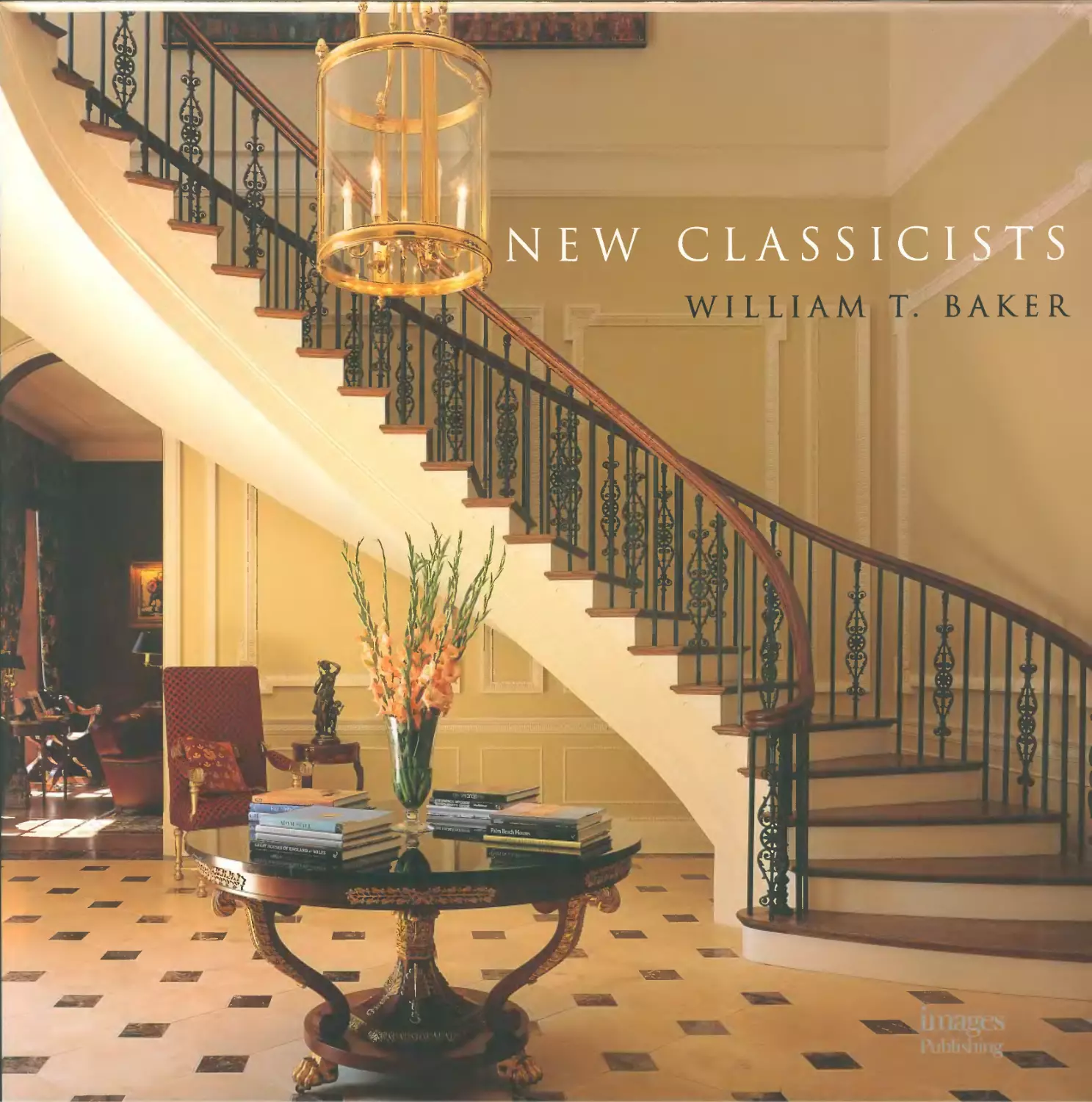
NEW CLASSICISTS
WILLIAM T. BAKER
INTRODUCTION BY
BEVERLY MEANS DUBOSE, III
PRINCIPAL PHOTOGRAPHY BY
JAMES R. LOCKHART
scan: The Stainless Steel Cat


Tice House, Dalton, Georgia
—-- lM<
'Ч f y$
';' V‘y 4
___________________
-‘ >'5;
: ’ L M
‘
1
-V - 1 Й
' |"’!те


Dedicated to my wife, Carolyn,
and to my daughters, Katherine, Sarah, and Emily
And to my mother, Martha, and the memory of
my father. William T. Baker, Sr. C1907-1994).
First reprint in 2005
The Images Publishing Group Reference Number: 613
Published in Australia in 2004 by
The Images Publishing Group Ptv Ltd
ABN 89 059 734 431
6 Bastow Place, Mulgrave, Victoria, 3170, Australia
Telephone: +61 3 9561 5544 Facsimile: +61 3 9561 4860
Email: books@images.com.au
Website: v/ww.imagcspiililislhrig.com
Copyright © The Images Publishing Group Pty Ltd 2004
The Images Publishing Group Reference Number: 564
Additional photography credits:
Mikhail Boutchine: 230-233, 235, 236, 238-243
Emily Jenkins Foliowill: 14
Debra Whitlaw Llewellyn: 63
Judith Schindler: 157
Dave Shafer: 68
Robert Thien: 25, 28, 31, 32, 36-37, 49, 59,151-156
All rights reserved. Apart from any fair dealing for the purposes of private study, research, criticism or
review as permitted under the Copyright Act, no part of this publication may be reproduced, stored in a
retrieval system or transmitted in any form by any means, electronic, mechanical, photocopying,
recording or otherwise, without the written permission of the publisher.
National Library of Australia
Cataloguing-in-Publication entry:
William T. Baker and Associates.
ISBN 1 920744 57 6.
1. William T. Baker and Associates. 2. Architects - United States.
3. Architecture. Domestic - United States. 4.Architect-designed hous-es - United States.
(Series: New Classicists).
728.370973
Designed by The Graphic Image Studio Pty Ltd, Mulgrave, Australia
Website: www.tgis.com.au
Film by Mission Productions Limited
Printed by Everbest Printing Co. Ltd. in Hong Kong/China
IMAGES lias included on its website a page for special notices in relation to this and its other publications.
Please visit this site: www.imagespublishing.com
Following pages:
Kane House, Atlanta, Georgia
CONTENTS
Introduction
by Beverly Means DuBose, III	10
Classically Inspired
A Personal Story	14
The Krone House	24
The Dempsey House	38
The Baldwin House	48
The Slone House “Arcadia”	58
The Noonan House	68
The Anthony House	86
The Gregory House	104
The Mills House	116
The Johnson Homeplace	126
The Smidt House	140
The Schindler House	148
The Faulk House	158
The Ledbetter House	168
Tlic Loudermilk House	176
The Siegel House	190
The LaBriola House	200
The Allen House	208
The Himot House	220
The Burfitt House	230
The Clare House	244
The Roesener House	256
The Stevens House	266
The DeGuardiola House	276
The Ahmad House	292
The Berry House	302
Tlic Winston	314
The Crescent at Post Riverside
The Borghese
318
324

ЭН?1'
Uh
ияи
Ulli
U1D
Ki»
IB
kiip
III
III
SO
AW
SBBiBWl!
Sl£
Sr 1Г
101


NT RO DUCTION
Architecture, more than any branch of the humanities, more than art, literature or
music, has the greatest impact on our daily existence. We live, work, shop, and
often spend our leisure time in the products of the discipline. These creations of
humanity provide a constant visual impact and a large portion of the ‘fabric of
time’ that gives us a sense of our place of being.
No other country has the variety of styles of domestic architecture found in
America. The early settlers brought with them the simpler styles of their countries
of origin and adapted them to the climate and building materials available in the
regions they settled. The earliest architectural styles in North America came
predominantly from England and to a lesser extent Holland, France and Spain.
Almost all of the commercial ties of the original 13 colonies were with England.
The styles and design then in vogue in the mother country were eventually
transferred to the colonies, usually modified to conform to the lesser economic
conditions as they existed here. Therefore, ‘Colonial Architecture’, as it is now
called, was influenced by the works of Inigo Jones who, in turn, was influenced
by the 16th-century Italian architect, Andrea Palladio and his Four Books of
Architecture. He was followed closely by Christopher Wren, who is probably best
known for his design of St. Paul’s Cathedral, constructed after the great fire of
London in 1666. In this country, he designed the earliest building for the College
of William and Mary in Williamsburg, Virginia.
This Palladian influence was carried into the period of Georgian architecture. This
period was named for the Georges of the House of Hanover, who ruled England
for more than 120 years following the death in 1714 of the last Stuart monarch,
Queen Anne. Architectural design books assisted greatly in creating the
pervasiveness of this Palladian influence. One of these was the Book of
Architecture by James Gibbs, published in London in 1728. These books provided
not only engraved plates of Palladian design but the proportions that form the
basis of that movement. Thomas Chippendale’s The Gentlemen and Cabinet-
maker’s Director published in 1754 is probably the best example of the influence
these published works had in their respective fields of design.
to
When the first U.S. census was taken in 1790, it was a rural and agrarian country
of four million, which included 600,000 slaves. Influences from England were still
strong, but native talent, such as Charles Bullfinch, who graduated from Harvard
in 1781, was beginning to develop. He sailed for Europe in 1787 and, under the
tutelage of Thomas Jefferson, who was at that time Ambassador to the Court of
Louis XVI, traveled to southern France and Italy.
At that time, the Palladian influence was still strong but it was modified by the
neo-classicism practised by brothers Robert and James Adams who, in turn, were
influenced by the recent discoveries at Pompeii. The resulting style in America
became known as Federal, named for the Federalist Party headed by John Adams
of Massachusetts. Charles Bullfinch became the chief practitioner of the new style
and is probably best known for his design of the ‘New State House’ on the Boston
Commons.
Once again, design books played a significant role in disseminating the Federal
style. These are best illustrated by Asher Benjamin’s The Country Builder’s
Assistant (1797) and the American Builder’s Companion (1806). The Federal style
dominated the architecture of New England.
The selection in 1790 of the site on the Potomac River in Maryland for the nation’s
new capital created a stage upon which this fledgling country could create its
identity. The first two buildings to be built were the President’s house (which had
to be painted white to cover the smoke damage from the British, having burned it
in the War of 1812) and the Capitol. The building as we know it today is largely
the work of the British trained architect, Benjamin Henry Latrobe, even though he
was not selected as the original designer of the Capitol. Latrobe, a protege of
Thomas Jefferson, once wrote to him that ‘My principles of good taste are rigid
in Grecian architecture.’
In his book Classic America, Wendell Garrett stated ‘The Greek revival was
the first pervasive and self conscious nationalistic movement in American
architecture.’ In the perception of many, this was the style most associated with
Southern domestic architecture. As this style emerged in the first quarter of the
19th century, the plantations of the South were being created. These grand homes
reaped the benefits resulting from Ely Whitney’s invention of the cotton gin in
1794 and the economic fortunes it created. The cotton gin made possible the
separation of the seeds from the fibers thereby making short staple cotton an
economically viable crop. This invention encouraged the spread of cotton
cultivation throughout the deep South and once again set the region on the
course of a single-crop economy based on slave labor. The combination of the
availability of cotton with the increased capacity and efficiency of the looms,
aided by the advent of the steam engine, led to a reduction in the price of cotton
cloth and greatly increased its demand. The South exported 3,000 bales of cotton
in 1790, but by I860, this export had risen to four million bales, which supplied
the mills of England and France. The New England mills were also supplied by
southern cotton. This provided the new plantations that spread across the region
with money to spend on this new national style of architecture.
What became the city of Atlanta began in 1837 as the starting point of the state-
built Western and Atlantic Railroad that would eventually run to Chattanooga. It
wasn’t until 1845 that the city was actually named ‘Atlanta’ (the female version of
Atlantic). By I860, Atlanta had become a town of 10,000 and was the
transportation hub of the region with three other rail lines from Columbus, Macon
and Augusta joining here. Atlanta can truly be called a ‘child of the railroads.’
It was one of the first major cities not to be constructed on a navigable waterway.
At 1,000 feet above sea level, amid the rolling hills of the Piedmont, Atlanta was
never the center of plantation culture and its massive Greek Revival architecture.
During the American Civil War, Atlanta was the focus of General William T.
Sherman’s campaign in the spring and summer of 1864. ending in its capture in
September of that year. The Confederate army began the damage by destroying
its ammunition train as it abandoned the city. Sherman completed the task in
November as he left the city on his infamous ‘march to the sea.’ This destruction,
coupled with the city’s disregard for preservation, left Atlanta with only five
structures that pre-date 1864.
n
Due to Atlanta’s strategic position as a transportation hub, the state capital was
moved there from Milledgeville in 1868. Growth of the area has not ceased since.
Virtually every residential neighborhood and structure is a product of the 20th
century. Like many cities, Atlanta exhibits many styles of architecture that
dominated different periods—the late Victorian, the bungalow, the ranch house
with its picture window, to the present ‘European Traditional’ (.whatever that
connotes!).
Despite the evolution in architectural design that produced Frank Lloyd Wright’s
Falling Waters in 1935 and Phillip Johnson’s Glass House in 1949, the taste
exhibited in the grand homes of Atlanta during the past 80 years has never strayed
from the classic styles of English Tudor, Georgian, Italianate, Federal, Regency and
Greek Revival.
Atlanta has been home to several exceptional classical architects and designers
whose works span the first three quarters of the 20th century. The first of these
was Neel Reid 11885-1926), who set the standard for fine classical design in his
residential and commercial work throughout the city. His associate, Philip
Trammell Shutze (1890-1982), introduced Atlanta to the vigorous forms of
Italianate and the reserved elegance of English Regency architecture. One of his
most important works was the Inman family’s home, Swan House (1927), which
boldly expresses his mastery of the Italianate.
There were three others who were associates of Neel Reid and/or Phillip Shutze
and went on to form their own firms. The first of these was Lewis Edmund ‘ Buck’
Crook (1898-1967), whose work emphasizes Jeffersonian and southern classicism.
He was followed by James Means (1904-1979), who graced the city with a
number of fine residences in the American Colonial and French Provincial
vernacular. The third member of this group was Edward Vason Jones (1909-1980)
who moved to Albany. Georgia following World War II and continued the
tradition of neo-classicism. He achieved a national reputation for his work and
was invited to be the consulting architect for the Diplomatic Reception Rooms at
the United States Department of State as well as for the White House.
By 1980, the era of these classical designers had ended and, unfortunately, the
next generation had not yet begun its practice. It appeared that the use of
classicism in residential design might end at this point. However, in a few years, a
new generation emerged with a keen understanding and admiration for classical
architecture. Bill Baker was among the first of this new group.
Having known and worked with Bill Baker for over 15 years. I very much believe
he follows in the footsteps of the talented, dedicated men who preceded him.
Bill’s work has a classical appearance, that is, classical in the emerging meaning
of the word: ‘attention to form with the general effect of regularity, simplicity,
balance, proportion and controlled emotion.’ I have seen Bill design homes in
most of the classic ‘architectural styles.’ inevitably remaining true to the particular
style selected. His design always has a grace and harmony created by its balance
and proportions. It is no easy task to make the interior conform, not just to the
exterior proportions, but to the demands of a modern lifestyle that is far removed
from the lifestyle that existed when these classic designs were first created.
Few possess the talent to be sensitive to the desires of the client while producing
a classical design that is livable, functional and a visual delight. Yet. Bill is one of
those talented few. He has designed homes for me for many years, allowing me to
experience firsthand his tact and patience. Bill is very-’ much a part of Atlanta’s love
of the classical and his work contributes greatly to giving its rolling hills some of
the most esthetically pleasing residential areas in the country. Because of his
design talents. Bill’s work has gained a much broader following than just in
Atlanta and now can be found throughout the nation.
I hope you enjoy getting to know Bill through his works, and that you can
visualize the design process of these homes as you turn the pages of this
delightful book.
Beverly Means DuBose, III
Atlanta, Georgia
September. 2004
12
Atlanta, Georgia, 2004

13
14
CLASSICALLY INSPIRED
A personal story
In retrospect, my childhood was very rich visually. My father was a nationally
acclaimed furniture designer, and I would watch him draw his designs on thick
ivory-colored paper at his drafting table. Sometimes when he would let me, I’d
climb up onto the tall wooden stool next to his chair and trace around his French
curve templates or carefully inscribe circles with a compass. I developed a love
for drawing and an eye for detail at an early age.
My father taught me how to draw cubes and rectangles in three dimensions. In
fact, I was the only child in my kindergarten class who knew how to draw objects
in perspective! By the time I entered second grade, I was able to sketch a
farmyard scene and show the barn in correct perspective with its shadows.
We lived in a beautiful Georgian-style house that my father had built in Nashville,
Tennessee. It was full of details that caught the attention of my young eyes.
Whether it was the graceful curved staircase in our foyer or the dentils in the
paneled library, the unique details of this house always provided me with
something of interest to contemplate.
My hometown of Nashville was filled with important architecture. My parents and
I visited Centennial Park, where I climbed the oversized steps of its replica of the
Athenian Parthenon. I was impressed by its huge bronze doors, painted friezes,
classical statuary and the grandeur of Greek architecture. It was a most memorable
introduction to classical architecture.
When I was a teenager, I had the pleasure of visiting Cheekwood, one of
America’s great treasure houses. Built in 1929, it was like a grand dame sitting
high on a hill, overlooking the rolling hills and meadows of the surrounding
countryside. My interest in this house consumed me for years. It was so large, so
exquisitely designed, and so perfect in its setting and gardens that I found myself
exploring it whenever I could.
I eventually served as a guide for the Nashville Public School’s Christmas tour of
Cheekwood. I took great delight in opening the children’s eyes to the things that
made the house so special. I wanted them to leave with more than just the
memory of the seasonal decorations. I wanted them to recognize an egg-and-dart
molding or a Palladian window. I knew firsthand the excitement that could come
with an early love of exceptional architecture.
I was also significantly influenced by two books, American Vignola by William
Ware and Edith Wharton’s The Decoration of Houses. These two books opened
the mysteries of classical architecture, proportions, and scale to me. I referred to
these books over the years and through them came to understand the principles
of classicism and to develop a discerning eye for what is, or is not, in 'good taste.’
In 1975,1 enrolled at Auburn University, planning to major in architecture after my
second year. This seemed to be a good plan given my lifelong love of architecture
and the artistic talent I had demonstrated. However, I was disappointed to find
that the curriculum had largely abandoned its classical foundations and had
embarked on a new aesthetic direction that didn’t appeal to me.
Furthermore, during my sophomore year, many of the graduating architecture
students began sharing stories of firms laying off architects rather than hiring
new ones. The country was still reeling from the effects of the Arab oil embargo,
inflation was rampant, and construction-related businesses had few entry-level
openings. So, I declared a major in business finance, thinking this would result
in better job prospects.
After graduating in 1979,1 found that the prolonged recession had affected the
job market for business graduates, and my best efforts were for naught. I was in
exactly the situation I had hoped to avoid! I accepted a job selling insurance but
this company soon went out of business. My career seemed to be off-track, and
I searched for a new direction.
During this time, I received an unexpected and much-needed word of
encouragement. I casually mentioned to someone that if these were the best
days of my life, as the old saying goes, then I was in trouble. This wise person
His childhood home
15
Cheekwood
responded. “The early years of a young person’s life are not the best years, but
rather the most fun. The best days are still ahead.” I held onto these words as I
wondered what the future held in store for me.
Like many of my peers during this time, I applied to a graduate school of business
to earn a master’s in business administration. Surely with an MBA from a good
school, I would have success securing a better job. But, shortly after applying to
Vanderbilt University in Nashville, a chance meeting completely changed my
plans.
On a whim, I went to see an executive recruiter to find out which major within
the MBA program was most in demand. He confirmed my strategy of pursuing
a graduate degree, but suggested I attend Emory University in Atlanta. He said
registration for the fall class was still open and that I should apply immediately.
This short conversation would impact the course of my life in a way I could never
have imagined at the time.
Moving to a large city where I had no family contacts and I knew no one was a
daunting task. But I had the hope of a new beginning and new opportunities. My
spirits were high as I entered the fall class of Emory’s Graduate School of Business
in 1980.
After graduating two years later, I obtained that all-important job for which I had
worked so hard. As an in-house consultant for Trust Company Bank. I was
engaged in projects for senior executives that allowed me to see many sides of
the banking business. I was promoted to officer of the bank after one year, but
something wasn’t right. My first love was still architecture, and deep inside I knew
that I was wasting my real talent. I was restless.
One morning in the summer of 1984, the major Atlanta newspaper ran an article
about a local real estate developer, Martin Marchman. He was making a name for
himself by building million-dollar speculative homes. This was the first time the
city had seen anything like this on such a large scale. Job growth among Atlanta’s
corporate community was strong, and Marchman was building new homes to
meet the needs of the Fortune 500 executives moving to Atlanta. Suddenly, I had
an idea! Why not contact Marchman to inquire if 1 could work for him as a
business consultant? At least that way I could be around architecture.
Marchman suggested that I might work in his in-house architecture department,
which was run by Steven Fuller. After meeting with him, Fuller decided the best
fit would be for me to administrate the architectural control committees for
Marchman’s numerous subdivisions. I was happy to accept the job and began to
learn all I could about reading working drawings and the construction of houses.
I could not have asked for a better education than the one I received in my daily
conversations with builders and tradesmen. My job was to confirm that the houses
were being built according to the approved plans. When I would question why a
particular detail didn’t look like the approved plan, the builder or carpenter would
review the drawings with me, and in some cases, thank me for my keen eye. In a
very short period of time, I learned a great deal about construction drawings and
developed a respect for the people in the field who are responsible for turning
those drawings into the reality of a finished home.
Back in the office, I got to use my drafting skills. I received the necessary
critiquing to help me develop good lettering and line quality. Within a couple of
weeks, I was able to draw exterior facades and make revisions to floor plans.
I learned the fundamentals of dimensioning and standard sizes for doors,
windows and plumbing fixtures. I enjoyed drafting and practised in the
evenings to further develop my skills.
By the end of the first year, I moved on to begin a consulting business
administrating architectural control committees for developers in Cobb County,
Georgia. The builders and real estate agents in these subdivisions sought my
opinion about ways to improve the layout and overall aesthetics of their plans.
My suggestions were well received, and I was asked to revise kitchens, bathrooms
and exterior facades.
Wishing to gain even more knowledge. I studied Edward Muller’s classic textbook
Reading Architectural Working Drawings, memorizing the terminology and
construction standards. In addition, I retained the services of a structural engineer
to help me properly detail my foundation and wall sections.
Mi reputation grew, and within the year, I was drawing complete home plans.
These early houses were relatively simple, but they were perfect for my level of
experience. Tire knowledge I learned from the builders, combined with my self-
study and inherent abilities, allowed me to succeed. I remain indebted to those
first builders who gave me the chance to prove myself.
Settling into my career, I was at peace. I studied books on the great homes of the
world and explored Atlanta’s older neighborhoods to find new inspiration. I
worked in my small condominium and eventually filled the closets with rolls of
drawings in boxes. In those early years, my typical workdays were long, but I was
16
doing something that I truly enjoyed. I knew from experience how rare that was.
Plus, I was creating something of beauty, usefulness, and permanence while using
my love of architecture and natural talents. I had finally found my place.
I married in 1990 and purchased a charming cottage that was our first home.
I enclosed a side porch to serve as my office and continued to work from home.
As my business grew, I hired associates who also worked from their homes. We
communicated by telephone and fax throughout the day. Because we didn’t spend
time commuting to work and encountered few of the distractions of office settings,
we had a productivity level that larger firms couldn’t match. It was a productive,
efficient arrangement—so much so that I continue to work this way today.
At the same time, I continued to administrate architectural control committees
and began work in the community of Chatsworth, which is located in the affluent
northwest Atlanta area known as Buckhead. Some of the homeowners and
builders there hired me to design their homes. In turn, these homes caught the
attention of the Atlanta real estate community, and realtors began mentioning my
name to their clients. My work in Buckhead began to expand exponentially.
One day, I received a phone call from a builder who had purchased a house
on Tuxedo Road, one of the most prestigious streets in Buckhead. He had
demolished the existing house and was planning to build an expensive
speculative home. Although he had already poured the foundation, he had
changed his mind and wanted to start over with a new design. ‘What I really
want,” he said, “is to build a grand Georgian house with hand-carved limestone.
Can you work with me?" Of course I said yes. and the result is one of my best-
known houses in Atlanta.
Designing this house was not nearly as big a challenge as finding the craftsmen to
carve and install the limestone. Nothing like it had been built in Atlanta since the
1920s. In addition to the stonework, the house had elaborate interior finishes that
required special talent to execute. After much research, the team was assembled
and the house completed. It was purchased by Dr and Mrs Howard Krone.
CLASSI CAL AMER] CA
THE ARTHUR KOSS AWARD
W11Д1AM T 15 AKE К
Jor his splendid residence in the das. ‘cal manner
built in Atlanta
Unbeknownst to me, the Indiana Limestone Institute had been following the
progress of this house since I first contacted its leadership to find craftsmen for the
stonework. The Institute had submitted the house to Henry Hope Reed in New
York City to be considered for the annual Arthur Ross Award in Architecture
given by Classical America. Imagine my surprise when I received a call from Mr.
Reed that I had been selected to receive the award for 19931 Receiving this award
put me in a select group of nationally recognized designers and architects, several
of whom were from Georgia. It was a great honor.
As the years progressed, key players in the Atlanta real estate community
recognized my talent. Dick Goodsell and his brother Bob hired me to design
houses for their communities of Baker’s Farm. North Valley and Drummond Point.
Joe Dewberry and Tommy Sweet hired me to design the entire community of
Highgrove in Vinings. They were followed by Tom Turrentine at Carter’s Grove
and Bo DuBose at Paces Ferry 2000, also located in Vinings. Will Stoltz and Alan
McRae hired me for their community of Brookhaven Registry, and Fritz Rybert
used my design services for homes in the Farm Brook and Stone Brook
communities in northeast Atlanta.
Further recognition came when Home and Garden Television’s award-winning
show Before and After, requested that I submit some of my remodeling projects
for consideration. As one of the network’s top-rated shows, it proved to be an
effective way to give my work national exposure. Before and After presented
seven of my projects—all dramatic transformations of ugly-duckling houses into
neighborhood showpieces. Some of these projects are among my proudest work,
as each presented special challenges not found in new construction.
As my family grew, we purchased an historic Buckhead house. The large English
Regency-style home, with its old brick and white columns, was built in 1936 by
the descendants of Henry Grady, Atlanta’s ‘voice of the New South’. It was Grady,
editor of the Atlanta newspaper, who helped convince northern industrialists to
invest in the reconstruction of the South after the Civil War.
This house has served me well. My office is located in a beautiful glass-enclosed
side porch that serves as a cheerful sunlit studio. At night, I can see the lighted
tower of Saint Philip’s Cathedral glowing in the distance through my office
window. It is an inspirational setting in which to work.
The journey I have traveled to reach this point in my career has been an amazing
one. When I moved to Atlanta, I could never have imagined that I would one day
impact the built fabric of this city’s already rich architectural history. I hope this
book will serve as a document of the very special times that I shared with my
clients, times that afforded me not only a place in their own personal histories,
but in Atlanta’s as well.
APRIL, 26TH
crew York, city
1995
17
Bugg House, Atlanta, Georgia
18
1мтммич1>а1и^н1и»т»в»ч*«вмшиимйл''ерт11пв««вш«1
1вЯ>Я1М>ааам«аааимаажясгзпмаакыама*мпаааам*и амины
WELCOME
19
pAkWP JAM&
pULLX TUrXNJfcO
UfcH
&4cr

I»1/*-11, <


f?rq<x>( =-
/ —77Л^~~
tpciuwi
к'в^о
rr-, £^C*5 f*CK5?^At
pLE-^l^a 5^Qy*S^t>a«e
Haetmamh -гЗанс«^>
20
D’Houbler House,
Atlanta, Georgia
21

Hennon House, Dalton, Georgia

McEntire House, Dalton, Georgia
23
THE KRONE HOUSE
Atlanta, Georgia, 1989-1990
Mattei-Miller, Contractor
Interiors by Stan Topol & Associates
When the Krones first looked at this house, it was a partially finished shell—only
the beginning of the stone work had been installed. It took vision to see the
house’s enormous potential. “When we first saw the house, we immediately fell in
love with the floor plan,” says Mrs Krone. “The design for the stonework was also
very exciting. We realized how special the house was going to be.” The home
would soon have the distinction of being one of Bill Baker’s first signature homes
and an architectural landmark for the city and Tuxedo Road. For his work on this
house, Baker received the coveted Arthur Ross Award in New York City in 1993,
Classical America’s annual award recognizing excellence in classical design.
Drawing upon the rich architectural heritage of Neel Reid, an early 20th-century
Atlanta architect, Mr Baker designed the house to incorporate hand-carved
limestone in a classical manner similar to Reid’s work from 60 years earlier.
“Because nothing like this had been built in several generations, we found
ourselves almost re-creating a lost art form. I had to research the material and
locate the artisans who were capable of executing my design. We wanted the
work to authentically reflect classical architectural standards.” says Baker.
“Classicism is, of course, timeless and stone has always been the primary medium
for classical architecture. I was excited to be a part of keeping this craft alive for
our generation.”
In addition to its elegant design, the Krone House features all modern amenities
including a spacious floor plan, a wine cellar, and a racquetball court. The
residence pays tribute to classicism at its best while accommodating the needs
and lifestyle of a contemporary southern family.
24


LAND PLUS ASSOCIATES LTD.
LANDSCAPE ARCHITECTS
27

15
1	Foyer	6	Kitchen	11	Garage	16	Storage	21	Au-Pair Suite
2	Living Room	7	Breakfast	12	Master Suite	17	Closet	22	Open to Below
3	Dining Room	8	Keeping Room	13	Master Sitting	18	Bedroom
4	Powder Room	9	Laundry Room	14	Master Bath	19	Bathroom
5	Library	10	Wet Bar	15	Covered Porch	20	Upper Hall
29
30

ZE
33


HE DEMPSEY HOUSE
Greenville, South Carolina, 1992-1993
Lynn Yeargin, Builder
Interiors by Louise Quinn
Mr Dempsey is a man who has achieved the American dream like few others.
Born to a modest family in Landram South Carolina, he rose through corporate
America to become president or chairman of three Fortune 500 companies—Borg-
Warner, Chemical Waste Management, and PPG. As a tribute to his personal and
business achievements, he received the Horatio Algers Award for Distinguished
Americans in 1995- Mr Dempsey also serves as a member of Clemson University’s
President’s Advisory Board and the Dean’s Advisory Board for the School
of Engineering.
In his retirement. Dempsey returned to his roots and built his home in a country
club community in Greenville, South Carolina, not far from his hometown of
Landrum. Because of his corporate and community work, Mr Dempsey and his
wife of 48 years, Harriet, needed a home that could function for large social
gatherings yet still meet the needs of their extended family. The resulting house,
with its grand rotunda and elegant interiors, is balanced by its informal family
spaces designed for use by the family’s many grandchildren.
“For us, family comes first. This home has been a wonderful gathering place for
all of us, especially when our family joins us here for the holidays,” says Mrs
Dempsey. “Whether it’s a corporate event, a spend-the-night for the
grandchildren, or a small group of friends for a game of bridge, the house
has provided the perfect setting.”
38

40
41
, ^еА-е* с-ч, ?5ра |
1*1 йич Ьчгм,.. ., ,liLqu-3^{^ <a^_
42


44
45
46
я *
THE BALDWIN HOUSE
Atlanta, Georgia, 1995-1996
Mike Goodsell, Builder
Interiors by Ann Baldwin
Built of aged fieldstone with a Vermont slate roof, the Baldwin house is nestled in
the woods on a tree-lined street that looks as if it could be in rural New England.
Behind the house is a babbling stream that cascades over mountain rock into a
small pond. One can hear the sound of the small waterfall when sitting on the rear
screened porch. The house is a welcome retreat from Mr Baldwin’s high-powered
professional life.
“One might have expected the project to be a challenging one given that Mr
Baldwin builds large commercial projects all over the world. He has very high
standards for construction. Fortunately, we had great rapport throughout the
project and I continue to value our friendship to this day.” says Mr Baker.
“The finished house is a delight to look at and I consider it one of my best works.”
“This house is an oasis for us from our busy lives,” says Mr Baldwin. “When I
come home 1 feel totally removed from the stresses of living in a major city.
It has been a real pleasure living in this house.”
48

50
1	Foyer	6	Kitchen	11	Garage	16	Screened Porch
2	Living Room	7	Breakfast	12	Master Suite	17	Bedroom
3	Dining Room	8	Keeping Room	13	Master Bath	18	Bathroom
4	Powder Room	9	Laundry Room	14	Front Porch	19	Closet
5	Guest Room	10	Gallery	15	Patio	20	Bonus Room
51


Е


-3 ПЯТ
V1Ж


Atlanta, Georgia, 1995-1997
Craig Shelton, Builder
Interiors by the Owner
Located on one of the highest points in Atlanta, the Slone residence shares an
important piece of local history. It was here in 1864, during the American Civil
War, that Federal troops established an observation post with a strategic view of
Atlanta. “There were still remnants of the fortifications from the war, but we failed
to find any artefacts during excavation—to everyone’s disappointment." comments
Mr Baker.
The house was sited on top of the hill to take advantage of the downtown skyline
view at night, and the long wooded approach up the hill. The dramatic double-
ramp staircase showcases the antique limestone entry and its massive oak door.
Once inside that door, guests can appreciate the many architectural antiques
incorporated by the owner—lighting fixtures, flooring tiles, and interior doors—
all planned to add to the home’s relaxed European feel.
Behind the house are a series of terraces and gardens in the Italian manner.
Culminating the view, on axis with the house, is a baroque-style greenhouse, its
graceful shape providing a visual anchor for the pool and multi-level terraces.
“The greenhouse is one of our favorite things about the property,” says Mrs Slone.
“Its stone eagle finial keeps watch over my prized orchids. This property is a
horticulturist’s dream. I love the way the colors and textures change with the
seasons.”
58

60
'.j .* I
.VW
J/Г-’


Second Floor
1	Foyer	6	Kitchen	11	Pantiy	16	Master Suite	21	Bathroom
2	Living Room	7	Breakfast	12	Elevator	17	Master Bath	22	Linen
3	Dining Room	8	Family Room	13	Butlers Pantry	18	Balcony	23	Open to Below
4	Powder Room	9	Laundry Room	14	Service Entry	19	Exercise
5	Paneled Study	10	Front Terrace	15	Closet	20	Bedroom
64

VSffsiX Ш
S£<8Sft
< Iх H-


67
THE NOONAN HOUSE
Atlanta, Georgia, 1996-1998
Mark Palmer, Builder
Interiors by Suzanne Kasler Interiors
“With only a glimpse of the Corinthian capitals, classic lines, and the lush grounds,
we instantly fell in love with our house—-it was like finding an English estate in
the middle of the city,” says Mr Noonan. The home’s use of hand-carved Indiana
limestone, old Carolina wood-molded brick, and Vermont slate roof are the
perfect compliment to the architectural design of this modern day English
country estate.
The limestone Corinthian capitals, with their southern flowers, were carved by
English artist Nicolas Fairplay, while the monumental segmental front entry and
other stonework was produced by Atlanta’s Sherwood Cut Stone. The home’s
grand interiors are the result of Mr Baker’s tasteful designs, which are based on
interiors of the period.
On life since moving in, Mrs Noonan relates, “In addition to the main floor,
maybe the most used area of the house is the spacious lower level. This is where
our media room, wine cellar and my husband’s office are located. Our children
can have their friends over, watch movies, and have fresh popped popcorn
from the old-fashioned popcorn machine in the adjoining kitchen. Meanwhile
I can be working nearby or my husband and I can entertain the parents of our
children’s friends in our wine tasting room. This home is the perfect balance of
form and function. We are really proud of it and so comfortable in the casually
elegant setting.”
68

70

I
g^d-rJlAh-l CAPITAL	Vlta-t/J	t^L-AjJ yii^vV AT gA»&
72
1	Foyer	6	Kitchen	11	Garage	16	Closet	21	Wet Bar	26	Bedroom
2	Living Room	7	Breakfast	12	Master Bedroom	17	Pantry	22	Storage	27	Bathroom
3	Dining Room	8	Keeping Room	13	Master Sitting	18	Butler's Pantry	23	Service Entrance	28	Open to Below
4	Powder Room	9	Terrace	14	His Bath	19	Laundry Room	24	Mechanical	29	Sitting Room
5	Library	10	Gallery	15	Her Bath	20	Elevator	25	Study
73

75
76
ЛИНИИ! пппниппн
78


81

83


Atlanta, Georgia, 1996-1998
Robert Marett, Builder
Interiors by Ruth Dobbs Anthony
“The challenge for this house was to design the home with all of Mrs Anthony’s
antiques and art in mind,” says Mr Baker. “She has some beautiful family portraits
and special pieces of furniture for which we wanted to be sure to provide a
place.” Over the years, Mrs Anthony, an accomplished designer in her own right,
had acquired a large collection of objects d’art, which challenged Mr Baker to
create interesting display opportunities. “One of my favorite spaces is the
octagonal hall with its display niches for my porcelain,” says Mrs Anthony.
To compliment the antiques, the interiors were designed to provide a perfect
setting for the furnishings. “The company that supplied our moldings provided us
with the same cornices and trim that were available a century ago,” says Mr Baker.
“In some areas of the house, I combined off-the-shelf items with custom
fabrication to create the desired architectural elements. The living room door
pediment is one example.”
“My favorite room in the house is the mirrored trellis room,” says Mr Baker. “It is
the first time I have created an effect like this.” The room, with its wood lattice
and fluted Ionic pilasters mounted over mirrors, provides a dazzling effect during
the day and a dramatic soft glow at night. Mrs Anthony comments, “I love the
bright cheerfulness of the house. It gives a happy feeling to the start of each day.”
86

Z Ji
88

llliljllMIIM
90


1	Foyer	6	Kitchen	11	Garage	16	Closet	21	Bonus Room
2	Living Room	7	Service Entry	12	Master Suite	17	Pantry	22	Bedroom
3	Dining Room	8	Vestibule	13	Master Sitting	18	Office	23	Bathroom
4	Powder Room	9	Gallery	14	Master Bath	19	Laundry Room	24	Computer Room
5	Guest Suite	10	Trellis Room	15	Covered Porch	20	Service Bath	25	Sitting
92

94


97
98


100


103
GREGORY HOUSE
Atlanta, Georgia, 1996-1999
McGarrity-Garcia Residential Builder
Interiors by Dee Dee Owens
Mr Gregory and his wife retired to Atlanta after his serving as president of a
New York-based Fortune 500 company. Because of their love of Atlanta, they
returned to build a hom&in a country French style. “My wife has always loved the
look of country French, so I wanted her to have just what she wanted,’ says
Mr Gregory. “We worked with Bill to achieve the casually elegant feel that fits our
lifestyle best.”
“The house has an unusual type of stone. I understand that this was the last
amount available. I am pleased that we were able to get it for this house,” says
Mr Baker. “The texture of the wood shake roof and the rough-sawn wood shutters
complement tlte stone and provide the textured look that the owners wanted.”
The house looks out onto a wooded preserve that provides wonderful privacy for
the rear pool and gazebo. With its flagstone and shaded arbor, the rear terrace is
a welcome retreat on a warm summer day.
104

106
107
1	Foyer	6	Kitchen	11	Garage	16	Closet	21	Stone Terrace
2	Living Room	7	Breakfast	12	Master Suite	17	Laundry	22	Bedroom
3	Dining Room	8	Keeping Room	13	Master Bath	18	Storage	23	Bathroom
4	Powder Room	9	Gallery	14	Pantry	19	Planter	24	Linen
5	Study	10	Service Entry	15	Butlers Pantry	20	Covered Porch	25	Cedar Closet
26 Open to Below
27 Upper Gallery
108
109
ll
Ill

II
EstasrtT
Hii I
P'a»' l
paws fl
frtat
KOBE i
aw»r
ЙЛИ.Е11
ss^sii
Ей»
ГВИ../
&-ЖЙ11
Srsaeffl
B^r
Bs7_
жл'
| -1
JfcSSKalq
WSmUj
(1 ‘
|ЯЙГ< _
да ir, is?» w if
i-ffT.j.Hf'i’
Л® Л.ЧЯВ *
Ьвагя'тГ
rewwSf i
Мваад *
й&«авв.
K№U4 '<№. I
миииж j
Srarwisg l
SawiM
b’S-itfel
«ИИЮ1
алий
лав'ы
аштиа
Вл&ам I
tesa«i_ |
мгж.*!
Esaa'Bii
^fesei’
Jtsuar
KMM
114
115
Atlanta, Georgia, 1997-1999
Bob Goodsell, Builder
Interiors by Jane Williamson
This is a house with a heritage. Mrs Mills’ childhood home was an exquisite
Colonial American-style home designed by James Means, an Atlanta architect
well known for his residences in this vernacular. Having grown up in a landmark
home decorated with period furniture, Mrs Mills is a connoisseur of the style, and
informed on all aspects of the design. “It’s a special treat for me when I encounter
a client who is so informed on a specific style. Her thoughts on the design of the
home came so easily because they were second nature for her,” says Baker.
Among the special materials used on the house are its wood shake roof,
hinged paneled shutters, weathered gray wood shake walls and an aged granite
foundation. The house is set on a hill and tastefully landscaped with boxwoods.
The interior walls were thickened at the windows to create pockets in the wall for
the interior shutters just as Means did on his houses a generation earlier. The
fireplace mantles are antique and help the interiors achieve the period look that
so nicely complements the home’s lovely furnishings.
“Our goal.” says Mrs Mills, “was to create a house for our time that was true to the
standards inspired by Jimmy Means. I think this house does justice to that end.”
116

и
118
ginf [ !ИШ Вши iimil
rttil Tlir/t

1	Foyer	6	Kitchen	11	Garage	16	Closet	21	Storage
2	Living Room	7	Breakfast	12	Master Suite	17	Pantry	22	Bedroom
3	Dining Room	8	Keeping Room	13	Master Bath	18	Terrace	23	Bathroom
4	Gallery	9	Laundry Room	14	Powder Room	19	Screened Porch	24	Linen
5	Library	10	Office	15	Service Bath	20	Patio	25	Study Area
26 Play Room
27 Cedar Closet
120
Sr
122

124

THE JOHNSON
HOMEPLACE
Near Atlanta, Georgia, 1997-1999
Built by the Owner
John Campbell, Contractor
Mr Johnson, a developer of large commercial real estate projects, has always taken
a hands-on approach to designing, building and managing his award-winning
projects. Over the years, he and his wife studied numerous examples of late 19th-
century architecture on their many travels with the idea that one day they would
create their own Queen Anne home.
When the Johnsons came to Bill Baker, they were well prepared with many
photographs and architectural design books. “We studied the homes to identify
the most important architectural elements for our design—the asymmetrical gable,
the octagonal turrets, the wrap-around porches, the different wood shake patterns,
the detailed brick work and the heavily bracketed cornice,” says Mr Baker. “The
challenge was to produce an open floor plan for today’s lifestyle while remaining
architecturally true to the form and scale of a house from a century earlier.”
The placement of the house in its park-like setting and the orientation of the
windows was inspired by the work of 1850s architect, A. J. Downing. Downing
wanted to relate his interiors to the outdoor environment through the use of large
windows and inviting porches. Visitors to the Johnson’s house give testimony to
the success of achieving the look and feel of a house from an earlier era.
The interior architecture makes use of many of the materials and special features
characteristic of the period. “Of special note are the stained-glass dome in the
foyer, the custom-made oak mantle in the living room that could pass for an
architectural antique, window casings with egg-and-dart moldings, the hand-
etched frosted glass panels at the front door and the elaborate coffered ceiling of
pressed tin in the living room," says Mr Baker. “The beautiful quarter-sawn oak
paneling and floors provide a striking background for the period furnishings.”
The interior millwork installation took five master cabinet makers sixty weeks to
complete while the interior paint and faux finishes took eight painters and artists
over fourteen months to complete.
126

128

130


132
133


ZLl
8£ I

SMIDT HOUSE
Atlanta, Georgia, 1997-1998
Jon Berndsen, Builder
Interiors by Judy Bentley
Originally a 1950’s brick ranch, the Smidt house represents one of Mr Baker’s
most incredible transformations of an existing house into a stylish country French
house. The original house was characterized by a low-pitched roof and horizontal
lines.
“People had noticed the original house primarily because of the incredible setting
with its mature trees and sweeping lawn," recalls Mi' Baker. “It was always one of
my favorite properties in town, so I was excited to be the one chosen to enhance it.”
In creating the new house, Mr Baker raised the roof, added French-style dormers,
lengthened the front windows, veneered the brick in cream-colored stucco and
added an architectural door surround at the entry.
The Smidts have a love for all things French and enjoyed enhancing the project
with the architectural antiques they found in Paris. Of special note is the old
limestone mantle in the living room that they found at the Paris flea market. “Half
the fun of this project was filling the house with the things we love,” says Jenny
Smidt. “It has been an ongoing project which we have enjoyed veiy much. Bill
Baker gave us a wonderful house with which to work.”
Before
140
*!Г- -
“паи
™"Ц[МИ


<б9\/ЛЬ-
143


i I 111111111111 iiiiiiiiiiiimiih


147
THE SCHINDLER
HOUSE
Atlanta, Georgia, 1997-1998
Jerry Hicks, Builder
Interiors by Alan Kepner
The Schindlers moved to Atlanta from Boca Raton, Florida, in 1997. As a venture
capitalist, Mr Schindler could locate his business to any city and chose Atlanta
because of its attractive business climate.
The Schindlers purchased a lot in northwest Atlanta that, at first glance, looked
topographically challenging. With one ravine in the front and another in the rear,
it looked as though the house would have little usable yard. But, as Mr Schindler
recounts, “1 coordinated the grading of the lot with my immediate neighbor to the
advantage of both parties.” The totally transformed property provides a lovely
park-like setting for the French-style home.
With its dramatic domed foyer, 14-foot ceilings, and expansive floor plan, the
house is ideal for entertaining. “We love opening our home to family and friends
or using it to host the various organizations that we support.”
Mrs Schindler’s love of gardening is readily apparent throughout the property. In
the spring, blossoming azaleas and dogwood trees surround the house. “I created
a large parterre garden, bordered in boxwood, near the rear terrace that is planted
with beautiful white roses for cool summer color,” says Mrs Schindler. “Outside
the kitchen windows are flower boxes with a variety of old-fashioned flowers that
cascade over the sides in a profusion of color. I wanted to have color and variety
all around the house.”
148


1	Foyer	6	Kitchen	11	Garage	16	Guest Bedroom	21	Laundry	26	Sitting Area
2	Living Room	7	Breakfast	12	Master Suite	17	Bath	22	Covered Porch	27	Bedroom
3	Dining Room	8	Office	13	His Bath	18	Stair Hall	23	Open Terrace
4	Powder Room	9	Sitting	14	Her Bath	19	Elevator	24	Bar
5	Keeping Room	10	Rotunda	15	Closet	20	Pantry	25	Butler's Pantry
150
151
SSI

154
155

157
Atlanta, Georgia, 1997-1998
Sheldon Simms, Builder
Interiors by Kim Davis
What started out as an extensive remodel job turned into new construction when
the existing foundation was found to be inadequate. However, the family decided
to allow the original plan to guide the design of the new house. The result is an
unusually charming and cozy arrangement that serves the family’s needs. “We
could have started from scratch, but we loved the plan that Bill Baker had
designed, incorporating elements of the old house. Following Bill’s inherent sense
of scale and taste, the house was appropriately scaled for the lot. We are thrilled
with the personality and surprises of the new house,” relates Mr Faulk.
Taking his cue from Dutch colonial architecture and Louisiana low-country
houses, Mr Baker combined elements from both in the Faulk house. The house’s
distinctive gambrel roof, with its Dutch dormers and inviting columned porch,
looks as though it could have stood on this spot for generations. Built of aged
fieldstone and wood shake, the house has a soft, weathered gray patina. Taking
advantage of the property’s steep topography, the house was designed with a
two-story porch to integrate the building into the hillside.
Continuing the rustic theme in the home’s interiors, natural materials frequently
found in homes of the style were also used. The floors make use of antique heart-
of-pine and some of the ceilings are plank board with box beams. “One of the
most fun things we incorporated was the children’s playroom over the garage,”
says Mrs Fafilk. “It’s painted like a fairyland and has a hidden door to the
children’s bedrooms.” Mr Baker recounts, “The Faulks collaborated wonderfully
and we all had a great time with the project. It’s a home I love to return to time
and ag?jn”
158

Second Floor
1	Foyer	5	Screened Porch	9	Laundry Room	13	Master Bath
2	Study	6	Kitchen	10	Service Hall	14	Closet
3	Dining Room	7	Family Room	11	Garage	15	Bedroom
4	Powder Room	8	Covered Porch	12	Master Suite	16	Children's Playroom
17 Linen
160
161
Л'Ййэ

163
164
"«JT


Atlanta, Georgia, 1998-2000
Sheldon Simms, Builder
Interiors by Nancy Warren
The producers of HGTV’s award-winning show Before and After contacted Bill
Baker to submit a remodel project for filming and broadcast. He had the perfect
house for the show. The long, low profile house had already been remodeled
once in the 1980s, but was still architecturally unremarkable. With its high ceilings
and generous floor plan, the house was an excellent candidate for additional
remodeling.
The remodel began by adding an entire second floor to the existing home. “The
extensive reframing allowed me to change the roofline and add the dormers and
distinctive gables,” says Mr Baker. The resulting house has a new stone veneer, a
variegated slate roof, segmental French doors and casement windows. The interior
floor plan, while needing only slight modification, was visually transformed by
dramatic remodeling of the spaces in a country French vernacular.
Located just a block from the Governor’s mansion, the property provides a
beautiful setting for the house with its large trees and expansive lawns. “Because
we wanted to focus on our teenagers and their friends, we needed a warm and
welcoming house,” says Mrs Ledbetter. “Bill designed a terrific recreation area
upstairs for our girls to entertain large groups. It has become the perfect spot for
us to meet the needs of many kids.”
168
169
170


173
174
175
Atlanta, Georgia, 1998—2000
Jerry Bonner, Builder
Interiors by Jane Marsden
A true American entrepreneur, Mr Loudermilk started renting folding chairs for 10
cents per day, after graduating from the University of North Carolina. What started
as a modest furniture rental business, has grown to be a multinational business
with annual rental and sales of over one billion dollars in over 850 stores across
the United States, Canada, and Puerto Rico.
“Mr Loudermilk and his wife came to me with a special opportunity to design a
Georgian-style house that was uniquely different,” says Mr Baker. “Because the
house was to be located at the intersection of two streets, I suggested the house
should have two facades. In fact, the front portico and its three-story rotunda were
designed to be the focal point for the intersection.”
“They also wanted the floor plan to differ from the standard Georgian box.
We designed the house in a V-shape. It’s one of my most unusual plans and one
that works well for entertaining large groups. Although the house is large at over
16,000 square feet, the interior rooms are still designed to be intimate and
comfortable.”
The Loudermilks have opened their grand house to more than 35 groups, both
political and charitable. “We’ve enjoyed sharing the house with the community,”
says Mrs Loudermilk. “We built the house to be used and that’s exactly what we’ve
done. It’s a pleasure seeing it filled with people enjoying themselves.”
176

178
WhjSJHmrHWrw
nhi
MiiHiiimi!
Biipsw
 i!i! isk«i *1 Mr “1
slsis#eh!t
179

1	Foyer	6	Kitchen	11	Garage	16	Closet	21	Elevator	26	Guest Suite
2	Living Room	7	Breakfast	12	Master Suite	17	Pantry	22	Covered Porch	27	Game Room
3	Dining Room	8	Keeping Room	13	Master Bath	18	Gallery	23	Butler's Pantry	28	Media Room
4	Powder Room	9	Exercise	14	Sitting	19	Terrace	24	Bedroom	29	Computer Room
5	Paneled Study	10	Laundry Room	15	Wet Bar	20	Portico	25	Bathroom	30	Storage
181

~Ч»

184

 1


THE SIEGEL HOUSE
Atlanta, Georgia, 1999-2001
McGanity-Garcia Residential, Builder
Interiors by Susan Bozeman
When Mr Siegel came to Atlanta as President of Turner Network Television, he
and his family wanted to build a home with some of the same New England
charm found in their community along the Long Island Sound in New York.
“The house we were coming from had a view of the Sound and our neighborhood
was like a slice out of old New England. We wanted our new7 home to recapture
some of this charm and warmth,” says Mr Siegel.
Enlisting the help of Bill Baker, the Siegels’ house, with its gambrel roof, Dutch
dormers and inviting porches achieves the look and feel desired by the family.
“We incorporated weathered wood and stone to give the house a lived-in feel,”
says Mr Baker. Among the house’s special features is a home office which has
been treated to look like a rustic Montana lodge. In addition, each of the principal
first-floor rooms have special finishes such as plank board walls, aged beamed
ceilings or flagstone floors.
“When I am at home in my office, I can see the number of people who stop and
look at our house from the street,” says Mr Siegel. “There is something about this
house that captures people’s imaginations. I think it’s because people at all levels
can relate to our house in scale and form. It’s a house that others feel like they
could live in too because there is nothing pretentious about it. It is a great
family home.”
190
191
192

LANDSCAPE ARCHITECTS
193
1	Foyer	6	Kitchen	11	Garage	16	Pantry	21	Linen
2	Living Room	7	Breakfast	12	Master Suite	17	Bar	22	Bedroom
3	Dining Room	8	Keeping Room	13	Master Bath	18	Covered Porch	23	Bathroom
4	Powder Room	9	Laundry Room	14	Closet	19	Screened Porch	24	Media Room
5	Office	10	Gallery	15	Vestibule	20	Butler's Pantry	25	Sitting
194
— e — в и
1HG
196


661
THE LABRIOLA HOUSE
Griffin, Georgia, 1998-2000
Randy Chandler, Builder
In teriors by J. Newton Bell, Jr.
The family’s historical connection to Spalding County dates back to the original
1836 federal land grant to General Lewis Griffin. It was his 800-acre railroad
terminus that would one day become the town of Griffin, Georgia. Thus the
family’s historical connection to the county dates back to its origins.
Over the years, each successive generation has sold off or split up their property
interests. “We have always loved the country and have been fortunate to have
been able to consolidate certain family interests and retain this 100 acres,” says
Mrs LaBriola.
Inspired by the land’s English countryside appearance, Mr Baker located the large
Georgian-style home at the end of a 1,500-foot-long driveway lined with Sycamore
trees. “In a few years, the trees lining the approach will have filled in. It’s going to
be even more fabulous,” says Mr Baker.
In designing the home, Mr Baker drew upon classic Palladian three-part designs
for his inspiration. “We wanted a house that was perfectly symmetrical and that
took advantage of being on a large tract of land. Bill Baker is incredibly talented
and exceeded our expectation,” says Mr LaBriola.
The family wanted a Georgian-style home combining brick and limestone.
“Bill showed us a number of examples and we especially liked the look of the
limestone pilasters with Ionic capitals,” says Mr LaBriola. “Several other elements
on the front facade had their inspiration from examples found in the work of
Shutze and Reid from a generation earlier. I am gratified that we did justice to
this unique property with an equally distinctive house."
200

1	Foyer	6	Kitchen	11	Garage	16	Closet	21	Office	26 Study Area
2	Living Room	7	Breakfast	12	Master Suite	17	Terrace	22	Bonus Room
3	Dining Room	8	Family Room	13	Master Bath	18	Laundry Room	23	Open to Below
4	Powder Room	9	Rotunda	14	Pantry	19	Bedroom	24	Attic Stair
5	Library	10	Veranda	15	Wet Bar	20	Bathroom	25	Linen
202

Section thru Rotunda
1	Foyer	6	Hall
2	Rotunda	7	Attic Stair
3	Veranda	8	Bathroom
4	Terrace	9	Attic Storage
5	Shelf	10	Basement Storage
204

206
18
S'
lg g'-”J_‘ a
s isBjl jljl
lEUK^Sp I
lirchSi
SaQaSi
I.! i»l №
i ’i i
J"S°'
S>lh si i
IliliM
h'iss
И
SsDaE
f ru-
tinjgUft
12. 8 8 S i isSsti i!..
i “. - ttFWPffll
5s Ч°№Ш£ №l|
"5 31 8 зГ :|
ata
few 3 ipi
8 й в 81 g I ii
I8lk J .* ;	. JI ! S I S?
Ijlbnjo aSt q| *S 5вЧВа«Йй|нЗп|з1п®в1п
:й !оХГ- fes®7"!'
%, IS % №i"  J
Ji, И!а.е (=]j. I. J
l. s ’г я « ФИ:
r«o|8jo	n
«ШIuiIcIhiIЯИШfl«
ЯВИ вПй _	„_,  ___;
!im| 11 cl i
SMstkja пва|ЕЦп|и|
il lasDsS II IsEill
। ЗэВнЭаЗ Ms sls.sl
IsEs s’" i"1’,» Isssii
Gl


ЯП
THE ALLEN HOUSE
Nashville, Tennessee, 1998-2000
Ramsey-Daugherty, Builder
Interiors by Landy Gardner
“The Allen’s house has a special place in my heart because it is located in my
hometown of Nashville,” remarks Mr Baker. The English-style home with its
clinker brickwork and terra cotta tile roof is one of Bill Baker’s best examples in
the style. Built in one of Nashville’s most established neighborhoods, the design
goal of the house was to blend in and to enhance a street known for its beautiful
old homes.
“We had fun on the project because the Allens wanted to use all the right
materials and finishes,” says Mr Baker. “The builder took the time to get the
details right, and it shows. Whether it’s the carved staircase, the gothic arches,
or the linen fold panels in the front door, Jay made sure every detail was properly
executed.”
“Landy Gardner was also in tune with the architecture. His selections of colors,
fabrics, and furnishings are a wonderful compliment to the home’s architecture,"
says Mr Baker. “The whole team worked well together and the home, as you can
see, is a dramatic success.”
208


?vauL2
Ull
Wii
.£&
ййж
SiUlllL
IUHII
bl IUIIII
И Ш1111
ч >:	-
210
211
г?

5Y
I
> jS

213
214


217


V I 'I-UI'W
THE HIMOT HOUSE
Atlanta, Georgia, 2000-2001
McGarrity-Garcia Residential, Builder
Interiors by Susan Bozeman Designs
When the Himots first met with Bill Baker, they knew the relationship would be a
good one. “We brought him photos of houses we liked and many of them were
houses Bill had designed,” remembers Dr Himot. “It was perfect harmony. I was
amused that he had many of the same photos and clippings in his own files.
He had an immediate understanding of what we wanted.”
The Himots acquired a large parcel of land and wished to build a handsome
Georgian-style home incorporating wood-molded brick and limestone. The
elegant open plan, with its two-story entrance hall and curved staircase with
iron railing achieves an easy elegance. “We didn’t fully appreciate what Bill
had designed until the interior moldings were installed,” says Mrs Himot. "The
best surprise was the wonderful detailing in the foyer. It was difficult for us to
fully appreciate what was planned by just looking at the drawings. We had to
see it built.”
Behind the house is an elliptical lawn with a swimming pool and Georgian-style
pool house. The symmetry of the rear fagade is quickly apparent looking back at
the house from across the pool. "One of our favorite views is the rear of the
house. There aren’t many houses where the back is as attractive as the front,”
says Dr Himot. “The architecture has been a delight for our eyes.”
220

TL'L
223
1	Foyer	6	Kitchen	11	Garage	16	Closet	21	Bathroom	26 Sitting
2	Living Room	7	Breakfast	12	Master Suite	17	Pantry	22	Study
3	Dining Room	8	Keeping Room	13	Master Bath	18	Wet Bar	23	Open to Below
4	Powder Room	9	Laundry Room	14	Elevator	19	Loggia	24	Balcony
5	Library	10	Stair Hall	15	Storage	20	Bedroom	25	Guest Suite
224

l IVIbl<^	-ТИ-У-gQ ГО'Г1.:-->г- -


228

THE BURFITT HOUSE
Atlanta, Georgia, 2000-2003
McGarrity-Garcia Residential, Builder
Interiors by Susan Bozeman Designs
When Mr Burfitt’s business brought him to Atlanta, he and his wife originally
looked at a location far to the north of city. “But Bill Baker suggested that we
look at a piece of property closer to Atlanta that he knew about. It was so heavily
wooded it was fiard to evaluate, but Bill had the vision.” relates Mr Burfitt. “It was
such a wilderness. We even saw fox and deer on the property—and we were just
a few miles from downtown! Ultimately though, we took his advice and bought
here instead.”
The property was once part of a large Atlanta estate of over 500 acres. Over the
years it was sold off and this was the last remaining piece. The original estate
house, located next door, was designed by Philip Shutze, one of America’s
greatest classical architects. The architectural and historical heritage of the
property was great and the new house had to meet the challenge.
“Because this was the fifth home they had built during their married life, the
Burfitts were very organized and informed about the building process," recalls
Mr Baker. “We had the best time together designing this house. They were
enthusiastic about my ideas and we collaborated well.”
Mr Burfitt recounts, “Bill took our ideas and desires and incorporated them in the
plans while remaining true to the style. Working with him was a real pleasure.”
230
«о.
SCALE СЕ 1" EQUALS l'-0’
232
"W
т'Т"
234
235
236
19
1	Foyer	6	Kitchen	11	Garage	16	Closet	21	Butler's Pantry	26	Storage
2	Living Room	7	Breakfast	12	Master Suite	17	Pantry	22	Bedroom	27	Hobby Room
3	Dining Room	8	Keeping Room	13	Master Bath	18	Workshop	23	Bathroom	28	Cedar Closet
4	Powder Room	9	Guest Suite	14	Elevator	19	Sun Porch	24	Den	29	Equipment Room
5	Terrace	10	Gallery	15	Laundry	20	Media Room/Study	25	Open to Below
237


И	тсу/адр fp
240
'"L, -
!

Vj
ft'

242
243
THE CLARE HOUSE
Atlanta, Georgia, 2000-2002
Peachtree Group, Builder
Interiors by Dilger-Gibson
Dr Clare, a bachelor at the time, bought two nondescript houses, side by side,
near one of Atlanta’s best private golf courses. He lived in one and rented out the
other for a number of years. “After I married, we decided to demolish the houses
and use both lots,” says Dr Clare. The combined property is one of the largest
estate lots near the golf course.
The resulting house was inspired by a number of eclectic old-world design
elements. With its octagonal turret and aged stonework, the house presents an
inviting appearance from the long driveway. The open arch of the porte-cochere
connects the garage with the house and provides an interesting break in the
facade. The iron railings, made by Ludvik Cherny, a European-trained craftsman,
add to the charm of the house.
The main staircase follows the curve of the octagonal turret and frames the
starburst detail in the foyer floor. The elaborate ironwork is repeated in the railing
of the living room balcony. Other materials and finishes of interest are the aged
French limestone paved floors in the foyer and the antique heart-of-pine, mixed
with herringbone brick, used in the kitchen.
“The house is full of fun details that continue to delight us,” says Mrs Clare.
“For instance, one of our favorite details is the medallion in the floor of the porte-
cochere that contains our initials and the date of the house. Also, the house flows
perfectly for entertaining. Its design and finishes have provided us with the
warmth, light and intimate spaces that make it a real dream home in which to
raise our family.”
244


246
1	Foyer	7	Kitchen	13	Master Bath	19	Terrace
2	Living Room	8	Breakfast	14	Pantry	20	Elevator
3	Dining Room	9	Keeping Room	15	Laundry	21	Wet Bar
4	Powder Room	10	Stair Hall	16	Closet	22	Nursery
5	Study	11	Garage	17	Covered Porch	23	Open to Below
6	Porte Cochere	12	Master Suite	18	China Closet	24	Bedroom
25 Bath
26 Upstairs Sitting
27 Linen
247
248

250


253
эд
Кив
Mu 4
ИП'Е


4 lilll 11 II
!»
THE ROESENER HOUSE
Las Vegas, Nevada, 2000-2003
R. W. Bugbee and Associates, Builder
Interior Consultation by Lady Henrietta Spencer-Churchill
After spending several summers in Ireland, and eventually having the opportunity
to restore an 18th-century country home, the Roeseners decided to recreate that
experience when they built their primary residence in Las Vegas. The design of
their new home was guided by their respect for classical architecture, an
appreciation for detail, and a high regard for fine craftsmanship.
“I contacted Bill Baker after reading an article in Traditional Home magazine
about his work in the classical manner,” says Mrs Roesener. “During our initial
meeting, I described floor by floor the home I wanted to build. He immediately
understood what I was describing, and the next day presented us with preliminary
drawings. Those first sketches were essentially what we built.”
“The challenge was to design a Georgian-style home that would not look out of
place in the desert conditions of Las Vegas,” says Mr Baker. “The key was to use
stucco instead of brick, natural stone trim, and a slate roof instead of the typical
terra cotta tile. The resulting house remains true to its style while blending with
the colors and materials of the community.”
The home’s interiors are authentic to the period and provide a perfect background
for the Roeseners' collection of art and antiques. The 28-inch-thick walls, 12-foot
ceilings, and paneled wainscoting and window jambs, along with the proportions
and details of the rooms, give the impression of an authentic Georgian-period
building. “Every time I walk into our home, I appreciate the dignity and integrity
of Georgian architecture. T am so pleased that we took the time and effort to build
our dream home,” states Mrs Roesener.
256


10
Second Floor
1	Foyer	6	Kitchen	11	Elevator	16	Closet	21	Balcony
2	Living Room	7	Breakfast	12	Front Terrace	17	Upper Hall	22	Attic Stair
3	Dining Room	8	Study	13	Master Bedroom	18	Laundry Room
4	Powder Room	9	Pantry	14	Master Bath	19	Bedroom
5	Library	10	Terrace	15	Master Sitting	20	Bathroom
259

261
262
ыя
263
264
S9C
THE STEVEN S HOUSE
Atlanta, Georgia, 2001-2003
Mark Stevens/Southwick Real Estate, Builder
Interiors by Marilyn Rosenberg
After a successful career on Wall Street as a bond trader, Mr Stevens retired from
the world of finance after his firm was purchased. Having already moved his
family to Atlanta when he opened his firm’s regional office, he and his wife
decided to stay and make Atlanta their home.
“I have always had an interest in building. My summer jobs as a teenager were in
residential construction. We remodeled our first home here in Atlanta and I built
some speculative homes after I sold my firm. I really enjoy the process,” says Mr
Stevens. “I became familiar with Bill Baker’s work and began working with him
on the design of our personal home.”
Both Mr Stevens and his wife had grown up in New England homes that were
more than 200 years old and still occupied by their respective families. Clearly,
they had an appreciation for craftsmanship and well-aged materials, both of which
they wanted in their new home.
The design of their home incorporated aged fieldstone, weathered wood shake
and a textured wood shake roof. The overall effect is that of a rambling farmhouse
in the countiyside. But, in fact, the home is located just a few miles from
downtown Atlanta on a quiet residential street. The Stevens are an active family
with three young children, so the house was designed for both aesthetics and
practicality. For instance, the home has a rear service hall with book-bag shelves,
a mud bath and locker storage, all perfect for their school-aged children. On the
lower level, the home has a media room, game room and second kitchen to
provide entertaining space for the children and their friends.
“We wanted this to be the ultimate family home—one that would be comfortable,
warm and inviting,” says Mr Stevens. “We had the best time building it and look
forward to the enjoyment of it in the years ahead.”
266


268
692

270
1	Foyer	6	Kitchen	11	Garage	16	Pantry	21	Open to Below
2	Living Room	7	Breakfast	12	Master Suite	17	Covered Porch	22	Bedroom
3	Dining Room	8	Keeping Room	13	Master Bath	18	Open Terrace	23	Bath
4	Powder Room	9	Laundry Room	14	Closet	19	Office	24	Bonus Room
5	Paneled Study	10	Butler's Pantry	15	Service Porch	20	Playroom
271
272


275
THE DEGUARDIOLA
HOUSE
Atlanta, Georgia, 2000-2003
Built by the Owner
Interiors by Lady Henrietta Spencer-Churchill
Originally bom in Cuba, Mr DeGuardiola came to America with his parents as a
young boy in the early 1960s after the Communists came to power. “My parents
left everything behind to come to America," says Mr DeGuardiola. “They believed
that we could only thrive as a family in the freedom of this country and were
willing to risk everything to start again.” Over the years, through persistent hard
work and smart investment decisions, Mr DeGuardiola was able to build a large
real estate development company based in Atlanta. Today, that company has
interests throughout the Southeastern United States.
In designing their new home, the DeGuardiolas chose as their inspiration the
architecture of Robert Adam, an 18th-century Scottish architect known for his
classical detailing. “The thing that impressed me the most,” says Mi' Baker, “was
how quickly they studied and grasped the finer points of Adam's work. They were
a delight to work with because they were so enthusiastic and supportive of my
efforts to achieve the look and feel of one of these period houses.”
The house incorporates brick and stone with Corinthian pilasters framing the
central bay. The front entry boasts classical design motifs and is the focal point for
the handsome facade. The Adam theme is continued throughout the interiors as
can be seen in the decorative plaster ceilings, cornices, and in the deeply carved
casings and paneling, all expertly installed by Tony Pearson. “We are thrilled with
our home,” says Mrs DeGuardiola. “It is a rare success in this day and time to be
able to create a home of this quality and detail.”
276

I
279
озг

282

1	Foyer	5	Library	9	Powder Room	13	Butler's Pantry	17	Covered Porch	21	Closet	25	Sitting Area
2	Grand Salon	6	Master Suite	10	Master Closet	14	Family Room	18	Terrace	22	Bedroom	26	Open to Below
3	Dining Room	7	Master Bath	11	Breakfast	15	Club Room	19	Garage	23	Bathroom
4	Kitchen	8	Sitting Room	12	Laundiy	16	Wet Bar	20	Elevator	24	Playroom
283

285
286


THE AHMAD HOUSE
Dalton, Georgia, 2001-2003
Darrell Jennings Builder
Interiors by the Owner
Classicism is usually associated with the architecture of ancient Greece and
Rome. This bias toward western architectural design belies the fact that other
architectural design motifs have been in use around the world for thousands of
years. When considering the architecture of Egypt, China, or the Indian sub-
continent, one finds a rich architectural heritage within each of these non-westem
cultures. The very definition of classicism—that which stands the test of time—
should be applied to the architecture of these cultures as well. These nations also
have a unique architectural language that has proven its usefulness and enduring
popularity for centuries, if not millennia.
While western in style, the Ahmad house incorporates a number of design
elements found in the family’s cultural homeland of Pakistan. The family collected
a number of significant architectural elements which Mr Baker lias tastefully
incorporated into the fabric of the house. Many of these items—doors, door
jambs, columns, and carved panels—are themselves hundreds of years old.
Upon entering the vestibule, one immediately passes through an elaborately
carved door and enters the foyer with its paneled ceiling and delicately carved
columned screen. At each end of the foyer are antique doors with original strap
hinges of forged metal. On the rear terrace, one can see the covered porch with
its antique columns and arched screens that open out to the pool.
By creatively incorporating these treasured architectural elements, Mr Baker has
given the home a special decorative richness. His sensitive appreciation of that
country’s heritage of fine craftsmanship in wood and metal has blended old world
elements in a new and creative way to create a home for the ages.
292

294

1	Vestibule	6	Kitchen	11	Butler's Pantiy	16	Bath	21	Study	26	Covered Porch
2	Foyer	7	Keeping Room	12	Gallery Hall	17	Closet	22	Elevator	27	Sitting
3	Living Room	8	Breakfast	13	Laundry	18	Garage	23	Master Bedroom	28	Open to Below
4	Dining Room	9	Caterer's Kitchen	14	Service Hall	19	Porte Cochere	24	Master Bath
5	Powder Room	10	Pantry	15	Bedroom	20	Stair Hall	25	Terrace
295
296
ж
ч^^У-


BERRY HOUSE
Atlanta, Georgia, 2001-2004
Builders II, Builder
Interiors by Suzanne Kasler
Both Mr and Mrs Berry have their roots in the newspaper business. Mr Berry’s
first job out of college was working as an advertising salesman for the Atlanta
newspaper. He reflects, “When I took the job, I never dreamed I would still be
there forty years later.” Over the years, Mr Berry would rise through the ranks
to be the Publisher and eventually serve as Chief Executive Officer for Cox
Enterprises, the newspaper’s parent company. Mrs Beny served as Executive
Director of the Georgia Press Association for over twenty years.
The Berry's house is located in Druid Hills, a historic Atlanta neighborhood
originally laid out by Frederick Law Olmstead. Olmstead, one of America’s
greatest landscape architects, also designed New York’s Central Park and the
Biltmore Estate. The neighborhood’s focal points are its Olmstead chain of parks
bordered by wide tree-lined streets and the Druid Hill Golf Club. The Berry house
is located on a quiet street that adjoins the golf course with views of Lullwater
Park in front and the golf course with its beautiful fairways at the rear.
Tire Berrys wanted their home to blend in with those surrounding it, especially
the English-style homes from the 1920s. “We love the look of the older homes
here but could not find one to buy that suited our needs,” says Mrs Beny.
“Building a new ‘old’ house seemed the best thing to do. We knew we had
achieved our goal when a passerby asked us how long it had taken us to
renovate this old house.”
With its hand-carved limestone, heavy variegated slate roof and old-world brick,
the Berry house blends seamlessly into its historic neighborhood.
302


304
305
1	Foyer	6
2	Living Room	7
3	Dining Room	8
4	Powder Room	9
5	Sun Room	10
Kitchen	11
Breakfast	12
Family Room	13
Laundry Room	14
Gallery	15
Library	16
Master Suite	17
Master Bath	18
Elevator	19
Garage	20
Closet	21
Front Terrace	22
Service Entrance	23
Butler's Pantry	24
Covered Porch	25
Bedroom	26
Bath	27
Media Room	28
Exercise
Open Tei
Storage
Linen
Upper Hall
306

MONET
nuli

309
310
£ Л-

312

THE WINSTON
Atlanta, Georgia, 1998-2000
Developed by Gene Hall and Billy Ivey
Designed in collaboration with CDH Partners
Market timing is often the difference between success and failure. In the case of
The Winston, Mr Hall and Mr Ivey had excellent timing. Soon after the Centennial
Olympic Games left Atlanta in 1996, they saw that the inventory of luxury
condominiums was depleted in northwest Atlanta. They acquired a choice piece
of land on Peachtree Street that had a view of the Atlanta skyline and was located
one block from the shopping of Phipps Plaza and Lenox Mall. With the design
talent of Mr Baker, they constructed a Зб-unit high rise that was one of the first of
its kind on the Atlanta market. The building sold well. Other developers followed
their lead and soon many similar projects were launched. However, by the time
The Winston was sold out, the market had become saturated and some of the
other projects languished.
Inspired by the luxury apartment buildings of pre-1940s New York, Mr Baker
incorporated a rusticated stone base with traditional red brick and classic double-
hung windows. The mortar color was carefully chosen to complement the stone.
Behind the building is a quiet garden sheltered from the noise and commotion of
Peachtree Street.
Each condominium was designed as a comer unit, giving it two exposures,
generous light, and excellent views. The units range in size from 1,850 to 6,000
square feet. The building includes an indoor lap pool, a fully equipped exercise
room, and 24-hour concierge sendees. “We were so pleased with the building that
Mr Ivey and I both purchased units in the Winston for our personal residences,”
remarks Mi Hall. “It has been a landmark building from its beginning.”
314
1	Foyer
2	Living Room
3	Dining Room
4	Kitchen
5	Gallery
6	Master Suite
7	Master Bath
8	Powder Room
9	Laundry Room
10	Bedroom
11	Bath
12	Closet
13	Balcony
14	Hall
15	Mechanical
16	Elevator Lobby
315
316
: • I
№D
IIL
ив
MB ВГ
MB ВЕС
ШМВСП
IBB BO
MB №
- J И В ЗЙ
an eg;
лмвт.
ян и л
Ш 8 JI
WUL
Ж Я
^Ч-Frr
Яг
THE CRESCENT AT
Atlanta, Georgia, 1999-2001
Post Properties, Contractor
The Crescent at Post Riverside is a new luxury town home community designed
in the spirit of Regency England. Mr Baker derived the crescent shape of the five
town homes from the classic architecture of Bath, England. His selection of
materials and details was inspired by the American architecture of Thomas
Jefferson. Each home’s entryway was made unique, reflecting a different detail
from Jefferson’s work at the University of Virginia.
Each door’s leaded transom was based on an 18th-century model. Following
Mr Baker’s design, Atlanta’s Vloeberghs Studio used restoration glass and hand-
cast lead fittings to produce the unique transoms. The interiors, with their 12-foot
ceilings, are gracefully proportioned and have interior trim moldings typical of
homes of the period.
The typical unit is 3,800 square feet, with two floors above a full basement that
contains secured private parking for each unit. Mr Baker designed each home
with a private elevator that connects all three levels. Because the Crescent
adjoins the Chattahoochee Nature Preserve, the rear terraces of each home
have a pleasant view of the dense woods, which are bordered by the
Chattahoochee River.
318

ияяяяя
ilili.'iSffiiliDiffiuM1
Ч/'ЧЯ
’!чЧ!
шяяяяяЯ
ДМ|
ЧаШПШШШ
яч»
^Я№в'
i Miiiiiiii/iiiWibi
giNiiiHHiiiiiiimiimi

OZE
1	Foyer	6	Kitchen	11	Elevator
2	Living Room	7	Breakfast	12	Butler's Pantry
3	Dining Room	8	Front Porch	13	Mechanical
4	Family Room	9	Closet
5	Powder Room	10	Terrace
321

323
Atlanta, Georgia, 1999-2001
Developed by Southeast Capital Partners
Construction by Hardin Construction and Cambridge Builders, Inc.
Designed in partnership with Cecil Alexander FAIA and Irv Weiner AIA and in
collaboration with Leo Daly Architects
The Borghese is a 57-unit luxury condominium community in the heart of
Atlanta’s most prestigious neighborhood. The building features four sizes of units
ranging from 1,600 to 3,950 square feet with two penthouses of over 4,000 square
feet. The use of classical detailing, such as Venetian arches, classical balustrades,
and rustication distinguish it among the city’s many attractive luxury
condominiums. With its curved walls, bowed front balconies and tower
elements, the building presents an interesting profile against the sky.
The Borghese offers 24-hour concierge service, a full spa and private health club
with heated outdoor pool, a classical garden with fountains, and the Intermezzo
Club Room with catering facilities for private entertaining. In addition to the
Borghese’s in-house amenities, residents can enjoy gourmet dining at Joel’s
restaurant, on-site banking, dry cleaning services, car detailing, and a sundries
shop in the adjoining building located just across the formal garden.
“It was indeed an honor for me to have partnered with Mr Alexander and
Mr Weiner on this project,” says Mr Baker. “They are both icons in the Atlanta
architecture community and I am privileged to have worked with them.”
324

Northside Parkway Elevation
326
1	Foyer	5	Breakfast	9	Laundry Room	13	Balcony
2	Living Room	6	Master Suite	10	Bedroom	14	Elevator Lobby
3	Dining Room	7	Master Bath	II	Bath	15	Mechanical
4	Kitchen	8	Powder Room	12	Closet
327

329

ACKNOWLEDGEMENTS
The completion of any book requires special appreciation of the many people
who made it possible. When that book covers 20 years of one’s career, it seems
the number of people to thank is multiplied even further. To begin, I wish to
thank my father, who inspired my love of drawing, and to my mother, whose
love and emotional support gave me the inner courage to take risks and pursue
my dreams. I am grateful to my wife, whose encouragement and excitement
made producing this book a real pleasure. And most importantly, 1 thank God
for giving me the talent and the opportunity to use that talent, which has made
this book possible.
As a great architect once said, ‘An architect is only as good as his clients,’ and
that still holds true today. This book has been made possible by the many families
who entrusted me with their dreams and allowed me to turn them into a reality.
It has been an honor, and to each of them, I say a grateful thank you.
On a professional note, I have several people to thank. I am indebted to my
associates, Aubrey Stringer and Ту Smith, who have worked so hard to produce
the plans by which these dreams were made. I am also grateful to the builders
and craftsman who so skillfully executed those plans. Thanks to them, pen and
paper became stone and mortar. I also wish to thank the many interior designers
and landscape architects whose talented work completed my architecture and
made these homes beautiful spaces in which to live.
My appreciation also goes to my photographer, James Lockhalt, who so skillfully
captured each home’s special essence. I also wish to thank Paul Latham and
Alessina Brooks of The Images Publishing Group, who so graciously invited
me to be a part of this wonderful architecture series.
And finally, I offer many thanks to Beverly M. DuBose III for his years of
friendship and support, and for sharing his great knowledge of architecture
in his introduction to this book.
Every effort has been made to trace the original source of copyright material contained in this book.
The publishers would be pleased to hear from copyright holders to rectify any error or omissions.
The information and illustrations in this publication have been prepared and supplied by William T. Baker. While all reasonable efforts have been made to ensure
accuracy, the publishers do not, under any circumstances, accept responsibility for errors, omissions and representations express or implied.
Other titles in the New Classicists series from
The Images Publishing Group
Ken Tate Architect
Selected Houses Volume One
ISBN 1 864701 01 3
This collection of houses illustrates a splendid dix ersity of
stylistic approaches to classical architecture and the range
of creative possibilities within this architectural specialty.
American architect Ken Tate's personal interpretation of
classical conventions, his meticulous detailing and his close
affinity with his clients, allow each home to stand apait as
an individual work of art—beautiful, livable, and engaging.
Ken Tate Architect
Selected Houses Volume Two
ISBN 1 920744 43 6
Following the success of Ken Tate's first book, this volume
presents a further collection of beautiful homes. Tate s designs
spring from impeccable research a deep understanding of his
clients' w ishes and the locales in which they have chosen to
build. All the homes presented in this second volume ow'e
their grace and beauty to Tate's impressive knowledge of the
classical tradition.
Robert Adam Architects Ltd
ISBN 1 920744 54 1
This important addition to the New Classicists series features
the work of Robert Adam Architects Ltd. a firm with an
international reputation in classical and traditional architecture
and design The practice is a world leader in progressive
classical design, combining tradition w ith the latest
technology. A broad portfolio of work includes town and
country houses, housing developments, urban masterplans,
commercial development and public buildings.
Appleton & Associates Inc. - Architects
ISBN 1 920744 60 6
This superb book features the design work of Appleton &
Associates Inc., a Californian firm always inspired by and
responsive to its clients' specific desires, needs, program and
budget. A harmonious relationship between the buildings
and landscape is alw ays an essential concern. The firm s
work frequently draws upon the time-honored traditions of
vernacular architecture, subtly reinterpreting them to evoke
a presence of the past.
ISBN 1 "150744 57-Ь