/



Text
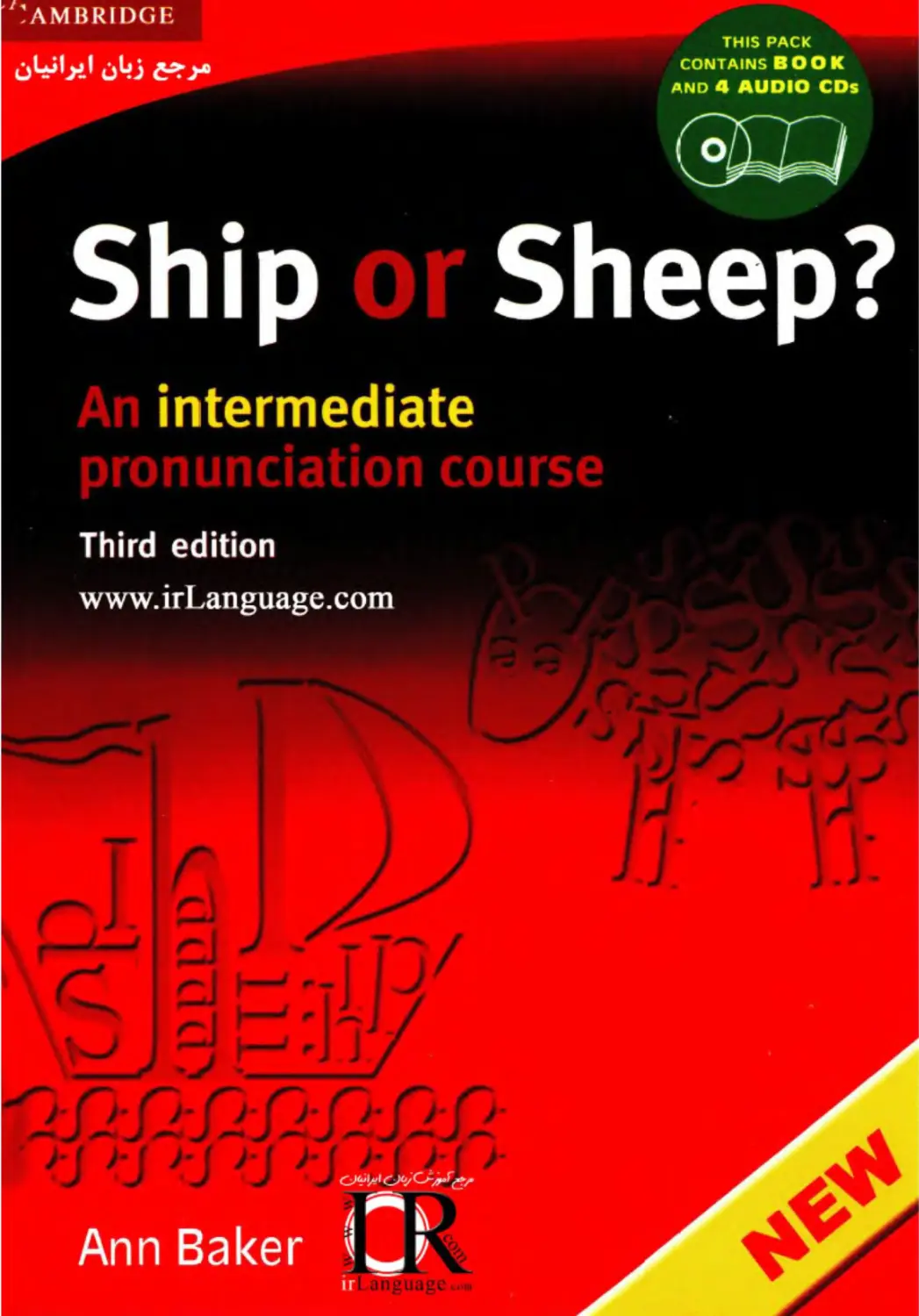
                    ':am bridge
dQj j-°
THIS PACK
CONTAINS BOOK
AND 4 AUDIO CDs
Ship
Sheep?
intermediate
nunciation course
Third edition
www.irLanguage.com

Ann Baker
Ship or Sheep?
An intermediate
pronunciation course
Ann Baker
Cambridge
UNIVERSITY PRESS
iii
CONTENTS
Acknowledgements	iv	Section В
Introduction for students	V	Consonants	79
Introduction for teachers	vii	23 p (pen)	81
Diagnostic Tests	ix	24 b (baby)	85
		25 t (table)	89
Section A		26 d (door)	93
Vowels	1	27 к (key)	97
1 i: (sheep)	3	28 g (girl)	101
2 i(ship)	7	29 Review	105
3 e(pen)	11	30 s (sun)	107
4 ж (man)	15	31 z (zoo)	110
5 л (cup)	19	32 J (shoe)	114
6 a: (heart)	23	33 з (television)	117
7 Review	27	34 tj (chip)	120
8 о (clock)	29	35 d3 (January)	124
9 э: (ball)	33	36 Review	128
10 и (book)	36	37 f(fan)	131
11 u: (boot)	39	38 v(van)	135
12 з: (girl)	43	39 w (window)	139
13 э (a camera)	48	40 j (yellow)	143
14 Review	52	41 h(hat)	147
15 ei (male)	54	42 0 (thin)	151
16 ai (fine)	57	43 d (the feather)	155
17 si (boy)	60	44 Review	159
18 ao (house)	63	45 m (mouth)	162
19 эи (phone)	66	46 n(nose	165
20 о (year)	70	47 g (ring)	168
21 еэ (chair)	73	48 1 (letter); (ball)	172
22 Review	76	49 r (rain)	176
		50 Review	180
		Overview	183
		Mask	185
		Key	186
iv
www.irLanguage.com
THANKS AND ACKNOWLEDGEMENTS
In the preparation of this new edition I would like to thank:
Sally Mellersh (formerly of Hammersmith and West London College) for updating and
expanding the List of likely errors to accompany the new editions of Ship or Sheep? and
Tree or Three? by its inclusion on the website
(http://www.cambridge.org/elt/elt_projectpage.asp?id=2500905).
David McCreath for IT assistance and contribution to my computer literacy. Sandra
TUrner for help with typing.
My editors Ndirfn Burke, Frances Amrani and Yvonne Harmer, as well as the following
teachers from all over the world who commented during development and gave me
such practical advice:
Michele Chartrand-Hirsch, France; Ian Chitty, UK; David Deterding, Singapore; Sylvie
Donna, UK; Elizabeth Downey, New Zealand; Lynda Edwards, UK; Laura Hancock, UK;
David Hill, Australia; Kip Kelland, Italy; Kathy Keohane, UK; Andrea Paul, Australia;
Gordon Francis Robinson, Singapore; Julietta Ann Schoenmann, UK; Roger Scott, UK
Peter Hobbs and other teachers of International House Sydney, who allowed me to
observe and co-teach their classes; Shan Jones, for class observation at Blacktown
TAFE College.
I would like to continue to thank Amir Pirouzan, Jean Crocker and John Lipscomb for
their advice and encouragement during the preparation of the original edition of Ship
or Sheep? Also Philippa Lipscomb and other teachers of the British Council, Teheran,
who helped with the first class try-outs.
The publisher has used its best endeavours to ensure that the URLs for external
websites referred to in this book are correct and active at the time of going to press.
However, the publisher has no responsibility for the websites and can make no
guarantee that a site will remain live or that the content is or will remain appropriate.
Illustrations by: Johanna Boccardo, Pat Murray, Felicity House and Tony Wilkins
Cover design by Pentacor Book Design
Designed and typeset by Hart McLeod
V
INTRODUCTION FOR STUDENTS
•	Seven of the 50 units in this book are review units. Each of the other
units introduces a different English sound, as well as other aspects of
pronunciation (e.g. stress, intonation) which are also important for
successful communication in English.
•	You can use this book either working alone or with a class + teacher.
•	You will need:
- equipment to listen to the CD, and equipment to record your voice
- a small mirror to compare your lip positions with the pictures
-Your mask (cut it out from page 185). You will use it at the beginning of
most units (but not Unit 1). You can also use it for extra practice of
sounds that are difficult for you.
• First, find out which units are most important for you. To do this:
- If possible, check your mother tongue in the List of likely errors (see
website: http://www.cambridge.org/elt/elt_projectpage.asp?id=2500905)
and make a printout of that part of the list.
- Do at least one of the Diagnostic Tests (see pages ix-xi). If you are
working alone, do Test A. Test В needs the help of a teacher, native
speaker or near-native speaker. If you are working with a teacher,
he/she will decide whether you do the tests.
• Decide whether you want to-
-	work first on the most important units for you, or
-	begin at the beginning and work through the book, spending more
time on the most important units for you. You can choose to work
simultaneously on Section A (vowels) and Section В (consonants). You
can also do the seven review units.
Read Making English sounds before beginning each section (see pages
1-2, 79-80). This introduces some essential vocabulary.
Symbols used in the book:
means this material is recorded.
means the answers are in the Key (see pages 186-224).
means this exercise is suitable for a group or pair of students. If you are
a student working alone, you could try it by using your imagination, e.g.
by imagining another student.
means ‘use the mask’ (see page vi).
means ‘visit the website to practise’.
Other symbols used:
Intonation is shown with arrows:
The main word stress is shown in bold, e.g. pronunciation, student.
Sentence stress is shown with underlining, e.g. Sentence stress is shown
with underlining, or sometimes with big and small circles:
OoOoOoooOo (Sentence stress is shown with underlining).
•	Phonetic symbols used in this book are the International Phonetic
Alphabet (IPA) (the Contents page shows all the symbols used). You can
use this book without knowing these symbols, but it is useful to learn
them so that you can check the pronunciation of new words in a
dictionary. The Cambridge Advanced Learner's Dictionary uses these
symbols.
•	In most units (but not in Unit 1), Exercise 2 Minimal pairs gives you
practice in contrasting two sounds in words and sentences. If you don’t
have one of the two sounds in your language, practising the pairs of
sounds can sometimes help you to hear - and then produce - the
English sound.
•	Dialogues are recorded. You can backtrack on the CD to repeat them as
many times as you want. If you don’t like backtracking, listen to the
dialogue after you have done the dialogue tasks.
The Mask
There are two ways in which you can use the mask (which you cut out from
page 185):
1	At the beginning of the minimal pair exercises Here, you are instructed
to use the mask in most units after Unit 1. The mask symbol at the
beginning of the exercise indicates ‘use the mask’. You can start the
minimal pair practice with the mask covering the written words, just
looking at the pictures and listening to the pair sounds (first in words
and then in sentences). This will help you to focus on really listening to
the sounds first. After you have listened for the first time, you can
backtrack on the CD to listen again and repeat.
2	Extra practice of difficult sounds You can also use the mask, for example
at the end of a unit, to enjoy extra practice of sounds that are difficult for
you. Here, your task with the mask is to try to produce the contrasting
sounds correctly while trying to remember the words and sentences.
(e.g. 1 Mask on - listen and repeat. 2 Mask off - read aloud. 3 Mask on -
remember and say aloud. 4 Mask off - read aloud to check)
Other ways of having extra practice of difficult sounds
1	Make playing cards by photocopying the minimal pair charts (e.g. four
copies) and cutting out the pairs. You can then play some of the card
games described in the review units. If working alone, play Pick up pairs,
Unit 7, page 27 or Pick up same sounds, Unit 14, page 52.
2	Check on the website
(http://www.cambridge.org/elt/elt_projectpage.asp?id=2500905)
to see if there is any extra practice material for this sound.
vii
www.irLanguage.com
INTRODUCTION FOR TEACHERS
•	Please read the Introduction for Students on pages v-vi.
•	Level This book is written for intermediate students, but previous
editions have also been used by students at other levels. Tree or Three? is
written for beginner-elementary level.
•	Class/Student working alone The instructions are written for a student
working alone, but can be used for classroom teaching as well. See the
symbols in the students’ introduction, especially
•	Diagnostic Tests You can use these if you need to assess students’
difficulties. But if you already know this for your class, you can choose to
skip the tests and decide whether you want the students to work
through the book or focus only on some units.
Students working alone can self-administer Test A with or without your
input. To administer Test B, students can be asked to record their
individual performances for your assessment. Or you may prefer to do
this with them so that you can immediately check possible ‘reading’
rather than pronouncing mistakes, by asking them to listen and repeat
the item.
•	List of likely errors This is on the website so that it can be added to. It
can be found at
http:// www.cambridge.org/elt/elt_projec tpage.asp?id=Z50090b.
It would be useful for each student to have a printout of the relevant
part of this list.
•	Minimal pairs In this book, these are pairs of words/sentences which
differ by only one sound, e.g. Bill bought a sheep./Bill bought a ship.
These sometimes help students to hear - and then pronounce - sounds
that are difficult for them. You may want to extend students’ class
practice of particular minimal pairs by inventing games or playing the
following:
-	Card games These are described in Exercise 1 of the review units.
Make more copies if using pairs from only one unit. This book is
copyright, but permission is granted to make a single copy of the
cards described in the review units, for the sole purpose of playing the
card games outlined.
-	'Fingers' For each pair, say words rapidly at random, e.g. sheep sheep
sheep ship ship sheep ship. Students show with one or two fingers if
they hear sound I or sound 2. Students practise in pairs and then back
to back.
viii
- 'Mingling' Each student has one of the minimal pair cards. Students
mingle (move around randomly), not showing their cards but
repeating their word to find the others with the same sound. They
form a group, which checks correct membership. The first group to
complete their set of words with the same sound wins. Students swap
cards within their group and check pronunciation of new words
before all mingling again to find the person in the other group with
the other half of their minimal pair. Students change cards with that
person and check each other’s pronunciation. Then start the mingling
game from the beginning so both sounds are used.
• The mask (See Introduction for Students.) The purpose of the mask is
twofold:
-	to allow students to listen to and practise the minimal pair sounds
first in words and then in sentences without being distracted by the
written word
-	for extra practice of sounds they find difficult.
ix
DIAGNOSTIC TESTS
All students should do Test A.
Test В requires the help of a teacher, native speaker or near native speaker
of English.
The tests are not to give you a mark. They may help you to find out which
sounds and other aspects of English pronunciation could be the most
difficult for you. You should also check this in the Lisi of likely errors on the
website: http://www.cambridge.org/elt/elt_projectpage.asp?id=2500905.
TEST A
Section 1	Sound discrimination
м Do not stop the recording or repeat. In each item you will hear two words.
Sometimes the two words are the same. Sometimes they have one sound
that is different. Listen once only to each item and tick the S (same) column
or the D (different) column. If you are not sure, tick the question mark (?)
column.
EXAMPLE If you hear, ‘sheep sheep’ tick the S column. If you hear, sheep ship' tick the D column. If you are not sure, tick the ? column.		S	D	?


				✓
	S	D	?		S	D	?		S	D	?		S	D	?
la				6a				12a				17a
lb				6b				12b				17b
2a				7a				13a				18a
2b				7b				13b				18b
2c				7c				14a				19a
3a				8a				14b				19b
3b				8b				14c				20a
4a				9a				14d				21a
4b				9b				15a				22a
5a				10a				15b				22b
5b				10b				16a				23a
5c				Ila				16b				23b
				11b				16c				24a
Section 2	Intonation
ал Do not stop the recording or repeat. Listen to Lucy talking to Lesley on the
telephone. In some items her voice goes up (	) at the end. In some
items her voice goes down (	). Tick the or column for each
item. If you are not sure, tick the ? column. Listen to the example first.
EXAMPLE a) That’s Lesley, isn’t it?
b) That’s Lesley, isn’t it?
			? •				?
1				6
2				7
3				8
4				9
5				10
Section 3	Word stress
A4 Do not stop the recording or repeat. In each item, tick the one word that is
different from the others.
EXAMPLE items column number alone/ listen
1	nowhere birthday mistake toilet postcard
2	guitar eighteen today machine English
3	away brother breakfast frightened valley
4	comfortable vegetables photograph lemonade minimal
5	telephoning supermarket conversation exercises helicopter
xi
TEST В
(Note: This test requires the help of a teacher, native speaker, or near-
native speaker of English.)
Ask the student to read each test item, and record the grading on the result
sheet (page xii).
A student’s performance can be recorded, or the student can be asked to
repeat an item as many times as necessary to record a result. The reasons
for mispronunciation are many, and some may be caused by reading
difficulty. To check this, say the mispronounced word correctly and ask the
student to repeat it. If the student can then say it correctly, add the symbol
R to your grading on that item, indicating that the student can pronounce
this sound but may have difficulty when reading it.
Suggested symbols for grading: / no difficulty with this sound
X difficulty with this sound
R may have difficulty reading this sound
Shopping list
1	some cheese (cheap cheese); some tea (Chinese tea)
2	fifty biscuits; four fish
3	ten eggs (big eggs)
4	jam; apples and oranges; a cabbage
5	ten tomatoes (large tomatoes)
6	five kilos of veal (very' good veal)
7	some strong string (long string)
8	four forks (small forks); spoons; cups; small paper plates
9	some good sugar; milk; coffee a cake
10	pick up Jude’s blue shoes at the shoe shop; two kilos of brown rice; a
grapefruit
11	nuts; honey; half a dozen hot buns
12	one lemon; nine brown onions; flowers for the house
13	some paper for my mother’s letters; collect Grandfather’s leather jacket
from the cleaner’s
14	a girl’s shirt and skirt (size thirteen); cold drinks (don’t get dry ginger);
some good bread
15	eight small cakes and paper plates; some sausages for supper
16	some yellow roses for your sister
17	white wine (sweet wine); some ice
18	beer for Bob (buy it from the pub near here)
19	some shampoo for Claire’s hair, some pears
20	some tins of New Zealand peas, or frozen beans
21	fresh English fish from the fish shop
22	a toy for the little boy (a blue or yellow ball)
23	something for Mr Smith (it’s his birthday on Thursday)
24	a small cheap television for the garage
xii
RESULTS SHEET AND FINDINGS from List of likely errors
In any of the three columns, place a cross against the sound where there may be difficulty.
SOUNDS	page	(Diagnostic Test B)	Diagnostic Test A	Findings from List of likely errors
1 /1:/ (sheep)	3		I a
/tj7 (chip)	120		lb
2 /1/ (ship)	7		2a
/f/ (fan)	131		2b, 2c
3 /е/ (pen)	11		3a
/д/ (girl)	101		3b
4 /ее/ (man)	15		4a
/63/ (jam)	124		4b
5 /□:/ (heart)	23		5a, 5b
/t/ (table)	89		5c
6 /v/ (van)	135		6a, 6b
7 /о/ (clock)	29		7a
/д/ (ring)	168		7b, 7c
8 /э:/(ball)	174		Ba
/р/ (pen)	81		8b
9 /и/ (book)	36		9a
/к/ (key)	97		9b
10 /u:/ (boot)	39		10a
/г/ (rain)	176		10b
11 /л/ (cup)	19		Ila
/h/ (hat)	147		lib
12 /п/ (nose)	165		12a
/аи/ (house)	63		12b
13 /э/ (camera)	48		13a
/д/ (the feather)	155		13b
14 /з:/ (girl)	43		14a, 14b, 14c
/d/ (door)	93		14d
15 /ei/ (male)	54		15a
/s/ (sun)	107		15b
16 /эи/ (phone)	66		16a, 16b
/j/ (yellow)	143		16c
17 /ai/ (fine)	57		17a
/w/ (window)	139		17b
18 /ia/(year)	70		18a
/Ь/ (baby)	85		18b
19 /еэ/ (chair)	73		19a
/т/ (mouth)	162		19b
20 /г/ (zoo)	110		20a
21 ///(shoe)	114		21a
22 /01/ (boy)	60		22a
/1/ (letter)	172		22b
23 /6/(thin)	151		23a, 23b
24 /5/ (television)	117		24a
1
Section A
Vowels
Use your voice to make all vowels.
Making English sounds
short vowels
(make a short sound)
/1/ (ship)
/е/ (pen)
/о/ (book)
/ж/ (man)
/л/ (cup)
/о/ (clock)
/э/ (camera)
long vowels
(make a long sound)
/эх/ (ball)
/u:/ (boot)
/i:/ (sheep)
/a:/ (heart)
/з:/ (girl)
diphthongs
(two vowel sounds)
/эо/ (phone)
Лэ/ (year)
Ли/ (boy)
/ао/ (house)
/ei/ (male)
/ai/ (fine)
/еэ/ (chair)

2 Vowels
1	Spot the different sound.
EXAMPLE /э/ /е/ /о/ /еэ/ /i/
Ansiver: The fourth sound is a diphthong. AU the others are
short vowels.
1 /эо//и//а//э//з/	2 /31//е'/1Э//ai//аи/ 3 /о//к//э://о://з:/
2	Match these words with the pictures below.
a the back of the tongue
b the lips
c the tip of the tongue
d the front of the tongue
3	Match the pictures (1-9) in A with the instructions (a-i) in B.
A
В
a)	Open your mouth.
b)	Close your mouth.
c)	Put your tongue forward.
d)	Open your mouth a little. Then open mouth a little more.
e)	Put your tongue back.
f)	Put your tongue down.
g)	Put your tongue up.
h)	Put your tongue forward and up. Practise /i:/: eat, easy, he, she, we.
i)	Put your tongue down and back Practise /a:/: ask, are, arm, car.
www. irLanguage .com
UNIT 1
/i:/ sheep
- Do you like your tea swee t?
-Yes.Three sugars, please.
1
Target sound /i:/
as Open your mouth very little to make
the target sound it. /i:/ is a long sound.
Listen and repeat: /i:/.
2
Sound /i:/
sheep
Look out for that sheep.
cheeks
What lovely cheeks!
bean
Throw out that bean.
leak
Stop it leaking!
peel
This peel's got vitamin C in it.
leave
He's going to leave.
Sound i:/ words
ль a Listen and repeat the words.
Sound i:/ sentences
A7 b Listen to the sentences.
A7 c Sentence stress
Notice that the most important words for the meaning of a sentence are
pronounced more LOUDly and s 1 о w ly.
The less important words are said more quietly and qukidy
Listen to the sentences again and this time look at the underlined
syllables below. Notice that they are louder and slower.
Look out for that sheep. Stop it leaking!
What lovely cheeks!	This peel’s got vitamin £ in it.
Throw put that bean.	He’s going to leave.
A7 d Listen again and repeat the sentences.
4 UNIT 1 /i:/ sheep
3 Dialogue
a First practise the sound M in some of the words from this unit. Read the
words aloud or visit the website to practise.
One-syllable words: cheese beef tea eat meal
three cheap please me
Two-syllable words: Peter people Edam evening
Eastfield biscuit cheesecake
(The stress is always on the first syllable.)
Two-syllable words: Janine repeat
(The stress is always on the second syllable.)
Note on word stress: bold is used here to show you which part of the
word is strongly stressed, i.e. which syllable is pronounced more
LOUDly and s 1 о w ly than the other(s). Word stress doesn’t usually
change, except in some longer words with stress near the end. (See 4c
and 4d.)
A8 b Listen to the dialogue, paying attention to the target sound. Then read
the dialogue and fill the gaps (1-10) with the correct words from the box.
cheese Peter eat please tea beef
three me teas beef
In a caf6: 'It's cheaper to eat at Marguerite's'
CHRISTINA: What would you like :o eat, i? The cheese sandwiches are
the cheapest.
PETER: Er ... mmm ... oh, a 2 sandwich, please, Christina.
CHRISTINA: Cheese ... mmm ... Janine? Would you like a 3 sandwich or a
cheese sandwich?
JANINE: A cheese sandwich, 4.
PETER: What about you, Christina? Would you like cheese or 5?
WAITRESS: Are you all ready to crder? What would you like to 6?
CHRISTINA: Er, we'll have one beef sandwich, two cheese sandwiches and, mmm,
7 for me.
JANINE: Tea for 8 too, please.
PETER: Yes, make that three 9, please.
WAITRESS: (writing down the order) One beef sandwch, two cheese sandwiches
and io teas.
де c Listen to the dialogue again to check your answers. Practise reading the
dialogue aloud, and record your voice to compare your production of
the target sound with the recording.
□NIT 1 /н/ sheep 5
4 Intonation of questions with or'
Intonation is the voice going up or down.
This movement up or down begins on the most important word in a
phrase or sentence.
In questions with ‘or’ the intonation usually goes down at the end.
A9 a Listen and repeat.
Would you like veal or beef?
Would you like coffee or tea?
Would you like coffee, tea or milk?
b Role play
Use the menu to practise a conversation in a group of four or five. You
are in a restaurant, lake turns to be the waiter. Ask each other questions,
e.g. Would you like... or ...?Then one person gives the order to the
waiter, who repeats the order to check it. If possible, also practise using
other menus. If it is an expensive restaurant, the waiter or waitress can
be more formal, saying Good evening before asking for the order.
EASTFIELD RESTAURANT
MENU
Soup
leek soup ok pea soup
Meal
veal or beef
Vegetables
beans or peas
Sweets
cheesecake or ice cream or peaches
Drinks
coffee or tea
Biscuits and Cheese
Edam cheese or Brie
irLanguage .com
6 UNIT 1 /к/sheep
дю c Word stress - nationalities ending in 'ese'
As you listen to the sentences about these nationalities, draw a line
connecting the country' and nationality in the two lists below.
Countries	Nationalities (Note the stress on the last syllable.)
China	Vietnamese
Bali \ Maltese
Malta \ Balinese
Portugal \ Japanese
Lebanon	Chinese
Japan	Nepalese
Nepal	Lebanese
Vietnam	Portuguese
Ai j d Moving stress
The stress of these ‘ese’ nationalities changes if the next word is strongly
stressed. So we say, This beef is Japanese but, It's Japanese beef.
Listen and respond, like the example.
EXAMPLE Is this bread from Beirut?
Response: Yes, it’s Lebanese. It’s Lebanese bread.
5 Spelling
Look back over this unit at words with the target sound, and write what
you noticed about how to spell the sound /i:/.
UNIT 2
/1/ ship
- What about this fish? Can I eat it?
-Yes. Eat it.
-What about this cheese? Can I eat it?
- No, don’t eat it. It’s six weeks out of date.
1 Target sound /1/
Ai2a a
AI2bb
A12c C
First practise the sound /i:Z
(see page 3). Listen and repeat.
Open your mouth a little more to
make the target sound /1/.
Listen and repeat.
Listen and repeat both sounds together,
/i:/ is long. /1/ is short.
Minimal pairs
Sound 1
/i:/
sheep
Look out for that sheep.
leak
Stop it leaking!
Sound 2
/1/
ship
Look out for that ship.
lick
Stop it licking!
cheeks
What lovely cheeks.
chicks
What lovely chicks.
This peel's got vitamin C in it
bean
Throw out that bean.
leave
He's going to leave.
This pill's got vitamin C in it
bin
Throw out that bin.
live
He's going to live.
www. irLanguage. com
8	UNIT 2 hf ship
Minimal pair words
л 13a a Listen and repeat the words.
Ai3bb You will hear five words from each minimal pair. For each word, write 1
for/i:/ (sound 1) or 2 for/1/ (sound 2).
EXAMPLE Pair 1: 1,2,2, 2,2
Minimal pair sentences
Ai4a c Listen to the minimal pair sentences.
Ai4bd Listen to six of the sentences and write 1 for /i:/ (sound 1) or 2 for /1/
(sound 2).
e Sentence stress
The most important words in a sentence are strongly stressed. They are
pronounced LOUDer and slower. Look at these examples from the
minimal pair sentences. (In the brackets on the right, the big circles are
the strongly stressed syllables and the small circles are the weakly
stressed syllables.)
Pair 1: OUT... SHIP
Pair 2: STOP... LEAK
Pair 3: LOVE ... CHICKS
Pair 4: PILL’S ... £
Look OUT for that SHIP! (oOooO)
STOP it LEAKing. (OoOo)
What LOVEly CHICKS! (0O0O)
This PILL’S got vitamin £ in it. (0O0000O00)
A14a
A15 f
Listen to the minimal pair sentences again and underline the strongly
stressed words in each sentence (on page 7).
Tick the words a) or b) that you hear in the sentences.
1 a) sheep I I
2 a) bean | ]
3 a) cheeks Q
4 a) cheap О
5 a) heel | |
6 a) peel
b) ship
b) bin | |
b) chicks | |
b) chip О
b) hill □
b) pill □
3 Dialogue
a First practise the sound /1/ in some of the words from the dialogue. Read
the words aloud or visit the website to practise.
One-syllable words:	film ill miss kids quick Kim Bill
IVvo-syllable words:	(1st syllable) cricket tickets children minutes quickly listen pity (2nd syllable) begins
Three-syllable words:	(1st syllable) history festival cinema interesting prize-winning Africa (2nd syllable) gymnastics Olympic excited beginning terrific gorilla (3rd syllable) chimpanzee
UNIT 2 /1/ ship 9
Л16 b Listen to the dialogue, paying attention to the target sound. Then read
the dialogue and fill the gaps (1—8) with the correct three-syllable words
from the list in 3a.
Three interesting films
BILL: Good evening, Mrs Lee.
GINA: Is Kim in?
BILL: Is he coming to the cinema, Mrs Lee? It's the Children's
Film 1.
MRS LEE: Kim's ill.
BILL: Here he is!
GINA: Hi, Kim!
KIM: Hi, Gina! Hi, Bill!
BILL: Kim, we've got these three free tickets to see three 2 films for
children!
MRS LEE: Listen, Kim ...
KIM: Is it 3?
GINA: Ute think it is. First there's a short film about gorillas and 4 in
Africa, and ...
BILL: ... then the next film is about the six best Olympic 5
competitions, and then ...
GINA: ... then it's the big film - The 6 of English Cricket.
KIM: Cricket!
BILL: It's a 7 film.
MRS LEE: If you're ill, Kim ...
GINA: It would be a pity to miss it.
MRS LEE: Now listen, you kids ...
BILL: And it begins in fifty minutes.
MRS LEE: KIM!
KIM: Quick! Or we'll miss the 8 of the gorilla film!
Ai6 c Listen to the dialogue again to check your answers. Practise reading the
dialogue aloud, and record your voice to compare your production of
the target sound with the recording.
d Perform the dialogue in a group of four and, if possible, record your voices.
In your group, first practise speaking with feeling. Mrs Lee is getting more
and more angry. The others are getting more and more excited.
In English, if you get more angry, you usually speak more loudly, if you
get more excited, you usually speak more quickly.
10
UNIT 2 /1/ ship
4 Numbers
ли a Word stress
Stressed syllables are in bold. Listen and repeat.
three	thirteen	thirty	3	13	30
four	fourteen	forty	4	14	40
five	fifteen	fifty	5	15	50
six	sixteen	sixty	6	16	60
seven	seventeen	seventy	7	17	70
eight	eighteen	eighty	8	18	80
nine	nineteen	ninety	9	19	90
b Moving stress
The stress in these ‘teen’ numbers is different when we are counting,
thirteen, fourteen, fifteen, sixteen, seventeen, etc.
c Other moving stress
The stress in these 'teen' numbers is also different when there is a strong
stress in the next word.
Tim lives at number fifteen.
Tim lives at number fifteen Green Street.
Ais Practise giving A’s reply in the conversations you hear, like the example.
Example
A:	The dentist is at seventeen Mill Street.
B:	Seventy?
A: No, not seventy - seventeen.
d Mini Bingo game
Play in a group of 3-5. One person calls out the numbers from 4a but in
a random order. (Take turns to call the numbers.) The others each
choose one of the boxes А, В, C or D below. Listen to the numbers and if
a number is in your box, cover it with a small piece of paper. When all the
numbers in your box are covered, you are the winner and you shout, BINGO!
А	В	C	D
13	3	80	60	4	16		5	15	16	60	6	15
7	19	50	40	30	13		70	90	3	8	14	17
17	90	8	70	5	90		40	7	18	9	90	80
Self study student: first make a recording, saying clearly all the numbers
from 4a but in a random order. Then listen and play as many boxes as
you can simultaneously.
5 Spelling
Look back over this unit at words with the target sound, and write what
you noticed about how to spell the sound /1/.
www. irLanguage. com
-	Is this milk fresh?
-	Yes. Everything in this fridge is fresh.
1 Target sound /с/
Ai9a a First practise the sound/1/
(see page 7).
Ai9bb Open your mouth a little more to
make the short target sound ,'e/.
Listen and repeat.
Ai9c c Listen and repeat both sounds
together: /1/ and /е/.
2 Minimal pairs
Sound 1
/1/
pin
I need d pin.
bin
That's my bin.
tin
Its a big tin.
Pig
Where's the pig?
bill
There's the bill.
chick
She wants a chick.
Sound 2
/е/
pen
I need a pen.
Ben
That's my Ben.
ten
It's a big ten.
Peg
Where's the peg?
bell
There's the bell.
cheque
She wants a cheque.
Minimal pair words
A2oa a Listen and repeat the words
A20bb You will hear five words from each minimal pair. For each word, write 1
for /1/ (sound 1) or 2 for /е/ (sound 2).
EXAMPLE Pair 1: 2, 2, 1, 1, 2
12 UNIT 3/е/pen
Minimal pair sentences
A2u c Listen to the minimal pair sentences.
Aiibd Listen to six of the sentences and write 1 for /1/ (sound 1) or 2 for /е/
(sound 2).
A2ue Sentence stress
The most important words in a sentence are strongly stressed. If the
minimal pair sentences were spoken with only one strong stress, which
word would it be? Read the sentences and guess which word it might be.
Then listen to the minimal pair sentences again and underline the
strongly stressed word in each sentence (on page 11).
A22 f Tick the words a) or b) that you hear in the sentences.
1 a) pin	b) pen	□
2 a) pig	b) peg	□
3 a) tins CZ	b)tens	□
4 a) sit	b) set
5 a) disk	b) desk	u
6 a) pick at [	b) peck at
3 Dialogue
a First practise the sound /е/ in some of the words from the dialogue. Read
the words aloud or visit the website to practise. In words with two or
more syllables, bold is used to show which syllable is strongly stressed.
In the brackets, write the number of syllables in each word before you
practise.
EXAMPLES friend (1) terribly (3) Emma (2) expensive (3)
jealous ( ) help ( ) everybody ( ) any ( ) bench ( ) Kevin ( )
America ( ) Mexican ( ) Emily ( ) Ben ( ) very ( ) bread ( ) Eddie ( )
Notice that many words in English have the strong stress on the first
syllable, but some words have the strong stress on the last syllable.
hello Adele again except yourseif lemonade
A23 b Listen to the dialogue, paying attention to the target sound. Then read
the dialogue and fill the gaps (1-7) with the correct questions (a-g)
below.
a)	Can I get you a drink, Adele?
b)	Is that better?
c)	Was it expensive?
d)	Are you listening to the Red Hot Chili Peppers?
e)	How did you spend your holiday, Adele?
f)	Are you a friend of Emma’s?
g)	Have you met my friend Adele yet, Kevin?
UNIT 3/е/pen 13
Friends
ADELE: Hi, Emma! Hi, Ben! Hello, Emily! Hello, Eddie! Hi,
everybody!
EVERYBODY EXCEPT KEVIN: Hi, Adele!
EMILY: Nice to see you again, Adele. Kevin this is Adele. Adele,
this is Kevin.
adele: Hi, Kevn. i? It's terribly loud.
KEVIN: Yes ... (turns the music down) 2? (Adele
nods her head) 3?
ADELE: Yes.
KEVIN: Emma said she had a friend called Adele
EDDIE: Help yourself to Mexican focd, Adele. It's on the kitchen
bench.
EMILY: And there's French bread on the shelf.
BEN: 4?
ADELE: Yes, thanks, Ben. Some lemonade with a bit of ice in it.
EMMA: 5?
KEVIN: Yes. I've just met her. She's very fnendly.
BEN: 6?
ADELE: I went :o South America with my best friend Kerne.
EVERYBODY: Well!
EMMA: We're all jealous.
EDDIE: 7?
ADELE: Not very. But I spent everything. I haven't any money
left
Л23 c Listen to the dialogue again to check your answers. Then practise
reading the dialogue aloud. Record your voice to compare your
production of the target sound with the recording.
4 Intonation
Intonation is the voice going up or down on the strongest syllable of the
most important word in a phrase or sentence.
Intonation statements usually goes down at the end.
Intonation in WHquestions (Who? What? Why? When? Where? Hou>?)
usually goes down at the end.
Intonation in Yes/No questions usually goes up at the end.
14 UNIT 3/е/pen
A24 a Listen and repeat.
WH question: How did you spend your holiday?
Statement:	I went to America.
Yes/No question: Was it expensive?
Statement:	Ye» Very.
No. Not very.
A25 b Word stress
Practise the word stress in these place names. In many place names the
strong stress is on the first syllable.
Denmark Venice Edinburgh Mexico
Mecca Melbourne Lebanon
A smaller number of place names have the strong stress on the last
syllable.
Japan Mumbai Madrid Beirut New York
In longer place names the strong stress is sometimes in the middle of
the word.
the Riviera the Mediterranean Australia America I lelsinki
Philadelphia
c Now practise the conversation below, using the place names in 4b.
A: How did you spend your holiday?
В: I went to ...
A: Was it expensive?
B; Yes. Very. / Not very.
d Dictionary work: word stress
When you meet a new word, you can check which syllable is strongly
stressed in a good dictionary (e.g. Cambridge Advanced Learner's
Dictionary). The pronunciation of the word is shown in the International
Phonetic Alphabet (IPA). with the symbol1 in front of the main strong
stress of the word, e.g. electric /i lektnk/. Your dictionary will also show
the secondary stress (usually in longer words) with the symbol , e.g.
electricity /ijek'tnsati/.
In Ship or Sheep? only the main strong stress in a word is in bold to show
you where the stressed syllable ends, e.g. electric, electricity.
Look up some of these words in a dictionary and mark which syllable
has the main strong stress.
EXAMPLE except or ex cept
except	exercise	expect	expedition
expel	experiment	expenditure	expert
expression	extend	extra	extrovert
5 Spelling
Look back over this unit at words with the target sound, and write what
you noticed about how to spell the sound /е/.
www.irLanguage.com
UNIT 4
/ае/ man
- Let’s have a chat about that cat.
- My cat?
-Yes ... em... it’s too fat.
-Well, it is a bit fat. But it’s ... mm ... a very happy cat.
1 Target sound /ж/
A26a a
A26b b
A26c C
First practise the sound /е/
(see page 11). Listen and repeat.
Open your mouth a little more to
make the target sound /ж/.
Listen and repeat.
Listen and repeat both sounds together:
/е/ and /ж/.
2 Minimal pairs
Sound 1
/е/
x
Put the Y here.
Sound 2
/ж/
axe
Put the axe here.

pen
Can I borrow a pen?
men
Look at the men.
send
I'm sending the table.
gem
It's a lovely gem.
bread
We had bread for lunch.
pan
Can I borrow a pan?
man
Look at the man.
sand
I'm sanding the table.
jam
It's a lovely jam.
Brad
We had Brad for lunch.
16 UNIT 4/ае/man
Minimal pair words
A27a a Listen and repeat the words.
A27b b You will hear five words from each minimal pair. For each word write 1
for /е/ (sound 1) or 2 for /ае/ (sound 2).
EXAMPLE Pair 1: 2,2,1,12
Minimal pair sentences
A28a c Listen to the minimal pair sentences.
A28b d Listen to six of the sentences and write 1 for /е/ (sound 1) or 2 for /ае/
(sound 2).
A28a e Sentence stress
Listen to the first two minimal pair sentences again and look at the
circles on the left. The big circles are the strongly stressed syllables, and
the small circles are the weakly stressed syllables.
OoOO Put the ‘x’ here./Put the axe here.
ooOooO Can I borrow a pen?/Can 1 borrow a pan?
A2&i Listen to the rest of the sentences and underline the sentence stress (the
strongly stressed syllables in the most important words in the sentence).
OooO Look at the men./Look at the man.
0O00O0 I’m sending the table./I’m sanding the table.
00O0O It’s a lovely gem./It’s a lovely jam.
ooOoO We had bread for lunch./We had Brad for lunch.
A29 f Tick the words a) or b) that you hear in the sentences
1 a) pen	□	b) pan	□
2 a) men	□	b) man	□
3 a) end		b) and	□
4 a) feta		b) fatter	□
5 a) pet	□	b) pat	□
6 a) bed		b) bad
3 Dialogue
a First practise the sound /ас/ in some of the words from the dialogue.
Read the words aloud or visit the website to practise.
1	Allen salad habit travel Janet absent sandwich contracts
cancelled
2	animals Africa antelope Annabelle Anthony passengers
anchovy
3	alligator advertising
Which of the list of words (1,2, 3) above have the word stress patterns
below? The big circles are the strongly stressed syllables and the small
circles are the weakly stressed syllables.
a) Ooo b) Oooo c) Oo
UNIT 4 /ае/ man 17
Match the sentences (1-3) below with the sentence stress patterns (a-c).
The big circles are the strongly stressed words and the small circles are
the weakly stressed words.
1 He hasn’t done the backup. a) 00O00O
2 Aaron doesn’t have to come back, b) 0O000O0
3 The computer has crashed. c) OoooOooO
b Aaron's recorded messages
лзо Listen to the recorded messages, paying attention to the target sound.
Now listen again and complete the sentences below. Each missing word
has the sound /ае/. Number 1 has been done as an example.
1	Aaron works at the Ajax Travel kgency.
2	He’s on holiday in.
3	His boss is Mrs.
4	Aaron left an and on his desk.
5	He to contact Anthony about the of
he on.
6	Aaron has a habit of being from work
7	Aaron booked a to San with three: an
anteater, an, and an.
8	The computer has and Aaron hadn’t done the up
for the programmes. Mrs Allen is very.
9	The best advertising have been because of Aaron’s
bad.
10	Aaron doesn't to come to the agency
because he’s been.
A3i Listen to the complete sentences and check your answers then practise
reading the sentences aloud. Record your voice to compare your
production of the target sound with the recording.
4 Sentence stress: the rhythm of English
A32 a Practise first with the names Annabelle and Janet. Notice how the
important words are strongly stressed - we say them LOUDer and
s 1 о w er. Listen and repeat.
Question: How do you shorten Annabelle and lanet?
Answer: Ann and Ian
Listen to seven possible answers to the next question (see page 18).
Азз Notice that when we add more weakly stressed words or syllables to
these sentences, we still say them in about the same length of time. We
do this by saying all the weakly stressed words more quickly and quietly.
Question: Who works with Aaron?
Answers:
1	OO	Ann. Ian.
2	OoO	Ann and Ian.
3	OoooOo	Annabelle and Janet.
18 UNIT 4 /ае/ man

0О0000О0
ооОоооооОо
оооОоооооооОо
4
5
6
There’s Annabelle and there’s Janet.
Well there’s Annabelle and then there’s Janet.
Well first there's Annabelle and then there’s
also Janet.
7 oooooOoooooooooOo Well first of all there’s Annabelle and then you
know there’s also Janet.
(Note that although sometimes native speakers of English do speak like
this with a lot of weakly stressed words, at other times they may use
more strongly stressed words, e.g. ‘Well, first of al) there’s Annabelle and
then you know there’s also Janet.’ Both are correct. Both have the same
rhythm of strong and weak stress.)
A34 b L.isten to the seven answers in 4a again and try to say them all in the
same length of time. Try a few times. First practise putting your energy
into the strongly stressed words. Next practise saying rhe weakly stressed
words with less energy, so that you say them more quietly. Then practise
saying the weakly stressed words more and more quickly. Record your
voice and compare this with the recording.
c Match the questions (1-3) with the pairs of answers (a-c) below. (In the
brackets, the big circles are the strongly stressed syllables and the small
circles are the weakly stressed syllables.)
Questions:
1 What kind of animals did Aaron book on the San Salvador flight?
2 What were two of the mistakes Aaron made before he went on holiday?
3 Who else works at the travel agency?
Answers:
a) Anthony, Mrs Allen. (Ooo, ooOo)
Well, there’s Anthony, and then there’s Mrs Allen. (ooOoo, oooooOo)
b) An anteater, an antelope, and an alligator. (oOoo, oOoo, ooOooo)
He booked an anteater, as well as an antelope, and also an alligator.
(oooOoo, ooooOoo, ooooOooo)
c) The map, the backup, (oO, oOo)
He lost the map, and he didn’t do the backup (oooO. ooooooOo)
Practise reading the questions and answers aloud. Try to say the pairs of
answers in the same length of time.
5 Spelling
Look back over this unit at words with the target sound, and write what
you noticed about how to spell the sound /ае/.
19
www. irLanguage. com
UNIT 5
/л/ cup
- I’m hungry. How much money’s in the hat? £
- Nothing.
- Nothing? I’m hungry too.
- Oh shut up! Everybody’s hungry.
1 Target sound /л/
A35a a First practise the sound /ж/
(see page 15). Listen and repeat.
A35b b Put your tongue back a little to make
the short target sound /л/.
Listen and repeat.
ms. c Listen and repeat both sounds:
/ж/ and /л/.
2 Minimal pairs
Sound 1
/ж/
cap
Where's my cap?
track
See the tracks on the road.
hat
There's a hat in the garden.
Sound 2
/л/
cup
Where's my cup?
hut
There's a hut in the garden.
truck
See the trucks on the road.
ban
There's a ban on it.
bag
She's got a bag.
ankle
My ankle was injured.
bun
There's a bun on it.
bug
She's got a bug.
unde
My uncle was injured.
20 UNIT 5 /а/ cup
Minimal pair words
A36a a Listen and repeat the words.
A36bb You will hear five words from each minimal pair. For each word write 1
for /ае/ (sound 1) or 2 for /л/ (sound 2).
EXAMPLE Pair 1: 2, 1,2, 1,1
Minimal pair sentences
Л37а c Listen to the minimal pair sentences.
A37b d Listen to six of the sentences and write 1 for /ае/ (sound 1) or 2 for /а/
(sound 2).
A37a e Sentence stress
Listen to the pairs of sentences again and match them with the sentence
stress patterns below. The big circles are the strong syllables and the
small circles are the weak syllables.
EXAMPLE ooO (Pair 1) Where’s my cap? I Where’s my cup?
a) oooO b) ooOoo с) 00O00O d) 00O00O0 e) oOooOo
Notice that if we put too many strong stresses in a sentence, we may
sound angry, especially if the intonation keeps going down. Practise the
sentences below.
ООО Where's my cup?
OOooOo My uncle was injured.
Азе f Tick the words a) or b) that you hear in the sentences.
1 a) cap О	b) cup	□
2 a) hat О	b) hut
3 a) bag	b) bug
4 a) mad О	b) mud	□
5 a) hang Q	b) hung
6 a) ran	b) run	□
3 Dialogue
a First practise the sound /л/ in some of the words from the dialogue.
Listen and repeat.
lunch just much one love cousin doesn’t funny rubbish
enough untrue shut up unhappy understand unattractive
worry lovely honey brother other nothing company
wonderful month does
A39 b Listen to the dialogue, paying attention to the target sound. Then read
the dialogue and fill the gaps (1-10) with the correct words from the box.
They are all words like love spelled with о but pronounced /л/.
worry lovely honey brother other nothing company
wonderful month does
UNIT 5 /л/ cup 21
She doesn't love him
JASMINE: Honey, why are you so sad?
(Duncan says 1)
JASMINE: 2, why are you so unhappy? I don't understand.
DUNCAN: You don't love me, Jasmine.
JASMINE: But Duncan, I love you very much!
DUNCAN: That's untrue, Jasmine. You love my cousin.
JASMINE: Justin?
DUNCAN: No, his 3.
JASMINE: Dudley?
DUNCAN: No. Stop being funny, Jasmine. Not that one. The 4 brother.
Hunter. You think he's 5 and I'm unattractive.
JASMINE: Duncan! That's utter rubbish!
DUNCAN: And Hunter loves you too.
JASMINE: No he doesn't.
DUNCAN: Yes he 6.
jasmine: Duncan, just once last 7 I had lunch with Hunter. You mustn't
8. I like your 9 much better than Hunter's.
Hunter's ...
DUNCAN: Oh, just shut up, Jasmine!
JASMINE: But honey, I think you're io.
DUNCAN: Oh, shut up, Jasmine.
jasmine: Now that's enough! You're just jealous, Duncan. You shut up!
A39 c Listen to the dialogue again to check your answers. Then practise
reading the dialogue aloud. Record your voice to compare your
production of the target sound with the recording.
4 Stress and intonation
Stress and intonation are used to show feelings in English. In the dialogue
in 3b, you may have noticed that Jasmine's stress and intonation changed
at the end when she got angry with Duncan.
22 UNIT 5 /л/ cup
A40 a Study the sentences below, and then listen to the recording.
Emotions		N (neutral)	A (angry)
1	No, he doesn’t.	ooOo	OOOo
2	Yes, he does.	ooO	ООО
3	Now that’s enough.	oooO	OOoO
4	I don’t understand.	ooooO	OOOoO
5	Oh just shut up.	oooO	OOOO
A4i Listen to the sentences and write A for angry or N for neutral.
1__ 2_______ 3______ 4______ 5____
Complete this statement.
If someone speaks with a lot of ly stressed words, with the
intonation going all the time, they can sound very' angry.
b
A42
C
Intonation in a list
The intonation goes up on the last strongly stressed word in each
phrase, and then down at the end. Listen and repeat.
He bought a cup and some nuts.
He bought a cup, some nuts and some honey.
lie bought a cup, some nuts, some honey and a brush.
Game
‘My uncle (mother/brother/cousin) went to London’
Practise this game with a group of five people. Choose any words from
the list below.
EXAMPLE
A:	My uncle went to London and he spent a lot of money. He bought a
bus company.
B:	My uncle went to London and he spent a lot of money. He bought a
bus company and a toy duck.
Each player remembers what the others have said and then adds
something to the list.
Practise saying these phrases before you start,
a cup	an onion field
a cuddly monkey	a	bus company
some honey	a brush
some comfortable gloves	a bun shop
some sunglasses
some sacks of nuts
a toy duck
a lovely butterfly
a hundred buttons
5 Spelling
Look back over this unit at words with the target sound, and write what
you noticed about how to spell the sound /л/. Make a list of all the words in
this unit that are pronounced /л/ but spelt with the letter a, like love. Add
other words to this list when you see them.
www.irLanguage.com
UNIT 6
/a:/ heart
- Marvellous cars, aren’t they?
-Wonderful... fantastic ... so fast...
-They are ... they are...
1 Target sound /а:/
A43a a
А43Ь Ь
A43c C
First practise the sound /ае/
(see page 15). Listen and repeat.
Put your tongue further back and
down to make the longer target
sound /а:/. Listen and repeat.
Listen and repeat both sounds together,
/ае/ is short, /а:/ is long.
2 Minimal pairs A
cap
What a lovely cap!
ban
There's a ban on it
hat
He touched his hat.
23
Sound 1
cat
Its a farm cat.
Sound 2
/а:/
carp
What a love
cart
Its a farm cart.
barn
There's a barn on it.
park
I'll park the car.
heart
He touched his heart.
I'll pack the car.

Minimal pair words
A44a a Listen and repeat the words.
A44b b You will hear five words from each minimal pair. For each word write 1
for /ае/ (sound 1) or 2 for /а:/ (sound 2).
EXAMPLE Pair 1: 2, 1, 1, 2, 2
www.irLanguage.com
24 UNIT 6 /a:/ heart
Minimal pair sentences
А45а c Listen to the minima) pair sentences.
A45bd Listen to five of the sentences and write 1 for /ае/ (sound 1) or 2 for /a:/
(sound 2).
А45» e Sentence stress
In English sentences, the important words have a strongly stressed
syllable that is LOUDer and s 1 о w er. The unstressed syllables are
quieter and quicker This gives English its rhythm.
Listen to the minimal pair sentences again and underline the sentence
stress (on page 23).
EXAMPLE What a lovely carp
Minimal pairs В
Sound 1
/л/
cup
What a beautiful cup!
hut
There's a problem with
my hut
cut
He covered his cut.
bun
What's in that bun?
come
'Come down,' she said.
Sound 2
/a:/
carp
What a beautiful carp!
heart
There's a problem with
my heart.
cart
He covered his cart.
barn
What's in that barn?
calm
'Calm down,' she said.
Minimal pair words
A46* a Listen and repeat the words.
A46b b You will hear five words from each minimal pair. For each word write 1
for /е/ (sound 1) or 2 for /ае/ (sound 2).
EXAMPLE Pair 1: 1, 2, 1, 2, 2
Minimal pair sentences
A47* c Listen to the minimal pair sentences.
A47bd Listen to five of the sentences and write 1 for /л/ (sound 1) or 2 for /о:/
(sound 2).
A47* e Sentence stress
Listen to the minimal pair sentences again and underline the sentence
stress (above).
EXAMPLE What’s in that bun?
UNIT 6 Za:/ heart 25
A48 f Tick the words a), b) or c) that you hear in the s<			jntences. □
1 a) hat	b) hut О	c) heart
2 a) cat 1 1	b) cut О	c) cart	□
3	a) cap [_J 4	a) bun О 5	a) come I I 6	a) Patty’s | |	b) cup □ b) bam О b) calm b) parties | |	c) carp
3 Dialogue
a First practise the sound /o:Z in some of the names in the dialogue. Read
the names aloud or visit the website to practise. Remember that when
we say both the first and last names, the last name has the strongest
stress.
It’s Tara. It’s Tara Darling.
Bart Jackson Margaret Markus Marsh Alana
The sound /а:/ is also in some of the words in your instructions.
example answer the target sound the mask the last name
Л49 b Listen to the dialogue, paying attention to the target sound. Then read
the dialogue and fill the gaps (1-5) with the correct adjectives from the
box.
marvellous attractive fantastic fabulous smart
At a party
(Margaret and Alana are at the bar. People are laughing in the garden.)
ALANA: What a 1 party this is! I'm having so much fun, Margaret.
MARGARET: Where's your glass, Alana?
ALANA: Here you are. Thanks. That's enough.
MARTIN: Alana! Margaret! Come into the garden Tara Darling and Markus
Marsh are dancing on the grass.
MARGARET: In the dark?
martin: They're dancing under the stars.
ALANA: 2! And Bart Jackson is playing his guitar.
MARGARET: Just look at Tara! She can't dance but she looks very 3.
MARTIN: Look at Markus. What a 4 danced
ALANA: What an 5 couple they are! Let's take a photograph of them.
26 UNIT 6 /a:/ heart
A49 c Listen to the dialogue to check your answers. Then practise reading the
dialogue aloud. Record your voice to compare your production of the
target sound with the recording.
4 Intonation in exclamations
We often show the feeling of surprise in an exclamation where the
intonation goes a long way up and then down.
азо a Listen and repeat.
Whal a Iasi car!
What a funny dancer!
What a marvellous photograph!
What a fantastic guitar!
b Use these words to make exclamations about the pictures.
dark dirty fast marvellous smart unusual funny fantastic
Spelling
Look back over this unit at words with the target sound, and write what
you noticed about how to spell the sound /a:/.
UNIT 7
REVIEW
Card game: Pick up pairs
Photocopy and cut out cards from all minimal pairs in units 1-6.
Shuffle the cards and deal them face down all over the table.
TUrn over any two cards and read their sentences aloud. If they are
minimal pairs, you keep them and you continue playing.
If these two cards aren’t minimal pairs, turn them face down again and the
next person plays.
Collect as many pairs as you can in a time limit, e.g. ten minutes.
TEST
You can use a dictionary if you wish, but you don’t need to understand
every word to do this test.
A5i 1 For each line (1,2, 3, 4, 5), first listen to the whole line. Then circle the
one word that is said twice. Note that meaning is not important in this
exercise. The purpose is to review the sounds by hearing them in
contrast. Some of the words are rarely used in everyday English, and this
is shown by an asterisk •.
	/>:/	/1/	leJ	/®/	/л/	/a:/
1	bean	bin	Ben	ban	bun	barn
2	beat	bit	bet	bat	but	Bart
3	bead	bid	bed	bad	bud	bard*
4	peak	pick	peck	pack	Puck*	park
5	peaty*	P'7		petty	Patty	putty	party
Score /5
2 Circle the words with the same vowel sound as 1-3.
1 cup
/л/
done
doesn’t
does
comb
match
copy come
us yes
sad
2 heart
/a:/
www.irLanguage.com
28 UNIT 7 Review
3 sheep
/is/
slip people
bread piece any
these stick shop
she this need
Score | /15 |
3 Intonation jumble
Match the correct intonation pattern items a-f with the conversation
items 1-6. Number 1 has been done.
1	‘I’m going to make some jelly.’ —a)
2	‘Would you like lemon or cherry?’	b)
3	’Cherry.’	^'"-c)
4	‘Can 1 help?’	d)
5	'I need a spoon, a bowl, some jelly	e)
crystals and some hot water.’	f)
6	‘What a lovely colour!’
(a list)
(yes/по question)
(statement)
(short statement)
(exclamation)
^question with ‘or’)
Score / 5
4 Word stress
Underline the main stressed syllable in these words. (Score halt a mark
per item.)
advertising understand Lebanon lemonade sandwich
expensive sunglasses fantastic photograph guitar
Score | /5]
Total score /30
Additional review task using dialogues from Units 1-6
Unit	1	2	3	4	5	6
Target sound	IX-	III	ci		/л/	/az/
	sheep	ship	pen	man	cup	heart
From the above table, choose any target sounds that you had difficulty
with.
1	Listen again to the dialogue in that unit, listening for the target sound.
2	Circle the target sound in any words in the dialogue.
3	Listen to the dialogue again and check your answers.
4	Check your answers in the key.
5	Listen to the dialogue again, listening for the target sound.
6	Practise reading the dialogue aloud, and record your voice to compare
your production of the target sound with the recording.
You can also use this review task as a quick self-test, by doing steps 2 and
4 only.
29
-What’s wrong?
- I’ve got a really bad backache.
- I’m sorry to hear that.
1 Target sound /о/
A52« a First practise the sound /ге/
(see page 15). Listen and repeat.
\52b b Put your tongue slightly back and
bring your lips slightly forward to make
the target sound /о/. Listen and repeat.
A52< c Listen and repeat both sounds together:
/ае/ and /о/.
2 Minimal pairs
Sound 1
/ае/
hat
It's hat weather.
cat
He's got a white cat.
fax
Look for the fax.
sack
Put it in a sack.
tap
Turn that tap slowly.

backs
I can see their backs.
Sound 2
/о/
hot
It's hot weather.
cot
He's got a white cot.
fox
Look for the fox.
sock
Put it in a sock.
top
Turn that top slowly.
box
I can see their box.
30 UNIT 8 /о/ clock
Minimal pair words
A53a a Listen and repeat the words.
A53bb You will hear five words from each minimal pair. For each word, write 1
for /ае/ (sound 1) or 2 for /о/ (sound 2).
EXAMPLE: Pair 1: 2, 2, 1,2,1
Minimal pair sentences
A54* c Listen to the minimal pair sentences.
A54bd Listen to six of the sentences and write I for /«/ (sound 1) or 2 for /о/
(sound 2).
A54a e Sentence stress
The most important words for the meaning of a sentence are spoken
with a strong stress. Listen to the minimal pair sentences again and
match them with the sentence stress patterns below. The big circles are
the strong syllables and the small circles are the weak syllables.
EXAMPLE oOOo (Pair 1) Its hal weather./It's hot weather.
a) OooO b) oooOO с) 00O0O d) OoOOo e) OoooO
Л55 f Tick the words a) or b) that you hear in the sentences
1 a) cat		b) cot	□
2 a)sack	□	b)sock	□
3 a) tap	□	b) top	□
4 a) Pat	□	b) pot	□
5 a) baddie		b) body
6 a) black		b) block
3 Dialogue
a First practise the sound /о/ in some of the words from the dialogue. Read
the words aloud or visit the website to practise.
soft hot long strong popular horrible wants what wrong
socks job got often sorry washing Mrs Bloggs
А5ь b Listen to the dialogue, paying attention to the target sound. Then read
the dialogue and fill the gaps (1-6) with the correct adjectives from the
box.
soft hot long strong popular horrible
UNIT 8/о/clock 31
TV advertisement for 'Onwash'
VOICE A: What's wrong with you, Mrs Bloggs?
MRS BLOCCS: What's wrong with me? I want a holiday from this 1 job of
washing socks!
VOICE B; Buy a bottle of 'Onwash', Mrs Bloggs!
VOICE C: 'Onwash' is so 2 and 3.
VOICE D: You don't want lots of 4 water with 'Onwash'.
VOICE A: It's not a 5 job with 'Onwash'.
voice в: Use Onwash' often
voice C: You won't be sorry when you've got 'Onwash'.
VOICE D: Everybody wants Onwash'.
EVERYBODY: 'Onwash' is so 6 I
A56 c Listen to the dialogue again to check your answers. Then practise
reading the dialogue aloud. Record your voice to compare your
production of the target sound with the recording.
4 Intonation in suggestions and commands
Intonation is the voice going up or down. Sometimes this shows whether
the speaker is more polite and friendly or less friendly.
as? a Listen.
Intonation goes up in a
suggestion, and this sounds
polite and friendly:
Have a holiday, Mrs Bloggs.
Stop washing. Mr Wong.
Don’t drop that pot. Ms Morris.
Put it on the box, Miss Johnson.
Intonation goes down in a
command, and this sounds less
friendly:
Have a holiday, Mrs Bloggs.
Stop washing. Mr Wong.
Don’t drop that pot. Ms Morris.
Put it on the box. Miss Johnson.
32 UNIT 8/о/clock
A58 b Intonation dictation
Listen to the intonation in the sentences below. Decide if they are
suggestions (which are polite and friendly as the intonation is going up)
or commands (which are less friendly as the intonation is going down).
Draw an arrow up or down in the space before the strongly stressed
word. Number 1 has been done.
1	Put these socks in the top drawer. John, command____________
2	Put it on top of the box.
3	Make the coffee hot. Mrs Wong.
4	Don’t wash these socks in the washing machine,
Robin.______________________
5	Don’t go to the wrong office.
6	Go to the shops, Oscar.
7	Don’t go to the wrong doctor, Bronwen.
лье c Listen again and then practise the sentences. Record your voice to
compare your production of the intonation with the recording.
5 Spelling
Look back over this unit at words with the target sound, and write what
you noticed about how to spell the sound /о/.
UNIT 9
/о:/ ball
- Dawn always goes for a jog in the morning.
- Don? logging? In the morning?
- No, not Don! His daughter-in-law, Dawn. She’s very sporty.
Target sound /э:/
A59a a First practise the sound /о/
(see page 29). Listen and repeat.
A59b b The back of your tongue goes up a
little more to make the long target
sound /э:/. Listen and repeat.
A59t c Listen and repeat both sounds together,
/о/ is short, /э:/ is long.
Minimal pairs
Sound 1
/о/
Don
Is your name Don?
Sound 2
/эх/
Dawn
Is your name Dawn?
cod
This cod was in the sea.
shot
He was shot.
cord
This cord was in the sea.
short
He was short
pot
It's a small pot.
fox
Look for the fox.
port
It's a small port.
spot
I don't like these spots.
forks
Look for the forks.
sport
I don't like these sports.
Minimal pair words
A60« a Listen and repeat the words.
Лбоь b You will hear five words from each minimal pair. For each word write 1
for Id/ (sound 1) or 2 for /□:/ (sound 2).
EXAMPLE Pair 1: 1,1,2, 2,1
34 UNIT 9/о:/ball
Minimal pair sentences
лыа c Listen to the minimal pair sentences.
Abibd Listen to six of the sentences and write 1 for /о/ (sound 1) or 2 for /о:/
(sound 2).
A6iae Sentence stress
Listen to the minimal pair sentences again and underline the sentence
stress (on page 33). Notice that the strongly stressed words are LOUDer
and s 1 о w er. The weakly stressed words are quieter and quidoEr.
A62 f Tick the words a) or b) that you hear in the sentences.
1 a) spots 2 a) pots		b) sports b) ports	u
3 a) cod		b) cord
4 a) shot	□	b) short
5 a) Rod 6 a) what a	П	b) roared b) water	□
3 Dialogue
a First practise the sound /э:/ in some of the words from the dialogue.
Read the words aloud or visit the website to practise.
Laura morning walking towards airport awful always
reporter report sports York fault (/fa:lt/or/folt/j
A football match
the score board
a footballer has fallen over
a forward
Абз b Listen to the dialogue, paying particular attention to the target sound.
Sports report from Radio Station 4
ANNOUNCER: This morning the Roarers football team arrived back from York.
Laura Short is our sports reporter, and she was at the airport.
LAURA SHORT: Good morning, listeners. This is Laura Short. All the footballers are
walking towards me. Here's George Ball, the goalkeeper. Good
morning, George.
GEORGE BALL: Good morning. Are you a reporter?
www.irLanguage.com
UNIT 9/э:/ball 35
LAURA SHORT: Yes. George. I'm Laura Short from Radio Station 4. Tell us about
the football match with York.
GEORGE BALL: Well, it was awful. We lost. And the score was forty-four, four. But
it wasn't my fault, Laura
LAURA SHORT: Whose fault was it, George?
GEORGE BALL: The forwards.
LAURA SHORT: The forwards?
GEORGE BALL: Yes. The forwards. They were always falling over or losing the ball!
c Practise reading the dialogue aloud. Record your voice to compare your
production of the target sound with the recording.
4 Intonation
Intonation is the voice going up or down. We can show a feeling of
surprise with an intonation that goes a long way up.
Л64 a Listen to the speakers expressing surprise.
A:	Mr Short always plays football in the morning.
B:	In the morning?
C: Mr Short?
D: Football?
E: Always?
In this conversation В, C, D and E are all surprised by what A says. В is
surprised that he plays in the morning. C is surprised that Mr Short plays.
D is surprised that he plays football. E is surprised that he always plays.
Л65 b Listen and then express surprise about the part of the sentence in italics,
like the example.
EXAMPLE I saw Victoria at the airport.
Response: At the airport?
1	I’ve put the ball in the drawer.
2	It’s too warm to go walking.
3	Georgia was looking gorgeous this morning.
4	Morgan has bought forty-five forks.
5	I’m going to buy a horse.
6	You ought to get up at four in the morning.
7	I saw Orlando when I was in New York-
8	It’s your fault.
5 Spelling
Look back over this unit at words with the target sound, and write what
you noticed about how to spell the sound /о:/.
36
UNIT 10
/и / book
- We sh Id p t all these b ks in that box пои/, sh
-Yes, wesh Id.
1 Target sound /о/
Абба a First practise the sound /о/
(see page 29). Listen and repeat.
A66b b The back of your tongue goes forward
and up a little more to make the target
sound /и/.
A6(x c Listen and repeat both of these short
sounds: /о/ and /и/.
Minimal pairs
Sound 1
/о/
pot
Pot the plant in the garden.
Sound 2
/о/
put
Put the plant in the garden
cod
How do you spell 'cod'?
lock
I'll lock you up.
could
How do you spell 'could'?
look
I'll look you up.
rock
The wind blew around the rock.
rook
The wind blew around the rook.
box
Give me the box.
books
Give me the books.
Minimal pair words
A67« a Listen and repeat the words.
A67b b You will hear five words from each minimal pair. For each word write 1
for /о/ (sound 1) or 2 for /и/ (sound 2).
EXAMPLE Pair 1: 2, 2,1,2,1
Minimal pair sentences
A68a c Listen to the minimal pair sentences.
A68bd Listen to five of the sentences and write 1 for /о/ (sound 1) or 2 for /и/
(sound 2).
UNIT 10 /о/ book 37
A69 e Sentence stress
Any word in a sentence can become the most important word, and have
the strongest stress to give the sentence a special meaning. Listen to the
minimal pair sentences again and write the word which has the
strongest stress in each pair in the table. Then read the special
meanings.
Strongest stress	Special meaning
Pair 1 in	Not just anywhere, e.g. near or beside it.
Pair 2	Everybody else has a different answer.
Pair 3	Nobody else would do that.
Pair 4	But not under it or above it.
Pair 5	Don’t trust anybody else.
A70 f Tick the words a) or b) that you hear in the sentences:
1 a) cock | | b) cook
2 a) lock 	 b) look
3 a) god |	 b) good	□
4 a) cod Q b) could
3 Dialogue
a First practise the sound /о/ in some of the words from this unit. Read the
words aloud or visit the website to practise.
good book foot cook look took should could would full
sugar football bookshelf cookery shouldn’t couldn’t wouldn't
A7i b Listen to the dialogue, paying attention to the target sound.
A lost book
MR COOK: Could you tell me where you've put my book, Bronwen?
MRS COOK: Isn't it on the bookshelf?
MR COOK: No. The bookshelf is full of your cookery books.
MRS COOK: Then you should look in the bedroom, shouldn't you?
MR COOK: I've looked. You took that book and put it somewhere, didn't you?
MRS COOK: The living room?
MR COOK: No. I’ve looked. I'm going to put all my books ir a box and lock it!
MRS COOK: Look, John! It's on the floor next to your foot.
MR COOK: Ah! Good!
c Practise reading the dialogue aloud. Record your voice to compare your
production of the target sound with the recording.
38 UNIT 10 .о/book
4 Intonation: down tags
EXAMPLE We should put all these books in that box now, shouldn’t we?
The intonation in most question tags is going down. This means that the
speaker expects agreement. So down tags are used a lot in conversations to
create agreement and rapport between the speakers.
A72 a Listen and repeat.
should you? shouldn't you? could you? couldn't you? would he?
wouldn’t he?
He couldn't cook, could he? She could play football, couldn’t she?
You wouldn’t look, would you? They would like sugar, wouldn't they?
A73 b Practise in pairs. Listen and respond, like the example.
EXAMPLE She couldn't cook.
A:	She couldn’t cook, could she?
B:	No, she couldn't.
1	We couldn’t cook a cake without sugar.
2	Good footballers shouldn't eat too much pudding.
3	You should look at some good cookery books
4	You wouldn't ‘put your foot in it’*.
(•idiom meaning say or do the wrong thing)
5	They wouldn’t‘cook the books’*.
(•idiom meaning change the accounts to steal money)
5 Spelling
Look back over this unit at words with the target sound, and write what
you noticed about how to spell the sound /и/.
39
www. i rLanguage .com
UNIT 11
/ui/ boot
- I'm full of good food.
- Such beautiful puddings!
- But too much sugar...
-1 had a huge serving of chocolate mousse with stewed fruit.
- / had the blueberry souffte and the rhubarb strudel.
-1 was very foolish. I had two servings of gooseberry fool.
-What a fool you are!
(Note: fool has two meanings: 1 a stupid person: 2 mousse, souffte, strudel
and fool are desserts)
1 Target sound /u:/
B2a a First practise the sound /и/
(see page 36). Listen and repeat.
вгь b Put your tongue up and back a little
more to make the long target
sound Zu:/. Listen and repeat.
B2c c Listen and repeat both sounds together,
/и/ is short. Zu:/ is long.
Minimal pairs
Sound 1
/и/
look
Look, a new moon!
Sound 2
/u:/
Luke
Luke, a new moon!
pull
The sign said 'Puli’.
full
This isn't really full proof.
pool
The sign said 'Pool'.
fool
This isn't really foolproof.
could
The bird could.
would
'He would, Julie,
at the full moon.'
cooed
The bird cooed.
wooed
He wooed Julie
at the full moon.
2
(Note: proof has two meanings: 1 evidence that something is true;
2 foolproof- made so that it can't be damaged, even by a fool)
40 UNIT 11/и:/boot
Minimal pair words
B3a a Listen and repeat the words.
взь b You will hear five words from each minimal pair. For each word write 1
for /и/ (sound 1) or 2 for /и:/ (sound 2).
EXAMPLE Pair 1: 2, 2,1,2, 1
Minimal pair sentences
B4a c Listen to the minimal pair sentences.
B4b d Listen to five of the sentences and write 7 for /о/ (sound 1) or 2 for /и:/
(sound 2).
B5 e Listen to the strong and weak stresses in: 0O00O0 a foolproof computer.
Then listen and underline the strong stresses in:
OooO waterproof boots	oOoOo a wind-proof jacket
OooOo childproof containers 0O00O an ovenproof dish
oOooO a waterproof coat oOooO a bullet-proof vest.
B6 f Tick the words a) or b) that you hear in the sentences.
1	a) look [ ]
2	a) full [Z
3	a) pull [ 1
4	a) fullish Г~1
5	a) would | |
b) Luke
b) fool
b) pool □
b) foolish I j
b) wooed | |
3 Dialogue
a First practise the sound /и:/ in some of the words and phrases from the
dialogue. Read the words aloud or visit the website to practise,
who school soup threw unit rudeness rudest student
continue computer chewing gum excuse me good afternoon
it was you!
B7 b Listen to the dialogue, paying attention to the target sound. Then read
the dialogue and guess which words are strongly stressed. The number
in brackets tells you how many strong stresses there are in that line. The
first line has been done.
B7 c Listen to the dialogue again and underline the strong stresses. Check
your answers.
UNIT 11 /и-J boot 41
The two rudest students in the school
MISS LUKE	(1) Good afternoon girls.
GIRLS	(2) Good afternoon, Miss Luke.
MISS LUKE	(4) This afternoon we're going to learr how to cook soup.
	(5) Turn on your computers and look at unit twenty-two.
LUCY	(2) Excuse me, Miss Luke.
MISS LUKE	(1) Yes, Lucy?
LUCY	(2) There's some chewing gum on your shoe.
MISS LUKE	(5) Who threw their chewing gum on the floor? Was it you, Lucy?
LUCY	(2) No, Miss Luke. It was Susan.
MISS LUKE	(1) Who?
LUCY	(2) Susan Duke.
SUSAN	(3) It wasn't me, stupid. It was Julie.
JULIE	(1) It was you!
SUSAN	(8) It wasn't me! My mouth's full of chewing gum. Look, Miss Luke!
JULIE	(4) Stop pulling my hair, Susan. It was you!
SUSAN	(1) YOU!
JULIE	(1) YOU!
MISS LUKE	(11) Excuse me! If you two continue with this rudeness, you can stay
	after school instead of going to the pool.
4 Sentence stress
B8 a Listen to this conversation. Notice how the strongly stressed words are
LOUDer, and the weakly stressed words are said very quiddy.
A: Excuse me.
B: Yes?
A: Could you tell me where 1 can get some (1) shoelaces?
B: Yes. There's a shop next to the (2) supermarket that sells very good
(1) shoelaces. I'm going there too.

irLanguage c«m
42 UNIT 11 /и:/ boot
b Use the words below to make more conversations like the one in 4a. Try
to say the unstressed syllables quickly.
1
shoelaces
herbal shampoo
toothpaste
tools
football boots
2
supermarket
swimming pool
computer shop
newspaper stand
school
tuna
chewing gum
fresh fruit juice
5 Spelling
Look back over this unit at words with the target sound, and write what
you noticed about how to spell the sound /и:/.
UNIT 12
-All my co-workers have started ... er... walking
to work ... er... very early in the morning.
- Oh. And do you walk to work?
- Not me ... er... I’m the world’s worst walker.
1 Target sound /з:/
B9a a First practise the sound /□:/
(see page 33). Listen and repeat.
B9b b Put your tongue forward and up a
little more to make the target sound
/□:/. Listen and repeat.
B9c c Listen and repeat both of these
long sounds together: /э:/ ar.d /з:/.
Minimal pairs A
Sound 1
/□:/
four
She's got four.
Sound 2
/зх/
fur
She's got fur.
torn
It's a tom sign.
turn
It's a turn sign.
warm
I wouldn't like warm soup.
walker
He's a fast walker.
worm
I wouldn't like worm soup.
worker
He's a fast worker.
Minimal pair words
bio* a Listen and repeat the words.
вюь b You will hear five words from each minimal pair. For each word write 1
for /э:/ (sound 1) or 2 for /з:/ (sound 2).
EXAMPLE Pair I: 1.2. 1,1.2
www.irLanguage.com
44 UNIT 12 /3:/ girl
Minimal pair sentences
bi u c Listen to the minimal pair sentences.
bi ib d Listen to four of the sentences and write 1 for/о:/ (sound 1) or 2 for/з:/
(sound 2).
виае Sentence stress
Listen to the minimal pair sentences again and underline the sentence
stress (on page 43).
EXAMPLE I wouldn’t like warm soup.
Minimal pairs В
Sound 1
/е/
ten
The sign says ten.
Ben
Look at it, Ben.
bed
It's a colourful bed.
west
It's the west wind.
Sound 2
/з:/
turn
The sign says turn.
burn
Look at it burn.
bird
It's a colourful bird.
worst
It's the worst wind.
Minimal pair words
Biiaa Listen and repeat the words.
bi2b b You will hear five words from each minimal pair. For each word write 1
for /е/ (sound 1) or 2 for /з:/ (sound 2).
EXAMPLE Pair 1:2, 2, 2, 1, 1
Minimal pair sentences
bi За c Listen to the minimal pair sentences.
Bi3bd Listen to four of the sentences and write 1 for Id (sound 1) or 2 for /з:/
(sound 2).
в 13a e Sentence stress
Listen to the minimal pair sentences again and underline the sentence
stress (above).
EXAMPLE It’s the west wind.
UNIT 12/з:/girl 45
Minimal pairs C
Sound 1
/л/
fun
Fabulous fun!
bun
Look at that bun.
bud
That's a tiny little bud.
Sound 2
/з:/
fern
Fabulous fern!
burn
Look at that burn.
gull
There's a gull on the beach.
bird
That's a tiny little bird.
girl
There's a girl on the beach.
Minimal pair words
в 14a a Listen and repeat the words.
Bi4b b You will hear five words from each minimal pair. For each word write 1
for /л/ (sound 1) or 2 for /з:/ (sound 2).
EXAMPLE Pair 1: 1,2, 1,2, 1
Minimal pair sentences
в isa c Listen to the minimal pair sentences.
Bisbd Listen to four of the sentences and write 1 for /л/ (sound 1) or 2 for /з:/
(sound 2).
в isae Sentence stress
Listen to the minimal pair sentences again and underline the sentence
stress (above).
EXAMPLE Fabulous fun!
Bi6 f Tick the words a) or b) that you hear in the sentences;
1 a) bed		b) bud	□	c) bird □
2 a) Ben’s	□	b) buns		c) burns | |
3 a) ward	□	b) word
4 a) walk		b) work	□
5 a) short		b) shirt
6 a) or	□	b) er	u
3 Dialogue
a First practise the sound /з:/ in words from the dialogue below. Read the
words aloud or visit the website to practise.
were weren't nurse worst world shirts hurts thirsty
Thursday dirty Sir Herbert Colonel Burton
Bi7 b Listen to the dialogue, paying attention to the target sound.
46 UNIT 12/з:/girl
The worst nurse
SIR HERBERT: Nurse!
COLONEL BURTON: Nurse! I'm thirsty!
SIR HERBERT: Nurse! My head hurts!
COLONEL BURTON: Nurse Sherman always wears such dirty shirts.
SIR HERBERT: He never arrives at work early.
COLONEL BURTON: He and ... er ... Nurse Turner weren't at work on Thursday,
were they?
SIR HERBERT: No, they weren't.
COLONEL BURTON: Nurse Sherman is the worst nurse in the ward, isn't he, Sir
Herbert?
SIR HERBERT: No, he isn't, Colonel Burton. He's the worst nurse in the
world!
c Practise reading the dialogue aloud. Record your voice to compare your
production of the target sound with the recording.
4 Intonation: up or down tags
Bis a The intonation of question tags is usually going down. This means the
speaker expects agreement. Down tags are used a lot to create
agreement and rapport between the speakers.
EXAMPLE A: We were at work early, weren't we?
B: Yes, we were.
Sometimes the intonation goes up. This means the speaker is not sure if
the information is correct and is asking the listener to check it. Before an
up tag there is often a slight pause..
EXAMPLE A: The nurses were at work on Thursday, weren’t they?
B: Yes, they were
UNIT 12	47
Bi9 b Up or down?
Listen and mark intonation arrows on the tags: (expects agreement) or
(not sure). Number I has been done.
1	They weren't walking to work, were they? not sure
2	Those dirty shirts were Nurse Turner’s, weren't they?
3	The wards weren’t dirty, were they?
4	They weren't speaking German, were they?
5	Those nurses were thirsty, weren’t they?
6	The Colonel and Sir Herbert were the worst patients in the ward.
weren’t they?____________________
c Practise reading the questions above with the same intonation. Record
your voice to .compare your production of the intonation with the
recording.
5 Spelling
Look back over this unit at words with the target sound and write what you
noticed about how to spell the sound /з:/.
48
UNIT 13
/э/ a camera
- Remember to telephone your sister the day after tomorrow,
for her birthday.
- And don’t forget to send a letter to your brother.
- Shall I send you a letter?
- Of course. But don’t forget to telephone as soon as you arrive.
1	Target sound /о/
изо» a First practise the sound /з:/
(see page 43). Listen and repeat.
вгон b Make the same sound but very very
short to make the target sound /э/.
Listen and repeat.
B20c c Listen and repeat both sounds together:
/з:/ is long, /э/ is very short.
2	/о/ in unstressed words and syllables
Hau a Listen and repeat. The spelling has been changed in the words on the
right to show you when to use the sound /о/.
a photograph of Barbara
о photograph of Barboro
a glass of water
a pair of binoculars
a photograph of her
о pair of binoculos
mother and father
a book about
о photograph of ho
mothor ond fat ho
о book obout
South America
South omerico
b Cover the words on the left and practise questions and answers.
EXAMPLE A: What’s in picture two?
В: о glass of wato
UNIT 13 /э/ a camera 49
B2ib c Telling the time
Listen and repeat.
Look at the clock.
What’s the time?
It's six o’clock.
It’s a quarter to seven.
Now practise these.
EXAMPLE A: What’s tha time?
Look at the clock.
What’s tha time?
It’s six a’clock.
It’s a quarta ta Sevan.
B: It’s a quarta ta twelve.
©©©©©©о©
3 Reading aloud
a Read this story aloud or visit the website to practise. The spelling has
been changed to show you when to make the sound /ал Record your
voice to listen to your production of the target sound.
Barbara spent Sataday aftanoon looking at a beautifal book about South
america.
‘I want ta go ta South america,’ she said ta haself.
Tha next morning, when Barbara woke up it was six a’clock, and ha
brothas and sistas wa still asleep. Barbara looked at tham, and then
closed har eyes again.
Then she quietly got out af bed and started ta pack ha suitcase.
She took same comfatable clothes out af tha cupbad. She packed a
pair af binoculas and ha sista’s camera. She packed a photagraph af
haself and one af ha mothar and fatha.
‘I musn’t faget ta have same breakfast,’ she said ta haself. Bat then she
looked at tha clock. It was a quarta ta seven.
‘I’ll jast drink a glass af wata,’ she said.
'a glass af wata,* she said.
‘Wata,’ she said, and opened har eyes.
She was still in ha bed, and ha brothas and sistas wa laughing at ha.
‘Tell as what you wa dreaming about,’ they said ta ha.
Bat Barbara didn’t answa. She was thinking about ha wondaful
journey ta South america.
50 UNIT 13 /э/ a camera
B22 b Weak forms
Listen to the example of the weak form and the strong form of mas.
EXAMPLE
Was she dreaming?
This is the sound /э/. This is the weak form of was.
Yes. she was.
This is a different sound. This is the strong form of mas
Then listen and repeat.
Was she thinking about South America?
Wa her brothers and sisters asleep?
Da they like reading?
Have you read about South America?
Das your friend like reading7
a we working hard?
Has your friend been to South America?
Can you swim?
Yes, she was.
Yes, they were.
Yes, they do.
Yes, I have.
Yes, he does.
Yes, we are.
Yes, he has.
Yes, I can.
B23 c Tick the words a) or b) that you hear in the sentences.
1 a) has		b) has	□
2 a) can		b) can	□
3 a) was		b) was
4 a) does	П	b) das
5 a) am		b) am
6 a) them		b) them
UNIT 15 /э/ a camera 51
4 Dialogue
a Read this dialogue and circle the sound /э/. The first line has been done
for you.
Shopping
A:	I'm going lib^y.
B:	Can you buy something for me at the newsagent's?
A:	But the newsagent's is a mile from the library.
B:	No. Not that newsagent's. Not the one that's next to the fish and chip shop.
I mean the one that's near the butcher's.
A:	Oh, yes. Well, what do you want?
B:	Some chocolates and a tin of sweets and an address book.
B24 b Listen and check your answers, then practise reading the dialogue
aloud. Record your voice to compare your production of the target
sound with the recording.
5 Spelling
Look back over this unit at words with the target sound, and write what
you noticed about how to spell the sound /а/.
52
www.irLanguage.com
UNIT 14
REVIEW
Card game: Pick up same sounds
Photocopy and cut out cards from all minimal pairs in Units 8-13.
Shuffle the cards and deal them face down all over the table.
Turn over any two cards and read their sentences aloud. If they are the
same vowel sound you keep them and you continue playing.
If those two cards aren’t the same vowel sound, turn them face down again
and the next person plays.
Collect as many same sound pairs as you can in a time limit, e.g. ten
minutes.
TEST
You can use a dictionary if you wish, but you don’t have to understand
every word to do this test.
B25 1 For each line (1,2, 3, 4), first listen to the whole line. Then circle the one
word - or part of a word - that is said twice. Note that meaning is not
important in this exercise. The purpose is to review the sounds by
hearing them in contrast. Some of the words are rarely used in everyday
English, and this is shown by an asterisk*. Incomplete words have the
rest of the word written in brackets, e.g. foll(ow).
	/о/	/э:/		/и/	/u:/	/з:Т
1	Poll(y)		Paul	pull	pool	Pearl
2	fo)l(ow)		fall	full	fool	furl*
3	cot	1	cord	could	cooed	curd*
4	wad		ward	would	wooed*	word
Score		/4
2 Circle the words with the same vowel sound as 1-4.
1 bird	2 ball
/з:/	/э:/
bed were
rude burn
early board shirt
worst shot
torn water
girl all glass
four log
talk nurse
UNIT 14 Review 53
4 book
/о:/
Score I /201
B26 Listen to the sentences and mark which kind of question tag is being
used:
agreement (expected) unsure (so checking the information)
1 You can buy bootlaces at the shoeshop, can’t you?
2 That carpet shop sells cushions too, doesn’t it?
3 Sue bought her flute at the music shop, didn't she?
4 You’d like a new cookery book, wouldn’t you?
5 The bookshop’s next to the newsagent's, isn’t it?
6 You do want your birthday presents to be a surprise.
don’t you?____________________
Score | '"/ 6
Total score /30 |
Additional review task using dialogues from Units 8-12
Unit	8	9	10	11	12	13
Target sound	/о/______/э:/_____/и/______/и;/_____/з;/_____/а/________
clock	ball	book	boot	girl	a camera
From the above table, choose any target sounds that you had difficulty
with.
1	Listen again to the dialogue in that unit, listening for the target sound. If
you have chosen the target sound /э/, listen for that sound in any of the
dialogues from Units 8-12.
2	Circle the target sound in any words in the dialogue.
3	Listen to the dialogue again and check your answers.
4	Check your answers in the key.
5	Listen to the dialogue again, listening for the target sound.
6	Read the dialogue aloud, and record your voice to compare your
production of the target sound with the CD.
You can also use this review task as a quick self-test, by doing steps 2
and 4 only.
54
UNIT 15
/ei/ male
- I'm afraid I've made a mistake on this form.
Is your name spelt J-A-C-K?
- No. It’s J-A-H-K. And here's another mistake.
My occupation. I’m not a wine taster. I’m a food tester.
Target sound /ei/
B27a a
327b Ь
327c C
First practise the sound /е/ (see
page 11). Then practise the short
sound III (see page 7). Listen and
repeat.
loin the two sounds: ZeeeiZ.
Listen and repeat the target sound /ei/.
The second part of the sound is shorter.
Minimal pairs
Sound 1
/е/
pen
What an awful pen!
shed
The dog's in the shed.
edge
It's a difficult edge.
wet
Just wet.
test
Test this food.
Sound 2
/ei/
pain
What an awful pain!
shade
The dog1 s in the shade.
age
It's a difficult age.
wait
Just wait.
taste
Taste this food.
That's too much pepper.
pepper
paper
That's too much paper.
Minimal pair words
323a a Listen and repeat the words.
328b b Ybu will hear five words from each minimal pair. For each word, write 1
for /е/ (sound 1) or 2 for /ei/ (sound 2).
EXAMPLE Pair 1: 1, 1, 2, 2, 1
UNIT 15 /ei/ male	55
Minimal pair sentences
B?9a c Listen to the minimal pair sentences.
B29b d Listen to six of the sentences and write 1 for /е/ (sound 1) or 2 for /ei/
(sound 2).
B29a e Sentence stress
First read the minimal pair sentences and try to guess which words will
be stressed. Notice which words are nouns, adjectives or main verbs.
These are often important, and the most important words for the
meaning of a sentence are stressed.
Then listen to the sentences again and underline the sentence stress (on
page 54).
EXAMPLE What an awful pen! / What an awful pain!
ело f Tick the words a) or b) that you hear in the sentences.
1 a) pen	П	b) pain
2 a) shed		b)shade
3 a) pepper		b) paper	1
4 a) let		b)late
5 a) letter		b)later	LI
6 a) get	u	b) gate	□
3 Dialogue
a First practise the target sound /ei/ in some words from the dialogue.
Read the words aloud or visit the website to practise.
made late changed may say train waiting eight
Grey timetable April station ages Baker eighteen
afraid mistake today
B3i b Listen to the dialogue, paying attention to the target sound.
At the railway station
(Mr Grey is waiting at the railway station for a train.)
MR GREY: This train's late! I've been waiting here for ages.
PORTER: Which train?
MR GREY: The 8.18 to Baker Street.
PORTER: The 8.18? I'm afraid you've made a mistake, sir.
MR GREY: A mistake? My timetable says: Baker Street tram - 8.18.
PORTER: Oh no. The Baker Street train leaves at 8.08
MR GREY: At 8.08?
PORTER: They changed the timetable at the end of April. It's the first of May
today.
MR GREY: Changed it? May I see the new timetable? What does it say?
56 UNIT 15 /ei/ male
PORTER: It says Baker Street train - 8.08.
MR GREY: Oh no, you're right. Tne train isn't late. I an.
c Practise reading the dialogue aloud. Record your voice to compare your
production of the target sound with the recording.
4 Intonation
B32 a In a conversation we can show surprise by repeating the other person’s
words with the intonation going up. Listen.
EXAMPLES
A: I’m afraid you’ve made a mistake, sir. B: A mistake?
A: They changed the timetable.	B: Changed it?
взз b Write B’s part in the conversation below by repeating the part in italics.
Note that number 7 needs a different word in the answer. Draw
intonation arrows following the example in 1. Check your answers by
listening to the recording and then practise the intonation. Record your
voice to compare your production of the intonation with the recording.
1	A: It’s the eighth of May.
2	A: Yes. It’s Mrs Grey’s birthday today.
3	A: Yes. She’s eighty-eight.
4	A: Yes. And she’s going aivay for a holiday
5	A: That’s right. And she’s going by plane.
6	A: Yes. She wants to go to Spain.
7	A: That’s right. Why don’t you go with her?
B: The eighth?____________
B: _______________________
B: _______________________
B: _______________________
B: _______________________
B: _______________________
B: _______________________
5 Spelling
Look back over this unit at words with the target sound, and write what
you noticed about spelling the sound /ei/.
57
UNIT 16
/ai/ fine
- ... er ... Hi!... Are you all right? ... er ...
Would you like a ride in my cart?
- No thanks. I’m fine. I’m just flying my kite
and enjoying the sunshine.
- Oh ... er ... alright! Have a nice time!
Target sound /ai/
ьзлл a First practise the long sound /о:/ (see
page 23). Then practise the short
sound /1/ (see page 7). Listen and repeat.
ь.чь t> Join the two sounds: /q:q:q:i/.
вз4с c Listen and repeat the target sound /at/.
The second part of the sound is shorter.
Minimal pairs
Sound 1
/a:/
bar
That was a good bat.
bark
What a noisy bark.
Pa
He loves his Pa.
Sound 2
/ai/
buy
That was a good buy.
bike
What a noisy bike.
pie
He loves his pie.
R
It's got two R's.
cart
It's a cart
heart
Check the heart.
eye
It's got two eyes.
kite
It's a kite.
height
Check the height.
58	UNIT 16/ai/ fine
Minimal pair words
B35 a Listen and repeat the words.
B36 b You will hear five words from each minimal pair. For each word write 1
for /a:/ (sound 1) or 2 for /an (sound 2).
EXAMPLE Pair 1: 2, 2, 1, 1, 1
Minimal pair sentences
B37* c Listen to the minimal pair sentences.
B37b d Listen to six of the sentences and write 1 for /a:/ (sound 1) or 2 for /at/
(sound 2).
•»—г	аз71 e Sentence stress
Listen to the minimal pair sentences again and underline the sentence
stress (on page 57). Strongly stressed words are LOUDer and s 1 о w er.
Weakly stressed words are quieter and qukker
EXAMPLE That was a good buy.
B38 f Tick the words a) or b) that you hear in the sentences.
1 a) cart	□	b) kite	□
2 a) darning lZ		b) dining
3 a) star	□	b) sty	□
4 a) laugh		b) life	□
5 a) hard	Г	b) hide
6 a) Pa		b) pie
3 Dialogue
a First practise the target sound /at/ in words from the dialogue. Read the
words aloud or visit the website to practise.
hi right ride smile five nine drive Miles Heidi Riley
Nigel Caroline bike nice type iced mobile climbing
spider Friday library tonight
взз b Listen to the dialogue, paying attention to the target sound. Then read
the dialogue and fill the gaps 1-10 with the correct words from the box.
bike nice type iced mobile climbing spider Friday
library tonight
Heidi, Caroline and Nigel
(Heidi and Caroline are both typing.)
HEIDI: (Stops typing. She's smiling.) Hi, Nigel
NIGEL: Hi, Heidi. Hi, Caroline. You're looking 1, Caroline.
(Silence from Caroline. She keeps typing.)
NIGEL: Would you like some 2 coffee, Caroline?
UNIT 16/at/fine 59
CAROLINE: (Keeps on typing.) No thanks, Nigel. I'n busy typing. I have 99 pages
to 3 by Friday.
NIGEL: Never mind. Do you like motor 4 rid ng, Caroline?
CAROLINE: Sometimes. (Mobile phone rings.) ... My 5 I ... Hello ...
(Smiles.) ... Hi, Riley! Mmmm!... (Laughs.) ... I'd like that...
Mmmm ... at five ... at the 6_______... it's 19 High Street ... bye
bye! (Caroline puts away her mobile and starts typing.)
NIGEL: Would you like to come riding with me 7, Caroline?
CAROLINE: Not tonight, Nigel I'm going for a drive with Riley. (Smiles to herself
and keeps typing.)
NIGEL: What about a?
CAROLINE: Friday? I’m going 9 with Miles.
NIGEL: All right then. Bye
HEIDI: Caroline, Nigel's put something behind your computer.
CAROLINE: Is it something nice, Heidi?
HEIDI: No. It's a 10.	z—v Ilz—
B39 c Listen to the dialogue to check your answers Then practise reading the
dialogue aloud. Record your voice to compare your production of the
target sound with the recording.
4 Word stress
B40 a Listen and repeat.
flying ice skating sky diving driving horse riding wine tasting
kite flying climbing cycling
b Use the words above to practise this conversation.
A:	1 think is quite exiting. Do you like it?
B:	Yes. Would you like to come with me on Friday?
A: I'd really like to. But I'm busy on Friday. Would some other time be all nght?
5 Spelling
Look back over this unit at words with the target sound, and write what
you noticed about how to spell the sound /ai/.
60
www.irLanguage.com
UNIT 17
/oi/ boy
-1 put all this oil in the rice?
-Yes, all the oil, and then let it boil.
1 Target sound /di/
B4ia a First practise the sound /э:/ (see page 33).
Then practise the short sound /1/
(see page 7). Listen and repeat.
B4ib b Join the two sounds: /э:э:э:1/.
ми c Listen and repeat the target sound /oi/.
The second part of the sound is shorter.
Minimal pairs
Sound 1
/□:/
all
It's all there.
Sound 2
/di/
oil
It's oil there.
ball
It's a ball on his head.
boil
It's a boil on his head.
corn
Look at that golden com.
coin
Look at that golden coin.
tore
The paper tore.
toy
The paper toy.
roar
Hear the engine roar.
Roy
Hear the engine, Roy.
Minimal pair words
342a a Listen and repeat the words. Then listen and repeat.
842b b You will hear five words from each minimal pair. For each word, write 1
for /yJ (sound 1) or 2 for /Э1/ (sound 2).
EXAMPLE Pair 1: 1, 2, 1, 2, 2
Minimal pair sentences
843a c Listen to the minimal pair sentences.
B43b d Listen to five of the sentences and write 1 for /эх/ (sound 1) or 2 for /э«/
(sound 2).
UNIT 17/Э1/boy 61
В43л e Sentence stress
Listen to the minimal pair sentences again and notice that the most
important words for the speaker’s meaning are LOUDer. The less
important words for the meaning are quieter. Underline the most
important words in the sentences (on page 60).
EXAMPLE Hear the engine, Boy.
B44 f Иск the words a) or b) that you hear in the sentences.
1 a) com		b) coin
2 a) bawling	□	b) boiling | |
3 a) all		b) oil
4 a) aw		b) oi
5 a) bore	□	b) boy □
6 a) all		b) oil	□
3 Dialogue
a First practise the target sound /at/ in words from the dialogue. Read the
words aloud or visit the website to practise.
boy toy noise voice spoilt pointing destroyed employed
appointment annoying disappointing
Intonation in names
The main stress is on the last name.
Joyce Royal Roy Coyne Rolls Royce
Ms b Listen to the dialogue, paying attention to the target sound.
Joyce Royal's Rolls Royce
(Joyce Royal takes her noisy Rolls Royce to the mechanic employed at the
garage, a young boy named Roy Coyne. Roy loves Rolls Royces.)
ROY COYNE: What a terrible noise, Mrs Royal!
JOYCE ROYAL: Isn't it annoying, Roy? It's out of oil.
ROY COYNE: A Rolls Royce! Out of oil? ... And look! (pointing) ... The water's
boiling! Perhaps you've spoilt the motor. Or even destroyed it. How
disappointing! It's such a beautiful Rolls Royce! ... (raising his
voice) ... AND A ROLLS ROYCE ISN'T A TOY!
JOYCE ROYAL: How disappointing! I'll be late for my appointment.
62 UNIT 17/31/boy
c Practise reading the dialogue aloud. Record your voice to compare your
production of the target sound with the recording.
4 Word stress
B46 a Guess the main stressed syllable in each word in this list. (They all
contain the same sound.) Then listen and check your answers,
annoying unemployment oyster employer appointment
enjoy poisonous destroyer ointment moist embroidery toilet
disappointed join
b Dictionary work: secondary stress
In Ship or Sheep? the main stress in a word is shown in bold,
e.g. employment.
When you meet a new word, you can check the word stress in a good
dictionary (e.g. Cambridge Learner’s Dictionary). Most dictionaries use
the symbol1 in front of the main stressed syllable, and the symbol, to
show any secondary stress (usually in longer words),
e.g. /|Amm'pbimant/.
Choose four of the longest words in the list in 4a and use your dictionary
to check if there is any secondary stress.
5 Spelling
Look back over this unit at words with the target sound, and write what
you noticed about how to spell the sound /01/.
63
2
UNIT 18
/ао/ house
- How’s your cow?
- Better now I’m taking it to Roy Coyne. It’s running
around the town using much less oil.
-1 didn’t ask about your car! I said how’s your cow?
You know, your brown cow!
Target sound /ао/
»47a a First practise the sound /ае/ (see
page 23). Then practise the sound /и/
(see page 36). Listen and repeat.
B47b b Join the two sounds: /aeaeaeu.'.
B47c c Listen and repeat the target sound /аи/.
The second part of the sound is shorter.
Minimal pairs
Sound 1
/a:/
car
It's the best car.
Sound 2
/аи/
cow
It's the best cow.
bar
It was a long bar.
bra
Her bra was wrinkled.
bow
It was a long bow.
brow
Her brow was wrinkled.
grass
There's beautiful grass here.
arch
'Arch!' he said loudly.
grouse
There's beautiful grouse here.
ouch
'Ouch!' he said loudly.
Minimal pair words
B48a a Listen and repeat the words.
B48b b You will hear five words from each minimal pair. For each word write 1
for /a:/ (sound 1) or 2 for /аи/ (sound 2).
EXAMPLE Pair 1: 2,1,1,2,2
64 UNIT 18 /аи/ house
Minimal pair sentences
B«9a Listen to the minimal pair sentences.
B49b Listen to five of the sentences and write 1 for /a:/ (sound 1) or 2 for /аи/
(sound 2).
B49a e Sentence stress
First read the minimal pair sentences and notice which words are
adjectives or adverbs. These are often important for the meaning of a
sentence (as well as nouns and main verbs). Then listen to the sentences
again and underline the sentence stress (on page 63).
EXAMPLE It’s the best car.
B50 f Tick the words a) or b) that you hear in the sentences.
1 a) car 2 a) grass	□ □	b) cow b) grouse	□
3 a) bra	□	b) brow	□
4 a) ha		b) how
5 a) ah	□	b) ow!
6 a) tarn		b) town
3 Dialogue
a First practise the sound /ао/ in words from the dialogue. Read the words
aloud or visit the website to practise.
ow! now how shouting house mouse couch loudly town
down frown brown round found lounge ground somehow
mountain around pronounce upside down
B5i b Correction
There are six items to change in the dialogue. Read the dialogue and
listen to the recording at the same time. Make the words the same as the
recording.
A mouse in the house
MR BROWN: (shouting loudly) IVE FOUND A MOUSE!
MRS BROWN: Ow! You're shouting too loudly. Sit down and don't frown.
MR BROWN: (sitting down) I've found a mouse in the house.
MRS brown: A town mouse?
MR BROWN: Yes. A little round mouse. It's running around in the lounge.
MRS BROWN: On the ground?
MR BROWN: Yes. It's under the couch now.
UNIT 18 /ао/ house 65
MRS BROWN: Well, get it out.
MR BROWN. How?
MRS BROWN: Turn the couch upside down. Get it out somehow. We don't want a
mouse in our house. Ours is the cleanest house in the town!
c Practise reading the corrected dialogue. Record your voice to compare
your production of the target sound with the recording.
4 Stress in phrasal verbs
B52 a EXAMPLE 1 Sit down.
Listen and repeat.
1	He’s sitting down-
2	He’s lying down-
3	He’s standing up.
4 He’s turning round-
5 He’s shouting out.
6 He’s running around-
b Match these pictures with the correct sentences in 4a.
B53 c EXAMPLE 2 Get it out-
Listen and repeat.
1	Em it down.
2	Take it out.
3	Throw it out-
4	Turn it down.
5	Work it out.
d Match these pictures with the correct sentences in 4c.
5 Spelling
Look back over this unit at words with the target sound, and write what
you noticed about how to spell the sound /аи/.
66
UNIT 19
/эи/ phone
- Are you going to go to the boat show?
- Mmm ... don’t know ... Maybe I’ll go with Bert.
- Does Bert have a boat?
-No.
-Oh.
1 Target sound /эо.
B54a a First practise the sound /з:/ (see
page 43). Then practise the sound Zu/
(see page 36). Listen and repeat.
B54bb Join the two sounds: /з:з:з:о/.
B54c c Listen and repeat the target sound /эо/.
The second part of the sound is shorter.
Minimal pairs A
Sound 1
/31/
burn
It's a large bum.
fern
It's a green fern.
Sound 2
/эи/
bone
It's a large bone.
phone
It's a green phone.
Bert boat
That's my Bert. That's my boat
work woke
I work early. I woke early.
flirt float
He likes flirting. He likes floating.
Minimal pair words
B55a a Listen and repeat the words.
B55b b You will hear five words from each minimal pair. For each word write 1
for Zo:Z (sound 1) or 2 for /эо/ (sound 2).
EXAMPLE Pair 1: 2, 1,1,2, 1
UNIT 19/эи/phone 67
Minimal pair sentences
B56a c Listen to the minimal pair sentences.
B56b d Listen to five of the sentences and write 1 for /□:/ (sound 1) or 2 for /эи/
(sound 2).
B56a e Sentence stress
Listen to the minimal pair sentences again and notice the strong stress
on the pair words.
EXAMPLE oooO/oooO It’s a green fern./It’s a green phone.
Notice how all the other words in the sentence are said more cjjddy and
quietly. Underline the sentence stress in the sentences (on page 66).
Minimal pairs В
Sound 1
/эх/
caught
Gino's caught.
nought
It's a nought
bought
We had a bought picnic.
jaw
It's my jaw.
Sound 2
/эи/
coat
Gino's coat.
note
It's a note.
boat
We had a boat picnic
Joe
It's my Joe.
ball bowl
Give me the ball. Give me the bowl.
Minimal pair words
B57 a Listen and repeat the words.
B58 b You will hear five words from each minimal pair. For each word write 1
for /э:/ (sound 1) or 2 for /эи/ (sound 2).
EXAMPLE Pair 1: 2, 2, 1,1, 2
Minimal pair sentences
B59* c Listen to the minimal pair sentences.
B59b d Listen to five of the sentences and write 1 for /эх/ (sound 1) or 2 for /эи/
(sound 2).
68 UNIT 19 /эо/ phone
B59* e Sentence stress
Listen to the minimal pair sentences again and underline the sentence
stress (on page 67).
EXAMPLE Gino’s caught-
вбо f Tick the words a), b) or c) that you hear in the sentences.
1	a) fern	|	|	b) phone	I	|
2	a) or	|	|	b) Oh	I	I
3	a) ball	|	|	b) bowl	|	|
4	a) bum	|	|	b) bone	|	|
5	a) walk	|	|	b) work	|	| c) woke QU
3 Dialogue
a First practise the target sound /эи/ in words from the dialogue. Read the
words aloud or visit the website to practise.
oh go no know Joe snow throw coat woke nose closed
don’t Jones only window over going snowball joking
October hello
B6i b Listen to the dialogue, paying attention to the target sound.
Snow in October
(Joe Jones is sleeping, but Joanna woke up a few minutes ago.)
JOANNA: Joe! Joe! JOE! Hello, wake up, Joe!
JOE: (groans) Oh! What is it, Joanna?
JOANNA: Look out of the window.
JOE: No. My eyes are closed, and I'm going to go to sleep again.
JOANNA: Oh! Don't go to sleep, Joe. Look at the snow!
JOE: Snow? But it's only October. I know there's no snow.
JOANNA: Come over to the window, Joe.
JOE: You're joking, Joanna. There's no snow.
JOANNA: OK. I'll put my coat on and go out and make a snowball and throw it at
your nose, Joe Jones!
c Practise reading the dialogue aloud. Record your voice to compare your
production of the target sound with the recording.
UNIT 19 /эи/ phone 69
4 Rhyming
Notice that /эи/ may sound different when followed by the letter T.
B62 a Listen and repeat.
old hole bowl cold hoid stole sold told gold
In the list above five words rhyme with old, and two words rhyme with
hole. Which words are they?
EXAMPLE ‘gold’ rhymes with 'old'.
b Rhyming crossword
The clues are words which rhyme with the answer but do not have the
same meaning.
Clues
Across:	Down:
1 only	1 slow
2 don’t	2 John
3 know	3 snow
4 Joe	4 no
5 billow	5 hello
5 Spelling
Look back over this unit at words with the target sound, and write what
you noticed about how to spell the sound /эо/.
70
UNIT 20
Лэ/ year
-	There’s a bee in your beer.
-	1 can’t hear.
-	1 said here’s to you, my dear.
-	Cheers, dear! I’ve been hearing that joke about
a bee in my beer for nearly sixty-three years.
1 Target sound /in/
вбза a First practise the sound /1/ (see
page 7). Then practise the sound /э/
(see page 48). Listen and repeat.
Вбзь b Join the two sounds: /шэ/.
ВбЗс c Listen and repeat the target sound Лэ/.
Minimal pairs
Sound 1
/i:Z
E
That E's too big.
bee
It's a small bee.
tea
This tea tastes salty.
pea
It's an old pea.
bead
He has a black bead.
Sound 2
/ia/
ear
That ear's too big.
beer
It's a small beer.
tear
This tear tastes salty.
pier
It's an old pier.
beard
He has a black beard.
Minimal pair words
вола a Listen and repeat the words.
вмь b You will hear five words from each minimal pair. For each word, write 1
for /:/ (sound 1) or 2 for Лэ/ (sound 2).
EXAMPLE Pair 1: 2, 1, 1, 2, 2
UNIT 20 Лэ/year 71
Minimal pair sentences
B65a c Listen to the minimal pair sentences.
B65b d Listen to five of the sentences and write 1 for /it/ (sound 1) or 2 for /ia/
(sound 2).
B65a e Sentence stress
First imagine how the minimal pair sentences will be spoken if the only
stress is on the pair word.
EXAMPLE He has a black beard.
Imagine this word being said more LOUDly and s I о w ly, and all the
other words more quiddy and quietly. Then listen to the sentences again
and underline the sentence stress (on page 70).
866 f Tick the words a) or b) that you hear in the sentences.
1 a) bee 2 a)tea	u	b) beer b)tear	□
3 a) bead		b) beard	u
4 a) pea		b) pier
5 a) E’s	□	b) ears
6 a) Dee		b) dear
3	Dialogue
a First practise the target sound /ia/ in some words from the dialogue.
Read the words aloud or visit the website to practise.
dear Lear here nearly bearded idea Austria windier
disappear atmosphere beer clear year hear cheers beard
mountaineer beer
B67 b Listen to the dialogue, paying attention to the target sound. Then read
the dialogue and fill the gaps 1-8 with the correct words from the box
below.
beer clear year hear cheers beard mountaineer beer
A bearded mountaineer
(Mr and Mrs Lear are on holiday in Austria.)
MR LEAR: Lets have a 1 here, dear.
MRS LEAR: What a good idea! They have very good beer here. We came here last
2.
MR LEAR: The atmosphere here is very з.
MRS LEAR: But it's windier than last year.
MR LEAR: (speaking to the waiter) Two beers, please.
MRS LEAR: Look, dear! Look at that 4 drinking beer.
72 UNIT 20 /1э/ year
MR LEAR: His 5 is in his beer.
MRS LEAR: His beard has nearly disappeared into his 6!
MR LEAR: Sh! He might 7.
WAITER: (bringing the beer) Here you are, sir. Twc beers.
MR LEAR: Thank you. (drinking his beer) Cheers!
MRS LEAR: 8! Here's to the bearded mountaineer!
B67 c Listen to the dialogue and check your answers. Then practise reading
the dialogue aloud. Record your voice to compare your production of
the target sound with the recording.
4	The letter Y - pronounced or silent?
When there is no vowel following it, /г/ is silent. This ‘rule’ only applies to
some speakers of English, e.g. in south-east England, South Africa,
Australia. But many native speakers always pronounce /г/, e.g. in south-
west England, Scotland, America. So you may choose to omit this exercise
if you are learning a variety of English where /г/ is always pronounced.
B68 a Listen and repeat.
‘r’ not pronounced
Here they are.
Here’s the beer.
‘r* pronounced (before a vowel)
I lere are all the books.
The beer is here_on the table.
B69 b Read these sentences and decide which words have ‘r‘ pronounced.
Then listen and check.
I can hear Mr Lear.
Mr Lear calls her dear’.
He’s a mountaineer.
He can hear us too.
Dear old Mrs Lear is here in the kitchen.
A mountaineer always spends some time each
year in the mountains.
5	Spelling
Look back over this unit at words with the target sound, and write what
you noticed about how to spell the sound Лэ/.
73
2
UNIT 21
/еэ/ chair
- Hello ... Oh, Claire!... Oh!... Oh!... Wh ...
Where’s the wedding? Here? ...
- Oh, there!... What... What are you going to wear? ...
- In your hair? ... And ... Oh, my dear, I wouldn’t dare!
Target sound /еэ/
B70a a First practise Ze/ (see page 11).
Then practise /э/ (see page 48).
Listen and repeat.
B70b b Join the two sounds: /еееэ/.
B70c c Listen and repeat the target sound /еэ/.
Minimal pairs
Sound 1 Sound 2
/1э/ /еэ/
ear air
The ear isn't good. The air isn't good.
beer
It's a sweet beer.
bear
It's a sweet bear.
pier
That’s an old pier.
hear
How do you spell 'hear'?
tear
That's a tear.
Cheers!
Three cheers!' he said.
pear
That's an old pear.
hair
How do you spell 'hair'?
tear
That's a tear.
chairs
'Three chairs!' he said.
Minimal pair words
B7,a a Listen and repeat the words.
B7ib b You will hear five words from each minimal pair. For each word, write 1
for /io/ (sound 1) or 2 for /еэ/ (sound 2).
EXAMPLE Pair 1: 2, 2, 1,1,2
74 UNIT 21 /еэ/ chair
Minimal pair sentences
B72a c Listen to the minimal pair sentences.
B72l> d Listen to six of the sentences and write 1 for /1э/ (sound 1) or 2 for /еэ/
(sound 2).
B72a e Sentence stress
Listen to the minimal pair sentences again and underline the sentence
stress (on page 73).
EXAMPLE How do you spell hear’?
B73 f Tick the words a) or b) that you hear in the sentences.
1 a) cheers	□	b) chairs	□
2 a) beer		b) bear
3 a) pier		b) pear
4 a) here	□	b) hair
5 a) dear	□	b) Dare	П
6 a) clear	□	b) Claire
3 Dialogue
a First practise the target sound /еэ/ in words from the dialogue. Read the
words aloud or visit the website to practise.
where there they’re pair hair chair Claire square Mary
upstairs downstairs everywhere
B74 b Listen to the dialogue, paying particular attention to the target sound.
A pair of hairclips
MARY: I've lost two small hairclips, Claire. They're a pair.
CLAIRE: Have you looked carefully everywhere?
MARY: Yes. They're nowhere here. They just aren't anywhere!
CLAIRE: Have you looked upstairs?
MARY: (getting impatient) Upstairs! Downstairs! Everywhere! They just aren't
there!
CLAIRE: Hm! Are they square, Mary?
MARY: Yes. Why ?
CLAIRE: Well, you're wearing one of them in your hair!
MARY: Oh! Then where's the other one?
Claire: It's over there under that chair
MARY: Hm!
c Practise reading the dialogue aloud. Record your voice to compare your
production of the target sound with the recording.
UNIT 21 /еэ/ chair 75
The letter Y - pronounced or silent?
When there is no vowel following it, /г/ is silent. This ‘rule’ only applies to
some speakers of English, e.g. in south-east England, South Africa,
Australia. But many native speakers always pronounce /г/, e.g. in south-
west England, Scotland, America. So you may choose to omit this exercise
if you are learning a variety of English where /г/ is always pronounced.
Listen and repeat.
Y not pronounced
Claire
a pair
a square chair
Read these sentences and decide which words have Y pronounced.
Then listen and check.
It's there.	There it is.
They’re here.	They’re under a table.
I’ve looked everywhere for them. I’ve looked everywhere in the house.
B75 a
Y pronounced (before a vowel)
Claire_and Mary
a pair_of shoes
a square envelope
B76 Ь
5 Spelling
Look back over this unit at words with the target sound, and write what
you noticed about how to spell the sound /еэ/.
76
UNIT 22
REVIEW
Card game: Pairs snap
Photocopy and cut out cards from all minimal pairs in Units 15-21.
Shuffle the cards and deal them face down to make a pile of cards in front
of each player.
Take turns to quickly turn your top card face up and put it on top of a new
pile in the middle of the table. When you see two cards together that are a
minimal pair, quickly say ‘Snap!’ and put your hand on the pile. Then you
can add all those cards to your pile.
Collect as many cards as you can in a time limit, e.g. ten minutes.
TEST
You can use a dictionary if you wish, but you don’t have to understand
every' word to do this test.
B77 1 For each line (1, 2, 3, 4, 5), first listen to the whole line, then circle the
one word, or part of a word, that is said twice. Note that meaning is not
important in this exercise. The purpose is to review the sounds by
hearing them in contrast. Some of the words are rarely used in everyday
English, and this is shown with an asterisk *. Incomplete words have the
rest of the word written in brackets, e.g. Woy(Woy).
/ci/	/at/	/3|/	ivu.il	/ао/	/|Э/	/еэ/
1 bay	buy	boy	how (v)	bow (n'	beer	bear
2 hay	high	Hoy!’	how	Ho!	here	hair
3 A	1	Oy!*	()w!	Oh!	ear	air
4 weigh	why	Woy(Woy’) Wow!		woe	weir	wear
5 Tay*	tie				Tao’	toe	tier	tear
Score /5 2 Circle the w 1 paper /ei/	ords with the same edge barge page voyage percentage weight fright pain poppies pepper		vowel sound as 1-5. 2 shine /ai/		machine sing noise shy spoilt frightened stars dam sigh shorn hv	/
UNIT 22 Review 77
3 house
/аи/
4 nose
/ЭО/
horse how's
hose harms
grass owl all
tour found
5 pear
/еэ/
goose
class
annoys home
soup mouse snow
serve gnaws
though through
pea beer
pier their
they’re stare
pain closed
again ears
Score /15
3	Pronounced/silent Y
Show where the letter Y is pronounced. (Score 1 for each correct line.)
EXAMPLE Are Amber and Roger_architects?
1	We re looking for a builder or an architect, Adler and Anderson.
2	Where are their offices?
3	They're over there, aren’t they?
4	Are you an engineer or an architect, Mr Adler?
5	I'm a structural engineer and this is Blair Anderson, our architect.
Score /5
4	Word stress
Underline the stressed syllable in these words or phrases. (Score half a
mark per item.)
timetable today cycling horse riding appointment snowball
atmosphere nowhere work it out turn it down
Score | /5 i
Total score 7 30
78 UNIT 22 Review
Additional review task using dialogues from Units 15-21
Unit	15	16	17	18	19	20	21
Target sound	/ei/	/at/	/31/	/аи/	/э<>/	/to/	/еэ/
	male	fine	boy	house	phone	year	chair
From the above table, choose any target sounds you had difficulty with.
1	Listen again to the dialogue in that unit, listening for the target sound.
2	Circle the target sound in any words in the dialogue.
3	Listen to the dialogue again and check your answers.
4	Check your answers in the key.
5	Listen to the dialogue again, listening for the target sound.
6	Practise reading the dialogue aloud, and record your voice to compare
your production of the target sound with the recording.
You can also use this review task as a quick self-test, by doing steps 2 and 4
only.
79
Section В
Consonants
Making English sounds
Use your voice for some
consonant sounds:
/Ь/ /d/ /д/ /v/ IzJ /w/ /г/ /1/ /т/
/п/ /rj/ (ring) /d3/ (jam) /j/ (yes)
/3/ (vision) /д/ (the feather)
Don’t use your voice for some
consonant sounds:
/р/ /t/ /к/ /f/ /s/ /J/ (shoe)
/tJ7 (cherry) /0/ (thin)
VOICE
These are voiced’.
These are unvoiced’.
1
Are these consonants voiced or unvoiced? Write (v.) or (unv.).
1	/Pz		6 /f/_
2	/t/		7 Zv/_
3	/z/		8 /д/_
4	/к/		9 /0/ _
5	/д/		io /о/.
		И /J/_
2
a)
d)
Match these words with the numbers in the pictures.
the nose b) the back of the tongue c) the top teeth
the top lip e)
the throat h)
the side teeth
the roof of the mouth f) the sides of the tongue
the front of the tongue i) the tip of the tongue
k) the bottom teeth 1) the bottom lip
80 Consonants
В
3 Match the pictures (1-7) in A with the words (a-g) in B.
A
a)	Close your lips.
b)	Open your lips
c)	Close your lips hard.
Touch your side teeth with the
sides of your tongue.
e) Touch the front of the roof of your
mouth with the front of your
tongue.
f) Touch the back of the roof of your
mouth with the back of your
tongue.
g) Push air forward in your mouth.
How are English consonant sounds made?
air being stopped,
then ... released
suddenly:
ZpZ Zb/ ZtZ Zd/ ZkZ ZgZ
stops or plosives
air moving between
two parts of the mouth
(or throat) which are
close to each other:
ZfZ ZvZ ZsZ ZzZ ZhZ Z0Z ZdZ Z3/
fricatives
air coming through the
nose:
Zm/ ZnZ ZrjZ
nasals
air being released more
slowly:
/tJW
air moving between
two not so close parts:
ZwZ ZrZ Zj/
air coming round the
sides of the tongue:
/V
affricates
approximants
lateral
81
- Excuse me. Please could you help me?
- How can I help you? ... Oh,... you want
your parcel up there?
-Yes. Put it on top of that pile of newspapers,
please ... Thank you.
1 Target sound /р/	i
B78a a Listen to the sound /р/. This is an
unvoiced sound.
B78b b To make the louder sound /р/ at the
beginning of a word, first close your
lips hard. Then push air forward in
your mouth. **Then quickly open your
lips to release the air suddenly.** Don’t
use your voice. Listen and repeat: /р/.
B78c c Notice that sometimes /р/ is quieter because the air isn t released
suddenly. Listen.
up top help helps help me.
Omit from ** to ** above to make this quieter sound.
2 Sound /р/
/р/
pin
It's a useful pin.
pen
Pen, please!
pear
Look at the yellow pear!
cap
It's an old cap.
pup
What a lively pup!
Poppy
Do you like Poppy?
82 UNIT 23 /р/ pen
B79a a In the words on page 81, notice that the target sound is quieter in cap
and at the end of pup. Listen and repeat the words.
B79b b Listen to the sentences.
В79Ь c Sentence stress
The most important words for the speaker s meaning are strongly
stressed. This means that they are pronounced a little more LOUDly and
s 1 о w ly than the other words in the sentence. Practise listening for
these important words. They are underlined here.
It’s a useful pin.	Pen, please.
Look at the yellow pear. It’s an old cap.
What a lively pup!	Do you like Poppy?
B79b d Listen again and repeat the sentences.
3 Dialogue
a First practise the target sound /р/ in words from the dialogue. Read the
words aloud or visit the website to practise.
The sound /р/ is louder before a vowel, and fairly loud before T or *r'.
One-syllable words: pot pie piece spoon plate plane please
Two-syllable words: pencil Peter pepper pocket Poppy
postcard pulling Paris airport stupid practise plastic
people apple
(The strong stress is always on the first syllable in these words.)
l\vo-syllable words: surprised perhaps
(The strong stress is always on the second syllable in these words.)
Three-syllable words: passenger newspaper potato impatient
pepper pot.
Note on word stress: Word stress doesn’t usually change. Bold is used to
show you which part of the word is strongly stressed, i.e. which syllable
is always pronounced more LOUDly and slowly than the other(s).
Note on sentence stress: Sentence stress changes with the speaker’s
meaning. Underlining is used here to show you which words in the
sentence are being strongly stressed, i.e. which words are pronounced
more LOUDly and slowly than the others:
It’s a piece of potato pie on a plastic plate. Peter is surprised.
The sound /р/ is often quieter at the end of a word.
an envelope with a stamp a cup Help! a pipe
What happens to the quiet sound if the next word begins with a vowel?
a cup of tea Help us!
UNIT 23 /р/ pen 83
The sound /р/ is usually quiet and sometimes almost silent before a
consonant. Listen and repeat.
empty	upstairs	dropped	help	me
helpful	perhaps	Mr Tupman	stop shouting
stop talking	stop pulling
вяо b Listen to the dialogue, paying attention to the target sound. Notice that
it is sometimes louder or quieter. Then read the dialogue and fill the
gaps (1-6) and (a-f) with the correct words from the boxes. Numbers 1
and a) have been done as examples.
Words 1-6 have a louder /р/ sound:
past pocket passports policeman pepper potato
Words a-f have a quieter /р/ sound:
upstairs stop envelope cup dropped help
Passports, please
(Mr and Mrs Tupman are at the airport They have just gat off the plane from Pans.)
OFFICIAL: Passports, please!
MR TUPMAN: Poppy! Poppy! I think I’ve lost the i passports !
MRS TUPMAN: How stupid of you, Peter! Didn’t you put them in
your 2?
MR TUPMAN: (emptying his pockets) Here's a pen ... a pencil ... my pipe ... a
postcard ... an a)envelope with a stamp ... a pin ...
MRS TUPMAN: Oh, b)taking things out of your pockets. Perhaps you put
them in the plastic bag.
MR TUPMAN: (emptying the plastic bag) Here's a newspaper... an apple ... a
pear ... a plastic c)... a spoon ... sone paper plates ...
a piece of з pie ... a 4 pot...
MRS TUPMAN: Oh, stop pulling things out of the plastic bag, Peter. These people
are getting impatient.
MR TUPMAN: Well, d)me, Poppy.
MRS TUPMAN: (to official) \Ne've lost our passports. Perhaps we e)them
on the plane.
OFFICIAL: Then let the other passengers 5 please.
MR TUPMAN: Poppy, why don't you help? You aren't being very helpful. Put the
things in the plastic bag.
OFFICIAL: Your name, please?
MR TUPMAN: Tupman.
OFFICIAL: Please go f)with this 6, Mr Tupman.
84 UNIT 23 /р/ pen
вво c Listen to the dialogue again to check your answers. Then practise
reading the dialogue aloud. Record your voice to compare your
production of the target sound with the recording.
4 Stress and intonation
b»i a Stress
Listen and underline the stressed syllables. The first one in each column
has been done as an example. Check your answers, then listen and
repeat.
a pin	a pencil	a paper plate
a pen	a postcard	a pepper pot
a pear	a picture	a plastic spider
some soap	a carpet	a piano
a pipe	a puppy	an expensive present for Poppy
a spoon	an apple
ВЯ2 b Intonation
Intonation usually goes down on the last strongly stressed word in a
sentence. In a list, the intonation goes up with each item but down on
the last item. Listen and repeat.
He bought a pen.
He bought a pen and a pencil.
He bought a pen and a pencil and a pin.
c Practise this game in a group of four or five. You must remember what
the others have said and then add something to the list.
EXAMPLE A: Peter went to Paris and he bought a pipe.
B: Peter went to Paris and he bought a pipe and a picture.
C: Peter went to Paris and he bought a pipe, a picture and a
piano.
5 Spelling
Look back over this unit at words with the target sound, and write what
you noticed about how to spell the sound /р/.
85
UNIT 24
/Ь/ baby
- Are those people backpackers? ... They’ve
got packs on their backs.
- But they aren’t... travelling. They’ve just been
shopping and they’re waiting for a bus or a cab.
- So does that mean they aren’t backpackers?
They’re just... er ... people with backpacks.
- Mm.
1 Target sound /Ь/
вяза a First practise the unvoiced sound /р/
Isee page 81). Listen and repeat.
B83b b Use your voice to make the target
sound /Ъ/. Listen and repeat.
ввзс c Listen and repeat both sounds
together, /р/ is unvoiced. /Ь/ is voiced.
B83d d Notice that sometimes /Ь/ is quieter
because the air isn’t released suddenly.
Listen.
job jobs cab cabs verb verbs
2 Minimal pairs
Sound 1
/р/
pin
It’s a useful pin.
Sound 2
/Ь/
bin
It's a useful bin.
pen
Pen, please!
/*\	pear
Look at the yellow pear.
Ben
Ben, please!
bear
Look at the yellow bear.
cap
It's an old cap.
pup
What a lively pup!
Poppy
Do you like Poppy?
cab
It's an old cab.
pub
What a lively pub!
Bobby
Do you like Bobby?
86 UNIT 24 /Ь/ baby
Minimal pair words
B84a a Listen and repeat the words. Notice that the target sound is quieter in
cab and pub.
B84b b You will hear five words from each minimal pair. For each word, write 1
for /р/ (sound 1) or 2 for /Ь/ (sound 2).
EXAMPLE Pair 1: 2.2. 1.2,
Minimal pair sentences
B85a c Listen to the minimal pair sentences.
B85b d Listen to six of the sentences and write 1 for /р/ (sound 1) or 2 for /Ь/
(sound 2).
B85a e Sentence stress
Listen and underline the strongly stressed words in the minimal pair
sentences (on page 85). Notice that when an important word has more
than one syllable, like yellow, the sentence stress is only on the strong
syllable.
EXAMPLE It’s a useful bin.
B86 f Tick the words a) or b) that you hear in the sentences.
1 a) pin	b) bin
2 a) Poppy [ | b) Bobby	□
3 a) pup [ | b) pub	□
4 a) pig | | b) big	□
5 a) pack | | b) back
6 a) peach [~~| b) beach	□
3 Dialogue
a First practise the target sound /Ъ/ in words from the dialogue. Read the
words aloud or visit the website to practise.
/Ь/ is LOUD before a vowel and fairly loud before T and T’.
One-syllable words: big but been book birds blue black
blouse
T\vo-syllable words: better busy cabbie Ruby brother buttons
birthday (first syllable stressed)
Two-syllable words: about (second syllable stressed)
Three-syllable words: somebody beautiful Barbara butterflies
terribly remember
/Ь/ is often quiet before a consonant or at the end of a word.
a cab Bob pub a proverb Bob's job.
Is it louder when the next word begins with a vowel?
the cab_ over there the pub on the corner the job is interesting
B87 b Listen to the dialogue, paying attention to the target sound. Notice that
it is sometimes louder or quieter.
UNIT 24 /Ь/ baby 87
Happy Birthday
BOB: Hi, Barbara!
BARBARA: Hi, Bob. It's my birthday today.
BOB: Oh, yes! ... Your birthday! ... er ... Happy oirthday, Barbara!
BARBARA: Thanks, Bob. Somebody gave me this blouse for my birthday.
BOB: What a beautiful blouse! It's got... mm ... er... blue butterflies on it.
BARBARA: And big black buttons
BOB: Did ... er... mm ... Ruby buy it for you?
BARBARA: Yes. And my brother gave me a book about birds.
BOB: I didn't remember your birthday, Barbara. I'm tembly sorry. I've been so
busy with my new job. I left my old job. The one in the pub. Guess
what? I’m driving a cab.
BARBARA: A cabbie! Congratulations! Don't worry about the birthday present, Bob.
But, remember that proverb: 'Better late than never*.
c Find five words in the dialogue where the sound /Ь/ is quieter.
d Practise reading the dialogue aloud. Record your voice to compare your
production of the target sound with the recording.
4 Word stress
ese a In compound nouns, the stress is on the first word. Listen and repeat.
1 a shelf	a bookshelf
2 a brush	a hairbrush	a paintbrush
3 a card	a postcard	a birthday card
4 a ball	a football	a ping pong ball
5 a bag	a handbag	a shopping bag
6 a man	a policeman	a postman
B89 b Talk about these pictures. Follow the example. Listen and respond.
EXAMPLE It’s a bookshelf.
1 bag
2 ball
3 ball
4 bag
88 UNIT 24 /Ь/ baby
5 brush 6 brush
7 card
9 man
10 man
c Stop sounds
The sounds /р/, /Ъ/, /t/, /dJ, ftJ, /g/ are ‘stop sounds’. If they come at the
end of a word, stop - don’t add another sound.
Match these compound words.
EXAMPLE shopkeeper (Remember to stress the first word.)
shop		ball
pet	keeper
hip	board
blood	shop
black	pocket
beach	bank
book	mint
bus	robe
bath	shop
back	ball
base	stop
pepper	pack
вад Now listen and check your answers.
5 Spelling
Look back over this unit at words with the target sound, and write what
you noticed about how to spell the sound /Ь/.
89
UNIT 25
/t/ table
- Excuse me. Could you tell me the time, please?
-Yes. It’s exactly twenty minutes to ten.
- Thank you.
1 Target sound /t/
B9ia a To make the target sound /t/, first put
your tongue behind your top teeth.
Then push air forward inside your
mouth. "Then quickly move the tip
of your tongue away from your teeth „
to release the air suddenly.** Don’t use
your voice. Listen and repeat: III.
B9tb b Notice that sometimes III is quieter
because the air isn’t released suddenly. Listen.
what forget doesn’t breakfast minute minutes
it’s exactly
Omit from ** to " above to make this quieter sound.
2 Sound /t/
/t/
too
You too?
sent
You sent the emails?
cart
Is hers the red cart?
write
Can he write well?
train
Does this train smell?
trunk
Is there a trunk here?
90 UNIT 25/t/table
B92a a In the words on page 89, notice that the target sound is quieter in the
words sent, cart and write. Listen and repeat the words.
B92b b Listen to the sentences.
B92b c Sentence stress
Listen to the Yes/No questions again and repeat. Notice how the voice
begins to go up on the most important word for the speaker’s meaning.
This word is spoken with a very strong stress.
You too ?	You sent the emails?	Is hers the red cart?
Can he write well?	Does this train smell?	Is there a trunk here?
3 Dialogue
a First practise the target sound /t/ in words from the dialogue. Head the
words aloud or visit the website to practise.
ZtZ is LOUD before a vowel.
One-syllable words: two to top ten tell tins Thai time
Two-syllable words: counter upstairs
Three-syllable words: customer telephone tomatoes
Four/five-syllable words: photographer cafeteria
Notice how two Zt/ sounds join together.
I want_to take the lift_to the top. The telephone is next to the cafeteria,
/t/ is often quiet at the end of a word.
hat coat skirt shirt first want what get got right
cricket bat opposite supermarket
What happens if the next word begins with a vowel?
I want a hatand a coat_and a skirtand a ...
Practise a quiet ZtZ here before a consonant.
hats coats skirts shirts eighth what’s restaurants
cricket bats
Sometimes there will be loud and quiet ZtZ in the same word. Decide if
these are loud (L) or quiet (Q).
EXAMPLE assistant (L Q)
travel agent ( ) twenty-two ( ) tonight ( ) student ( )
important ( ) department store ( ) tomatoes ( ) toilet
Now look at the words in the box below and decide whether the target
sound is loud (L) or quiet (Q).
EXAMPLE to (L), skirts (Q)
to ( ) skirts ( ) basement ( ) telephone ( ) cricket bat ( )
exactly ( ) cafeteria ( ) tomatoes ( ) fruit ( ) tell ( ) top ( )
Thai ( ) time ( ) next ( )
Check your answers in the key before doing the next exercise.
UNIT 25 /t/ table 91
B9j b Read the dialogue below and guess the missing words with the sound /t/.
Number 1 and a) have been done as examples. 1-7 have a louder /t/; a-g
have a quieter /t/. Check your answers by looking in the box of words on
page 90, and then by listening to the dialogue.
In a department store
customer i: I want lie buy a skirt.
ASSISTANT: a)skirts are upstairs on the next floor.
CUSTOMER 2: Where can I get some 2 fooc?
ASSISTANT: The cafeteria is on the first floor.
CUSTOMER 3: Where's the b)juice, please.
ASSISTANT: The c)counter on your left.
CUSTOMER 4: Tins of 3.
ASSISTANT: Try the supermarket in the d).
customer 5: Could you 4 me where the erm travel agent's is?
ASSISTANT: Yes. It's right next to the e)on the third floor.
CUSTOMER 6: I want to buy a f). How do I get to the the ... um ...
sports equipment?
ASSISTANT: Take the lift to the sports department. It's on the 5 floor.
customer 7: Where's the 6 please?
ASSISTANT: Its on the next floor opposite the photographer's.
customer 8: What's the 7, please?
ASSISTANT: It's g)twenty-two minutes to ten
c Practise reading the dialogue aloud. Record your voice to compare your
production of the target sound with the recording.
4 Intonation in questions: new information/old information
894 a Read the information and listen to the examples on the recording.
In Yes/No questions, intonation usually begins Io go up on the most
important word for the speaker’s meaning.
EXAMPLE Could you tell me the ttfhe, please?
In WH questions, intonation usually begins to go down on the most
important word for the speaker's meaning.
EXAMPLES What's the rtпае please?
How do I get to the Sports equipment?
Where's the toilet, please?
92 UNIT 25/(/table
Notice that intonation in WH questions can change when we are talking
about old information. The first time we ask somebody’s name, we ask:
What's your name? This is new information. But if we then forget the
name and ask again, we ask: What’s your name? because we are asking
about old information that has already been given. Intonation goes up
to show that this is something we have already shared.
B95 b Listen to customers at the information desk in a department store. Some
of them are asking for new information. Some of them want to check old
information they have already received just now or in the past.
1	Where’s the fruit juice? (asking for new information)
2	Where’s the fruit juice? (checking old information)
3	What’s on the next floor? (asking for new information)
4	How do I get to the restaurant? (asking for new information)
5	How do 1 get to the restaurant? (checking old information)
6	Which floor are computers on? (checking old information)
B96 c Listen to more customers at the information desk and decide if they are
asking for new information or checking old information. Numbers 1 and
2 have been done as examples.
1 ___new 2 gid 3 	4
5 ________ 6 	7 	8
ф d Role play
Practise with a group of 4-5 people. Take turns to be the assistant at the
information desk in a department store. The others ask questions. You
can sometimes choose to check the information (either straightaway or
later) by asking the same question again with a different intonation.
First practise the word stress in these words you may use.
restaurant telephone travel agent’s supermarket
sports department toilet cafeteria photographer’s fruit juice
computers notebooks printers photocopiers cricket bats
football boots hot water bottles blankets heaters
5 Spelling
Look back over this unit at words with the target sound, and write what
you noticed about how to spell the sound /t/.
93
UNIT 26
/d/ door
- Do you want to go out to a restaurant for
dinner tonight?
- No. It’s too cold and dark. And I’m too tired.
I’d rather stay at home and read a good book.
1 Target sound Zd/
C2a a First practise the sound/t/(see page i.
89). Listen and repeat.
C2b b Use your voice to make the target 4^
sound /d/. Listen and repeat.	C
C2c c Listen and repeat both sounds together. *'	?
/t/ is unvoiced, /d/ is voiced.
C2d d Notice that sometimes /d/ is quieter
because the air isn’t released suddenly. Listen,
good food goodbye friend child bird birds
2 Minimal pairs
Sound 1
ZtZ
too
You too?
Sound 2
/d/
do
You do?
sent
You sent the emails?
cart
Is the red cart hers?
write
Can he write well?
train
Does this train smell?
send
You send the emails?
card
Is the red card hers?
ride
Can he ride well?
drain
Does this drain smell?
trunk
Is there a trunk outside?
drunk
Is there a drunk outside?
94 UNIT 26/d/door
Minimal pair words
СЗ» a Listen and repeat the words. Notice that the target sound is quieter in
the words send, card, ride.
сзь b You will hear five words from each minimal pair. For each word, write 1
for /t/ (sound 1) or 2 for /d/ (sound 2).
EXAMPLE Pair 1: 2, 1,2, 1,2
Minimal pair sentences
C4a c Listen to the minimal pair sentences.
C4b d Listen to six of the sentences and write 1 for /t/ (sound 1) or 2 for /d/
(sound 2)
C4a e Sentence stress
Listen to the minimal pair sentences again and underline the sentence
stress (on page 93).
EXAMPLE You send the emails?
Tick the words a) or b) that you hear in the sentences.
1	a) writing	|	|	b) riding	О
2	a) cart	|	|	b) card	[ ]
3	a) bat	|	|	b) bad	Q
4	a) sent	|	|	b) send	| |
5	a) sight	|	|	b) side	| |
6	a) try	|	|	b) dry
b) riding □
b) card
b) bad
b) send
b) side
b) dry
a First practise the target sound /d/ in some words from the dialogue.
Read the words aloud or visit the website to practise.
/d/ is LOUD before a vowel.
Let's go dancing,
darling
Let's listen to the
radio, Jordan >
You forgot our date
yesterday, Daisv^
/d/ is often quiet at the end of a word or before a consonant,
stayed repaired It rained, bad cold They played cards.
What happens when /d/ at the end of a word is followed by a vowel?
They stayed at home. They repaired_it today It rained all day.
1 had a bad cold. They played_a game of cards.
UNIT 26 ZdZ door 95
Practise these words with a louder Zd/ at the beginning and a quieter ZdZ
at the end.
did decide decided damaged David Donald
Look at the words in the box below and decide whether the sound Zd/ is
loud (L) or quiet (Q).
EXAMPLE bad (Q) Daisy (L)
nobody ( ) darling ( ) bad ( ) cards ( ) Daisy ( )
date ( ) played ( ) dancing ( ) listened ( ) don’t ( )
phoned ( ) tried ( ) today ( ) rained ( )
Check your answers in the key before doing the next exercise.
C6 b Read the dialogue below and guess the missing words with the sound
ZdZ. 1-7 have a louder Zd/. a-g have a quieter /d/. Number 1 and a) have
been done as examples. Check your answers by looking in the box of
words above, and then by listening to the dialogue.
A damaged telephone line
DAISY: Hello. This is 22882228.
DAVID: Hello, \ Daisy This is David.
DAISY: Oh, hi, 2.
DAVID: What did you do yesterday, Daisy? You forgot our з, didn't you?
DAISY: Well, it airained all day, David ... and ... I had a b)cold, so I
... er ... decided to stay at home.
DAVID: Did you? ... I c)twenty times and 4 answered.
DAISY: Oh, the telephone line was damaged. They repaired it 5.
DAVID: Well ... Daisy!!
DAISY: What, David?
DAVID: Oh!... 6__________worry about it! ... What did ... er... Donald do
yesterday? Did he and Diane go 7?
DAISY: No, they didn't yesterday. They just stayed at home and d)
*,	e)---------.
DAVID: And what did you do? Did you play cards too?
DAISY: No ... Jordan and I f)to the radio and ... er... studied. What
did you do yesterday, David?
DAVID: I've just told you, Daisy ... I g)to phone you twenty times!
96 UNIT 26 /<U door
4 Verbs ending in ed
Verbs ending in ed are pronounced:
Zd/ after a vowel or	Zt/ after an unvoiced	/idZ after the sounds
voiced consonant	consonant	ZtZ or IdJ
C7 a Listen and repeat.
played	brushed	waited
cleaned	laughed	painted
snowed	pushed	shouted
closed	watched	wanted
filled	danced	landed
stayed	walked	departed
се b ed endings: /d/, /t/, /id/ Talk about these pictures. Work with a partner or listen
to the recording. Follow the example.
EXAMPLE stayed awake/snored
A: He stayed awake, didn’t he?
B: No, he didn’t. He snored.
combed his hair
brushed it
painted a room
cleaned it
emptied his glass
filled it
cried a lot
laughed a lot
walked away
waited a long time
washed the TV
watched it
closed a door
opened it
departed at noon
landed
danced all night
played cards
pulled his car
pushed it
whispered it
shouted it
rained all day
snowed
5 Spelling
Look back over this unit at words with the target sound, and write what
you noticed about how to spell the sound Zd/.
97
UNIT 27
/к/ key
- Can I have a couple more of your caramel cookies,
please?
- Of course you can.... And some of my chocolate cake?
- No, thanks. I like cake. But I’m allergic to chocolate.
Target sound /к/
С9» a To make the target sound /к/
first touch the back of the roof
of your mouth with the back
of your tongue. Then push air
forward behind your tongue.
’•Then quickly move your
tongue away to release the air
suddenly.** Don’t use your voice.
Listen and repeat: /к/.
C9b b Notice that sometimes /к/ is quieter because the air isn’t released
suddenly. Listen.
make music look book like likes
Omit from ** to ** above to make this quieter sound.
2 Sound /к/
/к/
coat
It's a hairy coat
curl
He's got a lovely curl.
class
It's a brilliant class.
back
She's got a strong back.
crowing
It's crowing.
98 UNIT 27 /к/ key
CJOa a In the words on page 97, notice that the target sound is quieter in the
word back. Listen and repeat the words.
Ciob b Listen to the sentences.
cioa c Sentence stress
First try to guess some of the answers to these questions about the
sentences:
Are they all questions or statements?
Does the intonation go up or down?
Which sentences have an adjective + noun?
Which is the most important word for the speaker’s meaning?
Then listen to the sentences again and underline the sentence stress (on
page 97).
example it’s a hairy coet.
CiOa d Listen and repeat the sentences.
3 Dialogue
a First practise the target sound /к/ in words from the dialogue, plus some
others. Head the words aloud or visit the website to practise.
/к/ is LOUD before a vowel.
Kate cup sky school course coffee cuckoo Karen OK
American excuse me
/к/ is also quite LOUD before T and r’.
cream cry crowd Christmas across class clean clear
climb include
/к/ is often quiet at the end of a word.
look walk ask quick black book work milk Mrs Clark
plastic electric
What happens when the next word begins with a vowel? Do the two
words join together? Is the /к/ louder or quieter?
look	lookup	walk	walk^along
ask	ask anybody	work	work out
book	book out	Mrs Clark	Is Mrs Clark	in?
Notice what happens when a quiet /к/ at the end of a word is followed by
a louder /к/ at the beginning of the next word. Make the two sounds
different. There can be a slight pause between the two sounds.
black	black cup	quick	quick question
electric	electric clock	plastic	plastic container
like	like cooking	book	book case
speak	speak clearly	walk	walk quickly
UNIT 27 /к/ key 99
/к/ is quieter before most consonants (except T and *r’). Choose the
correct heading from this box for each list of consonant clusters (1-5)
below.
/kt/ /kl/ /kw/ /kri /ks/
1		2		3		4		5
next	picked	quiet	clock	cricket
exciting	walked	Kwok	class	cream
expensive	worked	question	clever	scream
excuse me	asked	quality	quickly	microwave
forks	electric	quite	chocolate	incredible
In which two lists 1-5 does /к/ sound louder?
Practise saying the clusters.
Look at the words in the box below and decide whether the target sound
is loud (L) or quiet (Q).
EXAMPLE like (Q) coffee (Ll
milk ( ) cuckoo ( / ) like ( ) next ( ) Kate ( )
fork ( ) make ( ) American ( ) carved ( ) call ( )
coffee ( ) plastic ( ) course ( ) cream ( )
Check your answers in the key before doing the next exercise.
cub Read the dialogue below and fill the gaps with the correct words from
the box above. 1-8 have a louder /к/, a-f have a quieter /к/. Numbers 1
and a) have been done as examples. Check your answers by listening to
the dialogue.
The cuckoo clock
KAREN COOK: Would you a) like some cream in your
i coffee , Mrs Clark?
KATE CLARK: 2 me Kate, Karen.
KAREN COOK: OK ... Cream, ... 5.?
KATE CLARK: No thanks, Karen. But I'd like a little b). Thanks.
karen COOK: Would you like some little 4 cakes... Kate?
KATE CLARK: Thank you. Did you c)them?
KAREN COOK: Yes. Take two. Here's a cake d), and here's a ...
KATE CLARK: Excuse me, Karen. But what's that e)to your
bookshelf? Is it a dock?
KAREN COOK: It's an electric cuckoo dock. It's 5.
KATE CLARK: Is it f)?
100 UNIT 27 /к/key
karen COOK: Oh no, Kate. Its a hand 6 wooden clock. It was very
expensive.
KATE CLARK: Well, it's exactly six o'clock now, and it's very quiet Doesn't it say
'cuckoo'?
KAREN COOK: Of 7 it does, Kate ... Look!
CLOCK: Cuckoo! Cuckoo! Cuckoo! Cuckoo! Cuckoo! 8!
KATE CLARK: Fantastic! How exciting! What a clever clock!
c Practise reading the dialogue aloud. Kecord your voice to compare your
production of the target sound with the recording.
4 Sentence stress patterns
CI2 a Listen and repeat,
(adjective + noun)
I a clean sh«||f
2 a clean whisk
3 a black cup
4 a plastic ring
5 a dirty' btiitle
6 an electric clock
7 an expensive cafce
b Unjumble these sentences.
(adjective + compound noun)
a clean bookshelf
a clean egg whisk
a black coffee cup
a plastic kgy ring
a dirty c(>la bottle
an electric cuckoo clock
an expensive chocolate cake
2 ring plastic it’s key a
3 egg dirty it’s whisk a
4 it’s bottle dirty a cpla
5 expensive cake crear
I an it’s cuckoo electric clock
6 it’s car comfortable coat a
7 book black a it’s address
5 Spelling
Look back over this unit at words with the target sound, and write what
you noticed about how to spell the sound /к/.
101
UNIT 28
/д/ girl
- Could you get me some groceries when you go out?
- What exactly - nutmeg? gherkins? yoghurt?
- Of course not! Get me some bagels if they’ve got any ...
mm ... sugar, eggs, garlic ... and ... mm ... figs and
grapes, if they’re any good.
-OK.
1 Target sound /д/
ci3aa First practise the sound/к/
(see page 97). This is an unvoiced
sound. Listen and repeat.
ci зь b Use your voice to make the target
sound /д/. Listen and repeat.
Ci3c c Listen and repeat both sounds
together, /к/ is unvoiced, /д/ is voiced
ci 3d d Notice that sometimes /д/ is quieter
because the air isn’t released suddenly. Listen.
big bag fig figs egg
eggs example nutmeg
2 Minimal pairs
Sound 1
/к/
coat
It's a hairy coat.
curl
He's got a lovely curl.
class
It's a brilliant class.
back
She's got a strong back.
crow
It's crowing.
Sound 2
goat
It's a hairy goat.
girl
He's got a lovely girl.
glass
It's a brilliant glass.
bag
She's got a strong bag.
grow
It's growing.
102 UNIT 28 /д/girl
Minimal pair words
сл» a Listen and repeat the words. Notice that the target sound is quieter in
the word bag.
Ci4b b You will hear five words from each minimal pair. For each word, write 1
for /к/ (sound 1) or 2 for /д/ (sound 2).
EXAMPLE Pair 1: 1,2, 1,1,2
Minimal pair sentences
Ct 5a c Listen to the minimal pair sentences.
cj 5b d Listen to five of the sentences and write 1 for /kJ (sound 1) or 2 for /д/
(sound 2).
ct5a e Sentence stress
In spoken English sentences, the most important words for the speaker’s
meaning are strongly stressed. Strongly stressed words are LOUDer and
s I о w er. Weakly stressed words are quieter and quicker This gives
English its rhythm.
Listen to the minimal pair sentences again and underline the strongly
stressed words (on page 101).
EXAMPLE He’s got a lovely girl
G16 f Tick the words a) or b) that you hear in the sentences.
1	a) cold	|	|	h) gold	О
2	a) back	|	|	b) bag	Q
3	a) clock	|	|	b) clog
4	a) curl	|	|	b) girl	| |
5	a) frock	|	|	b) frog	[ |
6	a) clue	|	|	b) glue
3 Phone messages
a First practice the target sound /д/. Some of these words are from the
phone messages you will hear. Read the words aloud or visit the website
to practise.
/д/ is LOUD before a vowel and quite loud before /1/ and /г/,
groups of girls giggling and gossiping together
taking great photographs of a guy in the garden cutting the grass
Maggie isn't in Glasgow. Guess again.
She’s gone to Portugal and Greece until August.
/д/ is often quieter at the end of a word or before a consonant.
This is an example.
Another example is fog. Also smog.
rugs mugs hugs rugby
a jog with a big dog big dogs a big pig big pigs
UNIT 28/д/girl 103
a frog frog’s eggs frog’s legs
Craig Craig's big bag Craig has jetlag.
What happens when the next word begins with a vowel? Is /д/ LOUDer
or quieter? big dog fog smog dialogue Greg Craig	There’s a big old dog in the garden. Fogand smogare what we’ve got. Read the dialogue aloud. Greg and Craig_and Maggie.
Notice how two /д/ sounds join together.
It’s a big garden. He’s a big guy. Has the fog gone?
/к/ and /д/
Quickly scan all the words in the box below and underline all those with
the sound /к/.
computer Maggie postcard Glasgow beginning games
weekend Portugal Greece grass catch guess cut camp
August girls gossip couple Carol garden Craig
Check your answers before going on to 3b.
07 b Close your book and listen to Craig and Maggie’s phone messages on
their answering machine, paying attention to the target sound. Then
complete the sentences below. Each missing word has the sound /к/ or
/д/, and is in the box above. Number 1 has been done as an example.
Craig and Maggie's answering machine
1	Greg and Carol want to stay for a couple of days at Craig
and Maggie s house in Glasgow .
2	They’re coming to at the of.
3	is always giggling. She wants to up on all
the.
4	The last time they got together, Greg and Craig played
while the two went shopping.
5	Carol says, 1 you’ve gone away for the.’
6	Craig and Maggie sent a from, but they’re going
to go to Greece.
7	While Craig and Maggie are in, Greg and Carol are going
to in their.
8	Greg says they’ll be very grateful and they’ll the.
cis c Listen to the complete sentences from 3b and check your answers. Then
practise reading the sentences aloud. Record your voice to compare
your production of the sounds /к/ and /д/ with the recording.
www. i rLanguage. com
104 UNIT 28/д/girl
4 Consonant clusters
Choose the correct heading from this box for each list of consonant
clusters (1-3) below.
/д! /дг/	/дг/
1		2				3
exam	English	angry
eggs	glove	hungry
executive	glasses	grammar
earplugs	glamorous grapefruit
hugs	singly	grateful
exactly	global	congratulations
Use your dictionary to check the word stress and meaning of any words
you don’t know.
ci9 Now listen to the recording of the clusters. Do you think the /д/ is quieter in
any of the lists above?
5 Spelling
Look back over this unit at words with the target sound, and write what
you noticed about how to spell the sound /д/.
Card game: Pick up pairs
Photocopy and cut out cards from all minimal pairs in Units 24. 26 and 28.
Shuffle the cards and deal them face down all over the table.
Turn over any two cards and read their sentences aloud. If they are
minimal pairs (consonants), you keep them and you continue playing.
If those two cards aren’t minimal pairs, turn them face down again and the
next person plays.
Collect as many minimal pairs as you can in a time limit, e.g. ten minutes.
TEST
You can use a dictionary if you wish, but you don t have to understand
every word to do this test.
его 1 For each line (1,2,3, 4, 5), first listen to the whole line. Then circle the
one word that is said twice. Note that meaning is not so important in
this exercise. The purpose is to review the sounds by hearing them in
contrast. Some of the words aie i airly used in everyday English, and this
is shown by an asterisk *.
/р/	/Ь/	Л/	/d?	/к/	W -
1 paw	bore	tore	door	core	gore*
2 pill	Bill	till	dill	kill	gill
3 pay	bay	Tay	day	Kay	gay
4 P	В	tea	Dee	key	ghee*
5 Pooh!	Boo!	two	do	coo	goo
Score / 5
2 Circle the words with the same vowel sound as 1-3.
1 tree	2 clock Лг/	' '	.	/kV dress strong t understand retry distrust entertain drunk entrance electric dreaming ь»'	enclosed glass class quite walked clothes microwave chocolate glamorous quickly zz
106 UNIT 29 Review
3 pram
/РГ/	black
appreciate
place plum
brother impressive
probably breakfast
present prawn
UTL
Score | /15
3	Pick the different one: Л/, /d/ or /id.
Underline the ed ending that has a different pronunciation.
EXAMPLE telephoned rained answered walked
1	brushed washed emptied tossed
2	walked watched laughed filled
3	waited departed combed painted
4	pushed snowed cleaned filled
5	whispered played rained shouted
Score | /5
4	Stress
Underline the stressed syllable in each item. (Score half a mark per
item.)
telephone remember cafeteria photographers
a postcard a paper plate American somebody
a policeman
a green coffee cup
Score | /5 |
Total score /30
Additional review task using dialogues from Units 23-28
Unit	23	24	25	26	27	28
Target sound	/р/	/Ь/	ZtZ	/d/	к	/д/
	pen	baby	table	door	key	girl
From the above table, choose any target sounds that you had difficulty
with.
1	Listen again to the dialogue in that unit, listening for the target sound.
2	Circle the target sound in any words in the dialogue.
3	Listen to the dialogue again and check your answers.
4	Check your answers in the key.
5	Listen to the dialogue again, listening for the target sound.
6	Read the dialogue aloud, and record your voice to compare your
production of the target sound with the CD.
You can also use this review task as a quick self-test, by doing steps 2 and 4
only.
107
UNIT 30
Zs/ sun
- Stop screaming! What’s upsetting you?
- My sister. She takes my books out of my
desk and puts them somewhere else.
- Just tell her to stop it.
-Yes, of course, that’s the answer ... but it’s
not so simple. She makes me so cross!
Could you speak to her?
Target sound ZsZ
C2i To make the target sound/s/, touch
your top teeth with the sides of your
tongue. Put the tip of your tongue
forward to nearly touch the roof of
your mouth. Don't use your voice.
Listen and repeat: /s/.
Sound /s/
Sue
That Sue was amazing.
C
It's pronounced /si:/.
sip
Sip it slowly.
ZsZ
bus
I heard a bus.
piece
I want the big piece.
price
What's the price?
C22a a Listen and repeat the words.
C22bb Listen to the sentences.
C22bc Sentence stress
The most important words for the speakers meaning are strongly stressed.
Guess which two words will be strongly stressed in each sentence above.
Then listen to the sentences again and underline the sentence stress.
EXAMPLE I want the big piece.
C22b d Listen and repeat the sentences.
www. irLanguage. com
108 UNIT 30 /я/ sun
3 Dialogue
a First practise the target sound /s/ in some of the words from the dialogue
below. Read the words aloud or visit the website to practise.
Sam Sue sand a sum of money Saturday sailing possible
seaside
/s/ in consonant clusters
let’s that’s it’s six just sleep spend stay star Smith
outside instead sweetie swimming sensible smallest skiing
exciting expensive cheapskate*
* a person who only spends the smallest amount of money
Notice how /s/ sounds join together.
let'sstay Six_Star let’ssleep
C23 b First just listen to the dialogue without looking at your book, paying
particular attention to the target sound.
It's expensive
SAM: Lets go to the seaside on Saturday, sweetie.
SUE: Yes! Lets go sailing and water-skiing. Thats exciting.
SAM: Its expensive, sweetie. Let's just sit in the sun and go swimming instead.
SUE: Lets stay in the Six Star Hotel and spend Sunday there too.
SAM: Be sensible, Sue. Its too expensive. Lets sleep outside instead.
SUE: Sleep on the sand? You never want to spend more than the smallest
possible sum of money, Sam Smith - you're such a cheapskate!
c Practise reading the dialogue aloud. Record your voice to compare your
production of the target sound with the recording.
4 /s/ in consonant clusters
C24 a Use the prompts below to make sentences about Sam, Simon, Lucas,
Sarah, Chris and Chrissie. Listen and respond, like the example.
EXAMPLE I hate hats. Response: Sam hates hats too.
Sam Simon Lucas Sarah Chris Chrissie
1 1 hate hats.
2 I like cats.
3 1 get headaches.						у
4 I drink milkshakes.			J
5 1 take good photographs.	y-'
6 1 eat chocolate biscuits.					J
7 1 laugh at jokes.				у
8 1 want some interesting books.
UNIT 30/s/sun 109
b Joining /s/ sounds
Find the correct ending to these sentences and practise joining the /s/
sounds as in the example.
EXAMPLE Chrissssspeaksssslowly.
1	Chris		sss	silently.
2	In winter let’s\	sss	such good photographs.
3	Sam takes	\	sss	such a cheapskate?
4	Sarah laughs	x sss			speaks slowly.
5	In summer let’s	sss	ski in the snow.
6	Sue likes	sss	sail into the sunset.
7	Lucas	sss	some cats.
8	Is Chris	sss	sends lots of text messages
C25 Listen to check and repeat.
c Read aloud. Practise the target sound in consonant clusters.
The smile of a snake
She speaks slowly, and eats special, expensive chocolates. As she
steps upstairs, her long skirt sweeps over her silver slippers. She is
small and smart and sweet-smelling. Her skin is like snow. 'You
have stolen my heart!’ 1 once said stupidly, and she smiled. But
when she smiled, she smiled the smile of a snake.
5 Spelling
Look back over this unit at words with the target sound, and write what
you noticed about how to spell the sound /s/.

110
UNIT 31
/z/ zoo
- It looks so easy, doesn’t it?
- It doe>. But it isn’t.
- Look at tho*e eyes. They’re like ice.
- He always draws the bodies so well, doesn’t he?
Look at the arms ... the legs... those hands.
- He’s such an amazing artist.
- One of these days... I’m going to buy one of
hb paintings.
Target sound /z/
C26a 3
C26b b
C26c C
First practise the sound /s/ (see page
107). Listen and repeat.
Use your voice to make the target
sound /z/. Listen and repeat.
Listen and repeat both sounds together.
/s/ is unvoiced, /z/ is voiced.
voice
Minimal
pairs
Sound 1
/s/
Sue
That Sue was amazing.
C
It's pronounced /si:/.
sip
Sip it slowly.
bus
I heard a bus.
piece
I want the big piece.
price
What's the price?
Sound 2
/z/
zoo
That zoo was amazing.
Z
It's pronounced /zi:/.
zip
Zip it slowly.
buzz
I heard a buzz.
peas
I want the big pees.
prize
What's the prize?
UNIT 31 Izl zoo 111
Minimal pair words
C27a a Listen and repeat the words.
C27b b You will hear five words from each minimal pair. For each word, write 1
for /я/ (sound 1) or 2 for Izl (sound 2).
EXAMPLE Pair 1: 2, 1,1,1,2
Minimal pair sentences
C28a c Listen to the minimal pair sentences.
C28b d Listen to six of the sentences and write 1 for /s/ (sound 1) or 2 for Izl
(sound 2).
C28a e Sentence stress
Look at this pattern of strong and weak stresses in the first set of
minimal pair sentences.
That Sue was amazing. That zoo was amazing. oOooOo
Listen to the minimal pair sentences again while looking at the patterns
and notice how the weak stresses are quicker and quieter.
Pair 1: oOooOo	Pair 2: ooOO	Pair 3: OoOo
Pair 4: oOoO	Pair 5: oooOO	Pair 6: OoO
C29 f Tick the words a) or b) that you hear in the sentences.
1 a) bus	□	b) buzz
2 a) sip	О	b) zip	□
3 a) price	b) prize	□
4 a) pence	b) pens	□
5 a) police Ц	b) please	□
6 a) Sackville |	b) Zackville	□
3	Dialogue
a First practise the target sound /z/ in words from the dialogue, plus
others. Read the words aloud or visit the website to practise.
/s/ and Izl sounds
The letter ‘s’ is usually pronounced /s/ after an unvoiced sound, and Izl
after a voiced sound.
	/я/ after an unvoiced sound	Izl after a voiced sound
plurals	snakes sacks units artists zips	animals parcels arms legs
3rd person singular	makes thinks wants repeats	smells contains draws
’s	what’s its think's	something's Susan’s
112 UNIT 31/z/zoo
Joining /s/ and /г/ sounds
Notice that if the two sounds are different, we say the second one more
strongly.
Yes.Zena. (s_z) This parcel containssix mice. (z_s) thissack (s_s)
does Susan (z_s)
Say these words that have two /s/ or /z/ sounds. Which sounds are they?
EXAMPLE Mrs (/s/ /z/)
1 smells	6 surprising
2 parcels	7 Lazarus
3 something’s	8 sounds
4 boxes	9 sacks
5 Susan	10 zoos
сзо b Listen to the dialogue, paying attention to the Zs/ and IzJ sounds. Then
practise reading the dialogue aloud. Record your voice to compare your
production of those sounds with the recording.
Surprises in the post office
(Zenc and Susan work at the post office. They are busy sorting parcels. It's Susan's first day.)
SUSAN: This parcel smells, Mrs Lazarus.
ZENA: Call me Zena, Susan.
SUSAN: Yes ... Zena ... Sometning's written on it. What does it say?
ZENA: It says: This parcel contains six mice'.
SUSAN: Aw! Isn't that awful, Zena! Poor animals!
ZENA: And listen, Susan! What's in this sack?
SUSAN: It's making a strange hissing noise.
SACK: (hisses) Sssssssssssssssss!
SUSAN: Zena! It's a sack of snakes!
ZENA: So it is! ... And what do you think's in this box, Susan?
SUSAN: It's making a buzzing sound.
BOX: (buzzes) 7777777777777??^
SUSAN: Those are bees!
ZENA: A parcel of mice ... and a sack of snakes ... and a box of bees. What do
you think about this, Susan, on your first day in the parcels office? Isn't it
surprising?
SUSAN: Amazing! This isn't a post office. It's a zoo.
UNIT 31 hJ zoo 113
4	Consonant clusters
ел a III in consonant dusters
Use the prompts below to make sentences about Ms Mills, Mr Suzuki,
Mrs Moses and Miss Jones. Listen and respond, like the example.
EXAMPLE Hove dogs. Response: Mr Suzuki loves dogs too.
Ms Mills		Mr Suzuki Mrs Moses Miss Jones
1 I love dogs.
2 1 climb mountains.	У
3 I have six cousins.			/
4 I listen to jazz records.				у
5 1 read magazines.		/
6 1 always lose things.	у
7 1 buy expensive clothes.				у
8 I have loads of friends.
9 1 prepare horrible meals.
10 1 always remember bad dreams.			у
(Note: The following titles are only used with a family name: Mr /misto/
for men and Ms ImuJ for women. Mrs /misiz/ is also used for married
women, and Miss /mis/ foi unmarried women.)
b Consonant dusters: occupations, jobs, careers
Match the sentence halves together.
EXAMPLE A horse trainer trains horses.
1	A horse trainer -	a
2	An engineer	b
3	A renovator	\ c
4	A housekeeper \ d
5	A gardener	'ч e
6	A prize giver	f
7	A wage clerk	g
8	A rose grower	h
9	A garage designer	i
10	A fisherman	j
11	A politician	к
12	A dressmaker	I
grows only roses.
kisses babies.
fishes.
designs garages.
sews other clothes besides dresses.
trains horses.
trims hedges.
sometimes washes clothes.
gives prizes.
builds bridges.
modernises houses.
pays wages.
Check your answers in the key. Then read the answers aloud. Finally,
cover the second half of the sentences and try to remember them, while
still being careful with the clusters.
5	Spelling
Look back over this unit at words with the target sound, and write what
you noticed about how to spell the sound hJ.
114
UNIT 32
/J/ shoe
- She shouldn’t be wearing such a shabby
skirt at work,should she?
- She certainly shouldn’t.
-Ido wish she wouldn’t.
-Shall I tell her?
- ... um ... er ... I’m not sure if you should ...
1 Target sound /J/
C32a a First practise the sound /s/ (see page
107). Listen and repeat.
сзгь b Then put the tip of your tongue back
a little to make the unvoiced target
sound /J/. Listen and repeat.
C32c c Listen and repeat both sounds together.
Both are unvoiced: /s/ and /J/.
2 Minimal pairs
Sound 1
/s/
C
C is third.
Sue
I like Sue's.
sip
Sip it carefully.
ass
Look at that ass.
sew
He won't sew it.
puss
Puss!' he shouted.
Sound 2
/J/
she
She is third.
shoe
I like shoes.
ship
Ship it carefully.
ash
Look at that ash.
show
He won't show it.
push
’Push!' he shouted
UNIT 32///shoe 115
Minimal pair words
сзза a Listen and repeat the words.
сззь b You will hear five words from each minimal pair. For each word, write J
for /$/ (sound 1) or 2 for /J7 (sound 2).
EXAMPLE Pair 1: 1,2, 1,2, 1
Minimal pair sentences
C34a c Listen to the minimal pair sentences.
сзчь d Listen to six of the sentences and write / for Ы (sound 1) or 2 for /J/
(sound 2).
C34a e Sentence stress
First try to guess which two words in each of the minimal pair sentences
will be strongly stressed. Then listen, and mark where the intonation
begins to go down on the most strongly stressed word (on page 114).
EXAM PI JZ Ship it carefully.
C35 f Tick the words a) or b) that you hear in the sentences.
1 a) Sue’s	b)shoes	□
2 a) ass (21	b) ash	□
3 a) puss [3	b) push
4 a)sack	b)shack
5 a) seats Q	b) sheets	□
6 a) save	b)shave	□
3 Dialogue
a First practise the target sound /J/ in words from the dialogue. Read the
words aloud or visit the website to practise.
show Mr Shaw sure shop shut shall shake sheets shirts
shrunk Mrs Marsh push wish shouldn't English Swedish
finished washes washing machine special demonstration
C36 b First listen to the dialogue and notice that the intonation sometimes
goes up. Then read the dialogue and write a-j against the numbers 1-4
in the box below. The first one has been done as an example.
1	а(five Yes/No questions)
2	(one question tag where the speaker is not sure of the
answer)
3	(three sentences which are a list of instructions about
how to do something)
4	(one unfinished statement)
116 UNIT 32/J7 shoe
A special washing machine
MRS MARSH: (a) Does this shoD sell washing machines?
MR SHAW: Yes. This is the latest washing machine
MRS MARSH: (b) Is it Swedish?
MR SHAW: No, madam. It's English.
MRS MARSH: (c) Could you show me how it washes?
MR SHAW: (d) Shall I give you a demonstration? This one is our special
demonstration machine. It's so simple, (e) You take some sheets
and shirts. (0 You put them in the machine, (g) You shut this door.
And you push this button.
MRS MARSH: (h) The machine shouldn’t shake like that, should it?
MR SHAW: Washing machines always shake, madam ... Ah! It's finished now.
MRS marsh: (i) But the sheets have shrunk, and so have the shirts.
MR SHAW: (j) Do you wish to buy this machine, madam?
MRS MARSH: ... I'm not sure.
Об c First check your answers by listening to the dialogue again. Then check
in the key.
Practise reading the dialogue aloud. Record your voice to compare your
production of the intonation with the recording.
4 Joining /J/ sounds
a /J/ sounds are joined between words.
EXAMPLE English sheep
Rewrite these phrases following the example in 1.
1 shops in England English shops
2 ships made in Denmark
3 sheep in Scotland
4 shampoo from Sweden
5 champagne from France
6 sheets from Ireland
7 shirts made in Poland
8 shorts from Finland
9 sugar from Turkey
10 shoes made in Spain
C37 b Listen and check your answers.
c Read the phrases aloud, joining the /J7 sounds.
EXAMPLE English shops
5 Spelling
Look back over this unit at words with the target sound, and write what
you noticed about how to spell the sound /J/.
UNIT 33
/3/ television
- Dad, what rhymes with explosion?
- Erosion.
-What about conclusion?
-Confusion.
-And television?
- Decision ... revision ... precision ...
- Stop, Dadi That’s enough! Thank you.
- My pleasure. Any time.
Target sound /3/
C38a a First practise the sound /J/ (see page 114).
Listen and repeat.
C38b b Use your voice to make the target
sound /3/. Listen and repeat.
G38c c Listen and repeat both sounds.
/J/ is unvoiced. /3/ is voiced.
Sound /3/
/3/
casual
Michelle has a job in a shop selling casual shoes.
massage
She also has a casual job doing sports massage
occasionally
She does sports massage occasionally, not ever/ day.
collision
Yesterday Michelle saw a collision outside the shoe shop.
measure
She was measuring a shoe for a customer.
casualty
An ambulance took two injured people to casualty.
(Note: Two meanings of casual in the first two sentences: 1 casual shoes =
relaxed style or fashion [opposite: formal]; 2 casual job = not regular work
[opposite: permanent].)
118 UNIT 33 /3/ television
C39a a Listen and repeat the words.
C39b b Listen to the sentences.
G39a c Sentence stress
In spoken English, the most important words for the speaker are
strongly stressed. So there is often more than one ‘correct’ way of
stressing a sentence, as it depends on the speaker’s meaning. Guess
which words might be spoken with stronger stress in the sentences.
Then listen to the sentences again and underline the sentence stress
(on page 117).
EXAMPLE Michelle has a job in a shop selling casual shoes.
C39a d Listen and repeat the sentences.
3 Television programmes
a First practise the sound /3/ in some of the words from this unit. Read the
words aloud or visit the website to practise.
usually unusual pleasure
television
garage
measuring tape
treasure
casual clothes
Asia
an unusual collision
www.irLanguage.com
UNIT 33 .'3/ television 119
7.00 - Children’s film: Treasure Island
7.15 - News update: An Unusual Collision
7.30 - Fashion show: Casual Clothes
7.45 - Travel film: Crossing Asia
8.15 - Do-it-yourself show: Hou/ to Measure
______a New Garage________________________
8.30 - Variety show: It's a Pleasure
Sharon	Shaun	Charlotte	Mrs Marsh
J
	у

			У
у
	✓
c Make as many sentences as you can about who’s watching what on TV
tonight.
EXAMPLE At 8.30, Shaun’s watching a variety show called It's a Pleasure.
d Practise with a partner. Talk about which of the television programmes
above you would like to watch. Also ask each other about what shows
you usually watch.
EXAMPLES What do you usually watch on Thursdays?
Would you like to watch the fashion show Casual Clothes?
4 Intonation in thanks/responses
We usually say thank you and reply to thank you with intonation going
down at the end. When somebody says ‘Thank you’ for doing something,
we sometimes reply, ’It’s a pleasure’, or ‘My pleasure.’ Some other responses
to thanks are: ‘You’re welcome’, ‘That’s all right,’ ‘That’s OK.’
C4i Practise ways of saying thank you and responses to thanks with intonation
going down on the last strong stress. First listen and repeat the possible
responses.
It’s a pleasure. My pleasure. You’re welcome.
That’s all right. That’s OK-
EXAMPLE A: Thank you for lending me your television.
B: It’s a pleasure.
1	Thank you for mending my television.
2	Here’s your measuring tape. Thank you so much.
3	I finished ‘Treasure Island’. Thanks.
4	It was great to use your garage Thanks a lot.
5	Thanks for the massage. It was great.
5 Spelling
Look back over this unit at words with the target sound, and write what
you noticed about how to spell the sound /3/.
120
UNIT 34
/tJ7 chip
-	Lovely little chapel for a church wedding bells ... chiming...
-	Do you think they’re a good match?
-	Good question. They’re like chalk and cheese. She’s a checkout chick;
he’s the chairman of a television channel. He’s rich, charming...
-	But she is the national chess champion.
-	Ah!... mm ... a perfect match, I imagine.
(Note: They’re like chalk and cheese = idiom meaning they’re very different.)
1 Target sound /tJ7
C42a a First practise the sounds /t / and /J/ (see
pages 89 and 114). Listen and repeat.
C42b b To make the target sound /tJ7, begin
to make /t/. Then slowly move your
tongue from the roof of your mouth.
Do it again more quickly. Don’t use
your voice. Listen and repeat: /t J7.
Minimal pairs
Sound 1
/J/
ship
We like ships.
sheep
This is a sheep farm.
sherry
It's a sherry trifle.
shop
I'll buy this shop.
cash
I couldn't cash it.
Sound 2
/tj/
chip
We like chips.
cheap
This is a cheap farm.
cherry
It's a cherry trifle.
chop
I'll buy this chop.
catch
I couldn't catch it.
wash
He's washing the television.
watch
He's watching the television.
UNIT 34 /t J7 chip 121
Minimal pair words
C43a a Listen and repeat the words
C43b b You will hear five words from each minimal pair. For each word, write 1
for /J/ (sound 1) or 2 for /tJ7 (sound 2).
EXAMPLE Pair 1: 2, 2, 1, 2, 1
Minimal pair sentences
G44a c Listen to the minimal pair sentences.
C44b d Listen to six of the sentences and write 1 for ,'f/ (sound 1) or 2 for /tJ7
(sound 2).
C44a e Sentence stress
First read the minimal pair sentences and guess which two words will be
strongly stressed in each sentence. Notice which words are nouns,
adjectives or main verbs. These are often important for the speaker’s
meaning, so they are often (but not always) the stressed words. Then
listen to each sentence and underline the two strongly stressed words
(on page 120).
EXAMPLE He's watching the television.
C45 1 Tick the words a) or b) that you hear in the sentences.
1 a) shop	b)chop
2 a) sherry	b) cherry	□
3 a) washing Q	b) watching
4 a)ships	b) chips
5 a) shin	b) chin	□
6 a) shoes	b) choose
3 Dialogue
a First practise the target sound /tJ7 in words from the dialogue. Read the
words aloud or visit the website to practise.
choose chops Charles much lunch Church
butcher chicken children cheaper cheerful charming
Cheshire chump chops
C46 b Sentence stress
Listen to the dialogue, paying attention to the target sound. Then read
the dialogue and guess which words are strongly stressed in each
sentence. The number in brackets tells you how many words will be
strongly stressed by the speaker in that line. The first line has been done
as an example. Then listen to the dialogue as many times as necessary
before deciding on your answers.
122 UNIT 34/ф chip
At the butcher's shop
(5)
CHARLES: (2)
MRS CHURCH: (5)
(Charles Cheshire is a very cheerful, charming butcher.)
Good morning, Mrs Church.
Good morning, Charles. I'd like some chops for the children's
lunch.
Chump chops or shoulder chops, Mrs Church?
I'll have four shoulder chops, and I wan: a small chicken.
Would you like to choose a chicken, Mrs Church?
CHARLES: (2)
MRS CHURCH: (4)
CHARLES: (3)
mrs CHURCH: (2) Which one s cheaper?
CHARLES: (4)
MRS CHURCH: (8)
This one's the cheapest Its a delicious chicken.
How much is all that? I haven't g3t cash. Can I pay by credit
card?
CHARLES: (2)
Of course, Mrs Church.
C46 c Check your answers by listening to the dialogue again. Then check in the
key.
d Practise reading the dialogue aloud. Record your voice to compare your
production of the target sound with the recording.
4 Intonation in a list
C47 a Listen to the recording of someone listing the ingredients in the recipe
below. Notice how intonation keeps going up on each item of the list,
but comes down at the end.
Recipe - Cheese-topped chops
Ingredients:
mushrooms
one fresh
chilli or a
pinch of
chilli powder
Practise reading this list aloud. Record your voice to compare your
intonation with the recording.
UNIT 34 Ztj7 chip
C48 b Instructions
Listen to someone giving instructions about how to make cheese-
topped chops. Notice how intonation can keep going up when giving
instructions about how to do something, but comes down at the end.
Pour a little soy sdfice over the cWops
1
2
3
the chops-
4
ktill the chops and mixture for a few^Hinutes.
6
GMop the mushrooms, cheese and shafloii
Mix the mushrooms, cheese, shallots and
chilli with a dash of soy
7 Put the chops on a dfeh and decorate each
chop with a ctferry.
8
Sjfrve the chops with fresh French salad and chips
Practise reading these instructions aloud. Record your voice to compare
your stress and intonation with the recording.
5 Spelling
Look back over this unit at words with the target sound, and write what
you noticed about how to spell the sound /tJ7.
124
UNIT 35
/ds/ January
- Good morning. My name is Chas Jazz. I want to
arrange to send an item of my luggage on to Japan.
- Just one moment, Mr Jazz... (on phone) Hello.
Could you hold on for just a moment, please?
- Just in case there’s any damage to this baggage,
the Jumbojetset Company in Jamestown has ...
- I’m sorry Mr Jazz, but this is not the Jumbojetset
Company. Their office is just round the corner.
Target sound /d>/
C49a a
G49b Ь
C49c C
First practise the sound /tJ7 (see page
120). Listen and repeat.
Use your voice to make the target
sound /63/. Listen and repeat.
Listen and repeat both sounds together.
/tJ7 is unvoiced, /ds/ is voiced.
Minimal pairs
Sound 1
/tJ7
cheap
It's a cheap type of car.
choke
Are you choking?
riches
A land full of riches.
cherries
Do you like cherries?
larch
I want a larch tree.
К
H
Do I write 'H' here?
Sound 2
/d3/
jeep
It's a jeep type of car.
joke
Are you joking?
ridges
A land full of ridges.
Jerry's
Do you like Jerry's?
large
I want a large tree
age
Do I write age here?
UNIT 35 /dj/ January 125
Minimal pair words
G50a a Listen and repeat the words.
csob b You will hear five words from each minimal pair. For each word, write 1
for /tJ7 (sound 1) or 2 for /dj/ (sound 2).
EXAMPLE Pair 1: 2, 2, 1, 2, 1
Minimal pair sentences
C5U c Listen to the minimal pair sentences.
C5ib d Listen to six of the sentences and write I for/tJ7 (sound 1) or 2 for /dj/
(sound 2).
C5ia e Sentence stress
First imagine how the minimal pair sentences will be spoken if the pair
word is the most important word for the speaker’s meaning. Underline
this word (on page 124). Then listen to the sentences again and mark if
the voice begins to go up or down on this word.
EXAMPLE It’s a cheap type of car.
C52 f Tick the words a) or b) that you hear in the sentences.
1 a) choke	□	b)joke	□
2 a) larch	□	b)large	□
3 a) cheap	□	b)jeep	□
4 a) chain		b) Jane
5 a) chilly		I	b) Jilly	□
6 a) cheered		b) jeered
3 Dialogue
a First practise the target sound /d$/ in words from the dialogue. Read the
words aloud or visit the website to practise.
jeep jail John just George edge Jerry larger injured
dangerous agency travel agency jokes bridge village
damaged manager passenger January dangerously
126 UNIT 35/dj/January
C53 b Read the dialogue below and fill the gaps (1—8) with the correct words
from the box below. Then listen and check your answers.
jokes	bridge	village	damaged
manager	passenger	January	dangerously
A dangerous bridge
jerry: Just outside this i there's a very dangerous bndge.
JOHN: Yes. Charles told me two jeeps crashed on it in 2.
What happened?
JERRY: Well, George Churchill was the driver of the larger jeep, and he was
driving very з.
JOHN: George Churchill? Do I know George Churchill?
JERRY: Yes. That ginger-haired chap. He's the 4 of the travel
agency in Chester.
JOHN: Oh, yes. I remember George. He's always telling jokes. Well, was
anybody injured?
JERRY: Oh, yes. The other jeep went over the edge of the 5, and
two children and another 6 were badly injured.
JOHN: Oh dear! Were both the |eeps 7?
JERRY: Oh, yes.
JOHN: And what happened to George?
JERRY: George? He's telling 8 in jail now, I suppose!
c Practise reading the dialogue aloud. Record your voice to compare your
production of the target sound with the recording.
4 /t|7 and /ds/ sounds
C54 a Joining sounds
Notice that when two sounds /t J7 or /dj/ come together, we usually say
both sounds.
EXAMPLE large (/d^ /t J/) cherries
Listen and repeat.
large cherries	orange juice	How much cheese
which job	village jail	watch chain
rich child	teach German	large gentleman
which chair	college chess	huge jumbo jet
UNIT 35 /dj/ January 127
b Crossword
Every answer has the sound /t J-/ or /ds/.
Across:
1	Some people get married in a.......
2	We eat bread, butter and.....
3	We buy jam in a......
4	You’ll get fat if you eat too much.olate.
5	A game for two people.
6	You can see in the dark with a.....ch.
7	This isn't...a difficult puzzle.
Down:
1	A young hen is a....
2	This book belongs to Jock. It's.’. book.
3	The dangerous bridge is....outside the village.
4	HRCAE are the letters of this word. It means to arrive.
5	Tell me a j.e.
6	George’s jeep was...than the other jeep.
5 Spelling
Look back over this unit at words with the target sound and write what
you noticed about how to spell the sound /dj/.
128
Card game: Pick up unvoiced consonants: /р/, /\/, /к/, /\/, /t |/
Photocopy and cut out cards from minimal pairs in Units 32, 34, 35 and
add the cards from Units 24, 26 and 28.
Shuffle the cards and deal them face down all over the table.
Turn over any two cards and read their sentences aloud. If they both have
any unvoiced consonants in the pair words, you keep them and you
continue playing.
If they don't, turn them both face down again and the next person plays.
Collect as many cards as you can in a time limit, e.g. ten minutes.
TEST
You can use a dictionary if you wish, but you don’t have to understand
every word to do this test.
css I For each line (1, 2, 3, 4, 5), first listen to the whole line, then circle the
one word (or part of a word) that is said twice. Note that meaning is not
important in this exercise. The purpose is to review the sounds by
hearing them in contrast. One word is rarely used in everyday English,
and this is marked by an asterisk *. Incomplete words have the rest of
the word written in brackets, e.g. chea(p).
	/s/	/z/	Ф	/У	AJ/	/dj/
1	sue	zoo	shoe	chew	Jew(ish)
2	Sam	(e)xam	sham	cham(pion)	jam
3	so	zo(ne)	show	cho(sen)	Joe
4	C	z	she	chea(p)	Gee!
5	sap	zap	chap(erone)*-	chap	Jap(anese)
Score / 5
2 Circle the words with the same consonant cluster as 1-3
1 insect /ns/ chance designs pens inside pins John’s	2 orange answer	/nds/ televisions instructions range ancestors	.	. sponge lunch stranger much ringer French exchange bingo lounge
UNIT 36 Review 129
3 optician
/fn/
Russian
Indonesian
fashion
television
unfasten
intonation
electrician
lesson
illusion
expansion
3 Pick the different one: /%/. l/J or /oz/
Underline the 5 ending that has a different pronunciation.
EXAMPLE Samantha’s Mum's Bill’s Ruth’s
1 loves climbs kisses whistles
2 wants sings laughs gets
3 bicycles watches matches boxes
4 Laura’s William’s Luke’s Dad’s
5 books oils bugs lessons
Score /5
C56 4 Intonation
Read this conversation and guess the intonation. Then listen and draw
intonation arrows in the boxes for each item 1-10.
(draw 6 of these) (draw 3 of these) (draw 1 of these)
Charles: Would you like some coffee?	1
SUSAN: I'd actually like some hot chocolate ...	2 I
CHARLES: Well?	3 |
SUSAN: You know how to make that, don't you?	4 I I
CHARLES: You just heat up the milk, put the chocolate in the cup 5 |
... And then pour the hot milk Qver it.	6
SUSAN: And add some of these marshmallows I brought. 7 |
Would you like some hot chocolate?	8 |	|
CHARLES: With a few extra marshmallows?	9
SUSAN: Mmmm!	10
Score | /5
Total score 30
130 UNIT 36 Review
Additional review task using dialogues from Units 30-35
Unit	30	31	32	33	34	35
Target sound	/s/	/z/		/У	/tf/	/ds/
	sun	zoo	shoe	televis	ion chip	January
From the above table, choose any target sounds that you had difficulty with.
1	Listen again to the dialogue in that unit, listening for the target sound.
2	Circle the target sound in any words in the dialogue.
3	Listen to the dialogue again and check your answers.
4	Check your answers in the key.
5	Listen to the dialogue again, listening for the target sound.
6	Practise reading the dialogue aloud, and record your voice to compare
your production of the target sound with the CD.
You can also use this review task as a quick self-test, by doing steps 2 and
4 only.
131
UNIT 37
/f/ fan
-	I’m off, Ms 1 ox.	£
-	It’s only four. We finish at five, Mr l oot.
-	I’ve had enough of this office for one day.
Too much hiring and firing. I’m off.
-	Well, just put those files on the floor, Mr Foot.
Drive carefully. And don’t forget the flowers for
your wife.
(Note: hiring and firing = idiom meaning employing and dismissing workers.)
Target sound /f/
C57 To make the target sound /f/, touch
your top teeth with your bottom lip.
Blow out air between your lip and
your teeth. Don't use your voice.
Listen and repeat: If I.
Minimal pairs A
peel
Peel this orange.
pork
There's no pork here.
pull
The sign said 'Puli'.
snip
Snip these flowers.
Sound 1 Sound 2
/р/	/f/
pin fin
It's a sharp pin It's a sharp fin.
feel
Feel this orange.
fork
There's no fork here.
full
The sign said 'Full'.
sniff
Sniff these flowers.
palm
He showed me his palm.
farm
He showed me his farm.
132 UNIT 37/f/fan
Minimal pair words
G58a a Listen and repeat the words.
C5«b b You will hear five words from each minimal pair. For each word, write 1
for /р/ (sound 1) or 2 for /f/ (sound 2).
EXAMPLE Pair 1: 2, 1,2, 1,2
Minimal pair sentences
C59a c Listen to the minimal pair sentences.
c.59b d Listen to six of the sentences and write 1 for /р/ (sound 1) or 2 for /f/
(sound 2).
C59a e Sentence stress
Listen to the minimal pair sentences again and underline the strongly
stressed words (on page 131).
EXAMPLE He showed me his palm.
Minimal pairs В
Sound 1
/h/
hold
Hold this paper.
heat
I like heat on the back.
hill
That sign said 'Hili'.
heel
This heel's different.
honey
This is honey.
hole
It's got a little hole.
Sound 2
/f/
fold
Fold this paper.
feet
I like feet on the back.
fill
That sign said 'Fill'.
feel
This feels different
funny
This is funny.
foal
It's got a little foal.
Minimal pair words
C60* a Listen and repeat the words.
Сбоь b You will hear five words from each minimal pair. For each word, write 1
for /h/ (sound 1) or 2 for /f/ (sound 2).
EXAMPLE Pair 1: 1,1, 1,2, 2
Minimal pair sentences
Сбоа c Listen to the minimal pair sentences.
UNIT 37/f/fan 133
d Listen to six of the sentences and write 1 for /h/ (sound 1) or 2 for /f/
(sound 2).
(Ыj e Sentence stress
Listen to the minimal pair sentences again and underline the strongly
stressed words (on page 132).
EXAMPLE Fold this paper.
f Tick the words a), b) or c) that you hear in the sentences.
1	a) pin	| |	b) fin	О
2	a) peel	| |	b) feel
3	a) snipping Q	b) sniffing	О
4	a) heel	Q	b) feel	Ш
5	a) harm	Г~]	b) farm	[_
6	a) pole	О	b) hole	О c) f°al О
3 Dialogue
Intonation in requests can be down at the end but it usually sounds more
polite going up.
a Practise these six requests from the dialogue with the
intonation going up. Read the sentences aloud or visit the website to
practise.
1	Please phone my office after five days, Mrs Ehlliips.
2	Please give a friendly laugh.
3	Please use this felt-tipped pen. Mrs Phillips.
4	Please look ... er... soft and beautiful.
5	Please sit on this SQfa.
6	Please fill in this form.
b First listen to the dialogue, paying attention to the target sound. Then
read the dialogue and fill the gaps (a-f) with the requests (1-6) above.
The first gap has been done as an example.
Listen to the dialogue again and check your answers. Then check in the
key.
A funny photographer
PHOTOGRAPHER: Good aftemcon. How can I help you?
FRED: I'm Fred Phillips. I want a photograph of myself and my wife
Phillippa.
PHOTOGRAPHER: Certainly, Mr Phillips, a) Please fill in this form.
PHILLIPPA: I'll fill it in, Fred
134 UNIT 37/f/fan
PHOTOGRAPHER:	b)	Mr Phillips, do you prefer a full front photograph or a profile?
FRED:	A full front, don't you think, Phillippa?
PHILLIPPA:	Yes. A full front photograph.
FRED:	Full front
PHILLIPPA;	(hands in the farm) It's finished.
PHOTOGRAPHER:	Thank you, Mrs Phillips, c)	 Is it comfortable?
PHILLIPPA:	Yes. It feels fine.
PHOTOGRAPHER:	Mr Phillips, d)
FRED:	That's difficult. If you say something fjnny 1 can laugh
PHOTOGRAPHER	And, Mrs Phillips, e)
FRED:	(laughs)
PHOTOGRAPHER:	That's it finished.
FRED:	Finished?
PHOTOGRAPHER:	Finished, Mr Phillips.
PHILLIPPA:	Will the photograph be ready for the fifth of February?
PHOTOGRAPHER:	Yes. f)
c Practise reading the dialogue aloud. Record your voice to compare your
production of the target sound and the intonation with the recording.
4 Intonation in //sentences
Match the beginning of these //sentences (1-7) with the endings (a-g).
1 If Fred laughs,------
2 If Grandfather flies,
3	If you want to eat fish, \
4	If you telephone information?
5	If you fry food,
6	If they’re from France,
7	If you finish before the others,
C64 Listen to check and repeat. Notic
down.
a he gets frightened.
b they can speak French.
c you’re first.
d it gets full of fat.
e they’re helpful.
' f he looks funny.
g you need a knife and fork.
how the intonation goes up and then
EXAMPLE
If Fred laughs, he looks ftmny.
5 Spelling
Look back over this unit at words with the target sound, and write what
you noticed about how to spell the sound /f/.
1
UNIT 38
/v/ van
- Have you ever been to Venice?
- No, never. But I’ve heard you’ve just come back
from Venice, haven’t you?
- Best holiday I’ve ever had. The food was fabulous.
- Did you buy anything in Venice?
-Yes - this vest.
- Ah ...Yes... A berry-coloured Venetian vest!
...Very fashionable!
Target sound /v/
C65a a First practise the sound ZfZ (see page
131). This is an unvoiced sound.
Listen and repeat.
C65b b Use your voice to make the target
sound ZvZ. Listen and repeat.
C65c c Listen and repeat both sounds: ZfZ
and ZvZ.
voice
Minimal pairs A
Sound 1
/f/
safe
Safe here?
fine
Fine in the garden?
fail
It's a faiP
few
This room has a few?
Sound 2
/v/
save
Save here?
vine
Vine in the garden?
veil
It's a veil?
view
This room has a view?
fast
They need a fast ship?
vast
They need a vast ship?
ferry very
Ferry late? Very late?
136 UNIT 38/V/van
Minimal pair words
C66a a Listen and repeat the words.
b You will hear five words from each minimal pair. For each word, write 1
for /f/ (sound 1) or 2 for /v/ (sound 2).
EXAMPLE Pair 1: 2, 1, 2, 2,1
Minimal pair sentences
C67a c Listen to the minimal pair sentences. (Note: These are statements used
as questions, so the intonation goes up.)
C67b d Listen to six of the sentences and write / for /f/ (sound 1) or 2 for /v/
(sound 2).
C67a e Sentence stress
Native speakers of English only sometimes use statements as questions.
Listen to the minimal pair sentences again and notice how the speaker’s
voice begins to go up on the most important word for the speaker’s
meaning. This word is spoken with the strongest stress. Underline this
word and any other strongly stressed words you hear in each sentence
(on page 135).
EXAMPLE This room has a view?
Minimal pairs В
Sound 1
/Ь/
bet
They're good bets.
best
He wore his best.
ban
Can they lift that ban?
Sound 2
/v/
vet
They’re good vets.
vest
He wore his vest.
van
Can they lift that van?
bolt volt
We need more bolts. We need more volts.
boat
Jones won the boat.
berry
It's a berry red colour.
vote
Jones won the vote.
very
It's a very red colour.
UNIT 38/v/van 137
Minimal pair words
a Listen and repeat the words. Then listen and repeat.
о si. b You will hear five words from each minimal pair. For each word, write 1
for /Ъ/ (sound 1) or 2 for /v/ (sound 2).
EXAMPLE Pair 1: 1,2, 1, 2, 1
Minimal pair sentences
i ма c Listen to the minimal pair sentences.
мь d Listen to six of the sentences and write 1 for /Ъ/ (sound 1) or 2 for /v/
(sound 2).
C69a e Sentence stress
Listen to the minimal pair sentences again and underline the two
strongly stressed words in each sentence (on page 136).
f Tick the words a), b) or c) that you hear in the sentences.
1 a) lift		b) lived
2 a) half		b) halve | |
3 a) fast		b) vast
4 a) boat	u	b) vote
5 a) bolts	□	b) volts
6 a) safe	□	b)save | |
3 Dialogue
a First practise the target sound /v/ in some of the words from the
dialogue. Read the words aloud or visit the website to practise.
view lived five of have love village valley very Vander
lovely Victor living arrived Vivienne
C7i b Intonation in statements
Intonation usually goes down at the end of a statement. Listen to the
intonation in this dialogue. Then practise reading it aloud. Record your
voice to compare your intonation and production of the target sound
with the recording.
A fine view
VIVIENNE: Has the Vander family lived here for very long, Victor?
VICTOR: Five and a half years, Vivienne. We arrived on the first of February.
VIVIENNE: What a lovely view you have!
victor: Yes. it's fabulous.
VIVIENNE: Look! You can see the village down in the valley
VICTOR: Yes. We just love living here because of the view.
138 UNIT 38/v/van
4 Stress and intonation
C72 a Listen to this description and draw a down arrow on the last strong
stress in each sentence. Check your answers and then practise reading
the description aloud. Record your voice to compare your production of
the target sound with the recording.
This is a photograph of a fat fanner arriving at a village.
The village is in a valley.
The farmers driving a van.
It’s the seventeenth of November.
It's a fine day but it’s very cold.
Some of the leaves have fallen from the vine in the foreground of the
photograph.
b Remember that intonation often goes down at the end of statements,
short answers, WH questions, questions with or'.
Match these questions and answers, and draw down arrows on the last
strong stress.
EXAMPLE What month is it in this photograph? November
I Who’s driving the van?	A vine-
2	How many leaves have fallen from the vine?	Arriving.
3	Where do the villagers live?	Five.
4	Is the van leaving or arriving?	In the valley.
5	In the foreground of the photograph, is it a vine or a fir tree? Four.
6	Near the village are there four or five fir trees?	The farmer.
C73 Listen to check your answers, then practise saying the questions and
answers.
5 Spelling
Look bqpk over this unit at words with the target sound, and write what
you noticed about how to spell the sound /v/.
139
-What do you want for your birthday?
-Whatever you want to give me.
-A watch? A wallet? ... um ... A wig? A wetsuit? A welcome
mat?... er... A woolly vest? Some wine? A grape vine?
-Whatever.
Target sound /w/
D2* a First practise the sound M (see page
135). Listen and repeat.
Dib b Make your lips round and hard to
make the short target sound /w/.
Listen and repeat.
Die c Listen and repeat the two sounds:
/v/ and /w/.
Minimal pairs
Sound 1
/v/
V
V didn't come before U.
Sound 2
/w/
we
We didn't come before you.
vest
That's the vest.
west
That's the west.
vet
The dog's vet.
wet
The dog's wet.
vine
This is my best vine.
veil
It's a blue veil.
wine
I his is my best wine.
whale
It's a blue whale.

Minimal pair words
a Listen and repeat the words.
изь b You will hear five words from each minimal pair. For each word, write 1
for /v/ (sound 1) or 2 for /w/ (sound 2).
EXAMPLE Pair 1: 1,1,1,2, 2
140 UNIT 39/w/window
Minimal pair sentences
iMa c Listen to the minimal pair sentences.
d Listen to five of the sentences and write 1 for /v/ (sound 1) or 2 for /w/
(sound 2).
D4a e Sentence stress
Listen to the minimal pair sentences again and underline the two
strongly stressed words in each sentence (on page 139).
EXAMPLE This is my best vine.
f Tick the words a) or b) that you hear in the sentences.
1 a) vine		b) wine
2a)V	П	b) we О
3 a) veal		b) wheel [Z
4 a) verse	u	b) worse
5 a) veils		b) whales [
6 a) vet		b) wet 0
3 Dialogue
a First practise the target sound /w/ in words from the dialogue below.
Read the words aloud or visit the website to practise.
well what wet walk warm with white wine went
walked woods wild sweet William Wednesday wasn’t
wearing walnut railway quiet quickly twenty squirrels
wonderful Winona afterwards
b Sentence stress
Listen to the dialogue, paying attention to the target sound. Then read
the dialogue and guess which words are strongly stressed in each
sentence. The number in brackets tells you how many words will be
strongly stressed in that line. The first line has been done as an example.
A walk in the woods.
VIRGINIA: (2) I saw ... William again on Wednesday, Winona
WINONA: (4) Oh? William again ... (Winona laughs.) ... Well, what happened?
VIRGINIA: (4) We went for a lovely walk in the woods.
WINONA: (6) Oh? In the wet? Wasn't it very wet on Wednesday?
VIRGINIA: (6) It was very cold and wet. But we were wearing very warm clothes
(4) and we walked quickly to keep warm.
WINONA: (6) Is that the woods next to the railway? Its not very quiet.
VIRGINIA? (6) Yes. But further away from the railway it was very quiet
(4) and there were wild squirrels everywhere. We counted
(2) twenty squirrels.
WINONA:
(5) Twenty squirrels? And what did you do for lunch?
(2) A picnic with the squirrels?
UNIT 39 /w/ window 141
VIRGINIA: (5)
(6)
(1)
It was too wet. Afterwards we went to a restaurant. It was
twelve o'clock. We had walnut cake and sweet white wine.
It was wonderful.
WINONA: (3) So? William again ... Well ... ?
VIRGINIA: (1) Well? (Virginia and Winona laugh.)
i>6 c Check your answers by listening to the dialogue again. Then check in the
key.
d Practise reading the dialogue aloud. Record your voice to compare your
production of the sentence stress and the target sound with the
recording.
4 Stress and intonation
a Intonation usually goes down at the end of WH questions and short
answers.
EXAMPLE
Where was it quiet?
In the woods.
Match the answers (a-h) to the questions (1-8) about the dialogue.
Then listen to check and repeat.
1	Where was it quiet?
2	What did they watch?
3	What did they drink?
4	Where were the squirrels?
5	Why did they walk quickly?
6	What did they eat for lunch?
7	What time did they have lunch?
a The squirrels.
b Everywhere.
c To keep warm.
d In the woods.
e TWelve o’clock.
f Went for a walk.
g Walnut cake.
8	What did William and Virginia do on Wednesday? h Sweet white wine.
Practise reading the questions and answers aloud. Record your voice to
compare your production of the intonation with the recording
b Intonation: old information/new information
Notice that intonation in WH questions can change when we are talking
about old information, e.g. the first time we ask somebody’s name, we
ask: 'What’s your name?’ This is new information. But if I then forget the
name and ask again, I ask: What’s your name?’ because 1 am asking
about old information that has already been given. The intonation goes
up to show that this is something we have already shared.
Listen to Winona, later in the day, asking Virginia some questions about
information they had shared.
Where were the squirrels exactly?
What time did you say you had lunch?
Why did you walk quickly?
142 UNIT 39/w/window
This is all old information that Virginia and Winona had already shared,
so the intonation goes up.
D8b Now listen to Winona asking for new information.
What did you both talk about?
When did you arrange the meeting?
D8c Listen and mark whether these questions are old information or new
information. The first two have been done as examples.
1	What did you say you drank? old information
2	What colour did you wear? new information
3	What did Victor say?
4	Why did you walk quickly?
5	What did Victor wear?
6	Where did you go with Victor?
D9 c Linking /w/
The sound /w/ is used in rapid spoken English to link other sounds. The
sound /w/ links words ending in /и/ or /и/, e.g. who, you, how, go, hello,
when the next word begins with a vowel. Listen to the examples then
listen to six short interactions where this linking happens. Mark where
you could hear linking /w/ in 1-6 below.
/w/	/w/	Iwl
EXAMPLES Whois?	Youare. Goaway!
1 A: Hello, everybody? How are you?
2 A: Who isn’t here?
3 A: Is Sue OK? Anybody know
about Sue?
4 A: How do 1 get to a garage?
5 A: Do you understand?
6 A: Oh, it’s so unfair! You always
get two ice creams!
B: Hello, Emma. Oh I’m OK now,
I had the flu and felt terrible.
B: Joe isn’t. A few others aren’t.
В: I don't know if Sue is off with
the flu as well.
B: You go under a bridge and
through a village.
B: No, I don’t really.
B: Grow up!
Check your answers in the key. Then practise the interactions with a
partner. Record your voices to compare your production of linking /w/
with the recording.
5 Spelling
Look back over this unit at words with the target sound, and write what
you noticed about how to spell the sound /w/.
UNIT
ЯД /j/ yellow
- Did you use to use a computer when s ou
were younger?
- No. When I was young there didn't use to be any
computers. I just used to play with a yo-yo ... um ...
I haven’t played with a yo-yo for sears... er...
Have vou got a so-so?
- No, just a computer.
1 Target sound /j/
Dioa a First practise the sound /is/ (see page
3). Listen and repeat.
Diob b To make the target sound /j/, begin to	*—
make the sound /is / but very quickly
move your tongue to make the next
sound. Do not touch the roof of your
mouth with your tongue or you will
make another sound like /d3/(see
page 124). Listen and repeat.
oioc c Listen and repeat both sounds: /dj/ and / j/.
2 Minimal
pairs
Sound 1
/ds/
joke
That's a wonderful joke.
juice
There's no juice.
jam
Would you like jam?
Jess
Jess, I love you.
jeers
He sang over the jeers.
Sound 2
/j/
yolk
That's a wonderful yolk.
use
There's no use.
yam
Would you like yam?
yes
Yes, I love you.
years
He sang over the years.
144 UNIT 40/j/yellow
Minimal pair words
I) i ia a Listen and repeat the words.
b You will hear five words from each minimal pair. For each word, write 1
for /d3/ (sound 1) or 2 for /j/ (sound 2).
EXAMPLE Pair 1: 2, 1,2,1,1
Minimal pair sentences
D12.1 c Listen to the minimal pair sentences.
। i d Listen to five of the sentences and write 1 for /d^/ (sound 1) or 2 for /j/
(sound 2).
Di2ae Sentence stress
Listen to the minimal pair sentences again and underline the strongly
stressed words (on page 143). Stressed syllables are LOUDer and slow
er. Unstressed syllables are quieter and quicker. This gives English its
rhythm.
EXAMPLE Would you like jam?
di f Tick the words a) or b) that you hear in the sentences.
1 a) joke		b) yolk	□
2 a) jam		b) yam	□
3 a) Jess		b) yes	□
4 a)jeers		b) years
5 a)juice		b) use	□
6 a) jet		b) yet
3 Dialogue
a First practise the target sound /j/ in words from the dialogue. Read the
words aloud or visit the website to practise.
York years Young news few Hugh stew tunes huge
yellow yesterday tutor student onion newspaper produces
beautiful excuse me used to did you use to music knew
New tubes stupid university tuba Europe
чаЬ Read the dialogue below and fill the gaps (1-8) with the correct words
from the box below. Then listen to the recording and check your answers.
music knew New tubes stupid university tuba Europe
Not so stupid
JOHN YEE: Excuse me. Did you use to live in York?
JOE YOUNG: Yes.
JOHN YEE: Did you use to be a tutor at the 1?
JOE YOUNG: Yes. For a few years.
UNIT 40 /j/ yellow 145
JOHN YEE: Do you remember Hugh Yip? He was a 2 student.
JOE YOUNG: Hugh Yip? Did he use to have a huge yellow jeep?
JOHN YEE: Yes. And he used to play beautiful tunes on the 3.
JOE YOUNG: Yes, I 4 Hugh. He used to be a very stupid student.
Do you have any news of Hugh?
JOHN YEE: Yes. He's a millionaire now in 5 York.
JOE YOUNG: A millionaire? Playing the tuba?
JOHN YEE: Oh, no. He produces jam in 6, and tins of onion stew,
and sells them in 7. I read about Hugh in the newspaper
yesterday.
JOE YOUNG: Oh! Well, he wasn't so 8.
c Practise reading the dialogue aloud. Record your voice to compare your
production of the target sound with the recording.
4 Stress and intonation: highlighting a word
и a Notice that the speaker can choose to make any word the most
important one for the meaning of a sentence, and to make that word
more strongly stressed than the other words. The meaning of the
sentence changes slightly. Listen to one of the questions from the
dialogue said with five different meanings because each time a different
word is given this stronger stress.
1 Did you use to live in York?
2 Did you use to live in York?
3 Did you use to live in York?
4 Did you use to live in York?
5 Did you use to live in York?
Suggests the meaning: (There are
different opinions about this.
What’s the truth?)
Suggests: (I did. Or somebody else did
What about you?)
Suggests: (But not now.)
Suggests: (But maybe you worked
somewhere else.)
Suggests: (Not some other city.)
di sb Now listen to another sentence said with five different meanings. Match
each sentence (1-5) with the correct suggested meaning (a-e).
1	He had a yellow jeep.
2	He had a yellow jeep.
3	He had a yellow jeep.
4	He had a yellow jeep
5	He had a yellow jeep.
a)	(But not any more. Not now.)
b)	(But nobody else did.)
c)	(Not a car or any other kind of vehicle.)
d)	(Just one. Not several of them.)
e)	(Not a red one or any other colour.)
146 UNIT 40/j/yellow
D16 b Linking /j/
The sound / j / is used in rapid spoken English to link other sounds. The
sound /j/ links words ending in /i: / or /1/, e.g. she, he, I, me, my, boy, say,
they, when the next word, begins with a vowel. Listen to the examples
then listen to six short interactions where this linking happens. Mark
where you could hear linking /j / in 1-6 below.
/j/ EXAMPLES	lagree.	/j/	/j/ He is here.	The way-out.
1 A: Let’s play a card game.	B: OK, I ll deal.
2 A: That boy is very rude.	B: Yes, he ought to be more polite.
3 A: Are those printouts of my emails? B: Yes, they are.
4 A: He always feels sad when	B: 1 understand. I often do too.
he’s alone.
5 A: Say it again, please.	В: I said today is my eightieth
	birthday.
6 A: They all had a good cry	B: There wasn’t a dry eye in the
at the funeral.	church.
Check ynur answers in the key. Then practise the interactions with a
partner. Record your voices to compare your production of linking / j /
with the recording.
c About you
Read these answers and answer T (True) or F (False) or D (Don’t know).
1	When you were three you used to dress yourself. ( )
2	When you were six months old you used to feed yourself. ( )
3	When you were a baby you used to be beautiful. ( )
4	When you were first at school you used to be stupid. ( )
5	When you were younger you used to really like music. ( )
Choose one of the statements, or make up a similar one, and ask
somebody about it.
EXAMPLE When you were (ten) years old, did you use to like (cycling)?
5 Spelling
Look back over this unit at words with the target sound, and write what
you noticed about how to spell the sound /j/.
147
UNIT 41
/h/ hat
- Have you ever been to a hospital?
-Yes. I wasn’t actually ill. But I used to play hockey,
and I injured my hand. 1 had to go to Hill End Hospital.
- How did it happen?
- Oh, somebody just hit my hand very hard with a
hockey stick.
1 Target sound /h/
D 7 To make the target sound/h/, push a
lot of air out very quickly. Do not
touch the roof of your mouth with
your tongue. Listen and repeat: ZhZ.
2 Minimal pairs
Sound 1 (no sound) ill Is Tom ill in hospitaP	Sound 2 Zh/ hill Is Tom Hill in hospital?
eel That's a beautiful eel.	heel That's a beautiful heel.
and Put your head and heart into it.	hand Put your head, hand, heart into it.
old Old Mrs Smith's hand.	hold Hold Mrs Smith's hand
ear She's lost her earring.	hear She's lost her hearing.
islands 1 love the islands.	highlands 1 love the highlands.
148 UNIT 41 /h/ hat
Minimal pair words
шва a Listen and repeat the words.
si> b You will hear five words from each minimal pair. For each word, write 1
for no sound (sound 1) or 2 for /h/ (sound 2).
EXAMPLE Pair 1: 2, 2, 1,2,1
Minimal pair sentences
d i чл c Listen to the minimal pair sentences.
। d Listen to six of the sentences and write 7 for no sound (sound 1) or 2 for
Zh/ (sound 2).
Di9a e Sentence stress
Listen to the minimal pair sentences again. Notice that the speaker can
choose to make any word the most important one for the meaning of a
sentence, and to make that word more strongly stressed than the other
words. When you are reading English books or newspapers a word that
is much more strongly stressed than the others in a sentence is printed
in italics or in bold italics. Notice this in the sound 1 sentence in Pair 3:
Put your head and heart into it. The speaker does this to suggest the
meaning: ‘not just your head but also your heart’, so the pronunciation
of and changes. Here it is pronounced /aend/ when it is strongly
stressed. It is usually weakly stressed, and pronounced /and/.
f Tick the words a) or b) that you hear in the sentences.
1 a) eels 2 a) and	-	b) heels b) hand	□
3 a) eye 4 a) art	u	b) high b) heart	□
5 a) ow		b) how
6 a) air	П	b) hair	□
3 Dialogue
a First practise the target sound Zh/ in words from the dialogue. Read the
words aloud or visit the website to practice.
Hi he how has had have hit heard hope house
horse Holly husband happened behind perhaps
unhappy hospital horrible Helena
b Read the dialogue and fill in the gaps. After each number there are two
gaps. The first gap is a word starting with /h/. The second gap is a word
starting with a vowel. Choose words from the box below. Number 1 has
been done as an example.
having ambulance all hospital heard accident how
he unhappy hit Helena ice-cream injured operation
UNIT 41 /h/hat 149
A horrible accident
EMMA: Hi, Holly.
HOLLY: Emma, have you i heard ? There's been a horrible accident .
EMMA: Oh. dear! What's happened?
HOLLY: Helena's husband has had an accident on his horse.
EMMA: 2 awful! Is he?
HOLLY: Yes. He's been taken to 3 in an.
EMMA: How did it happen?
HOLLY: He was 4 by an van. It was on the crossing just
behind his house.
EMMA: How horrible!
HOLLY: He's 5 an emergency in hospital now.
Poor 6! She's so.
EMMA: Perhaps 7‘II be right. Holly.
HOLLY: I hope so
D2i c Check your answers by listening to the dialogue, then practise reading
the dialogue aloud. Record your voice to compare your production of
the target sound with the recording.
4 Intonation
D22 a Exclamation
Listen and repeat.
Oh dear?	How horrible!
How awful!	How terrible!
A Practise responding to these statements with an exclamation.
EXAMPLE A: Hamish has had an accident.
B: How awful!
1	A helicopter has hit Adrian s house.
2	Harry’s holiday hotel was hit by the hurricane.
3	Andrew spent all his holiday in hospital.
4	Haley hit herself with a heavy hammer.
5	Ellen’s husband is ill in hospital.
6	I’ve hurt my hand and I can’t hold anything.
150 UNIT 41 ZhZ hat
b Word linking with /h/
Notice that in rapid spoken English, words are sometimes linked by the
disappearance of the sound ZhZ. The sound Zh / often disappears in the
weak forms of: he, him, his, her, has, had, have. Like the word and in 2e,
the pronunciation of these words changes with strong or weak stress in a
sentence.
Strong stress		Weak stress
he	Zhi:Z	ZhiZorZiZ	Where i§ he?
him	ZhimZ	ZimZ	1 told him.
his	ZhizZ	ZizZ	She’s his wife.
her	Zh'jZ	ZaZ	1 told her.
has	ZhaezZ	ZazZ	What has happened?
had	ZhaxlZ	ZadZ	They had seen it.
have	ZharvZ	ZavZ	They have gone.
D2j Now listen and mark the disappearing ZhZ sound in the questions below
while you read silently.
EXAMPLE 1 Who found (h)im?
Detective at work: disappearing /h/
1	Who found him?
2	What’s his name? Hany?
3	Who else have you spoken to? She’s his wife?
4	What’s her phone number? She hasn’t a phone? Has she got a mobile?
5	What has the neighbour said about him?
6	What had he eaten?
Check your answers in the key. Then practise the questions. Record your
voice to compare your production of these weakly stressed 'h’ words with
the recording.
5 Spelling
Look back over this unit at words with the target sound, and write what
you noticed about how to spell the sound ZhZ.
151
UNIT 42
/0/ thin
-What did )nu think of the new theatre?
-1 thought it would have been better. It cost
thousands to rebuild. But I thought it was
nothing special. What did you think?
-1 thought it was really something!
1 Target sound /0/
D24 To make the target sound /ft/, put your
tongue between your teeth. Blow out
air between your tongue and your top
teeth. Do not use your voice. Listen
and repeat: /0/.
Minimal pairs A
Sound 1
/s/
mouse
What a sweet little mouse!
Sound 2
/0/
mouth
What a sweet little mouth!
sum
Is this sum OK?
sick
It's very sick.
sink
He's sinking.
pass
There's a mountain pass.
thumb
Is this thumb OK?
thick
It's very thick.
think
He's thinking.
path
There's a mountain path.

Minimal pair words
D’5a a Listen and repeat the words.
Drsbb You will hear five words from each minimal pair. For each word, write 1
for /s/ (sound 1) or 2 for /0/ (sound 2).
EXAMPLE Pair 1: 1, 2, 1,2, 1
Minimal pair sentences
O26a c Listen to the minimal pair sentences.
D’6b d Listen to five of the sentences and write 1 for /s/ (sound 1) or 2 for /0/
(sound 2).
www.irLanguage.com
152 UNIT 42/0/thin
D26» e Sentence stress
Listen to the minimal pair sentences again and underline the sentence
stress (on page 151).
EXAMPLE Is this sum OK?
Minimal pairs В
Sound 1
/f/
first
He's got a first.
fin
A fin soup, please.
half
I'd like a half.
Sound 2
/е/
thirst
He's got a thirst.
thin
A thin soup, please.
hearth
I'd like a hearth.
Minimal pair words
D27a a Listen and repeat the words.
D27b b You will hear five words from each minimal pair. For each word, write 1
for If/ (sound 1) or 2 for /0/ (sound 2).
EXAMPLE Pau 1; 2, 1, 1, 1, 2
Minimal pair sentences
D2»a c Listen to the minimal pair sentences.
D28b d Listen to three of the sentences and write 1 for If I (sound 1) or 2 for /0/
(sound 2).
028a e Sentence stress
Listen to the minimal pair sentences and underline the sentence stress.
EXAMPLE He’s got a first.
Minimal pairs C
Sound 1
/t/
tree
It's a big tree.
Sound 2
/0/
three
It's a big three.
a
tanks
The President sends
his tanks.
thanks
The President sends
his thanks.
sheet
The knife was hidden
in a sheet.
sheath
The knife was hidden
in a sheath.
UNIT 42/в/thin 153
Minimal pair words
U29a a Listen and repeat the words.
Э29Ь b You will hear five words from each minimal pair. For each word, write 1
for /t/ (sound 1) or 2 for /9/ (sound 2).
EXAMPLE Pair 1: 1,2, 1,1,2
Minimal pair sentences
озоа c Listen to the minimal pair sentences.
озоь d Listen to three of the sentences and write 1 for ZtZ (sound 1) or 2 for ZOZ
(sound 2).
изоа e Sentence stress
Listen to the minimal pair sentences and underline the sentence stress
(on page 52).
EXAMPLE It's a big tree.
□31 f Tick the words a) or b) that you hear in the sentences.
1 a) sink		b) think	□
2 a) mouse		b) mouth
3 a) tin		b) thin
4 a) taught		b) thought	□
5 a) moss		b) moth
6 a) fought		b) thought
3	Dialogue
a First practise the target sound /0/ in words from the dialogue below.
Read the words aloud or visit the website to practise.
three thirsty thank you thousand Thursday author
Catherine Samantha nothing something mathematician
Ruth Roth worth month moth moths
b In this dialogue, each numbered line has a word that is especially
important because of Ruth’s strong response to what Catherine says.
Read the dialogue and underline the most important word in each
numbered line. Number 1 has been done as an example.
Gossips
CATHERINE:	Samantha Roth is only thirty.
RUTH: (1) Is she? I thought she was thirty-three.
CATHERINE:	Samantha's birthday was last Thursday.
RUTH: (2) Was it? I thought it was last month.
CATHERINE:	The Roths house is worth six hundred thousand.
RUTH: (3) Is it? I thought it was worth three hundred thousand.
CATHERINE:	Ross Roth is the author of a book about moths.
RUTH: (4) Is he? I thought he was a mathematidan.
154 UNIT 42/6/thin
CATHERINE:	I'm so thirsty
RUTH: (5) Are you? I thought you drank something at the Roths'.
CATHERINE:	No. Samanthc gave me nothing to drink.
RUTH: (6) Shall I buy you a dnnk?
CATHERINE:	Thank you.
D32 c Check your answers by listening to the dialogue. Notice that the
especially important words are much LOUDer and s 1 о w er, and the
intonation goes up.
d Practise reading the dialogue aloud. Record your voice to compare your
production of the intonation and the target sound with the recording.
4	Intonation
1	Catherine is at the theatre.
2	Ross Roth is thirty-three.
3	It’s Samantha's birthday today.
4	I’m so thirsty.
In the dialogue Ruth expresses surprise with intonation going up.
tm a Listen and repeat.
13	she? Was he?	Is it?	Are you?
b Match the statements below in A (1-7) with the correct responses in В
(a-g).
В
a Are you? I thought you drank
something.
b Is she? I thought she was at the
Roths'.
c Is he? I thought he was thirty.
d Is she? I thought she was thirty-
three.
D34
5	The Roths’ house is north of here, e Is it? I thought it was last month.
6	Mrs Roth is thirty.	f Is it? 1 thought it was worth
300,000.
7	The Roths’ house is worth	g Is it? I thought it was south.
600,000.
Check your answers by listening to the recording. Listen to each
statement and respond.
Practise with a partner.
5 Spelling
Look back over this unit at words with the target sound, and write what
you noticed about how to spell the sound /0/.
www. i rLanguage. com
155
UNIT 43
/6/ the feather
- Did these people talk about their neighbours?
-Well,yes they talked a bit... er ... about... this and that.
-That’s what 1 hate about those people.They’re there at
their windows just watching everybody in the street,
and then they gossip about it for the next week.
- Everybody talks about o< her people. I mean here you
are talking about them\
Target sound /д/
D35a a First practise the sound /0/ (see page
151). Listen and repeat.
D35b b Use your voice to make the target
sound /д/. Listen and repeat: /д/.
D35c c Listen and repeat both sounds:
/0/ is unvoiced, /д/ is voiced.
voice
Minimal pairs A
Sound 1
/d/
Dan
Smith is bigger, Dan Jones.
day
Day arrived.
dare
Jim dares his friend.
doze
Doze after lunch.
those
Those after lunch.
Ida
I don't know her sister, Ida.
Sound 2
/д/
than
Smith is bigger than Jones.
they
They arrived.
there
Jim there's his friend.
either
I don't know her sister either.
15в UNIT 43/д/the feather
Minimal pair words
Dj6a a Listen and repeat the words.
D36b b You will hear five words from each minimal pair. For each word, write 1
for /d/ (sound 1) or 2 for /6/ (sound 2).
EXAMPLE Pair 1: 1,1,2, 1,2
Minimal pair sentences
□37a c Listen to the minimal pair sentences.
D37bd Listen to five of the sentences and write 1 for /d/ (sound 1) or 2 for /6/
(sound 2).
оз7a e Sentence stress
Listen to the minimal pair sentences again and underline the sentence
stress (on page 155).
EXAMPLE Doze after lunch.
Minimal pairs В
Sound 1
/z/
close
Ji The shop sign said 'Closing.'
Ljj	breeze
* Breeze means air moving.
boos
The boos echoed loudly.
Sound 2
/д/
clothe
The shop sign said 'Clothing'.
breathe
Breathe means air moving.
booth
The booth echoed loudly.
size
That's a large size.
scythe
That's a large scythe.
Minimal pair words
D38a a Listen and repeat the words.
озвь b You will hear five words from each minimal pair. For each word, write 1
for /z/ (sound 1) or 2 for /6/ (sound 2).
EXAMPLE Pair 1: 2,1, 1,2,1
Minimal pair sentences
O39a c Listen to the minimal pair sentences.
O39b d Listen to four of the sentences and write 1 for /zj (sound 1) or 2 for /6/
(sound 2).
D39« e Sentence stress
Listen to the minimal pair sentences again and underline the sentence
stress (above).
EXAMPITi That’s a large size.
UNIT 43 /д/ the feather 157
i)4o f Tick the words a) or b) that you hear in the sentences.
1 a) Ida	□	b) either	□
2 a) day		b) they
3 a) dares	□	b) there’s
4 a) size		b) scythe
5 a) bays		b) bathe	-
6 a) boos		b) booth
3 Dialogue
a First practise the target sound /0/ in words from the dialogue. Read the
words aloud or visit the website to practise.
the this that than there other another rather together
leather feathers Brothers smoother either with clothes
D4i b Listen to the dialogue, paying attention to the target sound.
The hat in the window
miss BROTHERS: I want to bey the hat in the window.
ASSISTANT: There are three hats together in the window, madam. Do you
want the ore with the feathers?
MISS BROTHERS: No. The other one.
ASSISTANT: The small one for three hundred and three euros?
MISS BROTHERS: No. Not that one either. The one over there. The leather one.
ASSISTANT: Ah! The leather one. Now this is another leather hat. madam.
It's better than the one in the window. It's a smoother leather.
MISS BROTHERS: But I'd rather have the one in the window. It goes with my
dothes.
ASSISTANT: Certainly, madam. But we don't take anything out of the window
until three o'dock on Thursday.
c Practise reading the dialogue aloud. Record your voice to compare your
production of the target sound with the recording.
4 Sentence stress
D42 a Talk about the three hats using the words from the box below.
A: Which hat do you think is than the others?
B: The one with the feathers.
C: The leather hat.
D:The one for three hundred and three euros.
better	more fashionable
cheaper	more stupid
prettier	more comfortable
uglier	more expensive
158 UNIT 43 /д/ the feather
D43 b Intonation
Match the WH questions (1-7) with the statements (a-g). Listen and
respond.
What’s this?
a These are zips.
2 What are those?
b That’s Zack.
4 What’s this fetter?
6 What are these?
7 Who’s that?
3 What’s that animal?
c This isZ
5 What’s that number?
d This is the zoo.
e Those are zebras.
f That’s a aero.
g That’s a Zjbu.
5 Spelling
Look back over this unit at words with the target sound, and write what
you noticed about how to spell the sound /д/.
159
www.irLanguage.com
Card game: Pick up voiced consonants:
/z/ (zoo), /3/ (television), /ds/ (January), /v/ (van),
/w/ (window), /j/ (yellow), /h/ (hat), /6/ (the feather)
Photocopy and cut out cards from Units 31-43.
Shuffle the cards and deal them face down all over the table.
Turn over any two cards and read their sentences aloud. If they both have
any voiced consonants in the minimal pair words, you keep them and you
continue playing.
If they don’t, turn them face down again and the next person plays.
Collect as many cards as you can in a time limit, e.g. ten minutes.
TEST
You can use a dictionary if you wish, but you don’t have to understand
every word to do this test.
D44 1 For each line (1,2,3,4, 5), first listen to the whole line, then circle the
one word (or part of a word) that is said twice. Meaning is not important
in this exercise. The purpose is to review the sounds by hearing them in
contrast. Some words are rarely used in everyday English, and this is
shown by an asterisk *. Incomplete words have the rest of the word
written in brackets, e.g. fou(nd).
/f/	/V/	/w/	/j/	/h/	/9/	/6/
1 fee	V	we	ye*	he	the(sis)	thee*
2 fou(nd)	vow	Wow!	yow(l)	how	thou(sand)	thou*
3 foe*	vo(te)	woe*	yo(ga)	hoe	tho(le)*	though
4 fie*	vie	why	-	high	thigh	thy*
5 fis(t)	vis(cose)	whis(per)	—	his(tory)	this(tle)	this
Score /5
2 Circle the words with the same consonant cluster as 1-3.
1 gift
/ft/
I
coughed arrived
laughed kissed wished
lowed lofty soft 1^-
fifth lift
160 UNIT 44 Review
3 swan
/sw/
2 moths
/Os/
clothes
iths lengths
Judith’s
ituropaths
sword >
Swedish enquire
sweeten swum
square swear suite
suitable swift
tablecloths
smooths
three
Score /15
D45 3 Word linking
Listen and add the sound / j / (yellow) or /w/ as in the example.
EXAMPLE Well, who is the boss? l am.
/w/	/j/
Well, who is the boss? I am.
YASMIN: l^asked you_a question, Wesley.
WESLEY: Oh_l'm sorry^l didn't near you, Yasmin.
YASMIN: You_often do that, and l^always get annoyed.
WESLEY: Oh_is that so? Why^is that, Yasmin?
YASMIN: It's just annoying! Why_are you doing it, Wesley?
WESLEY: Just to_annoy you, Yasmin.
Score / 5
4 Word stress
Underline the stressed syllable in these words. (Score half a mark per
item.)
valley village beautiful railway Europe perhaps
hospital mathematician author leather
Score | /5
Total score /30
UNIT 44 Review 161
Additional review task using dialogues from Units 37-43
Unit	37	38	39	40	41	42	43
Target sound	Zf/	/V/	/w/	/j/	Zh/	/0/	/6/
	fan	van	window	yellow	hat	thin	the feather
From the above table, choose any target sounds that you had difficulty
with.
1	Listen again to the dialogue in that unit, listening for the target sound.
2	Circle the target sound in any word in the dialogue.
3	Listen to the dialogue again and check your answers.
4	Check your answers in the key.
5	Listen to the dialogue again, listening for the target sound.
6	Practise reading the dialogue aloud, and record your voice to compare
your production of the target sound with the recording.
You can also use this review task as a quick self-test, by doing steps 2 and 4
only.
162
UNIT 45
/т/ mouth
- Гт thinking of moving.
-Oh.Where to?
- mm ... I’m not sure. I might move to Manchester
... mm ... or I may go to Cambridge ... Sometimes
I’m... imagining myself moving to ... Munich ...
or Rome or ... maybe Marseille or...
- Well don’t call the removers until you make up
your mind.
1 Target sound /т/
D46 To make the target sound /т/, close
your lips. Use your voice, /т/ comes
through your nose. Listen and repeat: /т/.
2 Sound /т/
voice
/т/
mile
The mile is very old.
mine
This is mine.
mummy
He loves his mummy.
comb
I want a comb.
name
He's proud of his name.
Im 7a a Listen and repeat the words
ги7Ь b Listen to the sentences.
гм7Ь c Sentence stress
Listen to the sentences again and underline the sentence stress (above).
Stressed syllables are LOUDer and s 1 о w er. Unstressed syllables are
quieter and quicker This gives English its rhythm.
EXAMPLE This is mine.
D47b d Listen and repeat the sentences.
UNIT 45 /т/ mouth 163
3 Dialogue
a First practise the target sound /m/ in words from the dialogue below.
Read the words aloud or visit the website to practise.
summer family charming small smart muffins
Cambridge Tim some from Malcolm Micham
MacCallum time Mum met come make home
maybe manners tomorrow remember
b Read the dialogue and guess the missing words with the sound /mJ. The
first one has been done. The missing words are all in the box below.
time Mum met come make home maybe manners
tomorrow remember
Mum's muffins
MALCOLM: Mum, may Tim Mitcham come i home with me for tea
tomorrow?
MRS MACCALLUM: Of course, Malcolm. Have I 2 Tim before?
MALCOLM: You met him in the summer. He's very small.
MRS MACCALLUM: Oh, yes. I 5_
charming 4
Cambridge?
MALCOLM: Yes. And . . Oh, Mum! ... Will you 6.
made muffins, tomorrow?
. If I have 8
MRS MACCALLUM: Mm. 7
Tim. He's very smart. And he has
. Does his family 5 from
some home-
MALCOLM: I told Tim about your muffins, 9. That's why he's
coming for tea Ю.
еде c Check your answers by listening to the dialogue. Then practise reading
the dialogue aloud. Record your voice to compare your production of
the target sound with the recording.
4 Intonation
‘Mm’ has many meanings, depending on the intonation.
U49 a Listen to four dialogues with different meanings of‘Mm’.
1 Mmm means ‘What did you say?’
2 Mm means ‘yes’
3 Mm mmm means ‘How nice!’
4 Mmm ... means ‘ I’m thinking about what to say.’
164 UNIT 45 /т/ mouth
b Read this conversation and guess which intonation and meaning ‘Mm*
will have in B’s answers.
A:	Would you like some home-made muffins?
B:	(1) Mm?
A:	Would you like some muffins?
B:	(2) Mm ...
A:	Well, make up your mind.
B:	(3) Mm.
A:	Here you are.
B:	(4) (eating) Mm!
A:	I'm glad you like them. I made them myself. Would you like to try
them with marmalade?
B:	(5) Mm?
A:	Marmalade. They're marvellous with marmalade. Would you like some?
B:	(6) Mm.
A:	Here you are.
B:	(7) (eating) Mm!
изо c Listen to the conversation and check your answers.
d Practise reading the conversation aloud. Record your voice to compare
your production of the target sound and the intonation with the
recording.
Practise in pairs, taking turns to be A and B.
5 Spelling
Look back over this unit at words with the target sound, and write what
you noticed about how to spell the sound /т/.
165
UNIT 46
/п/ nose
- Hello ... Oh!... No, never ... Nothing ... No.
Nobody... No, we didn’t... I’m not interested ...
No, definitely not... No. I didn’t phone you ... No,
I did not send you an email... No. Not in the least
... Can’t you take no for an answer? ... No, I don’t
want to make a donation to anything. I haven’t
any money. And please don’t phone me again.
Target sound /п/
□51
To make the target sound In/, don’t
close your lips. Put your tongue on the
roof of your mouth. Touch your side
teeth with the sides of your tongue.
Use your voice. /nJ comes through your
nose. Listen and repeat: /п/.
voice
Minimal
pairs
Sound 1
/m/
mile
The mile is very old
mine
This is mine.
mummy
He loves mummy.
comb
I want a comb.
name
He's proud of this name.
Sound 2
/п/
Nile
The Nile is very old.
nine
This is nine.
money
He loves money.
cone
I want a cone.
mane
He's proud of this mane.
Minimal pair words
□52a a Listen and repeat the words.
D52b b You will hear five words from each minimal pair. For each word, write 1
for Im/ (sound 1) or 2 for In/ (sound 2).
EXAMPLE Pair 1: 1,1, 1,2,2
166 UNIT 46/п/nose
Minimal pair sentences
D53a c Listen to the minimal pair sentences.
D53bd Listen to five of the sentences and write I for /nV (sound 1) or 2 for Zn/
(sound 2)
D53a e Sentence stress
Listen to the minimal pair sentences again and match each pair with the
stress patterns (a-e) below. The big circles are the strongly stressed words
in the sentence and the small circles are the weakly stressed words.
EXAMPLE a) oooO Pair 4:1 want a comb-11 want a cone.
a) oooO	b) ooO	с) 0O000O
d) oOooO	e) ooOo
Notice that the weakly stressed words are said more quickly, and that the
pronunciation of some words changes if they are weakly stressed, e.g. of
Zov/ becomes ZavZ, is ZizZ becomes /z/ or ZazZ, a is pronounced ZaZ.
l>54 f Tick the words a) or b) that you hear in the sentences.
1 a) combs		b) cones
2 a) mine		b) nine
3 a) name	П	b) mane
4 a) some		b) sun
5 a) warm		b) warn	LI
6 a) money		b) mummy	□
3	Dialogue
a First practise the target sound /п/ in words from the dialogue. Read the
words aloud or visit the website to practise.
no not near name noise Notting НШ morning manager
avenue furnished unfurnished don’t want rent month
friends pounds evening Northend apartment central
inexpensive one can than down fifteen London Martin
Syllabic ZnZ
In the following words ZnZ is usually a syllable.
often station oven kitchen accommodation prison eleven
forbidden television certainly thousand Nelson garden agency
D55 b First listen to the dialogue, paying attention to the target sound. Then
read the dialogue and fill the gaps (1-8) by choosing eight words from
the list above (syllabic ZnZ).
At an accommodation agency
MARTIN: Good morning. My name is Martin Nelson. Z\re you the manager?
MANAGER: Yes, I am. How can I help you, Mr i?
MARTIN: I want an apartment n central London.
UNIT 46 ini nose 167
MANAGER: 2, Mr Nelson. How much rent do you want to pay?
MARTIN: No more than £1,000 a month.
MANAGER: £1,000 a month? We don't often have apartments as inexpensive as
that Not in central London. We have one apartment for £2,179 a
month in Notting Hill. It's down near the 3 in Northend
Avenue.
MARTIN: Is it furnished?
MANAGER: No. It's unfurnished. The kitchen has no 4. It's forbidden to
use the 5. No friends in the apartment after 6 in
the evening. No roise and no 7 after 11.15 p.m. No ...
martin: No thank you! I want an apartment not a 8!
D55 c Listen to the dialogue again and check your answers.
d Practise reading the dialogue aloud. Record your voice to compare your
production of the target sound with the recording.
4	Mini bingo game
D56 a Practise saying these numbers. Listen and repeat, paying attention to
the sound /п/.
1	7	11	9	10	13	17	15	18	19
20	21	22	23	24	25	26	27	28	29
70	71	72	73	74	75	76	77	78	79
90	91	92	93	94	95	96	97	98	99
b Play in a group of five people. (A student studying alone can record the
numbers, and then choose two of the boxes below.)
One person calls out the numbers above in any order. Take turns to call
the numbers.
The others each choose one of the boxes А, В, C or D below.
Cross out each number in your box as it is called (or put a small piece of
paper on top of each number as it is called).
The first person to cross out all their numbers wins.
A			В			c			D
9	20	99	1	79	11	77	79	99	1	79	9
15	79	71	13	9	7	18	19	97	17	19	18
97	19	10	99	27	10	11	91	29	99	21	70
5	Spelling
Look back over this unit at words with the target sound, and write what
you noticed about how to spell the sound /п/.
168 www.irLanguage.com
UNIT 47
/rj/ ring
- What are you doing in the holidays?
- I’m thinking about going somewhere near Naples.
- Naples! How interesting! What are you planning
to do there?
- Nothing much ... swimming ... lying in the sun ...
having a good time....eating ... dri king...
just relaxing.
- Ah! How charming!
Target sound /rj/
D57 To make the target sound /rj/, touch the
back of the roof of your mouth with the
back of your tongue. Use your voice, /rj/
comes through your nose. Listen and
repeat: /rj/.
voice
Minimal pairs A
Sound 1
/п/
win
What a win!
thin
Why this thin?
ban
Ban the book.
ran
They ran for an hour.
Sound 2
/о/
wing
What a wing!
thing
Why this thing?
bang
Bang the book.
rang
They rang for an hour.
run
She has never
run before.
Ron
Is it Ron?
rung
She has never
rung before.
wrong
Is it wrong?
UNIT 47/ц/ring 169
Minimal pair words
□	58a a Listen and repeat the words.
□	58b b You will hear five words from each minimal pair. For each word, write 1
for /п/ (sound 1) or 2 for /д/ (sound 2).
EXAMPLE Pair 1: 2, 1,1,2, 1
Minimal pair sentences
□	59a c Listen to the minimal pair sentences.
□59b d Listen to six of the sentences and write 1 for /п/ (sound 1) or 2 for /ту/
(sound 2)
D59a e Sentence stress
Listen to the minimal pair sentences again and underline the sentence
stress (on page 168).
EXAMPLE What a win!
Minimal pairs В
Sound 1
/Qk/
wink
I'll give you a wink.
sink
He's sinking.
rink
The rink was a perfect circle.
stink
What a terrible stink!
bank
Bank it quickly.
Sound 2
W
wing
I'll give you a wing.
sing
He's singing.
ring
The ring was a perfect drde.
sting
What a terrible sting!
bang
Bang it quickly.
Minimal pair words
D60a a Listen and repeat the words.
□60b b You will hear five words from each minimal pair. For each word, write 1
for /дк/ (sound 1) or 2 for/д/ (sound 2).
EXAMPLE Pair 1: 2, 2, 1, 1, 2
Minimal pair sentences
D6ia c Listen to the minimal pair sentences.
i>6 ib d Listen to five of the sentences and write I for /дк/ (sound 1) or 2 for /д/
(sound 2)
170 UNIT 47 1ц/ ring
Sentence stress
D6U e Listen to the minimal pair sentences again and underline the sentence
stress (on page 169).
EXAMPLE I'll give you a wing.
U62 f Tick the words a), b) or c) that you hear in the sentences.
1 a) Ron	□	b) wrong	□
2 a) ran		b) rang
3 a) sinks		b) sings	□
4 a) win	□	b) wink	c) wing □
5 a) ban	□	b) bank	□ c) bang □
6 a) sinners	□	b) sinkers	□ c) singers □
3 Dialogue
a First practise the target sound /q/ in words from the dialogue. Read the
words aloud or visit the website to practise.
ring strong string King Lang morning evening something
interesting
/gk/: pink drink thinking Duncan
/gg/: fingers Angus
verb + ing: hanging ringing singing banging bringing putting
talking whispering shouting standing saying going doing
holding helping walking getting sleeping running
happening.
D63 b Correction
There are nine items to change in the dialogue. First listen to the
dialogue, paying attention to the target sound. Then read the dialogue
and listen at the same time. Make the words the same as the recording.
Noisy neighbours
(Duncan King is lying in bed trying to sleep. Sharon King is standing near the
wtndow watching the neighbours, Angus and Susan Long.)
DUNCAN KING: (angrily). Bang! Bang! Bang! Sharon! What are the Langs doing at
nine o'dock on Sunday morning?
SHARON KING: Well, Angus Lang is talking Duncan.
DUNCAN KING: Yes, but what's the banging noise, Sharon?
SHARON KING: (looking out of the window) Angus is standing on a ladder and
banging some nails into the wall with a hammer. Now he's
hanging some strong string on the nails.
DUNCAN KING: And what's Susan Lang doing?
SHARON KING: Susan's banging something interesting for Angus to drink.
Now she's putting it under the ladder and ... Ohh!
www.irLanguage.com
UNIT 47/ц/ring 171
DUNCAN KING: What's happening?
SHARON KING: The ladder’s going ...
DUNCAN KING: What's Angus doing?
SHARON KING: He's holding the string in his fingers and he's shouting to Susan
DUNCAN KING: And is Susai helping him?
SHARON KING: No. She's running to our house. Now she's ringing our bell.
BELL: RING! RING! RING!
DUNCAN KING: I'm not going to answer it. I'm sleeping.
c Practise reading the corrected dialogue aloud. Record your voice to
compare your production of the target sound with the recording.
4 Intonation
D64 a Practise these WH questions and statements with the intonation going
down. Talk about the pictures. Listen and respond, like the example.
EXAMPLE
A:	What’s Sharon King doing?
B:	She’s looking out of the window.
Angus Lang	Angus
Susan l>ang	Mr Lang
Mrs Lang	Duncan King
b Practise in pairs, as in the example above.
5 Spelling
Look back over this unit at words with the target sound, and write what
you noticed about how to spell the sound /rj/.
172
UNIT
Д/i/ letter
- Do you like marshmal lows?
-Yes, they're lovely. But I also like lollipops.
How about you?
-1 like lollipops too. But what I really like is
chocolate and vanilla ice cream.
- Mmm!
1 Target sound /I/
D65a a First practise the sound Ini (see page
165). Listen and repeat.
D65b b To make the target sound /V, the air
goes over the sides of your tongue
and out of your mouth. Listen: /I/.
D65c c Listen and repeat both sounds: Ini
and /I/.
Minimal pairs
Sound 1
/п/
no
We need no tables.
Sound 2
/I/
low
We need low tables.
night
It's a bright night.
nine
That nine is too long.
Jenny
I love Jenny.
light
It's a bright light.
line
That line is too long.
jelly
I love jelly.
snap
That's a snapping noise.
slap
That's a slapping roise.
Minimal pair words
D66a a Listen and repeat the words.
D66b b You will hear five words from each minimal pair. For each word, write 1
for Ini (sound 1) or 2 for /1/ (sound 2).
EXAMPLE Pair 1: 2,1,2, 1,2
UNIT 48/I/letter 173
Minimal pair sentences
i)67a c Listen to the minimal pair sentences.
Dt>7b d Listen to five of the sentences and write 1 for /п/ (sound 1) or 2 for /I/
(sound 2)
D67a e Sentence stress
Listen to the minimal pair sentences again and underline the sentence
stress (on page 172).
EXAMPLE We need no tables.
D68 f Tick the words a) or b) that you hear in the sentences.
1	a) night □ 2	a) no	| | 3	a) bin Д 4	a) knot О 5	a) snow | | 6	a) snacks | |	b) light b) low	| | b) bill	□ b) lot	□ b) slow	| | b) slacks	| |
3 Dialogue
ф a First practise the target sound /1/ in words from the dialogue. Read the
words aloud or visit the website to practise.
leg lunch like love later lettuce lovely Lily lemonade
hello eleven melon nearly usually yellow Mrs Carpello
please plate black Lesley glass left lamb slice o'clock
early salad really jelly olives
D69 b First listen to the dialogue, paying attention to the target sound. Then
read the dialogue and fill the gaps (1-10) by choosing the correct words
from the box below.
glass left lamb slice o'clock early salad really
jelly olives
Early for lunch at the office canteen
(Lesley is the cook. Lily Carpello is nearly always early for lunch.)
ULY: Hello, Lesley.
LESLEY: Hello, Mrs Carpello. You're very 1 for lunch. It's only
eleven 2.
ULY: When I come later there's usually nothing з.
LESLEY: What would you like, Mrs Carpello?
LILY: Leg of 4, please.
LESLEY: And would you like a plate of 5? It's lettuce with
black 6	.
174 UNIT 48/1/letter
LILY: Mm. Lovely. I 7 like olives.
LESLEY: A 8 of lemonade?
LILY: Yes, please. I'd like that. And I'd love a 9 of melon and some of
that yellow 10.
D69 c Check your answers by listening to the dialogue again. Then practise
reading the dialogue aloud. Record your voice to compare your
production of the target sound with the recording.
4 Final /I/ and /1/ before a consonant: /1/ ball
-Tell me about your Uncle Phil, Carol.
-Well, he's small. And he's old and wrinkled ...
and he smiles ... and he travels all round the
world with his twelve animals. And he sells
beautifu jewellery.
-What a very unusual uncle!
U7o a Notice that /I/ sounds a little
different when it comes at the end
of a word or before a consonant.
To make this /1/ sound, move the	\
back of the tongue up towards	4
the roof of the mouth. Listen:	____
/1/ ball. Listen and repeat: /1/ ball.
r	voice
b Dialogue
First practise this /1/ sound in words from the dialogue. Read the words
aloud or visit the website to practise.
/1/ at the end of a word
Bill tell I’ll Paul fall pull small
/I/ before a consonant
help difficult fault spoilt child holding salesman myself
always
Syllabic /I/ - each 1/ sound is a syllable
little uncle careful special bicycle sensible beautiful
gentleman
D7i c Read the dialogue and fill the gaps (1-6) by choosing the correct words
from the list above (syllabic !V). Then listen to the dialogue and check
your answers.
UNIT 48 IV letter 175
A spoilt little boy in a bicycle shop
PAUL: What a I bicycle!
UNCLE BILL: Paul! Be 2!
SALESMAN: Excuse me, sir This child is too small to ride this bicycle. It's a very
difficult bicycle to ...
UNCLE BILL: Be careful, Paul!
PAUL: You always tell me to be careful. Don't help me. I won't fall.
SALESMAN: But, sir. This is a very з bicyde. It's ...
PAUL: Don't pull the bcycle, Uncle Bill. I'll do it myself.
UNCLE BILL: Be 4, Paul. This 5 says it's a ...
(Paul falls)
PAUL: It was Uncle BilFs fault He was holding the 6.
d Practise reading the dialogue aloud. Record your voice to compare your
production of the target sound with the recording.
D72 e Intonation in exclamations
Practise exclamations about the pictures below. Listen and respond, like
the example.
EXAMPLE What a tall gentleman!
gentleman
5 Spelling
Look back over this unit at words with the target sound, and write what
you noticed about how to spell the sound IV.
176
UNIT 49
/г/ rain
-Would you like to come rowing with me
and (Lainline on Friday?
-Yes, but I’m terribly busy writing, Rachel...
- Oh come on, Blake, take a break! You need to
relax. Remember the last time we went rowing.
‘Row, row, row your boat gently down the
stream. Merrily, merrily, merrily, merrily, life
is but a dream.’
- Oh, all right. ‘Row, row, row your ...’
1 Target sound /г/
D7j To make the target sound /г/, turn the
tip of your tongue up as in the picture.
Do not touch the roof of your mouth
with your tongue. The sides of your
tongue should touch your top back
teeth. Listen and repeat: /г/.
Minimal pairs
Sound 1
/1/
long
It's the long road.
light
Is it light?
Sound 2
/г/
wrong
It's the wrong road.
right
Is it right?
load
It's a long load.
jelly
Do you like jelly?
road
It's a long road.
Jerry
Do you like Jerry?
fly
I'd like to fly it
glass
There's some glass.
fry
I'd like to fry it.
grass
There's some grass.
UNIT 49/г/rain 177
Minimal pair words
□74a a Listen and repeat the words.
D?4b b You will hear five words from each minimal pair. For each word, write 1
for /У (sound 1) or 2 for /г/ (sound 2).
EXAMPLE Pair 1: 1, 1, 2,2, 2
Minimal pair sentences
D75a c Listen to the minimal pair sentences.
□75bd Listen to six of the sentences and write 1 for /V (sound 1) or 2 for /г/
(sound 2)
D75a e Sentence stress
Listen to the minimal pair sentences again and match each pair with
one of the stress patterns (a—f) below. The big circles are the strongly
stressed words in the sentence and the small circles are the weakly
stressed words (or syllables).
EXAMPLE a) ooOO (Pair 1) It’s the long road- / It’s the wrong road-
a) ooOO b) OoO c) ooO d) ooOO e) 0O0O0 f) oooOo
Notice that the weakly stressed words are said more quickly, and this
changes the pronunciation, e.g. to and do are pronounced Лэ/ and /da/.
D76 f Tick the words a) or b) that you hear in the sentences.
1 a) long	b) wrong	□
2 a) jelly	b) Jerry
3 a) glass	b) grass	□
4 a) collect	b) correct	□
5 a) lane	□ b) rain	□
6 a) flea	b) free
3 Dialogue
a First practise the target sound /г/ in words from the dialogue. Read the
words aloud or visit the website to practise.
Rose Ruth Ruby really Russia railway Roland very Jerry
parent Lara lorry married Europe cleverest America proud
pretty library librarian waitress central restaurant countries
Austria Australia interesting electrician children drive
secretary grown up Greece France everywhere
178 UNIT 49 /г/rain
D77 b Listen to the dialogue, paying attention to the target sound.
A proud parent
LARA: Are all the children grown up now, Ruth?
RUTH: Oh, yes, Lara. Ruby is the deverest one. She's a librarian in the public
library.
LARA: Very interesting. And what about Laura?
RUTH: She's a secretary at the central railway station.
LARA: And what about Rose? She was always a very pretty child.
RUTH: Rose is a waitress in a restaurant in Pans. She's married to an electrician.
LARA: And what about Jerry and Roland?
RUTH: Jerry dnves a lorry. He drives everywhere in Europe.
LARA: Really? Which countries does he drive to?
RUTH: France and Austria and Greece and Russia.
lara: And does Roland drive a lorry too?
RUTH: Oh, no. Roland is a pilot, Lara.
LARA: Really? Which countries does he fly to?
ruth; Australia and America.
c Practise reading the dialogue aloud. Record your voice to compare your
production of the target sound with the recording.
4 Intonation
D78 a Finish these sentences about Mrs Reed’s children. Find the answers in
the dialogue above. Practise intonation going up in the unfinished part
of the sentence, and down when the sentence finishes.
EXAMPLE Ruby isn't a train driver - she’s a libigrian.
1	Jerry isn’t an electrician -_________________________________
2	Rose isn’t a secretary -__________________________________
3	Roland isn’t a photographer -
4	Laura isn’t a waitress -__________________________________
5	Ruby isn’t a lorry driver -
b Silent /г/
When there is no vowel following it, /г/ is silent. This ‘rule’ only applies
to some speakers of English, e.g. in south-east England, South Africa,
Australia. But many native speakers always pronounce /г/. e.g. in south-
west England, Scotland, America. So you may choose to omit this
exercise if you are learning a variety of English where /г/ is always
pronounced.
www.irLanguage.com
UNIT 49'г/rain 179
D79 Listen to this conversation while reading it silently. Notice that every
letter Y is silent. Then practise reading the conversation aloud.
In the airport
ANNOUNCER: R.T. Airways flight number four four seven to New York will depart
later this afternoon at 16.40 hours.
DR DARLING: Wonderful! I'm going to the bar to order some more German beer.
MR MARTIN: Where's the bar?
DR DARLING: It's upstairs. There's a bookshop too. And a supermarket. This is a
marvellous airport!
MR MARTIN: Oh dear! I wanted to get to New York earlier.
Ah! Here's an air hostess.
Excuse me. I don't understand. Has there been an emergency?
AIR HOSTESS: Oh, no, sir. There's just a storm, and the weather forecast says it
will get worse. So the plane will leave a little later this afternoon.
MR MARTIN: Are you sure?
AIR HOSTESS: Oh, yes, sir. Our departure time is at 4.40 this afternoon.
5 Spelling
Look back over this unit at words with the target sound, and write what
you noticed about how to spell the sound /г/.
180
UNIT 50
REVIEW
Card game: Pick up pairs
Photocopy and cut out cards from all minimal pairs in units 45-49.
Shuffle the cards and deal them face down all over the table.
TUm over any two cards and read their sentences aloud. If they are
minimal pairs, you keep them and you continue playing.
If these two cards aren’t minimal pairs, turn them face down again and the
next person plays.
Collect as many minimal pairs as you can in a time limit, e.g. 10 minutes.
TEST
You can use a dictionary if you wish, but you don’t need to understand
every word to do this test.
D8o 1 For each line (1, 2,3,4, 5), first listen to the whole line, then circle the
one word (or part of a word) that is said twice. Meaning is not important
in this exercise. The purpose is to review the sounds by hearing them in
contrast. Some of the words are rarely used in everyday English, and this
is shown by an asterisk *. Incomplete words have the rest of the word
written in brackets, e.g. par(agraph).
	/nV	/п/	/д/	/1/	/г/
1	Pam	pan	pang*	pal	par(agraph)
2	Mum	Mon(day)	mung*	mull	Murr(ay)
3	some	sun	sung	sull(y)*	Surr(ey)
4	Tim	tin	ting*	till	tyr(anny)
5	my	nigh*	—	lie	rye
Score| /5
2 Circle the words with the same consonant clusters as 1-2.
1 bread
/Ьт/
2 wings
blend spring
bridge umbrella
brush spread
embrace bled bride
Score /10
wrongs
winks kings
whims springs shrinks
songs thongs wins
thinks
UNIT 50 Review 181
3 Sound maze
All the words in this maze can be pronounced with a syllabic consonant,
e.g. table(l), station(n), Adam(m). You can only cross to a square that has
syllabic Ini.
Begin here I				Finish here T	A
1	1 eleven	minimal	1 random	table	। oven
forbidden	system	syllable	careful	suddenly
prison	rhythm	central	madam	listen
certainly	kitchen	passenger	person	television
bottom 		curriculum 		example 	L_	little	special _1
Score /10
4 Syllabic /I/ and /nV
From the maze in 3 above, list five words with syllabic /1/ and five words
with syllabic /nV. (Score half a mark per item.)
Syllabic /1/,,_________________________________________,,
Syllabic /nV,
Score /5
Total score	7 30
182 UNIT 50 Review
Additional review task using dialogues from Units 45-49
Unit	44	45	46	47	48
Target sound	/m/	/п/	W	/1/	/г/
	mouth	nose	ring	letter	rain
				ball
From the table above, choose any target sounds that you had difficulty
with.
1	Listen again to the dialogue in that unit, listening for the target sound.
2	Circle the target sound in any word in the dialogue.
3	Listen to the dialogue again and check your answers.
4	Check your answers in the key.
5	Listen to the dialogue again, listening for the target sound.
6	Practise reading the dialogue aloud, comparing your production of the
target sound with the recording.
You can also use this review task as a quick self-test, by doing steps 2 and 4
only.
183
OVERVIEW
Card game: Overview minimal pairs snap
A
Photocopy and cut out cards from all minimal pairs in Units 1-49, or from
units you have had difficulty with.
Shuffle the cards and deal them face down to make a pile of cards in front
of each player.
Take turns to quickly turn your top card face up on top of a new pile in the
centre of the table. When you see two cards appear that are a minimal pair,
quickly say 'Snap!' and put your hand on the pile. Then you can add all
those cards to your pile.
Collect all the cards you can in a time limit, e.g. ten minutes.
TEST
D8i 1 For each line (1, 2,3, 4, 5, 6,7), first listen to the whole line, then circle
the one word that is said twice. Meaning is not important in this
exercise. The purpose is to review the sounds by hearing them in
contrast. Some of the words are rarely used in everyday English. This is
shown by an asterisk*. Incomplete words have the rest of the word
written in brackets, e.g.fou(nd).
/i:/		/1/	Ze/	Zar/	ZaZ	Zu:/
1	beat	bit	bet	bat	but	Bart
	/о/	'X/	ZoZ	Zu:Z	/»:/
2	cod	cord	could	cooed	curd
	/С1/	/at/	lx/	ZaoZ	ZeoZ	/i.i/	/еа/
3	A	1	Oy!	Ow!	Oh!	ear	air
	Ф'	/Ь/	ZtZ	ZdZ	/к/	/q/
4	1’	В	T	D	key	ghee"
	/4/	/7/	'P	W		Zd.y
5	so	zo(ne)	show		cho(sen)	Joe
	/(/	/V/	Zw/	Ф	Zhz	/0/	/6/
6	lee	V	we	ye*	he	the(sis)	thee*
	/nV	/П/		ZIZ	/г/
_7_	Pam	pan	pang’	pal	par(agraph)
184 Overview
2 Intonation
Draw the correct intonation arrow (_Xor x) in each box.
1	end of statement / WH question I command / ‘agreement’ tag I
less friendly / new information
2	Yes/No question I unfinished statement / surprised /
unsure' tag / friendly / old information
3	English sounds
The purpose of this exercise is not to teach you how to make English
sounds, but to give you an overview from a different perspective of how
English sounds are made.
Match the sounds in A (1-7) with the descriptions in В (a-g) of how to
make the sounds. The first has been done as an example.
Vowels
1	Л://з://о://и://э:/-^	a)
2	/1/ /е/ /и/ /э/ /ае/ /л/ /о/	--Ь)
3	Лэ/ /иэ/ /еэ/ /ei/ /oi/ /ai/	с)
Consonants	d)
4	/р//Ь//t/Zd//к//д/
/tj//d3/
5	/f/ /v/ /0/ /д/ /s/ /г/ /// /3/ /hl
6	/г/ /j/ /w/	f)
7	/т/ /п/ /д/	g)
/V
‘diphthongs’ - made of two vowel
sounds
‘long vowels’ - a longer sound
‘short vowels’ - a shorter sound
‘nasals* - air coming through the
nose
‘lateral’ - air coming around the
sides of the tongue
e) ‘approximants’ - air moving
between two parts of the mouth
which are not so close to each
other
fricatives’ - air moving between
two parts of the mouth which are
very close to each other
‘plosives’ or ‘stops’ - air released
suddenly
‘affricates’ - air released slowly
Cut along the dotted line
You can use this mask to just look at the minimal pair pictures
and really listen to the sounds first.
You can also revise difficult sounds using the mask,
(e g. 1 Mask on - listen and repeat. 2 Mask off - read aloud.
3 Mask on - remember and say aloud. 4 Mask off - read aloud to check.)
a
U1
186 Key
KEY
Diagnostic Test A: Answers and interpretation
Section 1	On the Result sheet (page xii) place a cross against any items that were incorrect or had a question mark or no answer was written. This indicates work on these sounds may be needed. Check in the List of likely errors on the website (http://www.cambridge.org/elt/elt_projectpage.asp?id=2500905). Same (la, 5c, 8b, 9b, 12b, 15b, 17b, 18b, 19b, 24a) Different (all other items)
Section 2	1 up	2 down	3 down	4 up 5 up	6 up	7 down	8 down 9 up	10 down Errors in this section indicate that work on intonation may be needed. Check for this aspect of pronunciation in the List of likely errors.
Section 3	1 mistake	2 English	3 away	4 lemonade 5 conversation Errors in this section indicate that work on word stress may be needed. Check for this aspect of pronunciation in the List of likely errors.
Section A Vowels
Making English sounds
1	1	The first sound is a diphthong. All the others are short vowels. 2	The second sound is a short vowel. All the others are diphthongs. 3	The first sound is a short vowel. All the others are long vowels.
2 3	lb 2c 3d 4a lb 2a 3d 4e 5c 6g 7f 8i 9h
Key 187
UNIT 1 /к/ sheep
3c	1 Peter	2 cheese	3 beef	4 please 5 beef	6 eat	7 tea	8 me 9 teas	10 three
4c	China - Chinese, Bali - Balinese, Malta - Maltese, Portugal - Portuguese, Lebanon - Lebanese, Japan - Japanese, Nepal - Nepalese, Vietnam - Vietnamese
4d	Yes, it’s Chinese- It’s Chinese tea. Yes, it’s Japanese- It’s Japanese seaweed. Yes, it’s Balinese. It’s Balinese ice cream. Yes, it’s Vietnamese. It’s Vietnamese rice.
5	The sound /ii/ is usually written with the letters ‘ее’ (three, sweet), ‘ea’ (eat, speak), ‘e’ (be, these). Some other spellings: T (policeman), ‘eo’ (people), ‘ei’ (ceiling), ‘ie’ (piece).
UNIT 2 /1/ ship
2b	Pair 2: 2, 2, 1,2,2 Pair3: 1,1,2,1,2 Pair 4: 1,2,2, 1,1 Pair 5: 2,2, 1,1, 1 Pair 6: 2,2,1,2, 1
2d	1(2)	2(1)	3(2)	4(1]	5(2)	6(2)
2e	Pair 1: Look out for that sheep!/Look out for that ship! Pair 2: Stop it leaking!/Stop it licking! Pair 3: What lovely cheeks!/What lovely chicks! Pair 4: This peel’s got vitamin £ in it./This pill’s got vitamin £ in it. Pair 5: Throw out that bean./Throw out that bin- Pair 6: He’s going to leave/He’s going to live.
2f	1 a - He wants a sheep for his birthday. 2b- That’s a very small bin. 3b- Look at these chicks. 4 a - That’s a cheap machine. 5 a - What a high heel! 6b- Don’t eat that pill.
3c	1 festival	2 prize-winning 3 interesting	4 chimpanzees 5 gymnastics	6 History	7 terrific	8 beginning
188 Key
4C	1	No, not forty - fourteen. 2	No, not ninety - nineteen. 3	No, not sixty - sixteen. 4	No, not eighty - eighteen. 5	No, not thirty - thirteen.
5	The sound /1/ is usually written with the letter ‘i’ (finish, window), and with the letter ‘y’ at the end of a word (very, study). Some other spellings: ‘e’ (example, because), ‘u’ (minute), ‘ее’ (coffee), ‘ay’ (Monday).
UNIT 3 /е/ pen
2b	Pair 2: 1,2,2, 1,2 Pair3: 2, 1,1,2, 2 Pair 4: 1,1, 1,2, 2 Pair 5: 2,1,1,2, 1 Pair 6: 1,1,2,2,1
2d 2e	1(1) 2(1) 3(2)	4(2)	5(2)	6(1) Pair 1:1 need a pin.Zl need a pen- Pair 2: 'I'hat’s my bin./That's my Ben. Pair 3: It’s a big tin./It’s a big ten. Pair 4: Where’s the pig?/Where’s the peg? Pair 5: There’s the bill ./There’s the bell. Pair 6: She wants a chick./She wants a cheque.
2f	1 a - Give me another pin, please. 2b- There’s a peg over there. 3	a -1 buy them in tins. 4	a - I’ll just sit the alarm clock on this shelf. 5	b - He needs a new desk. 6b- She'll just peck at her food.
3a	jealous (2)	help (1) everybody (4)	any (2) bench (1)	Kevin (2) America (4)	Mexican (3) F.mily (3) Ben(l) very (2)	bread (1) Eddie (2)
3c 4d	Id 2b 3f 4a 5g 6e 7c ex cept exercise ex pect expedition expel experiment expenditure expert expression extend extra extrovert
5	The sound Ze/ is usually written with the letter e’ (pen, hotel). Some other spellings: *ea’ (heavy, ready), ‘a’ (any, many), ‘ie’ (friend), ‘ai’ (again).
Key 189
UNIT 4 /ж/ man
2b Pair 2: 1,2,2,1,1
Pair3: 1,1,2, 2, 2
Pair 4: 2,1,1,2, 2
Pair 5: 1,1,1,2, 2
Pair 6: 2,1,1,2,1
2d	I (2)	2 (1)	3 (1) 4 (2)	5 (2)	6 (1)
2e	Look at the men. /Loflk at the man-
I’m sending the iable./Гт sanding the table.
it’s a lovely gem- /it’s a lovely jam-
We had bread for lunch./We had Brad for lunch.
2f	1 b - I’ve bought a new pan.
2	a - Did you see the men?
3b- Did you say ‘and’?
4	b -1 like the fatter cheese.
5	a - Don’t pet the dog.
6	a - These are bedclothes.
3a 1 c 2 a 3 b
lb 2c 3a
3 b	2 Amsterdam 3 Allen 4 anchovy, salad sandwich
5	had, map, Africa, had, Saturday 6 bad, absent
7	passenger, Salvador, animals, antelope, alligator
8	crashed, back, advertising, angry 9 contracts, cancelled, management
10 have, back, travel, sacked
4c	lb 2 c 3 a
5	The sound /ае/ is always written with the letter ‘a’ (angry, taxi).
UNIT 5 /л/ cup
2b	Pair 2: 1, 1, 2, 1, 2
Pair3: 1,2, 1,2,1
Pair 4: 2,2,1,2,1
Pair 5. 1,2,2,1,2
Pair 6: 2, 1,1, 2, 2
2d	1(2)	2(1)	3(1)	4(2)	5(1)	6(2)
2e	Pair 2: d) 00O00O0	There’s a hat in the garden./There’s a hm in the
garden.
Pair 3: с) 00O00O See the tracks on the road-/ See the imcks on the
road.
190 Key
	Pair 4: b) ooOoo	There’s a ban on it./There's a bun on it. Pair 5: a) oooO	She’s got a bag./She’s got a bug. Pair 6: e) oOooOo	My ankle was injured./My uncle was injured.
2f	1 a - What a dirty cap! 2b- This hut is too small. 3	b - There’s a black bug on the table. 4	a - They live in a mad house. 5	a - I hang my coat on the door. 6b- The children run quickly.
3c	1 nothing	2 honey	3 brother	4 other 5 lovely	6 does	7 month	8 worry 9 company	10 wonderful
4a	IN 2 А ЗА 4N 5 A; words for statement: strong, down
5	The sound /л/ is usually written with the letter ‘u’. Some other spellings: ‘oe’ (does), ‘ou’ (cousin), ‘o’ [many common words with the sound /л/ have this spelling, e.g. words in 3c above; others: love, above, onion, monkey, comfortable, gloves, coloured, London, money)
UNIT 6 Zu:/ heart
Minimal	pairs A
2b	Pair 2: 1,2,2, 1,2 Pair3: 1,1,2,2,1 Pair 4: 2, 1,2, 2,1 Pair 5: 1,1, 1,2, 2
2d	1(2) 2(1) 3(1) 4(2) 5(1)
2e	Pair 1: What a lovely cap!/What a lovely carp! Pair 2: He touched his hat ./He touched his heart. Pair 3: It’s a farm cat./It’s a farm cart. Pair 4: There’s a ban on it./There’s a barn on it. Pair 5: I’ll pack the cax./I’ll park the car.
Minimal 2b	pairs В Pair 2: 2, 2,1,2, 1 Pair3: 2, 1,2,2, 1 Pair 4: 1,1,2, 2,1 Pair 5: 2, 1,2, 1,1
2d	1(1)	2(1)	3(2)	4(1)	5(2)
2e	Pair 1: What a beautiful cup!/What a beautiful carp!
Key 191
Pair 2: There’s a problem with my hut ./There’s a problem with my heail-
Pair 3: He covered his cut./He covered his cart.
Pair 4: What's in that bun?/What's in that barn?
Pair 5: Come down’, she said./‘Calm down’, she said.
2f	1 c - I le’s broken my heart.
2b- That’s a bad cut.
3	a -1 gave him a cap.
4b- There’s a mouse in this barn.
5	a - Why don’t you come down?
6	a -1 don’t like Patty’s.
3c	1 marvellous 2 fantastic 3 smart 4 fabulous 5 attractive
5	The sound /a:/ is usually written with the letter ‘a’ (father, ask).
Some other spellings: ‘au’ (aunt), ’al’ (half), ‘ear’ (heart), ‘ar’ (star).
UNIT 7 Review
1	1 ban 2 bet 3 bud 4 peak	5 party
2	1 done, doesn’t, does, come, us
2 half, arm, are, aren’t, can't
3 people, piece, these, she, need
3	2f 3d 4b 5a 6e
4	advertising understand Lebanon lemonade sandwich
expensive sunglasses fantastic photograph guitar
Additional review task
Unit 1 cheaper, cheapest, eat, Marguerite’s, cheese, please, beef, tea, teas, me,
three, Christina, Peter, Janine
Unit 2 interesting, films, evening, Mrs /misiz/, is, Kim, in, coming, cinema, it’s,
Children’s, film, festival, ill, Bill, we’ve (weak form of ive), tickets, prize-
winning, children, listen, is it, gorillas, chimpanzees, Africa, six, Olympic,
gymnastics, competitions, big, History, English, Cricket, terrific, pity, miss,
kids, begins, fifty, minutes, quick, beginning.
Unit 3 friends, Emma, Ben, hello /helao/ or /halao/, Emily, Eddie, everybody,
except, Adele, again /ogen/ or /ogem/, Kevin, Red, Peppers, terribly, yes,
better, said, help, yourself, Mexican, bench, French, bread, shelf, get,
lemonade, met, yet, very, friendly, spend, America, best, Kerrie, well,
jealous, expensive, spent, everything, any, left
Unit 4 Aaron, Ajax Travel, Amsterdam, Mrs Allen, anchovy, salad, sandwich,
contact, Anthony, map, Africa, had, Saturday, bad, habit, absent, passenger,
San Salvador, animals, anteater, antelope, alligator, crashed, backup,
advertising, programmes, angry, contracts, cancelled, management, have,
come back, sacked
Strong forms: He had to ...; He hadn’t done the ...; He doesn't have to ...
192 Key
Unit 5 doesn’t, love, honey, Duncan, nothing, unhappy, understand, much,
untrue, cousin, Justin, brother, Dudley, funny, one, other, Hunter, lovely,
unattractive, utter rubbish, does, just once, month, lunch, mustn’t, worry,
company, just, shut up, wonderful
Note: but is usually pronounced with the weak form /bat/.
Unit 6 party, bar, laughing, garden, after dark, marvellous, Margaret, glass, /\lana,
Tara Darling, Markus Marsh, dancing, grass, stars, Bart, guitar, she can’t
dance, dancer, photograph, Martin
Note: Strong forms: They are. Here you are.
UNIT 8 /о/ clock
2b	Pair 2:	1,1,2, 1,2
	Pair 3:	2, 2, 1, 1,2
	Pair 4:	1,2, 2, 2,1
	Pair 5:	1,2, 1,2,2
	Pair 6:	2, 2, 1,2,1
2d	1 (2)	2(1)	3(1)	4(2)	5(1)	6(1)
2e	Pair 2:	b) oooOO	He’s got a white cat-/He's got a white cot.
	Pair 3:	a) OooO	Look for the fax-/Look for the fox.
	Pair 4:	e) OoooO	Put it in a sack /Pul it in a sock.
	Pair 5:	d) OoOOo	Turn that tap slowly./Turn that top slowly.
	Pair 6:	c) 00O0O	1 can see their backs/1 can see their box.
2f	lb- What a pretty little cot!
2 a - He tried to put his head in a sack.
3b- The top was made of metal
4	a - Which Pat do you want?
5	a -1 liked the baddie in that film.
6b- Write in block letters.
3c	1 horrible 2 soft 3 strong 4 hot 5 long 6 popular
4b 2 box (command)
3	hot, Mrs Wong (suggestion)
4	washing machine, Robin (suggestion)
5	office (command)
6	-J shops, Oscar (suggestion)
7	doctor, Bronwen (suggestion)
5	The sound /о/ is written with the letter ‘o’ (on, stop).
Some other spellings: ‘a’ (want, what), ‘au’ (because).
Key 193
UNIT 9 /э:/ ball
2d
2e
2f
Pair 2: 2,2,1,1,1
Pair3: 1,1,2, 1,2
Pair 4: 1,2,1,2,1
Pair 5: 2, 2,2, 1,1
Pair 6: 2, 1,1,2,1
1(2)	2(2)	3(1)	4(2)	5(1)	6(1)
Pair 1: Is your name Don?/Is your name Dawn?
Pair 2: This cod was in the sea./This cord was in the sea.
Pair 3: He was shot./He was short.
Pair 4: It’s a small pot/It’s a small port.
Pair 5: Look for the fox./Look for the forks.
Pair 6:1 don’t like these spots /1 don't like these sports,
lb- My doctor doesn’t like these sports.
2 a - These pots are very dirty.
3b- Look at that white cord on the water.
4 a - Mr Smith was shot.
5 a - The lion walked towards Tom and Rod.
4b
6 a -1 said, ‘What a dog!’
1 In the drawer?
3 Georgia?
5 A horse?
7 Orlando? In New York?
The sound /о:/ is written with the
‘augh’ (daughter).
2 It’s too warm?
4 Forty-five forks?
6 At four in the morning?
8 My fault?
‘aw’ (Dawn), ‘or’ (cord), ‘a’ (ball),
5
UNIT 10 /о/ book
2b	Pair 2: 1,2, 2, 1,1
Pair3: 2, 2,2, 1,1
Pair 4: 2.1,2,1.1
Pair 5: 1,1,2,1,2
2d	1 (1)	2 (2)	3 (1)	4 (2)	5 (2)
2e	Pair 2: you
Pair 3: I’ll
Pair 4: around
Pair 5: me
194 Key
2f	lb- That cook is very noisy.
2	a - Lock it up carefully.
3	a - He’s my godfather.
4	a - How do you spell cod’?
5	The sound /о/ is usually written with the letters ’oo’ (foot, good) or ‘u’
(push, put).
Other spelling: ‘o’ (woman).
UNIT 11 /u:/ boot
2b Pair 2: 1,1,1,2,2
Pair3: 2,1,1,2,1
Pair 4: 2, 2,1,2,1
Pair 5: 2,1,1,2,1
2d	1(2)	2(1)	3(1)	4(1)	5(1)
2e	waterproof boots
a wind-proof jacket
chJdproof containers
an ovenproof dish
a waterproof coat
a bullet-proof vest
2f	1 a - Look, 1 want you to come here.
2	a - That’s full.
3	a - Did you say ‘Puli’?
4b- That’s a foolish skirt.
5	b - He wooed Mary.
3c cirls: (2) noon, Luke
miss LUKE: (4) noon, learn, cook, soup
(	5) turn. pu, look, un, two
LUCY: (2) Clise. Luke
MISS LUKE: (1) Yes
LUCY: (2) chew, shoe
MISS LUKE: (5) who, chew, floor, you, Lu
LUCY: (2) No, Su
MISS LUKE: (1) Who
LUCY: (2) Su, Duke
susan; (3) me, §tu, 1U
JULIE: (1) you
susan: (8) was, me, my, mouth’s, full, chew, Look, Luke
Key 195
	JULIE: (4) Stop, hail, Su. you SUSAN: (1) YOU JULIE: (1) YOU miss luke: (11) use, me, you, [wp, Un, rude, stay- school, stead, go. pool The sound Zu:/ is usually written with the letters u' (music) or W (food).
5	Some other spellings: ‘o’ (do), ‘ou’ (you), ‘ui’ (fruit), ‘oe’ (shoe), ew’ (new), ‘wo’ (two), ‘ough’ (through).
UNIT 12 /з:/ girl
Minimal pairs A
2b	Pair 2: 1,2, 2, 2,1 Pair3: 1, 1,2,2, 1 Pair 4: 1,2, 2, 1,2
2d 2e	1(1)	2(2)	3(1)	4(1) Pair 1: She’s got four./She’s got fur- Pair 2: It’s a torn sign./It's a turn sign Pair 3:1 wouldn't like warm soup./1 wouldn't like worm soup. Pair 4: He’s a fast walker./He’s a fast worker.
Minimal pairs В
2b	Pair 2: 1,1,2, 1,2 Pair3: 1,1, 1,2, 2 Pair 4: 2, 2,1,2, 1
2d	1(1)	2(2)	3(1)	4(2)
2e	Pair 1: The sign says ten./The sign says щщ. Pair 2: Look at it, Ben-/Look at it burn Pair 3: It’s a colourful bed-/It’s a colourful bird Pair 4: It’s the west wind/lt’s the worst wind.
Minimal pairs C
2b	Pair 2: 2,2, 1,2, 1 Pair3: 1,1,2, 1,2 Pair 4: 1,1, 2, 2, 2
2d 2e	1(1)	2(2)	3(2)	4(1) Pair 1: Fabulous fun /Fabulous fern Pair 2: Look at that bun./Look at that born Pair 3: That’s a Uny little bud./That’s a Uny little bird Pair 4: There’s a gull on the beach-/There’s a girl on the beach.
www. irLanguage. com
196 Key
2f	1 a - That’s a very small bed.
2b- He’s got a lot of buns.
3 a - That’s a very long ward.
4 a - Why don’t you walk faster?
5b- She always wears shirt dresses.
6b- His name’s John ... er... Thomas, I think.
4b 2 not sure
3 ~ expects agreement
4 _ not sure
5	expects agreement
6	expects agreement
5	The sound /з:/ is usually written with the letters *ur’ (turn), ’or’ (worm),
‘ir’ (bird) or *er’ (fern).
UNIT 13 /э/ a camera
3c	la 2b 3b 4b 5a	6b
4b	A: I’m going ta tha library.
B: Can ya buy samething fa me at the newsagant’s?
A: Bat the newsagant’s is a mile fram tha library
B: No. Not that newsagant’s. Not tha one that’s next ta tha
fish and chip shop. I mean tha one that’s near tha butchers.
A: Oh, yes. Well, what da ya want?
B: Same chocolates and a tin af sweets and an address book.
5	The sound /э/ is usually written with the letters ‘a’ (again, woman), ‘o’
(today, police), ‘e’ (open, quiet), ’er’ (water, mother).
Some words have the sound /э/ when they are weakly stressed in a
sentence, and are written with ‘a’ (am, a, an, and, as, at, shall), ‘o’ (for, from,
of, to) and ‘e’ (the, them).
UNIT 14 REVIEW
1	1 pull 2 fall 3 could 4 word
2	1 were, burn, early, shirt, worst
2 torn, water, all, four, talk
3 shoe, two, through, super, do
4 full, cook, would, look, good
3	1“4 2	3	4_X 5-X 6~4
Additional review task
Unit 8 Onwash, wrong, Mrs Bloggs, want, holiday, horrible, job, washing, socks,
bottle, soft, strong, lots, hot, long, often, sorry, got, wants, popular
Key 197
Unit 9 sports, report, four, morning, Roarers, football, York, Laura Short, reporter,
airport, all, footballers, walking, towards, George Ball, awful, score, forty-
four, fault
/fo:lt/ or /foil/, fur wards, always, falling, ball
Unit 10 book, Mr Cook, could, put, bookshelf, fu 11, cookery, shouldn't (should here
is the weak form /Jad/), look, took, foot, good
Note: room, bedroom can also be pronounced /ru:m/.
Unit 11 two, rudest, students, school, afternoon, Miss Luke, soup, computers, unit,
twenty-two, excuse me, Lucy, chewing gum, shoe, who (strong form), threw,
you (strong form), Susan Duke, Julie, excuse, continue, nideness, pool
Unit 12 worst, nurse, thirsty, hurts, dirty, shuts, work, early, er, Tbrner, weren’t
(strong form), me (strong form), Thursday, Sherman, Sir Herbert, Colonel
Bruton, world
Unit 13 See Key for 4b on page 196.
UNIT 15 /ei/ male
2b Pair 2: 1,1,1,2, 1
Pair3: 2, 1,1,2, 1
Pair 4: 1,2,1,2, 1
Pair 5: 2,2,1,1,2
Pair 6: 1,1,2,2,1
2d	1 (2)	2 (1)	3 (2)	4 (2)	5 (1)	6 (1)
2e	Pair 1: What an awful pen!/What an awful pain!
Pair 2: The dog’s in the shed./The dog’s in the shade.
Pair 3: It’s a difficult edge./It’s a difficult age.
Pair 4: Just wet./lust wait.
Pair 5: Test this food./Taste this food.
Pair 6: That’s too much pepper./That’s too much paper.
2f	1 a - This student has a very bad pen.
2	a - Let’s sit in the shed.
3	a - Please give me some more pepper.
4b- The children were late out from school.
5	a - Her letter writing is very good.
6	a - Open the door and get ready to leave.
4b	2 Today?
3	Eighty-eight
4	Going away?
5	By plane?
6	To Spain?
7	Me?
198 Key
5	The sound /ei/ is usually written with the letters ‘a’ (take), ‘ay’ (day) or ‘ai’ (wait). Some other spellings: 'ey’ (grey), ‘ea’ (break), ‘eigh’ (eight).
UNIT 16 /ai/ fine
2b	Pair 2: 2,2,1,2,1 Pair3: 1, 1,2,2,1 Pair 4: 2, 1,2, 1,2 Pair 5: 1,1,2,1,2 Pair 6: 1,2,2,1,2
2d 2e	1(2) 2(1) 3(1) 4(2) 5(2) 6(1) Pair 1: That was a good bar./That was a good buy. Pair 2: What a noisy bark-/What a noisy bike. Pair 3: He loves his Pa./He loves his pie. Pair 4: It’s got two Rs./It’s got two eyes. Pair 5: It’s a cart-/It’s a kite. Pair 6: Check the heart./Check the height.
2f	1 a -1 want a new cart. 2b- The old lady was dining. 3 a - What a big star! 4b- She has a good life. 5 a - This leather’s hard. 6 b - Do you like pie?
3c	1 nice 2 iced 3 type 4 bike 5 mobile 6 library 7 tonight 8 Friday 9 climbing 10 spider
5	The sound /at/ is usually written with the letters ‘i’ (time) or ‘y’ (sky). Some other spellings: ‘igh’ (high), 'ey' (eye), ‘ie’ (lie), ‘и/ (buy).
UNIT 17 /31/ boy
2b	Pair 2: 2, 1,2, 2, 2 Pair3: 1,1,2, 1,2 Pair 4: 2,2,2, 1,1 Pair 5: 1,2,2, 1,1
2d 2e	1(2)	2(1)	3(2)	4(1)	5(2) Pair 1: It’s all there./It's oil there. Pair 2: It’s a ball on his head-/It’s a boil on his head. Pair 3: Look at that golden com./Look at that golden coin. Pair 4: The paper tore./The paper toy. Pair 5: Hear the engine roar./Hear the engine. Roy.
www. irLanguage. com
Key 199
2f	1 b -1 found this coin in the garden.
2b- The little boy was boiling with anger.
3 a - Look! It's all on the floor.
4 a - Aw! You’ve broken that glass. 5b- He’s a terrible boy. 6 a - Did you put all of it in the salad?
4a	annoying	unemployment	oyster
	employer	appointment	enjoy
	poisonous	destroyer	ointment
	moist	embroidery	toilet
	disappointed	join
4b	Disappointed Adisa'pomtid' and unemployment /.Animpbimant/ have
secondary stress on the first syllable. The main strong stress is on the third
syllable.
5	The sound bi/ is written with the letters 'of (noise) or ‘oy’ (boy).
UNIT 18 /аи/ house
2b	Pair 2: 1, 1, 2, 2, 1 Pair3: 1,2,1,2, 1 Pair 4: 2, 1,2, 1,1 Pair 5: 1,1,2,1,2
2d	1(2)	2(2)	3(1)	4(1)	5(1)
2e	Pair 1: It’s the best car./It’s the best cow. Pair 2: It was a long bar./It was a long bow. Pair 3: Her bra was wrinkled./Her brow was wrinkled. Pair 4: There’s beautiful grass here./There’s beautiful grouse here. Pair 5: ‘Arch!’ he said loudly./'Ouchl’ he said loudly.
2f	1	a - The bus drove into the car. 2	a - There’s a lot of grass near the farm. 3b- Her brow was white. 4	a - ‘Ha!’ he said loudly. 5b- ‘Ow!’ he said, ‘You hit me.’ 6b- Near the mountain there is a little town.
3b	pronouncing shouting; Galm Sit; town brown; down out; Now? How?; on the mountain in the town
4b	lc 2a 3b 4f 5d 6e
4d	le 2c 3b 4a 5d
5	The sound /аи/ is written with the letters ‘ou’ (about) or ‘ow’ (down).
200 Key
UNIT 19 /эо/ phone
Minimal pairs A
2b	Pair 2: 1,1,2, 1,2
Pair3: 2, 1,1,2, 2
Pair 4: 1, 1,1,2, 2
Pair 5: 1,2,2, 1,2
Pair 6: 2, 2, 1,1,2
2d 1(2)	2(1)	3(2)	4(1)	5(2)
2e Pair 1: It’s a large bum./It's a large bone.
Pair 2: It’s a green fern./It's a green phone.
Pair 3: That’s my Bert-/That’s my boat-
Pair 4:1 work early./1 woke early.
Pair 5: He likes flirting./He likes floating.
Minimal pairs В
2b	Pair 2: 1,1,2, 2,2
Pair3: 1,2, 1,2, 2
Pair 4: 2, 2,1,1, 1
Pair 5: 1,1,2, 2,2
2d 1(1)	2(2)	3(2)	4(1)	5(1)
2e Pair 1: Gino’s caught./Gino’s coat-
Pair 2: It’s a nought./It’s a note.
Pair 3: We had a bought picnic./We had a boat picnic.
Pair 4: It’s my jaw./It’s my loe.
Pair 5: Give me the ball-/Give me the bowl.
2f	1 a - They have a nice green fern in the hall.
2 a - You can have coffee. Or do you want tea?
3b- It’s a very heavy bowl.
4 a - Don’t burn the chicken.
5 a - I walk early in the morning.
4a	old: cold, sold, hold, told, gold
hole: bowl, stole
4b Across: 1 lonely 2 won’t 3 no 4 go 5 pillow
Down: 1 low 2 on 3 no 4 go 5 yellow
5	The sound /эи/ is usually written with the letters ‘o’ (go, old), ‘oa’ (boat) or
*ow’ (know).
Key 201
UNIT 20 /1Э/ year
2b Pair 2: 1, 2,2, 2, 1
Pair3: 2, 1,2, 1,2
Pair 4: 1,1,2,1,1
Pair 5: 2,1,1, 2,2
2d 1(1)	2(1)	3(2)	4(2)	5(1)
2e Pair 1: That E’s too big./That ears too big.
Pair 2: It’s a small bee/It’s a small beei-
Pair 3: This tea tastes salty./This tear tastes salty.
Pair 4: It’s an old pea./It’s an old pier.
Pair 5: He has a black bead./He has a black beaid-
2f	lb- I've just swallowed a beer.
2 a - The tea fell on the floor.
3 a - What a funny bead!
4b- That’s a very unusual pier.
5 a - There should be two ‘E’s and you’ve only got one.
6b- How are you, dear?
3c	1 beer 2 year 3 clear 4 mountaineer 5 beard 6 beer 7 hear
8 Cheers
4b He can hear us too.
Dear old Mrs Lear is here in the kitchen.
This mountaineer always spends some time each year_in the mountains.
5	The sound /ia/ is usually written with the letters ‘ea’ (dear, ear).
Other spellings: ’ere’ (here).
UNIT 21 /еэ/ chair
2b Pair 2: 1,2, 2, 2,1
Pair3: 2,2,1,1,2
Pair 4: 2, 1,2, 1,2
Pair 5: 1,1,1,1,2
Pair 6: 2,1,1, 2,2
2d 1 (1)	2 (2)	3 (2)	4 (2)	5 (1)	6 (1)
2e	Pair 1: The ear isn’t good-/The air isn’t good.
Pair 2: It’s a sweet beer-/It’s a sweet bear-
Pair 3: That’s an old pier./That’s an old peai
Pair 4: How do you spell 'hear’?/How do you spell 'hail ?
Pair 5: That’s a tear./That’s a teal
Pair 6: 'Three cheers!’ he said./‘Three chairs!’ he said.
202 Key
2f	1 a - ‘Three cheers’, he said.
2b- There was a small bear on the table.
3 a - That’s a very big pier.
4a- Look! It’s here.
5 a - Can I borrow your pen, please, Dan, dear?
6 b - He said her name but it wasn't Claire.
4 b	ITiereit is.
They’re under a table.
I’ve looked everywhere in the house.
5	The sound /еэ/ is usually written with the letters ‘are’ (square) or ‘ere’
(where).
Other spellings: ‘eir’ (their), ‘ear’ (wear).
UNIT 22 REVIEW
1	1 buy b here c air d weigh e toe
2	1 page, weight, pain
2 shy, frightened, sigh
3 how’s, owl, found
4 home, snow, though
5 their, they're, stare
3	1 We’re looking for_a builder.oi.an architect, Adlenand Anderson.
2 Where are theinoffices?
3 They’re over there, aren’t they7
4 Are you an engineer.or.an architect, MjiAdler?
5 I’m a structural engineer.and this is BlairAnderson, our_architect.
4	limetable today cycling horse riding appointment snowball
atmosphere nowhere work it out turn it down
Additional review task
Unit 15 railway, station, Mr Grey, waiting, train, late, ages, eight eighteen, Baker,
afraid, made, mistake, timetable, changed, zXpril, May, today, say
Unit 16 Heidi, Caroline, Nigel, typing, smiling. Hi, nice, silence, like, iced, ninety-
nine, type, mind, Friday, bike, riding, sometimes, mobile, Riley, five, library,
nineteen, High, bye, tonight, drive, climbing, Miles, right, behind, spider
Unit 17 Joyce Royal, Rolls Royce, noisy, employed, boy, Roy Coyne, noise, annoying,
ofl, pointing, boiling, spoilt, destroyed, disappointing,voice, toy,
appointment
Unit 18 mouse, house, shouting, loudly, found, ow down , frown, brown , round,
around, lounge, ground, couch, now, out, how, upside down, somehow,
town, Mrs Brown
Note: our, ours are also pronounced /a:/, Za:z/.
Key 203
Unit 19 snow, October, Joe Jones, woke, ago, hello, oh, Joanna, window, no, closed,
going, go, don’t, over, joking, OK, coat, snowball, throw, nose
Unit 20 bearded, mountaineer, Mr Lear, Austria, beer, here, dear, idea, year,
atmosphere, clear, windier, beard, nearly, disappeared, hear, cheers
Unit 21 pair, hairclips, Claire, they’re, carefully, everywhere, nowhere, anywhere,
upstairs, downstairs, there, square, Mary, wearing, hair, where’s, chair.
www.irLanguage.com
204 Key
Section В Consonants
Making English sounds
1 2 3	1 unv.	2 unv.	3 v.	4 unv.
	5 v.	6 unv.	7 v.	8 v.
	9 unv.	10 v.	11 unv.
	Id 2i 31 4a 5c 6k 7e 8g 9b 10 h 11 j 12 f
	lb 2c 3a 4f 5d 6g 7e
UNIT 23 /р/ pen
3c	2 pocket 3 potato 4 pepper 5 past 6 policeman b stop c cup d help e dropped f upstairs
4a	a pin	a	pencil	a paper plate a pen	a	postcard	a pepper pot a pear	a	picture	a plastic spider some soap	a	carpet	a piano a pipe	a puppy	an expensive present for Poppy a spoon	an apple
5	The sound /р/ is written with the letters ‘p’ (paper shop) or ‘pp’ (happy, shopping).
UNIT 24 /Ь/ baby
2b Pair 2: 1,1,2,1,2
Pair3: 1,1, 2, 2, 2
Pair 4: 2,2, 1,1,2
Pair 5: 1,2, 1,1,2
Pair 6: 1,2, 2, 1,2
2d	1(1)	2(1)	3(1)	4(2)	5(2)
2e	Pair 1: It’s a useful pin./It’s a useful bin-
Pair 2: Pen, please!/Ben, please!
Pair 3: Look at the yellow peat-/Look at the yellow bear-
Pair 4: It’s an old cap./It’s an old cab.
Pair 5: What a lively pup!/What a lively pub!
Pair 6: Do you like Poppy?/Do you like Bobby?
2f	lb- That's a very small bin.
2	a - My friend’s name is Poppy.
3	a - That pup is very noisy.
4	a - It’s a pig house.
5b- Put it on the horse’s back.
6	a - What a lovely peach!
Key 205
3c	Bob job	pub cab proverb
4b	1 handbag	2 football	3 ping pong ball	4 shopping bag
	5 hairbrush	6 paintbrush	7 postcard	8 birthday card
	9 policeman	10 postman
4c	shopkeeper	pet shop.	hip pocket	blood bank
	blackboard	beach ball	bookshop	bus stop
	bathrobe	backpack	baseball	peppermint
The sound /Ъ/ is written with the letters ‘b’ (cab) or ‘bb’ (cabbie).
UNIT	25 ZtZ table
3a	travel agent (LQ) twenty-two (QLL) tonight (LQ) student (LQ) important (LQ) department store (QQL) tomatoes (LL) toilet (LQ) to (L) skirts (Q) basement (Q) telephone (L) cricket bat (QQ)
exactly (Q) cafeteria (L) tomatoes (LL) fruit (Q) tell (L)
top (L) Thai (L) time (L) next (Q)
3b	2 Thai 3 tomatoes 4 tell 5 top	6 telephone		7 time
4c	b fruit c next d basement e restaurant 1 Which floor is the restaurant on?	new 2	Which floor is the restaurant?	old 3	What’s on the next floor?	old 4	Where can I buy a hat?	new 5	Where’s the sport’s department?	old 6	Which floor is the toilet?	old 7	Where’s the travel agent’s?	new 8	Where’s the supermarket?	old		f cricket bat	g exactly
The sound /t/ is written with the letters *t’ (sit) or ‘tt’ (sitting).
Other spelling: 'th’ (Thai).
UNIT 26 Zd/ door
2b Pair 2: 1,1, 2, 1,2
Pair3: 2, 2, 2, 1, 1
Pair 4: 1,2, 1,2,2
Pair 5: 2,2, 1,1,2
Pair 6: 2, 1,2,2,1
2d 1(2)	2(1)	3(2)	4(1)	5(2)	6(1)
2e Pair 1: You too?/You do?
Pair 2: You sent the gmails?/You send the emails?
Pair 3: Is the red cart hers?/Is the red card hers?
Pair 4: Can he write well?/Can he ride well?
Pair 5: Does this train smell?/Does this drain smell?
Pair 6: Is there a trunk outside?/Is there a drunk outside?
206 Key
2f
1	b - 1 don’t like riding.
2	a - That’s a nice cart.
3	a - He bought a bat, racquet and some balls.
4	b -1 send all the parcels by air mail.
5	a - That’s the worst sight.
6	b - 1 want to dry this shirt
3a	The sound Zd/ is louder here before a vowel.
nobody (L) darling (L) bad (Q)
date (L) played (Q) dancing (L)
phoned (Q) tried (Q) today (L)
cards (Q) Daisy (L)
listened (Q) don’t (L)
rained (Q)
3b
2 darling 3 date 4 nobody 5 today 6 don’t
7 dancing
b bad c phoned d played e cards f listened
g tried
5	The sound /d/ is written with the letters ‘d’ (day) or dd’ (midday).
UNIT 27 /к/ key
They are all statements. The intonation goes down. The first four sentences
have an adjective and a noun. The most important word for the speaker’s
meaning is the last one.
it s a hairy coat.
I Le’s got a lovely curl.
Its a brilliant class.
She’s got a strong back.
It s crowing.
3a
3b
4b
/к/ is louder before a vowel and the two words join together.
1 /ks/ 2 /kt/ 3 /kw/	4 /kl/	5 /кг/
milk (Q) cuckoo (LL)	like (Q)	next (Q)	Kate (Lj fork (Q)
make (Q) American (L) carved (L) call (L) coffee (L)
plastic (Q) course (L) cream (1.)
2 Call 3 Kate 4 cream 5 American 6 carved 7 course
8 Cuckoo
b milk c make d fork e next f plastic
1	It’s an electric cuckoo clock.
2	It’s a plastic key ring.
3	It’s a dirty egg whisk.
4	It’s a dirty cola bottle.
5	It’s an expensive cream cake.
6	It’s a comfortable car coat.
7	It’s a black address book.
www.irLanguage.com
Key 207
5
UNIT
2b
2d
2e
2f
3a
3c
4
5
UNIT
i
2
3
4
The sound /к/ is written with the letters ‘k’ (ask), ‘ke' (like), ‘ck’ (back),
*c’ (can), qu’ (question), ‘x’ (taxi).
Other spelling: ‘sch’ (school).
28 /д/ girl
Pair 2: 1,2, 2, 1,2
Pair3: 2,2, 2,1,1
Pair 4: 1,1,2, 2, 2
Pair 5: 1,2, 1,2,1
1 (2) 2 (1) 3 (2) 4 (1) 5 (1)
Pair 1: It’s a hairy coat./it's a hairy goat-
Pair 2: He’s got a lovely curl./He’s got a lovely gill-
Pair 3: It’s a brilliant class!/It’s a brilliant glass!
Pair 4: She’s got a strong back./She’s got a strong bag.
Pair 5: It's crowing./It’s growing.
lb- That man looks like a gold fish.
2	a - There’s a fly on your back.
3	a - My grandmother bought a Dutch clock.
4	a - What a beautiful curl!
3 Carol, catch, gossip
5 guess, weekend
7 Greece, camp, garden
5b- There’s a green frog in the garden.
6b- The detective was looking for a good glue.
The sound /д/ is louder before a vowel.
computer postcard weekend catch cut camp couple
Carol Craig
2 Glasgow, beginning, August
4 computer, games, girls
6 postcard, Portugal
8 cut, grass
1 /gz/ 2 /gl/ 3 / gr /
The sound /д/ is written with the letters g‘ (big) or gg‘ (bigger).
29 REVIEW
1 tore 2 Bill 3 pay 4 key 5 do
1	strong, retry, distrust, entrance, electric
2	enclosed, class, clothes, chocolate, quickly
3	appreciate, impressive, probably, present, prawn
1 emptied 2 filled 3 combed 4 pushed 5 shouted
telephone remember cafeteria photographer’s a policeman
a postcard a paper plate American somebody a green coffee cup
208 Key
Additional review task
Unit 23 [iass[K>rts, please, Hipman, airport, plane, l^aris, floppy, stupid, put, pocket,
pen, [pencil, pijie, (xistcard, envelope, stamp, pin, stop, perhaps, plastic,
newspa|ier, apple, pear, plastic, cup, spoon, paper, plates, piece, potato pie,
pepper pot, pulling, Peter, jieople, impatient, help, dropped, past, upstairs,
policeman
Unit 24 birthday, Barbara, Bob, somei>ody, blouse, lieautiful, blue, butterflies, big,
black, buttons, Ruby, buy, brother, book, birds, remem tier, terribly, lieen,
busy, job, pub, cab, cabbie, about, but, rememl>er, proverb, better
Unit 25 department store, customer, assistant, want, to, skin, skirts, upstairs, next,
get, lhai, cafeteria, first, fruit, next, counter, left, tins, tomatoes, try,
supermarket, basement, tell, travel, agent’s, it’s, right, restaurant, cricket,
bat, get, sports, equipment, take, lift, department, top, telephone, twelfth,
opposite, photographer’s, what’s, time, exactly, twenty-two, minutes, ten
Unit 26 damaged, Daisy, David, darling, did, do, yesterday, date, didn't, rained, «.lay,
and, had, bad, cold, decided, phoned, nobody, answered, repaired, today,
don’t, Donald, Dianne, dancing, didn’t, stayed, played, cards, Jordan,
listened, radio, studied, told, tried
Unit 27 cuckoo, clock, like, cream, coffee, Kate (lark, tall, Karen Cook, OK, thanks,
milk, cream cakes, thank, make, take, cake fork, excuse;, next, bookshelf,
electrii, American, plastic, carved, exactly, six, o’clock, quiet, course, look,
fantastic, exciting, clever
Unit 28 Craig, Maggie, Greg, Glasgow, beginning, August, giggling, gossip, got
together, games, girls, guess, Portugal, going, go, Greece, garden, grateful,
grass
UNIT 30 4/ sun
2c That Sue was amazing.
It’s pronounced /su/.
Sip it slowly.
I heard a bus.
I want the big piece.
Whats the price?
4b 2 In winter let’s ski in the snow.
3	Sam takes_such good photographs.
4	Sarah laughs silently.
5	In summer let’s sail into the sunset.
6	Sue likes some cats.
7	Lucas sends lots of text messages.
8	Is Chris such a cheapskate?
The sound /s/ is written with the letters ‘s’ (bus), ‘ss’ (boss), ‘x’ (box), ‘ce’
(price).
Key 209
UNIT 31 /Z/ ZOO
2b	Pair 2: 1,2, 2,2, 1
Pair3: 2,2, 1,2, 1
Pair 4: 2,1,2, 1,2
Pair 5: 1,1,2, 2, 2
Pair 6: 1,2, 1,2, 1
2d 1(1)	2(1)	3(2)	4(2)	5(1)	6(2)
2f	1 b -1 heard a buzz.
2	a - Sip it slowly.
3a- What's the price?
4	b - I only have a few pens.
5	b - ‘Help, please!’ he shouted.
6	a - He lived in a town called Sackville.
3a	IZsZZzZ 2ZsZZzZ 3/s//z/ 4ZsZZzZ SIsllzJ 6ZsZZzZ 7/z/ZsZ
8ZsZZzZ 9ZsZZsZ	IOZzZZzZ
4b	2 j (other possible answers are d and k) 3k 4h 5g 6i 71
8a 9d 10c	11b	12e
5	The sound Izl is written with the letters ‘z’ (zoo), ‘s’ (dogs), ‘x’ (example).
UNIT 32 /J/ shoe
2b Pair 2: 1,1,2, 1,2
Pair3: 1,2,2, 1,1
Pair 4: 1,1, 1,2, 1
Pair 5: 1,2,2, 1,2
Pair 6: 2,2, 1,2, 1
2d	1(2)	2(2)	3(1)	4(2)	5(1)	6(1)
2e
Pair l:£is third.ZShe is third.
Pair 2:1 like Sue’s. Z1 like shoes-
Pair 3: Sip it carefully.ZShip it carefully.
Pair 4: Look at that ass-ZLook at that ash-
Pair 5: He won’t sew it.ZHe won't show it.
Pair 6: ‘Puss!’ he shouted. Z‘Push!’ he shouted.
2f	1 a - Those are Sue’s.
2b- Look at that dirty ash.
3 a - ‘Puss!’ he shouted.
4	b - The mice lived in a shack.
5	a - I’m going to buy some new seats.
6	a - Tom should save.
210 Key
Зс	1 a, b, c, d. j
2h
3 e, f, g
4 i
4b	2 Danish ships
3	Scottish sheep
4	Swedishshampoo
5	French champagne
6	Irish sheets
7	Polish shirts
8	Finnish shorts
9	Turkish sugar
10	Spanish shoes
5	The sound /J7 is written with the letters 'sh' (shop).
Other spelling: ‘ch’ (champagne).
UNIT 33 /3/ television
2c	She also has a casual job doing sports massage.
She does sports massage occasionally, not every day.
Yesterday Michelle saw a collision outside the shoe shop.
She was measuring a shoe for a customer.
An ambulance took two injured people to casualty.
5	The sound /3/ is written with the letter ‘s’ (usual, decision).
Other spelling: g’ (garage).
UNIT 34 /tJ7 chip
2b	Pair 2: 1,1, 2, 2,1
Pair3: 2, 2,2, 1,1
Pair 4: 2, 1,2, 1,2
Pair 5: 1,1, 1,2,2
Pair 6: 2, 1,2, 2,1
2d 1(1)	2(2)	3(1)	4(1)	5(2)	6(2)
2e Pair 1: We like ships. /We like chips.
Pair 2: This is a sheep farm./This is a cheap farm.
Pair 3: It’s a sherry irifle./It’s a cherry trifle.
Pair 4: I’ll buy this shop ./I’ll buy this chop.
Pair 5:1 couldn't cash it./l couldn’t catch it.
Pair 6: He’s washing the television./He’s watching the television.
Key 211
2f	lb- That's a very expensive chop.
2b- Would you like cherry or orange?
3	a - He’s washing the television.
4	a - There are too many ships here.
5	a -1 fell down and cut my shin.
6	b -1 want to choose, please.
3c	(2)... mor... Church
(5)... mor... Charles... chops... chil... lunch
(2)	Chump... shoul
(4)	... four... shou ... small... chick
(3)	... like ... choose... chick
(2) Which... chea
(4)	This - chea... lie... chick
(8)	How... much ... that... have ... cash ... pay... cred ... card
(2)	... course... Church
5	The sound /tJ/ is written with the letters ‘ch’ (church).
Other spelling: ‘tch’ (kitchen), *t’ (question).
UNIT 35 /dj/ January
2b Pair 2: 1,1,2,2,2
Pair3: 1,2,2,2,1
Pair 4: 2,1,2, 1,1
Pair 5: 2,2, 1,2, 1
Pair 6: 1,1,2, 1,2
2d	1(2)	2(1)	3(2)	4(1)	5(1)	6(2)
2e	Pair 1: It’s a cheap type of car./It’s a jeep type of car.
Pair 2: Are you choking?/Are you joking?
Pair 3: A land full of riches./А land full of ridges.
Pair 4; Do you like cherries?/Do you like terry's?
Pair 5:1 want a larch tree./l want a large tree.
Pair 6: Do I write ‘H’ here?/Do I write age here?
2f	1 a -1 don’t want you to choke.
2b- She planted a large tree in the garden.
3 a -1 don’t like those cheap kinds of cars.
4b- This is my new watch, Jane.
5 a - It’s chilly in the garden.
6b- The crowed jeered when he finished speaking.
3 b	1 village	2 January	3 dangerously 4 manager
5 bridge	6 passenger 7 damaged 8 jokes
www. irLanguage. com
212 Key
4b Across: 1 church 2 jam 3 jar 4 choc 5 chess 6 tor 7 such
Down: 1 chicken 2 Jock’s 3 just 4 reach 5 ok 6 larger
5	The sound /dj/ is written with the letters ‘j’ (joke), ge (age), dge (edge).
UNIT 36 REVIEW
1	1 zoo 2 jam 3 so 4 she 5 chap
2	1 chance, inside, answer, instructions (second and third letters but not the
last two letters), ancestors
2 range, sponge, stranger, exchange, lounge
3 intonation, electrician, expansion, Russian, fashion
3	1 kisses	2 sings	3 bicycles	4 Luke’s	5 books
4	1	2	3	4	5	6	7	8	9	10
Additional review task
Unit 30 it’s, expensive, let’s, seaside, Saturday, sweetie, yes, sailing, water-skiing,
that’s exciting, just, sit, sun, swimming, instead, stay, Six Star, spend,
Sunday, sensible, Sue, sleep, outside, sand, smallest, possible, sum, Sam
Smith, such, cheapskate
Unit 31 Zena, Susan, workers, busy, parcels, Susan’s, smells Lazarus, something’s,
does, says, contains, isn’t, animab, noise, is, buzzing, buzzes,
Zzzzzzzzzzzzzzzz, those, bees, parcels, surprising, amazing, zoo
Unit 32 special, washing, machine, Mrs Marsh, Mr Shaw, shop, machines, Swedish,
English, show, washes, shall, demonstration, sheets, shirts, shut, push,
shouldn’t, shake, should, finished, shrunk, wish, sure
Unit 33 television, treasure, unusual, collision, casual, Asia, measure, garage,
pleasure
Unit 34 butcher’s, Charles Cheshire, cheerful, charming, butcher, Mrs Church,
chops, children's, lunch, chump, chicken, choose, which, cheaper,
cheapest, much
Unit 35 dangerous, bridge, Jerry, John, Just, village, jeeps, January; George, larger,
dangerously, ginger-haired, manager, agency, jokes, injured, edge,
passenger, damaged, jail
UNIT 37 /f/ fan
Minimal pairs A
2b	Pair 2:	1, L2, 2,2
	Pair 3:	2,1, 1,2, 1
	Pair 4:	1, L2, 1,2
	Pair 5:	2, 2, 2, 1, 1
	Pair 6:	1, 1,2, 1,2
2d	1 (1)	2 (2)	3 (2)	4(2)	5(1)	6(1)
Key 213
2e Pair 1: It’s a sharp pin./It’s a sharp fin.
Pair 2: Peel this orange./Feel this orange.
Pair 3: There’s no pork here./There’s no fork here.
Pair 4: The sign said 'Puli’./The sign said ’Full’.
Pair 5: Snip these flowers./Sniff these flowers.
Pair 6: He showed me his palm./He showed me his farm.
Minimal pairs В
2b Pair 2: 2,1,2,1,2
Pair3: 1, 1,2,2, 1
Pair 4: 2,2, 1,2,1
Pair 5: 1, 1, 2,1, 1
Pair 6: 1,2, 2, 1,2
2d	1 (1)	2 (2)	3 (2)	4 (1)	5 (2)	6 (1)
2e	Pair 1: Hold this paper./Fold this paper.
Pair 2:1 like heat on the back./1 like feet on the back.
Pair 3: That sign said HiU’./That sign said ‘Fill’.
Pair 4: This heel’s different./This feels different.
Pair 5: This is honey./This is funny.
Pair 6: It’s got a little hole./It’s got a little foal.
2f	lb- That’s a long fin.
2 a - Peel this potato, please.
3b- She walked round the garden sniffing flowers.
4b- Please feel this shoe.
5 a - We don’t harm these animals.
6 b - That’s a very big hole.
3b b3 c5 d2 e4 fl
4	If 2a 3g 4e 5d 6b 7c
The sound /f/ is written with the letters T (fun) or ‘ff’ (fluffy).
Other spelling: 'ph’ (photo), ‘fe’ (wife).
UNIT 38 /v/ van
Minimal pairs A
2b Pair 2: 2,2,1,2,1
Pair3: 1,1,1,2, 2
Pair 4: 1,2,1,2, 1
Pair 5: 2,2,1,1,2
Pair 6: 1,2,1,1,2
2d 1{2)	2(1)	3(1)	4(2)	5(2)	6(1)
ii Language .com
214 Key
ОЧЗ
2e	Pair 1: Safe here?/Save here? Pair 2: Fine in the garden?/Vine in the garden? Pair 3: It’s a fail?/It’s a veil? Pair 4: This room has a few?/This room has a view? Pair 5: They need a fast ship?/They need a vast ship? Pair 6: Ferry late?/Very late?
Minimal pairs В
2b	Pair 2: 1,1, 1,1,2 Pair3: 2, 1,2, 1,2 Pair 4: 1,2,2, 1,2 Pair 5: 2, 2,1,2, 1 Pair 6: 1,1, 1,2, 2
2d	1(2)	2(2)	3(1)	4(1)	5(1)	6(2)
2e	Pair 1: They’re good bets./They're good vets. Pair 2: He wore his best /He wore his vest. Pair 3: Can they lift that ban?/Can they lift that van? Pair 4: We need more bolts./We need more volts. Pair 5: Jones won the boat./Iones won the vote. Pair 6: It’s a berry red colour. /Its a very red colour.
2f	1 a - We always lift carefully. 2b- Halve the apple. 3	a - New York is a fast city. 4	a - We’ve got the boat. 5	a - There should be fifty bolts. 6	a - Is safe an adjective or a verb?
4a	at a village./in a valley./driving a van./of November./very cold./of the photograph.
4b	1 van... The farmer.	2 vine.... Four. 3 villagers... In the valley.	4 arriving... Arriving. 5 fir tree .... A vine.	6 five fir trees?... Five.
5	The sound /v/ is written with the letter V (van). Other spellings: ‘ve’ (have), T (of).
Key 215
UNIT 59 /w/ window
Pair 2: 1, 2, 2, 2, 1
Pair3: 2,2,1,1,2
Pair 4: 1.2, 1,2, 1
Pair 5: 2,2,1,1,1
1(2)	2(1)	3(2)	4(1)	5(2)	6(1)
Pair 1: Y didn’t come before U./We didn’t come before you.
Pair 2: That’s the vest./That’s the west.
Pair 3: The doe's vet./The dog’s wet.
Pair 4: This is my best vine. /This is my best wine.
Pair 5: It’s a blue veil./It’s a blue whale
1 a - What a beautiful vine!
2 b - He wrote ‘we’ at the beginning of the sentence.
3a- Please change this veal.
4b- This book is worse.
4a
4b
5 b - We were surprised to see some whales in the water.
6 a - Give him the vet food.
(4) Oh ... Will... Well... hanp
(4)... went... love ... walk... woods...
(6) Oh... wet... Was ... ver... wet... Wednes...
(6)... was... cold... wet... wear... ver... clothes
(4)... walked... Quick... keep... warm
(6)... that... woods... next... rail... not... Quiet ...
(6) Yes... fur... way... rail... ver... quiet
(4)... wild... souk... ev... conn
(2) twen... squin
(5)... twen... squirt... what... do... lunch
(2)... pic ... squirr
(5)... too ... wet... Af... went... res...
(6) twelve... clock... wal... cake... sweet... wine...
(I) won ...
(3) So... Will... Well...
(I) Well...
Id 2a 3h 4b 5c 6g 7e 8f
3 Victor (new information)	4 Why (old information)
5 Victor (new information)	6 Where (old information).
21 в Key
4с	1 A: Hello^everybody. How^are you?
В: Hello^Emma. Oh * I’m OK now^I had the flu^and felt terrible.
2 A: WhoOsht here?
B: JoeHsn’t. A few^others aren’t.
3	A: Is Sue* OK? Anybody know^about Sue?
В: I don’t knowOf Sue<s off with the flu* as well.
4	A: How do4 get to* a garage?
B:	You go^under a bridge and through ^a village
5	A: Do you^understand?
B: NoH don’t really.
6 A: Oh^it’s sounfair! You^always get two Hee creams.
B: Grow* up!
5	The sound /w/ is usually written with the letter ‘w’ (well).
Other spellings: ‘wh’ (what), ‘qu’ (quick), 'o’ (one).
UNIT 40 /j/ yellow
2b	Pair 2: 1,1,2, 1,2
Pair3: 1,1, 1,2,2
Pair 4: 2,2, 1,2, 1
Pair 5: 2, 1, 2, 1, 2
2d	1(1)	2(1)	3(2)	4(2)	5(2)
2e	Pair 1: That’s a wonderful joke./That’s a wonderful yolk.
Pair 2: There’s no juice./There’s no use.
Pair 3: Would you like jam?/Would you like yam?
Pair 4: less, I love you./Yes. 1 love you.
Pair 5: He sang over the jeers./He sang over the years.
2f	lb- That’s a bad yolk.
2	a - Let’s eat jam.
3	a - Jess, let’s go to the cinema.
4b- These were terrible years for him.
5	a - What juice is that?
6	a - He hasn’t flown by jet.
3b	1 university 2 music 3 tuba 7 Europe 8 stupid	4 knew	5 New	6 tubes
4a	lb 2a 3d 4 e 5c
4b	1 A: Let’s play^a card game.
B: OK U’ll deal.
2	A: That boy Hs very rude.
B: Yes. He^ought to be more polite.
3 A: Are those printouts of my2,emaiis?
B: Yes, they^are.
Key 217
	4	A: He^always feels sad when he’s alone. B: ^understand. boften do too. 5	A: Say ut again, please. В: I said today us my^eightieth birthday. 6	A: They2_all had a good cry^at the funeral. B: There wasn’t a dry^eyeHn the church.
5	The sound /j/ is written with the letters ‘y’ (yes) or ‘u’ (student). Other spelling ‘ew’ (new).
UNIT 41 /h/ hat
2b	Pair 2: 1,2,2, 1,1 Pair3: 2,1,1,2,1 Pair 4: 1,1, 2, 2, 2 Pair 5: 2, 1, 2, 1, 2 Pair 6: 2, 2, 1,1,2
2d 2f	1(1)	2(2)	3(2)	4(1)	5(2)	6(1) 1	a -1 don’t like these eels. 2	a - He hurt his foot, leg and arm. 3b- These children have got beautiful high brows. 4	b - Do you like heart? 5b- ‘How!’ he shouted loudly. 6	a - What lovely air!
3c	2how/injured 3 hospital/ambulance 4 hit/ice-cream 5 having/operation 6 Helena/unhappy 7 he/all
4b	1	Who found (h)im? 2	What’s (h)is name? Harry? 3	Who else (h)ave you spoken to? She’s (h)is wife? 4	What’s (h)er phone number? She hasn’t a phone? (H)as she got a mobile? 5	What (h)as the neighbour said about (h)im? 6	What (h)ad (h)e eaten?
5	The sound /h/ is written with the letter ‘h’ (hill). Other spelling: ‘who’ (who).
UNIT 42 /0/thin
Minimal pairs A
2b	Pair 2: 1,1, 2, 2, 1 Pair3: 1,2,2,2,1 Pair 4: 2,2, 1,2, 1 Pair 5: 2, 2, 2, 1,1
218 Key
2d	1(2)	2(1)	3(2)	4(1)	5(1)	6(2)
2e	Pair 1: What a sweet little mouse! /What a sweet little mouth!
Pair 2: Is this sum OK?/Is this thumb OK?
Pair 3: It’s very sick-/It’s very thick-
Pair 4: He’s sinking./He’s thinking.
Pair 5: There’s a mountain pass-/There’s a mountain path-
Minimal pairs В
2b	Pair 2: 1,1, 2, 2,1
Pair3: 1,1,1,2,1
2d	1(2)	2(1)	3(1)	4(2)
2e Pair 1: He’s got a first. / He’s got a thirst-
Pair 2: A fin soup. please./A thin soup, please.
Pair 3: I’d like a half./I’d like a hearth.
Minimal pairs C
2b	Pair 2: 1,2,2, 1,2
Pair3: 1,1,2,2,1
2d	1 (2)	2 (2)	3 (2)	4 (1)
2e	That’s a big tree./That’s a big three.
The President sends his tanks-/The President sends his thanks.
The knife was hidden in a sheet-/The knife was hidden in a sheath-
2f	1 a -1 always sink in the bath.
2b- He’s got a big mouth.
3	a - Don’t burn it. That saucepan is only tin.
4b- The teacher thought quickly.
5	a - Look at that moss on that stone.
6	a - The two men fought very hard.
3c	2 month 3 three 4 mathematician 5 Roth’s 61
4b	2c 3e 4a 5g 6d 7f
5	The sound /0/ is written with the letters ‘th’ (think).
UNIT 43 /д/ the feather
Minimal pairs A
2b	Pair 2: 1,1, 1,2,2
Pair3: 1,2,1,2, 1
Pair 4; 2, 2,1,1, 2
Pair 5: 2, 1,1, 2, 2
2d 1(1)	2(2)	3(2)	4(1)	5(2)
Key 219
2e Pair 1: Smith is bigger. Dan tones-/Smith is bigger than lunes
Pair 2: Day arrived-/They arrived-
Pair 3: Jim dares his friend-/Jim thetas his friend.
Pair 4: Doze after lunch./Those after lunch-
Pair 5:1 don't know her sister, Ida./1 don't know her sister either.
Minimal pairs В
2b	Pair 2: 2,1,1,2,1
Pair3: 1,1,2,2,2
Pair 4: 2,2,1,1,2
2d 1(1)	2(2)	3(2)	4(1)
2e	Pair 1: The shop sign said ‘Qosing’./The shop sign said ‘Clothing’.
Pair 2: Breeze means air moving./ Breathe means air moving.
Pair 3: The boos echoed loudly/The booth echoed loudly-
Pair 4: That's a large size./That’s a large scythe
2f	1 a - We don’t like his wife, Ida.
2	a - Day came later than in summer.
3	a - Jim dares his friend.
4	a - She needs a smaller size.
5b- Will they sea bathe?
6b- The booth sounded very bad.
4b	Id 2 e 3g 4c 5f 6a 7b
5	The sound /6/ is written with the letters ‘th’ (the, this, that, these, those,
they, there, their, they’re, then, that, them).
UNIT 44 REVIEW
1	1 we 2 how 3 foe 4 thigh 5 this
2	1 coughed, laughed, lofty, soft, lift
2 months, lengths, Judith’s, naturopaths, tablecloths
3 Swedish, sweeten, swum, swear, suite, swift
3	I masked you ^a question, Wesley.
Oh*Tm sorryjJ didn’t hear you, Yasmin.
Youj^often do that, and b always get annoyed.
Oh ris that so? Why us that, Yasmin?
It’s just annoying! Why^are you doing it, Wesley?
Just to^annoy you, Yasmin.
4	valley village beautiful railway Europe perhaps hospital
mathematician author leather
220 Key
Additional review task
Unit 37 tunny, photographer, afternoon, I red Pltillips, (Holograph, myself, wife,
I ' illippa, fill, form, felt-tipped, prefer, lull, front, pro file, finished, so a,
comfortable, feels, tine, friendly, laugh, dif ficult, if, soft, beautiful, or, fifth,
I ebruary, phone, office, after, five
Unit 38 view, \ander, li ed, ery, \lctor, five, Vivienne, arri ed, of, lovely, ha e,
village, valley, lo e, living
Unit 39 walk, woods, William, Wednesday, Winona, well, what, we, went, wet,
wasn’t, Wednesday, were, wearing, warm, walked, railway, quiet, away, was,
wild, squirrels, everywhere, twenty, with, afterwards, twelve, walnut, sweet,
white, wine, wonderful
Unit 40 stupid, ’lee, vou, use, tork, oung, ves, university ears, H gh Yip, music,
student, used to, vellow, beautiful, tunes, tuba, kruw, n ws, millionaire,
Newark, produces, onion, sLw, tubes, Europe, newspaper, esterday
Unit 41 horrible, Hi, I lolly, have, heard, happened, Helena’s, Husband, lias, had, Ids,
horse, low, he, he’s, hospital, happen, Idt, beuind, house, aving, uni appy,
perhaps, lie’ll, hope
Unit 42 Catherine, Ruth, Saman ha Ro h, thirty, tl ought, tliirty-ihree, Samantha’s,
birthday, Thursday, month, Rollis’, worth, thousand, three, autlior, moths,
mathematician, thirsty, something, nothing, 'hankyou
Unit 43 Miss Brothers, the, with, there, togetlier, feathers,oilier, that, eitlier,
leather, another, than, smoother, rather, clothes
Note: with can also be pronounced /wiO/.
UNIT 45 /m/ mouth
2c The mile is very old.
This is mine.
He loves his mummy.
I want a comb.
He’s proud of his name.
3c	2 met 3 remember 4 manners 5 come 6 make 7 maybe
8 time 9 Mum 10 tomorrow
4c	1 What did you say?
2	I’m thinking about what to say.
3	Yes.
4	How nice!
5	What did you say?
6	Yes.
7	How nice!
5	The sound /m/ is written with the letter’m’ (make).
Other spelling: ‘mm’ (summer), ‘mn’ (autumn), ‘me’ (time).
Key 221
UNIT 46 n nose
2b	Pair 2: 1,2,2, 1,2 Pair3: 2,2,1,2, 1 Pair 4: 1,1,2, 1,2 Pair 5: 1,2,1,2,1
2d	1 (2)	2 (2)	3 (1)	4 (21	5 (2)
2e	Pair 1: с) 0O000O The mile is very old./The Nile is very old- Pair 2: b) ooO This is mine /This is nine. Pair 3: e) ooOo He loves mummy./He loves money. Pair 4: a) oooO I want a comb./l want a cone. Pair 5: d) oOooO He’s proud of his name./He’s proud of his mane.
2f	1 b -1 want two cones, please. 2 b - I’ll give you nine. 3b- What a beautiful mane! 4 b - I only want sunflowers. 5 a - Please warm the children. 6 b - He loves his mummy.
3c	1 Nelson 2 Certainly 3 station 4 oven 5 garden 6 eleven 7 television 8 prison.
5	The sound /п/ is written with the letter ‘n’ (no). Other spellings: ‘kri (know), ‘nri (funny), ‘ne’ (phone).
UNIT 47 /g/ ring
Minimal pairs A
2b	Pair 2: 2,2,1,1,2 Pair3: 1,2,1,1,2 Pair 4: 2, 2,1,1,1 Pair 5: 1, 1,2,2,1 Pair 6: 1,2, 1,2, 1
2d	1(1)	2(2)	3(2)	4(1)	5(2)	6(1)
2e	Pair 1: What a win!/What a wing! Pair 2: Why this thin?/Why this thing? Pair 3: Ban the book-/Bang the book. Pair 4: They ran for an hour./They rang for an hour. Pair 5: She has never run before./She has never rung before. Pair 6: Is it Ron?/Is it wrong?
222 Key
Minimal pairs В
2b	Pair 2: 2,2, 1,1,1
Pair3: 1,1,2,1,2
Pair 4: 1,1,2, 1,1
Pair 5: 1,1, 1,2,2
2d	1(1)	2(1)	3(2)	4(2)	5(1)
2e	Pair 1: I’ll give you a wink./I’ll give you a wing.
Pair 2: He’s sinking./He’s singing.
Pair 3: The rink was a perfect circle./The ring was a perfect circle.
Pair 4: What a terrible stink!/What a terrible sting!
Pair 5: Bank it quickly./Bang it quickly.
2f	1 a - That’s Ron.
2b- Somebody rang.
3 a - Tom always sinks in the bath.
4 b - What a beautiful wink!
5c- You should bang it.
6b- This is not the right place for sinkers.
3b	evening morning; talking singing; putting hanging; saying doing;
interesting pink; falling going ; whiopering shouting; waUang running;
thinking about getting my revenge sleeping
4а
1	What’s Angus Lang doing? He’s banging some nails into the wall.
2	What’s Angus doing? He’s hanging some strong string on the nail.
3	What’s Susan Lang doing? She’s bringing something for Angus to drink.
4	What’s Mr Lang doing? He’s hanging from the string.
5	What’s Mrs Lang doing? She’s ringing the bell.
6	What’s Duncan King doing? He’s sleeping.
5	The sound /ц/ is written with the letters ’ng’ (sing).
Other spelling: ‘n’ (drink, English).
UNIT 48 /1/ letter
2b Pair 2: 1,2, 1,1,2
Pair3: 2,2, 1,2, 1
Pair 4: 1,2, 2, 2,1
Pair 5: 2, 2,1,2,1
2d	1(2)	2(1)	3(2)	4(2)	5(2)
2e	Pair 1: We need no tables. /We need low tables.
Pair 2: It’s a bright night./lt’s a bright light.
Pair 3: That nine is too long./That line is too long.
Key 223
Pair 4:1 love lenny./I love jelly-
Pair 5: That’s a snapping noise./That’s a slapping noise-
2f	1 a - Look! The moon’s shining. What a lovely night!
2 a - There are no chairs here.
3 a - This shouldn’t be on the bin.
4b- It’s a lot of string.
5 a - I’m wearing snow shoes.
6 b - I’m going to buy some slacks.
3c	1 early 2 o’clock 3 left 4 lamb 5 salad 6 olives 7 really
8 glass 9 slice 10 jelly
4d	1 beautiful 2 careful 3 special 4 sensible 5 gentleman
6 bicycle
5	The sound /1/ is written with the letter T (like).
Other spellings: ‘le’ (apple), ‘1Г (all).
UNIT 49 /г/ rain
2b	Pair 2: 2, 1,2,2, 1
Pair3: 1,2,1,2,2
Pair 4: 2, 1,1, 1,2
Pair 5: 1,2,2, 1,1
Pair 6: 2,2, 1,1, 1
2d	1(1)	2(2)	3(1)	4(2)	5(1)	6(1)
2e	Pair 1: a) ooOO It’s the long road./It’s the wrong road.
Pair 2: c) ooO Is it light?/Is it right?
Pair3: d) ooOO It’s a long load-/It’s a long road.
Pair 4: f) oooOo Do you like jelly?/Do you like lerry?
Pair 5: e) oOoOo I’d like to fly it./I’d like to fry it.
Pair 6: b) OoO There’s some glass-/There’s some grass.
2f	1 a - That sentence is long.
2b- Susan likes Jerry.
3 a - There’s some glass in the garden.
4 a - Please collect the homework.
5b- We walked in the rain.
6b- This is a free house.
4a	1 he’s a lorry driver.
2	she’s a waitress.
3	he’s a pilot.
4	she’s a secretary
5	she’s a librarian.
224 Key
5	The sound /г/ is written with the letter T’ (red).
Other spellings: 'nr* (tomorrow), ’wr’ (write).
UNIT 50 REVIEW
1	1 pang 2 mull 3 sun 4 Tim 5 rye
2	1 bridge, umbrella, brush, embrace, bride
2 wrongs, kings, springs, songs, thongs
3	eleven, forbidden, prison, certainly, kitchen, passenger, person, television,
listen, suddenly, oven
4	Syllabic /1/ minimal, syllable, table, careful, central, example, little, special
Syllabic /m/ random, system, rhythm, madam, bottom, curriculum
Additional review task
Unit 45 Mum. muffins, Malcolm, Mrs MacCallum, may, Tim Mitcham, come,
home, me, tomorrow, met, him, summer, small, remember, smart,
charming, manners, family, from, Cambridge, make, some, home-made,
tomorrow, mm, maybe, time, coming
Unit 46 accommodation agency, morning, name, Martin Nelson, manager, can,
want, an, apartment, in, central London, certainly, rent, no, than, £1,000
(one thousand pounds), month, don’t, often, inexpensive, not, one, £2,179
(two thousand, one hundred and seventy-nine pounds), Notting Hill,
down, near, station. Northend Avenue, furnished, unfurnished, kitchen,
oven, forbidden, garden, friends, eleven, evei ring, ioise, and, television,
11.15 (eleven, fifteen), prison
Unit 47 Duncan King, lying, trying, standing, watching, Angus Lang, bang, Langs,
doing, morning, singing, banging, looking, hanging, strong, string,
bringing, something, interesting, putting, happening, going, holding,
fingers, shouting, helping, running, ringing, RING!, sleeping
Unit 48 early, lunch, I esley, Lily Carpello, nearly, always, hello, only, eleven, o’clock,
ater, usually, left, like, leg, iamb please, plate, saiad, lettuce, biack, olives,
ovely, really, glass, lemonade, love, slice, me ion, yellow, jelly
Unit 49 proud, parent, are all, children, g own, Ruth, Lara, Ruby, cleverest,
librarian, library, very, interesting, [лига, sec etary, central, ailway, Rose,
p etty, waitress, restaurant, Paris, mar ried, electrician, Jerry, Roland, drives,
lorry, everywhere in Europe, eally, countries, drive, France, Austria,
Greece, Russia, Australia, America
OVERVIEW
1	1 bit	2 could	ЗА	4 T	5 show	6 V 7 pan
2	1
2
3	2 c	3a 4g	5f	6 e	7d
Track listings
CD A
Track Al -A75
Duration: 70’ 57”
CD В
Track ВI -B96
Duration: 76’ 23"
CDC
Track Cl -C73
Duration: 7Г 52”
CDD
Track DI -D81
Duration: 70' 15"
Ann Baker
Ship Sheep?
intermediate
Do you have trouble with your pronunciation? Are you sometimes misunderstood, even when you
know the word is right? This book can help you!
This fully-revised edition of the classic title, now in full colour, will help you make the distinction
between similar sounds and make sure that you are undestood - first time.
The new edition has been re-written to make it suitable for either self-study or classroom use.
•	MORE AUDIO
Four audio CDs give lots of listening and pronunciation practice.
•	EASY TO USE
Stand-alone units allow you to focus on sounds that you find difficult.
•	SYSTEMATIC
Each unit offers comprehensive practice of sounds, with additional work on stress
and intonation.
•	EXTRA WEB SUPPORT
Visit www.cambridge.org/elt/shiporsneep for extra practice and support.
The book comes in a self-study pack with four audio CDs. The book is also available separately
for classroom use.
We also recommend the following titles:
www.irLanguage.com
A Cambridge
UNIVERSITY PRESS
www.cambridge.org
ISBN 13 978 0 521 68527 6	ISBN 13: 978 0 521 6808? S
ISBN 10 0 52168527 3	ISBN 10. 0 S21 68087 5