/
























































Author: Pazy A.
Tags: mathematics mathematical physics higher mathematics springer edition applied mathematical sciences series
ISBN: 0-387-90845-5
Year: 1992




Text
                    Applied Mathematical Sciences
1. John: Partial Differential Equations, 4th ed. (cloth)
2. Sirovich: Techniques of Asymptotic Analysis.
3. Hale: Theory of Functional Differential Equations, 2nd ed. (cloth)
4. Percus: Combinatorial Methods.
5. von Mises/Friedrichs: Fluid Dynamics.
6. Freiberger/Grenander: A Short Course in Computational Probability and Statistic
7. Pipkin: Lectures on Viscoelastictty Theory.
8. Giacaglia: Perturbation Methods in Non-Linear Systems.
9. Friedrichs: Spectral Theory of Operators in Hilbert Space.
10. Stroud: Numerical Quadrature and Solution of Ordinary Differential Equations.
11. Wolovich: Linear Multivariate Systems.
12. Berkovitz: Optimal Control Theory.
13. Bluman/Cole: Similarity Methods for Differential Equations.
14. Yoshizawa: Stability Theory and the Existence of Periodic Solutions and Almost
Periodic Solutions.
15. Braun: Differential Equations and Their Applications, 3rd ed. (cloth)
16. Lefschetz: Applications of Algebraic Topology.
17. Collatz/Wetterling: Optimization Problems.
18. Grenander: Pattern Synthesis: Lectures in Pattern Theory, Vol I.
19. Marsden/McCracken: The Hopf Bifurcation and its Applications.
20. Driver: Ordinary and Oelay Differential Equations.
21. Courant/Friedrichs: Supersonic Flow and Shock Waves, (cloth)
22. Rouche/Habets/Laloy: Stability Theory by Liapunov's Direct Method.
23. Lamperti: Stochastic Processes: A Survey of the Mathematical Theory.
24. Grenander: Pattern Analysts: Lectures in Pattern Theory, Vol. II.
25. Davies: Integral Transforms and Their Applications.
26. Kushner/Clark: Stochastic Approximation Methods for Constrained and
Unconstrained Systems.
27. de Boor: A Practical Guide to Splines.
28. Keilson: Markov Chain Models—Rarity and Exponentiality.
29. de Veubeke: A Course in Elasticity.
30. Sniatycki: Geometric Quantization and Quantum Mechanics.
31. Reid: Sturmian Theory far Ordinary Differential Equations.
32. Meis/Markowitz: Numerical Solution of Partial Differential Equations.
33. Grenander: Regular Structures: Lectures in Pattern Theory, Vol. III.
34. Kevorkian/Cole: Perturbation Methods in Applied Mathematics, (cloth)
35. Carr: Applications of Centre Manifold Theory.

A. Pazy
Semigroups of Linear Operator
and Applications to
Partial Differential Equations
■
V^u^?--
DiPARTIMENTO
D! MATEMATICA
31119

A. Pazy
The Hebrew University of Jerusalem
Institute of Mathematics and Computer Science
Givat Ram 91904
Jerusalem
Israel
Editors
F.John
Courant Institute of
Mathematical Sciences
New York University
New York, NY 10012
U.S.A.
J. E. Marsden
Department of
Mathematics
University of California
Berkeley, CA 94720
U.S.A.
L. Sirovich
Division of
Applied Mathematics
Brown University
Providence, RI 02912
U.S.A.
AMS Subject Classifications: 47D05, 35F10, 35F25, 35G25
Library of Congress Cataloging in Publication Data
Pazy, A.
Semigroups of linear operators and applications to
partial differential equations.
(Applied mathematical sciences; v. 44)
Includes bibliographical references and index.
1. Differential equations, Partial. 2. Initial
value problems. 3. Semigroups of operators.
I. Title. II. Series: Applied mathematical sciences
(Springer-Verlag, New York Inc.); v. 44.
QA377.P34 1983 515.7'246 83-10637
© 1983 by Springer-Verlag New York, Inc.
All rights reserved. No part of this book may be translated or reproduced in any
form without written permission from Springer-Verlag, 175 Fifth Avenue, New
York, New York 10010, U.S.A.
Media conversion by Science Typographers, Medford, NY.
Printed and bound by R. R. Donnelley & Sons Company, Harrisonburg, VA.
Printed in the United States of America,
987654321
ISBN 0-387-90845-5 Springer-Verlag New York Berlin Heidelberg Tokyo
ISBN 3-540-90845-5 Springer-Verlag Berlin Heidelberg New York Tokyo

Preface
The aim of this book is to give a simple and self-contained prescntatior
the theory of semigroups of bounded linear operators and its application:
partial differential equations.
The book is a corrected and expanded version of a set of lecture nc
which I wrote at the University of Maryland in 1972-1973. The first th
chapters present a short account of the abstract theory of semigroups
bounded linear operators. Chapters 4 and 5 give a somewhat more detai
study of the abstract Cauchy problem for autonomous and nonautonom<
linear initial value problems, while Chapter 6 is devoted to some absti
nonlinear initial value problems. The first six chapters are self contaii
and the only prerequisite needed is some elementary knowledge of fu
tional analysis. Chapters 7 and 8 present applications of the abstract the-
to concrete initial value problems for linear and nonlinear partial differ
tial equations. Some of the auxiliary results from the theory of pari
differential equations used in these chapters are stated without pre
References where the proofs can be found are given in the bibliographi
notes to these chapters.
I am indebted to many good friends who read the lecture notes on wh.
this book is based, corrected errors, and suggested improvements. In pari
ular I would like to express my thanks to H. Brezis, M. G. Crandall, and
Rabinowitz for their valuable advice, and to Danit Sharon for the tedic
work of typing the manuscript.
A. Pa

Contents
Preface
Chapter I
Generation and Representation
l. 1 Uniformly Continuous Semigroups of Bounded Linear Operators
1.2 Strongly Continuous Semigroups of Bounded Linear Operators
1.3 The Hille-Yosida Theorem
1.4 The Lumer Phillips Theorem
1.5 The Chaiacterization of the Infinitesimal Generators of C0 Semigroups
1.6 Groups of Bounded Operators
1.7 The Inversion of the Laplace Transform
1.8 Two Exponential Formulas
1.9 Pseudo Resolvents
1.10 The Dual Semigroup
Chapter 2
Spectral Properties and Regularity
2.1 Weak Equals Strong
2.2 Spectral Mapping Theorems
2.3 Semigroups of Compact Operators
2.4 Differentiability
2.5 Analytic Semigroups
2.6 Fractional Powers of Closed Operators
Chapter 3
Perturbations and Approximations
3.1 Perturbations by Bounded Linear Operators
3.2 Perturbations of Infinitesimal Generators of Analytic Semigroups
3.3 Perturbations of Infinitesimal Generators of Contraction Semigroups
3.4 The Trotter Approximation Theorem

vU1 Semigroups of Linear Ope
3.5 A General Representation Theorem
3.6 Approximation by Discrete Semigroups
Chapter 4
The Abstract Cauchy Problem
4.1 The Homogeneous Initial Value Problem
4.2 The Iohomogeneous Initial Value Problem
4.3 Regularity of Mild Solutions for Analytic Semigroups
4.4 Asymptotic Behavior of Solutions
4.5 Invariant and Admissible Subspaces
Chapter 5
Evolution Equations
5.1 Evolution Systems
5.2 Stable Families of Generators
5.3 An Evolution System in the Hyperbolic Case
5.4 Regular Solutions in the Hyperbolic Case
5.5 The Iohomogeneous Equation in the Hyperbolic Case
5.6 An Evolution System for the Parabolic Initial Value Problem
5.7 The Iohomogeneous Equation in the Parabolic Case
5.8 Asymptotic Behavior of Solutions in the Parabolic Case
Chapter 6
Some nonlinear evolution equations
6.1 Lipschitz Perturbations of Linear Evolution Equations
6.2 Semilinear Equations with Compact Semigroups
6.3 Semilinear Equations with Analytic Semigroups
6.4 A Quasilinear Equation of Evolution
Chapter 7
Applications to Partial Differential Equations—Linear Equations
7.1 Introduction
7.2 Parabolic Equations—L2 Theory
7.3 Parabolic Equations—Lp Theory
7.4 The Wave Equation
7.5 A Schrodinger Equation
7.6 A Parabolic Evolution Equation
Chapter 8
Applications to Partial Differential Equations—Nonlinear Equations
8.1 A Nonlinear Schrodinger Equation
8.2 A Nonlinear Heat Equation in R1
8.3 A Semilinear Evolution Equation in R3
8.4 A General Class of Semilinear Initial Value Problems
8.5 The Korteweg-de Vries Equation
Bibliographical Notes and Remarks
Bibliography
Index

CHAPTER 1
Generation and Representation
1.1. Uniformly Continuous Semigroups of Bounded
Linear Operators
DeHnition 1.1. Let X be a Banach space. A one parameter family J
0 < t < oo, of bounded linear operators from X into X is a semigroup
bounded linear operator on X if
(i) 7\0) = /, (/ is the identity operator on X).
(ii) T(t + s)= T(t)T(s) for every (, .s > 0 (the semigroup property).
A semigroup of bounded linear operators, T(t), is uniformly continuous
lira ||T(,
no
The linear operator A denned by
lim||r(r)-/|| =0. (
D(A)*> \x<aX: lim^i^
' no '
and
,. T(t)x - x d*T(t)x\ . „, ,. ,
Ax ■= lira —— = tJ—\ for xt=D(A) (
is the infinitesimal generator of the semigroup T(t), D{A) is the dor
of A.
This section is devoted to the study of uniformly continuous semigri
of bounded linear operators. From the definition it is clear that if T{t)
uniformly continuous semigroup of bounded linear operators then
liin||T(,)-r(Oll =0. I

*■ semigroups ul Lmcai wjjc.a.uu
Theorem 1.2. A linear operator A is the infinitesimal generator of a uniformly
continuous semigroup if and only if A is a bounded linear operator.
PROOF. Let A be a bounded linear operator on X and set
7-(,) «,.«_£; Ml. (,.5)
n-0
The right-hand side of (1.5) converges in norm for every i > 0 and defines,
for each such t, a bounded linear operator T(t). It is clear that 7\0) = I and
a straightforward computation with the power series shows that T(t + s) =
T(t)T(s). Estimating the power series yields
117-(0 -/11 <Lt\\A\\e'^
and
||r(f)f~J"^ Mil 11^(0-/11
which imply that T(t) is a uniformly continuous semigroup of bounded
linear operators on X and that A is its infinitesimal generator.
Let T(t) be a uniformly continuous semigroup of bounded linear
operators on X. Fix p > 0, small enough, such that \\I — p~lj£T(s) ds\\ < 1.
This implies that p~lf£T(s) ds is invertible and therefore fgT(s) ds is
invertible. Now,
h-\T{h) ~ l)fT{s) ds = h~l(jPT{s + h) ds-fT{s) ds\
-h-yp+kT{s)ds-f*T(s)ds)
and therefore
/,-1(7-(/1) -/) = (*-'/,4V(s) <fe - h-'jhT(s) &){jj(s) <fc) '
(1.6)
Letting /i|0 in (1.6) shows that h~ \T(h) ~ I) converges in norm and
therefore strongly to the bounded linear operator (7\p) — I)(f£T(s) ds)~l
which is the infinitesimal generator of 7-(0- □
From Definition l.l it is clear that a semigroup T(t) has a unique
infinitesimal generator. If T(t) is uniformly continuous its infinitesimal
generator is a bounded linear operator. On the other hand, every bounded
linear operator A is the infinitesimal generator of a uniformly continuous
semigroup T(t). Is this semigroup unique? The affirmative answer to this
question is £ivcn next.

Theorem 1.3. Lei T(l) and S(t) be uniformly continuous semigroups of
bounded linear operators, if
A^imsi!l^± (,.7)
then r(r)= S(t) for t > 0.
Proof. We will show that given T > 0, S(l) = T(t) for 0 < I < T. Let
T > 0 be fixed, since I -> ||T(r)|| and l -> ||S(<)|| are continuous there is a
constant C such that ||r(/)|| ||S(j)|| < C for 0 <; s, t < T. Given e > 0 it
follows from (1.7) that there is a 5 > 0 such that
h-'\\T(h)-S{h)\\ <e/TC for 0 < h < S. (1.8)
Let 0 S t < T and choose n > 1 such that l/n < S. From the semigroup
property and (1.8) it then follows that
lir(0-s(»)ll=||r(«^)-s(«^)|
<?>(<-k-^)IHi)-^)IHT)|-^^..
Since e > 0 was arbitrary T(t) = 5(/) for 0 < / < 71 and the proof is
complete. □
Corollary 1.4. Let T(t) be a uniformly continuous semigroup of bounded linear
operators. Then
a) There exists a constant w > 0 such that \\T(t)\\ < e"'.
b) There exists a unique bounded linear operator A such that T(t) = e'A.
c) The operator A in part (b) is the infinitesimal generator of T(t).
d) t -* T(t) is differentiable in norm and
^p- = AT(,)=T(,)A (1.9)
Proof. All the assertions of Corollary 1.4 follow easily from (b). To prove
(b) note that the infinitesimal generator of 7^(() is a bounded linear operator
A. A is also the infinitesimal generator of e'A defined by (1.5) and therefore,
by Theorem 1.3, T(t) = e'A. □

4
Semigroups Oi jbUicai v^pciaiuis
1.2. Strongly Continuous Semigroups of Bounded
Linear Operators
Throughout this section X will be a Banach space.
Definition 2.1. A semigroup 7(0, 0 <, t < oo, of bounded linear operators
on I is a strongly continuous semigroup of bounded linear operators if
limr(r)je = x forevery x e X. (2.1)
an
A strongly continuous semigroup of bounded linear operators on X will be
called a semigroup of class C0 or simply a C0 semigroup.
Theorem 2.2. Let T(t) be a Q semigroup. There exist constants w > 0 and
M > 1 such that
\\T(t)\\ < Me"1 for 0 < t < oo. (2.2).
Proof. We show first that there is an tj > 0 such that ||7(/)|| is bounded
for 0 < t <> ij. If this is false then there is a sequence {/„) satisfying tn > 0,
limn_corn = 0 and 117(/,,)(1 £ n. From the uniform boundedness theorem
it then follows that for some x ^ X, ||7(/n).x|| is unbounded contrary
to (2.1). Thus, 117(()11 <; M for 0 < t S ij. Since 117(0)11 = 1, M > 1. Let
w = 7]_1 log M 5: 0. Given f > 0 we have / = /it] + S where 0 < 8 < i] and
therefore by the semigroup property
117(011 = ||7(5>7(7])"j| < M"+1 < AfAf'/1* = Me"'. □
Corollary 2.3. //7(0 isa C0 semigroup then for every .x e JV, / -► T(t)x is a
continuous function from Rj (//ie nonnegative real line) into X.
Proof. Let t, h > 0. The continuity of t -*■ T(t)x follows from
\\T(t + h)x- 7(0*11 < ||r(f)|| \\T(h)x-x\\ SMe«'\\T(h)x-x\\
and for t > h > 0
||7-(r - A)jc - 7(0*11 < \\T(t-h)\\\\x-T(h)x\\
<Mew'\\x-T{h)x\\. D
Theorem 2.4. Let 7(/) be a C0 semigroup and let A be its infinitesimal
generator. Then
a) For x & X,
lim - ['+hT{s)xds = T{t)x. (2.3)

[ Lrenerauon ana n.epreseiiiuu(.m
b) For x e X, f'T(s)x ds e D(A) and
A(f'T(s)xds\ = T(t)x - x. (2.4)
c) For x e D(A), T(t)x e D(A) and
^-Ttt)x=AT(l)x= Ttl)Ax. (2.5;
dl
d) For* e £)(/(),
T(r)x - T(j)x= j'T(T)AxdT= f'AT(T)xdr. (2.6;
Proof. Part (a) follows directly from the continuity of t -> T(t)x. To prove
(b) let x S X and /1 > 0. Then,
T(h}~ ' {'T(s)xds= r('{T(s + h)x- T{s)x)d>,-
h JB hJ0
= {j^T(s)xds-ljy(s)xds
and as h |0 the right-hand side tends to T(t)x — x, which proves (b). Ti
prove (c) let x e D(A) and h > 0. Then
l^^T(,)x = TU)(^=-t)x^T(<)Ax as /,|0.
(2.7
Thus, T(t)x e £>(/() and /)T(r)x = T(!)Ax. (2.7) implies also that
~T(t)x=AT(t)x=T(l)Ax,
i.e., that the right derivative of T(t)x is T(t)Ax. To prove (2.5) we have t
show that for t > 0, the left derivative of T{t)x exists and equals T{t)A:
This follows from,
^\TU)X-TU-h)x_ 1
= limr(r-/i)f-^^ --ytol +lim(r(r-/i)^ - T{t)Ax)
hlO L " J hlO
and the fact that both terms on the right-hand side are zero, the first sine
x e D(A) and \\T(t - h)\\ is bounded on 0 < h < t and the second by tt
strong continuity of T(t). This concludes the proof of (c). Part (d)
obtained by integration of (2.5) from s to t.
Corollary 2.5. If A is the infinitesimal generator of a C„ semigroup T{t) th
O(A), the domain of A, is dense in X and A is a closed linear operator.

Proof. For every x e X set x, = \/tj^T(s)x ds. By part (b) of Theorem
2.4, x, S D(A) for r > 0 and by part (a) of the same theorem jc -> .1 as
110. Thus .0(^), the closure of D(A), equals X. The linearity of A is
evident. To prove its closedness let xn e L>(A), xn -> x and /txn -> y as
n -> oo, From part (d) of Theorem 2.4 we have
T(t)x„-x„= ('T(s)Ax„ds. (2.8)
The integrand on the right-hand side of (2.8) converges to T(s)y uniformly
on bounded intervals. Consequently letting n -> oo in (2.8) yields
T(t)x - x= ('T(s)yds. (2.9)
-¾
Dividing (2.9) by t > 0 and letting 110, we see, using part (a) of Theorem
2.4, that x e D(A) and Ax = y. □
Theorem 2.6. i« T(r) a/K/ S(t)be C0 semigroups of bounded linear operators
with infinitesimal generators A and B respectively. If A = B then T{t) = S(t)
for t > 0.
Proof. Let x e D(A) = D(B). From Theorem 2.4 (c) it follows easily that
the function s -» T(t - s)S(s)x is differentiable and that
j^T(i - s)S(s)x = -AT{l - s)S{s)x + T(t - s)BS(s)x
= -T(l -s)AS(s)x + T(i- s)BS(s)x = 0.
Therefore s -> T(t — s)S(s)x is constant and in particular its values at
s=0 and s = t are the same, i.e., T(t)x = S(t)x. This holds for every
x e D(A) and since, by Corollary 2.5, />(/<) is dense in X and T(r), S(t)
are bounded, 7X0* = S(t)x for every x S X. □
If /J is the infinitesimal generator of a C0 semigroup then by Corollary
2.5, D{A) = X. Actually, a much stronger result is true. Indeed we have,
Theorem 2.7, Let A be the infinitesimal generator of the C0 semigroup T(t). If
D{A") is the domain of A", then H ^, ^D(An) is dense in X.
Proof. Let <5 be the set of all infinitely differentiable compactly supported
complex valued functions on ]0, oo[. For x e X and (p G ^) set
y =x(qp) = [°°v(s)T(s)xds. (2.10)
-¾
If h > 0 then
T{hl ~'y* {j\(s)[T(s + h)x - T(s)x] ds
= f±[<f{s-h)-y(S)}T(s)xds. (2.11)

The integrand on the right-hand side of (2.11) converges as /7 4,0
-y'{s)T(s)x uniformly on [0, oo[. Thereforey e D(A) and
Ay = \imT<-h)~'y = - f°°<p'{s)TU)x cb.
hin h /0
Clearly, if <p e ^D then (p*'0, the /7-th derivative of <p, is also in 6t) 1
n = 1,2,... . Thus, repeating the previous argument we find thaty e D(/,
A"y = {-\)"("'<p<")(s)T(s)xds for «=1,2,...
A)
and consequently y e n". \D(A"). Let Y = {x(gi) lietjE1)). V
clearly a linear manifold. From what we have proved so far it follows tl
Y S n~_,/)(/("). To conclude the proof we will show that Y is dense in
If Y is not dense in X, then by Hahn-Banach's theorem there is a functioi
x* e X*, x* =f= 0 such that x*(.y) = 0 for every y e Y and therefore
j""9(i)x*(r(j)x)ds==x*(j'0O9>(i')r(i)x*) ==0 (2.'
for every x e A-, <f e <5. This implies that for x e A- the continue
function s -> x*(7\5)x) must vanish identically on [0, oo[ since otherwise
would have been possible to choose y e <5 such that the left-hand side
(2.12) does not vanish. Thus in particular for s = 0, x*(x) == 0. This ho
for everyx e X and therefore** = 0 contrary to the choice of x*.
We conclude this section with a simple application of Theorem 2.4.
Lemma 2.8. Let A be the infinitesimal generator of a C0 semigroup T{t)sa
fying \\T(t)\\ < M for I > 0. If x e D(A1) then
||/(x||2<4M2|M2x||||x||. (2.
Proof. Using (2.6) it is easy to check that for x e D(A2)
T(t)x - x - tAx+ [\t - s)T(s)A2xds.
At
Therefore,
11/1*11 <r'(||r(r)*n + \\x\\) +r> f'(t - s)\\T(s)A2x\\ds
■s^lWI+f II AIL " (2.-
Here we used that M > 1 (since ||7\0)|| = 1). If A2x = 0 then (2.14) i
plies Ax == 0 and (2.13) is satisfied. If A2x =/= 0 we substitute t
2|lx|ll/2H^2xll-l/2 in (2.14) and (2.13) follows.
Example 2.9. Let JV be the Banach space of bounded uniformly continu
functions on ] — oo, oo[ with the supremiim norm. For/ e X we define
(T(')f)U) -/(' + ■')■

8
Semigroups of Linear Operators
It is easy to check that T(t) is a C0 semigroup satisfying ||T(r)|| < 1 for
t > 0. The infinitesimal generator of T(t) is defined on D(A) = {/:/s X,
/' exists,/' G X) and (Af)(s) = f'(s) for/G D(A). From Lemma 2.8 we
obtain Landau's inequality
(sup|/'(*)|)2 < 4(sup|/"(*)])(sup|/(*)l) (2.15)
where the sup are taken over ] — oo, oo[. Example 2.9 can be easily modified
to the case where X = Lp(—oo, oo), 1 < p < oo.
1.3. The Hille-Yosida Theorem
Let T(t) be a Cq semigroup. From Theorem 2.2 it follows that there are
constants w > 0 and M £ 1 such that \\T(t)\\ < Me"' for t > 0. If w = 0,
7\/) is called uniformly bounded and if moreover M = \ it is called a C0
semigroup of contractions. This section is devoted to the characterization of
the infinitesimal generators of C0 semigroups of contractions. Conditions on
the behavior of the resolvent of an operator A, which are necessary and
sufficient for A to be the infinitesimal generator of a Q semigroup of
contractions, are given.
Recall that if A is a linear, not necessarily bounded, operator in X, the
resolvent set p(A) of A is the set of all complex numbers A for which
XI — A is invertible, i.e., (XI ~ A)'' is a bounded linear operator in X. The
family R(X: A) = (XI — A)~\ X e p(A) of bounded linear operators is
called the resolvent of A.
Theorem 3.1 (Hille-Yosida). A linear (unbounded) operator A is the
infinitesimal generator of a Cq semigroup of contractions T(t), t > 0 if and only if
(i) A is closed and D{A) = X.
(ii) The resolvent set p(A) of A contains U+ and for every X > 0
l|K(*:^)ll *{■ (3.1)
Proof of Theorem 3.1 (Necessity). If A is the infinitesimal generator of a
Cq semigroup then it is closed and D(A) = X by Corollary 2.5. For A > 0
and x e X let
R{X)x= re-*'T{t)xdt. (3.2)
Since t -*■ T(t)x is continuous and uniformly bounded the integral exists as
an improper Riemann integral and defines a bounded linear operator R(X)
satisfying
l|R(\)x|| < fVV(r)x||dr<(|W|. (3.3)

1 Generation anu Mpica..uum,..
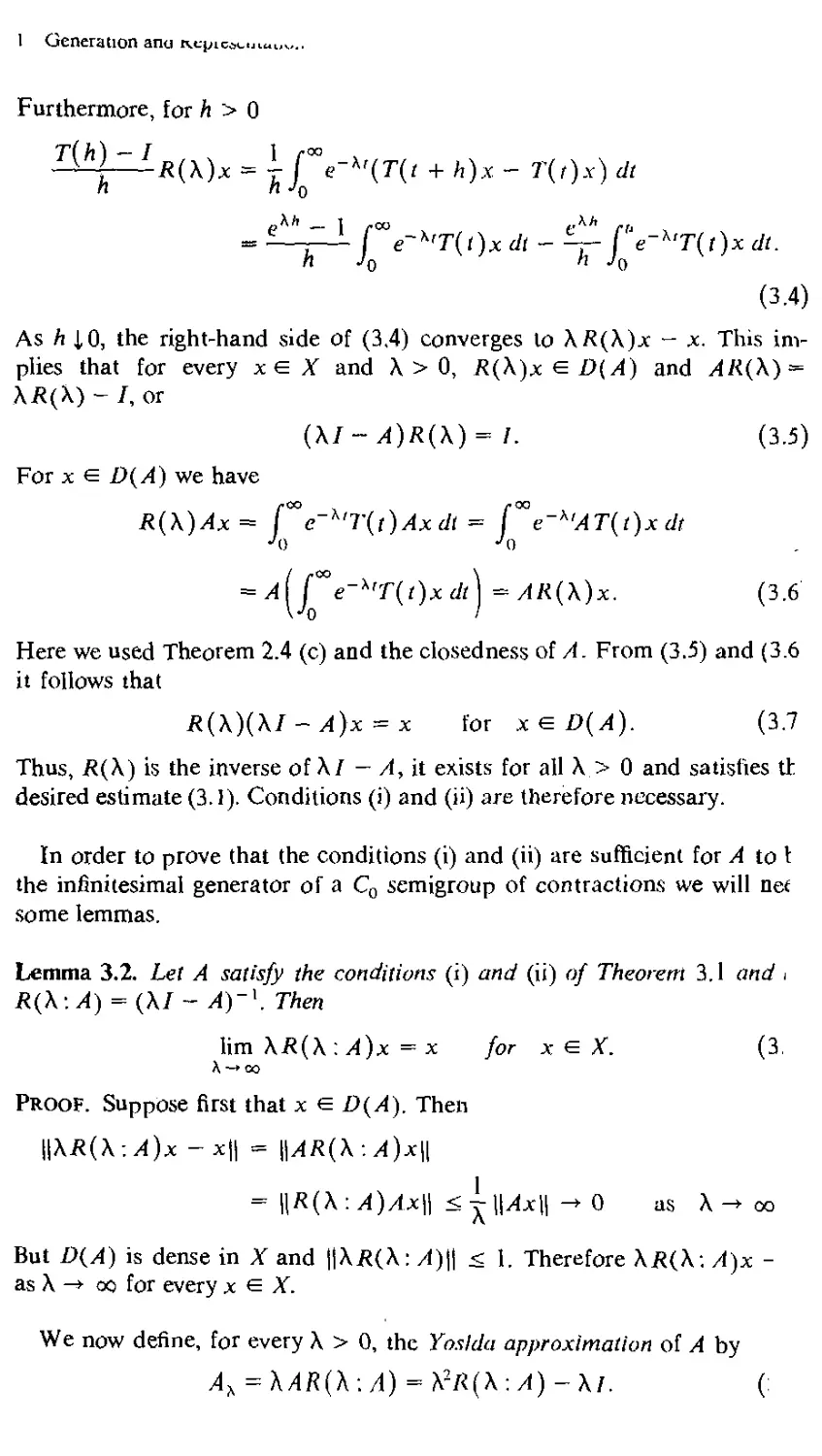
Furthermore, for h > 0
^l^-R(\)x = 1 re-*'{T{t + /i)x - T{t)x) dt
h h Jo
~?-—Lf e~h'T{t)xdt- Vf e-X,T{t)xdt.
n J0 n J{)
(3.4)
As h 10, the right-hand side of (3,4) converges to \R{\)x - x. This
implies that for every x e X and \ > 0, K(\)x e £>(/() and AR'\)°-
\R(\) - I, or
{\I-A)R{\)= I. (3.5)
For x G /)(^) we have
«(\)/(x = f°e-K'T(t)Axdt = {°ae-!uAT{t)xiIt
= /(ffV'T(i)ji*|=/IKH)i, (3.6
Here we used Theorem 2.4 (c) and the closedness of A. From (3.5) and (3.6
it follows that
R(\)(\I-A)x = x for x<ED(A). (3.7
Thus, R(\) is the inverse of A/ — A, it exists for all A > 0 and satisfies th
desired estimate (3.1). Conditions (i) and (ii) are therefore necessary.
In order to prove that the conditions (i) and (ii) are sufficient for A to t
the infinitesimal generator of a C0 semigroup of contractions we will net
some lemmas.
Lemma 3.2. Let A satisfy the conditions (i) and (ii) of Theorem 3.1 and i
R(\:A) = (\I ~ A)-'. Then
lira \R(\:A)x = x for x e X. (3.
A->co
Proof. Suppose first that x e D(A). Then
||\«(\ :/()•* -x|| = \\AR(\:A)x\\
= \\R(\:A)Ax\\ <^\\Ax\\^0 as \ -+ oo
But D'A) is dense in X and ||\«(\: A)\\ < 1. Therefore \R'\: A)x -
as A -> oo for every x e X.
We now define, for every \ > 0, the Yoslda approximation of A by
/4> = A/1R(A ./1) = \2«(\ :/()- \/. (:

10
Semigroups of Linear Operators
Ax is an approximation of A in the following sense:
Lemma 3.3. Let A satisfy the conditions (i) and (ii) of Theorem 3.1. If Ah is
the Yosida approximation of A, then
lim Axx = Ax for x e D{A). (3.10)
Proof. For x e D(A) we have by Lemma 3.2 and the definition of A^ that
lim AKx = lim \R{\ : A)Ax = Ax. U
Lemma 3.4. Let A satisfy the conditions (i) and (ii) of Theorem 3.1. If A^ is
the Yosida approximation of A, then AK is the infinitesimal generator of a
uniformly continuous semigroup of contractions e'A*. Furthermore, for every
x e X, \, /li > 0 we have
\\e'A*x - e'A»x\\ <t\\Axx- A^. (3.11)
Proof. From (3.9) it is clear that A^ is a bounded linear operator and thus
is the infinitesimal generator of a uniformly continuous semigroup e'Ak of
bounded linear operators (see e.g., Theorem 1.2). Also,
and therefore esA* is a semigroup of contractions. It is clear from the
definitions that e'Ak, e'A», A^ and A commute with each other.
Consequently
< ( t\\e'sA*e'V-s)A»{Ahx - A„x)\\dsS t\\AKx - Ax\\.
D
Proof of Theorem 3.1 (Sufficiency). Let x e D(A). Then
\\e'Akx - e'A*x\\ < t\\Ahx - A^xW < t\\Ahx - Ax.\\ + t\\Ax -^x||.
(3.13)
From (3.13) and Lemma 3.3 it follows that for x e D(A), e'Akx converges
as A -*■ oo and the convergence is uniform on bounded intervals. Since
D(A) is dense in X and ||e"**|| < 1, it follows that
lim e'A*-x = T(t)x for every x e X. (314)
The limit in (3.14) is again uniform on bounded intervals. From (3.14) it
follows readily that the limit T(t) satisfies the semigroup property, that
T(0) = J and that || T(/)|| < 1. Also t -+ T(t)x is continuous for t > 0 as a
uniform limit of the continuous functions t -*■ e'Akx. Thus T(t\ \* n r.

I Generation and Representation
11
semigroup of contractions on X. To conclude the proof we will show that /
is the infinitesimal generator of T[t). Let x e /_>( A). Then using (3.14) am
Theorem 2.4 we have
T(l)x - x = lim (e'A>x - x) = Vim fe'A>AKxds = ('T(s)Axds.
\ - co A - co A) J<)
(3.15
The last equality follows from the uniform convergence of e'**A^x t
T(t)Ax on bounded intervals. Let B be the infinitesimal generator of T(t
and let x e />(/<)• Dividing (3.15) by ( > 0 and letting ( |0 we see tha
x G D(B) and that Bx = Ax. Thus B 3 A. Since # is the infinitesim;
generator of T(t), it follows from the necessary conditions that 1 e p(B
On the other hand, we assume (assumption (it)) that 1 e p(A). Sine
8 3/1, (/- B)D(A) = (/- /()/)(/() = A- which implies D(B) =
(/- B)-'X= D(A) and therefore/I = B. '
Theorem 3.1 and its proof have some simple consequences which we no*
state.
Corollary 3.5. Let A be the infinitesimal generator of a Q semigroup c
contractions- T(t). If Ax is the Yosida approximation of A, then
T(t)x= lim e'A-x for x e A\ (3.K
Proof. From the proof of Theorem 3.1 it follows that the right-hand side <
(3.16) defines a Q semigroup of contractions, S(t), whose infinitesim
generator is A. From Theorem 2.6 it then follows that T(t) = S(t).
Corollary 3.6. Let A be the infinitesimal generator of a C0 semigroup >
contractions T(t). The resolvent set of A contains the open right half-plan,
i.e., p(A) 2 {\ : Re A > 0} and for such A
\\R(*:A)\\ <~^- (3.1-
Proof. The operator R(\)x = J™e~K'T(t)x dt is well-defined for A satisf
ing Re A > 0. In the proof of the necessary part of Theorem 3.1 it w,
shown that R(\) = (\I - A)~^ and therefore P(A) D {X: ReX > 0). Tl
estimate (3.17) for R(\) is obvious.
The following example shows that the resolvent set of the infinitesim
generator of a Q semigroup of contractions need not contain more than tl
open right half-plane.
Example 3.7. Let X = BU(0, co), that is, the space of ull hounded ui
formly continuous functions on [0, oo[. Define
(T(t^f^\(x^\ = fit + .vV (3.1

12
Semigroups of Linear Operators
T(t) is a C0 semigroup of contractions on X. Its infinitesimal generator^ is
given by
D(A) = (/:/ and /' e X) (3.19)
and
M/)(-0=/'W f^ feD(A). (3.20)
From Corollary 3.6 we know that p(A) D {A: Re A > 0). For every complex
A the equation (A — ^)<p* = 0 has the nontrivial solution <p\(s) = eXs. If
Re A < 0, <p^ e A- and therefore the closed left half-plane is in the spectrum
0(.4) oM.
Let 7(0 be a C0 semigroup satisfying 1(7(011 £ <?"" (for some w > 0).
Consider 5(/) = e~u'T(t). S(t) is obviously a C0 semigroup of contractions.
If A is the infinitesimal generator of T(t) then, /i — u>I is the infinitesimal
generator of S(t). On the other hand if A is the infinitesimal generator of a
CD semigroup of contractions 5(/), then A + w/ is the infinitesimal
generator of a C0 semigroup 7(/) satisfying 117(011 £ *"'. Indeed, 7(0 = ewS(r).
These remarks lead us to the characterization of the infinitesimal generators
of C0 semigroups satisfying |j 7(011 < ewt.
Corollary 3.8, A linear operator A is the infinitesimal generator of a CQ
semigroup satisfying ||7(/)|| <, e"" if and only if
(i) A is closed and D(A) = X
(ii) The resolvent set p(A) of A contains the ray (A : 1m A = 0, A > w) and
for such A
ll«(* :/1)11 £t~t■ (3.21)
A — W
We conclude this section with a result that is often useful in proving that
a given operator A satisfies the sufficient conditions of the Hille-Yosida
theorem (Theorem 3.1) and thus is the infinitesimal generator of a C0
semigroup of contractions.
Let A- be a Banach space and let X* be its dual. We denote the value of
x* g X* at x g X by (x*, x) or (jc, x*). If A is a linear operator in Xits
numerical range S(A) is the set
S(A) = «**, Ax):x e D(A), \\x\\ = I,
x*eX*,|i.x*|! =1,(^,^) = 1). (3.22)
Theorem 3.9. Let A be a closed linear operator with dense domain D(A) in X.
Let S(A) be the numerical range of A and let L be the complement ofS(A) in
c. ff A e e then A/ - a is one-to-one and has closed range. Moreover, iflQ
is a component of £ satisfying p(A) D £0 ^ 0 then the spectrum of A is

I Generation and Representation
I
contained in the complement S„ of T,„ anil
_ mX:Ah*7(dm (3-2
where d(X:S(A)) is the distance of X front S(A).
Proof. Let X e E. If x <= D{A), \\x\\ = I, x* e A'*, ||jt*|| = I at
(x*, .x) = ] then
0 < d{\ :S(A)) <\X- (x*, Ax)\ = |(x*, Xx - Ax)\ < |[Xx - Ax\
13.2
and therefore XI - A is one-to-one and has closed range. If moreov
X e p(A) then (3.24) implies (3.23) and
d(\:s{A))< \[R(X:A)[[-1. (3.2
It remains to show that if E0 is a component of T. which has a nonemp
intersection with the resolvent set p(A) of A then o(A) c 5(,. To this e:
consider the set p(A) n E0. This set is obviously open in E0. But it is al
closed in E0 since \n e p(A) n E0 and X„ -» A e E0 imply for n lar
enough that d(\n:S(A)) > \d(X :S(A)) > 0 and consequently for
large enough \X - Xn\ < d(Xn:S(A)). From (3.25) it then follows that I
large n, X is in a ball of radius less than ||i?(X((: A)\\ " ' centered at Xn whi
implies that X <e p(A) and therefore p(A) n Efl is closed in E0. T
connectedness of E0 then implies that p(A) n E0 = En or p(A) 3 E,j whi
is equivalent to o(/i) c S0 and the proof is complete.
1.4. The Lumer Phillips Theorem
In the previous section we saw the Hille-Yosida characterization of
infinitesimal generator of a C0 semigroup of contractions. In this section
will see a different characterization of such infinitesimal generators. In or
to state and prove the result we need some preliminaries.
Let A- be a Banach space and let X* be its dual. We denote the value
x* e X* at x e X by (x*, x) or (x, x*). For every xelwe define
duality set F(x) c X* by
F{x) = {x* : x* ^ X* and (x*, x) = \\x\\2 = \\x*\\2}. (4
From the Hahn-Banach theorem it follows that F(x) ^ 0 for every x e
Definition 4.1. A linear operator A is dissipaiivc if for every x e D(A) th
is a x* e F(x) such that Re (Ax, x*) < 0.
A useful characterization of dtssipative operators is given next.

14
Semigroups of Linear Operators
Theorem 4.2. A linear operator A is dissipative if and only if
\\(\I - A)x\\ > X\\x\\ for all xeD(A) and \>0. (4.2)
Proof. Let A be dissipative, \ > 0 and x e D(A). If x* e F(x) and
Re (Ax, x*) s 0 then
\\\x - Ax\\ ||x|| > \(\x - Ax,x*)\ > Re(Xx - Ax, x*) ;> X||jt||2
and (4.2) follows at once. Conversely, let x e D(A) and assume that
\\\x\\ < [\\x - Ax\\ for all X > 0. If.yx* e F(Xx - Ax) and zj = ;tf/ K||
then llzJH - 1 and
\\\x\\ < \\\x- Ax\\ = (\x-Ax,zf)
= \Ke(x, zj> - Re (Ax, zx*> < \||jr|| - Re (Ax, zx*>
for every A > 0. Therefore
Re(Ax, zj) < 0 and Re(x, zx*> > ||*|| - ^ ||/<x||. (4.3)
Since the unit ball of X* is compact in the weak-star topology of X* the net
zj, X -> co, has a weak-star cluster point z* e X*, \\z"\\ < I. From (4.3) it
follows that Re(/fx, z*) < 0 and Re(x, z*) > ||jc||. But Re(x, z*) <
|(x, z*)| < Hxll and therefore (x, z*) = ||jr||. Taking x* = ||x||z* we have
x* G /■(*) and Re (Ax, x*} < 0. Thus for every x e /)(/() there is an
x* e F(x) such that Re (/fx, x*) < 0 and /f is dissipative. □
Theorem 4.3 (Lumer-Phillips). Let A be a linear operator with dense domain
D(A) in X.
(a) If A is dissipative and there is a X0 > 0 Such that the range, R(X0I — A),
ofXaI — A is X, then A is the infinitesimal generator of a C0 semigroup of
contractions on X.
(b) If A is the infinitesimal generator of a C0 semigroup of contractions on X
then R(\I — A) = X for all \ > 0 and A is dissipative. Moreover, for
every x e D(A) and every x* e F(x), Re (Ax, x*) < 0.
PROOF. Let \ > 0, the dissipativeness of A implies by Theorem 4.2 that
\\\x~Ax\\>\\\x\\ for every \>0 and x e D(A). (4.4)
Since R(\0I - A) = X, it follows from (4.4) with \ = \0 that (\0I - A)~'
is a bounded linear operator and thus closed. But then X0/ - A is closed
and therefore also A is closed. If R(XI — A) ~ X for every X > 0 then
p(/f)2]0, oo [ and \\R(\:A)\\ sA"1 by (4.4). It then follows from the
Hille-Yosida theorem that A is the infinitesimal generator of a C0 semigroup
of contractions on X.
To complete the proof of (a) it remains to show that R(\I - A) = X for
all X > 0. Consider the set
\ = (\:0<\<ca and R(\I - A) = X).

! Generation and Representation
15
Let X G A. By (4.4), X e p(A). Since p(A) is open, ;i neighborhood of X is
in p(/l). The intersection of this neighborhood with the real line is clearly in
A and therefore A is open. On the other hand, let A„ e A, A„ -> X > 0. For
every y e X there exists an x„ e O(A) such that
\„x„- Ax„- y. (4.5)
From (4.4) it follows that ||x„|| < X~ ' \\y\\ ^ C for some C > 0. Now,
K\\*„ - *J\ ^ „X„,(x„ - x,„) - /l(x„ - x„,)||
= (a„ — x„r rijc„n <cix„-x,„|. (4.6)
Therefore (x„) is a Cauchy sequence. Let x„ -> x. Then by (4.5) /4x„ -»
Xx - y. Since /f is closed, x e /)(/1) and Xx - Ax = y. Therefore
R(\I - A) = X and X e A. Thus A is also closed in ]0, oo[ and since
X0 G A by assumption A =/= 0 and therefore A == ]0, oo[. This completes the
proof of (a).
If A is the infinitesimal generator of a C0 semigroup of contractions, T(r),
on X, then by the Hille-Yosida theorem p(A) 2]0, °o[ and therefore R(\J
- A) = X for all X > 0. Furthermore, if x e D(A), x* e F(x) then
\(T(l)x,x')\ < ||7-(0x|| ||x*|| <. ||x||2
and therefore,
Re (T(r)jc - x,x*) = Re(r(r)jc,je*> - |M|2 <0. (4.7)
Dividing (4.7) by t > 0 and letting t |0 yields
Re(^x, x*> < 0. (4.8^
This holds for every x* e F(x) and the proof is complete. C
Corollary 4.4. Let A be a densely defined closed linear operator. If both A am
A* are dissipativei then A is the infinitesimal generator of a C0 semigroup o
Contractions on X.
Proof. By Theorem 4.3(a) it suffices to prove thai R(I - A) = X. Sine
A is dissipative and closed R(I - A) is a closed subspace of X. I
R(I ~ A) =/= X then there exists x* e X*, x* =/= 0 such that (jc*, x - Ax
= 0 for x g D(A). This implies jc* - A*x* = 0. Since /i* is also dissipativ
it follows from Theorem 4.2. that x* = 0, contradicting the construction c
JC*. !
We conclude this section with some properties of dissipative operators.
Theorem 4.5. Let A be a dissipative operator in X.
(a) If for some Xf, > 0, R(X0J - A) == X then R(XJ -A)** X for all X >
(b) If A is closable then A, the closure of A, is also dissipative.
(c) If D(A) = X then A is closable.

16
Semigroups of Linear operators
PROOF. The assertion (a) was proved in the proof of part (a) of Theorem
4.3. To prove (b) let x e /)(/(), y = Ax. Thenjhere is a sequence {x,,}
xti G /)(/(), such that xlt -> x and Axn -> y = Ax. From Theorem 4.2 it
follows that ||ax„ - AxJ\ > a||x„|| for A > 0 and letting n -> co we have
||ax - Ax\\ > \\\x\\ for a > 0. (4.9)
Since (4.9) holds for every x e D(A), A is dissipative by Theorem 4.2. To
prove (c) assume that A is not closable. Then there is a sequence (x„) such
that xn e D(A), xn -> 0 and Axn -> y with ||/|| = 1. From Theorem 4.2 it
follows that for every t > 0 and x e D(A)
\\(x + t-'x„)-tA(x + r'x„)|| > \\x + r'x„||.
Letting n -» co and then t -» 0 yields ||x - /|| > ||x|| for every x e /)(/().
But this is impossible if D(A) is dense in X and therefore/! is closable. □
Theorem 4.6. Let A be dissipative with R(I — A) = X. If A-is reflexive then
D(A) = X.
Proof. Let x* e X* be such that (x*, x) = 0 for every x e D(A). We
will show that x* = 0. Since /?(/ — A) = X it suffices to show that
(x*, x - Ax) = 0 for every * e 1)(/1) which is equivalent to (x*, Ax) = 0
for every x e /)(/(). Let x e /)(/() then by Theorem 4.5 (a) there is an x„
such that x = xn — (l/n)Axn. Since Axn = n(xr1 — x) e /)(/(), x„ e
/)(/(2) and /(x = /(xa - (\/n)A1x„ or /(x„ = (/- (\/n)A)~'Ax. From
Theorem 4.2 it follows that ||(/- (l/n)/!)"'!! S 1 and therefore \\AxJ <
\\Ax\\. Also, ||x„ - x\\ < \/n\\Ax„\\ < \/n\\Ax\\ and therefore x„ -> x.
Since \\AxJ\ < C and X is reflexive there is a subsequence Axtl of Ax„ such
that /(x„ -> y weakly. Since A is closed (see Theorem 4.3 (a)) it follows that
y = /(x. Finally, since (x*, z) = 0 for every z e /)(/(), we have
(x', Ax„k) = nk(x*, x„( - x) = 0. (4.10)
Letting nk -> co in (4.10) yields (x*, Ax) = 0. This holds for every x e
/)(/() and therefore x* = 0 and /)(/() = X. □
The next example shows that Theorem 4.6 is not true for general Banach
spaces.
Example 4.7. Let X = C([0,1]), i.e., the continuous functions on [0,1] with
the sup norm. Let /)(/() = (u:u e C'([0, 1]) and u(0) - 0} and Au = -u'
for u e /)(/(). For every / E I the equation Am - /(« = / has a solution u
given by
li(x)=fV«-"/(0C (4.11)

! Generation and Representation
1/
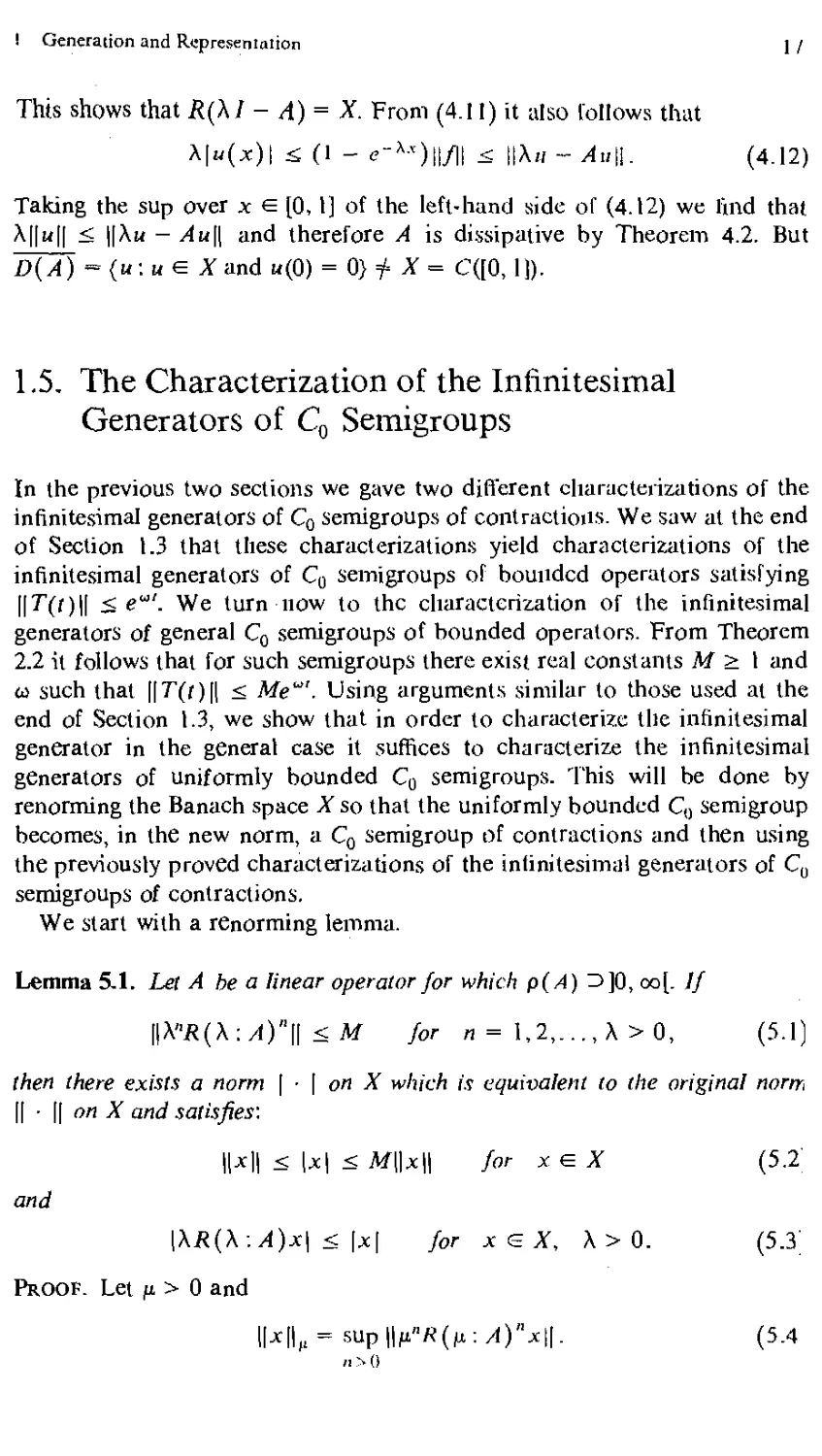
This shows that R(\I - A) = X. From (4.II) it also follows that
X\u(x)\ £ (1 - e-^)\\/\\ < \\X„ - Au\\. (4.12)
Taking the sup over x e [0, 1) of the left-hand side of (4.12) we lind that
X||«|| < \\Xu - Au\\ and therefore A is dissipative by Theorem 4.2. But
D{A) «-{u;u<= A" and u(0) = 0} + X = C([0, 1)).
1.5. The Characterization of the Infinitesimal
Generators of C0 Semigroups
In the previous two sections we gave two different characterizations of the
infinitesimal generators of C0 semigroups of contractions. We saw at the end
of Section 1.3 that these characterizations yield characterizations of the
infinitesimal generators of C0 semigroups of bounded operators satisfying
||T(r)|| S ew'. We turn now to the characterization of the infinitesimal
generators of general C0 semigroups of bounded operators. From Theorem
2.2 it follows that for such semigroups there exist real constants M > 1 and
w such that ||T(r)|| < Me"'. Using arguments similar to those used at the
end of Section 1.3, we show that in order to characterize the infinitesimal
generator in the general case it suffices to characterize the infinitesimal
generators of uniformly bounded C0 semigroups. This will be done by
renorming the Banach space A-so that the uniformly bounded C0 semigroup
becomes, in the new norm, a C0 semigroup of contractions and then using
the previously proved characterizations of the infinitesimal generators of C0
semigroups of contractions.
We start with a renorming lemma.
Lemma 5.1. Let A be a linear operator for which p(A) D]0, oo[. If
\\X"R(X:A)"\\ < M for n = 1, 2,..., X > 0, (5.1)
then there exists a norm \ ■ | on X which is equivalent to the original norm
|| ■ || on A- and satisfies:
\\x\\ < \x\ <M\\x\\ for xg X (5.2'
and
\XR{X:A)x\ < \x\ for x <= X, X > 0. (5.3;
Proof. Let \i > 0 and
(|x||(1 = sup||<tf(u.:/0%i|. (5.4

18
Semigroups of Linear Operators
Then obviously,
||x||< Hxll,, <M||*|| (5.5)
and
11^(^:/1)11^1. (5.6)
We claim that
||\«(\:/0||„< I for 0<X<n. (5.7)
Indeed, U y = R(X:A)x then/ = R(p: A)(x + (fi. - \)y) and by (5.6),
11^^11*11,.+(i-£)lMU
whence \\\y\\^ < ||jr||,, as claimed. From (5.5) and (5.7) it follows that
\\\"R(\:A)"x\\ < \\\"R(\:A)"x\\p < ||.t||„ for 0 < \ < p.
(5.8)
Taking the sup over n > 0 on the left-hand side of (5.8) implies that
Mix S 11*11,, for 0 < X < p. Finally, we define
M = Km INI,- (5.9)
Then, (5.2) follows from (5.5). Taking n = 1 in (5.8) we have
\\\R(\:A)x\\r< \\x\\f
and (5.3) follows upon letting p -> oo. □
Lemma 5.1 is closely related to the following observation. Let (By), y e T
be a family of uniformly bounded commuting linear operators. Then there
exists an equivalent norm on X for which all the By are contractions, if and
only if there is a constant M such that
\\BriBn ■ ■ ■ Brmx\\ < M\\x\\ (5.10)
for every finite subset (yu y2,- ■ ■, ym] of I". Indeed, it is clear that if there is
such an equivalent norm then (5.10) is satisfied. On the other hand if (5.10)
is satisfied we define
|*| =sup\\ByBy2 ■•■ Bymx\\, (5.II)
where the sup is taken over all finite subsets of T (including the empty set),
and | ■ | is the desired equivalent norm. The weaker condition
\\Bfx\\ < M\]x\\ forevery jgT and « > 0 (5.12)
is not sufficient, in general, to insure the existence of an equivalent norm on
X for which all B are contractions. In the special case where V = U+ and
B-, = R{yA) for some fixed linear operator A, the previous lemma shows
that the weaker condition ("5.121 suffices to insure such an equivalent norm.

1 Generation and Representation
IV
Theorem 5.2. A linear operator A is the infinitesimal generator of a C{)
semigroup T(t), satisfying \\T(t)\\ < M (M > I), if and only if
(i) A is closed and D(A) is dense in X.
(ii) The resolvent set p(A) of A contains U* and
\\R{\:A)n\\ < M/\" for X > 0, «=1,2 (5.13)
Proof. Let T(t) be a C0 semigroup on a Banach space X and let A be its
infinitesimal generator. If the norm in X is changed to an equivalent norm,
T(t) stays a C0 semigroup on X with the new norm. The infinitesimal
generator A does not change nor does the fact that A is closed and densely
defined change when we pass to an equivalent norm on X. All these are
topological properties which are independent of the particular equivalent
norm with which X is endowed.
Let A be the infinitesimal generator of a C„ semigroup satisfying
117(011 < M. Define,
\x\ =sup||r(/)jc||. (5.14)
Then
||x|| < |x| <M||x|| (5.15)
and therefore | ■ | is a norm on X which is equivalent to the original norrr
|| ■ 1| on X. Furthermore,
ir(0*| -suP||r(j)r(0*ll s suPnr(.*)x|| = |*| (5.ie;
s > 0 .v S 0
and T(t) is a C0 semigroup of contractions on X endowed with the norn
| ■ |. It follows from the Hille-Yosida theorem and the remarks at th,
beginning of the proof, that A is closed and densely defined and tha
\R(X:A)\ < X"1 for A > 0. Therefore by (5.15) and (5.16) we have
|(«(X:/0"*l| < \R(\:A)"x\ < \x\ < M\\x\\
and the conditions (i) and (ii) are necessary.
Let the conditions (i) and (ii) be satisfied. By Lemma 5.1 there exists
norm | ■ | on A-satisfying (5.2) and (5.3). Considering X with this norm,,
is a closed densely defined operator with p(A) :3]0, oo[ and \R(X: A)\ < X~
for A > 0. Thus by the Hille-Yosida theorem, A is the infinitesimal genen
tor of a C0 semigroup of contractions on X endowed with the norm | -
Returning to the original norm, A is again the infinitesimal generator <
71(0 and,
]|r(()*|] < \T(t)x\ < |*| *M\\x\\
so 11^(011 < M as required. The conditions (i) and (ii) ;ire therefore al:
enffinpnt

20
Semigroups of Linear Operators
If T(t) is a general C0 semigroup on X then, by Theorem 2.2, there are
constants M > 1 and u such that
lir(<)|| s»" (5.17)
Consider the C0 semigroup S(l) = e~"T{t) then ||S(r)|| < M and A is the
infinitesimal generator of T(t) if and only if A - ul is the infinitesimal
generator of S(t). Using these remarks together with Theorem 5.2 we obtain
Theorem 5.3. A linear operator A is the infinitesimal generator of a C0
semigroup T{i) satisfying \\ T{t)\\ <, Meu\ if and only if
(i) A is closed and D(A) is dense in X.
(ii) The resolvent set p(A) of A contains the ray ](0, oo[ and
\\R(\:A)"\\<M/(\-uy for A > w, » = 1,2,.... (5.18)
Remark 5.4. The condition that every real A, A > to, is in the resolvent set
of A together with the estimate (5.18) imply that every complex A satisfying
Re A > w is in the resolvent set of A and
\\R(\:A)"\\ < W/(ReA - w)" forReAxo, »=1,2,....
(5.19)
Proof. We define
R{\)x = re-XlT{t)xdt.
Since |] 71(011 ^ Meu\ R(\) is well-defined for every X satisfying Re A > w.
An argument, identical to the argument used in the proof of Theorem 3.1,
shows that R(X) = R{\:A). To prove (5.19) we assume that Re A > w, then
±R(X:A)X~±f~e-ni)xdt~~f~te-»T(<)x*.
Proceeding by induction we obtain
4^,RCK:A)x = (-\yrt"e-x'T(t)xdt. (5.20)
a A ^0
On the other hand, from the resolvent identity
R(\:A) -R(n:A)- (j. - A)R( A :A)R(n : A)
it follows that for every A e P(A), A -+ R(X:A) is holomorphic and
^R(\:A)~ -R(\:A)2. (5.21)
Proceeding again by induction we find
^=(-0--(^)- (5,2)

I Generation and Representation
Comparing (5.20) and (5.21) yields
I
R(\\A)"x =~. — Ct"Ke-x'T{t)xdt (5.23)
(n - 1)1-/0
whence
mx..A)-x]is"f
-W-KxV'UxUJt = -
(fl- O'.-'o (ReX - w)
We conclude this section by extending the representation formula of
Corollary 3.5 to the general case.
Theorem 5.5. Let A be the infinitesimal generator of a C$ semigroup T{t) on
X. If Ax is the Yosida approximation of A, i.e.,Ax = XAR(X: A) then
T{t)x= lira eM»x. (5.24)
Proof. We start with the case where || T(t)\\ < M. In the proof of Theorem
5.2 we exhibited a norm ||| -1|| on X which is equivalent to the original norm
|| ■ || on X and for which T(t) is a C0 semigroup of contractions. From
Corollary 3.5 it then follows that |||e"'»x - T(r)j:||| -> 0 as \ -> oo for every
x e X. Since ||| ■ \\\ is equivalent to || • || (5.24) holds in X. In the general
case where ||T(()|| s Me"' we have for w < 0, 11^(()11 < M and therefore
by what we have just proved, the result holds. It remains to prove the result
for w > 0. Let w > 0 and note that X -> ||eMM| is bounded for A > 2w.
Indeed,
Hc'^ll =» C-*'||CXIK(X:<<)<||
< e x' Tj —h S Me(x"/*-">' < Me1"'.
(5.25)
Next we consider the uniformly bounded semigroup S(t) - e~"'T(t) whose
infinitesimal generator is A — w/. From the first part of the proof we have
T(t)x = lim e'<-,-u')»+u'x for x €= X. (5.26)
A simple computation shows that
(A - w/)x + w/"= A^u + H(\)
where
H(\) = 2al - u(u + 2\)R(\ + a: A)
= w[w«(X + a: A) - 2AR(\ + u: A)].
It is easy to check that ||tf(X)|| s 2u I (2w + X~ W)M and that fo:

22
Semigroups of Linear Operators
xeD(A) \\H{)i)x\\ <JlA-'(u2IMI + 2a\\Ax\\)-> 0 as A -> oo.
Therefore //(A )x -> 0 as A -» oo for every x S X. Since
||c""x>x - x|| s te"""x>»||//(X)x||
we have
lira c'"<x'x - x for x e X (5.27)
Finally, since H(\) and /4x + „ commute we have
||e"Sc- r(r)x|| < ||cM>+"'<x-">x - T(/)jc|| + ||eM»|| ||c"'(X"">x - jc|| .
(5.28)
As A -*■ oo the first term on the right-hand side tends to zero by (5.26) while
the second term tends to zero by (5.25) and (5.27). Therefore
lim elA*x » T{t)x for x e X
and the proof is complete. □
1.6. Groups of Bounded Operators
Definition 6.1. A one parameter family T(t), - oo < X < oo, of bounded
linear operators on a Banach space A-is a C0 group of bounded operators if it
satisfies
(i) r<0)-J,
(ii) T(t + j)« r(r)7Xj) for -oo < /, * < oo.
(iii) \imt^0T(t)x - x for x G X
Definition 6.2. The infinitesimal generator /i of a group r(/) is defined by
/ix = hm —*—*- (6.1)
whenever the limit exists; the domain of A is the set of all elements x G X
for which the limit (6.1) exists.
Note that in (6.1) t -> 0 from both sides and not only I -> 0+ as in the
case of the infinitesimal generator of a C0 semigroup.
Let T(t) be a C0 group of bounded operators. It is clear from the
definitions that for i > 0, T(t) is a C0 semigroup of bounded operators
whose infinitesimal generator is A. Moreover, for t £ 0, S(t) ~ T( — t) is
also a CQ semigroup of bounded operators with the infinitesimal generator
— A. Thus if T(t) is a C0 group of bounded operators on X, both A and -A
are infinitesimal generators of C0 semigroups which are denoted by T+(t)
and T_(t) respectively. Conversely, if A and -A are the infinitesimal
generators of C0 semigroups T+(t) and T_(/) then we wjl] see that A is the

I Generation and Representation
infinitesimal generator of a C0 group T(t) given by
, , iTAl) for/ > 0
Theorem 6.3. A is the infinitesimal generator of a Q group of bounded
operators T(t) satisfying \\T(t)\\ <, Afew|/| if and only if
(i) A is closed and D{A) = X.
(ii) Every real A, | A | > w, is in the resolvent set p(A) of A and for such X
\\R{X:A)"\\ < M(\\\ - w)~\ n = 1,2 (6.3)
Proof. The necessity of the conditions follows from the fact that both A
and —A are the infinitesimal generators of C0 semigroups of bounded
operators satisfying the estimate l| 7^)(( ^ Meul. Since A is the
infinitesimal generator of such a semigroup it follows from Theorem 5.3 that A is
closed , D{ A) = X and (6.3) is Satisfied for X > w. Moreover, since —A\s
also the infinitesimal generator of such a semigroup and clearly R(X: A) =
~R(~X: A) it follows that a(-A) = -o(A) and that (6.3) is satisfied for
— X < — u>. The conditions (i) and (ii) are therefore necessary.
If the conditions (i) and (ii) are satisfied it follows from Theorem 5.3 that
A and —A are the infinitesimal generators of Ca semigroups T.t(t) and
7\_(r) respectively and that 117^(011 ^ Me"'. The semigroups r+(/) and
T_{t) commute since clearly e'A* and e~'Ai-, where Av is the Yosida
approximation of A% commute and by Theorem 5.5, T+(t)x = Iimx J0OeM*.x
and T_(t)x = lim^^e"'^*. l\ W(t)=* T+(t)T_(t) then W{t) is a C0
semigroup of bounded operators for t > 0. For x G O(A) = D{ — A) we
have
W(t)x~x _ TJt)x~x T_(t)x~x
I ~K ' t t
-> Ax- Ax = 0 as (JO. (6.4)
Therefore, for x e 0( A) we have W{t)x = x. Since D{ A) is dense in X and
W{t) is bounded we have W(r) - I or r_(r) = (r,.(<))- '. Defining
(7\(r) forr>0
T(t)" { , \ (6.5)
17-.(-/) forr <0 v '
we obtain a C0 group of bounded operators satisfying ||7Xr)|| < Me"1".
The conditions (i) and (ii) are therefore sufficient and the proof is complete.
□
Lemma 6.4. Let T(t) be a C0 semigroup of bounded operators. If for every
t > 0, T(l)"' exists and is a bounded operator then S(t) - r(()~ ' is a C0
semigroup of bounded operators whose infinitesimal generator is — A.

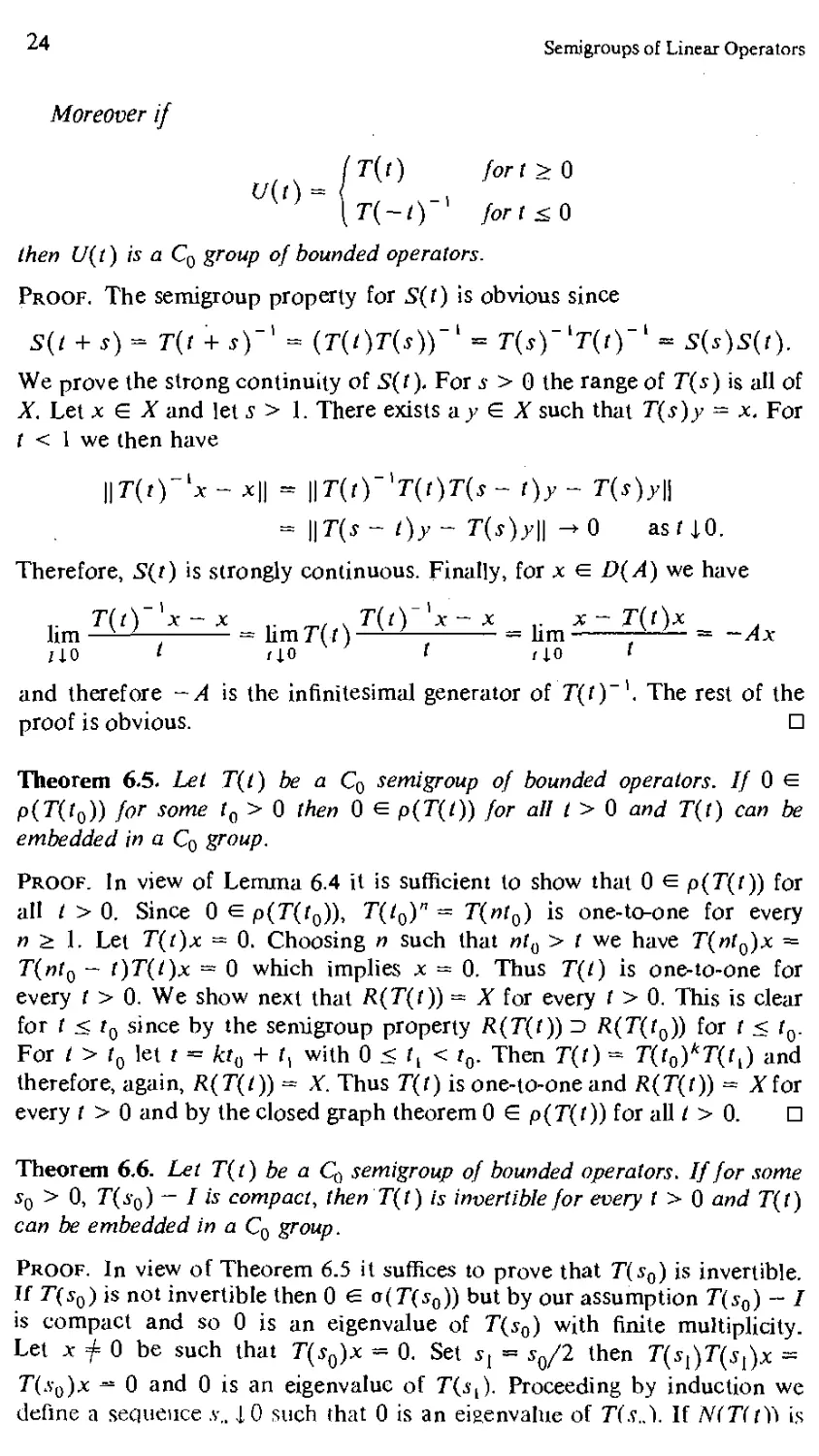
24
Semigroups of Linear Operators
Moreover if
/7(() forl>0
\r(-0 fort ^0
then U{t) is a C0 group of bounded operators.
Proof. The semigroup property for S(t) is obvious since
s(t + s)= T(t + s)~] - (T(t)T(s))'1 = r(j)-'r(r)-' - s(s)s(t).
We prove the strong continuity of S(t). For s > 0 the range of 7(s) is all of
X. Let x S X and let j > 1. There exists ay £ X such that T(s)y = x. For
( < 1 we then have
lir(»r* - *ll = ||r(r)-'r(r)r(j - t)y - T(s)y\\
=■ \\T{s- t)y-T(s)y\\ ->0 asUO.
Therefore, S(') is strongly continuous. Finally, for x e /)(/() we have
,. ThY'x-x , w.r(/)"'i-J ,. x-T(t)x
hm v ; , = hmTl-^ = lim f-1— = -Ax
;i0 ' UO ' 'iO '
and therefore -/( is the infinitesimal generator of 7(()~'. The rest of the
proof is obvious. □
Theorem 6.5. Let 7(() be a C0 semigroup of bounded operators. //Og
p(7((0)) /or some (0 > 0 then 0 e p(7(()) for all t > 0 and 7(() can te
embedded in a C0 gro«/>.
Proof. In view of Lemma 6.4 it is sufficient to show that 0 e p(7(()) for
all ( > 0. Since 0 e p(7((0)), 7((0)" = 7(n(0) is one-to-one for every
nil. Let 7(()x = 0. Choosing n such that n(0 > ( we have 7(n(0)x =
7(n(0 - ()7(()x = 0 which implies x = 0. Thus 7(() is one-to-one for
every ( > 0. We show next that K(7(()) = X for every ( > 0. This is clear
for ( < r0 since by the semigroup property R(T(t)) id R(7((0)) for ( < (0.
For ( > (0 let t = A:r0 + (, with 0 < (, < (0. Then 7(() = 7((0)*7((,) and
therefore, again, R(T(t)) - X. Thus 7(() is one-to-one and R(T(t)) - X Sot
every ( > 0 and by the closed graph theorem 0 S p(7(()) for all ( > 0. □
Theorem 6.6. Let 7(() be a Q semigroup of bounded operators. If for some
Sq > 0, 7( Sq) — I is compact, then 7(() is invertibie for every t > 0 and 7(()
can be embedded in a C0 group.
Proof. In view of Theorem 6.5 it suffices to prove that T(s0) is invertibie.
If 7*(s0) is not invertibie then 0 £ o(7(s0)) but by our assumption 7(s0) - I
is compact and so 0 is an eigenvalue of 7(s0) with finite multiplicity.
Let x f 0 be such that 7(j„)x = 0. Set s, = s0/2 then 7(s,)7(j,)x =
7(.v0)x ~ 0 and 0 is an eigenvalue of 7(^,). Proceeding by induction we
define a sequence .v.. 10 such that 0 is an eieenvalue of Tis.A. If N(T(tYi is

I Generation and Represenlation
the null space of T(t) then clearly N(T($)) c N(T(t)) for x < t. Let Qn =
N(T(sn)) H (x: \\x\\ — I). Q„ is a decreasing sequence of closed nonempty
subsets of X. Since N(T(sQ)) has finite dimension, Qu is compact and
consequently n™mQQn =£ 0. If jc e D~..06n then
117(^)^-^11 = 11^11-1 for ah*v (6.6)
But sn -> 0 as n -*■ oo and therefore (6,6) contradicts the strong continuity
of T(t). This contradiction shows that T(s0) must be invertible and the
proof is complete. □
1.7. The Inversion of the Laplace Transform
One of the fundamental problems in the theory of semigroups of operators
is the relation between the semigroup and its infinitesimal generator. Given
a semigroup T(t) one obtains its infinitesimal generator, by definition, as
;4* = lim r(')*-* for x<=DtAy
no t
A different way of obtaining A, or rather the resolvent of A, is by Remark
5.4. There we showed that if || T(t)\\ S Me"' then
R{\:A)x= re-x'T{t)xdt for xG^ReAXo. (7.1)
From the point of view of applications to partial differential equations it is
more interesting to obtain T(t) from its infinitesimal generator. The reason
for this is that for x e D(A), T(t)x is the solution of the initial value
problem
~-Au = Q, u(0) = x.
dt
This section and the next one are dedicated to the problem of
representing T(t) in terms of its infinitesimal generator. One way of doing this has
already been exhibited in Theorem 5.5. Here we will use a different method.
If T(t) satisfies 117(011 < Me"' then the resolvent of A satisfies (7.1), i.e.,
the resolvent of A is the Laplace transform of the semigroup. We therefore
expect to obtain the semigroup T(t) from the resolvent of A by inverting th<
Laplace transform. This will be done in this section. Wc start with sonu
preliminaries.
Lemma 7.1. Let B be a bounded linear operator. If y > \\B\\ then
e'B = ^-. F + '°V'K(X : B) dX. (7.2
The convergence in (7.2) is in the uniform operator topology and uniformly in
/iit hnundp/l intervals.

26
Semigroups of Linear Operators
PROOF. Let y > \\B\\. Choose r such that y > r > \\B\\ and let C, be the
circle ol radius r centered at the origin. For \\\ > r we have
«(^)=l|; (7.3)
where the convergence is in the uniform operator topology uniformly for
|X| > r. Multiplying (7.3) by (l/2iri)eXl and integrating over Cr term by
term yields.
e'B=^-fex'R(\:B)d\. (7.4)
Here we used the identities
-^- / \-k-le*'d\ = TT for A: =0,1,2 (7.5)
2wi Jc k\ '
Since outside Cr the integrand of (7.4) is analytic and \\R(\; B)\\ < C|X|_i,
we can shift the path of integration from Cr to the line Re 2 = y, using
Cauchy's theorem. □
Lemma 7.2. Let A be the infinitesimal generator of a C0 semigroup T(t)
satisfying || T(t)\\ < Me"', Let fi be real, fi > w > 0, and let
A^= (jlAR{h; A) = ifRip: A) - pi (7.6)
be the Yosida approximation of A. Then for Re A > oifi/fi — w we have
R(\:Alt)=(\ + ^)-](p.I-A)R^Ji^:A)j (7.7)
and
\\R(\:A„)\\<M{Re\~-^) '. (7.8)
For Re A > £ + oifi/fi — w and fi > 2 to, there is a constant C depending only
on M and £ such that for every X G O(A)
\\R(\:Af)x\\ <-jfj"(IWI + IM*ID- (7.9)
Proof. Multiplying the right-hand side of (7.7) from the right or from the
left by \I — A^ and using ihe commutativity of A and its resolvent, one
obtains the identity, thus proving (7.7). To prove (7.8) we note that A^ is the
infinitesimal generator of e'A' and that by (5.25)
K'll*"«p{'(^))
..jk;,-k :,^,-,1:-.. m ui k., Ti.Wm™ ^ t p;„..,ji,, f„,- x>^\ -. „ » ..,. /.. .. :.

t Generation and Representation
27
follows from (7.8) that \\R(\: A^\\ < Me~\ If ie /)(/1) ant) p > 2u
then,
\\A x\\ = \\^.R(^.:A)Ax\\ <J~\\Ax\\ < 2M\\Ax\\
/i to
and therefore
<-£t(\\x\\ + \\Ax\\). :
Lemma 7.3. Let A be as in Lemma 7.2, X = y + iij vWiere y > w + £ is fixed.
For every x & X we have
km R{\:Ar)x= R(\:A)x (7.10)
and for every Y > 0, //ie //m/r is uniform in -q for \yj\ < Y.
Proof. Set v = fiX/n + ^- From (7.7) we then have for p. large enough
R(\:Ar)~R(\:A)
= (>i + \)"[(ij.1 - A)R(v: A) - (n + X)R(X : A)]
= (ft + M~'(>/ - /<)K(x: /<)[(*/ - A)(nl - /1)
-(/1 + A)(x/ -A)] R(li-.A)R(X :A)
= (ft + \y\lil - A)R(v:A)A2R{li:A)R(X:A)
= (,i + X)~'/12K(k:/1)K(X:/0.
For y > to + £ Theorem 5.3 implies ||K(A: A)\\ < Me'1. Given Y > 0, we
can find /i0 depending on Y and y such that if X = y + iij, \yj\ < Y and
/i > /i0 then RefiX/fi + X > w + e/2. Thus, for/i > /i0 we have 11^(^: A)\\
^ 2Me"l. Therefore if x e /)(/12) and fi > /i(), we have
\\R(X-.Af)x- R(X:A)x\\ <j^~\\R(,:A)\\\\R(X:A)\\\\A^x\\
and (7.10) follows for x e /)(/(2). Since/)(/12) is dense in A'(Theorem 2.7),
and since by Lemma 7.2, ||R(X: A^W is uniformly bounded for Re X >
to + £ provided that /i > w + to2/£ and by Theorevn 5.3 the same is true for
iinf*-41n (1.101 follows for every x e X. □

28
Semigroups of Linear Operators
Theorem 7.4. Let A be the infinitesimal generator of a Q semigroup T{t)
satisfying U T(t)\\ < Me"' and let y > max (0, w). If x S D(A) then
('t(s)x dx = ^-. P+*V'R(a: A)x^, (7.11)
J„ 2irlJr-im A
and the integral on the right converges uniformly in t for t in bounded intervals.
Proof. Let fn > 0 be fixed and let 8 > |MJ. Set
PA") ~ ^- r'"eXsR(\ : Af)x d\. (7.12)
Integrating both sides of (7.12) from 0 to ( and interchanging the order of
integration we find
p„(s)ds = — ex'R(\:A )x^--— R(\:A)x--.
(7.13)
Letting k -> oo it follows from Lemma 7.1 that pk (s) -> e'A'x uniformly on
0 < t < T. Also,
lim r'kR(\:A\x^-0. (7.14)
This can be seen by integrating \~ 'K(A : Ar)x on the path Tk composed of
r^'> = {y + i-q: - k < ij < A:} and the semi circle rt(2> = (y + ke'*: - ir/2
< <p < vr/2). From Cauchy's theorem the integral around Tk is zero. As
k -> oo the integral along rt(2> tends to zero since ||R(X :.^,)11 < tJ,|A|-1
for | X| > 8. Therefore passing to the limit as k -> oo in (7.13) we find
|>.xds = -i-/S + ;°°^'«(X:^)x^. (7.15)
If y > max(w, 0) it is clear from Lemma 7.2 that there is a fi0 > 0 such that
for fx > fi0 {A: Re A > y) is in p(^) and for x e D(A)
\\R(\ : /1,)11 i-jXf(IWI + IM*ID (7-'6)
where C depends only on M and y. Therefore for /r > /r0 we can shift the
path of integration in (7.15) from Re A = S to Re A = y and obtain
I'e-^xds - ^-. r+ic°e^R(\: A\x^ . (7.17)
From (7.16) it follows that for x e D(A) the integral
/"" e^\\R(y + iv: A^xW -~L= (7.18)
/y2 + ij2
Converges Uniformly for j» S> /i„ and / on bounded intervals. For x e /)(/()

I Generation and Representation
29
the integral
f" e-"\\R(y+ in:A)x\\-J^= (7.19)
J-m \jy* + 1)-
also converges uniformly in t on bounded intervals since for Re A > w
||K(XM)x|| < C|\|"'(||*|| + \\Ax\\). Finally, using Theorem 5.5, it is
dear that as p. -* oo the left-hand side of (7.17) converges to j^T(s)xds
whereas by Lemma 7.3, (7.18) and {7.19) the right-hand side converges to
the right-hand side of (7.11) and the proof is complete. □
Corollary 7.5. Let A be the infinitesimal generator of a C0 semigroup T(t)
satisfying \\T(t)\\ < Me"'. Let y > max(0, u). If x e D(A2), their
T(<)x = J^t P*""es'R(\ '. A)x d\ (7.20)
and for every 8 > 0, the integral converges uniformly in t for t G [8, 1/5].
Proof. If x e D(A2), then Ax <= D(A). Using Theorem 7.4 Tor Ax we find
T(t)x-x= ('T(s)Axds = -!- n*'°°e>"R(\:A)Ax~
-£iCy'[R<x--A>-xx)dx- {i2i)
But
1 /"7-f-ioo Xf dA
■'y-lco
and (7.22) converges uniformly in t for / e [5, 1/5], Combining (7.21) ant
(7.22) gives (7.20). C
ir + iV^ = x for ,>0 (7.22:
Corollary 7.6. Lef ,4 6e the infinitesimal generator of a C„ semigroup T(t
satisfying 117(011 ^ Me"'. Let y > max (0, w). For every x e X we have
(\t - s)T{s)x ds=^- n + ic°ex'R{\ : A)x~ (7.23
•'O ^mi ^y-ioo A"
and the convergence is uniform in t on bounded intervals.
Proof. Integrating (7.11) from 0 to t we obtain
1 n /-T + ico >trW, ,, d\
[\t - s)T(s)xds = ~ [' F + ,C°ex*R{\ : A)x^ds
Ji\ Lit 1 Jr. Jv_ICO A
-2^0^-^^4-

30
Semigroups of Linear Operators
But
llTI-ty-ieo \2
and therefore (7.23) follows for x e D(A). The right-hand side of (7.23)
converges in the uniform operator topology and therefore defines a bounded
linear operator. Since D(A) is dense in A-, (7.23) holds for every x e A-. □
We conclude this section with an important sufficient (but not necessary)
condition for an operator A to be the infinitesimal generator of a C0
semigroup. In contrast to the conditions of Theorem 5.2 and 5.3, the
conditions of Theorem 7.7 below, are often rather easy to check for concrete
examples.
Theorem 7.7. Let A be a densely defined operator in X satisfying the following
conditions,
(i) For some 0 < 8 < tt/2, p{A) O Ls = {X: |arg X\ < tt/2 + 8) U {0}.
(ii) There exists a constant M such that
M
\\R{X:A)\\<^ for X e E5, \ f 0. (7.24)
Then, A is the infinitesimal generator of a C0 semigroup T(t) satisfying
||7\0II ^ C for some constant C. Moreover
T{t)=^-feXlR{X:A)dX (7.25)
where T is a smooth curve in E5 running from ooe~'* to ooe'9 for tt/2 < & <
tt/2 + 8. The integral (7.25) converges for t > 0 in the uniform operator
topology.
Proof. Set
U^ = 2^r~jITe,1'R{fi:A)dfJ- <7-26)
From (7.24) it follows easily that for t > 0 the integral in (7.26) converges in
the uniform topology. Moreover, since R(X : A) is analytic in "Ls we may
shift the path of integration in (7.26) to T, where Tr = T{ U T2 U T3 and
T, = {r<r'*:rl < r < oo), T2 = (f'e":-* < <p < #) and T3 = {re^-.r*
< r < oo) without changing the value of the integral. But,
L-^ f e*'R{p:A)dJ<^- re-''™<-*-"/i>Mr~idr
Z7r ■/sin<ff — 97/2) iV

I Generation and Representation
31
The integral on T, is estimated similarly and on F2 we have
II 1 /• II M /■'■>
\\^— e>"R{v.:A)d4<j- f e■="•» cly s C2.
Ztti /p Lit J__$
Therefore there is a constant C such that || (/(/) || < C for 0 < t < oc Next
we show that for \ > 0
R(\:A)= fVx'(/(/)<(/. (7.27)
To this end we multiply (7.26) by e"'" and integrate from 0 to T. Using
Fubini's theorem and the residue theorem we find
^(/(1),(/ = ^(-^(^-^- \)R(p:A)dp.
Jq llTl J-p fl —- A
-R(X:A)+^-.(e^^^lJldl,. (7.28)
But,
|fe7-w-x,«i£^0JLMe-«|-.
L/p fi — A Jf
lcll^-cl
~» 0 as T —> oo.
Therefore, passing to the limit as T -» oo in (7.28) we obtain (7.27). Since
||f/(()|| < C we can differentiate (7.27) n - 1 times under the integral sign
to find
-^—R(\ :/<) = (-l)""'/'™/"-,e~x'U(i)di.
Since by (5.22)
d
— *(\:/0 = (-l)" («- l)!K(A:/0"
aA '
we obtain
<C- ~ f°/"-'c-x'd/=^. (7.29)
(//-1)1-¾ A' V
Therefore by Theorem 5.2, A is the infinitesimal generator of a C0
semigroup T(t) satisfying ||r(r)|| < C. It remains to prove (7.25). Let x e
/)(/(2). From Corollary 7.5 it follows that
T(t)x = J^if""e>"R(X '- A)xd\. (7.30)

Semigroups of Linear Operators
Using (7.24) we can shift the path of integration in (7.30) to T and so
T(t)x=>^-fe*'R(\:A)xd\ (7.31)
holds for every x e D(A2). Since by the first part of the proof the integral
fTex'R(\:A) d\ converges in the uniform operator topology and since
D(A2) is dense in X (Theorem 2.7) it follows that (7.31) holds for every
x e X whence the result. □
1.8. Two Exponential Formulas
As we have already mentioned a C0 semigroup T(t) is equal in some sense
to e'A where A is the infinitesimal generator of T(t). Equality holds if A is a
bounded linear operator. In the case where A is unbounded Theorem 5,5
gives one possible interpretation to the sense in which T(t) "equals" etA, In
this section we give two more results of the same nature.
Theorem 8.1. Let T(t) be a C0 semigroup on X, If
A{h)x=m^L (IU)
then for every x G X we have
T{t)x = \ime'A^x (8.2)
and the limit is uniform in t on any bounded interval [0, T],
Proof. Let \\T(t)\\ < Meu' with w > 0 and let A be the infinitesimal
generator of T(t). Since for every h > 0 A(h) is bounded, etA(-h) is well-
defined. Furthermore, since A(h) and T(t) commute, so do eM<*> and T(j),
Also,
Therefore, for 0 < h < 1 we have
||eM<*>|| <Mc'('"-'>.
It is easy to verify that for x e D(A), c('"*>'l<*>7'(s)x is differentiable in s
and that
j(«<'-'l""r(s)<) = -A(h)e"-W>T(s)x + t('-'l»]yff(i)j.
_ „('■ >M(«>
T(s)(Ax-A{h)x).

1 Generation and Representation
33
Consequently, for 0 < h < I and x e D(A) we have
\\T(t)x-e'A^x\\ =\\['4-{e"-')At*,T(s)x)ds\\
\\Jo & II
< f'lle"-')^*'!! ||r(j)|| \\Ax - A(h)x\\ds
< tM2e,(""*"-l)\\Ax - A(h)x\\. (8.3)
Letting A JO in (8.3) yields (8.2) for x e D(A). Since both ||cM("|| and
||7Xr)|| are uniformly bounded on any finite r-interval and since D(A) is
dense in X, (8.2) holds for every x e X. O
Example 8.2. Let X = BU(U), i.e., X is the space of uniformly continuous
bounded functions on 0*. Let,
(T(t)f)(x) = f(x + r) for -oo<x<oo, 0</< 00.(8.4)
T(t) is a C0 semigroup of contractions on X Its infinitesimal generator A
has the domain
*>(/<)= (/:/e X,/'exists and f e X)
and on ^(/1), /1/- /'. For this semigroup we have
(A(h)f)(x)J^ + hl'f^^^J)(x).
It is easy to verify that
(/<(/,)*/)(*) = 7^ E (-0^-(^)/(^ + m*) = (A*/)(Jc).
Using Theorem 8.1 we obtain
f{x + t) = \\m £ ^K/)(*)- (8.5)
The limit in (8.5) exists uniformly with respect to x in U and uniformly with
respect to t on any finite interval. Formula (8.5) is a generalization of
Taylor's formula for an/which is merely continuous. Note that if/has k
continuous derivatives then
lim(A*/)(*) =/'"(*)•
Theorem 8.3 (The exponential formula). Let T(t) be a C0 semigroup on X, If
A is the infinitesimal generator of T(t) then
T(t)x- lim il ~^A\ "x= lim \-r(- '■ A]" * for x^X
(8.6)
and the limit is uniform in t on any bounded interval.

34
Semigroups of Linear Operators
Proof. Assume that UT(t)\\ < Me"'. We have seen that for ReA > w,
R(X: A) is analytic in A and
R(X:A)x - ('°e-'"T(s)xds for x e X. (8.7)
Differentiating (8.7) n times with respect to \, substituting s = vt and taking
X = n/t we find
r{~ :A\"\ = (-1)V+if\ve-°YT(tv)xdv.
But
R(\:Afn) = (-l)"n!«(X:/f)"+l
and therefore
Noting that
we obtain
^R^:A)^'x-T(t)x = ^-Jo°°(ve"'y[T(vt)x-T(t)x]dv.
(8.8)
Given e > 0, we choose 0<a<l<b<<x» such that t £ [0, f0] implies
\IT(tv)x - T(t)x\\ < e for a s o < A.
Then'we break the integral on the right-hand side of (8.8) into three
integrals /,, I2, I3 on the intervals [0, a], [a, b] and [b, oof respectively. We
have
ik, ii & ^ («'-")" [°\\n^)x - nt)x\\dv,
\\I2\\ <e^f\ve->)"dv<e
II'3II = \\^ j~(ve-*)"(T(tv)x - T(t)x) dv\\.
Here we used the fact that ve"v > 0 is monotonically non decreasing for
0 < v ^ 1 and non increasing on v > 1. Since furthermore ve~v < e~' for
* f 1> Pill ~* 0 uniformly in I G [0, /0] as n -+ oo. Choosing n > ut in /3,
we see that the integral in the estimate of /3 converges and that \\I^\\ -> 0

I Generation and Representation
35
uniformly in t e [0, („] as n -» oo. Consequently,
limsup [7^(7 : ^)]"+ x - T(t)xj S e
and since e > 0 was arbitrary we have
But by Lemma 3.2
and (8.6) follows.
lim Wi:A.
Remark 8.4- In section 7 we saw that T(t) can be obtained from the
resolvent of its infinitesimal generator by inverting the Laplace transform.
Theorem 8.3 gives us also an inversion of the Laplace transform which is
related to the Post-Widder real inversion formula, namely
/(0 = lim ^
k — ca K ■
where/is the Laplace transform of/.
Remark 8.5. The formula (8.6) has another interesting interpretation. Let A
be the infinitesimal generator of a C0 semigroup T(t). Suppose we want to
solve the initial value problem
~f = Au' u(Q)~x. (8.9)
A standard way of doing this is to replace (8-9) by
which is an implicit difference approximation of (8.9). The equations (8.10)
can be solved explicitly and their solution «„(0 is given by
un{t) is an approximation of the solution of (8.9) at t. Theorem 8.3 implies
that as n -*■ oo, un(t) -> T(t)x. From what we know already it is not
difficult to deduce that if x e D(A), T(t)x is the unique solution of (8.9).
Thus the solutions of the difference equations (8.10) converge to the solution
of the differential equation (8.9). If x £ D(A) then (8.9) need not huve a
solution at all. The solutions of the diU'crence equations do, nevertheless,

converge to T(t)x which should be considered as a generalized solution of
(8.9) in this case.
1.9. Pseudo Resolvents
Wc have seen that the characterization of the infinitesimal generator of a C0
semigroup on X is usually done in terms of conditions on the resolvent of A
(see e.g. Theorems 3.1 and 5.5). This is not an exceptional situation. Indeed,
in the study of unbounded linear operators on A-it is often more convenient
to deal with their resolvent families which consist of bounded linear
operators. This short section is devoted to the characterization of the
resolvent family of an operator A in A- by means of its main properties.
Let A be a closed and densely defined operator on X and let R(X: A) =
{XI — A)~' be its resolvent. If fi and X are in the resolvent set p(A) of A,
then we have the resolvent identity
R(\:A)- R{fi:A)~ {p - X)R{X: A) R{fi: A). (9.1)
This identity motivates our next definition.
Definition 9.1. Let A be a subset of the complex plane. A family J(X),
X e A, of bounded linear operators on A-satisfying
J{X) -J(fi) = {fi-X)J{X)J{fi) for A,^gA (9.2)
is called a pseudo resolvent on A.
Our main objective in this section is to determine conditions under which
there exists a densely defined closed linear operator A such that J{\) is the
resolvent family of A,
Lemma 9.2. Let A be a subset of C {the complex plane), IfJ(X) is a pseudo
resolvent on A, then J(X)J{fi) = J([i)J(X). The null space N(J(X)) and the
range, R(J(X)), are independent ofX e A. N(J(X)) is a closed subspace of X.
Proof. It is evident from (9.2) that J(X) and J(^i) commute for X, fi e A.
Also rewriting (9.2) in the form
J(\)-J(r)[i + (r-\)J(\)]
it is clear that R(J(fi)) => R(J(\)) and, by symmetry, we have equality.
Similarly N{ J(X)) = N(J(fi)). The closedness of N(J(X)) is evident. □
TTieorem 9.3, Let A he a subset ofX and let J(X) be a pseudo resolvent on A,
Then, /(A) is the resohent of a unique densely defined closed linear operator A
if and only if N(J(X)) = {0} and R(J(X)) is dense in X.

1 Uenerauon ano Kepresemauou
Proof. Clearly if /(A) is the resolvent of a densely defined closed operator
A, we have N(J(\)) = {0} and R(J(\)) - D(A) is dense in X. Assume
now that N(J(K)) ■= {0) and R(J(*)) is dense in X. From N(J(\)) = (0} it
follows that/(A) is one-to-one. Let X0 e A and define
A-\0I~J(\oy'. (9.3)
The operator A thus denned is clearly linear, closed and D{A) — R{J{\0))
is dense in X. From (9.3) it is clear that
(\0I - A)J(\„) - J(\a)(\aI - A) = I, (9.4)
and therefore J(\a) =■ K(A0: A). If A e A then
(\J - A)J{\) ={{\ - \0)I + (\0I - A))J(\)
= {(\- \0)i + (V - ^))-/(^)0 - (* - *,>)•/( M]
= I + (\ - *„)[•/(>„) -J(\)-(\- \0).I(X)J(X„)]
= I
and similarly J(\)(\I --4) = /. ThereforeV(A) = R(X: /() lor every AeA.
In particular /1 is independent of X0 and is uniquely determined by /(A). □
We conclude this section with two useful sufficient conditions for a
pseudo resolvent to be a resolvent.
Theorem 9.4. Let A be an unbounded subset of C and let J{\) be a pseudo
resolvent on A. If R(J(\}) is dense in X and there is a sequence \lt e A such
that \\n\ -> oo and
HM(\,)|| <M (9.5)
for some constant M then 7(A) is the resolvent of a unique densely defined
closed linear operator A,
Proof. From (9.5) it follows that l|J(An)|| -> 0 as n -»■ oo. Let p e A.
From (9.2) we deduce that
||(Xny(Xj-/)7(^)11 ^0 as n ^ oo. (9.6)
Therefore, if x is in the range of 7(^) we have
XnJ(Xn)x -*■ x as n -*■ oo. (9.7)
Since R(J(fi)) is dense in X and X„J(X„) are uniformly bounded, we have
(9.7) for every jc GllfxG N(J(X)) then X„./(X„).x = 0 and from (9.7) we
deduce that jc = 0. Thus N(J(X)) = {0} and J(X) is the resolvent of a
densely defined closed operator A by Theorem 9.3. □
Corollary 9.5. Let A be an unbounded subset of C and let J(X) be a pseudo
resolvent on A. If there is a sequence Xn e A such that \\H\ -*■ oo as n -*■ oo

Semigroups of Linear Operators
and
Mm\nJ(\n)x-=x for all xGX (9.8)
then ./(A) is the resolvent of a unique densely defined closed operator A.
Proof. From the uniform boundedness theorem and (9.8) it follows that
(9.5) holds. From Lemma 9.2 we know that R(J(X)) is independent of
AeA and therefore (9.8) implies that R(J(X)) is dense in X. Thus, the
conditions of Theorem 9.4 hold and J{X) is the resolvent of an operator A.
□
1.10. The Dual Semigroup
We start with a few preliminaries. Let A- be a Banach space with dual X*.
We denote by (x*, x) or (x, x*) the value of x* e X* at x e X. Let 5 be a
linear operator with dense domain, D(S), in X. Recall that the adjoint 5* of
S, is a linear operator from D(S*) c X* into X' defined as follows! D(S*)
is the set of all elements x* e X* for which there is ay* e X* such that
(x*,Sx) = (y*,x) for all x e D(S) (10.1)
and if x* e T)(S*) theny* = S*x* wherey* is the element of A-* satisfying
(10.1). Note that since D(S) is dense in A-there is at most one y* e X* for
which (10.1) can hold.
Lemma 10.1. Let S be a bounded operator on X then S* is a bounded operator
on X* and ||S|| = ||S*||.
Proof. For every x* e X*, (x*, Sx) is a bounded linear functional on X
and so it determines a unique element y* e X* for which (y*, x) =
(x*, Sx) and so D(S*) = X". Moreover,
||S*|| - sup ||S*x*|| = sup sup |(S*x»,x)|
Hulls' ll**N<i IMI<>
= Sup sup |(x*,Sx)|= sup ||Sx|| - ||S||. □
lUllsl ll**l|si 11*11 si
Lemma 10.2. Let A be a linear densely defined operator in X. IfX e P(^)
then X e p(A') and
R(X:A*) = R(X:A)*. (10.2)
Proof. From the definition of the adjoint we have (XJ - A)" - XI* - A*
where /* is the identity in X*. Since R(X: A) is a bounded operator
R(\: A)" is a bounded operator on X* by Lemma 10.1. We will prove that
R(X : A*) exists and that it equals R(X : A)*. First we show that XT* - A" is
one-te-one. if for some r f 0, (M* - A*)x* = 0 then 0 = ((XI* -
A*)x*, x) = {IX I - A)x, x*> for all x e D(A). But since X e p(A),

1 Generation and Representation
R(\I - A) = X and therefore v* = 0 and \I* - A* is one-to-one. Now if
x S X, x* e £)( /<») then
<x»,x> = (x»,(X/-/()«(X:/()x> = ((X/» - A*)x*, R(\:A)x)
and therefore
«(X:/))*(M« - A*)x* = x* for every x* e £>(,(»). (10.3)
On the other hand if x* e X* and x e £1(/() then
(x*,x) = <x», R(X:-4)(XJ --4)jc> - <K(X:/()*x*,(X/-,4)x>
which implies
(\I* - A")R(\:A)*x" = x- for every x* e X". (10.4)
From (10.3) and (10.4) it follows that X e p(A*) and that K(X: A*) =
K(X:/()». D
Let T((), t > 0, be a C0 semigroup on A\ For ( > 0 let T(t)* be the
adjoint operator of T(j). From the definition of the adjoint operator it is
clear that the family T*(t), t S: 0, of bounded operators on X*, satisfies the
semigroup property. This family is therefore called the adjoint semigroup of
T(t). The adjoint semigroup however, need not be a C0 semigroup on X*
since the mapping T(t) -> T{t)* does not necessarily conserve the strong
continuity of T{t). Before we state and prove the main result of this section
concerning the relations between the semigroups T{t), T(t)* and their
infinitesimal generators we need one more definition.
Definition 10.3. Let 5 be a linear operator in X and let Y be a subspacc of
X. The operator S defined by D(S) = {x e £i(S) n Y: Sx <= Y) and Sx =
Sx for x e D(S) is called the part of S in Y.
Theorem 10.4. Let T(t) be a C0 semigroup on X with the infinitesimal
generator A and let 7\/)* be its adjoint semigroup. If A* is the adjoint of A
and Y* is the closure of £>(A*) in X* then the restriction T(t)*ofT(t)* to Y*
is a Cq semigroup on Y*. The infinitesimal generator A + ofT(t)'1 is the part of
A* in Y*.
Proof. Since A is the infinitesimal generator of T(t), there are constants u
and M such that for all real X, X > u, X e p(A) and
M
\\R(\:A)"\\<— «=1,2 (10.5)
(X - a)
This is a consequence of Theorem 5.3. From Lemma 10.2 and Lemma 10.1
it follows that if \ > u, \ e p(A") and
||/{(X:/I«)"|| <—-^-- /.= 1,2,..., (10.6)
(X - u)

ujvijii^iwuij* ^i Linear uperators
Let/(X) be the restriction of R(\: A*) to Y*. Then obviously we have
PWl^jr—, (10.7)
(A-a)
j(\)-J(p) = (p-\)J(\)J(v.) for \,p.>u (10.8)
and by Lemma 3.2
lira XJ(X)x* = x* forevery x* €= y*. (10.9)
From (10.8), (10.9) and Corollary 9.5 ic follows that J(X) is a resolvent of a
closed densely defined operator A * in 3". From (10.7) and Theorem 6.3 it
follows (hat A * is the infinitesimal generator of a C0 semigroup T(t)+ on
/"*. For x e. X and jc* £ 3" we have by the definitions
•('-;H~**)-(('-H"v--) "^2
(10.10)
Letting n -» oo in (10.10) and using Theorem 8.3 we obtain
<x*, r(()x> = <r(() + x*,x> (10.11)
and so for x* e K», T(t)*x* = T(t)+x* and 7X0 + is the restriction of
no* t° y*-
To conclude the proof we have to show that A + is the part of A* in y*.
Letx* e D(/(») be such that x» e y* and A*x* e y*. Then (X/* - A*)x*
e y* and
(XJ* -A + )~'(XI* - A*)x* =x*. (10.12)
Therefore x* e D(/(+) and applying XI* - A+ on both sides of (10.12)
yields (XI* - A*)x* = (XI* - A^)x* and therefore A* x* = A*x*. Thus
A + is the part of ^4* in Y*. D
In the special case where A- is a reflexive Banach space we have,
Lemma 10.5. If S is a densely defined closed operator in X then D(S*) is
dense in X*.
Proof. If D(S*) is not dense in X* then there is an element x0 e X such
that x0 f 0 and (x*, x0) = 0 for every x* e D(S*). Since S is closed its
graph in X X X is closed and does not contain (0, x0). From the Hahn-
Banach theorem it follows that there are xf, x* e X* such that (x]\ x) -
(x*, Sx) = 0 for every x e D(S) and (x*,0) - (x*, x0) ^ 0. From the
second equation it follows that x* i= 0 and that (x*. *0) ^ 0. But from the
first equation it follows that xf e D(S*) which implies (x*, x0) = 0, a
contradiction. Thus D(s*) = X*. a

1 Lrenerauon auu ivcyieotmauv.i
As a consequence of Theorem 10.4 and Lemma 10.5 wc have,
Corollary 10,6, Let X be a reflexive Banach space and let T(t) be a Q>
semigroup on X with infinitesimal generator A. The adjoint semigroup T( t )* of
T(t) is a C0 semigroup on X* whose infinitesimal generator is A* the adjoint
of A.
We conclude this section with a result in Hilbert space.
Definition 10.7. Let H be a Hilbert space with scalar product (,). An
operator A in H is symmetric if D(A) =// and A c A*, that is, (Ax, y) =
(x, Ay) for all x> y e D(A). A is self-adjoint if A = A*. A bounded operator
U On H is unitary if U* = V~l.
We recall that any adjoint operator is closed and that (J is unitary if and
only if R(V) = H and U is an isometry. Both these facts are easy to prove
and are left as exercises to the reader.
Theorem 10.8 (Stone). A is the infinitesimal generator of a C0 group of
unitary operators on a Hilbert space H if and only if iA is self-adjoint.
Proof. If A is the infinitesimal generator of a C() group of unitary operators
U(t), then A is densely defined (Corollary 2.5) and for x e D(A)
-Ax = \imt'1(U(~t)x - x) = \imrl(U(t)*x - x) = A*x
t 10 /10
which implies that A = —A* and therefore iA = (iA)* and iA is self-
adjoint.
If iA is self adjoint then A is densely defined and A = ~A*. Thus for
every jc g D(A) we have
(Ax, x) = (*, A*x) = ~ (x, Ax) = - (Ax,x)
and therefore Re(Ax, x) = 0 for every x e D(A), i.e., A is dissipative.
Since A = —A* also Re(A*x, x) = 0 for every x e D(A*) = D(A) and
also A* is dissipative. By the remarks preceding the theorem it follows that
A and A* are closed and since A** = A, both A and /i* = -A arc the
infinitesimal generators of C0 semigroups of contractions on H by Corollary
4,4. If ¢/,,.(/) and ¢/.(/) are the semigroups generated by A and A*
respectively we define
, , ( U+(t) for/ > 0 rt ^
^ ' = { , \ n (10.13)
\ ¢/-(-/) for/ ^0. v '
Then ¢/(0 is a group (see Section 1.6) and since ¢/(/)~' = ¢/(-/), || ¢/(/)11
^ I* H¢/(-/)II < 1 it follows that K(U(t)) = A" and ¢/(/) is an isometry foi
every t and thus £/(/) is a group of unitary operators on /7 as desired. C

CHAPTER 2
Spectral Properties and Regularity
2.1. Weak Equals Strong
Let T(t) be a C0 semigroup of bounded linear operators on a Banach space
X. Let A be its infinitesimal generator as defined in Definition 1.1.1. We
consider now the operator
AX = „-KmT(h)X-X (1.1)
where w - Urn denotes the weak limit in X. The domain of A is the set of all
x e X for which the weak limit on the right-hand side of (1.1) exists. Since
the existence of a limit implies the existence of a weak limit, it is clear that A
extends A. That this extension is not genuine follows from Theorem 1.3
below. In the proof of this theorem we will need the following real variable
results.
Lemma 1.1. Let the real valued function w be continuous and dijfereniiable
from the right on [a, b[. Let D+u be the right derivative of u. Ifu(a) = Oand
D+a)(t) < 0 on [at b[ then u(t) <0on [a, b[.
Proof. Assume first that D+u{t) < 0. If the result is false then there is a
t, e]a, b[ for which w(/,) > 0. Let *0 = inf (t: u(0 > 0). By the continuity
of to, w(/0) = 0 and by the definition of/0 we have a sequence {/„} such that
t„ IJ0 and u(t„) > 0. Therefore,
BM,o)=lm^i^o)>0
'„ l/o 'if ~ lQ
in contradiction to our assumption that £>+u{/) < 0 and thus u{t) < 0 on
la, 01.

2 Spectral Properties and Regularity
43
Returning to the general case where D+u(t) < 0 we consider for every
E > 0 the function we(0 = w(0 — e(i ~ «). For we(/) we have w,,(<z) = 0
and Z)+«e ^ -e < 0. Therefore, by the first part of the proof, ut(t) < 0 on
[a, M» *-e-' w(0 — EC — a)- Since e > 0 is arbitrary, u(t) < 0 on [a, 6[. D
Corollary 1.2. Le/ q? 6e continuous and differentiable from the right on [at b[.
JfD+<p is continuous on [a, b[ then 7? is continuously differentiable on [a, b[.
Proof. Let 1// = D+<p and define x(0 = <p(«) + /a'1/'('r) ^T- The function x
thus defined is clearly continuously differentiable on [at b[. Let w(0 = x(0
- tp(/) then w(fl) = 0 and D+u(t) = 0 on [a, 6[. From Lemma 1.1 it then
follows that w(r) < 0 on [fl, />[. Similarly -w(f) also satisfies the conditions
of Lemma 1.1 and therefore u(i) > 0. Hence u(i) = 0 on [a, 6[, i.e.,
<p(0 == x(') and the proof is complete. D
Theorem 1.3. Let T(t) be a Q> semigroup of bounded operators and let A be
its infinitesimal generator. If A is the operator defined by (1.1) then A = A.
Proof. From the definitions of A and A it is clear that /1 3/1. Let
x £ D(A). Since bounded linear operators are weakly continuous, we have
,. T(t + h)x ~ T(t)x ,. rv,,JT(h)x-x\
w- lira-1 '-t ^- = w- Iimrtp^
h 10 « ii 10 \ n /
\ no « /
(1.2)
Therefore, if x e D(/f) and x* <E X* then
d+(x*, r(t)x> = (x«,r(()/ix>, (1.3)
i.e., the right derivative of <x*,T(f)x) exists on [0, oo[ and equals
<x*, T(t)Ax). But f -* (x*, r(/)/ix) is continuous in l and so by Corollary
1.2 (x*, r(f)x) is continuously differentiable on [0, oo[ and its derivative is
(x*, T(t)Ax). Furthermore,
(x*, T(t)x - x) = (x*, r(()x> - (x*, x> = ('<**. ?"(j)ix> ds
JQ
= /x*,j'T(s)Axds\. (1.4)
Since (1.4) holds for every x* e **, it follows from the Hahn-Banach
theorem that
r(()x-x= f'T(s)Axds. (1.5)
-'o
Dividing (1.5) by ( > 0 and letting (10, we obtain
]mn,)x-^^Ax
no I

^ Semigroups of Linear Operators
Therefore x <e D(A) and Ax = Ax. This implies A d A and thus A = A. D
Another result in which weak implies strong is the next theorem which we
state here without proof.
Theorem \A. JfT(t) is a semigroup of bounded linear operators on a Banach
space X{Definition 1.1.1) satisfying
w - limT(t)x = x for every x^X (1.7)
(10
then T(t) is a CQ semigroup of bounded linear operators.
2.2. Spectral Mapping Theorems
Let T(t) be a C0 semigroup On a Banach space X and let A be its
infinitesimal generator. In this section we will be interested in the relations
between the spectrum of A and the spectrum of each one of the operators
T(t), t £ 0. From a purely formal point of view one would expect the
relation o(T(t)) = exp{/a(/l)}. This, however, is not true in general as is
shown by the following example.
Example 2,1. Let X be the Banach space of continuous functions on [0,1]
which are equal to zero at x = I with the supremum norm. Define
V V >J A J \ 0 if x+ t> 1
T(t) is obviously a C(1 semigroup of contractions on X. Its infinitesimal
generator A is given by
D(A)-(f:f<BC<UO,l])nX,f'<EX}
and
Af = f for feD(A).
One checks easily that for every X e C and g g X the equation A/ - /' = g
has a unique solution/ e Xgiven by
/(/)= f>->g(s)ds.
Therefore o(A) = ¢.. On the other hand, since for every t £ 0, T(l) is a
bounded linear operator, a(T(l)) f 0 for all ( a 0 and the relation a(T(i))
= exp{/o(/f)} does not hold for any ( > 0.

2 Speciral Properties and Regularity
45
Lemma 2.2. Let T(t) be a C0 semigroup and let A be its infinitesimal
generator. If
B\0)x= f'eX{'-s>T(s)xds (2.1)
then
(A/ - A)Bx(t)x = ex'x - T(t)x for every x €E X (2.2)
and
Bx(t)(\I - A)x = ex'x- T(t)x for every x<=D(A). (2.3)
Proof. For every fixed \ and /, B\(t) defined by (2.1) is a bounded linear
operator on X. Moreover, for every jcgXwc have
Il^¾(0x-^/>-■'no^ + x^v,'"',:r(')JC'i•
~7 f'eM'-')T(s)xds. (2.4)
As h iO the right-hand side of (2.4) converges to XBx(t)x + T(t)x - eXlx
and consequently B>i(t)x e D(A) and
ABx(l)x = XB^l)x + nO* - eX'x (2 5)
which implies (2.2). From the definition of Bk(t) it is clear that for
x e D(A), ABx(l)x = Bx(t)Ax and (2.3) follows. D
Theorem 2.3. Let T(t) be a C0 semigroup and let A be its infinitesimal
generator. Then,
o(T(t))^e'°<A> /or l>0. (2.6)
PROOF. Letex' e p(r(/))andlet 6 = (ex7 - T(t))~'. The operators Bx(0,
defined by (2.1), and Q clearly commute. From (2.2) and (2.3) we deduce
(\I - A)Bx(t)Qx - x for every x e X (2.7)
and
eBx(/)(X/-/()x = .i: forevery x<=D(A). (2.8)
Since 5X(/) and Q commute we also have
Btf.i)Q(\I~A)x= x forevery x(ED(A). (2.9)
Therefore, X e p(A), BK(i)Q = (X/ - A)~' = R(X: A) and p(T(l))c
exp(/p(/l)) which implies (2.6). □
We recall that the spectrum of A consists of three mutually exclusive
parts; the point spectrum ap(A) the continuous spectrum ac(A) and the
residual spectrum o,(A). These are defined as follows: X e 0,(/() if XI - A

46
Semigroups of Linear Operalors
is not one-to-one, A e ac(A) if XI - A is one-to-one, AV - A is not onto
but its range is dense in A'arfd finally A e ar(A) if XV - /1 is one-to-one and
its range is not dense in X. From these definitions it is clear that ap(A),
ac(A) and 0,.(/1) are mutually exclusive and that their union is a(A). In the
rest of this section we will study the relations between each part of the
spectrum of A and the corresponding part of the spectrum of T(t). We start
with the point spectrum.
Theorem 2.4. Let T(t) be a C0 semigroup and let A be its infinitesimal
generator. Then
e<o,AA) c 0p(T(t)) c e'V-0 U {0}. (2.10)
More precisely if X e op(A) then eK' e ap(T(t)) and if e*' e 0,(7^/)) there
exists a k, k e Pd j«t/i /Jifl' A* = A + Inrik/t e 0^(/1).
Proof. If A g op(/l) then there is an x0 e £>(/!), x0 ^ 0, such that (AV -
A)x0 = 0. From (2.3) it then follows that (e*'7 - T(t))xQ = 0 and therefore
eK' e ap(T(t)) which proves the first inclusion. To prove the second
inclusion let £*' e ap(r(/)) and let jc0 f 0 satisfy (e*7 -. T(t))x0 = 0. This
implies that the continuous function s -> e~XsT(s)xQ is periodic with period
t and since it does not vanish identically one of its Fourier coefficients must
be different from zero. Therefore there is a k, k e Pd such that
^ = 7/'^<2*"/O'(«"X'^)xo)A^0. (2.11)
t Jq
We will show that Xk = A + lirik/t is an eigenvalue of A. Let |[7\/))) .<
Me"'. For Refi > w we have
*0i:,4)*0= re-^T(s)x0ds= £ f^'V"'r(.0x0 <fc
-¾ „-o ^
„ = o ^
-(1- e^""")-1 f'e^'isT(s)x0ds (2.12)
■'o
where wc used the periodicity of e"^T(s)xQ. The integral on the right-hand
side of (2.12) is clearly an entire function and therefore R(fi: A)xQ can be
extended by (2.12) to a meromorphic function with possible poles at
A„ = A + lirin/t, n e Pd. Using (2.12) it is easy to show that
Hm (v-Xk)R(v.A)xQ = xk (2.13)
and
lj™ (V - A)i^ - h)R(r-<*)*o] - °- (2-»4)

2 Speciral Properties and Rcgulariiy
47
From the dosedness of A and (2.13), (2.14) it follows that xk e D(A) and
that (A*/ - A)xk = 0,i.e.,At £ op(/l). a
We turn now to the residual spectrum of A.
Theorem 2.5. Let T(t) he a C0 semigroup and let A he its infinitesimal
generator. Then,
(i) //Ae 0,.(/1) and none of the \„ = \+ 2-rrw/t, n e N is in ap(A) then
ex'<E 0,(7-(/)).
(ii) If ex' e 0,(71(/)) rf/wn "one o///ie X„ = A + lirin/t, n (= N is in a (A)
and there exists a k, k e Pd juc/i //ic( Afc e or( A).
Proof. If Ag a,.(A) then there is an .x* e A'*, x* f- 0, such that
(x*,(\I - /1)jc) = 0 for all * e /)(,4). From (2.2) it then follows that
(x*t(ex'I - T(t))x) = 0 for all x e X and therefore the range of ex'l -
T(t) is not dense in X. If ex'l - T(t) is not one-to-one then by Theorem 2.4
there is a k e Pd such that At e °p(^) contradicting our assumption that
Xn € vp(A). Therefore ex'I ~ T(t) is one-to-one and ex' e ar(T(t)) which
concludes the proof of (i).
To prove (ii) we note first that if for some k, \k = \ + lirik/t e ap(A)
then by Theorem 2.4 ex' e %(T(i)) contradicting the assumption that
eAf e ar(T(t)). It suffices therefore to show that for some k e N,\k e ar(A).
This follows at once if we show that {X,,} c p(/l) u 0,.(/1) is impossible,
From (2.3) we have
(e*«7- r(/))x = BXn(/)(X/,/-/l)x for x<=D{A) n(=.N.
(2.15)
Since by our assumption eKt = eXj e 0,(^(/)) the left hand side of (2.15)
belongs to a fixed nondense linear subspace Y of X. On the other hand if
Xn e p(/l) u oc(/l) then the range of XnI — A is dense in JV which implies
by (2.15) that the range of B^ (/) belongs to Y for every n e M. Writing the
Fourier series of the continuous function e~Xi'T{s)x we have
e-^T(S)x~-t £ ea«"'*BK(<).x (2.16)
and each term on the right-hand side of (2.16) belongs to Y. As in the
classical numerical Case the series (2.16) is (C.l) summable to e~XsT(s)x for
0 < s < t and therefore for Q < s < t, e~XxT(s)x e Y. Letting .* |0 it
follows that every x e D(A) satisfies xg y which is impassible since Y is a
proper closed subspace of Xand D(A) is dense in X. □
Theorem 2.6. Let T(t) be a Cq semigroup and let A he its infinitesimal
generator. If X e ac(A) and if none of the \„ = X 4- 2-rrin/t is in ar,( A) U
or{A) then e*'e oc(T(t)).

48 Semigroups ot Linear Operators
PROOF. From Theorem 2.3 it follows that if A e ac(A) then <?A' e a(7\0)-
If ex'^a(T(t)) then by Theorem 2.4 some ^£¢(^) and therefore
eX} € Op(7V)). Similarly if <?A' e 0,.(^(/)) then somcX* e 0,.(/1) and again
e*' <£ 0,(^(/)). . D
Remark. The converse of Theorem 2.6 does not hold. It is possible that
<?*' <E oe(7X0) while all \n = X + 2irm/r are in p(^).
2.3. Semigroups of Compact Operators
Definition 3,1. A C0 semigroup T(t) is called compact for r > r0 if for every
/ > t0, T(t) is a compact operator. T(t) is called compact if it is compact for
t > 0.
Note that if T(t) is compact for t > 0, then in particular the identity is
compact and X is necessarily finite dimensional. Note also that if for some
/0 > 0, T(tQ) is compact, then so is 7X0 f°r every t > tQ since T(t) =
T(t - tQ)T(tQ) and T(t - /0) is bounded.
Theorem 3.2. Let T(t) be a Q semigroup. If T(t) is compact for t > t0, then
T(t) is continuous in the uniform operator topology for t > ta.
Proof. Let \\T{s)\\ <> M lor 0 < s < 1 and let e > 0 be given. If f > /„
then the set U, = {T(t)x: \\x\\ < 1} is compact and therefore, there exist
x,, x2,..., xN such that the open balls with radius e/2(M + 0 centered at
T(t)xj, 1 <>j < N cover Ur From lhe strong continuity of T{t) U is clear
that there exists an 0 < h0 < I such lhat
\\T(t + h)xj - T(t)xj\\ < e/2 for 0 < h £ h0 and 1 < j < /V.
(3.1}
Let x g X, UxJl ^ 1, then there is an indexj, 1 <,j<,N(j depending on x)
such that
||7X0*- T(t)xj\\ <£/2(M+ 1). (3.2}
Thus, for 0 <, h <, fc0 and 11*11 < 1, we have
\\T(t + h)x~ T(t)x\\ < \\T(h)\\ \\T(l)x- T(l)xj\\
+ \\T(I + h)Xj - T(t)xj\\ + 117X0*,- r(0*|| <« (3-3)
which proves the continuity of 7X0 ln l^e uniform operator lopology for
t > v □
Theorem 33. £e/ 7\/) fc j Q semigroup and let A be its infinitesimal
generator. T(t) is a compact semigroup if and only if T(t} is continuous in the
uniform operator topology for t > 0 and R(\ : A) is compact for \ G p(/l).

2 Spectral Properties and Regularity
49
Proof. Lei ||r(/)|| < Me"". If T(t) is compaci for t > 0, lhen by Theorem
3.2, T(t) is continuous in the uniform operator topology for t > 0.
Therefore,
R(\:A} = f"e-XaT{s) ds for Re A > to (3.4}
and the integral exists in ihe uniform operator topology. Lei e > 0, Re A > u
and
Re(A}- jCae~XsT{s)ds. (3.5)
Since 7\,s) is compaci for every 5 > 0, Kt(A) is compaci. But
||K(A:/1}™ R,{\)\\ <|| /"V**r(s}dJ < EMeut -> 0 as elO
II A) II
and lherefore K(A : ,4) is compaci as a uniform limit of compact operators.
From the resolvent identity
R(\ : A) - R(fi: A) - {fi - \)R(\ ; A)R(fi; A) \ifi£ p{A)
it follows that if R(fi:A) is compact for some fiGpf/l), R(\:A) is
compact for every A e p(A). The conditions of the theorem are therefore
necessary.
Assume now that R(\: A) is compact for A e p(A) and that T(t) is
continuous in the uniform operator topology for t > 0. It follows that (3.4)
holds and that
\R{\:A)T{t)~ T(t)^\re-Xs{T{t + s}~- T{t))ds. (3.6)
If A is real, A > «, lhen for every 5 > 0 we have
\\\R(\:A)T(t) - r(/-)|| S/Vx,||r(/ + 5} - r(/}||*
+ f°\e->"\\T(l + s)-T(t)\\<is
< sup ||y(( + *)-r(0li
which implies
lim \\\R(\: A)T(t) - T(l)\\ < sup ||T(( + j) - r(()||
for every 8 > 0. (3.7}
Since 5 > 0 is arbitrary we have
lim \\\R(\:A)T(l)~ T(t)\\ = 0.
But \R(X:A)T(t) is compact for every \ > 0 and therefore T(t) is
compact. □

50
Semigroups ot Linear Operators
Coroflary 3.4. Let T(t) be a CQ semigroup and let A be its infinitesimal
generator. If R(\: A) is compact for some \ e p(A) and T(t) is continuous in
the uniform operator topology for t > t0, then T(t) is compact for t > t0.
Proof. From our assumptions it follows that' R(\: A) is compact for every
X e p(A) and that (3.6) holds for every t > t0. The rest of the proof is
identical to the end of the proof of Theorem 3.3. D
Corollary 3.5. Let T(t) be a uniformly continuous semigroup (Definition
1.1.1). T(t) is a compact semigroup ifand only if R(\: A) is compact for every
\<Ep(A).
The characterization of compact semigroups in Theorem 3.3 is not
completely satisfactory since it does not characterize the compact semigroup
T(t) solely in terms of properties of its infinitesimal generator/f. The reason
for this is that so far, there are no known necessary and sufficient
conditions, in terms of A or the resolvent R(\: A)t which assure the continuity
for i > 0 of 7X0 in the uniform operator topology. A necessary condition
for 7X0 to be continuous, in the uniform operator topology, for t > 0 is
given next.
Theorem 3.6. Let T(t) be a C0 semigroup and let A be its infinitesimal
generator. If T(t) is continuous in the uniform operator topology for t > 0,
then there exists a function ^ :[0, oo[ -> [0, oo[ such that
p{A}D(\:\ = o+ir,\T\ 2>iK|o|)}, (3.8}
and
lim \\R(o+ ir:A)\\=0 for every real a. (3.9}
Proof. We will assume without loss of generality that p(A) D (K: Re X > 0)
and that ||r{/)|| <, M. Otherwise, we consider S(l) = e~"T(i) with u>
chosen so that these conditions are satisfied, Obviously T(t) is continuous in
the uniform operator topology for t > 0 if and only if S{t) has this
property.
If o > 0 then by our assumption X = a + ir <E p(A). Substituting x =
R(\ : A)y in (2.3), we obtain
eX,R(X:A)y-T(l)R{\:A)y~Bk(l}y for yeX (3.10}
which implies
(e" -M)\\R(\: A)\\ s e"\ f'e'hle-"T(s) A
II -¾ II
Choosing ( > o"' log M yields
P(o t it ; A)\\ < c||/'e-'"e-"r(j) J| (3.11}

2 Spectral Properties and Regularity
51
for some constant C independent of r. The right-hand side of (3.11) tends
to zero as |t| -> oo by the lemma of Riemann-Lebesgue. For a <, 0 we
write
R(\:A}= £ R{\ + ir:A)k+\\ + ir - \f (3.12}
and set
<p(|r|} = max ||R{1 + U:A)\\.
By what we have already proved above, <p(|r|) -> 0 as jrj -> oo. The series
(3.12) clearly converges (in the uniform operator topology) for J1 — a\ <
1/2<p(|t|), which implies (3.8). Moreover, for any fixed o satisfying 11 — a\
< l/2(p(jrj) we have
\\R{a + ir :A)\\ <2\{R{\ + ir : A)\\ <2<p(|r|}
and therefore (3.9) holds and the proof is complete. □
Corollary 3.7. Let T(t) be a compact Q> semigroup and let A be its
infinitesimal generator". For every — oo < a < 0 < oo, the intersection of the strip
a <. Re A < 0 with a(A) contains at most a finite number of eigenvalues of A.
Proof. The compactness of the semigroup T(t) implies the compactness of
R(\:A) for A e p(A) (Theorem 3.3). Therefore the spectrum of R(A:/1)
consists of zero and a sequence, which may be finite or even enipty, of
eigenvalues converging to zero if the sequence is infinite. This implies that
a(A) consists of a sequence of eigenvalues with oo as the only possible limit
point. From Theorem 3.6 it follows that the intersection of a(A) and the
strip a < Re A < /J is compact and hence can contain only a finite number
of eigenvalues of A. D
Note that in Corollary 3.7 we have proved that if 7(/) is a compact C0
semigroup the spectrum o(A) of its infinitesimal generator consists solely of
eigenvalues.
2.4. Differentiability
Definition 4,1. Let T(t) be a C0 semigroup on a Banach space X, The
semigroup T{t) is called differentiate for t > t0 if for every x e X, t ->
T(t)x is differ en liable for t > t0. T(t) is called differentiate if it is differ cn-
tiable for t > 0.
We have seen in Theorem 1.2.4 (c) that if T(t) is a C0 semigroup with
infinitesimal generators and x e D{A) then ( -» T(c)x is differ en liable for
t > 0. If T(t) is moreover diflerenliable then for every .v e A', t ■-> T(t)x is

52
Semigroups ot Linear Operators
differentiable for t > 0. Nofe that if t -» T(t)x is differentiable for every
x g X and t > 0 then D(A) = X and since A is closed it is necessarily
bounded.
Example 2.1 provides a simple example of a Q semigroup which is
differentiable for t > ].
Lemma 4.2. Let T(t) be a Q semigroup which is differentiable for t > t0 and
let A be its infinitesimal generator, then
(a) For t> nt0l n= 1,2,..., T(t): X ^ D(An} and T^\t) = AnT(t) is a
bounded linear operator.
(b) For t > ntQl n = 1, 2,..., T("~ '>(/) is continuous in the uniform operator
topology.
Proof. We start with n = 1, By our assumption t -> T(t)x is differentiable
for t > t0 and all x e X. Therefore T(t)x e D{A) and rf(0* =/*7\/)jc
for every x ^ X and f > f0. Moreover, since /f is closed and 7\/) is
bounded, AT(t) is closed. For t > tQ, AT(t) is defined on all of X and
therefore, by the closed graph theorem, it is a bounded linear operator. This
concludes the proof of (a) for n = 1. To prove (b) let \\T(t}\\ <Mt for
0 < t < 1 and let i() < /, < /2 < f, + 1 then,
T{t2)x - T{ts)x=pAT{s}xds = fhT{s - /,}^r(/,}x<fc (4.1}
and therefore
htx'j}* - TX'iMi s ('2 - <i}j*iik<n<i}ii iwi
which implies the continuity of 7\/) for t > t0 in the uniform operator
topology.
We now proceed by induction on n. Assume that (a) and (b) are true for n
and let I > (n + 1)(0. Choose s > nt0 such that /—•!>/„. Then
T'"1(t)x =~ T(t -s)A"T(s)x for every x e X. (4.2}
The right-hand side of (4.2) is differentiable since t — s > t0 and therefore
7XOxis(n + D-times differentiable and r<"+»(')■* = A"*'T(t)x for every
x e A1 and l > (n + l)/0. This implies like in the case n = 1 that T(t): X
-> D{A'l + ') and that /f"+)r(/) is a bounded linear operator for t > {n +
l)/0. This concludes the proof of (a). The continuity of r<">(') for t > (n +
l)/o in the uniform operator topology is proved exactly as for the case
n— 1, using the fact that/f'T(/) is boundedfor/ > (n + l)/0. D
Corollary 4.3. Let T(t) be a Q semigroup which is differentiable for I > l0. If
t > (n + 1)1,, then T{t) is n-times differentiable in the uniform operator
topology.
Proof. From part (b) of Lemma 4.2 it follows that for t > (n + l)/0]
fl*T"((), 1 5 ft S ti is continuous in the uniform operator topology. There-

2 Spectral Properties and Regularity
53
fore if t > (n + \)tQ: we have
T<k- "{t + h) - T^'^it) = fl + MAkT(s) ds for I <s*<£n,
which implies the differentiability of T(k~ '*(0 in the uniform operator
topology for 1 ^ /e ^ n and / > (n + l)/0 and thus T(t) is n-times difleren-
tiable in the uniform operator topology. □
Corollary 4.4. If T(t) is a differentiable C0 semigroup, then T{t) is
differentiable infinitely many times in the uniform operator topology for t > 0.
Lemma 4.5. Let T(t) be a differentiable C0 semigroup and let A be its
infinitesimal generator. Then
^'w-p'if-Hf --1-2 (4-3>
Proof. The lemma is proved by induction on n. For n = 1 the result has
been proved in Lemma 4.2. If (4.3) holds for n and t > s then
r<">(,} = (^))" = n<-*}H^))". (4.4}
Differentiating (4.4) with respect to t we lind
P"*Ht)~AT{t-s)[AT[^)y. (4.5}
Substituting s = nt/n + 1 in (4.5) yields the result for ft + 1. □
We turn now to the characterization of the infinitesimal generator of a C0
semigroup which is differentiable for t > tQ. Before turning to the main
result we will need one more preliminary.
Lemma 4.6. Let T(t) be a Q semigroup and let A be its infinitesimal
generator. If T(t) is differentiable for t > /(, and A G a{A), t > tQ then
Xehl <=o(AT(t)).
Proof. We define
Bx{t}x= f'e^'-^Tisjxds.
B\(t)x is clearly differentiable in t and differentiating it we lind
B'h(t) is a bounded linear operator in X. Assuming now that t > tQ and
differentiating (2.2) with respect to /, we obtain
\eh'x-AT{t)x = {\l-A)B'x{i)x for every x e X. (4.6}

54
Semigroups of Linear Operators
Let
c(t)x = Xehtx- AT{t)x.
For t > /0, C(t) is a bounded linear operator. H is easy to check that B'h(t)
and C{/) commute and that for x e D{A)\ AB[{t)x = B'h(t)Ax. If XeAf e
p{/ir{/)) lhen C(0 is invertible and from (4.6) it follows that
x = (X/-^}B^(/}C(/}_Ijc for every x e ^,
i.e., £*(/)C(/)~ ' is a right inverse of A/ - /i. Multiplying (4.6) from the left
by C{/)-1 we have
x= C{t)~s{Xl-A)B'h{t)x.
Choosing x e £(/*) we can commute B'x(t) and A/ - A. Then using the
commutativity of B'h(t) and C(/) and therefore also of £*(/) and C(/)-1,
we obtain
x« ^(/}C(/}_1(A7-.4}jc for every x£i)(^}.
Therefore, £^(/)C(/)~ ' is the inverse of XI - At X e p(/i) and the result
follows. □
Theorem 4.7- £<?/ 7\/) 6e a C0 semigroup and let A be its infinitesimal
generator. If jj 7\()i! ^ Me"" then the following two assertions are equivalent:
(i) There exists a t0 > 0 such that T(t) is dijferentiable for t > (0.
(ii) There exist real constants a, b and C such that b > 0, C > 0,
p(^} D2 = (X:ReX£o~ 61og|lmA|) (4.7}
and
\\R{X;A}\] < C|lmA| for AeS,ReA<w. (4.8}
Proof. We may assume without loss of generality that w < 0. Otherwise we
consider the semigroup T^t) = e~l,"+e)T(t) satisfying )1^(()11 <> Me~cl
and for which (i) or (ii) hold if and only if they hold for T(t). We will
therefore assume that w < 0.
We start by showing that (ii) implies (i). Let T be a path in 2 composed of
three parts; T, given by Re A = 2a — blog( — Im X) for -oo < lmA^
-L= -e2a/bi F2 is given by Re X = 0 for - L <. Im X <. L and T3 is given
by Re X = la - Mog(lm X) for L <, lm X < oo. T is oriented so that lm X
increases along T, By changing the constant C in (4.8) we can assume that
(4.8) holds for X e I\, j = 1,3, Let Yn = T n (A: \X\ < n). Since X ->
e*'R(X: A) is a continuous function from p(A) c C into B(X) (the space
of all bounded linear operators on X) the integrals

2 Spectral Properties and Regularity
55
are well defined. If Sn(t) converge in B(X) as n -> oo we define the limit to
be the improper integral
S(,)-^Jre>"R{\:A}d\ (4.9}
and say that the integral (4.9) converges in B(X), i.e., in the uniform
operator topology. Moreover, it is easy to see that S„{t) are diflerenliable in
B{X) and their derivatives S'n(t) are given by
S'h) = -^- f \e*!R{\ ; A) d\. (4.10}
2iti J-p
If Sn(t) and S'n(t) converge in B(X) uniformly, say for i > (,, as n -> oo
then, for t > f, the limit S\t) of S'„(t) is obviously the derivative of S(t) in
B(X). We will show that (4.9) converges in B(X) for ( > 2/b and that
$'(,}„ J_ f\eX,Rl\:A)d\ (4.11}
v ' 2tti Jr
converges in B(X) for t > 3/b. Moreover (4.9) and (4.11) converge
uniformly in X for ( > 2/b + 5 and ( > 3/b + 5 respectively, for every 5 > 0.
To prove these elaims we set r,■ n = Ty n (A: \\\ < n) j = 1,2,3,
Sj.n(t} = J^j ex'R{X:A)d\ j= 1,2,3, (4.12}
and
Sj(t) = -Lj ex'R{\ :A)d\ j = 1,2,3. (4.13}
Taking « > L it is clear that T2 = T2 and S2 n(f) = £,(() and thus 53(()is
well defined for every ( > 0. To prove the convergence of the integrals
■S/ fi(0, 7 = 1,3, we estimate their integrands on the respective paths of
integration and find for X = o + ir e rv, j = 1,3
\\e*'R{\:A}\\ = \ex'\ \\R{X:A}\\ Z e2l"\r\ -'"C\r\ = Ce2u,|r|' ~'".
(4.14)
Therefore, for n > m £ L we have,
IIS,,„(<}-Sy.„(<}|| -^-1/ e*'«(\:/l}dJ
Z,T ||"Tn(»i<|*|<n) ||
"/Vi1
(4.15}
where C, is a constant independent of t. Thus for ( > 2/b, Sj „(0/ = 1,3
converge in B{X) and the convergence is uniform in ( on t > 2/b + 5 for
every 5 > 0. This concludes the proof of the convergence of (4.9). To prove
the convergence of (4.11) we proceed similarly. First, we note that S2(0
exists for t > 0. Then we estimate the integrands of .^.,,(0,./ = 1,3 on their

56
Semigroups ot Linear Operators
respective paths of integration by
|lXeA'K(\ :-4)11 S lX|C,e-2<"|T['~"£<V2'"lTl2"" (4.16)
where C2 is a constant independent of 1. The convergence of SJ, „((),;' =1,3
for f > 3/6 now follows exactly as the convergence of Shn(t) j = 1,3 for
l > 2/6. Thus S(r) exists for r > 2/6 and is differentiable for t > 3/6. To
conclude that T(t) is differentiable for t > 3/6 we will now show that for
I > 2/6, S(0 - 7X0.
Let x e £>(-42). From Corollary 1.7.5 it follows that
7(r)x = lim -^-.(y*"ex'R(\:A)xd\ for every -y > 0.
(4.17)
But [orx e D(/l2) we have
„,, „ x -4x R(\;A)A1x .,,„,
ft(X:-4)x = ^ + -^- + v ^/ . (4.18)
From (4.9) it follows that for every x e A" and l > 2/6
S{()x-^-fe>-'R(\:A)xd\. (4.19)
Taking x e C(/(2) in (4.19), using the estimates (4.18) and (4.8), we observe
that one can shift the path of integration in (4.19) from T to the line -y + /t,
- oo < t < oo. Therefore, for 1 > 2/6 and x e £>(-42), T(t)x = S(t)x.
Since for t > 2/6 both S(0 and T{t) are bounded operators and since
D(A1) is dense in X it follows that S(t) = 7(/) for r > 2/6 and
consequently T(t) is differentiable for ( > 3/6 even in the uniform operator
topology. Thus (ii) implies (i).
Next we show that (i) implies (ii). If (, > |0 then AT(tt) is a bounded
linear operator. Set 11-47((,)(( = A/(r,). From Lemma 4.6 it follows that
o(A)c{\:\e>-'i <Ea(AT(l,)))c(X: \\ek'<\ S«(l,}). (4.20)
Consequently
p(-4)D(X:Re\> /f' log M(l,) - (^'log |lm X|}.
Set
2 = {X:Re\> /f'logO + 5)M(/1)-(rllog|lmX|)
for some 5 > 0. (4.21)
Obviously 2 c p(A), which proves (4.7). To prove (4.8) substitute R(\: A)x
for x in (4.6). The result is,
\e>"R{\ : A)x = -4r(r}R(X : /l)x + T(l)x + \ /V<'-'>7\j};c ds.
(4.22)

2 spectral Properties and Regularity
57
Estimating (4.22) with / = /, and X = a + it e S we find
||R(\:/I}jc|| S 1^--1(11/17-((,)1111^:,4)11
+ ||r((,)||)||*||+|/V*'7V}.tJ|.
IKo II
But for A £2, Irr'e-"'^^,)!! < (1 + S)"1. Choosing |t| > 1 and
a <. w < 0 we find
[[K(A ; y*>jc[i < -^^ |r| " '^"-^"MIUU + | /VAjr(j}jc dsl]
0 L II •'o IIJ
S (-^)^(-^(1^-1 + f,)lMI
M(\ + (.}(*"'
s"wr|T|W"c|Tlw'
Thus, for A €=2, Re X < w, [|K(A :/1)11 £ C|Im A[ and the proof is
complete. □
From the proof of Theorem 4.7 it follows that if T(t) is a Q semigroup
satisfying (4.7) and (4.8) then T(t) is differentiable for ( > ta = 3/6, and if
T(t) is differentiable for ( > t0 then for every t\ > /0 the constant b in (4.7)
can be taken as b ~ \/t\. These remarks enable us to give the following
eharaeterization of the infinitesimal generator of a differentiable semigroup.
Theorem 4.8. Let T(t) be a C0 .semigroup satisfying ]] T(t)\\ < Me"' and let
A be its infinitesimal generator. T(t) is a differentiable semigroup if and only ij
for every b > 0 there are constants ab real and Ch positive such that
p(A) :)2,,= (A:ReA> ah - 6log 11m A[), (4.23)
and
\\R{X:A)\\ < QllmAj for AeSft,ReA^«. (4.24)
Our next theorem is a simple eonsequence of Theorem 4.7.
Theorem 4.9. Let A be the infinitesimal generator of a C0 semigroup T(t)
satisfying ]] T(t)\\ ^ Me"'. If for some fi > «
Iimsuplog|T| \\R(fi+ h:A)\\ = C < co (4,25)
then T(t) is differentiable for t > 3C.
Proof. We will show that (4.25) implies condition (ii) of Theorem 4.7.
Developing the resolvent R(X:A) into a Taylor series around the point

58
Semigroups of Linear Operators
ji + ir we obtain
R(\:A)-'f, R{p+ iT:A)k*'(p-hiT-\)". (4.26)
This series converges in the uniform operator topology as long as HK(fA +
ir: A)\\ |ji + it - A| < 1. Let e > 0 be fixed and let t0 be such that for
It] > t„,
11^(, + ^)115¾^
holds, Choosing A = a + /t we see that (4.26) converges in the region
M > t0, |a - p.| < (C + e)~' log jt|, i.e., the resolvent exists for
o>C0- (C + e)~'log|T|, |t| >t0, (4.27)
where C0 = max(fi,« + (e + C~')log t0). Moreover, in this region
"*(A:^s>o7jb^-
From the remarks following Theorem 4.7 we have that T(t) is differenliable
for t > 3(C + e) and since e > 0 was arbitrary, T(t) is differentiable for
t > 3C. □
Corollary 4.10. Let A be the infinitesimal generator ofa Q semigroup T(t)
satisfying \\T(t)\\ < Me"'. If for some p > «
IimsupIog[T[ \\R{fi + h:A)\\ =0, (4.28)
|T|-»00
then T(t) is a differentiate semigroup.
We conclude this section with some results that give the connection
between the differentiability of a C0 semigroup for t > t0 and the behavior
of \\T(t)-l\\ as (-+0. We already know (see Theorem 1.1.2) that if
\)T(t) - 1]\ -»■ 0 as 110 then T(i) is a differen tiable semigroup. In this case
T(t) is differentiate in the uniform operator topology for t > 0 and its
generator A is a bounded linear operator. Our next theorem is a
considerable generalization of this result.
Theorem 4.11. Let T(t) be a C0 semigroup satisfying || 71(011 ^ Mew. If
there are constants C > 0 and 8C > 0 such that
\\T{t)-l\\ £2- Olog(l/0 for Q<t<8c, (4.29)
then T(t) is dijferentiable for t > W/C.
Proof. We first prove the result for uniformly bounded semigroups, that is,
1! 7(011 £ M.Ua is real and x e D(A) then by (2.3) we have
T{t)x - eh"x = l'eia(-'-^T(s)(A - ial)xds. (4.30)

2 Spectral Properties and Regularity 59
This implies
\\T{t)x- ela'x\\ <tM\\{A - ial)x\\.
Substituting a = ±ir/t we obtain
\\T(t)x+x\\ ztM^A ±<7')*|-
From (4.29) it follows that
||(7 + r(f)jc|| > 2||x|| - ||(7 ~ T{t))x\\ S (OIog(l/0)||x||
for 0 < t < Sc,
and therefore,
||.(.4 -it7)jc|| > (^bg^)pi (4.31)
where r = ±-n/t.
Thus, for |t| sufficiently large A — hi is one-to-one and has elosed range.
We will show that the range of A — hi is all of X. Since A is the
infinitesimal generator of a uniformly bounded C0 semigroup T(t\ it
follows from Remark 1.5.4, that for every p > 0, (A - (p + it)./)""1 is a
bounded linear operator in Xand its norm is bounded by Mp~ '. Let/e X
and set
(A-(p + ir)l)xp=f.
Then ||xp|| s Mp~'\\f]\ and therefore,
\\(A - ,V)x„|| <p||x,|| + 11/11 s (M+ 1)11/11. (4.32)
From (4.31) and (4.32) it follows that ||xj| is bounded as p -» 0. Therefore,
11(/1 -iTl)x„ -/1| SpJxJ -0 as p~0. (4.33)
Using (4.31) again we deduce from (4.33) that xp converges to some x as
p -* 0. Since A is closed it follows that x e D(A) and (/i - hi)x = /and
therefore/i — /tY is onto and from (4.31) we have
11(/1-w)"'ii <f (io6Ji)"',
which implies
Kmsup log |t| ||(/< - /i7) || s 77
ItI-oo c
and the result follows from Theorem 4.9. This concludes the proof for the
case ||:T(r)|| <. M. If ||7(()11 S Me"', u > 0, we consider S(l) = e-*T(r).
Then ||S(r)|| < Wand
l|S(0-;u se-"'iir(r)-;u + «■--"- i
< 2- Ology +e "'- I <2 -Qlog-,

60
Semigroups of Linear Operators
for every C > C, > 0 and 0 < t < 8C. Therefore, S(t) is differentiable for
t > 3A//C, by the first pirt of the proof. Since T(t) = ea'S(t), T(t) is
differentiable for t > 3M/C, and since C, < C is arbitrary, 7X0 is
differentiable for t > 3M/C. . D
Corollary 4,12. Let T(t) be a CQ semigroup satisfying \\T(t) -1\\ < 2 -
O log 1// for 0 < t < 5C. 7/ 7(0 can be extended to a group, then its
infinitesimal generator is necessarily bounded.
Proof. From Theorem 4.11 it follows that for t large enough, T(t) is
differentiable and therefore, by Lemma 4.2, AT(i) is bounded. Since A =
T(-t)AT(t) it follows that A is bounded as a product of two bounded
operators. □
Corollary 4.13. Let T(t) be a C0 group and let A be its infinitesimal generator.
If A is unbounded, then
KmsupHY- T{t)\\ 5:2. (4.34)
(10
Proof. From Corollary 4.12 it follows that for every C > 0 and a > 0
sup (linO-^11 +Olog-M;>2. (4.35)
Letting aiO in (4.35), (4.34) follows. □
2.5. Analytic Semigroups
Up to this point we dealt with semigroups whose domain was the real
nonnegative axis. We will now consider the possibility of extending the
domain of the parameter to regions in the complex plane that include the
nonnegative real axis. It is clear that in order to preserve the semigroup
structure, the domain in which the eomplex parameter should vary must be
an additive semigroup of complex numbers. In this section however, we will
restrict ourselves to very special complex domains, namely, angles around
the positive real axis.
Definition 5.1. Let A = {z : ¢, < arg z < <p2, <pi < 0 < <pz) and for z e A
let T(z) be a bounded linear operator. The family T(z), z e A is an analytic
semigroup in A if
(t) z -+ T( z) is analytic in A.
(ii) 7-(0) = I and lim T(z)x = x for every x e X.
(iii) r(z, + z2) = T{zl)T(zl) for *p z2 e A.

2 Spectral Properties and Regularity
61
A semigroup T(t) will be called analytic if it is- analytic in some sector A
containing the nonnegative real axis.
Clearly, the restriction of an analytic semigroup to the real axis is a C0
semigroup. We will be interested below in the possibility of extending a
given C0 semigroup to an analytic semigroup in some sector A around the
nonnegative real axis.
Sinee multiplication of a C0 semigroup T(t) by e°" does not etl'ect the
possibility or impossibility of extending it to an analytic semigroup in some
sector A, we will restrict ourselves in many of the results of this section to
the ease of uniformly bounded C0 semigroups. The results for general C0
semigroups follow from the corresponding results for uniformly bounded C0
semigroups in an obvious way. For convenience we will also often assume
that 0 Gp(^) where A is the infinitesimal generator of the semigroup T(t).
This again can be always achieved by multiplying the uniformly bounded
semigroup T{t) by e~el for e > 0.
We start the diseussion by recalling Theorem 1.7.7 which claims that a
densely "defined operator/f in A-satisfying
p{A) 32 = /A: |argA| < | + S} u {0) for some 0 <5 < |,
(5.1)
and
\\R{\:A)\\ <M/\X\ for A e 2, A f 0 (5.2)
is the infinitesimal generator of a uniformly bounded C0 semigroup T(t).
More is actually true. The semigroup T(t) generated by a densely defined A
satisfying (5.1) and (5.2), can be extended to an analytic semigroup in
the sector A6 = {z:!argz! < 5} and in every closed subseetor A6, =
{z: |argz| ^ 5' < 5}, 117(2)11 is uniformly bounded. This and much more
follow from our next theorem.
Theorem 5,2, Let T(t) be a uniformly bounded C0 semigroup. Let A be the
infinitesimal generator of T(t) and assume 0 e p(A). The following
statements are equivalent:
(a) T(t) can be extended to an analytic semigroup in a sector Afl =
{z: |argz| < 5) and \\T(z)\\ is uniformly bounded in every closed sub-
sector Afi,, 6' < 6, of &&.
(b) There exists a constant C such that for every a > 0, r i= 0
||R(i+/t :/l)|| <:-—. (5.3)
(c) There exist 0 < 5 < ir/2 and M > 0 such that
p(/))=>S = {A: |argA| <f+«} U {0} (5.4)

62
Semigroups of Linear Operators
and
\\R(\:A)\\ £.-^ for IeJ.^O. (5.5)
(d) T(t) is d iffe re n liable for t > 0 and there is a constant C such that
\\AT(t)\\ Sy for />0. (5.6)
Proof, (a) => (b). Lei 0 < 5' < 6 be such that \\T(z)\\ ^ C, for z e AB, =
(z : |arg zj ^ 5'}. For x e A-and a > 0 we have
R(a + iT:A)x= re~<'+i*»T(t)xdt. (5.7)
-¾
From the analyticity and the uniform boundedness of T{z) in Afi- it follows
that we ean shift the path of integration in (5.7) from the positive real axis
to any ray pel&, 0 < p < oo and |#| < 5'. For r > 0, shifting the path of
integration to the ray pe's' and estimating the resulting integral we find
\\R(a + ir:A)x\\ ^ /"^-"^"^'-'•''^CJIxlldp
Q C
<, ^7~ ^7 < — .
aeos o + rsmo r
Similarly for r < 0 we shift the path of integration to the ray pe~'6' and
obtain \\R(a + ir:A)\\ £ -C/t and thus (5.3) holds.
(b) => (c). Sinee A is by assumption the infinitesimal generator of a C0
semigroup we have || R(A : A)\\ <, A/,/Re A for Re A > 0. From (b) we have
for ReA>0, \\R(X: A)\\ £ C/ |Im A| and therefore, \\R(X:A)\\ <.-Cx/
\X\ for Re A > 0. Let a > 0 and write the Taylor expansion for R(X:A)
around A = a + ir
R(X:A) = £ R(o + ir:A)"+'(o + ir- A)". (5.8)
This series converges in B(X) for \\R(a + ir: A)\\ \a + ir - X\ < k < I.
Choosing A = Re A + ir in (5.8) and using (5.3) we see that the series
converges uniformly in B(X) for \a - ReAj < k\r\/C sinee both o > 0
and k < I are arbitrary it follows that p{A) contains the set of all A with
ReA ^0 satisfying |ReA|/|ImA! < I/C and in particular
p(A)z>{X: |argA| < ~ + s} (5.9)
where 8 *= k arctan l/C, 0 < k < I. Moreover, in this region
Since by assumption 0 e p(/4), /4 satisfies (c).

2 Spectral Properties and Regularity
63
(c) => (d). If A satisfies (c) it follows from Theorem 1.7.7 that
TU)-YHJek'R(\:A)d\ (5.11)
where T is the path composed from the two rays pe'9 and pe~'Ai 0 < p < oo
and tr/2 < & < it/2 + 5. T is oriented so that Iin A increases along T. The
integral (5.11) converges in B(X) for t > 0. Differentiating (5.11) with
respect to t (first just formally) yields
T{t) = ^- fXex'R(X :A) dX. (5.12)
ItTt Jy
But, the integral (5.12) converges in B(X) for every t > 0 since
Therefore the formal differentiation of T(t) is justified, T(t) is difi'erentiable
for t > 0 and
\\AT{t) |1= \\T(t)\\ZC/t for ,>0. (5.14)
(d) => (a). Since T(t) is differenliable for t > 0 it follows from Lemma 4.5
that U7^)(011 = \\T(t/r>y\\ <. \\T'(t/n)\\\ Using this fact together with
(5.14) and n\e" 2 n" we have
^"(oii^t)"- (5-15)
We consider now the power series
TM-m+t1^1^-')'- (5.16)
This series converges uniformly in B(X) for \z — t\ < k{t/eC) for every
k < 1. Therefore T(z) is analytic in A = (z: [argz[ < arctan \/Ce\ Since
obviously for real values of z, T{z)= T{t), T(z) extends T{t) to the sector
A. By the analyticity of T(z) it follows that T(z) satisfies the semigroup
property and from (5.16) one sees that T(z)x -+ x as z ~* 0 in A. Finally,
reducing the sector A to every closed subsector Ae = (z: [argz[ ^
arctan(l/Ce) - e) we see that H 7^)11 is uniformly bounded in Ar and the
proof is complete. □
There are several relations between the different constants that appear in
the statement of Theorem 5.2. These relations can be discovered by
checking carefully the details of the proof. In particular, as we have mentioned
before the statement of the theorem, the 5 in (5.4) implies the same 5 in part
(a) of the theorem. This follows easily by checking the regions of
convergence of the integrals (5,11) and (5.12).
In the part (d) => (a) of the theorem we saw that if U/4 7X011 ^ c/i then
T(t) can be extended to an analytic semigroup in a sector around the

64
Semigroups of Linear Operators
positive real axis. U the constant C is small enough (he opening angle of the
sector becomes greater thah 2w and T(t) is analytic in the whole plane
which implies in particular that A is bounded. More precisely we have
Theorem 5.3. Let T(t) be a Qsemigroup which is differentiable for t > 0, Let
A be the infinitesimal generator of T(t). If
Umsupt\\AT{t)|| <- (5.17)
s-+o e
then A is a bounded operator and T(t) can be extended analytically to the
whole complex plane.
Proof. From (5.17) it follows that
limsup-|rf-)|< \/e
n-oo n II V « /11
and therefore the series
no-£^7,..(0-£^=f(^))"
converges in the uniform operator topology for \z ~ t\/t < 1 + 5 for some
5 > 0. But this domain contains the origin as an interior point. Therefore
Hm,-.oll^(0 — -^ II = 0 which by Theorem 1.1.2 implies that A is bounded.
But a bounded linear operator clearly generates a semigroup T(t) which can
be extended analytically to the whole plane. □
Example 5.4. Let X = !2 and for every a = (an) e /2 let
T(t)a-(e-»'aH)- (5-18)
It is clear that T(t) defined by (5.18) is a C0 semigroup on X. Its
infinitesimal generator/* is defined on D(A) = ({an) :(nan) e l2) and for a e D(A),
A(an)={~na„).
Also,
\\AT(t)\\ =|sup(„r^"')-^
and therefore
iimsuP^:r(0il =-■
1-0 e
Since A is unbounded, this example shows that the constant \/e in Theorem
5.3 is the best possible one.
The characterisation of the infinitesimal generator a of a c0 semigroup
involves usually only estimates of R(\: A) for real values of \ (see e.g.,

2 Spcciral Properties and Regularity 65
Theorems 1.3.1 and 1.5.2) while in the characterization of the infinitesimal
generator of an analytic semigroup we used, in Theorem 5.2 estimates of
R(\: A) for complex values of X. Our next theorem gives a characterization
of the infinitesimal generator of an analytic semigroup in terms of estimates
of R(\:A) for only real values of X.
Theorem 5.5. Let A be the infinitesimal generator of a CQ semigroup T(t)
satisfying )(^(011 < Me"'. Then T(t) is analytic if and only if there are
constants C > 0 and A^O such that
\\AR{\:A)n+]\\ <-^j for \>nA «=1,2,.... (5.19)
Proof. We note first that from Theorem 5.2 it follows easily that T(t) is
analytic if and only if it is differentiable for t > 0 and there are constants
C, > 0 and W| > 0 such that
\\AT(t)\[ <s-^ew'' for t>0. (5.20)
If A satisfies (5.19) then for X > nA and x <= D(A) we have
\\AR{\:A)" + lx\\ = \\R(\:A)n+,Ax\\ £^11*11- (5.21)
Choosing t < I/A and substituting X = n/t in (5.21) we find
IKHrTHHI(M7^)rHls>
for x^D(A).
Letting n -+ oo it follows from Theorem 1.8.3 and the closedness of A that
\\AT(t)x\\ £ — \\x\\ for xgD{A), Q<t<\/A. (5.22)
Since D(A) is dense in Xand AT(t) is closed, it follows that (5.22) holds for
every x <= X. Therefore there are constants C, > 0 and w, > 0 such that
(5.20) holds and T(t) is analytic.
For the converse, we differentiate the formula
R(\:A)x~ re~x'T{t)xdt
n times with respect to X and find
R{\:A)wx= (-\)"n\R(\;Ay+lx= (-1)" C\ne'k'T(t)xdt.
(5.23)
Operating with A on both sides of (5.23) and estimating the right-hand side
using (5.20) yields
»!|M/?(X: ^)^^1150,(/^-^^-^^/)^11 = --^i—(n-i)!||x(|
^o i (X - fa),)

66
Semigroups of Linear Operators
and therefore, for \ > nA .
1 ' An
The characterizations of analytic semigroups given so far in this section
are based on conditions on the infinitesimal generator/i of the semigroup or
on conditions on the resolvent R(\ : A) of A. A different type of
characterization of analytic semigroups based on the behavior of 7X0 near lts spectral
radius is the subject of our next theorem.
Theorem 5.6. For a uniformly bounded C0 semigroup T(t) the following
conditions are equivalent:
(a) T(t) is analytic in a sector around the nonnegative real axis.
(b) For every complex J, J ^ 1, [f [ £ 1 there exist positive constants 8 and K
such that f e p(T(t)) and
\\{U-T{t)Yl\\zK for Q<t<8. (5.23)
(c) There exist a complex number J, |J| = 1, and positive constants K and 8
such that
\\{SI-T{t))x\\^j;\\x\\ forevery x<=X,Q<t<8. (5.24)
Proof, (a) => (b). Let T(t) be analytic in a sector around the nonnegative
real axis. From Theorems 5.2 and 1.7.7, it follows that for t > 0
T(t) = ^-(e*'R(\:A)d\
where V is a path composed from two rays pe'*1, tr/2 < #, < it, p ^ 1 and
pe''*3, —it < &2 < ~it/2, p £ 1 and a curve p = p(#) joining ei9i to e''*1
inside the resolvent set. V is oriented in a way that lm \ increases along V.
Changing variables to z ~ \t we obtain
T{,) = Tn Jf(zJ ~ tA)"dz- (525)
Given f =f= 1, |f| > I, the path of integration T can be chosen to be
independent of t, for 0 < t < 8 and such that ez f f for all z on and to the
left of T. Having chosen such 5 and T,we define
£(«) = 2^ife*(e* - £)-\zI - tA)~* dz 0 < t < 5. (5.26)
This integral converges in the uniform operator topology and thus defines a
bounded linear operator £(0- Since on Y we have \\(zl — tA)~} \\ <

2 Spectral Properties and Regularity
67
Ms\z\ ', it follows that
||B(0H S ^/rl2"'e=(e' " f)"| 1*1 S M". (5.27)
Since el and e-'(e"" — f)"1 are analytic on and to the left of T ;ind tend
rapidly to zero as Re2 -+ - oo and since e-T ■ e*(e* - J)"1 = tz +
fe^e1 — f)"1) We obtain from the Dunford-Taylor opera lor calculus that
T(t)B(t)= T(t)+SB(t),
which implies
(1 - B(())(f/ - T(t)) = (SI - T(t))(l - B(()) - f/. (5.28)
Therefore,
((l-T(l))"=r'U-B(l))
and
\\ui-T(t))-\<z irr'u + m"). (5.29)
(b) "» (c) is trivial.
(c) => (a). Substituting X = -i'a with a real into (2.3) wc have
e'h"T(l)x~x= f'e''"T(s)(A~ic,l)xds for xeDM).
-'o
(5.30)
Since ||71(r)|| S A/, (5.-30) implies
11(7(()-e""-')*!2 ^11(^ - '«0*11 ■ (5-31)
]f e ±'"" bS'*=Ji^>01 then by assumption (c) we have
JTVH < 11(7(()-^^)^11 <,Mt\\(A ±i«l)x\\
ZM»\a\->\\(A ±ial)x\\, (5.32)
which implies
\\(A ± .'«0*11 2 |«|(»»r'||x||, (5.33)
and therefore, A ± ial is one to one and has closed range. Wc will now
show that it is onto. Since A is the infinitesimal generator of a uniformly
bounded C0 semigroup, (A — (e ± ia)l)~* exists and \\(A — (e +
•'«)/)-*|| s Me'1. For every/ e A'let
(/l-(E±/a)7)^=/. (5.34)
Then ||jc,|| s «£"'11/11 and e||x,|| s Af||/||. This together with (5.34) imply
\\(A ± ia/)jr,|| < (Af + 1)11/11. From (5.33) we then deduce that ||x,|| s C
and therefore,
11(/1 +m/R-/|| <£|Kll ~*0 as eJO. (5.35)

68
Semigroups ot Linear Operators
Combining (5.35) with (5.33), we see that xe is a Cauchy net as e ~+ 0 and
therefore xe -+ x. From the closedness of A it then follows that x e D(A)
and (A ± io/)x = /. Thus the range of (A + ial) is all of A- and (5.33)
implies
\\(A±iaI) II ^^ (5.36)
which implies that T(t) can be extended analytically to a sector A around
the nonnegative real axis by Theorem 5.2 (b). □
Corollary 5.7. Let T(t) be a C0 semigroup. If
Umsup||/~ r(0|| < 2 (5.37)
uo
then T(t) is analytic in a sector around the nonnegative real axis.
Proof. From (5.37) it follows that there exist 5 > 0 and e > 0 such that
\\I - 7X01| £ 2- £ for 0 < t < 8. (5.38)
But then
||(-/- 7X0*11 £2||jc|| - ||(/- 7X0*11 2*11*11' for 0<* < 5.
This implies by Theorem 5.6 (c) with J = — 1 that 7X0 is analytic. □
Corollary 5.7 shows that a certain behavior of jj/ - 7(011 at t = 0 can be
translated into the analyticity of T(t) in an angle around the nonnegative
real axis. It is natural to ask whether the analyticity of T(t) implies (5.37).
In general the answer to this is negative. Under certain restricting
assumptions however, it is positive. A simple result in this direction is,
Corollary 5.8. If T(t) is an analytic semigroup of contractions on a uniformly
convex Banach space Xt then
lira sup (|/- 7X0 (I < 2- (5,39)
uo
Proof. Since T(t) is a semigroup of contractions jj/ + T(t)\\ ^ 2. If
limsupl}/- 7X0ii = 2
uo
then there exist sequences x„ and tn such that jjxjj = 1, tn ~+ 0 and
\\{l - T(tn))xn\\ z 2 - l/n. (5.40)
Since \\T(tn)xn\\ < 1 it follows from (5.40) and the uniform convexity of X
that
11(/+ T(tn))xJ — 0 as /i^oo. (5.41)
But this contradicts Theorem 5.6 (b) and therefore (5.39) must hold. □

2 Spectral Properties and Regularity
69
2.6. Fractional Powers of Closed Operators
In this section we define fractional powers of certain unbounded linear
operators and study some of their properties. We concentrate mainly on
fractional powers of operators A for which —A is the infinitesimal generator
of an analytic semigroup. The results of this section will be used in the study
of solutions of semilinear initial value problems.
For our definition we will make the following assumption.
Assumption 6.1. Let A be a densely defined closed linear operator for which
p(A)^> S+= {A :0 < to < jargAj <; tt) U V (6.1)
where V is a neighborhood of zero, and
l|K(* :.4)11 STTTA| f"r AeS + ' (6'2)
If M = 1 and w = tt/2 then — ^ is the infinitesimal generator of a C0
semigroup. If w < it/2 then, by Theorem 5.2, - A is the infinitesimal
generator of an analytic semigroup. The assumption that 0 e p(A) and
therefore a whole neighborhood V of zero is in p(A) was made mainly for
convenience. Most of the results on fractional powers that we will obtain in
this section remain true even if 0 £ p(-<4)-
For an operator A satisfying Assumption 6.1 and a > 0 we define
A-'-£ifc'-'<A-"rl* <">
where the path C runs in the resolvent set of A from ooe""' to ooe"\
w < # < 7r, avoiding the negative real axis and the origin and z~" is taken
to be positive for real positive values of z. The integral (6.3) converges in the
uniform operator topology for every a > 0 and thus defines a bounded
linear operator A~a. If a = n the integrand is analytic in 2'1 and it is easy
to check that the path of integration C can be transformed to a small circle
around the origin. Then using the residue theorem it follows that the
integral equals A~" and thus for positive integral values of a the definition
(6.3) coincides with the classical definition of (A ~ ')".
For 0 < a < 1 we can deform the. path of integration C into the upper
and lower sides of the negative real axis and obtain
Aa = / ta(tI + A) dt 0<o<l. (6.4)
IT Jt}
If u> < 7r/2, i.e., if —A is the infinitesimal generator of an analytic
semigroup T(t) we obtain still another representation o{A~a. This
representation turns out to be very useful and therefore in the rest of this section wc

70
Semigroups of Linear Operators
will assume, unless we state explicitly otherwise, that w < w/2. In this case
since by Assumption 6.r 0 e p(A) there exists a constant 5 > 0 such that
— A + 5 is still an infinitesimal generator of ah analytic semigroup. This
implies the following estimates;
\\T(i)\\ < Me~s' (6.5)
\\AT{t)\\ KMyt-U-** (6.6)
\\A"'T{t)\\ <Mmrme-s'. (6.7)
The two first estimates are simple consequences of the results of Section 5
while (6.7) follows from (6.6) since
""r<'>HH£))lsM£)ir
<(M,,t-'e-s""')"' - Mj-me-*K
Furthermore, we know that
(tl+A)'' = f°e-"T(s) ds (6.8)
-¾
converges uniformly for / > 0 in the uniform operator topology, by (6.5).
Substituting (6.8) into (6.4) and using Fubini's theorem, we have
-H=(r^-*)f.-7x.)*.
we finally obtain
/•» _„ _„ , T 1
J0 sinwa T(a)
■■^-rt'-iT(t)dt
i(a) Jo
(6.9)
where the integral converges in the uniform operator topology for every
a > 0. In the case where w < it/1, i.e., -A is the infinitesimal generator of
an analytic semigroup T(t) we will use (6.9) as the definition of A~a for
a > 0 and we defined-0 = I.
Lemma 6.2. For a, 0 > 0
A-<ai-^^A-"-A-». (6.10)

,ectral Properties and Regularity
71
PROOF.
A-A-
n
-L— r ri°-v->T(t)T(S)dtds
1 rt'-'r(u-t)B-'T(U)dudt
T(a)T(H)J0
"r(S)b)/.V,(,-0)'",*T""+'",7'(")'te
Lemma 6.3. There exists a constant C such that
\\A~a\\ < C for 0 £ a < 1. (6.11)
Proof. For a = 0 and a = 1, (6.11) is obvious. For 0 < a < 1 we use (6.4)
to obtain
IM"
II ^ 4 II II ^ yi
<"
Let ||(rf + ^)_lll ^ co tor 0 < I < I. From Assumption 6.1 we have
||r(r7 +A)~'|| s C, for r 5 1 and therefore
Lemma 6.4. For eoery xSXwe have
MmA-ax = x. (6.12)
Proof. Assume first that x e -D(/i). Since 0 e p(/i) we have x = A ~ ]y for
some yGl Therefore,
"•'-^WJtro^r'H""-
/f-'*-x-/<-(,+")>.
Using (6.5) we therefore have
\\A-x-x\\ ^C,H /° - lL-"Jl + cjV"A (6.13)
^0 | I (I + a) | ■>*
for every fc > 0 and 0 ^ a ^ 1. Given e > 0 we first choose k so large that
the second term on the right of (6.13) is less than e/2 and then choose a so
small that the first term on the right of (6.13) is less than c/2. Thus for
x e D(A) we have A ~°x — x as a -» 0. Since D(A) is dense in X and by
Lemma6.3, /I -" are uniformly bounded (6.12) follows for every v G X. O

72
Semigroups of Linear Operators
Combining the previous results we have
Corollary 6.5. If A satisfies Assumption 6.1 with w'< it/2 then A~' is a C0
semigroup of bounded linear operators.
Lemma 6.6. A~a defined by (6.9) is one-to-one.
Proof. It is clear that A ~' is one-to-one. Therefore, for every integer n > 1,
A~" is one-to-one. LetA~ax = 0. Taken ^ a thenA~"x = A~*+aA~ax = 0.
This implies x = 0 and thus,4"" is one-to-one. □
Definition 6.7. Let A satisfy Assumption 6.1 with w < it/2. For every a > 0
we define
A°= (A-")~]. (6.14)
For a - Q, Aa = I.
In the rest of this section we assume that A satisfies Assumption 6.1 with
to < it/2 and collect some simple properties of A" in our next theorem.
Theorem 6.8. Let A" be defined by Definition 6.7 then,
(a) A" is a dosed operator with domain D(Aa)= R(A~a)= the range of
A~a.
(b) a > /3 > 0 implies D(Aa) c Z)(y^).
(c) D(Aa) = A"/or euery a £ 0.
(d) 7/ a, 0 are real then
Aa+'ix = Aa-Alix ^ (6.15)
for every x e D(Ay) where y = max (a, /J, a + (3).
Proof. For a < 0, /iQ is bounded and (a) is clear. If a > 0, ^" is invertible
and therefore 0 e p(-^u). This implies that A" is closed. For a ^ 0 we have
by Lemma 6.2, ^"» = A'? ■ A^a~^ and therefore R(A~a) c R^-*)
which implies (b). Since by Theorem 1.2.7, D(A") => A- for every n = 1,2,...
and for a < n D(A") z> /)(/i") by (b), we have (c). Finally, (d) is again a
simple consequence of the definition of A" and Lemma 6.2, for example if
a > 0 and (S > 0 and jc e i>(^"^) then jc e /)(/^) and A?x <= />(/la).
Let >• = /IM^jc then /^jc = A ~°y and jc = A 'tiA~ay = A ^+^y. Therefore
jc e D(Aa+^) and Aa+Px - _y - ^¾¾. Similarly if x e />(^tt+^) we have
jc e z^^) and/*u+" - ,4" ■ /^. D
In Definition 6.7 we define/T in an indirect way. For jc <eD(A) c D(Aa),
0 < a < 1, we have the following explicit formula for Aax.
Theorem 6.9. Let 0 < a < \. If x e D(A) then
A*x=^fi«-U(lI + A)-'xJt. (6.16)
IT Jq

2 Spectral Properties and Regularity
73
Proof. We have 0 < 1 - a < 1. Therefore by (6.4) we have
The integrand on the right-hand side of (6.17) is in D( A) for every t > 0 and
ta~lA(tl + /*)"'x is integrable on [°» °°[ since near / = 0 \\A(tI + A _l)|| is
uniformly bounded and near r- oo \\ta~lA(fl + Aylx\\ < ta~2M\\Ax\\.
Finally if x e D(Aa), Aa~lx e D(A) and from the closedness of A we
deduce
At ,n-\ s sinwa /-0° „_,,/ , ,,-
\ax«*A(Aa lx) = / /°-!^(/7 + ^)
xdt.
Remark. From the proof of Theorem 6.9 it is clear that (6.16) holds for
every x e D(Ay) with y > a.
Theorem 6.10. Let 0 < a < 1. There exists a constant C0 > 0 such that for
every x e /)(.4) and p > 0, we /woe
IM"*II <C„(p»|U|| +p»-'||/(x||) (6.18)
and
\\A"x\\ s2C0||x||'-"|Mx|r. (6.19)
Proof. By our assumptions on A there exists a constant M satisfying
||(I/ + A)-' || £ A///for every / > 0. If x <= D(A) then by Theorem 6.9,
11^1121^^1//-^1^(// + ^)^111^11^
I w K0
I »« I | J(l-O) |
sC0(p»|U|l +p-'\\Ax\\).
For x = 0, (6.19) is obvious. For x + 0, (6.19) follows from (6.18) taking
p = \\Ax\\/\\x\\. a
Corollary 6.11. Let B be a closed linear operator satisfying D(B) => D(A"),
0 < a < 1 /fen
||Bx|| £ C||/Tx|| /orevery x <= D(A°) (6.20)
and ///ere w a constant C, suc/i that for every p > 0 and x £ /)(/i)
Ml <;C,(p*|pc|| +pa-,M^H). (6.21)
PROOF, Consider the closed operator BA~a, Since D(B) ^ -0(^), £^ n is
defined on all of X and by the closed graph theorem it is bounded. This

74
Semigroups of Linear Operators
proves (6.20). For x e D(A)t (6.21) is a direct consequence of (6.20) and
(6.18). ; □
A sufficient eondition for D( B) 3 D(A") is given in our next theorem.
Theorem 6.12, Let B be a closed linear operator satisfying D(B) D L)(A). If
for some y, 0 < y < ], and every p > p^ > 0 we have
WBxWzCiptWxW+p^WAxW) for x e D(A) (6.22)
then
D(B) =) D(Aa) for every y < a ^ 1. (6.23)
Proof. Let x <= D(A]"") then/*-"* <= D(A) c />(B). Since B is closed
BA-ax~-±-rta-]BT(t)xdt
T{a) J0
provided that the integral is convergent, But
||A4-a*|| < T^f /"V-'HBT(t)x\\dt + /V-'||Br(0x||d/).
T( a) Wo •/« /
(6.24)
Since T(t) is an analytic semigroup T(t)x e />(/i) for every / > 0.
Choosing 5 = Po ' and using (6.22) with p*= t~] in the first integral on the
right-hand side of (6.24) and with p = p0 in the second integral and making
use of (6.5) and (6.6) we find \\BA~'x\\ < C\\x\\. This is true for all
x g D(A]~a). Since BA~a is closed and D(A]~a) is dense in Xt \\BA~ax\\
^ C||*|| for every jc e X and therefore D{B) =) D(Aa). D
It can be shown that if A satisfies the Assumption 6,1 without any
restriction on w, then —A" with a < 1/2 is the infinitesimal generator of a
C0 semigroup of bounded linear operators. If w < it/2 as we assume, —A"
is the infinitesimal generator of an analytic semigroup for all 0 < a < 1.
We conclude this section with some results relating A" and the analytic
semigroup T(t) generated by -A.
Theorem 6.13. Let —A be the infinitesimal generator of an analytic semigroup
T(t). //0 e P(A) then,
(a) T(t): X~> D(Aa) for every t > Q and a > 0.
(b) For every x e D(Aa) we have T(t)Aax - AaT(t)x.
(c) For every t > 0 the operator AaT(t) is bounded and
\\AaT{t)\\ ^Marae-S<. (6.25)
(d) Let 0 < a ^ 1 andx <= D(Aa) then
\\T(t)x-x\\£Cja\\A*x\\. (6.26)

2 Spectral Properties and Regularity
75
Proof. Our assumptions on A imply that it satisfies Assumption 6.1 with
& < it/2 and therefore we have the existence of A" for a s 0. Since T(t) is
analytic we have T(t): A--* nf_0D(A") c D(Aa) for every a £ 0 whicli
proves (a).
Let jc g D(Aa) then * = ^-ay for somey g A-and
r(r)^-r(»)/i-"y--J-/V-'r(i)T(f)j,*
1 («) ■'o
and (b) follows.
Since Aa is closed so is A°T(t). By part (a) AaT(t) is everywhere defined
and therefore by the closed graph theorem AaT(t) is bounded. Let w — 1 <
a < n then using (6.7) we have
\\A"T(t)\\ = \\A"-A"T(t)\\ Sj(^jC''"*"IM"r(l + *)ll*
M roc
'w^L'""^*"'"1'*"*
& ^£!L. r„.-'(i+ .)-<*. = V".
Finally,
||T(()x - x|| -II /''^r(*)xdt| = | f'A'-"T(s)A*xds\
II A) II II Ai II
s c/'V-'M-xii^ - car°|M"x||. d

CHAPTER 3
Perturbations and Approximations
3.1. Perturbations by Bounded Linear Operators
Theorem 1.1. Let X be a Banach space and let A be the infinitesimal
generator of a C0 semigroup T(t) on X, satisfying \\T(t)§ <, Meu'. If B is a
bounded linear operator on X then A + B is the infinitesimal generator of a C0
semigroup S(t) on X, satisfying ||S(()I| £ Me'"1*nB">;
Proof. From Lemma 1.5.1 and Theorem 1.5.3 it follows that there exists a
norm | ■ | on A'such that ||x|| s |x| s jM||x|| foreveryx e X, \T(t)\ it"
and \R(X: A)\ < (A - u)"' for real A satisfying A > u. Thus, for A > u +
\B\ the bounded operator BR(X: A) satisfies \BR(X:A)\ < 1 and therefore
I - BR(X:A) is invertible for A > u + |B|. Set
«= R(X:A)(I- BR(X:A))~' = E R(X :A)[BR(X :A)]k (l.l)
then
(XI-A -B)R-(I-BR(X:A))~1
-BR(X:A)(I- BR(X:A))~' =1
and
«■ (XI -A - B)x = R(X:A)(XI-A - B)x
+ £ R(X:A)[BR(X:A)]"(XI-A - B)x
*-i
- x- R(X:A)Bx + E [R(X:A)B]"x
ft-i
- E [R(X:A)B]"x = x
t-2

3 Perturbations and Approximations
77
for every x e D(A). Therefore, the resolvent of A + B exists for A > w +
\B\ and it is given by the operator R. Moreover,
\{XI~A -B)"'| - E R(*:A)[BR(\:A)]k\
^(A-W)-'(1- |BR(A:^)|)-Is(\-«- |B|)"'.
From Corollary 1.3.8 it follows lhalA + B is the infinitesimal generator of a
C0 semigroup S(t), satisfying \S(t)\ <, eio,+ |fl°'. Returning to the original
norm || j] on X we have,
\\S{t)\\ <Meiu,+ M*Rn)'. a
We are now interested in the relations between the semigroup T(t)
generated by A and the semigroup S(i) generated by A + B. To this end we
consider the operator B(s) = T(t - s)S(s). For x e .0(/4) = D(A + 5),
s-+H(s)x is differenliable and H'(s)x = T(t - s)BS(s)x. Integrating
H'(s)x from 0 to t yields
S{t)x=T{t)x+ CT{i-s)BS{s)xds for xeD(4 (1.2)
■'o
Since the operators on both sides of (1.2) are bounded, (1.2) holds for every
jc e X. The semigroup S(t) is therefore a solution of the integral equation
(1.2). For such integral equations we have:
Proposition 1.2. Let T(t) be a C0 semigroup satisfying 1)7(011 £ Me"'. Let
B be a bounded operator on X. Then there exists a unique family K(/), t 5: Oof
bounded operators on Xsuch that t ~* V(i)x is continuous on [0, oo[ for every
x G X and
V(t)x= T(t)x+ f'T(i-s)BV(s)xds for x s X. (13)
Proof. Set
VQ0) = T(t) (1.4)
and define V„(t) inductively by
V„+tU)x = \'T{t - s)BV„{s)xd$ for x<EX,n^O. (1.5)
From this definition it is obvious that t -+ V„(t)x is continuous for x ^ X,
t ;> 0 and every n ;> 0. Next we prove by induction that,
IIVUOII^-™^ (1.6)
Indeed, for h = 0, (1.6) holds by our assumptions on 7(/) and the definition

78
Semigroups at Linear Operators
of V0(t). Assume (1.6) holds for n then by (1.5) we have
(n + 1)!
and thus (1.6) holds for n > 0. Defining
K0= E Kb), (1.7)
n = Q
it follows from (1.6) that the series (1.7) converges uniformly in the uniform
operator topology on bounded intervals. Therefore t ~* V{i)x is continuous
for every x G X and moreover by (1.4) and (1.5) it follows that for every
x e X, V(t)x satisfies the equation (1.3). This concludes the proof of the
existence statement. To prove the uniqueness let U(t), / a 0 be a family of
bounded operators for which ( —»• U(t)x is continuous for every x s A-and
U(t)x = T{t)x+ f'T{t -s)BU{s)xds for x e X. (1.8)
Subtracting (1.8) from (1.2) and estimating the difference yields
\\(V(t) - U(t))x\\ <; f'Me^-*>\\B\\\\(v(s) - U(s))x || ds. (1.9)
■'o
But (1.9) implies, for example by Gronwall's inequality, that |J(K(/)-
U(i))x\\ = 0 for every t > 0 and therefore V{t) = U(t). □
From Proposition 1.2 and the fact that the semigroup S(t) generated by
A + B satisfies the integral equation (1.2) we immediately obtain the
following explicit representation of S(t) in terms of T(t):
s(i)=f,K(') (i.io)
n-0
where S0(t)= T(t),
S.+](')* = f'T{t -s)BS„{s)xdx jcG X (1.11)
and the convergence in (1.10) is in the uniform operator topology.
For the difference between T(t) and S(i) we have:
Corollary 1-3- Let A be the infinitesimal generator of a C0 semigroup T(t)
satisfying \\ T(t)\\ s Meu'. Let B be a bounded operator and let S(t) be the C0
semigroup generated by A + B. Then
115(/)-T(/)|| zMe«'{eM*M'- 0- (1-12)

3 Perturbations and Approximations
79
Proof. From the integral equation (1.2) and Theorem 1.1 we have
||S(/)* - 7(0*11 £ /V(/ - *)ll 11*11 \\S{s)\\ \\x\\ds
*M2eu'\\B\\ f'eM"B"s\\x\\ds
= Afe^e""'"'- l)||Jcl|. D
The main result of this section, Theorem 1.1, shows that the addition of a
bounded linear operator B to an infinitesimal generator A of a C0
semigroup, does not destroy this property of A. It is natural to ask which special
properties of the semigroup T(t) generated by A are preserved when A is
perturbed by a bounded operator B. It is not difficult to show that if A is the
infinitesimal generator of a compact or analytic semigroup so is A + B. We
will prove here the statement about compact semigroups. The statement
about analytic semigroups will follow from the results of the next section
(see Corollary 2.2).
Proposition 1.4. Let A be the infinitesimal generator of a compact C^
semigroup T(t). Let B be a bounded operator, then A + B is the infinitesimal
generator of a compact C0 semigroup S(t).
Proof. From Theorem 2.3.3 it follows that T(t) is continuous in the
uniform operator topology for t > 0 and that R(X: A) is compact for
X e p(A). Since
R{\:A + B) = E R{\\A)[BR{\:A)]k (1.13)
and ||R(X: A)\\ < M(X - to)-1 for X > u, it follows that for X > to +
M\\B\\ + 1, (1.13) converges in B(X) and since each one of the terms on
the right-hand side of (1.13) is compact so is R(X: A + B) for X > to +
M\\B\\ + 1. From the resolvent identity it follows that R(X: A + B) is
compact for every X e p(A + B). To show that S(t) is a compact
semigroup it is therefore sufficient, by Theorem 2,3.3., to show that S(t) is
continuous in the uniform operator topology for t > 0. To show this we
note that if T(t) is continuous in the uniform operator topology for / > 0
then each one of the operators S„(t) defined by (1.11) is continuous in the
uniform operator topology for t > 0. Since S(t) is the uniform limit (on
bounded r-sets) in the uniform operator topology of T.^qSAi) it follows
that S(t) is continuous in the uniform operator topology for t > 0. □
Not all the properties of the semigroup 7\/) are preserved by a bounded
perturbation of its infinitesimal generator. For example it is known that if A
is the infinitesimal generator of a semigroup T(t) which is continuous in the
uniform operator topology for t > *0 > 0. or is difFerentuible for t > t0 > 0

80
Semigroups ot Linear Operators
or is compact for t s; /0 > 0 then S(t\ the semigroup generated by A + B
where B is a bounded operator need not have the corresponding property.
3.2. Perturbations of Infinitesimal Generators of
Analytic Semigroups
Theorem 2.1. Let A be the infinitesimal generator of an analytic semigroup.
Let B be a closed linear operator satisfying D(B)^> D(A) and
\\Bx\\ < a\\Ax\\ + b\\x\\ for x e D{A). (2.1)
There exists a positive number 8 such that if 0 <, a <, 8 then A + B is the
infinitesimal generator of an analytic semigroup.
Proof. Assume first that the semigroup T(t) generated by A is uniformly
bounded. Then p(A) D 2 = {X: [arg A| < n/2 + to) for some to > 0 and
in 2, |[R(A:4)|| £M\\\~l. Consider the bounded operator BR(X:A).
From (2.1) it follows that for every x e X
\\BR{\:A)x\\ < a\\AR{\:A)x\\ + b\\R{\:A)x\\
<a(M+ \)\\x\\ +|^ 11*11. (2.2)
Choosing 5 ==^(1 + M)~l and |A| > IbM we have \\BR(X:A)\\ < 1 and
therefore the operator I — BR(X: A) is invertible. A simple computation
shows that
(A/-(/1 + B))~' =R{\:A){I-BR(\:A))~l. (2.3)
Thus for \X\ > IbM and J arg X j <, -n/t + to we obtain from (2.3) that
\\R{X:A +B)\\ zM'\\\-1 (2.4)
which implies that A +- B is the infinitesimal generator of an analytic
semigroup.
If T(t) is not uniformly bounded, let \\T{t)\\ ^Me"'. Consider the
semigroup e~""T(t) generated by A0 = A - to/. From (2.1) we have
\\Bx\\ £a|M0*ll + {au + b)\\x\\ for jc f=D(A).
Therefore, by the first part of the proof if 0 <, a <, 5, A0 + B = A + B -■ to/
is the infinitesimal generator of an analytic semigroup which implies that
A + B is also the infinitesimal generator of an analytic semigroup. □
Remark. In Theorem 2.1, the semigroup S(t) generated by A +- B satisfies
l|S(0l| £ Meiu+*W where lim6^0A(6) = 0.
From the case a = 0 in Theorem 2.1 we obtain,

3 Perturbations and Approximations
81
Corollary 2.2. Let A be the infinitesimal generator of an analytic semigroup. If
B is a bounded linear operator then A + B is the infinitesimal generator of an
analytic semigroup.
From the proof of Theorem 2.1 one deduces easily the following corollary.
Corollary 2.3. Let A be the infinitesimal generator of a uniformly bounded
analytic semigroup. Let B be a closed operator satisfying D(B)^> D(A) and
\\Bx\\ <a\\Ax\\ for x<=D(A). (2,5)
Then there exists a positive constant 8 such that for 0 ^ a < 8, A •+ B is the
infinitesimal generator of a uniformly bounded analytic semigroup.
Corollary 24. Let A be the infinitesimal generator of an analytic semigroup.
Let B be closed and suppose that for some 0 < a < 1, D(B) 3 D(A") then
A + B is the infinitesimal generator of an analytic semigroup.
Proof. Since D(B) z> D{A") we obviously have D(B) 3 D(A). From
Corollary 2.6.11 it follows that
\\Bx\\ <C(pa\\x\\ + P"-l\\Ax\\) for x e D(A) and p > 0.
(2.6)
Choosing p > 0 so large that Cpa~ ! < 5 where 5 is the constant given in the
statement of Theorem 2.1, the result follows readily from Theorem 2.1. □
3.3. Perturbations of Infinitesimal Generators of
Contraction Semigroups
We start with a definition.
Definition 3.1. A dissipative operator A for which R(J - A) = X, is called
m-dissipative.
If A is dissipative so is fiA for all fi > 0 and therefore if A is m-dissipative
then R(\I — A) = X for every A > 0. In terms of m-dissipative operators
the Lumer-Phillips theorem can be restated as: A densely defined operator
A is the infinitesimal generator of a C0 semigroup of contractions if and only
if it is m-dissipative.
The main result of this section is the following perturbation theorem for
m-dissipative operators.
Theorem 3.2. Let A and B be linear operators in Xsuch that D(B) z> D(A)
and A + tB is dissipative for0<t^ 1.7/
\\Bx\\ < a\\Ax\\ + /3||.x|| for x <= D{a) (3.1)

82
Semigroups of Linear Operators
where 0 < a < 1, /3 s 0 and for some t0 e [0, 1], A + t0B is m-dissipative
then A + tB is m-dissipative for all t e [0,1].
Proof. We will show that there is a 5 > 0 such that if A + i0B is
m-dissipative, A + tB is m-dissipative for all t e [0,1] satisfying [/ - r0| < S.
Since every point in [0, 1] can be reached from every other point by a finite
number of steps of length 5 or less this implies the result.
Assume that for some tQ e [0, 1] A + t0B is m-dissipative. Then I -
(A + t0B) is invertible. Denoting (/-(/1+ t0B))~l by K(r0) we have
l|K('o)II ^ *■ We Snow now tnat tne °Perator BR(t0) is a bounded linear
operator. From (3.1) and the triangle inequality we have for x e D(A)
\\Bx\\ Z a||(/1 + t0B)x\\ + at0\\Bx\\ + fi\\x\\
<a\\{A +tQB)x\\ +a\\Bx\\ + 0\\x\\
and therefore
11**11 ^-rf^ll(/1 + '°e)x|| + T^l|x|1- (3-2)
Since R(*0): X ~> D(A) and (/1 + t0B)R(tQ) = R(t0)~ /it follows from
(3.2) that
||2tt(*o)*ll ^ y-^IK/^o) - I)x\\ + yA- ||K(,0)*||
z 2?*£\\x\\ for all jcgA- (3.3)
and so BR(t0) is bounded. To show that A + tB is m-dissipative we will
show that /-(/1+ ri?) is invertible and thus its range is all of X. We have
/- (A + tB) = /-(/1+ r0S) + (r0- t)B
= (/+ (f0- 0^(^))(/- (A +t0B)). (3.4)
Therefore /-(/1 + tB) is invertible if and only if I + (r0 - t)BR(t0) is
invertible. But/ + (r0 - t)BR(t0) is invertible for all* satisfying |* - r0j <
(1 — a)(2a + 0)"' <, \\BR(t0)\\~l and we can therefore choose 5 =
(1 - a)(4a + 20)~' to conclude the proof. □
Theorem 3.2 is usually used through the following simple corollary.
Corollary 3,3, Let A be the infinitesimal generator of a C0 semigroup of
contractions. Let B be dissipative and satisfy D(B) z> /)(/1) and
\\Bx\\ < a\\Ax\\ + 011*11 for x G D{A) (3.5)
where 0 <. a < \ and & 2: 0. Then A + B is the infinitesimal generator of a C0
semigroup of contractions.
Proof. By Lumer-Phillips' theorem (Theorem 1.4.3), D{A) = X and A is
m-dissipative. Therefore A + tB is dissipative for every 0 < t < 1. This

3 perturbations and Approximations
83
follows from the fact that if A is m-dissipative Re (Ax, x*) < 0 for every
x* G F(x). Indeed, if B is dissipative with D{B) zj D(A), then /or every
x £ D{A) there is an x" e F(x) such that Re (Bx, **) < 0 and for this
same x*t Re (/Ijc + tBx, x") < 0. From Theorem 3.2 it follows that A + tB
is m-dissipative for all t e [0,1] and in particular A + B is m-dissipative.
Since /)(/1 + 5) = /)(/1) is dense in X, A + B is tlie infinitesimal generator
of a CQ semigroup by Lumcr-Phillips' theorem. □
Note that Corollary 3.3 can be stated in a slightly more symmetric form
as follows: If A + tB is dissipative for t e [0,1], D(B) => D(A\ D{A) = X
and (3.5) holds then either both A and A + B are m-dissipalive or neither A
nor /1 + B are m-dissipative.
Theorem 3.2 and Corollary 3.3 do not hold in general if a < 1 in (3.1) is
replaced by a = 1. One of the reasons for this is that in this case it is no
more true that A + B is necessarily closed. If A + B is not closed it cannot
be the infinitesimal generator of a C0 semigroup. A simple example of this
kind of situation is provided by a self adjoint operator iA in a Hilbcrt space.
If iA is self adjoint both A and —A are infinitesimal generators of C0
semigroups of contractions (see Theorem 1.10.8). Taking B = —A in
Theorem 3.2 we have the estimate (3.1) with a = 1 and (5 = 0, but A + B
restricted to D{A) is not closed. In this simple example however, the closure
of A + B, i.e., the zero operator on the whole space, is the infinitesimal
generator of a CQ semigroup of contractions. Our next theorem shows that
under a certain additional assumption this is always the case.
Theorem 3.4. Let A be the infinitesimal generator of a C0 semigroup of
contractions. Let B be dissipative such that D(B) z> /)(/1) and
\\Bx\\ < \\Ax\\ + j3||x|| for x e D{A) (3.6)
where (5 >0 Is a constant. If B*, the adjoint of B, is densely defined then the
closure A + B of A + B is the infinitesimal generator of a C0 semigroup of
contractions.
Proof. A + B is dissipative and densely defined since A is m-dissipative
and B is dissipative with D(B)^> D(A). Therefore, by Theorem 1.4.5,
A + B is closable and its closure A + B is dissipative. To prove that A + B
is the infinitesimal generator of a Q semigroup of contractions it is
therefore sufficient to show that R(I - (/1 + B)) = X. Since A + B is
dissipative and closed, it follows from Theorem 1.4.2. that ft(7 - (A + B))
is closed and therefore it suffices to show that R(J -■ (A + B)) k dense in X.
Let y* g X* be "orthogonal" to the range of /-(/1+ B), that is,
(y*,z) = 0 for every z e R(I - (A + B)). Lety e X be such that ||y|| <
(y*,y). From Corollary 3.3 it follows that A + tB is m-dissipative for
0 s t < 1 and therefore the equation
xt~ Axt~ tBxt => y (3.7)

84
Semigroups ot Linear Operaiors
has a unique solution Xj for every 0 < / < 1. Moreover, since A + tB is
dissipative \\xt\\ < \\y\\. From (3.6) it follows that
\\Bxt\\ < \\Ax,\\ + 0\\xt\\ < \\{A + tB)x,\\ + t\\Bx,\\ + p\\xt\\
z \\y~xt\\ +t\\Bx,\\ +fi\\x,\\
and therefore,
(i-0ll**,1l s \\y-xt\\ +p\\xM<{2 + (i)\\y\\- (3-8)
Letz* <eD(B*) then
|<z*,(l_,)Bx,)|=(l-/)|<£*z*,x,)|
<(l-/)||B*z*|| ||y|| -0 as (-1. (3.9)
Since />(B*) is dense in X* and since by (3.8) (1 - t)Bx, is uniformly
bounded it follows from (3.9) that(l - t)Bxt tends weakly to zero as t — 1.
In particular by the choice of y* we have
\\y*\\ <{y\y)-<y*,x,-Axt-tBxt)
= <.V*,0 ~ t)Bxt) -0 as (-+ 1
which impliesy* = 0 and the range of I - (A + B) is dense in X. D
Let A- be a reflexive Banach space and let T be a closablc densely defined
operator in X. Then it is well known that T* is closed and D(T*) is dense in
X* (see Lemma 1.10.5). Therefore, for reflexive Banach spaces we have:
Corollary 3.5. Let Xbe a reflexive Banach space and let A be the infinitesimal
generator of a C0 semigroup of contractions in X. Let B be dissipative such that
D(B)^>D(A)and
\\Bx\\ Z \\Ax\\ +0||x|| for x^D{A)
where 0 s 0. Then A + B> the closure of A + B, is the infinitesimal generator
of a C0 semigroup of contractions in X.
3.4. The Trotter Approximation Theorem
In this section we study, roughly speaking, the continuous dependence of a
semigroup T(t) on its infinitesimal generator A and the continuous
dependence of A on T(t). We show that the convergence (in an appropriate sense)
of a sequence of infinitesimal generators is equivalent to the convergence of
the corresponding semigroups. We start with a lemma.

3 Perturbations and Approximations
85
Lemma 4.1. Let A and B be the infinitesimal generators of CQ semigroups T(t)
and5(0 respectively. For every x e XandX e P(A) O P(B) we have
R{\:B)[T{t)~S{t)]R{\:A)x
= f'S(t~s)[R(\:A)-R{\:B)]T(s)xds. (4.1)
■'o
Proof. For every x e A- and A e p(^) H p(5) the X valued function
s -> S(t -■ s)R(\: B)T(s)R(\; A)x is differentiable. A simple
computation yields
^[S(t - s)R(\: B)T(s)R(\; A)x]
= S(t - s)[- BR{\; B)T(s) + R(\: B)T(s)A]R(\: A)x
= S{t ~ s)[R{\: A) - R{\: B)]T{s)x
where we have used the fact that R(X: A)T(s)x = T(s)R(\: A)x.
Integrating the last equation from 0 to t yields (4.1). □
In the sequel we will use the notation A e G(M, cj) for an operator A
which is the infinitesimal generator of a CQ semigroup T(t) satisfying
\\T(t)\\ < Me»'.
Theorem 4.2. Let A, An e G(M, to) and let T(t) and Tn(t) be the semigroups
generated by A and An respectively then the following are equivalent:
(a) For every x e X and X with Re A > to. R(\:An)x ~+ R(X:A)x as
(b) For every x e X and t £ 0, Tn(t)x ~+ r(/)jcarn -+ oo.
Moreover, the convergence in part (b) is uniform on bounded t-intervals.
Proof. We start by showing that (a) => (b). Fix x e A- and an interval
0 ^ t < T and consider
\\(Tn(t)- T(t))R(\:A)4±\\T„(,)(R(\:A)- R(\:A„))4
+ \\R(\:A„)(T,(t)-T(,))xl
+ \\(R(\:A„)-R(\:A))T(,)X\\
= /),+^ + /¾ (4.2)
Since ||r„(0|| s Me"7" foiOsiiTil follows from (a) (hat 0, -. 0 as
n -» oo uniformly on [0, T]. Also, since / -» r(/)x is continuous the set
(T(t)x; 0 < I <. T) is compact in X and therefore D^ -> 0 as n ~* oo

86
Semigroups o( Linear Operators
uniformly on [0, T], Finally, using Lemma 4.1 with S = A„ we have
lR(\:A„)(T„(l)-T(,))R(\:A)x\
< f\\T„(t - s)\\\\(R(\: A) ^ R(\:An))T(s)x\\ds
s/V„(< - s)\\ \\(R(\:A) - R(\:A„))T(s)x\\ ds. (4.3)
■'o
The integrand on the right hand side of (4.3) is bounded by 2M3elLlT(Rc \
— to)-ll|x|| and it tends to zero as n ~+ oo. By Lebesgue's bounded
convergence theorem the right hand side of (4.3) tends to zero and therefore
\\m\\R(\:A„)(T„(t)-T(t))R(\ :A)x\\=0 (4.4)
and the limit in (4.4) is uniform on [0, 7]. Since every x e D(A) can be
written as x = R(X: A)z for some z £ X it follows from (4.4) that for
x e D(A), £>2 -» 0 as « -> oo uniformly on [0, 7-]. From (4.2) it then
follows that (or x e /)(/12)
limj|(7„(()-7(())4=0 (4.5)
and the limit in (4.5) is uniform on [0,7]. Since ||7„(() - 7(()11 are
uniformly bounded on [0, 7] and since D(A2) is dense in A-(see Theorem
1.2.7) it follows that (4.5) holds for every x e A-uniformly on [0,7] and
(a) =» (b).
Assume now that (b) holds and Re A > to then
\\R(\:A„)x-R(\:A)x\\ < /"VR<*'||(7„(() - 7(())4 dt. (4.6)
The right-hand side of (4.6) tends to zero as n ~+ oo by (b) and Lebesgue's
dominated convergence theorem and therefore (b) => (a). □
Remark. From the proof of Theorem 4.2 it is clear that a weaker version of
(a) namely, for all x e X and some X0 with ReX0 > to, R(\0: An)x -»
R(X0 : A)x as n ~+ oo, still implies (b).
We say that a sequence of operators An, r-converges to an operator A if
for some complex A, R(\: An)x ~+ R(\: A)x for all x e X. In Theorem 4.2
we assumed the existence of the r-limit A of the sequence A and
furthermore assumed that A e G(M, w). It turns out that these assumptions are
unnecessary. This will follow from our next theorem.
Theorem 4.3. Let A„ e G(M, to). If there exists a \0 with Re X0 > to such
that
(a) for every x e X, R(X0:A„)x ~+ R(\0)xas n -+ oo and
(b) r/ie range of R(\0) is dense in X,
then there exists a unique operator A s 0(A/, to) jucA r/ia/ K(X0) =

3 perturbations and Approximations
87
Proof. We will assume without loss of generality that to = 0 and start by
proving that R(\: A„)x converges as « ~+ oo for every A with Re A > 0.
Indeed, let S = (A : Re A > 0, R(\: An)x converges as « ~+ oo). S is open.
To see this expand R(\: A„) in a Taylor series around a point fi at which
R(li:An)x converges as n ~+ oo, Then
R(\:An)=T.(p-\)kR(v.:A,)k+'. (4.7)
(T-0
Since by Remark 1.5.4 \\R(fi: Aa)k\\ <M(Refi)~k, the series (4.7)
converges in the uniform operator topology for all A satisfying \fi - A|(Rejj.)~'
< ]. The convergence is uniform in A for A satisfying |p, — A|(Rep,)-' <, #
< l and the series of constants T.f^0Md'k+i *s miyoranl to the series
Zf_0\li - \\k\\R(fi:An)k+i\\. This implies the convergence Of R(\ : A„)x
as n ~+ oo for all A satisfying |p, - A|(Re^.)_i < # < 1, and the set S is
open as claimed. Let A be a cluster point of S with Re A > 0. Given
0 < # < 1 there exists a point p, e S such that \fi - A|(Re^.)_i < # < 1
and therefore by the first part of the proof R(A : A„)x converges as n ~+ oo,
i.e., AgS. Thus S is relatively closed in Re A > 0. Sinee by assumption
A0 e S we conclude that S = (A: Re A > 0).
For every A with Re A > 0 we define a linear operator R(A) by
R(A)jc« lim K(A:/1„)jc. (4.8)
Clearly,
K(A) - R(p) = (ju - \)R(\)R((i) for Re A > 0 and Re^t > 0
(4.9)
and therefore R(\) is a pseudo resolvent on Re A > 0(see Definition 1.9.1).
Since for a pseudo resolvent the range of R(\) is independent of A (see
Lemma 1.9.2.) we have by (b) that the range of R(\) is dense in X. Also,
from the definition of R(\) it is clear that
l|K(A)fc|| <A/(ReA)"A for Re A > 0, k = 1,2,... . (4.10)
In particular for real A, A > 0
||AK(A)|| < M for all A > 0. (4.11)
It follows from Theorem 1.9.4 that there exists a unique closed densely
defined linear operator A for which R(A) = R(A: A). Finally, from (4.10)
and Theorem 1.5.2 it follows that A e G(M, 0) and the proof is complete. □
A direct consequence of Theorems 4.2 and 4.3 is the following theorem.
Theorem 4.4 (Trotter-Kato). Let A„ e G(M, a) and let Trl(t) be (he semi-
group whose infinitesimal generator is Arl. If for some A0 with Re A0> to we
have:
(a) As n-+ ao, R(X0: An)x -+ R(X{i)x for all x e X and
(b) the range of R(X0) is dense in X,

88
Semigroups of Linear Operators
(hen there exists a unique operator A e 0( A/, to) such that K(A0) = K(A0;
A). If T(t) is the C0 semigroup generated by A then as n -»■ co, Tn{t)x -»
7Vj).x /or all t > 0 and x G A-, r/ie /im/7 u unifbrm in t for t in bounded
intervals.
A somewhat different consequence of the previous results is the following
theorem.
Theorem 4.5. Let An e G(M, w) and assume
(a) /is n -+ oo, /lrtx -»■ /lx /or etjery x e Z) w/iere /) is a dense subset of X.
(b) There exists a A0 with Re A0 > to for which (\0I - A)D is dense in X,
then the closure A of A is in G{M, to). If Tn{t) and T(t) are the C0
semigroups generated by A„ and A respectively then
lim 7;(r)jc = T(t)x for all t > 0, x e X (AM)
and the limit in (4.12) is uniform in t for t in bounded intervals.
Proof. Lety e D, x = (\0I - A)y and x„ = (A0J ~ A„)y- s'nce Any -»
Ay, x„ ~* x as n -* 00. Also since jj/?(X0: An)\\ <, A/(Re A0 - to)"' it
follows that
Urn R{\0:An)x = Um (R(\Q : An){x - x„) + y) - j/ (4.13)
i.e., K(A0: /!„) converges on the range of A0J - /1. But by (b) this range is
dense in A-and by our assumptions \\R(\0:An)\\ are uniformly bounded.
Therefore R(\0: An)x converges for every x e A-. Let
*"*» K(A0 ./*„)* = K(Xo)*- (4.14)
From (4.13) it follows that the range of R(\Q) contains D and is therefore
dense in X. Theorem 4.3 implies the existence of an operator^' s G(M, cj)
satisfying K(A0) = R(X0:A'). To conclude the proof we show \hatA=Af.
Let x e D then
lim R{X0:A„){\0I ~A)x = R( A0 : -4')(V ~ >0*- (4-I5)
On the other hand as n -+ 00
R{*o- A„){\QI - A)x = R{\a: An){\QI - An)x
+ R{\--An){An - A)x
= x + K(A0:^ J(^„ -/4)jc-+x,
since ||K(A0 : ^„)|| are uniformly bounded and for x e D, A„x~>Ax.
Therefore
R{\0:A'){\0I-A)x«=x for x e Z). (4.16)
But (4.16) implies ,4'jc = /Lx for x G Z) and therefore A' => /L Since A' is

3 perturbations and Approximations
89
closed, A is closable. Next we show that A => A'. Let y' -■= A'x'. Since
(A0/ - A)D is dense in Xthere exists a sequence xn e D such that
-V* = (Ao7 -^0^ = (Ao' ~^)x« ~* *o*' "J7'
= (A0/-^')^' as « ~+oo. (4.17)
Therefore,
x„ »^(^o :^0^ ~* K(A0:^')(A0J -/4')*' = x' as n ^ oo (4.18)
and
Axn = A0x„ - yn -*■ y" as n -» oo. (4,19)
From (4.18) and (4.19) it follows that y' = Ax' and A => A'. Thus A = A'.
The rest of the assertions of the theorem follow now directly from Theorem
4.4. □
3.5. A General Representation Theorem
Using the results of the previous section we will obtain in this section a
representation theorem which generalizes considerably the results of Section
1.8. We start with a preliminary estimate.
Lemma 5.1. Let T be a bounded linear operator satisfying
\\Tk\\ <MN\ k = 1,2,-.-
where N > 1. Then for every n ^. 0 we have
WeP-'^x - T"x\\ < MNn-le^-l)"[n2(N - 1)2 + »n]
Proof. Let k, n > 0 be integers. If k > n then
(5.1)
- 7*||.
(5.2)
\\Tkx-T"x\\
T'x
<M\\x - Tx\\ £ N> < (k -n)MNk-'\\x - Tx\\
S \k -n\MN"*t-^\\x- Tx||
(5.3)
From the symmetry of the estimate (5.3) with respect to k and n it is clear
that (5.3) holds also for n > k. For k = /twe have equality and therefore

90
Semigroups of Linear Operators
(5.3) is valid for all integers k, n > 0. Now
iie.(7W)x_r.xn JL-£ i!(r*x_t-Jie-£ t^x_ T«xll
<.MN"-'\\x-Tx\\e-Y1^-\k-r,\- (5.4)
Using the Cauchy-Schwartz inequality we have
= e'N({n-Nt)2 + Nt)]/2. {5.5)
Combining (5.4) and (5.5) we obtain
\\e'(T-nx^ Tnxll zMNl-Wf-l»[(n-Nt)2+Nt]l/*\\x- Tx\\.
(5.6)
Substituting t = n in (5.6) we get (5.2). □
Remark. The function e'^'^x is the solution of the differential equation
du/dt = (T - I)u with w(0) = x. The elements T"x are the polygonal
approximations with steps of length I of the solution of this equation, i.e.,
the solution of the difference equations
u(j+ l)-u(j) = (T-I)u(j), «(0)-x.
Corollary 5.2. IfTis non expansive on X, i.e., \\T\\ < 1, then for every n > 0
we have
\\e^T'n"x-T"x\\ sfii\\x- 7x||. (5.7)
We now turn to the representation theorem.
Theorem 5.3. Let F(p), p ;> 0 be a family of bounded linear operators
satisfying
\\F{p)k\\ £Me"»k k= 1,2,... (5.8)
for some constants to > 0 and M 5: 1. Let D be a dense subset of X and let
lim p'i(F(p)x ~ x) = Ax for x e D. (5.9)
p — 0
If for some A0 with Re A0 > to, (X^I - A)D is dense in X then A is closable
and A, the closure of A,_satisfies A e G(M, u). Moreover, if T(t) is the C0
semigroup generated by A then for every sequence of positive integers k -» oo
satisfying kn pn -» t we have
lim F(pn)Kx~T(t)x for x&X. (5.10)

3 perturbations and Approximations 91
Qioosing p„k„ = t for every n, the limit in (5.10) is uniform on bounded t
intervals.
Proof. For p > 0 consider the bounded operators Ap = p~](F(p) - 7).
These operators are the infinitesimal generators of uniformly continuous
semigroups Sp(t) satisfying:
Let £ > ° he such that Re A0 > to + e and lei ^¾ > 0 be such that for
0 < p £ Pa, (e"° - \)p~' < 01 + e. Then
115,(()11 <Me<"+[" (or 0 <: p S p„.
From Theorem 4.5 it follows that A is cbsable and that A e G( M, to + t).
If T(t) is the semigroup generated by A then Theorem 4.5 implies further
that
\\S,(t)x-T(t)x\\-*0 as p^O (5.11)
uniformly on bounded 1 intervals.
On the other hand, it follows from Lemma 5.1 that
113,»»)* - Hp,,)k"x\\ < Mexp {top„«:„ -1) + (e"'~ - 1)A„)
"J " p^
Choosing x e D, prl -» 0, kn -» oo such that p,tkn -» / it is obvious that
pn&„, (eaPn - \)kn and pn"'||F(pn)x - x\\ stay bounded as n -> oo.
Therefore we have
IISJpA)* - FU)*"*!! < Cp1/2 -» 0 as «-»oo. (5.12)
If p„ = ///:„ one can choose the constant C independent of t for 0 < t < Tt
which implies, in this case, uniform convergence on bounded intervals in
(5.12). For jc e D we have
\\T(t)x-F{pn)k"x\\ z \\T{t)x- Sjt)x\\ + \\SPa{t)x~ SPu{kllPrl)x\\
+ WSJKp,.)* - F(pn)k"*\\ = /, + /2 + A-
From (5.11) and (5.12) it follows that 7, -* 0 and 73 -» 0 as « -» 00. To
show that I2 -» 0 as « -» 00 we observe that for x e D, 0 < / s 71 we have
for large values of n
usj')* - s,,(ft*=.,)*n s ^'-""'u - ft,<g|-(''")x~xIUo
as >i -» 00.
If p„ = t/kn then /2 = 0. This concludes the proof of (5.10) for x e /J.

92
Semigroups of Linear Operators
Since D is dense in A-and 117(0 - F(pn)k»\\ are uniformly bounded (5.10)
holds for every x ^ X. l
Finally, the semigroup 7(0 generated by A satisfies 117(011 ^ Me("+e)'
for every small enough e > 0 and therefore it also satisfies 117(/)11 < Me"'
and A e G(M, to). □
Corollary 5.4. £etf f(p), p > Q be a family of bounded linear operators
satisfying
\\F{p)k\\ <Me"pk k~ 1,2,..., (5.13)
for some constants to > 0 and M > I. Let A be the infinitesimal generator of a
Ca semigroup 7( t). If
p'l{F(p)x - x) -> Ax as p -» Qforeveryx ^ D{a) (5.14)
then,
T{t)x= lim f(^\ x for x^X (5.15)
and the limit is uniform on bounded t-intervals.
Proof. Since A is the infinitesimal generator of a CQ semigroup it is closed
and for every real A large enough the range of A/ - A is all of X. Therefore,
our result follows readily from Theorem 5.3. □
As a simple consequence of Corollary 5.4, we can prove the exponential
formula
T{t)x~ \\mil-~A\ "x for x <E X (5.16)
where T{t) is a C0 semigroup and A is its infinitesimal generator. This
formula has already been proved in Theorem 1.8.3 by a different method.
To prove (5.16) assume that A e G(M, to) and set F(p) = (/- pA)'] =
(\/p)R(l/p: A), for 0 < p < 1/to. From Theorem 1.5.3. it follows that
||F(p)"|| < M{\ - puyn £ Me1"""1
for p small enough. Also from Lemma 1.3.2 it follows that if x e D(A) then
i(F(„)-/)*^(lK(i:,)*)^*.
Therefore F(p) = (7 - pA)'[ satisfies the conditions of Corollary 5.4 and
(5.16) is then a direct consequence of this corollary.
Corollary 5.5. Let Aj G G{Mp LSj), j = 1,2,..., k and let Sj(t) be the
semigroup generated by Ay Let C\*_ ,/)(^,) be dense in Xand
1(5,(0^0--^(0)15 Me"'" n = \X... (5.17)

3 Perturbations and Approximations
93
for some constants M > I and to > 0. If for some A with Re A > to the range
of A7 - (/4, + A2 + • - - + /4A) to <&«,« /« X then A\ + A2+ ■■■ + Ak €
G(M, &)■ Jf S(t) is the semigroup generated by A\ + A2+ --- + A k we have
S(t)x- foJ^S^S^y..Sk[^\ for xeA- (5.18)
and /«e /""// is uniform on bounded I intervals.
Proof. Sec F(() = 5,((),^(() ••• St(/) and 11/.15((()-5,(/).^(()---
S-(t). For x e f"l -.,0(,4,) and / -> 0 wc have
(5.19)
The result follows now directly from Theorem 5.3. □
Corollary 5.5 is an abstract version of the method of fractional steps
which is used in solving partial difierential equations. The idea behind this
method is the following; in order to solve the initial value problem
^-(/4, +/42 + -- +Ak)u, u(0) = x, (5.20)
we have only to solve the k simpler problems
^■-AjUj, (,,(0)-u„, j= 1,2,--.. * (5.21)
and obtain the solution of (5.20) by combining the solutions of (5.21)
according to (5.18).
The method of "alternating directions" is also a special case of this
general abstract result.
We conclude this section with the analogue of Corollary 5.5 for the
backwards difference approximations of (5.20).
Corollary 5.6. Let Aj e G(MjtUj\j= 1,2,..., k. Jf /1, + A2+ ■■■ + Ak
e C(A/, to) and
\{{l~tA,)'X ■■■ (l-tAkyy\^Me«»> «- 1,2,... (5.22)
then the semigroup S(t) generated by Ax + A2 + ■ ■ ■ + Ak is given by
s(,)x =}™[[' ~ ^A>)~\' ~ i4*)'' ■■■ (' ~ i;A*) "']"*
for every x G X. (5.23)

94
Semigroups of Linear Operators
Proof. Set F(t) = (1 - tA,)''(I - tA2)~> --(1 - tAt)'{ -11,1,(/-
M,)"'. For x e ("I *. ,D(A]) - D(A, + ■■■ + Ak) and ( — 0 we have
-» (/4, + /42+ ■•■ + ^fc)*- (5-24)
Here we used that if A £ G(M, w) then (I - tA)~ ly — >• as / -» 0 for every
>• e ^and /"'((/ - tA)~]x - x)~+ Ax as t ~> Q for x e D(A). The result
follows now directly from Corollary 5.4. □
3.6. Approximation by Discrete Semigroups
In this section we show by means of an example how the results of the
previous sections can be applied to obtain solutions of initial value
problems for partial differential equations via difference equations.
The results that we present here are rather special in the sense that
stronger results of similar nature may be obtained even under somewhat
weaker assumptions. Since our goal here is only to demonstrate the method
we preferred to make some superfluous assumptions (e.g., part (iv) of
Assumption 6.1 below) in order to avoid some of the technicalities.
Let X and Xn be Banach spaces with norms || ■ || and || ||„ respectively.
We shall make the following assumption.
Assumption 6.1. For every n > I there exist bounded linear operators Pn : X
~> Xn and En:Xn~+Xsuch that
(i) H-P II £ N, \\E„\\ <, N\ N and Nf independent of n.
(ii) lli^x)!,, -+ ||je|l as n -*■ co for every x e X.
(iii) \\EriPax - x\\ ~* 0 as n -> oo for every x £ X.
(iv) P„EI, = Jn where lh is the identity operator on Xn.
Example 6,2. Let X'-~ BU([ -00,00]) be the space of all bounded
uniformly continuous real valued functions defined on R1. Let X„ = b be the
space of all bounded real sequences {cM}£°--co- ^otn spa*^ BU([ -00, 00]}
and b are normed with the usual supremum norm. We define Pnf(x) =
{/(*/"))*-_«■ Then P„ is obviously linear and \\Pn\\ < 1. From the
definitions of the norms and the uniform continuity of the elements of X it
is also clear that (ii) is satisfied. Taking for En the linear operator which
assigns to a sequence {cft}£._„,, the function f(x) which is equal to ck at the
point x = k/n and is linear between any two consecutive points j/n and
y'+l/n we obtain \\E„\\ < I. Obviously PnE„ = In and (iii) follows
from the uniform continuity of the elements of X and the definitions of En
and ffl.

3 Perturbations and Approximations 95
Definition 63. A sequence x„ e X„ converges to x e X if
\\Pnx ~ x„\\„ ~* ° as «-»<»- (6-0
This type of convergence will be denoted, without danger of confusion, by
xn -* x or Hmn_cox„ = x.
Note that the limit of such a convergent sequence is unique. Indeed, if
xn ~* x and xn -* y then
II* ~y\\ - ton MUjc-jOIL,
^ lim ||P„x - *n||„ + lim ||jc„ - Pny\\rl = 0.
Definition 6.4. A sequence of linear operators An, Au : Xn -> A"„ converges
to an operator A, A : A- -» X if
/)(/4) = (jc : Pnjc e D(/4M), ^„PnJC converges) (6.2)
and
/4x- lim A„Pnx for x<=D(A). (6.3)
We will denote this type of convergence by A„ -> -> A.
Note that A„ -» -» /4 means that for every x e .0(,4)
Mn^n* ~ ^.^^11- -* 0 as « -* 00- (6-4)
Lemma 6.5. Let (x*)™-! 6e fl Cauchy sequence in Xrl. Jf for every fixed
k, x* ~* xk <B X as n -> oo (in /ne sense of Definition 6.3) and x* -+ xrr e A-,,
uniformly with respect to n as k ~* oo /nen /ne double limit exists- and
lim jcfl = lim jc* = x e X (6.5)
Proof. We first prove that xk is a convergent sequence in X. We have
||PBx* - Pnx'\\„ ^ \\P„xk - xk\\n + ||x£ - xj.ll,, + \\x'„ - P„x'\\„.
Given c > 0 we choose k, I > X(e) such that ||jc* — jcJ,||„ < e/6 for all n.
Then we choose n0 = n0(/e, /) so large that \\Pnxk ~ xk\\n < e/6, ||-/°„.x' -
4il„ < e/6 and ||x* - x'\\ £ \\Pn(xk - x')\\„ + e/2 for all'n > n0. So for
&, I 5: A"(e) we have, by choosing n > n0(/c, /), ||jc* - jc'|| < e and
therefore xfc -+ x as fc -» oo. Next, we show that Hmn_ODx„ = x. Indeed,
\\Pnx - xn\\„ < \\Pnx - Pnxk\\„ + \\Pnxk - xk\\n + \\xk - xn\\n
< N\\x - xk\\ + \\P„xk - x%\\„ + ||.x* - x„||„-
Given c > 0 we first choose and fix k so large that N\\x - xk\\ < e/3 and
\\x* ~ x„\\n < E/3 for aH "■ Then we choose n0(k) so large that \\P„xk -
xk\\n < e/3 for all n > n0. Thus \\Pnx - x„\\n < e for n > n0 and x„ -* x.
D

96
Scmigroupsof Linear Operators
Lemma 6.6. Let An be a sequence of bounded linear operators An: Xn -» Xn.
If \\An\\ <. M, An~>~> A hnd D(A) is dense in X, then D(A) = X and
\\A || < M.
Proof. Let x e X. Since D(A) is dense in X there is a sequence xk e D(A)
such that xk -* jc. Now,
IM„^** ~ ^„*IL ^ ^K** ~ pnx\\„ Z MN\\xk - x|| (6.6)
implies A nP„xk -> AnPnx as fc -» oo uniformly in n. Moreover, since xk e
£(/4) AnP„xk -» /Ijc* as n -* oo for each fc. Applying Lemma 6.5 to the
sequence .x* = ArlPnxk it follows that AnP„x converges as n -» oo which
implies* e /)(/4). Thus £(/1) = X Finally,
\\Ax\\ - Km IIP^xll,, =- Urn Mn-P„x||n ^ A/ lim H^JclU — Af||x||
and the proof is complete. □
Theorem 6.7. Let F(p„) be a sequence of bounded linear operators from Xn
into Xn satisfying
\\F{pn)k\\ £ Me"p»k, k= 1,2,... (6.7)
and
A^P^'(F(p„)-l)^^A. (6.8)
Jf D(A) is dense in X and if there is a AQ with Re AQ > w such that the range
°/^o^ ~ ^ is dense in XthenA, the closure of A, is the infinitesimal generator
of a Co semigroup S(t) on X. Moreover, if knpn -» t as n -» oo /Aen
*tpj*"--^(/) (6-9)
where D(S(t)) - X.
Proof. /1,, is a bounded linear operator on Xn and therefore generates a
uniformly continuous semigroup Sn(t) on A"„. It is easy to check (see, e.g.,
the proof of Theorem 5.3) that
115,.(011 <Me»-' (6.10)
where u = p~ ](eu'pH — I). Given e > 0, un < w + e for all pn small enough.
Set A„ = EnAnPn. A„ is a bounded linear operator on A- and therefore
generates a semigroup Sn(0 on A-. Using Assumption 6.1, (iv), we have
5.(0- E 4^- E -e^p^eI E ~aAp^e„s„(,)p„.
(6.11)
Therefore, for n large enough we have
\\Sr,(t)\\ z MNN'e^*1 = M,etH+rtI- (6.12)

3 Perturbations and Approximations
97
If x s D(A) then as n ~+ oo
\\A„x ~ Ax\\ = \\EnA„Pnx ~ Ax\\
Z \\E„A„P„x- E„P„Ax\\ + \\EttPttAx - Ax\\
£ N'\\AnPnx - PnAx\\ + \\EnPnAx - Ax\\ ~+ 0 (6.13)
where the first term on the right of (6.13) tends tu zero as n ~+ oo since
x e D(A) and A„ -+-+ A, and the second term tends to zero as n -> oo by
Assumption 6.1 (iii). From Theorem 5.3 it follows that A e 0( Mv w + e).
Since e > 0 was arbitrary we actually have /Te G(MV to), that is, ,4 is the
infinitesimal generator of a C0 semigroup 5(0 satisfying )15(0(( ^ M^e"'.
From Theorem 5.3 we also have
[[5„(/)jc- S(r)x|| -+ 0 as n ~+ oo. (6.14)
Therefore,
\\sn{t)pnx - PHs{t)*L = 11^,5,.(/)^ - V(')*IL
< A^l[5w(/)^ - 5(0*11 -♦ 0 as n ~+ oo.
(6.15)
From Lemma 5.1 we have a constant C such that
\iS„(p.k„)P.x- F(Plf-Pltx\\„
<: CP;/2 F(p^~yf„J - Cpi^|M,P„x||,. (6.16)
The estimate (6.16) follows from Lemma 5.1 similarly to the way (5.12)
follows from this lemma. Choosing x e D(A) we have
\\A„P,x\t. <L \\A„P,x - P„Axt, + \\P„Ax\\„ < C,. (6.17)
Finally,
\\F(py-P.x-P.S(l)x\\.~ ||F(p„)*''/',1x-S'„(p„«r„)/,„x||„
+ \)S„{p„k„)P„x - S„(l)P,x]\n + \\S,(t)P„x - P,S(t)xi,
s (Cp]/2 + |p„fc„ - /|)M„P„x||„ + \\S„(l)P„x - /-,5(()^11..
(6.18)
Combining (6.15), (6.17) and (6.18) and letting p„ -» 0 such that p„A:„ -» (
we obtain for every x e D(A),
\\F(py-P„x - P.S(l)x]\, - 0 as n - oo. (6.19)
Since Hi^pJ'il are uniformly bounded, (6.19) holds for every x e X, i.e.,
F(p„)*- - - S((). D

98
Semigroups of Linear Operators
Remark. From the proof of Theorem 6.7 it follows that if p„ = t/kn the
convergence of F(p„)k" to S(t) is uniform on bounded t intervals.
We now turn to a concrete example. Let X = BU([ — oo, oo]) be the space
of all bounded uniformly continuous real valued functions on Ult and
consider the following initial value problem for the classical heat equation
-7T- = —- for - co < x < cov t > 0 ., .
I dl dx2 (6.20)
^«(0, jc)=/(jc) for — oo < x < oo
with/e X. We intend to prove the existence and uniqueness of a solution
«(/, x) of (6.20). Furthermore, we will also obtain a numerical
approximation of the solution. This will be done by replacing the differential equation
in (6.20) by a difference equation.
In order to reduce the differential equation to a difference equation we
consider for each given n and rn functions defined on the lattice (k/n, /tw),
k = o, ±1, ±2,..., / = 0,1,2,... in the (x, t) plane. We set u(k/n, /t„) =
uk /. A reasonable difference equation that will correspond to the
differential equation in (6.20) is
V'K.m ~ uk.i) = "2K + i./-2um +uk~ui)- (6-20
Rearranging (6.21) we have
uk,/+1 = (I ~ 2"\)"k.i + »\iuk + },i + "k-i.i)- (6-22)
Thus if uk 0 = fk are given we can compute all uk , by the recursion formula
(6.22).
In order to use our previous results we consider the Banach space X„ = b
(i.e., the space of all bounded real sequences {cn)^._00 with the supremum
norm) and define operators Pn and En as in Example 6.2. We then define an
operator F(jn) mapping Xn into Xn as follows
where {uA/+l} is obtained from {«*.,) by (6.22). Set a„ = 2n\ and choose
t„ such that a„ < 1. Then
WF(r„){ukJ)\\ -sup|uM+I|
k
Z (1 - a„)sup[u* ,j + a„sup[uA<,[ = sup|uM|.
k k k
(6.24)
Therefore ||F(t„)|| < 1 and the stability condition (6.7) of Theorem 6.7
holds with w = 0 and M = 1. Let
dx' dx2

3 Perturbations and Approximations
99
It is clear that D is dense in X. For/e D we have
= ^(^)-^)+/(^))-/^)1.
(6.25)
Since/e D,f"(x) is uniformly continuous on U1 and therefore the right-
hand side of (6.25) tends to zero as n -» oo. The assumption (6.8) of
Theorem 6.7 is thus satisfied with the operator A defined on D by A/ = /".
Finally, to apply Theorem 6.7 to our problem we have to show that for
some A > 0 the range of A / — A is dense in X. Set A = l. We then have to
show that for a dense set of elements h e A-the differential equation
/-/" = /: (6.26)
has a solution / e D. We will show that this is true for any h e X. Let
heX and consider the function
/(x) = j{e'j"'h(i)e'idi+ e-'f h(()esd^
It is easy to show that/e D, \\f\\ £ \\h\\ and that/is indeed the solution of
(6.26).
Thus all the conditions of Theorem 6.7 are satisfied and we deduce that
the closure of A is the infinitesimal generator of a C0 semigroup of
contractions S(t) on X. In our particular case it is not difficult to show that
A is closed and therefore A itself is the infinitesimal generator of S(t), This
semigroup as we shall see in more detail in the next chapter, is the solution
of the initial value problem (6.20).
Also choosing a sequence kn such that r„kn -» t and 2n2r„ = an <. tj <; 1,
we obtain from Theorem 6.7 that
\\Hrn)k"pnf- ^AO/W,,-*® as "-*00 (6-28)
that is, the values that are computed recursively by the difference equation
(6.22) at the points (k/n, lrn) converge to the solution of the heat equation
(6.20) at (x, t) where k/n ~* x, lin ~* I as n ~* oo.

CHAPTER 4
The Abstract Cauchy Problem
4.1. The Homogeneous Initial Value Problem
Let X be a Banach space and let A be a linear operator from O(A) c X into
X. Given x £ X the abstract Cauchy problem for A with initial data x
consists of finding a solution u(t) to the initial value problem
■M'h '><> (,.,)
where by a solution we mean an JV valued function u(t) such that u(t) is
continuous for t > 0, continuously diflerentiable and u(t) e D(A) for t > 0
and (1.1) is satisfied. Note that since u(t) e D(A) for t > 0 and « is
continuous at t = 0, (1.1) cannot have a solution for x &D(A). (
From the results of Chapter 1 it is clear that if A is the infinitesimal
generator of a C0 semigroup T(t), the abstract Cauchy problem for A has a
solution, namely «(/) = T(t)x, for every x e D(A) (see e.g. Theorem 1.2.4).
It is not difficult to show that for x e -0(/1), u(t) = T(t)x is the only
solution of (11). Actually, uniqueness of solutions of the initial value
problem (I.I) follows from much weaker assumptions as we will see in
Theorem 1.2 below.
Lemma 1.1. Let u(t) be a continuous X valued function on [0, T\ If
\jTensu{s)ds\< M for n = 1,2,... (1.2)
tkenu(t)~Oon[0,T}.

4 The Abstract Cauchy Problem
101
Proof. Let** e X* and set<p(f) = (x*,u(t)) then q> is clearly continuous
on [0, T] and
\fTe"sq>(s)ds\= \(x*, fTensu(s)ds\\< \\x*\\
Ko I \\ Jo /I
M- M,
for n = 1,2,... . (J.3)
We will show that (1.3) implies that <p(i) = 0 on [0, T] and since x* e X*
was arbitrary it follows that «(/) = 0 on [0, 71].
Consider the series
I -^TT e*"'~' -«p{-e"r).
*-i K-
This series converges uniformly in t on bounded intervals. Therefore,
(-1) '*."-""<i>
•'o A...
+'V(j)<fc
<: I -^6^-^1^^)^1^,(.^(^-^)- 1)- 0-4)
For t < T the right-hand side of (1.4) tends to zero as n -> co. On Ihe other
hand we have
fTt -™i ek^-T*'M")ds=fT{\ -exp{-e«-T+>l))<?(s)<h.
Jo 4_, *! -¾
(1.5)
Using Lebesgue's dominated convergence theorem wc sec that the right-hand
side of (1.5) converges to j^_!q>(s)ds as 11 -» 00. Combining this together
with (1.4) we find that for every 0 < t < T, /^ ,<p(s) ds *~ Q which implies
<p(0 = 0 on [0, T]. D
Theorem 1.2. Let A be a densely defined linear operator. If W(A : A) exists for
all realX > A0 and
limsupA-llog|[K(A:/l)[[ =0 (1.6)
A-co
then the initial value problem (1.1) /iay a/ may/ one solution for every x G X.
Proof. Note first that u(t) is a solution of (1.1) if and only if ez'u(t) is a
solution of the initial value problem
^-(/1+2/),,, 1)(0) = .1.
Thus we may translate /1 by a constant multiple of the identity and assume
that R(X : A) exists for all real A, A ^ 0 and that (1.6) is satisfied.

102 Semigroups of Linear Operators
Let u(t) be a solution of (1.1) satisfying u(0) = 0. We prove that
«(0a °- To this end consider the function t -» R(X:A)u(t) for A > 0.
Since u(t) is a solution of (1.1) we have
jR{\:A)u(t) = R{\:A)Au{t) = XR{\:A)u(t)-u(t)
which implies
R(X:A)u{t)= - f'e^'-T>u{r)dr. (1.7)
■'o
From the assumption (1.6) it follows that for every a > 0
lim e-°x\\R{\ :/l)|| =0
X — co
and therefore it follows from (1.7) that
lim f'~aeku-"-t)u{r)dr = Q. (1.8)
X— co-'O
From Lemma 1,1 we deduce that u(r) ^ Q for Q <, r < t — a, Since t and o
were arbitrary, u(t) = 0 for t > 0, □
From Theorem 1.2 it follows that in order to obtain the uniqueness of the
solutions of the initial value problem (1.1) it is not necessary to assume that
A is the infinitesimal generator of a C0 semigroup or equivalently, that for
some w e Rl, p(A) =)]u,oo[ and [|(A - u)"R(\ : A)"\\ <M for A 4 w,
much less than this suffices for the uniqueness. Also to obtain existence of
solutions of (1.1) for some dense subsets D of initial values it is not
necessary to assume that A is the infinitesimal generator of a C0 semigroup.
Depending on the set D of initial values, existence results can be obtained
under weaker assumptions. However, in order to obtain existence and
uniqueness for all x e ^(^4) as well as differentiability of the solution on
[0, oo[ one has to assume that A is the infinitesimal generator of a C0
semigroup. This is the contents of our next theorem.
Tlieorem 1.3. Let A be a densely defined linear operator with a nonempty
resolvent set p(A). The initial value problem (1.]) has a unique solution u(t),
which is continuously differentiable on [0, oo[, for every initial value x e O(A)
if and only if A is the infinitesimal generator of a C0semigroup T(t).
Proof. If A is the infinitesimal generator of a C0 semigroup T(t) then from
Theorem 1.2.4 it follows that for every x e D(A), T(t)x is the unique
solution of (1.1) with the initial value x e D(A). Moreover, T(t)x is
continuously diflerenliable for 0 ^ t < oo.
On the other hand, if (1.1) has a unique continuously differentiable
solution on [0, oo[ for every initial data x e D(A) then we will see that A is
the infinitesimal generator of a CQ semigroup T(t). We now assume that for

4 The Abstract Cauchy Problem
!03
every x e O(A) the initial value problem (1.1) has a unique continuously
differenliable solution on [0, oo[ which we denoie by u(t; x).
For x e D(A) we define the graph norm by \x]c = ||x|| + \\Ax\\. Since
p(A) * 0 A is closed and therefore D(A) endowed with the graph norm is
a Banach space which we denote by [D(Aj\. Let X,n be the Banaeh space of
continuous functions from [0, t0) into [D(A)) with the usual supremum
norm. We consider the mapping S:[D(A)) -» Xla defined by Sx = u(i; x)
for 0 < t < t0. From the linearity of (1.1) and lhe uniqueness of the
solutions it is clear that S is a linear operator defined on all of [D(A)}. The
operator S is closed. Indeed, if xn -* x in [/)(/1)) and Sx„ -» v in X,o then
from the elosedness of A and
u(t\ xn) = x„ + f Au(r\ x„) dr
J0
it follows that as n -» oo
u(f) = jc + J Av(r) dr
which implies o(f) = u(r: x) and S is closed. Therefore, by the closed graph
theorem, S is bounded, and
sup \u{rtx)\c<C\x\c. (1.9)
0 <S i <, f0
We now define a mapping 7(0 :[i>M)]-» [.0(4)) bY T(t)x ** u(i\ x).
From the uniqueness of the solutions of (1.1) it follows readily that T(i) has
the semigroup property. From (1.9) it follows that for 0 < / < /0, T(t) is
uniformly bounded. This implies (see, e.g., the proof of Theorem 1.2.2)
that T(t) can be extended by, T(t)x = T(t - nt0)T(i0)"x for nt0 ^ t <
(n0 + 1)/ to a semigroup on [D(A)} satisfying \T{t)x\,j < Meu'\x\c.
Next we show that
T{t)Ay = AT{t)y for y<=D(A2). (1.10)
Setting
v{t) = y+ f'u(s\Ay)ds (l.ll)
■'o
we have
v'{t) = u(t; Ay) = Ay + f ~^»{s\ Ay) ds
= A(y + fu{s; Ay) ds) = Av{t). (1.12)
Since u(0) = y we have by the uniqueness of the solution of (1.1), v(t) =
"(/", y) and therefore Au(t; y) = v'(t) = u(t; Ay) which is the same as
(1.10).
Now, since D(A) is dense in X and by our assumption p(A) * 0 also
D(A2) is dense in X, LetA0 Gp(4Al]* 0, be fixed and lety s /)(/(2). If

104
Semigroups of Linear Operators
x = (X0I - A)y then, by (1.10), T(t)x = (A0/ - A)T{t)y and therefore
117X0*1! = \\{X0I-A)T{t)y\\ ZClTiOyJeZQe-'Me. (1.13)
But
\y\c~ \\y\\ + Uy\\ * CiUU
which implies
||r(*)x|| zC2e»'\\x\\, (1.14)
Therefore T(t) can be extended to all of X by continuity. After this
extension T(t) becomes a C0 semigroup on X. To complete the proof we
have to show that A is the infinitesimal generator of T(t). Denote by A] the
infinitesimal generator of T(t). If x e /)(/1) then by the definition of T(t)
we have T(t)x = u(t, x) and therefore by our assumptions
^-T{t)x = AT{t)x for t>0
which implies in particular that (d/dt)T(t)x\r_0 = Ax and therefore
/1, D A.
Let Re A > to and \eiy e D(A2). It follows from (1.10) and from/1, D A
that {
e-XlAT{t)y~e-x'T{t)Ay= e-x'T{t)Aiy. (1.15)
Integrating (1-15) from 0 to co yields
AR(\:Ai)y = ^:/1,)/1,^. (1.16)
But AiR(\: Ai)y = R(\: A^Aiy and therefore AR(\: A{)y = AXR(X\
Ax)y for every y e /)(,42). Since >lti?(A: ^4,) are unifonnly bounded, A is
closed and D(A2) is dense in X, it follows that AR(X '. Ax)y = AXR(X: A{)y
for every y e X This implies /)(/1) D Range .K(A: /1,) = /)(/1,) and /1 D
/1,. Therefore/1 = /1, and the proof is complete. □
Our next theorem describes a situation in which the initial value problem
(1.1) has a unique solution for every x e X.
Theorem 1.4. If A is the infinitesimal generator of a differentiable semigroup
then for every x e X the initial value problem (1.1) has a unique solution.
Proof. The uniqueness follows from Theorem 1.2. If x e /)(/1) the
existence follows from Theorem 1.3. If x e X then by the differentiability of
T(t)x and the results of Section 2.2.4 it follows that for every x e X,
(d/dt)T(t)x = AT(t)x for t > 0 and AT(t)x is Lipschitz continuous for
i > 0. Thus T(t)x is the solution of (1. J). □
Corollary 1.5. If A is the infinitesimal generator of an analytic semigroup then
jor eoerp x £ X ike initial oalue problem (1.1) fcas a wm^ solution.

4 The Abstract Cauchy Problem
105
If A is the infinitesimal generator of a C0 semigroup which is not
differentiable then, in general, if x « /)(/1), the initial value problem (1.1)
does not have a solution. The function t -» T(t)x is then a "generalized
solution" of the initial value problem (1.1) which we will call a mild solution.
There are many different ways to define generalized solutions of the initial
value problem (1.1). All lead eventually to T(t)x. One such way of defining
a generalized solution of (1.1) is the following: A continuous function u on
[0, oo[■ is a generalized solution of (1.1) if there are xn e D(A) such that
x„ -» u(0) asn -» oo and T(j)xn -» u{t) uniformly on bounded intervals. It
is obvious that the generalized solution thus defined is independent of the
sequence (x„), is unique and if u(0) e D(A) it gives the solution of (1.1).
Clearly, with this definition of generalized solution, (I.I) has a generalized
solution for every x e JVand this generalized solution is T(t)x.
4.2. The Inhomogeneous Initial Value Problem
In this section we consider the inhomogeneous initial value problem
i^ = Au(t)+f(0 ,>0 (2J)
\u{Q)=x
where /:[0, r[-» X. We will assume throughout this section that A is the
infinitesimal generator of a C0 semigroup T(t) so that the corresponding
homogeneous equation, i.e,, the equation with f= 0, has a unique solution
for every initial value x e D(A).
Definition 2.1. A function u:[0, T[-* X is a (classical) solution of (2.1) on
[0, T[ if u is continuous on [0, T[, continuously differentiable on ]0, T[,
u(t) e D(A) forO < t < T and (2.1) is satisfied on [0, T[.
Let T(t) be the C0 semigroup generated by A and let u be a solution of
(2.1). Then the JV valued function g(s) = T{t - s)u(s) is differentiable for
Q < s < { and
&=-AT(t-S)u(,) + T(t-,)u-(s)
= -AT(t - s)u(s) + T(l - s)Au(s) + T(l - s)f(s)
= T(t-s)f(s). (2.2)
If /e L'(0, T: X) (hen, T(t - s)f(s) is integrable and integrating (2.2)
from 0 to t yields
u(l) -T(t)x + l'r(l -s)f(s) ,k. (2.3)
J(1

106
Semigroups of Linear Operators
Consequently we have
Corollary 2,2. If /e L'(0, T: X) then for every x e X the initial value
problem (2.1) has at most one solution. If it has a solution, this solution is
given by (2.3).
For every / e L'(0, T: X) the right-hand side of (2.3) is a continuous
function on [0, T). It is natural to consider it as a generalized solution of
(2.1) even if it is not differentiable and does not strictly satisfy the equation
in the sense of Definition 2.1. We therefore define,
Definition 2,3. Let A be the infinitesimal generator of a C0 semigroup T(t).
Let x eXand/G L'(0, T: X). The function u e C([0, T): X) given by
u{t) = T{t)x + (lT{t- s)f(s) ds, Q<t<T,
is the mild solution of the initial value problem (2.1) on [0, T\
r
The definition of the mild solution of the initial value problem (2.1)
coincides when/= 0 with the definition of T(t)x as the mild solution of the
corresponding homogeneous equation. It is therefore clear that not every
mild solution of (2.1) is indeed a (classical) solution even in the case /= 0.
For/G L'(0, T: X) the initial value problem (2.1) has by Definition 2.3 a
unique mild solution. We will now be interested in imposing further
conditions on/so that for x e D(A), the mild solution becomes a (classical)
solution and thus proving, under these conditions, the existence of solutions
of (2.1) for x e-0(/1).
We start by showing that the continuity of/, in general, is not sufficient
to ensure the existence of solutions of (2.1) for x e -0(/1). Indeed, let A be
the infinitesimal generator of a C0 semigroup T(t) and let xGXbc such
that T(t)x € D(A) for any t > 0. l.elf(s) = T(s)x. Then f(s) is
continuous for s > Q. Consider the initial value problem
a*i-Au{,) + no* {2A)
u(0) = 0 .
We claim that (2,4) has no solution even though u(0) =0G -0(/1). Indeed,
the mild solution of (2.4) is
u(t) = f'T{f - s)T(s)x ds = tT{t)x,
but tT(t)x is not differentiable for t > 0 and therefore cannot be the
solution of (2.4).
Thus in order to prove the existence of solutions of (2,1) we have to
require more than just the continuity of/. We start with a general criterion
for the existence of solutions of the initial value problem (2.1).

4 The Abstract Cauchy Problem
107
Theorem 2.4. Let A be the infinitesimal generator of a C0 semigroup T{t). tet
f e L'(0, T: X) be continuous on ]0, T] and lei
v{t)= f'T{t- s)f{s)ds, QztzT. (2.5)
■'o
The initial value problem (2.1) has a solution u on [0, T[ for every x e D( A) if
one of the following conditions is satisfied;
(i) v(t) is continuously differentiable on p, T[.
(ii) v(t) e D(A) for 0 < t < T and Av(t) is continuous on )0, T[.
//(2,1) has a solution u on [0, T[ for some x e -0(/1) then v satisfies both (i)
and (ii).
Proof. If the initial value problem (2.1) has a solution u for some x e /)(/1)
then this solution is given by (2.3). Consequently v(t) = n(t) — T(t)x is
differentiable for t > 0 as the difference of two such differentiable functions
and v'(t) = u'(t) - T(t)Ax is obviously continuous on )0, T[. Therefore (i)
is satisfied. Also if x e -0(/1) T(t)x e D(A) for / > 0 and therefore v(t) =
u(t)- T(t)x ^D(A) for t>Q and ,4u(/) = 4h(/) - 47(0* = «'(/)-
/(0 - T(t)Ax is continuous on p, T\. Tlius also (ii) is satisfied,
On the other hand, it is easy to verify for h > 0 the identity
^.(,)- fO + M-Ol. 1^(, + .-,)/(,),, (2,)
From the continuity of /it is clear that the second term on the right-liand
side of (2.6) has the limit/(0 as ft -+ 0. If w(0 is continuously differentiable
on p, T[ then it follows from (2.6) that v(t) e /)(/1) for 0 < I < 71 and
/lo(0 = o'(0 - /(0- Since u(°) = ° u follows that u(t) = T(t)x + v(t) is
the solution of the initial value problem (2.1) for x e D(A). If v(t) e /)(/1)
it follows from (2,6) that o(0 is differentiable from the right at t and the
right derivative D+v(t) of v satisfies D+v(t) = Av(t) +/(0- s'nce D+v(t)
is continuous, o(0 is continuously differentiable and v'(t) = Av(t) +/(/).
Since o(0) = 0, u(t) = 7X0* + u(0 is thc solution of (2.1) for x e /)(/1)
and the proof is complete. D
From Theorem 2.4 we draw the following two useful corollaries.
Corollary 2.5, Let A be the infinitesimal generator of a C0 semigroup T(t'). If
f(s) is continuously differentiable on [0, T] then the initial value problem (2.1)
has a solution u on [0, T[ for every x G /)(/1).
Proof. We have
v{t) = f'T{t - s)f{s) ds = f'T{s)f{t - s) ds. (2.7)
■'o ■'o
It is clear from (2.7) that v(t) is differentiable for ( > 0 and that its

i u« Semigroups of Linear Operators
derivative
v'(i) = T{t)f{Q)+f'T{s)fit -s)ds= T(t)M+f'T(t - s)f'(s) ds
is continuous on ]0, T[. The result therefore follows from Theorem 2.4 (i). □
Corollary 2.6. Let A be the infinitesimal generator of a C0 semigroup T(t). Let
f e L'(0, T: X) be continuous on )0, T[. Iff(s) e D(A) for Q < s < T and
Af(s) e L'(0, T: X) then for every x e D{A) the initial value problem (2.1)
has a solution on [0, T[.
Proof. From lhe conditions it follows lhat fors > 0, T(t - s)f(s) e D(A)
and that AT(t - s)f(s)" T(t - s)Af(s) is integrable. Therefore v(t)
defined by (2.5) satisfies u(/) e /)(/1) for / > 0 and
/lo(/) = /1 Tr(/ - s)f{s)ds = f'T{t ~ s)Af(s) ds
is continuous. The result follows now from Theorem 2.4 (ii). □
As a consequence of the previous results we can prove,
Theorem 2.7. Lrt/£L!(0, T: X). Ifu is the mild solution of'(2.1) on [0,71)
/ften for every T' < T, u is the uniform limit on [0, T'] of solutions of (2.]).
Proof. Assume that \\T(t)\\ <, Me"'. Let xn e D(A) satisfy x„ -+ x and let
/„ e C!([0, 7): X) satisfy /, —/ in L!(0, 7\ X). From Corollary 2.5 it
follows that for each n > 1 the initial value problem
^ = ^,(0+/.(0 (2.8)
U,(°)-*„
has a solution u„(0 on [0, T[ satisfying
".(')= T(')x„+ !'T(l- s)fn(s)ds.
If u is the mild solution of (2.1) on [0, T) then
IK,(')-"(')II sMc"'||x„-x|| + ('Me^-^\\f„(s) - f(s)\\ds
Jo
<Me«T^]x„-x\] +/^1/.(0-/(^)11^) (2.9)
and the result follows readily from (2.9). □
We conclude this section with a few remarks concerning still another
notion of solution of the initial value problem (2.1) namely the strong
solution.

4 The Abstract Cauchy Problem
109
Definition 2,8, A function u which is differentiable almost everywhere on
10, T] such that u' e L'(0, T: X) is called a strong solution of the initial
value problem (2.1) if u(0) = x and u'(t) - Au(t) + f(t)a.c. on [0.71].
We note that if A = 0 and/e L'(0, 71: X) the initial value problem (2.1)
has usually no solution unless / is continuous. It has however always a
strong solution given by u(t) = u(0) + /J/(>0- It is easy to show that ifu is
a strong solution of (2.1) and/e Ll(0, T: X) then u is given by (2.3) and
therefore is a mild solution of (2.1) and is the unique strong solution of
(2.1). A natural problem is to determine when is a mild solution a strong
solution. It is not difficult to show, essentially with the same proof as the
proof of Theorem 2.4 lhat we have:
Theorem 2.9, Let A be the infinitesimal generator of a C(i semigroup T(f)t let
f(ELi(0,T:X)andlet
v{t)= (lT{t- s)f{s)ds, Q<t ZT.
The initial value problem (2.1) has a strong solution u on [0, 7'] for every
x G D(A) if one of the following conditions is satisfied;
(i) o(0 is differentiable a.e. on [0, T] and o'(0 <= L'(°- T- x)
(ii) v(t)(ED(A) a.e. on [0,71] andAv(t) (E L'(0. T: X).
//(2.1) has a strong solution u on [0, T] for some x G /)(/1) then v satisfies
both (i) and (ii).
As a consequence of Theorem 2.9 we have:
Corollary 2,10, Let A be the infinitesimal generator of a C^semigroup T(f). If
fis differentiable a.e. on [0, T] andf e L'(0, T: X) then for every x e -0(/1)
//ie initial value problem (2.1) /ios a unique strong solution on [0, 71].
In general, the Lipschitz continuity of/on [0, T] is not sufficient to assure
the existence of a strong solution of (2.1) for x e D{A). However, if X is
reflexive and f is Lipschitz continuous on [0, T) that is
11/(0-/('2)11 * Q'l-'a! for 'p'2s [O.r]
then by a classical result / is differentiable a.e. and f ^ Ll(Q,T: X).
Corollary 2.10 therefore implies:
Corollary 2.11, Let X be a reflexive Banach space and let A be the
infinitesimal generator of a CQ semigroup T(t) on X. If f is Lipschitz continuous on
[0, T) then for every x e D(A) the initial value problem (2.1) has a unique
strong solution u on [0, T) given by
u(r)=r(()jc + (V((-.v )/(.«■)*•.

no
Semigroups of Linear Operators
4.3. Regularity of Mild Solutions for Analytic
Semigroups
Let A be the infinitesimal generator of a C0 semigroup T(t) and let
/ G Ll(0, T: X). In the previous section we defined the mild solution of the
initial value problem
= Au{t)+f{t) (3^
to be the continuous function
u(t)-T(t)x + f'T(t-s)f(s)ds. (3.2)
•'o
We saw that if one imposes further conditions on/, e.g.,/ e C'QO, T): X)
then the mild solution (3.2) becomes a (classical) solution, i.e., a
continuously differentiate solution of (3.1). If A is the infinitesimal generator of an
analytic semigroup we have stronger results, For example we will see
(Corollary 3.3) that in this case Holder continuity of/already implies that
the mild solution (3,2) is a solution of (3,1).
We start by showing that if T(t) is an analytic semigroup and /e
LP(Q, T: X) with p > 1 lhen the mild solution (3.2) is Holder continuous.
More precisely we have:
Theorem 3,1, Let A be the infinitesimal generator of an analytic semigroup
T(t) and let f <E LP(Q, T: X) with 1 < p < oo. If u is the mild solution of
(3.1) then u is Holder continuous with exponent (p - \)/p on [e, T)for every
e > 0. If moreover x G D(A) then u is Holder continuous with the same
exponent On [0, T].
Proof. Lei || T(t)\\ < M on [0, T). Since T(t) is analytic there is a constant
C such that ||/ir(r)|| < Ct~x on ]0, T). This implies that T(t)x is Lipschitz
continuous on [e, T] for every e > 0. If x e O(A), T(r)x is Lipschitz
continuous on [0, T). It suffices therefore 10 show that if / e LP(Q, T; X)t
1 < p < oo then v(t) = JqT(i - s)f(s) ds is Holder continuous with
exponent (p - Y)/p on [0, T). For h > 0 we have
v(t + h) - v(t) = f'+hT(t + h -s)f{s)ds
+ f!(T{t + k-s)-T(t- s))f(s) ds = 7,+ /2.
We estimate /, and /2 separately. For /, we use Holder's inequality to
obtain,
||/,|| < Mf'+h\\f{s)\\ds < Mh^-^p{f'+h\\f{s)\\p ds\]/"z M\f\ph<p~lVP
(3.3)

4 The Absiraci Cauchy Problem 1 11
where \f\p = (jQr\\f{s)\\p ds)]^ h the norm of/ in L'(0, T: X). In order to
estimate /2 we note lhat for /i > 0
\\T{r + h) - T{r)\\ <1M for /,/ + Ae [0, r]
and
\\T(t +h)~ T(t)\\ <; C-( for t,t + h(=]Q,T\.
Therefore,
||r(/ + A)-r(/)|| <; £>(*,') = ^. min(l.y)
for /(/ + AG[0,r] (3.4)
where C, is a consiant satisfying C, Smax(2W,C). Using (3.4) and
Holder's inequality we find
\\l2\\<cJ^(h,t-s)\\f(s)\\ds<Cl\J\p[j^(h,,-S)"/u'-')ds}
(3.5)
But since fisOwe have
f'v(htl-sy/lp-])ds=('p(h,Ty/(l'~])dT<rp(htT)p/lp-"dT=ph
J0 J0 J0
and combining (3.5) with the last inequality we find ||J2|| <, const ■ hu''~l)/p.
D
We turn now 10 conditions on/ thai will ensure that the mild soluiion of
(3.1) is a sirong soluiion,
Theorem 3,2, Let A be the infinitesimal generator of an analytic semigroup
T{t). Let f e Ll(0, T: X) and assume that for every 0 < t < T there is a
5 > 0 and a continuous real value function Wt{r): [0, oo[~+ [0, oo[ such that
\\f(t)-f(s)\[< W,(\t-*\) (3-6)
and
Then for every x G X the mild solution of (3.1) is a classical solution.
Proof. Since T(t) is an analytic semigroup, T(t)x is ihe solution of the
homogeneous equation wiih initial data x for every x e X. To prove
the theorem it is therefore sufficient, by Theorem 2.4, to show that v(t) =
JqT(i - s)f(s) ds e D(A) for 0 < t < T and that Av(t) is continuous on

112
Semigroups of Linear Operalots
this interval. To this end u<e write
o(() = o,(()+o2(()
= />((- ,)(/(,) -/(1)) ds+f'T{t -s)/(,) ds. (3.8)
From Theorem 1.2.4 (b) it follows that o2(() efl(y() and that /fo2(() =
(T(t) - l)f{t). Since the assumpiions of our theorem imply that / is
continuous on ]0, T[ it follows thatAv2(t) is continuous on ]0, T[. To prove
the same conclusion for o, we define
»i ,(') = f'~'T{l ~'){/{') -/(')) ds for (St (3.9)
-'o
and
0,,,(() = 0 for Ke. (3.10)
From this definition it is clear that o, ,(() -» o,(r) as £ -» 0. It is also clear
that 0,.,(() e D(A) and for ( 5 £
-*», .(') = I'"AT(' ~s)(f(s) -f(t))ds. (3.11)
■'o
From (3.6) and (3.7) ii follows lhai for ( > 0 Avlit(t) converges as e -» 0
and lhai
\im Av,.,(t)=j'AT(t - ,)(/(,) -/(,)) d,.
The closedness of A then implies lhai v^t) e £>(/i) for i > 0 and
^,(/) = f'AT(t ~ s)(f(s) -f(t)) ds. (3.12)
To conclude the proof we have to show that Av^(t) is continuous on ]0, T[,
For 0 < 6 < / we have
A„i(t)=f°AT(, ~ s)(/(s) -/(()) A +//17-(, - ,)(/(,) -/(()) <&.
(3.13)
For fixed 5 > 0 the second iniegral on ihe right of (3.13) is a coniinuous
funciion of ( while ihe first integral is 0(8) uniformly in t. Thus, Av^t) is
continuous and the proof is complete. □
Let I be an interval. A function /: I -> X is Holder continuous wiih
exponeni &, 0 < -9 < 1 on 1 if there is a consiani L such that
ll/('W(*)H s*.|'-.*l* for s,t<Bl. (3.14)
h is locally Holder coniinuous if every t e I has a neighborhood in which/
is Holder coniinuous. his easy lo check that if /is compaci then /is Holder
continuous on I if it is locally Holder continuous. We denoie ihe family of
all Holder continuous functions wiili exponeni # on / by C&(1: X).

4 The Abstract Cauchy Problem
113
An immediate consequence of Theorem 3.2 is,
Corollary 3.3. Let A be the infinitesimal generator of an analytic semigroup
T(t). Iff e L'(0, T: X) is locally Holder continuous on ]0, T) then for every
x G X the initial value problem (3.1) has a unique solution u.
More can be said on ihe regularity of the soluiion u under the
assumptions of Corollary 3.3. This will be seen in Theorem 3.5. In ihe proof of
Theorem 3.5 we will need ihe following lemma.
Lemma 3.4. Let A be the infinitesimal generator of an analytic semigroup T(t)
and let /e C6([Q,T): X). If
»M-fT(t-s)(f(s)-f(t))ds (3.15)
then o,(0 eD(A)forQ < t < TandAv^t)^ C3([Q,T): X).
Proof. The fact lhai t?,(0 ^ L)(A) for 0 < t < T is an immediaie
consequence of the proof of Theorem 3.2, so we liave only to prove the Hftlder
continuiiy of Av^t). Assume that ||r(/)|| < M on [0, T) and lhat
\\AT{t)\\ < Ct~] for 0 < t < T. (3.16)
Then, for every 0 < 5 < t < T we liave
\\atu) -at(s)\\ =|jf'/i2r(T)rfT|<jf'||/i2r(T)ll^
< 4C_/V2rfT= ACr's' '(( - s). (3.17)
Let ( > 0 and h > 0 then
Av,0 + h)- /)0,(() = A ['{T(, + h-s)- T{, - s))(/{s) -f(l)) ds
+A ('t(i + h - s)(f(t) -f(t + h)) ds
+ AJ""'T(l + h- s){/(s) -/(( + h)) ds
. = / + /, + /. (3.18)
We estimaie each of the lhree lerms separately. Firsi from (3.14) and (3.17)
we have
11/11 £,f\\AT(t + h-s)-AT(t-s)\\ \\f(s)-f(t)\\ds
< 4CL/I {' — < CM (3 19\
To estimate I2 we use Theorem 1.2.4(b) and (3.14),
V2\\ = Hint +1,)-T(h))(/o)-/o + h))i\
< \\T(t + h) - 7(/i)|l !!/"(;) - f(i + A)ll < 2Ml.h" (1 701

114
Semigroups of Linear Operators
Finally, lo estimate I3 we yse (3.16) and (3.14) to find
HAH < j'+h\\AT(, + h ~ s)\\ 11/(^).-/(/ + M||*
< CL('+h(t + h~ s)*~]ds Z C2h&. (3.21)
Ji
Combining (3.18) with the estimates (3.19), (3.20) and (3.21) we see that
Av^(t) is Holder continuous with exponent # on [0, T). □
The main regularity result for the case where A generates an analytic
semigroup and/is Hblder continuous comes next.
Theorem 3.5. Let A be the infinitesimal generator of an analytic semigroup
T{ t) and let f e C*([0, T): X). If u is the solution of the initial value problem
(3.1) on [0, T) then,
(i) For every 8 > 0, Au e C*([8, T): X) and du/dt e c*([5, T): X).
(ii) If x e D(A) then Au and du/dt are continuous on [0, T).
(iii) If x = 0 andf(Q) = 0 ihen Au, du/dt e C*([0, T): X).
Proof. We have,
u{t) = T{t)x+ f'T{t-s)f{s)ds= T{t)x + v{t).
Since by (3.17) AT(t)x is Lipschitz continuous on 5 < t < T for every
5 > 0 it suffices to show that Av(t) eC*([8,T): X). To this end we
decompose v as before to
v(t) = „,(() + v2(t) = f'T(t - 0(/(0 -/(()) ds + /V(r - s)f(t) ds.
-'O ^0
From Lemma 3.4 it follows that Av^t) e C([0, T): X) so it remains only
to show that Av2(t) s C"([S, T): X) for every S > 0. But Av-,(t) =
(7(()-7)/(() and since / e C*([0, 7-): X) we have only to show that
71(0/(0 e C*P. rl: •*") for every 5 > 0. Let ( 5 5 and A > 0 then
|[7(( + /.)/(( + h) -7(r)/(r)||
£ 117(( + Mil H/(' + *) -/(Oil + 117(( + >•)- 7(()|| ||/(()||
< MU* + jA||/||„ < C,/i* (3.22)
where we used (3.4), (3,14) and denoted y/H^ = maxos,s7.||/(()||. This
completes the proof of (i). To prove (ii) we note first that if x e D(A) then
AT(t)x e C([0, 7): A-). By Lemma 3.4 /lo,(() e C*([0, T): X) and since/
is continuous on [0, 7') it remains only to show that 7(()/(() is continuous
on [0, 7). From (i) it is clear that 7(()/(() is continuous on )0, 7). The
continuity at ( - 0 follows readily from,
II?■(()/(() -/(0)|| < ||7(()/(0) -/(0)|| + M||/(() -/(0)||

4 The Absiraa Cauchy Problem 115
and this completes the proof of (ii). Finally, to prove (iii) we have again only
to show that in this case T(t)f(t) e C3([0, T): X) and this follows from
\\T(t + h)f(t + h)-T(f)f(f)\\
< \\T(t + h)\\ ||/(r + h) -/(,)|( + ||(r(, +h)~ 7-(,))/(/)11
^ MLhd +U'+hAT(r)f{t) drj
< MLhs + jr'+*M7-(r)(/(r)-/(0))l|rfT
< A/LA* + CL|'+V lf& dr <; MLh* + CX/"'+V" ' rfr < Ch9
and the proof is complete, □
We conclude this section with a result which is analogous to Theorem 3.2
in which the condition on the modulus of continuity of/ is replaced by
another regularity condition.
Theorem 3.6. Let A be the infinitesimal generator of an analytic semigroup
T(t) and let 0 e p(A). If f(s) is continuous, f(s) e D((- /1)°), 0 < a £ 1
and \\(-A)af(s)\\ is bounded, then for every x e X the mild solution o/(3.1)
is a classical solution.
Proof. As in the proof of Theorem 3.2 it suffices to show that v(t) e /)(/1)
for , > 0 and that Av(t) is continuous for f > 0. Since T(t) is analytic
T(f - s)f(s) e D(A) for , > s and by Theorem 2.6.13(c),
\\AT(t - s)f(s)\\ = \\{~A)x~"T{t ~ s){-AYf{s)\\
<C\t-sri\\(-A)"f(s)\\.
Therefore,47-(, - s)f(s) is integrable and v(f) e D(A) as well as
Av{t) = f'AT(t~ s)f{s)ds.
The continuity of Av(t) for t > 0 is proved exactly as the continuity of
/!,«(,) is proved in Theorem 3.2. □
4.4. Asymptotic Behavior of Solutions
In this section we intend to study the asymptotic behavior of solutions of
the initial value problem
^p-'AuU)+f(t), U(0) = x. (4.1)

116
Semigroups of Linear Operators
We start with the solutions .of the homogeneous problem i.e.,/ ^ 0 and look
for conditions that guarantee their exponential decay.
Theorem 4.1. Let A be the infinitesimal generator of a C0 semigroup T(t). If
for some p, \ <, p < oo
(°°\\T(t)x\\p dt < oo for every x (E X (4.2)
then there are constants M 5: 1 and p > 0 such that \\ T(t)\\ < Me"*1'.
PROOF. We start by showing that (4.2) implies the boundedness of t -►
|| 7X011- Let II nOll £ ^V" where A/, ^ 1 and w ^ 0. If w = 0 there is
nothing to prove so we assume w > 0. From (4.2) it then follows that
T(t)x ~* 0 as t ~* oo for every x e X. Indeed, if this were false we could
find x e X, 8 > 0 and t} -> oo such that \\T(tj)x\\ > 8. Without loss of
generality we can assume that tJ+] - tj > «"'. Set A_, = [tj - «"', tj), then
m(&j) = w~' > 0 and the intervals Ay do not overlap. For t e A; we have
117X0*11 2: S(M]ey] and therefore
f™\\T(t)x\\<>dti> f; jf lir(0*ll'**(jj^) f>(A,) = «>
contradicting (4.2). Thus 7X0* -* 0 as / -* oo for every xgI and the
uniform boundedness theorem implies [[7X0H ^ M lor t > Q.
Next, consider the mapping S: X -* L"(R + : A") defined by Sx = T(t)x.
From (4.2) it follows that S is defined on all of X. It is not difficult to see
that S is closed and therefore, by the closed graph theorem, S is bounded,
i.e.,
r\\T{t)x\\»dt<M{\\x\\P. (4.3)
Jo
Let 0 < p < AT1 where 1(7X011 ^ A/. Define r,(p) by
tx(p) = sup(t: ||r(j)jcll £ p[Ml for 0 < 5 < 0-
Since ||7XO*|| -* 0 as t ~* oo, /x(p) is finite and positive for every jc g X.
Moreover,
r,(p)p'IWI' s ('-"''linrjxll'dr </™||r(r)j:||'dr s Mf ||x||'
and therefore r,(p) < (M2/p)' -= r0. For r > r0 we have
IIr(r).>c|| < ||r(r - rx(p))|| \\T(tx(p))x\\ < Mp\\x\\ < ft\x\\
where 0 <, IS - Mp < 1. Finally, let t, > r0 be fixed and let r = nt, + s,
0 < s < r,. Then
linoII < lir(Olll|r(nr,)ll sM||r(r1)i|"sM18"£ji/'e-'"
where M' - M/J" ' and ji - - 1/r, log j? > 0. D

4 The Absiraei Cauchy Problem
117
Theorem 4.1 shows that if T(t)x €EL''(R + : X) for every x e X then
117(011 ^ Me~*' for some M 2: 1 and ju > 0. We are now interested in
conditions on the infinitesimal generator /1 of T(t) which wi]] insure a
similar behavior.
For a Banach space X of finite dimension it is well known that if
sup(ReA: A e o(/1)) = a < 0 then 1(7(011 decays exponentially. This
behavior is a consequence of the fact that linear operators in linite
dimensional Banach spaces have only point spectrum. Since this is not the case in
genera] Banach spaces one does not expect this result to be true in genera]
Banach spaces.
Example 4.2. For a measurable funciion/on [0, oof set
i/i, = fWwi<k
and let E be the space of all measurable functions / on [0, co[ for which
l/l, < co. Let X = E C\ f(0, co), 1 < p < oo. X endowed with the norm
11/11 = l/li + W/Wi.'' i's easi'ly seen to be a Banach space. In X we dehne a
semigroup (T(t)) by;
T(t)f(x) =/(■* + ') for '^0- (4-4)
It follows readily from its definition that (7(0) is a Ca semigroup on A" and
that 117(011 ^ '■ Choosing/ €E X to be the characteristic function of the
interval [t, t + e"], e > 0, and letting e J0 shows that ||7(0|| > 1 and ihus
|[nOll = I forr>0.
The infinitesimal generator /1 of (7(r)) is given by
D(A) = (u: uis absolutely continuous, u' e X) (4.5)
and
/1«-«' for we/)(/1). (4.6)
Let/Gland consider the equation
Au - /lu = Az* - u' =/. (4.7)
A simple computation shows that
u(r) = fV*'/(r +s)ds= eXl re~Xif(s)ds (4.8)
is a solution of (4.7). We will show that if A satisfies Re A > - 1 then u,
given by (4.8), is in /)(/1) and thus (A: Re A > - 1) c p(4). To show that
u €E /)(/1) it suffices by (4.7) to show that u e A" and ihis follows from
|u(r)| ^ 6>R^|V<Re*+t>V|/(.0l^ < e"J°°e'\f(s)\ds < ^'|/|,

118
Semigroups of Linear Operators
which implies (hat u e Lp.(0, go), and
= (ReA + \)~] T(\ -e-(ReA+,>,)eJ|/(*)l*
^(ReA + ir'l/1,-
The set (A: Re A > - 1} is therefore a subset of p(/l), a = Sup (Re A: A e
a(/l)} ^ - 1 while )| T(t)\\ does not decay exponentially. Q
From Example 4.2 we conclude that in order to obtain exponential decay
of U^XOH from the spectral condition sup(ReA:A Ga(/I)}=u <0 one
has to supplement it with some further conditions on T(t) or A. There afe
many possible assumptions that imply the result. We choose here a simple
but rather useful such assumption, namely that A is the infinitesimal
generator of an analytic semigroup.
Theorem 4.3. Let A be the infinitesimal generator of an analytic semigroup
T{t). If
a = sup {Re A:Aea(/l))<0
then there are constants M > 1 and p. > 0 such that || T(t)\\ s Me~^'.
Proof. From the results of Section 2.5 it follows easily that there are
constants u 2: 0, M > \t 8 > 0 and a neighborhood U of A = u such that
p(/l)=>2= (A: |arg(A- u)\ < f + ^} u U (4.9)
and
M
iir(a:>i>ii ^ -pr^^z^" for Ae2- (4'10^
Moreover,
n>)-J-fT'K'R(*-A)dX (4.11)
where r consists of the two rays T, = {A = pe1" + u: p > 0, ir/2 < 9 <
ir/2 + 8} and r2 = {A = pe'1" + u: p ;> 0, ir/2 < * < ir/2 + 5} and is
oriented such that Im A increases along T. The convergence in (4.11) for
t > 0 is in the uniform operator topology. By our assumption R(\: A) is
analytic in a neighborhood of the triangle
A = {A : Re A > o,, |arg(A - u)\ > 9)

4 The Abslracl Cauchy Problem 1 1 9
where 0 > o, > o. From Cauchy's theorem it follows that T in (4.11) can be
shifted without changing the value of the integral to the path I" where T' is
composed of
H,' = {ReA = a, : |lmA| < (u - o,)|tan*|>,
\ [cos^[ /
and is oriented so that Im A increases along T'. Thus
1
r(r) = -=-^ /V'K(A:/1)<M.
Estimating 1(7X011, on T/ i = 1,2,3 one finds easily that for t > 1 and some
constant M„ \\T(t)\\ < M, e"''. Since ||7"(0II < M2 tor 0 < i s. I we have
|| 7X011 ^ Me"' for t 5 0 and the proof is complete. D
We turn now to some simple results on the asymptotic behavior of mild
solutions of the inhomogeneous initial value problem (4.1).
Theorem 4.4. Let fi > 0 and let A be the infinitesimal generator of a C(I
semigroup T(t) satisfying \[T(()\\ < Me~'Lt. Let f be bounded and measurable
on (0, oo [. If
(Bm/(<)=/„ (4.12)
then, u(0, the mild solution 0/(4.1) satisfies
lim u(i)= -A-'/0. (4.13)
Proof. Since ||r(»)|| < M^''i| follows that 0 e p(/l)(see Theorem 1.5.3)
and 117X0x11 -> 0 as ( -. oo. Now
»(,) = j'T(t - s)f(s) ds = f'T(t - s)[f(s) -/„] els
+ f'T{t-s)f0ds~vt(t) + v2(t).
Jo
Qearly, (see proof of Theorem 1.3.1),
ton v2(t) = f~T(t)f0dt = R(0 ; A)f0 = -/1-%.
To complete the proof we have to show that vL(t) -> 0 us t -> oo.
Given e > 0 we choose /0 such that for t > t0
ll/(')-/0H<7J?- (4.14)

120
Semigroups of Lineal Operators
Then, setting ||/||„, = sup 0 ||/(r)|| we have,
IK(0l|s/V('~ Oil 11/(0 ~/oll*
+ f'\\T{t - s)\\ \\f{s) - f0\\ds < im^Mv.-te-'W + ^.
Choosing t > /0 large enough, the first term on the right becomes less than
e/2 and thus for t large enough 110,(/))1 < e and the proof is complete. □
A result of similar nature is the following:
Theorem 4.5. Let fi > 0 and let A be the infinitesimal generator of a CQ
semigroup T(t) satisfying \\T(t)\\ < Me'*'. Let f be continuous and bounded
on [0, oo[. If ue(r) is the mild solution of
E^T= Au^ +f^' "^ = x> E>Q ^4J^
then
\imuc{t) = ~A~]f{t) (4.16)
and the limit is uniform on every interval [5, T] where 0 < 5 < T.
Proof. The operator e~1A is clearly the infinitesimal generator of the CQ
semigroup Tc(t) = T(t/e). We have
««(') = TM* + e~l('Tt{t ~ s)f(s) ds. (4.17)
■'o
Since )1^(/)(( < Me~ <*/e)' it follows that 1(^(0^1 -* 0 as e — 0
uniformly on every interval [5, T\ Now,
««(') = £"1/'r«('- s)f{s)ds
y0 y0
-^(0 + ^(0-
For vc](t) we have
lk,(OII £ "~'j(V.(r - Oil 11/(0 -/(Oil*
sji/r'/V"/.^,-^-^,)!!^
i^"'^"'"^!^'-1-)-/(011^+211/11,.^-^-^
- M /V*"|l/(< - E0) - /(r)||rf„ + 2e-"-M\\f\\ai>.-'

4 The Abstract Cauchy Problem
121
where H/ll^ = sup,20||/(f)|| and r > 0. Given p > 0 we first choose r so
large that the second term on the right-hand side becomes less than p/2 and
then choose e so small that, by the continuity of /, the first term on the
right-hand side is less than p/2. Thus vtl(t) ~+ 0 as e -+ 0. Finally,
««2(0 = '-lf'Tt(t ~ s)f(t) A = iT' /V,(t)/(0 dr
= e-' fV£(T)/(0 dr - B~' rUr)f(t) dr
J0 Ji
--A-lf(t) + Tt(t)A-lf(t).
Lettinge -+ 0 we therefore have t»e2(0 ~* ~A~lf(t) uniformly on [5, T]. D
Remark. In Theorem 4.5 if x e D(A) and / is continuously difierentiable
on [0, 00[ then it is not difficult to show that
—f1- -A-'fV) as e-0 (4.18)
and the limit is uniform on compact subsets of ]0, T[.
4.5. Invariant and Admissible Subspaces
Let Xbe a Banach space, Y a subspace (not necessarily closed) of X and let
S: D(S) c X -+ X be a linear operator in X. The subspace Y of X is an
invariant subspace of 5 if 5: Z)(5) <~i K -+ Y.
Given a C0 semigroup T(t) on A"we will be interested in conditions for a
subspace Y of X to be an invariant subspace of T(t) for all t > 0. Such a
subspace will be called an invariant subspace of the semigroup T(t). If Y is a
closed subspace of X we have:
Theorem 5.1. Let T(t) be a C0 semigroup on X with infinitesimal generator A.
If Y is a closed subspace of X then Y is an invariant subspace of T(t) if and
only if there is a real number to such that for every A > to, Y is an invariant
subspace of K(A: A), the resolvent of A.
Proof. From the results of Chapter 1 it follows that there is an oj such that
R(\:A)x = Cex,T(t)xdt (5.1)
•'o
for A > to. Thus, AK(A; A)x is in the closed convex hull of the trajectory
{T(t)x: t £ 0}. If T(t)Y(Z Y for every t ;> 0 it follows from (5.1) that
\R(\:A)Yc K for every A > u.

122
Semigroups of Linear Operaiors
Conversely, by (he exponenlial formula (Theorem 1.8.3) we have
T(t)x- Km (^r(^ :A\} x for lEl (5.2)
If R(X:A)Y c yforA > u (hen for all n large enough ((n/t)R(n/t: A))"Y
c Y and (5.2) implies chat T(t)Y c Y for every t > 0. D
Remark. From the proof of Theorem 5.1 it is clear that the result holds also
if Y is a closed convex cone with vertex at zero, rather than a closed
subspace of X.
In the sequel we will be 'interested in invariant subspaces Y which are not
closed in X. In order to state such results we need some preliminaries. We
start by recalling (see Definition 1.10.3) that if S: D(S) c X — X and Y is
a subspace of X then the part of S in Y is the linear operator S with the
domain D(S) - (x e D{S) n K: £x e Y) and for x e D(S). Sx - Sx.
The restriction SlY of S to Y clearly satisfies SlY^> S. If Y is an invariant
subspace of S then S. Y = S.
Lemma 5.2. Let S: D(S) c X -» X be invertible and let Y be a subspace of
X.IfS-'YC Y then S, the part of S in Y is invertible and S~' = (S~ '), y.
Proof. Let x e Y and z = S"'x. Then z e D(S) n Y and & - x e r.
Therefore z e D(S) and Sz ™ & — x. This shows that the range of S is all
of Y and that S~' is well defined and S~'x - S~'x for all x e r, Le.,
5-'-(S-')|y. D
In the rest of this section we will assume that X is a Banach space, Y is a
subspace of X which is closed with respect to a norm || || Y (and hence is
itself a Banach space). We will further assume that the norm || || y is
stronger than the original norm || || of X. This means that there is a
constant C such that
IMl sQMIr for y^Y- (5"3)
Note that by assumption Y is closed in the norm || || Y but in general it is
not closed in the norm || ||.
Definition 5.3. Let T(t) be a C0 semigroup and let A be its infinitesimal
generator, A subspace Y of X is called A~admissible if it is an invariant
subspace of T(t), t £ 0, and the restriction of T(t) to Y is a C0 semigroup in
Y (i.e., it is strongly continuous in the norm || || Y).
Example 5.4. Let X be the space of bounded uniformly continuous real
valued functions on [0, oo[ with the usual supremum norm and let Y' =
Xn C'([0,oo[). Set
T(t)f(x)=f(x + t) for f<EX,t>0. (5.4)

4 The Abstract Cauchy Problem
123
'f(t) is obviously a C0 semigroup of contractions on X. Its infinitesimal
generator/lis given by £(/1) = (/s Y':/' e X) and/1/ = /' for/ e 0(4).
Denoting the norm in X by || ||, we consider the space Y of elements
g G y for which g' e X We equip Y with the norm Hglly = \\g\\ + ||g'll
for g e K The norm || l|r is stronger than || ||, >' is closed in the norm
|| || Y and it is easy to see that the semigroup T(t) defined by (5.4) leaves Y
invariant and is a C0 semigroup in Y. Thus Y is /1-admissible.
Theorem 5.5. Let T(t) be a C0 semigroup on Xand let A be its infinitesimal
generator.
A subspace Y of X is A~admissible if and only if
(i) Y is an invariant subspace of R(X: A) for all A > to,
(ii) A, the part of A in Y, is the infinitesimal generator of a C0 semigroup
on Y.
Moreover, if Y is A-admissibk then A is the infinitesimal generator of the
restriction of T{t) to Y.
Proof. Assume that Y is /1-admissible. Since T(t)Y c Y for t ^ 0 and
since || ||y is stronger than || || and the restriction of T{t) to Y is a C1}
semigroup in Y it follows from (5.1) that there is an to such that for A > to
R(A: A)Y c Y. Let A} be the infinitesimal generator of the restriction of
T(i) to Y. From the definition of the infinitesimal generator it follows
readily that/)(/l[)c /)(/1) n Y and that for x e £>(/![), A{x = Ax and so
A o Av On the other hand if x e D(A) then Ax <e Y and the equality
T(t)x~ x = ('T(s)Axds (5.5)
holds in Y. Dividing(5.5) by t > 0 and letting UO it follows that x 6 0(/1,)
and so .0(/1,) o D(A). Thus /1=/1, and A is the infinitesimal generator of
a C0 semigroup on Y, namely, the restriction Of T(t) to Y.
Conversely assume that (i) and (ii) are satisfied and denote by S(t) the C0
semigroup generated by A on Y. From the assumption (i) and Lemma 5.2 it
follows that R(\: A)x = K(A : A)x for every jc g Y and therefore also
for all n large enough and x e Y. Passing to the limit as n -+ 00 it follows
from the exponential formula (Theorem 1.8.3) that the left-hand side of
(5.6) converges in Y, and hence also in X, to S(t).x while the right-hand side
converges in X to T(t)x. Therefore S(t)x = T(r)x for every x s Y which
implies both that Y is an invariant subspace for T(i) and thai T(t) is a C0
semigroup on Y. 0

124
Semigroups of Linear Operators
Corollary 5.6. Y is A~admis$ible if and only if
(i) For sufficiently large A, Y is an invariant subspace of R(X: A).
(ii) There exist constants M and /? such that
\\R(X:A)"\\YzM(X- p)'", A> )5, «=1,2,.... (5.7)
(iii) For A > 0, R(X: A)Y is dense in Y.
Proof. Condition (i) is the same as in Theorem 5.5. From (i) and Lemma
5.2 it follows that R(X: A)x = R(X: A)x for x e Y and A > to. Therefore
we can replace A by A in (5.7) and in Condition (iii). Condition (iii) is then
equivalent to the fact that D(A)= R(X:A)Y = R(X: A)Y is dense in Y
and from Theorem 1.5.3 it follows that A generates a C0 semigroup on Y if
and only if (ii) and (iii) are satisfied. From Theorem 5.5 it then follows that
Y is /1-admissible if and only if (i)-(iii) are satisfied. Q
Remark 5.7. If in Corollary 5.6 Y is reflexive the Condition (iii) follows"
from (i) and (ii). Indeed, for A, fi e p(A) we have the resolvent identity
R(X;A) - R(fi:A) = (fi - X)R(X:A)R(fi:A)
which implies directly that D = R(X: A)Y is independent of A e p(A).
From (5.7) with n = 1 it follows that for x e Y, XR(X: A)x is bounded in
Y as A -» oo. The reflexivity of Y then implies that there is a sequence
API -»■ oo such A„K(A(I: A)x converges weakly in Y to some >> e Y. Since A
is the infinitesimal generator of a C0 semigroup on X, XR(X: A)x -+ x
strongly in X as A -»■ oo (Lemma 1.3.2) so y ~ x. Since for large values
A„, XnR(XH : A)x GDwe conclude thai the weak closure of D in Y is a]] of
Y. But the weak and strong closures of a linear subspace of a Banach space
are the same and so D is dense in Y.
We conclude this section with a useful criterion for a subspace Y of X to
be /1-admissible.
Theorem 5.8. Let Y be the closure of Y in the norm of X. Let S be an
isomorphism of Y onto Y. Y is A-admissible if and only if A\ = SAS~' is the
infinitesimal generator of a C0 semigroup on Y. Jn this case we have in Y
T,(t)-ST(t)S-1
where T^(t) is the semigroup generated by A\.
Proof. Let A be the part of A in Y. From the definition of A, we have
0(/1,)= {x £ Y : S-ix^D(A),AS-'x<B Y)
= (x e Y : S-'x e D(A)) = SD(A).
H follows that D(/i,) is dense in Y if and only if D(A) is dense in Y.

4 The Abstract Cauchy Problem
125
Moreover for x e £>(/l|) wc have
(XI - A,)x = (XI - SAS~l)x = S(\l -A)S~*x= S(Xl - A)S lx.
(5.8)
By assumption for A > to, R(X : A) is a bounded operator on X. We claim
lhat R(X: Ay) exists as a bounded operator on Y if and only if R(X: A)Y c Y
and then
R( A :Al)«SR(X:A)S-l"SR(X :A)S~y (5.9)
in 5^ Indeed, if R(X: /1)K c K, .SK(A : /1).S~' is a bounded linear operator
on Y which is the inverse of S(XI - A)S~ ' and (5.9) follows from (5.8). On
the other hand if R(X. /1,) exists in y, S(XI — /1)5-1 is invertible and its
inver.se SR(X: A)S~i is a bounded linear operator satisfying (19) and
therefore also SR(X:/1,)= R(A:4)^-1 which implies «(A:/I)rc y.
Now iM, is the infinitesimal generator of a C0 semigroup on Y, D(A^) is
dense in Y and therefore D(A) is dense in Y. Moreover for A > oj R(X: /1,)
exists and therefore by the first part of the proof K(A: /1)K c K and (5.9)
holds. Theorem 1.5.3 then implies that A generates a C0 semigroup on Y and
by Theorem 5.5, Y is A -admissible. On the other hand if Y is A -admissible,
R(X: A)Y c Y (Theorem 5.5) and by the first part of jhe proof (5.9) holds.
Since D(A) is then dense in Y, £)(/1,) is dense in Y and Theorem 1.5.3
implies that /1, is the infinitesimal generator of a C0 semigroup on Y.
Finally, (5.9) together with the exponential formula (Theorem 1.8.3) imply
that Tj(t)— 57(05-1 and the proof is complete. D

CHAPTER 5 .
Evolution Equations
5.1. Evolution Systems
Let X"be a Banach space. For every r,0 s I <. net/4(f): D(A(t)) c X— X
be a linear operator in X and let /(r) be an JV valued function. In this
chapter we will study the initial value problem
i^jp-~A(t)u(t)+f(t) for s<t£T (u)
\u(s) = X .
The initial value problem (1.1) is called an evolution problem. An X valued
function u:[s, T] ~* A" is a classical solution of (1.1) if u is continuous on
[s, T\ u(t) e D(A(t)) for j < t <, T, u is continuously differentiable on
j < t <> T and satisfies (1.1).
The previous chapter was dedicated to the Special case of (1.1) where
A(t) = A is independent of t. We saw that in this case, the solution of the
inhomogeneous initial value problem, i.e., the problem with/^ 0, can be
represented in terms of the solutions of the homogeneous initial value
problem via the formula of " variations of constants"
«(0 = T(t - s)u(s) +j'T(t - t)/(t) dr (1.2)
where T(t)x is the solution of the initial value problem
^f--Au(t), «(0)-x. (1.3)
We will see late that a similar result is also true when A(() depends on f.

5 Evolution Equations
127
Therefore we concentrate at the beginning on the homogeneous initial value
problem:
'Mp-~A(t)u(t) 01S<,<T (14)
[u(s) = X.
In order to obtain some feeling for the behavior of the solutions of (1.4)
we consider first the simple case where for 0 ^ t <, T, A(t) is a bounded
linear operator on X and t ~* A(t) is continuous in the uniform operator
topology. For this case we have:
Theorem 5.1. Let X be a Banach space and for every (,0 <. t <. T let A(t) be
a bounded linear operator on X. If the function t ~* A(t) is continuous in the
uniform operator topology then for every x ^ X the initial value problem (1.4)
has a unique classical solution u.
Proof. The proof of this theorem is standard using Picard's iterations
method. Let a = max0s/^r ||/l(r)|| and define a mapping S from
C([s,T]\ X) into itself by
(Su)(t) = x + J'a(t)u(t) dr. (1.5)
Denoting [[»[[„, = niaxfS/s7.||"(0li ll ls easy to check that
HSu(0-Sd(0H ^aO-^iln-ulloo. sztzT. (1.6)
Using (1.5) and (1.6) it follows by induction that
and therefore,
\\s"u - s"o|L i ""(T^ s) 11« - »IL-
For n large enough a"(T — s)"/n\ < 1 and by a well known generalization
of the Banach contraction principle, S has a unique fixed point u in
C([s,T]:X) for which
u(t)~x+f'A(T)u(T)dT. (1.7)
Since u is continuous, the right hand side of (1.7) is differentiable. Thus u is
dlfferenliable and its derivative, obtained by differentiating (1.7), satisfies
«'(0 ** /*(0U(0- So, u is a solution of the initial value problem (1.4). Since
every solution of (1.4) is also a solution of (1.7), the solution of (1.4) is
unique. □
We define the "solution operator" of the initial value problem (1.4) by
U(t,s)x = u(t) for Q<szt^T (1.8)

128
Semigroups of Linear Operators
where « is the solution of (1.4). U(t,s) is a two parameter family of
operators. From the uniqueness of the solution of the initial value problem
(1.4) it follows readily that if A{t) = A is independent of t then U(t, s) =
U(t — s) and the two parameter family of operators reduces to the one
parameter family U(t), t £ 0, which is of course the semigroup generated by
A. The main properties of U(t,s), in our special case where A(t) is a
bounded linear operator on X for 0 ^ t < T and t ~* A(t) is continuous in
the uniform operator topology, are given in the next theorem.
Theorem 5.2. For every OSJSf^ T, U(t, s) is a bounded linear operator
and
(i) ||£/(J,.s)||:Sexp(/>l(T)||dT).
(ii) U(t, t)= I, U(t, s) = U(t, r)U(r, s) for 0 S s S r s t S T.
(iii) (t, s) -* U(t, s) /s continuous in the uniform operator topology for 0 ^
(iv) dU(t, s)/dt = A(t)U(t, s)for0 ssSlS?'.
(v) dU(t, s)/ds = - U(t, s)A(s) forGSs zt <T.
Proof. Since the problem (1.4) Ls linear it is obvious that U(t, s) is a linear
operator defined on all of X. From (1.7) it follows that
IWOII £|M| +j['N(T)||||«(T)||rfT
which by Gronwall's inequality implies
flt/O.j)*!! = ||«(OII * 11*11 fflp(jf'||/i(T)[|tfT) (1.9)
and so U{t, s) is bounded and satisfies (i).
From (1.8) it follows readily that U(t, t)~ I and from the uniqueness of
the solution of (1.4) the relation U(t, s) = U(t, r)U(r, s) for 0 ^ s <, r <,
t <, T follows. Combining (i) and (ii), (iii) follows. Finally, from (1.7) and
(iil) it follows that U(t, s) is the unique solution of the integral equation
UU,s)-I + J'a(t)U(t,s)cIt (1.10)
in B(X) (the space of all bounded linear operators on X). Differentiating
(1.10) with respect to t yields (iv). Differentiating (1.10) with respect to s we
find
ysU(t,s)= ~A(s)+fA(r)j-sU(T,S)dT. (1.11)
From the uniqueness of the solution of (1.10) it follows that
4zU(us)~ ~V(t,s)A(s) (1.12)
and the proof is complete.
D

5 Evolution Equations
129
The two parameter family of operators U(t,s) replaces in the non-
autonomous case, i.e., in the case where A(t) depends on t, the one
parameter semigroup U(t) of the autonomous case. This motivates the
following definition.
Definition 5.3, A two parameter family of bounded linear operators U(t, s),
0 <. s <, t <. T, on X is called an evolution system if the following two
conditions are satisfied:
(i) U(s, s) = /, U(t, r)U(r, s) = U(t, s) for 0 ^ s z r £ t Z T.
(ii) (t, s) -+ U(t, s) is strongly continuous for 0 <, s <, t <, T.
Note that by analogy to the autonomous case, since we are not really
interested in uniform continuity of solutions, we have replaced the
continuity of U(t, s) in the uniform operator topology by strong continuity.
In the next sections we will give conditions on a given family of linear,
usually unbounded, operators {A(t)), 0 ^ t <, T that guarantee the
existence of a unique classical solution of the initial value problem
^f--A(t)u(t), u(s)~x (1.13)
for a dense set of initial values x e X. The existence of such a unique
solution will provide us with an evolution system associated with the family
(/1(0). 0 ^ t <> T. The uniqueness of the solution of (1.13) will imply the
property (i) of evolution systems while the continuity of the solution at the
initial data will imply the property (ii). The relations between A(t) and
U(t, s) will be determined by some generalized versions of the equations
^^■-AOW.s) (...4)
We conclude this section with a remark concerning the inhomogeneous
initial value problem (1.1) where / e L'(0, T: X). If there is an evolution
system U(t, s) associated with this initial value problem such that for every
v e D(A(sj), U(t, s)v e D(A(t)) and U(t, s)v is differenliable both in t
and s satisfying
4-U(t,s)v~A(t)U(t,s)v (1.16)
at
\. ' v -^U(t,s)v~ ~U(t, s)A(s)v (1.17)
then every classical solution u of (1.1) with* ^ D(A(s)) is given by
u{tf-U(t,s)x + f'u{t,r)f(r)dr. (1.18)

130
Semigroups ot Linear Operators
Indeed, in this case the function r ~* U(t, r)u(r) is differentiable on [s, T]
and ^
YrU(t,r)u(r)= -U(t,r)A(r)u(r)+ U(t, r)A(r)u(r) + U(t,r)f(r)
= U(t,r)f(r). (1.19)
Integrating (1.19) from s to t yields (1.18). Thus, in this case, the inhomoge-
neous initial value problem (1.1) has at most one classical solution u which,
if it exists, is given by (1.18). However, for any evolution system U(t, s) and
/ g L'(0, T: X) the right-hand side of (1.18) is a well defined continuous
function satisfying u(s) = x. As in the autonomous case (Section 4.5.2) we
will often consider this function as a generalized solution of the initial value
problem (1.1).
5.2. Stable Families of Generators
This section is devoted to some preliminaries that will be needed in the
construction of an evolution system for the initial value problem
*g-A«)««) **,*, (2J)
\u(s) = X
in the "hyperbolic" case.
Definition 2.1. Let Xbe a Banach space. A family {A(t))ie[0>Ti of
infinitesimal generators of C0 semigroups on X is called stable if there are constants
M S: 1 and to (called the stability constants) such that
p(A(t)) =>]u, oo[ for *e[0,r] (2.2)
and
EN* :A{tj))
Z A/(A- u) for A > to (2.3)
and every finite sequence 0 j£ t{ < t2,. ■ ■, tk < T, k = 1,2,... .
Note that in general the operators R(X:A(tj)) do not commute and
therefore the order of terms in (2.3) is important. In (2.3) and in the sequel
products containing (tj) will always be "time-ordered", i.e., a factor with a
larger ij stands to the left of ones with smaller t..
From the definition of stability it is clear that the stability of a family of
infinitesimal generators {A(t)} is preserved when the norm in Xis replaced
by an equivalent norm. The constants of stability however, depend on the
particular norm in X.

5 EvolulionEquaiions
131
If for; e [0, T],A(t)<E 0(1, to), i.e., A(t) is the infinitesimal generator of
a C0 semigroup St(s), i^O, satisfying ||S,($)|| ^ e"" then the family
{A(t))n=\0,T\ is clearly stable with constants M *= 1 and to. In particular any
family {^(0)/efo,r] °f infinitesimal generators of C0 semigroups of
contractions is stable.
Theorem 2.2. For t e [0, T] let A(t) be the infinitesimal generator of a
C0 semigroup Sf(s) on the Banach space X. The family of generators
(A(t))t<=,0 T-i is stable if and only if there are constants M ;> 1 and oj such that
p(A(t)) ^>]&, oo[ for t e [0, T] and either one of the following conditions is
satisfied
nnU(^) <A/exp NX>,.J for
\\J~l 1/-1 I
and any finite sequence 0 <, t{ <, t2 ^ ■ ■ ■ <. tk <. T, k =
k II *
n^(v-«Mn(Arw
£0
(2.4)
-I
for \j> to (2.5)
and any finite sequence 0 <, t\ <. t2 ^ ■ ■ - ^ ^ ^ Tt k = 1,2,... .
Proof. From the statement of the theorem it is clear that it suffices to prove
that for a family (A(t))ie{0 T] of infinitesimal generators for which p(A(t))
D ] to, oo[ the estimates (2.3), (2.4) and (2.5) are equivalent.
Assume that (2.3) holds and let sr 1 <,j <, k be positive rational
numbers. Let A = N be a positive integer such that Nsj = m, is a positive integer
for l <,J <, k. In (2.3) we take m = £*_[>«,■ terms and subdivide them into
k subsets containing mJr 1 <,j<,k, terms. All values of t in they'-th subset
are taken to be equal to tj. After dividing both sides of the inequality by N"'
we find
?*? = "W
Hm --
(2.6)
Letting N ~* oo, such that Nsj, 1 <,j £, k, stay integers, each one of the mj
tends to infinity and by the exponential formula (Theorem 1.8.3) we obtain
n^(j,.)L Wexp U£sj
and therefore (2.4) holds for all positive rationals Sj. The general case of
non-negative real s, follows from the strong continuity of S^s) in s and thus
(2.3) implies (2.4).
In Chapter 1 we saw that
R(x,:A(tj))x= fa°e~k'sSl(s)xi
for A . > cj.
(2.7)

132
Semigroups ot Linear Operators
Iterating (2.7) a finite number of times yields
n r(\j :A(tj)x~r ■ rcxp (~ £ v/| n vj> &, • • • ^.
(2.8)
Using (2.4) to estimate the norm of the right-hand side of (2.8) we find
nK(v-4o))*
* 00 *
: M\\x\\ 11 / et-xi)*i<fcy - M||x|| Ft (Aj - «)~ '
and therefore (2.4) implies (2.5). Finally, choosing all A^ equal to A in (2.5)
shows that (2.5) implies (2.3) and the proof is complete. □
We have noted above that if (A(t))iei0T^ is a family of infinitesimal
generators satisfying/1(/) e 0(1, to) for t e [0, T] then it is a stable family.
In general however, it is not always easy to decide whether or not a given
family of infinitesimal generators is stable. The following perturbation
theorem is a useful criterion for this.
Theorem 2.3. Let (/1 (0)( ep.r] ^e a st^ble family of infinitesimal generators
with stability constants M and to. Let B(t), 0 < t <. T be bounded linear
operators on X. If \\B(t)\\ <, Kfor all 0 <, t <, T then {A(t) + B(t))lts[0iT] is
a stable family of infinitesimal generators with stability constants M and
cj + KM.
Proof. From Theorem 3.1.1 it follows that for every t e [0, T],A(t) + B(t)
is the infinitesimal generator of a C0 semigroup. It is easy to check that if
A > to + KM then A is in the resolvent set of A(t) + B(t) and
R(\:A(t)+B(t))~ £ R(*:A(t))[B(t)R(\:A(t))]H.
Therefore,
UR(^A(tJ)+B{tJ))--n[tR(^AtJ))[B[tj)R(X-.A[tJ))]"}.
(2.9)
Expanding the right-hand side of (2.9) we find a series whose general term is
of the form
R(\:A((k)){B(<t)R(\:A(ft))Y'
■R(X:A(ti))[B(h)R(X:A(ti))]"'
where wy s 0. If £*_[«j = n then estimating this term, using the stability of
the family {A(i)),e^T], yields the estimate Af"+,K"(A- u)'"'k. The

5 Evolution Equations
133
number of terms in which £*-!«, = n in this series is I "kJ and therefore
n«(*:/i(g + s(o))
and the proof is complete.
«-o '
= M{\- u- MK)"1
Let X and K be Banach spaces and assume that Y is densely and
continuously embedded in X. Let (-^(0)/e[o,r] t>e a stable family of
infinitesimal generators in A" and let (A(t)}l<s{0tT]be the family of parts A(t) of A(t)
in K Our last result gives a useful sufficient condition for (A(t)}ie^0tTi to be
stable in Y.
Theorem 2.4. Let Q(t),Q<, t < T, be a family of isomorphisms of Y onto X
with the following properties.
0) 112(011 y-x an{^ WQUy^lx-Y are uniformly bounded by a constant C.
(ii) The map t -+ Q(t) is of bounded variation in the B(Y, X)norm || ■ ||y_^.
Let (-^(0)fs[o.vi be a stable family of infinitesimal generators in X and let
^i(0 = CK'VKOCHO'1- /A(^i(0}/e[o.r] « a stable family of infinitesimal
generators in X then Y is A(t)-admissible for t e [0, T] and (-^(0)/gp r] '■* a
stable family of infinitesimal generators in Y.
Proof. From Theorem 4.5.8 it follows readily that Y is A(t )-admissibIe for
every t e [0, T) and therefore by Theorem 4.5.5, A(t) the part of A(t) in Y
is the infinitesimal generator of a C^ semigr°uP m ^- From the definition of
At(t) it follows that
D(At(t)) = {x<eX; Qity'x e /?M(0M(0<2(0~'* s r)
= (^6^:(2(0^16^(0))-(2(0^(0)
and therefore ^,(0= Q{t)A{t)Q{t)'i. This implies that for large enough
real A
R(\:AU)) = Q{ty'R(\:A,(t))Q(t)
and thus,
n«(X:i(r,))= flQ(tjy'R^--M<j))Q('j)- (210)
Setting /> = (2((,) - (2('j-i))C(0- i)"' lhc right-hand side of (2.10)
becomes
QUk)-'(R(X:A,U,))U + Pk) •-• U + P2)R(\ :/1,((,)))2((,).
(2.11)

134
Semigroups ot Linear Operators
Let Mf and w, be the stability constants of {-d,(f))(ePir]. Expanding the
expression in the curly bracket into a polynomial in the P} and noting that
similarly to the proof of Theorem 2.3, Only m +- ['factors of A/, are needed
to estimate a term involving m of the P-, we can estimate the X norm of this
expression by
k
W,(A-w,)"*n(l +^,11^11). (2.12)
From the definition of Pj we have ||fy|| < C\\Q(tj) - Q(tj-i)\\y^x and
therefore
(1 +«||P;||)satp{aC||e(ry) -G((;-.)lly-r)- (213)
1 K the (o
le K norm
Denoting by V the total variation of t -+ ¢(/) in the B(K, A') norm and
estimating the Y norm of (2.11) using (2.12) and (2.13) yields
5 C2A/,(X- u,)
■exp MCL ||fi((,-)-fi(';-i)lly-+;rJ
and thus (/f(f))fe[ori is stable in K. D
5.3. An Evolution System in the Hyperbolic Case
This section is devoted to the construction of an evolution system for the
initial value problem
Mt)
= A{t)u{t) 0 <s <t <T
u(s) = V
where the family {A(t))ltsx0 n satisfies tnc conditions (/f,)-(/f3) below. The
set of conditions (#,)-(/¾) *s usually referred to as the "hyperbolic" case
in contrast to the "parabolic" case in which each of the Operators A(t),
t 2: 0 is assumed to be the infinitesimal generator of an analytic semigroup.
The reason for these names lies in the different applications of the abstract
results to partial differential equations.
Let X and Y be Banach spaces with norms || [j and [j ||y respectively.
Throughout this section we will assume that Y is densely and continuously
imbedded in X, i.e.. Y is a dense subspace of X and there is a constant C

5 Evolution Equations
135
such that
IMI S C|M|r for w<E Y. (3.2)
Let A be the infinitesimal generator of a C0 semigroup S(s), s > 0, on X.
Recall (Definition 4.5.3) that Y is /1-admissible if Y is an invariant subspace
of S(s) and the restriction S(s) of S(s) to Y is a C0 semigroup on Y.
Moreover, A the part of A in Y is, in this case, the infinitesimal generator of
the semigroup S(s) on Y.
For t G [0, 71] let A(t) be the infinitesimal generator of a Q semigroup
St(s\ s > 0, On X. We will make the following assumptions.
(H,) {^(OWo.riis a s'ab'c family with stability constants M, u.
[h2) Y is /((()-adniissible for ( e [0, T) and the family </iC))/«[o.n of
partsA{t) of/1(/) in Y, is a stable family in Kwith stability constants
M,a.
(H3) For t e [0, T], D(A(t)) D r, /((() is a bounded operator from Y into
JV and t -» /1(() is continuous in the B(Y, X) norm H || r_x
The principal result of this section, Theorem 3.1, shows that if {A(t))lml0,-,
satisfies the conditions (Ht )-(#3) then one can associate a unique evolution
system U(t, s), 0 ^ s ^ ( < T, with the initial value problem (3.1).
Theorem 3.1. Let /1((), 0 <, t < T, be the infinitesimal generator of a C0
semigroup S,(s),s > 0, on X. If the family (A(t)}lsiQ ^satisfies the conditions
(/f,)-(/f3) then there exists a unique evolution system U(t, s), 0 < s < t < T,
in X satisfying
(£,) ||l/((, s)|| < Mexp(u(t-s)) for 0 s s < t < T.
d* I
(E2) -^-1/((,s)u = A(s)v for vtEY,G<s<T.
(E,) — U(t, s)o= -U(l, s)A(s)v for v e Y, 0 S s < t < T.
Where the derivative from the right in (E2) and the derivative in (E3) are in
the strong sense in X.
Proof. We start by approximating the family (A(t))IS[0T) by piccewise
constant families (/f„(()),S[0 j-j, « = 1,2,..., defined as follows: Let tnk =
(k/n)T,k -0,1,....nandiet
An{') =*('!) ^ t"k<t<t;+l, £-0,1,...,«-1
MT) = A(T).
(3.3)
Since t — A(t) is continuous in the B(Y, X) norm it follows that
M(')-^„(')llr-;f-»0 as »-<oo (3.4)

136
Semigroups ot Linear Operators
uniformly in t e [0, T). From the definition of An(t) and the conditions of
the theorem it follows readily that for ni I, (An(t))lfS[0T] is a stable family
in X with constants M, w and (/f„(0)ie[o.:ri 's *a stab'e family in Y with
constants M, w.
Next we define a two parameter family of operators Un{t, s), 0 < s < t <,
71 by,
(5,.(( —s) for tj <, s <> t < tj+1
V=r' I T\\
stt{t-t*k) n sJj-^uf^-s)
for k>l,t"k<.t< t;+, ,1,'sis r,"+1. (3.5)
It is easy to verify that Un(t, s) is an evolution system, that is
U„(s,s) = 1, U„(t,s)= U„(t,r)U„(r,s) for 0<lSrSl<T
(3.6)
and
(t,s)— £/„((, s) is strongly continuous on 0 <, s <, 1 s T, (3.7)
From Theorem 2.2 it follows that
||t/„(r,s)|| < jMe"""1' for 0si<l<T (3.8)
and from (/f2) we have
U„(l,s)YcY for 0<s<rsT. (3.9)
Since D(/1(()) D r* for t e[0, T), the definition of f„(r, s) implies that for
T-£/„(r,s)i)-i4„(r)£/„(r,s)i) for t + f]J- 0,1,..., n (3.10)
3-£/„((, s)o= -£/„((, s)i4„(s)o for s <f tJJ - 0,\,..., n.
(3.11)
Moreover, (7¾) together with Theorem 22 imply
II £/„(*, j)||y£ A/e"('~J) for Q<s<t<T. (3.12)
Let o g Y and consider the map r -*■ U„(t, r)Um(r, s)v. From (3.10) and
(3.11) it follows that except for a finite number of values of r, this map is
differenliable in r, s <L r <L t, and
U„{t,s)v- um{t,s)v= -fj-rU„{t,r)Um{r,s)vdr
= fu„{t,r){An{r)-Am{r))Um{r,s)vdr.
(3.13)

I
5 Evolution Equations 137
Denoting 7 = max(u, u), (3.13) implies
|| £/„((, s)»- U„(t, s)o|| <MMe'('-"l|u||y_/''|M„(r) -^„(r)|l y-* *.
(3.14)
From (3.14) and (3.4) it follows that U„(t, s)v converges in X, uniformly on
0 < s < t <, T, as n ~* oo. As Kis dense in X, this convergence of U„(t, s)v
together with (3.8) imply that U„(t, s) converges strongly in X, uniformly on
Q < s < t < T, as n ->■ oo. Let
U{t,s)x= lim U„{t,s)x for x e X, 0 ^ s <> t < T. (3.15)
From (3.6) and (3.7) it is clear that U(t, s) is an evolution system in X and
from (3.8) it follows that (£,) is satisfied.
To prove (E2) and (E3) consider the function r -*■ Un(t, r)ST(r - s)v for
v e Y. This function is differentiable except for a finite number of values of
r and we have
U„{t,s)v- S,{t-s)v= ~ J'-^;Un{trr)ST{r- s)vdr
= f'u„{t, r){An{r) -A{r))S,{r - s)v dr
(3.16)
and therefore,
|| £/„('. s)v> - Sr{t - s)v\\ < MA/e'<'-"||u||yJ'M„(r) -A(r)\\y^x *.
Passing to the limit as n ~> oo this yields
\\U{t,s)v - S,(t - s)v\\ S MMe^-^\\x,\[rf\[A(r) -A(i)\\v_x dr.
(3.17)
Choosing t = s in (3.17), dividing it by t - s > 0 and letting t I s we find
limsup —j— \\U{t,s)v- S,{t- s)v\\ =0 (3.18)
as l s
where we used the continuity of t -+ A(t) in the B(Y, X) norm. Since
Ss(t - s)v is differentiable from the right at t = s, it follows from (3.18)
that so is U(t, s)v and that their derivatives from the right at t = s are the
same. This implies (E2).
Choosing t = (in (3.17), dividing it by t — s > 0 and letting s T t we find
limsup ——— H U{t,s)v~ S,{t -s)v\\ = 0 (3.19)
it: ' S
which implies, as above, that
irc/(''s)uL=~/((')u" (3'20)

138
Semigroups of Linear Operators
For s <t,(E2) together with the strong continuity of U(t, s) in X imply
-r-1/((, s)o = lim-J-<[/(», s + /1)0- Utt, s)v)
ds Aloft v ' .
(3.21)
and for s <. t we have by (3.20)
-t-UU, s)v = Um-r{U(t, s)v - U(t,s- h)v)
~KmV(t,s){V-U{s'hS-h)V}=-V(trs)A{s)».
(3.22)
Combining (3.21) and (3.22) shows that U(t, s) satisfies (£"3).
To complete the proof it remains to show that U(t, s), 0 < s <> t < T is
the only evolution system satisfying (Ex),(E2),(Et,). Suppose V{t, s) is an
evolution system satisfying (El)-{E3). For 0 e Y consider the function
r ~+ V(t, r)Un{r, s)v. Since V(t, s) satisfies (£"3) it follows from the
construction of Un(t,s) that this function is differenliable except for a finite
number of values of r. Integrating its derivative yields
V{t,s)v- UH{tts)v=fv{t,r){A{r)-AH{r))UH{r,s)vdr
and therefore,
11 V{t, s)v - Un{t, s)v\\ < MMe«'-')\)v\\ Yf\\A{r) -An{r)\\Y^x dr.
(3.23)
Letting n ~+ 00 in (3.23) and using (3.4) implies V(t, s)v = U{t, s)v for
0 e Y. Since Y is dense in X and both U(t, s) and V(t, s) satisfy (£:,),
U{t, s) = V(t, s) and the proof is complete. □
The assumption that the family (A(t))iepiT, satisfies (H2) is not always
easy to check. A sufficient condition for (H2) which can be effectively
checked in many applications is given in Theorem 2.4 above. It states that
(H2) holds if there is a family (Q(t)} of isomorphisms of Y onto X for
which \\Q{t)\\Y^x and || Q{t)'x\\x^Y are uniformly bounded and t ~+ Q(t)
is of bounded variation in the B(Y, X) norm.
Remark 3.2. If condition (/f3) in Theorem 3.2 is replaced by the weaker
condition:
(HJFort e [G,TlD(A(t))3 Y and A(t) e L'(0, T: B(Y, X)) we can
still construct a unique evolution system U(t,s) for the initial value

5 Evolulion Equalions
139
problem (3.1). Indeed, if (/f3Y is satisfied, there exists a sequence of
partitions (^)^17 of [0, T] for which S„ = max(/£+ ,- *£) -+ 0 as n -* oo
and the corresponding Operators A„(t\ constructed as in the proof of
Theorem 3.1, satisfy
lim (T\\An(r)-A(r)\\Y^xdr=Q. ' (3.24)
Constructing Un(t, s) as in the proof of Theorem 3.1, replacing of course the
partition iik/r))T)"k_{ by the partition (1%)^-} it follows from (3.14)
together with (3.24) that £/„(*, s)v converge uniformly on 0 ^ s <> t <> T to
U(t, s)v and thus U(t, s) exists and satisfies (£,). Moreover, in this case,
(3.19) holds a.e. on [0, T] and hence we have
-T-£/(/,*)« = A(s)v for v e Kanda.e. on 0 £ s <> t <, T
and similarly,
-z-U(t,s)v = - U{t,s)A(s)v for v e Kanda.e. on 0 ^ s < * < 71.
The properties (£2)' a°d (^3)' together with (£,) and the strong
continuity of U(t,s) suffice to ensure the uniqueness of U(t, s).
5.4. Regular Solutions in the Hyperbolic Case
Let X and K be Banach spaces such that Y is densely and continuously
imbedded in A" and Iet{/i(()}ie[0 r] be a family of infinitesimal generators of
C0 semigroups on X satisfying the assumptions (#1),(//2).(//3) of the
previous section. Let/e C([s, T]: X) and consider the initial value
problem
/^-^(0«(0+/(0 for OSIS^T (4[)
. \u(j)-o.
A function u e C([s, T]: X) is a classical solution of (4.1) if u is
continuously differenliable in Xon ]*, 71], u(t) e /)(..4(/)) for $ < * £ 71 and (4.1) is
satisfied in X. Unfortunately we do not know any simple conditions that
guarantee the existence of classical solutions of the initial value problem
(4.1) in the hyperbolic case even if f= 0. In order to obtain classical
solutions of (4.1) under reasonable conditions, we will restrict ourselves in
this section to a rather strong and therefore quite restricted notion of
solutions of (4.1) namely the K-valued solutions.

140
Semigroups of Linear Opera lors
Definition 4.1. A function u e C([s, T}\ Y) is a Y-valued solution of the
initial value problem (4.1) if u e C[Qs, T]: X) and (4.1) is satisfied in X.
A y-valued solution w of (4.1) differs from a classical solution by
satisfying for s <, t <, T, u(t) e Y c D'(A(t)) rather than only u(t) <=
D(A(t)) and by being continuous in the stronger K-norm rather than
merely in the JV-norm. For K-valued solutions we have:
Theorem 4.2. Let {^(OJrefo.r] be a family of infinitesimal generators of C0
semigroups on Xsatisfying the condition (#",), {H2), (fl"3) of Theorem 3.1 and
letfe C([s, T]: X). If the initial value problem (4,1) has a Y-valued solution
u then this solution is unique and moreover
u(t) = U(t, s)v +. J'u(t, r)f(r) dr (4.2)
where U(t,s) is the evolution system provided by Theorem 3.1.
Proof. Let U„(t, s), 0 ^ s <> t <> Tbe the evolution system constructed in
the proof of Theorem 3.1 (see (3.5)) and let u be a K-valued solution of (4.1).
From the properties of U„(t, s) and u it follows that the function r ~*
Un(t, r)u(r) is continuously differentiable in Xexcept for a finite number of
values of r and
yrUn(tt r)u(r) = - U„(t, r)A„(r)u(r)
+- U„{t, r)A(r)u{r) 4- U„(t, r)f(r). (4.3)
Integrating (4.3) from s to t we find
"(0= UM>S)V + f'u„(t,r)f(r)dr
+ fuil(t,r)(A(r)-An(r))u(r)dr. (4.4)
Denoting C = maxJSrS7. jju^jjy and using (3.8) to estimate (4.4) we find
L(/) - Un(t, s)v - f'u„(t, r)f(r) drl
£ Me«"'>cfyA(r)-AH(r)\\r^xdr. (4.5)
Letting n ~> co in (4.5) and using (3.4) and (3.15) we find (4.2). The
uniqueness of u is a consequence of the representation (4.2). □
We turn now to the problem of the existence of K-valued solutions of the
homogeneous initial value problem
IMO = A(t)u(t) for 0^<isr (46)
\u(s) ~v.

5 Evolution Equations
141
From Theorem 4.2 it follows that if the family {A{t))l&,0mT^ satisfies the
conditions of Theorem 3.1 and the initial value problem (4.6) has a K-valued
solution, this solution is given by «(/) = U{t, s)v where U{t, s), 0 < s <
t < T, is the evolution system associated with the family {A(t))ie[0 T] by
Theorem3.I. In general however, u(t) *= U(t, s)v is not a K-valued solution
of (4.6) even if v e K The reason for this is twofold, K need not be an
invariant subspace for U(t, s) and even if it is such an invariant subspace,
U(t, s)v for v g K need not be continuous in the K-norm. Both these
properties of U(t,s) are needed for u(t) = U(t, s)v to be a K-valued
solution of (4,6). Our next result shows that they are also sufficient for this
purpose.
Theorem 4.3. Let {A(t)}lfS[0 r, satisfy the conditions of Theorem 3.1 and let
U(t, s\ Q <> s <, t <, Tbe the evolution system given in Theorem 3.1. If
{E4) U{t,s)YcY for Q<s£t<T
and
{E5) For v G K, U{t, s)v is continuous in K for 0 ^ s <, t <. T
then for every v e K, U(Ji s)v is the unique Y-valued solution of the initial
value problem (4.6).
Proof. The uniqueness of K-valued solutions of the initial value problem
(4.6) is an immediate consequence of Theorem 4.2. It suffices therefore to
prove that if v e K then u(t) = U(t, s)v is a K-valued solution of (4.6).
From (E4) and (£5) it follows that «(0 e K for s < t < T and that it is
continuous in the K-norm for s < t <> T To complete the proof it remains
to show that u satisfies the differential equation in (4.6). Since «(0 =
U(t, s)ve Y for s < t < 71 we have by (E2) that
d* ,,, , ,. £/(*•+■ h,s)v - U{t,s)v
-r-U{tis)v = hm—i t—Lr '
at ' hio h
= iim U^ + *'') " ] U{tt s)v = A{t)U{t, s)v. (4.7)
h\0 h
The right-hand side of (4.7) is continuous in X since t ~* £/(*, s)v is
continuous in the K-norm and t ~* A(t) is continuous in B(Y, X).
Therefore, the right-derivative of £/(*, s)v is continuous in X and as a
consequence U(t, s)v is continuously difTerenliable in A" and by (4.7)
-^U{t,s)v=A{t)U{tis)v for s £ t £ T. D
From Theorem 4.3 it follows that if U(l, s), the evolution system given by
Theorem 3.1 also satisfies (EA) and (E5) then for every v e K the initial
value problem (4.6) has a unique K-valued solution given by U(ji s)v. In
order to get an evolution system U(t, s) that satisfies (£,)-(^) we will

142
Semigroups of Linear Operators
replace the condition (H2) °f Theorem 3.1 by the following condition:
(If2)* There is a family {Q(t)}lf=l0.Ti of isomorphisms of Yonto X such that
for every 0 e K, ¢(0° is continuously differenliable in A" on [0, T] and
Q{t)A{t)Q{tyl =A(t) +B(/) (4.8)
where £(*), 0 ^ f ^ 71, is a strongly continuous family of bounded
operators on X.
In the proof of our main result, Theorem 4.6, we will need the following
two technical results.
Lemma 4.4. The conditions (H^ and (#2)* imply the condition (H2).
Proof. From (H2)+ it follows that for every 0 e K, t ~+ dQ(t)v/dt is
continuous in JV on [0, 71] and therefore ||</£?(0/^lly-.A- *s bounded on
[0, T]. This implies that / -+ Q(t) is Upschitz continuous and hence of
bounded variation on [0,71] in the B(Y> X) norm and ||£?(0ll r-..v *s
bounded on [0, T). The Upschitz continuity of t ~+ ¢(0 in B(Y, X) also
implies the continuity of t ~+ Q(t)~x in £(^, K) and therefore
HC(0_lIU-y is bounded on [0, T]. Since by (#,) {^(OW.r]is stable ;n
A" it follows from Theorem 2.3 that (A(t) 4- £(/)}ie[0 r, is a stable family in
X. From Theorem 2.4 it then follows that Y is A(/)-admissible for every
t e[0, T] and(/f(0}/e[0,7-]isastable familyin Y. D
Lemma 4.5. Let 11(1, s\ 0 < s < t < T be an evolution system in a Banach
space X satisfying \\ U(t, s}\\ <, M for 0 ^ s <, t < T If H(t) is a strongly
continuous family of bounded linear operators in X then there exists a unique
family of bounded linear operators V(t, s), Q <> s < t < Ton X such that
V(t,s)x~ U(t,s)x + J'v(tir)H(r)U(r,s)xdr for jcgX
(4.9)
and V(t, s}x is continuous in s, t for 0 ^ s ^ i < T.
Proof. Lee K^'ft, s) - U(t, s) and define
V°">(t,s)x=f'vl"-'>(t,r)H(r)U(r,s)xdr for x e X.
(4.10)
The integrand in (4.10) is continuous <m§ < s <L r <Lt <L T as is easily seen
by induction on m. From the uniform boundedness principle it follows that
there is an H > 0 such that \\H(t)\\ <> H for t e [0, T] and by induction on
m one verifies easily the estimate
\\vw(t,s)\\ < A^+'/r^-p-.
The series
V(t,s)~ £ V^(t,s) (4.11)

5 Evolution Equations 143
therefore converges in the uniform operator topology on X and V(t, s) thus
defined, is strongly continuous on 0 ^ s <. t <, T. Moreover it follows from
(4.10) and (4.11) that V(t, s) satisfies (49). To complete the proof it remains
to prove the uniquness of V(t, s). Let K,(f, s) satisfy (4.9) and set W(t, s)
= V{t> s) ~ K,(*, s) then
W{tts)x» ('w{tir)H{r)U{r,s)xdr for x e X. (4.12)
Estimating (4.12) yields
|| W{t,s)x\\ Z MHJ'\\ W{u r)x\\dr for x^X
which by Gronwall's inequality implies W(t, s)x = 0 for 0 < s < t < T and
x e X whence V(t, s) ~ K,(^, s) and the proof is complete. □
The main result of this section is:
Theorem 4.6. Let A(t), Q <, t <, T be the infinitesimal generator of a Co
semigroup on X. If the family (-^(0)fg[o.7-] satisfies the conditions (#,),
(H2)+ and (H3) then there exists a unique evolution system U(t, s), 0 ^ s <>
t <, T, in X satisfying (£,)-(£s).
Proof. From Lemma 4.4 it follows that (A(t)}ie^0 Ti satisfies the conditions
(#,), (#2)' (^3) and therefore, by Theorem 3.1, there exists a unique
evolution system U(t, s) satisfying (£,)-( £3).
Let v e Y and denote the derivative of Q(t)v by Q(t)v. Set
C(t) = Q(t)Q(t)-\ (4.13)
'C(t),Q £ t < T, is clearly a strongly continuous family of bounded
Operators on X. Let W(t, s) be the unique solution of the integral equation
W{tts)x~ U{tis)x +- f'w{t,r)[B(r) +- C(r)]u(ris)xdr
for x<=X. (4.14)
The existence, uniqueness and properties of W(t, s) follow from Lemma
4.5. Below we will prove
U{t,s)~Q{t)-iW(tis)Q(s). (4.15)
From (415) it follows that U(t,s)Y<z Y since W(t, s) <= B(X). Thus
U(t, s) satisfies (£4). Moreover, from the continuity of W(t, s)x on 0 <
s <, t <, 71 and the properties of Q(s) and Q(t)~l it follows that U(t, s) is
strongly continuous in Y for 0 < s < t < T and therefore satisfies (E5).
We turn now to the proof of (4.15). First we note that from our
assumptions on Q(t) it follows easily that for every jcgA" Q(t)~]x is
differenliable in Y and
±(Q(t)-'x)= -Q(t)-lQ(t)Q(.t)-'x. (4.16)

144
Semigroups ot Linear Operators
Sec
Q(t,r)~ U(t,r)Q(ry'. , (4.17)
From (£3) and (4.16) i( follows (hat for every x e X, r— Q(t,r)x is
differentiable in X and
j;Q(t,r)x = -U(t,r)A(r)Q(r)-'x- U(t, r)Q(r)~lQ(r)Q(r)~'x
- - U(t, r)A(r)Q(r)~'x - Q(t, r)C(r)x.
But for every v e Y we have by (H2) +
A(r)Q(r)-'v - Q(r)~\A(r) + B(r))v
and therefore foro g Y
j;Q{t>r)v- -Q{t,r)[A{r)+B{r) + C{r)]v. (4.18)
Let Un(t, s) be the operators constructed in the proof of Theorem 3.1 (see
(3.5)) then by (3.10)
j- Un{r,s)v - An{r)U„{r, s)v for o e K (4.19)
where (4.19) holds for all s < r except for a finite number of values of r.
Combining (4.18) and (4.19) we find
^-Q(t,r)U>l(r,s)v
- ~e(/tr)(^(r)+B(r) + C(r)-^(r))£/M(r,j)«- (4-20)
Integrating (4.20) from r = s to r = t yields
e(o_it/n('^)^-c('.Ou -
= - f'Q{t,r){A{r) + B{r)+C(r) ~ An{r))U„{r, s)vdr. (4.21)
From (£,) and (3.12) we deduce
jf^QU, r)(A(r) ~ A„(r))Q„(r,s)vdrj
< MMe-"'-->MyfyA(r)-A„(r)\\r-x dr (4.22)
where y = max(w, w). Passing to the limit as n -» oo in (4.21) and using
(4.22) and (3.15) we obtain for v e Y
Q(t)~]U(t, s)v - Q{t, s)v = -j'Q{t, r)(B{r) +- C{r))U(r, s)vdr.
(4.23)

5 Evolution Equations 145
Since all operators in (4.23) are bounded in X and since Y is dense in X,
(4.23) holds for every v e X and hence after rearrangement we have
Q{t>s)x~Q{t)~lU{t,s)x +- f'Q{ttr){B{r) + C{r))U{rts)xdr.
(4.24)
On the other hand, multiplying (4.14) from the left by Q(t)~x yields
Q{tyXW{t,s)x~ Q{tyXU{tiS)x+ f'Q{t)-XW{t,r){B{r)
+ C{r))U{r,s)xdr. (4.25)
From (4.24) and the uniqueness of the solution of (4.25) it follows that
U{U s)Q{s)~* - Q{t, s) - Q{t)~lW{u s)
which implies (4.15) and the proof is complete. □
From Theorems 4.6 and 4.3 we obtain,
Corollary 4.7. Let {-^(0)ie[o.r] be a family of infinitesimal generators of Q,
semigroups on X. lf{A(t)}lsiQmT] satisfies the conditions (Hy), (H2) + and (H3)
then for every v e Y the initial value problem
'*%1-A{t)«{t) for s<t±T (426)
\u(s) = V
has a unique Y-valued solution u on s < t < T.
One special case in which the conditions of Theorem 4.6 can be easily
verified is the case where D(A(t)) ~ D is independent of t. In this case we
define onDa norm [[ [[ y by
IMIr-HI + M(°WI for «er=D (4.27)
and it is not difficult to see, using the closedness of A(Q\ that D equipped
with this norm is a Banach space which we denote by Y. This Y is clearly
densely and continuously imbedded in X and we have:
Theorem 4.8. Let {A(t))iep.T] be a stable family of infinitesimal generators of
Cq semigroups on X. If D(A(t)) ~ D is independent of t and for v GD,/f(()u
is continuously differentiable in X then there exists a unique evolution system
U(t, s\ Q <, s <, t < T, satisfying (£])-(.Zs5) where Y is D equipped with the
norm || || Y given by {4.27).
Proof. We will show that {A(t))!e(0T] satisfies the conditions (#,), (H2)*
and (H3). Condition (Hr) is explicitly assumed in our theorem. The
continuous differentiability of A(t)v in X clearly implies that t ~* A(t) is

146
Semigroups ot Linear Operators
continuous in the B(Yt X) norm so (Zf3) is satisfied. To prove (H2)+ n°te
that for X0 > w the operator Q{t) = \01 — A(t) is an isomorphism of Y
onto X and by our assumption on A(t)u it follows that Q(t)v is
continuously differentiable in X for every v e Y. Finally,
Q(t)A(t)Q(tyl ~ A(t)
and therefore (4.8) is satisfied with B(t) = 0, so (#2)* holds and the proof
is complete. □
5.5. The Inhomogeneous Equation in
the Hyperbolic Case
This section is devoted to a few remarks concerning the solutions of the
inhomogeneous initial value problem
|M0^(0u(0+/(0 for o<s*<(<r (5J)
\u{s) =o
in the hyperbolic case. In Section 5.3 we have considered the corresponding
homogeneous initial value problem and under the assumptions (H^, (H2)<
(#3) we have constructed (Theorem 3.1) a unique evolution system U(t, s),
Q £ s <, t <> T, satisfying the properties (£[)-(£,). Motivated by the
autonomous case (see Section 4.2) we make the following definition.
Definition 5.1. Let (^4(0),£=10,7-] satisfy the conditions of Theorem 3.1 and
let U{t, s), 0 ^ s <, t <, T be the evolution system given by Theorem 3.1.
For every/ e V(s, T: X) and v e X the continuous function
u{t) = U{t,'s)v +- j'u{tt r)f{r) dr (5.2)
is called the mild solution of the initial value problem (5.1).
From the concluding remarks of Section 5.1 it follows that if the
evolution system U(t, s) is regular enough and f e C1 ([s, T]: X) then the
initial value problem (5.1) has a unique classical solution for every v e
D(A(s)) and this solution coincides with the mild solution (5.2). A similar
result (Theorem 4.2) holds for K-valued solutions of (5.1).
Existence of K-valued solutions for the inhomogeneous initial value
problem is provided by:
Theorem 5.2. let (A(t))ie[0T] satisfy the condition of Theorem 4.3. If
f e C([s, T]: K) then for every v e Y the initial value problem (5.1)
possesses a unique Y-valued solution u given by (5.2).

5 Evolution Equations
147
Proof. It has been shown in Theorem 4.3 that U(t, s)v is a K-valued
solution of the homogeneous initial value problem
IMil „ A(t)u(t) for o<,<lsr (53)
\u(s) = v.
To prove that u given by (5.2) is a K-valued solution of (5.1) we will show
that
w(t)-f'v(t,r)f(r)dr (5.4)
is a K-valued solution of (5.1) with the initial value w(s) = v ~ 0. From our
assumptions on f and (£4) it follows readily that w(t) e K for s <, t < T.
From (Es) it follows thatr -+ U(t, r)f(r) is continuous in K which implies
that t ~* w(t) is continuous in K and that r ~* A{t)U{ti r)f(r) is
continuous in X for s <, t <, T. The continuity of r -* A(t)U(t, r)f(r) implies that
w{t) is continuously differentiable in A" and that
4w(o-^(ow(o+/(o for s^t£T
holds in X as desired. Finally, the uniqueness of K-valued solutions of (5.1)
is a direct consequence of Theorem 4.2. □
Theorem 5.2 shows that if the family {A(t))ie[0^T] of infinitesimal
generators of Q semigroups on X satisfies the conditions (#",), (#2)* and (H3)
then for every uGy and /e C([jt, T]: K) the initial value problem 5.1
possesses a unique K-valued solution u given by (5.2). This result is
reminiscent of Corollary 4.2.6.
Our next result, for the special case where all the operators A(t\
Q <> t < T, have a common domain D independent of t is reminiscent of
Corollary 4.2.5.
Theorem 5.3. Let {A(t))iel0T] be a stable family of infinitesimal generators of
Cq semigroups on X such that D(A(t)) = D is independent of t and for every
v G D, A(t)v is continuously differentiable in X. Iff e C'([.s, T]: X) then for
every v e D the initial value problem (5.1) has a unique classical solution u
given by
u{t) = U{tts)v +- f'uit, r)f{r) dr. (5.5)
Proof. As in Theorem 4.8 we endow D with the graph norm of A(Q) and
denote this Banach space by K From our assumptions it then follows that
for X0 large enough and every t e [0, T\ Q(t) = X0I - A(t) is an
isomorphism of K onto A" such that Q(i)v is continuously differentiable in X for
every v e K We denote the derivative of Q(i)v by Q(t)v. From Theorem

148
Semigroups ot Linear Operators
4.8 it follows that U(t, s\v is the K-valued solution of the homogeneous
initial value problem (5.3). To show that u given by (5.5) is a classical
solution of (5.1) it is, therefore sufficient to show that
w(t)=f'u(t,r)f(r)dr
is a classical solution of (5.1) satisfying w(s) = 0. To this end we note first
that Q(r)~i/(r)is differentiable in Y and that
^(fi(0"7(0) - Q(r)~'Q(r)Q(r)-'/(r) 4- Q{r)-'f{r)
= Q(r)~lg(r) . (5.6)
where /'(/■) is the derivative of /(/■) and g(r) = /'(/■) - Q(r)Q(r)~l/(r).
Differentiating U(t,r)Q(r)~lf(r) with respect to r using (E3) and (5.6)
we find
j-rU(t,r)Q(r)-'f(r)
= -U(t,r)A(r)Q(r)-'f(r) + U(t, r)Q(r)~'g(r)
= U(t,r)f(r)+U(t,r)Q(r)-\g(r) -\„/(r)).
Integrating this equality from r = ^ to r = ( we obtain after rearrangement
>v(o = e(o~7(o
-e(0~7(o-°(o (5-7)
where v(t) is defined by the second equality of (5.7). Since Q(s)~'/(.?) e K
and r ~* Q(r)~l(g(r) — \0f(r)) is continuous in Y on [st T] it follows
from Theorem 5.2 that
^-/i(o»(o + e(<r'(*(o-*o/(0) for os.sisr.
(5.8)
^-^(0-/(0)-^
-G(o"'*(o-e(o"'(*(o-w(0)-^(oo(o
-/1(0^(0 +^oe(o"'/(o-^(oe('r'/(o
= A(l)w(l)+ /(1).
Since ih(t)/dt and 0{<H'«{|) are continuous in A"i( follows tha( dw(t)/dt

5 EvolutionEquations
149
is continuous in A" and wis a classical solution of {5.1) witho = 0. To prove
the uniqueness of the classical solution «, let u, be a classical solution of
(5.1). From our assumptions and the properties of U{u s) {see Theorem 4.8)
it follows that r -»■ U{t, r)vt(r) is continuously differentiable in X and that
j-rU(t,r)v,(r)-U(t,r)/(r).
Integrating this equality from s to t yields vt{t) = u{t). D
5.6. An Evolution System for the Parabolic Initial
Value Problem
This section starts the second part of Chapter 5 in which we study the initial
value problem
/^U.4(0«(0«/(0 OSKIST (fiJ)
\u{s) = X
in the parabolic case.1 The results of this part are independent of the results
of Sections 5.2-5.5 in which the corresponding hyperbolic case was treated.
The evolution system for the parabolic initial value problem
/^+^(0-(0-0 osi«sr {62)
\u{s) = X
will be constructed below by a method which is entirely different from the
method used in the hyperbolic case {Section 5.3). The present section is
devoted to this construction and to the study of the main properties of the
resulting evolution system.
We start with a formal computation that will lead us to the method of
construction of the evolution system. Suppose that for each i e [0, T],
—A(t) is the infinitesimal generator of a Q semigroup .S(U), i^Oon the
Banach space X and let £/(*, s) be an evolution system for (6.2). Set
U{tts)-S,{ti-s)+ W{i,s) **Ss{t - j) +■ f'ST{t -t)R{t,s)c1t.
Then (formally) ^ ' '
•fiU{t,s)- -A{s)St{t-s)+R{tts)-fA{T)Sr{t-r)R{ris)dr
In the parabolic case it is customary to write the term A(t)u(t) on the left-hand side of the
equation. This is done to overcome some nomtional difficulties related 10 lhe use of fractional
powers of A(i),

150
Semigroups of Lineal Operators
and
■jU(t,s) +A(t)U(t,s) = R(t,s)- Rt(t,s) -J'Rl(t,r)R(T,s) dr
(6.4)
where
Rl{tts) = (A(s)-A(t))Ss{t-s). (6.5)
Since U(t,s) is an evolution system for (6.2) it follows from (6.4) that the
integral equation
R(t,s) = Ri{t,s) + f,R](ttr)R(rts)dr (6,6)
must be satisfied. Given R,(t, s) we can try to reverse the argument, i.e.,
solve the integral equation (6.6) for R(tts) and then defined U(t,s) by
(6.3). This will indeed be the method of constructing U(t, s) below. To carry
out this program rigorously we will need the following assumptions:
(P,) The domain D(A(t)) = D of ,4(0, 0 ^ t <, T is dense in X and
independent of t.
(P2) For t e [0, T], the resolvent R{\: A{t)) oi A{t) exists for all \ with
Re X ^ 0 and there is a constant M Such that
||*(X:/1(0)11 s-jj^rf for Re\<0,re[0,r]. (6.7)
(P2) There exist constants L and 0 < a S 1 such that
\\(A(t)~A(s))A(T)-'\\<,L\t~s\° for s,1,t(e[0, T\.
(6.8)
We note that the interval for which (Pi)-(P3) arc satisfied was chosen as
[0, T] only for notational convenience. All the results that will be proven
below, hold for any interval [a, b]t 0 ^ a < b < oo, on which these
assumptions are satisfied.
The main result of this section is:
Theorem 6.1. Under the assumptions (P,)-(P3) there is a unique evolution
system U(t, s) on 0 <, s <, t < Tt satisfying:
(£,)' 1|U(t,s)\\ < C for OzsztzT.
{E2)+For 0 <s < t <Tt U(tts): X-> D and t^U(tts) is strongly
differentiate in X. The derivative (d/dt)U(t, s) e B{X) and it is
strongly continuous onO <,s < t <,T. Moreover,
4rU{t,s)+A(t)U{tts) = 0 for 0<s<t<Tt (6,9)
||^t/(^)||:HI^(0^(M)li^7^ (6.10)
and
\\A(l)V(l,s)A(s)~[\\ SC for 0 <s<t<T. (6.11)

5 Evolution Equations
151
(E^For every v e D and t e]0, T), U(t,s)v is differentiate with respect
tos onO < s < t <, T and
-^U{t,s)v = U{t,s)A{s)v. (6.12)
The proof of Theorem 6.1 will occupy most of this section. It will be
divided into three main parts. In the first part we will construct U(t, s) by
solving the integral equation (6.6) and using (6.3) to define U(t, s). In the
second part we will prove that U(tts) satisfies the properties stated in
(£2}* and in the third part the uniqueness of U(tts) together with
U(t,s) = U(t,r)U(r,s), for 0 ^ s ^ r £ t Z T and (£3}+ will be proved.
Before starting with the proof we derive some direct consequences of the
assumptions (P,}~(P3}. First we note that (P2) and the fact that D is dense
in A-imply that for every t e [0, T]t —A(t) is the infinitesimal generator of
an analytic semigroup 5,(^), s > 0, satisfying (see Theorem 2.5.2)
115,(5)11 ^ C for 5> 0 (6.13)
\\A{t)S,{s)\\ <— for s > 0 (6.14)
where here, and in the sequel, we denote by C a generic constant. From (P2)
it also follows that there exists an angle & e]0, w/2[ such that
p(A(t))z>2 = (\: [arg\[ > d) U {0) (6.15)
and that (6.7) holds for all \ e 2, possibly with a different constant M.
Some more consequences of the assumptions (Pt}-(P3) are collected in
the next lemma.
Lemma 6.2. Let (P'|}-(P3} be satisfied then
HA^) -A(t2))sT(s)\\ <§\t, - t2\a
for s<=]0,T\,tltt2e[0tT] (6.16)
for 0<s„s2e]0,T],t,T<E[0,T] (6.17)
11/1(0(5,,(^)-^))11^7^,-^1-
for je]0,7],l,i„T,£[0,r]. (6.18)
Moreover, A(t)ST(s) 6 B(X) for s e)0, T], t, t e [0, T] and the B{X)
valued function A(t}ST(s) is uniformly continuous in the uniform operator
topology for s e [e, T] t, r e [0, T] for every c > 0.

152
Semigroups of Linear Operators
Proof. Since ST(s): X ->.D tors > 0 (Theorem 2.5.2} it follows from (he
closed graph theorem that A(t}S,(s} is a bounded linear operator for
t, t e [0, T], s e]0, T]. From (6.8) and (6.14) we have
11(/1(/,) - A(,2))S,(s)\\ < 11(/(((,) -A(h))A(r)"\\ |M(t)S,(*)||
which proves (6.16}. To prove (6.17} let 0 < s, < 52 and x e. X. From the
results of Section 2.5 we have
^(t)5t(52)x-^(t)S,t(5,)x= - f2A{r)2ST{o)xda
and therefore by (6.14}
\\A(r)S7(s2)x - A(r)STMx\\ < C\\X\\f2±do - ^¾¾ - s,\.
Since by (6.8), \\A(t)A(r)''\\ <, Cfor (, t e [0, T), we obtain
||/I(/)(ST(*,) - Sr(s2))\\ S ||/I(/)/I(t)-'|| ||/I(t)(S,(.*,) - ST(Sj))||
which proves (6.17}.
To prove (6.18} note that from{/)2} it follows that
11^(()^(^:^(0)11^^ for O^t^T
and therefore
||/I(0(*(X:/I(t,))-.R(X:/I(t2)))||
= \\A(t)R(X:A(rt))(A(rt)-A(r2))R(X:A(r2))\\
S \lA(t)A(r,)-'\\ ||/I(t,)*(X:/i(t,))||
■ \\(A(t,)-A(t2))A(t2)-']] \]A(r2)R(X:A(h))H
S C|t, -Tj|". (6.19
From the results of Section 2.5 we get the following representation
A(t)S,,(s)x - A(t)S,7(s)x
~^i!Te""A^)(R(X:A(r\))-Ri.X:A(.T2)))xdX (6-20

5 Evolution Equations 153
where r is a smooth path in 2 connecting ooe"'* to ooe'*. Using (6.19) to
estimate (6.20) we find
\\A(t)Su(s)x - A(t)Sr2(s)x\\ < C|r, - r2\a\\x\\JT\e-^\ \d\\
^7^. -TjIIjcII
whence (6.18}.
Finally, to prove the uniform continuity of A(t)ST(s) in the uniform
operator topology for /,tG [0, T], s e [e, T] we have only to combine
(6.16), (6.17),(6.18} and use the triangle inequality, □
Corollary 6.3. The operator Rl(ti s) = (A(s) - A(t}}Ss(t - s) is uniformly
continuous in the uniform operator topology on0<,s<t — e<T for every
e > 0 and
\\Ri(t,s)\\ <, C\t -s\a'1 for 0£s<t<T. {6.21)
Proof. The first part of the claim is a direct consequence of the uniform
continuity of A(t)Sr(s) in B(X) while (6.21) follows from
||*,(M)|| ^\\(A(t)-A(s))A(s)-,\\\\A(s)Ss(t-s)\\
Z C\t-s\a\t-s\~' = C\t -$\a~l. D
We are now ready to start the construction of LJ(t, s).
I. Construction of the Evolution System
We begin by solving the integral equation (6.6) for R(t,s). If R{(t,s)
satisfies (6.21) then (6.6) can be solved by successive approximations as
follows: For m > I we define inductively
^i('ij) = /^('iWt.j)^ (6-22)
Then we prove by induction that Rm(t,s) is continuous in the uniform
operator topology for 0 < s < t < T and that
\\Rjt,s)l\S{CT^}lm(t-sr"' (6.23)
r(
ma
where T(-) is the classical gamma function. In the inductive proof of (6.23)
we use the well known identity
f\,-r)-'(r-,)'-'dr^(,-ay*'-'^^. (6.24)

154
Semigroups ot Linear Operators
which holds for every a, /?.> 0. We note that the integral defining Rm+ ,(*, S)
is an improper integral whose existence is an immediate consequence of
(6.23). The continuity of Rm+\(st 0 also follows easily from the continuity
of Rm(t, s\ R^(t, s) and (6.23).
The estimates (6.23) imply that the series
R{t,s)= £ Rm(t,s)
converges uniformly in the uniform operator topology for 0 <, s £ t — e <, T
and every e > 0. As a consequence R(t, s) is uniformly continuous in B{X)
£otO<,s<t-e<T and every £ > 0.
From (6.22) it follows that
*(',*)- E *„(',*)-*i('»*) + E jtRi{t,r)Rm{r,s)dr.
(6.25)
The continuity of Rm(t, s), m > 1, (6.21) and (6.23) imply that one can
interchange the summation and integral in (6.25) and thus see that R(t, s) is
a solution of the integral equation (6.6). Moreover,
ll*(M)ll £ £ r(mc)-'(CT(a))m(t-s)m-'
11=1
*( E r(ma)-\CT(a)rT^A(t - s)°-1
zC(t-s)-1. (6.26)
Defining U(t,s) by (6.3) it follows readily from the strong continuity of
Ss(r), (6.13) and (6.26) that U(t, s) is strongly continuous for 0 £ s < t < T
and that
\\U(tts)\\ <s ||S,(/-.0ll + ^11^(^)1111^(^-011^
^ C, + Ctfir-s)'"'1 Z C. (6.27)
Therefore (E,)' is satisfied. In order to show that £/(/, s), 0 ^ s <> t < T is
an evolution system it remains to show that U(tt s) °* U(t, r)U(r, s) for
s <, r <, i. This will follow from the uniqueness of the solution of the initial
value problem (6.2) that will be proved below (Theorem 6.8), and the fact
that by (E2)+ the solution of (6.2) is U(t, s)x.

5 Evolution Equations
155
II. Differentiability of U(t, s).
We turn now to the proof that U(tt ,), constructed above, has the properties
stated in (£7)*- F°r tnis we need a few preliminaries.
Lemma 6.4. For every #, 0 < fi <, a, there is a constant Cp such that
\\R,(t,s) -*,(r,,)|| S Ce(t - t)"(t - s)"-"-'
for 0 <s < t < t < T. (6.28)
Proof. We have
R,(t,s) - R,(t,s)= (A(r) - A(t))S,(t - s)
+ (A(s) - A{r)){S,{t - s) - S,{r - ,)).
From (6.16) it follows that
\\(A(r)-A(t))S,(t-s)\\<zC(t-r)'(t-s)-'
sC((-t)"(t -,)"'.
Also,
11(/1(,)-/I(t))(s,((-,)-S,(t-,))||
< 11(/1(,)-/1(0)/1(,)^11 • l\A(s)(S,(l- s) - S,(r - ,))11-
Estimating the right-hand side of the last inequality using (6.8) and (6.17)
we find that it is bounded by C(t - s)a~2(t - t) while estimating it using
(6.8) and (6.14) we And that it is bounded by C(r - s)a~l. Therefore,
\l(A(s)-A(r))(Ss(t-s)-S,(r-s))\\
S C[(r-,)-2(r-T)]"[(T-,)-'] —
= C(/-t)*(t-,)"'
and thus
11^,(^)--^(^)11 * C(f-T)"(T- J)"*.
On the other hand we have by (6.21)
||*,(M)-.R,(t,OII * ll*.(',*)ll + ll*,(*,0ll
< C((r-■»)*"' + {r - s)"'1) < C{t - s)^1.
Interpolating the two estimates for ||/?i(f, s) — R\(rt s)\\ we find
||*,(r,,) - *,(t, ,)|| S. C[(t - t)°(t - ,)-,]"/°[(t - s)"-']'-"/°
<L C(/-t)"(t -,)-"-'. D

156
Semigroups of Linear Operators
Corollary 6.5. For every (it0<(i<,at there is a constant CJ, such that
\\R(t, s) - R(r, s)\\ <,C„(t- t)"(7 - .)=^-
for 0 s. s < t < t < T. (6.29)
Proof. From (he integral equation (6.6) we have
R(t,s) -R(t,i) -R,(t,s)-R,{r,s) + J'ri{I,o)R(o, s) do
+ f{R,{t, o) -R,{r,o))R(o,s)do.
The estimates (6.21) and (6.26) imply
tflRl(t,o)R(o,s) dot
S CJ\l- o)"~'(o-s)"~'do
S C(r-s)°''j'{t-o)"'ldo
2 C(t - s)"-'(t - t)" < C(t - s)"~*~\t - t)"
while (6.28), (6.26) and (6.24) imply
||j"(fl,(i,o) -Rl{T,a))R(a,i)da\
S C(t - r)"f(r - a)"'~\a - i)"' do
<C(t- t)"(t - sf"~"~' < C(l - t)"(t - s)"'~'.
The estimate (6.29) is now an immediate consequence of (6.28) and the two
last inequalities. □
Lemma 6.6. For every x € X we have
rim.S,(e)x - x uniformly in Osis!". (6.30)
Proof. For x e D we have
x - S.(t)x = f'A(t)S,(o)xdo = f's,(o)A(t)xdo.
Therefore,
||jc-.S,(«0x|| < f\\St(a)\\ M(r)^(0)~'|| \\A{0)x\\doZeC\\A{0)x\\
and (6.30) holds for every x e D. Since D is dense in X and 115,(^)11 < C
the result for every x e X follows by approximation. D
We turn now to prove the differentiability of U(t, s). Since Ss(t - s) is
diffcrcntiablc for (> sand (9/9t)S,(( - s)= -A{s)Ss{t- s) is abounded

5 Evolution Equations 157
linear operator which is continuous in B( X) for t > s it suffices to prove the
differentiability of W(i, s). To this end we set
wXUs)= f'~eST{t-r)R(r,s)dr for 0 < e < t - s. (6.31)
As e -* 0, Wc(t, s) -> W(t, s). Moreover, We(t, s) is differentiable in t and
■jtWt(t,s) = S^c{£)R{t - eiS)-f'eA{r)ST{t- t)R{t,s) dr.
(6.32)
Using the equality A(t)St(t — r) = (d/dr)St(t - t) we can rewrite the last
equation as
jtW,(t,s) = S,-t(t)R(t-t,S)
+ f'~'(A(t)S,(t - t) -^(t)St(( - t))JJ(t,i) dr
+ f~'A(t)S,(t -r)(R(t,s)-R(r,s))dr
+ (S,(l-s)-S,(t))R(t,s). (6.33)
From (6.13) and (6.26) it follows that the first and the last terms on the
right-hand side of (6.33) are bounded in norm by C(t — s — e)a~l while
from (6.16) and (6.18) we deduce easily that
\\A(t)S,(t - r) -A(r)S,(t - t)|| < C(t - r)"'
and therefore,
\\f~'(A(t)S,(t - t) -A(t)St(i - r))R{r,s) dr\\
S Cf'~'{t - t)""'(t - s)"'dT S C(( - s)2-'
s
< C(( - s)'(t -s- e)°~l zC(l-s- t)°'\
Finally, from (6.14) and (6.29) we have
\\f~'A(t)S,(t - r)(R(t,s) - R(r, s)) drl
scfit-rfir-sy-'-'dr
< C(t-s)"-' < C((- s- e)°~\
Combining these estimates we find
14 W('-*)U -, q—JZl (6-34)
11« II (( - j - e)

158
Semigroups ot Linear Operators
where C is a constant which is also independent of e > 0. Letting e -> 0 on
the right-hand side of (6.33)land using Lemma 6.6 we see that (d/dt)WK(t, s)
converges strongly as e -* 0. Denoting its limit by W'(t, s) we have,
W'{t,s) = S,{t-s)R(t,s)
+ ['(Aitfoit - r) -A{r)Sv{t - r))R{r,s) dr
+ f'A{t)Sl{t-T)(R(t,s)-R{Tts))dT (6.35)
which implies that W{t, s) is strongly continuous for 0 < s < t <L T.
Passing to the limit as e -> 0 in (6.34) yields moreover
\\W'(t,s)\\ <sC(f-j)«~!. (6.36)
Now, letting e -* 0 in
Kih.s) - Wt( r,, j) -= f2j^ Wt(r, s) dr
yields
W(t2,s) - W(tlys) = f'2W'{r,s)dr
where t2> tt > s + e. Since W(tt s) is strongly continuous for 0 ^ s < t <
T, it follows that W(t, s) is strongly continuously differenliable with respect
to t and that
Therefore, U(t, s) is strongly continuously differentiable,
jtV(t,s)=-A(s)S,(t-s) + jtW(t,s),
and by (6.14) and (6.36)
Setting
~ U,(t,s)-S,(t-s)+ W,(l,s) for c>0,t-s>0,
it follows readily that Ut(t,s):X-> D and by (6.31), (6.32),
flU,(t,s)+A(t)U,(t,s)
= S,-,(e)R(t- c,s)-R,(l,s)- f'~'R,(t,r)R(T,s)dr. (6.37)
s
Passing to the limit as e -* 0, the right hand side of (6.37) tends strongly to
zero. Since (B/dt)U,(t,s) -> (B/Bt)U(t,s) strongly, it follows from (6.37)
that/1(/)£/(/, s) converges strongly as e -* 0. Let x e X, the closedness of

5 Evolution Equations
159
A{t) together with Ue(t, s)x -* U{t, s)x imply that U(t, s)x e D and that
A(t)Uc(t, s)x -* A{i)U{i,s)x. Thus passing to the strong limit as e -* 0 in
(6.37) yields
Y(U(tts)+A{t)U(tts)-=0 for t>s.
This concludes the proofs of (6.9) and (6.10).
To prove (6.11) we will need:
Lanma 6.7. Let (p(t, s) > 0 be continuous on 0 <> s < t <, T. If there are
positive constants A, B, a such that
<p(t,s) <A + BJ\t- o)a~\{o,s)do for 0zs<tzT
(6.38)
then there is a constant Csuch that (p(t, s) < C for 0 < s < t <, T.
Proof. Iterating (6.38) n - I times using the identity (6.24) and estimating
t - s by T we find
,(<,.) zA~Z(^)\&ffi£(,-,)^.,,^,.
Choosing n sufficiently large so that net > I and estimating (t — a)"""1 by
Tna~' we get
(p{t,s) <> c, + c2j (p(o,s) do
which by Gronwall's inequality implies tp(tt s) <, cleC2('~s'i <, cteC2T < C.
Since c, and c2 do not depend on s this estimate holds for 0 ^ $ < t < T. □
We turn now to the proof of (6.11). Let x e X and consider the function
ip(s)= St(t - s)U(s,T)A(Ty,x for 0 s. r < s < t < T. It is easy to see
that i// is differ en liable with respect to s and that
4>'(s) = •>,(( - s)[A(t) -A(s)]U(s,r)A(r)"x.
Integrating i/'' from t to t and applying A(t) to the result we find
Z(r,r)x = A(t)S,{l -t)A(t)~'x + f'Y(t,s)Z(s,r)xds
(6.39)
where
Y(t,s) = A(l)S,(l-s)[A{t)-A(s)]A(s)-'
and
Z(t,r) = A(l)U(t,T)A(r)-'.

160 Semigroups of Linear Operators
From (6.8) and (6.13) we have
\\A(t)S,(t - t)^(t)-'|| - 115,(( - r)A(t)-A(r)-'\\
<, 115,(( -OlllM('M(0~'ll SC,
and from (6.8) and (6.14),
||y((, Oil S 11/((()5,(( - Oil \\(A(t)-A(s))A(s)-'\\ <, Q(( - 0°"'.
Estimating now (6.39) we find
||z((,0x|l sc,||x|| + q,/'(r-0°"'liz(i,0*ll *
which implies by Lemma 6.7, ||Z((, t)x|| < C||x|| whence
||z((,t)|| = iM(r)£/(r,T)/i(T)-||| <c
as desired. This completes the proof of {E2)+.
HI. Uniqueness
The uniqueness of the evolution system U(t, s) satisfying (Ei)', (E2)+ and
(£3)+ will be a simple consequence of (E3)+ as we will see below.
We start by proving (£3)+ under the supplementary assumption that for
every v e D,A(t)v is continuously differentiable on [0, T]. This assumption
implies immediately that (d/dt)A(t)A(0)~l = A'(t)A(0)~l is uniformly
bounded on [0, T]. It also implies that for every \g2, i?(\:,4($)) is
differentiable with respect to s and that
yR(\:A{s)) = R(\:A(s))A'{s)R{\:A{s)). (6.40)
From (6.7) and (6.40) we deduce that
||^*(X:^W)|*ixprr for Xs2- ■ (M1)
The assumptions (Pt) and (P2) imply (see Section 2.5) that
Ss{t - s) = 2^7 Je-X<"*R(\ :A(s)) d\
where T is a smooth path in 2 connecting ooe~!* to ooe1*. From our
supplementary assumption it now follows that if ( - s > 0 then Ss(t - s) is

5 Evolution Equations
strongly differentiable in s and
d
-sSs('-s)^^-.j\e-^->R(X:A(s))
d\
To prove (£3)* we construct an operator valued function V(t, s) satisfying
(yV(t,s)v>-> V(t, s)A(s)v for 0 < s < ( < T, v s D . ■
\v(t,l)-I
and prove later that V(t, s) = U(tt s). The construction of V(tt s) follows
the same hnes as the construction of U(tt s) above. We set
e^-ii+iW'-'i-^k-^iw^'V
d\.
Using (6.41) and estimating Q[(tt s) as in the proof of Theorem 1.7.7 we
find
iiei(<.')ii=|2b/re"i('""!*(X:/,(l>H|sC
Next we solve by successive approximations the integral equation
Q{t,s)=Qi{tis)+ f'Q{ttr)Qi{r,s)dr. (6.43)
This is done in exactly the same way as the solution of the integral equation
(6.6). Since in this case £>,(?, s) is uniformly bounded the solution Q(t, s) of
(6.43) will satisfy
\\Q(t,s)\\<C.
Setting
V(l,s) = S,(l -s) + f'Q{t,r)St{r -s)dr
we find that || V(t, j)|| s C and for v e D, V(t,s)v is difTerentiable in j.
Differentiating V(t, s)v with respect to s yields
yV(t,s)v- V(l,s)A(s)v
= £>,((, j)o + j'Q{l,r)Qt(r, s)vdr-Q(t,s)v - 0.
From the definition of V(t, s) it follows that K(r, 0=/ and so K(r, $) is a
solution of (6.42).

162
Semigroups of Linear Operators
For x g X and s < r < t the function r -> V(t, r)U(r, s)x is
ditferentiable in r and l
YV(t,r)U(r,s)x= V{i, r)A{r)U{r,s)x - V{t,r)A{r)U{r,s)x = 0.
This shows that V(tt r)U(r, s)x is independent of r for s < r < t. Letting
rls and r T t we find V(t, s)x =* U(t,s)x for every xgX Therefore
C/(r, 5)= K(r, 5) and U(t,.?) satisfies
YU{t,s)v= U(t,s)A(s)v for o e D (6.44)
as desired.
We continue by showing the validity of (6.44) in general, that is, without
assuming the continuous differentiability of A(t)A(0)""' which was assumed
above. To do so we approximated(t) by a sequence of operators A„(t) for
which All({)An(0)~l is continuously differentiable. This is done as follows:
Let pffjaO be a continuously differentiable real valued function on R
satisfying p(t) - 0 for |r| > 1 and/^(0 <# = 1. Let p„(t) = np(nt) and
extend A(t) to all of R by defining A(t) = A(0) for t < 0 and A(t) =* A(T)
for t i 71. Let o g /) and set
^*(0° = /" P«(' "" <?)-<4 (<?) t> d<? = / p„(a)/i(/ - o)vdo.
An(t)v thus defined is continuously differentiable on [0, T]. We will now
show that An(t) satisfy the conditions (^1)-(^3)-
By defintion we have D{An{i)) = D and therefore (Pt) is satisfied. For
X e 2 we have
x- (\-A„(t))R{\:A(t))x- -(A{t)-An(t))R{\:A(t))x
= ^jn{t—r){A{r)-A{t))R{\:A{t))xdr.
For |f - t| < 1//1, (6.7) and (6.8) imply
\\(A(t)-A(T))R(\:A(t))\\ZCn-°.
Therefore,
||jc - (X - 4,(0)*(X:^(/))*I| ^ or«||*|| (6.45)
and in particular taking X = 0 we have
11(/1(()-/1,(())/1(0^112 01-. (6.46)
From (6.45) it follows easily that for uGD.we have
(1 -0!-)||(A-/l(0)i>|| £ ||(X-/(„(0Hl
s(l +C«-)||(X-/l(r))o|| (6.47)
and therefore if n is sufficiently large so that Cn~" < 1 and X e 2,

5 Evolution Equaiions [ 63
\I - A„(t) is closed, R(XI - An(t)) = X and XI - An(t) has a bounded
inverse R(X: An(t)) satisfying
and so (P2) is satisfied.
Choosing n in (6.46) such that Cn~a < 1 we obtain
A(t)A,(t)"- £[/-^.('M(')"T
A = o
and \\A(t)AJt)-'\\ ^ C From (he definition of AM) and (6.8) i( follows
tha(
\\(A„{i)-A„(s))A(r)-'^
S f «,(t)||(/I(( - o) - /l(i - »))/I(t)" 'oflrfr < C|r - *|«|M|
(herefore
\\(AA')-A„(s))A„(r)-'\\
s 11(/1,(() -a„(s))a(t)-'\\- \\a(t)a„(t)-'\\ s qr-^r
and so (P3) is also satisfied by An(t).
From the first part of the proof it follows that there is an operator valued
function U„(t, s) satisfying || Un{t, s)\\ ^ C, where C is independent of n,
and
-jUn{i,s)=Atl{t)Un{t,s) for 0<s<tzT.
Since All(t)v is continuously difFerentiable in t for v e Z), it follows that
^-£/M(r,j)o = U„(t,s)A„(s)v for o e D. (6.48)
From (6.48) and the properties of U(t, s) it follows that for every u g D (he
function r -> Un(tt r)U(r,s)v is different table and
U{tts)v~ Un{tts)v= J'-g-mU' r)U{r,s)v)dr
= fv*U>r)[An(r)-A(r)]U{rt s)vdr
-J'u„(t,r)[AH{r)-A(r)]A(rrlA{r)
XU(r,s)A(s)~'A{s)vds. (6.49)
Using (6.46) and (6.11) (o estimate (6.49) we find
\\U(t,s)v- U„(t,s)v\\ £ Cn~"(t - s)\\A(s)v\\ < Cn — \\A(a)v\\
and therefore UU, s)v -» U(t, s)v uniformly in t and s. Since D is dense in

164
Semigroups of Linear Operators
A-it follows that Un(t,s)x,-> U(i, s)x uniformly in t and s for every x e X.
For oGDwe have
\\U„{tts)An{s)v- U(t,s)A(s)v\\
Z \\U„(tts)(A,,(s)v-A(s)v)\\ +'\\m,{t,s)-U(t,s))A{s)t>\\
< Cn-al\A(0)»U + i\(U„(t,s) - U(tts))A(s)v\\
and therefore Un(t, s)An(s)v -> U(t,s)A(s)v uniformly in t and s. For
r < s < t and oGDwe have
U„(t,s)v - Un{i,r)v~ f-g~U„{t,a)vda= J* Un{t,o)An{o)vdo
which in the limit as n -> oo yields
U{t,s)v - U(t,r)v = fu{t,o)A(o)vda
and therefore (6.44) holds in general. This concludes the proof of (E3)+. To
conclude the proof of Theorem 6.1 we still have to show the uniqueness of
U(t,s) and that it satisfies U(t,s)= U(t,r)U(r,s) for 0 < s < r z t £, T.
Both these claims follow from:
Theorem 6.8. LetA(t),0<^t£, Tsatisfy the conditions (Pl)-(P3). For every
0 <, s < T and x €E X the initial value problem
du(t)
+ A(t)u(t) - 0 s <t<,T
dt -^.,«v>-« --.^, (650)
u(s) = X
has a unique solution u given byu(t) = U{t, s)x where U(tts) is the evolution
system constructed above.
Proof. From (6.9) it follows readily that u(t) = U(t,s)x is a solution of
(6.50). To prove its uniqueness let v(t) be a solution of (6.50). Since for
every r > s, v(r) e D, it follows from (6.12) and (6.50) that the function
r -> U(t, r)v(r) is differen liable and
frU(tt r)v(r) = U(t, r)A(r)v(r) - U(t, r)A(r)v(r) = 0.
Therefore U(t, r)v(r) is constant on s < r < t. Since it is also continuous
on s <, r <, t we can let r -> t and r -> s to obtain U(tt s)x = v(t) and the
uniqueness of the solution of (6.50) follows. □
From Theorem 6.8 it follows readily that for x e X,
U(t,s)x~ U(t,r)U{r,s)x for 0<s<t<T
and U(t,s) is therefore an evolution system satisfying (£,)', (E2)+ ant*
(£3)4-. If V(t,s) is an evolution system satisfying (-£,)' and (£2)+ then
V(t, s)x is a solution of (6.50) and from Theorem 6.8 it follows that

5 Evolution Equations
165
V(t, s)x=* U(tts)x and so V(tt s)= U(t,s) and U(t, s) is the unique
evolution system satisfying (El)', (E2)+ and (E3)+. This concludes the
proof of Theorem 6.1. □
In Theorem 6.1 we proved that ~(d/dt)U(tt s) = A(t)U(t,s) is strongly
continuous on 0 ^ s < t <, T. Much more is actually true. Indeed we have:
Theorem 6.9. Let the assumptions of Theorem 6.1 be satisfied. Then for every
e > 0 the map t -> A(t)U(tt s) is H&lder continuous, with exponent ft < at in
the uniform operator topology, for 0<s + e<t<T.
Proof. We recall that
U{tts) = Ss{t- s) + W{tt s).
Since (d/dt)Ss(t — s) — A(s)Ss(t — s) is Lipschitz continuous in t for
t e [s + e, T] it remains to show that (d/dt)W(t, s) is Holder continuous
as claimed. We fix e > 0 and assume that 0<s<s+e<r<t<T From
(6.35) we have
d\V{tts) d\V{rts)
dt dt
= [S,{t -s)R(t,s) -St(t -s)R(r,s)]
+ J'(A(t)St(t - o) - A{o)S„{t - a))R(a,s)do
+ f{A{t)S,{t - o) - A{o)S0{t - o) - A{r)ST{r - a)
s
+ A(o)S„(t - a))R(a,s)da
+ f'A(l)S,(l - a)(R(t,s) - R(a,s))d<!
+ f[A(l)S,(l-a)(R(,,s)-R(a,s))
s
-/<(t)S,(t - o)(R(r,s)-R(o,s))]do
= J, + J2 + J3 + /„ + J5.
We will now estimate each one of the terms /y, 1 <, j < 5 separately. The
generic constants appearing in these estimates will usually depend on the
e > 0, chosen above.
||/,|| £ \\(S,(l-s)-S,(r-s))R(l,s)\\
+ \\(S,(r-s)-S,(r-s))R(l,s)\\
+ \\S,(r-s)(R(l,s)-R(r,s))\\
< C,(( - t) + Cj(( - t)" + C3(( - t)° s C(» - t)°.
Here we used the Lipschitz continuity of St(s) for s > 0, (6.18) and

166
Semigroups ot Lineal Operators
Corollary 6.5 with a = />. The second term is estimated as follows.
II/2II Z f\\(A(t)S,(t - 0) - A(o)S,(t ^ o))R(o, s)\\ do
S CJ\t- o)°~\o-s)°~'do
S CJ'(t- o)"~'do<. C(l-r)"
where we used (6.26) and
\\A(l)S,(l - a)-A(r)S,(t - <,)|| £ C(t - t)"(. - <,)'' (6.51)
which is a simple consequence of (6.16) and (6.18).
To estimate I3 we note first that from (6.18) and (6.14) we have
\\A(o)Sa(P)-A(r)Sr(P)\\z£(r-oy
and therefore,
l\A(ofs.(p)-A(T)*Sr(p)U
[Z)[A(o)S.[2l -v^2
(f
sk-)S.(f)U-K(f)-^K(f)
4[A{a)sm-Air)5r(tur)St(E)
*%r-o)'. (6.52)
P
We rewrite the integrand of I3 as follows,
[/((1)5,(. - o)-A(a)S„(t -a)- -4(t)St(t - a)
+/<(o)S0(T-o)]jJ(o,i)
- [/K»(S.(t - a) - S,(t - <,)) - A(t)(S7(t - a) - ST(r - a))
+-4(()5,(( - a) - -4(t)St(( - o)]R(a,s)
f'"(A(<,)2S0(p)-A(rfST(p)) dp +A(I)S,(I - a)
ic
-A(r)ST(t-a)\R(a,s).
Estimating this integrand using (6.52), (6.51) and (6.26) we find for 0 <
/9 < a
\U,l\<Cf*[(t-r)(T-<,)-'(!-<,)-'
+ ((- t)"(( - o)~'](o -s)"~'da
S C(( - r)"f{r - <,)""-«-'(<, -s)-'d<,< C(t - t)"
where we used that t - r < t - o and ( - a > t - a and therefore for

5 Evolution Equations 167
example,
(( - t)(t - „)-'(( - „)-' -(/- T)"(l^)'""(, _ 0)-'(T _ <,)-'
zU-rfir-o)-*-'.
For /4 we have
||/4|| S j'U(t)S,(t - a)\\ UR(t,s) -R(a,s)\\ do
S CJ'(l-a)~'(t- a)°(a-s)~'da
< cf'(t-o)°~'do<Z C(l-r)°.
Here we used (6.14) and Corollary 6.5. Finally to estimate Is we rewrite its
integrand as follows
[A(t)S,(t - a)(R(t,s) - R(a,s))
-A(r)S,(r- a)(R(r,s) -R(a,s))]
- A(t)S,U - o){R(t,s) - R(r,s))
+ [A(t)S,(t - a) - A(t)S,(i - o)
+ A(r){S,(t -a)- S,(r - o))]{R(r,s) - R(o,s))>
Taking ft < y < a and estimating the integrand of /5 using Corollary 6.5,
(6.14), (6.51) and (6.17) we find
H/,11 sc/'(r-<,)-'{(,-t)'(t -,)"'-'
+ [(t - t)t + (t - <,)"'(( - t)](t - a)1 (a - *)""""'} do
< C(t - t)" + C(t - t)"/T(t - o)"~'(o -sf'^'da
+ C(I - rff'ir - a)('-">-'(a - s)'-^'da
sC(r-T)"
and the proof is complete. D
5.7. The Inhomogeneous Equation in
the Parabolic Case
Let (-4(0)(6(0 t\ satisfy the conditions (^1)-(^3) of the previous section and
consider the inhomogeneous initial value problem
/^^ + -4(0^0=/(0 lor OSKIST (? j.
\u(s) = x

168
Semigroups of Linear Operators
in the Banach space X. From Theorem 6.1 it follows that there is a unique
evolution system U(t,s\ 0 < s < t < Tt associated with the family
(/i(0}/G[o,7-|- As we have already done in the autonomous and hyperbolic
cases, the continuous function
u(t) = U{tts)x + j'u{t,o)f{o)do (7.2)
with/ g V(s, T: X) and x e A-will be called the mild solution of the initial
value problem (7.1). Thus for every / e V(s, T: X) and x e X the initial
value problem (7.1) possesses a unique mild solution given by (7.2). In this
section we will be interested in classical solutions of (7.1) i.e., functions
u:[s,T]-> X which are continuous for s £, i £, T, continuously ditferentia-
blefors < t <> T,u(t) <E Diois < t <> T,u(s)=* xandu'(t) + A(t)u(t) =
f(t) holds for s < t < T. We will call a function u a solution of the initial
value problem (7.1) if it is a classical solution of this problem. In order to
obtain (classical) solutions of (7.1) we will have to impose further conditions
on the function /. The situation here is completely analogous to the
situation in the autonomous case with -A being the infinitesimal generator
of an analytic semigroup (see Corollary 4.3.3).
Theorem 7.1. Lei (A(t))ieV} t\ sai^fy the conditions (P})~(P^) of section 5.6
and let U(t, s) be the evolution system provided by Theorem 6.1.//f is holder
continuous on [s, T] then the initial value problem (7.1) has, for every x e X,
a unique solution u given by;
u(t)= U{t,s)x+ f'u{t,o)f(a)do.
Proof. From Theorem 6.8 it follows that U(t, s)x is the unique solution of
the homogeneous initial value problem
^ii + A(t)u(t) = 0, u(s)-x. (7.3)
To prove the existence of a solution of the initial value problem (7.1) it is
therefore sufficient to show that
v(t)=f'u(l, o)f(a)do
is a solution of the initial value problem
To this end we set
^^0).(0-/(0 (,4)
u(s) = 0.

5 Evolution Equations
169
From Theorem 6.1 it follows that of(f) is differentiable in t and
.|«.(0 = |f!/(«.«)/(«) i'
= U{t,t -«)/(/ - «) - j'~£A{t)u{t, a)f{a) da
and therefore
^0.(0 + ^(*k(0 - u('. < - «)/(' -«). (7-6)
The proof will be concluded by letting e iO in (7.6). In order to justify this
passage to the limit, we will first show that (d/dt)ve(t) has a limit as elO.
From the results of Section 6 we have
U{t,s) = Ss(t-s)+ W(t,s) (7.7)
where S((s) is the analytic semigroup generated by —A{t) and W{t, s) is
strongly continuously differentiable in ( for 0 < s < t < T (see proof of
Theorem 6.1) and
jJl'^iu o)f(o) da = W{t, t - «)/(' - e)
+ j'-£±W(t,a)f(a)da.
Moreover, W(t,t)=Q and (see (6.36)) \\{d/dt)W(t,s)\\ <. C(t - j)—'.
Therefore,
^1^((,,)/(,)^.^1(-(1,.)/(.)^.
Next,
|fs-(1 - 0)/(0) da = S,_,(e)f(, - s) + _('~'|s„(l - 0)/(0) d0
= $-.(«)/(< - 0
+ f'~'[A(t)S,(t - 0)-/((0)5.(( - 0)]/(0) do
-f'~eA(t)Sl(t-o)f(a)da. (7.8)
To show the existence of the limit as e 10, we treat each of the three terms
on the right-hand side of (7.8) separately.
From Lemma 6.6 it follows that
KmS;_,(«)/(/-«)-/(').
eiO
The assumptions (^,)-(^3) imply (see Lemma 6.2) that
\\A(i)S,(l - o)-A(o)S.(l - 0)|| < C(< - a)"'

170
Semigroups of Lineal Operators
and therefore,
lira J'~'[A(t)S,() - o) -A(o)S„(t - o.)]f(o) do
- f[A(t)S,(l - o)-A(o)S,(l - o)]f(o) do.
Finally, for the last term we have
j'^A{t)St{t-o)f{o)do
= rEA(t)S,(t - o)(f(a) -/(0) da + f'"A{t)St{t - o)f{t)do
Js s
= ^"A(t)S,(t - o)(f(o) -/(0) do - [S,(, -s)- S,(e)]f(<).
(7.9)
The Holder continuity of/and the estimate \\A(t)S,(t - o)\\ s C(r - o)~<
imply that the integrand on the first term on the right-hand side of (7.9) is
integrable and therefore
lim f'~'A(t)S,(t - o)f(o) do = f'A(t)SAt - o)(f(o) -fit)) do
-St{t-s)f(t)+f(t).
Combining the last results we conclude that {d/dt)j's~eSa(t - o)f(a)da
converges as e|0and since we saw that (d/dt)js'~'W(t, a)f(a)da
converges as e |0 it follows that hmtl0(d/dt)ve(t) exists. Reviewing the proof
it is not difficult to see that this hmit is uniform on [s + e, T] for every
e > 0.
Returning to (7.6) we can now conclude that A(t)vf(t) converges as ej,0
and since by (7.5)oe(0 ~* u(0 ase|0it follows from the closedness of A(t)
that v(t) e D(A(t)) = D and A(t)vt(t)-*■ A(t)^U) for s < t < T.
Integrating (7.6) from t to t + h we have
0,(1 + h) - o,(() = - f'*hA{r)vt{r) dr + f+V(t, t - e)/(r - e) dr.
(7.10)
Passing to the limit as e i 0 yields
v(t + ft) -v{t) = -j' + hA{r)v{r) dr+ j< + hf{r) dr. (7.11)
Finally, dividing (7.11) by ft and letting ft |0 we find that v(t) satisfies (7.4).
The uniqueness of the solution of the initial value problem (7.1) is an
immediate consequence of the uniqueness of the solution of the
homogeneous initial value problem (7.3) which was proved in Theorem 6.8. This
concludes the proof of Theorem 7.1. □

5 Evolution Equations
171
Remark 7.2. Let/satisfy
11/(0 -/(t)|| ^ L\t - r\\ 0 < d < 1,t, t e [0, r].
It can be shown that if u is the solution of the initial value problem (7.1)
then w'(0 is Holder continuous with exponent 0, 0 < min(a, &) on [s +
e, T] for every e > 0. Moreover, if f(s) = 0 and x = 0 then «' is Hfilder
continuous with exponent /¾ on [s, T],
The proof of remark 7.2 is rather long and tedious and we will not give it
here. Instead, we will show now how to use Theorem 7.1 in order to obtain
higher differentiability of the solution of (7.1) under stronger assumptions.
A typical result of this kind is;
Theorem 7.3. Let {A(t))[e[0t\ satisfy the conditions (P}) and (P2) and
assume that t -+ A(t)A(Q)~1 is differentiable and its derivative A'{t)A(0)~]
satisfies a H&lder condition
\\A'(t)A(Q)-1 -A'(r)A(Q)-l\\ < C\t - r|-
for T,fS [0,r],0 <asl.
Let /(0 be differentiable on [0, T] and assume that its derivative f is Hdlder
continuous on [0, T] i.e.,
||/'(0-/'(*)II ZC\t-r\fi for T,t<E[Q,T],Q<(i< 1.
If u is the solution of the initial value problem
l^p.+A(,)u(,)=f(t) for 0<r<T (7J2)
\«(0) = x
then u is twice continuously differentiable on ]0, T].
Proof. Let u be the solution of (7.12) and set
uM=u(,+Tu(,)' u»-f(,+Tf{,)
*£> + Ai'tM) -/.(0- A« + hlA^»{t H- k) (7,3)
The right-hand side of (7.13) is obviously Holder continuous in t and
therefore by Theorem 7.1 we have for t > 0
u„(t) = £/((,tK(t)
+j-u{,,a)[fM-di±±RzAMu{a + h)^.
(7.14)
then

172
Semigroups of Linear Operators
Our assumptions on /(0 imply that fh(t) -»/'(0 as h -» 0 uniformly on
[0, 3"]. From the differentiability of A(t)A(0)~\ the strong continuity of
A(Q)A(ty' and the continuity of A(t)u(t) for t> 0 it follows that
A{<,+ V-A(<,)u{a+h)
= -4(° + M ^),4(0)-^(0)/1(0 + h)-'A{<, + h)u{o + h)
converges as h -> 0 uniformly on [t, T] to Ar(o)A(ty~lA(Q)u(o). Therefore
we can let ft —> 0 in (7.14) and obtain
u'(t)= U(t,r)u'(r) +j'u(l,o)[/'(a)-A'(o)A(0)-'A(0)u(oj\ do.
From our assumptions and the fact that u is C' on [t, t] it follows that
g(0) = !'(<•) - A'(o)A(ay'A(V)u(<!) satisfies a Holder condition on [t, T]
and therefore by Theorem 7.1 w'(0 is continuously differentiable on ]t, i]
and satisfies the equation
^^p- + A(t)v(t)=f(t)-A'(l)A(V)->A(V)u(t) for r < t < T.
(7.15)
Since t > 0 is arbitrary it follows that «'(0 is continuously differentiable on
]0, T] as claimed. □
Remark 7.4. If in the previous theorem we assume that A(t)A(Q)~] is k
times continuously differentiable and its k-th derivative is Holder
continuous and if we also assume that / is k times continuously differentiable and
its ife-th derivative is Holder continuous, then we can proceed as in the proof
of Theorem 7.3 and show that u is k + 1 times continuously differentiable
on ]0, T]. In particular if A(t)A(Q)~l and /(0 are C00 functions on [0, T]
then u is C00 on ]0, T].
5.8. Asymptotic Behavior of Solutions in
the Parabolic Case
Let A(t), t > 0 be a family of operators in a Banach space X satisfying for
every T > 0 the assumptions (P,MP3), of Section 5. If /:[0, 6o[-» X is
Hblder continuous on [0, oo[ then the initial value problem,
^1 + ^(0-(0-/(0. «>o (81)
«(o) = x

5 Evolution Equations
173
has a unique solution u on [0, oo[. The asymptotic behavior of this solution,
as f -* oo, is the subject of the present section. In order to study this
asymptotic behavior we will assume that the conditions (f()-(fa) hold
uniformly on [0, oo[ i.e., that they hold for every T > 0 with constants M, L
and a which are independent of T. We will further assume:
(f4) The operators A(t)A(s)~1 are uniformly bounded for 0 ^ s, t < oo
and there exists a closed operator A(oo) with domain D such that
Hm 11(/1(()-/1(00))/1(0)^11=0. (8.2)
Under these assumptions the solutions of the homogeneous evolution
equation decay exponentially to zero. This follows from:
Theorem Rl. Let {/i(f)),^0 satisfy the conditions (^1)-(^3) uniformly on
[0, co[. If' {A(t)}t^0 satisfies also (PA) and U(t, s) is the evolution system for
(-4(()} (see Theorem 6.1) then there exist constants C ^ 0 and& > 0 such that
||£/(r,j)||£Ce-«'-'> for 0 < s < t. (8.3)
Proof. We note first that from the results of Section 2.5, the denseness of D
and the fact that (Px) holds for all t > 0 it follows that -/((0 is the
infinitesimal generator of an analytic semigroup S^s), s > 0 for every t ^ 0
and that there are constants C > 0 and 5 > 0 (independent of 0 such that;
||S,(j)|| <, C<r»" for .21 (8.4)
\\A(t)S,(s)\\^-e-Bl For s>0. (8.5)
Set
p(fi) = sup {11(-4(() -A(s))A(r)~' || :0S fi S s,t < 00, 0 < r < 00}.
(8.6)
From (/>,) and (/,) it follows that p(fi) is finite for fi > 0 and p(fi) -> 0 as
^ -* co. Combining (8.6) with the assumption (P2) we find
\\(A(t)-A(s))A(ry,\\^cfiyi\t-s\^-' for ^),1 (8.7)
where throughout the rest of the proof C will denote a generic constant.
From (8.7) we deduce
11^((,^)11- 11(-4(^--4(())5,((-4)11
<, 11(-4(^)--4(())-4(^)^1111-4(1)5,((-^)11
< C/p(ji)(( -s)°/2"V,(,-*> for ^;Si, (8.8)

174
Semigroups of Linear Operators
(8.9)
and by induction on in it follows easily that
\\Js II
,-.(,-,) (cfiiyg, -s)"/2y
-< ,-s ^
Since for 0 < /¾ ^ 1 there is a constant Cfl such that
.l.rSy*^1*1" for x20'
we have for fi < s < t
ll*(M)lls E l|/U',OllsqtG0((-O''/:!~'
m-l
•exp{-{5-Cp(^)'/°)(r-S)}
and thus, for every 0 < &' < S there is a fi0 > 0 such that for t > s 5 fi s fi0
||K(M)II < C^00(r-s)°/:!"lexp(-*'(r-s)}. (8.10)
Finally fixing #, # < #' < 5, we find
II£/((,.011 < P,(r-j)ll + ri|Sr(r-T)||||jj(T,OMT
for r^5>^t>^0. (8.11)
By modifying, if necessary, the constant C, the inequality (8.11) holds for all
t £ s 5: 0 and the proof is complete. □
We turn now to the inhomogeneous initial value problem (8.1), and make
the following additional assumption:
(F). The function /:[0, <x>[^> X satisfies a uniform Hblder condition on
[0, oo [, i.e., there are constants CiO and 0 < y <L 1 such that
11/(0 -/(-Oil £ Clr-Jl* for 0<£s, / < oo
and there is an element /(oo) e A- for which
lim ||/(() -/(oo)||=0. (8.12)
We have now,
Theorem 8.2. Let {A{t)),^Q satisfy (P,)-(P3) uniformly on [0,oo[. Assume
further that (A(t))l>0 satisfy (P4) anJ that f satisfies (F). If u is the solution

5 Evolution Equations 175
of the initial value problem (1) then there is an element «(oo) e X,
independent of x G X, such that
hm u(t) - u(oo), (8.13)
u(oo)e D,A(oo)u(oo) =/(00) (8.14)
and
limu'(() = 0. (8.15)
Proof. We start by showing that if /(00) = 0 then «(() — 0 as 1 — 00.
From Theorem 7.1 it follows that
u(t) = 1/((,0)x + ('u(l,a)f(a)d<!.
Since by Theorem 8.1 || l/((,0)x|| < Ce_i"||xjj for some # > 0 it suffices to
prove that /„'[/((, 0)/(0) do — 0 as 1 — 00. Let || 1/((, s)|| S Ce"81'"*' and
11/11 =0 = sup,j,„ ll/OII • Given e > 0 choose T > 0 so that for 0 > T, ||/(o)||
S (e/2)(*/C) and choose T, > T such that for ( s T„ «"*<'- r> <
(£/2)(*/C)(||/||„ + I)"1. Then for ( > T,
full, o)f(o) d<\ <, (I /^1/((, 0)/(0) del + I full, o)f(o) do\
IIJQ II IIJQ II IIJT II
and therefore «(0 — 0 as t — 00.
Next we show that the assumptions (^1)-(^4) imply that /((00) is
invertible. Indeed, from (f4) it follows that
117-/1(00)/1(()^11^11(/1(()-/1(00))/1(0)^1111/1(0)/1(()^11-0
as t —*■ 00.
Therefore, for t large enough A(<x>)A(t)~x is invertible. Denoting its inverse
by C(t), it is easy to see that A(t)~1C(t) is the inverse of A(oo).
We can now prove (8.13) and (8.14) as follows: Let u(t) be the solution of
(8.1) and set «(co) = A(<x>)~[f(<x>). If v(t) = u(t) - «(co) then
IMp. + A(t)v(t) =/(0 -^(r)«(oo) = g(t) (g>16)
\o(0) = x- u(oo).
But g(r) is obviously Hblder continuous on [0, oo[ and
ll«(')ll * ll/C) -/Mil + 11(/((00)-/((())/((00)-7(00)11
S 11/(() -/(oo)|| + 11(/((00)-/((())/((0)^11 11/((0)/((00)-7(00)11 - 0
(8.17)
as t -*■ go. Therefore by the first part of the proof ||t>(0ll -*■ 0 as / -»■ 00
and hence w(r)-* "(00) as r -»■ 00 and the proof of (8.13) and (8.14) is
complete.

176
Semigroups of Linear Operators
To prove the last part of the claim, i.e.f «'(r) -»■ 0 as t -* co we need
further estimates which we state and prove in the next lemma.
Lemma 8.3. Let the conditions of Theorem 8.2 be satisfied. Then for p s s <
T, t,
\)A(t)St(t ~ s)-A(s)Ss(t ~ s)\) Z C^00(r - ^"V5*'"*)
(8.18)
and
||*(r, s) - R(r,s)\) S cfiM(t - r)"(r - ,)^-0-V9"""
(8.19)
whereO <&< 6,0 < f) < a/2 and as before
p(li) - sup {11(/)(() -/((•OM^r'H :i" < s,( < oo,0 < r < oo}.
Proof of Lemma 8.3: The first estimate, (8.18), is obtained similarly to
(6.18) by contour integration. Let r =5 (A: | argXl =5 &} and T8 = (A: A -
leT) then
A(i)S,(t-s)-A(s)S,(i-s)
- ^] JT\e-*'-l[R(\:A(,)) - R(\;A(s))]d\
= J-e-»<'-'>/'(A + 5)e-x<"-'>
But,
■[^(A + 8:y4(t))-/i(X + S:A(s))] d\.
\\R(\ + 8:A(t))-R(\ + &;A(s))\\
<, \\R(\ + &:A(t))\\\\(A(t)-A(s))A(s)-'\\
• \\A(s)R(\ + &:A(s))\\
(8.20)
<C\\(A(t)-A(s))A(Sy'\\
^ C|/p00(/-j)°
1
|X + «|
(8.21)
|A + S|
where we used (8.7} and (P2). Using (8,21) to estimate (8.20) yields (8.18).
To prove (8.19) we note (hat if we use (8.7) (0 es(imate \\(A(t) -
A(s))A(r)~' U and follow the proof of Lemma 6.4 we find (hat for p. < s <
t <, 1
\\R,(t,s) - *,(t,S)II < C/^OO (' - t)"(t - s)'^-'-'e-'t'-)
1.22)

5 Evolution Equations
177
where 0 < fj < a/2. Recalling that (see (8.8))
]]R,(,.s)\\ s cfiM(,~ s)"/*-v8<'->
sq,.d^00('-^""'^*<'-'> (8-23)
and
\\R(l,s)\\ iC^ifiil-sy^-'e-*--') (8.24)
we find,
U'R,(l,o)R{o,s) dolz Q,(v.)e-S«-'>(T - s)"/2~' f(t - a)'-' da
< CfcM(t ~ T)"(T " ,)-/2-.,-,,,-., (8 25)
Estimating \\R(t, s) — R(r, s)\\ as in the proof of Corollary 6.5, using
(8.22), (8.24) and (8.25) yields (8.19). □
We now return to the proof of Theorem 8.2. For every t ^ s > 0 the
solution u of the initial value problem (8.1) can be written as
u(t)- U(t, s)u(s) + J'u(t,o)f(o) da.
Since by (6.10)
\jtV(t,s)u(s)^<\\A(t)U(t,s)\\\\u(s)\\<~-s
it suffices to prove that the norm of
^£*/(*, *)/(*) do = Jtj\{t - o)f(o) do + ^ jfV(/, 0-)/(0-) do
(8.26)
can be made as small as we wish by choosing s and t > s large enough. To
prove this claim we treat each term on the right-hand side of (8.26)
separately.
In order to estimate the first term we denote
8{fi) = sup(l|/(/) ~f{s)\\ :fi<S,t<oo}.
From the assumption (F) it follows that 5(^,} -> 0 as m -> oo and
11/(0 ~/(J)ll ^ foifi) \t - s\V2 for fi < s, t < oo. (8.27)

178
Semigroups of Linear Operators
A simple computation yields
f,fa< ~ ")/(") d" "= /'["(OSC " ")-A{o)S.{i - °)]f(o) do
~fA(,)S,(t-o)[f(o)-f(,)]do
+ S,(l-s)f(l) (8.28)
and therefore estimating each of the three terms on the right-hand side of
(8.28), separately, using (8.18), (8.27} and (8.4) we get
S
If, fa' ~ "W") do\ S cII/»cc/pW + CV^W + C|(/]|„e-*<'-'>.
(8.29)
To estimate the second term on the right-hand side of (8.26} we note that
by the proof of Theorem 7.1 we have
fj'w(t,o)f(o)do = £fw(<,o)f(o)do (8.30)
and from (6.35)
^^- = j'lA(t)S,(t-r)-A(r)ST(,--r)]R(r,s)dr
+ j'A(l)S,(t - r)[R(t, s) - R(r, s)] dr + S,(t - s)R(i, s).
Estimating each one of the terms on the right-hand side, using (8.18), (8.24),
(8.19), (8.5) and (8.4) yields
|^^|sC^R(,-.)-/I-'«-"-'> (8.31)
and therefore,
J jf'^ W(t, o)f(o) do| <! C||/||„^00. (8.32)
Combining (8.29) and (8.32) and noting that p(/i) -» 0 and 8(p) -> 0 as
p -> co yields that for any e > 0 there is a ft such that if t > s ^ p
\fjyc,")/(") ^J <'+cii/ii„<-*"-"
which concludes the proof of Theorem 8.2. D
Theorem 8.2 shows that if as / -* oo, A(t) converges to A(<x>) and f(t) to
/(00), then the solution «(/) of the initial value problem (1) converges to a
limit «(co) as t ~* 00. In order to get more detailed information on the
convergence of u(t) to «(00) more must be known on the convergence of

5 Evolution Equations 179
A(t) to A(co) and/(0 to/(00}. We conclude this section with one result in
this direction.
We will make the following assumptions:
(An) The operator A(t) has an expansion
A(t)=A0 + -tA,+jlA2+---+j„A„ + jnB„(t) (8.33)
where A0 is a densely defined closed linear operator for which the resolvent
set p(A0) satisfies p(Aa) D (\: Re X s 0} and
11^:/10)11^15^ for Jep(i„). (8.34)
The operators /^, 1 ^ /c ^ n and 5n(0 for r > 0 are closed linear operators
satisfying D(Ak) d D(^0) and D(Bn(i)) d D(^0). Furthermore, the
bounded linear operators B„(0-^o ' sa[isfy
K('Mo ' - BH{s)A^\\ Z C\t - s\p (8.35)
for some 0 < p <> 1, C > 0 and
toll^lM,-1 H =0 (8.36)
and
(Frt) The function /(0 has the following expansion
/(0=/0 + 7/1 + ^/2+---+7/. + 71^(0 (8-37)
where <p„(0 *s Hblder continuous in t and
fon ||%(')ll =0. (8.38)
We note that if (A(t))t^tg satisfies (An) for some n ^ 0 it also satisfies
(Ak) with Q £ k < n where
B,(r)= E r'+M,+ r-+'B„(0.
Furthermore if/i(0 satisfies (,4 H) with n ^ 1 so does ,4(0 + (a/0/where 7
is the identity operator. Finally if/(0 satisfies (i?) it also satisfies (Fk) with
0 ^ k <, n with the appropriate definition of q>k(t).
We proceed by showing that the assumptions (An) imply the existence of
a tQ > 0 such that the family (A(t)}t^[ satisfies the necessary conditions for

180
Semigroups of Linear Operators
the existence of a unique solution «(/) to the initial value problem
, d, +A(,)«(,)-f(t) lot t>t0 (839)
\u(t0) = x
where/satisfies the condition (F). More precisely we have:
Lemma 8.4. //{/((0},:>o satisfies (A„) with n > 0 then there is a t0 > 0 such
that (-4(0),*,,, satisfies;
(i) For every t s r0, the resolvent R(X: /((<)) ofA(t) exists for all ReX s 0
and
M
\\R(X;A(t))\\ <,■ x ) /oraW XrtdReXsO.
(ii) 77ifrf fxrsf constants L and 0 < a < 1 weft rftar
11(/1(/)-/l(j))/l(T)"1||sZ.|r-j|" /or r,si,.,7.
(iii) 7V operators \\A{t)A{s)~i^\ are uniformly bounded for t0 <s, t < oo
and
Hm ||(/l(0-/loMo'll-0. (8.40)
Proof, (i) Set Q(l) = A(t) - A0, from the closed graph theorem it follows
that for every t > 0 and X e p(AQ), Q(t)R(X:AQ) is a bounded linear
operator. Furthermore, for X with Re X ^ 0 we have
\\Q(t)R(*:A0)\\ sEv' + AWr' (8.41)
where y, = (M0 + \)\\A,A^'\\ and /}„(() = (M0 + l)\\B„(t)A„ '||.
Therefore, there is a r0 > 0 such that for t s t0 and KeX s 0, || (2(0^(^: /f0)|| <
£. Fix such a t0 > 0, let A be such that Re X £ 0 and consider
XI - A(t) = [I - Q(t)R(X:A0)](Xl - Aa). (8.42)
For r s. (0 the operator on the right-hand side of (8.42) is invertible and
\)R(X:A(t)))\ s \\R(X:Aa)]\ ||(/ - Q(t)R(\:A0))-'\\ s -j|^_.
for all X with KeX ^0. In particular it follows that for t s r0, A(t)~ ' exists,
(ii) Using the Holder continuity of B„(r)/fj' it follows easily that for
t > t0 > 0 the operator A(t)A„ ' is Hblder continuous with exponent 0 < p
2 1. For t> r0, HS^Mo 'II <-5 "H* consequently the operator 1 +
Q(t)/*,7 ' is invertible and its inverse/^/((t)-1 has norm less or equal to 2
Therefore,
HA(t)'A(s))A(rr'\\ < ||(/l(0 -/l(j))/l0-'|| |Mo^Ct)~'||
< C|r — j|".

5 Evolution Equations \Q\
(iii) For t, s > t0 we have
IM(0^(*r'll ^ M('M0~ Ml lMo^(*)"'ll * 2M(0^o Ml
= 2|[/+e(0^o""Ml <s3.
Finally choosing A = 0 in (8.41) and letting t -*■ oo yields (8.40). □
Lemma 8.4 implies that if A(t), t > 0, satisfies (A,,) with n ^ 0 then
(A(t))t^t satisfies on [f0,°o[ the assumptions (P,)-(P4) with A{<x>) = /f0.
Moreover, it is easy to check that if / satisfies (F„) with n > 0 then it
satisfies the assumption (F) with /(oo) = /0 and therefore under these
assumptions the initial value problem (8.39) has a unique solution u on
Theorem 8.5. Let A(t) satisfy the conditions (An) with some n > 0 and let f
satisfy the condition (Fn) with the same n > 0. If u is the solution of the initial
value problem (8.39) then for t ^ tQ,
u{t) = u0 + i«, + ~u2 + ■ - ■ + y^un + yji^r) (8.43)
where u„(0 -* 0 as t -* oo and
-Vo = /o (8.44)
^o"* - (* - 0"*-i + E A>"k-V=fk for 1 < A; < n. (8.45)
1--]
Proof. For n = 0 Theorem 8.5 coincides, with the obvious changes of
notations, with Theorem 8.2 and therefore it is true for n = 0. Assume that
it is true for (m~ 1) < n. Then the equations (8.43), (8.44) and (8.45) hold
with n replaced by m — 1. We will show that in this case the theorem is true
also for m. Set
"(0 ="o+7". + -- + -^7^-] +7£w(0 (8-46)
where uk, 0 < k <, m - 1 are determined consecutively by (8.45).
Substituting (8.46) into the differential equation
^fL+A(,)u(t)=f(,) (8.47)
we get
MS + ('<'>-"')»]
^1 (m - 1)«„_, - Y,A,um_, +fm-Bm(t)u„ + ,„(r) + Ig(r) 1
(8.48)

182
Semigroups of Linear Operators
where
%,(<)= E r'+"/,+ r-+"%(0
/-m+ r
and g(0 is a finite sum of terms of the form rk(AtUj + Bm(i)ut) with
0 ^ k,j <> m — 1 and 0 ^ i, I <, in. It is easy to check that for t > t0 > 0,
t~ 'g(0 is Holder continuous in t. Multiplying both sides of (8.48) by tm we
find
^+(^(0-T7)w-(m-l)B«-'-^^B«-+/«
+ Wm(t)~Bm(t)u0+r]g(t)].
The term depending on t on the right-hand side is Holder continuous and
tends to zero as t ~* oo. The operator A(t) - (m/t)I clearly satisfies (AQ)
and therefore by our theorem with n = 0,
w(t) = um + vm(t) (8.49)
where
Mm Hom(0l| =0.
Substituting (8.49) into (8.46) gives the desired result for m. The theorem
follows by induction. □

CHAPTER 6
Some Nonlinear Evolution Equations
6.1. Lipschitz Perturbations of Linear
Evolution Equations
In this section we will study the following semilinear initial value problem:
l^+Au(t)~f(t,u(t)), t>tQ (u)
\"('o) = "o
where —A is the infinitesimal generator of a Q semigroup T(t), i > 0, on a
Banach space X and /: [t0, T] X X -*■ X is continuous in t and satisfies a
Lipschitz condition in u.
Most of the results of this and the following sections, in which A is
assumed to be independent of t can be easily extended to the case where A
depends on / in a way that insures the existence of an evolution system
U(t, s), 0 < s < t < T, for the family (AO),e[o.7V We ^ not deaI ™th
these extensions here and as a consequence the following sections (Section
6,1-6.3) are independent of the results of Chapter 5.
The initial value problem (6.1) does r^ot necessarily have a solution of any
kind. However, if it has a classical or strong solution (see Definition 4.4.2)
then the argument given at the beginning of Section 4.2 shows that this
solution u satisfies the integral equation
«(0 = T(t - t0)u0 + /V(r - s)f(s, «(«)) ds. (1.2)

184
Semigroups of Linear Operators
It is therefore natural to define,
i ■
Definition 1.1. A continuous solution u of the integral equation (1.2) will be
called a mild solution of the initial value problem (1.1).
We start with the following classical result which assures the existence
and uniqueness of mild solutions of (1.1) for Lipschftz continuous
functions/.
Theorem 1.2. Let f:[t0.T]x X -*■ X be continuous in t on [t0,T] and
uniformly Lipschitz continuous (with constant L) on X. If —A is the
infinitesimal generator of a Q semigroup T(t), t SO, on X then for every u0 e X the
initial value problem (1.1) has a unique mild solution »e C([/0, T]: X).
Moreover, the mapping u0 -*■ u is Lipschitz continuous from X into
C([t0,T]:X).
Proof. For a given u0 e X we define a mapping
F:C{[i„,T]:X)^C([l0,T]:X)
by
(Fu)(t) = T(t - r0)„0 + /V(( - s)f(s, u(s)) ds, t0 s ( s T.
(1.3)
Denoting by ||w|L the norm of u as an element of C([/0, T]; X) it follows
readily from the definition of F that
||(F«)(0 - (Fo)(0ll * ML(t - (0)||« - oIL (1.4)
where M is a bound of || 7X011 on [r0, T\ Using (1.3), (1.4) and induction
on n it follows easily that
\\(F"u)(,) - (F"U)(,)|| & (MZ-('n7 'o))" ||« - .11.
whence
||F"« - F%\\ < {M^P \\u - o|L. (1.5)
For n large enough {MLT)"/n\ < 1 and by a well known extension of the
contraction principle F has a unique fixed point u in C([(0, T]: X). This
fixed point is the desired solution of the integral equation (1.2).
The uniqueness of « and the Lipschitz continuity of the map u0 -*■ u are
consequences of the following argument. Let v be a mild solution of (1.1) on

I
6 Some Nonlinear Evolution Equations 185
[l0, T] with the initial value u0. Then,
ll«(0 - t.(/)|| s \\T(I - („)«„ - T(r - /oKH
+ /'lin'->)(/('.»(>))-/('. »(')))*
''0
S Af||«0 - t)0|| +MLf'\\u(s)-v(s)\\ ds
which implies, by Gronwall's inequality, that
||«(()-t)(r)|| <Mf*"-<r-'»>||u„-t.0||
and therefore
||u-U|L<^*"-<r-'»>||U„-u„||
which yields both the uniqueness of u and the Lipschitz continuity of the
map uQ ~+ u. D
It is not difficult to see that if g e C([tQl T]: X) and in the proof of
Theorem 1.2 we modify the definition of F to
(F«)(/)-g(/)+/V(r-*)/(*, «(*))*
we obtain the following slightly more general result.
Corollary 1.3. If A and f satisfy [he conditions of Theorem 1.2 then for every
g e C([tQ, T]; X) the integral equation
™(t)-g(t)+f'T(t - s)f(sMs)) ^ (1.6)
has a unique solution w e C([/0, T]: X),
The uniform Lipschitz condition of the function/in Theorem 1.2 assures
the existence of a global (i.e. defined on all of [t0, T]) mild solution of (1.1).
If we assume that/satisfies only a local Lipschitz condition in u, uniformly
in t on bounded intervals, that is, for every t' > 0 and constant c > 0 there
is a constant L(c, t') such that
||/(/, «)-/((, «)|| <L(c,t')\\u-v\\ (1.7)
holds for all u, v e A- with ||u|j ^ c, ||t)j| ^ c and t e [0, t'], then we have
the following local version of Theorem 1.2.
Theorem 1.4. Let f\ [0, oo[ X X ~+ A- 6e continuous in t for t 5: 0 and /ocatfy
Lipschitz continuous in u, uniformly in t on bounded intervals. If —A is the
infinitesimai generator of a C0 semigroup T(t) on X then for every u0 e X

186
Semigroups of Linear Operators
there is a /fflaj. < co such that the initial value problem
/^^-(0-/0.-(0).- '*» ()8)
1-(0) = "„
has a unique miid solution u on [0, tmax[. Moreover, iftmaK < co then
lim H0H = co.
'T(m«
Proof. We start by showing that for every tQ > 0, uQ e X, the initial value
problem (1.1) has, under the assumptions of our theorem, a unique mild
solution u on an interval [t0, /,] whose length is bounded below by
where L(c, /) is the local Lipschitz constant of / as defined by (1.7),
M(t0) - max(||7W||.- 0 < i < („ + I), K(t0) = 2||«0||Jl/((0) and N(t0) =
max(|j/((,0)|j :0 < ( < (0 + 1). Indeed, let (, = (0 + S(t0, j|u0||) where
S(t0, ||a0||) is given by (1.9). The mapping F defined by (1.3) maps the ball
of radius K(t0) centered at 0 of C([(0, (,]: X) into itself. This follows from
the estimate
11(^-)(011
s «('o)ll"oll + /'lir(/ - j)||(||/(j, -(0) -/(».0)11 + ll/(».o)ll) *
'0
^ Af(/0)ll"oll + M{tQ)K(tQ)L{K{tQ), tQ + l)(r - tQ)
+ MUoWtQ)(t-tQ)
< M'o)(ll"oll + K{t0)L(K{tQ), tQ + 1)(/ - tQ)+N(t0){t - /0)}
< 2Af(*o)ll"oll -K(h)
where the last inequality follows from the definition of /,. In this ball, F
satisfies a uniform Lipschitz condition with constant L = Z,(A"(r0)> *o + 0
and thus as in the proof of Theorem 1.2 it possesses a unique fixed point u
in the ball. This fixed point is the desired solution of (1.1) on the interval
['o> 'J.
From what we have just proved it follows that if u is a mild solution of
(1.8) on the interval [0, t] it can be extended to the interval [0, t + 5] with
5 > 0 by defining on [t, t + 5], u(t) = w(t) where w(t) is the solution of
the integral equation
w(t) = r(/- t)u(t) + J'T(t -s)f{s,w(s))ds, T z t z T + 5.
(no)
Movsovev, 8 depends only on \\u(t)\\, K(t) and N(t).

6 Some Nonlinear Evolution Equations
187
Let [0, rfflaJ be the maximal interval of existence of the mild solution u of
(1,8). If tmax < oo then lim,_, ||"(0ll = °° since otherwise there is a
sequence ^ t /fflax such that ||"(r„)|| < C for all n. This would imply by
what we have just proved that for each tni near enough to tmax, u defined on
[0, t„] can be extended to [0, tn + 5] where 5 > 0 is independent of tn and
hence u can be extended beyond ffflax contradicting the definition of tmax.
To prove the uniqueness of the local mild solution u of (1,8) we note that
if u is a mild solution of (1.8) then on every closed interval [0, /0] on which
both u and v exist they coincide by the uniqueness argument given at the
end of the proof of Theorem 1.2. Therefore, both u and v have the same tmaii
and on [0,7fflax[, u = v>, —■ □
It is well known that in general, if / just satisfies the conditions of
Theorem 1.2 or Theorem 1,4 the mild solution of (1.1) need not be a
classical solution or even a strong solution of (1.1). A sufficient condition for
the mild solution of (1.1) to be a classical solution is given next.
Theorem 1.5 (Regularity). Let —A be the infinitesimal generator of a C0
semigroup T(i) on X. Iff: [/0, T] X X ~* X is continuously differentiate from
[tQ,T] X X into X then the mild solution of(\.\)with uQ e D(A) is a classical
solution of the initial value problem.
Proof, We note first that the continuous differentiability of/ from [/0, T]
X A-into A-implies that /is continuous in t and Lipschitz continuous in u,
uniformly in t on [tQ, T]. Therefore the initial value problem (1,1) possesses
a unique mild solution u on [/0, T] by Theorem 1.2. Next we show that this
mild solution is continuously differentiable on [tQf T], To this end we set
B(s)" (d/du)f(s,u) and
g(t) = T(t - /0)/(/0, «(/0)) - AT(t - /0)«0
+ ft'T(t-s)£sf(s,u(s))ds. (l.n)
From our assumptions it follows that g e C([tQ, T]: X) and that the
function h(t, u) = B(t)u is continuous in t from [/0f T] into X and
uniformly Lipschitz continuous in u since s -+ B(s) is continuous from [/0f T]
into B(X). Let w be the solution of the integral equation
w(/)=g(/) +f'T{t- s)B{s)w{s)ds. (1.12)
The existence and uniqueness ofn/G C([t0f T]: X) follows from Corollary
1.3. Moreover, from our assumptions we have
/(«, u{s + h)) -f{s, «(«))- B(s)(u(s + h)-u(s))+U](s, h)
(1.13)

188
Semigroups of Linear Operators
and
f(s + h,u(s + h))-f(s,u(s + h))
= (d/ds)f(s,u(s + h))-h + u2(s,h)
(1.14)
where /i"'||w,(s, h)\\ — 0 as h — 0 uniformly on [(„. T] for i •= 1,2. If
»»(') " *"'("(' + A) - "(')) - iv(') *en from (he definition of u, (1.12),
(1.13) and (1.14) we obtain
<"*(') = [*"1(r(' + * - 'o)"o - T(t - („)«„) +/1 r(/ - („)«„]
+ irr(r-j)(Ul(j,A)+u2(j,A))<fc
+JfT(' - s)[rJ(s- "(s + A)) ~ fsf{s-u(s))) *
+ [{/'0+*n' + * - *)/(*,"(-)) * - to - („)/(/„, «(/0))|
+ f'T(,-s)B(s)Wl,(s)ds. (1.15)
It is not difficult to see that the norm of each one of the four first terms on
the right-hand side of (1.15) tends to zero as h -» 0. Therefore we have
|K(/)|| <*(*)+ MJ'\\wh(s)\\ds (1.16)
where M = max{||T(( - j)|| ||B(j)|| :t0<s<T) and c(h) — 0 as/i — 0.
From (1.16) it follows by Gronwall's inequality that ||ivj(/)|| S e(h)e<r-'°>"
and therefore ||>vft(t)|j -» 0 as h -* 0. This implies that u{t) is differentiable
on [t0,T] and that its derivative is w(t). Since w e C([t0, T]: A-), u is
continuously differentiable on [t0, T].
Finally, to show that u is the classical solution of (1.1) we note that from
the continuous differentiability of u and the assumptions on the
differentiability of / it follows that s -»f(s, u(sj) is continuously differentiable on
[r„, T]. From Corollary 4.2.5 it then follows that
»(<) = T(t - /„)"„ + f'T(t - j)/(j,«(j)) * (1.17)
''0
is the classical solution of the initial value problem
(^)+^)=/(^(0) (U8)
But, by definition, u is a mild solution of (1.18) and by the uniqueness of
mild solutions of (1.18) it follows that « = uon f r0, T], Thus, u is a classical
solution of the initial value problem (I.I). □

6 Some Nonlinear Evoluijon Equaijons
189
In general if /: [tQ, T] X X ~+ X is just Lipschitz continuous in both
variables i.e.,
11/(/,,*,)-/('2, *2)ll <C(|/,-/2| + ||*, -x2||), /„/2e[/0,r]
(1.19)
the mild solution of (I.I) need not be a strong solution of the initial value
problem. However, if A-is reflexive, the Lipschitz continuity of/suffices to
assure that the mild solution u with initial data u0 Gf)(/1) is a strong
solution. Indeed we have:
Theorem 1.6. Let -A be the infinitesimal generator of a C0 semigroup T(t)
on a reflexive Banach space X. If /: [/0, T] X X ~+ X is Lipschitz continuous
in both variables, uQ e D(A) and u is the mild solution of the initial value
problem (I.I) then u is the strong solution of this initial value problem.
Proof. Let \\T(t)\\ ^ M and ||/(/, «(*))|| ^ N for *0 < t z T and let /
satisfy (1.19). For 0 < h < t - /0 we have
u{t + /,)- «(/) = T{t + h - tQ)u0 - T{t - tQ)uQ
+ j'0*hT{t + h-s)f{s,u{s))ds
+ ('T{t-s)[f{s + h,u{s+ h)) -f{s,u{s))]ds
and therefore,
\\u(t + h) - u(t)\\ < hM\\AuQ\\ + hMN
+ MCf{h + \\u(s + h) - u{s)\\) ds
'o
< C{h + MCJ'\\u{s + h) -u(s)\\ds
'o
which by Gronwall's inequality implies
\\u{t + h) - u{t)\\ Z C,eTMCh (1.20)
and u is Lipschitz continuous.
The Lipschitz continuity of u combined with the Lipschitz continuity of/
imply that t ~+ f(t, u(t)) is Lipschitz continuous on [/0, T]. From Corollary
4.2.11 it then follows that the initial value problem
£+x»-/e.»<'» (,2I)
W'o) = "0
has a unique strong solution v on [/0, T] satisfying
1.(/) = T(t - /„)„„ + J'T(t - s)f(s, u(s)) ds = „(/)
h
and so u is a strong solution of (1.1). □

190
Semigroups of Linear Operators
We conclude this section with an application of Theorem 1.2 which
provides us with a classical''solution of the initial value problem (I.I). Let
— A be the infinitesimal generator of the Q semigroup T(t) on X. We
endow the domain D(A) of A with the graph norm, that is, for x e D(A)
we define |jc|^ = ||x|| + \\Ax\\. It is not difficult to show that D(A) with
the norm | • \A is a Banach space which we denote by Y, The completeness
of Y is a direct consequence of the closedness of A, Clearly Y c. X and since
T(t): D(A) -* D(A),T(t), t £ 0 is a semigroup on Y which is easily seen to
be a C0 semigroup on Y.
Theorem 1.7. Let f: [tQ, T]X Y -* Y be uniformly Upschitz in Y and for
each y e Y let f(t, y) be continuous from [t0f T] into Y, If u0 e D(A) then
the initial value problem (I.I) has a unique classical solution on [t0, T].
Proof. We apply Theorem 1.12 in Vand obtain a function u e C([i0, T]:
Y) satisfying in Y and a fortiori in X,
u(i) = T(t r („)«„ + f'T(t - s)f(s, u(s)) ds. (1.22)
Let g(s) = f(s, u(s)). From our assumptions it follows that g(s) e D(A)
for s g [t0, T] and that s -+ Ag(s) is continuous in X. Therefore it follows
from Corollary 4.2.6 that the initial value problem
dt SK ' (1.23)
v{tQ) = u0
has a unique classical solution v on [i0, 7"]. This solution is then clearly also
a mild solution of (123) and therefore
t)(/) = T{t - t0)u0 + f'T{t - s)g{s) ds
= T(t - /0)«0 + /V(/ - s)f(s, u(s)) ds = «(r)
and u is a classical solution of (I, I) on [t0, T], □
If in the previous theorem we assume only that /; [t0, T] x Y -+ Y is
locally Upschitz continuous in Y uniformly in [t0, T] we obtain, using
Theorem 1.4, that for every uQ e D(A) the initial value problem possesses a
classical solution on a maximal interval [tQ, tmax[ and if i^^ < T then
lim (jjw(O)l + Mw(r)jj)- oo. (1.24)
We note that in this situation it may well be that ||u(0ll is bounded on

t
6 Some Nonlinear Evolution Equations
['o. 'maJ a"d only ||^"(0|| — oo as 1f /fflaj.. This is indeed the case in
many applications to partial differential equations.
6.2. Semilinear Equations with Compact Semigroups
We continue our study of the semilinear initiai value problem
fdujt
dt
\«(0)-«0
^ - + Au{t)=f{t,u{t)), t>0 (2J)
In the previous section we have proved the existence of mild solutions
(Definition 1.1) of the initial value problem (2. J) under the assumptions that
— A is the infinitesimal generator of a Q semigroup of operators while
f(t,x) is continuous in both its variables and uniformly locally Lipschitz
continuous in x. If the Lipschitz continuity of/in x is dropped then, as is
well known, the existence of a mild solution of (2. j) is no more guaranteed
even if A = 0. In order to assure the existence of a mild solution of (2. J) in
this case, we have to impose further conditions on the operator/L Our main
assumption in this section will be that — A is the infinitesimal generator of a
compact C0 semigroup (Definition 2.3.1). We note in passing that in
applications generators of compact semigroups occur often in the case
where — A has a compact resolvent and generates an analytic semigroup
T(t), t > 0. Indeed, in this case,
lir(*i)-r(/2)ll <s-£|r2-r,| for 0 < t, < t2
by Theorem Z5.2(d), so T(t) is continuous in the uniform operator topology
for t > 0 and hence by Theorem 2.3.3 it is also compact for t > 0,
The main result of this section is the following local existence theorem.
Theorem Zl. Let X be a Banach space and U C X be open. Let —A be the
infinitesimal generator of a compact semigroup T(t),t> 0.//0 < a < oo and
/: [0, a[xi/ ->■ X is continuous then for every u0 e U there exists a t{ =
'i("o)> 0 < tt < a such that the initial value problem (2.1) has a mild solution
u eC([0, r,]: U).
Proof. Since we are interested here only in local solutions, we may assume
that a < oo. Let ||r(r)|| ^ M for 0 ^ t <, a and let V > 0, p > 0 be such
that Bp(uQ) = (v. \\v - «0|| < p}c U and ||/(j, u)|| < /V for 0 ^ s < t'

192
Semigroups of Linear Operators
and u g Bp(u0). Choose t" > 0 such that
||7^(0"o - "oil <p/2 for OS/Sf"
and let
'•= min (''•'"• "-urn)-
Set Y= C([0,t,]:X) and y0 = (u: u e Y, u(0)-uo, u(t) <B Bf(ua) for
0 < ( < (,). >o is clearly a bounded closed convex subset of y. We define a
mapping F: Y— Y„by
(Fu)(t) = T(l)u„ + f'T(t - *)/(*, «(*)) d». (23)
Since
11(^)(()-«oll s l|r(r)«0-«0|| +||j[V(r -*)/(*, K(*))rfs||
< p/2 + (,jWV S p,
F maps y0 into y0. Also, from the continuity of / on [0, a[x £/ it follows
easily that F is a continuous map of y0 into y0. Moreover, F maps y0 into a
precompact subset of Y0. To prove this, we first show that for every fixed (,
0 s ( < (,, the set y0(() = ((Fu)(t): u e y0) is precompact in X. This is
clear for ( = 0 since y0(0) = (u0). Let ( > 0 be fixed. For 0 < £ < ( set
(F««)(/) = r(»)«o + /'"'r(r - 5)/(5, «(*)) *
•'o
= r(r)«0 + r(e) /'"Y(/ - * - «)/(*, «(*)) d*.
Since T(t) is compact for every t > 0, the set ye(r) = ((Feu)(t): u e YQ) is
precompact in X for every c, 0 < e < t. Furthermore, forue )^, we have
\\(Fu)(t) - (F,u)(t)\\ </' ||r(r-*)/(*, K(*))||<fc:SeJl/;v
v-e
which implies that YQ(t) is totally bounded, i.e, precompact in X. We
continue and show that
F{YQ)=Y= (Fu;u<EYo) (2.4)
is an equicontinuous family of functions. For f2 > f| > 0 we have
\\(Fu)(tt) - (Fu)(,2)\\ <; ||(T((,) - (r(/2))«0||
+ NJ"\\T{t2 -s)- 7((, - s)\\ds + (l2 - tl)MN.
(2.5)
The right-hand side of (2.5) is independent of u e YQ and tends to zero as
(2-/,-+0 as a consequence of the continuity of T(t) in the uniform
operator, topology for t > 0 which in turn follows from the compactness of
T(t\ t > 0 (Theorem 2.3.2).

6 Some Nonlinear Evolution Equations
193
It is also clear that Y is bounded in Y, The desired precompactness of
Y= F(Y0) is now a consequence of Arzela-Ascoli's theorem, Finally, it
follows from Schauder's fixed point theorem that F has a fixed point in 1^,
and any fixed point of F is a mild solution of (2,1) on [0, t}] satisfying
u(t) e f/forO < t < th □
We turn now to global existence. Here further assumptions must be made
since global existence fails quite commonly. We start with the following
result.
Theorem 2.2. Let —A be the infinitesimal generator of a compact semigroup
T(i), t £ 0 on X, Iff; [0, oo[ X X ~* X is continuous and maps bounded sets in
[0foo[xA- into bounded sets in X then for every uQ e X the initial value
problem (2.1) has a mild solution u on a maximal interval of existence
lim ||"(/)|| = oo. (2.6)
Proof, First we note that a mild solution u of (2.1) defined on a closed
interval [0, t}] can be extended to a larger interval [0, t^ + 5], 5 > 0, by
defining u(t + /L) = w(t) where w(t) is a mild solution of
(^ + Awil).ni + tlMl)) (27)
\w(0)-«(*,)
the existence of which on an interval of positive length 5 > 0 is assured by
Theorem 2,1, Let [0, tm3X[ be the maximal interval to which the mild
solution u of (2,1) can be extended. We will show that if tmax < oo then
|[u_( 0|| -»■ oo as t T tm3x. To do so we will first grove that tmax < oo implies
lim,T, ||"(0ll = °o- Indeed, if tmax < oo and lim,T, ||w(/)|| < oo we can
assume*that ||r(r)|| ^ M and ||«(r)| < K for 0 < t <'tmM where M and K
are constants. By our assumption on the function/we also have a constant
N such that \\f(t, u(t))\\ < /VforO < t < rffla)l.Nowif0 < p < t < t' < rfflaj.
then
ii"('')-«(oii < iin^)"0 - no"oii
+l(/"p+/' YT(1' -s)- T(' - *))/(*. »(*)) *!
||Wo Jt-pl ||
+ \j''T{t' -s)f{s,u{s))ds\
. ^ \\T(t')uQ-T(t)uQ\\ +N('~P\\T(t'-s)-T(t-S)\\ds
+ 2MNp + {t' -t)MN. (2.8)

194
Semigroups of Linear Operators
Since t > p > 0 is arbitrary and since T(t) is continuous in the uniform
operator topology for t ^ p >;0, the right-hand side of (2.8) tends to zero as
t, t' tend to tmax. Therefore limrTr u(t) = u(tmax) exists and by the first
part of the proof the solution u can be extended beyond tmax,
contradicting the maximality of tmax. Therefore the assumption that tmax < oo implies
that lim(Tr ||«(0|| = °°- To conclude the proof we will show that
limrT(moi ||«(6II = °°- 'f this is false then there is a sequence t„ T tmax and a
constant K such that \\u(t„)\\ < K for all n. Let \\T(t)\\ Z M for 0 < t <
tmax and let N = sup(||/(r, jcJJJ_; 0 < t < tmax, \\x\\ < M{K + 1)}. Since
t ~+ ||«(0|| 's continuous and lim(t( ||"(0|| = oo we can find a sequence
(hn) with the following properties: hn ~+ 0 as n ~+ oo, ||u(0|| ^ M(K + 1)
for t„ < t < t„ + hn and ||«(r„ + hn)\\ = M(K + I). But then we have
M(K+ 1)= \\u{tn + hn)\\ < \\T{h„)u{t„)\\
+ j^h*llT(tn + hn-S)f(s,u(s))\\ds
<> MK + h„NM
which is absurd as hn -+ 0, Therefore wc have limrTr ||«(OI| = °° and the
proof is complete. □
We conclude this section with two useful conditions for the existence of
global mild solutions of the initial value problem (2,1) under the
assumptions of Theorem 2.2,
Corollary Z3, Let —A be the infinitesimal generator of a compact C0
semigroup, T(t), t>0 on X. Let f: [0, oo[xA"~+ X be continuous and map
bounded sets in [0,oo[xX into bounded sets in X. Then for every u0 e X the
initial value problem (2.1) has a global solution u e C([0, oo[xA") if either one
of the following conditions is satisfied;
(i) There exists a continuous function ko(s):[0, oo[~+]0, oo[ such that ||"(0l|
^ ^o(0 for every t in the interval of existence of u.
(ii) There exist two locally integrable functions k^s) and kz(s) such that
\\f(s. x)\\ Z k,(s)\\x\\ + k2{s) for Q zs < <x>,x(EX. (2.9)
Proof. Part (i) is a trivial consequence of Theorem 2.2. To prove (ii) we
reduce it to (i) as follows: Assume that the solution u exists on the interval
[0,t[. Set 117(011 ^ M*"'and
$(t)-M\\uQ\\ + f'Me-"sk2{s)ds.
'0

6 Some Nonlinear Evolution Equations 195
The function \p thus defined is obviously continuous on [0, oo[ and we have
||k(/)||*-"' ^ «-"'l|r(/)«0|| + e-utf'\\T{t - s)f{s, u{s))\\ds
Jo
£4>{t)+fMkM\\u{s)\\e-',"ds (2.10)
and by Gronwall's inequality
\\u(t)\\e-ut £ ${t) + Mf'kMtis) a® Im f'k^r) dr\ ds
which implies the boundedness of ||«(/)|| by a continuous function. □
6.3. Semilinear Equations with Analytic Semigroups
As we have noted briefly at the beginning of section 6.2, the initial value
problem
jM0+/M0=/((jU(/))i (>(o (3j)
l"('o) = xo
occurs often in the applications with an operator —A which is the
infinitesimal generator of an analytic semigroup on a Banach space X. In this case if
R(\; — A) is compact for some A e p( — A) and /(1, x) is continuous in
Uq) T]x X the problem has a (possibly non unique) mild local solution by
Theorem 2.1. If we assume further, as we will do in the sequel, that / is
regular with respect to —A in some sense, we will be able to obtain unique
local strong solutions of the initial value problem (3.1).
Throughout this section we will assume that —A is the infinitesimal
generator of, an analytic semigroup T(t) on the Banach space X, For
convenience we will also assume that T{t) is bounded, that is 117(/)11 ^ M
for t £ 0, and that 0 e p(-A), i.e. -A is invertible.
We note that if —A is the infinitesimal generator of an analytic
semigroup then —A — al is invertible and generates a bounded analytic
semigroup for a > 0 large enough. This enables one to reduce the general case
where —A is the infinitesimal generator of an analytic semigroup to the case
where the semigroup is bounded and —A is invertible.
From our assumptions on A and the results of Section 2,2,6 it follows that
A" can be defined for 0 ^ a < 1 and Aa is a closed linear invertible operator
with domain D(Aa) dense in X. The closedness of A" implies that D(Aa)
endowed with the graph norm of A", i.e. the norm |||x||| = ||jc|| + ||>C*x||,is
a Banach space. Since A" is invertible its graph norm ||| - ||| is equivalent to
the norm ||x||a = ||^aJc||, Thus, D(Aa) equipped with the norm || ||a is a
Banach space which we denote by Xa, From this definition it is clear that

196
Semigroups of Linear Operators
0 < a < 0 implies Xa => Xp and that the imbedding of X^ in Xa is
continuous, i
Our main assumption concerning the function / in (3.1) will be,
Assumption (F). Let Ube an open subset oj'U + X Xa. The function f; U -*■ X
satisfies the assumption (F) if for every (t, x) e U there is a neighborhood
V c. U and constants L>0,0<&<, 1 such that
ll/(<i. *i) -/('2. *i)ll * Ml'i - h\* + 11*1 " *2lL) (3.2)
for all (tn xt) s V.
We can now state and prove the main existence result of this section.
Theorem 3.1. Let -A be the infinitesimal generator of an analytic semigroup
T(t) satisfying \\T(t)\\ <, M and assume further that 0 e p( -A). Iff satisfies
the assumption (F) then for every initial data (t0, x0) e U the initial value
problem (3,1) has a unique local solution u e C([t0, t}[; X)f) C'Qr0, tt[: X)
where /, = ft('o» ^o) > 'o-
Proof, From our assumptions on the operator A it follows (Theorem
2.6. J 3) that
MT(r)|| < Cara for r>0. (3.3)
For the rest of the proof, we fix (t0, x0) e C/and chooser} > tQi 8 > 0 such
that the estimate (3.2) with some fixed constants L and # holds in the set
V* {(t,x): /0Sf£ *J, ||* — JColU ^ 5}. Let,
B= max 11/((, x0) || (3.4)
and choose r, such that
||T(r -t0)A'x0 -A*x0\\ < 8/2 for („£(<(, (3.5)
and
0< r, - r0 < min/r; -(„,f|(l - a)C-'(B +at)"']''' "J.
(3.6)
Let V be the Banach space C([/0, (,]: X) with the usual supremum norm
which we denote by || • || y. On V we define a mapping F by
Fy(') = T(t - t0)A"x0 + fA'T(, - s)f(s, A->y(s)) ds. (3.7)
'o
Clearly, F: V ~+ Y and for every y e V, ^(^) = /1%. Let 5 be the
nonempty closed and bounded subset of Y defined by
S= {y.ye Y,y(t0) = Aax0f \\y(t) - Aax0\\ < 8} (3.8)

6 Some Nonlinear Evolution Equations 197
For ^GSwe have,
\\Fy(l) -A'x0\\ S ||7-(r — i0)A'x0-A'x0\\
+ U'A'T(i - s) [f(s, A-'y(s)) -f(s, x0)) dsj
+ lf'A"T(l-s)f(s,x0)dsl
s| + C„(Z.5+ B)['(t- s)'°ds
-f+ C„(I -«)"'(£« + B)(lt - /0)'"° <S
where we used (3.2), (3.3), (3.6) and (3.8). Therefore F: S — S.
Furthermore, if yir y2 s S then
\\F*(:) - Fy2(t)\\
< f'\\A"T(t-s)\\ ||/(s, A-"yM) -/(*, A~°y2U))\\ds
'0
<Z.C„(1 -«)"'(/, -ta)'~a\\yt -AII,St|I^, -.felly
which implies
Hfl'i-WlrSill^-^lly for .)-,,.¾ eS, (3.9)
By the contraction mapping theorem the mapping F has a unique fixed
point y e S. This fixed point satisfies the integral equation
y(t) = T(t - t0)A"x0 + J'A'TU - s)f(s,A-y{s)) ds
for („£(£(,, (3.10)
From (3.2) and the continuity of y it follows that t -+/(/, A~ay{t)) is
continuous on [/0, rL] and a fortiori bounded on this interval. Let
\\f{t,A-ay{t))\\ ZN for /0</<r,. (3,11)
Next we want to show that / -+/(/, A~"y(t)) is locally Hblder continuous
on ]'o> 'il- To this end we show first that the solution y of (3.10) is locally
H6lder continuous oil ]t0, tt].
We note that for every 0 satisfying 0 < fi < 1 - a and every 0 < h < I
we have by Theorem 2.6.13.
\\{T{h) -I)A"T(t - s)\\ Z C^\\A^^T{t -s)\\< CA'(r - s)^*^.
(3.12)

198
Semigroups of Linear Operators
If r0 < I < t + h < (,, (hen
\\y(t + h)-y(i) || < \\{T(h)-I)A"T(i-i0)x0\\t
+ f'\\(T(h) - I)A"T{t - s)f(s, A-y(s))\\ds
+ rh\\A"T(l + h - s)f(s, A-y(s))\\ds
J !
= /, + /2 + /3. (3.13)
Using (3.11) and (3.12) we estimate each of the terms of (3.13) separately.
/, < C(t - r„)"("+",/i''||x0|| S My (3.14)
/2 S CNh"f'(l - s)-""+'> <fe < JI/2/i" (3.15)
/3 < NC„j'*\t + h - s)~° = "j-^A1"" S My. (3.16)
Note that A/2 and M2 can be chosen to be independent of t e [t0, r,] while
A/, depends on t and blows up at 1110. Combining (3.13) with these
estimates it follows that for every t'Q > tQ there is a constant C such that
\\y(l)-y(s)\\sC\t-s\' for l0<li£l,j£l, (3.17)
and therefore y is locally H61der continuous on ]r0, t\ The local Holder
continuity of t ~> f(t, A ~ay(t)) follows now from
\\f(s,A-"y(s))-f(t,A-"y(t))\\ i L{\t - s\» + HJ'(r) -^(^)11)
<C,(|r-s|8+|r-s|"). (3.18)
Let y be the solution of (3.10) and consider the in homogeneous initial
value problem
m + Ml).f(ltA-.y(l)) (3i9)
«('o) = XQ-
By Corollary 4.3.3. this problem has a unique solution u e ClQr0, rj; X).
The solution of (3.19) is given by
«(0 = T{t - t0)x0+f'T(t - s)f{s, A~'y(s)) ds. (3.20)
For t > i0 each term of (3.20) is in D(A) and a fortiori in D(Aa). Operating
on both sides of (3.20) with A" we find
A"u(l) = T(l- i0)A"x0+ I'a-T(i- s)f(s,A-"y(s))ds. (3.21)
But by (3.10) the right-hand side of (3.21) equals y(t) and therefore
«(() = A"y{t) and by (3,20), u is a C'(]f0, hY- X) solution of (3.1). The

}
6 Some Nonlinear Evolution Equations 199
uniqueness of u follows readily from the uniqueness of the solutions of
(3.10) and (3.19) and the proof is complete. □
Theorem 3.1 states that under suitable conditions we have a continuously
differentiatele solution of the initial value problem (3.1) on the interval
]/0, f,]. More is actually true. The derivative u' of the solution is locally
H6lder continuous on ]t0, r,]. This is a consequence of the following
regularity result.
Corollary 3.Z Let A and f satisfy the assumptions of Theorem 3.1 and assume
further that f satisfies (3.2) for every (t, x) e U (i.e. the constants & and L are
uniform in U). If u is the solution of the initio} value problepx (3.1) on [/0, *J
then du/di is locally Holder continuous on ]t0, /j] with exponent v = min (&, ft)
for any ft satisfying 0 < ft < I - a.
Proof. Let 0 < ft < I - a. In the proof of Theorem 3.2 we showed that if
u is the solution of the initial value problem (3.1) then for every tQ < t'0 < tlt
f(t, u(i)) is H6lder continuous on [t'Q, fj with exponent v = min (^, ft).
From Theorem 4.3.5 it then follows that for every t% > t'Q, du/dt is Holder
continuous on [/£, rj with the same exponent v. □
We conclude this section with a result on the existence of global solutions
of (3.1).
Theorem 3.3. Let 0 e p(—A) and let -A be the infinitesimal generator of an
analytic semigroup T(t) satisfying \\T(t)\\ < M for t > 0. Let f\[t0. ao[xXa
~* X satisfy (F). If there is a continuous nondecreasing real valued function
k(t) such that
||/(/f x) || <k(t)(\ + 11*11.) for t^tQ.x<EXa (3.22)
then for every xQ G Xa the initial value problem (3.1) has a unique solution u
which exists for all t > t0.
Proof. Applying Theorem 3.1 we can continue the solution of (3.1) as long
as || "(OIL stays bounded. It is therefore sufficient to show that if u exists on
[0, T[ then ||u(/)IL is bounded as 11 T. Since
Aau(t) = A'T(t - (0)x0 + f'A'T(t - s)f(s, u(s)) ds
'a
it follows that
||n(r)ll„ < M\\A'xa\\ + k{J]J]a ° + k(T)f'(t - sY"\\u(s)\\ads
which implies by Lemma 5.6.7 that ||u(/)||„ < C on [0, T[ and the proof is
complete. □

200
Semigroups of Lineal Operators
6.4. A Quasilinear Equation of Evolution
In this section we will discuss the Cauchy problem for the quasilinear initial
value problem
l^jp- + A(t,u)u = 0 for 0SI<T .
\a(0) = u0
in a Banach space X.
The initial value problem (4.1) differs from the semilinear initial value
problems that were treated in the previous sections by the fact that here the
linear operator A(t, u) appearing in the problem depends explicitly on the
solution u of the problem, while in the semilinear case the nonlinear
operator was the sum of a fixed linear operator (independent of the solution
«) and a nonlinear "function" of u.
In general the study of quasilinear initial value problems is quite
complicated. For the sake of simplicity we will restrict ourselves in this section
to a rather simple framework starting with mild solutions of the initial value
problem (4.1). We begin by indicating briefly the general idea behind the
definition and the existence proof of such mild solutions.
Let u g C([0, T]: X) and consider the linear initial value problem
dt v ' (4.2)
o(0) = u0
If this problem has a unique mild solution v e C([0, T]: X), for every given
u e C([0, T]: X), then it defines a mapping u ~> v = F(u) of C([0, T]: X)
into itself. The fixed points of tin's mapping are defined to be mild solution
of (4.1).
To prove the existence of a local mild solution of (4.1) we will show that
under suitable conditions, there exists always a T, 0 < V < T such that the
restriction of the mapping F to C([0, T']; X) is a contraction which maps
some ball of C([0, T']: X) into itself. The contraction mapping principle
will then imply the existence of a unique fixed point u of F in this ball and u
is then, by definition, the desired mild solution of (4.1).
In order to carry out the program as indicated above, we will need some
preliminaries. We start with the existence of mild solutions of the linear
initial value problem (4.2). To this end we modify the assumptions (//,)-(//3)
of section 5.3 so that they depend on an additional parameter.
Definition 4.1. Let B be a subset of X and for every 0 < t <, T and b £ B
let A(t, b) be the infinitesimal generator of a CQ semigroup St b(s), s 5: 0, on
X. The family of operators {A(t; b)\ (/, b) e [0, T] X B, is stable if there

6 Some Nonlinear Evolution Equations 201
are constants M > I and w such that
p{A(t,b)) =>]u, oo[ for {t,b)e[Q,T]x B (4.3)
k II
YlR(\\A(tJlbj))l<M(\-u)~k for X>w (4.4)
and every finite sequences 0 < ^ < f2 < ■ ■ • ^ tk <L T, bj e B, I <y < A:.
It is not difficult to show (see proof of Theorem 5.2.2) that the stability of
(/1(/, b)}, (/, b) e [0, T]xB implies that
< A/exp j w L Jj J for Sj £ 0 (4.5)
.1=1
and any finite sequences 0 < /L < /2 ^ ■ • ■ < tk <T,bj e B, 1 < y < k.
Let A- and V be Banach Spaces such that Y is densely and continuously
imbedded in X. Let B c X be a subset of A- such that for every (t, b) e
[0, T] X B, ,4(/, 6) is the infinitesimal generator of a C0 semigroup 5, ft(s),
s £ 0, on X We make the following assumptions;
(//L) The family (A(t, b)}, (/, b) e [0, 71] X B is stable.
(//2) YisA(t, ^-admissible for (/, b) e [0,71] X £ and the family {A(/, 6)},
(/,6) e [0, T]xBot parts/1(/, 6) of/1(/, 6) in Y, is stable in V.
(//3) For (/, 6)e [0,r]x B, -0(/1(/, 6)) => V, ^(',6) is a bounded hnear
operator from Y to X and / -+ /1(/, b) is continuous in the B(Y, X)
norm || ||y_y for every b e B.
(//4) There is a constant L such that
M(r,6,)-^(/.62)|lr^ii||6,-62|| (4.6)
holds for every bit b2 £ B and 0 < / < T.
Lemma 4.2- Let B C X and let u <E C([0, 71]: A") have values in B. If
(/1(/, b)}, (/, b) s [0, T]X B is a family of operators satisfying the
assumptions (//[)-(//4) then {A(t, w(/))/eio 7-] >s a family of operators satisfying the
assumptions (//,)-(//3) of Theorem 5.3.1,
Proof. From (//,) and (//2) 'l follows readily that (/1( (, w(/)}ie,0 n satisfies
(//,) and (//2). Moreover it is clear from (//3) that for'/e [0,71]
L>(A(t, u(t)) d y and that /1(/, «(/)) is a bounded linear operator from Y
to X It remains only to show that / -+ /1(/, «(/)) is continuous in the
B(Y, X) norm. But by (//4) we have
M(r„«(f,))-^(f2,«(f2))||y^
< 11/1(/,, «(/,)) -/l(/2, u(0)lly-jr + Q«('i) " «('2)||. (4-7)
Since «(/) is continuous in X, the continuity of t ~+ /!(*, 6) together with
(4.7) imply the continuity of t ~+ /1(/, u(f))>n the B(Y, X) norm. □

202
Semigroups of Linear Operators
As a consequence of Lemma 4.2 and Theorem 5.3.1 we now have:
Theorem 4.3. let B c X and let {A(t, b)},(t, b) e [0, T] X B be a family of
operators satisfying the conditions■ (//,)-(.#4). //we C([0, 71]: X) has values
in B then there is a unique evolution system Uu(t, s), 0 < s < t < T, in X
satisfying
\\Uu(t,s)\\ <Me"<'"*> for 0 < s Z t < T (4.8)
^-UJt,s)w\ = A(s,u(s))w for w (EY,Q<s <T (4.9)
ot i,»s
■--£/,,('»-0^ = -*/„(', s)A{s, u{s))w
for w gV,0 zs Zt <T. (4.10)
For every function u e C([0, T]: X) with values in B and «0 e X the
function o(0 = U„(t,Q)u0 is defined to be the mild solution of the initial
value problem (4.2). From Theorem 4.3 it therefore follows that if the family
{A(t, b)},{t, b) e [0, T] x B, satisfies the conditions (//,)-(//d) then for
every «0 e X and u e C([0, T]: X) with values in B the initial value
problem (4.2) possesses a unique mild solution v given by
<t)= Uu(t,Q)u0 (4.12)
In the sequel we will need also the following continuous dependence
result.
Lemma 4.4. let B c X and let (A(i, b)}, (t, b) e [0, T] X B, satisfy the
conditions (//,)-(//4). There is a constant Ci such that for every », i> e
C([0, T]: X) with values in B and every w e Y we have
\\Uu(t,s)w- Uv(t,s)w\\ < C^wWyj'Wui^-vi^WdT. (4.13)
Proof. As in the proof of Theorem 5.3,1 we obtain for every w e Y the
estimate,
\\Uu(t,s)w- Uv(t,s)w\\ Z C\\w\\yj'\\A(r,u(r)) - A(r,v(r))\\Y_xdr
(4-14)
where C depends only on the stability constants of (A(t, b)) and (A(t, b)).
Combining (4.14) with (//4) yields (4.13). □
We turn now to the existence of local mild solutions of the initial value
problem (4.1). In the first result the initial value «0 will be assumed to be in
Y and B will be a ball of radius r in X centered at «Q.

6 Some Nonlinear Evolution Equations 203
Theorem 4.5. Letu0 e Y and let B = (x: \\x - u0\\ £ r),r> Q.lf(A(t, b)\
(t,b) e [0, 71] X B satisfy the assumptions (//, )-(//4) then there is a T',Q <
T < T such that the initial value problem
*+a(,.«)«-». oz.sr (415)
\u{0) = u0
has a unique mild solution u e C([0, T]: X) with u(t) e B for 0 S t < T.
Proof. We note first that the constant function m(() = m0 satisfies the
assumptions of Theorem 4.3 and there is therefore an evolution system
C„o((, i),0<islsr associated to u0. Let 0 < (, < T be such that
max \\U (t,G)u0-u0\\ <!-
and choose
r = min{r,,i(C||»ollr+ 1)"'} (416)
where C is the constant appearing in Lemma 4.4. On the closed subset S of
C([0, ry.X) defined by
S - (u : u e C([0, r] : X),u(0) = u0, \\u(t) - u„|| SrfctOS/sT)
(4.17)
we consider the mapping
Fu(t) = [/„((,0)u0 for 0 < t s 7". (4.18)
By our assumptions and Theorem 4.3 it is clear that F is well defined on S
and that its range is in C([0, T'}: X). We claim that F: % — %. Indeed, for
u G S we clearly have Fu(Q) = u0 and by Lemma 4.4 and (4.16),
11^1(()-11,,11 < ||£/„((,0)ii0- £/„„((,0)«0|| + ||£/„„(r,0)«0 — m0||
< Cr\\u0\\rr + ^ <, r.
Moreover, if uit uz ^ S then by Lemma 4.4
WFu.it) - Fu2(t)\\ = \\Uu>(t,Q)u0-UU2(t,Q)u0\\
£C||u0||y/WT)-«2(T)!|dT
iC||«ollyn«|-«2ll«^ill«|-«ill«
where j| H^ is the usual supremum norm in C([0, 71']: A-). From the last
inequality it follows readily that
l|f«, -f«2ll«^*ll«l -«2ll« (4"19)
so that Fis a contraction. From the contraction mapping theorem it follows
that F has a unique fixed point u e S which is the desired mild solution of
(4.15)on[0,n D

204
Semigroups of Linear Operators
A different version of Theorem 4.5 which is often very useful in the
applications of the theory toi partial differential equations, is obtained by
restricting the set B that appears in the conditions (/?,)-(//4) to a ball in Y
rather than a ball in X as we have assumed above. The price that we have to
pay for this relaxation of the conditions are the following further
assumptions,
(//5) For every u e C([0, T]: X) satisfying u(t) e B for 0 <; t £ T, we
have
Uu{t, s)YcY, 0 zs zt <;T (4.20)
and Uu(t, s)is strongly continuous in Y for 0 ^ s <, t <, T.
(//6) Closed convex bounded subsets of Y are also closed in X.
We note that the condition (.¾) is always satisfied if X and Y are
reflexive Banach spaces. We now have:
Theorem 4.6. Let u0 e Y and let B °=(y: \\y - u0\\Y <> r), r> 0. Let
{A(t, b)}, (t, b) e [0, T] X B be a family of linear operators satisfying the
assumptions (//,)-(//6). If A(l, b)u0 e Y and
\\A{t,b)u0\\Y^k for {t,b)<E[Q,T]xB (4.21)
then there exists a V, 0 < V <, T such that the initial value problem (4.15)
has a unique classical solution u <E C([0, T]: B) n C([0, T]: X).
Proof. We start by showing the existence of a unique mild solution of
(4.15). We note first that from the construction of Uu{t, s) and (//5) it
follows that
\\Uu{t,s)\\Y£Cl for Qzszt<T (4.22)
and every u e C([0, T']: X) with values in B. After choosing
7" = rain{7-'"fc^"'i(C|l"oll>'+ ir'} (4-23)
where C is the constant appearing in Lemma 4.4, we consider the subset S
of C([0, T]: X) denned by
S = (.:«eC(|0,r]:4«((l) = «„.(i)e8 for 0 <, i s 7").
From (Ht) it follows that S is a closed convex subset of C([0, T'\: X). Next
we define on S the mapping
Fu(t) = (/„(r,o)«0 0<:rsr (4.24)
and show that F: S — S. Clearly Fu(Q) = u0 and Fu(t) e C([0, T'\: X).
From (fl5) it Mows that Fu(t) 6 Y for 0 s I s T and it remains to show
that || Fu( t) - u01|,, <: r for 0 <: t <, V. Integrating (4.10) in X from s to I
we find
UA'>°H " "o = /l/B(', t)^(t, «(T))U„dT. (4.25)

6 Some Nonlinear Evolution Equations 205
Estimating (4.25) in Y and using (4.21), (4.22) and (4.23) yields
||F«(r) - u0\\Y = \\Uu{t,Q)u0 - u0\\Y <; C,kT z r.
Therefore F: S -+ S. Now, exactly as in the proof of Theorem 4.5, we also
have for any «,, u2 gS
!!f«i--F«2l!« *i!!«i-«2««
where |j jj^ is the supremum norm in C([0, T']: X). Thus by the
contraction mapping theorem F has a unique fixed point u e S which is the mild
solution of (4.15) of [0, T']. Butu(f) = f/u(r,0)«0 and therefore by (Hs) and
Theorem 5.4.3, u is the unique y-valued solution of the linear evolution
equation
£ ^0.-)-° (4,6)
»(0) =
and thus u Is a classical solution of (4.15) and u e C([0, T'\: Y) C\
C'([0, T']: X). The uniqueness of « is obvious and the proof is complete. □

CHAPTER 7
Applications to Partial Differential
Equations—Linear Equations
7.1. Introduction
The theory of semigroups of linear operators has applications in many
branches of analysis. Such applications to Harmonic analysis,
approximation theory, ergodic theory and many other subjects can be found in the
general texts that are mentioned at the beginning of the bibliographical
remarks.
In the present and following chapter we will restrict our attention to
applications which are related to the solution of initial value problems for
partial differential equations. The different sections of these two chapters
are essentially independent of each other and each one of them describes a
special application. Basic results from the general theory of partial
differential equations which will be used will be stated, without proof, when needed.
In the applications of the abstract theory, it is usually shown that a given
differential operator A is the infinitesimal generator of a C0 semigroup in a
certain concrete Banach space of functions X. This provides us with the
existence and uniqueness of a solution of the initial value problem
' du(t, x) ., v
\u{Q,x) = u0(x)
in the sense of the Banach space X. The solution u thus obtained may
actually be a classical solution of the initial value problem (I.I). If this is the
case, it is usually proved by showing that u is more regular than the
regularity provided by the abstract theory. A common tool in such
regularity proofs is the Sobolev's imbedding theorem, a version of which will be
stated at the end of this section.

/
7 Applications lo Partial Differential Equations—Linear Equations 207
We turn now to the description of the main concrete Banach spaces that
will be used in the sequel. In doing so we will use the following notations;
x = (jcL, x2,..., xn) is a variable point in the n-dimensional Euclidean
space U'\ For any two such points x = {xL,..., xrl), y = (yit..., yn) we set
x ■ y = T,"^ixiyi and |jc|2 = x ■ x.
An n-tuple of nonnegative integers a = (a,, a2,..., a(I) is called a multi-
index and we define
l«l = E«,
and
xa = x^'x22 ■ ■ ■ -*"" for x =* (xt, x2,-.., xn).
Denoting Dk = d/dxk and D = {Du D2,..., D„) we have
dxf' dx22 dx„"
Let 8 be a fixed domain in W with boundary dti and closure 8, We will
usually assume that dti is smooth. This will mean that dti is of the class Ck
for some suitable k 5: I. Recall that dti is of the class C* if for each point
x s dQ there is a ball B with center at x such that dU C\ B can be
represented in the form xf = <p{xt1..., x,-_|, xi+,,..., x„) for some / with rp
&-tiriies continuously differentiable.
By Cm(fi) (Cm(fi)) we denote the set of all m-times continuously
differentiable real-valued (or sometimes complex-valued) functions in 8 (8).
C0"'(Q) will denote the subspace of Cm(fi) consisting of those functions
which have compact support in 8.
For u e Cm(fi) and 1 ^ /»< co we define
11-11.,,-(/ E l^-I'dx) • (1.2)
If/) — 2 and «, o e Cm(G) we also define
(»,")-- f E D'uTridx. (1.3)
■Vis*
Denoting by 0^( 8) the subset of Cm{U) consisting of those functions u for
which ||u||„_, < oo we define Wm-P{&) and W^-'(Q) to be the
completions in the norm || ■ ||m/) of C™(U) and Qf(fi) respectively.
It is well known that Wmp{U) and W™'P(U) are Banach spaces and
obviously W0"-'(a) c (♦'"•''(a). For p = 2 we denote Wm-\Q) = //m(Q)
and lP0m'2(Q) = //0m(Q). The spaces //m(Q) and //"(Q) are Hilbert spaces
with the scalar product ( , )m given by (1.3).
The spaces Wm-p{U) defined above, consist of functions u G/,p(fi)
whose derivatives Dau, in the sense of distributions, of order k <, m are in
L"(Q).

208
Semigroups of Linear Operators
If £2 is a bounded domain then the Holder inequality implies
Wm-p(Sl)aWm'r(ti) for \<r<p (1.4)
and the imbedding is continuous. Furthermore we have:
Theorem 1.1. Let £1 be a bounded domain in W with a smooth boundary 38
{e.g. dti is of the class C') and let I <, r,p < <x>- Iff, m are integers such that
0 <,j < m and
1>1+1-SL (,.5)
p r n n
then Wmr{U) C WJ'P{U) and the imbedding is compact.
Some relations between the space Wm,p{U) and the spaces of
continuously differ en tiable functions C*{8) and integrable functions Z/{0), r £ I
are given next.
Theorem 1.2 (Sobolev). Let Si be a bounded domain in U" with a smooth
boundary dU (e.g. dtl is of class Cm) then,
Wk-p{U)a Z,""<"-M(Q) for kp < n (1.6)
and
Wk-p{Q)cCm{U) for 0 <Lm <k--. (1.7)
Moreover, there exist constants C, and C2 such that for any u e Wmp(U)
\\*\\Q*,/{n-k,)*Cx\\u\\kt, for kp<n (1.8)
and
sup{|£>°«(jc)| : |o] < m,x GJ5)< C^||w||Ai, for 0 £m < k .
(1.9)
The space >f0***(Q)is the subspace of elements of Wk-p{U) which vanish
in some generalized sense on dU. It can be shown that if dU is of class Ck
and u e C*~'(n) 0 w£-p{ti) then u and its^first k - 1 normal derivatives
vanish on 5J2 and conversely, if u e C*(8) and its k — 1 first normal
derivatives vanish on dti then u e Jf0*-*(Q).
7.2. Parabolic Equations—L2 Theory
Let 8 be a bounded domain in U" with smooth boundary dti. Consider the
differential operator of order 2 m,
A{x,D)= £ aa(x)Da (2.1)

7 Applications 10 Pariial Differential Equations—Linear Equations 209
where the coefficients a0(x) are sufficiently smooth complex-valued
functions of x in U. The principal part A'( x, D) of A{ x, D) is the operator
A'{x,D)= £ aa{x)D". (2.2)
Definition 2.1. The operator A(x, D) is strongly elliptic if there exists a
constant c > 0 such that
Rc(-l)m^(*f£)ac|£|2m (2.3)
for all jc eH and £ £R",
For strongly elliptic operators we have the following important estimate.
Theorem 2.2 (Garding's inequality). If A(x, D) is a strongly elliptic operator
of order 2m then there exist constants c0 > 0 and A0 > 0 such that for every
u e H2m(U) n //0m(fi) we /wee
RcM«,«)0ac0||«||iia-A0||«||5¥2. (2.4)
The proof of Garding's inequality is usually based on the definition of
strong elhpticity and the use of the Fourier transform. For certain simple
cases it can be obtained through integration by parts. Consider for example
the operator —A given by
Au= £ _
/-1 "xi
— A is clearly strongly elliptic and for every u e C~(Q) we have
(-A«,W)0= - fubudx = \vu-Vudx= H|?2- ||u||g<2 (2.5)
where the second equality follows from integration by parts while the last
equality is a direct consequence of the definition of the norms || ||m 2. A
simple limiting argument shows that (2.5) stays true for every u e H2(8) n
//<}(Q) and (2.4) holds for -A.
Let A(x, D) be a strongly elliptic operator of order 2m with smooth
coefficients aa(x) in 8. Using integration by parts (Au + A«, o)0 can be
extended to a continuous sesquilinear form on #0m(8) X /fom(0) for every
complex A. If Re \ > \0 then it follows from Garding's inequality (2.4) that
this form is coercive. We may therefore apply the classical Lax-Milgram
lemma and derive the existence of a unique weak solution u € H™( U) of the
boundary value problem
A{x, D)u + Xu = f (2.6)
for every /e L2(Sl) and Re A ^ A0. It can then be shown, but this is not
easy, that the weak solution of (2.6) actually satisfies «e//2m(S2) and
therefore we have,

210
Semigroups of Linear Operaiors
Theorem 2.3. Let A(x, D) be. strongly elliptic of order 2m. For every X
satisfying Re A ^ A0 and every f e L2(U) there exists a unique u e //2m(fi)
n //"(&) satisfying the equation
A{x,D)u + Aw =/.
With a given strongly elliptic operator A(x, D) on a bounded domain
U c U" we associate an unbounded linear operator A acting in the Hilbert
space H = L\U). This is done as follows:
Definition 2.4. Let A(x, D) = Eiai <.2maa{x)^a be strongly elliptic in U
and set D(A) = H2"'(U) n //0m(G). For every « e /)(/1) define
^u-^(x, /))«.
With this definition we have:
Theorem 2.5. Let H = L2(U) and .let A be the operator defined above. For
every A satisfying Re A > A0 the operator —Ax = — (A + XI) is the
infinitesimal generator of a C0 semigroup of contractions on H = L2(Sl).
Proof. Clearly D(Ax) = D(A) 3 qj°(Q). Since Cg°(Q) is dense in H it
follows that D(.AX) is dense in //. Also, from Garding's inequality we have,
Re(-Axu, «)0 < -c0||«||i.a + (A0 - Re A)||W|||<2.
Since ReA^:A0, Re(~Axu, u)0 <. 0 and -^x is dissipative. Finally if
Re A £ A0 then the range of fil + Ax is all of H for every fi > 0. This is a
direct consequence of Theorem 2.3. From Theorem 1.4.3 it follows now that
—Ax is the infinitesimal generator of a C0 semigroup of contractions on
H = L\a). □
An immediate consequence of Theorem 2.5 is:
Corollary 2.6. Le/ ^4( jc, /)) be a strongly elliptic operator of order 2m on a
bounded domain 8 with smooth boundary d$l in W. For every u0 e H2m{U)
O Hq{U) the initial value problem
l Bu(t, x) A, ,, ,
I yf ' +A(x,D)u(l,x) = 0 m a (2.7)
\u(0, x) = u0(x)
has a unique solution u(t, x) e C'([0, oo[: Hlm(Q) n H^W)-
Theorem 2.5 implies that if A(x, D) is a strongly elliptic operator then
— A, defined by definition 2.4, is the infinitesimal generator of a C0

7 Applications 10 Partial Differential Equations—Linear Equations 211
semigroup on H = 1?{Q). Actually more is true in this case. Indeed, we
have:
Theorem 2.7. If A(x, D) is a strongly elliptic operator of order 2m then the
operator ~-A (given by definition 2.4) is the infinitesimal generator of an
analytic semigroup of operators on H = L2(Sl).
Proof. Let Ax = A + X01. From G&rding's inequality we have
Re(Aku,u)0^c0\\u\\l^. (2.8)
A simple integration by parts yields for every u e 0(AX )
\lm(Axu,u)0\Z \{Axu,u)0\Zb\\u\\lA (2.9)
for some constant b > 0. From (2.8) and (2.9) it follows that the numerical
range S(AX ) of Ax satisfies
S{AXo) c Sh = (A:- d, < argX < d,) (2.10)
where #L = arctan(6/c0) < it/2. Choosing & such that &i < & < m/2 and
denoting 2^ = (A : |argX| > &} there exists a constant Q such that
d(A:S(^Xo))iQ|A| for all AgS9 (2.11)
where d(\: S) denotes the distance between A and the set ScC. From
Theorem 2.3 it follows that all real fi, fi < 0 are in the resolvent set of Ax
and therefore 2fl is contained in a component of the complement of S{AX )
which has anonempty intersection with p(AKa). Theorem 1.3.9 then implies
that p(Ax ) 3 2# and that for every \ e 2tf,
\\R(\:A^\\Sd(\-.S(Aj)-' s-^ (2.12)
and therefore ~AX is the infinitesimal generator of an analytic semigroup
by Theorem 2.5.2 (c). This implies finally (see e.g., Corollary 3.2.2) that -A
is the infinitesimal generator of an analytic semigroup of operators on
i2(Q). D
As a direct consequence of Theorem 2.7 and Corollary 4.3.3 we have:
Corollary 2.8. Let A(x, D) be a strongly elliptic operator of order 2m in a
bounded domain BcR" and tl/(l,l)et'(il) for every ISO.//
[\f(t. x)-f(s, x)\2dx s K\t- s\23 (2.13)

212
Semigroups of Linear Operators
then for every u0(x) e L2(8} the initial value problem
t^L + A(x,D)u~f(t,x) in OxV (2
\u(Q, x) = «0 i'« 8
has a unique solution u(t, x) e C'()0, oo[: H2m{U) n H^{U)).
Remark 2.9. It is worthwhile to note that if the operator A has constant
coefficients, Theorems 2.5 and 2.7 remain true for the domain 8 = R". The
proofs of this particular case can be carried out easily using the Fourier
transform.
7.3. Parabolic Equations—Lp Theory
Let 8 be a bounded domain with smooth boundary in R". In the previous
section we considered semigroups defined on the Hilbert space L2(Sl). It is
often useful to replace the Hilbert space L2(Sl) by the Banach space LP(Q\
1 £, p <, oo. This is usually important if one wishes to obtain optimal
regularity results. In the present section we will discuss the theory of
semigroups associated with strongly elliptic differential operators in LP{U).
During most of the section we will restrict ourselves to the values 1 < p < oo.
Some comments on the cases p = I and p = oo will be made at the end of
the section.
Let 1 <p < oo and let 8 be a bounded domain with smooth boundary
dti in R". Let
A{x,D)u= £ aa{x)Dau (3.1)
be a strongly elliptic differential operator in 8. The operator
A*(x,D)u= £ (-\)lalD»{a-j7)u) (3.2)
\a\£2m
is called the formal adjoint of A(x, D). From the definition of strong
ellipticity it is clear that if A(x, D) is strongly elliptic so is A*{x, D). The
coefficients aa(x) of A(x, D) are tacitly assumed to be smooth enough, e.g.
aa(x) e C2m(fi) or aa(x) e C°°(fi). Many of the results however, hold
under the weaker assumptions that aa(x) e L°°(Sl) for 0 < \a\ < 2m and
aa(x) e C(U) for \a\ = 2m. For sirongly elliptic differential operators the
following fundamental a-priori estimates have been established
Theorem 3.1, Ut Aka strongly elliptic operator of order 2m on a bounded
domain 8 with smooth boundary 3U in M" and let 1 < p < oo. There exists a

1 Applications to Partial Differential Equations—Linear Equations 213
constant C such that
IN2«.,SC(ll^«llo.,+ ||«||0#p) (3.3)
for every u € Wlmp{U) 0 W0m'p{Q).
Using this a-priori estimate together with an argument of S. Agmon one
proves the following theorem.
Theorem 3.2. Let A be a strongly elliptic operator of order 2m on a bounded
domain 8 with smooth boundary dQ in U" and let \ <p < oo. There exist
constants C > 0, R £ 0 andQ < # < it/2 such that
ll«||o.^-jf| l|(A/+ A)u\\0ip (3.4)
for every u e W2m'p(Q) 0 W0m'p(Q) and X e C satisfying \X\ £ R and
# - m < argX <it - &.
With a strongly elliptic operator A(x, D) we associate a linear
(unbounded) operator Ap in LP(Q) as follows:
Definition 3.3. Let A = A(x, D) be a strongly elliptic operator of order 1m
on a bounded domain 8 in R" and let 1 < p < oo. Set
D(A„)=lV2"''(Q)mV<r->(Q) (3.5)
and
Apu-A(x,D)u for u e D(Ap). (3.6)
The domain D(Ap) of Ap contains Co°(fi) and it is therefore dense in
LP(Q). Moreover, from Theorem 3.1 it follows readily that Ap is a closed
operator in LP(Q).
Lemma 3.4. Let A(x, D) be a strongly elliptic operator of order 1m on 8 and
let Apt 1 < p < oo, be the operator associated with it by Definition 3.3. The
operator A*, q = p/(p — 1) associated by Definition 3.3 with the formal
adjoint A*(x, D) of A(x, D) on Lq(Sl) is the adjoint operator ofAp.
Proof. Wedenoteby( , ) the pairing between the dual spaces Lp(Sl) and
Lq(U) and by A' the adjoint of Ap. A simple integration by parts yields
(Apu,») = (u,A*v) (3.7)
for every « e &(Ap) and o e D(A*). Therefore, D(A*) c D(A') and for
v s D(A*)r A*v = A'v. Let v e D(A') and w = A'v then by the definition
of the adjoint operator we have
(Apu,v) = (u,w) for all u <= D{Ap). (3.8)

214
Semigroups of Linear Operators
Since D(A*) is dense in U{ti) there is a sequence o, s D(A*) such that
v, ~> v in L«(0). From (3.7) ahd (3.8) it follows that (u, A*vt) ~> (u,w)
for all u e /)(/^) and since D(Ap) is dense in L*(Q) we conclude that A*vt
converges weakly to w. The closedness of A* now implies that o e /)(,4*)
and so D(A') c £>(/**) and A' = /1*. D
From Theorems 3.1 and 3.2 we deduce,
Theorem 3.5. Let A(x, D) be a strongly elliptic operator of order 2m on a
bounded domain £2 with smooth boundary dQ in Rn and let \ < p < oo. If A
is the operator associated with A by Definition 3.3 then —Ap is the
infinitesimal generator of an analytic semigroup on LP{Q).
Proof. We have already noted that D(Ap) is dense in LP(Q) and that Ap is
a closed operator in LP(Q). From Theorem 3.2 it follows that for every
Ae29 = {/i:d-ir< arg/n < w - fl, |/t| 2: R) (3.9)
the operator XI + Ap is injective and has closed range. Similarly, it follows
from Theorem 3.2, applied to the operator A* on Lq(U), that there are
constants R' 2 0 and 0 < &' < m/2 such that for every A e 2#. = {/x: &' -
•n < arg/n < m - &', |/x| 2: £'} A~/ + A* is injective. Let #, = min{#, &')
and i?j = max(R, R') then for every
A e 2# - {/i: d, - w < arg/n < w - #,, |/n| £ £t}
XI + Ap is bijective. Indeed, we have already seen that it is injective so it
remains only to show that it is surjective. Let A € 2^ . If v e Lq{U) satisfies
({A/ + A )ut o> = 0 for all u e iX^,) then it follows from Lemma 3.4
that v e /)(/**) and that (u, (A/ + A*)v) = 0 for all u e -0(^- Smce
-0(^) is dense in LP{Q), {XI + A*)v = 0 and the injectivity of XI + A*
implies v = 0. Thus for A s 2^ , XI + Ap is invertible and from (3.4) it
follows that
||(X/ + ^)"'|| <s-j^ foraU As 2,,
which, by Theorem 2.5.2 (c), implies that —Ap is the infinitesimal generator
of an analytic semigroup on LP(U). D
Theorem 3.5 is based on the deep a-priori Lp estimate {3.3). For second
order strongly elliptic operators with real coefficients written in divergence
form, Theorem 3.5 can be proved directly without the use of Theorems 3.1
and 3.2. This will be done next.
Let £2 be a bounded domain with smooth boundary dU in W and let
A(x, D) be the symmetric second order differential operator given by
A(x,D)u-- t J-L (x)J!L\ (3.,0)

7 Applications 10 Partial Differential Equations—Linear Equalions 215
We assume that the coefficients ak ,(x) = alk{x) are real valued and
continuously differ en liable in U and that A(x, D) is strongly elliptic, i.e.
that there is a constant Q > 0 such thai
E <-*.,(*)«/£ co E f* = colfl2 (3")
kj-i k-i
for all real £k, \ <, k £ n.
With the second order symmetric differential operator A{x, D) given by
(3.10) we associate the operator Ap on Lp{U)t I < p < oo> by Definition
3.3. We then have:
Theorem 3.6. Let 1 < p < oo, the operator —Ap is the infinitesimal generator
of an analytic semigroup of contractions on LP{U).
Proof. Let 1 < p < <x> be fixed and let q —p/{p - 1). We denote the
pairing between LP(U) and Lq{U) by ( , ). If u s D(Ap) then the
function it* = \u\p~2u is in Lq(U) and («, «*) = ||«||g p. Integration by parts
yields
But,
Denoting, ^^'^^u^du/dx^) = 0^ + i/^ we find after a simple
computation that
(/1,11, «*>-/ I ^,,((/)-1))^,+ M+i(P -2KA) <*x.
■'lit /-1
(3.12)
Let |aAi/(^)1 ^ A/ for 1 ^ kf I <. n and x s fi and set
4-1 ■'O 4-1-¾
then it follows easily from (3.11) and (3.12) that
Ke(Apu,u-)>C0{(p- l)|a|2+ |/!|2)>0 (3.13)
and
— — 5 (3 14)
|R<KV'"*>I C„((p-l)|a|2+|/i|2)

216
Semigroups of Linear Operators
for every p > 0. Choosing p = ^p - 1 in (3.14) yields
|Im<y>)| M\p-2\ . .
|Re(V.»*>l 2C^p~^J- ( >
From (3.13) it follows readily that for every A > 0 and u e D(Ap) we have
A||k|!o.,£ iKAZ + ^Jullo., (3.16)
and therefore XI + .^ is injective and has closed range for every X > 0.
Since (3.16) holds for every 1 < p < oo it follows that for X > Q,XI + Ap is
also surjective. Indeed, if v e L9(J2) satisfies ((XI + -^_)w, o) = 0 for all
u e D(Ap) then, since ^(.x,/)) is formally self adjoint, it follows from
Lemma 3.4 that v e -0(^,), (? = p/(p - I), and that («, (A/+ ^,)o) = 0
for every u s -0(^p). Since /)(^) is dense in Lp(fi), (A/ + Aq)x> = 0 and
(3.16), with p replaced by q, implies v = 0. Thus, XI + A is bijective for
A > 0 and as a consequence of (3.16) we have
\\(M + Apy'\\0p<± for \>0. (3.17)
The Hille-Yosida theorem (Theorem 1.3.1) now implies that —A is the
infinitesimal generator of a contraction semigroup on LP(U) for every
I < p < oo. Finally, to prove that the semigroup generated by —Ap is
analytic we observe that by (3.13) and (3.15) the numerical range S(—Ap) of
—A is contained in the set S9 = {A: |arg A| > ir — #,) where #, =
arclan(M\p - 2\/2C0]/p - l),0"<d, < w/2. Choosing^, <#<w/2and
denoting
2„ = (X: |arg\| < ■n - ») (3.18)
it follows that there is a constant Q > 0 for which
d(\:S{-Ap))z.Ct\\\ for >eSt.
Since X > 0 is in the resolvent set p(—Ap) of —Ap by the first part of the
proof, it follows from Theorem 1.3.9 that p(-Ap) d 2, and that
11(^ + /1,)^110.,^^- for Je2, (3.19)
whence by Theorem 2.5.2 (c), —Ap is the infinitesimal generator of an
analytic semigroup on Lp(£i). D
We turn now to the cases p = I and p = oo and start with/j = oo. Recall
that the norm in Z,°°(S2) is defined by
Nkoo = esssup(|«(x)| : x e fi}.
Let /l(x, £>) be the uniformly elliptic operator of order 2m given by (3.1)
and defined on a bounded domain J2 c R" with smooth boundary 5J2. We

\
7 Applications io Partial Differential Equations—Linear Equations 217
associate with A(x, D) an operator A^ on 1,^(8) as follows:
D{Ago) =(«:«€ Wlm-P{U) for all p>ny
A(x,D)u<z L°°(Q),i)*u-0 on 5S2 for 0 ^ |£| < m) (3.20)
and
/l^u =/*(*-^)" for u<zD(A^). (3.21)
We note first that from Sobolev's theorem (Theorem 1.2) it follows that
D(A^) c C2m-1(J2) and therefore, since by our assumptions 58 is smooth
the conditions Dpu = 0 for 0 ^ |/?| < m on 58 make sense. Moreover,
from the regularity of the boundary and the definition of D(A^) it follows
that D(A^) c W2m-*(Q)n W0m-P(U) - D{Ap) for every p > n. Therefore,
by Theorem 3.2, there are constants C > 0, R ^ 0 and 0 < # < w/2 such
that
||«||o.„ ^ "jXj- IK^ + ^oo)"llo.oo (3.22)
for every us D(A^) and A £ C satisfying |X| > R, # ~ w < arg A < m ~
&. The estimate (3.22) is obtained from (3.4) upon letting p ~* oo. From
(3.22) it follows that XI + Ax is injective and has closed range for X e C
satisfying |Xj 2: R, & ~ it < argX < it ~ &. But -/(^ is not the
infinitesimal generator of a C0 semigroup of operators on L™(tl). The reason for this
is that D(Aco) is never dense in 1,^(8). Indeed, we have noted above that
D{A^) c C(H) and therefore also D{Aao) c C(H), where D{AM) is the
closure of D(Aco) in the || ||0 ^ norm. Since C(H) is not dense in L°°(8),
/)(,4^) cannot be dense in 1,^(8).
To overcome this difficulty we restrict ourselves to spaces of continuous
functions on U. We define
D(AC) ={«:«€ D(A0O)iA(x>D)u^ C(Q)tA(xt D)u = 0 on 58)
(3.23)
and
Aeu~A(x,D)u for « <= -0(^,). (3.24)
The operator /fc thus defined is considered as an operator on the space:
C = («: w e C( 8),« = 0 on 58) (3.25)
and we have:
Theorem 3.7. The operator ~AC is the infinitesimal generator of an analytic
semigroup on C.
The proof of Theorem 3.7 is based on a-priori estimates in the norms
|| \\k ^, similar to the estimates (3.3). Since we have no such a-priori
estimates for the case p = I, the results for this case will be derived in a

2J8
Semigroups of Linear Operators
different way, which will exploit,a duality between continuous functions and
L{ functions. We start with a lehima.
Lemma 3.8. Let U be a bounded domain in W. For u e L'{8) we have
IMki =sup{fu{x)9{x)dx:9e QT(O), |H|0>CO < l|. (3.26)
Proof. Since for every <p s Cq°{Q) satisfying ||<p||0 m < I we have
\(u<pdx\z ||<p||0l00||«|lot^ IHoi
\Ja \
the sup on the right-hand side of {3.26) is clearly less or equal to |jw||0 (.
Since Q°{Q) is dense in L'{8) it suffices to prove the result for u s Q°{Q).
Lelp„{z) e C°°{C) be such that/>„{0) = 0, |/?„{z)| < J and pn{z) «* z/ |z|
for |z| £ I/n. Then/>„{«{*)) e Q°{fi) and ||/>fl{w{x))||0 TC £ J. Also,
lim fu(x)pn(u(x))dx = (l«(x)l<& = ||u||0 ,
and thus the sup on the right-hand side of {3.26) is larger or equal to !|w||0 ,.
"□
We turn now to the definition of the operator A, associated with the
strongly elliptic operator A{x, D) given by {3.1), on the space !_}{&).
Definition 3.9. Let A{x, D) be the strongly elliptic operator of order 1m on
the bounded domain 8 c W with smooth boundary dti given by {3.1). Set,
D(A,) = {u:u<= »'1"-t-t(B)n.»i"-l(8),/l(x)i))ueit(8))
(3.27)
where A{x, D)u is understood in the sense of distributions. For u s D{A{),
At is defined by
Atu -A(x, D)u. (3.28)
Theorem 3.10. The operator —At is the infinitesimal generator of an analytic
semigroup on L'{8).
Proof. Let
A{x,D)u= £ aa{x)Dau
and
*{*>*>)- E (-l)MZ>tt(aa(*)W).
Let i, be the operator associated with A{x, D) on the space C (given by

7 Applications to Parlial Differential Equalions—Linear Equations 2[9
{3.25)). Since A(x, D) is strongly elliptic together with A(xf D) it follows
from Theorem 3.7 that — Ac is the infinitesimal generator of an analytic
semigroup on C. Theorem 2.5.2 then implies that there are constants M > 0,
£>0and0<#< ir/2 such that
11(^ + ^)^110.-^1^-1 (3.29)
for every A e 2^ = (ft: |arg/n| > #, |/n| > R). Now, let u e -0(^,). From
Lemma 3.8 it follows that
ll«llo.i = sup /jTu<p dx:ye Q°°(Q), \\9\\0ao < j|. (3.30)
Since C™(&) is contained in the range of XI + Ac for every A e 2# it
follows from (3.29) and (3.30) that
ll«llo.i = sup lfau(Xl + ^)° ^ ; ° e ^(^)- M^Mo.oo ^ M|A|_1]
which implies that for every v e /)(/fr), ||o||0 ^ < A/jA| ~l we have
ll«lloi * (w(A/ + ic)o<*x = /"(A/ + ^,)uodx
Kn | |'b I
^ ||(A/ + /iOullo.illullo.- * ^lAl ~'H(A/ + >li)«llo.i-
Thus for every A e 2#, A/ + /^ is injective and has closed range. Moreover,
since D(A2) c D(Ai) the range of XI + Ax contains L2(£l), which is dense
in L\£l), and therefore the range of XI + Ax is all of L'(J2) and
||(X7' + ylI)",|lo.i ^Af|X|-'
for every A e 2^. From Theorem 2.5.2 it follows therefore that —At is the
infinitesimal generator of an analytic semigroup on Ll(fi). □
7.4. The Wave Equation
In this section we consider the initial value problem for the wave equation
in U" i.e., the initial value problem
Id2 it
—- = A«, for xsR",l>0
8u (4,)
u(Q,x)=ul(x),~(Q,x)*=u2(x), ForxeR".
This problem is equivalent to the first order system:

220
Semigroups of Linear Operators
«i(0.*)\ (»>(*)
"2(0.*)/ \u2(x)
In order to use the theory of semigroups we are interested in showing that
the operator . J is the infinitesimal generator of a C0 semigroup of
operators in some appropriately chosen Banach space of functions. It turns
out that the right space is the Hilbert space Hl(Rn) X L2(U").
The spaces Hk(R") have been defined in Section 7.1. For the special case
where J2 = R" they can be characterized in the following useful way; Let
/e L2{R")andlet
/(0-(2^)^/ e-,x-*f{*)dx (4.3)
be its Fourier transform. The function f<=Hk{Un) if and only if
{I + \(;\2)k/2f{0 e L2{U"). This characterization is a simple consequence
of Parseval's identity and the elementary properties of the Fourier
Transform.
Given a vector U = [«,, u2] e C™(U") X Cff(R") we define the norm
\\\V\W -Ill[«i.«2]lll =(/R„(l»il2+ IV«,|2+ l«al2)^) ■ (4-4)
It is easy to check that the completion of C™{W) X C™{W) with respect to
the norm ||{ • ||] is the Hilbert space H = //'{Rw) X L2(U"). In this Hilbert
space we define the operator A associated with the differential operator
[I 0) as Mows;
Definition 4.1. Let
D(A) =fl-2(R")Xfl-'(R") (4.5)
and for U - [ii„ u2] e D(A) let
AU-'A[u„u2] = [u2,^ul]. (4.6)
To prove that the operator A defined by {4.5), {4.6) is the infinitesimal
generator of a C0 group of operators on H we will need the following simple
preliminaries.
Lemma 4.2. If v > 0 and f & Hk(U"), k ^ 0, then there is a unique function
u £ Hk+2(R") satisfying
u-r&u-f. (4.7)
Proof. Let /(£) be the Fourier transform of f and let «(£) =
(I + "lfl2)~'/(f). Since /<=fl-*(R"), (1 + |i|2)*'7«) s L2(R") and

7 Applications to Partial Differential Equations—Linear Equations 221
therefore (I + |£|2)<A+2)/2u(£) e L2(R"). If wis defined by
then u e Hk+2(R") and « is a solution of {4.7). The uniqueness of the
solution u of {4.7) follows from the fact that if w e fl"*"1"2^'1) satisfies
w — v Avt> = 0 then w = 0 and therefore w = 0. D
Lemma 4.3. For every F = [/,, /2] e C^R") x Q°(M") and real X f Q the
equation
U -XAU = F (4.8)
/iop a «m'^«e solution U = [»,, u2] e Hk{W) X /J"*-2^") /or etie/y k £ 2.
.Moreover,
ll|t/||| <(I -2|M)_,|||F||| /or 0< |A| <i. (4.9)
Proof. Let A i= 0 be real and Jet n>,, vt>2 be solutions of
m>,-X2Am>; =/ i = 1,2. (4.10)
From Lemma 4.2 it is clear that such solutions exist and that w{ e Hk{R")
for every & £ 0. Set ut = wt + Xw2> u2 = w2 + X Aw,. It is easy to check
that U = [«,, «2] is a solution of {4.8) and therefore «, - X«2 = /, and
«2 - A A«, = /2. Moreover, t/ € /f*(R") X Hk~2(Ra) for every & £ 2.
Denoting {,)0 the scalar product in L2{W) we have
l||F||l2 = (/, -A/„/,)0 + (/2,/2)0
= («, — X«2 "~ ^u, + ^ A"2> ul "~ ^"2)0
+ ( «2 - A An,, «2 "~ ^ An, )0
> (w, - An,, 11,),,+ ||u2|l5.2 - 2|\|Re(u,,ii2)0
5(1 - |M)|I|C/|||2.
Therefore if 0 < \X\ <\,
|||F|||2> (1 -2|X|)2]||C/|||2. (4.11)
D
Lemma 4.3 shows that the range of the operator I - XA contains
C0°°{R") X C0°°(R") for all real \ satisfying 0 < |A.| < i. Since the operator
A defined by Definition 4.1 is closed, the range of I - XA is all of
H = H\U") X L2(R") and we have
Corollary 4.4 For every F s H'lU") X L2(R") and realX satisfying® < \X\
< \ the equation
U-XAU = F (4.12)

-^-^- Semigroups of Linear Operalors
has a unique solution U s fl^R.") X H'(K") and
\\\U\\\ <.(\ -2|M)"'|||F|||. ' (4.13)
Theorem 4.5. The operator A, defined in Definition 4.1 is the infinitesimal
generator of a C0 group on H = H'(K") X L2(R"), satisfying
\\T(t)\\ <e2|,i. (4.14)
Proof. The domain of A, /f2(R") X /f'fR") is clearly dense in H. From
Corollary 4.4 it follows that (pi - /1)"' exists for |/i| > 2 and satisfies
iK/i/ - /i)"1 II S|^p2 for W >2- (4-15)
From Theorem 1.6.3 it follows that /1 is the infinitesimal generator of a
group T(t) satisfying (4.14). □
Corollary 4.6. For every /, e H2(W), /2 e fl"1^") ^ere emw a unique
u(t, *)e C'([0, oo[; fY2(R")) satisfying the initial value problem
' d2u .
—- = Am
U(0, *)■=/,(*)
\u;(o,x)=f2(x).
Proof. Let T(t) be the semigroup generated by A and set
[u,(r^),U2(r^)] = r(r)[/,(x),/2(^)]
then
^[ulfu2]= A[uuu2] = [u2> Aw,]
and w, is the desired solution. □
We conclude this section by showing that if the initial values /,, /2 in the
initial value problem (4.J6) are smooth so is the solution. To this end we
note that Sobolev's theorem (Theorem 1.2) can be extended to the special
unbounded domain Q = R*as follows:
Theorem 4.7. For Q <> m < k ~ n/1 we have
Hk{R")<z Cm(U")- (4.17)
Proof. Let v e Q™(R") then, as is well known, £°#(£) e L2(W) for every
a and
•MB"
(4.16)

7 Applications 10 Partial Differential Equations—Linear Equations 223
Estimating D"v(x), by the Cauchy-Schwartz inequality, we find for every
N > n/2,
\D«o{x)\* z (2*yn( (1 + \i\2)~Ndij |£|^i(i + |£|a)w|6(0la^
<C,/ (I + 1^)^^16(01^^0,111,11^,,,,,, (4.18)
where C, and C2 are constants depending on N and \a\. Let u e Hk(W)
and let «„ e C^(W) be such that «„ -+ u in Hk(W). Then, from (4.18) it
follows that Oaun -> /)"« uniformly in R" for all a satisfying |«| <L m < k
- n/2 and therefore u e Cm(R") as desired. □
Consider now the initial value problem (4.16) with /,,/2 e Q^R").
Oearly, [/,, /2] e D(Ak) for every fc > 1, where/i is the operator defined in
Definition 4.1. Therefore [u„ u2] = r(r)[/„ /2) e />(/**) for every k £ 1
and in particular A*«, e L2(R") for all k ^ 0. This implies that «, e
Hk(W) for every /c^O and from Theorem 4.8 it follows that «,, the
solution of (4.16), satisfies «,(r, x) e CfR") for every / S: 0. With a little
more effort one can show that actually, «,(/, x) e C°°(R X R") and is a
classical smooth solution of (4.16), but we will not do this here.
7.5. A Schrodinger Equation
The Schrodinger equation is given by
YfrK«-Vu (5.1)
where the function V is called the potential. We will consider this equation
in the Hilbert space H <= L2(M"). We start with the definition of the
operator A0 associated with the differential operator /A.
Definition 5.1. Let D(A0) = H2(U") where the space H2(R") is defined in
Section 7.1. For u e D(A0) let
AQu = i'Au (5.2)
Lemma 5.2. The operator iA0 is self adjoint in L2(R").
Proof. Integration by parts yields
(-A«,tj)0= -/ A« • vdx = - I it • Avdx *= (it, -Atj)0
and therefore iA0 = -A is symmetric. To show that it is self adjoint it
suffices to show that for every A with Tm A =f 0 the range of A/ - iA0 is

224
Semigroups of Linear Operators
dense in L2(U"). But, if /e C~(R") then, using the Fourier transform, U
follows that
u(x) = (I*)™ I }{()"""'dt (5.3)
is in -D(/(0) = H2(H") and it is (he solution of (\I - iAa)u = f. The range
of XI - iA0 contains therefore C™(R") and is thus dense in L2(R"). □
From Stone's theorem (Theorem 1.10.8) we now have:
Corollary 5.3. A0 is the infinitesimal generator of a group of unitary operators
on L2(R").
Next we treat the potential V. To this end we define an operator V in
L2(R") by,
D(V) = (u:u s L2(R"), V ■ u e L2(U"))
and for u s D(V), Vu - V(x)u(x).
Lemma 5.4. L«( V(x) <s L"(W). J/p > n/2 and p 5 2 rten /or ewyy e > 0
there exists a constant C(e) such that
\\Vu\\ S i\\b>u\\ + C(c)\\u\\ /»r .eff'(R') (5.4)
where the norm \\ ■ \\ denotes the L2 norm in R".
Proof. If u e H2(R") then (1 + |f |2)ii(f) e L2(R") and since p > n/2
we also have (1 + |f|2)~' s L*(R"). Using Holder's inequality and
Parseval's identity we have for q = 2p/(2 + p)
Nlo., -(/B.l"(£)l'df) '
- (/„,(' + l«lT'(> + l£l2)'l«(£)l»d£)'/'
s (/„,(' + lil2)"'^)^(/,.(1 + lfl2)2|«(f)l2^)l/2
<. C,(||A«|| + HI).
Since/? ^ 2, J ^ q < 2 and therefore by the classical theorem of Hausdorff
and Young we have ||«||0 , ^ py0fl where \/r + \/q= \. Thus,
ll«lkr^<i(||A«|| + ||u||). (5.5)
Replacing the function u(x) in (5.5) by u(px), p > 0 and choosing an
appropriate p we can make the coefficient of || A«|| as small as we wish.
Given e > 0 we choose it so that
Ho.,imio.,£e||Aii|| +C(<0lH- (5.6)

7 Applicaiions 10 Partial Differential Equations- Linear Equations 225
Finally, using Hblder's inequality again we have
||K«||2-/ V2u2dx<l( \V\pdx\ if \u\rdx\
and therefore by (5.6),
\\Vf\\ < ||^||o.,ll«llo.r^*l|Aw|i +C(£)||«||
as desired. D
Theorem 5.5. Let V(x) be real, V(x) e LP(W). If p > n/2, p > 2 then
A0 - iV is the infinitesimal generator of a group of unitary operators on
L2(R").
Proof. We have already seen that the operator iA0 is self adjoint (Lemma
5.2) and in particular ±A0 is m-dissipative. Since Kis real the operator Vis
symmetric and therefore A0 - iV is a symmetric operator. To prove that it
is self adjoint we have to show that the range of I ± (A0 - iV) is all of
L2(U"). This follows readily from the fact that ±(A0 - iV) is m-dissipative
which in turn follows from the m-dissipativity of ±A0, the estimate
II^H <uMo»ll + C(£)||«|| for ueD(Aa)
and the perturbation Theorem 3.3.2. Thus, AQ - iV is self adjoint and by
Stone's theorem it is the infinitesimal generator of a group of unitary
operators on L2(U"). □
Remark 5.6. Adding to V in Theorem 5.6 any real V0 such that VQ e L°°(R ")
will not change the conclusion of the theorem. This follows from the fact
that ± V0 is symmetric and bounded and therefore AQ — iV - iV0 is again a
self adjoint operator. The fact that the range of I ± (AQ - iV ~ iV0) is all
of L2(R") follows from the same fact for I ± (AQ - iV) and Theorem 3.1.1.
7.6. A Parabolic Evolution Equation
In the previous sections we have applied the theory of semigroups to obtain
existence and uniqueness results for solutions of initial value problems for
partial differential operators. All these applications dealt with partial
differential operators which were independent of the r-variable. Once these
operators depend on t, the problem ceases to be autonomous and we have to
use the theory of evolution systems, as developed in Chapter 5, to obtain
similar results.
The use of the theory of evolution systems is technically more
complicated than the use of the semigroup theory. Therefore we will restrict
ourselves here only to one example of such an application which extends
some of the results of Section 7.3 to the non autonomous situation.

226
Semigroups of Linear Operators
Let ] < p < co and let Q be a bounded domain with smooth boundary
d$l in U". Consider the initial value problem
(~+A(ttxtD)u~f(ttx) in, fix [0,71]
I at
\ Dau{ii x) = 0, \a\ < m, on dU X [0, T]
\u(Q, x) = u0(x) in 8
(6.1)
where
A(t, x,D)= £ ^('^)^a (6.2)
|a|<2m
with the notations introduced in Section 7.1. We will make the following
assumptions;
(//,) The operators A(t, x, D), t £ 0, are uniformly strongly elliptic in 8
i.e., there is a constant c > 0 such that
(-l)mRe L aa(t,x)r>c\$\2m (6.3)
|«|-2#w
for every x e fi, 0 < t < T and £ e R".
(/f2) The coefficients a<,(f, *) are smooth functions of the variables x in 8
for every 0 < f < 71 and satisfy for some constants C( > 0 and
0^ $ < I
K('.*)-a«(*.*)l ^ C,|(-j|". (6.4)
for * e S, 0 < s, t <, T and \a\ <, 2m.
With the family A(t, x, D), t e [0, 71], of strongly elliptic operators, we
associate a family of linear operators^(0.? e [0, T], in Lp(fi), I </> < co.
This is done as follows:
o(Ap(t))~d~ w2"-'(a)n »i"-'(a)
and
^(r)u-^(r,^,i>)u for usD.
If «0 e L*(Q) and /(r, *) e LP{U) for every 0 £ i <, T then a classical
solution u of the (abstract) initial value problem
W + ^<'>«-/ (6.5)
«(0) = «„
in LP(U) is defined to be a generalized solution of the initial value problem
(6.1). Recall that such a generalized solution «, if it exists, satisfies by its
definition; u(t,x) <= W2,"->(Q) n W0m-'(Q) for every I > 0,du/dt exists, in
the sense of L"(Q) and is continuous on )0, T), u itself is continuous on
10, T] and satisfies (6.5) in L?(Q).

7 Applications to Partial Dilfcrcntial Equations—Linear Equations 227
The main result of this section is the existence and uniqueness of
generalized solutions of (6.1) under the assumptions (Ht),(H2) and the
Hblder continuity of the function /. We start with the following technical
lemma.
Lemma 6.1. Under the assumptions (//,), (//2) there is a constant k £ 0 such
that the family of operators (Ap(t) + W),S|0,Ti satisfies the conditions
(P,)-(-P3) of Section 5.6.
Proof. From the definition of the operators Ap(t) given above it follows
readily that for every real k the domain of D(Ap(t) + kl) = D(Ap(t)) = D
is independent of t and therefore, for any choice of k ^ 0. the family
{-^»(0 + ^Xeio t\ satisfies the condition (P{).
Since the constant C in the a-priori estimate stated in Theorem 3.1
(equation (3.3)) depends only on 8, n, m,p and the ellipticity constant c, we
have
INl2*.,*C(|M,(0«lk,+ ||u||0.,) (6.6)
for every u e D. The a-priori estimate (6.6) implies, via the argument of S.
Agmon, that
ll«||o.,S^||(X/+/l,(())i.||o., (6.7)
for u <a D and X satisfying Re X ^ 0 and |X| s R for some constant K^O.
Choosing k > R, (6.7) implies that
ll-llo., s -p^i \\(XI + (/1,(() + H))„||0.,
holds for u e /) and A satisfying Re A £ 0. Using Lemma 3,1, as in the
proof of Theorem 3.5, it can be shown that for Re X 2: 0, 0 ^ t < T the
operator XI + (Ap(t) + kl) is surjective and hence (6.8) implies
\\R(X : /1,(() + W)«||0., s y^i ||«||0., (6.9)
for « e Z/(8) and A satisfying Re X < 0. Therefore, fixing a k > R, as we
will now do, implies that the family {AAt) + £/),ei0 ri satisfies (P2),
Finally, for u e LP[U) and w = (/*,(t) + kl)~*u we have w e /> and
11(/1,(()+^)^-(/1,(^)+^)^110,,
" E K('.*)~o.(».;t))''°"'
" |o|s2m ^0.,
<;C,|(-S|« £ ||/>"«-t|0., S C2|/ - *t^||w||2^.,. (6.10)
|i»|£2»l

228
Semigroups of Linear Operators
From (6.7) and (6.9) it follows that
IMU., sc( 11/),(7)(/),(7)+M)~'40.,+ 11(/),(7.) + */)"'u||0,,)
Z C(\ + kM + M)\\u\\0 p. ■ (6.11)
Combining (6.10) and (6.11) yields
1((/),(() + kl) - (Ap(s) + kl))(Ap(r) + klY'J
£C,l'-*l'N!o,, (6-12)
for every u e 1/(0) and the family (Ap(t) + W),e|0 r( satisfies also the
condition (f3) of Section 5,6. □
From Lemma 6.1 and Theorem 5.7.1 we now deduce our main result.
Theorem 6.2. Let the family A(t, x, D), 0 <, t <, T, satisfy the conditions
(Hi) and (H2) and let f(tt x) e Lp(0) for 0 < t < Tsatisfy
(jH/('. *) ~ /U. *)l' dx) z C\t - 51» (6.13)
for some constants C > 0 andO < y < 1. Then for every u0(x) e 1/(0) f/ie
evolution equation (6.1) possesses a unique generalized solution.
Proof. We note first that if/satisfies (6.13) so does e~k'fior every real fc.
From Lemma 6,1 it follows that there are values of k > 0 such that the
family (Ap(t)+ kI)lS\0tTi satisfies the assumptions (Pi)-(P3) of Section
5.6. We choose and fix such a k,
Given uQ(x) e //(0), it follows from Theorem 5,7.1 that the initial value
problem
^+ (/1,(0+ */)o-e-"/, o(0)-«0 (6.14)
has a unique (classical) solution v. A simple computation shows that the
function u = ek'v is a solution of the initial value problem
% + Ap(t)u-ft «(0)-«0 (6.15)
and therefore (by definition) it is a generalized solution of the initial value
problem (6,1),
The uniqueness of this generalized solution follows from the uniqueness
of the solution v of (6,14) combined with the fact that u is a solution of
(6.15) if and only if 0 = e~*'« is a solution of (6.14), □

s
7 Applications to Partial Differential Equations—Linear Equations 229
Remark 6.3. It can be shown that if the boundary 5J2 of J2 is smooth enough
and the coefficients aa(r, x) and f(t, x) are smooth enough then the
generalized solution of (6,1) is a classical solution of this initial value
problem, For example, if all the data is C°° i.e., the boundary 8U is of class
C°°, the coefficients aa(t, x) and f(tt x) are in C°°([0, T) X 5) then the
generalized solution u is in C°°(]0, T] X Q),

CHAPTER 8
Applications to Partial Differential
Equations—Nonlinear Equations
8.1. A Nonlinear Schrodinger Equation
In this section we consider a simple application of the results of Section 6.1
to the initial value problem for the following nonlinear Schrodinger
equation in R2
-^ ~ &u + k\u\2u = Q in]0,oo[xR2
u(jc,0) = u0{x) \nU2
where u is a complex valued function and k a real constant. The space in
which this problem will be considered is L2(R2). Defining the linear
operator A0 by O(A0) = H2(U2) and A0u = -/Au for u (= D(AQ), the
initial value problem (1.1) can be rewritten as
-^+A0u + F{u)=Q forr>0
where F(u) = tk\u\2u.
From Corollary 7.5.4 it follows that the operator —A0 is the infinitesimal
generator of a C0 group of unitary operators S(t), — oo < t < oo, on
L2(R2), A simple application of the Fourier transform gives the following
explicit formula for S(t);

8 Applications to Partial Differential Equations—Nonlinear Equations
231
Moreover, we have
Lemma 1.1. Let S{t\ t > 0 be the semigroup given by (1.3). If 2 s. p <, oo
andl/q+ \/p = 1 then S(t) can be extended in a unique way to an operator
from L*(R2) into LP(U2) and
!|S(0«lk^(4^~<2/«~VllM- (1-4)
Proof. Since S(t) is a unitary operator on L2(R2) we have ||S(0«||0i2 =
||m||02 for lel'jR1). On the other hand it is clear from (1.3) that
S(0';£'(R2)-*£°°(R2) and that for »> 0, ||S(0»llo,« s (4"')~'lNlo,i-
The Riesz convexity theorem implies in this situation that S(t) can be
extended uniquely to an operator from i9(R2) into Lp(«2) and that (1.4)
holds. □
In order to prove the existence of a local solution of the initial value
problem (1,2) for every u0 e H2(U2) we will use Theorem 6.1.7 and the
remarks following it. To do so we note first that the graph norm of
the operator Aa in L2(R2) i.e., the norm |||u||| = ||«||0|2 + M0"IU,2 f°r
ugD(A0) is equivalent to the norm || ■ N22 in H2(R2). Therefore
D(A0) equipped with the graph norm is the space //2(R2). Next we prove
the needed properties of the nonlinear operator F.
Lemma 1.2. The nonlinear mapping F(u) = ik\u\2u maps H2(R2) into itself
and satisfies for u, v e H2(R2)I
mu)\\2i2& C||U|i;„,||u||2.2 (1,5)
||F(«) - F(„)||2,2£ C(\\u\\l2 + \\v\\l2)\\U - 0||2,2, (1,6)
Proof. From Sobolev's theorem in R2 (see Theorem 7.4.7) it follows that
H2(U2) c L°°(R2) and that there is a constant C such that
IMkoo S C||«||2|2 for wsH2(n'). (1.7)
Denoting by D any first order differential operator we have for every
u<sH2(R2)
\D2(\u\2u)\ S C(\u\2\D2u\ + M \Du\2)
and therefore
II |«la«IU,a ^ c(||W||20iOO|w||2,2 + ||«||0l80||«i|!i4). (1.8)
From Gagliardo-Nirenberg inequalities we have
|l«l|..4^C||«||i^||«|li5 (1.9)
and combining (1.8) and (1.9) we obtain (1.5).
The inequality (1.6) is proved similarly using Leibnitz's formula for the
derivatives of products and the estimates (1.7) and (1.9). □

232
Semigroups of Linear Operators
Denoting D(A0) equipped with the graph norm of A0 by Y it follows
from Lemma 1,2 that F; Y -* Y and that it is locally Lipschitz continuous
in Y. Therefore the remark following Theorem 6,1.7 implies-.
Lemma 1.3. For every u0 e H2(U2) there exists a unique solution u of the
initial value problem (1,2) defined for t e [0, Tmax[ such thai
u e C\[Q, rmaJ'. L2{U2)) n C([0, Tm^[ : H2{U2))
with the property that either Tmax = <x> or Tmwi < oo and 1^,-.7-^11^(0112,2
= oo.
From Lemma 1.3 it follows that the initial value problem (1,2) has a
unique local solution. To prove that this local solution is a global solution it
suffices, by Lemma 1.3, to prove that for every T > 0 if u is a solution of
(1.2) on [0, T[ then ||u(0il2i2 ^ C(T) for 0 :£ t < 71 and some constant
C(T). That this is indeed so in our case, at least if k 2: 0, is proved next.
Lemma 1.4. Let u0 e H2(U2) and let u be the solution of the initial value
problem(\,2) on [0, T[. Ifk > 0 then ||u(0l|2,2 is houndedon [0, T.[,
Proof, We will first show that ||w(f)|| 11 *s bounded on [0, T[. To this end
we multiply the equation
j~- Au + k\u\2u = Q (1.10)
by u and integrate over U2. Then, taking the imaginary part of the result
gives ^/^||w||o2 = 0 and therefore
ll«(')llo.2 - KII0.2 for Q<t<T. (1,11)
Next we multiply (1,10) by du/dt, integrate over U2 and consider the real
part of the result. This leads to
\f \Vu(t,x)\2dx + ^( \u(ttx)\*dx
= \( \Vu0(x)\2dx + |/ \u0(x)\*dx. (1.12)
Therefore, since tkO, ||u||u is bounded on [0, T[.
To prove that ||w(()||2[2 is bounded on [0, T[ we note first that from
Sobolev's theorem it follows that F'fR2) c LP(R2) forp > 2 and that
ll«||o,,^qi»l|i,2 for o<=,f7'(R2). (1.13)
Therefore if u is the solution of (1,2) on [0, T[ it follows from the bounded-
nessof ||K(»)||,,jon [Q,T[ and (1.13) that
\\u{l)\\0p<, C for p>2, 0St<T. (1.14)

8 Applications to Partial Differential Equations—Nonlinear Equations 233
Since u is the solution of (1.2) it is also the solution of the integral equation
«(0 = S(t)u0 " ('S{t - s)F(u(s)) ds. (1,15)
Denoting by D any first order derivative we have
Du{t) = S{t)Du0- ['s{t-s)DF(u(s))ds. (1,16)
•'o
We fix now p > 2 and let q = p/(p ~ 1) and r = 4p/(p ~ 2). Then
denoting by C a generic constant and using Lemma 1,1, (1.16) and the
Hblder inequality we find
\\Du(,)\\0,p< \\S(l)Dua\\a,P+ Cf(l - s)i-2/'!\\\u(s)\1\Du(s)\ \\0,qds
S C
< C
IKII2.2 + Cf'(t - *)'~V,|N*)||o,,l|ft<(*)l|o,2
ll»0l|2,2 + C/'((-i),-2/''t&£C(0
•'o
where in the last inequality we used tbe facts that r > 2 and therefore
||u(j)||o.r ^ C by (1.14) and that \\Du(s)\\0il z C||u(j)||u ^ C
Therefore, ||«(0i|ir/J < C and since by Sobolev's theorem W1iP(r2) c L°°(R2)
for p > 2, it follows that ||u(0||0l00 £ C tor Q < t < T.
Finally, since S(t) is an isometry on L2(R2) it follows from (1.15) that
HOlki ^ ||S(0«ollj,2 + /*|l^(* ~ s)F(u{s))\\ltlds
*IM2,2 + c/VWllo,JI«(*)ll2.2*
which by Gronwall's inequality implies the boundedness of ||u(f)j|2r2 on
[0, T[ as desired. ' □
Combining Lemma 1.3 with Lemma 1.4 yields our main result,
Theorem 1.5. Let u0 e ff2(U2). If k ^ 0 then the initial value problem
\u(Q, x) = u0(x)
has a unique global solution u e C([0, oo[: H2(R2)) 0 Cl([0, oo[: L2(R2)),
In conclusion we make a few comments. First we note that the local
solution of (1.17) exists, by Lemma 1.3, also without the restriction k > 0.
We can actually obtain global existence also for k < 0 provided that
1^1 l|"olio2 < 2 since this condition together with (1.12) and (1.9) imply
that ||w(0||ii2 is bounded on [0, T[ and as in the proof of Lemma 1.4 this
implies the boundedness of |1«(0||2.2-

234
Semigroups of Linear Operators
Also, it is not difficult to show that the Initial value problem (1,2) has
local solutions for the more gerieral F(u) defined by F(u) = k\u\p~'« with
p > 1. Moreover, it can be shown that for k > 0 the solutions of (1.2) with
F(u) = k\u\p~lu are actually global solutions for every p > 1.
8.2. A Nonlinear Heat Equation in R1
Consider the following initial value problem
f^-fl+/(«) °<*<,l(>0
(2 n
U(/,o) = u(r,i),u;(r,o) = u'x{tj) f^o v '
(,«(0, x) = «0(jc),
This problem represents the heat flow in a ring of length one with a
temperature dependent "source". In this section we will prove, under
suitable conditions, the existence of local and global classical solutions of
this initial value problem and study the asymptotic behavior of the global
solutions as t ~* oo.
We start by introducing a convenient abstract frame. Let X = Cp([0,1])
be the space of all continuous real valued periodic functions having period 1
with the supremum norm ||»|| = Tnan0^x^i\u(x)\, A-consists therefore of
continuous functions on [0, 1] satisfying «(0) = «(1). Let A be the linear
operator in X defined by D(A) = {«', «, «', u" e X) where u' and u" are
the first and second derivatives of u respectively and for u e D(A\Au = «",
Lemma 2.1. The operator A defined above is the infinitesimal generator of a
compact analytic semigroup T(t\ t ^, 0 on X
Proof, Since the domain of A contains all the trigonometrical polynomials
(with period 1) it is dense in A-by the Weierstrass approximation theorem.
Let gel and X = pe'a with p > 0 and -w/2 < & < w/2. Consider the
boundary value problem
P"~""=g (2.2)
1-(0) = .,(1), «'(0) = «'(1), K'>
A direct computation shows that this problem has a solution u which is
given by,
«(*)--
2Xsinh —
Ijf coshA|x -j,-- ^jg(y)dy + f cosh\|x - y + -^jg(y)dy\
(2.3)

a Applications to Partial Differential Equations—Nonlinear Equalions 235
and that this solution is unique. Denoting Re X = fi = pcostf > 0 and
using the elementary inequalities
X\_ _. , fi \ _,_J 1 \| ,„ / . P
we find
sinh -r 2; sinh ~, jcosh X(jc~_y±y)|^ cosh pyx - y + -
\u(x)\ <;
2|X|sinh |
[/.
cosh
^L-y-j)*'"1"/ cosh^|x -y+ jjM
(2,4)
cos*|X|2
Fixing any ^/4 < #0 < ir/2 we find that
p(/l)DS(*0).= (\:|arg\| < 2¾)
and
||R(A:^)|| < (cos#0|X|)_1 for X e 2(d0).
From Theorem 2,5,2 it follows now that /i is the infinitesimal generator of
an analytic semigroup T(t\ t 2: 0.
Since T(t) is analytic it is continuous in the uniform operator topology
for t > 0. This is an immediate consequence of the inequality
||r(r + /.)-r(r)|| s/.||/ir(r)|| sy* (2.5)
which holds for analytic semigroups for every t > 0 and h > 0,
Furthermore, since for X e 2(#0), R(X : A) maps X into /^(-^) such that bounded
sets in A-are mapped into bounded sets in D( A) which have also a uniform
bound on their first derivative, it follows from the Arzela-Ascoli theorem
that R(X', A) is a compact operator. From Theorem 2.3.2 it follows now
that T( t \ t > 0 is a compact semigroup and the proof is complete. □
From Lemma 2.1 in conjunction with Theorems 6.2.1 and 6.2.2 we now
have:
Theorem 2-2- For every continuous real valued function f and every uQ e X
there exists a t0 > 0 such that the initial value problem (2,1) has a unique mild
solution u(t, x) on [0, /0[ and either t0 = oo or If t0 < oo then
\\ras\xpt_t(t\\u(ttx)\\ = oo.
If we assume further that/ is Hblder continuous then the mild solution
given by Theorem 2.2 is a classical solution. In this case we have:
Theorem 2.3. Iff is a Holder continuous real valued function then for every
u0(x) G X there is a t0 > 0 such that the initial value problem (2,1) has a

236
Semigroups of Linear Operators
unique classical solution u(t, x) on [0, /0[ and either t0= oo or if t0 < oo then
limsup,_,o \\u(t, x)\\ = oo, l
Proof. From Theorem 2.2 it follows that the initial value problem (2.1) has
a unique mild solution u which by definition is continuous on [0, tQ[ x[0,1],
Therefore t ~* f{u(t\ x)) is continuous in A-and by Theorem 4.3.1 u(t, x) is
Holder continuous. Since by our assumption, f is Hblder continuous ft
follows that t ~* f(u(t, x)) is Holder continuous on [0, t0[. But then
Corollary 4,3.3 implies that u is a classical solution of the initial value
problem and the proof is complete. □
We turn now to the study of global solutions of the initial value problem
(2.1) and start by noting that the conditions of Theorem 2.3 do not imply
the existence of a global solution of (2.1). Indeed, choosing for example
f(s) = s2 and u0(x) = 1 it is easy to see that the unique solution of (2.1) in
this case is u(t, x) = (1 - t)~l which blows up as t ~* 1.
Lemma 2.4. Let f be continuous and let u be a bounded mild solution of (2.1)
on [0, oo[ then the set (u(t, x): t > 0) is precompact in X.
Proof. Let ||«(0|l ^ K for t ^ 0, The continuity of / implies that
||/(«(0)l| ^ N f°r some constant N, Let T(t), t > 0 be the semigroup
generated by A and recall that, by Lemma 2.1, T(t) is compact for t > 0.
Let 0 < e < 1, t > e and set
' u(t) = T(e)u(t - e) + [«(/) - T(e)u(t - s)] = ue(t) + ve(t).
The set (ut(t); t > 1) is precompact in Xsince {u(t - e) I t > 1) is bounded
and T(e) is compact. Also,
HU)\\-\fit_nt-s)f{u(s))d^
■s)\\\\f{u{s))\\ ds^sMN
sf!jT{t
where M «= &up(\\T(t)\\ ; Q z t £ 1). Therefore (u(t):t>\) is totally
bounded i.e, precompact. Since («(0 ; 0 <, t <, 1) is compact as the
continuous image of the interval [0,1] the result follows, □
Lemma 2.5. Let f be HQlder continuous. If for some u0 e X the initial value
problem (2.1) has a bounded global solution u(t, x) then there is a sequence
tk ~* oo such that
lim u(tk,x) = <p(x) (2.6)
where <p(x) is a solution of the boundary value problem
K+/W-o -
¢(0) = .))(1), ¢-(0)-¢-(1),

8 Applications to Partial Differential Equations—Nonlinear Equations 237
Proof. Multiplying the equation
du d2u ., , , ,
by du/dt and integrating over x and t yields
£ /"1-^(0, x)| <fa- /"F(u(0,x))dx (2,9)
where ^($) = fa'f(r)dr. Since |u(r, x)| s A" for some constant K, we
deduce from (2.9) that
/■'I 3»f
// —
ffct tfr < oo.
Therefore, there exists a sequence /,-+00 for which lim, ^,00(du(th x)/dt)
= 0 a.e. on [0,1), or (du(th x)/dt) -+ 0 in L2(0,1). From Lemma 2.4
it follows that for a subsequence of tt which we denote by tkt we
have lim, ^,^ u(tkt x) = q>(x) uniformly for 0 ^ x <, 1. Therefore,
lim/A_oo/(«(/;t, x)) = f(<p(x)) uniformly in x for x e [0,1). Passing to the
limit as t ~+ 00 through the sequence tk. in equation (2.8) in the sense of
L2(0,1) and using the closedness of the operator Au — u" as an operator in
L2(0,1) we find y"{x) + f(<p(x)) = 0 in L2(0,1). Since/(rp(jt)) is
continuous, this equation holds in a classical sense. Furthermore, the periodicity
conditions are satisfied by <p(x) since they are satisfied by u(t, x), D
Corollary 2.6. Iff is Hdlder continuous and f(s) *= 0 for all s e R, then the
initial value problem (2.1) has no bounded global solutions,
Proof. If f(s) *= 0 the boundary value problem (2.7) has no solution.
Indeed, integrating the equation q>" + /(<p) = 0 over [0,1] yields
*'(l)-*'(0)- [*/(*(*)) ds + Q
and therefore the boundary conditions cannot be fulfilled. Thus by Lemma
2.5, no bounded solution of (2,1) can exist. □
We conclude our discussion with the following result:
Theorem 2.7. Iff is Hdlder continuous and sf(s) < 0 for all s *■ 0 then all
solutions of the Initial value problem (2.1) are bounded and moreover, all
solutions of (2,1) tend to zero as t -»■ 00.
Proof. The boundedness of the solution and, even more, the estimate:
max \u(t,x)\ < max |u(j, jc)| for t > s (2.10)

238
Semigroups of Linear Operators
are immediate consequences of the maximum principle. Therefore all
solutions of the initial value problem (2.1) are bounded. Moreover from Lemma
2.5 we know that for some sequence tk ~* oo, u(tk, x) -* q>(x) where <p(x)
is a solution of the boundary value problem (2.7). But the only solution of
this boundary value problem is q> = 0. This can be seen by multiplying
<p" + /(<p) = 0 by <p, integrating over [0,1] and obtaining
C\y'\2dx< 0
which implies <p' = 0 and q> = const. However the only solution of f(s) = 0
is s = 0 and therefore <p = 0. Thus we have
lim u(tktx) = 0. (2.11)
Combining (2.10) and (2.11) yields u(t,x) -* 0 as / -+ oo. □
8.3. A Semilinear Evolution Equation in 0¾3
Let 8 be a bounded domain with smooth boundary 58 in U3 and consider
the following nonlinear initial value problem
[to^bu+Zup- in]0,r]x8
di , dx,
|u(f,x)«0 on[0,r]x5Q
[w(0, x) ~ u0(x) in 8 .
We will use the results of Section 6.3 to obtain a strong solution of the
initial value problem (3,1) in L2(8).
In this section we will denote by (,) and || ■ || the scalar product and
norm in L2(8). As in Section 7.2 we define an operator A by
D(A)<=H2(Q)nH*{Q), Au~-&u for u e D(A), (3.2)
The operator A is clearly symmetric and since -A is an infinitesimal
generator of a C0 semigroup on L2(8) (e.g. by Theorem 7.2.5) it follows that
A is self adjoint. Moreover, from Theorem 7.2.7 it follows that -A is the
infinitesimal generator of an analytic semigroup on L2( 8). Therefore we can
use the results of Section 2.6 to define fractional powers of A. In particular
we have for some 8 > 0,
{Autu) = (/I'^u, A^2u) = \\Ai/2u\\2 = || vu\\2 > 8\\u\\2 (3.3)
where v« is the gradient of u and the inequality is a consequence of
Poincar6's inequality. The domain of A consists of H61der continuous
functions. This follows from a version of Sobolev's imbedding theorem or
can to shown Grotty as follows;

}
8 Applications to Partial Differential Equations—Nonlinear Equations 239
Lemma 3.1. O(A) consists of Holder continuous functions with exponents {
and there is a constant C such that
\u{x,) - u{x2)\ ^ C\\Au\\\x^ x2\^2 for u e D(A) (3.4)
where jc, e U3 and |x, - x2\ denotes the Euclidean distance between jc, and
x2.
Proof. For <p e Cq°(8) we have the classical identity
„(*).C/^U (3.5)
From (3.5) and the Cauchy-Schwartz inequality we deduce
1,(,,) - ,(„)!» _< c»(/M ,)(^ - i^j-) *f
But,
f f n—'—r - 1—'—r) *"s cl*i - x2l
M \x> - y\ 1¾ -y\j
where C is a constant depending only on U. Therefore
M*.)-<pU2)l£ c||,i,>|IK-*2l'/2- (3-6)
Approximating m s />(/() in W2(Q) n W<!(B) by a sequence ¢, s C„°°(Q)
and passing to the limit yields (3.4) since H2(&) c C(Q) by Theorem 7.1.2.
□
For functions « in the domain of A we will need the following estimate,
Lemma 3.2. There is a constant C such that
HIS,- * CM«II3IMI M u € /)(.4). (3.7)
Proof. First we note that by Theorem 7.1.2 u e /)(,4)is in C(fi) and since
58 is assumed to be smooth it also follows that u vanishes on dSl. For u = 0
(3,7) is trivial. Let ||w||0oo = L > 0. From Lemma 3.1 we have
!«(*,)-u(*2)l * *l*i ~^2lV2
where K = C||.«4w||. Without loss of generality we assume that |«(0)| = L
and let BR be an open ball of radius R = (L/K)2 around 0. In this ball we
have
\u(x)\ > |U(o)| - \u(x) - u(o)| > l - km1/2 > l - a:~ = 0.
(3.8)

240
Semigroups of Linear Operators
Since u vanishes on dti we deduce, from (3.8) that BR c fi and for xefifi
\u(x)\^L-K\x\^. . (3.9)
Now,
IMI2> f \u{x)\2dx^l (L- K\x\'/2fdx
JBR JBK
= 4irL2R3(\\--nV2)\2dv
Jo
= CL2B? = CL3K~6
and (3.7) follows readily. □
Lemma 3.3. For y > 3/4 there is a constant C depending only on y and 8
such that
Mo.*, S CIM^n /or ueD(A). (3.10)
Proof. Let 3/4 < Y < 1, If w = Ayu then (3.10) is equivalent to
||^4-vw||0i0o ^ Cj|w||. In order to estimate IM-1,w||aoo we use the definition
o{ A~y given by formula (6.4) of Section 2.6. So,
A-yw^SBHC"rr^I + A)-'wdi. (3.11)
From (3.3) it follows that \\A~'\\ S &~' and that for every ( a 0
11((/ + /1)-^11 s(( + *)-'lMI. (3.12)
Also since -A is dissipative in L2(fi) we have
IM(r/ + /l)-V||s||w|l (3.13)
and since ((/ + A)~lw e O(A), Lemma 3.2 yields
11(// + /1)-^115,.2 011/1((/ + /1)-^11^1((/ + /1)-^11. (3.14)
Combining (3.11), (3.12), (3.13) and (3.14) yields
||/f-'W||0|0OS cJ°°ri(S + t)V*\\w\\dt, (3,15)
For 3/4 < y < 1, the integral in (3.15) converges and we have |M-1'w||0,a3
^ C|| w||. For y S 1 the result follows from the result for 3/4 < y < 1 via
the estimate \\A~'\\ S S~'. a
We turn now to the nonlinear term of (3.1) and start with the following
lemma.
Lemma 3.4. Let
/(«)=I>|^ (3.16)

8 Applications to Partial DiffereniialEquations—Nonlinear Equations 241
If y > 3/4 and u e D(A) thenf(u) is well defined and
11/(.011^011/^111111/1^1111. (3.17)
If it, v e D(A) then
||/(«) -/(o)|| S C(||/)'u|| ]\A'^U - A'/2v\\ + l|/<'/2»ll IM'u - /('o||).
(3.18)
Proof. Since D(A) c //2(Q) it follows from Sobolev's (heorem (Theorem
7.1.2) (ha( u e i°°(Q) and therefore f(u) e i2(Q) and is thus well-defined.
Moreover, from Lemma 3.3 we have
11/(-)11 £ ll«llo.oollV«|| S Cll/C-H ||v«|| = C||/«'«l| IM'/2«I|.
Also,
||/(«)-/(o)|| <S ||«!lo.collV(«- o)|| + ||«-o||0i80||V«||
<£ C((MTu|| |M!/2« -/ll/2u|| + |M1/2u|| \\A^u - Ayv\\).
D
From (3.17) it follows that the mapping/can be extended by continuity
to D{Ar) and that (3.17) and (3.18) hold for every u, v e D(Af). Therefore
the conditions of Theorem 6.3.1 are satisfied and we have:
Theorem 3.5. The initial value problem (3.1) has a unique local strong solution
for every u0 e D(Ay) with y > 3/4.
We note that from the results of Section 6.3 it follows in the same way as
above that if
H/('>.*)-/(<2.*)II^C|<>-<2l" o^/?<i
then the initial value problem
-^ = Au+£^+/(r,x) i„]o,r]xa
'"' ' (3-19)
\u(l,x)-0 in[0, T]xdQ
\u(G, x) = uQ(x) in U
has a unique local strong solution for every initial value uQ(x) e D(Ay)
with y > 3/4.
8.4. A General Class of Semilinear Initial Value
Problems
The present section is devoted to a general class of semilinear initial value
problems which extends considerably the examples given in the previous
two sections. The main tool that will be used is Theorem 6.3.1. In order to

242
Semigroups of Linear Operators
apply it we will have to use fractional powers of unbounded linear
operators. We therefore start with some results concerning such fractional powers.
Recall that if -A is the infinitesimal generator of an analytic semigroup
in a Banach space A-and 0 e p(A) we can definefractional powers of A as
we have done in Section 2.6. For 0 < a <, I, A" is a closed linear operator
whose domain D{A") o D{A) is dense in X. We denote by Xa the Banach
space obtained by endowing 0{Aa) with the graph norm of A". Since
0 e p(A), A" is invertible and the norm || ||a of Xa is equivalent to \\A"u\\
for u e D(Aa). Also, for 0 < a < ft <, I, Xa o X0 and the imbedding is
continuous.
Let 8 c R" be a bounded domain with smooth boundary dti and let
A{x,D)= £ aa{x)Da (4.1)
\*\£2m
be a strongly elliptic differential operator in 8. For the notations and
pertinent definitions see Sections 7.1 and 7.2. For I < p < oo we associate
wilhA(x, D) and operator Ap in Lp(Sl) by
D{A,)-W2"">(Q)nW0"">(Q) (4.2)
and
Apu = A{x,D)u for u^D(Ap). (4.3)
We have seen in Section 7.3 (Theorem 7.3.5) that —A is the infinitesimal
generator of an analytic semigroup on LP{U). By adding to A(x, D), and
hence to Ap, a positive multiple of the identity we obtain an infinitesimal
generator ~(A + kl) of an analytic semigroup, which is invertible. In the
sequel we will tacitly assume that this has been done and thus assume
directly that Ap itself is invertible. From Theorem 7.3.1 we know the
following a-priori estimate
IN2*., * C(M,u||0¥, + Hullo.,,) for u e D(Ap).
Since we assume now that Ap is invertible in LP{U) it follows readily that
C|jw||0 _p <> \\Apu\\Qp for some constant C > 0 and therefore we have
IMI2*., * QM,«Ho./ for «*D(A,). (4.4)
Before we start describing some properties of the fractional powers of the
operator Ap we recall the well known Gagliardo-Nirenberg inequality.
Lemma 4.1. Lei & be a bounded domain in R " with boundary 5J2 of class Cm
and lei u e Wm,r(Q) 0 Lq{U) where \ <, r, q <, 00. For any integer jt
0 <, j < m and any j/m < & <, I we have
IHV«||0.,:s CHullJ^llulli;/ (4.5)
provided that

8 Applications lo Partial Differential Equations—Nonlinear Equations 243
and m — j — n/r is not a nonnegative integer. If m — j — n/r is a
nonnegative integer (4.5) holds with # = j/m.
The next lemma is our main working tool.
Lemma 4.2. Let I < p < oo and let Ap be the operator defined above. For any
multi-index 0, |/?| ~ j < 1m and any j/1m < a <, I we have
II^VkIIo., * C||«||0., for u € D(Ap). (4.7)
Proof. Set B = Dp. Since |/3| < 1m it is clear that D(B) o D(Ap). From
the previous lemma we have
ll/»«ll0i, * QuiKfi-ii«iii.7^-. (4.8)
Polarization of (4.8) together with the estimate (4.4) yield
II^kIIo., * C(p-'+"lr»\\Apu\\0,p + pj/lm\\u%_p) (4.9)
for p>0 and u ^ D(Ap). From Theorem 2.6.12 it follows now that
D(B) 3 D{ Aap) tor j/2m < a <, 1 i.e., £/* ~° is bounded for these values of
a and the proof is complete. □
Theorem 4.3. Let 8 c U" be a bounded domain with smooth boundary dti
and let Ap be as above. If 0 <, a <, 1 then
AacV*-*(Q) for k- - < 2ma - -, <? >/7 (4.10)
IcHQ) /or 0<*-<2m«-- (4.11)
ant/ the imbeddings are continuous.
Proof. From Lemma 4.2 it follows readily that Xa c Wip{U) provided
that j < Ima and the imbedding is continuous. From Theorem 7.1.1 it
follows that Wj'p{U) is continuously imbedded in Wkq{U) provided that
k — n/q <j — n/p and (4.10) follows. From Sobolev's theorem (Theorem
7.1.2) it follows that WJ-'(Q) is continuously imbedded in C'(H) for
0 ^ v <j - n/p and (4.11) follows. □
We note in passing that Lemma 3.3 of the previous section is a special
case of Theorem 4.3 since it is a consequence of (4.10) taking k = 0, q ~ oo,
« = 3, p = 2 and in = I.
We turn now to the applications of Theorem 6.3.1. But rather than stating
and proving a very general result, we prefer to restrict ourselves to a simple
example in R3 with p = 2 and a second order operator, which contains
already most of the ingredients of the general case and then comment
(without proof) on more general results at the end of the section.

244
Semigroups of Linear Operators
Theorem 4.4. Let U be a bounded domain in U3 with smooth boundary dQ and
let A(x, D) be a strongly elliptic operator given by
A(x,D)->- £ TTakAx)jT
where ak ,(x) = at k{x) are real valued and continuously differentiate in H.
Let f(t, xtu, p\ p g R3, be a locally Lipschitz continuous function of all its
arguments and assume further that there is a continuous function p(t, r): R X
U -> R+ and a real constant I < y < 3.such that
\f(t,x,u,p)\Zp(t>\u\)(l + \p\y) (4.12)
\f(t,xtu,p) -f(t,x,u>q)\Zp(t,\u\){l + \prl + \qrl)\p~q\
\f(t,x,u,p)-f(t,x,v,p)\ <p(M«| + M)(I + \Pn\u
Then for every u0 e //2(fl) n //(J(8) the initial value problem
1-^- = A(x,D)u +f(t>x>u>gTadu) inti
u(t,x)=0 ondti
«(0, x) = u0(x) in Q
has a unique local strong solution in L2(fi).
Proof. We recall that with the strongly elliptic operator A(x, D) we
associate an operator A in L2{U) by D{A) = H2(Sl) 0 H}(Q) and Au =
A(x, D)u for u e D(A). From Theorem 7.3.6 it follows that -A is the
infinitesimal generator of an analytic semigroup on L2(Sl) and from the
strong ellipticity together with Poincare's inequality it follows readily that A
is also invertible. From Theorem 4.3 it follows that if a > 3/4 then
Xa c L°°(fi) and if also \/q > (5 - 4a)/6 then Xa c WX>*{U). Thus for
max (3/4, (5y — 3)/4y) < a < I we have
Xao W1'2^) nL°°(fi). (4.16)
In order to apply Theorem 6.3.1 we have to show that the mapping
F{t,u){x) =f{t,x,u{x)>vu{x)), xe Q (4.17)
is well defined on U + X Xa and satisfies a local Hblder condition there.
From (4.12) and (4.16) we have for every u e Xa
\\F(t, u)\\02 Z 2p(t, \\u\\0^)(M^ + \\u\\]2y) (4.18)
where M is the measure of 8. Therefore F is well defined on M + X Xa. To
(4.13)
~v\. (4.14)
(4.15)

%
J
8 Applications Lo Partial Differential Equations—Nonlinear Equations 245
show that F satisfies a local H6Ider condition we note that
\\F{t,u) -F{t,v)\\l2Z2(\f{t,x,u,vu) ~f{ttx,u,vv)\2dx
+ l( \f{t,x,u,vv) ~f(t,x,v,Vv)\2dx
(4.19)
and estimate each of the two terms on the right of (4.19) separately. From
(4.13) and (4.15) we have
j \f(t,x,u,Vu) ~ f(t,x, u, Vv)\2dx
^C-p(U|w||0iOoy7(l + |V«|2t~2+ \W\^-2)\v{u~v)\2dx
^C-p(M|W|)0^)2(A/1+ ||V«|?K2+ \\Vv\\lj2-2)\\v(u~v)\\l2y
where || ||a denotes the norm in Xa and L is a constant depending on ||«||0
and ||u||Q. To obtain the second inequality we used Holder's inequality. The
last inequality is a consequence of the continuous imbedding of Xa in
W^1-2Y(fi). Similarly for the second term we have by (4.14) and (4.16)
f[f(ttxtutW) -f(t,x,v,Vv)\2dx
SCp(l, Hlo,.+ IMIo.oo)7(' + \Vu\2i)\U-v\ldx
Z Cp(M|«||0l80 + H»Jfo.co)2JJ» - «IJS.co(l + l|0|l?.T2r)
^i(n«ii..iioii.)ii«-oii;
and therefore
||F((, u) - F{t, c)||0.a Z L(||«|U, IMIJHu - o||. (4.20)
and the existence of the strong local solution of (4.15) is a direct
consequence of Theorem 6.3.1. □
Before continuing we note that Theorem 3.5 is a special case of Theorem
4.4 since -A is obviously strongly elliptic and /(«, V«) == w ■ v« certainly
satisfies the conditions of Theorem 4.4. Furthermore, from Theorem 4.4 we
also obtain an extension of the existence results of Section 8.2 for ficR3
assuming however that/is bounded and locally Lipschitz continuous in 8.
From Theorem 4.4 we obtain a local strong solution in the sense of L2(ft)
of the initial value problem (4.15). This solution satisfies, by Theorem 4.4
u e C([0, T0[: L2{Sl)) n C(]0, T0[ : H2(U) 0 //J(Q))
nC*{]0,T0[:l}(Q))

246
Semigroups ot Linear Operators
for some T0 > 0. But in fact it is -a. classical solution of this initial value
problem for t > 0. Indeed, since for 0 < t < TQ, u e D(A) c C(U) and, by
Corollary 4.3.2, t -> du/dt e Xa is locally H61der continuous for 0 < t < TQ
it follows that (t, x)_-> u(t, x) and (t, x) -> {d/dt)u{t, x) aie continuous
on 0 < t < T0> x g 8. To show that u is a classical solution of the equation
it remains to show that u{t, •) e C2(fi). From the fact that for 0 < t < T0,
u(t, ■) e D{A) we have Vu e JVJ-">(Q) c L''(Q) where qx = 2, px*~
6/(3 - 2) = 6. So, Au = F(t, u) - du/dt e L"^T(Q) by (4.12) whence by
Theorem 7.3.1 u e ^-^(0) and therefore Vu e »"'«a(Q) with (?2 =
Y/6 > 2. Repeating this process we find that v« ^ Wx/q->{ti) where 1/¾
= y{\/qn_x — 1/3). It is easy to check that after a finite number of steps
(one step if I ^ y < 2) qn > 3 and then Vu{t, •) is Hblder continuous in 8
and it follows that F(t, u) is Holder continuous in 8. Since a > 3/4 and
{d/dt)u{t, ■) e Xa it follows that {d/dt)u{tt ■) is Holder continuous In U.
But then /i« = F(t, u) — cfa/tft is Holder continuous in 8 and by a classical
regularity theorem for elliptic equations it follows that u(t, ■) e C2+S(fi)
for some 8 > 0 that is, « has second order Hblder continuous derivatives in
x and is thus the classical solution of (4.15).
We conclude this section with some comments on more general existence
results. We assume that A{x, D) is a strongly elliptic differential operator
given by (4.1). We define an operator Ap in LP{U) by D{Ap) = W2m'"(Q)
n ^""-'(Q) and Apu = A(x, D)u for u e D(A ). By adding a positive
mulliple of the identity to A we can assume as we will lacilly do that A- is
invertible. From Theorem 7.3.5 it follows that —Ap is the infinitesimal
generator of an analytic semigroup on LP{U). Let
F{t,u)(x) =f(t>x,u,Du,D2u>...,D2m-lu) (4.21)
where DJ stands for anyy-th order derivative. Assume that/is a
continuously differ en ti able function of all Its variables and consider the initial value
problem
/f+ V-'('.«) (4.22)
\»(0) = «o
in L'(Q). From Theorem 4.3 it follows (hat if 1 - l/2m < a < 1 and p is
sufficiently laige, then Xa is continuously imbedded in C2m-1(Sl). This
implies that
\\F{u A^u) - F(s, a;°v)\\0,p < C{\t - s\ + ||u-i>||0.p) (4.23)
where C is a constant which depends on \\L>JA~au\\QlxJ, ll^^'^llo.oo fOT
0 </ < 2m — 1. Therefore if p is large enough the conditions of Theorem
6.3.1 are satisfied and we have
Theorem 4.5. Let U be a bounded domain in W with smooth boundary dti and
let Ap be the operator defined above. Let F(t, u) be defined by (4.21) where f is

8 Applications to Partial Differential Equations—Nonlinear Equations 247
a continuously differentiable function of all its variables with the possible
exception of the x variables. If p > n then for every u0 e W2m-p(Q) C\
^0^(0) the initial value problem (4.22) has a unique local strong solution.
If p < n (as is the case in Theorem 4.4) the argument leading to Theorem
4.5 fails since for no 0 ^ a < I D2m~x{A~au) e L°°(0). In this case, in
order to obtain an existence result one has to assume that the function f
satisfies some further conditions similar in nature to the estimates
(4.12)-(4.14).
8.5. The Korteweg-de Vries Equation
In the present section we will use the results of Section 6.4 to obtain an
existence theorem of a local solution of the Cauchy problem for the
Korteweg-de Vries equation:
j ut + uxxx + uux = 0 t>0 — oo < jc < oo
\u(0,x) = ua(x). (5->
Throughout this section we will assume that all functions are real valued,
denote by / the integral over all of R and denote by/ the Fourier transform
of/.
For every real s we introduce a Hilbert space HS(U) as follows; Let
u e L2(U) and set
u»ii, = (/(i + £2ri«u)i2^) ■ (5.2)
The linear space of functions w g L2(R) for which \\u\\s is finite is a
pre-Hilbert space with the scalar product
{utv)t=f(\+P)'u{t)Z{t)dtt (5.3)
The completion of this space with respect to the norm jj ||, is a Hilbert
space which we denote by HS(U).
It is clear that H°(U) = L2(U). The scalar product and norm in L2(U)
will be denoted by (,) and j| ||0. Furthermore, it is easy to check that the
spaces //J(R) with s = n coincide with the spaces Hn(U), n ^. I, as defined
in Section 7.1 and the norms in the two different definitions are equivalent.
In the following lemma we collect some useful properties of the spaces
H*(U),
Lemma 5.1. (i) For t S s, H*(U)o H'(U)and \\u\\, £ \\u\\Joru e//'(R).
(ii) Fors> {, //*(R)c C(U) and for u e//*(R)
IMIcoS CIMl, (5.4)
where ||u||M = sup{|w(jc)| : jc e R).

248
Semigroups of Linear Operators
Proof. Part (i) is obvious from the definitions and the elementary
inequality (I + £2)';> (I + £2)Jforf Siand^i*.
From the Cauchy-Schwartz inequality we have,
\u(x)\=\-L /><«(£) J
s^(/(^ftr)l/'(/<,+*,)'|a(*)|,,'*)l/1-c,"ll■
so the integral defining u in terms of u convenes unifonnly and u is
continuous. Moreover ||u\\„ s C||u||,. □
Let X = L2(R) = Ha(«) and Y = H'(R) with j s 3. We define an
operator A0 by £>(/(„) = #3(R)and/(0u = /)½ for" e £>(^0) where/) = d/dx.
Lemma 5.2. AQ is the infinitesimal generator of a C$ group of isometries on X.
Proof. A0 is skew-adjoint i.e. iA0 is self-adjoint or equivalently(/l0«, «) = 0
for all u e D(Aa). This follows readily from
(A0u, u) = jD^u ■ udx = — ju - D^udx = — (A0u,u)
where the second equality is achieved by integration by parts three times.
From Stone's theorem (Theorem 1.10.8) it follows that A0 is the
infinitesimal generator of a group of isometries on X = L2(R). □
Next we define for every v e Y = HS(U), s ^ 3, an operator A,(v) by:
D(A,(v)) = H'(U) and for u <= £>(/f,(u)), At(v)u = vDu. We then have:
Lemma5.3. For every v e Y the operator A(v) = AQ + A^(v) is the
infinitesimal generator of a Q semigroup Tv(t) on X satisfying
11¾ Oil £'* (5.5)
for every fi ^ fi0(v) = c0\\v\\, where c0 is a constant independent of v e Y.
Proof. We note first that since v e H'(U), Dv e H'~'(U) and since j a 3
it follows from Lemma 5.1 that Dv e L°°(R) and that \\Dv\\x < C\lDvl\s_,
S C||o||,.
Now, for every u e H\«) we have
(/(,(!>)«, u) = jvDif udx = ijvDu2dx= -\JDvu2dx
*-il|0»IU"l|22-C,>||B|Ul!l||2.
Therefore/f,(o) + /31 is dissipative for all /3 > &(d) = c0||d||,. Since A0 is
skew-adjoint, A0 + A^v) + fil is also dissipative for jj 5 (80(u). Moreover,
\\(A,{v) + fil)u\\ H\\vDu\\ +0IMI <MU|B»II + 0IM|. (5.6)

%
8 Applications to Partial Differential Equations—Nonlinear Equations 249
Using integration by parts it is not difficult to show that for every u e H3(U)
we have \\Du\\ < llujl^jj^ull1/3 and by polarization we obtain for every
e > 0,
||A*|| Ze\\D\\\ +C(e)ll«ll. (5.7)
Choosing e = 1/211^11^ and substituting (5.7) into (5.6) yields
11(^,(0) +/?/)«|| S 4IM0«|| +C||«|| for ueD(A0) (5.8)
whence, by Corollary 3.3.3, AQ + A^(v) + pi = A(v) + pi is the
infinitesimal generator of a Cq semigroup of contractions of X for every 0 2: 0o(o).
Therefore, A(v) is the infinitesimal generator of a C0 semigroup Tv(t)
satisfying (5,5). □
We let now Br be the ball of radius r > 0 in Y centered at the origin and
consider the family of operators A(v\ v e Br. We want to show that this
family satisfies the conditions of Theorem 6.4,6, Because of the special form
of the family A(v), v e Br, it follows that it suffices to prove the following
three conditions:
{Ax) The family A{v\ v e Br, is a stable family in X.
(A2) There is an isomorphism of Y onto X such that for every v e Br
SA(v)S~l — A(v) is a bounded operator in X and
\\SA(v)S~J ~ A(v)\\ < C, for all v e Br. (5.9)
{As) For each v e Brt D(A(v)) D Y, A(v) is a bounded lineai operator
from Y into X and
\\A(vx) - A(v2)\\Y^x < C^Wv, - ^W. (5.10)
We note that (A^) is the same as the condition (//,) of Section 6.4 and
(A2) implies both (H2) and (//5) as can be easily seen from Lemma 5.4.4
and Theorem 5.4.6. The condition (A2) implies (//3)and (//4) while (//6)is
satisfied since both X and Y are reflexive. Finally, if jj u0\\s < r and v e Br
then
\\A(v)u0\\ Z\\D'u0\\ + \\vDu0\\
£ fl^Xll + IMUI^oll
£ IKIIsO +r)<r{l+r) = k (5.II)
and condition (4.21) of Theorem 6.4.6 is also satisfied.
In order to prove that the family A(v), v e Br, satisfies the conditions
(^j)-(/i3) we need one more preliminary result. Let
A'/--^=i>S(l+f2)V7(f)df. (5.12)
It is not difficult to check that A' is an isomorphism of Y = H'(U) onto
X = L2(U). For a given function / e /..2(R) let Mf be (he operator of

250
Semigroups of Linear Operaiors
multiplication by the function/, ir.e, M^u =fu. We then have:
Lemma 5.4. Let f e /f(R), s > 3/2 and let T = (K'M, - M,tf)ti -'. Then
T is a bounded operator on X = L1 (R) and
\\T\\ sQIgrad /11,.,. (5.13)
Proof. The Fourier transform of T is the integral operator with kernel
*(£, l) given by
*(f. i) = ((1 + i2)"2 -(1+ i2)V2)/(f - DO + i2)"""''2.
Since
|(i+0'/2-(' + i2H^if-ii(' + f2r^ + (i + i2r,>/2)
we have
ka, „) ^ s(i + ey-l)/2\t - 7,1/(4 - ,)(i + n2)"""72
+*|{-ll/({-l) = *,(i.l)+Mi.l)-
To show that 71 is bounded it suffices to show that the operators T{ and T2
with kernels £,(£, tj) and £2(£' 1) ^ bounded. Using the inverse Fourier
transform we find that
r, ^A'-'AfjA1-', T2=*Mg (5.14)
where A/ is the multiplication operator by the function g for which
£(£) = l£l/(£)- From Lemma 5.1 (ii) it follows that
ll*IL S C||g||,_, <C||grad/11,.,. (5.15)
Now,
lir.ull "JllA'-'W.A'-'iiU ^U^A'-'ull,., SsllglUMI (5.16)
and
\\T2u\\ =s\\gu\\ <s\\g\U\u\\. (5.17)
Therefore both T{ and T2 are bounded operators in X, Combining (5.15)
with (5.14) and (5.17) yields the desired estimate (5.13). □
We now have:
Lemma 5.5. For every r > 0, the family of operators A(v), v e Br, satisfies
the conditions (Ai)-(A3).
Proof. Letr > 0 be fixed. From Lemma 5.3 it follows that if 0 s c0r,A(v)
is the infinitesimal generator of a Q semigroup Tv(t) satisfying || 7^(011 ^
e&' and therefore A(v), v e Br is a stable family in X (see Definition 6.4.1).
As we have mentioned above S = A' is an isomorphism of Y = HS(U)
onto X = L2(U). A simple computation shows that for u, v e Y we have
(S4(t))S_1 -A(v))u=(s(vD)S-\ -vD)u = (Sv-vS)S-iDu

!
8 Applications 10 Partial Differential Equations—Nonlinear Equations 251
and therefore by Lemma 5.4
||(&4(i))S-' - A(v))u\\ - ||(A'Af„- Af.A^A'-'A-'DiiU
< ||(A'Af„ - Af„A')A,-'|| ||A-' Dii||
£ Qlgrad 011,.,111111 <C||o||y|M|.
Since Yis dense in A'it follows that 115/((0)5-1 - A(v)\\ < C||o||rs Cr
and (A2) is satisfied.
Finally, since s a 3 D(A(v)) D Y for every o s Y and for o s Br
IM(»)"II i ll^3«ll + l|o»«ll 5 ll£3«ll + MUia-ll
5(1 +Q|«||1)|W||,<(1 +Cr) ||«|| y
and therefore A(v) is a bounded operator from Y into A-. Moreover if
o,, 1¾ e B„ « e y then
11(/((0,)-/((02))111 = 11(0,-1)2)/),,11
< ||0, ~ 02|| ||2>u||„, <C||0, -02|| W|y
and the proof is complete. a
From Lemma 5.5 it follows that the family /((o), bgB, satisfies the
conditions (/(,)-(/(3) stated above and therefore by the remarks following
these conditions all the assumptions of Theorem 6.4.6 aie satisfied, provided
only that r > \\u0\\s. Consequently we have:
Theorem 5.6. For every u0 e fl*(R), Ji3 there is a T> 0 such that the
initial value problem
u, + uXXK + uux = 0 (^0, — 00 < jc < 00
u(0,x) = ua(x)
has a unique solution u e C([0, T]; H'(R)) n C'([0, T]: L2(R)).

Bibliographical Notes and Refnarks
The abstract theory of semigroups of linear operators is a part of functional
analysis. As such it is covered to some extent by many texts of functional
analysis. The most extensive treatise of the subject is the classical book of
Hille and Phillips [I]. Other general references are the books of Butzer and
Berens [I], Davies [I], Dunford and Schwartz [I], Dyokin [I], Friedman [I],
Ladas and Lakshmikantham [I], Kato [9], Krein [I], Martin [I], Reed and
Simon [I], Riesz and Nagy [I], Rudin [I], Schechter [4], Tanabe [6], Walker
[I], Yosida [7] and others.
A good introduction to the abstract theory as well as to some of its
applications is provided by the lecture notes of Yosida [3], Phillips [7] and
Goldstein [3].
The theory of semigroups of bounded linear operators developed quite
rapidly since the discovery of the generation theorem by Hille and Yosida in
1948. By now, it is an extensive mathematical subject with substantial
applications to many fields of analysis. Only a small part of this theory is
covered by the present book which is mainly oriented towards the
applications to partial differential equations. We mention here briefly some themes
which are not touched at all in this book.
Most of the classical theory of semigroups of bounded linear operators on
a Banach space has been extended to equi-continuous semigroups of class
Cq in locally convex linear topological spaces. The first work in this
direction was done by L. Schwartz II]. Most of the classical results of the
theory were generalized to this case by K. Yosida [7]. Further results in a
more general set up are given in Komatsu 12], Dembart [I], Babalola [1],
Ouchi [I] and Komura [I].
The theory was also generalized to semigroups of distributions. The first
results in this direction are due to J. L. Lions [I]; see also Chazarin [I], Da
Prato and Mosco [1], Fujiv/ara [1] and Ushijima [1], [2].

Bibliographical Notes and Remarks
253
In the present book we deal only with strongly continuous semigroups.
Different classes of continuity at zero were introduced and studied in
Hille-Phillips [1], Some more recent results On semigroups which are not C0
semigroups can be found in Oharu [1]. Oharu and Sunouchi [1], Miyadera,
Oharu and Okazawa [1], Okazawa [2] and Miyadera [3].
The theory of semigroups of bounded linear operators is closely related to
the solution of ordinary differential equations in Banach spaces. Usually,
each "well-posed" linear autonomous initial value problem gives rise to a
semigroup of bounded linear operators. The book of S. G. Krein [I] studies
the theory of semigroups from this point of view. There are however
interesting results on differential equations in Banach spaces which are not
well posed. In this direction we mention the work of Agmon and Nirenberg
[1]; see also Lions [2], Lax [1], Zaidman [1], Ogawa [1], Pazy []], Maz'ja and
Plamenevskii [1] and Plamenevskii [1].
As we have just hinted semigroups of operators are obtained as solutions
of initial value problems for a first order differential equation in a Banach
space. Most of the theory deals with a single first order equation. The reason
for this is that higher order equations can be reduced to first order systems
and then by changing the underlying Banach space one obtains a first order
single equation. There are however results for higher order equations which
cannot be obtained by such a reduction and there are other results in which
it is just more convenient to treat the higher order equation directly. We
refer the interested reader to S. G. Krein [1] Chapter 3 for a discussion of
equations of order two.. Further references are Fattorini [1], [2], Goldstein
[2], [4], Sova [1], Kisynski [3], [4], Nagy [1], [2], [3], Travis and Webb [1], [2],
Rankin [1] and others.
In recent years the theory of semigroups of bounded linear operators has
been extended to a large and interesting theory of semigroups of nonlinear
operators in Hilbert and Banach spaces. We mention here only a few
general references to the subject; Benilan, Crandall and Pazy []], Brezis [1],
Barbu [2], Crandall [1], Yosida [7], Pazy [4], [8] and Pavel [3].
Before We turn to a somewhat more detailed bibliographical account on
the material presented in this book we note that no attempt has been made
to compile a complete bibliography even of those parts of the theory which
are covered by the present book. Most references given are only to indicate
sources of the material presented, or closely related topics, and sources for
further reading. An extensive bibliography of the subject was compiled by
J, A. Goldstein and will appear in a forthcoming book by him.
Section 1.1. The results on semigroups of bounded linear operators which
are continuous in the uniform operator topology at / = 0, or equivalently,
semigroups which are generated by bounded linear operators can be
considered as results about the exponential function in a Banach algebra. This
approach was taken by M. Nagumo [1] and K. Yosida [1], see also
Hille-Phillips [1] Chapter V. The representation of uniformly continuous

254
Semigroups of Linear Operators
groups of operators as ant exponential of a bounded operator was also
obtained by D. S. Nathan [l].
Section 1.2. Most of the results of this section are standard and can be
found in every text dealing with semigroups of linear operators e.g. all the
texts mentioned at the beginning of these bibliographical notes.
The proof of Theorem 2.7 follows a construction of I. Gelfand [1].
Lemma 2.8 is an extension of a classical inequality (Example 2.9) of E.
Landau. In the present form it is due to Kallman and Rota [1], For the case
of a Hilbert space, T. Kato [12] proved that if T(t) is a semigroup of
contractions then 2 is the best possible constant in (2.13). For general
Banach spaces, the best possible constant seems to be unknown. More
details on related inequalities are given in Certain and Kurtz [1], see also
Holbrook [1].
Section 13. The main result of this section is Theorem 3.1 which gave the
first complete characterization of the infinitesimal generator of a strongly
continuous semigroup of contractions. This result was the starting point of
the subsequent systematic development of the theory of semigroups of
bounded linear operators. It was obtained independently by E. Hille [2] and
K. Yosida [2], Our proof of the sufficient part of the theorem follows the
ideas of K. Yosida [2], The bounded linear operator Ax appearing in this
proof is called the Yosida approximation of A. Hille's proof is based on a
direct proof of the convergence of the exponential formula
for x e D(A2\ see e.g. Tanabe [6] Section 3.1.
Section 1.4. The results of this section for the special case where X = H is a
Hilbert space are due to R. S. Phillips [5]. The extension to the general case
was carried out by Lumer and Phillips [1]. We note in passing that the
characterization of the infinitesimal generator A of a semigroup of
contractions as an m-dissipative operator i.e. a dissipative operator for which the
range of XI - A, X > 0 is all of X plays an essential role in the theory of
nonlinear semigroups.
Section 1.5. The main result of this section is Theorem 5,2 which gives a
complete characterization of the infinitesimal generator of a C0 semigroup
of bounded linear operators and thus generalizes the Hille-Yosida theorem
which was restricted to the characterization of the generator of a C0
semigroup of contractions. Theorem 5.2 was obtained independently and
almost simultaneously by W. Feller [1], I. Miyadera [1] and R. S. Phillips [2].
Our proof of the theorem is a simplification of Feller's proof.

s
Bibliographical Notes and Remarks 255
Another way to prove the sufficient part of Theorem 5.2 is to prove
Theorem 5.5 directly using a straightforward generalization of the proof of
the sufficient part of the Hille-Yosida theorem, see e.g. Dunford-Schwartz
[1] Chapter VIII.
Section 1.6. The study of semigroups of linear operators started actually
with the study of groups of operators. The first results were those for groups
generated by bounded linear operators (see Section 1.1). These works were
followed by M. Stone [1] and J. von-Neumann [1]. Theorem 6.3 is due to E.
Hille [I] and Theorem 6.6 is due to J. R. Cuthbert [I].
Section 1.7. The results about the inversion of the Laplace transform are
standard. Better results for tbe inversion of the Laplace transform can be
obtained by a somewhat more delicate analysis, see Hille-Phillips [1] Chapter
II. The conditions of Theorem 7.7 imply actually that A is the infinitesimal
generator of an analytic semigroup (see Section 2,5). Usually one proves for
sucb an A directly, using the Dunford-Taylor operator calculus, that U(t)
defined by (7,26) is a semigroup of bounded linear operators and that A is
its mfinitesimal generator, see e.g. Friedman [1] Part 2 Section 2. Instead, we
prove that the condition (7.24) implies the conditions of Theorem 5.2 and A
is thus the mfinitesimal generator of a C0 semigroup.
Section 1.8. Theorem 8.1 is due to E. Hille [1], In this context see also
Dunford-Segal [1]. It is interesting to note that this paper of Dunford and
Segal stimulated K.. Yosida strongly and led him to the characterization of
the infinitesimal generator of a C0 semigroup of contractions, Yosida [2].
Theorem 8.3 is due to E. Hille (see Hille-Phillips [1]). The exponential
formula given in Theorem 8.3 served as a base of Hille's proof of the
characterization of the infinitesimal generator of a Q semigroup of
contractions. This formula was also the starting point of the theory of semigroups
of nonlinear contractions in general Banach spaces which started in 1971 by
the fundamental result of Crandall and Liggett, The proof of Theorem 8.3
that we give here follows Hille-Phillips [1]. A different proof of a more
general result is given in Section 3.5,
Section 1.9. The results of this section are based on Hille-Phillips [1]
Chapter V and Kato [3]. See also Kato 19] Chapter 8.
Section 1.10. In the definition of the adjoint semigroup we follow Phillips
[4], see also Hille-Phillips [1] Chapter XIV and K. Yosida [7] Chapter IX in
which an extension, by H. Komatsu [2], of the results of Phillips to locally
convex spaces is given.
A slightly different approach which leads however to the same strongly
continuous semigroups is taken by Butzer and Berens [1] Chapter I. Theo-

256
Semigroups of Linear Operators
rem 10.8 is due to M. S(one [1] and was the first result concerning
semigroups generated by an unbounded linear operator.
Section 2.1. The algebraic semigroup property, T(t + s) = T(t)T(s),
amplifies many topological properties of the semigroup T(t). Theorem 1.1
which is due to K. Yosida [3] is one example of such an effect. Another
example, Hille-Phillips [1] Chapter X, is;
Theorem. IfT(t)tsa semigroup of bounded linear operators which is strongly
measurable on ]0, oof then it is strongly continuous on ]0, oof. If moreover T(t)
is weakly continuous at t = 0 then T(t) is a CQ semigroup.
Section 2.2. The results of this section cover most of the results of Chapter
XVI of Hille-Phillips [1]. While the proofs of the results in Hille-Phillips [1]
use the Gelfand representation theory, our proof of Theorem 2.3 is
completely elementary and follows the approach taken in Hille [1]. Theorems
2.4, 2.5 and 2.6 also follow Hille [1].
A counter example to the converse of Theorem 2.6 is given in Hille-
Phillips [1] (page 469), see also Greiner, Voigt and Wolff [1]. Further results
on the spectral mapping theorem for C0 semigroups of positive operators
can be found in Greiner [1], Derdinger [1] and Derdinger and Nagel [1],
Section 2-3. Theorem 3.2 is due to P. D. Lax (see Hille-Phillips [1] Chapter
X). Theorem 3.3 and Corollaries 3.4 and 3.5 are taken from Pazy [3].
Theorem 3.6 comes from Hille-Phillips [1] Chapter XVI but, while the proof
there uses the Gelfand representation theory, our proof is elementary.
Theorem 3.6 gives a necessary condition for an infinitesimal generator/f to
generate a Q semigroup which is continuous in the uniform operator
topology for / > 0. It seems that a full characterization of the infinitesimal
generator of such semigroups in terms of properties of their resolvents is not
known.
Section 2.4. Some early results on the differentiability of Q semigroups
were obtained by E. Hille [3] and K. Yosida [4]. The full characterization of
the infinitesimal generator of a differentiable semigroup, Theorem 4.7, is due
to Pazy [3], Theorem 4.7 was extended to semigroups of distributions by V.
Barbu [1] and to semigroups of linear operators on locally convex spaces by
M. Watanabe [1]. Corollary 4.10 is due to Yosida [4]. Theorem 4.11 and
Corollaries 4.12 and 4.14 come from Pazy [5],
Section 2.5. Theorem 5.2 is due to E. Hille [1]. Our proof follows Yosida
14], Theorem 5.3 is due to E. Hille (3]. Theorem 5.5 is taken from Crahdall,
Pazy and Tartar [1] while Theorem 5.6 is due to Kato [10], Corollary 5.7 is
due to J. Neuberger [1] and T. Kato [10], Corollary 5.8 seems to be new. The
uniform convexity of the underlying space or a similar condition is neces-

Bibliographical Notes and Remarks
257
sary since there are concrete examples of analytic semigroups of
contractions for which lrm,_0||/ - T(t)\\ = 2, G. Pisier (private communication).
Related to the results of this section are also the deep results of A.
Beurling [1] and M. Certain [1],
Section 2.6. Let A be the infinitesimal generator of a CQ semigroup. The
fractional powers of -A were first investigated by S. Bochner [1] and R. S.
Phillips [1]. Later A. V. Balakrishnan [1], [2] gave a new definition of the
fractional powers of — A and extended the theory to a wider class of
operators. About the same time several other authors contributed to this
subject. Among them M. Z. Solomjak [1], K. Yosida [5], T. Kato [4], [5], [7],
Krasnoselskii and Sobolevskti [1], J. Watanabe [1], Subsequently, H.
Komatsu gave a unified point of view in a series of papers Komatsu [3]-[7],
Our simplified treatment follows mainly Kato [4] and [5], see also
Friedman [1] Part 2 Section 14 and Tanabe [6] Section 2.3.
Section 3.1. The results of this section are due to R. S. Phillips [2]. For
related results see Hille-Phillips [1] Chapter XIII and Dunford-Schwartz [1]
Chapter 8. Phillips [2] also started the study of properties of Q semigroups
which are conserved under bounded perturbations (i.e. perturbations of the
infinitesimal generator by a bounded operator). Among other results he
showed that continuity in the uniform operator topology for / > 0 is
conserved while the same property for / > /0 > 0 is not conserved. The
problem whether or not the differentiabihty for / > 0 of a semigroup T(t) is
conserved under bounded perturbations of its generator seems to be still
open. For a result related to this problem see Pazy [3].
Section 3.2. Theorem 2.1 is due to E Hille [1], see also T. Kato [9] Chapter
9 and HUle-PhilHps [1] Chapter XIII, A related result is given in Da Prato
[1].
Section 33. Corollary 3.3 was essentially proved by H. F. Trotter [2] for the
case a < i, see also Kato [9] Chapter 9. The general case of Corollary 3.3
with a < 1 was proved by K. Gustafson [1]. Theorem 3.2 is a consequence
of a more symmetric version of Corollary 3.3 proved in Pazy [9].
Theorem 3.4 was proved by P. Chernoff [2]. Corollary 3.5 is due to P.
Chernoff [2] and N. Okazawa [1], it is a generalization of the result of R.
Wiist [1] in Hilbert space.
Section 3.4. The main results of this section are due to H. F. Trotter [1], J,
Neveu [1] has proved the convergence theorem (Theorem 4.5) for the special
case of semigroups of contractions independently. Convergence results of a
similar nature are also given in T. Kato [9] and T. Kurtz [1], [2]. In Trotter
[1] the proof that the limit of the resolvents R(X;An) of An is itself a
resolvent of some operator A is not clear. This was pointed out and
corrected by T. Kato [3], In Theorem 4.5 the condition that (\0/ - A)D is

258
Semigroups of Linear Operators
dense in X assures that/i (the closure of A) is an infinitesimal generator of a
C0 semigroup. A different necessary and sufficient condition for this is given
in M. Hasegawa [1]. An interesting proof of Trotter's theorem was given by
Kisynski [2],
Trotter [1], treats also the question of 'convergence of C0 semigroups
acting on different Banach spaces. Results of this nature are very useful in
proving the convergence of solutions of certain difference equations to the
solutions of a corresponding partial differential equation. An example of
this type is given in Section 3.6 below.
Convergence in a Banach space, of semigroups which are not CQ
semigroups was studied by I. Miyadera [2] and Oharu-Sunouchi [1],
The convergence results were also extended to semigroups on locally
convex spaces, see e.g. K. Yosida [7], T. Kurtz [2] and T. I. Seidinari [1],
Section 3.5. Lemma 5.1 is a simple extension of Corollary 5.2 which is due
to P. Chemoff [1], Theorem 5.3 and Corollary 5.4 are also extensions of the
results of Chernoff [1], Corollary 5.5 is an extension of the Trotter product
formula, Trotter [2], With regard to the conditions of this formula see Kurtz
and Pierre [1],
Section 3.6. The results of this section are relevant to the numerical
solutions of partial differential equations. They are similar in nature to the
results of Trotter [1] and Kato [9]. For results of similar nature see also
Lax-Richtmyer [1] and Richtmyer-Morton [1],
Section 4.1. The initial value problem (1.1) in the Banach space AT is called
an abstract Cauchy problem. The systematic study of such problems started
with E Hille [4], The uniqueness theorem (Theorem 1.2) is due to Ljubic [1],
Theorem 1.3 is due to Hille [4], see also Phillips [3]. Sufficient conditions for
the existence of a solution of (1.1) for a dense subset D of X (not necessarily
equal to D(A)) of initial data are given in R. Beals [1],
A different way of defining a jveak solution of (1.1) was given by J. Ball
[1], see remarks to the next section.
Section 4.2. Definition 2.3 defines a mild solution of (2.1) if A is the
infinitesimal generator of a semigroup T(t), J. M. Ball [1] defines a "weak
solution" of the equation
%-Au+f(t) (E)
where A is a closed linear operator on X and / e i'(0, T; X) as follows:
Definition. A function u e C([0, T]: X) is a weak solution of (E) on [0, T]
if for every t>* e D(A*) the function <«(/), «*) is absolutely continuous on
[0, T] and
jt(u(t),v*}-(u(t),A'v') + (f(,),v*) a.e.on [0,T].
He then proves,

Bibliographical Notes and Remarks
259
Theorem (Ball). There exists for each x e X a unique weak solution u of (E)
on [0, T] satisfying w(0) = x if and only if A is the infinitesimal generator of a
C0 semigroup T(t) of bounded linear operators on Xt and in this case u is given
by
u(t) = T(t)x + (V(r - s)f(s) ds, Q^tzT,
Corollaries 2.5 and 2.6 are due to Phillips [2], see also T. Kato [9],
Theorem 2.9 is a straightforward generalization of Theorem 2.4.
Section 43. Theorem 3.1 is essentially due to A. Pazy [7], There it was only
proved that«is H61der continuous with exponent 0 satisfying 0 < 1 - I/p.
The fact that the result is true for 0 = 1 - \/p is due to L. Veron. Theorem
3.2 comes from Crandall and Pazy [1]. Corollary 3.3, for the more general
situation where A depends on t (see Chapter 5) was proved by H. Tanabe
[2], P. E Sobolevskii [4], E T. Poulsen [1] and Kato [9]. Theorem 3.5 is due
to Kato [9], see also Da Prato and Grisvard [1], Optimal regularity
conditions for this problem are given in E Sinestrari [1],
Section 4.4. Theorem 4.1 was taken from Pazy [6], It is a simple
generalization of a previous result of R. Datko [1], The idea of Example 4.2 is taken
from Greiner, Voigt and Wolff [1], Other examples of this sort are also given
in Hille-Phillips [1] Chapter XXIII and Zabczyk [1],
A more general result than Theorem 4.3 was proved by M. Slemrod [1],
The same problem is also treated in Derdingerand Nagel [1] and Derdinger
[1].
Theorem 4.5 was taken from S. G. Krein [1] Chapter 4.
Section 4.5. The results of this section are technical and they are brought
here mainly as a preparation to the first sections of Chapter 5. In this
section we follow closely the results of T. Kato [11], see also H. Tanabe [6],
Chapter 4.
Section 5.1. The results of this section are completely elementary and their
sole aim is to motivate the rest of the results of this chapter and to
familiarize the reader with the notion and main properties of
evolution-systems. The term "evolution-system" is not standard, some authors call it a
propagator, others a fundamental solution and still others an evolution-
operator.
Section 5.2. The results of this section follow those of Kato [11]. The notion
of stability defined here is stronger than the usual one used in the theory of
finite difference approximations. When A(t) is independent of t then the
stability condition coincides with the condition of Theorem 1.5.3 and
therefore we can renorm the space so that in the new norm A generates a
semigroup T(t) satisfying \\T(t)\\ £ ew'. IM(r) depends on t but D(A(t))

260
Semigroups of Linear Operators
is independent of t and the operators A{t) commute for t £ 0 then it is not
difficult to show that the stability of A (/) implies that X can be renormed so
that in the new norm ||S,(j)|[ <, eu* for every t e [0, T] where St(s) is the
semigroup generated by A(t).
Sections 5.3-5.5. The first construction of an evolution system for the
initial value problem (3.1) with unbounded operators A(t) was achieved by
T. Kato [1]. His main assumptions were that D(A(t)) = D is independent of
t and that for each / 5: 0, A(t) is the infinitesimal generator of a C0
contraction semigroup on X together with some continuity conditions on the
family of bounded operators A(t)A(s)~K The main result of Kato [1] is
essentially a special case of Theorem 4.8. In an attempt to extend the results
of Kato [1] and especially to remove the assumption that D(A(t)) is
independent of /, several authors constructed evolution systems under a
variety of conditions, see e.g. Elliot [1], Goldstein [1], Heyn [1], Kato [2],
Kisynski [1], Yosida [7], [6] and others.
Our presentation follows closely that of T. Kato [11], [13] with a
simplification due to Dorroh [1], see also H. Tanabe [6] Chapter 4.
A different method of studying the evolution equations (3.1) directly in
the space Lp(0, T: X), using a sum of operators technique is developed in
Da Prato and lannelli [1], see also Da Prato and Grisvard [1] and lannelli
[1]-
Finally we note that the special partitions needed for Remark 32 are
constructed in the appendix of Kato [13] or else in Evans [1],
Sections 5.6-5.7. The first evolution systems in the parabolic case were
constructed by H. Tanabe [1], [2], [3] and independently but by a similar
method by P. E. Sobolevskii [4]. In these works it was assumed that D(A(t))
is independent of t. This assumption was somewhat relaxed by T. Kato [6]
and P. E Sobolevskii [1], [3] who assumed that D(A(t)y) for someO < y < 1
is independent of /. Later, T. Kato and H. Tanabe [1], [2] succeeded in
removing the assumption that D(A(t)) is independent of /. They replaced it
by some regularity assumptions on the function / -* R(X:A(t)). In -this
context higher differentiability of the solution is obtained if one assumes
higher differentiability of t -* R(\: A(t)) see Suryanarayana [1]. Assuming
that the conditions hold in a complex neighborhood of [0, T] one obtains
solutions of (6.2) that can be extended to a complex neighborhood of ]0, T]
see Komatsu [1], Kato Tanabe [2J and K. Masuda [1]. K. Masuda [1]
showed further that in this particular situation the Kato-Tanabe conditions
are also necessary for the existence of an evolution system.
In Section 5.6 and 5.7 we deal only with the case where D(A(t)) is
independent of /. We follow Tanabe [2], Sobolevskii 14] and Poulsen [1], see
also H. Tanabe [6] Chapter 5 where the case of variable D(A(t)) is also
treated.

Bibliographical Notes and Remarks
261
A different approach to the solution of the evolution equation (6.1) (with
D(A(t)) independent of /) which is not based on a construction of an
evolution system for (6.2) is given in Da Prato and Sinestrari [1],
Section 5.8. Theorem 8.2 is due to H. Tanabe [4] and Theorem 8.5 is due to
Pazy [2].
A subject which is related to the asymptotic behavior of solutions of the
evolution equation (8.1) and which has not been touched in this chapter is
singular perturbations, see e.g. Tanabe [5] and Tanabe and Watanabe [1].
Section 6.1. Theorems 1.2, 1.4 and 1.5 are due to I. Segal [1], see also T.
Kato [8]. An example in which / is Lipschitz continuous but the mild
solution of (1.1) is not a strong solution can be found in Webb [1].
Theorems 1.6 and 1.7 are simple but useful modifications of the previous
results.
We note that the Lipschitz continuity of / can be replaced by accretive-
ness and one still obtains, under suitable conditions, global solutions of the
initial value problem (1.1) see e.g. Kato [8], Martin [1] Chapter 8 and the
very general paper of N. Pavel [2].
Section 6.2. The results of this section are based on Pazy [7]. Examples in
which (3.1) with A = 0 and / continuous does not have solutions are given
e.g. in Dieudonne [1] page 287 and J. Yorke [1]. It is known, in fact, that
with A = 0 the initial value problem (3.1) has a local strong solution for
every continuous / if and only if X is finite dimensional, Godunov [ 1].
The main existence result, Theorem 2.1, of this section was extended by
N. Pavel [1] as follows:
Theorem (Pavel). Let D c X be a locally closed subset of X, f:[t0, /,[-» X
continuous and let S(t), t 2: 0 be a C0 semigroup, with S(t) compact for / > 0.
A necessary and sufficient condition for the existence of a local solution
u:[/0, T(t0: x0)] -> D, where t0 < T(t0: x0) £, /,, to (3.1) for every x0 s D
is
limh~ldist(S(/i)z + hf{t, z): D) = 0
for all t e [/0, /,[ and z e D.
Section 6.3. The main result of this section, Theorem 3.1, is motivated by
the work of H. Fujita and T. Kato [l]. Similar and more general existence
results of this type can be found in Sobolevskii [4], Friedman [1] Part 2
Section 16 and Kielhbfer [3].
The treatise of D. Henri [1] "Geometric theory of semilinear parabolic
equations" contains along with an existence result similar to Theorem 3.1 an
extensive study of the dependence of the solutions on the data, their
asymptotic behavior and many interesting applications.

262
Semigroups of Linear Operators
Results which are to some extent between those of this section and the
previous one are given in Lightbourne and Martin [1] and in Martin [2], In
these results / is assumed to be continuous (but not necessarily Lipschitz
continuous) with respect to some fractional power of A and S(/), the
semigroup generated by —A, is assumed to be compact for / > 0.
The existence results of the previous sections were stated for the
autonomous case (i.e. A independent of /) mainly for the sake of simplicity. They
can be extended to the nonautonomous case as is actually done in Segal [1]
and Pruss [1] for the results of Section 6.1, in Fitzgibbon [1] for those of
Section 6.2 and in Sobolevskii [4], Friedman [1] and Kielb&fei [3] for those
of Section 6.3.
Some asymptotic results for nonautonomous semilinear evolution
equations are given in Nambu [1],
Section 6.4. The results of this section follow closely Kato [14], see also
Kato [15], A different method to treat similar equations was recently
developed by Crandall and Souganidis (1].
Section 7.1. As we have already mentioned in the introduction, the present
book's main aim is the applications of semigroup theory to partial
differential equations. The purpose of this and the next chapter is to present some
examples of such applications.
A detailed study of Sobolev spaces is given in Adams [1], other references
are Necas [1], Friedman [1] and Lions-Magenes [1].
Section 7.2—73. In the applications presented in these sections we restrict
ourselves, for the sake of simplicity, to the Dirichlet boundary conditions.
All the results hold for more general boundary conditions see e.g. Agmon
[1], Stewart [2], Tanabe [6] Section 3.8 Pazy [2] and others. The needed
a-priori estimates for the elliptic operators with general boundary conditions
are given in Agmon, Douglis and Nirenberg [1], Nirenbeig [1], Schechter [1],
[2], [3] and Stewart [2], see also Lions-Magenes [1].
Theorem 2.2 is due to L. Garding (1], for a proof see e.g. Agmon [2],
Friedman [1], Yosida [7], The regularity of solutions of elliptic boundary
value problems (Theorem 2.3) was proved for general boundary values and
1 < p < oo by Agmon, Douglis and Nirenberg [1] and for the Dirichlet
boundary values by Nirenberg [1], see also Agmon [2], Friedman [1] and
Lions-Megenes [1],
Theorem 3.1 is due to Agmon, Doughs and Nirenberg [1], Theorem 3.2 is
due to Agmon [1] and Theorem 3.7 to Stewart [l].
Another interesting example of an operator that generates an analytic
semigroup is the classical Stokes operator. For details see Giga [1],
Section 7.4. In this section we follow the treatment of K. Yosida [3], [7] in
which more general hyperbolic equations are also treated.

Bibliographical Notes and Remarks 263
Section 7.5. A proof of the classical Hausdorff-Young theorem used in this
section can be found e.g. in Stein and Weiss [I] Chapter V.
Section 7.6. Results similar to those presented in this section, with more
general boundary conditions can be found in Tanabe [6] Chapter 5 and
Friedman [I] Part 2 Sections 9, 10.
Section 8.1. The results of this section are due to Baillon, Cazenave and
Figueira [1] and to Ginibre and Velo [1]. Our presentation follows that of
Baillon et al. Related results can be found in Lin and Strauss [1], Pecher and
von Wahl [1] and Haraux [1].
Theorem 1.5 is also true in a bounded domain J2 in R2. The local
existence of the solution in this case is similar to the case on all of R2 while
the global existence is more complicated since one cannot apply Sobolev's
imbedding theorem in a straightforward way. To prove the global existence
in this case a new interpolation-imbedding inequality is used, see Brezis and
Gallouet [1].
Section 8.2. The results of this section follow closely Pazy [7].
Sections 83-8.4. In these two sections fractional powers of minus the
infinitesimal generators of analytic semigroups are used to obtain, via the
abstract results of Section 6.3, solutions of certain nonlinear initial value
problems for partial differential equations.
The results of Section 8.3 follow rather closely the ideas of Fujita and
Kato [1] in which the linear operator A is more complicated than in our
case. Lemma 3.3 is due to Fujita-Kato [1].
The results of Section 8.4 follow those of Sobolevskii J4] and Friedman
[1]. Results of similar nature in Holder spaces and for unbounded domains
can be found in Kielbofer [1], [2].
The Gagliardo-Nirenberg inequalities used in this section are proved e.g.
in Friedman [1] Part 1 Sections 9, 10.
In certain cases global solutions can be obtained, usually using some
further conditions, see e.g. Kielh5fer [3] and von Wahl [1], [2]. For the
Navier-Stokes equations in R2 see Fujita-Kato [1] and Sobolevskii [2].
Finally we note that for the sake of simplicity we have chosen to take the
linear operator A to be independent of /. Similar results can be obtained
when A depends on i, see e.g. Friedman [1] and Kielhbfer [3].
Section 8.5. The results of this section follow one of many examples given
in Kato [14]. For this particular example better results including a global
existence theorem are given in Kato [16].

Bibliography
[]] Sobolev spaces, Academic Press, New York (1975).
S. Agmon
[1] On the eigenfunctions and on the eigenvalues of general elliptic boundary
value problems, Comm. Pure Appl. Math. 15(1962) 119-147.
[2[ Elliptic boundary value problems, Van Nostrand (1965).
S. Agmon and L. Nirenberg
[]J Properties of solutions of ordinary differential equations in Banach spaces,
Comm. PureAppl. Math. 16 (1963) 121-239,
S. Agmon, A. Douglis and L. Nirenberg
[1] Estimates near the boundary for solutions of elliptic partial differential
equations, Comm. Pure Appl. Math 12 (1959) 623-727.
V, A. Babalola
[1] Semigroups of operators on locally convex spaces, Trans. Amer. Math. Soc.
199(1974) 163-179.
J. B. Baillon, T. Cazenave, and M. Figueira
[1] Equation de Schrtidinger non lineaire, C.R. Acad. Sc. Paris 284 A (1977)
869-872.
A. V. Balakrishnan
[11 An operator calculus for infinitesimal generators of semi-groups, Trans.
Amer. Math. Soc. 91 (1959) 330-353.
[2] Fractional powers of closed operators and the semi-groups generated by
them, Pacific J. Math. 10 (I960) 419-437.
J. M. Ball
[1] Strongly continuous semigroups, weak solutions and the variation of
constants formula, Proc. Amer. Math. Soc. 63 (1977) 370-373.

Bibliography
265
V. Barbu
[I] Differentiable distribution semi-groups, Anal. Scuola Norm. Slip, Pisa 23
(1969)413-429.
[2] Nonlinear semigroups and differential equations in Banach spaces, Noordhoff
Int. PubL Leyden the Netherlands (1976).
R. Beals
[1] On the abstract Cauchy problem, J. Func. Anal. 10 (1972) 281-299,
Ph. Benilan, M. Crandall and A. Pazy
[1] Nonlinear evolution governed by accretive operators (a book to appear).
A. Beurling
[1] On analytic extension of semi-groups of operators, J. Func. Anal. 6 (1970)
387-400.
S. Bochner
[1] Diffusion equations and stochastic processes, Proc. Nat. A cad. Sc. U.S.A. 35
(1949)368-370.
P. L. Butzer and H. Berens
[1] Semi-groups of operators and approximation, Springer-Verlag New York
(1967).
H. Brezis
[I] Operateurs maximaux monotone et semigroups de contractions dans les espaces
de Hilbert, Math. Studies 5, North Holland (1973).
H. Brezis and T. Gallouet
[1] Nonlinear Schrodinger evolution equations, Nonlinear Anal. TMA 4 (1980)
677-682.
M. Certain
[1] One-parameter semigroups holomorphic away from zero, Trans. Amer. Math.
Soc. 187(1974)377-389.
M. Certain and T. Kurtz
[I] Landau-Kolmogorov inequalities for semigroups and groups, Proc. Amer.
Math. Soc. 63 (1977) 226-230.
J. Chazarin
[I] Problemes de Cauchy abstrait et applications a quelques problemes mixtes,/.
Func. Anal. 7 (1971) 386-446.
P. Chernoff
[I] Note on product formulas for operator semi-groups, J. Func. Anal. 2 (1968)
238-242.
[2] Perturbations of dissipative operators with relative bound one, Proc. Amer.
Math. Soc. 33(1972) 72-74.
M. G. Crandall
[I] An introduction to evolution governed by accretive operators, "Dynamical-
Systems-An international Symposium."(L. Cesari, J. Hale, J. LaSalle, Eds.)
Academic Press, New York (1976) 131-165.
M. G. Crandall and A. Pazy
[1] On the differentiability of weak solutions of a differential equation in Banach
space,/, Math, and Mech. 18(1969) 1007-1016.

266
Semigroups of Linear Operators
M. G. Crandall, A. Pazy, and L. Tartar
[1] Remarks on generators of analytic semigroups, Israel J. Math 32 (1979)
363-374.
M. G. Crandall and P. E. Souganidis
[1] Nonlinear evolution equations MRC technical Rep. 2352 (1982).
J. R. Cuthbert
[\\ On semi-groups such that T, - I is compact for some t > 0. Z. Whar. 18
(1971)9-16.
G. Da Prato
[I] Somma di generatori infinitesimali di semigruppi analitici, Rend. Sem. Math.
Univ Padova 40 (1968) 151-161.
G. Da Prato and P. Grisvard
[1] Sommes d'operateurs lineaires et equations differentielles operationnelles, J.
Math. Pure et Appl. 54 (.1975) 305-387.
G. Da Prato and M. Iannelli
[I] On a method for studying abstract evolution equations in the Hyperbolic
case, Comm. in Partial Diff. Eqs. 1 (1976) 585-608.
G. Da Prato and U. Mosco
[1] Semigruppi distribuzioni analitici, Ann. Scuola Norm. Sup. Pisa 19 (1965)
367-396.
G. Da Prato and E. Sinestrari
[1] H&Ider regularity for non autonomous abstract parabolic equations, IsraelJ.
Math. 42(1982) 1-19.
R. Datko
[I] Extending a theorem of A. M. Liapunov to Hilbert space, J. Math. Anal, and
Appl. 32(1970)610-616.
E. B. Davics
[1] One-Parameter Semigroups, Academic Press, London (1980).
B. Dembarl
[1] On the theory of semigroups of operators on locally convex spaces, J. Func.
Anal. 16(1974) 123-160.
R. Derdinger
[1] Ober das Spektrum positiver Generatoren, Math. Z. 172 (1980) 281-293.
R. Derdinger and R. Nagel
[1] Der Generator stark stetiger Verbandhalbgruppen auf C(X) und dessen
Spektrum, Math. Ann. IAS (1979) 159-177.
J. Dieudonne
[1] Foundation of modern analysis, Academic Press, New York (1960).
J. R. Dorroh
[1J A simplified proof of a theorem of Kato on linear evolution equations, J.
Math. Sac. Japan 27 (1975) 474-478.
N. Dunford and J. Schwartz
11] Linear operators, Pari J General theory, Intersclcncc, New York (1958).

Bibliography 267
N. Dunford and I. E. Segal
[11 Semi-groups of operators and the Weierstrass theorem, Bull. Amer. Math.
Soc. 52(1946) 911-914.
E. B. Dynkin
[II Markov Processes, Vol. I. Springer-Vertag, Berlin (1965).
J, Elliot
[\\ The equations of evolution in a Banach space, Trans. Amer. Math. Soc. 103
(1962)470-483.
C. L. Evans
[\\ Nonlinear evolution equations in an arbitrary Banach space, IsraelJ. Math.
26(1977) 1-42.
H, Fattorini
[\\ Ordinary differential equations in linear topological spaces I. J. Diff. Eqs. 5
(1968) 72-105.
[2\ Ordinary differential equations in linear topological spaces II. J. Diff. Eqs. 6
(1969)50-70.
W. Feller
[\\ On the generation of unbounded semi-groups of bounded linear operators,
Ann. of Math. 58(1953) 166-174.
W. E. Fitzgibbon
[I J Semilinear functional differential equations in Banach Space, J. Diff. Eqs. 29
(1978) 1-14.
A. Freidman
[\\ Partial differential equations, Holt, Reinhart, and Winston, New York (I 969).
H. Fujita and T. Kato
[tj On the Navier-Stokes initial value problem I. Arch. Rat. Mech. and Anal. 16
(1964)269-315.
D. Fujiwara
[lj A characterization of exponential distribution semi-groups, J. Math. Soc.
Japan 18(1966)267-274.
L. Garding
[tj Dirichlet's problem for linear elliptic partial differential equations, Math.
Scan. 1(1953)55-72.
I. Gelfand
[II On one-parameter groups of operators in normed spaces, Dokl. Akad. Nauk
SSSR. 25(1939) 713-718,
Y. Giga
[\\ Analyticity of the semigroup generated by the Stokes operator in Lr spaces,
Math. Z. 178(1981)297-329.
J. Ginibre and B. Velo
[\\ On a class of nonlinear Schrodinger equations,/. Func. Anal. 32(1979) 1-71.
A. N. Godunov
[\\ On Peano's theorem in Banach spaces, Func. Anal, and Appl. 9(1975) 53-55.
J. A. Goldstein
[11 Abstract evolution equations, Trans. Amer. Math. Soc. 141 (1969) 159-185.

268
Semigroups of Linear Operators
[2] Semi-groups and second order differential equations, J. Func.Anal. 4 (1969)
50-70. ;
[3\ Semi-groups of operators and abstract Cauchy problems, Tulane Univ.
Lecture notes (1970).
[41 The universal addability problem for generators of cosine functions and
operators, Houston J. Math. 6 (1980) 365-373.
G. Greiner
[IJ Zur PerroniFroebenius-Theorie stark stetiger Halbgruppen, Math. Z. 177
(1981)401-423.
G. Greiner, J. Voigt and M. Wolff
[1] On the spectral bound of the generator of semigroups of positive operators,
J. Operator Theory 5 (1981) 245-256.
K. Gustafson
[1] A perturbation lemma, Bull. Amer. Math. Soc. 72 (1966) 334-338.
A. Haraux
[1] Nonlinear evolution equations—Global behavior of solutions, Lecture notes
in Math. 841 Springer-Verlag (1981).
M. Hasegawa
[1] On the convergence of resolvents of operators, Pacific J. Math. 21 (1967)
35-47.
D. Henry
[11 Geometric theory of semilinear parabolic equations, Lecture notes in Math.
840 Springer-Verlag (1981).
E. Heyn
[11 Die Difl'erentialgleichung dT/dt = P(t)T fur Operatorfunktionen, Math.
Nach. 24(1962)281-330
E. Hille
[1] Representation of one-parameter semi-groups of linear transformations, Proc.
Nat. Acad. Sc. U.S.A. 28 (1942) 175-178.
[2] Functional analysis and semi-groups, Amer. Math. Soc. Colloq. Publ- Vol. 31,
New York (1948).
[3] On the differentiability of semi-groups of operators, Acta Sc. Math. (Szeged)
12(1950) 19-24. T
[41 Une generalization du probleme de Cauchy, Ann. Inst. Fourier 4 (1952)
31-48.
E. Hille and R. S. Phillips
[lj Functional analysis and semi-groups, Amer. Math. Soc. Colloq. Publ. Vol, 31,
Providence R.I. (1957).
J. Holbrook
[11 A Kallinan-Rota inequality for nearly Euchdean spaces, Adv. in Math. 14
(1974)335-345.
M. Iannelli
[1] On the Green function for abstract evolution equations, Bui. U.M.I. 6
(1972)154-174.

Bibliography 269
R. R Kallman and G. C. Rota
[I] On the inequality \\f'\\2 £. 4\\/\\ • ||/"||, Inequalities, Vol. II. Academic Press
New York (1970) 187-192.
T. Kato
[1] Integration of the equation of evolution in Banach Space, J, Math. Soc.
Japan 5 (1953) 208-234.
[2] On linear differential equations in Banach spaces, Convn. Pure. Appl. Math.
9 (1956) 479-486.
[3] Remarks on pseudo-resolvents and infinitesimal generators of semi-groups,
Proc. Japan Acad. 35 (1959) 467-468.
[4] Note on fractional powers of linear operators, Proc. Japan Acad. 36 (i960)
94-96.
[5] Fractional powers of dissipative operators, J. Math. Soc. Japan 13 (1961)
246-274.
[6] Abstract evolution equations of parabolic type in Banach and Hilbert spaces,
Nagoya Math. J. 19(1961) 93-125.
[7] Fractional powers of dissipative operators II, J. Math. Soc. Japan 14 (1962)
242-248.
[8j Nonlinear evolution equations in Banach spaces, Proc. Sytnp. Appl. Math. 17
Amer. Maih. Soc. (1965) 50-67.
[9] Perturbation theory/or linear operators, Springer Verlag, New York (1966).
[10] A characterization of holomorphic semi-groups, Proc. Amer. Math. Soc. 25
(1970)495-498.
[11] Linear evolution equations of "hyperbolic" type, J. Fac. Sc. Univ. of Tokyo
25(1970)241-258.
[12] On an inequality of Hardy, Littlewood and Polya, Adv. in Math. 7 (1971)
107-133.
[13] Linear evolution equations of "hyperbolic" type II. J. Math. Soc. Japan 25
(1973)648-666.
[14] Quasi-linear equations of evolution with applications to partial differential
equations, Lecture Notes in Math. 448, Springer Verlag (1975) 25-70.
[15] Linear and quasi-linear equations of evolution of hyperbolic type. C.I.M.E.
IICicIo(1976).
[161 On the Korteweg-de Vries equation, Manuscripta Math. 28(1979) 89-99.
T. Kato and H. Tanabe
[11 On the abstract evolution equation, Osaka Math. J. 14 (1962) 107-133.
[2] On the analyticity of solutions of evolution equations, Osaka J. Math 4
(1969) 1-4.
H. Kielh&fer
[1 ] Halbgruppen und semilinear An fangs-Randwertprobleme, Manuscripta Math.
;i2(1974) 121-152.
[2] Existenz und Regularitat von Losungen semilinearer parabolicher Anfangs-
Randwertprobleme, Math. Z. 142(1975) 131-160.
[3] Global solutions of semilinear evolution equations satisfying an energy
inequality,/. Diff. Eqs. 36(1980) 188-222.
J. Kisynski
[1] Sur les operateures de Green des Problemes de Cauchy abstraits, Siudia
Math. 23(1963/4)285-328.

270
Semigroups ot Linear Operators
[2] A proof of the Trotter-Kato theorem on approximation of semi-groups,
Colloq. Math. 18(1967) I8l-l84i
[3] On second order Cauchy's problem in a Banach space. Bull. Acad. Pol. Sc.
18(1970)371-374.
[4] On cosine operator functions and one parameter groups of operators, Studia
Math. 144(1972) 93-105.
H. Komatsu
[\\ Abstract analyticity in time and unique continuation property of solutions of
a parabolic equation,/. Fac. Sc. Univ. of Tokyo 9 (1961) 1-11.
[2\ Semi-groups of operators in locally convex spaces, J. Maih. Soc. Japan 16
(1964)230-262.
[3] Fractional powers of operators, Pacific J. Maih. 19 (1966) 285-346.
[4] Fractional powers of operators II Interpolation spaces, Pacific J. Maih. 21
(1967)89-111.
[5\ Fractional powers of operators III Negative powers, J. Maih. Soc. Japan 21
(1969)205-220.
[6] Fractional powers of operators IV Potential operators. J. Maih. Soc. Japan
21(1969)221-228.
[7] Fractional powers of operators V Dual operators, J. Fac. Sc. Vniv of Tokyo
17(1970)373-396.
T. Komura
[I] Semi-groups of operators in locally convex spaces, J. Fwic. Anal. 2 (1968)
258-296.
M. A. Krasnoselskii and P, E. Sobolevskii
[\\ Fractional powers of operators denned on Banach spaces, Dokt. Akad. Nauk
SSSR 129(1959)499-502.
S. G. Krein
[\\ Linear differential equations in Banach spaces, Translations Amer. Math. Soc.
29, Providence, RI (1971).
T. G. Kurtz
[\\ Extensions of Trotter's operator semi-group approximation theorems, J.
Func. Anal. 3 (1969) 111-131
[2\ A general theorem on the convergence of operator semigroups, Trans. Amer.
Maih. Soc. 148 (1970) 23-32.
T. G. Kurtz and M. Pierre
Pi A counterexample for the Trotter product formula, MRC Tech. Rep. 2091
(1980).
G. E. Ladas and V. Lakshmikantham
PI Differential equations in abstract spaces, Academic Press, New York (1972).
P, D. Lax
[11 On the Cauchy's problem for hyperbolic equations and the differentiability
of the solutions of elliptic equations, Comm. Pure Appl. Math. 8 (1955)
167-190.
P. D. Lax and R. D. Richtmyer
[1] Survey of the stability of linear finite difference equations, Comm. Pure Appl.
Math 9 (1956) 267-293.

Bibliography
271
J. H. Lightbourne and R. H. Martin
[1J Relatively continuous nonlinear perturbations of analytic semigroups,
Nonlinear Anal. TMA 1(1977)277-292.
J. E. Lin arid W. Strauss
[11 Decay and Scattering of solutions of nonlinear Schrodinger equations,
J. Func. Anal. 30 (1978) 245-263.
J. L. Lions
[1] Les semi-groupes distributions. Portugal. Maih 19 (1960) 141-164.
[2j Equations differentelles Operalione/les elprobletnes aux limiies, Springer Verlag,
Berlin (1961).
J. L. Lions and E. Magenes
[1J Probletnes aux limiies non homogenes et applications, Vol. I, II Dunod Paris
(1968) Vol. 111(1970).
Ju. I. Ljubic
[1] Conditions for the uniqueness of the solution of Cauchy's abstract problem,
Dokl. Akad. Nauk SSSR 130 (1960) 969-972.
G. Lumer and R. S. Phillips
[1] Dissipative operators in a Banach space, Pacific J. Main 11 (1961) 679-698.
R. H. Martin
[l\ Nonlinear operators and differeniial equations in Banach spaces, John Wiley
and Sons, New York (1976).
[2] Invariant sets and a mathematical model involving semilinear differential
equations, Nonlinear equations in abstract spaces, Proc. later. Symp. Univ.
of Texas Arlington, Academic Press, New York (1978) 135-148.
K. Masuda
[1] On the holomorphic evolution operators, J. Math. Anal. Appl. 39 (1972)
706-711.
V. G. Maz'ja and B. A. Plamenevskii
[1] On the asymptotic behavior of solutions of differential equations in Hilbert
space, Maih, USSR Izvestia 6 (1972) 1067-1116.
I. Miyadera
[1] Generation of a strongly continuous semi-group of operators. Tohoku Maih.
J. 4(1952) 109-114.
[2] Perturbation theory for semi-groups of operators (Japanese), Sugaku 20
(1968) 14-25.
[3J On the generation of semigroups of linear operators, Tohoku Math. J. 24
(1972)251-261.
I. Miyadera, S. Oharu and N. Okazawa
[1] Generation theorems of semigroups of linear operators, Publ. R.I.M.S.
Kyoto Univ. 8 (1972/3) 509-555.
M. Nagumo
[1J Einige analytische Untersuchungen in linearen mctrischen Rigen, Japan J.
Math. 13(1936)61-80.
B. Nagy
[1] On cosine operator functions in Banach spaces, Acta Sc. Math. 36 (1974)
281-289.

Ill
Semigroups of Linear Operators
[2] Cosine operator functions and the abstract Cauchy problem, Periodica Math,
Hung. 7(1976) 15-18. 1
[3] Approximation theorems for cosine operator functions, Acta Math. Acad. Sc.
Hung. 29 (1977) 69-76.
T. Nambu
[\\ Asymptotic behavior of a class of nonlinear differential equations in Banach
space, SIAMJ. Math. Anal. 9 (1978) 687-718.
D. S. Nathan
[\\ One parameter groups of transformations in abstract vector spaces, Duke
Math. J. 1(1935)518-526.
J. Necas
[1] Les methodes directes en theorie des equations ellipiiques, Masson and Cie Ed.
Paris (1967).
J. W. Neuberger
[\\ Anab'ticity and quasi-analiticity for one-parameter semi-groups, Proc. Amer.
Math. Soc. 25 (1970) 488-494.
J. von-Neumann
[I] Uber die analytische Eigenschaften von Gruppen linearer Transformationen
und ihrer Darstellungen, Math. Z. 30 (1939) 3-42.
J. Neveu
[1] Theorie des semi-groupes de Markov. Univ. of Calif. Publ. in Statistics 2
(1958)319-394.
L, Nirenberg
[1] On elliptic partial differential equations, Ann. Scuola Norm. Sup. Pisa 13
(1959) 1-48.
H. Ogawa
[I] Lower bounds for solutions of differential inequalities in Hilbert space, Proc.
Amer. Math. Soc. 16(1965) 1241-1243.
[21 On the convergence of semi-groups of operators, Proc. Japan Acad. 42 (1966)
880-884.
S. Oharu
[\\ Semigroups of linear operators in Banach spaces, Publ. R.I.M.S.. Kyoto
Univ. 7(1971)205-260.
S. Oharu and H. Sunouchi
[H On the convergence of semigroups of linear operators./. Func. Anal. 6(1970)
292-304.
N. Okazawa
[11 A perturbation theorem for linear contraction semi-groups on reflexive
Banach spaces, Proc. Japan Acad. 47 (1971) 947-949.
[2] A generation theorem for semigroups of growth of order a. Tohoku Math. J.
26(1974)39-5).
S. Ouchi
[lj Semi-groups of operalors in locally convex spaces, J. Math. Soc. Japan 25
(1973)265-276.

Bibliography 273
N. H. Pavel
[IJ Invariant sets for a class of semi-linear equations of evolution. Nonlinear
Anal, TMA 1(1977) 187-196.
[2\ Global existence for nonautonomous perturbed differential equations and
flow invariance, Preprint Series in Math 22 (1981) INCREST, Bucharest.
[3\ Analysis of some nonlinear problems in Banach spaces and applications,
Univ. "Al. I. Cuza" Iasi Facultatea de Matematica (1982).
A. Pazy
[1] Asymptotic expansions of solutions of ordinary differential equations in
Hilbert space. Arch. Rat. Mech. and Anal. 24 (1967) 193-218.
[2\ Asymptotic behavior of the solution of an abstract evolution equation and
some applications./. Diff. Eqs, 4 (1968) 493-509.
[31 On the differentiability and compactness of semi-groups of linear operators.
J. Math, and Mech. 17(1968) 1131-1141.
[41 Semigroups of nonlinear contractions in Hilbert space, C.I.M.E. Varenna
1970 Ed. Cremonese (1971) 343-430.
[51 Approximation of the identity operator by semi-groups of linear operators,
Proc. Amer. Math. Soc. 30 (1971) 147-150.
[6J On the applicability of Lyapunov's theorem in Hilbert space. SIAM J. Math.
Anal. 3(1972)291-294.
[71 A class of semi-linear equations of evolution. IsraelJ. Math 20(1975) 23-36.
[8J Semigroups of nonlinear contractions and their asymptotic behaviour,
Nonlinear analysis and mechanics. Heriot-Watt Symp. Vol. Ill, R. J. Knops Ed.
Pitman Research notes in Math 30 (1979) 36-134.
[9J A perturbation theorem for linear w-dissipative operators, Memorias de
Matematica da U.F.R.J. 131 (1981).
H. Pecher and W. von-Wahl
[lj Time dependent nonlinear Schrodinger equations. Manuscnpta Math. 27
(1979) 125-157,
R. S. Phillips
[lj On the generation of semi-groups of linear operators, Pacific J. Math. 2
(1952)343-369.
[2j Perturbation theory for semi-groups of linear operators. Trans. Amer. Math.
Soc. 74(1953) 199-221.
[3J A note on the abstract Cauchy problem, Proc. Nat. Acad. Sci. U.S.A. 40
(1954)244-248.
[41 The adjoint semi-group, Pacific J. Math. 5 (1955) 269-283.
[5J Dissipative operators and hyperbolic systems of partial differential equations.
Trans. Amer. Math. Soc. 90 (1959) 193-254.
[6J Dissipative operators and parabolic differential equations, Comm. Pure Appl.
Math. 12(1959)249-276.
[7J Semi-groups of contraction operators. Equazioni Differenzio Astratte,
C.I.M.E (Rome) 1963.
B. A. Plamenevskii
[11 On the existence and asymptotic solutions of differential equations with
unbounded operator coefficients in a Banach space, Math. USSR Izvestia 6
(1972) 1327-1379.
E. T. Poulsen
[1] Evolutionsgleichungen in Banach Raumen, Math. Z. 90(1965) 286-309.

274
Semigroups of Linear Operators
J. Pruss *■
[1] On semilinear evolution equations in Banach spaces, J. Reine u. Ang. Mat.
303/4(1978) 144-158,
S. M. Rankin
[1J A remark on cosine families, Proc. Amer. Math. Soc. 19 (1980) 376-378.
M Reed and B. Simon
[1] Methods of modern mathematical physics II: Fourier analysis, Self-adjointness,
Academic Press, New York (1975).
F. Sz. Riesz and B. Nagy
[1] Functional Analysis, P. Ungar, New York (1955).
W. Rudin
[1] Functional analysis, McGraw-Hill, New York (1973).
R. D. Richtmyer and K. W. Morton
[l] Difference methods for initial value problems, Second ed. Interscience, New
York (1967).
M. Schechter
[I] Integral inequalities for partial differential operators and functions satisfying
general boundary conditions, Comm. Pure Appl. Math. 12 (1959) 37-66.
[2] General boundary value problems for elliptic partial differential equations,
Comm. Pure Appl. Math. 12(1959)457-486.
[3] Remarks on elliptic boundary value problems, Comm. Pure Appl. Math. 12
(1959)561-578.
[4] Principles of functional analysis, Academic Press, New York (1971).
L. Schwartz
[I] Lectures on mixed problems in partial differential equations and the
representation of semi-groups, Tata Inst. Fund. Research (1958).
I. Segal
[1] Non-linear semi-groups, Ann. of Math. 78(1963)339-364.
T. I. Seidman
[\\ Approximation of operator semi-groups,/. Func. Anal. 5 (1970) 160-166.
E. Sines trari
[I] On the solutions of the inhomogeneous evolution equation in Banach space,
Rend. Ace. Naz. Lincei LXX (1981).
M. Slemrod
[I] Asymptotic behavior of C0 semi-groups as determined by the spectrum of the
generator, Indiana Univ. Math. J. 25 (1976) 783-792.
P. E. Sobolevskii
[1] First-order differential equations in Hilbert space with variable positive
definite self-adjoint operator, a fractional power of which has a constant
domain of definition, Dokl. Akad. Nauk SSSR 123 (1958) 984-987.
[2] On non-stationary equations of hydrodinamics for viscous fluid, Dokl. Akad
Nauk SSSR 128 (1959) 45-48.
[3] Parabolic equations in a Banach space with an unbounded variable operator,
a fractional power of which has a constant domain of definition, Dokl. A kad.
Nauk SSSR 138.(1961)59-62.

Bibliography
275
[41 On the equations of parabolic type in Banach space, Trudy Moscow Mai.
Obsc 10 (1961) 297-350, English trans. Amer. Math. Soc. Trans. 49 (1965)
1-62.
M. Z. Solomjak
[11 Applications of the semi-group theory to the study of differential equations
in Banach spaces. Dokl. A had. Nauk SSSR 12 (1958) 766-769.
M. Sova
[11 Probleme de Cauchy pour equations hyperbotiques operationelles a
coefficients constants non-bornes, Ann. Scuola Norm. Sup. Pisa 22 (1968) 67-100,
E. M. Stein and G. Weiss
[1] Introduction to Fourier analysis on Euclidean spaces, Princeton Univ. Press
(1971).
B. Stewart
[1] Generation of analytic semigroups by strongly elliptic operators. Trans.
Amer. Math. Soc. 199(1974) 141-161.
[2] Generation of analytic semigroups by strongly elliptic operators under
general boundary conditions. Trans. Amer. Math. Soc. 259 (1980) 299-310.
M. H. Stone!
[1] On one-parameter unitary groups in Hilbert space, Ann. Math. 33 (1932)
643-648.
P. Suryanarayana
[I] The higher order differentiability of solutions of abstract evolution equations,
Pacific J. Math. 22 (1967) 543-561.
H. Tanabe
[l] A class of the equations of evolution in a Banach space, Osaka Math. J. 11
(1959) 121-145.
[2] On the equations of evolution in Banach space, Osaka Math. J. 12 (I960)
363-376.
[3] Remarks on the equations of evolution in a Banach space Osaka Math. J. 12
(1960) 145-165.
[4] Convergence to a stationary state of the solution of some kind of differential
equations in a Banach space. Proc. Japan Acad. 37 (1961) 127-130.
[5] Note on singular perturbation for abstract differential equations, Osaka J.
Math. 1(1964)239-252,
[6] Equations of evolution (English translation) Pitman, London (1979).
H. Tanabe and M. Watanabe
[1] Note on perturbation and degeneration of abstract differential equations in
Banach space. Funkcialqj Ekvacioj 9 (1966) 163-170.
C. Travis and G. Webb
[I] Cosine families and abstract nonlinear second order differential equations,
Acta Math. Acad. Sc. Hung. 32 (1978) 75-96.
[2] Second order differential equations in Banach spaces. Nonlinear equations in
abstract spaces, Ed. V. Lakshmikantham, Academic Press. New York (1978)
331-361.
H. F. Trotter
[I] Approximation of semi-groups of operators. Pacific J. Math. 8 (1958)
887-919.

276
Semigroups of Linear Operators
[2] On the product of semi-groups of operators. Proc. Atner. Maih. Soc. 10
(1959)545-551.
T. Ushijima
[1] Some properties of regular distribution semi-groups. Proc. Japan Acad. 45
(1969)224-227.
[2] On the generation and smoothness of semigroups of linear operators, J. Fac.
Sc. Unio. Tokyo 19 (1972) 65-127.
W. von-Wahl
[1] Instationary Navier-Stokes equations and parabolic systems, Pacific J. Math.
72 (1977} 557-569.
[2] Semitinear elliptic and parabolic equations of arbitrary order, Proc. Royal
Soc, Edinburgh A 78(1978) 193-207.
J. A. Walker
[I] Dynamical systems and evolution equations, Plenum Press, New York (1980).
J. Watanabe
[1] On some properties of fractional powers of linear operators, Proc. Japan
Acad. 37 (1961) 273-275.
M Watanabe
[I] On the differentiability of semi-groups of linear operators in locally convex
spaces. Sc. Rep. Niigata Univ. 9(1972) 23-34.
G, Webb
[I] Continuous nonlinear perturbations of linear accretive operators in Banach
spaces,/. Func. Anal. 10 (1972) 191-203.
R. Wiist
[I] Generalization of Rellich's theorem of- perturbations of (essentially) self
adjoint operators, Math. Z. 119(1971) 276-280.
J. Yorke
[I] A continuous differential equations in Hilbert space without existence,
Funkcialaj Ekoacioj 12(1970) 19-21.
K. Yosida
[1] On the group embedded in the metrical complete ring, Japan J. Math. 13
(1936) 61-80.
[2] On the differentiability and representation of one parameter semi-groups of
linear operators, J, Math. Soc. Japan 1 (1948) 15-21.
[3] Lectures on semi-group theory and its applications to Cauchy's problem in
partial differential equations, Tata Inst. Fund. Research (1957).
[4] On the differentiability of semi-groups of linear operators, Proc. Japan Acad.
34(1958)337-340.
[5] Fractional powers of infinitesimal generators and the analyticity of the
semi-groups generated by them, Proc. Japan Acad. 36 (i960) 86-89.
[6] Time dependent evolution equations in locally convex space, Math. Ann. 162
(1965)83-86.
[7] Functional anafysis (6th edition) Springer Verlag (1980).
J. Zabczyk
[1] A note on Q semigroups, Bull. Acad, Polon. Sc. (Math. Astr. Phys.) 23
S D. Zaidman

Index
A-admissibte subspace 122
a-priori estimates 212
Adjoint
operator 38
resolvent 38
semigroup 39
strongly elliptic operator 212
Alternating directions 93
Analytic semigroup 60
Backward difference approximation
93
Q-group 22
Q-semigroup 4
Cauchy problem
linear autonomous 100
linear nonautonomous 105,126.
134
quasilinear 200
semilinear 183
Compact semigroup 48
Contraction semigroup 8
Convergence of infinitesimal generators
88
Convergence of semigroups 85
Convergence of solutions as t -*■ co
119, 174
Decay of semigroups as t —> co 116
Decay of evolution systems as t -» co
173
Differentiable semigroup 51
Dissipative operator 13
Distribution semigroup 252
Domain of infinitesimal generator
1,5
Dual semigroup 38
Duality set 13
Embedding of semigroup in group 24
Equation
heat 98,234
higher order 253
Korteweg-de Vries 247,252
parabolic 225, 261
Scrodinger 238,241
Equicontinuous semigroup 252
Evolution system 129
Exponential formula 21, 32, 33, 92
Fractional powers of operator 72
Fractional steps 93
Gagliardo-Nirenbefg's inequality 242
Garding's inequality 209

278
Semigroups of Linear Operators
Graph norm 190
Group (see Q-group) 22
Heat equation
linear 98
nonlinear 234
Hille-Yosida theorem 8
Holder continuous function 112
Hyperbolic evolution system 135
Hyperbolic initial valueproblem 105,
134
Implicit difference approximation 35
Inequality
GagUardo-Nirenberg's 242
Garding's 209
Hausdorf-Young's 224, 262
Kallman-Rota's 7, 253
Landau's 8
Initial value problem
linear autonomous 100
linear nonautonomous 105, 126,
134
quasilinear 200
semilinear 183
higher order 253
non well posed 253
Invariant subspace 121
Infinitesimal generator 1
Kalknan-Rota's inequality 7, 254
Korteweg-de Vries equation 247
Landau's inequality 8
Laplace transform 25
Locally Lipschitz function 185
Lumer-FhQlips theorem 14
w-dissipative operator 81
Mild solution 106, 146, 168, 184
Numerical range 12
Null space 36
Operator
adjoint 38
dissipative 13
m-dissipative 81
part of 39
self adjoint 41
strongly elliptic 209
symmetric 41
unitary 41
Parabolic evolution system 150
Parabolic initial value problem 110,
167, 225
Part of operator in subspace 39
Perturbations
by bounded operators 76
by Lipschitz operators 184
of generators of analytic semigroups
80
of generators of contraction
semigroups 81
of stable families of generators 132
Positive semigroups 256
Post-Widder inversion formula 35
Pseudo resolvent 36
QuasiUnear initial value problem 200
r-convergence 86
Renorming 17, 18
Representation of semigroups 90
Resolvent
identity 20
operator 8
set 8
Scrodinger equation
linear 223
nonlinear 230
Self adjoint operator 41
Semilinear initial value problem 183
Semigroup
adjoint 39
analytic 60
bounded linear operators 1

Index
Q> 4
compact 48
contractions 8
differentiable 51
distributions 252
equicontinuous 252
nonlinear 253
positive 256
strongly continuous (see Q) 4
strongly measurable 255
uniformly bounded 8
uniformly continuous 1
weakly continuous 44, 255
Sobolev's imbedding theorem 208,
222
"Solution of initial value problem
classical 100, 105, 139
generalized 36, 228
mild 106, 146, 168, 184
strong 109
y-valued 140
weak 258
Spectrum
continuous 46
point 45
residual 46
of Co semigroup 45
of compact semigroup 51
of differentiable semigroup 53
Stable family of operators 130,200
Strong solution 109
Strongly elliptic operator 209
Strongly measurable semigroup 255
Taylor's formula for continuous
functions 33
Theorem
Hille-Yosida 8, 19
Lumer-Phillips 14
Sobolev 208,222
Trotter-Kato 87
Trotter-Kato theorem 87
Uniformly bounded semigroups 8
Uniformly continuous semigroups
25,50
Uniqueness
evolution systems 135, 145, 160
infinitesimal generator 3, 6
solution 101, 106
y-valued solution 140, 146
Unitary group 41
Unitary operator 41
Weak
infinitesimal generator 42, 43
solution 258
Weakly continuous semigroups 44
255
y-valued solution 140
Yosida approximation 9