/








































Text
                    В 466597
GLE?T."?N
INTERIOR BALLISTICS
WITH A SHORT TREATMENT OF THE MORE
COMMON HIGH EXPLOSIVES
PREPARED AS A TEXT BOOK AND FOR PRACTICAL (TSE"
BY
LIEUT. J. H. GLENNON, U. S. NAVY
1894
Copyright. 1894. by J. H. GLENNON.
PRESS OF ,
DEUTSCH LITHO’G & PRINTING CO
BALTIMORE.
PREFACE.
The methods followed in the present treatment of the subject of
Interior Ballistics are an elaboration of. those of a former article on
“ Velocities and Pressures in Guns/’ printed in the Proceedings of
the U.S. Naval Institute in 1888 (Whole No. 45). As then stated
(without proof), the so-called “general equation of motion in the
bore of a gun,” used by various authorities, is not perfectly general.
That equation is not used in the present work, because, granting
that qualification of it is necessary, simpler methods of calculating
velocities and pressures in guns may be devised. There are, in
fact, two conditions, only one of which can be satisfied by the
equation. Looking at the subject from a mathematical point of
view, if the velocity of the projectile at any point in the bore of a
gun is a function of the weight of powder burned, the acceleratiori,
and therefore the pressure at the same time, must involve the ele-
mentary change of weight, the acceleration being obtained from the
expression for the velocity by differentiation; that is, the differen-
tial of the weight (in connection with the time or space differential)
must appear in the expression for acceleration, and therefore, pres-
sure. The first member of the so-claled “general equation”
involves the values of the velocity and the acceleration. The
second member must, therefore, involve not only the weight of
powder burned, but its differential (in connection with the time or
space differential), unless the quantities by which the acceleration
is multiplied or divided are such as will serve to cancel the differ-
ential out. That this latter cannot be the case is evident at once
from the fact that the differential varies for different shapes of
iv
PREFACE.
grains, in cases where the multipliers or divisors of the accelera-
tion may be constant.
If a powder charge is completely burned at some point in the
bore of a gun, the velocity at the next succeeding point differs by
only an infinitesimal quantity from the value that it would have if
the powder could have continued to burn. If the velocity expression
involves the weight of powder, the acceleration between these two
points will, in the case where the powder is supposed to continue
burning, involve the rate of combustion, and in the case where no
powder is burning, this rate will be replaced by zero. The so-called
general equation as deduced would have all quantities except one
the same in the two cases; it could not, therefore, be true for both.
It is plain enough that it is true at points beyond that at which the
powder ceases to burn, assuming, of course, that the gases gain
equilibrium. It cannot, therefore, be true for the case where the
powder continues to burn.
This leads us, by a natural process, to seek for a flaw in the deduc-
tion of the equation. As is well known, it is based on the fact
that, at any point in the bore of a gun, the temperature of the
expanded gas is dependent on the work done up to that point; in
other words, on the velocity of the projectile. Though the gases
are certainly not in equilibrium when powder is burning in a gun,
an imaginary equilibrium maybe assumed at any time, correspond-
ing to such a temperature as will indicate the work done up to the
time in question. An equilibrium may also be assumed corre-
sponding to the accelerating pressure and the temperature necessary
to produce it. At first sight, it would seem that these two equi-
libriums ought to be the same. Looking more closely into the
subject, however, it will appear that there is absolutely no reason
why they should be, and closer examination will prove conclu-
sively that, unless the gas really is in equilibrium, they cannot be.
The work done in a gun is dependent alone upon the expanded
gases; the pressure in guns is a suitable mean of all the varying
PREFACE.	'v
pressures in the gun ; that is, with powder undergoing combustion
it includes the pressure of the unexpanded gases as well. This is
dealt with in the present book with some mathematical detail, in
order to analyze, as clearly as possible, the different elements which
make up the pressure in a gun. If the powder grains could be
supposed so banked up. against the projectile that nothing was
presented at its base but unexpanded powder gas, it would not be
more unreasonable to say that the resulting excessive pressure on
that base was the accelerating pressure, than that, in a general
distribution of the grains throughout the chamber, the accelerating
pressure was that of the expanded gas alone.
The so-called general equation is true if equilibrium does exist.
This would ordinarily be the case if no powder were burning;
that is, at points where the weight of powder burned remained a
constant. In this case, the term involving the differential of the
weight of powder burned would become zero in the true general
equation of motion, reducing it to the form generally used. This
latter form may, however, be used if we qualify it by the supposi-
tion that, at each successive point, the weight of powder burned
becomes a constant, and solve it, on that supposition, for velocity.
Simpler methods, not requiring the solution of this differential
equation by the use of a series, or by the substitution of a constant in
the second member (which will give exactly the same result), are
available, and therefore its use is not resorted to in the present book.
The definitions and examples are taken largely from the work
on Interior Ballistics by the American pioneers in this subject,
Lieutenants J. F. Meigs, and R. R. Ingersoll, U. S. Navy. The
general arrangement of the subject is theirs also, and the chapter
on Rifling is little modified from that in their work, combined with
a later paper by Lieutenant-Commander C. S. Sperry, U. S. Navy,
on the same subject. Such encouragement as was necessary to
an original treatment of the other parts of the subject was received
from these gentlemen.
vi
PREFACE.
The relation between breech and projectile pressures is given,
and some of the minor problems in Interior Ballistics, such as that
on the recoil of a gun while the projectile is in the bore, ancf on
the initial velocity of recoil, h^ve been solved, and attention is
called to the fact that a pressure gauge in the base of a shell does
not, as ordinarily constructed, show the accelerating pressure. The
methods used in finding the laws of combustion of gunpowder are
different from those in ordinary use, and the law of combustion of
an explosive under variable pressure is deduced on a line entirely
different from anything heretofore given. It was suggested by the
problem on the velocity of escape of a gas through a vent.
A chapter on smokeless powders is included. The methods by
which the problem can be solved are indicated, and experience
will indicate the best method to follow. It is regretted that full
data for a variety of cases could not be furnished.
Nearly all the early data on the firing of guns were erratic in
regard to quantities, like the density of loading, involving the
volume of the powder chamber. The exact volume of the powder
chamber may be calculated as readily?as the inexact, and proper
formulae when the De Bange gas check is used are supplied in the
present book. The data given in the examples are approximate
only in many cases.
The quoted results of M. Berthelot on explosives are taken
directly from the work of Messrs. Hake and McNab, who give his
chemical reactions in the new chemical notation.
In a general way, the lines followed are those of M. Emile
Sarrau, Ingenieur des Poudres et Saltpetres, the eminent French
writer on the action of powder in guns, and the exponent of its
progressive combustion. The similarity may often be hard to
trace, to one who is not a close student of the subject, but is none
the less real.
CONTENTS.
CHAPTER I.
Page.
Definitions.—Powder Chamber.—Firing Test....................... i
Interior Ballistics. — Gunpowder Explosion,— Ignition, Inflamma-
tion, Combustion.—Density of Gunpowder.—Gravimetric Dens-
ity.—Density of Loading.—Chamber Volume.—Initial Air-Space.
—Reduced. Lengths.—Values of z,—Expansions.—Proof of Gun-
powder.— Firing Test, Pressure Gauges and Chronographs.—
Accuracy of Crusher Gauges.—Examples.
z	CHAPTER II.
Properties of Gases........................................... 12
Specific Heats.—Thermodynamic Laws of Gases.—Work done by Gas-
Expansion.—Mechanical Equivalent of Heat.
Adiabatic Transformations : Definition.—Pressure-Volume Law.—
Temperature - Volume Law. — Pressure - Temperature Law.—
Work done.—A Non-Gaseous Sowrce of Heat.—Work and Final
Velocity.—Pressure-Velocity Formula.—Pressure-Velocity Curve
Area.—Examples.
CHAPTER III.
Equilibrium in an Expanding Gas............................... 24
Time of Expansion.—Pressure in an Expanding Gas,—Ratio of pres-
sure on projectile to that on breech-block.—Value of 9, Illustration.
—The Gun-Charge-Projectile System.—Momentum of Gas.—
Mechanical Energy of Gas.—Examples.
CHAPTER IV.
Pressures in a Shell.......................................... 33
Explosion in a Cylinder.—Force of Explosives.—Pressure in a Shell.
—Force and Residue of Gunpowder ; numerical formulae for
pressures in a shell.—Value of a for Guns ; numerical formulae
for pressures m a gun, all the charge being burned, and no
work being done.—Theoretical Pressures, using black gunpow-
viii	CONTENTS.
Pagk.
der.—Detonation.—Detonated Gun-Cotton; experimental re-
sults and theoretical pressures.—Dynamite, Nitro-Glycenn, Ex-
plosive Gelatin, and Nitro-Mannite ; experimental results and
theoretical pressures.—Fulminate of Mercury.—Detonation and
Combustion.—Examples.
CHAPTER V.
Quick Powders in Guns....................................... 46
Theories on the Expansion of Powder-Gas.—The Value of n.—Pres-
sures Using Instantaneous Powders.—Velocities with Instanta-
neous Powders.—General Expression for Pressure.—Work done
by Powder.—Work of the System.—Muzzle Velocity and Muzzle
Pressure with Quick Powders.—Velocities in Guns.—Gun-Fire
Reversed.—Approximate Value of z.—Monomial Muzzle Velocity
Formula in Terms of Travel.—Examples.
CHAPTER VI.
Laws of Combustion of Gunpowder............................. 58
Combustion, Least Dimension.—Portion of Grain Burned.—Spherical
Grains.—Rectangular Parallelepipeds.—Pierced Cylinders.—
Weight of Charge Burned.—Velocity of Emission.—Number of
Grains per Pound.—Combustion under Variable Pressure______
Note.—Examples.
CHAPTER VII.
Muzzle Velocity and Maximum Pressure Formulae............... 71
Velocity with Slow Powders.—To find 7 (the portion of the least
dimension burned).—General Velocity Formulae.—Muzzle Velocity
formula of M. Sarrau.—Application to Use.—The Determination
of A' and Bf.—General Formulae for Effective Pressures.—Maxi-
mum Effective Pressure (M. Sarrau).—Maximum Pressure (M.
Sarrau’s Formula).—Use of Pressure Formula.—Examples.
CHAPTER VIII.
Characteristics, Changes in Elements, Maximum Powders......	83
Powder Characteristics.—Another Standard.—Maximum Pressure.—
Least Dimension.—Powder Ingredients.—Summary.—Weight of
Charge.—Projectile not Home.—Monomial Muzzle Velocity
Formulae of M. Sarrau.—Similar Guns, Similarly Loaded.—Maxi-
mum Powders.—Examples.
CONTENTS.
ix
CHAPTER IX.
Pagb.
Velocity and Pressure at any Point in the Bore of a Gun......	94
Velocity Formula.—Determination of Constants.—Pressures.—Calcu-
lation of Уг—Calculation of Y and Yo.—Calculation of Xo.—Cal-
culation of J4.—Calculation of	—Power of Corresponding to
Yv—Pressure on Breech-Block.—Travel for Maximum Pressure.
—Maximum Powders.—Weight of Powder Burned. —Examples.
CHAPTER X.
Miscellaneous.......................’......................   107
Velocity Formula of. Messrs. Noble and Abel.—Pressure Formula.—
Note.—M. Helie’s Formulae.—Recoil of Gun.—Explosions in a
Block of Lead.—Angular Velocity.—Rotational Energy of a Pro-
jectile.—Moment of Inertia.—Radius of Gyration.—Various Mo-
ments of Inertia.—Table Calculation Simplified.—Experiments
of Lieut.-Col. Sebert and Captain Hugoniot.—Pressure Gauges in
the Base of a Shell.—Examples.	.
CHAPTER XL
Smokeless Powders............................................ 118
Mr. Ben6t on Smokeless Powders.—Empirical Formulae for Velocity.
—Captain Ingalls’ Comparison. — Approximate Velocities and
Pressures.—Residue and Loss of Heat.—Velocities (a study of
the case where there is no residue, with solution).—Pressures.—
Examples.
CHAPTER XII.
Rifling, Effects on Pressure................................. *32
Resistance Due to Rifling.—Rotating Couple.—Application of Formu-
lae.—Uniform Twist.—Increasing Twist, Semi-Cubical Parabola.
—Origin of Rifling.—Rifling of Navy B. L. R.—Mean Value of
Pressure (Component) Causing Rotation.—Maximum Safe Turn-
ing Pressure (with regard to the gun).—Safe Turns as Regards
Rotating Band.—Examples.—Characteristics.
TABLES.
Formulae to be Used with Tables I. and II.
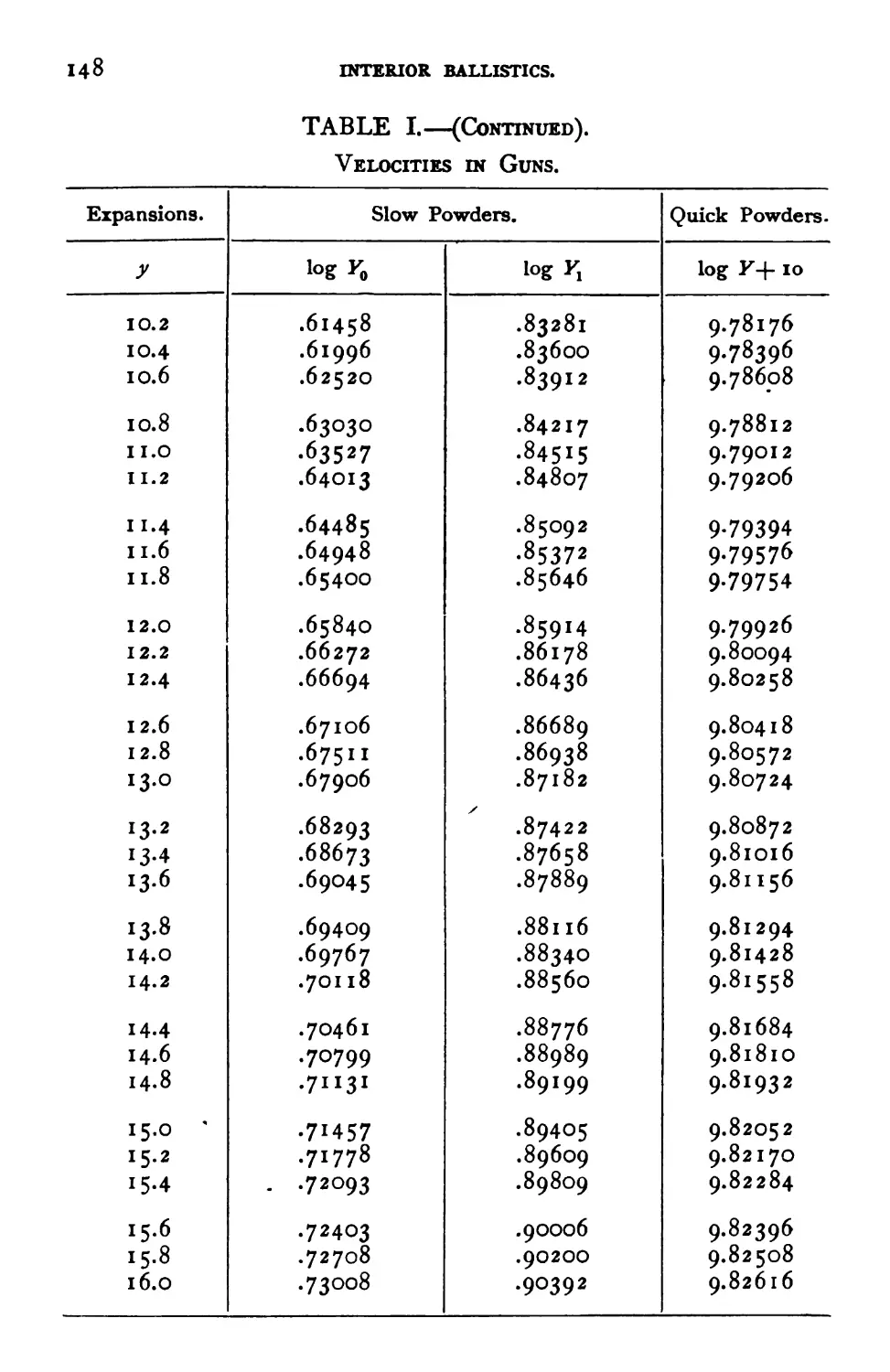
Table I.—Velocities inXSuns.
Table II.—Pressures in Guns.
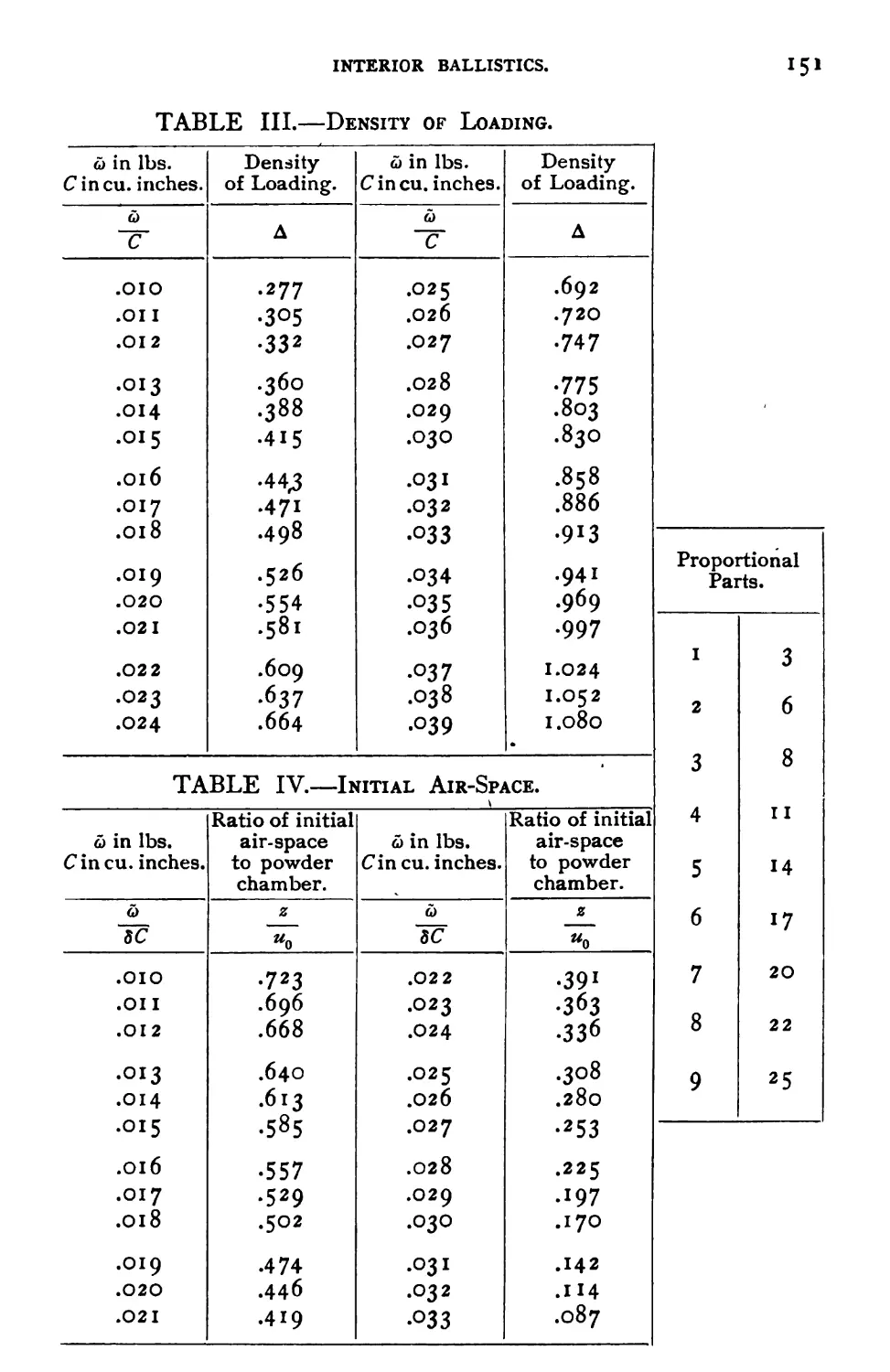
Table III.—Density of Loading.
Table IV.—Initial Air-Space.
Table V.—Area of Cross Section of Bore.

CHAPTER L
DEFINITIONS.—POWDER CHAMBER.—FIRING
TEST.
i.	Interior Ballistics.—Interior ballistics, in general terms,
may be said to include the effects produced on a projectile in the
bore of a gun, and on the,gun itself, when the gun and projectile
are subjected to the action of the products of combustion of gun-
powder or other explosives.
2.	Gunpowder Explosion.—The phenomenon of the explo-
sion of gunpowder may be divided into three parts, viz.: ignition,
inflammation, and combustion, and these should not be confounded
with one another.
Ignition.—By ignition is understood the setting on fire of a par-
ticular part of the charge. With B. L. modem guns this is effected
at the rear of the charge; and to insure ignition, a small priming
charge of black powder is sometimes placed at the rear of heavy
charges of cocoa powder.
Inflammation.—By inflammation is meant the spreading of the
fire from grain to grain throughout the whole charge. The small
priming charge spoken of in the preceding definition assists in this
operation in* the case of cocoa powder, which ignites somewhat
slowly.
Combustion.—By combustion is meant the burning of each grain
from its surface to its centre.
By velocity of inflammation, then, we mean the rate at which the
heated and expansive gases evolved from the first grain ignited
insinuate themselves into the interstices of the charge, envelop the
grains, and ignite them one after another.
By velocity of combustion we mean the rate at which the grain
burns from its surface to its centre. It is important to keep in
2
INTERIOR BALLISTICS.
mind the difference of meaning of these two terms when we come
to the mathematical deductions of the laws of burning of powder
grains in free air.
3.	The Density of Gunpowder.—The specific gravity of gun-
powder, frequently called the density of the powder, is the ratio of
the weight of a grain of gunpowder to the weight of an equal
volume of water in standard conditions. In practice, the mean
specific gravity of a number of grains must be determined. The
practical limits of the density are from 1.68 to 1.90, in fact, rarely
exceeding 1.85.
The density of gunpowder is denoted by 3. If v is the volume
of a grain of gunpowder in cubic inches, the weight in pounds of
an equal volume of water will be .03613V, since one cubic inch
of water weighs .03613 pounds. Denoting the weight in pounds
of the grain by w, we will have, therefore, by definition,
w	w
3=	7	=27.68—.................(О
.03613V	v	v '
Since nitre is very soluble in water, the practice of weighing
gunpowder in mercury of known specific gravity has been uni-
versally adopted. In the instruments used, every refinement is
adopted to secure precision.
4.	Gravimetric Density.—The gravimetric density of gun-
powder is the mean density of a suitable measure of it, interstices
and all. It is usually expressed as the weight in ounces of a cubic
foot of the gunpowder in grain form, the weight of a cubic foot of
water being about 1000 ounces.
Generally, this gravimetric weight is from 875 to 975 ounces
per cubic foot.
5.	Density of Loading.—Density of loading is the ratio of the
weight of a charge of gunpowder to the weight, under standard
conditions, of the volume of water that would fill the powder
chamber, or receptacle in which the charge is placed. It is evi-
dently the mean density of all the products of combustion when
filling the powder chamber. It is denoted by A.
INTERIOR BALLISTICS.
3
If ш is the weight of charge in pounds, and C the volume of the
powder chamber in cubic inches, by definition, we will have,
Ш	(D
A=-r-7s= 27.68-^...........................................(2)
.03613C	C	v '
In practice, A generally varies beteen	.8 and 1.0. These are
about one-half the values of the density of gunpowder (see Par. 3).
Further along, in many practical formulae, it is assumed that
A 1
-*-=—; which is generally a sufficient apprbximation.
О 2
A will be found tabulated for various ratios of G> to C at the end
of the book.
6.	Chamber Volume.—Tlje powder chambers of all the larger
new steel guns have the general form shown in longitudinal section
in Fig. 1.
Part of the chamber is cylindrical. Its radius being r2 and its
height Л2, its volume is
7Г r? h .
2 2
Part is conical. The volume of a truncated cone is equal to the
sum of the volumes of three cones of the same altitude and having
for bases respectively, the upper base, the lower base, and a mean
proportional between the bases. Its extreme radii being and r2
and its height , the volume surrounded by the chamber slope is
-7-^*1	+ r* + riri) •
Part of the projectile extends backward into the chamber. This
portion is subtractive. The radius of the projectile being r and
the distance it extends to the rear being A, this volume is тг f*h.
4
INTERIOR BALLISTICS.
In the mushroom head, the equation to the circle of radius a is
+ (j/— £)2 = a2,
or,	x
jr2 = t>2 -yd2 — x2 ~y 2 b (a2 —	.
The volume of the mushroom head may be found by supposing
it composed of a number of elementary cylinders of which the
radius is>, and the height dx, the axes of the cylinders coinciding
with the axis of the bore.
. •. Volume of mushroom = Г тгу2^
Jo
= 7Г Г (d2 + a2) dx — тгС x*dx + 2Йтг Г (a2 — xrf dx.
Jo	Jo	Jo
Jr*a	i
। (a2 — x?) dx is seen to be the area of a quadrant
о
of a circle of radius a;
... 0-^2)*
Jo	4
The remaining terms of the mushroom volume are directly
integrable. We have, finally,
C2O3 irba2\
Ira ----------—J
This is subtractive also. The volume of the chamber, then, is
^=’^2 *1 + f О + ?1+Г1Г1)-?А
+	• (3)
7.	Initial Air-Space.—The initial air-space in a loaded gun or
shell is the portion of the chamber unoccupied by solid or liquid
matter before firing. In the course of this book it will be shown
(using black or brown powder) that the total volume of the solid
and liquid matter practically remains the same after as before
firing; a non-gaseous product; or as it is called, residue, equal in
volume to the powder, being formed.
INTERIOR BALLISTICS.
5
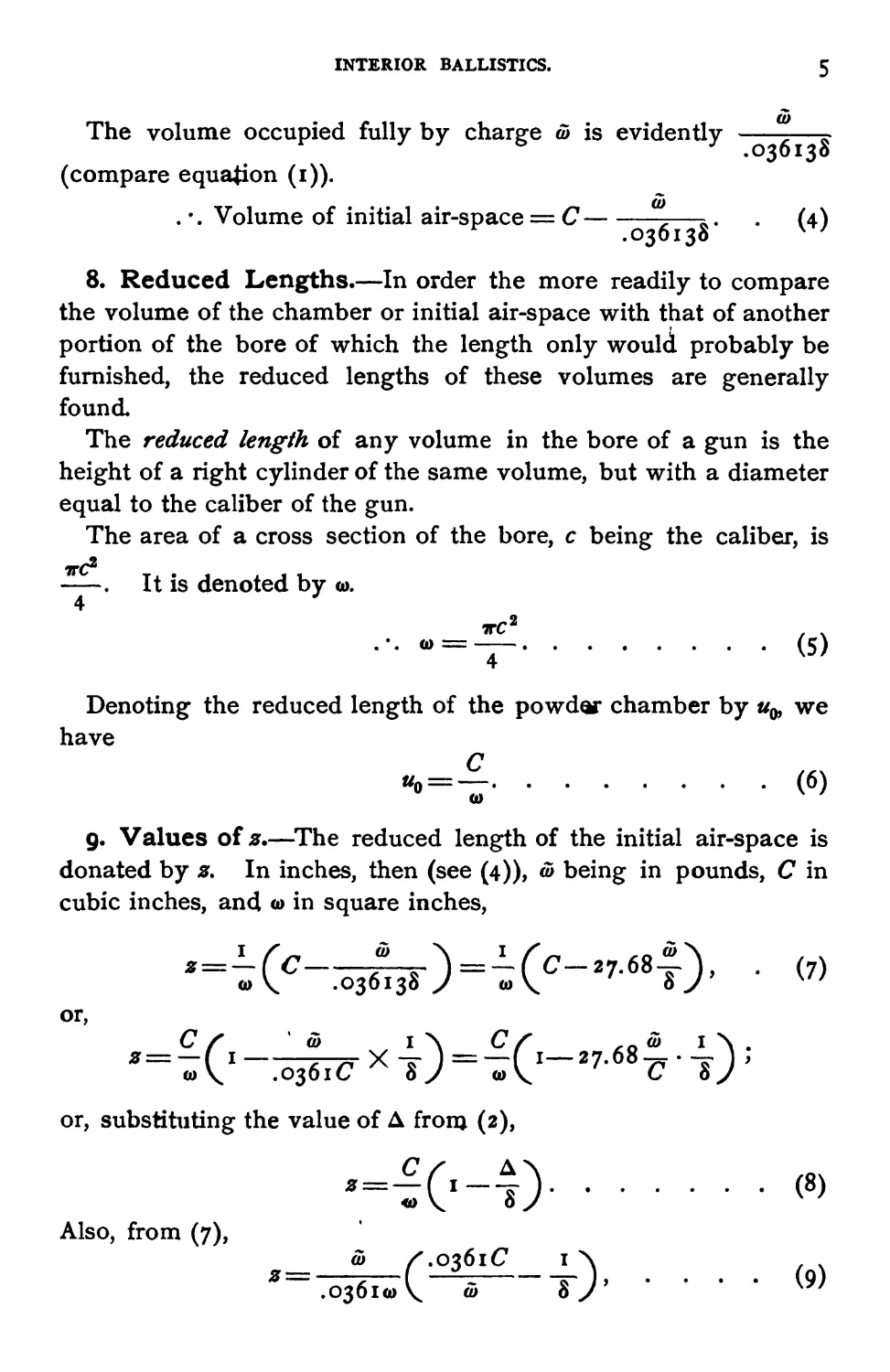
The volume occupied fully by charge & is evidently
(compare equation (i)).
. •. Volume of initial air-space = C----—x.
.036138
.036138
.	(4)
8.	Reduced Lengths.—In order the more readily to compare
the volume of the chamber or initial air-space with that of another
portion of the bore of which the length only would probably be
furnished, the reduced lengths of these volumes are generally
found.
The reduced length of any volume in the bore of a gun is the
height of a right cylinder of the same volume, but with a diameter
equal to the caliber of the gun.
The area of a cross section of the bore, c being the caliber, is
ire2	,
---. It is denoted by <o.
Denoting the reduced length of the powder chamber by Uq, we
have
9.	Values of z.—The reduced length of the initial air-space is
donated by z. In inches, then (see (4)), ш being in pounds, C in
cubic inches, and <*> in square inches,
z = -(c----А_^Л=Д<С-27.684У • (7)
(0 \	.036138 7	8 7
or,
g=—Л— T c X -0=—(1— 27-68^r- 4') ’
ft) \	.0361G o7 <° X	° S
or, substituting the value of A from (2),
Also, from (7),
______________________	&	/ .0361C	1
.0361(0 \	8
(8)
(9)
6
INTERIOR BALLISTICS.
and, substituting A from (2), as before,
z=~4—	' (io>
.0361a) \ A 8/	ш\Д 8 у	'
From (6) and (8) we have
5 = «0(^1 -y),...................(1.0
a most convenient form, as z will be in the same units as w0, which
may be in feet, inches, or decimeters, and the remaining quantities
are abstract. Further along, approximate monomial expressions
for z will be found.
z	A
The value of — for various values of is tabulated at the end
«0	8
of the book.
10.	Expansions.—The travel of a projectile from its seat to any
point in the bore of a gun will be denoted by u. The number of
expansions of the initial air-space, corresponding to any travel of
the projectile, will evidently be the volume unoccupied by solid
matter, in rear of the projectile at that travel, divided by the initial
air-space (see Par. 7). Denoting the number of these expansions
by>, we have
о)Я 4- mu	и 4- z	, .
At 	'	-- '	f T *> V
which is used with brown and black powders, the volume of non-
gaseous matter in rear of the projectile, while in the gun, remain-
ing constant.
The expansion of the chamber volume would be used in any
case where the products of combustion or explosion were entirely
gaseous, as is probably true with some smokeless powders.
With such smokeless powders, in a gun, denoting the number of
expansions byjv0, we have
>° c
• • (T3>
or, substituting the value of C from (6),

«о •
(I4>
INTERIOR BALLISTICS.
7
ii.	Proof of Gunpowder.—When gunpowder arrives at the
proof-grounds for trial in the gun for which it is intended, it is sub-
jected to examination as to its specific gravity and gravimetric
density, and its pressure in the gun and muzzle velocity are ascer-
tained with a pressure gauge and a chronoscope.
The practice of weighing gunpowder in mercury of known
specific gravity has been universally adopted for finding the
density. The gravimetric density is ascertained by filling a stand-
ard volume and carefully weighing the contents.
12.	Firing Test.—Powder is tested by firing a charge in the gun
for which it is intended, pressure gauges being in the breech plug,
base of the shell, or elsewhere in the bore. In the Woodbridge
Pressure Gauge, a piston with a hollow conical base threaded
spirally is forced down by the powder pressure upon a copper
disc, forming a truncated cone on which is traced a helix. . The
number of convolutions of the helix that appear on the disc
shows, by comparison with discs that have been equally indented
by known pressures, the pressure reached in the gun. Of course,
in practice, the first step in the use of the gauge is to determine a
number of points and draw a curve; the abscissae being, say, the
convolutions of the helix, and the ordinates the pressures. The
other well-known pressure gauges are the Rodman and the Crusher
Gauges. In the former, the pressures are ascertained by the amount
of indentation of a knife in a metal cylinder, and in the latter by
the shortening of a soft metal cylinder. As before, a proper table
of pressures is constructed, for the various indentations or crush-
ings, by experiment with a number of the discs in a testing
machine, the results being plotted and a smooth curve drawn.
The instrument used on most proving grounds for the measure-
ment of projectile-velocities is the Le Boulenge Chronograph. This
consists essentially of a long and a short metallic rod suspended
from two electro-magnets placed at different heights on a vertical
standard. When the projectile passes through the first screen, the
first current is broken, and the long rod or chronometer begins to
fall. When it passes through the second screen, the second cur-
rent is broken, and the short rod or registrar falls through a short
hollow cylinder upon a trigger, releasing a knife, which, actuated
8
INTERIOR BALLISTICS.
by a spring, flies forward and marks the chronometer with a hori-
zontal line. Both currents may be broken simultaneously by the
use of an instrument called the disjunctor. The distance of the
resulting mark from the point on the chronometer abreast the knife
before falling is called the disjunction. Captain Br6ger has made
some improvements upon the original Le Boulengd Chronograph.
The two rods are now of exactly the same weight (though differing
in size). The two electro-magnets are alike, and the strength of
the current is regulated by resistance coils. The electro-magnet
of the registrar may be moved at will up or down a graduated side
of the vertical standard, its position being regulated by a set screw
and tangent screw. The disjunction is kept constant, and proper
tables for use of the chronograph are supplied, these being calcu-
lated from the formula
\2h'	\2h
*	V g
where t is the time between screens, h the disjunction, g gravity,
and Л' the distance of the mark made on firing from the point of
the chronometer originally abreast the knife, as indicated by a suit-
able measuring rule. The results found by using the tables should
be corrected proportionally to
For the measurement of shorter intervals of time than those
ordinarily used in gun fire, that is, for use as a micrograph, as dis-
tinguished from a megagraph, the registrar and magnet are placed
at the top of the standard and the registrar is dropped first. A
new disjunction is found and a difference of times taken as before.
There are other well known chronoscopes, such as the Schultz,
Noble and Bashforth. The first depends upon the fact that the
number of vibrations of a tuning fork in the same temperature is
constant, and the second upon the attainment of a very high
velocity of a recording surface. In all these instruments electricity
is used for purposes of recording.
13.	Accuracy of Crusher Gauges.—The accuracy of crusher gauges has
been examined into in a most thorough manner by Messrs. Sarrau and Vieille.
Very briefly, their views are found in what follows :
Two limiting cases present themselves. In the first case, the maximum
pressure in a gun or shell is the force of calibration (tarage), that is, the force
corresponding, on the curve previously drawn, to the crushing or decrease of
INTERIOR BALLISTICS.
9
length. In this category are included explosives of slow combustion, such as
black and brown powders. The piston of the gauge is made as light as pos-
sible in order that it may start at once, its full movement developing with the
pressure. In the second case, the maximum pressure is the force of calibra-
tion corresponding to half the crushing. In this category are included very
quick explosions, as of the picrates and gun-cotton. The piston of the gauge
is made very heavy in order that it may not start till the pressure has devel-
oped. Some explosives, as nitro-glycerine, fall under neither head, or pos-
sibly under both, occupying a mean position. A higher limit for the pressure
is found, as in the first case, with a light piston, and a lower one with the
heavy. These generally differ little, and in some cases have been found to
agree. In the first case it is desirable to delay the explosion by using the
explosive in large grains, and in the second to hasten it as much as possible
by pulverization.
Examples. *
i.	In the two Navy rifles known as the 8" B. L. R., Mark III, and
6" B. L. R., Mark III, the dimensions of the powder chambers are
as follows :
Gun.		a	Л2	*1	r
8", M. Ill,	4.-75"	2-5"	39-46"	9-75"	3-98"	4-15
<5", M. Ill,	3-5	2.0	27-84	9-65	2.98	315
Find the volumes of the powder chambers?
Ans. 67=3184 cu. in.
and 1304	“
2.	The chamber dimensions of three other Navy rifles are as
follows:	’
Gun. 6", M. II,	3-75"	a 2. IO"	*2 27.O8"	Ai— h 8.50"	2.98"	3-!5"	Л 1.65"
8", M. II,	5-25	2.60	38.55	7.00	3-98	4.15	1-75
10", M. I,	6.25	2.95	50.96	10.00	4.98	5-i5	2.00
Required the chamber capacities.	Ans. 1447 cu. in.
3652	“
7059 “
3.	The volume of the powder chamber of an 8-inch B. L. R. is
3824 cu. in.; what is the densify of loading when the charge is
J25 pounds?	e Ans. .905.
IO	INTERIOR BALLISTICS.
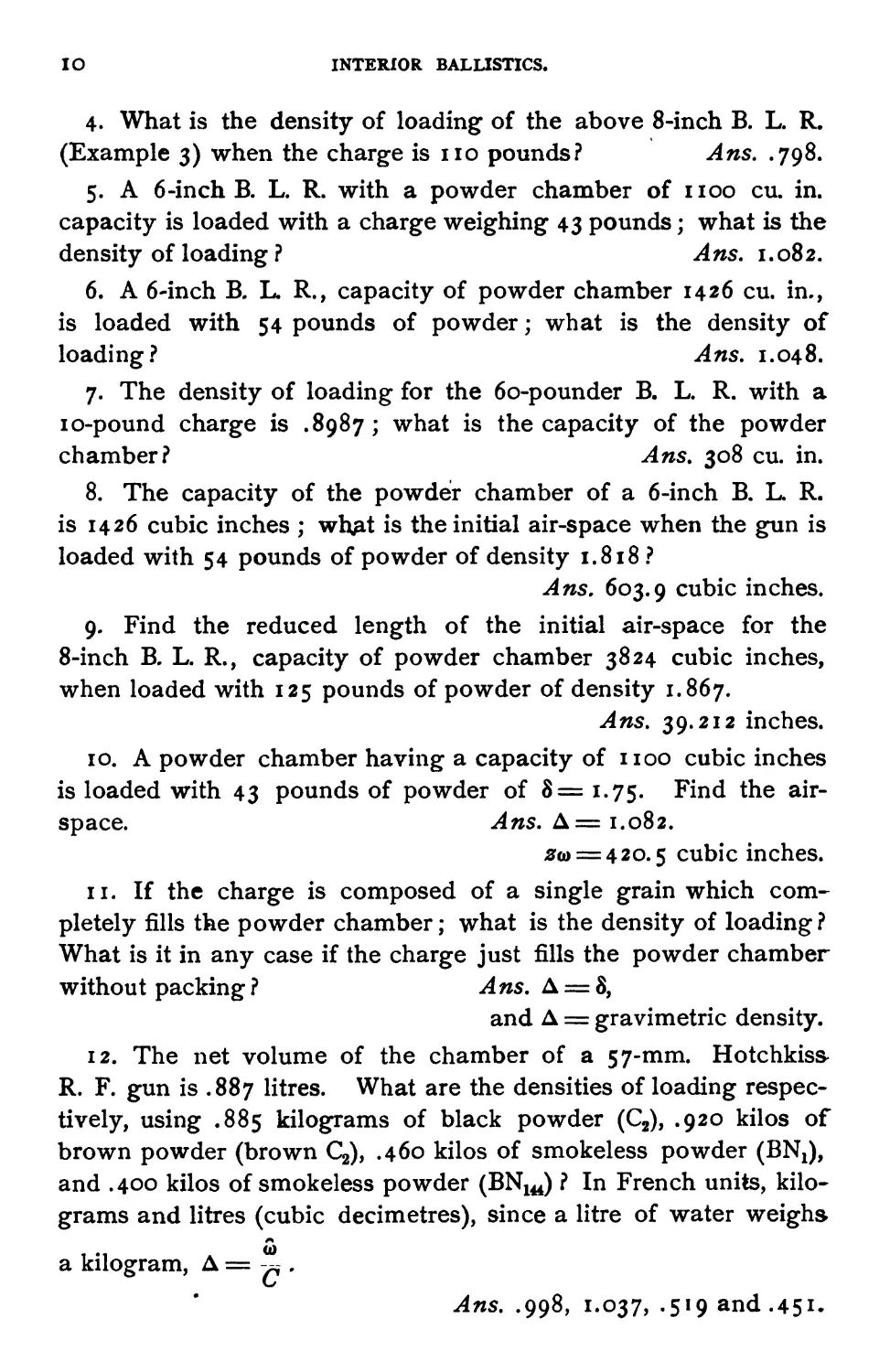
4.	What is the density of loading of the above 8-inch B. L. R.
(Example 3) when the charge is no pounds?	Ans. .798.
5.	A 6-inch B. L. R. with a powder chamber of 1100 cu. in.
capacity is loaded with a charge weighing 43 pounds; what is the
density of loading ?	Ans. 1.082.
6.	A 6-inch B. L. R., capacity of powder chamber 1426 cu. in.,
is loaded with 54 pounds of powder; what is the density of
loading?	Ans. 1.048.
7.	The density of loading for the 6o-pounder B. L. R. with a
ю-pound charge is .8987; what is the capacity of the powder
chamber?	Ans. 308 cu. in.
8.	The capacity of the powder chamber of a 6-inch B. L. R.
is 1426 cubic inches ; wh^t is the initial air-space when the gun is
loaded with 54 pounds of powder of density 1.818 ?
Ans. 603.9 cubic inches.
9.	Find the reduced length of the initial air-space for the
8-inch B. L. R., capacity of powder chamber 3824 cubic inches,
when loaded with 125 pounds of powder of density 1.867.
Ans. 39.212 inches.
10.	A powder chamber having a capacity of 1100 cubic inches
is loaded with 43 pounds of powder of 8= 1.75. Find the air-
space.	Ans. A = 1.082.
5(0 = 420.5 cubic inches.
11.	If the charge is composed of a single grain which com-
pletely fills the powder chamber; what is the density of loading?
What is it in any case if the charge just fills the powder chamber
without packing ?	Ans. A — 8,
and A = gravimetric density.
12.	The net volume of the chamber of a 57-mm. Hotchkiss
R. F. gun is .887 litres. What are the densities of loading respec-
tively, using .885 kilograms of black powder (C2), .920 kilos of
brown powder (brown C2), .460 kilos of smokeless powder (BNX),
and .400 kilos of smokeless powder (BN144) ? In French units, kilo-
grams and litres (cubic decimetres), since a litre of water weighs
a kilogram, A =	.
Ans. .998, 1.037, .519 and.451.
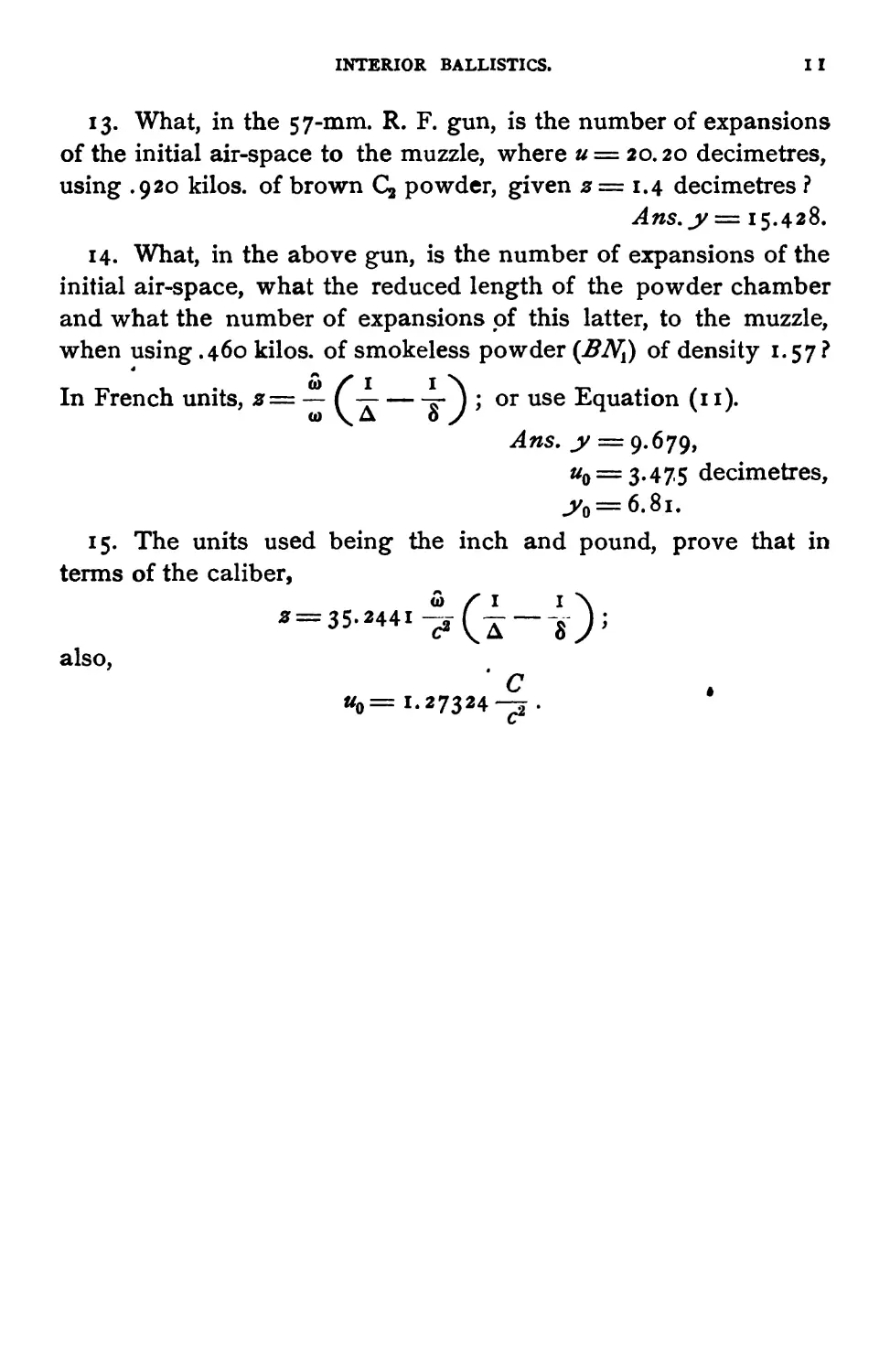
INTERIOR BALLISTICS.
I I
13.	What, in the 57-mm. R. F. gun, is the number of expansions
of the initial air-space to the muzzle, where и = 20.20 decimetres,
using .920 kilos, of brown Q powder, given z = 1.4 decimetres ?
Ans. у = 15.428.
14.	What, in the above gun, is the number of expansions of the
initial air-space, what the reduced length of the powder chamber
and what the number of expansions of this latter, to the muzzle,
when using .460 kilos, of smokeless powder of density 1.57?
In French units, z = —	---; or use Equation (11).
Ans. у = 9.679,
uQ = 3.475 decimetres,
^0 = 6.81.
15.	The units used being the inch and pound, prove that in
terms of the caliber,
also,
' c
«o= 1.27324-^.
CHAPTER IL
PROPERTIES OF GASES.
14. Specific Heats.—The specific heat of a substance is the
quantity of heat necessary to raise the temperature of unit weight
of it one degree. The quantity may be measured in two ways:
the body which is being heated may be allowed to expand freely
under a determined pressure, or the volume of the body may be
maintained constant; in the first case the specific heat is of con-
stant pressure, and in the second, of constant volume. With per-
fect gases, the specific heats under constant pressure and constant
volume are independent of the pressure and volume.
15. Thermodynamic Laws of Gases.—The laws connecting
the pressure, volume, and temperature of a perfect gas are briefly
embodied in the formula
pv — RxT,..................(15)
where p and v are its pressure and volume respectively, R a con-
stant for the particular gas, x its weight, and T its absolute tem-
perature ; that is, its temperature measured from a zero point at a
distance (in temperature) below the Centigrade zero equal to the
reciprocal of the coefficient of expansion or dilatation of perfect
gases. On the Centigrade scale, absolute o° is at — 2730 C. If
the temperature is constant, the pressure of a gas varies inversely as
its volume. This is Mariotte's Law. The assumption of a fixed abso-
lute zero involves another law, namely : the coefficient of dilatation
of a perfect gas under constant pressure is constant and independent
of the pressure. This is known as Gay-Lussac’s Law.
With unit weight of perfect gas (making x = 1 in (15)) we have
pv=RT......................(16)
From (16), we see :
1.	If, the pressure p remaining constant, the volume varies by
INTERIOR BALLISTICS.

the amount dv, the temperature undergoes a corresponding varia-
pdv
tion represented by =-&-, and consequently the gas has received a
quantity of heat
7 dpdv
d being the specific heat of the gas under constant pressure.
2.	If, the volume v remaining constant, the pressure varies by the
amount dp, the temperature undergoes a corresponding change
vdp
represented by —, and consequently the gas has received a
zc
quantity of heat
dq=C-^-
4 R
c0 being the specific heat under constant volume.
3.	Consequently, if the volume and pressure increase together
by dv and dp, the gas receives a quantity of heat
dq = -^-(c'pdv + CfjDdp)	....	(17)
Differentiating (16), we have,
RdT=pdv + vdp,...................................(18)
and, eliminating successively dp and dv between (17) and (18),
we have the two equations
dq = c^T->T^^-pdv,	...	.	(19)
and	dq — c'dT—C^vdp....................(20)
RT
Substituting for p in (19), its value —— , from (16), we have
dq = crfiT+(d —	...........(21)
These equations contain all the thermodynamic laws of gases.
16.	Work Done by Gas-Expansion.—Let ф be an infinitely
small element of the surface which encloses any weight or volume
14
INTERIOR BALLISTICS.
of gas. Since p is the pressure per unit of surface, the pressure on
this element will be pty. If h is the displacement of this element
perpendicular to itself, and the total change of volume of the gas
is so small that p practically does not vary, the work done will be
hpfy the work performed being measured by the product of the
pressure into the distance through which it acts. The total work
done on all the elements will then be
t	Чкрф = р'ЯЬф.
But is the summation of all the elementary changes in volume,
and is therefore the total change.
If, then, the total volume is increased dv, we will have
dv =	,
and the total work done will be pdv.
For finite changes of volume, where p varies, we have, by inte-
gration, for the total work denoted by f,
$=£pdv.......................(22)
17.	Mechanical Equivalent of Heat.—Integrating both mem-
bers of (19), we have
9 = c«fdT+^~^1f^dv..................... (23)
If and are the original and final temperatures, (23) may be
written, remembering (22),
y = Co(T1-7’o) + ^^S-................(24)
If the temperature of the gas remains unchanged, — 7J, and
(24) becomes
г]?со ....................(25)
JD
or>	—7 9...................(2(S)
C -- Cq
Z)
If 0=1,	? = ТГ—-......................(27)
C --Cq
INTERIOR BALLISTICS.
15
That is, if there is no change in temperature and one unit of heat
has been absorbed by the gas, the work done must be —f----.
C Cq
This, then, is the mechanical equivalent of one unit of heat, or,
more briefly, the mechanical equivalent of heat. It is denoted by E.
...... (28)
c — c0
E is independent of the gas used and is fixed in value. Conse-
quently, R is proportional to the difference of the specific heats of
a gas.
c'
For perfect gases, —=1.4, very approximately. For other
' co
gases it varies between this limit and 1.
d
Placing	— = n,.......................(29)
co
equation (28) becomes
R	Rn
~Co(w —1) — c'{n — 1) ’     (3°)
whence, for perfect gases, we have R proportional to either specific
heat of the gas.
Adiabatic Transformations.
18.	Definition.—An adiabatic transformation is a change that
takes place in the state of a gas within an envelope impermeable
to heat; or which occurs in such a short space of time that no
heat is received or lost by it
The laws governing this change are found by placing dq = o
in equations (17), (19), (20) and (21).
For adiabatic expansions, then,
c'pdv-\-c^dp = Q,................(31)
C^T +	= ° ’..............(32)
c'dT— ^C° vdp = о,.................(33)
c*dT + {C — c0) ~ = о, ... . (34)
from which follow several important results.
l6
INTERIOR BALLISTICS.
19.	Pressure-Volume Law.—Dividing (31) through by c$)p,.
cf
and substituting n for— (see (29)), we have
co
ndv , dp
Integrating,
n log v + log p = log k,
where k is some constant.
••• pr=k.............................(35>'
v, the volume of unit weight, is the reciprocal of p, the density, or
weight of unit volume.
... .
or,	=	................(36)'
that is, in an adiabatic change, the pressure varies proportionally io a
power of the density equal io the ratio of the two specific heals.
20. Temperature-Volume Law.—Dividing (34) through by
d
cfT, and substituting n for —, as before, we have
CQ
dT	dv
-T+(«-0-=o;
kx being a new constant, we have on integration,
log 7*4- (n— 1) log v = log kx;
• •• ^-* = ^1.................(37>
Reasoning as in the case of pressures we see that: In an adia-
batic change, the absolute temperature of a gas is proportional to a
power of the density equal to the ratio of the two specific heals minus one.
21.	Pressure-Temperature Law.—Substituting for v in (33У
RT
its value——(see (16)), and dividing through by cfT, recollecting
that n = —, we have
ndT	dp
—-(«-0^=0,
(n — 1) dp .
dT
or,
T
n
INTERIOR BALLISTICS.
J7
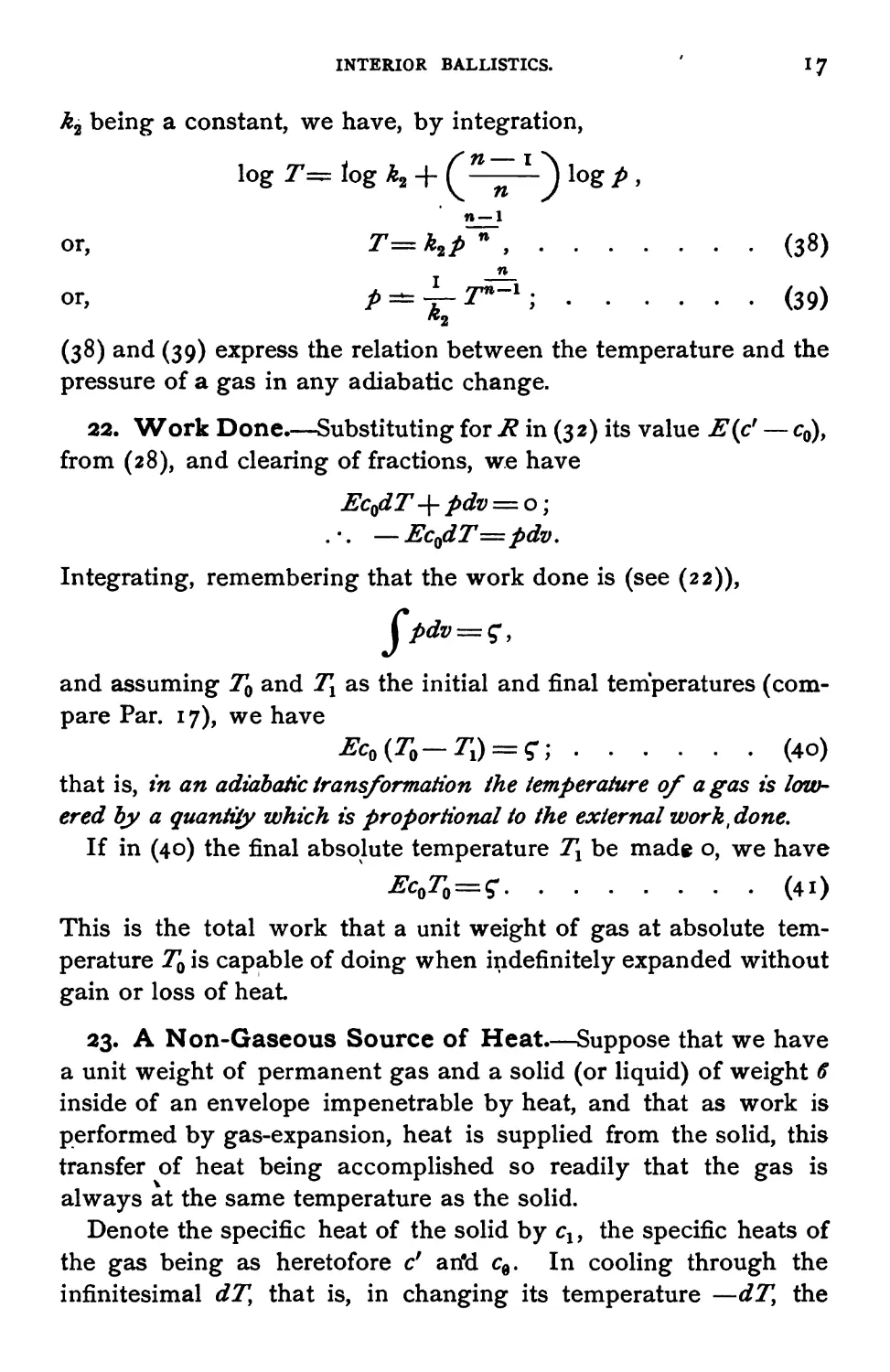
k2 being a constant, we have, by integration,
log T — log kt +	log P ,
or,	T=ktpf.........................(38)
or,	P^^-T^1-,......................(39)
(38) and (39) express the relation between the temperature and the
pressure of a gas in any adiabatic change.
22.	Work Done.—Substituting for 7? in (32) its value E(c' — c0),
from (28), and clearing of fractions, we have
EcflT+pdv = о;
.-. —EcflT=pdv.
Integrating, remembering that the work done is (see (22)),
§pdv = g,
and assuming and 7J as the initial and final temperatures (com-
pare Par. 17), we have
(^0 ^1) ==: 5* >.............(40)
that is, in an adiabatic transformation the temperature of a gas is low-
ered by a quantity which is proportional to the external work, done.
If in (40) the final absolute temperature T\ be made o, we have
-^0^0= 5*...................(41)
This is the total work that a unit weight of gas at absolute tem-
perature is capable of doing when indefinitely expanded without
gain or loss of heat
23.	A N on-Gaseous Source of Heat.—Suppose that we have
a unit weight of permanent gas and a solid (or liquid) of weight 6
inside of an envelope impenetrable by heat, and that as work is
performed by gas-expansion, heat is supplied from the solid, this
transfer of heat being accomplished so readily that the gas is
always at the same temperature as the solid.
Denote the specific heat of the solid by q, the specific heats of
the gas being as heretofore cr arid c0. In cooling through the
infinitesimal dT, that is, in changing its temperature —dT, the
18
INTERIOR BALLISTICS.
solid will evidently give up a quantity of heat Gc^T. As the en-
velope is impenetrable by heat, all this is absorbed by the gas.
The effect on the volume and pressure, then, is found by substi-
tuting this for dq in (17),
. •. 6cxdT= ~ (dpdv 4- Ctfidp}.
The gas, moreover, cools the same amount as the solid; that is,
the change in its temperature is — dT. The effect of this may be
found by substituting — dZ’for dT in (18).
. •. — RdT=pdv 4- vdp.
Eliminating RdT between these two equations, we have
pdv 4- vdp = — (cp'dv 4- ctfdp') ;
transposing, and separating the variables,
dp ( d 4- dv _
c04-
In this, place
Then, integrating, denoting the constant of integration by log k,
we have
• log P + n’	v = log >
piF' = k,.........................(43)
an equation similar to that (35) in the case of the gas alone.
It is evident that other laws similar to those already deduced
for the gas alone, but involving n' in place of n, may be readily
deduced. In fact, the present case is the more general, the laws
for the case without the solid source of heat being derivable from
it by placing 6 = o. The equations deduced in the course of this
book for the adiabatic expansion of a gas may be made to serve the
present method of expansion by substituting ri for n.
24.	Work and Final Velocity.—The work done by a gas in
expanding adiabatically from a volume v0 to zfx will evidently be
(see (22) and (35))
CV1 . r. cV1
$=J pdv=ki
INTERIOR BALLISTICS.
19
Integrating, remembering that = Л, we have
 <«>
If a number of bodies, free to move, are pushed from a state of
rest by the gas in accomplishing this expansion, denoting the mass
and final velocity of any one body by m and V respectively, we
will have, following Par. 16,
mV2 *	, x
S' = s—........................(45)
If the bodies are equal in mass,
........................................................(46)
If, in addition, the final velocities of the bodies are equal, their
number being N,
mNV2
(47)
If only one body is moved, which assumes the mass of the
remaining bodies of the system infinite, in order, according to
Newton’s laws, that the centre of gravity of the system may
remain fixed, we have
(49)
25.	Pressure-Velocity Formula.—Denoting the number of
expansions by_y, we have
'	v —A.
У ~ *0 *
Substituting from (48) and (49) in (44), we have
n— I
2/0У0 zI_y-n) ....	(50)
m (n— 1)v	7	4 * * 7
This would give in a stationary gun (neglecting the motion of the
propelling agent) the velocity of a projectile, pushed by a gas, if
free to move.
26. Pressure-Velocity Curve Area.—Fig. 2 represents the
curves of pressure in two equal expansions of different volumes of
2
20
INTERIOR BALLISTICS.
gas at the same original pressure. We know by the calculus that
the area comprised between the curve,' the axis of v and any two
ordinates, as at and vlf may be expressed by
^0
and hence, by (22),	»
Area = д';
when a single body is moved we have, by (48),
and when a number of free bodies are moved (see (45)),
, «mV2	, x
Area=S——.....................(51)
These equations do not involve the law of expansion. We may
then say generally :
The area of the pressure-volume curve between the original and final
limits of volume is equal to the total energy gained in the same limits by
the bodies impelled by the gas, supposing the bodies free to move. ' If
the bodies are not free, the work done in overcoming their resist-
ance to movement must be added to this energy.
Examples.
1.	Having given that the barometer is 0.7596 metre, and ther-
mometer 18.50 C.; find the weight in kilos of a cubic metre of dry
air. The weight of a cubic metre of mercury is 13,596 kilos, and
INTERIOR BALLISTICS.
21
the weight of a cubic metre of air when the barometer stands at
-760 and the thermometer at o° C. is 1.2932.
See (15.)	Ans. 1.2105 kilos.
2.	Prove, in adiabatic transformations, that
3.	The volume Of the powder chamber of an 8" B. L. R. is 3824
cubic inches. This is filled with gas at a pressure of 16 tons per
square inch, after which the projectile moves to the muzzle, a dis-
tance of 16.41 feet. The weight of the projectile being 250 pounds
and the expansion being adiabatic, 4vhat is the muzzle velocity of
the -projectile, if its kinetic energy represents the total work done ?
Use (50), making n = 1.4, and m =	.
Ans. K= 1715 f. s.
4.	The area between the curve pvn = constant, and the axis of
taken between any finite limit and the limit v = 00, is infinite if
n= 1, and is finite if.»> 1. What is the physical interpretation
of this ?
5.	The muzzle velocity in a certaifi case is 2030 f. s. for the
above 8" B. L. R. What is the mean pressure during the travel of
the shot ?
„ ____ mV2 итгс?
LM ---------•-----*
2	4
(Take и in feet, c in inches).
Ans. 9 tons (approx.) per sq. in.
6.	Determine the motion of a gun in recoiling when it is
restrained by an air cylinder alone.
Since the whole recoil is performed in so short a time as to
prevent the conduction outwards of any large amount of heat, the
compression of the air may be assumed to be adiabatic. This
gives
...............(e)
where /0 is the initial pressure on unit area, A the effective area of
22
INTERIOR BALLISTICS.
the piston, and a the length of the cylinder containing air before
recoil.
Let the figure represent the air cylinder, the rpcoil being in the
direction of the arrow. Take the origin of x at (9,^and take x
positive to the right. Then from equation (л),
Or, if P be the whole pressure of the air on the piston,
p^A_...................................................b
Xя	'	r
Since pressure is measured by mass times acceleration,
<?x	p<p*A	I
dP	M	xn	'..................'	'
where AT is the mass of the gun and carriage. From (c),
J^idx.cfix  tprfFA ra dx
v di~2 = ~M Л	‘	( '
where and V are the initial and any subsequent values of the
velocity of recoil. From (J), by integration,
F2 — К2 —* 2P^a Г ____________L_~|	(e\
0 ~AT(n-i)Lxn-1 a»-1 J' ’ ’ ’
By putting V= o, and solving for x, we find the whole length
of recoil. The corresponding value of P will be given by (b).
7.	A quantity of air whose pressure is px (much greater than
the atmospheric) and absolute temperature is that of the outside
atmosphere, 7J, is confined in a vessel. On opening a cock the
confined air quickly expands, gaining the pressure Д of the outside
atmosphere, when the cock is shut No heat is absorbed or lost
while the cock is open, and after shutting it, when the confined air
has resumed its original temperature, its pressure is p2. Determine
INTERIOR BALLISTICS.
23
n, the ratio of the specific heats (for air). (See Theory of Heat,
by Prof. J. Clerk Maxwell, tenth edition, pages 181 and 182.)
The expansion while the cock is open is supposed adiabatic.
By (38).
n —1	n—1
A n _ A n
~ ’
7^ being the absolute temperature at which the closed air arrives.
By (15) (after closing the cock), the temperature rising to
because of heat coming through the sides of the vessel,
rp A^o
A
A n
Тй
A " A
A^o
; also
also	; also ( — )
1 A \A>
. ^_^log A—Jog A
log A—log A
CHAPTER III.
EQUILIBRIUM IN AN EXPANDING GAS.
27.	Time of Expansion.—If all the elements except v0 in equation (50) are
supposed constant, we will have, AT2 being a constant,
That is, the velocity of a body, if representing the sole effect of an adiabatic
expansion, is proportional to the square root of the original volume of the
gas. The mean velocity of the body, up to a fixed final expansion, must then
be proportional to the same square root. Denoting the mean velocity by
being a new constant, we have, then, .
Denoting by и the distance moved by the body for any given expansion, the
surface on which the pressure acts being constant, we may write, being
still another constant,
w=A^o,
and the time of expansion, which will be obtained by dividing the distance
moved и by the mean velocity , will therefore be
.......................(52)
that is, in a given system, the time required for a free body, which alone is moved,
to travel through the distance representing any given expansion is proportional to
the square root of the original (or final) volume of the gas. This is true for any
law of expansion that does not itself depend upon the time, as may be the
case where heat is lost by radiation, in other than adiabatic expansions.*
If the volume of gas is infinitesimal, while the surface it acts on is finite,
the gas will make a finite number of expansions in an infinitesimal time. This
may be extended by the use of the summation sign to any case where an
infinitesimal quantity of gas acts on a finite surface.
28.	Pressure in Expanding Gas.—Assume a weight d of gas occupying the
bore of a gun and moving, as shown in Fig. 3, a projectile of weight w, the
effective accelerating pressure on the base of the projectile being P. Yqt
INTERIOR BALLISTICS.
25
simplicity, assume the volume in rear of the projectile to be cylindrical, its
cross-section being in the ratio -i- to that of the projectile.
Assume the cross-section of the cylinder the unit of area. Supposing
that the cylinder is fixed, the pressure PB at its base is moving not only
the weight w but the entire weight й of gas as well. Denote the distance
between the bottom of the bore and the projectile by Lq . Let p represent
the variable pressure throughout the gas and assume a cylindrical lamina
of thickness dL at any distance L from the bottom of the bore, dp being the
decrease of pressure in a distance dL, the lamina is subjected to a pressure
of p on its forward side and of p -|- dp on its after side, dp is therefore the
pressure accelerating the lamina.
Fig. 3.
A"being a suitable constant, we may write the mass of the lamina equal to
К ~-dL [^following the law pv = RxT (see (15)), whence x =	• The
constant К involves the relation between weight and mass as well as that
between v, the volume of the lamina, and dL, and also includes R. Assuming
the expansion adiabatic, we may substitute now the value of T from (38);
whence we have
1
Lamina Mass = K\p n dL .......................(53)
Aj being a new constant.
Force is measured by the product of amass moved and its acceleration.
If a is the acceleration of the projectile, and g the acceleration of gravity, we
have, then (the area of its base being k),
	w
kp=Ya..............................(S4)
Place	-7~=У............................(55)
^0
The acceleration of the lamina, then, is kya; or, substituting the value of a
from (54),
IPyg
Lamina Acceleration = P----—.................(56)
26
INTERIOR BALLISTICS.
As before mentioned, force is measured by mass times acceleration ; so by
(53) and (56), substituting LQdy for dL (see (55)),
dp=KJ>L,*L p'ydy....................(57)
Separating the variables, remembering that ydy = jd (t2),
Integrating, noting that dp to act as a positive force must have the opposite
sign as a change of p with increase of Z,
• £p \dp=-KiPL^

n n^1
Dividing through by -—- P n , placing
J A'.PVz. = tan16.....................(58)
П 1	0 2W	7
and transposing — 1, we have
n—1
(-4^)	= i + ‘an16 (i-72)..............(59)
or,	= Qi + tan1 в (i — 72Q	>
Г”	“in —1
or,	^ = secM *0 1 — 72 sin2 0	...............(60)
When 7 = 0, p = PB.
or,
2n
sec 9,
(61)
and
1 —72 sin2 0
(61) expresses the relation between the pressure on the projectile and that on
INTERIOR BALLISTICS.
27
the bottom of the bore, but 0 is as yet unknown. It is, however, so involved
in the value of the mass of the gas as to be readily found.
29.	Value of 0.—The mass of the gas is the sum of the masses of the laminae
of which the values are given in (53) ;
A	z»l A
.••4=1	= p*dy.................(62)
1
Substituting the value of p from (60), and for KxL^Pn , its value from (58)r
or,	tan20-J~»
10 n — 1 k2g
w
and dividing through by “^7, we have
2
k2 = —tan2 0 sec”—10
w -	-
I — 72sin20
n--
Place 7 sin 0 = sin <p.
w
у ds\n<p cos<pd<J>
Then dy = —;—— = —.—- — j
sin 0 sin 0
2n
2л . л ;
:-------sin 0 sec
I
||	cos”-1 <pd<f>. . . . (63)
0
Making n = 1.4,
(64>
------k2 = 7 sin 0 sec7 0 I cos® <pd<p ....
W----*/0
By the integral calculus,
I cos®$p^ = 4- cos50 sin 0 -|- cos3 0 sin 0 4- ~ cos 0 sin 0 A ^0 . . (65}
Jo	6	24	48	4й
.•. — k2 = 7 sin20sec7 0Г”4" cos50 + — cos304-^cos 0 + -Ц . (f>6)
w '	L_ 6	24	'48	48 sin 0_J v '
In practice d, w and k2 are given ; 0 is found by substitution and trial.
k2 — .07 when tan 0 = .1;	k2 = .40 when tan 0 = .25;
w	w
P = .20 when tan 0 = .2 ;	—k2 = .73 when tan 0 = .3.
w	w
30.	Illustration.—Placing n equal to 1.4 in (60) and (61), we have
=sec7 0(1 — 72 sin2 0)^................(67)
and	^ = sec70,.................................(68)
whence
p- = (I — V2 sin2 0)^.................................(69)
28
INTERIOR BALLISTICS.
A very common ratio at present between й and w is J or .5. If Л2 is .58 (an
approximate value in the larger guns when и =o, and for small travels of the
projectile),
^‘ = •5 Х-58 = .29;
.•. tan 0 = .2,
and	sec2 0 = 1.04,
I3	%
and	-~ = sec7 0 —(1.04P = 1.147 ;................(7°)
that is, if the products in rear of the projectile were all gaseous, in the case
assumed, the pressure on the face of the breech block would be one-seventh
greater than that on the projectile.
In the case assumed, suppose that k = 1 ; that is, that there is no enlarge-
ment of gun chamber.
Then	— i? = .5 ,
w J
.•. tan 0 = .25 (nearly),
and	^=1.236.............................(71)
The breech pressure would be about one-fourth greater than the projectile
pressure. This would hold approximately when the projectile is at the muzzle
of any gun, so loaded. *
31.	The Gun-Charge-Projectile System.—When a gun is restrained from
recoiling the highest pressure occurs at the face of the breech block, and this has
been a premise in all that has preceded. Without going more deeply into the
mathematics of the subject, it may be stated that similar methods of reasoning
will show that if the gun recoils, the maximum pressure occurs at the centre
of gravity of the system which is composed of the projectile, charge, inner
and outer air (in small part), the gun and gun-carriage (and more or less,
according to the firmness with which the gun is held fixed, the earth itself).
If a gun of the same weight as the projectile were suspended in a vacuum
in such a way that it could recoil without resistance,—on firing, it would move
as last to the rear as the projectile does to the front, the highest pressure at
any instant being at a point midway between breech face and projectile; from
there the powder-gas would expand both ways.
If the gun were twice the weight of projectile, it would recoil with very
approximately half the velocity of the latter; the point from which powder-gas
would move both ways would be the point of rest, at approximately one-third
the distance from base of bore to base of projectile, and this would be the
point of maximum pressure ; and so on.
32.	Momentum of Gas.—The mass of one of the laminae of paragraph 28
1	1
being ATj/n dL (see (53)), or ^L0/>n dy (see (62)), and its velocity being kyVt
♦The great difference between the projectile and breech pressures in unchambered guns
accounts partly for the excessive wave-motion in such guns.
INTERIOR BALLISTICS.
29
where V is the velocity of the projectile, the momentum of the lamina (the
1
product of mass and velocity) is Kx VLJtp « 7^7.
Integrating, we have the total
Momentum of the gas
P n ydy.
F0
Returning to (57) and integrating, changing the sign of dp as an increment,
• • (72)
• • (73)
• • (74)
-| dp=PB-P=KxPL^ i pnydy.
Eliminating the integral between (72) and (73), we have the
W /А,	\
Momentum of the gas —	^\~P— 1J '
33.	Mechanical Energy of Gas.—Mechanical energy is measured by half
the product of the mass and the square of its velocity. For the expanding
gas in a gun, iT is the sum of those of the various laminae ;
.-. Mechanical energy of the gas = |A"jZ0F2^2 С угрп dy.	. . (75)
Jo
d)
Dividing this by (62), member by member, and multiplying by — , we have
Z*1 1
I p n y*dy
Mechanical energy of the gas = — F'2 °- t ,
and substituting for p from (60), making n = 1.4, and 7 sin в = sin
Mechanical energy of the gas ==•—Q - F'2! 1:------------------
& 2g sin2 0	(*0
I I cos® <pd<p
\ Jo
By (64),
'0
л j cos7 0 sin 0 , „ л j
cos8 <pd<p =------=-----h в I cos6 •
в	8 Jo
dz£2
7w sin 0 sec7 0 ’
xr v • 1	r	rrS 7wsin20
. •. Mechanical energy of the gas =—з—K2( 1 — ———
b 16^ sin2 0	0Л2
(76)
(77)
(78)
Examples.
I.	A gun and its projectile are of the same weight, what is the ratio of the
muzzle velocity when each is free to move to the muzzle velocity when the
gun is held immovable, neglecting the weight of the powder?
30
INTERIOR BALLISTICS.
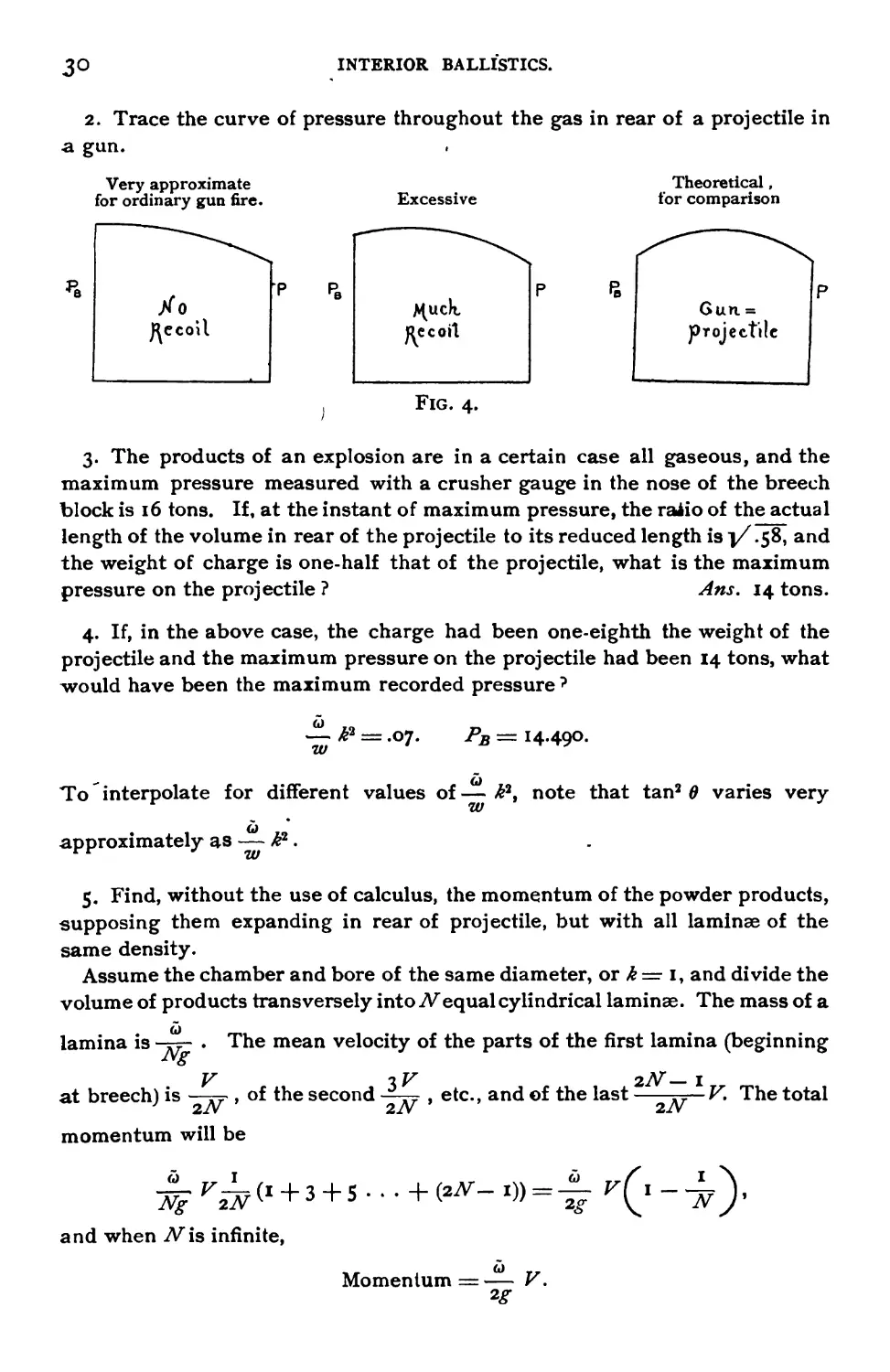
2.	Trace the curve of pressure throughout the gas in rear of a projectile in
a gun.
Very approximate	Theoretical,
for ordinary gun fire.	Excessive	for comparison
Fig. 4.
3.	The products of an explosion are in a certain case all gaseous, and the
maximum pressure measured with a crusher gauge in the nose of the breech
block is 16 tons. If, at the instant of maximum pressure, the raiio of the actual
length of the volume in rear of the projectile to its reduced length is 1/.58, and
the weight of charge is one-half that of the projectile, what is the maximum
pressure on the projectile ?	Ans. 14 tons.
4.	If, in the above case, the charge had been one-eighth the weight of the
projectile and the maximum pressure on the projectile had been 14 tons, what
would have been the maximum recorded pressure ?
-^.^=.07.	7^ = 14.490.
To interpolate for different values of~£2, note that tan2 0 varies very
approximately as Л2.
5.	Find, without the use of calculus, the momentum of the powder products,
supposing them expanding in rear of projectile, but with all laminae of the
same density.
Assume the chamber and bore of the same diameter, or k = 1, and divide the
volume of products transversely into TV equal cylindrical laminae. The mass of a
lamina is . The mean velocity of the parts of the first lamina (beginning
у	?y	2.N__I
at breech) is —, of the second , etc., and of the last-The total
J 2.N	2N	22V
momentum will be
^ЛЛг(1+3+5 • • • + (2^— !)) = —-	1----XF »
A£-	27V4 ' ° ' °	' k ’ 2g	N J
and when TV is infinite,
Momentum = — V.
4
INTERIOR BALLISTICS.
31
6.	The formula for the momentum of powder-gas in terms of the maximum
pressures is (74). What is the ratio of maximum breech to projectile pressure
in a gun when the charge is one-half the weight of the projectile, and the
momentum is that found in the last example ?
We find
Ans. PB = 1.25 P.
(Compare (71).)
7.	Assuming the powder products in rear of a projectile to be all at the
same temperature, each lamina following Mariotte’s law as to pressure,
deduce an expression giving the relation between breech and projectile pres-
sures in an unchambered gun.
e being the Napierian base,
p — Pe* and PB = Pe* ,
where x is found fro/n
When x = .i, xe	e X dx = .01007	(Evidently _
“	“ .2,	“	.04108	— varies - w
“ “ .3, “ “ -4,	.09560 .17821	approximately as x2.) 1
“ “ -5»	.29615
8.	Assuming, in Example 7, the charge one-third the weight of the pro-
PB
jectile, how does the ratio agree with that deduced after the method of
Example 6 ?
By Example (7),
6)	1	.	PB 16
— =-g- = .i7 x = .4. log.? = .43429 ••• -75- = ' =1-17-
By Example (6), 9 * * * * *
9. Derive an expression giving the velocity of flow of perfect gases.
Assume a surface cutting all the stream lines of the gas at right angles, and
a second surface parallel to the first and at a distance ds from it. Let A = area
of cutting lamina, ds = its thickness, v = the volume of unit weight in it, V=
its velocity, dp = the difference of pressures on its two surfaces, and g = the
acceleration of gravity. Then A . ds is the volume of the cutting lamina, Adp
32
INTERIOR BALLISTICS.
the moving force applied to it,----the mass of unit volume of gas in the
the moving force applied to it,----the mass of unit volume of £
gu
A. ds
lamina, and —-—the constant mass of the lamina. We have, then,

cU
dV_ VdV___d_ F8 _ -Adp _ _ gvdp
dt dt ds ’ 2 Ads	ds
gv
io. Find the velocity of escape of gas through the vent of a chamber in
which the pressure is 3000 atmospheres, the external pressure being one
atmosphere.
If the phenomenon is adiabatic, we have	; whence, from the
result in the last example, if the velocity of the gas is zero when p = P, and
is Fwh^n p =p0 ,
—ЖГ-].
Here we have, taking metres, kilograms, and seconds as units, pQ = 10333,
v0 == i 2932 ’	* an<* a^so n ~ **4» w^tch *s *гие ^ог Рег^ес^ gases-
Then	V = 2207 metres per second, nearly.
CHAPTER IV.
PRESSURES IN A SHELL.
34. Explosion in a Cylinder.—If a sufficiently strong, smooth, hollow cylin-
der impermeable to heat were suspended horizontally in space, and in one
end of it a quantity of explosive were fired, the centre of gravity of the explo-
sive products would be transferred toward the centre of the cylinder, which
would itself move therefore in the opposite direction. As the products arrived
at the opposite end, they and the cylinder would gradually come to rest, and
then, owing to the pressure of the gases, which would have banked up at that
end, the system would take up a motion in the opposite direction. With no
disturbing causes, it is easy to conceive the oscillation as thereafter con-
tinuous.
But the friction on the inside of an actual cylinder would retard the outer
portions of gas, turning the regular motion of the cylindrical laminae into the
irregular movement of a number of broken portions of laminae, the masses of
gas moving together in one direction becoming smaller and smaller, till at
last there would be apparently no excess of motion either way, the cylinder
would have come to rest, and the gas would be in equilibrium. The cylinder
will have come to rest by frictional resistance to the gas. This back resist-
ance multiplied in each case by the distance through which it acts will be work
done upon the gas, and when the cylinder has come to rest, its energy of
motion will have been transferred to the gas as molecular motion or heat.
The temperature of the gas will then be the same as if it had expanded to its
present volume without production of work ; that is, its temperature will be
that of explosion or combustion, if we suppose the actual cylinder impermea-
ble to heat. In this case, then, if we use any two weights of explosive, the
final temperature being the same, we may calculate the final pressure of one
from that of the other by Mariotte s law. Of course, in reality, the heat pro-
duced by friction will be divided between cylinder and gas.
The above assumption of the explosion at one end is of an extremely simple
case, but the irregularities spoken of exist more or less in every explosion.
Not only that, but it is prpbably one of the irregular pressures which precedes
the final, that is measured by a pressure gauge in an explosion chamber. It
is doubtful if, at the end of the time required to gain equilibrium, the final
pressure, diminished in actual practice by radiation of heat would equal the
mean pressure of the gas at some previous period (with its lesser diminution
of heat), not to speak of the highest pressure in the various parts of the dis-
turbed gas. The records, then, of presssure gauges are, as might be expected.
34	INTERIOR BALLISTICS.
irregular, though the work done in guns is sufficiently regular. Theoretical
pressures, moreover, calculated from the products and the temperature of
explosion do not agree with actual pressures measured by the crusher gauge.
In what follows on pressures in shells, Mariotte's law is used, but with the
above reservations.
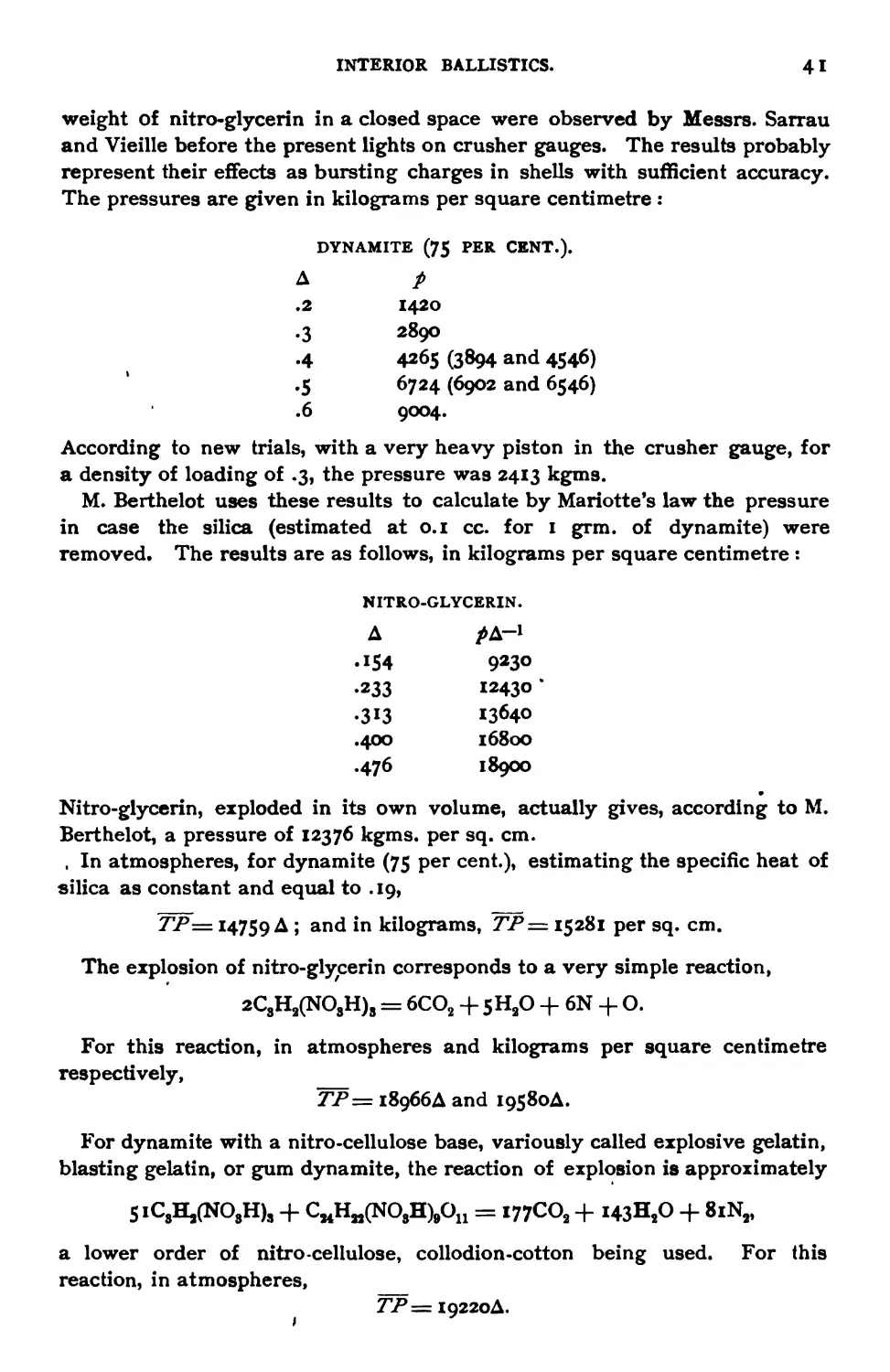
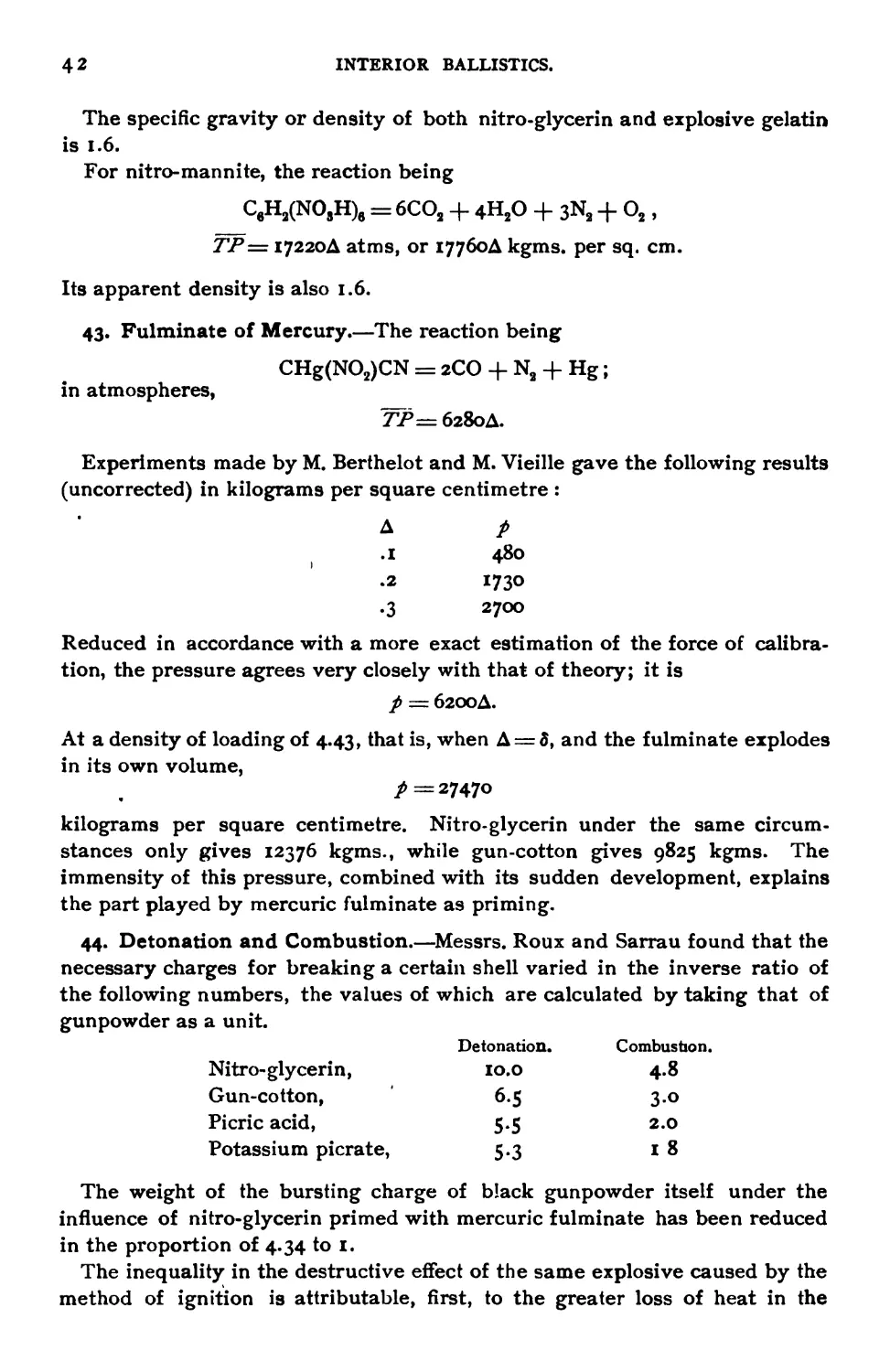
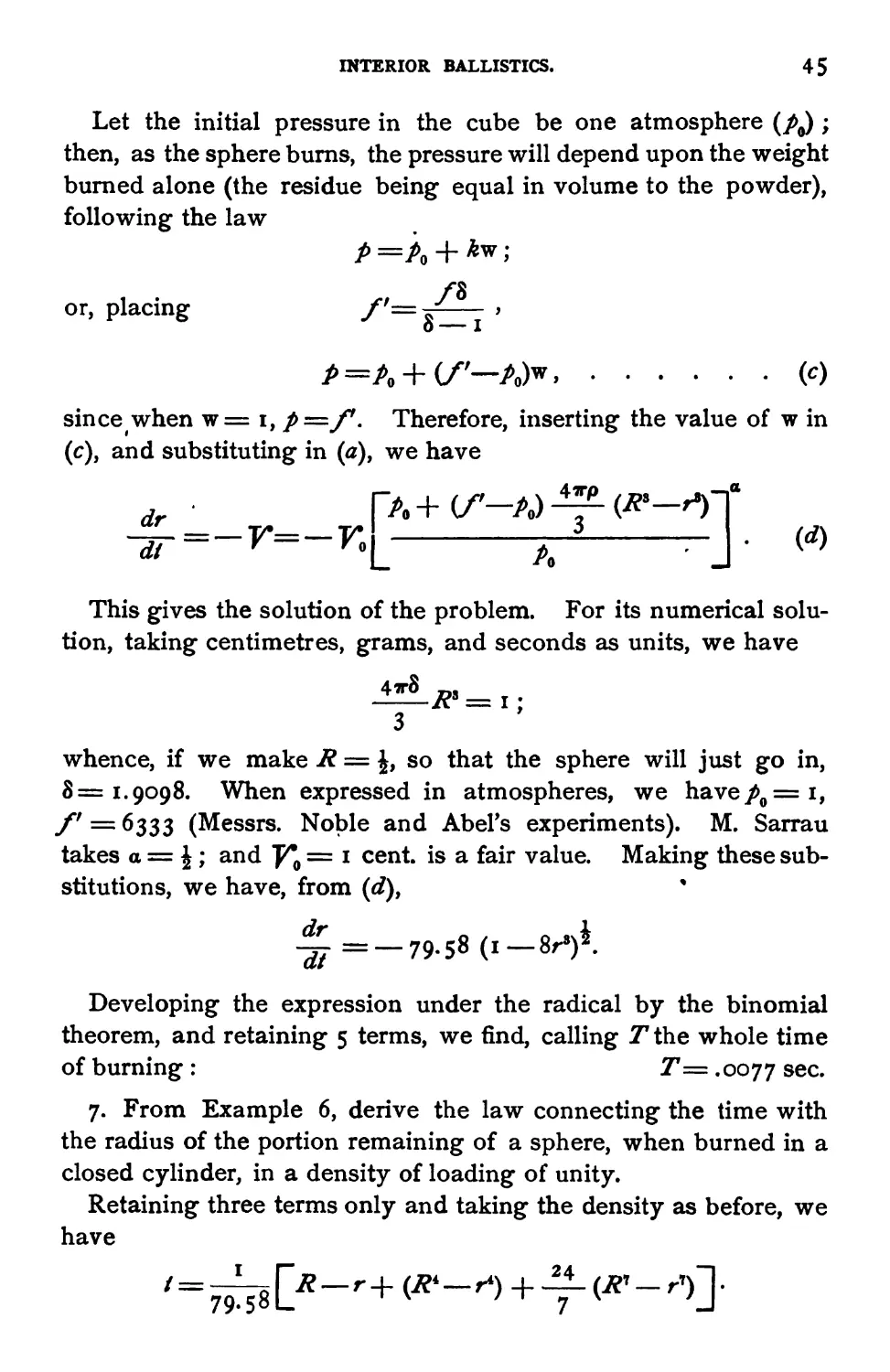
35. Force of Explosives.—The force of an explosive is the
pressure obtained by firing the explosive in a volume such that the
mean density of the gaseous products alone will be the ratio of
their weight to that of the explosive.
In decimetres, kilograms, and litres (cubic decimetres), the force
of an explosive is the pressure per square decimetre developed
when a kilogram is exploded in a volume such that the gaseous
products alone (of the explosion) occupy a litre. The pressure, in
pounds or tons per square inch at the same time, accords with the
first definition.
Let w be the weight in pounds of the explosive, x the weight
in pounds of the gaseous products alone, C the volume in cubic
inches of the explosion chamber, and v the volume in cubic inches
occupied by the gases alone.
1 X
Place	£..........................(79)
Then, by definition, when (compare (2))
x
—7-----— c, P
.03613г/
where /denotes the force of the explosive.
36.	Pressure in a Shell.—From (15), we find
i> = RT^...................(80)
Substituting for , its value, .03613c, when p=f, we have
/=.оз6хзе2?7’....................................(8i)
RT= .
•03613c
Assuming T constant for the different explosions, and substituting
for RT in (80), we have
p =——...............................(82)
.03613c v	x 7
INTERIOR BALLISTICS.
35
Substituting for c its value --, we have
$ .03613»..........................^3)
Let a denote the ratio of the volume occupied by the non-gas-
eous products at the temperature of explosion to the volume of the
weight w of water ; that is, let a denote the volume in litres of the
non-gaseous products of a kilogram of explosive.
The volume in cubic inches occupied by the non-gaseous prod-
ucts, then, is —7—;
.03613’
and, substituting in (83), we have
'	$	03613C—aw...................(85)
Dividing numerator and denominator by .0361C, substituting A
5>
for its value —(see (2)), we have
.0361C'	' ”
.........................W
ог .................................................<8?>
Formulae (83), (85), (86) and (87) give the pressures in a shell
on the supposition that the gaseous products of explosion do no
work, their temperature being in all cases the same,—the original
temperature of explosion.
The non-gaseous products have been variously termed the solid
residue, the liquid residue, etc., in different books. In future, in
the course of the present book, the term residue will be used to
denote them.
37.	Force and Residue of Gunpowder.—The formulae of the
last article accord very well with the results of experiments made
by Messrs. Noble and Abel with black gunpowder. These .emi-
nent authorities burned pebble powder in a closed vessel, measur-
ing the pressures by crusher gauges, the densities of loading
varying by tenths from o. 1 to 1.0.
INTERIOR BALLISTICS.
36
Substituting forp and A, in equation (86) or (87), the measured
pressures and known densities of loading, we will have ten equa-
tions for the determination of the two unknown constants /and a.
We may then form the two normal equations according to the
method of least squares, and find the most probable values of
/and a.
The values, calculated by M. Sarrau, using all the experimental
results, are
/— 219300 kilograms per square decimetre,
and	a ==.6833.
The pressures, as measured by Messrs. Noble and Abel, and as
calculated by M. Sarrau from (86), using these values of /and a,
are given below in kilograms per square centimetre.
Density. A	Pressures.		Differences
	Measured.	Calculated.
О. I	23I	235	—	4
0.2	513	508	+	5
°-3	839	828	+	11
0.4	1173.	1207	—	34
o-5	1684	1666	+	18
0.6	2266	2230	+	3<5
0.7	3006	2943	+	63
0.8	3942	3869	+	73
0.9 	.5112*	5127	—	15
1.00	6567	6926	——	359
The vessels used by Messrs. Noble and Abel were capable of
holding about 1 kilogram and J kilogram respectively.
Practically, then, it appears that the pressures from black gun-
powder, in small, closed vessels, such as shells, will be closely
approximated to by using the above values of / and a in (86) or
(87).
In pounds per square inch, (87) may be written, then,
3119°	,004
Д-1—.6833’...................( )
and in tons per square inch,
= Д—*•—.6833 ’..................
the values of /used being the equivalent of 2193 kilos, per square
centimetre.
INTERIOR BALLISTICS.
37
38.	Value of a for Guns.—The above value of a is high, and of
f low, for high densities of loading. After cooling, the volume of
the residue corresponds to a value of « = .3. The coefficient of
expansion necessary to raise the value of a from .3 to .6833
notably exceeds analogpus coefficients with the greater number of
solid bodies. Messrs. Bunsen and Schischkoff, by what seems
direct experiment, have determined, at the temperature of com-
bustion, a value of a = .44. The larger the chamber, the less will
be the proportional loss of heat through the envelope, the density
of loading remaining constant For, the loss of heat will increase
with the enclosing surface or according to the square of some
linear dimension, while the quantity of heat produced will increase
with the charge and enclosed volume, or according to the cube of
the same dimension. The larger, then, the chamber used for the
experiments, the more nearly will the measured values of /and a
approach the true values. The mean of the values of a = .44
and a =. 68 is a =. 56. The value ultimately adopted by Messrs.
Noble and Abel is .57. For black powder 8= 1.75, about. The
reciprocal of this is f or .57. That is, a kilogram of the powder
occupies a volume of .57 litres, and as, returning to the definition,
41 is the volume in litres occupied by the residue of a kilogram of
powder, it is apparent that if we choose the above mean value of
41, we make the residue equal in volume to the powder itself. This will
hereafter be found very convenient, and is therefore adopted.
M. Berthelot suggests the following formula as' preferable in
some respects to those already given (the value of f is derived
from the experiments of Lieutenant-Colonel Sebert and Captain
Hugoniot, assuming a = .55, or the reciprocal of the density) :
the units being the kilogram and square centimetre; and Messrs.
Noble and Abel give as their final formula in tons per square inch,
................(»>
or,	/> =	—...................(9г)
r A”1 —.57	7
38
INTERIOR BALLISTICS.
These formulae are probably fairly accurate for large explosion-
chambers, such as the chambers of large guns ; it being remem-
bered that they cease to apply when work is done. There are no
corresponding formulae for brown powders, but 4he accuracy
with which the velocity formulae hereafter deduced for black
powders apply to brown powders indicates that for them also, as.
a close approximation, the volume of the residue equals that of the
powder.
In the general case, then, for black or brown gunpowder in
guns, we place a =	= 8”1 in (87), and we have
• (93>
or, remembering that v in (83) becomes the initial air space or <оя,
.03613(05
(94>
39.	Theoretical Pressures.—Another value of f may be readily found.
After explosion in a closed vessel, the products are allowed to cool, the quan-
tity of heat being measured by a calorimeter. This quantity divided by the
product of the weight and mean specific heat (under constant volume) of alb
the products of explosion will give the difference in temperature, which added
to the final absolute temperature (after cooling) will give the absolute tem-
perature of combustion. In calculating/by (81), this last will be T.
The capacity of the explosion vessel is supposed to be known beforehand.
If not, it may be measured, after cooling, along with p and x. Subtract the
volume of the liquid and solid products from that of the chamber ; the result
will be the volume of gaseous products, which substitute for v in equation
(80). The weight of the powder minus that of the residue will be x in the
same equation. The values of the pressure and the absolute temperature
after cooling are also substituted in (80) for p and T. Equation (80) will then
furnish the value of R. Equation (79) will give the value of e, and the values-
of e, R and the absolute temperature of combustion will give the value of /,
when substituted in (81). This method supposes the products in the same
state during explosion as after cooling ; if not, the change in state of any
part may be compensated by a proper change in the specific heat, and by
remembering that the heat of liquefaction or vaporization must be omitted in
calculating the temperature of combustion. Chemical reactions during the
process of cooling likewise engage heat, but known changes may be compen-
sated as in the change of state of the same substance.
INTERIOR BALLISTICS.
39
With products in the same state, the mean specific heat varies, increases
probably, with the temperature, so that the absolute temperature of combus-
tion cannot be calculated with any great degree of accuracy.
Direct measurement of the heat by a calorimeter is generally unnecessary,
except for verification, as the quantities of heat engaged or disengaged by
known chemical changes have already been so fully calculated and tabulated.
The densities are likewise known, and from those for the separate gases
may be found for the mixed gas.
Assuming that the explosion of black gunpowder may be represented by
the reaction
2KNO3 -|- S -|- 2C = KjS -|- 3CO2 + 2N,
M. Berthelot calculates for that powder, in atmospheres, / = 4592, a = .12 ;
and, substituting the value of f in (87),
4502
Theoretical pressure = —:
Д-1— .12
or, assuming the potassium sulphide as vaporized during combustion (it vapor-
izes at a comparatively low temperature),/=5740, a =0, and
Theoretical pressure = 5740Д.
The chemical reaction that takes place is really more intricate.
Taking that of Dr. Debus as probably the best single one,
i6KNO3 + 21C + 7S = I3CO2 + 3CO + sKjCOj + K2SO4 H-2K2S3 + 16N,
M. Berthelot calculates (in atmospheres),
Theoretical pressure = —1552— .
Д-1— .26
It seems, according to Dr. Debus, that any increase in the gaseous products of
a gunpowder explosion is accompanied by a corresponding.decrease in the tem-
perature of combustion, so that the force of a given powder is nearly constant.
The products of explosion, with nearly all explosives, probably differ from
those found after cooling.
In the succeeding pages, the theoretical pressures are denoted by TP. In
all cases they are given as calculated by M. Berthelot. They furnish a useful
method of comparison.
4o.	Detonation.—Detonation is exceedingly quick explosion. It seems,
unlike ordinary combustion, to be independent of the pressure of the sur-
rounding medium, and to be propagated-as “a wave requiring at the begin-
ning an amount of heat or energy greater than that which is indispensable
for the propagation of the wave.” The velocity of this explosive wave has
been measured by placing the explosive in a long tube, and detonating it at
one end, the flame breaking an electric current at intervals as it proceeds
along the tube, the time between the breaks being recorded by a chronograph.
Detonation is never absolutely instantaneous. M. Berthelot makes a mean
40
INTERIOR BALLISTICS.
measurement of this wave in gun-cotton of 5200 metres per second, in nitro-
glycerin of 1000 to 1400 metres per second, and in dynamite of double this
latter. The velocity varies, however, with the size of the confining tube and
with other conditions.
An explosion by combustion, where the velocity of combustion depends
upon the pressure of the surrounding medium, or, in other words, is due to the
continuous shock of impact on the surface of the explosive by the surrounding
gaseous molecules, is sometimes called an explosion of the second order ; as dis-
tinguished from this, is the shock transmitted through the whole body of
the explosive by a sufficiently heavy original blow, causing a detonation, or
explosion of the first order.
There are also intermediate explosions, partial detonations followed by
combustion, and vice versa.
41.	Detonated Gun-Cotton.—Messrs. Sarrau and Vieille, by means of
crusher gauges, measured the following pressures when gun-cotton was
detonated in a closed space. The experiments were made before the exist-
ence of the present lights on the subject of crusher gauges, but probably
represent the first shattering effect of the explosion, in shell-bursting, with all
desirable accuracy. The pressures are in kilograms per square centimetre.
A	p
.10	1185
.15	2205
.20	3120
•30	5575
•35	7730
•45	97бо
•55	“440
Detonated in its own volume, gun-cotton actually gives, according to M.
Berthelot, a pressure of 9825 kgms. per square centimetre.
For high densities of loading, the chemical reaction approximates to
2 [C24H18(NO3H)11O9] = 24CO + 24CO2 + I2H2O + I7H2 + iiN2,
for which, in atmospheres,
~TP = 16750 A.
The products are different for different conditions, and vary with the density
of loading. For wet gun-cotton containing 10 per cent, of added water, the
above theoretical pressure is diminished by one-third, and with 20 per cent.,
by nearly one-half.
M. Berthelot says of gun-cotton, “it is especially distinguished by the
magnitude of the initial pressures.” . . . “Pure nitro-glycerin, weight for
weight, realizes a work greater by one-half than gun-cotton, the initial pressure
being the same.”
42.	Dynamite, Nitro-Glycerin, Explosive Gelatin and Nitro-Mannite.—
The pressures caused by detonating dynamite containing 75 per cent, by
INTERIOR BALLISTICS.
41
weight of nitroglycerin in a closed space were observed by Messrs. Sarrau
and Vieille before the present lights on crusher gauges. The results probably
represent their effects as bursting charges in shells with sufficient accuracy.
The pressures are given in kilograms per square centimetre :
DYNAMITE (75 PER CENT.).
A	P
.2	1420
•3	2890
•4	4265 (3894 and 4546)
•5	6724 (6902 and 6546)
.6	9004.
According to new trials, with a very heavy piston in the crusher gauge, for
a density of loading of .3, the pressure was 2413 kgms.
M. Berthelot uses these results to calculate by Mariotte’s law the pressure
in case the silica (estimated at 0.1 cc. for 1 grm. of dynamite) were
removed. The results are as follows, in kilograms per square centimetre :
NITRO-GLYCERIN.
A	M”1
.154	9230
•233	12430
•3B	13640
.400	16800
.476	18900
Nitro-glycerin, exploded in its own volume, actually gives, according to M.
Berthelot, a pressure of 12376 kgms. per sq. cm.
. In atmospheres, for dynamite (75 per cent.), estimating the specific heat of
silica as constant and equal to . 19,
TP—14759 A ; and kilograms, TP= 15281 per sq. cm.
The explosion of nitro-glycerin corresponds to a very simple reaction,
2C3H2(NO3H)8 = 6CO2 + 5H2O + 6N + O.
For this reaction, in atmospheres and kilograms per square centimetre
respectively,
TP= 18966A and 19580Д.
For dynamite with a nitro-cellulose base, variously called explosive gelatin,
blasting gelatin, or gum dynamite, the reaction of explosion is approximately
5 iCjHjfNOjHJj +	= I77CO2 -|- 14зН2О 8iN2,
a lower order of nitro-cellulose, collodion-cotton being used. For this
reaction, in atmospheres,
TP= 19220Д.
42
INTERIOR BALLISTICS.
The specific gravity or density of both nitro-glycerin and explosive gelatin
is 1.6.
For nitro-man nite, the reaction being
CeH2(NO,H)e = 6CO, + 4H,O + 3N, + 02,
TP= 17220Д atms, or 17760Д kgms. per sq. cm.
Its apparent density is also 1.6.
43.	Fulminate of Mercury.—The reaction being
CHg(NO2)CN = 2CO + N2 + Hg;
in atmospheres,
77’= 6280 Д.
Experiments made by M. Berthelot and M. Vieille gave the following results
(uncorrected) in kilograms per square centimetre :
Д	/
.1	480
.2	1730
•3	27°°
Reduced in accordance with a more exact estimation of the force of calibra-
tion, the pressure agrees very closely with that of theory; it is
p = 6200Д.
At a density of loading of 4.43, that is, when Д = 5, and the fulminate explodes
in its own volume,
/=27470
kilograms per square centimetre. Nitro-glycerin under the same circum-
stances only gives 12376 kgms., while gun-cotton gives 9825 kgms. The
immensity of this pressure, combined with its sudden development, explains
the part played by mercuric fulminate as priming.
44.	Detonation and Combustion.—Messrs. Roux and Sarrau found that the
necessary charges for breaking a certain shell varied in the inverse ratio of
the following numbers, the values of which are calculated by taking that of
gunpowder as a unit.
	Detonation.	Combustion.
Nitro-glycerin,	10.0	4.8
Gun-cotton,	6.5	3-0
Picric acid,	5-5	2.0
Potassium picrate,	5-3	I 8
The weight of the bursting charge of black gunpowder itself under the
influence of nitro-glycerin primed with mercuric fulminate has been reduced
in the proportion of 4.34 to I.
The inequality in the destructive effect of the same explosive caused by the
method of ignition is attributable, first, to the greater loss of heat in the
INTERIOR BALLISTICS.
43
slower explosion ; second, to a different chemical reaction, there being more
dissociation in the more violent reaction, and third, to mechanical effects ;
though the mean pressure throughout the products were equal in two cases,
the greater inequality in pressure in the parts of the same gas would in the
more sudden explosion produce higher local pressures, thereby causing
greater disruptive effect.
Examples.
i.	The tensile strength of forged steel is assumed to be 100,000
pounds per square inch ; what charge of powder is necessary to
just rupture the walls of the 6-inch B. L. R. steel shell, the capacity
of the cavity being assumed to be 50 cubic inches, and the internal
radius of the cavity 1.5 inches?
The internal pressure that a simple cylinder can safely stand is
given by
3*(^-Л22)
P +
where 6 is the strength of metal. The safe pressure in the above
shell is therefore p = 52,940 lbs. per square inch. From (88),
A-i==4- = .6833 + 3”9O .
A 00 — p
A”1 =1.2725; by (2), w = .03613 AC,
• 03613 X 50	, л
. •. ш = —-— -------— =1.42 pounds. Answer.
1.2725
2.	What weight of 75 per cent dynamite will rupture the walls
of the shell in Example 1 ?
(See Table, Paragraph 42.)
1 kilogram = 2.2046 lbs., 1 square decimetre = 15.5 square
inches. Consequently, to convert pounds per square inch into
kilograms per square decimetre, multiply by .= 7,03 .
2.2040
Ans. /> = 372168 kgms. per sq. dec.
A = .36,
<b = .65 lb.
3.	Suppose the strength of the walls of a 6" B. L. R. to be
30 tons per square inch, how much gun-cotton confined in a space
of 55 cubic inches in the bore will just suffice to destroy the gun?
(Use Table, Paragraph 41.)
44
INTERIOR BALLISTICS.
To convert tons per square inch into kilograms per square deci-
metre, multiply by 15747.	Л ns. A = .27,
(b—: .54 lb.
4.	An 8" B. L. R. has a chamber capacity of 3824 cubic inches.
In loading, the projectile is pushed a certain distance и forward of
the compressiop slope, and is there supposed firmly wedged. The
charge is 125 lbs. On firing, a pressure of 15.4 tons is developed.
Required the value of u, using (92). -
(Solve (92) for A”1.) Equation (2) may be written
C= 27.685A”1
(where C is the volume now in rear of projectile). Also,
C= 3824 4----c2u.
4
Ans. A-1 = 1.77.
C= 6124 cu. in.
u = 3300 =45.75".
50.2656	45 75
5.	The volume of the bore of the above gun is 13732 cubic
inches. Supposing the muzzle closed, what pressure would be
developed by firing 125 pounds of powder? (Use (92).) (2) may
be written,
-03613g
Ш
Ans. A-1 = 3.97
p = 5.44 tons per sq. inch.
6. A sphere of gunpowder weighing one gram is put in a cubic
centimetre and fired. It being assumed that the walls of the
envelope are unyielding, find in how long a time it will be com-
pletely consumed, if the speed of burning follows M. Sarrau’s law.
r=r-(D‘.................(a)
Let p be the weight of the powder per unit volume, w the weight
burned after any time from the origin, 7? its primitive, and r any
subsequent radius, then
w =
47Г/Э

(6)
3
INTERIOR BALLISTICS.
45
Let the initial pressure in the cube be one atmosphere (Д) ;
then, as the sphere bums, the pressure will depend upon the weight
burned alone (the residue being equal in volume to the powder),
following the law
P =Po +	;
or, placing
P=Po + (f'—A)w.............(c)
since when w= i, p=f. Therefore, inserting the value of w in
(c), and substituting in (a), we have
This gives the solution of the problem. For its numerical solu-
tion, taking centimetres, grams, and seconds as units, we have
-1^-2?»= i;
3
whence, if we make R = J, so that the sphere will just go in,
8=1.9098. When expressed in atmospheres, we have/0=i,
ff = 6333 (Messrs. Noble and Abel’s experiments). M. Sarrau
takes a = J ; and p*0 = 1 cent, is a fair value. Making these sub-
stitutions, we have, from (d),
•35г = — 79-58 (i— 8r*)K
Developing the expression under the radical by the binomial
theorem, and retaining 5 terms, we find, calling T the whole time
of burning :	T= .0077 sec.
7.	From Example 6, derive the law connecting the time with
the radius of the portion remaining of a sphere, when burned in a
closed cylinder, in a density of loading of unity.
Retaining three terms only and taking the density as before, we
have
'=I? -r + <*• - '‘l+Vе - r"> J
CHAPTER V.
QUICK POWDERS IN GUNS.
45.	Theories on the Expansion of Powder-Gas.—There are
two principal theories on the expansion of powder-gases in guns :
First, that the gases expand adiabatically; second, that the gases
receive heat from, and remain at the same temperature as the non-
gaseous residue. The first is followed by M. Sarrau, the second by
Messrs. Noble and Abel. The first has some advantage,—the gun
is heated; heat is therefore lost to the gun from the products of
combustion. If, now, the residue supplies to the gases as much
heat as they supply to the gun (and with our present knowledge it
would be difficult, if not impossible, to decide which would supply
the greater quantity), or better, if we suppose, as an equivalent
in place of this, that the residue alone communicates all the heat
lost directly to the gun, the first theory is correct If the gases
render to the gun more heat than they receive from the residue,
neither theory is absolutely correct, but the first is very much
more approximate than the second. If the residue communicates
to the gases more heat than they communicate to the gun, one
is probably equally close with the other. The first is the one here
adopted.
46.	The Value of n.—The value of n =— (£ee (29)), the exponent of v in
adiabatic transformations, is not known with certainty for powder gases. For
perfect gases, its value is about 1.4. Very highly heated gases approach the
condition of perfect gases, and in detonation may possibly go beyond it. In
fact, M. Sarrau suggests in one place as an explanation of the phenomenon of
detonation, that the dissociation of the parts may be carried to the atoms of
the molecules, the gases becoming mono-atomic; in this case, n would have
a theoretical value of J. In that event, the value of R = £c0(n — 1) (see (30))
would be nearly doubled, and therefore the value of p (see (15)).
The value of я, used in the present treatise, is that for perfect
gases, or
n= 1.4
(95)
INTERIOR BALLISTICS.
47
47.	Pressures Using Instantaneous Powders.—The pres-
sure caused by burning a weight of powder, ш, in the chamber of
a gun may be found, if the combustion is complete before the
projectile has begun to move, by (94). Denoting the chamber
pressure by Д, we have, then,
.O36IWS.....................^6)
As the projectile moves along the bore of the gun, the pressure
decreases, following the law pon= k (see (35)), all the changes in
the gas being supposed adiabatic. When the projectile has trav-
eled a distance u, the volume occupied by the gases is w(s + ")•
Denoting the pressure at this point by /, we have, by (35),
A (^)n=P (« + *)]"•
Substituting the value of Д from (96), and solving,
p = -^— (^- Y:
.О36К0Я v + V
и z
or, placing —'— =>, the number of expansions of the initial air-
z
space (see 12)),
fib
p =-----............................(97)
'	.036IWS	7
Equation (97) is the expression for the pressure (per square inch)
that would exist in the bore of the gun in case the powder gases
in rear of the projectile could gain equilibrium in the sense of
having the pressure at breech and projectile the same; p is less
than the pressure on the breech block and greater than that on the
projectile, which in turn is greater than the effective accelerating
pressure (see Chapter III). We will denote the effective acceler-
ating pressure per square inch (the pressure which is measured by
the forward motion of the projectile) by P, and its ratio to p by
whence we have
P = ip,.......................(98)
where i is less than unity. From (97) and (98),
ifG>
.Q^liaZ
(99)
48
INTERIOR BALLISTICS.
In (97) and (99),/ and are taken in pounds and a>z in cubic
inches. P will be in the same units as f
48.	,Velocities with Instantaneous Powders.— The total
accelerating pressure acting on the base of the projectile is <dP.
From (99), we have
.0361s
We know, from mechanics, that force is measured by the pro-
duct of acceleration and mass accelerated. The acceleration of the
dV
projectile, К being its velocity, is and its mass, w being its
w
weight, is —;
.	.. (IOO)
„ w dV
. •. <&P =----j— .
g dt
From (100) and (101), we have
dV _ ifwg
dt .o$6izw^
dV _ 2VdV _ d(Va)
dt 2Vdt 2Vdt '
V=-^~, Vd/=du;
dt
dV _d(V2)
dt 2du
(IOI)
(IO2>
Now,
and
whence,
(I°3>
Also,
z x "
. и -p z = zy,
and, remembering that я is a constant, we have
du = zdy.
(103) then becomes
dV __ d(K2)
• -	’	• • dt 2zdy
From (102) and (104), we have, then,
= Wg
2dy .0361мг
(IO4>
INTERIOR BALLISTICS.
49
or,
4	’	.018120
Integrating both members of this equation between corresponding
limits, we have
if^g rv
.oi8iw J,
P*=----------;(l—• • (i°5)
. oi8izz;(n—i)x	'
Substituting for n its value 1.4, placing
1 —>-*= K,................................(106)
we have	y* = Hif — Y........................(107)
The value of the logarithm of Y is tabulated at the end of the
book. For the same powder in different guns,/is constant, and if
we assume i a constant for the same powder, placing, in (107),
we will have, for the same powder in different guns,
...................<io8)
For different travels in the same firing of a gun, placing
we have	У* = Н^..........................(109)
49.	General Expression for Pressure.—Suppose a portion of the charge to
be burned instantaneously in a gun, producing a weight of gas which we will
denote by x. This gas makes a certain number of expansions which we
denote byj. An infinitesimal thickness on the exterior of what remains of
the powder grains is then burned. We will denote the total weight of the gas
produced by these external layers by dx, Now, the weight of gas dx has at its
formation a certain fixed, though unknown, volume, independent of the pres-
sure of the surrounding medium, a certain temperature, that of combustion
of the powder, and a pressure depending on its weight, volume, and tempera-
ture (see (15))* In short, the state of the gas at its instant of formation is fixed
50	INTERIOR BALLISTICS.
and definite. This pressure at formation is much greater than that of the
expanded gas of the weight x.
Following the reasoning of Paragraph 27, it is apparent that, as the infini-
tesimal weight of gas dx acts inside of a finite surface, namely, that remaining
to the powder grains, it can be expanded to equilibrium in an infinitesimal
time. The pressure throughout the gas of weight dx will then start with a
value much higher than that throughout the gas of weight x, and will end with
the same. The mean pressure of the gas dx during this expansion will, then,
be higher than that of the gas x.
Denote the expansion in volume of gas x in the infinitesimal time dt by dv' ;
denote the expansion in volume of gas dx in the infinitesimal time dt by dv".
The total change of volume, then, is dv = dv' 4- dv".
Denpte the pressure of gas x by and denote the mean pressure of gas dx
expanding during dt by p". Then the work done by the expansion of gas x
during, time dt is p'dv't and the work done by the expansion of gas dx during
time dt is p"dv". The total work done by the gas is, therefore, p'dv' -|- p"dv".
This, divided by the change of volume dv' -|- dv"b will give the mean pressure
throughout the whole gas ;
p'dv'p" dv"	p'dv'p" dv"
dv'-\- dv"	dv .... (no)
The ratio i will furnish the accelerating pressure as in (98), and we will have
__ . (p'dv"p"dv")	. p'dv'-\-p"dv"
1	dv'-\-dv"	* dv .... (HI)
In (in), p" is always greater than The ratio of dv" to dv' may always
be calculated, so that (in) can be used to calculate the accelerating pressure.
The ratio mentioned is finite, dv' being due to the infinitesimal expansion of
a finite volume, while dv" is due to the finite expansion (finite number of
expansions) of an infinitesimal volume. As p" is always greater than it
is apparent, during the combustion of the charge, that P is always greater
than ip'. We may arrive at the same value of Pas that in (111) in another
and preferable way, as will appear later on.
5o.	Work Done by Powder.—When equilibrium is established, the gas dx
has expanded, and added to the system a certain amount of mechanical energy
which we have denoted by p"dv". Now, all the powder gas is at its creation
in the same state. In equilibrium, the parts are again in the same state. All
the various parts have gone through the same changes, and the expression
representing the work done by a weight dx taken from any portion of the gas
x must be the same as that already deduced for the part dx when burned by
itself, or p"dv". All are, therefore, in the same state as if they had burned
instantaneously, and had expanded to the present volume. The above rea-
soning may be continued with any number of infinitesimal additions, and thus
to the progressive burning of powder in guns.
INTERIOR BALLISTICS.
51
It appears, then, whether a given weight of powder is burned instan-
taneously or progressively that the work done throughout the system, or the
mechanical energy added to it, is the same.
51.	Work of the System.—Let us denote by Plt the velocity acquired by
any mass m forming part of the gun-charge-projectile system. Denote by Rt
the resistance offered to the free motion of any part of the system through
distance U. The total work done by the interior powder gas will then be
{compare with Paragraphs 16 and 24),
mV*.
5'=Z------- + ZJPCZ;
2 Г
/, the pressure when the gas is in perfect equilibrium, is evidently the
equivalent of the varying pressure which, distributed throughout the powder
gas, does the work of the system. We may then write,
Г
Similarly, the effective pressure P accounts entirely for the mechanical energy
of the projectile, and we may write,
Since P=ip (see (98)), we have
o/P	mV\
_ =£(S_J_ + S^);
or,	S----- + VRU=......................(112)
The velocities of the parts of the system are connected by a fixed, invariable
law, namely, the centre of gravity of the parts taken as a whole remains con-
stant. On the supposition, in any two explosions, that the resistances are
the same, as well as the total work, the velocities of the several parts respec-
tively are equal, and i is the same for the two explosions.
52.	Muzzle Velocity and Muzzle Pressure with Quick
Powders.—Quick powders, for any given conditions of loading
and firing, are powders which are completely burned before the
projectile leaves the muzzle of the gun. The muzzle velocity, if
all resistances remain the same, is evidently the same for quick as
for instantaneous powders. We may, then, without error, write
for the square of the muzzle velocity, using quick powders, either
of the three formulae (107), (108) and (109), К being found, for the
52
INTERIOR BALLISTICS.
given expansion of the initial air-space, from Table I. If, in. (99),
we place
irC2
О) = -- >
4
and substitute for if its value (see Paragraph 48) for any one con-
dition of loading in the same gun,—that is, place
H	„ w
= .00723 y- = .00723/7, — ,
and if we make
= .................. • (ns)
we find	P=-^-HX.......................(114)
This is the pressure in a gun at points where the powder is
completely burned. In (114), c is taken according to the unit used
for the pressure, generally in inches; and я is in the units of the
velocity formula, generally feet; log X is tabulated in Table IL
53.	Velocities in Guns.—Slow powders are those which are
not entirely burned when the projectile leaves the muzzle. If
£0(jy) represent the weight of powder burned at any expansion j/,
we may evidently write for all powders, and all guns, at all travels,
following (107),
..............(ii5>
54.	Gun-Fire Reversed.—The way in which powder acts in guns may
possibly berendered more clear by studying its opposite. Suppose, then, that
we could stop the phenomenon of gun-fire just as the base of the projectile
leaves the muzzle of the gun. Allow the powder gas to gain equilibrium, then
push the projectile back down the bore compressing the powder gases, and
suppose the products distributed chemically as at the instant of their forma-
tion. When the powder gases are compressed to the volume and pressure
which they had when instantaneously formed, effect without work a change,
the opposite of combustion, such that the powder is again completely formed;
then allow the remaining compressed gas, which will be only the original air
of the powder-chamber, to expand, pushing the projectile before it to the
original seat of the projectile. Subtract this last work, done by the com-
pressed air, from that required to push the projectile back from the muzzle
INTERIOR BALLISTICS.
53
to the point where the powder is formed, and the result will be the work done
in the case of instantaneous explosion with expansion to the muzzle.
Again, suppose as the projectile returns from the muzzle down the bore,
that, by some means, we compress the parts of the powder-gas in succession
-and reform the powder, all the powder being formed by the time the projectile
reaches its seat. To accomplish this, the opposite of progressive combustion
and expansion, suppose the gases held in any way, as by suitable partitions
which may be fixed or moveable as desired, so that the portions may be com-
pressed unequally, and as required. Whenever any part arrives at its voltime,
pressure and temperature of formation, suppose it to be changed to its original
solid state. Evidently the work done in the two cases will be exactly the
same, as the same gas will be compressed through the same amount, and
the question of simultaneous or successive compression will play no part.
55.	Approximate Value of z —We may write (10)
£8 А Г A \
,=.Ъ5бТ^-
A	1
-5- is in practice approximately — (see Paragraph 5). It varies,
O	2
4	5
roughly speaking, from about — to Substituting these values,
9	S
Д/ ДЛ .	,	20 X J5	.	. , I ...
-k-( 1---s- ) vanes from °— to or is approximately —, this
о \ о J	о I 04	’	4
being its exact value when	; when it is a maximum. We
will, therefore, write for z in the conditions of practice, that is,
where the density of loading nearly equals the gravimetric density
•of the powder, the chamber being nearly full,
.............(”7)
whence, substituting in (116),
e *’..................................................(..8)
.I445wA2	v
56.	Monomial Formula in Terms of Travel.—The binomial
1—л may be written 1 — Q* 0 convert (I0?) *nto
a monomial formula involving u, we may substitute for К the
54
INTERIOR BALLISTICS.
product of a power of — and a constant, substituting in turn for z
z
its value from (118).
и
Assuming that 4 and 9 are fair working values of—, in practice,
z
the binomial 1 —	*s ^oun<^ varV ФУ calculation between
и	*	I
these limits) as the .29 power of —. Practice indicates the —
z .	4
power as a good and sufficient approximation.
In (107), then, К being a constant, we will place
................<"’>
substitute for я, its value from (118), and for ш, its value —. Com-
bining all constants in one, which we will denote by Л2, we have-
Va = A‘^-ciAiui;
w
or, extracting the square root,
A ^(c)aM.....................(120)'
When the powder used is the same, or has the same force in the
various cases, /* also is constant For these cases, we write
rz . а*(Дс)М
V=At—5—'—......................(I2I).
w1
If we fire a given quick powder in a gun, we may find Аг from
the observed velocity and noted elements of loading and firing.
This value of A19 if substituted in (121), will give us the numerical
muzzle velocity formula for that particular quick powder in any
gun. It is to be observed, however, in using the formula, that a-
powder may be quick for one gun and slow for another, and that
the formula will not hold when the powder becomes slow.
INTERIOR BALLISTICS.
55
Examples.
i.	Using Schaghticoke navy rifle powder in the 3" B. L. R. and
60-pdr. B. L. R., the elements are (pounds and feet) :
3zz в. L. R.
ш	=	.75
A	=	.76
и	=	3.22
w	=	7.
c	=	.25
V	=983
60-pdr. B. L. R.
= 6.
A = .5392
и = 7.67
w =46.5
C =	.44
Required V, the muzzle velocity, for the 60-pdr., assuming the
powder quick in both cases.
By (108), V= 1030 f. s. (approx.). By (121), K=iioo f. s.
(approx.).
Measured, 1071 f. s.
A
(This is an extreme case, as in the 60-pdr., varies considerably
6
from |, 8 being about 1.75 ; and the powder may not be quick for
the 3" B. L. R.)
2.	Prove that between у = 5 and у = io, 1 —У~л varies as
(4)”
X U
Assume	1—у~л = К{ — j ;
then „ =	( - '°'') -!S(Ln.C2>.
log 9 — log 4
3.	Prove that, in a gun using a quick powder, if the projectile is
always pushed home to the same point, the muzzle velocity is
proportional to the | pow/эг of the weight of charge.
A varies as & in (121).
4.	Prove also, if the projectile is pushed home to different points
in different loadings, that the muzzle velocity varies, very approxi-
mately, inversely as the J power of the reduced length of the
chamber.
INTERIOR BALLISTICS.
56 _
Neglecting the change in the travel «, Vvaries as A4 ; the mark
on the rammer will show, by inspection, the change in the reduced
length of the chamber.
5.	Using 122 lbs. of powder (German cocoa) in the navy
8" B. L. R.,ethe muzzle velocity is 1999 f. s. What would it be, if
ш were 125 lbs. ? The above f rule (see Example 3) holds for slow
powders as well as quick; the T^- power also gives good results.
Ans. Following f power, V= 2029 f. s.
power, V= 2028 f. s.
6.	Using 7 kilograms of smokeless powder (BNx-p) in a 15 cm.
Canet gun of 45 calibres, projectile weighing 40 kilograms, the
muzzle velocity is 583 metres per second, and with 9.75 kilograms
of the powder, 743 m. s. ; according to what power of the charge
does the velocity vary in this case ?	Ans. .7$.
7.	In the Navy 6" B. L. R. (Dolphin’s gun), when the charge of
German cocoa powder is 58 lbs. and the projectile 100 lbs., the
muzzle velocity is 2000 f. s., and when 50 lbs., 1835 f. s. ; accord-
ing to what power of the charge does the M. V. vary ?
Ans. .58.
8.	In the bore of the 57 mm. Hotchkiss R. F. gun, using a
charge of .46 kilograms of smokeless powder, BN1? density 1.57,
density of loading .519, and a projectile of 2.72 kilograms, the
observed velocity when и = 8.8 decimetres is 543 metres per
second, when и = 20.2 d. m., V= 648.3 m. s. and when и =28.45
d. m., F= 682.1 m. s. ; according to what power of и does V
vary?	Ans. (approx.).
9.	Using medium black and brown powders, the same power of
w, seems to hold approximately. Assuming the muzzle velocity
of the 8" B. L. R. 2030 f. s., the travel being 16.41 feet, what
would it be if the travel were lengthened 5 calibres, or з| feet ?
Ans. M. V. = 2103 f. s.
10.	In the Gavre formula, an exponential function of> involving
three constants is substituted for Y in (107). As >0, the expan-
sion of the chamber volume in any particular loading, bears a
fixed ratio to >, the expansion of the initial air-space, the function
assumed is generally of the form	In terms of
INTERIOR BALLISTICS.
57
then, for any particular loading in a particular gun, V= N io'^o-1.
Using BNj powder (smokeless) in the 57 mm. H. R. F. G., as in
Example 8, the net chamber volume being .887 (d. m.)8, and
calculating N and b (by the method of least squares) from the
following observed velocities (assuming k = |), the numerical
formula is
V= 747.64 X io7 6724~”t
Compare the observed and computed velocities at the various
travels.
Travel,	Velocities,	Metres
	Observed	Computed.
Decimetres.
28.45	682.1	679.0
20.20	648.3	651.0
I7.92	636.5	639.0
15.64	622.3	623.9
r3-93	612.6	610.0
12.22	595-0	593-1
Ю.51	574-4	572.1
8.8O	543-1	545-5
11.	Assuming Кa series of ascending powers of и with unknown
coefficients, determine the coefficients from the above observed
velocities, using four terms of the series.
Assume V = A -p Ви -|- Cu* Du\ Substituting for и .and V,
we will have eight equations for the determination of four
unknown quantities, А, В, C and D. Add the eight equations
together; the result is the normal equation for A. Multiply each
equation by the coefficient of В and add all together. The result
is the normal equation for B. Proceed similarly with C and
and from the four normal equations determine А, В, C and D.
Ans. V= 354.097 + 30.385 u — I.OJ2U2 .0144 w3.
(If eight terms had been used, the final equation would satisfy
all the observed results exactly.)
CHAPTER VI.
LAWS OF COMBUSTION OF GUNPOWDER.
57.	Combustion, Least Dimension.—If a homogeneous cylin-
der of powder be coated on its outer curved surface with’some
non-combustible material, and be ignited at one of its exposed
ends, the flame will seem instantly to spread over that end.
The cylinder will then burn lengthwise, and if the pressure of
the surrounding medium remains constant, equal lengths will be
burned in equal times. If ignited at both ends, the total time of
burning of the grain will be diminished by one-half. If, now,
the non-combustible envelope be removed, the grain will appear,
simultaneously with its ignition, to be inflamed over its entire
surface.
It will then burn radially with the same uniform speed as it does
lengthwise. If the density of the grain or the pressure of the
surrounding medium be changed, the velocity of combustion
(constant while they are constant) will be changed also.
If the diameter of the grain is less than its height, the grain will
disappear at the instant when the diameter is completely burned;
if, in place of the diameter, the height is the lesser, the latter will
determine the time of burning of the grain.
The dimension that determines the time of burning of a grain
of gunpowder is called the least dimension. The time of burning
in seconds of a powder grain in free air under standard conditions
will be denoted by t, and the least dimension of the powder-grain
by ZT.
Since any dimension of a grain of powder burns from its two
extremities, we will have for a grain of gunpowder in air, under
standard conditions,
Velocity of combustion = V*= — • • • • (I22)
INTERIOR BALLISTICS.
59
58.	Portion of Grain Burned.—The portion of a grain burned
in air in any time /, not greater than t, will be some function of
and this function,	vanishing when /=0, may evi-
dently be expressed by a series of ascending powers of — . The
particular form of series used is
<4)=-(-4+4+-™
This may be rendered independent of time by writing in place of
i and t, the lengths burned in those times.
If, then, I is the sum of the lengths burned in air from the two
ends of a dimension in time /, we will have for the portion of a
grain burned in time /, or when I is’burned,
?(4)=в4(1-л^+я^+ --)‘ • (I24)
If we are given the portion of the least dimension that is burned,
by placing -^ = y, we will have the portion of grain burned;
that is,
<е’(у) = ау(1—*у + /*У*+)....(I25)
In case i = t, or 1= lrj or у = 1, the whole grain is burned,
p(y) = r>
and	a(i—A. 4--}-) = i......(126)
The coefficients a, X, /л, etc., vary with the shape of the grain,
but their value must always be such as to satisfy equation (126).
*
59.	Spherical Grains.—If у is the portion of the diameter of a
spherical grain burned, 1 — у is the portion left. Spheres being
proportional to the cubes of their diameters, we have for the portion
of grain left, (1—y)8. The portion of grain burned, therefore, is
?(y) = I — (1 — y)’,
• •• ?(y) = ЗУ (! — У + iy2).<I27)
6о
INTERIOR BALLISTICS.
This equation may be written in the form of (123) or (124), when
desirable, by substituting for y, — or y-.
The only condition necessary in the deduction of (127) is the
similarity of the volume left with the original volume. The cube,
the rectangular cylinder of equal altitude and diameter, and the
numerous regular figures that will circumscribe a sphere fulfil
equally well this condition.
For grains of these shapes, namely, spheres, cubes, etc., we
find, by comparison of (127) with (125),
a=3,	*=i,	!* = $•
60.	Rectangular Parallelepipeds.—Denote the ratio of the
least dimension to the other two by x and z respectively. The
portion of the least dimension that is burned being y, the portion
left will be 1 — y. The portion of the second dimension burned
will be xy, the portion left, 1 — xy; and similarly the portion left
of the third dimension will be 1 — яу. The portion of the grain
left will, therefore, be (1—y) (i—xy) (1—яу), and the portion
burned will be
?(y) = I — (I — y) (I — *y) (I — «У>-
Developing the second member, arranging according to ascend-
ing powers of y, we have
’«=(	.w’l <I!8>
t	I
where	у = — =	•
т	It
By comparison of (128) with (125), we find, for grains of the form
of a rectangular parallelopiped,
a = 1 x +
---- X я xz
A __ .	.	,
I + •* + *
xz
I +x + z
When x=z=zt or when the parallelopiped has a square base, and
the altitude is the least dimension, we have
a= 1	2л;,
I 2X
P I + 2X
6l
INTERIOR BALLISTICS.
*
These are the values of a, X and /л for a flat grain with a square
base. When z= i, that is, when the parallelopiped has a square
base whose side is the least dimension ; in brief, for a long, pencil-
shaped grain of square base or section,
a = (2 +	>
. I + 2X
2 -}-X ’
X
*	2 X
X
The above values are equally applicable to the rectangular
cylinder having bases inscribed in those of the parallelopiped;
they are also applicable to any regular rectangular prism circum-
scribed about the cylinder.
When x = z= 1, the grain is a cube, and tlte values of a, X, and
p. are the same as before found.
61.	Pierced Cylinders.—In cylinders pierced with a cylindrical
axial hole, the area of the base is the product of the thickness and
the circumference of the circle midway between the outer circle
and the axial hole. The volume of a burning pierced cylinder is,
then, proportional to the product of its thickness and altitude, as
the circle midway will remain constant. Suppose the thickness
the least dimension, and let the ratio of the thickness to the alti-
tude be denoted by x. у being the portion of the thickness burned,
(1 — y) is the portion left. The portion of the altitude bunted is
xy. The portion left is (1 — xy). The portion of the grain left is
therefore (1 — y)(i —xy), and the portion burned is
n= 1 — (I — y)(i — x7>-
Expanding and arranging in series, we have
Xv) = (I +*)y[j —	• • • (I29)
The portion burned is exactly the same expression when the least
dimension is the height, in place of the thickness, inasmuch as the
thickness and the altitude enter the expressions for the different
volumes or portions in exactly the same way.
The rectangular parallelopiped circumscribing a pierced cylinder
and pierced at the axis by a parallelopiped circumscribing the axial
hole of the cylinder, the corresponding sides of the inner and outer
parallelopipeds being parallel, follows the same law, (129). This
62
INTERIOR JBALLISTICS.
law is also true for the grain formed by substituting any similar,
regular, circumscribing prisms, with corresponding sides parallel,
for the above parallelopipeds.
For grains in the form of pierced cylinders, then, and for other
regular prismatic forms regularly pierced, be the least dimension
either the thickness or the height, we have (comparing (129) with
(I25))
e = (I+^)>	X==F^’	**=o-
These values will hold very approximately for regular hexagonal
prisms pierced with cylindrical holes, and are the values generally
used.
62.	Weight of Charge Burned.—A charge of powder contains
a number of grains which are supposed to burn alike. The portion
of grain burned is, then, the portion of charge burned; so that, the
weight of powder burned at any time t (not greater than t) is
^(т-) = йй7-(1—+ **7 ”0’ ’
or,	=	+м-^г+)> •	(1ЗО
or,	<^(y) = (bay (i — Xy fj,y2 +).......1	(I32)
It appears, with the regular forms of powder grains in use, that,
in all these series, the coefficients of the higher powers of у are o.
63.	Velocity of Emission.—The velocity of emission of a'
powder grain is the portion of a grain burned in air in an indefi-
nitely small time divided by that time. The portion of grain
burned in air in time t (not greater than t) is (see (123))
Z t \ t . t* ,	.
J=«- — eA.p- +	•
The portion burned in time dt (at the end of period /) is the differ-
ential of this expression with respect to i. If we denote the
velocity of emission by -q, we have, then,
I . t , e
q =-------- =a~r----2a^ ~r^ +	’
INTERIOR BALLISTICS.
63
a Г 4 z .	(2 . A	/ ч
or, 17 = — Qi— 2X— +3z*^r+J...........................(133)
For all the regular forms of powder grains in use, as / increases
tj decreases. This is due to the negative term containing the
coefficient X. It is desirable, as combustion proceeds in guns,
that the rate of evolution of powder gas should decrease as little
as possible (an increase is desirable), in order that the pressure
may be kept up till the projectile reaches the muzzle. The smaller,
then, the value of X, the better the shape..
Supposing that during combustion all grains retain their general
shape, then : The sphere or cube is the worst among the regular
forms; the flat parallelopiped is better than the long or pencil
form; the quill or macaroni form is the exact equivalent of the
large thin disc perforated at the centre, the length of grain in one
case being the difference of the radii in the other.
Powder grains may be classified according to the number of
decreasing dimensions. The sphere and parallelopiped have
three diminishing dimensions. The pierced cylinder has only
two ; along with it may be classed the long, pencil-shaped grain
(parallelopiped or cylinder), the length being affected very little,
as a factor, in comparison with width and thickness, so that we
need consider but two diminishing dimensions. The very long
pierced cylinder has practically but one decreasing dimension,
the small proportional decrease in length being neglected; the
thin perforated disc of large difference between external and
internal radii, the thin unperforated disc of large diameter, and
the flat parallelopiped of large sides (linear) follow the same
rule. In the case of three diminishing dimensions, terms involv-
ing a, X, and fi occur in the expression for the portion of grain
burned. Where, among the regular forms, there are but two
decreasing dimensions, a and X alone occur, and where there is
but one, a only.
64.	Number of Grains per Pound.—The number of grains to
the pound is evidently the reciprocal of the weight in pounds of
one grain. If v is the volume 'of a grain of powder in cubic inches
its weight is (see (1))
w = .03613V8,
64
INTERIOR BALLISTICS.
and the number of grains to the pound is
N= 27/68 -1- •
I VO
t
For spherical grains of radius r,
v = — wr’.
3
Substituting for v its value, we have
6-61	Z X
N=~M’.....................<x35)
where r is in inches.
For cubical grains of side h (in inches),
v = A3,
лг 27-68
• N~ ’ ....................... ’ (I36)
For parallellopipeds of sides a, b and h (in inches), similarly, we
have
N- 2L6!.................
abhb
(r37)
For pierced cylinders of radii R and r, and height h (in inches),
У = 7ГЛ(У?2 — r2),
„___	27.68	•__	8.82
and	/V— 7rA(7?2_r2J8 — Л(7?2—r2)8 ’
or, placing the thickness R — r = b,
8p82 .
hb(R + r)8
(138)
For hexagonal pierced prisms in terms of the side a, height h, and
radius of axial hole r (in inches), we have, similarly,
,7	10.65	.	4
Л(л2—1.209^)8  .................(x39)
or, in terms of the half distance R between opposite exterior sides,
N= n 7-M_________.
h(R*—.907^)8
(140)
INTERIOR BALLISTICS.
65
65.	Combustion Under Variable Pressure.—LetA£V(Fig. 4)
represent the burning surface of a powder grain (smokeless or
otherwise). From this, as shown in the figure, issues a stream of
powder-gas normally. Denote
the pressure of the powder-gas
at the instant of formation by F,
and the pressure of the gaseous
surrounding medium, outside
the issuing streams of gas by P.
Also place p equal to the varying
pressure in the stream, and p
equal to the variable mass of unit volume, in it. Suppose the
cross-section of the stream to be unity, and assume anywhere in
it a lamina of thickness ds and at right angles to it. The measure
of dpt the accelerating force of the lamina, will be (mass X accele-
ration)
dV VdV
dP=^ Pds = Pd$ = pVdV.
The transformation being adiabatic (see (36)),
i X
p = kpn and p = —	;
VdV=^~.
P*
The initial velocity of the issuing gas is о (approximately), and
we will denote the final by .
Integrating between proper limits, combining constants in one
when possible, and remembering that the velocity increases as the
pressure decreases,
jfF1 f'p-^dp, or	;
This is the velocity with which the gas passes a point in the
stream where the pressure is P. The mass of unit volume of the
66
INTERIOR BALLISTICS.
gas at the same time will be determined by
i
P n
pl=k1 •
and the mass of gas that flows past the above point in unit of
time will be
1 X w—1	n-l\ x
P1 p;=_ p— у.
But if the density of the powder grain is constant, the mass of gas
formed, which will be the same as that which passes any point,
will be proportional to the velocity of combustion. We may,
therefore, write for the velocity of combustion,
1 X n~1	n—1x1
V. . . . (I4I)
If F could be increased, the velocity of combustion might be
increased indefinitely. If P is constant, we know that P* is;
therefore F is constant. The surface of the powder grain next the
heated gas is evidently in a state of unstable equilibrium, held in
check by the pressure, and if the pressure on the surface is too
great, it will remain in that state. As the pressure is lessened
by expansion of the gas, the reaction already begun on the surface
is completed and gas is again produced, raising the pressure till
again too great, stopping the reaction as before, and so on.
In order to keep the mass of gas flowing past a fixed point in
the stream constant, the density of the powder being variable, the
“ velocity of combustion must vary inversely as the density/’
This law was first enunciated, as the result of experiment, by
General Piobert.
If P is very small as compared with Ft we may assume the
quantity in brackets in (141) as constant (dropping the last term)
and write
v= k'P^,
or, substituting for n its value 1.4,
у = k'P-7.
This agrees with the experiments of M. de Saint Robert. He
filled a lead tube with gunpowder, drawing the tube out and cut-
INTERIOR BALLISTICS.
67
ting it into equal lengths. These lengths were burned at different
altitudes above the sea. From these experiments, M de Saint
Robert concluded that the velocity of combustion of gunpowder
varied as the power of the pressure of the surrounding medium.
Captain Castan verified the increase of velocity of combustion
with pressure by means of a tube containing powder with a hole
for the escape of the gas. By changing the size of the hole, he
changed the pressure.
As P begins to be appreciable comparatively with the quan-
tity in brackets may be represented approximately by the product
of a constant and asmall negative power of P. This power increas-
ing (negatively) is still quite small for the pressures employed in
guns. Its effect is balanced by the use of a smaller power of P
than .7.
As a sufficient approximation we will, in future, employ a prin-
ciple which is undoubtedly the result of the closest observation,
that of M. Sarrau : The velocity of combustion of gunpowder (in
guns) varies as the square root of the pressure of the surrounding
medium. That is,
V=kP^. '....................(142)
It may be noted, in the deduction of (141), that no account is
taken of the non-gaseous residue of gunpowder. The close agree-
ment of the formula with M. de Saint Robert’s experiments how-
ever seems to indicate that the consideration of the residue would
effect a needless complication of the subject. Moreover, this con-
sideration would be impossible unless the residue were supposed
formed in its entirety at the instant of combustion, and there is no
real reason to suppose that it is not a result of expansion.
For smokeless powder, and for other explosives leaving no
residue, in process of combustion as distinguished from detona-
tion, the above equations should hold with exactness.
The combustion of powder in the atmosphere seems to be some-
what spasmodic. Powder grains, blown from guns, are often
found partially burned, having ceased to burn in the atmosphere.
Certainly, then, we may always expect local stoppages of com-
bustion under such circumstances. The combustion may again
be started by inflammation from adjoining portions of the grain,
68
INTERIOR BALLISTICS.
and proceed as before; but, while comparable with similar cases,
this alternation of combustion and inflammation is not comparable
with combustion such as takes place in a chamber, in which the
temperature of every part is higher than the temperature of ignition
of the powder.
Note.—In the deduction of equation (141), the original velocity of the issuing
gas is assumed o. As the same mass of gas passes a point at pressure F as
a point at pressure P, it is apparent that the original velocity of the gas is
not o, unless F is infinite. The original velocity in any case must be in the
inverse ratio of the densities at F and P to the final velocity, each velocity
being measured relatively to the retreating surface of the powder grain. The
original velocity should then be n •
On integration, we should then have
z* /	—x	f w~ *	* — 1 x
n ~pn )
Neglecting the motion of the surface of the grain as a part of , this will
give us an expression of the same form as that in paragraph 65, when P is so
small comparatively with Ft that it may be neglected as an increase or
decrease of F. The second member of (141) should in the more general case
be divided by the square root of the quantity in parentheses in the first
member of the above equation.
Examples.
1.	Find the law of burning of a cylinder of powder of jadius 7?,
if it is perforated axially by a cylinder of radius r, arid burns in
this axial cylinder only.
2.	Find the law of burning of a long, thin, pierced cylinder of
smokeless powder.	At the limit, making x = o, <p(y) = y.
3.	Find the law of burning of a long, solid cylinder of smoke-
less powder.
At the limit, making x = о in the values of a, X, and /4 for the
pencil-shaped grain, ?>(y) = 2y(i — |y).
4.	Show that the expression for ?>(y) for the spherical grain of
powder becomes a true maximum when y = 1.
<fy(y) ,
—= о, when у = 1.
“У
INTERIOR BALLISTICS.
69
5.	. Show that the expression for ?>(y) for pierced cylinders, where
x = has a true maximum at an impossible value of y.
= o when у = 11.
7
6.	Show that the expression for ^(y), for the long, pencil-shaped
grain, has a true maximum when у = 1.
7. Trace the curves for the velocities of emission of the three
general shapes of grain in use, in terms of the time of burning.
(See (133)).
Rectangular	Pierced
Sphere or Cube.	Parallelopiped.	Cylinder.
Similar to the last
figure, the curve be-
coming a straight
line.
8.	Find the number of grains of powder to the kilogram, given
the volume of a grain in litres (cubic decimetres).
Ans. N=-^.
v8
9.	Find the number of spherical grains of diameter to the
pound *8=1.7.	Ans. 2V= 74 —.
10.	Find the number of discs 2" in diameter and high, per
pound; 8=1.867. Also the values of л, X and p. for this grain
(see parallelopiped).	Ans. 2V=io—.
a = I, X = |, p = .
11.	How many pierced hexagonal prisms together weigh a
pound, the distance between faces being i|", radius of axial hole
J", and the height of grain 1", given 3= 1.818 ? Ans. 8.7.
12.	Assuming, in the case of the spherical grain, that the density
of grain of gunpowder varies along the radius following the law
p = Pi> where p is the density at any point of radius r, and
Pj the density at the outside radius R. Find m.
C r*pdr
The mean densitv =	--
J-	я* + 4
I r*dr “ °
0
70
INTERIOR BALLISTICS.
If pj has the value which it would have with a perfectly incor-
porated solid mixture of the ingredients of black gunpowder in the
ordinary proportions, pY = 1.985.
If the mean density 8 (the given density of the grain) is 1.7, we
will have	o	3X1*985
0 = 1.7 =-------;----;
™ + 3
« = .35.
13.	If a cylinder varies radially, as in Example 12, prove that
2p
Mean density = —;
7 m + 2 ’
and if a pencil varies lengthwise alone, as in Example 12, or a
pierced cylinder through its thickness (out and in), the half thick-
ness taking the place of r and R above,
Mean density
Pi
m i *
14.	The rate of evolution of weight of gas is given by -q = V*pS,
where p* is the velocity of combustion, and 5 the varying surface
of the grain.
Hence, if the grain is a sphere, and P*=	, and p = C7?) Pi>
Hence, unless m(a—ri)>2, q decreases as r decreases. Other
things being equal, according to General Piobert, a= 1.
CHAPTER VII.
MUZZLE VELOCITY AND MAXIMUM PRESSURE
FORMULA.
66.	Velocity with Slow Powders.—The velocity of the pro-
jectile when slow powders are used in a gun is found, as before
stated, from Equation (115), where a>0(y), the weight of powder
burned to the point under consideration, is as yet unknown.. It is
not greater, though, than ш. If у is the portion of the least dimen-
sion burned to the point under consideration, = &<p(y); and,
substituting the value of <S?(y) from (132) in (115), we have
V* = Hi	—Xy +/*/+). . • • (143)
67.	To Find 7.—Extracting the square root of each member of
(115), and substituting for V its equivalent,
du___zdy
dt di
(see (103) to (104)), we have
...........(»•>
In finding the velocity of combustion as a step in the calcula-
tion of 7, the pressure of the medium surrounding the powder is
assumed to be that which the powder-gas would have if the
powder were to cease burning, and all parts were to gain equi-
librium. This is the pressure of the expanded powder-gas given,
when the whole charge ш is burned, by (97). The pressure when
a weight &0(y) is burned is obtained by the substitution of <bO(y)
for As this pressure of the surrounding medium corresponds
exactly within (no), we will denote it by p’. We have, then,
,O36i«syu.................(I45)
72
INTERIOR BALLISTICS.’
The velocity of combustion at the standard atmospheric pres-
sure, which we will denote by Д,
It
is (see (122)) —.
For a
pressure p1, it is, following (142), assuming that r is the time
occupied in combustion alone at the atmospheric pressure (with-
out local stoppages or inflammation),
r=
It 2т\рй)
(146)
Now,
hence, from (146),
dl __ Irdy.
zdt zdt ’
2A A /
d7
dt
Replacing^' by its value, from (145),
dy___ 1 Z fib Q(y) \ *
~dt ““ 7
(147)
Dividing (147) by (144), member by member, to eliminate dt and
and #Су), multiplying through by zdy, replacing H and Y by their
values (see (106) to (107)), and integrating between proper limits,
1 z zw Xi dy
к A О O'4—03*'
(148)
The last integral is evidently a function of у alone. We will
denote it by Yv whence
pv dy
’1	l)]i’
(149)
Substitute for w its value in terms of calibre, or
7ГС2
ft) = — >
4
and, for simplicity, place the constant coefficient
Г—
k,
(150)
INTERIOR BALLISTICS.
73
(148) then becomes
Y - гД-.......................
68. General Velocity Formulae.—The above values of 7,
when substituted in formula (143), will give another velocity for-
mula for all points along the bore of a gun.
In (143) place
=	 05*)
and in (151) place
k	fzw\ i
..............053)
whence	y = x1-F1..............(154)
Equation (143) becomes,	on substituting	values	from	(152) and
(154), and placing
........	(155)
^ = ^^(1 —лх1г; + я(ж1г1)2+). . . (i56)
Extracting the square root of each member of (156), retaining two
terms as sufficiently approximate, we have
• • • (*57)
(156	) and (157) are general forms that may be used when the
various factors are known.
69.	Muzzle Velocity Formulae of M. Sarrau.—The approxi-
mate value of я, in ordinary cases of loading, is given by (118).
Replacing w by —, in (118), we have
4
s =---, t ;................(158)
.озбигс’Д’
••• •» = s * * 8-8l8^r.......(»59)
an approximate value for z in inches, when & is in pounds, and c
in inches.
74
INTERIOR BALLISTICS.
Substituting this value of z in (153), we have
—<—).....................(,6o)
The value of the function (149) varies, for ordinary expan-
sions (from>== 1.1 to>== 10, as will be seen later), approximately
as Qy— 1/. This approximate power agrees well with practice,
making the muzzle velocity vary as оЛ , which is very approxi-
mate, and, moreover, it greatly simplifies the formula for velocity.
We place, then, as approximate for all values of>,
....... (161)
where. is a new constant This may be written,
u4~ z
since у = —:— >
-40*
and, remembering (159) and placing
\ _b
(8.818)*	”
..............<i62)
Substituting from (159) in (119) which is approximate for ordinary
muzzle distances (not all values of_y, but from 5 to 10 or more), we
have
...............<-6s>
being another constant
From (155), (162), and (163),
......................................................<l64>
Substituting in (157) the values of x^ xlf Ko and as given in
(152), (160), (164) and (162) respectively, calling the small frac-
tional powers of 8 and i constants, omitting all but the first two
terms inside the brackets, and combining all constant coefficients
of the term outside the brackets in a new one, A, and all constant
INTERIOR BALLISTICS.
75
coefficients of the second term inside the brackets in a new one,
B, we have
 (I65)
This is M. Sarrau’s Muzzle Velocity Formula.
70.	Application to Use.—To use the above formula (165), the
same kind of powder is fired in two dissimilar guns. The quan-
tities in (165) that depend on the class of powder are/J a, r, and X.
fa X
The powder being the same in the two cases, -— and — are con-
stants. We may then put
Л fa Af
A-— = A,
r
and	0 — =B’,
T
where Af and B' are constants.
The formula for velocity, using the same kind of powder in
various guns, becomes
 • <“>
The muzzle velocities being observed by chronograph in the two
cases above referred to, we form two equations from (166), in
which the only unknown quantities are thej constants A' and B'.
The values of A' and B' may then be determined, and these values
will hold in any other gun using the same powder. The particular
units used make no difference, but the units must be constant in
all cases. The quantities generally used in this book, in the prac-
tical working of the velocity formula, are either abstract or in feet
or pounds.
71.	The Determination of A' and B'.—Dividing the two
equations formed from (166), one by the other, member by mem-
ber, we eliminate A*. From the resulting equation we determine
B', and, by substitution in either of the two originals, we may
determine Ar. Or we may proceed as follows :
76
INTERIOR BALLISTICS.
Place	= (ш«)» (^У ...... (167)
and	.	.	.. ..	(168)
and let us indicate by subscripts the first or second firing,
have, then, from (166),
We
2
From these simultaneous equations we obtain,
and
A -
p_. W-W
(169)
(170)
72.	General Formulae for Effective Pressures.—The effect-
ive accelerating pressure may be found by multiplying the accel-
eration of the projectile at any point by the mass of the projectile
and dividing the result by the area of the base of the projectile.
d( V2)
The acceleration (see (103)) is  We таУ» then, write for the
effective accelerating pressure at any point,
о_2Туд(Г)
irgc^du ’
or, since du = zdy (see (103) to (104)),
p_ 2wd(P)
irgc^zdy
Differentiating (156), we have for P, then,
p = ^z^	V (173)
d-b~x
dy ~Хл'
1
(!7l)
(172)
or, making
• • (174)
• • (!75)
INTERIOR BALLISTICS.
77
ад2)
dF0'-Xt.........................(I76)
and, placing Xo outside the parenthesis,
2
• • (i77)
(171), (173), and (177) are general formulae for the effective pres-
sure at any point in the bore of a gun.
73.	Maximum Effective Pressure.—The functions Xx and X2
become о when u = o or у = i. Their coefficients are small,
and as the maximum pressure is known to occur when the pro-
jectile has traveled but a short distance, it is probable that at the
travel at which the maximum pressure occurs, the values of
second and third terms of (177) may, as an approximation, be
assumed zero. On these suppositions, the function X^y though
beginning at o, must arrive at a maximum when у is still small.
Whatever this maximum value of X* -may be, it is a constant.
Denoting it by Л, and the maximum effective pressure by Pv (177)
becomes
2
р ..............................
Q irgC23	\	/
or, substituting for and xr their values from (152) and (153),
calling i a constant, and joining all constants in one, Л1?
fa	.
ро = *1^-гт.....................(x79)
Substituting the approximate value of z from (159) calling 8* a con-
stant, and combining all constants in a new one, we have
..............(l8o)
which is M. Sarrau’s Formula for the Maximum Effective Pressure
on the projectile.
74.	Maximum Pressure.—The pressure on the breech block
is, as before mentioned, greater than that on the projectile. Their
ratio evidently becomes greater as a* is increased, and smaller as
78	INTERIOR BALLISTICS.
w is increased, being nearly constant (whether the powder is all
burned or not) when is constant. The ratio may then be
expressed very approximately by the product of some power of
and a constant. Practice indicates that the maximum pressure
varies as the | power of the weight of the charge very approxi-
mately, while, remembering that A varies as 5, formula (180)
indicates that maximum effective pressure varies as the f power.
The power of ~by which to multiply the effective pressure is
then approximately J, and we may write, combining all con-
stants in a new one, K, and denoting the maximum pressure as
shown by a pressure gauge in the face of the breech block by PMt
..................(.3.)
which is M. Sarrau’s Formula for Maximum Pressure.
75.	Use of Pressure Formula.—A gun is loaded in the ordi-
nary way, a pressure gauge being placed in the face of the breech
block, and the gun is fired. The maximum pressure, indicated
by the gauge, and the values of A, w, <£, and c are substituted in
formula (181).
From this, the value of K-—is calculated, it being
fa  p c
л	м г •
T Aordr
(182)
This calculated value of K^- will then answer for the same
powder in any other gun.
We may evidently write the maximum pressure formula for any
particular powder,
..................(x83)
where
K' = К
INTERIOR BALLISTICS.
79
Examples.
i.	The following are the actual data in the case of German
cocoa powder (C82) when fired in the two Navy 6" B. L. R. known
as the South Boston gun and Dolphin's gun. All data are given
in feet and pounds.
	South Boston Gun.	Dolphin’s Gun.
Weight of charge,	<5 = 29. 125	d> = 50
Travel to muzzle,	U = IO	u = 11.62
Density of loading,	Д = .87бз	A = .9886
Weight of projectile,	w= 51 „	W= TOO
Calibre,	c = .5O	c = ,^o
Muzzle velocity,	V= 1685	K=i836
It is required to find the values of A' and Bf in (166).
Ans, Af =497.6.
Bf = .0014004.
2.	Derive from the values of A' and Br in Example 1, for the
cocoa powder there defined, the formula giving the velocity at any
point near the muzzle of the 8" B. L. R. when loaded as follows,
the units being feet and pounds:
<5=125	A = .9049
20=250	£ = .6667.
Ans, V— 825.85^ — 27.4282A
3.	The travel to the muzzle in the last example is 16.41 feet
What is the muzzle velocity?	Ans, M. V. =2041 f. s.
4.	From the result in Example 2, deduce an expression for the
accelerating pressure, per square inch, in the 8" B. L. R. at points
near the muzzle. Use (171), taking c in inches.
Ans p= r6l939° —48ooow*
129482Л
5.	From Examples 3 and 4, show that the effective pressure in
the 8" B. L. R. as the shot clears the muzzle is
2* = 11654 pounds per sq in.
8о
INTERIOR BALLISTICS.
6.	The maximum pressure in the 8" B. L. R., using 122 lbs. of
C82 powder, is 15.2 tons. What would it be if 125 lbs. were used?
The gun being the same, write (183), PM=kaA.
A ns. PM = 35500 lbs.
7.	It is required to determine A' and B' by means of the records
of the two firings with Dupont’s black sphero-hexagonal powder
of 8= 1.78 given below. The data are, in feet and pounds :
6" B. L. R. (S. В ).
W = 32
д = .9627
u= 13.08
™ = 75.4
C = «5O
Jz= 2001
60-pdr. B. L. R.
Ш = IO
A = .8987
u = 7.67
w= 46.5
c = .44
V= 1427
Af = 810.50.
P' = .00570.
8.	It is required to find the muzzle velocity in the 6" B. L. R.
(South Boston) when loaded with the powder defined in Example 7,
as stated below in pounds, feet and seconds.
a> = 23	и = 13.08
Д = .б92	c = .5o
w = 67	V= 1748 (measured).
By calculation, we find	V= 1742.
9.	The recorded maximum pressure determined from the mean
of 10 rounds in the 6" B. L. R., Mark II. (which has a chamber
slightly larger than the Dolphin’s gun), using 53^ lbs. of C82
powder, was 13.9 tons. What should the pressure be, using 50
lbs. in the same gun ?	Ans. 27900 lbs.
10.	It is required to compare calculated with measured pressures
in the following record of firings in the 6" B. L. R. (Dolphin’s
gun, chamber capacity = 1400 cubic inches), with black sphero-
hexagonal powder of 60 granules to the pound, 8=1.817, and
20=100 pounds, all the projectiles, being identical in every re-
spect.
INTERIOR BALLISTICS.
81
ш = 35 lbs.
“ 40 “
“ 45 “
“ 47 “
- 49 -
V= 1506 f. s.
“ 1657 “
“ 1760 “
“ 1792 “
“ 1880 “
The other cal-
PJf= 16900 bs. per square inch.
“	22350
“	26650	“
“	27850	“
“	30700	“
For convenience, the formula may be written
P = ku> 4 ;
whence, from the first record, we find k = 33.55.
culated pressures are therefore 21350, 26240, 28310, 30450.
11.	It is required to find Af and B' (166) for the use of Dupont’s
brown prismatic О. P. powder, 8=1.818, in any gun. The fol-
lowing data were given by two firings :
South Boston Gun.
ш = 25 pounds.
w = 68 pounds.
«=12.5 feet.
C= 920 cu. in.
c = .5 feet.
V= 1716 f. s.
PM= 7.9 tons.
3" B. L. R.
a) = 110 pounds.
w = 250 pounds.
«=16.41 feet.
£=3824 cu. in.
c = .6667 feet
V= 1949 f. s.
PK= 15.6 tons.
Ans. Af = 625.00.
B' = .002998.
12.	It is required to find A' and B' for Duponts brown prismatic
O. Q. powder, 8=1.821, in any gun. The following data were
given by two firings :
3" B. L. R., Mark I.
w=no pounds.
w= 250 pounds.
«= 16.41 feet
Д = .83085
c = .66667 feet
V= 1959 f. s.
PM= 16.0 tons.4
6"B. L. R, Mark II.
ш = 49 pounds.
w= 100 pounds.
«=12.21 feet.
Д = .95061
c =. 50 feet
V= 1987 f. s.
PM= 14.0 tons.
Ans. A'= 602.5
B' = .00275.
8 2	INTERIOR BALLISTICS.
13.	Using this powder in the 5" B. L. R., with the following
data,
d> = 30 lbs.	«=10.25	c = .41667 feet,
20 = 60 bs. A = .93790
what is the muzzle velocity?	Ans. M. V. = 1895 f. s.
14.	Prove that Equation (179) may be written for use with the
same powder
D A	1
c*'
15.	Show that if in addition, the gun, weight of projectile, and
size of chamber be fixed, (179) may be written in the form
CHAPTER VIII.
CHARACTERISTICS, CHANGES IN ELEMENTS,
MAXIMUM POWDERS.
76. Powder Characteristics.—In Paragraph (70), for any par-
ticular powder, we placed in the general muzzle velocity formula
of M. Sarrau
A' = AQ^y,...........(184)
and	B’ = B —..........(185)
T
These values of A1 and Bf are fixed for each powder, and might be
tabulated for the various known powders. It is usual, however,
to proceed differently.
The quantities A and В are independent of the powder used, and
of the elements of firing, depending alone upon the units. The
quantities A' and В are therefore proportional to and ’"ir-
respectively. The latter are called the characteristics of the pow-
der, and are denoted by a and Д respectively; that is,
..................<l86)
0=4..........................(i87)
f and r are not known with exactness for any powder, but we may
for comparison select some particular powder as a standard, and
for this standard assume f= i, and r= i.
For the standard powder, then,
and	= — =
84
INTERIOR BALLISTICS.
From the values of A’ and B1 for standard powder, we obtain the
values of A and В for all powders, and we tabulate for the various
powders, the values of a and when known. Writing the muzzle
velocity formula,
. (.83>
in which are given A and B, we have only to substitute the value
of a and fl to find the formula for any particular powder. Or, given
the final formula, we may find a and fl.
Another Standard.—It is apparent that the characteristics
themselves maybe assumed unity for the standard powder; the
values of A and В will then be those of Af and B' for the chosen
standard. Tabulating the characteristics on this basis would furnish
a method of comparison equally efficacious with the preceding
one.
78.	Maximum Pressure.—The formula for the maximum pres-
sure in terms of the characteristics is (see (181) and (186))
PK=K^^-...........................(189)
From this it is apparent that the maximum pressure is proportional
to the quantity a2, which may be found from it as readily as from
the velocity formula. If, then, we determine К from the maximum
pressure when using the standard powder, we may determine the
maximum pressure when using another powder by consulting a
table of characteristics.
A problem may be susceptible of solution in certain cases in
another way; as, for example, when we are given the characteris-
tics of one powder, and the maximum pressures in a gun for that
powder and a second, and it is required to find the characteristics
of the second, the composition of the powder remaining the same.
79.	Shape of Grain.—The quantities a and X depend on the
shape of the powder grain. Their values for the various grains in
use are given in Chapter VI. If only the shape of the grain is
changed, we may readily find the ratio of the new characteristics
to the old and substitute in (188) and (189), finding the new velocity
and pressure formulae.
INTERIOR BALLISTICS.
85
80.	Least Dimension.—The composition of the powder remain-
ing constant, any change in the least dimension makes a propor-
tional change in r. If the shape and least dimension both change,
but not the composition, we may readily find the new velocity
formula, given the old. For, in the formula (i65)/is constant, a,
A, and т have suffered known changes, and all the remaining factors
remain constant. Or, we may note the changes in the character-
istics, tabulating them if desirable, and using (188).
81.	Powder Ingredients.—Changing the powder ingredients
will generally change /"and t, as т depends not alone on the least
dimension, but on the velocity of combustion as well (see (122)).
Given the old and the new velocity formula, the ratio of the new
values of /"and т to the old may be found ; the ratio of the new to
the old 1* being found from the second term of the velocity formula,
or from fl; after which that of the new to the old /may be found
from the first, or from a. The change in / may be found also by
the use of the maximum pressure formula, which gives quite relia-
ble results.
82.	Summary.—If the shape of the grain is changed, a and X
change in the muzzle velocity formula, and a in the maximum
pressure formula. If the least dimension is changed, r is changed
proportionally to it in the muzzle velocity and maximum pressure
formulae. If the ingredients change, / and r will in general both
change.
83.	Weight of Charge.—It is apparent when the weight of
charge changes that, in formulae (165) and (188), 5 and A both
change. As A is proportional to w, V varies as the (f + J) or £
power of the weight of charge; whence, if everything else remains
the same, we may write, Ло being a constant,
V=A9<£.....................(190)
This is true for breech-loading guns and for muzzle-loading guns in
which the chamber remains constant.
In muzzle-loading guns, where the projectile is pushed home
hard against the charge, so that the density of loading is practi-
cally the gravimetric density of the powder (a constant), V varies
as the f power of the weight of charge. There is, however, another
86
INTERIOR BALLISTICS.
change in this case, due to variation in travel of the projectile.
In the breech-loading gun the maximum pressure varies as the
J power of the weight of the charge; but, in a muzzle-loading gun,
if the density of loading is constant, as the J power. (See (181).)
84.	Projectile not Home.—In breech-loading guns, when the
projectile is not pushed home as indicated by the mark on the
rammer handle, the chamber is decreased, and the length of travel
increased, я, the reduced length of the initial air-space, is dimin-
ished by the length that the mark falls short
According to the approximate expression (159), A is inversely
proportional to the square root of z, if <5 remains constant.
A may be found approximately as above indicated, or it may be
found exactly by the reduction in chamber volume. A is inversely
proportional to the volume of the chamber. Given the reduced
length of the chamber, u& and the distance the rammer mark is-
short, take their difference. A varies inversely as the ratio of the
result to the reduced length of the chamber. The muzzle velocity
varies as the J power of A nearly, and the maximum pressure as A.
The travel of the projectile, uf must be increased by the same
quantity that z or w0 is decreased. In guns using quick powders
(see (121)), the muzzle velocity varies as the | power of the travel
of the shot, or
...................(19г)
Returning to slow powders, we see that the second term of (180}
becomes very small for very large values of r; in this case, the
muzzle velocity would vary approximately as the | power of the
travel of the projectile. The slow powders in use keep between
limits I and |, and well removed from the latter. For the slowest
powders in use, the best power of и to use in the velocity formula
appears to be J; whence, for them, we may write
V=Aj№........................(192}
For many intermediate powders, M. Sarrau recommends the
power ; that is,
К=Л3«^А^......................о 93}
INTERIOR BALLISTICS.	8/
Wherever the projectile may be on loading, the maximum pressure
varies as A, or (see (181) or (189)).
РИ=К^......................(194)
In formulas (191), (192), (193) and (194), the quantities A& A2,
A3 and are constants which represent the unchanged elements
of firing.
85.	Monomial Muzzle Velocity Formula.—To obtain a for-
mula of the type of (192) or (193) from (165), it is sufficient to
assume the quantity inside the brackets proportional to a power of
u. To obtain (192), the required power is evidently The quan-
tity in brackets in (165) is evidently the same power of the whole
second term, that it is of of ut; the power of и being (—|), that of
ut is (—J), and we may therefore write, K2 being a new constant,
X	( тс X*
or, 1_2?AC^=^f«X'('_L'y. . . (,„)
т с	X 7 \wuj
Substituting this in (165), we have, combining all constants in a
new one, M,
  <,96)
Proceeding in the same way with (193), which also should be
derived from (165), being a new constant,-
rr ns f fa Г T V ш*Л*с*«*	.	4
v=M\Lr) (a) —5-   • <”’
These monomial formulae are due to M. Sarrau. The first, (196),
is for very slow powders. It presents the curious»feature of being
independent of the calibre. The second is for quicker powders,
though not so quick as to be completely burned in the gun. The
binomial formula (165) will not hold for these last.
86.	Similar Guns, Similarly Loaded.—Two guns are similar when all their
homologous linear dimensions are proportional to the calibre.
88
INTERIOR BALLISTICS.
They are similarly loaded when the weight of charge and projectile are
proportional t<5 the cube of the calibre, and the grains of powder are alike in
form and composition, with dimensions proportional to the calibre. Returning
to the general formula for velocity using slow powders, or (156), we see that
Уо and Kj, being functions of у alone, are constant when у is constant. There-
in
fore, when j or — constant, as in similar guns, we may write
=	.......................(198)
Ai being a new constant. When the guns are similarly loaded, we see that in
the value of st? (see equation (152) a varies as w, and that everything else is
constant. Hence, x^is constant. Likewise, in similar guns, similarly loaded,
Xj is constant. For, in (153) rc varies as (zwfi . Hence, with slow powders,
in similar guns similarly loaded, the velocities of the projectiles are the same
for the same values of —.
z
Again, referring back to (126), we see that the limiting value of
07(1 —+д?2+)
is	x	a(l-X + A+) = l........................(199)
The limiting value of <№(y), the powder burned at expansion yt therefore, is
<5a(i — X д-р) = й.....................(2oo)
(156) becomes for the limiting case, remembering (154) and (155),
2
№ = -£ У.............................(201)
which, of course, is only a new way of writing the formula for velocity in a
gun, at travel «, when all the powder is burned before the projectile reaches
it (see (107)).
Xj is constant in similar guns similarly loaded, as before shown ; Vv being a
и
function of j alone, is constant for the same value of y, and therefore of —.
u
7 = x1F1 becomes unity for the same value of — in two similar guns similarly
loaded ; the powder is therefore completely burned in the two guns at the
same value of — . Inside of this point, the formula for velocity using slow
zt
powders applies ; outside, that for quick powders, xq is constant for the
quick powder as it was for the slow, and F'is constant for similar guns simi-
u
larly loaded with quick powders, at the same value of .
In the effective pressure formula (177), the different functions of j, namely
н
У2, ^з> an<i Y& being constant for the same value ofy, and therefore of ,
INTERIOR BALLISTICS.
89
jtq and x being constant, as in the case of velocities, for the same value of
— , and w being proportional to in similar guns similarly loaded, P is
constant.
We may, therefore, enunciate the following principle, due to M. Sarrau :—
“ In similar guns similarly loaded^ the velocities and pressures corresponding to
distances passed over proportional to the calibre are equal.”
87. Maximum Powders.—We have supposed the quantity *, which repre-
sents the ratio of the mechanical energy of the projectile to the total work of
the system, to be a constant for different powders ; i probably is not exactly a
constant for any two powders. It seems that, all other conditions of loading
remaining the same, there is a size of grain that gives in a gun a maximum of
velocity. Powders composed of grains of this size are called maximum powders.
The maximum powder changes with every condition of loading. It must of
course be a quick powder, and that it is not the instantaneous powder seems
to be definitely settled. The more nearly instantaneous the powder is, the
higher the maximum pressure, the more the gun is strained, and probably,
speaking in general terms, the greater the quantity of waste work. The loss
of heat from the powder gas, which has heretofore been assumed zero, will
affect the velocity, and it would seem, though not by any means certain, that
the instantaneous powders and those nearly so, would again be at a disadvan-
tage. It may not be far wrong, then, to assume the maximum powder as the
slowest quick powder, or the quickest slow powder ; in other words, the pow-
der that is just burned in the gun. For this powder,
= йа(1 — X -|“ A +) = & ,
X -|- д +) = I ,
and	(I-X+) —JL.
When, therefore, in formula (143),
I—X7 + /ry2 + =-i-
7 is at its limit I. Continuing on to (156), when the quantity in parentheses
equals —, 7 is unity. In (157), similarly, when the quantity in parentheses
equals —r-, we are using powder that is just completely burned under the
a*
given conditions. Continuing to (165), derived from (157), we may still write
approximately for maximum powders,
whence
, д X (w)1 _ I
T c a* 9
„ * («ж)* _ t_____I_
T C	C^ 9
(202)
90
INTERIOR BALLISTICS.
and	t=B ^awu} ......... (203}
Ф1 — О
Formula (165) should be quite accurate for spherical powders» inasmuch as the
values of X and /4, namely 1 and J, will allow a very approximate square root
of the quantity in parentheses in (156) to be extracted.
For spherical powders л = з, = 1.732, and we have as a limiting value
from (202), or for maximum spherical powders,
D X (wu)*
В — ^—^=.423...................(2O4>
It may be remarked, inasmuch as, for spherical powders, /27(1— X7 -|- M72) has
a true maximum when V = 1, that the value of r for the maximum powder
may be obtained by placing the derivative, with respect to r of the expression
for muzzle velocity, equal to zero.
Formula (165) is not so accurate for pierced prismatic powders. For them,
/4 = 0, and an approximate square root of the quantity in parentheses in (156)
cannot be extracted.
For pierced prisms of a thickness equal to the half height, a = J, at = 1.225,
and for maximum pierced prisms, we have, following (202),
^2=i84.........................(205)
Given the shape of the grain and the second term in parentheses in velocity
formula (165), we can tell at once how near the grain is to a maximum. This
second term must be less than 1-. The ratio of its value to 1-^-will be
a»	ля
the inverse ratio of the two times of burning or the inverse ratio of its
least dimension to the least dimension of the maximum powder. The deriva-
tive of th6 velocity expression cannot be used for prismatic powders ; the true
maximum would occur when 7>i.
Examples.
1.	If in a certain gun 54 pounds of powder gave 2105 f. s.
velocity with 15.6 tons pressure, what velocity and pressure will
52 pounds give with the same gun and powder?
Ans. V = 2056 f. s.
Px= 14.7 tons.
2.	Find the weight of charge necessary to obtain 1700 f. s.
velocity in the 6-inch B. L. R. if 54 pounds of the same powder
gave 2105 f. s. with 15.6 pressure.
Ans. <5 = 38.36 lbs.
INTERIOR BALLISTICS.
91
3.	Using Wetteren powder as a standard, (188) becomes (units,
feet and lbs.)
K=5O2.63a(S«)}	|j —• 0058891
Write the numerical formulae for muzzle velocity with the follow-
ing Navy powders.
Powder.	Description.	а	/3	/	T
Sp. Hex. 98....	Sp. Hexagonal, N = 98		1.2252	0.4214	1.1924	2.3753
Sp. Hex. 100..	“	“	N == 100		1.2762	0-3497	1.2762	2.7944
German Cocoa,	Pierced Prismatic, N = nJ ..	1.0922	0.2958	0.8950	1.1256
German Cocoa,	a	a	n	a	1.0856	0.2527	1.0353	1.3177
LN Dupont....	Sp. Hexagonal, N = 100.	1-2755	0.6047	0.8968	1.6538
NU “	Pierced Prismatic, N = nJ ..	0.9768	0.1804	1.1770	1.846
OP “	. ..	U	it	it	i.0319	0.1848	1.2787	1.8014
OP “	....	it	it	tl	it	1.0800	0.3191	0.8114	1.0435
Standard		Wetteren (13-16) Flat grain...	1.6036	0.851	1.0	1.0
4.	With the same standard, but with c in inches,
Px= 178 20а2 А	>
write the numerical formulae for maximum pressures with the
same powders as are given in Example 3.
5.	What would be the maximum pressure in the 6" B. L. R.
(Dolphin's gun) using 35 lbs. of powder of the composition
described in Example 10, Chapter VII., but consisting of spherical
grains running 480 to the pound? (Treat sphero-hexagonal grains
as spheres.)	Ans. Рм=з»з,8оо lbs. т is divided by 2.
6.	The thickness of German cocoa (C82) powder (from axial hole
to outside) is about J inch; the maximum pressure, using it in the
8" B. L. with all elements as in Example 2, Chapter VII., being
35,500 lbs., what would it be using spherical grains of |-inch
diameter?	Ans. 71,000 lbs. a is doubled.
7.	What would be the pressure using spherical grains of 1"
diameter?	A ns. 35,500 lbs.
8.	The composition of the powder (Example 7) is changed so that
92
INTERIOR BALLISTICS.
the velocity of combustion in air is doubled, the force remaining
the; same, and the diameter of the grains is changed to 2| inches.
What is the pressure ?	Ans. 28,400 lbs.
9.	What would be the pressure using 50 lbs. of this last powder
in the 6-inch B. L. R. (Dolphin’s gun) of Example 10, Chap. VII. ?
P.= .8400 X —----------X .,S«6 X
.9048 Х(2$о/X (125)^	36
10.	Referring back to Example 2, Chapter VII., we find, using
German cocoa powder (C82) as there specified, for points near the
muzzle,
‘	^=825.85	— 27.428 uk
Find a corresponding velocity formula, using the same elements,
but changing the powder to that of Example 8.
Ans. 738.7	—32.914 u\
a2= 2a; т2 = |t; and X2 = 3X.
11. The German cocoa grain is supposed changed in shape and
size to a spherical grain. The other elements in the 8" B. L. R.
and the maximum pressure remain the same. What is the muzzle
velocity formula?
Ans. ^=825.85 —41.142 uK
is constant, . •. — is constant; — changes.
12.	Compare the value of т for the maximum spherical grain,
obtained by placing the derivative of the velocity formula with
respect to т equal to o, with that obtained by making y= i.
X (wu)

c 3 f	__
? •••
They should be the same; they differ because the term contain-
ing p, is in error.
13.	It is required to find the correct granulation (maximum
powder granulation) in the South Boston 6" gun when loaded with
INTERIOR BALLISTICS.
93
spherical powder, the composition and the other elements of loading
being as given Example 7, Chapter VII.
.00570
r_____= -732
Va 1-732
•358
.423
 ^358
0	423
and 7?0
z 358
423
R.
If the powder used consisted of 100 grains per pound, the maxi-
C423\8
X 100= 165 per lb.
14.	Prove that, in similar and similarly loaded guns, if the pow-
der is maximum in one case, it is in the other also.
15.	Writing the velocity formula, using pierced cylinders 1.5"
diameter, 1" height and .5" diameter axial hole,
Г=Л„(1 — Bt X -333).
find the velocity formula, using discs 2" diameter and . 5" height,
of the same composition.
Ans. V=At(i—^X-375)-
16.	The velocity formula for the spherical grain 1" in diameter
of the same composition (see Example 15) is
V=A»(1 —
CHAPTER IX.
VELOCITY AND PRESSURE AT ANY POINT IN
THE BORE OF A GUN.
88.	Velocity Formula.—The formulae of M. Sarrau for muzzle
velocity and maximum pressure seem to be all that could be
desired in their practical application. To find, however, the vary-
ing velocity and pressure along the bore of a gun requires more
complex work. By differentiation of (165) or (i 66), the pressure
at points near the muzzle may be found. The muzzle velocity
formulae will not themselves hold for points far inside the muzzle
of an ordinary gun, being based on such a power of the expan-
sions as is only approximately true for the variation in their
number to the muzzles of guns as at present constructed. We
must then return to formula (156).
Substituting in (156), the values of xQ and xx from (152) and
(153), calling i a constant, and combining all constant factors
outside the brackets in a new one, M, and the constant factors of
the second term in the brackets in a new one, N, we have
T c \ w J °L т c
+	• (206)
For the pierced cylindrical grain, д4~=о. We have therefore
for grains having a similar value of /л,
For the sphere or cube, = Assuming, which will cause small
error, that for the spherical or cubical grain /1 = J, the quantity
in brackets in (206) becomes a perfect square, and we may write
INTERIOR BALLISTICS.
95
very approximately for the spherical or cubical grain, and 2У0
being the new constants,
This formula is evidently very approximate for parallelopipeds
that approach the cube in shape.
89.	Determination of Constants.—Given a table of values of
-Kj and FQ) (207) and (208) may be used in the same way as (165)
when we know the results of the firings in two dissimilar guns.
M and Ny, or (v)* and v’
will be found in exactly the same way as are found
Placing, in (207),
Mfa Я^Л 1 v A,
= and 2V — =Nr
we have, for any one powder,
X-  (!o”
Making
denoting the particular firings by subscripts, we find,
and
In (208), if we place
ад^-ад^
^1-^2
N,=	K^-K.V}
адг!-адг? ‘
. .	(210)
• • (2I1)
M" and 7=’
we have
96	INTERIOR BALLISTICS.
If we make
and show different values of ZT and К in the particular firings by
subscripts, and may be found by (169) and (170), their
values being those given for Af and Bf respectively.
90.	Pressures.—From (177), if we substitute for xj and xx their
values from (152) and (153), we have
/*=-L.. — . j/A. £	Г, _ N A.
ire2 gz T c ' ’ °L т c 1
+^v--5*’+~]- • <2I3>
If the velocity is found, by (209),
тгсgz c \ w J °L	с A
If the velocity is found, by (212), we have
co
In all these formulae, the data are generally in feet and pounds,
as in the velocity formula, except the first c2, which may be taken
in square feet or square inches according as the pressure is desired
per square foot or square inch. The formulae apply to the calcu-
lation of the effective accelerating pressure at any point in the bore
of a gun, using black or brown powders.
If we write the velocity formula
г=л/1г0Е1-л;л+л;^+], • • • (ate)
we may evidently write the effective pressure formula
+	• • (217)
gi. Calculation of Vv—In order to use the velocity and pressure formulae
207), (208), (214), and (215), it is necessary to calculate Уо, Ylt XQt Xlt and
INTERIOR BALLISTICS.
97
X2. The only calculation that is at all difficult is that of Fj; all the others
are based on it. We have (see (149))
dy
Place	у 2 = sec $p .
Then	yi = 5j^’<P(sec^)^ . . .•................(218)
Integrating by parts (see Johnson’s Integral Calculus, page 81), and making
the proper transformations,
JP (sec tpftdtp = — (sec tan <p -f- — C (sec <p)^d<p . . (219J
0	3	3 Jo
Now,	sec cp =----,
cos <p
л	C • ? Y
and	cos $p = 1 — 2 ( sin -— ]<
cP	cP	i
Place z = sin — ; then = sin “1г, and d<p =--------? ,
22	(I _
Jf#	. ,	2dz
I (sec $p)V^p = I ----г-------T~ .
Place z = 1/2 x» Then
'(зес?)М> = 1/2 f ------------------
Transform back again to the use of angles, by placing
x = sin0.
Then	0 = sin”1.r,
dx
and	de = ----------г ,
(I - ^)*
ХФ	.	. ре de
(sec cph d<p = t/2 I ------------r .
A (I - i( Sin *)’)♦
This last integral is of the general form of
/»* dO
J, (1 - (sin 0)^ ’
(220)
where k = sin 45°.
98
INTERIOR BALLISTICS.
It has been tabulated under the heading F(45°) in Table IX., Tome II.,
Fonctions Elliptiques, by Legendre, for every value of 0 from о to 90°.
Substituting (220) in (219) and (218), we have
IO	i	«?1/ 2	dO
К = — (sec Fj tan F 4- I --------------------T~----ГТ »	• (220
1	3 '	’	3 Jo	'
in which
and
f>=sec 2),
92.	Calculation of Y and Yo.—The value of У is found by (106). The value
of Yo is calculated from Y and Yx by (155).
93.	Calculation of XQ.—Differentiating (155), we have
dY0 = YdYx + YxdY........................(222)
From (113),
=‘.4У-и<^ = Xdy ;
and dYx is obtained by dropping the integral in (149) ; that is,
dv'~ = .......................................................<223)
Substituting in (222) and then in (174),
^0=y5"-7+ .4	‘ .
or,	Х„=Уйу-',+Y.X.........................(224)
94.	Calculation of Xv—By (175) we have, differentiating УОУХ ,
Now (see (174) and (223)),


••• ^=У1+УлУ-лх0-1Лу-г..........
95.	Calculation of Xr—Differentiating Y0Y* in (176), we have
Х, = Г’+ОД^.
Hence, by (225),
Xt=y* + 2Y-tY9yjX~1-9y-'1.	. .
(225)
(226)
(227)
or, substituting Yo ’5 for Уг 5 У 5 (see (155)), we have
Хг = У/ + 2У-лУ-1лХ-1-°у-‘г.
INTERIOR BALLISTICS.
99
We find, also,
_^y„yI2) _ d[УДУ^)] _ .у у dyx , у
2 - —dY^ - dY0 -r>r4Yjr' dYt •
Substituting for frotp (225), and forits value Xx, we have
«•*0
X, = У0У; У- *Х-1лу- 1 + У^ ;
or,	= yi( y9Y-*X~wy- r + *1).............(228)
All parts of X2 have been calculated before.
Tables containing the logarithms of the values of these various functions
will be found at the end of the book.
96.	Power of Corresponding to Yv—By a reference to the tables, it will
и
be found that for values of у between 1.1 and io, or between values of — of
z
.1 and 9.0,
?i varies as (у — i)*426 or as
The power of , namely	, assumed in the second member of M.
Sarrau’s formula for muzzle velocity is then fairly accurate for the whole
length of bore.
Between у = 1.1 and у = 1.2, Fj varies as (y — i)4864
“	y=i.i “	y = 5-o	“ У = 5-°> yi “ у =6.o, yt	“	(7-I)"26 “	(7-i)S<OT
“ у = 6	“ 7 = 7,	"	(/-I)'36006
“ У = 7	“ 7=8, yi	“	(7-i)SM6
“	y=S	“ 7=9, y!	“	(/-I)3488
“ У = 9	“ 7 = 10,	“	(7 —1)3443 ,
These powers of (у — i) offer a convenient method of interpolation between
the limits indicated, using first and second differences of the exponents, and
in the tables the values of log for fractional values of у were calculated in
this way.
97.	Pressure on Breech-Block.—Assuming that the non-
gaseous products of the combustion of the charge follow the same
law of distribution in rear of the projectile as the gaseous, or, in
other words, that the mass of each lamina, composed partly of-
gaseous and partly of non-gaseous matter, is the same as if all
IOO
INTERIOR BALLISTICS.
products were gaseous, and also, supposing the projectile perfectly
free to move and the gun held firmly without recoil, the ratio
between the effective and breech pressures in a gun is given by
(66) and (68). In practice, however, this ratio depends some-
what on the point of ignition of the charge. Ignited at the rear
end, the first tendency is to virtually increase the weight of the
projectile by including with it a portion of the charge. Ignited
at the forward end, the first tendency is for part of the charge to
remain at rest The results of these first tendencies may possibly
be felt as far forward in the gun as the point of travel at which the
maximum pressure occurs ; if so, the ratio between the maxi-
mum effective and the maximum pressure would be different in the
two cases without necessarily affecting the muzzle velocity, which
would depend on the final distribution of the products.
The resistance due to forcing increases alike the pressure on
breech and projectile.	•
98.	Travel for Maximum Pressure.—Referring to the table, it
will be seen that XQ in the first term of the pressure formula arrives
и
at a maximum .when у — 1.6, or when — = .6 ; that is, when the
travel of the projectile is .6 the reduced length of the initial air-
space. The second and remaining terms of the pressure formula
are increasing, but are very small for small values of у; the
second, however, which is negative, is much greater than the
succeeding terms. It may then be said with present forms of
grains of black and brown powders (speaking accurately) that
the maximum pressure occurs in a gun when the projectile has
traveled somewhat less than . 6s. If we could make a powder
for which the sign of the second term were positive, the maximum
pressure would occur when the projectile had traveled a distance
greater than .6s. As a sufficient approximation generally we may
write for the travel of projectile at the instant of maximum pres-
sure, for very slow powders,
wJf=.6s,......................(229)
the coefficient becoming smaller as the powder becomes quicker.
For instantaneous powders, we would substitute о for .6.
INTERIOR BALLISTICS.
IOI
99.	Maximum Powders.—The treatment of M. Sarrau’s bi-
nomial formula in finding the maximum powder may be applied
to the velocity formulae of the present chapter. In the formula
for F2, (206) or (207), if the quantity in parentheses equals — , we
are using the maximum powder. If the quantity in brackets in
(208) equals , we are using the maximum powder also (very
a®
nearly). Equation (208) being theoretically approximate for
spherical or cubical powders, and the expression for ^(y) for these
powders having a true maximum when у = i, the value of т which
will make V in (208) a maximum (as shown by placing the deriva-
tive of V with respect to т equal to o) should be very nearly that
of т for the maximum powder.
From (206), we have for the maximum powder
1_ЛгЛ«!_Г1 + = 2_,
т c	a
or,
aX (wz)t „	, x
r =	Fj—.................(230)
For pierced cylinders, we have
yi=x...................  (23I)
From (208), or for spheres, etc., we have similarly,
т X (awz)*
0 i
c (Г---- I
(232)
100.	Weight of Powder Burned.—It is evident that the quan-
tity in brackets in (206) or (207) will always indicate what portion
of the powder is burned at any point in a gun. The quantity in
brackets is in fact simply (1 — Xy 4~ irf +). The given value of
this, along with the known values of A and /x, will allow us to find
y, and this, substituted in ay (1 — Xy + irf +), where a is known,
will give us at once the portion of each grain burned, and there-
fore the portion of the charge. For pierced cylinders, the second
term in brackets of the formula for V2 will give us Xy at once.
102
INTERIOR BALLISTICS.
Neglecting in any case the value of ft, and writing the velocity
formula (see (216))	*
Г=ЛГ,Г0(1_ВД,................(233)
the portion of the powder grain burned is (making = Ay),
?(y)=ay(i—лу) = -^-л;у1(1—. (234)
and the weight of powder burned,
My) =	..........(235)
Л.
Examples.
1.	The following are* the data in the case of German cocoa
powder (C82) when fired in the two Navy 6" B. L. R. known as
the South Boston gun and the Dolphin’s gun. All data are given
in feet and pounds :
South Boston Gun. Weight of charge,	d> — 29.125 Travel of projectile to muzzle, u = 10. Density of loading,	A =. 8763 Weight of projectile,	w = 51 Calibre,	c =. 5 Muzzle velocity,	7= 1685	Dolphin's Gun. d) = 50 u= 11.62 A=.9886 w= 100 c==.5 7=1836.
It is required to find the formula for velocity.
In the South Boston gun, according to (10) (in which it must be
remembered the units are inches and pounds), z = 1.4388 feet;
and in the Dolphin’s gun, similarly, we have z = 1.9413 feet
In the South Boston gun, at the muzzle,
и
z
10
п^я + 1 = 7-’;о4'
In the Dolphin’s gun, at the muzzle,у = -1	+ 1 = 6.9856.
By reference to Table I., it is found by interpolation that when
y = 7.9504, or for the South Boston gun at the muzzle,
log ^o = -54188 and log J; = . 79077.
INTERIOR BALLISTICS.	IO3
Similarly, for the Dolphin’s gun at the muzzle,
log-Ko = . 50043 and log = . 76766.
Substituting for У, w, c, etc. their values in (209), using the
notation [1g-1] to express “the number .of which the logarithm is”
we have for the S. B. gun,
(i685)2 = Jf'[lg“11.532393C1 —-^[IgT1 2.02458]),
and for the Dolphin’s gun,
(i836)2 = Jf'[lg“1 i.64448](i — TV'Pg-1 2.21274]).
From these two simultaneous equations we find (see (210) and,
(211)),
M'= Pg-14.98252] =96055,
and	N' = [1g-17.09757 — IO] = .0012519.
Consequently, for C82 powder in any gun we may write
^=[ig-* 4.98252]
ro(j —[’g-17-09757— 10]
2.	Verify the equation found in Example 1 in the 8" B. L. R.,
using 125 pounds of German cocoa powder (C82). The following
are the data in feet and pounds :
й = 125,	w= 250,
«=16.41,	£ = .66667.
A = .9048,	Г=?
Proceeding as before, ^ = 3.2673,
^/ = 6.0225.
From Table I, YQ— [1g-1.44942] and = [Ig-1.74023].
Substituting these values in the equation found in Example 1, we
have for the velocity at the muszle where и = 16.41 feet,
V= 2022 f. s.
3.	Using (212), find and 2VP and the muzzle velocity in the
8" B. L. R.,
1685 = Jfjflg”1.7662o](i —2.02458]),
1836 = jf1[lg“1.82224](i —2.21274]) ;
104
INTERIOR BALLISTICS.
whence ,	Mx= [1g”1 2.49305],
Л;=[1ёГ1(5.8з519 — io],
K=2O28 £ s.
The measured velocities for 3 rounds in the 8" B. L. R., using
122 lbs. of German cocoa powder, were 1996, 1996, and 2006 £ s.;
or, assuming	for 125 lbs., the velocities should be 2026,
2026, and 2036 £ s.
4.	Find the effective pressure formulae for all three guns from
the results in Examples 1 and 2. (Use (214)).
In the S. B. gun,
p= [Igr18.29930— loHlg-15.973O3]X.(I — [Igr18.33I32]X1).
In the Dolphin’s gun,
p = Pgr18.45162 — 10] [Igr16.12657]XO(I — [lg~‘ 8.54259]^).
In the 8" gun,
p= [Igr18.37359 — юИ^б-З^^НсО — [lgr18.72967]-^i).
5.	Calculate a table of effective pressures for all three guns at
various points, and construct velocity and pressure curves for the
8" B. L. R., the maximum breech pressure being about 35,500
pounds.
INTERIOR BALLISTICS.
105
	South Boston б-in. B. L. R.		б-in. В L. R. (Dolphin)		8-in. B. L.	R.
	и (feet)	/’(lbs).	и (feet).	/’(lbs) ‘	и (feet).	P(lbs.).
1.1	.144	9583		. .	. .	. .
1.2	•29	11900	•39	23435	O.65	28991
1.4	•58	13429	.78	26l42		31777
1.6	.86	13546	1.16	2613O	1.96	3I3I9
1.8	1.15	13194			2.61	29897
2.0	1.44	12675			327	28205
3-o	2.88	1002 I	. .		6-53	20683
4.0	4.32	8131	5.82	14701	9-80	15768
5.0	5.76	6821	. .		13-06	12506
6.0	7.19	5873			16.33	10217
7.0	8.63	5159	11.62	8847
8.0	10.00	4598
[The maximum pressures for the Dolphin’s gun and the 8"
B. L. R., as compared with measured pressures, are nearly exact;
that for the South Boston gun is about 1000 lbs. too high.]
6.	In the Dolphin’s gun, loaded as indicated in Example 1, what
would be the least dimension of a grain of maximum powder of
the shape and material of C82 powder ?
In brackets, second term of V2 = . 2043 )	2043
By form of grain,* i----^- = ^ = -3333 J	T“~3333 T
Taking the least dimension of C82 as .5 inches, the least dimen-
sion or thickness of the maximum powder grain is . 307 inches.
7.	What would be the least dimension of the maximum grain for
the South Boston gun?	Ans. .199 inches.
8.	What portion of the charge is burned in the Dolphin’s gun,
using CM powder, as in Example 1 ?
хУ = 4у^=-2°43 ••• y = .6i29.
= ay(i — Ay) = |(. 6129)(. 7957) = . 7315.
Ans, w^(y) = 36.58 lbs.
9.	What weight of powder is burned in the S. B. gun, using
C82 powder, as in Example 1 ?	' у = .3975, <p(y) — .51725.
Ans. ш<р{у) = 15.065 lbs.
10.	The following is the data for brown cocoa C2 in the 57 mm.
Hotchkiss R. F. G. :
c = «57 dm. £ = .92 kgms. w= 2.72 kgms. s=i.4dm.
♦The German cocoa grain is a hexagonal prism pierced axially by a cylin-
drical hole, the thickness of the grain from the axial hole to the outside being
one-half the height.
I об
INTERIOR BALLISTICS.
When w=8.8 dm., ^=488.7 m. s. When «=20.20 dm.,
Г=6оо m. s. Find formulae for velocity and pressure at various
points in the bore.	^=87533 I^{ 1—0.027648^}.
P = 3399- 5*ol1 — 0.027648^ I.
11.	Compute a table of velocities and pressures in the bore of a
57-mm. H. R. F. G., using brown C2 powder:
BROWN COCOA (c2) POWDER.*
c = o. 57 dm. 5 = 0.92 kg. ^=2.72 kg. 2=1.400 dm.
и . >' = 7+*-	и decimetres	и calibres.	p kg. per cm2.	V metre- seconds.	kilograms.	PM-
I.О	0.0	0.0	0	0.0	0.0	0.0
1.1	0.14	O.246	1726	56.1	•075	.081
1.2	0.28	0.491	2135	90-5	•ЮЗ	.112
1-3	0.42	0.737	2317	118. i	.124	•45
1.4	O.56	0.982	2395	141.6	.141	•43
!-5	O.7O	1.228	2417	162.0	-155	. 169
1.6	O. 84	1.474	2407	180.2	.168	. 182
i-7	O.98	1.719	2378	196.5	.179	.194
1.8	I. 12	1.965-	2337	211.4	. 189	.205
1.9	1.26	2.211	2289	225. I	. 198	.215
2.0	1.40	2.456	2238	237-7	.207	.225
2.1	i-54	2.702	2185	249-3	.215	•233
2.2	1.68	2-947	2132	260.2	.222	.241
2-3	1.82	3- *93	2079	270.5	.229	.249
2.4	1.96	3439	2027	280.1	•235	.256
2.5	2.10	3-684	1976	289.1	.241	.262
3	2.80	4.912	1747	327.9	.268	.291
4	4.20	7-369	1404	384.4	.308	•334
5	5.60	9.825	1168	425.1	•337	•367
6	7.00	12. 28l	998	456.6	.361	•393
7	8.40	14.737	871	482.2	.381	.414
8	9.80	I7.I93	772	503.6	•398	•433
9	11.20	I9.65O	692	522.0	•413	.449
IO	12.60	22. IO6	627	537-9	.426	.463
11	14.00	24.562	513	552-1	.438	.476
12	15-40	27.O18	527	564.7	.449	.488
Ч	16.80	29.474	488	576.2	•459	.498
14	18.20	3I-93O	454	586.6	.468	.508
15	19.60	34.386	424	596.1	.476	•517
16	21.00	36.842	397	605.0	.484	.526
21.321	28.45	50.000	297	642.6	.518	•563
♦The results were computed by Capt. James M. Ingalls, 1st Artillery, U. S. A.
CHAPTER X.
MISCELLANEOUS.
ioi. Velocity Formula of Messrs. Noble and Abel.—Messrs. Noble and
Abel assume that powder-gases in expansion absorb heat from the residue, the
two remaining in equilibrium of temperature. This is the method of expan-
sion already discussed in Paragraph 23. Beginning with formulae (43), nf being
given by (42), in which c0 and are specific heats of the powder-gas under
constant volume and constant pressure respectively, q the specific heat of the
residue, and в the ratio of its weight to that of the gas, and using (43) as we
used (35), we find a formula for velocity at once by the substitution of nf for n
in (105). We have, then,
^2 ——» ^4------(1—. . . . . (236)
.oi8iw(y— 1) ' z 1	k J '
Messrs. Noble afad Abel change the form of this slightly. First, they prac-
tically assume the density of loading unity, which is approximate in guns
ordinarily. Then, supposing the powder all burned before the projectile
begins to move, wz = C (1 — a), in which a is the ratio defined in Paragraph
36. у of course represents the expansion of this volume, z being not exactly
the reduced length of the initial air-space, but the reduced length of the
initial space occupied by the powder-gases (which, in this case, where a is
different from у t is a little changed). The density of loading being unity,
the chamber pressure (see (87)) is
••• /=A(i-«).
Under the same supposition, following (2),
& = .03613 C,
Remembering (see (42)) that nf — 1 == -——,
eo + 6ei
we may write (substituting in (236))
m _	— aHfo + £ri) Cr _Jo +	.... (237)
- S №(^-r0)	4	>
The factor i is supposed constant for each gun and is employed as a factor
of effect; that is, to make the theoretical coincide with the observed velocity
of the projectile. Messrs. Noble and Abel do not suppose powder instanta-
ю8
INTERIOR BALLISTICS.
neous, but tacitly assume that the muzzle velocity will be the same if the
charge is burned in the gun as if it were burned before the projectile began
to move. On account of its simplicity, tables being constructed for values of
i = i, formula (237) along with (43) is still much used. These formulae do not,
however, answer for slow powders, which are not completely burned in a gun,
except in so far that i may be varied to fit any case.
In (237), following Messrs. Noble and Abel, /0 is the tension of the perma-
nent gases when Д = 1, or 6554 atmospheres.
cf the specific heat of the permanent gases at constant pressure, or .2324.
eQ “	“	“	“	“	“	“	“ volume, or .1762.
6 the ratio of the weight of non-gaseous to gaseous products, or 1.2957.
a the ratio of the volume of non-gaseous products to that of the chamber,
or -57-
the specifit heat of the non-gaseous product, or .45.
On substitution of the above values, nf becomes 1.074 and as the above
value of /0 is 43 tons per square inch, we may write, from (43), in tons per
square inch, assuming the charge completely burned,
/=W1074;
or, denoting the volume of bore in rear of projectile at any point by vt
..................™
Note.—If a were defined as the ratio of the volume of the residue to the
volume of the chamber in which the charge is placed, the density of loading
would necessarily be assumed constant in all cases, but it need not be4i. This
latter is approximate, however, and in using it the values for a and /"accord
with those previously given.
102.	M. Helie’s Formulae.—M. Helle’s formula for velocity is an empirical
one involving three constants, one of which is determined practically by firing
and varies for each gun and condition of loading. The second and third con-
stants seem to answer for all guns when using black powder and probably
very approximately for brown powder. They also answer approximately for
smokeless powders, but better results may be obtained by changing them. The
formula is also known as the Gavre formula. It is
Z=2Vio_-%'o-i,......................(239)
where y0 is the expansion of the chamber volume. Given the muzzle velocity
and expansion to the muzzle we find N The formula will then give good
results in the same gun with the same elements, at other points in the bore
along the chase. It cannot be carried back to the point of maximum pressure.
Formula (239) (changing to the Napierian base and remembering that
loge 10= 2.3026) may be written
V = Ne - 6(2.30W<T \
Differentiating,	dV = .69078 F/o—.
INTERIOR BALLISTICS.
IO9
Now, P= —д— —and «ay0=«, whence du = u^dy^\ also, wow = C, the
chamber volume.
it}	3
*/’ = .69078	— y—»....................(240)
c 6
This will give us the effective pressure very accurately along the chase of a
gun. If C is taken in cubic feet, all other quantities being in' feet and pounds,
P will be per square foot, and if divided by 144 will be per square inch.
103.	Recoil of Gun.—The sum of the momenta of the masses of the system
moving in one direction must be equal to that in the opposite direction. At
the instant when the projectile passes the muzzle of a gun, assuming that
gun and carriage are unopposed in their recoil, and denoting their combined
weight by and their velocity by and also supposing that the charge
and projectile alone constitute the remainder of the system, we have very
approximately, Vbeing the muzzle velocity of the projectile,
Wg Vg-wVJ^.^-,
or- ............................................................(24I)
This is less than the maximum velocity of recoil for the following reason:
immediately after the projectile leaves the gun, the powder-gases escape with
a high velocity and the sudden increase in their momentum is of course bal-
anced by a like increase in that of the gun.
The gun on being fired is acted upon by pressures similar (though not the
same) to those acting on the projectile ; a curve of pressures on the
breech face could be constructed for the travel of the gun relatively to the
projectile, similar to that for the travel of the projectile (relatively to the gun).
A curve of velocity of recoil could be constructed also. This latter curve, like
that of the velocity of the projectile, would be convex with respect to the axis
representing travel. The mean velocity of recoil while the projectile is in the
gun, the curve being convex, is therefore greater than As a rough
approximation we may place the mean velocity of recoil equal to	The
same approximation will make the mean velocity of the projectile while in the
bore equal to The time occupied by the projectile in the gun after com.
low
mencing to move will then be equal to where и is the travel to the muzzle.
1	О V
While the projectile is in the gun, then, the gun recoils a distance (multiplying
time by mean velocity)
Ug = ^U............................(242)
104.	Explosions in a Block of Lead.—It has been found that the volume
obtained by exploding a weight of any explosive in a block of lead is propor-
tional to the weight used if that is very small compared with the weight of the
I IO
INTERIOR BALLISTICS.
block. A known weight of the explosive is placed at the bottom of a cylindri-
cal channel similar in shape to that used by miners. If necessary, the explo-
sive is enclosed in a covering impermeable to water. The hole is then filled
with water to act as tamping, the explosive is detonated by means of the elec-
tric current (and a suitable fuze if necessary), and the volume of the pear-
shaped chamber produced is measured. With black and brown powders the
tamping is driven out before the chamber is formed. The following are the
results with the more rapid explosives according to the “Commission des
Substances Explosives,” one gramme being exploded (in its own volume).
Explosive, x gramme.
Final Volume,
Cubic centimeters.
Nitro-mannite............................................. 43
Nitro-glycerin............................................ 35
Dynamite, 75 per cent..................................... 29
Dry gun-cotton............................................ 34
Ditto (40 per cent.) -|- ammonium nitrate (60 per cent.)....	32
Ditto (50 per cent.) -|- potassium nitrate (50 per cent.). 21
Mercuric fulminate....................................... 13.5
Ditto (eliminating the weight of mercury by calculation).. 45
Weights of these explosives in the inverse ratio of the above volumes should,
when fired in a torpedo, produce about the same result.
The volume of chamber hollowed out does not measure either the pressure
or the work, but certain more complicated effects. For example, nitro-man-
nite and nitro-glycerin have theoretically about the same force. Nitro-mannite
shows a marked tendency to tear the blocks of lead in diagonal directions.
The pressure of nitro-mannite is so quickly developed that the piston of the
crusher gauge is often broken, showing its shattering character.
105.	Angular Velocity.—If j is the number of turns a projectile makes per
second, and if we denote its angular velocity, that is, the angle in circular
measure turned through per second, by 17, we have
V =	...............................(243)
If V denote the muzzle velocity, and if w2 denote the ntfmber of calibres it
will be necessary for the projectile to travel in order to make one complete
turn with the final twist given by the gun, we will have at the muzzle
V
s —----- .
and	21г T_	z
4 = — V,................................(244)
where V and c are in the same units.
106.	Rotational Energy of a Projectile.—The rotational energy of a project-
ile is the sum total of the rotational energy of its parts.
Suppose that it is required to find the rotational energy of a cylindrical pro-
jectile. Let h be the length of the projectile, and r the radius of any one of
INTERIOR BALLISTICS.
I 11
the elementary cylinders of thickness dr that are supposed to compose it. Let
c be the outer diameter, w the weight, and supposing the projectile homoge-
neous, denote the mass of unit volume of it by p.
The volume of the cylindrical element will be 2irhr dr, and its mass 2irphrdr.
The angular velocity of rotation being 17, the rotational velocity of the element
will be ijr ; and its kinetic energy, the half product of its mass, and velocity
square will be
Tphrdr(iqr)2.
Integrating this, we have for the rotational energy of the cylinder
2 t^dr
irphtfc^
~~	64
(245)
The total mass of the cylinder is the sum of the masses of its cylindrical
elements ; that is
c
/•2	W
2irph I rdr = — ;..............................(246)
or,
Substituting in (245) we have
irphe2 w
~4 ~7'
>	, we2
Rotational energy of cylinder = - — rf..............(247)
107.	Moment of Inertia.—The moment of inertia of a revolving body is the
sum of the products of the masses of the various parts into the squares of
their distances from the axis of rotation.
It is evidently equal to twice the rotational energy of the body when the
angular velocity is unity. Denoting moment of inertia by Z, we have
Rotational energy = Z —.....................(248)
108.	Radius of Gyration.—The radius of gyration qf a revolving body is
such a radius that if the mass of the body be supposed concentrated at its
moving extremity, the rotational energy will remain unchanged. It is denoted
by k.
Evidently, then, by the definition of Л, we have (see also (248))
Rotational energy = I
• (249)
г zg y ’
io9.	Various Moments of Inertia.—Calculating the rotational energy as
already shown for a cylinder, then using (248), the following values of I are
found for the various shapes of projectiles, or their parts :
i-j	j x j- r	l т	W€*
ror a solid cylinder 01 diameter e and length A, /= p	.
112
INTERIOR BALLISTICS.
For a hollow cylinder of diameters c and and length Л,
Trh(&—d4)
=p	= *g
For a solid sphere of diameter c, 1=	= WC
,	60 IO£-
For a hollow sphere of diameters c and d, /=p
ir^—d5)
60
w d>—db
10^ ’ i3—dz
For a solid ogival head of <r calibres,
where
For a solid ogival head of 2 calibres, 7=.оз6/игг5 =
The moment of inertia of a projectile composed of several regular shapes is
the algebraic sum of the moments of inertia of its parts.
no. Table Calculation Simplified.—Tables I. and II. at the end of the
book have been calculated with the aid of Legendre’s Tables of Elliptic Func-
tions, using a value of w, the ratio of the specific heats of powder-gases under
constant pressure and constant volume, equal to 1.4. This is the ratio for
perfect gases, and it is probable that powder-gases in their highly heated
state, during explosion, approach very closely to this perfect state. (At the
same time it should be remembered that at ordinary temperatures this ratio
is slightly less than 1.4.) As stated in a previous chapter, heat is lost to the
walls of a gun during firing, and the consequent error may be allowed for
approximately either by changing, in the formulae, the value of the quantity
representing the volume of the non-gaseous residue (effected by a change in y),
qt by changing the value of w, or by both. Unfortunately, no fixed value of n
will exactly represent the conditions for different guns. As a verification
however, of the functions already deduced using n = 1.4, their values found
by employing other values of n are interesting, and are shown in what follows.
Only values of n that will simplify the calculation will be given.
The general expression for , obtained by replacing the exponent of y,
namely 1.4, by n in (147), and deriving the expression corresponding to (149)
as before, is
y,~f yV^-tf..........
(250)
We will first take the case when n = ij. Substituting in (250), we have
dy
i /(/-I)*-
INTERIOR BALLISTICS.
ИЗ
In this place y* = secfy; we have / = sec*y>, and dy = 4sec*9 tan 9^.
= 4 sec2 9^ = 4 tan 9 =4(y^ —i i)^* • .
Next, place n = if. Then, making/ = secfy,
• (25»)
У1==б| sec* 9<fy = 3 (tan $> sec y> + log^ (sec v> + tan/))
Jo
(See Integral Calculus.) .
Next, let n = if. Then making у = sec8 9,
(252)
g
8 tan 9 + — tan’9. (253)
Similarly, if n = if, making/ = sec10 ?.
У, = 10 I
•/0
If n = if, making у = sec13 9,
К =12
If n = if, making у = sec1* 9,
'0
and so on.
If n =	, which is near the value found by Messrs. Noble and Abel for all
the products of combustion at ordinary temperatures, we place у = sec24 9,
whence
sec12 yxfy.
All the above expressions are integrable, and their values are given in the
Integral Calculus. The use of values of n varying from if to if will not very
materially change the form of the velocity and pressure curves, depending as
these do on the determination of two constants which serve to eliminate the
errors of theory.
xxi. Experiments of Lt.-Col. Sebert and Captain Hugoniot.—In a “ Study
of the .Action of Powder in a 10-Centimeter Cannon,” Lieutenant-Colonel H.
Sebert and Captain Hugoniot, of the French Marine Artillery, use 1.3 as the
value of the ratio of the specific heats of powder-gases; that is, they place
They also place = P
and, calling/ the mean of Рл and P,
Ii4
INTERIOR BALLISTICS.
they write
л ,13	4^
ОГ ,	ГЧ> = -----;-- ,
4W-j- G)
. ^-f?) = Г ы..	4^ fv dv
2g Ло (4«' + £>)Jt>o 3,13 ’
. JZJ___ JZ2_ f 1____________L-Л
«-4№ + й1<г,;3.	V.3J’
where Fo and F are velocities of the projectile corresponding to volumes va
and v occupied by the powder gaseS.
By placing v equal to infinity, whence i=o, they obtain the total work
capable of being performed by the powder gases starting with the volume .
These experimenters also state as a result of their experiments “ that the
velocity of combustion of powder is proportional to the pressure, the thick-
ness burned being proportiopal to the velocity of the projectile.” The pressure
meant is of course the real accelerating pressure, and not what has in the
present work been termed the pressure of the surrounding medium. The
thickness burned is of course proportional to у so that, according to Messrs.
Sebert and Hugoniot, the square of the velocity should be proportional to -y2 ;
in other words, very approximately for the gun and the A3S powder used by
them
У7(1-Х7)=ЛУ;
(the first member of this is the second of (115) omitting constants and placing
0(/) =V>(7) = a7(l — *7 + etc.)).
Also	F0(l - KJ = Kx = Kt У,’
must hold very approximately.
112. Pressure Gauges in the Base of a Shell.—What pressure is measured
by a crusher gauge in the base of a shell fired from a gun ?
Suppose a cylindrical longitudinal channel bored through a shell, the
diameter of the channel being the external diameter of the piston of the
crusher gauge. Place the piston of the crusher gauge preceded by the copper
disc in the rear end of the channel, and suppose the shell fired from a gun.
The piston which we suppose absolutely free to move will, if small compara-
tively, move faster than the projectile, passing through the channel. When
half way through, we will suppose the rear end of the projectile closed, and in
INTERIOR BALLISTICS.
115
the rear part of the channel we will suppose a pressure that will give the
piston the same acceleration relatively to the projectile that it had in excess
before the rear end was closed. Then suppose the forward end closed, making
a seat for the copper disc ; the crushing will evidently correspond to the pres-
sure that would cause the excess of acceleration (the difference between that
of projectile and piston), and will evidently be the same as if the rear end of
the projectile had remained open ; the pressure then recorded by a crusher
gauge in the rear of a projectile is evidently not the effective pressure which
causes the acceleration of the piston or of the shell, but the pressure which
causes the excess of acceleration of piston over shell.
If, then, the shell were a cylinder perfectly free to move, and the mass of the
piston were one-sixth of the mass taken from the shell in boring the cylindrical
channel, the pressure that would be recorded would be J the maximum
effective pressure.
If a crusher gauge were placed in the centre of the base of a shell of the
same material as the gauge-piston, the length of the piston being equal to
the mean length of the shell, the pressure recorded when the shell was fired
from a gun would be the maximum passive resistance (per piston area) of the
gun, that is, that due to forcing, back resistance of rifling, atmospheric resist-
ance, etc. If the shell were perfectly free to move, the piston would never
reach the bottom of the gauge, and if the length of the piston were greater
than the mean length of the shell, it would have a backward motion relatively
to the shell.
To really measure the pressure on the shell-base in this way, the piston
would have to be of infinitesimal mass.
Examples.
1.	The 57-mm. Hotchkiss rapid firing gun was originally designed for black
powder, and for many years the French C 2 was exclusively employed. On
the appearance of the brown or cocoa powders a special brand of this type,
designated as brown C 2, was developed for the gun at Sevran-Livry. A
further advance has now been made in the adoption of the BN 1 smokeless
powder, and it will be of interest to compare the effects of these three natures
of powder. (For the BNj, See Chap. XI.)
The results obtained in the standard gun are as follows :
Weight of charge
Weight of shell
Muzzle velocity
Pressure at the breech
C2.
d = 0.885 K-
w = 2.720 K.
M. V. =553.0 m. s.
7^ = 2550 к.
Brown C 2.
0.920 K.
2.720 K.
600.0 m. s.
2550 K. per (cm.)2.
Find the mean value of A4n the Gavre formula (239).
For black C 2,
and for brown C 2,
N — 935Д
N=. 1015.1,
116
INTERIOR BALLISTICS.
whence we are able to compute the following table: *
Travel of Shell.	Charge 0. K 885 C a.		Charge 0. K 920 Brown C a.
	Velocity.	Pressure.	Velocity.	Pressure.
Decimeters.	Meters.	Kilos.	Meters.	Kilos.
28.45	595.0	269	645-6	317
20.20	553.0	364	600.0	429
17.92	538.1	402	583.8	473
I5-64	521.1	446	565-3	525
13-93	506.6	486	549.6	572
12.22	490.3	532	532.0	626
Ю.51	471.8	585	5ii-9	689
8.8O	450.4	649	488.7	764
2.	The weight of the 6/z B. L. R. gun and top-carriage is 14,000 pounds, the
projectile 100 lbs., charge 50 lbs. and the muzzle velocity is 2000 f. s. How
Development of the Cylindrical Surface of
Dashiell Recoil Velocimeter.
Curve of recoil, 6-inch B. L. R. on Broadside Carriage.
INTERIOR BALLISTICS.
117
long after starting is the projectile in the gun, how far does the gun recoil in
the same time, and what is the velocity of recoil as the projectile leaves the
gun, assuming the motion of the gun unresisted ?
/	/ = .01 seconds.
Uq = 1.3 inches.
^ = 18 f. s,
3.	A bullet, weight 480 grains, or .0686 lbs., is fired from a small-arm of
weight 9 lbs., the charge being 80 grains, or .0114 lbs; the piece is laid on its
side on a smooth board, and a straight line is drawn crosswise directly under
the muzzle. In one firing the piece abuts against a tree or wall, and in a
second case it is supposed perfectly free to move. How far wiH the tangent
crosswise to the smoke-mark in the second case be in rear of that in the first
as shown by reference to the original muzzle marks ? The travel of bullet in
piece is 32/z and the M. V. = 1400 f. s.	Ans. .26,/.
4.	Assuming the products in rear of a projectile in an unchambered gun to
be of uniform density, find their kinetic energy, V being the velocity of the
projectile. (See Ex. 5, Chap. III.)	Ans.
5.	Compare the angular velocities of rotation of a 9-inch projectile, the
twist of rifling being-- , with that of a 3-inch projectile, twist-, when the
velocity of each is 1400 f. s.	Ans. f.
6.	What is the linear velocity of rotation of a point on the circumference of
a 3-inch shell, the twist being — and the M. V. 1390 f. s. Ans. 145.6 f. s.
7.	With uniform twist, does a projectile rotate as rapidly halfway down the
bore as at the muzzle ?
8.	In the 8,z B. L. R., the velocity of the projectile is 1734 f. s. and the
angle of the rifling is 40 52х 4O// (with an element of the bore). What is
the rotational energy of the projectile, assuming k = 3", the projectile weigh-
ing 25Q lbs ?
<tan(4° 5м' 40"))’ (i)2 foot tbs.
CHAPTER XL
SMOKELESS POWDERS.
113.	Mr. Ben6t on Smokeless Powders.—In “ A Study of the
Effects of Smokeless Powder in a 57-mm. Gun,” Mr. Laurence V.
Benet, Artillery Engineer of the Hotchkiss Company, gives the
results of a most thorough investigation of the subject of smokeless
powders. The following is given in nearly his own words :
‘‘The present tendency of artillery seems to be towards extremely
long guns; and while a piece of thirty-five calibres length of bore
was not long since considered remarkable, we now see guns of
forty-five and even fifty calibres. A knowledge of the law of
development of velocity in the bore is necessary to form a judg-
ment of where it is advisable to limit this length.
The experiments about to be described were undertaken with a
view of throwing some light on these questions. They consisted
in cutting successive lengths from the chase of a 57-mm. gun, and
observing the velocities of a series of rounds fired with each result-
ing travel of projectile. Subsequently a similar gun was length-
ened to fifty calibres travel, and from the firings with this piece
another point on the velocity curve was obtained.
The two guns employed in the experiments were all-steel 57-mm.
Hotchkiss rapid-firing guns. Of these, one was of the standard
pattern. It had been fired seventy-three rounds previous to the
experiments, and was in perfect condition. The other was pre-
cisely similar in every respect, except that its chase was a few
inches longer, to permit screwing on a false muzzle. The principal
data of the standard gun are as follows :
Calibre,
Area of cross section of bore,
Equivalent diameter,
Net volume of powder chamber,
Total length of the piece,
57
0.2592
0-5745
0.887
2480
mm.
dm8,
dm.
dm8.
mm.
INTERIOR BALLISTICS.
119
2280 mm.
1953.5 mm.
i° o'.
6° o'.
360 kilos.
Total length of bore,
Length of rifling,
Angle of rifling jaJbeSin.nin&
&	& ( at muzzle,
Total weight of the piece,
The gun was rifled with an increasing twist, making an angle of
i° o' with the axis of the bore at the origin, and of 6° o' at 253.5
mm. from the muzzle; for the remaining distance the twist was
uniform (6° = i turn in 29.9 calibres). The development of the
increasing portion was an arc of a circle of 19523 mm. radius.
Throughout the firings the guns were mounted on a standard
Hotchkiss “ non-recoilff mount. This carriage, through its elasticity,
permits the gun to recoil about 20 mm.
The projectiles employed were cast iron common shell, loaded
with sand. The bands were made of solid drawn and annealed
brass tubing.
Weight of loaded shell,
Principal radius of gyration,
Coefficient of form,
2.720 kilos.
20.8 mm.
0.8
The cartridge cases were for the standard Hotchkiss built-up
pattern, and require no special description. When using a crusher
gauge a hole is drilled through the head of the cartridge and coun-
ter-bored from the outside to provide a seat for the copper gas
check.
Two brands of the same type of smokeless powder were employed,
both of which were manufactured at the Poudrerie Nationale de
Seuran-Livry; they were designated as BNX and BN144. These
powders are in the form of thin strips, which are scored longitudi-
nally on one side with a series of parallel and very narrow grooves.
In color the powder is a yellowish gray, and in texture resembles
a fine-grained sandstone. Unfortunately, the chemical composition
is unknown, and only the following data can be given :
	BNT	BN1U
Length of strips,	76 mm.	85 mm.
Distance between scores,	1.4 mm.	1.6 mm.
Thickness of strips,	0.5 mm.	0.6 mm.
Specific gravity,	i-57	1.78
120
INTERIOR BALLISTICS.
It may be added that BNT is the standard smokeless powder for
the 57-mm. gun, and that BN1U was a sample submitted for trial in
the same piece, but found too quick.
To form the charge the strips of powder were made up into com-
pact bundles or fagots of such size as would enter the mouth of
the cartridge case, and secured with twine. The fagots were then
placed one above the other in the cartridge, the twine being
removed at the moment of insertion. An igniting charge of five
grams of sporting powder, contained in a thin muslin bag, was
placed over the primer of the cartridge. The charge of BNT powder
was made up of three fagots of 141 grams and one of 37 grams;
that of BN1U was composed of two bundles of 170 grams and one
of 60. The space between the top of the charge and the base of
the projectile was filled with felt wads. The elements of loading
were as follows:
Weight of charge,
Density of loading,
BNi
0.460 kilos.
0.519-
BNltt
0.400 kilos.
0.451.
From the firing records of the two guns we obtain the following
table, giving the velocity of the projectile corresponding to each
length in the bore.
Velocity in the bore with BNp	Travel of Shell.		Velocity in the bore with BN1U.
Meters.	Decimeters.	Calibres.	Meters.
682.1	28.45	49.91	632.8
648.3	20.20	35-44	600.7
636.5	17.92	31.44	591.0
622.3	I564	27.44	573-5
612.6	13-93	24.44	565-0
595-0	12.22	21.44	553-1
574.4	IO.5I	18.44	534-9
543-1	8.8O	15-44	503-7
INTERIOR BALLISTICS.
121
Taking the means of the observations we find the maximum
pressures at the breech to have been :
BNj powder, 2^=2547 kilos, per cm.’.
BN1U powder, PM = 2543 kilos, per cm.2.”
114.	Empirical Formulae for Velocity.—In the endeavor to
form a curve of pressures by the differentiation of the expression
for velocity, Mr. Ben6t worked with a number of formulae. The
various forms, together with their final numerical shape for BNX
powder, and the probable differences, are given below. In the for-
mulae, is the expansion of chamber volume to the point consid-
ered, that is (see (14)),
«+«,
«0	’
	General Forms	Empirical Formulae with most probable	Probable
	of	values of the constants for BNj	Differences
	Assumed Formulae.	powder.	in metres.
(«)		F=373.5«1m	4-99	f M. Sarrau’s
(*)	V=Au&	V — зб9«А	5.06	| Monomial (Formula.
w	V == Au$ — ABi$	V = 251.87м * — 8.05'561^	20-53	(M. Sarrau’s (Binomial (Formula.
	r=JVlo-%-^	F= 1115.8 X io"	8.63	CM. Helie’s, [ orGavre (Formula.
w	V= A + Bu +Cut-\-Dt^	V = 354-097 + 3°-3S5« -1.072м»
		.0144м3	2-74
(/)		F== 985.24 X 10 “ •48687^o~” *	3-89
U)		F= 845.84 X 10“	*	2.88
w		F= 783.07 X 10 ^o-1	2.08
(0	y=Nio-Ay<T<i	V = 747.64 X 10 “ -e72%— £	1.78;	(Mr. Bendt’s [ Choice.
V)	r=7Vio-^o-*	V= 724.52 X i8“	2.21
Form (e), if eight terms had been used, could, of course, have
been made to satisfy all the results of the practice, and therefore,
to reproduce them. The advantage of the exponential form involv-
ing three constants over the monomial form, involving only two,
is illustrated in the accuracy of (/*), (g), (Л), (:), and (j) as compared
with (a) and (b). Form (1), chosen by Mr. Ben£t, is also very
accurate for smokeless powder BNltt.
122
INTERIOR BALLISTICS.
115.	Captain Ingalls’ Comparison.—Using the expansion of
the initial air-space, and the velocities when и = 8.8 and и =28.45
as calculated by Mr. Ben£t (these being the most probable values),
Captain James M. Ingalls, 1st Artillery, U. S. Army, reduces for-
mula (216) to the form
194295^(1—.067657Г;)..............(k)
The following table shows the agreement between the velocities
as computed by Mr. Ben£t using (/), and by Captain Ingalls using
(Л), for smokeless powder BNr
Travel of Projectile.	Number of Expansions.	Velocities Computed by		Differences.
		Ben^t.	Ingalls.
Decimeters.	у (see (12))	Meters.	Meters.	Meters.
28.45	I3.2237	679-9	679.9	0.0
20.20	9.6786	651.0	651.4	—0.4
I7.92	8.6981	639.0	638.9	4-0.1
I5-64	7-7187	623.9	623.3	4-0.6
13-93	6.984]	610.0	609.3	4-0.7
12.22	6.2495	593- *	592.3	4-0.8
Ю.51	5-5149	572.1	571-4	+o-7
8.8O	4-7803	545-5	545-5	0.0
These differences are practically nil.
The mean difference between measured and calculated velocities,
using the first and last measured velocities to determine the velocity
formula, is only very slightly in excess of that using (i) where the
constants are determined by the method of least squares, using all
the results. From the measured extreme velocities Captain Ingalls
finds, using the expansion of the initial air-space,
189737 -T0(i—.065637^).	. . . (254)
116.	Approximate Velocities and Pressures.—Without fur-
ther approximation, Captain Ingalls determines the pressure formula.
As might have been expected, the computed maximum pressure is
a little too great. He finds,
-p = 3399-5-X0(I — •027648л’J. . . . (255)
INTERIOR BALLISTICS.
123
For the smokeless powders employed by Mr. Ben£t in his experi-
ments, according to Captain Ingalls, a = 2, X = |, and p = o. The
weight of powder burned at any point is, therefore (see (235)),
&v(y) = a>ay(i — Xy) = . 120774-^(1	06563727x20). (256)
It will be noticed in the following table of the results of formulae
(254) and (255), calculated by the same writer, that as the powder
is completely burned (assuming results true) just short of the
muzzle, it is practically a maximum one.
SMOKELESS BN1 POWDER.
c = 57mm. w = 0.46 kg. 20=2.72 kg. s= 2.32783 dm.
Expansions и + z У——	Travel и decimeters.	Travel и calibres.	p kg per cm®.	V Meter seconds.	Powder burned kilograms.
I.о	0.0	0.0	О	О	О
1.1	°-233	O.4O8	2132	8l.O	О. 112
1.2	O.466	O.817	2574	I29.6	.152
*•3	O.698	1.225	2741	168.9	.180
1.4	O.93I	1.634	2787	200.2	.202
1.5	I. 164	2.042	2770	228.0	.221
1.6	i-397	2.450	2720	252.5	/ -237
i-7	1.629	2-859	265I	274.3	.251
1.8	1.862	3-267	2573	294.O	.263
1.9	2.095	3-676	2491	3II-9	.274
2.0	2.328	4.084	2408	328-3	.283
2.1	2.561	4.492	2325	343-4	. 292
2.2	2-793	4.901	2244	357-3	.300
2-3	3.026	5-3°9	2l66	370-3	.308
2.4	3-259	5.717	2090	382.4	•315
2.5	3.492	6.126	2Ol8	393-7	.322
3	4.656	8.168	1702	441.3	•349
4	6.983	12.252	1254	507-2	.385
5	9.3LI	16.336	962	55!-6	.408
6	11.639	20.420	759	583-8	.424
7	13967	24.503	612	608.3	.436
8	16.295	28.587	500	627.5	.444
9	18.623	32.671	413	642.8	.450
IO	20.950	36.755	343	655-3	.454
11	23.278	40.839	286	665.4	•457
12	25.606	44.923	239	673-8	•459
13	27.934	49.007	199	680.7	.460
13-244	28.450	50. 000	191	682.1	.460
124
INTERIOR BALLISTICS.
117.	Residue and Loss of Heat.—The formulae for velocities
and pressures in guns, (206), (213), etc., are applicable in all cases
where the explosive is burned, as distinguished from cases where
the explosive is detonated. There is, however, more difficulty in
applying the formulae with smokeless powders, owing to the fact
that the volume of solid matter in the bore is constantly diminish-
ing, there being practically no residue. Pressures developed by
firing smokeless powder in a closed vessel would probably indicate
a residue of value excessive but diminishing as the sizes of the
vessel and charge increase. The excessive value would be due
to the fact that the loss of heat by radiation would show in the
derived formula as an apparent residue. Even with black and
brown powders, working back from the muzzle to the breech, using
formulae (213), etc., the calculated maximum pressure is generally
a little too high. This may readily be accounted for in one of two
ways. The exponent n.which has been taken as 1.4 may be too
large; or the assumed volume for the residue, that of the explosive
itself, though less than that calculated from the experiments of
Messrs. Noble and Abel, may still be too great. Both, in fact, may
be true. There is no difficulty in calculating tables in which n is
different from 1.4; but to use tables at all, n must be assumed
constant. Practice will probably indicate at some future time
whether or not 1.4 is too great a value for n; at present it is
not known with certainty. The volume assumed for the residue,
however, is notably greater than can be accounted for by any
theory, and if we assume a value for it more nearly in accordance
with that of theory, we may readily account for the maximum pres-
sure without changing the value of n. It may be, then, that the
value of a = .44 (see Par. 38), at the temperature of combustion,
as determined by Messrs. Bunsen and Schischkoff, is not far wrong
for ordinary gunpowders.
The experiments of Mr. Ben6t seem to indicate so considerable a
loss of heat with smokeless powder BNP that the pressure of points
along the chase varies little from what it would be with sufficiently
strong gunpowder. The loss of heat has an effect that can be
accounted for approximately by the assumption of a residue that
does not exist, and the formulae for velocity and pressure may be
used approximately with smokeless powders in the same way as
with ordinary gunpowders, as shown by Captain Ingalls.
INTERIOR BALLISTICS.
125
118.	Velocities.—It may be interesting to study the method of
procedure in the case of no residue; that is, when the value of a,
real and apparent, is assumed zero. Accurate work on this suppo-
sition is very long, consisting as it does of a series of approxima-
tions.
The same transcendentals (see Tables I. and II.) will apply to
the calculation of velocities and pressures, but, owing to the change
in a (see Par. 38), a new method of finding the proper number of
expansions (or у in the tables) must be determined. As a first
approximation, however, we may determine the constants Mf and
Nr as already shown, using for у in the tables the expansion of
the initial air-space, as heretofore, or that of the chamber volume to
the muzzle. In the determination of Mf and,. Nf, it is necessary
to use dissimilar guns, but guns not too different in size, as the
unequal loss of heat, which might be compensated in the formula
by a separate factor for each size of gun, is not allowed for in the
formulae as they stand.
A very fair velocity formula may be found by firing in guns of
the same calibre but of unequal lengths, as for example, 30 and 40
calibre guns; the formula should be correct for that calibre, but
may require the use of a factor (nearly equal to unity) when applied
to another. For a general working velocity formula, which, how-
ever, would not be well adapted to finding pressures, dissimilar
guns of very different sizes should be chosen.
From the first approximate velocity formula deduced above, the
weight of powder burned at the muzzle of each gun is found (see
(235)). The chamber gas-space is then determined, supposing the
weight of charge decreased by the weight burned to the muzzle,
and from this, the number of expansions to the muzzle of each is
determined afresh. With the new values of y, a new velocity for-
mula is found; it should be very approximate, but, if desirable, the
approximation may be carried to a third formula, and so on, work-
ing in the same way until successive approximate formulae agree ;
or, work from the expansion of the chamber volume as well, taking
for the weight of powder burned, the mean of the result obtained
in this way and that obtained by the expansion of the initial air-
space; or, we may work from the expansion of the chamber
volume alone, especially when using powders near the maximum.
126
INTERIOR BALLISTICS.
From the second (or third, etc.) approximate velocity formula,
the weight of powder burned at a number of the various expan-
sions in a gun is found, then the corresponding chamber gas-space
s', supposing the original charge diminished in each case by this
weight, and from the product of the reduced length of chamber
gas-space, s', and the corresponding expansion jv', the proper travel
и is determined by multiplication. We will have, in each case,
и =y'z'— z’ ,
or,	и = (У— i)z'.....................(257)
The velocity at various points in the bore may now be found by
substituting in the approximate formula the velocity trancendentals
corresponding to the various expansions У (used as_y).
If £^(y) is the weight of powder burned at any point, the increase
in the initial air-space to produce what we have termed the corre-
wcp(y)
sponding chamber gas-space is, using French units, —(this being
the volume occupied by that weight of powder) and we have
,	।	4^
or, to view the subject in another way, y>(y) being the portion
burned, w(i—^(y)) is the portion left, and the new density of
loading is A' = A(i —$p(y)), whence we may find z' bythe formula
s' = tt0^i —. This latter value is independent of the units
employed.
119.	Pressures.—When a = o, zf is variable.
Differentiating (257), we have
du = z'dy 4- (У — i)dzf = s'<

The change in zf in an infinitesimal time (using French units) is
evidently equal to the weight burned in the same time divided by
the product of the density of powder and cross-section of the bore;
that is,
*'= 4	.................(.«о)
INTERIOR BALLISTICS.
127
The weight of powder burned is given by (235); differentiating
this, and substituting in (260), we have
<’б1>
zdy irc2z' 8 X 2 dy' L 2 1
Placing, in equation (261),
=	.........(262)
substituting in (259), and this in turn in (171), we have for the
effective pressure
„	2 W dV2 S	Я ,rW/ лгтгЛ
P = —^T---- • TFT-M 1 4-^2JT(I — 2N2YJ ),
ircPz' g dy’ \ irc2s'o A 2	z
or, denoting the pressure obtained by treating У as a constant in
the differentiation of the approximate velocity formula by
',=г’.-(-+датВД—ВД)  (»‘з)
Substituting Д for its value in French units, or , we have
P = P^(^^^NtXHy-2N^y . (264)
This simply requires the ratio of w0 to я', and is independent of
the units. *
The logarithms of X for different values of У (у in tables) are
given in Table II. They were calculated from the formula
X =	....	(265)
dY
obtained by substituting for, in (262), its value Y-*y~i (see
(223))-
From the .results of a number of other firings with smokeless
powders, it seems approximate to say that the muzzle velocity
varies as the | power of the weight of charge for small changes
* Methods similar to those used in the present and preceding paragraphs
may be employed for any value of a.
128
INTERIOR BALLISTICS.
from working conditions. The variation in the power correspond-
ing to the change in pressure is very great, extending from about
i J to about s|. As a very rough approximation, we might say
that the pressure varies as the square of the charge. The data
published in regard to the experiments are generally too meagre for
a close observation of the effect of other changes.
Examples.
i.	Using the second and last values of the velocity in the bore
with BNT powder (see Paragraph 113), find a first approximate
velocity formula.
We have
(648.3r=[lg-1.59987]^(i-^[lg-1.824i5])
and	(543- О = Pg"1 -3622 i]Af2(i—A^flg-1.69472]).
Whence, dividing the equations member by member, eliminating
M3, clearing of fractions and transposing,
— Pg”18.83149]=.06784;
and substituting this in either of the above, and dividing by the
coefficient, we have
or,
Afa = Pg”1 5.28533]= 192900;
. •. K2 = 192900^(1 — .06784 У^);
^=p^ 5.28533]	- Pg"18.83149] ^).
This is the first approximate formula, and may be used for differ-
entiation, treating z as a constant, to find the pressure.
2.	Assuming a = 2, Л = | and /л = о, find the portion of charge
burned and zf in the two cases, assuming no residue, real or
apparent.
We have	-^- = 4, and log ~ =. 60206 ;
A	A
adding this to the second logarithm in the value of V2 above, we
have for the portion of charge burned (see (234)),
?(y) = Dg"19-43355] Л0 — Dg“18-83149] yi) ;
whence, when
INTERIOR BALLISTICS.
129
j/ = 9.7, ^(y) = .99ii2 and A' = (i —.99ii2)A = .oo882X«5i9,
and when
у = 4.8, $p(y) = .89314, and A'= .10686X-519*
Hence, when
JZ= 9.7, s' = M0^i—^-^=3.422X-997°6 = 3-4i2 .-.y= 6.9202
(see (257)), and when
j/ = 4.8, z' = 3.3011 yf = 3.6657.
3.	Find the second approximate velocity formula, assuming no
residue, real or apparent.
The values to be taken for у are those of y' in the last example.
We have (648.3)’= [lg^1.49732]^2(I — ^[lg"1-76595]b
and (543-I)2=[1§T1-24452W(I—;
whence, finding the values of and N2i
v* = [1g-15.42622] ^(1 —Pgr1 8.93197] yj,
4.	Find the pressure when У — 1.4, leaving out of consideration
the fact that я is a variable.
We find, using the last equation for Г2, for the portion of charge
burned,
?(у) = Pg"19- 53403] Kt( i— Pg”18.93197] Yy
where	FJ = [1g”1.28330];. •. <p(y) =. 54884;
У	Д
у = (’—^(y))-g-=-i4914;
••• У =	—I4^4) = 3.9h8;
p ___	2.72	1
e—.2592 x 2 gj ly-’
and, substituting g = 98.09 (decimeters), we have
-2592 X 2 X 98.09 X 2.9118	5-42б22]Х0
(* — Dg“18.93l97-X’I]),
or,	?g = 2887.6 kilos, per (c. m.)2.
130
INTERIOR BALLISTICS.
5.	Find P under the same circumstances.
P _P	/J , -46 [1g-19-53403] [1g-19- 94967]
° ' ' d 2.592 X i.57[lg-1.464i5]
O = [lgr19.5i628]) = r^;
. •. P= 2679 kilos, per (c. m.)2.
6.	Find the pressure when yf = 1.2, leaving out of considera-
tion the fact that s' is varying.
¥>(y) = Pgr18- 93197] Pgs1 • 60206] Cig-1 • 14111])
(I —Pg-18-93I97]Pgr1-i4in]);
• •• P(y)=-4i53 and ! — P(y) = -5847,
A'=AX-5847 = -5i9 X .5857 =-30346,
»S9“ 4 IS7 J
I	2.72
2 X «2592 * 98.O9 X 2.7606	5-42622JXJJ
Pe= 2875.7 kilos, per (c. m.)2.
7.	Find P from the last value of PG at>' =1.2.
5= 25924^ i57 Pgr19.53403W
G —Pgr *8-93197] г?])
(yr— i)dzf .46 n -1 i X
z'dy «2592 X i*57	9-534ОЗ] 2 ?6O6
G — [1g”19- 23300] yj = .07096;
.-. P=	2685 kilos, per (c. m.)2.
It thus appears that the maximum pressure occurs at a value of
yf of 1.2 (nearly). By using the second approximate formula, it
appears that the calculated value of the maximum effective pressure
has been reduced by about 100 kilos, (compare with the table cal-
culated by Captain Ingalls). A third approximation would give a
like reduction, but the value of a and Л must be known for a cer-
tainty (and for the way that the powder actually burns in the gun),
to get the best results. The above pressure is about 200 kilos, too
INTERIOR BALLISTICS.
131
great, the measured maximum pressure (breech block), being 2550
kilos.
8.	Apply formula (:) to the results obtained with BNia powder
(see Paragraph 114).
Substituting in (г) the corresponding values of Vand и for each
round, we obtain a series of values of N Taking their mean, we
have for (:') numerically,
	V= 692.98 x 10—eras»o-4= 692.98e-№B<2-80ie>»o-5; • •• dV= 1.93506 Vy~^dya
and	„ VdV w	. V' w _4
where C is the the chamber volume and g gravity. We find
Travel of	Velocities
ehell in	computed
decimeters.	in meters.
28.45	630.1
20.20	603.5
17.92	592-3
15-64	578.3
13-93	565-4
12.22	549-7’
10.51	530.2
8.80	505.6
Differences
from observed
in meters.
—2.7
2.8
!-3
4.8
0.4
—3-4
—4-7
1.9
Pressures
computed
in kilos.
159
285
345
425
503
599
723
882
CHAPTER’ XII.
RIFLING, EFFECTS ON PRESSURE.
120. Resistance Due to Rifling.—In ra rifled gun, let AB
represent the driving edge of a groove [inclined at point B, at an
to the right, by
angle® to an [element of the
bore (which is a line in the sur-
face of the bore parallel to its
axis). Let p be the pressure,
perpendicular to the groove, be-
tween the gun and the rotating
band of the projectile. This
pressure is represented in Fig. 5
by BD. The effect is to diminish
the accelerating pressure, sup-
posing the projectile to move
BC=p sin $p.
If the coefficient of friction is denoted by /л, there is a retarding
pressure along the groove of
BG = pp.
The effect of this is to diminish the accelerating pressure by
BF = pp cos <p.
The total diminution is
BC 4- BF= p sin <p 4- pp cos <p.
If represents the total pressure on the base of the projectile,
and if, as heretofore, <&P represents the total effective pressure, we
have then, supposing that the rifling alone produces the difference,
<&P = <&РХ — p (sin <p + № cos ?) > • • • (266)
or (see (101)),
w d2u
= a)P1 — p (sin (p 4- p cos <p).
(267)
INTERIOR BALLISTICS.
133
121.	Rotating Couple.—The pressure directly causing rotation
of the projectile will evidently be
BE— BH=p (cos <p — p sin <p).
Q
This pressure is applied at the end of an arm —. Denoting the
2
radius of gyration of the projectile by Л, 0 being the angle turned
through, k is the rotatory acceleration of the extremity of the
radius of gyration, k is the force which if applied there (at
w
that radius) would produce that acceleration in the mass — sup-
J	X_ X J XL	J ik W	 XL Г
posed concentrated there, and — . — k is the force or pressure
Q
which if applied at the end of a radius — would accomplish the
same acceleration. This last is the pressure directly causing
rotation. We may then write from the last equation,
— wk2 ^2 =P (cos <p—p sin	,
or,
wk2d?0 pc .	.4
^ J/2== 2 (cosp-/ism?) .
(268)
122.	Application of Formulae.—In formula (268), we know
w and g and can find k and y the radius of gyration of the pro-
jectile, and the angular acceleration respectively. To find the latter,
of course, we must know the acceleration of the projectile along the
bore, as the angular acceleration will be proportional to it if the
twist is uniform; in the case of variable twist we must know
the velocity also. In (268) we will then know everything except
p, We may then solve (268) for p and substitute this in (266);
when, if Px is known, we can find P, and vice versa. The opera-
tion may be shortened as follows : Place in the following fraction,
p = tan Ф*
134
INTERIOR BALLISTICS.
Then, dividing numerator and denominator by cos <pt
sin <p 4- /x cos <p _ tan <p 4- tan Ф
cos — /x,sin$p i—tan <p tan Ф
This latter is the tangent of (<p 4- Ф). Substituting for Ф in the
last equation its value, tan-1 and multiplying both members
by p (cos <p — sin <p), we will have
/(sin <p 4- M cos <p} =/(cos <p — fA sin <p) tan($p 4" tan"1 д) ;
consequently, by (268),
p (sin <p + p cos y) = k* tan {<p + tan-1 я), (269)
and by (266),
9> 7/;
<о(Р1—P)=—^^jtan^ + tan-1,*). • • (270)
This is the difference due to rifling between the total pressure on
the base of the projectile and the total accelerating pressure at
any point.
123.	Uniform Twist.—If we suppose the surface of the bore
of a gun to be developed, that is, rolled out as a plane surface,
the driving edge of a groove will in the case of uniform twist
develop into a straight line. Assuming at
:-------1 the beginning of rifling that в equals o,
££ denoting distances measured along the
bore from the beginning of rifling by x, we
Fig- 6.	have at any point of the edge, in the case
cO
of uniform twist (see Figs. 5 and 6), — = x tan <p; or, placing
tan <p = b,
c0 .	.	.
— = bx........................(tqi)
Evidently, also, since the change in the distance from the beginning
of rifling is the same as the increase in the travel,
dx du , cPx cPu	,
-dt=lTt’ and -dP= -dfi................
INTERIOR BALLISTICS.
135
Differentiating (271) twice, remembering (272), and dividing
Q
through by — , we have
(PO___2b cPu
dt2~~~c' di2 '
or, since (see (101)),	,
'	'	" dt2 w *
cPO 2b g _
~j7~ = * —Г	i
dt c
whence, by (270),
“(Л—70 = ^-«^tan (уЦ-tan-1/*); . . (273)
or, dividing by <d, and transposing P,
Л=p (1 +	tan (<P + tan-1/*)^,
or, since tan Ф = u, tan o> =b, and tan (<p -4- ib) = *an *an-^-,
\r । т/ j—tan^tani/f
л=рГ.+^.±±*) . . . (,„)
\ (Г I ---------------OfA J
124.	Increasing Twist, Semi-Cubical Parabola.—The^sur-
face of the bore being developed and the grooves having such a
x	form as to develop into a semi-
cubical parabola, we have
г6	. (275)
n where b is some constant.
FlG*	Differentiate twice, as before;
we have on first differentiation, dividing by dtt
2 dt~ 2 di ’
dx du
or, remembering that	= >
we have	— ^- = — bx^ V;
2 dt 2	’
136
INTERIOR BALLISTICS.
on second differentiation, dividing by di,
2 dt2 2 dt 4 x*
d20
whence, substituting for ^-2-- in (270) its value from this, we have
Ш (Л—P) =	Qxi^+yt )tan (? + tan-1/*)>
1	.	,	44	dV	(Pu	gu
or, placing (see 101)) — =	= —P,
r	n	dt	d?	w	’
and transposing <dP, we have
шР1 = <аР4-^^(шР-^ +	tan (у 4-tan-1/л). (276)
If P is given in pounds per square inch, ш will, of course, be in
square inches. To avoid confusion, using English units, all other
data should be in feet and pounds.
If z represents the variable tan <p, (276) may be written
_	_ , 6bwk2 f n gx* , TZ2 1 \	z 4
=	-----2-( <uP^---p V2—r ) —.	(277)
g<? 4	2X* J i—ZfA
125.	Origin of Rifling.—The form of Equation (275) shows
that x is measured from an origin at which the angle between the
groove and an element of the bore is zero. For, denoting by>
the ordinates of the developed curve corresponding to abscissa x,
c
that is, substitutings for — 0, we have
y==bxi,...................(27%)
whence	= — bx* ;
dx 2
or, since $p is the angle between the groove and an element (the
angle remains the same in the development as in the gun),
tan cp = — bx* .
2
Consequently, when x = o, = o.
INTERIOR BALLISTICS.
137
The point where the rotating band brings up is sometimes
forward of this origin, the lands being cut away for a few inches.
As the rotating band is at the real beginning of the rifling when
the travel of the projectile is zero, we may always find x by
adding to the travel, w, the distance from the above origin to
the beginning of the rifling.
126.	Rifling of Navy B. L. R.—This particular kind of rifling
(semi-cubical parabola) is used in all the new Navy breech-loading
rifles. In the developed curve of rifling for the new guns, the
rifling generally begins with a twist of one turn in a certain number
of calibres, and in a known distance depending upon the length of
the gun, increases to 4 twist of one turn in a certain other number
of calibres, this last being determined by the desired velocity of
rotation.
Suppose that the rifling begins with a twist of one turn in nx
calibres, and in a distance of d increases to a twist of one turn in
calibres. Denote by jc0, the distance that the beginning is forward
of the origin of rifling. The equation to the developed curve is
у =
Differentiating,	= -y bx*......................(279)
When	x = x^ 5^ = tan^= —
u dx	nx
(the rifling turning through a distance irc in advancing a distance n^c).
When	x = (xQ+d), j^ = tan? =	•
We may then write,
_Lbx* = —.............................................'. (280)
2	0 nx	4
and	+	=	•	•	•	• ••	<28x)
2	7*2
Dividing (281) by (280), member by member, and clearing of
fractions,
«2(^0 +	;
squaring and transposing,
(nx — n2)xQ =	;
••• ^0=-2------2*
— «2
138
INTERIOR BALLISTICS.
From (280), we have
• • (283)
. ъ— 2v (”>—
• 3d* ’	»1«2
127.	Mean Value of Pressure (Component) Causing Rota-
tion.—The variable value of the pressure directly causing rotation
is (see (268))
wk2 <PG	pc,	4
-----ja=— (cos <p — p. sm <p).
g dr	2х	r	г.
The rotational energy at the muzzle is (see (249) and (244))»
  • (!S4>
Let Z be the distance the projectile has turned through from seat
to muzzle. I is evidently the difference of ordinates of the devel-
oped curve of rifling, of which the equation is
y =
at x = x0, and x = x^-\- d> the distance d ending at the muzzle ;
if the character of the rifling changes inside of the muzzle the
increase in the ordinate, according to the new rule, must be found
from the point of change to the muzzle.
The rotational energy of the projectile is produced by the mean
pressure directly causing rotation acting through distance Z. This
mean value, therefore, is (since work or resulting energy is the
product of the mean force by the distance through which it acts)
™(Ь))2=^-(— Уу2; . . . (285)
2^Z 4 gl V П2С J
or, in terms of the angle turned through, denoting the angle by a
and remembering that
i——a,
2
we have, for the mean value of the pressure directly causing
rotation,
gCa.	gCa
3
I V2.
. . (286)
INTERIOR BALLISTICS.
139
128.	Maximum Safe Turning Pressure.—The maximum safe pressure in
the couple turning a projectile with respect to the gun may be determined in
the following manner: Let 5 be the elastic strength of the metal, of which
the gun is made, to resist torsional shearing stress, and R2 and the external
and internal radii of the gun at the point considered. Suppose that the gun
has been so twisted about its axis that its external layer is just at the elastic
limit; then, since each layer is stretched through a length proportional to its
radius r, the tangential pull resisting the rotating couple at any point will be
.....................w
the moment of this force is
and the elemental resistance to torsion is
•
r8
t	2trr. 5	. dr.
ATj
Since the pressure Д causing rotation acts with arm 2RX, we have
7*2
I 2ттг. 5 . dr ;
integrating,	A.	---—1 ;
hence	A =------k '................................(288)
4.
12g. Safe Turns as Regards Rotating Band.—To find the number of turns
per second that a projectile may make without danger of throwing off the
rotating band, supposing this to be held on only by its strength, we proceed as
follows: ‘Let R be the outside radius of the band, t its thickness, I its length
(parallel to the longer axis of the projectile), p its mass per unit volume, its
angular velocity (see 143)), and T its strength (either elastic or ultimate).
The acceleration along the radius, at any point of the variable radius r is,
V being the linear velocity of rotation of a point at that radius,
= № __ ,2. r . (2lrj)V,
s being the number of turns made per second. Let Q be the aqgle between
any plane of rupture and that passing through the axis and the point con-
sidered. Then, calling dv the element of volume, the equation of equilibrium
is
2tlT= ц№грЪ sin 9du .
If the mass is homogeneous, pdv = Ip . rdr . do ; hence
140
INTERIOR BALLISTICS.
✓*8 /•ir
ItT ==4ir2J2pZ |	I T r sin 0. dr. de
Jr-4, Jq
integrating,
and
tT=vWf>. &	-}—..........(289)
" ==(4’rV(3^3-3^+^)).........(29O)
This formula is applicable only when t is small as compared with R.
Examples.
1.	In the 8" B. L. R. the rifling begins at the forward end of the
compression slope with a twist of one turn in 180 calibres, and in
a distance of 185", or 15.083', it increases to one turn in 30
calibres; thence to the muzzle, 13.16', the twist is uniform.
Determine the equation of the developed groove.
Ans. *0 = .43°95'>
b = .017724,
and in feet,y = .от7724xl-
For the uniform twist, the origin being at the end of the increasing
twist,
30
2.	What is the angle of the rifling at a point where « = 9.8' ?
Ans. x = $.8r + .43' = 10.23,
tan 9==T(1017724)x* ’
F = 4° 52'4O".
3.	At the point mentioned in Example 2, the velocity of pro-
jectile is 1734 f. s., and the effective pressure is 15768 lbs. Assum-
ing /A = .2f what is the excess of the pressure upon the base of the
projectile pver the effective pressure, assuming £ = 3"?
Ans. —^=267 lbs. (approx.).
4.	The 6-inch. B. L. R. is 193.53 inches long from breech to
muzzle. The twist of rifling begins with one turn in 180 calibres,
and, in a length of 134 inches along the axis of the bore, increases to
INTERIOR BALLISTICS.
141
one turn in 30 calibres, thence to the muzzle, a distance of 9.85
inches, the twist is uniform or . Deduce equations to the de-
veloped groove which will allow a rifling bar to be constructed,
and find the distance of the oiigin of the curve from the beginning
of rifling; the form of the equation for increasing twist being
_y2 = ax6 7 8.
A ns. у =. oo 5 94 5xi,
and y = — x.
30
^о = 3-3з"«
5.	In a Woolwich 10-inch gun the length of the rifled part of the
bore is 118 inches, and the twist increases from one turn in 100
calibres at the beginning to one turn in 40 calibres at the muzzle.
At what point is the twist one turn in 60 calibres, the form of the
developed groove being a common parabola (uniformly increasing) ?
The equation is у = ax 4- btf.
Ans. 65.56 inches from the muzzle.
6. A Hotchkiss 57-mm. R. F. Gun is rifled with an increasing
twist making an angle of 10 with the axis of the bore at the be-
ginning of rifling and of 6° at 253.5 mm- from the muzzle; for the
remaining distance the twist is uniform (6° = i turn in 29.9
calibres). The total length of rifling is 1953.5 mm. and the de-
velopment of the increasing portion is the arc of a circle. What
is the equation of the latter and its radius ?
Ans. x*=2ry—y\
1700 sec з°зо'= 2r sin 2°з©' . •. r= 19523 mm.
7. At the forward end of the compression slope of an 8" B. L. R.
the ordinate of the developed curve of rifling isjy = .o6" and
at the muzzle >= 14.375". The surface of the projectile will
therefore turn through 14.315" = 1.193' in the gun. The muzzle
velocity of the projectile weight 250 lbs. being assumed 2020 f. s.
what is the mean value of the force that acts directly to produce
rotation, the radius of gyration being assumed 3", the final twist
being one turn in 30 calibers ?
The projectile turns at muzzle 101 times per second.
142
INTERIOR BALLISTICS.
The velocity of extremity of radius of gyration in feet is
ioi X 6?r 101
12	2
The rotational energy is
250 ZlOIirX2
2 X 32-2 \ 2 s
The required force is
250	ZlOl7r\2
2 X 32-2 X i-i93 4 2 ) '
8. What is the greatest number of turns per second that a brass
rotating band X thickness on an 8" B. L. R. projectile may
make without danger of being thrown offj assuming T= 19,000
lbs., and p = .0098 ?	Ans, 113 (approx.).
9. The 8" B. L. R. projectile after traveling 9.8 feet, is at a point
where .the external radius is 7.5". Assuming the shearing limit
15 tons, what is the maximum pressure causing rotation (in the
plane of a circle in the rotating band) that the gun can stand ?
Characteristics.
The powder characteristics (see 184) and (185)) maybe used in
formulae (206) and (213) in the same way as was explained in
Chapter VIII. for M. Sarrau’s formulae. For very accurate work,
a third characteristic would have to be assumed, namely
c = — •
The three characteristics could be tabulated very readily, work-
ing from any given standard powder as before. For pierced
cylindrical grains, the third characteristic would be o, and any
reliable powder composed of grains of this form or of pierced
prisms, such as German cocoa powder, would make a convenient
standard. The exact value of N, with other shapes of grains,
would be determined by solving the quadratic equation obtained
by eliminating M in the velocity formulae given by the two firings
(using the proper positive root).
TABLES.
(The Tables were calculated with the aid of five-place logarithm tables,
and the last figure is not always exact.)
FORMULAS TO BE USED WITH TABLES I. AND П.
For grains of the pierced cylinder class,
4 (уУУ» K*)'
P= 4.	M> A (	(i _ n>	x. Y
T(* gZ c \w J 0	c	1J
The first being reduced to
2 W
the second becomes P =  —М^Хй(т —
For grains of the sphere or cube class,
^-4^)4 О
h • i «:Ki	*.+
or,	K= M* y*(i — Nt У,),
and	P=-±-^Af2A0(i-2ArjA1 + JV>1).
For quick powders,
til	2 W (j	2 W
V*=H. — У, andP=—;--------2£—-Af; or V*=H2Y, and P=—~. — H~X.
1 w	ircL gz ' w	л	тс1 gz '
For smokeless powders (after approximating sufficiently), by means of the
velocity formula and the weight of powder burned which will furnish the
chamber gas-space, Pq is calculated. Its form corresponds with the above,
being calculated from the velocity formula (see for grains of pierced cylinder
class). From Pq the effective pressure is calculated by (see (264))
P= Рвч- Q + NJ' (i - 2 ед) •
In any case, find zf in the same units as w0 by the formula
г' = “о(1-т)-
In accurate interpolation, use the expression
Z H------—	,
where dx is the first difference between successive tabular functions enclosing
the function required, d2 the mean of the two second differences of the four
tabular functions two on each side of the one desired, and t the fraction of
the difference between the two tabular values of у enclosing the value of у in
question. Thus: required log У, for у = 17.6.
16
17 '
18
19
9.82616
9.83125
983569
9 84013
.00509
.00464
.00424
— .00045
— .00040
For.y = vj.b,
log Yt = 9.83125 + .6 ^464 + ’6 2 1,0 (= 43))
= 9.93115 + .6(00473) — 9-834O9-
INTERIOR BALLISTICS.
J45
TABLE I.
Velocities in Guns.
Expansions.	Slow Powders.		Quick Powders.
У	log Уа	log У.	log У-|- 10
1.1	8.56808—10	9.99498—10	8.57310
1.2	8.98823	“	0.14111	8.84714
1-3	9.22322	“	0.22484	8.99838
1.4	9.38341 “	0.28330	9. IOOIO
i-5	9.50319	“	.32792	9.17528
i.6	9.59686	“	.36390	9.22396
1-7	967549 “	•39391	9.28158
i.8	9.74087	“	.41965	9.32122
i-9	9.79699 “	.44205	9.35494
2.0	9.84595 “	•46;9i	9.38405
2.1	9.88928	“	.47970	9.40958
2. 2	9.92795 “	.49580	9.43216
2-3	9.96281	“	•5IO49	9.45232
2.4	9-99445	“	•52398	9.47048
2.5	0.02338	•53645	9.48694
2.6	0.04997	.54803	9- 5OI94
2.8	.07454	.55884	9.5I57O
2.7	.09733	.56896	9-52838
2.9	.11857	.57848	9.54008
3-0	.13843	.58746	9.55096
3-1	.15705	59595	9.56110
3.2	.17458	.60400	9.57058
3-3	.19111	.61166	9.57946
3.4	.20675	.61896	9.58780
3-5	.22157	.62592	9.59564
3-6	.23566	•63259	9.60306
3-7	.24905	•63897	9.61008
3-8	.26183	.64510	9.61674
3-9	.27404	.65099	9.62304
4.0	.28570	.65665	9.62904
146
INTERIOR BALLISTICS.
TABLE I.—(Continued).
Velocities in Guns.
Expansions.	Slow Powders.		Quick Powders.
У	log Уо	log Уу	log У-|- 10
4.1	.29689	.66211	9.63476
4.2	.30761	.66738	9.64020
4-3	.31792	.67247	9.64542
4-4	•32783	•67739	9.65042
4-5	•33737	.68215	9.65522
4.6	•34656	.68676	9.65962
4 7	•35543	.69123	9.66416
4.8	•36399	•69557	9.66842
4-9	•37228	.69978	9.67246
5-o -	.38030	.70388	9.67642
5-i	.38805	.70786	9.68019
5-2	.39556	•71173	9-68383
5-3	.40285	•71550	9.68735
5-4	•40993	. •7i9i8	9.69075
5-5	.41681	.72278	9.69403
5.6	.42350	.72629	9.69721
5-7	.43000	•72971	9.70029
5.8	.43632	•73305	9.70327
5-9	.44249	•73632	9.70617
6.0	.44849	•73952	9’70897
6.i	.45434	.74265	9.71169
6. 2	.46005	•74571	9.71434
6-3	.46561	.74871	9.71690
6-4	.47105	.75165	9.71940
6-5	.47635	•75452	9-72183
6.6	.48153	•75733	9.72420
6-7	.48658	.76008	9.72650
6.8	•49153	.76278	9.72875
6.9	.49636	.76543	9-73°93
7-0	.50110	.76803	9-733°7
INTERIOR BALLISTICS.
147
TABLE I.—(Continued).
Velocities in Guns.
Expansions.	Slow Powders.		Quick Powders.
У	4^	bg y,	log У-р 10
7-1	•50574	.77059	9-73515
7-2	.51029	•773”	9-73718
7-3	•51475	•77558	9-73917
7-4	.51910	.77801	9-74109
7-5	•52339	.78040	9-74299
7.6	.52758	.78274	9-74484
7-7	•53169	.78504	9-74665
7-8	•53572	•78730	9-74842
7-9	•53966	.78952	9-75OI4
8.o	•54354	.79170	9-75184
8.i	•54735	•79385	9-7535°
8.2	.55108	•79597	9-755”
8-3	•55476	.79806	9-7567O
8.4	•55838	.80012	9.75826
8-5	.56194	.80216	9.75978
8 6	•56545	.80417	9.76128
8-7	.56889	.80615	9-76274
8.8	.57228	.80810	9.76418
8.9	•57562	.81003	9-7б559
9.0	•57891	.81193	9.76698
9.1	.58213	.81380	9-76833
9.2	•58531	.81564	9.76967
9-3	.58843	.81746	9-77O97
9-4	.59152	.81926	9.77226
9-5	•59457	.82104	9-77353
9.6	•59756	.82279	9-77477
9-7	.60050	.82452	9-77598
9.8	.60340	.82622	9-777I8
9-9	.60626	.82790	9-77836
10.0	.60906	•82955	9.77951
148
INTERIOR BALLISTICS.
TABLE I.—(Continued).
Velocities in Guns.
Expansions.	Slow Powders.		Quick Powders.
У	log У.	log У,	log У-|- 10
10.2	.61458	.83281	9.78176
10.4	.61996	.83600	9.78396
10.6	.62520	.83912	9.78608
io.8	•63030	.84217	9.78812
11.о	.63527	.84515	9.79012
II.2	.64013	.84807	9.79206
11.4	.64485	.85092	9-79394
ii.6	.64948	•85372	9.79576
11.8	.65400	.85646	9-79754
12.0	.65840	.85914	9-79926
12.2	.66272	.86178	9.80094
12.4	.66694	.86436	9.80258
12.6	.67106	.86689	9.80418
12.8	.67511	.86938	9.80572
13.0	.67906	.87182	9.80724
13.2	.68293	.87422	9.80872
13*4	.68673	.87658	9.81016
I3.6	.69045	.87889	9.81156
13.8	.69409	.88116	9.81294
14.0	.69767	.88340	9.81428
14.2	.70118	.88560	9.81558
14.4	.70461	.88776	9.81684
14.6	•70799	.88989	9.81810
14.8	.71131	.89199	9.81932
15.0 ’	•71457	.89405	9.82052
15.2	.71778	.89609	9.82170
15-4	. -72093	.89809	9.82284
15.6	.72403	.90006	9.82396
15.8	.72708	.90200	9.82508
16.0	.73008	.90392	9.82616
INTERIOR BALLISTICS.
149
TABLE I.—(Continued).
Velocities in Guns.
Expansions.	Slow Powders.		Quick Powders.
У	log	log r.	log У-|- 10
17.0	•74435	.91310	9-83125
18.o	•75757	.92168	9-83589
19.0	.76987	.92974	9-84013
20.0	.78136	•93733	9.84403
21.0	.79214	.94450	9.84764
22.0	.80230	.95130	9.85100
23.0	.81188	•95776	9.85412
24.0	.82095	.96392	9-85703
25.0	.82957	•96979	9-85978
TABLE II.
Pressures in Guns.
Expansions.	Slow Powders.			Quick Powders.	Smokeless Powders.
У	log^o+’O	log a;	log X,	log X-\- 10	logJf/
1.1	9.72174	0.12320	.21705	9-54412	9.68448—10
1.2	9.82102	.27220	•5I39I	9.49120 ,	9.82203	“
1-3	9.86189	•35872	.68574	9-44254	9.89817	“
1.4	9.88089	.41969	.80663	9-39748	9.94972	“
	9.88861	.46669	.89962	9-35554	9.98807	“
1.6	9.89029	.50461	.97462	9.31629	0.01829
i-7	9.88817	•53699	1-03834	9-27942	0.04299
1.8	9-88364	.56469	1.09289	9.24468	O.O6379
1.9	9.87754	.58896	1.14060	9.21180	0.08164
2.0	9-87038	.61058	1-18305	9.18062	O.O9725
3-o	9-78439	.75004	1-45552	8.93410	.19157
4.0	9-70563	.82896	1.60865	8.75918	.24115
150
INTERIOR BALLISTICS.
TABLE II.—(Continued).
Pressures in Guns.
Expansions.	Slow Powders.			Quick Powders.	Smokeless Powders.
У	bg^o+io	log X.	log Xt	log A"-}- 10	log A?
5-o	9.63932	•88355	1.71414	8.62350	• 27458
6.0	9.58296	.92510	i.79421	8.51264	.29978
7.o	9-53422	•95850	1.85847	8.41894	.32005
8.o	9.49138	•98633	1.91194	8-33774	.33702
9.o	9-45324	1.01017	1.95770	8.26612	•35i63
10.0	9.41886	1.03096	1.99758	8.20206	.36448
II.O	9.38762	1.04947	2.03303	8.14411	•37597
12.0	9-359°4	1.06591	2.06461	В.09121	•38633
13.0 ‘	9.33264	1.08088	2.09323	8.04254	•3958o
14.0	9.30818	1.09456	2.1 I944	7-99748	.40451.
15.0	9-28535	1.10713	2.Г4352	7-95553	.41261
l6.O	9-26397	1.11878	2.16578	7.91629	.42013
17.О	9-24388	I-12950	2.1865I	7-87943	.42717
l8.O	9.22492	1.13972	2.20589	7.84468	•43381
19.О	9.20699	1.14922	2.22406	7.81181	•44007
20.0	9.18997	1.15815	2.241 15	7.78062	.44601
21.0	9-17377	1.16658	2.25731	7-75095	•	.45166
22.0	9-I5833	1.17458	2.27263	7.72267	•45703
23-0	9-!4357	1.18216	2.28714	7-69564	.46215
24.O	9-12944	1.18940	2.3ОО99	7-66977	.46706
25.O	9-i ’587	1.19630	2.31419	7-64494	.47176
INTERIOR BALLISTICS.
IS*
TABLE III.—Density of Loading.
й in lbs. C incu. inches.	Density of Loading.	0 in lbs. C incu. inches.	Density of Loading.

~C	A	~C	A
.OIO .OII .012 .013 .014 .015 .Ol6 .017 .Ol8	.277 •305 •332 .360 .388 •415 •443 •471 .498	.025 .026 .027 .028 .029 .030 .031 .032 .033	.692 .720 •747 •775 .803 .830 .858 .886 •9’3

.OI9	.526	.034	•941	Proportional Parts.
.020	•554	.035	.969
.021	.581	.036	•997
.02 2	.609	.037	1.024	I	3
.023	•637	.038	1.052	2	6
.024	.664	•039	1.080
			•		8
				3
TABLE IV.—Initial Air-Space.					11
	Ratio of initial		Ratio of initial	4
0 in lbs.	air-space	0 in lbs.	air-space
Cincu. inches.	to powder	Cin cu. inches.	to powder	5	14
	chamber.		chamber.
d	z	G)	z	6	17
“ac	4"	He
.OIO	•723	.02 2	•391	7	20
.Oil	.696	.023	•363
.012	.668	.024	•336	8	22
.013	.640	.025	•3°8	9	25
.014	.613 .585	.026	.280
.015		.027	•253
.Ol6	•557	.028	.225
.017	•529	.029	.197
.Ol8	.502	.030	.170
.OI9	.474	.031	.142
.020	.446	.032	.114
.021	.419	.033	.087
152
INTERIOR BALLISTICS.
TABLE V.
Area of Cross Section of Bore.
Calibre in inches.	Logarithm of Area of Cross Section in square inches.
c.	IT 6*2 log w =log—— .
•315	8.89171—IO
•45	9.20151—IO
I.46	•22379
1.85	.42943
2.24	•59559
3-	•84933
4.	1.09921
5- '	1.29303
6.	1.45139
8.	1.70127
10.	1.89509
12.	2.05345
i3-	2. I2298
16.	2.30333
ERRATA.
Page 9. In Example 1 insert “A equals 1.65.”
Page 18. In the third equation, eleventh line, substitute cfp for cpf in the
second member.
Page 22. In the third line from bottom, insert a semi-colon after “atmos-
phere.”
Page 29. In equation between (77) and (78) S should be d.
Page 31. In the fifteenth line, the integral should be the same as in the
equation before.
Page 39. In the reaction, eleventh line, the coefficient of C should be 3.
Page 42. In the sixth line from the bottom of the page, place a decima
point between I and 8.
Page 43* Example 1, R2 in the value of p should read
Page 44. In the answer to Example 4, 3300 should be 2300.
Page 52. Equation (114) should have a factor g in the denominator of the
second member.
Page 53. Second line from bottom of page, I и ,	, z
«	г-	<	л	<5	1—;—should	be——	.
Page 54.	Fourth	“	top	“	) и -|- z	u-\-z
Page 54. In Equa^on (120) the parentheses enclosing c should enclose A
also, so as to read (*A)* .
Page 61. In the equation on the eleventh line from the bottom of the page,
the first member should be $0(7).
Page 73- The heading of Par. 69 should read Muzzle Velocity Formula
of M. Sarrau.
Page 74. In equation (163), J should be the exponent of A and not of kz.
Page 75. . The value of A't tenth line, should be A •
Page 79. The exponent of « in the denominator of the answer to Example
4 should be J.
Page 88. In the bottom line, change У2, Yz and Y± to Xo, Xx and XY
Page 92. The coefficient of the last term of the answer to Example 10
should be 29.44.
Page 96. In the second equation, second line, Y should be Yv
Page 130. In the second line, a parenthesis should follow the fraction, and
in the third line, the first equality sign should be a minus sign.
Page 140. The exponent of the second member of Equation (290) should
be J.
Page 144. Second line from the bottom of page, the equality sign preceding
43 should be replaced by the minus sign ; and in the last line, a decimal point
should precede 00473.
Page 144. The first term of the bottom line should be the same as the
number directly above it.