/






































































Text
                    Interior Ballistics
BY
JAMES M. INGALLS
Colonel United States Army, retired
Formerly Instructor of Ballistics at the U. S. Artillery School ; Author of
Treatises on Exterior and Interior Ballistics, Ballistic
Machines, Ballistic Tables, Etc.
THIRD EDITION
NEW YORK
JOHN WILEY & SONS
LONDON: CHAPMAN & HALL, Limited
1912
Copykight IQI2
Ry JAMES M. INGALLS
PREFACE TO THE EDITION OF 1894
(SECOND EDITION)
When, in the summer of 1889, was decided by the Staff
of the Artillery School to add to the curriculum a course of
interior ballistics, the instructor of ballistics, knowing of no
text-book on the subject in the English language entirely suited
to the needs of the school, employed the time at his disposal
before the arrival of the next class of student officers in studying
up and arranging a course of instruction upon this subject, so
important to the artillery officer. The text-book then planned
was partially completed and printed on the Artillery School
press, and has been tested by two classes of student officers.
In the summer of 1893 the author again had leisure to work
on the unfinished text-book, but in the meantime he had found
so much of it which admitted of improvement that, with the
encouragement of Lieutenant-Colonel Frank, Second Artillery,
the Commandant of the School, it was decided to rewrite nearly
the entire work as well as to complete it according to the original
plan by the addition of the last two chapters.
With the exception of portions of Chapters IV and V, the
author claims no originality. He has simply culled from various
sources what seemed to him desirable in an elementary text-
book, arranged it all systematically from the same point of view
and with a uniform notation.
Artillery School,
February 15, 1894.

PREFACE TO THE THIRD EDITION
The second edition of this work was used as a text-book at
the Artillery School until the School suspended operations at
the outbreak of war with Spain, in April, 1898. This edition,
having become exhausted, the author has been induced by the
request of officers for whose wishes he has great respect, to
prepare a new edition embodying the results-of some investiga-
tions which were published in Volumes 24, 25 and 26 of the
Journal of the United States Artillery, and which have been
favorably received by Artillery Officers, both at home and abroad.
The Journal articles have been rewritten, and many improve-
ments attempted, suggested by friendly criticisms for which the
author wishes to express his thanks.
As most of the formulas of interior ballistics in the present
state of-our knowledge of the subject are more or less empirical
in their nature, many applications of the formulas deduced in
Chapter IV are given in the following chapter to show their
agreement with the results of actual firing with guns of widely
different calibers. In this connection it is gratifying to be able
to quote from an article published in the Journal of the Royal
Artillery, vol. 36, No. 9, by Captain J. H. Hardcastle, R.A.,
who states, with reference to the formulas of Chapter IV as
applied to firing-practice with English guns loaded with cordite,
that “After many dozens of calculations I can find no serious
disagreement between the results of calculation and experiment.”
V
PREFACE
vi
In this paper Captain Hardcastle has very ingeniously adapted
the formulas of Chapter IV to slide-rule operations, thereby
lessening the labor of calculation somewhat, though at the
expense of accuracy in some cases. For the benefit of those who
are accustomed to use the slide rule in making logarithmic com-
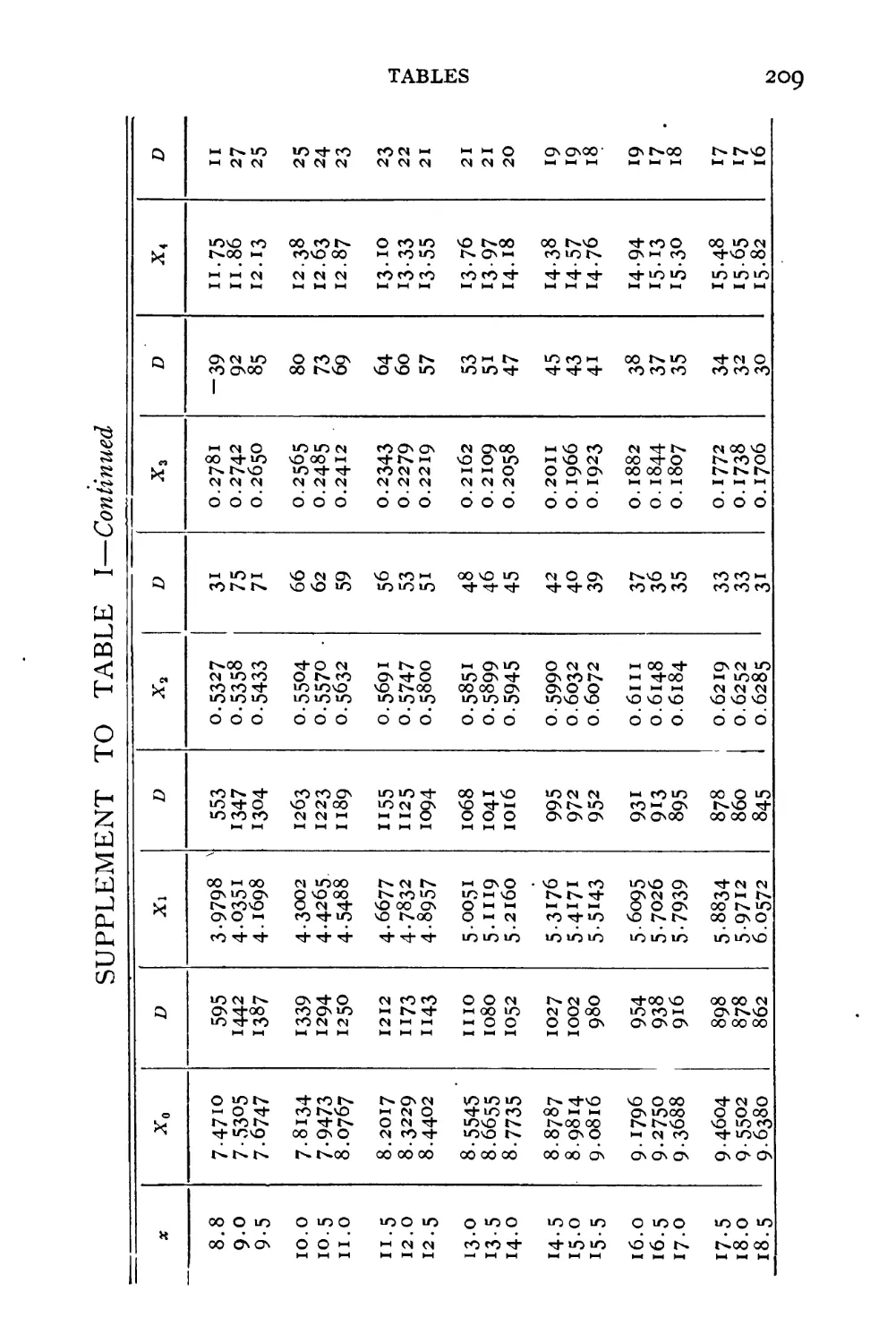
putations a supplemental table of the X functions has been
added to Table I, omitting the function X5, which is not used in
Captain Hardcastle’s method.
This work was prepared primarily for the officers of our
Coast Artillery Corps; but it is hoped that gun-designers and
powder-manufacturers may find in it something useful to them.
The author desires to express his indebtedness to Lieut.-
Colonel Ormand M. Lissak and Major Edward P. O’Hem of
the Ordnance Department for valuable suggestions and for
data employed in the “applications.” Also to Captains Ennis
and Bryant, for assistance in computing Table I.
Providence, R. I.,
September 20, 1911.
TABLE OF CONTENTS f
CHAPTER I
PAGE
Definition and object.—Early history of gunpowder. Robins’ experi-
ments and deductions. Hutton’s experiments. D’Arcy’s method.
Rumford’s experiments with fired gunpowder. Rodman’s inventions
and experiments. Modern explosives. Density of powder. Inflam-
mation and combustion of a grain of powder. Inflammation and
combustion of a charge of powder............i	to 14
CHAPTER II
Properties of perfect gases.—Marriotte’s law. Specific volume. Specific
weight. Law of Gay-Lussac. Characteristic equation of the gaseous
state. Thermal units. Mechanical equivalent of heat. Specific heat.
Specific heat of a gas under constant pressure. Specific heat under
constant volume. Numerical value of R for atmospheric air. Law of
Dulong and Petit. Determination of specific heats. Ratio of specific
heats. Relations between heat and work in the expansion of a per-
fect gas. Isothermal expansion. Adiabatic expansion. Law of tem-
peratures. Law of pressures and volumes. Examples. Theoretical
work of an adiabatic expansion in the bore of a gun. Noble and
Abel’s researches on fired gunpowder in close vessels. Description
of apparatus employed. Summary of results. Pressure in close ves-
sels deduced from theoretical considerations. Value of the ratio of
the non-gaseous products to the volume of the charge. Determina-
tion of the force of the powder, and its interpretation. Theoretical
determination of the temperature of explosion of gunpowder. Mean
specific heat of the products of combustion. Pressure in the bore
of a gun derived from theoretical considerations. Table of pressures.
Theoretical work effected by gunpowder. Factor of effect. Actual
work realized as expressed by muzzle energy........15 to 54
CHAPTER HI
Combustion of a grain of powder under constant atmospheric pressure.—
Notation. Definition of the vanishing surface. General expression
for the burning surface of a grain of powder. Expression for the
vii
viii
TABLE OF CONTENTS
PAGE
volume consumed in terms of the thickness burned. Definition of the
form characteristics. Fraction of grain burned. Applications.
Spheres. Cubes. Strips. Solid cylinders. Pierced cylinders.
Multiperforated grains. General expression for surface of combus-
tion of multiperforated grains. Maximum surface of combustion.
Slivers. Expression for volume of slivers. Proposed ratio of dimen-
sions of multiperforated grains to web thickness. Expression for
weight of charge burned at any instant. Expressions for initial
volume and surface of combustion of a charge of powder. Expression
for specific gravity of grain. Initial surface of unit weight of powder.
Volume of charge. Gravimetric density. Density of loading.
Reduced length of initial air space. Working formulas for English and
metric units. Examples...............................................55	to 78
CHAPTER IV
Combustion and work of a charge of powder in a gun.—Introductory
remarks. Sarrau’s law of burning under a variable pressure and
reason for adopting it. Expression connecting the velocity of
burning of grain with velocity of projectile in bore. Expression for
fraction of charge burned in terms of volumes of expansion of the
gases generated. Expression for velocity of projectile while powder
is burning. Velocity of projectile after powder is all burned. Pres-
sure on base of projectile while powder is burning. Pressure after
powder is burned. Expression for the initial pressure upon the sup-
position that the powder was all burned before the projectile had
moved from its seat, and the relation of this pressure to the force
of the powder. Method of computing the X functions. Special
formulas. Expressions for maximum pressure. Formula for velocity
of combustion under atmospheric pressure. Working formulas. Eng-
lish units. Metric units. Characteristics of a powder. Expressions
for constants in terms of the characteristics for English and metric
units. Expressions for force of powder when weights of charge
and projectile vary..................................79	to 97
CHAPTER V
Applications.—Formulas which apply only while powder is burning. For-
mulas which apply only after powder is all burned. Formulas which
apply at instant of complete combustion. Discontinuity of pressure
curve for certain forms of grain. Monomial formulas for velocity
and pressure. Typical pressure and velocity curves. Example of
TABLE OF CONTENTS
ix
PAGE
monomial formulas, as applied to the 8-inch B. L. R. Comparison
of computed velocities and maximum pressures with observed values.
Determination of travel of projectile at point of maximum pressure,
and also when powder is all burned. Expression for fraction of
charge burned for any travel of projectile. Examples. Greatest
efficiency when charge is all consumed at muzzle. Application to
hypothetical 7-inch gun. Binomial formulas for velocity and pressure.
Forms of grain for which binomial formulas must be employed.
Methods for determining the constants from experimental firing.
Applications to Sir Andrew Noble’s experiments with a 6-inch gun.
Description of the experiments. Discussion of the data for cordite,
0.4", 0.35", and 0.3" diameter. Remarks on the so-called “force of
the powder” as deduced from the calculations. Examples. Applica-
tion to the Hotchkiss 57-mm. rapid-firing gun. Data obtained by
D’Arcy’s method. New method for determining the form char-
acteristics of the grains. Application to the magazine rifle, model of
1903. Powder characteristics. Formulas for designing guns for
cordite, with application to a hypothetical 7-inch gun. Trinomial
formulas. Grains for which these formulas are necessary. Spherical
and cubical grains. Formulas for computing the constants. Ap-
plication to Noble’s experiments with ballistite in a 6-inch gun.
Table of computed velocities and pressures. Remarks on the
velocity and pressure curves. Examples. Multiperforated grains.
Special formulas required for these grains. Discussion of the data
obtained by the Ordnance Board with the 6-inch Brown wire gun.
Remarks on the discontinuity of the pressure curves. Examples.
Superiority of uniperforated to multiperforated grains. Application
to the 14-inch rifle. Effect of increasing the volume of the chamber
upon the maximum pressure. Better results can be obtained by
lengthening the powder grains. Table of pressures. .	.	. 9810169
CHAPTER VI
On the rifling of cannon.—Advantages of rifling. The developed groove.
Uniform twist. Increasing twist. General expression for pressure
on the lands. Angular acceleration. Pressure for uniform twist.
Increasing twist. Semi-cubical parabola. Common parabola. Rel-
ative width of grooves and lands. Application to the 10-inch
В» L. R., model of 1888. Application to the 14-inch gun. Retarding
effect of a uniform twist of one turn in twenty-five calibers. . 170 to 186
Tables ........................................................189	to 215

INTERIOR BALLISTICS
CHAPTER I
INTRODUCTION
Definition and Object.—Interior ballistics treats of the^
formation, temperature and volume of the gases into which the
powder charge, in the chamber of a gun, is converted by com-
bustion, and the work performed by the expansion of these
gases upon the gun, carriage and projectile. Its object is the
deduction and discussion of rules and formulas for calculating
the velocity, both of translation and of rotation, which the '
gases of a given weight of powder of known composition and
quality are able to impart to a projectile and their reaction
upon the gun and carriage. The discussion of the formulas
deduced will bring out many important questions, such as the
proper relation of weight of charge to weight of projectile and
length of bore, the best size and shape of the powder grains for
different guns and their effect upon the maximum and muzzle^
pressures, the velocity of recoil, etc. The most approved
formulas for calculating the pressures upon the surface *of the
bore will be given; but the methods which have been devised
for building up the gun, so as best to resist these pressures, will
not be entered upon here as their consideration belongs to
another branch of the subject.
Early History of Interior Ballistics.—For more than five
hundred years gunpowder—an intimate mixture of nitre,
sulphur and charcoal,—was used almost exclusively as the pro-
i
2
INTERIOR BALLISTICS
pelling agent in firearms; and though it has been entirely
superseded within the last quarter of a century by gun-cotton,
nitro-glycerine, and their various compounds, yet it possessed
many admirable qualities which the modern powders do not
as yet so fully enjoy. It ignited easily without deflagration;
its effects were regular and sure; its manufacture was economical,
rapid and comparatively safe; it produced but little erosion
in the bore. Finally, it kept well in transportation, and in-
definitely in properly ventilated magazines. It is on record
that experiments made with gunpowder, manufactured more
than two centuries before, showed that it had lost none of its
ballistic qualities. The principal objection to gunpowder, as
compared to nitrocellulose powders, are the dense volumes of
smoke accompanying its explosion, the fouling of the bore,
and the comparatively large charges required to give the
desired muzzle velocity, necessitating an abnormal enlarge-
ment of the powder chamber or an impracticable lengthening
of the gun.
Robins’ Experiments and Deductions.—The celebrated Ben-
jamin Robins seems to have been the first investigator who had a
tolerably correct idea of the circumstances relating to the action
and force of fired gunpowder. In a paper which was read before
the Royal Society in 1743 entitled, “New principles of gunnery,”
Robins described among other things some experiments he had
made for determining the velocities of musket balls when fired
with given charges of powder. These velocities were measured
by means of the ballistic pendulum invented by Robins, “the
idea of which is simply that the ball is discharged into a very
large but movable block of wood, whose small velocity, in conse-
quence of that blow, can be easily observed and accurately
measured. Then, from this small velocity thus obtained, the
large one of the ball is immediately derived from this simple
proportion, viz., as the weight of the ball is to the sum of the
weights of the ball and the block, so is the observed velocity of
INTRODUCTION
3
the last to a fourth proportional, which is the velocity of the ball
sought.” *
The deductions which Robins makes from these experiments,
so far as they relate to interior ballistics, may be summarized
as follows:
(i)	Gunpowder fired either in a vacuum or in air produces,
by its combustion, a permanent elastic fluid or air.
(2)	The pressure exerted by this fluid is, caleris paribus,
directly as its density.
(3)	The elasticity of the fluid is increased by the heat it
has at the time of explosion.
(4)	The temperature of the fluid at the moment of combus-
tion is at least equal to that of red-hot iron.
(5)	The maximum pressure exerted by the fluid is equal to
about 1,000 atmospheres.
(6)	The weight of the permanent elastic fluid disengaged by
the combustion is about three-tenths that of the powder, and its
volume at ordinary atmospheric temperature and pressure is
about 240 times that occupied by the charge.
These deductions, considering the extremely erroneous and
often absurd opinions that were entertained by those who
thought upon the subject at all in Robins’ time—and even down
to the close of the century—show that Robins is well entitled
to be called the “father of modern gunnery.”
Hutton’s Experiments.—Dr. Charles Hutton, professor of
mathematics in the Royal Military Academy, Woolwich, con-
tinued Robins’ experiments at intervals from 1773 to 1791. He
improved and greatly enlarged the ballistic pendulum so that
it could receive the impact of 1-pound balls, whereas that used
by Robins was adapted for musket balls only. Hutton’s
experiments are given in detail in his thirty-fourth, thirty-fifth,
thirty-sixth, and thirty-seventh tracts. They verify most of
* Hutton’s “ Mathematical Tracts,” vol. 3, p. 210 (Tract 37), London, 1812.
4
INTERIOR BALLISTICS
Robins’ deductions, but with regard to Robins’ estimate of the
temperature of combustion and the maximum pressure Hutton
says: “This was merely guessing at the degree of heat in the
inflamed fluid, and, consequently, of its first strength, both
which in fact are found to be much greater.” * His own estimate
of the temperature is double that of Robins, and he places the
maximum pressure of fired gunpowder at 2,000 atmospheres.
Hutton gives a formula for the velocity of a spherical projectile
at any point of the bore, upon the assumption that the combus-
tion of the charge is instantaneous and that the expansion of
the gas follows Mariotte’s law—no account being taken of the
loss of heat due to work performed—a principle which at that
time was unknown.
D’Arcy’s Method.—In 1760 the chevalier D’Arcy sought to
determine the law of pressure of the gas in the bore of a musket
by measuring the velocity of the projectile at different points
of the bore. This he accomplished by successively shortening
the length of the barrel and measuring for each length the velocity
of the bullet by means of a ballistic pendulum. Having obtained
from these experiments the velocities of the bullets for several
different lengths of travel, the corresponding accelerations could
be calculated, and then the pressures, by multiplying the
accelerations by the mass. This was the first attempt to
determine the law of pressures dynamically.
Rumford’s Experiments with Fired Gunpowder.—The first
attempt to measure directly the pressure of fired gunpowder
was made, in 1792, by our countryman, the celebrated Count
Rumford. A most interesting account of his experiments is
given in his memoir entitled “Experiments to determine the
force of fired gunpowder,” f which must be regarded as the most
important contribution to interior ballistics which had been
* Tracts, vol. 3, p. 211.
t Philosophical Transactions, London, 1797, p*. 222; also “The Complete
Works of Count Rumford,” Boston, 1870, vol. 1, p. 98.
INTRODUCTION
5
made up to that time. The apparatus used by Rumford con-
sisted of a small and very strong wrought-iron mortar (or
eprouvette), which rested with its axis vertical upon a solid
stone foundation. This mortar (or barrel, as Rumford calls it),
was 2.78 inches long and 2.82 inches in diameter at its lower
extremity and tapered slightly toward the muzzle. The bore
(or chamber) was cylindrical, one-fourth of an inch in diameter
and 2.13 inches deep. At the centre of the bottom of the barrel
there was a projection 0.45 inch in diameter and 1.3 inches long,
having an axial bore 0.07 inch in diameter connecting with the
chamber above, but closed below, forming a sort of vent, but
having no opening outside.
By this arrangement the charge could be fired without any
loss of gas through the vent by the application of a red-hot
ball provided with a hole, into which the projecting vent-tube
could be inserted, which latter would thus become in a short
time sufficiently heated to ignite the powder. The upper part
of the bore or muzzle was closed by a stopper made of compact,
well-greased sole leather, which was forced into the bore, until
its upper surface was flush with the face of the mortar, and upon
this was placed the plane surface of a solid hemisphere of hard-
ened steel,, whose diameter was 1.16 inches. 11 Upon this
hemisphere the weight made use of for confining the elastic
fluid generated from the powder in its combustion reposed.
This weight in all the experiments, except those which were
made with very small charges of powder, was a piece of ordnance
of greater or less dimensions or greater or less weight, according
to the force of the charge, placed vertically upon its cascabel
upon the steel hemisphere which closed the end of the barrel;
and the same piece of ordnance, by having its bore filled by a
greater or smaller number of bullets, as the occasion required,
was made to serve for several experiments.” *
* Rumford’s Works, vol. 1. p. 121.
A
6
INTERIOR BALLISTICS
As one of the objects of Rumford’s experiments was to
determine the relation between the pressure of the powder gases
and their density, he varied the charge, beginning with i grain,
and for each charge placed a weight, which he judged was about
equivalent to the resulting pressure, upon the hemisphere. If,
on firing, the weight was lifted sufficiently to allow the gases to
escape, it was increased for another equal charge; and this was
repeated until a weight was found just sufficient to retain the
gaseous products—that is, so that the leathern stopper would
not be thrown out of the bore, but only slightly lifted. The
density of the powder gases could easily be determined by
comparing the weight of the charge with the weight of powder
required to completely fill the chamber and vent, which latter
was about 25^ grains troy. Rumford increased the charges a
grain at a time from 1 grain to 18 grains, and from a mean of
all the observed pressures he deduced the empirical formula,
p = 1.841X 1+‘OOO4X,
in which p is the pressure in atmospheres and x the density of
loading to a scale of 1000—that is, for a full chamber x = 1000;
for one-half full x = 500, and so on. This formula gives
29,178 atmospheres for the maximum pressure—that is, when
the powder entirely fills the space in which it is fired. In this
case the value of x is 1000, and Rumford’s pressure formula
becomes
p = 1.841 X 1000 1,4 = 29178
Nearly a century later Noble and Abel (see Chapter II)
found by their experiments, which are entirely similar in charac-
ter to those of Rumford, that the maximum pressure of fired
gunpowder is but 6,554 atmospheres, or 43 tons per square inch;
and this result has been accepted by all writers on interior
INTRODUCTION
7
ballistics as being very near the truth. Their formula for the
pressure in terms of Rumford’s x is
2.818л;
p =--------------
r i —0.00057л;
in which p and x are defined as before. If in this formula we
make x = 1000, we have, as already stated,
2.818 X 1000
~	1 — 0.57	~~ 554
For small densities of loading, Noble and Abel’s formula
gives greater pressures than Rumford’s principally because the
powder used by the later investigators was the stronger; but
as the densities increase this is reversed. With a charge of 18
grains, for which x = 702, Noble and Abel’s formula gives a
pressure of 3,298 atmospheres, while Rumford’s gives 8,140
atmospheres. To enable us to understand the cause of this
great difference in the results obtained by these eminent savants
(which is very instructive), we will go a little into detail. Two
experiments were made by Rumford with a charge of 18 grains
of powder. In the first of these a 24-pounder gun, weighing
8,081 pounds, was placed vertically on its cascabel upon the
steel hemisphere closing the muzzle of the barrel. When the
charge was fired “the weight was raised with a very sharp
report, louder than that of a well-loaded musket.” The barrel
was again loaded with 18 grains as before, and enough shot were
placed in the bore of the 24-pounder gun to increase its weight
to 8,700 pounds. Upon firing the powder by applying the
red-hot ball “the vent-tube of the barrel was burst, the explosion
being attended with a very loud report.” These experiments
were the eighty-fourth and eighty-fifth, and closed the series.
In the eighty-fourth experiment a weight of 8,081 pounds
was actually raised by the explosion of 18 grains of powder
(about one-fourth the service charge of the Springfield rifle),
8
INTERIOR BALLISTICS
acting upon a circular area one-quarter of an inch in diameter.
To raise this weight under the circumstances would require a
pressure of more than 11,200 atmospheres, while, as we have
seen, the actual pressure due to this density of loading, according
to Noble and Abel’s formula, is but 3,298 atmospheres. Evident-
ly then the weight in this experiment was not raised by mere
pressure; but we must attribute a great part of the observed
effect (in consequence of the position of the charge at the bottom
of the bore) to the energy with which the products of combustion
impinged against the leathern stopper, which had only to be
raised 0.13 inch (the thickness of the leather) to allow the gases
to escape. In Noble and Abel’s experiments there was no such
blow from the products of combustion because the apparatus
for determining the pressure (crusher gauge) was placed within
the charge. Had the leathern stopper in Rumford’s experiments
been a little longer, it is probable that his conclusions would
have been entirely different.
Rodman’s Inventions and Experiments.—We have space
only to mention the names of Gay-Lussac, Chevreul, Graham,
Piobert, Cavalli, Mayevski, Otto, Neumann, and others, who
did original work, of more or less value, for the science of interior
ballistics prior to the year i860. We will, however, dwell a
few moments on the important work done by Captain (after-
wards General) T. J. Rodman, of our own Ordnance Department,
between the years 1857 and 1861.* The objects of Rodman’s
experiments were: First, to ascertain the pressure exerted
upon different points of the bore of a 42-pounder gun in firing
under various circumstances. Second, to determine the press-
ures in the 7-inch, 9-inch, and 11-inch guns when the charges •
of powder and the weight of projectiles were so proportioned
that there should be the same weight of powder behind, and
* “ Experiments on Metal and Cannon and Qualities of Cannon Powder/’
by Captain T. J. Rodman, Boston, 1861.
INTRODUCTION
9
the same weight of metal in front of each square inch of area
of cross-section of the bore. Third, to determine the differences
in pressure and muzzle velocity due to the variations in the
size of the powder grains; and, fourth, to determine the pressures
exerted by gunpowder burned in a close vessel for different
densities of loading.
For the purpose of carrying out these experiments Rodman,
instead of using the system of varying weights employed by
Rumford, invented what he called the “indenting apparatus,”
which has since been extensively used, not only in this country
but in all foreign countries, under the name of Rodman’s pressure
(or cutter) gauge; and which is too well known to require a
description.
The maximum pressure of gunpowder when exploded in its
own space, as determined by Rodman by the bursting of shells
filled with powder, ranged from 4,900 to 12,600 atmospheres;
the mean of all the experiments giving 8,070 atmospheres, or
53 tons per square inch. These results, though much nearer the
truth than those deduced by Rumford, are still about 25 per
cent, greater than Noble and Abel’s deductions; and this is
undoubtedly due to the position of the pressure gauge, which
was placed near the exterior surface of the shell, so that when
the products of combustion had reached the gauge they had
acquired a considerable energy which probably exaggerated the
real pressure. The same causes, it will be remembered, vitiated
Rumford’s experiments. In both cases it was as if a charge of
small shot had been fired with great veracity against the leathern
stopper in the one case, or the end of the piston of the indenting
tool in the other.	_
General Rodman was the first person to suggest the proper
shape for powder grains, in order to diminish the initial velocity
of emission of gas and to more nearly equalize the pressure in
the bore of the gun.' For this purpose he employed what he
termed a “perforated cake cartridge” composed of disks of
IO
INTERIOR BALLISTICS
compressed powder from i to 2 inches thick and of a diameter
to fit the bore. Rodman demonstrated that such a form of
cartridge would relieve the initial strain by exposing a minimum
surface at the beginning of combustion, while a greater volume
of gas would be evolved from the increasing surfaces of the
cylindrical perforations as the space behind the projectile be-
came greater; and this would tend to distribute the pressure
more uniformly along the bore. Rodman’s experiments with
this powder in the 15-inch cast-iron gun which he had recently
constructed for the government—and which is without doubt the
most effective and the best smooth-bore gun ever made—fully
confirmed his theory; but for many reasons he found it more
convenient and equally satisfactory to build up the charge by
layers of pierced hexagonal prisms about an inch in diameter
fitting closely to one another, instead of having them of the
diameter of the bore.
The war of the rebellion which was inaugurated while
General Rodman was in the midst of his discoveries and in-
ventions, put an end forever to his investigations, but his ideas
were speedily adopted in Europe, and his “prismatic powders,”
but slightly modified, are extensively used.
Modem Explosives.—Gun-cotton, made by immersing
cleaned and dried cotton waste in a mixture of strong nitric and
sulphuric acids, was discovered by Schonbein of Basel, in 1846,
who immediately proposed to employ it as a substitute for
gunpowder. General von Lenk made many experiments with
gun-cotton by compressing it into cubes or cylinders, with the
idea of employing it for artillery use. But all his efforts failed
from the fact that, no matter how much it was compressed, it
was still mechanically porous; and when ignited in a gun the
flame and hot gases speedily penetrated the mass causing it to
detonate, or, at least, to approach dangerously near to detona-
tion. It was not until the discovery in the early eighties that
gun-cotton could be dissolved or made into a paste, or colloid,
INTRODUCTION
II
by acetone and other so-called solvents, that it was possible to
employ it as a propellant. In this condition, when moulded
into grains and thoroughly dried, it loses its mechanical porosity
and burns from the surface in parallel layers, the grain retaining
4its original form until completely consumed.
Gun-cotton is mixed in certain proportions with nitro-
glycerine to form nearly all the powders employed for war
purposes. For example, the powder used in the British army
and navy (called cordite), consists of 65 per cent, of gun-cot-
ton, 30 per cent, of nitro-glycerine and 5 per cent, of mineral
jelly or vaseline, this latter being used as a preservative. This
is also very nearly the composition of the powder used in the
United States army and navy. For a full account of the
properties, manufacture and uses of gun-cotton and nitro-
glycerine, the reader is referred to General Weaver’s u Notes
on Explosives.”
Density of Powder.—By density of a powder is meant its
specific gravity, or the ratio of the weight of a given volume of
the powder to the weight of an equal volume of water at the
standard temperature. It is sometimes referred to as mercurial
density, since it may be determined by an apparatus which
utilizes the property of mercury of filling the interstices between
the grains without penetrating into the pores or uniting chemi-
cally with the powder. The density varies somewhat according
to the pressure to which the grains were subjected during the
manufacture and ranges from about 1.56 to 1.65.
Inflammation and Combustion of a Grain of Powder.—
Inflammation is the spreading of the flame over the free surface
of the grain from the point of ignition. Combustion is the
propagation of the burning into the interior of the grain. Igni-
tion is produced by the sudden elevation of the temperature
of a small portion of the grain to about 1800 C. (in the case of
cordite) either by contact with an ignited body, by mechanical
shock or friction, or by detonation of a fulminate. The velocity
1
12
INTERIOR BALLISTICS
of inflammation depends upon the nature of the source of heat
which ignites it, upon the state of the surface of the grain and
upon its density and dryness. The combustion of a grain takes
place in successive concentric layers, and in free air equal
thicknesses are burned in equal times. As the mass of gas
disengaged in any given time is proportional to the quantity of
powder burned during the same time, and, therefore, propor-
tional to the surface of inflammation, it follows that the emission
of gas is largely influenced by the form of the grain. For
example, if the grain is spherical the surface of inflammation
decreases rapidly up to the end of its burning where it is zero.
On the other hand, the surface of inflammation (or of combus-
tion) of a multi-perforated grain increases until it is nearly
consumed.
Inflammation and Combustion of a Charge of Powder.—
The inflammation of a charge of powder involves the trans-
mission of the flame from one grain to another. Its velocity
depends not only upon the inflammability of the grain but also
upon the facility with which the gases first generated are able to
penetrate the charge. This is assisted by a proper arrangement
of the grains composing the charge and also by placing an igniter
of fine rifle powder at each end of the cartridge. The com-
bustion of a charge composed of grains of the same form and
dimensions should, from what has been said, practically termi-
nate at the same time with each or any grain; and, therefore,
the time of combustion of a charge increases with the size of the
grains, and is in all cases with service powders much longer than
the time of inflammation.
If a charge of powder be confined in a close vessel and ignited,
its combustion takes place silently, and permanent gases and a
certain amount of solid matter are produced which can be
collected for analysis by opening the vessel, as in the experiments
of Noble and Abel described in Chapter II. In this case no
work is performed by the gases, and the accompanying phe-
INTRODUCTION
13
nomena are comparatively simple. But if the combustion takes
place in a chamber of which one of the walls is capable of moving
under the tension of the gases, which condition is realized in
cannon, the resulting phenomena are much more complicated,
as a little consideration will show.
When the charge of powder in the chamber of a loaded gun
is ignited at both ends of the cartridge, all the grains will be
inflamed practically simultaneously. The first gaseous products
formed will expand into the air-spaces of the chamber and
almost immediately acquire a tension sufficient to start and
overcome the forcing of the projectile. This latter once in
motion will encounter no resistances in the bore comparable with
those which opposed its start, and its velocity will rapidly in-
crease under the continued action of the pressure of the gases.
This pressure will also increase at first; for, though the displace-
ment of the projectile gives a greater space for the expanding
gases, this is more than compensated for by a more abundant
disengagement of gas. But the pressure soon reaches its
maximum; for if, on the one hand, the disengagement of gas
is accelerated by the increase of pressure, on the other hand the
increasing velocity of the projectile offers more and more space
for the gases to expand in. The velocity itself would soon
reach a maximum if the bore were sufficiently prolonged; for
in addition to the friction and the resistance of the air, both of
which retard the motion of the projectile, the propulsive force
decreases by the expansion and cooling of the gases. Therefore
the retarding forces will in time predominate and the projectile
be brought to rest. Its velocity starting from zero passes to its
maximum and if the gun terminated at this point the projectile
would leave the bore with the greatest velocity the charge was
capable of communicating to it.
So far only charges in general have been considered. Take,
now, a charge composed of small grains of slight density. The
initial surface of inflammation will be very great and the emission
14
INTERIOR BALLISTICS
of gas correspondingly abundant. The pressure will increase
rapidly, and, in consequence, the velocity of combustion. It
results from this that the grains will be consumed nearly as soon
as inflamed, and this before the projectile has had time to be
displaced by a sensible amount. Hence all the gases of the
charge, disengaged almost instantaneously, will be confined an
instant within the chamber; their tension will be very great,
and they will exert upon the walls of the gun a sudden and violent
force which may rupture the metal, and which in all cases will
produce upon the gun and carriage shocks which are destructive
to the system and prejudicial to accuracy of fire. On the other
hand the projectile will be thrown quickly forward, as by a
blow from a hammer.
If, on the contrary, the charge is made up of large grains of
great density, the total weight of gas emitted will be the same as
before; but the mode of emission will be different. The initial
surface of inflammation will be less, and the initial tension of the
gas not so great. The combustion will take place more slowly,
and will be only partially completed when the projectile shall
have begun to move. The pressure of the gases will attain a
maximum less than in the preceding case, but the pressure will
decrease more slowly. Under the continued action of this
pressure, the velocity of the projectile will be rapidly accelerated
and at the muzzle will differ but little from that obtained by the
fine powder, without producing upon the gun and carriage the
destructive effects mentioned above.
CHAPTER II
PROPERTIES OF PERFECT GASES
Mariotte’s Law.—When a mass of gas is subjected to pressure
the volume diminishes until the increased tension just balances
the pressure; and it was found by experiment that if the tem-
perature of the gas remains constant, the tension, or pressure,
is inversely proportional to the volume. Thus, if and v2
represent different volumes of the same mass of gas and pi and
p2 the corresponding tensions, or pressures, then if the tem-
perature is the same for both volumes we have the proportion:
i i
^1-^2 — ~t~ ' ~r~
Pl P2
Hence
pi = ^2 p2 = constant.
That is, for every mass of gas at invariable temperature the
product of the volume and tension is constant. This law is
generally called Mariotte’s law, though it was first discovered
by the English chemist Robert Boyle, in 1662, and verified by
Mariotte in 1679.
Specific Volume.—The specific volume of a gas is the volume
of unit weight at zero temperature and under the normal atmos-
pheric pressure. Designate the specific volume by vo and the
normal atmospheric pressure by po. Then we have by Mariotte’s
law
v p = vo po .
Specific Weight.—The specific weight of a gas is the weight
of unit volume at zero temperature and under the pressure p0.
It is therefore the reciprocal of the specific volume vo.
15
INTERIOR BALLISTICS
l6
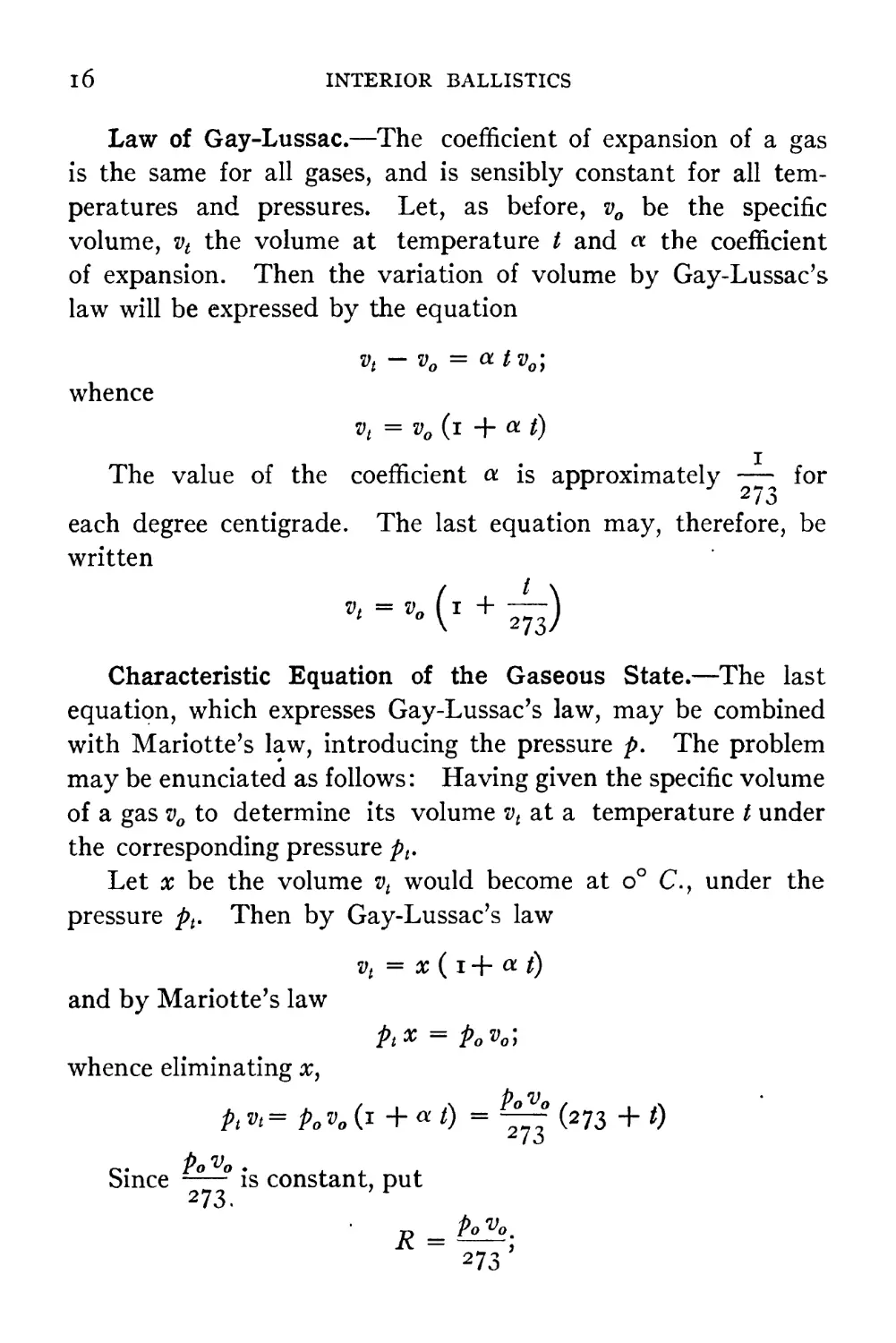
Law of Gay-Lussac.—The coefficient of expansion of a gas
is the same for all gases, and is sensibly constant for all tem-
peratures and pressures. Let, as before, vo be the specific
volume, vt the volume at temperature t and «the coefficient
of expansion. Then the variation of volume by Gay-Lussac’s
law will be expressed by the equation
vt- vo = al K',
whence
(l + “ t)
The value of the coefficient « is approximately for
each degree centigrade. The last equation may, therefore, be
written
°- +
Characteristic Equation of the Gaseous State.—The last
equation, which expresses Gay-Lussac’s law, may be combined
with Mariotte’s law, introducing the pressure p. The problem
may be enunciated as follows: Having given the specific volume
of a gas vo to determine its volume vt at a temperature t under
the corresponding pressure pt.
Let x be the volume vt would become at o° C., under the
pressure pt. Then by Gay-Lussac’s law
4)t = x (i + a i)
and by Mariotte’s law
Pt% Po
whence eliminating x,
Pi v,= poVo (l + a Z) =	(273 + Z)
z I О
c. Po	,
Since ---- is constant, put
273.
PROPERTIES OF PERFECT GASES
17
whence
P^t = R (273 + /);
or, dropping the subscripts as no longer necessary,
pv = R (273 + Z)
The temperature (273 + Z) is called the absolute tempera-
ture, and is reckoned from a zero placed 273 degrees below the
zero of the centigrade scale. Calling the absolute temperature
T there results finally
pv = RT .........................(j)
which is called the characteristic equation of the gaseous.state.
It is simply another expression of Mariotte’s law in which the
temperature of the gas is introduced.
Equation (1) expresses the relation existing between the
pressure, volume and absolute temperature of a unit weight of
gas. For any number у units of weight occupying the same
volume v the relation evidently becomes
pv = у RT........................(2)
A gas supposed to obey exactly the law expressed in equation
(1) is called a perfect gas, or is said to be theoretically in the
perfectly gaseous state. This condition represents an ideal
toward which gases approach more nearly as their state of
rarefaction increases. Of all gases, hydrogen approximates
most closely to such an hypothetical substance, though at
ordinary temperatures the simple gases, nitrogen, oxygen and
atmospheric air, may for most practical purposes be considered
perfect gases.
Thermal Unit.—The heat required to raise the temperature
of unit weight of water at the freezing point one degree of the
thermometer is called a thermal unit. There are two thermal
units in general use, namely: the British thermal unit (В. T. U.),
which is the heat required to raise the temperature of one pound
2
i8
INTERIOR BALLISTICS
of water from 320 F. to 330 F.; and the French thermal unit
(called a calorie), which is the heat required to raise the tem-
perature of one kilogram of water from o° C. to i° C. There
is still another thermal unit of frequent use, namely: the heat
required to raise the temperature of one pound of water from
o° C. to i° C., and which may be designated as the pound-
centigrade (P. C.) unit.
Mechanical Equivalent of Heat.—The mechanical equivalent
of heat is the work equivalent of a thermal unit, and will be
designated by E. According to Rowland the value of E is
778 foot-pounds for а В. T. U. Since a degree of the centi-
grade scale is of a degree of the Fahrenheit scale, we have
for a P. C. thermal unit, E = -у X 778 = 1400.4 foot-pounds.
Also since there are 3.280869 feet in a metre, the value of E for
a calorie is
1400.4
—o—o> • = 426.84 kilogram-metres.
3.280869 т	&
Specific Heat.—The quantity of heat, expressed in thermal
units, which must be imparted to a unit weight of any sub-
stance to increase its temperature one degree of the thermometer,
or the quantity of heat given up by the substance while its
temperature is lowered one degree, is called its specific heat.
The specific heat of different substances varies greatly. Thus,
if a pound of meycury and a pound of water receive the same
quantity of heat the temperature of the former will be much
greater that the latter. Indeed, it requires about 32 times as
much heat to raise the temperature of water i° as it does to
raise the temperature of mercury by the same amount.
The heat imparted to a substance is expended in three
different ways: 1. Increasing the temperature, which may
be called vibration work; 2. In doing internal or disgregation
work; 2. In doing external work by expansion. If it were
PROPERTIES OF PERFECT GASES
T9
possible to eliminate the two latter, we should get the true
specific heat, or the heat necessary to increase the temperature
simply. For a perfect gas, however, the disgregation work is
zero, and for all substances the disgregation work is small in
comparison with the vibration work. The specific heat of a
gas may be determined in two different ways, giving results
which are of fundamental importance in thermodynamics,
namely: Specific heat under constant pressure, and specific
heat under constant volume.
Specific Heat of a Gas Under Constant Pressure.—To
fix the ideas suppose a unit weight of gas to be confined in a
spherical envelope capable of expanding without the expenditure
of work and which allows no heat the gas may have to escape,
and to be in equilibrium with the constant pressure of the at-
mosphere. Under these conditions let a certain quantity of
heat be applied to the gas just sufficient to raise its temperature
one degree of the thermometer after it has expanded until
equilibrium is again restored. This quantity of heat, in thermal
units (designated by Cp), is called specific heat under constant
pressure.
Specific Heat Under Constant Volume.—Next repeat the
experiment just described, but replacing the elastic envelope,
which by hypothesis permitted the gas to expand freely, by a
rigid envelope, thus keeping the volume of the gas constant
while heat is applied. It will now be found that there will less
heat be required to raise the temperature of the gas one degree.
The quantity of heat required in this case is called the specific
heat under constant volume, and in terms of the thermal unit
employed, is designated by Cv.
The number of molecules of gas being the same in both
experiments and the temperatures being equal, it follows that
the quantity of heat absorbed by the gas, or the vibration work,
is the same in both experiments. But in the experiment made
under constant volume the heat absorbed is necessarily equal
20
INTERIOR BALLISTICS
to the total heat supplied, namely, Cv thermal units, since the
envelope is considered impermeable to heat. Therefore in the
first experiment there is a loss of heat equal to Cp — Cv thermal
units. This last heat must then have been expended in over-
coming the atmospheric pressure in expanding; and the work
done will be found by multiplying Cp — Cv by the mechanical
equivalent of heat. That is, for an increase of one degree of
temperature,
Work of expansion = (Cp — Cv) E.
The work of overcoming a constant resistance is measured
by the product of the resistance into the path described. In
the case of the expanding gas just considered the constant re-
sistance is the atmospheric resistance po; and the path described
is measured by the increase of volume of the gas. To determine
this latter Gay-Lussac’s law gives for the centigrade scale
/ vo
Vt — V = ----
° m
and therefore for an increase of temperature of one degree there
is an increase of volume equal to 2^/273. The work of expansion
for one degree is, therefore,
•	t^-R.
273
The quantity R is, then, the external work of expansion
performed under atmospheric pressure by unit weight of gas
when its temperature is raised one degree centigrade. But
thfc work of expansion has already been found equal to (Cp — Cr)
E. There results, therefore, the important equation
(Cp - C,) E =	= R
for the centigrade scale of temperature. For the Fahrenheit
scale the equation becomes
(Cp - C„) E =
v p	491.4
• . (з)
•  (з1)
PROPERTIES OF PERFECT GASES
21
Numerical Value of R.—The numerical value of R for any
particular gas depends upon the units of length and weight
adopted, the atmospheric pressure, the specific weight of the
gas and the scale of temperature. Throughout this chapter
the foot and pound will be employed for the units of length and
weight, respectively; and generally the centigrade scale of
temperature will be used. The adopted value of the atmos-
pheric pressure is
po = 10333 kgs. per m.2 log = 4-01423-
p0 = 2116.3 lbs. per ft.2 log = 3.32558.
p0 = 14.6967 lbs. per in.2 log = 1.16722.
As an example, find the numerical value of R for atmospheric
air. The specific weight of this gas, according to the best
authorities, is 0.080704 lbs. The specific volume is the recip-
rocal of this; or Vo = 12.3909 c. ft. Therefore,
2116.3 X 12.3909
R =-------------------= 96.056 foot-pounds.
273
Therefore, for one pound of this gas,
pv = 96.056 T;
and for у pounds
pv = 96.056 у T.
Law of Dulong and Petit.—The product of the specific heat
of a perfect gas under constant volume, by its density, is a constant
number.
By the density of a gas is meant its specific weight expressed
in terms of the specific weight of atmospheric air taken as unity.
If Cva is the specific heat of air at constant volume and Cv and d
the specific heat at constant volume, and density, respectively,
of any other gas, then in accordance with this law,
Cvd = Cva.
Determination of Specific Heats.—The specific volume
and the specific heat at constant pressure of a gas can both be
22
INTERIOR BALLISTICS
determined with great accuracy by experiment; but the specific
heat under constant volume is almost impossible to measure
directly on account of the dissipation of heat through the sides
of the vessel containing the gas. It can, however, be computed
by equation (3) which gives
== Cp —	.................(4)
By means of this equation and the direct determination of
specific heats under constant pressure, Regnault has deduced
the following law for perfect gases:
The specific heats under constant pressure and constant volume
are independent of the pressure and volume.
The following table gives the specific weights, volumes and
heats of those gases which approximate most nearly to the
theoretically perfect gas. The values of R were computed
by (1) and those of Cv by (4). The temperature is supposed
to be o° C., and the barometer to stand at 760 mm. = 29.922 in.:
Gas	Specific Weight	Specific Volume	R	cp
Atmospheric air	Pounds 0.080704	Cubic Feet 12.3909	96.056	0.23751	0.16892
Nitrogen		O.O78394	12.7569	98.887	0.24380	0.17319
Oxygen		0.089230	11.2070	86.878	0.21751	0.15547
Hydrogen		O.OO559O	1178.89IO	1386.8	3.40900	2.41873
Ratio of Specific Heats.—In the study of interior ballistics
the values of Cp and Cv for the gases given off by the explosion
of the charge are of little importance. It suffices generally to
know their ratio which is constant for perfect gases and approxi-
mately so for all gases at the high temperature of explosion.
That this ratio is constant for perfect gases may be shown as
follows: Since
PROPERTIES OF PERFECT GASES
23
r ___ Po^o Po Po
273 ~ 273	~ ^13 d
in which wa is the specific weight of atmospheric air, we shall
have for two gases distinguished by accents, the relation
Rf d"
R" ~ df ;
that is, the values of R for two perfect gases are inversely as
their densities. But by the law of Dulong and Petit we have
C\> _ £ _ R^
C"v ~ d' ~ R"
Therefore
R'	R"
= tft = constant.
v	v
(as shown above).
Therefore from equation (4),
c-v_
Cv
R
1 + CVE
= constant = n (say).
If we compute n by means of atmospheric air, we shall have
06.056
—7F-------------- = 1.406.
0.16892 X 1400.4
Relations Between Heat and Work in the Expansion of
Perfect Gases.—The relations which exist between the varia-
tions of the volume and pressure of a given weight of gas and
the heat necessary to produce them, may now be determined
from equation (i) as follows: This equation is
pv = RT
and contains three arbitrary variables p, v and T. If we suppose
an element of heat, d q, to be applied to the gas, the temperature
will generally be augmented by an elementary amount d T,
and this may be accomplished in three different ways:
1. The volume may increase by the element dv without
altering the pressure. 2. The pressure may increase by d p
24
INTERIOR BALLISTICS
while the volume remains constant. 3. The volume and
pressure may both vary at the same time. We will consider
each of these cases separately.
1.	Differentiating (1), supposing p constant, we have
dT R ’
and therefore the quantity of heat cotnmunicated to the gas
will be, in thermal units, from the definition of specific heat,
at - CpPdv
d <2 — Op d 1 —
2.	If, the volume v remaining constant, the pressure is
varied by d />, we shall have, proceeding as before,
,	_ Cvvd p
dq = CvdT = ——
3.	If the volume and pressure vary together, the corre-
sponding element of heat will be the sum of the partial variations
given above. That is
(Cp v + Cr г>	. (5)
The differential of (1) is
R d T = p dv + v d p; . .	(6)
whence, eliminating v d p between (5) and (6), there results
d q = Cv d T + P d v  • • (7)
Whence, since Cp, Cv and R are constants for the same gas,
,-C.fdT + ^^fpdT.
The first integral represents the change of temperature and
the second the external work of expansion. Denoting by 7\
and T the initial and final temperatures of the expanding gas
and by W the external work, we have
q = (Л - T) C„ + Cp ~ - W ... (8)
PROPERTIES OF PERFECT GASES
25
Isothermal Expansion.—If we suppose the initial temperature
T\ to remain constant, that is, that just sufficient heat is im-
parted to the gas while it expands to maintain its initial tem-
perature, equation (8) becomes
We see in this case that the quantity of heat absorbed by
the gas is proportional to the external work done. The quantity
r
r _-r is, therefore, the ratio of the effective work of a unit
weight of gas to the quantity of heat absorbed, or the mechanical'
equivalent of heat, E. Therefore
r R
& “ c - c
a result already established by another method.
The work performed, therefore, by the isothermal expansion
of unit weight of gas is given by the equation
W = E q = 1400.4 q foot-pounds, ... (9)
where q is expressed in P. C. thermal units.
The work of an isothermal expansion may also be expressed
in terms of the initial and final volumes or pressures. Thus,
substituting in the general equation of the work of expansion,
W = f p d v,
the value of p from (1) and integrating between the limits 24
and Vj we have
v	v
17 = 7? 7\ loge — =/>! v, loge — . .	. (10)
where v is the greater volume and Vt the less.
Since from (i)
у = Pi
p
26
INTERIOR BALLISTICS
.we also have
W = pl Vi loge у....................(и)
in which is the greater tension and p the less.
The reciprocal of E may be called the heat equivalent of
work, that is, the quantity of heat equivalent to a unit of work.
Therefore from (9), (10) and (11), we have
Ж Pl v. V 1
All 1na h I ’ ’ ' ' (l2
E 1 ge P J
Equations (10) and (11), by inverting the ratios of volumes
or pressures, evidently hold good when the initial volume
and initial tension pr are changed by compression under constant
temperature into the less volume v and greater tension p.
Adiabatic Expansion.—If a gas expands and performs work
in an envelope impermeable to heat, so that it neither receives
nor gives up heat during the expansion, the transformation is
said to be adiabatic. In such an expansion the temperature
and tension of the gas both diminish and the work performed
must be less than for an isothermal expansion, other things
being equal. For an adiabatic expansion, q is zero in (8) and,
therefore, since the temperature diminishes,
R C	1
JF=^T^-(7’1-7’) I
I
= (Ti- Г) • • • • (*3)
n — I 4	7
= CVE (Л- T).
Therefore in an adiabatic expansion the work done is pro-
portional to the fall of temperature.
Next consider equation (7), where, if we make d q zero, it
becomes
o=C,dT + ^fdr,
PROPERTIES OF PERFECT GASES
27
R T
which, by dividing by Cv and replacing p by its value , re-
duces to
dT z . dv
0 = — + (n- 1) —
Integrating between limits, we have
Again, making d q zero in (5), we have
0 = Cp p d v + Cvv d p,
which may be written (dividing by Cv p v)
dv	dp
0= n — + —
v	p
Integrating between limits, we have
Combining (14) and (15) gives the important relations
By means of (16) the work of an adiabatic expansion given
by (13) may be expressed either in terms of the initial and
terminal volumes, or of the initial and terminal pressures. Thus,
since

the last of equations (13) may be written,
/	(	/ IM"-1 / 1
JK = CBEr]JI-	f
-с.гтф- (Apj
(17)
28
INTERIOR BALLISTICS
Examples.
i.	Determine the volume of 5 pounds of oxygen at a pressure
of 50 pounds per square inch by the gauge, and at a temperature
of 6o° C.
The real pressure is gauge pressure plus the atmospheric
pressure = 50 + 14.6967 = 64.6967 lbs. per in.2 Therefore,
p = 144 X 64.6967 lbs. per ft.2 T = 273 + 60 = 3330. R =
86.878. Therefore from (2),
_ 5 X 86.878 X ззз	3
144 X 64.6967 э э '
2.	One pound of atmospheric air occupying a volume of
one cubic foot has a tension of 50,000 lbs. per ft.2 What is its
temperature by the Fahrenheit scale ?
For the centigrade scale we have R = 96.056, v = 1, p =
50,000 and у = 1.
Therefore T =	= 52o.°54 C. = g68.°97 F.
t = 968.97 - 491.4 = 477-°57 f-
3.	A gas-receiver having a volume of 3 cubic feet contains
half a pound of oxygen at 70° F. What is the pressure by the
gauge ?
Here у v = 3, R = 86.876, I = 210 — C., and T = 294^.
~	9
Therefore,
86.876 X 294I
=	~ J4-4 * 697 = 14 876 lbs. per in."
2 x 3 x 144
4. A spherical balloon 20 feet in diameter is to be inflated
with hydrogen at 6o° F., when the barometer stands at 30.2 in.,
so that gas may not be lost on account of expansion when the
PROPERTIES OF PERFECT GASES
29
balloon has risen till the barometer stands at 19.6 in., and the
temperature falls to 40° F. How many pounds and how many
cubic feet of gas are to be run in?
Here v = -y я x ю3 = 4188.8 ft.3
_ .9.6 X ...6-3 _	8 lb5 ft ,
r 29.9215	°
T = 2774 c.
R = 1386.8.
p v
.’. у =	= T5-°92 lbs-
To determine the number of cubic feet of gas run.in, we have
yR T o _
D = ------- = 2827.4 ft.3
P
where
30.2 X 2116.3
p =--------------= 2136.0.
29.9215
Г =	(6° - 32) + 273 = 288f.
5.	“The balloon in which Wellman intends to seek the North
Pole has a capacity of 224,244 cubic feet, and weighs, with its
car and machinery, 6,600 lbs. What will be its lifting capacity
when filled with hydrogen at io° C. and 760 mm. of the ba-
rometer ?” (Lissak’s “ Ordnance and Gunnery,” p. 61.)
The balloon, when inflated, will hold at io° C., 17,458 lbs.
of air and 1,209 lbs. of hydrogen. Its lifting capacity will,
therefore, be 17,458 — (1,209 + 6,600) = 9,649 lbs.
6.	Two pounds of air expand adiabatically from an initial
temperature of 6o° F., and a pressure of 65.3 lbs. per in.2 to a
pressure of 50 lbs. per in.2 Determine the initial and terminal
volumes, the terminal temperature and the external work
done.
30
INTERIOR BALLISTICS
Here pi = 144 X 65.3 = 9403.2; p = 50 X 144 = 7200;
Ti = 288I C.; R = 96.056; у = $. Take n = 1.4
=	= 5-8954 ft.3
n
/7, \ 5
= Vl\p) = 7-J338 ft-3
T = Tt(^-V = 267.37 C. = 481.266 F.
'rr
.*. t = 21.87 F.
W =	(Т,- Г) = 10177 ft.-lbs.
7.	Compute the work of expansion of 2 pounds of air at
temperature ioo° C., which expands adiabatically until it
doubles its volume. Also determine the temperature after
expansion and the ratio of the initial and terminal pressures.
Answers: ' W = 43378 ft.-lbs.
t = i9°.68 C.
P = 0.3789?!.
8.	A mass of air occupying a volume of 3 ft.3 expands adiabati-
cally from an initial temperature of 70° F., and pressure of
85 lbs. per in.2, until external work of 8,000 ft.-lbs. has been
done. Compute the terminal volume, pressure, temperature,
and weight of air.
Answers:	v = 3.768 ft.3
p = 61.78 lbs. per in.2
t = 23°.86 F.
у = 1.3 lbs.
Theoretical Work of an Adiabatic Expansion in the Bore of *
a Gun.—If, in the first of equations (17), we replace Cv E Tt, by
R T
its equal —ft becomes for у pounds of gas
П — I
PROPERTIES OF PERFECT GASES
31
This equation gives the work of у pounds of gas at the initial
temperature 7\, expanding from the initial volume to volume
v. Suppose the mass of gas to occupy the chamber of a gun
with the projectile at its firing seat; and to expand by forcing
the projectile along the bore. In this case zh will be the volume
of the chamber, which is an enlargement of the bore, and is
measured by what is called the reduced length of the chamber;
that is, by the length of a cylinder whose cross-section is the
same as the bore and whose volume is that of the chamber.
If uo is the reduced length required, Vc the volume of the chamber
and d the diameter corresponding to the area of cross-section
of bore, and which on account of the rifling is slightly greater
than the caliber, we evidently have
4Ve
Uo = ^
The variable volume v is the volume of the chamber plus
the volume of the bore in rear of the projectile after it has
moved any distance u; and is, therefore, measured by uo + u.
Therefore the above expression for the work of expansion be-
comes
IF _ iAZif, _
n— I ( \UO -I- U/
There is some uncertainty as to the proper value of n for
the gases of fired powder. As we have seen, the value of this
ratio for perfect gases is approximately 1.4; and it has been
generally assumed that at the high temperature of combustion
of powder the gases formed may be regarded as possessing all
the properties of perfect gases; and therefore most of the earlier
writers on interior ballistics employed this value of n in their
deductions. But more recent experiments have shown that
this value is too great, but have not fixed its true value. The
experiments of Noble and Abel with the gases of fired gunpowder,
at or near the temperature of combustion, made n = nearly;
32	INTERIOR BALLISTICS
and this is the value which, for want of a better, we will adopt
in what follows. Introducing this value of n into the above
expression for the work of expansion; and making RI\ = f
and the ratio xt/uo = x, we have
ж =	--(77Пог}	• • <l8>
The work of expansion in the bore of a gun is expended in
many ways, but chiefly in the energy of translation imparted
to the projectile. If we assume that the entire work is thus
expended, we shall have
W	W ( (l +x)3 )	7
It is evident from (2) that f is the pressure per unit of
surface of unit weight of gas at temperature Tr. The ratio x
is the number of volumes of expansion of у pounds of gas due
to the travel u.
The assumption that the work of expansion is measured by
the energy of translation of the projectile does not change the
form of the second member of (19); and it is evident that by
giving to f a suitable value determined by experiment, the
equality expressed in (19) may be strictly true. But in this
case f ceases to have the value R Tr and becomes simply an
experimental coefficient.
In English units (pound and foot), f would be theoretically
the pressure in pounds per square foot of one pound of gas at
temperature Ti confined in a volume of one cubic foot.
In metric units (kilogramme and decimetre), f would be
defined as above, making the proper change of units.
We may deduce a second approximation to the velocity
impressed upon the projectile by the expansion of the gas by
taking into account the work performed upon the gun and
carriage, as well as upon the projectile. We will suppose the
gun mounted upon a free-recoil carriage. Let M be the mass
PROPERTIES OF PERFECT GASES
33
of the gun and carriage, V their velocity at any period of mo-
tion and m the mass of the projectile. The expression for the
work of expansion will now be
2 W = m v2 + M V2........................(20)
A second equation between the velocities v and 7 can be
deduced by equating the momenta of the system proiected upon
the axis of the gun. We thus obtain
m v = M V...........................(21)
Eliminating V from (20) and (21) there results
This expression for v2 is the same as that given by (19) with
the exception of the small fraction m/M which can be safely
neglected in comparison with unity. Similarly it may be shown
that the work expended upon the projectile in giving it rota-
tion about its axis is small in comparison with the work of
translation.
Noble and Abel’s Researches on Fired Gunpowder.—Noble
and Abel’s experiments on the explosion of gunpowder in close
vessels were given to the world in two memoirs which were
read before the Royal Society in 1874 and 1879, respectively.
These experiments have an important bearing upon the subject
of interior ballistics, since they furnish the most reliable values
we possess of the temperature of combustion of fired gun-
powder, the mean specific heat of the products of combustion
(solid as well as gaseous), the ratio of solid to gaseous products,
and, lastly, what is known as the force of the powder,—all of
which are important factors in computing the work done by the
gases of a charge of gunpowder exploded in the chamber of a gun.
The vessels in which the explosions were produced were of
two sizes, the smaller one for moderate charges and for experi-
34
INTERIOR BALLISTICS
ments connected with the measurement or analysis of the gases,
while in the larger one Captain Noble states that he has succeeded
in absolutely retaining the products of combustion of a charge of
23 pounds of gunpowder.* These vessels consisted of a steel
barrel open at both ends, the two open ends being closed by
carefully fitted screw plugs (firing plug and crusher plug),
furnished with gas checks to prevent any escape of gas past the
screw. In the firing plug was a conical hole closed from within
by a steel cone which was ground into its place with great
exactness, and which, when the cylinder was prepared for firing,
was covered with very fine tissue paper to give it electrical insula-
tion from the rest of the apparatus. The two wires from a
Leclanche battery were attached, the one to the insulated cone
and the other to the firing plug, and were connected within the
powder chamber by a fine platinum wire passing through a
glass tube filled with mealed powder. This platinum wire
became heated when the electric current passed through it, and
the charge was thus fired. At the opposite end of the cylinder
from the firing plug was another plug fitted with a crusher
gauge for determining the pressure of the gases. The vessel
was also provided with an arrangement for collecting the gases
after an explosion for analysis, measurement of quantity, or
for other purposes.
Results of the Experiments.—It was found that about
57 per cent, by weight of the products of combustion were non-
gaseous, consisting principally of potassium carbonate, potassium
sulphate, and potassium sulphide, the first named greatly
preponderating. The remaining 43 per cent, were permanent
gases, principally CO2, CO and N. These gases, when brought
to a temperature of o° C., and under the normal atmospheric
pressure of 760 millimetres, occupied about 280 times the volume
- of the unexploded powder.
* Lecture on Internal Ballistics, by Captain Noble, London, 1892, p. 12.
PROPERTIES OF PERFECT GASES
35
Pressure in Close Vessels, Deduced from Theoretical Con-
siderations.—The expression for the pressure of the gases
developed by the combustion of gunpowder in a close vessel
is deduced upon the following suppositions:
ist. That a portion of the products of combustion is in a
liquid state.
2d. That the pressure due to the permanent gases can only
be calculated by deducting the volume of the liquid products
from the volume of the vessel.
Upon these hypotheses the expression for the pressure may
be deduced as follows:
Let А В C D be a section of a
close vessel of volume v in which a
given charge of powder is exploded.
Let A EF D represent the space
(X) occupied by the charge, and A G
II D the space (z>2) occupied by the
non-gaseous products. Let Д1 be the
so-called density of the products of
combustion,—that is Д, = — : and
v ’
« the ratio of the non-gaseous prod-
ucts to the volume of the charge, or
^2	^2	™
« = — = 7—.	lhe gases after ex-
Vi Ar v
В
E
G
A'
plosion will occupy the space v - v2= v-a = v (1 — л д^.
Let px be the pressure that would be developed if the volume
of the vessel were A EF D (or z^). In this case the density
of the products of combustion (Д,) (the charge remaining the
same) would be unity; and the space occupied by the gases
would be Vi — v2 = Vt (1 — a) =	(1 — a). Now if p is the
pressure when the volume of the vessel is 0, we have by Mariotte’s
law (assuming that the temperature is the same for all densities
of the products of combustion),
INTERIOR BALLISTICS
Д.'уГт— a)	z . Aj
~ v (i-aAj)	i — а Д/
or, making
f = (i - а\Рч
we have
p = f —A1.......................(23)
r J 1 — a At	4
The factor f is called the force of the powder.
Value of the Ratio «.—Let p2 and p3 be the pressures in
the same vessel produced by two different charges, and Д2 and
Д3 the corresponding densities of the products of combustion.
Then from equation (23) (assuming/ to be the same for all values
of Aj,
r Д2
~~ ' I — а A?
and
г Дз
p3
whence by division,
i Д3  P2 A3
1 — аД2	p3 Д2‘
Therefore
1	( Ps^2 — Рз^З )
a =------<------------>
A2 A3 ( p3 — p2 )
by means of which the mean value of a can be determined when
a sufficient number of pressures, corresponding to different
values of At, have been found by experiment. The value of «
finally adopted by Noble and Abel is 0.57.
Determination of the Force of the Powder.—To determine/
we have from equation (23),
i - .57 Ai
At ’
from which / may be found by means of a single measured
pressure corresponding to a given density of the products of
= p
PROPERTIES OF PERFECT GASES
37
(24)
combustion. When = i, that is, when the vessel is completely
filled by the charge, p was found to be 43 tons per square inch,
and therefore f = 43 (1 — .57) = 18.49 tons or 41417.6 pounds
per square inch. Therefore Noble and Abel’s formula for the
pressure in a close vessel is, for different densities of the products
of combustion,
o At ,
p = 18.49 j д tons per sq. in.
Ai
= 41417.6  ----—— lbs- per sq. in.
To transform this equation so that it shall express the press-
ure in kilos per dm.2 we may employ a simple rule which, as it is
of frequent use, is here inserted for convenience:
Rule:—To reduce a pressure expressed in tons per square
inch to the same pressure expressed in kilos per dm.2, add to the
logarithm of the former the constant logarithm 4.1972544 and
the sum is the logarithm of the pressure required.
If the pressure to be reduced is in pounds per in.2 then the
constant logarithm to be added is 0.8470064.
Applying this rule the expression for the pressure of the
products of combustion of a charge of gunpowder fired in a close
vessel is found to be
p = 201200----------
У I -.57Ax
.= 291200 kilos per dm.2
It will be seen from the definition given to At that it is the
density of loading as defined in Chapter III when the gravi-
metric density of the powder is unity,—that is, when a kilo of
the powder fills a volume of a dm.3; or, what is the same thing,
when a pound occupies a volume of 27.68 cubic inches; and in
this case, when Ax is unity the charge just fills the receptacle.
Noble and Abel were careful to keep the gravimetric density
of the powder they experimented with as near unity as possible.
38
INTERIOR BALLISTICS
Interpretation of f.—It will be seen from Equation (23) that
the quantity designated by f is the pressure of the gases when
Д| v
v (i— a Aj ’
that is, when the space occupied by the gases is equal to the
volume of the charge, which requires that the vessel should have
1 + ol units of volume. Thus if the kilogramme and litre are the
units of weight and volume, respectively, the volume of the
vessel must be 1.57 litres in order that the gases may occupy a
volume of one litre, and have a tension equal to f. From this
f may be defined to be the pressure of the gases of unit weight of
powder occupying unit volume at the temperature of combustion
If € is the weight of gas furnished by the combustion of unit
weight of powder we have from Equation (2),
pi vY = eRI\;
and if Vl is the unit of volume, there results
Pi = / = eRTi...................(25)
If the pound is the unit of weight the unit of volume is 27.68
cubic inches. In this case the definition of f requires that the
volume of the vessel should be 1.57 X 27.68 = 43.459 cubic
inches.
The value of e, according to Noble and Abel, is 0.43; and
therefore the pressure of unit weight of the gases of fired gun-
powder at temperature I\ is
°-43*
From this it follows that the pressure of one pound of the gases
of fired gunpowder at temperature of combustion, confined in a
volume of 27.68 cubic inches, is
4i4T7-6 A	• v
------- = 96320 lbs. per square meh.
°-4 3
PROPERTIES OF PERFECT GASES
39
Also, the pressure of one pound of the gases of the paragraph
immediately preceding, confined in a volume of one cubic foot,
is, in pounds per square foot,
96320 X 27.68
-------------- = 222180
12
If the gravimetric density of the powder be unity, and у and
v be taken in pounds and cubic inches, respectively, then Equa-
tion (23) becomes
_ z 27.68 у
$	$v — 27.68 ay	2 )
Solving with reference to у and to v gives
7	27.68 (ap+f) • • •
and
, = y (« P +f}	(28)
p
These equations are useful in questions involving the bursting
of shells, etc.
Theoretical Determination of the Temperature of Explosion
of Gunpowder.—Having determined the value of / from the
experiments, we can deduce the temperature of explosion by
means of the formula
T _-273 f
1 ep</vj
According to Noble and Abel's experiments, if the gravi-
metric density of the powder is such that a kilogramme occupies
one litre, the gases furnished by its combustion will fill a volume
of 280 litres at o° C. under the normal atmospheric pressure of
ЮЗ-33 kgs. per square decimetre. We therefore have
280
and
Po = IO3-33
40
INTERIOR BALLISTICS
whence
т = 273 X 291200 =
1	103.33 X 280
2748° c.
This is the absolute temperature of combustion of gunpowder
according to Noble and Abel’s latest deductions from their ex-
periments. Subtracting 2 730 from this temperature we have
temperature of explosion = 24750 C. (4487° F.).
Mean Specific Heat of the Products of Combustion.—From
equation (8), we have when IF = o, that is, when no external
work is performed,
Q = cv (r, - 273)
in which Q is the heat of combustion; that is, the quantity of
heat that unit of weight of the explosive substance evolves, under
constant volume, when the final temperature of the products of
combustion is o° C. From this equation we find
Л - 273
The heat of combustion was determined by Noble and Abel
in the following manner:
“A charge of powder was weighed and placed in one of the
smaller cylinders, which was kept for some hours in a room of
very uniform temperature. When the apparatus was through-
out of the same temperature, the thermometer was read, the
cylinder closed, and the charge exploded.
“Immediately after explosion the cylinder was placed in a
calorimeter containing a given weight of water at a measured
temperature, the vessel being carefully protected from radiation,
and its calorific value in water having been previously deter-
mined.
“The uniform transmission of heat through the entire volume
of water was maintained by agitation of the liquid, and the
thermometer was read every five minutes until the maximum
PROPERTIES OF PERFECT GASES
4r
was reached. The observations were then continued for an equal
time to determine the loss of heat in the calorimeter due to
radiation, etc.; the amount so determined was added to the
maximum temperature?’
In this way the heat of combustion of R. L. G. and F. G.
powders was found to be 705 heat-units; that is, the combustion
of a unit weight of the powder liberated sufficient heat to raise
the temperature of 705 unit-weights of water i° C. We there-
fore have
. = _7£i
v 2475
= 0.285
This result is accepted by Noble and Abel, and also by Sarrau,
as a very close approximation to the mean specific heat of the
entire products of combustion. If we assume that the mean
specific heat of gunpowder of different compositions is constant,
we can compute the temperatures of combustion when the heat
of combustion has been determined by the calorimeter, by the
formula
T_ Q
0.285
in which T is given by the centigrade scale.
Pressure in the Bores of Guns Derived from Theoretical
Considerations.—“At an early stage in our researches, when we
found, contrary to our expectation, that the elastic pressure de-
duced from experiments in close vessels did not differ greatly
(where the powder might be considered entirely consumed, or
nearly so) from those deduced from experiments in the bores of
guns themselves, we came to the conclusion that this departure
from our expectation was probably due to the heat stored up in
the liquid residue. In fact, instead of the expansion of the per-
manent gases taking place without addition of heat, the residue,
in the finely divided state in which it must be on the ignition of
the charge, may be considered a source of heat of the most per-
42	INTERIOR BALLISTICS
feet character, and available for compensating the cooling effect
due to the expansion of the gases on production of work.
uThe question, then, that we now have to consider is—What
will be the conditions of expansion of the permanent gases when
dilating in the bore of a gun and drawing heat, during their ex-
pansion, from the non-gaseous portions in a very finely divided
state ?” *
Let Cj be the specific heat of the non-gaseous portion of the
charge, which we can assume, without material error, to be con-
stant. We shall then havectdT for the elementary quantify of
heat yielded to the gases per unit of weight of liquid residue. If
there are w, units of weight of liquid residue it will yield to the
gases ct d T units of heat; and if there are w2 units of weight
of gas we shall have in heat-units,
dq ------- Cj d T = —P Ci d T3
^2
in which
that is, P is the ratio between the weights of the non-gaseous
and gaseous portions of the charge. The negative sign is given
to the second member because T decreases while q increases.
Substituting the above value of d q in Equation (7), it be-
comes
- (C„ + P Cl) d T	pdv .	.	.	. (29)
and this combined with Equation (6), gives, by a slight reduction,
“ ct + Ср) = (Pc, + CJ -y .	. . (30)
Since Cp} Cv, Ci and p are, by hypothesis, constant during the
expansion, the integration of Equation (30) between the limits v2
* Noble and Abel, Researches, etc., page 98.
PROPERTIES OF PERFECT GASES
43
and —the former being the initial volume occupied by the per-
manent gases and the latter their volume after the projectile has
been displaced by a distance u, gives
p =	...............(31)
\ v3/
in which
_ d- Cp
Pc, 4- Cv
Equation (31), it will be seen, becomes identical with Equa-
tion (15), when P = o; that is, when there is no liquid residue.
To introduce and v, that is the volumes occupied by the
charge and the entire volume in the rear of the projectile, into
Equation (30) in place of v2 and %, proceed as follows: Let
A С E G represent the chamber of the gun, which we will suppose
filled with powder without compression, and further that one
pound of the powder fills a space of 27.68 cubic inches. The
gravimetric density and density of loading are each unity; and
if is the volume of the chamber, it follows that
Vi = 27.68 w.
<3 being the weight of charge.
Suppose the powder to be entirely consumed before the pro-
jectile moves any perceptible distance; and that the non-gaseous
products fill the space А В E F, whose volume is а The gases,
44
INTERIOR BALLISTICS
therefore, which by their expansion give motion to the projectile
will occupy the space В C F G before perceptible motion begins.
The volume of the space В C F G is evidently v2 = Vi — « =
Vi (i — «). Let D H be the base of the projectile after it has
moved a distance и; and, designating the volume A D E H by v,
we evidently have v3 = v — « Substituting these values of
v2 and v3 in Equation (31) gives
In this equation pi is the pressure produced by the combustion
of a charge of powder in a close vessel when the density of load-
ing is unity. The values of the constants are given by Noble and
Abel as follows:*
pi = 43 tons per square inch
a = o-57
p = 1.2957
Ср = 0.2324
Cv = 0.1762
G = 0.45
Vi = 27.68 ш
from which we find r = 1.074.
expression for p it becomes
p = 43 (-	.	.	.
r ‘to _ o.57
which gives the pressure in tons per square inch.
If, as in a close vessel, we let
Д1 —	,
1 v’
then
P = (0.43)1074 x 43 J I
Substituting these values in the
0.43V074	, X
* Researches, etc., page 167,
PROPERTIES OF PERFECT GASES
45
( Д ! I 1074
= 17-375	,,a (	• • • (34)
( 1	-Э/	)
Remarks:—The value of ft = 1.2957, adopted by Noble and
Abel, gives for unit weight, Wi = 0.5644 and w2 = 0.4356, while
the values of these quantities adopted in our equations are 0.57
and 0.43, respectively. These last-named values would make
? = 1.3256.
Noble and Abel’s values of the specific heats of the permanent
gases of combustion, namely, Cp = 0.2324 and Cv = 0.1762, make
n = 1.32; while for perfect gases, as has been shown, n = 1.4
very nearly.
Table of Pressures.—In the following table of pressures the
third column gives the pressures in the bore of a gun correspond-
ing to the values of Ai in the first column. They were computed
by Equation (34) upon the assumption that the permanent gases
in expanding, and thereby doing work, borrow heat from the non-
gaseous residue; and also that the combustion is complete before
the projectile has moved perceptibly; and finally that there is no
conduction of heat to the walls of the gun. The tensions in the
fifth column were computed by Equation (24) and agree with
Noble and Abel’s experiments.*
Temperatures of Products of Combustion in Bores of Guns.—
The temperature in the bore of a gun during the expansion of
the products of combustion, may be determined from Equation
(29), which replacing R by its value from Equation (j), becomes
dT _ CP — Cv dv
T ft £/ + Cv v
whence integrating between the same limits as before, and ob-
serving that	~~
Cp — Cv _ _
ftc, 4-Cv ’
* For table of pressures see page 46.
46
INTERIOR BALLISTICS
TABLE OF PRESSURES.
Mean density of products of combustion. At	Corre- sponding ex- pansions. I T,	Tensions calculated by Equation (33).		Tensions in close cylinders, or where gases expand without doing work.
		Tons per square inch.	Differences.	Tons per square inch.	Differences.
1.00	I .000	43 00	5-01	43 00	4.69
•95	1.053	37-99	4.40	38.31	4.14
•90	i. in	33-59	3.88	34-17	3-68
•85	1.176	29.72	3-44	30-49	3-30
.80	1.250	i 26.28 [	3-o6	27.19	2-97
•75	1-333 '	23.22	2.76	24.22	2.68
.70	1.429'	20.46	2.48	21-54	2.45
•65	1-539	1798	2.25	19.09	2.23
.60	1.667	15-73	2.04	16.86	2.05
.55	1.818	13 69	1.86	14.81	1.88
• 50	2.000	11-83	1.70	12.93	1-74
.45	2.222	10.13	1.56	11.19	1.61
.40	2.500	8-57	i-43	9-58	150
•35	2.857	7-4	1.3i	8.08	i-39
•30	3-333	583	1.21	6.69	1.30
•25	4.000	4.62	1.11	539	1.22
.20	5.000	3.51	1.02	4.17	1.14
15	6.667	2.49	•93	З.03	1.07
. IO	10.000	1	1.56	.84	1.96	1.01
•05	20.ООО 1	.72	;			 95
we have
r — I
T = I\
Replacing v2 by Pi (i — a), and by ? - a ?i, for reasons
already given, we have for the absolute temperature of the gases
during expansion, the equation
T = T ~ -1
1 \ v — a /
Introducing the density of the products of combustion (Aj,
and the numerical values of a and r into this last equation, it
becomes
PROPERTIES OF PERFECT GASES
47
( A. ) -°74
т - (.43) ™ X r.
( A, ) -°74 ‘
= 0.93946 Tt J x _ 57 Д1 j	. (35)
The value of T for any given density of the products of com-
bustion (represented by Aj) will depend upon their initial tem-
perature (or absolute temperature of combustion), 7\. Its
theoretical value, based upon Noble and Abel’s latest deductions
from their experiments, as published in their second memoir,
has already been found to be 2748° C. But there are very great
difficulties in the way of verifying by experiment the theoretical
value of Ti, and Captain Noble in his Greenock lecture (February
12th, 1892) takes the absolute temperature of combustion at
2505° C., as deduced in their first memoir. Therefore making
Tr = i5o5° C,
the expression for T becomes
( A i .074
r = 2353.3-57Д1[	• • • (зб)
The temperatures in degrees Centigrade and Fahrenheit, cal-
culated from Equation (36), are given in the following table.
“It is hardly necessary to point out that the values given in this
table are only strictly accurate when the charge is ignited before
the projectile is sensibly moved; but in practice the correction
due to this cause will not be great.” *
Theoretical Work Effected by Gunpowder.—The theoretical
work which a charge of gunpowder is capable of effecting during
the expansion of its volume from to any volume v is expressed
by the definite integral
W = Г pdv;
* For table of temperatures see next page.
48
INTERIOR BALLISTICS
TABLE OF TEMPERATURES.
Mean density of prod- ucts of combustion. Д.	Number of volumes of expansion. I	Temperatures.
		Centigrade.	Fahrenheit.
I .00	I.0000	2231	4048
•95	I.0526	2210	4010
.90	I . IIII	2189	3972
•85	1-1765	2168	3934
.80	I.2500	2147	3897
•75	1-3333	2126	3859
.70	I.4286	2IO6	3823
•65	1-5385	2085	3785
.60	1.6667	2063	3745
•55	1.8182	2041	3706
•50	2.0000	2018	3664 *
•45	2.2222	1994	3621
.40	2.5000	1968	3574
•35	2.8571	1940	3524
• 30	3-3333	1909	3468
•25	4.0000	1874	3405
.20	5.0000	1834	3333
•15	6.6667	1785	3245
. 10	10.0000	1719	3126
•05	20.0000	1615	2939
.00	00	1	0	0
or, substituting for p its value from (32),
w _ /7, (^<1^))^,,
r \ v — avt /	3
r/	dv
r v 7 «/«j (y — a vjr3
whence, integrating, we have
= A^(i -a)r ( i_______________I
. r— 1 ) [z\(i — a)]r~-1 {v—av^y^
Multiplying and dividing the second member by bi (1 — »)]r \
we have
TT,	/М1 -«)V
W = —7-----?—j 1 — I-------j
(r — i) (	\ v —ai\'
PROPERTIES OF PERFECT GASES
49
If, in this last equation, px be expressed in kilogrammes per
square decimetre, and be made unity (one litre), the work will
be expressed in decimetre-kilogrammes per kilogramme of
powder burned. To express the work in foot-tons per pound of
powder burned, we must make = 27.68 cubic inches; and
then, since pr is given in tons per square inch, divide the result
by 12, the number of inches in a foot. Making these substitu-
tions and replacing « and r by their values already given, we
have, in foot-tons,
ж = 576.36 JI -	;
'	4	\v-.57V J’
or, in terms of
{/ J \074J
i - 0.93946	c	• (37)
Substituting in Equation (37) from Equation (35) we have
ж .	(r, _ D
1 1
or, since, according to Noble and Abel,
Tt = 2505°
we have
W = 0.23008 (Л - T)...................(38)
which gives the work in terms of the loss of temperature of the
products of combustion.
Table HI gives the work of expansion of the gases of one
pound of gunpowder of the normal type and free from moisture,
computed by Equation (37). By means of the work given in this
table, and by the use of a proper factor of effect determined by
experiment, Noble and Abel consider that the actual work of a
given charge of powder upon a projectile may be computed with
considerable accuracy. Their method of using this table will be
clearly seen by the following extract:
“If we wish to know the maximum work of a given charge,
4
5°
INTERIOR BALLISTICS
fired in a gun with such capacity of bore that the charge suffered
five expansions (Ai = 0.2) during the motion of the projectile in
the gun, the density of loading being unity, the table shows us
that for every pound in the charge, an energy of 91.4 foot-tons
will as a maximum be generated.
“If the factor of effect for the powder and gun be known, the
above values, multiplied by that factor, will give the energy per
pound that may be expected to be realized in the projectile.
“But it rarely happens, especially with the very large charges
used in the most recent guns that densities of loading so high as
unity are employed; and in such cases, from the total energy
realizable must be deducted the energy which the powder would
have generated, had it expanded from a density of unity to that
actually occupied by the charge. Thus in the example above
given, if we suppose the charge instead of a density of loading
of unity to have a density of 0.8, we see from Table 3, that from
the 91.4 foot-tons above given, there must be subtracted 19.23
foot-tons; leaving 72.17 foot-tons as the maximum energy realiz-
able under the given conditions, per pound of the charge.” *
To apply these principles practically for muzzle velocities, let,
as before,
vr be the volume occupied by the charge, in cubic inches.
v the total volume of bore and chamber, in cubic inches.
Vb the volume of the bore.
Vc the volume of the chamber, in cubic inches.
Then
v = Vb + Vc ;
and, if the gravimetric density of the powder be unity,
Vi = 27.68 w,
where is the weight of the charge in pounds. Therefore the
* Noble and Abel, Researches, page 176.
PROPERTIES OF PERFECT GASES
51
number of volumes of expansion of the products of combustion
will be, at the muzzle,
_ I П	Vc.
г\ Дх	27.68 w	vj
which may be written, if the gravimetric density of the powder
be unity,
1 а а , 1
- = 0.0361263—+-
in which Д is the density of loading as defined in Chapter III.
If the gravimetric density of the powder be not unity, let v2
be the volume in cubic inches of one pound of powder not pressed
together except by its own weight; and let
27.68
----- = m;
then we have in all cases,
1 S A A Vb
— = m \ 0.0361263—
Дх (	ш
in which -- is the number of volumes of expansion of the prod-
ucts of combustion.
Let W2 be the work taken from Noble and Abel’s table (Table
III) of the gases of one pound of powder for a given value
1	m Л	1
—, and Wi the work due to the expansion —. Also, let
be the factor of effect. Then if we assume that the work
expansion is all expressed in the energy of translation of the
projectile, we shall have approximately,
w v2
—— = FWi
4480 g
in which w is the weight of the projectile and
W = W,_ - W,
From (39) the muzzle velocity v may be computed when the
I /
Д I’
of
F
of
• • (39)
52
INTERIOR BALLISTICS
factor of effect is known; or, we may determine the factor of
effect when the muzzle velocity has been measured by a chrono-
graph. These two equations reduced to practical forms are the
following:
v = 379-57 JFW— • • • • (40)
\ w
and
V2 w
F = 0.000006941 -^77- .... (41)
As an illustrative application of these formulas to interior
ballistics take the following data from Noble and Abel’s second
memoir, relative to the English 8-inch gun: It was found by
firing a charge of 70 pounds of a certain brand of pebble powder,
with a projectile weighing 180 pounds, that a muzzle velocity of
1694 foot-seconds was obtained. What was the factor of effect
(F) pertaining to this gun and brand of powder ? For this
particular gun and charge we have w = 70 pounds, w = 180
pounds, Дг = 0.1634, Д 0.605 and w = i. In Noble and Abel’s
table of work (Table III) the first column gives values of —,
Ai
increasing by a common difference, while the second column con-
tains the corresponding values of Дх. By a simple interpolation
we find for the values of Дх and Д given above, W2 = 99.4 and
TFi = 37.6; whence W = 61.8 foot-tons. Substituting these
values in Equation (41) we have
180 X (1694)’
Г = 0.000006941-------—7-----= 0.8287.
70 X 61.08	1
That is, the actual work realized, as expressed and measured
by the projectile’s energy of translation, as it emerges from the
bore, is nearly 83 per cent, of the theoretical maximum work
which the powder gases are capable of performing, leaving but
17 per cent, for the other work done by the gases, namely, the
work expended upon the charge, the gun and carriage, and in
PROPERTIES OF PERFECT GASES
53
giving rotation to the projectile; the work expended in overcom-
ing passive resistances, such as forcing the rotating band into
the groove, the subsequent friction as the projectile moves along
the bore, and the resistance of the air in front of the projectile;
and lastly, the heat communicated to the walls of the gun. It is
very difficult to evaluate these non-useful energies, but it is prob-
able that they do not consume more than 17 per cent, of the
maximum work of the gases. Longridge finds by an elaborate
calculation that this lost work in a 10-inch B. L. Woolwich gun
amounts to 30 per cent, of the maximum work; * but it is believed
that he has greatly overestimated the work required to give
motion to the products of combustion. Colonel Pashkievitsch
makes the lost work rather less than 17 per cent, of that expressed
in the energy of translation of the projectile.f
To test the correctness of Equation (40) for determining
muzzle velocities we will apply it to the same gun by means of
which the factor of effect was determined, increasing the charge
from 70 to 90 pounds, and again to 100 pounds, and compare the
computed velocities with those measured with a chronograph.
For a charge of 90 pounds of powder we have Д1 = 0.210 and
Д = 0.780; whence W2 = 89.3, ИЛ = 20.86, and W = 68.44
. ’. v = 379.57^1	= 2021 foot-sec.
\	180
The measured velocity with this charge was 2027 foot-seconds.
In a similar way we find by the formula that for a charge of 100
pounds v = 2174 foot-seconds, while the measured velocity was
2182 foot-seconds. The differences between the computed and
observed velocities in these examples are about one-third of one
* “ Internal Ballistics.” By Atkinson Longridge. London, 1889.
Chapter V.
t “ Interior Ballistics.” By Colonel Pashkievitsch. Translated from
the Russian by Captain Tasker H. Bliss, U. S. Army. Washington, 1892.
54
INTERIOR BALLISTICS
per cent., and are well within the limits of probable error in
measuring them.
The factor of effect increases with the caliber of the gun, as is
shown by experiment. Thus with the English ю-inch gun fired
with charges of 130 and 140 pounds of the pebble powder we
have been considering, the factor of effect is 0.855; while with
the n-inch gun, and charge of 235 pounds, the factor of effect
is 0.89.
CHAPTER III
COMBUSTION UNDER CONSTANT PRESSURE
Combustion of a Grain of Powder Under Constant Atmos-
pheric Pressure.—In what follows it is assumed that the powder
grain is of some regular geometrical form to which the elementary
rules of mensuration can be applied. It will also be assumed as
the result of observation, that the combustion of the grain takes
place simultaneously on all sides and that, under the constant
pressure of the atmosphere, parallel layers of equal thickness are
burned away in equal successive intervals of time—that is, that
the velocity of combustion under constant pressure is uniform.
The form and dimension of each grain of powder constituting
the charge are of the utmost importance, as upon them depends
the proper distribution of the mean effective pressure within
the bore. If the initial surface of combustion of the charge be
large and the web thickness of the grains small, then the maxi-
mum pressure will be excessive and the muzzle velocity inade-
quate. On the other hand, if the web thickness be too great
the chase pressure may prove destructive to the gun. More
than one of our heavy guns it is believed have been wrecked
during the past ten years simply from excessive web thickness.
Many forms of grain have been adopted by different manu-
facturers in this and foreign countries, but they may all be
divided into two general groups, viz.'. those burning with a
continuously decreasing surface, and those in which the surface
of combustion may increase (or decrease) to a certain stage, the
grain then breaking up into other forms entirely dissimilar to
the original and which are then consumed with a rapidly de-
creasing surface. To the first group belong spherical, cubical,
ribbon-shaped, and indeed all solid grains of whatever form,
55
56	INTERIOR BALLISTICS
and cylindrical grains with an axial perforation. To the latter
group belong pierced prismatic and the so-called multiperforated
grains employed by both our army and navy.
Notation.—Let
I = thickness of layer burned in time /.
lo = one-half the least dimension of the grain. Since com-
bustion takes place on all sides of a grain at once, it may be
assumed that when I = lo all grains of the first group are totally
consumed. This, of course, is not the case with m. p. grains.
So = the total initial surface of combustion of the grain.
5 = surface of combustion at time /, corresponding to I.
Sf = the total burning surface when I = lo\ that is, when the
grain, as a grain, is about to disappear. This surface may be
called the vanishing surface of combustion.
Vo = the initial volume of a grain.
V = volume of grain burned at time t. That is, the volume
comprised between the surfaces So and 5.
V
k = fraction of grain burned in time Z. That is, k = p-.
' о
The general expression for the burning surface of a grain of
powder moulded into any one of the simple geometrical forms
adopted by powder manufacturers may take the form,
S =So + al + bF......................(i)
where I is the thickness of layer burned from instant of
ignition. At that instant I is zero and 5 the initial surface of
combustion So. In the course of burning when I is about to
become Zo, 5 is about to become S'. Therefore
S' =So + alo+ blo2...................(2)
In these two equations a and b are constants for the same
form of grain, whose values will be deduced later.
The general expression for the volume consumed while a
thickness I is burned away, is
COMBUSTION UNDER CONSTANT PRESSURE	57
whence substituting for 5 its general value from (i) and inte-
grating,
V = Sol+^+-l3	. ... (3)
The initial volume Vo is evidently what V becomes when the
grain is completely consumed, that is, when I — lo. Therefore
Vo = so io + A,2 + -ks .... (4)
This, of course, gives the entire original volume only for
those grains which are completely consumed when I = or, in
other words, when the web thickness is burned. It need hardly
be said that it does not apply to m. p. grains. In this latter
case, it gives the original volume minus the “slivers,” so called.
If, in (4), we substitute for So its value from (2), namely,
So = S' - a lo - b lo2
it becomes
Vo = S'lo-^l3-~l3 .... (5)
From (4) and (5) we readily find
2	6 7
a= --(2 5o + 5')+—... (6)
and
2	6 7
b = £ (So + S') -	.... (7)
''O
These equations give a and b when So, S' and Vo can be
computed by the rules of mensuration. It will be observed that
a is a linear quantity while b is of zero order of magnitude. These
properties afford tests, as far as they go, as to whether the work
of deducing a and b in any particular case has been correctly
performed.
58
INTERIOR BALLISTICS
Fraction of Grain Burned for any Value of 1.—We have by
definition
T/ Sol+ -P+-13.
ъ. = JL = "_________2______з _
This may be transformed into
Sol0 I { al0 I blj P
Vo l0( 1 +25o' /„ + 35O /02
Put for convenience,
Solo alo _ bl2
V a’ 2 S ^45	*
v O	* >JO	J
Then
, 1 ( 1 p )
k = a~i;r + 4 + !1^
(8) •
(9)
For all grains of the first group k becomes unity when I = lo,
that is, when the grain is all burned; in this case (9) reduces to
i = a (1 4- X+ /z)......................(10)
This relation always subsists between these numerical con-
stants and serves to test the correctness of their derivation in
any case.
The following relations which are easily established will be
useful:
a V
S' = (1 + 2 X + 3 /z) 5O = So + —Y2- (2 X + 3 /0; (IT)
or, more generally,
I	I2
S = (1 + 2 X+ 3 Pyi) So.
‘'O	‘'o
We also have
/4	4	S’1»
« (X + 2 /z) = —-------i.
" о
COMBUSTION UNDER CONSTANT PRESSURE	59 '
Therefore for all grains whose vanishing surface (5') is zero,
we have
I	+ 2X+ 3 p = o.
and
« (X+ 2/z) =- i.................(12)
Applications.—We will now apply these formulas to a dis-
cussion of various forms of grain now in use or which may
come into use.
1.	Sphere.—For a spherical grain l0 is evidently the radius.
Then by mensuration
S<> = 4*V
S' = о
V =
°	3
Substituting these in (6) and (7) we readily find
a = — 8 7Г lo and b = 4 n.
Therefore from (1)
S = 4*C -8-U + 4*/2 = 4*&-02;
and, therefore, 5 is a decreasing function of I.
From (8) we find
a = 3, X = — 1 and p = —;
3
and these substituted in (9) give
which is the fraction of grain burned in terms of the thickness
of the layer I.
If we divide the thickness of web (radius of grain) into five
equal parts the following table may be computed, which will be
useful for comparing this form of grain with others to be given:
6о
INTERIOR BALLISTICS
1 lo	k.	First Differences.
0.0	0.000
0.2	0.488	O.488
O.4	0.784	O.296
0.6	0.936	O.152
0.8	0.992	O.O56
1.0	1.000	O.OO8
The second column gives the entire fraction of grain burned
and the third column the fraction of grain burned for each layer.
It will be observed that nearly one-half the initial volume of the
grain is in the first layer.
2.	Parallelopipedon.—Let 2 l0 be the least dimension of the
parallelopipedon and m and n the other two dimensions. Then,
by the rules of mensuration,
So = 4 lom +4 lon + 2mn
S' = 2 (m — 2 Zo) (n — 2 Zo) = 2 m n — 4 lo m — 4 lo n + 8 Zo2
Vo = 2 lo mn
Substituting these values of 50, S' and Vo in (6) and (7), gives
a = — 8 (2 lo + m -f- n) and b = 24.
Making the following substitutions, viz. :
2	IO	j Ip
— = x and — = у
m	n z
in which x and у are generally less than unity, we have, finally,
x + у 4- xy xy
« = i + « X= ----------------------P- = —-
It may be noted that these values of a, X, ц satisfy equation (io).
COMBUSTION UNDER CONSTANT PRESSURE	61
There are three special parallelopipedons worthy of separate
notice:
(a) Cube.—The cubical form has bSen used for ballistite
and for some other powders. For this form we evidently have
x = у = I.
Therefore
i
«=з;х = -1;м=--
О
These are the same as were found for spherical grains, as
might have been inferred. They also apply approximately
to sphero-hexagonal, mammoth and rifle powders (old style).
(Z>) Square Flat Grains.—For these grains (still used with
certain rapid-firing guns), m and n are equal and greater than
2 lo. Therefore x and у are equal and less than unity. There-
fore,
x(2 + x) x2
a = i + 2x; X = -------------; Л = —
’	a ’ a
If these grains are very thin, x becomes a very small fraction
and may be omitted in comparison with unity. In this case X
and м are approximately zero and a unity. This gives
‘4
f'O
or, a constant emission of gas during the burning; but the grain
would be consumed in a very short interval of time.
(c) Grains Made into Long Slender Strips (or “Ribbons”),
with Rectangular Cross-Section.—These grains are approximately
those of the new English powder called “axite.” Also of the
French “BN” powders, and others. If we suppose the width
of the strip to be five times, and the length one-hundred and
fifty times, its thickness (which corresponds nearly with the
“BN” powders), we shall have x = and у = Therefore
a — 1.207; N = — 0.172; д = 0.001;
62
INTERIOR BALLISTICS
and the expression for k becomes
Z ( I Z2 )
k = 1.207}-j 1 ~0.1727- + 0.001-7^ f
The following table illustrates the progressiveness of this
particular grain:
l lo	k.	First Differences.
0.0	0.000
0.2	0.233	O.233
O.4	0.450	0.217
0.6	0.650	0.200
0.8	0.833	O.183
			O. I67
1.0	1.000	I .000
These strips, made up into compact bundles or fagots to
form the charge, seem well adapted for rapid-firing guns of
moderate caliber. In the application of the expression for
k for computing velocities and pressures in the gun, д may be
regarded as zero, and thus greatly shorten the calculations with-
out impairing their accuracy.
If the cross-section of the strip is square, we shall have
m = 2 Zo, x = 1 and у = —,
°’	z n ’
n being the length of the strip. Therefore, in this case,
1 + 2 у	у
a = 2 + у; X ------------;---; /z = —;—•
y ’	2 + у ’	2 -Ь у
If the strip be very long in comparison with the linear
COMBUSTION UNDER CONSTANT PRESSURE	63
dimension of cross-section, у may be considered zero, and we
have
a = 2; X = -	= o.
Therefore
Ц 2 lo ) V lo'
3.	Solid Cylinder.—For this form of grain there are two
cases to be considered: (a) When the diameter of cross-section
of the cylinder is the least dimension. (&) When the length of
the cylinder is the least dimension. That is, a cylinder proper
and a circular disk.
(a)	Cylinder Proper.—In accordance with the notation
adopted, lo will be the radius and m the length of the cylinder.
We have by mensuration,
So = 2 я (Zo m + V); S' = o; l'o = r, I2 nr,
whence
a = — 2 n (4 l0 + m) and b = 6 я.
Putting, as before, = x, there results
I + 2 X	X
a = 2 + x; X = —------;---; // = —— .
’	2 + X	2 + X
These are the same expressions for a, X, as was found for
a strip with square cross-section, as might readily be inferred.
If x be small in comparison with unity, that is, if the grains
are long slender cylinders (thread like), like cordite, we have
very approximately,
a = 2; X-----
and, as before shown,
1 0
k = I
64
INTERIOR BALLISTICS
The following table was computed by this formula:
l lo'	k.	First Differences.
0.0	0.00	....
0.2	0.36	О.36
O.4	0.64	0.28
0.6	0.84	0.20
0.8	0.96	0.12
	....	O.O4
1.0	1.00	I .OO
Comparing this table with that given for “strips,” it will
be seen that the burning of cordite is not so progressive as that
of axite.
If the length of the solid cylindrical grain be the same as its
diameter, then x = i; and we have
i ’
« = 3; x = - i;/* = т
О
as for spherical and cubical grains.
(b)	Circular Disk.—With this form of grain the thickness
becomes the least dimension instead of the diameter. Let 2 la
be the thickness of the disk and R its radius.
Then
So = 2 7Z R (2 lo + Л); 5х = 2 П (R - /o)2; vo = 2 n loR\
Whence
a = — 4 ~ (2 7? -|- Zo) and b = 6 n.
2I I
Therefore making	= x, we have, as has already
COMBUSTION UNDER CONSTANT PRESSURE
65
been found for square flat grains,
x (2 + x)	X2
a = i + 2 x; X = — ---------;------; Л = —;-------
’	1 4- 2 x i 2 x
4.	Cylinder with Axial Perforation.—Let R = radius of
grain, r = radius of perforation^ and m = its length. We then
have	1
2lo = R-r,
and
R+r = 2 (R-Q.	. R2 -^ = 4lo<iR-lo').
By the rules of mensuration, we find, after reduction,
So = 2 я m (R + r) + 2 к (R2 — r2') = 4 я (m + 2 Z„) (R - /„).
S' = 4 Am - 2 Zo) (R - lo)
Vo= 4^lom{R-lo)
Therefore
a = — 16 я (R — l0) and b = o.
2 I
Making, as before, x = we have
a = i + x: X = — —7—: /z = o.
’	i+x’
Therefore
7	/	\ H x Z)
As an example of this form of grain, suppose the length to
be three hundred times the thickness of web. Then
1	301	1
x =-----; a =-----; X ---------; л = o.
300	300’	301
The expression for k is
301 I (	1 I ) _ I ( 301	1 I )
300 м1 зо1М~ Мз°° з°°^)
5
66
INTERIOR BALLISTICS
The following table was computed by this formula:
l lo	k.	First Differences.
0.0	O.QOOO
0.2	0.2005	0.2005
O.4	O.4OO8	O.2OO3
0.6	O.6OO8	0.2000
0.8	0.8005	0.1997
....			0.1995
1.0	I.OOOO	I.OOOO
This form of grain is very progressive, much more so than
any other form that has been proposed, and seems well adapted
for guns of all calibers. The first differences show that for all
practical purposes the emission of gas may be considered constant
during the entire burning of the grain.
From (n) we have, when д = о,
т _ V
5' = (i + 2 X) 5e = —-So.
1 i <-v
Therefore in this example, when x = we have
s'=^s0,
301
and the burning surface during the entire combustion lies be-
tween its initial value So and its final value So.
301
5. Multiperforated Grains.—These grains, which are used
exclusively with the heavy artillery of the army and navy of the
United States, are cylindrical in form and have seven equal
longitudinal perforations, one of which coincides with the axis
COMBUSTION UNDER CONSTANT PRESSURE
67
of the grain, while the others are disposed symmetrically about
the axis, their centres joined forming a regular hexagon. The
web thickness (2 Zo) is the distance between any two adjacent
circumferences; and therefore, if R is the radius of the grain and
r the radius of each of the perforations, we have the relation
From the geometry of the grain as defined above we have
the following relations:
So = 2 - {R2 - 7 r + m (R + 7 r)}	. . . (13)
S' = S„ + 4 л lo (3 m - 2(R + 7 r) - 9l0)	.	(14)
Vo = r. m (R2 - ?r) = y{5„ - 2 ~m (R + yr) } (15)
V'o = lo So + 2 ~ I2 (3 m - 2 (R + у r) - 6 lo) . (16)
In these expressions So and Vo are the initial surface of
combustion and volume, respectively, while S' and V'o are the
vanishing surface and volume burned, when I is about to become
lo and the grain to break up into slivers. If we substitute the
values of So, S' and V'o from the above equations in (6) and (7),
they reduce to
a = 4 ~ (3 m - 2 (R + у r))
and
b = — 36 л-
These values of a and b, in equations (8), give
_________________R2 - 7 г2 + m (2? + 7 r)___ .
a ~ R2 - jr2 + (ш - 2 lo) (R + 7/ 4- 3/J * *
= lo{sm-2(R+ 7 г)}	.
R2 — yr*+m(R+ yr)....................V '
=____________Ы02_________ , X
R? — у r2 + m (R + у r) ’	’ ’ '
.These values of a, X, and д satisfy the equation of condition
a (1 + X + fi) = 1,
68
INTERIOR BALLISTICS
since when I = l0 the volume V'o has been consumed. When
this occurs, the original form of the grain disappears and there
remain twelve slender, three-cornered pieces with curved sides
technically called “slivers.” These of course must be treated
differently. In the applications of these formulas given in
Chapter V, the form characteristics of the slivers are assumed
to be « = 2, X = -| and /£ = o, with good results.
The form characteristics deduced in (17), (i8), and (19),
if substituted in (9), will give the fraction of volume V'o burned.
But what is required in practice is the fraction of the entire
grain (or charge). This is found by employing Vo instead of
V'o. By this means we find
« = 2 lo
i	7? + 7 r
m R2 — 7 r2
(20)
and this value of « will be used in all the applications. The
expressions for X and being independent of the volume (see
equations (8)), are those deduced above.
Substituting the form characteristics in (9) and making
l = lo
we shall have the fraction of the entire grain burned when the
web thickness is burned. Calling this fraction k' it will be
found that
21Д (Ш - 2/o) (7? + 7/ + 3ZJ
k=m(1 +-----------------Г • (2I)
This expression for k' would also be obtained by dividing
(16) by (15).
It will be seen that for the same web thickness « and k'
decrease as m increases, but within moderate limits, their limit-
ing values, when m is infinite, being
_ 2 (7? + 7 r)
a ~ R2 — 7 r2
COMBUSTION UNDER CONSTANT PRESSURE	69
and
У _ 2lo(R + 7г + $lo)
*	R2 — 7 г2
For the grains employed in the United States service, the
ratio — varies but little from 11. If we adopt this ratio, the
expressions for the form characteristics a, X, д and kf become
12	2 lo
OL —	-f-
19 m
X =	iglo + 6 m
J J —	_	4 4>
	19 lo + 6 m
k' =	16 | 6lo 19 19 m
We also have R = 5.5 lo and r = 0.5 Zo.
If, in addition, we make m = n l0 we have
12	2
a =-----1----
.19 n
2 (n — 6)
6 n 4- 19
= - 4
6 n 4- 19
16	6
k =	4----
19	19 n
It may be noted that the limiting values of these form
characteristics, as the length of the grain is indefinitely increased,
are,
12 ч 1	J 1/	16
a = —: X = —; д = о and k = —.
T9 3	19
7о
INTERIOR BALLISTICS
Also that X is zero when n = 6 and becomes negative when the
grain is still’further shortened.
It will be seen that the percentage of slivers can never be
greater than about 16.
For the grains in use n is approximately 26, which gives
a =	= 0-70850
x - s  °'22857
я = -	= - 0.022857
211
k =------= 0.85425
There seems to be no valid reason why these, or other simple
ratios, for R/r and m/lo should not be adopted by powder
manufacturers for all sizes of m.p. grains, making the diameter
of the grain and perforations, and also its length, depend upon
the web thickness adopted for a particular gun. For example,
the web thickness adopted for the 14-inch gun is 0.1454 inch.
Therefore the dimensions of the grains would be
Diameter = 5.5 X 0.1454 = 0.7997 in.
Diameter of perforation = 0.1454/2 = 0.0727 in.
Length = 13 X 0.1454 = 1.89 m.
These dimensions are practically the same as those of the
actual grains. From equation (26') of this chapter it will be
seen that the initial surface of one pound of these grains would
vary inversely as the web thickness.
For these grains, equations (13) to (16) reduce to
So = 525 ~ V
5'= 729
Vo = 741 * V
V'o = 633 * lo3
COMBUSTION UNDER CONSTANT PRESSURE
71
The vanishing surface is therefore about 39 per cent, greater
than the initial surface.
Captain Hamilton has shown conclusively that the m.p.
grains now in use are much too short to secure a proper alignment
in the powder chamber, and that this lack of alignment conduces
to excessive pressure.*
If we make n = 200, that is, make the length of the grains
100 times the web thickness, we should have
a = 0.64158
0.31829
— 0.00328
0.84368
the length of the grains for the
X =
V =
k' =
This value of n would make
14-inch gun 14.52 inches; which would not only secure a good
alignment of the grains in the containing bag, but would also
give a much less initial surface of combustion to the charge and
would thus reduce the maximum pressure.
The general expression for the surface of combustion of an
m.p. grain with 7 perforations, in terms of the thickness of web
burned, is by (1),
S = S„ + 4 n (3 m - 2 (R + 7 r)) I — 36 я F
Differentiating twice, we have
jj = 4 n (3 m - 2 (R + 7 ')) “ 72 ~ I
d2 s
dp = -72*
There is, therefore, a maximum value of 5 which occurs when
_ 3 от - 2 (7? + 7 r)
b	18
* Journal U. S. Artillery, July-August, 1908, page 9.
>]2	INTERIOR BALLISTICS
and the maximum surface of combustion is
g(3m - 2 (7? + 7 г))2
“max,	“Г	g
From these formulas are easily deduced the following:
i.	When з m — 2 (A + 7 r) = o, 5 is a decreasing function
of I during the entire burning of the web thickness.
2.	When 3 m — 2 (R -f- 7 r) is equal to, or greater than,
18 lo the grain burns with an increasing surface.
3.	When 3m — 2 (Л + 7 r) lies between о and 18 lo the sur-
face of combustion is at first increasing and then decreasing.
Expression for Weight of Charge Burned.—If we assume
that the entire charge is ignited at the same instant, which is
practically the case with an igniter at both ends of the cartridge,
the combustion of the charge will be expressed by the same
function that applies to a single grain. Therefore if у is the
weight of the charge burned at any period of the combustion
and w the weight of the entire charge, we may assume the
equality (since the weights are proportional to the volumes)
7 У 1 \	1	12)
k = " = i + Xr + ^г2 f • • • (22)
« M	t'o lo )
In this equation a is always positive from its definition,
5 I
viz.: a = It varies in value from 3 (spheres and cubes)
о
to less than unity (service multiperforated grains). The
smaller a is, cateris paribus, the less will be the maximum
pressure for a given charge. Of the other characteristics, X
and either may be positive, negative, or zero, but not both at
the same time.
Expressions for Initial Volume and Surface of Combustion
of a Charge of Powder.—Let N be the number of grains in
unit weight of powder, V' the volume of unit weight of water,
and d the specific gravity of the powder. Then, from the
definition of specific gravity,
COMBUSTION UNDER CONSTANT PRESSURE
73
•	• (23)
3 =------’
NV,
since we may assume that the weights are proportional to the
volumes. The number of grains in unit weight of powder can
be counted, and, with the carefully moulded grains now in use,
Vo can be calculated with great accuracy. Thus (23) can be
employed to determine the specific gravity of a powder when it
is not given by the manufacturer, as is usually the case. For
the large grains designed for seacoast guns the number of grains
in 100 units should be counted, estimating the fraction of a
grain in excess. For small-arms powder, if the specific gravity
of the mass of which the grains are made is known, the number
of grains in unit weight may be computed by the formula
•	•	(24)
N ~ s Vo •
The units to be used in these and other formulas that will
be deduced will be considered later.
Initial Surface of Unit Weight of Powder and of the Entire
Charge.—Let Si be the initial surface of the grains of unit weight
of powder. Then if So is the surface of one grain, we have, by
(24)
5! = 2VSO
V'S0
~ SV0-
• • (25)
But by (8)

«Vo
lo
Therefore
aV' aNVo
51 “ dl0 “ l0
for one unit weight of powder; and for units weight,
atV' _a«NVo
$lo “ lo
. . (26)
. . (26')
74
INTERIOR BALLISTICS
This • simple formula was first published in the Journal U.
S. Artillery for November-December, 1905. It shows that for
two charges of equal weight and made up of grains of the same
density and thickness of web, but of dissimilar forms, the entire
surfaces of all the grains in the two charges are proportional to
the corresponding values of It also shows that if the initial
surfaces of two charges of equal weight but made up of grains of
dissimilar forms, are to be the same, the web thicknesses must be
inversely as the values of «. For example, if the two charges
are made up, the one of cubes and the other of long slender
cylinders (axite and cordite), the web thickness of the former
must be one-half greater than the latter to obtain the same
initial surface for each charge. These principles are important
since the maximum pressure in a gun varies very nearly with the
initial surface of the charge.
Volume of Entire Charge.—Let V„ be the volume of a
charge of w units weight supposed to be reduced to a single
homogeneous grain. For a single grain of unit weight (23) gives
and for й units
=	................(27)
Gravimetric Density.—Gravimetric density is the density
of a charge of powder when the spaces between the grains are
considered. It is measured by the ratio of the weight of any given
volume of the powder grains to the weight of the same volume
of water. Since one pound of water fills 27.68 cubic inches we may
say that the gravimetric density of a powder is the weight in
pounds of 27.68 cubic inches of the powder not pressed together
except by its own weight. Or, if we take a cubic foot as the
unit and designate the gravimetric density by T, the weight of
a cubic foot of the powder grains by and by w the weight of
COMBUSTION UNDER CONSTANT PRESSURE
75
a cubic foot of water, we shall have by definition,
' w 1728/27.68	62.427’
It is evident that у will vary not only with the density of
the individual grains but also with the volume of the interstices
between them; and this latter varies with the general form of
the grains, or, in other words, with their ability to pack closely
or the reverse. It is evident that the maximum value of r is
the weight of a cubic foot of solid powder, in which case the above
ratio would be the specific gravity of the powder, designated by
The gravimetric density is therefore always less than the
specific gravity. For modern powders gravimetric density is
of very little importance.
Density of Loading.—Density of loading is defined to be
the “ratio of the weight of charge to the weight of a volume of
water just sufficient to fill the powder chamber.” Let Д be the
density of loading and Vc the volume of the powder chamber.
Since V' is the volume of unit weight of water it is evident that
Vc/ V' is the weight of a volume of water equal to the volume of
the chamber. Hence by definition,
z>Vf
& ~ у .........................(2&)
From (27) we have,
W - у/
and this substituted in (28), gives
А у ...........................(29)
' c
From this last equation the density of loading maybe defined
as the ratio of the volume of the powder grains supposed to be
reduced to a single grain, to the volume of the chamber, multi-
plied by the density of the powder. If = Vc, that is, if the
?6	INTERIOR BALLISTICS
chamber is filled by a single grain, then Д = d ; and this is the
superior limit of density of loading. The inferior limit is, of
course, zero, namely, when = o. If the density of loading
is unity it follows from (28), that
. _Vc
ш - у' >
that is, the weight of charge equals the weight of water that
would fill the chamber.
Reduced Length of Initial Air Space.—By initial air space
is meant that portion of the volume of the chamber not occupied
by the powder grains constituting the charge. The reduced
length of the.initial air space is the length of a cylinder whose
cross-section is the same as that of the bore, and whose volume
is equal to the initial air space. Denote this length by zo and
the area of cross-section of the bore by co. Then as Vc — V&
is the volume of the air space we have
Vc-
Substituting for Vc and V& their values from (28) and (27),
we have
Z°~ ш s)'
Put
I I d — Д
a= = да *
Then
Working Formulas for English and French Units.—The
English units used with formulas (23) to (30), inclusive, are the
pound and inch. Therefore
Vf = 26.78 cubic inches, nearly.
COMBUSTION UNDER CONSTANT PRESSURE
77
The French units employed with the same formulas are the
kilogramme and decimetre. For these units we have
V' = i cubic decimetre.
The two sets of formulas in working form are therefore:— ♦
English Units	French	Units
= NVO	1 ° ~ NVO	(23")
V - i. 2 * * * * *§v8 W	N =^V 0 vo	(24")
27.68 a a W)	a w s^dT u ‘'o	(26")
M	‘3 II <3	(27")
Д =	(289	to д = vc	(28")
27.68 (L Ы / /X So- Ш	(30)	CL w s» = V	(30")
EXAMPLES
i. Compute the number of grains in a pound of the
powder used with the service magazine rifle. Also the initial
surface.
The grains of this powder are pierced cylinders of the follow-
ing dimensions:
R = 0Л045
r = 0.015 2Zo = O.".O3
I .
m = — m.
21
= 1-65
a = 1.63
w = 1
78
INTERIOR BALLISTICS
From (24') and (26'), we have
AT	27-68	x
N =	= 623°°
1.65 X 0.015
It is officially stated that the number of grains per pound
varies from 83,000 to 93,000. This discrepancy is partly due to
shrinkage and partly to the breaking and chipping of the grains.
Possibly also to the method of counting.
2.	What is the entire initial surface of a charge of 70 lbs. of
the m.p. powder designed for the 8-inch rifle ? For this powder
we have
R = o".256; r = o.".o255; m = i".o29; £ = 1.58
R — 3 r
lo =--;— = °"°44875; “= 0.72667
4
.’Л =
27.68 X 0.72667 X 70
1.58 X 0.044875
= 19813 in.2
3.	Suppose the powder of example 2 to be made into cubes
having the same thickness of web. What would be the initial
surface of the charge?
For a cube a = 3. Therefore
3 X 19813
0.72667
== 81795 in.2
To make the initial surface of the latter charge the same as
the former the web thickness would have to be
= 3 X 0.08975
0.72667
= °"-37
4.	The volume of the chamber of the 12-inch rifle is 17487
cubic inches. If the charge is 400 lbs. what is the density of
loading?	Ans.: Д = 0.633.
CHAPTER IV
COMBUSTION AND WORK OF A CHARGE OF POWDER IN
A GUN
It has been established by experiment that a grain of modern
powder burns in concentric, parallel layers, and that the velocity
of combustion under constant pressure is uniform. Let lo be
one-half the web thickness of a grain and r the time of burning
this thickness under the constant pressure of the atmosphere.
We then have, since the web burns on both sides,
= velocity of combustion = constant = vc (say).	(i)
In the bore of a gun, however, the pressure surrounding the
grain is very far from being constant and greatly exceeds the
atmospheric pressure. All writers on interior ballistics agree
that the velocity of combustion may be regarded at each instant
as proportional to some power of the pressure; but they differ
widely among themselves as to what this power is. Sainte-
Robert, Vieille, Gossot, and Liouville give reasons (based, how-
ever, upon experiments made with a small quantity of powder
exploded in an eprouvette of a few cubic inches capacity) for
2	о
. adopting the exponent -. Centervall makes the exponent —
for “Nobel N K” powder. Sebert and Hugoniot, from ob-
servations of the recoil of a ю-cm. gun mounted on a free-recoil
carriage, deduced a law of burning directly proportional to the
pressure. This law is the most simple of all and allows an easy
and complete integration of the equations entering into the
problem.* But simple as is this law of Sebert and Hugoniot,
* See Journal U. S. Artillery, vol. 7, pp. 62-82.
79
8о
INTERIOR BALLISTICS
. . (2)
we prefer to make use of Sarrau’s law of the square root of the
pressure, because the resulting formulas are easily worked
and give results which “agree very well with facts” as stated by
Sarrau, and as has been repeatedly shown by the writer and
others.
Sarrau’s law of burning under a variable pressure p leads
directly to the equation,
dl
d t
in which po is the atmospheric pressure and I the thickness of
layer burned in time t.
It will be assumed that the variable pressure p in the bore
is measured by the , energy of translation imparted to the
projectile (which is many times the sum of all the other energies
entering into the problem); and it will be taken for granted that
all the other work done by the expansion of the powder gas may
be accounted for by giving suitable values to the constants so
as to satisfy the firing data by means of which they are deter-
mined. This procedure will be fully illustrated further on.
If p is the variable pressure per unit of surface upon the base
of the projectile at any instant, the area of the base, and и
the corresponding distance travelled by the projectile from its
firing seat, we have from the principle of energy and work,
w d2 и
in which w is the weight of the projectile.
But from mechanics and calculus,
d2u	di) dv du di)	id (n2)
dt2	dt ~ du	dt	Vdu	2 du 9
in which d from now on represents velocity.
Therefore
w d (n2)
& p = — —~
r 2 g du
. .(3)
COMBUSTION OF A CHARGE OF POWDER IN A GUN 8l
Combining (2) and (3), we have
£/ = k ( w _\ i (d (r)\ i
dt ~ т \2 geo pj	\ du /	• • • U?
Since zo is the reduced length of the initial air-space and и
the distance travelled by the projectile from its firing seat, we
may say very approximately, by the principle of the covolume,
that ulzo is the number of volumes of expansion of the gas during
the travel u, and this whether the charge is all converted into
gas or not. If we make u!zo = x, and therefore du/d x = zo,
(3) and (4) become
.____w
ш &	2 gzo dx......................$
and
dl = lo( w \I id (r)\j
dt r\2gupozo/ \ dx /	* ’ ’	'
It will be seen that (6) connects the velocity of burning of
the grain with the velocity of travel of the projectile in the
bore. It will be better to make x the independent variable in
the first member as well as the second.
We have from calculus,
d I	d I d x d и	v d I
dt	dx du dt	zo dx
Therefore, substituting in (6),
dl _ lof wzo fd (tf) \| £
d x 7^2 g vpj V dx I d
Integrating between the limits 0 and x, we have
1	1 ( V Г(d(v2)\iT
lo T^-2gWpJ Jo ' dx ' V X •	•
In order to perform the integration indicated, we must know
the relation existing between v and x, that is between the velocity
of the projectile in the bore at any instant and the corresponding
6
82
INTERIOR BALLISTICS
number of volumes of expansion of the gas. We get this relation
from (19) Chapter II, which is
T,2_ 6^Ж T _	1	1	ГйА
11) (	(1 + x)i )	'	’	’	' ' '
From this equation we deduce by simple differentiation
d (v2) 1	1
<	• “ 3	-- >	1
dx v 4/3 (1 + x)2 \/(i + x) i — 1
Substituting this in (7) and making
V (1 + x)2 x/ (r +	— 1
we have

• (10)
It will be observed that Xo is a function of a ratio and is in-
dependent of any unit, and may therefore be tabulated with x
as the argument.
If we put
we have
(12)
Substituting the value of l/l0 from (12) in (22), Chapter III,
we have
k = a К Xo(i + X К Xo+fi (K X0Y) . (13)
CO
an equation which gives the fraction of the charge burned at any
instant in terms of the volumes of expansion of the gases gener-
ated. When the powder is all burned in the gun (if it be all burned
before the projectile leaves the bore), we have у = w and I = lo.
COMBUSTION OF A CHARGE OF POWDER IN A GUN 83
If, therefore, we distinguish Xo by a dash when I = Zo, (12)
becomes
...................(14)
and (13) reduces to
i = «(i + X + ^)
a fundamental relation established in Chapter III.
Substituting the value of К from (14) in (13), we have, while
the powder is burning, the relation
2
ia
(15)
Expression for Velocity of Projectile while the Powder is
Burning.—Substituting the value of у from (15) in (8) and
making
X. = Xo( 1 -
(16)
we have
v2
 (17)
O'
This equation holds only while the powder is burning and
ceases to be true when XO>XO.
Velocity of Projectile when у = w. When Xo= Xo and,
therefore, Xr = Xi} equation (17) reduces to
or, since
it becomes
= (,gf-=a(i + X +/z);
w X2
« (1 + X + /х) = I,
wX„
This equation is, of course, the same as (8) from which it is
1
(1 + x)l

84	INTERIOR BALLISTICS
derived as is evident from (16). Putting
or, generally,
Y0 = x”.....................<l8>
the expression for v2 becomes
H‘=6gf^X2......................(19)
It should be remembered that all symbols employed in this
work affected with a dash refer to the position of the projectile,
either in the bore on in the bore prolonged, when the powder
has all been burned, and therefore where у = w.
From (19), we have
6gf = =-z,.....................(20)
A2 w
and this substituted in (17), gives
For convenience, put
a 4?	X	и.	ti
M N ==-; Nr = =- =-о№.
Xi	Xo ’	X2O	X2
Then, finally, while the powder is burning,
I +NX0+N'X02} . . . (22)
Velocity of Projectile after Powder is all Burned.—The
velocity of the projectile after the powder is all burned is given
by (8), substituting ш for y. Reducing by means of (16), (18),
and (20), and denoting velocity after the powder is all burned
by capital V, equation (8) becomes
=	...............(23)
A 2
COMBUSTION OF A CHARGE OF POWDER IN A GUN 85
The velocity then after the powder is all burned varies
directly as the square root of X2. From (16) and (18), we have
*’= 1 -	.............(24)
and therefore the superior limit as x (or u) increases indefi-
nitely is unity. On this supposition (23) becomes
?
V2 = = = 7,2 (say) .... (25)
A 2
We may regard Vr then as the theoretical limiting velocity
after an infinite travel. In terms of Vt (23) becomes
P=7l2^2......................(26)
Since from (25) v2 = X2 V2, therefore
and, therefore,
aV .
M =	................(27)
о
Pressure on Base of Projectile while Powder is Burning.—
Differentiating (17) with respect to the independent variable x
and putting for simplicity
Хз dx ’ Xi X°~
we have
d (гг)
—Г2- = M
4 dx
Therefore, from (5)
w
p =--------
2 g <0 zo
t 1
3 d x
о
Combining the constants outside the brackets into one
multiplier by making
w M
2gO)Zo
= M’,
(28)
86
INTERIOR BALLISTICS
we have the following expression for the pressure per unit of
surface, on the base of the projectile:—
p = +'ЛГХ4 + ЛГХ} • • • (29)
Pressure after the Powder is all Burned.—Differentiating
(26) with reference to x and substituting the differential co-
efficient in (5) we have, employing capital P to express pressure
in this case,
p _ wVt2 dX2
2 gaj z0 dx
But from (24)
dX2 1
d x 3(1+ x)v
whence, putting
we have finally
? ~ (1 +	....................(З1)
If we make x = о in (31), we have
p-p;...........(32)
Therefore P' is the pressure per unit of surface at the origin
supposing the powder to be all burned before the projectile
moves from its seat.
Relation Between f and P'.—From (19) and (25) we get
Combining this with (30) there results
(33)
(34)
Since f is (at least theoretically) the pressure per unit of
surface of the gases of one pound of powder at temperature of
combustion, occupying unit volume, it follows from (34) that
COMBUSTION OF A CHARGE OF POWDER IN A GUN 87
P' is the pressure per unit of surface of the gases of w pounds
of powder (the entire charge), occupying a volume equal to the
initial air space zo as has already been shown by equation (32).
Equation (31) is, therefore, the equation of the pressure curve
upon the supposition that the charge is all converted into gas
before the projectile has moved from its seat. From equation
(30'), Chapter III, we have,
27.68	_ . .
z^ =-------о # w cubic feet.
0	1728
Therefore, from (34)
_ 1728 /
27.68 a
Values of the X Functions.—These values may be most
easily and simply expressed by means of auxiliary circular
functions. Thus let
(1 + x)i = sec ф..................(36)
Then, by trigonometry,
sin2 ф = 1 - (i +	= X2. (from (22))
and
tan ф= V(i + x)i — 1
Also
d x = 6 sec8 ф tanфdф
Substituting these values in the expression for Xo we have
xo= 6/ sec30</0...................(37)
Integrating, we have
Xo= 3 sec Ф tan</> + 3 loge (sec ф + tan</>)	. (38)
By substituting the values of sec ф and tan ф given above in
(38), we get an expression for Xo in terms of x. But it is of no
practical interest. The definite integral in (37) is a well-known
function of ф and has been extensively used in exterior ballistics.
88
INTERIOR BALLISTICS
A table of this function computed for every minute of arc up to
87° was first published by Euler, and. has recently been re-
printed (1904) at the Government Printing Office and issued
as “Supplement No. 2, to Artillery Circular M.” By means of
this table it is easy to compute Xo for any value of x. First
compute ф by (36), and then take the definite integral corre-
sponding to ф, which has been symbolized by (</>), from the table
just mentioned. We then have
Хо = 6(.ф).....................(39)
Since
X2 = sin2 ф....................(40)
we have from (18)
X. = Xo sin2 ф...................(4I)
By definition
Y _ Hl
Xs~ dx
But from (41)
. dXt dXo , v . d<f>
~dZ = TVsm ф + 2 x°sin ф cos ф d~x
From (9) and (36) we deduce
dXo . 2
-1--Sin ф =.Sin0COS 0.
CL X
Also, from what precedes,
с1ф sin ф cos ф cos8 ф
2 sin ф cos ф -3— =--7—— =---------.
dx 3sec60tan</> 3
Therefore
X3 = sin ф cos4 ф + -Xo cos8 ф.
Let	3
i 4- I Xo cos4 ф coscc ф
COMBUSTION OF A CHARGE OF POWDER IN A GUN 89
Then we have i
sin ф cos4 ф	. .
—...................(42)
From the foregoing equations we find
X3dx xx°
by means of which are easily deduced from the definitions of
X4 and Хь the following simple equations:—
xt = x0 (1 + X")...............-	(43)
and
X5=X02(i + 2l)	.... (44)
By means of equations (39), (40), (41), (42), (43) and (44),
the table of the logarithms of the JV-functions given at the end
of the volume was computed.
Some Special Formulas. Dividing (21) by (15) and reducing
by (25), we have, since у)ш=- k,
v2 = kV2 = k V2X2 .... (45)
That is, the velocity of the projectile at any travel before the
charge is all burned is equal to what the velocity would have
been at the same travel had all the charge been converted into
gas before the projectile moved, multiplied into the square root
of the fraction of charge burned.
For spherical, cubical, and certain other forms of grain, we
have a = 3, X = — 1 and д = —. Substituting these in (15),
*3
we have by obvious reductions,
/ X \3
k = I - ( I - =2).................(46)
and therefore
x0 = xj i - (1 - $4 .... (47)
90
INTERIOR BALLISTICS
For cordite and similar grains we have a= 2, X = — — and д
= o. Substituting these in (15), gives
*	/ X \2
=	.... (48)
and
Aro = Ao{ 1 -(1 -k)i } .	. .	. (49)
Equations (46) and (48) give the fraction of the charge consumed
for any given travel of the projectile, and, conversely, (47) and
(49) enable us to determine the travel of projectile for any given
fraction of charge burned. For any other forms of grain the
solution of a complete cubic equation is necessary to determine
Xo when k is given. See equation (15).
Expressions for Maximum Pressure.—It is well known
that the maximum pressure in a gun occurs when the projectile
has moved but a comparatively short distance from its seat, or
when и and x are relatively small. The position of maximum
pressure is not fixed but varies with the resistance encountered.
As a rule it will be found that the less the resistance to be over-
come by the expanding gases the sooner will they exert their
maximum pressure, and the less will the maximum pressure be.
The differentiation of (29) gives an analytical expression for
the maximum value of p; but it is too complicated to be of any
practical use. A reference to the table of the X functions shows
that Аз is approximately a maximum when x = 0.64, while A4
and A5 increase indefinitely. When X is negative it is evident
that p is a maximum when x is less than 0.64; and when X is
positive, when x is greater than 0.64. Therefore there will be
two cases depending upon whether the grains burn with an in-
creasing or a decreasing surface. These will be considered
separately.
(a)	When the grains burn with a decreasing surface; or what
is the same thing, when X is negative. A function at, or near,
its maximum changes its value slowly. Therefore a moderate
COMBUSTION OF A CHARGE OF POWDER IN A GUN 91
variation of the position of maximum pressure will have no
practical effect upon its computed value. It has been found
by trial in numerous cases that x = 0.45 gives the position of
maximum pressure when X is negative with great precision.
For this value of x the table gives,
logX3 = 9.85640 — 10
log X4 = 0.48444.
log JG = 0.93587.
Substituting these in (29) and designating the maximum
pressure by pm, we have approximately, when X is negative,
Pm = [9-85640- IO] M' { I - [0.48444] X + [0.93587] N' } (50)
or,	,
Pm = 0.71846M'{i - 3.0510 N + 8.6273 ;V'} . (50')
(b)	When the grains burn with an increasing surface. When
the grains burn with an increasing surface X is generally positive,
and it will not be far wrong to assume that the maximum pressure
occurs when x = 0.8. For this value of x the table gives:
log-Y3 = 9.86027 — 10.
log = 0.60479
log Xi = 1.17352
Substituting these in (29), we have,
pm = [9.86027-10] M'{ 1 + [0.60479] IV-[i-i7352] X'} (51)
or,
pm= 0.72489 M’{i + 4.0252 N - 14.9112V'} . (51')
Expressions for Computing т and the Velocity of Combustion.
From (11) and (14) we have
If vc is the velocity of combustion under atmospheric press-
ure we shall have
92
INTERIOR BALLISTICS
and therefore
6 g ц M ? lo
) Xo
(53)
Let v'c be the velocity of combustion at any instant under
the varying pressure p. Then from (2) we have
v'c = vc
= /6М\Ч
po) \ wzo ) xo
(53')
Working Formulas. English Units.—It is customary in
our service, following the English practice, to express the volumes
of the powder chamber and bore in cubic inches; the various
pressures in pounds per square inch; the caliber, reduced
length of initial air space, and travel of the projectile in the
bore, in inches; while the velocity of the projectile is expressed
in foot-seconds and its weight in pounds and ounces. These
units are apt to cause confusion and error in the applications of
ballistic formulas; and to avoid this as much as possible it will
be well to reproduce the most important of the formulas deduced
in the preceding pages with all the reductions made and the
mathematical and physical constants introduced and combined
into one numerical coefficient. The physical constants adopted
for English units (foot-pound), are the following:
g = 32.16 f.s. (mean for the United States)
po — 14.6967 lbs. per.in.2
V' = 27.68 cubic inches.
f is taken in pounds per square inch. The formulas are re-
numbered for convenience.
A = 27.68^ = [1.44217]^- .	.	. .
I i 6 — A
a =	= д s .......................
4 X 27.68 ай , ай
%=-----------= li-547°8]^r (inches)
(54)
(55)
(56)
COMBUSTION OF A CHARGE OF POWDER IN A GUN 93
и x =—			• (57)
Vr =	144 x 6g^ = [4.44383](foot-seconds) .	• (58)
17 2	7 _ _r _ MX, _ XJf _ 3MF = V2	• (59)
lZl —	k X2 X2 a a N	M' A 2
M =	a v 2 aVi2 A', Xo	• (60)
M' =	_6	[7 82867 _ Iol —	• (61)
	27.68g az L'’U'M°7 ioJ az ’ ’ * *
N =	2_.	= xo	X2 X2	• (62)
P' =	2 wV.2 r	, wF,! -[7-35I55 Ю	’ •	•	• 27.00 g a w	а ы	• (63)
	1	w 7/ r .	wVt2	• (64)
	т л л \z a rr -	L5*55oi7 ю] 144 x 0 g	<0	<0
aP'	1728 27.68	• (65)
T =	/2 X 27.68V XoVaw го x ,	лХо\/а y^gpj d2 - [8-56006 xo] -d2 Г	i	/.	1	J\	— (66) • (67)
Vc =	— [1.43994 J — /—	pinenes per seconuj т	Xo\/aw &
= 4,	2 = [9-41639 - 10] Vc Vp .
- _ [1,43994] T</3 _ [1.43994]^^
A o ----------
V aw <0 vcV aw &
, = 2 =
& vt2x2 ‘ ' '•...................
(68)
(69)
(70)
It must be remembered that v and p refer to the period when
the powder is burning and V and P to the period after the powder
is all burned.
94
INTERIOR BALLISTICS
FRENCH UNITS
In metric units we shall take Vc in cubic decimetres, p in
kilogrammes per square centimetre, d in centimetres and zo, и
and d in metres. Also g = 9.80896 m.s. With these units, our
formulas become,
Д = y~c.......................................(71)
40 CL ca r	, CL <0
^=--^ = [1.10491] w..........................(72)
7,3= [2.76977]^ (/in kilos, per cm.2) .	.	. (73)
M'= [7.70735 - 10]^^ (kites, per cm.2) .	.	(74)
U (0
"iv
Pr = [7.23023 — 10]—~ (kilos, per cm.2) .	. (75)
CL <0
w V 2
f = [7.23023 —10]—7^- (kilos, per cm.2) .	. (76)
<0
I d2
vc = [0.63128] =—°-----(cm. per. sec.) .	. (77)
л o V a w a
I d2	d2
Xo= [0.63128]------= [0.63128] ----------------- (78)
V aw <0
г	^XOV aw <0	f \-
т = [9.36872 — 10]-----......................(79)
Characteristics of a Powder.—The quantities /, т, a, X
and д were called by Sarrau the characteristics of the powder be-,
cause they determine its physical qualities. Of these quan-
tities / depends principally upon the composition of the powder,
and, with the same gun, for service charges, is practically constant
for all powders having the same temperature of combustion.
The value of г depends generally upon the density and least
COMBUSTION OF A CHARGE OF POWDER IN A GUN 95
dimension of the grain. The factors a, X and д called “form
characteristics” depend upon the form of the grain, and for
the carefully moulded powders now employed their values may
be determined with great precision. They are constant so long
as the grain in burning retains its original form.
Expressions for M, M', N and N' in Terms of the Charac-
teristics of the Powder.—When f and vc are known from ex-
perimental firings or otherwise, for any gun and powder, the
quantities V2 and Xo can be determined either from (58) and
(69), or (73) and (78). Substituting these in the proper expres-
sions for M, Mr, N and N' they become
For English Units
,, r 01“/ V°(a “V
M = [3.00389]
M' = [0.83256]
a f Dc fll> 2
N = [8.56006 — 10] -jyj- x/ awn
• (80)
• (81)
• (82)
N' = ^N2
X
(83)
For Metric Units
N = [9.71291 — io]\/ aww
(84)
(85)
(86)
N'^N2...........(87)
If we substitute the value of M' from (81) in (50) or (51), and
reject the terms within the brackets, we have in effect Sarrau’s
96
INTERIOR BALLISTICS
monomial formula for maximum pressure. But it is evident
there can be no monomial formula for velocity or pressure unless
X and д are approximately zero. Equations (80) to (87) are
useful for determining the values of M and N (upon which all
the other constants depend), when the charge varies or when
there are variations in the weight of the projectile. In these
formulas с, X, ju and lo are independent of £ and d and are strictly
grain constants. vc is a powder constant, varying only with
the composition and density of the powder, f is approximately
constant for full service charges of the same kind of powder, in
guns of all calibers. For example the magazine rifle, caliber
0.3 inches, and the 16-inch B. L. R. give approximately the same
value to/ when computed by equation (64) or (65). This factor,
however, varies with the charge in the same gun, for it is evident
that its effective value as measured by projectile energy must
decrease with the charge. Indeed if the charge be sufficiently
reduced it is obvious that / becomes zero since we have omitted
from our formulas all consideration of the force necessary to
start the projectile. The law of variation is not known; but
we will assume provisionally that/ varies with the charge accord-
ing to the law expressed by the equation
/ - \ n
. . (88)
where is the service charge by means of which M and N were
determined and fo the corresponding value of f computed by
(64) or (76). If the weight of the projectile also varies we will
assume that f may be determined by the equation
/ Г. \ » / ™ \ n'
• • (89)
J	\	\ Wo-
The exponents n and n' must be determined from experi-
mental data. If we make
wn' *
• • (90)
COMBUSTION OF A CHARGE OF POWDER IN A GUN 97
(89)	becomes
f = К й>п wn'..............................................(90')
Substituting this expression for f in (80) and (84) gives, for
English units:
M = [3.00389] K~2 • • • (91)
Us l/Q ' Ш/	'
and for metric units:
M = [2.48268] AT5	.	.	(91')
U* Vq x (JU	'
In the applications of these equations /o must be computed
by (64) or (76) and vc by (67) or (77).
7
CHAPTER V
APPLICATIONS
The principal formulas deduced in Chapter IV are here re-
produced for convenience of reference. They are the following:
(a)	Formulas which Apply Only While Powder is Burning.—
v2 = MX, {i +tfX0+ N'X2} . . . (i)
p = M’X3 {i + NX, +Х'Хь} ... (2)
It will be observed that these formulas for velocity and
pressure are identical in form, and that the constants within the
brackets are common to both. Also that Mr is a simple multi-
ple of M. Moreover, from the manner of deriving p from z>2, the
velocity and pressure deduced from these formulas correspond
at every point so that one can be easily and exactly computed
from the other without the necessity of laying down velocity
curves in order to obtain the pressures.
(b)	Formulas which Apply Only After the Powder has All
Been Burned.—
M XOX2 _XMV
------ —---A;
aN
(з)
    W
(c)	Formulas Which Apply at the Instant of Complete
Combustion.—
?=	+	. (5)
and	—2	M rc 1 w	t
V2 = —— (from (3))	.... (s')
Equations (5) and (5') give the same value to n2, since the
98
APPLICATIONS
99
former equation reduces to the latter at the point w. But (i)
and (3) are not tangent at the point и unless the vanishing sur-
face (5') of the grain is zero, as with cubes, spheres, solid cylin-
ders, etc.
From (2) we have at the travel и
P = M'X3{ I + N X4+ N' X5}
and from (4)
-p=—
(1 + x)*
(6)
(69
Equations (6) and (6') give the same value to P for all grains
whose vanishing surface is zero, as may be thus shown:
Substituting for M' in (6) its value from (59), Chapter IV,
and giving to N and N' their values in terms of Xo, we have
-j-	, X3 f	, X.	Xs
p = 3P'=- a i + =-X + =-2m
A.o к A.o
But 2^ = 1 + X and 22 = 1 + 2 X.
Xo	Xo2
X P = 3 a f1 + M + (^ + 2 д) X}
Xq
For all grains whose vanishing surface is zero we have the
relations (Equs. (io) and (12), Chapter III.)
a (1 + X + д) = 1
and
a (X + 2 д) = —i
Хз —
:.p = 3p'=4i-x),
which readily reduces to (6'). Therefore for all forms of grain
whose vanishing surface is zero the pressure curves (2) and (4)
are tangent at w. This is not true for grains for which 5'>o.
IOO
INTERIOR BALLISTICS
For these the pressure at travel w given by (2) is greater than
that given by (4), and this difference increases with S'.
Monomial Formulas for Velocity and Pressure While the
Powder is Burning.—The expressions for velocity and pressure
while the powder is burning (equations (1) and (2)) are generally
trinomials because equations (9) and (22), Chapter III, are tri-
nomials. And these are so because of the geometrical character-
istics a, X and ju. In order to have a monomial expression for
velocity or pressure X and д must both be zero. But upon this
supposition (22), Chapter III, would become
1
Lo
or, the fraction of grain burned would be directly proportional
to the thickness of layer burned; which is impossible, since the
grain burns on all sides. This same supposition would also
make
loSo = Vo
which is not true, at least for finite volumes.
It has been shown in Chapter III, that all grains which, under
the parallel law of burning, retain their original form until wholly
consumed and for which S'>o, have one or the other of the
following expressions for a, namely, 1 + x or 2 + x, x being the
ratio of the thickness of web to the length (or breadth) of the
grain. Only grains for which a = 1 + x can give approximate
monomial expressions for velocity and pressure, and this by
making x so small that it may be omitted in comparison with
unity, in which case a becomes practically unity and X and д
zero. To this class belong thin, flat grains and long cylindrical
grains with axial perforation.
When a = 1 and X and д are zero, equations (1) and (2) be-
come
v2 = MX,........................(7)
APPLICATIONS
IOI
and
"Ш
p = M'X3 = [7.82867 - 10] M— X3 . . (8)
(7 ы
Also, by equation (3), since a = 1, we have, after the powder
is all burned,
It will be seen that the pressures by the monomial formula
are directly proportional to X3, which therefore gives, to the
proper scale, the typical pressure curve. Its maximum value,
as seen from the table of the X functions, occurs when x = 0.64,
and its logarithm is 9.86390 — 10.* Applying this in equation
(8) gives for the maximum pressure,
Pm~ [7-69257 ~ IO] .... (io)
Ct Ш
If the maximum pressure, assumed’ to be the crusher-gauge
pressure, is known by experiment, we may compute M from the
last equation. Thus we have
M = [2.30743] a	.	(ы)
Substituting this in (7) and (8) we have while the powder is
burning,
Г 1 (ай Pm\? /	\
» = [1.15371]	—) VA, . . . (12)
and
p = [0.13610] pmx3...........................................(13)
Since by (12) the velocity is proportional to x/Xlf this func-
tion represents the typical velocity curve while the powder is
* The maximum value of X3 occurs when x = 0.6336+. But the value
of x given above is near enough for all practical purposes. It may be
noted here that the curve of AT3 has a point of inflection when x = 1.3891.
102
INTERIOR BALLISTICS
burning. After the powder is all burned the monomial formulas
V = VtVX2 = [2.22191]^	. (14)
and
p = -^-=2^-. . . . (15)
(1 + rvp 3a (1 + x)*
are to be employed.
Example.—As an example of monomial formulas for velocity
and pressure take the following data from “Notes on the Con-
struction of Ordnance,” No. 89, pages 43-47.’
Gun: 8-inch B. L. R., Model 1888. ^ = 3617 in.3; um
= 205.25 in.
Powder: Nitrocellulose composition, single-perforated grains
of the following dimensions: length (m) 47.69 in.; outside dia-
meter (2 R) 0.4455 in.; diameter of perforation (2 r) 0.1527 in.
From these dimensions we find by the formulas of Chapter
III,
2 l0 = - (0.4455 - 0.1527) = 0.1464 in.
2 Iq
x =— = 0.0030525.
a = X + X = 1.0030525.
x = tN = 0.0030433.
I T -V
д = o.
We may, therefore, in this case, assume a = 1 and X = о
without material error, and employ the monomial formulas (7)
and (8), computing M either by (9) or (11), according as we take
the observed muzzle velocity or crusher-gauge pressure for this
purpose. If the crusher-gauge pressure (assumed to be pm) is
employed equations (12) and (13) may be used. If it is known
that the powder is all burned at, or near, the muzzle (9) becomes
M =	..................(9')
APPLICATIONS
I03
in which both symbols in the second member refer to the muzzle.
If the charge is not all consumed at the muzzle and we know
the value of vc for the powder used, Xo can be found by (69),
Chapter IV., and then N can be computed by (9). Finally if
vc is not known equations (12) and (13) must be employed.
As an example one shot was fired with a charge of 78 lbs.,
and a projectile weighing 318 lbs. The observed muzzle velo-
city was 2040 f. s., and crusher-gauge pressure 30450 lbs. per in.2,
and it was known that the combustion of the charge was practi-
cally complete at the muzzle. From the given data we find
(taking 5 = 1.567), Д = 0.5969, log a = 0.01584, and z0 =
44.548 in. Therefore,

M'm 2O5*25 r
~ =	= 4-6073;
44-э4й
and from Table 1, for this value of xm)
log Xo = 0.77147
log = 0.41207.
logX2 = 9.64060 — 10.
.*. log ТГ = 2 log 2040 — 0.41207 = 6.20719.
Also by (61), Chapter IV, log Mr = 4.63036.
The equations for the velocity and pressure curves for this
shot are, therefore,
? = [3.10359] VXt..................(16)
and
P = [4.63036] X3..................(17)
The first of these equations gives, of course, the observed
muzzle velocity; and the second gives (by taking x = 0.64) a
maximum pressure of 31208 lbs. per in.2, exceeding the crusher-
gauge pressure by 758 lbs.
If we determine the value of M by means of the crusher-gauge
pressure we shall have by (11), log M = 6.19652; and the
equations for velocity and pressure now become
v = [3.09826] VXt
Ю4
INTERIOR BALLISTICS
and
p = [4.61969] Хз
This last equation gives the observed crusher-gauge pressure
while the first makes the muzzle velocity 25 f. s. less than the
observed. As muzzle velocities can be more accurately measured
than maximum pressures, the first set of formulas are probably
the more accurate and will be used in what follows in preference
to the other set.
The expression for fraction of charge burned at any travel
of projectile is found from (70), Chapter IV., and is for this
example,
k = [3.02134 - 10] -y-.................(18)
The travel of projectile is given by the equation
и = zQx = 44.548 x inches . . . . (19)
The following table computed by means of equations (16),
(17), (18), and (19), is represented by the curves v and p in
Fig- i-
X	Travel U inches	Velocity V ft. secs.	Pressure P lbs. per in.2	Fraction of charge burned. k	Pressure P lbs. per in.2	Velocity V ft.- secs.
0.0	0.0	0.0	00	0.0	84084	0.0
0.2	8.9IO	379-7	26II5	O.257	65939	749-3
O.4	17.819	600.2	3O26O	О357	53687	1005.1
0.6	26.729	770.3	31194	0.430	4493!	1175.0
0.8	35.638	910.1	30949	O.489	38402	1301.6
1.0	44.548	1029.2	30214	0.539	33369	1401.5
1.2	53.457	H33-I	29281	0.583	29387	1483-4
1.4	62.367	1225.2	28285	O.623	26167	1552.3
1.6	71.277	1308.0	27288	0.659	23519	1611.5
1.8	80.186	1383.2	26322	0.692	21306	1663.1
2.0	89.096	1452.0	25401	0.722	19434	1708.6
2.5	111.370	1602.2	23322	0.790	15823	1802.8
3-0	«33.644	1729.3	21548	0.849	13242	1877.0
3-5	155.918	1839.I	2OO34	0.901	11318	1937-5
4.0	178.192	1936.0	18733	0.948	9834	1988.2
4-5	200.466	2022.5	17606	0.991	8661	2031.5
4-6073	205.250	2040.0	17384	I .000	8441	2040.0
APPLICATIONS
105
The last two columns in the table represented by the curves
V and P, Fig. 1, show the velocity and pressure upon the supposi-
tion that the powder was all converted into gas at the tempera-
Fig i.
ture of combustion before the projectile had moved. They
were computed by the formulas
V2 = V2 X2 = [6.97866] X2 .... (20)
and
The force of the powder (f) and the velocity of combustion
in free air (z>c) for this particular charge and brand of powder
can now be computed by equations (64) and (67), Chapter IV.
We find f = 1396.9 lbs. per in.2 and vc = 0.13614 in. per sec.
If we wish to compute velocities and pressures in this 8-inch
gun when the charge varies К must be computed by (90) and M
by (91), Chapter IV. Since the weight of projectile is constant
2
nr is zero; and for an 8-inch gun we will assume that n = —,
юб	INTERIOR BALLISTICS
—this assumption to be tested by experiment. With these
values of n and nf we have
and therefore,
f = 76.519 &..............................................(22)
Substituting this value of K, and the gun and powder con-
stants in (91), we have
M = [2.09974] <z! w8’...............(23)
Also, from (61), Chapter IV,
M'= [2.43084]^	.....	(24)
Therefore from (7), (8), and (10),
v = [1.04987] a5 w’x/A’i ....	(25)
p = [2.43084] ——.....................(26)
с/**
and
pm= [2.29474]^......................(27)
which are the formulas for velocity and pressure for this gun and
brand of powder in terms of the weight of charge.
As an example, what would be the maximum pressure with
a charge of 79% lbs.? We first find A = 0.6084 and then log a =
0.00238. We then have by (27)
7	i
log pm = 2.29474 + log 79.5 - - log a = 4-51065
.’. Pm = 324°S lbs. per in.2
This agrees very closely with observation.
We have the means of testing the accuracy of these equations
to a limited extent, since there were four shots fired with charges
of 70, 78,85, and 88 lbs. The following table gives-the results
of all the necessary preliminary calculations for the four shots
APPLICATIONS
107
fired and also for two others “estimated from prolonged empirical
curves.” The data from the shot fired with a charge of 78 lbs.
have been taken as the basis of the calculations. The gun
constants will be found on page 102.
03 lbs.	Д	log a	log z0	At Muzzle
				X	log Xo	log Xj	log X2
6O	0.4592	O.18742	1.70647	40347	0.74978	O.36944	9.61965-IO
70	0.5357	0.08940	1.67540	4-3339	O.7615O	O.3926O	9.63110
78	0.5969	O.OI584	1.64883	4-6073	O.77147	O.412O7	9.64O6O
85	0.6505	9-95382	1.62414	4.8769	O.78O66	O.42987	9.64919
88	0.6734	9.92777	1-61315	5.0018	0-78475	0.43770	9-65295
95	0.7370	9.86767	1.58629	5-32Ю	0-79467 	I	O.45663	9.66196
The computed muzzle velocities and maximum pressures in
the following table were obtained (witn the exception of the
first two muzzle velocities) by equations (25) and (27). The
values of f were computed by (22) and Xo by (69), Chapter
IV.
lbs.	log Xo	f lbs. per inch’	Muzzle Velocity, F. S.			Maximum Pressures, Lbs. per In.’
			Observed 		Com- puted	o.-c.	Observed	Com- puted	O.-C.
60	O.74265	1173	1600	16OO	0	18OOO	18859	-859
70	0.75819	1300	1839	1844	- 5	24889	25272	-383
78	0.77147	1397	2040	2040	0	30450	31206	-756
85	O.78382	479	2200	2205	- 5	35600	37051	-1451
88	0.78931	I5H	2275	2276	— 1	39301	39756	-455
95	0.80274	1593	2454	2441	+ 13	47280	46583	+697
For the first two shots the powder was all burned before the
projectile had reached the muzzle, as is shown by the values of
log Xo. For these the muzzle velocities were computed by
equation (14).
It will be observed that the equations by means of which
the muzzle velocities and maximum pressures given in this
table were computed depend for their constants upon one
Ю8	INTERIOR BALLISTICS
measured velocity only, due to a charge of 78 lbs. The measured
crusher-gauge pressure for this charge has not been made use
of at all. The constant M upon which all the other constants
depend might have been determined by equation (11) in which
the muzzle velocity does not enter. But muzzle velocities can
be more accurately measured than maximum pressures and
are, therefore, better adapted to the determination of ballistic
constants. The computed maximum pressures in the table are
probably nearer the actual pressures on the base of the projectile
than those given by the crusher gauge. The agreement between
the computed and measured muzzle velocities is all that could
be expected from any ballistic formulas.
To determine the travel of projectile when all the charge was
burned we take x by interpolation from the table of the X
functions corresponding to the values of log Xo. We then have:
и = X z0.
For the travel of projectile when the pressure is a maximum,
we have, calling this travel u',
u' = 0.64 zo.
The following table gives the values of u' and и for all the
shots:
Ш lbs.	uf inches	и inches	um ~ u inches	k	Remarks
60 70 78 85 88 95	32-56 30-31 28.51 26.94 26.26 24-69	196.56 201.13 205.25 209.30 2II.I6 215.88	8.69 4.12 0.00 “ 4-05 - 5-91 -10.63	I.OOOO 0.9926 0.9895 0.9813
It will be observed that as the charge increases the sooner
it exerts its maximum pressure. The last column gives the
fraction of the charge burned at the muzzle and shows that
APPLICATIONS	IO9
approximately the entire charge for the series was consumed
at the muzzle, k was computed by the formula
I)2
k = [6.17483 —io]
In order to determine the velocity and pressure curves for
any given charge we should compute M and Mr by equations
(23) and (24), and then employ (7) and (8) as has already been
done for a charge of 78 lbs. For example, determine the velocity
and pressure curves for a charge of 95 lbs. We have, from (23)
and (24),
1	T3
log M = 2.09974 H— log a + log d> = 6.31864
2	0
7	i
log M'= 2.43084 + log Ы - - log a = 4.80435
Therefore
v = [3.15932] VXt
and
P = [4.80435] x3
are the equations required.
Example.—Suppose the thickness of web of the grain we have
been considering to be increased 10 per cent., all other conditions
remaining the same. Deduce the velocity and pressure curves
for a charge of 78 lbs. In this case it is evident that all the
charge would not be burned in the gun and that in consequence
both the maximum pressure and muzzle velocity would be
diminished.
It will be seen from (69), Chapter IV, that, other things being
equal, the value of Xo varies directly with the web thickness.
Therefore if this is increased by 10 per cent., or, what is the same
thing, is multiplied by 1.1, Xo will also be multiplied by 1.1;
and from (60) and (61), Chapter IV, M and Mf will be divided
by 1.1. Therefore (16) and (17) will in this case become,
v = [3.08290] VXi9
no
INTERIOR BALLISTICS
and
p = [4.58897] x3.
These equations give = 1945 f. s., and pm = 28371 lbs.
This is a loss of 95 f. s. in muzzle velocity and a diminution of
2079 lbs. in maximum pressure. To determine the fraction of
the charge burned at the muzzle, we have from (45), Chapter IV,
k = —— •
IV *3’
which gives, by employing the muzzle velocity just computed,
k = 0.909.
Therefore on account of the increased thickness of web, seven
pounds of the charge remained unburned when the projectile
left the gun.
We may next inquire what effect a decrease of 10 per cent, in
web thickness would have upon the muzzle velocity and maximum
pressure. In this case we must multiply the original value of Xo
by 0.9 and divide M and M' by the same fraction. We thus get
log X0 = 0.72571
log> = 6.25295
log M' = 4.67612
Therefore, from (9), the muzzle velocity in this case is found
to be 2040 f. s.; and, by (10), the maximum pressure, 34675 lbs.
That is, the muzzle velocity remains the same while the maximum
pressure is increased by 4225 lbs. per in.2 These examples show
that for the greatest efficiency (muzzle velocity and maximum
pressure both considered), the web thickness for this form of
grain should be such that the charge is all consumed at the
muzzle. From the value of X0 given above we find, by interpola-
tion, that x = 3.4890; and, therefore, и = 155.43 inches. For
this travel the above values of M and Mf give v = 1936 f. s.,
and p = 22294 lbs. The muzzle pressure comes out 8433 lbs.
APPLICATIONS
III
Suppose for a hypothetical 7-inch gun we assume the follow-
ing data:
d = o".7
Vc = 4,000 c. i.
um = 40 calibers = 280 inches.
Д = 0.6.
a = 1.5776
/ = 1396.9 lbs.
dc = 0.13614 in. per sec.
w = 205 lbs.
What muzzle velocity and maximum pressure would be
obtained, supposing the charge to be all consumed at the muzzle;
and what must be the thickness of web?
The weight of charge due to the given chamber capacity and
density of loading is found to be 86.7 lbs. We next compute
the following numbers by formulas given in Chapter IV:
log a = 0.01221
logzo = 1.80713
Xm = 4-3655
log Xo = log Xom = 0.76269
log Xi = log Xim = 0.39492
log 7i2= 7.21529 (By (58), Chapter IV),
log M = 6.45260 (By (9))
Then by (7) and (10) we find
Muzzle velocity = 2653 f. s.
and
Maximum pressure = 32112 lbs. per in.2
The muzzle pressure, by (8), is 18413 lbs.
The necessary thickness of web in order that the charge may
all be consumed at the muzzle, is 0.158 inches. The other
dimensions of the grains are immaterial.
If the volume of the chamber is taken at 3,000 c. i., all the
112
INTERIOR BALLISTICS
other data remaining the same, we should have the following
results:
= 65.03 lbs.
M. V. = 2413 f. s.
pm= 28868 lbs. per in.2
M. P. = 14105 lbs. per in.2
2 lo = 0.152 in.
If Vc — 4500 c. i., we have the following:
a? = 97.54 lbs.
M, V. = 2753 f. s.
pm= 33574 lbs. per in.2
M. P. = 24496 lbs. per in.2
2 lo = 0.160 in.
Binomial Formulas for Velocity and Pressure.—Binomial
formulas pertain to grains for which ju is zero or so small that
it may be neglected, while X must be retained on account of its
magnitude. To this class belong all unperforated, long, slender
grains of whatever cross-section, such as strips, ribbons, cyl-
inders, etc. The binomial expressions for velocity and pressure
for these grains are
»2 = M Xt {1 - NX,} .... (28)
and
p = M'X,{i-NXl] . . . . (29)
The second term within the brackets has the negative sign
because X is always negative for these forms of grain.
Methods for Determining the Constants M and N.—The
constants M and N can be determined when the given experi-
mental data are such that two independent equations can be
formed involving M and N. These data may be either two
measured velocities of the same shot at different positions in
the bore; or a measured muzzle velocity and crusher-gauge
pressure,—the latter taken as the maximum pressure. In
APPLICATIONS
ИЗ
addition to these all the elements of loading, as well as the
powder and gun constants, are supposed to be known.
First Case.—Let Vi and v2 be two measured velocities in
the bore at the distances u, and u2 from the origin, which is the
base of the projectile in its firing position. From the gun and
firing constants compute zo by (56), Chapter IV, and then Xi and
x2 corresponding to u, and u2 by the equation
и
x = —
Zo
With these values of x, and x2 as arguments, interpolate
from the table of the X functions the corresponding values of
logXo and logArb distinguishing them by accents. We then
have the two independent equations
v,2 = M X/ (1 -WX'J
v22 = MX/' (1 -NX" J
from which M and N may easily be determined. For simplicity
let
b 4/  X'\ and b X"o •
We then have in a form well adapted to logarithmic computa-
tion
N = (1 - bb') X"o...............
and
M =	^,2	=	\
X’^-NX’^ X"t(i-NX''o • • (-3l}
These equations are equally adapted to English or French units.
Second Case.—When the powder is not all burned in the
gun let vm be the observed muzzle velocity and pm the crusher-
gauge pressure. We then have the two independent equations
MX, (1 -NXO)
8
(33)
о ~ 3-O51 c
114	INTERIOR BALLISTICS
and ((50'), Chapter IV),
pm= [9.85640 - 10] M' (1 - [0.48444] N) . . (32)
Substituting for M' its value in terms of M ((61), Chapter TV),
and making, for English units,
c = [7.68507 - 10] a.pmXi
we have
Л7 _ Г~С— = ___________________________
i - [0.48444] C
Xo
and then M from (31). The X functions in these last two
formulas refer to vm. Any measured velocity within the bore
before the powder is all burned may be used instead of vm. For
French units the logarithmitic multiplier in the expression for
c is [7.56404 — 10].
Second Method.—If the powder is all burned before the
projectile reaches the muzzle, we have from (3)
where Vm is the muzzle velocity and X2 corresponds to Vm. N
must be determined either by a velocity vY measured in the
bore before the powder is consumed, or by the crusher-gauge
pressure assumed to be pm. If by the former, we have from (28)
= M X/ (1 - NX'O).
Substituting M from (34) in this equation and solving for
N we have
In this equation X'o and Xr2 correspond to the measured
velocity z»!- The travel of projectile to the point where all the
powder is burned is found by the equation Xo = X/N and a
reference to the table of the X functions. In using these last
APPLICATIONS
115
two formulas N must first be computed, and then M. Equation
(35) is independent of the units employed.
If, as is usually the case, there is no interior measured velocity
available recourse must be had to the crusher-gauge pressure pm.
In this case we have by means of (32) and (34), and (61), Chap-
ter IV, for English units,
N = [9.21453 - io]j 1 - (1 - [2.79937] 4	t^2	2 (30
L	ш * m )
and then M by (34). For metric units the logarithmetic
multiplier within the braces becomes [2.92040].
Application to Sir Andrew Noble’s Experiments.—These
very important experiments were made at the Elswick works,
Newcastle-on-Tyne, with a six-inch gun. They are thus de-
scribed by Sir Andrew*: “The energies which the new ex-
plosives are capable of developing, and the high pressures at
which the resulting gases are discharged from the muzzle of the
gun, render length of bore of increased importance. With the
object of ascertaining with more precision the advantages to be
gained by length, the firm to which I belong has experimented
with a six-inch gun of 100 calibers in length. In the particular
experiments to which I refer, the velocity and energy generated
has not only been measured at the muzzle, but the velocity and
pressure producing this velocity have been obtained for every
point of the bore, consequently the loss of velocity and energy
due to any particular shortening of the bore can at once be
deduced.
“These results have been attained by measuring the velocities
every round at sixteen points in the bore and at the muzzle.
* “ Report (1894) on methods of measuring pressures in the bore of guns”;
and “ Researches on Explosives, Preliminary Note.” An abstract of these
papers is given in the “ English Text-book of Gunnery,” 1902; in Nature
for May 24, 1900; and in Encyclopaedia Britannica, nth edition, article
“ Ballistics.”
INTERIOR BALLISTICS
Il6
These data enable a velocity curve to be laid down, while from
this curve the corresponding pressure curve can be calculated.
The maximum chamber pressure obtained by these means is
corroborated by simultaneous observations taken with crusher
gauges, and the internal ballistics of various explosives have thus
been completely determined?’
The velocities at the sixteen points in the bore were deter-
mined by registering the times at which the projectile passed
these points. The registering apparatus is thus described by
Sir Andrew in the “Report,” page n: “The chronograph which
I have designed for this purpose consists of a series of thin disks
made to rotate at a very high and uniform velocity through a
train of geared wheels. The speed with which the circumference
of the disks travels is between 1200 and 1300 inches per second,
and, since by means of a vernier we are able to divide the inch
into thousandths, the instrument is capable of recording the
millionth part of a second.
“The precise rate of the disk’s rotation is ascertained from
one of the intermediate shafts, which, by means of a relay,
registers the revolutions of a subsidiary chronoscope, on which,
also by a relay, a chronometer registers seconds. The subsidiary
chronoscope can be read to about the ——th part of a second.
r	5000	1
“The registration of the passage of the shot across any of the
fixed points in the bore is effected by the severance of the primary
of an induction coil causing a spark from the secondary, which
writes its record on prepared paper gummed to the periphery of
the disk. The time is thus registered every round at sixteen
points of the bore.
“I have ascertained by experiment that the mean instru-
mental error of this chronoscope, due chiefly to the deflection of
the spark, amounts only to about three one-millionths of a
second. Usually the pressures were deduced from the mean of
three consecutive rounds fired under the same circumstances.”
APPLICATIONS
II7
The following table gives the recorded experimental data
for the various kinds of smokeless powders employed at the
Elswick firings, and which will be used in the following dis-
cussions.
Kind of Powder	Weight of Charge, lbs.	Density of Loading	Mean Crusher- Gauge Pressure, lbs.	Measured Velocity when Projec- tile had Travelled
				16.6 ft.	21.6 ft.	34-i ft.	46.6 ft.
Cordite, o"-4. ...	27.5	0-55	47040	f. s. 2794	f. s. 2940	f. s. 3166	f. s. 3284
Cordite, o".35...	22.0	. 0-44	30352	2444	2583	2798	2915
Cordite, o".3....	20.0	O.4O	3696O	2495	2632	2821	2914
Ballistite, o"-3...	20.0	O.4O	33936	2416	2537	2713	2806
The cordite used in these experiments contained 37 per cent,
of gun-cotton, 58 per cent, of nitro-glycerine, and 5 per cent, of
a hydrocarbon known as vaseline. The ballistite was nearly
exactly composed of 50 per cent, of dinitrocellulose (collodion
cotton) and 50 per cent, of nitro-glycerine.
Discussion of the Data for Cordite, o".4 Diameter.—
The form characteristics of cordite are a = 2, X ------------and
2
д = o. The equations for velocity and pressure are therefore,
V2 = MX^i - NX0)
and
p = Mf Xz (1 - N X4)
Since the second terms within the parentheses, which contain
X, have been made negative, X in subsequent calculations must
be regarded as positive.
For the preliminary calculations we have the following
data:
w = 27.5 lbs.
iv = 100 lbs.
д = o-55
5 = 1.56
n8
INTERIOR BALLISTICS
From these data we find by the proper formulas:
log a = 0.07084
log zo = 0.42178 .*. zo = 2.6411 ft.
To determine whether the powder was all burned in the gun,
the following table is formed which explains itself:
и ft.	и X =	 Zo	V (observed) f. s.	log l>2	log X2	log	log Vt	u,
16.6	6.2853	2794	6.89245	9.68496-IO	7.20749	3.60374	4015
21.6	8.1784	2940	6.93669	9.71799	7.21870	3.60935	4068
34-1	12.91 12	3166	7.00102	9.76657	7.23445	3.61722	4142
46.6	I7.6446	З284	703281	9-79440	7.23841	3.61920	4161
The increase of Vt as shown in the last column, indicates
that the powder was all burned in the gun and between и =
34.1 and и = 46.6 ft.
We will compute M and 2V by means of the measured muzzle
velocity (Fw) and the mean crusher-gauge pressure (/>w), as these
data can always be obtained without sacrificing a gun.
For cordite equations (36) and (34) become
= [9.21453 - 10] j 1 - (1 - [2.79973]	4 (36')
v.	ш v tn 7 )
and
M = jl ";
(34')
The numbers to be used in these formulas are
w = 27.5 lbs.
w = 100 lbs.
pm = 47040 lbs. per in.2
Vm= 3284 f. s.
logX2= 9.79440 — 10 (at muzzle)
log a = 0.07084
APPLICATIONS	119
Performing the operations indicated in (36') and (34') we
have
log N = 8.73599 - 10
log M = 6.57646
Also, by (62), Chapter IV,
logM' = 4.89496.
The equations for the velocity and pressure curves while
the powder is burning are, therefore,
U-= [6.57646] Xt{ I - [8.73599 - ю] Xo] • (37)
and
P = [4.89496] X3 ’ I - [8.73599 - 10] X4} . . (38)
After the powder is burned we have from (34'), dropping the
subscript from Vm, and reducing,
V = [3.6i92o]vX......................(39)
Also from (31) and (63), Chapter IV,
p £5-07979]
(1 + x)*
To determine the travel of projectile to the point where the
powder was all burned и we have, for cordite,
—	1
у =-----
Л° 2N
Therefore
logXo = 0.96298;
and by interpolation from the table of the X functions,
x = 16.018.
Whence
и = xzo = 42.30 ft.
The velocity v may be computed by either of equations (37)
and (39), as they both give the same value to v, namely,
v = 3261 f. s.
120
INTERIOR BAXLISTICS
It will be seen that the increase of velocity from и = 42.26 ft.
to и = 46.6 ft., a travel of 4.34 ft., is only 23 f. s.
Since the vanishing surface of a grain of cordite is zero,
(38) and (40) give the same value to ~p. We find by either
equation,	_
p = 2745 lbs. per in.2
The muzzle pressure by (40) is 2431 lbs. The distance
travelled by the projectile at point of maximum pressure is
0.45 X 2.64 = 1.19 ft. = 2.38 calibers.
Equations (37) to (40) give all the information that was
obtained by Noble’s experiment with cordite, o".4. The only
question that can arise is as to their accuracy in giving the
velocity and pressure at every point of the bore. Equation (38)
gives the observed maximum pressure and (37) the correspond-
ing velocity. Equation (39) gives the observed muzzle velocity
and (40) the corresponding pressure. These equations may be
further tested by computing the velocities for 16.6, 21.6, and
34.1 feet travel and comparing with the measured velocities.
The following table shows the results of this procedure. The
differences between the measured and computed velocities are
in all cases less than the probable error in measuring them, and
are entirely negligible.
Travel of Projectile	Observed Velocity	Computed Velocity	O.-C.	Remarks
16.6 ft. 21.6 34-1 46.6	2794 f. s. 2940 3166 3284	2781 f. S. 2942 3172 З284	13 — 2 -6 0
The limiting velocity, V1} is 4161 f. s.
It only remains to compute the characteristics vc and f to
solve completely the problem pertaining to this round. These
APPLICATIONS
121
are found to be
vc = 0.38 inches per second,
and
f = 2266 lbs. per in.2
This value of/ would mean, if the problem under considera-
tion were completely solved, that one pound of the gases of this
powder, at temperature of combustion, confined in a volume of
one cubic foot, would exert a pressure of 2,266 pounds per
square inch. But the problem is very far from being solved
rigorously. In the deduction of equation (18), Chapter II,
which is the basis of all our formulas, there were neglected the
following energies:
1.	The heat lost by conduction to the walls of the gun.
2.	The work expended on the charge, on the gun and carriage,
and in giving rotation to the projectile.
3.	The work expended in overcoming passive resistances,
such as forcing, friction along the grooves, the resistance of
the air, etc. In short the entire work of expansion was
supposed to be employed in giving motion of translation to
the projectile, and to be measured by the acceleration pro-
duced.
It may be seen, however, from a careful consideration of
equation (18) and the use made of it in deducing the X functions
that these functions are independent of the value of f; and that
when this factor has been determined so as to satisfy completely
such experiments as we have just been considering, these neglect-
ed energies are practically allowed for. Indeed, they are all
contained implicitly in the factors M and N. Similar remarks
apply to т whose deduced value from (2), Chapter IV, depends
upon the exponent of po/p, about which there is considerable
uncertainty. But these characteristics are unnecessary for
determining the equations of the velocity and pressure curves
from such data as we have been considering. But they are of
122
INTERIOR BALLISTICS
use in deducing the circumstances of motion when the charge
varies, as has been already shown.
We will now give a few illustrative examples which can be
solved by this one round.
Example i.	—What thickness of layer was burned from the
grains when the projectile had travelled 16.6 ft.?
Combining equations (12) and (14), Chapter IV, gives
, loXo
Xo
That is, the thickness of layer burned from the surface of a
grain of powder of whatever shape, in the bore of a gun, varies
directly as the function Xo. In this example, applying the known
values of Zo, Xo and Xo (for и = 16.6), we find
I = 0.1443 in. Ans.
Example 2.	—What was the velocity of combustion of the
grains at the point of maximum pressure?
We have (equation (53'), Chapter IV),
,	( p\% ,	/47040X1	.
= °’3795 = 2147 in’persec' Ans'
Example 3.	—What must be the diameter of the grains of
this powder in order that the charge of 27.5 lbs. should all be
burned when the projectile has travelled 16.6 ft.?
When the only variation in the charge and conditions of
loading is in the thickness of web, equation (53), Chapter IV,
shows that the Xo function of the distance travelled by the pro-
jectile when the powder is all burned is directly proportional to
the web thickness. We therefore find, by employing known
numbers,
2 lo= 0.2885 in. Ans.
Cordite, o".35.—Preliminary calculations show that the cor-
dite fired in this round was not quite all burned in the gun.
APPLICATIONS
123
We will therefore compute N and M by (30) and (31) with the
following data:
log a = 0.21265
log zo = 0.46666 .*. z0 = 2.929 ft.
Dy = 2583 f. s. = velocity for 21.6 ft. travel.
d2 = 2915 f. s. = muzzle velocity.
log X'o = 0.84614
log X"o = 0.96201
log X\ = 0.55164.
log X'\ = 0.74763
These numbers give
log N = 8.73582 — 10
log M = 6.48164
logJf‘= 4-75514
The results of further calculations for this round are:
P™ = 34093
и = 46.96 ft.
/ = 2277 lbs.
?c = 0.315 in. per sec.
The differences between the observed and computed veloc-
ities for и = 16.6 ft. and и = 34.1 ft., are, respectively, 12 and
6 f. s.
The limiting velocity for this round is 3731 f. s.
The mean crusher-gauge pressure was 30352 lbs., which
is certainly erroneous. The force of the powder is practically
the same as for cordite, o".4; but this latter seems to be a quicker
powder than cordite o".35.
Cordite, о".з.—The cordite fired with this charge was all
burned in the gun and we will, therefore, compute N and M
by equations (35) and (34), with the following data:
log a = 0.26928
log z0= 0.48190 . ’. z0= 3.033 ft.
124
INTERIOR BALLISTICS
^1= 2495 f- s*
vm = 2914 f. s.
log X2 = 9.78256 - 10
logJV'2 = 9.66596 - 10
log^'o= 0.79917
By means of these numbers the various formulas give
log N = 8.80138 — 10
logM = 6.54986
log Mf — 4.80822
log P'= 4.92766
log Ti2= 7.14642
log Xo= 0.89759
x = 10.319
= 3r-3 ft-
v = 2787.4 f. s.
= 3331-2 lbs. per in.2
/ = 2521 lbs.
dc = 0.309 in. per sec.
The computed maximum pressure is 37287 lbs., which is but
327 lbs. in excess of the mean crusher-gauge pressure. The
corresponding velocity is 877.2 f. s., and travel of projectile
1.33 ft. The differences between the observed and computed
velocities for и = 21.6 ft., and и = 34.1 ft. are 1 and 5 f. s.
respectively.
The limiting velocity is 3743 f. s.
This powder is apparently stronger than either the o".35 or
o".4 cordite. These latter are evidently of the same composi-
tion, known as “Mark 1,” while the former may have been the
so-called “Cordite M. D.,” which is said to have a slightly
reduced rate of burning and to give higher velocities. Its
composition is gun-cotton 65 per cent., nitro-glycerine 30 per
cent., and mineral jelly 5 per cent.
Example.—Suppose the cordite, o"-3, to be moulded into
APPLICATIONS
125
cubes of the same web thickness. Determine the equations of
velocity and pressure. We have a = 3, X = — 1, and м = —,
while Vi and Xo remain the same as already found. We now
о у2	j	т
have M = V = — —, and N' =  ^=-7: The equations are
Xo	Xo	3 X2
therefore,
r = [6.72595] .yJ I - [9.10241 - 10] zo+ [7.72770 - 10] Are2}
and
p = [4.98431] X3{ i - [9.10241 - 10] Xi + [7.72770 - 10] ¥, }
The maximum pressure computed by this last formula is 45726
lbs. The muzzle velocity is, of course, the same as before, as
is also the velocity v.
Application to the Hotchkiss 57 mm. Rapid-Firing Gun.—
The data for the following discussion are taken from a paper by
Mr. Laurence V. Benet, printed in the Journal U. S. Artillery,
Vol. 1, No. 3. The gun experimented with was a standard
pattern, all steel, 57 mm. Hotchkiss rapid-firing gun, and the
experiments consisted in “cutting off successive lengths from the
chase and observing the velocities of a series of rounds fired with
each resulting travel of projectile?’ The data necessary for
this discussion are the following:
Gun Data.
Area of cross-section of bore, 0.2592 dm.2
Equivalent diameter, 5.745 cm.
Net volume of powder chamber, 0.887 dm.3
POWDER AND PROJECTILE.
“Two brands of the same type of smokeless powder were
employed, both of which were manufactured at the Poudrerie
Nationale de Sevran-Livry; they were designated as В Ni
126
INTERIOR BALLISTICS
and В N1U. These powders are in the form of thin strips, which
are scored longitudinally on one side with a series of parallel and
very narrow grooves. The chemical composition is unknown?'
The grains were of the following dimensions and densities:
	В N4.	В W144-
Length of strips,	76 mm.	85 mm.
Distance between scores,	1.4 mm.	1.6 mm.
Thickness of strips,	0.5 mm.	0.6 mm.
Specific gravity,	i-57	1.78
The elements of loading were	as follows:
Weight of charge,	0.460 kilos.	0.400 kilos.
Weight of projectile,	2.720 kilos.	2.720 kilos.
Density of loading,	o-5i9	0.451
The velocities were measured by means of two Bouleng£-
Breger chronographs on independent circuits; and the pressures
were determined by means of a crusher gauge seated in the breech
block of the gun. The mean pressures at the breech were for
В 2Vi powder, 2547 kilos, per cm.2; and for В N144, 2543 kilos,
per cm.2
From the firing records was obtained the following table
giving the velocity of the projectile corresponding to each length
of travel in the bore:
Velocity in Bore with BAY	Travel of Shell		Velocity in Bore with o144	Remarks
	Metres	Calibers
Metres per Sec.			Metres per Sec.
543-1	0.880	15-44	503-7
574-4	I-051	18.44	534-9
595-0	1.222	21.44	553-1
612.6	1-393	24.44	565.0
622.3	I.564	27-44	573-5
636.5	1-792	31-44	591.0
648.3	2.020	35-44	600.7
We will first consider the powder В 7У\, and compute by the
APPLICATIONS
127
proper formulas—already many times referred to,—the values
of a, zo and x for the given charge and travels of projectile.
Then take from the table of the X functions the logarithms of
Xo, Xx and X2. All these are given in the following table for
convenient reference:
log a = 0.11053. log zo = 9.35962 - 10.
и Metres	X	logX0	log X,	log X2	Remarks
0.880	3-8447	0.74183	0.35356	9.6П73
1.051	4-5918	0.77092	0.41100	9.64008
1.222	5-3389	0.79521	0-45765	9.66244
1-393	6.0860	0.81604	0.49670	9.68067
1.564	6.8362	0.83425	0.53013	9-69590
1.792	7-8293	0.85540	0.56819	9-71279
2.020	8.8254	0.87382	0.60062	9.72681
It is known that the powder was all burned in the gun, as
might be also inferred from the thinness of web; and the first
step is to determine the travel of projectile when this takes
place, in other words the value of u. On account of the “series
•of parallel and very narrow grooves ” with which the strips were
scored on one side, it is difficult to ascertain the form character-
istics from geometrical considerations. Their determination will
therefore be left until M and N are computed from the measured
velocities, д will be considered zero.
The expression for Vt, the limiting velocity, is
where V is any velocity after the powder is all burned and
X2 a function of the corresponding travel of projectile. If then
we compute V\ by this formula for all the measured velocities,
and find that it is approximately constant for a certain num-
ber of measured velocities nearest the muzzle, we shall have
an indication of the travel of projectile when the powder
128
INTERIOR BALLISTICS
is all burned,
computed:
The following table gives the values of V\ so
и	Vi
o.88om. •	849 m. s.
1.051	869
1.222	878
1-393	885
1-564	883
1-792	886
2.020	888
An examination of this table shows that и lies between 1.222
and 1.393, or that x lies between the numbers 5.3389 and 6.0860
and rather nearer the former than the latter.
We will assume x = 5.6 and Vt = 885.5 m- s-> which is a
mean of the last four values. Since
v = Vx
we find
605.1 m. s.
N and M can now be computed by (30) and (31), which do
not contain the form characteristics.
The data are: v1= 543.1 m. s., v2 = 605.1 m. s., logX'o =
°-74*83, log X"o = 0.80284, log X't = 0.35356, and log АЛ =
0.47205.
The results of the calculations are:
log log	N = 8.68636 - M = 5-25I7I	10	* While powder is burning.
log	M' = 3.62063 V = [2.94719] \ p = [3-78589 (1 + x)*	/X2~	- After powder is all burned.
The following table shows the agreement between the ob-
served and computed velocities:
APPLICATIONS
129
Travel of Projectile	Velocities		o.-c.	Remarks
	Observed	Computed 1
0.880 m.	543.1 m. s.	543.1 m. s.	0.0
1.051	574-4	572-8	1.6
1.222	595-0	597-4	-2.4
1-393	612.6	6131	-0.5
I-564	622.3	623.9	— 1.6
1-792	636.5	636.3	0.2
2.020	648.3	646.5	1.8
The greatest of these differences is less than one-half of one
per cent, of the observed velocity and the others are practically
nil. The maximum pressure computed by the formula
pm= [9.85640 — 10] Af'{i - [0.48444] N}
is 2555 kilos, per cm.2, differing by less than one-third of one
per cent, of the mean crusher-gauge pressure. These results
show that the assumed value of x = 5.6 is practically correct.
Finally, we have,
f = 7883 kg. per cm.2
and
vc = 0.438 cm. per sec.
= 0.172 in. “ “
The form characteristics a and X can be computed by the
formulas
MX, and X = NXO
a V2
From these we find a = 1.4460 and X = 0.3045.
For the В ?Zi44 powder the equations for the velocity and
pressure curves are found, by a process entirely similar to the
above, to be,—while the powder is burning,—
v2 = [5.24187] Xt (1 - [8.75166 - 10] Xo)
and
P = Ь-5631О1 X* (i - [8.75166 - 10] XP)
9
13°
INTERIOR BALLISTICS
After the powder is burned the equations become
V = [2.92007] VX2
and
_ [3.68425]
(l+rv)s
The following table shows the agreement between the
observed and computed velocities:
Travel of Projectile m.	Observed Velocity m. s.	Computed Velocities m. s.	О.-С.	Remarks
O.88O	5ОЗ.7	503-9	—0.2
1.051	534-9	532-2	2.7
1.222	553-1	553-6	-0.5
1-393	565.0	566.0	—1.0
1-564	573-5	576.5	-3.0
1.792 .	591-0	588.4	2.6
2.020	600.7	598.5	2.2
The value of f for В	comes out 8001.5 kilos, per cm.2, and
vc is found to be 0.5268 cm. per sec. This powder is therefore
slightly “stronger” than В Ni and about 22 per cent, quicker;
and this notwithstanding its greater density.
Application to the Magazine Rifle, Model of 1903.—The
following data pertaining to this rifle were obtained partly
from a descriptive pamphlet issued by the Ordnance Depart-
ment, and partly through the courtesy of officers of the
Ordnance Department on duty at the Springfield Armory and
Frankford Arsenal, to whom the writer is under special obliga-
tions:
Caliber, 0.3 inches.
Volume of chamber, 0.252 cubic inches.
Total travel of bullet in bore, 22.073 inches.
Mean weight of powder charge, 44 grains.
Weight of bullet, 220 grains.
“The standard muzzle velocity of this ammunition is 2300
APPLICATIONS
131
f. s., with an allowed mean variation of 15 f. s. on either side of
the standard. The powder pressure in the chamber is about
49,000 pounds per square inch.”
The powder used with this rifle is composed essentially of
70 per cent, nitrocellulose and 30 per cent, nitro-glycerine. “The
grains are tubular, being formed by running the powder colloid
through a die 0.09 inch in diameter, with a pin 0.03 inch in
diameter; and the string thus made is cut 21 to the inch.”
There are considerable variations in the length and diameter of
the grains “due to the fact that the string is not cut exactly
perpendicular to its axis, and to irregularities in shrinking.
There are 83,000 to 91,000 grains per pound. The specific
gravity is about 1.65, and the gravimetric density is from 0.90
to 0.94.”
On account of the tubular form of the grains the character-
istic д is zero, and therefore the equations for velocity and
pressure are binomials. We have reliable measured in-
terior velocities for this rifle, obtained at the Springfield
Armory in the fall of 1903, by firing with a rifle the barrel
of which was successively cut off one inch. Five shots (some-
times more) were fired for each length of barrel and the
velocities were measured at a distance of 53 ft. from the
muzzle, and reduced to muzzle velocity by well-known methods.
(See Table A.)
It is known that the charge in the magazine rifle is all burned
at, or very near, the muzzle. We may, therefore, take the two
extreme reduced velocities of the series for and v2 and thereby
minimize the effects of errors in measuring the velocities. The
firing data are then,
= 1274 f. s.;	ч)2= 2277.6 f. s.
Ui = 3.073 in.;	u2 = 20.073 in.
The weight of charge in these firings was 45.1 grains and
weight of bullet 220 grains. The preliminary calculations give
INTERIOR BALLISTICS
132
д = 0.7077
log a = 9.90686 — 10
log zo= 0.30878	.’. zo= 2.036m.
Xi= 1.5093, logX'o- 0.57969, log АЛ = 0.00146.
x2 = 10.84125, logX"o = 0.90504, logJV", = 0.65421.
These numbers and the velocities and v2, substituted in
(30) and (31), give
log N = 8.73379 - 10
and
logAf = 6.30896.
We also find
logAf' = 4.91902.
The formulas for velocity and pressure are, therefore,
v2 = [6.30896] Xi {1 - [8.73379 - 10] Xo}
p = [4.91902] X3 { I - [8.73379 - Io] X*}
We have
MX.
-	a =—=7-
and this substituted in (15), Chapter IV, gives
У = « ^=-~{1 - [8.73379 - 10] Xofj
Since in this case v and X2 refer to the muzzle, we have for
the powder burned, in grains,
у = [0.99736] X„ {1 - [8.73379 - 10] X,}
or, in another form more convenient for computation,
у = [4.68840 — ю] тг
Table A gives the measured and computed velocities for the
travels of projectile in the first column, and also the weight of
powder burned at each travel.
APPLICATIONS
133
Table A
Travel of Projectile, inches	Mean Velocity 53 Feet from Muzzle, f. s.	Muzzle Velocity Deduced from Measured f. s.	Computed Velocity, f. s.	o.-c.	Powder Burned, grains
3073	1253	1274	1274	0	29-99
4-073	1402	I426	1432	- 6	32.61
5-073	1531	1558	1555	3	З463
6.073	1633	1662	1656	6	З6.25
7-073	1742	1772	1740	32	37.59
8.073	1771	1802	l8l2	— 10	38.71
9-073	i860	1894	1874	20	39-66
10.073	1909	1943	I929	14	40.48
11.073	1957	1992	1976	l6	41.19
12.073	1989	2023	2018	5	41.81
13.073	2016	2052	2057	“ 5	42.36
ЧО73	2050	2086	2091	- 5	42.83
15073	2069	2105	2122	-17	43.25
16.073	2104	2140	2151	— ii	43-63
17073	2129	2165	2177	— 12	43-95
18.073	2183	2219	2200	19	44-25
19.073	2163	2200	2222	—22	44-5°
20.073	2201	2238	2242	‘	- 4	44-73
21.073	2203	2240	226l	— 1	44-93
22.073	224O	’ 2278	2278	0	45-10
Table B, on page 134, supplements Table A by giving com-
puted velocities and pressures from the origin of motion. The
velocity curve in the diagram, Fig. 2, on page 135, shows at a
glance the agreement between theory and observation.
It will be observed that the computed pressures depend
entirely upon two measured velocities. Also that the maximum
pressure occurs when x = 0.45, and agrees with the official
statement. The muzzle pressure is about 6,000 lbs. per in.2
Powder Characteristics.—The form characteristics of these
grains according to the given dimensions are
a= 1.63 and X = 0.3865.
But these minute grains, of which there are 560 in the service
charge, shrink irregularly and many of them doubtless are more
or less abraded and perhaps broken, so that it is impossible to
determine the mean values of a and X geometrically with any
134
INTERIOR BALLISTICS
Table В
X	u, inches	Computed Velocity, f. s.	Computed Pressure, lbs. per inch2	Powder Burned, grains	Pressure on Base of Projectile, pounds
0.000 0.001 0.01 0.1 0.2 0-3 0.4 0-45 o-5 0.6 0.8 1.0 1.2 1-4 1.6 2.0 2.5 3 4 5 6 7 8 9 10 11	0.000 0.002 0.020 0.204 O.4O7 0.6l I O.814 O.916 I.0l8 1.222 I.629 2.O36 2.443 2.850 3-258 4.072 5-090 6.108 8.144 10.180 12.216 14-252 16.288 18.324 20.360 22.396	0.000 8.590 47-854 254-91 408.98 531-70 635-14 681.48 724-89 804.25 939-77 1052.5 1148.8 1232.6 1306.4	0.00000 4501 13835 37008 45II7 48456 4964O 49769 49695 49118 47039 44492 41882 39369 37023 32854 28550 25061 19812 I6086 I33I9 IIl88 9501 8134 7006 6045	0.000 1.081 3-375 10.139 13-842 16.475 18.554 19-454 20.283 21.766 24.221 26.205 27.867 29.291 30.533	ООО 318 978 2556 3189 3425 3509 3518
certainty. They may, however, be deduced from the values
of M and N. From these we find
Finally we find
and
a = i.7710
* = 0.4353
f = 1622.5 lbs. per in.2
vc = 0.28 in. per second.
Formulas for Designing Guns for Cordite.—The caliber, of
course, is given, and the weight of the projectile of desired length
APPLICATIONS
г35
and form of head can be computed by known methods.* The
grain characteristics and density of cordite and the values of/
and vc are also known. The necessary formulas for this discussion,
given in the order in which they will be used, are the following:—
* See the author’s “ Handbook” (Artillery Circular N), chapter xi.
136
INTERIOR BALLISTICS
7,2= [4.44383]^“ ....
V J , (	[0.48444MI
x0=^i + ^i-——; j
(e)
in which
[2.12890]/
0 = -----7----
Pm
This equation is deduced from (32), eliminating M' and N.
2 V 2	1
1¥=;x..........................(/)
M'= [7.82867 — 10] M—.....................(g)
d CO
& = MXt[l - NX0] .......................:	(Л)
p = M'X,(i - NXt).........................(г)
Pm= [9-85640 - 10] M' (1 - [0.48444] X) . . (f)
lo = [8.56006 - io]--4 ^-~-~Хо . ... (k)
k = T7 ~x2..................................
x = —....................................(m)
z0
Example.—Take the hypothetical 7-inch gun already con-
sidered on page in, for which d = and w = 205 lbs. For
cordite of о"-з diameter we found / = 2521 lbs. per in.2, and
zjc= 0.309 in. per sec. Also 6 = 1.56. The only assumptions
necessary are the volume of the chamber (Fc) and the density
of loading. And this last is not purely arbitrary, since considera-
tions of safety to the gun and its efficiency restrict its value to
narrow limits,—say from 0.4 to 0.6. This latter value is often
exceeded, especially in our service;, but it is believed that by
choosing the proper shape and size of grain this can always be
APPLICATIONS
137
avoided. As f and vc are unusually large for cordite, we will
take Д = 0.4; and for a first assumption will give the chamber
a volume of 3,000 c. i.', which is less than the volume of the
chamber of the 6-inch wire-wound gun. Finally we will take
pm = 37,000 lbs. per in.2, leaving the muzzle velocity and travel
in the bore for later consideration.
From the given data we find, by means of the above formulas,
d> = 43.352 lbs., log a = 0.26928, log zo = 1.76317, log Vi2 =
7.17066, log Xo = 0.90184, log M = 6.56985, log Mr =4.80398
and log N = 8.79713 — 10.
The equations for velocity and pressure are, therefore,
г>2= [6.56985] X, (1 - [8.79713 - 10] Xo)
and
p = [4.80398] X3 (i - [8.79713 - 10] X4)
This last equation, which is the same as equation (J) when
x = 0.45, makes pm = 37000, thus verifying the calculations.
The muzzle velocity will, of course, depend upon where we
place the muzzle, in other words upon the value adopted for
um. If we regard 40 calibers as a suitable travel in the bore, we
shall have
um= 40 X 7" = 280"
whence
xm = um/z0 = 4.8305
For this value of x, Table I gives
logA’o= 0.77912
log = 0.42689
and these in the above velocity equation give
vm = 2487 f. S.
We find, from Table I, taking log Xa as the argument,
x = 10.613;
138	INTERIOR BALLISTICS
and by (w)	_
и = 615.19 in.
Also by (&)
2 k= o"-47
and by (Z)
km = 0.9394.
That is 94 per cent, of the charge was burned at the assumed
muzzle.
If the maximum pressure is increased to 38,000 lbs., the
density of loading and volume of chamber remaining as before,
the velocity for a travel of 280 inches will be increased to 2503
f. s., and the thickness of web, or diameter of the grain, will be
reduced to o".45. This slight diminution in the diameter of
the grain increases the initial surface of combustion of the
charge about 3X per cent., which fully accounts for the increased
maximum pressure.
If we take Д — 0.5, Vc = 3,000 c. i. and pm = 37,000 lbs.
per in.2, there results = 54.19 lbs., p28o = 2570 f. s., and
2 l0 = o".66.
Trinomial Formulas for Velocity and Pressure.—Trinomial
formulas occur when the grains of which the charge is composed
are of such form and dimensions that the form characteristic д
cannot be regarded as zero. Spherical, cubical, and multi-
perforated cylindrical grains are of this kind. For the first two
forms mentioned the second term is negative and the third
positive; while for m.p. grains (those used in our service), the
second term is positive and the third negative.
For spherical and cubical grains we may have, before the
powder is all burned, the two independent equations,
я? =	- N Xo' +-N2X'*)
3
V22 = MX" (1 - N X"o + - N2 X"20)
3
APPLICATIONS
139
Put for convenience,
h —	0
“ X"o ’
a
3 (1 - a &)	2 c (1 - a)
C ~ 2(1-ab1) x,,0&aaa “ (1 - ab) X"o '
Then the quadratic equations give, using the sign applicable
to this problem,
  (42)
The value of M may now be computed by either of the above
expressions for z>2. Or, if Vm is the muzzle velocity, that is,
if the powder is all burned in the gun, M may be computed by
the formula derived from (3),
^2
If the powder is not all burned in the gun and our data are
a muzzle velocity and the crusher-gauge pressure (assumed to
be the maximum pressure), N may be computed by the follow-
ing process: Compute the auxiliary quantities b, c, and d by
the formulas:
b = [7.68507-	< = -
# ш Pm -'m
2
о
о
3 (I - 6)
11
d =
Then
N = c
• • ,(43)
The functions Ar4 and JV5 pertain to the tabular value of x
which gives the maximum pressure. If we take this to be 0.45
140
INTERIOR BALLISTICS
no material error will ensue. We therefore have
log Xi = 0.48444
log Хъ = 0.93587
The function Xo pertains to the muzzle.
It should be remembered that equations (41), (42), and (43)
are applicable to cubical and spherical grains only.
Application to Noble’s Experiments with Ballistite.—The
ballistite consisted of equal parts of dinitrocellulose and nitro-
glycerine and was in the form of cubes 0.3 of an inch on a side.
The gun, powder, and firing data are as follows: d = 6 inches,
Д = 0.4, 6 = 1.56, d> = 20 lbs., and w = 100 lbs. From these
we find log a = 0.26928 and logzo = 0.48190. .’. zo = 3.033 ft.
The following table, which explains itself, is formed for convenient
reference:
M, ft.	x = u/z0	Observed Velocity f. s.	log,Y0	log X,	log X2	Remarks
16.6	5-473	2416	O.79917	О.4651З	9.66596-IO
21.6	7.121	2537	0.84069	O.54181	9.7OI 12
34*1	11.242	2713	O.9IO49	O.66339	9-75289
46.6	15-363	2806	0.95685	0.73940	9-78256
As the powder was not quite all burned in the gun the ex-
treme measured velocities are available for determining N and
M by means of (41). The data are vt = 2416 f. s., v2 = 2806
f. s., logX'o = 0.79917, logX"0 = 0.95685, log X\ = 0.46513
and log X" = 0.73940. Substituting these in (41), we find
and then
log N = 9.03843 — 10
log N' = 7.59974 - 10
log M = 6.62918
log M'= 4.88754
The equations for velocity and pressure are, therefore,
?'2 = [6.629i8] Xi{i-[9.03843-io] Xo+[7-59974~io] Xo2}
/> = [4.88754] Хз{ I-[9.03843-10] x4+[7.59974-10] x5}
APPLICATIONS
141
The equation for velocity will, of course, give the observed
velocities for и = 16.6 ft., and и = 46.6 ft. It should also give
the observed velocities, if our method is correct, for и = 21.6 ft.
and и =34.1 ft., and indeed for every point in the bore from
the firing seat to the muzzle. The velocities computed for these
intermediate values of и are 2536.5 f. s., and 2710 f. s., respect-
ively, which differ so slightly from the measured velocities as
to be negligible. The maximum pressure, which occurs in this
case when x = 0.4, is 39,163 lbs. per in.2; and the corresponding
velocity 865.8 f. s., and travel of projectile 1.213 ft.
The distance travelled by a projectile to the point where the
powder is all burned is determined by means of Xo and the
table of the X functions. We have for cubical grains for which
X is unity, Xo = 1 /N. Therefore for this example,
•1,
logXo = 0.96157
Corresponding to this value of log Xo, we find, by interpola-
tion from the table,
x = 15.8649, log Xi — 0.74694, and log X2 = 9.78536 — 10.
To compute u, we have и = 15.8649 X 3.033 = 48.12 ft.
The charge was therefore not all burned in the gun, though the
fraction of the charge remaining unburned was exceedingly
small, practically zero. To get an expression for the fraction
of the charge burned for any travel of the projectile, we have,
from (45), Chapter IV,
v2 = k 7? X2
But from (3), for cubic grains,
1 ~ 3N
log 7i2 = 7.11363 (for this example).
Therefore for cubic grains,
3 N v2
142
INTERIOR BALLISTICS
which for this example reduces to
k = [2.88637 - 10]
Applying different velocities and the corresponding values
of log X2 in this formula it will be found that the charge was
practically consumed long before the projectile reached the
muzzle. Indeed nineteen-twentieths of the charge was burned
when the projectile had travelled 16.6 ft.
We may also determine k in terms of the travel of projectile
by means of the equation
/ X V
& = 1 — 1 — (Eq. (46), Chapter IV).
Or, if we wish to know the distance travelled by the projectile
when a given fraction of the charge is burned, we have
Xo= xo{j. - (1 - k)* }
As an example, suppose k = Д Then
Applying the value of N found for this round and completing
the calculations it will be found that one-half the charge was
burned when the projectile had travelled one foot.
The expressions for V and P for this round are
V = I3-55681] V'-Ys
and
[4.89487]
(i-W
The last two formulas give the velocity and pressure upon
the supposition that all the powder was converted into gas at
temperature of combustion before the projectile had started.
APPLICATIONS	I43
The initial value of P is found by making x zero. Whence
P' = 78,500 lbs. per in.2
Finally we find
J = 2338 lbs.
and
vc = 0.266 in. per sec.
The following table was computed by the formulas de-
duced for this round for comparison with the deductions from
Sir Andrew Noble’s velocity and pressure curves. Unfortunately
these curves, as published, are drawn to so small a scale and are '
so mixed up with other curves that it is difficult to get the
velocities and pressures from them with much precision.
Note:—The velocities and pressures in the second and third
columns were computed by formulas slightly different from those
deduced above. But the differences are so small as to be of no
account in the discussion.
X	и ft.	Computed Velocities, f. s.	Computed Pressures, lbs. per inch2	Pounds of Powder Burned	V, f. s.	P, lbs. per in.3
0.000	0.000	0.0	0	0.0	0.0	78500
0.001	0.003	12.449	4196	O.716	65786	78397
0.01	O.O3O	68.889	12672	2.206	207.40	77466
0.05	O.I52	221.52	25254	4-683	457.78	73557
0.1	0.303	359-32	32007	6-357	637.37	69132
0.2	O.6O7	569.36	37680	8.464	875.21	61560
0.4	I.2I3	869.33	39439	10.967	1174.O	50122
0.6	1.820	1087.2	37567	12.549	1372.5	41948
0.8	2.427	1257-7	З4846	13.686	1520.3	35852
1.0	3-033	1396.6	32050	14.557	1637.O	31153
2.0	6.066	1842.4	21268	17.043	I9959	18143
3-0	9-100	2093.0	15013	18.225	2192.5	12363
4.0	12.133	2257.1	11164	18.892	2322.4	9181
5.0	I5.I66	2.374-2	8645	19.299	2416.9	7200
5-473	I6.6	2419.0	7742	19.435	2453.5	6507
7.121	21.6	2538.0	5500	17.742	2554-9	4809
11.242	34-1	2710.0	2893	19.979	2711.8	2782
15-363	46.6	2806.0	1890	19.999	2806.0	1890
The computed velocities in the third column of this table,
corresponding to the travels of projectile in the second column,
144
INTERIOR BALLISTICS
agree very well with those deduced from Sir Andrew Noble’s
velocity curve, from the origin of motion to the muzzle, a distance
of 46.6 ft. As the velocities are thus shown to be correct, the
pressures in the fourth column are, from their manner of deriva-
tion as given in Chapter IV, necessarily correct also. That is,
they correspond to the energy of translation of a hundred-pound
projectile. In this respect they are more accurate than the
pressures given by Sir Andrew’s pressure curve which was de-
rived from his velocity curve by graphic methods not sufficiently
precise for the great accelerations encountered in ballistic
problems.
The writer is indebted to Colonel Lissak, formerly Instructor
of Ordnance and Gunnery at West Point, for the accompanying
diagram (Fig. 3) of the velocity and pressure curves whose co-
ordinates are given in this table. Many interesting facts may be
gleaned from an examination of these curves, and the formulas
by which their coordinates were computed.
The two velocity curves v and V are both zero at the origin
but immediately separate, attaining their greatest distance apart
when the projectile has moved but a short distance. They
then approach each other very gradually and become tangent
at the point where the powder is all burned,—practically at the
muzzle. Both curves are tangent to the axis of ordinates at the
origin and parallel to the axis of abscissas at infinity. The
pressure curve p begins at the origin, attains its maximum when
the projectile has traveled about 15 inches, changes direction
of curvature when и is about six feet and meets the axis of
abscissas at infinity. The pressure curve P is convex toward
the axis of abscissas throughout its whole extent. It lies above
the curve p from и = о to и = 30 inches (about), then passes
below p and the two curves become tangent at the point where
the powder is all consumed. Finally the areas under the curves
p and P are equal.
Example 1.—Suppose the charge in the example under
APPLICATIONS
145
consideration to be increased from 20 to 25 lbs. Deduce the
equations for velocity and pressure.
In solving this example, we will compute the new constants
M, M', N and Nr by equations (80) to (83), Chapter IV; and as
the charge is increased by 25 per cent., a new value of / must be
found by (90) and (90').
For a six-inch gun we will take n
3*
provisionally; and since the weight of the projectile remains the
same, n’ must be zero. We therefore have
К — 86.12,
and the new value of / is 2518 lbs.
The new values of a and zo for w= 25 lbs., are
log a = 0.13321
logzo = 0.44277	.’. zo = 2.772 ft.
Applying these numbers in the equations above mentioned
we find for a charge of 25 lbs.,
log M = 6.73881
log M'= 5.03633
log N = 9.01885
logA'= 7.56058
which give the equations required.
These constants give pm= 55676 lbs., and a velocity of
2841 f. s., for a travel of 16.6 ft. That is, an increase of 5 lbs.
in the charge increases the maximum pressure 16,800 lbs. per
in.2, and the velocity at 16.6 ft. travel, 425 f. s. Taking the
reciprocal of N gives
log Xo = 0.98115
and from the table,
x =• 18.1425
and
и = 18.1425 X 2.772 = 50.29 ft.
10
146
INTERIOR BALLISTICS
The limiting velocity and fraction of charge burned are given
by the equations	__
MXO 17 v2
F‘2_ 3 an<U -
Therefore
log 7i2 = 7.24284
and
у = k d> = [4.15510 — 10]
From this last formula we find when и = 16.6 ft., у = 24.18
lbs.
The pressure at this point is found to be 10480 lbs. per in.2
It is interesting to compare these results with those found with
a charge of 20 lbs.
In order to lessen the maximum pressure the grains must
be increased in size and thus diminish the initial burning surface.
Suppose we increase the size of the cubes from о".з to o".5 on a
side. Determine the equations of velocity and pressure for a
charge of 25 lbs. An examination of equations (80) to (82),
Chapter IV, will show that when the only change in the data is
in the thickness of web the new values of Af, M', and N will be
found by multiplying the previously determined values of these
constants by the ratio of the web thicknesses,—in this case by
0.6. We therefore have for 25 lbs. of o".5 cubes
log M = 6.51696
log Mr = 4.81448
log 'N = 8.79700 — 10
log N' = 7.11688 — 10
From these we get
Pm = 38437 lbs. per in.2
and
Ч) = 2571 f. s., for и = 16.6 ft.
The measured velocity for this travel of projectile was 2416
APPLICATIONS
47
f. s., with a charge of 20 lbs. of о".з cubes. Therefore by
increasing the weight of charge 5 lbs., and at the same time
enlarging the grain from o".3 to o".5 on a side the velocity is
increased 155 f. s.,—and this without increasing the maximum
pressure, though the mean pressure is, of course, considerably
increased.
The pressure for и = 16.6 ft., with a charge of 20 lbs. of the
smaller grains, was 7741 lbs.; and with a charge of 25 lbs. of the
larger grains, the pressure for the same travel would be 11181
lbs. The powder actually burned during this travel of projectile
is a little more in this latter case than in the former, and the
space in which it has been confined during its expansion is less,
both of which facts account for the greater work performed.
From equation (19х), Chapter III, it follows that for two equal
charges made up of grains of the same form and differing only
in their size, the entire initial surfaces of the two charges vary
inversely as the thickness of web. Therefore the initial surface
of the charge of о."з grains is ~ of the initial surface of the
same charge of о."з grains. This accounts for the two charges
giving the same maximum pressure. It may be remarked that
the same results would have been obtained if the grains had
been spherical instead of cubical.
Application to Multiperforated Grains.—A peculiar diffi-
culty arises in the application of any system of interior
ballistic formulas to multiperforated grains from the fact that
they do not retain their original form until completely con-
sumed—as do all other forms of grain in use,—but each grain
breaks up, when the web thickness proper is burned through,
into twelve slender rods, or “slivers,” which burn according to
a different law; and thus two independent sets of formulas
become necessary to represent what actually takes place in the
gun. It was previously sought to overcome this difficulty by
supposing the web thickness to be slightly increased so as to
148	INTERIOR BALLISTICS
satisfy the equation of condition
a (1 + X - д) = i
and thus ignoring the slivers.* This method represents quite
satisfactorily the actual circumstances of motion so long as the
grains retain their original form, but not afterward. It assumes
that the slivers are all burned with the fictitious web thickness;
that is, when, in all our guns, the projectile has performed
approximately half its travel in the bore; while it is certain that
in most cases with our service powders they are not completely
consumed when the projectile leaves the bore. It is necessary,
therefore, to divide the entire combustion of the grain into two
periods and to deduce formulas that shall represent the law of
burning, as well as the circumstances of motion, for each period.
From equation (22), Chapter III, we have, for m.p. grains
У If	I /2 ]
7 i	1	Д 72 I
w	lo О J
which gives the fraction of the charge consumed when any
thickness I of the web has been burned, and this without any
reference to the law of burning. When I = ZQ, that is, when
the entire web thickness has been burned, this equation becomes
kr = ex (1 + X — д)
in which kr is the fraction of the charge less the slivers. If we
substitute for a, X and д their values for any of our m.p. grains,
we shall find for this critical point,
kf = 0.85 (about),
and therefore the slivers constitute approximately 15 per cent,
of the charge. These slivers burn according to another law.
We may regard them as slender cylinders whose form character-
istics are very approximately
« = 2, X = — 1, д = c.
* See Journal U. S. Artillery, vol. 24, p. 196, and vol. 26, pp. 141 and 276.
APPLICATIONS
149
We will now deduce formulas for each period of burning.
Designate all symbols referring to the point where the grains
are converted into slivers by an accent, and those relating to
the muzzle—including M, M' and N—by a subscript m.
Equation (11), Chapter IV, becomes, by suitable reductions,
A = [8.56006 - 10]---.	(44)
in which <oc is the velocity of combustion under atmospheric
pressure and lo one-half the web thickness. From (12), Chap-
ter IV, we have
l/lo=KXb
which, when the web thickness is burned through, gives for this
critical point,
KX'O = 1
Therefore from (44)
= [1-43994]---.... (45)
vc V a w w
which gives X'o when vc and lo are known. Also
к = [1-43994] v, d b-= . . . (46)
A o v aw <0
and
zo= [8.56006 - 10]VcX °^2au— • • (4b')
(I
While the slivers are burning we have from (49), Chapter IV,
Xo=Tn^......................
in which Xo refers to any travel between u' and um and
К = i - (1 - k)*
If we know the values of Xo and k for any point, we can
INTERIOR BALLISTICS
ISO
determine Nm by the equation
Nm = ’ "y"...................(48)
Therefore at the point of breaking up into slivers (48) be-
comes
Kf
Nm = 7xro0T X'°= 2Nm • • • • (49)
The fraction kr which enters into K' can be computed for a
grain of given dimensions by (21), Chapter III; and log Kf can
be taken from Table II with kf as the argument. Therefore
when Nm is known X'o can be found from (49), and then x', taken
from Table I with X'o as the argument, locates the point where
the grains become slivers by the equation
u' = x’ z0...................(50)
In order to determine Nm it is necessary to assume a value
for km, or the fraction of the entire charge burned at the muzzle,
and check this assumed value by the given maximum (crusher-
gauge) pressure. By (45), Chapter IV, we have,
by means of which V\ can be determined from muzzle data.
The constants M, N and N' to be used in the velocity and
pressure formulas from и = о to и' are given by the formulas
M = N = x70 and N = "V ’ ’
Finally the value of Mm for the travel from ur to um is given
by the formulas, deduced from (3),
Mm= ^NmV? = 4NnVf . . . (53)
As an example of this method we will take the mean crusher-
gauge pressure and muzzle velocity of five shots fired March 14,
APPLICATIONS
151
1905, with the 6-inch Brown wire gun, by the Board of Ordnance
at Sandy Hook. The gun had been previously fired twenty-six
times with charges varying in weight from 32 lbs. to 69 lbs.,
and at this time was very little eroded. The gun data are as
follows:
Vc = 3120 c. i.
d = 6 inches
um = 252.5 inches (total travel in bore).
The firing charge for these five shots was 70 lbs. of nitro-
cellulose powder, with 8 ounces of black rifle powder at each
end of the cartridge for a primer. As it is impossible to isolate
the action of each kind of powder, we will consider the charge
in its entirety and take w = 71 lbs.* The projectiles varied
slightly in weight from 100 lbs. (about one-quarter of one per
cent.); but no material error will result if we make w = 100 lbs.
The mean muzzle velocity (z>w) was 3330.4 f. s., and the mean
crusher-gauge pressure (j>m) was 42497 lbs. per in.2 The
charges were made up of m.p. grains designed for an 8-inch
rifle, and of the following dimensions: R = о".25б; r =
o".o255; m = i".o29. And, therefore, lo= o".O44875; a =
0.72667; X = 0.19590; ц = 0.02378; kr = 0.85174.
The granulation of this powder is 89 grains to the pound.
The volume of a single grain computed by (15), Chapter III, is
0.197144 c. i.; whence by (23'), Chapter III, 6 = 1.5776. From
these data are found by methods already fully illustrated,
Д = 0.6299
log a = 9.97940 — 10
logzo= 1.82144 .’. zo = 66.289 in.
xm = 3-8091
0.74029
* Gossot recommends to increase the weight of charge by one-third that
of the igniter. But there is no practical difference in the results by the two
methods.
152	INTERIOR BALLISTICS
We will assume	k,n = 0.973. Therefore from	Table II,
log Km = 9.92204 -	10, and log K' = 9.78885 — 10.	From (48)
we have	л;	Km	K’ m	2Xom	2X'O 	• •	• • (54)
whence	v, K' xom x°~ Km • • • •	• • (55)
	log X'o = 0.60710
We now find from the preceding formulas,
log V? = 7.44669
logTf = 6.70093
log M' = 4.69894
log N = 8.68493 — 10
logA7'= 7.16201 — 10
Substituting these values of M', N and N' in equation (51),
Chapter IV, gives pm = 42521 lbs. per in.2, differing insensibly
from the mean crusher-gauge pressure. The assumed value
of km is therefore correct. We now find from (54) and (53),
log7Vw= 8.88072 — 10
log Mm= 6.92947
The value of xf taken from Table 1, by means of log X'o, is
x'= 1.757.
Therefore и = 1.757 X 66.289 = 116.47 inches.
The two sets of equations for velocity and pressure for a
charge of 70 lbs., and primer of 1 pound, are:—
From и = о to ur = 116.47 inches:
[6.70093] Xi {1 + [8.68493 ” IQ] Xo- [7.16201 - 10] X2O}
p = [4.69894] Хз { I + [8.68493 ~ IQ]	[7.16201 — io] V5}
From u' = 116.47 in. to muzzle:—
v2= [6.92947] Xt {1 - [8.88072 — To] Xo]
p = [4.92748] X3 {1 — [8.88072 — 10] A\}
APPLICATIONS	153
i54
INTERIOR BALLISTICS
The X functions for the travel и are
logJV'o= 0.60710
log X\ = 0.06473
logX'2 = 945763 - 10
logX'3= 9-79332 - 10
log X'i= 0.76498
logX'5 = 1.48763
Both formulas for velocity give the same velocity for the
travel u', namely v' = 2614 f. s. The pressure at this point by
the first formula is 38431 lbs.; and by the second 29324 lbs.
per in.2 The discontinuity shown by the two curves P and p
(see Fig. 4), at the travel u', where the grains break up
into slivers is due to the sudden diminution of the surface of
combustion of the grains at this point, whereby the rate of
evolution of gas and heat suddenly falls and with it also the
pressure. In this particular example the initial burning surface
of each grain is 3.2 in.2, and goes on increasing until at the point
of breaking up the vanishing surface is 4.2 in.2 It then suddenly
falls to about 1.5 in.2, which is approximately the surface of the
twelve slivers. Of course there is no such absolutely abrupt
fall in the pressure as is indicated by the two pressure formulas.
Neither can it be supposed that all the grains maintain their
original form until the web thickness is completely burned.
Nevertheless the two pressure formulas give very approximately
the average pressure at or near this point. It might be possible
to connect the two pressure curves by another curve of very
steep descent; but this is hardly necessary.
The characteristics f and vc are f = 1418 and vc = 0.134.
These characteristics, computed with the firing data of an 8-inch
gun, were found on page 105 to be 1397 and 0.136, respectively.
The expression for у (powder burned) is by (45), Chapter IV,
У = [4-40457] V
APPLICATIONS
155
For the travel ur, this formula gives y' = 60.472 lbs. = 71 k'.
At the muzzle, by the above formula, 5^ = 69.085 lbs. = 71 km.
If it should be found in any case that the powder was all
burned in the gun, it would be necessary to compute Xro by the
formula
X’O=K’XO.....................(56)
In this case we should assume a value for Xo (or x), and
compute the maximum pressure for comparison with the crusher-
gauge pressure, following the same steps as before.
We will consider a few additional problems illustrative of
this method of treating m.p. grains.
Problem 1.—What must be the dimensions of the grains in
the example just considered in order that the combustion of the
entire charge may be completed at the muzzle? Also what
would be the muzzle velocity and maximum pressure?
In solving this problem we must first consider the second
period of combustion, namely, that of the slivers. It has
already been shown that for a charge of 71 lbs., log Vt2 =
7.44669. We also have in this case, since km= 1,
Nm = ~=r (ЬУ (48))
2X0
Xo being the muzzle value of Xo; and by (53),
Mm=4NmVt2
We thus find for the second period of combustion,
иг= [7.00743] Xi {i - [8.95868 - 10] хД .
p = [5.00544] Хз {i - [8.95868 - 10] XtS J
The muzzle velocity by the above equation is 3376 f. s., an
increase of 46 f. s., due to the combustion of the entire charge
in the gun. The muzzle pressure is 11433 lbs. per in.2
In order to deduce equations for velocity and pressure for
the first period of combustion, it will be necessary to determine
15б
INTERIOR BALLISTICS
the value of kf from which to compute X'o and 2 lo. Suppose
we adopt grains for which R/r = n and m/lo = 30.
By the method given in Chapter III, we find for grains having
199	48	4 j 81
these ratios, a ~	, X = — , ju = — — and k = — . г or
’	285	199’	199	95
this value of k' we find from Table II, log K’ = 9.78966; and
since Km = 1, we have from (55),
X'o=K'Xotn
which gives
logX'o = 0.52995.
By interpolation from Table 1, we find xr = 1.15217, and
then log X\ = 9.88302 — 10, log X'3 = 9.83966 — io, log X'4 =
0.67980 and log X'$ = 1.32095. Next by equations (52), and
equation (61), Chapter IV, we deduce the following equations for
velocity and pressure, which apply from и = о to = 1.1522 X
66.289 = 76.38 inches:
v2= [6.76075] Xt{ I +[8.85245-10] Xo — [7.24333-10]
p = [4-75876] i+[8.85245-10] Xi- [7-24333-10] Xi }
Both sets of equations, A and B, give the same value to У,
namely, 2319 f. s., while the pressures at ur by the two equations
are, respectively, 51723 and 39560 lbs. per in.2,—a drop of more
than 12000 lbs. when the grains break up into slivers. The
maximum pressure (taking x — 0.8) is 52428 lbs. per in.2
The dimensions of the grains have yet to be determined.
We have found for this powder vc = 0.134 in. per sec. Sub-
stituting this and the value of log X'0) given above, in (46') gives,
l0 = 0.038 in.
and then
r = IJ2 = 0.019 in-
R = 11 r = 0.209 *n-
m = 3° к = 1Л4 in.
APPLICATIONS
157 '
A grain of these dimensions fulfils all the conditions of the
problem. These calculations show in a striking manner the
great effect which minute variations (scarcely measurable) in
the dimensions of m.p. grains have upon the maximum pressure,
increasing it in this case by 10,000 lbs. per in.2
The cause of this great increase in the maximum pressure
is that the initial surface of combustion of the charge of the
smaller grains is about 15 per cent, greater than that of the
original grains, as is easily shown by equation (26'), Chapter
III.
Problem 2.—What must be the dimensions of the grains of
a charge of 71 lbs., in order that the burning of the web may
be .completed at the muzzle? Also determine the circumstances
of motion.
To solve this problem we obviously have u' — um; and
therefore x' = xm = 3.8091. As all the X functions relate to
the muzzle only, we may drop the accents. We have from
Table 1, log Xo = 0.74029, log At = 0.35048, logX2 = 9.61018,
log Аз = 9.65311, log X4 = 0.91582, and log X5 = 1.78077. Sub-
stituting the value of logXo in (46), and making use of the
known value of vc, we find that for the new grains,
lo = o".06098
Therefore, as in Problem 1, r = ~^= off.01,04g
R = 5 5h= о' '-33539
m = $olo = i".8294
k' = 0.85263 = km
Since the limiting velocity V\ is independent of the dimen-
sions of the grains, we have as before, log V\2 = 7.44669; and
this, with the known values of a, X and д, substituted in equations
(52), gives M, N and N'. We thus derive the following equa-
tions for velocity and pressure for a charge of 71 lbs. of these
particular grains.
158	INTERIOR BALLISTICS
y2 = [6.55041] Xi 11 + [8.64211 — 10] Xo — [6.82262 — 10] Xo2}
p = [4.54842] Xz {1 + [8.64211 - 10] Х^- [6.82262 - io] X5 j
From these formulas we get the following information:
Muzzle velocity, 3118 f. s.
Maximum pressure, 29897 lbs. per in.2
Muzzle pressure, 21014 lbs. per in.2
Powder burned in gun, 60.5 lbs. = 71 k'.
The maximum pressure is quite moderate, owing to the
thickness of web which gives an initial surface of combustion
but 71 per cent, of that of the original grains. The pressure is
well sustained to the muzzle, where it would be considered
excessive for all except wire-wound guns.
If we suppose the length of the grains to be twelve times
163	36	4
the web thickness we should have a = —3, X = ju = —
228’	163’	163
kf = and m = 0.916 in. Then, as before,
logTf = 6.56065
logJf' = 4-55^66
log N = 8.60383 — 10
log TV'= 6.90929 — 10
These constants give—
Muzzle velocity, 3124 f. s.
Maximum pressure, 30163 lbs. per in.2
Muzzle pressure, 20875 lbs. per in.2
Powder burned in gun, 60.72 lbs. = 71 k'
The initial surface of combustion of the shorter grain is about
2.4 per cent, greater than that of the longer grain, which fact is
shown in the maximum pressures.
Problem 3.—Suppose the powder we have been considering
to be moulded into cylinders with an axial perforation.
If the length of the grain is 50 inches (approximately the
length of the cartridge), and the diameter of the axial perforation
APPLICATIONS
т59
one-twentieth of an inch, what must be the diameter of the
grain and thickness of web in order that a charge of 71 lbs. may
all be burned just as the shot leaves the muzzle? Also determine
the equations for velocity and pressure.
We have already found the thickness of web satisfying the
conditions of the problem to be o".i2i96. (See Problem 1.)
Therefore, by means of the formulas pertaining to this form of
grain given in Chapter III, we find the diameter of the grains
to be o".294 and
a = 1.0024392
X = 0.0024333
м = о
Since log Xo = 0.74029 and log V\2 = 7.44669, we find
1?= [6.70746] Xt {1 - [6.64590 - 10] Xo]
P = [4.70547] А'з {i — [6.64590 - 10] X4}
which are the equations required. The muzzle velocity and
maximum pressure by these formulas are
®ж= 3376 f. S.
pm = 37040 lbs. per in.2
This latter, on account of the smallness of A, occurs when
x = 0.64. The muzzle pressure is 22750 lbs. per in.2
A comparison of these results with those deduced in Problem
1 shows the great superiority of the uniperforated grain over
the multiperforated grain so far as maximum pressure is con-
cerned. The muzzle velocity is the same in both cases since the
same weight of powder was burned in the gun. But the maxi-
mum pressure given by the m.p. grains is more than 15,000 lbs.
greater, and the muzzle pressure 11,000 lbs. less than with the
u.p. grains. For these latter grains the pressure is remarkably
well sustained from start to finish.
The monomial formulas for velocity and pressure for this
example are easily found to be
i6o
INTERIOR BALLISTICS
and
» = [3-35320] V'JVj
P = [4-7044i] X3
The first of these gives the same value for the muzzle velocity
as the complete formula; while the second gives maximum and
muzzle pressures differing about 0.1 per cent, of their former
values.
During the test-firing of the 6-inch Brown wire-wound gun
at Sandy Hook, shots were fired with charges varying from
32% lbs. to 75 lbs., thus enabling us to determine whether our
formulas have any predictive value. Unfortunately the object
of the firing was simply to test the endurance of the gun and
no special effort was made to give to the results any scientific
value. Many of the recorded velocities and pressures are
inconsistent with each other as when, more than once, an increase
of charge gave a diminished velocity and pressure. Some of
the recorded muzzle velocities are so manifestly wrong that they
cannot be used in getting averages. They suggest that the
chronograph velocities were not always reduced to the muzzle.
We will compute the new values of f due to a change in the
weight of charge by (88), Chapter IV, taking = 71 lbs., and
f0 = 1418 lbs. per in.2, and for a six-inch gun, n = . We
therefore have
/ = [2-53451]
To determine X'o, we have
d2l
X’o = [1.43994]—7===
?c v a w w
which, by substituting the known values of d,/0,z>candw, reduces to
_ [1.52243]
о /--------------------------------
V ай
APPLICATIONS
l6l
Nm is given by (54), which easily reduces to (since log Kr =
9.78885 - 10)	____
'V„t= [7.96539 - 10] Vал .... (а)
Next we have from equation (58), Chapter IV, substituting
for / its value given above and for w its value, 100 lbs.,
K2 = [4-97834]
and lastly from (53),
Mm= 4^7/= [3.54579]	•••(*)
The following table computed by these formulas shows the
agreement between the observed and computed velocities for
a range of charges between 75 lbs. and 33% lbs. The differences
in the last column follow no apparent law and are unimportant.
lbs.	xtn	log*fM	lQgWm	Observed Velocity	Computed Velocity	О.-С.
75-0	3-9574	6.95290	8.87242-10	3455	3477	— 22
74-5	3.9383	6.95008	8.87347	3422	3459	-37
73-5	З9ОО5	6.94436	8.87557	3402	3423	—21
72-5	З.8635	6.93849	8.87764	ЗЗ80	3385	- 5
71.0	3-8091	6.92947	8.88072	3330	3330	0
69.0	3-7392	6.91693	8.88474	3254	3257	“ 3
68.0	З.7052	6.91047	8.88672	3236	3220	16
59-0	З4244	6.84548	8.90384	2879	2888	- 9
49.625	3-1742	6.76170	8.92037	2484	2536	-52
33.25	2.8146	6.55588	8.94643	1913	1896	17
The two sets of equations for velocity and pressure for the
charge of 75 lbs. are:
From и = о to и' = 117.43 inches:—
r=	[6.72436] Xt {1 + [8.67663	-	10] ^-[7.14541 -	10]	Xo2}
P =	[4-73s96] Xz (i + [8.67663	-	10] X± -[7.14541 -	10]	Xb	}
From ur = 117.43 in. to muzzle:
y2= [6.95290] XJ {1	—	[8.87242 — 10] Xo}
p = [4-9675o] X3 j 1	-	[8.87242 - 10] Xi}
n
l62
INTERIOR BALLISTICS
By the first equation for pressure we find pm = 46509 lbs. per
in.2 And by the second, muzzle pressure = 15375 lbs. per in.2
Both expressions for velocity give v' = 2744 f. s.
For a charge of 62 lbs., the two sets of equations are
From и = о to и' = 114.54 inches:—
i? = [6.63999] X, {I + [8.70249 - 10] Xo — [7.19713 - 10] x02}
p = [4.60288] X3 {i + [8.70249 — 10] Xt — [7.19713 — 10] x6}
From u' to muzzle:
v2= [6.86853] X. {I - [8.89828 - 10] Xo}
p = [4.83142] X3 {i — [8.89828 — 10] xt]
These formulas give a muzzle velocity of 3,000 f. s., with a
maximum pressure of 34,263 lbs., and a muzzle pressure of
11,784 lbs. per in.2 It would seem as if these last results are
all that could be desired for a 6-inch gun.
Application to the Fourteen-Inch Rifle
The 14-inch rifle was designed by the Ordnance Department
to give a 11 muzzle velocity of 2,150 f. s. to a projectile weighing
1,660 lbs., with a charge of nitrocellulose powder of about 312
lbs., and with a maximum pressure not to exceed 38,000 lbs. per
square inch/’ The gun has a powder-chamber capacity of
13,526 cubic inches and a travel of projectile in the bore of
413.85 inches. The type gun has been fired to date 55 times
with charges varying from 102X to 328 lbs., producing muzzle
velocities ranging from 901 to 2,252 f. s., and crusher-gauge
pressures from 4,875 to 46,078 lbs. per in.2, this latter with a
charge of 326 lbs.
The powder employed was “ International Smokeless powder,
lot 1, 1906, for 12-inch gun.” The grains were cylindrical
multiperforated (7 perforations), of the following dimensions:
APPLICATIONS
163
Outside diameter, 0.826 in.
Diameter of perforations, 0.0815 in.
Length, 1.883 in.
Thickness of web, 0.145375 in.
These dimensions give:
a = 0.71584
X = 0.20974
ju = 0.02151
k' = 0.85058
log K' = 9.78778-10.
The granulation of the powder is 20.6 grains to the pound,
which by (24'), Chapter III, makes the density (6) 1.4291.
We will base our calculations on round No. 55, fired January
23, 1911, with a charge of 328 lbs. of nitrocellulose powder plus
an “igniter” of 9 lbs. of rifle, or saluting, powder. This round
affords the following data:
W = 337 lbs.
w = 1664 lbs.
vm = 2252 f.s.
pm = 43640 lbs. per in.2
The preliminary calculations give
Д = 0.68965
log a = 9.87523-10
log zo = 1.65768
= 9.1025
log Xom = 0.87855
log = 0.60885
By a few trials it will be found that the observed values of
vm and pm are satisfied when km = 0.953 and therefore from
Table II, log Km = 9.89388-10. We also find log X'o = 0.77245,
log V2 = 6.99575, x' = 4.6354 and u' = 210.75 inches.
164
INTERIOR BALLISTICS
The equations of the velocity and pressure curves are found
to be
From и = о to и' — 210.75 in.:
n2 = [6.07812] Xi {1 + [8.54923-10] Xo - [6.78775-10] Xo2}
p = U.72511]^ {1 + [8.54923-10] Xt - [6.78775-10] As)
From u' = 210.75 in. to muzzle:
1? = [6.31211] Xi {I - [8.71430-10] xo}
p = [4.95910] X3 11 - [8.71430-10] Xi}
Both of the velocity formulas give v' = 1921 f. s. The first
formula for pressure gives pr = 27457 and the second 19,772
lbs. per in.2 The muzzle pressure comes out 9,485 lbs. per in.2
This round makes the powder characteristics, by (64) and
(67), Chapter IV,
f = *759-7
Dc = O.IO2I4
For computing the velocity and pressure constants when the
charge varies, we will consider vc constant and assume f to vary
directly as the weight of charge. That is, we will compute f by
the formula
*759-7“
337
= [0.71781] w
(a)
Equation (69), Chapter IV, becomes, by substituting the
values of d2, l0 and vc,
[3.58446]
= .............................®
Also (58), Chapter IV, becomes, by employing the expression
for f given above,
v, _ b.rf.sjp...................
APPLICATIONS	l6;
We then have
,, aVt2	, fa<h\i
M = x“= iMjaooJwb-)	. ... (</)
N = vr = [5.73722-10] Vawi, . ... (e)
-А о
and
N' = N2 = [9.68929-10] №....(/)
A“
By (49), we have
•	K'
N =--------
2X'O
Combining this with the expression for N we have
K'N ,
Nm = —— = (0.16507) N.....................(g)
2 Л
Finally we have from (53)
1K'M
Mm = 4 Nm 7i2 =-------- = (0.23399) M . . (Й)
a
The following table gives the computed muzzle velocities
and maximum pressures for certain charges, computed by these
formulas, together with the observed velocities and crusher-
gauge pressures for comparison:
<0 lbs.	w lbs.	Observed Velocity, f. s.	Computed Velocity, f. s.	O.-C. f. s.	Observed Pressure, lbs. per in.2	Computed Pressure, lbs. per in.2	O.-C.
337	1664	2252	2252	0	4364O	43628	12
335	l66O	2238	2240	— 2	42811	42944	-1ЗЗ
334	1660	2232	2232	0	42877	42637	24O
284	1662 X	1857	1871	“И	25530	29142	-3612
263	1660	1738	1724	14	21190	24431	-324I
239	1660	1567	1556	II	16795	19704	— 29O9
The greatest difference between the observed and computed
muzzle velocities is considerably less than one per cent, and
166
INTERIOR BALLISTICS
may be disregarded. The same is true of the differences of the
observed and computed maximum pressures of the first three
charges. Then, as the charges are greatly reduced, these differ-
ences are largely increased. This may be accounted for if the
same kind of copper cylinders were employed for all the charges.
For a charge of 314 lbs. of service powder and an igniter of
9 lbs. of rifle powder, making w = 323 lbs., and density of loading
0.661, the equations for velocity and pressure are as follows:
From и = о to uf = 208.75 inches.
Vs = [6.05003] Xi {I + [8.55696-10] Xo -[6.80321 - 10]
p = [4.67944]	{1 + [8.55696-10] Xt — [6.80321 - 10] x5}
From u' = 208.75 inches to muzzle.
v2 = [6.28402] Xi {1 — [8.72203-10] Xo}
P = [4-91343] X {l — [8.72203-10] Xj
These formulas give
f = 1686.6
Muzzle velocity = 2152 f. s.
Maximum pressure = 39351 lbs. per in.2
This muzzle velocity is that for which the gun was designed,
but the maximum pressure is about 3X per cent, greater. The
muzzle pressure comes out 8714 lbs. per in.2
Example,—Suppose the volume of the powder chamber to
be increased (as is proposed by the Ordnance Department) to
15,000 cubic inches, by lengthening the chamber 6.65 inches,
thereby reducing the travel of the projectile to 407.2 inches.
If the density of loading remain 0.661, what would be the
charge, the muzzle velocity, and maximum pressure?
Answers:
w = 349.2 + 9 = 358.2 lbs.
Pm =41683 lbs. per in.2
M. V. = 2233.5 s-
APPLICATIONS
167
With a charge of 337 lbs. of service powder and an igniter
of 9 lbs. of black powder, we should get, with the lengthened
chamber, a muzzle velocity of 2150 f. s., with a maximum
pressure of about 38,400 lbs. per in.2 These results are prac-
tically those sought for in designing the present 14-inch gun.
Example 2.—Suppose, instead of enlarging the powder
chamber of the 14-inch gun, we lengthen the grains of powder,
and employ the ratios Rjr = n and m!lo = 200. These ratios
give, as is shown in Chapter III,
1219	о
a = ----- = 0.64158
1900
X = -3-88- = 0.31829
1219
4	r»
д ------= — 0.00328
1219
k' =	= 0.84368
1900
log Kf = 9.78150 — 10. (By Table II.)
Employing these grains, what muzzle velocity and maximum
pressure may be expected with a charge of 314 lbs. of service
powder and an igniter of 9 lbs. of black powder, in the gun as
it is now, where Vc = 13526 c. i., and um = 413.85 in. ?
The preliminary calculations give:
Д = 0.661
log a = 9.91017
logso = 1.67419
xm = 8.7630
log Xorn = 0.87273
log Xim = 0.59873
By equations (a) to (Л), inclusive, we find, the web thickness
remaining as before,
i68
INTERIOR BALLISTICS
f = 1686.6
log 7i2 = 6.95993
logX'o = 0.76472 .’. x' = 4.4201 and u' = 208.75 in-
The equations for velocity and pressure are
From и = о to и = 208.75 in.:
и2	=	6.00247 Xi {1 + [8.73812-10] Xo —	[5.98664 -	10] X2}
p	=	4.63188 X3 {I + [8.73812-10] Xi -	[5.98664 -	10] Ar5}
From uf = 208.75 *n-to muzzle:
v2 = [6.27775] Xi {1 - [8.71576	- 10] Xo}
p = [4-90716] Хз {I - [8.71576	- 10] ^4}
From these equations we find,
Maximum pressure = 37851 lbs. per in.2
Muzzle velocity = 2146 f. s.
Muzzle pressure = 8789 lbs. per in.2
v' = 1820.3 f. s.
/ = 18266 }lbs-perin?
The dimensions of these grains are found from the ratios
given above, and are as follows:
Diameter of perforations = lo = 0.0727 in.
Diameter of grain = n lo = 0.8 in.
Length of grain = 200 lo = 14.54 in.
The following table gives the pressures (/>') at different points
of the bore for a charge of 314 lbs. of service powder plus an
igniter of 9 lbs., making a> = 123 lbs., and also the pressures
(/>") of the same charge made up of the grains whose dimen-.
sions are given above.
It will be seen from this table, and the previous calculations,
that increasing the length of the powder grains relieves the
maximum pressure more than is accomplished by lengthening
the powder chamber, for the same muzzle energy:
APPLICATIONS
169
X	u Inches.	P' lbs. per in.2	p" lbs. per in.2	p'-p"	Remarks.
0. I	4-72	24325	22388	1937
0.2	9-45	31329	29138	2191
0.3	14.17	35084	32888	2196
O.4	18.89	37234	35I3I	2103
0-5	23.61	38453	36483	1970
0.6	28.34	39090	37275	1815
0.7	33.06	39351	37691	1660.
0.8	37.78	39351	37851	1500	Maximum pressure.
0.9	42.50	39181	37833	1348	•
1.0 .	47.23	38892	37690	1202
15	70.84	36650	36065	585
2.0	94.45	34150	34019	131
2.5	118.07	31849	32060	— 211
З-o	141.68	29820	30293	- 473
35	165.29	28049	28726	- 677
4.0	188.91	26500	27341	— 841
4.4201	208.75	25344	26299	- 955	The web thickness is
5-0	236.13	16308	16295	+ 13	burned at this
					point.
6.0	283.36	13566	13585	- 19
7.0	330.59	11451	11496	~ 45
8.0	377.82	9775	9838	~ 63
8 763	413.85	8714	8789	~ 75	Muzzle.
CHAPTER VI
ON THE RIFLING OF CANNON
Advantages of Rifling.—The greater efficiency of oblong
over spherical projectiles is twofold. In the first place they
have greater ballistic efficiency,—that is, for the same caliber,
muzzle velocity and range, an oblong projectile has a higher
average velocity during its flight than a spherical projectile.
This gives to the former a flatter trajectory which increases
the probability of hitting the target. Experimental firing has
demonstrated that the mean deviation of the shots from a rifled
gun at medium ranges, when all known and controllable causes
of deviation have been eliminated, is only one-third that from
a smooth bore. This advantage results both from the greater
sectional density of the oblong projectile whereby it is enabled
the better to overcome the resistance of the air, and also because
this resistance is diminished by the more pointed head.
In the second place the penetration of oblong projectiles,
other things being equal, is much greater than can be realized
with spherical shot, while the bursting charge of oblong shells is
as great or even greater than that of spherical shells on account
of their greater length. These are very substantial advantages;
but to secure them it is essential that the oblong projectile should
keep point foremost in its flight, otherwise it would have neither
range, accuracy nor penetration, but would waste its energy
beating the air.
The only way to secure steadiness of flight to an oblong
projectile is to keep its geometrical axis in the tangent to the
trajectory it describes by giving it a high rotary velocity about
this axis. This is accomplished by rifling, as it is called,—that
170
ON THE RIFLING OF CANNON
171
is, by cutting spiral grooves in the surface of the bore into which
a projecting copper band, securely encircling the projectile
near its base, is forced as soon as motion of translation begins,
thus giving to the projectile a rotary motion in addition to its
translation as it moves down the bore. The rifling may be
such that the grooves (or rifles) have a constant pitch, that is,
make a constant angle with the axis of the bore; or, this angle
may increase. In the first case the gun is said to be rifled with
a constant twist, and in the second case with an increasing
twist. In all cases the twist at any point of the bore is measured
by the linear distance the projectile would advance while making
one revolution supposing the twist at that point to remain
constant. This linear distance is always expressed in calibers,
and is therefore independent of the unit of length employed.
The Developed Groove. Uniform Twist.—The element of a
groove of uniform twist developed upon a plane is evidently
a right line A C making, with the longitudinal element of the
surface of the bore A B, the constant angle ВАС, whose
tangent is В С/A B* Suppose A В to be the longitudinal ele-
ment passing through the beginning of the groove at A, which is
near the base of the projectile when in its firing seat and directly
in front of the rotating band. Make A В = nd, n being the
number of calibers the projectile travels while making one
revolution. Then В C will be equal to the circumference of
the projectile; or, В С = тг d. If we designate the angle of
inclination of the groove, В A C by /3, we shall have
В C	it d	я	/x
*	tan /3 =	= —; = — .	. . . (1)
A В	n d	n	4 7
Increasing Twist.—With a uniform twist the maximum
pressure produced on the lands (or sides of the grooves) occurs
(as will be shown presently) at the point of maximum pressure
* The simple diagrams required in this Chapter can easily be constructed
by the reader.
172
INTERIOR BALLISTICS
on the base of the projectile, which point, as we know, is near the
beginning of motion. From this point the pressure on the* lands
decreases to the muzzle where it is not generally more than one-
fourth of its maximum value. It is considered by gun-designers
a desideratum to have the pressure on the lands as uniform as
possible, and to this end recourse is had to an increasing twist—
that is, the angle which a groove makes with the axis of the bore,
instead of being constant as with a uniform twist, increases from
the beginning of rifling toward the muzzle. If this variable angle
be represented by 0, we shall still have, as before,
7Г	, \
tan 6 =	—.....................(1)
n	4 '
in which n is now a variable, decreasing in value as the distance
from the origin of rifling increases. If, as before, we take the
origin of rectangular coordinates at A, the beginning of rifling,
and suppose A В to be a longitudinal element of the bore and
В C the length of arc revolved through by a point on the surface
of the projectile while it travels from A to B, then the developed
groove, A C, is a curve convex toward A B, the axis of abscissas,
for the reason that by definition tan 0 increases from A toward
B. The two forms of increasing twist that have been most
generally adopted are the parabolic and circular.
General Expression for Pressure on the Lands.—Before
attempting to decide upon the best system of rifling it will be
necessary to deduce an expression for the pressure upon the
lands. Take a cross-section of the bore and suppose for sim-
plicity that there are only two grooves opposite to each other,
and let the prolongation of the bearing surface pass through the
axis of the bore, as is practically realized in the latest systems.
Let M represent the point of application of the bearing surface
of the upper groove. We will take three coordinate axes:
one axis (x) is coincident with the axis of the bore, while the others
(y and z) are in the plane of the cross-section of the bore and
ON THE RIFLING OF CANNON
T73
perpendicular to each other. Let the axis у be directed along
О M, and z in a direction perpendicular to О M.
The pressure at M, whatever may be its direction, can be
replaced by the three following mutually perpendicular com-
ponents: The first, perpendicular to the axis of the bore and
consequently acting along the radius through M; the second
lying in the plane tangent to the surface of the bore (normal
to the radius О M) and acting along the normal to the
groove; the third lying in this same plane and tangent to the
groove.
The first of these components will be destroyed by the
similar component of the opposite groove and does not enter
into the equation of motion of the projectile. The second
component, which is the normal pressure against the bearing
surface of the groove, we will designate by R. The third
component, being in the tangent to the groove, represents the
friction on the guiding side of the groove, and may be designated
by f R, in which f is the coefficient of friction. The forces R
and J R give the following components along the axes x and z:
Axis of x. Axis of z.
Force R .	. — R sin в R cos 0
Force f R . — f R cos 6	— f Л sin 0
The positive direction of the axis of x is toward the muzzle;
that of z in the direction of the force R, and 0 is the angle which
the groove makes with the axis of x. The full component for
the upper groove is:
On axis of x .	. — R (sin 0 + f R cos 0)
On axis of z .	. R (cos 0 — f Л sin 0)
For the lower groove the component along the axis of x has
the same value and sign as the upper one; while the component
along the axis of z has the same value but the opposite sign.
Besides these forces the projectile is also subjected to the variable
174
INTERIOR BALLISTICS
pressure of the powder gases on its base acting along the axis of x
in the positive direction, which force call P. If we replace the
grooves by the forces enumerated above, we may consider the
projectile a free body and apply to it Euler’s equations. These
equations are six in number; but, as is readily seen, they reduce
to two in the problem under consideration, namely: an equation
of translation along the axis of x, and of rotation about the same
axis, or, what is the same thing, the axis of the projectile. The
first equation is
d2 x
M = P - 2 R (sin 6 + f cos e) . . . (2)
CL I
and the second
M №^ = 2 r R (cos 6 — f sin 6)	.	.	. (3)
a t
in which r is the radius of the projectile, w its angular velocity *
about its axis and k its radius of gyration.
The angular velocity w of a projectile about its geometrical
axis for an increasing twist, continually increases as it moves
along the bore from zero to its muzzle value, which is tv/nr,
v being the muzzle velocity of translation and r the radius of
the projectile. Its magnitude at any instant is given by the
equation
d<p
W = ~dt
where <p is the angle turned through from the beginning of
motion expressed in radians. The angular acceleration is
found by differentiating this equation with respect to the time,
which gives
_	. d w d2<p
acceleration =	= 3—7	...	(4)
at at2
If we now take x and у as the rectangular coordinates of the
developed groove with the origin at the beginning of rifling and
the axis of abscissas parallel to the axis of the bore, then x will
ON THE RIFLING OF CANNON
T75
represent at any instant the distance travelled by the shot, and
the corresponding value of у will be r where r is the radius of
the projectile. Substituting у for <p in (4), gives
d ш _ 1 J2y
dt r dt2.......................
Substituting this value of d w/d I in (3), it becomes, putting
k2 T2 = /Lt,
d2 у
M ijl-t-z = 2 R (cos 0 — f sin 0) .	.	.	. (6)
Before these equations can be used for determining 2 R we
must eliminate d t; and this we can do by means of the equation
of the developed groove. Let
у = f (*)
be this equation. Then employing the usual notation we have
= f (x) = tan в.................(7)
and
Also, since
dy _dy dx . .dx
ltt=d^Tt=fw-dr
we have, by differentiating,
d2y rrr / \(dx;\2 .d2x r,, . . d2x
~dp= f ^\~dV + f	tan e
d2 у	d2 x
Substituting this value of , and also the value of
from (2) in (6), and solving for 2 R, we have
r. _ д sec o{P tan 6 + M v2f"(x}}	, 4
1	— tan 0{f — д (/ + tan 0)}
In using this equation /" (x) and tan 0 are obtained from the
equation of the developed groove, д and M from the projectile,
176	INTERIOR BALLISTICS
V and P from the equations for velocity and pressure deduced
in Chapter IV, while f is determined by experiment. The
resulting value of 2 R will be sum of the rotation pressures on
all the lands.
Uniform Twist.—For uniform twist fr(x) is zero and 0
becomes constant and equal to Its value is given by (1).
Making these substitutions the expression for 2 R becomes
for uniform twist
ц P tan /3 sec /3_______(
2	~ 1 - f tan /3 + д tan 0 (/ + tan ft) '	'
In the second member of (9), P, the pressure on the base of
the projectile, is the only variable; and therefore 2 R is directly
proportional to this pressure, and is a maximum when P is a
maximum. In equation (8) there are four variables in the
second member, namely, P, v, 0 and f" (x); and it is not obvious
on simple inspection where the point of maximum rotation is
located. It will be shown, however, by examples that for an
increasing twist this point is much nearer the muzzle than when
the twist is uniform.
Increasing Twist. Semi-Cubical Parabola.—To continue
an increasing twist quite up to the muzzle must conduce to
inaccuracy of flight, and especially so when the projectile has
partially left the bore so that it has lost its centering. To
remedy this the acceleration of rotation near the muzzle is made
either zero or constant (preferably the former), in order to
relieve the rotating band as much as possible from pressure and
to reduce the torsional effect upon the gun, far removed from
its support at the trunnions. In all of our sea-coast guns the
final twist is made constant beginning at about 2^ calibers from
the muzzle. The developed groove for the increasing twist is
a semi-cubical parabola whose general equation is
у 4- b = p (x + ap...................(10)
ON THE RIFLING OF CANNON
T77
The axis of x is parallel to the axis of the bore and the origin
is at the beginning of the rifling, just in front of the rotating
band of the projectile when in its firing seat. The coordinates
of the vertex of the parabola are -a and -Z>, and these with the
parameter p are determined by the particular twist adopted
for the beginning and ending of the increasing twist. Suppose
the rifling to start with a twist of one turn in calibers, and
that at 2% calibers from the muzzle where the rifling begins
to be constant it has a twist of one turn in n2 calibers (nt > n2).
For these two points we have, by (i),
7Г	л тг-
tan = — and tan 02 = —
n,	n2
0! and 02 being the inclinations of the grooves with the axis of
x at the points considered. Differentiating (io), we have,
d v	2	i
— = tan 0 = p (x + a) . . . (u)
At the origin x = o, which gives
ч p \/ а	7Г
tan 0t = —-----= —
2
At 2^ calibers from the muzzle where the increasing twist
ends, x = u2, and we have at this point
2>pVu2+a	ir
tan 09 =-------------= —
2	n2
From these two last equations we find
and
2 7Г	2 7Г
p = -----= = -----——	.
3 а з w2V u2 4- a
12
178
INTERIOR BALLISTICS
Since at the origin x and у are both zero, we find from (10)
and (13),
2 7Г a
3ni
(14)
Thus all the constants in the equation of the developed
groove are given in terms of n2 and u2, Lastly, differentiating
(11) gives
If the vertex of the semi-cubical parabola is at the origin, or
beginning of rifling, a and b are zero, and (10) becomes
у = p ..........................(16)
In this case the twist is zero at the origin and increases to
one turn in n2 calibers near the muzzle. The values of tan 0,
p and /" (x) for this particular form of rifling are deduced from
(11), (13), and (15), by making a zero. This form of groove is
that adopted by the navy for all their heavy guns of recent
construction.
Common parabola.—The equation of the common parabola is
У + ъ = p (x + a)2...................(17)
where — a and — b are the coordinates of the vertex. The
constants are determined as for the seini-cubical parabola, and
are as follows:
u2
7Г a
b =------------:.
2
L	7Г
P =----- = -----z-----r
2ant 2n2(u2ia)
f"(K) = 2P . .
• (l8)
• (l9)
• (20)
• (2l)
ON THE RIFLING OF CANNON
179
Relative Width of Grooves and Lands.—In our service
siege and sea-coast guns the number, N, of grooves (or lands)
is given by the equation
N = 6d
in which d is the diameter of the bore in inches, and is a whole
number for each of these guns. If wg is the width of a groove
and Wi the width of a land, we have the relation
f	Trd tt	.
wg+ wt =	=	= °-5236 inches.
The best authorities lay down the rule that the width of a
groove should be at least double that of a land. In our guns
the lands are made 0.15 in. wide, and the grooves are therefore
0.5236 — 0.15 = 0.3736 in. wide.
Application to the 10-inch B. L. R. Model 1888.—This gun
has 60 grooves which, beginning at 20.1 inches from the bottom
of the bore with a twist of one turn in 50 calibers, increase to
one in 25 at 20 inches from the muzzle, and from thence continue
uniform. We therefore have nr = 50 and n2 = 25. The bore
is 22.925 ft. long, and therefore u2 = 19.583 ft. The developed
groove is a semi-cubical parabola whose equation is (10). The
constants are
a -	- 6.5,S n.
3	°
_	6.528 7Г
6 = —= 0.27344 ft.
2 7Г
P =------'/7--i = °-0l6395-
150V 6.528
The equation of the developed groove (changing x to и to
indicate travel of projectile) is therefore,
у + O.27344 = 0.16395 (и + 6.528)3	. . (22)
in which у will be given in feet.
i8o
INTERIOR BALLISTICS
From (n), we have
tan 0 = 0.024592 V и 4- 6.528
Making и zero in this last equation gives
0.= 30 35'42"
which is the inclination at which the groove starts. At 20 inches
from the muzzle where the twist becomes uniform (and which is
therefore a point of discontinuity on the developed groove) we
have u2 = 19.583; and at this point
e2= 70 9'45"
This value of 6 is retained to the muzzle.
From (15), we have
=
V и +6.528
This function decreases from the origin to the point of
discontinuity. From this point to the muzzle /" (x) is zero.
If we put
K =_____________д sec 0___________	,
1	- tan 0{ f — д (/ 4- tan 0)}	’	’
equation (8) becomes
2	R — К {P tan 0 + M v2f" (x) }	.	. (24)
Captain (now Sir Andrew) Noble, as the result of very careful
experiments made by him with 12-cm. quick-firing guns, found
f = 0.2, and this value will be adopted in what follows. We
also have for cored shot д = 0.5, nearly. Substituting these
values of / and д in (23), it will be found that К increases very
slowly as 0 increases. The values of К for и = о and и = 19.583
are, respectively, 0.5032 and 0.5064. We might therefore take
for К the arithmetical mean of these two values and write (24)
2 R = 0.5048 {P tan 0 4- M v2f' (x)} . . (25)
ON THE RIFLING OF CANNON
181
without any material error. This formula may be employed
for all our sea-coast guns.
If the ю-inch gun were rifled with the kind of groove given
by (16), we should find
2 7Г
p = -----z——	= O.O18O31
75V i9-583	_
tan 0 = 0.028397 V и
0.014198
In this form of rifling the initial inclination of the grooves
is zero and increases to 70 9' 45" at 20 inches from the muzzle,
where the twist becomes uniform. Between this point and the
muzzle, /" (x) is zero.
Uniform Twist.—If we suppose the 10-inch gun to be rifled
throughout with a uniform twist of one turn in 25 calibers, we
have 0 = 70 9' 45". Employing the values of д and / already
given, (9) reduces to
2 R = 0.063624 P...................(26)
Working Expressions.—If the equation of the developed
groove is (10), we have
f M v2 1*
2 R = К tan e P fl—7——г к . . (27)
[	2 (и 4- a) J	v '7
and
tan в =
7г (и + a
25 \^2+ a/
If (16) is the equation of the developed groove, we have
and
2 R= К tan 0
M v2
2 и
(28)'
tan в =
7Г / и \ I
25 W
182
INTERIOR BALLISTICS
Pressure on the Lands of the ю-Inch B. L. R.—The equations
for velocity and pressure for this gun are the following:
i)- = [6.20536] Xt {1 - [8.59381 - 10]	.	.	(29)
and
p = [4.72060] X3 (i - [8.59381 - 10]	.	(30)
The gun and firing data were Vc= 7064 c. i., um = 22.925 ft.,
a? = 250 lbs. of brown cocoa powder, w = 575 lbs., muzzle
velocity 1975 f. s., maximum pressure on base of projectile,
33300 lbs. per in.2, Д = 0.98, and zo = 3.461 ft. It will be
convenient to change (30) so that it will give the entire pressure
(P) on the base of the projectile; and to avoid large numbers
we will adopt the ton as the unit of weight. We then have
p =
8960
and (30) becomes
p = [3-26544]	{1 - [8.59381 - 10] -Yj . . (30')
Finally, the mass of the projectile expressed in tons is
M =	= [7.90210 — 10]
2240#	' y
We have now all the formulas and data necessary for comput-
ing the pressures on the lands of the 10-inch B. L. R., by means
of (26), (27), and (28), for the three principal systems of rifling
adopted in our service. These calculations are given in the
table on page 183.
The last three columns of this table show that the maximum
pressure on the lands is greater for uniform twist than for either
form of increasing twist; but the difference between these max-
ima is not very great. Moreover, the maximum pressure for
uniform twist occurs at the trunnions where its torsional effect
upon the gun—so far as deranging the aim is concerned—is a
ON THE RIFLING OF CANNON
l83
Pressures on lands required to produce rotation of shot in the
10-inch B. L. R. for different systems of rifling. Charge 250
lbs. Projectile 575 lbs. Muzzle velocity 1975 f. s. Maximum
pressure on base of projectile 33300 lbs. per square inch.
X '	Travel of Shot, feet	Velocity of Shot, f. s.	Pressure on Base of Shot, tons	Pressure on Lands.		Tons
				Uniform Twist	Increasing Twist Eq. (28)	Increasing Twist, Eq. (27)
0.0	0.	0.0	0.0	0.0	0.0	0.0
.1	O.3461	227.7	841.I	53.5	12.0	27.O
.2	O.6922	366.7	Ю36.4	65.9	21-5	36.9
0-3	I.O382	478.1	II22.4	71.4	29.O	42.3
•4	1-3843	572.4-	1158.3	73.7	35-3	46.I
*5	1-7304	654-7	1167.4	74-3	40.9	48.9
0.6	2.0765	727-8	1161.1	73-9	44-8	51-1
-7	2.4226	793-6	1145.6	72.9	48.5	52.9
.8	2.7686	853-4	1124.7	71.6	51.6	54.3
0.9	3-H47	908.2	1100.7	70.0	54-3	55-5
1.0	3.4608	958.7	1075.0	68.4	56.7	56.5
1.1	3.8069	1005.6	1048.5	66.7	58.7	57-3
1.2	4-I53O	1049.3	1021.9	65.0	60.5	58.1
13	4.4991	1090.2	995.5	63.З	62.1	58.7
i-4	4.8452	1128.6	969.7	61.7	63-5	59.2
i-5	5.1912	1164-7	944.5	60.1	64-7	59-7
1.6	5-5372	1198.9	920.1	58-5	65.8	60.I
1.7	5.8833	1231.4	896.4	57-0	66.7	6O.5
1.8	6.2294	1262.1	873-6	55-6	67-5	60.8
1.9	6-5755	1291.4	851.7	54-2	68.2	6l.I
2.0	6.9216	1319.4	830.5	52.8	69.0	61.3
3-0	10.3824	1543.4	659.4	42.0	72.7	62.4
4-0	13.8432	1702.8	541.4	34-4	73.5	62.3
5-o	17.3040	1824.9	456.4	29.0	73.2	6l.6
5.6586	19.5833	1891.6	412.4	26.2	72.6	6l.O
6.0000	20.7648	1922.8	392.4	25.0	25.0	25-0
6.6242	22.9250	1975.0	359.9	22.9	22.9	22.9
184
INTERIOR BALLISTICS
minimum; while the position of the maximum pressure upon the
lands for either form of increasing twist is well down the chase.
It is difficult to see any superiority of an increasing twist over a
uniform twist, especially in view of the fact demonstrated by
Captain Noble’s experiments, that the energy expended in giving
rotation to the projectile with rifling having an increasing twist
is nearly twice as great as with a uniform twist.
Application to the 14-inch Rifle.—This gun has 126 grooves
and the same number of lands, in this respect differing from the
rule followed with the other seacoast guns. The values of
n2, Bi and 02 are the same as those found for the 10-inch rifle.
The rifling begins 7.05 inches from the base of the projectile
when in its firing seat and becomes uniform 22.8 inches from
the muzzle. Therefore
u2 = 4i3-85 - (7-°5 + 22-8) = 384 inches.
From (12), (13), and (14), we now find
a = 128
p = 0.0037024
b = 5.36165
Therefore the equation of the developed groove is
у + 5.36165 = 0.0037024 (и + 128)’
From (11) and (15), we have, finally,
= о-оо55536^^ + 128
_ 0.0027768
V u 4-128
1660
= —-----= 0.02304
2240 g °
and
tan 0
M
in which P is the entire pressure on the base of the projectile in
ON THE RIFLING OF CANNON
iSs
tons while p is the pressure in pounds per square inch given by
the equation on page 166, for a charge of 314 lbs.
Substituting these expressions for tan 0,/" (x), and M in (25)
and reducing, we have the working expression
2 R = [7.44769-10)4/^ + 128
jpl+[8.06x45-10]^’^ J
in which 2 R is the normal pressure on all the lands in tons and
и the travel of the projectile in inches. To determine the
normal pressure on each land 2 R must be divided by 126.
For a uniform twist 2 R is given by (26).
In the following table v and p were computed by the formulas
on page 166 for a charge of 314 lbs., and P and 2 R by the
formulas given above:
[T zr, x *	и inches.	V f. s.	p tons.	2 R Increasing T	2 R Uniform T
0. i	4-72	198.7	1671.7	54-1	IO6.4
0.2	9.45	325.2	2153.0	71.1	137-0
0.3	14.17	429 I	2411.I	8l .1	153.4
0.4	18.89	518.9	2558.8	87.7	162.8
0.5	23.61	598.5	2642.6	92.2	l68.2
0.6	28.34	670.3	2686.3	953	171З
0.7	3306	735-8	2704-3	97-6	172.1
0.8	37.78	796.1	2704.3	99.2	172. I
0.9	42.50	852.1	2692.6	100.4	I7I-3
1.0	47.23	9043	2672.8	101.2	170.1
1.5	70.84	1123.3	2518.7	102.5	16O.3
2.0	94-45	1295-i	2346.9	101.8	149'3
2-5	118.07	1436.7	2188.7	100.5	139.З
30	141.68	1557-5	2049.3	99.1	130.4
3-5	165.29	I662.9	1927.6	97-8	122.7
4-0	188.91	1756.5	1821.I	96.5	115.9
5-0	236.13	1891.0	1120.7	66.0	71-3
6.0	283.36	1981.2	932.3	59.3	59-3
7.0	330-59	2053.7	787.0	53-6	50.1
8.0	377.82	2113.3	671.8	48.8	42.7
8.763	413.85 Muzzle	2152.0	598.8
i86
INTERIOR BALLISTICS
Influence of the Rifling for a Uniform Twist—For a uniform
twist we have
7Г J
CO = ----
nr
where n is constant, and r is the radius of the projectile. Differ-
entiating with respect to t we have
d w	it dv	ir d2x
dt	nr dt	nr dt2
Substituting this value of d со/d Zin (3), it becomes
7Г д M d2 x
n dt2
= 2 R (cos 0 — f sin /3)
(з*)
Eliminating 2 R between equations (2) and (31), gives
T>	T M / + tan /3|
— d/2} n i —/taniSj
(32)
If the bore were smooth the equation of translation of the
projectile would be

from which it appears that the effect of the grooves upon the
motion of the projectile for a constant twist is equivalent to
increasing the mass of the projectile by the quantity
7Г д M /4- tan /3
n 1 — tan /3
By making f = 0.2, n = 25, ц = 0.5 and /3 = 70 9' 45", the
value of this supplemental term is found to be 0.021 M. That
is, the retarding effect of a constant twist of one turn in 25
calibers is equivalent to increasing the weight of the projectile
2 per cent.
* Artillery Circular, N, p. 201.
TABLES
PAGE
I.	X Functions ...................................189
II.	К = 1- (1 - W...................................211
III.	Work of Fired Gunpowder........................212

TABLE I
Logarithms of the functions Xo, Xit X2, X3t X4, XSt with differences for interpolation.
X	log x0	D	log Xx	D	log x2	D	log X3	D	10g X4	D	log X5	D
0.01	9-53911	34760	7-O59II	103529	7.52000	68769	9-23296	32763	9.66437	34885	9-30059	697^9
0.05	9.88671	14823	8.09440	43569	8.20769	28746	9.56059	12434	O.OI322	4973	9-99778	29885
0.10	0.03494	8584	8.53009	24888	8.49515	16304	9-68493	6305	O.16295	9728	0.29663	17397
0.15	0.12078	6033	8.77897	17273	8.65819	II24O	9-74798	3855	O.25O23	6171	0.47060	12287
0.20	0.18111	4639	8.95170	13121	8.77059	8482	9-78653	2553	0.31194	4771	0.59347	9487
O.25	0.22750	3759	9.08291	10511	8.85541	6752	9.81206	1756	0.35965	3886	0.68834	7718
0.30	0.26509	3152	9.18802	8720	8.92293	5568	9.82962	1229	’ O.3985I	3276	0.76552	65OO
o-35	0.29661	2711	9-27522	7420	9.87861	4709	9.84191	860	0.43127	2829	0.83052	56O8
0.40	0.32372	498	9-34942	1357	902570	859	9-85051	136	0.45956	522	0.88660	1033
0.41	0.32870	486	9.36299	1320	903429	834	9-85187	126	O.46478	509	0.89693	I008
0.42	0-33356	475	9.37619	1285	9-04263	811	8.95313	117	O.46987	497	0.90701	984
o-43	0.33831	463	9-38904	1252	905074	789	9-85430	109	O.47484	485	0.91685	962
0-44	0.34294	452	9-40156	1219	905863	767	9-85539	101	O.47969	475	0.92647	940
0-45	0.34746	440	9-41375	1188	9.06630	746	9-85640	92	O.48444	463	0.93587	918
0.46	0.35186	431	9-42563	1159	9-07376	727	9-85732	84	O.489O7	453	0.94505	898
0-47	0.35617	422	9-43722	1131	9.08103	709	9.85816	78	0.49360	444	0.95403	878
0.48	0.36039	413	9-44853	1104	9.08812	693	9-85894	71	O.498O4	434	0.96281	859
0.49	0.36452	403	9-45957	1079	9-09505	676	9-85965	63	O.5O238	425	0.97140	840
0.50	0.36855	394	9-47O36	1053	9.10181	659	9.86028	57	O.5O663	416	0.97980	822
0.51	0.37249	387	9.48089	1030	9.10840	643	9.86085	52	О.5Ю79	408	0.98802	806
0.52	0.37636	379	9-49119	1007	9-11483	628	9-86137	46	0.51487	400	0.99608	791
0-53	0.38015	371	9.50126	986	9.12111	615	9.86183	4i	O.51887	392	1.00399	776
0.54	0.38386	364	9-51112	965	9.12726	601	9.86224	36	O.52279	386	1.01175	762
0.55	0.38750	356	9.52077	944	9-13327	587	9.86260	3i	O.52665	378	1.01937	747
0.56	0.39106	350	9-53O2I	925	9.13914	575	9.86291	26	0.53043	371	1.02684	733
TABLES
TABLE I—Continued
ю
X	log Xo	D	log Xi	D	log X2	D	log x3	D	log X4	D	log X6	D
o-57	039456	344	9-53946	906	9-I4489	563	9-86317	22	О.534Ч	364	1-03417	720
0.58	0.39800	338	9-54852	888	9-I5O52	550	9-86339	I8	0.53778	358	I-O4I37	707
0-59	0.40138	331	9-5574°	870	9.15602	539	9-86357	14	0.54136	352	I.04844	695
0.60	0.40469	325	9.56610	853	9.16141	528	9-86371	10	0.54488	346	1-05539	682
0.61	0.40794	320	9-57463	837	9.16669	518	9.86381	6	0.54834	340	1.06221	671
0.62	0.41114	314	9-58300	821	9-17187	507	9-86387	+ 3	0.55174	335	1.06892	660
0.63	0.41428	309	9-59I2I	806	9-17694	497	9-86390	О	0.55509	329	1-07552	649
0.64	0.41737	304	9.59927	792	9.18191	487	9-86390	-4	0.55838	323	1.08201	639
0.65	0.42041	299	9.60719	777	9.18678	477	9.86386	7	O.56161	318	1.08840	628
0.66	0.42340	294	9.61496	763	9-19155	469	9-86379	9	0.56479	313	1.09468	619
0.67	0.42634	290	9.62259	750	9.19624	461	9-86370	12	O.56792	309	1.10087	609
0.68	0.42924	285	9.63009	737	9.20085	453	9-86358	15	O.57IOI	304	1.10696	600
0.69	0.43209	280	9.63746	725	9-20538	444	9-86343	18	0.57405	300	1.11296	591
0.70	0.43489	276	9.64471	712	9.20982	436	9.86325	20	0.57705	295	1.11887	583
0.71	0.43765	272	9.65183	701	9.21418	429	9.86305	23	- O.58OOO	291	1.12470	574
0.72*	0.44037	268	9.65884	689	9.21847	421	9.86282	25	O.58291	287	1.13044	566
o-73	0.44305	264	9-66573	678	9.22268	414	9-86257	27	0.58578	283	1.13610	557
o-74	0.44569	260	9-67251	667	9.22682	407	9.86230	29	0.58861	279	1.14167	548
0-75	0.44829	256	9.67918	656	9-23089	400	9.86201	3i	0.5940	275	114715	542
0.76	0.45085	252	9-68574	646	9-23489	393	9.86170	33	0.59415	271	1-15257	535
0.77	0.45337	249	9.69220	636	9.23882	387	9-86137	35	0.59686	268	1.15792	527
0.78	0.45586	246	9-69856	627	9.24269	38i	9.86102	36	0.59954	264	1.16319	520
0-79	0.45832	243	9-70483	617	9-24650	375	9.86066	38	0.60218	261	1.16839	5J3
0.80	0.46075	239	9.71100	608	9.25025	369	9.86028	40	0.60479	257	I-17352	506
0.81	0.46314	236	9.71708	599	9.25394	363	9-85988	42	0.60736	254	1.17858	500
INTERIOR BALLISTICS
TABLE I—Continued
X	log Xo	D	log Xi	D	log X2	D	log X3	D	log X4	D	log X6	D
0.82	O.4655O	233	9-723O7	590	9.25757	357	9.85946	“44	O.6O99O	251	1.18358	494
0.83	O.46783	231	9.72897	582	9.26114	352	9.85902	45	O.6124I	248	I.18852	488
0.84	O.47OI4	227	9.73479	573	9.26466	346	9.85857	46	O.61489	244	1.19340	481
0.85	O.4724I	224	9.74052	565	9.26812	341	9.85811	47	0.61733	242	I.I9821	476
0.86	0.47465	221	9.74617	557	9.27X53	336	9.85764	48	0.61975	239	I.20297	470
0.87	0.47686	219	9.75174	550	9.27489	331	9.85716	50	0.62214	236	I.20767	464
0.88	0.47905	2l6	9.75724	543	9.27820	326	9.85666	5i	0.62450	233	I.2I23I	459
0.89	0.48121	213	9.76267	535	9.28146	322	9.85615	53	0.62683	230	1.2 169O	453
0.90	0.48334	211	9.76802	528	9.28468	317	9.85562	54	0.62913	228	1.22143	448
0.91	0.48545	2O8	9.77330	521	9.28785	313	9.85508	55	0.63141	225	1.22591	443
0.92	0.48753	2O6	9.77851	514	9.29098	308	9.85453	56	0.63366	223	I-23O34	438
0.93	0.48959	203	9.78365	507	9.29406	304	9.85397	56	0.63589	220	1.23472	433
0-94	0.49162	201	9.78872	501	9.29710	300	9.85341	57	0.63809	218	1.23905	427
0.95	0.49363	I98	9-79373	494	9.30010	296	9.85284	58	0.64027	2X5	1.24332	423
0.96	0.49561	I96	9.79867	488	9.30306	292	9.85226	59	0.64242	2X3	1-24755	419
0.97	0.49757	194	9.80355	482	9.30598	288	9.85167	60	0.64455	211	I-25X74	414
0.98	0.49951	193	9.80837	476	9.30886	284	9.85107	61	0.64666	209	1.25588	410
0.99	0.50144	190	9.81313	471	9.31170	280	9.85046	62	0.64875	2O6	I.25998	406
1.00	0.50334	I88	9.81784	465	9.31450	276	9.84984	63	0.65081	204	I.264O4	401
1.01	0.50522	l86	9.82249	459	9-31726	273	9.84921	63	0.65285	202	1.26805	397
1.02	0.50708	184	9.82708	454	9.31999	270	9.84858	64	0.65487	200	1.27202	393
1.03	0.50892	l82	9.83162	448	9.32269	266	9.84794	65	0.65687	I98	1-27595	389
1.04	0.51074	l8l	9.83610	443	9-32535	263	9.84729	65	0.65885	197	I.27984	385
1.05	0.51255	178	9.84053	438	9.32798	260	9.84664	66	0.66082	194	I.28369	38i
1.06	0-51433	176	9.84491	433	9.33058	257	9.84598	66	0.66276	192	I.2875O	378
TABLES
TABLE I—Continued
40
to
X	log Xo	D	log %!	D	log X2	D	log X3	D	logX4	D	log X6	D
1.07	O.516O9	175	9.84924	428	9-33315	253	9-84532	-67	0.66468	190	I.29128	374
1.08	0.51784	173	9-85352	423	9-33568	250	9-84465	68	0.66658	189	I.29502	370
1.09	0.51957	171	9-85775	418	9-33818	247	9-84397	68	0.66847	187	I.29872	367
1.10	0.52128	170	9-86193	414	9-34065	244	9-84329	69	0.67034	185	I-3O239	ЗбЗ
I.II	0.52298	168	9.86607	409	9-34309	241	9.84260	69	0.67219	183	I.30602	359
1.12	0.52466	166	9.87016	405	9.34550	239	9.84191	70	0.67402	182	1.30961	356
ЫЗ	0.52632	165	9-87421	400	9-34789	236	9.84121	70	0.67584	180	I-3I3I7	353
1.14	0.52797	163	9.87821	396	9.35025	233	9-84051	70	0.67764	178	1.31670	350
Ы5	0.52960	161	9.88217	392	9-35258	230	9-83981	71	0.67942	176	I.32020	346
1.16	0.53121	160	9.88609	388	9-35488	228	9-83910	71	0.68118	175	I.32366	343
1.17	0.53281	158	9-88997	384	9-35716	225	9-83839	72	0.68293	173	1.32709	340
1.18	0.53439	157	9-89381	380	9-35941	223	9-83767	72	0.68466	172	1-33049	ЗЗ8
1.19	0.53596	156	9.89761	375	9-36164	220	9-83695	72	0.68638	171	I-33387	334
1.20	0.53752	154	9.90136	372	9-36384	218	9.83623	73	0.68809	169	1.33721	331
1.21	0.53906	152	990508	368	9.36602	215	9-83550	73	0.68978	168	I-34O52	328
1.22	0.54058	151	9.90876	364	9-36817	213	9-83477	73	0.69146	166	1-34380	325
1.23	0.54209	150	9.91240	361	9-37030	211	9-83404	74	0.69312	165	I-347O5	323
1.24	0.54359	149	9.91601	357	9-37241	2O8	9-83330	74	0.69477	163	I-35O28	320
I-25	0.54508	148	9-91958	354	9-37449	206	9-83256	74	0.69640	162	I-35348	317
1.26	0.54656	146	9.92312	350	9-37655	204	9.83182	75	0.69802	160	1.35665	315
1.27	0.54802	145	9.92662	347	9-37859	202	9-83107	75	0.69962	>59	1.35980	312
1.28	0.54947	144	9.93009	343	9.38061	200	9-83032	75	0.70121	158	I.36292	309
I.29	0.55091	143	993352	341	9.38261	I98	9-82957	75	0.70279	157	1.36601	307
1-30	0.55234	141	993693	336	9-38459	195	9.82882	75	0.70436	156	I.36908	304
1.31	0.55375	140	9-94029	334	9-38654	193	9.82807	76	0.70592	154	1.37212	302
INTERIOR BALLISTICS
TABLE I—Continued
X	log XQ	D	log X!	D	log Xa	D	logX3	D	log X4	D	log	D
1.32	0.55515	139	9.94363	331	9.38847	192	9.82731		0.70746	153	1-37514	300
I‘33	0.55654	138	9-94694	328.	9-39039	190	9-82655	76	0.70899	152	1-37814	297
i-34	0.55792	137	9-95022	324	9.39229	188	9.82579	76	0.71051	150	1.38111	295
i-35	0.55929	136	9.95346	322	9-39417	186	9.82503	77	O.712OI	49	1.38406	293
1.36	0.56065	135	9.95668	319	9.39603	184	9.82426	77	O.7I35O	148	1.38699	290
i-37	0.56200	134	9.95987	316	9.39787	182	9.82349	77	O.71498	147	1.38989	288
1.38	0.56334	132	9.96303	313	9.39969	l8l	9.82272	76	O.71645	146	1.39277	286
1.39	0.56466	131	9.96616	310	9-40150	179	9.82196	77	O.71791	45	1-39563	283
1.40	0.56597	130	9.96926	307	9-40329	177	9.82119	78	0.71936	144	1.39846	280
1.41	0.56727	129	9-97233	304	9-40506	175	9.82041	77	0.72080	43	1.40126	279
1.42	0.56856	 128	9-97537	302	9.40681	174	9.81964	77	0.72223	Ч2	1.40405	277
i-43	0.56984	127	9-97839	299	9-40855	173	9.81887	77	0.72365	140	1.40682	275
1.44	0.57111	127	9-98138	298	9.41028	170	9.81810	78	0.72505	139	1.40957	273
i-45	0.57238	125	9.98436	295	9.41198	169	9.81732	78	0.72644	139	1.41230	272
1.46	0.57363	124	9-9873I '	292	9-41367	168	9.81654	78	0.72783	138	1.41502	270
i-47	0.57487	124	9-99023	290	9-41535	166	9.81576	78	0.72921	137	1-41772	268
1.48	0.57611	123	9-99313	287	9.41701	164	9.81498	78	0.73058	136 	1.42040	266
i-49	0.57734	122	i 9.99600	284	9-41865	163	9.81420	77	0.73194	134	1.42306	263
1.50	0.57856	121	9.99884	282	9.42028	161	9.81343	78	0.73328	134 I	1.42569	261
I-5I	0-57977	120	0.00166	280	9.42189	160	9.81265	78	0.73462	133	1.42830	260
1-52	0.58097	119	0.00446	278	9.42349	158	9.81187	78	0.73595	132 1	1.43090	258
i‘53	0.58216	Il8	0.00724	275	9.42507	157	9.81109	78	0.73727	131 I	1-43348	256
i-54	0.58334	118	0.00999	273	9.42664	156	9.81031	78	0.73858	130	1-43604	254
i-55	0.58452	Il6	0.01272	271	9.42820	155	9.80953	78	0.73988	129 ,	1.43858	252
1.56	0.58568	116	1 0.01543	269	9-42975	153	9.80875	78	0.74117	128 j	1.44110	251
TABLES
о
TABLE I—Continued
X	log Xo	D	log X1	D	log X2	D	log X3	D	log X4	D	log X3	D
i-57	O.58684	115	0.01812	267	943128	152	9.80797	-78	0.74245	127	1.44361	249
1-58	0.58799	114	0.02079	264	943280	150	9.80719	79	0.74372	I27	1.44610	248
i-59	0.58913	ИЗ	0.02343	262	943430	149	9.80640	79	0.74499	126	1.44858	246
1.60	0.59026	ИЗ	0.02605	260	9 43579	47	9.80561	78	O.74625	125	1.45104	244
1.61	0.59139	112	0.02865	258	943726	I46	9.80483	78	0.74750	124	1.45348	243
1.62	0.59251	III	0.03123	256	943872	145	9-80405	78	0.74874	123	1.45591	241
1.63	0.59362	IIO	0.03379	255	944017	45	9-80327	79	0-74997	123	1-45832	240
1.64	0.59472	no	0.03634	253	9.44162	43	9.80248	79	0.75120	122	1.46072	238
165	0.59582	IO9	0.03887	251	944305	Ч2	9.80169	78	O.75242	121	1.46310	237
1.66	0.59691	IO8	0.04138	249	944447	141	9.80091	78	0.75363	120	1-46547	235
1.67	0.59799	107	0.04387	247	9-44588	140	9.80013	78	О.75483	120	1.46782	234
1.68	0.59906	107	0.04634	245	9-44728	138	9.79935	79	0.75603	119	1.47016	232
1.69	0.60013	IO6	0.04879	243	9.44866	137	9-79856	79	0.75722	118	1.47248	230
1.70	0.60119	105 ।	0.05122	241	945003	136	9-79777	78	O.7584O	117	1.47478	229
1.71	0.60224	105	i 0.05363	239	945139	135	9-79699	78	0-75957	Il6	1.47707	227
1.72	0.60329	IO4 1	0.05602	238	945274	134	9.79621	78	0.76073	Il6	1.47934	226
1-73	0.60433	103	0.05840	237	945408	133	9-79543	78	0.76189	115	1.48160	225
i-74	0.60536	ЮЗ	0.06077	234	945541	131	9-79465	79	0.76304	115	1.48385	223
1-75	0.60639	102	0.06311	233	9-45672	131	9-79386	78	O.76419	114	1.48608’	222
1.76	0.60741	101	0.06544	231	9-45803	130	9-79308	78	0.76533	ИЗ	1.48830	221
1-77	0.60842	101	0.06775	230	9-45933	129	9-79320	78	0.76646	112	1.49051	219
1.78	0.60943	100	0.07005	228	9.46062	128	9-79I52	78	0.76758	112	1.49270	218
1.79	0.61043	100	0.07233	226	9.46190	127	9-79074	78	0.76870	in	1.49488	217
1.80	0.61143	99	0.07459	225	946317	126	9-78996	78	0.76981	no	1.49705	2l6
1.81	0.61242	98	0.07684	223	9-46443	124	9.78918	78	0.77091	IO9	1.49921	214
INTERIOR BALLISTICS

TABLE I—Continued
X	log Xo	D	log X\	D	log X2	D	log X3	D	log X4	D	log Xb	D
1.82	O.6134O	98	0.07907	222	9.46567	124	9.78840	-78	O.772OI	109	I-5OI35	213
1.83	O.61438	97	O.O8129	220	9.46691	122	9.78762	78	О.773Ю	109	1.50348	212
1.84	O.61535	97	O.O8349	218	9.46813	122	9.78684	77	0.77419	108	1-50560	210
1.85	O.61632	96	O.O8567	217	9-46935	121	9.78607	78	O.77527	107	I-5O77O	209
1.86	O.61728	95	O.O8784	2l6	9.47056	120	9-78529	78	О.77634	107	1-50979	208
1.87	O.61823	95	O.O9OOO	214	9.47176	119	9-78451	78	0.77741	106	I.5U87	207
1.88	O.61918	94	O.O9214	213	947295	119	9-78373	77	O.77847	105	I-5I394	205
1.89	O.62OI2	94	O.O9427	21 I	947414	118	9.78296	77	O.77952	105	I-5I599	204
1.90	O.62IO6	93	O.O9638	210	947532	117	9-78219	77	0.78057	104	1.51803	203
1.91	O.62199	93	O.O9848	209	9-47649	I 16	9-78142	77	O.78161	104	1.52006	202
1.92	O.62292	92	O.IOO57	207	9-47765	: US	978065	77	O.78265	ЮЗ	1.52208	201
i-93	1 O.62384	92	O.IO264	206	9.47880	114	9-77988	77	O.78368	103	1-52409	200
1.94	O.62476	9i	O.IO47O	205	947994	I 14	9-77911	78	O.78471	102	1.52609	199
i-95	: 0.62567	9i	O.IO675	203	9.48108	113	9-77833	77	О.7857З	IOI	1.52808	198
1.96	0.62658	90	O.IO878	202	9.48221	I 12	9-77756	77	O.78674	IOI	1.53006	197
1.97	0.62748	90	0.11080	201	948333.	I I I	9-77679	77	0.78775	IOO	1.53203	I96
1.98	0.62838	89	0.11281	199	948444	I 10	9.77602	77	0.78875	IOO	1-53399	195
i-99	0.62927	88	0.11480	I98	948554	109	9.77525	76	0.78975	IOO	, 1-53594	194
2.00	0.63015	176	0.11678	392	948663	2l6	9-77449	153	0.79075	197	1-53788	383
2.02	0.63191	174	0.12070	387	948879	214	9-77296	153	0.79272	195	1.54171	379
2.04	0.63365	172	012457	382	949093	i 211	9-77143	152	0.79467	193	154550	376
2.06	0.63537	170	0.12839	378	949304	1 208	9.76991	152	0.79660	191	1.54926	373
2.08	0.63707	168	0.13217	374	949512	205	9-76839	152	0.79851	I89	1.55299	369
2.10	0.63875	166	0.13591	369	949717	203	9.76687	151	0.80040	187	1.55668	365
2.12	0.64041	165 L_j		0.13960	З65	9.49920	200	9-76536	151	0.80227	185	1-56033	361
TABLES

TABLE I—Continued
X	log Xo	D	logXj	D	log X2	D	log X3	D	log x4	D	log xb	-	—	O' D
2.14	0.64206	163	О.14З25	361	9.5OI2O	197	9-76385	-150	0.80412	184	I-56394	358
2.16	O.64369	162	O.14686	357	9-5O3I7	195	9-76235	150	0.80596	182	I-56752	354
2.18	0.64531	160	O.I5O43	352	9-5O5I2	192	9-76O85	150 ,	0.80778	180	1.57106	350
2.20	0.64691	158	0.15395	348	9-5O7O4	190	9-75935	149	0.80958	178	1-57456	347
2.22	0.64849	157	0.15743	344	9-50894	188	975786	49 ।	0.8l I36	177	I-578O3	344
2.24	0.65006	155	0.16087	340	9.51082	185	9-75637	148 I	O.81313	175	I.58147	340 w
2.26	0.65161	154	O.16427	337	9-51267	183	9-75489	148 1	O.81488	173	I.58487	337	§
2.28	0.65315	152	O.16764	333	9-51450	180	9-75341	148 |	O.81661	172	I.58824	334 й
2.3O	0.65467	151	0.17097	329	9-51630	178	9-75193	47 !	O.81833	170	I-59I58	331	*
2.32	0.65618	149	O.17426	326	p.51808	176	9.75046	147 j	0.82003	168	1.59489	328	0 H-j
2.34	0.65767	148	0.17752	322	9-51984	174	9-74899	146	O.82171	167	1.59817	325 td
2.36 1	0.65915	147	0.18074	319	9-52158	172	9-74753	146	O.82338	166	1.60142	322	>
2.38	0.66062	145	0.18393	315	9-52330	171	9.74607	146	0.82504	164	1.60464	34 P
2.4O	0.66207	144	0.18708	312	9-52501	168	9-7446I	145 .	O.82668	163	I.60783	Зт7 сл
2.42	0.66351	143	0.19020	309	9-52669	166	9.74316	145	O.82831	161	1.61100	34 й
2-44	0.66494	141	0.19329	306	9-52835	164	9.74171	144	O.82992	160	1.61414	О 311 W
2.46	0.66635	140	019635	302	9-52999	162	9.74027	144	O.83152	158	1.61725	308
2.48	0.66775	139	0-19937	299	9-53161	161	9-73883	143	O.833IO	157	1.62033	305
2.50	0.66914	137	0.20236	296	9-53322	159	9-73740	43	. O.83467	156	1.62338	302
2.52	0.67051	136	0.20532	293	9-53481	157	9-73597	142	O.83623	154	1.62640	300
2-54 !	0.67187	1 135 i	0.20825	290	9-53638	155	9-73455	142	0.83777	153	1.62940	297
2.56	0.67322	134	0.21115	287	9-53793	154	9-73313	141	O.8393O	152	1-63237	295
2.58	0.67456	133	0.21402	285	9-53947	151	9-73I72	141	0.84082	150	1.63532	292
2.60	0.67589	132	0.21687	282	9-54O98	150	9-73O3I	140	O.84232	149	1.63824	290
2.62	0.67721	131 1	0.21969	279	9-54248	148	9.72891	140	O.84381	148	1.64114	287
TABLE I—Conlimied
X	log Xo	D	log X,	D	log X2	D	log X3	D	log	D	log Xb	D
2.64	0.67852	130	O.22248	?77	9.54396	47	9.72751	- 140	0.84529	47	1.64401	285
2.66	0.67982	128	O.22525	274	9-54543	146	9.726H	139	0.8^676	146	I.64.686	283
2.68	0.68110	127	O.22799	271	9.54689	144	9-72472	139	O.84822	144	I.64969	281
2.7O	O.68237	126	O.23O7O	269	9.54833	143	9-72333	138	O.84966	144	L6525O	279
2.72	O.68363	125	0.23339	266	954976	141	9-72195	138	O.851IO	143	1.65529	277
2-74	O.68488	125	O.236O5	264	9-55117	I40	972057	138	0.85253	141	1.65806	274
2.76	O.68613	124	O.23869	261	9.55257	138	9-71919	137	0.85394	140	1.66080	273
2.78	0.68737	122	O.2413O	259	9-55395	136	971782	137	0.85534	139	I 66353	270
2.80	0.68859	121	O.24389	257	9-55531	135	9-71645	136	0.85673	138	1.66623	269
2.82	0.68980	121	O.24646	254	9.55666	134	971509	136	0.85811	137	1.66892	267
2.84	0.69101	119	O.249OO	252	9-558OO	133	9.7137З	135	0.85948	136	1-67159	264
2.86	0.69220	119	O.25152	250	9.55933	131	9.71238	135	0.86084	135	1.67423	262
2.88	0.69339	118	O.254O2	248	9.56064	130	9-71103	134	0.86219	134	1.67685	260
2.90	0.69457	117	O.2565O	246	9.56194	129	9.70969	134	0.86353	133	1-67945	258
2.92	0.69574	Il6	O.25896	244	9-56323	128	9-70835	133	0.86486	132	1.68203	256
2-94	0.69690	115	O.2614O	242	956451	126	9.70702	133	0.86618	131	1.68459	254
2.96	0.69805	114	O.26382	239	9.56577	125	9.70569	133	0.86749	130	1.68713	252
2.98	0.69919	. ИЗ	0.26621	237	9.56702	124	9.70436	132	0.86879	130	1.68965	251
3-oo	0.70032	28O	O.26858	584	9.56826	304	9.70304	328	0.87009	319	1.69216	618
3-05	0.70312	275	O.27442	572	9.57130	297	9.66976	326	0.87328	34	1.69834	608
3-ю	0.70587	27O	O.28OI4	56l	9.57427	290	9.69650	323	0.87642	3O8	1.70442	597
3.15	0.70857	265	0.28575	549	9.57717	284	9.69327	320	0.87950	302	1.71039	588
3-20	O.71122	26l	0.29124	538	9.58001	278	9.69007	318	0.88252	297	1.71627	578
3-25	О.71383	256	0.29662	528	958279	272	9.68689	315	0.88549	293	1.72205	568
3-30	O.71639	252	0.30190	518	9.58551	266	9.68374	312	0.88842	289	1.72773	559
TABLES

TABLE I—Continued
X	log XQ .	D	log X,	D	log X3	D	log Xa	D	log X4	D	log X6	D
3-35	0.71891	249	0.30708	509	9.58817	260	9.68062	“ЗЮ	O.89131	285	1-73332	550
340	0.72140	244	O.31217	499	9-59077	255	9-67752	307	O.89416	279	1.73882	541
345	072384	240	O.31716	489	9-59332	250	9.67445	305	O.89695	275	1-74423	533
3-50	0.72624	236	0.32205	481	9-59582	244	9.67140	302	O.8997O	271	1-74956	525
3-55	0.72860	233	O.32686	473	9-59826	240	9.66838	300	0.90241	267	1.75481	513
3.60	0-73093	229	0.33159	464	9.60066	235	9-66538	297	0.90508	263	1-75994	508
3-65	0.73322	226	О.33623	456	9.60301	231	9.66241	295	0.90771	259	1.76502	502
370	0.73548	223	0.34079	449	9-60532	226	9-65946	293	0.91030	255	1.77004	496
375	073771	219	0.34528	441	9-60758	221	9-65653	290	O.91285	252	I-775OO	489
3.80	073990	2l6	0.34969	433	9-60979	217	9.65363	288	0.91537	247	I-77989	482
З.85	0.74206	213	0.35402	427	9.61196	214	9-65075	285	O.91784	245	1-78471	474
З.90	074419	210	0.35829	420	9.61410	210	9.64790	283	0.92029	243	I-78945	467
3-95	0.74629	207	0.36249	413	9.61620	205	9.64507	282	O.92272	238	1.79412	460
4.00	0.74836	204	0.36662	406	9.61825	202	9.64225	279	O.925IO	235	1.79872	454
4-05	0.75040	201	0.37068	400	9.62027	199	9.63946	277	0.92745	232	1.80326	449
4.10	075241	199	0.37468	394	9.62226	195	9.63669	275	0.92977	229	1.80775	443
4-15	075440	197	0.37862	388	9.62421	192	9.63394	272	0.93206	226	1.81218	438
4.20	075637	194	0.38250	382	9.62613	188	9.63122	270	0.93432	223	1.81656	431
4.25	075831	191	0.38632	376	9.62801	l86	9.62852	268	0.93655	220	1.82087	426
4-30	0.76022	I89	0.39008	371	9.62987	182	9.62584	267	0.93875	218	1.82513	421
4-35	0.76211	187	0.39379	366	9-63169	179	9.62317	264	0.94093	215	1-82934	415
440	076398	I84	0.39745	360	9-63348	176	9.62053	262	0.94308	212	1-83349	410
445	0.76582	182	0.40105	355	9.63524	173	9.61791	260	0.94520	210	1-83759	406
4-50	0.76764	l80	0.40460	351	9.63697	171	9.61531	259	0.94730	208	1.84165	401
4-55	076944	177	0.40811	346	9.63868	I68	9.61272	257	0.94938	205	1.84566	396
INTERIOR BALLISTICS
TABLE I—Continued
X	log XQ	D	log Xi	D	log X2	D	log X*	D	log Xt	D	log X6	D
4.60	O.77121	175	O.4U57	340	9-64036	165	9.61015	-255	0.95143	202	I.84962	391
4-65	O.77296	174	O.41497	336	9.642OI	163	9.60760	253	0-95345	200	1.85353	387
4-70	0.77470	171	О.4183З	332	9-64364	160	9.60507	250	! 0.95545	I98	1.85740	382
4-75	O.77641	169	O.42165	327	9-64524	158	9.60257	249	0.95743	I96	1.86122	378
4.80	О.778Ю	167	O.42492	323	9.64682	155	9.6OOO8	247	1 0.95939	193	I.865OO	374
4.85	0.77977	166	O.42815	319	9-64837	153	9.59761	246	: 0.96132	191	I.86874	370
4-90	0-78143	164	О.43134	314	9-64990	151	9.595I5	244	0.96323	I89	1.87244	366
4-95	0.78307	162	0-43448	311	9-65141	149	9.59271	242	0.96512	188	1.87610	361
5 00	0.78469	160	0.43759	306	9-65290	146	9.59029	240	0.96700	185	1.87971	357
5.05	0.78629	158	0.44065	303	9-65436	145	9.58789	238	0.96885	183	1.88328	354
5.10	0.78787	157	0.44368	299	9-65581	142	9.58551	237	0.97068	l82	1.88682	350
5.15	0.78944	155	0.44667	296	9-65723	141	9.583Ч	235	0.97250	l80	1.89032	347
5.20	0.79099	153	0.44963	292	9-65864	138	9.58079	234	0.97430	177	1.89379	343
5.25	0.79252	152	0.45255	288	9.66002	137	9.57845	232	0.97607	176	1.89722	339
5.30	0.79404	150	0.45543	285	9.66139	135	9.57613	231	0-97783	174	1.90061	336
5.35	0.79554	149	0.45828	282	9.66274	133	9.57382	229	0.97957	173	1.90397	333
540	0.79703	147	0.46110	278	9.66407	131	9.57153	228	0.98130	171	1.90730	329
5-45	0.79850	146	0.46388	275	9.66538	129	9.56925	225	0.98301	I69	1.91059	326
5-50	0.79996	145	0.46663	273	9.66667	128	9.56700	225	0.98470	l67	1.91385	323
5-55	0.80141	143	0.46936	269	9-66795	126	9.56475	223	0.98637	l66	1.91708	320
5.60	0.80284	142	0.47205	266	9.66921	124	9.56252	221	0.98803	164	1.92028	317
5-65	0.80426	140	0.47471	263	9.67045	123	956031	220	0.98967	l62	1.92345	34
5-7°	0.80566	139	0.47734	260	9.67168	121	9.558U	219	0.99129	l6l	1.92659	3i 1
575	0.80705	137	0.47994	257	9.67289	120	9.55592	217	0.99290	l60	1.92970	307
5-8o	0.80842	136	0.48251	254	9-67409	Il8	9-55375	215	0.99450	158	1.93277	304
TABLES
vO
TABLE I—Continued
X	log Xo	D	log X,	D	log X2	D	log X3	D	log X4	D	log X6	D
5-85	0.80978	135	0.48505	252	9.67527	117	9.55160	-214	0.99608	157	1-93581	302
59°	0.81113	134	0.48757	249	9.67644	Il6	9.54946	213	0.99765	155	1-93883	299
5-95	0.81247	132	0.49006	247	9.67760	114	9-54733	212	0.99920	154	1.94182	297
6.00	0.81379	262	0.49253	485	9.67874	224	9-54521	419	1.00074	304	1.94479	586
6.i	0.81641	256	0.49738	475	9.68098	218	9.54102	415	1.00378	298	1-95065	575
6.2	0.81897	252	0.50213	466	9.68316	213	9.53687	408	1.00676	293	1.95640	565 w
6’3	0.82149	248	0.50679	457	9.68529	209	9.53279	405	1.00969	288	1.96205	555	3
6.4	0.82397	244	0.51136	447	9.68738	204	9.52874	399	1.01257	283	1.96760	546 Й
6-5	0.82641	240	0.51583	439	9.68942	200	9.52475	394	1.01540	279	1.97306	538 2
6.6	0.82881	236	0.52022	430	9.69142	195	9.52081	390	1.01819	274	1-97844	528	5
6.7	0.83117	232	0.52452	423	9.69337	191	9.51691	385	1.02093	270	1-98372	519 w
6.8	0.83349	228	0.52875	415	9.69528	186	9.51306	381	1.02363	265	1.98891	5"	£
6.9	0.83577	224	0.53290	408	9.69714	183	9.5O925	376	1.02628	262	1.99402	503 P
7-0	0.83801	222	0.53698	400	9.69897	179	9-50549	372	1.02890	258	1.99905	497 К
7-1	0.84023	218	0.54098	394	9.60076	I76	9.50177	368	1.03148	254	2.00402	49°	£3
7.2	0.84241	215	0.54492	387	9.70252	172	9-49809	364	1.03402	250	2.00892	481	™
7-3	0.84456	211	0.54879	380	9.70424	168	9-49445	360	1.03652	246	2.01373	474
74	0.84667	208	0.55259	373	9.70592	165	949085	356	1.03898	242	2.01847	468
7-5	0.84875	2O6	0.55632	368	9.70757	l62	948729	352	1.04140.	239	2.02315	461
7.6	0.85081	203	0.56000	361	9.70919	159	9-48377	349	1.04379	236	2.02776	454
77	0.85284	199	0.56361	356	9.71078	156	9.48028	345	1.04615	233	2.03230	447
7.8	0.85483	I96	0.56717	349	9.71234	153	947683	341	1.04848	1 230	2.03677	440
7.9	0.85679	194	0.57066	345	9.71387	151	947342	338	1.05078	1 226	2.04117	435
8.0	0.85873	192	0.57411	339	9.71538	47	947004	333	1.05304	, 223	2.04552	431
8.1	0.86065	189	0.57750	334	9.71685	145	9.46671	330	i 05527	221	2.04983	425
TABLE I—Continued
X	log Xo	D	log	D	log X2	D	log Xs	D	log X4	D	log X6	D
8.2	O.86254	187	0.58084	329 x	9.71830	142	94634I	-328	1.05748	217	2.05408	419
8.3	O.8644I	184	0.58413	324	9.71972	140	9.46013	324	1.05965	215	2.05827	413
8-4	O.86625	182	0.58737	319	O.72112	138	9-45689	321	1.06180	212	2.06240	407
8-5	0.86807	179	0.59056	3*5	9.7225O	135	9-45368	3l8	1.06392	209	2.06647	403
8.6	O.86986	177	0.59371	310	9.72385	133	945050	34	1.06601	207	2.07050	398
8-7	O.87163	175	0.59681	305	9.72518	130	944736	312	1.06808	204	2.07448	393
8.8	0.87338	173	0.59986	301	9.72648	128	9.44424	309	1.07012	202	2.07841	388
8-9	0.87511	171	0.60287	298	9.72776	127	944115	306	1.07214	199	2.08229	383
9.0	0.87682	169	0.60585	293	9-72903	124	9.43809	303	I 07413	I96	2.08612	379
9.i	0.87851	166	0.60878	289	9-73027	123	943506	300	1.07609	195	2.08991	374
9.2	0.88017	165	0.61167	285	9-73I5°	121	943206	297	1.07804	193	2.09365	369
9-3	. 0.88182	163	0.61452	282	9.73271	119	942909	295	1.07997	190	2.09734	366
9-4	0.88345	161	0.61734	278	9-73390	116	9.42614	292	1.08187	187	2.I0I00	362
9-5	0.88506	159	0.62012	274	9-73506	115	942322	289	1.08374	l86	2.IO462	357
9.6	0.88665	157	0.62286	271	9.7362i	ИЗ	942033	287	1.08560	184	2.IO819	353
9-7	0.88822 *	156	0.62557	267	9-73734	112	9.41746	284	1.08744	l82	2.III72	350
9-8	0.88978	154	0.62824	264	9-73846	111	9.41462	282	1.08926	179	2.II522	345
9-9	0.89132	152	0.63088	261	9-73957	I08	9.41180	279	1.09105	178	2.II867	342
10.0	0.89284	151	0.63349	257	1 9-74O65	I06	9.40901	277	1.09283	176	2.12209	338
IO.I	0.89435	149	0.63606	254	' 9-74I7I	105	9.40624	275	1.09459	174	2.12547	335
10.2	0.89584	147	0.63860	251	9.74276	104	9.40349	272	1.09633	172	2.12882	331
10.3	0.89731	146	0.64111	249	9-74380	102	9.40077	270	1.09805	171	2.I32I3	327
IO.4	0.89877	145	0.64360	246	9-74482	IOI	9.39807	268	1.09976	I69	2.13540	324
IO.5	0.90022	143	0.64606	242	9-74583	IOO	9.39539	265	1.10145	167	2.I3864	322
10.6	0.90165	142	0.64848	239	9-74683	98	9.39274	263	1.10312	165	2.14186	3i8
TABLES	201
TABLE I—Continued
X	log Xo	D	log X,	D	log X3	D	log Xa	D	log X4	D	log X6	D
10.7	0.90307	140	0.65087	237	9-74781	96	9.39OI I	— 262	1.10477	163	2.14504	314
IO.8	0.90447	139	O.65324	234	9-74877	95	9-38749	259	I. Ю64О	162	2.14818	311
10.9	0.90586	137	O.65558	232	9.74972	95	9.38490	257	I.10802	161	2.15129	3O8
II.O	0.90723	135	O.6579O	229	9-75067	93	9.38233	255	I. IO963	159	2.15437	305
11.1	0.90858	135	O.66OI9	226	9-75160	92	9-37978	253	I.III22	157	2.15742	303
11.2	O.9O993	134	O.66245	224	9.75252	9i	9-37725	251	I.II279	156	2.16045	300
1	O.9II27	132	O.66469	222	9.75343	89	9-37474	249	I.II435	154	2.16345	297
11.4	O.91259	131	O.66691	219	9.75432	88	9.37225	248	I.H589	153	2.16642	294
11.5	O.9139O	130	О.669Ю	217	9.75520	87	9.36977	245	I.I1742	151	2.16936	29I
11.6	O.9152O	129	O.67127	215	9.75607	86	9.36732	244	I.H893	150	2.17227	288
11.7	O.91649	127	O.67342	212	9.75693	85	9.36488	241	1.12043	149	2.17515	286
11.8	O.91776	126	O.67554	210	9.75778	84	9.36247	240	I.I2I92	147	2.17801	283
11.9	0.91902	125	O.67764	208	9.75862	83	9.36007	237	I-12339	146	2.18084	280
12.0	0.92027	124	O.67972	205	9-75945	82	9-35770	235	I.I2485	144	2.18364	277
12.1	O.92151	123	0.68177	204	9.76027	81	9-35535 ’	234	1.12629	143	2.18641	275
12.2	O.92274	122	O.68381	202	9.76108	80	9.35301	233	I.12772	143	2.18916	273
12.3	O.92396	120	O.68583	200	9.76188	79	9-35068	232	I.I29I5	142	2.19189	271
12.4	O.92516	119	O.68783	198	9.76267	78	9.34836	230	I-13057	140	2.19460	269
12.5	O.92635	119	O.68981	195	9-76345	77	9.346O6	227	I.I3I97	138	2.19729	267
12.6	0.92754	Il8	O.69176	194	9.76422	77	9-34379	226	I-13335	138	2.19996	264
12.7	O.92872	117	O.6937O	I92	976499	75	9.34I53	225	I-13473	136	2.20260	262
12.8	O.92989	115	O.69562	190	976574	74	9.33928	223	1.13609	134	2.20522	260
12.9	О.93Ю4	115	O.69752	I89	9.76648	74	9-33705	221	1.13743	134	2.20782	257
130	O.93219	114	O.6994I	187	9.76722	73	9.33484	220	1.13877	133	2.21039	255
131	0-93333	113	O.7OI28	185	976795	72	9ЗЗ264	219	1.14010	132	2.21294	253
о
KJ
TABLE I—Continued
X	log Xo	D	10g X!	D	log X2	D	log X8	D	log X4	D	log X&	D
13.2	0-93446	112	О.7О31З	183	9.76867	71	9.33045	-217	I.14142	130	2.21547	251
13-3	0.93558	III	O.7O496	182	9-76938	71	9.32828	215	1.14272	130	2.21798	249
134	0.93669	no	O.7O678	180	9-77009	70	9.32613	214	1.14402	129	2.22047	247
13-5	0.93779	109	O.7O858	178	0.77079	69	9.32399	213	I 1453I	128	2.22294	245
13-6	0.93888	IO8	O.7IO36	177	9-77148	68	9.32186	211	1.14659	I27	2.22539	243
13-7	0.93996	IO8	O.7I2I3	175	9-77216	68	9.31975	209	I.14786	125	2.22782	241
13-8	0.94104	107	0.71388	174	9-77284	67	9-31766	208	I.14911	124	2.23023	239
13-9	0.94211	IO6	0.71562	172	9-77351	66	9.3I558	208	i.15035	124	2.23262	238
14.0	0.94317	210	О.717З4	340	977417	130	9.31350	410	1.15159	244	2.23500	470
14.2	0.94527	2O6	0.72074	334	9-77547	128	9.30940	405	1.15403	241	2.23970	463
144	0.94733	203	0.72408	328	9-77675	125	9-30535	339	I-i5644	238	2.24433	455
14.6	0.94936	201	0.72736	323	9.77800	122	9.3OI36	395	1.15882	233	2.24888	449
14.8	0.95137	197	О.7ЗО59	3i8	977922	121	9.29741	390	1.16115	231	2.25337	443
15.0	0.95334	195	0.73377	312	9.78043	117	9.29351	385	1.16346	227	2.25780	436
15.2	0.95529	192	О.73689	308	9.78160	116	9.28966	38i	1.16573	224	2.26216	431
154	0.95721	189	0.73997	304	9.78276	115	9.28585	377	1.16797	221	2.26647	426
15.6	0.95910	187	0.74301	298	9.78391	110	9.28208	371	1.17018	218	2.27073	422
15.8	0.96097	185	0-74599	293	9.78501	109	9.27837	367	J-17236	214	2.27495	408
16.0	0.96282	l8l	O.74892	289	9.78610	108	9.27470	363	1.17450	213	2.27903	406
16.2	0.96463	l80	O.75I8I	285	9.78718	105	9.27107	359	I-17663	209	2.28309	402
16.4	0.96643	177	O.75466	281	9.78823	104	9.26748	355	1.17872	206	2.28711	397
16.6	0.96820	175	0-75747	277	9.78927	102	926393	351	1.18078	204	2.29108	392
16.8	0.96995	<73	O.76O24	273	9.79029	100	9.26042	347	1.18282	201	2.29500	386
17.0	0.97168	170	O.76297	269	9.79129	98	9.25695	343	1.18483	199	2.29886	382
17.2	0.97338	I69	O.76566	265	9.79227	97	9-25352	340	1.18682	197	2.30268	377
TABLES
TABLE I—Continued
X	log Xo	D	log Xi	D	log X3	D	log X3	D	log	D	log Xb	D
17.4	0.97507	166	0.76831	262	9.79324	95	9.25012	-ЗЗ6	I.18879	193	2.30645	3>72
17.6	0-97673	l65	0.77093	258	979419	94	9.24676	332	1.19072	192	2.31017	368
17.8	0.97838	163	О.77З51	255	9.7951З	92	9-24344	329	1.19264	190	2.31385	365
18.0	0.98001	160	0.77606	250	9.79605	9i	9.24015	326	1-19454	186	2.31750	358
18.2	0.98161	159	0.77856	248	979б9б	89	9.23689	322	1.19640	185	2.32108	355
18.4	0.98320	157	0.78104	245	9-79785	87	9.23367	319	1.19825	183	2.32463	351
18.6	0-98477	155	0.78349	242	9.79872	87	9-23048	3l6	1.20008	180	2.32814	347
18.8	0.98632	153	0.78591	238	9-79959	85	9.22732	313	1.20188	179	2.33I6I	343
19.0	0.98785	152	0.78829	235	9.80044	84	9.22419	ЗЮ	1.20367	176	2.33504	339
19.2	0.98937	149	0.79064	232	9.80128	82	9.22109	306	1.2054З	174	2.33843	334
194	0.99086	149	0.79296	230	9.80210	82	9.21803	304	1.20717	174	2.34177	333
19.6	0.99235	147	0.79526	228	9.80292	80	9-21499	301	1.20891	171	2.34510	328
19.8	0.99382	145	0.79754	225	9.80372	79	9.21198	298	1.21062	168	2.34838	326
20.0	0.99527	145	0.79979	222	9.80451	77	9.20900	295	1.21230	175	2.35164	326
20.2	0.99672	145	0.80201	220	9.80528	76	9.20605	288	1.21405	167	2.35490	323
20.4	0.99817	144	0.80421	219	9.80604	75	9-20317	295	1-21572	163	2.35813	3i8
20.6	.0.99961	143	0.80640	2l8	9.80679	75	9.20022	291	1.21735	161	2.36131	315
20.8	1.00104	143	0.80858	217	9.80754	74	9.19731	288	1.21896	159	2.36446	ЗЮ
21.0	1.00247	142	0.81075	215	9.80828	73	9-19443	287	1.22055	159	2.36756	306
21.2	1.00389	138	0.81290	209	9.80901	7i	9.19156	286	1.22214	159	2.37062	303
21.4	1.00527	137	0.81499	208	9.80972	7i	9.18870	276	1.22373	155	2.37365	298
21.6	1.00664	136	0.81707	2O6	9-81043	70	9-18594	i 273	1.22528	155	2.37663	295
21.8	1.00800	137	0.81913	2O6	9-81113	69	918321 i	1 268	1.22683	152	2.3795«	291
22.0	1.00937	131	0.82119	199	9.81182	68	9-18053 |	265	1.22835	149	2.38249	287
22.2	1.01068 1	131 1	; 0.82318 1	199	9.81250	68	9.17788 j	263	1.22984	145	2.38536	283
204	INTERIOR BALLISTICS
TABLE I—Continued
X	log Xo	D	log Xi	1 D	log X3	D	log
22.4	F.OII99	127	O.82517	193	9.81318	66	9.17525
22.6	, I.OI326	124	0.82710	191	9.81384	65	9-I7263
22.8	i .01450	123	O.829OI	186	9.81449	64	9.16999
23.0	1*01573	122	0.83087	185	9.81513	64	9-16735
23.2	' 1.01695	117	• O.83272	180	9.81577	63	9.16474
234	1.01812	Il6	O.83452	178	9.81640	62	9.16218
23.6	1.01928	Il6	O.8363O	177	9.81702	61	9.I5966
23.8	1 1.02044	Il6	0.83807	176	9-81763	60	9.I57I8
24.O	। 1.02160	Il6	O.83983	176	9.81823	60	9.15473
24.2	1.02276	115	O.84159	174	9.81883	59	9.15229
244	1.02 391	115	О.843ЗЗ	174	9.81942	59	9.4990
24.6	| 1.02506	115	0.84507	173	Q.82001	58	9.4755
24.8	1.02621	114	0.84680	171	9-82059	57	9.I4526
25.0	j 1-02735	114	0.84851	170	9.82116	57	9.4295
D	log. X4	D	log X6	D
262	1.23129	145	2.38819	282
264	1.23274	145	2.39IOI	278
264	I.23419	144	2-39379	276
26l	1-23563	141	2.39655	274
256	1.23704	141	2.39929	273
252	I.23845	140	2.40202	271
248	I.23985	140	2.4047З	270
245	1.24125	139	2.4074З	267
244	I.24264	. 139	2.4IOIO	265
239	1.24403	138	2.41275	262
235	I.24541	138	2.415З7	262
229	1-24679	138	2.41799	259
231	1.24817	137	2.42058	257
228	1-24954	137	2.42315	255
TABLES
to
О
tn
SUPPLEMENT TO TABLE I
X	Xo	D	Xi	D	Xa	D	x3	D	X4	D
w 0. I	I.0838	4336	00339	556	0.0313	2Л	0.4841	1276	1.46	59
0.2	I.5174	3238	0.0895	647	0.0590	247	O.6117	638	2.05	45
0.3	I.8412	2661	0.1542	694	0.0837	224	0-6755	333	2.50	38
O.4	2.IO73	2191	0.2236	718	0.1061	203	0.7088	151	2.88	33
0-5	2 3364	2028	0.2954	728	0.1264	I86	0.7249	+ 58	3-2i	30
0.6	2-5392	1828	0.3682	731	0.1450	171	0.7307	- 8	3-51	27
O.7	2.7220	1670	0.4413	727	0.1621	158	0.7299	50	3-78	25
0.8	2.889O	1543	0.5140	722	0.1779	47	0.7249	77	403	23
0.9	3-0433	1434	0.5862	712	0.1926	137	0.7172	95	4.26	22
1.0	31867	1344	0.6574	703	0.2063	128	0.7077	106	4.48	20
1.1	3-32“	1265	0.7277	691	0.2191	120	0.6971	112	4.68	20
1.2	34476	1197	0.7968	680	0.2311	ИЗ	0.6859	117	4.88	18
13	35673	1137	0.8648	669	0.2424	107	0.6742	117	5 06	18
14	3.6810	1083	0.9317	656	0.2531	101	0.6625	117	5-24	17
15	37893	1035	0.9973	645	0.2632	96	0.6508	116	5-4i	17
1.6	3-8928	992	I.0618	634	0.2728	91	0.6392	115	5.58	15
i-7	39920	952	I.1252	622	0.2819	86	0.6277	112	5-73	16
1.8	4.0872	917	1.1874	611	0.2905	83	0.6165	109	589	И
i-9	4-1789	884	1.2485	600	0.2988	78	0.6056	106	6.03	15
2.0	4-2673	853	1.3085	590	0.3066	76	0.5950	104	6.18	14
2.1	4-3526	826	1-3675	579	0.3142	72	0.5846	100	6.32	13
INTERIOR BALLISTICS
SUPPLEMENT TO TABLE I—Continued
X	i * i		D	Xi	D	X2	D	X3	D		D
2.2	4 4352	799	14254	570	0.3214	69	0.5746	-98	6-45	13
2-3	45151	776	1.4824	56O	0.3283	67	O.5648	94	6.58	13
2.4	4 5927	754	I 5384	551	0.3350	64	0-5554	9i	6.71	12
2-5	4.6681	731	1-5935	542	0.3414	6l	0.5463	89	6.83	13
2.6	4.7412	713	I 6477	533	0.3475	60	0-5374	86	6.96	II
2.7	4.8125	694	I.7010	524	0.3535	57	O.5288	83	707	12
2.8	4.8819	677	1-7534	517	0.3592	55	0.5205	80	7-i9	II
2.9	4.9496	660	1.8051	509	0.3647	53	0.5125	78	7-3°	II
30	50156	645	1.8560	501	0.3700	52	0.5047	75	7-41	II
3-1	5.0801	629	1.9061	493	0.3752	50	0.4972	73	7-52	II
3-2	5.1430	616	1-9554	486	0.3802	48	0.4899	7i	7-63	IO
3 3	5.2046	604	2.0040	480	0.3850	47	0.4828	69	7-73	• •
3-4	5.2650	590	2.0520	472	0.3897	46	0-4759	67	7-84	IO
3-5	5.3240	578	2.0992	466	0.3943	44	O.4692	64	7-94	IO
3-6	5.3818	567	2.1458	460	0.3987	43	0.4628	63	8.04	9
37	5.4385	557	2.1918	453	0.4030	42	0.4565	61	8.13	IO
3-8	5.4942	545	2.2371	448	0.4072	40	0.4504	59	8.23	9
39	5.5487	535	2.2819	442	0.4112	40	0-4445	57	8.32	IO
4.0	5.6022	1043	2.3261	866	0.4152	76	0.4388	no	8.42	18
4-2	5.7065	1009	2.4127	845	0.4228	72	O.4278	104	8.60	17
4-4	5.8074	975	2.4972	825	0.4300	69	0.4174	99	8.77	17
TABLES
SUPPLEMENT ТО TABLE I—Continued
00 00 00	00^4 M	•M'sj’M	O' Os O'	O' ОчСл	СлСлСл	Си-к-к
ОФ* to	о 00 О'	-к to о	00 О'Ф*	to о 00	О'ф* ю	6 00 о
x0	D	Xi	D	x2	D	x3	D	*4	D
5-9049	944	2.5797	805	0.4369	65	0.4075	-93	8.94	’	17
5 9993	917	2.6602	788	0.4434	63	0.3982	89	9- II	16
6.0910	890	2.7390	770	0.4497	60	0.3893	84	9-27 j	16
6.1800	866	2.8160	754	0.4557	57	0.3809	81	1 9-43	15
6.2666	844	2.8914	738	0.4614	55	0.3728	76	9.58	15
6.3510	821	2.9652	723	0.4669	53	0.3652	73	9-73	4
6.4331	801	3.0375	709	0.4722	50	0-3579	70	9-87	15
6.5132	781	3.1084	694	0.4772	49	0.3509	67	10.02	14
6.5913	763	3.1778	683	0.4821	47	0.3442	63	10.16	13
6.6676	748	3.2461	669	0.4868	46	0-3379	62	10.29	14
6.7424	730	3.3130	657	0.4914	44	0.3317	58	10-43	13
6.8154	713	3.3787	647	0.4958	42	0.3259	56 •	10.56	13
6.8867	701	3.4434	635	0.5000	41	0.3203	55	10.69	12
6.9568	686	3.5069	625	0.5041	40	0.3148	52	10.81	13
7 0254	673	3.5694	614	0.5081	38	0.3096	50	10. 94	12
7.0927	660	3.6308	604	0.5119	37	0.3046	48	11.06	12
7-I587	645	3.6912	595	0.5156	37	0.2998	47	11.18	12
7.2232	637	3.7507	586	0.5193	35	0.2951	44	1130	IJ
7.2869	625	3.8093	577	0.5228	34	0.2907	44	11.41	12
7 3494	613	3.8670	568	0.5262	33	0.2863	4i	Ц-53	II
7.4107	603	3.9238	560	0.5295	32	0.2822	4i	11.64	II
INTERIOR BALLISTICS
SUPPLEMENT TO TABLE I—Continued
X	x0	D	Xi	D	x2	D	x3	D	x<	D
8.8	7.4710	595	3 9798 '	553	0-5327	31	0.2781	-39	11-75	II
9.0	7 5305	1442	4.0351	1347	0.5358	75	0.2742	92	11.86	27
9-5	7 6747	1387	4.1698	1304	0.5433	7i	0.2650	85	12.13	25
10.0	78134	1339	4.3002	1263	0.5504	66	0.2565	80	12.38	25
10.5	7-9473	1294	4-4265	1223	0.5570 •	62	0.2485	73	12.63	24
II .0	8.0767	1250	4-5488	1189	0.5632	59	0.2412	69	12.87	23
11.5	8.2017	1212	4-6677	1155	0.5691	56	0.2343	64	13-ю	23
12.0	8.3229	1173	4-7832	1125	0.5747	53	0.2279	60	13 33	22
12.5	8.4402	1143	4-8957	1094	0.5800	5i	0.2219	57	13 -55	21
130	8-5545	IIIO	5 0051	1068	0.5851	48	0.2162	53	13-76	21
13-5	8.6655	I080	51119	1041	0.5899	46	0.2109	5i	13 97	21
14.0	8-7735	1052	5.2160	1016	0.5945	45	0.2058	47	14.18	20
14-5	8.8787	1027	5.3176	995	0.5990	42	0.2011	45	14.38	19
15.0	8.9814	1002	5.4171	972	0.6032	40	0.1966	43	14-57	19
15-5	9.0816	98O	55143	952	0.6072	39	0.1923	4i	14.76	l8
16.0	9.1796	954	5 6095	931	0.6111	37	0.1882	38	14.94	19
16.5	9.2750	938	57026	913	0.6148	36	0.1844	37	1513	17 .
17.0	93688	I 9i6	5 7939	895	0.6184	35	0.1807	35	15-30	l8
175	9.4604	898	5.8834	878	0.6219	33	0.1772	34	15.48	17
18.0	9-5502	878	5-9712	860	0.6252	33	0.1738	32	1565	17
18.5	9.6380	862	6.0572	845	1	1 0.6285	3i	0.1706	30	15.82	l6
TABLES
SUPPLEMENT TO TABLE I—Continued
X	Xo	D	X1	D	x2	D	x3	D	X4	D
19.0	9.7242	845	6.1417	831	0.6316	30	0.1676	-30	15-98	16
19-5	9.8087	830	6.2248	816	0.6346	29	O.1646	28	16.14	16
20.0	9.8917	816	6.3064	802	0.6375	28	O.l6l8	27	16.30	16
20.5	9-9733	880	6.3866	789	0.6403	28	O.I59I	26	16.46	16
21.0	10.053	879	6.4655	777	0.6431	27	0.1565	26	16.62	15
21-5	10.132	877	6 5432	764	0.6458	26	0.1539	24	16.77	15
22.0	10.209	877	6.6196	751	0.6484	25	O.I5I5	23	16.92	14
22.5	10.286	875	6.6947	741	0.6509	24	0.1492	22	17.06	Ч
23.0 ;	10.361	873	6.7688	730	0.6533	24	0.1470	22	17.20	Ч
23-5	10.434	873	6.8418	719	0.6557	23	0.1448	20	17.34	14
24-0	10.507	871	6.9137	709	0.6580	23	0.1428	19	17-48	Ч
24-5	10.578	871	6.9846	698	0.6603	22	0.1409	19	17.62	И
25.0 1	। 10.649	870	7-0544	688	0.6625	22	0.1390	18	17-76	14
210	INTERIOR BALLISTICS
TABLES
211
TABLE II
К = i -(i - tip
k	log К	D	k	log К	D	k	log К	D
0.60	9-56531	930	0.908	9-84304	2O6	0-979	9-932OI	177
0.61	9-57461	922	0.910	9.84510	207	O.98O	9-93378	l8l
0.62	9-58383	915	0.912	9-84717	209	O.981	9-93559	185
0.63	9.59298	908	0.914	9.84926	210	O.982	9-93744	189
0.64	9.60206	902	0.916	9-85136	212	0.983	9-93933	194
0.65	9.61 io8	896	0.918	9-85348	213	0.984	9-94127	199
0.66	9.62004	890	0.920	9-85561	215	0-985	9-94326	205
0.67	9.62894	886	0.922	9-85776	217	0.986	9-94531	211
0.68	9-6378O	882	0.924	9-85993	2l8	0.987	9-94742	219
0.69	9.64662	879	0.926	9.86211	221	0.988	9-94961	227
0.70	9-65541	875	0.928	9.86432	222	0.989	9.95188	236
0.71	9.66416	872	0.930	9.86654	224	0.990	9-95424	122
0.72	9.67288	871	0.932	9.86878	226	0.9905	9-95546	125
o-73	9-68159	869	0.934	9.87104	229	0.9910	9-9567I	128
o-74	9.69028	869	0.936	9-87333	231	0.9915	9-95799	132
o-75	9-69897	869	0.938	9-875б4	234	0.9920	9-95931	135
0.76	9.70766	869	0.940	9.87798	236	0.9925	9.96066	139
0.77	9-71635	871	0.942	9-88034	239	0.9930	9.96205	144
0.78	9-72506	873	0.944	9.88273	242	0.9935	9-96349	150
o-79	9-73379	877	0.946	9-88515	245	0.9940	9-96499	154
0.80	9.74256	880	0.948	9.88760	248	0.9945	9-96653	l62
0.81	9-75136	886	0.950	9.89008	252	0.9950	9.96815	I69
0.82	9.76022	893	0.952	9.89260	256	0.9955	9-96984	178
0.83	9-76915	900	0.954	9.89516	2бО	0.9960	9.97162	189
0.84	9-77815	454	0.956	9-89776	264	0.9965	9-97351	203
0.845	9.78269	456	0.958	9.90040	269	Э.9970	9-97554	2l8
0.850	9-78725	459	0.960	9.90309	274	Э.9975	9-97772	24I
0.855	9-79184	462	0.962	9.90583	28O	0.9980	9-98013	272
0.860	9-79646	465	0.964	9.90863	285	0.9985	9-98285	319
0.865	9.80111	469	0.966	9.91148	292	0.9990	9.98604	414
0.870	9.80580	473	0.968	9.91440	300	0.9995	9.99018	982
0.875	9-81053	478	0.970	9.91740	152	I.OOOO	0.00000	. . ♦
0.880	9-81530	482	0.971	9.91892	155
0.885	9.82012	488	0.972	9.92047	157
0.890	9.82500	492	0.973	9.92204	l60
0.895	9.82992	500	0.974	9.92364	l6l
0.900	9-83492	201	0.975	9.92525	I65
0.902 *	9-83693	202	0.976	9.92690	167
0.904	9-83895	204	0.977	9.92857	170
0.906	9-84099	205	0.978	9.93027	174				—
14
212
INTERIOR BALLISTICS
Table III.—Giving the total work that dry gunpowder of
the W. A. standard is capable of performing in the bore of a
gun, in foot-tons per lb. of powder burned.1
Number of volumes of expansion.	! Corresponding density of 1 products of I combustion.	Total work per lb. burned in foot-tons.	Difference.	Number of volumes of expansion.	| Corresponding | | density of 1 products of | combustion.	1 Total work per lb. burned in foot-tons. ।	1 | Difference. 1
I .OO	I . ООО			1.56	.641	34.500	.819
1.01	•990	.980	• 980	1 I-58	• 633	35-301	.801
1.02	.980	I 936	 956	I.6O	.625	36.086	 785
1.03	• 97i	2.870	•934	1.62	.617	36.855	.769
I.O4	.962	3-782	.912	I.64	.610	37-608	.753
IO5	•952	4.674	.892	1.66	. 602	38.346	• 738
1.06	•943	5-547	•873	1.68	.595	39 069	 723
1.07	•935	6-399	.852	' 1.70	.588	39-778	• 709
I.O8	.926	7 234	• 835	1.72	•581	40.474	. 696
1.09	917	8.051	• 817	i-74	.575	41.156	.682
I .10	•909	8.852	.810	1.76	.568	41.827	.671
I.II	.901	9 637	.785	1 1.78	.562	42.486	.659
I .12	•893	10.406	• 769	1.80	•555	43-133	 647
II3	.885	11.160	•754	1.82	• 549	43-769	• 636
I. 14	•877	1	11.899	•739 I	1.84	•543	44-394	.625
II5	.870	12.625	.726 !	1.86	•537	45 009	.615
I. l6	.862	13-338	.713	1.88	•532	45-614	.605
1.17	•855	14038	.700	1.90	.526	46.209	•595
I . l8	• 847	1 14-725	.687	i .92	521	46.795	• 586
I. 19	.840	15.400	.675	1.94	•515	47-372	•577
1.20	.833	16.063	• 663	1.96	.510	47-940	.568
1.21	. 826	16.716	•653 1	1.98	.505	48.499	•559
1.22	.820	17-359	•643;	2.00	.500	49 050	•551
I.23	.813	17.992	• 633	2.05	.488	50.383	1-333
I-24	.806	18.614	.622 •	2.10	•476	5I-673	i .290
1-25	.800	19.226 :	.612 i	2.15	.465	52.922	1.249
1.26	•794	19.828	.602	2.20	•454	54132	I .,210
I.27	•787	20.420	• 592	2.25	•444	55-304	I . 172
1.28	.781	21.001	 581	2.30	•435	56439	I- 135
I.29	•775	21.572	• 571	2.35	.425	57-539	I . IOO
1.30	• 769	22.133	! .561	2.40	•417	58.605	1.066
I.32	•758	23-246	1.113	2-45	. .408	59-639	1034
i-34	•746	24-324	1.078	2.50	.400	60.642	1.003
1.36	735	25-371	i 047	2-55	•392	61.616	•974
1.38	•725	26.389	1.018	2.60	.384	62.563	•947
1.40	•74	27.380	991 1	2.65	•377	63 486	•923
1.42	•704	28.348	.968	2.70	•370	64 385	.899
1.44	.694	29.291	•943	' 2.75	•363	65.262	.877
1.46	.685	30.211	. 920	| 2.80	•357	66.119	.857
1.48	•676	31.109	.898	1 2.85	•351	66.955	.836
1.50	. 667	1 31-986	 8771	! 2.90	•345	67 771	.816
i 52	.658	!	32.843	• 857 	, 2.95	•339	68.568	•797
i-54	.649	33-68i	.838	300	•333	69.347	•779
1 From Noble and Abel’s “ Researches on Fired Gunpowder.”
*4 OOOOOOOOO Осп СлСлСлСлСлСлСлСлСл4м4-4-4м4-4м4-4-4м4мСн)СоСл>СоС»оСлСл>Сн>Сл>Сл)С>)С>)Сн>СлСл>С>)СОСлСл>
О ч© оо*4 Очл W - C'sC 00*4 ОСл 4^Сл) W - J'-O 00*4 OQt +‘^W|-|Q'£>^00 00*4 *4 О Q\Zn	WOj W Ю мн О
ОООООО^ООООООООООООООООООООООООСлОСлОСлОслОСлОслОСлОСлОСлОсл
Number of
volumes of
expansion.
ф. 4^ 4- 4^ Ш'Л ui Л ООО О*'! *4 M 00 00 00 ч© ч©
GJ Сл *4 чО м+- ©4 s© нн -R O'© IО Л 00 Ю Сл 00 to О
tOtOtOtOtOtOtOtOtOtOtOtOtOtOtOtOtOtOtOtOtOtOtOtOGJGJGJGJGJGJ
§O о нн нн to to Gj Gj 4м Сл Сл Сл О О 0*4 x[xj x 00ч© чО'ОООнмММ
4- 00 GJ ч[ W N to O04m OGJ О О GJ 004 00 to О C-Й* OOGj 00 to *4 to 00
Corresponding
density of
products of
combustion.
О О О О О О о ©'©'©'©'©'©'©'©'©'©чОчОчОч©'© 00
4.4-GJtOtOMM©4©4©	00*4 *4	©ч сл	Cn4MGJtOto — ©ч©
Сл О 4М ч© GJ *4 нн	Сл ч©	to	О'© G)	О'©	to 4- *4	ч©	нС^СлЧ
оо GJ 00 нн GJ 4м 4-	GJ *-	00GJ 00 нн	to Ю	- 4ICJ	О	00 00 О t О
©ч оо о to Gj о- Ui	Ц>ЧЛ1	to	QO — о	JI сл	O'© to	00	ОСл сл 4-
OOOOOOOOOOOOOOOOOOQO 00*4 *4 *4 *4 *4 *4 *4 *4 *4 *4 *4 *4 *4 *4 *4 *4
00*4*4	ОСл 4- Gj	МннОчОчО	00	00*4 О	ОСл Сл	4м Gj	Gj	to нн Q	Q
(Х>чО о	нн	нн _ нн	H Ji о	4^ 40 GJ	*4	м jl sC	Gj О О	GJ O	O	Gj Ji 00	н
©4*4 O'	to	О*4Сл	0*4 to	Q\OGj44Ji Сдф.	нн *4 to	O'©	О	О ООСл	О
— ^л 4м	ОС	О 0*4	*4 О 4м	ч© Сл to	ч©	OGJ О	сл *4 *4	Си О	to	нн 4м 4^,	ч©
Total work
per lb. burned
in foot-tons.
Сл Сл C»i Сл ГЛ 'л О О О О О О О'*4 *4 *4 *4 *4 *4	00	00 00 00	00 ч© ч© ч© ч© Q ОСлСлСлСлСлСлСл О О О О О	О О О'*4	*4 *4 *4	*4
4м Си О'*4 00ч© О to Gj 4м Си *4 000 -GJ 4- О' 00	О	to 4- О'	00 нн Gj О'© — Сл GJ 4м Сл 0*4 00ч© Q нн to Gj Сл	0*4 00 О	нн GJ 4м	О
00 00 00 Ч© чОчОО мн Gj 4м *4 нн Си О <Л нн *4 4м to	нн	О mG)	О’-1 О to О ч© 0*4 ОСл 4м GJ GJ Gj GJ GJ Сл ООО	Ю Си ОС —	O-Oi	to
Difference.
Ji4‘AGJGJtJt0WtJWtJHHH«HHHH
О Сл О Сл Q Сл 4м GJ to « О ч© 00*4 Ол 4- G) to
нн О'©'©'©'©'©'©'©'©'©'© 000000000000000000 00*4 *4 *4 *4 *4 *4 *4 *4 *4
ч© 00*4 Осл 4-GJ to нн о чО 00*4 ОСл 4-GJ to — О ч© 00*4 ОСл 4м GJ to нн
ооооооооооооооооооооооооооооо
Number of
volumes of
expansion.
TABLES
ОООООООООООООООООООО-нн-^-н-ннннн-ньм-^^ьньн-н-ин-^^нн-^ьннн-мнннн
Is) tJ to к)Сл4м4м4м4м4мСлСлСлСл О 0*4 *4 00ч© ООООООСОО — нн— — нннн — — lclJIJlOiOtOGJGJGJGJGJGj4M
О to Сл OOGJ о to GJ Сл *4 О to Сл ч© Ю О - 4О> нн о нн to GJ 4— Gi С 00ч© о нн to 4м Сл 0*4 ч© О to GJ Gt О 00 О — GJ Сл *4 ч© нн
*4 OO^<Gi4m4m4-4m4-4mGjGjGjGjGj to to to to НН нн мм - нн нн 1-1 мн н- нн нн нн нн нн м нн н м
О *4	GJ ч© 4м 00*4	С'4м Gj нн ч©	00	О4м нн	ч©	*4	4м	нн	«sj *4 О О Сл	Oi Сл 4м	4м	GJ	GJ	Gj	to	to	нн	нн	Q О
О4м	00 О 00ч© О	to	*4 to О'©	нн	tO	нн ч©	©ч	6	Ю	нн	*4	GJ Ь О Ю ч©	Си -NGJ©	Л	-и	О	Ю	004м	©> Си
*4 Сл	to ООО; to 4-	Оо Сл 4- 4м	G)	нн	©\*4	О	Gj	G)	ОСл	ч© МЛ Оо О	to Gj Gj	4м	Gj	to	нн	s© *4 4м	О	Ом
нн о	00*4 О GJ ч©	ю	00 00*4 4м	00	00	00 О	to	О'©	Сл	*4	Сл ч© ч© 4м Сл	м gj ч©	нн	*4	004м	Сл	О	О	4м	to 4м
нмОООООООООО
о ч© ч© 00 00*4 *4 О ОСл Сл
О О-- ©ч — ©ч н- ©ч нн ©ч нн
О О GJ Сл *4 00ч© 00*4 Сл to
О О GJ ч© *4 00 to 00 ОСл Сл
GJGJ4M4MCnMMMMMMMMtOtOtOtOtOGJGJ
to	О	нн 00 OOGJ GJ 4м	Сл	0*4	00ч© О - Л Л *4	О	4м Gj gj Gj Gj Gj
нн	to	О О4м t\> ООСл	Gj	нн О	О Ю Сл ч© О О'©	*4	О С4 0*4 *4 *4
Сл	00	нн *4 *4 4- *1 4-	О	— GJ	оо О 0000 0*4	4м	00 Ю О О Сл ч©
СоСоСл>Сл4м4м4м4м4м4м4м4м4м4м4м4м4м4м4м4мСлСлСлСлСл
ООООчОч© О О нн нн to GJ GJ 4- 4м Сл 00*4 00 00ч© Q *-• to GJ Gj
4м 004- 004- ч© 4м ч© сл О О to 004- О *4 4- to ч© 04- Ю нн © ч©
Corresponding
density of
products of
combustion.
Total work
per lb. burned
in foot-tons.
Difference.

WORKS CONSULTED
Hutton: “Mathematical Tracts,” London, 1812.
Rumford: “Experiments to Determine the Force of Fired Gunpowder,”
London, 1797.
Rodman: “Experiments on Metal and Cannon and Qualities of Cannon
Powder,” Boston, 1861.
Noble and Abel: “Researches on Explosives,” London, 1874, 1879.
Noble: “On the Energy Absorbed by Friction in the Bores of Rifled Guns.”
Reprinted as “Ordnance Construction Note,” No. 60. “On Methods
that have been Adopted for Measuring Pressures in the Bores of Guns,”
London, 1894. “Researches on Explosives.” Preliminary Note,
London, 1894.
Official: “English Text-book of Gunnery.” Editions of 1897 and 1902.
Sarrau: “Recherches sur les effets de la poudre dans les Armes,” and “For-
mules pratiques des vitesses et des pressions dans les Armes.” A
translation of these memoirs into English by Lieutenants Meigs and
Ingersoll is given in Vol. X of the Proceedings U. S. Naval Institute.
“Recherches thdoriques sur le chargement des bouches a feu.” Transla-
tion by Lieutenant Howard, O. D., in “Ordnance Construction Note,”
No. 42. “War Powders and Interior Ballistics.” A translation by
Lieutenant Charles B. Wheeler, O. D., as “Notes on the Construction
of Ordnance,” No. 67. Washington, 1895.
Gossot and Liouville: “The Ballistic Effects of Smokeless Powders in
Guns.” Translated by Major Charles B. Wheeler, O. D. “Notes on
the Construction of Ordnance,” No. 88. Washington, 1906.
Dunn: “Interior Ballistics.” Part I. “Notes on the Construction of
Ordnance,” No. 89. Washington, 1906.
Souich: “Poudres de Guerre. Balistique Interieur,” Paris, 1882.
Baills: “Traitd de Balistique Rationnelle,” Paris, 1883.
Longridge: “Internal Ballistics,” London, 1889.
Meigs and Ingersoll: “Interior Ballistics,” Annapolis, 1887.
Pashkievitsch: “Interior Ballistics.” Translated from the Russian by
Captain Tasker H. Bliss, A. D. C. Washington, 1892.
Bergman: “Larobok i Artilleriteknik.” Del I. Krutlara. Stockholm,
1908. A part of this work was translated for the author by Colonel
Lundeen, Coast Artillery Corps, U. S. Army.
Glennon: “Velocities and Pressures in Guns,” Annapolis, 1889.
Crozier: “On the Rifling of Guns.” Ordnance Construction. Note No. 49.
A. W.: “Des Armes de guerre Modernes et de leurs Munitions.” Revue
Militaire Beige, Vol. II, 1888.
McCulloch: “Mechanical Theory of Heat,” New York, 1876.
Peabody: “Thermodynamics of the Steam Engine,” New York, 1889.
Rontgen: “The Principles of Thermodynamics.” Translated from the
German by Professor A. Jay Du Boise. New York, 1889.
Lissak: “Ordnance and Gunnery,” New York, 1907.
Encyclopaedia Britannica, eleventh edition, 19n.
215

INDEX
Absolute temperature, definition of, 17; of fired gunpowder, 40, 47.
Adiabatic expansion, definition of, 26.
Air space, initial, definition of, 76; expressions for reduced length of, 76, 77,
92, 94-
Angular acceleration, 174.
Applications of velocity and pressure formulas: To magazine rifle, 130 to 134;
to Hotchkiss 57 mm. rapid-firing gun, 125 to 130; to 6-inch English gun,
115 to 125 and 140 to 147; to 6-inch Brown wire gun, 150 to 162; to %-inch
rifle, 102 to no; to 10-inch rifle, 179; to i^-inch rifle, 162 to 169 and 184;
to hypothetical 7-inch gun, in, 136.
Artillery circulars M and N, references to, 88, 135, 186.
Atmospheric pressure, value of, 21.
Axite, form-characteristics of, 61.
Ballistic pendulum, 2, 3.
Ballistite, 61, 140.
Binomial formulas for velocity and pressure, 112.
Bliss, Captain Tasker H., 53.
Board of Ordnance, reference to, 151.
Boyle, Robert, 15.
В N powders, form-characteristics of, 61; computation of by velocity for-
mula, 129.
Cavalli, reference to, 8.
Centervall, law of combustion, 79.
Chamber, reduced length of, 31; alignment of grains in, 71; effect cf varying
volume of, in, 112, 166.
Characteristic equation of gaseous state, 17.
Characteristics of a powder, 94.
Charge of powder, behavior of when ignited in a gun, 12, 13; in a close vessel,
12, 35; initial surface of, 73, 77.
217
218
INDEX
Chase, excessive pressure in, 55, 158.
Chevreul, reference to, 8.
Chronograph, Noble’s, 116; Boulenge'-Breger, 126.
Coefficient of expansion of a perfect gas, 16.
Combustion of a grain of powder, II; under constant pressure, 55, 79; under
variable pressure, 79, 80.
Composition: of gunpowder, 1; of cordite, 11, 117, 124; magazine rifle powder,
131; ballistite, 140.
Constants, physical, adopted, 92, 94.
Cordite, composition of, 11, 117, 124; form-characteristics of, 63.
Cube, form-characteristics of, 61.
Cylindrical grains: solid, 63; with axial perforation, 65; with seven perfora-
tions (m.p. grains), 66 to 72.
D’Arcy’s method of experimenting, 4.
Density: of powder, n; of a gas, 21; of loading, 37, 75, 77.
Dulong and Petit, law of, 21, 23.
Elswick works, mention of, 115.
Encyclopaedia Britannica, eleventh edition, reference to, 115.
Energies neglected in deducing equation for velocity, 121.
Energy of translation of projectile, 32, 51, 52, 53, 80, 144.
English Text-Book of Gunnery, reference to, 115.
Euler, mention of, 88; equations of, 174.
Examples: of expansion of gases, 28; of the formulas of Chapter III, 77;
relating to 8-inch rifle, 109; to 6-inch gun, 122, 124, 144, 155; to 14-inch
rifle, 166.
Expansion, work of: isothermal, 25; adiabatic, 26; in the bore of a gun, 30, 47.
Factor of effect, 49, 52, 54.
Force of the powder, 33, 36.
Formulas: Characteristic equation of gaseous state, 17. For specific heat under
constant volume, 22. For work: of an isothermal expansion, 25; adia-
batic expansion, 26, 27, 32; of gases of fired gunpowder, 49. For tempera-
ture: of an adiabatic expansion of a perfect gas, 26, 27; of gases of fired
gunpowder, 47. For pressure: isothermal, 15, 17; adiabatic, 27; gases
of fired gunpowder in close vessels, 6, 36, 39; in guns, 45. For pressure
in guns with smokeless powders: While powder is burning, 85, 86, 101, 106,
INDEX
219
112, 140, 152; after powder is all burned, 86, 102. Maximum pressure,
91, 101, 106. Initial pressure when powder is all burned before projectile
moves, 86, 87, 93, 94, 99. For velocity of projectile in guns with smokeless
powders: while powder is burning, 83, 84, 89, 100, 101, 103, 112; after
powder is all burned, 84, 85, 102. For limiting velocity, 85, 93, 94, 98,
101, 127, 141, 146, 150, 164. For computing f, 32, 36, 84, 93, 94, 96, 97,
106, 164. For vc, 91, 92, 93, 94. For k and k', 58, 59, 61, 62, 63, 65,
68, 69, 72, 89, 90, 109, 136, 141, 148. For M, M', N and N', 84, 85, 93,
94» 95» 97» I01» I02, T°6, 112, 113, 114, 115, 118, 136, 139, 150, 155, 161,
165. For y, 39, 83, 93, 132, 146. For а, Я, pt, 58, 59, 60, 61, 62, 63, 64,
65, 67, 68, 69, 84, 129, 134. For P', 86, 87, 93, 94, 98. For the X
functions, 87, 88, 89, For Xq or XQ', 84, 93, 94, 119, 136, 149, 150, 152,
164. Working formulas, 77, 93, 94, 95, 97. For inclination of groove,
171, 172, 177. For pressure on lands, 175, 176, 180, 181, 185. For
semi-cubical parabola, 176. Common parabola, 178.
Frankford arsenal, mentioned, 130.
Gas, perfect, 17.
Gay-Lussac, law of, 16; mentioned, 8.
Gossot, Colonel F., law of combustion, 79; igniter, 151.
Graham, mentioned, 8.
Grains of powder, combustion of under constant pressure, 55; vanishing-sur-
face, 56; volume burned, 57; form-characteristics, 58; their relation to
each other, 58, 59.
Granulation, 151, 163.
Groove, developed, 171; width of, 179.
Gun-cotton, 10, 11.
Gunpowder, 1, 2.
Hamilton, Captain Alston, length of m.p. grains, 71.
Heat: mechanical equivalent of, 18; specific heats, 18, 19, 21, 22.
Hugoniot, law of combustion, 79.
Hutton, Dr. Charles, experiments with gunpowder, 3, 4.
Inflammation of a grain and charge of powder, 11, 12, 13.
Isothermal expansion, 25.
Journal U. S. Artillery, references to, 71, 79, 125, 148.
220
INDEX
Lands, width of, 179.
Lenk, General von, experiments with gun-cotton, 10.
Liouville, R., law of combustion, 79.
Lissak, Colonel 0. M., ordnance and gunnery, 29; construction of velocity
and pressure curves, 144.
Longridge, Atkinson, loss of energy in gun, 53.
Magazine rifle, description of, 130.
Marriotte, law of, 15.
Maximum pressure in a gun, 90, 91
Maximum value of X3, 90, 101.
Mayevski, mention of, 8.
Monomial formulas, 100.
Muzzle velocities and pressures, computed, 107, 120, 123, 124, 129, 130, 133,
134, 143, 161, 169.
Nature, reference to, 115.
Neumann, mentioned, 8.
Nobel, N. K. powder, law of combustion for, 79.
Noble and Abel, experiments with fired gunpowder in close vessels, and
deductions therefrom, 33 to 54.
Noble, Sir Andrew, experiments with 6-inch gun, 115; coefficient of friction,
180.
Notation, 15, 17, 19, 23, 24, 31, 51, 56, 58, 60, 67, 72, 74, 75, 76, 79, 80, 81,
82, 83, 84, 85, 86, 91, 92, 108, 149, 171, 172, 174, 176.
Notes on the construction of ordnance, reference to, 102.
Ordnance Department, reference to, 130, 162, 166.
Otto, mentioned, 8.
Parallelopipedon, form-characteristics of, 60.
Pashkievitsch, Colonel, lost work in a gun, 53.
Piobert, mentioned, 8.
Point of inflection of JV3, 101.
Powder grains. See Grains of powder.
Powder, smokeless. See Composition.
Pressure: of fired gunpowder in close vessels, 6, 7, 9, 35, 37; in guns, 41.
Radius, of gyration of projectile, 174, 180, 186.
Retarding effect of uniform twist, 186.
INDEX
221
Rifling of cannon, advantages of, 170.
Robins, Benjamin, experiments with fired gunpowder, 2.
Rodman, Captain T. J., experiments with fired gunpowder, 8; perforated
grains, 9; cutter gauge, 9.
Rumford, Count, experiments with fired gunpowder, 4; comparison of re-
sults with those of Noble and Abel, 6.
Sainte-Robert, Count de, law of combustion, 79.
Sandy Hook, mention of, 151, 160.
Sarrau, El., law of combustion, 80; monomial formula for pressure in a gun, 95.
Schonbein of Basel, discoverer of gun-cotton, 10.
Sebert, law of combustion, 79.
Spherical grains, form-characteristics of, 59.
Springfield Armory, mentioned, 130, 131.
Tables, in text: of specific heats of certain gases, 22; of pressures in guns of
fired gunpowder, 46; of velocities and pressures in guns, 104, 107, 129,
130, 133, 134, 143, 161, 165, 169, 183, 185; of pressure on lands, 183, 185.
Temperature of fired gunpowder, 45.
Trinomial formulas, 138.
Twist, uniform, 171; increasing, 171.
Vieille, law of combustion, 79.
Weaver, General E. M.. Notes on explosives, referred to, 11.
Work of fired gunpowder, 47.
Working formulas, 77, 92, 181, 185.

Short-title Catalogue
OF THE
PUBLICATIONS
JOHN WILEY & SONS
New York
London: CHAPMAN & HALL, Limited
ARRANGED UNDER SUBJECTS
Descriptive circulars sent on application. Books marked with an asterisk (*) are
sold at net prices only. All books are bound in cloth unless otherwise stated.
AGRICULTURE—HORTICULTURE—FORESTRY.
Armsby’s Principles of Animal Nutrition......................  8vo,	$4 00
* Bowman’s Forest Physiography.................................8vo,	5 00
Budd and Hansen’s American Horticultural Manual:
Part I. Propagation, Culture, and Improvement............12mo,	1	50
Part II. Systematic Pomology.............................12mo,	1	50
Elliott’s Engineering for Land Drainage.......................12mo,	1	50
Practical Farm Drainage. (Second Edition, Rewritten.)....12mo,	1	50
Graves’s Forest Mensuration....................................8vo,	4	00
* Principles of Handling Woodlands.................Large 12mo, 1 50
Green’s Principles of American Forestry.......................12mo,	1	50
Grotenfelt’s Principles of Modern Dairy Practice. (Woll.).....12mo,	2	00
*	Herrick’s Denatured or Industrial Alcohol...................8vo,	4	00
Holm’s MilVin Denmark. (In Press.)
*	Kemp and Waugh’s Landscape Gardening. (New Edition, Rewritten.) 12mo,	1	50
*	McKay and Larsen’s Principles and Practice of Butter-making.8vo,	1	50
Maynard’s Landscape Gardening as Applied to Home Decoration...12mo,	1	50
Sanderson’s Insects Injurious to Staple Crops.................12mo,	1	50
Insect Pests of Farm, Garden, and Orchard. (In Press.)
*	Schwarz’s Longleaf Pine in Virgin Forest...................12mo,	1	25
*	Sol ot ar off’s Field Book for Street-tree Mapping.........12mo,	0	75
In lots of one dozen............................................... 8	00
* Shade Trees in Towns and Cities.........................8vo,	3	00
Stockbridge’s Rocks and Soils..................................8vo,	2	50
Winton’s Microscopy of Vegetable Foods.........................8vo,	7	50
Woll’s Handbook for Farmers and Dairymen......................16mo,	1	50
ARCHITECTURE.
Atkinson’s Orientation of Buildings or Planning for Sunlight. (In Press.)
Baldwin’s Steam Heating for Buildings........................12mo, 2 50
Berg’s Buildings and Structures of American Railroads..........4to,	5 00
1
Birkmire’s Architectural Iron and Steel..................................8vo,	$3	50
Compound Riveted Girders as Applied in Buildings....................8vo,	2	00
Planning and Construction of American Theatres......................8vo,	3	00
Planning and Construction of High Office Buildings..................8vo,	3	50
Skeleton Construction in Buildings..................................8vc,	3	00
Briggs's Modem American School Buildings.................................8vo,	4	00
Byrne’s Inspection of Materialsand Workmanship Employed in Construction.
16mo, 3 00
Carpenter’s Heating and Ventilating of Buildings....................8vo, 4 00
* Corthell’s Allowable Pressure on Deep Foundations.................12mo, 1 25
Eckel’s Building Stones and Clays. (In Press.)
Freitag's Architectural Engineering......................................8vo,	3 50
Fire Prevention and Fire Protection. (In Press.)
Fireproofing of Steel Buildings...................... .,............8vo,	2 50
Gerhard’s Guide to Sanitary Inspections. (Fourth Edition, Entirely Re-
vised and Enlarged.)..................................................12mo,	1	50
* Modem Baths and Bath Houses.........................................8vo,	3	00
Sanitation of Public Buildings.....................................12mo,	1	50
Theatre Fires and Panics.........................................  12mo,	1	50
* The Water Supply, Sewerage and Plumbing of Modem City Buildings,
8vo, 4 00
Johnson’s Statics by Algebraic and Graphic Methods.......................8vo,	2	00
Kellaway’s How to Lay Out Suburban Home Grounds..........................8vo,	2	00
Kidder’s Architects’ and Builders’ Pocket-book................16mo,	mor., 5 00
Merrill’s Stones for Building and Decoration.............................8vo,	5	00
Monckton’s Stair-building................................................4to,	4	00
Patton’s Practical Treatise on Foundations...............................8vo,	5	00
Peabody’s Naval Architecture.............................................8vc,	7	50
Rice’s Concrete-block Manufacture........................................8vo,	2	00
Richey’s Handbook for Superintendents of Construction..........16mo, mor.	4	00
Building Foreman’s Pocket Book and Ready Reference.	.	16mo, mor.	5	00
* Building Mechanics’ Ready Reference Series:
*	Carpenters’ and Woodworkers’ Edition............16mo,	mor.	1	50
*	Cement Workers’ and Plasterers’ Edition.........16mo,	mor.	1	50
*	Plumbers’, Steam-Fitters’, and Tinners’ Edition..	.	16mo, mor.	1	50
*	Stone- and Brick-masons’ Edition................16mo,	mor.	1	50
Sabin’s House Painting..................................................12mo,	1	00
Siebert and Biggin’s Modem Stone-cutting and	Masonry....................8vo,	1	50
Snow’s Principal Species of Wood.........................................8vo,	3	50
Wait’s Engineering and Architectural Jurisprudence.......................8vo,	6	00
Sheep, 6 50
Law of Contracts....................................................8vo,	3	00
Law of Operations Preliminary to Construction in Engineering and
Architecture.................................................8vo, 5 00
Sheep, 5 50
Wilson’s Air Conditioning........................................12mo, 1 50
Worcester and Atkinson’s Small Hospitals, Establishment and Maintenance,
Suggestions for Hospital Architecture, with Plans for a Small
Hospital..........................................................l£mo,	1 25
ARMY AND NAVY.
Bemadou’s Smokeless Powder, Nitro-cellulose, and the Theory of the Cellu-
lose Molecule.................................................12mo,	2	50
Chase’s Art of Pattern Making........................................12mo,	2	50
Screw Propellers and Marine Propulsion...........................8vo,	3	00
* Cloke’s Enlisted Specialists’ Examiner..............................8vo,	2	00
* Gunner’s Examiner..............................................8vo,	1	50
Craig’s Azimuth.......................................................4	to, 3 50
Crehore and Squier’s Polarizing Photo-chronograph.....................8vo,	3	00
* Davis’s Elements of Law.............................................8vo,	2	50
* Treatise on the Military Law of United States..................8vo,	7	00
*	Dudley’s Military Law and the Procedure of Courts-martial. ..Large 12mo,	2	50
Durand’s Resistance and Propulsion of Ships...........................8vg.	5	00
*	Dyer’s Handbook of Light Artillery................................12mo,	$3	00
Eissler’s Modem High Explosives.........................................8vo	4	00
*	Fiebegfjj-’s Text-book on Field Fortification...............Large	12mo, 2 00
Hamilton and Bond’s The Gunner’s Catechism............................18mo,	1	00
*	Hoff’s Elementary Naval Tactics....................................8vo,	1	50
Ingalls’s Handbook of Problems in Direct Fire..........................8vo,	4	00
Interior Ballistics. (In Press.)
* Lissak’s Ordnance and Gunnery..........................................8vo, 6 00
*	Ludlow’s Logarithmic and Trigonometric Tables..........................8vo, 1 00
*	Lyons’s Treatise on Electromagnetic Phenomena. Vols. I. and II..8vo,each, 6 00
*	Mahan’s Permanent Fortifications. (Mercur.)..................8vo,	half mor. 7 50
Manual for Courts-martial......................................16mo,	mor. 1 50
* Mercur’s Attack of Fortified Places...............................12mo, 2 00
* Elements of the Art of War.....................................8vo,	4 00
Nixon’s Adjutants’ Manual...........................................24mo,
Peabody’s Naval Architecture.........................................8vo,
*	Phelps’s Practical Marine Surveying..............................8vo,
Putnam's Nautical Charts.............................................8vo,
Rust’s Ex-meridian Altitude, Azimuth and Star-Finding Tables.........8vo,
*	Selkirk’s Catechism of Manual of Guard Duty.....................24mo,
Sharpe’s Art of Subsisting Armies in War.......................18mo,	mor.
*	Taylor’s Speed and Power of Ships. 2 vols. Text 8vo, plates oblong 4to,
* Tupes and Poole’s Manual of Bayonet Exercises and Musketry Fencing.
24mo, leather,
*	Weaver’s Military Explosives.....................................8vo,
*	Woodhull’s Military Hygiene for Officers of the Line.......Large	12mo,
1 00
7 50
2 50
2 00
5 00
50
1 50
7 50
50
3 00
1 50
ASSAYING.
Betts’s Lead Refining by Electrolysis..................................8vo,	4 00
♦Butler’s Handbook of Blowpipe Analysis...............................16mo,	75
Fletcher’s Practical Instructions in Quantitative Assaying with the Blowpipe.
16mo, mor.	1	50
Furman and Pardoe’s Manual of Practical Assaying.......................8vo,	3	00
Lodge’s Notes on Assaying and Metallurgical Laboratory Experiments..8vo,	3	00
Low’s Technical Methods of Ore Analysis................................8vo,	3	00
Miller’s Cyanide Process..............................................12mo,	1	00
Manual of Assaying...............................................12mo,	1	00
Minet’s Production of Aluminum and its Industrial Use. (Waldo.)...12mo,	2	50
Ricketts and Miller’s Notes on Assaying................................8vo.	3	00
Robine and Lenglen’s Cyanide Industry. (Le Clerc.).....................8vc,	4	00
*	Seamon’s Manual for Assayers and Chemists.................Large 12mo, 2 50
Ulke’s Modem Electrolytic Copper Refining..............................8vo,	3	00
Wilson’s Chlorination Process.........................................12mo,	1	50
Cyanide Processes................................................12mo,	1	50
ASTRONOMY.
Comstock’s Field Astronomy for Engineers.............................8vo,	2	50
Craig’s Azimuth......................................................4 to,	3	50
Crandall’s Text-book on Geodesy and Least Squares....................8vo,	3	00
Doolittle’s Treatise on Practical Astronomy..........................8vo,	4	00
Hayford’s Text-book of Geodetic Astronomy..............;..............8vo,	3 00
Hosmer’s Azimuth...............................................16mo,	mor. 1 00
* Text-book on Practical Astronomy...............................8vo,	2	00
Merriman's Elements of Precise Surveying and Geodesy..................8vo,	2	50
*	Michie and Harlow’s Practical Astronomy...........................8vo,	3	00
Rust’s Ex-meridian Altitude, Azimuth and Star-Finding Tables..........8vo,	5	00
*	White’s Elements of Theoretical and Descriptive Astronomy........12mo,	2	00
CHEMISTRY.
* Abderhalden’s Physiological Chemistry in Thirty Lectures. (Hall and
Defren.).........................................................8vo,	5	00
*	Abegg’s Theory of Electrolytic Dissociation, (von	Ende.)...........12mo,	1	25
Alexeyeff’s General Principles of Organic Syntheses.	(Matthews.)........8vo,	3	00
3
Allen’s Tables for Iron Analysis........................................8vo, S3 00'
Armsby’s Principles of Animal Nutrition.................................Svo, 4 00
Association of State and National Food and Dairy Departments, Hartford
Meeting, 1906........................................................8vo,	3	00-
Jamestown Meeting, 1907..........................................Svo,	3	00
Austen’s Notes for Chemical Students................................ 12mo,	1	50-
Baskerville’s Chemical Elements. (In Preparation.)
Bemadou’s Smokeless Powder.—Nitro-cellulose, and Theory of the Cellulose
Molecule............................................................12mo,	2 50
*	Biltz’s Introduction to Inorganic Chemistry. (Hall and Phelan.). . . 12mo, 1 25
Laboratory Methods of Inorganic Chemistry. (Hall and Blanchard.)
8vo, 3 00
*	Bingham and White’s Laboratory Manual of Inorganic Chemistry. .12mo. 1 00
*	Blanchard’s Synthetic Inorganic Chemistry........................12mo,	1 00
Bottler’s Varnish Making. (Sabin.) (In Press.)
♦	Browning’s Introduction to the Rarer Elements.....................8vo,	1 50'
*	Butler’s Handbook of Blowpipe Analysis...........................16mo,	75
*	Claassen’s Beet-sugar Manufacture. (Hall and Rolfe.)..............8vo,	3 00'
Classen’s Quantitative Chemical Analysis by Electrolysis. (Boltwood.).8vo,	3	00
Cohn’s Indicators and Test-papers....................................12mo,	2	00
Tests and Reagents...........................................8vo,	3	00
Cohnheim’s Functions of Enzymes and Ferments. (In Press.)
* Danneel’s Electrochemistry. (Merriam.).............................12mo,	1	25-
Dannerth’s Methods of Textile Chemistry..............................12mo,	2	00
Duhem’s Thermodynamics and Chemistry.	(Burgess.)..8vo,	4	00
Effront’s Enzymes and their Applications.	(Prescott.).8Vo,	3	00’
Eissler’s Modem High Explosives.......................................8vo.	4	00-
*	Fischer’s Oedema................................................  8vo,	2	00
* Physiology of Alimentation............................Large	12mo, 2 00-
Fletcher’s Practical Instructions in Quantitative Assaying with the Blowpipe.
16mo, mor.	1	501
Fowler’s Sewage Works Analyses.......................................12mo,	2	00-
Fresenius’s Manual of Qualitative Chemical Analysis.	(Wells.).........8vo,	5	00-
Manual of Qualitative Chemical Analysis.	Part I. Descriptive. (Wells.)8vo, 3	00-
Quantitative Chemical Analysis. (Cohn.) 2 vols...................8ve,	12 50'
When Sold Separately, Vol. I, $6. Vol. II, $8.
Fuertes’s Water and Public Health....................................12mo,	1	50
Furman and Pardoe’s Manual of Practical Assaying......................8vo,	3	00-
*	Getman’s Exercises in Physical Chemistry.........................12mo,	2	00-
Gill’s Gas and Fuel Analysis for Engineers...........................12mo,	1	25-
*	Gooch and Browning’s Outlines of Qualitative Chemical Analysis.
Large 12mo, 1 25
Grotenfelt’s Principles of Modern Dairy Practice. (Wo 11.).........12mo, 2 00
Groth’s Introduction to Chemical Crystallography (Marshall)........12mo, 1 25
*	Hammarsten’s’Text-book of Physiological Chemistry. (Mandel.)...8vo, 4 00
Hanausek’s Microscopy of Technical Products. (Winton.).............8vo, 5 00
*	Haskins and Macleod’s Organic Chemistry.....;....................12mo,	2 00-
*	Herrick’s Denatured or Industrial Alcohol...«.....................8vo,	4 00
Hinds’s Inorganic Chemistry...........................................8vo,	3	00
* Laboratory Manual for Students................................12mo,	1	00-
♦Holleman’s Laboratory . Manual of Organic Chemistry for Beginners.
(Walker.)......’..	. .. .'................................12mo,	1	00
Text-book of Inorganic Chemistry.	(Cooper.)......................8vo,	2	50
Text-book of Organic Chemistry.	(Walker	and Mott.)............8vo,	2	50
Holley’s Analysis of Paint and Varnish Products. (In Press.)
♦Lead and Zinc Pigments.................................Large	12mo, 3 00-
Hopkins’s Oil-chemists’ Handbook.............................t.........8vo	3 00
Jackson’s Directions for Laboratory Work in Physiological Chemistry. .8vo, 1 25
Johnson’s Rapid Methods for the Chemical Analysis of Special Steels, Steel-
making Alloys and Graphite...................................Large	12mo, 3 00
Landauer’s Spectrum Analysis. (Tingle.).........................-.	. . .8vo, 3 00'
Lassar-Cohn’s Application of Some General Reactions to Investigations in
Organic Chemistry. (Tingle.)................................12mo,	1	00
Leach’s Inspection and Analysis of Food with Special Reference to State
Control..............................................................8vo,	7	50'
Lob’s Electrochemistry of Organic Compounds.	(Lorenz.).............8vo,	з	CO
4
Lodge’s Notes on Assaying and Metallurgical Laboratory Experiments..8vo,	$3	00
Low’s Technical Method of Ore Analysis...............................8vo,	3	00
Lowe’s Paint for Steel Structures...................................12mo,	1	00
Lunge’s Techno-chemical Analysis. (Cohn.)...........................12mo,	1	00
*	McKay and Larsen’s Principles and Practice of Butter-making........8vo,	1	50
Maire’s Modem Pigments and their Vehicles...........................12mo,	2	00
Mandel’s Handbook for Bio-chemical Laboratory,......................12mo,	1	50
*	Martin’s Laboratory Guide to Qualitative Analysis with the Blowpipe
12mo, 0 60
Mason’s Examination of Water. (Chemical and Bacteriological.).....12mo, 1 25
Water-supply. (Considered Principally from a Sanitary Standpoint.)
8vo, 4 00
*	Mathewson’s First Principles of Chemical Theory..................8vo,	1	00
Matthews’s Laboratory Manual of Dyeing and Textile Chemistry.........8vo,	3	50
Textile Fibres. 2d Edition, Rewritten...........................8vo,	4	00
*	Meyer’s Determination of Radicles in Carbon Compounds. (Tingle.)
Third Edition.......................................................12mo,	1	25
Miller’s Cyanide Process............................................12mo,	1	00
Manual of Assaying.............................................12mo,	1	00
Minet’s Production of Aluminum and its Industrial Use. (Waldo.).. ,12mo,	2	50
*	Mittelstaedt’s Technical Calculations for Sugar Works. (Bourbakis.) 12mo,	1	50
Mixter’s Elementary Text-book of Chemistry..........................12mo,	1	50
Morgan’s Elements of Physical Chemistry.............................12mo,	3	00
* Physical Chemistry for Electrical Engineers..................12mo,	1	50
* Moore’s Experiments in Organic Chemistry..........................12mo,	0	50
* Outlines^of Organic Chemistry................................12mo,	1	50
Morse’s Calculations used in Cane-sugar Factories.............16mo,	mor. 1 50
* Muir’s History of Chemical Theories and Laws.......................8vo,	4	00
Mulliken’s General Method for the Identification of Pure Organic Compounds.
Vol. I. Compounds of Carbon with Hydrogen and Oxygen. Large 8vo, 5 00
Vol. II. Nitrogenous Compounds. (In Preparation.)
Vol. III. The Commercial Dyestuffs.......................Large	8vo, 5 00
* Nelson’s Analysis of Drugs and Medicines..........................12mo,	5 00
Ostwald’s Conversations on Chemistry. PartOne. (Ramsey.)............12mo, 1 50
“	“	“	“ Part Two. (Turnbull.)..............12mo, 2 00
* Introduction to Chemistry. (Hall and Williams.).......Large 12mo, 1 50
Owen and Standage’s Dyeing and Cleaning of Textile Fabrics..........12mo, 2 00
*	Palmer’s Practical Test Book of Chemistry.......................12mo,	1 00
*	Pauli’s Physical Chemistry in the Service of Medicine. (Fischer.). . 12mo, 1 25
Penfield’s Tables of Minerals, Including the Use of Minerals and Statistics
of Domestic Production......................................8vo,	1	00
Pictet's Alkaloids and their Chemical Constitution. (Biddle.)........8vo,	5	00
Poole’s Calorific Power of Fuels.....................................8vo,	3	00
Prescott and Winslow’s Elements of Water Bacteriology, with Special Refer-
ence to Sanitary Water Analysis.....................................12mo,	1	50
*	Reisig’s Guide to Piece-Dyeing...................................8vo,	25	00
Richards and Woodman’s Air, Water, and Food from a Sanitary Stand-
point................................................................8vo.	2	00
Ricketts and Miller’s Notes on Assaying...;.........................8vo, 3 00
Rideal’s Disinfection and the Preservation of Food...................8vo,	4	00
Riggs's Elementary Manual for the Chemical Laboratory................8vo,	1	25
Robine and Lenglen’s Cyanide Industry. (Le Clerc.)...................8vo,	4	00
Ruddiman’s Incompatibilities in Prescriptions........................8vo,	2	00
Whys in Pharmacy...............................................12mo,	1	OO
*	Ruer’s Elements of Metallography. (Mathewson.)...................8vo,	3	OO
Sabin’s Industrial and Artistic Technology of Paint and Varnish......8vo,	3	OO
Salkowski’s Physiological and Pathological Chemistry. (Orndorff.)...8vo,	2	50
*	Schimpf’s Essentials of Volumetric Analysis...............Large	12mo, 1 50
Manual of Volumetric Analysis. (Fifth Edition, Rewritten).....8vo,	5	00
* Qualitative Chemical Analysis.................................8vo,	1	25
* Seamon’s Manual for Assayers and Chemists...................Large	12mo, 2 50
Smith’s Lecture Notes on Chemistry for Dental Students...............8vo,	2	50
Spencer’s Handbook for Cane Sugar Manufacturers..............16mo, mor. 3 00
Handbook for Chemists of Beet-sugar Houses.....’........16mo, mor. 3 OO
Stockbridge’s Rocks and Soils........................................8vo,	2	50
Stone’s Practical Testing of Gas and Gas Meters......................8vo,	3	50
*	Tillman’s Descriptive General Chemistry........................  8vo,	3	OO
5
*	Tillman’s Elementary Lessons in Heat............................8vo,	$1	50
Treadwell’s Qualitative Analysis. (Hall.)...........................8vo,	3	00
Quantitative Analysis. (Hall.)..................................8vo,	4	00
Tumeaure and Russell’s Public Water-supplies........................8vo,	5	00
Van Deventer’s Physical Chemistry for Beginners. (Boltwood.).......12mo,	1	50
Venable’s Methods and Devices for Bacterial Treatment of Sewage.....8vo,	3	00
Ward and Whipple's Freshwater Biology. (In Press.)
Ware’s Beet-sugar Manufacture and Refining. Vol. 1..................8vo,	4	00
“	“	“	“	“ Vol. II.......................8vo,	5 00
Washington’s Manual of the Chemical Analysis	of	Rocks..8vo,	2	00
*	Weaver's Military Explosives.....................................8vo,	3	00
Wells’s Laboratory Guide in Qualitative Chemical	Analysis.8vo,	1	50
Short Course in Inorganic Qualitative Chemical Analysis for Engineering
Students.....................................................12mo,	1	50
Text-book of Chemical Arithmetic...............................12mo,	1	25
Whipple’s Microscopy of Drinking-water..............................8vo,	3	50
Wilson’s Chlorination Process......................................12mo,	1	50
Cyanide. Processes.............................................12mo,	1	50
Winton's Microscopy of Vegetable Foods..............................8vo,	7	50
Zsigmondy’s Colloids and the Ultramicroscope.	(Alexander.).. Large 12mo,	3	00
CIVIL ENGINEERING.
BRIDGES AND ROOFS. HYDRAULICS. MATERIALS OF ENGINEER-
ING. RAILWAY ENGINEERING.
*	American Civil Engineers’ Pocket Book. (Mansfield Merriman, Editor-
in-chief.).................................................16mo,	mor. 5 00
Baker’s Engineers’ Surveying Instruments...........................12mo,	3 00
Breed and Hosmer’s Principles and Practice of Surveying. Vol. I. Elemen-
tary Surveying......................................................8vo,	3	00
Vol. II. Higher Surveying.......................................8vo,	2	50
*	Burr’s Ancient and Modern Engineering and the Isthmian Canal..8vo,	3	50
Comstock’s Field Astronomy for Engineers............................8vo,	2	50
*	Corthell’s Allowable Pressure on Deep Foundations..............12mo,	1	25
Crandall’s Text-book on Geodesy and Least Squares...................8vo,	3	00
Davis’s Elevation and Stadia Tables.................................8vo,	1	00
Elliott’s Engineering for Land Drainage............................12mo,	1	50
*	Fiebeger’s Treatise on Civil Engineering........................8vo,	5	00
Flemer’s Phototopographic Methods and Instruments...................8vo,	5	00
Folwell’s Sewerage. (Designing and Maintenance.)....................8vo,	3	00
Freitag’s Architectural Engineering.................................8vo,	3	50
French and Ives’s Stereotomy........................................8vo,	2	50
Gilbert, Wightman, and Saunders’s Subways and Tunnels of New York.
(In Press.)
*	Hauch and Rice’s Tables of Quantities for Preliminary Estimates.. . 12mo, 1 25
Hayford's Text-book of Geodetic Astronomy...........................8vo,	3 00
Hering’s Ready Reference Tables (Conversion Factors.).......16mo, mor. 2 50
Hosmer’s Azimuth............................................16mo, mor. 1 00
* Text-book on Practical Astronomy.............................8vo,	2 00
Howe’s Retaining Walls for Earth..................................12mo, 1 25
*	Ives’s Adjustments of the Engineer’s Transit and Level..16mo, bds. 25
Ives and Hilts’s Problems in Surveying, Railroad Surveying and Geod-
esy..........................................................16mo, mor. 1 50
*	Johnson (J.B.) and Smith’s Theory and Practice of Surveying.Large 12mo,	3	50
Johnson’s (L. J.) Statics by Algebraic and Graphic Methods..........8vo,	2	00
*	Kinnicutt, Winslow and Pratt's Sewage Disposal..................8vo,	3	00
*	Mahan’s Descriptive-Geometry....................................8vo,	1	50
Merriman’s Elements of Precise Surveying and Geodesy................8vo,	2	50
Merriman and Brooks’s Handbook for Surveyors................16mo, mor. 2 00
Nugent’s Plane Surveying............................................8vo,	3	50
Ogden’s Sewer Construction..........................................8vo,	3	00
Sewer Design..................................................12mo,	2	00
Parsons’s Disposal of Municipal Refuse..............................8vo,	2	00
Patton’s Treatise on Civil Engineering...........     .8vo,	half leather, 7 50
6
Reed’s Topographical Drawing and Sketching.........................4 to, $5 00
Riemer’s Shaft-sinking under Difficult Conditions. (Corning and Peele.).8vo.	3	00
Siebert and Biggin’s Modem Stone-cutting and Masonry..................8vo,	1	50
Smith’s Manual of Topographical Drawing. (McMillan.)..................8vo,	2	50
Soper’s Air and Ventilation of Subways...............................12mo,	2	50
* Tracy’s Exercises in Surveying............................12mo, mor. 1 00
Tracy’s Plane Surveying.....................................16mo, mor. 3 00
Venable’s Garbage Crematories in America..............................8vo,	2	00
Methods and Devices for Bacterial Treatment of Sewage.............8vo,	3	00
Wait's Engineering and Architectural Jurisprudence....................8vo,	6	00
Sheep, 6 50
Law of Contracts...............................................8vo, 3 00
Law of Operations Preliminary to Construction in Engineering and
Architecture...................................................8vo, 5 00
Sheep, 5 50
Warren’s Stereotomy—Problems in Stone-cutting.........................8vo,	2 50
* Waterbury’s Vest-Pocket Hand-book of Mathematics for Engineers.
2jX5f inches, mor. 1 00
* Enlarged Edition, Including Tables..............................mor.	1 50
Webb’s Problems in the Use and Adjustment of Engineering Instruments.
16mo, mor. 1 25
Wilson’s Topographic Surveying..;.....................................8vo,	3 50
BRIDGES AND ROOFS.
Boiler’s Practical Treatise on the Construction of Iron Highway Bridges..8vo, 2 00
* Thames River Bridge...................................Oblong paper, 5 00
Burr and Falk’s Design and Construction of Metallic Bridges...........8vo,	5	00
Influence Lines for Bridge and Roof Computations..................8vo,	3	00
Du Bois’s Mechanics of Engineering. Vol. II.................Sma 4to , 10 00
Foster’s Treatise on Wooden Trestle Bridges...........................4to,	5	00
Fowler’s Ordinary Foundations.........................................8vo,	3	50
Greene’s Arches in Wood, Iron, and Stone..............................8vo,	2	50
Bridge Trusses....................................................8vo,	2	50
Roof Trusses......................................................8vo,	1	25
Grimm’s Secondary Stresses in Bridge Trusses..........................8vo,	2	50
Heller’s Stresses in Structures and the Accompanying Deformations...	.8vo,	3	00
Howe’s Design of Simple Roof-trusses in Wood and Steel................8vo.	2	00
Symmetrical Masonry Arches........................................8vo,	2	50
Treatise on Arches................................................8vo,	4	00
* Hudson’s Deflections and Statically Indeterminate Stresses.Small 4to,	3	50
* Plate Girder Design.............................................8vo,	1	50
*	Jacoby’s Structural Details, or Elements of Design in Heavy Framing, 8vo,	2	25
Johnson, “Bryan and Tumeaure’s Theory and Practice in the Designing of
Modem Framed Structures.............................Small 4to, 10 00
*	Johnson, Bryan and Tumeaure’s Theory and Practice in the Designing of
Modem Framed Structures. New Edition. Part 1..................8vo,	3 00
* Part II. New Edition............................................8vo,	4 00
Merriman and Jacoby’s Text-book on Roofs and Bridges:
Part I.	Stresses in Simple Trusses...............................8vo,	2	50
Part II.	Graphic Statics.........................................8vo,	2	50
Part III.	Bridge Design..........................................8vo,	2	50
Part IV.	Higher Structures......................................8vo,	2	50
Sondericker’s Graphic Statics, with Applications to Trusses, Beams, and
Arches..............................................................8vo,	2	00
Waddell's De Pontibus, Pocket-book for Bridge Engineers.....16mo, mor. 2 00
* Specifications for Steel Bridges...............................12mo,	50
Waddell and Harrington’s Bridge Engineering. (In Preparation.)
HYDRAULICS.
Barnes’s Ice Formation................................................8vo,	3 00
Bazin’s Experiments upon the Contraction of the Liquid Vein Issuing from
an Orifice. (Trautwine.)...........................................8vo, 2 00
Bovey’s Treatise on Hydraulics.....................................8vo, 5 00
7
Church’s Diagrams of Mean Velocity of Water in Open Channels.
Oblong 4 to, paper, $1
Hydraulic Motors.............................................8vo,
Mechanics of Fluids (Being Part IV of Mechanics of Engineering). .8vo,
Coffin’s Graphical Solution of Hydraulic Problems............ 16mo, mor.
Flather’s Dynamometers, and the Measurement	of	Power...........12mo,
Folwell’s Water-supply Engineering................................8vo,
Frizell’s Water-power.............................................8vo,
Fuertes’s Water and Public Health................................12mo,
Water-filtration Works......................................12mo,
Ganguillet and Kutter’s General Formula for the Uniform Flowof Water in
Rivers and Other Channels.	(Hering and	Trautwine.)......8vo,>
Hazen’s Clean Water and How to Get It........................Large	12mo,
Filtration of Public Water-supplies.......................8vo,
Hazelhurst’s Towers and Tanks for Water-works......................8vo,
Herschel’s 115 Experiments on the Carrying Capacity of Large, Riveted, Metal
Conduits........................................................8 vo,
Hoyt and Grover’s River Discharge..................................8vo,
Hubbard and Kiersted’s Water-works Management and Maintenance.
8vo,
* Lyndon’s Development and Electrical Distribution of Water Power.
>	•	8vo,
Mason’s Water-supply.	(Considered Principally from a Sanitary Stand-
point.) 	8 vo,
Merriman’s Treatise on	Hydraulics.................................8vo,
*	Molitor’s Hydraulics of Rivers, Weirs and Sluices..............8vo,
*	Morrison and Brodie’s High Masonry Dam Design..................8vo,
*	Richards’s Laboratory Notes on Industrial Water Analysis........8vo,
Schuyler’s Reservoirs for Irrigation, Water-power, and Domestic Water-
supply. Second Edition, Revised and Enlarged................Large 8vo,
*	Thomas and Watt’s Improvement of Rivers........................4td,
Turneaure and Russell’s Public Water-supplies.....................8vo,
*	Wegmann’s Design and Construction of Dams. 6th Ed., enlarged....4to,
Water-Supply of the City of New York from 1658 to 1895...... 4to,
Whipple’s Value of Pure Water................................Large	12mo,
Williams and Hazen’s Hydraulic Tables.............................8vo,
Wilson’s Irrigation Engineering...................................8vo,
Wood’s Turbines...................................................8vo,
2
3
2
3
4
5
1
2
4
1
3
2
2
2
4
3
4
5
2
1
50
00
00
50
00
00
00
50
50
00
50
00
50
00
00
00
00
00
00
00
50
50
00
00
00
00
00
00
50
00
50
6
6
5
6
10
1
1
4
2
MATERIALS OF ENGINEERING.
Baker's Roads and Pavements...............*......................'.. .8vo, 5 00
Treatise on Masonry Construction................................8vo,	5 00
Black’s United States Public Works...........................Oblong 4to, 5 00
Blanchard and Drowne’s Highway Engineering. (In Press.)
Bleininger’s Manufacture of Hydraulic Cement. (In Preparation.)
Bottler’s Varnish Making. (Sabin.) (In Press.)
Burr’s Elasticity and Resistance of the Materials of Engineering....8vo, 7 50
Byrne’s Highway Construction.........................................8vo,	5 00
Inspection of the Materials and Workmanship Employed in Construction.
16mo, 3 00
Church’s Mechanics of Engineering..................................  8vo,	6 00
Mechanics of Solids (Being Parts I, II, III of Mechanics of Engineer-
ing.............................................................8vo,	4 50
Du Bois’s Mechanics of Engineering.
Vol. I. Kinematics, Statics, Kinetics.....................Small	4to, 7 50
Vol. II. The Stresses in Framed Structures, Strength of Materials and
Theory of Flexures........................................Small	4to, 10 00
Eckel’s Building Stones and Clays. (In Press.)
* Cements, Limes, and Plasters......................................8vo,	6	00
Fowler’s Ordinary Foundations......................................  8vo,	3	50
* Greene’s Structural Mechanics......................................8vo,	2	50
Holley’s Analysis of Paint and Varnish Products. (In Press.)
* Lead and Zinc Pigments....................................Large 12mo, 3 00
♦Hubbard’s Dust Preventives and Road Binders.........................8vo,	3 00
8
Johnson’s (С. M.) Rapid Methods for the Chemical Analysis of Special Steels.
Steel-making Alloys and Graphite..............................Large	12mo, $3 00
Johnson’s (J. B.) Materials of Construction..................Large 8vo, 6 00
Keep’s Cast Iron......................................................8vo,	2	50
Lanza’s Applied Mechanics.............................................8vo,	7	50
Lowe’s Paints for Steel Structures...................................12mo,	1	00
Maire’s Modern Pigments and their Vehicles...........................12mo,	2	00
.Maurer’s Technical Mechanics.........................................8vo,	4	00
Merrill’s Stones for Building and Decoration..........................8vo,	5	00
Merriman’s Mechanics of Materials.....................................8vo,	5	00
* Strength of Materials.........................................12mo,	1	00
Metcalf’s Steel. A Manual for Steel-users............................12mo,	2	00
Morrison’s Highway Engineering......................................i.8vo,	2	50
* Murdock’s Strength of Materials....................................12mo,	2	00
Patton’s Practical Treatise on Foundations............................8vo,	5	00
Rice’s Concrete Block Manufacture.....................................8vo,	2	00
Richardson’s Modem Asphalt Pavement...................................8vo,	3	00
Richey’s Building Foreman’s Pocket Book and Ready Reference. 16mo, mor.	5	00
*	Cement Workers’ and Plasterers’ Edition (Building Mechanics’ Ready
Reference Series).......................................16mo, mor. 1 50
Handbook for Superintendents of Construction.............16mo,	mor. 4 00
*	Stone and Brick Masons’ Edition (Building Mechanics’ Ready
Reference Series)........................................16mo,	mor. 1 50
*	Ries’s Clays: Their Occurrence, Properties, and Uses...........  .8vo,	5 00
*	Ries and Leighton’s History of the Clay-working Industry of the United
States...............................................................8vo.	2	50
•Sabin’s Industrial and Artistic Technology of Paint and	Varnish.8vo,	3	00
* Smith’s Strength of Material.......................................12mo,	1	25
Snow’s Principal Species of Wood...................................8vo,	3	50
Spalding’s Hydraulic Cement........................................  12mo,	2	00
Text-book on Roads and Pavements................................12mo,	2	00
Taylor and Thompson’s Extracts on Reinforced Concrete	Design.......8vo,	2	00
Treatise on Concrete, Plain and Reinforced.......................8vo,	5	00
Thurston’s Materials of Engineering. In Three Parts...................8vo,	8	00
Part I.	Non-metallic Materials of Engineering and	Metallurgy... ,8vo,	2	00
Part II.	Iron and Steel.........................................8vo,	3	50
Part III.	A Treatise on Brasses, Bronzes,, and Other Alloys and their
Constituents....................................................8vo,	2	50
'Tillson’s Street Pavements and Paving Materials......................8vo,	4	00
'Turneaure and Maurer’s Principles of Reinforced Concrete Construction.
Second Edition, Revised and Enlarged.........................8vo,	3	50
Waterbury’s Cement Laboratory Manual.................................12mo,	1	00
Laboratory Manual for Testing Materials of Construction. (In Press.)’
Wood’s (De V.) Treatise on the Resistance of Materials, and an Appendix on
the Preservation of Timber..........................................8vo, 2 00
’Wood’s (M. P.) Rustless Coatings: Corrosion and Electrolysis of Iron and
Steel...............................................................8vo, 4 00
RAILWAY ENGINEERING.
-Andrews’s Handbook for Street Railway Engineers.......3X5 inches, mor. 1 25
Berg’s Buildings and Structures of American Railroads.................4to,	5 00
Brooks’s Handbook of Street Railroad Location.................16mo,	mor. 1 50
*	Burt’s Railway Station Service....................................12mo,	2 00
Butts’s Civil Engineer’s Field-book...........................16mo,	mor. 2 50
Crandall’s Railway and Other Earthwork Tables.........................8vo,	1 50
^Crandall and Barnes’s Railroad Surveying.....................16mo,	mor. 2 00
*	Crockett’s Methods for Earthwork Computations.....................8vo,	1 50
Dredge’s History of the Pennsylvania Railroad. (1879)...............Paper,	5 00
Fisher’s Table of Cubic Yards...................................Cardboard,	25
Godwin’s Railroad Engineers’ Field-book and Explorers’ Guide.. 16mo, mor. 2 50’
Hudson’s Tables for Calculating the Cubic Contents of Excavations and Em-
bankments............................................................8vo,	1 00
Ives and Hilts’s Problems in Surveying, Railroad Surveying and Geodesy
16mo, mor. 1 50
Molitor and Beard’s Manual for Resident Engineers....................16mo,	1 00
9
Nagle’s Field Manual for Railroad Engineers...............  .16mo,	mor. S3 00
*	Orrock’s Railroad Structures and Estimates....................  8vo,	3 00
Philbrick’s Field Manual for Engineers.......................16mo,	mor. 3 00
Raymond’s Railroad Field Geometry...........................16mo, mor. 2 00
Elements of Railroad Engineering................................8vo,	3 50
Railroad Engineer’s Field Book. (In Preparation.)
Roberts’ Track Formulae and Tables...........................16mo,	mor. 3 00
Searles’s Field Engineering..................................16mo,	mor. 3 00
Railroad Spiral..........................................16mo,	mor. 150
Taylor’s Prismoidal Formulae and Earthwork..........................8vo,	1 50
Webb’s Economics of Railroad Construction....................Large	12mo, 2 50
Railroad Construction....................................16mo,	mor. 5 00
Wellington’s Economic Theory of the Location of Railways....Large 12mo,	5	00
Wilson’s Elements of Railroad-Track and Construction...............12mo,	2	00
DRAWING
Barr and Wood’s Kinematics of Machinery.............................8vo,	2	50
*	Bartlett’s Mechanical Drawing...................................8vo,	?.	00
*	“	“	“ Abridged Ed............................ 8vo,	1 50
*	Bartlett and Johnson’s Engineering Descriptive Geometry.........8vo,	1	50
Blessing and Darling’s Descriptive Geometry. (In Press.)
Elements of Drawing. (In Press.)
Coolidge’s Manual of Drawing..................................8vo,	paper, 1 00
Coolidge and Freeman’s Elements of General Drafting for Mechanical Engi-
neers..............................................Oblong	4 to, 2 50
Durley’s Kinematics of Machines.....................................8vo,	4	00
Emch’s Introduction to Projective Geometry and	its	Application.....8vo,	2	50
Hill’s Text-book on Shades and Shadows, and	Perspective.............8vo,	2	00
Jamison’s Advanced Mechanical Drawing...............................8vo,	2	00
Elements of Mechanical Drawing..................................8vo,	2	50
Jones’s Machine Design:
Part I. Kinematics of Machinery.................................8vo,	1	50
Part II. Form, Strength, and Proportions of Parts...............8vo,	3	00
* Kimball and Barr’s Machine Design.................................8vo,	3	00
MacCord’s Elements of Descriptive Geometry..........................8vo,	3	00
Kinematics; or, Practical Mechanism.............................8vo,	5	00
Mechanical Drawing..............................................4to,	4	00
Velocity Diagrams...............................................8vo,	1	50
McLeod’s Descriptive Geometry................................Large	12mo, 1 50
Mahan’s Descriptive Geometry and Stone-cutting....................8vo,	1	50
Industrial Drawing. (Thompson.).................................8vo,	3	50
Moyer’s Descriptive Geometry........................................8vo,	2	00
Reed’s Topographical Drawing and Sketching..........................4to,	5	00
♦	Reid’s Mechanical Drawing. (Elementary and Advanced.)...........8vo,	2	00
Text-book of Mechanical Drawing and Elementary Machine Design..8vo,	3	00
Robinson’s Principles of Mechanism..................................8vo,	3	00
Schwamb and Merrill’s Elements of Mechanism.........................8vo,	3	00
Smith (A. W.) and Marx’s Machine Design.............................8vo,	3	00
Smith’s (R. S.) Manual of Topographical Drawing.	(McMillan.).....8vo,	2	50
*	Titsworth’s Elements of Mechanical Drawing..............Oblong	8vo, 1 25
Tracy and North’s Descriptive Geometry. (In Press.)
Warren’s Elements of Descriptive Geometry, Shadows, and Perspective. .8vo, 3 50
Elements of Machine Construction and Drawing....................8vo,	7 50
Elements of Plane and Solid Free-hand Geometrical Drawing. .. .12mo, 1 00
General Problems of Shades and Shadows..........................8vo,	3 00
Manual of Elementary Problems in the Linear Perspective of Forms and
Shadow...............................•....................12mo,	1 00
Manual of Elementary Projection Drawing........................12mo,	1	50
Plane Problems in Elementary Geometry..........................12mo,	1	25
Weisbach’s Kinematics and Power of Transmission. (Hermann and
Klein.)....................................................8vo,	5	00
Wilson’s (H. M.) Topographic Surveying..............................8vo,	3	50
*	Wilson’s (V. T.) Descriptive Geometry...........................8vo,	1	50
Free-hand Lettering.............................................8vo,	1	00
Free-hand Perspective...........................................8vo,	2	50
Woolf’s Elementary Course in Descriptive Geometry............Large	8vo, 3 00
10
ELECTRICITY AND PHYSICS.
♦	Abegg’s Theory of Electrolytic Dissociation, (von EndeA.........12mo,	$1 25
Andrews’s Hand-book for Street Railway Engineers........3X5 inches mor. 1 25
Anthony and Ball’s Lecture-notes on the Theory of Electrical Measure-
ments...............................................................12mo,	1	00
Anthony and Brackett’s Text-book of Physics. (Magie.).... Large 12mo,	3	00
Benjamin’s History of Electricity....................................8vo,	3	00
Betts’s Lead Refining and Electrolysis...............................8vo,	4	00
Burgess and Le Chatelier’s Measurement of High Temperatures. Third
Edition. (In Press.)
Classen’s Quantitative Chemical Analysis by Electrolysis. (Boltwood.).8vo, 3 00
*	Collins’s Manual of Wireless Telegraphy and Telephony.........  12mo,	1	50
Crehore and Squier’s Polarizing Photo-chronograph....................8vo,	3	00
*	Danneel’s Electrochemistry. (Merriam.)..........................12mo,	1	25
Dawson’s “Engineering” and Electric Traction Pocket-book. . . . 16mo, mor. 5 00
Dolezalek’s Theory of the Lead Accumulator (Storage Battery), (von Ende.)
12mo, 2 50
Duhem’s Thermodynamics and Chemistry. (Burgess.).....................8vo,	4	00
Flather’s Dynamometers, and the Measurement of Power................12mo,	3	00
* Getman’s Introduction to Physical Science.........................12mo,	1	50
Gilbert’s De Magnete. (Mottelay )....................................8vo,	2	50
*	Hanchett’s Alternating Currents.................................12mo,	1	00
Hering’s Ready Reference Tables (Conversion Factors)..........16mo, mor. 2 50.
*	Hobart and Ellis’s High-speed Dynamo Electric Machinery..........8vo,	6	00
Holman’s Precision of Measurements...................................8vo,	2	00
Telescope-Mirror-scale Method, Adjustments, and Tests.....Large 8vo, 75
*	Hutchinson’s High-Efficiency Electrical Illuminants and Illumination.
Large 12mo, 2 50
Jones’s Electric Ignition. (In Press.)
Karapetoff’s Experimental Electrical Engineering:
* Vol. 1.............................................................8vo,	3	50
* Vol. II........................................................8vo,	2	50
Kinzbrunner’s Testing of Continuous-current Machines.................8vo,	2	00
Landauer’s Spectrum Analysis. (Tingle.)..............................8vo,	3	00
Lob’s Electrochemistry of Organic Compounds.	(Lorenz.).............8vo,	3	00
*	Lyndon’s Development and Electrical Distribution of Water Power. .8vo, 3 00
*	Lyons’s Treatise on Electromagnetic Phenomena. Vols, I. and II. 8vo, each, 6 00
*	Michie’s Elements of Wave Motion Relating to Sound and Light....8vo, 4 00
*	Morgan’s Physical Chemistry for Electrical Engineers............12mo,	1	50
*	Norris’s Introduction to the Study of Electrical Engineering.....8vo,	2	50
Norris and Dennison’s Course of Problems on the Electrical Characteristics of
Circuits and Machines. (In Press.)
*	Parshall and Hobart’s Electric Machine Design..........4to,	half mor, 12 50
Reagan’s Locomotives: Simple, Compound, and Electric. New Edition.
Large 12mo, 3 50
*	Rosenberg’s Electrical Engineering. (Haldane Gee—Kinzbrunner.). .8vo, 2 00
Ryan, Norris, and Hoxie’s Electrical Machinery. Vol. 1.............8vo,	2	50
Schapper’s Laboratory Guide for Students in Physical Chemistry...12mo,	1	00
*	Tillman’s Elementary Lessons in Heat.............................8vo,	1	50
*	Timbie’s Elements of Electricity......'..................Large 12mo, 2 00
Tory and Pitcher’s Manual of Laboratory Physics............Large 12mo, 2 00
Ulke’s Modern Electrolytic Copper Refining.........................8vo,	3	00
*	Waters’s Commercial Dynamo Design................................8vo,	2	00
LAW.
* Brennan’s Hand-book of Useful Legal Information for Business Men.
16mo, mor. 5 00
*	Davis’s Elements of Law..........................................8vo, 2 50
* Treatise on the Military Law of United States..................8vo, 7 00
* Dudley’s Military Law and the Procedure of Courts-martial.. Large 12mo, 2 50
Manual for Courts-martial......................................16mo,	mor. 1 50
Wait’s Engineering and Architectural Jurisprudence....................8vo,	6 00
Sheep, 6 50
Wait’s Law of Contracts...............................................8vo,	3 00
11
Wait’s Law of Operations Preliminary to Construction in Engineering and
Architecture...........................................8vo,	$5 00
Sheep, 5 50
MATHEMATICS.
Baker’s Elliptic Functions..........................................8vo,	1	50
Briggs’s Elements of Plane Analytic Geometry. (Bdcher.)............12mo,	1	00
* Buchanan’s Plane and Spherical Trigonometry.......................8vo,	1	00
Byerly’s Harmonic Functions.........................................8vo,	1	00
'Chandler’s Elements of the Infinitesimal Calculus.................12mo,	2	00
*	Coffin’s Vector Analysis.......................................12mo,	2	50
•Compton’s Manual of Logarithmic Computations......................12mo,	1 50
*	Dickson’s College Algebra...............................Large	12mo, 1 50
*	* Introduction to the Theory of Algebraic Equations.....Large 12mo, 1 25
Emch’s Introduction to Projective Geometry and	its	Application.....8vo,	2	50
Fiske’s Functions of a Complex Variable.............................8vo,	1	00
Halsted’s Elementary Synthetic Geometry.............................8vo,	1	50
Elements of Geometry...........................................8vo,	1	75
* Rational Geometry............................................12mo,	1	50
Synthetic Projective Geometry..................................8vo,	1	00
* Hancock’s Lectures on the Theory of Elliptic	Functions...........8vo,	5	00
Hyde’s Grassmann’s Space Analysis...................................8vo,	1	00
•* Johnson’s (J. B.) Three-place Logarithmic Tables: Vest-pocket size, paper, 15
’	* 100 copies, 5 00
* Mounted on heavy cardboard, 8X 10 inches, 25
* 10 copies, 2 00
Johnson’s (W. W.) Abridged Editions of Differential and Integral Calculus.
Large 12mo, 1 vol. 2 50
Curve Tracing in Cartesian	Co-ordinates..........................12mo,	1	00
Differential Equations...............................................8vo,	1	00
Elementary Treatise on Differential Calculus.................Large	12mo,	1	50
Elementary Treatise on the Integral Calculus.................Large	12mo,	1	50
* Theoretical Mechanics...............................................12mo,	3	00
Theory of Errors and the Method of Least Squares....................12mo,	1	50
Treatise on Differential Calculus............................Large	12mo,	3	00
Treatise on the Integral Calculus............................Large	12mo,	3	00
Treatise on Ordinary and Partial Differential Equations.. .Large	12mo,	3	50
* Karapetoff’s Engineering Applications of Higher Mathematics. Large 12mo, 0 75
Koch’s Practical Mathematics. (In Press.)
Laplace’s Philosophical Essay on Probabilities. (Truscott and Emory.). 12mo, 2 00
* Le Messurier’s Key to Professor W. W. Johnson’s Differential Equations.
Small 8vo, 1 75
* Ludlow’s Logarithmic and Trigonometric Tables.....................8vo,	1 00
* Ludlow and Bass’s Elements of Trigonometry and Logarithmic and Other
Tables.....................................................8vo,	3 00
* Trigonometry and Tables published separately................Each,	2 00
Macfarlane’s Vector Analysis and Quaternions..............*.........8vo,	1 00
McMahon’s Hyperbolic Functions.....................................8vo,	1 00
-Manning’s Irrational Numbers and their Representation by Sequences and
Series...................................................12mo, 1 25
Mathematical Monographs. Edited by Mansfield Merriman and Robert
S. Woodward........................................Octavo,	each 1 00
No. 1. History of Modern Mathematics, by David Eugene Smith.
No. 2. Synthetic Projective Geometry; by George Bruce Halsted.
No. 3. Determinants, by Laenas Gifford Weld. No. 4. Hyper-
bolic Functions, by James McMahon. No. 5. Harmonic Func-
tions, by William E. Byerly. No. 6. Grassmann’s Space Analysis,
by Edward W. Hyde. No. 7. Probability and Theory of Errors,
by Robert S. Woodward. No. 8. Vector Analysis and Quaternions,
by Alexander Macfarlane. No. 9. Differential Equations, by
William Woolsey Johnson. No. 10. The Solution of Equations,
by Mansfield Merriman. No. 11. Functions of a Complex Variable,
by Thomas S. Fiske.
Maurer’s Technical Mechanics....................................8vo,	4	00
Merriman’s Method of Least Squares..............................8vo,	2	00
Solution of Equations......................................8vo,	1	00
12
=* Moritz’s Elements of Plane Trigonometry.............................8vo,	$2 00
Rice and Johnson’s Differential and Integral Calculus. 2 vols. in one.
Large 12mo, 1 50
Elementary Treatise on the Differential Calculus..........Large	12mo, 3 00
Smith’s History of Modern Mathematics..................................8vo,	1 00
* Veblen and Lennes’s Introduction to the Real Infinitesimal Analysis of One
Variable....................................................8vo,	2	00
* Waterbury’s Vest Pocket Hand-book of Mathematics for Engineers.
2f X5j inches, mor.	1	00
* Enlarged Edition, Including Tables............................mor.	1	50
Weld’s Determinants..................................................8vo,	1	00
Wood’s Elements of Co-ordinate Geometry..............................8vo,	2	00
"Woodward’s Probability and Theory of Errors.........................8vo,	1	00
MECHANICAL ENGINEERING.
MATERIALS OF ENGINEERING, STEAM-ENGINES AND BOILERS.
Bacon’s Forge Practice...........................................12mo,
Baldwin’s Steam Heating for Buildings............................12mo,
Barr and/Wood’s Kinematics of Machinery...........................8vo,
* Bartlett’s Mechanical Drawing..........'........................8vo,
*	"	“	“ Abridged Ed..........................8vo,
*	Bartlett and Johnson’s Engineering Descriptive Geometry.....8vo,
*	Burr’s Ancient and Modern Engineering and the Isthmian Canal.8vo,
Carpenter’s Heating and Ventilating Buildings.....................8vo,
*	Carpenter and Diederichs’s Experimental Engineering.........8vo,
*	Clerk’s The Gas, Petrol and Oil Engine......................8vo,
Compton’s First Lessons in Metal Working.........................12mo,
Compton and De Groodt’s Speed Lathe..............................12mo,
Coolidge’s Manual of Drawing................................8vo, paper,
Coolidge and Freeman’s Elements of General Drafting for Mechanical En-
gineers.....................................................Oblong 4to,
Cromwell’s Treatise on Belts and Pulleys.........................12mo,
Treatise on Toothed Gearing.................................12mo,
Dingey’s Machinery Pattern Making................................12mo,
Durley’s Kinematics of Machines...................................8vo,
Flanders’s Gear-cutting Machinery....... □..................Large 12mo,
Flather’s Dynamometers and the Measurement of Power..............12mo,
Rope Driving................................................12mo,
Gill's Gas and Fuel Analysis for Engineers.......................12mo,
Goss’s Locomotive Sparks..........................................8vo,
*	Greene’s Pumping Machinery....................................8vo,
Hering’s Ready Reference Tables (Conversion Factors)........16mo, mor.
*	Hobart and Ellis’s High Speed Dynamo Electric Machinery.......8vo,
Hutton’s Gas Engine...............................................8vo,
Jamison’s Advanced Mechanical Drawing...........................  8vo,
Elements of Mechanical Drawing...............................8vo,
Jones’s Gas Engine................................................8vo,
Machine Design:
Part I. Kinematics of Machinery...................................8vo,
Part II. Form, Strength, and Proportions of Parts............8vo,
* Kaup’s Machine Shop Practice..............................Large 12mo,
* Kent’s Mechanical Engineer’s Pocket-Book..................16mo, mor.
Kerr’s Power and Power Transmission...............................8vo,
*	Kimball and Barr’s Machine Design.............................8vo,
*	King’s Elements of the Mechanics of Materials and of Power of Trans-
mission ..........................................................8vo,
*	Lanza’s Dynamics of Machinery.................................8vo,
Leonard’s Machine Shop Tools and Methods..........................8vo,
-* Levin’s Gas Engine..............................................8vo,
* Lorenz’s Modem Refrigerating Machinery. (Pope, Haven, and Dean)..8vo,
MacCord’s Kinematics; or, Practical	Mechanism..........................8vo,
Mechanical Drawing............................................4to,
Velocity Diagrams..........................................  8vo,
1 50
2 50
2 50
3 00
1 50
1 50
3 50
4 00
6 00
4 00
1 50
1 50
1 00
2 50
1 50
1 50
2 00
4 00
3 00
3 00
2 00
1 25
2 00
4 00
2 50
6 00
5 00
2 00
2 50
4 00
1 50
3 00
1 25
5 00
2 00
3 00
2 50
2 50
4 00
4 00
4 00
5 00
4 00
1 50
13
MacFarland’s Standard Reduction Factors for Gases..................8vo,	$1
Mahan’s Industrial Drawing. (Thompson.)............................8vo.	3
Mehrtens’s Gas Engine Theory and Design....................Large 12mo, 2
Miller, Berry, and Riley’s Problems in Thermodynamics and Heat Engineer-
ing................................................8vo, paper, 0
Oberg’s Handbook of Small Tools............................Large 12mo, 2
*	Parshall and Hobart’s Electric Machine Design. Small 4to, half leather, 12
*	Peele’s Compressed Air Plant. Second Edition, Revised and Enlarged. 8vo, 3
Perkins’s General Thermodynamics. (In Press.)
Poole’s Calorific Power of Fuels...................................8vo,	3
*	Porter’s Engineering Reminiscences, 1855 to 1882...............8vo,	3
Randall’s Treatise on Heat. (In Press.)
*	Reid’s Mechanical Drawing. (Elementary and Advanced.)..........8vo,	2
Text-book of Mechanical Drawing and Elementary Machin^ Design.8vo,	3
Richardses Compressed Air.........................................12mo,	1
Robinson’s Principles of Mechanism.................................8vo,	3
Schwamb and Merrill’s Elements of Mechanism........................8vo,	3
Smith (A. W.) and Marx’s Machine Design............................8vo,	3
Smith’s (0.) Press-working of Metals.......................,.......8vo,	3
Sorel’s Carbureting and Combustion in Alcohol Engines. (Woodward and
Preston.)..................................................Large 12mo, 3
Stone’s Practical Testing of Gas and Gas Meters....................8vo,	3
Thurston’s Animal as a Machine and Prime Motor, and the Laws of Energetics.
12mo, 1
Treatise on Friction and Lost Work in Machinery and Mill Work. . .8vo, 3
*	Tillson’s Complete Automobile Instructor. . ..................16mo,	1
*	Titsworth’s Elements of Mechanical Drawing.............Oblong 8vo, 1
Warren’s Elements of Machine Construction and Drawing..............8vo,	7
*	Waterbury’s Vest Pocket Hand-book of Mathematics for Engineers.
2|X5j inches, mor. 1
* Enlarged Edition, Including Tables...........................mor.	1
Weisbach’s Kinematics and the Power of Transmission. (Herrmann—
Klein.) ........................................_...................8vo,	5
Machinery of Transmission and Governors. (Hermann—Klein.). .8vo, 5
Wood’s Turbines....................................................8vo,	2
50
50
50
75
50
50
50
00
00
00
00
50
00
00
00
00
00
50
00
00
50
25
50
00
50
00
00
50
MATERIALS OF ENGINEERING.
Burr’s Elasticity and Resistance of the Materials of Engineering....8vo, 7 50
Church’s Mechanics of Engineering....................................8vo,	6 00
Mechanics of Solids (Being Parts I, II, III of Mechanics of Engineering).
8vo, 4 50
* Greene’s Structural Mechanics......................................8vo,	2 50
Holley’s Analysis of Paint and Varnish Products. (In Press.)
* Lead and Zinc Pigments...................................Large 12mo, 3 00
Johnson’s (С. M.) Rapid Methods for the Chemical Analysis of Special
Steels, Steel-Making Alloys and Graphite..................Large 12mo, 3 00
Johnson’s (J. B.) Materials of Construction.......................8vo, 6 00
Keep’s Cast Iron..................................................8vo, 2 50
* King’s Elements of the Mechanics of Materials and of Power of Trans-
mission ....................................................8vo,	2	50
Lanza’s Applied Mechanics...........................................8vo,	7	50
Lowe’s Paints for Steel Structures.................................12mo,	1	00
Maire’s Modern Pigments and their Vehicles.........................12mo,	2	00
Maurer’s Technical Mechanics.......................................8vo,	4 .00
Merriman’s Mechanics of Materials..................................8vo,	5 00
* Strength of Materials...........................................12mo,	1	00
Metcalf’s Steel. A Manual for Steel-users.............................12mo,	2	00
* Murdock’s Strength of Materials.....................................12mo,	2	00
Sabin’s Industrial and Artistic Technology of Paint and Varnish........8vo,	3	00
Smith’s (A. W.) Materials of Machines.................................12mo,	1	00*
* Smith’s (H. E.) Strength of Material...............................12mo,.	1-2&
Thurston’s Materials of Engineering...........................3	vols.,_8vo, 8 00
Part I. Non-metallic Materials of Engineering,....................8vo,	2 00
Part II. Iron and Steel...........................................8vo,	3 50
Part III. A Treatise on Brasses, Bronzes, and Other Alloys and their
Constituents.................•....................................8vO,	2 50
14
Waterbury’s Laboratory Manual for Testing Materials of Construction.
(In Press.)
Wood’s (De V.) Elements of Analytical Mechanics................8vo,	S3 00
Treatise on ’the Resistance of Materials and an Appendix on the
Preservation of Timber.....................................8vo, 2 00
Wood’s (M. P.) Rustless Coatings: Corrosion and Electrolysis of Iron and
Steel..........................................................8vo, 4 00
STEAM-ENGINES AND BOILERS.
Berry’s Temperature-entropy Diagram. Third Edition Revised and En-
larged...................................................12mo,	2 50
Carnot’s Reflections on the Motive Power of Heat. (Thurston.). .'. . .12mo, 1 50
Chase’s Art of Pattern Making....................................12mo,	2 50
Creighton’s Steam-engine and other Heat Motors....................8vo,	5 00
Dawson’s "Engineering” and Electric Traction Pocket-book. .. . 16mo, mor. 5 00
* Gebhardt’s Steam Po’wer Plant Engineering.......................8vo,	6 00
Goss’s Locomotive Performance.....................................8vo,	5 00
Hemenway’s Indicator Practice and Steam-engine Economy...........12mo,	2 00
Hirshfeld and Barnard’s Heat Power Engineering. (In Press.)
Hutton’s Heat and Heat-engines....................................8vo,	5 00
Mechanical Engineering of Power Plants........•...............8vo,	5 00
Kent’s Steam Boiler Economy.......................................8vo,	4 00
Kneass’s Practice and Theory of the Injector......................8vo,	1 50
MacCord’s Slide-valves............................................8vo,	2 00
Meyer’s Modern Locomotive Construction............................4to,	10 00
Miller, Berry, and Riley’s Problems in Thermodynamics.......8vo, paper, 0 75
Moyer’s Steam Turbine...........................................8vo, 4 00
Peabody’s Manual of the Steam-engine Indicator..................12mo, 1 50
Tables of the Properties of Steam and Other Vapors and Temperature-
Entropy Table.................................................8vo,	1 00
Thermodynamics of the Steam-engine and Other Heat-engines. . . .8vo, 5 00
* Thermodynamics of the Steam Turbine.........................8vo,	3 00
Valve-gears for Steam-engines.................................8vo,	2 50
Peabody and Miller’s Steam-boilers................................8vo,	4	00
Pupin’s Thermodynamics of Reversible Cycles in Gases and Saturated Vapors.
(Osterberg.).....................................................12mo,	1	25
Reagan’s Locomotives: Simple, Compound, and Electric. New Edition.
Large 12mo,	3	50
Sinclair’s Locomotive Engine Running and Management..............12mo,	2	00
Smart’s Handbook of Engineering Laboratory Practice..............12mo,	2	50
Snow’s Steam-boiler Practice......................................8vo,	3	00
Spangler’s Notes on Thermodynamics...............................12mo,	1	00
Valve-gears...................................................8vo,	2	50
Spangler, Greene, and Marshall’s Elements of Steam-engineering....8vo,	-3	00
Thomas’s Steam-turbines...........................................8vo,	4	00
Thurston’s Handbook of Engine and Boiler Trials, and the Use of the Indi-
cator and the Prony Brake.........................................8vo,	5	00
Handy Tables..................................................8vo,	1	50
Manual of Steam-boilers, their Designs, Construction, and Operation 8vo,	5	00
Manual of the Steam-engine............................2	vols., 8vo, 10 00
Part I. History, Structure, and Theory....................8vo,	6	00
Part II. Design, Construction, and Operation..............8vo,	6	00
Wehrenfennig’s Analysis and Softening of Boiler Feed-water. (Patterson.) k
8vo, 4 00
Weisbach’s Heat, Steam, and Steam-engines. (Du Bois.).............8vo,	5 00
Whitham’s Steam-engine Design.....................................8vo,	5 00
Wood’s Thermodynamics, Heat Motors, and Refrigerating Machines. . .8vo, 4 00
MECHANICS PURE AND APPLIED.
Church’s Mechanics of Engineering.................................8vo,	6 00
Mechanics of Fluids (Being Part IV of Mechanics of Engineering).. 8vo, 3 00
* Mechanics of Internal Works.................................8vo,	1 50
Mechanics of Solids (Being Parts I, II, III of Mechanics of Engineering).
8vo, 4 50
Notes and Examples in Mechanics...............................8vo,	2 00
15
Dana’s Text-book of Elementary Mechanics for Colleges and Schools .12mo, $1 50
Du Bois’s Elementary Principles of Mechanics:
Vol. I. Kinematics........................................8vo,	3 50
Vol. II. Statics...................................'.....8vo, 4 OO
Mechanics of Engineering. Vol. I........................Small 4t®, 7 50
Vcl. II.......................Small 4to, 10 00
*	Greene’s Structural Mechanics...................................8vo,	2 50
*	Hartmann’s Elementary Mechanics for Engineering Students......12mo,	1 25
James’s Kinematics of a Point and the Rational Mechanics of a Particle.
Large 12mo.	2	00
*	Johnson’s (W. W.) Theoretical Mechanics........................12mo,	3	00
*	King’s Elements of the Mechanics of Materials and of Power of Trans-
mission............................................................8vo,	2	50’
Lanza’s Applied Mechanics..........................................8vo,	7	50
* Martin’s Text Book on Mechanics, Vol. I, Statics................12mo,	1	25
*	Vol. II. Kinematics and Kinetics............................12mo,	1	50
*	Vol. III. Mechanics of Materials............................12mo,	1	50
Maurer’s Technical Mechanics..........................................8vo,	4	00
*	Merriman’s Elements of Mechanics..................................12mo,	1	00
Mechanics of Materials.........................................  .8vo,	5	00
*	Michie’s Elements of Analytical Mechanics..........................8vo,	4	00
Robinson’s Principles of Mechanism..................................  8vo,	3	00*
Sanborn’s Mechanics Problems...................................Large	12mo, 1 50
Schwamb and Merrill’s Elements of Mechanism...........................8vo,	3	001
Wood’s Elements of Analytical Mechanics...............................8vo,	3	001
Principles of Elementary Mechanics...............................12mo,	1	25
MEDICAL.
* Abderhalden’s Physiological Chemistry in Thirty Lectures. (Hall and
Defren.)..................................................8vo,
von Behring’s Suppression of	Tuberculosis. (Bolduan.). ...........12mo,
*	Bolduan’s Immune Sera..........................................12mo,
Bordet’s Studies in Immunity.	(Gay.)..............................8vo,
*	Chapin’s The Sources and Modes of Infection...............Large	12mo,
Davenport’s Statistical Methods with Special Reference to Biological Varia-
tions.......................................................16mo,	mor.
Ehrlich’s Collected Studies on Immunity. (Bolduan.)................8vo,
♦Fischer’s Nephritis........................................Large 12mo,
*	Oedema......................................................8vo,
*	Physiology of Alimentation...........................Large 12mo,
*	de Fursac’s Manual of Psychiatry. (Rosanoff and Collins.).. . Large 12mo,
* Hammarsten’s Text-book on Physiological Chemistry. (Mandel.)... .8vo,
Jackson’s Directions for Laboratory Work in Physiological Chemistry. .8vo,
Lassar-Cohn’s Praxis of Urinary Analysis. (Lorenz.)...............12mo,
Mandel’s Hand-book for the Bio-Chemical Laboratory................12mo,
*	Nelson’s Analysis of Drugs and Medicines.......................12mo,
*	Pauli’s Physical Chemistry in the Service of Medicine. (Fischer.) ..12mo,
* Pozzi-Escot’s Toxins and Venoms and their Antibodies. (Cohn.). . 12mo,
Rostoski’s Serum Diagnosis. (Bolduan.)............................12mo,
Ruddiman’s Incompatibilities in Prescriptions......................8vo,
Whys in Pharmacy............................................  12mo,
Salkowski’s Physiological and Pathological Chemistry. (Orndorff.) .. ..8vo,
* Satterlee’s Outlines of Human Embryology........................12mo,
Smith’s Lecture Notes on Chemistry for Dental Students..........  .8vo,
*	Whipple’s Tyhpoid Fever...................................Large	12mo,
*	Woodhull’s Military Hygiene for Officers of the Line......Large	12mo,
* Personal Hygiene............................................12mo,
Worcester and Atkinson’s Small Hospitals Establishment and Maintenance,
and Suggestions for Hospital Architecture, with Plans for a Small
Hospital......................’................................  12mo,
5 00
1 00
1 50
6 00
3 00
1 50
6 00
2 50
2 00
2 00
2 50
4 00
1 25
1 00-
1 50
3 00
1 25
1 00>
1 00
2 00'
1 00
2 50
1 25
2 50
3 00
1 50-
1 OO
1 25
METALLURGY.
Betts’s Lead Refining by Electrolysis.................................8vo,	4 OO
Bolland’s Encyclopedia of Founding and Dictionary of Foundry Terms used
in the Practice of Moulding........................................  12mo,	3 OO
16
Iron Founder..................................................12mo,
“	“ Supplement.........................................12mo,
*	Borchers’s Metallurgy. (Hall and Hayward.)......................8vo,
Burgess and Le Chatelier’s Measurement of High Temperatures. Third
Edition. (In Press.)
Douglas’s Untechnical Addresses on Technical Subjects..............12mo,
Goesel’s Minerals and Metals: A Reference Book................16mo,	mor.
*	Iles’s Lead-smelting...........................................12mo,
Johnson’s Rapid Methods for the Chemical Analysis of Special Steels,
Steel-making Alloys and Graphite..............................Large	12mo,
Keep’s Cast Iron....................................................8vo,
Mstcalf’s Steel. A Manual for Steel-users...........,..............12mo,
Minet’s Production of Aluminum and its Industrial Use. (Waldo.). . 12mo,
Palmer’s Foundry Practice. (In Press.)
*	Price and Meade’s Technical Analysis of Brass..................12mo,
*	Riier’s Elements of Metallography. (Mathewson.).................8vo,
Smith’s Materials of Machines.......................................12mo,
Tate and Stone’s Foundry Practice..................................12mo,
Thurston’s Materials of Engineering. In Three Parts.................8vo,
Part I.	Non-metallic Materials of Engineering, see Civil Engineering,
page 9.
Part II.	Iron and Steel.......................................8vo,
Part III.	A Treatise on Brasses, Bronzes, and Other Alloys and their
Constituents...............................................8vo,
Ulke’s Modern Electrolytic Copper Refining..........................8vo,
West’s American Foundry Practice...................................12mo,
Moulders’ Text Book...........................................12mo.
«2 50
2 50
3 00
1 00
3 00
2 50
3 00
2 50
2 00
2 50
2 00
3 00
1 OO
2 OO
8 0O
3 50-
2 50
3 00
2 50
2 50
MINERALOGY.
Baskerville’s Chemical Elements. (In Preparation.)
*	Browning's Introduction to the Rarer Elements...................8vo, 1 50
Brush’s Manual of Determinative Mineralogy. (Penfield.).............8vo, 4 00-
Butler’s Pocket Hand-book of Minerals........................16mo, mor. 3 00-
Chester’s Catalogue of Minerals..............................8vo, paper, 1 00
Cloth, 1 25-
*	Crane’s~Gold and Silver..........................................8vo,	5 00
Dana’s First Appendix to Dana’s New “System of Mineralogy’’. .Large 8vo, 1 OO
Dana’s Second Appendix to Dana’s New “System of Mineralogy.’’
Large 8vo,	1	50
Manual of Mineralogy and Petrography...........................12mo,	2	00
Minerals and How to Study Them.................................12mo,	1	50-
System of Mineralogy........................ Large	8vo, half leather, 12 50
Text-book of Mineralogy.........................................8vo,	4	00
Douglas’s Untechnical Addresses on Technical Subjects...............12mo,	1	00-
Eakle’s Mineral Tables...............................................8vo,	1	25
Eckel’s Building Stones and Clays. (In Press.)
Goesel’s Minerals and Metals: A Reference Book...............16mo, mor. 3 00
*	Groth’s The Optical Properties of Crystals.	(Jackson.)...........8vo,	3	50
Groth’s Introduction to Chemical Crystallography (Marshall).........12mo,	1	25
*	Hayes’s Handbook for Field Geologists....................<16mo, mor. 1 50
Iddings’s Igneous Rocks.’............................................8vo,	5	00
Rock Minerals...................................................8vo,	5	OO
Johannsen’s Determination of Rock-forming Minerals in Thin Sections. 8vo,
With Thumb Index 5 OO
*	Martin’s Laboratory Guide to Qualitative Analysis with the Blow-
pipe................................................................12mo,	60
Merrill’s Non-metallic Minerals: Their Occurrence and Uses...........8vo,	4 OO
Stones for Building and’Decoration..............................8vo,	5 OO
*	Penfield’s Notes on Determinative Mineralogy and Record of Mineral Tests.
8vo, paper, 50
Tables of Minerals, Including the Use of Minerals and Statistics of
Domestic Production. .  ........................................8vo,	1 00
*	Pirsson’s Rocks and Rock Minerals...............................12mo, 2 50
*	Richards’s Synopsis of Mineral Characters................12mo, mor. 1 25
*	Ries’s Clays: Their Occurrence, Properties and Uses..............8vo,	5 OO
17
* Ries and Leighton’s History of the Clay-working industry of the United
States.....................................................8v°,	52	50
*	Rowe’s Practical Mineralogy Simplified.........................12mo,	1	25
*	Tillman’s Text-book of Important Minerals and	Rocks.............8vo,	2	00
Washington’s Manual of the Chemical Analysis	of	Rocks.............8vo,	2	00
MINING.
*	Beard’s Mine Gases and Explosions........................Large	12mo, 3 00
*	Crane’s Gold and Silver.........................................8vo,	5	00
* Index of Mining Engineering Literature.......................8vo,	4	00
* 8vo, mor.	5	00
* Ore Mining Methods...........................................Svo,	3	00
*	Dana and Saunders’s Rock Drilling. . . . ...................... 8vo,	4	00
Douglas’s Untechnical Addresses on Technical Subjects..............12mo,	1	00
Eissler’s Modem High Explosives.....................................8vo,	4	00
Goesel’s Minerals and Metals: A Reference Book...............16mo,	mor. 3 00
Ihlseng’s Manual of Mining..........................................8vo,	5	00
*	Iles’s Lead Smelting...........................................12mo,	2	50
*	Peele’s Compressed Air Plant....................................8vo,	3	50
' Riemer’s Shaft Sinking Under Difficult Conditions. (Corning and Peele.)8vo,	3	00
*	Weaver’s Military Explosives....................................8vo,	3	00
Wilson’s Hydraulic and Placer Mining. 2d edition, rewritten........12mo,	2	50
Treatise on Practical and Theoretical Mine Ventilation........12mo,	1	25
SANITARY SCIENCE.
Association of State and National Food and Dairy Departments, Hartford
Meeting, 1906................................................8vo,	3	00
Jamestown Meeting, 1907...........................................8vo,	3	00
*	Bashore’s Outlines of Practical Sanitation........................12mo,	1	25
Sanitation of a Country House....................................12mo,	1	00
Sanitation of Recreation Camps and	Parks........................12mo,	1	0b
*	Chapin’s The Sources and Modes of Infection................Large	12mo, 3 00
Folwell’s Sewerage. (Designing, Construction, and Maintenance.)......8vo,	3	00
Water-supply Engineering..........................................8vo,	4	00
Fowler’s Sewage Works Analyses........................................12mo,	2	00
Fuertes’s Water-filtration Works....................‘.................12mo,	2 50
Water and Public Health..........................................12mo,	1	50
Gerhard’s Guide to Sanitary Inspections...............................12mo,	1	50
* Modern Baths and Bath Houses.....................................8vo,	3	00
Sanitation of Public Buildings...................................12mo,	1	50
(* The Water Supply, Sewerage, and. Plumbing of Modem City Buildings.
8vo, 4 00
Hazen’s Clean Water and How to Get It..........................Large	12mo, 1 50
Filtration of Public Water-supplies.............................. 8vo,	3 00
*	Kinnicutt, Winslow and Pratt’s Sewage Disposal...................8vo, 3 00
Leach’s Inspection and Analysis of Food with Special Reference to State
Control......................................................8vo,	7 50
Mason’s Examination of Water. (Chemical and Bacteriological).........12mo, 1 25
Water-supply. (Considered principally from a Sanitary Standpoint).
»	8vo,	4	00
*	Mast’s Light and the Behavior of Organisms.................Large	12mo, 2 50
*	Merriman’s Elements of Sanitary Engineering........................8vo,	2	00
Ogden’s Sewer Construction...........................................8vo,	3	00
Sewer Design...................................................12mo,	2	00
Parsons’s Disposal of Municipal Refuse...............................8vo,	2	00
Prescott and Winslow’s Elements of Water Bacteriology, with Special Refer-
ence to Sanitary Water Analysis.............................12mo, 1 50
*	Price’s Handbook on Sanitation...................................  12mo,	1 50
Richards’s Conservation by Sanitation..................................8vo,	2 50
Cost of Cleanness.................................................12mo,	1	00
Cost of Food. A Study	in	Dietaries............................12mo,	1	00
Cost of Living as Modified	by	Sanitary Science....................12mo,	1	00
Cost of Shelter...................................................12mo,	1	00
*	Richards and Williams’s Dietary Computer............................8vo,	1 50
18
Richards and Woodman’s Air, Water, and Food from a Sanitary Stand-
point.....................................................8vo,	$2 00
* Richey’s Plumbers’, Steam-fitters’, and Tinners’ Edition (Building
Mechanics’ Ready Reference Series)..........................16mo,	mor. 1 50
Rideal’s Disinfection and the Preservation of Food.................8vo,	4	00
Soper’s Air and Ventilation of Subways..........................  12mo,	2	50
Tumeaure and Russell’s Public Water-supplies.....................  8vo,	5	00
Venable’s Garbage Crematories in America...........................8vo,	2	00
Method and Devices for Bacterial Treatment of Sewage...........8vo,	3	00
Ward and Whipple’s Freshwater Biology. (In Press.)
Whipple’s Microscopy of Drinking-water.............................8vo,	3	50
* Typhoid Fever.........................................Large	12mo,	3	00
Value of Pure Water...................................Large	12mo,	1	00
Winslow’s Systematic Relationship of	the Coccaceae.........Large	12mo,	2	50
MISCELLANEOUS.
*	Burt’s Railway Station Service...............................12mo, 2 00
*	Chapin’s How to Enamel.......................................12mo. 1 00
Emmons’s Geological Guide-book of the Rocky Mountain Excursion of the
International Congress of Geologists...............Large	8vo, 1 50
Ferrel’s Popular Treatise on the Winds...........................8vo, 4 00
Fitzgerald’s Boston Machinist....................................18mo, 1 00
*	Fritz, Autobiography of John..................................8vo,
Gannett’s Statistical Abstract of the World.......................24mo,	75
Haines’s American Railway Management..............................12mo,	2 50
Hanausek’s The Microscopy of Technical Products. (Winton)..........8vo, 5 00
Jacobs’s Betterment Briefs. A Collection of Published Papers on Or-
ganized Industrial Efficiency...........................................8vo,	3 50
Metcalfe’s Cost of Manufactures, and the Administration of Workshops..8vo, 5 00
Putnam’s Nautical Charts...........................................8vo,	2 00
Ricketts’s History of Rensselaer Polytechnic Institute 1824-1894.
Large 12mo, 3 00
* Rotch and Palmer’s Charts of the Atmosphere for Aeronauts and Aviators.
Oblong 4to, 2 00
Rotherham’s Emphasised New Testament..........................Large	8vo, 2 00
Rust’s Ex-Meridian Altitude, Azimuth and Star-finding Tables........8vo	5 00
Standage’s Decoration of Wood, Glass, Metal, etc....................12mo	2 00
Thome’s Structural and Physiological Botany.	(Bennett). . .......16mo,	2	25
Westermaier’s Compendium of General Botany.	(Schneider).........8vo,	2	00
Winslow’s Elements of Applied Microscopy...........................12mo,	1	50
HEBREW AND CHALDEE TEXT-BOOKS.
Gesenius’s Hebrew and Chaldee Lexicon to the Old Testament Scriptures.
(Tregelles.)..................................Small 4to, half mor, 5 00
Green’s Elementary Hebrew Grammar.........................12mo,	1 25
19