/






Text
103
LIVING LANDSCAPES: EXPLORING FIRST NATIONS’ ECOLOGY & ENGINEERING
ISSUE 103
THE SCIENCE OF EVERYTHING
THE SCIENCE OF EVERYTHING
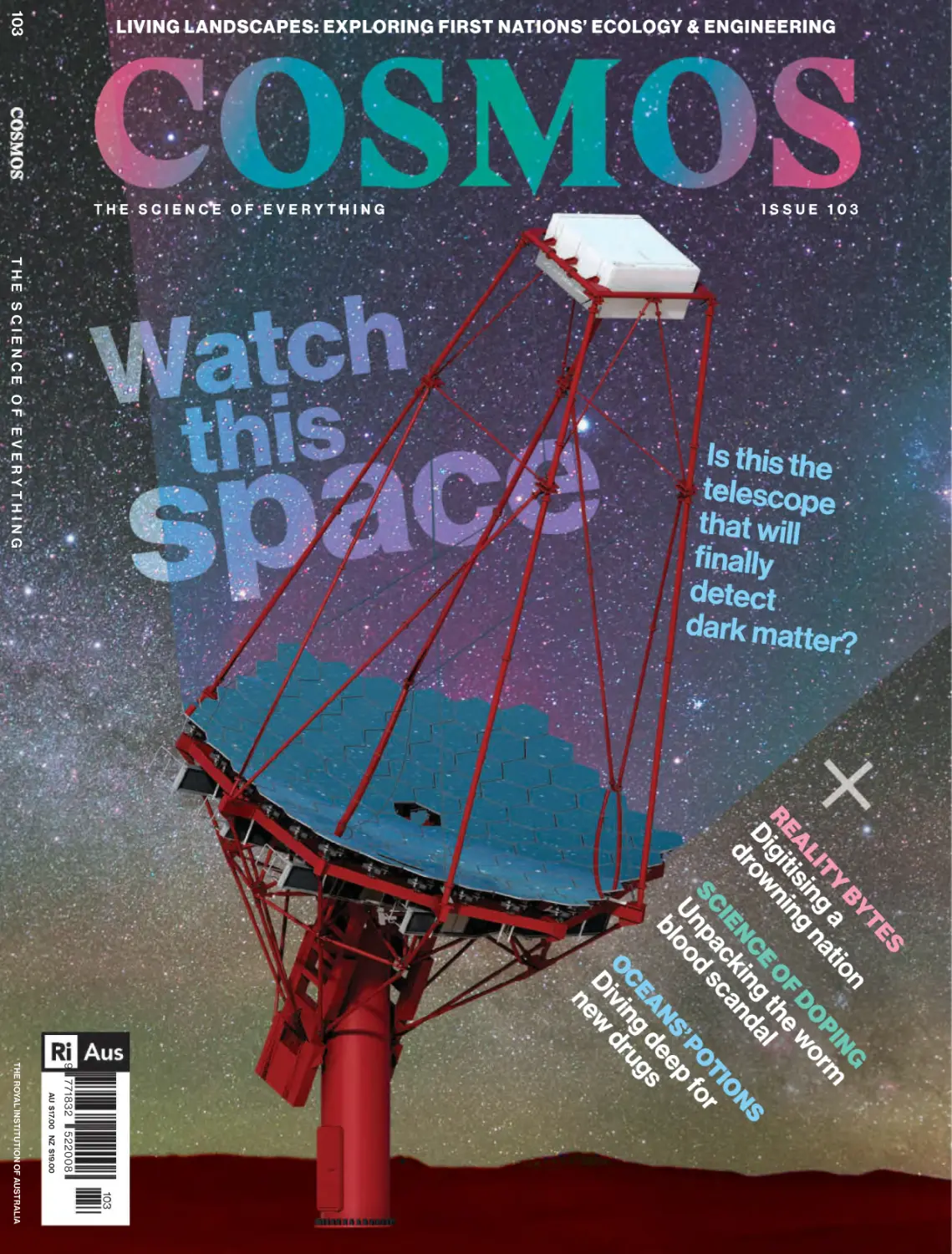
Is this the
telescope
that will
finally
detect
dark matt
er?
TE
S
n
G
BY
o
N
i
P I rm
T Y a at
O
L I ng n
D wo
A si g
i
n
F
R E git ni
O he
t
E
al
g
Di ow
C
S
N in nd
N
dr
O
I E ack c a
TI r
SC p d s
PO fo
Un oo
S’ p
bl
N e
A de s
C E g ug
O ivin dr
D w
ne
522008
AU $17.00 NZ $19.00
9 771832
103
THE ROYAL INSTITUTION OF AUSTRALIA
58
09
40
FEATURES
30
DIGEST
DEEP DIVING FOR DRUGS
Dispatches from the world of science
10 Speed-checking neutron star jets
13 First Nations pottery find
16 Focus: Ancient animals
17 Guess the object
18 How fast can a wombat really run?
22 Webb Watch
Drew Rooke delves beneath the surface to
explore the history and future of medical
breakthroughs found in the ocean’s depths.
26
40
INDIGENOUS INNOVATIONS
Oral history meets science in WA, where
Cat Williams joins the students and Elders
documenting Noongar knowledge.
WHAT HAPPENED NEXT
Head back into Tasmania’s tall eucalypt
forests to get the news on the Grove of
Giants. Lauren Fuge reports.
28
NEXT BIG THING
For the past decades it’s been all about
lithium, but what about sodium? Maria
Forsyth builds the battery of the future.
48
OUR DARK MATERIALS
Could a new telescope solve the universe’s
biggest mystery? Martin White gives us a
sneak peek at the team searching for dark
matter – using gamma rays.
58
WORM-POWERED ATHLETES
You’ve heard about the scandals, but do
you know the science? Matthew Ward
Agius explains blood doping.
4 COSMOS MAGAZINE
FROM TOP: GREG BARTON / MIDJOURNEY. STEVE HOPPPER.
REGULARS
COSMOS 103 WINTER 2024
48
66
WILDLIFE WONDERS
Take a look inside the lives of all creatures
great and small in this issue’s gallery.
74
MIRROR WORLDS
Can an entire nation be digitised before
it disappears? Prianka Srinivasan
explores the ways digital-twin technology
can help us respond to the climate crisis.
30
84
CONDENSED MATTERS
We’re living in the golden age of a field
of physics you may never have heard of,
according to Evrim Yazgin, who takes
us to the heart of the matter.
90
FROM TOP: MATTHEW BUGEJA. NASA SCIENTIFIC VISUALIZATION STUDIO. QI (KEVIN) GE / SUTD.
ENRICHING BUSH FOODS
David Hancock heads to the Kimberley to
find the researchers improving biodiversity
and restoring food sovereignity for First
Nations communities.
ZEITGEIST
98
98
NEXT-GEN PRINTING
Denise Cullen meets the materials
scientists fabricating 4D devices that can
change shape, size and even properties.
102
SECRETS OF SATELLITES
What does it mean to be a moon? Imma
Perfetto examines moon myths and
mysteries in our Solar System and beyond.
106
MINDGAMES
Fiendishly fun puzzles.
cosmosmagazine.com 5
ISSUE 103
Editor Lauren Fuge
Art Director Kate Timms
Graphic Designer Greg Barton
Science Journalists
Matthew Agius, Imma Perfetto,
Evrim Yazgin
Editor-at-Large Elizabeth Finkel
cosmosmagazine.com
CONTRIBUTORS
Denise Cullen, David Hancock,
Drew Rooke, Prianka Srinivasan,
Martin White, Cat Williams
Mind Games Tess Brady / Snodger Puzzles
THE ROYAL INSTITUTION OF AUSTRALIA
Executive Director Will Berryman
Corporate Services Manager Sarah Brennen
RiAus Editor-in-Chief Ian Mannix
Engagement Manager Gavin Stone
Education Manager Michelle McLeod
Engagement Officer Jess Wallace
Office Assistant Leif Gerhardy
Digital Developer Andrew Greirson
From the Editor
WE LIVE IN A TIME DEFINED BY CHANGE, when things very rarely turn out in the way we
expect. The world is full of variables, and often directions switch, paths diverge and even
the limits of what is possible – and what is normal – shift.
This issue – my one and only issue as editor – is packed with stories that address
these questions of uncertain ground, of transformation and of possibility. Pacific correspondent Prianka Srinivasan takes us to the rapidly submerging island nation of
Tuvalu to explore their plan to move the entire country online. It’s an ambitious
response to an unjust global crisis, but as Srinivasan discovers, it relies on the emerging
technology of digital twins – which may help us respond to climate change in more
ways than one. Meanwhile, Drew Rooke dives even further underwater to find out why
the humble sea sponge has provided us with such an extraordinary number of
life-saving medicines, and to ask us to shift our thinking about the ocean – this
subsurface world that comprises 99% of all living space on the planet.
Turning our gaze outwards from our pale blue dot, the ever-delightful Martin
White spins the tale of an international team tackling the dark matter problem from a
different angle, using the most advanced gamma-ray telescope in the world. Elsewhere
in the physics realm, Evrim Yazgin meets researchers working in a field that many
have never heard of and yet it’s vital to our lives, while Imma Perfetto looks sky high to
answer the question we may have all wondered before: what, exactly, is a moon?
Coming back down to Earth, we’re delighted to have two stories of two very different
First Nations’ science projects coming out of Western Australia. On Merningar and
Goreng Country south of Perth, Cat Williams investigates a series of collaborations
between ecology postgraduate students and Noongar knowledge-holders, which document Noongar innovations by bringing oral history and Western science together.
Further north up in the Kimberley, David Hancock reports on efforts to revegetate and
enrich native species, which could help revitalise the bush-food industry and address
food sovereignity in Indigenous communities.
Plus 4D printing, the science behind performance-enhancing drugs, giant trees,
puzzles and much more – all waiting for you over the page.
It’s been a great joy to put together this issue for you. I hope it’s a joy to read.
LAUREN FUGE
contribute@cosmosmagazine.com
6 COSMOS MAGAZINE
QUESTIONS?
Have a question about your subscription or
a change of address? Email us at
info@cosmosmagazine.com
+61 8 7120 8600
PO Box 3652, Rundle Mall
SA 5000 Australia
Published by The Royal
Institution of Australia Inc.
ABN 98638459658
ACKNOWLEDGEMENT
Cosmos is produced on unceded Kaurna land,
and we pay our respects to elders past and present.
First Nations people are this country’s first
scientists and we celebrate their connection to this
place’s deep past and their critical role
in its future.
riaus.org.au
cosmosmagazine.com
education.riaus.org.au
scinema.org.au
COSMOS RETAIL ENQUIRIES
Ovato Retail Distribution
Australia — 1300 650 666
New Zealand — +61 9 979 3018
Cosmos – The Science of Everything™ is
published by The Royal Institution of Australia Inc.
Copyright © 2024 The Royal Institution of Australia.
All rights reserved. No part of this publication may
be reproduced in any manner or form without written
permission. The views expressed in Cosmos are not
necessarily those of the editors or publishers. Cosmos
is protected by trademarks in Australia and the USA.
Printed in Australia by Finsbury Green.
Support our mission
ORDER
FORM
I WA N T TO S U B S C R I B E TO C O S M O S
8 issues (print & digital mag) for $90 SAVE $46 + MyCosmos membership
New to Cosmos?
4 issues (print & digital mag) for $50 SAVE $18 + MyCosmos membership
Yes, I would like my subscription to renew automatically at the end of each term.*
YOUR DETAILS:
We can deliver Cosmos to your door
every quarter for only $50 a year.
This is a saving of $18.
First Name
Last Name
Address
State
City
Sign up using the QR code
below or post the form back to us.
Postcode
Email
Phone number
A N D/O R P L E A S E S E N D A G I F T S U B S C R I P T I O N TO :
8 issues (print & digital mag) for $90 SAVE $46 + MyCosmos membership
4 issues (print & digital mag) for $50 SAVE $18 + MyCosmos membership
I would like my gift subscription to renew automatically at the end of each term.*
GIF T RECIPIENT DETAILS:
First Name
Last Name
Address
State
City
Postcode
Email
PAY ME N T
Mastercard
Visa
Amex
Name on card
Card number
Expiry
MM
YY
CVV
Signature
Existing subscribers
We will email you when it is time to
renew your subscription.
We are grateful for your support so
don’t delay and renew today.
TERMS & CONDITIONS:
Please contact us on (08) 7120 8600
if you wish to discuss your subscription.
No refunds on subscriptions. See cosmosmagazine.com for international subscription rates.
Subscriptions start with the next available issue.
*Your credit card will be charged automatically at the end of the subscription term. Cancel anytime
online. [ ] Tick if you do not want to receive special offers from The Royal Institution of Australia
and trusted partners.
MyCosmos membership allows online readers to take a closer look at science. There are daily
short-form stories available, plus five premium long-form stories published weekly for members.
For full subscription terms and conditions and privacy policy visit cosmosmagazine.com
ABN 98 638 459 658
DANIELLE FUTSELAAR AND NATHALIE DEGENAAR, UNIVERSITY OF AMSTERDAM
i Science news from around the globe (and even further)
Artist’s impression
of a neutron star,
consuming nearby
star and producing
an ultra-fast jet.
DIGEST
The Australia Telescope
Compact Array, CSIRO.
Cosmic speed camera
reveals staggering pace
of neutron star jets
i
How fast, you ask? One-third of the speed of light.
IN A WORLD FIRST, astronomers have
measured the speed of a neutron star’s
powerful jets. Turns out these energetic
beams of energy and matter travel at
114,000 km per second – or about one
third of the speed of light.
Neutron stars are among the densest objects in the universe. They form
when a supergiant star, 10–25 times the
mass of our Sun, runs out of fuel and its
core collapses in on itself. A neutron
star is only a few tens of kilometres
across, but weighs between one and
three times as much as the Sun. A single
teaspoon of neutron star material
weighs about a trillion kilograms.
10 COSMOS MAGAZINE
Because they are so dense, neutron
stars have an immense gravitational
pull. Sometimes they pull matter in
from other nearby stars. This can cause
thermonuclear explosions which shoot
matter out into space.
Until now, astronomers knew virtually nothing about these jets, including
their speed. But in this latest study, the
jets were detected by the European
Space Agency’s Integral observatory
and then tracked for three days by the
CSIRO’s Australia Telescope Compact
Array (ATCA) to determine their speed.
“The explosion tells us when the
enhanced jets were launched, and we
simply time them as they move downstream – just like we would time a
100-metre sprinter as they move
between the starting blocks and the
finish line,” says co-author James
Miller-Jones, from Curtin University
node of the International Centre for
Radio Astronomy Research.
“Radio telescopes are extremely
versatile,” says leader of ATCA operations, Jamie Stevens, who is not an
author on the recent paper. “Five of
ATCA’s six dishes, for instance, take on
different configurations by moving
along a track. [The array] can be used to
look at everything from nearby objects
in our galaxy to some of the most distant objects in the universe.
“The sensitivity and stability of
ATCA allowed this research team to
observe rapid changes in the neutron
star’s surroundings over three days.
This new method will help astronomers
to better understand jets in many different environments and the complex
events that build our universe.”
The results of the study – led by
Thomas Russell from the Italian
National Institute of Astrophysics in
Palermo – are published in Nature.
ALEX CHERNEY / CSIRO
SPACE
BIOLOGY
CRISPR-Cas genome
editing might one day be
used to cure HIV
i
Is a functional HIV cure on the horizon?
3D render of the CRISPR-Cas9
genome editing system.
CLIMATE
MELETIOS VERRAS / GETTY IMAGES
Climate records
shattered in 2023
2023 SHATTERED
climate records,
according to the World
Meteorological Office. It
issued a “red alert” in its
latest State of the Global
Climate report, noting
several markers of climate
change were smashed in
the previous year.
The report confirms
that the planet’s average
temperature measured at
1.45°C above the preindustrial baseline. Carbon
ONE OF THE most significant challenges in treating HIV is the virus’
ability to integrate its genome into the
host’s DNA. This means that lifelong
antiretroviral therapy is essential, as
latent HIV can reactivate from reservoirs as soon as treatment ends.
Now, preliminary research shows
that gene editing can be used to eliminate all traces of the HIV virus from
infected cells in the laboratory.
CRISPR-Cas gene editing technology acts like molecular scissors to
cut DNA and either delete unwanted
genes or introduce new genetic material,
while guidance RNA (gRNA) tells
CRISPR-Cas exactly where to cut at designated spots on the genome.
The team of scientists from the
Amsterdam Medical University in the
Netherlands and the Paul Ehrlich
Institute in Germany – used two gRNAs
that target “conserved” parts of the
viral genome. This means they remain
the same or conserved across all known
HIV strains. This genetic sequence does
not have a match in human genes, to
prevent the system going off-target.
“We have developed an efficient
combinatorial CRISPR-attack on the
HIV virus in various cells and the
locations where it can be hidden in
reservoirs and demonstrated that therapeutics can be specifically delivered to
the cells of interest,” the authors write.
“These findings represent a pivotal
advancement towards designing a cure
strategy.”
in the atmosphere also
reached record highs, and
so too did ocean heat
measurements. Global
mean sea level reached a
record high since satellite
recording began, in 1993.
Last year also saw an
unprecedented decline in
winter sea ice in Antarctica.
“Climate change is
about much more than
temperatures,” says WMO
Secretary-General
Celeste Saulo.
The WMO and other
groups are concerned that
the planet is fast losing its
ability to keep average
temperatures to 1.5°C, the
target of the Paris Climate
Agreement.
These records are
tracking to predictions;
the WMO suggested in
that one of the next five
years would be the hottest
on record. That prediction
has now been confirmed
at the first opportunity.
cosmosmagazine.com 11
DIGEST
PHYSICS
MEDICINE
i
If quantum gravity exists, this telescope might spot it.
IceCube Neutrino Observatory.
SCIENTISTS ARE GOING to extreme
lengths – and places – to try and understand the fundamental nature of the
universe.
“Today, classical physics describes
the phenomena in our normal surroundings such as gravity, while the
atomic world can only be described
using quantum mechanics,” says Tom
Stuttard from the University of
Copenhagen’s Neils Bohr Institute
(NBI).
“The unification of quantum theory
and gravitation remains one of the most
outstanding challenges in fundamental
physics. It would be very satisfying if
we could contribute to that end.”
One theory that tries to marry the
two is called quantum gravity. Stuttard
is co-author of a paper in Nature Physics
which suggests that data from the
IceCube Neutrino Observatory, located
12 COSMOS MAGAZINE
at the South Pole, might contain evidence for quantum gravity.
To validate their methodology, his
team used IceCube’s data of more than
300,000 neutrinos – nearly massless
“ghost” particles that rarely interact
with other particles, meaning they can
travel billions of light years through the
universe largely unbothered. In this
first stage, the team looked at neutrinos
in the Earth’s atmosphere, but in the
next phase they will study neutrinos
from deep space.
“If the neutrino undergoes the subtle changes that we suspect, this would
be the first strong evidence of quantum
gravity,” says Stuttard.
“With future measurements with
astrophysical neutrinos, as well as
more precise detectors being built in
the coming decade, we hope to finally
answer this fundamental question.”
Does having
100+ COVID
jabs harm your
immunity?
Apparently not.
A German man who
claimed to have received
217 COVID-19
vaccinations within three
years has shown no signs
of immunity fatigue.
In research published
in The Lancet Infectious
Diseases, scientists
investigated this case of
‘hypervaccination’ by
studying blood and saliva
samples from the man
(known as ‘HIM’).
Some scientists
believed over-exposure to
the same vaccination
could fatigue the immune
system, as is the case
with other infectious
diseases like HIV. But in
HIM’s case, it appears
that the jabs have had
little negative effect.
‘Memory’ cells present in
his samples were as high
as in control groups used
for the study, and there
appeared to be no
evidence of a weakened
immune system.
HIM’s samples showed
no sign of the man having
been infected with the
virus, though it’s unclear
whether this is due to his
hypervaccination status.
However, the
researchers “do not
endorse hypervaccination
as a strategy to enhance
adaptive immunity”.
CHRISTOPHER MICHEL VIA WIKIMEDIA COMMONS (CC BY-SA 4.0)
Search for quantum
gravity at the South Pole
ARCHAEOLOGY
Pottery find reshapes
understanding of
First Nations people
i
SEAN ULM / CABAH
Communities may have been connected to the Lapita.
WHAT’S BELIEVED TO be the first evidence of pottery making by Australia’s
First Nations people has been unearthed
at Jiigurru (Lizard Island) on the Great
Barrier Reef. Small sherds – fragments
of ceramic material – were uncovered
in an archaeological excavation conducted by the Centre of Excellence for
Australian Biodiversity and Heritage
(CABAH) in partnership with the
Dingaal and Ngurrumungu Aboriginal
communities. The team found dozens of
sherds less than a metre below the
surface, dating between 2,000 and
3,000 years old: the oldest reliably dated
pottery ever discovered in Australia.
The researchers say this finding
suggests “a rich history of long-distance
cultural exchanges and technological
innovation long before British arrival”.
CABAH Chief Investigator Sean
Ulm from James Cook University says
CABAH’s Ian
McNiven at the dig site
(above), where sherds
(top) believed to be
2,000–3,000 years
old were unearthed.
the sherds are likely from small pots,
which were skilfully made and “locally
produced using clays and tempers
sourced from Jiigurru”.
However, Ulm notes “it is unlikely
that people completely independently
learned how to manufacture pottery”.
Instead, the discovery indicates that
these First Nations groups had
connections with the pottery-making
communities of New Guinea, and knowledge was transferred between groups.
“The Jiigurru pottery appears at a
time when there is significant movement of people and ideas around the
Coral Sea,” Ulm says, adding that it is
“clearly associated with Lapita cultural
influences
diffusing
down
the
Queensland coast through exchange
networks”.
CABAH Chief Investigator Ian
McNiven, from Monash University, says
the connections across the Coral Sea
were facilitated by the advanced canoe
voyaging technology and open-sea navigation skills of the Lapita, who went on
to people vast areas of the Pacific.
“These findings not only open a new
chapter in Australian, Melanesian, and
Pacific archaeology but also challenge
colonialist stereotypes by highlighting
the complexity and innovation of
Aboriginal communities,” McNiven
says.
The research is published in
Quaternary Science Reviews.
cosmosmagazine.com 13
DIGEST
ARCHAEOLOGY
An ancient life revealed: Foragerturned-farmer crossed seas
i
Vittrup Man’s
smashed skull.
A STONE-AGE skeleton found in a
Danish peat bog has been analysed,
fleshing out the ancient person’s life
and death in stunning detail.
Nicknamed Vittrup Man, this individual died between 3300 and 3100 BCE,
aged 30–40 years old. He is named for
the
small
town
northwest
of
Copenhagen, near where his skeleton
was found in 1915 along with a wooden
club, a ceramic vessel and cow bones.
14 COSMOS MAGAZINE
He would have
travelled at least 75
kilometres across
the open sea.
The new analysis, published in the
journal PLOS ONE, shows that the
Vittrup Man had a different genetic signature to people who lived in the region
at the same time – his DNA had more in
common with Mesolithic (Middle Stone
Age) people from Sweden and Norway.
Isotopes indicate that Vittrup Man’s
early childhood was spent along the
Scandinavian coast, and the authors
note that he could be from as far north
as the Norwegian coast near the Arctic
Circle. Further analysis of isotopes and
proteins in his teeth show that Vittrup
Man’s diet shifted from coastal food
(marine mammals and fish) in early life
to farm food (including sheep or goat).
The transition happened in his later
teen years.
It’s not clear why Vittrup Man
moved south to Denmark. He would
have travelled at least 75 kilometres by
boat across the open sea between
Sweden and Denmark’s Jutlandic peninsula, even if small islands were used
as stopovers.
The authors propose two main scenarios to explain his life story. One is
that he was part of an exchange for flint;
previous archaeological finds suggest a
reciprocal
relationship
between
Denmark and Scandinavia.
“Another possibility,” they write, “is
that he was taken prisoner, possibly far
north in west coast Scandinavia” and
spent the years of his life when he was
in peak physical fitness “as a captive
and source of labour”.
The fragmented remains include a
smashed skull. This suggests that
Vittrup Man met his end in a ritualistic
sacrifice. Alternatively, he could have
been a victim of feud or murder.
STEPHEN FREIHEIT (CC-BY 4.0)
DNA, isotope and protein analysis map his migration.
Tharsis region and
Valles Marineris on Mars.
SPACE
Massive volcano “hiding
in plain sight” on Mars
i
It’s bigger than Mount Everest, but we didn’t see it.
MARK GARLICK / SCIENCE PHOTO LIBRARY / GETTY IMAGES PLUS.
A GIANT VOLCANO has been hiding on
the surface of Mars. It measures
9022 metres high and 450 kilometres
wide, making it nearly 200 metres taller
than Mt Everest. And yet scientists have
only just identified the behemoth, as well
as possible glacier ice beneath its surface.
Although the volcano has been
imaged repeatedly since 1971, it is
TECHNOLOGY
Swarms of drones
could save us from
wildfires
eroded almost beyond recognition. Its
true nature as a volcano was finally
given away when planetary scientists
analysed the remains of a glacier in the
area in 2023 – and realised they were,
in fact, studying the inside of a huge,
deeply eroded volcano.
The volcano has been provisionally
named Noctis, as it lies at the border
MULTIPLE SWARMS OF
drones could be used to
manage natural disasters
like forest fires, according
to researchers at the
Indian Institute of Science
(IISc).
The use of drones in
tackling natural disasters
is not new, though they
have yet to be used in India,
and Australian agencies
are increasingly interested.
The IISc researchers have
developed an algorithm
between the Noctis Labyrinthus (a
region of deep, steep, maze-like valleys)
and the vast canyons of Valles
Marineris, in Mars’ Tharsis province.
Despite its size, Noctis is not the Red
Planet’s biggest volcano. Mars boasts
the tallest mountain and largest volcano in the Solar System: Olympus
Mons, which rises 26km above the
low-lying plains around it.
While Noctis is a relative minnow,
the site presents a new location to study
Mars’s geological evolution and expand
the search for life, according to Pascal
Lee, a planetary scientist with the SETI
Institute and Mars Institute.
“It’s an ancient and long-lived volcano so deeply eroded that you could
hike, drive, or fly through it to examine,
sample, and date different parts of its
interior to study Mars’s evolution
through time,” he says. “It has also had
a long history of heat interacting with
water and ice, which makes it a prime
location for astrobiology and our search
for signs of life.
“Finally, with glacier ice likely still
preserved near the surface in a relatively warm equatorial region on Mars,
the place is looking very attractive for
robotic and human exploration.
“It’s really a combination of things
that makes the Noctis volcano site
exceptionally exciting.”
which allows for a
coordinated multi-swarm
of drones to quell forest
fires.
“By the time somebody
identifies and reports a
fire, it has already started
spreading and cannot be
put out with one drone,”
says IISc’s Suresh
Sundaram. “You need to
have a swarm.”
Their new software
allows the drones to make
independent decisions
and communicate with
each other. Each drone
will independently
calculate the fire’s size
and potential spread.
“They figure out which
cluster of fire is going to
spread faster, and allocate
the required number of
drones to put out that fire
while the others look for
other fire clusters,”
Sundaram says.
Full-scale field tests
are in planning.
cosmosmagazine.com 15
PALAEONTOLOGY
Focus:
Ancient
animals
4
2
An ancient amphibian
ancestor found in
Texas has been
named Kermitops
gratus in honour of
iconic Muppet,
Kermit the Frog.
In the Peruvian
Amazon, researchers
have found the
fossilised skull of the
largest ever river
dolphin, 3–3.5 metres
long, which lived 16
million years ago.
New analysis of the
375-million-year-old
fish Tiktaalik shows its
ribs likely attached to its
pelvis: crucial to support
its body on land in the
evolution of walking.
6
5
A haul of 1,200
Triceratops bones and
bone fragments in
Wyoming supports the
idea that these dinos
were social animals
and lived in herds.
Another record: a
massive freshwater
turtle fossil has been
unearthed in Brazil. Its
shell measured 1.8m
across, bigger than
any of today’s freshies.
www.cosmosmagazine.com/history/palaeontology/ 01 dinosaur-tracks-alaska/ 02 kermit-frog-fossil-amphibian/
03 largest-river-dolphin-amazon/ 04 walking-evolution-ribs/ 05 triceratops-fossils-herd/ 06 giant-freshwater-turtle-amazon/
16 COSMOS MAGAZINE
JAIME BRAN
3
1
Fossilised dinosaur footprints,
plants and tree stumps in Alaska’s
far northwest reveal the area was a
lush, warm riverine setting 100
million years ago.
DIGEST
Guess the object
Oral history
Let’s move away from our regular focus on gadgets and devices to present these
oddities. The one in the centre is the original; the others are casts. No more hints
needed – the objects themselves contain all the info you need, if you know what
you’re looking for. And if not, it’s a challenge you’ll have to ponder.
TECHNOLOGY
Meet the secret
ingredient for
metal recycling
In the quest to improve
precious metals recovery,
Austrian scientists have
turned to the key component
of a favourite Aussie breakfast
spread. Vegemite is made by
taking spent yeast used in the
beer-making process, and that
same waste product shows
promise for metal recovery.
Electronic waste often
consists of several different
materials, making the process
of reclaiming them a challenge
for recyclers. Bacteria, algae,
clay and charcoal-like biochar
have been trialled as potential
options to achieve metal
adsorption, but often against
singular targets.
Brewer’s yeast might offer
an opportunity, according to
results published by a group
from the University of Natural
Resources and Life Sciences in
Vienna and K1-MET GmbH,
showing that the addition of
dried yeast waste recovered
more than half of aluminium,
40% of copper and 70% of zinc
from test solutions.
When added to wastewater,
around 90% of suspended zinc
and 50% of copper were
retrieved.
We know you can Google it, but where’s the fun in that? Tell us what you think it
is. The correct answer − and/or the most creative − will be published in our next
issue. Send your hunches to contribute@cosmosmagazine.com
New visions
Space history fiends will have had a bit of a
leg up for guessing last issue’s object, though
it still may have befuddled a few. The object
was a 3D rendering of a spacecraft that
made history back in March 1965. Called
Vokshod 2, it was a crewed Soviet space
mission that blasted two cosmonauts – Pavel Belyayev and
Alexei Leonov – up into orbit. There, in a thrilling milestone
of space exploration, Leonov suited up, exited through the
inflatable airlock and became the first person to conduct a
spacewalk. But that was only the first challenge they faced. What happened next
was even gnarlier. When Vokshod 2 returned to Earth, a failure in the navigation
system resulted in the craft touching down some 386 kilometres from their landing
site, in the middle of a snowy forest. A recovery helicopter spotted them, but
couldn’t get to them through the dense trees. Instead, it dropped warm clothes and
supplies, and left Belyayev and Leonov to spend a frosty three days and two nights
in the elements before the ground team reached them – on skis.
cosmosmagazine.com 17
DIGEST
Wombats: Debunked
i
Settling the debate over our favourite furry loaves.
BACK IN FEBRUARY, Museums Victoria
debunked long-circulating claims that
the southern hairy-nosed wombat
(Lasiorhinus latifrons) can run at speeds
of 40km/h. (For context, this almost pips
Usain Bolt’s 43.99km/h world record for
the 100-metre dash.)
After the public information team
received a call asking for the original
source, they traced the claim to a 1984
BIOLOGY
Stem cells from
amniocentesis used
to grow organoids
18 COSMOS MAGAZINE
publication by Flinders University
archaeologist Rod Wells, who explains
the 40km/h number likely came from
survey vehicles in the 1960s and ’70s
keeping pace with the marsupials.
“We would pursue southern hairynosed wombats and catch them using
something akin to a lacrosse net,” Wells
says. “I do not recall anyone using a
stopwatch to check their speed.”
STEM CELLS FOUND in
the fluid from the amniotic
sac could be used to grow
organoids, according to
UK researchers. They say
this technique could help
to develop specific
therapies for babies with
congenital diseases.
Previously, the stem
cells required to create
organoids have mostly
come from terminated
pregnancies. This new
technique harvests the
Museums Victoria decided that a single mention isn’t sufficient evidence to
prove wombats can run at 40km/h.
Story over? No; the plot thickens.
After reading about Museums
Victoria’s debunking, South Australian
wombat researchers came forth with a
counterclaim. Wildlife biologist David
Taggart says he has consistently seen
the vehicle odometer hit 40km/h while
tracking running wombats in the field.
But there are a few caveats.
Firstly, he can only attribute this top
speed to southern hairy-nosed wombats, the species he works with. That
leaves a question mark over the northern hairy-nosed wombat (Lasiorhinus
krefftii) and the common ‘bare-nosed’
wombat (Vombatus ursinus).
Secondly, it’s only been witnessed in
southern males during mating season.
“They’ll be cruising around looking
for females and they’ll get a long way
away from the warrens or burrows they
know, and then you’ll come across
them, and they’ll see you,” Taggart says.
“These big male wombats – they can
get up to 38kgs – they’re just solid muscle and they’ll just take off.”
Taggart thinks that the scientific
survey utes accidentally spook the
males, who bolt back home.
So, how could scientists accurately
measure a wombat’s dash? It’s not as
easy as grabbing a stopwatch and pitting the wombat against Usain Bolt.
Wombat-spooking would be a matter
for the ethics committee.
cells using amniocentesis,
which is often used during
pregnancy to test for
conditions such as Down
Syndrome. To
demonstrate how this
might work with a
developmental disorder,
the researchers created
organoids from babies
with a genetic lung
condition called congenital
diaphragmatic hernia. The
organoids showed clear
features of the disease.
“At present, some
parents can be told their
developing fetus has a
disease, but not how
severe it will be. This
makes it very difficult … to
make informed decisions
regarding potential
interventions,” says
bioethicist Evie Kendal
from Swinburne. But this
technique could enhance
their autonomy by
providing better
information.
MLHARING / GETTY IMAGES
NATURE
2015
2017
2019
CLIMATE
Remarkable resilience of Pacific forests
after cyclone
i
Determined science tracks forests across the years.
A REMARKABLE AND
long-lived
research program on Vanuatu has
revealed the resilience of the nation’s
environment to severe tropical cyclones.
In 2015, Tropical Cyclone (TC) Pam
became the strongest storm on record
in the South Pacific with maximum
sustained winds of 278km/h and gusts
up to 320km/h. It affected Vanuatu,
Tuvalu, Kiribati and New Zealand, producing high winds, coastal storm
surges, heavy rains and flooding in the
affected countries. Vanuatu was worst
hit; the storm killed 16 people and
caused widespread damage.
In the years prior, researchers in
Vanuatu had established and surveyed
eight transects across three regions
(leeward, windward and north-central)
on Tanna Island, one of Vanuatu’s biggest islands. A transect is a straight line
that cuts through a landscape so that
standardised observations and measurements can be made. The eye of the
cyclone crossed over the leeward and
north-central sites, but not the windward site.
The rapid, post-cyclone recovery
of forest canopy on Tanna Island.
Researchers monitored the transects post-TC Pam for nearly five years.
The team included researchers from
University of Hawaii (UH) Mānoa, The
New York Botanical Garden (NYBG),
the University of the South Pacific, the
Vanuatu Cultural Centre and the
Vanuatu Department of Forestry.
The results of the study, published
in Science of the Total Environment,
documented what the authors describe
as a “remarkable recovery”.
“Compared to cyclones on other
Pacific islands, Pam caused relatively
low levels of severe damage to Tanna’s
trees,” says UH Mānoa’s Tamara
Ticktin, lead author on the paper. “In
addition, there was high resprouting,
widespread recruitment of most tree
species present, and basically no spread
of invasive species.”
The authors conclude that Tanna’s
historical cyclone frequency likely
fostered the abundance of resilient species, and that Tanna’s stewardship
practices appear to augment the capacity for resilience “because they promote
a diversity of tree species, life histories
and life stages; as well as a wide range
of pathways for regeneration”.
“Tanna stewards value a wide range
of species useful for food, medicines
and building materials,” says ethnobotanist and co-author Michael Balick.
“And customary stewardship involves
management practices that enhance
the survival and reproduction of these
species.”
For example, after a cyclone, people
weed around native tree species and
even plant them.
The study also showed that forests
that had previously been subject to
grazing by cattle and pigs were slower
to recover and will likely be more vulnerable to future cyclones.
“This highlights the key role of forest management in building resilience
to climate change,” says Gregory
Plunkett, NYBG’s Director. “As the
world comes to grips with more frequent extreme weather events, our
work suggests that the right kind of
human interaction can play a significant role in the survival of forests.”
cosmosmagazine.com 19
SPACE
Webb watch: JWST zooms in on
distant starburst
i
A GALAXY 12 MILLION light-years from
Earth is brimming with new stars, NASA
scientists have found.
Pointing the James Webb Space
Telescope (JWST) at a patch of space in the
constellation Ursa Major, they discovered a
galaxy where new stars are blooming at 10
times the rate of the Milky Way.
This star factory is called Messier 82
(M82) and has long been considered a
prototype starburst galaxy. Like many of
JWST’s assignments, M82 has been
previously observed using both the Spitzer
and Hubble space telescopes.
Using its onboard Near Infrared Camera
(NIRCam), JWST peered into the galaxy’s
centre to study the conditions that foster
star formation. The lens cut through layers
stars and star clusters and the elements
surrounding them, such as hydrogen and
iron.
It was also able to see long swirling
patterns of material extending from the
galaxy’s core – a galactic wind. The
researchers sought to understand how this
product of mass star formation is created
and propelled out from the galactic plane.
Using NIRCam to track polycyclic aromatic
hydrocarbons – basically, specks of space
dust carried through this wind – the research
group was able to observe its journey out
from the star-forming galactic centre.
“M82 has garnered a variety of
observations over the years because it can
be considered as the prototypical starburst
galaxy,” says Alberto Bolatto, a professor in
department and leader of the study. “It was
unexpected to see the PAH [polycyclic
aromatic hydrocarbon] emission resemble
ionised gas. PAHs are not supposed to live
very long when exposed to such a strong
radiation field, so perhaps they are being
replenished all the time. It challenges our
theories and shows us that further
investigation is required.”
The study team will shortly have detailed
spectroscopic data and larger-scale images
of M82’s wind patterns for analysis.
Bolatto expects this to enable
calculations of the galaxy’s age and the
environment of the early universe.
“Webb’s observation of M82, a target
closer to us, is a reminder that the telescope
excels at studying galaxies at all distances,”
of dust and gas to clearly spot emerging
the University of Maryland’s astronomy
he says.
22 COSMOS MAGAZINE
NASA, ESA, CSA, STSCI, A. BOLATTO (UNIVERSITY OF MARYLAND)
New clarity on stellar nurseries at the heart of the Cigar Galaxy.
DIGEST
BIOLOGY
NATURE
HONGHUI ZHANG
With their high
nutritional value and low
environmental impact,
insects are an alternative
to animal proteins.
Researchers believe
understanding their
flavour profiles is essential
to create insect-based food
products that can
overcome psychological
barriers.
“If there are desirable
flavours, scientists can
investigate ways to
promote their formation,
and if there are
undesirable flavours, they
can find ways to eliminate
or mask these odours,”
says Changqi Liu, from
San Diego State
University in the US.
Liu and his team
analysed the odour
profiles of four edible ant
species: the chicatana ant,
common black ant, spiny
ant and weaver ant.
Black ants have a
pungent, acidic and
vinegary smell, primarily
because of the high
content of formic acid
secreted from their
venom glands, while
chicatana ants’
predominant smell was
nutty, woody,and fatty,
which the researchers
attribute to the presence
of aldehydes and
pyrazines.
How the brain begins to
create memories
i
The chemistry
behind the
many flavours
of edible ants
Direction matters.
RESEARCHERS HAVE witnessed a new
phenomenon in the brain as humans
store memories, shedding light on the
how the brain coordinates its many
regions and billions of neurons.
The team recorded participants’
brain activity while they performed
tasks that required memorising and
recalling lists of words or letters.
“Broadly, we found that waves
tended to move from the back of the
brain to the front while patients were
putting something into their memory,”
says Uma R. Mohan, a postdoctoral
researcher at the National Institutes of
Health in the US.
“When patients were later searching
to recall the same information, those
waves moved in the opposite direction,
from the front towards the back of the
brain.”
Brain waves are electrical oscillations that represent patterns of neural
Travelling wave propagation
directions reveal how the brain
quickly coordinates activity and
shares information across
multiple regions.
activity. Travelling waves spread out
across the cerebral cortex – the outermost layer that supports higher cognitive
processing – not unlike ripples on a
pond.
“We’re looking at neural oscillations
not as independent stationary things
but as things that are constantly and
spontaneously moving across the brain
in a dynamic way,” Mohan says.
This way of understanding brain
waves offers a pathway to explaining
how the brain quickly coordinates
activity and shares information across
multiple regions. The research is
published in Nature Human Behaviour.
cosmosmagazine.com 23
DIGEST
First database of
Indigenous Australian
message sticks
i
New resource may answer old questions.
THE FOUNDER OF a rich database of
Indigenous Australian message sticks
believes it showcases historic communication techniques of First Nations
people.
Piers Kelly, a linguistic anthropologist at The University of New England,
and his team created the Australian
Message Stick Database (AMSD), a digital repository of more than 1500
Indigenous Australian message sticks
(and their associated metadata) in collections around the world.
These wooden objects were once
widely used to facilitate long-distance
communication. The practise was transformed by colonisation, though message
sticks were still used in Western
Arnhem Land up until the 1970s.
“It’s not accurate to say ‘message
sticks are just like Western literacy’,”
Kelly says. “They’re addressing a different kind of problem that written practice
isn’t adapted for … Message sticks aren’t
writing but some of them can do things
very similar to writing: convey accurate
information over time and distance.”
He adds that early literature makes
assumptions about the message sticks
24 COSMOS MAGAZINE
A message stick
sent by Nani in
Goodooga to Pilay at
Tinnenburra in 1897,
to coordinate a
ceremony between
two tribes on the
Cudnappa River.
being an aid to memory. “Nineteenth
century scholars were very interested
in the possibility that they represented
language, but they don’t,” he says. “My
argument is that comparing message
sticks to writing is the wrong way to
approach it. They’re doing social coordination, validation, reinforcement and
encoding
of
non-linguistic
information.”
Kelly’s research defines message
sticks as “a coherent system of longdistance communication that connected
Australia’s
First
Nations
across
geographical, cultural, and linguistic
space”.
“Over time, I’ve become less
convinced that message sticks are about
memory and are much more about
social coordination.
“What is reinforced is the validity of
the message and not so much the memory of the messenger.”
Kelly says the sticks solve problems
with communicating over long distances, and also let “people in and out
of [their] territory without undermining [their] territorial integrity”.
“Certain sticks … depict the route of
the messenger rather than the content
of the message [which] suggests a
passport-like function. Other message
sticks have a ‘signature’ of the sender on
them to validate who it came from.”
The AMSD collects every known
observation or description of the sticks
surviving in archives, collections, and
museums. It currently has 1,572 entries,
including photographs and sketches.
Kelly and his team are engaged in
talks with the Indigenous Data Network
“to ensure that the data remains available and under Indigenous control for
future generations”.
THE BRITISH MUSEUM / DR PIERS KELLY
This message
stick, from the
British Museum
collection, is incised
with designs
including images of
a ship, a house,
trees and
topographic
features.
DISCOVERY
What happened
i
NEXT?
In this series, we follow up on some of our
favourite research projects to see where they
went next. This time, Lauren Fuge revisits
her adventure to the dizzying heights of
Tasmania’s tall forests.
26 COSMOS MAGAZINE
IT’S BEEN 18 MONTHS since I climbed
the biggest blue gum in the universe in
the Grove of Giants in southern lutruwita/Tasmania. My arboreal journey into
Lathamus Keep was made possible by
canopy scientist Jen Sanger, photographer Steve Pearce and their crew at the
non-profit The Tree Projects, whose work
I wrote about in our March 2023 issue.
At the time, the Grove of Giants was
slated to be logged, but by July 2023 it had
been taken off the year’s logging schedule. Since then, The Tree Projects has
been working hard to study these forests
and protect them long-term – and when I
called up Sanger and Pearce (on a day
they weren’t out climbing), they’d just
had a big win.
“Over the last couple of years, we’ve
been lobbying Sustainable Timber
Tasmania to update their giant tree policy,” Sanger says. “Their old policy was a
bit ridiculous. A giant tree was anything
THE TREE PROJECTS
WHAT HAPPENED NEXT
As well as attending international
conferences to teach climbing
(above), The Tree Projects is also
working with researchers to install
cameras high up in the canopies of
Tasmania’s eucalypt forests (left).
These cameras take photos every
10 minutes to measure changes in
the leaf’s petiole (stalk) size as it
swells and contracts due to water
use. This will help us understand
how trees respond to drought.
over 85 metres tall … [or] over 280 cubic
metres in volume. That’s a huge tree, and
it’s also really hard to measure.”
For context, this policy would not protect any living tree on the Australian
mainland.
In recent months, Sanger and Pearce
have spent a lot of time in Sustainable
Timber Tasmania’s (STT) boardroom to
present research on other giant tree policies around the world and hash out a new
policy for Tasmania. And it paid off. In
March, STT announced it will protect any
tree more than four metres in diameter
(about 12 metres in circumference).
“It makes it a lot easier to measure,
but it also includes potentially thousands
of trees across the logging area,” Sanger
says. “With those protections, there is
meant to be 100-metre radius buffer
around each tree. So that could potentially
be thousands of hectares of forest saved,
which is a really big win … We’re stoked.”
Pearce explains that this change has
greatly broadened the definition of a giant
tree. “We would laugh, before, that 12
metres [in circumference] was a medium
tree,” he says. “I would have walked past a
12-metre tree and not even thought twice
about it.”
While the new policy won’t save hundreds of hectares of continuous forest, it
will protect smaller, more fragmented
patches of remnant forest.
“We’re basically going a very long way
– in tall, wet eucalypt forests – to ending
old-growth logging,” Pearce says.
So what does this mean for Lathamus
Keep?
“If you look at the Grove of Giants,
under the old policy, there were about
13 trees that met the definition of a giant,”
Sanger says. “Now there’s about 150 trees
that meet that definition.”
With the 100-metre buffer, the whole
grove should become an informal reserve.
“It’s the best level of reserve that we
could hope for, for such a small area,”
Sanger says.
In the meantime, their scientific work
is also forging ahead. Sanger is busy
studying the role of forest biomass in proposed future hydrogen plants, while
Pearce is working with scientists at the
University of Tasmania to install tiny
cameras in the canopy (see caption).
The Tree Projects has also gone further afield. In May, Pearce jetted off to
West Africa with two professional tree
climbing instructors. They spent a week
teaching climbing skills to local scientists
at Ghana’s University of Energy and
Natural Resources, then a few days out in
tropical rainforest to apply their new skills,
conducting an epiphyte diversity survey.
“It’s actually a pretty big deal,” Pearce
says. “Most of their canopy science has
been conducted by Western scientists,
and the tree climbing skills and equipment leave with the scientists.”
Now, the university will become an
independent research hub in West Africa,
able to train other local researchers and
spread climbing skills through the scientific community.
“We were able to secure a whole
bunch of climbing equipment to take over
and donate to the university,” Pearce
adds. “They’ll have the training but also
the A-grade equipment to carry out their
research with.”
To stay tuned into future tree science,
check out thetreeprojects.com.
cosmosmagazine.com 27
Advanced materials scientist
Maria Forsyth is trying to build
the battery of the future.
Maria Forsyth with Deakin University
Vice-Chancellor Professor Iain Martin
(left) and Professor Patrick Howlett
(right) at the university’s Battery
Research and Innovation Hub in
Burwood, Victoria.
28 COSMOS MAGAZINE
W
DEAKIN UNIVERSITY
Sustainable
sodium
hen I was doing my PhD,
there was no such thing as a
lithium-ion battery. The
first was commercialised in
1992, and for the next two decades or so,
it was all about lithium.
My work was always parallel to that.
For the last 30 years I’ve been investigating
how we can improve the chemistry of all
sorts of batteries, capacitors, fuel cells and
solar cells. These are hugely important for
the transition to clean energy, but we’ve
got to be careful that they don’t create new
problems. It’s important to make these
devices safer, to make them last longer and
to get more energy out of them.
The technologies we’re creating must
also be sustainable, and designed for recycling in a circular economy.
For example, in Australia we’re
blessed with a lot of spodumene – a mineral from which we extract lithium. But
the majority of lithium comes from the
salt lakes of South America, where mining
has an environmental impact.
So for me, the “next big thing” is
sodium. It’s in seawater; it’s everywhere.
Sodium batteries aren’t going to replace
lithium, but because of the demand for
more and more energy, we’re going to
need to look at multiple technologies.
NEXT BIG THING
DEAKIN UNIVERSITY
Most types of modern batteries work
on the same principles. It’s the materials
that are different. Then it comes down to
how much voltage you can get out of the
battery, how much it weighs and its
capacity – how much energy you get per
kilogram, or per volume.
Lithium is one of the lightest elements on the periodic table and also one
of the most energetic. Sodium is heavier
and slightly less energetic, so you’re not
going to have the same amount of energy
coming out of a sodium battery as you get
out of the same-sized lithium battery.
You’re not going to drive a car 1000 kilometres on a sodium battery just yet, and
you’re probably not going to fly aeroplanes on sodium.
But sodium uses the same manufacturing process as lithium: it has very similar
chemistry and it’s far more sustainable. In
a lithium battery, the electrode on the
anode side is graphite, a form of carbon.
This is something we mine – it’s a critical
mineral, which means it’s expensive.
The beauty of sodium is that you can
use a much cheaper form of carbon called
hard carbon. My colleagues and I are currently working in the lab on producing
hard carbon using waste biomass.
One example: we’re carbonising waste
textiles and turning them into different
carbons with different materials properties, different porosity and different
surface chemistry. We’re also using the
biochars that you get from bio solids.
Basically, what comes out of our bodies
gets turned into biochar, which we then
treat and refine and characterise. We control the porosity, the chemistry on surface
As we transition to
net zero, we’ve got
to be careful that
the technologies
we develop don’t
create new
problems.
and the structure, and that becomes the
electrode in a battery. This is obviously
more sustainable.
Sodium is what makes the juice, but
every material that we combine in the battery has to work efficiently. To this end
we’re also working on the cathode material. This is the other end of the battery,
and it is the structure that allows sodium
to insert in and out as you charge and
discharge your battery. For example, the
sodium goes into your hard carbon electrodes during charge, and then it goes into
the other electrode (the cathode) during
discharge. When this happens, the sodium
travels through the electrolyte, which can
be a liquid, a solid or a polymer.
But what’s really important is the
interface between those components.
When that material is touched during the
charge and discharge process, chemistry
happens. And while that chemistry has to
allow ions through, it also has to protect
you from reactions that you don’t want to
happen, because those ions will lose
energy. We call these “parasitic”
reactions, because they destroy the life of
the battery.
The magic comes in designing each of
these materials – the hard carbon anode,
the cathode and the electrolyte – and controlling the reaction that occurs between
them at that interface.
My first-ever research project in 1990
was on sodium electrolytes, but then
when lithium hit the world, everyone
started working on it.
We’re now seeing companies in China
making sodium-ion batteries to demonstrate them in smaller vehicles. Here at
Deakin University, with the help of the
Victorian government, I’ve helped establish Australia’s first pre-commercial
prototyping facility, where we go from the
materials through to the components that
go into a battery cell.
I’m passionate about translating this
technology out of the lab to commercialise
sodium batteries – and seeing safer, sustainable batteries become the next big
thing.
PROFESSOR MARIA FORSYTH is a world
leader in developing advanced materials for
energy technologies. She is the Chief Scientist,
Energy Storage CRC and an Alfred Deakin
Professorial Fellow at Deakin University.
cosmosmagazine.com 29
30 COSMOS MAGAZINE
CURES FROM THE DEEP
JIM BEAUDOIN / UNSPLASH
Earth’s surface is 70% water, but this number doesn’t
begin to explain the vastness of the ecosystems
beneath the waterline. Drew Rooke dives into the
groundbreaking research that is deriving medicines
from the depths to transform our lives on land.
O
n 5 June 1981, the US Center for
Disease Control published an article
in its regular newsletter, Morbidity
and Mortality Weekly, which described
a strange cluster of sudden cases of pneumonia
in Los Angeles. All of the patients were young gay
men who did not know each other, had no known
common contacts and no knowledge of sexual
partners who had similar illnesses. Despite
courses of treatment, two of the men had already
died and the other three remained seriously ill
and died shortly after the article was published.
“Pneumocystis pneumonia in the United
States is almost exclusively limited to severely
immunosuppressed patients,” the editorial note
read. “The occurrence of pneumocystosis in
these five previously healthy individuals without
a clinically apparent underlying immunodeficiency is unusual.”
This article marked the first official reporting of the HIV/AIDS epidemic. By the end of the
1980s, more than 100,000 people in the United
States alone had died from AIDS and it was the
leading cause of death among young adults –
especially men aged between 25 and 44 years old.
The severity of the situation triggered an
intense effort to develop a medicine to treat
HIV/AIDS. As part of this push, scientists investigated the potential of abandoned drugs that
had been developed decades earlier for other
Altitude
8,333
5,000
Water level
0
-6,430
metres
32 COSMOS MAGAZINE
Shirley Pomponi (above
and opposite), marine
biotechnologist at the
Harbor Branch
Oceanographic Institute
We often think of the
ocean as homogeneous,
but beneath the surface
are 361 million sq. km of
complex geography:
mountain ranges and
valleys, plateaus and
volcanoes. This NASA
visualisation ‘drains’ the
ocean to reveal some of
these vast features.
illnesses but had been shelved because they were
ultimately ineffective.
Azidothymidine was one such drug. Also
known as AZT and belonging to a class of drugs
called nucleoside reverse transcriptase inhibitors, it had first been developed in 1964 as a
possible treatment for cancer. In 1985, scientists
involved in a screening program run by the
National Cancer Institute in Maryland, US, to
identify possible medicines for the deadly new
virus discovered that AZT suppressed HIV replication without damaging normal cells.
Shortly afterwards, a British pharmaceutical company called Burroughs Wellcome funded
a clinical trial to evaluate the drug in people with
AIDS. The results offered a twinkle of hope:
although it had adverse side effects, including
severe intestinal problems, damage to the
immune system, nausea, vomiting and headaches, AZT did significantly decrease the fatality
rate.
In March 1987, AZT became the first drug to
gain approval from the US Food and Drug
Administration (FDA) for treating AIDS. Further
clinical trials followed, testing different doses to
attempt to reduce the side effects. One of these
trials – known as ACTG 019 – proved particularly pivotal: it showed that AZT effectively
delayed the onset of AIDS in asymptomatic people with HIV.
LEFT: NOAA. BELOW: NASA SCIENTIFIC VISUALIZATION STUDIO (NSVS).
CURES FROM THE DEEP
Since then, AZT has radically improved and
prolonged the lives of countless people with HIV;
decades later, the drug remains a common component of a HIV patient’s treatment plan. But
what many people might not know is its oceanic,
spongey origin – which is also the source of
many other lifesaving drugs in use today.
F
or millennia, humans have explored the
natural world and collected resources
from it, including medicines. Most of
these medicines have come from land-based
organisms; perhaps the most famous examples
are penicillin – first discovered from bread
mould in 1928 – and aspirin, which was first isolated from the willow tree.
But recently, scientific attention in this field
has also turned to the ocean and the creatures
that reside in it.
In the last 40 years, more than 30,000 new
chemicals have been discovered from
marine-based species including microbes,
algae, sponges and bryozoans. According
to a 2016 study in the journal
Biomolecules & Therapeutics, these
chemicals “are often characterised by
structural novelty, complexity, and
diversity”.
Marine sponges in particular have
proved to be an especially rich source
of new biochemical compounds.
There are nearly 10,000 known species of sponges worldwide (for comparison
around 6,400 extant species of mammals have
been described). They’re among the oldest lineages of animals on the planet, with research
published in Nature in 2021 indicating they first
emerged on Earth nearly 900 million years ago
– a time when the planet was populated by simple multicellular organisms like algae.
Found at all depths in the ocean, they can
form vast gardens that can be several hundreds
of years old, cycle huge amounts of carbon and
store a record of Earth’s climatic history. In
February 2024, for example, a study published in
Nature Climate Change used 300 years of ocean
temperature records contained in marine
sponges to show that global warming has
increased by 0.5°C more than previous
estimates.
Being such ancient creatures, marine
sponges lack complex organs and tissues. Most
survive by filter feeding, actively pumping large
quantities of water through their porous body
tissue to capture microscopic, organic organisms – although some, such as the harp-like
Chondrocladia lyra, are carnivorous and capture
prey with barbed hooks that cover their ghostly,
branching limbs.
But their survival is also aided by something
else. Because sponges are immobile and cannot
flee or attack predators, they have evolved to
protect themselves by producing novel toxic
chemical compounds, which also enable
them to thrive in some of the most
extreme and inhospitable places on
Earth. In fact, every year, more than
200 new chemicals are discovered just
from sea sponges.
One scientist who has discovered
many of these new chemicals is Shirley
Pomponi. A self-described “medical
sponge hunter”, Pomponi is a research
professor and the executive director of the
Cooperative Institute for Ocean Exploration,
Research, and Technology at Florida Atlantic
University’s Harbor Branch Oceanographic
Institute. She has spent nearly 40 years collecting sea sponges from around the world and
analysing their chemistry in search of new
medicines.
Pomponi says she “got hooked” on marine
biology in college. In 1984, soon after she had
completed her PhD in biological oceanography,
she received a call from the Harbor Branch
Oceanographic Institute, which had just founded
a marine drug discovery program and needed
someone to assist in collecting and identifying
sponges and other marine organisms.
“A lot of chemicals that showed promising
medicinal properties were coming from sponges,
and they really wanted to get a feel for what these
sponges were and refine the sample acquisition
program,” she says.
With her previous experience studying sea
sponge ecology, Pomponi was an ideal person for
the job – and was soon leading the Institute’s
acquisition program. Her work is global in scope
and has taken her to some of the most biodiverse
FAU HARBOR BRANCH
“A lot of
chemicals that
showed promising
medicinal properties
were coming from
sponges”
cosmosmagazine.com 33
CURES FROM THE DEEP
Sponge salves
Marine sponges are a rich source of novel bioactive compounds that have
produced new pharmaceuticals. Some tackle cancer, such as 1, which led to the
chemotherapy drug trabectedin; 3, which produces chemicals that can kill liver
cancer cells; and 5, which contains an alkaloid shown to inhibit cervical cancer
cells. Meanwhile, 2 and 6 produce compounds with antibacterial and antifungal
activities, and a nucleoside from 4 led to the breakthrough HIV drug AZT.
1. Ecteinascidia turbinata
2. Amphimedon compressa
3. Neopetrosia exigua
4. Tectitethya crypta
5. Acanthostrongylophora ingens
6. Tethya aurantium
FAR LEFT: NSVS. CLOCKWISE FROM TOP LEFT: GLOBAL SEAFOOD ALLIANCE. SHIRLEY POMPONI. UNCW SPONGE GUIDE. ED BIERMAN / WIKIMEDIA. INATURALIST. BEESOO R, BHAGOOLI R, BAHORUN T, NEERGHEEN VS.
regions of the planet, including the Great Barrier
Reef and Ningaloo Reef in the late 1980s. “That
was a really successful trip,” she says. “We were
looking at not only the tropical organisms, but
more warm temperate ones as well.”
According to Pomponi, her work is underpinned by a simple concept: “fi nd and grind”.
First, she searches for organisms that are in
some way unusual – either because of their
shape, colour or size – which can be an indication of a novel chemical composition. These
organisms are not confi ned to one region of the
ocean; rather, they are spread throughout it and
at various depths, from the shallows to several
kilometres underwater.
To collect those living in shallow waters,
Pomponi and her colleagues will dive using
SCUBA gear. For those residing in the dark
depths, they now use remotely operated submersibles; however, up until 2011 they used
human-operated ones.
Back in the lab, Pomponi will then make an
extract of a sample by grinding it up and mixing
it in with a solvent. “And then we test that extract,
which might contain dozens or even hundreds of
different chemicals to see if it’ll, say, kill cancer
cells or inhibit microbial growth.”
If the extract achieves this, the next step
involves isolating which particular molecules
are the active ones, using a series of chemical
procedures
such
as
spectroscopy
or
chromatography.
“And gradually,” Pomponi explains, “you
narrow it down to a single molecule. And ideally,
at the end of the day, it’s a novel molecule that’s
never been discovered before with a novel biological activity, or it’s a known molecule that has
hasn’t
previously
been
reported to have that
particular type
of activity.”
With the active molecule identified, the process of identifying its exact mechanism of action
begins.
“You have to figure out: how does the chemical actually work – how does it kill cancer cells,
for example? Because it’s not good enough just to
say that it kills cells; you have to be way more
specific than that.”
A
n oft-quoted fact about the ocean is that
it covers more than 70% of Earth’s surface, or roughly 361 million square
kilometres. But this only gives a superficial
sense of the scale of what marine biologist Rachel
Carson once called “that great mother of life”,
for it explains very little of the vast world
beneath the waterline.
That world is one which we are still
– despite decades of research and
huge leaps in technology – in the nascent stages of perceiving, let alone
understanding. It harbours 99% of
all living space on the planet, more
than three quarters of which has
never been mapped, explored or
observed by humans.
What we do know is that the ocean is
far from being physically featureless. It contains huge volcanoes, seamounts, canyons,
trenches, abyssal plains and mountain ranges
that dwarf many of those found above the
waterline. In fact, it’s home to the biggest
mountain range on Earth: the mid-ocean ridge,
Currents – like those of
the Atlantic (above and
opposite) – are driven
primarily by wind at the
surface and by water
density differences
deep below. These
immense conveyor belts
regulate global climate.
Without them, land
temperatures would be
far more extreme.
which stretches 65,000km. Its average depth is
roughly 3,800m – four times deeper than the
average land elevation is high – and its deepest
point, the Mariana Trench, east of the
Philippines, is nearly 11,000m deep, into which
Mount Everest would fit with almost two kilometres to spare.
This space does not contain a monoculture,
even though it might seem like it from our landbased vantage point. Within it are five distinct
zones of life, which are defined by the amount of
sunlight that reaches them. The most extreme –
the Hadal zone, from 6,000m below – is characterised by complete darkness, freezing
temperatures and crushing pressure more
than 1,000 times higher than at the surface.
In all of these zones live an array of
strange and wonderful species – 91% of
which scientists estimate are yet to be
classified.
And among the most strange and
wonderful forms of life that exist down
there are the sponges.
NSVS
“More than
three quarters
of the ocean has
never been mapped,
explored or
observed”
I
t was a German-American chemist
from Yale University named Werner
Bergmann who – quite accidentally
– pioneered scientific interest into Earth’s
underwater pharmacy nearly 80 years ago.
In the autumn of 1945, Bergmann – who had
a stern, serious face punctuated by a toothbrush
moustache that overshadowed his small, thin
mouth – travelled to Florida Keys, where he
cosmosmagazine.com 35
found a previously undescribed sea sponge in
shallow waters, which was eventually taxonomised as Tectitethya crypta.
Within a few hours of collecting samples,
he preserved them in a solution of seawater
and formalin, then dried them in a vacuum oven. Bergmann was looking for
fat molecules called sterols which he
knew play a key role in biological systems, but four years passed before he
investigated his samples for them.
When he did, he found something
quite different – and very strange.
When he placed the samples in
boiling acetone, a “rather copious
amount of a nicely crystalline material”
began to form in the fl ammable, pungent
liquid. He later showed it to be a nucleoside,
but, oddly, not one of the four types that were
already known (and would later be found to form
the structure of DNA): thymidine, cytidine,
guanosine and adenosine. While it resembled
thymidine in structure, this new compound,
instead of being linked in a chain with other
nucleosides, was all alone.
As a testament to both the organisms from
which it was derived and the nucleoside it
resembled, Bergmann named this compound
spongothymidine. He also isolated from this
sponge two other previously unknown
nucleosides: spongouridine and spongosine.
Bergmann got to work synthesising these “unusual nucleosides”, which ultimately paved the
way for the release in 1969 of cytarabine – a drug
that blocks DNA replication in acute leukaemia
and lymphoma tumours, effectively killing
them. A synthetic nucleoside modelled
after spongothymidine, cytarabine was
the fi rst-ever marine-derived medical
drug. It is still used to treat leukaemia
patients, though it does come with a
number of side effects, including gastrointestinal disorders, pneumonia and
confusion.
After the approval of cytarabine,
research in the field of marine pharmacology
“lapsed for a while”, according to Pomponi. But
in the mid-1980s, “everything started up again”
– with the benefit of increased funding from
large pharmaceutical companies like Merck.
This led to the development of new drugs
that were modelled after the strange nucleosides
Bergmann found within Tectitethya crypta.
One of these drugs was the HIV/AIDs treatment, AZT. Another was aciclovir – the fi rst
antiviral medication. Discovered in 1984, it was
approved for the treatment of herpes, chickenpox and shingles seven years later and is now
considered by the World Health Organization to
be an “essential medicine”.
36 COSMOS MAGAZINE
NSVS
“These
‘unusual
nucleosides’
ultimately paved
the way for the
release in 1969 of
cytarabine”
NSVS
In the years since, marine pharmacology
research has continued. Trabectedin – which
was isolated from Ecteinascidia turbinata, a sea
squirt species that lives on corals in the
Mediterranean – is a chemotherapy drug fi rst
approved for use by the European Union (EU) in
2007 and eight years later by the FDA. The FDA
has also approved eribulin mesylate: a medication used in the treatment of patients with breast
cancer. It’s a synthetic analogue of the molecule
halichondrin B, which is produced by dinofl agellates that live symbiotically in marine
sponges.
In October 2023, a team
from the University of
Mauritius, led by Rima
Beesoo, published the
results of their study
into the sponge
Neopetrosia exigua.
Collected
from coral reefs
near
Amber
Island off the
northeast shore
of Mauritius,
the sponge was
transferred to
the lab under
seawater, cleaned
Barotropic or surface
tides (above) are very
long-period waves that
move across the globe
in response to the forces
of the Sun and Moon.
They produce internal
tides as water moves
up and down steep
topography (below).
of debris and frozen at minus 80°C, before being
ground into a powder and soaked in solvent to
obtain different chemical extracts. The extracts
were then tested at the University of Edinburgh
for their efficacy in fi ghting human cancer cells.
The results were enormously promising.
One particular extract not only killed liver cancer cells at very low doses by activating various
proteins that led to their breakdown, but it also
displayed very low toxicity towards normal
cells. Many more marine-derived drugs are currently in clinical trials.
I
n May 2023, a team of
researchers led by Muriel
Rabone, a deep-sea ecologist
at the Natural History Museum
in London, published a landmark paper in Current
Biology: “How many metazoan species live in the
world’s largest mineral
exploration region?”
The
region
in
question is the ClarionClipperton Zone (CCZ),
which spans approximately six million sq. km
– about twice the size of
India. It lies in the Pacific
cosmosmagazine.com 37
between Hawai‘i, Kiribati and Mexico and is the
focus of deep-sea mining explorations due to the
abundance of potato-sized nodules – found in
mud 4,000 to 6,000 metres below the surface –
that are rich in minerals critical for the renewable energy transition, like nickel, cobalt and
copper.
Rabone and her fellow authors said the paper
represented the “first comprehensive synthesis” of biodiversity within “the largest
ecosystem on our planet” on “the eve of
possible large-scale mining operations”
(currently, there are 17 contracts for
mineral exploration covering more
than one million sq. km).
They parsed through more than
100,000 records of creatures found in
the CCZ gathered from numerous deepsea research cruises, and found evidence
for 5,578 different species, with as many
as 92% being entirely new to science.
But, according to Rabone, the paper “barely
scratches the surface” of the biodiversity found
in the CCZ. Indeed, she believes there could be
up to 8,000 more unknown species located there.
And even of those species that have been identified, our knowledge of them is extremely
limited.
“We don’t know about their ecology or their
functional role,” she says, “and we certainly
don’t know about their chemistry.”
Based on what is already known about
marine organisms like sponges, however, there
is good reason to believe that the chemistry of at
least some of those found in the CCZ will be novel
– and so, according to Rabone, could potentially
be the foundation of “lifesaving, blockbuster
drugs”. Deep-sea mining poses a serious threat
to these potential discoveries. “If we don’t protect [the CCZ], what are we potentially losing?
It’s a difficult question to answer, but one
we will never answer if we aren’t looking
at potential applications of the organisms found there.”
According to Pomponi, deep-sea
mining and trawling are the “biggest
threats to the biodiversity of the deep
sea” – and by extension to the potential
development of new, marine-based
drugs that could help in the fight not just
against cancer but also deadly diseases
that, over time, become resistant to antibiotics. As Rabone points out: “There are predictions
that in 20 to 40 years’ time, bacteria diseases are
going to be number one killer because of
antimicrobial resistance.” (See ‘Rebelling against
resistance’, Issue 100.)
Deep-sea mining is just one of the challenges
affecting the development of new marine-based
drugs. Another is the sustainable supply of
sponges and other oceanic organisms. Part of
this problem is that, as Pomponi says,
NSVS
“We don’t
know about
their ecology … and
we certainly don’t
know about their
chemistry.”
CURES FROM THE DEEP
FROM TOP LEFT: ESRI / NASA. SMARTEX / NATURAL HISTORY MUSEUM / NOAA.
Deep-sea species on display
“deep-water
sponges
are
very difficult to access”.
But in addition to this, it’s often necessary to collect a huge amount of sponge samples to conduct
useful experiments.
Indeed, scientists were only able to produce
300 milligrams of halichondrin B from the one
tonne of a rare, deep-water sponge they collected.
As the 2016 paper in Biomolecules & Therapeutics
said: “This very low yield did not allow the sustainable isolation of halichondrin B.”
In the case of halichondrin, this problem was
solved by chemical synthesis in 1992. For others,
it has been solved with aquaculture. But Pomponi
is working on another solution: in vitro cell
development.
“How can we get cells from these sponges
that produce chemicals that have human health
applications and grow those cells in the laboratory, so we don’t have to keep going back and
collecting from the natural environment?” she
asks.
Her process is to take small fragments of
cells from sponges and then cryopreserve them
so they stay alive, before thawing and attempting to grow them in the lab – a process she says
can be applied to other marine organisms as
well.
Four years ago, she made a “big breakthrough” on this front when she and colleagues
grew sponge cells in culture for the first time.
“It took me 30 years to successfully do it. And
we just got a grant from the [EU] to scale up production for anti-cancer compounds.”
O
ur standard world maps centre the land.
Looking at them, we have our land-bias
reinforced; we see the continents
fringed by segregated oceans, which exist almost
in the background. But one map flips this
representation.
Known as the Spilhaus projection, it was
developed
by
South
African-American
The Clarion-Clipperton Zone – a region of the Pacific between Hawai‘i and
Mexico – is a treasure trove of biodiversity. In 2023, scientists discovered more
than 5,000 deep-sea species there, from the ‘gummy squirrel’ (Psychropotes
longicauda, top left) to strange new sea cucumbers (Oneirophanta mutabilis,
middle right) to worms, corals, glass sponges and members of the spider family.
Author Arthur C. Clarke
once wrote: “How
inappropriate to call
this planet Earth, when
it’s quite clearly Ocean.”
The Spilhaus projection
(above) would have been
more like Thrillhaus for
Clarke, as it visualises
the oceans as a single,
continuous body of
water, with Antarctica
at the heart. He may
have been similarly taken
with the image opposite,
which shows seasurface chlorophyll – a
proxy for phytoplankton,
the microscopic algae
on which virtually
every marine food
web depends.
geophysicist and oceanographer Athelstan F.
Spilhaus more than 80 years ago. It shows
Antarctica floating in the middle of one continuous body of blue water – around which lay the
other land masses, like an audience.
This map provides an opportunity to reimagine the ocean and see it for what it is – namely,
the protagonist who plays the starring role in the
grand narrative of life on Earth.
The research by Pomponi, Rabone and others
offers a similar kind of opportunity. It expands
how we think of the ocean, transforming it from
simply a flat expanse stretching to the horizon
into a multi-dimensional, multi-zonal space.
It’s an opportunity to appreciate just how
vast and complex the ocean really is. But it also
helps us appreciate something else about it as
well: the seemingly infinite discoveries to be
made underwater, including those hidden in the
porous tissue of ancient marine animals which,
quite literally, can save our lives.
DREW ROOKE is based in Sydney. His last story, on the
rich history of climate modelling, appeared in Issue 102.
cosmosmagazine.com 39
INDIGENOUS INNOVATIONS
In the southwest of
Western Australia,
postgraduate science
students are working
with Indigenous
families to put Noongar
knowledge on the map,
reports Cat Williams.
estern technological societies
continue
to
fail
biodiversity,”
Stephen
Hopper tells me bluntly.
A world-renowned ecologist and professor of
biodiversity at the University of Western Australia
(UWA), Hopper believes that Indigenous land
management practices could be the secret to saving Western Australia’s landscapes. This is why he
works with Traditional Owners to combine
Indigenous knowledge with scientific research.
He’s spent a decade on Merningar/Menang and
Goreng Country near Kinjarling/Albany, WA. It’s
a rugged landscape near the coast, with tall
marri forests and large granite outcrops.
“You learn something different every time
you have a yarn or go out bush,” he says. “I’m
continually amazed by the generosity of Elders
to share their knowledge.”
During the fi rst few years, Hopper built relationships with Noongar Elders and families,
including Merningar Elder Lynette Knapp, who
has a very close relationship with the university.
“They’re my family,” she says. “It’s like going out
bush with my family.”
Together, Hopper, Knapp and another UWA
academic Alison Lullfitz supervise a number of
postgraduate students in projects that document
Noongar innovation and knowledge (kaartadijin,
pronouced cart-a-jin), ranging from traditional
burns to animal traps. These collaborations are
combining Noongar kaartadijin and Western science to produce important new Australian
research – and an exciting model of how to combine such different knowledge systems.
“W
Noongar groups
Amangu
Whadjuk
Bunbury
Nadji Nadji
Pindjarup
PHOTOTRIP / GETTY IMAGES
Perth
Wilma
i
and
rd
Wa
B il
elm
B alard
ong
Yuat
n
Kaneang
an
G or
Wudjari
eng
Njunga
Esperance
Mirningar
Albany
cosmosmagazine.com 41
42 COSMOS MAGAZINE
In May 2023 (above),
Goreng Elders led a
burn in a cleared and
salt-affected area at
Nowanup, near
Boxwood Hill. This is
the second season
running that Elders
and caretakers have
regenerated Country
and revitalised cultural
knowledge through
fire practice.
regimes, how they have adapted and how they
might adapt in future.
Knapp, for example, believes that current
Western burning practices do not help land
management. “There’s absolutely no way you
can just chuck fi re sticks from the air,” she says.
Both Woods and Knapp say that traditional
burns were seasonal to benefit the plants, as well
as the humans and animals who ate them. “That
was their supermarket,” Woods says.
Part of Rodrigues’ research is to assess “cultural resource species”, which includes bush
foods. Noongar people are concerned that bush
foods are less common than they were historically, so research is investigating whether
smaller burns can increase the abundance of
specific species.
For Rodrigues, a typical day in the field
involves everyone rolling out onto Country: open
land, with some thick bush. “There’s a couple of
URSULA RODRIGUES X2
Fire is central to Noongar life and is the focus of one
of Hopper, Knapp and Lullfitz’s PhD students,
Ursula Rodrigues. With a background in ecology,
Rodrigues is researching prescribed burning, as
well as investigating storytelling in science.
Eliza Woods, a Goreng Noongar Elder, says
it’s exciting to be involved in Rodrigues’ work.
“We haven’t had access to our land for many,
many years; it’s only through UWA that we can
do this,” she explains.
This is primarily due to government restrictions around fi re in areas such as national parks,
of which Merningar and Goreng Country have
many,
including
the
Stirling
Ranges,
Waychinicup and Porongurup.
There are plenty of published ecological
studies using historical information to describe
Aboriginal fi re practices. But Rodrigues says
there is little research working with contemporary Noongar people to understand current fi re
INDIGENOUS INNOVATIONS
Noongar seasons
o n of t h e yo u n g :
Se as
d r y a n d h ot
h: ds
h
Aunty Eliza Woods
(below) uses porrong
bush to spread flames
along the ground at an
Elder-led burn in York
Gum Woodland at Bush
Heritage’s Red Moort
Reserve, midway
between Stirling Range
and Fitzgerald River
national parks.
Fe r t i
l it y s e a s o n:
t
cold
e s t a n d w e t te s
t i m e o f t h e ye a r
Across Australia,
different language
groups recognise
different seasons,
based on weather
patterns, harvests and
animal abundance.
In the Noongar
season Birak, for
example, rainfall
decreases and
Se
a
er
a n of
d
as
so
no
f
we a d u l t
hood:
ath
er b
egins
Se
l o n g ason
e r d of
r y bir
pe t
ri o
ts
Se
nce:
sce
o l e of
e
ad
of t t i m
on ttes year
o he
t
f
no x
so mi
S e a i o n: s
ay
e pt
c o nc rm d igh
n
a
w et , w , c o l d
r
clea
4WDs, four or five Elders … maybe a few kids or
grandkids.” She describes an army of people
including land managers, land owners, rangers
and researchers.
“We spend quite a bit of time deciding where
[to burn] and just spending time in that place,”
Rodrigues says. Before they burn, the team sets
up camp and has a yarn. Rodrigues says they
discuss the weather, how they will light the fi re,
and listen to the aspirations of the Elders for the
burn. These Elders have burned plenty of
Country before, and this knowledge was passed
down from generations before them.
The yarn is important for Woods and her
family to share stories. “We can train the young
ones, teach them about the weather,” she says.
But before the yarn and the burn, there’s
work to do for Rodrigues’ research. “We spend a
couple of days doing some really in-depth … data
collection at the site,” Rodrigues says. She developed a data-collection method combining fi re
behaviour and species composition into a simple
format, so anyone can be involved. This means
that Elders and Indigenous rangers can participate to gather data suitable for research
standards. “It’s learning for us too,” Woods says.
At each burn site, they make a field herbarium: a sample of the plants growing in the area.
These are taken three times: before the fire, a
week after and then in the following spring.
co
ol
temperature rises;
days mostly see
morning easterly
winds and afternoon
ocean breezes. This
is the fire season, as
the winds create
conditions that burn
some patches while
leaving others
untouched.
FAR RIGHT: BUREAU OF METEOROLOGY
“ Tra d i t i o n a l b u rn s we r e s e a s o n a l to b e n efi t t h e p l a nt s ,
a s we l l a s t h e h u m a n s a n d a n i m a l s w h o ate t h e m ”
“We measure the arrangement of biomass …
at the surface level, and then move all the way
up into the trees,” Rodrigues says. Biomass
refers to the total amount of organisms living in
the area.
When the team is ready to begin burning
Country, it is always an Elder who lights the fi re.
It’s too early in Rodrigues’ research to have
data to confi rm the burns’ success, but she says
there is anecdotal evidence for landscapes recovering well from the fi re. Rodrigues is looking at
how to apply fi re depending on what plants are
present, and how fi re could be applied at a metreby-metre scale, across the Noongar seasons –
which hasn’t been done before.
Woods says “it’s healing” to participate, and
is grateful to UWA for continuing connection to
Country. “We keep telling our story [because] we
want people out there to know our culture is
alive and well,” she says.
cosmosmagazine.com 43
ANNA ISCHENKO
44 COSMOS MAGAZINE
INDIGENOUS INNOVATIONS
For thousands of years, Indigenous people have
found ingenious ways to collect and contain
water. While many rivers flow on Merningar
and Goreng Country, Noongar people also created gnaama boorna (pronounced narma borna),
which translates to ‘waterhole in a tree’.
Anna Ischenko completed her master’s project last year on gnaama boorna, and describes
one as “a tree that was horticulturally managed
by Noongar families … over generations”.
To create gnaama boorna, Noongar people
would remove the middle shoot of a tree sapling,
creating a circular depression. As the tree grew,
they would make the hole bigger through fi re or
manual carving. “Basically, over generations,
you have a tree with a hole in the middle that
stores water,” Ischenko says. Funnels were also
carved into side branches to direct rainwater
into the waterhole.
During the research, Ischenko worked with
Knapp to confirm the cultural and historical
importance of the trees.
“Aunty Lynette [Knapp] … has driven this project. She was told about these trees by her father,
and they hadn’t been recorded before – until she
showed Steve [Hopper],” Ischenko says. “There’s
evidence of these trees in early colonial diaries,
but they haven’t been documented in any [scientific] literature.”
STEVE HOPPER
“Th e re’s evi d e n c e of t h e s e t re e s i n e a rly c o l o n i a l d i a ri e s ,
b ut t h ey h aven’t b e e n d o c u m e nte d [by s c i e n c e].”
The fi rst part of Ischenko’s work was to
identify and measure gnaama boorna in order to
create a foundation of knowledge. Alongside
Elders, she developed identification criteria to
distinguish a gnaama boorna from a random
hole in a tree – namely, that a gnaama boorna
has an unusual branching structure, has been
altered by people and has a basin-type hole in the
trunk.
In the second stage of Ischenko’s research,
she interviewed Elders about the most important
factors that influence travel across Country. She
found out these were distance to water, avoiding
dense vegetation and avoiding sacred sites. From
this information, Ischenko created a model to
trace the most efficient path to travel across
Country, and found that many known gnaama
boorna lay along these routes. “The factors going
into the model is what Indigenous people said
was important, not necessarily what the literature presumes to be important,” she says.
A gnaama boorna
(opposite) – tree
waterhole – on the
Kalgan River, which
flows to sea near
Kinjarling/Albany,
shows the characteristic
basin-type hole in the
trunk. UWA researcher
Anna Ischenko created
a model that links
gnaama boorna to travel
routes – which Elder
Lynette Knapp (above)
said gave her “a feeling
you just can’t explain”.
From the model, Ischenko walked some of
these routes and found more gnaama boorna.
When Ischenko showed Elders her model, they
thought it looked accurate based on their knowledge of Country, and could imagine where their
ancestors may have walked. “It was a feeling you
just can’t explain,” Knapp says. “Getting to see
that map was really awesome.”
Gnaama boorna are mostly found in marri
trees (Corymbia calophylla), which Ischenko says
hold medicinal properties in the sap and bark
that could seep into the water. There is anecdotal
evidence that the water can reduce stomach
aches and have anti-microbial effects, resulting
in debate over whether gnaama boorna were primarily created for water or medicine.
The trees are at risk from being cut down or
burnt in wildfi res or prescribed burns. Ischenko,
alongside Knapp, is working to get gnaama
boorna trees on a cultural heritage tree register,
to protect them for future generations.
cosmosmagazine.com 45
Another one of Hopper, Knapp and Lullfitz’s students is Susie Cramp, who recently submitted
her PhD thesis investigating food sources on
Noongar Country.
Cramp’s research documented granite lizard
traps, which look like a slab of granite, around
one metre long and held up by a smaller ‘prop’
stone, creating a space underneath for reptiles.
They have been constructed by Noongar people
for thousands of years, to lure animals into a
‘safe’ spot, so reptiles could be caught and eaten,
providing the necessary calories for survival.
According to Knapp, many people still use
them.
stories. Cramp says that without Elders, she
wouldn’t know anything about where to fi nd the
traps. “It’s their cultural knowledge that reveals
so much,” she says.
Cramp measured 750 lizard traps across
100 granite outcrops over three years, and says
she didn’t scratch the surface of how many traps
are present. Aside from measuring the trap’s
size, Cramp used cameras to identify seven
reptile species using the traps for various
behaviours, including basking and hiding from
predators. Animals included karda (goanna,
Varanus rosenbergi), noorn (tiger snake, Notechis
scutatus) and yondi (king skink, Egernia kingii).
Like Rodrigues and Ischenko, Cramp’s fieldwork approach is different to Western science.
“The main activity is to set up chairs in a nice
spot and making sure everyone’s got a cup of tea,
and usually a biscuit,” she says.
They yarn about where they should research,
and who should come along. Once everyone is
out bush, they talk about lizard traps and share
46 COSMOS MAGAZINE
Knapp says that if the trap was built on a steep
outcrop, it could even catch small wallabies.
Cramp’s research found no difference in the
presence and behaviour of reptiles between traps
and natural uplifted sheets of granite, which are a
well-established reptile habitat. These data are
yet to be published, but the study provides the
first evidence that the traps – artificially created
ANDREW PEACOCK / GETTY IMAGES
“ Th ey ’r e c u l t u ra l l y ve r y i m p o r t a nt , a n d n ow t h e r e’s d at a
to s h ow t h at t h ey ’r e e c o l o g i c a l l y ve r y i m p o r t a nt ”
INDIGENOUS INNOVATIONS
CLOCKWISE FROM TOP LEFT: SUSIE CRAMP. NOONGAR BOODJAR LANGUAGE CENTRE. HOPPER.
THE FUTURE OF NOONGAR KAARTADIJIN
Granite lizard traps (above) targeted animals such
as goannas (Varanus rosenbergi, opposite) and various
snake species, including pythons (above top). Elder
Gail Yorkshire (right, at left) has worked with UWA
botany professor Steve Hopper (right) for many years.
environments – have now become natural habitat
for reptiles, whether Noongar people are using
them as traps or not. “They’re culturally very
important, and now there’s data to show that
they’re ecologically very important,” Cramp says.
Granite outcrops are sacred for Noongar people, but lizard traps are increasingly under
threat. Rock crawling in cars had damaged
70% of surveyed traps, while rock stacking
(where people create cairns) had altered 50% of
surveyed traps. “It’s great that people are connecting with nature,” Cramp says, “but we need
to make sure disturbances are minimised.”
Cramp says that the best way to conserve lizard traps is by management strategies led by
Elders, along with minimising disturbances and
removing the barriers for Traditional Owners
who care for Country.
There is anecdotal evidence that like gnaama
boorna, lizard traps are found along commonly
travelled paths across Country. “They created
the pathway for where we walked,” Knapp says.
The collaboration between Noongar Elders, their
community and these postgraduate students has
connected scientific and cultural knowledge to
reach a common goal: restoring natural landscapes in a culturally sensitive way.
This work has built a significant knowledge
base and demonstrated a successful method of
scientifically combining Indigenous knowledge
with Western science.
“We continue to be surprised and elated by
the depth of insight and breadth of conservation
actions inherent in traditional Noongar life in
this global biodiversity hotspot,” Hopper says.
He, Knapp and Lullfitz will keep supervising
postgraduate students at the University of
Western Australia. They hope the research projects will lead to increasing levels of biodiversity
on Merningar and Goreng Country, as well as
demonstrate the importance of Noongar people’s
knowledge.
“When we fi rst started working with the
girls down at the uni … they didn’t know much
about Aboriginal survival techniques,” Knapp
says. “Now, I can’t say anything in language in
front of them! It’s been a brilliant journey.”
CAT WILLIAMS is a freelance science writer, interested
in zoology, the environment and Indigenous knowledge.
cosmosmagazine.com 47
48 COSMOS MAGAZINE
DARK MATTER
AKIHIRO IKESHITA, MERO-TSK, INTERNATIONAL
Dark matter’s revelatory moment is near, writes Martin White.
cosmosmagazine.com 49
50 COSMOS MAGAZINE
After first meeting while
working on the Large
Hadron Collider (bottom
and opposite), Martin
White (below, centre)
and Emmanuel Moulin,
at right, have formed
a crack team of
physicists – including
Sabrina Einecke, at left
– to hunt for elusive dark
matter using highenergy gamma-ray
telescopes.
underground where smashed protons reveal
their secrets. It took us more than a decade to
realise that looking both ways is the key to
unravelling one of the biggest remaining mysteries in physics: dark matter.
When Emmanuel and I first met, no one had
any idea what dark matter was made from. We
resolved to one day combine our expertise to find
out. Seventeen years later, feeling somewhat
guilty about the long pause, I invited him to
spend six months in Australia assembling a plan
to finally end the season of darkness.
As I write this tale in 2024, we are on the
verge of opening a new window to the heavens
that will take us further than ever before, using
one of the most powerful astronomical observatories ever built.
THE SEASON OF DARKNESS
But first, let’s take a step back to shed light on
what we currently know about dark matter.
Look up on a clear night, and you’ll be dazzled
by the immense number of points and smudges
that are comprised of stars, planets
and more exotic objects such as nebulae. Indeed, Australia’s exceptionally
clear skies gave rise to the first
astronomy, created by Aboriginal
and Torres Strait Islander scientists.
Tens of thousands of years later,
we now know that what you don’t see
in the night sky is as compelling as
the visible. A multitude of apparently
disparate measurements – from
observations of the motion of galaxies
orbiting each other, to detailed measurements of the microwaves reaching
us from the early universe – indicate
that 85% of all matter consists of a mysterious
form of “dark matter”, so-named because it does
not interact directly with light. It is spread like a
net of fibres through the universe, with galaxy
clusters forming where the fibres intersect. For
individual galaxies like our own Milky Way, we
expect the dark matter to be concentrated in the
middle of the galaxy, slowly becoming less and less
prevalent towards the edge.
But what is dark matter?
In school, we learn the startling fact that
everything around us is made of a small set of
atomic elements, summarised conveniently in
the periodic table. In fact, we even know what
atoms are made of – particles called quarks and
leptons, held together variously by three types
of glue called the strong force, the weak force
TOP: MATTHEW BUGEJA. LEFT: R WHITE (MPIK) / K BERNLOHR (MPIK) / DESY
A
2023 poll to decide the most famous
opening line of a book yielded “It was
the best of times, it was the worst of
times”, the first words of Charles
Dickens’ Victorian blockbuster A Tale of Two
Cities. Set in London and Paris during the French
Revolution, the action zips along in customary
Dickensian fashion, told almost exclusively in
sentences longer than his own gargantuan beard.
In February of this year, a different tale of
two cities commenced with the arrival in
Adelaide of Parisian astronomer Emmanuel
Moulin. Although this new yarn exchanges revolutionary politics for the less deadly terrain of
high-energy astrophysics, it is otherwise eerily
reminiscent of that famous opening sentence,
taking in the age of wisdom, the season of light
and the season of darkness.
Our tale truly begins in 2007, when I first met
Emmanuel at the CERN particle physics laboratory in Geneva, Switzerland. Particle physics is
my bread and butter, and at the time, I was busy
testing bits of the ATLAS experiment of the Large
Hadron Collider, the world’s
largest underground particle
accelerator that would go on to discover the Higgs boson in 2012. As
an astrophysicist, Emmanuel was
using high-energy radiation from
space to map and understand
some of the strangest regions of
the cosmos. Both of us shared a
passion for unravelling the fundamental laws of the universe.
However, Emmanuel was looking
directly to heaven, whereas I was
looking the other way – deep
DARK MATTER
CERN
“WE ARE ON THE VERGE OF OPENING A NEW WINDOW TO THE
HEAVENS THAT WILL TAKE US FURTHER THAN BEFORE”
and the electromagnetic force. The theory of
this is now so well understood that it is known
as the Standard Model of Particle Physics (see
Issue 95).
Dark matter unfortunately does not appear
in this Standard Model, but we do get some clues
about its nature from current observations. For
example, since all visible matter is made of a
small set of particles, it seems natural to assume
that dark matter is a new type of particle.
Furthermore, it is dark – which means that it
can’t have electric charge (since anything with
electric charge interacts directly with light). We
also do not expect it to interact via the strong
force, since that would give rise to behaviour
that we have not observed.
Taken together, these properties are restrictive. We’re left with a particle that must only
interact via gravity (which is how we discovered it
in the first place), plus either via the weak force or
via some new force similar in strength to the weak
force. Finally, to get the shapes, sizes and types of
galaxies that we see today, the dark matter particle must be fairly heavy and slow-moving, or it
would have blasted galaxies apart as they tried to
form in the early universe.
The hunt is thus on for what has been dubbed
a WIMP – a Weakly-Interacting Massive Particle,
the catch-all name for a hypothetical dark matter
particle that interacts via gravity and some other
force. To truly understand dark matter, we need
to see the particle interacting through this other
cosmosmagazine.com 51
force and work out what sort of particle it is, in
the same way we have classified the existing particles of the Standard Model. And for that, we
must move beyond theory and into experiment.
THE AGE OF WISDOM
Mathematical theories of dark matter have
helped us invent three basic ways of discovering
a dark matter particle. The first is to study it in
the laboratory, using the Large Hadron Collider
to smash protons together at near the speed of
light. When the protons strike each other, they
create a region of enormous energy density from
which any other particle can emerge, provided
the energy is high enough. Very occasionally,
therefore, one expects to produce dark matter
particles, and we could then precisely measure
WHAT IS CHERENKOV
RADIATION?
the properties under perfect laboratory conditions. This is why Emmanuel and I first worked
together all those years ago at CERN.
The second way is to exploit the fact that as
the Earth whizzes through space, it is constantly
racing through and towards dark matter. If we
put a tank of special material underground to
shield it from other interactions, we should very
occasionally see the direct interaction of dark
matter particles with nuclei inside the detector.
This approach is popular with several large
international teams, including those constructing the SABRE experiment at the Stawell gold
mine in rural Victoria (see Issue 94).
Finally, and with the greatest of irony, one
can search for dark matter using light. Although
dark matter has no direct interaction with light,
Ȗ-ray enters the
atmosphere
Primary Ȗ
Electromagnetic cascade
0.1 km2 “light pool” – a few photons per m2
Nothing can travel faster than the speed of light (c) – but this maximum speed only occurs in a perfect vacuum. Light travels slower
through other mediums; in our atmosphere, for example, it travels at about 99.97% of c. So when a high-energy gamma ray hits the
atmosphere and produces particles (electron-positron pairs), these actually travel faster than the speed of light in air, creating the
light equivalent of a sonic boom. They trigger a cascade of secondary particles and Cherenkov radiation: optical photons that travel
down to Earth in a blue cone, lasting only a few nanoseconds. The more energetic the original gamma ray, the bigger the shower of
particles it creates, forming a cone of light spreading over large areas and requiring more widely spaced telescopes to detect.
52 COSMOS MAGAZINE
R WHITE (MPIK), K BERNLOHR (MPIK) DESY
10 nanosecond snapshot
DARK MATTER
our theories predict that when dark
matter collides with its antiparticle
and they annihilate, this produces
particles that themselves produce
light. For example, dark matter
could produce other particles of the
Standard Model that immediately
decay to yet more particles that
then decay to produce photons.
Dark matter is therefore not completely dark, though the theories
tell us that the light produced would
be gamma rays – light of such high
energy that it wouldn’t be visible to
the naked eye. Since light travels to
Earth from distant objects in a
straight line, all we need to do is
point a special type of telescope at
regions of the universe expected to
be rich in dark matter, and we should see a steady
stream of gamma rays.
This is precisely what Emmanuel and I plan to
do, by collaborating with the Cherenkov Telescope
Array Observatory (CTAO), which will soon be the
world’s most powerful ground-based observatory
for very-high-energy gamma-ray astronomy.
THE SEASON OF LIGHT
Decades in the planning, CTAO marks the first
time that almost the whole community of international gamma-ray astronomers – more than
1,000 scientists around the world, including an
Australian team led by Gavin Rowell at the
University of Adelaide – has come together to
This cutaway shows the
inside of the SABRE
experiment, deep
underground in Victoria.
Using sensors (the
globes), it aims to detect
dark matter particles
that interact with the
crystal modules inside
the shielded vessel.
Cherenkov radiation can then be
picked up by ultra-fast cameras.
Such cameras form the basis of
special telescopes called Imaging
Atmospheric Cherenkov Telescopes,
which pack many highly sensitive
electronic sensors onto a robust
frame that can be pointed at different
regions of the sky. To get the most
precise picture, you need multiple
telescope dishes all pointing at the
same source. The images in each
individual dish can then be combined
to better measure the direction the
gamma ray came from, along with
other properties such as its energy.
I first heard about the Cherenkov
Telescope Array from my University
of Adelaide colleague, astrophysicist
Sabrina Einecke. Sabrina serves as Australia’s
commissioning scientist in CTAO, leading the
data analysis for the Small-Sized Telescopes.
Over coffee in her office, she explains to me how
these telescopes work together. “Each individual
telescope records a particular gamma-ray event
from a different view. By combining all these different views, we obtain a 3D recording, similar
to how two cameras are used to film 3D movies.
The more telescopes contributing to this recording, the more precisely we can reconstruct where
the gamma ray came from.”
Another crucial factor is the area of the telescopes. As Sabrina explains: “The larger the area
covered with telescopes, the more gamma rays we
MICHAEL MEWS (UNIVERSITY OF MELBOURNE, SABRE MEMBER)
“AS THE EARTH WHIZZES THROUGH SPACE, IT IS CONSTANTLY
RACING THROUGH AND TOWARDS DARK MATTER”
build a single experiment. Sixty-four telescopes
are currently under construction in two locations across hemispheres: La Palma in Spain’s
Canary Islands and the Atacama Desert in Chile.
These are not your garden variety optical
telescopes. Gamma rays are at the high-energy
extreme of the electromagnetic spectrum, with
wavelengths of roughly a millionth of a millionth
of a metre, so to see them, CTAO’s telescopes
must exploit a special property of light called
Cherenkov radiation (see diagram, opposite). A
gamma ray striking the upper atmosphere
produces a faint cone of blue light that hurtles
down to the Earth’s surface, lasting just a few
billionths of a second. This short-lived flash of
detect. This is essential for observing the
highest-energy gamma rays, as their number
decreases rapidly with energy, but also to collect
sufficient gamma rays in the case of faint signals.”
There are currently three arrays of two to
five Imaging Atmospheric Cherenkov Telescopes
around the world, which have undertaken some
searches for dark matter – without finding it.
CTAO, however, will outstrip them all. It’s 10
times more sensitive than current instruments,
with more than 60 individual telescopes of different sizes, covering a larger energy range.
The arrival of CTAO marks a step change in
our ability to image the universe at its highest
energies – which is excellent news not just for
cosmosmagazine.com 53
THE FUTURE OF GAMMA-RAY ASTRONOMY
CTAO will be the world’s
largest and most
sensitive observatory for
gamma-ray astronomy,
10 times more sensitive
than any existing
instrument. Between
three classes of
telescopes – each using
segmented mirrors to
reflect Cherenkov
radiation into highspeed cameras – CTAO
will cover an energy
range between 20 GeV
and 300 TeV.
Its full science
program will be much
broader than unravelling
the nature of dark
matter. Other goals
include studying the
universe’s most extreme
particle accelerators,
understanding what is
going on close to
neutron stars and black
holes, and searching for
quantum gravity effects.
CTAO will also lead
the way in the emerging
field of transient
astronomy, which
studies events that
change brightness over
short timescales, such
as supernovae,
explosive bursts of
radiation from collisions
and various processes
near black holes. These
transients could send us
signals in all sorts of
ways, including gamma
rays, radio waves,
neutrinos, X-rays and
gravitational waves.
With current
instruments it is possible
to observe all of these
signatures
simultaneously,
combining images to
write new theories of
astrophysics.
Plans are also
underway to place future
Cherenkov telescopes
in Australia, which –
combined with the
other sites – would allow
for continuous all-sky
monitoring of transient
gamma-ray events for
the first time. The future
is very bright indeed.
12M MEDIUM-SIZED TELESCOPE
Camera using photomultiplier tubes
as sensors, where the Cherenkov light
is focused, digitised and processed; it
observes a sky field of 9° (about 18
times the size of the Moon)
86 hexagonal-shaped
mirrors, with a total
reflective surface of 88m2
Primary mirror, with
18 hexagonal segments
and a total reflective
surface of 4.3m2
54 COSMOS MAGAZINE
2048-pixel camera with silicon
photomultiplier sensors to record
128-frame videos; each frame
lasts one billionth of a second
Counterweight structure
GABRIEL PÉREZ DÍAZ / IAC
1.8-m-diameter
secondary mirror to focus
light from the primary
mirror onto the camera
Camera
calibration
box
4M SMALL-SIZED
TELESCOPE
DARK MATTER
23M LARGE-SIZED TELESCOPE
Two-tonne, 3m2 camera
with 1855 photomultiplier
tube sensors, covering 4.5°
of sky
Rail the telescope moves
on to reposition; it can
point at any part of the
sky within 20 seconds,
which is important for
following up transients
Camera support
structure
198 hexagonal mirrors with
mirror area of 368m2
Camera
calibration box
Camera
access tower
cosmosmagazine.com 55
56 COSMOS MAGAZINE
astrophysicists, but for physicists like me interested in new ways to detect dark matter. There is
now a very real prospect of solving the dark matter problem within the next decade.
Not that it’s been easy. The telescope is currently under construction, and when telling me
about her experience of working in such an international collaboration, Sabrina relates tales that
make Dickens’ bizarre plot tangents seem tame.
For example, whilst working on a CTAO prototype
housed near Mount Etna in Italy, she had to contend with being rained on by small lava rocks that
were also threatening the telescope itself. At the
future CTAO site of La Palma, a volcanic eruption
in 2021 paused astronomical observations altogether for a short period of time.
Nevertheless, Sabrina describes La Palma as
a truly magical office environment. “One of the
most amazing experiences was to drive through
the clouds to the top of the mountain and then
work above the clouds, seeing nothing of the
world beneath. That’s how it must be in heaven.”
GOING DIRECT TO HEAVEN
Cue Emmanuel’s arrival on Australian soil in
early 2024, to spend six months planning how to
best use CTAO for our dark matter search. Since
arriving, he and I have assembled a crack team of
dark-matter hunters comprising astronomers,
particle physicists, cosmologists, statisticians and
CONSORTIUM CTA
CTAO prototypes
are already in
operation across
the globe to test
their design and
technology. In
2019, for example,
a 9.7-m-diameter
telescope was
inagurated at the
Fred Lawrence
Whipple
Observatory in
Arizona (above).
Based on
SchwarzschildCouder two-mirror
technology, it
is one of many
pathfinders for
CTAO’s MediumSized Telescopes,
and is currently
studying gamma
rays in the energy
range from 100
GeV to 10 TeV.
machine-learning experts at three Australian
universities and many international institutes, all
of whom are essential if we are to make progress.
Our starting point is my own work with an
international team of collaborators called
GAMBIT. Over the past decade, this team of
nearly 100 people has developed a computer program – the catchily titled Global and Modular
Beyond-Standard Model Inference Tool – that
draws on decades of experimental data to suggest
which theories of WIMPs are still viable. Theorists
over the years have posited a number of different
WIMP candidates with different properties and
interactions, and GAMBIT has told us which ideas
meet all currently known experimental tests.
By combining Sabrina’s simulation expertise,
Emmanuel’s astrophysics knowledge and my own
GAMBIT-derived knowledge of viable WIMP
theories, we are currently performing detailed
computer simulations that tell us exactly what the
pattern of gamma rays measured by CTAO would
look like for each theory. The mathematics of
WIMP theories tell us that the photons coming
from dark matter annihilation can be released
with a range of energies, the only firm constraint
being that the energy cannot exceed the mass of
the dark matter particle.
In an experiment such as CTAO, we can graph
the number of photons that were detected at each
energy, which is called the energy spectrum. This
is like a barcode: each different WIMP theory produces a unique pattern of characteristic bumps
and lines in the spectrum that can be predicted
and simulated. In principle, the dark matter problem can then be solved: simply point CTAO at the
centre of our galaxy, observe the gamma-ray spectrum, then see which of the expected simulated
patterns the observation corresponds to.
Unfortunately, like a Dickens novel, life is not
that simple, for a multitude of reasons. The first is
that the number of gamma rays reaching us from
dark matter annihilation depends on the amount
of dark matter we’re looking at. Whilst we know
this amount very roughly, we need to get much
more precise. To this end, a new collaboration of
Australian physicists is being formed that will, for
the first time, see world experts in galaxy formation work side-by-side with particle physicists to
determine the precise distribution of dark matter.
By combining particle physics theory with detailed
simulations of the universe’s history, we’ll be able
to make much stronger predictions of the expected
distribution of dark matter in the Milky Way.
The second spanner in the works is that dark
matter is not the only process in the galactic
DARK MATTER
(the forthcoming Square Kilometre Array) to
cosmic rays (Pierre Auger) and very-high-energy
neutrinos (IceCube). Working with experts such
as high-energy astrophysicist Roland Crocker at
the Australian National University, plus a team
of observational astronomers, we are developing
and calibrating mathematical models that can
predict the signatures visible to all of these different types of telescope. This will eventually
allow us to determine if our final measured
spectrum contains a dark matter component
and, if so, which particle model explains it. If the
Large Hadron Collider discovers a WIMP in the
meantime, we can even use our detailed knowledge of the interactions in the collider to improve
our models and accelerate the CTAO discovery.
centre that sends gamma rays in our direction.
Picture a supermassive black hole, exploding
stars and rapidly rotating neutron stars that
blast out radiation and high-energy particles,
which interact with each other, with powerful
magnetic fields and with the gas between stars to
generate a cosmic tantrum of radiation. Gamma
rays, radio waves and X-rays emerge from the
stew to reach Earth, giving us what we call the
astrophysical background.
As if this wasn’t bad enough, we also don’t
have a clean view of the galactic centre. It’s like
looking through a dirty window and seeing distant objects that are obscured by things much
closer to home. In astronomy, gas and dust
between us and the object we are trying to look at
“IN AN EXPERIMENT SUCH AS CTAO, WE CAN MAKE A GRAPH OF
THE NUMBER OF PHOTONS DETECTED AT EACH ENERGY”
CONSORTIUM CTA
are called foregrounds, and we need to know
exactly what they are if we want to get a true
image. When we count the number of gamma
rays at each energy seen by CTAO, we can tell the
direction and energy of the gamma ray, but not
which process produced it.
To make progress, we therefore need to not
only calculate the energy spectrum of gamma
rays expected from dark matter, but also to
develop and test detailed models of the astrophysics involved. This work is being accelerated
by the brilliant data coming from the trailblazing experiments of the 21st century that
measure everything from X-rays (e.g. the
Chandra X-ray Observatory) and radio waves
THE AGE OF BELIEF
Other CTAO prototypes
have been built across
the world, including
Spain, Germany, Italy
and France (below). This
4-m-diameter telescope
has been picking up
gamma rays between a
few TeV and 300 TeV
since 2015, helping test
the tech for CTAO’s
Small-Sized Telescopes.
By the time Emmanuel returns to Paris, we hope
to have our first detailed predictions of gamma-ray
patterns in CTAO for the most popular dark matter candidates, plus a strategy for developing the
astrophysical models that will take us the next
few years of painstaking work to accomplish. I
will spend a decent chunk of next year performing that work in Paris – making this both a tale of
two physicists and a tale of two cities.
Having first visited Paris in 2017 to chase a
Higgs-like particle with colleagues on the Large
Hadron Collider, I was amazed to find that the
graves of the mathematician Jules Henri Poincare,
astronomer Urbain Le Verrier, philosophers Jean
Paul Sartre and Simone de Beauvoir, and pop provocateur Serge Gainsbourg all lie in the same
cemetery, along with poet Charles Baudelaire.
Given this multidisciplinary history, perhaps
Paris will be a fitting location for the next chapter
of this story.
With the first CTAO telescope already in
operation, we hope to have completed most of
our theoretical work by the time the full array is
finished in 2028. By 2030, we will finally be in a
position to know whether A Tale of Two Cities’
closing line is as appropriate to our case as his
opener: “It is a far, far better thing that I do, than
I have ever done.”
MARTIN WHITE is a particle physicist and professor at
the University of Adelaide. His last story – on the W
boson – appeared in Issue 95.
cosmosmagazine.com 57
DOPING IN SPORT
FASTER HIGHER
STRO
NGER
DOPE
R
To d
o
pe o
GREG BARTON / MIDJOURNEY
W
r no
t to
dop
scie e? M
atth
nce
ew
beh
Wa
ind
t
he s rd Ag
hat the hell?
can
i
There was
dals us look
no other way to react
.
s
to the bizarre headlines
that dropped in November last year.
“Tour de France rider tried to obtain marine
worm haemoglobin for blood doping boost,” read
Cycling News. “I never thought the next breakthrough in doping would be fishing worms,”
wrote an op-ed from Cycling Weekly. More
poetically: “Opening a can of worms” from the
bike journalism project Escape Collective. It certainly had.
Any mention of doping in cycling probably
sends fans into a nail-biting chatter as they
remember the halcyon years of 1990s juicing.
This story, though, is something far odder.
We’re not just talking about blood from a human.
Not even another mammalian species; we’re
climbing the ladder of Linnaean classification:
Genus – Family – Order – Class (looking back at
all our fellow mammals) – Phylum (saluting
every animal with a backbone) – and up to
Kingdom, where we neatly jump over to the
annelids (the segmented worms) and scramble
all the way back down to the genus Arenicola.
That’s where oceanographer Franck Zal
landed in the noughties, when he was based at the
French national scientific research organisation
CNRS and the Sorbonne University. His motivation wasn’t juicing his favourite French pedallers. Instead, his research had identified
potential applications for haemoglobin – that allimportant protein responsible for transporting
oxygen to our tissues – extracted from a species
of European lugworm (Arenicola marina).
at th
e
W o r m
haemoglobin is
far more potent than
the haemoglobin humans
possess, and Zal saw its promise
as a therapeutic that could support
the preservation of transplanted organs.
But that unnamed Tour de France athlete
clearly saw the possibilities of harnessing worm
blood to turbocharge his circulatory system for
the big race.
To understand why the frontier of performance enhancement has athletes looking
elsewhere in the animal kingdom, it’s important
to consider where these biological boosters come
from, and what they do.
Power of the protein
Almost every vertebrate contains haemoglobin
proteins in their red blood cells. Its job is vital:
delivering oxygen to tissues through the blood.
In mammals, haemoglobin consists of four subunits, each a long, folded chain of amino acids
that determine the protein’s properties and
function. These subunits are each connected to a
heme group: a ring of organic compounds that
contain a single iron ion. This iron binds with a
single oxygen molecule and aids its transportation around the body.
cosmosmagazine.com 59
With four subunits, each haemoglobin can carry
four oxygen molecules. Think of haemoglobin as
a four-seater car. The car itself is the haemoglobin, its four seats the subunits, and the driver
and their three mates are the oxygen molecules
being transported to their destination.
In other mammals, and in most vertebrates,
haemoglobin is similarly structured – including
having four seats for oxygen – and performs the
same role. This consistency has enabled the
development of new blood transfusion products
from the haemoglobin of cows and pigs.
Worm your way cross-kingdom, and you’ll
find that A. marina haemoglobin performs the
same role too. Except it has not four, but 156 of
these oxygen terminals: that’s 39 times
more carrying capacity
than paltry
has
n
i
b
oglo ing
m
e
ha
rry
a
a
n
i
c
r
e
a
r
od ”
“A. m imes mo man blo
39 t than hu
city
a
p
a
c
60 COSMOS MAGAZINE
CE certification by the EU in 2022, enabling it to
be sold across Europe.
But the big question for our potential
blood-doping cyclist: how do they actually work?
Doping deep dive
Through training, skill development, a rigorous
diet and sometimes a rare mix of genetic gifts,
humans have pushed themselves to go faster,
higher and stronger since the first Olympics.
Records tumble every year, across every sport.
But where winning and losing are separated
by wafer-thin margins – sometimes requiring a
photo finish – the dark arts of performance
enhancement are seductive.
According to data from the World AntiDoping Authority (WADA), nearly one in 80 athletes globally use performance-enhancing
drugs, and one in every 215 Australian athletes.
Those who take the bait seek an edge to run a
little faster or lift a little more, using a chemical
shortcut. Shortcut is the keyword here. There’s
no magic pill that transfigures a scrawny layabout into medal-capable mega specimen.
GREG BARTON / MIDJOURNEY
hu m a n
blood.
This advantage led
Zal to start his own company
– Hemarina – 15 years ago, with the
goal of producing A. marina-based blood
transfusion products at scale. The benefits are a
clinician’s dream: A. marina haemoglobin is a
universal donor and appears to lack the side
effects of other non-human and artificial sources
such as in early haemoglobin-based oxygen carriers (HBOCs), which caused hypertension,
vasoconstriction and oxidation.
The lack of side effects may be thanks to the
way the molecule has evolved in worms: it is
highly stable, resists oxidation and floats freely
in the animal’s bloodstream as opposed to being
embedded within blood cells, as it is in
vertebrates.
Mouse studies using common earthworm
Lumbricus terrestris haemoglobin (with 144 oxygen terminals by the way) have also shown an
absence of adverse physiological responses.
Lugworm blood is now being adopted as a
support mechanism for those in need of oxygen,
especially organ donor recipients. Hemarina’s
HEMO2life product has been used to support
organ preservation during an upper limb transplant in India and a facial transplant performed
on a French soldier. The product was granted
DOPING IN SPORT
Performance enhancement – whether substance
or technique-based – simply enables the body to
do more, work harder, or recover more quickly
than would otherwise be possible.
Historically, there have been two favoured
methods of performance enhancement. Anabolic
steroids were once the drug of choice for athletes
looking to build muscle mass and recover faster
– and are still used today. But the rise of blood
doping from the 1980s onwards as a way to
enhance aerobic capacity is where the promise of
worm blood lies. How it works is remarkably
simple.
Muscles have an enormous capacity for work,
but our circulatory system is the limiting factor.
The performance of endurance athletes
relies on their ability to use oxygen to produce
energy. Oxygen is essential to cellular respiration, where glucose from food is subject to
oxidation, resulting in the release of carbon
dioxide (exhaled), water (sweat) and energy in
the form of adenosine triphosphate.
All of this takes place in what’s commonly
called the “powerhouse of the cell” – the mitochondria. But glucose and oxygen don’t simply
materialise there; they need to be ferried through
the blood. Haemoglobin is transported by red
blood cells, which are the body’s cargo ships. But
we only produce so many. Along with cardiac
output (the amount of blood the heart is pumping
around the body), the amount of oxygen in each
litre of blood provides a performance ceiling.
Kenneth Graham, former principal scientist
for the NSW Institute of Sport and now an
anti-doping policy and research consultant,
explains that expanding the fleet of red blood
RUJIRAT BOONYONG / GETTY IMAGES
The structure of human haemoglobin
Iron
Polypeptide chain
Heme group
Oxygen molecule
Located within our red blood cells, haemoglobin is a protein that is necessary
for oxygen transport. In humans, it consists of four polypeptide chains (two
alpha and two beta chains). On the end of each chain is a single iron ion, which
acts as the terminal for oxygen molecules to be transported around the body.
RISE OF THE ROIDS
Prohibited in and out of
sanctioned
competition, anabolic
steroids are the moststudied class of
performanceenhancing drugs. In
the simplest terms,
these synthetic
products assist the
development of
muscle mass.
Whether a
powerlifter, sprinter,
rower or cyclist, an
athlete’s muscles need
to be in peak condition
to provide the strength
and power needed to
effectively perform
their role. And just as
doping shortcuts red
blood cell delivery,
certain hormones can
prompt the body to
build muscle and
recover from exercise
quicker. Some of these
hormones are
steroidal; others – like
human growth
hormone and insulin –
are not.
When used as part
of a weight training
program, they promote
the growth of new
muscle (thus giving
athletes more forcegenerating ability), as
well as aid recovery by
accelerating protein
synthesis – effectively
enabling the user to do
more work, more often.
“So you can reduce
the training time
between sessions
because you’ve got an
accelerated recovery,”
Graham says. “That,
combined with more
training, you get the
contribution for an
enhanced
performance capacity.”
cells available to move oxygen is a handy way to
boost an athlete’s energy stocks.
“If we increase red blood cells and haemoglobin, we have more oxygen being transported
per litre of blood around the body, we have a
higher VO2 Max [an individual’s maximum
oxygen capacity], we have a greater capacity to do
aerobic work,” says Graham, who worked with
many Australian Olympic and Commonwealth
gold medallists between 1992 and 2020.
This increase can be done naturally through
good diet, exercise and innovative training. Some
athletes will, for instance, travel to higher altitudes, where the body adapts to less available
oxygen by producing more haemoglobin and red
blood cells.
Or you could just dope.
There are typically two ways to cheat your
way to higher haemoglobin.
The first: extract the blood, centrifuge out
and then reinfuse the plasma, and refrigerate or
freeze the rest, to be reinfused before competition. Since your blood naturally replenishes the
missing blood, an athlete will basically be
injecting a bonus later on, like buying an iced
cosmosmagazine.com 61
62 COSMOS MAGAZINE
inclinations. Orr describes such scientists as
“enterprising chemists”. “[They] see these new
developments and they can see the potential
application to performance enhancement.”
The Hemarina product is no different: developed to offer a human-compatible oxygen carrier
to supplement limited blood stocks, it’s a possible
doping agent as well.
So with new and different products being
taken from medical science and used for performance enhancement all the time, how do
sporting bodies keep up?
Hunting the dopers
If, instead of going to Paris in mid-2024, you
jumped in a time machine back to the first
Olympics in Greece, you’d find a lot of naked athletes strutting their stuff in the ancient arena.
You’d also find some of them, according to historians, trying to enhance their performance
through the use of plants and fungi. Some
scholars suggest that the use of these external
substances wasn’t discouraged.
Wind the clock towards the present day and
the cases of performance enhancement begin to
rack up. The first bans on stimulants were introduced in 1928; in 1960 a Danish cyclist who died
at the 1960 Rome Olympics was found to have
amphetamines in his system; in 1967, the
International Olympic Committee listed the first
banned substances. Tests for drug use were
slowly introduced – once a substance is known,
it’s possible to develop a process to spot it. A
notable moment in the early fight against drug
cheating came at the 1988 Seoul games, where
Canadian sprinter Ben Johnson was stripped of
The power of worm haemoglobin
Annelids (segmented worms) have large bi-layered hexagonal haemoglobin.
Each of the two hexagon layers has six polypeptide chains (12 in total). In a
saturated state they can transport 144 oxygen molecules. A. marina has a 13th
central polypeptide chain to enable the transport of 156 oxygen molecules.
THERAPEUTIC POTENTIAL OF HEMOGLOBIN DERIVED FROM THE MARINE
WORM ARENICOLA MARINA (M101)MAR. DRUGS 2021.
coffee and dropping in an extra teaspoon of
instant for a bonus caffeine hit. This is classic
blood doping: an instant haemoglobin booster.
The second: inject yourself with hormones.
EPO – erythropoietin – is the glycoprotein utilised in massive doping scandals like cycling’s
1998 Festina Affair and by the US Postal Service
team, led by Lance Armstrong, described by the
US Anti-Doping Agency in 2012 as “the most
sophisticated, professionalised and successful
doping program that [cycling] has ever seen”.
EPO is naturally produced by the body’s endocrine system in response to low blood oxygen.
“In the body, we have self-regulating mechanisms,” explains Graham. “EPO is produced in
the kidneys, the renal medulla, in response to
reduced oxygen levels … The kidneys are basically saying, ‘we’re getting less oxygen, we will
fix this up, we’ll release EPO, it will go and cause
the production of new red blood cells, which will
increase the O2 transport and the body will get
the oxygen we need’.”
When athletes head to higher altitudes, the
hypoxic environment stimulates the kidneys to
release EPO. This signals the bone marrow to
produce more red blood cells, thus enabling
blood oxygen levels to normalise. When they
come back down the mountain, they’re better
equipped to tackle that next demanding event.
But EPO can also be unnaturally topped up
through injections, much like the reinfusion of
blood products.
So, Graham says, “even if the body shuts
down its own production of EPO, it’s still got this
exogenous supply that’s stimulating the production of red blood cells”.
But how do athletes get their hands on new
substances to dope with?
“Many of the products that are used for performance enhancement have actually been
derived from clinical use,” says Rhonda Orr,
director of movement sciences at Sydney
University’s School of Health Sciences.
“New drugs and processes have been developed because there’s a clinical need,” she adds,
giving the example of synthetic red blood cells,
which were developed for people with severe
anaemia.
Natural or synthetic EPO is also a vital therapeutic for people with damaged kidneys (as
with chronic kidney disease) or some forms of
blood cancer. Anabolic steroids can treat a range
of hormonal issues such as delayed puberty in
males, as well as encourage muscle growth in
those suffering illnesses like cancer or HIV.
But advances in medicine can be nurtured,
massaged and modified by scientists with other
DOPING IN SPORT
en
and urine samples for EPO use. Four years later,
in Athens, a screen for human growth hormone
was introduced.
Today, anti-doping authorities test athletes’
biological samples for hundreds of banned substances, all inscribed on WADA’s prohibited list,
including anabolic agents, peptide hormones,
Beta-2 agonists, hormone and metabolic
modulators, diuretics and masking agents,
stimulants, narcotics, cannabinoids and
glucocorticoids.
Banned methods are listed too, including the
administration or reintroduction of any quantity
of blood to the body, and the manipulation of the
blood through physical or chemical means, as well
as chemical or physical alteration of samples.
According to Mario Thevis, a biochemist who
heads the Centre for Preventative Doping
Research at the German Sport University in
Cologne, three main techniques are used by
testing labs to find performance-enhancing
drugs.
The first is mass spectrometry, where the
molecular mass of a sample is measured to
discern the presence of target analytes –
profiles
of
banned
chemicals.
Immunological assays (tests) are
performed to screen for the
presence of other molecules, for example
human growth
hormone.
“M
a
em ny p
en rod
t h uc
av ts
e b us
ee ed
n d fo
er r pe
ive
d f rform
ro
m anc
cli
nic e
his 100m gold after testing positive for the
al
Electrophoresis
banned steroid stanozolol.
us
(a process that separates
Then came the fall of the Berlin Wall, the reuni-
GREG BARTON / MIDJOURNEY
ha
nc
fication of Germany, and the opening of records
from the former East Germany (GDR) confirming
that drugs had systematically been administered
to its athletes, helping catapult the Soviet state to
sporting success in the 1970s and ’80s.
Tests of athletes’ blood and urine were conducted at approved labs – including ones in the
GDR – but without a uniform body to oversee
sample acquisition and analysis. That changed
following the Festina Affair at the 1998 Tour de
France, where evidence of a sophisticated EPO
doping program was uncovered by police raids
on that team’s vehicles and hotel rooms. The
World Anti-Doping Authority (WADA) was subsequently established in 1999.
At the Sydney Olympics, the International
Olympic Committee debuted a test to screen blood
e”
molecules based on size and
electrical charge) is also often
used to find abnormal blood proteins. As red blood cells tend to reduce
in size when extracted for storage and reinfusion, this technique can identify instances of
blood transfusions of EPO.
Biochemists like Thevis don’t just analyse
athlete samples for current banned substances
or methods: they also develop tests for new ones.
It’s not easy to find substances previously
unknown to tests. Both Thevis and Graham
relate the story where an anonymous syringe
arrived in the mail at the headquarters of the
United States Anti-Doping Authority in 2003.
The clear liquid within was tested and
retested, until eventually, analytical chemists at
cosmosmagazine.com 63
the University of California Los Angeles cracked
it: the syringe contained tetrahydrogestrinone, or THG – a steroid never made
available for medical use.
Thevis says designer steroids like THG are modified
from existing structures
–
just
enough
to
retain
“E
ve
ryb
o
dy
is s
od
iffe
re
their
anabolic properties – “but they
were not immediately on
our radar because they were
slightly modified”.
Within three months, the California
laboratories of the Bay Area Laboratory
Co-operative (BALCO) were raided. Seized
records shed light on who was taking THG: four
track and field athletes during the 2003 national
meets, as well as National Football League and
Major League Baseball (MLB) players; one in 20
MLB tests were positive. US runner Marion
Jones was stripped of her five Sydney Olympic
medals after admitting to taking THG.
Without that syringe, it would have taken
anti-doping authorities much longer to hook onto
THG. But identifying a questionable chemical is
not the only signal testers need. Knowing what
the body does with it provides further clues.
“If you take a drug, a urine sample is collected and we analyse it, we can either target the
substance you took or the biotransformation
product – the metabolite,” says Thevis. “The
entire drug might disappear entirely and we
need to look for breakdown products.
“Once we know about a general structure of a
new therapeutic class or a specific substance …
then we can start developing test methods. We do
biotransformation experiments with cell
cultures, or animal experiments, or, if it’s a [clinically] approved drug, we collaborate with clinics
where the drug is therapeutically administered to
patients [and] we get approval to sample those
patients to have authentic material to work with.
“Eventually, all we need to have is an analytical platform that allows us to identify those
prohibited substances in blood or urine.”
nt
–
the
re’
ss
Platform testing
So what about our lugworm blood? Is it a gold
pass to an ill-gotten gold medal?
When French colleagues sent A. marina their
way, Thevis and his team set about seeing
whether it could be detected. They employed a
64 COSMOS MAGAZINE
liquid-chromatography-mass-spectroscopybased method, which has been used for about two
decades to detect doping with oxygen-carrying
products like transfused haemoglobin and
HBOCs. They modified this existing mass spectrometry test and injected Hemarina’s
HEMO2life – containing 40mg/mL of the active
worm hemes – into three male lab rats.
“We saw that [lugworm haemoglobin] can be
detected because its amino acid sequence is different from bovine and porcine and also from
human haemoglobin,” Thevis says. “With some
minor modifications to our sample preparation
procedure, we were able to include that
new analyte into our testing platform
with the information that it
might have advantages
over earlier first or
second generation
HBOCs.”
uc
hv
ari
ati
on
in t
he
h
The results
were encouraging. The test could
detect 10 micrograms of
lug heme per millilitre in a
50-microlitre sample. Lugworm haemoglobin doesn’t last long. In rats it could
be “unambiguously detected” for 4–8 hours after
administration, though in one sample traces were
found after two days.
That, says Thevis, means it would only likely
be used in competition, not training. Athletes
using haemoglobin from fishing bait are rolling
the dice. “If you’re tested in competition, a detection window of eight or even 12 to 24 hours for
lugworm haemoglobin is probably sufficient,
because that covers the most relevant period of
the drug’s assumed action on the athlete.”
But assuming that a best-case 48-hour window exists for testers to detect worm blood, a
well-timed doper could plan their transfusion
strategically. Say you have a three-hour marathon – you might get sampled immediately after
the race, then it takes a few hours for the sample
to be transported to a lab for testing, then it’s
tested, then verified. If you doped two days
before, you could still derive some benefit from
the short-lived annelid haem before it becomes
undetectable by testing time.
Thevis hears that, and raises the Athlete
Biological Passport (ABP). An ABP is a data catalogue of your biology, broken down into steroidal,
haematological and hormonal modules. Every
blood and urine sample informs and refines this
profile over time.
um
an
”
GREG BARTON / MIDJOURNEY
DOPING IN SPORT
Unlike lab tests, which hunt for specific
banned substances or resulting metabolites, the
passport works over extended periods to identify
abnormal biomarker readings that last well after
the act. Those stand out as red flags when compared to the rest of the profile, indicating the
need for further investigation. Even blood donations – the ones you do every three months for
the Red Cross – show up in the profile.
“That’s a change that is accepted,” Thevis
says. “But if there’s a change in the profile that
indicates blood withdrawal and blood retransfusion … that will end in [disciplinary]
proceedings.”
Keen to shake its reputation as the sport of
dopers, professional cycling became the first
sport to implement ABPs back in 2009. Other
sports have followed, including running. But
ABPs don’t yet entirely protect athletes.
A strong passport
In January 2023, Australian runner Peter Bol
was provisionally suspended from competition
after an EPO test showed he had elevated levels
as compared to his ABP baseline. A second sample, drawn to confirm the result, returned an
“atypical finding”. Bol’s samples were then analysed by other accredited labs, and WADA
experts were consulted. By August 2023, the first
sample was deemed negative and Bol’s name was
cleared. It’s since been suggested that Bol may
have naturally elevated levels of EPO – a blessing
for his athletic prospects, but a curse when a test
flags it as a potential sign of doping.
“Hormones have really put those tests to the
limit,” Orr says, “because you can’t just say ‘let’s
just measure someone’s growth hormone and,
aha, it’s higher than we expect – they must be
doping!’ Because hormones are endogenous
[produced by the body] and everybody is so different – there’s such variation in the human –
they’ve had to come up with other tests.”
The solution to situations like Bol’s could be
to test early and test often, building up a time
machine of biology that establishes an athlete’s
natural ranges starting early on in their career.
Frequent testing could also help pinpoint the
window of time in which the change occurred:
for example, if an athlete tested positive for a
certain metabolite just two weeks after their last
test, then authorities could more easily narrow
down a potential cause – possibly an accidental
diet change – within that window of time.
“As counterintuitive as it might sound to an
athlete, the more you’re tested, the less likely it is
that you receive an anti-doping rule violation,”
Thevis says. “If you’re tested with a tiny amount
today, and your last test was negative, and your
follow-up test is also negative, then in most
instances you can’t have had a pharmacologically
relevant dose – or a doping dose – in between.”
But if there was a six-month gap between
samples, plenty could happen naturally to an
athlete’s body chemistry – including changes to
a training program, illness or altitude training
– that may instead be flagged as suspicious.
“Overall, the more tests that these athletes
do, the greater and more reliable their Athlete
Biological Passport is going to be,” Orr says.
With that in mind, worm blood doesn’t sound
like the secret sauce to Paris gold. That misguided athlete digging up lugworms from their
local beach would be better off putting the worms
on the end of a hook instead.
MATTHEW WARD AGIUS is a journalist at Cosmos. His
story on planetary art appeared in Issue 99.
cosmosmagazine.com 65
Wild world
Swimming, screaming, snacking,
snuggling: the Sony World
Photography Awards offer an
intimate glimpse into the
multi-faceted lives of animals.
Mirror mates
It’s a bird, it’s a plane – no, it’s a mammal!
Bats are set apart from others of the
Mammalia class by their ability to achieve
true and sustained flight, though they lack
the wing-strength to take flight from the
ground. Instead, they need to get a
head-start from the height of trees. They
are also one of the very few mammals to
snooze upside down. That said, these two
seem to be wide awake and highly alert.
Shortlist (Natural World & Wildlife)
Photographer: Pedro Jarque Krebs
Muscovy moves in
Some animals, like this Muscovy duck
(Cairina moschata), are both wild and feral.
Captured here in the city of Chattanooga
in the US state of Tennessee, this
slick-haired waterfowl is actually a tropical
bird native to the Americas, from Texas
and Mexico down to Argentina and
Uruguay. Yet small, patchy, breeding
populations can now be found not just in
Tennessee but as far north as Canada.
Shortlist (Natural World & Wildlife)
Photographer: Stuart James
66 COSMOS MAGAZINE
GALLERY: WILDLIFE PHOTOGRAPHY
cosmosmagazine.com 67
Spawning season
It is not yet dawn, but this coral reef is already hard at work. Off the coast of
Japan’s Kagoshima Prefecture – which spreads across the island of Kyushu
and the Ryukyu Islands – a colony of coral stirs up an underwater blizzard.
The coral simultaneously release tiny eggs and sperm (called gametes):
billions of floating jewels that will rise to the surface, join together as embryos
and then return to the ocean floor to grow.
Shortlist (Natural World & Wildlife)
Photographer: Rina Saito
68 COSMOS MAGAZINE
GALLERY: WILDLIFE PHOTOGRAPHY
It’s not just you and me, babe
A mother and her calf share a tender
moment in this shortlisted photo. Baby
elephants are born into complex,
female-led herds, where members rely on
their elders and particularly on their
matriarch. In such herds, the family group
consists not just of mothers and their
young, but other elephants that fill the
roles of sisters, aunts and grandmothers.
Elephants have a long childhood; a male
will leave the herd between the ages of
nine and 18, while a female will likely stay
with the same herd her whole life.
Shortlist (Natural World & Wildlife)
Photographer: Jesus Frias
Want a bite to eat?
Talk about capturing intimate moments of
animal worlds – UK photographer Ian Ford
takes the cake with this snap of a jaguar’s
feast in central South America’s Pantanal,
the world’s largest tropical wetland area.
Ford nearly missed the shot; he was
leaving on the last day of his trip when he
heard a jaguar had been spotted nearby.
“We raced to the scene and encountered
this sleek female jaguar stalking her prey.
Our boat – and my camera – were
perfectly positioned as she pounced
on an unsuspecting caiman.”
Winner (Natural World & Wildlife)
Photographer: Ian Ford
cosmosmagazine.com 69
GALLERY: WILDLIFE PHOTOGRAPHY
Too close for comfort
Who would have thought that the humble
bumblebee could look so eerie? Up close,
the fuzz and buzz turns to sharp intensity,
and its compound eye’s 6,000 hexagonal
units – called ommatidia – become visible.
Shortlist (Natural World & Wildlife)
Photographer: Francis Principe-Gillespie
Eye to eye
Where’s Wally?
Each year, the Great Migration rolls into Masai Mara, a vast wildlife reserve in
Kenya. Up to 1.7 million wildebeest follow the rain by trekking from Tanzania
through the Serengeti National Park and towards Masai Mara, where they stay for
the dry season through the middle of the year. They make their journey along with
470,000 gazelles and 260,000 zebras – one of which can be spotted here, if you
look very hard.
Shortlist (Natural World & Wildlife)
Photographer: Pui Sun Tang
70 COSMOS MAGAZINE
This breathtaking shot was snapped in
Washington state, US, where the
endangered Cascade red fox (Vulpes
vulpes cascadensis) can be found roaming
subalpine meadows, parklands and open
forests. “As the light was fading I got very
lucky, as a parent and pup appeared on
the path with a brilliant sunset glow behind
them,” the photographer says.
Shortlist (Natural World & Wildlife)
Photographer: Christopher Ratcliff Iverson
cosmosmagazine.com 71
Golden hour
Usually found in waterways and coasts across North America, these gloriously
sunlit otters are playing in their enclosure at Caldwell Zoo in Texas, US. As
semi-aquatic mammals, river otters (Lontra canadensis) are equipped with thick,
water-repellent fur that allows them to build burrows close to the water’s edge and
hunt in cold waters for fish, amphibians, freshwater clams, mussels, snails, crayfish
and even small turtles. Shortlist (Natural World & Wildlife)
Photographer: Jonathan McSwain
72 COSMOS MAGAZINE
GALLERY: WILDLIFE PHOTOGRAPHY
Hey mum, hold still
Down the hatch
Whales, of course, are mammals, but we
don’t often think about them nursing their
young. This rare picture captures a
sperm whale (Physeter macrocephalus)
mother feeding her calf, who nuzzles
against her nipple cavity (the nipple is
inverted at the mammary gland). The
mother then squirts milk the consistency
of yoghurt directly into the calf’s mouth.
To add to the difficulties, feeding must
happen in short intervals, as calves can’t
nurse and breathe at the same time.
In the wetlands of Madison, Alabama, US, a
great blue heron (Ardea herodias) captures
its breakfast. This wading bird is the largest
in the heron family, standing 115–138
centimetres tall, and is found widely across
North and Central America. It also
occasionally appears on British shores,
where it’s classed as a “vagrant”. The first
flew across the pond of its own accord in
2007; a previous heron, which was
transported by ship to British waters in
1968, is not counted by twitchers.
Shortlist (Natural World & Wildlife)
Shortlist (Natural World & Wildlife)
Photographer: Thien Nguyen Ngoc
Photographer: Christopher Baker
cosmosmagazine.com 73
Can digital twins save humanity?
By Prianka Srinivasan
74 COSMOS MAGAZINE
BRANDI MEULLER / GETTY IMAGES
DIGITAL TWINS
cosmosmagazine.com 75
76 COSMOS MAGAZINE
The Tuvalu islet Te
Afualiku (below) is the
first to be completely
digitised. Knee-deep
in water on what used
to be land (above),
Tuvalu Foreign Minister
Simon Kofe told COP27:
“As our land disappears,
we have no choice but
to become the world’s
first digital nation.”
travel restrictions; they constructed the proofof-concept model “by eye” using drone footage
and screenshots sent to them by Tuvalu residents
via WhatsApp. It’s hoped that eventually clones
of all 124 of Tuvalu’s islands will be accessible
online and through virtual-reality headsets.
But the country’s plans extend far beyond
simply making three-dimensional copies of
their fragile lands. They plan to recreate an
entire government on the blockchain, so that all
administrative processes, institutional affairs
and taxation procedures can happen virtually.
FROM TOP: TUVALU MINISTRY HANDOUT. ACCENTURE SONG.
I
n the physical realm, Tuvalu is under
threat.
The Pacific nation, made up of nine
atolls dotting a 676-kilometre stretch of
ocean midway between Hawai‘i and Australia, is
one of the lowest-lying countries in the world –
its highest point peaks just a few metres above
sea level. Residents fear the waves that constantly lick at the shore will one day swallow
their land completely. Some have already been
forced to relocate from their coastal homes as
droughts, violent storms and floods become
more frequent and unpredictable.
Climate change could soon push their country to oblivion. A recent technical report from
NASA reveals Tuvalu is experiencing sea level
rise 1.5 times faster than the global average, and
predicts that by 2050, much of its land and critical infrastructure will be covered by average
high tide levels.
In the digital realm, though, Tuvalu hopes to
attain immortality.
Its government plans to replicate the entire
nation onto a virtual platform. Te Afualiku – a
small islet expected to be one of the first in Tuvalu
to be completely submerged – has already been
painstakingly mapped, digitised and put on the
Metaverse as an interactive simulation by developers from the Australian firm Accenture Song.
The team couldn’t visit the islet due to COVID
DIGITAL TWINS
Digital Twins 101
Physical
Asset
Digital
Twin
IoT platform
Data analytics
Real-time or on-demand
information generation
Information processing for
selected applications (e.g., energy
efficiency)
Sensors from the physical building collect raw or
unprocessed information and send it to the digital twin
Digital twin sends feedback or intervention flows back to the
physical building, where they are implemented
AND CHALLENGES, BUILDINGS 2022.
DIGITAL TWINS IN BUILT ENVIRONMENTS: AN INVESTIGATION OF THE CHARACTERISTICS, APPLICATIONS,
One of the simpler uses of digital twin technology is in the operation of a building. An existing building – say, an apartment block or a university
facility – can be outfitted with a multitude of sensors that feed real-world, real-time information into a digital model, which forms a virtual replica
of the building. Crucially, this isn't a one-way street – these data can be analysed to inform decisions about the building’s management, such as
predicting maintenance, identifying hazards or improving energy efficiency, which flow back to influence the physical space.
Last year, Tuvalu also launched a “Digital Ark”
program that will preserve copies of the country’s cultural and historical artifacts on an
online database. It’s hoped these projects, collectively called the “Future Now” initiative, will
allow Tuvalu’s citizens to operate within a living
digital twin of their nation.
“Tuvalu is the fi rst digital nation in the sense
that we [will be able to] exist fully online without
a physical territory,” says Simon Kofe, Tuvalu’s
Foreign Minister. “We can use technology
to preserve culture, our cultural heritage,
our history, our language.”
Minister Kofe and I are speaking over
a Zoom video call. We have been trying to
organise a time to meet online for weeks,
but a giant king tide – the worst Kofe has
ever seen – recently flooded the country,
cutting electricity to parts of the capital
Funafuti. The storm also left newly
elected parliamentary members stranded
on their home islands, halting the formation of the next government and leaving
the country’s leadership in limbo for
almost a month, meaning Kofe did not
have ministerial authority to speak to me.
Such events are a reminder of the urgency for
Tuvalu to rebuild online, Kofe says. “This gives
us a view of what is to come. Things are just
going to get worse for us Tuvaluans.”
But the frequent storms and power outages
also point to the immense challenges facing the
government as it races against time to create this
digital twin. Is such an ambitious project even
possible, let alone worthwhile?
ENTER THE MIRROR WORLD
At fi rst glance, the concept of developing virtual
replicas of physical spaces might not seem so
groundbreaking. We’ve all used Google Maps or
virtual simulators to explore real-world
destinations through our screens.
But digital twins go one step beyond
simply being a visual reproduction of our
world. They are constantly fed with realtime data – wind speed, weather and traffic
information – by sensors in the field, which
change the way the virtual image looks and
responds. A true digital twin is therefore a
synchronous and ever-evolving reflection
of its real-world counterpart – a complex
universe trapped behind a screen.
NASA says it developed some of the
fi rst digital twins in the 1960s, when its
space-shuttle simulations were used to
plan and execute missions. Other experts in the
field say the technology was fi rst proposed at the
beginning of the 21st century, when researchers
at the University of Michigan suggested a virtual
management system to improve manufacturing
“We can use
technology to
preserve culture,
our cultural
heritage, our
history, our
language.”
cosmosmagazine.com 77
DON’T WAIT, SIMULATE
At the University of Pittsburgh in the US, researchers and engineers are testing whether a digital
twin of the campus can help them understand
how climate change will affect their facilities. The
work is led by civil engineer Alessandro Fascetti,
who says the power of the technology lies
in its ability to make predictions on how
different climate possibilities may affect
the operation of buildings.
“The most sought-after thing right
now for this particular application is
transitioning to zero-carbon, or at least to
lowering carbon emissions, which is the
main thing we’re looking at.”
His team have begun by digitally replicating one building, the Mascaro Centre
for Sustainable Innovation, chosen for
the vast number of sensors that already
mark its walls, constantly collecting data
on energy use, occupancy, temperature
levels and other variables.
The researchers have also been busy building
the virtual platform to house this data. Fascetti
and his research students use mobile lasers –
black glass cloches about the size of a small
“Such Mirror
Worlds promise
to be powerful,
fascinating,
and gigantic
in their
implications.”
78 COSMOS MAGAZINE
DOCTOR EGG / GETTY IMAGES
processes. Since then, the scales of these models
have grown impressively, with researchers now
creating digital doppelgangers of entire
buildings, cities and states.
Arguably, the idea of large-scale digital twins
was fi rst sparked by Yale computer scientist
David Gelernter in his 1992 book Mirror Worlds:
or the Day Software Puts the Universe in a Shoebox.
In it, he contemplates a future both terrifying
and revolutionary, where computers are so
power ful they can “mimic reality’s every move”.
“This is a three-dimensional kind of reflection: The program reaches out and engulfs some
chunk of reality,” Gelernter wrote. “Like a childsized play village modelled precisely on a real
town and tracking reality’s every move, the
Mirror World supplies a software object to match
and track every real one.
“Such models, such Mirror Worlds, promise
to be powerful, fascinating, and gigantic in their
implications.”
Breakthroughs over the last decades have
inched us closer to this future. Supercomputing
has given scientists the ability to digest and analyse massive amounts of data, while artificial
intelligence and machine-learning systems can
ensure the models are extracting the right data
to accurately mirror the real world.
That’s the hope, anyway. The field is still in
its infancy – though pulsing with activity.
Digital twins are being developed across the
world, in almost every industry. Healthcare professionals are looking to create digital twins of
human bodies to personalise treatments without
cutting the skin. Urban planners are developing
virtual cities to improve transport systems. And
then there are places like Tuvalu, looking to
deploy digital twins to better plan for an
uncertain future.
One of the most popular uses of digital
twins is at this intersection of climate
change adaptation and technology. Just as
crash-test dummies simulate what happens to a body in a car accident, the hope is
for digital twins to accurately predict
what will happen to our homes, cities,
oceans and countries as our climate systems face radical change.
There has been a swarm of interest in
this area – the United States’ National
Academies has said digital-twin technology could “revolutionise atmospheric and
climate sciences”, while the European Union is
creating a virtual replica of the planet to forecast
the impacts of a warming climate.
More on that later – fi rst, let’s dive in at the
smaller scale.
DIGITAL TWINS
flowerpot – to take images and corresponding
spatial information about the building.
“The scanner houses an array of sensors,
from 360° cameras similar to the ones on Google
Maps cars, to infrared imaging,” Fascetti says,
then points to the black lens at the centre of the
dome in his hand. “At the same time, this object
here in the middle is a LiDAR sensor that collects
high-resolution data.”
LiDAR, or Light Detection and Ranging, is a
way of collecting geospatial data by shooting
pulses of light out from a laser to an object.
“You read the time it takes for the reflection to
come back, and since you know that the laser travels at the speed of light, you know the distance.”
With this information, Fascetti and the team
craft a “digital shadow” by importing the data
into a graphics editor called Unreal Engine – the
same software used by video game developers.
The software converts these millions of data
points into an interactive, high-resolution visual
model of the building.
“This shadow gets morphed into a twin when
we start including all the data streams and predictive models,” Fascetti explains. For example,
when temperatures rise in the physical building,
After nine damaging
floods hit the nation in
2011, the Singapore
Land Authority (SLA)
began to create a 3D
map to identify flooding
risk. Later, they
collaborated with GPS
Lands Singapore to
create Virtual
Singapore, a digital twin
that displays the country
in a highly detailed 3D
representation. The aim
is for the twin to take in
real-time information
and help inform urban
planning and design,
from mitigating flooding
risk to managing green
spaces. Next, SLA is
turning its attention to
mapping below the
surface to manage
underground utilities.
this change will simultaneously be represented
on the 3D model.
Just like that, a digital twin is born.
But then comes the hardest part– getting the
twin to make accurate predictions about the
future. This is done through an “alignment”
process, Fascetti says – the researchers will
intentionally hide certain data streams and get
the model to guess the missing information over
many iterations. Once it does so correctly, they’ll
know it is capable of making accurate predictions about the physical world.
From here, the possibilities are endless. They
can start inputting climate projections and see
how the building’s twin reacts. How much extra
electricity is necessary to keep classrooms cool
when temperatures rise? How will building occupancies change as weather patterns begin to shift?
“We don’t have to wait and see. We can simulate,” Fascetti says.
Even at this small scale, there is something
almost mystical in what these engineers are trying to create: a system that will allow us to peek
into our possible futures. Until recently, even
contemplating such technologies was difficult –
the sheer amount of data and computing infrastructure needed simply didn’t exist. Even now,
despite his optimism, Fascetti is aware of the
challenges.
“If you’re talking even of a medium-sized
city, this becomes daunting,” he says. “If you talk
about the region – well, at this point, we really
don’t know if we even have computers to do that.”
There are scientists, though, who are trying
to find out.
CLONING OUR CITIES
In 2015, an aircraft flew above Singapore with a
very unusual passenger on board. Operated by
the geospatial service AAM Group (now
Woolpert), the plane carried a sophisticated
LiDAR imaging system that bounced laser
beams across the country.
The aircraft was commissioned by the country’s land services department as part of its
plans to create a digital twin of the entire nation.
The aerial images would be combined with data
collected by laser-equipped cars that traced
every street in Singapore. Three million panoramic images and around 25 terabytes of data
went into the system.
The SGD$73 million National 3D Mapping
Programme was conceived to help the country
better respond to emerging climate threats, like
the flash floods that regularly wash through city
streets after heavy rains. Singapore is one of the
most densely populated countries in the world,
cosmosmagazine.com 79
80 COSMOS MAGAZINE
A digital twin of Earth
can help us understand
our planet’s past,
present and future –
but to create such an
in-depth replica requires
a multitude of smaller
twins of the Earth's
systems. These range
from urban areas –
like the model of New
Zealand's Wellington
(opposite), currently
used to understand the
city's transport capacity
– to physical systems
like the reconstruction
of Antarctica's hydrology
(below). Data-fed
models of forests,
oceans, river systems
and more will be crucial
to creating a responsive,
whole-Earth digital twin.
twin to identify which trees are obstructing
motorists and need pruning.
“We are constantly looking at how we can
harness the potential of geospatial data and
technologies further to support Singapore’s sustainability efforts,” Singapore’s Land Services
department said in an email, calling the future
of digital-twin technology “limitless”.
Digital twins are also in the works for Dubai,
Wellington, London, Paris, Melbourne and
dozens of other places. Experts, like infrastructure engineer Abbas Rajabifard from the
University of Melbourne, say that digital twins
offer decision-makers the seductive ability to
witness the impacts of climate change virtually,
before they confront them in reality.
“If we bring this [digital twin] system to life, it
becomes like a live testbed – you can bring anything into it, and it provides the solution,”
Rajabifard says. He gives the example of planning
your morning commute. The simulation would not
only tell you if it will rain today, but also the impact
of driving versus taking the train – how much
time you might save, what the road conditions will
be like, how much fuel your trip will consume.
“You can put yourself into that situation virtually … and then you can choose your option,”
he says.
But there is some danger behind this hype.
As the amount and complexity of information
fed into the digital twin grows, and its engineers
rely on artificial intelligence models to extract
useful information, it will become harder to
understand how and why the twin makes its
predictions. There’s a risk a digital twin could be
treated more as an impenetrable digital oracle.
Rajabifard and his colleagues call this problem the “black box” of digital twin and AI
development. “In some areas, [a prediction] can
be totally meaningless until the system becomes
more mature,” Rajabifard says.
For example, a predictive, AI-powered digital
twin used in farming may prioritise a larger
harvest over worker safety, without the endusers knowing what it’s doing. Rajabifard says
governments must ask themselves an important
question.
“How can we validate that information
before we apply it to our decision processes?”
The answer lies in developing powerful
“auditing” systems, Rajabifard says – though
there’s still “more room to learn” about what
those systems might look like. Most likely, it
would mean widening the type of data the model
wrestles with – in the above example, an auditing system could ensure variables around
employee wellbeing, like rates of injury or
EARTHWAVE X2
so fi guring out how to build infrastructure to
best assist its citizens can challenge city planners. It was hoped a digital twin could help take
the guesswork out of social, economic and environmental intervention.
“The software offers visualisations of 3G/4G
network coverage areas; simulations of crowd
control and evacuation measures; and planning
scenarios for delivering municipal services,
analysing pedestrian flows, as well as projecting
science research outcomes,” Singapore’s Land
Authority said at the project’s launch a decade ago.
Touted as the world’s fi rst digital twin of a
country, the 3D simulation of Singapore is exquisite in its detail. Any point in the country can be
inspected in 360° of clarity. Users can fly over the
city model like a virtual drone.
The model has allowed city planners to identify flood-prone areas and create a tailored
coastal protection plan. Singapore’s 3D building
models have also been used to establish a national
“solar potential map” that reveals suitable rooftops for solar panel installations. Even the
country’s parks department is using the digital
DIGITAL TWINS
working hours, are provided alongside the twin’s
farming recommendations.
But the solutions are not all technologyrelated. Rajabifard has been developing
workshops for community and government
leaders on how to use digital twins, comprehend
their outputs and validate their simulations.
“Let’s engage as much as we can with different authorities so that they can bring their own
data sets into this,” he says.
BUILDMEDIA
PLANET NO. 2
less data and therefore cost less – but the twin
would also quickly lose its synchronicity with its
physical doppelganger, and its powerful prediction capabilities would be greatly diminished.
Peter Dueben from the European Centre for
Medium Range Weather Forecast is part of a new
initiative to create a digital twin of the entire
planet. He is very familiar with the complications posed by the butterfly effect.
“That’s one of the reasons why it’s getting more and more complicated to make
good predictions as we go into the future,”
Dueben says. “The degrees of freedom are
overwhelming.”
The European Commission-funded
project, called Destination Earth – DestinE
for short – is combatting this problem by
using highly sophisticated sensors and
massive computing power to wrangle the
“overwhelming” amount of information
needed to create a virtual planet.
The MareNostrum 5 supercomputer,
unveiled in Barcelona last year and capable
of executing 314 million billion calculations
per second, will be tasked with analysing the data
needed to create our planetary twin. Dueben says
simulations with the highest resolution will
include more than 250 million horizontal grid
points, 137 vertical levels and at least 10 different
prognostic variables per grid point – which
include things like temperature and pressure.
“As the scale of
digital twins
increases,
engineers have
a difficult
balancing act
to maintain.”
There is a further problem presented by
the vast sea of data needed by digital
twins to make accurate predictions.
Take the butterfly effect: chaos
theory’s thought experiment fi rst
proposed by mathematician and meteorologist Edward Norton Lorenz. It holds
that miniscule changes to our weather
systems can have massive yet unpredictable flow-on effects – like how the flapping
of butterfly wings can eventually lead to
a tornado on the other side of the world.
As the scale of digital twins increases, engineers have a difficult balancing act to maintain.
At high resolutions, the twin is able to better take
into account granular interactions at the level of
butterfly wings, but this would require an explosion in data and computational costs. On the other
hand, a lower-resolution model would require
cosmosmagazine.com 81
“What would
happen if the
rainforest in the
Amazon was to
disappear? You
can look at how
it would work.”
82 COSMOS MAGAZINE
‘WORST-CASE SCENARIO’
While digital twins offer some countries
a revealing glimpse into their future (and
with it, the possibility to alter its course),
for small island countries, those dire
predictions are already coming true.
In Tuvalu, leaders don’t need technology to witness the impacts of climate
change – they can just look out the window. “Certain areas that used to be land
are now underwater. We’re also seeing
salt water seeping through the land, which
is making it very difficult for us to grow
things on the island,” Foreign Minister Kofe says.
I ask Dueben if the money and attention put
into cloning the planet is really worth the cost,
given that the science is conclusive around the
impacts of increased fossil fuel emissions.
FRANK RAMSPOTT / GETTY IMAGES
“It’s something that a normal human can’t
really comprehend,” he says.
But if the team pulls it off, DestinE could
supercharge our ability to visualise our climate
futures. Current forecasts run at the ninekilometre range, at best covering large suburbs
or townships, predicting the weather over the
next week or so. Meanwhile our existing climate
models analyse components like atmosphere
chemistry, oceans, land surface and ice to provide broad, global temperature predictions years
or decades into the future.
DestinE would provide much greater detail
over larger timeframes and smaller areas. Its scientists are aiming to push enough data into the
system – from satellites, weather stations and
sensors around the world – to develop a model
with a powerful one-kilometre grid resolution of
our meteorological system. At these higher resolutions scientists would be able to pinpoint paths
storm clouds might take as they form over
villages in the Pacific, or determine risk levels of
bushfi res in Australia before they even strike.
“If you go to the one-kilometre range of resolution, you basically end up with a model
simulation of the atmosphere that is very hard to
distinguish from the observation,” Dueben
explains; if you were to take a satellite and ask it
to focus on a one-kilometre-square patch of land,
the images it produces would be identical to what
the digital twin simulates.
Two years into the project, Earth’s digital twin
is still early in its lifecycle. It’s still unknown precisely how the system will be used, and by whom.
But Dueben believes, ultimately, DestinE can
empower governments and policy makers around
the world to prepare for climate-changed futures.
“What would, for example, happen if
the rainforest in the Amazon was to disappear?” Dueben asks. “You can … look at
what the Earth would actually respond to
and how it would work.”
This visual component to the digital
twin can’t be overstated. It’s true, complex
climate modelling is already available to us,
including studies into how deforestation
can change our communities and the world.
But Dueben explains that DestinE, and
digital twins like it, could allow anyone to
witness these impacts with their own eyes.
“It’s not only about the model development, but also about how we make the data
available to users and how the society can interact
with the model simulations as well,” Dueben says.
The next phase of the project is to embed
powerful machine-learning technologies into
the simulation.
DIGITAL TWINS
Extreme weather fluctuations, major biodiversity
loss and food insecurity have already been predicted by the Intergovernmental Panel on Climate
Change, without the need of a digital twin.
“We know basically that it’s going to be bad if
we increase climate change. But we don’t know
exactly what’s going to happen in our local area,”
Dueben responds. He says providing such
localised images of the future can also be an
important tool for communities and governments to understand the impact of climate
change, and advocate for a better response.
But what happens if our environments are
already facing extinction, or if we are accelerating too fast down a path of climate collapse?
Such questions are front of mind for Kofe.
According to him, Tuvalu's government is using
digital-twin technology to preserve an image of
The European Union’s
digital-twin-Earth
project – DestinE –
aims to accurately
forecast conditions
at a 1 sq. km scale.
the nation today, rather than imagine possible
disasters tomorrow.
“Part of our advocacy and messaging is to try
and get people to understand how climate change
is really affecting countries like Tuvalu that are
at the forefront,” he says.
There’s frustration in Kofe’s voice when I speak
to him about how technology can help his country.
“The media likes to put the attention on the
Metaverse stuff but the core of it is just looking at
how we can harness the power of technology to
improve the lives of Tuvaluans,” he says.
I ask Kofe if he believes developing a digital
twin is really a viable solution to the country’s
climate change vulnerabilities. Does he really
expect Tuvaluans to relocate to an online, virtual
country and abandon their physical homes?
On one hand, he hopes contemplating such a
future serves as a wake-up-call to the rest of the
world, allowing them to avoid entering the digital twin altogether.
“We feel that the more people understand the
situation that we’re facing … hopefully that will
have a chain reaction to the leadership in their
countries,” Kofe says. “Pressure can be put on
the leaders to take stronger climate action.”
But he also says his government’s digital
twin endeavours aren’t simply “PR stunts”. The
country is legitimately preparing for what could
happen when their land disappears.
“Scientists are predicting that our islands
could be fully submerged within a matter of
decades,” Kofe says. “This is a plan for that
worst-case scenario.”
Kofe doesn’t know when the government will
finish creating Tuvalu’s digital twin. The plans
are, after all, ambitious – to preserve an entire
country’s history, culture and geography virtually. Is it fair to ask a vulnerable nation to consider
such a future for its people? Can a digital twin
provide more than a shadow of its reality?
Such questions can only be answered as
twins become better at mimicking our real
worlds. Engineers in Europe expect the “full digital replica” of Earth to be completed in 2030.
Climate scientists predict that around 2030,
global temperatures will exceed 1.5°C above
pre-industrial levels, pushing many countries
into irreversible peril.
At that stage, we may all be faced with the
same “worst-case scenario” that Tuvalu contemplates today: pondering if a mirror world can
ever truly replicate our real one once it becomes
uninhabitable.
PRIANKA SRINIVASAN is a reporter and photographer
specialising in the Pacific.
cosmosmagazine.com 83
n a hot, dry day in February, I
arrive at Charles Sturt
University just outside the
New South Wales town of
Wagga Wagga. I’m here to meet a special
breed of physicist.
One by one, they arrive at the shady
outdoor seating area of a campus café.
Seasoned, retired professors are joined
by up-and-coming postdocs and freshfaced master’s students.
Within half an hour, about 50 restless physicists crowd around tables
adorned with bowls of chips and nuts.
They begin to make conversation in an
endearingly awkward way. There’s no small
talk, no mention of the weather or the trip to
Wagga Wagga. It’s straight into the physics.
“What kind of plot matches your data?”
“Are you using machine-learning algorithms
to model the energies?”
“What if you use a ferrous metal and fluctuate the magnetic field?”
You may be wondering: Who are these people,
what on Earth are they talking about and why are
they all gathered in rural NSW on the banks of the
Murrumbidgee River?
Fair questions.
These physicists conduct research in the
fields of condensed matter physics and materials
science, and they are attending an annual
conference – affectionally called “Wagga” –
organised by the Australian Institute of Physics.
What, I hear you ask, is condensed matter
physics? In the grand scheme of physics, this
O
84 COSMOS MAGAZINE
The most important
field of physics you’ve
never heard of. Evrim
Yazgin reports.
field isn’t that well known. I completed my master’s at the
University of Melbourne in theoretical condensed matter physics,
and my family could only remember the field by referring to it as
“condensed milk”. It was the joke
that never grew old – for them.
But while it doesn’t have the same recognition as, say, particle physics or astrophysics,
condensed matter physics plays a critical role in
the physical sciences and our daily lives.
It’s been essential in developing semiconducting chips that led to modern computers,
green technologies like solar panels, superconductors, nanotechnology, electronics, energy
storage, magnetic materials and applications in
medicine such as drug delivery.
Wagga 2024, the 46th installation of the conference held in early February 2024, was a
celebration of these aspects of condensed matter
physics and materials science.
As a science journalist, I was in heaven. Over
four days of presentations, discussions and casual
chats over lunch or coffee, I met a cast of interesting characters at the forefront of surprisingly
diverse research into condensed matter physics.
But before I introduce you to them, let’s delve
into the intriguing history of this field.
FUTURE PHYSICS
BACKGROUND: MDLOTHFOR / ADOBE STOCK
A MATTER OF TIME
Millions of years ago, our human
ancestors began shaping materials like
stone and wood into useful tools. As our technology developed, so did our understanding and
our ability to use more specialised materials for
specific purposes, and we began making pottery,
weaving fabrics and smelting metals.
Skipping ahead to the 19th century, physicists
and chemists were grappling with more
advanced questions around why materials
behave as they do. In particular, they were trying to work out why electricity and magnetism
came about.
An early model to explain the flow of electricity was developed by German physicist Paul
Drude in 1900. Drude suggested that a metal
atom’s outer-shell electrons move freely through
the material, but his model couldn’t explain
other properties of metals.
A theory that could peer into the subatomic
to make sense of the macroscopic was just
around the corner. In the fi rst decades of the 20th
century, one of the greatest shifts in our understanding of the natural world occurred: quantum mechanics.
Quantum theory tells us that on the tiny
scale of particles, atoms and molecules, you cannot take what you know about a particle right
now and predict what it will be doing in the
future. You can only work out the probability
that the particle will be in one of a given set of
states.
No longer was our knowledge of materials just based on
what we could sense. Quantum
mechanics could help explain the different
properties of materials through the combined
effects of all the quantum states of all the atoms
and molecules that make them up.
This new, bizarre theory could explain why
some materials are magnetic, rigid, soft, liquid
at room temperature – and why some are
conductors.
Drude’s model of free electrons was helpful
to this end; it was built upon in 1926 by another
German physicist – Arnold Sommerfeld, one of
the fathers of modern quantum mechanics.
Austrian quantum pioneer Wolfgang Pauli then
used this to explain the heat capacity of metals.
This was also based on the quantum statistical
model developed by English physicist Paul Dirac
and Italian Enrico Fermi.
Unlocking this weird and wacky quantum
world led physicists to fi nally understand more
exotic properties of materials like superconductivity and superfluidity, by combining quantum
mechanics with statistics.
Up until the 1940s, physicists working in metallurgy, crystallography, elasticity, magnetism
and other areas were considered separate. They
were then brought together under the umbrella of
“solid-state physics.” Then, in the 1960s, those
studying liquids were brought into the fold.
A new field – condensed matter physics –
was born.
cosmosmagazine.com 85
ENERGETIC THINKING
carbon materials are critical
for the green transition, but they’re quite
energy intensive to prepare,”
Martin says.
“The sheets wrinkle, get cut and
interweave. To get rid of the defects that allow
the sheets to come apart – which is what you
need for lithium-ion battery – requires an enormous amount of energy. That’s the big issue.
“Our focus is on reducing the energy requirements to make graphite so that we can make
lithium-ion batteries with fewer emissions.”
Martin’s team is trying to understand how
graphite forms in order to make production
faster and more energy efficient.
Because carbon is so stable, Martin says that
to get atoms to rearrange into the graphite
sheets requires heating the material to
3,000°C – halfway to the temperature on the surface of the Sun.
“We’re talking about
extreme
temperatures,” he enthuses.
“Graphite has a high
heat capacity, which
means that it takes a lot
of energy to raise its
temperature.”
Martin has showed
that, on paper, graphite
should take much less
energy to make than
“WE SHOULD BE
ABLE TO FORM
GRAPHITE ON
THE SECONDS
TIMESCALE”
86 COSMOS MAGAZINE
Jacob Martin (above and
opposite) is working on
an energy-efficient
method of creating
graphite (below right).
ABOVE LEFT: CURTIN UNIVERSITY. RIGHT: DR JACOB MARTIN X2.
Condensed matter today is the most diverse field
in physics – a variety reflected in the range of
scientists at Wagga 2024. It would take several
books to give a true state of the field, but I’ll give
you a taste of this world by introducing you to a
few of the scientists working in it.
Jacob Martin, a materials scientist and nanotechnologist from Western Australia’s Curtin
University, caught my attention when he won an
award for his presentation – not a fancy plaque
or formal certificate, but a tattered sculpture of a
galah named Jacko. He’s the fi rst to admit that he
may have edged out other presenters for the
prize by bringing props to his talk – 3D-printed
pieces and even a VR headset.
“There’s nothing better than getting a joke
prize,” he says with a laugh. “It’s an honour of
course to be given the prize, but also that we
don’t take it too seriously.”
Martin says that what he loves about
Australia’s condensed matter physics community
is how it blends serious science with a laid-back
attitude. “When you find a group of people that
are in it for the science and are willing to kind of
give each other a bit of hell, it’s quite enjoyable.”
Plus, he adds: “they’re quite practical people.
The other thing I love about condensed matter
physicists is that they’re very grounded in
experiments.”
Martin’s work is highly practical too. At
Curtin, he leads a team which is trying to turn
carbon from a problem into a solution – in particular, a useful form of carbon called graphite.
Graphite is a stable, crystalline form of carbon, made up of thin sheets composed of carbon
atoms arranged in a hexagonal pattern. The
atom-thick layers are loosely held together,
meaning they can slide off each other – a very
useful property.
Graphite is not only used as a dry lubricant
and as pencil “lead”. By mass, it’s the largest
component in lithium-ion batteries, making up nearly a third of the energy
storage devices which are used
in
many
household
applications, including
electric vehicles.
When
lithium-ion
batteries are charging,
the lithium gets “pulled”
into graphite sheets
where it is stored and its
chemical energy can be
accessed.
But there’s a catch. “It
turns out that a lot of
FUTURE PHYSICS
current methods. “I worked out theoretically
how much energy it would take to heat carbon up
to 3,000°C from the heat capacity. It’s about a
tenth of the energy that we use currently to heat
it up to those temperatures.”
“It takes 14 hours to heat up, then you hold it
there for three hours. All the heat is lost by just
radiation and convection. It’s a very inefficient
process. It means graphite has the same energy
input per kilogram as steel,” Martin explains –
though he’s quick to point out that some electric
vehicle batteries are at least two times better in
terms of carbon emissions than petrol.
His team built an instrument
which could measure how quickly
carbon transforms into graphite.
They found something unexpected.
“When you heat it up, it actually
goes twice as fast as you’d expect,”
he says. “That means that we
should be able to form graphite on
the seconds timescale and not on the
hours timescale.”
Their instrument also allowed them to see that
graphite formation is a completely different process
to that which physicists had previously theorised.
Martin and his team discovered “screw
defects” – structures which wind
between the layers like spiral
staircases – developing
as the graphite was
forming. The
screw
defects form at high temperature but disappear
within seconds. Heating graphite up for hours
essentially encourages the formation of new
screws, drawing out the process of producing
graphite without the defects. Instead, to make
the process more energy efficient, Martin’s team
suggest a “pulsed” production process where
carbon is heated for a matter of seconds, forming
graphite, before quickly being brought back to
room temperature.
“If you only need to heat the material for 10
seconds, it changes the way you think about
this completely,” he says. “You could
have a smaller amount of material
and feed it continuously through.
We’re now commercialising that.”
One of Martin’s students developed 3D virtual environments
showing computer simulations of
graphite formation (hence the VR
goggles which won him the galah
prize). The team then examined how
these visualisations feed into experiments.
“I call it a sort of experimental-computational approach,” Martin says. “We jump
between doing virtual experiments and real
experiments. The virtual experiments give us
things to look for and the real experiments give
us things to look at in the simulations.”
A “HOLE” LOT OF FUN
Among the conference attendees were a few
starry-eyed students just sinking their teeth
into the field of condensed matter physics. One of
them is Matthew Smith, a master’s student from
Adelaide’s Flinders University. When I met him
over coffee between presentations, he told me
that what he enjoys about the field is how it links
to real-world outcomes.
“Often in physics and physical sciences, it can
be a little bit hard to draw a yellow line from what
you’re doing to how someone’s going to benefit,”
he says. He adds that pure science research is still
vitally important, “but one of the things I like
about condensed matter physics and the research
I’m doing at the moment is that it’s extremely
easy to draw a yellow line between what I study
and things that are actually going to help.”
Like Martin, Smith’s research has potential
in developing game-changing green energy
sources. In Smith’s case: hydrogen fuel.
Hydrogen gas combusts to make water and
energy. It is, therefore, a carbon-emission-free
fuel source which is already being used in transport systems like buses and is even powering
new drones. But, like current graphite production, hydrogen is not energy efficient to make.
cosmosmagazine.com 87
Nearly 95% of industrial hydrogen is made
by breaking down organic materials such as fossil fuels and biomass. The downside – and it’s a
biggie – is that this releases more carbon into
the atmosphere.
A more environmentally friendly way
of producing hydrogen is a process
called electrolysis: splitting water
molecules, H 2O, into hydrogen and
oxygen gas. But current electrolysis methods are energy intensive
because they require a current to
pass through a catalyst which is
submerged in water.
“I work on solar photocatalytic
hydrogen,” Smith explains excitedly.
This is a way of making hydrogen using
only a catalyst, water and sunlight.
“No electronic equipment – just the photons
from the Sun, which power the water-splitting
reaction.”
Smith’s team is using semiconductors as the
catalyst for hydrogen electrolysis.
Semiconductors are vital to our daily lives.
They underpin all kinds of electronic devices
from diodes and transistors to the circuits in
computers and mobile phones.
They’re useful because they have electrical
conductivity somewhere between that of a conductor – like copper – and an insulator, which
can’t conduct electricity. This means the flow of
electrical current through a semiconductor
device can be controlled.
Semiconductors are made from compounds
like silicon, which are “doped”. Doping is a process in which impurities – other elements – are
introduced into the crystal structure. When two
differently doped regions are in the same crystal,
a “junction” is created through which electricity
can flow.
Electricity normally flows via the negatively
charged electron. In semiconductors, electricity
is transmitted through both electrons and “holes”
– the positively charged spots where electrons
used to be. Like electrons, these holes move from
atom to atom through the crystal. Smith is one of
many researchers looking at semiconductors as
catalysts for hydrogen electrolysis. But the electron and “hole” pairs don’t always play dice.
“The problem with most of them is it’s actually quite hard to get the electron and the hole to
where you need them to be,” he says.
But the team at Flinders is working with a
semiconducting material in which electrons and
holes cross the semiconductor junction when the
material is struck by photons, creating an electric current and catalysing electrolysis.
88 COSMOS MAGAZINE
Smith says the details of the project are still
confidential – he can’t tell me what stage the
research is at or even what compound the team is
using in their semiconductor. But it’s an exciting
piece of research in the works.
ACCELERATING PHYSICS
Wagga 2024 isn’t just for pure condensed matter physicists. Those
who use the field’s methods come in
a variety of packages – including
researchers who work with particle
accelerators, like Krystina Lamb.
“The Wagga conference is always
fun,” Lamb says. “It’s a legendary
conference among condensed matter
physicists.”
Lamb is a physical chemist working at the
Australian Synchrotron in Melbourne’s southeast. Operated by the Australian Nuclear Science
and Technology Organisation (ANSTO), the
synchrotron’s main purpose is to facilitate
research.
“It’s here for researchers around Australia and
internationally to do their science,” Lamb says.
“We have a very large group of physicists who run the machine itself.
I’m a beamline scientist. I
manage, maintain, operate and train other
people
[in]
how
to
The work of Matthew
Smith (left) involves
creating an energyfriendly semiconductor
with the capacity to
produce hydrogen from
water by electrolysis.
FUTURE PHYSICS
use a specific instrument. In my case, it’s the
X-ray absorption spectroscopy
(XAS)
instrument.”
She explains that the
XAS instrument has
many uses. “You can do
whatever you want on it,
to be honest,” she laughs.
A sample, like a rock
or a grain of wheat, is
bombarded with X-rays which
“excite” its electrons, making them
reach higher quantum energy levels.
When the excited electrons calm down, they
release energy in the form of X-rays. By measuring which X-rays were absorbed and then
released, beamline scientists can tell how much
of which elements are present in a sample.
It can even be used to map the structure of a
sample down to micrometre precision.
“This technique is an element-specific technique,” Lamb explains. “For example, there are
people who do studies on mercury, and particularly mercury in very low concentrations.
Depending on the specific oxidation state of the
mercury or the other elements that it’s
attached to, mercury can be toxic or it
can be benign.”
Organic mercury is extremely
toxic – very small concentrations
will kill you – while inorganic mercury is more benign. “We can tell
the difference between those mercuries in very low concentrations:
in soil, food, mining runoff or all
those sorts of things.
“But you can do it on any element in the
range of the energy that we can look at.”
And that range basically includes the whole
periodic table other than hydrogen and helium.
Lamb says she’s supported researchers
looking into catalysis, batteries, soil research, geochemistry, metal accumulation in steel pipes and
other engineering processes, food science, cells
and bioaccumulation of elements in cells. Even
palaeontologists have brought fossils for analysis.
The Synchrotron is basically a candy shop,
and scientists of all stripes – including materials
and condensed matter scientists – are the kids.
“Users come in and they have a research
question. They might say, I have this flour that’s
made from wheat that’s genetically modified, or
we’ve grown it in these specific kinds of soils,
and I want to know what the speciation of iron is.
How available is the iron in these flour samples
LEFT: ANSTO
THE
SYNCHROTRON IS
A CANDY SHOP,
AND SCIENTISTS
OF ALL STRIPES
ARE THE KIDS.
The Australian
Synchrotron, opposite,
holds a cornucopia of
tools for research, under
the careful operation of
scientists like Krystina
Lamb (right).
for humans who consume it?”
Lamb’s job is to
bring the synchrotron
expertise. “One of the
things that I really
enjoy about it is there is
that really big range of
research,” she says.
“People from all different areas come and
have a chat about what
they’re doing.”
CMP: THE PLACE TO BE
One of the great advantages of condensed
matter physics is its breadth. At Wagga 2024, the
question-and-answer periods after presentations were often fi lled with helpful suggestions
from the floor – coming at the same problem
from a different angle. An atomic physicist might
have a unique approach to a problem that a materials scientist is working on. But they’re both in
this glorious condensed matter world.
“That was one of my first conferences,” Smith
says. “I must admit, I didn’t understand all of the
presentations as well as I would like to. I think it’s
really cool when people are bringing ideas
from other places.”
Martin says condensed matter
physics is one of the “unsung
heroes” of physics. “I don’t think
people appreciate how much condensed matter physics has changed
their lives,” he says.
And it will continue to change
our lives.
Quantum computing promises to
be millions of times more powerful and
faster than current computers. And it’s condensed matter physics. Finding better ways of
storing and producing energy – also condensed
matter physics. Producing a room-temperature
superconductor to conduct electricity with no
power loss and no need for an industrial refrigerator – you guessed it: condensed matter
physics.
“It’s the largest branch and the most practical,”
Martin says. “So much of what we consider key
technologies to decarbonise is to do with condensed matter physics. It requires that theoretical,
fundamental understanding to enable it, and we
still don’t have a lot of the solutions. We need more
people in condensed matter physics.”
EVRIM YAZGIN is a journalist at Cosmos. His story
mythbusting our Solar System appeared last issue.
cosmosmagazine.com 89
BUSH FOODS
A partnership between a young Brazilian scientist, a veteran
horticulturalist and First Nations people of the West Kimberley,
in Western Australia, promises to improve biodiversity and
heal Country damaged by wildfires and land clearing.
Story and photographs by David Hancock.
W
hen she first arrived in the West
Australian Kimberley six years
ago, Sara Cavalcanti Marques
felt a strong affinity with the
region. This vast area of dramatic and relatively
undisturbed landscapes, cut by pristine rivers,
forms a haven for rare plants and animals. The
lush, warm ecosystem with a strong tradition of
Indigenous land stewardship reminded her of
her birthplace of Belém, at the mouth of the
Amazon in northern Brazil.
Initially based in Perth at Murdoch University,
the young scientist – who holds a bachelor’s
degree with honours in terrestrial ecology from
São Paulo State University – was so entranced by
the West Kimberley that she sought opportunities
to work with First Nations people in native food
production and land stewardship practices.
She contacted First Nations research institutes in Broome including North Regional (NR)
TAFE, which works with Traditional Owners
and trains First Nations students in conventional
horticultural techniques, such as large-scale
irrigation. Almost by chance, Cavalcanti
Marques came across Kim Courtenay, one of
northern
Australia’s
most
experienced
Courtenay is particularly interested in the
concept of “savanna enrichment”, where certain
native flora species, usually trees, are planted
within existing vegetation. Coupled with regular
early-season burning, the practice results in
productive woodlands where natural biodiversity is preserved and enhanced.
Much of northern Australia’s vegetation is
dominated by various fire-tolerant acacias. In
many places fires come through, the acacias
burn and then regenerate more thickly, creating
even hotter fires next time there’s a burn. During
intense fires, a lot of long-lived native trees are
destroyed and the landscape effectively changes
from tropical woodland to scrub. Where once
stood large eucalypts (such as bloodwoods,
stringybarks and woollybutts), boabs, bauhinias, kurrajongs and others, often there are
burned, twisted skeletons.
Savanna
sustenance
Community members at
Bidyadanga harvest
gubinge (Kakadu plum)
from the plantation of
trees they raised and
irrigated over the past 15
years. The highly valued
native fruit is gathered in
a wild harvest in other
parts of Western
Australia and the
Northern Territory by
First Nations people.
horticulturalists, who has spent decades working with First Nations people of the Kimberley.
Courtenay has been on the payroll of NR TAFE
for 29 years and has long-established links with
Traditional Owners and remote communities.
Aside from training, NR TAFE staff help
communities establish their own gardens and
native food plantations, assist pastoralists with
restoring degraded land and provide skills to
inmates at rehabilitation institutions such as
the West Kimberley Regional Prison.
Importantly for Cavalcanti Marques, one of the
first initiatives Courtenay launched for NR
TAFE was an on-Country learning centre, called
Balu Buru, “place of trees” in the local Yawuru
language: a 20-hectare site outside Broome
dedicated to training, cultivating native species
and developing sustainable land-management
practices.
“This means you lose biodiversity,”
Courtenay says. “And you lose the bush foods so
important to Aboriginal people. Those are plants
that they used to go and collect and obtain so
much goodness from. Savanna enrichment is
basically reversing that process [of losing bush
food plants]. We are re-establishing the valuable
native plants and using various methods to suppress or replace the acacia thickets.”
It is a land-management technique used by
Courtenay for decades and First Nations people
for generations, yet they have only been able to
provide anecdotal evidence of its success.
Savanna enrichment uses traditional practices
such as cool, patchy fires and caring for bush
produce plants that have always been part of
First Nations culture. For Western science,
savanna enrichment is yet to be proved.
Enter Sara Cavalcanti Marques.
cosmosmagazine.com 91
The Brazilian is undertaking a PhD project at
Murdoch University called “Assessing the Social
and Ecological Benefits of Bush Tucker Inclusion
and Land Stewardship Practices”. Its main aim is
to scientifically prove the ecological process and
benefits of savanna enrichment. It’s also expected
to open up extensive economic opportunities for
First Nations businesses and communities.
“TAFE and Kim [Courtenay] have been doing
this for several years,” Cavalcanti Marques says.
“We know that it works on the ground as a model
for bush produce cultivation, but the idea is trying to quantify those benefits in order to get
more support behind it, so this activity can be
rolled out on a bigger scale.
“So far, it has happened in very specific,
punctual cases from the TAFE and across a couple of different communities. The idea is to try
and bring more evidence of the ecological and
social benefits of this model, so it can be supported and incentivised to be carried out across
regional areas.”
applied to different types of country – the species
you would incorporate would depend upon where
you want to implement this model. Here, in this
case study we are looking at with TAFE, we are
looking at the pindan scrub – this tropical savanna
– so the species reflects that local context.”
Pindan is a name given to the red soil country of the south-western Kimberley region, and
the flora associated with it. The pindan forms a
transitional zone between the wetter areas of the
north Kimberley and the Great Sandy Desert to
the south-east. It is a low, open woodland of
“Kakadu plum has the potential to
combat many prevalent diseases.”
Cavalcanti Marques points out that while
there is evidence showing that savanna enrichment works as a means to grow native bush foods
and medicines – that it’s providing social benefits
and increasing diversity of bush tucker plants –
so far that evidence is strictly anecdotal.
“Through research you can actually prove
whether or not this model is also contributing to
things like restoration, and whether it is, for
instance, contributing to carbon sequestration,
carbon offsetting and that sort of thing,” she says.
“What I think is interesting about this
savanna enrichment model is the principle can be
92 COSMOS MAGAZINE
Above, Sara Cavalcanti
Marques (right)
celebrates a planting at
Balu Buru with a NR
TAFE student (left); their
techniques to improve
the native food industry
could apply even to the
sub-tropical climate of
NSW and Queensland,
where native fingerlimes
(top of page) are grown
in large numbers.
scattered trees dominated by wattles, eucalypts
and tall shrubs. Higher ground is home to paperbarks and larger trees.
The native species with the biggest potential
to generate income for First Nations people in the
Kimberley, including the pindan scrub region, is
Terminalia ferdinandiana. It grows across northern Australia between Broome and the Gulf of
Carpentaria in sandy soils and harsh terrain
where other plants struggle to survive. The fruit
is a traditional Aboriginal food and medicine
known by several names including gubinge in
the west and billygoat plum in the east. The name
Kakadu plum was created to standardise the
product name for the native-food industry.
BUSH FOODS
The small, green fruit sells well in Australia
as a gourmet bush-food ingredient for jams and
chutneys. Local and global companies are also
seeking Kakadu plum for cosmetic products
(primarily skin care), nutraceuticals (health
food and drink supplements) and as a natural
food preservative.
According to some experts, Kakadu plum has
the potential to combat many diseases prevalent
in Western society: inflammation, cancer, diabetes and other afflictions. It has the highest known
levels of Vitamin C of any plant in the world and
is full of antioxidants. According to biologist Ian
Cock of Griffith University, Queensland, people
are starting to take notice of the plant.
“The more we work on this plant the more we
find,” he says. “It has possibilities with
Alzheimer’s [disease] and as a natural antibiotic
to assist the old, sick and infirm in fighting bacteria. It has possibilities as a natural antibiotic in
animal husbandry where there is a trend
towards plant extracts instead of manufactured
Horticulturalist Kim
Courtenay (above) has
pioneered the concept
of savannah enrichment
in northern WA, where it
helps grow traditional
foods with the potential
for commercial
development, such as
the Kakadu plum and the
Pindan walnut (top right).
antibiotics that animals develop resistance to. It
has major potential in many fields.”
A member of the Centre for Planetary Health
and Food Security at Griffith University, Dr Cock
says Kakadu plum may be the stand-out native
plant that could provide value and income to communities, but others are ideal to rehabilitate the
environment and provide medicinal benefits.
He cited Scaevola spinescens (also known as
prickly fanflower, currant bush and maroon
bush), which has potential to treat cancer, heart
disease and kidney complaints. He said plants
from the Eremophila genus (sometimes known
as Emu bush) also have well-documented antibacterial and antiviral properties.
The native plant industry
Kakadu plum is gathered primarily from
Aboriginal lands; often, it is Indigenous women
who pick the fruit by walking through the bush
after the wet season to harvest up to 20 kilograms
per day from trees that grow to three metres.
Around Darwin, non-indigenous pickers target
crown land or pay a royalty for gathering on
Aboriginal country; they can earn $10–20 per kg.
In some cases, plums are frozen and shipped
away while other fruit are converted to powder
(essentially, the plums are pulped and dried) and
sold for $300–500 per kg. It takes about 10kg of
fresh plums to create 1kg of powder. In a good
year there is potential to harvest 40–60 tonnes of
Kakadu plums from Western Australia, and
20–40 tonnes from the Northern Territory.
Courtenay believes Kakadu plum and other
native plants, in combination with conventional
food gardens, could underpin the economies of
remote Aboriginal communities in Western
Australia and elsewhere. Through practical
training programs, he and Traditional Owners
around Broome have planted more than 2,500
gubinge trees in the past 15 years. Nearly 600 trees
were planted at Bidyadanga community,
180 kilometres south of Broome, and another
1,000 in a plantation-like situation at GoGo
Station, about 400km east of Broome, near Fitzroy
Crossing. The trees at Bidyadanga provide a regular harvest and income for the community;
initially they were well-irrigated but now survive
under normal seasonal conditions.
“Gubinge is our hero plant,” Courtenay says.
“But across the north there are a number of other
plants such as the wild mango or green plum
(Buchanania obovata), the pindan walnut
(Terminalia cunninghamii), also known locally
as kumpaja, a very oil-rich nut.
cosmosmagazine.com 93
“There is another nut which occurs in the
desert which is called the desert walnut (Owenia
reticulata) that has prized oil in it, very important to the traditional Aboriginal people from the
desert; they applied the oil to their skin,”
Courtenay says. “One of the old priests at
Bidyadanga saw several of the people coming out
of the desert, emerging from the traditional life.
He said their skin shone like polished ebony and
it was because they regularly applied oil of the
desert walnut to their skin.”
These native plants have long been established at Balu Buru and form the backbone of
Cavalcanti Marques’ program to prove the benefits of savanna enrichment; over time, there have
been extra plantings in and around Broome,
where First Nations people collect them to eat or
to sell when in season.
“The horticultural techniques used for growing bush foods are very similar to those used in
Rangers and students
from all over the
Kimberley came to Balu
Buru near Broome to
plant trees that will form
the basis of the savanna
enrichment project.
The core of Cavalcanti Marques’ PhD research
looks at social and ecological benefits of
Indigenous involvement in savanna enrichment.
“That is really my focus,” she says. “Looking
at what are the opportunities for communities
and Indigenous groups to be able to implement
savanna enrichment.
“Unfortunately, I don’t have findings or publications yet I can share about what the data tells us
regarding the potential of savanna enrichment as
a tool for land stewardship (namely restoration
and carbon farming). However, anecdotal evidence suggests it might be an opportunity that
fits in with the wants and needs of Aboriginal
Rangers working on caring for Country.”
Cavalcanti Marques also works closely with
the ARC Training Centre for Healing Country.
“I feel very frustrated by the fact that in
Australia 2% of the Indigenous bush-tucker
sector nationally is held by Indigenous people,”
she adds. “It’s outrageous because the knowledge
is 100% Indigenous knowledge – the whole
“Native foods can become a mainstay
of remote Indigenous economies.”
conventional horticulture, including market
gardening,” Courtenay says. “Teaching these
skills can contribute to the big-picture issue of
food security [in] remote communities.”
In other parts of Australia native plants such
as finger limes (Citrus australasica), Davidson
plums (Davidsonia spp.) and lemon myrtle
(Backhousia citriodora) are popular ingredients
in foods, drinks, cosmetics and medicines, and
demand is high.
However, in southern Australia there are relatively few First Nations people directly involved
in the native-food, or bush-tucker, industry. In
Australia’s north, hopes are high that native
foods can become a mainstay of remote
Indigenous economies.
94 COSMOS MAGAZINE
BUSH FOODS
should support First Nations groups and families who want to return to Country to grow and
harvest bush tucker.
“Western agricultural methodology, including grazing by cattle and horses, has meant many
native species have become extinct,” she says.
“Aboriginal people are more aligned with a holistic way of looking after the land. Targeted burning
and savanna enrichment is part of that.”
Torres says it is essential governments legislate to recognise and protect Indigenous
knowledge, and provide as much infrastructure
funding to remote communities as is provided to
large corporates and pastoral interests.
Cavalcanti Marques says working at Balu
Buru feels like a “very lucky occurrence”:
“Having that site there that TAFE has looked
viability of the bush-tucker industry in Australia
relies heavily on this Indigenous knowledge.
“I think economic benefits are what stand out
first and foremost – we know that the demand
for bush tucker in Australia far outstrips supply,
and we know that there is a big global interest in
a lot of Indigenous products. There is not enough
to actually meet that demand, so economically
there is a big opportunity there – but I think that
is only the tip of the iceberg in terms of social and
cultural benefits.”
(Horti)cultural matters
At Balu Buru, Cavalcanti Marques and Courtenay
work with Indigenous rangers and students
planting, irrigating and recording details about
the flora – information that forms the basis of
the study project. They dig long, shallow channels in the red, sandy soil to lay poly pipes that
will bring water to young saplings. These new
plants exist in a time capsule, because they are
alongside the same species that were established
more than 15 years ago.
Recently,
representatives
of
several
Indigenous groups – the Nyangumarta Women
Rangers, Bardi Jawi Rangers, Karajarri Women
Rangers and the Kimberley Mineral Sands
Rangers – visited Balu Buru and worked with
Cavalcanti Marques and Courtenay to plant a
variety of native species.
The rangers said there was potential for their
communities in a variety of ways: to regenerate
burnt country, establish seed banks and nurseries for native-food industries, bring native plants
closer to communities so old and young people
don’t have to travel long distances to gather and
learn about traditional tucker, even to re-establish
culturally important trees that have been
destroyed by natural disasters, such as cyclones.
Lynette Wilridge, Roberta Hunter and Lisa
Toby, of the Nyangumarta Women Rangers, say
they had Elders who were born under some of
those large kumpaja trees along 80 Mile Beach,
south and west of Broome. “They were very
important places for our community,” the
women say. “Cyclones took all that. We would
like to grow those plants and put them back
there. It won’t be the same, but it is important
that we take those plants back to Country as a
way to remember our ancestors.”
The rangers agreed elements of savanna
enrichment could bring a community back to
doing things they have been doing (traditionally)
in the past, and help protect plants and animals
as well as providing shelter and food.
Pat Torres, of Mayi Harvests, who helps
develop native-food ventures, says governments
Operated by North
Regional TAFE, Balu
Buru has become a
highly successful site
for training people in
cross-cultural
horticultural techniques.
after for so many years, having the ability to take
students through and show them that this area
we just planted out will look like in 15 to 20 years,
people can experience the transformation before
their eyes,” she says.
“They can examine mature, enriched savanna
areas … you can see their eyes light up immediately
when they start looking at the plants, identifying
the plants, talking about how it compares to their
Country. I think that site has power and impact.
People can go there and not only get the training
and the skills but get inspiration of what the
potential is and what it could look like.”
DAVID HANCOCK is based in Darwin. His last story, on
Stone Country ecology, was in Issue 101.
cosmosmagazine.com 95
Europa and its fellow satellites of the Solar System, head to page 102.
96 COSMOS MAGAZINE
STOCKTREK / GETTY IMAGES
Europa is one of Jupiter’s 95 known moons – and one of its most interesting.
Its surface is covered in ice, forming a frozen crust beneath which a saltwater
ocean may lurk; evidence suggests it is twice as big as all of Earth’s oceans
combined. This icy mini-world is crisscrossed by streaks and gashes that
make it look a little like an eye, bulging with veins. But these features are
actually cracks and ridges – some thousands of kilometres long – that form at
weak points in the icy crust and are exacerbated by the tidal forces the moon
experiences from Jupiter’s immense gravitational pull. To learn more about
i
Science meets life
98
PRINTING
THE FUTURE
Meet the researchers
harnessing materials
science to make
shapeshifting,
4D-printed objects.
i 102
MOON
MADNESS
What’s in a moon?
And what is a moon,
anyway? All the
questions orbiting
your head answered.
106
PUZZLES
Science-inspired
brain bogglers.
cosmosmagazine.com 97
iNtO tHe
fOuRtH
dImEnSiOn
aterials scientist Liwen Zhang dips
a pair of tweezers into a beaker of
iced water (0°C) and plucks out a
small grey object the shape of a lotus
flower in full bloom.
He plunges it into a second beaker fi lled with
tepid water (15°C). When Zhang retrieves it after
a few seconds, the flower has fl attened out to
form a disc shaped like a picture-book sun.
This demonstration, unfolding during my
tour of The University of Queensland’s
Australian Institute for Bioengineering and
Nanotechnology (AIBN), may seem simple, but
it’s an example of the remarkable and pioneering
field of four-dimensional (4D) printing.
This emerging process – which is how the
shapeshifting object was made – has profound
implications for a range of fields, from manufacturing and medicine to fashion
and furniture.
The AIBN’s Group Leader,
Senior Research Fellow and
NHMRC Emerging Leadership
Fellow, Ruirui Qiao, explains
that 4D printing is an extension of three-dimensional (3D)
printing.
“3D printing is the technology – 4D printing is just the
process,” she says. “The fourth
dimension is actually time –
these structures can change
their shape over time.”
m
98 COSMOS MAGAZINE
MIT’s Skylar Tibbits
(below) highlighted the
essential weakness in
3D printing in a 2013
TED talk: once
fabricated, 3D-printed
objects couldn’t be
altered. 4D printing
would correct that flaw,
he said.
There’s no such thing as a 4D printer. Rather,
items assume the mantle of 4D by the way in
which specific ingredients are combined to give
the fi nished product useful qualities and abilities. Using a readily available 3D printer purchased for about $300, Qiao and Zhang turn out
solid objects with the capacity to morph into
different forms when exposed to stimuli such as
heat, water or light.
4D printing is already in use in the medical
device sector to create coronary stents, artificial
muscles and other devices that adapt and change
shape inside the body.
But having the ability to customise and shape
materials after printing opens up the possibility
of broader manufacturing breakthroughs and
consumer innovations, from self-healing plumbing pipes to clothes that react to weather. And in
good news for anyone who’s ever struggled to put
together an IKEA cabinet, 4D printing might
also lead to self-assembling furniture.
“4D printing is a rapidly evolving field that is
really only limited by imagination,” Qiao says.
tHe fOuRtH dImEnSiOn
It’s been almost five decades since the advent of
3D printing.
Sometimes called additive
manufacturing, 3D printing creates three-dimensional objects
layer by layer, using a digital fi le.
This permits the creation of
complex structures with minimal waste.
The two most commonly
used techniques are fused deposition modelling – where molten
material is deposited on a bed
layer by layer using a heated
nozzle – and stereolithography
(SLA), which uses a UV laser to
STEELCASE
An Australian institute is designing and printing
objects that can shapeshift after they’re made.
Forget next-gen – Denise Cullen reports
from the next dimension.
ZEITGEIST 4D PRINTING
the concept to life by dipping a 4D-printed single
strand structure into water to reveal how it
changed shape into the letters MIT; meanwhile,
a different strand self-folded into a cube.
Tibbits didn’t tell the audience exactly how
he worked this magic. However, the authors of a
2021 review in the journal Polymer noted that it
was done by using a moisture-responsive material over plastic. On contact with water, the
material expanded due to the formation of a
hydrogel. It worked, but there was only a 30%
expansion, and the structure gradually degraded
over successive folding and unfolding cycles.
tRiGgEr pOiNt
TOP: AIBN. FLOWERS: 4D PRINTING SELF-MORPHING STRUCTURES, MATERIALS 2019.
UQ materials scientists
Liwen Zhang (above, at
right) and Ruirui Qiao
(left) are among the
4D printing leaders in
Australia. Qiao says
the field is limited only
“by imagination”.
selectively cure a polymer
resin and thus build successive layers.
A range of objects,
from
architectural
models
to
dental
crowns, can be built by
printing successive layers
in plastic, metal, resin or
other materials.
In a 2013 TED talk, Skylar
Tibbits – founder and co-director of
the
Self-Assembly
Lab
at
the
Massachusetts Institute of Technology (MIT) –
highlighted the flaw inherent in 3D-printed objects:
they were static, inanimate and unable to change
their form or function after they were made.
“Imagine if water pipes could expand or contract to change capacity or change flow rate, or
maybe even undulate like peristalsis to move the
water themselves,” he said.
In his eight-minute presentation, he unveiled
a new concept called 4D printing, in which
objects printed using “programmable” or
“smart” materials could transform from one
shape to another directly on their own “like
robotics without wires or motors”. He brought
Despite these early limitations, the idea of
4D printing caught on quickly.
In 2015, US doctors treated three infants
with a potentially fatal airway condition by
implanting 3D-printed splints that changed
shape as the children grew.
Writing in Science Translational Medicine, they
explained that the splints – hollow, porous tubes –
were stitched over the affected airways to provide
scaffolding, improving the children’s breathing.
Made with a “bioabsorbable” material known
as polycaprolactone (PCL) that dissolves in the
body over time, the splints stayed in place until
the airway cartilage naturally strengthened
with age and the associated risks of cardiopulmonary arrest abated.
An MRI follow-up in one patient at 38 months
post operation showed fragmentation and degradation of the splint “with no problems related
to the device”. According to paediatric otolaryngologist and co-author Glenn Green, the splints
were gone within four years.
His subsequent 2021 paper, and another
published in RadioGraphics in 2022, reports
that the same procedure has been since used in
other children and adults.
cosmosmagazine.com 99
How 4D-printed objects react to stimuli like
temperature, light or moisture depends on the
intrinsic properties of the materials they are
made from. A jacket made from polymers with
“shape memory” properties could stiffen to provide extra insulation during cold weather and
then revert to a more flexible, breathable state in
warmer weather. Drug-delivery patches or
implants based on hydrogels can swell in
response to moisture (releasing medication) and
contract in dry conditions (reducing the release
of medication).
But a gamechanger arrived in 2017, with the
introduction of nanoparticles to 4D printing.
iNtO tHe nAnO-vErSe
Mixed in, the liquid metals tended to clump
together or expel themselves during the printing
process, and they were susceptible to oxidation.
These factors detrimentally altered the properties of the printed materials.
So Zhang, Qiao and colleagues developed a
method that is breaking new ground for 4D
printing. They take small organic molecules
responsible for controlling growth – called
reversible addition-fragmentation chain-transfer
polymerisation (RAFT) agents – and graft them
onto liquid metal nanoparticles. They then
synthesise nanoparticles into a polymer matrix
during
the
polymerisation
process, which improves the dispersal of liquid metal nanoparticles in solutions and
prevents
surface
oxidation.
Qiao says the
spherical
liquid
metal nanoparticles
are created from bulk
liquid metals. A bulk
alloy of gallium and
indium is added to 3D
printing liquid resins; the metals are
then directly reduced
to nanosized liquid
SPACESHIP MATERIALS NASA is
metal
particles
creating a foldable, shapeshifting
through the applicafabric that could be useful for large
tion of high-frequency sound
antennas and other deployable
waves (ultrasound) in a process
devices. The material could one day
known as sonication.
be used to shield a spacecraft, make
Finally, the liquid is placed in
astronaut spacesuits, or capture
the 3D printer’s resin tank and
objects on the surface of another
printed using the stereolithograplanet. One side of the fabric reflects
phy method, in which a laser
light, while the other absorbs it, acting
solidifies or cures the liquid
as a means of thermal control, the
resin with ultraviolet light.
space agency reports.
Nanoparticles are tiny
materials ranging in size
from one to 100 nanometres. (As a point of
comparison, a single
human hair is approximately 80,000 to 100,000
nanometres wide.) Their
size gives them unique
physical, chemical and
biological
properties.
Integrating nanoparticles into polymers or
other materials for 3D
printing allows creators
to exercise enhanced
control over how these materials respond to
stimuli, without the challenges posed by other
materials including stability and compatibility.
By enabling more precise and efficient shape
changes, the integration of nanoparticles paves
the way towards more complex and functional
4D-printed structures.
AIBN’s director Alan Rowan likens it to the
difference between working with the big clunky
Lego Duplo sets versus the much smaller
Nanoblocks.
“When you have the micro, you can
4D-PRINTED FASHION In his book
build a far more intricate pattern,” he
Things Fall Together: A Guide
says.
to the New Materials Revolution
One conventional way to incorporate
(Princeton University Press, 2021)
nanoparticles into 4D printing is to synTibbits documented his team’s
thesise the nanoparticles and then
experimentation towards a selfimmerse them in the resins, or “ink”.
assembling shoe that sprung into
However,
writing
in
Nature
shape when released from a rigid plate.
Communications late last year, Qiao,
He also explored climate-adaptable
Zhang and colleagues explained that
clothes, the fibres of which would
blending nanoparticles directly into a
expand or contract based on external
molten polymer matrix didn’t always
temperature or moisture change.
imbue the 4D-printed materials with the
desired shapeshifting capabilities.
100 COSMOS MAGAZINE
FROM TOP: NASA / JPL-CALTECH. MIT SELF ASSEMBLY LAB.
“wHeN yOu
hAvE tHe
mIcRo yOu
cAn bUiLd
a fAr mOrE
iNtRiCaTe
pAtTeRn”
ZEITGEIST 4D PRINTING
DRUG DELIVERY 4D-printed devices
can release drugs when the target
environment provides the correct
stimulus. These scanning electron
microscopy images show one such
device: a thermo-responsive
“theragripper” (B), which changes
shape to latch onto mucosal tissue
in the gastrointestinal tract and
then release an encapsulated drug.
The design of its sharp microtips is
based on the teeth of a hookworm (A).
Like the lotus flower
I saw, the resulting
objects
have
shape
memory
properties.
This means that they
can return from an
altered state (the flower)
to their original shape
(the sun) when induced
by an external trigger –
in this case, shifting
from a chilled to a tepid
beaker of water.
Unlike Tibbits’ 2013
demonstration, Qiao, Zhang and colleagues found
that their 4D-printed materials remained “unaffected” through at least 25 cycles of programming.
In real-life medical and other applications,
though, the trigger would not be water but a laser
– near-infrared light irradiation, which increases
temperature due to the excitation of molecules. So
what it is about the shift in temperature that
causes the object to change shape?
Qiao explains that this is due to a fundamental
property of polymers. At a critical temperature
threshold, they transition from a rigid, glassy
state to a more flexible, rubbery state, due to the
movements of the carbon chains polymers are
composed of. Polymers are often chosen for applications based on their capability to be both rigid
and flexible.
Incorporating nanoparticles into polymer
matrices allows researchers to further tailor the
glassy-to-rubbery transition behaviour.
Other stimuli that can induce change in
4D-printed objects include moisture, magnetism, UV light, electrical energy, pH value,
glucose and enzymes. The mechanisms of
change are similarly diverse, potentially including an expansion in mass due to absorption (as in
Tibbits’ shapeshifting strands), thermal expansion, molecular transformation or organic
FROM TOP: HUMAN PARASITOLOGY, 4TH ED. QI (KEVIN) GE / SUTD.
Ruirui Qiao’s team
have created a “soft
gripper” (centre x 3)
that can grasp and
release small objects.
4D-printed objects
may have application
in fields as diverse as
robotics and
medicine.
A
B
growth – though it depends upon the precise
combination of materials used.
a nEw eRa
While I saw a lotus flower, Qiao and her team
have also designed a claw, or soft gripper, capable of grasping a cap and then releasing it. In
much the same way, other 4D structures can be
coaxed into performing a range of different
mechanical tasks with infrared lasers – meaning they can bend, grasp, lift and release items
five times their weight.
Zhang says this method allows the researchers to produce objects that can be customised,
shaped and prompted to change over time without the need for wires or circuits. “This is a new
era for robotics applications and a gamechanger
for additive manufacturing,” he says.
There is also huge potential for the use of
such devices in the medical field.
“For example, you could print a stent structure, and you could put it in the vascular [system]
and use light to trigger a change in shape which
causes the stent to expand [inside the blood
vessel],” says Qiao.
While further research is required to develop
a stent with sound biocompatibility and the right
level of responsiveness, Qiao anticipates that
this research will be in market within two years.
She’s also planning to upgrade the laboratory’s $300 printer. While most 3D printers can
incorporate nanoparticles into 4D printed composites, cheaper models have limitations in
terms of the intricacy of the structures they can
create, and the maximum size of the object.
Such a printer may cost in the ballpark of
$20,000 – a massive upgrade. What will they
make with it? In time, I’ll have to come back and
see.
DENISE CULLEN is based in Brisbane. Her story on the
Mandela effect appeared in Issue 99.
cosmosmagazine.com 101
s
e
a
k
m
a
m
o
t
o
a
n?
h
W
Th e
Mo
t
co
mp
102 COSMOS MAGAZINE
fi x
an
tu r
ion
e of
. Im
th e n
ma P
ight sky, but Ear t
e r fet to l a s s o e s
’t t
n
s
i
h
h
yt
m
e
th
n
eo
hs
l
d
an
m
fm
a
so
nt
l
yp
te
s
y
ANDREW MCCARTHY, CONNOR MATHERNE / REDDIT
t
wi
ta
ri e
o
ne
ac
ha
oo
is
ns .
on
ns
ZEITGEIST MOONS
F
or as long as humans have gazed up
into the night sky, our closest celestial
neighbour – the Moon – has peered
back. So, while Neil Armstrong may
have been the first man to step foot on it, cultures have been telling stories about the “man in
the Moon” for millennia.
In 1610 we learned that moons aren’t unique
to Earth when Galileo Galilei pointed a telescope
near Jupiter and discovered the first moons
away from Earth: the Galilean quartet of
Ganymede, Callisto, Io and Europa.
Humankind has made some giant
leaps in moon-related knowledge. Recently
it was announced that scientists from the
Carnegie Institution for Science had
discovered a new moon orbiting Uranus –
provisionally named S/2023 U1 – and two
new moons orbiting Neptune, S/2002 N5 and
S/2021 N1. As of May 2024, the current moon
count in our Solar System is a whopping 293!
You might be thinking: That’s all very well,
but what exactly are moons? Let’s take a look.
How does a moon differ from
a planet?
FROM TOP: NASA / JPL. NEMES LASZLO / GETTY IMAGES.
For a celestial body to be considered a full-sized
planet in the Solar System, it has to tick three
important boxes. First, it must be in orbit around
the Sun. Second, it has to have sufficient mass,
and therefore gravity, to pull itself into a
spherical shape. And third, it must have “cleared
the neighbourhood” around its orbit. (It’s that
last criterion that caught out Pluto in 2006, when
the International Astronomical Union (IAU)
updated its definition of a planet and downgraded Pluto to dwarf-planet status.)
Moons are what’s known as a natural satellite – a solid object in orbit around a planet. But
quasi-moons also travel through the void of
space near planets. They’re not really moons: it’s
more accurate to say that they appear to orbit a
planet, but they really orbit the Sun.
In February 2024 the IAU confirmed a name
for the first quasi-moon discovered in our Solar
System. Discovered in 2002 and originally designated 2002-VE, Zoozve has a funky moniker that
comes from a typo, spotted by US podcaster Latif
Nasser on a Solar System poster. Zoozve is an
asteroid that, from the perspective of an
observer standing on Venus, appears to circle
the planet during one Venusian year.
One of Jupiter’s
four Galilean moons
(below), Io (above) is the
Solar System’s most
volcanically active body (molten
silicate lava!) – quite a contrast
to Earth’s stable satellite,
the Moon (opposite).
Are moons made of cheese?
On April Fool’s Day 2002, NASA announced
the Hubble Space Telescope had resolved
an expiration date on
the surface
of our
A
WORLD OF
FIRE AND ICE
A 2016 study in the Journal of
Geophysical Research: Planets found
that Jupiter’s huge shadow causes Io’s
atmosphere to drop to about -170°C,
freezing sulphur dioxide gas into ice. This
falls to the surface of the planet as
frost, which then sublimates to gas
when Io steps back into the
light once more.
cosmosmagazine.com 103
pressurised space suit. But since the atmosphere is mostly composed of nitrogen and
organic compounds, a spacesuit would be
recommended – if you like breathing.
104 COSMOS MAGAZINE
FROM TOP: NASA / JPL. NASA / JPL/ SPACE SCIENCE INSTITUTE.
How do moons form?
The Solar System was born from a cloud of gas
and dust about 4.6 billion years ago, with the
Sun at its centre and the planets combining from
the disc of orbiting material. Most moons
probably clumped together from the discs surrounding the planets as they formed, but not all.
Earth’s Moon is estimated to be at least
Zoozve’s orbit from the year 1600 to 2500
4.46 billion years old, according to a 2023
Quasi-moon
study published in Geochemical Perspectives
Zoozve’s orbit (above)
Letters. The leading idea behind its formaseems to circle Venus, but
cheesy Moon – 2002APR01. “To be cautious, we
tion is known as the Giant Impact
should completely devour the Moon by tomorrow,”
mapping shows it’s really
Hypothesis. In this scenario, a Mars-sized
a spokesperson advised.
orbiting the Sun at a similar
celestial object called Theia smashed into
But despite what the almost 500-year-old
speed to the planet.
Earth, causing a violent collision that ejected
myth says, the Moon isn’t made from cheese. If
debris into orbit which eventually coalesced,
you tried to eat it, modern astronomy tells us
due to gravity, into the Moon.
you’d more likely chip a tooth. Like Earth, it’s
LITERATURE
The gas giants, on the other hand, don’t
composed of layers – a dense iron alloy core, a
IN SPACE!
have to wait for an object to come to them.
mantle of minerals such as olivine and
Fun fact: The planitias – low
They have such enormous gravitational
pyroxene, and a rocky crust. In 2018, we
plains on its suface – of Titan
pull that sometimes they can just steal a
even got confi rmation that frozen water
(below) are all named for fictional
moon. Neptune’s largest moon Triton
exists in the permanently shadowed
planets in Frank Herbert’s Dune scienceis unusual because it’s the only large
craters at the Moon’s poles. This was folfiction novels. Planitia names include
moon with a retrograde orbit – moving
lowed in 2020 by confi rmation of water
Arrakis, Caladan and Giedi. Meanwhile,
in the opposite direction to its planet’s
in the sunlit Clavius Crater, one of the
Titan’s colles – small hills or knobs – are
largest craters visible from Earth.
named for characters in J.R.R.
Turning our telescopes to Jupiter
Tolkien’s The Lord of the Rings,
reveals that moons come in hot’n’spicy flaincluding Arwen, Bilbo
vours too. Unlike most outer-Solar-System
and Gandalf.
moons, which are comprised of frozen water, Io
is made of silicate rock with a molten iron core.
It’s also the most volcanically active world in the
Solar System, due to the competing gravitational
pulls of Jupiter and neighbouring moons Europa
and Ganymede. These tidal forces cause Io’s solid
surface to bulge by as much as 100 metres,
which generates an incredible amount of heat
and results in hundreds of continually
erupting volcanoes spewing molten silicate
lava onto its surface.
One planet over, orbiting around Saturn
is the surprisingly Earth-like Titan – the
only other known place in the Solar System
that has liquid flowing on its surface. Titan
is much too cold for liquid water; liquid
hydrocarbons like methane and ethane rain
from its sky to form rivers and lakes on the
thick crust of frozen water covering its surface.
Titan is also the only known moon to have a substantial atmosphere. Its surface pressure is about
50% greater than Earth – so dense that a human
walking on its surface wouldn’t require a
ZEITGEIST MOONS
harbouring a 100km-deep, salty, liquid water
ocean beneath its icy crust. It may also have chemical energy sources from surface radiation from
Jupiter and potential interactions between the
water and a rocky seafloor heated by tidal forces
flexing Europa’s interior. This October NASA
will launch its Europa Clipper mission to
send a spacecraft to the moon and determine if there are places below its surface
that could support life.
Are there moons beyond our
Solar System?
Moons that could exist outside of our
Solar System get the prefix ‘exo’ – short for
extrasolar: beyond the Sun. But while there
are more than 5,600 confirmed exoplanets
discovered so far, scientists haven’t yet been
able to confirm the existence of an exomoon.
Exoplanets have been spotted using several
different methods. The most common ones
detect how the gravitational pull of orbiting exoplanets causes their stars to wobble in space,
changing the colour of light observed by
astronomers. Or, astronomers search for
The sharp eye
the shadow of an exoplanet passing
of NASA’s Hubble
directly between its star and the observer,
Space Telescope
dimming the star’s light by a slight but
captured the tiny moon
measurable amount.
rotation. This means it must have been captured
Phobos during its orbital
But because of their small size and
from elsewhere – probably the Kuiper belt, the
trek around Mars in 2016.
immense distance from us, exomoons are
ring of icy objects extending past Neptune’s orbit.
much more difficult to detect. Despite the
No known moon orbits closer to its planet
challenge, scientists have found two possible
than Phobos, which is just 6,000 kilometres above
BEWARE
exomoon candidates orbiting different exothe surface of Mars and getting even closer. Its
THE
DARK AND
planets – Kepler-1625 b i and Kepler-1708 b i,
orbit is decaying by about two metres every
LIGHT SIDES OF THE
discovered in 2018 and 2022 respectively
hundred years – so in about 50 million
MOON
– but their existence is hotly contested.
years, it’s bye-bye for Phobos. (In conBecause the scant lunar atmosphere
In December 2023, a paper published
trast, our own Moon is edging away
can’t trap the Sun’s energy, temperatures
in Nature Astronomy re-analysed the
from us by about 3.8 centimetres per
fluctuate extremely between sunlit and
data collected by the Hubble Space
year. But don’t fret! The Sun will
shadowed areas on the Moon. If you were to
Telescope
and
Kepler
Space
engulf both the Earth and Moon
stand at the equator in daylight, temperatures
Telescope and concluded that neither
about 7.59 billion years from now,
could rise to a toasty 121°C. Venturing into the
exoplanet is likely to be orbited by a
well before calculations suggest the
permanent inky shadows inside craters
large exomoon.
Moon could escape Earth’s gravity.)
near its poles could plummet you below
But thanks to the James Webb Space
-246°C. Better pack a jacket!
Telescope (JWST) – which is a hundred
Could moons harbour life?
times more powerful than Hubble – we
Life flourishes here on Earth but we haven’t
may not have to wait much longer for our first
detected it elsewhere in the universe… yet.
confirmed exomoon. In its next phase of
Astrobiologists searching for the three essential
observations, JWST is set to check out the
conditions to support life as we know it – liquid
planetary system TO1-700, 101.4 light-years
water, the presence of certain chemical
away, in search of rocky moons the same size as
compounds and a source of energy – are turning
Earth’s. Watch this space – or rather, that space
to the Solar System’s moons as potential habitaout there.
ble environments.
Jupiter’s icy moon Europa is one place that
might have all three of those ingredients cooking
IMMA PERFETTO is a journalist at Cosmos. Her story
beneath its surface. All evidence points to Europa
on mysterious metamorphosis appeared last issue.
cosmosmagazine.com 105
WHERE IN THE COSMOS?
Send us a pic of
where you’re reading
Cosmos to win
a limited edition
notebook.
NO.29
MIND GAMES
Who Said?
“Eventually, we’ll realise that if we destroy
the ecosystem, we destroy ourselves.” (5,4)
,
,,
,,,
,9
9
9,
9,,
9,,,
,;
Hot off the press
On an early train to uni in her first year, Lana Hughes of Kyneton, Victoria,
cracks open the latest copy of Cosmos. “Since I’m up to date with all my
homework, I’m looking forward to reading about ‘A year in Antarctica’,” she
wrote in. Meanwhile, Pam and Peter Smith from Queensland took Issue 101
on a trip to Big White Ski Resort in Canada. We’d love to see where you’re
reading. Send us your shot: contribute@cosmosmagazine.com.
Instructions
Answers to each of the clues in columns 1 to 9.
Row IV reveals the answer.
Clues and columns
GUESS WHO?
Question
Whose Law?
1
Decode where i = P
OLHNHH
2
3
JzLKzPNO
HLHKPMMLL
4
5
PMOL`KPMMLP
LPOLKPH
HLzLNO,
zPHJL
P`.
Hint: He was a nineteenth-century German mathematician and scientist
who has a number, a graph and an integral named after him.
106 COSMOS MAGAZINE
6
7
8
9
What is the SI unit, 10 to the power of 18 of
a Newton, that moves one metre in the
direction of the force? (8)
What is the fourth stage of mitosis or cell
division? (9)
What was the largest piece of continental
crust of the Palaeozoic Era? (8)
What is a regular shallow water wave caused
by effects of gravitational pull between the
Sun, Moon and Earth? (5,4)
Dating back to the sixteenth century,
which type of camera consists of a darkened
box, tent, or room with a small hole or lens
at one side through which an image is
projected onto a wall? (7)
Which set of posterior thigh muscles are
between the buttock and the knee? (9)
Found in the Cetus constellation, which
binary star contains a variable star of
330 days? (4,4)
Which Australian marine architect, born with
the surname Miller, designed Australia II,
winning the America’s Cup in 1983? (3,6)
What type of images does the Rorschach Test
use? (8)
ENDPOINT
NO.29
COSMOS CODEWORD
Codeword requires inspired guesswork. It is a crossword without clues. Each letter
of the alphabet is used and each letter has its own number. For example, ‘A’ might be
6 and ‘G’ might be 23 .
Through your knowledge of the English language you will be able to break
the code. We have given you three letters to get you started.
D
6
Instructions
Using the clues below place the numbers
1 to 16 correctly in the grid. How many clues
do you need?
Level 1 – Chief Scientist
1
0
4
2
3
B
C
2
A
&
1
NO.29
IT FIGURES
3
4
5
Level 2 – Senior Analyst
6
7
The smallest number is directly above the
largest.
There is only one two-digit number in
Column 3.
Level 3 – Lab Assistant
8
ALL PUZZLES DESIGNED AND COMPILED BY SNODGER.COM.AU
Each column (outside the first) contains
exactly three multiples of that column
number.
The product of the first three numbers in
Row B is equal to the last.
The numbers in Row C have a range of 3.
The column ending with a two-digit prime
number contains three square numbers.
The product of the three ascending
numbers ending Row D is 280.
The sum of the last two numbers in Row C
is 28.
SOLUTIONS: COSMOS 102
IT FIGURES
CODEWORD
H O M I N O I
A
E
I
R
R E G U L A R
A
E
M
O P H T H A L
E
O
E
N
R E M O V
I
T
E
A
C
U Z I
I N
S
T
J
A F F E C T
R
O
B
R
G U E R R I L
A
E
O
O
N A K E D
W
1
T
14
R
2
X
15
U
3
L
16
S
4
Z
17
Q
5
V
18
C
6
Y
19
D
I N
E
O U
R
L O
N
S
H
Y
P
O
G
L
Y
C C U
E
S
M P E
I
L
E
A
S
R K S
M
A
A
I
L
O
7
N
20
8
B
21
O W K
9
D
22
P
F A N T
N
H
N G E R
R
I
G Y
V
E
Q U I D
S
R A T E
G
N
D E
C
R
P O X Y
R
P
H E E T
11
12
13
23
24
25
26
I
A
F
H
Paracelsus
Hailed as “the father of
toxicology”, Paracelsus was a
Swiss physician, alchemist and
philosopher who pioneered
the use of chemicals and
minerals in medicine.
$
7
0
2
6
3
+
(
5
(
7
2
5
%
$
1
,
7
(
6
3
(
&
7
5
8
0
*
5
(
1
$
&
+
(
(
5
1
6
7
&
+
$
,
1
)
/
2
5
(
6
6
(
$
6
$
7
(
/
/
,
7
(
8
5
$
6
6
,
&
/
$
.
(
0
8
1
*
2
5
$
'
,
2
6
2
1
'
(
WHOSE PRINCIPLE? ANSWER:
10
G M
WHO SAID?
J
E
The product of the sine of the angle formed between the ray of light, the normal straight line and
the refractive index of the media must be constant.
Willebrord Snellius
cosmosmagazine.com 107
proudly present
Trailblazers
Driving innovation and shaping the future
Are video games good for you? y Research beyond boundaries y Inspiring First Nations youths
One path.
Two degrees.
Fast forward to a
Master of Data Analytics
Meet soaring industry demands and graduate with a bachelor and
master in four years. Combine data analytics with a bachelor in:
• information technology
• mathematics
• science.
QUT vertical data analytics
2 TRAILBLAZERS
Bold ideas, real-world impact
W
ith a commitment to real-world
applications and a legacy of producing industry-ready graduates, we’re
not just preparing students for the future
here at the QUT Faculty of Science, we’re
actively creating it. Discover how our global
community, leading research centres, and
strong industry ties are pioneering advancements in science, mathematics, data
science and information technology.
Our commitment to multidisciplinary
research bridges the gap between theoretical knowledge and practical application, ensuring our students are not just educated but real-world ready.
We’re at the forefront of translating academic inquiry into real-world impact,
nurturing a new generation of thinkers and doers who are well-prepared to
meet the complex challenges of our time.
I’m incredibly proud of the pioneering spirit of our faculty, which is a hub
of creativity and problem-solving, where trailblazing scientists and ambitious
students come together to push the boundaries of what’s possible.
The projects and profiles featured here exemplify our dedication to creating
solutions that matter. They illuminate how our community of scholars and
learners contribute to solving real-world problems, embodying the essence of
QUT’s mission to develop industry-ready graduates who are poised to make
a difference.
I’m honoured to represent a faculty that’s not just part of the academic
landscape but drives research that has real impact, locally and globally. Join us
in celebrating the achievements and aspirations that drive us forward, steadfast in our pursuit of knowledge and innovation for a better world.
Professor Troy Farrell
Executive Dean, Faculty of Science, QUT
CONTENTS
beyond
04. Research
boundaries
QUT acknowledges the Turrbal and Yugara as the First Nations owners of the lands where QUT now stands. We
pay respect to their Elders, lores, customs, and creation spirits. We recognise these lands have always been places
of teaching, research, and learning. QUT acknowledges the important role Aboriginal and Torres Strait Islander
08.
Inspiring Indigenous
scientist empowers First
Nations youths
people play within the QUT community.
games might be
09. Computer
good for you
cosmosmagazine.com/cosmos-studio 3
Research beyond boundaries
Discover how interdisciplinary PhD
programs are redefining research
paradigms and creating a new era of
scientific innovation.
I
n a world inundated by complex
global challenges and new technology, innovative solutions are no
longer born out of traditional research
silos. Instead, they emerge from the
fusion of diverse disciplines that ignites
innovation and drives significant breakthroughs. Therefore, to hit the ground
running, PhD scholars must now consider whether a narrow specialty or
cross-disciplinary PhD research project
is going to better equip them to achieve
their goals.
The question is, what does a good
multidisciplinary PhD program look like?
Breaking academic silos
Throughout
academia,
a
significant transformation is underway.
Traditionally, research projects, especially PhD projects, have largely been
confined within the boundaries of a single
discipline. However, as the complexities of the world’s challenges grow, a
more integrative and cross-collaborative
4 TRAILBLAZERS
research approach has become increasingly necessary. So, as senior researchers
increasingly participate in multidisciplinary projects, there’s a lot of growth in
opportunities for postgraduate students
to build skills across several domains.
Interdisciplinary endeavours have
proven vital across a variety of sectors,
most notably when addressing climate
change and advancing autonomous
vehicle technology. These areas exemplify
how combining ecological, meteorological, economic, sociological, and policy
expertise yields comprehensive strategies for climate action, while the fusion
of mechanical engineering, artificial
intelligence, urban planning, and ethics
propels innovations in self-driving
car development.
Such collaborations enhance understanding and drive technological
progress, underscoring the necessity of
nurturing professionals and researchers
who understand and integrate the
breadth of knowledge from several
domains. Bringing such multifaceted
experts together creates a rich tapestry
of perspectives that single-discipline
pursuits might overlook, resulting in
more comprehensive solutions and
visionary advancements.
The power of data
science
Data science is revolutionising
entire industries and creating opportunities for innovation and progress in almost every field. From
transforming business strategies
to advancing healthcare, data analytics is at the forefront of the push
to develop solutions to some of the
most daunting challenges we’ve
ever faced.
Learn how mastering data science
skills could empower you to be a
part of this dynamic field, shaping
the future and solving real-world
challenges so you can be part of
the change you wish to see in the
world.
https://link.cosmosmagazine.com/L_yE
Multidisciplinary research
in action
Multidisciplinary research produces
exceptional impacts. Here are some examples of how QUT’s multidisciplinary
research, at the postgraduate level and
beyond, shapes a brighter future for us all.
Pioneering virtual geology
Imagine exploring the rugged terrain of
Mars or delving into the geological wonders of Earth, all from the comfort of your
Cael Gallagher using a virtual geology
teaching tool in a first-year QUT Earth science
workshop.
classroom. This is no longer the stuff of
science fiction, thanks to the groundbreaking work of PhD student Cael Gallagher and her colleagues in QUT’s Virtual Geology research group. Supervised
by Associate Professor Selen Túrkay and
Associate Professor Christoph Schrank,
Cael’s research is a key part of a larger
ARC Discovery Project that blurs the
lines between IT and geoscience. Creating virtual environments, this initiative
revolutionises geoscience education and
research, and it’s an excellent example of
interdisciplinary impact.
Geology is a notoriously challenging
subject to teach at university. After
all, astronomy students can view the
universe through a telescope, and chemistry students can conduct experiments
in university labs, but geology teachers
have to organise expensive field trips if
they want to give their students hands-on
experience in some of the most educationally valuable locations. At least that
was the case until Cael and her team
began developing virtual geology field
trips for undergraduate science students.
These digital excursions offer accessible, interactive learning experiences,
allowing a wider range of students to
explore geological wonders from their
classrooms. And the applications of this
research don’t stop at Earthly geology.
Beyond Earth’s landscapes, Cael’s
team has crafted a virtual Mars surface,
granting students unprecedented access
to extraterrestrial geology, a domain
once reserved for astronauts and elite
scientists. By harnessing the power of
virtual reality (VR), this research opens
up new frontiers in education and our
understanding of the universe.
Cael’s endeavours showcase the
synergy of IT and geology, fostering
innovative educational solutions and
broadening the scope of scientific
inquiry. Her work exemplifies the power
of interdisciplinary research to break
new ground in both educational methodology and the understanding of our
planet and beyond, thereby inspiring
future generations of scientists and revolutionising the educational landscape.
Fashion meets function with
wearable tech
Current Australian guidelines advise
us to ‘slip, slop, slap, seek, and slide’ to
protect against harmful UV radiation,
while also recommending sufficient sun
Meet Vanessa
Zepeda, trailblazing
astrobiologist
From marine biology to environmental science to astrobiology, Vanessa’s path has been a little curvy.
It’s even taken her to NASA’s Jet
Propulsion Laboratory! For her
PhD at QUT, she studied the possibilities of life beyond Earth. Vanessa’s research explores how organisms survive in extreme marine
environments, drawing parallels to
potential conditions on other planets.
Discover more about Vanessa’s
journey and her groundbreaking research.
https://link.cosmosmagazine.com/L_yG
cosmosmagazine.com/cosmos-studio 5
exposure to obtain a vitamin D-effective
dose. But how can we know when we’ve
had enough UV exposure?
UV-sensing
wearable
technology
could offer a handy way to monitor
your exposure and is becoming more
commonplace. But not everyone wants,
or can afford, to wear expensive smartwatches and VR glasses, and single-use
alternatives are neither cost-effective nor
environmentally friendly.
Fortunately, QUT is well on its way
to resolving those issues thanks to a
project that spans several traditionally
siloed fields.
Chemists have developed a groundbreaking switchable dye that changes
from colourless to pink after UV
exposure and can be reset using nothing
more complicated than LED light. And
fashion designers are designing super
stylish 3D-printed earrings, bracelets,
and bag clips that are impregnated with
this dye, allowing anyone to seamlessly
integrate this technology into their daily
routine. In the future, people may even
be able to create personalised designs.
Researchers are working on ways to
enhance the speed of the reaction. So,
eventually, this tech will be instrumental
in monitoring UV exposure over time
and alerting to the wearer when they
need to seek shelter. The integration
with digital technology may also allow
long-term exposure monitoring.
This fusion of expertise from
distinct fields is setting a new standard
in wearable technology — one that
protects, informs, and styles, all in a
single, sustainable package.
Harnessing AI for wildlife
Imagine a world where the vast chorus of
wildlife can be understood and preserved
through the power of technology. This is
no longer a dream, but a reality being
sculpted thanks to a collaboration
between QUT and Google Australia,
through their visionary A2O sound
search engine.
Until recently, researchers had to
manually sift through hundreds of years’
worth of audio records to find sounds
that match or are similar to the animal
sounds they’ve recorded. Now, thanks
to A2O, they can upload a recording and
Collaborative research at QUT developing wearables that change from colourless to pink when
exposed to UV light.
Introducing Bailey Richardson, biomimicry innovator
Winner of the ATSE Ezio Rizzardo Polymer Scholarship, Bailey Richardson,
is using his PhD research to prepare
for a future where biomimetic chemistry transforms healthcare and other
industries. He builds peptides that fluoresce or change colour when exposed
to light or a change in pH for use in diagnostic medicine. Other applications
include targeted drug delivery and
smart solar cells.
Dive deeper into Bailey Richardson’s
innovative work and the exciting possibilities of biomimicry in material science.
https://link.cosmosmagazine.com/L_yH
https://link.cosmosmagazine.com/L_yH
6 TRAILBLAZERS
AI will automatically match it to any
recordings in the extensive A2O database,
allowing scientists to more quickly and
easily make connections between species
and locations.
This will save thousands of hours of
manual labour and presents opportunities for using recordings made by
citizen scientists to widen the scope of
ecological studies.
Professor Paul Roe, Head of QUT’s
School of Computer Science and the
Lead Researcher at the Australian
Acoustics Observatory, says, “You have to
understand the environment before you
can protect it”. A2O is now a powerful
tool that will enable scientists to better
understand Australia’s ecosystems to
protect them from threats like deforestation, bushfires, and invasive species.
Through the A2O search engine, QUT
and Google Australia aren’t merely bridging silos and innovating technologically.
This collaboration marks a crucial step
towards understanding and preserving
our natural world. It also demonstrates
the immense potential of AI in contributing to conservation efforts.
How to get started shaping
tomorrow’s world through
interdisciplinary research
Some of history’s most celebrated
experts had a very narrow focus and
remained focused on their specific fields.
However, a traditional PhD in a narrow,
well-defined field of study isn’t your only
option. As this research snapshot shows,
scientists at all levels are also developing
incredible solutions thanks to multidisciplinary research.
If you’d rather not be limited to a
narrow field of expertise, QUT offers an
array of PhD research projects that will
enable you to develop multidisciplinary
skills, equipping you to make a significant impact on the world — not just a
substantial contribution to the body of
knowledge. So, stop dreaming and start
doing. Check out the QUT PhD projects
actively looking for students now.
Applied maths to
the rescue: the Jack
Powers story
https://link.cosmosmagazine.com/L_yD
QUT PhD student, Jack Powers,
may hold the key to solving
Australia’s elective surgery waiting
list problems. His superpower?
Applied mathematics. Currently,
category one patients are disproportionately prioritised, meaning
category three patients often
have to wait an inordinately long
time before they can access the
surgery they need. By developing
a dynamic priority scoring system,
Jack gives hospitals a more objective method of equitably prioritising patients.
Learn more about Jack’s journey
and the transformative power of
applied mathematics:
https://link.cosmosmagazine.com/L_yI
QUT ecoacoustics research team, Professor Paul Roe and Dr Danielle Teixeira (2023).
cosmosmagazine.com/cosmos-studio 7
Dr Katrina Wruck is excelling in academia and sharing her knowledge with remote Aboriginal and
Torres Strait Islander communities
Inspiring Indigenous scientist
empowers First Nations youths
Dr Katrina Wruck, industrial chemist
and proud Mabuigilaig and Goemulgal
woman, is revolutionising the field of
environmental chemistry and standing
out as a beacon of hope for young
Aboriginal and Torres Strait Islander
people who often mistakenly believe
they’ll never be able to go to university
or become a scientist.
Like many Aboriginal and Torres
Strait Islander people, from an early
age, Katrina faced significant challenges
that could easily have derailed her future
career. From having her academic
abilities underestimated to battling
logistical challenges that had her waking
at 4 am for lectures, the road to becoming
a postdoctoral fellow has been anything
but smooth. But she never let the
challenges defeat her.
Thankfully, she caught a break when
her dedication was rewarded with a
CPME top-up PhD scholarship and later,
the opportunity to become the inaugural
participant in the QUT Indigenous
Australians PhD/Professional Doctorate
to
Postdoctoral
Fellowship
(P2P)
program, which gave her funding for a
8 TRAILBLAZERS
They tell me I’m the first
Indigenous scientist they’ve
ever met. And that really tells
me that what I’m doing with this
outreach is so important.
postdoctoral fellowship and the chance to
diversify her professional development
with a year-long secondment to another
university (Katrina chose the University
of Melbourne).
This support has allowed her to
conduct truly groundbreaking research.
Her PhD work on zeolites, transforming
mining waste into beneficial zeolite LTA,
is set to be patented. And her postdoctoral
research is crucial, focusing on breaking
down harmful forever chemicals into
safer elements. The latter offers hope
in addressing global contamination and
environmental preservation challenges,
with especially significant implications
for vulnerable polar regions where
forever chemicals are bioaccumulating
despite no significant human presence.
Katrina’s impressive skills earned her
the 2022 Queensland Women in STEM
Prize as well as several prestigious
appointments, including the 2024 Deadly
Science Ambassador and a position
on Science and Technology Australia’s
Reconciliation Action Plan Working
Group. As a result, she’s asked to speak
at a wide variety of events. She then uses
her speaker’s fees to fund outreach trips
to Aboriginal and Torres Strait Islander
communities where she’s inspiring
the next generation of First Nations
scientists and academics.
Katrina’s story is not just one of
scientific achievement but also of
empowering Aboriginal and Torres
Strait Islander youth, making her
work both immensely impactful and
transformative. You too can become an
inspirational scientist when you choose
a course from QUT’s Faculty of Science.
KICKSTART your academic career with
QUT’S P2P program.
https://link.cosmosmagazine.com/L_yC
Computer games might be good
for you
Professor Daniel Johnson is redefining
the narrative around interactive media,
merging his academic prowess and
passion for gaming to challenge prevalent
misconceptions about video games, presenting them not as mere sources of
entertainment but as significant societal
tools. He argues the medium, often criticised for promoting violence or antisocial behaviour, has far-reaching positive
impacts that are overlooked. In fact, his
work on human-computer interaction
sheds light on how gaming can improve
mental health, foster community,
enhance learning, and even act as a
catalyst for social change.
Like many of us, Daniel was, from a
young age, captivated by the narratives
and interactive worlds offered by video
games. But while many video game
enthusiasts fear it’s not a sustainable job
option, he’s proving it’s entirely possible
to build a career around games. In fact,
as a psychologist with only a fundamental knowledge of coding, he’s living proof
you can enter the field even if you’re not
enthused by coding.
So what exactly does Daniel do?
He studies how people interact with
computers with the aim of designing
technologies that allow us to interact
in novel ways. And what his research is
uncovering is utterly fascinating, not
least for parents worried about how
much time their children spend gaming.
“There are some amazing quotes and
pieces of research about the dangers of
things like fiction novel reading,” Daniel
says. “Contrast that with today and how
excited parents might be if their children
pick up a fiction novel. Yet, it was not that
long ago that there were real concerns
about that. I believe we’ll one day be in a
similar situation with computer games.”
He goes on to say that popular media
has cast gaming as a bit of a villain and
that parents often tell him they personally see their children having a great
time but that they ‘know they should be
worried’. When asked what advice he’d
give to concerned parents, he said, “the
best advice we have for parents is for you
to play computer games with your kids. See
what they’re playing, play with them, find
out who they’re playing with, get engaged”.
Daniel’s work shows that interactive
media is more than mere entertainment.
His findings demonstrate that gaming
can enhance problem-solving skills,
foster creativity, promote emotional
resilience, facilitate human connections,
and a whole lot more. Perhaps most surprisingly, his work reveals games have
therapeutic potential, offering hope for
innovative approaches to preventing and
treating mental health challenges, and
even rehabilitation.
LOVE GAMES and keen to understand
what makes us tick? Check out QUT’s
Bachelor of Games and Interactive
Environments.
Video games can be an outlet
that’s absolutely what’s
keeping you above water and
keeping you on track.
https://link.cosmosmagazine.com/L_yA
Human-computer interaction researcher, Professor Daniel Johnson, believes the benefits of video
games are underrated
cosmosmagazine.com/cosmos-studio 9