/


Text
                    CONTENTS

Issue 43 / 2024
Create! Magazine
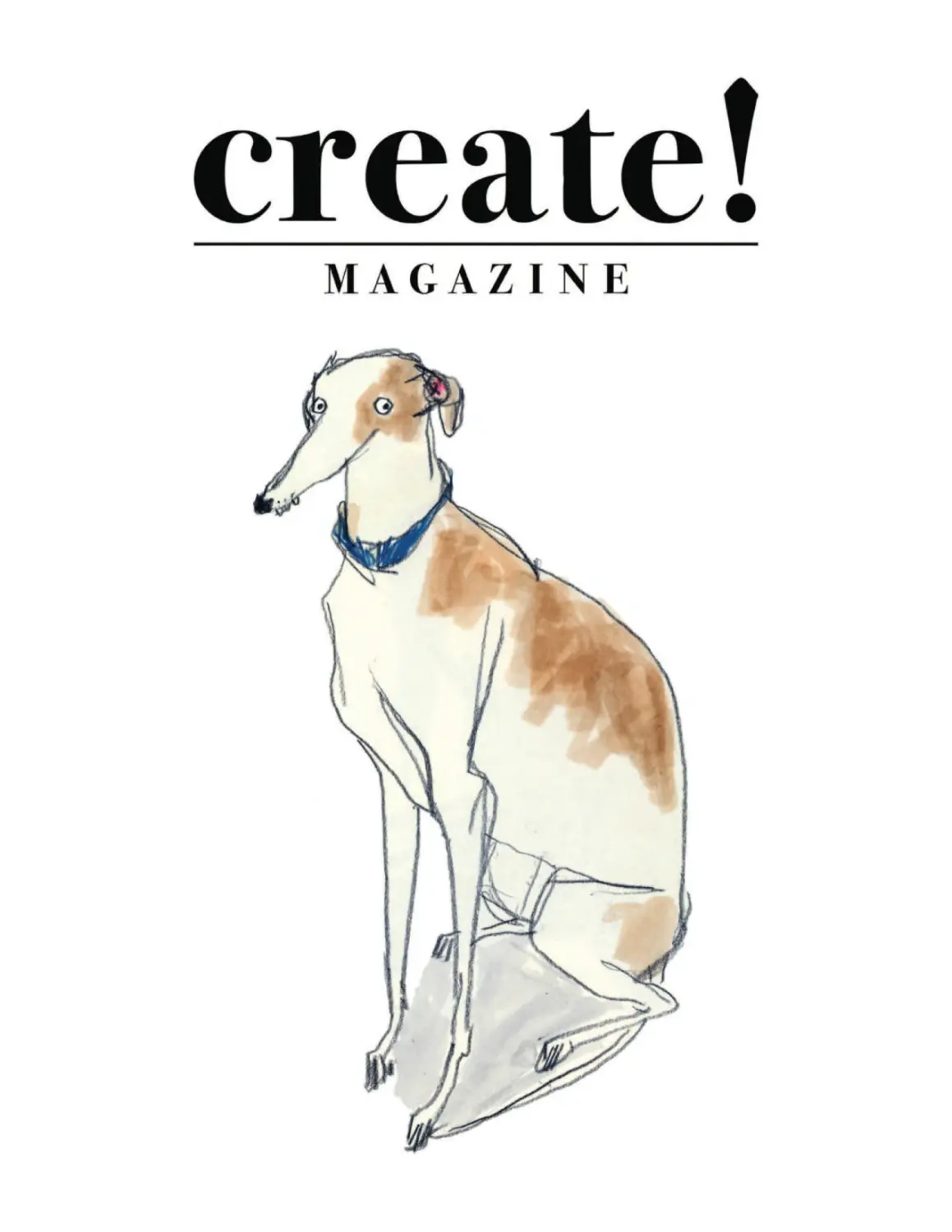
Front Cover
Harriet Lowther
Back Cover
Jason Shelby
Schuler

Interviews
10

E N J OY I N G T H E M I S TA K E S
& A P P R E C I AT I N G T H E M A G I C O F

Interviews
44

I N T E R V I E W W I T H A N G E L A FA N G

48

INTERVIEW WITH DANYM KWON

54

INTERVIEW WITH GINA M.

Z I R B E S by Christina Nafziger

C R E AT I N G
Interview with Harriet Lowther by Alicia Puig

18

by Christina Nafziger

BIRDS, BUTTERFLIES & MELANCHOLIA
Interview with Jane Margarette
by Christina Nafziger

CONTRERAS
by Christina Nafziger

24

H OW TO C O L L ECT A R T
Interview with Magnus Resch
by Alicia Puig

56

INTERVIEW WITH MADELEINE
TO N Z I
by Christina Nafziger

29

SHAPE OF THINGS
A Profile on London Artist Simone Brewster By
Zoë Goetzmann

60

INTERVIEW WITH MARY
F I N L AY S O N
by Christina Nafziger

36

F R O M M Y T H T O M A S T E R Y:
EMBRACING THE TRUTHS OF THE
ARTISTIC PROCESS
By TJ Walsh

40

ASK A GALLERIST
BEHIND THE SCENES WITH LIZ
LIDGETT
By Liz Lidgett

Top Left: Gina M. Contreras
Top Right: Angela Fang Zirbes

2 | C R E AT E ! M A G A Z I N E I S S U E 4 3

CONTENTS

Curated Section
64

A R T I S T S S E L E C T E D B Y C U R AT O R S
JENNIFER RIZZO

Subscribe
SUBSCRIBE ISSUES / Please visit our online
store at www.createmagazine.com/subscribe
to subscribe to our digital or print publication.

Charlotte Brisland
Annabelle Buck
Jordan Buschur
Katelyn Chapman
Kristin Elizabeth Fiorvanti
Helya Ebrahimi Ghajar
Anastasia Greer
Xinran Guan
Fortune Hunter
Loc Huynh

Newsletter
SIGN UP TO NEWSLETTER / Get a weekly
dose of inspiration when you join
our newsletter.
www.createmagazine.com/newsletter

Anna Jekel
Justin N. Kim
Debora Koo
Carrie Lederer
Michele Montalbano
Jes Moran
Michelle Mullet

Instagram
INSTAGRAM / Follow us on Instagram for
artist features, inspiring content and more!
@createmagazine

Erika Navarrete
JP Neang
Hallie Packard
Gianna Putrino
Lucy Ray

Call for Art

Tegan Brozyna Roberts

CALL FOR ART / Visit www.createmagazine.

Diana Rodgers

com/call-for-art to learn how to submit to

Jason Shelby Schuler

one of our open calls.

Katie Steward
Denise Stewart-sanabria
Scott Troxel
Xiangjie Rebecca Wu
Jesse Zuo

Shop at PXP
PXP Contemporary / Shop art you can
afford to love at our online gallery of

Top Left: Debora Koo
Top Right: Charlotte Brisland

affordable contemporary art www.
pxpcontemporary.com
ISSN 2475-9198

3 | C R E AT E ! M A G A Z I N E I S S U E 4 3

Connect online
@createmagazine
createmagazine.com

F R O M T H E E D I TO R

a letter from
the editor
connect on Instagram
@createmagazine

Fur, Friendship, and Fine Art
Dear Reader,
Welcome to issue #43! In this edition, we celebrate
artists who find inspiration in their furry companions.
As a proud pomeranian parent myself, I'm continuously
inspired by my dog and curious to see how others
express their connection to their animal friends through
art.
Throughout art history, animals have frequently graced
the canvases, ceramics, and photography of artists
worldwide, and in this issue, we explore this enduring
motif.
For art enthusiasts and collectors, we've included expert
tips from Liz Lidgett and Magnus Resch on navigating
galleries, collecting, and other professional advice to
enrich your journey.
TJ Walsh contributes a compelling essay titled "From
Myth to Mastery: Embracing the Truths of the Artistic
Process," offering insights to ponder.
Enjoy our interviews with incredible artists like Harriet
Lowther, Jane Margarette, Simone Brewster, Angela Fang
Zirbes, Danym Kwon, Gina M. Contreras, Madeleine Tonzi,
and Mary Finlayson.
Our guest curator, Jennifer Rizzo, has handpicked a
diverse selection of global artists, many of whom we've
personally fallen in love with. We hope you do too!

Cheers!
Kat and Team

Photography by Helena Raju

4 | C R E AT E ! M A G A Z I N E I S S U E 4 3

MEET THE TEAM

01

02

03

04

05

06

Our Team
Issue #43
01

Renan Calara

02

Alicia Puig

03

Shelby McFadden

04

Christina Nafziger

05

Zoë Goetzmann

Artist and Designer

Director of Business Operations

Lead Designer

Associate Editor & Writer

Writer & Podcaster

5 | C R E AT E ! M A G A Z I N E I S S U E 4 3

06

Sarah Mills

07

Ekaterina Popova

Writer & Assistant

Founder & Editor in Chief

Open up to
creativity.

OMEGA

write
photograph
paint
compose
make music
dance
draw
play
sing
act

Exceptional programs | World-class teachers | In person and online

Rhinebeck, NY | 800.944.1001 | eOmega.org

When my work started
moving onto the wall it was
a wonderful separation
from all the detritus of my
studio, it could exist on its
own entirely and that was
(and still is) really exciting
for me to experience.
Jane Margarette

Articles
Interviews
and

Step into the vibrant world of art and creative entrepreneurship with our
fresh article and interview section. Explore behind-the-scenes insights
from global artists and leaders, get expert tips on art collecting, and delve
into thought-provoking discussions on the creative process. From intimate
interviews with artists like Harriet Lowther and Jane Margarette to expert
advice from Magnus Resch and Liz Lidgett, our section offers engaging
content for artists and art enthusiasts of all levels.

1 1 | C R E AT E ! M A G A Z I N E I S S U E 4 3

ARTIST INTERVIEWS

Photography by Nick Cole

1 2 | C R E AT E ! M A G A Z I N E I S S U E 4 3

Enjoying the Mistakes
& Appreciating the Magic
of Creating
Interview with Harriet Lowther
By Alicia Puig

Harriet Lowther is a Wiltshire-based artist and illustrator, whose subjects range
from animals to plants and interiors. But what’s the four-legged creature that
appears time and time again in her art? Dogs! Harriet creates quirky, expressive
illustrated pups in watercolor, pen and ink, crayon and on ceramics and enjoys
experimenting with pattern and color. Working out of a cozy garden studio, she
not only produces original drawings, but also prints, homewares and more. In this
interview, we discuss how she decides on what new products to make, finding the
right hires to manage and grow her business and her muse-companions, aka studio
pets Doughnut (dog) and Sean Connery (cat).
How did you first get into drawing and illustration?
I studied fine art photography at the Glasgow School of Art, graduating in 2009.
As the course title suggests, there wasn’t a lot of drawing or illustration involved,
so although I now am able to draw and illustrate for a living, I haven’t come via a
traditional route. Following my degree, I slipped into a 9-5 admin role, and a sense
of not knowing what I was going to do. I then met my partner and ended up joining
his band, The Zoots. It was whilst traveling the globe with The Zoots, that I found
myself drawing on the backs of boarding passes and itineraries to pass the time.
Looking back at some of those first pieces does make me cringe, but it enables me
to see how much my work has changed, and how drawing most days has helped me
evolve and develop.
What most helped you develop your
style as an artist?

“

Accepting that I can enjoy other
styles and work, without feeling the
need to be able to make something
like that myself has been really helpful.
I still love the work I create!

Separating the “work I like” from “work I
make” has been a bit of a game changer. I
see so many amazing illustrators and wish I
could make work like that, and for a long time
I felt disappointed that I couldn’t make my hands make the work I knew my eyes
enjoyed. It left me feeling unfulfilled and unauthentic. Accepting that I can enjoy
other styles and work, without feeling the need to be able to make something like
that myself has been really helpful. I still love the work I create!

1 3 | C R E AT E ! M A G A Z I N E I S S U E 4 3

Making work all of the time has been so helpful in
developing my style - I care less about the “end
result.” I’m less precious about what to draw or
what material to use. I don’t let myself become
disheartened when I think a piece isn’t “good.”
If I’m feeling particularly stuck, I draw with my
eyes closed, or with my non-dominant hand. Quick
timed drawings loosen me up and take away the
worry time, and help me embrace and enjoy the
mistakes, and appreciate the magic of creating
something, or anything at all.
You have such a fun variety of offerings.
from ceramics and tea towels to prints
and socks. How do you decide what new
products to create?
In the early days, I was so excited when anyone
liked my work, or gave me nice feedback, so I

“

I like creating work which others can
relate to, and which brings a smile.

would have a bouncy moment and be like AH
GAWD, I MUST ORDER THIS ON CARDS FOR
MY SHOP, and proceed to order 500 cards of
that drawing, most of which I still have today. As
I have continued, I’ve learned to trust my instincts
more, and actually take the time to order check,
do proofs, order samples and be a little bit more
patient in product development before getting
carried away and ordering a ton of stock without
giving it much thought.
These days, I like to create pieces that I would like
to have for myself. Something colorful, and fun,
which might also suggest how I, or my customers,
are feeling. I like creating work which others can
relate to, and which brings a smile. It’s important
to me to have good quality products and well
thought out designs. There has been so much trial,
and a great deal of error with my past choices.

one thing to another, which I’ve learnt to embrace.
I think this also lends itself to the products I
produce, as they vary greatly in price points, so
I really like to hope that there is something for
everyone’s price range.
Running a busy studio takes lots of
work—and not just creative time, but
organizational
and
administrative
efforts as well! Can you talk about
finding the right people to hire and help
out in your business?
There is SO MUCH other (very boring) stuff
involved, and as Made by Harriet has grown, I
found myself in more and more meetings, and with
much less time to create, which just felt bonkers.
2023 saw us grow a lot, and I sought extra help.
I have Ben who helps with a lot of the technical
and business side of things, like insurance and
contracts and all the website stuff. I met my dream
photographer, Anna Heaton, who is the most
perfect fit for Made by Harriet. I have two studio
elves, Claire and Flissy. Flissy is one of my best
friends, and also my next door neighbor, which is
so convenient! They both help with studio running,
things I find especially difficult. Our latest addition
is Emily, my twin sister, who is overseeing all of
our apparel creations and currently working on
seeking out partnerships and collaborations for
our next steps.
I would be lost without these people, and I’ve
been very lucky to find them through personal
contacts. I know my chaotic and unpredictable
mind can sometimes be difficult to navigate. I also
love my own space, so it was really important to
have people in the studio who I felt like I could
be comfortable around. They all have the skills
and initiative to remember things I might forget,
as well as making things I find really hard so much
easier: streamlining everything with people I trust
has made the growth of the last year so much more
enjoyable.

I can easily become disinterested in things, such as
a certain medium or format, so I often jump from

1 5 | C R E AT E ! M A G A Z I N E I S S U E 4 3

You’ve made work about a variety of
creatures, but primarily focus on dogs.
What is it about them that makes them
a subject you love to illustrate?

I’ll bet there’s no “typical” day for you,
but generally speaking, do you have
certain routines that keep you on
track?

I’ve always been a tad obsessed with dogs, but
as we traveled a lot to perform with the band,
we couldn’t have one of our own at that time. I’m
very hedonistic, and find it hard to draw things I
*don’t* love or get excited about, so dogs seemed
like the perfect fit.

You’re so right—there isn’t a typical day here,
which actually works really well for me, as it
means I can mostly tailor what I’m doing to work
with how I’m feeling and how much energy I can
muster. Most days usually end late, which means
the following day starts late. I’m bad at eating well,
and at the right times, so I always try to start the
day with porridge!

Is there a certain medium you’re most
drawn to?
In the beginning, I bumbled my way through with
watercolor, not really knowing what I was doing,
or how. My materials were all a bit rubbish, and if
I bought anything expensive, I was too intimidated
to use it. I didn’t know which pen went with what
paper, but looking back, I think this was a positive.
It allowed me to experiment and make so many
mistakes. Some of the first drawings I was most
happy with were ones drawn with a biro on the
back of a scrap of paper. So you really don’t need
all of the very best materials to start creating.
In lockdown, a few of us connected via social
media and set up a daily drawing group; we fondly
called it “The Breakfast Club.” We met every
single morning at 8:30 a.m. and sang, laughed and
drew together, creating some absolute howlers,
and delighting in just making, well, anything. It was
one of the best times. We drew so much, and so
many different things, and we all learnt so much
from each other, all of us being at different stages
of our illustration journeys.

Then I’ll head to the studio with Sean Connery. I’ll
try to tackle admin and social media messages and
comments in the morning, leaving the afternoon
free to pack orders, work on new products and
create.
When things are busier, I have to have more
structure, as things *need to be done,* but I’ve
set up my creative life in a way that I rarely take on
commissions or projects, as the sense of a deadline
looming doesn’t always make for a happy work life
for me.
I always have an unsettling sense of having to
do something, whether it’s creating or doing the
boring jobs, something which I can never seem to
make peace with. So unless I’m physically doing
something else, like seeing friends, or going to the
gym, I will usually be in the studio. To be fair, my
garden studio is a very lovely place to be.

Emma Carlisle, my now best friend, and I were the
founding members of The Breakfast Club. I joined
Emma’s Patreon community when it began, and
I learnt so much about different materials, and
creating things in my own style from [them].
I don’t ever stick to one type of material or medium.
I can’t remember the last time I created something
with only one type, and I’m not sure if I can. I love
the different textures, colors and lines you can get
from each different material.
Photography by Anna Rose Heaton

1 7 | C R E AT E ! M A G A Z I N E I S S U E 4 3

ARTIST INTERVIEWS

What’s the best piece of advice you’ve
gotten from another artist?
I’d probably have to refer back to my best friend,
Emma Carlisle. When I watched some of her first
Patreon videos, she said that you learn more from
the mistakes you make, than any “perfect/finished”
pieces. Which is so, so true. An “imperfect”
drawing or painting shouldn’t be looked upon as a
failure, or something to be disappointed with, but
instead, an opportunity to learn something. You
never know, you might look back at it later and like
it anyway.
Emma and I love chatting all things art, and this
year we are launching a podcast, “Tiny Pencils
Podcast.” So keep your eyes peeled!
And finally, tell us about Doughnut and
Sean Connery! (Both amazing
names for a dog and cat, respectively,
btw) How are they as studio mates?

presented on the doorstep with this shaking, dirty
and covered-in-fleas “cat with a mustache,” and
asked “Did I want the cat or not?” There was no
way I could have left him there, so I agreed and left
the property with this flea-ridden floofer I didn’t
particularly want. But fast forward six very long,
and quite emotionally testing weeks—four baths,
two vets visits, a transition to raw food, lots of
toys, lots of coaxing, lots of, “Doughnut, don’t eat
the cat,” and lots of socializing—and I realized we
had the BEST CAT EVER.
He is by my side most days, whether that’s in the
studio, or watching me in the shower. He is quite
the chaos maker in the studio, getting into things,
knocking stuff over, sitting in boxes when trying
to pack orders or sleeping in his bowl. He is a little
monkey, but I wouldn’t change him for anything. I
did not know I could love a cat so much. I know
he has converted quite a few “non-cat” people to
loving him too.

Ach, my two boys, the loves of my life. Doughnut
is a 50 kg [110-lb.] lurcher, who came into our
family from a local rescue. I was searching for a
greyhound to rehome, when these 3-week-old
rescue pups popped up on my radar. He looks more
like an Anatolian Shepherd (which we presume his
dad to be), than a greyhound, but he is wonderful
and so full of character, it really doesn’t matter. He
would make a great assistance dog, as he helps us
out around the home, closing doors, taking notes
to people, putting things in the bin, picking up
dropped socks and bringing in the shopping. He
is mad intelligent, and very independent. I think
he would live outside given the option. Doughnut
does come into the studio occasionally, but as
Anatolian Shepherds are a guardian breed, he
likes to be where he can see what’s going on.
Sean Connery has been with us just over a year.
Although I never particularly liked cats, and was
very allergic, I decided it would be a good idea
to rehome one. I put out the feelers, and before
I knew it, I had committed to seeing the last cat
of the litter—“the one with the mustache”—the
following day. The home he came from was a
little, erm, shall we say … questionable, and I was

1 8 | C R E AT E ! M A G A Z I N E I S S U E 4 3

Instagram: @ harriet_lowther
Website: madebyharriet.co.uk

ARTIST INTERVIEWS

2 0 | C R E AT E ! M A G A Z I N E I S S U E 4 3

Birds, Butterf lies &
Melancholia:
Interview with Jane Margarette
By Christina Nafziger

LA-based artist Jane Margarette’s work is full of beautifully contrasting
elements: industrial and fragile, wildness and entrapment, freedom and limitation.
With clay, she forms wall-pieces of winged creatures that are typically seen as wild
and free, such as birds and butterflies. However, her butterflies contain mechanics
like locks and chains, and her birds are within complex cages. There is a sense of
safety with these locks and cages—but at what cost? Is their freedom in safety,
or is it another means of confinement? Psychologically complex and gorgeously
constructed, the artist’s work is not easily forgotten.
Margarette had an interest in ceramics from a very young age, coming back to it at
university after originally planning to study graphic design. In this conversation, the
artist tells us about the melancholic edge to her work, how stained-glass windows
influence her aesthetics and the labor-intensive process that ceramics demands.

When did you begin working with clay? Who were your first
“teachers?”
I was first introduced to clay in the 4th grade. I took a ceramics class once a week
after school at the local recreation center. I did that for just three months and I
would return to making ceramics again when I was an undergrad at CSU Long
Beach, where I went to school with the intention of being a graphic designer, but
fell in love with the ceramics studio instead.
My first teachers were there at CSULB, and that was mainly Tony Marsh and
Meghan Smythe. But I also learned so much from the other students and visiting
artists that were around me during that time. We all spent so much time learning
from each other in that environment.
Let’s talk about the process. Do your works first exist as drawings
or paintings before the final piece, or do you “sketch” using clay?
Often I begin with a rough drawing to scale to get a feel for the size and form

2 1 | C R E AT E ! M A G A Z I N E I S S U E 4 3

ARTIST INTERVIEWS

in relation to my body. Once that feels right, I’ll
take measurements and images and move into
Photoshop to stitch together the drawings, scale
up to account for clay shrinkage, and perhaps
bring in stock imagery to finalize the whole
composition. Since the work is typically made
from smaller pieces that are puzzled together, it’s
best for me to work out the mechanics digitally
before committing to the clay. From there I print
out templates that will guide me on how to cut and
prepare each puzzle piece. Because everything
has to fit together a particular way, there’s not a
lot of room for “sketching” in the clay. It’s all very
planned and mathematical.
You use ceramics in a way that is so
rarely seen. Can you talk about your
gravitation to wall reliefs/installations
(if I can call them that?)

behind this piece,
conceptually?

aesthetically

and

This work I made specifically for a group show
curated by Jasmine Wahi at my gallery, Anat Ebgi.
She prompted the artists in the show to make work
in response to a list of words and phrases related to
subversive femme sexuality. Words like sensuality,
seduction, velvet and violence, for example.
I had recently been making work thinking about
these beautiful wrought iron birdcages I kept
encountering in flea markets and antique shops.
My work often deals with situations of entrapment
or hopelessness, so the cages were a good fit for
me conceptually. With “Nowhere to Be Gone”
I was interested in creating this psychological
space inside the cage that was a bit unsettling for
the creatures living inside it—that they exist in
this impossible situation of potentially being safe
from the outside world but are struggling to find
peace on the inside.

I started making wall works when I began making
large ceramic locks that had these functioning
mechanics like hinges and
sliding chains. It made sense to
me that these sculptures would
My work often deals with situations of
exist on a wall or a door, as they
entrapment or hopelessness, so the cages
would in their “normal” function.
From there I haven’t been able
were a good fit for me conceptually.
to stop thinking of the wall as
the place for my work. Having
a ceramic practice involves so
much stuff: tables, buckets, carts, bottles, boxes,
boards, plastic sheeting, and on and on and on.
When my work started moving onto the wall it
was a wonderful separation from all the detritus
of my studio, it could exist on its own entirely
and that was (and still is) really exciting for me to
experience.

“

Before I discovered ceramics I was interested
in painting, drawing and photography, but that
never went anywhere interesting for me. Once
the ceramics moved to the wall, it was a new
opportunity for me to engage with graphic
imagery again.
I’m so drawn to your piece “Nowhere
to be Gone.” What is the inspiration

2 2 | C R E AT E ! M A G A Z I N E I S S U E 4 3

ARTIST INTERVIEWS

I love the many different creatures that
appear in your work! Can you talk about
the different animals and insects that
show up (especially winged creatures)?
Most of the creatures that show up are winged:
butterflies, moths, bats, birds and dragonflies. I
find it quite poignant to anthropomorphize the
locks into these types of creatures. Typically
their wings, which allow them the freedom of the
sky, are either locked or chained. It’s melancholic
really. When land animals show up they are usually
cats or foxes. I use them less frequently, but
they’re typically there to be playful protectors or
guardians of some ominous situation.
What is the most challenging part
of your process? What is the most
enjoyable part for you?

I recently encountered a Henry Cros glass paste
wall piece called “The History of Water” at the
Musée d'Orsay in Paris. It’s also pieced together
like a puzzle and I can’t stop thinking about that
one.
What is one piece of advice that you’re
glad you listened to (or didn’t listen to)?
For better or worse, I’m not great at listening to
advice.
Do you have anything coming up you’d
like to tell us about?
This spring I have a residency in Berlin that I’m
thrilled about. My plan is to use that time to work
through new ideas and plan for my next solo
exhibition here in Los Angeles in early 2025.

The most challenging part is the waiting. My
process is labor-intensive and the work can’t go
on the wall until after the final firing. Until then
everything exists in pieces and it can often be
difficult to see the larger picture.
There are enjoyable parts to every step of my
process, but lately I’ve been enjoying glazing. It’s
the most meditative activity I do and it comes after
a long period of physically demanding work.
When it’s time to glaze it means that I can rest my
body and listen to a book while I work.
Many of your works seem to have specific
pieces or sections, like a puzzle. Are
you at all influenced by artworks with
a similar aesthetic, such as traditional
mosaics and/or stained glass windows?
I was raised Catholic and I spent a lot of my
childhood in the church staring at a particular
set of stained-glass windows, so perhaps that
imagery has stuck with me and influenced my
work. But the puzzling of the work initially came
out of a necessity to make large-scale work with
the limitations of the kiln size. If I make everything
out of my studio, a 26-inch circle is the max size of
a single piece.

24 | C R E AT E ! M A G A Z I N E I S S U E 4 3

ARTIST INTERVIEWS

2 6 | C R E AT E ! M A G A Z I N E I S S U E 4 3

How to Collect Art
Interview with Magnus Resch
By Alicia Puig

Magnus Resch is a leading art-market economist, serial entrepreneur, and bestselling book author. His latest book, "How to Collect Art", (Phaidon) is a valuable
resource for both newcomers to the art market and seasoned collectors. The book
provides essential insights into various facets of contemporary art collecting, from
collaborating with galleries and art advisors to navigating art fairs and auctions.
Written by an art-world insider, the “How to Collect Art” incorporates guidance
from seasoned experts in the field, including David Mugrabi, an Andy Warhol
collector, art advisor Amy Cappellazzo, gallerist Jeffrey Deitch, and Christie's
CEO, Guillaume Cerutti.
In keeping with Resch's previous Phaidon releases, "Management of Art Galleries"
(2016) and "How to Become a Successful Artist" (2021), "How to Collect Art"
maintains a balance between rigorous research and an accessible tone. The book
presents data on art evaluation, auction records, art institutions, and exhibitions in
a clear and visually engaging manner, offering a fresh and unprecedented approach
to understanding the intricacies of art collecting.
"How to Collect Art" offers an accessible and affordable guide to the inner workings
of the art world. It serves as a portable art advisor, providing valuable insights at a
reasonable price, making art collecting knowledge readily available in your pocket.

After back-to-back books focused on galleries and then artists
and their careers, what prompted the shift to one about the art
market and collecting?
My writing journey began with my Ph.D. focusing on galleries, resulting in the
publication of "Management of Art Galleries." Subsequently, a six-year data
study, recognized as ‘the paper of the year,’ explored success factors of artists,
leading to "How to Become a Successful Artist." With galleries and artists covered,
the final key player, collectors, remained. My goal was to create a book targeting
collectors, aiming to transform art enthusiasts into art buyers. I firmly believe that
fostering more art buyers is crucial for the sustainability of the art market, allowing
artists and gallerists to continue pursuing what they love.
What differentiates your book from others on this subject?
I hold a deep appreciation for books such as "Boom" by Michael Shnayerson and
"The $12 Million Dollar Stuffed Shark" by Don Thompson. Unlike these works,
which draw on anecdotal stories and personal experiences, my approach takes

2 7 | C R E AT E ! M A G A Z I N E I S S U E 4 3

ARTIST INTERVIEWS

a distinct route by relying on data. My aim is
not to assert a personal viewpoint but to offer
readers an unbiased and comprehensive view
based on rigorous and verifiable data analysis.
I believe this combination of rigorous research
with an accessible, no-nonsense tone is why my
books resonate so well with audiences and have
been translated into several languages. I also
place great importance on the design aspect. I've
always believed that when crafting a book about
the art world, its visual presentation should be
equally special. The incredible work done by the
design team from The Gentle Temper has played a
significant role in achieving this vision.
In doing the research for this book, was
there one tidbit of information that you
found most surprising or enlightening?
The book is based on a research study of 500,000
artists that took six years. I complement it with
interviews from over 200 art market experts.
These include mega collectors such as Shelley
and Philip Aarons, Beth Rudin DeWoody, Jorge M.
Pérez and Howard E. Rachofsky; museum directors
like Adam Weinberg and Heidi Zuckerman; art fair
founders like Touria El Glaoui; art dealers like
Marc Glimcher, Adam Lindemann, Jeffrey Deitch,
and Simon de Pury; art curators like Hans Ulrich
Obrist; art advisors like Amy Cappellazzo; or
artists like Julian Schnabel. A surprising common
thread throughout all this research is a consistent
piece of advice: "Don’t buy with your ears, buy
with your eyes." The resounding recommendation
is to immerse oneself in the visual experience of
art and see as much as possible before making
purchasing decisions.
What would you say are the aspects
of the collecting process or of the
art market in general that emerging
collectors often overlook?
Many believe the headline media narrative that
investing in art promises returns. However, the
reality is that art investment success is mainly
confined to a select few artists at the top, usually
represented by the same five to ten galleries. The

vast majority of artworks, constituting 99.9%
of the available pieces, typically lack the same
investment potential.
What is your one top piece of advice
for anyone looking to become a savvy,
informed collector - besides reading
your book, of course?
Purchase art because you love it, not because it’s
an investment. I term this approach responsible
buying, emphasizing that acquiring art goes
beyond a financial transaction to become a
philanthropic act. Instead of viewing it as an
investment, I consider it a donation, acknowledging
that resale might not be feasible. However, through
this purchase, I support the artist, enabling her
to sustain her artistic endeavors. This, in turn,
fosters creativity within her artistic community,
contributing to the vital realm of human creativity.
For me, it is a way of doing good, accompanied by
an object I love and a meaningful story to tell.
And finally, speaking of collecting - what
are some of the most prized artworks
in your own collection if you don't mind
sharing? Is there a story behind how
you acquired any of them or why they
caught your attention?
My most cherished piece is always the latest one, so
currently it’s a piece by Miami-based artist Katelyn
Kopenhaver (@katelynkopenhaver). I appreciate
her humor, intelligence, and entrepreneurial spirit,
along with the aesthetic presentation of her work. I
got acquainted with her through Dan Mikesell, the
founder of Fountainhead, a residency for artists,
and was impressed by her strong work ethic
and dedication. Typically, I make swift decisions
when buying art, guided by my love for the piece.
However, when the price surpasses $100,000,
I adopt a more deliberate approach. I invest
additional time in conducting comprehensive
research, leveraging the tools outlined in my book
to evaluate the appropriate price level.

2 8 | C R E AT E ! M A G A Z I N E I S S U E 4 3

Shape of Things:
A Profile on London Artist Simone Brewster
By Zoë Goetzmann

Simone Brewster (@simonebrewster_london) is an artist, designer, educator and
cultural change-maker.
Strongly grounded in craft, Simone Brewster uses her creative outputs as her
voice, celebrating and sharing windows into varied Black female narratives and
histories. Born and based in London, the threads that flow throughout her work
display a balance of function with beauty, a re-purposing of the “ethnic” and the
“western” and a continuous playing with scale, materiality and architectural form.
Simone’s work is in the permanent collections of the Victoria & Albert Museum,
The Museum of London and The Smithsonian, Washington, DC. She is a regular
public speaker on the subjects of contemporary design and writes on the subjects
of craft, design and jewelry.

ARTIST STATEMENT
When starting my creative journey in architecture, I would not have predicted that
my practice would take on so many forms of expression. The reality of working in
the creative industries led me to question my position in the world of design and
begin making work to fill a void I felt was present. There is no lack of beautiful
work in the world; however, I felt there was a lack of work that spoke to my specific
heritage as a person of Caribbean descent and woman of colour living in London.
During the pandemic my work grew, to take on painting. It was the main means
of expression available to me during a time of extreme restriction. I continued
looking into subject matter that led me to create some of my most significant work
(Negress Chaise Lounge & Mammy Table), this time on the canvas. The abstract
paintings used sweeping calligraphic lines overlapping coloured zones to represent
the distorted physical and psychological landscapes that exist within womanhood.
My practice is a fluid thing that seeks to ask questions of the world we live in and
bring those answers into the world, bridging the gaps and filling the voids within
design and art.

@simonebrewster_london

3 1 | C R E AT E ! M A G A Z I N E I S S U E 4 3

In Late Summer and Early Fall of 2023, I sat down
for a virtual interview with multi-disciplinarian
artist Simone Brewster (@simonebrewster_
london) where we discussed her two solo shows,
“A Woman of Parts” (exhibited at J/M Gallery in
Notting Hill) and “The Shape of Things” (shown
at NOW Gallery located in London’s Greenwich
Peninsula).We also touched on her painting series,
“Woman in Parts”—the inspiration behind the
artist’s Notting Hill solo exhibition.
Through our conversation, we spoke about the
representation of women in art. In her paintings
seen in her solo show, “A Woman of Parts,”
Brewster portrays her female subjects as abstract
figures. The intrigue behind her paintings lies
in the color, lack of color, ambiguity, connection
and disconnection in the artist’s style of painting
and her depiction of the women showcased in her
artwork.
Simone Brewster is an artist, a designer, an educator
and a cultural change-maker based in London. Her
practice is rooted in craft. Trained as an architect,
her artwork takes on many forms from painting,
furniture and object design to jewelry making.
Her practice covers African Diaspora—exploring
and celebrating Black and female narratives and
their voices. Her work encapsulates themes from
memory, nostalgia, tradition, heritage, race, gender,
slavery, identity, subjugation and objectification
via a Modernist lens. Taking inspiration from
Primitivist and Cubist styles and traditions (once
employed by Caucasian male artists such as
Constantin Brâncuși’s conceptual sculptures and
Henri Matisse’s nude cut-outs), Brewster coopts these design techniques to produce a visual
narration of her own artistic journey and vision.

Brewster studied at The Bartlett School of
Architecture at the University College London.
She continued her education and went to Royal
College of Art to study design products. Her tutors
were Hannes Koch and Gabriel Klasmer. The
course centered on, as Brewster explains, “testing
boundaries and asking questions to [about] the
objects we make.”
“A Woman of Parts,” “The Shape of Things” and
the painting series “Woman of Parts” unearth two
or three important facets, mediums and types of
artworks created throughout Brewster’s career.
Through these shows (and series), she unearths the
representation of the female form—cultivating her
own language to explore identity, emotion, color,
form, voice and memory of women featured in
her paintings. In “The Shape of Things,” Brewster
designs a colorful, larger-than-life exhibition
display to highlight her paintings and objects. She
describes this as “intimate architecture”—as noted
in the NOW Gallery press release, “the [affect]
that texture and three-dimensional form have on
memory and emotion.” In this particular show, the
artwork entitled “Negress” was acquired by the
Smithsonian in 2022. The Mammy” has also been

From a young age, her love for architecture began
after her family’s visit to Trinidad, where she
observed Caribbean architecture firsthand. As
Brewster recalls: “I noticed that everywhere [we
had gone in Trinidad] was hot,” she says. “When
we went [into] a particular house, it was cool. And
I said to my dad, ‘How come this house is so cool
when the other houses we’ve visited are really hot.’
He said, ‘Oh, because my cousin’s an architect and
he designed [this house] so that it would keep you
cool.’ I thought, ‘Oh, that’s amazing. That’s what I
want to do. Design space[s].’”

3 3 | C R E AT E ! M A G A Z I N E I S S U E 4 3

procured by the Museum of London. Both artworks
portray an abstract view of the Black Female body
through a conceptualized, deconstructed design
and perspective.
“When I looked into the design world,” Brewster
remarks, “there [was] no one making anything from
the African Diaspora. Nothing [no object] look[ed]
like me. Nothing [no object] talks [spoke] like me.”
As Brewster describes in her own words, “I
designed a space that was full of color [and] had
huge objects so [that] people were immediately
drawn in.” She explains further, “Interest overtakes
intimidation, and they [the viewers] go inside [the
show] and they actually start engaging with the
work. And that’s the point; I wanted to break down
those barriers that people have when it comes to
gallery spaces [...] the languages that I used to
design the space are also present in my work.”
Accessibility is a key factor when it comes to
understanding the purposeful ambiguity observed
in Brewster’s paintings and works of art:
Through “A Woman in Parts,” the artist explores
the female body through color, absence of color,
shape, line and form. In the solo show “A Woman
of Parts” curated by James Marshall, the show
consisted of 100 works created via Indian ink on
paper (as well as the inclusion of paintings) made
during the lockdown of 2020. Nestled in a quaint
room with two large windows shining in on the
artworks, it is clear that Brewster focused on the
notion of composition behind these images.
“The shapes and forms I’m making are referential
to the bodies that I’ve experienced, the black
female bodies,” she notes. “Going forward, I
wanted to introduce color, but I also didn’t want it
to be just black or brown. In a way, that’s part of the
problem [...] that you can’t escape that [traditional
representational use of color].” When looking at
these series of artworks, the viewer can observe
the artist’s use of arabesque-like brushstrokes
outlining the portrayal of these female figures.
Looking a bit more closely at these images, the
female body parts become a bit clearer, as the
art-goer moves backward and forward: a breast,

a torso, a leg or women’s private areas are visible
whilst examining these paper works (and large
works on canvas).
Brewster continues on: “I love being a woman
of color. That’s the point. There’s that internal
landscape [which occurs] that is free [and
independent] from your own body.” Women are
multi-dimensional beings regardless of class,
race and gender. Womanhood is a complex,
transformational journey: from girlhood to
teenagehood to motherhood [of which Brewster
describes as being “like a scrambled egg,” as
a metaphor for how a woman’s life can overturn
quickly with the introduction of a child into her life
and lifestyle].
In “The Shape of Things,” the identities of the
female figures are not apparent—rather, they are
ambiguous creations. As Brewster says, “This is
the kind of junction of womanhood. As a woman,
you look [the way] you look. And you’re always
judged by how you look, but you’re actually a
person with a whole emotional landscape and
intelligence that has to live inside this [physical
being].” On the canvas or artistic surface, this
constant tension between the suggested form and
internal emotional landscape represents the focus
behind Simone Brewster’s particular series of
exhibited artworks. As a jewelry maker, Brewster’s
decision to play with scale stems from her artistic
choice to defy conventional expectations of the
medium and of its makers: “there’s expectations
of what things should be and how they should
be [of which] are very, very vocal and dominant
in [other] fields.” She continues, “You [the artists
and women] are the ones setting the rules. You’re
on your own journey [of] learning. You’re on your
own. It’s very much a sense of freedom. That is [her
jewelry-making practice] for me, [a] total joy.”
Brewster references Chris Ofili, a Black British
painter, as another main inspiration who has
helped to guide and to shape her design practice.
Representation matters when it comes to creating
art. As Brewster explains, “I’m 40 now, but if you
talk [speak] to people from my generation or older
who are from the African or Caribbean Diaspora,
our parents came over and they [wanted to create]

3 5 | C R E AT E ! M A G A Z I N E I S S U E 4 3

this [a] life for us, [and] [they] said the idea to be
an artist was something that required permission.”

change or add to the past, present and future art
world landscapes.

The beauty of Brewster’s artwork (paintings, decor,
objects and jewelry) lies in the subtle abstractions
of her artworks rather than the subjective
figurations of conventional female forms. Building
on modern artistic traditions and principles of
notable (male) predecessors or contemporaries,
Abstraction creates its own language for artists
to transcend boundaries based on line, color
and form. The movement permits the artist (or
even architect) to create their own language—
freeing themselves from the expectations of their
ancestors or mentors (or if they choose to, they
can create a new language, through paintings,
sculptures or even buildings which pay homage to
their predecessors). It is through their own artistic
languages and dialogues between themselves and
their artworks, that they may decide how they can

Whether her artworks occupy small-scale or
large-scale galleries, Simone Brewster creates
accessible pieces which strive to highlight the
need for women and women artists (people of
color or women of color) to take up space (in
color, in shape and in form)—rather than to exist
on the margins of society, the fine art world and
the modern and contemporary art worlds. The
identities of the female artistic figurations seen
in Brewster’s work do not have to be obvious or
“hit you in the face.” The artist’s artworks and
objects reflect a person’s storied, nonlinear and
multifaceted existence. Simone Brewster’s artwork
defies expectations: of the art world, society and
for women and for women artists.

3 7 | C R E AT E ! M A G A Z I N E I S S U E 4 3

ARTIST INTERVIEWS

From Myth to Mastery:
Embracing the Truths of the Artistic Process
TJ Walsh, MA LPC CCTP Clini-Coach®

3 8 | C R E AT E ! M A G A Z I N E I S S U E 4 3

The world often romanticizes the life of an artist, portraying the creative process
as a mysterious, almost magical journey where inspiration strikes like lightning,
and masterpieces just manifest into existence. But, let’s face it, you and I both
know the reality of being an artist is far from the enchanted story that those on the
outside envision. Let’s take a few minutes to explore the common misconception
surrounding the artistic process and how it can impact your studio practice. I’ll
also provide tips for you to shift your perspective away from the notion of magic
and mystery, focusing instead on the elements of hard work, consistency, trust,
faith and self-belief.
The Myth of the Magical Muse
The idea of the artist as a conduit for divine inspiration or a vessel for a mystical
muse has been perpetuated through centuries. I’m sure you remember the idea of
the “divine spark” that they had during the Renaissance, or the romanticized image
of the tortured genius? These myths contribute to an unrealistic expectation of
the creative process. The truth is, making art is a deliberate and often challenging
practice that requires dedication, perseverance and skill development.
The Impact on Studio Practice
When you internalize the belief that the creative process is some otherworldly
experience, it can lead to a range of challenges for you and your studio practice.
Anxiety, self-doubt and creative blocks may show up as you wait for the elusive
muse to strike, hindering your productivity and growth. The pressure to conform
to the romanticized ideal of the artist can also put the brakes on your ability to
experiment and take risks, two crucial components of artistic development.

www.tjwalshcoaching.com

3 9 | C R E AT E ! M A G A Z I N E I S S U E 4 3

ARTIST INTERVIEWS

Shifting Perspectives:
Embracing the Realities
Hard Work and Consistency
Embrace the idea that art, like any other profession, requires hard work and
consistent effort. Establish a routine, create habits, set goals and dedicate focused
time to your practice. Break down larger projects into smaller, manageable tasks
to make progress more achievable.
Skill Development
Recognize that artistic skill is not solely an innate gift but something that can be
developed through practice and learning. Invest time in honing your craft, whether
it’s through formal education, workshops or self-directed study. Continuous
improvement is key to artistic growth.
Trust the Process
Shift your focus from waiting for inspiration to trusting the process of creation.
Understand that not every work will be a masterpiece, and that’s okay. Allow
yourself the freedom to explore and make mistakes. Each piece contributes to
your artistic journey.
Faith in Your Voice
Cultivate faith in your unique artistic voice. Your own distinct perspective and
experiences are valuable, and your work is a meaningful contribution to the world
of art. Believe in the authenticity of your expression, and don’t be swayed by
external expectations.
Believe It’s Good Enough
Perfectionism can be a paralyzing force. Instead of striving for unattainable
perfection, focus on the inherent value of your work. Recognize that art is
subjective, and what matters most is the sincerity and effort you invest in your
creations.

4 0 | C R E AT E ! M A G A Z I N E I S S U E 4 3

Revealing the intricacies of the creative process empowers you to engage with
your craft from a down-to-earth perspective. When you acknowledge the realities
of hard work, consistency, skill development, trust, faith and belief in your voice,
you’ll break free from the constraints of the magical, mysterious artist archetype. In
doing so, you empower yourself to create authentically, embrace experimentation
and find fulfillment in the tangible, day-to-day aspects of your artistic practice.

TJ Walsh, BFA, MA, LPC, NCC, CCTP is an innovative painter, badass CliniCoach®, and dynamic psychotherapist, educator, brand strategist, and higher
education administrator based in Philly.
He writes and speaks on the topics of art, culture, faith, and mental health and his
work is exhibited and published internationally.
TJ has worked at the colorful intersection of creativity, art, therapy, and education for
over 20 years and is an expert in creativity, relationships, fear, and procrastination.
He received his BFA in Graphic Design from The University of the Arts, Philadelphia
and his MA in Clinical Counseling Psychology from Eastern University, Saint Davids,
PA. He is trained psychodynamically, is a Certified Clinical Trauma Professional,
and has advanced training in Emotionally Focused Therapy.
Prior to his work in mental health and higher education administration, he was a
Creative Director, Art Director, and Director of Communications for several national
and international nonprofit organizations in NYC and Philly where he specialized in
brand development, corporate communications, non-profit marketing, social media
engagement, fundraising communications, project management, and strategic
planning.
He believes every human being is inherently creative – particularly when they
access their authentic selves – and is passionate about helping people understand
who they are and what their vision, mission, and purpose is as a creative. He’s also
a mega fan of connecting people via his expansive network.
TJ is on the board of directors for InLiquid, a nonprofit arts organization, where
he serves as the Secretary, and the Philadelphia Center for Emotionally Focused
Therapy (PCEFT).
He currently lives in Philly with his wife and two sons, a dog and cat, 65 houseplants
and counting, and a robust and growing collection of artwork from emerging artists.
Check out his new podcast, the BOLD CREATIVES COLLECTIVE.

4 1 | C R E AT E ! M A G A Z I N E I S S U E 4 3

ARTIST INTERVIEWS

Ask a Gallerist
Behind the Scenes with Liz Lidgett
Intro by Christina Nafziger

4 2 | C R E AT E ! M A G A Z I N E I S S U E 4 3

We know approaching a gallery can be intimidating. Who is the right person to
reach out to? How do galleries operate? Where do you even begin? With many
galleries being opaque in how they work, it can feel overwhelming. If only you
could reach out to a gallerist directly and ask your questions ... which is exactly
what gallerist Liz Lidgett aims to do in this new column: “Ask a Gallerist!”
“The art world can be so full of joy, but also difficult to navigate,” says Liz. “Within
my role as a gallery owner, I speak daily with both clients and artists. It gives me
a unique perspective on what issues and questions are on many people’s minds.”
Liz is the owner and founder of Liz Lidgett Gallery and Design. Located in Des
Moines, Iowa, the gallery represents over 55 contemporary artists from around
the world and works with personal collections, restaurants, corporations, small
business, hotels and more.
For this column, Liz asked for open submissions and selected one question from an
artist and one from a client to answer. “My hope,” Liz explains, “is that this column
will become a safe place to ask any question you may have.”

Dear Liz,
How can I approach a gallery being a self-taught artist? I have no
idea how to open the conversation!
Sincerely, an artist

Hi, Artist! First, let me say, I love that you are creating art and are ready to start
sharing it with the world. I do not have hard numbers but looking quickly at my
artist roster at my own gallery, I would say 50% or more of my artists do not have
a BFA/MFA and would be considered self-taught. Surprisingly, I have heard from
artists that many schools do not prepare you for the business side of creating.
Each gallery is a bit different but it is important to do your research. Look
throughout their website to see the type of artists they currently represent, if they
are working with emerging artists, if they are currently accepting submissions and
how they accept submissions.
I look for clear photos that show me the artist’s work, with descriptions of each
piece, including how each piece is currently priced. If a gallery is interested in
working with you, they understand that they can help you with updating pricing,
taking better photos and some marketing aspects. Please don’t believe that
everything has to be perfect or let that stop you from taking the next step. You’ve
got this! Good luck!

www.lizlidgett.com

4 3 | C R E AT E ! M A G A Z I N E I S S U E 4 3

ARTIST INTERVIEWS

Dear Liz,
What if you love a piece but don’t have a place for it?
Sincerely, a client

Hi, Client! I see a lot of great art on a day-to-day basis—it’s an occupational
hazard—so I totally understand. We have many clients who love to support artists
and like to be creative with their placement. Here are some things I want you to
think about:
1. Are there untraditional places you could think about for placement? For example,
I have art hanging between two windows on the casing. I also have artwork hanging
on the side of a bookcase and above a doorway. These quirky placements bring so
much personality to the space.
2. Do you have a temperate, dry place to store artwork if you wanted to change
out art seasonally? I need calm and cozy from my home during the winter months
and I want bright and energy during the warmer months. Your artwork changes the
mood in your home so much, so think about changing it from time to time. It will
feel like you are in a new home!
3. Do you have family, friends or an office you would be willing to loan some
artwork to? If your office needs some design love, I have seen clients bring in
pieces that they are no longer interested in for their home. It’s a great way to share
the love, while still owning the piece. I love that you love art and are supporting
artists. Thank you!

4 4 | C R E AT E ! M A G A Z I N E I S S U E 4 3

4 5 | C R E AT E ! M A G A Z I N E I S S U E 4 3

Angela Fang Zirbes
Dog on Couch, 20x16 acrylic on canvas, 2023

Interview with
Angela Fang Zirbes
By Christina Nafziger

In the work of Angela Fang Zirbes, there is an air of the eerie. A shadow, a hand,
eyes in the dark—there is a sense of foreboding that seeps from each scene the
artist renders. Through her haunted, stylized paintings, she explores moments from
her childhood in Iowa. For the artist, these Midwest scenes in her work harken back
to memories of being (one of) the only biracial person(s) in her small town, allowing
her to unpack and explore her identity, cultural roots and upbringing.
In this conversation, Fang Zirbes tells us about how cartoons have influenced her
style and how her recent work acts as an extension of herself, and of her often
conflicting feelings toward old, rotting farmhouses.

How did your experience growing up affect your art practice?
Can you talk about how your work references your upbringing in
Iowa?
My work is heavily influenced by my experience growing up in Iowa, specifically as
a biracial person. When I was a kid there were very few people of color, and even
fewer mixed kids in my city. I can’t speak my mother’s language and was ashamed
of being Asian for a long time. She immigrated to the United States in the late ‘80s,
and visits with the Asian side of my family were sparse, due to distance. I think a
lot of mixed-race people in the Midwest, or any predominantly white area, share
similar feelings of isolation. That struggle of non-belonging always made me feel
like I was missing something in myself. I spent a lot of time as a teenager driving
alone around rural Iowa, especially when I was feeling particularly lost. I’ve always
had a deep affection for the countryside and the old rotting farm houses on the
side of the road, especially in smaller rural towns like where my white grandparents
lived. I spent a lot of my childhood there, and I frequently draw from memories and
old family photos from that time for my current work. I find myself painting that
old house and the surrounding farmland again and again, despite it also carrying
negative experiences and emotions with it.
Your work seems very narrative to me. Who is the protagonist in
your paintings and what is she going through?
There is no protagonist or antagonist in my current work. The characters and
objects in my paintings are all extensions of myself interacting within their
environment in a contained and isolated way. In my previous color work, there was
a more obvious protagonist. In those paintings you see a girl (me) running from
creatures and scenes that symbolize different things from my past and reference
dreams that I was having during that time. Now, I’ve moved forward in a new
direction with myself and my work. I’m no longer running or escaping anything; I’m
just experiencing myself in a different way.
Website: www.angelafangzirbes.com
4 7 | C R E AT E ! M A G A Z I N E I S S U E 4 3

ARTIST INTERVIEWS

Can you tell us how the concept of
a “haunting” shows up in your work,
aesthetically and/or conceptually?

same matte finish that I liked but was less heavy
than acrylic paints. I am incredibly grateful to the
team at Harman Projects for taking a chance on
me and continuing to support and show my work.

I’ve been curious about ghosts and haunted
houses since I was really young. I used to love to
read ghost stories and books like “Scary Stories
to Tell in the Dark” and play jumpy, early-internet
horror games like “The House.” In my recent work
focused on interior spaces, there’s a presence in
the room that the characters interact with but the
viewer doesn’t always have access to. I’m sort of
haunting my own memories as a way to better
understand myself and my fears.
You have such a distinct style—what
are your influences? Are you influenced
by graphic novels or comics at all?
I would say that I was most influenced by cartoons
and animation. I grew up watching cartoons at my
grandparents’ house as a kid, and the really bright,
addictive colors stuck with me. In my color work
you can definitely see the influence of cartoons
from the early 2010s. I think the most influential
piece of media to my practice would be “Coraline.”
I first read the book and then saw the movie
when it came out in theaters. I was 9 at the time,
and really connected with Coraline’s feelings of
loneliness and her search for belonging. The style
of the movie is the perfect blend of unsettling and
cute—visually, it’s easy to digest but still makes
you a bit queasy.
I love your Moleskine project! Can you
tell us how this collaboration came
about and the work you created for it?
I was very lucky that the gallerist of Harman Projects
found my work on Instagram and reached out to
me to participate in the exhibition with Harman
Projects and Moleskine. I was making large-scale
color work at the time, so it was a fun challenge
to transfer my work to a small-scale book format.
I took the same approach to the Moleskine book
as my acrylic on canvas series, through examining
my dreams and painting from the subconscious. I
ended up using acrylic gouache because it had the
Top: Angela Fang Zirbes
Goodnight Moon, 20x16 acrylic on canvas, 2023
Bottom: Angela Fang Zirbes
Vanity, 20x20 acrylic on canvas, 2023
4 8 | C R E AT E ! M A G A Z I N E I S S U E 4 3

Angela Fang Zirbes
Thorns, 12x16 acrylic on canvas, 2023

Interview with
Danym Kwon
By Christina Nafziger

Danym Kwon’s paintings embody warmth, extending comfort and soft beauty
to their viewers. Plant life has its roots in almost every painting, offering tender
calmness—a constant reminder of the steadiness and life that nature provides.
For the artist, nature is a salve, a comfort during a time of needed healing. Kwon’s
practice focuses on the seemingly small moments in life—which in turn often
become the most intimate. Sometimes the smallest things are the most powerful.
In our conversation, Kwon shares how nature has brought her strength in times of
illness, the inspiration she receives from her mother and her recent solo show at
Hashimoto Contemporary.

The plant life and lush scenery in your paintings create such a
warm atmosphere. Are you inspired by the passing of the seasons
and/or plants in your home?
Yes, nature always inspires me. I often feel comforted by the flowers and trees I
encounter on my walks. Especially during times when I was physically and mentally
exhausted due to health issues, I found great solace in their stories, as if they were
saying, “I love you, be strong.” I spent most of my 30s in the Bay Area, which is
known for its beautiful natural surroundings. Having been born and raised in a
large city, I think the happiness and healing that nature provided felt even more
profound to me. I can’t forget the pleasant moments of brushing my hand against
a rosemary bush near my home and inhaling its fragrance. Although I have now
returned to Seoul, I live in a neighborhood surrounded by small mountains. When
I feel down, I seek out these places. I also grow small plants at home, drawing
courage from the vitality they exude.
Much of your work focuses on small, still moments. Can you talk
about your emphasis on what might be considered the “small”
things in life?
In my early 30s, when my second son was just a year old, I suddenly became
a cancer patient. The ordinary days that I took for granted abruptly seemed far
away from me. This experience made me deeply appreciate the small moments I
was enjoying. I want both myself and those who view my paintings to cherish and
remember the small, yet sparkling, moments through my work, fostering a deeper
appreciation for them.

Website: www.danymkwon.com

5 1 | C R E AT E ! M A G A Z I N E I S S U E 4 3

Congratulations on your solo show, “A
Soft Day,” at Hashimoto Contemporary!
Can you tell us about the work featured
in the exhibition?
Thank you. As the title suggests, the exhibition
can be described as a collection of soft days. It
features paintings of moments that bring a gentle
smile to your face when remembered: wildflowers
encountered on a walk, solitary reflections in the
forest, afternoons bathed in warm sunlight, travel
to new places and times spent with loved ones.
These moments are depicted amidst every day
or cherished objects, like piles of laundry, dishes
and vases, creating cozy, dreamlike, yet surreal
landscapes. Have you ever reminisced about your
day while neatly folding clean, warm laundry or
carefully arranging simple but precious items,
looking back on memories? My hope is for the
viewers of my paintings to recall their own soft
days and find a moment to linger in those memories.

branches in Seoul, I’ve had frequent opportunities
to view exhibitions by both Korean artists and
those with global acclaim. Seoul also has many
small exhibition spaces not primarily focused on
profit, contributing to a culturally rich experience.
This city offers a lot of stimulation for me.
On the other hand, living in high-rise condos in
Seoul, I often miss the closeness to soil and nature
that I experienced in the U.S. I sometimes find
myself longing for the fresh and gentle breezes of
the Bay Area.

Who would you say is your biggest
influence (whether they are an artist
or not)?
My biggest influence is my mother. She always
accepted me for who I am and never pressured
me to achieve what the world considers success.
Thanks to her, I was able to fully explore what I
wanted and continue my life as an artist. After I
finished my battle with cancer, she told me, “Don’t
try too hard to live diligently.” This advice seemed
contrary to the common messages we hear in the
world. Because of her words, I feel I can afford
to slow down and be kinder to myself instead of
constantly criticizing myself for not being enough
while pursuing my goals.
What has your experience been like as
an artist in Seoul?
Being an artist in Seoul has its advantages—
notably, the easy access to great exhibitions
nearby. Last year, attending Frieze Seoul allowed
me to directly experience the vibrancy of the
contemporary art market after a long time. With
many internationally renowned galleries opening

5 3 | C R E AT E ! M A G A Z I N E I S S U E 4 3

Interview with
Gina M. Contreras
By Christina Nafziger

The work of Gina M. Contreras offers a look into the artist’s personal journey
with heartbreak. Deeply psychological, each painting is an intimate snapshot of
a relationship. By looking in, we become a fly on the wall to her most personal,
intimate and vulnerable moments. These are the moments that have shaped her. By
painting herself as the subject, she gives herself permission to be bold, to take up
space, to celebrate herself.
Join us in conversation as the artist and I discuss her Mexican-Catholic upbringing,
her routines within the studio and her aim to invite viewers to cast off shame.

What initially drew you to creating art? Was there a moment
where you consciously decided to pursue it as a career?
I started drawing when I was in high school in Fresno, CA. I was really young and
didn’t think too much about art or pursuing it. I had a lot going on at home: my
parents were separated and I just wanted to be left alone, lost in my thoughts.
Art allowed me to do this. After college I was working at a local community arts
center and my resources and my knowledge were being used, but I was not given
the respect as an Artist. At that moment I knew I wanted to be taken seriously and
have my artistic value seen.
I noticed that many of the interior scenes in your work contain
artwork on the wall that reference other paintings of yours.
Can you talk about this detail of work and how they continue to
reference one another?
For my interior scenes I am embracing the hoarder within me by incorporating older
paintings into my current works. I am holding on to them and making a conscious
effort to integrate the past with the present. My walls become a personal gallery
of memories.
What aspect of your life has shaped your art practice the most?
Definitely my first heartbreak shaped my art practice the most. At the time, I not only
reflected on the broken relationship but it also made me reflect on my relationships
with family, with religion and with myself. Growing up a Mexican and Catholic,

Website: www.ginamcontreras.com

5 5 | C R E AT E ! M A G A Z I N E I S S U E 4 3

ARTIST INTERVIEWS

I was taught not to talk about issues relating to
my body or intimacy. I really didn’t know how to
share my experiences verbally, so painting was the
only way I felt I could get my feelings out and to
connect with others.
Your work seems to be rooted in intimacy
(and/or lack of intimacy between lovers).
I’d love for you to talk more about these
private moments you create within your
paintings and share with your viewers.
Growing up I didn’t see women that looked like me
nor celebrated for their bodies and the space they
occupied. They were often covered up or hidden.
I connect that with being normal. Eventually,
I decided that sharing these private intimate
moments was cathartic. To me, nudity is the purest

form of valuability. I didn’t want myself to be in
the background, I wanted to be the main focus. I
want people to relate, to cast off shame and to see
humor in any intimate situations.
Do you have any rituals/routines within
your practice that you’d like to share
with us?
I currently live in a small studio apartment and my
bedroom is my art studio. A routine of mine before
starting a new painting is to thoroughly clean my
place because, in a weird way, a clean room makes
me feel okay to make a mess.

5 6 | C R E AT E ! M A G A Z I N E I S S U E 4 3

Interview with
Madeleine Tonzi
By Christina Nafziger

Originally from Santa Fe, New Mexico, Madeleine Tonzi’s paintings reflect
the breathtaking mountains, sunsets and horizon lines of the Southwest. In her
compositions, hills and valleys are cropped and fragmented, layered and removed
of their context to reveal new collage-like forms. The topography she forms is
abstracted and rearranged within a soft, hazy atmosphere like that of the desert
sky. The vastness of her work extends beyond the canvas, as Tonzi is also a muralist,
creating work for such clients as lululemon.
Learn more about how nature has influenced the artist’s creative language, as well
as her journey developing her artistic voice.

I’m interested in the way you interpret shapes like mountains and
the sun in your paintings—it is almost like a collage. Does collage
influence your work at all? What goes into your process when
building your compositions in this way?
It’s interesting that you mention collage, because I’ve recently felt called to play
around with the process again. I used to collage a lot when I was younger. Now,
I often use digital mock-ups to organize my shapes into compositions. In some
ways, it’s very similar in that you can manipulate and play with the placement of
each shape. Using the digital process allows me to find the right unity and balance
within the work. I love that I can resize shapes and nudge them up or down or side
to side to find the perfect balance within my composition. What I love about the
collage process, digital and handmade, is the way in which it lends itself to working
intuitionally. So much of my process is based in feeling it out as I go, which is
somewhat contradictory to the controlled hard edges and meticulously arranged
compositions I create.
Did you study painting in school? How has your approach and/or
aesthetic changed from then to now?
I studied traditional painting growing up as part of an after-school and summer
arts program that I was a part of. I went there from age 7 to 18, and then continued
studying painting into college. However, when I transferred from a community
college to California College of the Arts, I majored in community arts, an arts
education-based program of study, and my practice as a painter fell by the wayside.
It wasn’t until after college that I truly found my visual voice in painting. If we were

Website: www.madeleinetonzi.com

5 9 | C R E AT E ! M A G A Z I N E I S S U E 4 3

to review my work prior to graduating, it would be
all over the place, from still-life to portraiture to
abstraction. It was really a time of experimentation
for me. Thankfully, I had the opportunity to take a
number of screen-printing classes while at CCA,
and I fell in love with the medium. This is really
where my current painting style of bold shapes
and rich, opaque colors evolved from.
I love your mural work. How did you first
get into it? Can you tell us about a
mural you recently completed?
Thank you for your kind words. I became really
interested in painting murals around 2012. Living
in the Bay Area, I was surrounded by mural art and
graffiti and was really inspired by it. The art scene
at that time was flourishing in such a way that
was unencumbered by our current social mediasaturated culture. It was really about the process
of making for the sake of making, and I was
fortunate enough to be surrounded by so much
talent. Inspired by my contemporaries, I wanted
to challenge myself with the task of creating
something bigger and more public. It started with
small murals here and there, and as word spread
within my community, I got more offers to go
bigger as the years went by, and it’s grown to be an
integral part of my practice today. My most recent
mural was last fall for lululemon, in Palm Desert. It
was my third mural with them, and it was a really
fun one, especially because my desert-themed
work is so fitting for the store location.

shape and form. Naturally, having grown up in
Santa Fe, New Mexico, many of my memories were
formulated there. And of course, there is always
a sense of nostalgia and longing that finds its
way into my work. So, in that way, the Southwest
is innately built into my creative language. Even
when I was living in the Bay Area for 15 years, I
couldn’t quite escape the influence. I now live
in Los Angeles, and it’s an entirely different and
equally inspiring environment. With its proximity
to Joshua Tree and the Mojave Desert, I feel as
though I have a wealth of inspiration and I am
starting to feel something new beginning to unfold
within my practice.
If someone wanted to see your work in
person, where could they go?
I’ll be presenting my first solo exhibition since
2021 with Hashimoto Contemporary on June 1.
The opening will take place at their San Francisco
gallery located in the Minnesota Street Project.
I’ve been really focused on developing my concept
for this show, and can’t wait to share it with the
public.

I’ve also helped to create the interior look for
my friends at Hammerling Wines in Berkeley,
California. I created a mural for them to match
the labels I design for their wine, and we also
relocated some installation pieces from a show I
did last year that now stand as decorative walls
inside their tasting room.
In what ways does living in the Southwest
region of the U.S. influence your work?
Much of my work calls upon an emotion or feeling
derived from an experience, a fleeting moment
or memory, that I am transcribing through color,

6 1 | C R E AT E ! M A G A Z I N E I S S U E 4 3

Interview with
Mary Finlayson
By Christina Nafziger

If you love bold color, patterns and maximalism, then Mary Finlayson’s work is
definitely for you! Each of her works brings to life the objects in her home. For the
artist, objects contain history—and so does each plant, book, bowl and knickknack
in her paintings. Through Finlayson’s brush, her personal items become full of
energy, each having their own unique spirit and personality. The artist’s domestic
scenes blurs with life (and color!), leaving us wanting to see even more of her
corner of the universe.
Join us in conversation as Finlayson tells us about how artist Henri Matisse
influences her work, the inspiration she finds in textile patterns, her background in
art therapy and the life she’s built in San Francisco.

Has your artwork always focused in still-life-esque objects and
interior life? Does your own home/interior space contain any of
the objects we find in your paintings?
My work has definitely changed over the years. For a lot of my teens and 20s it
was very directly linked to self-expression and much more figurative. I painted
in that style through my teens and into my 20s, but as I grew up, I started to feel
disconnected from it. I ended up moving to San Francisco sometime later, and the
colors of California were completely different from what I was used to growing
up in the Pacific Northwest. Everything was yellows and pinks. I don’t know how
else to describe the shift in my work other than it felt like a switch was turned on
and suddenly I wanted to paint again. Everything that came out was influenced by
color and where I was in those moments. It’s now been 10 years of feeling inspired
by those same things. People often ask if the paintings are inspired by my home,
and the answer is, yes. Completely. Our home is full of the same objects you’ll see
in my work. Many objects are used repeatedly and appear in multiple pieces. I love
how objects contain history and I use them as symbols for personal narratives, so
I suppose that’s a thread to my previous work. It’s just a little more coded now.

Website: www.paintedmary.squarespace.com

6 3 | C R E AT E ! M A G A Z I N E I S S U E 4 3

I love maximalism, which is one reason I’m
so drawn to your work. Can you speak
to this element of your work and your
use of many vivid colors, shapes and
patterns?
Thank you! I love color! That’s the part of
creating that I enjoy the most and find particularly
exciting. I never tire of experimenting with new
combinations and the same goes for pattern. A lot
of the time I pull the patterns from textiles that
have been made by or given to me by family and
friends over the years. I like using them to explore
differing color combinations and to layer them. It
feels like the more, the better, and sometimes it’s
hard to know when to balance them with a place
to rest your eyes.
When I see your work, it reminds me of
some of my favorite painters who use
patterns and bright blocks of color to
flatten space—like Henri Matisse. Do
you find inspiration in any artists or
artistic movements of the past?
I definitely am inspired by Matisse. I love so many
elements of his work. His use of color, shape and
depth has had a big influence on how I approach
the picture plane. I’m especially drawn to his
flattening of space and his use of color—especially
red! Another artist that framed my approach to
color and composition is David Hockney. When I
went to his show, “A Bigger Exhibition” at the de
Young a few years ago it made a huge impact on
me. His mark making and layering of color floored
me. I had the benefit of working as an intern at
the museum at the time, so I was able to spend
a lot of time studying the pieces, trying to break
down how he made them and whatnot. It shifted
something in me in how I approached layering
paint and influenced my handling of pattern. For
art periods, I love Fauvism for the use of color and
often refer to it when I’m needing some inspiration.

I loved working as an art therapist. It was such a
privilege to help people explore their creativity
in a space where there is very little concern for
what the end product looks like. It freed me up
creatively and changed my perspective of what art
making could be. In that time, I realized that art
could be a source of joy and that alone could be
reason enough to make art. It was a great impetus
to me losing my fears around what it meant to be
an artist and made the whole act of creating much
more approachable.
What brought you to San Francisco and
what keeps you there?
It’s kind of funny how we ended up living in San
Francisco. I hadn’t really set out to live there and
never intended to stay so long! I had been living
in Brooklyn with my now husband, and he had a
job offer that would cover the cost of relocating.
At first, we thought, no way, New York is great
and we wanted to stay where we were, but after
a week of mulling over the pros and cons, we
decided to just give it a go and move for a year.
We moved a few months later, and after only a few
weeks in SF we were in love with California and
understood we wouldn’t be returning to New York
anytime soon. We’ve now been there for over 10
years and couldn’t imagine living anywhere else.
It’s so beautiful and we love the people here.

How has studying art therapy at
university influenced your artwork and/
or life path?

6 5 | C R E AT E ! M A G A Z I N E I S S U E 4 3

The most rewarding aspect
of being an artist is having
a skill set that allows me
to bring other people’s
creative visions to life.
Kristin Elizabeth Fiorvanti

Curated
Section
Introducing our finalists carefully handpicked by Guest Curator Jennifer
Rizzo for the vibrant Issue #43! Hailing from Brooklyn, Jennifer Rizzo brings
her keen eye as a curator, writer, and Partner at Hashimoto Contemporary to
our pages. With notable projects like World Wide Walls Vol. 1: 10 Years of
International Street Art under her belt, along with insightful contributions
such as an interview for Scott Albrecht’s monograph IN TIME, Rizzo's
selections promise an exciting exploration of contemporary artistry.

C U R AT E D S E C T I O N

Tegan
Brozyna Roberts
Tegan Brozyna Roberts is a mixed media artist living and working in Brooklyn,
NY. She received a MFA from Brooklyn College where she was a Graduate
Teaching Fellow and recipient of the Dean’s
Award. Brozyna Roberts has exhibited nationally
and internationally including group shows at
Heather Gaudio Fine Art in New Canaan, CT,
Textile Arts Center in Brooklyn, NY, Ground Floor
Gallery in Brooklyn, NY, and Icelandic Textile
Center in Blönduós, Iceland. Solo exhibitions
include those at Established Gallery in Brooklyn,
Material Exhibitions in Chicago, and the
Philadelphia International Airport. Her work
has been displayed at Art on Paper New York,
Art Miami and Seattle Art Fair. In 2019, Brozyna
Roberts participated in Meta Open Arts (formerly
Facebook AIR), which culminated in a permanent
installation at Facebook’s New York office.
Website: www.teganmbrozyna.com
Instagram: @tmbrozynar

6 8 | C R E AT E ! M A G A Z I N E I S S U E 4 3

C U R AT E D S E C T I O N

Drawing from a background in landscape painting, my work focuses on
relationships, specifically my relationship to my environment. Material and
process are vital to this practice, and although the work has the appearance
of abstraction, it finds its genesis
in reality. I am particularly drawn
to source material that imbues a
sense of history, time and place.
The unique contours of a sidewalk
crack, the multicolored strata
of paint on an old fence and
even uninhibited scribbles on a
discarded piece of paper become
the genesis for my work. By finding
the intimate in the immense
landscape and by breaking down
its complexity, I am better able to
relate to and understand the world
around me.
With my dimensional collages I
mine the traditions, techniques
and language of textiles in order
to create physicality and meaning.
Borrowing from the lexicon of
weaving, clusters of painted paper
are layered and suspended in space by the tension of threads. It is a meditative
conversation with my materials as I create a sense of balance and order. Small
fragments of paper are woven together to form a new landscape where layers
of color harmonize and vibrate against each other. This physical act of building
up the surface from smaller fragments is akin to stones accumulating into a
mountain.

7 0 | C R E AT E ! M A G A Z I N E I S S U E 4 3

How has the environment you grew up in
affected your art practice?
I grew up in rural/suburban Pennsylvania and
spent part of my summers in the Adirondack
Mountains. Many of my childhood memories
involve playing outside and exploring my world
in minute detail. Leaves of grass were forests for
my toys and puddles became lakes. This helped
me to appreciate the smaller, more overlooked
aspects of my environment. Conversely, the
greater landscape was mesmerizing and magical
to me. The weather in the Adirondacks constantly
changes and alters the landscape. The mountains
perpetually shift in color and mood making them
hard to capture. I still try to hold onto this sense
of wonder and allow it to inspire my work.
If your artwork was a mirror, what would it
reflect?
There is a lot in this world that feels overwhelming,
but I hope that my artwork reflects a need to find
and cultivate beauty. Harmony is a powerful foil to
turmoil. I think that carving out visual spaces that
allow us to breathe and recenter are vital.
What is the most difficult part (or your least
favorite part) of your process?
I mount my collages onto wooden panels, and
the process of preparing these surfaces requires
a lot of time. Sanding, priming, and painting is
repetitive so it can feel monotonous when I work
on a batch of panels. However, experience has
taught me that rushing through only causes more
headaches later in the making process. I try to use
this time while my hands are busy to think, dream,
and plan.
Pursuing ‘artist’ as a career is not for the
faint of heart. What is the most rewarding
aspect of this pursuit?

physically and emotionally. It’s like you’re so
focused on that color or composition that you
can’t see the forest through the trees. I find it
refreshing when you put the work out into the
world and someone else falls in love with it. Their
take on the piece can help you to see with fresh
eyes. You’re able to experience your own art in a
new way, which can breathe life into your studio
practice.
If your art is in a lineage of artists working
within similar veins, who would be part of
your lineage and why?
I must admit that my lineage starts with
Impressionism. Not that there is anything wrong
with the Impressionist artists, but I feel like I’ve
been oversaturated by them. Growing up I had an
art teacher who loved Impressionism. It seemed
like every drawing or painting that we made in
class was an homage to Manet, Cassatt, or Degas.
She went so far as to forbid the use of black paint
and taped it over in our watercolor trays. As much
as I did secretly sneak into the black paint, I never
shook the Impressionists’ use of “broken color"
to optically mix colors on the canvas.
Matisse is also an integral artist for me due
to his focus on color as well as his interest in
beauty and harmony. Matisse’s paper cuts are
particularly inspiring. He embraced paper as a
material with all of its strengths and limitations. I
love the way that he physically created his forms
with scissors and how he allowed himself to play
with his compositions. In many ways Matisse’s
paper collages questioned the hierarchy of fine
art vs decoration vs craft. I continue to be drawn
to contemporary artists who embrace various
materials and techniques as well as those who defy
strict boundaries such as Polly Apfelbaum, Sheila
Hicks, Justine Hill, Amanda Valdez, Jean Alexander
Frater, Erin Juliana, and Melissa Dadourian.

As an artist you spend a lot of time with your
artwork. It can be easy to feel too close to it

7 1 | C R E AT E ! M A G A Z I N E I S S U E 4 3

Charlotte Brisland
Charlotte Brisland is a British Contemporary Painter living and working in
the UK. Brisland graduated from the Royal College of Art in 2004 and has
exhibited nationally and internationally including Japan, New York, London
and Berlin. Brisland has exhibited in group and solo exhibitions including the
Barbican centre, London, 24 Stunden Neukolln, Berlin and Agora gallery in
New York. During this time, she has won several prizes including Jackson’s
painting prize. Charlotte Brisland currently lives in Wales with her family,
painting and lecturing in Fine Art, painting at the school of art, Aberystwyth
University.

The compositions act as portraits of solitude and isolation. Each singular
object of focus; a tree or a house, is alone in a landscape. Unpeopled and
waiting, the motifs are from ordinary life and portray the everyday, ignored or
assumed objects of the vernacular. The paintings hang on Freuds text of the
uncanny and play with layers of perception which is described and analysed
in it. The perceptions following trauma are relatable, ordinary and human.
Exploring this in paint is an ongoing and fascinating investigation. Colour
and form re-route and metamorphosise in endless and alternative ways.
Sometimes playing with historical painting applications, or playing directly
on the surface, the paintings are an arena to re-imagine and engage with the
unpredictability of paint. Each painting is a whole journey which is deeply
personal, a repetition of the same and constantly changing.

Website: www.charlottebrisland.com
Instagram: @charlotte.brisland

7 3 | C R E AT E ! M A G A Z I N E I S S U E 4 3

ARTIST INTERVIEWS

74 | C R E AT E ! M A G A Z I N E I S S U E 4 3

7 5 | C R E AT E ! M A G A Z I N E I S S U E 4 3

C U R AT E D S E C T I O N

7 6 | C R E AT E ! M A G A Z I N E I S S U E 4 3

How has the environment you grew up in
affected your art practice?
I grew up with an art teacher for a dad, and this
had an enormous effect on the direction of my
life. I would join him in classes, sit with the ‘big
kids’ and do what they were doing. Drawing,
observation, being in an environment with smells
like charcoal, oil pastels, and paint became
second nature. Carrying a sketchbook around
with me was something that my sister and I just
always did. My work has subsequently evolved
and matured around the psychological, leaning
into the landscape as a means to manifest that.
In this respect, the environment I grew up in is
absolutely central to my work.
If your artwork was a mirror, what would it
reflect?
The double is an aspect of the Uncanny which
gets explored in liquid in the work. Virginia Woolf
leaned into water a lot in her walks and writing,
as did Iris Murdoch. Water is this stuff which is
hard to pin down in paint, and you kind of have
to work into it backwards. It’s a key motif for
me in the compositions because it morphs and
deflects, as much as it reflects; it is ambiguous
and otherworldly. So, in terms of the work being
a mirror in and of itself, it just reflects my own
interior world, part of it, the melancholic side.
What is the most difficult part (or your least
favorite part) of your process?
The problems are the most difficult and my
favorite, as long as it is a favorable outcome.
The problems tend to occur during the making;
something just won’t work in the way I wanted it
to, and it’s a race to realign. Sometimes it will be
even better, but usually it isn’t, and that’s when I
learn something new. Learning something new is
always rewarding, and hopefully, that lesson gets
carried into the next painting. Painting does seem
to have an autonomy about it which behaves like
an equal in a wrestling match. Once the process
is underway there’s no stopping until the match is
complete, one way or another.

Pursuing ‘artist’ as a career is not for the
feint of heart. What is the most rewarding
aspect of this pursuit?
I think the most rewarding part of this must
always be the space between the idea, the
surface, and finally the connection to an audience.
If my intentions are recognized and connect
to an audience, there is the deepest sense of
being human in the world with other humans.
Art is perhaps most important for this reason, a
constant excavation in attempting to understand
each other.
Pursuing ‘artist’ as a career is not for the
feint of heart. What is the most rewarding
aspect of this pursuit?
Alice Neel, Peter Doig, Rachel Maclean, Tove
Jansson, Giorgio Morandi, Rebecca Warren.
Alice Neel for the direct and straightforward way
she paints her subjects. They are simultaneously
colorful, unsettling, and honest. Peter Doig
also contains that kind of figurative honesty
in his work. Every kind of painting approach is
explored to the limits in his paintings. In the flesh,
this is extraordinary to witness. Rachel Maclean's
work is mischievous, playful, and dark all at
once. Playing with bad politics, re-investigating
folklore or contemporary landscapes, her short
films, installations, and paintings unveil the
ugliness which society prefers to keep covered in
sugar-coated pastel colors. That play with color
has a lot of meaning in my own way of working.
Tove Jansson because the moomins (the original
animations in felt) were captivatingly dark. They
lived in a dark wood a long, long way away and
spoke in an incomprehensible language to me.
Watching those animations as a small child
unlocked a precious part of my own imagination
and this has certainly informed my paintings.
Morandi’s static compositions and exploration of
shadow and light give permission to create subtle
work. Rebecca Warren because of her love of
materiality and the way she plays with clay. There
is a lot about just enjoying the shaping of things,
allowing it to take over and inform the work equal
to her own intentions.

7 7 | C R E AT E ! M A G A Z I N E I S S U E 4 3

Kristin Elizabeth
Fiorvanti
Kristin Fiorvanti is a multimedia artist born in Fairfax, Virginia in 1998. At 20
years old, she won an international art competition held by her art academy,
Accademia Riaci, which allowed her to study abroad in Florence, Italy for 7
months. Her style is realistic and impressionistic, using traditional painting
techniques from studying Renaissance and Impressionist painters. During
COVID-19, Kristin built an online creative community on social media and
expanded her studies in the applauded art program at Virginia Commonwealth
University. She now studies Media and Communications at John Cabot
University in Rome where she has joined a film company as a Production
Designer and Art Director on various projects that emphasize diversity in
the media. She is passionate about careful brush strokes, excavating stories
untold, and exploring various media to do so. Kristin has exhibited her work
in group shows and workshops around Italy and the US and continues to
expand her practice through intercultural interactions in the melting pot of
Rome. She expects to graduate in the Spring of 2024 and continue down an
interdisciplinary, directorial path in the visual arts which may include an MFA
and a teaching career in the arts.

Website: www.kfiorvanti.com

7 9 | C R E AT E ! M A G A Z I N E I S S U E 4 3

C U R AT E D S E C T I O N

As an artist, I use various mediums to explore and reinterpret narratives.
My work is focused on nostalgia, intimacy, and memory, inviting viewers
to reflect critically as I do when studying my subjects. Recently, I've been
creating pieces that highlight vivid childhood memories in isolated spaces,
capturing snapshots of a young girl’s impression of identity in hypermasculine
environments. I draw inspiration from family photo albums, uncovering the
fascinating connections between characters and familiar settings and objects.
Through skillful rendering of figures and expressions, I bring otherwise
private moments to a broader view, practicing a dialogue with my subjects
that is in hindsight. My work examines themes of autonomy, materiality, and
belonging, informed by the works of impressionist artists such as Mary Cassatt,
and literary works from Roland Barthes and Susan Sontag which explore the
impact of replication and photography on interpretation and permanence.
My practice balances my exploration of personal experiences with a broader
examination of human experience. By embracing the challenge of dissecting
my story, I continue to grow as an artist. The driving force behind my work is
to inspire viewers to confront their own histories and identities through subtle
points of commonality found within the work.

8 0 | C R E AT E ! M A G A Z I N E I S S U E 4 3

How has the environment you grew up in
affected your art practice?
I grew up with two crafty grandparents. My
grandmother’s library was full of books on how
to draw and paint, and I would spend hours of my
free time at the kitchen table learning to replicate
what I saw in those books. In our little outbuilding
where my grandfather would make furniture and
do wood crafting, my grandmother had a room
dedicated to oil painting. There, I keep special
memories of painting rocks together and watching
tutorials from Bob Ross. My father was often
deployed in the military, and I spent a lot of time
away from my mother as well. Crafting and making
cards quickly became my little love language, and
to this day, as I live in Italy away from family, I can

say that it still serves that function.
If your artwork was a mirror, what would it
reflect?
My recent work reflects my history. If it were
a mirror, my artwork would reflect a childlike
curiosity for all that’s inside an image. The subject
matter I’ve chosen echoes nostalgia, girlhood, and
coming of age.
What is the most difficult part (or your least
favorite part) of your process?
There are many aspects of my art-making process
that I have been working hard at getting better
about –stepping back, timing myself, and knowing

8 1 | C R E AT E ! M A G A Z I N E I S S U E 4 3

C U R AT E D S E C T I O N

when a piece is finished. However embarrassing, I
have to admit, the cleaning process is always my
least favorite.
Pursuing ‘artist’ as a career is not for the
faint of heart. What is the most rewarding
aspect of this pursuit?
The most rewarding aspect of being an artist is
having a skill set that allows me to bring other
people’s creative visions to life. As much as I
enjoy showing my work and connecting with
people at shows, some of my sweetest memories
are completing commissions that people can keep
near and dear to them.
If your art is in a lineage of artists working
within similar veins, who would be part of
your lineage and why?
Having migrated to Europe from Pennsylvania to
study art during the Impressionist period, Mary
Cassatt's story is one of great inspiration to me.
Her work highlights the private lives of women
and their children. She had a graceful attention to
detail, pattern, and color that I try to evoke in my
work as well.

8 2 | C R E AT E ! M A G A Z I N E I S S U E 4 3

C U R AT E D S E C T I O N

JP Neang
I am proud to redefine what it means to be a Cambodian-American woman,
and I aspire to break barriers and inspire meaningful impact on a global scale.
As the daughter of parents who survived the
Khmer Rouge, I knew that the path I had to carve
was one that was steeped in my ancestors' will,
freedom, and future. For my ancestors, creating
was dangerous, and being oneself was a crime.
As a first-generation Cambodian American, my
upbringing was like any other immigrant story,
where I grew up balancing the urge to rebel and
the whispers of struggle.
My life's work is driven by an unwavering passion
for education and a profound love for creating
art. My illustrations portray scenes of struggle
and tension between lines and gravity, which I
have come to find comfort in. I hope that those
who come across my work can feel a soft whisper.
The use of only black and white and ample space
on the canvas allows my work to isolate its pause, like a thought that takes over
your sight. It's like saying, "hey, it's just you and me right now."
As a professional artist, I have exhibited my work in galleries across the United
States and internationally. In addition to my art, I have been an educator

Instagram: www.instagram.com/jpneang

8 4 | C R E AT E ! M A G A Z I N E I S S U E 4 3

for the past 12 years, developing and building art programs for schools in
developing countries and low-income schools. I have designed creative
programs in close partnership with on-site organizations to ensure cultural
and economic sustainability by procuring art supplies locally. My goal is to
instill a culture of creative thinking in youth and empower them with the skills
they need to make an impact on their communities. Some of the organizations
I have worked with include Itoshima Arts in Fukuoka, Japan, Guinean Arts in
Conakry, Africa, Light and Leadership Huycan in Peru.

8 5 | C R E AT E ! M A G A Z I N E I S S U E 4 3

C U R AT E D S E C T I O N

How has the environment you grew up in
affected your art practice?
As a child, I found it enchanting to create art of
any kind. It felt like my little secret, in which I
could whisper all my stories to. Being a firstgeneration Cambodian American, making art was
not considered a benefit but rather a nuisance in
my house hold. Nevertheless, even today, I hold on
to that feeling of "creating" like a precious new
seed that I have discovered. I nurture it and love
it, stretching its limbs to walk among the world.

If your art is in a lineage of artists working
within similar veins, who would be part of
your lineage and why?
The hands of my ancestors guide every stroke and
push I make, flowing within my veins and bones.
I am their hope for a paradise that they could not
have.

If your artwork was a mirror, what would it
reflect?
Peace and a whisper of calamity.
What is the most difficult part (or your least
favorite part) of your process?
As an educator during the day and an artist at
night, finding enough time to complete a piece of
work is challenging but not impossible.
Pursuing ‘artist’ as a career is not for the
faint of heart. What is the most rewarding
aspect of this pursuit?
The process of eliminating self-imposed
limitations has been one of the most significant
and fulfilling benefits I have experienced through
art. Pursuing this path is not just a profession, but
a way of life and a mindset. When you choose to
see things through a different perspective, your
previous notions and beliefs will unravel, and you
will realize that your potential is boundless.

8 6 | C R E AT E ! M A G A Z I N E I S S U E 4 3

Hallie Packard
Hallie Packard is inspired by miraculous moments in nature that might seem
mundane at first glance, but that sparkle with enchantment, seen or unseen.
Growing up with the woods as her playground, she felt a kinship with the
natural environment and a deep-seated belief in its magic; a recognition of
beauty amidst chaos. Packard’s artworks serve as a reminder of the wonder
that abounds and the respect and care it deserves.

My work explores a world beyond the existence of humans, where the natural
world once again rules and thrives. Traces of human existence remain,
however, often taking on lives of their own or interacting in new ways with the
natural world. I’m fascinated by light and natural phenomena and often find
myself daydreaming about how these might evolve and function on a future
(and fantastical) Earth, in a time when things have shifted in ways we cannot
begin to understand or foresee. In this new world, bubbles and crystals are
sentient, light refracts and loops in full spectrum, and there is a calm sense
of hope and harmony balanced by the dark beauty of destruction--integral
to the cycle of life. I seek to further understand what it means to be alive by
expressing my deeper feelings and emotions as visual metaphors through my
paintings.

Website: www.halliepackardart.com

8 9 | C R E AT E ! M A G A Z I N E I S S U E 4 3

How has the environment you grew up in
affected your art practice?
I grew up right next to the woods and spent much
of my childhood as a fairy playing amongst the
trees. At an early age, I developed a feeling of
oneness with the natural environment and a deepseated belief in its magic. Even now, living in the
hustle and bustle of New York City, I feel most
inspired and at peace when I’m in nature. There
are so many marvels and micro-worlds buzzing all
around us that we often don’t notice in our day to
day lives, but that thrive regardless.

a frantic tornado, wiping surfaces and shoving
things under and behind other things (mostly into
my closet) to make it appear like a calm, orderly
environment. Little do they know…
Pursuing ‘artist’ as a career is not for the
faint of heart. What is the most rewarding

If your artwork was a mirror, what would it
reflect?
My artwork would reflect my love for nature and
my wild imagination. I remember when I was
a child hearing adults say that they wish they
still had their imaginations. This filled me with
extreme terror at the idea of one day losing mine.
I believe our imaginations are such an important
part of joyful living. They help us visualize what
we want. They enable us to fantasize (one of my
favorite things to do). They empower us to invent,
create, and improve. As a child, I fixated on this
horrific concept of a lost imagination and was
determined never to lose mine. Creating my art is
one of the ways I cultivate and strengthen these
muscles, and it is my hope that my artwork sparks
the imaginations of others as well.
What is the most difficult part (or your least
favorite part) of your process?
My least favorite part about painting is cleaning
up! I am a very messy artist, and am TERRIBLE
about cleaning my brushes and putting my paints
away. What’s the point? I’m just going to mess
it all up again tomorrow! It’s truly like pulling
teeth to get me to clean my studio. Whenever
people ask for a studio visit, I panic and turn into

9 1 | C R E AT E ! M A G A Z I N E I S S U E 4 3

aspect of this pursuit?
Being able to paint and create pretty much every
day is truly such a gift. Of course, being an artist
has its challenges, but to spend most of my time
doing what I love and then to see that people are
moved by what I create–it’s such a special thing.
It makes me feel connected and whole. Also, just
being my own boss and having the ability to
structure and manage my time in my own way is
such a relief, as someone who doesn’t do well with
authority.

eyes finally opened again, there was a beautiful
design in the sand–a transcription of this dance
and also a path, which led away from the scary
marble-mirrors and into a volcano, out of which
spewed rainbow streams of imagination which
rained down upon the humanoid figure, scattering
it into several shards, which each became human
and all walked in different directions.

If your art is in a lineage of artists working
within similar veins, who would be part of
your lineage and why?
I’d say my lineage began as a ray of light that bent
and became a prism, which eventually grew wings
and got sucked into a black hole, through which
a range of emotions were felt, and then floated
up and out of a whirlpool as a very sensitive and
confused bubble, who popped almost immediately,
leaving behind a rainbow residue which floated
atop the roiling waves until hardening and
eventually swimming (more like squiggling) and
finally colliding with the sand, where it stayed
buried for x amount of time only to be uncovered
by a stroke of lightning that hit so deep, a sense
of meaning and new consciousness was born, and
from that came a tiny pearlescent snake that ate
all the sparkly things it could find until it was so
big it burst out of its skin, revealing a humanoid
figure who couldn’t do anything but walk and
observe this wild world, trying to understand the
reason for being and striving to be in the best way
possible, which of course opened a whole bag
full of marbles which rolled around and grew in
size and began to obstruct the view of this wild
world until all that could be seen by this humanoid
figure was a distorted reflection of itself, which it
judged and judged until all it could do was dance,
eyes closed, feeling instead of seeing and when

9 3 | C R E AT E ! M A G A Z I N E I S S U E 4 3

C U R AT E D S E C T I O N

Carrie Lederer
Carrie Lederer is a painter, sculptor and installation artist who exhibits her
nature-inspired work across the United States.
She is a recipient of the prestigious Fleishhacker
Foundation Eureka Award and has completed
public art commissions for Facebook, the cities
of Palo Alto and Menlo Park, Hudson Valley Seed
Company and Imagery Winery. Her work has also
been commissioned by UCSF Medical Center, Art
Source and private collections
Lederer has built site-specific installations
for Turtle Bay Museum, di Rosa Center for
Contemporary

Art,

San

Jose

Institute

of

Contemporary Art, and many others. Her work
can be found in private collections that include
Oakland Museum of California, Stanford Medical
Center, First Western Trust Bank, and Prudential
Insurance Co., NY. Lederer’s work has been widely
reviewed in publications that include MUSES, Michigan State University; New
American Paintings; ARTnews; San Francisco Chronicle; Diablo Magazine;
and SquareCylinder.com
Instagram: www.instagram.com/carrielederer

9 4 | C R E AT E ! M A G A Z I N E I S S U E 4 3

Facebook Artist in Residence: Lederer created The Land of Magic Awaits, a
10’x 40’ mixed-media mural. The sprawling work envelopes viewers in imagery
and urges them to discover camouflaged elements.
Palo Alto, CA; CalTrans Station: Her mural titled Lost In My Abstract Garden, is
an interactive work that encourages viewers to knit together their own stories
and interpretations about our relationship to nature.
Menlo Park, CA, Menlo Church Teen Center mural: Under the Wide Sky We
Gather is realistic and abstract, with magical terrain that conveys the rustle of
the wind, the flow of water, and the chatter of animals that happen around us
very day.
Sunnyvale, CA, City Hall: Lederer was commissioned to create a 9’ x 11’ tapestry
for Sunnyvale’s new LEED Certified City Hall. Inspired by the bold and delicate
forms that exist in nature, the surface is embellished with washes of neon
paint, yarn pompoms, buttons, beads and much more.

9 5 | C R E AT E ! M A G A Z I N E I S S U E 4 3

C U R AT E D S E C T I O N

How has the environment you grew up in
affected your art practice?

sounds and essence of nature—the way one hub
of activity reaches out and joins with the next.

I was raised in the urban jungle of Detroit, but
my parents regularly brought us five kids to the
Detroit Institute for the Arts and let us roam
around for hours. Those family field trips and the
artworks I saw there influenced and inspired me.
Diego Rivera’s larger-than-life Detroit Industry
murals fascinated me—I spent hours looking
at these tour de force frescoes that spanned
all four walls of a massive gallery. And some of
the art terrified and intrigued me, like Artemisia
Gentileschi’s “Judith and her Maidservant with
the Head of Holofernes.”

Woven through each of my artworks is my
fascination with fractals—complex geometric
figures made up of infinite patterns that repeat.
Each time they repeat, they are smaller and
smaller, but always similar to the original pattern.
Fractals might appear as tangled and in disarray,
but as you explore and become mesmerized by
them, you’ll see the structure that is embedded in
the system. This is the story my artwork reflects—
it’s the story of transformations in nature that take
place every day.

Then, every summer my folks piled all five kids
into the station wagon and drove up to northern
Canada to camp for several weeks. We had the
run of the woods. This is where I learned about
birding, how to fish, how to classify trees, how to
build campfires…
Nature has been a major influence on my current
imagery, as has my love of the garden. I’ve been
an avid gardener for years and that labor of love
inspires me every day, too. I walk the fifty foot
journey through our family garden from my home
to my studio, and the seed pods, flowers, ferns
and winding vines becomes a metaphor for the
universe. There’s an order in the turbulence of
nature, and that’s what I explore in my paintings
and installations.
If your artwork was a mirror, what would it
reflect?
My artwork would reflect nature—it would
project the realistic yet abstracted shapes and
connections that are all around us. It would
reflect the micro and the macro, and the textures,

What is the most difficult part (or your least
favorite part) of your process?
Getting started and switching palettes can be
difficult. Several years ago, I made the decision
to shift gears and let go of my long-time friend
Green. (Not entirely, but the green-centric
addiction was put aside.) It felt jarring at first to
put the Neon Pinks, Luminous Oranges, Sulfur
Yellow and Marine Blue front and center. But this
shift, though awkward at first, has ultimately been
liberating and fulfilling—all my new colors now
seem to nourish the work.
Sometimes facing a new substrate can be tricky.
It’s the proverbial blank canvas—especially if it’s
a larger canvas or a precious piece of paper—
there can be a moment of dread towards the
unknown. But once I’ve got the engines started,
I’m all in. I’ve also learned that working on several
paintings simultaneously is good strategy. If I
get stuck on one I can move on to the next piece
and let the other one marinate in the corner of
the studio for a while. These days, in addition to
paint, I’m using various metallics, fabrics, glitter
inks, thread, yarn, collage and more, and with

9 6 | C R E AT E ! M A G A Z I N E I S S U E 4 3

C U R AT E D S E C T I O N

each addition it feels like a dare.
Also, marketing myself and marketing my work
are not my favorite things to do. I’d much rather
be holed up in the studio or out in the garden with
my hands deep in the soil.
Pursuing ‘artist’ as a career is not for the
feint of heart. What is the most rewarding
aspect of this pursuit?
For 25 years, I straddled my career as an artist
with a full-time job as Curator at the Bedford
Gallery, a contemporary art space in Walnut
Creek, CA. Between work, family and home, and
making art, I had 10 plates spinning in the air at
all times. My studio practice often had to wait for
those precious free moments. For years, I longed
for more dedicated studio time, for time to just
think and dream, for the psychic head space to go
bigger. But I never let go of my fascination with
nature and my drive to create new work.
Now that my son is on his own and the work world
is behind me, I’ve put the spotlight solely on my
studio practice. I have more time to focus on
the work and immerse myself in different media,
and have also completed a number of public art
projects. The work is my ultimate reward, and I’m
grateful to have a daily art practice.
While it’s imperative to have time in the studio to
just simply work, I like the engaging pressure and
focus of working towards an exhibition. For my
show at The Fourth Wall Gallery in Oakland, CA,
I designed a unique, floor-to-ceiling wall paper
onto which we installed paintings and sculptural
objects. That installation was a difficult but
inspiring challenge.

And of course, seeing my art go to a good home
and knowing that my vision has reached another
person in a positive way—that’s a wonderful and
very rewarding feeling too.
If your art is in a lineage of artists working
within similar veins, who would be part of
your lineage and why?
The implied message of my art is to see the
environment—from the darkest nooks and
crannies of the soil, to the cosmos that are far
beyond our grasp—as part of a greater whole that
we are all connected to in our daily lives. For me,
nature and the environment are more than sight—
they’re texture, sound and vibration too. So, my
art lineage is made up of artists who channel the
energy, pitch and tone of the natural world in their
work.
I channel Henri Rousseau, known for his dense,
mysterious weaves of rustling trees and foliage.
I use calligraphic lines to give shape to flowing
plant life and curlicues to add movement and
depict roots tunneling deep into the soil. I use
patterns to suggest the humming or clicking
of insect sounds. These gestures are inspired
by Charles Burchfield, known for his ornate,
mesmerizing patterns. And Lee Bontecou, with
her dark, bizarre images, pushes me to imagine all
that I can’t see and express it in a tangible form.
Meret Oppenheim is also part of my art lineage.
Her work takes us on a surreal journey of the
imagination—all in a single teacup.

9 8 | C R E AT E ! M A G A Z I N E I S S U E 4 3

C U R AT E D S E C T I O N

Diana Rodgers
Diana Rodgers is a fiber artist and educator who grew up on Long Island and
is now based in Bronx, NY. Since receiving a BFA from The Fashion Institute of
Technology, Diana has pursued three creative career paths: fashion designer,
manufacturer, and educator. Sewing is the common thread among all three.
Most of her days are spent teaching people of all ages how to sew, but Diana
finds time to work on soft sculptures, embroideries, and quilts.

Career

highlights include teaching over 1000 people how to use a sewing machine,
and selling her products to MoMA Design Store.

Website: www.dianarodgers.com
Instagram: @wonderthreads

1 0 0 | C R E AT E ! M A G A Z I N E I S S U E 4 3

Nostalgia, specifically what I feel nostalgic about, is my biggest inspiration.
I’ve always loved connecting with people through memories of pop culture
from when I was a kid in the 1970s and 1980s. I find humor in recreating iconic
images with fabric and thread because it’s so unexpected. Toys, desserts, and
characters from television and film are my favorite subjects.
I’ve amassed a large collection of fabric over the past thirty years, so I’m
usually able to create a piece without buying any new materials. Using scraps
and upcycling play an important part in my work. These scraps add charm,
nostalgia, and style to my work. I’m happy to know materials once used for
clothing are living on in a new way.
Over the past few years my work has made a jump from 2D to 3D. I have found
a new way to use the pattern-making skills I acquired while earning my fashion
degree. My goal is to keep working larger and larger and to keep figuring it out!

1 0 1 | C R E AT E ! M A G A Z I N E I S S U E 4 3

C U R AT E D S E C T I O N

Lucy Ray
Lucy Ray is a Melbourne artist raised in Yeppoon, on the traditional land of the
Darumbal People of Central Queensland, living between Australia and Abu
Dhabi, UAE.
She began her career by completing a diploma
in fine arts at TAFE Queensland and later
receiving her bachelor's degree in interior
design & built environment. From there, Lucy
worked as an illustrator, digital artist and
textile designer before returning to pursue
fine art again in 2017
Since moving part-time to Abu Dhabi in 2019,
she has actively pursued the art community
in Australia and internationally, exhibiting
and hosting a workshop with Black and
White Diary's travelling gallery in Dubai and
Melbourne through invitational group shows
and collectives.
In 2022, she had her second solo show in Melbourne, Australia. Was a finalist
in the Gosford Art Prize and Jacaranda Acquisitive Drawing Award and was
awarded the works on paper prize for Brunswick Street Gallery's Fifty Squared
Art Prize and the Art Room award in Tacit Art's Still Life Prize.

Instagram: www.instagram.com/lucyray_art

1 0 2 | C R E AT E ! M A G A Z I N E I S S U E 4 3

This year, she exhibited work in Exploration 23 at Flinders Lane Gallery, Locals
23 at Outré Gallery, and the Delphin Opencall 23 show. Was a finalist in the
Dobell Drawing Prize, published in Booooooom! 's Tomorrow's Talent Book III
and issue 8 of New Visionary Magazin. In December, she will attend Vermont
Studio Center for the artist residency.
As of July 2023, she is represented by Flinders Lane Gallery in Melbourne,
Australia.

1 0 3 | C R E AT E ! M A G A Z I N E I S S U E 4 3

C U R AT E D S E C T I O N

Lucy Ray's work centres around reconstructed compositions of real and digital
memories from the places she's lived in and travelled to, creating images that
prompt a strange nostalgia. Together, the works build a world that conveys a
sense of familiarity, unease and tension, hinting at the events that may or may
not have happened.
Whether evoking a sense of sentimentality, foreboding, or transformation,
they invite viewers to reflect on their experiences and connect with the inner
landscapes we all navigate.

1 0 4 | C R E AT E ! M A G A Z I N E I S S U E 4 3

How has the environment you grew up in
affected your art practice?
Growing up, I could do whatever I wanted
to my room, which was pivotal in shaping my
outlook. That, coupled with my parents' support
and encouragement of creativity, made me a
daydreamer who could make their interior world
real.
If your artwork was a mirror, what would it
reflect?
I already consider my work to be a mirror of sorts.
Each person's reflection is individual; what they
bring to the work in front of them, their emotional
state or life experience, shapes that.
What is the most difficult part (or your least
favorite part) of your process?
Occasionally, I hit an impasse in the middle of a
series where I have a lot of pieces at the halfway
point, and I kind of have a small tantrum with
all of them. It's a 50/50 of being over them and
knowing how much work is needed to finish.

If your art is in a lineage of artists working
within similar veins, who would be part of
your lineage and why?
So many artists from various backgrounds and
practices have influenced my work. I think an
overview of stylistic influences is a good answer,
so here we go.
Jean Giraud, AKA Moebius. I grew up reading/
watching manga and anime, and seeing Jean
Giraud's world-building and beautifully illustrated
work formed an early cornerstone of how I
construct my ideas.
Vija Celmins. Her works have much more to them
than simply replicating reality. They have an aura
of enigma about them.
Pat Perry. His works are full of so much narrative
and storytelling. They glow with hazy nostalgia.

Pursuing ‘artist’ as a career is not for the
faint of heart. What is the most rewarding
aspect of this pursuit?
Seeing people react to my work never gets old;
the best feeling is when they tell me their stories
about the work before them.

1 0 5 | C R E AT E ! M A G A Z I N E I S S U E 4 3

Xiangjie
Rebecca Wu
Xiangjie Rebecca Wu (b. 1998. Jiangyin, Jiangsu, China) is an artist based in
Brooklyn. Her artistic practice exploring mourning of personal memory. By
integrating the traditional technique of glazing with cinematic composition,
she searches ways to visualize and memorialize the lost time and land. She
has been commissioned for the President Portrait for the College of Wooster
in 2022. She attended Pratt M.F.A. in Painting/Drawing in 2022. She received a
degree of B.A. with double major in Studio Art and Philosophy. Her works have
been collected by College of Wooster Art Museum in 2022.

Instagram: www.instagram.com/rebeccawuuuu

1 0 7 | C R E AT E ! M A G A Z I N E I S S U E 4 3

I make figurative paintings for the momentary mourning of the loss. Painting
memories becomes a way to understand the past as well as discover myself
in the present. By incorporating Chinese southern Yangtze River traits into
paintings, I create an intriguing space that is both part of and separate from
the world.
Without parental supervision, my cousin and I freely explored and wandered
across home and nature. The major episodes of paintings are the search for
selfhood and meditation on objects and space. My haunting experiences in
countryside have given my work a disquieting sensibility. The ominous and
melancholic atmosphere is revealed through a muted and subdued color
spectrum.
I think personal history is more a sense of self than a specific story. Within an
immersive blue-green hue, I employ the glazing method to merge realism with
dreaminess. Cropping and superimposing images meet with the ambiguous
narrative, triggering audiences’ imaginations to fill in the gap in meaning. In
referencing my memory, I tried to understand the strange fear of insecurity
that cracks down on the stability of selfhood. The oscillation between reality
and mystery compels us to reflect and long for ourselves.

1 0 9 | C R E AT E ! M A G A Z I N E I S S U E 4 3

C U R AT E D S E C T I O N

How has the environment you grew up in
affected your art practice?

am gradually beginning to understand the intimacy
that time holds for me.

The environment in which I grew up has greatly
influenced my work. The rural area by the Yangzi
River and my childhood spent at my grandmother's
house are the main sources of inspiration for my
works. When I was young, I had different feelings
about my childhood experiences than I do now.
When I was young, I was sent away by my parents
to my grandmother's house, and I was very free
in those years. There were always mysterious
jungles and rivers; wandering in old, abandoned
houses and daydreaming at home looking at
rooms drenched in blue glass. Though sometimes
confused by my absent parents, perhaps because
I thought of my grandparents as parents, I
didn't feel too sad. Growing up, when that land
disappeared, that feeling of agony over the loss
came slowly and secretly.

If your artwork was a mirror, what would it
reflect?

For the first few years I just didn't go past that
road, I would avoid that area. Because I knew
that most of the countryside had been demolished
and my grandmother's family was just one of the
general populations. And after the demolition
everyone got new apartment buildings, and no
one seemed to say they were unhappy. I really
felt it was a loss when I left home long after
I went to Singapore for high school and then
finished undergraduate and graduate school in
the US. I don't want to categorize it generally as
homesickness; I wasn't just missing home. I think
I'm dealing with a cognitive state about loss and
memory that both points to my childhood and
harbors my feelings about time every day of my
current life. In reflecting on the past, I feel that I

I think my work reflects a sense of lost space and
time. I feel that I live in a time where space and
time are being replaced very quickly. Often when I
move from one apartment in New York to another,
I may not have time to reflect on what that past
space means to me before I need to build my own
life in the new space. My work is a reflection on
the subtle moments of my life and a reconstruction
of the relationship between the lost space and
time and myself.
What is the most difficult part (or your least
favorite part) of your process?
It's going to seem unprofessional of me to say this,
but I really hate stretching and priming my canvas.
Pursuing ‘artist’ as a career is not for the
faint of heart. What is the most rewarding
aspect of this pursuit?
The most rewarding moments of being an artist
are the moments when I feel at one point that
there is a resonance of thought and emotion with
the audience that transcends language.

1 1 0 | C R E AT E ! M A G A Z I N E I S S U E 4 3

If your art is in a lineage of artists working
within similar veins, who would be part of
your lineage and why?
I love reading Louis Gluck’s poetry. Her language
always gives me so much emotional vibration
and inspiration. My current work centers around
memory and time, and her descriptions of memory,
time, death, and love keeps giving me space to
think and experience my own life. I also love
Tarkovsky's films; whether it's in terms of color,
composition, or attention to memory and time, I
think he's always something I learn from. I also
like Vilhelm Hammershøi's work, especially the
paintings of empty rooms.

1 1 1 | C R E AT E ! M A G A Z I N E I S S U E 4 3

C U R AT E D S E C T I O N

Jes Moran
Jes Moran (b. 1983, Santa Clara, CA) is a Colorado abstract painter, with an
emphasis on acrylic stain painting on raw canvas. She creates saturated
and vivid abstract paintings by pouring, staining and brushing multiple
layers of thinned acrylic pigments onto raw
canvas. She then cuts and sews the canvas
back together into new compositions. The final
step in her process involves adding layers of
gradient acrylic paint and windows like shapes,
resulting in multidimensional and vibrant
worlds. Moran is constantly engaged in the
pursuit of capturing moments of being present
and establishing a profound connection to her
environment; from this she is immersed in the
interplay of light, shadows, and color. Jes then
translates these moments into her paintings.

Her techniques and aesthetics are
influenced by her interest in painting and
textile design. Moran studied painting at
Metropolitan State University of Denver
and Apparel Construction at the Art Institute of Portland, Oregon,
although she primarily considers herself self-taught. Her work has
been showcased across the Front Range of Colorado. She has a solo
exhibition at Auric Gallery in Colorado Springs, CO, May 2024.

Website: www.jesmoran.com

1 1 2 | C R E AT E ! M A G A Z I N E I S S U E 4 3

How has the environment you grew up in
affected your art practice?
Throughout my life, I've experienced a variety
of different environments—from California and
Wisconsin during my adolescence to Oregon in
early adulthood, and finally settling in various
cities along Colorado's Front Range for the past
two decades. Embracing new places has exposed
me to shifting landscapes, cities, homes, and
even friendships. These changing environments
have significantly influenced my art practice,
as I've become accustomed to starting again in
surroundings that are unknown. My perception
and observation of these new places, whether it's
the play of light, reflection, forms, or colors, have
become a crate full of memories. These translate
into mysterious and multidimensional worlds
within my work, evoking a sense of awe and
wonder. The creation of imaginary landscapes
satisfies the innate curiosity in me, much like an
ant with antennas, seeking to unravel the unknown
elements of our world.

raw canvas. Afterward, I cut the paintings into
different parts and sew them back together to
form new compositions. If I'm unsatisfied with
the painting's direction, I must deconstruct it by
removing the seams and sewing a blank canvas
piece into that section. This process can be quite
tedious, involving the careful removal of threads
and addressing small holes left by the sewing
needle. Additionally, I press the seams of the
painting with an iron, although I despise ironing,
the results are worth it. While the deconstruction
and reconstruction of a piece can be tiresome,
achieving the right sense of completion is
incredibly rewarding.

If your artwork was a mirror, what would it
reflect?
My paintings reflect the memories I've
internalized from various places I've lived and
experienced. Using chaotic soak stain painting,
juxtaposed with sewn seams, gradient colors, and
window-like shapes, I aim to depict dreamlike and
atmospheric moments inspired by nature. These
worlds represent the blending of my external
and internal experiences, shaped by continuous
observation and sensory input.

What is the most difficult part (or your least
favorite part) of your process?
I create my paintings by pouring, staining, and
brushing layers of thinned acrylic pigments onto

1 1 3 | C R E AT E ! M A G A Z I N E I S S U E 4 3

Pursuing ‘artist’ as a career is not for the
faint of heart. What is the most rewarding
aspect of this pursuit?
I thrive on establishing a profound creative bond
with my work. Witnessing the evolution of my
art over time, alongside overcoming any fears
associated with pursuing a career as an artist,
is truly rewarding. To maintain my motivation, I
prioritize finding fulfillment within myself. While
the excitement of showing and selling my work
is undeniable, these moments can be fleeting and
unpredictable. Although anticipation for future
opportunities is natural, they may not materialize
as quickly as desired. Reflecting on my growth,
celebrating small victories, and feeling proud of
my achievements help me stay grounded. I achieve
this by revisiting my past work and acknowledging
the goals I've reached. By focusing on my personal
growth, I remain driven, confident that consistent
practice will lead to improvement and progress.
If your art is in a lineage of artists working
within similar veins, who would be part of
your lineage and why?
Helen Frankenthaler stands at the root of my artistic
lineage, credited as the revolutionary behind soak
stain painting. Following her pioneering work are
Sam Gilliam's expansive canvas-soaked paintings.
Moving forward, the minimalist light installations
of James Turrell transport me to another dimension.
Residing in Colorado Springs, Colorado, I am
fortunate to live just a short 15-minute drive
from one of his Skyspace installations in Green
Mountain Falls. The practice of cutting and sewing
canvas feels like a familial inheritance, passed
down from my paternal Grandmother, who crafted
clothes and quilts for her 11 children. I cherish the
quilt she made that I inherited from my dad after
she passed away.

1 1 5 | C R E AT E ! M A G A Z I N E I S S U E 4 3

C U R AT E D S E C T I O N

Loc Huynh
Loc Huynh (b. 1992, Austin, TX) graduated with a BFA from Texas State
University in 2016 and an MFA from the University of North Texas in 2020.
Huynh has held solo exhibitions at the Museum
of the Southwest (Midland, TX), Martha’s
Contemporary (Austin, TX), Inman Gallery
(Houston, TX) and New Release Gallery
(New York). Select group exhibitions include
presentations at the Orlando Museum of Art,
Zona Maco (Mexico City) with Rusha & Co.
(Los Angeles), Stiltsville (Miami) with Half
Gallery (New York), Hashimoto Contemporary
(Los Angeles), and Brooklyn Academy of Music
among others. His work has been featured
in New American Paintings, Juxtapoz, Dallas
Morning News, and Southwest Contemporary,
as well as other publications. Huynh has also
participated in the Vermont Studio Center
Residency (Johnson, VT), Wassaic Project
(Wassaic, NY) and was part of the Lawndale
Artist Studio Program (Houston). He currently lives and works in Houston, TX.

Website: www.lochuynhart.com

1 1 6 | C R E AT E ! M A G A Z I N E I S S U E 4 3

Through painting, I use materiality to reaffirm the material world and my
presence in it. My aesthetics are informed by my interest in graphic languages
and the history of painting. I adopt elements from various visual cultures.
The visual vocabulary I use is idiosyncratic, but it also serves as evidence of my
biography. Growing up in a Vietnamese-American household in Texas, I was
exposed to imagery associated with both Vietnamese/Chinese and American
culture. To me, red envelopes and paper lanterns sit comfortably in the same
hierarchy as other assorted American kitsch. I embrace the tropes of both
cultures in my work, to give them an opportunity to create new stories with
familiar languages. By borrowing aspects of widely disseminated images, I
create accessibility for the viewer. This nuanced hybridization is emblematic
of my identity, which reinvents, or at least calls into question, expectations
associated with Eastern and Western cultures.

1 1 7 | C R E AT E ! M A G A Z I N E I S S U E 4 3

How has the environment you grew up in
affected your art practice?

Being a Vietnamese-American from Texas, and
growing up around the metal/hardcore scene
exposed me to a variety of visual languages
that have had a profound influence on my work.
Everything from cowboy kitsch, Vietnamese folk
art, and graphic band tees have been an essential
part of my artistic development.

that makes work about the third cultural space
that Asian-Americans inhabit, and I think
his contribution to the art world cannot be
understated. I’d also say Nina Chanel Abney has
also been really influential to me as well, I really
appreciate the way she explores complex themes
with a playful language. Peter Saul is someone
else whose work has had a huge impact on me,
ever since my college days, and he continues to
be one of my favorite artists.

If your artwork was a mirror, what would it
reflect?

My art is a reflection of the multiple intersections
that I exist in. It’s a fusion of the various identities
that I am a part of, but also serve to create an
entirely new one.
What is the most difficult part (or your least
favorite part) of your process?

Waiting for the paint to dry. I often describe myself
as an impatient painter, which is why I mostly use
acrylic and enamel-based paints. I also speed up
the dry time of my paintings with the assistance
of a heat gun.
Pursuing ‘artist’ as a career is not for the
faint of heart. What is the most rewarding
aspect of this pursuit?

Being able to share my art with those who connect
with it on multiple levels. I also love being able
to meet other artists, whose work I admire and
respect.
If your art is in a lineage of artists working
within similar veins, who would be part of
your lineage and why?

Roger Shimomura, because he is a pop artist

1 1 9 | C R E AT E ! M A G A Z I N E I S S U E 4 3

C U R AT E D S E C T I O N

Anna Jekel

Anna Jekel is an artist living in New York City. From Newton, MA, she grew
up in a creative household where she was frequently drawing, crafting,
taking photographs, and playing dress up. She graduated from Northeastern
University with a B.S. in Theatre Production. After graduation Anna held
various positions as a costume designer, but started painting during pandemic
lockdown. She has since shifted focus entirely to painting and currently
maintains a studio practice in Bushwick, Brooklyn. Her work reflects her
struggle with depression and explores gender, sexuality, and love as well as
human connection to the natural world.
Website: www.annajekel.com

1 2 0 | C R E AT E ! M A G A Z I N E I S S U E 4 3

My paintings are maps of my inner world where landscapes of naïveté clash
with despair and desire. Innocent fascination with plants, animals, the sun,
moon, and stars, are entangled with erotic obsession. I feel part of the natural
world yet distant from nature in daily life. This disconnect is explored in my
work through the blurring of hierarchies between nature, humans, and the
cosmos. In addition, I delve into the dynamics between people--of power,
loneliness, and longing. As bodies embrace, reach out for, or turn away from
each other, I undermine the norms of gender and sexuality, reflecting my own
experiences of queerness and love.
I approach materials instinctually with the paintbrush channeling a stream
of consciousness onto the surface. Using acrylic I work quickly--obscuring,
scratching, and layering. Recently I have been incorporating other mediums
such as crayons, colored pencils, and collage to break down the formality of
painting and heighten the playful quality of my work. Childlike exploration
of materials coexists with informed line work to embody the complexities of
adulthood.
My early 20’s were spent in bed with depression. When I rejoined life, I explored
the world with wonder. Figuring out how to be a person and artist has been a
continuous process of revaluation and evolution. It is like painting--endless
exploration full of beauty, pain, and the unexpected. Today, I embrace the play,
storytelling, and freedom that painting allows with joy.

C U R AT E D S E C T I O N

Annabelle Buck
My paintings are sensitive. I'm interested in quiet moments, compelling light
and shadow, and intimate, candid depictions of my subjects. I seek to expose a
hidden self. My work explores the texture of the everyday.
Annabelle Buck was born in Harrisburg, Pennsylvania and currently lives and
works in Philadelphia, PA. Her work has appeared in New American Paintings,
and has been included in numerous exhibitions in and around Philadelphia.
Website: www.annabellebuck.com

1 2 2 | C R E AT E ! M A G A Z I N E I S S U E 4 3

C U R AT E D S E C T I O N

How has the environment you grew up in
affected your art practice?
No one ever really discouraged me from being an
artist, so it’s kind of all I’ve ever known.
If your artwork was a mirror, what would it
reflect?
I think art always reflects the viewer.
What is the most difficult part (or your least
favorite part) of your process?
Starting.
Pursuing ‘artist’ as a career is not for the
faint of heart. What is the most rewarding
aspect of this pursuit?
Seeing my growth and knowing it’s something I
did on my own.
If your art is in a lineage of artists working
within similar veins, who would be part of
your lineage and why?
Alice Neel, Janet Fish, David Hockney, Tamara
de Lempika, Robert Mapplethorpe. These are
some artists whose work resonates with me either
visually or spiritually.

1 24 | C R E AT E ! M A G A Z I N E I S S U E 4 3

Xinran Guan
Xinran Guan was born in Beijing, China and she now lives and works in
Brooklyn, New York.
Xinran received her BA from Bard College and BS from Columbia University in
2016 and her MFA from LeRoy E. Hoffberger School of Art at Maryland Institute
College of Art in 2019. Xinran Guan is a painter who works primarily with oil
on canvas, in which she constructs a collection of imaginary and mythical
landscape and space that features a wide range of imagery and abstraction.
She applies organic forms and vivid colors to create rhythmic movements that
weave into intricate images.

Website: www.xinranguan.com

1 2 7 | C R E AT E ! M A G A Z I N E I S S U E 4 3

I’ve always been scared of darkness. Nevertheless, I love gazing through my
window at night. The darkness is both daunting and thrilling, as it hides what
I see everyday, and transforms it into an ineffable world of silhouette. This
mystical shroud conceals the world's intricacies, blurring the line between
dreams and wakefulness. It acts as a gateway to an alternate reality, where
fantasy and mythology converge on Earth, unveiling the universe's hidden
secrets and true history.
I’ve always been intrigued by questions like ‘Where did I come from?’ ‘Where
am I headed?’ Is the world really how we see it, or are we confined like Plato's
cave dwellers? These inquiries guide me as I embark on a spiritual quest,
seeking a connection to the cosmos.The world, veiled by darkness, snow,
and fog, shrouds the Earth, forming a celestial canvas that beckons my mind
to transcend time and space. In this boundless reality, I feel linked to the
cosmos on a profound level. It's as if nature whispers that a hint of obscurity is
necessary to see better.
I see my paintings as an array of countless dreams that connect me to the
subconscious, dreams forged from my memories, emotions, past traumas, and
a ceaseless fascination of the cosmos. For each painting, I would intricately
lay down sketches as seeds, followed by layers of paint and wash to either
mask or unveil them. It's within the interplay of masking and unveiling that
the intangible eventually surfaces between the tangible and the formless. As
the intangible emerges through this process, my myriad experiences coalesce
into a singular, amalgamated dream. It’s a dream that weaves its own myth and
origin, and it’s also my best wishes to the world.

1 2 9 | C R E AT E ! M A G A Z I N E I S S U E 4 3

C U R AT E D S E C T I O N

How has the environment you grew up in
affected your art practice?
Growing up in China, immersed in the depths of its
artistic traditions and influenced by the profound
philosophies of Taoism, my art practice has been
deeply shaped by the rich tapestry of my cultural
environment. Reflecting the restrained elegance
of Chinese aesthetics, my paintings capture the
grace of calligraphic brushwork, depicting layers
of tones and flowing lines.
If your artwork was a mirror, what would it
reflect?
If my artwork is a mirror, they become reflective
surfaces upon which each observer can project
their own narrative and interpretation. While my
art is crafted with my own narrative, memory, and
understanding of the relationship between oneself
and the world, its purpose is to invite viewers to
engage with it on a deeply personal level.
My artworks are like vessels through which
individuals can explore and express their own
stories, emotions, and perspectives. By leaving
space for interpretation and projection, viewers
are invited to find resonance with their own lived
experiences, memories, and beliefs within the
imagery and themes I present.
What is the most difficult part (or your least
favorite part) of your process?
Working on a painting is like to have a
conversation with it; there is a dynamic exchange
of ideas, emotions, and intentions between myself

and the artwork. Each brushstroke, color choice,
and composition decision becomes a part of this
dialogue, shaping the direction and outcome of
the painting. Like any conversation, there may be
moments of frustration and uncertainty along the
way. The creative process often involves grappling
with challenges, making difficult decisions, and
navigating unexpected obstacles. However, these
moments of frustration are not only inevitable but
also integral to the journey of creation.
Pursuing ‘artist’ as a career is not for the
faint of heart. What is the most rewarding
aspect of this pursuit?
The moment when I decide a work is finished is
definitely a very rewarding aspect.
If your art is in a lineage of artists working
within similar veins, who would be part of
your lineage and why?
I have a great admiration for many artists from
diverse artistic traditions and approaches, such
as Cy Twombly, Joan Mitchell, Joan Miró, and
Chinese painters Zhu Da, to name a few. Although
they come from diverse cultural backgrounds and
artistic traditions, their bold expressive brushwork
and vibrant colors, along with a poetic and playful
approach, share the value of capturing the essence
of the subject. By drawing inspiration from this
diverse range of artists, I would like to continue
the lineage of artists who explore the boundaries
of artistic expression, blending cultural influences
and personal narratives to create artwork that
resonates deeply with viewers.

1 3 0 | C R E AT E ! M A G A Z I N E I S S U E 4 3

C U R AT E D S E C T I O N

Scott Troxel
Scott Troxel (b. 1971, Philadelphia, PA) draws on the aesthetics of bygone
technology and the forward-looking designs of the Atomic Age and midcentury modernism to make dynamic, retro-futurist wooden sculptures that
evoke nostalgia for the past as much as they look to the future. Fascinated by
the way pieces of technology, culture, and design reveal their age, Scott aims
to make works that cannot be pinned to a specific era. Scott has exhibited his
work at numerous fairs and exhibitions across the United States, including The
Other Art Fair New York, Texas Contemporary,
SCOPE Miami, SOFA Chicago and Art Wynwood.
Scott was a industrial designer and product
developer, graphic artist and brand manager
prior to transitioning to a full-time artist in
his early 40s. His background in commercial
products, graphics, design, and aesthetics
mirror similar artists like Andy Warhol who
honed their artistic skills through real world
applications prior to the shift into fine arts. He
currently works in his studio and wood shop
by the ocean in Southern Coastal New Jersey,
near the Philadelphia area, where he was raised.
His works are held in corporate and private
collections across the United States, Canada, Europe, Asia
and South America.

Website: www.scotttroxelart.com

1 3 2 | C R E AT E ! M A G A Z I N E I S S U E 4 3

I predominately work with wood as my base medium, due to its strength,
dimension, and organic nature. The inherent texture of wood combined
with paint and other man-made materials allow me to explore the concepts
of old and young, worn versus new, organic versus man-made, and the past
versus the present and future. I look to capture a sense of time in my work and
often combine the feeling of different eras within a single piece. I see this as
a direct parallel with human life, as we too grow older and interact with other
generations, both younger and older.
I particularly inspired by mid-century modernism, where wood and organic
shapes were combined with other materials to suggest a type of futurism,
though now they are considered vintage. Time has passed on but these pieces
remain in that context of when they were designed. I want my work feel this
way, somewhat nostalgic, aged, and organic with the feeling that it could also
be from a future time.

1 3 3 | C R E AT E ! M A G A Z I N E I S S U E 4 3

Justin N. Kim
Justin N. Kim is a Korean born painter who currently lives and works in Los
Angeles, California. Kim paints color field paintings, maps and circuit boards
visualizing melded relationships and connections found within man made
subject matters and surroundings. Kim was published in Friend of the Artist
Volume 15 in 2022. Kim earned his MFA degree from California State University,
Northridge in 2018.

Website: www.jnkim.org

1 3 5 | C R E AT E ! M A G A Z I N E I S S U E 4 3

C U R AT E D S E C T I O N

After years of painting hard edge abstract paintings, I have recently begun
an entirely different series painting more representational work. While my
method of painting hasn't changed, as I have been using tape and a palette
knife for as long as I can remember, the imagery in this new series has shifted
into a new direction. Seeing the clean edges when I am peeling off the tape and
not having a single brush stroke in my paintings provides me with a sense of
control, thus some comfort in my work. Lately, I have been wanting to expand
into somewhere that I haven't gone before, a deeper place of uncertainty.
Maybe this is the place where I can really develop and evolve. Trusting the
process involves resisting to go back to the comfort zone, both mentally and
spiritually and letting that show in my paintings. Still, not wanting to pick up a
paint brush, these newer works resulted in an illustrative-graphic style. Some
paintings are in the style of more recognizable pictorial represented imagery
and some are amalgamations of simple shapes that read as an abstract
painting. Working in this way makes my brain work differently, which can be
overwhelming like doing taxes. Still, I find pleasure in the sense of challenge
and the difficulties it brings. Whatever people may categorize them as, I am
enjoying this journey into the place of uncertainty and where the work may
go next.

1 3 6 | C R E AT E ! M A G A Z I N E I S S U E 4 3

C U R AT E D S E C T I O N

Jesse Zuo
Jesse Zuo is a Chinese New York-based figurative painter. She earned her BFA
and MFA from the School of Visual Arts, forming the foundation for a deep
commitment to being a fine artist.
Her

art

delves

into

the

exploration

of

womanhood, the sensory experience of our
bodies, and the tumultuous journey of emotions.
Jesse adheres to the roots of traditional realism,
yet injects a modern twist with chromatic colors,
providing the audience with greater freedom
to interpret the time and place of the depicted
moments.
Her artistic expressions can be likened to a
personal diary, a reflection of life as a young
woman navigating the complexities of a foreign
environment. The canvas serves as a capturing
medium for the highs and lows, the challenges
and triumphs of her journey. Each brushstroke
carries the weight of her vulnerability, strength, and the quiet moments when
she discovers her own power.

Instagram: www.instagram.com/chxzuo

1 3 8 | C R E AT E ! M A G A Z I N E I S S U E 4 3

How has the environment you grew up in
affected your art practice?

In the recent years of my journey of art creation
after moving across the globe to New York by
myself, I felt the most inspired by my day-to-day
as a young woman just navigating through life.
Think of it as sharing either the good or bad with
your best friend, getting caught in the rain, staying
up late, or just the relief of finally getting home
from a long day, but instead of putting them in
words, I create images by visualizing the feelings
of the moments.

Pursuing ‘artist’ as a career is not for the
faint of heart. What is the most rewarding
aspect of this pursuit?

Pursuing conversations with artists I look up to
about their upbringing has been very helpful.
One thing that came up mutually from all these
conversations is to keep creating to acknowledge
that luck could be a factor when it comes to
waiting for the right opportunity, so it's most
important to be prepared at all times. If this is
where your passion's at, just being able to have a
career as an artist is a fortunate and fulfilling life
to live.

If your artwork was a mirror, what would it
reflect?

My artworks always reflect my life's personal
and intimate moments with the hope for others
to resonate. Having to spend a lot of time alone
graduating college and trying to find my path
to a career as an artist during Covid, me/myself
have been the only resource I've been developing
ideas from, and I found it exciting to continuously
understand myself better and heartwarming when
I found that others are going through the same
things. It makes me feel less alone, and I hope
that's the feeling that my work brings to others.
What is the most difficult part (or your least
favorite part) of your process?

Sometimes, having anxiety over how to
commercialize my work, which is personal to me,
can be very draining. I'm still in the process of
developing a healthy mindset of how to create
things I love and am excited to make while having
a broad vision of the art market. I hope everyone
gets the recognition they deserve.

1 4 1 | C R E AT E ! M A G A Z I N E I S S U E 4 3

C U R AT E D S E C T I O N

Helya Ebrahimi
Ghajar
I'm a realist painter. I was born in Iran, and from the first moment I can
remember, I've been painting. I was eighteen when my father took me to a very
well-respected artist, someone he had total faith
in, Aydin Aghdashloo, for apprenticeship; and
so I started to paint in a professional manner.
Over the years I've had many other exceptional
instructors. Basically, painting is my one and
only skill in life. Painting is my best friend, my
life companion, my soul savior. No matter where
I am in the world, as long as I have my favorite
music and my work apparatus, I'll quickly
achieve peace; And I don't need much else other
than that in life.
It's been ten years since I started to paint on
plates; porcelain plates. And I strongly believe
there is no difference between the white surface
of a plate and the white surface of a canvas or
a piece of paper. Currently, I'm doing my best
to create truly unique, one-of-a-kind, everlasting artworks that collectively
exhibit the spectrum of human emotion.

Instagram: www.instagram.com/helyaebrahimighajar

1 4 2 | C R E AT E ! M A G A Z I N E I S S U E 4 3

How has the environment you grew up in
affected your art practice?
Absolutely. I grew up in an environment where art
was more preset than anything else. My father was
a writer and a director, and he also painted; and
he tried his hardest to make sure that art would
always be a part of my life, and he succeeded.
If your artwork was a mirror, what would it
reflect?
It would reflect connections to the past. We
are always connected to the past in one way or
another.
What is the most difficult part (or your least
favorite part) of your process?
Applying the first brushstroke; deciding on what
exactly to draw first on the clean white blank
surface of a plate is not easy.
Pursuing ‘artist’ as a career is not for the
faint of heart. What is the most rewarding
aspect of this pursuit?
Getting to do it as a business makes it fun. Yes, it
is difficult but in the end it’s highly rewarding. It
feels great when people fall in love with my plates
and start giving me different orders.
If your art is in a lineage of artists working
within similar veins, who would be part of
your lineage and why?
Actually, I’d be delighted to find any type of work
similar to mine. I haven’t found anything like it so
far, so I guess I’m the lineage.

1 4 3 | C R E AT E ! M A G A Z I N E I S S U E 4 3

Debora Koo
Debora Koo (b. 1990 in Seoul, Korea) is an oil painter based in Charlotte,
North Carolina. Her interest in art began at Smith College where she studied
Studio Art. Afterwards she continued her studies at Ewha Womans University
in Seoul where she got her MFA in Western Painting. Currently she is a member
of Goodyear Arts Collective in Charlotte, NC, as well as an art professor at
Rowan-Cabarrus Community College. She has shown locally in Charlotte,
NC at Goodyear Arts, LaCa Projects, Sozo Gallery and The Mint Museum
Randolph. Out-of-state and international shows include Lorin Gallery in
Los Angeles, Tchotchke Gallery in New York and Open Call and Four Year
Anniversary Shows at Delphian Gallery in London.

My oil paintings encompass a wide range of subject matters and styles. However,
if there is one thread that pulls my work together is the idea of responding to
and expressing emotions and experiences through painting. I am influenced
by what I see in my everyday life. Mundane events, media, human desire,
motivation, apathy and helplessness are just some of the interconnected
reasons to paint. The banality of the images depicted, sometimes in bright,
saturated colors and other times faded and pale, become surrogate selfportraits, memories and hopeful futures. This can take the form of a carefully
staged still life representing identity, appropriated media images of idealized
love and romantic relationships, or food which can give a sense of belonging,
physical satisfaction or contrarily an invitation for discomfort and sweet
temptations.

Website: www.debkoo.com

1 4 5 | C R E AT E ! M A G A Z I N E I S S U E 4 3

How has the environment you grew up in
affected your art practice?

As a child I was encouraged to be creative and
make art. My mom would draw people in different
outfits to entertain me on long car rides, my father
would help me sew dresses for my dolls, and my
older brother and I would spend our free time
drawing cartoons. Art was something I enjoyed
doing and I realized I could express my visions
and desires, such as outfits, the doll I wanted
for Christmas, what my future house could look
like, etc. As I got older, I focused less on art but
when I got to college, I took a drawing class
spontaneously and this rekindled my love for art.
My parents were supportive of me continuing my
art studies and they are a big reason I am where
I am today.
If your artwork was a mirror, what would it
reflect?

If my artwork was a mirror, it would reflect all
things sweet. This sweetness can be sugary,
pleasant, delightful, inviting, intimate, lighthearted,
sentimental, cloying, or excessive. I have realized
there is more to sweetness than I thought.

Pursuing ‘artist’ as a career is not for the
faint of heart. What is the most rewarding
aspect of this pursuit?

The most rewarding part of pursuing ‘artist’ as a
career is that I am able to do what I enjoy most
and also express my interests and thoughts. In
my painting practice, which includes a lot of still
life painting, I enjoy the act of finding objects,
setting them up and seeing how still life objects
interact with each other. One way I find ways to
have objects interact with each other is through a
beautiful light that will help bring out the vibrancy
of the objects' colors, textures, and surfaces, as
well as their shadows. I like that for still life, I
can stage and paint objects that are very close
to me, or very far. Some objects have a close and
intimate history and are located within reach such
as inside my home--they can be objects that I
use every day. Some objects are unreachable or
temporary (such as food). The act of staging and a
mixture of both permanent and short-lived objects
and giving both types a permanence through the
act of painting is oddly satisfying.

What is the most difficult part (or your least
favorite part) of your process?

The most difficult part of my process when
painting is being patient with the process and
being okay with making not the best paintings
every time. I think consistency is key. There will
be times when you feel like nothing is going how
it should, and sometimes when you feel like you
are soaring. No matter where I am, I know that it
is important to keep going.

1 4 7 | C R E AT E ! M A G A Z I N E I S S U E 4 3

If your art is in a lineage of artists working
within similar veins, who would be part of
your lineage and why?

matter, which includes a lot of cakes, sweets
and figures; Pierre Bonnard for his paintings of
interiors and table settings; and Giorgio Morandi
for his paintings of everyday household objects.

If my art is in a lineage of artists working within
similar veins: Wayne Thiebaud, Pierre Bonnard,
and Giorgio Morandi are some artists who I would
like to be part of my lineage. Light is something
that connects their work, as well as their love for
still life in general. Wayne Thiebaud for his subject

1 4 9 | C R E AT E ! M A G A Z I N E I S S U E 4 3

C U R AT E D S E C T I O N

Katelyn Chapman
Katelyn Chapman received an MFA in Painting and Drawing from the
University of Georgia in 2018 and a BFA with an emphasis in Drawing from
Clemson University in 2014. Her work is inspired by her deeply rooted familial
and rural ties to the American South. She has
exhibited both nationally and locally and has
been featured in international publications
like Manifest Gallery’s INDA #12 and most
recently, Issue IV of Women United Art
Magazine. Chapman is a three-time Elizabeth
Greenshields Foundation Grantee (‘19,‘21 and
'24), a finalist for the 2023 Women United
Art Prize, and has been awarded residency
fellowships to attend Vermont Studio Center,
The Hambidge Center, and Chateau Orquevaux
in France. Most recently she attended artist
residencies at Farwell House and Virginia
Center for Creative Arts. She exhibits her
work regularly at Southside Gallery in Oxford,
MS. After five years of teaching in higher
education as both an Adjunct Professor of Art
and later full-time Professor of Art, she made
the transition to full-time artist at the end of 2023. Chapman currently lives
in Charleston, SC and teaches drawing and painting workshops at Redux
Contemporary Art Center.
Website: www.katelynschapman.com

1 5 0 | C R E AT E ! M A G A Z I N E I S S U E 4 3

My work explores episodes of working-class life in America’s rural South
through the lens of my own family and friends in the Midlands of South
Carolina. I index my upbringing in this place by referencing backroad
dispositions in conjunction with symbols of faith and Christian iconography.
By painting these accounts, I celebrate, honor, and show reverence towards
the customs and traditions of the rural working-class South.
Relying on rich history, storytelling, and the ephemeral quality of change that
span past, present, and future tenses; I primarily focus on the function of the
still life in rural spaces—both wild and domestic—as practical makeshifts
and collections. The work often toys with paradox and humor to buttress
these themes through depictions of off-the-grid habits as they relate solely
to living off the land. These ideas are crucial to building messages that point
dually towards the literal and figurative challenges and undertakings in the
Bible Belt region. In the American South, this notion provides perspective on
larger societal issues that point to a past that can’t be thrown away, but instead
lingers on into the present.

1 5 1 | C R E AT E ! M A G A Z I N E I S S U E 4 3

How has the environment you grew up in
affected your art practice?

The rural working-class environment that I was
raised in, in the Midlands of South Carolina, is the
impetus behind my artwork and practice alike.
Nearly all the subject matter for my paintings
comes from the couple mile radius of the home I
was raised in, on land that five generations of my
family have lived and worked on. The strong work
ethic, grit, and values inherent to rural blue-collar
life show up innately in my drive and passion for
creating with my hands and my need to make work
that is labor intensive. While I am not a farmer
or carpenter in a literal sense, nor do I work
on machines regularly; figuratively speaking, I
do plant seeds, water ideas, build projects, and
problem solve my way through telling the visual
stories of the working-class region that made me
into the artist and person that I am today.
If your artwork was a mirror, what would it
reflect?

My paintings are an honest and multifaceted
reflection of America’s rural working-class South.
It mirrors its contradictory and paradoxical nature
by holding two truths at the same time. One may
be poor materially, but rich spiritually. A beautiful
exterior may hold an ugly secret at its core. Life
doesn’t have to be pretty to be wonderful. The
fact is, we exist in complex and liminal spaces no
matter what region we’re from.
What is the most difficult part (or your least
favorite part) of your process?

The hardest part of being an artist and maintaining
a commitment to my practice and process is
fighting the resistance and the creative blocks
that try to get in the way of making work. The
inspiration or motivation isn’t always there, but I
show up regardless. No one else can tell my stories
but me, the artist. There are many days when I just
suck it up and get to work…usually after a half

hour or so of working, those resistance demons
are exorcised, and I’m able to find a good flowstate.
Pursuing ‘artist’ as a career is not for the
faint of heart. What is the most rewarding
aspect of this pursuit?

Being able to tell stories and record moments in
time that would otherwise go unnoticed, forgotten,
or leave the world with passing generations
is very rewarding. Art allows you to express
yourself more freely and create work today that
will become pieces of history tomorrow. You add
substance to the world with each piece you make
and leave your mark in the process.
If your art is in a lineage of artists working
within similar veins, who would be part of
your lineage and why?

Sally Mann, Catherine Murphy, and Jenny Saville
are huge inspirations. Mann is in my lineup
because she’s such a great storyteller. Visually
and verbally, I find her work on the Deep South
particularly captivating and relatable. Murphy is
a close looker—that fact is abundantly clear in
her painting style and laborious process. I am
inspired by the ways she celebrates the everyday
and in her unique and unexpected compositions
that challenge art historical boundaries. Saville is
in my lineage for her tenacity to take on largerthan-life paintings, the way she captures light in a
manner that I would liken to Rembrandt, and how
she seamlessly merges figuration and abstraction.
I could include some of the Old Masters and many
more from art history, but I can see myself and my
art more concretely in these three living, working,
female artists.

1 5 3 | C R E AT E ! M A G A Z I N E I S S U E 4 3

C U R AT E D S E C T I O N

Anastasia Greer
Anastasia Greer is an artist living and working in Marquette, Michigan.
Anastasia takes a multimedia approach to painting through the incorporation
of textiles which she hand prints, sews, and
stretches. Eliciting a graphic representation
of language, Anastasia’s work functions as a
humorous and playful set of runes provoking
curiosity and wonder. Anastasia received
her Master of Fine Arts in Visual Studies at
Pacific Northwest College of Art in Portland,
OR in 2016. Her work has been featured at
the Oregon Museum of Contemporary Craft,
Oregon Contemporary, Food52, Sight Unseen,
and Nationale, among others and is currently
represented by Uprise Art.
Website: www.anastasiagreer.com
Instagram: @anastasiavlasta

1 5 4 | C R E AT E ! M A G A Z I N E I S S U E 4 3

My work focuses on creating abstract visual stories with humorous titles based
on mundane day-to-day activities, interactions, and the surrounding space
that stay on my mind. Because of a brain tumor diagnosis, I have been inching
through time, waiting for, but not wanting, changes. Throughout this time, I’ve
been exploring a reflection of my life. This work has given me a place to release
tension and stress while also providing myself and viewers of the work with
storytelling through comedic titles, bright colors, and repetition of shapes and
color. The distorted patchwork, gradient effect, and interaction of color in the
work suggests unexpected transformation and movement, something I’m not
always comfortable with outside of my art, but enjoy playing with.

1 5 5 | C R E AT E ! M A G A Z I N E I S S U E 4 3

How has the environment you grew up in
affected your art practice?

I grew up with artist parents, my mom being a
quilter and my dad a painter. They encouraged me
to experiment with different mediums and styles
which led me to my current practice--quilting and
painting!
If your artwork was a mirror, what would it
reflect?

My artwork would reflect my humor, curiosity,
and wonder in my surroundings.
What is the most difficult part (or your least
favorite part) of your process?

My least favorite part of my process is stretching
and stapling the raw silk on the wood panels. It’s
so tricky to get it just right. Luckily, I love to see
how the fabric stretches and the shapes distort
once finished.
Pursuing ‘artist’ as a career is not for the
faint of heart. What is the most rewarding
aspect of this pursuit?

It’s a lot of work! The most rewarding aspect is
sharing my practice and ideas with people around
me. It’s also what I love most about other artists.
If your art is in a lineage of artists working
within similar veins, who would be part of
your lineage and why?

Anni Albers! Like Albers, my textile work is a mix
of contemporary art and traditional craft and a lot
of experimentation with color.

1 5 7 | C R E AT E ! M A G A Z I N E I S S U E 4 3

C U R AT E D S E C T I O N

Jason Shelby
Schuler

1 5 8 | C R E AT E ! M A G A Z I N E I S S U E 4 3

My art serves as a visceral exploration of the relationship between trauma and
healing, a journey rooted in my personal experience with childhood trauma
and c-PTSD. This body of work represents the interplay between the mind
and body in their capacity to mend and adapt. The techniques I employ with
paint and canvas embody a post-trauma liminal experience, straddling the
past, present, and future while blurring the boundaries of painting, sculpture,
collage, and drawing. It achieves this by taking on forms reminiscent of the
body's own healing processes; paint scabs peeled from the mixing palette,
paint blisters formed from puffy paint, and other painterly references to
bodily elements such as tears, scars, cuts, guts, and blood. All this while a toxic
color palette elicits a state of hyperarousal and hypervigilance, akin to the
aftermath of trauma.
In some of the work, triggering childhood photographs are referenced,
revealing the unsettling presence of flashbacks from past violence and
abuse. As viewers engage with my art, they become implicated bystanders,
experiencing discomfort in passive observation.
Ultimately, my art represents the process of taking trauma and channeling
creativity to rise above the triggers and scars, transforming them into a message
of hope and resilience. My mission as an artist extends beyond the canvas; I
aspire to reshape societal understanding of trauma and mental health and
solidify an accurate trauma lens by which art canon may be viewed. Through
my work, I aim to dismantle the stifling stigma surrounding these issues,
fostering open dialogues that are often silenced, distorted, or marginalized.
The paint and canvas are a testament to the resilience of the human spirit,
an invitation to engage with the profound interplay of trauma and recovery,
and an opportunity to challenge preconceived notions about these deeply
impactful topics.
Instagram: www.instagram.com/
jasonshelbyschuler

1 5 9 | C R E AT E ! M A G A Z I N E I S S U E 4 3

How has the environment you grew up in
affected your art practice?

The source material for my work is inspired
directly from photos taken from my childhood.
This is a time period where I lived in a very unsafe
and traumatic environment. These traditional
childhood photos reflect how nostalgic narratives
can be deceptive. We approach a childhood
photograph and we already have a certain
narrative in mind from what is captured in the
frame. My paintings make the invisible traumas
carried by someone more visible through my
artistic choices, art processes, and techniques.
It's in this vulnerability that the unseen courage
faced by my younger self can be celebrated, and
the traumatic experiences are honored.
If your artwork was a mirror, what would it
reflect?

My work exists as a reflection of the unseen
nature of healing from trauma. It captures the
psychological labor, scars, and the visceral
experiences. Millions of people carry their traumas
silently out of fear of being misunderstood, or not
believed, ridiculed, discriminated, or marginalized.
Their burden goes unseen, and as a result just
existing requires a tremendous amount of effort. I
aspire to use my work so that other survivors may
feel seen and know they are not alone.
What is the most difficult part (or your least
favorite part) of your process?

One of the most important rules I have for myself
as an artist is that if I have an idea that scares
me... I have to do it. For instance, when I was
contemplating on how to represent the concept
of trauma, I asked myself what would be the worst
and most damaging thing I could do to a painting.
I immediately thought of cutting the canvas with
a razor. This scared me to death. How could I

possibly recover a painting from such a thing? It
was in this moment I realized the healing power
of facing fear, and capturing this in an artistic
practice. This intent not only pushes me as an
artist, but also is a great reflection of the courage
needed to face past traumas in order to heal.
Pursuing ‘artist’ as a career is not for the
faint of heart. What is the most rewarding
aspect of this pursuit?

Being an artist and trying to make a career of it
is honestly discouraged in our culture. It seems
like a crazy idea to use this as a career. For me,
it's more of a calling. I've always been an artist.
Even from a very young age I was always making
something: drawing, crafting, constructing things
from recycled stuff in the trash, painting, making
designs, doodling, etc. It's now as an adult I see it
as a call to action. A tool to use as something for
positive social change. The idea that I can use the
things I create to possibly make a better world for
others is rewarding and humbling.
If your art is in a lineage of artists working
within similar veins, who would be part of
your lineage and why?

Unveiling the hidden psychological world of being
human has a long history in art. Unfortunately, we
are only now starting to understand the science
behind trauma, and its impact on the brain and
body. The artists that have influenced me in this
vein would be Tracy Emin, Anselm Kiefer, Louise
Bourgeois, Edvard Munch, Vincent Van Gogh,
Jennifer Packer, Marlene Dumas, Mark Bradford,
Ellen Gallagher, and Claire Tabouret, to name just
a few. All of these artists not only inspire me to
approach the notion of paint and canvas more
inventively, but they also embed the personal
psychological experience of being human in their
work in a way that is courageous.

1 6 1 | C R E AT E ! M A G A Z I N E I S S U E 4 3

C U R AT E D S E C T I O N

Michelle Mullet
Michelle Mullet paints Soviet Bus Stops. She is a self-taught artist and her
work combines Brutalist Architecture with a French countryside palette. She
is the winner of the Denis Diderot AIR Award
2023 and started painting this new series of
work as an artist-in-residence at one of the 10
Most Beautiful Artist Residencies in the World,
Chateau Orqueveaux.
Michelle is the recipient of a Mass Cultural
Council Recovery Grant 2023. She has traveled
to several international artist residencies
including Arquetopia in Mexico and Can
Serrat in Barcelona. She is currently under
consideration for The Galerie Heimat Art
Prize in France as well as the NG Art Creative
Residency in Maussane-les-Alpilles.
Website: www.artworkarchive.com/profile/michelle-mullet

1 6 2 | C R E AT E ! M A G A Z I N E I S S U E 4 3

This new body of work illustrates joy in a darkened landscape. I found a
photography book with pictures of eccentric and angular Soviet Bus Stops
built throughout Russia and Ukraine. During an artist residency at Chateau
Orqueveaux in France, I had a breakthrough and started painting these
interesting structures with warm, inviting colors. The result is a beautiful
surprise when you have this cold, brutalist architecture bathed in the warm,
glowing colors of the French countryside. The Van Gogh yellows and soft
rose palette gives these small shelters a quiet radiance. I love the flattened,
pictorial plane that echoes influences of Ozenfant’s Purism while the colors
radiate with the playfulness of a Paul Klee or Josef Albers painting.

1 6 3 | C R E AT E ! M A G A Z I N E I S S U E 4 3

C U R AT E D S E C T I O N

How has the environment you grew up in
affected your art practice?

The environment I grew up in felt chaotic and
crowded. So, it's easy to see how my work
embraces the antithesis, which is calm, open
space with strong, powerful structures that
radiate resilience in perpetuity. My architectural
paintings offer realms of safety and shelter in soft,
colorful landscapes. I'm painting the architecture
of happiness. We are all kind of looking for that
after living through a global pandemic.
If your artwork was a mirror, what would it
reflect?

This new series of Soviet Bus Stops and Brutalist
architecture reflects the environments that I find
comforting. If they are a mirror, these paintings
are a reflection of my personality. I'm resilient,
strong, powerful and I'm also sweet and soft and
tender with those closest to me. Painting these
concrete, Brutalist structures with the warm,
radiant colors of the French countryside helps me
reconcile the dichotomy of being both tough and
tenderhearted.
What is the most difficult part (or your least
favorite part) of your process?

I'm self-taught, so the architectural draftsmanship
is something of a challenge. I’d say definitely the
most difficult part of my process is the initial
drafting of each structure. I use a T-square and
drawing pencils for this process. Every building
and bus stop looks like a puzzle to me and getting
the composition and angles right takes a lot of
time, patience, and erasing! But once I have the
drafting process done, the rest of the piece is just
pure joy, filling it in with a radiant, bright palette.
Pursuing ‘artist’ as a career is not for the
faint of heart. What is the most rewarding
aspect of this pursuit?

1 6 4 | C R E AT E ! M A G A Z I N E I S S U E 4 3

I think something you realize early on if you want
to be an artist is that you have to fucking fight for
it, like, for years. Nobody is going to give you this
lil’ blue ribbon that says, "Number One Artist of
All Time."
During the pandemic, I felt a lot of pressure…so I
started painting. I’m compelled to make this work
no matter if five people or 500 people see it. That
freight train of momentum and motivation has to
come from within or you will just end up making
things for other people, not yourself. Eventually,
if someone comes along and says, “I like your
work…” or they give you a gallery show, then
that's just icing on the cake. The joy and euphoria
that comes from making this kind of work radiates
from my true self. Once I figured out what I want
to make and how to make it, I just thrive in this
realm of endless potential.
If your art is in a lineage of artists working
within similar veins, who would be part of
your lineage and why?

The gas stations by Ed Ruscha have very similar
aesthetics to my Soviet Bus Stops and that's kind
of funny now that I put them together. I'm also
very interested in the color theories of Josef
Albers and Amedee Ozenfant. I love the colors of
Albers’ paintings in real life because they vibrate
with energy and hypnotize the viewer through
minimalist elegance. Ozenfant studied color
theory connected to architecture and he worked
alongside Le Corbusier. His use of color is very
similar to my color palette and his work seems to
flatten spaces and then create tension with light
blues and monochromatic gradients. This style,
called Purism, is very similar to my new series of
acrylic paintings. I’m also in love with the quiet,
meditative work of Eva Hess and Ruth Asawa.
If you can sit with a piece of artwork for hours,
that’s heaven.

1 6 5 | C R E AT E ! M A G A Z I N E I S S U E 4 3

Erika Navarrete
Erika Navarrete was born and raised in Visalia, California. She was influenced
by her Hispanic heritage, family dynamics, as well as the unique cultural
atmosphere of being in one of the most productive agricultural areas in the
world. She attended community college at College of the Sequoias in Visalia
where she found her path to pursuing art as a lifelong commitment. She went
on to receive her BFA in Painting and Art History from the Kansas City Art
Institute in 2003 and her MFA from the University of Nebraska-Lincoln in
2008. Navarrete is currently an instructor at the University of Evansville and
the University of Southern Indiana in Evansville, IN. She maintains an active
studio practice investigating relationships between people, the structure of
the home and the natural world through the mediums of painting, drawing and
printmaking while exhibiting her work nationally and internationally. She has
been awarded artist residencies at the Kimmel Harding Nelson Center for the
Arts and was a visiting artist at the University of Texas Permian Basin. Recent
solo exhibitions include The Silence is Loud at the E.B. White Art Gallery at
Butler Community College in El Dorado, KS and Somewhere Else: Paintings
by Erika Navarrete at the Krannert Gallery at the University of Evansville, IN.
Navarrete has exhibited in numerous group exhibitions including the Art
Museum of Greater Lafayette (IN), Indianapolis Art Center (IN), The Lore
Degenstein Gallery at Susquehanna University (Selinsgrove, PA), Gallery of
Art and Design at the University of Southern Mississippi (MS), Gallery Sen in
Sendai (Miyagi, Japan) and Sumaruyashiki in Shiroishi City (Miyagi, Japan).
Website: www.erikanavarreteart.com

1 6 7 | C R E AT E ! M A G A Z I N E I S S U E 4 3

C U R AT E D S E C T I O N

The framework of figures paired with various food, flora, and fauna within a
domestic space allows me to work through the complexities of relationships,
our internal dialogue, and coping mechanisms. Through painting and drawing
I am interested in creating the sensation or “atmosphere” of a moment that is
neither before nor after, but somewhere in-between.
Currently, the exterior environment of the home has become more prominent
in my work, heavily influenced by the first years of the Covid-19 pandemic and
ongoing social and political uncertainty. For many of us, gardening and the
natural world became solace. New rituals were born as the pandemic dragged
on and we adjusted to the “new normal”. My backyard and garden, complete
with a blue quickset pool, rusty fire pit, and a microcosm of wildlife, became
a place to re-center and find elements of hope. That time has continued to
permeate my thought process and influence the trajectory of my current
work. I want to continue exploring my relationship to these outdoor spaces
and rituals and how they can offer connection, healing, and sustenance, both
physically and psychologically.

1 6 8 | C R E AT E ! M A G A Z I N E I S S U E 4 3

How has the environment you grew up in
affected your art practice?

I was born and raised in Visalia, which is a central
California town in the San Joaquin Valley near
the Sierra Nevada mountain range. My Hispanic
heritage, Catholic upbringing, and the strong
agricultural roots of the area are part of the lens
through which I see the world. I have a small
immediate family, but my extended family is large.
Growing up I was shy and quiet, but attentive to
the influence of the women in my family, family
dynamics, superstitions, and traditions. Perhaps
that is why my work has become so much about
relationships and narrative. In addition to the
influence of my immediate surroundings, I was
fortunate to live within driving distance of major
museums and cultural hubs such as Los Angeles
and San Francisco and I am thankful my parents
took my sister and I as kids. There was even a
trip to Spain that included a visit to the Prado
Museum as an eight-year-old. These were
profound experiences in my formative years.
If your artwork was a mirror, what would it
reflect?

This is an interesting way to think about my work.
My work is very autobiographical to a degree,
though I don’t do a lot of direct self-portraiture.
My imagery is a carefully curated version of my
life experiences and a way to ask questions. So, in
a way, it reflects me, my story, and how I interpret
what happens around me.
What is the most difficult part (or your least
favorite part) of your process?

Time. That is the most difficult part. I marinate on
ideas for a long while and my painting style can
be slow, especially knowing when a painting is
done. I feel like I have a backlog of ideas waiting
to be brought into fruition. I can be my own worst
enemy when it comes to carving out time, which I

1 6 9 | C R E AT E ! M A G A Z I N E I S S U E 4 3

C U R AT E D S E C T I O N

know others can relate to. I am also a college art
instructor, which can feed my practice as an artist,
but also be a difficulty when it comes to time (and
energy) for artmaking.
Pursuing ‘artist’ as a career is not for the
faint of heart. What is the most rewarding
aspect of this pursuit?

I think there are many rewarding aspects to being
an artist. For me, I enjoy the constant learning
and knowing that as long as I am able, I can
keep going and continue to grow and evolve as
an artist. I also enjoy sharing the various aspects
of artmaking with my students and seeing the
moments when something clicks for them. I still
crave lively discussions with my artist comrades
about process, ideation, and what influences them
to create in their respective mediums. I also enjoy
having another way to communicate and connect
with imagery.
If your art is in a lineage of artist working
within similar veins, who would be part of
your lineage and why?

I would have to begin with early connections I
felt with Frida Kahlo, Paula Rego, Eric Fischl, and
my first art mentor, Richard Peterson. In literature
I first connected with magic realism beginning
with Laura Esquivel’s “Like Water for Chocolate”,
and later, authors Gabriel García Márquez and
Isabelle Allende. Some other artists in the lineage
would be Rebecca Campbell and Hope Gangloff
and many other contemporary artists leading the
way with the figure.

1 7 0 | C R E AT E ! M A G A Z I N E I S S U E 4 3

Denise
Stewart-Sanabria
Denise Stewart-Sanabria was born in Massachusetts and received her BFA
in Painting from the University of Massachusetts/Amherst. She has lived in
Knoxville, TN since 1986.
Stewart-Sanabria paints both hyper-realist epicurean dramas of everything
from produce to subversive jelly donuts. The anthropomorphic narratives
often are reflections on human behavior. She is also known for her life size
charcoal portrait drawings on plywood, which are cut out, mounted on wood
bases, and staged in conceptual installations. She is a recipient of the 2019
Tennessee Arts Commission Individual Artist Grant for her work on wood.
Recent solo exhibits include: “Virtual Reality”, John P. Weatherhead Gallery,
University of Saint Francis, Fort Wayne, IN, “Quantum Continuum”: Rebecca
Randall Bryan Gallery, Coastal Carolina University, Conway, SC, and “Another
Virtual Reality”, New Harmony Gallery of Contemporary Art at the University
of Southern Indiana, and ENCOUNTERS: Denise Stewart-Sanabria, Huntsville
Museum of Art, Huntsville, AL.
Her work is included in various museums, private, and corporate collections
including: The Tennessee State Museum, The Evansville Museum of Art in
Indiana, The Knoxville Museum of Art, The Huntsville Museum of Art, Notre
Dame of Maryland University, Firstbank TN, Pinnacle Banks, Omni and
Opryland Hotels, Knoxville Botanical Gardens, Jewelry Television, TriStar
Energy, the Atlanta Branch of the Federal Reserve Bank/Nashville office, the
Aslan Foundation, The Ayers Foundation, and the corporate offices of McGhee
Tyson Airport.
Website: www.stewart-sanabria.com

1 7 3 | C R E AT E ! M A G A Z I N E I S S U E 4 3

C U R AT E D S E C T I O N

My paintings are anthropomorphized Epicurean dramas, staged across time
and cultures. Traumatized baked goods and produce interact with random
commercial tchochkes and props in staged interiors or edible landscapes.
Backdrops are sourced from 400 years of wallpaper, fabric, painting, and
graphic design. I really want to know how Chattanooga Moon Pies would be
received next to Macarons at the Court of Versailles. What would a UFO want
to beam up from this planet into their space ship? How can I make ceramic
animals eat the gastronomical display I’ve placed them in? I play with the
staging until the objects themselves tell me exactly what they want to be doing.

1 74 | C R E AT E ! M A G A Z I N E I S S U E 4 3

How has the environment you grew up in
affected your art practice?

I grew up in Worcester County, MA, which has
a fabulous art museum with collections from
ancient Egypt through Asia to contemporary. My
family were members and we never missed an
exhibit. I took all the kid’s classes! We also visited
the Boston Museum of Art and Isabelle StewartGardner Museum in Boston frequently. I think I
might have been indoctrinated?
How has the environment you grew up in
affected your art practice?

My art reflects my preoccupation with humor,
history, and cultural analysis. People have always
created amazing things to domestically surround
themselves with, despite the constant threat of

war and devastation by the primitive-minded
apex predators of our species whose alpha needs
is to dominate and control others. I want to know
what the cooks and bakers and gardeners were
creating at Versailles. The staff were the creators.
The monarchy were just troublesome parasites
that didn't even know how to boil water.
What is the most difficult part (or your least
favorite part) of your process?

Varnishing is like dealing with an unpredictable
cat. It’s mostly nice, but you never know when
areas of paint will reject the varnish because the
surface is “too tight”. Which painting is going
to give you trouble? Should you oil out every
painting first? I’ve learned all the tricks to trouble
shoot this, but varnishing is still stressful.

1 7 5 | C R E AT E ! M A G A Z I N E I S S U E 4 3

C U R AT E D S E C T I O N

Pursuing ‘artist’ as a career is not for the
faint of heart. What is the most rewarding
aspect of this pursuit?

In the long run, being able to make a living
from sales enables me to keep working. It keeps
me from having to find a job at the local home
improvement stores in the paint sales department.
If your art is in a lineage of artists working
within similar veins, who would be part of
your lineage and why?

Over the centuries there have been artists doing
strange things in what is generally called “Still Life”
painting. I consider my work Anthropomorphic
Culinary Dramas, but they still fit that previous
genre. Juan Sánchez Cotán (1560-16270) really
connects with me, as does Hieronymus Bosch, but
until the 20th and 21st century, really nobody else.
The genre was too dogmatically predictable and
confining.

1 7 6 | C R E AT E ! M A G A Z I N E I S S U E 4 3

C U R AT E D S E C T I O N

Michele Montalbano
Michele Montalbano, a multi media artist, was born in Los Angeles, California,
and is based in the Washington DC area where she received an MFA in painting
from the George Washington University.
Her inspiration for paintings, prints and installations comes from nature,
memory and imagination.
Montalbano's work has been exhibited in
numerous group and solo shows in the DC
area including McLean Project for the Arts,
Hillyer Art Space, Arlington Arts Center and
the Workhouse Arts Center. Artist residencies
include the Vermont Studio School and La
Baldi Residency in Tuscany.
She has been a finalist of the Trawick Prize and
the Bethesda Painting Awards and received the
Strauss Fellowship.
Her work is part of numerous private collections
as well as the Art Bank collection of the DC
Commission on the Arts.

Montalbano will

show her new paintings of invented landscapes
at The Painting Center in Chelsea, New York in 2024.
Website: www.michelemontalbano.com

1 7 8 | C R E AT E ! M A G A Z I N E I S S U E 4 3

C U R AT E D S E C T I O N

As a Californian native, I grew up outdoors, inherently drawn to nature. As I
watch the environment crumble, I feel the need to depict a world that honors
nature’s beauty, and provides hope and a momentary escape from a chaotic
ever-changing world — for me, the artist, as well as for the viewer.
Paint is the medium that I first fell in love with and is a constant in my work.
I strive to bring some of the sensual beauty of nature to the surface of the
canvas with the rich colors and layered textures that oil paint allows.
My series of oil paintings, “Seeking Hiding Places,” is the marriage of the
traditional landscape narrative expressing the beauty, power, and
vulnerability within nature, and an imaginative memory inducing subject.
This new approach to the subject, which places imagination over a highly
rendered style, also becomes my challenge—painting invented landscape
spaces that evoke reverie. Before paint touches canvas, the process involves
compiling all forms of imagery digitally in Photoshop to create a motif
that interests me. This part of the process is incredibly valuable as it frees
my imagination and holds no boundaries or canvas edges. The collages
become my new subjects, existing somewhere between the familiar and
the unpredictable, and I’m tasked to create a credible space that elicits my
relationship with nature.

1 8 0 | C R E AT E ! M A G A Z I N E I S S U E 4 3

How has the environment you grew up in
affected your art practice?

I grew up in Southern California and spent a lot
of time on the coast. Much of the imagery in the
paintings comes from the beach town where my
family spent summers and where I still visit today.
The ocean, cliffs, railroad tracks, and vegetation
are presented as invented and abstracted forms
from my memories.

If your art is in a lineage of artists working
within similar veins, who would be part of
your lineage and why?

I look to Bonnard and Matisse to inform my
approach to composition and invention within the
landscape painting. I also love to include detailed
areas in my work that are inspired by Renaissance
painters like Botticelli and Bellini.

If your artwork was a mirror, what would it
reflect?

My intention is to reflect the peaceful calm that I
find in nature and hope that the viewer can sense
that themselves when they are engaging with the
work.
What is the most difficult part (or your least
favorite part) of your process?

These works are imagined and therefore inventing
and reinventing color and shapes many times over
can make it a slow process. Regardless of the time
it takes, I enjoy working through a painting from
beginning to end as if putting together a puzzle.
Pursuing ‘artist’ as a career is not for the
faint of heart. What is the most rewarding
aspect of this pursuit?

I’m motivated by the idea of creating new worlds
with my work that I would want to be a part of
and find solace in. This path has also enriched
my life in connecting me to such inspiring people
and places that I wouldn’t have encountered
otherwise. I feel lucky for that, and to have the
time and space to pursue this career.

1 8 1 | C R E AT E ! M A G A Z I N E I S S U E 4 3

Katie Steward
Katie is a visual artist and graphic designer based in Sausalito, California. With
a BFA from Pratt Institute, she founded Shion Studio in 2017 after spending
a decade as a Design Director at some of the nation’s largest advertising
agencies. She has a design-forward approach, specializing in branding and
digital design for clients, and developing simple yet more organic works in oil
paint.
In her art practice, Katie aspires to illuminate the joy inherent in the ordinary.
Drawing inspiration from the humor and intrigue found in the simplicity of
her surroundings, she transforms these elements through the prism of her
unique perspective.
She’s shown her work in galleries from New York to California since 2009, and
was previously interviewed for her work on an exterior mural project in San
Francisco.
Katie’s dual commitment to design and art creates an impactful presence that
translates between the two mediums.

Website: www.katiesteward.com

1 8 3 | C R E AT E ! M A G A Z I N E I S S U E 4 3

Katie aspires to illuminate the joy inherent in the ordinary. Drawing inspiration
from the humor and intrigue found in the simplicity of her surroundings, she
transforms these elements through the prism of her unique perspective.
Katie’s most recent work is a series of places and spaces found in the cities
and landscapes of California. Exploring architectural structures alongside
the nuanced beauty of plants and foliage, Katie creates the distinctive and
uplifting emotions concealed within the seemingly mundane or neglected
corners of urban and natural environments.

How has the environment you grew up in
affected your art practice?

I grew up on the east coast, just outside NYC.
In many ways this has contributed directly to the
development of my most recent work. I’ve been
focusing on exteriors, architecture, and plants
on the west coast which all feel very foreign to
me, based on what I knew as a kid. Traveling, and
being in places that look different than what I
knew has always fascinated me, and I think midcentury buildings and otherworldly landscapes of
California have a dream-like quality that I always
wanted to be around when I was younger.

and yet it also has purposefully thick textures,
sometimes crooked lines, and a little bit of silliness
that I think is important both in art and in life.
What is the most difficult part (or your least
favorite part) of your process?

For me it’s having patience. Taking the time to let
the paint dry when I need to, or accepting that it
might take several months to finish a painting. I
have a tendency to want to finish things and see
results, and lately I’ve been working on enjoying
the process and not rushing anything along.

If your artwork was a mirror, what would it
reflect?

Pursuing ‘artist’ as a career is not for the
faint of heart. What is the most rewarding
aspect of this pursuit?

It would reflect a sense of wonder and playfulness,
and a desire to not take everything so seriously.
I think my most recent work captures a desire
to focus more on details and practice patience,

I think some people just need to create things,
and pursuing this is less of a choice and more
something I just need to do to feel like myself. To
me the most rewarding part is just knowing that

1 8 5 | C R E AT E ! M A G A Z I N E I S S U E 4 3

I’m spending my time doing something that I love
to do.
If your art is in a lineage of artists working
within similar veins, who would be part of
your lineage and why?

those names. In terms of contemporary art, some
of my favorites artists today are Heather Day and
Chiaozza. I wouldn’t say my work is particularly
related to either of theirs in subject matter, but I
am inspired by them both in separate ways.

If I were to answer this in a grandiose manner, I’d
probably say that my current work of California
exteriors could be preceded by some great artists
like Edward Hopper and David Hockney. That
said, it seems a bit excessive to put myself among

1 8 7 | C R E AT E ! M A G A Z I N E I S S U E 4 3

C U R AT E D S E C T I O N

Fortune Hunter
Joaquin Lemaitre (*1985) alias FORTUNE HUNTER is a visual artist, born in
Dortmund, Germany and raised in La Paz, Bolivia. He moved to Montreal,
Canada for his undergraduate studies at Concordia University, where he
graduated with a degree in mechanical engineering but is self-taught in oil
painting. Lemaitre has displayed his work internationally, including France,
Spain, Germany, Lebanon, and South Korea, and has been showcased in
different contemporary art publications such as Create! Magazine and Friend
of The Artist. He currently resides in Esslingen and works in Stuttgart, Germany.

I like to think that my art practice is a way of engaging with an uncharted reality
of the self, which lingers back and forth between the physical world and the
subconscious. I am interested in finding a common ground between the status
quo and the seemingly impossible. My work explores the multifaceted human
condition by portraying elements of the pop culture and natural world in
unique settings and realities that are strongly affiliated with the subconscious.
Website: www.fortunehunter.se

1 8 8 | C R E AT E ! M A G A Z I N E I S S U E 4 3

C U R AT E D S E C T I O N

1 9 0 | C R E AT E ! M A G A Z I N E I S S U E 4 3

How has the environment you grew up in
affected your art practice?

My brothers and I grew up engaging in several
activities encouraged by both my parents. I spent
many hours of my childhood playing tennis and
attending practice. Later in my teens, I started
classical guitar lessons, which quickly became a
significant dedication of my time. I am convinced
that I learned to commit to something I enjoy and
can see progress over time, which may have also
translated to my art practice.
If your artwork was a mirror, what would it
reflect?

I believe it would reflect a mysterious, playful,
and humorous side of myself. One that enjoys an
intriguing combination of improbable events or
the use of common objects in redefined realities.

your own, while defying the odds in the process.
If your art is in a lineage of artists working
within similar veins, who would be part of
your lineage and why?

Though very subjective, I guess I would include
Sally Kindberg, Mona Broschár, Willem Jacques
Hoeffnagel, Julie Curtiss, and Minyoung Kim in this
category, just to name a few. I find that there are
some elements of our storytelling that might share
a common denominator and gravitate towards the
absurd, the amusing, and the unconventional. I
was lucky enough to exhibit together with two of
them (Mona and Minyoung) as part of different
group shows in the last two years, which was a fun
experience, to say the least.

What is the most difficult part (or your least
favorite part) of your process?

Finding the right color palette is often a challenge,
as I am very picky when it comes to overall color
harmony. Although many works have a seamless
color selection process, there are certainly several
cases that require some iteration. To help navigate
these uncharted waters, I normally preselect my
colors during the underpainting stage, allowing
adjustments if needed.
Pursuing ‘artist’ as a career is not for the
faint of heart. What is the most rewarding
aspect of this pursuit?

Probably the most rewarding part is being able
to showcase my work in different parts of the
world and to engage with people from diverse
backgrounds. It is also quite satisfying to build
something from the ground up that is entirely

1 9 1 | C R E AT E ! M A G A Z I N E I S S U E 4 3

C U R AT E D S E C T I O N

Jordan Buschur
Jordan Buschur is an artist, educator, and curator based in Toledo, Ohio.
Buschur received an M.F.A. in Painting from Brooklyn College, the City
University of New York. Her work has been shown in numerous locations,
including exhibitions with the Urban Institute for Contemporary Arts
(Grand Rapids, MI), the Center for Book Arts (NY), and Field Projects (NY).
She participated in residencies at the Wassaic Project, Chashama North, the
Kimmel Harding Nelson Center for the Arts, and the Vermont Studio Center.
Awards include the Ohio Arts Council Individual
Excellence Award, the Kimmel Foundation Artist
Award and the Charles Shaw Painting Award.
Her work has been featured in print in New
American Paintings and UPPERCASE Magazine,
and online on The Jealous Curator, Young Space,
and BOOOOOOOM, among others. She is a cofounder of Co-Worker Gallery and has curated
exhibitions at Cuchifritos Gallery, Spring/
Break Art Show, and the Neon Heater. Buschur
currently teaches drawing at the University of
Toledo.
Website: www.jordanbuschur.com

1 9 2 | C R E AT E ! M A G A Z I N E I S S U E 4 3

C U R AT E D S E C T I O N

My paintings and drawings imply a human presence through depictions of
accumulated collections. Contents of desk drawers, stacks of books, packed
boxes, and objects on display, are united by systems of value shaped by mystery,
sentimentality, and the matriarchal connection.
Each piece focuses on the oscillation between personal resonance and
public view, reality and invention, fixed meaning and open interpretation.
I’m interested in the assignment of non-monetary significance onto objects
as an inherently interior and idiosyncratic act. In this way, the paintings are
portraits as I meditate on the details (both mundane and magical) of the
accumulated stuff of friends and family. Simultaneously, the collections point
towards the material weight of modern life, the anxiety of consumption,
and the endgame of anonymous personal effects. Looking through the lens
of inheritance, accumulations of sentimental objects can link to ancestors,
while also becoming a burden of junk. A well loved thing, so deeply felt by one,
shapeshifts in meaning when passed to a new owner and generation.

1 9 4 | C R E AT E ! M A G A Z I N E I S S U E 4 3

How has the environment you grew up in
affected your art practice?

Finding a community of artists on parallel paths
is so fulfilling.

It was such a gift that my parents never questioned
the value of artistic pursuits, and I was supported
in my interest to study music when I was young.
That led me to a summer arts camp, where I saw
the visual arts classes from my place in the choir
and I jumped ship. I’ve been painting ever since.

If your art is in a lineage of artists working
within similar veins, who would be part of
your lineage and why?

If your artwork was a mirror, what would it
reflect?

Here is a drawer, open it. Here is a box, dig through.
Here are my great-grandmother’s display cabinets,
my grandparent’s basement storage shelves,
my mom’s collections. Here is my room and the
objects I keep. I’m looking at non-monetary value
systems, full of sentimentality, hidden stories, and
the weight of ancestral inheritance.

Years ago I found the catalog for a 1994 group
show at the New Museum, Bad Girls, that
included Portia Munson’s Pink Project, and it felt
like the perfect mash-up of thrift store aesthetics
meeting criticism of throw-away culture crossed
with gender role trouble. Her work still resonates
with me today: the excess, the hidden stories, the
rebellion.

What is the most difficult part (or your least
favorite part) of your process?

Lately I’ve been working on a series of large and
complex pieces, and each one feels like climbing
a mountain. Through the long middle stretch it can
be overwhelming and hard to stay engaged. The
looming question is always: when will I get there?
But eventually, with enough chipping away, the
end is within reach. That point is so exciting and
joyful, it makes the whole process worth it.
Pursuing ‘artist’ as a career is not for the
faint of heart. What is the most rewarding
aspect of this pursuit?

There are so many ways to put together a life as
an artist, but no single clearly defined path. That
fits me well: a bit headstrong, a bit rebellious,
always seeking a place that feels true to me. And
fortunately, many other artists are that way too.

1 9 5 | C R E AT E ! M A G A Z I N E I S S U E 4 3

C U R AT E D S E C T I O N

Gianna Putrino
Gianna Putrino received her BFA from the State University of New York at
Oswego (2014) and her Masters in Fine Arts from the New York Academy of
Art (2017). She has exhibited her work in group shows and solo exhibitions
throughout the Southern Tier of New York as well as New York City. She is the
recipient of the Fredrick R Xlander Emerging Artist Award and has received
two consecutive grants from the Elizabeth Greenshields Foundation. Currently
residing in Brooklyn, NY, her work is a response to the nostalgia and desire for
an idealized world, a space between memory and reality.

Photography by Sam McCoy

Website: www.giannaputrinoart.com

1 9 6 | C R E AT E ! M A G A Z I N E I S S U E 4 3

C U R AT E D S E C T I O N

How has the environment you grew up in
affected your art practice?

the natural world, I aim to unravel the psychology
underpinning environmental consciousness.

I grew up in a small town in upstate NY
surrounded by hills, rivers, and lakes. As I got
older, I discovered rock climbing and became
acquainted with the mountains of the Catskills
and Poconos in Northern Pennsylvania and would
take trips with friends to climb in these areas.
My interest in creating landscape artwork did
not come about until I relocated to New York
City. Once surrounded by urban sprawl, I found
myself yearning and feeling nostalgic for the
environment of my upbringing. I began to explore
the concept of memory and nostalgia in respect to
environments and found myself creating imagined
worlds of a non-existent past.

What is the most difficult part (or your least
favorite part) of your process?

If your artwork was a mirror, what would it
reflect?

I think my work would reflect the mind of a person
who seeks to escape into fantasy and idealism; a
naive perspective of environmental consciousness
and a yearning to be immersed in a world away
from a sometimes chaotic reality.
Expectation, nostalgia, and imagined memory are
all ideas woven into fabric of my work. I aspire to
elicit recollections or a sense of yearning, leaving
the viewer unable to pinpoint the precise time
and place suggested by the artwork. Exploring
the intricacies of memory, I delve into how our
perceptions of past moments differ from their
original experiences.
In creating my fantasy worlds, my focus shifts
inward, scrutinizing our perceptions and
encounters with nature rather than delivering
a straightforward representation of landscape.
Through an understanding of escapism, spirituality,
perception, and the romanticism associated with

The most difficult part is composing my color
palette. I go back and forth the most with my
colors in selecting something that is harmonious.
Often, I think about leaving the piece as a wooden
or white shape, which I could see myself exploring
in the future. But for now, I feel that I need color
as a language to tell the stories of these spaces,
even if it’s sometimes a battle.
Pursuing ‘artist’ as a career is not for the
faint of heart. What is the most rewarding
aspect of this pursuit?

The most rewarding aspect of the artistic pursuit
for me would be getting to experience others as
they are experiencing my worlds and relating it to
their own internal landscapes. I feel very fortunate
to be able to surround myself by these worlds and
bringing them to life is a great privilege.
If your art is in a lineage of artists working
within similar veins, who would be part of
your lineage and why?

Nicolas Party and Etel Adnan are two artists I
look at a lot. Both create fantastical and simplified
landscapes with exaggerated color. My studio
mate introduced me to Alphonse Mucha’s Slav
Epic, and I have never been able to get those
paintings out of my head, so I believe some
of those color theories and compositions are
making their way into my work. I also look at a
lot of traditional Japanese landscape painting for
composition, and in a similar way, animation and
video game landscape as well.

1 9 8 | C R E AT E ! M A G A Z I N E I S S U E 4 3

C U R AT E D S E C T I O N

There is a difference between land which is “earth” and what is “landscape”, in
that the latter is loaded with wishful thinking. In the words of Simon Schama,
“Landscapes are culture before they are nature; constructs of the imagination
projected onto wood and water and rock.” My work seeks to create a
disrupted space between memory, reality, expectation, and experience. The
oversimplification of shape and exaggeration of color, allows me to project my
own notions of presence into landscapes that cannot be found on any map.
My process begins with an attraction to shape and linear compositions, drawn
first on paper and then constructed out of wood with a jigsaw and router. Color
becomes the secondary goal once the wooden object is realized. Drawing
inspiration from nature's extremes, my color palette strips away intricacies
in value, texture, and tonal structure, offering a simplified portrayal of grand
natural encounters.
Expectation, nostalgia, and imagined memory are all ideas woven into fabric
of my work. I aspire to elicit recollections or a sense of yearning, leaving the
viewer unable to pinpoint the precise time and place suggested by the artwork.
Exploring the intricacies of memory, I delve into how our perceptions of past
moments differ from their original experiences. Questions arise about the
malleability of memory—how much is imagined or altered to accommodate
feelings of nostalgia, escapism, or a desire to romanticize landscapes grander
than ourselves?
In creating my fantasy worlds, my focus shifts inward, scrutinizing our
perceptions and encounters with landscape. Prompted by an exploration
of the root of our attraction to nature, I aim to unravel the psychology
underpinning environmental consciousness. I find fascination in our ability
to idealize the grandeur of specific environments, questioning whether our
mental landscapes, much like our memories, are loaded with wishful thinking.

2 0 0 | C R E AT E ! M A G A Z I N E I S S U E 4 3