/
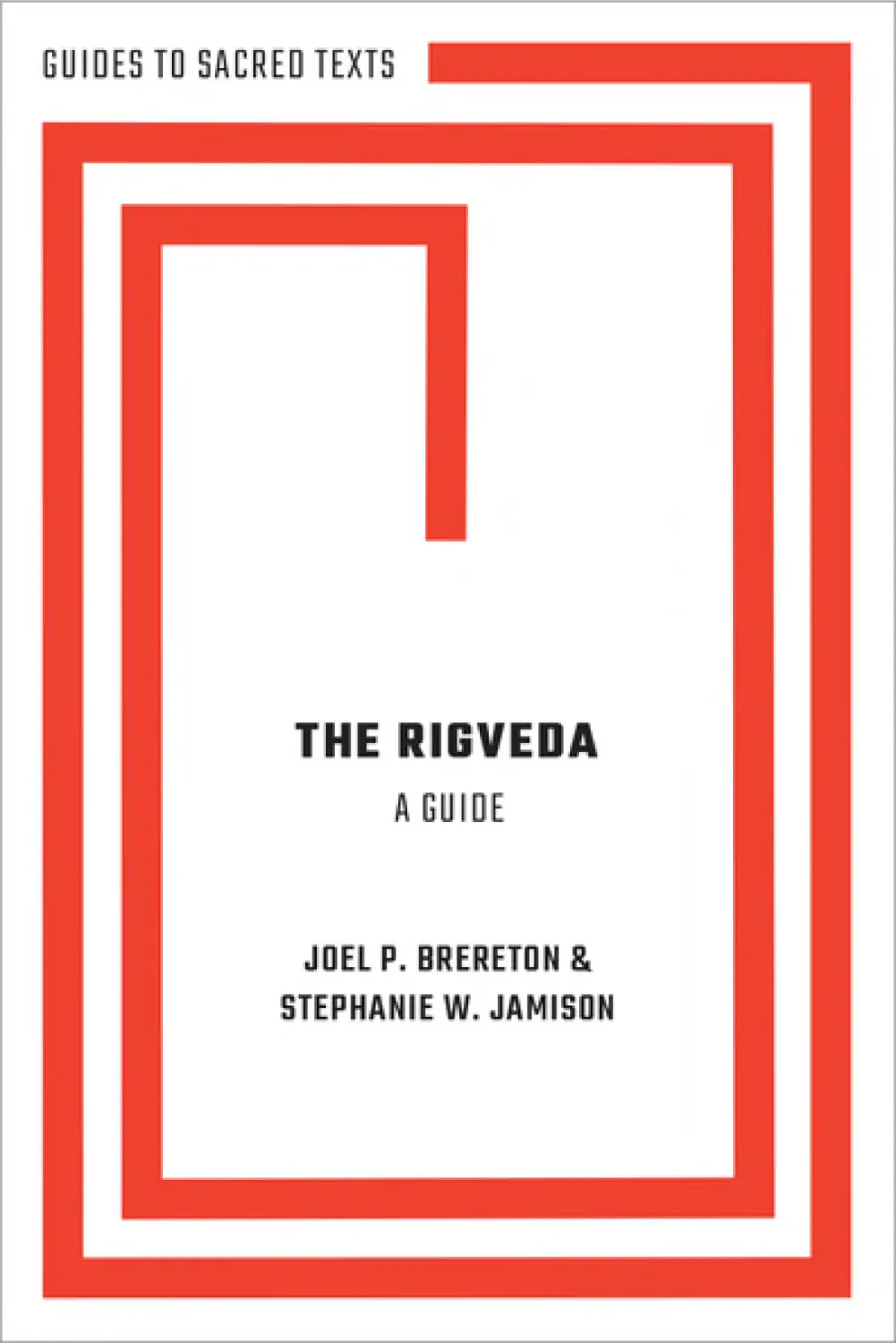


Author: Jamison W. Stephanie Brereton P. Joel
Tags: ancient indian epic religions vedic literature literary monuments
ISBN: 9780190633363
Year: 2020
Similar



Text
The Rigveda
Guides to Sacred Texts
THE DAODE JING
Livia Kohn
THE YIJING
Joseph Adler
THE RIGVEDA
Stephanie Jamison and Joel Brereton
The Rigveda
A Guide
J O E L P. B R E R E T O N
ST E P HA N I E W. JA M I S O N
1
3
Oxford University Press is a department of the University of Oxford. It furthers
the University’s objective of excellence in research, scholarship, and education
by publishing worldwide. Oxford is a registered trade mark of Oxford University
Press in the UK and certain other countries.
Published in the United States of America by Oxford University Press
198 Madison Avenue, New York, NY 10016, United States of America.
© Oxford University Press 2020
All rights reserved. No part of this publication may be reproduced, stored in
a retrieval system, or transmitted, in any form or by any means, without the
prior permission in writing of Oxford University Press, or as expressly permitted
by law, by license, or under terms agreed with the appropriate reproduction
rights organization. Inquiries concerning reproduction outside the scope of the
above should be sent to the Rights Department, Oxford University Press, at the
address above.
You must not circulate this work in any other form
and you must impose this same condition on any acquirer.
Library of Congress Cataloging-in-Publication Data
Names: Brereton, Joel P., 1948– author. | Jamison, Stephanie W., author.
Title: The Rigveda : a guide / Joel P. Brereton and Stephanie W. Jamison.
Description: New York : Oxford University Press, 2020. |
Series: Guides to sacred texts | Includes bibliographical references and index. |
Identifiers: LCCN 2019035401 (print) | LCCN 2019035402 (ebook) |
ISBN 9780190633363 (hardback) | ISBN 9780190633370 (paperback) |
ISBN 9780190633394 (epub) | ISBN 9780190633387 (updf) | ISBN 9780190633400 (online)
Subjects: LCSH: Vedas. R̥gveda—Criticism, interpretation, etc. |
Vedic literature—History and criticism.
Classification: LCC BL1112.56 .B74 2020 (print) | LCC BL1112.56 (ebook) |
DDC 294.5/9212046—dc23
LC record available at https://lccn.loc.gov/2019035401
LC ebook record available at https://lccn.loc.gov/2019035402
1 3 5 7 9 8 6 4 2
Paperback printed by LSC Communications, United States of America
Hardback printed by Bridgeport National Bindery, Inc., United States of America
Contents
Guides to Sacred Texts
viii
Note on the Title
ix
1. Introduction
What is the R̥gveda: A brief overview
A significant moment
World literature and religion
1
2
4
6
2. Historical Context
Migration
Indo-Iranian background
9
9
11
3. Dating and Authorship
Dating
Oral tradition and composition
Poets and poetic lineages
13
13
15
17
4. Structure of the Text
Collection and ordering of the hymns
The transmission of the text and the state of the
transmitted text
Structure of the text
20
20
5. Social and Political Context
Way of life
Social organization
Kingship
Mundane daily life and the depiction of women
31
31
32
37
40
6. Ritual
Overview
The Soma Sacrifice in later Vedic texts
Changes between R̥gvedic ritual and middle Vedic ritual
Pre-R̥gvedic ritual
43
43
44
48
50
23
25
vi
Contents
The R̥gvedic ritual model
Other types of ritual in the R̥gveda
7. The Gods
Overview
The major gods
Indra
Agni
Soma
Aśvins
Maruts
Aditi and the Ādityas
Savitar
Sūrya
Uṣas, “Dawn”
Vāyu/Vāta, “Wind”
Heaven and Earth
Tvaṣṭar
R̥bhus
Pūṣan
Viṣṇu
Rudra
52
58
62
62
69
69
73
77
81
84
86
90
91
92
94
95
96
97
99
100
102
8. Eschatology
104
9. R̥gvedic Poetry and Poetics
The purpose of R̥gvedic poetry: the power of the word
The poet
The status of the poet
Homologies, semantic webs, secret names, and riddles
Praise and request in the R̥gvedic praise hymn
112
112
115
116
119
127
Praise of deeds: mythology
Praise of attributes
The “ask”
Structures and types of R̥gvedic hymns: some organizing
principles
Thematic organization
Formal organizational devices
Repetition
Lists
128
133
138
140
141
143
143
148
Contents
Numbers
Questions
Ring composition and the omphalos
Initial and final verses
Poetic repair
Riddles and lists
Some specialized types of hymns
Cosmic speculation and poetic self-reflection
Dialogues and monologues
Frogs: sui generis
Hymns for domestic rituals; spells
Praise of the gift
vii
149
151
151
153
155
156
158
158
160
163
163
165
Imagery, metaphors, similes
Language
166
174
Meter
185
Grammar
Register
Lexicon
Syntax, grammar, and the pursuit of obscure style
Technical description
Relevance of meter for the general reader
174
177
179
180
185
188
10. Canonical Status and the Reception of the R̥gveda
The R̥gveda in the śrauta tradition
R̥gvedic Schools
Transmission
Interpretation
Reception
Publication
Text and Translation
191
191
196
202
209
213
217
220
Appendix: Selection of R̥gvedic Hymns
Bibliography
Passage Index
Subject Index
223
249
257
267
Guides to Sacred Texts
What is a sacred text? The Oxford English Dictionary offers
a definition of “sacred” as “Set apart for or dedicated to some
religious purpose, and hence entitled to veneration or religious
respect.” The definition is necessarily vague. What does it mean to
be “set apart?” What constitutes a “religious purpose?” How formal
is “veneration?” Does minimal “religious respect” qualify? The
sphere of meanings surrounding the word “sacred” will depend on
the religion involved. For that reason “sacred texts” in this series
is a term conceived broadly. All of the texts covered by this series
have held special regard—they have been “set apart”—in a religion either ancient or modern. Such texts are generally accorded
more serious attention than other religious documents. In some
cases the texts may be believed to be the words of a deity. In other
cases the texts may be part of an atheistic religion. This breadth of
application indicates the rationale behind Guides to Sacred Texts.
This series offers brief, accessible introductions to sacred texts,
written by experts upon them. While allowing for the individuality
of each text, the series follows a basic format of introducing the text
in terms of its dates of composition, traditions of authorship and
assessment of those traditions, the extent of the text, and the issues
raised by the text. For scripture that continues to be utilized, those
issues will likely continue to generate controversy and discussion
among adherents to the text. For texts from religions no longer
practiced, the issues may well continue to address concerns of the
present day, despite the antiquity of the scripture. These volumes
are useful for introducing sacred writings from around the world to
readers wanting to learn what these sacred texts are.
Note on the Title
Although throughout this book we use the scholarly transliteration
of the name of the text, the R̥gveda, we have chosen the rendering
Rigveda in the title of the book to avoid the problems that might
arise from having a diacritic in the first letter.
1
Introduction
The R̥gveda is a monumental text with signal significance for both
world religion and world literature; yet it is comparatively little
known outside a small band of specialists, even among those who
study the religious traditions of India. The oldest Sanskrit text,
composed probably in the latter half of the second millennium BCE,
it stands, at least nominally, as the foundational text of what will
later be called Hinduism, and one of its verses, the so-called Gāyatrī
mantra, is part, at least nominally, of the daily practice of those
initiated into Vedic learning.
The text consists of over a thousand hymns dedicated to various divinities, composed in highly sophisticated and often enigmatic poetry. Its range is very large—encompassing profound and
uncompromising meditations on cosmic enigmas, joyful and exuberant tributes to the wonders of the world, ardent praise of the
gods and their works, moving and sometimes painful expressions
of personal devotion, and penetrating reflections on the ability
of mortals to make contact with and affect the divine and cosmic
realms through sacrifice and praise. Thus, much of what will distinguish later Indian religious literature is already present in the
R̥gveda. Yet, though its name is widely known, the celebration of
the R̥gveda is muted at best, even within its own tradition, and, save
for a few famous hymns, its contents go largely unnoticed outside
of that tradition.
This guide to the R̥gveda proposes to help remedy this situation.
It will provide an overview of the text, its structure, and the process of its composition and collection; treat its purpose—to serve as
The Rigveda. Joel P. Brereton and Stephanie W. Jamison, Oxford University Press
(2020). © Oxford University Press.
DOI: 10.1093/oso/9780190633363.001.0001
2
The Rigveda
the recited verbal portion of an extremely elaborate ritual system—
and how this purpose is reflected in the contents and structure of
the text; give some indication of the flavor of the text by quoting
and discussing particular portions of it; situate it in the religious
practices of its time (insofar as they are known or inferred); and
treat its use and reception both in the periods immediately following the time of its composition and in the post-Vedic period,
which saw profound changes in religious practices and beliefs, up
to the modern era. It will also introduce readers to the literary qualities of the text and to the poets’ belief in the role of their poetry in
making sense of, and indeed creating, cosmic order and function—
examining the exuberance with which the poets press the
boundaries of language to create their own reflection of the complex and ultimately impenetrable mysteries of the cosmos and the
verbal devices they developed to mirror these cosmic intricacies.
What is the R̥gveda: A brief overview
The R̥gveda is one of the four Vedas, which together constitute
the oldest texts in Sanskrit and the earliest evidence for what will
become Hinduism. Collectively they belong to the class of texts
known as śruti, literally “hearing,” a concept roughly equivalent
to “revelation”; that is, the texts were later considered to have been
heard, rather than composed, by humans, although the internal
evidence of the Vedas shows no such concept. The four Vedas are
the R̥gveda, the Atharvaveda, the Yajurveda, and the Sāmaveda.
On grounds of both language and content, the R̥gveda is the oldest
of the four and foundational for the others. The second oldest is
the Atharvaveda, a text that in some ways continues the compositional style of the R̥gveda (and contains many repetitions from
the R̥gveda), but whose contents consist in large part, of personal
spells and healing charms. Despite its age and affinity with R̥gvedic
poetic practice, it stands somewhat apart from the religious system
Introduction
3
of the Vedic period. In contrast, the other two Vedas, the Yajurveda
and the Sāmaveda, form a ritually associated trio with the R̥gveda,
with each providing the ritual script for a different part of the
spoken liturgy and for a different priest active in the joint ritual
system of the middle Vedic period. The R̥gveda was the source for
the recitations of the Hotar priest (and assistants); the Yajurveda
contained the formulae linked to ritual actions, which were principally carried out by the Adhvaryu priest (and assistants); and the
Sāmaveda comprised the chants performed by the Udgātar priest
(and assistants). We will have occasion to refer to all three other
Vedas particularly in c hapter 10.
The R̥gveda consists of 1028 hymns, called sūktas “well-spoken
(speech),” most of which are devoted to praising the gods associated
with the elaborate sacrificial rituals also depicted in the hymns. The
hymns consist of verses, ranging from 1 to 58, composed in strictly
regulated meters. There are approximately 10,000 verses. In fact the
text takes its name from these verses: the Sanskrit word for “verse”
is r̥c; when compounded with the word for knowledge, it yields
r̥g-veda, literally “knowledge/wisdom (consisting of) verses.” The
separate hymns are ascribed to a surprising number of individual
poets—over 200 are named in the later indices to the text—and
most of these poets belong to delineated bardic families. Hymns
attributed to members of one family are generally transmitted together in books, or maṇḍalas, literally “circles,” and these family
maṇḍalas form the heart of the text. Composition of the hymns
was entirely oral, as was the transmission of the text for much of
its history: as far as we can tell, it was first written down no earlier
than the second half of the first millennium ce, approximately two
millennia after its likely period of composition, and its transmission probably remained primarily oral for centuries after that.
The language of the hymns is Vedic (or Vedic Sanskrit), an archaic form of the language that developed into the Sanskrit of
the epics and the classical period. The place of composition was
largely in the greater Punjab region, including areas of present-day
4
The Rigveda
Pakistan and northwestern India, as the Indo-Aryans made their
way into the subcontinent sometime in the early to mid-second
millennium bce. The language of these peoples belongs to the
Indo-European family and is most closely related to Old Iranian;
the Indo-Aryan languages (of which Sanskrit is the oldest form
attested) and Iranian languages together form the Indo-Iranian
sub-branch of Indo-European. The early Indo-Aryans and the early
Iranians share many social, cultural, religious, and literary features,
and these shared features are very prominent in the R̥gveda.
A significant moment
The R̥gveda thus inhabits a significant moment in the history of
greater India. Janus-faced, it looks both backward and forward.
As just mentioned, it displays a shared Indo-Iranian culture, with
agreements between the R̥gveda and the Old Iranian texts, especially those composed in the Old Iranian language Avestan, astonishing both in their number and in their granular detail. The
separation of the Indo-Aryan and Iranian languages and of their
speakers must have been fairly recent to account for the pervasive
structural similarities in both language and culture. To go back
even further, the language of the R̥gveda is not only Indo-European
in grammar and lexicon but also in literary sensibility. The R̥gveda
represents the last full flowering in the Indian subcontinent of the
Indo-European genre of praise poetry. The same spirit reverberates
in the R̥gvedic bard’s encomia of his gods as in the archaic Greek
poet Pindar’s of the victors in the Greek athletic games.
But the text looks forward as well. Although Vedic religion is
very different in many regards from what is known as Classical
Hinduism, the seeds are there. Gods like Viṣṇu and Śiva (under the
name Rudra), who will become so dominant later, are already present in the R̥gveda, though in roles both lesser than and different
from those they will later play, and the principal R̥gvedic gods like
Introduction
5
Indra remain in later Hinduism, though in diminished capacity.
Although the great Vedic sacrifices generally give way to other
forms of worship, they remain narrative touchstones in the epics
and later. Terms such as brahman and dharma(n) that will resonate
in later Hinduism are also already present in the R̥gveda, though
with different senses. And, perhaps most important, the signal literary achievement of Classical India, the elaborate poetic genre
known as kāvya, has its roots in the equally intricate poetry of the
R̥gveda.
The text is thus poised between the cultural tradition from which
it—and its composers—came and the new culture that the melding
of the Indo-Aryans and the traditions they encountered in the
subcontinent would create in the ensuing centuries, as the Indo-
Aryans moved farther south and east. Yet in acknowledging the importance of the traditional milieu from which the R̥gveda emerged
and the very different culture to which it is prelude, we should not
underestimate its present. The R̥gveda is not an uneasy amalgam of
evocation of the past and anticipatory hints of the future, notable
only for the light it sheds in both directions. It has a consistency and
originality of vision that are entirely its own, reflecting a world in
which the poets and ritualists who dominate the text count themselves as partners with the gods they celebrate in the imaging of the
cosmos and their control of its forces. Despite their respect for tradition, there is little or no elegiac nostalgia for a glorious past; the
poets and their patrons use their past as a foundation for what they
envision as a glorious future. The people of the R̥gveda seem to have
a sense of their own power—whether exerted by arms, or by words,
or by correctly performed rituals—and a sense that the now they
inhabit is one of great promise, though also of commensurable risk.
But the R̥gveda is our only contemporary witness of this moment. There are no other texts of the same period and no archaeological remains that manifest Vedic culture of this period. The
later Vedic texts do help fill out the picture, but they already reflect
a sociocultural, political, and religious (and indeed geographical)
6
The Rigveda
landscape significantly changed from that of the R̥gveda. And all
Vedic texts leave out an enormous amount. As texts focused on a
high-culture ritual system limited to the elite, they provide information about everyday secular life and ordinary people only by
chance. In evaluating what the R̥gveda can tell us about this moment and this place and these people, we must always keep in mind
how limited the snapshot provided really is.
World literature and religion
But the R̥gveda is not only significant for its position in Indian religious and literary history at a particularly defining moment. It
also deserves to be treated as a monument in world literature and
world religion, a voice—or indeed many voices—from deep antiquity testifying to the sophistication and complexity of the culture of
which it was a product. It is among the oldest preserved texts from
antiquity (though predated by Egyptian, Sumerian, and Akkadian
texts from the Near East, literary traditions entirely independent
of it), but the R̥gveda shows no signs of the hesitant or false experimental ventures of a nascent literary enterprise, nor of even the appealing straightforward simplicity of what used to be celebrated as
“primitive” art. These are not the unmediated artless outpourings
of unshaped praise arising in a naïve heart struck with awe. Instead
R̥gvedic poetry belongs to a fully mature literary tradition, with an
awareness of the multiple ways in which words can relate to each
other, formally and functionally, a wealth of intricate poetic devices
at hand, and the daring to push the boundaries of intelligibility
within the limits of the traditional poetic culture. As noted earlier,
it is clear that this poetic tradition had a long development behind
it, reaching back into Indo-European prehistory, and although we
have no preserved texts from the intervening period, stock phrases
(formulae) and standard techniques are shared across the archaic
literary cultures of the older attested Indo-European languages. It is
Introduction
7
also clear that in the time of the R̥gveda there was a vibrant poetic
scene, with multiple poets competing with each other for patronage
as well as for artistic excellence, all very conscious both of the tradition they belong to and the new, personal stamp each hopes to put
on this tradition. Although some earlier Western scholars of the
R̥gveda sought (and found, at least by their own lights) the rough
and primitive simplicity they expected to characterize poetry of
this antiquity, coming at the dawn of recorded Indian history, this
attitude—forged in great part by their experience with the poetry
of their own Victorian and Edwardian age—is long out of date, and
indeed the bold complexity of much of twentieth-century poetry
awakened later Vedic scholars to the same boundary-pushing literary qualities and attitudes in the R̥gvedic corpus.
The same level of mature development is true also of the R̥gvedic
religious system. Vedic “high” ritual (technically known, starting
in the middle Vedic period, as śrauta ritual) is one of the most
complex ritual systems the world has ever known, with multiday
extravaganzas involving a small army of priestly participants and
ceremonies in which every gesture and every word of each participant was fixed. Thousands of pages of the later ritual manuals
are devoted to getting all this right, and although the R̥gvedic
ritual system differs in some ways from classical śrauta ritual, it
demonstrably presupposes the same basic set of rituals with the
same basic sets of participants and patterned actions. Again, this
is not the spontaneous free-form worship of deified cosmic forces
occasioned by awe, fear, or humble gratitude, but a highly developed system of rites, built of smaller units arranged in clearly articulated structures, all loaded with symbolic significance—which is
expertly decoded by the theological authors of the somewhat later
exegetical prose texts known as the brāhmaṇas.
The sophistication and complexity that meet us in every detail of
the verbal and ritual materials available from this period are all the
more astounding when compared with the complete lack of correspondingly sophisticated material remains. The composers of
8
The Rigveda
the Rgveda, the practitioners of śrauta ritual, did not leave behind
great intricately organized cities with monumental buildings and
well-designed urbanscapes. In fact there are no archaeological remains reliably associated with the early Vedic people, and what we
can glean from the texts about the material aspects of their lives
sketches a way of life involving mobile or semi-mobile pastoralism
and goods appropriate to such mobility: wheeled vehicles, simple
dwellings, no fixed temples or places of assembly. This is contrary
to the assumptions most of us have about antiquity, where our informal measures of cultural development are derived from archaeology. But it befits an ever-mobile lifestyle to focus on a genre of art
that can be carried in the head (oral poetry) and on a religion that
can be practiced anywhere where a piece of ground can be properly
prepared.
2
Historical Context
Migration
Were the peoples who produced the R̥gveda, the peoples who called
themselves “Āryas,” indigenous to South Asia or did they migrate
there? The most widely accepted scholarly view is that the Indo-
Aryan peoples came into South Asia during the second millennium
BCE and gradually extended cultural dominance in the subcontinent during the first millennium BCE. Some earlier scholars had
envisioned this migration as an invasion and conquest, but this
rather simplistic interpretation has given way to one of a more
gradual movement into South Asia, perhaps in different waves, of
Indo-Aryan speakers. To be sure, there were battles between these
peoples and other peoples already settled in India, but there were
also battles among different Ārya tribes. However, a number of
scholars have strongly opposed the idea not only of an Ārya invasion but also of an Ārya migration into India. They have argued
that there is little material evidence to support the theory that the
Indo-Aryans migrated into South Asia and that the R̥gveda shows
no clear memory of migration or locations outside of South Asia.
But linguistic and textual evidence has made it certain, or at least
as nearly certain as knowledge of the very distant past can be, that
the Indo-Aryans did migrate into South Asia. As remarked earlier,
they were an Indo-European people, and they were especially
closely related to early Iranian peoples. Theories that have tried to
explain these connections by means of migration out of South Asia
rather than into it create unlikely historical reconstructions (as, for
The Rigveda. Joel P. Brereton and Stephanie W. Jamison, Oxford University Press
(2020). © Oxford University Press.
DOI: 10.1093/oso/9780190633363.001.0001
10
The Rigveda
example, Hock 1999a has demonstrated). Moreover, careful study
of central Asian archaeology and linguistic exchange between central Asian cultures, including the predecessor cultures of the Indo-
Aryan peoples, has allowed scholars to reconstruct a plausible map
and general timeline for the Indo-Aryan migration.
Around the end of the third millennium BCE, ancestors of the
Indo-Aryan and Iranian speaking peoples lived on the Russian
steppes, south of the Russian/Siberian taiga, the “snow forests” of
the high latitudes, which stretched from the Ural Mountains eastward toward the Yenisei River, and north of the Caspian and Black
Seas. These Indo-Iranians were semi-nomadic pastoralists, whose
livelihood depended primarily on their herds. At least part of the
year they needed to relocate to find pasturage for their herds, and
this brought them into competition with one another and with
other peoples of the steppes. Therefore, they were a mobile people
and a people able to fight to secure or to defend the pasturelands
they required. They used ox-drawn carts and horse-drawn, two-
wheeled chariots, which contributed to their mobility and to their
success in battle.
During the first half of the second millennium, Indo-Iranian
peoples had continued to move south, and during that period they
apparently came into contact with peoples associated with the
Bactria-Margiana Archaeological Complex (BMAC). In its mature
phase, from approximately the middle of the third through the first
quarter of the second millennium BCE, the area it encompassed included regions of northern Afghanistan (ancient Bactria), southern
Turkmenistan (overlapping with ancient Margiana), and southern
Uzbekistan (see Parpola 2015: 69–83; Witzel 2003). The exact nature of the contact between the peoples who established this culture
and the migrating Indo-Iranians is not clear, but one possibility is
that the leaders of the Indo-Iranian peoples became rulers within
the BMAC either during its mature or during its later phase.
Whatever the nature of the contact between the Indo-Iranian peoples and those of the BMAC was, it may have been a crucial one for
Historical Context
11
the development of Indo-Aryan and early Iranian religion and culture. In particular, it may have been at this period and in this place
that the Indo-Iranians developed rituals that were based on older
ritual forms centered on a drink of life or of immortality, but whose
principal offering became the juice of the soma plant (or in Iranian,
haoma plant). In the later Indo-Aryan tradition, the various soma
rituals became the most prestigious non-royal rites and the dominant rituals for which the liturgical poetry of the R̥gveda was largely
composed. While the development of the soma rites may have been
a significant religious innovation in the early second millennium,
cultural continuities among the Indo-Iranian peoples during this
period were also remarkable. The Indo-Iranians retained their language and their traditions of poetic composition, even while the
poetry was adapted for use within newer ritual forms.
The Indo-Aryan and Iranian peoples eventually lost contact with
one another as the Indo-Aryans moved farther south into South
Asia and the Iranian peoples west into the Iranian plateau. Even
before they fully separated, cultural and linguistic differences had
already developed between the ancestors of the Indo-Aryans and
early Iranians. Beginning around 1500 bce, a segment of the Indo-
Aryans established rule in the Mitanni kingdom of northwestern
Mesopotamia. The population of the kingdom were Hurrian
speakers, but their rulers had Indo-Aryan names and invoked
Indo-Aryan deities, which were distinct from Iranian names and
gods. Presumably the segment of Indo-Aryans who established this
rule had moved west before other segments migrated to the south
and east into South Asia.
Indo-Iranian background
As already noted, the Indo-Aryan languages are most closely related to the Iranian languages. In particular, Vedic Sanskrit and the
Old Iranian languages are so similar in grammar and lexicon that
12
The Rigveda
their separation cannot be temporally very deep. Two Old Iranian
languages are attested, Old Persian, the language of the monumental inscriptions of the Achaemenid Empire, and Avestan. The
former is not attested until the reign of Darius I (sixth century bce),
and the contents of the inscriptions are shaped by the imperial program. By contrast, Avestan is dated considerably earlier, at least in
its older form, and the preoccupations of its texts are very similar
to those of the R̥gveda—praise poetry based on traditional models
and an elaborate ritualism. There are two forms of Avestan, generally called Old (or Gāthic) Avestan and Young(er) Avestan. The
former is primarily attested in the hymns, called Gāthās, attributed
to the religious figure Zarathustra, the eponymous (though possibly legendary) founder of the religion Zoroastrianism (via the
Greek form of his name, Zoroaster). With due allowance for some
differences in their religious focus, these hymns are startlingly like
those of the R̥gveda. The phraseology is often superimposable or
rings changes on the same underlying formulae; the same type of
poetic risk-taking, of exploiting the extreme possibilities of the
verbal tools at hand, is found in both. Moreover, the apparently
“personal” voice of the poet that pervades the Gāthās is found in the
hymns of certain R̥gvedic bards, particularly Vasiṣṭha. Although
ritual is muted in the Gāthās, it is clear that a ritual system similar
to that of the R̥gveda is presupposed. This becomes even clearer in
the texts of the Younger Avesta, which testify to a cult centered on
the offering of a ritual drink called haoma, which, as we saw earlier,
is etymologically identical to Vedic soma, the focus of the most
solemn Vedic rituals. There are pervasive similarities between the
haoma and soma rituals, with identical names for the chief priest
(zaotar = hotar) and for various actions and paraphernalia in the
ritual. The Younger Avesta also preserves myths and the names of
mythical figures that find their exact counterparts in the R̥gveda.
The Avesta and the R̥gveda thus mirror each other in remarkable
ways, and evidence from each has been (and continues to be) invaluable for interpreting difficult problems in the other.
3
Dating and Authorship
Dating
As should be clear from the previous chapter, it can be difficult
to disentangle the preserved R̥g veda from the penumbra of poetic tradition from which it emerged. Since poets built their new
structures using older verbal materials, a particular crystallization of traditional elements could be hundreds of years old or,
as it were, (re-)made yesterday. Young poets would redeploy and
repurpose formulations used by their fathers or grandfathers—
or generations even further back. Nonetheless, despite the
continuities with the Indo-Iranian and Indo-European poetic
tradition, the R̥g veda is of course a distinct and bounded text
in a distinct language and reflects not merely its ancient sources
but also the contemporary historical context it inhabits. Before
exploring that more fully, we should attempt to provide a rough
dating of the text. As we will see, it is nearly impossible to assign
an absolute date to the text, even within several centuries. It is
also difficult to determine how long a time span was required for
the composition of the whole text, no matter what absolute date
we might assign. But we can start with the time of the presumed
advent of the Indo-Aryans into the geographical area reflected in
the R̥g veda.
The hymns of the R̥gveda were likely composed during the period in which the Indo-Aryans migrated from the area of present-
day Afghanistan into the greater Punjab. The dating of the R̥gveda
has been and is likely to remain a matter of contention and
The Rigveda. Joel P. Brereton and Stephanie W. Jamison, Oxford University Press
(2020). © Oxford University Press.
DOI: 10.1093/oso/9780190633363.001.0001
14
The Rigveda
reconsideration because as yet little has been uncovered in the material record or in the hymns themselves that allows us to establish
a date with precision. Since the R̥gveda does not mention iron but
does speak of other kinds of metal, it is likely a Bronze Age text.
If we could determine the period in which iron began to be manufactured, therefore, we would have a date by which the hymns
would have been composed. However, while the dates at which
iron appears in the archaeological record in South Asia differ in
different parts of the subcontinent, generally the manufacture of
iron appears around 1200–1000 bce. The R̥gvedic hymns, therefore, would have to have been composed no later than this period.
Iron is attested in the Atharvaveda, which is the Vedic collection
closest in age to the R̥gveda. While the R̥gveda is older than the
Atharvaveda and while there may have been a gap between the close
of the R̥gveda and the emergence of the Atharvaveda and the other
early Vedic collections, there is no basis for assuming a great passage of time between the R̥gveda and the Atharvaveda. Although
its language is younger than that of the R̥gveda, the Atharvaveda’s
traditions of hymnic composition continued those of the R̥gveda,
and hymns like those of the Atharvaveda already appear in the late
R̥gveda. Therefore the date of the latest portions of the R̥gveda is
not likely to be very much earlier than the end of the Bronze Age.
It is also likely that the period of the composition of R̥gvedic
hymns did not extend more than several centuries before this period. The poets to whom the R̥gvedic indices attribute the hymns
and the kings mentioned within the hymns themselves comprise
perhaps half a dozen generations. Rounding these numbers, we
can then place the period of the composition of the R̥gvedic hymns
sometime within the broad period 1500–1000 bce. At best these
dates encompass only the extant hymns of the R̥gveda. But as we
have remarked before, the poetic conventions on which the R̥gveda
was built are very much older, extending back to the Indo-Iranian
period with even deeper roots into the Indo-European period. The
R̥gveda is the surface of a very long tradition.
Dating and Authorship
15
Oral tradition and composition
As has been emphasized earlier, the R̥gveda was composed entirely orally and is the product of a long oral tradition of praise
poetry that goes back to the unity of Proto-Indo-European before the various branches split off. This can be demonstrated by
adducing poetic formulae in the separate poetic traditions that are
superimposable and can be reconstructed to a single Proto-Indo-
European phrase. The most famous of these phrases is Greek κλέος
ἄφθιτον: Vedic śrávaḥ . . . ákṣitam, sound-for-sound equivalent
and both meaning “imperishable fame,” first identified by Adalbert
Kuhn in 1853. Numbers of others have been added to the dossier in
the ensuing years.
The theory and practice of oral composition have been much
studied and discussed in the last near century, associated in the first
instance with Milman Parry and further developed by his student
Albert Lord. (For brief but incisive discussion of formulas and oral
composition, see Watkins 1995: 12–19.) The form in which this
theory is best known was developed on and exclusively treats epic
(especially Homer) and the type of narrative songs that develop
into epic (especially the Yugoslavian bardic tradition studied, while
it was still alive, by Parry and Lord). In this form the poet deploys
fairly substantial blocks (often full verse lines or half lines) of identical or nearly identical formulaic material but in a sprawling and
loose-jointed structure, which can vary from telling to telling—
so-called “(re)composition in performance.” At some point in an
epic tradition the text may get fixed, but this fixation postdates
the period of oral composition. This model applies (at least in our
opinion, which is perhaps not shared by most specialists of the
Indian epic) to the genesis and development of the Mahābhārata
(but less so, if at all, to the Rāmāyaṇa). Indeed, there was no fixation
of the text of the Mahābhārata in the sense of the Homeric epics, as
even a glance at its critical edition, with its multitude of significant
and lengthy variants, shows clearly.
16
The Rigveda
However, this model is emphatically not applicable to the R̥gveda,
and the ways in which the R̥gveda does not conform to what was,
for a while, the only model for oral composition recognized in
modern scholarship are probably responsible for how long it has
taken to bring the R̥gveda under that conceptual umbrella. On the
one hand, R̥gvedic formulaic language is generally not manifested
as large blocks of identical text. Instead, strict formulae (that
is, identically repeated phrases) tend to be brief—considerably
shorter than a verse line. In addition, many formulae do not involve
exact repetition but exist as “deep structure,” with multiple variations on the deep structure showing up on the surface. Repeated
full verse lines are fairly rare in the R̥gveda (though see Bloomfield
1916 for those that exist), but patterned alternates of underlying
formulae are pervasive in the text. The prime example of a short,
strictly repeated formula is the encapsulation of the great Indra
myth, in which he kills the archenemy, the snake Vr̥tra. This deed
is succinctly summarized by the phonologically driven two-word
formula áhann áhim “he/you smote the serpent,” which occurs numerous times in the text. But such exactly repeated phrases are relatively rare, and even this particular formula is regularly subject to
variation—by, inter alia, morphological manipulation (e.g., V.31.7
áhiṃ yád ghnán “when, smiting the serpent . . .” with a participle
[ghnán] substituting for the finite verb [áhan]), elaboration of one
or the other of the terms (e.g., I.32.3 áhann enam prathamajā́m
áhīnām “he smote him, the first born of the serpents”), or lexical
substitution (e.g., IV.17.3 vádhīd vr̥trám “he smote Vr̥tra,” where a
form of the root √vadh, which is suppletive to √han, supplies the
verb, and the name of the enemy, beginning with v-, replaces ahim
“serpent” but reestablishes the alliterative pattern of the original
formula).
Moreover, though in the standard model of oral composition, the
poem itself is ever-changing and is the joint (or rather successive)
product of a series of anonymous bards, with fixation of the text—if
it comes at all—coming much later, a R̥gvedic hymn was fixed at
Dating and Authorship
17
the time of composition and thereafter transmitted without alteration. And it was “owned” by the poet who composed it. Poets often
refer to themselves by name within their compositions, proudly
asserting that the hymn is their product. Though they make use of
formulaic language, they aim to put their personal stamp on that
language, often by the types of variation just described, and to make
each composition distinctively their own. They painstakingly acquire the tools and skills that belong to the oral tradition but also
explicitly aim to put those tools and skills to new uses. There is always tension between the weight of the tradition and the pressure
for novelty. As one poet puts it (R̥V III.31.10), “I make new (the
song) born of old,” acknowledging both the legacy of his poetic
forebears and his own contribution in creating something original.
Poets and poetic lineages
What then do we know about the composers of these hymns? First,
as already pointed out, it is clear that the text as we have it was the
product of several generations of poets, at least, and that these
poets often belonged to named lineages. There are several types of
evidence that support this view.
We possess a later index to the R̥gveda, the Sarvānukramaṇī
(hereafter Anukramaṇī), dating from the end of the Vedic period, perhaps to the mid-4th century bce, but probably drawing
on older materials. It lists each hymn, the deity to which it is
dedicated, and its meter—and attributes each hymn to a particular poet, identified both by his name and by his patronymic. In
a number of cases, the (given) name of a poet is found as a patronymic to another poet, indicating that this second poet is a son
or descendant of the first. For example, the given name of the
poet Vasiṣṭha Maitrāvaruṇi recurs as the patronymic to a series
of poets including Vasukra Vāsiṣtha, Indrapramati Vāsiṣṭha, etc.;
a segment of one hymn (VII.33.10–14), which treats the birth of
18
The Rigveda
Vasiṣṭha, is also ascribed to Vasiṣṭhaputrāḥ “the sons of Vasiṣṭha.”
These poetic lineages can stretch for several generations; e.g., the
given name of Dīrghatamas Aucathya (himself perhaps the son of
Ucathya Āṅgirasa), responsible for a remarkable set of hymns in
Maṇḍala I, recurs as the patronymic of another memorable poet
of Maṇḍala I, Kakṣīvant Dairghatamasa, who in turn supplies
the patronymic for several other poets, Śabara Kākṣīvata, Sukīrti
Kākṣīvata, and (supposedly a female poet) Ghoṣā Kākṣīvatī.
Although the Anukramaṇī is considerably later than the R̥gveda
and not all of its attributions can be relied on, its data seem surprisingly accurate for the most part and conform to R̥gveda-internal
clues. Poets also refer to their own fathers and forefathers in their
own compositions.
The second major type of evidence is linguistic. Although the
core sections of the R̥gveda are remarkably consistent linguistically,
there are parts of the text, primarily concentrated in Maṇḍala X,
that show linguistically younger forms, indicating a period of linguistic development spanned by the contents of the text. Although
the issue of R̥gvedic language, archaic and archaizing, is a complex
one, the younger features of the so-called “popular” hymns are a
good indication that the period of composition extended through
some significant amount of time. The naming practices discussed
in the previous paragraph often dovetail nicely with the linguistic
indications. For example, the Kakṣīvant descendants referred to
above are all poets of the Xth Maṇḍala.
The organization of the R̥gveda also reflects—and therefore implicitly provides evidence for—the grouping of poets into generational lineages. As we will see, of the ten maṇḍalas making up the
R̥gveda, Maṇḍalas II through VII are referred to as the “Family
Books,” with each one ascribed to various poets belonging to a particular family, as witnessed both by the ascriptions of the hymns in
the Anukramaṇī and by the hymn-internal statements of the poets
themselves. For example, Maṇḍala V is the Atri Maṇḍala. Some 14
of the 87 hymns in this book are attributed by the Anukramaṇī to
Dating and Authorship
19
the eponymous founder of the lineage, Atri Bhauma; most of the
other hymns are assigned to his descendants, designated by the patronymic Ātreya. An astonishing 36 different Ātreyas are identified
as poets belonging to this line. Hymn-internal evidence supports
this later picture. For example, V.22, a hymn to Agni, is assigned
by the Anukramaṇī to Viśvasāman Ātreya. In the hymn itself, the
poet addresses himself by name (as R̥gveda poets often do), urging
himself to “chant like Atri (or the Atris)” (atrivát árcā), that is, like
his father or forefather(s). In the last verse of this little hymn (vs.
4) he asserts that the Atris (plural) (átrayaḥ) strengthen and beautify Agni with praise songs and hymns. The poet thus situates himself within his family and poetic lineage.
The non-Family Books also generally consist of hymns grouped
by poet or poetic lineage, though in units smaller than a maṇḍala.
Maṇḍala VIII consists largely of hymns attributed to two families,
the Kāṇvas and the Āṅgirasas. Most of Maṇḍala I is similarly organized by poet, and some of the most distinctive poetic voices are
found there—Kakṣīvant and Dīrghatamas were already mentioned
earlier. The first part of Maṇḍala X also contains small groups of
hymns arranged by poet, though the second half contains only
single hymns by individual poets. Maṇḍala IX is the exception to
this pervasive organizational pattern. It is thematically focused,
containing only hymns to the deified ritual drink Soma Pavamāna
(“Self-purifying Soma”) to be performed at the most elaborate of
the non-royal Vedic rituals, the Soma Sacrifice. The Anukramaṇī of
course assigns poets to all of the hymns therein; significantly, many
of these are either poets found elsewhere in the R̥gveda in their
appropriate family section or have patronymics that link them to
poets elsewhere in the text. For example, Kakṣīvant is assigned one
hymn in IX (IX.74) in addition to his run of hymns in I (I.116–25);
most of the descendants of Vasiṣṭḥa mentioned earlier, identified
by the patronymic Vāsiṣṭha, contributed sections to a single hymn
in IX (IX.97), whose first three verses are assigned to their eponymous ancestor Vasiṣṭha himself.
4
Structure of the Text
Collection and ordering of the hymns
As should be clear from the previous chapter, the R̥gveda is a very
complex text with numerous moving parts: over a 1,000 hymns
consisting of approximately 10,000 verses, over 200 named poets, 10
large books with a variety of organizing principles. It is also astoundingly systematic in its organization, a quality not always encountered
in textual materials from antiquity. Further detail on the organization will be given in the discussion of the transmission of the text,
pp. 23–25; for now what is important is that the systematic organization strongly suggests that a centralized authority or agency oversaw
the gathering and structuring of these disparate materials and, further, that this activity postdated the time of active composition.
As we will see in chapter 5, judging from the internal evidence
of the R̥gveda, the sociopolitical situation during the period of
composition consisted of a loose network of family-and clan-
based circles that could form larger alliances when confronted
with certain challenges (such as warfare with outside groups) but
that generally operated at a certain level of autonomy and indeed
competition among themselves. These groups were led by “kings”
(whatever that term meant at the time), and these kings and the
poets who celebrated them existed in a patron-client relationship,
with each group having its own family of poets. The larger network in which they claimed membership was what they themselves
called the Ārya, but the operative day-to-day social unit was the
family/clan (víś).
The Rigveda. Joel P. Brereton and Stephanie W. Jamison, Oxford University Press
(2020). © Oxford University Press.
DOI: 10.1093/oso/9780190633363.001.0001
Structure of the Text
21
The Family Books of the R̥g veda (II–VII), as well as the
smaller family collections in Maṇḍalas I, VIII, and X, must have
grown out of the individual compilations of hymns produced
by the bardic families, each associated with such a social group,
compilations perhaps preserved as training tools for each new
generation of poets, or as evidence of a lineage’s poetic expertise, or just out of ancestral pride and, of course, preserved only
orally. These collections were no doubt made and maintained
during the compositional period itself, though probably only
loosely organized. Some editing and culling may have been
performed in the process: it is remarkable how little bad, banal,
or tiredly repetitive poetry there is in the R̥g veda, though surely
every bardic family was cursed with dull-witted and uninspired
members and the first efforts of even good poets-to-be must have
had their flaws. Of course this editing may have been done in
the second stage of the process, when the family collections were
consolidated (or at both stages), but given how many hymns
must have been composed over the decades or lifetimes of every
family, we must assume that most of it was lost—or judged unworthy of preserving.
At some point the balanced equilibrium of power existing among
the various clan groups must have become disturbed, with the
emergence of a group or groups that established hegemony over the
other groups in the loose confederacy—quite possibly the Bharatas,
as Michael Witzel has suggested in a number of publications (e.g.,
1995a).
Thereafter, again in Witzel’s formulation, there arose a
consolidated state (whatever “state” meant in this period) presided
over by a group called the Kurus (see Witzel 1995b). It seems that
one of the aims of this new political power was to produce a unified
religious culture out of the patchwork of clan-based practices—
leading to the uniform śrauta ritual system of the middle Vedic
period. It was most likely in this era and for these reasons that
22
The Rigveda
the individual family hymn collections were brought together
and systematically organized into the super-collection we now
term the R̥gveda. This compilation coincided with the end of free
composition of R̥gvedic-style hymns. The new religious landscape emphasized an ecumenical ritual, with the appropriation,
repurposing, and redeployment of ritual materials, both verbal and
physical, culled from the various smaller groups and integrated into
a single system. The freewheeling poet, following his poetic whim
and answerable only to his clan-patron, gave way to the priestly
reciter, mouthing the words of previous poets, a cog in the ritual
machine.
Thus the production of the great collection that we know as
the R̥gveda was an entirely separate process from the composition of the individual hymns and happened at a later time. It was
motivated not by literary or religious factors, but sociopolitical
ones—which saw a uniform ritual system built from materials
originally belonging to a range of different social groups as one
way to impose political hegemony. There are several telling if indirect indications of the purpose behind the creation of the collected R̥gveda. For one thing, the final hymn in the text, X.191, is
dedicated to “unity” (saṃjñāna) and models the production of a
common ritual and a common purpose. Earlier in the R̥gveda in
the Soma maṇḍala, there is a hymn that shows how the forging of
a common ritual could be done: IX.67 consists of three-verse units
each attributed to a different poet, and these poets are representatives of the most prominent bardic families, whose hymns are otherwise collected in their individual Family Books. The hymn seems
a conscious attempt to create a shared ritual from the competing
family traditions. The final two verses of the hymn (IX.67.31–32),
which appear to be a later addition, promise great success to whoever studies “the sap assembled by the seers,” namely the verses collected in this very hymn.
For further on the collection and redaction of the text, see
chapter 10.
Structure of the Text
23
The transmission of the text and the state
of the transmitted text
The unusual circumstances obtaining both in the composition of
the individual hymns (that is, immediate fixation upon composition) and in the compilation of the text (that is, systematic collection and arrangement in service of a sociopolitical agenda) are
probably some of the underlying causes of the unusual state of the
text as we have it. The R̥gveda is essentially unique among texts
preserved from antiquity in being entirely complete, without lacuna, without variants, and, as far as we can tell, almost entirely
without corruptions. The apparatus criticus collecting the manuscript variants for every word that is a standard bottom-of-the-page
feature of editions of Classical texts, the suspension dots in and
around an edited text that represent gaps in manuscripts, and the
sad jagged boundaries of transcribed cuneiform texts representing
the broken edges of the tablets are all absent from editions of the
R̥gveda, whose text is presented unadorned. The text we work
with is that of the Śākala school, established by Śākalya, a teacher
of the late Vedic period. Though other schools and recensions are
mentioned in the tradition, they appear to have differed minimally
from each other, generally only in the ordering of a few hymns and
the inclusion or not of a few late verses or hymns. (See further on
this in chapter 7.) There are various reasons for the remarkable integrity of the text.
We are already fortunate in the fact that the transmission of the
text was entirely oral for several millennia, for manuscripts are
prone to decay and destruction in the climate of the subcontinent.
Even after writing had penetrated deeply into Indian culture, the
sacred texts, especially the R̥gveda, were forbidden to be written. It
is not clear when the text was first written down—the best guesses
are in the second half of the first millennium ce—but even afterward oral transmission remained the more robust means, even into
modern times, and this oral transmission was more reliable than
24
The Rigveda
any manuscript tradition. But the faithful transmission of the text
also arose from other factors.
The immediate fixation of the individual hymns and the closing
of the text in the very act of compiling it resulted in a single text
that was, in principle, not to be altered—unlike the looser attitude toward variation and expansion of, say, the great Sanskrit
epic, the Mahābhārata, with its separate recensions and plethora
of manuscripts often differing significantly from each other. What
subsequently guaranteed the faithful and invariant transmission of
this single, frozen text from deepest antiquity to modern times was
the attitude toward the text that arose in the post-compositional
period. The R̥gveda itself manifests an extraordinary respect for the
power of properly spoken speech, and as the language of the R̥gveda
became increasingly archaic and separated from ordinary speech
(as it surely was in part already at the time of composition)—and as
the text came to be considered to belong to the newly identified category of śruti, or divinely inspired texts produced without human
agency—it became imperative on religious grounds to preserve the
exact verbal form of the text, with the preservation of the meaning
of the text far less important (though see c hapter 10).
Thus, on the one hand, the sacrality of the text was considered
to inhere in absolute fidelity to its original wording, and, on the
other, it was not subject to the corruptions that creep into transmission by manuscript copying or by attempts to modernize the
language or make better sense of the contents. To ensure that
corruptions did not alter the verbal form during oral transmission,
elaborate methods of oral recitation were devised to provide cross-
checks. In addition to the Saṃhitāpāṭha, the “continuous recitation” of the text, with sandhi (phonological adjustments across
word boundaries) applied, a number of methods were based on the
word-by-word analysis of the text. The result of this concentration
on the exact verbal form of the text, with a major de-emphasis on
the meaning of the text in the lineages of the reciters (thus discouraging attempts to change it to make more sense as the language
Structure of the Text
25
itself changed), was the fortunate recipe for delivering an almost
perfectly preserved time capsule over the millennia. On metrical
grounds we can identify some places in the text where clusters of
consonants (generally a consonant followed by y or v) need to be
distracted to produce another syllable (that is, read as consonant
plus iy or uv), and other metrical disturbances suggest minor phonological adjustments to the text, but these restorations are highly
restricted. There is good reason to believe that the text we have is
essentially the same text the composers and compilers dealt with.
The dawning realization in Western scholarship about the fidelity
of the transmission ultimately produced a deep-seated and principled reluctance to emend it. In the early days of R̥gvedic scholarship
in the West, emendations were routinely and frequently proposed,
and given the frequent obscurity of the text, these adjustments
often yielded an easy (or easier) sense. But sometime around the
turn of the twentieth century, this attitude changed, and Vedicists
today almost never accept or propose emendations to the text. The
few that are proposed and accepted must involve minimal change
of the transmitted text and some explanation for why the change
would have happened. There are few if any texts from antiquity
where such a sternly practiced “hands-off ” attitude prevails.
Structure of the text
Whenever the compilation was made and whoever made it, it was
done with a brisk efficiency that one hopes prevailed in other parts
of the administration. As was sketched briefly in the first section of
this chapter, the R̥gveda consists of over a 1,000 hymns divided into
10 maṇḍalas of unequal length. The core of the text is the group
of Family Books, Maṇḍalas II–VII, each of which contains hymns
ascribed to a single bardic family. These six books are arranged in
order of size, with II (ascribed to the Gr̥tsamada family) containing
the fewest hymns (43) and VII (the Vasiṣṭha maṇḍala) the most
26
The Rigveda
(104). Within each maṇḍala the hymns are arranged first by the
deity addressed, with Agni, the fire god, first, followed by Indra, the
great warrior god, and then collections of hymns to other deities,
generally arranged by the decreasing number of hymns to each
deity within the maṇḍala. Within the various deity collections, further organizational principles apply: the hymns are arranged by
length—longest first—and if two hymns contain an equal number
of verses, they are arranged by meter, with longer meters preceding
shorter ones.
Not all the arrangements in these books conform to the principles just laid out. Hymns of the “wrong” length are sometimes found
within an otherwise well-ordered sequence, and in several cases
the length of a particular maṇḍala breaks the pattern: Maṇḍala III
contains 62 hymns, while IV has only 58; V has 87 but VI 75. Rather
than viewing these breaches as the sign of incomplete or imperfect application of their own principles by the original compilers,
modern Vedic scholarship has recognized these anomalies as evidence for later manipulation of the text, by appending newer
hymns to older sections or by combining several hymns into one
or splitting one into several. Examining these breaks in the pattern
has given us numerous insights into the layers of compilation in our
received text.
Enclosing the Family Books, the other maṇḍalas are structured somewhat differently. Maṇḍala VIII primarily contains
hymns from two bardic families, the Kāṇvas (in 1–48 and 60–66)
and the Āṅgirasas (in 67–103), though hymns attributed to poets
from other families sometimes intrude, often because they exhibit features associated with the same liturgical purpose as the
Kāṇva/Āṅgirasa hymns. Within these larger collections, the
hymns attributed to particular poets are grouped together in small
collections. The rigid arrangement by deity of the Family Books is
not followed in this maṇḍala, though within the smaller groupings
hymns to the same deity cluster together, with Indra often leading
off. What really characterizes this maṇḍala is its frequent strophic
Structure of the Text
27
structure. Many hymns have their verses grouped together in two-
or three-verse units, known as pragāthas and tr̥cas respectively.
These strophic structures are especially associated with the sung
portions of the ritual, which in the classical form of śrauta ritual
were performed by the Udgātar priest of the Sāmaveda and his associated priests. Indeed, many of the hymns in VIII were incorporated into the Sāmaveda. Maṇḍala VIII thus appears to be in great
part a specialized liturgical collection within the liturgical text that
is the R̥gveda. The strophic principle allowed quite large hymns
to be assembled, and the dominant impression of the maṇḍala is
of long, loosely structured—
one might say rambling—
hymns,
whose intermediate units, the strophes, often show unity on this
smaller scale.
Nestled in the middle of this maṇḍala is a set of 11 apocryphal or “half-apocryphal” hymns known as the Vālakhilya hymns
(VIII.49–
59). Although these are clearly supplements to the
R̥gveda, they were transmitted with accents, included with the rest
of the Śākala text, and treated by the Padapāṭha (word-by-word
text) and by the Anukramaṇī index, so they are more closely associated with the R̥gveda than the other apocrypha. The first eight
hymns in this collection proceed in pairs, dedicated to the same divinity and containing the same number of verses, and especially the
first two pairs appear to be variants of each other, utilizing the same
words and themes, deployed slightly differently. They have the air
of set school exercises and, though the level of skill displayed in the
poetry is lower than much of the R̥gveda, they may give us valuable
insights into the process of creating a R̥gvedic hymn.
Maṇḍala I also consists of smaller groups of hymns attributed to
particular poets, but falls into two sections: I.1–50 and I.51–191.
The first group consists of six groups belonging to individual poets,
with the hymns often in the short gāyatrī meter and arranged in
pragāthas, like the hymns in VIII. Also, like VIII, several of the
poets belong to the Kāṇva family. It is almost certainly later than
the rest of I, and, with some notable exceptions like the great Indra
28
The Rigveda
hymn I.32, the quality of the hymns is comparatively low, with
banal phraseology and simple sentiments. The second, and considerably longer, part of I is quite different. It is divided into nine
groups of hymns, each attributed to a particular poet and arranged
according to the same principles as the Family Books. The poetry
is some of the most glorious—intricate, bold, deeply original—in
the R̥gveda, and the poets’ names are a roll call of some of the most
distinctive poetic voices in the text, among them the well-known
Kakṣīvant, Dīrghatamas, Agastya, but also lesser known but no less
distinguished ones such as Nodhas and Paruchepa.
Maṇḍala IX is the most unusual, in that it contains only hymns
dedicated to Soma Pavamāna (Self-purifying Soma), that is, the
deified ritual drink, and it only concerns a small episode in the
preparation of that drink, when the pressed soma liquid is poured
over a sheep’s wool filter to remove its impurities and is collected in
vessels and mixed with other ritual substances. The collection may
have been created for the Potar, the “purifier” priest, in charge of
this rite. Although these few ritual actions are imbued with cosmic
significance and decorated with every verbal trick the R̥gvedic poet
had at hand, the subject matter is both extremely limited and, at
least superficially, not very promising as a topic for poetry. It is an
astounding feat that 114 hymns devoted only to this ritual moment,
all different, and including the longest hymn in the R̥gveda (IX.97),
could be assembled and preserved, and no doubt an even larger
number of such hymns were not deemed worthy of preservation.
The hymns were in part extracted from family collections elsewhere in the R̥gveda. The Anukramaṇī ascribes a number of hymns
in IX to poets it also names elsewhere in the R̥gveda, especially in I,
V, and VIII, and it is noteworthy that, though there are a few hymns
dedicated to Soma in various other roles and guises elsewhere in the
R̥gveda, there are none outside of IX to Soma Pavamāna. Some of
the poets in IX listed by the Anukramaṇī appear to be descendants
of poets elsewhere in the R̥gveda, as shown by their patronymics,
and so there is also a newer layer within IX. The hymns in IX are
Structure of the Text
29
arranged by meter and within the metrical groups by decreasing
number of verses.
Maṇḍala X is the latest addition to the text and contains a
wider variety of subject matter than any of the other maṇḍalas—
including hymns devoted to life-cycle rites such as marriage and funeral, meta-reflections on the sacrifice, speculative reconstructions
of the origin of the cosmos, hymns dedicated to deities and forces
peripheral to the Soma Sacrifice, spells for personal and trivial
matters, and so on. In many of its parts its language belongs to a
younger and more vernacular stratum than the rest of the R̥gveda,
with many “popular” linguistic features reflecting a lower register;
these younger portions are linguistically comparable to the second-
oldest Vedic text, the Atharvaveda, and many such hymns also have
Atharvan subject matter. Indeed, a number of them are found both
in the R̥gveda and in the Atharvaveda.
However, Maṇḍala X is not as distinct from the rest of the R̥gveda
as it is sometimes depicted. As in the rest of the text, the first half
(approximately) is organized into collections attributed to individual poets; as the maṇḍala continues, there are fewer and fewer
hymns per poet, until by X.85 there is only one hymn apiece. It is
primarily the latter half of X that exhibits the popular characteristics just outlined. The earlier parts of X are not markedly or consistently younger in appearance than other parts of the core R̥gveda,
and some of the most highly wrought and sophisticated hymns of
the R̥gveda are found in this portion. It is often loosely stated that
Maṇḍalas I and X form the younger R̥gveda, and many linguistic
judgments have been rendered on the basis of this crude classification. It is one that must be applied with care: especially the second
part of I but also the first part of X can be linguistically indistinguishable from the core R̥gveda, and even in the other parts of I and
X, supposedly younger forms and concepts should be evaluated
carefully.
It should be clear from the foregoing that the whole structure of
the R̥gveda follows a consciously devised plan, rather than being
30
The Rigveda
a haphazardly gathered grab bag. One further piece of evidence
shows just how deliberate the plan was: the two outer maṇḍalas,
I and X, the latest to be assembled, contain an identical number of
hymns—191—though the internal structures of I and X are quite
different and the hymns therein must have been brought together
under quite different circumstances. But someone must have felt
the need to make the two outer books symmetrical and therefore
to fiddle with the contents in order to make the numbers come
out right.
5
Social and Political Context
Way of life
During the composition period of the R̥gveda, the Indo-Aryans
carried on the way of life that had long defined the Indo-Iranians.
They continued to be pastoralists, who raised cattle, goats, sheep
for wool, horses for the two-wheeled chariots that made them
formidable in battle, and other livestock. They continued a long-
established tradition of periods of settlement alternating with
periods of movement. This pattern appears in the R̥gveda itself,
which distinguishes the period of kṣéma “settlement” from the
period of yóga, literally the “hitching up” of vehicles for mobility.
In the period of settlement, the Indo-Aryans tended their herds
and flocks, which provided their principal economic support, and
they also practiced some agriculture. They grew grains, dhānā́, especially yáva “barley” which had been farmed in the Indus Valley
long before the Indo-Aryans entered the area (Wojtilla 2003: 39,
41–42). The R̥gveda shows a reasonably robust vocabulary for agricultural objects and implements: plow (lā́ṅgala, sī́ra), plowshare
(phā́la), plowman (kīnā́śa), threshing floor (khála), sickle (dā́tra,
sŕ̥ṇī), sheaf (parṣá), and so forth. A number of these agricultural
words do not have Indo-European etymologies, and therefore
likely reflect the encounter of Indo-Aryans with peoples more dependent on agriculture than they, although at which period and
whether in Central or South Asia these encounters occurred is not
certain. During the period of mobility, the Indo-Aryans searched
for fresh pastureland for their animals, which brought them into
The Rigveda. Joel P. Brereton and Stephanie W. Jamison, Oxford University Press
(2020). © Oxford University Press.
DOI: 10.1093/oso/9780190633363.001.0001
32
The Rigveda
conflict with one another and with other peoples controlling or
seeking land. They also directly appropriated resources from their
rivals by raiding cattle and crops. Since the periods of settlement
and mobility were tied to the agricultural and pastoral cycles, they
likely occurred at regular times of the year. This pattern is even directly reflected in later Vedic literature: Taittirīya Brāhmaṇa I.8.4.1
reports that the major tribes of the period, the Kurus and Pañcālas,
become mobile during the cool season. The periods of mobility
contributed to the movement of the Indo-Aryans farther east and
deeper into South Asia. The bulk of the R̥gveda reflects locations
in present-day Afghanistan and the Punjab, the area of the Indus
River and the “five rivers” that are its tributaries; by the end of the
R̥gvedic period, the geographical horizon extended at least to the
Ganges River, which is mentioned in one late R̥gvedic hymn.
Social organization
Indo-Aryan society was made up of various large and small groups.
Witzel (1995a: 313) gathered the names of approximately 30 such
social groupings from the R̥gveda. The smallest social segment was
the household (gr̥há, dám), which was presided over by the head of
the household. In the R̥gveda, however, one word for “houselord,”
gr̥hápati refers to the household’s divine head, normally the god
Agni in his role as the household fire, rather than to a human. Both
dáṃpati “lord of the house” and dámūnas “master of the house”
are used of both divine and human heads of households, although
when it refers to humans, the former appears only in an elliptical
dual dáṃpatī meaning both the “lord and lady of the house.” The víś
is the next largest social division. There has been some difference
of opinion concerning just what constitutes the víś. Some scholars
see it as a “settlement,” a group of households living and moving
together; others envision it as a “clan,” which shares a common lineage. Most likely it is both: the víś comprised a clan, which lived
Social and Political Context
33
together under a “clanlord,” the viśpáti, who in the R̥gveda was
again often Agni, the god of fire, although humans and other gods
are also called clanlords. The households and the clans were likely
the most stable social groups. During times of settlement, clans
may have lived in loose affiliation with one another, although still
governed by an authority above the level of the clan that acted to
keep the peace among the clans. Larger social divisions consisting
of various clans are called kr̥ṣṭís and carṣaṇís, both of which refer
to the boundaries of one kind or another that defined a group of
clans. Another, sometimes synonymous, term for such larger
collectivities was jána “people” or “tribe.” Lineage, whether real or
imagined, was one basis for these social formations, but it is also
true that social groups could enter into voluntary alliance or alliance through marriage with one other. In times of mobility and especially in times of battle, clans banded together in tighter alliance
to defend themselves and their herds or to secure the pasturelands
or harvested crops they needed.
In describing the social system of the R̥gvedic period, we have
said nothing about the social categories of varṇa “class” and jāti
“caste,” which marked the social orders of the post-R̥gvedic periods.
Later dharma (roughly “legal”) texts define a social system of four
hierarchically ordered “classes”—brahmins, kṣatriyas, vaiśyas, and
śūdras, together with a fifth category consisting of those born outside these four varṇas (Manu X.45). There is only one hymn in the
R̥gveda in which this system is approximated. That hymn is R̥gveda
X.90, the justly famous puruṣa sūkta “The Hymn of the Man,” which
organizes humans in a hierarchical order of brāhmaṇá, rājanyà
“ruler,” vaíśya “freeman,” and śūdrá “servant” (R̥V X.90.12). There
is no fifth category. These four varṇas, as they came to be called
later, were not stable categories, nor in the course of Indian history
did they play the same role in describing social reality, let alone defining it. Therefore, we cannot assume that a brāhmaṇá or a rājanyà
in the late R̥gvedic period was equivalent to a brahmin or kṣatriya
in any other period. But later writers saw their varṇa systems in the
34
The Rigveda
R̥gveda, and it is likely that R̥gveda X.90, which is a relatively late
composition, was placed in the R̥gveda in part to provide a constitution for an ideal Indian social order. But its descriptive relevance
for all but the latest period of the R̥gveda is doubtful. What we observe in it is the process by which the clans and tribes of the R̥gvedic
period eventually gave way to social categories that cut across and
reconfigured them.
One R̥gvedic expression for the whole of the Indo-Aryans was
the “five peoples,” the páñca jánāḥ. Four of these five peoples are
usually paired: the Yadu people with the Turvaśa, and the Anu
people with the Druhyu. The fifth people were the Pūrus, who were
connected to another group that may have formed a subtribe of the
Pūrus, the Bharatas. Although they may have followed the other
four tribes into the Punjab, the Pūrus and the Bharatas came to
dominate them. Overlapping lines of three Pūru and three Bharata
rulers are particularly prominent in the R̥gveda. Among the
Bharatas these kings were Atithigva, his son Divodāsa, who may
have led the Bharatas across the Hindukush, and Divodāsa’s son or
grandson, Sudās, whose prominence is reflected especially in the
hymns of Vasiṣṭha, the poet of Maṇḍala VII. Among the Pūrus, the
principal rulers were Purukutsa, Trasadasyu, and Tr̥kṣi. Whatever
may have been the connection between the Bharatas and Pūrus,
they became rivals. Aside from mythological battles, the most famous conflict mentioned in the R̥gveda is the “Battle of the Ten
Kings,” which is described by Vasiṣṭha, especially in VII.18 but also
in VII.33 and 83. According to Vasiṣṭha’s account, the battle took
place on the Paruṣṇī River, the modern Ravi River, and marked the
victory of the Bharata king Sudās over an unnamed Pūru king and
his many allies, who included the Turvaśas, Druhyus, and Anus. At
least in Vasiṣṭha’s telling, therefore, this battle would have marked
the dominance of the Bharatas over the other Vedic tribes.
The designation “five peoples” is a recognition of the common
cultural ancestry of the Indo-Aryan peoples. Other names also
signify the totality of the Indo-Aryans and point to other bases
Social and Political Context
35
for their unity. One such term is mā́nuṣa, a derivative of the word
mánus, a word that means “man.” Additionally, however, mánus
(also mánu) became the name of a particular man, Manu(s). In the
later tradition this Manu was the first man, but in the R̥gveda he is
the first sacrificer, and therefore the cultural ancestor of the Indo-
Aryans. In R̥gveda IV.26 and 27, the poet Vāmadeva describes how
Manu sent a falcon to heaven in order to steal the soma. Once the
soma was obtained, Manu could then perform the Soma Sacrifice,
which defined the R̥gvedic peoples. The term mā́nuṣa, which etymologically might have meant “related to man,” was interpreted
to mean “son” or “descendant of Manu.” In calling themselves
mā́nuṣa, therefore, the R̥gvedic peoples were asserting that they defined themselves by descent from the one who first performed sacrifice to the gods. Their possession and performance of the sacrifice
marked them as different from other peoples. The R̥gveda describes
people of other cultures in a variety of ways, but among them are
that they are “without sacrifices” and that they do not follow the
“commandments” of gods, including the commandments that
govern the rituals: III.4.7 “Reciting the truth, they [=the seven
priests of the soma rite] speak just the truth, reflecting upon their
commandments as protectors of the commandments.” The R̥gveda
shows evidence that other peoples whom the Indo-Aryan migrants
encountered in South Asia could be grafted onto the Indo-Aryan
community by also performing sacrifice. The R̥gveda mentions
sacrificers or generous patrons whose names do not appear to
be Indo-Aryan, such as Śaṇḍa, Br̥bu, Araṭva Akṣa, and Balbūtha
Tarukṣa (Witzel 1995a: 326). Such names suggest a process that
brought various peoples into Vedic culture by giving them access to
the ritual tradition. We would expect intermarriage with other peoples would bring women into the Vedic fold, but at least some males
also adopted Vedic culture and its defining cultural idioms.
Another designation for the whole of the Vedic peoples was
“Ārya,” which probably meant those who were “civilized,” that
is, those who followed the customs and obligations of the Vedic
36
The Rigveda
peoples. The Āryas had their opposite in the Dasyus, or Dāsas, who
were the cultural “other.” Just exactly who these others were is uncertain. Generally, scholars have seen them as peoples who were
in South Asia before the Indo-Aryans migrated there, but at least
one scholar, Asko Parpola (2015: 92–106) has argued that they
represented earlier waves of migrants to South Asia antecedent to
the peoples who produced the R̥gveda. Whoever they were, these
peoples were rivals for land and other resources, and therefore
the R̥gveda represents them as enemies of the Āryas. In particular, the warrior god Indra defended the Āryas against their Dāsa
or Dasyu foes, whether they be human or demonic. Addressing
Indra, for example, Bharadvāja says: VI.18.3 “It was you who tamed
the Dasyus, and who alone vanquished their communities for the
Ārya.” One reason that Indra helps the Āryas is that it is the Āryas
who offer soma (V.34.6, IX.63.5). Therefore, according to R̥gveda
I.51.8, Indra should distinguish between Āryas and Dasyus, punishing “those who follow no commandment,” namely the Dasyus,
and making them subject to him “who provides ritual grass,” the
Ārya sacrificer. Because of their dedication to the gods, the poets
ask them to give light to the Ārya, which implies open spaces for
settlement and herding (I.17.21, II.11.18, VII.5.6) and deny that
light to the Dāsa. This light is linked to the light of the sacrificial
fire, and therefore, addressing Agni Vaiśvānara, Agni “who belongs
to all men,” the poet says in I.59.2 “You did the gods beget as a god,
Vaiśvānara, as light just for the Ārya.” Agni Vaiśvānara is the sun,
the universal fire, but it is also a ritual fire and a communal fire that
signifies the union of the Ārya clans (Proferes 2007: 46–47), and
therefore this fire should extend the dominion of the Āryas across
all the land. Since the Āryas are associated with the light, which
should be theirs, it is not surprising that the Dāsas or Dasyus are associated with darkness. So then, how should we understand verses
such as R̥gveda I.130.8 “Indra aided the Ārya sacrificer in battles,
affording a hundred forms of help in all contests—in contests whose
prize is the sun. Punishing those who follow no commandment, he
Social and Political Context
37
made the black skin subject to Manu” or VII.5.3 “The dark clans
went breaking ranks, leaving their supplies, from fear of you. . . .
You drove the Dasyus away from their home, o Agni, giving birth
to broad light for the Ārya”? Did the Āryas see what we would call a
racial divide between Āryas and Dasyus, as many interpreters have
suggested? We believe that importing into the R̥gveda the idea of
“race,” which is a much later concoction, is at best misleading and
that the opposition between the darkness of the Dasyus and the
light of the Āryas is principally an ideological one, as Hock (1999b)
has argued in his careful study of this issue. If skin color was involved in the opposition between Āryas and Dāsas, it was probably
incidental to the more general associations with the light of the sun
and the sacrificial fire and to the “broad light” of the areas through
which Āryas might move freely. Finally, we need also note again
that the poets of the R̥gveda describe conflict not only between
Āryas and Dāsas but also between Āryas and other Āryas and
Dāsas. The poet asks for success in battle over both in X.83.1 “Might
we be victorious over Dāsa and Ārya with you [=Battle Fury] as
yokemate,” and similar are II.1.19, IV.30.18, X.38.3, 102.3. Both
Dāsas and Āryas can be “obstacles” to the life and prosperity of the
poet and his people, and therefore the poets ask that Indra smash
them as he smashed the great Obstacle, Vr̥tra, as in VI.33.3 “You,
o champion, smite both kinds of enemies, the Dāsa and the Ārya
obstacles,” and likewise, VI.22.10, 60.6, VII.83.1, and X.69.6. Other
Āryas could be just as much rivals for land, crops, and cattle as were
Dāsas or Dasyus.
Kingship
The leadership of the Vedic communities was invested especially
in the rā́jan [/-r ā́j], which we translate as “king,” although, with
reason, some scholars have hesitated about that translation and
preferred “chieftain.” No translation really captures the range or
38
The Rigveda
nature of the office, for rājans apparently ruled over a variety of social groups or confederations. A rājan might govern a number of
clans or a tribe or an alliance of tribes. Likewise, the responsibilities
of a rājan might vary depending on the purpose for which a confederation or alliance had been formed and for which the rājan ruled.
And finally, the process of appointing a rājan may also have differed
depending on the magnitude of the grouping over which he ruled
and possibly also the period of R̥gvedic history.
Kings governed both in times of settlement and in times of mobility, but there are varying opinions concerning whether there
was a single king who governed both during times of settlement
and times of mobility, or whether different kings were appointed
during different times or even whether there were complementary
rulers at the same time. One reason for this uncertainty is that we
are forced to reconstruct the society of humans through the stories
of gods. There are various gods who are called kings, principally
Indra, Varuṇa and Mitra, Soma, and Agni, all with very different
divine profiles. Do these different gods correspond to different
humans and to different kings? Or do they represent different sides
of kingship? The characteristic rule of Varuṇa, which involves
judgment, punishment, and the timely rain necessary for agriculture, makes most sense during the period of settlement. The rule of
Indra concerns war, victory, open spaces, and winning cattle and
therefore conforms to the period of mobility, battle, and raiding.
The language of the R̥gveda distinguishes between the kingships
of Varuṇa and of Indra. Typically, Varuṇa is called a samrā́j, “universal king,” implying that he governs an array of clans, tribes, or
peoples to maintain relative peace among them. Indra is called a
svarā́j, a “king over his own” or an “independent king,” because he
commands a particular group or alliance that stands in opposition to other groups. While it is possible that there were two kings,
one after the model of Varuṇa during the period of settlement and
peace and the other after the model of Indra during the period of
mobility and battle, we think it more likely that Varuṇa and Indra
Social and Political Context
39
represented different functions of kingship that were invested in a
single human. Its evidence is not unequivocal, but R̥gveda IV.42
points to a single king. The hymn was composed for the consecration of the Pūru king, Trasadasyu. There both Varuṇa and Indra are
invoked, and in our understanding, the hymn presents Trasadasyu
as a king who represents both Varuṇa and Indra. This interpretation accords with later royal consecrations, in which a king was
crowned as the human embodiment of both Varuṇa and Indra.
Thus, whether ruling over a large or small social segment, a king
was tasked with keeping the peace between the communities within
his rule during settlement and with leading those communities into
battle or into new lands during times of mobility.
It is also difficult to reconstruct the means by which a king was
appointed. Both the R̥gveda and Atharvaveda speak about a king
being chosen by the clans he governs: Atharvaveda III.4.2 “Let the
clans choose you for kingship. Let the five divine directions now
(choose) you.” The “five divine directions” may refer to divinities
above and in the four directions, but especially in this context, they
may also allude to the five tribes that comprise the Vedic peoples.
But the question remains whether this “choice” of a king was really
the selection of a king (Proferes 2007: 16–17) or simply an acclamation or acknowledgement of a king (Schlerath 1980: 204). That
there is a lineage of Bharata kings and Kuru kings indicates that at
one level of kingship, there was a regular succession of rulers, which
would support the idea that this choice was a formal one. Another
possibility is that the king was selected from among a number of
competitors, for just as there is an ideology of choice, so also there
is an ideology of contest in the appointment of a king. In royal rites
of the post-R̥gvedic period, there are various ritualized contests.
The Vājapeya, or the rite of the “Drink of Victory,” includes a horse
race. The Rājasūya, or the rite of “Royal Consecration,” includes
the ritual enactments of a victorious raid for cattle and other goods
and of the king’s victory in a dicing game. At least in its origins,
the Aśvamedha, the “Horse Sacrifice,” required a demonstration of
40
The Rigveda
sovereignty. A horse is set to wander for a year, and the king shows
his authority by defeating any challengers in the lands through
which the horse moves. But it is unlikely that the leaders of clans or
tribes actually chose a king as a result of such contests. Rather, the
king’s victory was a formal demonstration of his ability to lead and
to protect the people he governed. However a king gained sovereignty, it was also possible for him to lose sovereignty. Atharvaveda
III.3, for example, is a hymn to bring back a king who has been
driven from power and exiled, and it is likely that also in the period
of the R̥gveda a king who failed in his responsibilities as king could
be displaced. These responsibilities may have included not only
leadership in times of settlement and mobility but also the general
prosperity of the tribes and clans. Kingship is associated with the
rain, for example, and therefore a king whose rule did not result in
seasonable rains may have been vulnerable to replacement. Despite
the fluidity and possible uncertainty of governance, however, the
system successfully allowed the Vedic peoples to assert sovereignty
over increasing areas of north India and laid the foundation for the
larger polity led by Kuru rulers in the post-R̥gvedic era.
Mundane daily life and the depiction
of women
One could read swathes of the R̥gveda and come away with the
sense that the only occupations followed (besides priest and poet)
were warrior and stockbreeder, but the text gives us occasional hints
of a more varied range of pursuits. One hymn (IX.112) lists a series of possible professions: carpenter, physician, and smith among
them, and the artisan who fashions chariots is often presented as
a model for the poet fashioning a hymn, as we will see. An itinerant peddler or merchant figures briefly and enigmatically in
V.45.6, and I.125 treats a figure called the “early-comer” who seems
to be a tramp poet/priest offering his services door-to-door (or
Social and Political Context
41
settlement-to-settlement). The text also has a curious fascination
with the thief, for which there are several words (táskara, tā́yu, -tr̥p,
-máthi) and who figures in similes, as in V.15.5 describing Agni as
“hiding your track like a thief.” Hunting and snaring of birds also
merit some mention, as in III.45.1, where they hope that other
sacrificers will not keep Indra from their sacrifice: “Let no one hold
you down, as men using snares do a bird.” But the tasks of daily
life—hauling water, cutting wood (though see X.146.4), cooking,
and so forth—and the people who performed them are quite recessive in the text.
If this is so for males, it is considerably more pronounced for
women, who are visible only in the roles related to their stage in
life. We often meet beautiful and seductive young women, since the
goddess Dawn is regularly compared to them. But there was obviously considerable anxiety for the unmarried girl, especially one
without a brother to help in the husband-finding. As in later orthodox Hinduism, the only satisfactory path for women was marriage. In I.124 (translated in full in the Appendix) Dawn is first
described as “exulting in her spotless body” (verse 6) but immediately after is compared to “a brotherless (girl) who goes right up to
men” (similarly, IV.5.5). Young women are several times depicted
as going to festive gatherings (I.124.8, etc.), quite possibly to find
eligible partners, or to a rendezvous (I.123.9), but in I.167.3 “a
young woman roving in secret, going to men in a public hall” seems
to refer to a less respectable or happy pursuit. The plight of the
woman “who grows old at home” (amā-júr) is clearly pitiable (e.g.,
VIII.21.15), and the text also touches obliquely on a girl who has
a child out of wedlock (V.2.1). Still, the happy girl newly engaged
to a worthy bridegroom is also given due space, as in X.27.12 “the
maiden, gratified all around by an admirable (gift) worthy to be
chosen, from a bride-seeking man from among the young bloods.
She becomes a fortunate bride, when she is well-adorned. She wins
herself an ally [=spouse] in public.” In an oft-repeated simile the
wife is depicted as “richly dressed, ever eager for her husband”
42
The Rigveda
(I.124.7, etc.). But the existence of two charms against co-wives
make it clear that for some wives, competition for male attention continued after marriage. And the chilling simile “as a single
common husband does his wives, Indra has dragged down all the
strongholds to submission” (VII.26.3) does not cast a favorable
light on such marriage. On the status of the widow, see p. 60.
In discussing different types of R̥gvedic hymns, we will also touch
on pregnancy charms and charms against miscarriage; pregnancy
and childbirth were obviously dangerous states for women. The
fraught birth of Indra—he chose to exit from his mother’s side—
is related in the dramatic hymn IV.18. In that hymn his mother’s
apparent abandonment of her newborn is obscurely described,
though depictions of motherhood are generally tender, as in II.38.5,
where “the mother has set out the best portion for her son,” or the
comparison of the soma-pressing stones to “playful (boys) jostling
their mother” (X.94.14). In the very late R̥gveda, we see a new role
for the wife, that of ritual partner to her husband, a major ritual innovation in that period (see Jamison 1996, 2016b, 2018).
Despite the limitations of their roles, the women depicted in
the R̥gveda, especially in the ākhyāna, or dialogue hymns, tend to
be strong, spunky, and outspoken, as indeed they are throughout
Classical Indian literature. We will meet irrepressible, tough-
talking dialogue partners like Yamī, Lopāmudrā, and Urvaśī
(see p. 161); to this number we can add others, like Mudgalānī
(X.102), who takes over her husband’s losing chariot and as charioteer drives it to victory, or Apālā (VIII.91), who even as a young
maiden performs a private soma rite for Indra (a ritual that was
of course off-limits to lone females, especially young girls), attracts
his attention, and wins boons from him.
6
Ritual
Overview
The R̥gveda is primarily a liturgical text; the individual hymns collected in it were composed to be recited as the verbal (or, more
accurately, a verbal) portion of a ritual performance that also involved the physical offering of foodstuffs, to put it in its simplest
form. Though some of its hymns, especially in the Xth Maṇḍala, do
not appear to have the tight connections to ritual performance that
we find elsewhere in the text—for example, the hymns speculating
on the origins of the cosmos or of human beings—they are relatively few and are segregated in particular parts of the text—and, in
fact, we cannot be completely certain that they did not have a place
in ritual.
We can be even more precise about the ritual connection: as already noted, almost all the hymns in the R̥gveda were destined for
the Soma Sacrifice, the multipart ritual in which a deified drink
known as soma was offered to the gods. This was the most solemn
and elaborate of the non-royal rituals. What soma the substance
was is much disputed, and already in the middle Vedic period, and
indeed perhaps in the R̥gvedic period, substitutes were employed,
possibly because the original substance was difficult to obtain. It
was made from a dried plant, which was first soaked in water and
then pressed to produce a yellowish juice, which was then mixed
with water and often also with milk. Unadorned it was apparently
quite bitter. As already noted, the purification and mixing of the
soma juice provide the occasion for the 114 hymns of Maṇḍala
The Rigveda. Joel P. Brereton and Stephanie W. Jamison, Oxford University Press
(2020). © Oxford University Press.
DOI: 10.1093/oso/9780190633363.001.0001
44
The Rigveda
IX extravagantly celebrating those ritual actions and praising the
juice-become-god.
What did R̥gvedic ritual look like and how do we know? Here we
are on both firm and shaky ground. We know what followed it—the
śrauta rituals of the middle Vedic period, exhaustively detailed in
both the brāhmaṇas (prose exegetical texts, some of which are not
too much younger than the late R̥gveda) and in the śrauta sūtras
(manuals that codified ritual practice toward the end of the Vedic
period). The rituals described by these later texts contain much
that can also be found in the R̥gveda: names of priests, names of
offerings, the layout of the ritual ground, and particular procedures
employed in praise and offering. Much of what has been written
about R̥gvedic ritual starts with the later material and backprojects
it by locating correlates in the R̥gveda. In some sense there is no
other way to proceed: the systematic treatment and richness of detail offered by the later texts provide a context in which to situate
the less organized and more enigmatic information in the R̥gveda.
The Soma Sacrifice in later Vedic texts
What then do these later texts tell us about Vedic ritual, and, in
particular, about the Soma Sacrifice, the dominant ritual in the
R̥gveda? In the later Vedic tradition, there were Soma Sacrifices of
various lengths. The simplest form was a one-day sacrifice called
the Agniṣṭoma, the “Praise of Agni.” The soma rite of whatever
form began with three fires that were used in the daily Agnihotra
rites and in monthly rites at the new and full moon.
To the west was the round Gārhapatya Fire, or “Householder’s
Fire,” which was used especially in the preparation of the sacrificial
offerings. To the southeast of the Gārhapatya was the half-moon
shaped Dakṣiṇāgni Fire, the “Southern Fire,” which was apotropaic,
keeping at bay evil forces—typically conceived as coming from the
south—and which also received offerings to the ancestors. And,
Ritual
45
finally, to the east was the square Āhavanīya Fire, the “Oblation
Fire,” into which most offerings were poured. The shapes of the
Gārhapatya and Āhavanīya Fires represented earth and heaven
respectively, so that ritual movement from west to east toward
the Āhavanīya represented the progression from the realm of
humans toward the world of the gods. Between the Gārhapatya and
Āhavanīya Fires was the Vedi, which was a depression or elevation
covered with grass in which sacrificial implements and oblations
were laid. (It should be noted that, despite superficial similarity, the
word “Vedi” is entirely unrelated to “Veda” and the English adjective Vedic.) In the Soma Sacrifice and in other more elaborate rites, a
Mahāvedi, or “Great Vedi,” was constructed to the east of this sacrificial ground. The Mahāvedi then became the place to which the soma
plant was brought and the soma prepared and the location of a new
Āhavanīya Fire into which the soma oblations were poured. The
sacrificial area, or yajana, then had the shape shown in figure 6.1.
Figure 6.1. The Ritual Ground for the Soma Sacrifice
46
The Rigveda
Before the principal day of the Soma Sacrifice, there are several
days of preliminary rites such as the consecration of the Sacrificer,
offerings of ghee (clarified butter) and rice cooked in milk, the
formal purchase of the soma plant, and the laying out of the new
Vedi. The actual soma oblations takes place on the last day of the
Soma Sacrifice. That final sacrificial day centers on three “soma
pressings,” in which the soma juice is extracted and offered in
the morning, at midday, and in the evening. In the first two soma
pressings, the preparation of the soma juice begins when the priests
pour water on the stalks of the soma plant and crush the stalks. After
several rounds of crushing the stalks, collecting them, and crushing
them again, the stalks and their juice are placed in a vessel from
which the soma juice and water are poured across a woolen filter
to remove any debris. The soma is then offered at various points
in the order of rites. Some oblations just use the filtered soma;
in others the soma is mixed with milk or grain. In the Evening
Pressing, the preparation of the soma distinctly and interestingly
differs. Instead of pounding fresh soma stalks, the priests use leftover soma juice prepared in the other two pressings and soma
extracted from already crushed stalks, to which milk is added to
increase the volume.
Each of the pressings shows a similar structure defined by a repeated ritual sequence. In each of these sequences, after the soma
juice is pressed, priests first fill the cups from which the soma will be
offered with soma juice. Then there is a chant, or stotra, whose texts
are taken from the Sāmaveda but which originate in the R̥gveda,
and a recitation, or śastra, essentially an anthology of R̥gvedic
verses. The oblation of the soma into the fire follows the recitation,
and the ritual sequence concludes in the priests’ drinking the soma
that remains in the cups after the offering. In the Morning and
Midday Pressings there are five such sequences of chant, recitation,
offering, and consumption; in the Evening Pressing, two.
In the Morning Pressing the sequences are dedicated to Indra
and Agni, to the Viśve Devāḥ (the “All Gods”), to Mitra and Varuṇa,
Ritual
47
to Indra, and to Indra and Agni. In addition to these, there are soma
oblations to Indra and Vāyu, to Mitra and Varuṇa, and to the two
Aśvins. In the Midday Pressing there are single sequences for Indra
together with the Maruts and for Great Indra, which are followed
by three sequences for Indra. Finally, in the Evening Pressing the
first sequence is dedicated to the All Gods and the second to Agni
together with the Maruts. The Evening Pressing also includes
soma oblations to the Ādityas, Savitar, and Agni together with the
Wives of the Gods. There is a great deal of other ritual activity surrounding these sequences and oblations. In each of the pressings,
offerings of butter and other foodstuffs and various other rituals
are interwoven throughout the pressings. Naturally enough, these
many rites require many priests. The śrauta texts call for 16 or 17
priests (r̥tvijs) for the performance of even the simplest Soma
Sacrifice. These priests are divided into four groups: priests led by
the Hotar, who are responsible for the R̥gvedic recitations; priests
led by the Adhvaryu, who carry out the ritual actions; priests led
by the Udgātar, who perform the ritual chants; and the Brahman
priest, who oversees the rite and rectifies any ritual deficiencies that
might occur.
There are now a number of documentaries and films dealing
with Vedic sacrifice and with the Soma Sacrifice in particular. The
modern documented performances of these rites do not necessary conform in every detail to the descriptions given in the śrauta
texts, and this is likely true for all performances in the past as well
as the present. But they are remarkably close, especially considering that 2,000 years distance us from these śrauta texts. Perhaps
the most informative of these films remains Altar of Fire, which
is available at https://www.youtube.com/watch?v=RYvkYk7GvJ0
(accessed November 2019). The rite in this film, which was
performed in 1975, was an Atirātra or “Overnight” Soma Sacrifice
with an Agnicayana. The “Overnight” Soma Sacrifice, in which the
pressing day begins early in the morning and continues until the
morning of the following day, is also known to the R̥gveda. The
48
The Rigveda
Agnicayana is a variant of the Soma Sacrifice that requires the construction of a brick altar on which the Āhavanīya Fire is placed.
This form of the Soma rite is attested in the middle Veda but not in
the R̥gveda.
Changes between R̥gvedic ritual
and middle Vedic ritual
Unfortunately, we cannot take the extraordinarily detailed
treatments of śrauta ritual as roadmaps for what we find in the
R̥gveda: it is clear that there were a number of changes, often quite
significant, between R̥gvedic and classical śrauta ritual, despite
the superficial agreement in terminology and overall practice. We
have already noted one major change: the free composition of new
hymns for every ritual performance (or rather for every significant
new performance) gave way to a fixed liturgy created by excerpting
from and combining the older freely composed materials, as was
just noted in the description of the śrauta Soma Sacrifice. Although
the verbal portion of the ritual remained very important, the role
of those in charge of this verbal portion had profoundly changed,
from creative poets to rote reciters. The exuberance so evident in
the R̥gvedic poets was tamed, and their position at the intellectual
pinnacle of their society much reduced. The ritual and social dynamics must have changed, too, giving more prominence to other
priests involved in the performance and altering the king-poet patronage relationship, though it is likely that poets still produced
secular royal panegryic to glorify those kings.
Moreover, as we also noted, at the end of the period of free composition, an ecumenical, pan-Vedic liturgy was created, replacing
the individual clan traditions and the bardic families that supported
them. It is clear from the R̥gveda that, though all the clans shared
a basic ritual structure focused on the Soma Sacrifice, there were
Ritual
49
differences in the details of their performance. These differences
got ironed out in the post-R̥gvedic period. For example, in classical
śrauta ritual the Midday Soma Pressing is dedicated to Indra and the
Maruts; some R̥gvedic priestly families (notably the Bhāradvājas
of Maṇḍala VI) also attest to this joint dedication, but for others
Indra alone is the dedicand. The incorporation of the Maruts into
Indra’s Midday Pressing is in fact dramatized in the first Maṇḍala
in a series of dialogue hymns (I.165, 170–71) depicting the reconciliation of Indra and the Maruts. A careful reading of these hymns
allows us to witness the types of adjustments required to create a
unified ritual out of divergent clan traditions and to see the kinds of
mechanisms developed to justify this change. With the standardization of the ritual and the disappearance of free composition, the
locus of ritual authority had shifted, and individuals and individual
social groups no longer had the freedom to put their own stamp on
the general ritual template.
And, leaving aside the deep rupture that the abandonment of
free composition must have caused, there are other indications that
R̥gvedic ritual differed in details and indeed in some serious structural matters from the later codified ritual. For example, while it is
clear that already in the R̥gveda the performance of solemn ritual
required three fires to be established, the standard names of those
three fires (Āhavanīya, Gārhapatya, Dakṣiṇāgni) do not appear in
the R̥gveda, though the names are found, and found together, in
the next oldest text, the Atharvaveda. The very shape of the Soma
Sacrifice may also have been different. In the classical śrauta ritual,
the soma is pressed three times on the central day of the sacrifice.
However, at least certain R̥gvedic clans seem to have had only two
pressings; for example, in V.77.2 strong disapproval is expressed
for sacrificing at evening. The Third Pressing, which takes place in
the evening, would then be an innovation in particular circles, an
innovation that then spread and was adopted into the ecumenical
ritual. Even the required personnel seem to have changed. Classical
50
The Rigveda
śrauta ritual requires the Wife (Patnī) of the Sacrificer (Yajamāna)
to be an active participant in all the solemn rites, but there is evidence that the intrusion of the Wife was an innovation in the late
R̥gveda and was staunchly opposed by conservative ritualists. The
positive evidence for the Patnī in the R̥gveda is confined to a few
verses in a single hymn in the somewhat aberrant VIIIth Maṇḍala
(VIII.31.5–9), and reading between the lines of a number of other
late R̥gvedic hymns allows us to glimpse the theological resistance
to introducing a female into the pure realm of the sacrifice. (See
Jamison 2011, 2016b, 2018.)
Thus, while the most crucial materials for evaluating R̥gvedic
ritual are provided by the voluminous accounts of classical śrauta
ritual, dated to some centuries after the R̥gveda, these accounts
cannot be naively backprojected into R̥gvedic times: too many fundamental principles had changed.
Pre-R̥gvedic ritual
So, that is what followed R̥gveda ritual. What preceded it? Here
again we have some evidence, though it is less direct. As we noted,
(Vedic) Sanskrit and indeed all the Indo-Aryan languages are
closely related to the Iranian languages, and in their older stages
Indo-Aryan and Iranian share not only many linguistic features
but also numerous cultural, social, and religious ones. The oldest
attested Iranian language is Avestan, in which the earliest texts
of what later came to be known in the West as Zoroastrianism
were composed. Although even by the time of the oldest Avestan
texts (whose dating is comparable to, though probably somewhat
younger than, the R̥gveda), the religion had undergone a number of
changes, a ritual culture shared with early Vedic can be discerned.
It was centered on a fire cult and with strikingly similar vocabulary and even ready-made superimposable poetic phrases. One
Ritual
51
of the most prized offerings was haoma, a word sound-for-sound
identical with Vedic sóma, and haoma was both an offering and a
deity, as in Vedic. There are numerous other lexical equivalences,
for example, the Avestan zaotar priest and the Vedic hótar priest,
names for various offerings, both physical (e.g., “oblation”: Avestan
āzūiti = Vedic ā́huti) and verbal (e.g., “song” Avestan gāθā = Vedic
gā́thā), etc. Even more than these agreements in vocabulary and
in ritual procedure, the high value placed on recondite poetry and
elaborate verbal formulations and the similar poetic techniques
and phraseology employed to produce them testify to a shared sensibility at the heart of their religious practice.
Thus, both Avestan and R̥gvedic ritual must have developed
out of the same prehistoric system. Yet again, there are significant
differences, chief among them that Avestan ritual was centered
on a single fire, whereas all R̥gvedic solemn ritual presupposes a
system of three fires (though, as noted, without the names they
would soon bear). As it is unlikely that Avestan ritual simplified
a multi-fire model, the three-fire system must have developed between the Indo-Iranian period and the time of the R̥gveda. How
and why this happened is a matter of some mystery, but it seems
to have been connected with the disjoining of family-centered life-
cycle rites (what are later called gr̥hya, or “domestic,” rituals, collectively described in the so-called gr̥hya sūtras) from the more
public, community-centered rites that go on to form the śrauta
ritual system (see Jamison 2019). One chief distinction between
gr̥hya rituals and śrauta rituals is the number of fires, one for gr̥hya,
three (or more) for śrauta.
Utilizing both the older Indo-Iranian evidence and that of the
classical śrauta system and evaluating the often oblique evidence
offered by the R̥gveda in light of these chronological poles, we see a
ritual system that shares much with both but cannot be reduced to
either and that is itself not unified across the various portions of the
text and is in a period of transition.
52
The Rigveda
The R̥gvedic ritual model
With this awareness of the uncertainties and inconsistencies of
R̥gvedic ritual, we can nonetheless lay out a fairly simple model of
ritual performance into which most of the many variants can be
fitted. The template is a hospitality ceremony and festive meal. The
gods are invited to come to us, to our ritual ground, which has been
prepared for their comfort, with sacred grass strewn on the ground
to make seats for the divinities. The grass, barhís, has an exact cognate in Avestan barziš “cushion, pillow.” The journey of the gods
is often described in hymns—they are ordered to hitch up their
chariots and drive down from heaven. We eagerly and anxiously
await their arrival, for there is always the possibility that they will
find someone else’s ritual more appealing and stop there instead.
Indeed, hymns often contain a plea or command for the gods to
pass over the rituals of other peoples and come to ours. Once they
are here, settled on the grass, we offer them food (melted butter
[ghee], small grain cakes, and the like) and drink, especially the
prized soma, as well as entertainment in the form of recitations and
songs. Although the pūjā rites of the later Hindu tradition are very
different in form and unlike Vedic rites are centered on an image or
symbol of the god worshipped, these pūjā rites nonetheless share a
similar foundation, since they too follow the acts and norms of hospitality. Creating the verbal entertainment for the gods is the role
of the R̥gvedic poet. Since the gods clearly like to hear about themselves, the hymns offered praise them and their exploits, but since
the gods already know their own wonderful qualities, this praise
has to be imaginatively and elaborately confected to appeal to the
gods’ poetic connoisseurship. As is often said in the brāhmaṇas,
“the gods love the obscure.” (This characterizes the function of the
hymns within the ritual hospitality model; for discussion of the
deeper purpose of these compositions, see Chapter 9) At the end
of the celebration the gods are sent home—generally after what
Ritual
53
in modern philanthropic circles would be called “the ask.” That
is, toward the end of many hymns (and in the more intemperate
hymns, throughout), we request benefits from the visiting gods,
both material—gold, cows, horses, sons, etc.—and not—success in
battle, long life, etc.
This reciprocity—oblations to be consumed and praise to be
savored, in return for largesse and good fortune conferred—is at
the heart of the interface between human and divine, and an awareness of its balanced economics is often visible in the hymns. The
physical site for this reciprocal exchange is the ritual ground.
As the classical soma rites still evidences, the Soma Sacrifice was
in the first instance a rite in honor of Indra. The first recipients of
the Morning Soma Pressing are Indra and Vāyu, the Wind. This
rite marked the coming of the day and of light. The Midday Soma
Pressing is to Indra or to Indra and the Maruts and was associated with the coming of the waters. And the Third Pressing, for the
families among whom it existed, was anciently dedicated to Indra
and the R̥bhus, priests who became divine through their performance of the ritual. It appears to have been grounded in the welfare of the human sacrificer (and his wife, if she participated in the
rite in this period) and priests. Other gods for whom other rites
may have been performed appear to have been grafted into the
soma rites already in the pre-Rgvedic period, which refashioned
the Soma Sacrifice into a ritual for all the deities of the R̥gvedic
pantheon. This evolution of the Soma Sacrifice, which further
enhanced its status as the foremost of the Vedic rites, continued in
the post-R̥gvedic period.
It should be emphasized that the ritual ground on which the
R̥gvedic rites all take place is not a temple—not a permanent
built structure—or even a piece of land permanently dedicated
to that purpose. Rather, any appropriate piece of ground can be
demarcated and sacralized for the purpose of ritual performance,
and the preliminary acts in the ritual involve this creation of sacred ground, especially by laying out the three fires. This requires
54
The Rigveda
“taking out” the additional fires from one that is presumably always kept burning and placing them at the designated places on the
ritual ground. The offering fire, especially, is taken to the east end
of the ground and established there. The ability to make any place a
place of ritual must have been extremely handy for a people in constant motion.
The gods thus serve as our guests, and the ritual shares many
features with the ceremonial guest-
reception of mere human
guests. An important feature of the “guest” model is that it envisions
and requires direct interaction between gods and mortals, on the
mortals’ turf—or rather on a space that has been rendered temporarily neutral through its sacralization—on earth, the human realm,
rather than in the gods’ world, heaven. The arrival of the gods is an
epiphany in the technical sense. The poets crave this epiphany and
fear its failure to materialize. It is especially Indra whose epiphany
they anticipate, and the fear that he may not appear leads to the
more general fear that Indra does not exist, a possibility expressly
voiced in the text (e.g., R̥V II.12.5). We should also remark that this
model entails considerable conceptual danger. The host-guest relationship is often depicted as fraught in ancient Indian literature,
and how much more so when one party to the relationship is markedly more powerful than the other. The elaboration of Vedic ritual
may be an attempt to control the divine forces that could potentially run riot.
Another, more recessive model of sacrifice competes with the
guest model in the R̥gveda, especially in Agni hymns. In this model
the offerings go to the gods in heaven, rather than requiring the gods
to come to earth to receive them. The libations ascend on the smoke
of the offering fire, an image conceptually close to the Homeric sacrifice, with the smoke of the Homeric hecatombs rising to the gods
(e.g., Iliad 1.315–17). Agni, the ritual fire, is considered the mouth
of the gods, the eater of the oblations destined ultimately for them.
There seems to be no conflict in the minds of the R̥gvedic ritualists
between these two models, and they are not exclusive to different
Ritual
55
groups of poets but can in fact occur in the same hymn. See, for example, the Agni hymn I.1, where the “guest” model dominates, with
the gods’ travel to the sacrifice explicit in verses 2 (“he [=Agni] will
carry the gods here to this place”) and 5 (“Agni will come as a god
with the gods”), but the oblation’s movement to the gods is alluded
to in verse 4 (“O Agni, the sacrifice and rite that you surround on
every side—it alone goes among the gods.”). It seems likely that the
“go to heaven” model is the older one, judging from the Homeric
parallels; it is also more appropriate to a period in which one of the
chief gods was Father Sky (Dyauṣ Pitar), a divinity whose mobility
was presumably limited. But Dyauṣ Pitar’s importance had waned
already by the beginning of the R̥gvedic period, and the dominance
of more peripatetic gods made a “come to the sacrifice” model more
viable.
Who were the participants in the ritual? As we’ve just seen, the
gods were crucially present at the performance; without their presence it would make no sense to conduct it. The human side was
represented by a collection of priests and other stakeholders in the
success of the sacrifice. To approach the question of who they were,
it is useful first to consider the personnel of the classical śrauta
ritual, in which there are clearly demarcated roles. The Sacrificer
(Yajamāna) is the person who arranges and pays for the sacrifice;
despite the English title he does very little of the actual sacrificing.
He must be married, and as noted, his wife must also participate in
the ritual. In royal sacrifices the Sacrificer is the king; in others he
must have been a substantial member of the Ārya community with
sufficient resources and time to devote himself to the demanding
exigencies of śrauta performance. In order to be a śrauta Sacrificer
with the three requisite fires, a man must “establish the fires” (agnī́n
ā́ √dhā) in an initial ritual called the Agnyādheya; thereafter he is
called an Āhitāgni (“one possessing established fires”) and has the
right—and the requirement—to perform śrauta sacrifices, starting
with the twice-daily Agnihotra offering. Many who were technically eligible to establish fires would nonetheless have chosen not
56
The Rigveda
to embark on this arduous religious path, contenting themselves
with the simpler rites and single fire of the gr̥hya or domestic cult.
How momentous the decision it is to become an Āhitāgni and how
much lifelong labor is required after becoming one are dramatically
depicted for present-day Vedic sacrificers in Knipe 2015, especially
chapter 6.
The Sacrificer arranges for the priests who carry out the sacrifice. Elaborate śrauta rituals like the Soma Sacrifice require the
cooperation of a number of priests, representing the three ritual
Vedas: the Hotar priest associated with the R̥gveda, the Udgātar
of the Sāmaveda, and the Adhvaryu of the Yajurveda, along with
their assistants. The representatives of the three Vedas were each
responsible for the liturgical portions drawn from their particular
Vedas, as well as for any associated actions. Action was especially
the province of the Yajurveda’s Adhvaryu, who did most of the
physical work.
The situation in the R̥gveda appears to have been more fluid.
The priestly titles Hotar, Adhvaryu, and Udgātar all appear in the
R̥gveda (though the last only once), and, as was noted, much of
the VIIIth Maṇḍala is composed in poetic forms later associated
with the Udgātar, much of it incorporated into the Sāmaveda.
A number of other priestly titles are found, and the apportioning
of their functions seems roughly comparable to that found later.
However, the strict segregation by Veda affiliation is of course not
found, since the R̥gveda presumably predates the formal separation into Vedas. The kings mentioned in the dānastuti (praise
of the gift) that ends many hymns must have been the equivalent
of the royal Sacrificer later. But it is not clear whether in non-
royal rituals there was a separate Sacrificer without a priestly
role (as in later śrauta ritual) or whether the Sacrificer was one
of the priests—or indeed whether both were possible. A number
of hymns mention a patron or patrons (sūrí), who appear not to
have priestly roles but to confer benefits on the priest/poets—and
to act as middle men, redistributing to the ritual performers part
Ritual
57
of whatever the gods have given them because of the correct performance of the sacrifice they patronized. The role of patron thus
seems close to that of the later Yajamāna, but whether this was the
dominant R̥gvedic model or there was also a model in which the
role of Sacrificer was conflated with that of priest/poet cannot be
determined. Moreover, what was the position of the poet, in whose
first-person voice R̥gvedic hymns are composed and recited?
Because free composition of hymns was no longer a feature of
classical śrauta ritual, there is no equivalent role there to match
that of the R̥gvedic poet, and we are on even shakier ground in
evaluating his structural position. Was he, as often seems to be the
case, a priest? In the R̥gveda, the brahmán is mentioned as one
of the seven priests of the soma rite in II.1.2 and one of the four
priests in X.71.11. According to the most likely analysis, the word
brahmán means “formulator,” and therefore these references to
a brahman priest mean that the poet was one of active priests in
the ritual. The poet often addresses himself, by name and in the
second-person singular (e.g., “praise Indra!”), as well as exhorting
a larger second-person plural group to praise the gods (e.g., “[you
all,] praise Indra!”) or to perform certain ritual actions (e.g., “press
soma!”); he also often uses the first-person plural to refer to these
same actions (“let us praise Indra; let us press soma”). These habits
of address suggest that the poet formed part of a larger group of
officiants and also acted as spokesperson for them. Thus in the
R̥gveda there seems to be far less definition of and separation into
rigid ritual roles than in later times; the same person may well
have been priest, poet, and the equivalent of the later Sacrificer.
Moreover, since the division into separate Vedas had presumably
not yet occurred, the various priestly functions would not yet have
been divvied up among distinct social groups adhering to particular Vedas and their branches. The same man might have, on
different occasions, chanted the chanted portions (as Hotar) and
sung the sung portions (as Udgātar), while also pouring the oblation into the offering fire (as Adhvaryu).
58
The Rigveda
Other types of rituals in the R̥gveda
Although most of the hymns in the R̥gveda have clear association
with the Soma Sacrifice, other rituals are also represented. These
are generally known also from later materials, and in those later
materials they have often been amalgamated as subparts of the paradigm Soma Sacrifice. One of these is the Pravargya, which involves
an offering to the Aśvins of milk and ghee, heated to boiling in a
particular ritual pot. Both the offering and the pot itself are called
gharmá, literally “heat.” The boiling over of the gharma-pot is an
image of over-abundance. In śrauta ritual the Pravargya is part of
the Soma Sacrifice, but in the R̥gveda it appears to have been an
independent rite with a slightly mystical aura. It may provide the
background of some of the enigmatic verses in the riddle hymn
(I.164, at least vss. 26–29), and it is referred to obliquely in the famous Frog hymn (VII.103.7–9).
Animal sacrifice, which also forms part of the later soma ritual, is
present in the R̥gveda, but is generally not very prominent. The paraphernalia and actions of the classical animal sacrifice—the post to
which the victim is tied and the circumambulation of the animal so
bound—are alluded to, but often not directly, but in similes. There
is, however, a litany contained in the 10 so-called Āprī hymns (see
p. 141), composed on a tight template of key words—an unprecedented compositional technique in the R̥gveda—that in śrauta
ritual accompanied the fore-offerings of the animal sacrifice, and at
the end of each of these hymns the post for the victim is addressed
and the sacrifice of the animal is alluded to in extremely veiled
terms. For example, X.110.10 “Send the oblations downward to
the fold of the gods at the proper season, having anointed them
by yourself. Let the Lord of the Forest [=post for the victim], the
Butcher, and god Agni sweeten the oblation [=sacrificed animal]
with honey and ghee.” One particularly important animal sacrifice,
Ritual
59
the royal Horse Sacrifice, is treated in two hymns in the R̥gveda,
I.162–163, discussed immediately below.
The royal rituals mentioned above with reference to the śrauta
system are represented, but not abundantly, in the R̥gveda, and are
mostly confined to the younger parts of the text—quite possibly an
indication that a robust concept of kingship was only beginning to
take shape. The royal consecration rite, later known as the Rājasūya, a
term first found in the Atharvaveda, which involves pouring water on
the new king as a symbolic conferral of authority, has a foothold in the
late R̥gveda. The short hymn (six verses) X.173, identified as “praise
of the king” (rājñaḥ stutiḥ) in the Anukramaṇī, appears to contain
verses appropriate to a royal consecration, with a more aggressive
companion piece in the next hymn, X.174, which emphasizes the
combative and confrontational aspects of kingship. Although these
hymns designed for the royal consecration are fairly late, as we have
already seen, the hymn IV.42, well-embedded in the Family Books,
depicts the consecration of the famous king Trasadasyu.
The most elaborate of the royal rituals in the śrauta system is the
Aśvamedha, or Horse Sacrifice, to be performed by a king to consolidate or display his power. In the classical śrauta version a stallion
is sent forth to roam for a year, accompanied by armed troops who
fight the kings of any territory into which the horse strays. When
the horse returns at the end of the year, it is sacrificed, along with
numerous other victims, with due pomp but also with almost unimaginably outlandish accompanying actions. At the climax of the
ritual the chief wife of the king has sex (or simulated sex) with the
just-slaughtered horse on the ritual ground, while the other queens
and their female attendants circle around, singing and dancing and
trading obscene jokes with the officiating priests. Two late R̥gvedic
hymns (I.162–163) directly treat the Horse Sacrifice, although the
later sexual extravaganza is either unknown to them or, more likely,
delicately omitted from discussion. The first (I.162) describes the
(literally) gory details of the sacrifice itself, while commending the
60
The Rigveda
sacrificed horse and all its gear to the gods. The second (I.163) lavishly lauds the horse and identifies it with the sun on its journey
to the gods. The racehorse Dadhikrā of king Trasadasyu, praised
in three hymns (IV.38–40), may also represent the sacrificed horse
of Trasadasyu’s Aśvamedha. The sexual activity of the classical
Aśvamedha, which is elided in I.162–163, may be indirectly alluded
to in the famous dialogue hymn X.86, in which the god Indra, his
wife Indrāṇī, and Indra’s monkey pal Vr̥ṣākapi engage in sexual
banter.
In addition to the rituals that will be codified in the later classical
śrauta system, the R̥gveda marginally treats rituals that will form
part of the later gr̥hya, or domestic, ritual system, primarily life-
cycle rites. The R̥gvedic treatments are almost exclusively found in
late portions of the text, in Maṇḍala X, and often have parallels in
the Atharvaveda. The funeral is treated in a series of hymns (X.14–
18). Of particular interest are X.16, which concerns the cremation
fire and the actual burning of the dead man’s body, and X.18, which
describes the funeral service, the burial, and the return of those still
living to their lives. Verses 7–9 of X.18 have attracted special attention because they appear to depict the widow of the dead man, first
lying beside the dead man and then being recalled to life and to
remarriage: X.18.8 “Arise, woman, to the world of the living. You
lie beside him whose life is gone. Come here! You have come into
existence now as wife of a husband who has grasped your hand and
wishes to have you.” This passage suggests that, while the later institution of satī, or widow burning, is not attested in the R̥gveda,
the ritual representation of the widow’s ceremonial death (though
followed by ceremonial rebirth) could have provided a model for a
more literal enactment. Many of the verses in this group of hymns
are found also in the Atharvaveda funeral hymns, XVIII.1–4.
Another hymn, X.56, describes the ascent of the body of the deceased by means of the cremation fire and its transformation into
an immortal body in heaven. On the R̥gvedic conception of what
happens after death, see Chapter 8.
Ritual
61
A long and episodic hymn, X.85, is devoted to the wedding. Many
of its verses are found also in the Atharvaveda wedding hymns and
are utilized in the gr̥hya sūtra protocols for the wedding ceremony.
Pregnancy and birth, a major preoccupation in the later gr̥hya material, is barely represented in the R̥gveda. There are charms for safe
childbirth (V.78.7–9, X.184), the latter of which follows immediately a brief dialogue between husband and wife attempting to conceive (X.183), and in a short series of hymns against disease we find
one against the dangers of miscarriage (X.162).
7
The Gods
Overview
As is clear from the account of the ritual provided in the previous
chapter, the gods are the focus of R̥gvedic religious activity—active
participants in the ritual that mediates between the human and
the divine, conceptually present as discerning and eager guests at
the here and now of the sacrifice, receivers of praise and oblations,
bestowers of all good things. As it is also clear from the description of the R̥gvedic text, almost all of its more than 1,000 hymns are
dedicated to one or more divinities. The text is a vast compendium
of divine praise poetry, and the poets endlessly dilate on the qualities and exploits of the gods, address them directly, commanding
and cajoling, and use all their verbal skills to conjure up the divine
world and its inhabitants and to persuade the gods to do mortals’
bidding. This chapter will discuss the different kinds of deities that
inhabit the R̥gvedic world and the natures of these gods, first in general and then individually.
Perhaps the most surprising feature about the R̥gvedic gods, for
people used to the interactive pantheons of Classical (Greek and
Roman) and Germanic mythology—or to the developed narrative mythology of the Sanskrit epics and purāṇas—is the lack of
a unified pantheon and indeed of a single model of divine figure.
To put it contrastively, in Homer, for example, the gods are all
recognizably of a human type, with a human shape and human
desires, emotions, and behaviors. They also interact with each
other—feasting together, quarreling with each other, taking sides,
The Rigveda. Joel P. Brereton and Stephanie W. Jamison, Oxford University Press
(2020). © Oxford University Press.
DOI: 10.1093/oso/9780190633363.001.0001
The Gods
63
playing tricks—and the riches of Greek mythology are essentially
narratives of this interaction among the gods and of their interference in human affairs. The Greek gods of course have vastly more
power than their counterparts on earth, but they are like greatly
enhanced versions of human beings and society projected on
a heavenly screen. The collection of Vedic gods is very different,
consisting of various distinct types of gods, with limited interaction among the types, and a dearth of mythology except for a
few gods and a few divine situations. What Vedic gods hold in
common is the ritual, whereas what Greek gods hold in common is
their internal social structure.
Vedic gods can be classified by what kinds of forces or phenomena they are most closely correlated with. We can begin with
the forces of nature. Earlier Western accounts of Vedic gods,
building on indigenous treatments like that of Yāska, divided
all Vedic gods into three categories associated with the three
cosmic regions—heaven, midspace, and earth—and within these
categories were gods associated with the cosmic forces localized
in those areas. This overarching nature-mythology paradigm has
long since been discarded, along with the arbitrary pigeonholing
of some gods in niches of nature into which they fit uneasily at
best. But it cannot be denied that a number of gods do represent
natural forces, and their names are often identical to the common
nouns that express the same natural forces they represent. These include Sūrya “Sun,” Vāyu “Wind,” Parjanya “Thunder(storm),” Uṣas
“Dawn,” and Dyaus and Pr̥thivī “Heaven and Earth,” not to mention the ubiquitous Agni “Fire.” So, for example, the word sū́rya can
be used both of the sun as a natural phenomenon and of the Sun as
a divinity with abilities to perceive and to act characteristic of an
animate being and with at least a rudimentary mythology or set of
narratives and personal qualities. But the distinction between natural phenomenon and divinity is far less sharp for Vedic India than
for the modern West: the Sun is still recognizably the sun, and the
64
The Rigveda
qualities and abilities he has are recognizably solar, though sometimes extended into spheres outside of strict physical nature. Thus,
the Sun is often called the eye of Mitra and Varuṇa, which sees all
the good and bad behavior of humans. This divine conceit has a
natural basis: the sun is more or less eye-shaped, of course, and as it
daily crosses the sky, it has a constant view of the earth on which all
human activity plays out.
A second type of divinity includes those defined by the social sphere in which they operate. The most prominent deities in
this category are the three principal Ādityas: Mitra, Varuṇa, and
Aryaman. These gods represent the different principles that define
social relations, and they ensure that human beings act according
to these principles. As the gods of nature have functions within the
social world, so these gods of the social world also have functions
within the natural world. Mitra and Varuṇa are associated with
the sun, and Varuṇa also governs the waters, granting them to
those who uphold the principles he represents, withholding them
from those who do not. In this way the processes of the visible
world become the assurance of the reality of the principles of the
social world.
Like the first class of gods, another group of gods have names
that specify their activities. Several of these are agent nouns, principal among them being Savitar, the “Impeller,” who compels
cosmic entities as well as humans and other living beings to action or sends them to rest; for example, IV.53.3 “Savitar has
stretched forth his two arms, at his impulsion causing the moving
world to settle down and impelling it forth through the nights.”
And Tvaṣṭar, the “Fashioner,” a skillful workman who fashions
forms, including those in the womb, as in this little birth-
charm: X.184.1 “Let Viṣṇu arrange the womb; let Tvaṣṭar carve
the forms. Let Prajāpati ‘Lord of Offspring’ pour out the semen; let
Dhātar the ‘Placer’ place the embryo in you.” On the basis of this
last activity Tvaṣṭar becomes especially associated with females,
including female divinities like the Wives of the Gods. In this
The Gods
65
group we can also include fairly minor figures like Viśvakarman
“All-Maker,” Prajāpati, and Dhātar.
The two most celebrated gods in the R̥gveda, aside from Indra,
belong to yet another category, that of ritual elements, though
each might also be classified in the first group of natural forces and
substances. These are Agni and Soma. As already mentioned, the
name Agni is also the common noun for fire (agní), and like sū́rya
the word is used interchangeably and sometimes simultaneously
for both the phenomenon and its divinized counterpart. The difference is that, given the model of Vedic ritual with its focus on fire,
this divinized Fire is first and foremost the ritual Fire, the recipient of the oblations and the divine representative found in every
household. Though lowercase “fire,” as it were, can be used of non-
ritual fires, Agni the god is characteristically the ritual fire. Soma
the deified ritual drink is even more bound to the ritual context.
Although Soma the god is invested with cosmic kingship and a vast
realm in which to exercise it, he is entirely identified with soma the
substance, which substance has no existence outside of the ritual.
A number of other gods are hard to classify and others cross the
categories described above. This applies to the most prominent
god in the R̥gveda, Indra, the great warrior and the most longed-
for guest at our sacrifices. Nearly a quarter of all R̥gvedic hymns
are dedicated to him, the greatest number for any god. He is that
rarity among R̥gvedic gods, one without a speaking name, and he
embodies neither natural elements nor social forces. He is also the
only god who has a truly developed mythology.
A group of gods closely associated with Indra are the Maruts,
whose name also lacks a synchronic (or indeed diachronic) etymology. These gods, undifferentiated among themselves of uncertain number, combine the categories of the natural and the
social: they are the personification of the thunderstorm, far
more vividly and more commonly than Parjanya, with lightning,
thunder, and rain all among their attributes. But they also represent a social factor, the Männerbund, an association of rampaging
66
The Rigveda
young men, temporarily operating outside the social bonds of the
society they belong to.
Another set of that are gods hard to characterize are the two
Aśvins, a pair of undifferentiated deities. They do have a speaking
name—“the Horsemen, the Horse-possessing”—although the relation of this designation to their functions, principally to heal and to
rescue, is not fully transparent. Moreover, the “Horsemen” designation is a secondary one; they have an alternative and apparently
older name: Nāsatya (nā́satya), which has an Avestan counterpart,
though it refers to a single being and is the name of a demon, and
they appear to have even deeper roots in prehistory, corresponding
to the Greek Dioskouroi (likewise a secondary designation, literally
“Zeus’s boys”).
Those with an interest in later Hinduism will have noticed the
absence of mention so far of two of the most prominent gods in
the later period, Viṣṇu and Śiva. Both are present in the R̥gveda
but are not particularly conspicuous, as will be discussed later in
this chapter. Viṣṇu is generally associated with Indra as his sidekick or assistant and has little mythology of his own. His name has
no evident meaning or connection to external substances or forces.
Śiva is not found under that designation: śivá “kindly” is a euphemistic epithet later applied to the god Rudra. In fact, this epithet is
regularly used of numerous other gods in the R̥gveda (not to mention substances like food [I.187.3]) and only once, in a late hymn
(X.92.9), of Rudra. While the principal gods of the R̥gveda fade into
decorative insignificance in later periods, Viṣṇu and Śiva come to
prominence. Neither the eclipse of the old R̥gvedic gods nor the ascendancy of these originally marginal ones could be predicted from
the R̥gveda alone; the seeds of change are invisible. Treatments of
R̥gvedic divinity that begin with the later period and backproject
into Vedic times inevitably distort the picture.
Another misleading backprojection involves the eternal enmity and competition between two groups of supernatural beings,
the Devas and the Asuras. Already in the middle Vedic period we
The Gods
67
find a mythological cycle, consisting of narratives and fragments
thereof, in which the gods (Devas) find themselves in perpetual
conflict with their almost equally powerful negative counterparts
the Asuras—
with the narratives almost invariably introduced
across the range of Vedic prose texts with the formula “The Devas
and Asuras were contending.” Although the Devas always prevail
in any particular story, it is generally a bare victory and the Asuras
live to fight another day. This conflict continues to be prominent in
the post-Vedic religious landscape, as in the well-known story of
the churning of the ocean of milk, in which the two moieties fight
over the treasures churned up, found, for example in the great epic
poem of India, the Mahābhārata. According to the middle Veda,
the Devas and Asuras were both offspring of the god Prajāpati. In
the Mahābhārata the conflict between these two groups of divine
siblings has been transposed into a battle between two sides of the
same human family.
An apparent mirror image of this paired opposition is found
in Old Iranian in the Avestan texts, where ahura, the direct cognate of Sanskrit ásura, is the title of the head of the pantheon,
Ahura Mazdā “Lord Wisdom,” and the daēuuas (exact cognate
of Sanskrit devá) are the enemies of all that is good. This apparently neat correlation had led many scholars to assume that the
*daiva / *asura opposition can be reconstructed for Indo-Iranian
times and that Iranian has simply flipped the values. That *dei̯u̯o
can be reconstructed as the Proto-Indo-European word for “god”
makes it almost certain that it was Iranian that would have made
the change. However, the chronologically intermediate R̥gveda
makes this polarized superimposition difficult if not impossible
to maintain. The term ásura is common in the R̥gveda, usually in
the singular, as a positive title “lord”; it is often used of divinities,
including many who are also called déva, sometimes in the same
passage. See, for example, VIII.25.4, where Mitra and Varuṇa are
praised simultaneously as dévas and ásuras (and similarly, V.42.9
of Rudra) or III.55 with the refrain ending all 22 verses “Great is
68
The Rigveda
the one and only lordship (asuratvám ‘asura-ship’) of the gods
(devá).” Only in the late R̥gveda do we get any hints of the enmity
between Asuras and Devas that will become prominent in the
next stratum of texts; see X.157.4 “when the gods came, having
smashed the Asuras” (and compare X.53.4 “Might I [=Agni] today
devise this . . . , by which we gods will overcome the Asuras”). It
should be noted that a close reading of one hymn, X.124, that has
traditionally and repeatedly been used as evidence for R̥gvedic
Deva/Asura enmity does not support this interpretation, and so an
important prop for the identification of this enmity in the R̥gveda
disappears (see Brereton 2016; Jamison 2016a). In our view, the
Vedic opposition between Devas and Asuras is not ancient but
late. For further discussion of ásura in the R̥gveda, see the careful
study of Hale 1986.
The most comprehensive grouping of gods is the category known
as “all the gods” or the “All Gods” (Viśve Devāḥ), which is not really a unified category, although the Anukramaṇī identifies the
Viśve Devāḥ as the divinity of a large number of hymns. The term,
both in its usage in the text and in its application to a hymn type,
is employed in a number of different senses. On the one hand, it
is a handy way to refer to the whole divine community, to ensure
that no god has been left out of a generic eulogy or request for aid.
In this usage the gods are not treated as individuals but as an undifferentiated group, opposed to mortals or, later, the Asuras (as
just mentioned). This group ultimately becomes conceived of as
a sort of corporate entity, the All Gods. On the other hand, many
Viśve Devāḥ hymns do not encompass the whole group, but name
a series of individual gods, each one often allotted a single verse
in a list hymn (e.g., VI.49). Here the phrase “all the gods” is a way
of indicating that the hymn is not targeting a single god, as in the
majority or R̥gvedic hymns, but selecting a number of gods. And
finally a number of hymns with the Anukramaṇī designation “all
gods” actually have very little to do with the gods at all, but contain
meditations on the mysteries of the cosmos, of the sacrifice, or of
The Gods
69
the powers of poetry and ritual speech (see, e.g., I.105 or the notoriously obscure V.44).
The striking difference between the roster of R̥g vedic divinities
and their characteristics and behavior and those found even
in middle Vedic, not to mention the post-Vedic religious landscape treated under the rubric of Hinduism, is yet another indication that R̥g vedic religion is sui generis and that comparisons
between it and earlier and later systems must be made with
great care.
The major gods
Indra
As the preeminent god of the R̥gveda, Indra has a variety of roles.
But Indra is first a warrior, upon whom depend the protection and
prosperity of his worshippers. His weapon is the vájra, the mace. In
later tradition, when Indra was reduced to a storm god, the vajra
became a thunderbolt, but in the R̥gveda it was a weapon, which
could be thrown at an enemy or smashed down upon him, and the
principal means by which Indra asserted his power.
The foremost story of Indra in the R̥gveda is the narrative of the
battle between Indra and Vr̥tra. The story is mentioned often, but
the hymn that comes closest to a sustained narrative of it is R̥gveda
I.32. According to the story, Vr̥tra was a gigantic cobra, who was
coiled around a mountain that enclosed the waters. In order for life
to exist Vr̥tra had to be destroyed. Indra battled the serpent, alone,
according to some hymns, or with the help of the Maruts or other
gods, according to others. After a furious battle Indra killed Vr̥tra
with his mace and smashed open the mountain, releasing the waters. This myth is occasionally merged with others, so that not only
the waters but also the cattle and the sun emerge from the mountain. The name Vr̥tra means “obstacle,” and one of the characteristic
70
The Rigveda
epithets of Indra is vr̥trahán, which can mean either “smasher of
Vr̥tra” or “smasher of obstacles.” There is little difference between
these two interpretations, however, since Vr̥tra is the paradigm of
all obstacles. To evoke Indra as the smasher of Vr̥tra, therefore, is
to evoke him as the god who smashes all obstacles. In the first verse
of I.32, the poet begins, “Now I shall proclaim the heroic deeds of
Indra, those foremost deeds that the mace-wielder performed: He
smashed the serpent. He bored out the waters. He split the bellies
of the mountains.” The reason that the poet proclaims these heroic
deeds is not just to remember what Indra accomplished but also, by
stating these truths about Indra, to make these truths real again. As
he did before, Indra will once again smash the obstacles that Vr̥tra
represents and will once again make life possible for human beings.
The narrative of the destruction of Vr̥tra was associated particularly
with the Midday Soma Pressing, which is dedicated to Indra alone
or to Indra and the Maruts.
The Vala myth is the second great narrative of Indra and a complement to the Vr̥tra story. According to this myth a group called
the Paṇis captured the cattle and kept them trapped in the Vala
cave. Indra opened the Vala cave and released the cattle and, with
them, the dawns. Remarkable in this story is that Indra does not
defeat the Paṇis and free the cattle by using his mace, but rather
by using the power of the truth in the songs he chants. That truth
is his knowledge that the cattle are the dawns and by knowing that
truth, he releases both cattle and dawns. Accompanying him and
joining him in his chant are groups of priests, the Aṅgirases, sometimes along with other priests—the Navagvas or the Daśagvas.
In this narrative, therefore, Indra is a priest-king rather than a
warrior-king as he is in the Vr̥tra story. In his role as priest-king,
Indra is also called bŕ̥haspáti, the “lord of the sacred formulation.”
The god Br̥haspati, therefore, is often Indra himself in the R̥gveda,
but already there Br̥haspati can also sometimes be a separate divinity alongside Indra. Gradually, as Indra and the Vedic king, who
personified Indra, progressively lose their priestly functions in the
The Gods
71
late R̥gveda and in the later Vedic tradition, Br̥haspati increasingly
stands apart from Indra.
The accounts of the Vala story are even more fragmented than
those of the Vr̥tra story, but a narrative of one episode occurs in
X.108. That hymn tells how Indra sent his dog Saramā to the Paṇis
to tell them to release the cattle. Saramā warns the Paṇis that if
they do not, Indra himself will come and take the cattle. The Paṇis
obviously failed to heed Saramā’s warning, since Indra and the
Aṅgirases themselves do finally free the cattle from the Paṇis.
As the Vr̥tra story is connected with the Midday Pressing, so
the Vala story was associated with the Morning Pressing, which
takes place with the appearance of dawn. In the R̥gvedic period
the dakṣiṇā, the reward to the priests for performing the sacrificial
rite, was often the gift of cattle. In the classical soma rite this reward
was given at midday, but in the R̥gveda it was given at the Morning
Pressing (cf. X.107.1). The cattle that come to the priests thus reflect
the advent of the cattle and dawns in the world. For a full discussion
of both the Vala myth and the figure of Br̥haspati in the R̥gveda, see
Schmidt 1968.
Although the two major mythological narratives with Indra as
protagonist are the Vr̥tra and the Vala victories, he figures in many
other episodes—too many to mention here—which are often fragmentarily attested and poorly understood.
We may start with his parentage. Although the identity of Indra’s
mother is not clear, in the occasional mentions of her she is a vivid
character—as in the snatches of dialogue between Indra and his
mother in the famous birth hymn IV.18, where she tries to persuade
him not to pursue an unnatural exit from her womb. Elsewhere she
offers him soma to drink directly after his birth, soma that he stole
from his father, named as Tvaṣṭar (III.48; also IV.18.3). And in an
even more enigmatic bit of dialogue (VIII.45.4–6 ≅ VIII.77.1–2),
she seems to reassure the just-born Indra that he will ultimately
prevail against all his enemies. As just noted, Indra seems to participate in a rivalry with his father. Indeed, in VIII.18.12 the poet asks
72
The Rigveda
Indra who made his mother a widow and answers this rhetorical
question by then asking, “What god was merciful toward you when
you destroyed your father, having grasped him by the foot?” The
unnatural birth and the rivalry with the divine father are of course
well-nigh universal attributes of “the hero”; the many prodigious
feats attributed to Indra just after his birth are also typical of heroic
biography.
Two minor but intriguing myths pit Indra against the two most
important forms of celestial light, the Sun and Dawn. We find the
merest allusions (primarily IV.30.8–11) to a puzzling episode in
which Indra crushes the cart of Dawn and she runs away. Alluded
to just a bit more (primarily V.29.5, 9–10; V.31.11, I.121.13) is the
chariot race in which Indra bests the Sun, apparently by tearing the
wheel off the Sun’s chariot. This latter myth is somehow connected
with one that is better attested, though hardly better understood,
in which Indra and a sidekick Kutsa drive on the same chariot,
drawn by the horses of the Wind, to the house of Uśanā Kāvya (a
name with a shadowy attestation also in Avestan mythology) to receive some aid or advice, preliminary to slaying Śuṣṇa, the often-
mentioned opponent of Kutsa.
Indra has a number of other named adversaries. In one striking
whiff of a narrative, Indra, aided by Viṣṇu in some versions, shoots
a boar named Emuṣa, enabling him to acquire a special mess of rice
porridge hidden in or behind a mountain (see especially VIII.77;
also VIII.69.14–15, I.61.7). This myth is further developed in the
middle Veda, according to which the boar guarded the goods of the
antigods, the Asuras. Indra killed the boar, and as a result the gods
gained the wealth of the Asuras. Another myth with more presence in later texts involves Indra’s slaying of Namuci by beheading
him (e.g., V.30.7–8). In the later versions Indra accomplishes this
by trickery, and part of the trick (using the foam of the waters as
weapon) is already mentioned once in the R̥gveda (VIII.14.13). The
names of other victims of Indra include Śambara, Pipru, Dhuni
and Cumuri, and Varcin, inter alia. The details of these battles are
The Gods
73
too sketchy to provide much in the way of narrative mythology. It
is worth noting, however, that the enemies of Indra include both
those with Ārya and with non-Ārya names.
Like a number of other gods, Indra has his characteristic draught
animals, and his are especially prominently featured in the text. His
pair of fallow bay horses (hárī) convey him everywhere, especially
to and from the sacrifice. They have their own food offered to them
at the sacrifice (roasted grain; see, e.g., III.35), and hymns were
even devoted to a libation made when the pair were hitched up for
the return journey after the sacrifice (see I.61–63). The mention of
the fallow bays is sufficient to signal that Indra is present in the context, and hárivant “possessing the fallow bays” is a standing epithet
of Indra.
Agni
As was noted earlier, the word agní is both the common noun
meaning “fire” and the name of the god who is deified fire. As with
sóma, it is often difficult to draw the line between these uses. As
we have seen, the sacrificial system of the R̥gveda (and later Vedic
texts), like that of the cognate Old Iranian Avestan texts, is focused
around the ritual fire. The sacrificial ground is defined by the presence of sanctified fires, oblations are made into them, and the gods
and priests gather round them. Thus, first and foremost, Agni is the
god always present at ritual performances and the immediate recipient of offerings. He is the most prominent of the R̥gvedic gods
after Indra, and all the Family Books and most of the smaller bardic
collections open with their Agni hymns.
Agni as ritual fire is both recipient of oblations in his own
right and the conduit of oblations destined for other gods. He is
therefore regularly called the mouth of the gods and acts as the
mediator between the human offerers and divine recipients. The
flames and especially the smoke of the fire carry the oblations
74
The Rigveda
to heaven, and as the one who brings the offerings to the gods,
he takes on the role of a priest. But also, perhaps more often,
Agni serves as a means for the gods to come to earth to the sacrifice: Agni is said to be the conveyor of the gods many, many
times in the text. (On these two conflicting ritual models, see
pp. 54–55). He is a mediator in another sense also, because he
is a god who nonetheless dwells intimately among mortals. For
mortals he is both ally and messenger to the more distant gods.
However, since he is not one of us but a divinity, he is also viewed
as and often called our guest.
Another ritual role of fire extends to the organization and cohesion of the Ārya communities. Agni was present as the divine
guest in the hearths of every household. In addition, other fires
represented the clans (viś) and the different tribes or peoples
(jana) who comprised the Āryas. R̥gveda X.69 provides probably
the clearest expression of the ritual amalgamation of clan fires in a
single tribal fire, which embodied both the union of the clans and
the king or chieftain under whom they united. In X.69 the king
who led the united clans was Vadhryaśva, a deprecatory speaking
name meaning “possessing gelded horses,” and the central, tribal
fire was called the “son” or “descendant of Vadhryaśva” (vss. 5, 9,
12). Fire could thus simultaneously symbolize both the dispersal
of the Ārya peoples into many different households and clans and
their cultural and social unity. The pattern of life during the time of
the R̥gveda alternated periods when clans and peoples were allied
in a common effort and periods in which they were dispersed. The
diffusion of ritual fires and their fusion likely were markers of these
different periods. For further discussion, see Proferes 2007, especially chapter 2.
The poets emphasize both the divine aspects of Agni and his
purely physical form, often intermingling references to different
forms of fire in the same hymn. As a god he is often identified with
the sun, the celestial form of fire: blazing hot, shining bright, and
appearing at the same time of day, namely dawn when the sun rises
The Gods
75
and the ritual fire is kindled. But the fire on our sacrificial ground
is also clearly kin to the fire on our domestic hearth; indeed in later
śrauta ritual the fire from which the other ritual fires are taken out
is called the Gārhapatya or “Householder’s Fire.” Agni is therefore
also praised for his contribution to daily life and the pleasures of
home and family.
The potentially destructive aspects of fire are not forgotten, however. Many of the most inventive descriptions in Agni hymns are of
the wild, uncontrollable rampages of forest fire, spreading across
the land and “eating” everything in its path. Humans seek to harness this destructive power of fire, to turn it against our enemies
and other threats to our safety, and Agni, sometimes with the epithet rakṣohán “demon-smasher,” is urged to turn his relentless
flames against opponents we name.
The paradoxical nature of physical fire also provides some part
of the god Agni’s personal qualities. That fire is fueled by plants,
especially wood, contributes to the belief that Agni lives concealed
within the plants and ultimately within the waters that nurture
the plants until he is finally born from them. The connection between fire and waters is also evident in the identification of Agni
with a minor divinity going back to Indo-Iranian times, Apāṃ
Napāt, the “Child of the Waters.” Originally he was probably a
separate deity, a glowing fiery being concealed and nurtured in
the waters, perhaps configured in part as lightning. But the single
R̥g vedic hymn dedicated to Apāṃ Napāt, II.35, gradually merges
Apāṃ Napāt with Agni by attributing Agni’s functions and form
to him, until in the final verse Agni emerges fully in the poet’s address to him.
The creation or birth of the ritual fire from the kindling sticks,
his parents, is a major subject in Agni hymns, with intricate
descriptions of the first stirrings of flame and smoke as the friction of the kindling sticks produces sparks that finally catch. The
just-born Agni is depicted as a tender babe, who quickly grows to
become stronger than his parents and to devour the plants from
76
The Rigveda
which he was born. The kindling of the fire marked the beginning
of the sacrificial day, and such attention to the birth of Agni reflected the significance of this ritual moment.
Many aspects of Agni are expressed through the variety of
names and epithets applied to him. Agni is Jātavedas as the fire established at the beginning of the rite that continues to its end. As
an unbroken presence in the ritual, Agni Jātavedas also oversees
the succession of generations, ensuring that a family’s lineage will
continue. Agni Vaiśvānara, the “Fire related to all men,” is the fire
become the sun. As the sun, this fire sees everything and governs
everyone. This form of Agni is especially associated with the king,
who like the sun stands above and reaches all beings. Agni is also
Tanūnapāt and Narāśaṃsa. One or another of these names—or
sometimes both (I.13.2–3)—appear in the Āprī hymns, which are
recited in an animal sacrifice, and they both occur outside of the
Āprī hymns as well. The word tánūnápāt describes Agni as the “son
of himself,” and nárāśáṃsa as the one “who embodies men’s praise”
of the gods. As Agni Kravyād, the “flesh-eating fire,” Agni is the fire
of the funeral pyre. This fire is both welcomed and feared (see especially X.16), but he is ultimately the means by which the dead
can be transformed and transported to the realm of immortality.
Another deity, Mātariśvan, is sometimes identified as Agni himself,
but he is more properly the one who brought the fire from heaven.
Agni participates in almost no narrative mythology, in strong
contrast to Indra. Besides the very sketchy account of Mātariśvan’s
theft of fire from heaven, there is one, ritually connected, tale—that
of Agni’s flight from the sacrificial ground and his self-concealment
in the waters, to avoid his ritual role as bearer of oblations to the
gods. The gods find him in his hiding place and coax him back by
promising him a share of the oblations. This myth is treated most
fully in the late sequence X.51–53, but there are glancing mentions
of it elsewhere. The story may have in part been generated by
the conflation of Agni with the figure Apāṃ Napāt “Child of the
Waters.”
The Gods
77
Soma
Like Agni, Soma is both a god and a crucial ritual substance, and the
boundary between them is not always clear. As discussed, the juice
of the soma plant, pressed from the plant and elaborately prepared,
is the chief offering of the most important complex of R̥gvedic
rituals, the Soma Sacrifice. This sacrificial substance and its ritual
preparation go back to the Indo-Iranian period, since Avestan
attests to the substance haoma, an exact cognate to Sanskrit sóma
and to its pressing and offering (see especially the Hōm Yašt, Yasna
9–10, which is an Avestan hymn in praise of the haoma). In both
traditions the substance is also deified.
One of the perennial problems in R̥gvedic and Avestan studies
has been the identity of the soma plant or its Iranian equivalent,
the haoma plant. In the R̥gveda the effect of soma juice on both
humans and gods is described by the verbal root √mad, roughly
“exhilarate” or “elate.” By these translations we mean that the soma
juice invigorated those who drank it and heightened their senses in
some fashion. We could be more precise about the effect of soma if
we knew from what plant it was extracted. Early speculation that
the soma juice was an alcoholic drink of some sort clearly missed
the mark, since the preparation of soma does not allow for fermentation and √mad does not mean “intoxicate,” if that implies
drunkenness and not just transport. Of the substantial number of
possibilities proposed in more recent times, four now dominate the
discussion. The first is that the soma plant was a stimulant, and the
most frequent candidate for that stimulant is one or another kind
of ephedra. Although not original to him and defended by other
scholars, the interpretation of soma as ephedra was argued with
particular plausibility by Harry Falk (1989, 2002–2003), largely on
the basis of internal evidence in the R̥gveda. Also in favor of this hypothesis are the use of ephedra in Zoroastrian ritual even in modern
times and the discovery of traces of ephedra at various sites of the
ancient Bactria-Margiana Archaeological Complex, a culture with
78
The Rigveda
apparent connections with Indo-Iranian culture, as was discussed
in chapter 2. Neither of these discoveries confirms the ephedra hypothesis, and there have been and continue to be many critics of it.
The principal objection to the ephedra hypothesis is that it is a
stimulant, and the R̥gveda, it is argued, attests visionary experience
through drinking soma. Stuhrman (2006), for example, cites the
hymns’ light imagery and the unexpected associations made by the
poets to argue that these are best explained as reflexes of hallucinogenic experience. Or again, there are a few hymns that might be
explained as reflecting a hallucinogenic-inspired vision. The best
example is X.119, the laba sūkta, or the “Self-praise of the Lapwing,”
in which the poet takes on the identity of a bird who experiences
flight (vss. 2–3), who sees the Ārya peoples as specks far below (vs.
6), and whose wing stretches over the world (vs. 7). All these images
are interspersed with the refrain: “Have I drunk the soma? Yes!” For
an analysis of this hymn and defense of its hallucinatory inspiration, see Thompson 2003. The most famous proposal for a plant that
might inspire hallucinogenic vision was made by Gordon Wasson
(1968), who identified the soma plant as the amanita muscaria, the
fly agaric mushroom. This proposal has fewer defenders than it
once did. Wasson’s argument for the mushroom depended in part
on the descriptions of soma in the R̥gveda, but the soma is the juice
of the soma plant, not the plant itself, and the little evidence we
have for the plant suggests it had twigs. Moreover, the procedures to
prepare the soma juice in Vedic ritual, which involve pounding the
soma plant stalks, are unnecessary for a mushroom, and Wasson’s
view that the preparation of soma involves urination is wholly
without support in either Indian or Iranian texts.
Flattery and Schwartz (1989) offered another approach to the
problem. They argued that previous attempts to identify the soma/
haoma plant had overvalued the Vedic evidence and undervalued
the Iranian. On the basis of the latter, their candidate for the soma
plant was peganum harmala, Syrian rue, which can induce dream
states. Such states do not easily accord with the likely sense of
The Gods
79
√mad, however, nor go very far in explaining hymns that might reflect an experience of soma.
Most recently Matthew Clark (2017) has argued that the original soma plant was not one plant, but a combination of plants.
They could be used to make a preparation that was an analogue
of ayahuascas, drinks compounded in the Amazon region that
have entheogenic or psychedelic properties. Clark has identified
a number of plants mentioned in the Veda that could have been
used to create such a concoction. But there is no direct evidence
in the R̥gveda that multiple plants were used in the preparation of
soma. Indeed, since the nineteenth century, a number of scholars
have argued that R̥gvedic aṃśú is the name of the soma plant. Nor
does the theory explain why substitutes for the soma plant or plants
came to be used in the late R̥gvedic or middle Vedic period.
This is not an issue that we can resolve, and we would leave it
aside if we could. But the identification of soma affects the interpretation of some hymns and particularly the interpretation of the
various and frequent forms of the root √mad. In general, we find
more textual evidence to support the interpretation of the soma
juice as a stimulant than as a hallucinogen. That soma was a stimulating substance seems clear from its constant mythological application: Indra must drink soma before confronting his opponents,
especially Vr̥tra, and before going into battle. It provides him with
the invigorating strength to defeat the forces arrayed against him.
Moreover, visionary poetry does not require visionary experience,
at least not the kind that need be induced by entheogens. Our view
of the hymns is that they are careful, often intricate compositions
that attest to the skill and imagination of the poets. To explain
what is strange and cryptic in these hymns by pharmacology can
inhibit the effort to see the underlying logic and intention of the
hymns. While there is much that remains obscure in the R̥gveda,
interpreters of the text have been able to make progress by the
simple assumption that the hymns do make sense and that the
poets did know exactly what they were doing and carefully crafted
80
The Rigveda
the hymns rather than producing them through streams of consciousness while in an altered mental state.
While the identity of the soma plant or plants may be an unsolvable mystery, the R̥gveda does tell a great deal about the religious
meaning of the soma juice and the identity of the god Soma. The
“Soma Maṇḍala” of the R̥gveda, Maṇḍala IX, contains 114 hymns
dedicated to Soma Pavamāna “Self-purifying Soma.” These hymns
focus entirely on a single ritual moment, the straining of the juice
by pouring it across a sheep’s fleece to trap the impurities and
into vessels prior to offering it to the gods. These actions are often
presented metaphorically, with Soma conceptualized as a king
making a royal progress across the filter and into the cups, a progress that can be compared to the conquering of territory. Or Soma
is the Sun in his journey through the cosmos. Or, quite often, Soma
is a bull racing to mate with a herd of cows, who represent the milk
with which the juice can be mixed. Soma is thus regularly presented
as having agency in the many descriptions of the purification of the
liquid.
Besides this dynamic deification especially characteristic of the
IXth Maṇḍala, there is little narrative mythology involving the god
Soma. The most important tale is the theft of Soma from heaven,
where he was confined in a citadel guarded by an archer called
Kr̥śānu. A falcon stole him from there and brought him to earth,
successfully evading serious injury from Kr̥śānu’s arrow, to deliver him to Manu, the first sacrificer. This exploit is mentioned a
number of times in the text but is most fully described in IV.26–27.
The episode is then further developed in post-Vedic literature in
the story of Garuḍa, the eagle who stole the soma from heaven in
order to rescue his mother but who ultimately returned it to Indra.
Though one characteristic of Soma in later texts, a commonplace already in middle Vedic, is his identification with the moon,
this equation is attested only in the very late R̥gveda. It is found
clearly only in the wedding hymn (X.85), whose first verses depict the wedding of Soma and Sūryā, daughter of the Sun. The
The Gods
81
bridegroom Soma in this hymn takes on lunar qualities, which are
distinguished from his identity as an earthly ritual substance. In the
first hemistich of verse 5, for example, the waxing and waning of
the moon are cryptically described as the draining and increasing
of the soma juice: “When they take their first drink of you, o god,
after that you swell up again.” The second hemistich of this verse,
in which the moon explicitly appears, is the reveal: “Vāyu is the
guardian of Soma. The moon is the model of the years.” Vāyu is the
god of the wind, which blows through the midspace, and above it,
the ever-changing moon, implicitly Soma, is the image of the passage of time.
Aśvins
The Aśvins, the two “Horsemen,” are old Indo-Iranian or even
Indo-European deities that have been incorporated into the soma
rite. They are also called Nāsatyas, a name of obscure meaning and
etymology, found already in an ancient Near Eastern Mitanni treaty
dating from the fourteenth century BCE (in the form Na-ša-at-ti-i̯a)
and in the cognate in Old Iranian, Nā̊ŋhaiθya. It is the older name
of this pair, with the lexically transparent aśvín “horseman” originally an epithet. The Aśvins are connected with the honey, mádhu,
and while soma comes to be called “honeyed” and “honey,” the
madhu was likely in origin a different offering to the Aśvins. They
also receive the hot milk offering central to the Pravargya rite, an
originally independent rite eventually integrated into the soma
ritual. The Aśvins themselves were thus secondarily attached to the
soma rite as part of a pre-R̥gvedic ritual consolidation that brought
the principal Vedic gods into the soma rite, even those who earlier
received different offerings in separate rites. Because they are a pair,
the Aśvins find a place particularly in the morning soma offerings,
which in the R̥gveda and still largely in the later period were dedicated to pairs of deities: Indra and Vāyu and Mitra and Varuṇa
82
The Rigveda
along with the two Aśvins. Reflecting their association with that
Morning Soma Pressing, the Aśvins appear in the early dawn: they
come at the break of dawn (I.157.1, VII.72.4), follow the chariot of
Dawn (VIII.5.2), or accompany the dawn (X.61.4). However, they
also receive the last soma offerings in an Atirātra or Overnight
soma ritual, which ends in the morning of the day following the
principal soma-offering day. Even if they were secondarily grafted
onto the soma rite, that graft was a strong one. In addition to their
presence in several episodes in the Soma Sacrifice, they are the
fourth most frequently invoked deities in the R̥gveda after Indra,
Agni, and Soma.
As “Horsemen,” the Aśvins are chariot riders and drivers, rather
than riders on horses. Their chariot is an object of special attention
for the poets. It is often threefold, with three chariot-boxes, three
wheels, three turnings (I.118.1–2), and three wheel-rims (I.34.2).
The sacrifice with its three soma pressings is compared to a chariot,
so the Aśvins’ threefold chariot may represent the sacrifice. Their
chariot is also swift—“swifter than a mortal’s thought” (I.118.1)
or than the wink of an eye (VIII.73.2). Their chariot is drawn by
various animals, including bulls, buffaloes, and horses, but also by
birds (I.119.4), geese (IV.45.4), or falcons (I.118.4). Pulled by these
many different draught animals, their chariot flies to many places
and makes the Aśvins present in many spheres: in heaven, earth,
and the sea, among plants, and at the peak of a mountain (VII.70.3).
They and their chariot circle the whole earth (I.20.3, 46.14, 117.6,
IV.3.6, X.39.1, 41.1, 106.3). The Aśvins’ speed and mobility are essential for them, for they are gods who save people from dangers
and difficulties in various places and circumstances.
The story of the Aśvins that the poets mention most often is their
rescue of Bhujyu, the son of Tugra, whom his father had abandoned in the sea (e.g., I.116.3). Among their other deeds of rescue,
they brought Rebha up from the waters, when he was bound, confined, and left for dead (I.112.5, 116.24, 119.6). They saved Atri
from an earth cleft (V.78.4) and from threatening heat (I.112.7).
The Gods
83
They found Viṣṇāpū, who was lost, and restored him to his father, Viśvaka (I.116.23, 117.7). They not only rescue those in distress, they also heal both people and their animals. They restored
the youth and vigor of Cyavāna, who had grown old (I.117.13,
118.6, VII.71.5), and the sight of R̥jrāśva, who had been blinded
by his father (I.116.16, 117.17, 18). They replaced the lost foot
of the mare Viśpalā with a metal shank (I.116.15) and made the
cow of Śayu give milk (I.116.22, 117.20, 118.8). They also create
families. They brought Kamadyū, the daughter of Purumitra, to be
a wife for Vimada (I.116.1, 117.20, X.39.7, 65.12) and gave a son to
Vadhrimatī, a speaking name that describes her as a woman “whose
husband is a steer” (I.116.13, 117.24, X.39.7, 65.12) and therefore
childless. Not only do they arrange marriage or bring a child to a
marriage, they themselves also wed or woo Sūryā, the daughter of
the Sun. While sometimes the husband of Sūryā is Soma (X.85) or
Pūṣan (VI.58.4), elsewhere she chooses the Aśvins as her husbands
(I.119.5, IV.43.2, 6, VII.69.3–4) and rides with them on their chariot
(I.116.17, VIII.8.10).
What the Aśvins do has been relatively uncontroversial. Why they
do it has been a more difficult problem, and both traditional and
contemporary scholarship has offered a variety of interpretations
of the Aśvins. Already in the third century BCE Yāska cited three
different explanations of the Aśvins as personifying aspects of
the natural world—heaven and earth, day and night, and the sun
and the moon—and one additional interpretation, attributed to
the aitihāsikas or “historians,” that the Aśvins were “two virtuous
kings.” Earlier than Yāska, the Taittirīya Saṃhitā identified the
Aśvins as the “two Adhvaryus of the gods” and as “two physicians”
(Hillebrandt 1902: 381). The views of nineteenth-century and
early twentieth-century scholars often echoed the theories that
the Aśvins represented a pair of natural phenomena. Of these
theories, perhaps the most influential and enduring has been that
the gods represent the morning and evening stars (see, for example,
Gotō 2009).
84
The Rigveda
But such naturalistic interpretations have been largely abandoned. Early on, scholars observed their similarity and therefore
possible genetic relationship to the Greek Dioskouroi. According
to such scholars, both the Aśvins and the Dioskouroi ride or drive
horses; both are young men (kou͂roi in Greek, yúvānā in Sanskrit);
both are sons or, in the case of the Aśvins, perhaps grandsons of
Heaven (divó nápātā); both rescue people in trouble; and both are
twins. Focusing on the last characteristic, Zeller (1990) sought to
show that the Aśvins’ character and acts are determined by their
being twins. So, for example, she explains their concern with sexuality and rescue as partly due to their birth. According to her interpretation, the Aśvins have one mother but two fathers, one who
is mortal and the other immortal. Because they have two fathers,
she argues, they themselves are endowed with a greater sexual potency, and because one of their fathers is mortal, they are closer to
humans and inclined to help them. Along somewhat similar lines,
Oberlies (1993) suggests that the Aśvins as twins represent the reconciliation of opposites. They are gods of the intermediate sphere,
who facilitate movement between spheres: between childlessness
and birth, death and life, old age and youth, non-marriage and
marriage, and so forth. While these explanations of the Aśvins are
extrapolated from R̥gvedic evidence, they are not expressed in the
text. The circumstances of the Aśvins’ births are not very clear in
the R̥gveda, and while their being twins can be inferred from late
portions of the R̥gveda, there is little direct evidence that this was
their defining feature.
Maruts
The Maruts are a troop of male gods. Though they lack individual
identities, they are quite prominent as a group: over 30 hymns are
dedicated to them alone and several more to them in conjunction
with Indra, and they are frequently mentioned elsewhere. Their
The Gods
85
character has both naturalistic and social aspects. On the one hand,
they are the embodiments of the thunderstorm, especially of the
monsoon, and many of their aspects reflect this natural phenomenon: like lightning, they are brilliant and flashing (VI.66.10–11),
bedecked with ornaments and glittering weapons (I.64.4, V.54.11,
VII.57.3); like thunder, they are excessively noisy on their wild
chariot journeys (I.37.10, 13, 38.10, 14), causing the earth to shake
with fear (I.37.8), bending the trees and even the mountain (I.37.7,
39.5); like thunderclouds they are shape-shifting and sometimes
clothed in gray (V.52.9); and they are accompanied by floods of
rain (I.38.8–9, 64.6, 85.5). The terror they inspire is more than balanced by the fructifying rains they bring. All these physical aspects
of the Maruts often inspire the poets to vivid and imaginative language: I.64.8 “Like lions the discerning ones keep roaring, beautifully marked like mottled deer, granting all possessions. Animating
the nights, urgently they join together with their dappled mares,
with their spears—those who have a snake’s fury in their strength.”
As a social phenomenon, the Maruts represent the Männerbund,
an association of young men, usually at a stage of life without significant other social ties (such as wife and children), who band together for rampageous and warlike pursuits. The violence of the
thunderstorm is akin to the violence of these unruly age-mates,
raiding and roistering. It is likely that Vedic society contained and
licensed such groups among its young men, given the frequent
warfare depicted in the R̥gveda, and the divine Maruts provide the
charter for this association and behavior.
The Maruts are not, however, entirely without social ties. Their
parentage is clear, though the manner of their birth problematic
and disputed—and often alluded to as a mystery. Their mother is
a dappled cow, Pr̥śni, who can display androgynous characteristics
and behavior; their father is Rudra, and they are often themselves
referred to as Rudras. Moreover, they have a female companion,
Rodasī. When the word ródasī appears in the dual number, it refers
to the two world-halves, but as a singular (and accented rodasī ́),
86
The Rigveda
Rodasī is the name of the Maruts’ consort, a beautiful young
woman who accompanies them on their chariot. Their normal location in the midspace between the two world-halves is presumably
responsible for her name.
Perhaps the Maruts’ most important companion is Indra, for
whom they serve as a sort of posse: marútvant “accompanied by
the Maruts” is one of Indra’s standing epithets. Their major role in
dynamic mythology was to provide support and encouragement to
Indra before the Vr̥tra battle, an episode also treated in Vedic prose
narratives. But, according to R̥gveda I.165, 170, and 171, a set of
striking hymns that comprise a dialogue among Indra, the Maruts,
and the seer Agastya, Indra disputed the extent of their aid at that
time. In these hymns Indra and the Maruts argue over their respective rights to a sacrifice offered by Agastya; Indra asserts his entitlement to it in part because he claims the Maruts abandoned him to
fight Vr̥tra alone, though elsewhere in the R̥gveda (and later) there
is no doubt about their supportive role in that combat.
This mythological contretemps has its reflection also in ritual,
in fact in a ritual change occurring during the R̥gvedic period.
Although in some of the Family Books Indra alone is the recipient of the offering at the Midday Pressing, in Maṇḍalas III and
VI, in scattered mentions elsewhere, and in the classical śrauta
ritual, the Maruts share the Midday Pressing with Indra. The tense
negotiations among Indra, the Maruts, and the sacrificer Agastya
suggest that the change in recipients of the midday oblation was
a contested topic for R̥gvedic ritualists and the inclusion of the
Maruts needed and was given mythological underpinning.
Aditi and the Ādityas
As a group, the gods called Ādityas generally represent the powers
that order human society. This function is most evident in the three
principal Ādityas: Varuṇa, Mitra, and Aryaman. In addition to
The Gods
87
these three, however, there are minor deities who are also called
Ādityas—Dakṣa, Bhaga, and Aṃśa—and a number of other gods,
such as Savitar and Sūrya, who may be called Ādityas when they exercise functions like those of the major Ādityas.
The Ādityas are sons of the goddess Aditi, whose name etymologically means approximately “without binding.” Normally
she represents specifically freedom from the bondage that
comes from offense against the gods. She thus stands for
“offenselessness” or “innocence.” So, in VII.51.1 the poet asks
the Ādityas to place their sacrifice “in guiltlessness (anāgastvé)”
and “in aditi-ness, offenselessness (adititvé).” That is, the Ādityas
should protect the sacrificers from any error that might offend
the gods. Thus Aditi embodies obedience to the principles of
right behavior that her sons represent. Even in the R̥g veda, and
more emphatically later on, the motherhood of Aditi becomes
central to her identity, and she becomes a mother to other deities
or to the gods generally.
The most prominent of the Ādityas is Varuṇa, whose name is
related to vratá, which comes to mean a “vow,” but in the R̥gveda
implies “commandment” or a governing principle, whether voluntarily assumed or imposed. Varuṇa therefore is the god of commandments or the god of authority. While all the major Ādityas
are kings, Varuṇa in particular represents the authority of the
king. In IV.42, as in the later Rājasūya, the human king becomes
both Varuṇa and Indra; that is, as Varuṇa, the king is a judicial authority governing the actions of his subjects, and as Indra, he is
a leader in war. The divine acts of Varuṇa were often reflected in
the functions of the R̥gvedic king. Like the king, Varuṇa watches
over his subjects by means of his spáśaḥ, his “spies” (e.g., I.25.13).
One of the responsibilities of the king was to ensure the prosperity of his subjects by providing sufficient water for animals
and crops. Therefore, the divine king Varuṇa brings rain (V.85.3–
4) and controls the waters, causing them to flow according to his
commandment (II.28.4). As the king orders the human world, so
88
The Rigveda
Varuṇa orders both the human world and the world at large: the
moon and stars appear and disappear according to his commandment (I.24.10), and he makes a place and a path for the sun in the
sky (I.24.8, V.85.2, VII.87.1, 5). The king maintained the social
order by punishing wrongdoers, and, likewise, poets fear Varuṇa’s
anger and his fetters (pā́śāḥ), with which he binds those who violate his commandments (e.g., I.24.15, 25.21). Varuṇa is the master
of the truth that governs the actions of things, as the king must
be as well (II.28.6). Given that his kingship complements Indra’s,
we might have expected Varuṇa to have had a greater presence in
the R̥gveda than he does. However, the R̥gveda emerged primarily from the soma rite, and the soma rite belongs to Indra. In the
R̥gvedic period there probably were other rites dedicated to Varuṇa
or to Varuṇa and other Ādityas—there is such a rite in the classical
tradition—but these left little trace in the R̥gveda.
In most of the hymns in which he is invoked, Varuṇa is closely
connected to Mitra, with whom he shares most of his royal
functions. Unlike váruṇa, mitrá is used as a common noun as well
as the name of the god. A mitrá was an “ally” or an “alliance,” and
Mitra is therefore the god of alliances. While Varuṇa governs relations in which one person has authority over another, Mitra
governs relations defined by mutual obligations. These two kinds
of relationships overlap with one another, so the functions of Mitra
and Varuṇa often coincide and the two gods are often paired. Only
one hymn, III.59, is dedicated to Mitra alone. As the god of alliances,
Mitra governs peace agreements between different people, ensuring
that they will take their proper places (III.59.1, 5; cf. VII.36.2) and
remain in them (III.59.6). When other gods have functions similar
to Mitra’s, they may be identified with him. In particular, Agni is
called Mitra (e.g., III.5.4) or creates a mitrá, an alliance, when he
appears at dawn (X.8.4). The alliance to which such passages refer
is the sacrificial alliance between gods and mortals. Humans offer
truth and praise in their hymns and soma, milk, ghee, and the like
The Gods
89
as their oblations. In this way, they empower the gods, and the gods
in turn provide what is necessary for human life.
The last of the major Ādityas is Aryaman, the god of the cultural
norms of the Āryas. He therefore represents a third social principle, the customary rules that govern relations among Vedic tribes
and peoples. This principle was essential in a society where the authority of the ruler would not have penetrated deeply into the daily
lives or the households of his people. Among the spheres in which
custom determined behavior was marriage, which created a new
social bond between unrelated families, and therefore marriage fell
within Aryaman’s governance. While we describe Aryaman as the
god of customs, Thieme (1938, 1957) and other scholars following
him have preferred to see Aryaman more narrowly as the god governing the rules of customary hospitality. In the absence of a state,
the Vedic peoples needed to expect Ārya strangers to recognize
and to act according to the customary norms of hospitality. Such
norms were critical in creating the possibility of relations among
Āryas and therefore in unifying them. Aryaman does not often appear apart from Varuṇa and Mitra and shares their broader roles in
maintaining the natural as well as the social world.
Although relatively minor presences, three other gods, Bhaga,
the god of Fortune, Aṃśa, the god of the Share, and Dakṣa, the god
of (priestly) Skill, are also called Ādityas. Bhaga ensures that people
will receive an appropriate portion of the goods of life. He is often
linked with Aryaman and with the expectation of prosperity in
marriage. Aṃśa ensures that people will receive the share of goods
owed them, and therefore he is concerned with inheritance. In both
cases, the two gods bring goods to people according to their behavior and family identity, and that function brings them within the
sphere of social principles represented by the major Ādityas. Like
the major Ādityas, Dakṣa is also concerned with right behavior, but
in his case, it is the skilled actions of sacrificers. For further on the
Ādityas, see Brereton 1981.
90
The Rigveda
Savitar
Sometimes linked to the Ādityas and especially to Bhaga is the
god Savitar. He is the god who “impels” or “compels” beings—
and these can include mortals, gods, animals, and objects. He especially acts at the beginning of night, when he sends beings to
rest, as in IV.53.3 “Savitar has stretched forth his two arms, at his
impulse causing the moving world to settle down and impelling
it forth through the nights.” The words “impulse” (sáviman) and
“impelling forth” (prasuván) in this verse derive from the root
√sū “impel” as does the name Savitar, and therefore the verse
illustrates the correspondence of the god’s action and his name.
In this verse Savitar stretches out his arms as a gesture of command (see also II.38.2), but Falk (1988) reasonably suggests that
his outstretched arms, together with his brilliance, also represent
the Milky Way. Savitar’s association with the night extends also to
his chariot: “bright-beamed Savitar” mounts his chariot, which
is “covered over with pearls, having every beauty, with golden
yoke-pins, lofty” (I.35.4). His chariot thus reflects or embodies
the starry night, which golden-eyed (vs. 8) and golden-handed
(vss. 9, 10) Savitar brightens, even in the absence of the sun (vs. 7).
Because he is associated with the night, Savitar is also connected
with the generation of offspring, who would be conceived during
the night. Savitar not only sends the world to rest at night, but he
also commands the beginning of the day when he impels beings
to action once again. Thus R̥gveda IV.53 ends with the prayer that
Savitar will continue to drive us forward: vs. 7 “Let him quicken us
through the nights and the days. Let him speed wealth that brings
offspring.” The memory of Savitar’s night-time command is preserved in the later Soma Sacrifice, for the soma offering to him is
made at the Evening Pressing. But later tradition, recognized already by Yāska (Nirukta 10.32), understands Savitar to be another
name for the sun.
The Gods
91
Sūrya
If the Milky Way is the celestial embodiment of Savitar, Sūrya, the
Sun, comes close to being that of Mitra and Varuṇa. The Sun is their
eye, for his gaze is wide (VII.35.8) and falls on everyone (I.50.2).
The Sun watches over the good and evil deeds of humans (VI.51.2,
VII.60.2–3) and, so the poet hopes, declares the innocence of the
sacrificers to Mitra and Varuṇa (VII.60.1, 62.2). The Sun is the felly
that rolls toward Mitra and Varuṇa (V.62.2) or the chariot that the
two gods set in heaven (V.63.7). Since he is so closely linked to the
Ādityas, he himself is called an Āditya (I.50.13, 191.9, VIII.101.11).
His link to the Ādityas is also a link to the king, who oversees
his subjects the way that the Sun oversees all beings (X.121; and
Proferes 2007: 140–141).
However, Sūrya is not connected exclusively with the Ādityas.
He is a form of Agni, both Agni Vaiśvānara and Agni Jātavedas, and
the face of Agni. He is represented by Soma as well, whose course
across the purifying woolen filter is compared to the track of the
sun (IX.10.7; see also Oberlies 1999, especially 164). Many verses
to the Sun center particularly on his rising, as he follows the Dawn
across the sky: I.115.2 “The Sun approaches the gleaming goddess
Dawn from behind, like a dashing youth a maiden.” Because the
Dawn can be the daughter of the Sun, as well as his wife, however,
the Sun’s pursuit of the Dawn can suggest incest. Needless to say,
such a negative view of the Sun has no place in hymns that praise
the Sun, but the theme appears in the cryptic story of Svarbhānu,
who wounds the Sun for his act of incest. The story is hinted at in
the R̥gveda, especially in V.40, and further developed, although
still obscurely, in the middle Veda. The details are worked out in
Jamison (1991: 133–303). Various gods, not only the Ādityas
(IV.13.2) or Mitra and Varuṇa (V.63.4), but also Varuṇa and Indra
(VII.82.3), Agni (X.3.2), Soma (VI.44.23, IX.86.22), and Indra and
92
The Rigveda
Viṣṇu (VII.99.4), are said to have given birth to the Sun, to have
caused him to rise to heaven, or to have established his brilliance.
A constant is that the rising Sun brings the promise of prosperity
and joy, especially after the anxieties of the night: X.37.4 “The light
with which you thrust away the darkness, O Sun, and the radiance
with which you rouse up every moving creature, with that drive
away from us every want of nourishment, every lack of oblation,
drive away disease, away the bad dream.”
A number of images depict the movement of the Sun after
he rises and as he journeys through the heavens. The Sun flies
through the air on a chariot pulled by seven horses (V.45.9) or
seven mares (I.50.8, 9, IV.13.3), or the Sun is a wheel pulled by
only one horse, Etaśa (VII.63.2). The Sun himself is the “reddish eagle” (V.77.3) or a falcon (V.45.9), or he flies like a falcon
(VII.63.5). However, there are relatively few narratives concerning the Sun. One repeated but mysterious story is that Indra
stole or tore off the wheel of the Sun. He did so in order to help his
ally Kutsa in Kutsa’s battle against Śuṣṇa (I.130.9, 175.4, IV.30.4,
V.29.10). What exactly Indra accomplished by doing this and how
this helped Kutsa remain unclear.
Uṣas “Dawn”
Dawn is one of the few female divinities in the R̥gveda and the most
prominent among them. Twenty-one hymns are dedicated to her
alone (every maṇḍala but II, VIII, and of course IX containing at
least one), many of them displaying high poetic artistry and beauty
of imagery, and she is mentioned hundreds of times in the text. She
also has an Indo-European pedigree, her name being cognate with
the Greek goddess Eos and the Latin goddess Aurora.
The femininity of Dawn is one of her defining characteristics.
She is generally depicted as a beautiful young woman, flirtatious
and scantily dressed. In one of the most attractive hymns of the
The Gods
93
R̥gveda, the Dawn arising up from the eastern ocean is compared
to a young woman rising from her bath: V.80.5 “Like a beauty who
knows her own body, she has stood up erect like a bather for us
to see. Thrusting away hatred and the shades of darkness, Dawn,
the Daughter of Heaven, has come here with her light.” Since she
embodies the first light of day, she is gleaming and covered with
bright ornaments, and as in the verse above, her appearance thus
strongly contrasts with that of her dark sister Night, a much less
prominent goddess, though the ceaseless alternation of Dawn and
Night is often remarked on. Her dispelling of the darkness and of
fears of night is much appreciated, as she awakens and rouses everyone to their daily activities. Dawn is also, not surprisingly, associated with the god Sun, Sūrya, who is often depicted as following
her as her suitor or husband. She is also said to be the mother or
possessor of cows—the cows being the milky sky and rays of light
at early dawn (see Watkins 1987 and 2009 for the Indo-European
trope of “the milk of the dawn cows”).
Her associations are not all positive, however. Because she heralds every new day, she reminds men of the unstoppable passage
of time and of the aging process, as well as of the generations of
men who used to view the dawn but have passed away. Dawn’s daily
rebirth as an ever-young beauty presents a cruel contrast to the
human condition of change and decay: I.92.10 “Being born again
and again, though ancient, always beautifying herself to the same
hue, the goddess, like a successful gambler with the best throw who
diminishes his opponent’s stake, ever diminishes the lifetime of the
mortal as she ages him.” The poets also often reflect on the paradox
that each Dawn is new but each is the same as the one before and
the one that will come after.
The characteristics of Dawn mentioned above are reflections of
the universal nature of dawn, but she also displays culturally specific qualities relating to Vedic ritual. Dawn ushers in the sacrificial day, especially the kindling of the ritual fire preparatory to the
early morning rites, and the interplay between the natural sources
94
The Rigveda
of light—dawn and the sun—and the man-made one—fire—is
often described as complex and co-determined. Moreover, Dawn
is regularly associated with wealth and its distribution to the sacrificial participants, and she is urged to give generously to them.
This association between wealth and dawn has no naturalistic
source but arises from the fact that in R̥gvedic ritual the dakṣiṇās or
“priestly gifts” were distributed to the priests and poets at the early
morning rites.
Despite the vividness of her depiction, Dawn participates very
little in narrative mythology, though there is a briefly alluded to
(primarily IV.30.8–11) and extremely enigmatic tale in which Indra
smashes the cart of “evilly angry” Dawn, and she runs away. Why
Indra should turn against this emblem of benevolent femininity
is unclear, but the story is also associated with Indra’s stealing the
wheel off the Sun’s chariot, and both may have to do with the perturbation of regular temporal sequences for a purpose that remains
obscure.
For the full translation of one of the finest of the Dawn hymns,
see I.124 in the Appendix.
Vāyu/Vāta “Wind”
As his name indicates, Vāyu is an ancient god of the Wind, although
verses to Vāyu that refer to the phenomenon of wind are somewhat
rare and oblique. For example, the roar of Vāyu (X.100.2) echoes
the sound of the wind, his hundredfold (I.135.3) or thousandfold
(I.135.1) team reflects the wind’s speed, and Vāyu gave birth to the
Maruts, who personify thunderstorms, especially the monsoon
storms, from the belly of heaven (I.134.4fd). He arrives at the sacrifice together with dawn (I.134.4abc), which likely reflects the rising
of the wind at the beginning of the day. Such characteristics show
Vāyu’s close connection to the wind, even though the wind as natural phenomenon is not normally called vāyú.
The Gods
95
The most prominent characteristic of this god is that Vāyu is
the first of the gods to receive the soma on the soma-pressing
day: I.134.6 “You, Vāyu, with no one ahead, have first right to the
drinking of these soma drinks of ours—you have the right to the
drinking of these pressings” (also I.134.1, VII.92.1; cf. II.11.14). The
soma he drinks is “clear,” that is, unmixed (VII.90.1–2). But Vāyu
also arrives with Indra on the same chariot (VII.91.5), and the two
of them share the first drink of soma (I.135.4). Just how both Vāyu
and Vāyu and Indra have the first drink of soma is unclear, but following a suggestion of Oberlies (1999: 155), perhaps Vāyu’s first
drink reflects soma’s symbolic descent through the midspace as it
is filtered, and the first drink of Vāyu and Indra is the first soma
libation.
The ordinary word for the wind is vā́ta, and unlike Vāyu, the god
Vāta closely reflects the character and activity of the wind. He goes
shattering and thundering, raising the dust (X.168.1); he moves
through the midspace and is the companion of the waters (X.168.3).
The symbolic features of Vāta likewise reflect the wind. Vāta is the
breath (ātmán) of the gods (X.168.4), and as the lifebreath, he is
the father, brother, and companion of the man whom he makes live
(X.186.1–3). Like the Sun and the Dawn, therefore, Vāta, the Wind,
is completely transparent to the natural phenomenon to which his
name refers.
Heaven and Earth
One of the most remarkable and satisfying phrasal equations
across the older Indo-European languages is that of Vedic dyaúṣ
pitā́ “father Heaven” with Greek Zeus Pater and Latin Jupiter, thus
attesting to a deified paternal Heaven for Proto-Indo-European as
well as the older daughter languages. Ironically perhaps, the Vedic
god, the meaning of whose name is still transparent and additive, is
far less important in the Vedic pantheon than his correspondents in
96
The Rigveda
the Classical languages, where the original semantics have become
attenuated or have disappeared entirely.
In the R̥gveda Heaven as a divinity is generally paired with the
female Earth, who is frequently referred to as “mother,” with the
two a complementary parental pair. They are normally grammatically joined in a dual compound (dyā́vā-pr̥thivī ́), and several
hymns are dedicated to this couple. If Heaven and Earth are the
archetypal parents, who are their progeny? This is mentioned less
than one might expect, but in a few hymns it is clearly stated that
the gods are their children (I.159.1) and especially the Sun (I.160).
A less beneficent aspect of Heaven’s fatherhood is found in a myth,
obliquely but vividly referred to a few times in the R̥gveda (I.71.5,
8; X.61.5–7) and told more clearly in Vedic prose (though with the
god Prajāpati substituting for Heaven)—namely his rape of his
own daughter. Complicating their conception further, Heaven and
Earth are also called “mothers,” as well as “father and mother,” or
even “sisters” because they were born together, as in III.54.7 “Jointly
but kept apart, with their ends at a distance, they have taken their
stand in a fixed place, ever wakeful. And though they are sisters and
young women, they are called opposing names.” Perhaps this metaphor owes something to the gender fluidity of the word for heaven,
dyaús, which can be grammatically feminine as well as masculine.
Heaven and Earth also give shape to and encompass the cosmos,
providing a safe enclosure within which life can flourish. The separation of the two to create this space is the primal cosmogonic moment, and Indra’s accomplishment of this separation by propping
them apart is often celebrated.
Tvaṣṭar
The meaning of Tvaṣṭar’s name is fully transparent: he is the
“Fashioner,” the skilled artisan who has created both objects
and living beings. Most significantly, Tvaṣṭar fashioned Indra’s
The Gods
97
distinctive weapon, the vajra or mace, for him (I.32.2, V.31.4,
VI.17.10, X.48.3), and he carved a cup for the gods to drink the
soma, which then the R̥bhus made into four cups (III.60.2, IV.33.5,
35.2, 3, 36.4). His artisanship was not restricted to things, however,
for it is Tvaṣṭar who “adorned all the creatures with their forms”
(X.110.9) and who knows all living things (IV.42.3). Perhaps because he fashioned living beings, he more broadly takes on the
role of father. He is the father of Indra (III.48.2–4), whom Indra
displaced and from whom Indra stole the soma (III.48.4). Indra
is even said to have killed his father to obtain the soma. Tvaṣṭar is
also sometimes called the father of Agni (III.7.4), and he is the god
who has begotten offspring (III.55.19; cf. III.4.9). His role as a father perhaps explains his close relationship with the Wives of the
Gods (I.22.9, 161.4, II.1.5, 31.4, 36.3, VII.35.6), with whom he is
ritually joined. There have been scholarly attempts to locate Tvaṣṭar
in the natural world, but he is better understood to be, like Savitar, a
deified agency, which can then appear in various roles.
R̥bhus
In at least some forms of the R̥gvedic Soma Sacrifice, the three R̥bhus
have a significant role as principal soma recipients in the Evening
Pressing. But despite that role, they have a limited presence in the
R̥gveda itself and an even more diminished one in the post-Rg̥ vedic
period. Only 10 hymns are dedicated to the R̥bhus, together with
one other that invokes the R̥bhus along with Indra. Nonetheless,
despite their decidedly low profile in the R̥gveda, their principal
actions emerge clearly. The R̥bhu hymns repeatedly return to five
great deeds for which the R̥bhus are famed. They took a soma cup
made by the god Tvaṣṭar and fashioned it into four cups (III.60.2,
IV.33.5, 35.2, 3, 36.4). They made a chariot, sometimes identified as
the chariot of the Aśvins (I.20.3, 111.1, 161.3, IV.33.8). They created
the two fallow bay horses of Indra (I.20.2, 111.1, III.60.2, IV.33.10,
98
The Rigveda
34.9, 35.5). They fashioned a cow, or made a cow give milk, or
carved up a cow (I.20.3, 110.8, 161.7, 10, IV.33.4). And lastly, they
rejuvenated their aging parents (I.20.4, 110.8, 111.1, IV.33.3, 35.5,
36.3). Significantly, as a result of these creative acts, the R̥bhus are
said to have attained immortality or to have become gods. As such,
the R̥bhus are models for priests, who attain “deathlessness” through
the soma rite. In the Agniṣṭoma, on behalf of all the priests the Hotar
priest recites R̥gvedic verses beginning with the mantra VIII.48.3
ápāma sómam amr̥t́ ā abhūma “We have drunk the soma. We have
become free from death” (Caland and Henry 1906: 216–217).
Their skillful acts are priestly, and their great deeds reflect ritual
acts or, more specifically, ritual acts at the Evening Pressing. The
four soma cups they created are the cups of the four principal soma
drinkers: Indra and the three R̥bhus themselves. As mentioned,
the Aśvins’ chariot can represent the sacrifice, and therefore the
chariot they made could be the sacrifice in general. The creation
of the fallow bays of Indra is reflected by a special soma offering in
the Evening Pressing that marks the departure of the two horses of
Indra. The cow over which they work may represent the soma stalks
from the previous soma pressings, which are pressed again at the
Evening Pressing. Understanding the stalks to be cows can explain
the different ways that the R̥bhus treated the cow. In re-pressing
the soma stalks and mixing the juice with milk, R̥bhus make them
once again into cows that give the soma juice as their milk or cause
these cows to release their milk. Or in beating again these already
mangled stalks, they are “carving up” the cow. Their last deed, the
rejuvenation of their parents, is mysterious, but it might represent
the return or “rejuvenation” of the Aśvins at the end of the sacrifice
in an Atirātra or Overnight rite, or it might reflect the rejuvenation of the sacrificer and his wife, since the fertility of the sacrificing
couple is a theme of the Evening Pressing in the later soma rite. Or
this might be yet another R̥gvedic mystery resistant to solution.
For a detailed discussion of the acts of the R̥bhus and their possible
meaning, see Brereton 2012.
The Gods
99
In all but a faint trace, the R̥bhus disappear from the later soma
rite. In the Evening Pressing, where they were principal soma
recipients in some priestly traditions, they no longer received any
soma oblation at all. They are recalled in a chant in the Evening
Pressing, named the Ārbhavapavamānastotra, “the Chant of the
R̥bhus for the Self-Purifying Soma,” which is sung following the
mixing of the soma juice with milk. But the underlying verses for
the chant are soma verses from the IXth Maṇḍala and therefore do
not mention the R̥bhus at all.
Pūṣan
Although Pūṣan is a minor god in the R̥gveda, with only eight
hymns dedicated to him alone and several more shared with more
prominent divinities (Indra and Soma), his idiosyncratic characteristics and the special diction used in his hymns attract more
than his fair share of attention. Of the bardic families, only the
Bharadvājas of Maṇḍala VI favor this god: they dedicate five hymns
to him (VI.53–56, 58) with another one to Pūṣan and Indra (VI.57)
and a significant portion of the composite hymn VI.48. The three
other hymns exclusive to him are found in the later portions of the
R̥gveda, Maṇḍalas I and X.
The characteristics ascribed to Pūṣan are humble and somewhat
countrified: his draught animals are goats, his tools and also his
weapons are generally an awl and a goad (VI.53.5–9), his food of
choice is porridge (VI.56.1), and the skills he deploys for us are especially the protection of the roads and the finding of lost articles,
particularly cattle: VI.54.1 “Pūṣan, lead us together with one who
knows, who will direct us aright, who will say ‘just here it is.’ ” The
level of discourse is often colloquial and lively, though he is occasionally celebrated in a register more appropriate to loftier divinities.
One striking feature does not fit this profile: Pūṣan in several
passages is said to be the husband or consort of Sūryā, the daughter
100
The Rigveda
of the Sun, who is the archetypal bride in the R̥gveda, and he is
also said to be the lover of his sister and the wooer of his mother
(VI.55.4–5), though this apparent incest provokes no blame. The
tangled family relations thus alluded to are not treated in any detail,
so we are left with only tantalizing clues.
Viṣṇu
In the middle Veda, Viṣṇu became a central figure as the embodiment of the sacrifice itself and therefore of a power that can exceed
even the might of the gods. In Classical India, of course, he finds
an even great destiny since for many Hindus, he becomes the supreme divinity. There is little sign of those futures of Viṣṇu in the
R̥gveda, which contains only a half-dozen hymns dedicated to
Viṣṇu or to Indra and Viṣṇu (I.154, 155, 156, VI.69, VII.99, 100).
Viṣṇu often appears alongside Indra, especially in his battle with
Vr̥tra (IV.18.11, VI.20.2, VIII.100.12), but he is also Indra’s ally
generally. When paired with Indra, he is the subordinate partner
in the R̥gveda (e.g., I.85.7), in direct contrast to the Mahābhārata
(XIII.135.30) and later texts, in which he has become atīndra, the
one “surpassing Indra.” As we might expect, he is associated with
the Maruts (V.87.4), who are also allies of Indra.
Characteristic of him are his three strides or three steps. With
these strides Viṣṇu encompasses the earth, and with his third step
he disappears into a realm where none can follow (I.155.4–5). Or
he enters into heaven where there is the “wellspring of honey,” the
source of soma (I.154.5), or into the highest cattle-pen (III.55.10).
He is therefore the god who is wide-
ranging (urugāyá) and
wide-striding (urukramá). The purpose of his strides is to create
space and a place for people to live and move (I.155.4, VI.49.13,
VII.100.4). This purpose could explain Viṣṇu’s close connection
with Indra in the fight with Vr̥tra, since Vr̥tra represents what
confines and hinders and Viṣṇu’s strides what opens and frees. So
The Gods
101
close is the connection between the two gods that the two gods together create open spaces: VI.69.5 “O Indra and Viṣṇu, this deed of
yours is worthy of admiration: in the exhilaration of soma you two
strode widely; you made the midspace wider; you spread out the
realms for us to live.” Because of his strides, Viṣṇu extends to far
places, even to the mountains where he dwells, and he encompasses
all living beings (I.154.2). These strides of Viṣṇu in the R̥gveda anticipate the strides that Viṣṇu takes as Vāmana, the dwarf avatar
of Classical Hinduism, by which he reclaims the world from demonic control. This avatar of Viṣṇu has roots in the middle Veda,
in which Viṣṇu as the sacrifice is a dwarf (Śatapatha Brāhmaṇa
I.2.5.5), through whom the gods are able to obtain the whole world.
However, there is no direct evidence that Viṣṇu already has the
form of a dwarf in the R̥gveda.
It is not clear whether Viṣṇu attained his later prominence because of his characteristics in the R̥gveda or because of religious
developments outside of the R̥gveda. His expanding the world,
making life possible, and charting the way to heaven all could form
bases for his post-R̥gvedic status. Even the mystery of his name
may have contributed to it. Unlike the names of most R̥gvedic
deities, the name Viṣṇu is obscure. The most likely analysis is that
it derives from ví + sā́nu, meaning approximately “he whose back
is spread apart.” But even if correct, it is not enough for us to know
with certainty what determines the character of Viṣṇu. Perhaps it
signals a connection to the later dwarf avatar, or perhaps not. Or
perhaps such lack of a definition that plainly sets Viṣṇu within the
world was part of what placed him beyond the world and beyond
the other gods. Or again, there may be another clue in one hymn,
I.156, by the ever-complex and often mystifying poet Dīrghatamas.
According to this hymn, Viṣṇu governs other gods and assumes
the identity of a number of them, including Mitra, Tvaṣṭar, Indra-
Br̥haspati, and especially Agni. In thus overlaying Viṣṇu and Agni,
the hymn might look forward to Viṣṇu’s middle Vedic role as the
embodiment of the sacrifice, and in enveloping other gods within
102
The Rigveda
him or his sphere, it might look forward to Viṣṇu’s superiority to
other gods. But such identifications are not unique to Viṣṇu, and
the hymn is too isolated to know if it reflects the course of his development or not. At the end, therefore, we are left with possibilities
but no certainties about the roots of Viṣṇu’s later status.
Rudra
Although Rudra, under his euphemistic epithet Śiva “the kindly
one,” has an extraordinarily great future in Classical Hinduism, in the
R̥gveda he has a very circumscribed role. There are only three complete hymns dedicated to him (I.114, II.33, VII.46) and two hymns
dedicated to Rudra and Soma (I.43, VI.74). He has two major and
complementary characteristics: on the one hand, he is fierce and malevolent, with an often inexplicable anger that needs to be appeased;
on the other, he is a healer, who controls the remedies for disease.
These two characteristics appear in the same hymns, although the
poets prefer to emphasize his more benevolent side. Through most
of R̥gveda I.114, for example, the poet asks for and anticipates Rudra’s
favor in response to his praise: vs. 1 “These poetic thoughts do we
proffer to Rudra, the powerful one with braided hair . . . so that he
will be luck for our two-footed and four-footed, so that everything
in this settlement will be flourishing, free of affliction.” But in two
later verses (vss. 7–8), the poet anxiously begs Rudra not to harm
his parents, his children, or his animals, thus acknowledging Rudra’s
ability to bring affliction on exactly those whom the poet hopes the
god will prosper. Why he has this double character is not clear. Like
Viṣṇu, Rudra’s name is not transparent and therefore does not offer
much help in understanding him. The traditional interpretation of
his name, which already appears in the middle Veda (e.g., Śatapatha
Brāhmaṇa VI.1.3.10), derives it from the root √rudi “cry.” This etymology is not historically sustainable, although linking Rudra to a
frightening howl catches his ominous side.
The Gods
103
The distinct character of Rudra is reflected in his unusual appearance and presentation: his hair is braided and knotted in the
form of a cowrie shell (I.114.1); he carries a taut bow and sharp
arrows (VII.46.1, cf. II.33.10–11, V.42.11, X.125.6); he wears gold
ornaments (II.33.9) and shines like gold (I.43.5). He is young and
ferocious: the flame-red (aruṣá) “boar of heaven” (I.114.5), or the
one “pouncing like a terrifying wild beast” (II.33.11), or the red-
brown (babhrú) bull (II.33.5, 8, 15).
One approach to understanding the distinctiveness of Rudra is
to begin with his association with the Maruts, who play a much
larger role in the R̥gveda than he. Rudra is the father of the Maruts
(I.114.6, 9, II.33.1), who are called rudrás (I.39.7, 85.2, V.54.4, 87.7)
or rudríyas “sons of Rudra” (II.34.10, III.26.5, VII.56.22, VIII.20.3).
And not surprisingly, given this familial relationship, Rudra and
the Maruts share some of the same characteristics. Like Rudra,
the Maruts also wear flashy dress, and, like Rudra, they are healers
(II.33.13), though their healing is through the waters they bring
(V.53.14, VIII.20.25–26). Rudra is “turbulent” (tveṣá) (II.33.8, 14),
as are the Maruts (I.38.15, V.53.10, 58.3, VI.48.15), who are “turbulent sons of Rudra” (I.38.7). Rudra’s wildness, his unpredictability,
and his link to the Maruts suggest that Rudra is also associated
with a group or groups outside the normal social orders of clan
and settlement. According to a number of scholars (see especially
Falk 1986 and Heesterman 1993), the character of Rudra as well
as the Maruts might reflect sodalities of young men who had not
yet established their own households and who had therefore not
yet assumed their ultimate social roles. Such a connection could
help explain the status of Rudra as an “outsider” divinity, who
plays a necessary role but who stands apart from other deities who
were integrated into the more normal patterns of settlement and
movement.
8
Eschatology
The reader may have noticed that in our survey of the religious
system of the R̥gveda we have mentioned nothing about R̥gvedic
conceptions of death and what happens after death. This is particularly striking because, among ideas most closely associated with
Classical Hinduism, there are two interrelated concepts of what
happens after death. First, a person who has not attained the ultimate state of salvation enters a process that results in rebirth.
According to one typical formulation, the realms of rebirth range
from the god Brahmā to a blade of grass. That is to say, a person
could be reborn as any life form whether it be plant or animal, divine or demonic. Second, the form of rebirth is not randomly
achieved but is the result of karma, a word that means “action” but
in this context refers to the “consequences of action.” Actions in the
moral universe create appropriate outcomes: a life of meritorious
actions results in a good rebirth, one of demeritorious actions in
a bad rebirth. Neither of these concepts is present in the R̥gveda,
although it is possible to see elements in the text that may have
contributed to their development.
Much of what we can say about R̥gvedic eschatological ideas
comes from the latest portions of R̥gveda, especially Maṇḍala X,
although there is some material also in Maṇḍalas I and VIII. The
Family Books, Maṇḍalas II–VII, say little about death, let alone
what happens after death. A verbal form from the root √mr̥ “die”
is attested only once in the Family Books, the derived noun mr̥tyú
“death” also appears only once, and both these verses (VII.104.15
and 59.12 respectively) are later attachments to their hymns. Other
The Rigveda. Joel P. Brereton and Stephanie W. Jamison, Oxford University Press
(2020). © Oxford University Press.
DOI: 10.1093/oso/9780190633363.001.0001
Eschatology
105
hymns indirectly mention death in their hope that one will not
die, as for example, II.27.14 “Might I reach the broad light that
is free of fear, Indra. Let the long darkness (of death) not reach
us,” and VII.89.1 “O King Varuṇa, let me not go to the house of
clay!” In the last example, “the house of clay” is earth, in which the
dead are buried. Similar too is II.29.6, addressed primarily to the
Ādityas, “Rescue us from falling into the pit, you who are worthy
of the sacrifice.” Because this verse refers to a “pit” (kartá), some
scholars have taken it as referring to a sort of underworld afterlife. Were they correct, this verse would suggest that there is a parallel between the R̥gveda and the dismal world of the dead, which
Odysseus encounters in book XI of the Odyssey, and that the
R̥gveda continues an early Indo-European concept of the afterlife.
But kartá here and in its other attestations more likely refers to the
grave and not to an underworld.
That is to say, there is little evidence for a subterranean world of
the dead or a hell for evildoers. But what about somewhere more
encouraging? Is there the possibility of a more promising destiny?
Again, the Family Books alas do not say much. Their hymns mention ancestors alongside the gods (e.g., III.55.2). These ancestors
can help in invoking and propitiating the gods in the sacrifice
(VI.52.4). Such passages show that at least some of the dead continue to be part of the ritual lives of their descendants. The hymns
also mention deified ancestors, such as the Aṅgirases and the other
priests who help Indra open the Vala cave and free the cattle. Or
again, the R̥bhus, who appear to have once been mortal, attained
the status of gods through their sacrificial skill. In general, however,
the deathlessness of the gods stands in contrast to the mortality of
humans. The gods possess immortality, while human beings’ lives
continue by means of the succession of generations: IV.54.2 “For
you first impel immortality to the gods, who are worthy of the sacrifice, as their highest share; right after that, o Savitar, you reveal
your gift: lives following in succession for the sons of Manu.”
106
The Rigveda
Because the older parts of the R̥g veda say little about death, it
is difficult to determine what may have been the expectations for
an afterlife. There are various possible reasons for the silence of
the Family Books about what happens after death. Perhaps talk
of death was inauspicious and therefore excluded from R̥g vedic
poetry. But at least part of the explanation is that most hymns
of these maṇḍalas were composed for the soma ritual, and the
essential aim of this ritual was prosperity in this life. Offspring,
cattle and other forms of wealth, freedom of movement, success in battle, and health and long life are the typical aims of this
ritual and the poetry embedded in it. As far as the Family Books
are concerned, the Soma Sacrifice does not concern life beyond
this world. But in somewhat later parts of the R̥g veda there is
evidence that the Soma Sacrifice can bring not only prosperity
but also immortality. The latter half of the last hymn of the IXth
Maṇḍala, the collection of hymns to the “Self-purifying Soma,”
opens into a vision of heaven. The poet, Kaśyapa Mārica, who
probably represents a later generation of poets, asks that Soma
to place him there “where the inexhaustible light is, in which
the sun is placed,” there “in the immortal, imperishable world”
(IX.113.7). Kaśyapa repeatedly asks Soma to “make me immortal” (vss. 8–11) there. Similarly, the priests of the soma rite
declare in VIII. 48.3 ápāma sómam amŕ̥tā abhūma, “We have
drunk the soma; we have become immortal.” Complicating our
understanding of this verse and of the R̥g vedic view of death and
life after death generally is that amŕ̥ta, “deathless” or “deathlessness” and here translated “immortal,” can also mean “conferring
life.” It is therefore not always clear whether it describes immortality or signifies freedom from untimely death, living a full
lifetime. It surely does mean “immortal” in connection with
the gods (e.g., II.1.14, III.21.1, 26.3, 28.5, IV.1.10, 35.8, V.42.5,
57.8, VI.15.18, VII.4.5, 17.4), and as remarked earlier, normally
humans are excluded from such immortality. But in verses like
VIII.48.3 it appears to have this meaning also for participants in
Eschatology
107
the sacrifice. Perhaps then the soma rite was understood to bring
immortality even in the earlier parts of the R̥g veda, but at the
very least, later poets bring the attainment of immortality to the
fore in a way that older poets did not.
It is especially in hymns from Maṇḍala X that the poets tell
us more about the possibility and nature of an afterlife. Among
such hymns are those of the “Yama collection,” R̥g veda X.10–
19, which prominently features Yama, the king of the dead (e.g.,
X.14.11, 15). The second part of the collection, X.14–19, was composed for funeral rites or likely connected in some fashion with
such rites. According to the hymns of this collection, Yama, the
son of Vivasvant, chose to become mortal “for the sake of offspring” (X.13.4), who would succeed him. That is to say, by becoming mortal, he brought about the succession of generations
of mortals. As the first to die, he was the first to find the way to
the world of the dead (X.14.2) and therefore became its ruler.
A verse from the Atharvaveda represents the view shared by the
late R̥g veda: AV XVIII.3.13 “Who as the first of mortals died, who
as the first went forth into this world—with your oblation serve
him, King Yama, son of Vivasvant, who assembles the peoples.”
Yama now dwells along with the forefathers, who have joined him
in the world of the dead. He also becomes not only the king of the
dead, but the god Death himself (X.165.4), a role he continues to
play still today.
The path that Yama took to the realm of the dead is a difficult
one, and others who would follow it need the help of deities such
as Agni (X.17.3), Savitar (vs. 4), and especially Pūṣan, the god of
paths, who “will lead us along the least perilous (way)” both on
earth and in heaven (vss. 5–6). Among the dangers on the path
to the world of the dead are two “four-eyed and brindled” dogs
(X.14.10), who guard the way to the forefathers. But despite the
dangers, those who perform the rites correctly (X.16.4, 17.4) and
who give “priestly gifts” to those performing the sacrifice (X.107.2)
can attain the realm of the dead. This realm in which the ancestors
108
The Rigveda
live is in the middle heaven (X.15.14). Yama is also there, of course,
and also Varuṇa (X.14.7); other gods are not mentioned but they
may not be far away. R̥gveda X.135 is a puzzling hymn in a variety
of ways, but it is dedicated to Yama and opens with a verse in which
a son says that in death his father, who is also the lord of his clan,
is now joining Yama and the gods: X.135.1 “The leafy tree at which
Yama drinks together with the gods, toward there our clanlord and
father follows along the track of the ancient ones.”
There may have been several ways of representing the journey
to the realm of the dead. In one of them, the cremation fire carries
the dead to heaven, just as the oblation fire carries offerings to
the gods. The body of the dead is placed into the fire, and Agni,
in the following passage called Jātavedas, gives him over to
the ancestors: X.16.2 “When you will have made him cooked,
Jātavedas, then hand him over to the fathers. When he will go on
this course leading to the other life, then he will lead forward the
will of the gods.” The deceased’s destiny to join the world of the
fathers here reflects the will of the gods. While there are various
interpretations of R̥gveda X.56, in our view the hymn represents
the cremation fire as a horse that conveys the dead to the world the
ancestors. According to this hymn, as the body of the dead burns, it
becomes the cremation fire, and therefore the fire is both the horse
that conveys the dead and the dead themselves, who are conveyed.
This is the complicated image behind R̥V X.56.2 “Let your body,
o prizewinning horse, leading the body, establish a thing of value
for us and protection for you. Unswerving, in order to uphold the
great gods, you should exchange your own light as if for the light of
heaven.” The departure of the dead as offerings to the gods benefits
the gods and the living as well as the dead, who, having become fire,
are here compared to the light in heaven. This light of heaven might
be a reference to stars, for, according to Oldenberg (1894: 564–565;
and see also Oberlies 1998: 471 n. 89), there was an ancient belief that the souls of the dead, or at least the souls of heroes and
Eschatology
109
sages, become stars. We would amend this view in one detail, however, since in the R̥gveda, the dead are not disembodied souls but
rather have assumed transformed bodies of light. One verse in the
R̥gveda may directly describe the ancestors as stars rather than
simply compare them to heavenly lights. This is X.68.11 “The fathers have adorned heaven with constellations, like a dark horse
with pearls.” Elsewhere, the R̥gveda says that the heavenly bodies
of the dead are without flaw (Oberlies 1998: 501) and are bodies of
light: X.14.8 “Having left behind imperfection, come home again.
Let you of good luster join together with your body.” The “good
luster” of the dead is both their illustriousness and their visible
luster.
In X.16.2, quoted earlier, the cremation fire transports the dead
to heaven. In the very next verse, we have what appears to be a different way of understanding the fate of the dead. The poet addresses
the dead, saying, X.16.3 “Let your eye go to the sun, your life-breath
to the wind. Go to heaven and to the earth as is fitting. Or go to
the waters, if it has been fixed for you there. Take your stand in
the plants with your limbs.” Here the various parts of the body of
the deceased are translated into corresponding parts of the visible
world. How exactly we are to understand the journey of the dead in
X.16 is not clear. Perhaps the deceased is variously transformed, the
physical limbs and faculties find their cosmic equivalents while the
body of fire makes its way to the realm of the ancestors, or perhaps
his faculties and the body are somehow reunited in the heavenly
world (cf. Oberlies 2012: 334). The dispersal into the visible world
echoes R̥gveda X.90, which describes the Man whose body parts
give rise to the visible and social worlds. It may be that offering the
body of the dead into the fire makes him in some fashion equivalent
to the Man. These ideas of the dispersal of the body into the macrocosm and of a journey of the dead to heaven will both continue
in the later Veda and in the later tradition, even while concepts of
rebirth and transmigration come to define the tradition.
110
The Rigveda
In addition to the cremation of the dead, the R̥gveda also refers
to burial. The practice of burial is best attested in one of the funeral hymns, X.18. The poet calls on the earth to receive the dead
gently: X.18.11 “Arch up, Earth: do not press down. Become easy to
approach for him, easy to curl up in. Like a mother her son with her
hem, cover him, Earth.” The earlier part of the hymn refers to cremation, so this verse likely describes the internment of the bones of
the dead after cremation. Although the hymn speaks of the earth
as providing shelter for the dead (vs. 12), the earth mound also
appears to become a pillar that supports the life of the dead in the
world of Yama (vs. 13).
The R̥gveda refers to the deceased by masculine pronouns and
to the world of the ancestors as the world of the “fathers.” What
are we to conclude about the destiny of women? Is the masculine
pronoun meant to refer to only males or to human beings? And
would we read too much into the term “fathers” if we assume that
only male ancestors inhabit their realm? There is not much in the
R̥gveda that allows us to answer these questions. Yama’s twin, Yamī,
is never mentioned as inhabiting the world of the dead along with
her brother, and this may suggest that she is not there. We can
say that the wife of the deceased did not accompany her husband
on the funeral pyre; there is no rite of satī attested in the R̥gveda.
This is clearest once again in X.18. In the rite which this hymn
accompanied, a woman, presumably the deceased’s wife, mounts
the funeral pyre, but then is called back to life: X.18.8 “Arise,
woman, to the world of the living. You lie beside him whose life is
gone. Come here!” But what is to become of her once she does die—
about that the R̥gveda is silent.
While the R̥gveda does not attest the ideas of rebirth and karma
in the forms developed within the later tradition, the idea that the
dead assume a transformed body in the world of the ancestors perhaps intimates the notion of rebirth. But this conception is still a
considerable distance from the development of the idea of rebirth in
the later Veda. Middle Vedic literature also speaks of the possibility
Eschatology
111
of “redeath” in the world beyond, which would then raise the question whether this redeath is also a rebirth into another existence.
The R̥gveda does not say that the life in the world of ancestors is
eternal, and perhaps it is not (cf. Ikari 1989: 161–163), but again,
the R̥gveda is silent.
9
R̥gvedic Poetry and Poetics
The purpose of R̥gvedic poetry: the power
of the word
Before treating the poetry in any detail, we should approach the general question: why were the hymns composed, what purpose(s)
did they serve, and who were their composers, what social role did
they fulfill? We have given some preliminary answers in this book,
but they are not entirely adequate. We noted that the hymns provide the (or a) verbal portion of the multimedia performance that
is the Vedic sacrifice. We further noted that these hymns serve as
entertainment for the gods who come as guests to our sacrifice,
and in that hospitality context they both flatter the visiting gods, by
praising their deeds and qualities, and try to persuade them to reciprocate with gifts of material goods and nonmaterial benefits. For
Vedic India the phrase “fine words butter no parsnips” definitely
did not hold: our fine words of praise were expected to bring ample
buttered parsnips in return.
This is all true, but we should not therefore consider the hymns
to be merely the equivalent of background music at a banquet, a
pleasant hum to which the gods can attend or not while supping
on ghee, grain cakes, and soma. Nor should we think that because
the praise hymn is a crucial element in the fundamental system of
ritual reciprocity—human praise in exchange for divine gifts—that
it can be reduced to its crass economic underpinnings. For both the
humans and, as far as we can tell (or project onto them), the gods
share an ideology about the power that inheres in the word.
The Rigveda. Joel P. Brereton and Stephanie W. Jamison, Oxford University Press
(2020). © Oxford University Press.
DOI: 10.1093/oso/9780190633363.001.0001
R̥ g vedic Poetry and Poetics
113
Classical Indian culture in general invests the spoken word with
extraordinary compulsive force. This is not the place to survey
this topic across genres and across the millennia; a few examples
should suffice. In the great epic, the Mahābhārata, many stories tell
of words spoken in haste or ignorance that cannot be taken back
and have long-term and widespread consequences. For example,
Draupadī’s unprecedented marriage to all five Pāṇḍava brothers
resulted from a casual directive issued by her future mother-in-
law in response to a misunderstood joke. On the other hand, the
truly spoken word brings rewards: for example, in the other great
Indian epic, the Rāmāyaṇa, Sītā enters and exits fire protected by
the power of the truth she utters that she has never once been disloyal to her husband Rāma.
Thus, words can make things happen; to put it in modern terms,
for Classical India discourse is full of speech acts (if we can somewhat redeploy this technical term). This type of verbal action can
be clearly seen in the Atharvaveda, the second-oldest Sanskrit text.
It contains numerous healing (and disease-causing) spells, charms
to awake emotions (like love) in others, and so on. In most of these
spells, the first-person speaker says something like “I have just cured
your disease”; “I have just made you love me”; etc. Accompanied by
physical gestures and the use of potions, amulets, and so on, the
statement “I have just . . .” is a speech act—it effects the cure, causes
the love, and so on, by the very fact of its pronouncement.
The R̥gveda is full of similar “has just” statements, using the same
type of verb form, the aorist of the immediate past. But many of
these pronouncements would not seem, to our eyes, to concern
actions in the control of the speaker: “the dawn has just dawned; the
sun has just arisen.” But from a R̥gvedic point of view, the statement
does have coercive force: in a hymn praising the goddess Dawn
at the moment of dawn, the priests have, by their verbal formulation of that action “dawn has just dawned” (and the accompanying
ritual procedures), caused the action to occur. (Of course, they
would not test this power at midnight—there is no desire to alter
114
The Rigveda
the orderly functioning of the cosmos, just to keep it humming
along. Nor would they want to set arbitrary challenges to test the
power of their speech.)
The importance of words goes beyond even this ability to make
things happen. Words mirror, indeed embody, reality, and poets
seek to formulate the deep truths about reality—about the hidden
relationships between things. One word for such truths is r̥tá, a resonant word that has been much discussed. Many scholars render
it as “order” or “cosmic order,” and such glossings are not wrong—
but they fail to take into account the verbal aspect of r̥tá: order is
order insofar as it can be expressed in words; words in some sense
create the reality of the ordered cosmos. In other words, r̥tá is both
“truth” in verbal terms and the “reality” that it expresses. R̥tá essentially defines what a being or object is and what it does, and it
structures the relationships of beings and objects with other beings
and objects. Moreover, “truth” is not a passive concept; it does more
than reflect reality. By speaking these truths of essence and relationship, the poets could make the truths real and actual in the present. Words create worlds.
But the truths the poets seek are not obvious and easy to
find. They must be sought amidst the welter of clashing superficial perceptions, and then deeply pondered and mentally
shaped and the right verbal formulation found to express them.
These formulations are called bráhman, a word that goes on to a
glorious—and very different—career in later Indian religion and
whose R̥gvedic meaning, like that of r̥tá, has been much discussed.
In our view in the R̥gveda a bráhman is a verbal encapsulation
of some aspect of r̥tá, and this verbal encapsulation is made by a
sage poet, who uses his insight to penetrate to the hidden truth.
Producing a bráhman requires both wisdom and verbal agility; the
latter does not merely contribute embellishment, but, as we saw
in our discussion of r̥tá, replicates the nature of the cosmic truth
being formulated. One who achieves these formulations is called
brahmán “possessor of the formulation,” and the word brāhmaṇá,
R̥ g vedic Poetry and Poetics
115
which comes to mean a priest and member of the highest social
class (várṇa), is derived from these terms.
The poet
The word brahmán is far from the only R̥gvedic word for poet;
others focus on different qualities and skills. A common one is
kaví, yet another word whose sense has been much debated. In
later Sanskrit of course, the kavi is the poet par excellence and a
derivative of this word, kāvya, is the term used for the most elaborate styles of verbal art in Classical Sanskrit. The association with
intricate forms of poetry is certainly found in the R̥gveda as well,
but more prominent is the kavi’s wisdom. He has access to esoteric
knowledge; he is a sage, who transforms into words his insight into
the enigmas of reality. The importance of knowledge for the Vedic
poets is underscored by the variety of words for the poets’ thinking
and its articulation in the hymns. The poets speak of their dhī́ or
dhītí “insight” or “vision,” matí or mánman “thought,” and manīṣā́
“inspired thinking.” The hymn and the understanding that gives
rise to it are so closely related that the boundary between them
becomes permeable, and the poets use words for thinking and
knowing for the hymns themselves.
The origin of these insights, visions, and thoughts is sometimes ascribed to external forces—the gods give us visions, for example, which we then translate into words of praise to give back
to them; see, e.g., I.61.16, an exhortation to Indra: “confer insight
with all its ornaments on them [=poets].” But poets also produce
their own insights from within themselves, as in this poet’s address
to his companions, V.45.6 “Come on! let us produce an insight, o
comrades.” Sometimes these result from states of excitement and
inspiration. One of the words for poet, vípra, is derived from a
verbal root that means “tremble,” and this designation highlights
the inspiration of the poet, the “trembling” caused by a state of
116
The Rigveda
imaginative frenzy, as in IX.71.3=X.11.6 “he trembles with his
thought.”
Another common designation of the poet is ŕ̥ṣi, generally
rendered “seer.” The ŕ̥ṣi is also characterized by knowledge and insight, but the word is especially used of legendary seers of the past
and of current poets who aspire to that status. This connection
across the generations highlights the role of tradition in shaping the
poet and his practice.
The different words for poets just surveyed do not name different
classes or types of poets, but simply focus on one or the other of the
many qualities a successful poet must have. The various terms can
be applied to the same poet, often in the very same passage.
The status of the poet
As should be clear from the foregoing, the poet was no mere wordsmith. R̥gvedic poets understood their hymns to be new and creative formulations of truths about the cosmos and about the gods,
and they held that these formulations and the accompanying
rituals could make real, at the place and time of the sacrifice, the
powers that govern human life and the world. These poets were,
on the one hand, the foremost intellectuals of their day: their
verbal formulations resulted from exacting and systematic mental
probing of what lies behind the superficial world of disparate
forms. But they also participated in the worldly power structure
in a way that most modern intellectuals could never imagine. By
modeling the deeper reality mentally, they unleashed and, to some
extent, controlled the powers below the surface and, with luck,
could channel it in favorable directions: their intellectual labor was
not abstract and separated from the sociopolitical structure, which
wanted to harness it to achieve its own ends.
As we have already seen, the composers of R̥gvedic hymns were
integrated in a priestly elite—were most likely at the pinnacle
R̥ g vedic Poetry and Poetics
117
of this priestly elite—and were in a reciprocal and rewarding relationship with a patron or patrons, often a king. The priests, and
especially the poet, ensured the success of the sacrifice sponsored
by the patron. The economic model was triangular, with its base
on the earth, its tip in heaven: the king sponsored the sacrifice; the
poet and priests performed the sacrifice, pleasing the gods with
praise and oblations; the gratified gods granted largesse to the king,
who redistributed much of it to the poet and his cohort. Or, to use
a different image, the process involved constant recirculation of a
currency that was at times material (goods, livestock), at times intangible (praise, blessings), and that was sent from earth to heaven
and back again.
On the other hand, the relationship between poet and patron
was also direct and reciprocal. In a culture in which words were
powerful and in which verbal reputation was a crucial component
of power, the poet provided the king with the verbal ammunition
he needed to maintain his position vis-à-vis the gods—and most
likely with regard to humans too. It is extremely probable that the
poet produced not only hymns of praise to divinities but also secular praise, eulogies, for his royal patron. In other words, he served
as the ancient equivalent of a spokesperson and press agent, though
of a superior sort and superior skill. This latter category of secular
praise poetry (later known as praśasti, a word that also appears in
the R̥gveda and sometimes in this secular sense) was not preserved
because it was not sacralized and thus frozen in the way that the
R̥gveda was and, perhaps more important, because each new king
would want his own catalogue of praise and would be inclined
to suppress that of his predecessors. (For further discussion see
Jamison 2007: chapter 4.)
We can catch glimpses of it in the brief sections called dānastuti,
or “praise of the gift,” that end some hymns, in which the poet
praises his royal patron and especially the gifts (cows, horses,
women, gold, etc.) he bestowed on the poet in return for his poem—
as in this elaborate example, with an astonishing (and indeed not
118
The Rigveda
at all credible) amount of livestock detailed. Note that the passage
ends by stating that the king has made highest fame for himself by
giving these gifts to the poet; that is, the satisfied poet will create the
poetry that provides the king with this fame.
VIII.46.21. Let him come here—any non-god who has taken as
great a gift
as Vaśa Aśvya [=poet] has taken from Pr̥thuśravas Kānita
[=king] at the dawning of this dawn here.
22. I have won sixty thousands in equine property, myriads,
twenty hundreds of camels,
ten hundreds of dusky mares, ten of those with three red
spots, ten thousands of cows.
23. Ten dusky stallions, following wealth to fulfillment,
straight-tailed, swift,
skittish, have turned the felly homeward.
24. These are the gifts of Pr̥thuśravas Kānita, the very generous.
In giving a golden chariot, he has become the most bounteous patron.
He has made his fame the highest.
We can also get an even briefer glimpse of what damage a poet
could cause if he was displeased: some dānastutis do not in fact
praise the gift, but rather belittle it—and accuse the patron of
stinginess unworthy of the splendor of the praise produced by
the poet who’s been stiffed. Such is the finale of the hymn VIII.70,
where the dānastuti seems to promise lavish praise to come,
but the poet takes this back in verse 14 with a rhetorical question: will you really receive praise for a gift that consists of calves
doled out in miserly fashion? The final verse specifies just how
miserly: a single calf for three poets. In these verses the standard
vocabulary of generosity (benefactor, patron, bounteous one) is
deployed sarcastically, and the poet cleverly gives his criticism a
gloss of praise.
R̥ g vedic Poetry and Poetics
119
VIII.70.13. O comrades, find the resolve: how shall we bring to
success our praise of Śara,
who is a benefactor, a patron without restraint?
14. Will you be praised in any way by many seers provided
with ritual grass,
Śara, if you will hand over your calves in just this way, one
by one?
15. The bounteous son of Śūradeva, having grabbed hold of its
ear, led a calf here to us three,
a patron leading a nanny-goat to give suck to three kids.
The extravagance of the gifts praised, however exaggerated that extravagance may be, is a strong indication of the thorough integration of the poet into the realm of power. As in modern society, his
rate of pay is an index of his status. His crucial role in attracting the
gods to the sacrifice of his patron and thus assuring the success of
the sacrifice and the resulting flood of divine benefits makes him
indispensable to the king and his retinue. All this defines the poet’s
status as quite different from our modern notions of a poet. But in
recognizing his public prominence and influence on public affairs,
we should of course not forget that he was indeed a poet, not (or
not only) a cynical or conniving courtier, and his success depended
on his long training, his skill with words, and his mental acuity and
penetration. We might almost think of him as a combination of
poet laureate and public intellectual, if both those roles were not so
pallid and marginal in the modern world.
Homologies, semantic webs, secret names,
and riddles
We can now dig a little deeper into the kinds of insights the poet
is aiming for, the truths he is attempting to formulate. A particular habit of thinking provides much of the “deep structure” of
120
The Rigveda
R̥gvedic discourse. The Vedic mental universe is structured by a
web of identifications or equivalences among elements in the ritual
realm, in the cosmic realm, and in the realm of the everyday. These
homologies play an enormous role in the thought of later Vedic
texts, the brāhmaṇas and upaniṣads, where knowing the hidden
connections between apparently disparate elements, particularly
the equivalences between cosmic and ritual elements, gives the
knower some power to control the cosmic by manipulation of the
ritual. In these later Vedic texts, such types of equivalences have
a technical name—bandhu “bond, connection” (a word of course
cognate with English “bind,” etc.)—and the difference between the
cosmic and the mundane system of equations is pervasive enough
to be distinguished by technical terms: the cosmic level is called
adhidaivam or adhidevatam, roughly “concerned with the divine,”
while the mundane is called adhyātmam, roughly “concerned with
the person(al)” or “the body.” These two systems meet in and focus
on the sacrifice, a controlled and orderly sphere of human activity,
as a way of modeling the complex web of relationships that obtain
in the two other realms, which are not under human control. The
level of the sacrifice is called adhiyajñam “relating to the sacrifice.”
A good example of a system of homologies between the ritual and
the cosmic is found at the very beginning of the Br̥hadāraṇyaka
Upaniṣad, where the parts of the sacrificed horse of the Aśvamedha
ritual are equated with cosmic elements and processes:
The head of the sacrificial horse is really the dawn—its eye is
the sun; its breath is the wind; and its gaping mouth is the fire
common to all men. The body of the sacrificial horse is the
year—its back is the sky; its abdomen is the intermediate region;
its underbelly is the earth; its flanks are the quarters; its ribs are
the intermediate quarters; its limbs are the seasons; its joints are
the months and fortnights; its feet are the days and nights; its
bones are the stars; its flesh is the clouds; its stomach contents
are the sand; its intestines are the rivers; its liver and lungs are the
R̥ g vedic Poetry and Poetics
121
hills; its body hairs are the plants and trees; its forequarter is the
rising sun; and its hindquarter is the setting sun. When it yawns,
lightning flashes; when it shakes itself, it thunders; and when it
urinates, it rains. Its neighing is speech itself. (BĀU I.1, translation Olivelle)
Although the correspondences are not as systematically worked
out and presented in the R̥g veda as in those later texts, this way
of thinking is just as pervasive in that text, though somewhat
backgrounded: the poets assume that they share with their audience a web of associations, and this shared knowledge allows
the poet to substitute one element for another without overt
signaling.
We can illustrate this poetic habit with some (by no means
all) of the stable associations of cows in the text. Some of these
associations are found in the natural world. Thus, for example, the
first rays of light at dawn are homologized to cows. The conceptual link here is both physical—cows are often reddish in color like
early light—and behavioral—cows go out to pasture at dawn. See,
for example, IV.52.5, where Dawn’s rays are compared to “gushes
of cows.” In a further development the goddess Dawn is called
“the mother of cows” (e.g., in the same hymn IV.52.2–3). Images
of ruddy cows overrun the hymns to Dawn, as when she is said to
“hitch up with her ruddy cows” (V.80.3) or when “her cows roll up
the darkness and extend the light” (VII.79.2). Although of course
real bovines can’t roll up darkness, the referent—namely Dawn’s
first rays—understood by poet and audience—can participate in
this image, an image that involves the further metaphor of a skin
or cloth that can be both rolled up (as darkness) and stretched out
(as light). This interweaving of two different, unrelated metaphors
is hyper-characteristic of the R̥gveda. Decoding this simple clause
(“the cows roll up the darkness”) requires knowledge of both sets
of metaphorical associations and the ability to combine the two
without mental discomfort.
122
The Rigveda
Cows also have a ritual association: the milk mixed with the
soma juice after it is pressed is envisioned as a herd of cows. Again
the soma hymns are filled with depictions of the soma (as bull)
running toward or mixing with “the cows,” that is, the milk. The
sexual polarity of the virile bull soma and the eager female cows is
fully showcased in many of these passages. Of the literally scores
of such passages in the IXth (Soma) Maṇḍala, we will cite only a
few: IX.77.4 “The drop [=soma] rushes to the wide-open pen
of cows”; IX.87.5 “These soma drinks have been sent surging toward bovine thousands (gavyā́ sahasrā́)”; IX.91.3 “The bull roaring
over and over moves towards the gleaming white milk of the cow”;
IX.93.2 “Like a young blood going to a maiden at the trysting place,
he comes together with the ruddy cows in the tub.” Once again, further metaphors elaborate on this image. For example, Soma is said
to “clothe himself with cows” (e.g., IX.2.4, 8.5–6; more elaborately
IX.69.45), that is, to enter the milk mixture and be enwrapped and
engulfed by milk, or, as a steed, he is “groomed with cows” (IX.43.1)
or “wreathed with cows” (IX.86.27), that is, bepoured and anointed
with milk. The desired union of soma and the cows generates further images, as in this passage with two added similes (see also
IX.93.2 quoted earlier): IX.32.5 “The cows have lowed to him, like a
young woman to her dear lover. He has gone to them as to a contest
that has been set.” The first makes the sexual eagerness of the “cows”
explicit; the second emphasizes soma’s agonistic and competitive
character. Note also that these cows standing for milk behave in
bovine ways; e.g., they low and yearn for sex (as milk does not).
The bull/cow dyad is made more piquant by the fact that soma itself
is often identified as milk, milked out of the stalk by the pressing
stones (e.g., IX.34.3), and the pressed soma drops on their journey
are often themselves likened to cows (IX.68.1 “the drops flowed
forth like cows”).
Cows are also homologized to waters, as in this description of
a storm: V.53.7 “The rivers have flowed forth like milk-cows.” The
equation of water and cows is particularly common with regard to
R̥ g vedic Poetry and Poetics
123
the waters confined by Vr̥tra and released by Indra’s killing of that
demon. In the great Indra-Vr̥tra hymn I.32, the waters released by
Indra’s smashing of Vr̥tra “like bellowing milk-cows, streaming
out, went straight down to the sea” (I.32.5; cf. I.174.4, etc.). Cows
thus also have a symbolic presence in mythology. This is strikingly
true, in a reverse way, of the other great Indra myth, the Vala myth,
in which cows confined in the Vala cave are released by Indra/
Br̥haspati. There the cows are narratively cows, stolen by the Paṇis
and stashed away in the cave. But those cows are then homologized
to the dawns and sometimes to the waters: the dawning of a new
day can be likened to the freeing of the Vala cows. See, e.g., IV.1.13
(and cf. verses 16–17) “They [=the Aṅgirases] drove up those with
a rock as their pen, the good milkers within the cave, the ruddy
dawns being called to.” This cow-dawn connection brings us full
circle, but where in our first examples dawn’s rays are called and
portrayed as cows, here cows are portrayed as dawns.
We have not come close to exhausting the other metaphorical
applications of the cow; others include cow as poetic inspiration, as
poem, as the earth, as source of riches. Thus, any cow encountered
in the R̥gveda could in fact be just a cow: real cows are among the
most highly prized goods we seek from gods and human patrons.
But she also has a high probability of standing in for something else,
in the realm of nature, ritual, or mythology. And in many, many
passages, more than one of the cow’s values will be in play. The audience of the R̥gveda would be well aware of the cow’s boundary-
crossing capabilities and flexible enough to interpret each cow in
the appropriate context.
Modern readers of the R̥gveda must try to internalize the many
associations and identifications that formed the unconscious
mental universe of the contemporary audience; otherwise almost
every hymn in many of its parts will seem unintelligible or nonsensical. Other important homologies include that between the
sun and the fire, especially the ritual fire (e.g., VI.2.6 “you [=Agni]
shine with your body like the sun with its brilliance”); indeed some
124
The Rigveda
hymns, e.g., III.3, are covertly structured throughout by this identification between fire and sun. In general, the various parts and
procedures of the ritual are regularly homologized with both
cosmic and everyday elements. For example, the ritual itself, or
the praise hymn specifically, is often identified with a chariot, and
the crafting of poetry is homologized to chariot-making; see, for
example, V.2.11 [=V.29.15] “I, the inspired poet, have fashioned
this praise song as a clever artisan fashions a chariot.” Whole
hymns, e.g., II.31, are dominated by the identification of the ritual
with a chariot. Soma is often identified with a bull, as we have just
seen, but often otherwise with a horse, and the ritual preparation
of the soma is equated with the grooming of this horse, as in
IX.87.1 “Grooming you like a prizewinning horse, they lead you
towards the ritual grass with reins.” Or he is a bird settling into his
nest (e.g., IX.72.5 “Like a bird sitting in the wood the tawny one
[=soma] has taken his seat in the two cups”) or a king embarking
on conquest (IX.86.45 “Going in the vanguard, the king found in
the waters displays his power”). The ritual ground itself is often
identified with the cosmos, with the ritual fire a pillar connecting
heaven and earth, and any movement on the ritual ground implicitly compared to a vast journey across or around the cosmos.
Consider, for example, this passage of cosmic reach and ambition
that really describes the very limited physical act of pouring soma
juice across a filter and into the milk mixture: IX.68.14 “Clothing
himself in a mantle that touches heaven, the one worthy of the sacrifice [=soma], filling the midspace, is fitted into the worlds. While
being born, he has stridden along the cloud towards the sun.” Here,
the “mantle that touches heaven” may be the waters in which the
soma stalks are soaked prior to their pressing; it “touches heaven”
because the stream of liquid poured from above is envisioned as a
conduit joining heaven and earth. As the soma juice spreads out
across the filter, it “fills the midspace.” The “cloud” along which
he strides may be the filter; the sun toward which he strides is the
bright white of the milk. Such piling up of complex identifications
R̥ g vedic Poetry and Poetics
125
and metaphorical actions is commonplace not only in the Soma
maṇḍala but throughout the R̥gveda, and the contemporary audience would have had the tools to decode these shifting associations
without effort.
It is not possible here to list anything approaching all the important connections that underlie R̥gvedic poetry. But any reader of
the R̥gveda must be alert to, and open to, this overall substitution
principle, and also recognize that these homologies are not mere
poetic embellishments, imagery for its own sake, but an implicit
statement about the way things really are, the pervasive underlying
connections unifying apparently disparate elements.
It is one of the poet’s main jobs to find and articulate these
hidden connections, as well as to identify the real or secret names
of things known by other words in the exoteric quotidian world.
The phrase “secret name(s)” occurs on a number of occasions and
encapsulates the esoteric knowledge that is the province of the
poet, as in VIII.41.5 “Who knows the secret names of the ruddy
dawns, their hidden names, he is a poet who fosters the many poetic arts.” (In this particular case the dawns’ secret names are probably cows—bringing us back to the associations discussed earlier.)
Discovering and articulating the hidden connections, learning
the secret names—these mental and verbal activities give the one
who succeeds at them power over the things themselves—to direct
the actions of those beings whose secret names he knows, to manipulate cosmic forces by manipulating elements in the ritual or
worldly realm by virtue of knowing the connections between these
realms. This power of the hidden name is expressed in a passage
like X.55.2 “Great is that hidden, much-coveted name by which
you begat what has been and by which you will beget what is to
be.” Though the addressee in this passage is the god Indra, the implication is that anyone, god or mortal, with the knowledge of the
hidden names could harness equivalent power.
Part of the training of a poet clearly involved learning how to
recognize the esoteric underlying the everyday and how to draw
126
The Rigveda
associations between apparently unconnected elements—
quite
recherché associations often. These are often formulated as implicit questions—what we might call riddles—but we must recognize that in Vedic culture, as in many other ancient and medieval
cultures, the riddle was not a trivial child’s entertainment but a
deeply serious way both to model the mysterious underpinnings of
reality and to test and train aspiring poets. As we will see, a number
of R̥gvedic hymns are structured as a series of riddles—the most
famous is the lengthy (52 verse) I.164—and often the answer or
answers (many of these riddles can be read in multiple ways) elude
us to this day. Some riddles, however, are easily solved, and indeed
the answer is sometimes immediately supplied. These often turn
on the deeds or characteristics of the gods, and the god’s name is
the answer—an elementary form of “secret name.” A simple example, with no need for an answer key, is VIII.29.4 “A mace this one
bears in his hand, set there; with it he keeps smashing obstacles”
[=Indra], in a hymn that contains one such riddle per verse. The
words used in this verse—“mace,” “smash,” “obstacles”—are almost
exclusively associated with Indra. But X.48.10 presents a more challenging example: “Soma is visible in the one, even when it is within
him; the herdsman exposes the other by its absence,” characterized,
as often in riddling expressions, by balanced indefinite referents
and paradoxical formulations. The answer is not entirely clear, but
it may refer to a good and successful man, who possesses soma, and
a bad or unsuccessful one, whose lack of success is shown by his
lack of soma (or vice versa). Besides indefinite reference and paradox, another formal characteristic of many riddles is numerology;
the second verse from the riddle hymn, I.164.2, can serve as an example: “The seven harness the chariot with a single wheel. A single
horse with seven names draws it. Triple-naved is the unaging, unassailable wheel, on which all these living beings rest”—a verse
explained by the distinguished translator, Karl Friedrich Geldner,
as referring to the sun’s chariot as visible symbol of the year or of
time. Many more examples could be adduced, on a sliding scale
R̥ g vedic Poetry and Poetics
127
from the patently obvious (perhaps for initial training of a novice
poet) to the insoluble and multilevel. This penchant for riddles and
enigmas places the puzzle-to-be-solved at the heart of the intellectual and poetic enterprise.
Praise and request in the R̥gvedic
praise hymn
There is no single, universally applicable template to which all, or
even most, R̥gvedic hymns conform. At best we can state the uselessly vague obvious already alluded to: most hymns praise a god
or gods, often with reference to their attributes and deeds, and explicitly or implicitly request goods and services from the divinities
in return for this praise. This exchange is often effected during the
sacrifice at which we hope they are present, either because they are
part of the sacrificial paraphernalia (like Agni and Soma) or have
come as invited guests. Scholars who have addressed the structure
of the R̥gvedic hymn—and there are surprisingly few of them—
have not been able to progress much further than this, because
they have been attempting to impose a structure on all (or most)
exemplars, in the face of the dazzling diversity of the collection.
However, one generalization that stands up relatively well is that
the requests for goods and services tend to come toward the end of
the hymn, while the earlier parts of the hymn tend to be occupied
with other matters.
Within the extremely loose parameters just sketched, the poets
take many different approaches, often emphasizing one element
of the overall program while backgrounding or ignoring others.
Indeed, sometimes even the “praise” portion of the overall genre
“praise hymn” seems to have been entirely elided—though this is
rare. In this section we will give a brief survey of the types of praise
encountered in the hymns, no matter what their structure. These
categories of praise can be found in any type of hymn, mixed in
128
The Rigveda
with each other and interspersed with other matters, and it is this
promiscuity and diversity of praise that can give an impression of
loose and episodic structure.
Praise of deeds: mythology
Praise can take a number of forms, but roughly falls into the
categories of praise of deeds and praise of attributes—both of which
are regularly found interspersed in the same hymn. Praise of deeds
especially involves mythology, but as an organizing principle mythology is used less often than one might expect—for several
reasons.
On the one hand, as was noted earlier, Indra is the only
god with a robust and varied mythology, that is, a number of
narratives in which he participates as a principal character. But
even with Indra, though many Indra narratives get alluded to,
very few get fully developed in the R̥g veda—primarily the Vr̥tra
myth, in which he slays the serpent named Vr̥tra (“Obstacle”) that
had been confining the waters, and the Vala myth, in which he
opens up the mountain cave named Vala that had been confining
the cows. These two myths are so important in Indra mythology
throughout Classical India that in the epic Indra is often referred
to simply as valavr̥trahan “the slayer of Vala and Vr̥tra.” Already
in the R̥g veda the thematic parallels between these two myths and
their equivalent importance in Indra mythology are recognized,
to the extent that the two stories can be compared to each other
(as in I.32.11, where the plight of the waters in the Vr̥tra myth
is likened to that of the cows in the Vala myth), conflated, or
intertwined (as in IV.16.3–8).
Other gods in the R̥gveda have at most one or two defining
narratives—e.g., Viṣṇu, who is famous for his three strides that define the cosmos and who also has a part in a marginal Indra myth in
which a boar is slain with an arrow.
R̥ g vedic Poetry and Poetics
129
The other reason that narrative seldom functions as a structural
principle comes from the way in which mythology appears in the
text. Stories are never told in a straightforward fashion, starting
with the beginning and proceeding to the end by way of the middle.
Instead they are simply alluded to, by the names of the protagonists
(in Indra mythology, often his victims), by a catchword associated
with the story (most prominently áhann áhim “he slew the serpent,” encapsulating the Vr̥tra myth), or, at most, by the depiction
of a vivid episode selected from the narrative. A modern equivalent would be referring to a well-known fairytale by the character’s
name “Little Red Riding Hood,” by the phrase “what big eyes you
have, grandma,” or by exclusive focus on the moment when the wolf
eats the little girl with no mention of the preliminaries or the aftermath. In the R̥gveda even hymns that contain a sustained account
of a particular myth, like the famous I.32, which treats the Vr̥tra
myth in 14 of its 15 verses (all but the last, summary, verse), do not
actually tell the story. In I.32 the hymn begins by announcing the
killing, then gestures back to a few preliminary events, returns to
focus again, and obsessively, on the moment of the killing, depicts
what happens to the body of the slain serpent, and then returns
once more to the fight, this time portrayed rather differently. A surprising finale sees Indra fleeing the scene, for reasons not given
(nor yet understood millennia after the composition).
These myths do not have to be told in linear fashion because the
audience—both human and divine—already knows the stories. The
gods will not be pleased by a plodding recital of the events in order;
they are intimately familiar with their own actions. They want the
story refracted through art, through the mind of the poet—broken
up into its components and reassembled with embellishments and
vivid re-imaginings, with the spotlight focused on the divine protagonist. The shattered narratives that we encounter in the R̥gveda
make sense to their hearers because of the shared narrative culture
of the audience, and they are necessarily shattered because of the
aesthetic expectations of the same audience.
130
The Rigveda
Still, we should not give the impression that praise of divine
deeds is rare or muted in the R̥gveda. There are few Indra hymns
that don’t mention the Vr̥tra and/or Vala exploits, and many of his
other victories are also recounted or alluded to. There is a veritable
catalogue of demonic enemies, e.g., Śuṣṇa, Śambara, Arbuda, who
seem only to exist to be smashed by Indra. His slaying of the boar
Emuṣa, sometimes with the help of Viṣṇu, occupies a marginal
place in the text, treated only in a few hymns in VIII and one verse
in I, but it is vividly evoked (and taken up again in the brāhmaṇas).
A competition with the Sun involving a chariot race is obscurely
treated here and there, especially in the Indra hymns of Maṇḍala
IV; Indra’s troubled birth and his boyhood deeds are also frequently
mentioned, with his birth especially brutally and enigmatically
depicted in IV.18.
Other gods are at least partly defined by their exploits. This is
especially true of the Aśvins, known for their daring rescues of
named individuals left in the lurch (e.g., Bhujyu, plucked from the
sea where his father had thrown him [I.116.3–5, etc.]) and their
healing of the sick and the maimed (e.g., fitting the horse Viśpalā
with a new foreleg when her original had been cut away [I.116.15,
etc.]). Even the ritual gods Agni and Soma, whose usual roles are
not particularly conducive to narrative, have at least one characteristic myth apiece: for Agni it is his flight from his ritual role as
oblation-carrier for the gods, during which he concealed himself
in the waters, hiding from the gods who sought to put him back to
work. Alluded to occasionally throughout the R̥gveda, this story is
dramatized in the dialogue hymns X.51–52. As for Soma, it is the
daring theft of Soma from heaven by a falcon that provides him the
most narrative focus (though he is only a passive participant in this
story). Again there are allusions to this episode elsewhere, particularly in the Soma Maṇḍala, but the story only finds sustained, if
sometimes baffling, treatment in IV.26–27.
Cosmogonic activities also often come in for praise. Indra, especially, is celebrated for having separated the two world-halves
R̥ g vedic Poetry and Poetics
131
and placed the sun in the sky, thus creating both space and time,
since the progress of the sun regulates day and night; cf., e.g.,
VIII.89 “then you [=Indra] spread out the earth, and then you
propped up heaven” (verse 5), “you made the sun mount in heaven”
(verse 7). But other gods, such as Soma and Mitra and Varuṇa, are
often credited with the same sorts of deeds (e.g., IX.42.1 “[Soma]
begetting the luminous realms of heaven, begetting the sun in the
waters” and V.63.7 “You two place the sun here in heaven as your
shimmering chariot,” respectively), while Agni, due to his own
physical characteristics, creates light (e.g., VII.5.6 “giving birth to
broad light for the Ārya”).
Praise of deeds need not be limited to mythological or primal
deeds. The Maruts are the embodiment of the thunderstorm, and
many hymns describe their violent and highly visible actions in this
guise. The Marut cycle composed by the incomparable Śyāvāśva
(V.52–61) is particularly remarkable in this regard, as in this little
snatch (V.54.2–
3): “Forth, o Maruts, go your forceful, water-
seeking, vigor-
increasing, horse-
yoked, swirling chariots. They
join with lightning; Trita bellows. The waters resound, swirling in
their stream bed. With lightning as their might and stones as their
missiles, the superior men, the Maruts, turbulent as the wind,
shaking the mountains, though just with a desire to give water, roll
hailstones in an instant—they with thundering onslaught, violent,
overpowering.” Likewise, though Agni hymns tend to focus on the
ritual fire, a number reserve some portion for the devastating activities of an uncontrolled forest fire (e.g., VI.6). A few verses from this
hymn show the force of the description:
VI.6.3 Sped by the wind, your flaming beams, o flaming Agni,
spread out wide asunder.
Powerfully destructive, like the heavenly Navagvas, they
conquer the woods, breaking them boldly—
4.
Your flaming flames, o possessor of flame, which shear the
earth—flames like unharnessed horses.
132
The Rigveda
Then your flickering radiates forth widely, marshaling itself on the back of the dappled one [=earth].
5.
Then the tongue of the bull keeps flying forth, like a cattle-
raider's missile let loose.
Like the onslaught of a champion is the ardor of Agni. The
fearsome one, difficult to obstruct, fragments the woods.
The activities of Dawn and of Savitar in rousing living creatures
in the morning and, in the case of the latter, also settling them
down at night also come in for celebration. In the first selection the variety of people Dawn rouses is emphasized: I.133.5–
6 “The bounteous one has awakened them, for even one who
lies crossways to move, for another one to seek wealth to his use,
for even those who see only a little to gaze out widely. Dawn
has awakened all the creatures. She has awakened one for dominion, another for fame, another to seek greatness, another to
go to whatever his goal. Living beings are not alike in what they
have in view. Dawn has awakened all the creatures.” In the evening hymn dedicated to Savitar, II.38, all creatures and indeed
natural forces like the wind are subject to his quieting, but the
most striking verses treat human homecoming: II.38.5–6 “The
domestic blaze of fire is dispersed prominently throughout
the houses, one for each, for each one’s whole lifetime. The
mother has set out the best portion for her son, according to
his intention which has been aroused by Savitar. Whatever was
dispersed seeking gain has been gathered together. Desire for
home has arisen in all who roam. Each and every one has come,
abandoning unfinished work, following the commandment of
the divine Savitar.”
And of course the activities that we humans most rely on the
gods for—protection from dangers and generous bestowal of
good states and good things—are the ground base of praise in
the R̥g veda.
R̥ g vedic Poetry and Poetics
133
Praise of attributes
Praise of attributes is probably more pervasive in the R̥gveda than
praise of deeds, and perhaps the most common type of attribute
thus praised is power. Vedic Sanskrit contains numerous words for
power, many barely, if at all, distinguished from each other. Even
confining ourselves to a single type of grammatical stem, we can
quick assemble ójas, máhas, śávas, sáhas. In fact, the translator is
sometimes hard pressed to produce a suitable array of synonyms for
such terms, even in a synonym-rich language like English: power,
strength, might, force, greatness . . . The gods’ power is manifested
not only physically but also by qualities of mind and spirit—by
will and intention, by energy and capability, by mastery and dominance. All prominent divine figures in the R̥gveda are credited
with these types of power, even the delicate beauty Dawn. With
the possession of these types of power comes the ability to act with
them—to compel humans, other divinities, and even cosmic forces
to do the bidding of the one possessed of power and to acknowledge his (occasionally her) authority. Many many R̥gvedic passages
both describe a particular god or gods as powerful and depict
the exercise of this power; e.g., VI.5.6 “o you possessing strength,
thrust away our rivals with your strength.” Even when the passage
contains only the description, the possibility of such exercise is always in the background. Thus does praise of attributes shade into
praise of deeds.
The other intangible attribute most often marked out for praise
is mental acuity: wisdom, insight, and discernment. Numerous different gods, but perhaps especially Agni, are described as vidvā́n,
“knowing, wise,” cikitvā́n, “perceptive, discerning,” dhī́ra, “wise, insightful,” and other such intellectual characterizations.
Praise of the physical attributes of gods varies considerably
by god because a number of Vedic gods lack a physical presence. Chief among these are the divinities representing the social
134
The Rigveda
realm, the Ādityas. Even the principal Ādityas—Mitra, Varuṇa,
and Aryaman—have no distinctive physical features. They are anthropomorphic and credited with appropriate body parts—face
(Varuṇa’s VII.88.2), an eye (see later in the chapter), arms (V.64.2,
VII.62.5), and, marginally, feet (V.64.7)—but their bodies play little
role in the discharge of their divine duties. Even body parts apparently ascribed to these gods are often metaphorical; for example,
as noted, the sun is often called the “eye” of Mitra and Varuṇa (e.g.,
VI.51.1, VII.61.1, 63.1), but only because, as a god traversing the
sky, he sees the activities of men and transmits this knowledge to
Mitra and Varuṇa, not because he is a literal sense organ affixed to
their divine bodies. Of gods whose names denote their functions,
like Savitar, there will be just enough mention of physical features
to allow the god to perform the function. Savitar “the Impeller,” for
example, has arms that he raises to set the world in motion (e.g.,
II.38.2, IV.53.3–4), but the rest of his body is generally irrelevant.
He has golden eyes (I.35.8), a golden tongue (VI.71.3), and golden
hands (e.g., VI.71.3), but it is the “golden” descriptor that is important here, indicating the gleaming radiance that suffuses him.
Gods of natural elements have the appearance of that element,
though projected onto an anthropomorphic shape. The female
Dawn is a beautiful woman, radiant, generously revealing her
lovely body in the early light of day. Some of the most lyrical poetry
in the RV is devoted to describing her feminine charms, as in the
following passage (V.80.4–6):
4.
She, the dappled one, becomes doubly exalted as she
reveals her body in the east.
She follows along the path of truth, straight to the goal. Like
one who knows the way, she does not confound the directions.
5.
She, like a beauty who knows her own body, has stood up
erect like a bather for us to see.
Thrusting away hatred and the shades of darkness, Dawn,
the Daughter of Heaven, has come here with her light.
R̥ g vedic Poetry and Poetics
135
6.
She, the Daughter of Heaven, facing towards men, lets her
breast spill over like a fortunate young wife,
disclosing desirable things to the pious. The young woman
has created light once again, as before.
But even in this passage Dawn’s purposeful journey, her function
as distributor of goods, and what we might call her moral compass
are mixed in with the physical description. Sūrya the sun is not just
a brilliant disk—though his disk shape clearly helps account for his
being called the eye of Mitra and Varuṇa, as we saw above. But he
is also a being with recognizable human aspects; he is the lover of
Dawn who follows her; he has a chariot and horses that he drives;
and so on.
The ritual and natural god Agni “Fire” is a special case. Perhaps
because fire was always on view in daily life—and most definitely
not human shaped—he is not generally anthropomorphized physically; the body parts with which he is most often credited, tongues
(e.g., VIII.43.8) and hair (e.g., I.45.6), are ones that bear a strong
physical resemblance to flames (compare English “tongues of flame”
and the verb “lick” used of flames beginning to burn an object). It
is, in fact, sometimes asserted that he lacks body parts, as in IV.1.11,
where he is described as “footless and headless.” Nonetheless, fire’s
appearance is a constant theme of Agni hymns: his ever-varying
shape, from his first near invisibility at kindling to full upright
blaze, the colors and shapes, the smoke, and the uncanny ability of
a fire to seem alive and to display what seems like intentional action as it engulfs its fuel (a perception not limited to Vedic India,
it should be emphasized). The kindling of the fire is regularly
portrayed as a birth, with the kindling sticks his parents; during its
growth and spread, it is portrayed as a youth in his prime; the interaction between the (male) fire and the (female) firewood is sometimes sexualized; and though the extinguishing of a fire is seldom
portrayed, the graying of old age is sometimes implied, suggested
by the gray ash of a dying or extinguished fire—so Agni is the one
136
The Rigveda
god with a full lifetime. He also has a notional mouth, by which
he ingests the oblations to convey to the gods. Thus Agni’s physical appearance is constantly described and praised, but though he
is credited with human-type desires, intentions, abilities, and lifetime, he does not have a human appearance. The other principal
ritual divinity, Soma, is in something of the same situation. He is
often animatized—as a king, as a bull, as a horse, and so forth—
but with regard to his intentions and actions, not his physical appearance. The physical descriptions of Soma are true to his physical
being: a golden-yellow liquid.
It is not surprising that Vāyu “Wind” is not described visually,
since wind does not have a visual profile, but it is perhaps surprising that the pair Heaven and Earth (Dyaus and Pr̥thivī) receive very little description. The most common (though indeed
not very common) descriptor of Heaven is “lofty” (br̥hánt), but
this is a quality of the physical location, heaven, rather than its
deified counterpart. Of course, the name for Earth incorporates
her physical description, since pr̥thivī́ (/pr̥thvī́) is literally the feminine form of a word for “broad, wide.” She also displays “feminine”
characteristics—yielding to the masculine onslaught of the thunderstorm, for example, but again receives almost no physical description. Though the Aśvins attract a number of adjectives, these
descriptions are rather generic: these two gods are young, beautiful,
and bright. Just as the Aśvins are not distinguished from each other
in appearance, the pair of them are not sharply distinguished from
the general run of gods.
The gods who merit the most vivid, indeed exuberant, physical
description are the Maruts, the martial gods of the thunderstorm.
Their unblemished youth and radiance, augmented by glossy
unguents, and their varied equipment—bangles (quite possibly of
animal bones), spangles, garlands, the brilliants attached to their
breasts, their gleaming golden helmets, their glinting spears of
lightning—all of this is ubiquitous in Marut hymns. This dazzling
visual display is accompanied by thunderous noise and constant
R̥ g vedic Poetry and Poetics
137
headlong and turbulent motion, engaging multiple senses at one
time. Along with Indra, who is depicted with a body, arms, hands,
lips, a beard, hair, as well as attributes like his mace, the Maruts
seem fully realized anthropomorphic beings—perhaps enhanced
versions of the R̥gvedic warrior’s aspirational self-image.
The praise of deeds and attributes is not, of course, done merely
for its own sake—or even to express humble awe, wonderment,
and delight at the glories of the divinities. Besides the function of
praise as flattery, to inspire a counter-gift, the particular aspects the
poets choose to praise are models for the behaviors and attitudes
that they want the gods to display now. Indra’s great victories over
formidable enemies in the mythic and semi-mythic past should be
repeated—for us—in the present, as he defeats the foes that we currently face. He should fight alongside us, indeed lead us into battle,
and his previous victories are templates for what should come. One
of the characteristic features of R̥gvedic discourse is the constant
oscillation between the past, especially the mythic past, and the
present. Sometimes this modeling of present on past is explicit, as
in this passage describing Agni’s previous performance in the ritual
and asking him to repeat it:
III.17.2 Just as you performed the sacrificial role of the Hotar of
the Earth, o Agni, and just as you observantly performed that of
the Heaven, Jātavedas,
so sacrifice to the gods with this offering.
But more often and more strikingly, it is covert and sometimes
conveyed by the application of a phrase or clause to past and present simultaneously, aided by some structural ambiguities in Vedic
grammar, such as the injunctive form of the verb (discussed later),
or lexicon, such as the word vr̥trá, which is both the name of Indra’s
opponent in his most storied mythic exploit and a common noun
meaning “obstacle.” Thus, a passage like VIII.93.32 containing
vr̥trahántama “best smiter of vr̥trá” can mean both “He who is
138
The Rigveda
known, now as before, as Indra, best smiter of Vr̥tra” (in the mythic
past) and “. . . as best smiter of obstacles” (in the present day as well
as the past, mythic or not). Although this chronological blurring
can be disconcerting to the modern audience, it would make perfect sense to the ancient audience, who saw actions in the present
as re-creations of their counterparts in the past, enhanced and
strengthened by their resonance with regularly repeated past acts.
It is also surely no accident that it is power that is most often
attributed to the gods, for it is their power that we want to harness to our own ends. Praise of another type of attribute, only
briefly mentioned earlier, falls into this same category of desired
replication—that of generosity. The gods, particularly Indra, are
often characterized as generous, bounteous, as profligate givers
commanding great largesse to distribute. One of the stable epithets
of Indra is maghávan(t) “the bounteous,” to the extent that it can
serve as an alternate name for him, but numerous other gods are
called possessors and givers of goods. Needless to say, this praise of
generosity is not disinterested: the god is expected to show that he
possesses this quality by dispensing goods to us now.
The “ask”
We should begin by noting that R̥gvedic poets have no compunction about baldly demanding what they want from the gods.
They seem to feel no need for politesse or indirection, with the
standard linguistic means being the direct, second-person singular
imperative—“give!” or “help” or “come here!”—addressed even to
the most powerful of gods, Indra. They do sometimes use seemingly deferential expressions, often referring to their own hopes
and desires, such as “might we win or enjoy X” in the optative
mood, but this often seems to arise from the impulse to poetic variation, rather than a real sense of humility. One result of this blunt
approach is that the request portion of a hymn, especially when it
R̥ g vedic Poetry and Poetics
139
comes toward the end of the hymn, is generally far less poetically
elaborate and carefully wrought than the parts containing praise
and description.
The actual requests involve both tangible goods and divine aid
and services. The poets ask very frequently for wealth, which is
often then further specified: livestock (cattle and horses especially)
and gold being the most commonly desired. They also request offspring and descendants, often expressed as a desire for “heroes,”
which probably refers to strong and virile sons. They appeal to the
gods for rain, refreshment and nourishment, and a good dwelling
place (e.g., II.19.8). As for less tangible desires, they ask for protection and for help, especially help in battle, and this latter is often
phrased as a request for the god (generally Indra) to inflict harm
on our enemies, to help us overcome our rivals, and generally keep
us out of the toils of hatred and hostilities and those who practice
them. An oft-expressed desire is for the gods to lengthen our lifetime, especially to the canonical number of a hundred years (e.g.,
II.22.2), and to allow us “to see the sun” (e.g., II.33.1). As is appropriate for a people in need of pastureland and constantly advancing
into new territory, they regularly ask the gods to “create wide space”
(e.g., II.30.6) as they seek escape from the narrow environment that
hems them in. Many of these requests are generic and directed to any
or all gods; others are divinity specific: Indra’s aid is more likely to
be solicited in battle, while Varuṇa and the other Ādityas are asked
to “loosen offenses,” that is, to free us from the consequences of violation of divine commandments or other obligations (e.g., II.28.5,
7). They also ask for personal qualities, like wisdom and might (e.g.,
II.34.7). The various types of requests are not segregated but can
jostle each other in an unordered list. Consider this multipart demand, in the last verse of an Indra hymn: II.21.6 “Indra, grant to us
the best goods, the perception that belongs to sacrificial skill, and
the possession of a good share, as well as a prospering of our riches,
freedom from harm for our bodies, sweetness of our speech, and
the blessing of good days for our days.”
140
The Rigveda
Although poetic artfulness seems not to have been prized in
these solicitations, some do make their requests more subtly. An
expression like “may we be charioteers of wealth” (II.24.15) avoids
the crass imperative and introduces a beloved image, that of the
chariot. Even more indirect is II.34.6 “Make for the singer a visionary thought that has prizes as its ornament.” Here the poet asks
the divine addressee (the Maruts in this case) both to inspire the
poet’s thought, which will produce his hymn praising them, and to
make this vision good enough that it will be amply rewarded with
wealth (probably from his human patron, not the gods directly).
Alternatively, the request can be straightforward, but accompanied
by a striking image, as in II.29.1 (addressed to the Ādityas) “put at a
distance from me my offense, as one who gives birth in secret does
her baby.” Even more indirect are the requests implicitly embedded
in praise, a type discussed in earlier sections—where the praise of a
god’s mythological exploits implicitly invites him to repeat them in
the present day for our benefit, and the praise of a god’s attributes
(like might or generosity) implicitly urges him to mobilize them
again for our benefit.
Structures and types of R̥gvedic hymns: some
organizing principles
In the following section we turn to structure proper—
the
structures in which the various types of praise just discussed are
embedded—and first pick out a few especially common tropes that
can dominate single hymns—this is a representative, not exhaustive selection. After that we will discuss formal devices that provide
structure to whole hymns. Our underlying assumption throughout
is that hymns should be approached as hymns, not as mere unordered collections of loosely linked verses, despite the superficial
impression noted above, and that it behooves the investigator to
R̥ g vedic Poetry and Poetics
141
seek structure and coherence even when the hymn may seem on
the surface to lack them.
Thematic organization
One common way to provide a through-line for a hymn is through
the sacrifice, which, since it proceeds chronologically, can provide
a similar organization of the hymn. In hymns that roughly conform
to the sacrificial model, we can single out two salient aspects, which
sometimes carry all or most of an entire hymn: the invitation and
the journey. Many hymns begin with an invitation to the god to
come to our sacrifice. Many other hymns focus on the god’s journey
to the sacrifice (e.g., III.35)—the hitching up of horses and chariot,
the progress from heaven through the midspace and across the
earth, often passing over other sacrificers on the way. Not surprisingly, the invitation and the journey are often combined in a single
hymn. III.35, addressed to Indra, begins “Mount the pair of fallow
bays being yoked to the chariot. Drive, like the wind, to our teams
[=poetic thoughts]” (verse 1ab). It then immediately promises (1c)
“You will drink the stalk when you have surged to us. Indra, hail!”
In verse 5 the poet urges Indra to ignore the rival sacificers: “Let
other sacrificers not stop your bullish, straight-backed fallow bays.
Drive beyond them, each and every one.” The preparations for
Indra’s arrival are described in verses 6–7. The epiphany of the god,
his arrival at our ritual ground, can be the climax of the hymn (for a
superb example of this genre, see the Marut hymn I.88, in which the
Maruts arrive simultaneously with the poetic thought the poet was
seeking for inspiration), or the actual sacrifice, with interaction of
god and men, can follow. In the last verse of III.35 before the refrain
(verse 10), Indra, now clearly in place, is urged to drink the soma
and enjoy the sacrifice. This hymn entirely lacks both praise of the
god and mention of any of his deeds or attributes.
142
The Rigveda
The progress through the sacrifice, itself a kind of journey, is
also a frequent organizational device. Sometimes this organization is quite precise, as in the hymns that follow an ordered series of
oblations, like the Praügaśastra (I.2–3, II.41), the R̥tugrahas (I.15,
II.36–37), and, especially, the Āprī litany of the Animal Sacrifice,
10 versions of which are found scattered through the R̥gveda (e.g.,
II.3, III.4). The Āprī hymns are especially interesting because of
what they tell us about the process of composition. In each Āprī
hymn the same set series of subjects or key words, one per verse,
are treated in the same order, generally in 11 or 12 verses. The
keywords include ritual personnel (e.g., Tvaṣṭar), qualities (e.g.,
“well kindled”), or equipment (e.g., ritual grass), but the wording
of the verses in which they appear is variable, so the poet was free to
improvise on this skeletal frame—though one must say that none of
the Āprī hymns is poetically remarkable.
More often the ritual progress of a hymn is less formalized—
e.g., the dawn sacrifice, first signaled by the approach of the goddess Dawn, the rising of the sun, the kindling of the ritual fire, and
the first strains of poetic recitation, followed by the arrival of the
gods who receive the offerings at the Morning Pressing, especially
Vāyu, Indra, and the Aśvins, and the distribution of the priestly
gifts, or dakṣiṇās. In the Dawn hymn VII.78, for example, Dawn
is first seen in verse 1; in verse 2 the fire is kindled, and the poets
begin to hymn her, while her journey continues through the rest
of the hymn. We should note here, however, that just as mythological narrative is often scrambled and incomplete because the audience already knows the story, the progress of the ritual may be
depicted in jumbled order, and well-known steps in ritual procedure (like the kindling of the fire or the mixing of soma with milk)
are often shrouded in metaphor and figurative language—for the
same reason: the audience well knows (and is indeed currently
observing) how the ritual unfolds.
Although, as we have regularly noted, most R̥gvedic hymns contain both praise of the gods and appeals for their help and benefits,
R̥ g vedic Poetry and Poetics
143
generally at least partially separated, some hymns consist only of
requests and pleas to the dedicand(s), though some praise is often
subsumed in the address to these gods. Such a hymn is III.24,
addressed to Agni, which gets right to the point in the first pāda
(the minimal metrical line, a subdivision of the verse; see discussion of meter later) of verse 1 “O Agni, overwhelm in battles,”
with every one of its five verses containing at least one imperative
(though verses 2–3 order Agni to take part in our ritual for his own
enjoyment), with only a bare minimum of flattering description—
ending with (verse 5) “sharpen us to be endowed with sons.” On the
other hand, some hymns lack the request portion, focusing only on
praise. The Indra hymn III.49 consists of four verses (exclusive of
the clan refrain, verse 5) thick with flattering description of the god,
but devoid of overt demands; however, much of the description,
especially in the latter part of the hymn, centers on Indra’s wealth
and generosity, with the final verse of the hymn proper (verse
4) picturing him as “teamed with goods” and “a distributor of the
share”—leaving little doubt about what our expectations are of such
a bounteous figure. VIII.89, also dedicated to Indra, is even more
purely a praise hymn, in which not only the human ritualist but also
the Maruts are repeatedly exhorted to sing praises to Indra for the
deeds enumerated in the hymn.
Formal organizational devices
Repetition
Let us now turn to formal means of organization. One of the
simplest and most effective ways to impose structure is by repetition, a procedure that the poets constantly employ. It can be as
straightforward as repeating the same word (often a personal pronoun such as “you” or the name or epithet of a god) at the beginning of every verse. Let us begin with what is probably the most
boring hymn in the R̥gveda—a competition in which there are remarkably few entries—VII.35. In the first 13 verses of this 15-verse
144
The Rigveda
hymn, every pāda begins with the indeclinable word śám “luck,
weal” in the hardly varying formula “luck for us be X” (śáṃ naḥ,
with the first-person pronoun) with X a god or gods, power, or sacrificial element. Since there are sometimes additional occurrences
of śám within the pāda, there are, by my count, an astounding 67
examples of this word in the hymn; as a sample, consider verse 3:
VII.35.3 Luck for us the Establisher and luck be the Upholder
for us. Luck for us be the Wide-spreading (Earth?) with her own
powers.
Luck be the lofty World-halves, luck for us the Stone;
luck let the easily called names of the gods be for us.
But even fairly strict repetition is usually more flexibly employed,
providing a framework into which disparate material can be inserted.
For example II.1 dedicated to Agni has 16 verses; of these the first 14
begin with a form of the 2nd-singular pronoun tvám “you,” followed
by the vocative agne “o Agni.” In fact 54 pādas out of 56 open with
a 2nd-singular pronoun, in addition to other pronominal forms
scattered in non-initial position: there are seven forms of tvám in the
first verse alone. Sanskrit grammar facilitates such patterned repetition because its elaborate case system allows flexible word order,
and therefore whatever their grammatical function, key words can
be positioned in initial position. Almost all of these verses involve
identifications of Agni with another god or a social or ritual entity—a
conceptual structure also built on repetition. But these identifications
are richly detailed and together provide a web of associations of
cosmic reach, thus avoiding monotony, as in this two-verse excerpt:
II.1.4 You, Agni, whose commandments are steadfast, are King
Varuṇa; you, wondrous to be invoked, become Mitra.
You, as the lord of settlements who offers a common meal,
are Aryaman; you, apportioning at the ritual distribution, god,
are Share.
R̥ g vedic Poetry and Poetics
145
5
You, Agni, giving wealth rich in heroes to the one who
does honor, are Tvaṣṭar—yours is kinship, o you accompanied by
the Wives of the Gods and possessing Mitra's might—
You have given wealth rich in horses as the Impeller of
swift horses [=Child of the Waters]. You of many goods are the
troop of men [=Maruts].
The poets often introduce complications into their repetitive
schemata. Sometimes a repetitive pattern takes awhile to become
established in a hymn, with the first few verses providing several
variants that settle down into a frozen pattern somewhat later;
see, e.g., I.112, a long Aśvin hymn, which consists of a catalogue
of the Aśvins’ helpful deeds and miraculous rescues. The catalogue proper only begins with verse 5; the earlier verses, though
superficially showing the same structure as the catalogue verses,
with a verse-final refrain syntactically connected to a relative pronoun in the third pāda, have divergent, and challenging, content.
Conversely, strict repetition earlier in the hymn may loosen up in
the last verses. In II.1 just discussed, in the 15th verse the “you, o
Agni” opening of the first 14 verses is distracted, with the vocative
postponed till the second pāda, and in the last verse the opening
2nd-singular pronoun is dropped completely, leaving only “o Agni,”
which also opens the second pāda. The conceptual structure of the
hymn also loosens up, with the identifications of the earlier verses
giving way to more varied deployment of Agni syntactically.
A famous case of such patterned repetition is found in the
first hymn of the R̥gveda, I.1 dedicated to Agni. It is a nine-verse
hymn. The first five verses open with a form of agní- in four different grammatical cases (verse 1 accusative agním, 2 nominative
agníḥ, 3 instrumental agnínā, 4 vocative ágne, 5 again nominative agníḥ), what has been called a “versified paradigm.” The sixth
verse abandons this pattern—partially: its second word is the particle aṅgá, which scrambles the sounds of the god’s name, while it
is the second pāda that opens with a form of the name, the vocative
146
The Rigveda
ágne, with another echo in the epithet aṅgiraḥ closing the verse—
reinforcing the sounds of the god’s name while breaking the strict
grammatical and lexical pattern. Such play on a god’s name occurs
in other hymns, e.g., V.85 (Varuṇa) and VI.18. Moreover, many
cases of repetition consist not of a single repeated word, but of several (such is actually the case with II.1, where the pronoun tvám
is followed by vocative agne “o Agni”), and the pattern may be established on the basis of grammatical categories, not simply words
(e.g., preverb pronoun . . .).
Repetition also appears at the end of verses in the form of
refrains. In some hymns every verse ends with a repeated phrase,
which is often the length of a full pāda (e.g., III.55 “Great is the
one and only lordship of the gods”; V.55 “As they drove in beauty
their chariots rolled along”—both also being syntactically complete clauses), a hemistich (=two pādas), or even longer. See, for
example, the three hymns VIII.35–37, in which only a portion
of the verse varies, with the rest fixed. The first six verses of the
seven-verse hymn VIII.36 consist of six pādas apiece, a total of 56
syllables per verse, but only the first pāda of 12 syllables has novel
material. The rest is fixed: “O you of a hundred resolves, for exhilaration drink the soma which they fixed as your portion—you
winning all battles, winning the broad expanse, entirely victorious
amidst the waters, accompanied by the Maruts, o Indra, master
of settlements,” with the varying pāda containing material like
(verse 4) “Begetter of heaven, begetter of earth.” Refrains can also
be shorter: for example, the famous refrain of II.12, “he, o peoples, is Indra,” which occupies the last (post-caesura) six syllables
of a triṣṭubh line. Sometimes the refrain is syntactically integrated
into the verse in some parts of the hymn and not in others; in I.96
the first seven verses of this nine-verse hymn share a refrain, “The
gods uphold Agni, the wealth-giver.” This refrain is independent in
verses 1–5, but in verses 6–7 it is a necessary part of the syntactic
structure of the rest of the verse, as in 6cd “Protecting their immortality, protecting him, the gods uphold Agni, the wealth-giver.”
R̥ g vedic Poetry and Poetics
147
Sometimes some or all subdivisions of the hymn have refrains;
for example, in the tr̥ca hymn VIII.12 (33 verses) the last four
syllables of the last pāda of each verse form a refrain, syntactically
integrated in the verse, and each tr̥ca has a different refrain—e.g.,
verses 1–3 “for that we beg,” verses 4–6 “you have waxed strong.”
Toward the end of the hymn the four-syllable refrain is expanded
to a full 12 syllables, as in verses 25–27 “just after that your two
beloved fallow bays waxed strong,” which echoes the shorter refrain of verses 4–6. A special type of refrain is the family or clan
signature: in some of the Family Books, many of the hymns end
with a pāda that marks the hymn as a product of that bardic family,
a sort of oral colophon—e.g., the Gr̥tsamada refrain of Maṇḍala
II “May we speak loftily at the ritual distribution, in possession of
good heroes,” found at the end of most, though not all, of the trimeter hymns of that book, and the Vasiṣṭha refrain “Do you protect
us always with your blessings,” ending most of the triṣṭubh hymns
of VII.
In addition to repetition of a single word or phrase in every verse,
or almost every verse, repetitions can knit one verse to another in
a chain, a procedure we can call concatenative repetition or simply
concatenation. There a word or phrase from one verse will be repeated in the next verse; then a different word from that verse will
be repeated in the following one, and so on through the hymn (see,
e.g., I.85, V.1, VI.55, X.84). In VI.55, a short Pūṣan hymn, the chain
consists of “charioteer” (1c, 2a), “of wealth” (2c, 3a), “having goats
for horses” (3b, 4a), “the lover of his sister” (4c, 5b). The last verse
pair (5–6) does not show exact concatenation, but there is a phonological echo between bhrā́tā “brother” (5c) and bíbhrataḥ “bearing”
(6c), showing the same type of loosening of the pattern discussed
earlier. In such concatenative chains, the repeated word will generally function differently in its two occurrences; for example, the
genitive “of wealth” in VI.55.2–3 depends on two different head
nouns: verse 2 “we beseech the companion of wealth” and 3 “You
are a stream of wealth.” And it may be in a different grammatical
148
The Rigveda
form: “having goats as horses” in verse 3 is a vocative, but an accusative in verse 4.
Lists
Hymns are frequently structured as lists, with each verse rep
resenting a separate item in the list. This structural principle is
well suited to All God hymns, many of which treat a series of gods,
one per verse; see, e.g., VI.49, each of whose 15 verses describes and
identifies one god or god group in what appears to be an unordered
list. In this hymn all but two of the verses name the god in question. But when the name is withheld, the list form can shade into
the riddle format; see VIII.29 discussed later as well as the more
general treatment of riddles as a structuring device. The riddle as
mode of thought was already treated earlier. Another common application of the list model is in the recounting of a series of divine
deeds. A number of Aśvin hymns have this shape, with each verse
treating a different (and often quite obscure) rescue or benevolent
act performed by the Aśvins for a series of named persons (e.g., the
Aśvins hymns of Kakṣīvant, I.116–19, or I.112, attributed to Kutsa,
discussed earlier). See, for example, this action-packed sequence of
two verses from I.117, with no lingering over the individual deeds:
7.
You two, o men, gave Viṣṇāpū to Viśvaka Kr̥ṣṇiya, who was
praising you.
Even to Ghoṣā, living at home with her father, you gave a
husband, though she was growing old, Aśvins.
8.
You two gave a bright (body) to Śyāva Kaṇva of the great
flood (?), Aśvins.
That deed of yours is to be proclaimed, o bulls: that you
bestowed fame upon the son of Nr̥ṣad [=Kaṇva].
Many list hymns are reinforced, their list shape called attention
to, by syntactic parallelism and by repetition, as noted for I.112.
For example, the famous Indra hymn II.12 consists of a series of
R̥ g vedic Poetry and Poetics
149
definitional relative clauses (“[he] who . . .”) recounting deeds and
attributes of Indra, with each verse ending with a main clause refrain: sá janāsa índraḥ, “he, o peoples, is Indra.” A specimen verse
from this hymn shows how the repeated relative pronoun “who”
punctuates the listed deeds:
II.12.3 Who, having smashed the serpent, let flow the seven
rivers, who drove up the cattle by uncovering Vala,
who produced the fire between two stones, gathering the
winnings in contests—he, o peoples, is Indra.
A list by itself is undramatic and has no built-in trajectory toward
climax, but the R̥gvedic poets are adept at finding ways to inject forward momentum into the static list pattern. For example, VIII.29
dedicated to the All Gods is a riddle hymn in which each verse
refers to a different god or gods whose identity the audience must
guess; the list builds on increasing numbers, from “one” (six verses)
to “two” (two verses) to “some” (one verse), by way of “three” (once
explicitly, once implicitly). The rising number leads toward climax,
while the strict placement of each number in second position in the
verse provides a rigid list skeleton.
Numbers
Numbers themselves can structure hymns. A simple example is the
Aśvin hymn I.34, which is insistently dominated by the number
3: the Aśvins are urged to perform actions three times with equipment that comes in threes. A sample of this somewhat monotonous
recital is verse 5:
I.34.5 Three times bring wealth to us, Aśvins, three times to the
divine conclave; and three times aid our insights.
Three times bring good fortune and three times
acclamations for us. The Daughter of the Sun mounted your
chariot with its three standing places.
150
The Rigveda
A more subtle use of number is found in the Aśvin hymn II.39. The
Aśvins are always invoked as a pair; this hymn consists entirely
of similes in which the Aśvins are compared to a series of paired
items, some of which occur naturally in pairs (hands and feet, verse
5), some of which do not (messengers, verse 1; goats, verse 2). The
word “two” does not occur at all in the hymn, but Sanskrit has a
grammatical category of dual, used only for two entities, as opposed to the singular (for one entity) and the plural (for three or
more). The dual is the most marked of the grammatical numbers,
and the close-packed parade of dual nouns and dual verbs in this
hymn makes its structural point without the use of the overt numeral. It is also noteworthy that the name of the Aśvins does not
appear in the hymn until nearly the end (second half of verse 7 of an
8-verse hymn); the audience would intuit that the hymn concerned
them simply by the constantly repeated dual. A taste of the hymn is
given by verse 4:
II.39.4 Like two boats, take us across—like two yokes, like two
wheel naves, like a wheel's two cross-pieces, like its two outer-
pieces, take us across.
Allowing no injury to our bodies like two dogs, like two
amulets (?) protect us from collapse.
Numbers and numerology play a large role in the enigmatic mysteries of R̥gvedic cosmic speculation, and some hymns of this type
are also structured by the varied repetition of numbers. III.56, an
All God hymn, is of this type. This 8-verse hymn contains numbers,
especially “three” in every verse except 1 and 4, as in the obscure
verse 2:
III.56.2 Six burdens does the One, unmoving, bear. The cows
have approached the highest truth.
Three great females stand below, as steeds: two were
deposited in hiding; one has become visible.
R̥ g vedic Poetry and Poetics
151
As so often in the R̥gveda, numbers and riddles go together; an
even more impenetrable example is X.114, which treats the mystery
of the sacrifice.
Questions
Questions provide another type of structure, where variation in
the question word provides novelty within the larger pattern. IV.23
is an Indra hymn, whose first six verses (of 10) contain questions,
often more than one per verse, as in
IV.23.3 How does Indra hear the call being called? How, hearing
it, does he know the place for his unhitching?
What are his many distributions of goods? How do they
call him a provider for the singer?
The question words in the six verses include “how?” “who?”
“whose?” “when?” “what?” but the interrogative structure remains
constant.
Ring composition and the omphalos
A different kind of repetition is found in the well-known and often
discussed phenomenon of ring composition. In ring composition
the beginning and end of a poem or of a unified section therein is
marked by repeating at the end, either verbatim or, more usually in
the R̥gveda, a variation on material found at the beginning. In the
R̥gveda this generally involves the reappearance of lexical items or
derivational variants of them, or phrases with partial agreement.
For example, in the Agni hymn I.59, verse 1 contains the phrase
víśve amŕ̥tāḥ “all the immortals” (“In you do all the immortals
bring themselves to euphoria”) while the last verse (7) describes
Agni with the possessive compound viśvákr̥ṣṭiḥ “belonging to all
(human) communities” (“Vaiśvānara, belonging to all communities
by his greatness, worthy of the sacrifice among the Bharadvājas, far-
radiant”). The repetition of víśva “all” provides the ring, and the
152
The Rigveda
contrastive nouns it modifies (immortals, [human] communities)
express Agni’s role as mediator between gods and men. The word
víśva is not otherwise found in the hymn, except in the derivative
vaiśvānará, an epithet of Agni meaning “belonging to all men,” a
form of which occurs in every verse. The ring thus reinforces the
message implicit in the epithet.
Ring composition frequently demarcates smaller segments in
a larger hymn, and paying attention to these clues often allows us
to make structural sense of apparently sprawling hymns. For example (though the hymn in question is hardly “sprawling”), in
I.167, an 11-verse hymn to the Maruts, the middle section, verses
3–6ab, is a mythological account of their relationship to Rodasī,
their consort. This subsection is marked off by two derivationally
related words, vidathyà “appropriate to the ceremony, ceremonial”
in 3d and vidátha “ceremony” in 6b, inviting this three-and-a-half
verse segment of the hymn to be perceived as a unity, even though
it connects well thematically with the more general expressions of
praise for the Maruts on both sides of it.
The term “ring composition” focuses attention on the beginning
and end of the section demarcated, but a particularly elaborate
form of ring composition instead defines and focuses on the center
of the section. We call this the “omphalos” (navel) structure (see
Jamison 2004 as well as 2007: 80–89). In its most developed form, a
series of concentric outer and inner rings isolate the middle verse or
verses, which contain the mystery or the message of the hymn and
are often phrased in mystical and complex fashion. Good examples
of omphalos hymns include the famous cosmogonic hymn X.129
(see Brereton 1999), enigmatic compositions like I.105 and X.28,
dramatic presentations like the Vasiṣṭha-Varuṇa hymn VII.86,
and hymns like VII.76 whose content is relatively conventional but
which nonetheless shows formal omphalos structure. To present
just one example, X.28 contains a dialogue between a sacrificer and
the god Indra. The first verse expresses concern that Indra has not
come to the sacrificer’s sacrifice, and in the next two verses, with the
R̥ g vedic Poetry and Poetics
153
arrival of Indra, the sacrificer and Indra engage in dialogue about
successful and unsuccessful sacrifices. The last two verses (11–
12) echo this dialogue thematically with more general reflections
on successful and unsuccessful sacrifices. This is the outer ring.
An inner ring, consisting of verses 4–5 and 9–10, presents some
of Indra’s instruction to the sacrificer, in the form of animal
allegories, a genre otherwise completely absent from the R̥gveda.
These allusions to animal fables are intriguing and mostly impenetrable, as in 9 “The hare swallowed the razor coming towards it.”
The omphalos itself, verses 6–8 and especially 6–7, nestled within
these two rings, shows Indra in full epiphany and engaged in self-
praise (ātmastuti) and self-description. This brief scene is reminiscent of the extended and overwhelming self-revelation of Kr̥ṣṇa in
the Bhagavadgītā, though of course it is a very miniature version
of that divine epiphany. In it Indra, responding to the sacrificer’s
request for enlightment, vaunts his power and describes his own
great deeds. The two omphalos verses proper, 6–7, are verbally responsive, as often in omphalos hymns, with the openings of the
two verses identical: evā́ hí mā́m tavásam “For thus me, the strong
one . . . ,” with the first-person phrase the object of different verbs.
Once Indra has displayed himself in this way, the hymn transitions
back to the fables that form the inner ring and thence to the outer
ring. Omphalos structure is also prominent in the Old Avestan
Gāthās and has been more discussed there (though not by that
term) than the corresponding phenomenon in the R̥gveda (see
Jamison 2007: 86–89 with references).
Initial and final verses
Initial and final verses are especially privileged sites in the architecture of a hymn, though they are not “structuring devices” per se.
The first verse often poses a problem or sets the theme that the rest
of the hymn will seek to work out. Probably the most famous Indra
hymn, I.32, begins “Now I shall proclaim the heroic deeds of Indra,”
after which the poet does just that—though it must be admitted
154
The Rigveda
that he only relates one of them, the Vr̥tra battle. A number of other
hymns use the same or similar locutions in their initial verses, e.g.,
I.154.1 “Now shall I proclaim the heroic deeds of Viṣṇu,” with the
minimal substitution of one divine name for another, or, with more
variation, VI.8.1 “Now I proclaim the might, proclaim the rites of
Jātavedas.” Journey and invitation hymns often begin with an exhortation to the god to come to the sacrifice, as in the briskly efficient opening of V.40, addressed to Indra: “Drive here; drink the
soma pressed by stones, o lord of soma.” Agni hymns often begin
with his birth (/kindling) or installation as Hotar priest, as in
II.5.1 “As Hotar he has just been born,” or with exhortations to the
priests to kindle or praise him, as in V.14.1 “Agni—awaken him with
a praise song, kindling the immortal one.” Dawn hymns often begin
with the sighting of first light, as in VII.78.1 “Her first beacons have
been seen opposite.” The initial verse can also set the puzzle that
will be explored for the rest of the hymn; the most famous example
of this is surely the (anti-)cosmogony of X.129, which begins with
the radical paradox “The non-existent did not exist, nor did the existent exist at that time.”
Final verses can be of two types, integral to the hymn or extra-
hymnic. The latter include the clan refrains discussed earlier, which
repeat across a spectrum of hymns and have no intrinsic connection to the foregoing content. A different type of extra-hymnic
verse is what we might call the meta-summary. The poet often
ends his hymn with an announcement of what he has just done,
often expressed in the aorist of the immediate past and breaking
the mood of immersion in the divine world. For example, the final
verse (16) of the exquisitely crafted Indra hymn I.61, which is full
of praise for Indra’s deeds and attributes, begins with the brisk hemistich “Thus have the Gotamas [=the poet’s poetic clan] made you
sacred formulations for the ‘fallow-bay-yoking’ libation, o Indra.”
The sacrifice is complete, their job is done, and they point out their
achievement to the god to spur his benevolence as they return to
the mundane world. Final verses that are integral to the body of the
R̥ g vedic Poetry and Poetics
155
hymn often subtly break patterns established earlier in the hymn
to bring the composition to a climax. Such for example is the final
verse (10) of VIII.29, a hymn mentioned several times earlier. In
that All God hymn the first nine verses each identify, in riddling
fashion, a particular god or gods, introduced by the numbers
“one” (ékaḥ) or “two” (dvā́). The last verse returns to the number
“one,” but in the plural éke “ones,” that is, “some.” Many scholars
have attempted (and failed) to identify the gods referred to by this
“some,” but close attention to the content and wording of the verse
makes it clear that the referents are not gods, but mortals—priests
involved in praising the gods mentioned earlier. Thus the last verse
in this hymn both maintains the pattern set previously and breaks
it, by switching from divine to human reference. It also implicitly
equates the human subjects of the last verse with the divine subjects
of the other nine, because they all conform to the same rhetorical
pattern. Other examples of final verses are discussed in Jamison
2007: 79–80 and passim.
Poetic repair
One last technique to be mentioned, “poetic repair” (Jamison
2006), is not a structuring device but a method for producing forward momentum. The poet sets a problem—lexical, syntactic, or
thematic—earlier in the hymn and then “repairs” this problem
later in the hymn by substituting the expected word, syntactic construction, or thematic element for the problematic one. The audience is thus first put off-balance by a disturbance in the poetry and
then rebalanced when the superficial solecism is fixed. Audiences
used to this type of repair will build expectations that propel
them through the poem. A simple example of such repair is provided by the Marut hymn V.52, the first hymn in the magnificent
Marut cycle composed by Śyāvāśva. It begins with the poet’s self-
addresses (V.52.1) “Śyāvāśva, chant forth [prá . . . árcā] boldly along
with the Maruts possessing chants.” Since the hymn is dedicated to
the Maruts, it seems strange that the poet exhorts himself to chant
156
The Rigveda
“along with” the Maruts, in the instrumental case, rather than “to”
them, in the dative: they should be receiving his praise, not chiming
in with it. But in verse 5 we find the expected alternative, using
the same verb (prá . . . arcā) and the dative of the Maruts: “chant
forth to the Maruts.” The tension produced in the audience by the
off-balance opening has been resolved. But, as often with cases of
poetic repair, the “wrong” expression can also yield an intelligible
interpretation, for the Maruts are also known as praise singers, who
direct their praises to Indra. That Śyāvāśva could be singing along
with them is perfectly possible; by first giving us an unexpected alternative to a banal and predictable expression, the poet seems to
want us to dig deeper for the meaning.
Riddles and lists
So far we have been discussing various structures and techniques
found in the bread-and-butter of the R̥gvedic repertoire, the praise
hymn. But there are other, less widespread genres represented in
the text as well. One type combines the list structure discussed
above with that prime intellectual preoccupation of the Vedic period, the riddle, also discussed before (IX.D). As we noted previously, a major task of the poet is to discern the covert connections
between the visible world and the divine world. They often embed
that knowledge in hymns that are stylistically tight and elliptical,
expressively oblique, and lexically resonant and that pose an implicit question or questions to which the audience is invited to
supply the answer, often a divine name or the name of a cosmic or
ritual element—in other words, riddles. Such hymns are purposefully composed to cloak their subjects or to withhold them until
late in the verse or hymn. These riddle hymns challenged the interpretive ability of their hearers and demonstrated the cleverness of
their poets. Many of them are structured as lists, as we noted, with
each verse posing a different question and either leaving it hanging
in the air or supplying the answer at the very end of the verse, and
R̥ g vedic Poetry and Poetics
157
the riddling descriptions are often intended to mislead, inviting the
wrong answer. Since many of the riddles treat the attributes and
actions of gods, the riddle lists are often technically classified as All
God hymns.
But gods are not the only targets of riddles. One particularly appealing example is the so-called “weapon hymn” (VI.75), whose
verses each describe the appearance and action of a particular
weapon of war, often in anthropomorphic and indeed paradoxically feminine terms, with the verse also containing the solution to
the riddle. A taste of this hymn can be found in the following verse,
whose solution is found in italics:
VI.75.3 Just like a woman about to speak, she keeps going up to
his ear, while embracing her dear partner.
Like a maiden (with her anklets?), she jangles when
stretched out on the bow: this bowstring here which makes the
arrow cross over into the melee as if to a [festive] gathering.
More seriously, the sacrifice and its constituent parts are often
treated as mysteries and their hidden connections to cosmic phenomena and elements explored. The most famous riddle hymn
in the R̥gveda is I.164, whose second verse was quoted earlier. It
is also technically an All God hymn and a very long poem (at 52
verses, one of the longest hymns in the R̥gveda) that moves in different directions as it unfolds. The hymn makes both implicit and
explicit reference to Vedic ritual, including rites other than the
soma ritual. In referring to these rites, the hymn suggests hidden
links between ritual objects and acts, realities and processes of
the natural world, and constituents and functions of the human
body. These hidden connections continue to be hidden, for while
we can see the general pattern of the hymn, the interpretation of
its specific elements often remains difficult and many competing
solutions have been offered.
158
The Rigveda
Some specialized types of hymns
Cosmic speculation and poetic self-reflection
The meditation on ritual and cosmic questions that lies behind the riddle genre also finds expression in a number of generally late hymns that are often characterized as “philosophical”
or “speculative” and that reflect on the nature of the world and its
inhabitants, on the performance of the ritual, and on the functions
of poets and priests. They often treat the origins of things—e.g.,
of the cosmos (X.129, the opening of which was quoted earlier)
or of humankind (X.90, discussed under “Social organization” in
chapter 5). These “philosophical” hymns have sometimes been
faulted for being inconsistent or insufficiently worked out, but this
misses the point. Such hymns represent speculative explorations,
“what-if?” scenarios: starting with a conceptual premise, they
work out the implications inherent in that premise. Each such exercise displays the creativity and intellectual boldness of the poet.
A sober and consistent “theory of everything” is not the aim, and
there is no reason to expect the sum total of these hymns to present a uniform picture of the cosmos, its parts, its history, and
its functioning. These speculative hymns are the best-
known
R̥gvedic compositions, familiar to many outside the narrow circle
of Vedicists, and overrepresented in selective anthologies. Their
fame is certainly deserved: X.129 on the origin of the cosmos is
one of the best crafted and profoundly conceived hymns in the collection (see detailed analysis in Brereton 1999). But concentrating
on such hymns gives a very distorted view of the text as a whole.
Unlike most of the rest of the R̥gveda, they were not composed as
liturgical texts for the performance of Vedic rituals and therefore
do not represent the principal nature and role of R̥gvedic hymns.
Rather, they anticipate post-R̥gvedic brāhmaṇa and āraṇyaka literature, for like these post-R̥gvedic texts, hymns such as I.164,
X.90, and X.129 not only explore the nature of things but also interpret Vedic rituals or elements of those rituals. Because they do
so, they provide insight into how the ritual was understood, at least
R̥ g vedic Poetry and Poetics
159
during the late R̥gvedic period, and they represent one clear connection between the R̥gveda and the later Vedic literature.
What we might consider a subtype of speculative hymns is the
genre of poetic self-reflection, in which the poet ponders his poetic training and the tradition he inherited and learned from his
father(s), worries about his own skills in comparison with those
who preceded him (or are currently competing with him), and finally, triumphantly comes into his own as a fully fledged professional of the word. Particularly well-developed examples of this
genre are IV.5 and VI.9, which are both technically dedicated to
Agni Vaiśvānara. In the latter the poet begins by confessing his uncertainty about his poetic gifts, expressed in the common metaphor
for poetic composition, weaving:
VI.9.2 I do not know the thread, nor know how to weave, nor
(know) what the wanderers [=fingers? threads? shuttles?] weave
at their meeting.
Whose son will be able to speak what is to be said here, as
someone higher than his father, who is below?
As the hymn continues, the poet realizes that his inspiration and
skill will come from Agni, to whom the hymn is dedicated, and
at the end the poet feels the breadth of vision that will guide his
composition:
VI.9.6 My two ears fly widely, widely my sight, widely this light
which was deposited in my heart.
Widely goes my mind, my intentions at a distance. What
shall I say, and what now shall I think?
A particularly intricate example is V.44 to the All Gods, sometimes
called “the hardest hymn in the R̥gveda,” in which the development
of a poet’s craft is combined with a hymn-length buried pun on the
two ritual substances/deities Agni and Soma, thus showing that the
160
The Rigveda
poet’s craft has indeed developed quite nicely. It is difficult in brief
citations to make this hymn intelligible to the reader, but a hint of
the poet’s self-discovery and his realization, like that of the poet of
VI.9, that Agni is the source of his skill is found in this snippet: “He
[=poet] pursues the older sonority of the seers by means of you
[=Agni/Soma]” (V.44.8ab).
Dialogues and monologues
Another (relatively) famous genre is the ākhyāna or dialogue hymn,
also a phenomenon primarily of the late R̥gveda. In these a pair
(or sometimes a trio) of speakers, generally divine or semi-divine,
trade verses with each other, often in a fraught or agonistic fashion.
There is no scene setting—at least none that has been preserved; the
audience is simply plunged into the midst of the dialogue and must
intuit the circumstances that led to it. Generally one of the speakers
is a female, and sexual tension is on display—as in the dialogue between the legendary seer Agastya and his wife Lopāmudrā (I.179,
translated in full later), with Lopāmudrā urging her husband to
stop work and have sex with her. She begins her remarks (and the
hymn) quite forthrightly:
I.179.1 For many autumns have I been laboring, evening and
morning, through the aging dawns.
Old age diminishes the beauty of bodies. Bullish men
should now come to their wives.
Agastya at first verbally resists in favor of joint ascetic practice but
gives in to his growing lust shortly after.
There is a similar argument between the twins and first mortals,
the male Yama and his twin sister Yamī (X.10), with Yamī urging
her brother to have incestuous sex with her and people the world,
while he cites moral objections. A brief snatch of dialogue will give
the flavor of this testy exchange:
R̥ g vedic Poetry and Poetics
161
X.10.11 [Yamī:] What will “brother” mean when there will be no
refuge. And what will “sister,” if Dissolution will come down?
Driven by desire many times I murmur this: mingle your
body with my body.
12. [Yama:] Verily, I must not mingle my body with your body.
They call him evil who will go down on his sister.
With another than me arrange your pleasures. Your
brother does not want this, well-portioned one.
The dialogue ends in a stalemate, with Yamī in frustration calling
him a bata—a word found only here whose meaning we don’t know
(but “jerk” seems a reasonable equivalent)—and Yama sticking by
his adamant refusals. But we know from elsewhere that he too ultimately yielded.
Other such dialogue hymns include X.95, the final marital
quarrel of the Apsaras (nymph) Urvaśī and her human husband
Purūravas, when she curtly dismisses him and her tedious married
life to go off and join her sister Apsarases, and the three-way discussion among Indra, his wife Indrāṇī, and a monkey (the Vr̥ṣākapi
hymn, X.86), with the monkey making crude sexual advances to
the goddess and she responding partly in kind.
However, not all dialogue hymns involve gendered pairs or racy
content: in I.165 Indra and the Maruts argue over who deserves
the sacrifice of the seer Agastya, who makes an appearance at the
end; in X.28, already discussed, Indra makes a late appearance at
the sacrifice of Vasukra and instructs him by means of truncated
animal fables (Vasukra’s wife appears briefly at the beginning but
is not part of the dialogue proper). As noted above, the dialogues
all begin in medias res; no speakers are identified (except insofar
as they address each other by name), and what the issue is that
prompted the exchange only emerges in the course of the conversation. The appearance of these remarkable proto-dramas in the
otherwise predominantly liturgical R̥gveda may seem surprising,
but ritual applications or connections to sacrificial concerns can
162
The Rigveda
usually be discerned. For example, the argument between Indra
and the Maruts in I.165 seems connected to a ritual innovation,
the incorporation of the Maruts as recipients of the Midday Soma
Pressing, as was discussed. The Vr̥ṣākapi dialogue is a parodic representation of the Aśvamedha or Horse Sacrifice. The Yama/Yamī
dialogue opens the collection of Yama hymns that contain the funeral hymns; since Yama and Yamī were the first mortals, he was
the first to die and therefore reigns as king of the dead.
In addition to these dialogues, there are several remarkable
monologues. In X.34, known as the Gambler’s Lament, the first-
person speaker recounts his intoxicated addiction to gambling, the
subsequent loss of all he held dear, and his ultimate renunciation of
the practice. His description of his own plight is colored with pathos (or bathos), as in this verse:
X.34.4 Others fondle the wife of a man whose possessions the
die with eyes on the prize has hungered for.
Father, mother, brothers say about him, “We do not know
him; lead him away bound.”
Since gambling remained a cultural touchstone throughout Vedic
and Classical Indian literature—particularly associated with kings,
and in fact a ritualized part of the Rājasūya, the royal consecration—
the inclusion of this hymn in the R̥gveda is not as odd as it would be
in, say, a modern Christian prayer book.
Two separate hymns (X.145 and X.159, the latter translated in
full later) are in the voice of a wife, performing a spell against a co-
wife and proclaiming her conquest over her, in a victory paean that
would not be out of place on a battlefield, as in this verse:
X.159.4 Without co-
wives, smiting co-
wives, conquering,
overcoming—
I have ripped off the luster of the other women, like the
gifts of the feckless.
R̥ g vedic Poetry and Poetics
163
It is not only humans who take the first-person role: X.125 is a hymn
to—and by—the goddess Speech, in which the goddess’s name is
never mentioned. She indulges in extravagant self-praise, like that
of Indra in X.28 discussed previously, a genre known as ātmastuti.
In the following verse she boasts about her ability to make or break
careers:
X.125.5 Just I myself say this, savored by gods and men:
“Whom I love, just him I make formidable, him a formulator, him a seer, him of good wisdom.”
Frogs: sui generis
Another hymn with an apparently secular surface but covert religious content is the remarkable Frog Hymn (VII.103, translated in
full later), which depicts the frenzy of frogs at the beginning of the
rainy season, but also presents models both of early Indian pedagogy and of the ritual called the Pravargya. Thanks to the poet’s
skill, the hymn is both recognizably “froggy” and true to the ritual
details, as in this comparison between the nocturnal croaking of
frogs at a pond and priests performing a particular nighttime
ritual: VII.103.7 “Like brahmins at an ‘Overnight’ soma ritual,
speaking around a soma vessel full like a pond.”
Hymns for domestic rituals; spells
The ritual association of the Frog Hymn reminds us that, though
the Soma Sacrifice is the overwhelmingly dominant ritual in the
R̥gveda, other types of rituals find a place in the text. These include
the rituals that will later be known as gr̥hya or “domestic,” life-cycle
rituals celebrated within the family; these hymns are found primarily in the Xth Maṇḍala. We have just mentioned the funeral hymns
in the Yama cycle. These five hymns (X.14–18) describe the delights
of the world of the dead, the journey there, the cremation fire, and
the funeral service proper, including the return of the mourners to
164
The Rigveda
everyday life, among other topics. (See Chapter 8 above.) The sequence ends with a touching appeal to the Earth not to weigh too
heavily on the dead man:
X.18.11 Arch up, Earth; do not press down. Become easy to approach for him, easy to curl up in.
Like a mother her son with her hem, cover him, Earth.
One very long hymn, X.85 with 47 verses, treats the wedding. It is
clearly made up of separate pieces somewhat haphazardly joined
together, ending with benign wishes for the long life and happiness
of the married couple:
X.85.42 Stay just here, you two; don't go apart. Attain your entire
lifespan,
playing with your sons and grandsons, rejoicing in your
own house.
Both the funeral hymns and the wedding hymn have parallel
versions in the Atharvaveda, and their verses are employed in the
marriage and funeral rituals preserved from later.
Like the co-wife hymns noted earlier, a number of short hymns
in the late Xth Maṇḍala consist of private spells against potential
threats or for the successful accomplishment of pending actions—
e.g., a spell against miscarriage (X.162) or for successful conception
(X.183, 184). A verse from the former shows the dangers envisioned
that might beset the embryo and also provides a minimal sketch of
the sequence of events involved in conception and gestation:
X.162.3 Who smites your embryo as it flies, when it is emplanted,
as it squirms,
who intends to smite your embryo when it is just born,
that one we banish from here.
R̥ g vedic Poetry and Poetics
165
These spells resemble the great mass of spells in the Atharvaveda,
and they usually have parallel versions in that text. Although most
such hymns are found in the late Xth Maṇḍala, we should note the
final hymn of the first Maṇḍala, I.191, against stinging and poisonous insects, which is delightfully full of low-register words and
word-formations and which also captures the universal experience
of being beset by tiny pests:
I.191.7 The ones on my shoulders, the ones on my limbs, the
little needle bugs with their stingers out—
you no-see-ums, there is nothing at all for you here. All
of you, get worn down at once!
Praise of the gift
We might also mention again a genre that is not a hymn type, but
a hymn section: the dānastuti “praise of the gift” (a word that is in
general usage in Vedic studies, but that is not actually attested in
Vedic), discussed in part previously. At the end of some hymns,
particularly commonly in the VIIIth Maṇḍala, the poet turns from
his praise of the gods and their gifts and directly faces his patron,
generally a king—to praise the gifts the patron has bestowed on
him—or, more likely, hopefully will bestow on him—in return for
his skillfully turned hymn. As we saw, the listed gifts are often quite
extravagant in number and variety—cows, horses, gold, women, all
in profusion—another reason to assume that there’s some element
of wishful thinking and would-be encouragement in this praise.
Although some dānastutis play it safe, conforming to the standard
style of the rest of the praise hymn, the verbal form of many
dānastutis contrasts strongly with that of the rest of the hymn. They
are often couched in a lower linguistic register than the high style
of the divine praise, using slangy words (which we often cannot decode, since this register is so little used in the rest of the text) and
teasing turns of phrase. They often also contain sexual innuendo,
166
The Rigveda
especially when women form part of the gift. Even when the patron
is actually praised, this praise can be cleverly oblique, and sometimes the poet, feeling bilked of his deserved fee, produces not
praise but deflating and satirical censure, sometimes sarcastically
listing the disappointing and inadequate gifts, as we saw previously.
Before leaving the subject of hymn types, we should emphasize
once again that, though the minor types most recently discussed
have attracted disproportionate attention in treatments of the
R̥gveda, they are far, far outnumbered by the standard praise
hymns. This has had the further unfortunate effect that the sophisticated structure, bold imagery, and daring verbal pyrotechnics
found in the praise hymns barely rate a mention in general or popular treatments of the text, in contrast to the compositional outliers.
Imagery, metaphors, similes
Let us now turn to style. The R̥gveda is rich in imagery: the
procedures of sacrifice, the exploits of the gods, the activities of
men, and the elements and functioning of the cosmos are constantly presented in images of something else, images based on similarity and parallelism—the semantic linkages discussed earlier that
led to the bandhus of the later Vedic period. On the formal level
by far the most common way of expressing these images is in a
simile—the most common poetic device in the R̥gveda, as it is in
Classical Sanskrit poetry. Although to Indologists the dominance
of the simile may seem too predictable to be worth noting, in fact
this is one of the features of R̥gvedic style that looks forward to the
Classical era, and seems to represent something of a break from
the stylistic parameters of the poetic tradition from which R̥gvedic
practice emerged. The Avesta contains very few similes—none, for
example, in the Old Avestan Gāthās to which the R̥gveda is otherwise so akin—and the so-called Homeric simile of ancient Greek
R̥ g vedic Poetry and Poetics
167
epic, with its elaborately imagined world expressed in verb phrases,
is structurally very different from the Sanskrit simile.
In both Vedic and Classical Sanskrit poetry the simile is essentially nominal: that is, in a syntactic structure nominal elements
are compared with each other, while the verb is held constant. An
English example would be “Indra attacked the enemy, like a lion a
sheep,” where the verb “attack” serves for both frame and simile,
while Indra=lion and enemy=sheep provide the comparisons. In a
case language like Sanskrit both “Indra” and “lion” will be coded as
nominative case (that is, as grammatical subject), and “enemy” and
“sheep” as accusative (that is, as grammatical direct object). Neither
Vedic nor Classical Sanskrit regularly has similes of the type “Indra
attacked the enemy, as a lion devours a sheep,” with two different
clauses constituting the comparison and a difference in verb as well
as in the nouns connected to it. The “like” of the English example
has overt expression in Sanskrit as well: by iva or ná in the R̥gveda.
For more on the structure of the simile and the ways that R̥gvedic
poets exploit it see Jamison 1982.
Although the simile, with its explicit comparisons, is ubiquitous in the R̥gveda, it is not the only vehicle of imagery in the text.
Implicit identifications of disparate elements are another inescapable stylistic feature, and, as was discussed, regularly recurring
identifications (bandhus)—the fire as sun, the chariot as sacrifice,
etc.—provide the conceptual structure of the Vedic cosmos. Thus,
poetic style coincides here with the shared notions of the world
that shape “the Vedic mind.” However, in making comparison and
identifications the poets do not confine themselves to these shared
and stable associations, but often make bold and superficially puzzling equations, as when the goddess Dawn is compared in a single
verse (I.124.4) to “the breast of a preening waterfowl,” “a female
elephant revealing her intimate parts,” and “a fly [literally ‘one sitting on food’] waking a sleeper.” Decoding the shared features that
allow such equations to be made is one of the intellectual challenges
168
The Rigveda
that the poets posed to their own audience and that engages us, and
often eludes us, to this day.
Although the poetic foundation on which the R̥gveda rests was
an ancient one, the imagery of its poems comes from the immediate world of its poets. As already remarked, the R̥gveda is fundamentally a collection of hymns for the soma rite, in which Indra
is the principal deity. Indra is a warrior, and therefore images
of battle, war, contest, and conflict provide the background for a
great many R̥gvedic hymns. In the IXth Maṇḍala, for example, the
ritual process of creating soma can represent a war campaign by
king Soma. The dripping of soma as it is pressed is the beginning of
Soma’s attack or raid. The flow of soma over the woolen filter and
into the soma vessels is the destruction of Soma’s enemies. With the
mixing of soma with milk, Soma wins cows and distributes them
to his subjects, who are the sacrificers. A good example is IX.90,
which is couched in martial imagery. In the first verse Soma “has
driven forth like a chariot, striving to win the prize, sharpening his
weapons.” This martial stance is emphasized even more in verse 3:
IX.90.3 Having a horde of champions, having hale heroes, purify
yourself as victorious conqueror and winner of stakes,
with your sharp weapons and snapping bows invincible
in combats, vanquishing your rivals in battles.
In the rest of the hymn Soma’s ability to win peaceful lands and
booty is praised, and the whole campaign is summed up in the
last verse with (IX.90.6) “In this way, like a king full of resolve,
ever smiting all obstacles to progress with your onslaught, purify
yourself.”
Other items associated with war and periods of mobilization also
loom large in the poems, perhaps none more than the chariot. The
chariot was one of the most visible cultural symbols of the Āryas,
for it was likely unique to them among the peoples of ancient South
Asia, and it was critical to their success in battle and their mobility.
R̥ g vedic Poetry and Poetics
169
As has been noted, in R̥gvedic poetry the chariot becomes the hymn
that travels to the gods or the sacrifice that brings the gods (II.18.1).
When they perform the ritual or compose the hymns, priests and
poets become the fashioners of the chariot (I.61.4, V.2.11). Indeed,
poets repeatedly compare themselves to chariot-makers, as in
V.2.11 cited earlier. Just as a chariot brings booty from war or a winning chariot the prize of a race, the sacrifice carries goods from the
gods to humans (X.53.7). In I.129.1 Indra is asked to lead a chariot
that is both an actual, racing chariot and a metaphorical chariot, the
sacrifice. The chariot is also the vehicle of the gods, by which they
come to the sacrifice. Distinctive animals pull the chariots of different gods: the two fallow bay horses of Indra, the dappled mares
of the Maruts, the mares of the Sun, the ruddy cattle of Dawn, the
goats of Pūṣan, the birds (as well as horses) of the Aśvins, and these
animals can often generate their own webs of association—e.g.,
very commonly, Dawn’s ruddy cows as rays of light.
More abstractly, the imagery of war is also implicit in the frequent symbols of expansion and confinement. This imagery is
most evident in the principal Indra stories. Vr̥tra, whose very name
means “obstacle,” as we have seen, represents what hinders and
blocks, and when Indra kills Vr̥tra, he shows himself to be the power
that can destroy any other obstacles to life and prosperity. The Vala
cave enclosed and entrapped the cattle, and Indra must break open
Vala to free the cows, the dawns, and the light. One of the most
common word for distress in the R̥gveda is áṃhas, which literally
means “narrowness, constraint” and which is cognate with English
“angst” (and its German source). The wish is frequently expressed
that some god or other will “make broad space from narrowness.”
Finding open and well-watered pasturelands was essential for the
Āryas, since their cattle, horses, and other livestock depended on
them. The second half of IX.113 is a poetic vision of heaven, where
there are “inexhaustible light” (verse 7) and “youthfully exuberant
waters” (verse 8), where one moves “following one’s desire” (verse
9), and where there is “independence and satisfaction” (verse 10).
170
The Rigveda
It is the heavenly vision of a pastoral people, longing for a place of
freedom and abundance. The place of the afterlife depicted in the
funeral hymn X.14 is similar: “well-watered” (verse 9) “pastureland” (verse 2).
Pastoral imagery dominates R̥g vedic poetry at many turns.
As was discussed, cows are everywhere; here we might mention a bovine aspect not treated earlier: cows as the symbols
and substance of wealth. The attention of the gods, which will
bring rewards to humans, is a cow (II.32.3), and rain is milk
from heaven (V.63.5). In II.34.8 the Maruts are compared to a
cow, since they “swell” with rain, the way cows swell with milk. In
VI.45.7 Indra, as the god who inspires poetic formulations, is a
cow whose milk is the hymns. Or again, in VIII.1.10 Indra is both
the milker of the cow and the cow whose milk is refreshment for
sacrificers. Speech is a cow that gives the forms of speech as her
milk in VIII.110.10, and in X.64.12 the insight that the gods have
given the poet should swell like a cow with milk. VI.48.11–13
combines several images of the cow, beginning with an actual
cow, whose milk is the milk that is mixed with soma, but including also the cow that represents poetic inspiration and prosperity. In X.133.7 prosperity brought by the gods is a cow giving
her milk “in a thousand streams.” The connection of the dawns
with cows was discussed previously, but we should remember
that this link goes through the dakṣiṇā, the sacrificial reward,
and the distribution of riches more generally.
As an aside, this preoccupation with the sacrality and symbolism
of the cow of course endures to this day in Hindu India, but it
should be noted that killing and eating cows are found throughout
the Vedic period, starting in the R̥gveda. Although the cow is sometimes called ághnyā “she who is not to be killed,” bovines are certainly slaughtered for ritual and for food. In X.86.14 Indra boasts,
“They kill fifteen, twenty oxen at a time for me, and I eat only the
fat meat”; in later Vedic guest reception rituals, especially honored
guests are always offered a cow to eat, and they can choose whether
R̥ g vedic Poetry and Poetics
171
to have it slaughtered for the meal or not. (See Jamison 1996: 157–
59, 169–74.)
While the poets have particular fondness for cows, male animals
too figure significantly in the hymns. Bulls and buffaloes embody
strength and virility, and therefore they represent mighty gods,
potent sacrifice, and strong men. Agni is a bull with a strong neck
(V.2.12), horns (V.1.8), and a powerful bellow (X.8.1). In V.40.1–4
the bull-like pressing stone and bull-like soma are prepared so that
the bull Indra will join together with his bulls, the Maruts. Indra is
“the bull overcoming the powerful, the tempestuous king, smasher
of Vr̥tra, soma-drinker” (verse 4). Parjanya, the Thunderstorm,
roars like a bull (V.83.1), has the powers of a bull (verse 2), and
pours his fertilizing streams as a “bullish stallion” (verse 6). Indeed,
anything associated with their ideal of masculinity is likely to be
bull-like for the R̥gvedic poets.
The cultural role of horses—racehorses and warhorses—was
obviously central to the Āryas and, as a result, so was their poetic role. Agni receives the same praise as a steed (III.22.1), for he
is a horse that brings rewards (I.27.1). When he is kindled, he is
a hungry horse who breaks free of his enclosure (VII.3.2). Soma
is a racehorse groomed by the fingers of the priests and running
over the woolen filter (IX.6.3, 5, cf. 13.6). The waters too are like
racehorses that should run forever (IV.3.12). A sacrificer harnesses
himself to the sacrifice like a horse (V.46.1), and the sacrifice is
brought to success like a horse (IV.10.1). The significance of the
horse is perhaps most obvious in the Dadhikrāvan hymns, IV.38–
40. Dadhikrāvan was likely the actual horse of King Trasadasyu,
but Dadhikrāvan also represents the rule of the Pūrus, the tribe to
whom Trasadasyu belonged, and the sun, which can represent the
king. The three hymns dedicated to him include both a very formal
encomium (IV.39), utilizing the same poetic tropes that would be
used for divinities and in similar high-register language, and two
(IV.38, 40) that exuberantly capture the horse-iness of the horse
and stretch the boundaries of poetic language, as in this snatch of
172
The Rigveda
description: “greedy with his hooves like a champion seeking his
meal, outstripping chariots, swooping like the wind” (IV.38.3). In
X.178 Tārkṣya is a protective deity of chariot drivers and perhaps a
deified racehorse himself. Of the two hymns devoted to the Horse
Sacrifice (Aśvamedha), I.162 and 163, the first is a detailed account
of the procedure of the sacrifice, but the second lyrically evokes the
sacrificed horse’s miraculous birth and mythic history, its cosmic
connections and divine identifications.
Domestic animals beyond livestock are relatively uncommon
in the R̥gveda, but mention should be made of the female dog
Saramā, who is the loyal and indeed incorruptable companion
of Indra: when the Paṇis attempt to bribe her when she serves as
Indra’s messenger and scout on the edge of the world, she indignantly rebuffs them (X.108, translated in full later). Of the smaller
animals that hang around humans, mice make a memorable appearance in a simile in which worries afflicting the speaker are
compared to mice eating their tails (I.105.8=X.33.3), and a poet,
with charming self-deprecation, refers to himself as Vamraka “little
ant,” creeping up to Indra on his (multiple) feet (X.99.12). We have
also already mentioned the biting stinging insects against which
I.191 is directed.
Although the poets are focused on pastoral life and the herd
animals they know best, wild animals also occasionally appear in R̥gvedic hymns (see Jamison 2009a). Birds are frequently
mentioned (e.g., I.164.21, X.80.5, 123.6) and often figure in similes
(e.g., I.166.10). Unlike other birds, the falcon is not only fast but
can be trained, and it is significant mythologically, since it brought
the soma from heaven to Manu (IX.48.4, IV.26-27). The wolf is a
recurring symbol of lurking danger (e.g., I.42.2, 105.11, 18, 120.7,
II.28.10), particularly because it straddles the boundary between
wild and domestic. The most dangerous creature of all is Vr̥tra,
constantly referred to as a snake, probably a gigantic cobra (I.32).
More benignly, the inseparable Aśvins are compared to a pair of
cakravāka ducks (II.39.3), and in I.64 the Maruts are not only bulls
R̥ g vedic Poetry and Poetics
173
and buffaloes, but they also roar like lions and devour trees like elephants. Perhaps the broadest array of animals appears in X.28,
which is built around various animal fables, as was discussed earlier
(see Jamison 2009a).
Various human pursuits play significant roles in poetic imagery. The poets frequently mention weaving (e.g., I.115.4), which
is compared to the intricate patterns of hymn composition and
sacrifice (e.g., VI.9.2–3, X.101.2, 130). This is an inherited Indo-
European trope. Given the pastoral symbolism elsewhere, it is not
surprising that cattle tending is a major source of poetic imagery.
Indra is like a herdsman who separates his flocks from those
of others (V.31.1; cf. VI.19.3). The poet too can be a herdsman
driving his praise to Indra (VI.49.12). Or we have the reverse
image: in VII.18.10 enemies run helter-skelter like cows without
a herdsman. Milking is an especially important part of livestock
tending, and the production of many intangible things—like
the composition of poetry—is homologized to milking, while
precious essences are likened to milk—especially soma (X.94.9,
etc. etc.), but also rain (milked out by Varuṇa in V.85.4), semen
(III.31.10 “milking out the milk of the age-old semen,” with
the semen here probably standing metaphorically for yet another substance), fame (VI.48.12 “who will milk out undying
fame [śrávó ‘mr̥tyu] for the self-radiant troop of Maruts”), and
goods of all kinds, as when Indra “will milk out for us (wealth)
in horses, in cows, in grain, like (a cow) yielding a broad stream”
(VIII.93.3). Even birth can be conceived of as milking: the mighty
Maruts were milked out of their mother (VI.66.4). Curiously,
given the ritual importance of ghee (ghr̥tá, clarified butter), butter
churning is absent from the text, which is especially surprising
because one of the enduring myths of the later period is the
churning of the ocean of milk. Judging from the compound ghr̥ta-
dúh, “milking out ghee” (IX.89.5), and passages like I.134.6 “all
the milk-cows have milked out the ghee and the milk-mixture for
you” (also VI.70.2, VII.41.7, etc.), ghee was considered a product
174
The Rigveda
of the milking process, and the intermediate step received no
recognition.
In addition to animal husbandry, as we have seen, the Āryas also
raised crops, such as barley, but agricultural imagery does not figure
much in R̥gvedic poetry, with the exception the sowing of seeds, an
image that is occasionally encountered. In such passages the seed
(bī́ja, a resonant word in later Sanskrit) is “scattered” (√vap), as in
this image “like grain-producers scattering seed” (X.94.13), and
the ploughing (√kr̥ṣ) of grain or grainfields also provides images
such as “as if plowing a grain(field) with oxen” (I.23.15). A word
derived from the “plough” word, kr̥ṣṭí, which must have originally
meant “ploughing” and then “furrow,” is a common designation for
communities, defined by their boundaries. There is one late and
popular hymn devoted to agricultural divinities, appended at the
end of Maṇḍala IV (IV.57); it is notable that the word sī́tā “furrow,”
later the name of Rāma’s noble wife, is first met in the R̥gveda
(IV.57.6–7) in this hymn. The curiously formed and probably non-
Indo-Aryan word lā́ṅgala “plough,” widespread later, is first found
in this hymn (IV.57.4). Gathering fruit by shaking a tree with a
crook provides a simile in III.45.4, though the fruit tree was probably wild. The reason for the comparative lack of attention to agriculture may be the connection of the soma rite to Indra and to the
period of mobilization (yóga). In the period of settlement (kṣéma),
agriculture would have had a larger role.
Language
Grammar
The style of the R̥gveda—the unfolding of its thought and the organization of its poetic embellishments—
cannot be separated
from the language in which it is expressed: Vedic Sanskrit. Since
the structure of this language is very different from that of English,
R̥ g vedic Poetry and Poetics
175
some background about the way the language works will be useful.
Sanskrit is an inflectional language with an especially rich morphology [=word-level grammar], and most of the grammatical
information that is carried in English by word order and by separate elements such as prepositions and auxiliary verbs is coded in
Sanskrit on the word itself. R̥gvedic poets glory in their grammar
and are skillful in exploiting not only the many distinctions it
provides but also grammatical ambiguities and neutralizations
of those grammatical distinctions. Moreover, since basic information, such as the identity of the grammatical subject and object, is coded on the word, the poet is free to use word order for
rhetorical purposes, placing particularly significant words in
emphatic positions such as initial in the verse line, as we have already seen. In addition, since their formal grammatical shape signals which words belong together syntactically (what are known
as constituents, such as adjective + noun, verb + object, etc.), they
do not have to be adjacent to each other and isolated into distinct
units, but can be sprinkled through the sentence at will. (There are
certainly some constraints—“free” word order is a myth—but far
fewer than in languages like English.) Thus an English sentence
like “The lofty gods give splendid gifts to pious mortals” could appear in Vedic as, for example, “The gifts lofty pious give mortals
gods splendid” perfectly intelligibly because the grammatical form
would sort the words that belong together into separate piles, as it
were, and their syntactic roles would also be marked by that form
(no “to” is needed, for example, because “pious mortals” would be
in the dative case appropriate to indirect objects).
Although this is not the place for a sketch grammar of Vedic, a
few particularly prominent facts merit mention here. The Sanskrit
noun has eight grammatical cases, expressing most of the syntactic
relations pertaining in a sentence, including subject (nominative
case), direct object (accusative case), possessor (genitive case), etc.
The noun also has three numbers: singular, dual (for both naturally occurring pairs and two entities that happen to be associated),
176
The Rigveda
and plural (three or more). The combination of three numbers and
eight cases means that in principle every Sanskrit noun (/adjective /
pronoun) has twenty-four separate forms, but in fact some of these
distinctions are collapsed, with a single form representing several
different case/number pairings. For example, the dual has only
three separate forms for the eight cases. Thus, despite the elaborate
grammatical system, ambiguities abound, and poets are quick to exploit them, often reading the same form in several different ways in
the same sentence. The noun also has three grammatical genders,
masculine, feminine, and neuter, which only loosely coincide with
“natural” gender. Most males are grammatically masculine, most
females are grammatically feminine, but the grammatical genders of
the rest of the universe of beings and things are essentially arbitrary
or determined by linguistic, rather than real-world considerations.
The verb is even more complex than the noun. Its basic unit is a
nine-member grid of three persons (1st [I/we], 2nd [you], 3rd [he,
she, it, they]) and three numbers (matching those of the noun) of
the subject of the verb form.
I
we two
we (all)
you (sg.) [“thou”]
you two
you (all)
he, she, it
they two
they (all)
This basic unit is deployed in a plethora of tenses, moods, and
voices, including at least four ways to express the past tense (the
imperfect, aorist, and perfect tenses, plus the use of an adjectival
form [the past passive participle] in lieu of a verb). Of these three
tenses, the aorist is often used to express the immediate past (in
English, “has [just] done” versus “did”) and is therefore frequently
encountered in ritual situations, in which the poet announces a
sacrificial act as just completed (like the kindling of the fire) or a
poem just composed. But the differences among the past tenses are
often difficult to assess, and varying interpretations of these formal
R̥ g vedic Poetry and Poetics
177
markers can lead to very different interpretations of the meaning
of a passage. The verbal system also has a special category called
the injunctive, which has no formal marking for tense or mood
and therefore can be employed in a variety of functions, including,
often, past tense—another ambiguity that the poets often exploit.
Register
Another important parameter cross-linguistically is language use
and particularly the feature known as “register”—formality or informality, archaism versus neologism, and other stylistic choices
made among the range of possibilities within the capacious
grammar of what we think of as a single, unified language. We
should first remark that most of the language we encounter in the
R̥gveda was not the standard everyday idiom of the poets themselves. Instead, they composed in a deliberately archaic and deliberately elevated register appropriate to the poetic tradition they were
a part of and the solemn nature of the high sacred purpose of their
hymns. Such reaching for the archaic and the elevated is common
across religious traditions; one need only glance at modern prayer
books and liturgies, even those supposedly updated to reflect contemporary language, to encounter the same phenomenon. The
problem (for us) with regard to the R̥gveda is, of course, that we
possess no control sample of the “standard everyday” language of
the poets, though occasional forays into a lower register, as well as
phonological and morphological forms embedded in the text that
show developments characteristic of later forms of Sanskrit and
Middle Indo-Aryan, give us some hints of what everyday language
might have looked like, and the language of the only slightly later
text, the Atharvaveda, may be closer (though certainly not identical) to what the poets spoke “at home.”
Although most of the R̥gveda is couched in very high-register
language, the poets sometimes—sometimes quite abruptly—slip
178
The Rigveda
into what appears to be a colloquial, even slangy, register—a
switch that almost always has a dramatic purpose. As we have already noted, these passages are especially found in dānastutis,
which are often filled with puns, often obscene, and obscure terms,
and characterized by “popular” phonological and morphological forms. An extended example is found in the last three verses
of IV.32, where the poet celebrates his patron’s gift to him of “two
brown ones,” also described as “two tiny little girls on a post,” using
diminutives and words otherwise unknown—in other words, using
low-register morphology and lexicon.
IV.32.22 I solemnly proclaim the two brown ones of yours, o far-
gazing grandson of the Goṣan.
But with the gift of these two, don't slack off on the giving
of cows!
23
Like two little baby-dolls on a post—the two new little
ones, undressed—
the two brown ones go in beauty on their travels.
24. Ready for me when I travel at dawn, ready for me when
I don't,
the two brown ones don’t falter on their travels.
There has been much speculation about what these two might be.
But we think it very likely that this is a reference to the breasts of a
woman given to the poet in payment for his hymn; women often
form part of the “gift” along with livestock and gold. Befitting the
general style of dānastutis, the tone is light, playful, and a bit bawdy,
though it begins with mock solemnity “I solemnly proclaim”
(prá . . . śáṃsāmi).
When women’s speech is represented in the text, it also appears
to belong to a lower register and also makes use of diminutive
morphology (the equivalent of “itty-bitty”) and rare or otherwise
unattested words. The following is presented in the hymn as if it
were the advice on demure behavior given by a mother to her little
R̥ g vedic Poetry and Poetics
179
daughter (though it’s actually an insult directed at a man, claiming
he’s turned into a woman). Note the “little” on two body parts and
the apparent coy reference to female genitalia.
VIII.33.19 Keep your eyes to yourself: look below, not above.
Bring your two little feet closer together.
Don’t let them see your two little “lips” (?).
(For further discussion of women’s language in the R̥gveda and for
these passages in particular, see Jamison 2008, 2009b, and 2011.)
In addition, the technical terms of Vedic pastimes like dicing
and horse-racing and occupations like stockbreeding and agriculture introduce us to lexical levels and turns of phrase different
from the high style of praise poetry and again presumably closer to
ordinary language. Not surprisingly, it is harder to determine the
meaning and reference of the words in these low-register passages
than those in the elevated discourse that generally prevails in the
R̥gveda. For example, the word “dog-killing” (śvaghnín) has no literal reference to either dogs or killing; it refers to the winner in a
game of dice. A little reflection on the part of modern readers will
suggest numerous slangy or idiomatic terms in English that would
be completely opaque to people outside our culture who attempted
to interpret them literally.
Lexicon
This brings up the topic of the lexicon. The vocabulary that
R̥gvedic poets use is simply enormous relative to the size of the
text: Grassmann’s lexicon of the R̥gveda (1872–1875, but still the
standard today) is a very fat volume, with 1685 pages of lemmata—
a giant word-hoard, full of rarities and hapax legomena, slang and
colloquialisms. Determining the meaning and reference of R̥gvedic
words has always been one of the greatest challenges in Vedic
180
The Rigveda
studies, going all the way back to the indigenous lexicographer
Yāska in the first millennium bce (discussed later). Even words
that are continued into later Sanskrit often have radically different
values in the R̥gveda from their later representatives. (Especially
cogent examples are the resonant terms dhárma(n) and bráhman,
which cannot be read with their later meanings.) But many R̥gvedic
words simply do not appear in later Sanskrit or in Middle-Indo-
Aryan. Much help is given by cognates in other Indo-European
languages, especially closely related Avestan, and by Indo-Iranian
and Indo-European root etymologies. But of course cognates and
root etymologies are not always a reliable guide to synchronic semantics, as meaning changes over time and space. Moreover, some
words are simply isolated, attested only once (the technical term for
this is hapax, or more fully hapax legomenon) or only a few times
in non-diagnostic contexts. The poets clearly revel in their lexical
riches, employing what seem like dozens of synonyms and near
synonyms for key concepts (like “shine” or “sing”) and seeking out
rarities and archaisms.
Syntax, grammar, and the pursuit of obscure style
The poets’ manipulation of language was not limited to change of
register or the employment of arcane lexical items. The most significant and salient feature of the poets’ relationship to language
is their deliberate pursuit of obscurity and complexity. The strong
privileging of obscurity is found in all aspects of R̥gvedic poetry, some of which have been mentioned previously, such as the
scrambling of narrative in mythological passages and of the steps
in the progress of the ritual, as well as the fondness for riddles
and conundrums. And so it is also with their use of language. The
poets push their syntax to the limits of intelligibility (and, at least
for us, sometimes beyond) by permutations of word order, radically breaking up constituents and scattering their words through
R̥ g vedic Poetry and Poetics
181
a verse, omitting key constituents (like the direct object or even
the verb), and violating expected case frames and other grammatical conventions. They delight in confecting variant morphological
forms and in deforming words.
They also exploit grammatical ambiguity. As noted, grammatical differences (like case and number) are sometimes neutralized
in particular paradigms—such that, for example, the same form of
a noun can sometimes be genitive singular, ablative singular, or accusative plural, and it is not uncommon for such a form to stand for
one of those grammatical identities in one syntactic construction
in a sentence and another in another construction, even though it
is found only once in the passage. Often the poet will position this
Janus-faced word directly between the two elements with which
it could be construed. IV.1.9 provides a simple example: the form
mánuṣaḥ belongs to the stem mánus, which means both “Manu”
(the name of the first man and first sacrificer) and “man.” The form
can also be either genitive singular (“of Manu/man”) or accusative
plural (“men” as grammatical object). In IV.1.9 it is positioned between a transitive verb cetayat “he [=Agni] instructs” and a compound yajñábandhuḥ “tie to the sacrifice.” At least in our view,
mánuṣaḥ here is both accusative plural, as object of the preceding
verb, and genitive singular, dependent on the following compound: sá cetayan mánuṣo yajñábandhuḥ, yielding a translation
“He instructs men as their tie to the sacrifice of Manu.”
The poets also exploit another feature of the language that we
have not yet discussed: sandhi. In all forms of Sanskrit, words have
different shapes depending on what words precede or follow them.
This phenomenon is similar to what produces informal English
gotcha (from got + you) and gonna (from going + to), but unlike
in English, this process is applied to every word sequence in the
language in all registers. Sometimes the application of sandhi rules
produces ambiguities; e.g., word-final -as and -e both end up as -
a under certain circumstances, and the poets will sometimes enable a pun that involves two distinct underlying forms of the same
182
The Rigveda
word, say devás and devé nominative sg. and locative singular of
“god” respectively, each of which could be at home in the sentence.
IV.1.9 just treated provides an example of such phonological ambiguity: the sequence reads in the Saṃhitā text cetayan mánuṣo
yajñábandhuḥ. The middle word mánuṣo can be unambiguously
restored to the underlying form mánuṣaḥ discussed earlier—its
grammatical multivalence is independent of its form—but cetayan
in the text could stand either for cetayan or cetayat; in this case, the
latter is correct.
Another way to exploit grammatical ambiguity is through the
modulation from one type of construction to another via a word
that has neutralized a crucial grammatical parameter. Especially
common is the switch from a second-to third-person subject
(“you” to “he/she/it”) or the reverse, by way of a verb that can be
read either way. This is very like musical modulation whereby
a chord that is structural in two different keys is used to switch
from one to the other. A famous example in the R̥g veda is found
in I.32, the great Indra-Vr̥tra hymn, in which the first three
verses contain three examples of the verb áhan, which the other
grammatical forms in those verses establish as a third-person
“he smashed”—followed immediately by another form of áhan
in verse 4, which must be instead second-person “you smashed”
as shown by other words in the verse, such as the immediately
preceding vocative “o (you) Indra”—with a further áhan in
verse 5, a modulation back to “he smashed,” as the audience only
discovers later in the verse.
The just-mentioned examples are grammatical puns, but the
poets also frequently employ lexical puns as well. One of the less
elaborate examples in found in I.27.1, a hymn to Agni, in which
Agni is extolled as vā́ravantam and compared to a horse. vā́ra-
vant- means possessing vā́ra; vā́ra means both “choice thing(s)”
and “tailhair.” Here the first is appropriate to Agni, who (we hope)
has and bestows on us choice things. But in the comparison to a
horse, “having tailhair” is a reasonable descriptor, and in fact this
R̥ g vedic Poetry and Poetics
183
secondary meaning brings out another aspect of Agni the fire
god: his flames can be thought of as tailhairs waving wildly in his
mad rush.
Punning often goes beyond the single-word pun of whatever
type, to what we might call the thematic pun. By failing to use the
names or uniquely identifiable epithets, the poet can construct
expressions that apply to two different entities at one time because
all the descriptors and indications of action are applicable to both.
This type of dual application can be quite lengthy and elaborate. For
example, as was discussed, V.44 is an almost impenetrable 15-verse
hymn that has dual reference throughout to the ritual substances
Agni (the ritual fire) and Soma (the ritual drink).
Another boundary-pushing use of language involves alternate
analyses of the same sequence of syllables, a type of poetic play
enabled by the fact that there are no distinct word boundaries in
the Saṃhitā (continuous, literally “put-
together”) form of the
recited text. A particularly striking example involves the beginning
of the first verse of X.29.1, a hymn attributed to the very wily poet
Vasukra Aindra, in which the first six syllables, vánenávāyóní, can
be interpreted in six different ways (see Jamison 2015). This kind
of layered reading is known in later Sanskrit art poetry (kāvya) as
śleṣa, where it reaches almost absurd extremes, with, for example,
the same text simultaneously narrating both great Sanskrit epics,
the Mahābhārata and the Rāmāyaṇa. For an illuminating discussion of this device in later texts see Bronner (2010), but it is already
present in sophisticated form in the R̥gveda, along with many other
tricks of Classical Sanskrit kāvya poets.
Poets frequently also indulge in etymological figures, deploying
derivatives of the same root in a single clause or construction (of
the type English “do a deed,” “fight the good fight”), as in I.62.1
árcāma arkám “we chant a chant.” Figures in which the etymological connections are obscured by phonological developments are
especially noteworthy. Thus, in I.55.8 the noun phrase áṣāḷhaṃ
sáhaḥ “undominatable dominance” consists of a noun “dominance”
184
The Rigveda
(sáhas) and its negated adjective “undominated, undominatable”
(áṣāḷha), both belonging to the verbal root √sah “dominate, overpower,” but because of regular phonological processes, the root
syllable of the negated adjective, ṣāḷh, shares no surface phonemes
with the noun. The opposite—false etymological figures, where
phonological similarity masks etymological divergence—are also
found, like VI.6.3 vánā vananti “they conquer the woods,” in which
the two phonologically matching words, verb and direct object, are
etymologically distinct.
Less elaborate poetic effects also abound in R̥gvedic verse.
Phonological play is the bread-and-butter of the R̥gvedic poet, with
alliteration and assonance very common effects. Due perhaps to the
complex but regular phonological relationships produced by morphophonemic changes in grammatical paradigms, the poet will not
limit these effects to repetition of the exact same sound, but will
play on phonetically related sounds, such as the three sibilants (ś, ṣ,
and s), e.g., IV.21.7 síṣakti śúṣma stuvaté, which contains examples
of all three sibilants, and the voiceless, voiced, and aspirated
dentals (t, th, d, dh). Rhyme, by contrast, is quite rare and probably for the most part inadvertent; because, for example, case forms
of nouns and adjectives that belong together often have the same
ending, rhyme would have been too easy and a byproduct of constituent construction and so would have been no test of the poet’s
skill—better to find ways to avoid rhyme in such constructions.
Phonological patterns can be quite intricate, involving reversal,
chiasmus, scrambling, and so on, in addition to straight repetition.
Some examples include VIII.4.20 nírmajām aje nír, which would
in recitation come out as nírmajāmajenír, with apparent repetition majVmajV flanked by nír; VIII.7.28 pŕ̥ṣatī ráthe / práṣṭir . . .
róhitaḥ (with a nice scrambling of th → h . . . t in ráthe . . . róhitaḥ);
VIII.14.10 with mirror image ajirā / arāji, and so on: examples
abound. Patterns can also be deployed “vertically”—with the repeated elements taking the same position in a series of verse lines,
as we saw above.
R̥ g vedic Poetry and Poetics
185
Meter
Technical description
The mention of verse lines brings us to one of the most salient
aspects of R̥gvedic style, namely meter. The hymns are composed
in a variety of meters, but all of the meters are syllable-counting and
quantitative. That is, they consist of lines containing a fixed number
of syllables, arranged in patterns of “heavy” and “light” syllables (the
“quantity” referred to by the term “quantitative”). Heavy syllables
contain a long vowel (a class that includes e and o) or diphthong or
a short vowel followed by two consonants (which need not belong
to the same word) and are symbolized in Western analysis by a macron (¯). Light syllables contain a short vowel followed by, at most,
a single consonant and are symbolized by a breve (˘). (Aspirated
consonants—those written in transliteration with two roman letters, the second of which is h, e.g., th—count as single consonants.)
The final syllable of a line is metrically indifferent and symbolized
by x. The distinction between heavy and light metrical syllables
simply formally enshrines patterns inherent in the language itself,
where various linguistic processes are sensitive to distinction in syllable weight and the difference between short and long vowels is
lexically and morphologically crucial.
This type of metrical structure was inherited from the Indo-
European poetic tradition, most clearly evident in ancient Greek
meter, especially the Aeolic meters utilized by the lyric poets
Sappho and Alcaeus, which are also syllable-counting and quantitative; these Aeolic meters have long been considered cognate to
Vedic meter. The meter of the Old Avestan Gāthās is also closely
akin: although the quantitative aspect has been lost, Gāthic lines
have a fixed number of syllables.
R̥gvedic meter is also identical in its structural principles to most
of the meters encountered in Epic and Classical Sanskrit (with the
exception of the ārya and related types, in which a heavy syllable
186
The Rigveda
can be the equivalent of two light syllables). The major difference
between Vedic meter and Classical syllable-counting meter has to
do with the regulation of quantities. In the earlier parts of the line
R̥gvedic meter has relatively unfixed quantities; it is only toward the
end of a line (the cadence) that the quantity of each syllable is fixed
(especially in trimeter meter, see later). By contrast, most Classical
literary meters regulate the quantity of each syllable in the line; in
other words, the relative flexibility of R̥gvedic meter has become
frozen. The exception is the eight-syllable epic anuṣṭubh, or so-
called śloka meter—the overwhelmingly predominant meter in the
two great epics and the workhorse meter of nonliterary Classical
verse texts such as Manu’s lawcode—whose quantities are precisely
fixed only in the second half of each line.
R̥g vedic meters are generally divided into “dimeter” and “trimeter” types. The former consists of eight-syllable lines, which can
be conveniently considered to consist of two equal segments,
with the second half tending more toward fixed quantities, generally in an iambic pattern. However, it is important to keep in
mind that there is no fixed caesura (word-break) in dimeter
meter, and even the four cadential syllables are not rigidly fixed
in quantity. Trimeter meter is more complex. It generally consists
of lines of either 11 or 12 syllables (triṣṭubh or jagatī respectively), characterized not only by a fixed cadential sequence of 4
(triṣṭubh) or 5 (jagatī) syllables but by a strong caesura after the
first 4 or 5 syllables in the line. The caesura and the cadence thus
effectively divide the line into three parts—the opening (the first
4–5 syllables before the caesura), the “break” (the 2–3 syllables
following the caesura), and the cadence.
Examples of the three most common types of lines, dimeter,
trimeter (triṣṭubh), and trimeter (jagatī) follow, with heavy and
light syllable scansion given below the text. We have provided
two examples each for the trimeter lines, one with 4-syllable
opening and 3-syllable break, one with 5-syllable opening and
2-syllable break.
R̥ g vedic Poetry and Poetics
187
Dimeter:
8-syllable dimeter
I.1.1a
agním īḷe puróhitam
– ˘ – – ˘ – ˘ x
Note the iambic rhythm of the last 4 syllables.
Trimeter
Trimeter cadences:
triṣṭubh – ˘ – x
jagatī: – ˘ – ˘ x
Note that 12-syllable jagatī can be seen as a 1-syllable extension of
triṣṭubh, with an extra light syllable inserted right before the end,
resulting in a 5-syllable cadence. The structure of the rest of the
line is the same.
11-syllable trimeter: triṣṭubh—opening of 4
I.32.1a índrasya nú vīríyāṇi prá vocam
– – ˘ ˘ | – ˘ – – ˘ – x
The obligatory caesura (word break) after the opening is marked
by a slash; the break is three syllables (– ˘ –) and is not followed by
a caesura, while the cadence is the proper triṣṭubh one (– ˘ – x).
11-syllable trimeter: triṣṭubh—opening of 5
I.32.1b yā́ni cakā́ra prathamā́ni vajrī ́
– ˘ ˘ – – | ˘ ˘ – ˘ – x
Note that the rhythms of the openings of the two triṣṭubh lines are
quite distinct. Here the break is two syllables (˘ ˘), and the cadence
the same as the previous line.
12-syllable trimeter: jagatī—opening of 4
II.1.16b ágne rātím upasr̥jánti sūráyaḥ
– – – ˘ | ˘ ˘ ˘ – ˘ – ˘ x
The opening is different from either of the triṣṭubh openings
above; the break is three shorts (˘ ˘ ˘), unlike the short/long/short
(– ˘ –) three-syllable break of the quoted triṣṭubh line. The cadence
is the standard jagatī 5-syllable one (– ˘ – ˘ x).
12-syllable trimeter: jagatī—opening of 5
II.1.16c asmā́ñ ca tā́ṃś ca prá hí néṣi vásya ā́
– – ˘ –
– | ˘ ˘ –˘ – ˘x
188
The Rigveda
Yet another opening pattern. The two-syllable (˘ ˘) break is identical to that of the triṣṭubh with opening of 5, as shorter breaks have
fewer possible patterns. The cadence is the standard jagatī cadence.
Note that though there happens to be a word break between break
and cadence in this line, it is not an obligatory one, and in fact none
of the other three trimeter lines quoted shows a word break at this
position.
The lines just described are called pādas. A R̥gvedic verse (r̥c)
consists of a group of pādas, generally three or four, though meters
with fewer than three pādas or more than four are also found. There
is another significant division within the verse: the hemistich or
half-verse. In four-pāda verses this consists of two two-pāda units;
in three-pāda verse, the first two pādas are considered the hemistich, with a single pāda following.
The most common dimeter meter is gāyatrī; a gāyatrī verse
consists of three 8-syllable pādas. Approximately one-quarter of
the R̥gveda is composed in this meter. The other common dimeter
meter is anuṣṭubh, which contains four such 8-syllable lines and is
the ancestor of the Epic and Classical śloka mentioned previously.
The most common trimeter meter, in fact the most common meter
in the R̥gveda, is triṣṭubh, which accounts for approximately 40 percent of the text. It normally consists of four 11-syllable pādas, while
jagatī likewise consists of four pādas, though of 12 syllables each.
Jagatī is the third most common meter, after triṣṭubh and gāyatrī.
Besides these mono-
type meters, some hymns are composed
in what are referred to in general as “mixed-lyric meters,” whose
verses consist of combinations of 8-and 12-syllable pādas. There
are a number of different combinations, each with a different name.
Relevance of meter for the general reader
The details just given are relevant not only to professional metricians
but also to the general reader, for the rhetoric and semantic
R̥ g vedic Poetry and Poetics
189
structure of the R̥gveda are strongly driven and shaped by meter.
Syntactic constituents often occupy single pādas, for example, and
metrical boundaries (the beginning and end of the line, as well as
the position immediately after the caesura) are favored sites for
positioning emphatic elements. The hemistich is a particularly salient unit, dividing the verse into syntactic and semantic halves.
It is almost always possible, and generally desirable, to render the
hemistich division in English—that is, to translate the first half and
the second half of the verse as separate units. It is remarkable how
faithful it is possible to be to the Sanskrit hemistichs without significantly compromising the English. (The hemistich division is less
important and more often syntactically breached in gāyatrī, since
the division results in uneven parts: two pādas followed by one, but
even in gāyatrī the third pāda is often independent of the first two.)
The verse is the most significant unit in a R̥gvedic hymn—hence
the name R̥g-veda, or Veda of verses (r̥c). It is almost always a
self-contained syntactic construction, and even when that construction is not entirely independent syntactically (e.g., when it is
a relative clause, dependent on a main clause in a verse following
or preceding), it will be internally unified. There are almost no
examples of syntactic enjambment between verses. This focus on
the internal unity and syntactic independence of the verse is continued in later Sanskrit poetry, where it reaches its defining limit in
so-called muktaka verses or single-verse poems.
Nonetheless, some hymns are structured into larger groupings of
two to three verses, which are sometimes referred to as “strophes.”
The tr̥ca, or “triplet,” is the most common such grouping, consisting
of three verses, generally in gāyatrī, though other meters are also
found. Sometimes the tr̥ca unit is strongly defined by shared lexicon or a shared refrain, or by parallel syntactic structures, or by
a common theme; other tr̥cas have only the faintest signs of unity
in rhetoric or content. Quite long hymns can be built from these
three-verse units, which are especially common in Maṇḍala VIII
and were the special province of the Udgātar (singer) priest, as
190
The Rigveda
noted earlier. Many of these strophes were borrowed into the
Sāmaveda, whose principal priest in classical śrauta ritual was the
Udgātar and one of whose major textual sources is R̥gveda VIII.
The other major strophic type is the pragātha, consisting of two
verses in two different types of “mixed lyric” meters. The usual
combination is br̥hatī (8 8, 12 8) and satobr̥hatī (12 8, 12 8). Again,
pragāthas are especially common in the VIIIth Maṇḍala and frequently taken over into the Sāmaveda. Thus, the standard types of
multiverse groupings tended to provide the lyric or sung portion of
the ritual, as against the recited portions associated with the Hotar
priest.
10
Canonical Status and the Reception
of the R̥gveda
The R̥gveda in the śrauta tradition
The R̥g veda was created to be a canon, a defining and authoritative collection. Those who assembled and organized the hymns
intended to create a composite text that would unify the ritual and
poetic traditions of the disparate clans and tribes of the R̥g vedic
period and therefore contribute to the unification of those clans
and tribes themselves. This enterprise was likely carried out in
stages. Developing the work of Oldenberg and Bergaigne, Witzel
has plausibly suggested that the first multi-clan collection of
R̥g vedic hymns occurred within the R̥g vedic period itself to reinforce the union of the two dominant R̥g vedic tribes, the Pūru
and Bharata (Witzel 1995a: 337–38). The core of this early collection was R̥g veda II–VII, the Family Books of six clans of R̥g vedic
poets. Later, other collections were attached to this old core eventually to form the entire 10 maṇḍala R̥g veda. The first and last
hymns of the final collection marked the boundaries and completion of the text. The R̥g veda’s first hymn is dedicated to Agni;
indeed, the R̥g veda’s first word is agní “fire.” In this way the god
of fire and fire itself begin the R̥g veda as they do the Vedic ritual.
The last hymn of the R̥g veda echoes the first by again invoking
Agni in verse 1, and then the verses that follow state the common
purpose of all the priest poets of the R̥g veda. Again, in order to
represent the perfection and completion of the text, the creators
The Rigveda. Joel P. Brereton and Stephanie W. Jamison, Oxford University Press
(2020). © Oxford University Press.
DOI: 10.1093/oso/9780190633363.001.0001
192
The Rigveda
of the R̥g veda collected 191 hymns in the last maṇḍala to balance
the 191 hymns of the first maṇḍala. When exactly the final work
of consolidation and organization occurred and who carried it
out are not entirely certain. But again, following Witzel’s lead, we
could place the “when” around 1000 bce and identify the “who”
as the Kuru rulers, who consolidated the R̥g veda as they created
the first Indian state.
Following the collection of the R̥gveda, the next stage in the development of Vedic religion was the shaping of unified śrauta rites,
the elaborate public rituals based on the Veda. This śrauta system
consisted of three types of rituals distinguished by their principal
offerings: iṣṭi offerings of grain cakes and butter, paśu or animal
sacrifices, and Soma Sacrifices. These rituals enfold one another
since animal sacrifices included iṣṭi rites, and Soma Sacrifices included both iṣṭi rites and animal sacrifices. As we noted above, in
the period of the composition of the R̥gvedic hymns, each priestly
clan practiced rites that were analogous but not identical to those
of other clans, and their rites likely evolved over the generations.
The creators of the śrauta rituals fused these clan rites into a system
that was largely but not completely uniform (Bergaigne 1889: 7–8).
With regard to its poetic recitations, the emerging śrauta tradition differed substantially from R̥gvedic rituals. As we previously
observed, the liturgical recitations of the śrauta rites were not the
new creations of individual poets but rather compilations of the
work of several past poets. In the R̥gveda itself there are already
compilations of the poetry of individual clans. So, for example,
R̥gveda IX.97, a hymn to the “Self-Purifying” Soma, consists of
verses from various poets of the Vasiṣṭha clan. Similarly, III.27 is
a composite of the Viśvāmitras, V.28 of the Atris, and VI.16 of the
Bharadvājas. The next step was the creation of hymns that combined
the work of poets of different clans, and again, such compilations
also appear in the R̥gveda. As mentioned earlier, IX.67, for example, consists of verses attributed to seven or eight poets of various clans and is an early attempt to create an ecumenical liturgy
the Reception of the R̥ g veda
193
that united the different clan traditions (on these developments, see
Proferes 2003: 8–10).
Comparable ecumenical compilations, called śastras, became
the norm in the śrauta tradition. These śastras are recited by the
Hotar priest or by the hotrakas, priests associated with the Hotar.
In the Agniṣṭoma, a one-day soma ritual, which in the classical
Vedic tradition represents the basic form of the soma ritual, there
are altogether 12 śastras distributed among the rite’s three soma
pressings in the morning, at midday, and in the evening. An example illustrating how the creators of the śrauta rites reconfigured
R̥gvedic verses into recitations is the first of these śastras, the
Prātaranuvāka, the “Morning litany.” The Kauṣītaki Brāhmaṇa,
one of the two early commentarial texts of the R̥gvedic tradition,
allows different numbers of R̥gvedic verses to be recited in the
Prātaranuvāka. According to Kauṣītaki Brāhmaṇa XI.7, it may
have 100 or 120 or 360 or 720 or even 1,000 verses. Following a
later Kauṣītaki prayoga or ritual manual, Caland and Henry (1906–
1907 I: 132) list the verses of the 360-verse Prātaranuvāka. In 1975
Frits Staal documented a performance of an Atirātra or Overnight
ritual that continues the Agniṣṭoma to the following morning. The
priests, who were followers of the Kauṣītaki tradition, recited this
litany in the 360-verse form described by Caland and Henry (Staal
1983 I: 600). All the maṇḍalas of the R̥gveda are represented in this
Prātaranuvāka, except Maṇḍala IX, whose hymns were composed
for a different ritual moment. But the hymns of two maṇḍalas dominate the recitation: there are 102 verses from Maṇḍala I and 71
from Maṇḍala VII. Maṇḍala I contains the work of later poets and
VII, the Vasiṣṭha maṇḍala, is among the later clan collections. The
selection therefore leaned toward more recent compositions and
more recent poets and perhaps reflects the influence of the Vasiṣṭha
clan in the formation of the Vedic ritual in the post-R̥gvedic period. In the recitation there is an introductory verse, repeated three
times, to the Waters. Then there are 155 verses to Agni, whose kindling marks the beginning of the sacrificial day, followed by 72
194
The Rigveda
verses to Uṣas, the goddess Dawn, and finally by 130 verses (including the last verse, which, like the first, is repeated three times)
to the Aśvins, who characteristically arrive at the rite in the early
morning. Thematically, therefore, the verses chosen for this recitation are appropriate to the ritual moment, the early morning, and
represent the śrauta replacement for individual hymns to Agni,
Dawn, and the Aśvins in the rituals of the R̥gvedic period.
Metrical considerations also governed the selection of verses.
Each of the three sections of the Prātaranuvāka recitation has
verses in all of the principal meters of R̥gvedic hymns, and each
section repeats the same sequence of meters. The meters are in
order: gāyatrī, anuṣṭubh, triṣṭubh, br̥hatī/satobr̥hatī, uṣṇiḥ (these
last being mixed-lyric meters), jagatī, and paṅkti (Śāṅkhāyana
Śrautasūtra VI.4–6). The sequence of the meters thus begins with
a meter of three eight-syllable lines (gāyatrī), followed by one of
four eight-syllable lines (anuṣṭubh), and it ends with a meter of
five eight-syllable lines. The verses in paṅkti, which conclude each
section, are all from the same maṇḍala, Maṇḍala V (V.6.1–10,
V.79.1–10, V.75.1–9), and all have a refrain (see Caland 1953 on
Śāṅkhāyana Śrautasūtra VI.3.11). In its content the recitation does
not have the thematic unity of a R̥gvedic hymn, but its repeated
metrical sequence and formal organization provide coherence to
the whole recitation.
Finally, among the verses of the Prātaranuvāka, there are complete R̥gvedic hymns. Each of the three deities of the Prātaranuvāka
has at least two hymns of nine verses or more: R̥gveda IV.2, VIII.23,
and V.6 to Agni, I.48 and V.79 to Dawn, and VIII.8, V.74, I.116, I.34,
and V.75 to the Aśvins. The remaining verses, over half the total
number, represent shorter selections, most commonly sets of three
verses extracted from various hymns. In this we can see a shift away
from the hymn as the unit of composition to individual verses and
assemblages of verses.
Thus the form of the Prātaranuvāka shows the principles that
shaped the ritual recitations. These included consideration of the
the Reception of the R̥ g veda
195
poets and maṇḍalas from which the verses were taken, the ritual
context of the recitation, the gods appropriately invoked in that
context, and the meter of the verses chosen. One major difference between R̥gvedic hymns and this recitation is that, according
to Śāṅkhāyana Śrautasūtra VI.3.9, the verses are to be recited in a
single tone, rather than with the carefully preserved tonal accents
of the R̥gveda itself.
Such śrauta recitations as the Prātaranuvāka also illustrate the
great difference between the R̥gveda and the other two Vedas of the
śrauta tradition, the Sāmaveda and Yajurveda. The order of mantras
and liturgical formulae in the Yajurveda reflects the sequence of
Vedic rites, and one of the parts of the Sāmaveda gives the texts to
be chanted according to the order of the liturgy. On the other hand,
while the R̥gveda is the principal source from which recitations
are drawn, the organization of the text is unconnected with the sequence of śrauta rites. This situation led some early scholars to posit
the existence of a ritual R̥gveda that paralleled the other two Vedas.
If there ever was such a text, it has disappeared without a trace.
More likely, the retention of the R̥gveda in an order that does not
conform to its use in the śrauta rites implies that the recitation of
the R̥gveda with tonal accents, apart from its use in śrauta rites, was
a valued practice from very early on. It certainly became so after the
R̥gvedic period and remains so in the present.
A story in the Mahābhārata (I.64) illustrates the place of the
R̥gveda in the early post-Vedic world. While on a hunt, a king
comes upon a brahmin hermitage, an āśrama, a place of religious
study and practice. There he encounters a very different world, a
world, the text says, like that of the god Brahmā. There “the tiger
among men heard r̥c-verses being recited word-by-word and step-
by-step by foremost R̥gvedins, while here sacrifices were stretched
out” (Mbh I.64.31). The hermitage shines “with those who know
the sacrifices and its ancillary disciplines” (vs. 32) and it has
“experts in the Atharvaveda” (vs. 33). There are still others who are
skilled both in recitation and interpretation, those who understand
196
The Rigveda
the dharma that governs life in the world, those who know the final
goal of religious release, and those who grasp the absolute truth of
things (I.64.34–37). Thus the hermitage is a place where the R̥gveda
is recited and where sacrifices are carried out, and both recitation
of the R̥gveda and ritual contribute to the sanctity of the place. The
passage also implies the precedence of the R̥gveda. The recitation of
the R̥gveda occurs first in the description of the hermitage, and the
R̥gveda is the only one of the three Vedas connected with the śrauta
tradition that is mentioned by name. The hermitage is not only a
place belonging to those who know how to recite or how to perform
sacrifices, but also a place of scholars who understand the interpretation of texts and ultimate religious goals. Even though the tradition developed various methods for the precise preservation of the
R̥gveda and emphasized the exact oral performance of the Veda,
these were not the only concerns of the brahmins of the hermitage.
The meaning of the texts was also central to their religious effort.
This is a point to which we will return, since such concern with the
meaning of texts becomes part of the R̥gvedic tradition throughout
its history.
R̥gvedic Schools
In the post-R̥gvedic period, the preservation, interpretation, and
transmission of the R̥gveda became the responsibility of priestly
schools, called śākhās or “branches,” which specialized in the different Vedas. These Vedic schools are defined by the set of texts that
they produced or preserved and that they utilized in ritual performance. The core of this set is śruti texts, texts of “hearing,” composed and originally transmitted orally, which comprise the Veda.
The principal texts for each of these schools were the saṃhitās,
the collections of verses, chants, and ritual formulae, arranged
for continuous recitation, that provided the spoken parts of the
Vedic rituals. Attached to these central collections are brāhmaṇa
the Reception of the R̥ g veda
197
texts, commentaries describing the application of saṃhitā texts
in ritual and other matters of ritual performance, the āraṇyakas
“forest books,” which teach the esoteric meaning of rites, and the
upaniṣads, texts that explore the nature of things and interpret
the intersections of the person, the world, and the ritual. In addition to these śruti texts, the schools produced smr̥ti or texts of
“remembering.” These included works outlining both the śrauta
rituals and the domestic or gr̥hya rites of the Vedic tradition and
other texts on grammar, phonetics, and the like deemed essential
for the preservation and use of the ritual texts.
While some of these schools shared common texts, śākhā
divisions normally began with different saṃhitā recensions. In the
case of the Yajurveda, these were very different recensions. In this
respect, the R̥gveda stands apart, since there were relatively few
differences among the saṃhitās of the R̥gvedic śākhās. Among the
early texts describing Vedic śākhās is the Caraṇavyūha, a work that
belongs to the Yajurvedic tradition but that describes Vedic schools
from other traditions as well. According to the list in two recensions
of the Caraṇavyūha (see Siegling 1906: 14), there were five śākhās
of the R̥gveda: the Śākala, Bāṣkala, Āśvalāyana, Śāṅkhāyana, and
Māṇḍūkāyana (elsewhere called the Māṇḍūkeya or Māṇḍukeya).
The list of R̥gvedic śākhās increases in other old sources. The
Atharvaveda Pariśiṣṭa 49.1.6 says there are seven R̥gvedic śākhās,
and Mahābhāṣya I, p. 9, l. 22 and Mahābharata XII.330.32 both
claim there are 21 śākhās. Still later, the purāṇas, texts dating largely
from middle of the first millennium ce to the middle of the second,
mention various numbers of śākhās: 18 (a sacred number that
represents completeness), 21, and 24 (Renou 1947: §15). We cannot
be sure, therefore, just how many R̥gvedic śākhās there actually
were in either ancient or medieval India.
There are two recensions of the R̥gveda that survived from an
early period and alongside one another for an extended time and
whose differing contents are described in later literature. These
two recensions are linked to two of the śākhās mentioned by the
198
The Rigveda
Caraṇavyūha. One is the Śākala Saṃhitā, or the Śākala R̥gveda,
the recension that is most widely known, recited, and studied.
The second is the Bāṣkala Saṃhitā, for which manuscripts or
oral recitations are either no longer extant or not yet discovered.
Although the purāṇas date from a much later period, two of the
older purāṇas, the Viṣṇu-and Vāyupurāṇas, provide a history of
the transmission of the R̥gveda through a succession of teachers.
According to Viṣṇupurāṇa III 4.16–21, a teacher named Paila,
having received the R̥gveda from Vyāsa, the sage who arranged
the Vedas, “divided the tree of the R̥gveda.” He gave saṃhitās to his
students Indrapramati and Bāṣkala. Bāṣkala gave his collection to
four of his disciples, and Indramati gave his to his son, Māṇḍūkeya,
from whom it was eventually passed down to three students, including Śākalya, who in turn passed it on to five of his students.
Because other purānas give other lineages (Chaubey 2009 I: 4–6),
we cannot say that this is the history of the R̥gveda, but only that
this is the kind of transmission that likely occurred and that led to
differences, albeit minimal ones, among R̥gvedic recensions.
The Śākala Saṃhitā is attributed to Śākalya, one of the teachers
named in the passage from the Viṣṇupurāṇa and mentioned already by Pāṇini in the mid-fourth century as a grammarian.
According to the Anuvākānukramaṇī, one of the indices to the
R̥gveda, the Śākala Saṃhitā comprises 1,017 hymns. That number
does not include 11 hymns that form a supplement to the Śākala
text called the Vālakhilya hymns. While these Vālakhilya hymns
are included in editions and translations of the Śākala R̥gveda, normally as R̥gveda VIII 49–59, literature on the R̥gveda continued to
recognize them as appendices to the main collection. According to
Mahīdāsa, a commentator on the Caraṇavyūha, for example, the
Vālakhilya hymns originally were not part of the Śākala R̥gveda but
rather belonged to the Bāṣkala tradition. Neither of the two complete Sanskrit commentaries on the Śākala R̥gveda discusses these
hymns, and they are not included in seven of the nine manuscripts
used by Macdonell in his edition of the Sarvānukramaṇī. In
the Reception of the R̥ g veda
199
addition to the Vālakhilya hymns, there are other collections of
supplementary hymns, called khila or “appendix” hymns. Although
they originated outside of the Śākala tradition, they were sometimes incorporated in it even though they were still distinguished
from the core collection. For example, a Śākala R̥gveda manuscript
from Kashmir, now located in the Bhandarkar Oriental Research
Institute in Pune, includes a large collection of khila hymns. That
collection of khila hymns was originally edited by Scheftelowitz
(1906), and with the addition of new material, it was re-edited by
Kashikar and included as an adjunct to the Śākala recension of the
R̥gveda published by the Vaidika Samshodhana Mandala in Pune
(Sontakke 1933–1951).
Even though we do not have manuscripts of the Bāṣkala Saṃhitā,
other sources describe its contents. According to the commentary of Mahīdāsa on the Caraṇavyūha, the Bāṣkala Saṃhitā had
1,025 hymns, eight more than the core Śākala recension. These
included the first seven Vālakhilya hymns, although in a different
arrangement from that in the Śākala recension, and a final hymn
added to the end of the collection. In addition, according to the
Anuvākānukramaṇī, the Bāṣkala Saṃhitā placed the hymns of
Kutsa, a poet of the first maṇḍala, in a slightly later position than
where they appear in the Śākala recension. That is to say, the
differences are minor and involve only the youngest parts of the
R̥gveda. Otherwise, the two core saṃhitā collections were identical.
From other sources, we can also infer the contents of another
early R̥gvedic saṃhitā, the Śaiśirīya Saṃhitā. This is the principal
recension of the R̥gvedaprātiśākhya, a late Vedic or early post-Vedic
text that discusses matters concerning R̥gvedic recitation, and the
Anuvākānukramaṇī says that it also deals with the Śaiśirīya recension. On the basis of these two texts, Bronkhorst (1982) concludes
that the Śaiśirīya recension did not contain the Vālakhilya hymns
but did include other khila hymns, and that it may have had 15 additional verses not in the Śākala R̥gveda. Once again, therefore, the
differences between this recension and the Śākala recension were
200
The Rigveda
slight. The similarity of these two saṃhitās—and of all the other
early saṃhitās—enabled the leveling of the R̥gvedic tradition and
the general adoption of the Śākala Saṃhitā as the single R̥gveda
saṃhitā.
Vedic schools were differentiated from one another not only
by their core texts but also by the subsidiary texts they produced.
Within the Vedic corpus, the texts second oldest to the R̥gveda,
Atharvaveda, Yajurvedic recitations, and Sāmaveda are the
brāhmaṇa texts, which comment on the ritual. For the R̥gveda
the two extant brāhmaṇa texts are the Kauṣītaki Brāhmaṇa and
the Aitareya Brāhmaṇa. It was probably the Bāṣkala śākhā that
produced the Kauṣītaki Brāhmaṇa, and this śākhā may have been
connected in some fashion to the Aitareya Brāhmaṇa as well.
Gradually, however, despite a trail of post-R̥gvedic texts, traditions
once connected to the Bāṣkala Saṃhitā adopted the Śākala Saṃhitā.
Later in the post-R̥gvedic period, there emerged two other
R̥gvedic śākhās that continued to exist into the present era. These
are the Āśvalāyana śākhā and the Śāṅkhāyana śākhā. The division
between the two appears most clearly at the level of their śrauta and
gr̥hya sūtras, the texts that lay out the ideal forms of public and domestic ritual practice. Recently, editions of an Āśvalāyana Saṃhitā
(Chaubey 2009) and a Śāṅkhāyana Saṃhitā (Gautama 2012–2013)
have been published. The two saṃhitās largely follow the text and
order of the Śākala recension but supplement it with khila hymns
and additional verses, which they have included in their core
collections. The Āśvalāyana Saṃhitā, for example, accepts 212
verses that are not part of the Śākala R̥gveda or its Vālakhilya collection. Of these, 172 verses are in 15 supplementary hymns and 40
verses are attached to hymns shared with the Śākala recension. It
also omits three verses from Śākala R̥gveda Maṇḍala VIII. Neither
the additional hymns nor the additional verses of the Āśvalāyana
and Śāṅkhāyana Saṃhitās were composed within the R̥gvedic
period. Some of them are relatively old, since they occur in other
Vedic or other early texts, but others reflect a religious context
the Reception of the R̥ g veda
201
quite distant from the early Veda. So, for example, the Āśvalāyana
Saṃhitā includes a hymn to Mahālakṣmī (V.89), the “Great
Goddess Lakṣmī,” which reveres Lakṣmī as the wife of the Viṣṇu.
The worship of Lakṣmī and Viṣṇu developed after the Vedic period
and well into the Common Era. This Saṃhitā also contains the Śrī
Sūkta, which invokes the goddess Śrī as the giver of wealth. This
hymn also occurs in R̥gveda khila collections and became a very
popular hymn in the post-Vedic period. On the other hand, the last
hymn of the Āśvalāyana Saṃhitā includes the Mahānāmnī verses,
a set of nine verses in praise of Indra, which occur in other Vedic
texts. They show archaic diction and meter, but they were likely
constructed in the post-R̥gvedic period. These two saṃhitās, therefore, may represent the recitational custom of certain followers
of the Āśvalāyana and Śāṅkhāyana śākhās with the addition of
hymns that continued forms of R̥gvedic composition and reflected
changing religious circumstances.
This history of R̥gvedic recensions shows that the boundaries
of even a text as fundamental and as carefully preserved as the
R̥gveda can yet be soft, as the canonical boundaries of the Veda as
a whole are softer still. The core of the text was stable, but around
the edges late hymns appeared and disappeared. Even more importantly, the differences among these recensions establish that
the Śākala R̥gveda is substantively the R̥gveda compiled at the beginning of the Vedic period. To be sure, the Śākala Saṃhitā shows
post-R̥gvedic innovations in phonetics and in the regularization
of the sound changes that occur at the boundaries of words, but
these innovations did not alter the essential content of the R̥gveda.
With the exception of some Vālakhilya hymns and a very few other
verses, the Śākala collection is the core of all R̥gvedic collections
and was not subject to alteration of content or substantial addition after its collection. Finally, while the end of the R̥gvedic period
marked a shift away from the creation of new hymns for recitation
in the Vedic rites, it did not mark the end of Vedic poetry. Although
they may differ in language, register, and metrics from those of
202
The Rigveda
the R̥gveda, late hymns in recensions of the R̥gveda and in khila
collections as well as Atharvavedic hymns are direct descendants of
the practices of R̥gvedic poetry. In addition, as we have remarked
before, literary features of R̥gvedic poetry continued in other
genres of classical literature.
Transmission
We owe the preservation of the Śākala R̥gveda to a tradition of oral
transmission that insisted on absolute fidelity. This oral transmission continued even after writing gained widespread use, probably
around the third century bce. This oral transmission evolved from
earlier traditions in which training R̥gvedic poets required them to
learn the earlier poetry of their own clans and perhaps also the poetry of other clans. In this way younger poets could find models in
other poems, master their rhetorical turns, adopt and reconfigure
their phrasing, and even respond to them. At the end of the R̥gvedic
period, however, the focus shifted from memorization in order to
learn the art of poetic creation to memorization in order to preserve the poetic legacy of the past.
Throughout the ancient and medieval periods of Hindu history
we find repeated assertions that the Veda should not be written.
The Mahābhārata sternly declares that “they who write down the
Vedas go to hell” (XIII.24.70). In the eleventh century the Muslim
traveler Al-Bīrūnī reports that Hindus “do not allow the Veda to
be committed to writing,” and in the fourteenth century the great
commentator on the Veda, Sāyaṇa, says in his introduction to the
R̥gveda that “the text of the Veda is to be learned by the method of
learning from the lips of the teacher and not from a manuscript.”
This persistent condemnation of a written Veda likely means that
there were those who did produce Vedic manuscripts, even from an
early period. And at some point, there was a loosening of strictures
against writing and greater acceptance of a written R̥gveda. Note
the Reception of the R̥ g veda
203
too that Sāyaṇa’s comment on writing the Veda is a rejection not
of Vedic manuscripts per se but of using manuscripts in teaching
the Veda. Even the opposition to using manuscripts in teaching was
not and is not without exception. Al-Bīrūnī also reports that “recently” a teacher named Vasukra from Kashmir had written down
and explained the Veda, and later writers permitted manuscripts as
a teaching aid (Scharfe 2002: 9).
Why was there such resistance to writing down the R̥gveda?
Various scholars have suggested various possibilities: it might have
been to keep the Veda, whose very sounds carried power, out of the
mouths of non-brahminical castes and of unworthy students, or it
might have been to remain loyal to a tradition firmly in place before
writing developed in India. But also, at least according to the most
exacting standard, the written R̥gveda is not really the R̥gveda at
all, just as the Qurʾān in translation is not really the Qurʾān. The
true Qurʾān exists only in Arabic; the true R̥gveda exists only in
recitation. The R̥gveda consists not only of words but also of sound,
accent, and intonation, and these are neither fully represented
nor communicated in writing. Another important motivation for
memorizing the R̥gveda or other Vedas was the traditional connection between a man’s status as a brahmin and Vedic learning.
According to the Laws of Manu, Vedic memorization is obligatory for a brahmin if he is truly a brahmin at all: Manu II.157 “Like
an elephant made of wood, like a deer made of leather, is a
Brahmin without Vedic learning: these three only bear the name”
(Olivelle tr.).
According to the dharma tradition, initiation into Vedic learning
is obligatory not just for brahmins but for all three upper classes
or varṇas—brahmins, kṣatriyas, and vaiśyas—and this initiation
makes these men dvija “twice-born,” born once from their parents
and a second time from the Veda. But for non-brahmin classes this
initiation was not nearly so significant as it was for brahmins. In
actual use, the term dvija usually referred to brahmins, even if in
theory the other two upper varṇas were dvija as well. The rite of
204
The Rigveda
initiation into Vedic study, upanayana, developed during the Vedic
period. In that rite the beginning of Vedic learning was marked by
memorizing the Sāvitrī or Gāyatrī verse, R̥gveda III.62.10. The recitation of this verse should then become part of every initiate’s daily
ritual throughout his life. For many, especially for non-brahmins,
Vedic learning might advance no further than learning this verse,
but for others this initiation would begin many years of study, in
which students might learn not only one Vedic saṃhitā but also
variant forms of recitation, other Vedic texts connected to the
saṃhitā, or even more than one Veda.
The methods of teaching the Vedas were established early in
the tradition and were likely inherited from the training regimen of poets during the R̥gvedic period. The R̥gvedaprātiśākhya
is an old work, much of it dating to the late Vedic period. In
R̥gvedaprātiśākhya 15 there is a vivid description of the method
of teaching the R̥gveda. Sitting on the teacher’s right and first
touching the teacher’s feet, the student or students invite him to
teach, saying, “Recite, sir!” The teacher responds with the sacred
syllable om̐, which, the text says, should always begin the recitation.
The teacher then recites a word or several words of a verse and these
are repeated by the students. In this way, the students learn a set of
three verses—or only two if the verses are composed in a longer
meter. They are then instructed to repeat the set of verses without
a break while keeping the words slightly separate or inserting the
word iti “thus” after certain short verbal particles, which might
otherwise become lost. Sixty of these sets of verses make up one
adhyāya or “lesson,” which therefore consists of at least 120 and as
many as 180 verses. Two thousand years later, based on his visits
to Vedic schools in various parts of India, Parameswara Aithal
(1993: 11–12) described similar instruction among Vedic reciters.
He reported that young students sit in front of the teacher and the
teaching begins with the mantra hariḥ om̐, thus adding an invocation to the god Viṣṇu to the syllable om̐. The teacher first recites a
verse first pāda by pāda, that is, line by line. The students repeat
the Reception of the R̥ g veda
205
each pāda three times after the teacher, and the teacher repeats this
pāda-by-pāda recitation 12 times. The teacher follows the same
method in reciting the verse half-verse by half-verse, and finally as
a complete verse. In this way, students repeat a verse of three pādas
altogether 108 times, which itself is a sacred number.
In learning the R̥gveda, students might not study just one form
of recitation but one or more others. The most familiar form of the
text of the R̥gveda is the saṃhitā or “continuous” form, the expected
word-by-word connected reading. In this form, as they would be in
speech, the endings of words are altered depending on the initial
sounds of their following words (the sandhi discussed previously).
The Śākala tradition holds that their first teacher Śākalya developed
both the saṃhitāpāṭha, the “continuous recitation,” and also the
padapāṭha, the “word recitation.” In this latter method, the reciter
also speaks the words in sequence, as in the saṃhitā recitation, but
pronounces them individually without altering the endings. In another form of recitation, the kramapāṭha or “stepwise recitation,”
the reciter divides words into pairs, repeating the second word
in one pair as the first word in the next. That is, if we use letters
to designate words, the recitation took the form a-b, b-c, c-d, d-
e, and so forth. A still more advanced form of recitation was the
jaṭāpāṭha “the matted-hair recitation,” which wove words back and
forth: a-b, b-a, a-b, b-c, c-b, b-c, etc. And even more intricate is the
ghanapāṭha the “dense recitation,” which further extends the word
reversals: a-b, b-a, a-b-c, c-b-a, a-b-c. This recitation of the first
three words of a verse is then followed by a recitation of the second,
third, and fourth words following the same pattern: b-c, c-b, b-c-d,
d-c-b, b-c-d, and so forth. And there are other even more intricate
forms of recitation. The formation and reformation of the words in
these methods of recitation guaranteed the accuracy of transmission, and the reciter who could learn difficult forms of recitation
earned great prestige.
The mastery of even one of these forms of recitation requires
years of dedicated practice. According to Staal (1961: 40), students
206
The Rigveda
in the R̥gvedin Nambudiri tradition of Kerala begin around eight
years old and take up to six years to memorize the R̥gveda Saṃhitā.
Traditionally, students should then learn another or other forms of
advanced recitation. Paraswara Aithal (1993: 12) reported “Where
there is a regular and complete recitation of the Veda, with the
modified forms of pada, krama, etc., the course extends to more
than eight years, with ten to twelve hours of learning each day.”
(For further illustrations of contemporary Vedic training, see
Knipe 2015, especially chapters 2 and 4.) And beyond the core text
of their traditions, students should also memorize other ancillary
texts of their śākhā, including brāhmaṇa texts. In the ancient period, students likely spent even more years in study than they may
now, since unlike contemporary forms of Vedic learning, in the ancient period instruction was seasonal, not year-round. In the early
periods of Vedic transmission, this instruction was typically given
at home, from father to son. This is a tradition that goes back to the
R̥gveda itself. R̥gveda VII.103 describes frogs as they emerge with
the coming of the rainy season and compares the sounds that frogs
make to the recitations of priests: VII.103.3 “When it has rained on
them, who are yearning and thirsting, when the rainy season has
come, saying akhkhala like a son to a father, one goes up close to
the other who is speaking.” The poet here puns akhkhala, the sound
of a frog, on the word akṣara “syllable,” referring to the syllables
that a father recites to his son and his son recites back to his father
(Thieme 1954).
This tradition of learning the Vedic texts at home has not been
lost even now (Knipe 1997: 312), but from early in the Vedic tradition, training in the Veda also took place outside the home. Early
texts describe how students would come to the houses of Vedic
teachers to live with them, to serve them, and to learn the Veda
from them, and this mode of teaching at the place of the teacher
too has continued into the modern period. Various kinds of religious institutions carried on Vedic instruction. As we saw in the
Mahābhārata, there were āśramas, communities of brahmins that
the Reception of the R̥ g veda
207
performed Vedic recitation and ritual. From the beginning of the
Common Era, we hear of royal support for agrahāras, brahmin
settlements or brahmin areas within larger settlements. Individual
teachers within these communities earned royal donations by
transmitting the Vedic tradition. Kings and wealthy temples might
also establish Vedic colleges, which provided tuition, room, and
board for students of the Veda. Scharfe (2002: 180–181) cites two
eleventh-century inscriptions from South India that illustrate the
size and scope that these colleges might have. One inscription
records the endowment of a Vedic college at Eṇṇāyiram, south of
Chennai in Tamilnadu. This endowment supported 240 students
and 15 teachers. There were to be 75 students and three teachers of
the R̥gveda, 75 students of the Black Yajurveda and 20 students of
the White Yajurveda, 40 students of the Sāmaveda (20 for each of
the two branches taught there), 10 students of the Atharvaveda, 10
students of the Baudhāyana sūtras, which laid out the rituals for the
Black Yajurveda tradition, and there were other seats for students
of ancillary Vedic disciplines. The second inscription describes a
smaller college established at the Veṅkateś Perumāḷ, a Viṣṇu temple
also in Tamilnadu. The temple supported 60 students with 10 seats
for those studying the R̥gveda, 10 seats for the Yajurveda, 20 for
grammar, 10 for the Vaiṣṇava Pāñcarātra ritual and theological
system, three for Śaiva Āgama texts, and seven seats for ascetics.
The latter college was both much smaller and also broader in scope,
encompassing both Vedic study and study of religious traditions
that developed after the Vedic period. The prominence of the
R̥gveda, especially in this geographic area in which the Taittirīya
śākhā of the Black Yajurveda was dominant, illustrates its continued prestige among the Vedas. Government funding and the
support of wealthy temples have allowed such Vedic schools also to
survive into the present.
Recitation of verses from the R̥gveda is an essential part of the
śrauta sacrificial tradition, but the recitation of the R̥gveda itself
can also be a ritual performance. This may be a private ritual, such
208
The Rigveda
as the practice of svādhyāya, literally “self-study” but meaning an
individual’s private recitation. Manu calls such recitation a form
of tapas or “ascetic toil”: Manu II.167 “When a twice-born, even
while wearing a garland, performs his Vedic recitation every day
according to his ability, he is surely practising the fiercest ascetic
toil down to the very tips of his nails” (Olivelle tr.; cf. also Taittirīya
Āraṇyaka II.14.2 and Śatapatha Brāhmaṇa XI.5.7.4). An ascetic
would not be indulging himself by “wearing a garland,” but a
householder might, and therefore this passage guarantees that the
devoted householder can earn the same religious reward through
his Vedic recitation as an ascetic can through his fierce austerities.
Not only is Vedic recitation a form of ritual performance, but it can
even replace the elaborate rituals of the śrauta tradition: Śatapatha
Brāhmaṇa XI.5.7.3 “Now, whatever portion of Vedic poetry
[chándas] he recites as his self-study [svādhyāyá], by just that
as his sacrificial rite, he makes a sacrificial offering—he who,
knowing thus, recites his self-study.” And likewise, the Āśvalāyana
Gr̥hyasūtra I.1.5 first quotes R̥gveda VI.16.47 “Here to you, Agni,
we bring with a verse an oblation fashioned by our heart: let the
oxen, bulls, and mated cows be yours,” and then interprets the verse
to mean that recitations are like offerings of “oxen, bulls, and mated
cows.” The text goes on to say that the verses recited in svādhyāya
are likewise equivalent to sacrificial offerings to the gods. This tradition of understanding recitation of the Veda to be a ritual in and
of itself and even to be a replacement for śrauta rites was thus already well-established at an early period.
In addition to private forms, R̥gvedic recitation and the recitation of other Vedas have been part of public rituals as well. In South
India, temples support brahmins’ recitations of their Vedas both
as part of the daily temple ritual and on special religious occasions
(Knipe 1997: 319). Such temple-sponsored recitation is not a recent
innovation. A fourteenth-century inscription from Siṃhāchalam
temple in Andhra Pradesh records payment from the temple
treasury for the recitation of the Puruṣa Sūkta, R̥gveda X.90, in the
the Reception of the R̥ g veda
209
temple (Reddy 1991: 83). Likewise, in his survey of Vedic study and
recitation, Raghavan (1962: 22) says that “even the institution of
chanting of Vedas behind the processional deities taken out during
festivals goes back to ancient times,” citing an eleventh-century inscription of Rājādhirāja I, a ruler of the Chola Empire. Raghavan
(p. 23) goes on to say that in North India “the practice is getting
wide-spread of setting Vedic hymns to modern Hindustani tunes
and getting them sung by girls as prayer-songs at the opening of
public functions.” Not one to take kindly to such unorthodox innovation, Raghavan comments that this development “is undesirable from every point of view.” Whether Raghavan’s dissatisfaction
with such innovation is justified or not, such reapplication of Vedic
hymns does attest to an ongoing interest in public Vedic recitation.
Interpretation
While the Hindu tradition has evolved during the three millennia
since the close of the R̥gvedic period, the tradition of Vedic recitation and ritual practice has continued, even though it has weakened
in the modern era. The Vedic schools and the Mīmāṃsā tradition,
which provides the most influential interpretation and explanation
of Vedic ritual, placed primary importance on the meticulously correct recitation of the text. Accordingly, Paraswara Aithal (1993: 11)
comments that in the tradition the “mere recitation of the Vedic
hymns in the proper way is believed to produce a spiritual effect
irrespective of understanding the meaning of the texts recited.” But
from the Vedic period onward, there has also been a tradition of
R̥gvedic exegesis that was concerned with the meaning of the text.
We have mentioned the R̥gveda Padapāṭha as a form of R̥gvedic
recitation, but the Padapāṭha was also an early commentary on
the text, for in separating words and constituents of compounds, it
provided an implicit grammatical analysis of the text. The R̥gvedic
brāhmaṇas, which attach to the saṃhitā, discuss the ritual use of
210
The Rigveda
R̥gvedic texts, often drawing the justification for the ritual application of the verses from the verses themselves and elaborating on
the verses through narratives (ākhyānas) that tell how they came
to be. In the manner of later commentaries, they will occasionally explain the meaning of mantras, phrase by phrase (Chaubey
1983: 87). While the need for accurate transmission of the R̥gveda
gave rise to ancillary disciplines such as phonetics, grammar, and
metrics, alongside these there were texts pointedly devoted to the
study of the meaning of the R̥gveda. These are represented first by
a number of texts that generally date from the latter part of the first
millennium bce. An early work on the lexicon of the R̥gveda is the
Nighaṇṭu. Its first three chapters contain groups of synonyms, the
fourth a study of difficult words, and the last a glossary of Vedic
deities. Utilizing the Nighaṇṭu, around the third century bce
Yāska composed the Nirukta, a treatise on Vedic words and their
etymologies.
These works show that already before the Common Era the archaic language of the R̥gveda was no longer fully understood.
But they also demonstrate that there were scholarly efforts to reconstruct and thereby preserve the meaning of the R̥gveda. These
efforts had been going on for some time before Yāska, who refers to
other schools of interpretation and other authorities on etymology.
The excellent intentions of Yāska’s work were not always matched
by its results. Yāska trusted that etymology could explain more
than it can, utilized some implausible principles of etymological
analysis, and offered some impossible etymologies. Over-reliant on
etymology though Yāska was, it is also true that in both traditional
and contemporary scholarship, etymological analysis remains
an important means for interpreting R̥gvedic words and deities.
A different interpretative approach is represented by another early
work, the Br̥haddevatā, roughly “The Enlarged (Index) of Divinity,”
which builds on the anukramaṇī or indexical literature. This work
develops narrative references in R̥gvedic verses and provides the
stories behind the hymns. Its narratives are not a direct inheritance
the Reception of the R̥ g veda
211
from the R̥gvedic period, however, but rather draw on later sources.
The Br̥haddevatā therefore represents a remolding of the R̥gvedic
narrative tradition.
Although they approximate commentaries, these texts do
not systematically explain R̥g vedic verses and hymns. Dating to
the seventh century CE, the earliest known full commentary is the
R̥garthāgamasaṃhr̥ti, approximately “The Consolidation of the
Traditions of the Meanings of the R̥k-verses,” a title implying that
it stands within a tradition of Vedic interpretation. Only parts
of the work are extant, most of which are by a scholar named
Skandasvāmin. The surviving parts of his work are the commentary on almost all of the first maṇḍala (I.1–56.1, I.62–121), on five
hymns from fifth maṇḍala (V.57–61), and on the last two-thirds of
the sixth maṇḍala (VI.29–75.6). In his commentary Skandasvāmin
gives an interpretation of every hymn and moves through the text
explaining it verse by verse and word by word. A later commentator, Veṅkatamādhava, says that Skandasvāmin wrote the commentary in collaboration with two other scholars, Udgītha and
Nārāyaṇa. Nothing of the latter’s work survives, but we have part
of Udgītha’s commentary on Maṇḍala X and references to a commentary by him on Maṇḍala VIII. Only two complete premodern
Sanskrit commentaries on the R̥gveda are extant: one by this same
Veṅkatamādhava (twelfth century) and the other by Sāyaṇa (fourteenth century). The latter became far and away the most influential and authoritative commentary in the traditional interpretation
of the R̥gveda. Influenced by the Mīmām̐sā, Sāyaṇa discusses the
ritual application of the R̥gveda and gives central place to the exegesis of verses by means of the ritual. Sāyaṇa also comments on issues of grammar and accent, cites Yāska’s discussions of etymology,
and further extends the Br̥haddevatā’s narrative explanations. That
is to say, Sāyaṇa’s commentary, while an original and focused work,
draws on the long tradition of exegesis that preceded it.
In addition to Sanskrit commentaries anchored in the Vedic or
Mīmām̐sā tradition, there are also commentarial appropriations of
212
The Rigveda
the R̥gveda, often for sectarian purposes. They do not tell us much
about the R̥gveda itself, but they do attest to the prestige of the
R̥gveda and to the continued interest in what the R̥gvedic verses
could mean or could be made to mean. So, for example, a work
of the seventeenth century by the scholar Nīlakaṇṭha Caturdhara
interprets 47 Vedic verses as a mahātmya or “glorification” of
Banaras and asserts that the whole of the R̥gveda is actually in praise
of the city (Minkowski 2002). Along similar lines, Nīlakaṇṭha also
wrote two works called the Mantrarāmāyaṇa, “The Rāmāyaṇa in
the (R̥gvedic) Mantras,” and the Mantrabhāgavata, “The Story of
the Bhāgavata Purāṇa in the (R̥gvedic) Mantras.” In the first he
comments on 157 R̥gvedic verses, primarily from Maṇḍalas IX
and X, to show that they refer to the epic story of Rāma, and in the
second he reads 109 verses, mainly from Maṇḍalas I and III, to reveal the story of Kr̥ṣṇa (Minkowski n.d.). The basic principle behind Nīlakaṇṭha’s interpretations, a principle that he shares with
other interpreters of the R̥gveda, is that Vedic verses have multiple
meanings on various levels. They can refer to the Vedic ritual or
gods, as Sāyaṇa understands them, but simultaneously they can
also refer to the sacred traditions explicitly revealed in the later
epic and purāṇic texts. This principle of the multiplicity of meaning
in the R̥gveda goes back at least as far as Yāska, who interpreted
verses as praising both gods and the self and who based his different
readings on multiple interpretations of the same R̥gvedic word.
Also reaching back to Yāska’s time was a theory that the mantras
of the R̥gveda are without meaning, anarthaka. In this view, their
value rests only in their recitation and in the effects that recitation
and ritual could bring about. Yāska rejects this view, and after him,
in the introduction to his R̥gvedic commentary, Sāyaṇa offers a vigorous and extended defense of the meaningfulness of the mantras.
It is not clear how influential were the ideas that Yāska and Sāyaṇa
rejected, but what is clear is that the mainstream of Vedic interpretation did find the mantras meaningful and did expend considerable
effort in discovering their meanings. Learning to recite the R̥gveda
the Reception of the R̥ g veda
213
properly was the first step and for many the only step in its traditional Vedic study, but the ideal was to understand the meaning
of the texts. At one point in the Mahābhārata Kuntī criticizes her
son King Yudhiṣṭhira for sticking to a rigid course of action and for
failing to see the complex possibilities of the present situation. She
compares him to a Vedic scholar who only knows how to recite the
text and nothing more: Mbh V.300.6 “O king, your understanding,
crushed by rote repetition, like that of a simple-minded, uninspired
Vedic scholar, sees only a single rule [dharma].” A true leader and
a true scholar, she believes, should be better than that and should
know more that the rote recitation of texts.
Reception
The reception of the R̥gveda was not confined to the continuing
traditions of Vedic śrauta ritual and Vedic recitation, as the recitation of the R̥gveda in temple rituals already illustrates. In particular, the Gāyatrī, or Sāvitrī, verse, R̥gveda III.62.10, taught
during the rite of initiation into the study of the Veda, has achieved
outsized significance in the daily rituals of many brahmins. It is
recited multiple times in the saṃdhyā or “junction” rite, which,
according to its earliest descriptions (e.g., in Ṣaḍviṃśa Brāhmaṇa
IV.5 and Taittirīya Āraṇyaka II.2), marked the morning and evening twilight. Also, while a brahmin should recite different verses
each day, recitation of the Gāyatrī could meet the minimal requirement for the practice of svādhyāya “self-study” of the Veda.
For these reasons the Gāyatrī has become the most familiar verse
of the R̥gveda. The original Gāyatrī is tát savitúr váreṇ(i)yam,
bhárgo devásya dhīmahi /dhíyo yó naḥ pracodáyāt, which in the
R̥gvedic period meant “Might we make our own that desirable effulgence of god Savitar, who will spur on our insights.” Later tradition, however, reinterpreted the verb dhīmahi “might we make
our own” as “we contemplate” or “we meditate on,” reflecting the
214
The Rigveda
increasing presence of contemplative practices within the Hindu
tradition and the loss of the verbal category to which the form originally belonged. But the Gāyatrī was adapted to the changing religious context not only through reinterpretation but also through
re-
composition. In these variant forms the Gāyatrī verse was
directed toward different deities and divine powers. For example, in
Maitrāyaṇī Saṃhitā II.9.1 (119:7–120:15) there are 11 variations on
the Gāyatrī, which are dedicated to the gods Rudra, Gaurī, Skanda,
Gaṇeśa, Brahmā, Viṣṇu, Bhānu (the Sun), Candra (the Moon),
Agni, Dhyāna (Thought), and Sr̥ṣṭi (Creation). As an example, the
Gāyatrī for Rudra is tác púruṣāya vidmahe, mahādevā́ya dhīmahi
/ tán no rudráḥ pracodáyāt “We know this [mantra, dedicated] to
the cosmic Man, we contemplate it to the Great God: Rudra will
spur this on for us.” This verse has become a popular mantra for
Śiva, who is identified with the Vedic god Rudra. The same structure we find in this variant is repeated in all 11 mantras and elsewhere as well, as for example in Taittirīya Āraṇyaka X.1, which
has a Gāyatrī for the elephant-headed god Gaṇeśa: tát púruṣāya
vidmahe, vakrátuṇḍāya dhīmahi /tán no dántiḥ pracodáyāt “We
know this [mantra, dedicated] to the cosmic Man, we contemplate
it to him with the curved trunk: the tusked one will spur this on
for us.” We should mention that the first lines of both the Rudra
and Gaṇeśa mantras are normally interpreted somewhat differently
from the translations given here, closer to “We know the Man, we
contemplate the Great God . . . ” and “We know the Man, we contemplate the one with curved trunk . . . ” Madhav Deshpande (pers.
comm.) suggested that these later Gāyatrīs take the basic elements
of the R̥gvedic Gāyatrī—tát . . . dhīmahi . . . naḥ pracodáyāt—and
insert divine epithets and names within this frame. As such, these
mantras may not be grammatical or translatable in the normal
way. Such versions of the Gāyatrī are late additions to Vedic texts,
but their presence in these texts at all speaks again to the effort to
embed later devotional worship within the Veda and to connect it
to the R̥gvedic tradition.
the Reception of the R̥ g veda
215
In other ways the Gāyatrī provided a means to embed later
traditions in the Veda. For example, the Sanskrit Rāmāyaṇa of
Vālmīki tells the story of the god-king Rāma, whom his later
worshippers regarded as an incarnation of Viṣṇu. Although Viṣṇu
appears in the R̥gveda, albeit marginally, Rāma does not. But
the Gāyatrī, here diffused rather than remolded, offered a way
of conjoining the story of Rāma to the R̥gveda by means of a text
called the Gāyatrī Rāmāyaṇa. This Gāyatrī Rāmāyaṇa comprises
24 verses extracted from the Rāmāyaṇa of Vālmīki that follow the
order of the Rāmāyaṇa narrative. The first syllable of each of the
24 verses corresponds to the beginning of each of the 24 syllables
of the Gāyatrī. The verses of the Gāyatrī Rāmāyaṇa extend from
the first verse of the Rāmāyaṇa, which introduces the poet Vālmīki,
to a verse from the last book—Rāmāyaṇa VII.58.1 in the critical
edition—which speaks of the birth of the Rāma’s two sons. All the
books of the Rāmāyaṇa are represented in the verses of the Gāyatrī
Rāmāyaṇa, which trace the story of the Rāmāyaṇa. A tradition
comparable to the Gāyatrī Rāmāyaṇa holds that the first syllable
of every one-thousandth verse of the Rāmāyaṇa is a syllable of the
Gāyatrī, and since there are supposed to be 24,000 verses in the
Rāmāyaṇa and there are 24 syllables in the Gāyatrī, the Gāyatrī
comprehends the whole of the Rāmāyaṇa. Linking the Gāyatrī and
the Rāmāyaṇa in these ways envisions both the Gāyatrī as the seed
of the Rāmāyaṇa and Gāyatrī recitation as the recitation of the essence of the Rāmāyaṇa. The Gāyatrī thus functions to recreate the
Rāmāyaṇa as a Vedic text.
Other R̥gvedic verses have not been reworked in the manner
of the late Gāyatrīs but have been reinterpreted or readapted. For
example, the first verse in a R̥gvedic hymn to the god Br̥haspati
is II 23.1 “We call upon you, the troop-lord of troops, the most
famous poet of poets.” The word gaṇápati “troop-lord” is another name for Gaṇeśa, in the later tradition and therefore, unsurprisingly, the verse has been repurposed as an invocation to
Gaṇeśa. It is especially appropriate for this god because one of
216
The Rigveda
Gaṇeśa’s characteristics is his cleverness, and the end of the verse
praises “Gaṇapati” as a poet and sage. Another readapted verse is
VII.59.12 “We sacrifice to Tryambaka the fragrant, increaser of
prosperity. Like a cucumber from its stem, might I be freed from
death, not from deathlessness.” This is a verse to Rudra, who bears
the epithet Tryambaka, and therefore to Śiva. It was likely composed for use in the Sākamedha rite, a Vedic seasonal ritual celebrated in the autumn, but it has become the Mr̥tyuñjaya mantra,
the mantra in honor of Śiva as the god “conquering death.” In thus
extracting R̥gvedic verses, the later tradition continues to root itself in the R̥gveda.
In the Gāyatrīs to Gaṇeśa and to Rudra Śiva, these gods are
revered as the púruṣa, the “Man.” The reference to the “Man” goes
back to another R̥gvedic hymn, X.90, which honors the primal or
cosmic “Man,” whose parts became the four varṇas; from whom
were born the Sun, the Moon, Indra, Agni, and Vāyu the Wind;
and out of whom came heaven, the midspace, and the earth, the
elements of the sacrifice, and sacrificial animals. That is, the Man is
the being that gave rise to the world. Implied in the R̥gvedic hymn
is that the Man is the Vedic sacrifice. Therefore this hymn interprets
the Vedic sacrifice to be the ultimate creative power, an interpretation developed especially in Śatapatha Brāhmaṇa X in connection with the Agnicayana rite, a Soma Sacrifice that features the
construction of a brick altar forming the body of the sacrifice. The
entire hymn to Puruṣa was recomposed in various versions, sometimes with verses in a different order, sometimes with verses added,
and in these various versions it appears in all four Vedas. In the
post-Vedic period, the hymn spawned widely accepted cosmological concepts that inscribed the form of the world onto the body
of a person. Before rehearsing such a philosophic discussion of the
puruṣa as the ultimate principle, the Mahābhārata states the special
role of this hymn: “This Hymn of the Puruṣa is in all the Vedas, o
descendant of Pr̥thu; it is known as the truth and the real, reflected
upon by the lion of sages” (Mbh XII.338.5).
the Reception of the R̥ g veda
217
Like the Gāyatrī, the Puruṣa hymn also became part of the devotional tradition. One point of entry was its putative author.
The Anukramaṇī identifies Nārāyaṇa as the poet of the hymn,
and Śātapatha Brāhmaṇa XIII.6.2.12 refers to R̥gveda X.90 as the
Puruṣa Nārāyaṇa hymn. Since Nārāyaṇa became a name of the god
Viṣṇu, therefore the hymn became a part of the worship of Viṣṇu,
both as the poet and as the subject of the hymn. The R̥gvidhāna,
much of which concerns the use of R̥gvedic mantras in domestic
rituals for individual, personal ends, also lays out the ritual for the
worship of Viṣṇu in III.149–85. The recitation of X.90 is one of the
offerings to Viṣṇu, and in reciting it the worshipper reveres everything that has come from Viṣṇu, who is the Puruṣa: R̥gvidhāna
III.153 “Who would offer flowers or water together with the Puruṣa
Hymn, by him is revered this whole world, both moving and unmoving.” Later, the R̥gvidhāna opens a section on the practices
of meditation and yoga with another reference to the R̥gveda X
90: III.186 “The Hymn of the Puruṣa, of Hari, leading to heaven,
leading to wealth, creating fame—this is the merit-winning knowledge of the self, this is the highest knowledge of yoga.” That is, the
hymn reveals not only the nature of the world but also the nature
of the self. R̥gveda X.90 is not the only example of a R̥gvedic hymn
that continued to be cited in philosophic, meditative, and devotional literature—R̥gveda X.129 is another—but more decisively
than any other hymn, it demonstrates the R̥gveda’s continuing religious role beyond its ritual recitation.
Publication
For much of its history, the text of the R̥gveda was preserved within
brahminical communities. When the West encountered Sanskrit
literature beginning in the late eighteenth century, the R̥gveda was
not among the first works to attract European attention. It was not
until almost the middle of the nineteenth century that manuscripts
218
The Rigveda
of the R̥gveda began to arrive in Europe, particularly in London
and Paris. A German Indologist, Friedrich Rosen, began an edition
of the R̥gveda, but his first and only publication was the first aṣṭaka
of the R̥gveda, R̥gveda I.1–121, which appeared in 1838. The name
most associated with the Western publication of the R̥gveda is that
of F. Max Müller, who set out to publish not only the text of the
R̥gveda in devanāgarī, the dominant script of northern India, but
also to accompany it with Sāyaṇa’s commentary. It was a massive
undertaking, which was sponsored by the East India Company as a
public relations effort. The six volumes of Müller’s R̥gveda appeared
over the course of 25 years, from 1849 to 1874. And by the time
it was complete, Müller’s edition was not the first European publication of the R̥gveda. Theodor Aufrecht, who also worked on
Müller’s edition, published his first edition of the R̥gveda in 1861–
1863 and a second, revised edition in 1877. But Aufrecht’s edition
was romanized and without Sāyaṇa’s commentary, and while it
gained significant attention in Europe, it did not in India. Müller’s
edition, on the other hand, created a sensation in India. There had
been resistance from orthodox brahmins to the dissemination of
manuscripts of the R̥gveda to Europe and then to the printing of the
R̥gveda, and Müller’s edition encountered efforts to ban it. There
were claims that Müller’s R̥gveda was the product of fraud and pollution, written by a mleccha, a despised foreigner, in cow’s blood
(Alsdorf 1962: 306). But to others the printed edition, which would
make the R̥gveda more widely accessible, known, and appreciated,
was reason for celebration. Within such circles, Max Müller received the Sanskritized name Mokṣa Mūla “Root of Salvation” for
the blessing constituted by his work.
One result of Müller’s edition of the R̥gveda was that the R̥gveda
played a role in Indian religious and social reform movements of
the nineteenth century. At that time the contemporary culture
and religion of India had been subject to harsh criticism by some
British writers, who characterized India and Hinduism as decadent. They claimed that the religion was infested with superstition,
the Reception of the R̥ g veda
219
that it fostered weakness, and that it propped up a hopelessly
fragmented society. Why else, the argument went, would Hindu
India have fallen to Muslim invaders, who, having achieved their
own decadence, had now given way to British rulers? Of course,
when deployed by British imperial interests, such criticism was
entirely self-serving. To be sure—not differently from every other
nineteenth-century society—India in the nineteenth century no
doubt needed reform. The combination of British rhetoric and
Indian reality encouraged various movements within India to address the situation. One such movement was represented by the
Arya Samaj, a society to bring about a reformed Hinduism, which
was founded by Dayanand Sarasvati in 1876. Dayanand accepted
that Hinduism did need to be reformed and that it had fallen away
from its roots. And where were its roots? In the Vedas, he said, and
more especially in the R̥gveda. Dayanand aspired to return to the
R̥gveda to recover India’s lost tradition and thereby to make India
great once more. The completion of Müller’s R̥gveda shortly before
the founding of the Arya Samaj and the access it gave to the R̥gveda
contributed to Dayanand’s call for people to return to the R̥gveda
for their religious and social inspiration.
Meanwhile, the R̥gveda entered the Western intellectual tradition in the wake of Müller’s publication of the text. The discovery
that Sanskrit belonged to the same language family as ancient Greek
and Latin meant that the R̥gveda, as the oldest work in Sanskrit,
might also reflect the ancient roots of the European peoples as well
as of the Indic peoples. Müller himself saw the origins of religion in
primitive awe before the beauty and power of nature, an awe that
he believed was reflected in the hymns of the R̥gveda. This view of
the R̥gveda seemed to find confirmation in the Indic tradition itself, since later literature rationalized the pantheon of the R̥gveda
by assigning its gods to different aspects and forces of nature. This
understanding of the R̥gveda was misbegotten from the beginning.
There is nothing naïve in the R̥gveda, nothing in the R̥gveda that
suggests the birth of religion or poetry. The darker side of the belief
220
The Rigveda
in the R̥gveda as revelatory of ancient Indo-European religion was
its appropriation within Nazi ideology, which promoted the twisted
fantasy that the people of the R̥gveda, the Āryas, constituted
a “pure” race and that the R̥gveda represented a “pure” strand of
religion.
Text and Translation
R̥gvedic scholarship in North America, Europe, and both South and
East Asia has significantly advanced since the mid-nineteenth century. While much remains to be done, this scholarship has reached
an appreciation for the complexity of R̥gvedic poetry, ritual, religion, history, and society. The foundation of this research remains
the text of the R̥gveda since there is no other direct evidence for
the period of the R̥gveda. In the twentieth century the R̥gveda and
Sāyaṇa’s commentary were published again under the editorship of
N. S. Sontakke (1933–1951), together with the Padapāṭha, an edition that has superseded Müller’s R̥gveda. More recent is publication of a metrically restored version of the R̥gveda text by Barend
A. van Nooten and Gary B. Holland (1994). The Śākala recension
applied post-R̥gvedic phonetic rules in its R̥gvedic recitations and
in the writing conventions of its R̥gvedic manuscripts. In doing so,
it no longer represented the meter in which R̥gvedic hymns were
composed. The van Nooten and Holland edition attempts to present the text of the R̥gveda in the metrical form that reflects its original composition.
The uniformity and reliability of the text of the R̥gveda cannot
be said of its translations, which vary considerably. For much of
the last century the standard scholarly translation was that of Karl
Friedrich Geldner into German. This translation was published
in full only in 1951 but was complete in the 1920s and partially
published then. Louis Renou (1955–
1969) was able to finish
most of a French translation of the R̥gveda, in a series of thematic
the Reception of the R̥ g veda
221
publications under the general title Études védiques et pāṇinéennes,
organized by the divinity addressed rather than the order of the
R̥gvedic text. But he left undone substantial parts, notably the Indra
and Aśvin hymns, and the later publications are rather sketchy.
T. Ya. Elizarenkova (1989–1999) completed a Russian translation
of the text. Currently in preparation is a new German translation
of the R̥gveda under the direction of Michael Witzel and Toshifumi
Gotō. The first two volumes of the Witzel-Gotō translation have
appeared: the first (2007) covering Maṇḍalas I and II, and the
second (2013) Maṇḍalas III–V.
English has not been as well served as these other European
languages. This circumstance is deeply regrettable, since it has
hindered access to R̥gveda for the English-speaking world, including English-speaking readers from South Asia. Aside from
anthologies, the English version that was long in general use was
R. T. H. Griffith’s translation, which was first published in four
volumes between 1889 and 1892, then in a revised edition in
1896, and then yet again in another revised edition, this time by
J. L. Shastri, in 1973. Griffith’s translation has been reprinted several times since 1973 and is available online (http://www.sacred-
texts.com/hin/rigveda/index.htm). Sadly, this translation really
does not deserve as many rebirths as it has had. Its philology was
already dated when it was first published, and the English style of
the translation is cloying and almost unreadable. There were several efforts in the twentieth century to supersede Griffith’s translation. From the late 1940s until the early 1960s, H. D. Velankar
steadily published English translations of the R̥gveda, which were
a decided improvement over Griffith’s work. These were published
as independent volumes dedicated to Maṇḍalas II, V, VII, and
VIII of the R̥gveda and as collections of hymns to different deities
published in the Journal of the University of Bombay. Partly because
these translations are scattered, incomplete, and difficult of access, they have received less attention than they deserve. Also, several anthologies of R̥gvedic hymns have appeared. In English, the
222
The Rigveda
most notable are those of Doniger [O’Flaherty] (1981) and Maurer
(1986). In the twenty-first century, there is now a complete English
translation by Stephanie Jamison and Joel Brereton (2014), also the
authors of this guide. All translations from the R̥gveda in this book
are drawn from this translation.
APPENDIX
Selection of R̥gvedic Hymns
In order to give readers a better sense of the R̥gveda, we have included a small
selection of one dozen hymns. At the beginning of this book, we mentioned
that one of the problems with existing anthologies of R̥gvedic hymns is that
they under-represent the liturgical hymns that form the bulk of the text and
over-represent later hymns, dialogue hymns, and hymns that have become influential and famous in the later tradition. There is a good reason that they do
so: those latter hymns are more engaging for a general readership and more
rewarding for those interested in post-R̥gvedic religion and literature. Despite
our admonitions about such anthologies, our selection will reflect a similar
imbalance for the same reasons. Of the 12 hymns, eight come from Maṇḍalas
I and X, the later books of the R̥gveda. We have tried to present the range of
hymn types within the text: there are hymns closely tied to the ritual (e.g., I.1
to Agni, I.124 to Dawn, IX.93 to Soma), dialogue hymns (X.108, 179), “speculative” or “philosophical” hymns (X.90, 129), and a hymn illustrating ritual
concerns beyond the soma rite (X.159). There are two hymns describing the
two greatest deeds of Indra, the foremost god of the R̥gveda (I.32, X.108), and
hymns to other prominent R̥gvedic deities, such as the Maruts (V.58) and
Varuṇa (VII.86). But our primary aim was to choose hymns that would catch
the eye and interest of the reader.
We introduce each hymn by giving the name of poet to whom the
Anukramaṇī attributes the hymn. As noted, the Anukramaṇī’s attributions
are fairly reliable, at least regarding the poetic lineage of the composer. But
these hymns also illustrate the limits of that reliability. In the dialogue hymns,
the Anukramaṇī attributes the composition of the individual verses to the
deities or other figures meant to be speaking them and therefore gives us no
information concerning the actual poet. Also, especially in Maṇḍala X, the
Anukramaṇī occasionally attributes hymns to unlikely composers. For example, it attributes R̥gveda X.76 and X.94 to snakes and as one possibility
VIII.67 to fish caught in a net. In this selection, perhaps to emphasize the particular significance of these hymns, it names the deities Nārāyaṇa and Prajāpati
as the poets of X.90 and X.129 respectively.
In the headnote, we also give the meter of the hymn. Most hymns are composed in a single meter, but not rarely, a verse or verses, especially an opening
224
Appendix
or concluding verse, may break the metrical pattern of the rest of the hymn.
R̥gveda VII.103, I.179, and X.90 below provide examples.
The hymns we have selected are the following:
I.1 Agni
I.124 Dawn
I.32 Indra
X.108 Saramā and the Paṇis
V.58 Maruts
IX.93 Soma
VII.86 Vasiṣṭha/Varuṇa
VII.103 Frogs
I.179 Agastya and Lopāmudrā
X.159 Against co-wives
X.90 Puruṣa
X.129 Creation
I.1 Agni
Madhuchandas Vaiśvāmitra
gāyatrī meter
The first verse of this hymn was apparently the first verse of the R̥gveda already at the time of the composition of R̥gveda X.20–26, a collection that also
begins with the same words as does this hymn: agním īḷe “Agni do I invoke.”
The two hymns that follow, I.2–3, together name the principal deities of the
three soma pressings in a day-long soma rite. This hymn to Agni, the sacrificial fire, thus forms an appropriate opening for them and for the R̥gveda as a
whole, since the sacrifice is instituted first by the kindling of fire and by invocation to the gods. Agni here, however, is not just the divine Fire of the soma rite,
since in verse 7 the poet speaks of revering the fire every day. Agni includes all
the ritual fires, from those of the elaborate soma rites to the fire in the home
that receives the daily offerings.
Agni is present in heaven and on earth and therefore moves between the
divine and human realms. Agni is a god, and yet he is also the visible fire, accessible to humans. As both god and visible fire, Agni is “placed to the fore”
(vs. 1) because the principal fire of the sacrifice is placed in the east of the
sacrificial area—east, toward the rising sun, is the “forward” direction—and
because the god Agni leads the appearances of the other gods of the rite. As
mentioned above in (pp. 54–55), Agni is a divine priest, who carries the offerings
and praises of the human priests to the gods (vss. 1, 4), and he is a divine guest,
who brings the other gods to the sacrifice (vss. 2, 5). Verse 3, a kind of omphalos in the middle of these opening verses (see pp. 151–53 on “ring composition and the omphalos”), proclaims the prosperity Agni brings to the one
who performs sacrifice.
Appendix
225
These opening five verses also form a unit because they create what Saussure
describes as a “versified paradigm of Agni.” As detailed on pp. 145–46 on “repetition,” the hymn mentions the god’s name in various grammatical cases as
the first word in the first pāda of each of these first five verses. Displaying one
of the verbal tricks R̥gvedic poets delight in, this pattern is broken by modification at the beginning of verse 6, which opens yád aṅgá “when truly,” the
latter word being a scrambling of the god’s name, and ends with an epithet of
Agni in the vocative, aṅgiraḥ, likewise a phonological play on his name. The
vocative agne “o Agni” also occurs in three of the last four verses. Verse 8 is the
exception, but notice that unlike the other verses of the hymn, this verse is not
grammatically independent but a continuation of verse 7. Thus in verses 7–8
there is protracted statement across two verses before the final summing up
in verse 9. This structure not only displays the artfulness of the poet but also
suggests the various forms or shapes of the sacrificial Fire that are analogous to
the many grammatical forms of the word, agni, “fire.”
1.
Agni do I invoke—the one placed to the fore, god and priest of the
sacrifice,
the Hotar, most richly conferring treasure.
2.
Agni, to be invoked by ancient sages and by the present ones—
he will carry the gods here to this place.
3.
By Agni one will obtain wealth and prosperity every day,
glorious and richest in heroes.
4.
O Agni, the sacrifice and rite that you surround on every side—
it alone goes among the gods.
5.
Agni, the Hotar with a poet’s purpose, the real one possessing the
brightest fame,
will come as a god with the gods.
6.
When truly you will do good for the pious man, o Agni,
just that of yours is real, o Aṅgiras.
7.
We approach you, o Agni, illuminator in the evening, every day
with our insight,
bringing homage—
8.
You, ruling over the rites, the shining herdsman of the truth,
growing strong in your own home.
9.
Like a father for a son, be of easy approach for us, o Agni,
Accompany us for our well-being.
I.124 Dawn
Kakṣīvant Dairghatamasa
triṣṭubh meter
One of the loveliest of the Dawn hymns and a fitting showcase for one of the
most virtuosic poets in the R̥gveda, Kakṣīvant. Here the poet takes the usual
226
Appendix
generic themes, especially Dawn as a beautiful woman, and creates highly specific images, especially in verses 7–8, which provide a series of almost sociological portraits of ancient Indian female figures. In verse 7 we first (pāda a) meet
a brotherless girl boldly approaching men; since the brother was important in
finding and arranging suitable matches, a brotherless girl was at a disadvantage
in the marriage market and needed to take initiative on her own. (See Schmidt
1987: 30–75.) The next image is a pun (pāda b), with one harmless generic
image and one shockingly specific one. In the harmless reading a (presumably
male) figure mounts a chariot to seek prizes; in the other a woman, presumably a prostitute, shows herself off on a platform for money. The third image
(pādas cd) is of the legitimate wife adorned for her husband, but even there the
image shades into that of a loose woman showing her breast. The next verse
(8) treats the common theme of the sisters Dawn and Night, but again Dawn is
presented in a particular female role. In the second pāda, the “girl to be gazed
upon” may well refer to the display motif of the ancient Indian “self-choice”
marriage (svayaṃvara) (see Jamison 2001), while the “maidens with a choice”
may refer to the same phenomena, girls making their choice of bridegroom at a
specially called assembly (see Jamison 2003).
Even more striking perhaps is verse 4, where Dawn is compared to three
different animals or their parts: she is glossy like the breast of a waterbird
who preens; she reveals herself like an elephant kneeling to drink; and she
wakens the sleeping like a fly, buzzing around again and again. (We owe these
interpretations to Thieme 1965 [=Kl. Sch. 214–227].)
Nothing in the rest of the hymn is quite so quirky, but the standard tropes
are well handled. The hymn begins (vs. 1) with the daily coincidence of the
kindling of the ritual fire, the advent of the dawn, and the rising of the sun. The
common counterpoint between individual Dawn and the multitude of identical dawns that have preceded and will follow today’s dawn is found in verses
2–3, 6, and 9. Another common theme, the diversity of beings that Dawns
awakens, appears in verses 1, 6, and 12. The final verses of the hymn raise the
hope of gifts and rewards that will come with the dawn.
1.
Dawn as she dawns when the fire is being kindled; the sun as it
rises—each has propped up its own light widely.
God Savitar here and now has impelled forth our two-footed, forth
our four-footed each to go to its task.
2.
Not belittling the divine commandments, but diminishing human
life-spans,
the last of those who, one by one, have gone, the first of those who
come hither—Dawn has flashed forth.
3.
This Daughter of Heaven has appeared opposite, dressed in light,
in the same way (as the others), from the east.
Appendix
227
She follows along the path of truth, straight to the goal. Like one
who knows the way, she does not confound the directions.
4.
She has appeared like the breast of a preening waterbird. Like a female elephant she has revealed her intimate parts.
Wakening the sleeping like a fly, she has come as the latest of those
who, one by one, have come here again and again.
5.
In the eastern half of the dusky realm that cannot be flown to, the
begetter of cows has put forth her beacon.
She spreads out further, more widely, filling both laps of her two
parents [=Heaven and Earth].
6.
Just thus is she, the latest of many, to be seen. Neither the non-kin
does she avoid, nor the kin.
Exulting in her spotless body, neither from the small does she retreat, nor from the great, as she shines forth.
7.
Like a brotherless girl she goes right up to men—like one mounting
a chariot seat to win prizes [/display-platform to gain property].
Like an eager wife, richly dressed, for her husband, Dawn, like a
wanton, lets her breast spill over.
8.
The one sister has left the natal place to her older sister. She goes
away from her, like a girl to be gazed upon.
Dawning forth with the rays of the sun, she smears unguent on
herself, like maidens with a choice going to assemblies.
9.
Day after day the latest of those earlier sisters advances from behind towards the earlier one.
Let the newer ones now dawn richly for us as of old—the day-
bright dawns.
10. Awaken those who grant, bounteous Dawn; unawakening let the
niggards sleep.
Richly dawn for the bounteous ones, o bounteous one, richly for
the praiser, o liberal-spirited one, as you rouse them.
11. This young woman has whitened down from the east. She yokes
the forefront of the ruddy cows.
She will dawn forth now; her beacon will stand out. Agni will reverently come to house after house.
12. The birds have also flown up from their dwelling and the men who
partake of food, at your first flush.
To the one who is at home you convey much of value, goddess
Dawn, and to the pious mortal.
13. You have been praised, praiseworthy ones, by my sacred formulation. You, eager for it, have been strengthened, o Dawns.
Goddesses, with your help may we win spoils in hundreds and
thousands.
228
Appendix
I.32 Indra
Hiraṇyastūpa Āṅgirasa
triṣṭubh meter
This justly famous hymn tells of Indra’s most significant victory, his triumph
over Vr̥tra and the release of the waters, in perhaps the clearest treatment of
this myth in the R̥gveda. Vr̥tra was a gigantic cobra who lay coiled around
a mountain within which all the waters were entrapped. In his battle with
Indra, Vr̥tra spread his “shoulders,” his cobra’s hood, and struck at Indra with
his fangs, but Indra finally killed Vr̥tra with his vajra, his mace, broke open
the mountain, and let the waters pour out. These waters then flowed to Manu
(vs. 8), the first sacrificer, and by implication to his descendants. Vr̥tra’s name
means “obstacle,” and this victory over “Obstacle” is therefore paradigmatic for
Indra’s victory over all obstacles. Thus, when the poet in the first words of the
hymn declares the “heroic deeds of Indra,” he both calls upon Indra to perform
these deeds once again and by means of his recitation makes real in the present
the truths of the primal past.
The hymn repeatedly contrasts Indra, who embodies virility and life, and
Vr̥tra, who represents sterility and death. A bull (vss. 3, 7), Indra drinks the
invigorating soma (vs. 3), while Vr̥tra is a steer, a castrate (vs. 7), and fights like
a drunkard (vs. 6). Indra is a “great hero” (vs. 6) and the “generous one” (vs.
13), while Vr̥tra is a “non-warrior” (vs. 6). Indra releases the life-giving waters
(vss. 1, 2, 11, 12), while Vr̥tra kept them hemmed in (vs. 1) and stagnant (vs.
11). In his battle with Indra Vr̥tra hurls lightning, thunder, mist, and hail (vs.
13), but significantly not rain. The only thing with which Vr̥tra soaks the earth
is finally his own blood (vs. 5). Vr̥tra was the “husband” of the waters (vs. 11),
but he never lets them give life. In death he lies beneath his mother (vs. 9) in an
intimation of incest and of a reversed sexual position, once again suggesting
his sterility and perversity. As a final act of disgust with their former husband,
the waters trample Vr̥tra’s “private parts”—the expression in Sanskrit is equally
oblique—as they flow away from him (vs. 10).
Despite the relative clarity of the treatment of Indra’s battle with Vr̥tra,
the hymn has a curious structure, obsessively circling around and alternately focusing in on and drawing back from the moment of dramatic confrontation between the adversaries. After the initial verses of summary and
the preliminaries to the battle (vss. 1-4), the next three verses (5–7) depict the
battle, and it is portrayed as extremely one-sided, with the overconfident Vr̥tra
overmatched from the beginning and decisively smashed by Indra. (The signature verb of the first section of the hymn is √han “smash, smite.”) Defeated and
dismembered, Vr̥tra lies dead, and the released waters flow over him (8–11).
After this interlude the hymn returns to a new description of the battle (12–
13), which in this reprise is depicted as far more of an even match. Vr̥tra strikes
at Indra with his fangs and deploys various natural forces against his adversary.
Appendix
229
This more equal battle is encapsulated in the perfectly balanced construction
índraś ca yád yuyudhā́te áhiś ca “when both Indra and the serpent fought with
each other . . . ” (13c). It is unclear why the first triumphalist account has been
revised to the more ambiguous, less glorious version—though both, of course,
end with Vr̥tra’s defeat.
The most mysterious part of this hymn is the conclusion. Vr̥tra is destroyed,
and even his mother Dānu has been killed, so there is no possibility of a new
Vr̥tra. And yet Indra apparently becomes terrified and flies across the rivers
“like a frightened falcon” (vs. 14). Perhaps this puzzling ending is related to
the second version of the battle, in which Indra does not have quite the unchallenged heroic role that he plays in the first version. Or perhaps in addition
to freeing the waters, which bring life, Indra ironically also brought death by
killing Vr̥tra. The poet does not explain. This is not a note on which to conclude, however, and therefore in the last verse the poet simply returns to a
praise of Indra as victor and king.
1.
Now I shall proclaim the heroic deeds of Indra, those foremost
deeds that the mace-wielder performed:
He smashed the serpent. He bored out the waters. He split the
bellies of the mountains.
2.
He smashed the serpent resting on the mountain—for him Tvaṣṭar
had fashioned the resounding [/sunlike] mace.
Like bellowing milk cows, streaming out, the waters went straight
down to the sea.
3.
Acting the bull, he chose for his own the soma. He drank of the
pressed soma among the Trikadrukas [=soma cups? the Maruts?].
The generous one took up his missile, the mace. He smashed him,
the first-born of serpents.
4.
When you, Indra, smashed the first-born of serpents and after
that wiped out the wiles of the wily, after that giving birth to the sun, the
heaven, and the dawn, you surely never found a rival since.
5.
He smashed Vr̥tra [“Obstacle”], the very great obstacle, whose
shoulders were spread apart—Indra with his mace, his great murderous weapon.
Like logs hewn apart by an axe, the serpent would lie, soaking the
earth with blood.
6.
Because he challenged the great, hard-pressing hero, whose is the
silvery drink [=soma], like a drunken non-hero.
he did not withstand the clash of his weapons. His mouth destroyed
by the shattering blow, he whose rival was Indra was completely crushed.
7.
Handless and footless, he gave battle to Indra. Indra smashed his
mace upon his back.
A steer trying to be the measure of a bull, Vr̥tra lay there, flung
apart in many pieces.
230
Appendix
8.
Delivering themselves to belong to Manu, the waters go over him,
lying like a split reed.
Those very ones whom Vr̥tra in his greatness once surrounded, at
their feet the serpent came to lie.
9.
The strength of Vr̥tra’s mother ebbed: Indra bore his weapon down
upon her.
The mother was above; the son below: Dānu lies there like a milk-
cow with her calf.
10. In the midst of the race markers of the never-standing, never-
resting waters, his body sank down.
The waters move everywhere over the private parts of Vr̥tra. He
whose rival was Indra lay there in the long darkness of death.
11. The waters stood still—their husband was the Dāsa, their herdsman
the serpent—hemmed in like the cows by the Paṇi.
What was the hidden opening for the waters—that Indra uncovered after he smashed Vr̥tra.
12. You, Indra, then became the tail of a horse when he struck his fangs
at you—you, the god alone.
You conquered the cows and you conquered the soma, o champion. You set loose the seven rivers to flow.
13. Neither the lightning nor the thunder, neither the mist nor the hail
that he scattered repelled Indra for him.
When both Indra and the serpent fought with each other, the generous one achieved victory also for all later times.
14. Whom did you see, Indra, as the avenger of the serpent when fear
came into your heart after you had smashed him
and when you crossed the ninety-nine flowing rivers, like a frightened falcon through the airy realms?
15. With his mace in his arms, Indra is the king of the one hitching up
and the one settled, of the horned and the hornless.
As just he alone as king rules over the different peoples: like a rim
the spokes of a wheel, he encompasses these all.
X.108 Saramā and the Paṇis
Saramā and Paṇis
triṣṭubh meter
In the interpretation of this delightful dialogue hymn we follow the compelling study by H.-P. Schmidt (1968: 185–189). Like I.32 this hymn provides
a narrative of one of Indra’s great deeds, here the opening of the Vala cave and
the release of the cattle (see pp. 70–71 on Indra). Unlike I.32, however, this
Appendix
231
hymn does not tell the whole story, but treats a single episode in the form of a
dialogue. The setting for the dialogue is as follows: a tribe or people called the
Paṇis have entrapped cattle in a cave. Indra and the ancient Vedic seers wish to
free these cattle from the Paṇis, and therefore, Indra sends his dog Saramā to
track down the Paṇis and to demand the cattle. She crosses the Rasā, the river
at the border of the world that separates heaven and earth, and finds the Paṇis.
The hymn tells of Saramā’s encounter with the Paṇis and of their refusal to surrender the cattle.
The hymn begins with the Paṇis asking Saramā what has brought her here
and how she was able to come on such a long and dangerous journey (vss. 1−2),
and she tells them her mission is to take their cattle to Indra (2). The Paṇis first
try to convince her that they will make some sort of bargain with Indra (3), but
she will have none of the Paṇis’ trickery: if there is any deceiving to be done, she
says, it will be Indra who does it (4). Then the Paṇis tell Saramā that they are
good warriors, that their defenses are strong, and that they will not give up the
cattle without a fight (5, 7), but Saramā again rejects their bluster and boasting
(6). Finally, the Paṇis make one last attempt, this time to enlist Saramā: they offer
to make her their “sister” and to give her a share of the cattle (9), but Saramā remains loyal to Indra (10).
At the end, beyond the narrative scope of the hymn, Indra and the seers—
the Aṅgirases and Navagvas—themselves will come to the place where the
Paṇis have hidden the cattle and they will break open the cave. But they will
do so through the power of the hymns they compose and recite, not by Indra’s
mace or by other weapons. This climax is already intimated in verse 6, in
which Saramā declares that the Paṇis are weak, for they only have false words,
while Indra and the ancient seers hold the power of the truth. Because Indra’s
weapon in this story is the truth embodied in the hymns, Indra is here called
Br̥haspati, “Lord of the Sacred Formulation.”
The story also tells of the coming of the dawns, since the power of Indra’s
and the seer’s words rests in the secret truth that the cattle are the dawns
(see p. 70). At the end, the poet uses the power of this truth to his own ends:
through the truth of his hymn and because of its elegant formulation in this
hymn, he also should acquire cattle. These cattle may be actual cattle that the
poet seeks or has lost, or they may also be the dawns, or they may be both.
Despite the seriousness of the theme, it is hard to believe that the audience
did not relish the depiction of a talking dog, especially one as saucy and forthright as the faithful Saramā, who resists the offered blandishments of the Paṇis
to remain loyal to her master Indra.
1.
[Paṇi:] Seeking what has Saramā arrived here, for the road is far,
swallowing up the traveler in the distance?
What is your mission to us? What was the crucial turn bringing
you here? How did you cross the waters of the Rasā?
232
Appendix
2.
[Saramā:] Sent as the messenger of Indra I travel, seeking your
great hidden treasuries, Paṇis.
With fear of leaping across—
that helped me!—
in that way
I crossed the waters of the Rasā.
3.
[Paṇi:] Of what sort is Indra, Saramā? What is his appearance?—
he as whose messenger you raced here from afar?
If he will come here, we will make an alliance with him, and then
he will become the cattle-master of our cattle.
4.
[Saramā:] I know him not as one who can be deceived. He will deceive!—he as whose messenger I raced here from afar.
Deep flowing rivers do not keep him hidden. Smashed by Indra,
Paṇis, you will lie still.
5.
[Paṇi:] Here are the cattle that you sought, Saramā, as you were
flying around the ends of heaven, o well-favored one.
Who will release these to you without a fight? And our battle
weapons are sharp!
6.
[Saramā:] Your words have no weapons, Paṇis! Let your evil bodies
be impervious to arrows;
let the path to you be one no one dares to follow—either way,
Br̥haspati will have no mercy on you!
7.
[Paṇi:] This treasury with its a foundation of rock is overflowing
with cows, horses, and goods, Saramā.
The Paṇis, who are good cowherds, guard it. In vain have you come
along an empty track.
8.
[Saramā:] The seers, sharpened by soma, will come here to this
place: Ayāsya [“the Unbridled One”=Indra], the Aṅgirases, and the
Navagvas.
These will divide among themselves this pen of cattle. Then will
the Paṇis vomit this speech of theirs!
9.
[Paṇi:] Even though you have come in this way, Saramā, compelled
by divine force,
I shall make you my sister. Do not go back. We will give away a portion of the cows to you, o well-favored one.
10. [Saramā:] I know no brotherhood and no sisterhood between us.
Indra and the terrifying Aṅgirases, they know these things.
They seemed desirous of cattle when I came. Go away from here,
Paṇis, a very long way!
11. [Narrator:] Go far from here, Paṇis, a very long way! Let the cows,
exchanging with the truth, come up,
the cows that Br̥haspati found hidden—he and the soma, the
pressing stones, and the inspired seers.
Appendix
233
V.58 Maruts
Śyāvāśva Ātreya
triṣṭubh meter
This pleasing Marut hymn contains a typical mixture of storm imagery (see
especially vss. 6–7) and portrayal of a wild but beneficial Männerbund. The
sheer power and energy of the group is well conveyed in the first few verses.
In verse 4 the Maruts are seen as creators of similarly energetic and successful
human men, their earthly counterparts. Another common theme, the lack of
distinction among the various members of the band, is also mentioned (vs.
5). In verse 7 the virility of the band is captured in the striking image of their
sexual relationship with the Earth herself.
1.
Now will I praise this flock full of power, their Marutian flock of
newer hymns [=thunderclaps],
those possessing swift horses who drive themselves impetuously
and who as self-rulers are masters of the immortal —
2.
the turbulent, powerful flock with bangles on their hands, of boisterous commandment, masters of artifice, granting wishes,
who are joy itself, immeasurable in their greatness. O poet, extol
the powerfully generous men.
3.
Let the water-conveyors come here to you today, all the Maruts
who speed the rain.
This fire which is kindled here, o Maruts, enjoy it, you sage poets,
youths.
4.
You beget for the people a take-charge king, fashioned for distinction, you who deserve the sacrifice.
From you comes the fist-fighter, quick with his arms, from you the
one of trusty horses and good heroes, o Maruts.
5.
Just like wheel spokes, there is no last one; like the days they keep
arising, not stingy with their mighty powers.
The sons of Pr̥śni, highest, wildest—the Maruts have equipped
themselves with their own poetic thought.
6.
When you have driven forth with your dappled mares, your horses,
with your chariots with their firm wheel rims, o Maruts,
the waters surge; the trees dissolve; let the ruddy bull, the Heaven,
roar down.
7.
Even the Earth has spread herself at their journey. Like a husband
an embryo, they have implanted their own strength in the earth.
Certainly they have yoked the winds as horses to their yoke pole;
they have made their own sweat into rain—the Rudras.
234
Appendix
8.
Hail, Maruts, superior men! Be merciful to us—o you of great
bounty, immortal, knowing the immanent truth,
hearing the realized truth [=poetic formulations], sage poets,
youths, belonging to the lofty mountains, loftily growing.
IX.93 Soma Pavamāna
Nodhas Gautama
triṣṭubh meter
This is a typical Soma hymn, chosen from among the 114 in the IXth
Maṇḍala, and displays some of the recurrent themes in that collection
and also the intertwining of images that so characterizes the soma hymns.
The first three verses concern the journey of the soma to the vessels and
the mixing with water and with milk. The last two (4–5) are requests for
bounties. In verse 1 we first meet “the ten sisters,” the standard trope for
the 10 fingers of the priest who prepares the soma. These “sisters” groom
the soma, which, as so often, is likened to a horse running around a
racecourse—the filter that removes impurities from the soma juice. After
the filtering, the juice is poured into a cup, as at the end of verse 1. The
mixing of soma first with water and then with milk is treated in verse 2, in
which the soma is pictured as a calf, a bull, and a virile young man in the
course of three pādas. By the end of verse 2 the soma has been mixed with
the milk, depicted strikingly as a sexual tryst in pāda c. A different view of
the mixture with milk is provided in verse 3. The last two verses (4–5) ask
for wealth and an extended lifespan.
1.
The ten sisters, grown strong all together, the insightful thoughts of
the insightful one, the runners, groomed him.
The tawny offspring of the sun dashed around the filter. He reached
the wooden cup like a prizewinning steed.
2.
Like a calf bellowing along with the mothers, the bull of many
favors [/tailhairs] has run together with the waters.
Like a young blood going to a maiden at the trysting place, he
comes together with the ruddy cows in the tub.
3.
And the udder of the inviolable cow has swelled forth; the drop of
good wisdom is accompanied by streams.
The cows prepare his head with their milk in the cups, as if with
freshly washed goods.
4.
O self-purifying drop, along with the gods excavate wealth in
horses for us as you bellow.
Let Plenitude come eagerly on her chariot in our direction, for the
giving of goods.
Appendix
235
5.
Now, as you are being purified, mete out to us all-glittering wealth,
abounding in superior men, befriended by the wind [/whose friendship
is sought].
The lifetime of the extoller has been extended, o drop.—Early in
the morning—soon—he should come, bringing goods through his
insight.
VII.86 Varuṇa
Vasiṣṭha
triṣṭubh meter
This hymn and the three hymns that follow it (VII 87–89) are justly famous
because they strike an unusually intimate tone and because the poet Vasiṣṭha
as a literary creation of the poem emerges as a distinct personality. Jamison
(2007: 91–118) offers a detailed study of the hymns in this group and of the
creation of the poet’s personality. Like the other hymns in this small collection, this poem centers on just two figures, the poet—Vasiṣṭha according
to tradition—and the god Varuṇa, and Vasiṣṭha speaks personally, even
confessionally with Varuṇa. Apparently Vasiṣṭha has been suffering from some
kind of affliction, which, he has been told, is the punishment of King Varuṇa
for an offense. He begs Varuṇa to accept his offerings and repentance, to forgive his transgressions, which he says were not intentional (vs. 6), and to restore him to prosperity and health.
The relationship between Vasiṣṭha and Varuṇa constantly shifts as the hymn
unfolds. The literary strategy of the poem appears in its use of pronouns and
other markers of person. Use of the third person “he” distances the speaker and
the object, while addressing another in the second person as “you” is a token of
closeness and presence to one another. The first-person “I” signals the presence
of the speaker; the third person, “he, him,” the absence of the one addressed
but the vocative “o Varuṇa” his presence. The poet deploys these pronouns
and forms first to distance Vasiṣṭha and Varuṇa, then to bring them close,
and finally to separate them once again. Thus, at the beginning of the poem,
the relationship between Vasiṣṭha and Varuṇa is completely broken. In verse
1 Vasiṣṭha is absent because there is no reference to the speaker, and Varuṇa
is distanced by the third-person pronoun asya “of him.” In verse 2 Vasiṣṭha is
present (first person in each of the four lines), and Varuṇa remains distanced.
In verse 3 Vasiṣṭha is present once again (first person) and Varuṇa is partly
present: he is addressed in the vocative but he is also mentioned in the third
person. In verse 4 both Vasiṣṭha (first person) and Varuṇa (second person) are
present. Then there begins a retreat from their full presence to one another. In
verse 5 Vasiṣṭha is less present (the first-person plural “we” generalizes rather
than personalizes the speaker) and Varuṇa is present (through the vocative
236
Appendix
address and second-person imperative). In verse 6 Vasiṣṭha is distanced (note
especially svá “one’s own,” not “my own”), and Varuṇa is present (through the
vocative address), although perhaps less so than in the previous verse. In verse
7 Vasiṣṭha is present (first person), but Varuṇa is distanced (third person). The
last verse, verse 8, is a concluding, extra-hymnic verse, a coda that stands outside the main structure of the hymn.
This analysis also shows the omphalos structure of the hymn (see pp. 151–53
on ring composition and the omphalos). The central verse, not including the
extra-hymnic coda, is verse 4. It is the thematic fulcrum of the hymn because
it is in this verse that the poet and the god are both present and present to one
another. It also signifies the determination of Vasiṣṭha, who looks forward to
the resolution of his conflict with Varuṇa. Varuṇa will—perhaps even must—
proclaim what Vasiṣṭha has done, and Vasiṣṭha promises to humble himself
before the god to receive the god’s forgiveness. Although the latter part of the
hymn moves away from this encounter between Vasiṣṭha and Varuṇa, the last
verse suggests that the problem has been resolved. Varuṇa has returned to
the distance, but Vasiṣṭha and he now mutually support one another. Varuṇa
has enlightened Vasiṣṭha, and Vasiṣṭha ritually serves the god to his greater
“wealth,” his power and glory (vs. 7).
In verse 2 the meaning of váruṇe “within Varuṇa” may play on the possible
etymological relation of váruṇa and vratá “commandment.” That is, “within
Varuṇa” has the sense of “under, or in conformity with, the commandment
of Varuṇa.” The very last pāda, “Protect us always with your blessings,” is the
signature line of the Vasiṣṭha hymns, which trademarks the hymn, so speak, as
belonging to this poetic circle.
1.
Insightful are the races of gods and mortals through the greatness
of him who propped apart the two wide world-halves.
He pushed forth the vault of heaven to be high and lofty, also the
star [=the sun] once again, and he spread out the earth.
2.
And together with my own self, I speak this: “When shall I be
within Varuṇa?
Might he take pleasure in my offering, becoming free of anger?
When shall I, with good thoughts, look upon his mercy?”
3.
I ask myself about this guilt, Varuṇa, wanting to see; I approach
those who understand in order to inquire.
Even the sage-poets say the very same thing to me: “Varuṇa now is
angry with you.”
4.
Was the offense so very great, Varuṇa, that you wish to smash a
praise singer and companion?
You will declare this to me, o you hard to deceive, o you of independent will! With reverence I would swiftly bow down before you to be
freed of guilt.
Appendix
237
5.
Release from us ancestral deceits and those which we ourselves
have committed.
O King, like a cattle-stealing thief, like a calf, release Vasiṣṭha from
his bond.
6.
This was not one’s own devising nor was it deception, Varuṇa, but
rather liquor, frenzy, dice, thoughtlessness.
The elder exists within the misdeed of the younger. Not even sleep
wards off untruth.
7.
Like a servant, I will give satisfaction to the generous master;
freed from offense, I will give satisfaction to the ardent one.
The civilizing god [=Varuṇa] made those without understanding
to understand; the better poet-sage [=Vasiṣṭha] speeds his clever patron
[=Varuṇa] to riches.
8.
This praise song is for you, Varuṇa, you of independent will: let it
be set within your heart.
Let there be good fortune in peaceful settlement for us and let
there be good fortune in war for us. —Protect us always with your
blessings.
VII.103 Frogs
Vasiṣṭha
triṣṭubh meter, except anuṣṭubh 1
As noted in p. 163, there is nothing else quite like this hymn in the R̥gveda.
It is a rain charm, which cleverly matches accurate description of frogs noisily
emerging from estivation and mating at the beginning of the rainy season
with the behavior of priests at a particular ritual, the Pravargya (see esp. vss.
7–9). Although there has been much debate about whether this hymn satirizes
priests by comparing them to frogs, or instead is to be taken with deadly seriousness, the truth no doubt lies somewhere in between. The poet obviously
took great delight in his skill at matching frog behavior with ritual behavior
and is unlikely to have been unaware of the potentially comic aspects of the
comparison; however, the explosive fertility of the frogs provides a model for
similar increase in the human sphere, and therefore the comparison has a serious purpose.
Attention to modern studies of animal behavior allows us to see just how
much careful observation of frogs lies behind the depiction of the frogs here,
and understanding anuran mating habits deepens our understanding of the
poem. (See Jamison 1991–1992.) For example, the frog lying “like a dried-out
leather bag” (vs. 2) is a counter-intuitively accurate representation of a frog
in estivation: some really do go dormant and dry up during the dry season,
and “just adding water” plumps them up and revives them. Once revived, the
238
Appendix
chorus of frogs begins, the purpose of which is to draw female frogs to the
males who are vocalizing, for mating. This antiphonal chorus is described in
verses 2–6. Since the calls of different species are quite distinctive (as sketched
in vs. 6), the different cries serve to attract conspecific females to the appropriate male. The actual mating posture of frogs is described in verse 4: it
involves the male approaching the female from behind and grasping her firmly
for as long as it takes—which for some species can be quite a while (days or
weeks).
Another important aspect of the hymn is its comparison of the frog chorus
to a pedagogical situation (see especially vss. 3, 5), in which the father/
teacher speaks and the pupils exactly repeat his utterance. This is the clearest
and earliest depiction of pedagogy in ancient India and is an example of how
our knowledge of everyday life at that time must be obliquely won. The most
famous word in this hymn is found in verse 3, the phonologically aberrant
akhkhala (underlying the so-called cvi-formation akhkhalī-[kŕ̥tya]). On the
one hand, it would take a very austere interpreter, and a killjoy, not to recognize this as an onomatopoetic imitation of a froggy sound; on the other
hand, in the inspired analysis of Paul Thieme (1954), this is, in Middle Indic
guise, a representation of the word akṣara “syllable.” What the frog pupils are
doing is “making syllables,” that is, repeating the utterance of the teacher verbatim, as sound, not meaning. This is a pedagogical technique that endures
to this day in traditional Vedic learning (see above p. 204). It is also telling
that the word akhkhala is in a Middle Indic linguistic form, as the everyday
language of the R̥g vedic poets, and especially of their wives and children,
had most likely already undergone many of the phonological and morphological changes characteristic of Middle Indic, but only found in preserved
texts from a much later period. Instruction of the young, as well as most ordinary conversation, was no doubt carried out in this language rather than in
the high Vedic Sanskrit of the hymns.
As for the ritual application, the Pravargya rite occurs after a year-
long consecration, like that referred to in verse 1 and brought to an end
in verses 7–9. The most salient feature of the Pravargya is the offering
of the gharma-drink, referred to specifically in verses 8–9, the heated
milk-offering that boils until it overflows. The last, and most important,
implicit comparison between frogs and priests turns on this ritual offering: the prodigious discharge of eggs after anuran mating, especially
by many pairs simultaneously, must have reminded the poet of the frothy
bubbling overflow of the boiling milk. And since the thousands of eggs
released are a tangible sign of fertility and increase, the frogs are seen as
assuring increase for us as well, in the final verse (10), culminating in the
“Pressing of Thousands.”
Appendix
239
1.
Having lain still for a year, like brahmins following their
commandment,
the frogs have spoken forth a speech quickened by Parjanya
[=Thunder].
2.
When the heavenly waters have come to him, lying like a dried
leather bag in the pond,
like the bellow of cows with their calves, the call of the frogs comes
together here.
3.
When it has rained on them, who are yearning and thirsting, when
the rainy season has come,
saying “akhkhala” [/repeating syllables] like a son to a father at
lessons, one goes up close to the other who is speaking.
4.
One of the two grasps the other from behind, when they have become exhilarated in the discharge of the waters,
when the frog, rained upon, has hopped and hopped, and the
speckled one mixes his speech with the green one.
5.
Once one of them speaks the speech of the other, like a pupil that of
his teacher,
then a whole section of them speaks as if in unison, when you of
good speech speak amid the waters.
6.
One of them has a cow’s bellow, one a goat’s bleat; one is speckled,
one green.
Bearing the same name but different forms, they ornament their
voice in many ways as they speak.
6.
Like brahmins at an “Overnight” soma ritual, speaking around a
soma vessel full like a pond,
you cycle around to that day of the year, which, o frogs, is the one
marking the rainy season.
8.
The brahmins, having soma, have made speech, creating their
yearly sacred formulation.
The Adhvaryu-priests, having the hot ritual milk-drink at the
Pravargya ritual, sweating, become visible; none are hidden.
9.
They guarded the godly establishment of the twelve-month; these
men do not confound the season.
In a year, when the rainy season has come, the heated ritual milk-
drinks obtain their own release.
10. The one with a cow’s bellow has given, the one with a goat’s
bleat has given, the speckled one has given, the green one has given us
goods.
The frogs, giving hundred of cows, lengthened their/our life at a
“Pressing of Thousands.”
240
Appendix
I.179 Agastya and Lopāmudrā (Anukramaṇī:
Rati “Delight”)
Lopamūdrā 1–2, Agastya 3–4, student 5–6
triṣṭubh meter, except br̥hatī 5
This memorable hymn compresses much matter in a few verses. The first
four verses consist of a dialogue between the seer Agastya, the poet of the hymn
cycle in which this hymn is embedded (I.165–191), and his wife Lopāmudrā. It
concerns, and contains in embryo, a persistent theme in Indian religious literature and thought, the competing and incompatible goals of male religious figures: ascetic practice and the production of sons, and it also presents the figure
who mediates these goals: the sexually eager woman who seduces the ascetic,
who can thus attain the second goal without actively abandoning the first (see,
e.g., Jamison, 1996: 15–17).
Lopāmudrā speaks the first two verses, urging her husband to allow them
both to cease their ritual labors and have sex. She mentions the deleterious
effects of old age (vs. 1c) and cites as a precedent for her proposed course of
action the pious ancients who nevertheless also stopped working from time to
time (vs. 2). In our view (and that of the Anukramaṇī and Sāyaṇa, inter alia,
contra a number of modern scholars, who assign vs. 4 to Lopāmudrā), Agastya
speaks the next two verses (3–4). In verse 3 he counters her proposal with a
vigorous call to renewed religious endeavor, which he casts as a battle against
a tricky and numerous enemy that they, as a married couple (mithunaú), can
defeat together. The word mithunaú is a charged one, because it can refer
specifically to a sexual pairing. And this is what appears to be rather graphically illustrated in verse 4, where Agastya succumbs to his lust, as Lopāmudrā
engages him in intercourse. The “steadfast” (dhī́ra) man is undone by the
“flighty” (ádhīra) woman.
The next two verses (5–6) are assigned by the Anukramaṇī to a student, and
at least verse 5 may contain the expiatory statement of someone, quite possibly a brahmacārin or Vedic student, who has broken a vow, quite possibly the
vow of chastity, and has undertaken ritual purification. The myth embodied
in the previous dialogue acts as a Legendenzauber, a magic spell that provides
a mythological precedent for the misdeed and its expiation. (See Thieme
1964: 76.) The final verse (6) summarizes the happy results for Agastya,
despite—indeed because of—his lapse: he attained offspring as well as power,
and a place among the gods.
Although verse 5 provides support for the expiatory theory, we are inclined to think there is something more going on, and that the conflict
between Agastya and Lopāmudrā reflects a theological struggle dimly perceptible beneath the surface of the late R̥gveda—the struggle between the innovative theologians who favor introducing the new ritual model involving
Appendix
241
the Sacrificer’s Wife as partner on the ritual stage, and the conservatives who
consider it a dangerous model with potentially disastrous side effects (see
pp. 49–50). Agastya in verse 3 appears to be a spokesman for the innovators,
urging an energetic ritual partnership between husband and wife—a partnership that deteriorates in the next verse into a mere sexual encounter. In this
reading Agastya must undertake the penance in verse 5, and although everything comes out right for him, the hymn cannot be seen as a ringing endorsement of the introduction of the Sacrificer’s Wife.
1.
[Lopāmudrā:] “For many autumns have I been laboring, evening
and morning, through the aging dawns.
Old age diminishes the beauty of bodies. Bullish (men) should
now come to their wives.”
2.
[Lopāmudrā:] “For even those ancients, who served truth and at
one with the gods spoke truths,
even they got out of harness, for they did not reach the end. Wives
should now unite with their bullish husbands.”
3.
[Agastya:] “Not in vain is the labor that the gods help.
Let us two take on all contenders; let us two win here the contest of
a hundred strategems, when as a united couple we will drive on.”
4.
[Agastya:] “The lust of a mounting bull [/waxing reed = penis] has
come to me, lust arisen from here, from there, from everywhere.
Lopāmudrā makes the bullish one flow out; the steadfast man does
the flighty woman suck while he is snorting.”
5.
[Student or Agastya:] “This soma within my heart, just drunk, do
I adjure:
Whatever offense we have commited, let him forgive that, for of
many desires is mortal man.”
6.
Agastya, digging with spades, seeking offspring, descendants,
power—
with regard to both “colors” [=offspring and ascetic power] the
mighty seer throve. He arrived at his hopes which came true among
the gods.
X.159 Against Co-wives
Śacī Paulomī
anuṣṭubh
As noted above (p. 162), the R̥gveda contains two charms against co-wives,
X.145 and X.159, both found, like most personal charms, in the late Xth
Maṇḍala. Like X.145, this hymn is in the voice of a woman, speaking in the
first person, against her co-wives. But, whereas in X.145 she is in the act of
performing the spell with which she hopes to vanquish her co-wife, in this
242
Appendix
hymn her triumph is complete. She recites a victory paean, in the appropriate
high rhetorical style—albeit with some dips into the vernacular, such as the
diminutivized derivative of the personal pronoun in verse 1, māmaká “li’l ole
me.” The tone is not only triumphant but also violent and aggressive. It is worth
noting that in verse 3 she extends her victory to her sons and her daughter; as
the early parts of the Rāmāyaṇa teach us, one of the most important reasons
that co-wives plot against each other is to secure preferment for their children.
1.
Up has gone yonder sun; up this good fortune of li’l ole me.
I, a cunning woman, now have gained victory over my husband, so
that I am victorious.
2.
I am the beacon; I am the head; I am the powerful debater.
Only my will should my husband follow, when I am victorious.
3.
My sons are rival-smiters, and my daughter is a wide ruler.
And I am a complete conqueror. To my husband my signal-call is
the highest.
4.
The oblation through which Indra, when he performed it, became
the highest brilliant one,
that oblation I have now performed, o gods: I have therefore become without co-wives.
5.
Without co-wives, smiting co-wives, conquering, overcoming—
I have ripped off the luster of the other women, like the gifts of the
feckless.
6.
I have completely conquered them, overcoming the co-wives,
so that I will rule widely over this hero and over his people.
X.90 Puruṣa
Nārāyaṇa
anuṣṭubh meter, except triṣṭubh 16
This is one of the best-known and most influential hymns of the R̥g veda
(see pp. 216–17). Its central symbol is the púruṣa, the “man,” “person,” or
“human being.” On the surface, this hymn tells of the sacrifice of a cosmic
Man, from whose parts the world was created. This theme of creation through
sacrifice is widespread in various cultures, but this hymn is not simply the
retelling of an ancient tradition. The púruṣa here serves as a symbol of the
sacrifice itself, which in the later Vedic tradition is a locus of creative power.
The púruṣa is thus similar to the later Prajāpati, who in the brāhmaṇas
personifies the sacrifice and who creates by dispersing himself into his
creation. This late hymn represents a verse commentary on the sacrifice
that prefigures the prose commentaries of the brāhmaṇas. It is also notable
because it is the only R̥g vedic mention of the four varṇas, the hierarchical
division of the social order that forms the theoretical basis for the caste
system (see pp. 33–34).
Appendix
243
The identity of the Man and the sacrifice is established in the opening
verse, for his thousand heads, eyes, and feet recall Agni, the sacrificial fire, and
his macrocosmic equivalent, the Sun (cf. Brown 1931: 109–110). The Man
comprehends the earth and extends beyond it. As Mus (1968: 549) has pointed
out, the “ten-fingers’ breadth” by which he exceeds the world measures from
the Man’s hair line to the mouth. The Man’s mouth represents speech, which
marks the boundary between the imperceptible world of thought and the perceptible world, which is created by speech. His mouth is also associated with
eating, and in verse 2 the Man rises beyond the world “through food,” that is,
by making the world his food. In later texts the “eater” is the master and the
“eaten” is one who benefits the master (cf. Rau 1957: 34–35). The image may
therefore reflect the Man’s dominance over the world.
This theme of dominance or rule continues also in verse 5 in the mutual
generation of the Man and the Virāj. The word virā́j can mean either “brilliant”
or “ruling, rule.” The latter is the more likely sense here, and this connects
the hymn to Vedic ideals of the king, who in his consecration encompasses
the world in a similar way that the Man does here (Proferes 2007, especially
chapter 3). Since the term virā́j is grammatically feminine, it complements
púruṣa, which is masculine in grammar and connotation.
The Man is the “offering” (vs. 6), the sacrificial victim (15), but he is also the
sacrifice itself that the gods, the Sādhyas, and seers performed (7). Through this
sacrifice the elements of subsequent sacrifices emerged: the “clotted-mixture”
(8), the verses, chants, meters, and sacrificial formulae (9), and the sacrificial
animals (10). The parts of the sacrifice also became the three upper varṇas (11–
12): his mouth the brahmins, masters of knowledge and speech; his arms, the
rulers, the possessors of power; and his thighs, the freemen or clansmen, who
are the productive support of society. These three classes form parts of the sacrifice because they can participate in the sacrifice. The śūdras or “servants” are not
part of the sacrifice but rather emerge from the feet of the Man, a symbol of their
low social status and their exclusion from the sacrifice. Finally, the elements of
the cosmos and gods themselves come forth from the sacrifice (13–14). This
primeval sacrifice thus establishes the “first foundations” for the performance
of the sacrifice and for the ritual, social, divine, and visible worlds (16).
The identity of the Sādhyas (in vss. 7 and 16) is not clear. They appear to be
ancient sacrificers who have attained god-like status or even the status of gods
through their ritual performance.
1.
The Man has a thousand heads, a thousand eyes, and a thousand
feet.
Having covered the earth on all sides, he extended ten fingers’
breadth beyond.
2.
The Man alone is this whole world: what has come into being and
what is to be.
Moreover, he is master of immortality when he climbs beyond
this world through food.
244
3.
Appendix
So much is his greatness, but the Man is more than this:
a quarter of him is all living beings; three quarters are the immortal
in heaven.
4.
With his three quarters the Man went upwards, but a quarter of
him came to be here again.
From there he strode out in different directions towards what eats
and what does not eat.
5.
From him the Virāj was born; from the Virāj the Man.
Upon his birth, he reached beyond the earth from behind and also
from in front.
6.
When, with the Man as the offering, the gods extended the
sacrifice,
spring was its melted butter, summer its fire-wood, autumn its
offering.
7.
On the ritual grass they consecrated that sacrifice, the Man, born at
the beginning.
With him the gods sacrificed, also the Sādhyas and those who
were seers.
8.
From that sacrifice, when it was offered in full, the clotted-butter
mixture was collected.
It [=the sacrifice] was made into the animals: those of the air,
and both those belonging to the wilderness and those belonging to
the village.
9.
From this sacrifice, when it was offered in full, the verses and
chants were born.
Meters were born from it. The sacrificial formula—from it that
was born.
10. From it horses were born and whatever animals have teeth on
both jaws.
Cows were born from it. From it were born goats and sheep.
11. When they apportioned the Man, into how many parts did they
arrange him?
What was his mouth? What his two arms? What are said to be his
two thighs, his two feet?
12. The brahmin was his mouth. The ruler was made his two arms.
As to his thighs—that is what the freeman was. From his two feet
the servant was born.
13. The moon was born from his mind. From his eye the sun was born.
From his mouth Indra and Agni, from his breath Vāyu was born.
14. From his navel was the midspace. From his head the heaven
developed.
From his two feet the earth, and the directions from his ear. Thus
they arranged the worlds.
Appendix
245
15. Its enclosing sticks were seven; the kindling sticks were made three
times seven,
when the gods, extending the sacrifice, bound the Man as the sacrificial animal.
16. With the sacrifice the gods performed the sacrifice for themselves: these were the first foundations.
These, its greatness, accompanied it to heaven’s vault, where the
ancient Sādhyas and the gods are.
X.129 Creation
Prajāpati Parameṣṭhin
triṣṭubh meter
This is not only one of the most famous hymns of the R̥gveda, but also one of
the most significant for its influence on later Indian cosmogonies. Because it is
elusive and suggestive, rather than directly narrative, it has given rise to a wide
variety of interpretations. The interpretation we offer here follows the more extensive discussion in Brereton 1999, which also refers to earlier literature and
alternative interpretations.
If this is a cosmogonic hymn, it is certainly a strange one, because the last
verse does not arrive at an answer but ends with a question. This incompleteness is formally marked by both metrical and syntactic irregularities. The
meter of the second pāda of verse 7, 7b, is two syllables short, leaving the audience to anticipate two beats that are not there, and the syntax of the last pāda,
7d, is incomplete since the poem ends with a relative clause without a main
clause. A close look at the rest of the hymn explains the reason for these poetic
strategies.
In verse 1 there is a progression from negations—what existed was neither
existing nor non-existing and neither space nor heaven existed—to questions
(1c) and to possibilities (1d). Verse 2 also begins with negation, here the negation of death, of deathlessness, and of the signs of night and day. The only
narrative progress in these two verses is the greater specificity in verse 2 about
what is negated: there are no mortals nor immortals, there is no moon nor
sun. And whereas the second half of verse 1 continued with questions and
possibilities, the second half of verse 2 provides an answer to the question
of what existed: there existed “that One,” which “breathed without wind.” In
pāda 1c the poet asked what “stirred,” or more literally what “moved back
and forth,” and in 2c the implicit answer is that the “breathing” of the One
moves back and forth. If 2c answers the question of 1c and indeed if verse 2
brings into greater definition what verse 1 suggests, then “that One” in verse 2
is the previously undefined thing that was neither existent nor non-existent
in verse 1.
246
Appendix
Verse 3 sharpens the sense that nothing has yet happened, nothing material
at least. It apparently starts over once again: 3a ends “in the beginning” just as
1a ends “at that time” and 2a “then.” But where verses 1 and 2 asked questions
or hinted at answers, verse 3 asserts that there was something, namely “darkness” covered by darkness, and describes a “thing coming into being” covered
by “emptiness.” In verse 3, therefore, “that One” still does not have substance,
but it is beginning to have shape, since something is “covered” by something
else. As Thieme (1964: 66–67) has observed, that shape is the shape of an egg,
and it is this egg-like shape that at the end of verse 3 “was born” or hatched
through heat.
Thus far there has been little development of substance, although there has
been an evolution of concept. An unidentified subject that neither exists nor
does not exist is introduced in verse 1. It has taken conceptual form as the
“One” in verse 2, and finally assumed an egg-like shape in verse 3. In verse 4
there is a shift that apparently breaks the continuity of the hymn: thought gives
rise to desire, which is concretized as the “primal semen,” the origin of beings.
However, there is one thing that connects verses 3 and 4 and maintains the
hymn’s continuity: “desire” in the first line of verse 4 corresponds to “heat” in
the last line of verse 3. If so, then “thought” in verse 4 should also correspond
to the “One” in verse 3. And so it does, for “thought” is the hidden metaphor in
verses 1–3. In verse 1 it is thought that neither exists nor does not exist because
thought is something real but at the same time something not real, since it is
not externally perceptible. Or, to put it another way, thought has shape but no
substance, as verse 3 says. This hymn, therefore, shows an omphalos structure,
in which the middle verse, verse 4, contains the key to the hymn. Here that key
is the revelation that thought is the One, which is the ultimate source of creation. It is not surprising, therefore, that the “connection” between “existing”
and “not-existing,” the connection that is thought, was discovered by poets
“though inspired thinking” (4). In verse 5 this “connection” also becomes a dividing “cord,” since thinking makes distinctions, and through it there emerges
the division between males (the “placers of semen” and the “offering”) and
females (“greatnesses,” i.e., pregnancies, and “independent will”).
But even if thought is the ultimate and primal creative act, the origin of
the world is still unknown, even by the gods (vs. 6). If there is an overseer of
the world, he might know, or he might not (7). The lack of an answer means
that “thinking” will not come to an end. The poem ends with metrical and
syntactic irresolution and with a question in order that its hearers are left
thinking and thereby left repeating the fundamental act of creation—the act
of thinking.
1.
The non-existent did not exist, nor did the existent exist at that
time. There existed neither the airy space nor heaven beyond.
What moved back and forth? From where and in whose protection? Did water exist, a deep depth?
Appendix
247
2.
Death did not exist nor deathlessness then. There existed no sign of
night nor of day.
That One breathed without wind by its independent will. There
existed nothing else beyond that.
3.
Darkness existed, hidden by darkness, in the beginning. All this
was a signless ocean.
What existed as a thing coming into being, concealed by
emptiness—that One was born by the power of heat.
4.
Then, in the beginning, from thought there evolved desire, which
existed as the primal semen.
Searching in their hearts through inspired thought, poets found
the connection of the existent in the non-existent.
5.
Their cord was stretched across: Did something exist below it? Did
something exist above?
There existed placers of semen and there existed greatnesses. There
was independent will below, offering above.
6.
Who really knows? Who shall here proclaim it?—from where was
it born, from where this creation?
The gods are on this side of the creation of this world. So then who
does know from where it came to be?
7.
This creation—from where it came to be, if it was produced or
if not—
he who is the overseer of this world in the furthest heaven, he
surely knows. Or if he does not know . . . ?
Bibliography
Alsdorf, Ludwig. 1962. “Indian Studies in Germany.” The Indo-Asian Culture
10: 296–314, 456–61.
Bergaigne, Abel. 1889. “Recherches sur l’histoire de la liturgie védique.” Journal
Asiatique: 5–32, 121–97.
Bhat, M. S. 1987. Vedic Tantrism: A Study of the R̥gvidhāna of Śaunaka with
Text and Translation. Delhi: Motilal Banarsidass.
Bloomfield, Maurice. 1916. Rig-
veda Repetitions: The Repeated Verses
and Distichs and Stanzas of the Rig-
veda in Systematic Presentation
and with Critical Discussion. Harvard Oriental Series, vols. 20, 24.
Cambridge, MA: Harvard University Press. Rpt. New Delhi: Meharchand
Lachhmandas, 1981.
Brereton, Joel P. 1981. The R̥gvedic Ādityas. American Oriental Series, vol. 63.
New Haven: American Oriental Society.
Brereton, Joel P. 1999. “Edifying Puzzlement: R̥gveda 10.129 and the Uses of
Enigma.” Journal of the American Oriental Society 119: 248–60.
Brereton, Joel P. 2012. “Gods’ Work: The R̥bhus in the R̥gveda.” In Indologica: T.
Ya. Elizarenkova Memorial Volume, part 2, ed. L. Kulikov and M. Rusanov,
111–34. Moscow: Russian State University for the Humanities.
Brereton, Joel P. 2016. “Reconstructing R̥gvedic Religion: Devas, Asuras,
and Rites of Kingship.” In Vedic Investigations: Papers of the 12th World
Sanskrit Conference, vol. 1, ed. Asko Parpola and Petteri Koskikallio, 35–58.
Delhi: Motilal Banarsidass.
Bronkhorst, Johannes. 1982. “The R̥gveda-Prātiśākhya and Its Śākhā.” Studien
zur Indologie und Iranistik 8/9: 77–95.
Bronkhorst, Johannes, and Madhav Deshpande, eds. 1999. Aryan and
Non-Aryan in South Asia. Harvard Oriental Series, Opera Minora, vol. 3.
Cambridge, MA: Department of Sanskrit and Indian Studies, Harvard
University.
Bronner, Yigal. 2010. Extreme Poetry: The South Asian Movement of
Simultaneous Narration. New York: Columbia University Press.
̆́
Brown, W. Norman. 1931. “Sources and Nature of pūruṣa
in the Puruṣasūkta
(Rigveda 10.91 [sic]).” Journal of the American Oriental Society 51: 108–18.
Caland, Willem. 1953. Śāṅkhāyana-Śrautasūtra. Nagpur: The International
Academy of Indian Culture.
250
Bibliography
Caland, Willem, and V. Henry. 1906–1907. L’Agniṣṭoma: Description complète
de la forme normale de sacrifice de soma dans le culte védique. 2 vols.
Paris: Ernest Leroux.
Chaubey, B. B. 1983. “Nature and Methods of Brāhmaṇic Interpretation.”
Annals of the Bhandarkar Oriental Research Institute 64: 77–88.
Chaubey, B. B. 2009. Āśvalāyana-Saṃhitā of the R̥gveda (with Padapāṭha,
Detailed Introduction and Two Indices). 2 vols. New Delhi: Indira Gandhi
National Centre for the Arts.
Clark, Matthew. 2017. The Tawny One: Soma, Haoma, and Ayahuasca. London:
Muswell Hill Press.
Doniger [O’Flaherty], Wendy. 1981. The Rig Veda: An Anthology.
Harmondsworth, UK: Penguin Books. Rpt. 2005.
Falk, Harry. 1986. Bruderschaft und Würfelspiel:. Untersuchungen zur
Entwicklungsgeschichte des vedischen Opfers. Freiberg: Hedwig Falk.
Falk, Harry. 1988. “Savitr̥ und die Savitrī.” Wiener Zeitschrift für die Kunde
Südasiens 32: 5–33.
Falk, Harry. 1989. “Soma I and II.” Bulletin of the School of Oriental and African
Studies 52: 77–90.
Falk, Harry. 2002–2003. “Decent Drugs for Decent People: Further Thoughts
on the Nature of Soma.” Orientalia Suecana 51/52: 141–55.
Elizarenkova, T. Ya. 1989–1999. Rigveda. 3 vols. Moskva: Nauka.
Flattery, David, and Martin Schwartz. 1989. Haoma and Harmaline. Berkeley
and Los Angeles: University of California Press.
Gautama, A. S. 2012–
2013. Śāṅkhāyanaśākhīya R̥gvedasaṃhitā. Ujjain:
Maharṣi Sāndīpani Rāṣṭriya Veda Vidyā Pratiṣṭhānam.
Geldner, Karl Friedrich. 1951. Der Rig-Veda aus dem Sanskrit ins Deutsche
übersetzt und mit einem laufenden Kommentar versehen. 3 vols. Cambridge,
MA: Harvard University Press.
Gotō, Toshifumi. 2009. “Aśvín- and Nā́satya-in the R̥gveda and Their
Prehistoric Background.” In Linguistics, Archaeology and Human Past in
South Asia, ed. Toshiki Osada, 199–226. Delhi: Manohar.
Grassmann, Hermann. 1872–1875. Wörterbuch zum Rig-Veda. Leipzig. 6th
ed., ed. Maria Kozianka. Wiesbaden: Harrassowitz, 1996.
Hale, Wash Edward. 1986. Ásura- in Early Vedic Religion. Delhi: Motilal
Banarsidass.
Griffiths, Arlo, and Jan E. M. Houben, eds. 2004. The Vedas: Texts, Language
and Ritual: Proceedings of the Third International Vedic Workshop, Leiden
2002. Groningen: Egbert Forsten.
Heesterman, Jan. 1993. The Broken World of Sacrifice: An Essay in Ancient
Indian Ritual. Chicago & London: University of Chicago Press
Hillebrandt, Alfred. 1902. Vedische Mythologie. Dritter Band. Breslau: M. &
H. Marcus.
Bibliography
251
Hock, Hans Henrik. 1999a. “Out of India? The Linguistic Evidence.” In
Bronkhorst and Deshpande 1999, 1–18.
Hock, Hans Henrik. 1999b. “Through a Glass Darkly: Modern ‘Racial’
Interpretations vs. Textual and General Prehistoric Evidence on ārya and
dāsa / dasyu in Vedic Society.” In Bronkhorst and Deshpande 1999, 145–74.
Ikari, Yasuke. 1989. “Some Aspects of the Idea of Rebirth in Vedic Literature.”
Indo shisōshi kenkyū 6: 155–64.
Jamison, Stephanie W. 1982. “Case Disharmony in RVic Similes.” Indo-Iranian
Journal 24: 251–71.
Jamison, Stephanie W. 1991. The Ravenous Hyenas and the Wounded Sun: Myth
and Ritual in Ancient India. Ithaca: Cornell University Press.
Jamison, Stephanie W. 1991–1992. “Natural History Notes on the Rigvedic
‘Frog’ Hymn.” Annals of the Bhandarkar Oriental Research Institute
72–73: 137–44.
Jamison, Stephanie W. 1996. Sacrificed Wife /Sacrificer’s Wife: Women, Ritual,
and Hospitality in Ancient India. New York: Oxford University Press.
Jamison, Stephanie W. 2001. “The Rigvedic Svayaṃvara? Formulaic
Evidence.” In Vidyārṇavavandanam: Essays in Honour of Asko Parpola,
Studia Orientalia, vol. 94, ed. K. Karttunen and P. Koskikallio, 303–15.
Helsinki: Finnish Oriental Society.
Jamison, Stephanie W. 2003. “Vedic vrā́: Evidence for the Svayaṃvara in the
Rig Veda?” In Paitimāna: Essays in Iranian, Indo-European, and Indian
Studies in Honor of Hanns-Peter Schmidt, ed. Siamak Adhami, 39–56. Costa
Mesa, CA: Mazda Publishers.
Jamison, Stephanie W. 2004. “Poetry and Purpose of the Rigveda: Structuring
Enigmas.” In Griffiths and Houben 2004, 237–49.
Jamison, Stephanie W. 2006. “Poetic ‘Repair’ in the Rig Veda.” In La Langue
poétique indo-européenne: Actes du Colloque de travail de la Société des
Études Indo-Européennes (Indogermanische Gesellschaft /Society for Indo-
European Studies) Paris, 22–24 octobre 2003, ed. Georges-Jean Pinault and
Daniel Petit, 133–40. Leuven/Paris: Peeters.
Jamison, Stephanie W. 2007. The Rig Veda between Two Worlds /Le R̥gveda
entre deux mondes. Publications de l’Institut de Civilisation Indienne 74.
Paris: De Boccard.
Jamison, Stephanie W. 2008. “Women’s Language in the Rig Veda?” In
Indologic:. T. Ya. Elizarenkova Memorial Volume, part 1, ed. L. Kulikov and
M. Rusano, 153–65. Moscow: Russian State University for Humanities.
Jamison, Stephanie W. 2009a. “The Function of Animals in the Rig Veda,
RV X.28, and the Origins of Story Literature in India.” In Penser, dire et
représenter l’animal dans le monde indien (Proceedings of the conference of
same name, Paris, March 2002), ed. Nalini Balbir and Georges-Jean Pinault,
197–218. Paris: Champion.
252
Bibliography
Jamison, Stephanie W. 2009b. “Sociolinguistic Remarks on the Indo-Iranian
*-
ka-
Suffix: A Marker of Colloquial Register.” Indo-Iranian Journal
52: 311–29.
Jamison, Stephanie W. 2011. “The Secret Lives of Texts” (Presidential Address,
American Oriental Society 2010). Journal of the American Oriental Society
131: 1–7.
Jamison, Stephanie W. 2015. “Śleṣa in the R̥gveda? Poetic Effects in R̥V X.29.1.”
International Journal of Hindu Studies 19: 157–
70 (Festschrift Edwin
Gerow).
Jamison, Stephanie W. 2016a. “The Divine Revolution of R̥gveda X.124: A
New Interpretation. Beyond Asuras and Devas.” In On Meaning and
Mantras: Essays in Honor of Frits Staal, ed. George Thompson and Richard
Payne, 289–306. Moraga, CA: Institute of Buddhist Studies and BDK
America.
Jamison, Stephanie W. 2016b. “R̥gveda X.109: The ‘Brahman’s Wife’ and the
Ritual Patnī.” In The Vedas in Indian Culture and History: Proceedings of
the Fourth International Vedic Conference (Austin, Texas 2007), ed. Joel P.
Brereton, 207–20. Florence: Società Editrice Fiorentina.
Jamison, Stephanie W. 2018. “‘Sacrificer’s Wife’ in the Rig Veda: Ritual
Innovation?” In Creating the Veda, Living the Veda: Selected Papers from
the 13th World Sanskrit Conference, ed. Joel P. Brereton and Theodore N.
Proferes, 19–30. Helsinki: Finnish Academy of Science and Letters.
Jamison, Stephanie W. 2019. “Vedic Ritual: The Sacralization of the Mundane
and the Domestication of the Sacred.” In Self, Sacrifice, and Cosmos: Late
Vedic Thought, Ritual, and Philosophy. Papers in Honor of Dr. Ganesh
Umakant Thite’s Contributions to Vedic Studies, ed. Lauren Bausch, 64–80.
Delhi: Primus Books.
Jamison, Stephanie W., and Joel P. Brereton. 2014. The Rigveda: The Earliest
Religious Poetry of India. 3 vols. Oxford University Press: New York.
Knipe, David M. 1997. “Becoming a Veda in the Godavari Delta.” In India
and Beyond:. Aspects of Literature, Meaning, Ritual and Thought. Essays in
Honour of Frits Staal, ed. Dick van der Meij, 306–32. Leiden: International
Institute for Asian Studies.
Knipe, David M. 2015. Vedic Voices: Intimate Narratives of a Living Andhra
Tradition. New York: Oxford University Press.
Maurer, Walter H. 1986. Pinnacles of India’s Past: Selections from the R̥gveda.
University of Pennsylvania Studies on South Asia, vol. 2. Amsterdam: John
Benjamins.
Minkowski, Christopher. 2002. “Nīlakaṇṭha Caturdhara’s Mantrakāśīkhaṇḍa.”
Journal of the American Oriental Society 122: 329–44.
Minkowski, Christopher. n.d. “Nīlakaṇṭha Caturdhara and the Genre of
Mantrarahasyaprakāśikā.” http://www.columbia.edu/itc/mealac/pollock/
sks/papers/minkowski_nilakantha.pdf. Accessed June 2018.
Bibliography
253
Mus, Paul. 1968. “Où Finit Puruṣa?” In Mélanges d’indianisme à la mémoire de
Louis Renou, 539–63. Paris: de Boccard.
Nooten, Barend A. van, and Gary B. Holland. 1994. Rig Veda: A Metrically
Restored Text with an Introduction and Notes. Harvard Oriental Series,
vol. 50. Cambridge, MA: Dept. of Sanskrit and Indian Studies, Harvard
University.
Oberlies, Thomas. 1993. “Die Aśvin: Götter der Zwischenbereiche.” Studien
zur Indologie und Iranistik 18: 169–89.
Oberlies, Thomas. 1998. Die Religion des R̥gveda. Erster Teil: Das Religiose System
des R̥gveda. Vienna: Publications of the de Nobili Research Library, XXVI.
Oberlies, Thomas.1999. Die Religion des R̥gveda. Zwieter Teil: Kompositionsanalyse
der Soma-Hymnen des R̥gveda. Vienna: Publications of the de Nobili Research
Library, XXVII.
Oberlies, Thomas. 2012. Der Rigveda und seine Religion. Berlin: Verlag der
Weltreligionen.
Oldenberg, Hermann. 1894. Die Religion des Veda. Berlin: Wilhelm Hertz.
Olivelle, Patrick. 1998. The Early Upaniṣads: Annotated Text and Translation.
New York: Oxford University Press.
Olivelle, Patrick. 2005. Manu’s Code of Law: A Critical Edition and Translation
of the Mānanva-Dharmaśāstra. New York: Oxford University Press.
Parameswara Aithal, K. 1993. Veda-lakṣaṇa, Vedic Ancillary Literature: A
Descriptive Bibliography. Delhi: Motilal Barnarsidass.
Parpola, Asko. 2015. The Roots of Hinduism: The Early Aryans and the Indus
Civilization. New York: Oxford University Press.
Proferes, Theodore. 2003. “Remarks on the Transition from R̥gvedic
Composition to Śrauta Compilation.” Indo-Iranian Journal 46, no. 1: 1–12.
Proferes, Theodore. 2007. Vedic Ideals of Sovereignty and the Poetics of Power.
New Haven: American Oriental Society.
Raghavan, V. 1962. The Present Position of Vedic Recitation and Vedic Sakhas.
The Veda Kumbhakonam: Dharma Paripalana Sabha.
Rau, Wilhelm. 1957. Staat und Gesellschaft im Alten Indien. Wiesbaden:
Harrassowitz.
Reddy, P. Bhaskar. 1991. The Inscriptions of Simhachalam: A Cultural Study.
Diss. Sri Venkateswara University. Tirupati: Oriental Research Institute, Sri
Venkatewsara University.
Renou, Louis. 1947. Les écoles védiques et la formations du Veda. Paris:
Imprimerie Nationale.
Renou, Louis. 1955–1969. Études védiques et pāṇinéennes. 17 vols. Paris: de Boccard.
Sastri, P. S. 1947. “Figures of Speech in R̥̥gveda.” Annals of the Bhandarkar
Oriental Research Institute 28, nos. 1/2: 34–64.
Scharfe, Hartmut. 2002. Education in Ancient India. Handbook of Oriental
Studies, India, vol. 16. Leiden: Brill.
254
Bibliography
Scheftelowitz, Isidor. 1906. Die Apokryphen des R̥gveda. Rpt. Hildesheim: Georg
Olms Verlagsbuchhandlung, 1966.
Schlerath, Bernfried. 1980. “Indo-Iranisch *var ‘wählen.’” Studien zur Indologie
und Iranistik 6/6: 199–208.
Schmidt, Hanns-
Peter. 1968. Br̥haspati und Indra:. Untersuchungen zur
vedischen Mythologie und Kulturgeschichte. Wiesbaden: Harrassowitz.
Schmidt, Hanns-Peter. 1987. Some Women’s Rites and Rights in the Veda.
Poona: Bhandarkar Oriental Research Institute.
Siegling, Wilhelm. 1906. Die Rezensionen des Caraṇavyūha. Diss. Friedrich-
Wilhelms-Universität zu Berlin.
Simon, Richard. 1889. Beiträge zur Kenntnis der Vedischen Schulen. Kiel: Haeseler.
Sontakke, N. S., et al., eds. 1933–1951. R̥gveda -Saṃhitā with the Commentary
of Sāyaṇācārya. Rpt. Pune: Vaidika Saṃśodhana Maṇḍala: Pune, 1972.
Staal, J. Frits. 1961. Nambudiri Veda Recitation. The Hague: Mouton.
Staal, J. Frits. 1983. Agni: The Vedic Ritual of the Fire Altar. 2 vols.
Berkeley: Asian Humanities Press.
Stuhrman, Rainer. 2006. “R̥gvedische Lichtaufnahmen: Soma botanisch,
pharmakolisch, in den Augen der Kavis.” Electronic Journal of Vedic Studies
13, no. 1: 1–93.
Thieme, Paul. 1938. Der Fremdling im Rigveda: Eine Studie über die Bedeutung
der Worte ari, arya, aryaman und ārya. Leipzig: Deutsche Morgenländische
Gesellschaft. Rpt. Nendeln, Liechtenstein: Kraus, 1966.
Thieme, Paul. 1954. “akhkhalīkr̥tyā.” Zeitschrift für vergleichende Sprachforschung
71: 109. Rpt. in 1971: 138.
Thieme, Paul. 1957. Mitra and Aryaman. Transactions of the Connecticut
Academy of Arts and Sciences, vol. 41. New Haven: Yale University Press.
Rpt. in Paul Thieme: Opera Maiora I, ed. N. Kobayashi and W. Knobl.
Kyoto: Hōzōkan, 1995.
Thieme, Paul. 1964. Gedichte aus dem Rig-Veda. Stuttgart: Reclam.
Thieme, Paul. 1965. “Drei rigvedische Tierbezeichnungen (nodhā́s, śundhyū́-,
admasád-).” Zeitschrift für vergleichende Sprachforschung 79: 211–23. Rpt. in
1971: 214–26.
Thieme, Paul. 1971. Kleine Schriften. Glasenapp-Stiftung, vol. 5. Wiesbaden:
Steiner. Rpt. 1984.
Thompson, George. 2003. “Soma and Ecstasy in the R̥gveda.” Electronic Journal
of Vedic Studies 9.
Velankar, H. D. 1948. “Hymns to Indra in Maṇḍala VIII.” Journal of the
University of Bombay 15, no. 2: 1–28.
Velankar, H. D. 1948–1951. “Hymns to Indra in Maṇḍala I.” Journal of the
University of Bombay 17, no. 2 (1948): 1–22; 18, no. 2 (1949): 6–25; 2, no. 2
(1951): 17–34.
Velankar, H. D. 1952–1954. “Hymns to Indra in Maṇḍala X.” Journal of the
University of Bombay 21, no. 2 (1952): 1–20; 22, no. 2 (1953): 6–26; 23, no. 2
(1954): 1–18.
Bibliography
255
Velankar, H. D. 1955. “Hymns to Agni in Maṇḍala VI.” Journal of the University
of Bombay 24, no. 2: 36–64.
Velankar, H. D. 1956. “Hymns to Agni in Maṇḍala VII.” Journal of the
University of Bombay 25, no. 2: 9–31.
Velankar, H. D. 1957. “Agni Hymns in Maṇḍala VIII.” Journal of the University
of Bombay 26, no. 2: 1–24.
Velankar, H. D. 1958–1959. “Hymns to Agni in Maṇḍala X.” Journal of the
University of Bombay 27, no. 2 (1958): 1–28; 28, no. 2 (1959): 1–19.
Velankar, H. D. 1960–1963. “Hymns to Agni in Maṇḍala I.” Journal of the
University of Bombay 29, no.2 (1960): 1–18; 31, no. 2 (1962): 1–24; 32, no. 2
(1963): 1–36.
Velankar, H. D. 1963. R̥gveda Maṇḍala VII. Bombay: Bharatiya Vidya Bhavan.
Velankar, H. D. 1966. R̥gveda Maṇḍala II. Bombay: University of Bombay.
Velankar, H. D. 1968. R̥gveda Maṇḍala III. Bombay: University of Bombay.
Velankar, H. D. 2003. The Fifth Maṇḍala of the R̥g-Veda, ed. S. G. Moghe.
Delhi: Koshal Book Depot.
Wasson, R. Gordon. 1968. Soma: Divine Mushroom of Immortality. New York:
Harcourt, Brace and World.
Watkins, Calvert. 1987. “Two Anatolian Forms: Palaic aškumāuwa-,
Cuneiform Luvian wa-a-ar-ša.” In Festschrift for Henry Hoenigswald on the
Occasion of His 70th Birthday, ed. George Cardona and Norman Zide, 399–
404. Tübingen: Gunther Narr. Rpt. in Selected Writings, 1:310–14.
Watkins, Calvert. 1995. How to Kill a Dragon: Aspects of Indo-European Poetics.
New York: Oxford University Press.
Watkins, Calvert. 2009. “The Milk of the Dawn Cows Revisited.” In East and
West: Papers in Indo-European Studies, ed. Kazuhiko Yoshida and Brent
Vine, 225–39. Bremen: Hempen.
Witzel, Michael. 1983. “The R̥gveda-Saṃhitā as Known to AV-
Par. 46
(Materials on Vedic Śākhās, 4).” Indo-Iranian Journal 25: 238–40.
Witzel, Michael. 1995a. “R̥gvedic History: Poets, Chieftains and Polities.”
In The Indo-Aryans of Ancient South Asia, ed. George Erdosy, 307–52.
Berlin: de Gruyter.
Witzel, Michael. 1995b. “Early Sanskritization. Origins and Development of
the Kuru State.” Electronic Journal of Vedic Studies 1–4: 1–26.
Witzel, Michael. 2003. “Linguistic Evidence for Cultural Exchange in
Prehistoric Western Central Asia.” Sino-Platonic Papers 129.
Witzel, Michael. 2005. “Indocentrism: Autochthonous Visions of Ancient
India.” In The Indo-Aryan Controversy: Evidence and Inference in Indian
History, ed. E. F. Bryant and L. L. Patton, 341–404. Abington: Routledge.
Witzel, Michael, and Toshifumi Gotō. 2007. Rig-Veda: Das heilige Wisssen.
Erster und zweiter Liederkreis aus dem vedischen Sanskrit übersetzt und
herausgegaben von Michael Witzel und Toshifumi Gotō, unter Mitarbeit
von Eijirō Dōyama und Mislav Ježić. Frankfurt am Main: Verlag der
Weltreligionen.
256
Bibliography
Witzel, Michael, Toshifumi Gotō, and Salvatore Scarlata. 2013. Rig-Veda: Das
heilige Wisssen. Dritter bis Fünfter Liederkreis aus dem vedischen Sanskrit
übersetzt und herausgegaben von Michael Witzel (Buch III), Toshifumi Gotō
(Buch IV), und Salvatore Scarlata (Buch V). Frankfurt am Main: Verlag der
Weltreligionen.
Wojtilla, Gyula. 2003. “What Can the R̥gveda Tell Us on Agriculture.” Acta
Orientalia Academiae Scientiarum Hungaricae 56, no. 1: 35–48.
Zeller, Gabriele. 1990. Die vedische Zwillingsgötter: Untersuchungen zur Genese
ihres Kultes. Wiesbaden: Harrassowitz.
Passage Index
For the benefit of digital users, indexed terms that span two pages (e.g., 52–53) may, on
occasion, appear on only one of those pages.
All passages from the R̥gveda unless
otherwise indicated
The appendix is indicated by a following
the page number
I.1–56.1 211
I.1–121 217–18
I.1 55, 145–46, 223a, 224–25a
I.1.1 187
I.1.1–5 145–46
I.1.2 55
I.1.4 55
I.1.5 55
I.1.6 145–46
I.2–3 142
I.13.2–3 76
I.15 142
I.17.21 36
I.20.3 82, 97–98
I.22.9 97
I.23.15 174
I.24.8 88
I.24.10 88
I.24.15 88
I.25.13 87
I.25.21 88
I.27.1 171, 182–83
I.32 27–28, 69–70, 123, 129, 172, 223a,
228–30a
I.32.1–5 182
I.32.1 70, 153–54, 187
I.32.2 97
I.32.5 123
I.32.11 128
I.34 149, 194
I.34.2 82
I.34.5 149
I.35.4 90
I.35.7 90
I.35.8 90, 134
I.35.9 90
I.35.10 90
I.37.7 85
I.37.8 85
I.37.10 85
I.37.13 85
I.38.7 103
I.38.8–9 85
I.38.10 85
I.38.14 85
I.38.15 103
I.39.5 85
I.39.7 103
I.42.2 172
I.43 102
I.43.5 103
I.45.6 135
I.46.14 82
I.48 194
I.50.2 91
I.50.8 92
I.50.9 92
I.50.13 91
I.51.8 36
I.55.8 183–84
I.59.1 151–52
I.59.2 36
I.59.7 151–52
I.61–63 73
I.61 154
I.61.4 169
I.61.7 72
I.61.16 115, 154
I.62–121 211
I.62.1 183
I.64 172–73
I.64.4 85
I.64.6 85
258
Passage Index
I.64.8 85
I.71.5 96
I.71.8 96
I.85 147
I.85.2 103
I.85.5 85
I.85.7 100
I.88 141
I.92.10 93
I.96.1–7 146
I.96.6 146
I.105 69, 152
I.105.8 172
I.105.11 172
I.105.18 172
I.111.1 97–98
I.112 145, 148
I.112.5 82, 145
I.112.7 82
I.114 102
I.114.1 102, 103
I.114.5 103
I.114.6 103
I.114.7–8 102
I.114.9 103
I.115.2 91
I.115.4 173
I.116–19 148
I.116 194
I.116.1 83
I.116.3 82
I.116.3–5 130
I.116.13 83
I.116.15 83, 130
I.116.16 83
I.116.17 83
I.116.22 83
I.116.23 83
I.116.24 82
I.117.6 82
I.117.7 83, 148
I.117.8 148
I.117.13 82
I.117.17 82
I.117.18 82
I.117.20 82
I.117.24 82
I.118.1 82
I.118.2 82
I.118.4 82
I.118.6 83
I.118.8 83
I.119.4 82
I.119.5 83
I.119.6 82
I.120.7 172
I.121.13 72
I.123.9 41
I.124 223a, 225–27a
I.124.4 167
I.124.6 41
I.124.7 41–42
I.124.8 41
I.125 40–41
I.129.1 169
I.130.8 36
I.130.9 92
I.133.5–6 132
I.134.1 95
I.134.4 94
I.134.6 95, 173–74
I.135.1 94
I.135.3 94
I.135.4 95
I.154–56 100
I.154.1 154
I.154.2 101
I.154.5 100
I.155.4–5 100
I.156 101–2
I.157.1 82
I.159.1 96
I.160 96
I.161.4 97
I.162 58–60, 172
I.163 58–60, 172
I.164 58, 126 157, 158–59
I.164.2 126
I.164.21 172
I.164.26–29 58
I.165 49, 86, 161–62
I.166.10 172
I.167 152
I.167.3 41
Passage Index
I.167.3–6 152
I.170–71 49, 86
I.174.4 123
I.175.4 92
I.179 160, 223a, 240–41a
I.179.1 160
I.187.3 66
I.191 165, 172
I.191.7 165
I.191.9 91
II.1 144–45
II.1.1–14 144, 145
II.1.2 57
II.1.4 144
II.1.5 07, 145
II.1.14 106
II.1.15 145
II.1.16 187
II.1.19 37
II.3 142
II.11.14 95
II.11.18 36
II.12 146, 148–49
II.12.3 149
II.12.5 54
II.15.1 154
II.18.1 169
II.19.8 139
II.21.6 139
II.22.2 139
II.23.1 215–16
II.24.15 140
II.27.14 105
II.28.4 87
II.28.5 139
II.28.6 88
II.28.7 139
II.28.10 172
II.29.1 140
II.29.6 105
II.30.6 139
II.31 124
II.31.4 97
II.32.3 170
II.33 102
II.33.1 103, 139
II.33.5 103
II.33.8 103
II.33.9 103
II.33.10–11 103
II.33.13 103
II.33.14 103
II.33.15 103
II.34.6 140
II.34.7 139
II.34.8 170
II.34.10 103
II.35 75
II.36–37 142
II.36.3 97
II.38 132
II.38.2 90, 134
II.38.5 42, 132
II.38.6 132
II.39 150
II.39.1 150
II.39.2 150
II.39.3 172
II.39.4 150
II.39.5 150
II.39.7 150
III.3 124
III.4 142
III.4.7 35
III.4.9 97
III.5.4 88
III.7.4 97
III.17.2 137
III.21.1 106
III.22.1 171
III.24 143
III.24.1 143
III.24.2–3 143
III.24.5 143
III.26.3 106
III.26.5 103
III.27 192
III.28.5 106
III.31.10 17, 173
III.35 73, 141
III.35.1 141
III.35.5 141
III.35.6–7 141
III.35.10 141
259
260
Passage Index
III.45.1 41
III.45.4 174
III.48 71
III.48.2–4 97
III.48.4 97
III.49 143
III.49.5 143
III.54.7 96
III.55 67–68, 146
III.55.2 105
III.55.10 100
III.55.19 97
III.56 150
III.56.2 150
III.59 88
III.59.1 88
III.59.5 88
III.59.6 88
III.60.2 97
III.62.10 204, 213–14
IV.1.9 181
IV.1.10 106
IV.1.11 135
IV.1.13 123
IV.1.16–17 123
IV.2 194
IV.3.6 82
IV.3.12 171
IV.5 159
IV.5.5 41
IV.10.1 171
IV.13.2 91
IV.13.3 92
IV.16.3–8 128
IV.18 42, 71, 130
IV.18.3 71
IV.18.11 100
IV.21.7 184
IV.23 151
IV.23.3 151
IV.26 35, 80, 130, 172
IV.27 35, 80, 130, 172
IV.30.4 92
IV.30.8–11 72, 94
IV.30.18 37
IV.32.22–24 178
IV.32.22 178
IV.32.23 178
IV.32.24 178
IV.33.5 97
IV.33.10 97
IV.34.9 97–98
IV.35.2 97–98
IV.35.3 97
IV.35.5 98
IV.35.8 106
IV.36.3 98
IV.36.4 97
IV.38 60, 171
IV.38.3 171–72
IV.39 60, 171
IV.40 60, 171
IV.42 39, 59, 87
IV.42.3 97
IV.43.2 83
IV.43.6 83
IV.45.4 82
IV.52.2–3 121
IV.52.5 121
IV.53.3 64, 90, 134
IV.53.4 134
IV.53.7 90
IV.54.2 105
IV.57 174
IV.57.4 174
IV.57.6–7 174
V.1 147
V.1.8 171
V.2.1 41
V.2.11 124, 169
V.2.12 171
V.6.1–10 194
V.14.1 154
V.15.5 41
V.22 19
V.22.4 19
V.28 192
V.29.5 72
V.29.9 72
V.29.10 72, 92
V.30.7–8 72
V.31.4 97
V.31.11 72
V.34.6 36
Passage Index
V.40 91
V.40.1–4 171
V.40.1 154
V.42.5 106
V.42.9 67
V.42.11 103
V.44 69, 159–60, 183
V.44.8 160
V.45.6 40–41, 115
V.45.9 92
V.46.1 171
V.52–61 131
V.52.1 155–56
V.52.5 156
V.52.9 85
V.53.7 122
V.53.10 103
V.53.14 103
V.54.2–3 131
V.54.4 103
V.54.11 85
V.55 146
V.57–61 211
V.57.8 106
V.58 223a, 233–34a
V.58.3 103
V.62.2 91
V.63.4 91
V.63.5 170
V.63.7 91, 131
V.64.2 134
V.64.7 134
V.74 194
V.75 194
V.75.1–9 194
V.77.2 49
V.77.3 92
V.78.4 82
V.78.7–9 61
V.79 194
V.79.1–10 194
V.80.3 121
V.80.4–6 134–35
V.80.4 134
V.80.5 93, 134
V.80.6 135
V.83.1 171
V.83.2 171
V.83.6 171
V.85 146
V.85.2 88
V.85.3 87–88
V.85.3-4 87,
V.85.4 173
V.87.4 100
V.87.7 103
VI.2.6 123
VI.5.6 133
VI.6 131–32
VI.6.3 131, 184
VI.6.4 131–32
VI.6.5 132
VI.8.1 154
VI.9 159–60
VI.9.2 159 173
VI.9.3 173
VI.9.6 159
VI.15.18 106
VI.16 192
VI.16.47 208
VI.17.10 97
VI.18 146
VI.18.3 36
VI.19.3 173
VI.20.2 100
VI.22.10 35–37
VI.29–75.6 211
VI.33.3 37
VI.44.23 91–92
VI.45.7 170
VI.48 99
VI.48.11–13 170
VI.48.12 173
VI.48.15 103
VI.49 68, 148
VI.49.12 173
VI.49.13 100
VI.51.2 91
VI.52.4 105
VI.53–56 99
VI.53.5–9 99
VI.54.1 99
VI.55 147–48
VI.55.2–3 147–48
261
262
Passage Index
VI.55.4–5 100
VI.56.1 99
VI.57 99
VI.51.1 134
VI.58 99
VI.58.4 83
VI.60.6 37
VI.66.10–11 85
VI.69 100
VI.69.5 101
VI.70.2 173–74
VI.71.3 134
VI.74 102
VI.75 157
VI.75.3 157
VII.3.2 171
VII.4.5 106
VII.5.3 37
VII.5.6 36, 131
VII.17.4 106
VII.18 34
VII.18.10 173
VII.26.3 42
VII.33 34
VII.35 143–44
VII.35.1–13 143–44
VII.35.3 144
VII.35.6 97
VII.35.8 91
VII.36.2 89
VII.41.7 173–74
VII.46 102
VII.46.1 103
VII.51.1 87
VII.56.22 103
VII.57.3 85
VII.59.12 104, 216
VII.60.1 91
VII.60.2–3 91
VII.61.1 134
VII.62.2 91
VII.62.5 134
VII.63.1 134
VII.63.2 92
VII.63.5 92
VII.69.3–4 83
VII.70.3 82
VII.71.5 83
VII.72.4 82
VII.76 152
VII.78 142
VII.78.1 142, 154
VII.78.2 142
VII.79.2 121
VII.82.3 91–92
VII.83 34
VII.83.1 37
VII.86 152, 223a, 235–37a
VII.87.1 88
VII.87.5 88
VII.88.2 134
VII.89.1 105
VII.90.1–2 95
VII.91.5 95
VII.92.1 95
VII.99–100 100
VII.99.4 91–92
VII.100.4 100
VII.103 163, 206, 223–24a, 237–39a
VII.103.3 206
VII.103.7 163
VII.103.7-9 58
VII.104.15 104
VIII.1.10 170
VIII.4.20 184
VIII.5.2 82
VIII.7.28 184
VIII.8 194
VIII.8.10 82–83
VIII.12 147
VIII.12.1–3 147
VIII.12.4–6 147
VIII.12.25–27 147
VIII.14.10 184
VIII.14.13 72
VIII.18.12 71–72
VIII.20.3 103
VIII.20.25–26 103
VIII.21.15 41
VIII.23 194
VIII.25.4 67
VIII.29 148, 149
VIII.29.4 126
VIII.29.10 155
Passage Index
VIII.31.5–9 50
VIII.33.19 179
VIII.35–37 146
VIII.36 146
VIII.36.4 146
VIII.41.5 125
VIII.43.8 135
VIII.45.4–6 71
VIII.46.21 118
VIII.46.22 118
VIII.46.23 118
VIII.46.24 118
VIII.48.3 98, 106
VIII.49–59 27, 198–99
VIII.67 223a
VIII.69.14–15 72
VIII.70 118
VIII.70.13 119
VIII.70.14 118, 119
VIII.70.15 119
VIII.73.2 82
VIII.77 72
VIII.77.1–2 71
VIII.89 143
VIII.89.5 131
VIII.89.7 131
VIII.91 42
VIII.93.3 173
VIII.93.32 137–38
VIII.101.11 91
VIII.110.10 170
IX.2.4 122
IX.6.3 171
IX.6.5 171
IX.8.5–6 122
IX.10.7 91
IX.13.6 171
IX.32.5 122
IX.34.3 122
IX.42.1 131
IX.43.1 122
IX.48.4 172
IX.63.5 36
IX.67 22, 192–93
IX.68.1 122
IX.68.14 124
IX.69.45 122
IX.71.3 115–16
IX.72.5 123–25
IX.77.4 122
IX.86.22 91
IX.86.27 122
IX.86.45 124
IX.87.1 124
IX.87.5 122
IX.89.5 173
IX.90 168
IX.90.1 168
IX.90.3 168
IX.90.6 168
IX.91.3 122
IX.93 223a, 224a, 234–35a
IX.93.2 122
IX.97 192
IX.112 40
IX.113 169–70
IX.113.7–11 106, 169–70
X.3.2 91–92
X.8.1 171
X.8.4 88
X.10–19 107
X.10 160–61
X.10.11 161
X.10.12 161–
X.11.6 115–16
X.13.4 107
X.14–18 60, 163–64
X.14 170
X.14.2 107, 170
X.14.7 108
X.14.8 109
X.14.9 170
X.14.10 107
X.14.11 107
X.14.15 107
X.15.14 107–8
X.16 60, 76, 109
X.16.2 108–9
X.16.3 109
X.16.4 107
X.17.3 107
X.17.4 107
X.17.5–6 107
X.18 60, 110
263
264
Passage Index
X.18.7–9 60
X.18.8 60, 110
X.18.11 110, 164
X.18.12 110
X.18.13 110
X.28 152–53, 161, 163, 173
X.28.1 152–53
X.28.2–3 152–53
X.28.6–8 153
X.28.9–10 153
X.28.11–12 153
X.29.1 183
X.33.3 172
X.34 162
X.34.4 162
X.37.4 92
X.38.3 37
X.39.1 82
X.39.7 83
X.41.1 82
X.48.3 97
X.48.10 126
X.51–52 130
X.51–53 76
X.53.4 68
X.53.7 169
X.55.2 125
X.56 60, 108
X.56.2 108
X.61.4 82
X.61.5–7 96
X.64.12 170
X.65.12 83
X.68.11 109
X.69 74
X.69.5 74
X.69.6 37
X.69.9 74
X.69.12 74
X.71.11 57
X.76 223a
X.80.5 172
X.83.1 37
X.84 147
X.85 61, 80–81, 83, 164
X.85.5 81
X.85.42 164
X.86 60, 161
X.86.14 170–71
X.90 33–34, 109, 158–59, 208–9, 216,
217, 223a, 242–45a
X.90.12 33
X.92.9 66
X.94 223a
X.94.9 173
X.94.13 174
X.94.14 42
X.95 161
X.99.12 172
X.100.2 94
X.101.2 173
X.102 42
X.102.3 37
X.106.3 82
X.107.1 71
X.107.2 107–8
X.108 71, 172, 223a, 230–32a
X.110.9 97
X.110.10 58
X.114 151
X.119 78
X.119.2–3 78
X.119.6 78
X.119.7 78
X.121 91
X.123.6 172
X.124 68
X.125 163
X.125.5 163
X.125.6 103
X.129 152, 158–59, 223a, 245–47a
X.129.1 54
X.130 173
X.133.7 170
X.135 108
X.135.1 108
X.145 162
X.146.4 41
X.157.4 68
X.159 162, 223a, 242–42a
X.159.4 162
X.162 61, 164
I.162.3 164
X.165.4 107
Passage Index
X.168.1 95
X.168.3 95
X.168.4 95
X.173 59
X.174 59
X.178 172
X.183 61, 164
X.184 61, 164
X.184.1 64
X.191 22
ĀśvGS I.1.5 208
ĀśvS V.89 200–1
AV III.3 40
AV III.4.2 39
AV XVIII.1–4 60
AV XVIII.3.13 107
AVPari 49.1.6 197
BĀU I.1 120–21
KauṣB XI.7 193
Mahābhāṣya I, 9 197
MBh I.64 195–96
MBh I.64.31–37 195–96
MBh V.300.6 213
MBh XII.330.32 197
MBh XII.338.5 216
MBh XIII.24.70 202
MBh XIII.135.30 100
MDŚ II.157 203
MDŚ II.167 208
MDŚ X.45 33
MS II.9.1 214
Rgv III.149–185 217
Rgv III.153 217
Rgv III.186 217
RVPrāti 15 204
ṢaḍB IV.5 213
ŚB I.2.5.5 101
ŚB VI.1.3.10 102
ŚB XI.5.7.3 208
ŚB XI.5.7.4 208
ŚB XIII.6.2.12 217
ŚŚS VI.3.9 195
ŚŚS VI.3.11 194
ŚŚS VI.4–6 194
TĀ II.2 213
TĀ II.14.2 208
TĀ X.1 214
TB I.8.4.1 32
VP III.4.16–21 198
265
Subject Index
For the benefit of digital users, indexed terms that span two pages (e.g., 52–53) may, on
occasion, appear on only one of those pages.
Figures and Appendix are indicated by f and a following the page number
Adhvaryu, 3, 47, 56–57, 83
Ādityas, 46–47, 64, 86–89, 90, 91–92, 105,
133–34, 139, 140
afterlife, 104–107
Agastya, 28, 86, 160, 161, 240–41a
Agni, 18–19, 25–26, 32–33, 35–37, 38, 41,
44, 46–47, 54–55, 63, 65, 73–76, 77, 82,
88, 91–92, 97, 101–2, 107–9, 123–25,
127, 130–31, 133, 135–36, 137, 142–43,
144, 145–46, 151–52, 154, 159–60,
171, 182–83, 191, 193–94, 214, 216,
224–25a, 243a
Agnicayana, 47–48, 216
Agnihotra, 44, 55–56
Agniṣṭoma, 44, 97–98, 193
agriculture, 31–32, 38–39, 174, 179
Āhavanīya (Fire), 44–45, 45f, 47–48,
49, 53–54
ākhyāna (dialogue) hymns, 42,
160–62, 210
All Gods (Viśve Devāḥ), 46–47, 68, 148,
149, 150, 155, 156–57, 159–60
Aṃśa, 87, 89
ancestors, 44, 105, 107–9, 110–11
Aṅgiras(es), 70–71, 105, 231a
Āṅgirasa(s), 18, 19, 26–27
animal sacrifice, 58–59, 76, 142, 192,
216, 243a
Anukramaṇī /Sarvānukramaṇī, 17–19,
27, 28–29, 59, 68–69, 210–11, 217,
223a, 240a
Apāṃ Napāt, 75, 76
Āprī (hymns), 58–59, 76, 142
archaeology, 5–6, 7–8, 10
Aryaman, 64, 86–87, 89, 133–34
Ārya(s), 20, 35–37, 55, 73, 74, 78, 89,
168–70, 171, 174, 220
Asura(s), 66–69, 72–73
Aśvamedha (horse sacrifice), 39–40, 58–60,
120, 162, 172
Aśvins, 46–47, 58, 66, 81–84, 97–98,
130, 136, 142, 145, 148, 149, 150, 169,
172, 193–94
Atharvaveda, 2, 14, 29, 39–40, 49, 59,
60, 61, 107, 113, 164, 165, 177, 195,
200, 207
Atirātra. See Overnight (Atirātra) ritual
Atri(s), 18–19, 82–83, 192–93
Avestan, 4, 11–12, 50–51, 52, 66, 67–68,
72, 73, 77, 153, 166–67, 180, 185
Bactria-Margiana Archaeological
Complex (BMAC), 10–11, 77–78
bandhu ‘bond, connection’. See
homology
Bāṣkala, 197–99, 200
Bhaga, 86–87, 89, 90
Bharata(s), 21, 34, 39–40, 191–92
birth, 42, 61, 64, 71–72, 84, 85, 93, 130,
135–36, 153–54, 173–74
Brahman (priest), 47, 56–57, 114–15
brahman ‘formulation’, 114–15,
116, 119–20
brāhmaṇa(s) (exegetical texts), 7, 44,
52–53, 120, 130, 158, 196–97, 200, 206,
209–10, 242a
brahmin(s), 33–34, 195–96, 203–4, 206–7,
208–9, 213–14, 217–18, 243a
268
subject Index
Bṛhaspati, 70–71, 101, 122–23,
215–16, 231a
bull, 80, 82, 103, 122, 123–25, 135–36,
171, 172–73, 207–8, 228a, 234a
Caraṇavyūha, 197–98, 199
caste, 33–34, 203, 242a
central Asia(n), 9–10, 31–32
chariot, chariot race, 10, 31, 40, 42, 52, 72,
81–83, 84–86, 90, 91, 92, 94, 95, 97–98,
123–27, 130, 135, 140, 141, 146–47,
167–69, 171–72, 225–26a
charms and spells, 2, 29, 41–42, 61, 64,
113, 162, 164–37, 237a, 241–42a
clan(s), 20, 21–22, 32–34, 35–40, 48–50,
74, 103, 107–8, 142–43, 146–47, 154–55,
191–94, 202, 243a
cow(s), 53, 80, 83, 85, 93, 98, 117,
121–23, 125, 128, 165, 168–71,
173–74, 218
cremation, 60, 76, 108–9, 110
Dakṣiṇāgni (Fire), 44–45, 45f, 49–50
dakṣiṇā (priestly gift), 71, 93–94, 107–8,
142, 170
dānastuti ‘praise of the gift’, 56–57, 117–
119, 165–66, 177–78
dawn, 70–71, 74–75, 81–82, 88–89,
92–94, 113–14, 121, 122–23, 125, 142,
169–70, 226a, 231a
Dawn (Uṣas), 41–42, 63–64, 72, 82,
91–94, 95, 113–14, 121, 132, 133, 134,
135, 142, 154, 167–69, 193–94, 223a,
225–27a
death, 60, 84, 97–98, 104–11, 161–62,
163–64, 215–16, 228a, 229a, 245a
dialogue. See ākhyāna
Dioskouroi, 66, 84
Dīrghatamas, 17–18, 19, 27–28, 101–2
Dyaus (Heaven), Dyauṣ Pitar, 55, 63,
95–96, 136
Earth. See Pr̥thivī
Emuṣa, the boar, 72–73, 128, 130
ephedra, 77–78
epic(s), 3–5, 15, 24, 62–63, 66–67, 113,
128, 166–67, 183, 185–86, 188, 211–12
Evening (Third) Pressing, 46–47, 49–50,
53, 90, 97–98, 99, 193
Family Books, 3, 18–19, 21, 22, 25–28, 59,
73, 86, 104–5, 106–7, 146–47, 191–92
Fathers, the. See ancestors
fire. See Agni
Five Peoples, 34–35, 39–40
formulae, formulaic, 2–3, 6–7, 11–12, 13,
15, 16–17, 195, 196, 243a
formulation. See brahman
funeral, 29, 60, 76, 107, 110, 163–64, 170
Gārhapatya (Fire), 44–45, 45f,
49–50, 74–75
Gāthās, 12, 153, 166, 185
gāyatrī meter, 27–28, 188–90, 194
Greek, 4, 12, 15, 62–63, 66, 84, 92, 95–96,
166–67, 185, 219
gr̥hya (rituals), 51, 56, 60, 61, 163, 197
haoma, 10–12, 50–51, 77–79
Heaven. See Dyaus
Hinduism, Hindu, 1, 2, 4–5, 41, 52, 66,
69, 100, 102, 104, 170–71, 202–3, 209,
213–14, 218–19
Homer, Homeric, 15, 54, 62–63, 166–67
homology (homologies), 119–27, 173
honey, 58–59, 81–82, 100–1
horse(s), horsemen, 10, 31–32, 39–40, 53,
59–60, 66, 72, 73, 74, 81–82, 83, 84, 92,
97–98, 108–9, 117, 120, 123–27, 130,
131, 135–36, 139, 141, 147–48, 165,
168–70, 172, 173, 179, 182–83, 234a
horse sacrifice. See Aśvamedha
hospitality and guest (reception), 52,
54–55, 62, 65, 73–74, 89, 112, 127,
170–71, 224a
Hotar, 3, 12, 47, 51, 56–57, 98, 154,
190, 193
incest, 91, 99–100, 160, 228a
Indo-Aryan(s), 3–4, 5, 9–12, 13, 31–33,
34–37, 50–51, 174
Indo-European, 4, 6–7, 9–10, 13, 14, 15,
31, 67, 81, 92, 95–96, 105, 173–74,
179–80, 185, 219–20
subject Index
Indo-Iranian(s), 4, 10–11, 13, 14, 31, 51,
67, 75, 77–78, 81, 180
Indra, 4–5, 16, 25–27, 35–37, 38–39, 41,
42, 46–47, 48–49, 53, 54, 60, 65–66,
69–73, 76, 79–80, 81–82, 84, 86, 87–88,
91–92, 94, 95, 96–98, 99, 100–2, 105,
122–23, 125, 128, 129, 130–31, 136–39,
141, 142–43, 148–49, 151, 152–55, 156,
161–62, 167, 168–70, 171, 172, 173–74,
182, 201, 216, 221, 228–29a, 230–31a
initiation, 203–4, 213
Iranian(s), Old Iranian, 3–4, 9–12, 50–51,
67–68, 73, 77–79, 81
Jātavedas, 76, 91, 108
Kakṣīvant, 17–18, 19, 28, 148
Kāṇva(s), 19, 26–28
karma, 104, 110–11
kāvya, 5, 115, 183
khila, 198–202
king(s), 14, 20, 34, 37–40, 48, 55–57, 59–60,
70–71, 74, 76, 80, 83, 87–89, 91, 107,
116–18, 119, 123–25, 136, 162, 165, 168,
171, 195, 207, 213, 215, 229a, 235a, 243a
kingship, 37–40, 59, 65, 87–88
Kuru(s), 21–22, 32, 39–40, 192
Kutsa and Indra, 72, 92
linguistic register, 29, 99, 165–66, 171–72,
177–79, 180, 181, 201
liturgical, 11, 26, 43, 56, 158, 161, 192,
195, 223a
liturgy, 3, 48–49, 192
livestock (breeding/tending). See
pastoralism
Lopāmudrā, 42, 160, 240–41a
mace. See vajra
Mahābhārata, 15, 24, 66–67, 100, 113, 183,
195–96, 197, 202–3, 206–7, 212–13, 216
Maṇḍala I, 17–18, 19, 21, 27–28, 29–30,
48–49, 99, 104, 130, 165, 191–92,
193–94, 199, 212, 221, 223a
Maṇḍala IX, 19, 22, 28–29, 43–44, 80, 92,
99, 106–7, 122, 123–25, 130, 168, 193,
212, 227a
269
Maṇḍalas II–VII. See Family Books
Maṇḍala VIII, 19, 21, 26–28, 49–50,
56, 92, 104–5, 130, 165, 189–90, 200,
211, 221
Maṇḍala X, 18, 19, 21, 29–30, 43, 60, 99,
104, 107, 163–64, 165, 191–92, 211–12,
223a, 241–42a
Männerbund, 65–66, 85, 233a
mantra, 98, 195, 204, 210, 212, 214, 217
Gāyatrī mantra, 1, 203–4, 213–17
Mr̥tyuñjaya mantra, 215–16
Manu, 33–37, 80, 172, 181, 186, 203,
207–8, 228a
marriage, 29, 33, 35, 41–42, 60, 82–84, 89,
113, 164, 225–26a
Maruts, 47, 49, 53, 65–66, 69–70, 84–86,
94, 100, 103, 131, 136–37, 140, 141,
143, 152, 155–56, 161–62, 169, 170,
171, 172–74, 223a, 233–34a
meter, 3, 17–18, 24–26, 27–29, 142–43,
185–90, 194–95, 201, 204, 220,
223–24a, 243a
Midday Pressing, 46–47, 49, 53, 70, 71,
86, 162, 193–94
middle Vedic, middle Veda, 3, 7, 21–22,
43–50, 66–67, 69, 72, 79, 80, 91, 96,
100–2, 110–11, 170–71
milk., 43, 46, 58, 67, 80, 81–83, 88–89, 93,
98, 99, 122–25, 142, 168, 170, 173–74,
234a, 238a
miscarriage, 42, 61, 164
Mitanni, 11, 81
Mitra, 38, 46–47, 64, 67–68, 81, 86–87,
89, 91, 101, 131, 133–34, 135
mobility, period of (yoga), 8, 10, 31–33,
38–40, 168–69, 174
moon, 44, 80–81, 83, 88, 214, 216,
245a
Morning Pressing, 46–47, 53, 71, 81–82,
142, 193–94
mother(hood), 42, 71–72, 80, 83, 84, 85,
87, 93, 96, 100, 110, 121, 132, 173,
178–79, 228–29a
Nāsatya(s). See Aśvins
nature, nature mythology), 63–64, 65, 83,
84–85, 94, 95, 123, 134, 219
270
subject Index
Obstacle. See Vr̥̥tra
omphalos structure, 151–53, 224a,
236a, 246a
oral composition, 3, 8, 15–17, 21, 23, 147
oral transmission, 3, 16–17, 21, 23–25,
196, 198, 202–9
Overnight (Atirātra) ritual, 47, 82, 98, 193
Padapāṭha, 27, 205, 209, 220
Parjanya, 63, 65, 171
pastoralism, 8, 10, 31–32, 40–41, 116–18,
139, 169–70, 172–74, 178, 179
patron(s) and patronage, 5, 7, 20, 22, 35,
48, 56–57, 116–17, 118, 119, 123, 140,
165–66, 178
poet /poetic lineage, 1–2, 3, 4, 5, 6–7,
11–12, 13, 14, 15, 17–19, 20, 21–22,
26–29, 40–41, 48–49, 52–53, 54–55,
56–57, 62, 70, 74–75, 78, 79–80,
82–83, 84–85, 87–88, 93–94, 102,
106–7, 112, 114, 115–19, 121, 125–27,
138–40, 143, 155, 159–60, 169,
191–95, 202, 204–5, 215–16, 223a,
225a, 238a, 246a
poetry, poetics, 1–2, 4–5, 6–8, 10–12, 13,
14, 15, 18–19, 27–29, 50–51, 52–53, 56,
62, 68–69, 78, 79–80, 92, 112–90, 192,
201–2, 220, 245a
“popular” hymn(s) /language, 18, 29,
174, 177–78
Potar, 28
pragātha(s), 26–28, 189–90
Prajāpati, 64–65, 67, 96, 223a, 242a
Prātaranuvāka, 193–95
Pravargya (ritual), 58, 81, 163, 237a, 238a
pregnancy and conception, 42, 61, 90, 164
priestly gift. See dakṣiṇā
Pr̥thivī (Earth), 63, 96, 136
pūjā, 52–53
Punjab, 3–4, 13, 32, 34
Pūru(s), 34, 39, 171, 191
Puruṣa sūkta, 33–34, 109, 208–9, 216,
217, 242–45a
Pūṣan, 83, 99–100, 107–8, 147–48, 169
Rājasūya (Royal Consecration), 39, 59,
87, 162
Rāmāyaṇa, 15, 113, 174, 183, 211–12,
215, 242a
R̥bhus, 53, 97–99, 105
r̥c, 3, 188, 189, 195
rebirth, 60, 104, 109, 110–11
recensions, 23, 24, 197–202, 220
refrain(s), 67–68, 78, 141, 43, 145, 146–47,
154, 189, 194
R̥gvedaprātiśākhya, 199, 204–5
riddle, 58, 125–27, 148, 149, 151, 156–57,
158–59, 180–81
ring composition, 151–53
Rudra, 4–5, 66, 67–68, 85, 102–3,
213–14, 216
sacrifice, sacrificial, 1, 3, 5, 29, 34–37, 41,
44–45, 47–48, 49–50, 54–56, 58–59,
62, 65, 68–69, 71, 73–74, 75–77, 86,
87, 89, 93–94, 98, 100–2, 5, 106–7, 112,
116–17, 119–20, 123–25, 127, 141, 142,
151–55, 157, 161–62, 166–69, 170,
171–72, 173–74, 176, 192–94, 195–96,
207–8, 216, 224–25a, 242a, 243a
Sacrificer (Yajamāna), 46, 49–50, 53, 55–57,
98, 152, 171
Śākala, 23, 27, 197–202, 205, 220
Śākalya, 23, 197–99, 205
śākhā, 196–98, 200–1, 205–7
Sāmaveda, 2–3, 26–27, 46, 56, 189–90,
195, 200, 206–7
saṃhitā, 181–82, 183, 196–206, 209–10
Saṃhitāpāṭha, 24–25, 205
sandhi, 24–25, 181–82, 205
śastra, 46, 193–94
Savitar, 47, 64–65, 87, 90, 91, 97, 107, 132,
133–34, 213–14
Sāyaṇa, 202–3, 211–12, 217–18, 220, 240a
secret name(s), 125, 126, 231a
seer, 86, 116, 160, 161, 230–31a,
240a, 243a
settlement, period of (kṣema), 31–32, 36,
38–40, 174
simile, 41–42, 58, 122, 150, 166–40,
172–73, 174
Śiva, 4, 66, 102, 213–14, 215–16
soma, Soma, 10–12, 19, 28–29, 34–37, 38,
43–53, 65, 71–72, 73, 77–83, 91–92,
subject Index
95, 96–97, 98, 99, 100–1, 102, 106–7,
112, 122, 123–27, 130–31, 136, 142,
159–60, 168, 170, 171–74, 183, 223a,
228a, 234a
Soma Pavamāna, 19, 28, 80, 99, 234–35a
Soma Pressing, soma preparation, 28,
42, 46, 49, 78, 80, 82, 98, 123–25,
193, 224a
Soma Sacrifice, 19, 29, 34–35, 43–51, 53,
56, 58, 77, 81–82, 88, 90, 95, 97–98,
106–7, 163, 168, 174, 192–93, 216
śrauta (ritual), 7–8, 21–22, 27, 44, 46–50,
51, 53, 55–57, 58–60, 75, 86, 106–7,
189–90, 192–94, 195–97, 207, 213
śruti, 2, 24, 196–97
strophe, strophic structure, 26–27, 189–90
sun. See Sūrya
Sūrya, 63–64, 72, 74–75, 80, 83, 86–88,
91–93, 94, 95, 96, 99–100, 123–27,
130–31, 133–34, 135, 139, 169, 171,
213–14, 216, 243a
Sūryā (daughter of the Sun), 80–81,
83, 99–100
svādhyāya, 207–8, 213
Ten Kings, Battle of, 34
Third Pressing. See Evening Pressing
Trasadasyu, 34, 38–39, 59–60, 171
tr̥ca(s), 26–27, 147, 189–90
tribe(s), 9–10, 31–34, 37–40, 74, 89,
171–72, 191, 230–31a
truth, 69–71, 87–89, 113, 114–15, 116,
119–20, 195–96, 216, 228a, 231a
Tvaṣṭar, 64–65, 71, 96–98, 101, 142
Udgātar, 3, 26–27, 47, 56–57, 189–90
Vaiśvānara, 35–37, 76, 91, 151–52, 159
vajra (mace), 69–70, 96–97, 125–27, 137,
228a, 231a
Vala, 70–71, 105, 122–23, 128, 130,
169–70, 230–31a
Vālakhilya, 27, 198–202
varṇa, 33–34, 114–15, 203–4, 216,
242a, 243a
271
Varuṇa, 38–39, 46–47, 64, 67–68, 81–82,
86–89, 91, 108, 131, 133–34, 135, 139,
146, 152–53, 173, 223a, 235–37a
Vasiṣṭha, 12, 17–18, 19, 25–26, 34, 147,
152, 192–94, 235–36a
Vāsiṣṭha, 17–18, 19
Vasukra, 17, 161, 183, 203
Vāta, 95
Vāyu, 47, 53, 63, 80–82, 94–95, 136,
142, 216
Vedas, 2–3, 56–57, 195–98, 202–3, 204,
207, 208–9, 216, 219
Vedi, 44–45, 45f, 46
Vedic (Sanskrit), 3–4, 11–12, 18,
50–51, 174–77
Viṣṇu, 4–5, 66, 72, 91–92, 100–2, 128,
130, 154, 201, 204, 207, 214, 215, 217
Viśve Devāḥ. See All Gods
vratá, 87, 236a
Vr̥ṣākapi, 60, 161
Vr̥̥tra, 16, 35–37, 69–71, 79, 86, 100–1,
122–23, 125–27, 128, 129, 130, 137–38,
153–54, 169–70, 172, 182, 228–29a
waters, 53, 64, 69–70, 72, 75, 76, 82, 87–
88, 95, 103, 109, 122–25, 128, 130, 131,
146, 171, 193, 236a
wedding, 61, 80–81, 164. See also
marriage
widow, 41–42, 60, 71–72, 110
wife, 41–42, 110, 162, 174
Wife of the Sacrificer (patnī), 42, 49–50,
53, 55–56, 98
Wives of the Gods, 47, 64, 97
women, 35, 41–42, 92–93, 110, 117–18,
160, 162, 165–66, 177–79
Yajurveda, 3, 56, 195, 197, 206–7
Yama, 107–8, 110, 160–31,
161–62, 163–64
Yamī, 42, 110, 160–63
Yāska, 63, 83, 90, 179–80, 209–13
zaotar, 12, 51
Zoroastrianism, 12, 50–51, 77–78