/


Author: Sharma Rama Nath
Tags: linguistics ancient indian epic sanskrit
ISBN: 81-215-0747-2
Year: 1999

Text
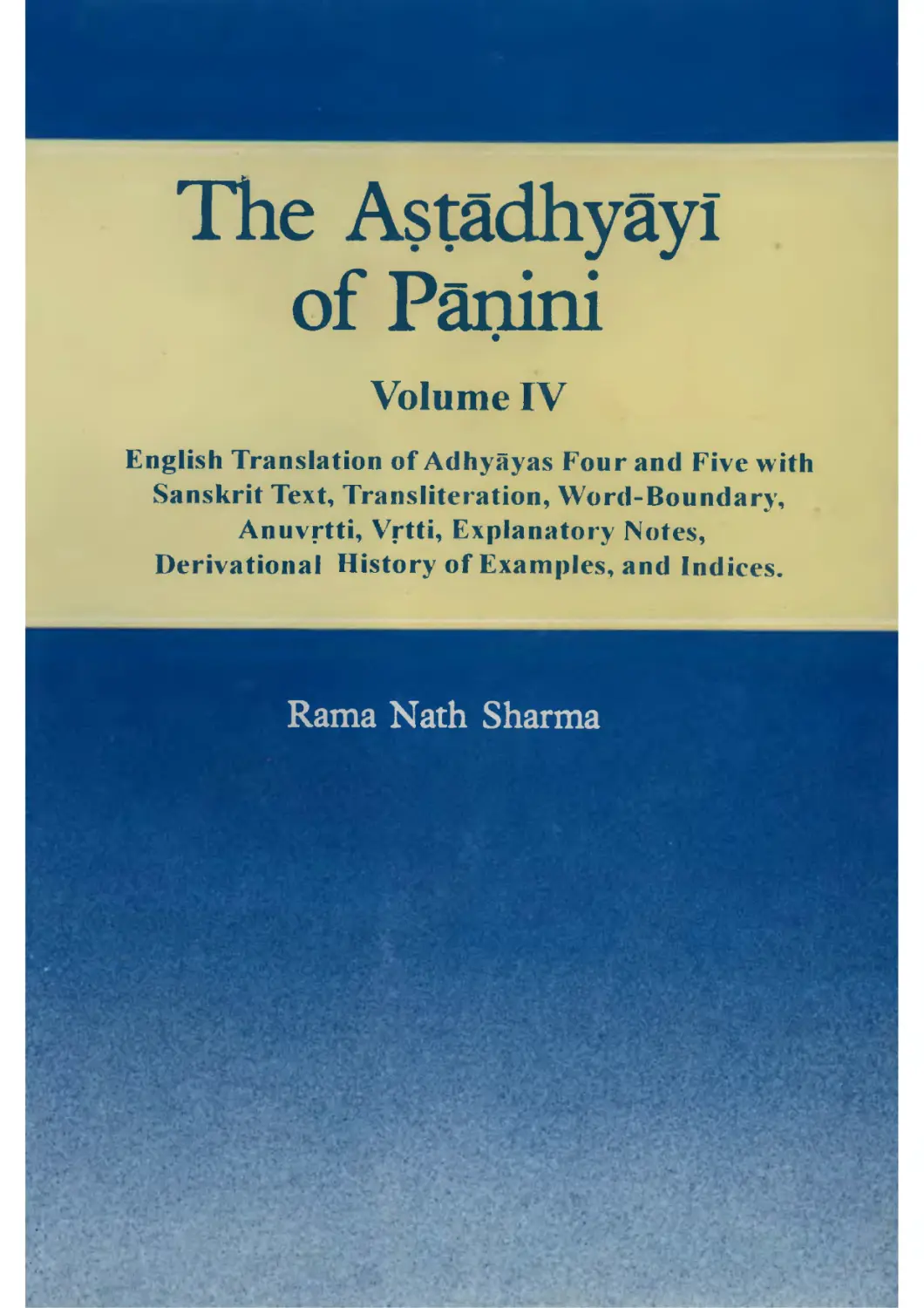
                    The Astadhyayi
of Panini
Volume IV
English Translation of Adhyayas Four and Five with
Sanskrit Text, Transliteration, Word-Boundary,
Anuvrtti, Vrtti, Explanatory Notes,
Derivational History of Examples, and Indices.
Rama Nath Sharma
This volume of the Astadhyayi of.Panini
contains English translation of adhyayas
four and five. It includes Sanskrit text of
individual sutras with their translitera-
tion, word-boundaries, indication of
inflectional endings and formation of
compounds. Each sutra is also furnished
with anuvrtti, vrtti, examples, detailed
explanatory notes, and complete deriva-
tional history of examples cited by the
Kasikavrtti.
Explanatory notes are presented to
facilitate proper understanding of
individual sutras, especially in view of
their formulation, interpretation,
application and relative placement. An
attempt has been made to sort out and
explain pertinent issues, as raised and
discussed by major commentaries. The
appendix contains nearly three hundred
examples with complete derivational
history. Over five hundred derivations
have been discussed in notes under
individual sutras, especially from the
point of view of their relevance to the
Paninian grammatical system.
This volume is the fourth of a now
planned six-volume study. The fifth
volume of this series will cover the sutras
of adhyaya six. The sixth and the last
volume will include the remaining
adhyayas, seven and eight.
MAX. RETAIL PRICE
INCLUSIVE OF ALL TAXES
THE ASTADHYAYI OF
PANINI
VOL. IV
ENGLISH TRANSLATION OF ADHYAYAS FOUR AND FIVE
WITH SANSKRIT TEXT, TRANSLITERATION, WORD-
BOUNDARY, ANUVRTTI, VRTTI, EXPLANATORY NOTES,
DERIVATIONAL HISTORY OF EXAMPLES, AND INDICES
RAMA NATH SHARMA
University of Hawaii
Munshiram Manoharlal
Publishers Pvt. Ltd.
ISBN 81-215-0051-6 (for the set)
ISBN 81-215-0747-2 (Vol. IV)
First published 1999
© 1999, Sharma, Rama Nath
All rights reserved, including those of translation into foreign languages. No part of this
book may be reproduced, stored in a retrieval system, or transmitted in any form, or by any
means, electronic, mechanical, photocopying, recording or otherwise, without the written
permission of the publisher.
Typeset, printed and published by
Munshiram Manoharlal Publishers Pvt Ltd.,
Post Box 5715, 54 Ranijhansi Road, New Delhi 110 055.
оц|см1<м4> mfiiA wRtfci
Contents
Preface	ix
Abbreviations	xi
Adhyaya Four	1
Adhyaya Five	429
Appendix
Derivational History of Examples	763
Bibliography	791
Index of Derivations	793
Index of Terms	796
Index of Sutras	800
Preface
This present is the fourth of a planned previously five but now six-volume
study on the Astadhyayi of Panini. It also constitutes the third of the four
translation volumes of the sutrapatha of Panini, with Sanskrit text, translit-
eration, word-boundary, anuvrtti, vrtti, English translation, examples, explana-
tory notes, derivations and appendices. This volume contains the English
translation of adhyayas four and five of the Astadhyayi. The fifth and sixth
volumes of this series will soon be published with the English translation of
adhyayas six, seven and eight.
I have, as usual, relied very heavily on commentarial sources for sorting
out issues relative to rule-formulation, interpretation, application and or-
der. Three prakriya texts, the Rupavatarah of Dharmakirti, the Prakriya-
kaumudi of Ramacandra and the Siddhantakaumudi of Bhattoji Diksita have
served as primary sources for derivational details. I have benefited most from
the Vyakaranamahabhasyaof Patanjali, the Vyakaranacandrodaya of Charudeva
Shastri, the Kasikavrtti, with the Nyasa of Jinendrabuddhi and Padamanjan
of Haradatta (with Hindi translation of Jayashankar Lal Tripathi), the
Astadhyayibhasya ot Prajna Devi, the Hindi translation of the Laghukaumudi
of Varadaraja made by Bhimsen Shastri and the Siddhantakaumudiof Bhattoji
Diksita with the Tattvabodhini of Jnanendra Sarasvati and the Balamanorama
of Vasudeva Diksita. I have mostly followed the Kasikavrtti with the Nyasa
and Padamanjan for explanatory notes. Here again, under individual rules,
I have taken detours to accommodate remarks of cultural importance.
I have presented some general derivational processes at the beginning of
the appendix so that repetition can be minimized. I have still offered major
derivational details to illustrate issues, both in the text as well as in the ap-
pendix. Frequent references to derivational details of earlier volumes have
proved very helpful.
I fully realize the extremely complex nature of the form and content of
the Astadhyayi. I am also aware of my own limitations due to which I may
have made many mistakes. I realize that there are many typographical er-
rors in the earlier volumes. I have tried not to repeat them in this volume. As
I get to the end of my work on the last adhyaya I feel that I should have
better completed the last volume first. This would have offered some better
insights into arrangements of discussions. I do intend to edit the earlier
volumes of the sutrapatha and additionally, present a more detailed version
of volume one. I shall greatly appreciate my reader’s comments in this re-
gard.
I must express my deep sense of indebtedness to authors of works I have
regularly consulted. My brother Narendra and Pandit Ramaprasad Tripathi,
X
Preface
both of the Sampurnanand Sanskrit University at Varanasi, have always been
generous to me in giving of their time. I have, as usual benefited greatly
from the writings of Professor George Cardona.
The University of Hawaii, especially through its Research Council and
Research Relations, has been very generous in supporting my research
endeavors with grants. The American Institute of Indian Studies still remains
the major funding agency to support this entire project. I am grateful to the
University of Hawaii and the American Institute of Indian Studies for their
continued support. I must express my special thanks to Chris Bopp without
whose programing skills I would have been lost in the software jungle. These
volumes owe a great deal to him. Finally, these volumes owe the most to my
wife Kamala who has always protected me from many of my duties as a house-
holder. I could not do this project without her support.
Rama Nath Sharma
Honolulu, Hawaii (USA)
25 December 1998
Abbreviations
abl acc Ait bv cat tat DP dat du dv dvi tat id itar dv fem GP gen inst int KS Kas	ablative accusative Aitareya Brahmana bahuvnhi caturthi-tatpurusa Dhatupatha dative dual dvandva dvitiyd-tatpwrusa idem itaretara-dvandva feminine Ganapatha genitive instrumental internal Kathaka Samhita Kdsikavrtti of Vamana-Jayaditya with Padamanjan (PM) of Haradatta and the Nyasa of Jinendrabuddhi
loc LS Mbh	locative Laghusabdendusekhara of Nagesa Vydkaranamahdbhdsya of Patanjali with the Pradipa of Kaiyata and the Udyota of Nagesa
masc nan tat neut nom PM PS Pai pbh pane P1 RV SK	masculine nan-tatpurusa neuter nominative Padamanjan of Haradatta as Kdsikavrtti of Vamanajayaditya Paribhasendusekhara of Nagesa Paippaldda Samhita paribhasd pancami plural Rgueda Vaiydkaranasiddhdntakaumudl of Bhattoji Diksita with the Balamanoramd of Vasudeva Diksita, and the Tattvabodhinl of Jnanendra Sarasvati
SP	Sutrapdtha
xii	Abbreviations
sam sg & Sat sas Tai tat tr/trt VP	samahdra singular Sivasiitra Satapatha Brahmana sasthi Taittinya Brahmana tatpurusa trtiya Vakyapadiya of Bhartrhari with the commentary Ambakartn of Pandita Raghunatha Sarma
vt Vaj voc	varttika Vajasaneyi Samhita vocative
Adhyaya Four
Pada One
4.1.1 ^imifdMRchkt
nydppratipadikat
/	nydp-pratipadikat 5/1 = nt ca dp ca pratipadikam ca = nydppratipadikam
(sam. dv.), tasmat/
(pratyayah #3.1.1, paras ca #3.1.2)
adhikaro'yam; yad ita iirdhvam anukramisyama apancamadhydyapari-
samapteh nydpprdtipadikad ity evam tad veditavyam
An affix (henceforth, through the end of adhyaya five) occurs after
that which either ends in affixes marked with Ni and aP, or is a nomi-
nal stem (prdtipadika).
Examples:
Look under subsequent rule(s).
1.	This governing rule (adhikara) specifies bases after which affixes enu-
merated in its domain can be introduced. The expression nydp refers to a
form which ends in feminine affixes marked with Ni and aP. These indi-
vidual terms can each refer to three feminine affixes: NiS, NiP and NiN, on
the one hand, and CaP, TaP and DaP, on the other. That Ni and dP each
refer to a class of three affixes each is made possible by their specification by
means of Mand aP, used with no additional it-elements: N/(NiN), S/(NtS),
P/(NiP); and С/(CaP), Т/(TaP), D/(DaP).
Rule 4.1.2 svaujasmaut. . . constitutes a subdomain, whereby a set of twenty-
one nominal endings termed vibhakti (1.4.104 vibhaktis ca) are introduced.
These nominal endings are generally referred to by the abbreviatory term
sUP (1.4.103 supah). Rule 4.1.3 striyam heads another subdomain under which
feminine affixes specified by nydp are introduced. These two subdomains,
headed by 4.1.2 svaujasmaut. .. and 4.1.3 striyam, both require a nominal
stem as their input. Additionally, an output of the subdomain headed by
4.1.3 striyam, i.e., a form which ends in feminine affixes characterized as
nyap, can also form an input to the subdomain of 4.1.2 svaujasmaut.. .. That is,
a notainal stem which takes the option of 4.1.3 striyam, to derive a feminine
form ending in nyap, re-enters the domain of 4.1.1 to avail the option of
4.1.2 svaujas. .. . This re-entry of a feminine form to the subdomain of 4.1.2
is obligatory. A nominal stem which, upon entering the domain of 4.1.1,
opts for the option of 4.1.2 may also get re-entry to the domain of 4.1.1,
especially for derivational options of its subdomain headed by 4.1.76 taddhitah.
2	The Astadhyayi of Panini	4.1.1
2.	Note that rule 4.1.1 does not have any predication (vidheyd). Conse-
quently, the purpose of its formulation should be accepted as facilitating
the application of other rules (parartha). It is also a governing rule, and
hence, has a valid scope of application prior to the domain of 6.4.1 angasya.
Kasika explains that nyappratipadikam specifies two types of forms: (г)
nominals ending in feminine affixes marked with Ni and aP‘, and nominal
stems covered by rules 1.2.45 arthavad. . . and 1.2.46 krttaddhita.. .. This
specification is made possible by the samahara type of dvandva compound in
nyappratipadikam. That this specification is made via samaharadvandva is clear
from the singular (ekavacand) in nyappratipadikam. An itaretarayoga type for-
mation of a dvandva compound would have required its specification via
plural, as . . . prdtipadikebhyah. This samahara specification also rules out the
possibility of any other compound-formation. If such a possibility is not ruled
out then nyappratipadikam may also be interpreted as a genitive tatpurusa
compound, parallel to nydpoh, pratipadikam, meaning: a nominal stem termed
compound with constituents terminating in Ni and aP. Consequently, sU,
etc., could be introduced only after compound bases such as rajakuman,
etc., which end in Ni, and not after kuman, etc., which could not qualify as
compounds. One can argue here that nydpoh pratipadikam refers to a nomi-
nal stem which ends in Ni and aP, and thus could refer to both a compound
as well as a non-compound base. One can thus facilitate the introduction of
sUP also after forms such as kuman. This, however, will create difficulty of
interpretation. For, nydpoh, pratipadikam will have pratipadikam^ part of predi-
cation. The pratipadika of 4.1.1 is part of the subject (uddesya). Consequently,
the sense of one cannot be equated with the sense of the other, especially
relative to the introduction of sUP (4.1.2 svaujas. ..), the predicate (vidheya).
3.	It is argued that to state that affixes denoted by the abbreviatory term
sUPoccur after ‘that which ends in Ni and aP, or else, is a nominal stem’ is
not necessary. For, an affix, in view of 3.1.2 paras ca, will have to occur after
something, anyway. Rule 4.1.1 makes a specification with regard to that af-
ter which sIZP can be introduced. One can even say that affixes denoted by
the abbreviatory term sUP can be introduced only after bases covered by
specifications made by nyappratipadikat. If one does not accept this then
there could be problems. Padamanjan, ad Kas., outlines four types of bases:
(г) verbal roots (dhatu), (гг) items ending in affixes denoted by the
abbreviatory term tiN(tinantd), (iii) a sentence (vdkyd) and (iv) items which
end in affixes denoted by the abbreviatory term sUP. If a particular specifica-
tion in terms of nyappratipadikat is not made then sUP, TdP, etc., feminine
affixes, aN, and the taddhita affixes commonly known as the svdrthikas (5.3.96
ivepratikrtau, etc.), will occur after these four types of bases in accord with
the order of their enumeration (yathdsamkhyd).
Kasika claims that, based upon deduction, one can still find those same
bases forming left context of an affixal operation, as one would otherwise
4.1.1
Adhyaya Four: Pada One
3
have by means of a specification such as nyappratipadikam. However, it is in
view of specifications such as vrddha ‘that among whose vowels the first is a
vrddhi (1.1.73 vrddhiryasyacdm adis tad. . .) ’, avrddha ‘ that which is not vrddha’,
a-varna ‘the vowel a’, svara ‘accent’ and dvyac ‘that which contains two vow-
els’, that a specification such as nyappratipadikam becomes necessary:
vrddhavrddhavarnasvaradvyajlaksanapratyayavidhau
tatsampratyayartham nyappratipadikagrahanam kartavyam
‘to employ nyappratipadikamis necessary for facilitating the understand-
ing of an affixal operation characterized by specifics such as vrddha,
avrddha, avarna, svara, and dvyac'
For, vrddha, etc., are given as qualifiers (visesand) to nyappratipadikam. It
will indeed be a confusing situation to find modifiers used without their
corresponding modifieds. Thus, if nyappratipadikam is not specified then
operational scopes, for example of rules such as 4.1.157 vrddhad agotrat,
4.1.160 pracam avrddhat phin, 4.1.95 ata in, 4.2.44 anudattader an and 4.4.7
паи dvyacas than, would run into interpretational confusion. For, these rules
must be supplied with nyappratipadikam as a qualified (visesyd) for modifiers
such as vrddha, avrddha, adanta, etc.
A question is raised against including nyap in the specification of this
rule, especially when pratipadikat itself can account for it. For, a pratipadika
also carries reference to its counterparts in other genders (Paribhasa (72):
pratipadikagrahane lingavisist^ ~yapi grahanam). The inclusion of nyap is made
to ensure that a taddhita affix can also be introduced after a syntactically
related nominal stem ending in affixes denoting feminine (SK:... nyabgra-
hanam nyabantat taddhitotpattir yatha syan nyabhyam pran ma bhud ity evam
artham). Consider the derivation of aryaka from arya + TaP + kaN, where
kaN, a taddhita affix, denotes svartha, the meaning of its nominal base. If
affix kaNis introduced after arya, prior to TaP, then the result will be aryaka,
Rule 7.3.44 pratyayasthat. . . will then apply on aryaka to replace its a, which
precedes k, with i. The result will be: aryika. This derivate will be unique
since the г-replacement for a is obligatory (nityd). That is, aryaka, a parallel
form to aryika, can never be derived. If TaPis introduced prior to the intro-
duction of kaN, then, given arya + ka, the final a of arya will be replaced with
its short counterpart by rule 7.4.13 ke'nah. This wilkgive us aryaka. One can
now derive aryika, from aryaka + TaP where the short a before k will be
treated as the a it replaced. This will then facilitate the optional application
of rule 7.3.46 udlcam atah. .., whereby the a before k will be optionally re-
placed with i. We will thus get aryika, parallel to aryaka.
Kasika recognizes that ‘a specification by means of nyap also facilitates
introducing taddhita affixes after bases which end in nyap (tadantat
taddhitavidhandrtham nyabgrahanam). Consider the derivation of kalitara ‘a
female relatively more black .. .’, where the comparative suffix taraP xs in-
4
The Astadhyayi of Panini
4.1.2
troduced after kali (5.3.57 dvivacanavibhajyopapade. . .), a derivate ending
in NiSof 4.1.42 janapadakunda..., to denote relative prominence {prakarsa).
Commentators state that kalitard cannot be derived unless the specification
of its base is made by nyap. For, denotation of feminine by NiS, and that of
relative prominence by taraP, will create a conflicting situation. That is, the
scope elsewhere {sdvakdsatva) of a feminine affix must be one where ‘femi-
nine’ alone is denoted. The scope elsewhere of prakarsa ‘relative promi-
nence’ must be one where prakarsa alone is denoted. Thus, Aa/zand kalatarah
illustrate instances where both meanings have their independent scope
{sdvakdsatva). An example such as kalitard, presents a situation of conflict
where both meanings find their scope. This conflict can be resolved in ac-
cord with 1.4.2 vipratisedhe param karyam. Consequently, only prakarsa, and
no feminine can be expressed, mostly because taraP is subsequent. If, how-
ever, the bases are specified with nyap then kalitard can be derived with no
problem.
4.1.2
svaujasmautchastdbhydmbhishebhydmbhyashasibhydmbhyashasosdmnyossup
/svaujas . . . sup 1/1 = su ca au cajas ca... os ca sup ca = svaujas . . . sup
{sam. dv.)/
{pratyayah #3.1.1, paras ca #3.1.2, nydppratipadikat #1)
‘su, au, jas, am, aut, sas, ta, bhydm, bhis, he, bhydm, bhyas, nasi, bhydm,
bhyas, has, os, dm, hi, os, sup' ity ete pratyayd nyappratipadikad bhavanti
Affixes sU, au,Jas; am, auT, Sas; ta, bhydm, bhis; Ne, bhydm, bhyas; Nasi,
bhydm, bhyas; Nas, os, dm and Ni, os, suP occur after that which either
ends in affixes marked by Ni and aP, or is termed a nominal stem.
Examples:
kumdn ‘girl’
gaun ‘a female of fair complexion; Shiva’s consort’
sarngaravi ‘a female name’
khatva ‘cot’
bhaurdja ‘a city with many kings’
karisagandhyd ‘a granddaughter of Karisagandhi’
drsad ‘nominative singular of drsad ‘pebble, rock”
1. Refer to the appendix for derivational details of these examples. The
first, kuman, constitutes an example for both nydppratipadikat and NiP (4.1.20
vayasi prathame). The next two, gaun and sarngaravi, represent affixes NiS
(4.1.41 sidgaurddibhyas ca) and NiN (4.1.73 sarhgaravadyano . . .). The next
three examples, khatva, bahuraja and karisagandhyd, represent derivates of
TaP (4.1.4 ajddyatas tap), DaP (4.1.13 dab ubhabhydm . . .) and CaP (4.1.74
yahas cap), respectively.
4.1.2
Adhyaya Four: Pada One
5
2. The twenty-one suffixes enumerated by this rule have been classified
into seven triads of prathama ‘first’, dvitiya ‘second’, trtiya ‘third’, caturthi
‘fourth’, pancami ‘fifth’, sasthi ‘sixth’, and saptami ‘seventh’ (1.4.101 linas-
tnni. . .). Individual members of each triad are further assigned the terms
ekavacana ‘singular’, dvivacana ‘dual’ and bahuvacana ‘plural’, respectively
(1.4.102 tany ekavacana. . .). The following is a tabular listing for reference:
	singular	dual	plural
prathama	sU	au	Jas
dvitiya	am	auT	Sas
trtiya	Ta	bhyam	bhis
caturthi	Ne	bhyam	bhyas
pancami	Nasi	bhyam	bhyas
sasthi	Nas	os	dm
saptami	Ni	os	suP
The vowels which have been used as .if in these elements either facilitate
articulation, or distinguish endings from each others (visesanartha). The T,
as an it in Ta, is used to facilitate formation of the abbreviatory term sUT.
The final Pof suPis brought as an it so that these nominal endings all can be
referred to by the single abbreviatory term sUP.
The denotata of these nominal endings have been outlined as number
(samkhya), nominal stem notion (prdtipadikartha) and karman ‘object’ etc.,
by rules enumerated elsewhere (2.3.1 anabhihite, etc.; Kas.: samkhyakarmddayas
ca svadinam arthah sdstrantarena vihitas tena sahasyaikavakyata). This rule, for
its proper interpretation, must share the ‘single-sentenceness’ relationship
(ekavakyata) with them. Thus, rule 2.3.2 karmani dvitiya, read with 2.3.1
anabhihite and rule 4.1.2 svaujas. . ., can be interpreted as a single sentence
as follows:
‘affixes termed dvitiya, particularly its members termed ekavacana ‘sin-
gular’, dvivacana ‘dual’ and bahuvacana ‘plural’, occur after an item
which either ends in a feminine affix denoted by Niand aP, or is termed
a pratipadika, provided an object (karman) not expressed otherwise, is
to be expressed’
Recovering the context of a rule, via ‘single-sentenceness’ (ekavakyata),
often entails an elaborate network of related rules. My interpretation of
2.3.2 karmani dvitiya shows the involvement of only a few important rules.
Note that accepting the signification of affixes denoted by sUP as
samkhyakarmadi ‘number and object, etc.’ is also problematic. For example,
if samkhyakarmadi is the denotatum of a sUP then these affixes cannot be
introduced after indeclinable bases (avyaya). Consequently, Panini’s provi-
sion of deleting a sUPby means of LUK after an indeclinable (2.4.82 avyayad
6
The Astadhydyl of Panini
4.1.3
dp supah) becomes meaningless {vyartha). But since Panini provides for de-
leting a sUP after an indeclinable, introduction of the same after an inde-
clinable cannot be challenged. That is, a sUP will be introduced after an
indeclinable even when samkhydkarmadi are not denoted. It is a different
story that nominative {prathamd) singular {ekavacand) alone could then be
introduced.
4.1.3
striydm
/striydm 7/1/
{pratyayah #3.1.1, paras ca #3.1.2, nyappratipadikat #4.1.1)
у ad ita urdhvam anukramisydmas striydm ity evam veditavyam
The following affixes occur after a nominal stem when feminine is to
be denoted.
Examples:
Refer to subsequent rules.
1.	That this rule is formulated to facilitate application of other rules
{pardrthd) is clear from the specification of striydm in locative {saptami), es-
pecially with absence of any predicate (vidheyd). It offers jdti ‘class’, particu-
larly stntva ‘femininity’, as scope for application of rules it governs. A ques-
tion is raised as to what stntva is. It is explained that, like the general class of
gotva ‘cowness’, stntva also finds varying loci (dsryayd), both general {samanya)
and particular (visesd). In the absence of a well defined particular locus, it
may, on occasions, be comprehended in a manner similar to bramanatva
‘Brahmananess’ based on upadesa. Kasika, therefore, explains this jatiof stntva
as sdmanyavises a bahuprakdrdh ‘general and particular of varying types’ {Kds.:
samanyavisesdh stritvadayo gotvadaya iva bahuprakdrd kvacid asrayavisesdbhavdd
upadesavyanyd eva bhavanti yatha brahmanatvadayah).
Sanskrit grammarians do not clearly define what gender is. Patanjali rec-
ognizes prominence of ‘breasts’ and ‘hair’ as distinguishing marks for ‘fe-
males’ and ‘males’, respectively. A thing which is different from two is char-
acterized as ‘neuter’:
stanakesavafi stn syal lomasah purusah smrtah/
ubhayor antaram yac ca tadabhave napumsakam/ /
But this could only characterize biological gender. It cannot apply to a
host of things such as khatva ‘cot’, mala ‘garland’, ghata ‘pot’, pata ‘cloth’,
etc.
Grammarians rely solely upon usages for determining gender {lokdsrayatval
lirigasya). What about the belief that gender is already included within the
denotatum of a nominal stem {pratipadikagrahane lingavisistasydpi grahanam) ?
If the notion of femininity {stntua) is included within the sense of a pratipadika
4.1.4
Adhyaya Four: Pada One
7
then what is the purpose of introducing a feminine affix. It is argued that
feminine affixes are employed to manifest this notion of gender inhered by
nominal stems. They thus reinforce its comprehension by way of definitizing
it. As far as comprehension of gender, per se, is concerned, one may, in
many instances, comprehend it even without the use of a feminine suffix.
2.	Note that this rule forms a subdomain of 4.1.1 nyappratipadikat. The
anuvrtti (from rule 4.1.1) of pratipadikat alone is valid here since a form
which ends in a feminine affix (nyabanta) cannot form an input to the
subdomain which introduces that affix.
4.1.4	ЗГ31ККШЩ
ajadyatas tap
/ajadyatah 5/1 = ajadis ca at ca = ajadyat; tasmat = ajddyatah (sam. dv.);
tapA/l/
(pratyayah #3.1.1, paras ca #3.1.2, pratipadikat #41, striyam #3)
ajadibhyah pratipadikebhyo' akarantac ca pratipadikat striyam tap pratyayo
bhavati
Affix Tap occurs after a nominal stem which is abstracted from the
group headed by aja 'she-goat’, or after a stem which ends ip -aT(1.1.70
taparas tatkalasya), when feminine is denoted.
Examples:
aja ‘she-goat’
edaka, ‘ewe’
cataka ‘sparrow’
asva ‘mare’
1.	The P of TaP is given as an it for the general low pitch (anudatta)
accent of rule 3.1.4 anudattau suppitau. The Tis used as an it to distinguish
TaP from affixes such as CaP and DaP. The T of aT is, of course, part of
taparakarana (1.1.70 taparas tatkalasya), whereby stems ending in a (of short
duration) alone can qualify.
This provision of TaP, especially in view of its specification with ajddi ‘that
which begins with aja', is made against affixes MS and NiP, which may other-
wise find their scope of application. Note that the listing of the ajadi group
is not made with the enumeration of nominal stems aja, etc. It is, instead,
made with aja, etc., which are items derived with affix TaP already intro-
duced (krtatappratyaya). Thus, TaPwill be introduced after stems specific to
those of aja, etc.
Affixes NiS and NiP, as against TaP, could be conditioned by factors such
as: (i) signification of jati ‘class’, (ii) marked association of a female with a
corresponding male (pwnyoga-laksana), (Hi) a following word with the
denotatum of flower of fruits (puspaphalottarpada), or (iv) age (vaya), etc.
8
The Astadhyayi of Panini
4.1.4
Consider, for example, the derivation of sudra ‘a female of the class charac-
terized as sudra'. This provision of TaPis made against denotation of a ‘wife’,
in relation to the ‘husband’. Thus, the wife of a sudra is not called sudra.
Instead, sudra denotes a class of females (jati). For denoting a ‘female (wife)'
corresponding to a ‘male (husband)’, one has to introduce affix NiS to de-
rive sudn, parallel to sudrasya bharya ‘wife of a sudra'. This ‘association with a
male (pumyoga)' does not work with forms which have mahat as their first
constituent. Thus, the wife of an abhira, a class synonymous with mahasudra,
will not be called mahasiidri. Instead, TaPwill be used to derive mahasudra.
This exception is made possible because of tadantavidhi, interpreting a form
as ending in that by means of which a specification is made (1.1.73 yena
vidhis tadantasya). Incidentally, an abhira is characterized as the offspring of
a brdhmana father and an ugra mother. An ugra, in turn, is a female born of
a sudra mother and a ksatriya father.
Kasika states that the following paribhasa is not valid in this connection:
grahanavata pratipadikena tadantavidhir ndsti
‘a specification made by means of a particular nominal stem is not
interpreted as referring also to a form which may end in that nominal
stem’
Consequently, we get forms such as atidhivari‘an excellent fisherwoman’,
atiplvan' a very fat woman’, atibhavatVa very respected woman’ and atimahati
‘a very great woman’. Examples such as aja ‘she-goat’, asvd ‘mare’ and cataka
‘sparrow’ denote jati ‘class’; bald ‘maiden’, paka ‘girl’, vatsa ‘female calf,
and mandd ‘feeble woman’, etc., denote age (vaya). One can similarly get
other examples in other categories where TaPis introduced to block MSor
NIP.
2.	Why should ajddi be explicitly mentioned in this rule especially when,
since all bases of ajddi end in a, specification made with atah can account for
TaP? For, all the ajddi bases end in a. A special mention of ajddi is made
here to block provisions of NiS (4.1.63 jater astnvisayad. . .) and NiP (4.1.20
vayasi prathame).
3.	Bhattoji Diksita interprets ajadyatah as ending in genitive {sasthyanta').
A pancamyanta ‘ending in a fifth triplet of sUP' interpretation is problem-
atic. For example, given pancdja ‘a group of five goats’, TaP will yield a wrong
form: *pancajd. A genitive interpretation will yield the correct form pancaji,
with NiP of 4.1.21 dvigoh. Actually, these two interpretations relate to ques-
tions of whether denotation of feminine should be accepted as meaning of
a base, or of an affix. If affix, then a pancami interpretation of ajadyatah,
read in view of TaP, will yield the following meaning:
‘affix TaPoccurs after a nominal stem which ends in a, or after a nomi-
nal which is inferred from the group headed by aja, when feminine is
denoted’
4.1.5
Adhyaya Four: Pada One
9
This interpretation will accept ‘feminine’ as the meaning of the affix
{pralyaydrtha). A genitive interpretation will accept ‘feminine’ as included
within the meaning of the base. What would be the function of a feminine
affix under this interpretation? It will simply manifest the notion of gender
inhered by the base (dyotayati). Thus, a genitive interpretation of ajadyalas
tdpvnW yield the following meaning:
‘affix TaPoccurs after a nominal stem which ends in a, or is inferred
from the group headed by aja, when the sense of feminine inhered by
the base is made manifest’
Bhattoji Diksita accepts the genitive interpretation, along with ‘revela-
tion or manifestation’ as the meaning of feminine affixes. The tradition has
discussed both views relative to the denotation of gender. Those who accept
gender as part of the meaning of a nominal stem believe that an affix is
introduced to ‘manifest or reveal’ this meaning {striydmу at prdtipadikamvartate
tasmat tabddayah). This view accepts the base after which a feminine affix is
to be introduced as qualified with ‘feminineness’ {stntvavisista). Adherents
of the other view believe that an affix is introduced after a base when gender
is to be denoted {striydm abhidheyayam tabddayo bhavanti). This view will give
prominence to affixal meaning: prakrtipratyayau sahdrthabrutas tayoh
pratyayarthasyaiva pradhanyam ‘affixal meaning is principal when a specifica-
tion is made concurrently by means of a base as well as an affix’. But this will
create problems. Since ‘feminine’ is to be expressed as affixal meaning
{pratyaydrtha') qualified by meaning of the base {prakrtyartha), singular
{ekavacana} alone can be used. What is the use of dual and plural forms? If
feminine is to be accepted as a notion inhered by the base then this prob-
lem would not arise. Commentators have discussed and resolved this, and
host of other problems concerning the two views, in relation to the fivefold
{pancaka) meaning of bases {pratipadika), and the notions of jdti ‘class’, vyakti
‘individual’, paddrtha ‘substance’ and satta ‘existence’. I omit any further
discussion of them for lack of interest. My translations and discussions re-
flect acceptance of both the views.
4.1.5
rnnebhyo nip
/rnnebhyah 5/3 = rt can ca = rnn {sam. dv.); tasmat; nip 1/1/
{pratyayah #3.1.1, paras ca #3.1.2, prdtipadikat #1 striydm #3)
rkdrdntebhyo nakarantebhyas ca prdtipadikebhyah striydm nlppratyayo bhavati
Affix MP occurs to denote feminine after nominal stems which end in
r {rT, cf. 1.1.70 taparas tatkdlasya) and n.
Examples:
kartri ‘she who does . . .’
10
The Astadhyayi of Panini
4.1.6
hartri ‘she who carries . . .’
dandinl ‘she (a female ascetic) who carries a shaft’
chatrini ‘she who carries an umbrella’
1.	Note that N, as an /7 in NIP, is intended for reference to affixes NiP, NiS
and NiN in general (samanyagrahana). That is, in its absence, a reference
with N of Nyap in rule 4.1.1 nydppratipadikat, will have to be limited to just
two affixes. What is the purpose of P as an it? It is used so that NiP can be
distinguished (visesanarthah) from MN and NiS. This P, as has already been
stated, also accounts for anudatta.
2.	Note that rnnebhyah is interpreted as: ‘after that which ends in rand ri.
Such an interpretation is possible only when one treats rnnebhyah as a quali-
fier (visesand) to pratipadikat (here read as prdtipadikebhyah), in accord with
tadantavidhi ‘treating a qualified (visesya) as ending in that which qualifies
(visesana)’.
4.1.6
ugitas ca
/ugitah 5/1 = ugityasya (bv.), tasmat; ca§/
(pratyayah #3.1.1, paras ca #3.1.2, pratipadikat #1, striyam #3)
ug idyatra sambhavatiyathdkathancit tad ugic chabdariipam, tadantdt striyam
nip pratyayo bhavati
Affix MP occurs to denote feminine also after a form which ends in an
it denoted by the abbreviatory term uK (и, r, I; cf. Ss. 1-2).
Examples:
bhavati ‘you (feminine polite of bhavat) ’
atibhavatl ‘you (feminine extremely polite) ’
pacantl ‘she who is cooking’
yajanti ‘she who is performing a ritual sacrifice’
1.	Note that wXdenotes и, r, I. The form wgi/is interpreted as a bahuvrihi
compound parallel to ugityasya ‘that which has sounds denoted by «Xas an
it’. We know that the meaning of a bahuvrihi falls outside of its constituent
meanings (anyapaddrtha). Can pratipadikaof prdtipadikatbe accepted as the
denotatum of the bahuvrihi compound ugz'Z? That is, can ugit be accepted as
a modifier (visesand) to pratipadika? To accept pratipadikat as a qualified
(visesya) for ugifwill facilitate the introduction of MP in bhavati and mahati,
where nominal stems bhavatUand mahatUhave Uas an it. But this interpre-
tation will block MP in examples such as gomati ‘a river; she who is rich in
cows’ where it is affix matUP, and not the nominal stem go, which has uKas
an it. Examples such as arvatl ‘mare’ will also be excluded since what is an
ugit there is tR, a replacement of n of arvan, itself an ugit. It is therefore
suggested that ugit be interpreted not as a nominal stem but as a qualifier.
4.1.7
Adhyaya Four: Pada One
11
This qualifier status of ugit, when read with pratipadikat, will facilitate
tadantavidhi and yield the following interpretation:
‘affix NiP occurs after a nominal stem which ends in a form containing
a sound denoted by the abbreviatory term uK as an if
2.	A varttika proposes that roots with wKas an it should be excluded from
the scope of this rule. This will exclude roots samsUand dhvamsUof ukhasrat
‘fallen from a pot’ and parnadhvat ‘fallen from a leaf. An additional varttika
suggests that forms ending in affix ancU should be included to enable the
derivation of praci ‘east’ and pratici ‘west’ with NiP. The Mahabhasya rejects
this varttika, and accepts yogavibhaga, whereby anyatarasyam of rule 4.1.8 padd
nyatarasyamwdi be treated as a rule by itself. It will be accepted as a residual
(sesa) rule to 4.1.6, 4.1.7 and 4.1.8. This rule will then be treated as
vyavasthitavibhasa, whereby a dhatu which qualifies as ugit will receive NiP
only when it ends in ancU
4.1.7
vano ra ca
/vanahb/\ ra (deleted 1/1) с«ф/
(pratyayah #3.1.1, paras ca ф #3.1.2, pratipadikat #1, striyam #3)
vannantad pratipadikat striyam nip pratyayo bhavati rephas cantadesah
Affix Nip occurs to denote feminine after a nominal stem which termi-
nates in van, with an additional provision that r comes in place of the
final sound of that which ends in van.
Examples:
dhivan ‘fisherman’s wife’
pivafi ‘a fat woman’
sarvari ‘night; Rati, Kama’s wife’
paralokadrsvarFz. female; capable of seeing through the world beyond’
1.	Commentators state that 4.1.5 rnnebhyo .. . could easily account for
derivates of this rule. For, stems which end in van also qualify as those which
end in n. A separate formulation of this rule is needed so that r can be
concurrently be introduced as a replacement.
Note that van is a cover term for affixes KvanIP, vanIP and NvanIP. These
affixes enable their bases to qualify as those ending in n. That is, van of the
rule means: that (a nominal stem) which ends in van (vann-antatpratipadikat).
Commentators state that van also refers to a nominal stem which ends in a
form ending in affix van. That is, van means: a nominal stem which ends in
a nominal stem ending in van (vann-antatpratipadikantatpratipadikat). This
second interpretation is gotten via Paribhasd (24): pratyayagrahaneyasmat sa
vihitas tadades tadantasya grahanam ‘that after which an affix is introduced
12
The Astddhyayi of Panini
4.1.8
refers not only to a form which ends in that affix, but also to that which ends
in the form ending in that affix’.
The word-form van cannot be here interpreted as denoting verbal root
vanU'to beg’, because ‘a specification relatable to both an affix (pratyayd) as
well as a non-affix (apratyaya), is interpreted as referring to an affix alone’
(Paribhdsa (111): pratyayapratyayayoh pratyayasyaiva grahanam). Besides, in-
terpreting van to refer to verbal root vanUwould not make any sense.
A vdrttika states that this rule cannot introduce MP after a form which,
prior to introduction of an affix denoted by van, ended in a sound segment
denoted by the abbreviatory term hS (Ss. 5-10; vano na hasah). Consider
sarvari where a van affix has been introduced after sr which does not end in
hS. A form, such as sar which ends in ris produced through application of
guna before van. Now consider sahayudhvd brdhmani where sahayudh, which
ends in dh (a hS), receives kvanIP (3.2.94 drseh kvanip). Affix MP, and ras a
replacement for n as well, are thus blocked.
4.1.8	MT<15^d<Hir^
pado' nyatarasyam
/pddah 5/1 anyatarasydm 7/1 /
(pratyayah, #3.1.1, paras ca #3.1.2, pratipadikat #1, striydm #3)
padantat pratipadikad anyatarasydm striydm nip pratyayo bhavati
Affix MP optionally occurs to denote feminine after a nominal stem
which ends in pad ‘foot’.
Examples:
dvipdt ‘that which has two feet’
dvipadi ‘id’.
catuspdt ‘that which has four feet'
catuspadi ‘id’.
sahayudhvd brdhmani ‘a Brahmana woman who was a fighting compan-
ion’
1.	This rule specifies pddah, an ablative of pad, where the samasanta affix
TaC, of pada, has already been deleted. That is, pad, with deleted TaC, oc-
curs at the end of a compound. Thus, dvipad is a bahuvrihi compound origi-
nally with the form dvipada. Rule 5.4.140 samkhya. . . deletes its final a, sub-
sequent to which pad is replaced with pad by rule 6.4.130 pddah pat. We will
get dvipad if the option of MP is not accepted. Recall that 6.4.130 pddah pat
is contained within the subdomain of 6.4.129 bhasya. Our string dvipad can-
not be termed bha unless affix MP is introduced. Lack of assignment of the
term bha blocks the replacement of pad by pad. The d of dvipad is optionally
replaced with t (cartva) of 8.4.55 va'vasane.
4.1.10
Adhyaya Four: Pada One
13
4.1.9	dlejFcl
tab rd
/tap 1/1 rd 7/1/
{pratyayah #3.1.1, paras ca #3.1.2, pratipadikat #1, striyam #3, padah #8)
rd vdcydydm padantat pratipadikat striyam tap pratyayo bhavati
Affix TaP occurs after a nominal stem which ends in pad, to denote
feminine, when a hymn {rca) is signified.
Examples:
dvipada rk ‘a hymn with two quarters’
tripada rk ‘a hymn with three quarters’
catuspada rk ‘a hymn with four quarters’
1.	Note that our preceding rule makes a provision for NiP. This rule over-
rides that provision by introducing TaP under the special meaning condi-
tion of rca. The sense of locative in rd is that of denotation {abhidheya). That
is, this locative does not denote scope {visaya). For, a scope interpretation
will restrict this rule to the Rgueda. Accepting the denotational meaning of
locative will let this rule apply everywhere {Nyasa. yadi hi visaya-nirdesah syat...
rggrantha eva syat, nanyatra, abhidheya-nirdese ti sarvatra bhavatiti bhavah).
4.1.10
na satsvasradibhyah
/ па ф satsvasradibhyah 5/3 = svasd adir yesam te svasradayaly, sat ca
svasradayas ca - satsvasradayas, tebhyah {bv. with int. itar. dv.)/
{pratyayah #3.1.1, paras ca #3.1.2, pratipadikat #1, striyam #3, ajadyatas
tap #4, rnnebhyo nip #5)
satsamjnakebhyah svasradibhyas ca pratipadikebhyah stnpratyayo na bhavati
An affix which denotes feminine does not occur after a nominal stem
which is termed sat (1.1.24 manta sat), or is listed in the group headed
by svasr ‘sister’.
Examples:
рапса brahmanyah ‘five Brahmana women’
sapta brahmanyah ‘seven Brahmana women’
svasd ‘sister’
duhitd ‘daughter’
nananda ‘husband’s sister’
yata ‘husband’s brother’s wife’
catasrah ‘four . ..’
1.	Note that this rule negates all feminine affixes which have been made
available thus far {Kas.:yoyatahprdpnoti sa sarvahpratisidhyate). It should not
14
The Astadhyayi of Panini
4.1.10
be interpreted simply as a negation of NiP, since NiP constitutes the most
immediate context (anantaratvat). Our rule also negates TdP. Incidentally,
NiP still forms the most immediate context since a provision for TaP of
4.1.10 tab rd is made against it. Besides, this TaP is not intended to be car-
ried via anuvftti (asvaritavat).
It is argued that items termed sat are number words (samkhya), and as
such, they simply facilitate comprehending quantitative differences of things.
They do not facilitate any understanding of gender per se. Comprehension
of gender takes place via syntactic coordination (samanadhikaranya) of
number words with things which they distinguish (Nyasa: samkhyds ca
bhedamatram dravyasya pratydyayanti, na stritvam; yd tu tasya stntvapratitih sd
sabddntarena samanadhikaranyad bhavati). A negation of feminine in relation
to sat, when the same is not made available, is vacuous (yyartha). Negation
(pratisedha) makes sense only when a positive provision is available. It was
made clear in connection with 4.1.3 striyam that a qualifier, such as sukla
‘white’, qualifies for a feminine affix in accord with its qualified. This same
is also true of items termed sat.
2.	Note that/>anca (of рапса brdhmanyah) and catasr represent two sets of
derivates where feminine affixes are negated. The first word is blocked from
receiving NiP (of 4.1.5 rnnebhyo hip) which was available in view of the final n
of pancanTwe . Recall that 1.1.24 snantd sat assigns the term sat to pancan on
account of its final n. Thus, given pancan + Jas we get pancan + (/as—>ф) =
рапса (n—>ф), where 7.1.22 sadbhyo luk and 8.2.7 nalopah pratipadikantasya
are responsible for deleting Jas and n, respectively. The second example
catasr becomes an exception to 4.1.5 because catasr is a replacement for
catur (7.2.99 tricaturos striyam . . .). This negation of NiP and TdP, condi-
tioned by sat, is applicable also items which end in a sat. For example, con-
sider priyapanca of priyapanca draupadi ‘Draupadi for whom five are dear’.
A question is asked as to why an item termed sat cannot qualify for TdP
after deletion of its n has taken effect. Why pahca, at the strength of now
ending in a, cannot get TaP (satsamjnanam ante lupte tab utpattih kasman na
sydt)?. One cannot argue here that this negation then would become vacu-
ous (vyartha). This negation would have served its purpose by blocking the
next immediate (anantara) MP anyway (Paribhasa (62): anantarasya vidhir
bhavati pratisedho va). It is stated that TdP can be blocked by accepting the
deleted n of pancan as suspended (asiddha\ 8.2.2 nalopah supsvarasamjnd-
tugvidhisu). But how could «-deletion be treated as asiddha when operations
relative to TaP are not included within the scope of 8.2.2. This scope of TaP
comes well within the scope of sub-vidhi of 8.2.2 when one accepts the for-
mation of the abbreviatory term sUP, formed with sUof 4.1.2 svaujas.. . and
the Pof 4.1.74 yanas cap. That is, TaP cannot be introduced because dele-
tion of n will become asiddha. But accepting the formation of the abbreviatory
term (pratyahara) sUPw'nh the Pof 4.1.74 yanas cap, to include operations
4.1.11
Adhydya Four: Pada One
15
relative to TaP, will create problems elsewhere. The Mahdbhdsya discusses
this, and other aspects of this problem, in detail. Patanjali rejects this notion
of asiddhatva, especially in the derivational context of bahucarmika nagan ‘a
city with hide in abundance’, where tfc-deletion of bahucarman, if treated as
asiddha, will block the i (itva) of 7.3.44 pratyayasthdt kat.. . . That is, given
bahucarmaka + TaP, the a of aka cannot be found immediately before the k.
For, the deleted nof bahucarman will then be there through asiddhatva. This
will then block itva.
Consequently, 'striydm ity arthamdtram apeksya tatrayad uktam bhavati tan
na bhavati ‘that (MP and TaP) which is provided there in view of denotation
of meaning specified by striydm does not apply here’.
4.1.11	^FT:
manah
/manah 5/1/
(pratyayah#3.1.1, paras ca#3.1.2, prdtipadikat#!, striyam#3, nip#5 na #10)
mannantdd prdtipadikan nip pratyayo na bhavati
Affix MPdoes not occur to denote feminine after a nominal stem which
ends in man.
Examples:
dama ‘nominative singular of daman ‘rope’ ’
damanau ‘nominative dual of daman'
ddmanah ‘nominative plural...’
sima ‘nominative singular of siman ‘limit, parting of hair”
simanau ‘nominative dual...’
simanah ‘nominative plural...’
atimahima ‘nominative singular of atimahiman', he who has excelled in
glory’
atimahimanau ‘nominative dual...’
atimahimdnah ‘nominative plural...’
1.	This rule negates the provision of 4.1.5 rnnebhyo nip.
2.	Note that man refers here to forms which end in affixes, for example,
the Unadi (IV. 144) manIN, etc. Commentators explain that man must also
refer to any stem which may end in man. That is man does not have to be
affix man. How do we know this? From paribhasd (17): aninasmangrahandn
arthavata can arthakena ca tadantavidhim prayojayanti ‘specifications made by
means of an, in, as and man, entail tadantavidhi, a process whereby that by
means of which a specification is made refers also to that which ends in it,
whether or not an, etc., are meaningful’. This paribhasd has been read in the
Mahabhasya under rule 1.1.72 yena vidhis tadantasya. Note that siman and
atimahiman end in man, though man is not an affix. That is, man is not mean-
16
The Astadhyayi of Panini
4.1.12
ingful. Examples such as paman ‘skin disease’ and daman ‘rope, string’, with
nominative forms such as pama, pamanau, pamanah; and dama, damanu,
damanah, do terminate in affix man. This man is meaningful because of be-
ing an affix.
4.1.12	3T=fT
ano bahuvriheh
/ anah, 5/1 bahuvnheh 5/1/
(pratyayah #3.1.1, paras ca #3.1.2, pratipadikat #1, striyam #3, nip #5, na
#10)
annantad bahuvnheh striyam nip pratyayo na bhavati
Affix MPdoes not occur to denote feminine after a bahuvrihi nominal
stem which ends in an.
Examples:
suparvd ‘nominative singular of suparvan, . . . whose joints are beauti-
ful’
suparuanau ‘nominative dual. . .’
suparvanah, ‘nominative plural. ..’
sucarma ‘nominative singular of sucarman-, ... whose skin is beautiful’
sucarmanau ‘nominative dual. ..’
sucarmanah, ‘nominative plural...’
1.	Note that bahuvnheh simply means ‘after a bahuvrihi compound’. Our
examples, though, illustrate only one kind of bahuvrihi, namely, that which
ends in an but does not go through deletion of its penultimate (upadhalopa)
sound. Rule 4.1.28 ana upadhalopino'nyatarasyamwill make an optional pro-
vision for DaP, against NiP, in case of bahuvrihi compounds which end in an,
and go through deletion of their upadha. The fact that this rule covers in-
stances of bahuvrihi compounds which end in an, with no deletion of their
upadha, becomes known by process of elimination (parisesyat). Also, this rule
negates NiPagainst optional DaPof the next rule, and optional NiPof 4.1.28
anupadhalopino. . . . That is, this rule blocks NiPln toto. The DaPof the next
rule is made optional to absence of a feminine affix.
Why do we have to include the condition of bahuvnheh/ So that atiraji, a
tatpurusa compound parallel to atikranta rajanam ‘she who has excelled the
king’, may not qualify for NiP.
4.1.13
dab ubhabhyam anyatarasyam
/dap 1/1 ubhabhyam 5/2 anyatarasyam 1 /1/
(pratyayah #3.3.3, paras ca #3.1.2, pratipadikat #1, striyam #3)
dap pratyayo bhavati ubhabhyam; mannantad pratipadikad annantac ca
4.1.13
Adhydya Four: Pada One
17
bahuvnher anyatarasydm
Affix DaPoptionally occurs after both, i.e., a nominal stem which ends
in man and a bahuvrihi compound which ends in an.
Examples:
pama
pdme
pamah
sima
sime
simah
bahuraja ‘nominal singular of bahuraja, an assembly of many kings’
bahuraje ‘nominative dual.. .’
bahurajah ‘nominative plural. .
bahudhiva ‘a very clever female’
bahudhivan ‘id.’
bahupiva ‘a very fat female’
bahupivari ‘id.’
1.	Note that ubhabhyam ‘after both ...’ refers to nominal stems which (г)
end in man (4.1.11 manah)\ or (и) constitute a bahuvrihi compound ending
in an (4.1.12 ano bahuvnheK). These two categories of stems are not allowed
MP in view of the two preceding rules. The MP which is negated here may
become available to these stems by rule 4.1.5 rnnebhyo nip. Our present rule
makes an optional provision for DaP against the negation of MP. The word
ubhabhyam restricts optional DaP to two categories of specified stems. Exam-
ples, such as sima/sime/simah, illustrate the option of DaP. Affix MP must
remain negated in cases where this optional DaP is not accepted. This will
yield forms, such as sima/simanau/simanah, where no feminine affix is intro-
duced. An optional DaP, in the context of a bahuvrihi compound ending in
an, produces examples such as bahuraja/ bahuraje/ bahurajah. Not accepting
this option will again lead to negation of MP (4.1.12 ano bahuvnheh). This
will produce examples such as bahuraja/ bahurajanau/ bahurajanah, with no
choice of a feminine affix. Note that this optional provision for DaP would
cause ^deletion in a presuffixal base termed bha (6.4.143 teh). Not accept-
ing DaP would result in retention of the base-final n.
2.	What is the purpose of anyatarasydm in this rule (Kas.'. anyatarasydm
grahanam kimartham)'? Is anyatarasydm used here to allow negation of MP in
cases where option of DaP is not accepted? Or is it used for allowing option
of MP against its own negation, or else, against the option of DaPjust pro-
posed. The first interpretation is not appropriate (adyam tavad ayuktam)
since DaP, and a negation of MP as well, is already made available by the
explicit statement of dab ubhabhyam (4.1.13) 'DaP after both .. . (vaca-
nasamarthyat) ’. Obviously, this provision of DaP cannot be made optional to
18
The 'Astadhyayi of Panini
4.1.14
the obligatory negation of NiP. A non-application of negation, or of optional
DaP, will make both provisions meaningless. Thus, they both will have to be
applied: MP obligatorily, and DaP optionally. This interpretation is possible
even without the explicit use of anyatarasyam.
The second interpretation is also inappropriate {dvitiyam apy ayuktam).
For, if anyatarasyam is intended to provide the option of NiP to a bahuvnhi,
with no deletion of its upadha (4.1.28 ana upadhalopino' nyatarasyam), then
negation of 4.1.12 ano bahuvnheh vdA become useless. If anyatarasyam is, in-
stead, understood as providing the option of DaP to bahuvnhi stems which
go through deletion of their upadha but which do not take the option of NiP
of 4.1.28 ana upadhalopino'nyatarasyam, then it does not make any sense.
For, anyatarasyam of 4.1.28 itself will account for option of DaP. The
anyatarasyam of this rule is thus not required.
Kasika states that anyatarasyam should be used here for offering DaPas an
option to NIP of 4.1.7 vano ra ca, which, without this anyatarasyam, will re-
main negated because of 4.1.12 ano bahuvnheh {Nyasa: nlbrephav apraptau,
'ano bahuvnheh'iti pratisedhdt, tasmat tadvidhanartham anyatarasyamgrahanam
kartavyam). Consider bahudhivaand bahudhivarias examples. The Mahabhasya
proposes split-interpretation {yogavibhaga) of this rule as follows:
(г) dab ubhabhyam bhavati, where both manah (4.1.11) and ano bahu-
vnheh are carried;
(гг) anyatarasyam, where ano bahuvnheh alone is carried.
This second split-rule is intended for making affix NiP (of 4.1.5 rnnebhyo
nip), and replacement in rfor n (of 4.1.7 vano ra ca), both optionally avail-
able.
4.1.14 31^4^41^
anupasarjanat
/anupasarjanat 5/1 = na upasarjanam = anupasarjanam {nan. tat.);
tasmat/
{pratyayah #3.1.1, paras ca #3.1.2, pratipadikat #1, striyam #3)
у ad ita iirdhvam anukramisyamo' nupasarjanad ity evam tad veditavyam
Affixes enumerated hereafter occur after a nominal stem which is not
termed an upasarjana (1.2.43 prathama nirdistam samasa upasarjanam).
Examples:
kurucan ‘she who wanders in the country of the Kurus’
madracan ‘she who wanders in the country of Madras’
1. This is an adhikara, valid through 4.1.77 yunas tih. Note that
anupasarjana, of anupasarjanat, is explained by rule 1.2.43 prathamanirdis-
tam samasa upasarjanam as a compound constituent which is specified
with nominative {prathama) in a rule allowing formation of compounds.
4.1.14
Adhyaya Four: Pada One
19
The word anupasarjana ‘non-secondary’, of anupasarjanat, is a negation
(pratisedha) of the prasajya type yielding the interpretation: upasarjanan
nibadayo na bhavanti ‘affixes NIP, etc., do not occur after an upasarjana'. A
paryudasa interpretation will yield the interpretation: upasarjanad anyasman
nibadayo bhavanti ‘affixes NiP, etc., occur after a form other than an
upasarjana'. The first interpretation is a straight negation (nisedha). It will
not permit affix NiS, in kukkutipadah, because kukkuti will be termed an
upasarjana by rule 2.2.8 sasthl where sasthl, a pada ending in genitive, is
specified with nominative (prathama). This argument is not valid since in-
troduction of NiS will take place prior to compound-formation at the
strength of being internally conditioned (antaranga). The formation of
compound, an externally conditioned operation, will take place with kukkuti
as a constituent ending in NiS. But the NIS of kukkuti will also be blocked.
How? The word anupasarjana means pradhana ‘principal’; and kukkuti de-
notes jati ‘class’. A pradhana is comprehended relative to an apradhana ‘sec-
ondary’. We do not have anything non-principal, of secondary, relative to
which kukkuta can be accepted as ‘principal’. Consequently, the paryudasa,
or operational interpretation of negation, is faulty (tasmad vidhi pakso'yam
dustah). The negation in anupasarjanat is therefore accepted as prasajya,
whereby we understand that ‘NiP, etc., do not occur after that which is
upasarjana ‘secondary; non-principal’.’
Now consider kurucan, a tatpurusa compound (2.2.19 upapadam atin)
formed with kuru + sUPand cara, where cara is a derivate of Ta (3.2.16 cares
tah), a krt affix introduced after verbal root car under the co-occurrence
condition of kuru + suP. The word cara cannot be accepted as an upasarjana
since it is part of a tatpurusa compound where meaning of the following
constituent is principal {uttarapadapradhana). It can also not be accepted as
an upasarjana because it is not specified with a nominative in the wording of
the rule which allows formation of this compound. Consequently, we get
affix NiP. The same could not be true of bahukurucara ‘an area full of those
who wander in the country of the Kurus’, a bahuvrihi compound where indi-
vidual constituents are all considered as upasarjana. A NiP will thus be
blocked. Incidentally, the final a of kurucara and madracara will be deleted
by 6.4.147 yasyeti ca, before the NiPof 4.1.15 tiddhanan.. ., of course, intro-
duced at the strength of T as an it in affix Ta.
2. Note that anupasarjanat qualifies pratipadikat which, when read with
atah of 4.1.4 ajadyatas tap, will yield this following interpretation:
‘an affix occurs to denote feminine after a nominal stem which ends
in a, and is not an upasarjana...’
This negation of anupasarjanat is not required if tadantavidhi ‘a specifica-
tion made by an item also refers to that which ends in that item’ is not
accepted. For, Paribhasa (32): grahanavata pratipadikena tadantavidhir nasti
20
The Astadhyayl of Panini
4.1.15
‘ tadantavidhi becomes inoperative when a specification happens to be made
by enumerating individual nominal stems’. But anupasarjanat is required
for offering negation (pratisedha) in the following rules. The negation itself
cannot be accomplished without accepting the notion of tadantavidhi. What
is the way out of this difficulty? Kasika states that tadantavidhi is operative in
this section (asmin prakarane tadantavidhir iti). But it becomes operative only
in the context of that which is ‘non-secondary’ or ‘principal’. A varttika (sudra
cdmahatpurudjdtih) under 4.1.4 ajadyatas tap makes this known. If tadantavidhi
is not accepted then, given pratyayagrahaneyasmdtsa vihitas tadddes tadantasya
ca grahanam bhavati ‘a specification made with an affix refers to a form which
begins with the base after which that affix is introduced, and also to the
form which ends in that affix’, the aN of the next rule will refer to a form
which ends in aN. We can thus derive aupagavi ‘female descendant of Upagu’
with the introduction of MP after aupagava, a taddhita derivates ending in
aN. But this paribhasd will create problems in deriving kumbhakan ‘a female
potter’ where kdra is a derivate ending in aN. The compound base kumbhakara
cannot be accepted as ending in a form (kdra) which, in turn, ends in aN.
That is, kdra alone can qualify to receive the affix. A tadantavidhi interpreta-
tion will facilitate affixal introduction after kumbhakara, a form ending in
kdra (Nyasa: tadantavidhau tu jnapite karasabdantad apikarah sidhyati). Inci-
dentally, aNof next rule is interpreted as a taddhita (4.1.83 prag divyato'n) as
well as a krt (3.2.1 karmany an).
4.1.15
tiddhanandvayasajdaghnanmatractayapthakthankankvarapah
/tiddhanan. .. kvarapah5/1 - taityasyasatit (bv.); ticca dhasca. . .kvarap
ca= tiddhanan . . . kvarap (sam. dv.); tasmat/
(pratyayah #3.1.1, paras ca #3.1.2, pratipadikdt #1, striydm #?>)
tidadibhyah prdtipadikebhyah striydm nip pratyayo bhavati
Affix NIP occurs to denote feminine after nominal stems which end
in a (adanta) and have, as their final (antya), a non-secondary
(anupasarjana) form either marked with T, or ending in affixes dha,
aN, aN, dvayasaC, daghnaC, matraC, tayaP, thaK, thaN, kaN and KvaraP.
Examples:
kurucan ‘she who wanders in the country of the Kurus’
madracan ‘she who wanders in the country of the Madras’
sauparneyl ‘a female descendent of Suparni’
vainateyi ‘a female descendent of Vinata’
kumbhakan ‘she who makes pots’
nagarakan ‘she who builds cities; a female architect’
autsi ‘a female descendent of Utsa’
audapani ‘a female descendent of Udapana’
r '
4.1.15
Adhyaya Four: Pada One
21
urudvayasl ‘a river with chest-deep water’
urudaghnt ‘id.’
urumatn ‘id.’
janudvayasi ‘a river with knee-deep water’
janudaghnl ‘id.’
janumatn ‘id.’
pancatayl ‘that which has five parts’
dasatayi ‘that which has ten parts’
aksiki ‘a female who gambles with dice’
salakiki ‘id.’
lavaniki ‘a female who sells salt’
yadrsi'the (feminine) kind which . ..’
tadrsi ‘that (feminine) kind ...’
itvan ‘she who is in haste’
nasvan ‘she who will perish; fragile’
adhyamkaranl ‘she who makes one rich’
subhagankarani ‘she who brings prosperity’
1.	Note that atah ‘that which ends in a' is carried everywhere as a qualifier
to nominal stems (Kas.: atah iti sarvatranuvartate). It is used as such where
possible (tat sati sambhave visesanam bhavati). It is treated as carried for sub-
sequent rules where context of a given rule requires otherwise (Nyasa: yatra
sambhavati tatra visesanam bhavati, yatra tu na sambhavati tatrottarartham eva . ..).
Note that this entire rule, along with atah, serves as a qualifier to pratipadikam,
especially in accord with tadantavidhi. Thus, atah, read with pratipadikat, will
be interpreted as: after a nominal stem which ends in a. The word Tit can
similarly refer to a nominal stem which is either marked with T as an it, or
else, ends in that which is marked as such. Affixes dha, etc., will yield the
interpretation: ‘after a nominal stem which ends in affix dha, etc., or ends in
a form which ends in affix dha, etc.’. Remember, however, that referents of
tit and dha, etc., must also qualify as an anupasarjana ‘non-secondary’ or
‘principal’. Refer to notes under the preceding rule.
2.	The word tit ‘that which has T as an it' refers to two sets of forms: (?) an
affix which has Tas an it, and (ii) a nominal stem, or a verbal root, which
may have Tas an it. This rule accepts both of these interpretations. Thus we
get kurucan where kurucara is a nominal stem ending in cara which, in turn,
ends in affix Ta marked with Tas an it. There are also nominal stems, such
as nadaT, devaT and coraT, etc., which are marked with T and are listed in
the pacadi group. They yield forms such as nadi ‘river’, devi ‘divine’ and con
‘a female thief, etc. Similarly, we get stanandhayi ‘a girl sucking on her moth-
ers’ breasts’ where dheT, a verbal root ending in T, receives affix KHaS (3.2.29
nasikastanayor. . .) to derive dhaya. Note that pacamana ‘he who is cooking’
and yajamana ‘he who is performing a ritual sacrifice’ do not qualify for
22
The Astadhyayi of Panini
4.1.15
their status as tit even though they involve affix SanaC, a replacement of
LATmarked with T. Commentators state that tit status of LAT, for purposes
of this rule, is not accepted. Why? Because it has two it elements. That is,
ekanubandhakagrahane na dvyanaubandhakasya ‘a specification made with one
it does not refer to a form with two it elements’. LATalso has A as an addi-
tional it. But this exclusion of LATwill create problems: («) not accepting T
as an it renders the tit status of LATas vacuous (vyariha); and (6) accepting
the two anubandha as reason for exclusion must also exclude LyuT, etc.,
where karani and samagi are derived with MP, based upon T as an it. The T
of LATwill not be useless because its purpose is basically to facilitate applica-
tion of 3.4.79 tit atmanepadanam tet e. The Tof LyuTmust be included within
the scope of this rule, otherwise, in its absence, making LyuT as tit will be-
come useless (titkaranam anarihakam syatprayojanantarasambhavat). Besides,
an operation conditioned by an it does not apply on a replacement of LA if
the it happens to be contained within the LA. This is how vaksyamana, a
derivate of LRT, does not get NIP of 4.1.5 ugitas ca, based upon Pand T of
LRT. If the replacements of LA were also treated as marked with what they
replaced then Panini would not need to state nic ca in 3.4.103 yasut paras-
maipadesudatto nic ca. For, a replacement of TIN would then attain the status
of Nit anyway. Why then try to provide this status to a replacement via exten-
sion.
The tradition also restricts the tit status of an agama ‘augment’ from con-
ditioning the introduction of NiP. If the tit status of an agama could condi-
tion the introduction of MP then, in examples such as sayamtanl ‘relative to
evening’, MP will already be available at the strength of tUT (5.3.23
sayamciram. ..), the augment. Why then mark affixes Tyu and TyuL (5.3.23
sayamciram. . .) with T as an it? Note that sayamtana, of sayamtanl, derives
from sayam + Tyu with augment tUT. Thus, sayam + t + (yu-^ana) =
sayamtana. The tit status of Tyu and TyuL then becomes an indicator
(jnapaka). Consequently, pathita of pathita vidya ‘knowledge was attained’
does not get MP on account of the tit status of augment iT.
3.	Note that affix dha is specified here without any indicatory symbol
(anubandha). This, in view of Paribhasa (82): niranubandhakagrahane na
sanubandhakasya, would not allow an affix marked with K, for example dhaK,
to also refer to dha, an affix with no anubandha. Consequently, this refer-
ence with dha will be limited to 4.4.106 dhas chandasi and 5.3.102 silaya dhah,
where examples of the second rule will be characteristically limited to neu-
ter (Nyasa\ svabhavata eva napumsake variate). Derivates of the first rule will
also exclude feminine since a form such as *sabheyl is not attested. We must
therefore accept a reference by this dha to a dha which is used with an
anubandha. This is the only way we can save this dha from becoming vacuous
(vyariha). Refer to the appendix for derivational details.
4.	A vdritika, under this rule, also recommends MP after stems which (z)
4.1.17
Adhydya Four: Pada One
23
either end in naN (stnpumsabhyam nansnanau bhavanat), snaN, IkaK and
KHyuN, or (и) are constituted by taruna and taluna. Thus, we get: strain!
‘that which is found among women’, paumsnl ‘a female deserving of men’,
saktlkl ‘she whose weapon is a spear’, ya^tlkl ‘she whose weapon is her shaft’,
ddhyamkaranl‘she who makes one rich','tarunl ‘young female’ and takurii ‘id.’.
4.1.16
yanas ca
/yanahb/Х ca§/
(pratyayah #3.1.1, paras ca #3.1.2, pratipadikat#!, striydm#3, atah #4, nip
#5, anupasarjandt#l4)
anupasaijanad yanantac ca pratipadikat striydm nip prartyayo bhavati
Affix MP also occurs to denote feminine after a non-secondary nomi-
nal stem which ends in yaN.
Examples:
gargi ‘a female descendent of Garga’
vdtsl ‘a female descendent of Vatsa’
1.	Why did Panini not include affix yaZVin the earlier rule. This would
have saved him one rule. A split formulation is made so that affixes of the
earlier rule could be stopped from being carried to the next rule (yogavibhaga
uttararthah). That is, a joint formulation with yaN, because of its association
(sahacarya) with them, would also qualify them for application in the next
rule. This next rule requires the anuvrtti of yaNalone. This way, affix Spha is
restricted to occur only after stems which end in yaN, and not after stems
which may end in an affix of the preceding rule.
A varttika requires that, for purposes of this rule, a reference to yaN be
limited to the domain of apatya (4.1.93 tasyapatyam). That is, affix yaN, for
example of 4.3.10 dvipad anusamudram yan, which falls within the domain of
4.3.53 tatra bhavah should be excluded. Such a restriction will facilitate the
derivation of dvaipya ‘... found in an island’ with TaP.
4.1.17	SINI bthWf^d:
pracam sphas taddhitah
/pracam 6/3 sphah 1/1 taddhitah 1/1
(pratyayah #3.1.1, paras ca #3.1.2, pratipadikat #1, striydm #3, atah #4,
anupasarjanat #14, yanah #16)
pracam dcaryanam matena yanantat striydm sphah pratyayo bhavati sa ca
taddhitasamjnah
Affix Spha, termed a taddhita, occurs, in the opinion of Eastern gram-
marians, to denote feminine after a non-secondary nominal stem which
ends in yaN.
24
The Astadhyayi of Panini
4.1.18
Examples:
gargyayani ‘a granddaughter of Garga’
vatsyayani ‘a granddaughter of Vatsa’
gargi ‘id.’
vatsi ‘id.’
1.	This rule introduces affix Spha, in the opinion of Eastern grammar-
ians, as an option to NiP of the preceding rule.
2.	Affix Spha is assigned the term taddhita so that its derivates can be
termed nominal stems {pratipadikat as per 1.2.46 krttaddhitasamdsas ca. A S
as an it facilitates the application of 4.1.41 sidgauradibhyas ca.
Note that derivates of this rule denote feminine by means of two affixes:
Spha and NiS. Why should feminine be expressed by NiS of rule 4.1.41 sid
gawradibhyas ca when the same is already expressed by affix Spha of this rule?
Commentators note that Spha itself does not denote feminine. It is marked
with 5 to facilitate the application of NiS. This makes denotation of femi-
nine as a joint function of both Spha and NiS (Nyasa: na hi kevalah sphah
stntvam abhivyanktum samartha iti nisam apeksate).
3.	Commentators note that sarvatra ‘everywhere’ is brought here from
the following rule so that no other provision can block the provision of this
rule. For example, rule 4.1.75 avatyac cap allows affix CaP to denote femi-
nine after a nominal stem which terminates in yaN. A reading of sarvatra,
from the following rule, will block rule 4.1.75 avatyac cap from introducing
CaP. Thus, sarvatra is to be brought to block a provision which may other-
wise block the provision of this rule {badhakababhanartha}.
4.1.18
sarvatra lohitddikatantebhyah
/sarvatra $ lohitddikatantebhyah 5/3 = lohita ddiryesdm te= lohitddayah',
kata anteyesam te= katantah (bo.) = lohitadayas ca tekatantas ca {karm. tat.
with int. bv.); tebhyah/
{pratyayah #3.1.1, paras ca #3.1.2, pratipadikat #1, striyam #3, atah #4,
anupasarjanat #14, yanah #16, sphas taddhitah #17)
sarvatra lohitadibhyah kataparyantebhyoyanantebhyah striyam sphah pratyayo
bhavati
Affix Spha, termed a taddhita, occurs to denote feminine, in the opin-
ion of all grammarians, after a non-secondary nominal stem which ends
in affix yaTVand is enumerated in the list beginning with lohita ‘read’
through kata.
Examples:
lauhityayani ‘granddaughter of Lohita’
samsityayani ‘granddaughter of Samsita’
4.1.19
Adhyaya Four: Pada One
25
babhravyayanl ‘granddaughter of Babhru’
sakalyayani ‘granddaughter of Sakala’
sakalah ‘students of Sakalya’
1.	Note that sarvatra means sarvesam mate ‘in the opinion of all grammar-
ians’. The nominal listing, specified here as lohitadi, is a subgroup within
gargadi. The word sakala comes at the end of lohitadi which is the first gana
here. The second group of nominals, i.e., kanvadi, begins with sakala and
extends through kata. Such a specification is made so that sakala could form
the ‘end’ and ‘beginning’, respectively, of these two groups. What is this
tadantadi ‘forming the end and beginning of that’ purpose of sakala in de-
fining these two groups? A lohitadi ending in sakala defines the scope of
Spha. A kanvadi, with sakala at the beginning, defines the scope of aN. The
following verse summarizes the specification:
kanvat tu sakalah piirvah katad uttara isyate/
purvottarau tadantadi sphanau tatra prayojanam/ /
This specification is needed to modify the order of listing in the gana.
That is, given the order: ‘kapi, kata, kurukata, anaduh, kanva, sakala', an ef-
fort is made to remove kapi and anaduh away, and place sakala in between
kata and kanva. This will put sakala at the boundary of the two ganas. Why
sakala? Because it can be used with SjbAaand aN both. Thus, we get sakalyayani
‘a granddaughter of Sakala’ and sakalah ‘students of Sakalya’.
4.1.19	xT
kauravyamandiikabhyam ca
/ kauravyamandukdbhyam 5/2 = kauravyas ca mandiikas ca = kau-
ravyamandiikau {itar. dv.} tabhyam, ca§/
{pratyayah #3.1.1, paras ca #3.1.2, pratipadikat #1, striyam #3, atah #4,
anupasarjanat #14, sphas taddhitah #17)
'kauravya, manduka' ity etabhyam striyam spha pratyayo bhavati
Affix Spha, termed a taddhita, also occurs to denote feminine after
nominal stems kauravya and manduka.
Examples:
kauravyayani ‘granddaughter of Kuru’
mandukayani ‘granddaughter of Manduka’
1.	Note that Spha of kauravyayani and mandukyayani forms an exception
to affixes TaP (4.1.4 ajadyatas tap} and NiP (4.1.15 tiddhanan . . .), respec-
tively. That is, kauravya qualifies for TaP because it ends in a. Affix NiP be-
comes available to manduka on the basis of its aN. Our present rule offers
Spha as an exception which, subsequently, leads to the introduction of NiS
after kauravyayana and mandukayana. Our first stem kauravya derives from
26
The Astadhyayi of Panini
4.1.20
kuru + Nas + Nya of 4.1.151 kurvadibhyo nyah, through the application of
6.4.146 orgunahand 6.1.76 vantoyipratyaye. Thus, kuru + Nas + Nyakuru +
ya —> kuru + ya —> kur (o—>av) + ya —> kurav + ya. Rule 7.2.117 taddhitesv
acam . . . will replace the initial и with its vrddhi counterpart au, based upon
Nya being Nit. Affix aN is introduced after manduka + Nas (4.1.119 dhak ca
mandukat) to derive manduka through initial vrddhi and deletion of the final
a of manduka. Deriving kauravyayani from kauravya + (Sph-+ayari) a + NzP—>
kauravyayani + sU = kauravyayani, involves operations such as «-deletion of
bha, ayan as a replacement for ph, deletion of sUand natva. Similar deriva-
tional steps are followed in deriving mandukayani.
2.	A varttika recommends that dsuri, derived with, the introduction of iN
after asura + Nas, also be enumerated as part of this rule. Obviously, this is
intended to account for examples such as dsurdyani.
4.1.20
vayasi prathame
/ vayasi 1 /1 prathame 7 /1/
(pratyayah #3.1.1, paras ca #3.1.2, pratipadikat#1, striydm #3, atah #4, nip
#5, anupasarjandt #14)
prathame vayasi yat pratipadikam srutya vartate tatah striydm nip pratyayo
bhavati
Affix NiP occurs to denote feminine after a non-secondary nominal
stem which ends in -a and denotes the first stage of life.
Examples:
human ‘an adolescent female’
kisori ‘id.’
varkan ‘a young she-goat’
1.	Commentators explain vayas as a physical state brought about by kdla
‘time’. They further illustrate it as yauvanadih ‘yough, etc.’ Kasika states that
affixal provisions of this rule apply to nominal stems which, no sooner they
have been articulated, can make the listener comprehend the age (srutya;
sravanamatrena). This is why uttanasaya ‘an adolescent female, she who sleeps
on her back’ and lohitapadika ‘she whose feet are red’ cannot be covered by
this rule. These stems literally do not denote age.
2.	It is hard to exactly define the first stage of life. A two-way classification
of age as ‘young’ and ‘old’ can be characterized with notions of upacaya
‘growth of vital body elements’ and apacaya ‘decline of vital body elements’.
Some accept four stages of life: bdlya ‘adolescence’, yauvana ‘youth’, madhya
‘middle’ and sthavira ‘old’. Commentators describe the age of balyaas cover-
ing the period through which one normally subsists on ‘milk’ and ‘staples’
(ksirdnnarvartakah). But some state that this also includes youth. In this view,
4.1.21
Adhyaya Four: Pada One
27
then, there will only be three stages of life where balya and yauvana will be
treated as one. For this reason, some just consider three relevant stages in
life: the first when one pursues studies (vidyd), the second when one pur-
sues pleasures of life or wealth (dhana), and the third when one practices
austerity (tapas). But others subscribe to yet another notion of thee stages:
asodasdd bhaved bato yavat ksirannavartakah/
madhyamah saptatir yavat parato vrddha ucyate/ /
‘one is called an ‘adolescent’ till the age of sixteen when one subsists
on milk and staples; the middle age extends up to seventy beyond
which one is called old’
Our example kuman ‘a female adolescent’ is, at times, also explained as
not denoting the first part of life. It can also refer to a female with no sexual
contact with a male (pumyogabhava). That is, a girl prior to her wedding.
What if one does not get married for a long time? She cannot be called a
kuman? For, a female in her youth is called stri ‘woman’ (praptayauvana stry
abhidhiyate), and a kuman is no stri.
3.	Some are inclined to interpret prathame of this rule as acarame ‘... non-
final (old) ’. If prathamexefexs to the ‘. . . non-old’ stage of life then derivates
denoting youth can also be covered by this rule. That is, we will not need any
varttika (vayasy acarama iti vaktavyam) for deriving vadhuti ‘a female in her
youth’ and ciranti ‘an unmarried woman (still residing with her parents) ’.
4.	Refer to the appendix of 4.1.2 for derivational details.
4.1.21
dvigoh
/dvigoh 5/!/
(pratyayah #3.1.1, paras ca #?>. 1.2, pratipadikat#!, striyam #3, atah #4, hip
#5, anupasarjanat#!4)
dvigusamjnakad pratipadikat striyam nip pratyayo bhavati
Affix NiP occurs to denote feminine after a non-secondary nominal
stem which ends in a and is termed dvigu (2.1.52 samkhyd . . .).
Examples:
pancaputi ‘a bundle of five bunches’
dasaputi ‘a bundle of ten bunches’
1. The word dvigu here refers to a samaharadvigu formed by 2.1.51
taddhitarthottarapadasamahare ca. A varttika claims that this rule applies to
only those dvigu compounds which contain a final constituent terminating
in a (akardntottarapado dviguh striyam istah). Why then triphala ‘collection of
three fruits’ is derived with TaP(4.1.4 ajadyatas tap)? Its stem is listed in the
ajddi group. Refer to (62) pancapuli, in the appendix of vol. Ill, for deriva-
tional details.
28
The Astadhyayi of Panini
4.1.22
4.1.22
aparimanabistdcitakambalyebhyo na taddhitaluki
/aparimana. . . kambalyebhyahb/3 = naparimanam = aparimanam (nan.
tat.); aparimanam ca bistd ca deltas ca kambalyam ca = aparimana . . .
kambalyani (itar. dv.), tebhyah; na§ taddhitaluki 4/1 = taddhitasya luk =
taddhitaluk (sas. tat.), tasmin/
(pratyayah #3.1.1, paras ca #3.1.2, pratipadikat #1, striyam #3, atah#4, nip
#5, anupasarjanat #14, dvigoh #21)
aparimanantdd dvigor bistacitakambalyantac ca taddhitaluki sati nip pratyayo
na bhavati
Affix NiP does not occur to denote feminine after a non-secondary
nominal stem termed dvigu, which ends in a constituent denoting ‘non-
measure’ (aparimana), or ends in bista, acita and kambalya, provided
deletion of a taddhita affix, by means of LUK, has taken effect.
Examples:
pancasvd ‘... purchased for five horses’
dasasva ‘. . . purchased for ten horses’
dvivarsa ‘. . . she whose two years have passed’
trivarsa ‘. . . she whose three years have passed’
dvibista '. . . she who cooks grains equal to two Bistas in weight’
dvyddta ‘.. . she who cooks grains equal to two Acitas in weight’
dvikambalya ‘. . . purchased for two blankets’
1.	This rule negates the provision of our preceding rule. Kasika offers
dvyadhaki ‘she who cooks something equal to two adharkas in weight’ and
pancdsvl ‘a herd of five horses’ as counter-examples where the stem of the
first ends in adhaka denoting ‘measure’. The second stem does not meet the
condition of deletion of its taddhita affix by LUK
4.1.23
kanddntat ksetre
/kdnddntdt 5/1 = kdndam ante уasya sa kanddntah (bv.), tasmat:, ksetre
1/\/'
(pratyayah#3.1.1, paras ca#3.1.2, pratipadikat#!, striyam#3, atah#4, nip
#5, anupasarjanat #14, dvigoh #21, na taddhitaluki #22)
kdndasabdantdd dvigos taddhitaluki sati ksetre vdeye nip pratyayo na bhavati
Affix NiP does not occur to denote feminine after a non-secondary
nominal stem termed dvigu which ends in kanda, if deletion of a taddhita
affix by means of LUKhas taken effect, and the derivate signifies (ksetra).
Examples:
dvikanda ksetrabhaktih ‘part of a field equal in measure to two Kandas;
sixteen lower arm-lengths, or approximately twenty-four feet’
4.1.24
Adhydya Four: Pada One
29
trikanda ksetrabhaktih ‘part of a field equal in measure to three Kandas;
twenty-four lower arm-lengths or approximately thirty-six feet’
1.	Note that negation of MP is already available with reference to kanda
when something ‘other than measure’ (aparimana) is denoted. This rule is
formulated to restrict that negation of the earlier rule to the context of
ksetra (Kas.: kanda-sabdasyaparimanavadtvatpiirvenaiva pratisedhe siddhe ksetre
niyamartham vacanam). Thus, dvikandl rajjuh ‘a rope equal in measure to two
Kandas’ cannot avail this negation, obviously because it does not denote
ksetra.
2.	Why is the word anta used in this rule when its sense can be gotten via
tadantavidhi. A formulation which excludes anta, for example kandat ksetre,
will present ksetra as a qualifier to kanda. This will give us the meaning ksetre
yah kandasabdas tadantad dvigoh ‘. . . after a dvigu which ends in kanda with
the signification of ksetra.. ..’ Such an interpretation will not be able to block
NiP in dvikanda ksetrabhaktih because kanda will then be denoting pramana
‘measure’. The sense of fo^/rawill then be denoted by dvikanda. This inter-
pretation will unnecessarily block NiPin dvikandl vadava ‘a mare purchased
with land equal in measure to two Kandas’. An explicit use of anta cannot
allow ksetra to become a qualifier to kanda since, in that case, only that which
ends in kanda can be qualified with ksetra.
3.	A derivate such as dvikanda, as in dvikanda ksetrabhaktih, parallel to dve
kdndepramdnam asyah, will receive affix matraC (5.2.37 dvyasajdaghnacmdtrac).
But this, or for that matter dvyasaCand daghnaCas well, will be deleted (cf.
vt. ad 5.2.37 pramane...: dvigor nityam). Affix NiPis now blocked in favor of
TaP.
4.1.24
purusat pramane' nyatarasyam
/purusat5/1 pramane 7/1 anyatarasydm 7/\/
{pratyayah #3.1.1, paras ca #3.1.2, pratipadikat #1, striydm #3, atah, #4, nip
#5, anupasarjandt#A4, dvigoh #21, na taddhitaluki #22)
pramane yah purusasabdas tadantad dvigos taddhitaluki sati anyatarasyam
na nip pratyayo bhavati
Affix NIP, optionally does not occur to denote feminine after a non-
secondary nominal stem termed dvigu, when the same ends in purusa
‘person, man’ used as a measure and deletion of a taddhita affix by
means of LUKhas taken effect.
Examples:
dvipurusa parikha ‘a moat with its width (or depth) equal in measure to
the height of two men’
dvipurusl parikha ‘id.’
30
The Astadhyayi of Panini
4.1.25
1.	This optional negation of NiP is made against the obligatory negation
characterized earlier with aparimana (4.1.22 aparimana .. .). The twin con-
ditions of pramdna and taddhitaluki are also important. A non-denotation of
pramdna will clear the way for TdP in dvabhyam purusdbhyam krita = dvipurusd
vadava ‘a mare purchased by two men’. A non-deletion of the taddhita affix
will similarly yield dvipurusi, denoting samahara ‘grouping’.
2.	How can purusa, a word which denotes jdti ‘class’, denote pramdna?
Because of its association with pramdna {pramanasabdenasambandhdjjativacano'
pi purusasabdah pramdne variate). The measure of a person is regarded as
equal to five Aratni: pancaratnih purusah. What is an Aratni? Length of an
elbow measured to the tip of the little finger is called Aratni.
4.1.25
bahuvriher iidhaso nls
/ bahuvnheh Ь/1 udhasah,5/l nls 1/1/
{pratyayah #3.1.1, paras ca #3.1.2, pratipadikat #1 striyam #3)
udhassabdantad bahuvnheh striyam nls pratyayo bhavati
Affix NiS occurs to denote feminine after a bhauvrihi compound which
ends in udhas ‘udder’.
Examples:
ghatodhni ‘a cow with udder like a pitcher’
kundodhni ‘a cow with udder like a bowl’
1.	Note that the condition of amending in a’ is still valid. Since a bahuvnhi
compound ending in udhas will obviously not meet this condition, affix NiS
will be introduced only after anaWhas replaced the final sof udhas (5.4.131
udhaso' nan).
This provision of NiS is made against optional negations of MPand DaP
of 4.1.12 ano bahuvnheh and 4.1.13 dab ubhabhyam anyatarasyam. The condi-
tion of bahuvnhi is important to block NiS in a tatpurusa compound (2.2.4
praptapanne ca . . .), for example, prapta iidhah = praptodha ‘female young of
a cow who can reach her mother’s udder’.
4.1.26
samkhyavyayader nip
/samkhy dvy ay adeh 5/1 = samkhy a ca avyayam ca {dv.); samkhyavyayeadini
yasya {bv. with int. dv.), tasmat; nip 1/1/
{pratyayah, #3.1.1, paras ca#3.1.2, pratipadikat#!, striyam #3, bahuvriher
iidhasah #25)
samkhyader avyayddes ca bahuvriher udhassabdantad sabdad nip pratyayo
bhavati
Affix NiPoccurs to denote feminine after a bahuvrihicompound which
4.1.27
Adhyaya Four: Pada One
31
ends in iidhas, and begins either with a number (samkhya) or an inde-
clinable (anyaya).
Examples:
dvyiidhni ‘a cow with two udders’
nirudhni ‘a cow with no udder’
1.	Why do we have to state adi ‘that which begins with .. .’ in this rule?
For, in its absence, the rule will be interpreted as meanig: ‘after a bahuvrihi
which ends in iidhas, used in combination after either a number word or an
indeclinable.. ..’ That is, a bahuvrihi where an indeclinable, or a word de-
noting number, is not immediately followed by iidhas, will be blocked from
receiving NiP. Thus, dvividhodhni ‘a cow with two udders’ cannot be derived
with NiP. The pancami of samkhyavyayabhyam will, otherwise, require iidhas
to immediately follow the number word or indeclinable (PM: . . . pan-
caminirdesat tabhyam anantaro ya udhah sabdas tadantad eva syat, padan-
taravyavaye tu na syad. . ..)
4.1.27
damahayanantac ca
/ damahayandntatb/X = dama ca hay anas ca- damahayanau’, damahayanau
anteyasyasa = damahayanantah, (bv. with int. dv.}, tasmat, ca§/
(pratyayah#3.1.1, paras ca #3.1.2, pratipadikat#!, striyam#?), bahuvnheh
#25, samkhyavyayader nip #26)
samkhyader bahuvnher damasabdantad hayanasabdantac ca striyam nip
pratyayao bhavati
Affix NiP occurs, to denote feminine, also after a bahuvrihi nominal
stem which begins with a word denoting number (samkhya) and ends
in daman ‘rope’, or hayana ‘year’.
Examples:
dvidamni'.. . tied with two ropes’
triddmni ‘.. . tied with three ropes’
dvihayani ‘... two years old’
1.	Note that iidhas and avyaya are no longer carried. But why should
samkhya be carried when avyaya is dropped. It is stated that samkhya alone is
marked with svarita (1.3.11 svaritenadhikarah). This rules out NiP 'va uddama
vadava ‘wild mare’.
This provision of NiP must be obligatory (nitya) since it is here made
against (?) negative (4.1.12 ano bahuvnheh) and optional (4.1.13 dab
ubhabhyam ...) provisions of NiP and DaP on the one hand, and (ii) the
optional provision of NiP over DaP (4.1.28 ana upadhalopino .. .), on the
other.
32
The Astadhyayi of Panini
4.1.28
Examples of hayana зле available only in the context of vaya ‘age’ (vt.
hayano vayasi smrtah). Thus, we get caturhayani kanya ‘a girl who is four years
old’, parallel to catvari hayanani yasyah sa. Affix TaPis blocked in favor of
NiP to derive caturhayani. A counter-example to this is: caturhayana said ‘a
hall which was built four years ago’, where TaP could not be blocked be-
cause vayas is not denoted. Note that n cannot replace n of hayana if age is
not denoted (natvam api tricaturbhydm hdyanasya).
4.1.28	3FT
ana upadhalopino' nyatarasyam
/anah5/1 upadhdlopinah5/1 = upadhaya lopah = upadhdlopah {sas. tat.);
upadhalopo’syastiti = upadhdlopi {bv. with int. sas. tat.); anyatarasydm
7/1/
{pratyayah #3.1.1, paras ca #3.1.2, pratipadikat #1, striyam #3, bahuvnheh
#25, m/>#26)
annantoyo bahuvnhir upadhdlopi tasmad anyatarasydm hippratyayo bhavati
Affix NiP, optionally, occurs to denote feminine after a bahuvrihi^nomi-
nal stem which ends in an and anticipates the deletion of its penulti-
mate sound (upadha).
Examples:
bahuraja sabha ‘an assembly with many kings’
bahurdjni ‘id.’
bahuraje sabhe ‘two assemblies with many kings’
1.	The condition of upadhdlopinah is restrictive in nature. That is, MP is
allowed only after that bahuvrihi compound which ends in an and goes
through deletion of its penultimate a {Nyasa: tasmad upadhalopina eva nib
yatha sydt anupadhdlopino md bhud ity evam artham idam ucyate ‘. . . this rule is
stated so that NiPis allowed only after that which has gone through deletion
of its penultimate sound, and not after that which has not gone through
deletion of its penultimate sound’). This deletion of the penultimate a is
accomplished by 6.4.134 allopo'nah.
Note that this optional provision of NiPis restrictive. For, it is fnade against
the negative provision of 4.1.12 ano bahuvnheh. It is also relatable to optional
provision of DaP of 4.1.13 dab ubhabhyam anyatarasydm. Thus, a bahuvnhi
compound which ends in an, but which goes through deletion of a, will have
an optional derivate in DaP (4.1.13 dab ubhabhyam ...)•. bahuraja/bahuraje/
bahurajah, nominative singular, dual and plural. If this option is not accepted
then NiP (which is negated by 4.1.12 ano bahuvnheh) can be introduced by
this rule, provided deletion of a {upadhalopa) has taken effect. This will give
us another set of nominative forms: bahurdjni, bahurajnau, bahurajnah. If a is
not deleted, then we will get a third set of forms where, obviously, a will be
4.1.30
Adhyaya Four: Pada One
33
retained but DaP and MP will both be negated. This set of forms will follow
the pattern of rajan ‘king’. Thus, bahuraja, bahurdjanau and bahurajdnah.
Refer to the appendix for derivational details.
4.1.29	'РТгЦ
nityam samjnachandasoh
/ nityam § samjnachandasoh5/2 = samjna ca chandas ca (itar. dv.), tayoh/
(pratyayah #3.1.1, paras ca #3.1.2, pratipadikat #1, striyam #3, bahuvnheh
#25, nip #26, ana upadhalopinah #28)
annantdd bahuvriher upadhalopinah samjnayam visaye chandasi ca nityam
nip pratyayo bhavati
Affix MPoccurs, obligatorily, to denote feminine after a bahuvnhi nomi-
nal stem which ends in -an and anticipates the deletion of its penulti-
mate sound segment (upadha), provided the derivate denotes a name
(samjna), or else, is restricted to the Vedic language.
Examples:
surajni ‘name of a village; a village with a good king’
atirajni ‘name of a village; a village whose king has excelled others in
ruling’
gauh pancadamni ‘a cow tied with five ropes’
dvidamni ‘a cow tied with two ropes’
1. This constitutes an exception to the option offered by the preceding
rule (vikalpasyapavadah). Commentators state that nityam is used for clarity
(vispastdrtham). For, this rule will be interpreted as obligatory even when
nityam is not used. That is, a provision made against one which already exists
is accepted as obligatory (arambhasamarthyan nityam bhavati). An optional
MPis already available from the preceding rule. Why make a provision again
if it is not going to be obligatory (PM ad Kas.: piiruenaiva hi vikalpena nip
siddhah, taddrambhasamarthyad eva nip nityam bhavisyati anyatha hidam vacanam
anarthakam sydt).
Refer to the derivational history of dvyurudhni for deriving pancadamni,
etc. Rules similar to bahurajni apply in deriving surajni and atirajni, parallel
to sobhand rajano yasyam sd and atikranta rajano yasyam sd, respectively.
4.1.30
kevalamdmakabhdgadheyapdpdparasamandryakrtasumangalabhesajdc ca
/kevalam... bhesajat 5/1 = kevalas ca mamakas ca bhdgadheyas ca papas
ca aparas ca samanas ca aryakrtas ca sumangalas ca bhesajam ca kevala. ..
bhesajam (sam. dv.), tasmat, ca = fy/
(pratyayah #3.1.1, paras ca #3.1.2, pratipadikat #1, striyam #3, nip #26
samjnachandasoh #29)
34
The Astadhyayi of Panini
4.1.31
kevaladibhyah pratipadikebhyah samjnaydm chandasi visaye striyam nip
pratyayo bhavati
Affix MP occurs to denote feminine after nominal stems kevala ‘only’,
mdmaka ‘my own’, bhdgadheya ‘share’, papa ‘evil’, wicked’, apara ‘other’,
samana ‘similar, equal’, dryakrta ‘made, or done, by a noble’, sumangala
‘auspicious’ and bhesaja ‘medicine’, provided derivates denote a samjna,
or they are restricted to the Vedic language.
Examples:
kevali ‘a female name’
mdmaki ‘this is mine’
bhdgadheyi ‘property, inheritance’
papi tv iyam ‘this woman indeed is a sinner’
utdparibhyo maghava vijigye ‘Indra won over deceitful designs’
samdnlpravani ‘... weaver’s shuttle’
aryakrfil. . . made by nobles’
sumangali‘. . . auspicious’
bhesaji ‘medicine, cure’
1.	Note that samjnachandasoh is carried from the last rule. Consequently,
derivates in TaP, i.e., kevala, mdmaka, etc., which cannot meet the twin con-
ditions of samjnachandasoh will serve as counter-examples to NiP. Rule 4.1.4
ajadyatas tap will introduce TaP\n the Classical language where derivates do
not denote a samjna. Kasika enumerates such examples of TaPwith the quali-
fication of bhdsaydm ‘in the Classical language’. Obviously, their denotata
fall outside the domain of samjna.
The derivation of these forms offers nothing new. Refer to many derivates
of TaP and MP already derived.
4.1.31
ratres cajasau
/rdtrehb/\ саф ajasau= najasau (nan. tat.)/
(pratyayah #3.1.1, paras ca #3.1.2, pratipadikat #1, striyam #3, nip #26,
samjnachandasoh #29)
jasvisaydd anyatra samjnayam chandasi ca ratrisabddd nip pratyayo bhavati
Affix MPoccurs after ratri ‘night’ to denote feminine when the derivate
denotes a name, or constitutes an usage of Vedic, provided the con-
text involves an ending other than Jas.
Examples:
yd ratri srsta ‘the night which was created ...’
ratribhih ‘by nights ...’
1.	Note that saptami'va ajasau is interpreted as denoting domain (visaya).
4.1.32
Adhydya Four: Pada One
35
This way, the internal (antaranga) provision of MP does not come into con-
flict with the external (bahiranga) provision of an ending other than Jas
‘nominative plural’.
A varttika, under this rule, recommends that ajasau should be interpreted
as ajasadisu to yield the interpretation: ‘outside the domain of endings enu-
merated beginning with Jas'. Acceptance of this varttika will restrict applica-
tion of this rule to two derivates of ratri, nominative singular and dual. It is
argued that Panini, by formulating the negation as ajasau, locative singular
of ajasi (where i is added for pronunciation), as against the more economi-
cal ajasi, intended to express some additional meaning. That additional
meaning can be accepted as the desired interpretation of ajasau as ‘within
the domain of an ending other than Jas' (Nyasa: iha laghavartham 'ajasi' iti
vaktavye'jasav ity uktam matradhikyad arthadhikyasiicandrtham tenajasadisu nib
bhavatiti). This extended application will block MP in rdtrim sahositva ‘after
having stayed through the night together’ where rdtrim is an accusative form.
2.	Our example ratri, a nominative singular, is derived with MP where
6.4.148 yasyeti ca deletes the final short i of the base. The nominative plural
form of ratri (with Jas) is ratrayah, as opposed to ratryah. Given ratri + (J) as,
rule 7.3.109 jasi ca applies to yield ratre+ as which, after a replacement in ay
for cby 6.1.78 eco'yavayavah, produces ratrayah. A form such as ratryah will be
blocked because of negation of ajasau.
How would one explain a form such as ratryah in timirapatalair avagunthitds
ca ratryah ‘nights veiled by layers of darkness?’ The word ratryah is the nomi-
native plural of ratn which, in turn, ends in MS characterized by bahvddi of
4.1.45 bahvadibhyas ca. The ratri of ratryah is formed with the krt affix triP
(UnadiW.67).
4.1.32
antarvatpativator nuk
/antarvatpativatoh, 6/2 - antarvat ca pativat ca = antarvatpativatau (itar.
dv.), tayoh; nuk 1/1
(pratyayah #3.1.1, paras ca #3.1.2, pratipadikat#1, striydm #3, nip #26)
antarvatpativator nug bhavati nip ca pratyayah
Affix MP occurs to denote feminine after antarvat and pativat, with a
concurrent provision that they also receive augment nUK.
Examples:
antarvatni ‘a pregnant woman’
pativatni ‘she whose husband is alive’
1.	This rule offers two bases antarvat and pativat in relation to which aug-
ment nUK is introduced. Affix matUP is introduced, via nipatana, for deriv-
ing antarvat parallel to antah asyam asti garbhah ‘she inside whom is a fetus’.
36
The Astadhyayi of Panini
4.1.33
Rule 5.2.94 tad asyasty asminn .. . introduces affix matUP after a nominal
stem which ends in nominative and is in syntactic coordination with asti
‘exists’. The word antah signifies locus (adhikarana), and thus, is not in syn-
tactic coordination with asti. This rule, by citing antarvat as the base (prakrti),
is allowing matUPby nipatana. The m of mat will, of course, be replaced with
the v of 8.2.9 mad upadhayds ca... . The base pativat can qualify for matUP,
parallel to patih asty asyah, where syntactic coordination is not impaired.
This base, however, cannot qualify for a replacement in v. This rule then
allows m of matUP to be replaced with v via nipatana. Kasika cites the follow-
ing verse:
antarvat-pativatos tu matub-vatve nipatanat/
garbhinyamjivapatyam ca vac chandasi tu nugvidhih,/ /
‘ antarvat and pativat derive with matUP, and a replacement in v via
nipatana, in the sense of‘a pregnant woman’ and ‘one whose husband
is alive’, respectively; augment nUK, in the Vedic, is, however, optional’
2.	Commentators explain that MPcould also be introduced by rule 4.1.5
rnnebhyo nip. That is, let this and the next rule just introduce augment nUK
The forms which end in n could then qualify for MP of rule 4.1.5 rnnebhyo
nip. Why did Panini not follow this suggestion. He followed this method of
nipatana, instead, to limit NiP to specialized contexts. That is, MP is intro-
duced after antarvat when the derivate denotes a pregnant woman. Simi-
larly to this, pativat must also denote a woman whose husband is alive. Thus,
these derivates must be limited to contexts of garbha ‘pregnancy’ and pati
‘husband’. Kasika cites antarasydm sdlaydm vidyate *... is inside the house’
and patimatiprthivi ‘the land has a king’ as counter-examples where absence
of required meanings would not permit MP. Note that a provision of MPis
primary, as opposed to that of nUK which is secondary. For, this section
deals with feminine affixes. The introduction of nUKcannot be made inde-
pendently. It must be restricted to specified bases.
Deriving antarvatni from (antarvat + n(UK) + MP) + sU) is straightfor-
ward. The word pativatnifollows the same pattern. Affix matUPis introduced
after antarvia nipatana. The m of matUP is replaced by v in view of 8.2.9 mad
upadhayds ca. The v in pativat is also accomplished via nipatana. Our present
rule offers nUK and MP.
4.1.33
patyur no yajnasamyoge
/patyuh 6/1 nah 1/1 yajnasamyoge 7/1 = yajnena samyogah (trt. tat.),
tasmin/
(pratyayah#3.1.1, paras ca#3.1.2, pratipadikat#1, striyam#?», nip#26)
patisabddt striyam nip pratyayo bhavati nakdras cddesah yajnasamyoge
gamyamdne
4.1.33
Adhyaya Four: Pada One
37
Affix NiP occurs to denote feminine after nominal stem pati, with the
additional provision of n to come in place of its final sound, when
sacrificial connection (yajnasamyoga) is signified.
Examples:
yajamanasya patni ‘. . . wife of one for whom a ritual sacrifice is per-
formed’
patnil vacamyacha ‘O wife! offer your concurrence . . .’
1. Note that if yajnasamyoga ‘ritual connection’ is to be interpreted as
‘connection with yajna' as such, then yajnasya patir iyam brahmani ‘this
Brahmana woman is the master of this ritual sacrifice’ would also qualify for
operational provisions of this rule. The form of the word pati, used in con-
junction with the word-form yajna, cannot satisfy the necessary requirement
of yajnasamyoga. Commentators state that yajnasamyoga must be mediated
by a semantic connection between meanings of yajna and pati, qualified
with stn. Obviously, the word-form pati is not capable of participating in the
sacrifice. It is the denotation of the word pati, and not its form (sabda),
which is required to be associated with the meaning of the sacrifice, either
as a means, or as one to whom the fruit of the ritual accrues. Our example,
yajnasya patir iyam brahmani, does not qualify brahmani as a means, or as
the person to whom merits accrue. Our other example i.e., yajamanasya
patni, involves sacrificial connection since patni participates in rituals with
her husband, and she also shares merits which accrue (tatsadhanatvat
phalagrahitrtvad va). She can be accepted as connected with the sacrifice
even when she does not actively participate in it. For, the money which her
husband uses for making gifts at the sacrifice is not only partly hers but also
her husband is obligated to seek her consent before gifting it away (PM:
madhyakam ca dampatyor dhanam . . . tatas ca tyage bharyaya apy anumatir
apeksyata iti). Incidentally, yajna is explained as ‘abandoning one’s owner-
ship of all things in favor of ownership of gods’ (devatoddesena svad-
ravyatyagah).
How would one justify patni in vrsalasya patni ‘wife of a lowly untouch-
able’? How could there be yajnasamyoga when a vrsala is not allowed to par-
ticipate in a sacrifice (PM: sudrasyaiva yajne' nadhikrtatvad yajnenasamyogat
katham tadbharydya. yajnasamyogah). By way of upamana ‘analogy’. After all,
she becomes a patnibecause she has taken vows before Agni (PM: agnisaksikam
yat panigrahanam tad vrsaladinam apy asti).
2. Many accept that this sutra is formulated only for introducing n as a
replacement for the final sound segment (1.1.52 alo’ntyasya) of a base. For,
given pat + (z—>n) = patn, rule 4.1.5 rnnebhyo nip can then introduce NiP,
anyway. This view, however, may create derivational difficulties. Incidentally,
pat(i—>n) + (N)i(P) + st/will yield patni, without any problem. The genitive
of patyuh thus facilitates the replacement. Note that patni + sUwill also yield
38
The Astddhydyi of Panini
4.1.34
patni, a vocative, where the long final i is replaced with short (hrasvd) through
application of rule 7.3.107 ambarthanadyor. . . . The genitive of patyuh will
have to be interpreted as pancami ‘ablative’ for purpose of introducing NiP.
4.1.34
vibhasa sapuruasya
/ vibhasa § sapuruasya 6/1 = saha (vidyamanah) piiruah avayavoyasya tat
= sapuruam (bv.), tasmat/
(pratyayah #3.1.1, paras ca #3.1.2, pratipadikat #4.1.1, striydm #4.1.3,
anupasarjanat #14, nip #26)
patisabdantasyapratipadikasya sapuruasya anupasarjanasya striydm vibhasa
nakaradeso bhavati
Affix NiP, with an additional provision of n coming to replace the final
sound segment of the base, occurs optionally to denote feminine after
a non-upasaijana nominal stem which contains pati as its final constitu-
ent, used in combination after an initial constituent.
Examples:
vrddhapatih ‘she whose husband is old’
vrddhapatnl ‘id.’
sthulapatih ‘she whose husband is fat’
sthiilapatni ‘id.’
1. This optional NiP, offered here against the condition of yajnasamyoga
(4.1.33 patyur. . .), occurs after a nominal stem which ends in pati. Addition-
ally, since such an option was previously not made available (apraptd), it is
called aprdptavibhdsd.
2. This rule carries the anuvrtti of anupasarjanat and patyuh. These two,
along with sapuruasya, are brought as qualifiers (visesand) close to pratipadikat
so that this rule can be properly understood. That is, anupasarjanat is not a
qualifier to pati but is a qualifier to that which ends in pati.
The word saha, as replaced with ла of sapuruasya, can mean tulyayoga ‘similar
connection with an action’, for example, in: sasisyogururagatah ‘the teacher
came with his student’. The teacher and the taught are both connected
here with the action of agamana ‘coming’. The word saha could also mean:
satta ‘existence’, as in: sahaiva dasabhih putrair bharam vahati gardabhl ‘the
female donkey carries the load herself even when she has ten sons’. The
context of this rule requires saha to be interpreted as satta. That is, sapuruasya
is to be interpreted as vidyamanapiiruasya ‘that which has something to pre-
cede it’. If sapuruasya were to be interpreted with saha as meaning tulyayoga,
the rule, especially its concurrent provision of replacement in n, will read as
follows:
sahapuruena patisabdantasya nakato bhavati
4.1.35
Adhyaya Four: Pada One
39
‘-n comes in place of that which ends in pati and is preceded by some-
thing equally connected with the action’
Commentators note that such an interpretation will create difficulties.
For example, -n could then be available also to vrddha of vrddhapatih.
Two meanings are generally assigned to piiwa:. (a) vyavasthd ‘a definite
arrangement of ruling’, as in purvam mathurdyah pataliputram ‘Pataliputra is
in the east of Mathura’; and {b )avayava ‘part of a whole’, as in purvam
kdyasya ‘front of the body’.
The first meaning will interpret the rule as: vidyamanah piirvo yasmdt tasya
patisabdantasya nakaro bhavati '-n is introduced to a nominal stem which ends
in pati, used after an initial constituent’. This interpretation will run into
problem. That is, augment n will be blocked in drdhapatni ‘she whose hus-
band is strong’, because of lack of something to precede it. Commentators,
therefore, suggest that saha of this rule is to be interpreted as denoting satta
‘existence’. The word purva must then be interpreted as denoting avayava
‘part’. This will yield the correct interpretation of sapiirvasya. saha vidyamanah
piirvo'vayavo yasya tat ‘that which (ends in pati and) has a constituent to
precede {pati)'.
4.1.35
nityam sapatnyadisu
/nityam ф sapatnyadisu 7/3 = sapatni = samanah patir yasyah sd; sapatni
ddiryesdm te sapatnyddayah {bv.), tesu/
{pratyayah #3.1.1, paras ca #3.1.2, pratipadikat #1, striyam #3, nip #26,
patyur nah #33)
sapatnyadisu yah patisabdah tasmat striyam nityam nip pratyayo bhavati
nakaras cdntddesah
Affix NiP occurs obligatorily to denote feminine after pati, with an ad-
ditional provision of n replacing its final sound segment, provided pati
is included within a nominal stem listed in the group headed by sapatni
‘cowife’.
Examples:
sapatni ‘she who has a common husband’
ekapatm ‘she who has one husband’
1.	Kasika accepts n as the principal provision of this rule: nityam nakara-
desah.. . nip tu labhyata eva ‘n is offered here as an obligatory provision; NiP,
indeed, is already available’.
2.	The word nityam is used here for clarity {nityagrahanam vispastartham).
For a provision made for something which already exists is treated as obliga-
tory. This provision of MPwith nis made against an optional provision which
is already available from the preceding rule. Since our present rule does not
40
The Astadhyayi of Panini
4.1.36
use va ‘optionally’, its provision will be treated as obligatory. Hence, nityam
need not be stated explicitly.
3.	The saptami ‘seventh triplet of sUP\ in sapatnyadisu, denotes visaya
‘scope’. Consequently, n will be restricted to replace the i of pati, only when
sapatnl, etc., form the scope of derivation.
4.	Note that there is no listing of gana headed by sapatni. Consequently,
this Paninian reference of sapatnyadisu becomes a suspect. Commentators
explain that sapatnyadi here refers to a listing known as samanadi. What makes
one understand this? The analyzed form of the word sapatni'. samanahpatih
yasyah sa, a bahuvrihi formed with sa replacing samana, via nipatana. Since
samana itself, and not any of its synonyms, can be replaced with sa when a
bahuvrihi compound with pati is formed, samana becomes a means of refer-
ence. Words such as samana ‘equal, same’ eka ‘one’, vira ‘brave’, pinda ‘lump
(of food) ’, bhratr ‘brother’, putra ‘son’ and dasa ‘slave’ will all be included in
this reference. That is, sapatni is interpreted as heading a listing of com-
pounds formed with pati as the final constituent. Words listed in the group
headed by samana will be used before pati as initial constituents. Why did
Panini not state samanadisu? He instead used sapatnyadisu to account for the
sa-replacement of samana by this rule.	,
4.1.36
putakrator ai ca
/putakratoh&/\ ai (deleted 1/1); саф
(pratyayah#3A.l, parasca#3.1.2, pratipadikat#]., striyam#3, anupasarjanat
#14, nip #26)
anupasarjanat piitakratoh pratipadikat striyam nip pratyayo bhavati
Affix MP occurs to denote feminine after the non-upasarjana nominal
stem putakratu, with an additional provision that its final и be replaced
with ai.
Examples:
putakratayi ‘wife of Putakratu’
1. This rule introduces NiPafter putakratu with an additional provision
that ai replace the final и of the base. Recall that a base after which an affix
is introduced is marked with pancami ‘fifth triplet of sUP’. Recall also that an
augment is introduced to a form marked with genitive (sasthl). Since these
operations both are applicable in case of putakratu, its form putakratoh, a
pancami, will also have to be interpreted as sasthi. Kasika reminds that opera-
tional provisions of this, and the next two rules as well, are made in the
context of pumyoga ‘connection of a male with a corresponding female’ (tray a
ete yogah pumprakarane drastavyah).
Affix NiP is introduced after putakratu in the sense of piitah kratuh yena
4.1.38
Adhydya Four: Pada One
41
sah ‘the wife of one by whom the sacrifice was made sanctified’. Deriving
piitakratdyi form (piitakratu + NiP) + sU, where this rule also provides for the
final и of piitakratu to be replaced with ai, is easy. Given piitakrat (u->ai) + i,
rule 6.1.78 eco'yavdyavah, will apply to yield piitakrat (ai-^ay) + i = piitakratdyi
+ (sU—»ф) = piitakratdyi.
4.1.37
vrsakapyagnikusitakusidanam udattah,
/ vrsakapyagnikusitakusidanam 6/3 - vrsdkapis ca agnis ca kusitas ca kusidas
ca= vrsdkapyagnikusitakusiddah (z7ar. dv.) tesa; udattah, 1/1/
(pratyayah#3.1.1, paras ca #3.1.2, pratipadikat#!, striydm #3, anupasarjanat
#4, nip #26, az #36)
vrsakapyddinam anupasarjandindm udatta aikdrddeso bhavati striydm nip
ca pratyayah
Affix NiP occurs to denote feminine after non-upasarjanauominA stems
vrsdkapi, agni, kusita and kusida, with an additional provision that ai
marked udatta come in place of their final vowel.
Examples:
vrsdkapayi ‘wife of Vrsakapi’
agnayi ‘wife of Agni’
kusitayi ‘wife of Kusita’
kusiddyi ‘wife of Kusida’
1. Note that vrsdkapi is marked with udatta in the middle (madhyodatta-,
Phitsiitra 42: laghdv ante dvayos ca...). This rule offers ai, concurrently marked
udatta, as a replacement for the final i of specified bases. When this ai is
replaced with ay before i of NiP, the udatta accent of ai also gets transferred
to ay. A final udatta accent to agni, etc., is already available through
sthanivadbhava, relative to the replacement of the final vowel. That is, az can
be treated as udatta because it replaces the final z of agni, etc., which is
udatta to start with (Phitsiitra 1: phiso'nta udattah). Thus, agnayi, kusitayi,
kusiddyi, etc.
4.1.3844^41
manor au va
/manoh6/! au (deleted 1/1) va§
(pratyayah#3.1.1, paras ca#3.1.2, pratipadikat#!, striydm #3, anupasarjanat
#14, nip #26, ai #36, udattah #37)
manusabdat striydm nip pratyayo bhavati aukaras cantadesah aikdras coddttah
Affix MP optionally occurs to denote feminine after nominal stem manu,
with the additional provision that au, or ai marked udatta, come in
place of its final.
42
The Astadhyayi of Panini
4.1.39
Examples:
manoh stri = mandyi ‘wife of Manu’
manavl ‘id.’
manuh. ‘id.’
1. This optional introduction of MP yields three forms: one with no MP
and no replacement in au/ai\ manuh; two forms with MP, where one ends in
a replacement in au, i.e., manavl, and the other in ai, i.e., mandyi. Of course,
au and ai are replaced with dv and ay before nlP.
Incidentally, manu is marked udatta at the beginning, in consonance with
the Unadisutra (1.10).
4.1.39 с|и|^<Н1т11ЧУ1Я| 4:
varnad anudattat topadhat tah nah
/varndt 5/1 anudattat 5/1 topadhat 5/1 = takdra upadha yasya sa =
topadhah (bv.), tasmat, tah. 6/1 nah 1/1/
(pratyayah#?)A A, parasca#3.1.2, pratipadikat#]., striyam#3, anupasarjanat
#14, nip #26, va#38)
varnavacino' dantad anupasarjanat pratipadikad anudattantat topadhad.
vikalpena striyam nip pratyayo bhavati
Affix MP occurs optionally to denote feminine after a nominal stem
which terminates in a, is marked anudatta at the end, contains a fin its
upadha and signifies varna ‘color’, with an additional provision that
the penultimate t be simultaneously replaced with n.
Exampi.es:
ent ‘brindled, variegated’
eta ‘id.’
syeni ‘white’
syetd ‘id.’
harinl ‘green’
harita ‘id.’
1. Note that words with the signification of color are marked udatta at the
beginning in consonance with Phitsutra 33: varndnam tanatinitantanam. Con-
sequently, rule 6.1.152 anuddttam padam.. . will mark the remainder of these
words as anudatta. The condition of topadha1 fin next to the last position’ is
important because, elsewhere, we will get MS in consonance with the next
rule.
2. The condition of a final a (atah) marked anudatta, is still valid here.
Thus sitih, ‘white’ qualifies, neither for MP, nor for a replacement in n. Words
such as sveta derive from TdP, since sveta ‘white’ is not marked anudatta at
the end. Phitsutra 21: ghrtadlnam ca marks it udatta at the end. Derivational
4.1.41
Adhyaya Four: Pada One
43
details of these forms do not offer anything new. Accentuation and t—>n, for
example in el{a—>ri) + г = епг, are the only two important things. The word
/zantawill also involve n-^>n {natva).
4.1.40
anyato nis
/ anyatah	nis 1/1/
{pratyayah #3.1.1, paras ca #3.1.2, pratipadikat #1, striyam #3, atah, #4,
anupasarjanat #14, varnanudattat #39)
topadhad anyatah varnavacind anudattan tat pratipadikat striyam ms pratyayo
bhavati
Affix NiS occurs to denote feminine after a non-upasarjana nominal
stem which denotes varna ‘color’ and ends in a marked anudatta, even
when it does not have any t in its upadha.
Examples:
sarangl ‘brindled; variegated’
kalmasi ‘brindled with black’
1. Note that kalmasa and saranga have their final a marked audatta in view
of Phitsiitra 42: laghav ante dvayos.... That is, their initial and final vowels
are marked anudatta because their middle vowel is marked udatta in view of
this Phitsiitra.
4.1.41
sidgauradibhyas ca
/sidgauradibhyah5/3 = s ityasyasa sit {bv.}\ gauradiryesam tegauradayah
(bv.y, sit ca gauradayas ca = sidgauradayah {it ar. dv. with int. bv.} tebhyaly,
ca§/
{pratyayah #3.1.1, paras ca #3.1.2, pratipadikat # 1, striyam #3, anupasarjanat
#14, nis #40)
sidbhyah pratipadikebhyo gauradibhyas ca striyam. nis pratyayo bhavati
Affix NiSoccurs to denote feminine after non-upasarjana nominal stems
which are either marked with 5 as an it, or are enumerated in the list
headed by gaura ‘fair complexioned; white’.
Examples:
nartakl ‘a female dancer’
rajaki ‘washerwoman’
gargyayani ‘a female descendant of Garga’
vatsydyani ‘a female descendant of Vatsa’
gaun ‘fair complexioned; Parvati’
mats! ‘fish’
44
The Astadhyayi of Panini
4.1.42
1. Note that gawrddi is an open-ended group {akrtigana). A varttika intro-
duces augment aM, optionally in case of anaduh, to derive anadju-^v) ah+i
- anadvdhi3.nd anaduh+ i = anaduhV cow'. Refer to examples (477) narttaki
and (478) rajaki in the appendix of vol. II. Refer to the appendix of rule
4.1.17 pracam spha ... for deriving gdrgyayani and. vatsydyanl. Deriving gaun
from gaura + twill entail deletion of a by 6.4.148 yasyeti ca. Deriving mats!,
from matsya + i, will additionally require the deletion of у by 6.4.149
suryatisydgastyamatsydnam.. . . Thus, mats{y—>ф)а+ i= mats{a-+§) + 1= matsl+
sU = matsi.
4.1.42
jdnapadakundagonasthalabhdjandgakdlanilakusakdmukakabarad.
vrttyamatrdvapandkrtrimdsrdndsthaulyavarndndcchddand'yovikaramai-
thunecchakesavesesu
/janapadakundagona. . . kabarat (sam. dv.) 5/1 vrttyamatrdvapana . . .
kesavesesu (itar. dv.) 7/3/
{pratyayah #3.1.1, paras ca#3.1.2, pratipadikat#!, striydm#^, anupasarjanat
#14, ш> #40)
janapadadibhya ekadasebhyah pratipadikebhya ekadasasu
vrtyddisv arthesu yathasamkhyam nis pratyayo bhavati
Affix NiS occurs to denote feminine after non-upasarjana nominal stems
janapada, kunda, gona, sthala, bhaja, naga, kdla, nila, kusa, kamuka, and
kabara, when derivates denote vrtti ‘livelihood’, amatra ‘pot’, avapana
‘sack’, akrtrimd ‘natural high place’, srana ‘cooked’, sthulya ‘imposing,
huge’, varna ‘color’, andcchddana ‘non-covering’, ayovikara ‘something
made of iron’, maithuneccha ‘desire to have sex’ and kabara ‘hairdo’,
respectively.
Examples:
janapadi ‘livelihood’
kundi ‘pot’
goni ‘sack’
sthati ‘high grounds’
bhdji ‘ (rice)-gruel’
nagi ‘fat (rope, elephant) ’
kali ‘colored (black) ’
nili ‘medicinal herb’
kusi ‘something made of iron’
kdmukl ‘a sexually aroused female’
kaban ‘a female with colorful hairdo’
1. Note that janapadi can be interpreted as a derivate of NiS, so long as it
4.1.44
Adhyaya Four: Pada One
45
1. Note that janapadl can be interpreted as a derivate of NiS, so long as it
denotes vrtti ‘livelihood’. It should be interpreted as a derivate of MP (4.1.15
tiddhanan . . .), when denoting something other than vrtti. Thus, janapadl,
parallel to janapade bhava, where janapada is a derivate of aN. Similar mean-
ing distinctions are also maintained in connection with other derivates. Thus,
we get nagiwith NISwhen jati ‘class’ (4.1.63 jater...) is denoted. Elsewhere,
we get ndga where the denotation is guna ‘quality’. Similarly, we get kali/
kala ‘a cruel female’ and riiH (female and medicinal herb)/nlla (optionally
a name). The same is true of kdmukl (sexually aroused) /kdmukd (desirous);
kaban (colorful hairdo)/kabara (brindled).
Recall that derivates of MS and MP differ only in accent. Examples with
signification of amatra, etc., derive with MS because of particular meaning
conditions. Elsewhere, they must be derived with TaP (4.1.4 ajadyatas tap).
4.1.43
sondt pracam
/sonaib/\ pracam 6/3/
(pratyayah #3.1.1, paras ca #3.1.2, pratipadikat#]., striyam #3, anupasarjanat
#14, nz.y#40)
sonasabddt pracam acaryanan matena striyam nis pratyayo bhavati
Affix MS, in the opinion of Eastern grammarians, occurs to denote
feminine after a nominal stem which is constituted by sona and is not
an upasarjana.
Examples:
sonl vadava ‘a red mare’
sona vadava ‘id.’
1. Note that since sona denotes color, rule 4.1.39 varnad . . . would have
introduced MP. This provision is then restrictive (niyamdrtha). That is, MS
will be introduced only in the opinion of the Easterners.
4.1.44 4)
voto gunavacanat
/vaty Utah 5/1 gunavacanat 5/1 = gunam uktavdn gunavacanah, tasmat/
(pratyayah#3.1.1, paras са#ЗЛ.2, pratipadikat#!, striyam#3, anupasarjanat
#14, ms #40)
gunavacanat prdtipadikad ukarantdt striyam va nls pratyayo bhavati
Affix MS occurs optionally to denote feminine after a nox\-upasarjana
nominal stem which ends in и and has the signification of quality (guna).
Examples:
patvl ‘a clever woman’
46
The Astadhyayi of Panini
4.1.45
patuh ‘id.’
mrdvi ‘a tender woman’
mrduh ‘id.’
1.	Kasika glosses the word gunavacanuh, as gunam uktavan ‘that which de-
noted quality in the past’. That is, gunavacana refers to a form which now
denotes a ‘thing’ (dravya) it qualified in the. past, and having done that, has
currently become one and the same with that thing (Nyasa: sapunaryahprag
gunam vidhdya pascad . . . abhedopacarad vd tadvad dravyam abhidhatte sa
veditavyah).
Kasikaoffers suciriyam brahmani‘this Brahmana woman is pure’; and akhuh
‘mouse’ as counter-examples, where suci ‘pure’ is a qualifier but does not
end in u, and akhu ends in и but is not a qualifier.
2.	A vdrttikarecommends, for vasu ‘pure’, to receive NiPso that its derivate
vasvi can be marked udatta at the beginning (vasusabdad gunavacanad nib
adyudattartham). Yet another varttika negates introduction of MSafter nomi-
nal stem kharu, or after a stem which may have a conjunct in its next to the
last position (upadha). Thus, we get kharur iyam brahmani ‘this Brahmana
girl is desirous of getting married’ and pandur iyam brahmani ‘this Brahmana
woman is pale’. Derivingfrom (patu + NiS+ sU), through application of
6.1.77 iko yan aci and z'Z/sL/P-deletions, offers nothing new. A form such as
patuh will be derived as an option to patviwith no feminine affix involved.
3.	The following verse, in the Mahabhasya, explains what guna is:
satve nivisate' paiti prthagjatisu drsyate/
adheyas cakriydjas ca so' sattvaprakrtir gunah/ /
‘that which resides in a substance but may go away from it; that which
is seen in different classes of things; . .. which can be brought about
(adheya), yet could still not be brought about by action (akriyaja)-, that
is what quality is, something distinct from the nature of sattva.
4.1.45
bahvadibhyas ca
/	bahvadibhyah 5/3 = bahur adiryesain te bahvadayah (bv.), tebhyah; ca ф/
(pratyayah #3.1.1, paras ca #3.1.2, . . .pratipadikat #1, striyam #3,
anupasarjanat #14, nis #40, va#44)
'bahu'ity evam ddibhyah pratipadikebhyah striyam nis pratyayo bhavati
Affix NiSoptionally occurs to denote feminine also after nominal stems
which are listed in the group headed by bahu ‘many’, etc.
Examples:
bahvi ‘many’
bahuh ‘id.’
4.1.47
Adhyaya Four: Pada One
47
1.	Note that bahu should not be included here since it denotes guna ‘qual-
ity’, and thus, could have been covered by the earlier rule. It is included
here for use in the next rule {bahusabdo gunavacana eva, tasyeha patha
uttararthah).
2.	Proposals, by means of varttikas, have been made for introducing NiS
(г) after a stem which ends in i and denotes a human limb; or (гг) after a
stem which ends in affix KtiN (3.3.94 ktin). Thus we get: dhamanih/ dhamarii
‘vein, nerve’: ratri/ratri ‘night’. Some even claim that NiS could be intro-
duced after any stem ending in i, provided it did not have the signification
of a KtiN.
4.1.46
nityam chandasi
/ nityam ф chandasi 7/1/
{pratyayah#3.1.1, paras ca#3.1.2, pratipadikat#!, striyam#3, anupasarjanat
#14, nls #40, bahvadibhyah #45)
bahvadibhyas chandasi visaye nityam striyam nls pratyayo bhavati
Affix NiS occurs obligatorily, in Vedic, to denote feminine after nomi-
nal stems which are listed in the group headed by bahu and are not
termed an upasarjana.
Examples:
bahvl ‘name of a medicine’
1. It is argued that nityam ‘obligatorily’ should not be stated in this rule.
Why? Because its purpose can be served even without using it explicitly.
How? If the rule is formulated simply as chandasi, with the anuvrtti of the
preceding rule except for va, then, its provision will become obligatory for
Vedic. For, this will be a provision made against an already available provi-
sion. But where is this provision for Vedic made? The provision made by the
earlier rule, especially with no mention of Vedic, applies optionally also to
Vedic. This is what an already made provision is. When a new provision is
made with chandasi, and without the use of va, it can only be obligatory (cf.
arambhasamarthyan nityam bhavati). Thus, Panini should not have stated
nityam. Kasika states that nityam is included here for use in the following rule
(nityagrahanam uttarartham).
4.1.47
bhuvas ca
/ bhuvah 5/ cafy/
{pratyayah #3.1.1, paras ca#3.1.2, pratipadikat#!, striyam#3, anupasarjanat
#14, nw#40, nityam chandasi #46)
chandasi visaye striyam bhuvo nityam nls pratyayo bhavati
Affix NIS occurs, in Vedic, to denote feminine, also after a non-
48	The Astadhyayi of Panini	4.1.48
upasarjana nominal stem which ends in bhu.
Examples:
parbhvi ‘she who is a ruler’
vibhvi ‘she who is omnipresent’
sambhvi ‘she who is benevolent’
1. How come svayambhii ‘he who comes into existence by himself cannot
have a corresponding feminine derivate such as svayambhvi ? Because bhuvah
of this rule specifies bhu in pancami ‘ablative’. This ablative is introduced
after a base terminating in short u. But, in that case, the ablative form should
have been bholf That is, after the application of guna by 7.3.111 gher niti.
This specification by bhuvah can then be accepted as limited to the realm of
grammar (sautra). Kasika states that the word Utah is carried from 4.1.44
voto ... to further specify the short и of bhu, via taparakarana (1.1.70 taparas
tatkalasya).
2. Note that words such as vibhu, etc., which are referenced here as end-
ing in short u,derive with affix Du of rule 3.2.180 viprasambhyo dv asamjnayam.
4.1.48
pumyogad akhyayam
/pumyogatb/\ = pumsaуogah (sambandhah) =pumyogah (Jr. tat.), tasmat;
akhyayam 7/1/
pumyogad hetor у at pratipadikam striyam variate pumsa
akhyabhiitam tasmad nis pratyayo bhavati
Affix NIS occurs after a nominal stem which ends in a and signifies a
male in relation to whom a female is to be expressed.
Examples:
ganaki ‘astrologer’s wife’
prasthi ‘wife of a chief
1. The nominal stem after which NiS occurs is explained by Kasika as:
‘that which denoted a male but is currently used to denote a female based
upon her relationship with that male’ (pumyogadd hetoryatpratipadikam striyam
vartatepumsa akhyabhiitam . . .). The pancami ‘ablative’ of pumyogat thus de-
notes hetu ‘cause’. The word pumyogat is necessary to block NiSin examples
such as devadattd, where a female is called as such irrespective of her associa-
tion with a male. Commentators explain that pumyoga becomes a hetu in
relation to a female when prasava ‘giving birth’ is involved. Although, in
Bhattikavya, one can also find NiSeven when a daughter (duhitf) is signified.
The examples are: kekayi ‘a daughter of Kekaya’. Similarly, one can cite devaki,
parallel to devakasya duhita ‘daughter of Devaka’. Such examples prompt
Tattvabodhini (ad SK) to note that pumyoga may also include janya-janakabhava,
offspring-father relationship (sa ceha dampatibhava eveti nagrahah; kim tu
4.1.49
Adhyaya Four: Pada One
49
janyajanakabhavo'pi grhyate).
The word akhya ‘. . . denotation of. . .’is used to exclude a nominal which
signifies a female. Or else, a nominal stem which does not signify a male.
Thus, we get prastha which does not denote a female. It is a derivate of Ka
(3.1.3 ato'nupasarge kah) where rule 8.3.92 prastho'gragamini causes retro-
flexion in deriving the feminine form prasthi.
2. A varttika negates MSin connection with gopalaka ‘one who tends cows’,
etc. Thus, the wife of a gopalaka will be called gopalika. Yet another varttika
recommends CaP, after surya, to derive siirya when devata ‘divinity’ is de-
noted.
4.1.49
indravaiunabhavasarvarudramrdahimaranyayavayavanamatulacaryanam
cinuk
/ indravaruna . . . acaryanam 6/3 = indras ca . . . acaryas ca = indra . . .
acaryah (itar. dv.), tesam; anuk 1/1/
(pratyayah#3AA,paras ca#3A.2, pratipadikat#!, striyam#3, anupasarjanat
#14, nis #40, pumyogdt #48)
indradibhyah pratipadikebhyah striyam nis pratyayo bhavati, anuk cagamah
Affix MS occurs to denote a female, in association with a correspond-
ing male, after non-upasarjana nominal stems indra ‘Indra’, varuna
‘Varuna’, bhava ‘Siva’, sarua ‘id.’, rudra ‘id.’, mrda ‘id.’, hima ‘ice, snow’,
aranya‘forest’, yava‘barley’, yavana ‘Ionian’, matula ‘mother’s brother’,
and acarya ‘teacher, preceptor’ where, additionally, they also receive
augment anUK.
Examples:
indrani ‘wife of Indra’
varunani ‘wife of Varuna’
bhavani ‘wife of Bhava’
sarvanl ‘wife of Sarva’
rudrani ‘wife of Rudra’
mrdanl ‘wife of Mrda’
himani ‘glacier’
aranyani ‘big dense forest’
yavani ‘bad barley’
yavanani ‘Ionian script’
matulani ‘maternal uncle’s wife’
acaryani ‘wife of a teacher’
1. This introduction of MS, to denote a female in association with a corre-
sponding male (pumyoga), has already been made available by the preced-
ing rule. At least eight stems listed under this rule, i.e., indra, varuna, bhava,
50
The Astadhyayi of Panini
4.1.50
sarva, rudra, mrda, matula and acarya, could avail MS of the preceding rule.
Why do we have to read them here? So that anUK can be introduced to
them. The three remaining stems, i.e., hima, aranya and yava, cannot re-
ceive NiS to denote a female ‘in association with a male’ for obvious reason
of impossibility (asambhavana). The denotation of such a ‘female’ corre-
sponding to a yavana is not available in usage.
The following varttikas relate to special derivational provisions:
(a) Affix NIS should be introduced after hima and aranya only when
mahatva ‘greatness, importance’ is to be denoted (himaranyayor
mahatve, mahadd himam himdnl; mahad aranyam aranyam).
(Z>) Affix NIS should be introduced after yava when quality of its
denotatum is expressed as bad (yavad dose, dusto yavo yavani).
(c)	Affix NISis to be introduced after yavana when the derivate denotes
a script (yavanal lipyam; yavananl lipih).
(d)	Affix MSis to be introduced obligatorily, though апГЖоп1у option-
ally, after nominal stems matula and upadhyaya. Of course, when
pumyoga is denoted (upadhyayamatulabhyam va).
(e)	The n of anUK, in deriving deary anl, a feminine corresponding to
acarya, does not get replaced with n.
(j)	Affix NiSis also introduced optionally to denote feminine after arya,
a trader (vaisya), and ksatriya, a warrior (ksatriya; aryaksatriyabhyam
va).
(g)	Affix NiS is also introduced after mudgala, in Vedic, to denote femi-
nine. A provision of anUK, marked with L as an it, is also made
concurrently with NiS (mudgalac chandasi lie ca).
2.	Note that himam, according to some (Jijnasu II: 26), denotes depth,
and not the expanse, of ice. Yaska explains aranyam patnVvnfe' of aranya.
It is further explained that patnlmeans palayitr‘protector, preserver’, which
is what a big forest is to its resident animals. The word yavani entails dosa
‘badness’, often explained as qualified with ‘insignificance’. Incidentally,
yavani also means Arigano.
4.1.50
kntat karanapiirvat
/kritatS/l karanapiirvat 5/1 = karanam piirvam asmin iti karanapurvah
(bv.), tasmat/
(pratyayah #3.1.1, paras ca #3.1.2, pratipadikat #1, striyam #3, atah, #4
anupasarjanat #14, nls #40)
kntasabdantat pratipadikat karanapiirvat striyam nls pratyayo bhavati
Affix NIS occurs to denote feminine after a nominal stem which ends
in krita ‘purchased’, and is used in combination after an initial com-
pound constituent with the signification of karana ‘means’.
4.1.51
Adhydya Four: Pada One
51
Exampi.es:
vastrakntV. . . purchased by means of clothes’
vasanakntl ‘id.’
1. The word purva is used in this rule to ensure that the constituent which
denotes karana modifies the nominal stem as its avayava ‘part’ (PM:. . . ava-
yavavdci purvasabdah pratipadikam tu visesyam. ..). The word Ante will facili-
tate a tadantavidhi interpretation: ‘that which ends in knta', again byway of
being a qualifier (visesana) to the nominal stem. With purvat as another
modifier, the rule will mean: ‘that which ends in knta, and has an initial
constituent denoting karana to precede knta'. Such an interpretation will
not only block the introduction of NiSafter a compound which may have an
intervening constituent between knta and the constituent which denotes
karana, but will also block NiS in expressions such as *asvena knti.
2. Our example compounds are allowed by 2.1.32 kartrkaranekrta bahulam,
prior to the introduction of nominal ending. Thus, vastra + Ta + knta com-
bines to yield vastraknta after deleting Ta by 2.4.71 supo dhatupratipadikayoh.
This is how we find the nominal stem knta combined after vastra with the
significance of karana. How come we do not get NiS in dhanakntd of sa hi
tasya dhanakntd pranebhyo'pi ganyasi ‘she, his wife purchased with money, is
precious than his life’. It is stated that bahulam, of 2.1.32 kartrkarane krtd
bahulam, will take care of non-compliance with paribhasd (76): gatikara-
kopapadanam krdbhih saha samasavacanam prdk subutpatteh ‘a compound of
gati, etc., with constituents terminating in a krt, is formed prior to the intro-
duction of a sUP’. That is, bahulam may clear the way for formation of such
compounds even after introduction of sUP. Thus, knta will first receive TaP
and then dhana + Ta knta + 517 will combine to yield dhanakntd.
4.1.51
ktdd alpakhyaydm
/ktat5/l alpakhyayaml/1 = alpasya dkhyd= alpdkhya (sas. tat.), tasyam/
(pratyayah#3.1.1, paras ca#3.1.2, pratipadikat#}., striydm#?, anupasaijandt
#14, тл#40, karanapurvat#50)
karanapurvat pratipadikat ktdntad alpakhyayam nis pratyayo bhavati
Affix NiS occurs to denote feminine after a non-upasaijana nominal
stem which ends in Kta (1.1.26 ktavatu nistha) and is used in combina-
tion after an initial constituent denoting karana, providing the derivate
denotes alpa ‘little’.
Examples:
abhravilipli dyauh ‘sky with a few scattered clouds’
supavilipti patn ‘a pot with very little soup’
52
The Astadhyayi of Panini
4.1.52
1. Kasika states that alpakhyayam is used as a qualifier to derivate mean-
ings (samudayopadhih). It cannot be accepted as denoting a constituent
meaning. Thus, if an example such as abhravilipti is interpreted as alpair
abhrair viliptah ‘overspread with fewer clouds’ alpa becomes a modifier to
abhra ‘cloud’, a constituent. If, instead, it is treated as a modifier to the
derivate then alpa will be a modifier to abhravilipti ‘overspreading’. It is
argued that there is no way alpa can be stopped from qualifying abhra in this
example. After all, scantness of cloud-spread is easily relatable to scantness
of clouds. But, contrarily, one can say that scantness of cloud-spread is the
derivate meaning via which one infers scantness of clouds. The word alpa is
not used in the compound because its meaning is understood (PM: abhranam
alpatve sati tadvilepanasyalpatvam avasyambhavlti . .. vrttau gatarthatvad
alpasabdasyaprayogah).
2. The condition of alpa is also significant otherwise. For, in its absence,
candananulipta ‘anointed with sandal-paste’ of candananulipta brahmani ‘a
brahmana woman profusely anointed with sandalpaste’ will also qualify for
NiS, thereby yielding a wrong form * candananulipti. The sense of anulepana
‘anointement’, in this example, is bahulya ‘abundance’, exactly the opposite
of alpa.
4.1.52
bahuvnhes cantodattat
/ bahuvnheh 5/1 ca ф antodattat 5/1/
(pratyayah #3.1.1, paras ca#3.1.2, pratipadikat#1, striydm#3, anupasarjanat
#14, nis #40, ktat #51)
bahuvnhir у o' ntodattas tasmat striyam nis pratyayo bhavati
Affix NiS occurs to denote feminine after a bahuvrihi nominal stem
which has a constituent ending in Kta as its final and is also marked
udatta at the end.
Examples:
sankhabhinnl ‘she who has a rent on her forehead’
urubhinni ‘she who has a rent on her thigh’
galakotkrttl ‘she who has a protruding neck’
kesalunl ‘she who has her hair cut’
1.	This rule offers examples where die first compound constituent de-
notes svanga ‘one’s limb’. An optional provision of NiS is made by the fol-
lowing rule in contexts where the first constituent denotes something other
than svanga (Kas.: svangapiiruapado bahuvnhir ihodaharanam\ asvangapurva-
padad vikalpam vaksyati).
2.	The anuvrtti of ktat, unlike the preceding rule, cannot facilitate a
tadantavidhi interpretation of this rule as: ‘. . . after a bahuvrihi compound
ending in Kta'. This is due to non-application of two paribhasas (24/29):
4.1.53
Adhyaya Four: Pada One
53
pratyayagrahana and krdgrahana. Consequently, ‘after that which ends in Kta
becomes a qualifier to the final constituent of the bahuvnhi compound.
3.	Rule 2.2.36 nistha would not permit postposing (paranipdta) a com-
pound constituent which ends in Kta (1.1.26 ktaktavatii nistha). A varttika
proposal is, therefore, made to accomplish this (jatikalasukhadibhyah para-
vacanam). Rule 6.2.170 jatikalasukhadibhyo.. . marks all examples udatta at
the end.
4.	Following varttika proposals are also relevant:
(a)	A bahuvnhi compound which is marked udatta at the end, and has
jata as its final constituent, should be excluded (antodattaj
jatapratisedhah). This will exclude examples such as: dantajata ‘she
whose teeth have appeared’; stanajata ‘she whose breasts have de-
veloped’.
(b)	A derivate such as panigrhltl should be restricted to special meaning
of bharya ‘wife’ (pdnigrhltyddindm arthavisese). One whose hand was
held for some other reason (yathakathamcit) should be called:
panigrhltd.
(c)	A bahuvnhi compound with initial constituents in bahu, naN, su,
kala and sukha, etc., should be excluded from the scope of this rule
(abahunansukalasukhadipurvad iti vaktavyam). This will offer exam-
ples of TaPsuch as: bahukrta ‘she who has done much’; akrta ‘she
who has done nothing’; sukrta, ‘she who has done good things’;
masajatd ‘she, since whose birth, one month has elapsed’; and
sukhajdta ‘she whose time of happiness has arrived’.
4.1.53
asvangapuruapadad va
/ asuangapiiruapadatb/l = nasvangam = asvangam (nan-tat.); asvangam
purvapadam yasya sah (bv. with int. nan-tat.)
(pratyayah #3.1.1, paras ca #3.1.2, pratipadikat #1, striyam #3, nls #40,
ktat#51, bahuvrihes cantodattat #52)
asvangapuruapadad antodattat ktantad bahuvnheh striyam va nls pratyayo
bhavati
Affix NiS occurs optionally to denote feminine after a nominal stem
termed bahuvnhi which ends in Kia, has its final vowel marked udatta
and does not contain an initial constituent denoting svanga ‘limb’
(asvangarpurvapaddt).
Examples:
sdrngajagdhl ‘she who ate wet-gingers’
sarngajagdha ‘id.’
palandubhaksifi ‘she who ate onions’
palandubhaksita, ‘id.’
54
The Astadhydyl of Panini
4.1.54
suraplti ‘she who drank liquor’
surapltd ‘id.’
1. The obligatory provision of NIS made by the earlier rule, is here ren-
dered optional.’ Thus, we get sarngajagdhl or sdrngajagdhd. Rule 6.2.120
jatikalasukhadibhyo. . . assigns a final udatta accent to the compound under
the condition of jati, denoted by its first constituent (PM\ sarvatra jatika-
lasukhddibhyah' ity antoddttatvam). Items such as sarnga and paldndu repre-
sent a class of edibles (bhaksyajatih).
The exclusion of a compound with its initial constituent denoting svanga
is made in view of sankhabhinnl and urubhinnl where the initial constituents
denote svanga. Kasika also offers vastracchannd and vasanacchannd as coun-
ter-examples where the fnal constituents are not marked udatta at the end,
especially in view of negation of anacchadanat ‘not after that which denotes
dcchadana ‘covering’ (6.2.170 jatikalasukhadibhyo'nacchadandt. . .). That is,
initial constituents retain their original accent (puwapadaprakrtisvara). Inci-
dentally, these compounds are formed parallel to vastram channamyayd ‘she
by whom cloth is spread over’. A varttika proposal, for names and Vedic
usages, is made to account for karmadharayd compounds such as pravrd-
dhavilunl/ pravrddhaviluna ‘she who is excessively old and has her hairs cut’
on the basis of bahulaka. Some also interpret the compound as a bahuvrihi.
Kasika clearly states that it is not a bahuvrihi (ndyam bahuvnhih).
4. i .54 -wi
svangac copasaijanad asamyogopadhat
/svangat 5/1 ca ф upasarjandt 5/1 asamyogopadhat 5/1 = samyogah,
upadhdyamyasya tat samyogopadham (Zw.); na samyogopadham (nan. tat.),
tasmat/
(pratyayah#3.1.1, paras са#ЗЛ.2, pratipadikat#1, striydm#?>, atah 4.1.4,
ms #40, va#53)
svangam yad upasarjanam asamyogopadham tadantdt pratipadikat striydm
va nis pratyayo bhavati
Affix NiS, occurs to optionally denote feminine also after a nominal
stem which contains an upasarjana used as its final constituent with
the denotatum of svanga ‘ (one’s own) limb’, and which does not con-
tain a conjunct in its upadhd (penultimate position; 1.1.65 alo'ntyat
purva. . .).
Examples:
candramukhl ‘she who has a moon-like face’
candramukhd ‘id.’
atikesi mala ‘a garland extending beyond the length of hair’
1. Note that upasaijanat is interpreted as a qualifier (visesana) to the nomi-
4.1.55
Adhyaya Four: Pada One
55
nal stem, via tadantavidhi, to yield the interpretation: upasarjandntat
pratipadikat ‘after a nominal stem which ends in an upasarjana'. The expres-
sions svdngdt and asamyogopadhdtare. used as qualifiers to upasarjanat to yield
the following meaning:
*... an upasarjana which denotes a limb (svanga) and does not contain
a conjunct in its upadha (asamyogopadhat)'
The word svanga is not interpreted here as ‘one’s own limb’. Grammar-
ians use it more like a technical term with the following definition:
adravam miirtimat svangam pranistham avikarajam/
atastham tatra drstam cet tasya cet tat tathayutam/ /
svanga is ‘that which is not liquid’, ‘that which has a form’, ‘that which
is located within living beings’, ‘that which is not born as a modifica-
tion of something’; svanga is also ‘that which may not be located within
living beings at the current time but which may have been witnessed as
part of them sometimes in the past’, and svanga is also ‘that which is
not located in a living being, but which is associated with a non-living
in a manner similar to its association with a living’
The qualification of adravam is relevant in relation to examples such as
susveda ‘she who perspires profusely’, where MScannot be introduced since
sveda is drava ‘liquid’. An example such as sujnana cannot avail MS because
knowledge does not have any form (miirti). The sumukha of sumukha said ‘a
hall with beautiful entrance’ is similarly out because mukha here belongs to
a non-living thing, i.e., said. An example such as bahusopha ‘she whose limbs
are greatly swollen’ involves sopha ‘swelling’, characterizing modification of
limbs (vikaraja). An example such as a tike si with NiS, illustrates ‘hair’ (kesa)
as part of a living being (pranistha). Contrast this with sukesa rathya ‘a road
full of beautiful hair’ where their status as ‘part of humans’ is shown as a
thing of the past. Finally, consider dlrghamukhi pratima ‘statue with a large
face’ where ‘large face’ is associated with ‘the statue’ in a manner similar to
‘some real large face’ associated with ‘a living being’.
4.1.55
ndsikodarausthajanghddantakarnasrngac ca
/ ndsikodarausthaja . .. srngat 5/1 - nasika ca udaram ca osthas ca ...
srngam ca = nasikodaraustha... srngac (sam. dv.), tasmat; caф/
(pratyayah #5Л.1, paras ca#3.1.2, pratipadikat#)., striyam#?», nis#40, vd
#53, svdngdc copasarjandt #54)
svangam nasikadyantat pratipadikat striyam vd nis pratyayo bhavati
Affix NiS occurs optionally to denote feminine after a nominal stem
which ends in an upasarjana with the signification of svanga, namely
56
The Astadhyayi of Panini
4.1.55
nasika'nose', udara‘belly’, ostha‘lip’, jangha‘thigh’, danta‘tooth’, karna
‘ear’ and srnga ‘horn’.
Examples:
tunganasiki ‘she who has a high nose’
tunganasika ‘id.’
tilodari ‘she who has a birthmark similar to a sesame on her abdomen’
tilodara ‘id.’
bimbosthi ‘she whose lips are (bright-red) like the Bimba fruits’
bimbostha ‘id.’
dlrghajanghl ‘she whose thighs are large’
dirghajangha ‘id.’
samadantl ‘she whose teeth are even’
samadanta ‘id.’
carukarni ‘she whose ears are beautiful’
cdrukarna ‘id.’
tlksnasrng, ‘an animal with sharply pointed horns’
tiksnasrnga ‘id.’
1. The provisions of this rule are stated in view of negations characterized
by samyogopadhat (4.1.54), bahvacah (4.1.56) and sahananvidyamanapwrvat.
The first two, nasika and udara, of the seven stems enumerated here for
optional introduction of NiS, contain many vowels (bahuac). These two thus
form prior exceptions (purastapavada) to the negation of 4.1.56 na krodadi
bahvacah. It is also logical in view of (Paribhasa 60): purastapavada ananta-
ran vidhin badhante nottaran ‘prior exceptions block operational provi-
sions which immediately follow, and not any subsequent’. The remaining
five stems (ostha, etc.), all contain conjuncts in penultimate positions
(samyogopadha). They, thus, constitute an exception to asamyogopadhat of
4.1.54 svangac copasaijanat. But these stems can also constitute an exception
to 4.1.57 sahananvidyamanapurvac ca. However, note that rule 4.1.55
nasikodaraustha... is an exception (apavada), read in between 4.1.54
svangac.. . and 4.1.57 sahanan... . Consequently, it must operate in accord
with Paribhasa 61: madhye'pavadah pwrvan vidhin badhante nottaran ‘excep-
tions placed in between two operational provisions block an operational
provision which precedes, and not a provision which follows’. The five stems
of our present rule thus illustrate an exception to the asamyogopadhat provi-
sion of the preceding rule. The optional provision of NiS of this rule is
blocked by negation of 4.1.57 sahanan ..., mostly because of being subse-
quent (para), though not most immediate (anantara).
2. The following three varttikas cover additional derivates:
(г) An optional provision of NiSshould also be made after a nominal
stem which ends in puccha ‘tail’ to account for derivates such as
kalyanapucchi/kalyanapuccha*... one whose tail is beautiful’ {pucchac
4.1.56
Adhydya Four: Pada One
57
ceti vaktavyam).
(гг) An obligatory (nityam) provision of MSshould be made after a nomi-
nal stem which ends in puccha, used in combination after kabara
‘body of hair’, mani ‘pearl, jewel’, visa ‘poison’ and sara ‘arrow’ to
account for derivates such as kabarapucchl ‘that (feminine) which
has a beautiful body of hair on its tail (a peahen) ’; manipucchl ‘that
(feminine) which has a jeweled tail’; visapucchi ‘that (feminine)
which has a poisonous tail (a scorpion) ’; and sarapucchl ‘that (femi-
nine) which has an arrowlike tail (a particular bird)’.
4.1.56 4
na krodadibahvacah
/na§ krodadibahvacah = kroda adiryesam te krodadayah (bv.); bahvo aco
yasminsa = bahvacah (bv.)', krodddayasca bahvacca = krodddibahvac, tasmat
(sam. dv. with int. bv.)/
(pratyayah #3.1.1, paras ca #3.1.2, pratipadikat #1, striydm #3, atah #4, nis
#40, svdngac copasarjanat #54)
krodadyantad bahvajantac ca pratipadikat striyam nis pratyayo na bhavati
Affix MS does not occur after a nominal stem which ends in an
upasarjana ‘secondary’ constituent with the signification svanga and is
either listed in the group headed by kroda ‘lap, flank of a horse’, etc.,
or else, consists of many vowels (bahvac).
Examples:
kalyanakroda ‘she whose lap is auspicious; a mare with auspicious flanks’
kalyanakhurd ‘(a goat) with auspicious hooves’
kalydnamukhd ‘she who has an auspicious face’
prthujaghana ‘she whose thighs are fat’
mahalalata ‘she whose forehead is large’
1. Note that krodadi is an akrtigana, an open-ended group whose member-
ship is determined by usage. Haradatta explains kroda as asvanam urah ‘flanks
of horses’, a feminine (stnlingo'yam). Balamanoramd and Tattvabodhini, ad
SK, approve the use of kroda in all three genders (Balamanoramd: amaras tu
'na ndkrodam bhujantaram' itistritvamnapumsakatvam caha. kvacitkosepumstvam
api drsyate.. . evam ca lingatraye'py udaharanam nirbadham).
Our expression krodadibahvacahAs a modifier to pratipadikat, where svdngat
and upasarjanat are also paraphrased with it. That is, items denoted by
krodadibahvacah, a qualifier, must form the final of a nominal stem after
which affix NiS is negated. They must also denote svanga and, at the same
time, be termed an upasarjana. This all is gotten via tadantavidhi, relative to
a qualifier treated as final of its qualified. A negation of MS makes the intro-
duction of TaPpossible.
58
The Astadhyayi of Panini
4.1.57
4.1.57
sahananvidyamanapwrvac ca
/sahanahvidyamanapwrvat5/\ = saha ca nah ca vidyamdnam ca sahanan-
vidyamanam; sahananvidyamanam puruam yasya sa = sahananvidyamdna-
puruah (bv. with int. dv.), tasmat; cafy/
(pratyayah #3.1.1, paras ca #3.1.2, pratipadikat #1, striyam #3, nis #40,
svangac copasaijanat #54, na #56)
''saha, nah, vidyamana' ity evam purvat pratipadikat striyam nis pratyayo na
bhavati
Affix NiS also does not occur to denote feminine after an upasarjana
nominal stem which denotes svanga and is used in combination pre-
ceded by saha ‘with’, naN'not' and vidyamana ‘existent’.
Examples:
sakesa ‘she who has hair’
akesa ‘she who does not have any hair’
vidyamanakesa ‘she who has hair’
sanasika ‘she who has a nose’
anasika ‘she who does not have a nose’
vidyamananasika ‘she who has a nose’
1. Note that this rule negates NiS, made available by rules 4.1.54 svangac
copasarjanat and 4.1.55 nasikodarostha.. . . Affix TaPis thus introduced in
the absence of NiS. The sa, in sakesa, results from the formation of com-
pound with saha, as per rule 2.2.28 tena saheti tulyayoge. This saha is reduced
to sa in view of rule 6.3.70 vopasarjanasya. In examples such as akesa, naN is
combined in a bahuvrihi compound with the sense of asti ‘is’, in accord with
a varttika (under 2.2.24 anekam. ..): nano styarthandm bahuviiherva cottara-
padalopas ca vaktavyah. Compounds of other examples are allowed by 2.2.24
anekam anyapadarthe.
2. Why do we have to have purvat in the rule? It is stated that purua here
means avayava ‘part of a whole’ which, when used with saha, etc., becomes a
qualifier (visesana). What does it qualify? It qualifies the nominal stem which
is termed an upasarjana and which denotes svanga. Thus, affix NiS will be
negated after a nominal stem whose final constituent is an upasarjana with
the denotation of svanga, and which has saha, naTVand vidyamana as its ini-
tial constituent. This specification, by means of avayava, is also necessary to
block this negation from applying to examples such as kalyanavidyamana-
mukha ‘she whose face is benevolent’, where a constituent denoting svanga
simply follows saha, etc.
If this was the intended interpretation then the rule should have been
formulated as sahananvidyamanebhyah, thereby meaning: 'NiS does not oc-
cur after a nominal stem which ends in an upasarjana signifying svanga, used
4.1.59
Adhyaya Four: Pada One
59
of vidyamanamukha, parallel to vidyamanam mukham asydh, but will also block
MS in kalyanavodyamanamukhl. But it will not be able to block the MS in
vidyamanakalyanamukhl. It is, therefore, necessary to have purva, with its sig-
nification of a ‘part’ {avayava), as a condition. A formulation with pancami
alone (as sahananvidyamanebhyah) is not sufficient (see PM ad Kas. for fur-
ther details).
4.1.58
nakhamukhdt samjnayam
/nakhamukhdt b / \ = nakham ca mukham ca - nakhamukham {sam. dv.),
tasmat; samjnayam 7/1/
{pratyayah #3.1.1, paras ca #3.1.2, pratipadikat #1, striyam #3, nls #40,
svangac copasaijanat #54, na #56)
nakhamukhdntat pratipadikat samjnayam striyam visaye nls pratyayo na
bhavati
Affix MSdoes not occur to denote feminine after a nominal stem which
ends in nakha ‘nail’ and mukha ‘face’, and the derivate is to name a
female {samjna).
Examples:
surpanakha ‘Ravana’s sister’
gauramukha ‘name of a woman’
1. This rule again negates the provision of MS made by rule 4.1.54
svangaccopasarjanat. Elsewhere, when the derivate does not denote a name,
we will get examples such as tdmranakhl kanya ‘a girl whose nails are red as
copper’ and candramukhl ‘she whose face is as beautiful as moon’. These
examples both entail MS. A derivate such as surpanakha can be derived with
TdP, as against MS, if the derivate is a name. A demoness, for reasons of
possessing finger-nails similar in shape to a winnowing basket, can be called
siirpanakhl. This derivate will lack the replacement of its n by n {natva),
which would otherwise obtain in a derivate of TaPsignifying a name {samjna;
8.4.3 piirvapadat samjnayam agah). A combination of natva and MS is not
attested {PM ad Kds.\ na punah, surpanakhlti natvanlsoh samavesah sadhuh).
4.1.59 сДОЭД
dlrghajihvl ca cchandasi
/ dlrghajihvl 1/1 ca ф chandasi 7/1/
{pratyayah #3.1.1, paras ca #3.1.2, pratipadikat #1, striyam #3, nls #40)
dlrghajihvl iti chandasi visaye nipatyate
Affix MS occurs, via nipatana, to derive dlrghajihvl in Vedic, when the
derivate denotes a female name.
60
The Astddhyayi of Panini
4.1.60
Examples:
dirghajihvi ‘a female name; she who has a long tongue’
1. This derivation, via nipdtana, is necessitated because dirghajihva, a mas-
culine meaning ‘one who has a long tongue’, contains a conjunct in its pe-
nultimate (upadha) position. Obviously, it does not qualify for affix NiS of
rule 4.1.54 svangac copasarjanat. Our present rule makes it available (prapta),
via nipdtana, what was not available (aprapta).
How come the rule is not formulated as dirghajihvac chandasi^ That is,
why do we have to accept this provision of nipdtana with a final z? A specifica-
tion with dirghajihvi, via nipdtana, was made so that this form could be treated
as obligatory. Note that the preceding rules involve negations (pratisedha;
4.1.56 na krodddi. ..), and optional provisions as well, of NiS (4.1.54 svangac
copasarjanad. . .). Our present rule cannot be treated as a negative, since a
negative provision makes sense only in the context of a positive provision
already made (praptipurvakatvac ca pratisedhanam). Such a positive provision
for NiS, relative to a form ending in jihva, or for that matter jihvi, is ruled out
because of their penultimate conjunct (samyogopadha). This operational
provision of NiS may be wrongly treated as optional. A reference with
dirghajihvi, via nipdtana, makes the derivate obligatory.
2. This rule uses ca to bring samjnayam close to its context.
4.1.60
dikpwrvapadan nip
/dikpurvapaddtb/\ = dikpurvapadamyasya (bv.), tasmat; hip 1/1/
(pratyayah #?>. 1.1, paras ca #3.1.2, pratipadikat #1, striydm #3)
dikpurvapaddt pratipadikad hip pratyayo bhavati
Affix NiP occurs to denote feminine after a nominal stem which be-
gins with a constituent denoting dis ‘direction’.
Examples:
prahmukhamyasyah= prdnmukhi ‘she whose face is toward east; she who
is facing east’
prdnmukha ‘id.’
prdnnasiki ‘she whose nose is toward east; she who is facing east’
prdnndsikd ‘id.’
1.	Note that derivates of MSdiffer from those of NiPonly in accent (svare
visesah). Affix NiP, because of its P as an it, is anudatta (3.1.4 anudattau
suppitau). Affix MSis marked udatta as the beginning, as per 3.1.2 ddyudattas
ca. In this sense, derivates of MP constitute an exception (apavdda) to op-
erational (vidhi) or negational (pratisedha) provisions of MS made by rules
such as 4.1.54 svangac copasarjanat, etc. But there is a greater correlation
4.1.60
Adhyaya Four: Pada One
61
between this provision of MP and operational-negational provisions of ear-
lier rules {Kas.:1 svangac copasaijanat’ ity evamddividhipratisedhavisayah saivo'-
py apeksyate). That is, NiPof this rule should be allowed after a nominal stem
which begins with a directional word in the manner (and specification) similar
to those under which MS is allowed by rule 4.1.54 svangac copasaijanat, etc.
Affix MP of this rule should also be negated with reference to specifications
under which NiS is negated by earlier rules {Nyasa ad Kas. (Ill: 363): tena
yatra visaye nis vihitas tatraiva nib vidheyah/yatra tu visaye nis pratisiddhas tatra
nib api pratisiddhyata iti).
Consider, for illustration, rules 4.1.54 svangac copasaijanat and 4.1.55
ndsikodaraustha.. . which provide for optional (vd) introduction of NiS. Our
first rule requires NiS to be introduced after an upasaijana ‘secondary’ con-
stituent signifying ‘one’s own limb’ {svanga). Additionally, this stem must
end in a {ad-anta), and must not have a conjunct in its penultimate position
{asamyogopadha). The mukha, of pranmukhi of rule 4.1.60 dikpiiivapadad nip,
is an upasaijana. It denotes svanga, ends in a and does not have a conjunct
in its next to the last position. It also meets the requirement of 4.1.60
dikpurvapadat, since piirva precedes it. The way is now clear for optional
derivation of pranmukhi and prdnmukha. This MP, however, cannot be intro-
duced to derive *prdggulphi, parallel to prdggulphd ‘she whose ankles are
turned toward east; she who has her back to the east’. For, gulpha is denied
NiS, and consequently the MP, of our present rule because it contains a
conjunct {samyoga) in its next to the last position {upadha). A negation of
MS is also required by rule 4.1.56 na krodddibahvacah, thereby blocking the
derivation of *prakkrodi with MP of our present rule.
Incidentally, refer to (467) pran, in the appendix of vol. Ill, for addi-
tional derivational details. Recall further that derivates of MP and MSdiffer
only in accent.
2.	A question is raised as to why, in an example such as prdnmukha, one
must introduce affix TaP. Why can we not introduce MSof 4.1.55 svdngdcco-
pasarjanad. . .,once rule 4.1.60 dikpurvapadat. .. has denied MP? It is stated
that, in cases where both a general (utsarga) as well as an exceptional provi-
sion {apavada) is made by means of an option {vibhasa), the general does
not apply when its corresponding exception ceases to apply. Thus, MPis an
exception to MS. These affixes both hav? been introduced in this context as
part of an optional provision. Consequently, MS must also be blocked {PM
ad Kas. (Ill: 363): nipa mukte’ svangac copasaijanat’ iti nisapi na bhavati. kathani?
uktam etat: yatrotsargdpavadau dvav api vikalpitau tatrdpavadena mukto utsargo
na pravartate). Panini’s own practice is cited in support of such a conclusion.
That is, rule 4.1.118 pilayd vd did not need vd. For, once pila is optionally
released from the scope of aNat the strength of inahavibhasa (and no vd of
rule 4.1.118), dhaK of 4.1.120 stribhyo dhak would apply anyway. This will
happen, again optionally, at the strength of mahavibhdsa. But once pila is
62
The Astadhyayi of Panini
4.1.61
released optionally from dhaKof 4.1.120, can aiVnow apply? Yes, if there was
no vd in 4.1.118. Since we have vd in 4.1.118, both 4.1.118 and 4.1.120 be-
come optional, where aNis general as opposed to dhaK which is an excep-
tion. But we still get optional aNunder the provision of 4.1.118? That aVis
different from the aN we are talking about. That aN is ruled by 4.1.112
visvddibhyo' n. It is not the general affix aN of 4.1.83 prdg dlvyato' n. What
then is the purpose of va in 4.1.118? To let the general aN of 4.1.83 apply
optionally to dhaK.
3.	The word pada is used in the rule so that any directional word, and not
just dis, can brought within the scope of this rule.
4.6.61 W
vahah
/ vahah 5/1/
{pratyayah #3.1.1, paras ca #3.1.2, pratipadikat#!, striyam #3, nls #40,
chandasi #59)
vahantat pratipadikat striyam pratyayo bhavati
Affix NIS occurs, in Vedic, to denote feminine after a nominal stem
which ends in a non-secondary constituent, namely vaha.
Examples:
dityauhl ‘a two-year old cow’
prasthauhl ‘a cow with her first born’
1.	Note that vah is derived with affix NvI of 3.2.64 vahas ca, read with
3.2.63 chandasi sahah, under the cooccurrence condition of an object. That
vahah is interpreted as a qualifier to pratipadikat, via tadantavidhi, to get the
sense of ‘the stem which ends in vah', is clear since vah cannot be used by
itself {PM: kevalasya vahah sambhavo ndsti. . .). It must be used as the final
constituent of an obligatory compound formed with a conjoined pada de-
noting karman, and consequently, termed nominal stem {pratipadika).
4.1.62	ЧТЧгаТЯ
sakhyasisvlti bhdsdyam
/sakhl 1/1 asisvi 1/1 itify bhasayaml /1/
{pratyayah #3.1.1, paras ca #3.1.2, pratipadikat #1, striyam #3, nis #40)
'sakhl, asisvi ity etau sabdau nlsanto byhasayam nipatyete
The words sakhl and asisvi are derived, via nipatana with NiS, in the
Classical language.
Examples:
sakhlyam me brahmanl ‘this Brahmana woman is my friend’
asisvi - ndsydh sisur astlti ‘a childless woman’
4.1.63
Adhydya Four: Pada One
63
1.	The qualification of bhasayam is necessary because, in Vedic, we find
usages such as: sakha saptapadl bhava ‘(you) be my friend of seven steps!’;
asisum iva mam ayam sisur abhimanyate ‘this child treats me as if I (feminine)
was childless’.
Note that Kas. explains asisvi as ndsyah sisuh ‘she of whose there is no
child’. That is, asisvi is derived, via nipdtana, as a feminine corresponding
with asisuh, a bahuvrihi. That is, asisuh is not a tatpurusa compound parallel
to na sisuh ‘absence of a child’. The derivation of asisvi, parallel to a tatpurusa
interpretation of asisuh, will create difference in meaning.
4.1.63
jater astrivisayad ayopadhat
/yateh, 5/1 astrivisayat 5/1 = stri visayo yasya (bv.); na strivisayah (nan.
tat. with int. bv.), tasmat, ayopadhat = yaupadhayasya; nayopadhah (nan.
tat. with int. bv.), tasmat/
(pratyayah #3.1.1, paras ca #3.1.2, pratipadikat #1, striydm #3, nis #40)
jativaci yat pratipadikam na ca striydm eva niyatam astrivisayam yakaro-
padham ca tasmat striydm nis pratyayo bhavati
Affix NiS occurs to denote feminine after a nominal stem which (i)
ends in a with the significance of jati ‘class’, (ii) is not obligatorily
limited to the scope of feminine (astrivisayat) and (Hi) does not have у
in its penultimate position (ayopadhat).
Examples:
kukkuti ‘hen’
mayiiri ‘pea-hen’
brdhmani ‘a Brahmana woman’
naddyanl ‘granddaughter of Nada’
1.	The three conditions, of jateh ‘after a stem which denotes a class’,
astrivisayat ‘after a stem which is not obligatorily limited to the scope of
feminine’ and ayakaropadhdt ‘after a stem which does not have у in its penul-
timate position’, are required so that derivates such as munda ‘a female with
shaven head’, maksika ‘fly’ and ksatriya ‘a woman of the warrior caste’ can be
kept out of the scope of this rule. Note that munda, a quality word
(gunavacana), does not denote jati. The second maksika is uniquely femi-
nine. The third stem, ksatriya, of course, has у in its upadha.
Grammarians state that jati should be distinguishable by akrti ‘form, ap-
pearance’. A class of cows (gotva) should thus be comprehensible by means
of a form containing particulars such as dewlap, hooves, tail, and horns, etc.
Note that such forms are not necessarily restricted to the denotatum of ani-
mate beings. Thus bank of a river (tata) can also denote jati. A word which is
not used in all genders but, when used once, cognizes many others, also
64
The Astadhyayi of Panini
4.1.64
denotes jdti. The word vrsala can be accepted as denoting jdti since it can
cognize the totality of sudras. Grammarians also accept words with the sig-
nificance of gotra, i.e., descendants, and carana ‘Vedic lineage’, as denoting
jati. The following verse sums it up:
akrtigrahanajatir lingdnam ca na sarvabh.dk/
sakrddkhydtanirgrdhya gotram ca caranaih saha/ /
2.	Note that the anuvrtti of atah ‘. . . which ends in a', used as a qualifier
to pratipadikat, will block NiS from being introduced after a stem, namely go
‘cow’, which denotes jdti.
3.	A varttika recommends that negation of yopadha ‘that which has у in its
upadha' should not apply to haya ‘horse’, gavaya ‘wild cow’, mukaya ‘mule’,
matsya ‘fish’ and manusya ‘human male’, which all denote jdti via appear-
ance («Artz)-
4.	Our example nadayani is derived from (nadayana + NiS) + sU, where
nadayana itself derives from nada + Nas + phaK with the signification of a
goZra<le sc endant (grandson, etc.) of Nada. A vrdd/zj-replacement for the ini-
tial a of nada is ordered by 7.2.118 kiti ca, at the strength of phaK being
marked with Xas an it. Rule 7.1.2 dyaneyi. . . orders ayana as a replacement
for the pha of affix phaK. All other examples are easy to derive.
4.1.64
pakakarnaparnapuspaphalamidabalottarapaddc ca
/paka-karna-parna-puspaf)hala-mula-bdlottarapaddt5/\ ='paka. .. bdlah'
ity etesabdah uttarapadamyasya (bv. with int. dv.), tasmat, caty/
(pratyayah #3.1.1, paras ca #3.1.2, pratipadikat #1, striyam #3, nis #40,
jateh #63)
pdkddyuttarapaddj jativdcinah. pratipadikat striyam nis pratyayo bhavati
Affix NiS also occurs to denote feminine after a nominal stem which
denotes jdti, and has paka ‘cooking’, karna ‘ear’, parna ‘leaf, puspa
‘flower’, phala ‘fruit’, miila ‘root’ and bala ‘young, tail’ as its final.
Examples:
odanapdki ‘a medicinal plant’
sankukarni ‘id.’
sdlaparni ‘id.’
sankhapuspi ‘id.’
ddsiphati ‘id.’
darbhamiiti ‘id.’
gobati ‘id.’
1.	Note that it is impossible to determine constituent meanings in these
examples. Consequently, their paraphrases should be accepted simply as a
4.1.65
Adhyaya Four: Pada One
65
means of understanding derivational processes (Nyasa ad Kas.: vyutpat-
timatrdrtham tv asau kriyate, na tv atravayavartho vidyate). Haradatta (PM ad
Kas.) also recognizes difficulties in furnishing derivational details:
odanapdkadayah samjndsabda yathakathancid vyutpadydh ‘words such as
odanapdkl are names, and should, somehow or the other, be derived with
effort’. This ‘somehow ... . with effort’ must also serve as an answer to the
question: ‘how could these word denote jati?’. J have not tried here to de-
rive any examples since that would require determining bases, affixes and
operational steps.
The condition of astnvisayat would not permit these stems to be included
within the scope of the preceding rule. A varttika requires that у of matsya be
deleted only when a feminine affix with TVas an if follows (Mbh. ad 6.4.149
siiryatisyagastyamatsyandm ...). Stems which end in puspa, phala and miila,
but which are not desired to be included here, are enumerated within the
ajddi group of 4.1.14 ajddyatas tap.
4.1.65
ito manusyajateh
/itah.5/1 manusyajateh5/1 = (sas. tat.), tasmat/
(pratyayah #3.1.1, paras ca #3.1.2, pratipadikat #1, striyam #3, nls #40,
anupasarjanat #54)
ikdrantdt prdtipadikan manusyajativadnah striyam nls pratyayo bhavati
Affix NIS occurs to denote feminine after a non-secondary nominal
stem which ends in i and denotes a class of humans (manusyajati).
Examples:
avantl ‘a female (gotra) descendant of Avanti’
ddksi ‘a female (gotra) descendant of Daksa’
1.	Note that avantl derives with affix NyaN (4.1.171 vrddhetkosalaj . ..),
introduced after the syntactically related nominal stem avanti. This affix,
however, is deleted by LUKof 4.1.176 striyam avantikunti.. ., at the strength
of assignment of the term tadrdja (4.1.172 te tadrdjah). This rule then intro-
duces affix NiS to produce avantl, after 6.4.148 yasyeti ca deletes the short i of
avanti. Our second example daksi is derived with NiS introduced after ddksi
‘(gotra) descendant of Daksa’, a derivate of iN (4.1.95 ata in) introduced
after syntactically related nominal stem daksa. Note that gotra itself accounts
for status as jati of these examples (Nyasa ad Kas.: sarvatra gotram hijatih).
2.	A question is raised against explicit use of jateh in the wording of this
rule. That is, why can it not be gotten from the preceding rule via anuvrtti. It
is stated that jateh of 4.1.63 is further qualified with ayopadhat. Our present
rule explicitly uses jateh, to cancel this association (sdhacarya). That is, NIS of
this rule can be introduced also to derive examples such as audameyi ‘a fe-
66	The Astadhyayi of Panini	4.1.66
male go/ra-descendant of Udameya’, where udameya contains у in its penulti-
mate position {yopadha:.. . punar jatigrahanam yopadhad api yatha syat).
3.	A varttika requires that sautahgami ‘a city built by Sutaiigama’ and
maunadttl ‘a city built by Municitta’ should also be derived with NIS, even
though the condition ofjateh, is not met {in upasamkhyanam ajatyartham).
4.1.66
uh Utah
/uh 1/1 utahb/!/
{pratyayah#3.1.1, paras ca#3.1.2, pratipadikat#!, striyam#3, ayopadhat
#63, manusyajateh #65)
ukarantan manusyajativadnah pratipadikat striydm un pratyayo bhavati
Affix uN occurs to denote feminine after a nominal stem which ends
in uT (u), does not have a у in its penultimate position and signifies a
class of humans.
Examples:
brahmabandhuh = brahma {viprah) bandhurasyah ‘a (brahmana)woman
whose brother if a brahmana (but who herself does not behave like
one)’
virabandhuh ‘a (ksatriya) woman whose brother is brave but who her-
self is not’
1.	The N, in uN, used as a qualifier for facilitating references by rules such
as 6.1.175 non dhatvoh, etc. It is argued that a short и of this affix can itself
yield its long counterpart, through the application of 6.1.101 akah savarne
dirghah. Thus, brahmabandhu + uN = bahmabandhu. Why is this affix then
specified with a long a? A long й is used to block the samasanta affix kaP of
5.4.154 sesad vibhasa {Nyasaad Kas. (Ill: 373): yadi dirghonoccaryeta tada 'sesad
vibhasa' itiparatvatpaksekapsyat, atastadbadhandrthamdirghoccdranam).Note
that this kaP could become applicable at the strength of being subsequent
{para). Haradatta explains that й of iiNis a combination of и + и, where и is
meant for blocking kaPof 5.4.154 {PMad Kas.: ukaradvayam dirghena nirdistam,
tatra dvitiya ukarah, kapo badhanarthah). Incidentally, brahmabandhuh is de-
rived as example (711) in the appendix of vol. II.
2.	Stems of this rule are qualified with ayopadhat so that examples such as
adhvaryuh, of adhvaryur brdhmani ‘a brahmana woman who is also a good
adhvaryu (priest at a sacrifice)’, can be kept out of the scope of this rule.
3.	A varttika recommends uN also after forms signifying apranin ‘inani-
mate things’, though with the exception of rajju ‘rope’, etc. Examples in
point are alabuh ‘round squash’ and karkandhuh ‘Jujube (a berry) tree, or its
fruit’.
4.1.69
Adhyaya Four: Pada One
67
4.1.67
bahvantat samjnayam
/bahvantat 5/1 = bahu anteyasya (bv.), tasmat; samjnayam 7/1/
(pratyayah #3.1.1, paras ca #3.1.26, pratipadikat #1, striyam #3, йп #66)
bahvantat pratipadikat samjnayam visaye striyam йп pratyayo bhavati
Affix iiN occurs to denote feminine after a nominal stem which ends
in bahu ‘arm’, provided the derivate denotes a name (samjna).
Examples:
bhadrabahuh ‘a female named Bhadrabahu’
jalabahuh ‘a female named Jalabahu’
1.	The condition of samjnayam is needed to exclude examples parallel to
vrttau bahuyasyah = *vrttabahuh ‘a female whose arms are round’.
4.1.68
pangos ca
/pangoh 5/1 ca§/
(pratyayah #3.1.1, paras ca #3.1.2, pratipadikat#!, striyam#3, uh #66)
pangusabdat striyam йп pratyayo bhavati
Affix й/Voccurs to denote feminine also after pangu ‘crippled’.
Examples:
panguh ‘a crippled female’
1.	This rule introduces йЛГ after pangu which denotes quality (guna). It
thus constitutes an exception to the preceding rule which offers йА under
the condition of jati.
2.	A varttika recommends uAfor deriving svasni from svasura + й&, under
the condition of pumyoga ‘association of a female with a corresponding male’.
This varttika also requires that u, and the final a of svasura as well, be de-
leted. The authenticity of this varttika is questioned because it is not avail-
able in the Mahabhasya (bhasye tv idam na drsyate). Nagesa accepts svasuraas
non-derived (avyutpanna).
4.1.69
uruttarapadad aupamye
/uruttarapadat5/1= игйгuttarapadamyasya (bv.), tasmat, aupamye7/1/
(pratyayah #3.1.1, paras ca #3.1.2, pratipadikat #1, striyam #3, йп #66)
wruttarapadat pratipadikad aupamye gamyamane striyam йп pratyayo bhavati
Affix ЙА occurs to denote feminine after a nominal stem which con-
tains йги as its final constituent, provided the derivate signifies com-
parison (aupamya).
68
The Astadhyayi of Panini
4.1.70
Examples:
kadaRstambhoruh. ‘a woman whose thighs resemble the trunk of a ba-
nana tree’
karabhoruh ‘a woman whose thighs resemble the trunk of an elephant’
naganasoruh ‘id.’
1.	Kasika offers vrttoruh ‘a woman whose thighs are round’ as a counter-
example where the condition of aupamya is lacking.
4.1.70
samhitasaphalaksanavamades ca
/ samhitasaphalaksatiavamadeh 5/1 = samhita-sapha-laksana-vamah adau
yasya (bv. with int. dv.), tasmat, саф/
{pratyayah #3.1.1, paras ca #3.1.2, pratipadikat #1, striyam #3, uh #66,
uruttarapadat #69)
'samhita, sapha, laksana, vama' ity evam adeh pratipadikad uruttarapadat
striyam un pratyayo bhavati
Affix uN occurs to denote feminine after a nominal stem which con-
tains uru as its final constituent and is used in combination after an
initial constituent, namely samhita ‘joined’, sapha ‘hoof, laksana ‘char-
acteristic mark’ and vama ‘beautiful’.
Examples:
samhitoruh ‘a woman whose thighs touch each other’
saphoriih, ‘a woman whose thighs are joined with each other as hooves’
laksanoruh ‘a woman with marks on her thighs’
vamoruh ‘a woman with beautiful thighs’
1.	The condition of aupamya is not required here. A varttika recommends
that saha ‘with’ and sahita ‘together’ should be included in the wording of
this rule to account for examples such as sahoriih and sahitoriih, parallel to
samhitoruh (sahitasahabhyam ceti vaktavyam).
4.1.71
kadrukamandalvos chandasi
/kadru-kamandalvoh 6/2 (itar. dv.), tayoh; chandasi 7/1/
(pratyayah #3.1.1, paras ca #3.1.2, pratipadikat #1, striyam #3, uh #66)
kadrusabdat kamandalusabdac ca chandasi visaye striyam un pratyayo bhavati
Affix wVoccurs to denote feminine, in Vedic, after nominal stems kadru
and kamandalu.
Examples:
kadrusca vai sauparni ca ‘sun-dried brown ginger-root’
4.1.73
Adhydya Four: Pada One
69
ma sma kamandalum sudraya dadyat ‘. .. should not give one’s Kamandalu
to a Sudra’
1.	Note that kadru signifies a color (Nyasa ad Kas.'. kadrusabdo varna-
visesavacanah). This provision for wVis made against NiS (of 4.1.44 votb
gunavacanat) which, in turn, was blocked (by the varttika: kharusainyo-
gopadhayoh, pratisedho vacyah) on account of dr, the penultimate (upadha}
conjunct (samyoga) of kadru. Some even question the idea of denoting femi-
nine by kadru. For, it denotes quality (gunavacana), and as such, it must
depend on its qualified element (visesya) for denoting gender. Our present
rule offers uN against this reasoning.
Affix wVis made available to kamandalu, by a varttika (apranijates ca .. .;
4.1.66 un Utah),at the strength of its denotatum of apranin ‘non-living’. Our
present rule restricts this varWi^o-proposal to usages of Vedic.
4.1.72
samjndyam
/samjndyam 7/\/
(pratyayah #3.1.1, paras ca #3.1.2, pratipadikat #1, striydm #3, un #66,
kadrukamandalvoh #71)
kadrukamandalusabdabhyam samjndyam visaye striydm un pratyayo bhavati
Affix uN occurs to denote feminine after nominal stems kadru and
kamandalu, when derivates denote a name (samjndyam).
Examples:
kadriih ‘Kadru, a daughter of Vinata’
kamandaluh ‘a female deer’
1.	This rule is formulated to account for non-Vedic usage (Kas.: acchando'-
rtham vacanam).
4.1.73
sarngaravddyano пгп
/sarngaravddy-anah 5/1 = sarngarava ddir уesam; sarngaravadayas ca an
ca (sam. dv. with int. bv.) ; tasmat; пгп 1/1/
(pratyayah #3.1.1, paras ca #3.1.2, pratipadikat #1, striydm #3, atas #4,
jateh #63)
sarngaravadibhyo' nantebhyas ca pratipadikebhyah, striydm mm pratyayo
bhavati
Affix NiN occurs to denote feminine after a non-secondary (anupa-
sarjana) nominal stem which denotes jati and is either listed in the
group headed by sarngarava, or terminates in a of affix aN.
70
The Astadhyayi of Panini
4.1.74
Examples:
sarngaravi ‘a daughter of Srngarava’
kapatavi ‘a daughter of Kapatu’
baidi ‘a female go/ra-descendant of Bida’
aurui ‘a female gofra-descendant of Urva’
1.	Kasika. states thatyate/i (from 4.1.63 jater. . .) is to be carried here so
that NiS of that rule can be blocked in favor of NiNof this rule.
2.	Derivates of NiS and NiN only differ in accent. A derivate of NiN is
marked udatta at the beginning in view of 6.1.191 nnityadir nityam. A derivate
of MS will be marked udatta at the end. Refer to example (710) sarngaravi in
the appendix of vol. II. Stems of the sarngaravadi group are all derivates of
aN. Thus srngaru + Nas + aN-У s(r—>ar) ngaru + a —> sarngar (u-^o-^av) + a —>
sdrhgarava, etc., through initial vrddhi and guna, followed by a replacement
in av. Refer to (1) aupagavah, in the appendix of vol. II, for deriving other
examples. Derivates such as M^fiand auruiare derived with affix aN of 4.1.104
anrsydnantarye. . ..
3.	A ganasutra specifies that nan ‘human female’ should be derived from
nr + NiN, or nara + NiN, with an additional provision of vrddhi (nrnarayor
vrddhis ca).
4.1.74
у anas cap
/yanah, 5/1 cap 1/1
(pratyayah #3.1.1, paras ca #3.1.2, pratipadikat #1, striyam #3)
у an an tat pratipadikat striyam cap pratyayo bhavati
Affix CaP occurs to denote feminine after a nominal stem which ends
in affix yaN.
Examples:
dmbasthyd ‘a daughter of the country of Ambastha’
kausalya ‘a daughter of the country of Kosala’
karisagandhyd ‘a female offspring of Karisagandhi’
vdrahyd ‘a female descendant of Varaha’
bdldkyd ‘a female descendant of Balaka’
1.	Note that this specification by means of yaN refers to affixes NyaN
(vrddhetkosaldj. ..) and SyaN(4.1.78 aninor.. . syangotre) both (Kas.: nyanah
syanas ca samanyagrahanam etat). The Pas an it in CaPis included for general
references, for example, in nyap of 4.1.1 nydppratipadikat. It is not intended
for assigning accent in view of 3.1.4 anudattau suppitau. For, accent will be
assigned by 6.1.163 citah, based on paratva. A derivate such as dmbasthyd
derives from (ambastha + Nas + NyaN —> dmbasth (а—>ф) + ya + (Qa(P) =
4.1.76
Adhyaya Four: Pada One
71
ambasthy(a—>ф) + a= ambasthya + (sU—>ф) = ambasthya, through applications
of rules effecting initial vrddhi, deletion of AAa-final a (6.4.129 bhasya-, 6.4.144
yasyeti ca) and sfZP-deletion. For a derivate of SyaN, namely kansagandhya,
refer to example (24) in the appendix. Deriving varahya, from varaha + (iN
—>SyaN) + CaP, and balakya, from balaka+ (iN —>SyaN) + CaP, involves quite
a few rule applications. Affix iNis first introduced by rule 4.1.95 ata in, read
with 4.1.76 taddhitah, 4.1.82 samarthanam prathamad va, 4.1.83 prag divyato' n
and 4.1.92 tasyapatyam. Rule 6.4.148 yasyeti ca, read with 1.4.18 yaci bham and
6.4.129 bhasya, then deletes the final a of varaha and balaka to yield varah
(а—>ф) + i and balak (а—>ф) + i. Rule 7.2.117 taddhitesv acam adeha will now
accomplish initial vrddhito produce: varaAtand valaki. These nominal stems
must go through application of rule 4.1.78 aninor.. . when feminine (4.1.3
striyam) is to be denoted. That is, the i of zTVwill then be replaced with SyaN
to produce varahya and balakya. Rule 4.1.74 yanas cap will then introduce
affix CaP, conditioned by yaN (here SyaN). We will finally get varahya and
balakya, through ля vamarfzrga-re placement for a of ya and a of CaP. Thus
varahy(a + a-^a) - varahya and balaky(a + a—>a) = balakya.
2.	A varttika also recommends CaP after a nominal stem which ends in
yaN (4.1.105 gargadibhyo ...). Thus, we get: sarkaraksya ‘a female descend-
ant of Sarkaraksa’ and pautimasa ‘a female descendant of Putimasa’.
4.1.75
avatyac ca
/ avatyat 5/1 ca ф/
(pratyayah#3.1.1, paras ca#3.1.2, pratipadikat#!, striyamttS, anupasarjanat
#14, ся/;#74)
avatyac ca striyam cap pratyayo bhavati
Affix CaP occurs to denote feminine also after the non-upasaijananorni-
nal stem avatya.
Examples:
avatya ‘a granddaughter of Avata’
1.	Note that avatya ends in affix yaN. Recall that avata receives yaN at the
strength of its listing in the group headed by garga (gargadr, 4.1.104 gargadibhyo
у an). Affix NiP of 4.1.16 yanas ca becomes available to avatya because it is a
derivate of yaN. Our present rule thus offers CaP as an exception to NiP.
Deriving avatya, from avata + Nas + yaN —>avatya, and (avatya + CaP) + sU),
is not very difficult.
4.1.76	<4dl:
taddhitah
/taddhitah \/Ъ/
72
The Astadhyayi of Panini
4.1.77
{pratyayah #3.1.1, paras ca #3.1.2, nydp-prdtipadikat #1)
adhikaro'yam. a pancamddhydyaparisamapter yanita iirdhvam anukra-
misydmas taddhitasamjnas te veditavyah,
Affixes introduced henceforth, through the end of adhydya five, are
termed taddhita.
Examples:
Refer to subsequent rule(s).
1.	Affixes of this domain are assigned the term taddhita so that their
derivates can be assigned the term pratipadika ‘nominal stem’ (1.2.46
krttaddhitasamasas cd). Rule 2.4.71 supo dhatupratipadikayohwXX then delete
nominal endings contained within such derivates.
2.	Why is the heading not given in singular as is the case, for example, in
3.1.1 pratyayah, 3.1.2 paras ca and 3.1.93 krd atin. A plural in taddhitah is used
so that derivates, not covered by enumerated rules could also be covered
(Nyasa: anuktdye taddhita laksanavdkyair anabhihitds tesdm api parigfaho yathd
syaf). A singular would restrict the assignment of the term taddhita strictly to
derivates of individual rules. A plural keeps the assignment open-ended.
Consequently, derivates of proposed vdrttikas, as well as examples of rule-
splitting, and of extensional provisions of rules on hand, can also qualify.
Some also observe that plural in taddhitah, as opposed to singular of krd atin
(3.1.93), is used for indicating multiplicity (bahutva) of these affixes.
3.	Why is this domain of taddhita not read prior to the domain of 4.1.3
striydm? What is so good about this proposal? One need not have to state
nyap in rule 4.1.1 nydppratipadikdt. A derivate ending in a taddhita affix will
be termed a nominal stem. Reading 4.1.76 taddhitah before 4.1.3 striydm
would also make the use of taddhitah in 4.1.17 pracam spha taddhitah unnec-
essary. Finally, ca of 6.4.148 yasyeti ca will also not be needed since taddhita
itself will account for it. Commentators do not accept this idea of reading
4.1.76 taddhitah before 4.1.3 striyam., because TVof feminine affixes denoted
by nyap can then not be termed as it. For, 1.3.8 lasakv ataddhitevnh negate it.
Besides, how would one then stop guna of 6.4.146 or gunah, in patu + г =
patvi, if this reversed order of domains is accepted.
Scope: 1.2.46 krttaddhitasamasas ca
4.1.77
yiinas tih
/yunah 5/1 tih 1/1/
(pratyayah #3.1.1, paras ca #3.1.2, pratipadikat #1, striydm #3, taddhitah
#76)
'yuvari sabdat pratipadikat striydm tih pratyayo bhavati
Affix ti, termed taddhita, occurs to denote feminine after a nominal
stem which signifies yuvan ‘young male’.
4.1.78
Adhyaya Four: Pada One
73
Examples:
yuvatih ‘young female’
1.	This rule introduces affix /г as an exception to MP of 4.1.5 rnnebhyo nip.
Why can rule 4.1.65 ito manusyajateh not apply here to introduce MS? Be-
cause yuvan does not denote a class of humans (manusyajdti; yauvanasya va
jdtitvat). It simply denotes age (vayd). Haradatta (PM: tyantdt'ito manusyajateh'
iti nis na bhavati) considers it as an exception to MS. Bhattoji does not ac-
cept it because it is against the Mahabhdsya. See SK, with Tattvabodhini, on
this rule for further details.
Our example yuvatih \s derived from {yuva (n—>ф) + ti), through deletion
of n (8.2.7 nalopah ...), where rule 1.4.17 svadisv asarvanamasthane assigns
the term pada.
4.1.78
aninor anarsayor guriipottamayoh syan gotre
/aninoh6/2 {itar. dv.); anarsayoh.6/2 {nan. tat.), tayoh; guriipottamayoh
6/2 = guru upottamam yayoh {bv.), tayoh; syan 1/1 gotre 7/X/
{pratyayah #3.1.1, paras ca #3.1.2, pratipadikat#!, striyam #3, taddhitah
#76)
gotre уdv an-inau vihitav anarsau tadantayoh pratipadikayor guriipottamayoh
striyam syan adeso bhavati
SyaN comes in place of taddhita affixes a/Vand LVwhen they denote a
gotra-descendant of someone other than a sage {rsi), and occur after a
nominal stem containing a guru vowel in its next to the last position
{upottama), provided derivates denote feminine.
Examples:
karisagandhyd ‘a female descendant of Karisagandhi’
kaumudagandhyd ‘a female descendant of Kumudagandhi’
varahyd ‘a female descendant of Varaha’
balakyd ‘a female descendant of Balaka’
1.	What does one understand from aninoK? Affixes aN and iN? Or else,
forms which may end in them {samudaya)?. Since it is impossible to find a
guru vowel in next to the last position of affixes aN and iN, as is demanded
by guriipottamayoh, the word aninoh must refer to forms ending in affixes aN
and iN. Accepting this view would run into problems with conditions of gotre
and andrsayoh. These two cannot be interpreted as qualifiers to forms end-
ing in affixes aN and iN. The word gotra is here interpreted as used in its
technical sense of 4.1.162 apatyampautraprabhrti..., even though our present
rule is not contained within the domain of 4.1.92 tasyapatyam. Since affixes
aJVand Ware introduced under the meaning condition of gotre, and espe-
74
The Astadhyayi of Panini
4.1.78
cially since corresponding bases, or derivates, are not introduced under this
condition, gotre must qualify affixes aN and iN. What if one still insists on
interpreting gotre as a qualifier to forms ending in affixes aN and zN? Then
anarsayoh will create problem as a qualifier to those forms. It will simply be
impossible to apply (asambhavat). It is with this in mind that Kasika para-
phrases its vrtti as: gotre yav an-inau vihitav anarsav . . . ‘affixes aN and iN,
introduced with the signification of a gotra other than that of a sage. . . .’
2.	Commentators also invoke paribhasa (13): nirdisyamanasyadesa bhavanti,
whereby we learn that a replacement relates to that with reference to which
it is specified. Since SyaN, as a replacement, is specified by means of aninoh
in sasthi, it should come as a replacement in place of the affixes (Kas.:
nirdisyamanasyadesa bhavanty ity aninor eva vijnayate, na tu samudayasya). A
question is further raised about the status of SyaN. Should it be accepted as
an affix in addition to being a replacement (adesa)? Or should it uniquely
be accepted as an affix. Commentators state that it can be accepted as an
affix. They cite rules 3.2.8 gapos, tak and 5.2.2 vnhisalyor dhak, etc., where an
affix is introduced with specifications in genitive. It is argued that accepting
SyaN as an affix would create problems in deriving audamegheya. That is,
given udameghasyapatyam stri ‘a female offspring of Udamegha’, rule 4.1.95
ata in will introduce iN. Our present rule will introduce SyaN, as an affix,
after udamegha + Nas + iN. Given udamegha + Nas + iN + SyaN, rule 6.4.148
yasyeti ca will apply to delete i(N). An introduction of affix CaP to the result
will yield audameghya. If affix dhaK is introduced to denote the female off-
spring of audameghya, and dha is replaced with eya, the desired rule applica-
tion of 6.4.151 apatyasya ca taddhite' nati, to delete the у of audameghya before
the taddhita affix dha-^eya, will be blocked. For, this у is not the у of ain affix
denoting an ‘offspring’. This deletion of у will be blocked because of its
source in SyaN treated as an affix. If, on the other hand, SyaN is treated as a
replacement of aN or of iN, у of audameghya can be deleted. For SyaN will
then qualify to be treated as aN, via sthanivadbhava (1.1.56 sthanivad adeso'-
nalvidhau). This preceding briefly illustrates problems involved in accepting
SyaNas an affix. It is argued that accepting it as a replacement (adesa) is also
problematic. For example, SyaNis marked with Nas an it. It also consists of
more than one sound. If we accept Paribhasa (22): pratyayagrahane tadantasyapi
grahanam, then aninoh will refer to forms which end in these affixes. Given
this, SyaN should replace their final a, or i, in accord with its N as an it
(1.1.53 nic ca). But 1.1.55 anekalsit saruasya would favor total replacement
because of the anekaltva status of SyaN. Commentators mostly favor the re-
placement view (adesapaksa) for which see the Mahabhasya.
3.	Rule 1.4.11 samyoge guru, read with 1.4.10 hrasvam laghu, defines guru
as a short (hrasva) vowel which occurs before a conjunct (samyoga). The
condition of guriipottamayoh thus requires its referent to contain at least a
sequence of three syllables, where the first syllable will be formed by a short
4.1.79
Adhyaya Four: Pada One

vowel followed by a conjunct occurring as part of its last syllable. The word
uttama refers to the last of such syllabic sequences. This is the minimum
required of a form to be called gurupottama ‘that which contains a guru in its
next to the last syllabic position’. A short vowel which forms ‘next to the last’
syllable before a conjunct forming part of the last syllable of a sequence will
thus be called upottama. Consider kaumudagandhi, a sequence of five sylla-
bles, where its last syllable is formed by the final a preceded by ndh, a conjunct
(samyoga). Rule 1.4.11 samyoge guru will assign the term guru to its non-final
short vowel a which occurs before ndh. The word kaumudagandha will thus
be termed gurupottama, because it contains the guru vowel «which, in turn,
occurs next to its last (uttama) a of ndha. Refer to (24) kansagandhya in the
appendix for additional details. Refer to my notes under 4.1.74 yanas cap for
details on deriving varahya and balakyd.
The condition of aninoh will block examples such as arttabhagi ‘a female
descendant of Rtabhaga’, a derivate of aN, from availing this replacement in
SyaN. Consequently, arttabhagi, which meets every condition except for
aninoh, will be derived with NiP of 4.1.15 tiddhanan. .. . Kasika rightly ex-
plains that baidi and aurvi are derived with affix NiN, introduced after baida
and aurva. That is, because baida and aurva end in affix aN (4.1.104
anrsyanantarye bidadibhyo' n\ 4.1.73 sarngaravadano. ... anantebhyah baidi
aurvi). Now observe what Kasika states on arttabhagi, a counter-example il-
lustrating aninoh of this rule: aninor iti kim. rtabhagasyapatyam, bidaditvad an
arttabhagi... tiddhanan iti nib eva bhavati. Kasika here emphasizes that affix
NiP, of 4.1.15 tiddhanan... alone, is introduced after arttabhaga. That is,
because it ends in oVcharacterized by its memebership in the bidadi group.
These two statements are conflicting with respect to NiN and MP. Nyasa
calls it carelessness (pramada\... pramadapatho' yam) and states that NiN
should also be read here in place of NiP. Haradatta accepts NiN as correct
but notes that Kasika's NiPis offered to indicate the generally available op-
tion (PM: praptimatrabhiprayenedam uktam. atra hi ‘sarngaravadyanah' iti nina
bhavyam).
The condition of anarsayoh will similarly rule out a replacement in con-
nection with MsisZ/iz and vaisvamitri, where Vasistha and Visvamitra are names
of sages (arsa). Derivates such as aupagavi ‘female descendant of Upagu’
and kapatavi ‘female descendant of Kapatu’ will not qualify because they
cannot meet the condition of gurupottamayoh.
4.1.79	41 Jilcisrai^
gotravayavat
/gotravayavat6/l = gotram ca tadavayavam ca (karm.), tasmat/
(pratyayah #3.1.1, paras ca #3.1.2, pratipadikat #1, striyam #3, taddhitah
#76, aninoh, syan, gotre #78)
76
The Astadhyayi of Panini
4.1.80
gotravayavah = gotrabhimatah kulakhyah punikabhunikamukharapra-
bhrtayah, tato gotre vihitayor aninoh striyam syanadeso bhavati
SyaN comes in place of taddhita affixes aAand iN which occur to de-
note a gotra descendant after a nominal stem with the signification of a
clan, provided the derivates denote feminine.
Examples: ’
paunikya ‘a female descendant of Punika’
bhaunikya ‘a female descendant of Bhunika’
1.	The word gotravayava ‘part of a gotra' refers to a nominal stem whose
denotatum is not a gotra, per se, but which is accepted as such in common
practice. The word avayava here means apradhana ‘non-principal’ relative
to gotra, its corresponding pradhana ‘principal’. A gotra is treated as pradhana
for reasons of being listed in the pravaradhyaya. That which is not listed in
the pravaradhyaya, but is generally accepted by people as a gotra, is here
referred to as gotravayava. Kasika, explains gotravayava as referring to kulas
‘clans’ such as punika and bhunika, etc.
This rule offers SyaN as a replacement in contexts where nominal bases
do not have a guru vowel in their penultimate position (Kas.: agurupot-
tamartham arambhah). The derivation of paunikya and bhaunikya begins with
punika + Nas + zWand bhunika + Nas + aN, where affixes iNand aNare intro-
duced by rules 4.1.95 ata in and 4.1.113 avrddhabhyo .. ., respectively. Our
present rule then introduces Sya/Vin place of zWand aN which, with CaP,
produce paunik(i-^ya) + d=pauniky(a—>ф) + d=paunikya and bhaunik(a—>ya)
+ a = bhauniky(a—>fy) + a = bhaunikya.
4.1.80
kraudyadibhyas ca
/kraudyadibhyah 5/3 = kraudi adiryesam (bv.), tebhyah; cafy/
(pratyayah #3.1.1, paras ca #3.1.2, pratipadikat #1, striyam #3, taddhitah
#76, syan, gotre #78)
'kraudi' ity evamadibhyas ca striyam syan pratyayo bhavati
Affix SyaN, a taddhita, occurs after a nominal stem which is listed in the
group headed by kraudi, provided the derivate is to denote feminine.
Exampi.es:
kraudya ‘a female descendant of Kruda’
ladya ‘a female descendant of Lada’
1.	This rule is formulated for derivates where condition of aguriipottama
and aninoh cannot be met. Some of the stems listed in the kraudyadi group
are derivates of iN. They are enumerated at the beginning, prior to caupayata.
Stems beginning with caupayata, and listed prior to saudhataki, are derivates
4.1.81
Adhyaya Four: Pada One
77
of aN. Of course, saudhataki also ends in iN. This provision of SyaNis made
for stems which end in iN and aN, but do not meet the condition of
gurupottama. This SyaN'vs also made available to other stems, i.e., gaukaksyd,
etc., which meet the condition of gurupottama, but which do not meet the
condition of aninoh (Nyasa; ye'trananta inantas ca pathyante tan praty ayam
agurupottamartha arambhah. ye tv anye tan praty ayam aninarthah).
Kasika accepts SyaNas an affix, as is clear from its use of pratyayo bhavati in
the vrtti. Recall that the genitive of aninoh may lead one to accept SyaNas a
replacement (adesa). Haradatta sees no problem in accepting SyaN as an
affix because kraudyadibhyah is specified here in pancami (kraudyadibhya iti
pancamlnirdesat pratyayapakse'py atra dosdbhavac ca . . . ).
2.	Two ganasutrasaxe also read in the kraudyadi group so that siitya ‘young
daughter of a charioteer’ and bhojya ‘a daughter of the Bhoja Ksatriyas’ could
be derived with SyaN.
4.1.81
daivayajnisaucivrksisdtyamugrikanlheviddhibhyd' nyatarasyam
/daivayajni-saucivrksi-sdtyamugri-kantheviddhibhyah 5/3 (itar. dv.);
anyatarasyam 7/1/
(pratyayah#3A.l,paras ca#3A.2, nyappratipadikat#!, striyam #3, taddhitah
#76, syan, #78)
'daivayajni, saucivrksi, satyamugri, kantheviddhi ity etesam anyatarasyam
syan pratyayo bhavati
Affix SyaN, a taddhita, optionally comes in place of the final sound
segment of nominal stems daivayajni, saucivrksi, satyamugri and
kantheviddhi, provided the derivates denoted feminine.
Examples:
daivayajnya ‘a female descendant of Devayajna’
daivayajni ‘id.’
saucivrksya ‘a female descendant of Sucivrksa’
saucivrksi ‘id.’
satyamugrya ‘a daughter of Satyamugra’
satyamugri ‘id.’
kantheviddhya ‘a daughter of Kantheviddha’
kantheviddhi ‘id.’
1.	Note that all these stems end in iN. The word gotra is also not carried.
That is, the replacement in SyaNwhich was obligatorily available (prapta) in
the context of gotra by the preceding rule is here made optional. This is an
instance of praptavibhasa. But since iN can also be introduced when a non-
gotra (direct) descendant is denoted, an option of SyaN made available for
such derivates will be treated as apraptavibhasa. Our present rule thus illus-
78
The Astadhydyi of Panini
4.1.82
trates an option known as ubhayatra-vibhasa. If this option of SyaN is not
accepted then 4.1.65 ito manusyajateh will introduce NiS. Of course, CdP of
4.1.74 yanas capvnXH be introduced when SyaNis accepted as an option. Con-
sider daivayajnd and daivayajni which derive from: daivayajni + SyaN+ CaP=
daivayajn{i—>§) + ya + d—tdaivayajnya and daivayajni + NiS-^ daivayajni, re-
spectively. These are both derivates of iN (4.1.95 ata in). Other operations,
i.e., vrddhi, assignment of the term bha and deletion of i {г-lopa), etc., are
similar to many examples already discussed. Examples saucivrksyd/ saudvrksl
and satyamugryd/ satyamugn are similarly derived. The last two examples de-
rive parallel to satyam ugram asya, where preplacement of satya and intro-
duction of augment mUM is accomplished via nipdtana. Our examples
kantheviddhya/kantheviddhi derive parallel to kantheiriddham asyav/here 6.3.12
amurdhamastakat allows non-deletion {aluk) of saptami ‘locative’.
4.1.82	БЖНЧЗШЩГ
samarthanam prathamad va
/samarthdndmb/Ъ prathamat5/\ гаф/
{pratyayah #3.1.1, paras ca #3.1.2, pratipadikat #1, taddhitah #76)
ito gre lprag diso vibhaktih' iti yavat taddhitah samarthanam prathamad va
bhavanti
An affix, termed taddhita, occurs (from here on prior to 5.3.1 pragdiso
vibhaktih) after the first among syntactically related {samartha) nomi-
nal stems.
Examples:
upagor apatyam = aupagavah ‘male descendant of Upagu’
upagvapatyam ‘id.’
1. This rule is an adhikara, valid prior to 5.3.1 pragdiso vibhaktih. It offers
an optional introduction of a taddhita affix under the condition of sdmarthya,
syntactico-semantic fitness, or syntactic relation. Since a taddhita affix is to
be introduced after first among syntactically related nominals {samarthanam
prathamad va), one must have a string of (generally two) syntactically re-
lated nominals so that the affix can be introduced after the first.
Refer to our discussion of sdmarthya under rule 2.1.1 samarthah padavidhih.
The formulation of our present rule raises some very interesting questions:
{a) A nominal which can be called samartha generally ends in a nomi-
nal ending denoted by the abbreviatory term sUP (4.1.2 svaujas-
maut. . .). The context of rule 4.1.82 requires the anuvrtti of
pratipadikat ‘after a nominal stem’ from 4.1.1 nyappratipadikat. That
is, specification of the base after which a taddhita affix can be intro-
duced under the provision of rule 4.1.82 samarthanam prathamad
va, the heading rule of an interior domain, is different from the
specification of 4.1.1 nyappratipadikat, the heading rule of this do-
4.1.82
Adhyaya Four: Pada One
79
main. Rule 4.1.1 requires introduction of affixes after a nominal
stem. Our present rule requires it to take place after a pada (1.4.14
suptinantam padam). How can one reconcile this difference?
(A) The specification that a taddhita affix be introduced after the first
among syntactically related nominals also needs some explanation.
Since syntactically related nominals occur in a sentence, one can
interpret prathamat ‘after the first’ to mean: after the first syntacti-
cally related nominal of a sentence. That is, given upagor apatyam, a
string of two syntactically related nominals, one will introduce affix
a/Vafter upagoh. But what will one do if the string is given as apatyam
upagoh. Introducing aNafter apatyamwill lead to wrong results. The
‘first’ (prathamat) of our rule does not mean ‘first’ in a sentence.
What then is specified by prathamat?
Commentators explain that genitive in samarthdnam denotes nirdharana
‘singling out one from among many’. Thus, prathamatrefers to that syntacti-
cally related nominal stem which is specified first in a rule specific to which
an affix is to be introduced. For example, consider 4.1.92 tasyapatyam where
the first pada, i.e., tasya, is specified with genitive. This sutra, read with 4.1.82
samarthdnam .. . and 4.1.83 prag divyato’n, will produce the following con-
trolled interpretation:
‘affix aN, termed a taddhita, optionally occurs after a syntactically re-
lated nominal stem which ends in sasthl ‘genitive’, when the derivate
denotes ‘an offspring (apatya)"
Obviously, the pada which ends in genitive is none other than the ante-
cedent of tad used in genitive, i.e., tasya, the first pada of rule 4.1.92
tasyapatyam. That is, prathamat refers to the antecedent of a variable used in
rules such as 4.1.92 tasyapatyam, etc., where it is also specified as first. Let us
return to the question of incompatibility between pratipadikat ‘after a nomi-
nal stem’, and samarthdnam prathamdd vd ‘optionally after that which is first
among the syntactically related padas'. Commentators state that the ante-
cedent of tad in tasya is a nominal stem, as is required by 4.1.1 pratipadikat.
This nominal stem becomes samartha ‘syntactically related’ after being used
with the genitive nominal ending Nas relative to apatyam, another such syn-
tactically related nominal stem ending in nominative (prathama). Thus, the
incompatibility between pratipadikat and the referent of samarthdnam
prathamat is removed by interpreting samarthdnam prathamat as: ‘after the
first syntactically related nominal stem which ends in genitive’. The affix
still occurs after a pratipadika as desired by 4.1.1 pratipadikat. It is a different
story that it is first in relation to one or more such units, and that it ends in
an ending denoted by the abbreviatory term sUP.
It is clear that order of elements in a sentence does not determine the
‘first’ after which a taddhita affix is to be introduced. Commentators explain
80
The Astadhyayi of Panini
4.1.83
that upagor apatyam, or apatyam upagoh, are two analyzed forms (vigrahavakya)
parallel to aupagavah, the optional (vd) taddhita derivate of affix aN.
Kasika specifies referents of prathamat by citing rules such as 4.1.92
tasydpatyam, 4.2.1 tena raktam ragat and 4.3.53 tatra bhavah, etc., where tasya,
tena and tatra, all involve variable references. Kasika clearly states that: tesu
samarthye sati prathamanirdistad eva vikalpena pratyayo bhavatiti veditavyam ‘one
should understand that an affix is introduced optionally only after the first
among them, i.e., those specified by tasya, tena and. tatra, provided the con-
dition of samarthya is met’.
Incidentally, a derivate such as aupagavah is used optionally with upagor
apatyam, its sentential counterpart. Recall that a compound (samasa) is also
formed under the condition of samarthya (2.1.1 samarthah padavidhih). This
will allow upagu + Nas apatya + sU to also yield a compound, namely
upagvapatyam. How could this option be known in the context of 4.1.82
samarthanam prathamad vd. It is stated that anyatarasyam of 4.1.81 daiva-
yajnisaucivrksi... is carried here to make this option known.
4.1.83
prag divyato' n
/prakfy dwyatahb/X an\/\/
(pratyayah #3.1.1, paras ca #3.1.2)
prag divyatsamsabdanad у an ita urdhvam anukramisydmo' n pratyayas tatra
bhavatiti veditavyam.
A taddhita affix, namely aN, occurs optionally, from here on prior to
4.4.2 tena divyati . . ., after the first among syntactically related
nominals. . . .
Examples:
aupagavah ‘a descendant of Upagu’
kdpatavah ‘a descendant of Kapatu’
1. This heading rule (adhikara-sutra) introduces affix a/Vand governs rules
enumerated prior to divyati (4.4.2 tena divyati khanati jayati jitam). Thus,
divyati specifies the extent (avadhi) of this domain. This rule is obviously a
heading (adhikara). It can also be interpreted as a paribhasa, or else, simply
as a vidhi ‘operation’.
Questions have been raised against the wording of this rule. Why did
Panini not formulate this rule as prag divyater an? Kasika informs that Panini
chose to specify the limit of this domain by accepting divyat, a part (ekadesa)
of divyati, of rule 4.4.2 tena divyati. . . . Why did he not formulate the rule
simply as divyato' n? After all, this is the domain of aN. The formulation of
this rule as divyato' n would create interpretational problems. For example,
divyatah, used in pancami ‘ablative’ with no use of prdk, followed by an in
prathama ‘nominative’, an affix, would make us believe that divyatah speci-
4.1.84
Adhydya Four: Pada One
81
fies bases after which affix aTVis to be introduced. It is to clearly specify the
scope of this rule, and to also do that by way of meaning (arthadvdra), that
prak is used with divyato' n.
Kasika states that aWshould be introduced as a general affix, leaving aside
the scope of its related exceptions (apavddavisayamparihrtydn pravarttate). It
does not make any difference whether the rule is interpreted as an adhikara,
vidhi or paribhasd. But how could a governing rule which is required to be
read with each and every rule of its domain be excluded from the context of
its related exceptions? Thus, how do we know that the wording of rule 4.1.95
ata in should not be accepted as: ata in an ca. After all, an, being part of the
adhikara, must also carry to each and every rule of its domain (pratiyogam
upatisthate). Similar arguments can also be made with reference to paribhasd
and vidhi aspects of interpretation. The fact that «JVdoes not apply where its
related exceptions do is known from jndpaka. Panini indicates this by formu-
lating his rules with vd and anyatarasydm (4.2.19 udasvito'nyatarasydm), etc.
Thus, if aNwas not to apply outside the scope of rts exceptions, then what
was the purpose of formulating 4.1.118 pildyd vd with vd. Affix dhaKwas
already available from 4.1.121 dvyacah. The aN oi course, would have been
available from this rule.
4.1.84
asvapatyddibhyas ca
/asvapatyddibhyah 5/3 = asvapatir ddiryesam (bv.); саф/
(pratyayah #3.1.1, paras ca #3.1.2, pratipadikat #1, taddhitah #76,
samarthanam prathamad vd #82, prdg dwyato' n #83)
asvapatyddibhyah prdtipadikebhyah prdg divayatlyesu arthesu an pratyayo
bhavati
The taddhita affix aN also occurs, to denote the sense of affixes intro-
duced prior to dlvyati, after a syntactically related nominal stem listed
in the group headed by asvapati.
Examples:
dsvapatah. ‘male offspring of Asvapati’
sdtapatah, ‘male offspring of Satapati’
1.	Note that our next rule provides for affix Nya after a syntactically re-
lated nominal stem which ends in pati. Since example of our present rule all
end in pati, they also qualify for Nya. Our present rule offers aN, instead.
2.	Recall that this rule is contained within the larger domain of aNwhich
is valid prior to 4.4.2 tena divyati. ... Consequendy, affixes, for example Nya,
etc., will be introduced as exceptions to their general counterpart aN. Since
our present rule does not offer any meaning specification for introduction
of Nya, it will be introduced to denote the sense of all meanings specified
82
The Astadhyayi of Panini
4.1.85
with reference to all affixes introduced within this domain. In other words,
a derivate such as dsvapatam ca.n denote diverse meanings, i.e., apatya (4.1.92
tasyapatyam), samuha (4.2.36 tasya samiihah), and so on. This blanket deno-
tation of meaning with reference to meanings specified for affixes intro-
duced in the domain of 4.1.83 prag divyato'n is apply termed pragdivyatiya
‘relative to that which is specified prior to divyati'.
Note that dsvapatah and satapatah are derivates of aN introduced after
asvapati + Nas and satapati + Nas. This produces asvapata and sdtapata after
Mo-deletion of i (6.4.148 yasyeti co)and initial vrddhi (7.2.115 aco'nniti). In-
troduction of sU, via rutva-visarga (8.2.66 sasajuso ruh; 8.3.15 kharavasana-
yor. . .), will produce dsvapatah and satapatah. But since derivates of aNde-
note diverse meanings, consequent upon which they can also be treated as
neuter, one additionally gets forms such as dsvapatam and satapatam. That
is, sU is replaced there by am (6.1.107 amipurvah). Rule 7.1.24 ato'm then
applies on asvapata + am and sdtapata + am to produce asvapat(a + a) m =
dsvapatam and sdtapat(cT+ a)m = satapatam. Such derivates will be derived
with aNintroduced under meaning conditions, for example, of 4.2.37 tasya
samuhah, etc.
4.1.85
dityadityadityapatyuttarapadan nyah
/dity-adity-aditya-paty-uttarapaddt5/1 = patiruttarapadamуasya (bv.); ditis
ca aditis ca ddityas capatyuttarapadam ca (sam. dv. with irit. bv.), tasmat;
nyah 1/1/
(pratyayah #3.1.1, paras ca #3.1.2, pratipadikat #1, taddhitah #76,
samarthdnam prathamdd vd #82, prag divyato' n #83)
'diti, aditi, dditya' ity etebhyahpatyuttarapaddcca pratipadikat prag divyatiyesu
arthesu nyah pratyayo bhavati
The taddhita affix Nya occurs after syntactically related nominal stems
diti, aditi and dditya, and also after stems which have pati as their fol-
lowing constituent, to denote the sense of affixes introduced prior to
divyati.
Examples:
daityah ‘male offspring of Diti’
ddityah ‘male offspring of Aditi’
ddityam ‘a ritual oblation of which Aditya is the divinity’
prajdpatyam ‘a ritual oblation of which Prajapati is the divinity’
sainapatyam ‘that which belongs to Senapati, etc.’
1.	Note that dityaditydditpaf>atyuitarapaddt\s interpreted as a dvandva com-
pound of two constituents dityaditydditya and patyuttarapada where ditya-
ditydditya itself is a dvandva compound with three constituents: diti, aditi and
4.1.85
Adhyaya Four: Pada One
83
aditya. The word patyuttarapada is interpreted as a bahuvnhi compound with
the paraphrase: paty uttarapadam yasya ‘that whose following constituent is
pati’. Thus we first form a bahuvnhi with pati and uttarapada as its constitu-
ents. We then form the dvandva compound dityadityaditya. That is, we do
not form the dvandva compound *dityadityadityapati first, and then move on
to forming a bahuvnhi with uttarapada. For, such a bahuvnhi would have also
qualified diti, aditi and aditya to receive Nya after their own bases ending in
pati. This of course is not desired (anista). Commentators state that the first
method of forming a bahuvnhi with pati and uttarapada is correct. This is
known on the basis of proximity (pratydsatti) between pati and uttarapada. If
not, we should accept it simply as the interpretation (vyakhydna) of the
learned (sista).
2.	There is a series of varttikas introduced under this rule. Thus, affix Nya
is also recommended after yama to derive yamyam. Another proposal is made
for affixes Na and NaN to be introduced after prthivl ‘earth’, in Vedic, to
derive pdrthiva. A derivate of Na yields the feminine form parthiva with affix
TaP(cf. 4.1.4 ajady...). A derivate of NaN, in accord with 4.1.15 tiddhanan...,
will yield parthivi with NiP.
Affixes yaNand flVare further recommended after deva to derive daivyam
and daivam. A proposal is also made to derive bdhikah with affix ikaC after
bahis ‘outside’. A Vedic form will be derived with accentual difference, still
as bdhikah, though with affix IkaN.
Affix yaN is also recommended for deriving bahyah from bahis, though
with deletion of its ti, i.e., is. The ti of sthdman is also replaced with a to
derive asvatthamah. The s of sthdman is replaced with t because of its listing
in the prsodaradi group. Examples such as udulomdh, and saralomah are also
derived in plural where an of toman is replaced with a. An affix which begins
with a is to be replaced with yaT when it occurs after go to derive a ‘cow-
product’ such as gavyam, etc.
3.	A proposal is made for affixes Nya, etc., which are here characteriz-
ed with special meanings, to block suffixes aN, etc., on the basis of
piiruavipratisedha ‘prior exception’. Note that these affixes are marked with
special meaning such as apatya, etc. This is how a conflict occurs between
their application and the application of Nya, etc. Thus, an ‘offspring of Diti
(diter apatyam)' will still be daily a derived with Nya as opposed to dhaKof
4.1.122 itas cdninah. Similarly, ‘a group of vegetation (vanaspatinam
samuhah)' will still be vanaspatyam derived with Nya, as against being a
derivate of thaK. It must be remembered that aN, etc., which are here intro-
duced with generalized meanings, contrary to their particular meanings of
apatya, etc., will still block Nya, etc. Thus, austrapatam ‘pertaining to
Ustrapati’ will still derive with aN of 4.3.123 pattradhvaryuparisadas ca, as op-
posed to Nya (4.3.96 adttad...).
Our examples daityah, adityah and ddityam are easy to derive. They all
84	The Astadhyayl of Panini	4.1.86
require Wza-deletion: the first two of iand the last of a. Our last example also
goes through optional deletion of its у before ya (8.4.64 halo yamam yami
lopah). Thus, ddity(a—>ф) + ya = ddit(y + ф) + ya = aditya. We will end up with
aditya if optional deletion of у is not accepted.
4.1.86
utsadibhyo' n
/utsddibhyah 5/3 = utsa adir yesam (bv.); an 1/1/
(pratyayah #3.1.1, paras ca #3.1.2, pratipadikat #1, taddhitah #76,
samarthanam prathamad vd #82, prdg divyato' n #83)
utsddibhyah prdg divyatiyesu arthesv an pratyayo bhavati
The taddhita affix aNoccurs, to denote the sense of affixes introduced
prior to divyati, after a syntactically related nominal stem listed in the
group headed by utsa.
Examples:
autsah ‘male offspring of Utsa, etc.’
audapanah ‘male offspring of Udapana, etc.’
1.	Note that aN is introduced here as an exception to aN, and its related
exceptions such as iN, etc. (anas tadapavadanam ca badhakah), as well. Of
course, with the denotatum of affixes enumerated within the pragdivyatlya
section.
2.	Affix aN is introduced after gfisma when it does not mean a meter
(achandast). It is introduced after udasthana when the same means a place.
We thus get examples such as graismah ‘pertaining to summer’ and audas-
thdnah ‘pertaining to the place named Udasthana’. If these meanings are
not denoted then we will get: graisml ‘a meter’ and audasthinih ‘male off-
spring of Udasthana’, respectively.
Commentators also refer here to a ganarsutra, i.e., vaskaya'se, where, as
they claim, ase means: when not in a compound. Such a meaning is gotten
by accepting sa as a term of earlier grammarians for samdsa. That is, aN is
introduced after vaskaya, provided the base is not a compound constituent.
Thus, we get vaskayah ‘male offspring of Vaskaya’. If the condition of ase is
not met then zWmust be introduced to derive examples such as gauvaskayih.
4.1.87	'«frjw
stripumsdbhyam nansnanau bhavanat
/stri-pumsdbhydm 5/2 (itar. dv.), tdbhydm; nan-snanau 1/2 (itar. dv.),
tau/
(pratyayah #3.1.1, paras ca #3.1.2, pratipadikat #1, taddhitah #76,
samarthanam prathamad vd #82)
prdg bhavanasamsabdanad ye' rthas tesu strlsabdat piimssabdac ca
4.1.88
Adhyaya Four: Pada One
85
yathakramam nan-snanau pratyayau bhavatah
The taddhita affixes naJVand snaN occur, to denote the sense of affixes
introduced prior to bhavana (5.2.1 dhanyanam bhavane.. .), after syn-
tactically related nominal stems stn ‘female’ and pums ‘male’, respec-
tively.
Examples:
stnsu bhavan = strainam ‘... born among, beneficial for, or a group of,
women, etc.’
paumsnam ‘born among, beneficial for, or a group of, men, etc.’
1.	This rule allows affixes naN and snaN after stn and pums, respectively,
to denote the sense of affixes introduced prior to 5.2.1 dhanyanam bhavane.
This obviously covers meanings such as 4.2.37 tasya samuhah, 4.3.53 tatra
bhavah, 4.3.74 tata agatah and 5.1.5 tasmai hitam, etc.
Commentators remind that stn and pums do not refer here to forms de-
rived with feminine affixes parallel to their masculine counterparts. This
reference is strictly to the form {sabda) of stn and pums. That is, it cannot
refer to derivates of feminine affixes TaP, etc. It can also not refer to a
derivate of affix gha either (3.3.118 pumsi samjnayam. . .).
2.	Commentators note that na/Vand snaN can also not be introduced to
denote the sense of vatUP, as is provided for by rule 5.1.115 tena tulyam kriya
ced vatih. Panini’s own usage of pumvat, rather than paumsa in rule 6.3.34
striyah pumvadbhasitapumskad. . . indicates it. Can this jnapaka of pumvat rule
out a parallel derivate such as stnvaft No. It is true that rule 6.3.34 only uses
pumvat, but this jnapaka also applies to stnvat (cf. Kas.'. yogapeksam iti stnvad
ity api siddham).
Deriving strainam from {stn + am + naN) + sUwould involve initial vrddhi
and natva. Our next example would involve deletion of 5 at the end of pums
(8.2.33 samyogdntasya lopah). Note that stn + am is illustrated here as a syn-
tactically related pada ending in genitive, in view of specifications such as
tasya of 4.2.36 tasya samuhah, etc. Other specifications will require different
endings.
4.1.88
dvigor lug anapatye
/dvigoh 5/1 luk 1/1 anapatye 7/1 = na apatyam {nan. tat.), tasmin/
{pratyayah #3.1.1, paras ca #3.1.2, pratipadikat #1, taddhitah #76,
samarthdnam prathamdd va #82, prag divyato' n #83)
dvigoryah sambandhl nimittatvena taddhitah prag dlvyatiyo' patyapratyayam
variayitva tasya lug bhavati
LUK comes in place of a taddhita affix which, when not denoting an
offspring {apatya), serves as a condition for forming a dvigu and signi-
fies the sense of affixes introduced prior to divyati.
86
The Astadhyayi of Panini
4.1.88
Examples:
pancasii kapdlesu samskrtah = pancakapalah ‘ritual oblation of food pre-
pared in five bowls’
dasakapalah, ‘ritual oblation of food prepared in ten bowls’
dvau vedav adhlte- dvivedah ‘he who studies two Vedas’
trivedah ‘he who studies three Vedas’
1. This rule requires the deletion, by LUK, of a taddhita affix which (a)
serves as the condition {nimitta) for forming a dvigu, compound and (Z>) does
not have the signification of apatya ‘offspring’. Note that bhavanat is not
valid here. That is, any reference to the signification of affixes introduced
prior to 5.2.1 dhanyandm bhavane... is ruled out. The exclusion of bhavanat,
especially when read with the negation of anapatye, establishes the domain
of this deletion. Additionally, this reference further gets restricted to those
affixes which begin with a vowel {ajadi, 4.1.89 eko gotre).
The genitive in dvigoh modifies taddhitah to yield the meaning: dvigoryah	j
sambandhl taddhitah ‘a taddhita affix introduced relative to a compound
termed dvigu'. This taddhita affix is further restricted with the qualification	$
of anapatye. How could a taddhita be introduced relative to a dvigu com-
pound? By serving as the condition {nimitta/ hetu) for its formation {Kas.'. i
dvigoryah sambandhi nimittatvena taddhitah ... ‘a taddhita affix which is re-
lated to a compound termed dvigu by way of nimitta ‘condition’). ’ Commen-
tators note that this nimitta or hetu interpretation of genitive also accounts
for a taddhita affix which is introduced subsequent to the formation of a
dvigu. How could a taddhita affix form the condition of forming a dvigu and,	i
at the same time, be introduced subsequently. This is possible when one
considers the introduction of the affix as bhavin ‘that which will take place
subsequently’. A dvigu can thus be formed with the understanding
{buddhyadhyavasayat) that a taddhita will be introduced later on.
Why do we have to interpret dvigoh as ending in genitive {sasthi)? Why
can we not interpret it as ending in ablative {pancami) ? An ablative ending
in dvigoh would yield the following interpretation of this rule:
dvigoh parasya anapatyasya pragdlvyatlyasya lug bhavati
a taddhita affix which (г) occurs after a compound termed dvigu, {ii)
has the signification of affixes introduced prior to divyati, but which
{Hi) does not denote the sense of an apatya, is deleted by LUK
This pancami interpretation will enable LtZK-deletion to apply irrespec-
tive of whether or not a taddhita affix forms the condition {nimitta) of form-
ing a dvigu compound. Thus, it will allow deletion in pancakapalah, parallel
to pancakapalesu samskrtah purodasah, where the affix conditions compound-
formation. It will similarly allow deletion in derivates parallel to: pancaka-
palasya purodasasyedam khandam ‘ this is a part of the ritual oblation of purodasa
4.1.89
Adhydya Four: Pada One
87
which was prepared in five bowls’. The derivate in this instance will be
pdncakapalah, derived with aN of 4.3.120 tasyedam. Obviously, a pancami in-
terpretation will yield wrong derivates. Consequently, a genitive interpreta-
tion with denotation of nimitta is preferred.
The condition of anapatye is imposed so that a taddhita affix, such as iN,
which has the signification of apatya, in examples such as dvaidevadattih =
dvayoh devadattayor apatyam ‘an offspring of two Devadattas’, or traidevadattih
= traydnam devadattanam apatyam ‘an offspring of three Devadattas’, is saved
from this deletion. The condition of dvigoh, with its genitive denoting nimitta,
is imposed so that the deletion does not apply where the affix does not
condition formation of a dvigu compound. We have already cited pdnca-
kapalah in this connection. The deletion of a taddhita affix, for example cha,
does not take place in examples such as pancakapaUyam because rule 5.1.5
tasmai hitam, which specifies the scope of cha, falls outside of the prdgdwyatlya
section.
Note that the nimitta interpretation of sasthl in dvigoh is desired (ista), so
that deletion by LUK could be restricted to contexts where formation of a
dvigu compound is conditioned by a taddhita affix not denoting an apatya. It
is for this reason that dvigoh is not accepted as ending in pancami. Further-
more, the genitive interpretation is limited to the denotation of nimitta. This
nimitta interpretation blocks the genitive from being interpreted as
sthanasasthl ‘in place of.
Note that deletion by LCZKwill block initial vrddhi in pancakapdlah, where
the taddhita aN conditions the formation of dvigu. This vrddhi cannot be
blocked when deletion of the affix does not apply. Consider the aN of
pdncakapalah which does not form the condition of forming a dvigu and
which is introduced parallel to pancakapalasya idam (4.3.120 tasyedam).
4.1.89
gotre'lug aci
/gotrel/f «Zw/tl/l aci1/\/
{pratyayah #3.1.1, paras ca #3.1.2, pratipadikat #1, taddhitah #76,
samarthanam prathamad vd #82, prdg divyato'n #83)
‘yaskddibhyo gotre' ity adind yesam gotrapratyaydnam luguktas tesam ajddau
prdg divyatlye visayabhute pratisiddhyate
LUK does not come in place of an affix with the significance of a gotra,
when a taddhita affix of the pragdlvyatiya section which begins with a
vowel {aC) finds it scope.
Examples:
garganam chatrah = gargiydh ‘students of the many offsprings of Garga’
dttreyiyah ‘students of the many offsprings of Atri’
kharapayanlyah ‘students of the many offsprings of Kharapa’
88
The Astadhyayi of Panini
4.1.89
1.	This rule blocks LUK-de\etion of a taddhita affix which signifies a gotra
descendant, provided an affix of the prdgdivyatiya section which also begins
with a vowel finds its scope. The condition of gotre specifies the nature of the
affix whose deletion is being blocked. That is, the affix in question must be
relatable |o rules such as 2.4.63 yaskadibhyo gotre, etc. Why do we have to
accept this? Because this negative provision of non-deletion, by LUK, will
not make any sense unless a positive provision for such a deletion was al-
ready made. Rules 2.4.63 yaskadibhyo gotre, etc., make such a positive provi-
sion. Incidentally, this provision for deletion is made in the context of non-
feminine plurals only.
2.	The saptami in aci is not interpreted as parasaptami, a locative denoting
‘when that which follows’. Such as interpretation will create difficulty in
deriving examples such as gdrgiydh and vatslydh, the many gotfra-descendants
of Garga and Vatsa. Given garga + Nas + yaN (4.1.105 gargadibhyo yan), we
will be tempted to delete yaN which, in turn, will cause поп-vrddhi of the
initial a of garga. That is, the resultant base will not be vrddha (1.1.73 vrddhir
yasya . . .). If the base is not vrddha then affix cha (4.2.114 vrddhac chah)
cannot be introduced. One cannot delete yaN, and invoke 1.1.62 pratyayalope
pratyayalaksanam, since 1.1.63 na lumatangasyavnll not help us restore vrddhi.
Besides, how could affix yaN, whose deletion forms a condition for lack of
vrddhi on the one hand, can constitute a condition through this revived
vrddhi to facilitate introduction of affix cha of 4.2.114 vrddhac chah, on the
other? If one wants to retain the vrddha status of the base so that affix cha
can be introduced then one must save yaNfrom being deleted by LUK If
non-deletion of yaN were to take place when affix cha followed, as a
parasaptami interpretation would imply, then cha becomes a condition for
non-deletion. We already know how non-deletion, because it allows the base
to remain vrddha, serves as a condition for introducing affix cha. This is what
commentators characterize as the difficulty of ‘mutual dependence’
(itaretardsraya). It is because of this difficulty, especially as it relates to the
parasaptami interpretation of aci, that a visayasaptami ‘locative of scope’ in-
terpretation is preferred.
3.	The condition of gotre disallows non-deletion, by LUK of affix aNafter
kubati and badari, as is demanded by 4.3.163 phale luk. That is, with the un-
derstanding that affix (cA)a, which begins with a vowel via its replacement in
(iy)a, will find its scope relative to the specification of 4.3.120 tasyedam.
Affix o/Vhere denotes ‘fruit’, a modification (vikara). It does not denote a
gotra.
The condition of aci is imposed so that affixal deletion is not blocked in
examples such as gargarupyam ‘that which has come from the descendants
of Garga’ where the affix in question, i.e., rupya, begins with a consonant
(halddi). The condition of prdgdivyatiya is imposed so that derivates such as
gargiyam ‘that which is beneficial to the many descendants of Garga’ could
4.1.90	Adhyaya Four: Pada One	89
not qualify for non-deletion. Rule 5.1.5 tasmai hitam falls outside the
prdgdivyatiya section.
Note that the correct derivate should be gargiyam (and not gargiyam).
This example derives from garga + Nas + yaN + cha, where cha is introduced
by 5.1.1 prak kiitac chah. Affix yaN gets deleted by 2.4.64 yananos ca. This
removes the initial vrddhixm.de available by yaN. For yaNis the nimitta ‘cause’
for vrddhi, and if the nimitta is removed then vrddhi, its corresponding
naimittika ‘effect’, must also be removed. The example should thus be
gargiyam. Most of the texts including Kasika and SK retain gargiyam. The
author of Tattvabodhini notes, however, that gargiyam should be accepted as
correct {nadivrddhir iti bhavah).
4.	A gotra descendant of Atri will be called atreya, derived with dhaK, i.e.,
eya, of 4.1.122 itas caninah and 7.1.2 ayaneyini. . .. Affix (Z/zaATwill be deleted
by LUK of 2.4.65 atribhrgukutsa . .. when bahutva ‘multiplicity’ will be de-
noted. Thus, a corresponding nominative plural form will be atryayah, as
opposed to *dtryeydh. This deletion of dhaK, however, will be blocked in
deriving atreyiydh ‘many students of the descendants of Atri’. Thus, assum-
ing the introduction of a vowel-initial affix {ajadipratyaya), we will retain
dhaK Given atryeya + am + dhaK, we can then derive dtrey{a—>ф) + (dm—>ф) +
{cha—tiya) = dtreyiya with the signification of ‘many students of Atreya’. An
example such as kharapayaniyah follows the similar pattern. That is, we will
get karapdyanawith phaK (4.1.99 nadadibhyahphaK) through vrddhi of 7.2.118
kiti ca, parallel to kharapasya apatyani bahiini. Now if one wants to derive
kharapayaniyah with the signification of ‘many students of Kharapayana’,
rule 2.4.63 yaskadibhyo gotre will require deletion of phaK But this will be
blocked in view of our present rule thus clearing the way for deriving
kharapayan (а—>ф) + {cha—>iya) = kharapayaniya + Jas—^kharapayaniyah.
4.1.90
yiini luk
/уйпг!/\ lukl/1/
{pratyayah #3.1.1, paras ca #3.1.2, pratipadikat #1; taddhitah #76,
samarthandm prathamad vd #82, prag divyato’n #83, ad #89)
prag divyatiye’jadau pratyaye vivaksite buddhisthe' nutpanna eva yuva
pratyayasya lug bhavati
LUK comes in place of taddhita affix which denotes yuvan ‘youth’
(4.1.163 jivati to vamsye yuva), provided a taddhita affix of the prdg-
divyatiya section which begins with a vowel {ajadi) finds its scope.
Examples: •
phdnt/dhrtah ‘students of the young grandson of Phantahrta’
bhdgavittah ‘students of the young grandson of Bhagavitta’
90	The Astadhyayl of Panini	4.1.90
taikdyaniydh ‘students of Taikayaniya’
kapinjaladdh ‘students of the young grandson of Kapinjalada’
1. This rule provides for deletion of an affix which may have the significa-
tion of yuvan, provided a taddhita affix of the pragdlvyatiya section which also
begins with a vowel finds its scope.
Anticipating the occurrence of a pragdlvyatiya suffix adds complexity to
the operational scope of this rule (Kas.: pragdlvyatiye’jadau pratyaye vivaksite
buddhisthe nupapanna eva yuvapratyayasya lug bhavati ‘deletion of an affix
denoting yuvan takes place when a pragdlvyatiya affix beginning with a vowel
is still assumed, and is not introduced (buddhistha)'). One starts following
usual operational provisions (relative to pragdlvyatiya suffixes) soon after
the deletion has taken effect (Kas.: tasmin nivrtte sati yo yatah prdpnoti sa tato
bhavati ‘this out of the way, an affix is then introduced where it obtains’).
Consider the derivation of phantahrtah ‘students of the young grandson
of Phantahrta’. Note that phantahrta can also be interpreted as a young de-
scendant of phdntdhrti, who, in turn, is a direct descendant (anantardpatya)
of phantahrta. Rule 4.1.150 phantahrtimimatabhyam naphinau introduces affix
Na to derive phantahrta, a young descendant of phdntdhrti, itself a derivate of
4.1.95 ata in. If we now want to derive phantahrta, paraphrased as phdntahrter
yuvapatyasya chatrdh ‘students of the young descendant of Phantahrti’, we
must apply 4.1.90 yiini luk to delete affix Na. Of course, with the understand-
ing that 4.2.111 inas ra will later on introduce Na. This deletion will restore
phdntdhrti, the base after which Na was introduced. A new derivate of Na is
now derived as phantahrta, with reference to the restored base phantahrti.
We will similarly get bhagavitti and taikayani, derivates of iN (4.1.95 ata in)
and phiN (4.1.154 tikadibhyah phin), respectively, parallel to bhdgavittasyd-
patyam and tikasya gotrdpatyani. A ‘young (yuvan) descendant of Bhagavitti’
will be derived as bhagavittika with affix thaK (4.1.148 vrddhat thak . ..) and
subsequent application of 7.3.50 thasyekah. One can now derive bhagavittdh
‘many students of the young descendant (Bhagavittika) of Bhagavitta’ where
affix aTVwill be introduced after bhagavittika + Nas. But the thaKoi bhagavittika
will be deleted in anticipation of this aN thereby restoring bhagavitti, the
base after which thaKw&s introduced. We will finally get (bhdgavitt(i—>ф) +
aN) + Jas = bhagavittdh. This same is true of kapinjaladdh ‘many students of
Kapinjaladi’ where kdpinjalddi is a derivate of iN parallel to kapinjaladasyd-
patyam ‘a gotra descendant of Kapinjalada’. An introduction of Nya (4.1.151
kurvadibhyo nyah) with reference to kdpinjalddi will yield kapinjaladya ‘a young
(yuvan) descendant of Kapinjaladi’. A derivate denoting the ‘many students
of Kapinjaladya’ will entail deletion of Nya and as a result, restore the base
back to kdpinjalddi. Now 4.2.111 inas ca can derive kapinjalada with aN.
We can similarly get taikdyaniydh from (tika + Nas + phiN) = (taikdyan
(г—>ф) + (cha—>lya)) + Jas= taikdyaniydh. A deletion of cha will restore the
4.1.92
Adhyaya Four: Pada One
91
base back to taikayani. Another cha of 4.2.113 vrddhac chah will yield the
nominal stem as taikayanvya. Thus we get: taikayccnih ‘a gotra descendant of
Tika’, taikayanlyah, ‘a young descendant of Tika’ and taikayanlyah ‘many stu-
dents of Taikayaniya’.
2. The condition of aci and prdgdivyatiya are still valid. Refer to counter-
examples such as phantahrtariipyam and bhdgavittiklyam, where the second is
a derivate of cha of 5.1.1 prak kntdc chah.
4.1.91
phakphinor anyatarasyam
/phak-phinohb/2, {itar. dv.)‘, anyatarasyam 7/1/
{pratyayah #3.1.1, paras ca #3.1.2, pratipadikat #1, taddhitah #76,
samarthdnamprathamdd va#82, prag dlvyato’n #83, aci#89, yiini luk #90)
phak-phinor yuvapratyayayoh prag divyatlye'jddau pratyaye vivaksite'
nyatarasydm lug bhavati
LUK comes optionally in place of affixes phaK and phiN, used with the
signification of yuvan, when a taddhita affix of the prdgdivyatiya section
beginning with a vowel finds its scope.
Examples:
gargiyah ‘students of the young grandson of Garga’
gargyayanlyah ‘id.’
vatslydh ‘students of the young grandson of Vatsa’
vatsyayanlyah, ‘id.’
yasklyah ‘students of the young grandson of Yaska’
yaskayanlyah ‘id.’
1. What was offered obligatorily by the preceding rule is here made op-
tional in connection with affixes phaK and phiN. This will produce two op-
tional derivates: gargiyah. and gargyayanlyah, etc. Note that gargya + pAaXwill
produce gargydyana, through {pha-+ayana) and {aya{n—>n) a). Of course,
gargya derives from garga + Nas + yaN. Note that deletion of affix phaK will
restore the base back to gargya. This base will yield gargylya, via cha (4.2.114
vrddhac chah). A non-deletion of jbAaKwill give us gargydyana which, after
the introduction of cha, will produce gargyayanlya. This same is also true of
vatslydh,/ vatsyayanlyah, and yasklyah/yaskayanlyah.
4.1.92 dWI4^4,
tasyapatyam
/ tasya 6/1 apatyam 1 /1 /
{pratyayah #3.1.1, paras ca #3.1.2, pratipadikat #1, taddhitah #18,
samarthdnam prathamdd vd #82, prag dlvyato' n #83)
92	The Astadhyayi of Panini	4.1.92
‘ tasya’ iti sasthlsamarthad apatyam ity etasminn arthe yathavihitam pratyayo
bhavati
A taddhita affix, namely aN, occurs as ruled to denote the sense of
apatya after the first syntactically related nominal stem which ends in
sasthi ‘genitive’.
Examples:
upagor apatyam = aupagavah ‘male offspring of Upagu’
asvapatah ‘male offspring of Asvapati’
daily ah ‘male offspring of Diti’
autsah ‘male offspring of Utsa’
1. This rule makes its specification, via meaning (artha) of two of its padas-.
tasya, a variable which ends in genitive (sasthi), and apatyam, an offspring.
Note that tasya and apatyam are both given as singular. The first could be
accepted as masculine, as opposed to the second which is neuter. Does this
mean that our present rule will allow affixes to be introduced only after
masculine singular bases? That is, will it not allow derivates of feminine and
neuter bases parallel to, for example, devadattaya apatyam or kulasyapatyam,
where devadatta and kula are feminine and neuter, respectively. Will this
rule allow derivates to have their signification limited to one apatya, since its
specification is made by apatyam in singular? Commentators explain that
these specifications refer to offsprings in general (Kas.'. apatyamatranceha
grhyate). However, this general meaning of ‘offspring’ is qualified with the
meaning of the base (prakrtyarthavisistah). This particular specification of
number and gender (masculine-neuter, singular) is not central (antanyaka),
and hence, is not intended to exclude others.
Why do we have to have a separate formulation of this rule? Why can it
not be included within rule 4.3.120 tasyedam? That is, what is the use of this
rule when aNcould be introduced to denote the sense of apatya by 4.3.120
tasyedam. It is argued that a rule such as 4.1.95 ata in needs our present rule
(4.1.92 tasyapatyam) as a qualification to its own meaning. But this could
hardly be the purpose of formulating 4.1.92 separately. This purpose could
have been served by a combined formulation of rules 4.1.92 and 4.1.95 as:
tasyapatyam ata in.
It is claimed that, in the absence of 4.1.92 tasyapatyam, rule 4.2.114 vrddhac
chahvnVL block 4.3.120 tasyedam, especially in case of bases which may qualify
as vrddha. A derivate in cha would certainly be undesired. A separate formu-
lation of 4.1.92 tasyapatyam will not permit this blocking of 4.3.120 by 4.2.114.
A slokavdrttika summarizes as follows:
tasyedam ity apatye’pi badhanartham krtam bhavet/
utsargah sesa evasau vrddhanyasya prayojanam/ /
‘This sense of apatya can also be covered by the aN of tasyedam. A separate
4.1.92
Adhydya Four: Pada One
93
formulation should then be accepted for blocking cha (4.2.114 vrddhac chah),
so that it could not block aN(4.3.120 tasyedam). The fact that blocking (badhya-
badhakabhdva) does not obtain here because of marked differences in affixal
denotatum cannot hold. A general (utsarga) rule will still be viewed as sesa,
especially in view of its related exceptions. Rule 4.1.92 tasyapatyam is then
formulated to account for derivates of bases termed vrddha.
How could a general rule not contained within the saisika section block a
saisika? The sense of apatya which conditions the aNof tasyapatyam falls out-
side the scope of 4.2.92 sese, which governs 4.2.114 vrddhac chah. The ques-
tion of blocking cha thus does not arise.
2. A separate formulation of 4.1.92 tasyapatyam is still needed since bases
such as bhanu, which do not end in a but qualify as vrddha, may qualify for
cha. How? Denotation of an ‘offspring’ in their context will become residual
(saisika). That is, in relation to a formulation such as tasyapatyam ata in. This
will produce bhanaviyah, as opposed to bhanavah, a derivate permitted un-
der 4.1.92 tasyapatyam, read separately from 4.1.95 ata in. This separate for-
mulation of 4.1.92 tasyapatyam also saves the ‘sense of apatya' from becom-
ing saisika.
There are three types of descendants: direct descendants (anantarapatya),
descendants termed gotra ‘grandson, etc.’ (gotrapatya) and young gotra de-
scendants (yuv apatya). For example, Garga’s son will be called gargi, a direct
descendant (anantardpatya). A grandson of Garga, i.e., the son of Gargi, will
be called gargya, ‘grandson, and any descendant thereafter’ (gotrapatya). A
young son of Gargya, when Garga is alive, is called gargyayana (yuvapatya).
That is, a gargya is called gargyayana when garga is alive. A younger gargya
can still be called gargyayana when garga and gargi are dead but when an
older brother of gargyayana is still alive. A gargya is still called gargyayana,
though only optionally, when, instead of an older gargya, a cousin, etc., of
gargi, or his own maternal grandfather (matamaha) is alive. Note in this con-
nection that a goira-descendant is derived by introducing affixes only after
the base which denotes the first person in the lineage. Thus, gargi and gargya
will be derived with iN and yaN introduced after the same syntactically re-
lated base garga. Of course, gargyayana will be derived with gargya as its base.
This same is also true of aupagavah deriving from upagu + Nas + aNwith the
signification of ‘male direct descendant of Upagu’. A grandson of Upagu
will still be aupagava derived with the same base and affix. That is, one will
not derive a gotra-descendant of Upagu with affix iN (4.1.95 ata in) intro-
duced after aupagava + Nas.
paramaprakrtir gargo gargis tu tadanantarah,/
gotre gargyas trtiyasydt turyo gargyayana yuva//
'garga is the first base after which we get the second gargi; gargya, this
third, will be a gofro-descendant; gargyayana, the fourth, will be a yuva’.
94
The Astadhyayi of Panini
4.1.93
4.1.93
eko gotre
/ ekah 1/1 gotre 7/1/
(pratyayah #3.1.1, paras ca #3.1.2, pratipadikat #1, taddhitah #76,
samarthdnam prathamdd va#82)
gotre eka eva pratyayo bhavati, sarue'patyena yujyante
Only one taddhita affix occurs after a syntactically related nominal stem
when gotra descendants are denoted.
Examples:
gargyah, ‘male descendant (grandson, and subsequent descendants) of
Garga’
nadayanah ‘male descendant (grandson, and subsequent descendants)
of Nada’
1. This rule makes a restrictive (niyama) provision in the wake of an end-
less cycle of taddhita derivates. Thus, a male offspring of Garga can be called
gdrgih.. A son of Gargi will be called gargya. What will one call the son of
Gargya, a grandson of Gargi, or a great-grandson of Garga? Given the deri-
vation of gargi and gargya, one would expect different forms for each subse-
quent generation of descendants. This rule restricts the difference of forms
to zero beyond denotation of a grandson. That is, a descendant belonging
to any generation subsequent to that of a grandson will be referred to as the
same. All descendants of Garga will thus be referred to as gargya. It is in this
sense that our present rule makes a restrictive provision for affixes (pratyaya-
niyama) denoting an apatya.
There is an additional question which must also be answered. What should
be the base for deriving a word meaning ‘grandson of Garga’? Whether it
should be garga + Nas or gargi + Nas ? Commentators state that our present
rule also states a restriction with regard to bases (prakrti). The base, no mat-
ter what generation (from grandson on) of descendants is to be denoted,
must be garga + Nas, the original base (Kas.: gotrapatye vivaksite eka eva sabdah
prathama prakrtih pratyayam utpadayatlti prakrtir niyamyate). This rule, in thj$
sense, also makes a restrictive provision for bases (prakrtiniyama).
2. Such a restrictive provision is also justified in view of the word apatya
‘offspring’. This word, in popular usage (laukika), generally refers to a most
direct, or immediate (avyavahitapatyd), descendant. Thus, aupagava, a
derivate of upagu + Nas + aN, will mean ‘a son of Upagu’. A son of aupagava
will be called aupagavi, a derivate of aupagava + Nas + iN. What would one
call the son of Aupagavi? He will be called: aupagavayana, a derivate of
aupagavi + Nas + phaK This is what the technical process of deriving each
subsequent direct descendant will look like. Consequently, we will get
derivates such as aupagavayani ‘a son of Aupagavayana; aupagavayandyana
4.1.94
Adhyaya Four: Pada One
95
‘a son Of Aupagavayani’; aupagavayanayani ‘a son of Aupagavayanayana’;
and aupagavayanayanayana ‘a son of Aupagavayanayanayani’, etc. The
number of affixes will gradually repeat in the order of aN ‘first direct de-
scendant’; aN + iN ‘second direct descendant’; aN + iN+ phaK ‘third direct
descendant’; aN+ iN + phaK+ iN‘fourth direct descendant’; aN+ iN+ phaK
+ 12V+ phaK‘fifth direct descendant’; aN+ iN+ phaK + iN + phaK+ iN‘sixth
direct descendant’, etc. The absurdity of this process will become obvious if
one thinks about the form of the ‘one-hundredth direct descendant’. That
derivate would involve a series of 99 affixes. Obviously, this affixal permuta-
tion had to be restrained.
Panini defines gotra as an apatya ‘offspring’ at the level of a grandson, or
any thereafter (pautraprabhrti). If a grandson, or any descendant subsequent
to him, can also be called an apatya, then the general usage of the word
apatya, made in the sense of a ‘most direct or immediate descendant’, can-
not be acceptable in grammar. An apatya, in grammar, can also refer to a
vyavahitapatya ‘non-immediate offspring’. We obviously have two categories
of apatya in grammar: (i) an apatya who is not a gotra and (it) an apatya who
is an apatya by way of being a gotra. The first category will cover a direct or
most immediate descendant. Thus, a son of Garga is: gargih, a derivate of
garga + Nas + iN (4.1.95 ata in). A son ot Gargi, or a grandson of Garga, will
be called: gargyah, a derivate of garga + Nas + yaN (4.1.105 gargadibhyo yan).
What about the great-grandson of Garga, or the grandson of Gargi, or for
that matter, the son of Gargya? They will be called gargya.
There was no way to check the endless cycle of affixes had Panini not
formulated our present rule. This rule states that only one affix should be
used to denote a descendant termed gotra. Furthermore, it also requires
that only one base, namely the original (in this case garga), must be used as
the base. The result will be: gargya, a derivate of garga + Nas + yaN. Kasika
rightly observes that a restrictive provision is needed so that whether one
denotes a direct, or indirect, descendant termed gotra, affix yaN alone is to
be used after garga (sarvasmin vyavahitajanepi gotrapatye gagrgasabdadyaneva
bhavatiti pratyayo niyamyate). This, in a way, also restricts an affix.
But since this affix is introduced after the same base garga, irrespective of
what generation of a gotra descendant is denoted, this rule also makes a
restrictive provision for bases.
4.1.9441^RJ^lft5raT4;
gotrad yiiny astriyam
/gotrdt5/l yicniJ/1 astriyaml/l = na stri (nan. tat.), tasyam/
(pratyayah #3.1.1, paras ca #3.1.2, pratipadikat #1, taddhitah #76,
samarthanam prathamad va #82)
уйпу apatye vivaksite gotrad eva pratyayo bhavati na paramaprakrtyanan-
tarayuvabhyah
96	The Astadhyayz of Panini	4.1.95
A taddhita affix occurs after a syntactically related nominal stem which
signifies a descendant termed gotra, provided a non-female yuvan
‘youth’ is to be denoted.
Examples:
gargyasya apatyam yuva - gargyayanah ‘young son of Gargya’
ddkser apatyam yuva = daksayanah ‘young gofra-descendant of Daksa’
1. This too is a restrictive rule (Kas.: ay am api niyamah). A base with the
signification of a gotra, alone, receives the affix when a.yuvapatya ‘young son
of a grandson’ is denoted. The affix cannot be introduced after the first
base (paramaprakrti), i.e., that which signifies the first person of the lineage.
It can also not be introduced after a base which signifies a son (anan-
taraprakrti). Thus, garga will be used as the base for deriving both gargi ‘son
of Garga’ and gargya ‘son of Gargi’. The same will be used for deriving any of
the other gotra descendants thereafter. But when one has to express the son
of Gargya, while Gargya is still alive, one must use gargya, the base which
expresses the gotra. Thus, a male descendant of the fourth generation
termed yuvan, in addition to being a gotra, will require the third generation
base for receiving an affix to express itself. All other gotra descendants
would require the first base.
2. The negation of astriyam rules out any yuvapatya ‘young descendant’ in
feminine. It, however, does not rule out a female go/ra-descendant.
4.1.95
ata in
/ atah 5/1 in 1/1/
(pratyayah #3.1.1, paras ca #3.1.2, pratipadikat #1, taddhitah #76,
samarthanam prathamad vd #82, tasyapatyam #92)
akdrdntdt pratipadikad in pratyayo bhavati
The taddhita affix iNoccurs to denote an offspring (apatyam) after a
syntactically related nominal stem which ends in a and is used in geni-
tive (sasthi).
Examples:
daksasyapatyam = daksih ‘Daksi, a (direct male) descendant of Daksa’
dasarathih ‘Dasarathi, a (direct male) descendant of Dasaratha’
1.	The word atah of this rule qualifies pratipadikat via tadantavidhi, an
operational provision whereby xcan be interpreted also as ‘that which ends
in x’. That is, a nominal stem (pratipadika), in the context of our present
rule, should be treated as ending in aT (cf. 1.1.69 taparas tatkalasya).
2.	This rule introduces affix гЛ/as an exception to the more general pro-
vision of aN. Note that an affixal provision, made with no specification re-
4.1.96
Adhyaya Four: Pada One
97
gar ding what generation of offspring is in focus, denotes any and all de-
scendants. Affix zJVcan thus be used to denote an offspring in general.
3.	How can one explain the derivate dasaratha of pradryatam dasarathaya
maithih ‘... let the princess of Mithila be given away (in marriage), to the
son of Dasaratha?’ The correct derivate should be dasarathi. A derivate such
as dasaratha, parallel to dasarathasya ayam ‘this one of Dasaratha’, will still be
valid in consonance with tasya of 4.3.120 tasyedam, a residual genitive (4.2.92
sese, Kas.: sesavivaksaya bhavisyati). But will this dasarathasya ауатЪе an apatya?
Refer to our discussion under 4.1.92 tasyapatyam regarding blocking of aN
by cha. Justifying dasaratha as signifying an apatya will demand establishing
residual relationship, through complex maneuvers, between a general pro-
vision (utsarga) i.e., aAand what is left by its related exception (4.1.95 ata
in), on the one hand, and 4.2.92 sese, read with 4.3.120 tasyedam, on the
other.
4.1.96
bahvddibhyas ca
/ bahvadibhyahb/?) ca§/
(pratyayah #3.1.1, paras ca #3.1.2, pratipadikat #lv taddhitah #76,
samarthandm prathamad va #82, tasyapatyam #92, in #95)
* bahu' ity evam adibhyah sabdebhyo'patye in pratyayo bhavati
The taddhita affix г/Valso occurs to denote an offspring after a syntacti-
cally related nominal stem which is listed in the group headed by bahu
and ends in genitive.
Examples:
bahavih ‘a male descendant of Bahu’
aupabahavih ‘a male descendant of Upabahu’
1. This rule introduces iN after syntactically related nominal stems bahu,
etc., which do not end in a (Kas.: anakarartha arambhah). Commentators
further note that, in certain instances, this rule also resolves badhya-
badhakabhava, a situation of conflict arising because of two provisions where
one must be blocked. This rule can also, in view of these conflicts, be ac-
cepted as formulated for blocking (Kas.: Kvacid badhakabadhanarthd). Thus,
a subset of bahu group of stems, beginning with ajigartta through udanka,
ends in a. It, therefore, qualifies for iNof the earlier rule. But this iTVwill, in
the absence of our present provision, be blocked by the aN of 4.1.114
rsyandhaka. .. . Our present rule, based upon the listing of these items
within the bahvadi group, resolves the conflict in favor of iN.
2. The ca of this rule is used for accounting something which may have
been left out (anuktasamuccayartha). That is, ca is used so that bahvadi, as a
group, can be treated as open-ended (akrtigana).
98
The Astadhyayi of Panini
4.1.97
4.1.97
sudhatur akan ca
/sudhatuh 6/1 akan 1/1 саф/
{pratyayah #3.1.1, paras ca #3.1.2, pratipadikat #1, taddhitah #76,
samarthanam prathamad va #82, tasyapatyam #92 in #95)
sudhatrsabddd apatye in pratyayo bhavati tatsanniyogena ca tasyakanadeso
bhavati
The taddhita affix iN occurs to denote an offspring after the syntacti-
cally related nominal stem sudhatr which ends in genitive, with an ad-
ditional provision that aMTVcome in place of its final sound segment.
Examples:
saudhatakih = sudhatur apatyam ‘male offspring of Sudhatr’
1. Note that sudhatuh can be interpreted as ablative and genitive singular
both. It will be interpreted as ‘ablative’ for purposes of introducting affix iN.
The genitive, of course, is needed for facilitating a replacement in akAN.
The AT of akANis an it, though its a before TV is used for ease of articulation.
The ca of this rule is used for bringing iN.
Our example, saudhataki, derives from sudhatr + Nas+ iN, where the final
r of sudhatr is replaced with akAN in view of 1.1.51 nic ca. One can now
accomplish initial vrddhi on sudhdt{r—>ak) + i = sudhatak + i to derive
s{u—>au) dhdtak + i = saudhataki.
2. A varttika proposal is also made for vydsa, varuna, nisada, candala and
bimba to receive iNand akAN. This will produce vaiyasaki, naisadaki, cdndalaki
and baimbaki, through й/ш-deletion of the final a and initial vrddhi, of vydsa,
etc. Note, however, that 7.3.3 nayvdbhydmpaddntdbhyam... will block vrddhi,
and insert aiC, before у in vaiyasaki.
4.1.98
gotre kunjadibhyas cphan
/gotre7/1 kunjddibhyah§/% {bv.); cphan 1/1/
{pratyayah #3.1.1, paras ca #3.1.2, pratipadikat #1, taddhitah #76,
samarthanam prathamad vd #82, tasyapatyam #92)
gotrasamjnake'patye vacye kunjadibhyas cphan pratyayo bhavati
The taddhita affix CphaN occurs after a syntactically related nominal
stem which ends in genitive, and is listed in the group headed by kunja,
provided the derivate is to denote an apatya termed gotra.
Examples:
kunjasyagotrapatyam= kaunjayanyah ‘Kaunjayana, a grandson of Kunja’
kaunjayanyau ‘the two gofra-descendants of Kunja’
kaunjayanyah ‘many gzrtra-descendants of Kunja’
4.1.100
Adhydya Four: Pada One
99
1. Affix CphaN is an exception to iN, especially in view of the kunjddi
stems which end in a. The Cis included as an it to distinguish this affix from
phaNof 4.1.110 asvadibhyah phan (cakaro visesanarthah). The N, of course, is
intended as an iJto facilitate initial (adi) vrddhi (nakdro vrddhyarthah; 7.2.115
aco' nniti).
4.1.99
nadadibhyah phak
/nadddibhyah'o/?) (bv.); phak 1/1/
(pratyayah #3.1.1, paras ca #3.1.2, pratipadikat #1, taddhitah #76,
samarthanam prathamad vd #82, tasyapatyam #92, gotre #98)
‘ nada' ity evam ddibhyah pratipadikebhyo gotrapatye phak pratyayo bhavati
The taddhita affix phaKoccurs after a syntactically related nominal stem
which ends in genitive and is listed in the group headed by nada, pro-
vided the derivate is to denote a descendant termed gotra.
Examples:
nadasya gotrapatyam = nadayanah ‘Nadayana, a grandson of Nada’
cardyanah ‘Carayana, a grandson of Cara’
1. Note that stems of the nadddi group will receive phaKas an exception
to iN (4.1.95 ata in). Of course, when derivates denote a gotra descendant.
Elsewhere, for example in case of nddi ‘direct (male) descendant of Nada’,
one must introduce iNsince the denotatum is a direct descendant.
4.1.100^пТс^53Г:
haritadibhyo' nah
/haritddibhyahb/3 (bv.); anah 1/1/
(pratyayah #3.1.1, pafas ca #3.1.2, pratipadikat #1, taddhitah #76,
samarthanam prathamad vd #82, tasyapatyam #92, phak #99)
haritadibhyo'nantebhyo'patye phak pratyayo bhavati
The taddhita affix phaKoccurs after a syntactically related nominal stem
which is listed in the group headed by harita, and ends in aN, provided
a descendant termed gotra is denoted.
Examples:
haritasydpatyam= haritdyanah ‘Haritayana, a young gofrzz-descendant of
Harita’
kaidasayanah ‘a young go/nz-descendant of Kidasa’
1. Note that stems headed by haritaiorm a subgroup within a larger group
headed by bida. Rule 4.1.104 anrsyanantarye bidadibhyo' «introduces aJVwith
the signification of gotra. That is, harita, etc., receives aN to denote a gotra-
100
The Astadhyayi of Panini
4.1.101
descendant. Why is this rule introducing phaKto denote a gotra descendant?
Besides, provisions of 4.1.93 eko gotre go against two affixes for denoting a
gofrzz-descendant. It is to resolve this conflict that gotra is here interpreted as
referring to a gofra-descendant termed yuvan.
A derivate ending in aN, i.e., harita, can now be used for deriving haiitayana
‘a young gotra descendant of Harita’, a derivate of phaK. But notice that the
derivate must still denote a gofra-descendant. It is to resolve this conflicting
situation that gotra of this rule is interpreted as referring to a go/ra-descend-
ant termed yuvan. Now phaKcan be introduced to derive haritayanah, a son
of Harita. As specified earlier under 4.1.93 eko gotre, and required by 3.1.94
gotradyuni. . ., the derivates of this rule must accept their bases as ending in
an affix denoting a gotra. But since our present rule uses anah as a qualifier,
via tadantavidhi, to stems of the haritadi group, and also since aN denotes a
gotra, one need not carry the anuvrtti of gotre in this rule. It is also at the
strength of this Paninian provision (vidhana-sdmarthyai) of phaKafter a base
qualified with aN, that we understand yuvapatya as the affixal denotatum.
4.1.101
yaninos ca
/yaninoh 5/2 (itar. dv.); ca<\>/
(pratyayah #3.1.1, paras ca #3.1.2, pratipadikat #1, taddhitah #76,
samarthdnam prathamdd vd #82, tasyapatyam #92, gotre #98, phak #99)
yanantad inantdc ca prdtipadikad apatye phak pratyayo bhavati
Affix phaKoccurs after a syntactically related nominal stem which ends
in affixes yaNand iN, provided a go/ra-descendant is denoted.
Examples:
gargyayanah, ‘young great grandson of Garga’
vatsydyanah ‘young great grandson of Vatsa’
daksayanah ‘young great grandson of Daksa’
plaksayanah ‘young great grandson of Plaksa’
1. Note that gotre, received through anuvrtti, must be used as a qualifier to
yaNand iN (gotragrahanenayaninau visisyete). Such a qualification would make
it impossible for this rule to apply to yaN and iN derivates of rules 4.3.10
dvlpad anusamudramyan and 4.2.80 vunchankatha..., respectively. For, these
rules do not introduce these affixes with the denotatum of a gotra. Here
again, we find that jb/iaKis introduced with the denotatum of an apatya. But
since the bases specified here must end in affixes yaN and iN, we under-
stand, especially in view of 4.1.93 eko gotre and 4.1.94 gotrad yuni.. ., that
phaK 'is introduced to denote a young gofra-descendant.
4.1.103
Adhyaya Four: Pada One
101
4.1.102
saradvacchunakadarbhad bhrguvatsagrayanesu
/saradvac-chunaka-darbhat5/l {sam. dv.), tasmat, bhrgu-vatsa-agrayanesu
7/3 {itar. dv.), tesu/
{pratyayah #3.1.1, paras ca #3.1.2, pratipadikat #1, taddhitah #76,
samarthanam prathamad va#82, tasyapatyam #92, gotre #Q8, phak #99)
'saradvat, sunaka, darbha' ity etebhyo gotrapatye phak pratyayo bhavati
yathasamkhyam bhrguvatsagrayanesv arthesu apatyavisesesu
The taddhita affix phaKoccuxs after syntactically related nominal stems
saradvat, sunaka and darbha, when ending in genitive, provided their
derivates denoted a go/ra-descendant of bhrgu, vatsa and agrayana, re-
spectively.
Examples:
saradvatayanah ‘a grandson of Saradvat, a descendant in the lineage
{gotra) of Bhrgu’
saunakayanah ‘a grandson of Sunaka, a descendant in the lineage of
Sunaka’
darbhayanah ‘a grandson of Darbha, a descendant in the lineage of
Darbha’
agrayanah ‘a grandson of Agrayana, a descendant in the lineage of
Agrayana’
1. Note that saradvat and sunaka are enumerated within the bidadi group
of nominals. As such, they qualify for affix у aN of 4.1.104 anrsyanantaiye. .. .
Our third nominal, darbha, qualifies for affix zTVof 4.1.95 ata in. The phaKof ,
our present rule thus blocks yo/Vand i/Vboth.
2. The specification of bhrgu, vatsa and agrayana is made so that, else-
where, one can derive forms such as saradvatah, saunakah and darbhih, paral-
lel to saradvatayanah, saunakayanah and darbhayanah of our present rule.
4.1.103
dronapawatajivantad anyatarasyam
/drona-paruata-jivantatb/\ {sam. dv.)', anyatarasyam 7/1/
{pratyayah #3.1.1, paras ca #3.1.2, pratipadikat #1, taddhitah #76,
samarthanam prathamad va#82, tasyapatyam #92, gotre #98, phak #99)
dronadibhyah pratipadikebhyo gotrapatye' nyatarasyam phak pratyayo bhavati
The taddhita affix phaK occurs optionally after syntactically related
nominal stems drona, parvata and jivanta, when they end in genitive to
denote a gofra-descendant.
Examples:
draunayanah ‘a gotra-descendant of Drona’
102
The Astadhyayi of Panini
4.1.104
draunih ‘id.’
pdrvatayanah, ‘a go/ra-descendant of Parvata’
paruatih, ‘id.’
jaivantdyanah. ‘a go tra-de sc endant ofJivanta’
jaivantih ‘id.’
1. This rule introduces phaKas an option to iN of 4.1.95 ata in. However,
the denotatum must be a gotrdpatya, as opposed to a most immediate off-
spring (anantrdpatya). If phaKAs introduced to derive a goira-descendant then
Asvatthama, the son of Dronacarya, should not be called draundyanah. The
drona of this draundyanah is not the drona of the Mahabharata. Hence the
question of draundyanah referring to asvatthama does not arise.
4.1.104
anrsy anantarye bidadibhyo' n
/anrsi (deleted 5/3) = na rsih (nan. tat.), tebhyah; anantarye 7/1
bidddibhyah 5/3 an 1/1/
(pratyayah #3.1.1, paras ca #3.1.2, pratipadikat #1, taddhitah #76,
samarthanam prathamad vd #82, tasyapatyam #92, gotre #98)
bidadibhyo gotrapatye' n pratyayo bhavati’, anrsibhyo' nantare bhavati
The taddhita affix aN occurs to denote a go/ra-descendant after a syn-
tactically related nominal stem which ends in genitive, and is listed in
the group headed by bida, with the exception that stems not signifying
a sage denote an immediate offspring (anantardpatya).
Examples:
baidah ‘a grandson of Bida’
aurvah ‘a grandson of Urva’
pautrah, = putrasyapatyam ‘son’s son’
dauhitrah ‘daughter’s son’
1. This rule introduces aN to derive forms signifying a go/ra-descendant.
such a signification is blocked in case of stems which denote a non-sage
(anrsi). The derivates of such nominals must denote a most immediate off-
spring (anantardpatya), instead. *
2. The word anrsi is interpreted as luptapancamika ‘that which has its abla-
tive deleted’. A fully derived ablative plural form of anrsi, i.e., anrsibhyah, will
serve as a qualifier to bidddibhyah. Such a qualification will make it clear that
bidadi group of nominals constitute two types: (i) those (such as bida,
bharadvaja, kasyapa, etc.) which denote a sage, and (ii) those (such as putra,
duhitr, nandndr) which denote someone other than a sage. Derivates of the
first category will denote a gofra-descendant. Derivates of the second will
denote the most direct offspring. Derivates of stems denoting a sage also
qualify as exceptions to the aN of 4.1.111 rsyandhaka. .. . Derivates of the
4.1.106
Adhyaya Four: Pada One
103
non-sage category, for example dauhitra and pautra, also form exceptions to
affixes aN (4.1.92 tasyapatyam) and iN (4.1.93 ata in), respectively.
4.1.105
gargddibhyo yan
/gargadibhyah 5/3 (bv.); yan 1 /1 /
(pratyayah #3.1.1, paras ca #3.1.2, pratipadikat #1, taddhitah #76,
samarthdnam prathamdd vd #82, tasyapatyam #92, gotre #98)
gargddibhyo gotrapatye yan pratyayo bhavati
Thetaddhita affix yaAoccurs after a syntactically related nominal stem
which fends in genitive, and is listed in the group headed by garga,
provided the derivate denotes a goira-descendant.
Examples:
gargyah ‘a grandson of Garga’
vatsyah ‘a grandson of Vatsa’
1. How come jdmadagnyah and pdrdsaryah are used with the signification
of ‘Parasurama’ and ‘Parasara’, the most immediate offsprings? It is true
that jdmadagnyah and pdrdsaryah denote go/ra-descendants, as opposed to
jdmadagnah and parasarah, the sons of Jamadagni and Parasara. But
jdmadagnyah and pdrdsaryah are used in the sense of ‘sons’. This is made
possible by transferring the meaning of a direct descendant (anantarapatya)
to the form of a gofra-descendant.
4.1.106
madhubabhrvor brahmanakausikayoh
/ madhu-babhrvoh.6/2, (itar. dv.); brahmana-kausikayoh 5/2 (itar. dv.)/
(pratyayah #3.1.1, paras ca #3.1.2, pratipadikat #1, taddhitah #76,
samarthdnam prathamdd vd #82, tasyapatyam #92, gotre #98, yan #105)
madhusabddd babhrusabddc ca gotrapatye yan pratyayo bhavati
yathasamkhyam brahmane kausike ca vdcye
The taddhita affix yaNoccurs after syntactically related nominal stems
madhu and babhru, when ending in genitive, provided a gotra-descend-
ant, namely that of brahmana and kausika, respectively, is denoted.
Examples:
mddhavyah, ‘grandson of Madhu, a Brahmana’
babhravyah ‘grandson of Babhru, a Kausika by lineage’
1. Note that babhru is listed in the gargadi group of nominals. Consequently,
yaA was already available to it from the preceding rule. A separate mention
of babhru is made here to restrict its yaA-derivate to the context of a gotra-
104	The Astadhyayi of Panini	4.1.107
descendant of Kausika. That is, babhru, here, means kausika. The listing of
babhru, in the gargadi group, is made as part of a subgroup of lohitadi. This
being the case, its feminine will be formed, in view of Spha of 4.1.18 sarvatra
lohitadi. . ., with the NiS of 4.1.41 sidgauradibhyas ca. Thus, we will also get
bdbhravydyanl ‘a granddaughter of Babhru’.
2. Note that madhavah and babhravah, as derivates of aN of 4.1.95
tasyapatyam, will denote a non-Brahmana and non-Kausika descendant of
Madhu and Babhru, respectively.
4.1.107
kapibodhdd angirase
/ kapi-bod hat 5/1 (sam. dv.); angirase7/1/
(pratyayah #3.1.1, paras ca #3.1.2, pratipadikat #1, taddhitah #76,
samarthanam prathamad va#82, tasyapatyam #92, gotre #98, yah #105)
kapibodhasabdabhydm angirase' patyavisese gotre yah pratyayo bhavati
The taddhita affix yaNoccurs after syntactically related nominal stems
kapi and bodha, when ending in genitive, provided derivates denote a
gofra-descendant of the lineage of Angirasa.
Examples:
kdpyah ‘grandson of Kapi, an Angirasa by gotra’
baudhyah ‘grandson of Bodha, an Angirasa by gotra’
1. Note that kapi is included within the gargadi group. As such, affix yaN,
and Spha of 4.1.18 sarvatra lohitadi... as well, is available to it. A specifica-
tion is made here for restricting a derivate of yaN to the context of a gotra-
descendant of Angirasa. The word bodha is a non-sage stem enumerated
within the bahvddi group of 4.1.94 bahvddibhyas ca. Outside the restrictive
meaning of angirase, we will get: kapeyah ‘grandson of Kapi’ and baudhih
‘grandson of Bodha’. A granddaughter of Kapi, through Spha of 4.1.18
sarvatra lohitadi. . ., will be called: kapyayanl.
4.1.108
vatandac ca
/ vatandat 5/1 саф/
(pratyayah #3.1.1, paras ca #3.1.2, pratipadikat #1, taddhitah #76,
samarthanam prathamad vd #82, tasyapatyam #92, gotre #98, yah #105,
angirase #107)
vatandasabdad angirase'patyavisese gotre yah pratyayo bhavati
The taddhita affix yaN also occurs after syntactically related nominal
stem vatanda, when ending in genitive, provided a gofra-descendant of
the lineage of Angirasa is denoted.
4.1.110
Adhyaya Four: Pada One
105
Examples:
vdtandyah ‘grandson of Vatanda, an Angirasa by gotra’
1.	Note that vatanda is enumerated in two groups: gargadi and sivadi.
Consequently, it qualifies for both affixes yaN (of 4.1.105 gargadibhyo' n) and
aN (of 4.1.112 sivadibhyo' n). The purpose of specifying vatanda in this rule is
restrictive {niyamdrtha). Affix yaNalone is to be used after vatanda when the
derivate is a gofra-descendant of Angirasa. A derivate with the signification
of someone other than an Angirasa, in view of the gargadi listing of vatanda,
will be: vdtandyah. A derivate in consonance with the sivadi listing will be:
vatandah, derived with affix aN.
4.1.109
luk striyam
/luk 1/1 striyam 7/1/
{pratyayah #3.1.1, paras ca #3.1.2, pratipadikat #1, taddhitah #76,
samarthanam prathamad vd #82, tasyapatyam #92, gotre #98, yan #105,
dngirase #107, vatandat #108)
vatandasabdad angirasyam striyam yanpratyayasya lug bhavati
LUK comes in place of the taddhita affix yaN which occurs after syntac-
tically related nominal stem vatanda, provided the derivate denotes a
female gofra-descendant of Angirasa.
Examples:
vatandi ‘female descendant of Vatanda, an Angirasa by gotra’
1.	This rule provides for Lt/K-deletion of affix yaN after vatandawhen the
derivative denotes a female gofra-descendant of Angirasa. Affix NiN (4.1.73
sarngaravad. . .) is then introduced to derive vatandi ‘female descendant of
Vatanda in the lineage of Angirasa’. Obviously, vatanda is listed in the
sarngaravadi group. The lohitddi listing of vatanda will derive: vatandydyanl,
aderivate ofyaVwhere MSisfacilitated by Spha (4.1.18 lohitddi. . .).A.sivadi
listing will produce vatandi, a derivate of aN with NIS. This NIS, however,
cannot be deleted since this usage falls outside the scope of this rule.
4.1.110	45^
asvadibhyah phan
/ asvadibhyah, 5/3 phan 1/1/
{pratyayah, #3.1.1, paras ca #3.1.2, pratipadikat #1, taddhitah #76,
samarthanam prathamad va#82, tasyapatyam #92, gotre #98, yan #105)
asvadibhyo gotrapatye phan pratyayo bhavati
The taddhita affix phaNoccurs after a syntactically related nominal stem
106	The Astadhyayi of Panini	4.1.111
listed in the group headed by asva, when ending in genitive, provided
the derivate denotes a go/ra-descendant.
Examples:
asvayanah ‘grandson of Asva’
dsmayanah ‘a grandson of Asman’
1.	Note that the asvddi group also includes nominals such as anaduhya,
etc., which already denote a go/ra-descendant. Affix phaN, in these instances,
will be introduced to derive forms with the signification of ^.yuvdpatya ‘young
go/ra-descendan t’.
4.1.111
bhargat traigartte
/ bhargat 5/1 traigartte 7/1 /
{pratyayah #3.1.1, paras ca #3.1.2, pratipadikat #1, taddhitah #76,
samarthdnam prathamdd vd #82, tasyapatyam #92, gotre #98, phan #110)
bhargasabdad apatye visese traigartte gotre phan pratyayo bhavati
The taddhita affix phaN, with the denotatum of a go/ra-descendant, oc-
curs after syntactically related nominal stem bharga, when ending in
genitive, provided the derivate signifies ‘... born in the country of
Trigartta’.
Examples:
bhargdyanah, ‘grandson of Bharga, bom in Trigartta’
1.	We will get bhargih, a derivate of iN(3.1.95 ata in), outside the meaning
condition of traigartte.
4.1.112
sivadibhyo' n
/ sivddibhyah 5/3 an 1/1/
{pratyayah #3.1.1, paras ca #3.1.2, pratipadikat #1, taddhitah #76,
samarthdnam prathamdd va#82, tasyapatyam #92)
sivadibhyo'patye' n pratyayo bhavati
The taddhita affix aN occurs after a syntactically related nominal stem
which ends in genitive, and is listed in the group headed by siva, pro-
vided the derivate denotes an apatya.
Examples:
saivah ‘a descendant of Siva’
prausthah ‘a descendant of Prostha’
1.	Note that the anuvrtti of gotre, carried from 4.1.98 gotre kunjadibhyas. . .,
4.1.113
Adhydya Four: Pada One
107
is no longer valid. Consequently, affixal provisions will not be made under
the meaning condition of apatyam of 4.1.92 tasyapatyam. This provision of
affix a2Vis, obviously, made as an exception to affixes iN, etc. (Kas: yathdyatham
inadindm apavddah). The word taksan ‘carpenter’ is included within the sivadi
group simply to block the zvVof rule 4.1.153 udicam in. But this inclusion of
taksan within the sivadi group will, at the same time, also block the affixal
provision of Nya of 4.1.152 senantalaksanakdribhyas ca. For, the word taksan
means an ‘artisan’. This will make the derivation of taksnah and taksanyah
impossible. Commentators explain that inclusion of taksan in the sivadi
group is intended for blocking iN, etc., and not Nya. How do we know this?
We know it from the fact that taksan is listed here along with (sahacarya)
.supista, etc. Since supista, etc., are listed here with the intent of blocking iN,
taksan should also share this same intent (Kas:. taksansabdo'tra pathyate
karilaksanam udicam inam badhitum. nyapartyayasya tu badhd nesyate; Nyasa.
supistasabdadobhih sdhacaryat). Besides, blocking of Nya is not desired. Thus
we get two derivates: taksnah, with aN, and taksanyah, with Nya.
2.	The word ganga is also included here in the sivadi group. It has also
been listed, elsewhere, in the subhradi (4.1.123 subhrddibhyas cd) and tikadi
(4.1.154 tikadibhyah phin) groups. Obviously, there will be three derivates:
one each of aN, dhaKand phiN, respectively: gangah, gdngeyah and gdngayanih.
These affixes cannot entail any blocking of each other.
3.	A question is also raised against including aN in the wording of this
rule. Why state aN when it will be automatically available, once the particu-
lar provisions of iN, etc., of this domain are exhausted. Some say that aN\s
explicitly stated so that, in case of derivates of rstisena, one can get affix aN.
This aN, in case of rstisena, will block iNof 4.1.95 ata in. It will also block affix
Nya of 4.1.152 sendntalaksana. .., which would otherwise block iN. The aJVis
stated here explicitly to indicate that this, and other affixal provisions, apply
as stated (yathaprdptam). Some claim that aN is explicitly stated for clarity
(vispastdrtham).
4.	A varttika provision of aN\s made for stems which consist of two vowels
(dvyac) and denote a woman with the name of a nadi ‘river’ (dvyaco nadyah).
Thus, sandhya will have a derivate such as sdndhyah. This is an exception to
affix dhaKoi 4.1.120 stnbhyo dhak. Another varttika proposal will allow traivana,
a descendant of Triveni, with the additional requirement that triveni be re-
placed with trivana. Thus, trivenyd apatyam = traivanah. ‘Traivana, a descend-
ant of Triveni’.
4.1.113	ЧI Rtt I
avrddhabhyo nadimanusibhyas tannamikdbhyah
/avrddhabhyah 5/3 = na vrddhah = avrddhah (nan. tat.), tdbhyah’,
nadimanusibhyah 5/3 (itar. dv.), tdbhyah’, tannamikdbhyah = tdni ndmdni
108
The Astadhyayi of Panini
4.1.114
yasdm tah {bv.}, tdbhyah/
{pratyayah #3.1.1, paras ca #3.1.2, pratipadikat #1, taddhitah #76,
samarthanam prathamad vd #82, tasyapatyam #92, an #112)
avrddhani yani nadlndm manusinam ca ndmadheyani tebhyo' patyae' n
pratyayo bhavati
The taddhita affix 'aNoccurs, to denote a descendant, after a syntacti-
cally related nominal stem which ends in genitive, has a form other
than one termed vrddha, and signifies a nadi ‘river’ or manusi ‘human
female’, named as such {tan-ndmika).
Examples:
yamunaya apatyam = yamunah ‘i^muna, a descendant of Yamuna’
irdvatya apatyam airdvatah ‘Airavata, a descendant of Iravati’
vaitastah ‘a descendant of Vitasta’
narmadah ‘a descendant of Narmada’
siKsitayd apatyam = saiksitah ‘Saiksita, a descendant of Siksita’
dntitdyd apatyam = caintitah ‘Caintita, a descendant of Cintita’
1. Note that the negation of avrddhabhyah is used to specify the stem-form
{sabdadharmah}, namely, ‘that which is other than one termed vrddha
(1.1.73 vrddhir yasyacdmadis tad vrddham)'. A specification by nadimanusi-
bhyah characterizes meaning {arthadharma}. These both, via non-difference
{abheda} of form and meaning {sabdartha}, specify bases {prakrti}. The word
tanndmikabhyah ‘after those thus named’ specifies a base relative to the sig-
nification of which the affix is to be introduced. Consequently, nadi and
manusi must be accepted as denotata of feminine bases whose offsprings the
affix will name. This affixal provision of aN'vs an exception to the dhaKof
4.1.120 stnbhyo dhak.
2. The condition of ташш&ЛуаЛ excludes bases with non-human denotata.
Thus, vinata and suparnd are excluded because they are names of birds {Nyasa
ad Kas.\ suparna-vinata-sabdau paksininam abhidheye, na nadlmanusyau). The
condition of avrddhabhyah will exclude bases, for example, candrabhagd and
vasavadatta, which qualify as vrddha. These must have their derivates in dhaK.
candrabhageyah and vasavadatteyah, parallel to candrabhagaya apatyam pumdn
and vasavadattdyd apatyam pumdn. The condition of tanndmikabhyah ‘after
bases thus named’ is laid down to exclude derivates parallel to sobhanaya
apatyam ‘the descendant of woman who is beautiful’. That is, if sobhana, a
qualifier {visesand}, is not used as a name.
4.1.114
rsyandhakavrsnikurubhyas ca
/rsy-andhaka-vrsni-kurubhyah 5/3 = rsayas ca andhakds ca vrsnayas ca
kuruvas ca {itar. dv.}, tebhyah:, ca§/
4.1.115
Adhyaya Four: Pada One
109
{pratyayah #3.1.1, paras ca #3.1.2, pratipadikat #1, taddhitah #76,
samarthdnam prathamdd va#82, tasyapatyam #92, an #112)
rsyadikurvantebhyah pratipadikebhyo'patye' n pratyayo bhavati
The taddhita affix aN also occurs after a syntactically related nominal
stem which ends in genitive, and signifies a sage (m), an andhaka, a
vrsni, or else, a kuru, provided the derivate denotes an apatya.
Examples:
vasisthah ‘a descendant of Vasistha’
vaisvdmitrah ‘a descendant of Visvamitra’
svaphalkah ‘a descendant of Svaphalaka’
vasudevah ‘a descendant of Vasudeva’
nakulah ‘a descendant of Nakula’
1. Note that vasistha, etc., are popularly known as sages {rsi). A sage is
characterized as one to whom mantras were revealed {rsayo mantradarsinah).
Kasika notes that a descendant of atri, a sage, will still be dttreya, a derivate of
dhaK (4.1.122 itas cdninah). This rule, since it has been placed as an excep-
tion {apavada) inbetween {madhye) rules 4.1.95 atom and 4.1.122 itas cdninah,
can only block a preceding provision {pwrvdri), and not any subsequent
{nottaran). That is, only iN of 4.1.95 ata in can be blocked by the aN of our
present rule. Obviously, this aAcannot block the dhaKof 4.1.122 itas cdninah
(cf. Paribhasa (61): madhye'pavadah piirvan vidhzn badhante nottaran). A con-
flict between the aNof this rule {rsy-an), and the Nya of 4.1.122 itas cdninah,
etc., particularly in examples such as attreyah, jatasenyah and augrasenyah,
etc., is resolved on the basis of paratva (1.4.2 vipratisedhe param. ..). Derivates
of this rule, thus, constitute an exception only to the affixal provision of iN.
Incidentally, andhaka, vrsni and kuru denote clans {vamsakhya).
4.1.115
mdtur ut samkhyasambhadrapiiruayah
/mdtuh 6/1 ut 1/1 samkhyasambhadrapurvayah 6/1 = samkhya ca sam ca
bhadras ca; samkhyasambhadrahpiirvayasydh {bv. with int. dv.), tasyah/
{pratyayah #3.1.1, paras ca #3.1.2, pratipadikat #1, taddhitah #76,
samarthdnam prathamdd vd #82, tasyapatyam #92, an #112)
matrsabdat samkhyapurvat sampurvdd bhadrapiirvdc cdpatye'n pratyayo
bhavati, ukdras cantadesah
The taddhita affix aNoccurs after the syntactically related nominal stem
matr, where its final r is concurrendy replaced with u, provided the
derivate denotes an apatya and matr is used in combination after a
constituent denoting samkhya ‘a number word’, or after samand bhadra.
Examples:
dvayor mdtror apatyam = dvaimdturah ‘a son of two mothers’
110	The Astadhyayi of Panini	4.1 .'116
sanmaturah ‘a son of six mothers’
sammaturah ‘the son of a great mother’
bhadramaturah, ‘the son of a benevolent mother’
1.	It is argued that this rule is formulated mainly for providing и as a
replacement for the final r (1.1.51 ur an raparah) of matr, of course, in con-
junction with aN. The affix is, of course, available from 4.1.92 tasyapatyam.
2.	The phrase samkhyd-sam-bhadra-puruaydh is used as a qualifier (visesana)
to matr, its qualifed {visesyd}. But matr can also be masculine, as we find in
dhanyam mimite = dhanyamatr ‘one who weighs grains’. Why was this refer-
ence not made with a qualifier in masculine? Affix aTVis here made available
to matr, only when the same is used in feminine (Kds.\ stnlinganirdesd-
rthapeksah). Consequently, a descendant of sam-matr ‘he who weighs some-
thing properly’, a masculine base, cannot be derived with aN and the con-
current replacement in и for its r. That is, feminine alone should be under-
stood from the matr of this rule. After all, its derivates will be denoting
descendants, and matr is a kin word {sambandhisabda).
4.1.116	chHHI:
kanyayah kanina ca
/kanyayah8/\ kanina (delete 1/1) слф/
{pratyayah #3.1.1, paras ca #3.1.2, pratipadikat #1, taddhitah #76,
samarthanam prathamad va#82, tasyapatyam #92, an #112)
kanyasabdad apatyen pratyayo bhavati, tatsanniyogena kaninasabda adeso
bhavati
The taddhita affix aNoccurs after the syntactically related nominal stem
kanya ‘unmarried girl’, with an additional provision that it concurrently
be replaced with kanina, when kanya ends in genitive and the derivate
denotes an apatya.
Examples:
kanyaya apatyam = kdninah ‘son of an unmarried girl; Karna; Vyasa’
1.	The word kanya generally means a virgin (aksatayoni). How could a girl
be called kanya, and, at the same time, also be spoken of as having an off-
spring? Patanjali resolves this conflict by interpreting kanya as one who had
sex with a man prior to ritual wedding. Some maintain that a kanya, if she
enters into sexual relationship with a ‘god’ or ‘sage’, still remains a virgin.
2.	The word kanina, because of its contextual proximity, is treated as a
replacement for kanya which, in turn, receives aN. The aN, itself, is an ex-
ception to affix dhaKof 4.1.120 stnbhyo dhak. Incidentally, kanina replaces
kanya, in toto, in view of 1.1.55 anekalsit sarvasya.
4.1.118
Adhydya Four: Pada One
111
4.1.117
vikarnasungachagaldd vatsabharadvajdtrisu
/vikarna-sunga-chagalat 5/1 = vikarnas ca sungas ca chagalas ca (sam.
dv.), tasmat; vatsabharadvajdtrisu 7/3 vatsas ca bharadvajas ca atris ca
(itar. dv.), tesu/
(pratyayah #3.1.1, paras ca #3.1.2, pratipadikat #1, taddhitah #76,
samarthanam prathamad vd #82, tasyapatyam #92, an #112)
vikarnasungachagalasabdebhyo yathdsamkhyam vatsabharadvajatrisv
apatyavisesesv an pratyayo bhavati
The taddhita affix aN occurs after syntactically related nominal stems
vikarna, sunga-and chagala, when ending in genitive, provided an apatya
of vatsa, bharadvdja and atri, respectively, is denoted.
Examples:
vaikarno bhavati vatsyas ca ‘son of Vikarna, a descendant of Vatsa’
saungah, ‘son of Sunga, a descendant of Bharadvaja’
chagalah ‘son of Chagala, a descendant of Atri’
1.	This rule provides for aN after bases vikarna, sunga and chagala, when
derivates denote an offspring in the lineage of vatsa, bharadvdja and atri,
respectively. The words vatsa, bharadvdja and atri are specified here as bases,
parallel to vikarna, sunga and chagala, for deriving forms with the sense of a
goiro-descendant of vatsa, bharadvdja and atri. That is why, derivates of this
rule are explained with qualifiers such as: vaikarno bhavati vatsyas ca ‘one
who is Vaikarna, and at the same time, also a descendant of Vatsa’ etc. Obvi-
ously, these derivates signify a gotrapatya ‘an offspring termed Gotra’.
4.1.118
pilayd vd
/pildyah6/\ vafy/
(pratyayah #3.1.1, paras ca #3.1.2, pratipadikat #1, taddhitah #76,
samarthanam prathamad vd#82, tasyapatyam #92, an #112)
pilayd apatye va' n pratyayo bhavati
The taddhita affix aN occurs optionally after the syntactically related
nominal stem pild, when ending in genitive, provided the derivate de-
notes an apatya.
Examples:
pilayd apatyam = pailah ‘a male descendant of Pila’
paileyah ‘id.’
1.	Note that pild is a female name. As such, it already has aN available
from 4.1.113 avrddhdbhyo.... But that aNis blocked by dhaKot rule 4.1.121
112	The Astadhyayi of Panini	4.1.119
dvyacah, since pila, consists of two vowels. Our present rule offers aN as an
option to dhaKwhich blocked the aNcharacterized as tannamika ‘. . . thus
named’. The dhaKof 4.1.121 cannot block this optional provision in favor of
its own obligatory one, because this optional aNis specified with reference
to a particular base {pratipadokta).
4.1.119^3»
dhak ca mandukat
/dhak 1/1 caф mandukat Ь/\/
{pratyayah #3.1.1, paras ca #3.1.2, pratipadikat #1, taddhitah #76,
samarthdnam prathamdd va#82, tasyapatyam #92, an #112, vd #118)
mandiikasabddd apatye dhak pratyayo bhavati cakarad an ca vd
The taddhita affix dhaK, and aN as well, occurs optionally after the
syntactically related nominal stem manduka, when it ends in genitive
and the derivative denotes an apatya.
Examples:
mdndukeyah ‘a descendant of Manduka’
mandiikah ‘id.’
mandiikih ‘id.’
1. Note that vd is carried from the preceding rule to introduce dhaK,
optionally with aN. The ca is used to indicate that aN is optional. It is op-
tional to iN of 4.1.95 ata in because mandu&a ends in a. We will thus get
three derivates: mandiikeyah, with dhaK, mandiikah, with aN, and mandiikih,
with iN. Incidentally, mandiikeya will derive from {manduka + Nas+ dhaK) +
sU, where its affixal dh will be replaced with ey of 7:1.2 dyaneylnlyiyah. .. .
4.1.120
stnbhyo dhak
/ stnbhyah 5/3 dhak 1/1/
{pratyayah #3.1.1, paras ca #3.1.2, pratipadikat #1, taddhitah #76,
samarthdnam prathamdd vd #82, tasyapatyam #92)
stnbhyo'patye dhak pratyayo bhavati
The taddhita affix dhaKoccurs after a syntactically related nominal stem
which terminates in a feminine affix, and ends in genitive, provided
the derivate denotes an apatya.
Examples:
suparndyd apatyam = sauparneyah, ‘son of Suparna’
vainateyah ‘son of Vinata’
1. Note that stn ‘female’, of stnbhyah, specifies bases which end in femi-
4.1.122
Adhydya Four: Pada One
113
nine affixes TaP, etc. {Kas.: stngrahanena tabadipratyayantah sabdd grhyante).
Our bases, suparnd and vinata, both end in TaP (4.1.4 ajadyatas tap). But
why is stn not interpreted as specifying the word-form stn ? Because the rule
makes its specification in plural. Since the form stn is one, its specification
should have been made in singular (PAlad Kas.: svarupagrahanam tu na bhavati
bahuvacananirdesat; Nyasa: svariipagrahane hi tasyaikatvad ekavacanenaiva
nirdesam kuryat). In the absence of denotation of feminine by means of a
feminine affix, bases such as idavida and darada, which are names of fe-
males, do not qualify for derivates of this rule. They derive aidavidah ‘son of
Idavida’ and ddradah ‘son of Darada’, instead.
2. A varttika proposal is made for vadava to receive affix dhaKwhen the
derivate denotes a vrsa ‘stallion, stud’. Thus we get: vadaveyah. But if the
derivate means an apatya then the derivate will be vadavah ‘foal’. A varttika
proposal for affix aN, instead, is made for feminine bases krunca ‘heron’ and
kokild ‘cuckoo’. These will produce krauncahand kaukilah, through Ma-dele-
tion and initial vrddhi.
4.1.121
dvyacah
/dvyacah 5/1 = dvau acauyasmin {bv.), tasmat/
{pratyayah #3.1.1, paras ca #3.1.2, pratipadikat #1, taddhitah #76,
samarthanam prathamad vd #82, tasyapatyam #92, stnbhyo dhak #120)
dvyacah stnpratyayantad apatye dhak pratyayo bhavati
The taddhita affix dhaKoccurs after a syntactically related nominal stem
which signifies feminine, contains two vowels and ends in genitive,
provided the derivate denotes an apatya.
Examples:
dattaya apatyam = datteyah ‘Datta’s son’
gaupeyah ‘Gopa’s son’
1. Why do we need this rule when its derivates are already covered by the
earlier rule? This rule is formulated as an exception to 4.1.113 avrddhabhyo
nadtmdnusibhyas. ... Thus, datta and gopa are names of human females, and
as such, a derivate denoting their apatya should have been derived with aN.
This rule offers dhaK, instead. It is for this reason that Kasika offers yamunah,
a derivate of aATwith its base yamuna containing more than two vowels, as a
counter-example.
4.1.122
itas caninah
/itah 5/1 саф aninah 5/1 = na in {nan. tat.), tasmat/
114
The Astadhyayi of Panini
4.1.123
(pratyayah #3.1.1, paras ca #3.1.2, pratipadikat #1, taddhitah #76,
samarthanam prathamad vd #82, tasyapatyam #92, dhak #120, dvyacah
#121)
ikarantat pratipadikad aninantdd apatye dhak pratyayo bhavati
The taddhita affix dhaKoccurs after a syntactically related nominal stem
which contains two vowels, ends in an i, other than that of iN, and is
used in genitive, provided the derivate denotes an apatya.
Examples:
dttreyah ‘son of Atri’
naidheyah ‘son of Nidhi’
1. Note that the anuvrtti of stribhyah, is suspended. The ca is used here to
attract dvyacah (Kas.: cakarah 'dvyacah' ity asya anukarsanarthah). The condi-
tion of itah, is imposed so that bases such as daksa and plaksa, which are
disyllabic but which end in a, could be kept out of the scope of this rule. The
condition of aninah is imposed to similarly exclude bases such as daksi and
pldksi which end in affix iN. Thus, ddksih and ddksdyanah serve as counter-
examples for these conditions. Of course, dvyacah is needed here to exclude
a base, for example marici, which ends in i but consists of more than two
vowels.
2. Note that attreyah and naidheyah are derivates of atri and nidhi; which, in
turn, are names of sages. This rule thus also blocks the aN of 4.1.114
rsyandhakavrsni. .. .
4.1.123
subhradibhyas ca
/subhrddibhyah b/?> - subhra adiryesam (bv.), tebhyah; cafy/
(pratyayah #3.1.1, paras ca #3.1.2, pratipadikat #1, taddhitah #76,
samarthanam prathamad va#82, tasyapatyam #92, dAaA#120)
'subhra' ity evam ddibhyah pratipadikebhyo dhakpratyayo bhavati
The taddhita affix dhaK also occurs after a syntactically related nomi-
nal stem listed in the group headed by subhra, provided it ends in geni-
tive and the derivate denotes an apatya.
Examples:
saubhreyah ‘son of Subhra’
vaistapureyah ‘son of Vistapura’
1. Note that nominals, referenced here as subhrddi, consist of bases which,
without this rule, qualify for affixes aNand iN, etc. For example, bases which
end in a will form an exception to affix iN. Similarly, salaka, kureka, ambikd,
asoka, khatva and pingala, etc., will form an exception to aN, characterized as
4.1.125
Adhyaya Four: Pada One
115
tannamika (4.1.113 avrddhabhyo.. .). A base, for example vidhavd, will form
an exception to affix dhraK (4.1.131 ksudrdbhyo vd). Bases such as kimkasa,
rohinl, ajavasti and sakandhi, etc., will form exceptions to dhaN of 4.1.135
catuspddbhyo dhan. The dhaK of our present rule can be accepted as an ex-
ception to all these affixes.
2. Commentators state that ca of this rule is used for bringing some addi-
tional bases under the scope of this rule (anuktasamuccaydrtha). This way,
one can also derive pandaveya (optionally; no deletion by 6.4.147 dhelopo'-
kadrvdh) and gangeya. A proposal is also made to treat this listing as open-
ended (dkrtigana).
4.1.124
vikarnakusitakat kasyape
/vikarna-kusitakat5/1 (sam. dv.), tasmat; kasyape 1 /\/
(pratyayah #3.1.1, paras ca #3.1.2, pratipadikat #1, taddhitah #76,
samarthdnam prathamdd va#82, tasyapatyam #92, dhak#V2ff)
vikarnasabdat kusitakasabdac ca kasyape'patyavisese dhak pratyayo bhavati
The taddhita affix dhaK occurs after syntactically related nominal stems
vikarna and kusitaka, when ending in genitfve, provided derivates de-
note an apatya of Kasyapa.
Examples:
vaikarneyah ‘son of Vikarna, a Kasyapa by gotra’
kausitdkeyah ‘son of Kusitaka, a Kasyapa by gotra’
1. A separate rule for these two bases becomes necessary in view of the
restriction of kasyape. Elsewhere, we will have vaikarnih and kausitakih, both
derivates of iN (4.1.95 ata in).
4.1.125
bhruvo vuk ca
/bhruvah5/l vuk 1/1 с«ф/
(pratyayah #3.1.1, paras ca #3.1.2, pratipadikat #1, taddhitah #76,
samarthdnam prathamdd vd #82, tasyapatyam #92, dhak#V2Q)
bhrusabddd apatye dhak pratyayo bhavati tatsanniyogena ca vug dgamah
The tadhita affix dhaK occurs after the syntactically related nominal
stem bhru, with the additional provision of vUK to come in place of
bhru, when the stem ends in genitive and the derivate denotes an apatya.
Examples:
bhrauveyah ‘a descendant of Bhru’
1. The ca is used to bring affix dhaK, in conjunction with which vUK is
introduced as an augment. The word bhruvah can thus be interpreted as
116
The Astadhyayi of Panini
4.1.126
ending in pancami ‘ablative’, for purposes of introducing affix dhaK It
can also be interpreted as ending in sasthi ‘genitive’, for introducing the
augment. Incidentally, the U of vUK is used to facilitate articulation
(uccaranartha). The Xis an if which, in consonance with 1.1.46 adyantau
takitau, enables v to be introduced as the end (anta) of bhru. We thus get
bhru(v) + Nas+ dhaK- bhr(ii-+au)v+ (dh—tey)a = bhrauveya + sU-+bhrauveyah.
A wrong form, i.e., *bhraveyah, will result if vUK is not introduced as an
augment.
4.1.126
kalyanyadindm inan
/ kalyanyadindm 6/3 = kalyany adirуesam (bv.), tesdm; inan 1/1/
(pratyayah #3.1.1, paras ca #3.1.2, pratipadikat #1, taddhitah #76,
samarthanam prathamad va#82, tasyapatyam #92, dAa/c#120)
'kalyani' ity evamadinam sabdanam apatye dhak pratyayo bhavati', tat-
sanniyogena ca inanddesah
The taddhita affix б/ЛлК occurs after a syntactically related nominal stem
listed in the group headed by kalyani, with an additional provision that
inAN come in place of the final sound segment of these stems, pro-
vided they end in genitive and derivates denote an apatya.
Examples:
kalyanineyah ‘Kalyani’s son’
saubhdgineyah ‘Subhaga’s son’
daurbhdgineyah ‘Durbhaga’s son’
1. Note that stems of the kalydnyddi group mosdy end in feminine affixes.
They could have thus qualified for affix dhaK (4.1.120 stnbhyo dhak). This
rule, in case of bases which end in feminine affixes, is primarily formulated
to provide inANas a replacement (adesa). It offers both the affix as well as
inAN to bases not ending in a feminine affix (Kas.: stnpratyaydrthanam
adesartham grahanampratyayasya siddhatvat. anyesam ubhayartham). Of course,
inAN, since it is marked with N (1.1.53 nic ca), will replace the final sound
segment of kalyani, etc. That A of inAN is not an it. Deriving kalyanineyah
from kalyan(i—tin) + Nas + dha = kalyanin + (dh-^tey) a = k(a-^td) lyanin + eya =
kalydnineya + sU = kalyanineyah, via applications of 7.1.2 ayaneyiniyiyah ...
and 7.2.118 kiti ca, offers nothing new.
Note that subhaga and durbhaga will both have a replacement in vrddhi for
their first two vowels, as is required by 7.3.19 hrdbhagasindhvanta. .. . Thus,
subhag(a—tin) + Nas+ dha= subhagin+ (dh-+ey)a= s(u-^tau) bh(a—ta)gin+eya
= saubhagineya + sU = saubhdgineyah. Similarly, daurbhdgineyah.
4.1.128
Adhydya Four: Pada One
117
4.1.127
kulataya vd
/kulataya 6/1 vd§/
{pratyayah #3.1.1, paras ca #3.1.2, pratipadikat #1, taddhitah #76,
samarthanamprathamad vd#82, tasyapatyam^^, dhak#120, man#126)
kulataya apatye dhak pratyayo bhavati, tatsanniyogena ca vd inanadeso bhavati
The taddhita affix dhaKalso occurs after the syntactically related nomi-
nal stem kulata, with an additional provision that inAN come in place
of the final sound segment of kulata, provided this base ends in geni-
tive and the derivate denotes an apatya.
Examples:
kulataya apatyam = kaulatineyah ‘son of a woman of (no) character’
kaulateyah ‘id.’
1. Here again, the affix is available from 4.1.120 stribhyo dhak. This rule is
formulated especially for replacement in inAN. The fact that only inAN, and
not affix dhaK, is optional (va), is known from interpretation of the learned
(vyakhydna). This yields two forms: kaulatineyah and kaulateyah, where the
first derivate receives an optional inAN.
2. The word kulata is explained as denoting a woman of low moral charac-
ter {duhsila). This word, however, could also refer to a woman who may not
be of a low moral character but who, in order for begging, wanders from
one door (family) to the other {PM ad Kas.’. yd punar bhiksalipsaya susilapi
kulany atati). It is argued that the kulata of this rule means a bhiksunl ‘a
beggar’ who wanders door to door but maintains her moral character {kulany
atantl sllam na bhinatti). A derivate, relative to kulata, denoting a woman of
low moral character {kulany atantl sllam bhinatti) will, of course, be: kaulaterah,
a derivate of affix dhraK (4.1.131 ksudrabhyo vd). Incidentally, the dh of dhraK,
as usual, will be replaced with ey after which у will be deleted by 6.1.66 lopo
vyorvali. Rule 7.2.118 kiti cawill accomplish initial vrddhi.
4.1.128
.catakaya airak
/catakdyah5/l airak 1/1/
{pratyayah, #3.1.1, paras ca #3.1.2, pratipadikat #1, taddhitah #76,
samarthanam prathamad vd #82, tasyapatyam #92)
catakaya apatye airak pratyayo bhavati
The taddhita affix airaK occurs after the syntactically related nominal
stem cataka ‘sparrow’, when ending in genitive, provided the derivate
denotes an apatya.
118
The Astadhyayi of Panini
4.1.129
Examples:
catakairah ‘son of a woman named Cataka; male sparrow’
1. There are two varttika proposals: (i) affix airaKhe also made available
after cataka (catakdc ceti vaktavyam); and (гг) airaKhe deleted by LUK when
deriving a female offspring (striyam apatye lug vaktavyah). These proposals
will facilitate deriving catakairah and cataka, respectively.
2. A formulation of this rule as catakad airak, with a masculine base, i.e.,
cataka, can also account for cataka, a feminine, as per paribhasa (72):
pratipadikagrahane lingavisistasyapi grahanam. Deletion by LUK, of airaK, will
still be needed for deriving the female offspring of cataka. Jinendrabuddhi
claims that this siitra was originally formulated as: catakad airak. Now, be-
cause of carelessness, we find the rule as catakaya airak (Nyasa ad Kas.‘.
pullimgad api striyam isyata eva luk. evam catakad airak ity etat siitram asit. idanim
pramadac ca catakaya iti pathaK).
4.1.129
godhaya dhrak
/ godhay ah, 5/1 dhrak 1 /1 /
(pratyayah #3.1.1, paras ca #3.1.2, pratipadikat #1, taddhitah #76,
samarthdnam prathamdd vd #82, tasyapatyam #92)
godhaya apatye dhrak pratyayo bhavati
The taddhita affix dhraKoccurs after the syntactically related nominal
stem godhd, when ending in genitive, provided the derivate denotes an
apatya.
Examples:
gaudherah ‘son of a woman named Godha; a male alligator’
1. Note that godhd will additionally have a derivate in dhaK, i.e., gaudheyah
(4.1.123 subhradibhyas cd), since it is also listed as part of the subhradi group.
4.1.130
drag udicam
/arak 1/1 udicam 6/3/
(pratyayah #3.1.1, paras ca #3.1.2, pratipadikat #1, taddhitah #76,
samarthdnam prathamdd vd #82, tasyapatyam #92, godhayah #129)
godhaya apatye udicam acarydnam matena arak pratyayo bhavati
The taddhita affix araK, in the opinion of Northern grammarians, oc-
curs after the syntactically related nominal stem godhd, when ending
in genitive, provided the derivate denotes an apatya.
4.1.132
Adhydya Four: Pada One
119
Examples:
godharah, ‘son of a woman named Godha; male alligator’
1. Commentators explain that udicam is used here to show respect
{pujdrtham). That is, it is not used for stating an option {vikalpdrtham). For,
a provision made for araK, parallel to affixes dhaK and dhraK, will, at the
strength of an explicit statement, become optional {vacana-samarthyat).
2. Why do we have to state araK? Why not simply state rate The a of araK
is not needed since a is already given at the end of godha. But Panini still
uses araK so that bases which may not end in a can also avail this affixal
provision. Consider jadarah ‘son of an idiot’ and pandarah ‘son of an impo-
tent; a bastard’, where these bases do not end in a.
4.1.131
ksudrabhyo va
/ksudrabhyahb/l vd§/
{pratyayah #3.1.1, paras ca #3.1.2, pratipadikat #1, taddhitah #76,
samarthanam prathamad vd#82, tasyapatyam #92, dhrak #V2ty
ksudrabhyo va'patye dhrak pratyayo bhavati
The taddhita affix dhraK occurs optionally after a syntactically related
nominal stem signifying ksudra, when it ends in genitive and the derivate
is to denote an apatya.
Examples:
kanerah ‘son of a woman who has but one eye’
kaneyah. ‘id.’
daserah ‘son of a maid’
daseyah ‘id.’
1. The anuvrtti of dharKalone is valid here. The word ksudra is explained
as a female who either lacks, or is deficient in, a limb {angahina), or else,
does not have any moral character {silahind). Haradatta explains silahind as
aniyatapumska ddsiprabhrtayah ‘slaves, or maids, etc., who have no fixed male
partners’.
Note that ksudra specifies a base via meaning {artha), and not via form
{Kas.: arthadharmena tadabhidhayinyahprakrtayo nirdisyante). That is, affix dhraK
is not to be introduced after the word ksudra. It should be introduced after
bases similar in meaning to ksudra.
The vd of this rule makes affix dhraK optional to dhaKof 4.1.120 stnbhyo
dhak.
4.1.1321^4^001
pitrsvasus chan
120
The Astadhyayi of Panini
4.1.133
/pitrsvasuh 5/1 chan 1 /1 /
{pratyayah #3.1.1, paras ca #3.1.2, pratipadikat #1, taddhitah #7ft,
samarthanam prathamad va #82, tasyapatyam #92)
pitrsvasrsabdad apatye chan pratyayo bhavati
The taddhita affix chaN occurs after the syntactically related nominal
stem pitrsvasr, when ending in genitive, provided the derivate is to de-
note an apatya.
Examples:
paitrsvasnyah ‘father’s sister’s son’
1. Note that chaN forms an exception to the more general aN of 3.1.92
tasyapatyam. Incidentally, the final rof pitrsvasr is replaced with r (6.1.77 iko
yan aci). Rule 7.1.3 ayaneylni..., of course, has the affixal ch replaced with
гу. This, after initial vrddhi (7.2.115 aco'nniti), will produce pitrsvasr + Nas +
chaN-^pitrsvasr+ cha-^pitrsvasr + {ch—>iy)a—>pitrsvas{r—>r) + iya = paitrsvasnya
+ sU -+paitrsvasnyah.
4.1.133
dhaki lopah
/dhaki7/\ lopdh\/\/
{pratyayah #3.1.1, paras ca #3.1.2, pratipadikat #1, taddhitah #76,
samarthanamprathamad va#82, tasyapatyam#92, pitrsvasr #\?>2)
pitrsvasur apatyapratyaye dhaki parato lopo bhavati
LOPA comes in place of the final (1.1.52 alo' ntyasya) sound segment of
pitrsvasr when the taddhita affix dhaK, used with the signification of
apatya, follows.
Examples:
paitrsvaseyah ‘father’s sister’s son’
1. This rule requires that r of pitrsvasr deleted in conjunction with affix
dhaK. But since there is no rule which makes a provision for dhaK after
pitrsvasr, the question of deleting its r does not arise. One must accept the
existence of such a provision since Panini makes it a condition {nimitta) for
deleting r. Our present rule itself, if there is no other rule, must provide for
dhaK. For, how could one talk about LOPA ‘non-appearance {adarsana)'
when there is no appearance {darsana) to start with.
4.1.134
matrsvasus ca
/ matrsvasuh 5/1 ca ф/
{pratyayah #3.1.1, paras ca #3.1.2, pratipadikat #1, taddhitah #76,
4.1.135
Adhyaya Four: Pada One
121
samarthdnam prathamdd vd #82, tasyapatyam #92, pitrsvasr #132, dhaki
lopah#133)
mapitrsvasur apatyapratyaye dhaki parato lopo bhavati
LOPA also comes in place of the final sound segment of a syntactically
related nominal stem, particularly matrsvasr, when it ends in genitive
and the taddhita affix dhaKfollows with the signification of an apatya.
Examples:
matrsvasnyah ‘mother’s sister’s son’
mdtrsvaseyah ‘id.’
1. This rule extends the deletion of final r also to matrsvasr ‘mother’s
sister’. However, this deletion cannot be accomplished unless dhaKfollows.
Commentators explain that matrsvasr is specified here relative to pitrsvasr.
They conclude on this basis that whatever happens to pitrsvasr a\so happens
to matrsvasr+ Nas. Accepting this specification of matrsvasr, relative to pitrsvasr,
also saves rfrom deletion before chaN. We will get two forms: matrsvasnyah,
with chaNbut no deletion of rbefore chaN, and mdtrsvaseyah, with dha.К and.
deletion of r {Kas.: pitrsvasuryad uktam tan matrsvasurapi bhavati chanpratyayo
dhaki lopas ca).
2. The ca of this rule is used for bringing matrsvasuh close to this context
of pitrsvasuh, for proper interpretation. This way, we can say that matrsvasr
receives operational provisions of both chaN and dhaK, similar to pitrsvasr.
More importantly, paribhasa (62) anantarasya vidhir bhavatipratisedho vd, can
no longer deny chaN and dhaK to matrsvasr. Recall that this paribhasa allows
an operational or negative provision only in most immediate contexts. Ac-
cepting this paribhasa, with no expectancy relationship between pitrsvasrand
matrsvasr, can only provide for deletion of ron the basis of most immediate
context of 4.1.133 dhaki lopah. It cannot permit chaN, which is non-immedi-
ate, though desired. Accepting an expectancy relationship between specifi-
cations of matrsvasr and pitrsvasr accomplishes what is desired.
4.1.135	¥3^
catuspadbhyo dhan
/ catuspddbhyah 5/3 dhan 1/1/
. {pratyayah #3.1.1, paras ca #3.1.2, pratipadikat #1, taddhitah #76,
samarthdnam prathamdd vd #82, tasyapatyam #92)
catuspadabhidhdyinlbhyah prakrtibhyo'patye dhan pratyayo bhavati
The taddhita affix dhaNoccurs after a syntactically related nominal stem
with the signification of a quadruped {catuspad), when the derivate
denotes an apatya.
Examples:
kamandaleyah ‘offspring of an animal named kamandalu’
122
The Astadhyayi of Panini
4.1.136
sauntibaheyah ‘offspring of an animal named suntibahu’
jambeyah ‘offspring of a jackal’
1. Here too, through the characteristic meaning of a catuspad, we find
references to bases which denote a catuspad. Specification of catuspadbhyah
in plural is thus intended to exclude introduction of dhaN after catuspad,
the word-form (bahuvacananirdesah svarupavidhinirasaya). Affix dhaN, in it-
self, is an exception to affixes aNand dhaK, etc.
4.1.136
grstyadibhyas ca
/grsty-adibhyah 5/3 (bv.); cafy/
(pratyayah #3.1.1, paras ca #3.1.2, pratipadikat #1, taddhitah #76,
samarthanam prathamad va #82, tasyapatyam #92, dhan #135)
grstyadibhyah sabdebhyo'patye dhan pratyayo bhavati
The taddhita affix dhaN also occurs after a syntactically related nomi-
nal stem which is listed in the group headed by grsti, and ends in geni-
tive, provided the derivate is to denote an apatya.
Examples:
grster apatyam = garsteyah ‘son of Grsti, the woman who gave birth but
once’
hrsti ‘son of Hrsti’
1. This affixal provision of dhaNforms an exception to affixes aN (in case
of mittrayu and ajabasti) and dhaK(in case of others) of 4.1.114 rsyandhaka...
and 4.1.122 itas caninah, respectively.
2. Note that grsti refers to a female who has given birth but once. A provi-
sion of affix dhaK, in connection with catuspad, is already made for animals.
This provision of dhaN, in relation to grsti, must be made for those who do
not possess four legs (acatuspad; Kas.'. acatuspadartham vacanam).
4.1.137
rajasvasurad yat
/rajasvasurat5/l = raja ca svasuras ca (sam. dv.), tasmat, yat 1/1/
(pratyayah #3.1.1, paras ca #3.1.2, pratipadikat #1, taddhitah #76,
samarthanam prathamad vd #82, tasyapatyam #92)
rajan-svasursabdabhyam apatye yat pratyayo bhavati
The taddhita affix yaT occurs after syntactically related nominal stems
rdjan ‘king’ and svasura ‘father-in-law’, when ending in genitive, pro-
vided the derivates denote an apatya.
4.1.139
Adhyaya Four: Pada One
123
Examples:
rdjanyah ‘king’s descendant’
svasuryah ‘wife’s brother’
1.	A varttika recommends that this signification of apatya, in the context
of rajan, should also be constrained with jati ‘class, caste’ {rajno'patye
jdtigrahanam). Thus, rajanyah should be understood as: rajanyo bhavati ksatriyas
ca ‘a rajanya is one who is also a Ksatriya’. Elsewhere, we will get rajanah ‘son
of a Vaisya or Sudra’ with aN, and no restriction of jati.
Note that ^-deletion (1.1.64 aco'ntyadi ti) of rajan is blocked by 6.4.168 ye
cabhavakarmanoh. Deriving svasuryah from svasura + Nas + yaT involves bha-
deletion of the final a of svasura.
4.1.138
ksatrdd ghah
/ksatrat 5/1 ghah 1/1/
{pratyayah #3.1.1, paras ca #3.1.2, pratipadikat #1, taddhitah #76,
samarthanam prathamad va#82, tasyapatyam #92)
ksatrasabddd apatye ghah pratyayo bhavati
The taddhita affix gha occurs after the syntactically related nominal
stem ksatra, when ending in genitive, provided the derivate denotes an
apatya.
Examples:
ksatriyah ‘descendant of a Ksatra’
1.	The word ksatriya also refers here to jati. Elsewhere, we will get ksatrih
‘son of a Ksatriya, born in a Sudra mother’, a derivate of iN.
2.	Why can we not interpret gha of this rule as relating to affixes taraPand
tamaP (1.1.22 taraptamapau ghah.). Recall that rule 7.1.2 ayaneyi. . . makes a
provision for gh of this affix to be replaced with iy. This, in turn, indicates
{jnapayati) that references relative to an affixal provision, for example this
gha, must be limited to form only {svariipa).
4.1.139 «JpAIdd:
kulat khah
/kulat 5/1 khah\/A/
{pratyayah #3.1.1, paras ca #3.1.2, pratipadikat #1, taddhitah #76,
samarthanam prathamad vd #82, tasyapatyam #92)
kulasabdantat pratipadikat kevalac cdpatye khah pratyayo bhavati
The taddhita affix kha occurs after the syntactically related nominal
stem kula, or a stem with kula as its final constituent, when these stems
end in genitive and the derivate denotes an apatya.
124
The Astadhyayi of Panini
4.1.140
Examples:
kulinah ‘born in a high family’
adhyakuUnah ‘born in a rich and high family’
srotriyakuHnah ‘born in the high family of a srotriya’
1.	Note that our next rule makes a restrictive provision for kula with the
qualification of apiiruapadat ‘when not used in combination after a preced-
ing constituent’. This indicates that kula can be used as a base, either by
itself or with a preceding constituent. Our present rule covers bases of both
kinds (Kas.: uttarasutre puruapadapratisedhad iha tadantah kevalas ca drsyate).
4.1.140	44*4»^
apiiruapadad anyatarasyam yaddhakanau
/ apiiruapadat 5/1 = avidyamdnam piiruapadam yasya tad apuruapadam
(bv.), tasmat; anyatarasyam 7/1 yadrdhakanau 1/2 (itar. dv.)/
(pratyayah #3.1.1, paras ca #3.1.2, pratipadikat #1, taddhitah #76,
samarthdnam prathamdd va#82, tasyapatyam #92, Ам/л<#139)
apiiruapadat kulasabddd anyatarasyam *yat, dhakan' ity etau pratyayau
bhavatah
The taddhita affixes yaTand dhakaNoccur, optionally, after the syntac-
tically related nominal stem kula, not used in combination after a pre-
ceding constituent, provided it ends in genitive and the derivate de-
notes an apatya.
Examples:
kulyah ‘born in a high family’
kauleyakah ‘id.’
kuUnah ‘id.’
1.	Note that apuruapadam is paraphrased as na vidyamanam piiruapadam
yasya ‘that which does not have a constituent pada to precede’. That is, kulat,
carried from the preceding rule, is here qualified with ‘absence of a preced-
ing compound constituent’ (Kas.: samdsasambandhipiiruapadasyabhavena
kulasabdo visesyate). This affixal provision of yaT and dhakaN is, of course,
optional (anyatarasyam). We will get a derivate in kha (4.1.139 kulat. . .)
when this option is not availed. There will thus be three derivates: kulyah,
kauleyakah, kulinah.
2.	A question is raised as to why piiruapada should be interpreted as de-
noting ‘a constituent used in combination to precede kula'"? Why can it not
be simply interpreted as ‘a word (pada) which occurs before kula'. This in-
terpretation is not favored because one talks about piiruapada ‘a pada which
precedes’ and uttarapada ‘a pada which follows’ generally in the context of a
compound.
4.1.142
Adhydya Four: Pada One
125
3.	Why was this rule not formulated simply as: apiirvad anyatarasydm
yaddhakanau? The desired interpretation can be gotten, even without the
use of the word pada (Nyasa: apiirvad ity evam kasman noktam\ evam api histam
siddham bhavati). The rule will also be shortei' (laghu ca siltram bhavati).
Commentators explain that pada is used to clearly specify what should
not precede kula. That is, the affixal provision of yaTand dhakaN, optionally
with kha, is not available to kula when it is preceded with a constituent termed
pada. That is, only a constituent termed pada, when preceding kula, can
disqualify it from availing this option. The restriction does not apply when
something other than a pada is used with kula. This facilitates derivation of
forms such as bahukulyah, bahukuleyakah and bahukutinah, where bahu is not
a pada. It is, instead, an affix (bahuG, 5.3.68 vibhasa supo bahucpurastat).
4.1.141
mahakuldd ankhanau
/mahakulat 5/1 an-khanau 1 /2 (itar. dv.) /
(pratyayah #3.1.1, paras ca #3.1.2, pratipadikat #1, taddhitah #76,
samarthanam prathamad va#82, tasyapatyam #92, any a tarasydm #140)
mahakulasabdad ankhanau pratyayau bhavatah
The taddhita affixes aN and khaN occur optionally after the syntacti-
cally related nominal stem mahakula, when it ends in genitive and the
derivate denotes an apatya.
Examples:
mahdkulah ‘born in a great family’
mahdkuRnah ‘id.’
mahdkuUnah ‘id.’
1. Note that anyatarasydm is also carried. Thus, we will also get a derivate
in kha, additionally with those in aN and khaN. A derivate of khaN, because
of its Nas an it, will qualify for initial (adi) vrddhi (7.2.115 acd nniti). A derivate
of kha will not qualify for the same.
4.1.142
duskulad dhak
/ duskulat 5/1 dhak 1 /1 /
(pratyayah #3.1.1, paras ca #3.1.2, pratipadikat #1, taddhitah #76,
samarthanam prathamad vd #82, tasyapatyam #92, anyatarasydm #]AQ)
duskulasabdad apatye dhak pratyayo bhavaty anyatarasydm
The taddhita affix dhaK occurs after the syntactically related nominal
stem duskula, when it ends in genitive and the derivate denotes an
apatya.
126	The Astadhyayi of Panini	4.1.148
Examples:
dauskuleyah ‘born in a bad family’
duskutinah ‘id.’
1. Here again, due to the anuvrtti of anyatarasyam, we will get duskuHnah,
a derivate in kha parallel to dauskuleyah.
4.1.143
svasus chah,
/ svasuh 6/1 chah, 1/1
{pratyayah #3.1.1, paras ca #3.1.2, pratipadikat #1, taddhitah, #76,
samarthanam prathamad va#82, tasyapatyam #92)
svasrsabdad apatye chah pratyayo bhavati
The taddhita affix cha occurs after the syntactically related nominal
stem svasr, when it ends in genitive and the derivate denotes an apatya.
svasur apatyam = svasriyah ‘sister’s son’
1. This cha is an exception to the aN of 4.1.113 avrddhdbhyo....
4.1.144
bhratur vyac ca
/ bhratuh 5/1 vyat 1/1 ca§/
{pratyayah #3.1.1, paras ca #3.1.2, pratipadikat #1, taddhitah #76,
samarthanam prathamad va#82, tasyapatyam #92)
bhrdtrsabdad apatye vyat pratyayo bhavati
The taddhita affix vyaT occurs after the syntactically related nominal
stem bhratr, when it ends in genitive and the derivate denotes an apatya.
Examples:
bhratrvyah ‘brother’s son’
bhratfiyah ‘id.’
1. The Tas an it, in vyaT, is intended for svarita (6.1.185 tit svaritam). The
affixal provision itself is an exception to aN. The option of cha is facilitated
by ca, thereby yielding a derivate such as bhratriyah.
4.1.145
vyan sapatne
/ vyan 1/1 sapatne 7/1 /
{pratyayah #3.1.1, paras ca #3.1.2, pratipadikat #1, taddhitah #76,
samarthanam prathamad va#82, bhratuh #144)
bhrdtrsabdad vyan pratyayo bhavati samudayena ced amitrah sapatna ucyate
4.1.146
Adhyaya Four: Pada One
127
The taddhita affix vyaN occurs after the syntactically related nominal
stem bhratr, when it ends in genitive and the derivate denotes sapatna
‘non-friendly, enemy’.
Examples:
bhratrvyah kantakah ‘an enemy, a thorn’
1. Commentators agree that derivates of this rule do not denotate an
apatya. That is, bhratrvyah, here, does not denote ‘brother’s son’. Why is this
rule inserted in the middle of this section dealing with apatya? Is it possible
to accept the derivate of this rule as denoting an apatya with unfriendly
persuasions? That is, in contradistinction to one who is truly like a son? We
cannot accept the sense of apatya as valid here. For, a derivate of this rule
must denote sapatna ‘one who is not a friend (amitra)'. Besides, making a
provision for vyaN, to denote an apatya, will be vacuous (vyartha). For, the
preceding rule already offers vyaTwith the denotatum of an apatya. What if
a brother’s offspring becomes an enemy? That will allow affix vyaNwith the
sense of sapatna. It is for this reason that Kasika rightly remarks: apatyartho
nasty eva ‘the sense of an offspring is certainly not involved here’ (PM ad
Kas.’.... yo'pi sapatno bhratur apatyam sambhavati, so'py adyudattad bhratrvyasab-
dat sapatnariipenaiva pratiyate, napatyarupena ... atah susthuktam-. 'apatyartho
nasty eva").
Note that derivates of vyaT and vyaN do not differ in form. They, how-
ever, differ in accent which accounts for their semantic difference. A derivate
of vyaT, an affix with Tas an it (tit), receives svarita view of 6.1.185 titsvaritam.
A derivate of vyaN, an affix with A as an it (nit), is obligatorily marked udatta
at the beginning (adyudatta; 6.1.197 nnityadir nityam). Thus, the same form
bhratrvya can be interpreted differently, depending on whether it is marked
with a svarita or udatta accent.
4.1.146>c|dllRm84>
revatyadibhyas thak
/ revatyadibhyah 5/3 = revati adiryesam (bv.); thak 1/1/
(pratyayah #3.1.1, paras ca #3.1.2, pratipadikat #1, taddhitah #76,
samarthanam prathamad va #82, tasyapatyam #92)
revafity evamadibhyo' patye thak pratyayo bhavati
The taddhita affix thaKoccurs after a syntactically related nominal stem
listed in the group headed by revati, when the stem ends in genitive
and the derivate denotes an apatya.
Examples:
raivatikah ‘son of Revati’
dsvapalikah ‘son of Asvapali*
128	The Astadhyayi of Panini	4.1.147
1.	This affixal provision of thaK forms an exception to affixes dhaK (rela-
tive to four bases ending in feminine affixes; 4.1.113 avrddhabhyo . . .), aN
(relative to vrkavandri) and iN (relative to bases ending in a; 4.1.95 ata in).
4.1.147	Щ rf
gotrastriyah kutsane na ca
/gotrastriyah 5/1 = gotram ca sa stn= gotrastn (karm. tat.), tasyah; kutsane
7/1 na(1/1 deleted) саф/
(pratyayah #3.1.1, paras ca #3.1.2, pratipadikat #1, taddhitah #76,
samarthanam prathamad vd #82, tasyapatyam #92)
gotram yd stn tadabhidhayinah sabdad apatye nah pratyayo bhavti, cakarat
thak ca kutsane gamyamane
The taddhita affix Na, and thaK as well, occurs after a syntactically re-
lated nominal stem which signifies a female gio/ra-descendant, and ends
in genitive, provided the derivate denotes an apatya with an additional
signification of kutsana ‘reproach’.
Examples:
gargya apatyam = gargah jalmah ‘Garga, the despicable young son of
Gargi’
gargikah ‘id.’
glucukayanya apatyam = glaucukayanah ‘Glaucukayana, the despicable
young son of Glucukayani’
glaucukayanikah ‘id.’
1.	Note that ca is used for facilitating the optional introduction of affix
thaK The word gotra is used here in the technical sense of pautraprabhrti
‘grandsons, etc.’ (4.1.162 apatyam pautraprabhrti gotram) .This rule makes its
affixal provision after a base which denotes a female gofra-descendant. Thus,
its derivates will have the signification of a ‘young gofra-descendant’, in ac-
cord with 4.1.94 gotradyuny astriyam.
2.	Kasika explains kutsa, of kutsane, as pitur asamvijnane mdtra vyapadeso'
patyasya kutsa ‘referring to a son by a derivate of his mother’s name, espe-
cially when the father is not known, thereby putting him to shame’.
Nyasa implies that it is the action of the son, and not his lineage, that
subjects him to kutsa. Making a reference to him by a derivate of his moth-
er’s name, instead of that of his father’s, brings kutsa. There is enough evi-
dence to subscribe to the idea of both matrilineal and patrilineal kinds of
families. Simply because of someone is referred to by a derivate of his moth-
er’s name should not invite censure. A mother may be the granddaughter
of a highly respectful family but the’ son, by his conduct, may prove to be
despicable (Nyasa: atra kenacit pratisiddhacaranadina kutsa veditavya).
3.	Kasika cites karikeyah, aupagavir jalmah and gargeyo manavakah as coun-
4.1.148
Adhyaya Four: Pada One
129
ter-examples, respectively, for three conditions of gotram, striyah and kutsane.
The first, i.e., karikeyah, is derived from karika, + Nas + dhaK, where karika
derives from kr + NvuL + TaP. The word karika does not denote a gotra. The
second, i.e., aupagavih, of aupagavir jalmah, denotes a ‘despicable young
male goira-descendant of Upagu’ which must be derived with iN. For, its
base, i.e., aupagava, still denotes a male. The sense of kutsa must be relat-
able to some unworthy action of the ‘young gofra-descendant’.
4.1.148
vrddhat thak sauviresu bahulam
/vrddhat§/\ thak 1/1 sauviresu 7 /Ъ bahulam 1/1/
(pratyayah #3.1.1, paras ca #3.1.2, pratipadikat #1, taddhitah #76,
samarthanam prathamad va#82, tasyapatyam#92, kutsane gotre #14/1)
vrddhat sauviragotrad apatye bahulam thak pratyayo bhavati kutsane
gamyamane
The taddhita affix thaK occurs, variously (bahulam), after a syntactically
related nominal termed vrddha, when ending in genitive with the sig-
nification of a go/га-descen dan t of the country of Sauviras, provided
the derivate denotes an apatya with an additional implication of kutsana.
Examples:
bhagavittikah ‘a despicable young son of Bhagavitti, a resident of the
country of Sauviras’
bhagavittayanah ‘id.’
tarnabindavikah ‘a despicable young son of Tarnabindava, a resident of
the country of Sauviras’
tarnabindavih ‘id.’
akasapeyikah ‘a despicable young son of Akasapeya’
akasapeyih ‘id.’
1.	Note that kutsane and gotre are both carried here. Why do we have to
use vrddhat when gotre itself can account for it. That is, a base with the
denotatum of a goira-descendant will also be vrddha (1.1.73 vrddhiryasyacam
adis tad vrddham). It is stated that vrddhat is used so that the anuvrtti of striyah
is cancelled (Kas.: vrddhagrahanamstnnivrty artham). For, gotreand striyahshare
a joint specification. Consequently, if one is carried the other must also be
carried. The word gotra is used earlier as a qualifier to striyah. Now, it will
qualify vrddhat. If vrddhatis not accepted as used for dropping the anuvrtti of
striyah then vrddhat will not serve any purpose. That is, a base which will be
denoting a gofra-descendant of the country of Sauviras will be obligatorily
vrddha. Why then to restate it? Obviously, the word vrddha is used here in
the technical sense of a form having a vrddhi vowel as its first. It is not used
in the sense of an elder. The word sauviresu refers to residents of the coun-
130
The Astadhyayi of Panini
4.1.149
try of Sauviras, the gofra-descendants in focus. It is thus used as a qualifier to
the base (prakrtivisesanam).
2.	The use of the word bahulam ‘variously’ is debatable. Kasika claims that
bahulam distinguishes a set of four siitras: 4.1.147 through 4.1.150 (bahula-
grahanam upadhivaicitryarthavi}. The first of these rules applies only in the
context of kutsana. The last one applies only in the context of a gotrodescedant
of the country of Sauviras. The two rules in the middle subscribe to both of
these contexts. This is what is made clear with the use of bahulam (tesu
prathamah kutsana eva; antyah sauviragotra eva; madhyamau dvayor api; tad etad
bahulagrahanal labhyate).
3.	The following verse enumerate three gofra-descendants of the country
of Sauviras which receive thaK of this rule:
bhagapiiruapado vittir dvitlyas tarnabindavah/
trtiyas tv akasapeyo gotrat thag bahulam tatah//
‘the first is vitti, used in combination with bhaga as a preceding con-
stituent; the second is tarnabindu; and the third is akasapeya; these are
bases after which thaK, characterized with bahulam, occurs’
4.1.1494^x1
phes cha ca
/phehb/1 cha 1/1 (deleted) саф/
(pratyayah #3.1.1, paras ca #3.1.2, pratipadikat #1, taddhitah #76,
samarthdnam prathamad va #82, tasyapatyam #92, kutsane gotre #147,
vrddhat thak sauviresu bahulam #148)
phinantat pratipadikat sauviragotrad apatye chah pratyayo bhavati cakarat
thak kutsane gamyamane
The taddhita affix cha occurs after a syntactically related nominal stem
termed vrddha, when ending in phiN with the signification of a gotra-
descendant of the country of Sauviras, provided the derivate denotes
an apatya with the implication of kutsana.
Examples:
yamundayaniyah ‘the despicable son of Yamundayani’
yamundayanikah, ‘id.’
1. Note that pherefers to affix phiN. Why can it not also refer to affix phiN?
It is explained that pftemust refer to phiN, since its TV facilitates initial vrddhi.
That this vrddhi is required becomes clear from the condition of vrddhat.
The N, as an it in phiN, will not facilitate initial vrddhi, and hence, cha, in the
absence of a base termed vrddha, will be blocked.
Note that ca is used to attract affix thaK Thus, we also get: yamundayanikah.
A derivate parallel to yamundayaniyah, of course with no implications of
kutsana, will be: ydmundayanih, where aN, of 4.1.90 tasyapatyam, will be de-
4.1.150
Adhydya Four: Pada One
131
leted by 2.4.58 nyaksatriyarsanito . .., and phiNvnll be introduced by 4.1.54
tikadibhyah phin. A slokavarttika enumerates derivates of this rule with impli-
cations for four rules beginning with 4.1.147 gotrastriyah kutsane na ca:
yamundas ca suyama ca varsyayanih phinah smrtah/
sauviresu ca kutsayam dvau yogau sabdavit smaret//
The first rule (4.1.147 gotrastriyah...) is limited to the context of kutsana;
the last (4.1.150 phdntdhrti.. .) is limited to the context of sauviresu. The two
in the middle, i.e., 4.1.148 vrddhatthak ... and 4.1.149 phes ca, apply when
the two contexts of kutsane and sauviresu are both met.
4.1.150
phantahrtimimatabhyam naphinau
/phdntdhrti-mimatdbhydmb/^. (itar. dv.); na-phinau 1/2 (itar. dv.)/
(pratyayah #3.1.1, paras ca #3.1.2, pratipadikat #1, taddhitah #76,
samarthanam prathamad vd #82, tasyapatyam #92, gotre #147, sauviresu
#148)
‘phantahrti-mimata'sabdabhyam sauvlravisayabhyam apatye naphinau
pratyayau bhavatah
The taddhita affixes Na and phiNoccurs after syntactically related nomi-
nal stems phdntdhrti and mimata, both signifying a go/ra-descendant of
Sauvira, provided the stems ended in genitive and their derivates were
to denote an apatya.
Examples:
phantdhrtasya sauvlragotrasyapatyam = phantahrtah ‘a great grandson of
Phantahrta of Sauvira’
phdntahrtayanih ‘id.’
maimatah ‘a great grandson of Mimata of Sauvira’
maimatayanih ‘id.’
1. This rule outlines two bases and two affixes. But commentators do not
favor application in accord with enumeration (yathasamkhya). That is, they
do not favor introducing Na after phdntdhrti and phiNafter mimata. It is stated
that Panini’s own practice of placing phdntdhrti first in phantahrtimimta-
bhydm..., in violation of 2.2.34 alpac taram, indicates that assignment of
equivalency in order of enumeration (yathasamkhya) should not be followed
here. Had it not been the case, he would have placed mimata first, because it
contains fewer vowels (2-3.34 alpac taram). But Kaiyata (see Pradlpa ad
Vydkaranamahabyhdsya) does not agree with the position, especially because
it is not universally valid. I do npt discuss this any further because of com-
plexity of arguments.
2. This affixal provision of Na and phiN forms an exception to phaK of
132
The Astadhyayi of Panini
4.1.151
4.1.101 yaninos ca. The word mimata would have gotten affix phaKfrom 4.1.99
nadadibhyah. phak. Bases which do not subscribe to the semantic scope of
sauviresu must select phaK to yield: phantahrtayanah and maimatayanah.
4.1.151
kurvadibhyo nyah
/kuru-adibhyah 5/3 (bu.); nyah 1 /1 /
{pratyayah, #3.1.1, paras ca #3.1.2, pratipadikat #1, taddhitah #76,
samarthanam prathamad vd #82, tasyapatyam #92)
'kuru ity evam adibhyah. sabdebhyo'patye nyah pratyayo bhavati
The taddhita affix Nya occurs after a syntactically related nominal stem
listed in the group headed by kuru, when the same ends in genitive
and the derivate is to denote an apatya.
Examples:
kauravyah ‘a descendant of Kuru’
gargyah ‘a descendant of Garga’
kauravydyanih ‘a go/ra-descendant of Kuru’
1.	Note that rule 4.1.172 kurunadibhyo nyah also provides for affix Nya,
with kauravyah as its derivate. Our present rule will also yield kauravyah-xa
identical form with similar accent. Why do we have two different rules? It is
stated that affix Nya (4.1.172 kurunadibhyo nyah) is introduced after a base
which denotes a ksatriya (4.1.168 janapadasabdat ksatriyad an). Our present
rule introduces Nya outside of this context. Thus, one rule yields a derivate
with the signification of a Ksatriya; the other a non-Ksatriya. The Nya of
4.1.172 is also termed tadraja (4.1.174 te tadrajah). Consequently, when the
denotation is plural, and plurality is caused by the affix itself, the affix goes
through deletion by LUK. A derivate of our present rule is given in singular,
i.e., kauravyah. A corresponding plural will be: kauravyah. Rule 4.1.172 will
yield forms such as: kauravyah and kuravah, where kuravah, would involve
affixal deletion by LUK (2.4.62 tadrajasya bahusu . . .). Note that kauravya,
with the denotation of a Ksatriya, is listed in the tikadi group of nominals.
Consequently, we will also find a derivate in phiN, namely kuravyayanih ‘a
young go/ra-descendant of Kuru’.
2.	The word rathakara is also listed in this group of kurvadi. It denotes a
jdtj ‘caste-group’ which Kasika recognizes as ‘a bit lower than the three caste-
groups of brahmanas, ksatriyas and vaisyas (Kas.: traivarnikebhyah kimcin nyund
rathakarajdtih). Why can we not interpret rathakaraas ‘one who makes (karin)
chariots’? Because such a base with the signification of a karin ‘artisan’ is
already included in the specification of the next rule.
3.	Our listing of kurvadi also includes a feminine base, i.e., kesini. We
understand from this feminine specification that there is no masculine trans-
4.1.152
Adhyaya Four: Pada One
133
formation (pumvadbhava). Thus, we get kaisinyah, as opposed to *kaisinah.
Since a listing in masculine can itself allow the affix after a corresponding
base in feminine (cf. paribhasa (72): pratipadikagrahane.. .), this listing of
kesini, in feminine, must have some special purpose. Lack of pumvadbhava
‘masculine transformation’ is recognized as the special purpose.
4.	The word vamaratha, a base listed in this group of kurvadi, is, except for
accentuation (svaram varjayitva), treated as similar to derivates of the kanvadi
group (4.2.11 kanvadibhyo gotre), a subgroup of gargadi (4.1.105 gargddibhyo
gotre). For, it is also listed in the kanvadi. Thus, its derivates will follow the
pattern of the kanvadi derivates, except when it comes to accent. For exam-
ple, a derivate of yaN introduced after a base of the kanvadi group will be
marked udatta the beginning (6.1.197 nnityadir nityam). A derivate of this
rule will be marked udatta at the end, in consonance with affixal accent
(3.1.3 adyudattas ca).
4.1.152
senantalaksanakaribhyas ca
/senantalaksanakaribhyah5/3 = send anteyasya (bv.)', senantas ca laksanam
ca kdris ca= senantalaksanakarayah (itar. dv. with int. bv.), tebhyah', ca§/
(pratyayah #3.1.1, paras ca #3.1.2, pratipadikat #1, taddhitah #76,
samarthdnam prathamdd vd #82, tasyapatyam #92, nyah #151)
senantat pratipadikdl laksanasabdat kdrivacanebhyas capatye nyah pratyayo
bhavati
The taddhita affix Nya occurs after a syntactically related nominal stem
which either contains send as its final constituent, or is constituted by
laksana ‘mark’, or else, is a nominal stem signifying karin ‘artisan’, when
the stems end in genitive and their derivates denote an apatya.
Examples:
karisenyah ‘son of Karisena’
hdrisenyah ‘son of Harisena’
laksanyah ‘son of Laksana’
tantuvayyah ‘son of a weaver’
kaumbhakdryah ‘pot-maker’s son’
1. Note that since a specification made by means of a nominal stem does
not allow any reference to a form which may end in it (Paribhasa (32):
grahanavatd pratipadikena tadantavidhir ndsti), our present rule uses anta, af-
ter send, to avail the sense of ‘that which ends in send (tadantavidhi)'. Now
observe laksana which is specified without any such effort made toward
availing tadantavidhi. Consequently, laksana, has to be interpreted as speci-
fying a nominal stem constituted by laksana. The word kdribhyah specifies
bases at the strength of meaning (arthagrahanasamarthyat), namely karin ‘ar-
134
The Astadhyayi of Panini
4.1.153
tisan’ {Kas.: karisabdah karunam tantuvayadindm vdcakah ‘the word karin de-
notes artisans such as ‘weavers’, etc.’).
4.1.153
udicam in
/ udicam 6/3 in 1/1/
{pratyayah #3.1.1, paras ca #3.1.2, pratipadikat #1, taddhitah #76,
samarthanam prathamad vd #82, tasyapatyam #92, пулЛ#151)
senantalaksanakaribhyo'patye in pratyayo bhavati udicam matena
The taddhita affix iN, in the opinion of Northern grammarians, occurs
after a syntactically related nominal stem which either contains send as
its final constituent, or is constituted by laksana ‘mark’, or else, is a
nominal stem signifying karin ‘artisan’, when the stems end in genitive
and their derivates denote an apatya.
Examples:
karisenih, ‘son of Karisena’
harisenih ‘son of Harisena’
laksanih, ‘son of Laksana’
tantuvayih ‘son of a weaver’
kaumbhakarih ‘pot-maker’s son’
1. Kasika states that an affixal provision of iN, in addition to Nya, could
easily provide for the opinion. Why did Panini then have to state udicam?.
He did this for variation in style (vacitryartham, vacanasdmarthyad eva pratyaya-
samdvese labdhe acaryagrahanam vaicitryartham).
2. Note that the listing of nominals known as sivadi also includes taksan.
Consequently, we get taksnah ‘son of a carpenter’. There will be an addi-
tional form, i.e., taksanyah, derived with Nya of the preceding rule. The iN of
this rule, and not the Nya of the preceding rule, will be blocked by affix aN
of 4.1.112 sivddibhyo'n {Kas.: taksansabdah sivddih-, tendnayam in bddhyate, na
tu nyah). Why is affix iN, and not Nya, blocked by aN? Jnanendrasarasvatl
(see Tattvabodhini ad SK: taksansabdo'tranartham pathyate, nyapratyayena
samdveso’tresyate, na tu ina) observes that taksanis read in the sivadigroup for
facilitating aN. This aN is desired to be grouped with Nya, an affix marked
with N, and not with iN marked with N.
4.1.154
tikadibhyah phin
/tikadibhyah 5/3 phin 1/1/
{pratyayah #3.1.1, paras ca #3.1.2, pratipadikat #1, taddhitah #76,
samarthanam prathamad vd #82, tasyapatyam #92)
4.1.155
Adhyaya Four: Pada One
135
'tika’ ity evam adibhyah sabdebhyo'patyephin pratyayo bhavati
The taddhita affix phiNoccurs after a syntactically related nominal stem
listed in the group headed by tika, when the stem ends in genitive and
the derivate denotes an apatya.
Examples:
taikayanih ‘a descendant of Tika’
kaitavayanih ‘a descendant of Kitava’
1. The tikadi group also lists vrsa which, on account of a varttika proposal
made under rule 4.1.155 kausalyakarmaryabhyam ca, qualifies phiNfor receiv-
ing augment уUT.
2. The word kauravya is also included in this group. Is this a derivate of
Nya of 4.1.172 kurunadibhyo nyah? Or else, it is a derivate of Nya of 4.1.151
kurvadibhyo nyah. The first denotes a goZra-descendant of a Ksatriya; the
second denotes someone other than a Ksatriya. Note that aurasa is also listed
in the same group, immediately preceding kauravya. Since aurasa, as a derivate
of aN of 4.1.168 janapadasabdat ksatriyad an, denotes a ksatriya, kauravya,
because of its association {sahacarya) in this listing with aurasa, must also
denote a ksatriya. This kauravya is thus a derivate of 4.1.172 kurunadibhyo
nyah.
A derivate denoting an offspring of kauravya, itself a derivate of affix Nya
of 4.1.151 kurvadibhyo nyah, will still be kauravya, derived with the introduc-
tion, and subsequent deletion, of iN of 4.1.95 ata in. This deletion of zTVis
accomplished by 2.4.58 nyaksatriyarsanitah...» and is illustrated by the sen-
tence: kauravyahpita kauravyahputrah ‘a son of Kauravya, a go/ra-descendant
of Kuru, is Kauravya’. This illustration is valid only in the context of deletion
of iN. For, rule 2.4.58 nyaksatriyarsanitah... does not provide for deletion of
phiN introduced after a base ending in Nya.
4.1.155 chtalC'itchlHUlbtfTr
kausalyakarmaryabhyam ca
/kausalya-karmaryabhyamb/2. (itar. dv.); ca§/
{pratyayah #3.1.1, paras ca #3.1.2, pratipadikat #1, taddhitah #76,
samarthanam prathamad va #82, tasyapatyam #92, phin #151)
kausalya-karmaryasabdabhyam apatye phin pratyayo bhavati
The taddhita affix phiN also occurs after syntactically related nominal
stems kausalya and karmarya, when they end in genitive and theii*
derivates denote an apatya.
Examples:
kausalyayanih ‘a descendant of Kosala’
karmaryayanih ‘a descendant of Karmara’
136
The Astadhyayi of Panini
4.1.156
1. This provision of phiNis an exception to iN (4.1.95 ata in). Note that
the bases are here specified as kausalya and karmdrya. This may lead one to
accept them as derivates of affixes NyaN (4.1.171 vrddhet kosalajdddnnyan)
and Nya (4.1.152 sendntalaksana . . .), respectively. Patanjali refutes this be-
lief and states that affix phiNis desired to be introduced only after the origi-
nal base (paramaprakrti), i.e., kosalaand karmara (paramaprakrterevdyam isyate).
Why can we not introduce phiN after kausalya and karmara as Panini speci-
fies? The derivates will still be the same but their meaning will differ. If phiN
is introduced after kausalya and karmara then derivates will denote ‘young
gofro-descendants’. What is desired is the denotation of an apatya. How can
we get initial bases, i.e., kosala and karmara, to end in у before phiN ? A varttika
under this rule provide for phiN to denote apatya after dagu, kosala, karmara,
chdga and visa. This same varttika also makes an additional provision for
augment yUT, introduced to what replaces phiN (dagu-kosala-karmara-chaga-
vrsanam yut). Thus: kosala + Nas + phiN—tkosala + phi = kosal(a—>ф) +
(ph-+dyan)i-^kosal + (y)dyani—>k(o->au)sal + ydyani = kausalyayani + sU—>
kausalyayanih.
4.1.156
ano dvyacah
/anah 1/1 dvyacah 5/1 = dvau acauyasmin (bv.), tasmat/
(pratyayah #3.1.1, paras ca #3.1.2, pratipadikat #1, taddhitah #76,
samarthdnam prathamdd vd #82, tasyapatyam #92, phin #151)
anantad dvyacah pratipadikdd apatye phin pratyayo bhavati
The taddhita affix phiNoccurs after a syntactically related nominal stem
which ends in aN and contains two vowels, provided the derivate de-
notes an apatya.
Examples:
kartrayanih ‘a descendant of Kartr’
hartrayanih ‘a descendant of Hartr’
1. This affixal provision of phiN, with the denotation of an apatya (4.1.92
tasyapatyam), is made as an exception to affix iN (4.1.95 ata in). The condi-
tion of anah which, through the process of tadantavidhi, requires the base
receiving phiN to end in aN, blocks bases such as ddksi, etc., from receiving
phiN. Hence, an offspring of ddksi, itself a derivate of iN, will be daksayanah,
a derivate of phaK (4.1.101 yaninos ca). The condition of dvyacahis imposed
so that bases, such as aupagava, etc., do not qualify for phiN. Of course,
aupagava will receive iNto derive aupagavih ‘a son of Aupagava’.
2. Note that this phiNis made optional by a varttika in case of bases of the
tyadddi group. Thus, tyddah ‘his son’ and tyadayanih will be derivates of aN
and phiN, respectively (vt. tyadadlndm vd phin vaktavyah).
4.1.157
Adhyaya Four: Pada One
137
Note that the Mahdbhdsya does not comment on this rule. The varttika
then becomes a suspect. The SXdoes not mention this varttika. The author
of the Balamanorama accepts seeing this varttika somewhere, but declares its
proposal as carelessness (see Balamanorama ad SK. ‘ tyadacRndmphin va vacyah:
tydddyanih, tyddah' iti kvacit pustake drsyate; tat tu pramddikam). Where did the
Kasika get it from?
4.1.157
ucRcam vrddhad agotrat
/udicam6/3 vrddhat5/1 agotrat5/1 (nan. tat.)/
(pratyayah #3.1.1, paras ca #3.1.2, pratipadikat #1, taddhitah #76,
samarthanam prathamad va #82, tasyapatyam #92, phin #151)
vrddham yac chabdarupam agotram tasmad apatye phin pratyayo bhavati
udlcam dcarydnam matena
The taddhita affix phiN, in the opinion of Northern grammarians, oc-
curs to denote an apatya after a syntactically related vrddha (1.1.73
vrddhiryasyacam adis. ..) nominal stem which does not end in an affix
with the signification of a go£ra-descendant.
Examples:
amraguptayanih ‘a descendant of Amragupta’
grdmaraksayanih ‘a descendant of Gramaraksa’
ndpitayanih ‘descendant of a barber’
1. Note that amraguptayanih will have amraguptih, a derivate of iN, as its
counterpart, in the opinion of other grammarians. The condition of vrddhat
will approve of bases such as amragupta, etc., but will disqualify yajnadatta,
etc. Consequently, we will get ydjnadattih ‘son of Yajnadatta’, a derivate of
iN. Finally, the condition of agotrat will rule out a base such as aupagava to
receive phiN. It must then receive iNto derive aupagavih with the denotation
of a young go^rz-de scendant of Upagu.
2. Recall that 4.1.153 udlcam in introduces iN, to denote an apatya, also
after bases which may have the signification of an artisan (karin). A derivate
of ndpita ‘barber’, a base which is vrddha and which does not end in an affix
with the signification of a gotra, will be: ndpitayanih. This is a derivate of
phiN, and not of iN. The iN of 4.1.153 will be blocked by phiNof this rule on
the basis of paratva (1.4.2 vipratisedhe param karyam).
A conflict between two rules of equal strength (tulyabala) must be backed
with an independent scope of application (sdvakdsatva) of rules involved.
Commentators explain that lVfinds its independent scope in tantuvdyih ‘son
of a weaver’. Affix phiN finds its independent scope of application in
amraguptayanih. But it is the derivate of ndpita, i.e., ndpitayanih, where af-
fixes iN and phiN both become applicable at the same time (ihobhayam
138
The Astadhyayi of Panini
4.1.158
prapnoti). Affix phiN blocks iN, because the rule which introduces phiN is
subsequent in order to one which introduces iN.
4.1.158
vakinadlnam kuk ca
/ vakinadinam 6/3 = vakina ddiryesam (bv.), tesdm; kuk 1/1 саф/
(pratyayah #3.1.1, paras ca #3.1.2, pratipadikat #1, taddhitah #76,
samarthanam prathamad va #82, tasyapatyam #92, phin #151, udicam
vrddhdd agotrat #157)
'vakina' ity evam adibhyah sabdebhyo'patye phin pratyayo bhavati tatsan-
niyogena caisam kug agamah
The taddhita affix phiN, with an additional provision of augment kUK,
occurs, in the opinion of Northern grammarians, to denote an apatya
after a syntactically related nominal stem listed in the group headed
by vakina.
Examples:
vakinakdyanih ‘a descendant of Vakina’
garedhakdyanih ‘a descendant of Garedha’
1. Note that reading vrddhdd agotrat in this rule does not make much
sense. The ca of this rule makes udicam and phin necessary, instead. This
rule becomes optional in view of udicam. A reading of vrddhdd agotrat is not
necessary, because stems of the vakinadi group which meet the conditions
of vrddhat and agotrat will get their phiNfrom the earlier rule. This rule can
then offer them kUKas an augment. Thus, vakina, garedha, kdkawdX all re-
ceive phiN from the earlier rule. They will receive kUK from this rule. This
rule will provide for optional phiN, and kUK as well, to bases which are in-
cluded in the vakinadi group but which may not meet the specifications of
vrddhat and agotrat. Thus, karkatyakayanih.
A special provision of phiN, kUK, and deletion of n, is made for carmin and
varmin to derive carmikayanih ‘son of Carmin’ and varmikayanih ‘son of
Varmin’, where carmin and varmin both end in affix ini, based upon their
listing in the bnhyadi group (5.2.11 ata inithanau).
2. Note that phiNand kUKare both made optional because of the anuvrtti
of udicam. For example, affix iN will be introduced to derive vakinih and
garedhih in the opinion of others.
4.1.159
putrantad anyatarasydm
/putrantat 5/1 anyatarasydm 7/1 /
(pratyayah #3.1.1, paras ca #3.1.2, pratipadikat #1, taddhitah #76,
4.1.160
Adhyaya Four: Pada One
139
samarthdnam prathamdd vd #82, tasyapatyam #92, phin #151, udicam
vrddhdd #157)
putrantatpratipadikadyah phin pratyayas tasmin parabhute' nyatarasyam kug
dgamo bhavati putrdntasya
Augment kUK, in the opinion of Northern grammarians, is introduced
optionally to a syntactically related vrddha nominal stem which con-
tains putra as its final constituent, provided affix phiNfollows with the
signification of apatya.
Examples:
gargiputrakayanih ‘a son of Gargiputra’
gargiputrayanih ‘id.’
gargiputrih ‘id.’
1. Reading agotram with putrdntdt will not make any sense here. For, a
base such as gargiputra can receive affix phiN from rule 4.1.157 udicam
vrddhdd.. .. This rule makes an optional provision of augment kUK, for
gargiputra + Nas + phiN, a base which already ends in phiN. Kasika makes it
quite clear in the vrtti. We get gargiputrakayanih, optionally with gdrgiputrd-
yanih, when the option of kUK is not availed. There is also a third derivate
gargiputrih where, in the absence of optional phiN, kUK also gets blocked.
For, kUKis introduced only when phiNis in proximity. That is, gargiputrih is
a derivate of iN.
4.1.160
prdcam avrddhat phin bahulam
/pracdm §/?> avrddhat5/1 (nan); phin 1/1 bahulam 1/1/
{pratyayah #3.1.1, paras ca #3.1.2, pratipadikat #1, taddhitah #76,
samarthdnam prathamdd va#82, tasyapatyam #92)
avrddhac chabdarupad apatyephin pratyayo bhavati bahulam prdcam matena
The taddhita affix phiN, in the opinion of Eastern grammarians, occurs
variously {bahulam) to denote an apatya, after a syntactically related
поп-vrddha nominal stem which ends in genitive.
Examples:
glucukayanih. ‘a descendant of Glucuka’
ahicumbakdyanih ‘a descendant of Ahicumbaka’
1. The word pracdm, according to Kasika, is used here as a mark of respect
to Eastern grammarians. For, bahulam, udicam, pracdm, anyatarasyam, etc., all
denote option {vikalpa). That is, bahulam itself could account for options
offered by this rule. Thus, pracdm is not used for stating an option (tatrdcarya
grahanam pujartham). But since bahulam may, at times, not even entail an
option, as, for example, in daksih, it better be considered here as used for
140
The Astadhyayi of Panini
4.1.161
variation {vaicitry artham). The option could have been indicated by carrying
anyatarasyam from the preceding rule.
2. Kasika, cites glaucukih, and rajadantih as counter-examples for dual con-
ditions of pracam and avrddhat, respectively.
4.1.161
manor jatav anyatau suk ca
/manoh5/1 jatau 7/1 anyatau 1/2 = an cayat ca {itar. dv.); suk 1/1 ca ф/
{pratyayah #3.1.1, paras ca #3.1.2, pratipadikat #1, taddhitah #76,
samarthanam prathamad va #82)
manusabdad * an, у at' ity etaupraty ay au bhavatah tatsanniyogena sug agamo
bhavati samudayena cej jatir gamy ate
The taddhita affixes aN and yaT occur after the syntactically related
nominal stem manu, with an additional provision for it to receive aug-
ment sUK, when the derivate is to denote jati ‘class’.
Examples:
manusah ‘a human being’
manusyah ‘id.’
1. Note that, because of jatau, the denotation of an apatya {apatyartha) is
ruled out {nasty eva). It is for this reason that affix aN, in its plural derivate
manusah, cannot be deleted by LUKof 2.4.64 yananos ca. A derivate of manu
with the signification of an apatya can be derived as manavah. Of course, by
introducing the general affix aN of 4.1.92 tasyapatyam. The n of manava is
replaced with its retroflex counterpart n, thereby yielding the derivate as
manava, if the offspring thus signified happens to be one of unworthy con-
duct, or else, is an idiot.
apatye kulsite mudhe manor autsargikah smrtah/
nakarasya ca murdhanyas tena siddhyati manavah/ /
4.1.162
apatyam pautraprabhrti gotram
/apatyam 1/1 pautraprabhrti 1/1 gotram 1/1/
pautraprabhrti у ad apatyam tad gotrasamjnam bhavati
An offspring, namely a grandson, and any other thereafter, is termed
gotra.
Examples:
gargasyapatyampautraprabhrti = gargyah ‘a descendant, namely a grand-
son, and any thereafter, of Garga’
vatsyah ‘a descendant, namely a grandson, and any thereafter, of Vatsa’
4.1.163
Adhydya Four: Pada One
141
1. This rule assigns the term gotra to descendants, such as ‘grandsons and
any thereafter’ {pautraprabhrti). Note that the word apatya ‘offspring’ is gen-
erally interpreted as denoting ‘sons, grandsons, etc.’, in general. But, in
grammar, the term apatya refers only to a direct descendant, such as ‘a son,
or daughter’. A grandson, or any thereafter, is technically not viewed as an
apatya. But since a grandson can still be viewed as an apatya, relative to his
own father in relation to whose father he is to be called a gotra, the assign-
ment of these terms is relative. That is why, an offspring, such as a grandson,
or any other thereafter {pautraprabhrti), is assigned the term gotra, relative
to the person whose pautra ‘grandson’ he is. How come pautraprabhrti is
qualified here with apatya? This is simply an extension {vyapadesd).
2. The assignment of the term gotra has its consequences. For example,
no matter whether gotra refers to a grandson, or to a descendant many gen-
erations thereafter, the affix denoting gotra must, in each case, be intro-
duced after the first base. That is, the base which denotes the grandfather.
Note, however, that a non-female young {yuvan) descendant will be denoted
by the derivate of a base denoting gotra. Thus, a son and a grandson of
Garga will be called gargih and gargyah, respectively. A son of Gargya, and
any son or grandson of his thereafter, will also be called gargyah. All these
descendants of Garga will be derived from the single base garga. However,
gdrgydyanah, a young great grandson of Garga, will be derived by accepting
gargya, meaning a goZra-descendant of Garga, as its base.
Scope: 4.1.93 eko gotre, etc.
4.1.163
jivati tu vamsye yuva
/jivati 7/1 tu ф vamsye 7/1 yuva 1 /1 /
(apatyam pautraprabhrti #162)
vamsye jivati sati pautraprabhrty apatyam yuvasamjnam bhavati
The offspring of a grandson, and any other thereafter, is, instead,
termed yuvan, when a vamsya ‘father, or someone equal to him’ is
alive.
Examples:
gdrgydyanah ‘great grandson of Garga’
vatsydyanah. ‘great grandson of Vatsa’
1.	Note that tu is used in the rule for exact delimitation of the term. Thus,
yuvan is assigned, uniquely, against gotra {Kas.: yuvaiva bhavati, na gotram
iti). That is, there is no class-inclusion {samjnasamavesa) of the terms gotra
and yuvan. They can also not apply in turn {paryaya). The word pautraprabhrti
does not qualify apatyam, here, by way of coreferentiality {samanadhikaranyd).
Instead, pautraprabhrti is transformed into genitive {sasthi), to thereby yield
142
The Astadhyayi of Panini
4.1.164
the paraphrase: pautraprabhrter у ad apatyam ‘an offspring of a grandson, or
any other thereafter’. Thus the term yuvan is assigned to a son, beginning
with the fourth generation of descendants (Kas.: tena caturthad arabhya
yuvasamjna vidhlyate).
There will be problems if one allowed samjnasamavesa between gotra and
yuvan. For example, affixes phaK (4.1.101 yaninos ca) and phiN (4.1.156 ano
dvyacah) are introduced to derive the young sons of Salaiiki and Paila, re-
spectively. Our derivates will be salankih and pailah, respectively, where the
two affixes also go through deletion (2.4.59 pailadibhyas ca). If there is class-
inclusion of the terms gotra and yuvan, then, provisions of deletion, and
non-deletion, of rules 2.5.59 pailadibhyas ca and 4.1.89 gotre'lug aci will come
into conflict. I leave out any further discussion of this conflict for fear of
expatiation. Suffice to say that tu is used here to rule out class-inclusion.
4.1.164	VTrrft
bhratari ca jyayasi
/ bhratari 7/1 ca ф jyayasi 7/1 /
(apatyam pautraprabhrti #162, jivati yuva #163)
bhratari jyayasi jivati kanlyan bhrata yuvasamjno bhavati pautraprabhrter
apatyam
The offspring of a grandson, and any other thereafter, is termed yuvan,
also when his older brother (instead of his father, or any other like
him) is alive.
Exampi.es:
gdrgye jivati gargyayano'sya kanlyan bhrata
‘Gargyayana, the young grandson of Garga, provided his older brother
Gargya is alive’
vatsyayanah, ‘Vatsyayana, the young grandson of Vatsa, provided his
older brother Vatsya is alive’
1.	The young offspring of a grandson, or any other thereafter, is called
yuvan, when his older brother is alive. For example, if the grandson of Garga,
namely Gargya, has two sons, then the younger son will be called a yuvan,
provided the older son is still alive, and all of their vamsya, i.e., father, or
those of his likes, are dead. Thus, the younger son of Gargya will be called
Gargyayana, when his older brother, also called Gargya, is still alive. If the
older brother is dead, then he will be called Gargya. This rule is formulated
with a focus on non-vamsya. Normally, a vamsya is an ancestor. A brother
cannot be called as such, either directly or by tradition, because he cannot
qualify as a source (karana) for the progeny of his own generation (Kas.:
bhrata tu na vamsyah; akaranatvat).
4.1.166
Adhyaya Four: Pada One
143
4.1.165
vd ’nyasmin sapinde sthaviratare jivati
/va$ anyasmin 7/1 sapinde7/l = samanampindamyasya (bv.); sthaviratare
7/1 jivati (verbal pada)/
(apatyam pautraprabhrti #162, jivati yuva #163)
bhratur anyasmin sapinde sthaviratare jivati pautraprabhrter apatyam jivad
eva yuvasamjnam vd bhavati
The offspring of a grandson, when alive, is optionally termed yuvan,
provided someone older in age, or relation, though not a brother, is
alive and who comes from within the past seven generations.
Examples:
gdrgyasydpatyam = gdrgydyanah ‘a son of Gargya’
gargyah ‘a grandson of Garga’
1.	The word sapinda is explained as representing seven generations of
forefathers, or of sons and grandsons, either direction counting from one’s
own (PM ad Kas.\ dtmanah prabhrti pitradisu putrddisu vd gamyamanesu
saptamapuruso'vadhir yesam te). The word jivati, a locative (saptamyanta), is
construed with sapindesthaviratare to yield the interpretation: ‘while a sapinda,
older in age or relation, is alive’. The second jivati, a verbal pada, is con-
strued with apatyam. The word sthaviratare, with affix taraP, indicates ‘superi-
ority of age and place in relational hierarchy’ (sthanena vayasd cotkrste).
2.	There are two varttikas under this rule which Kasika lists separately as
rules. Thus, the first, vrddhasya capiijayam, assigns the term yuvan optionally
to a ^га-descendant when pujd ‘respect’ is denoted. That is, gargyah, a golra-
descendant of Garga, can be optionally referred to as gdrgydyanah ‘a young
go/ra-descendant of Garga’ when respect is denoted.
A second varttika, which Kasika also lists separately as a rule, is: yiinas ca
kutsaydm. It optionally assigns the term gotra to a. yuvan, when the denotatum
is kutsa ‘censure, reproach’. Obviously, this varttikaproposal is exactly oppo-
site of the preceding. Thus, gargyayana can be referred to, though only op-
tionally, as gargya, when reproach is denoted.
Notice that I do not list these varttikas as siitras.
4.1.166	'444^1^14,
janapadasabdat ksatriydd an
/janapadasabddtb/l ksatriydt 5/1 anl/1/
(pratyayah#3.1.1, paras ca #3.1.2, pratipadikat #4.1.1, taddhitah,#4.1.76,
samarthanam prathamad vd #82, tasyapatyam #92)
janapadasabdo yah, ksatriyavaci tasmad apatye' n pratyayo bhavati
The taddhita affix aN occurs, to denote an apatya, after a syntactically
144
The Astadhyayi of Panini
4.1.167
related nominal stem which ends in genitive and names a janapada
‘country, region’ with the signification of a ksatriya.
Examples:
pancalah'г. ksatriya descendant of the country of the Pancalas’
aiksvakah ‘a ksatriya descendant of the country of the Iksvakus’
1.	This rule allows aN after a base which names a janapada, and at the
same time, also denotes a ksatriya. Thus, pancala denotes a ksatriya. It can
also denote ъ janapada. We can thus get a derivate in euVas: pancalah. Note
that words such as pancala, when used with the signification of a janapada,
are always used in the plural.
2.	These are two important varttika proposals under this rule:
(a)	Affix aN\s introduced to denote a king {rajanya), as it is used to
denote an apatya, when the base signifies a ksatriya as well as a
janapada. Thus, the king of the country of the Pancalas will be called
pancalah.
(b)	Affix aN, instead, is recommended after puru to denote a king. Thus,
pauravah will denote the king of the Purus, parallel to purunam raja.
Note that puru does not denote & janapada. As such, it could have
availed aNof the pragdwyatlya section. This varttika provision of aN,
after puru, is intended also for assignment of the term tadraja (4.1.174
te tadrajah).
4.1.167
salveyagdndharibhyam ca
/salveya-gandharibhyamb/2 {itar. dv.), tabhyanr, ca§/
{pratyayah #?>. 1.1, paras ca #3.1.2, pratipadikat #4.1.1, taddhitah #4.1.76,
samarthanamprathamadva#82, tasyapatyam#92,janapadasabdat ksatriyad
an #167)
salveyagdndharisabdabhyam apatye' n pratyayo bhavati
The taddhita affix aN also occurs, to denote an apatya, after syntacti-
cally related nominal stems salveya and gandhari, when they end in
genitive and name ъ janapada ‘country, region’ with the signification
of a ksatriya.
Examples:
salveyah ‘a ksatriya descendant of the Salveya country’
gandharah ‘a ksatriya descendant of the Gandhari country’
1.	Note that this provision of aN\s made as an exception to affix NyaN of
4.1.169 vrddhetkosalaj. . . . For, these two bases denote janapada and thus,
affix aN\s available to them from АЛ A§8 janapadasabdad. . .. But since these
bases also denote a ksatriya, affix NyaN also becomes available to them. Our
4.1.169
Adhyaya Four: Pada One
145
present rule thus offers aTVas an exception to NyaN. Incidentally, derivates
of these bases can also denote a king.
4.1.168
dvyanmagadhakalingasiiramasad an
/dvyanmagadhakalingasiiramasat5/1 = dvau acauyasmin (bv.); dvyacca
magadhas ca kalingas ca siitramasas ca (sam. dv. with int. bv.), tasmat5/1
an 1/1/
(pratyayah #3.1.1, paras ca #3.1.2, pratipadikat #4.1.1, taddhitah #4.1.76,
samarthanamprathamad rd #82, tasyapatyam№2, janapadasabdat ksatriyad
an #167)
janapadasabdat ksatriyabhidhayino ‘dvyacah, magadha, kalinga, siiramasa’
ity etebhyas cdpatye'n pratyayo bhavati
The taddhita affix aN occurs after a syntactically related nominal stem
which ends in genitive, names a janapada with the signification of a
ksatriya, and either consists of two vowels, or else, is constituted by
magadha, kalinga and siiramasa, provided derivates denote an apatya.
Examples:
angasydpatyam angah, ‘a ksatriya descendant of the country of the Angas;
the ruler of Arigas’
vangah, ‘a ksatriya descendant of the country of the Vangas; the ruler
of Vangas’
magadhah. ‘a ksatriya descendant of the country of the Magadhas; the
ruler of Magadhas’
kalingah, ‘a ksatriya descendant of the country of the Kalingas; the ruler
of Kalingas’
sauramasah. ‘a ksatriya descendant of the country of the Suramasas; the
ruler of Suramasas’
1.	Affix aN is here introduced as an exception to the aN of 4.1.166
janapadasabddd... . These affixal provisions differ only in accent.
4.1.169
vrddhetkosaldjadan nyan
/ vrddhetkosalajadat 5/1 = vrddhas ca ic ca kosalas ca ajddas ca =
vrddhetkosalajadam (sam. dv.), tasmat nyan 1/1/
(pratyayah #8A A, paras ca#3A.2, pratipadikat #4 A .1, taddhitah #4.1.76,
samarthanamprathamadva#82, tasydpatyam#92,janapadasabdatksatriydd
#167)
vrddhac ca pratipadikad ikdrdntac ca kosala-ajdda-sabddbhyam cdpaye nyan
pratyayo bhavati
146
The Astadhyayi of Panini
4.1.170
The taddhita affix NyaN occurs, to denote an apatya, after a syntacti-
cally related nominal stem which ends in genitive, and names ajanapada
with the signification of a ksatriya, provided the base is either termed
vrddha, or ends in i, or else, is constituted by kosala and ajada.
Examples:
ambasthdnam apatyam = ambasthyah ‘a ksatriya descendant of the coun-
try of Ambastha’
avantyah ‘a ksatriya descendant of the country of Avanti’
kausalyah ‘a ksatriya descendant of the country of Kosala’
djddyah ‘a ksatriya descendant of the country of Ajadas’
1.	This provision for NyaNxs made as an exception to affix aN (4.1.166
janapada . . .). For, all these bases denote janapada and ksatriya. The i in
vrddhet is used with t (taparakarana) to block NyaNin case of bases, such as
kuman, etc., where kuman can denote janapada and ksatriya, both. We can
thus get kaumarah, with kuman as its base.
2.	A varttika proposal is made for affix DyaN, instead, to occur after pandu
to denote both an apatya and king. This will give us: pandya, from pandu +
Nas + DyaN, where и of pandu gets deleted at the strength of D as an it (dity
abhasyapi ter lopah). Incidentally, this pandu does not denote either the color
‘white’, or Yudhisthira’s father. A derivate of this pandu, with the denotatum
of an apatya, will be pandavah, a derivate of aN.
4.1.170
kurunadibhyo nyah,
/kurunadibhyah 5/3 = nakara adir уesam = nadayah; kurus ca nadayas ca
(itar. dv. with int. bv.); nyah 1/1/
(pratyayah #3.1.1, paras ca #3.1.2, pratipadikat#4.1.1, taddhitah #4.1.76,
samarthanamprathamad va#82, tasyapatyam #92,janapadasabddtksatriyad
#167)
kurusabdan nadibhyas ca pratipadikebhyo nyah, pratyayo bhavati
The taddhita affix Nya occurs, to denote an apatya, after a syntactically
related nominal stem which (i) ends in genitive, (ii) is constituted by
kuru, or else, (Hi) begins with n (nadi), provided these bases all name a
janapada with the signification of a ksatriya.
Examples:
kuriinam apatyam = kauravyah ‘a ksatriya descendant of the country of
the Kurus; the King of the country of the Kurus’
naisadhyah ‘a ksatriya descendant of the country of the Nisadhas; the
King of the country of the Nisadhas’
1. Note that adi, of nadi, which occurs at the end of the dvandva com-
4.1.172
Adhydya Four: Pada One
147
pound kurunadi, cannot be associated with kuru. For, there is no listing of
janapada headed by kuru (cf.: dvandvante sricyamanah pratyekam abhisamba-
dhyate).
2. This affixal provision of Nya is an exception to affixes aNand aN, both.
Recall that kuru, because of being diasyllabic (dvyac), could have received
aN (4.1.156 ano dvyacah) and aN (4.1.166 janapadasabdat. . .).
4.1.171
salvavayavapratyagrathakalakutasmakad in
/salvavayavapratyagrathakalakutasmakat 5/1 = salvasya avayavah (sas.
tat.); salvavayavas ca pratyagrathas ca kalakutas ca asmakas ca (sam. dv.
with int. sas. tat.); tasmat; in 1/1/
(pratyayah #3.1.1, paras ca #3.1.2, pratipadikat #4.1.1, taddhitah, #4.1.7 6,
samarthanamprathamad va#82, tasyapatyam#Q2,janapadasabddtksatriyad
#167)
salvavayavebhyah pratyagrathakalakutdsmakasabdebhyas capatye in pratya-
yo bhavati
The taddhita affix iN occurs, to denote an apatya, after a syntactically
related nominal stem which ends in genitive, and names a janapada
with the signification of a ksatriya, provided it either names a part
(avayava) of Salva, or else, is constituted by pratyagratha, kalakiita and
asmaka.
Examples:
audumbarih ‘a ksatriya descendant of Udumbara, a region in the coun-
try of the Salvas’
yaugandharih ‘a ksatriya descendant of Yugandhara, a region in the
country of the Salvas’
pratyagrathih ‘a ksatriya descendant of the country of the Pratyagrathas’
kalakutih. ‘a ksatriya descendant of the country of the Kalakutas’
asmakih ‘a ksatriya descendant of the country of the Asmakas’
1. The word salva refers to a particular clan of warriors (ksatriyavisesa).
This word is also used to denote the place of their residence (4.1.166
janapadasabdat. . .). There are six accepted regions of the country of the
Salvas, namely udumbara, tilakhala, madrakara, yugandhara, bhulinga and
saradanda, as the following verse enumerates:
udumbaras tilakhala madrakara yugandharah/
bhulingah saradandas ca sdlvavayavasamjnitah/ /
4.1.172 й ТгагзП:
te tadrajah
148
The Astadhyayi of Panini
4.1.173
/te 1/3 tadrajah 1/3/
{pratyayah #3.1.1, paras ca #3.1.2, pratipadikat #4.1.1, taddhitah# A A.IQ,
samarthanamprathamad va#82, tasyapatyam#^2, janapadasabdat ksatriyad
#167)
'janapadasabdat ksatriyad ah' ity evam adayah pratyayas tadrajasamjna
bhavanti
The taddhita affixes which occur after a syntactically related nominal
stem ending in genitive and naming a janapada with the signification
of a ksatriya are termed tadraja.
Examples:
Refer to examples under preceding rules.
1. Note that Prefers to affixes aN, etc. {anadi), which have just been
introduced by rules beginning with 4.1.166 janapadasabdat.. . . How do we
know that te does not refer to affixes which denote an apatya and are intro-
duced by rules prior to 4.1.166 janapadasabdat. .. . Commentators explain
that denotation of an apatya by our present section of affixes is intervened
by affixes denoting gotra and yuvan. This interruption is meant to facilitate
proper antecedent for te. A pronominal antecedent, for example of te, can
only be located within a section not interrupted by something different.
Note that because of the assignment of the term tadraja, these affixes will
be deleted by LUKin plural (2.4.62 tadrajasya bahusu...). The initial vrddhi
of the derivates will also be disallowed because of 1.1.63 na lumatangasya.
Thus, we will get derivates such as: pancalah, angah, etc.
Scope: 2.4.62 tadrajasya bahisu.. ., etc.
4.1.173
kambojal luk
/kambojatb/\ luk 1/1/
{pratyayah #3.1.1, paras ca #3.1.2, pratipadikat #4.1.1, taddhitah #4.1.76,
samarthanamprathamad va#82, tasy apatyam #92,janapadasabdatksatriyad
#167, te tadrajah #172)
'janapadasabdat ksatriyad ah' ity anena vihitasya pratyayasya kambojal lug
bhavati
A taddhita affix termed tadraja is deleted by LUK when it occurs after
the syntactically related nominal stem kamboja, naming a janapada with
the signification of a ksatriya.
Examples:
kambojah ‘a ksatriya descendant, or the king, of the country of the
Kambojas’
1. This deletion by LUK is intended for aN of rule 4.1.166 janapadaksa-
4.1.175
Adhyaya Four: Pada One
149
triyad... . The initial vrddhi, in kamboja, is also blocked. A proposal is also
made to extend this LUK to derivates such as colah, keralah, yavanah and
sakah.
4.1.174
striyam avantikuntikurubhyas ca
/striyam 7/1 avantikuntikurubhyah 5/3 = avantis ca kuntis ca kuravas ca
(itar. dv.), tebhyah; cafy/
(pratyayah #3.1.1, paras ca #3.1.2, pratipadikat #4.1.1, taddhitah #4.1.76,
samarthanamprathamad va#82, tasyapatyam#92, janapadasabddtksatriyad
#167, te tadrdjdh #172)
avanti-kunti-kurusabdebhya utpannasya tadrajasya striyam abhidheyayam lug
bhavati
A taddhita affix termed tadraja, which occurs to denote a female off-
spring after syntactically related nominal stems avanti, kunti and kuru,
is also deleted by LUK
Examples:
avantlnam apatyam stn = avantl ‘a female ksatriya descendant of the
country of Avanti; a princess of Avanti’
kunti ‘a female ksatriya descendant of the country of Kunti; a princess
of Kunti’
kuruh ‘a female ksatriya descendant of the country of Kuru; a princess
of Kuru’
1. This deletion, by LUK, is intended for affixes NyaN (4.1.169 vrd-
dhetkosalad.. .) and Nya (4.1.170 kurunadibhyo nyah). Since this deletion will
be applicable only in cases of feminine derivates, we will get derivates such
as avantyah, kauntyah and kauravyah, etc., elsewhere. Obviously, the initial
vrddhi of these derivates cannot be stopped when affixal deletion by LUK
does not apply.
4.1.175
diets cd
/atahb/\ ca§/
(pratyayah #3.1.1, paras ca #3.1.2, pratipadikat #4.1.1, taddhitah #4.1.76,
samarthanamprathamad va#82, tasyapatyam #92,janapadasabddtksatriyad
#167, te tadrdjdh #V72, striyam #174)
akarapratyayasya tadrajasya striyam abhidheyayam lug bhavati
A taddhita affix termed tadraja, which has a( T) as its form and occurs
after a syntactically related nominal stem ending in genitive, is deleted
by LUK when the derivate denotes a female descendant.
150	The Astadhyayi of Panini	4.1.176
Examples:
siiraseni ‘a female ksatriya descendant of Surasena’
madn ‘a female ksatriya descendant of Madra’
1. Why was this rule formulated as atas ca? Why was it not formulated as
asya ? It is stated that the tin atah is made for clarity (vispastartham). If this
rule was formulated as asya, with its a in genitive, one may confuse it with
the genitive singular form of idam. Can t be accepted as used for ruling out
any reference to long a? No. Because there is a long a termed tadraja
(asambhavat).
2. Commentators warn that a tadantavidhi (1.1.72 yena vidhis tadantasya
interpretation of atah as ‘in place of a taddhita affix termed tadraja which
ends in a' is not desired. For, out of five affixes termed tadraja, four end in a.
A tadantavidhi interpretation could only spare one(z7V; 4.1.171 salva-
vayava. ..) from deletion. This interpretation, therfore, must be abandoned.
Besides, how could one think of tadantavidhi when a specification for dele-
tion is made for a tadraja affix occurring after avanti, etc. That is, such a
specification would become useless if tadantavidhi were to be accepted.
4.1.1764
na pracyabhargadiyaudheyadibhyah
/па ф pracya-bhargadi-yaudheyadibhyah 5/3 = bharga adir yesam (bv.);
yaudheya adiryesam (bv.); pracyas ca bhargadayas cayaudheyas ca (itar. dv.
with int. bv.), tebhyah/
(pratyayah #3.1.1, paras ca #3.1.2, pratipadikat #4.1.1, taddhitah #4.1.76,
samarthanamprathamad va#82, tasyapatyam #92, janapadasabdatksatriyad
#167, te tadrajah #172, striyam #174)
pracyebhyo bhargadibhyo yaudheyadibhyas cotpannasya lug na bhavati
A taddhita affix termed tadraja which occurs after a syntactically re-
lated nominal stem with the signification of an Eastern country, or
after bases listed in the group headed by bharga and yaudheya, is not
deleted by LUK when a female descendant is denoted.
Examples:
pancalasyapatyam stn=pdncaH‘ a female ksatriya descendant of the coun-
try of the Pancalas; a princess of Pancala’
angi ‘a female ksatriya descendant (or princess) of the country of the
An gas’
vangi ‘a female ksatriya descendant (or princess) of the country of the
Vangas ’
bhargi ‘a female ksatriya descendant (or princess) of the Bhargas’
yaudheyi ‘a female ksatriya descendant (or princess) of the Yaudheyas’
4.2.1
Adhyaya Four: Pada Two
151
1. Note that pdhcdli is a derivate of NiN (4.1.73 sarngaravad ano. . .). The
word pancala, a derivate of aN (4.1.166 janapadasabdat. . .), which receives
the feminine affix NiN, escapes deletion of its a/V because of this rule. The
deletion, which was made available by the preceding rule, is thus blocked.
Derivates such as dngiand vangi can similarly escape deletion of aN (4.1.168
dvyanmagadhakalinga ...). It is only after the deletion required by 4.1.175
alas ca is blocked, that affix NiS is introduced by 4.1.63 jdter astri... to de-
note feminine. Affix aNofyaudheyi (5.3.117parsvadi-yaudheyadibhyo. . .) also
escapes this deletion. Incidentally, rule 5.3.119 nyadayas tadrajah assigns the
term tadraja to affix aNof 5.3.117 parsvadi-yaudheyadibhyo.... Once the term
tadraja is assigned, 4.1.175 atas ca becomes applicable.
Pada Two
4.2.1
tena raktam ragat
/ tena 3/1 raktarn 1/1 ragat 5/1/
(pratyayah #3.1.1, paras ca #3.1.2, nyappratipadikat, #4.1.1 taddhitah
#4.1.76, samarthanam prathamad vd #4.1.92)
trtiyasamarthad ragavisesavacinah sabdat ‘raktam ity etasminn arthe
yathavihitam pratyayo bhavati
A taddhita affix, particularly aN (3.1.83 pragdivyato'n), occurs after a
syntactically related nominal stem which ends in trtiya and signifies
‘color’, when the derivate denotes ‘. . . colored by means of that. . . .’
Examples:
kasayena raktam vastram = kasayam ‘ (a place of cloth) colored by means
of an yellowish red dye’
kusumbhena raktam vastram = kausumbham ‘ (a piece of cloth) colored by
means of an yellowish green dye’
1. Commentators explain raktam ‘colored’, a derivate of verbal root ranj,
as: suklasya varnantarapadanam ‘changing a quality, such as sukla ‘white’,
into some other quality (gunantara) ’. Such an explanation is necessary since
rakta means two things: ‘attached’, as in striyam raktah *.. . attached to a
woman’ and ‘colored’, as in rakta gauh ‘red cow’. The word raga can be
derivationally interpreted, either as ‘that by means of which one colors some-
thing’ (rajyate'nena iti), or as ‘action of coloring’ (ranjanakriya). This second
meaning, especially in view of trtiya ‘instrumental’ of tena, is not tenable
since ‘the action of coloring will then have to be interpreted as its own means’
(PMad Kas.\ na hi ranjanakriyaiva ranjanakriyayah karanam bhavati ‘the ac-
tion of coloring cannot be accepted as its own means’). This view, i.e., that
raga is derived with affix GHaN with the signification of bhava ‘action’, is
152
The Astadhyayi of Panini
4.2.2
then abandoned. The word raga is then interpreted as denoting ‘color’,
especially that by means of which a quality known as ‘white’ is changed into
some other quality. This interpretation accepts the word raga to have de-
rived with affix GHaNdenoting karana ‘means’. Needless to say that raga is
here interpreted as rajyate nena iti ‘that by means of which something is
colored’. That is, raga ‘color’ is not interpreted here as the word-form raga.
The specification is made in terms of ‘meaning’ {artha), and not of form
{svariipd). How do we know that this rule makes a specification based on
meaning {artha), and not on form {svariipa), of raga? We know this from
interpretations of teachers, received through tradition.
2. A question is also raised against accepting the meaning of ‘coloring’ as
‘an action whereby change is brought into a quality such as white’. For, this
will create problems in understanding kasayau gardabhasya karnau ‘yellowish
red are the ears of donkey’; and haridrau kukkutasya padau ‘turmeric-yellow
are the rooster’s feet’. Since those ‘ears’ or ‘feet’ were never ‘white’, the
question of changing their ‘white quality’ by means of color, from ‘white’ to
‘non-white’, does not arise. Commentators explain that this should not cre-
ate any problem. That is, one can accept kasaya ‘yellowish red’ and haridra
‘turmeric-yellow’ as standards of comparison {upamana). These examples
both have to be understood metaphorically.
Deriving kasaya from {kasaya + Ta + aN) involves deletion of Ta (2.4.71
supo dhatu...), bha-samjna (1.4.18 yaci bham), a-lopa (6.4.148 yasyeti ca) and
vrddhi. Thus, k{a—>a)say{a—^) + a= kasaya. Deriving fea^ayawifrom kasaya +
{sU—>am; 7.1.24 ato'm) = kasay{a + am—^arn; 6.1.97 atogune)) = kasayam))). It
follows patterns to many derivates already discussed.
4.2.2
laksarocanat thak
/ laksarocanat 5/1 = laksa ca rocana ca - laksarocanam {sam. dv.), tasmat;
thak 1/1/
{pratyayah #3.1.1, paras ca #3.1.2, nyappratipadikat #4.1.1, taddhitah
#4.1.76, samarthanamprathamad va #4.1.92, tena raktam ragat#l)
laksadibhyo ragavacanebhyas trtlyasamarthebhyah,1 raktam' ity etasminn arthe
thak pratyayo bhavati
The taddhita affix thaKoccurs after a syntactically related nominal stem,
namely laksa ‘lac’ and rocana ‘yellow pigment’, when ending in trtiya,
provided the derivate denotes ‘. . . colored by means of that’.
Examples:
laksikam = laksaya raktam vastram ‘ (a piece of cloth) colored by means
of Laksa (lac)’
roucanikam = rocanaya raktam vastram ‘(a piece of cloth) colored by
means of Rocana (yellow pigmem) ’
4.2.3
Adhyaya Four: Pada Two
153
1.	This rule introduces affix thaK, as an exception to aN, under condi-
tions specified by the preceding rule. The tha of thaKAs replaced with ika by
rule 7.3.50 thasyekah.
2.	Note that the Kasikavrtti, at the strength of the vt sakala-kardamabhyam
an api isyate 'aN is also desired after sakala and kardama', inserts sakala and
kardama in the wording of this sutra (cf.: laksarocanasakalakardamdt thak).
3.	This rule also lists some additional varttikas. For example, consider
nllam ‘ (a piece of cloth) colored by indigo’, pitakam' (a piece of cloth) colored
by an yellow dye’, haridram ‘(a piece of cloth) colored by turmeric’ and
maharajanam ‘(a piece of cloth)colored by a dye made from safflower
{maharajana)', where the first two examples involve introduction of affixes
aN {nilya an) and kaN {pitat kan vaktavyah), respectively, as an exception to
affix aN. The last two examples are derived with aN {haridra-maharajanabhyam
an vaktavyah), again as an exception to aN.
Examples of this rule would require thaK to yield ika, thereby producing
rocan(a—>ф) + {tha—tika) = r{o-tau)canika = roucanika, through additional
application of vrddhi (7.2.118 kiti ca).
4.2.34^1^
naksatrena yuktah kalah
/naksatrena 3/1 yuktah 1/1 kalah 1/1/
{pratyayah #3.1.1, paras ca #3.1.2, nyappratipadikdt #4.1.1, taddhitah
#4.1.76, samarthanamprathamad vd#4.1.92, tena... #1)
tena trtiyasamarthad naksatravisesavacinah sabdad yuktah ity etasminn arthe
yathavihitam pratyayo bhavati
A taddhita affix, namely aN, occurs after a syntactically related nominal
stem which signifies a particular constellation {naksatra), and ends in
trtiya ‘instrumental’, provided the derivate denotes a time when moon
may be in conjunction with that constellation.
Examples:
pusyena yukta ratrih = pausi ratrih ‘a night during which moon may be in
conjunction with the constellation Pusya’
pausamalah ‘a day during which moon may be in conjunction with the
constellation Pusya’
1.	Questions have been raised against the condition of naksatrena yuktah
kalah ‘time in conjunction with a constellation’. The tradition looks at the
notion of time {kala) in two ways, of action {kriya) and substance {dravya). If
one accepts time as an action then what action should this condition of
yuktah kalah relate to. Should this relate to conjunction of a constellation,
such as pusya, with an action located in substances such as surya ‘Sun’, etc.?
Or, should one interpret this conjunction as a conjunction of specific con-
154	The Astadhyayi of Panini	4.2.4
stellations with the action located within itself? Either of these views would
rule out the possibility of time forming a conjunction with any constellation.
The first view would rule out conjunction because ‘action’ will then be ac-
cepted as located within something other than a constellation and time of
conjunction. The second view is only partly acceptable. That is, it does not
go against accepting conjunction of a constellation with action (time) lo-
cated within that constellation, but it goes against yuktah, the qualifier. An
action located within a constellation cannot be viewed as ever moving away
from that constellation. It will form a non-separable relationship with the
constellation (samavaya-sambandha). It is because of absence of separation
(vyabhicarabhavdt), of time from a constellation, that yuktah cannot be ac-
cepted as a qualifier to time. For, if it is inhered by the constellation then to
qualify it as yuktah ‘conjoined with it’ does not make any sense. Thus, the
view that kala ‘time’ is kriya ‘action’ is not acceptable.
The question of conjunction (yoga) does not arise also where ‘time’ is
accepted as ‘substance’ (dravya). For, time is eternal (nitya) and all-pervad-
ing (sarvagata). How could one talk about conjunction of time with a con-
stellation, when time is obligatorily inhered by that constellation? That is, it
is not possible to accept the conjunction of pusya, etc., with ‘time’, when
pusya, etc., themselves are manipulated in usage as denoting time. Time is
not something separate from them. There is no night or day which is not
associated with a constellation. Consequently, yuktah is useless as a qualifier.
It is to remove this difficulty, and to still accept the notion of ‘conjunction’,
of ‘time’ with constellations, that recourse is taken to the notion of proxim-
ity (samlpyd) denoting conjunction (yoga). Remember gangayam ghosah, ‘huts
of cowherds in the Ganga? The ‘huts’, obviously, are not in the river, but are
spoken of as being there because of their close proximity with the river.
Well, the analogy is very similar. Since a specific time is spoken of as the time
of conjunction, relative to the proximity of moon with a particular constella-
tion, that constellation is treated as conjoined with specific time.
4.2.4
lub avisese
/ lup 1/1 avisese 7 /1 /
(pratyayah #3.1.1, paras ca #3.1.2, nyappratipadikat #4.1.1, taddhitah
#4.1.76, samarthanamprathamadvd#4.1J92, tena. . .#1, naksatrenayuktah
kalah #3)
purvena vihitasya pratyayasya lub bhavati avisese, na cen naksatrayuktasya
kalasya ratryadiviseso' bhidhly ate, yavan kalo naksatrena yujyate' horatras
tasyavisese lub bhavati
A taddhita affix, thus introduced after a syntactically related nominal
stem which ends in trtiya and names a constellation, is replaced with
LtTPwhen the time of conjunction is not qualified with specifics.
4.2.4
Adhyaya Four: Pada Two
155
Examples:
adya pusyah ‘moon is in conjunction with the constellation Pusya to-
day’
adya krttika ‘moon is in conjunction with the constellation Krttika to-
day’
1. Recall that LUP is a special term employed to delete affixes (1.1.61
pratyayasya lukslulupah). This rule provides for deletion of an affix by means
of LUP, if the time denoted by the derivate happens to be non-specific
(avisesa). Thus, consider adya pusyah ‘moon is in conjunction with the con-
stellation pusya today’ where adya denotes a very general span of time. The
affix in this derivate must be deleted, by means of LUP, because no specific
time of conjunction is stated. Consider now pausi ratrih ‘a night when moon
is in conjunction with the constellation pusya'. The affix cannot be deleted
here because ratrih ‘night’ is a particular time-span within the general time-
span of a day’.
What is the extent of time to which moon could be spoken of as being in
conjunction with a constellation? Twenty-four hours, eight quarters (prahara),
one day. Can deletion of an affix thus be relatable to the general time frame
of a day and night? Yes, but with the understanding that a given particular
(span of time) within a general (span of time) can also be spoken of as
constituting its own general span of time. That is, if the time of conjunction
is specified as adya, a general time-span made of both the day and night,
then the affix will be deleted. The affix will also be deleted if conjunction
within a day or night is spoken of as general with no qualifications relative to
any of their parts, i.e., prahara ‘quarter’, etc. Thus, consider adyapusyo hyah
krttika ‘moon is in conjunction with the constellation pusya today; tomorrow
she will be in conjunction with krttika'. The affixes in these examples will be
deleted because adya and hyahare specified as general time-spans for moon’s
conjunction. Actually, a non-specific (avisesa) time-span of conjunction is
one where total time of conjunction is given with no qualification by any of
its specific components (cf. PM ad Kasika: tad etad evamyavan kalo naksatrena
yujyate tasya sarvasya praty ay antenabhidhanam avisesah', tad ekadesasyabhidhanam
avisesah). The negative (naN) of avisesa is construed with the verb to yield a
prasajyapratisedha interpretation of the rule as: naksatrayuktasya kalasya yatra
viseso ratryadis tatra lub na bhavati lLUP does not apply in contexts where
some specific time, for example ‘night’, of conjunction with a constellation
is stated’.
2. Note that deletion of an affix also results in removal of consequences
related to that affix. For example, introducing a taddhita affix may involve
initial vrddhi as its consequence. In the event of an affixal deletion, by means
of LUP, vrddhi must also be removed. Rule 1.1.63 na lumalangasya would
block the application of vrddhi which, in the absence of deletion by LUP,
156
The Astadhyayi of Panini
4.2.5
could have been permitted by rule 1.1.62 pratyayalopepratyayalaksanam. Thus,
operations characteristic of an affix do not apply in relation to an anga (1.4.13
yasmatpratyaya-vidhis. . .) where deletion of an affix is accomplished by means
of a term containing LU(lumari).
Note that pausi could be derived from pusya + aNwith initial vrddhi, bha-
samjna and a-lopa’. p(u-^au)sy(a—>ф) + a. The у of the string will then be
deleted by 6.4.149 swyatisya.. . . Of course, Nip, will then be introduced by
4.1.15 tiddhanan. .. .
4.2.5 wrai
samjnayam sravanasvatthabhyam
/samjnayam 7/1 sravanasvatthabhyam 5/2 = sravanas ca asvatthas ca -
sravandsvatth.au (itar. dv.); tabhyam/
(pratyayah #3.1.1, paras ca #3.1.2, nydppratipadikat #4.1.1, taddhitah
#4.1.76, samarthdnamprathamddva#4.1.92, tena.. .#1, naksatrenayuktah
kalah#?), lup#4)
sravanasabdad asvatthasabd.de cotpannasya pratyayasya lub bhavati sam-
jnayam visaye
A taddhita affix which occurs after syntactically related nominal stems
sravana and asvattha, when ending in trtlya, is deleted by means of
LUP, provided derivates denote the time of moon’s conjunction with a
constellation as a samjna ‘name’.
Examples:
sravana ratrih, ‘name of a particular night when moon may be in con-
junction with the constellation Sravana’
asvattho muhiirttah ‘name of a particular moment in time when moon
may be in conjunction with the constellation Asvattha'
1. Note that the preceding rule restricts deletion of an affix by means of
LUP only to the condition of a general denotatum (avisesa). Our present
rule makes a provision for deletion in the context of a particular (visesa)
denotatum. The use of samjna should, however, not lead one to conclude
that this rule is restrictive (niyama) in nature. For, whenever doubts with
regard to operational (vidhi) or restrictive (niyama) nature of a rule arise,
decision is made in favor of an operation (vidhi-niyamasambhave vidhir eva
jyayari). Besides, LUP is also seen in examples, such as sravandkarttikl, where
the denotatum is not a name (PMad Kas.’. 'sravandkarttikl ity asamjnayam api
lupo darsanac ca).
A question is also raised against retention of the feminine suffix in sravana.
How come deletion by LUP does not cause removal of the feminine affix in
consonance with yuktavadbhava ‘original status in number and gender’ (1.2.51
lupi yuktavad vyaktivacane). That is, sravana should be replaced with its mas-
4.2.6
Adhydya Four: Pada Two
157
culine counterpart sravana. It is concluded that feminine is retained on the
basis of nipdtana, especially with reference to sravana of 4.2.23 vibhasa
phalgunisravanakarttikicaitribhyah.
2. The condition of samjna is imposed so that usages, such as sravani ratrih
‘a night when moon may be in conjunction with the constellation sravana'
and asvatthi ratrih ‘a night when moon may be in conjunction with the con-
stellation Asvini’, do not come under the purview of this rule.
4.2.6
dvandvdc chah
/ dvandvat 5/1 chah 1 /1 /
{pratyayah #3.1.1, paras ca #3.1.2, nyappratipadikat #4.1.1, taddhitah
#4.1.76, tena... #1, naksatrenayuktah kdlah#%, lup#A)
naksatradvandvat trtiydsamarthad yukte kale chah. pratyayo bhavati visese
cavisese ca
The taddhita affix cha occurs after a syntactically related nominal stem
termed dvandva, which ends in trtiya and is composed of constituents
with the signification of a constellation (naksatra), provided derivates
denote a time of moon’s conjunction.
Examples:
radhanurddhiya ratrih ‘a night when moon may be in conjunction with
the constellation Radha and Anuradha’
tisyapunaruasaviyam ahah ‘a day when moon may be in conjunction
wtih the constellations Tisya and Punarvasu’
adya radhanuradhiyam ‘moon is in conjunction with the constellations
Radha and Anuradha today’
adya tisyapunaruasaviyam ‘moon is in conjunction with the constella-
tions Tisya and Punarvasu today’
1.	Note that the word naksatra, of naksatrena, because of the contextual
need for it to qualify dvandva, is here interpreted as ending in sasthi ‘geni-
tive’. Thus, we get naksatrasya dvandvat = naksatradvandvat, where naksatra-
dvandva is interpreted as naksatravacinam sabdanam dvandvah ‘a dvandva
compound formed of constituents denoting constellations’.
2.	Note that the first two examples specify a general time, as opposed to
the next two which specify a particular. This explains why, for application of
our present rule, the condition of avisese, or visese, is not consequential.
Given tisyapunaruasu + Ta + cha, rule 2.4.71 supo dhatupratipadikayohwoviXd
delete Ta. Rule 6.4.146 or gunah will then require guna of the final и of
punarvasu. The ch of affix cha will be replaced with iy (7.1.2 ayaneyi.. .), to
produce tisyapunaruas{u—>o) + {ch—>iy)a= tisyapunaruaso + iya. The о will
then be replaced with av, of 6.1.78 eco'yavaydvah, to produce tisyapunar-
158
The Astadhyayi of Panini
4.2.7
vas(o-+av)iya = tisyapunarvasaviyam. Incidentally, tisyapunarvasaviyamis here
used as a qualifier to adya ‘today’, an indeclinable (any ay a). How can one
then justify its neuter (napumsaka)? Gender follows usage (PM ad Kas.'.
adyetyasyalingatue' pi tadvisesanasya napumsakatvam, lokasrayatval lingasya ‘al-
though adya has a status of non-gender, its qualifier is used as neuter. For,
gender is dependent upon usage’).
3.	Kasika states that affix cha blocks the application of its deletion by LUP
(4.2.4 lub avisese) on the basis of being subsequent (paratva: 1.4.2 viprati-
sedhe. . .). But the question of cha blocking its deletion on the basis of paratva
does not arise, since a conflict resolved in favor a subsequent provision must
obtain simultaneously (yugapad). That is, introduction and deletion of cha
does not become applicable simultaneously. Since appearance (darsana) and
non-appearance (adarsana) of an affix could not be applicable simultane-
ously, LfTPwith its signification of affixal non-appearance (pratyayalopa) can-
not find any scope in the context of cha. Commentators explain that an
exception stated in between only blocks a prior provision, and not any sub-
sequent (Paribhasa (61): madhye'pavadah piiruan vidhin badhante nottaran).
As such, LUP can only block aN, and not this cha. How can one determine
that LUPcannot block cha unless one suspects that LtZPmay find its scope in
the context of cha? This then becomes an indicator for accepting that LUP
can also be heard in the context of cha. But only cha can block LUP, and that
too on the basis of paratva (PMad Kas.: nanu yugapatpraptayor vipratisedhah,
na ca lupchayoryugapatprasangah. pratyayadarsanasya hi lupsamjna, tasya katham
pratyayena saha prasangah? tasmad ayam atrarthah: madhye' pravad ah. piiruan
vidhin badhante nottaran iti, evam ayam lub ana eva bhavati nasya chasya. tenayam
cho lupo visaye sriiyate. etad eva lupam paratvad badhate cha iti badhakatvam . . .
yato'yam paras tena lub asya na bhavati tena tadvisaye'py asau sriiyate).
4.2.7	^БТЧ
drstam sama
/drstam 1/1 sama 1/1/
(pratyayah #3.1.1, paras ca #3.1.2, nyappratipadikat #4.1.1, taddhitah
#4.1.76, tena. . .#1)
trtiyasamarthad drstam sama ity etasminn arthe dhak pratyayo bhavati
A taddhita affix, namely aN, occurs as ruled after a syntactically related
nominal stem which ends in trtiya, provided the derivate denotes rev-
elation of Saman hymns received by. . . .’
Examples:
kruncena drstam sama - krauncam sama ‘revelation of Saman hymns re-
ceived by Krunca’
vdsistham ‘revelation of Saman hymns received by Vasistha’
vaisvamitram ‘revelation of Saman hymns received by Visvamitra’
4.2.8
Adhyaya Four: Pada Two
159
1.	Note that drstam ‘seen’ is used here as a qualifier to sama. This is per-
fectly in line with the traditional belief that Vedic hymns were revealed to
seers. It is in this sense that they were seen by them.
2.	This sutra has been accepted as a varttika by the Mahabhasya. Kasika
accepts it as a rule. Incidentally, Bhattoji (cf. SK) also accepts it as a rule.
4.2.8
kaler dhak
/kaleh 5/1 dhakl/1/
(pratyayah #3.1.1, paras ca. #3.1.2, nydppratipadikat #4.1.1, taddhitah
#4.1.76, tena... #1, drstam sama #7)
kalisabdat trtiydsamarthad drstam sama ity etasminn arthe dhak pratyayo
bhavati
The taddhita affix dhaK occurs after the syntactically related nominal
stem kali, when ending in trfiya, provided the derivate denotes ‘revela-
tion of Saman hymns received by.. ..’
Examples:
kalina drstam sama = kaleyam ‘revelation of Saman hymns received by
Kali’
1.	Note that dhaK\s here introduced as an exception to aN. Kasika uses
the word sarvatra ‘everywhere’ to indicate what is stated by the varttika.
saroatragnikalibhyam dhag vaktavyah. That is, in this domain of rules called
prdgdivyatiya (4.1.83 prag divyato' n), agni and Лай will, everywhere (sarvatra),
receive affix dhaK, no matter what corresponding derivates were to signify.
Consequently, affix dhaK will not only be introduced after agni to denote
the sense of ‘she is the deity of.. .’, as is provided for by rule 4.2.24 sasya
devatd, it can also be introduced after agni to derive forms signifying mean-
ings specified under other rules of this (prdgdivyatiya) domain. The intro-
duction of affix dhaK, after kali, can thus not be limited to the context of a
denotatum such as: ‘revelation of Saman hymns received by ...’ (PM ad
Kas.: na kevalam agneh. ‘ sasya devatd' ity asminn evarthe dhak, napi kevalam drstam
samety atraivarthe kaler dhak; api tu sarvesv eva pragdivyatiyesv ity arthah).
Many do not accept this as a sutra of Panini. For, what the sutra is sup-
posed to provide is provided by the varttika.
2.	Note that the dh of affix dhaKwitt be replaced with ey, to yield eya of
kaleyahvAth the application of 7.1.2 ayaneyi.... The vrddhi replacement for
the first vowel of Лай will be ordered by rule 7.2.117 taddhitesv acdm ddis. . . .
3.	A verse of the Mahabhasya summarizes vartft'/ta-proposals made in the
context of this and the preceding rule:
drste sdmani jate ca dvir an did vd vidhlyate/
tiydd ikak na vidydya gotrad ankavad isyate//
160	The Astadhyayi of Panini	4.2.9
‘the aNwhich denotes the sense of drstam sama (4.2.7 drstam sama),
and also that which denotes the sense of ‘born there’ (4.3.25 tatra
jdtah), is optionally marked with D as an it; affix ikaK, though not when
qualifying vidyd, is optionally introduced after ordinals such as dvitiya
‘second’, etc.; an affix, i.e., vuN (4.3.126 gotracaranad vun), similar to
anka (4.3.127 sanghanka. ..), can be introduced to denote the sense
of drstam sama after a nominal stem signifying a gofra-descendant’.
A varttika proposal to optionally mark aVwith D, as an it (dit), facilitates
й-deletion of 6.4.143 teh. This will optionally derive aus anas am and ausanam,
parallel to usanasa drstam sama, where ausanas has its final 5 deleted as a
consequence of optional D as an it. Examples of aVwith the signification of
tatra jdtah are: satabhisajah ‘born in the constellation Satabhisa'. Commenta-
tors remind that aN, in order to qualify for its optional status as dil, must be
one which becomes applicable, after having been blocked by some other
affix earlier. Thus, the aNof 4.1.83 prdgdivyato'n is blocked by thaNof 4.3.11
kalat than. It is made available again by 4.3.16 sandhivelad.... It thus quali-
fies for its status as dit. Derivates such as satabhisajah/ satabhisah illustrate it.
A varttika proposal for ikaK is optionally made after ordinals ending in
tiya. This proposal is not valid when the ordinal qualifies vidya. Consider
dvaitiyikam/ dvitiyakam as examples for optional ikaK But compare trtiya of
trtiya vidya which forms an exception to it.
A proposal for vuN, for example in aupagavakam ‘Saman hymns received
by Aupagava’, is not hard to comprehend.
4.2.9
vamadevad dyaddyau
/vamadevat 5/1 dyaddyau 1/2 = dyat ca dyah ca {itar. dv.)/
(pratyayah #3.1.1, paras ca #3.1.2, nyappratipadikat #4.1.1, taddhitah
#4.1.76, tena ... #1, drstam sama #7)
vamadevasabdat trtiyasamarthad drstam sama ity etasminn arthe' dyat' 'dya'
ity etau pratyayu bhavatah
The taddhita affixes DyaTand Dya occur after the syntactically related
nominal stem vamadeva, when the same ends in trtiya and the derivate
is to signify ‘revelation of Saman hymns received by.. . .’
Examples:
vamadevena drstam sama = vamadevyam ‘revelation of Saman hymns re-
ceived by Vamadeva’
vamadevena drstam sama = vamadevyam ‘id.’
1.	Note that derivates of these two affixes only differ in accent. This ac-
centual difference is brought about by T as an it in the first affix. Thus, a
4.2.10
Adhyaya Four: Pada Two
161
derivate of DyaT, because of Tas an it, will be marked with svarita (6.1.179 tit
svaritam) at the end. Derivates of Dya, on the other hand, will be marked
udatta at the beginning, as is provided for by rule 3.1.3 adyudattas ca. These
affixes both constitute an exception to aN.
2.	Derivates of DyaT and Dya, on account of their D as an it, will both
involve ^-deletion (1.1.64 aco'ntyadi ti) of 6.4.143 teh. But why do we have to
accept these affixes marked with D? What is accomplished by /г-deletion can
be accomplished by 6.4.148 yasyeti ca, even when the affixes were given as
yaT and ya. But this will render the D of DyaT and Dya as vacuous. This, in
turn, becomes an indicator {jnapaka): an affix specified without an it does
not include references to its counterparts specified with an it {Paribhasa 82:
niranubandhakagrahane na sdnubandhakasyd). Similarly, an affix specified with
one it does not include references to its counterparts specified with two it-
elements {Paribhasa 83: tadanubandhakagrahane ndtadanubandhakasyd). A
specification made by ya and yaTcannot refer to both Dya and DyaTwhich is
required, for example in avamadevyam, to block the final udatta of 6.2.156
yayatos catadarthe. A specification with Dya and DyaTaccomplishes that. Con-
sequently, avamadevyam is not marked udatta at the end. It is marked udatta
at the beginning because of naN (6.2.2 tatpuruse tulyartha. ..).
A karika verse summarizes it as follows:
siddhe yasyeti lopena kimartham yayatau ditau/
grahanam ma'tadarthe bhud vamadevyasya nansvare//
4.2.10
parivrto rathah
/parivrtah \/1 rathah 1/1
{pratyayah #3.1.1, paras ca #3.1.2, nyappratipadikat #4.1.1, taddhitah,
#4.1.76, tena. . .#1)
trtlyasamarthat parivrtah ity etasminn arthe yathavihitam pratyayo bhavati
yo'sau parivrto rathas cet sa bhavati
A taddhita affix, particularly aN, occurs as ruled after a syntactically
related nominal stem which ends in trtiya, provided the derivate de-
notes ‘a chariot covered with that... .’
Examples:
vdstrah- vastrena parivrto rathah ‘a chariot covered with a piece of cloth’
kambalo rathah ‘a chariot covered with a blanket’
cdrmanah, ‘a chariot covered with hide’
1.	The condition of ratha is imposed to block derivates of aN parallel to
vastrena parivrtah kdyah ‘a body covered with cloth’.
Note also that parivrtah, means samantad vestitah ‘completely covered’. Thus,
162
The Astadhyayi of Panini
4.2.11
a thing can be called parivrta when no part of it is left uncovered (Kas.: yasya
na kasdd avayavo vastradibhir vestitas tatra na bhavati). This rule will then not
permit a derivate parallel to chatraih parivrto rathah ‘chariot covered with
students’.
4.2.11
pandukambalad inih
/pandukambalat 5/1 = pandus casau kambalas ca = pandukambalah
(karma, tat.), tasmat; inih 1/1/
(pratyayah #3.1.1, paras ca #3.1.2, nydppratipadikat #4.1.1, taddhitah
#4.1.76, tena. . . #1, parivrto rathah#10)
pandukambalasabddt trtiyasamarthdt parivrto rathah ity etasminn arthe inih
pratyayo bhavati
The taddhita affix ini occurs after the syntactically related nominal stem
pandukambalavihen it ends in trtiyaand the derivate denotes ‘a chariot
covered with that. . . .’
Examples:
pandukambali = pandukambalena parivrto rathah ‘a chariot covered with
a white (woolen) blanket’
1.	What is the purpose of formulating this rule with mZwhen this same
affix is already available from 5.2.115 ata inithanau? Commentators explain
that, in the absence of ini of this rule, aNwould become applicable. The fact
that this rule is formulated, even when znZis available from 5.2.115, indi-
cates its purpose. It is formulated to block aN (Kas.: matvarthiyenaiva siddhe
vacanam ano nivrtyartham).
4.2.12
dvaipavaiyaghrdd an
/ dvaipavaiyaghrat 5/1 = dvaipam ca vaiyaghram ca = dvaipavaiyaghram
(sam. dv.), tasmat; an\/\/
(pratyayah #3.1.1, paras ca #3.1.2, nyappratipadikat #4.1.1, taddhitah
#4.1.76, tena... #1, parivrto rathah #10)
dvipivyaghrayor vikdrabhiite carmani dvaipavaiyaghre tabhyam trtiya-
samarthabhyam parivrto ratha ity etasminn arthe' n pratyayo bhavati
The taddhita affix aN occurs after syntactically related nominal stems
dvaipa and vaiyaghra, when they end in trtiya and their derivates de-
note ‘a chariot covered with that. .. .’
Examples:
dvaipah= dvaipenaparivrto rathah ‘a chariot covered with panther’s hide’
vaiyaghrah ‘a chariot covered with tiger’s hide’
4.2.13
Adhydya Four: Pada Two
163
1.	Note that dvaipaand vaiydghra refer to products (vikdra) derived from
panthers (dvipin) and tigers (vydghra), respectively. But since the context
requires such products to function as means of covering, we interpret them
as hide.
2.	This provision of a/Vis made against aN.
4.2.13
kaumdrdpurvavacane
/kaumdra 1/1 (deleted) apurvavacane 7/1 = na piirvah apiirvah (nan.
tat.), tasya vacanam = apvrvasya vacanam (gen. tat. with int. nan tat.),
tasmin/
(pratyayah #3.1.1, paras ca #3.1.2, nyappratipadikat #4.1.1, taddhitah
#4.1.76)
kaumdra ity etad anpratyayantam nipatyate'purvavacane
The taddhita affix aN occurs, in deriving kaumdra via nipdtana, when
the derivate denotes apurvavacana ‘not married before’.
Examples:
kaumdrahpatih= apurvapatim kumanmpatir upapannah ‘the groom who
married a girl not married before'
kaumdn bhdrya = apiirvapatih kumari patim upapanna ‘a girl, not mar-
ried before, married this groom’
1.	This rule derives kaumdra with aN, via nipdtana, under the meaning
condition of apurvavacana ‘not married before’. A question is raised as to
whose previously unmarried status the affix signifies. Commentators state
that the affix denotes the ‘previously unmarried status’ of a female. Con-
sider the two paraphrases of our examples. The first one has kaumdrah, de-
rived in masculine by introducing affix aiVafter the syntactically related nomi-
nal kumari. Notice the paraphrase where kumari is used in accusative, and
affix aNis introduced to denote the ‘husband’ (pati). That is, ‘the husband
who reached the girl not married before’. The second paraphrase requires
introducing aN after the syntactically related nominal kumari, ending in
prathama ‘nominative’. Its derivate will then denote the female, its own sense
(svartha). In both these cases, apurvavacana qualifies the female. The fol-
lowing verse sums it up:
kaumdrdpurvavacane kumaryd an vidhlyate/
apurvatvam yada tasydh. kumaryam bhavatiti vd//
That apurvavacana, the status of not being married before, applies uniquely
to the female becomes known at the strength of nipdtana (PMad Kas. 111:518:
striyd evdpurvatvam ity etat tu nipdtanabalal labhyate).
164
The Astadhyayi of Panini
4.2.14
4.2.14
tatroddhrtam amatrebhyah
/ tatra § uddhrtam 1/1 amatrebhyah 5/3/
(pratyayah #3.1.1, paras ca #3.1.2, nyappratipadikat #4.1.1, taddhitah,
#4.1.76)
saptamlsamarthad amatravdcinah sabdat 'uddhrtam' ity etasmin arthe
yathavihitam pratyayo bhavati
A taddhita affix, namely aNoccurs after a syntactically related nominal
stem which ends in saptami ‘locative’ and signifies amatra ‘utensil’, pro-
vided the derivate denotes tatroddhrtam ‘. .. remaining there in the
pot. . . .’
Examples:
sarava odanah = saravesuddhrtah odanah ‘rice remaining in bowls . . .’
karparah, odanah ‘rice left over in a vessel’
1. Kasika explains tatroddhrtamas a qualifier for food (annum) left over in
a pot after eating (bhuktocchistam uddhrtam ucyate).
The condition of amatrebhyah is significant so that usages parallel to panav
uddhrtah ‘food remaining in hands . . .’ can be ruled out.
4.2.15
sthandildc chayitari vrate
/ sthandilat Ь/1 sayitari 7/1 vrate 7/1 /
(pratyayah #3.1.1, paras ca #3.1.2, nyappratipadikat #4.1.1, taddhitah,
#4.1.76, tatra #14)
sthandilasabdat saptamlsamarthat sayitary abhidheye yathavihitam pratyayo
bhavati
A taddhita affix, namely aN, occurs after the syntactically related nomi-
nal stem sthandila ‘bare ground’, when ending in saptami ‘locative’,
provided the derivate denotes a sayitr ‘agent of sleeping’ under the
obligation of a religious vow (vrata).
Examples:
sthandilo bhiksuh = sthandile sayitum vratam asya ‘a monk who took a vow
to sleep on bare grounds’
sthandilo brahmacan ‘a celibate who took a vow to sleep on bare floors’
1.	Note that the word vrata characterizes conduct prescribed by scrip-
tures or religious treatises (sdstra). The condition of vrata is required so that
sthandila, of sthandile setebrahmadattah ‘Brahmadatta sleeps on bare ground’,
does not qualify for a derivate in aN.
4.2.17
Adhyaya Four: Pada Two
165
4.2.16	W:
samskrtam bhaksah
/samskrtam 1/1 bhaksah 1/3/
(pratyayah #3.1.1, parasrca #3.1.2, nyapprdtipadikat #4.1.1, taddhitah
#4.1.76, tofra#14)
tatreti saptamzsamarthat'samskrtam' ity etasminn artheyathavihitampratyayo
bhavati у at samskrtam bhaksas cet te bhavanti
A taddhita affix, namely aN, occurs after a syntactically related nominal
stem which ends in saptamz, provided the derivate denotes an item of
food ‘processed in there’ (tatra samskrtam).
Examples:
bhrastrah = bhrastre samskrta bhaksah ‘items of food prepared in a frying
pan’
kalasah ‘items of food prepared in ajar (of brass or copper) ’
kaumbhdh ‘items of food prepared in an earthen jar’
1.	Note that the word samskrta refers to an item which goes through
samskdra. Commentators explain 'samskdra as a process through which quali-
ties of a thing are enhanced’ (sata utkarsadhanam). Items of food can be
treated as samskrta if they are processed through some special technique of
cooking, preparing, and/or introducing ingredients, whereby they become
more palatable.
2.	It is stated that the neuter singular (napumsakalingatvam ekavacanatvam
ca) in saznskrtamis, used to denote jdti ‘class’. The plural masculine in bhaksah
is used to denote particular things (vastu).
4.2.17
stilokhdd yat
/stilokhat = stilam ca ukha ca stilokham (sam. dv.), tasmat; yat 1/1/
(pratyayah #3.1.1, paras ca #3.1.2, nydppratipadikat #4.1.1, taddhitah
#4.1.76, taZra#14, samskrtam bhaksah #15)
stilasabdddukhasabdaccasaptamzsamarthat'samskrtambhaksah' ityetasminn
arthe yat pratyayo bhavati
The taddhita affix yaToccurs after syntactically related nominal stems
stila and ukha, when ending in saptamz, provided the derivate denotes
‘an item of food processed in there’.
Examples:
stile samskrtazn = stilyam mamsam ‘meat roasted on a pit’
ukhyam ‘an item of food prepared in a pot called Ukha’
1.	This rule introduces yaT as an exception to aN. The word ukha here
166
The Astadhyayi of Panini
4.2.18
means a particular pot {patravisesa), and not, for example, svanga ‘one’s
limb’. For, it will then be impossible to comprehend objects of processing.
4.2.18	^1^
dadhnas thak
/ dadhnah.5/1 thak/
{pratyayah #3.1.1, paras ca #3.1.2, nyappratipadikat #4.1.1, taddhitah,
#4.1.76, tatra #ЛА, samskrtam bhaksah#15)
dadhisabdat saptamisamarthat 'samskrtam bhaksah' ity etasminn arthe thak
pratyayo bhavati
A taddhita affix, namely thaK, occurs after a syntactically related nomi-
nal stem dadhi ‘yoghurt’, when ending in saptami, provided the derivate
denotes ‘an item of food processed in there’.
Examples:
dadhni samskrtam = dadhikam ‘an item of food processed in yoghurt’
1.	Why can we not account for this usage by means of rule 4.4.1 prdg
vahates thak, read with 4.4.3 samskrtam. Commentators explain that the
derivate in that case will still be dadhikam. However, since 4.4.3 samskrtam
also gets the anuvrtti of tena, from 4.4.2 tena dlvyati. . ., there will be a differ-
ence in meaning. That is, the derivate of 4.4.3 samskrtam will be an item of
food whose qualities are enhanced by means of dadhi ‘yoghurt’. That is,
yoghurt will then serve as the primary means of making food palatable. The
derivate of our present rule will not have yoghurt as its primary means of
processing. Instead, things such as salt, pepper, and spices, etc., will serve as
means of enhancing the quality of food. The yoghurt will simply serve as a
base (ddhara). Shall we then understand that yoghurt is similar in function
to the pit on which meat is roasted? As a pit does not bring any special
quality to the meat but simply serve as locus for roasting it, so is the yoghurt.
Well, yes but not quite. It is very difficult to accept that an item of food
which has yoghurt as its base does not get any enhancement in its quality
from it. That is, if a person likes yoghurt, and hence, treats it as base for
preparing his food. On the other hand, the pit can be accepted as not bring-
ing any enhancement in the quality of food. The pit also remains unaffected
insofar as its own status is concerned. The yoghurt differs with the pit in
these respects. However, these both share one basic thing: they are both
items which may not be treated as primary processors of food due to which
an itern of food may have in quality enhanced.
4.2.19
udasvito' nyatarasyam
/ udasvitah 5/1 anyatarasydm 7/1 /
4.2.21
Adhyaya Four: Pada Two
167
(pratyayah#3AA,parasca#3A.2, nyapprdtipadikdt#4AA, taddhitah4.1.76,
tatra #\4, samskrtam bhaksah #\5, thak #18)
udasvic chabdat saptamisamarthat 'samskrtam bhaksah' ity etasminn arthe
anyatarasyam thak pratyayo bhavati
The taddhita affix thaK occurs optionally after the syntactically related
nominal stem udasvit, when ending in saptami, provided the derivate
denotes an item of food ‘processed in there’.
Examples:
audasvitam ‘an item of food prepared in buttermilk’
audasvikam ‘id.’
1.	An optional introduction of thaKwould also result in the application of
rule 7.3.51 isusuktantat kah which, in turn, will replace the tha of tAaXwith ka
to yield audasvitka, after initial vrddhi is accomplished. If, on the other hand,
one does not accept the option of introducing thaK, and, instead, selects
affix aN, the result will be audasvitam, a form without ka.
4.2.20	^71^4.
ksirad dhan
/ ksirat 5/1 dhan 1 /1 /
{pratyayah#3AA, parasca#3A.2, nydppratipadikat#4AA, taddhitah4.1.76,
tatra #f 4, samskrtam bhaksah #15)
ksirasabdat saptamisamarthat 'samskrtam bhaksah' ity etasminn arthe dhan
pratyayo bhavati
The taddhita affix dhaN occurs after the syntactically related nominal
stem ksira, when it ends in saptami зпА the derivate denotes an item of
food ‘processed in there’.
Examples:
ksaireyi = ksire samskrta yavaguh ‘barley-gruel prepared in milk’
1.	Our example derives from ksira + (dh-r-ey) a = ksir{ а—>ф) + eya = ks{ i—tai) r
+ eya = ksaireya= ksaireya + NiP (4.1.15 tidddnan.. .)= ksairey(a-+§) + i= ksaireyi.
4.2.21	UlfUlluWmulfa
sdsmin paurnamasiti samjnayam
/saA/f asmin 7/1 paurnamasil/1 itify/
{pratyayah #3.1.1, paras ca # 3.1.2, nyappratipadikat #4.1.1, taddhitah
#4.1.76)
seti prathamasamarthad ' asmin' iti saptamyarthe yathavihitam pratyayo
bhavati yat tat prathamasamartham paurnamdsi ced bhavati
A taddhita affix, namely aN, occurs after a syntactically related nominal
stem which ends in prathama ‘nominative’, provided the nominal in
168	The Astadhyayi of Panini	4.2.22
prathama signifies a paurnamdsl ‘full-moon night’ and the derivate names
a locus.
Examples:
pausl paurnamdsl asmin =pauso masah ‘a month when full-moon may be
in conjunction with the constellation Pusya’
1.	Commentators explain that derivates of this rule can denote a month,
or one-half of a month, depending on what the speaker wishes to indicate as
locus of full-moon. Similarly, one can also speak of a year during which a
particular full-moon may be in conjunction with the constellation pusya.
Note that Kasika also reads samjnayam in the wording of this sutra. This
addition is made in view of a varttika proposal. Kasika claims that samjnayam
is used to indicate its similarity of meaning with iti, which is not commonly
known from general usage. The Mahabhasya uses iti alone. The Ж also fol-
lows the Mahabhasya. The phrase sa' smin paurnamdslhas spending in prathama
‘nominative’. That is how we get the variable specification of: ‘a syntactically
related nominal stem ending in nominative’. The word paurnamdsl, again in
nominative, establishes the denotatum of the pada ending in nominative.
The saptaml, of asmin, specifies ‘locus’ as affixal denotatum.
2.	Note that samjna is the denotatum of the derivate. Given the example,
pauso masah, parallel to pausl pawrnamasy astlty ity asmin mdse ‘a month in
which full-moon night happens to be in conjunction with the constellation
Pusya’, where pausah is a qualifier to masah ‘month’, we have to first derive
pausl by introducing aN after pusya + Td, under the provision of rule 4.2.3
naksatrena yuktah kalah. This will give us pausl as a qualifier for the full-moon
night when moon may be in conjunction with the constellation pusya (cf.
pusyena yukta paurnamdslpausl). Affix «JVwill then be introduced after pausl
+ Ni to derive (pausl + (Ni—>ф) + a(N—>ф)) = (paus(l—>ф) + a)) = pausa. This
deletion of I is, of course, ruled by 6.4.148 yasyeti ca. Deriving pausah from
pausa + sU offers nothing new.
4.2.22
agrahayanyasvatthat thak
/agrahayanyasvatthat 5/! = agrahayanl ca asvatthas ca (sam. dv.), tasmat;
thak 1/1/
(pratyayah#?).!.!,parasca3.1.2, nyappratipadikat#^.!.!, taddhitah#4.1.76,
s asmin paurnamaslti #21)
agrahayanlsabdad asvatthasabddc ca prathamasamarthat paumamasyupadhi-
kad asminn iti saptamyarthe thak pratyayo bhavati
The taddhita affix thaKoccurs after syntactically related nominal stems
agrahayanl and asvattha, when they end in prathama to share syntactic
coordination with paurnamdsl, and their derivates name a locus.
4.2.24
Adhyaya Four: Pada Two
169
Examples:
dgrahayaniko masah ‘a month, half-month, or year, when full-moon
occurs in the constellation Agrahayani.’
dsvatthikah ‘a month, half-month, or year, when full-moon occurs in
the constellation Asvattha.’
1. The word asvattha refers to the constellation Asvinl. The affix itself is
an exception to aN.
4.2.23 ШЧТЧТ
vibhasa phalgunlsravanakartiklcaitribhyah
/vibhasa 1/1 phalgunlsravandkdrtiklcaitnbhyah 5/3 = phalgunl ca sravana
ca kartikl ca caitn ca (itar. dv.)/
(pratyayah #3.1.1, paras ca #3.1.2, nydppratipadikat #4.1.1, taddhitah
#4.1.76, sdsmin paurnamasiti #21, thak #22)
phalgunyadayah paurnamaslsabdds tebhyo vibhasa thak pratyayo bhavati
sdsmin paurnamasiti samjnayam ity etasmin visaye
The taddhita affix thaKoccurs optionally after syntactically related nomi-
nal stems phalgunl, sravana, kartikl and caitn, when they end in nomi-
native sharing syntactic coordination with paurnamdsl'a.nd their derivates
name a locus.
Examples:
phalguniko masah =phalgunlpaurnamasy asmin mdse ‘a month when full-
moon may be in conjunction with the constellation Phalgunl’
phdlgunah ‘id.’
sravaniko masah ‘a month when full-moon may be in conjunction with
the constellation Sravana’
sravanah. ‘id.’
kartikikah masah ‘a month when full-moon may be in conjunction with
the constellation Krttika’
kdrttikah ‘id.’
caitriko masah ‘a month when full-moon may be in conjunction with
the constellation Citra’
caitrah ‘id.’
1. Note that aN, instead, will be introduced when the option of thaKis
not availed. The tha of the affix will, of course, be replaced with ika, of rule
7.3.50 thasyekah, to derive examples such as phalgunikah.
4.2.24
sasya devatd
/ sd 1/1 asya 1/1 devatd 1/1/
170
The Astadhyayi of Panini
4.2.25
{pratyayah#3.1.1, paras ca 3.1.2, nydppratipadikdt#4. 1.1, taddhitah#4.1.76,
samarthdnam prathamdd vd #4.1.82)
seti prathama samarthdt lasya' iti sasthy arthe yathavihitam pratyayo bhavati
yat prathamasamartham devatd cet sa bhavati
A taddhita affix, namely aN, occurs as ruled after a syntactically related
nominal stem, namely devatd, when the same ends in nominative and
the derivate denotes ‘the divinity of. . . .’
Examples:
aindram havih = indro devatd' sya ‘a ritual oblation of which Indra is the
divinity’
ddityam havih ‘a ritual oblation of which Aditya is the divinity’
bdrhaspatyam havih ‘a ritual oblation of which Brhaspati is the divinity’
1. Commentators explain that affix aN, in these examples, is introduced
in the sense of sasthi ‘genitive’. It becomes known from asya ‘of this one’s’.
They also emphasize that the syntactically related nominal stem after which
the affix is to be introduced must end in nominative, and denote a divinity.
The derivate, thus, signifies a ritual oblation of which the divinity is the
denotatum of the syntactically related pada ending in nominative. Thus, we
get aindrah, from indra + sU + aN, where indra is the name of a divinity,
associated with the ritual oblation namely aindrah.
Commentators rephrase the meaning of sa' sya devatd as: yagasampradanam
devatd deyasya purodasddeh svamini ‘the recipient divinity of a sacrifice; a pre-
siding deity with ownership rights over oblations, such as purodasa, etc.’
If ritual oblation is important in determining a derivate such as aindrah,
then aindrah cannot denote a mantra in aindro mantrah ‘a mantra of which
Indra is the divinity’. For, there is no ritual oblation involved. Commenta-
tors explain that aindrah can denote a mantra even when there is no ritual
oblation involved. A divinity serves as the principal recipient of a ritual obla-
tion because of deserving respect. The same divinity, if still deserving re-
spect, can be treated as the recipient of a mantra and stuti ‘praise’. Thus,
mantra and stuti can also be identified as oblations.
2. Why do we have to state sa in this rule when it is already available from
anuvrtti. Kasika states that sa of the anuvrtti is associated with samjnayam. It is
to drop samjnayam that this rule restates sa. For others, sa could be accepted
as restated for the purpose of dropping iti.
4.2.25
kasya it
/kasyaft/]. it 1/1/
{pratyayah #3.1.1, paras ca 3.1.2, nyappratipadikat#4A. 1, taddhitah#4.1.76,
sasya devatd #23)
4.2.27
Adhydya Four: Pada Two
171
kasya ikaradeso bhavati pratyayasanniyogena
The final a of the syntactically related nominal stem ka (which signi-
fies a divinity, ends in the nominative, and receives the taddhita affix
aN to denote ‘the divinity of.. .’) is replaced with i.
Examples:
kdyam havih = ko devata asya ‘a ritual oblation of which Ka is the divin-
ity’
1. Note that the word ka denotes prajapati, one of the major divinities.
Affix aN, with the signification of ‘the divinity of.. is already available to
ka from the previous rule. Of course, when ka is a syntactically related pada
ending in nominative. This rule thus not formulated for making the intro-
duction of affix aN, after ka, possible. The express purpose of formulating
this rule is to allow the a of ka to be replaced with i. Thus, we get: ka + sU+
aN= k(a-*i) + sU+ aN= ki+ (5t/-xj>)+ а(2У-»ф) = ki+ a. A vrddhireplacement
for i of ki, which will subsequently be replaced with ay, will produce:
k(i-tai—>ay) + a = kaya, a nominal stem with the denotatum of a ritual obla-
tion of which Prajapati is the divinity’.
4.2.26
sukrad ghan
/ sukrat5/1 ghan 1/1/
(pratyayahWSAA, paras 3.1.2, nydpprdtipadikat#4A.A, taddhitah #4.1.16,
sasya devata #23)
sukrasabddt 'sasya devata' ity asminn arthe ghan pratyayo bhavati
The taddhita affix ghaN occurs after the syntactically related nominal
stem sukra, when ending in nominative, provided the derivate denotes
‘the divinity of. .. .’
Examples:
sukriyam havih = sukro devata asya ‘a ritual oblation of which Sukra is
the divinity’
sukriya rk ‘a hymn of the Rgueda of which Sukra is the divinity’
1.	Note that sukriyam derives from sukra + sU + ghaN which, after a-lopa
and iy replacement for gh, yields sukr(a—>ф) + sU+ (gh->iy) а(ЛГ—>ф) = sukr +
+ iya = sukriya. Finally, we get sukriya + (sU—>ani) = sukri(a+a—>«) m =
sukriyam, through the application of 7.1.24 ato'm and 6.1.97 ato gune.
4.2.27 ЗЩНщчнртТХГ:
aponaptrapamnaptrbhyam ghah
/ aponaptrapamnaptrbhyam 5/2 ghah 1/1/
172
The Astadhyayi of Panini
4.2.28
(pratyayah#?.!.!, paras ca3A.2, nyappratipadikat# AAA, taddhitah#A.1.76,
sasya devata #23)
‘aponaptr, apdmnapti? ity etabhyam ghahpratyayo bhavati 'sasya devata' ity
asmin visaye
The taddhita affix gha occurs after syntactically related nominal stems
aponaptr г.п<! apamnaptr, when ending in nominative, provided derivates
denote ‘the divinity of. . ..’
Examples:
aponaptriyam havih ‘a ritual oblation of which Aponapat is the divinity’
apamnaptriyam havih ‘a ritual oblation of which Apamnapat is the di-
vinity’
1. This rule offers affix gha as an exception to aN. Note that aponapat and
apamnapat both end in t, and have the signification of a divinity. It is via
nipatana, and for this affixal provision alone, that aponaptr and apamnaptr
are specified here as a bases.
4.2.28
cha ca
/cha (deleted 1/1) саф/
(pratyayah#?» A A, paras ca?.!.2, nyappratipadikat #4.1.1, taddhitah#A.!.7&,
sasya devata #23, aponaptrapamnaptrbhydm#2>7)
' aponaptr-apamnaptr ity etabhyam chah pratyayo bhavati 'sasya devata' ity
asmin visaye
The taddhita affix cha also occurs after syntactically related nominal
stems aponaptr and apamnaptr, when ending in nominative, provided
derivates denote ‘the divinity of. ...’
Examples:
aponaptriyam havih ‘a ritual oblation of which aponapat is the divinity’.
apamnaptriyam havih '.. . apamnapat. ..’
1. Note that rules 4.2.26 and 4.2.27 are formulated separately to avoid
confusion concerning introduction of their affixes in accord with order of
enumeration (Kas.: yogavibhagah samkhyatanudesaparihararthah'). Thus, if
these two rules were formulated jointly, as aponaptrapamnaptrbhyam ghachau,
one may understand that ‘affixes gha and cha are to be introduced after
aponaptr and apamnaptr, respectively’. This interpretation, of course, will cre-
ate problems.
2. A varttika proposes that paingaksiputra, etc., must also be included in
this provision of cha, so that derivates such as paingaksiputriyam and tarna-
bindaviyam could be covered. Yet another proposal recommends affixes cha
and gha, both after satarudra, to derive satanidriyam and satarudriyam.
4.2.30
Adhyaya Four: Pada Two
173
4.2.29
mahendrad ghanau ca
/mahendrat 5/1 ghanau 1/2 саф/
{pratyayah#3.1.1, paras ca 3.1.2, nydppratipadikat#^. 1.1, taddhitah#4.1.76,
sasya devatd #23, cha #28)
mahendrasabdad ghanau pratyayau bhavatah cakarac chas ca 'sasya devatd’
ity asmin visaye
The taddhita affixes gha and aN, and cha as well, occur after a syntacti-
cally related nominal stem, namely mahendra, when it ends in nomina-
tive and derivates denote ‘the divinity of. .. .’
Examples:
mahendriyam havih - mahendro devatd asya ‘a ritual oblation of which
mahendra is the ‘divinity’ ’
mdhendram ‘id.’
mahendriyam ‘id.’
1. Why was this rule not formulated as mahendrad an cd? This way, the ca
of this new formulation would have attracted cha and gha, both. Such a for-
mulation would not only account for all derivates, but would also be eco-
nomical. Commentators state that ca of this new formulation will be able to
attract only affix cha of the immediately preceding rule. It cannot attract
affix gha of yet another rule which precedes cha. It is to avoid this situation
that affixes gha and aNboth were included in the present formulation. Its ca
is thus used for bringing affix cha.
4.2.30
somat tyan
/somat 5/1 tyan 1/1/
(pratyayah#3.1.1, parasca3.1.2, nydppratipadikat#^. 1.1, taddhitah#4.1.76,
sasya devatd #23)
The taddhita affix TyaN occurs after the syntactically related nominal
stem soma, when it ends in nominative and the derivate denotes the
‘divinity of... .’
Examples:
saumyam havih = somo devatd asya ‘a ritual oblation of which the divinity
is Soma’
saumyam siiktam = somo devatd asya suktasya ‘a siikta ‘collection of hymns
of praises’ of which the divinity is Soma’
1.	Note that affix TyaN is marked with T to facilitate the introduction of
feminine affix NiP of 4.1.15 tiddhanan.... Thus, a hymn of the Rgveda, with
174	The Astadhyayi of Panini	4.2.31
Soma as its divinity, will be called saumi rk, where saumiderives with affix NiP
because TyaN is marked with T as an it. Remember that the feminine form
has lost its affixal у because of application of rule 6.4.150 halas taddhitasya.
The N of TyaN is intended as an it to facilitate vrddhi. Affix NiP in saumi is
introduced by 4.1.15 tiddhanan. .. .
4.2.31	dia&fliawfrM
vayvrtupitrusaso yat
/ vayvrtupitrusasah 5/1 yat 1 /1 /
{praty ay ah #3.1.1, paras ca3 .1.2, nydppratipadikat#4AA, taddhitdh#AA.7b,
sasya devata #23)
vayvadibhyah sabdebhyo yat pratyayo bhavati ‘ sasya devata' ity etasmin visaye
The taddhita affix yaT occurs after syntactically related nominal stems
vayu, rtu, pitr and usas, when they end in nominative and derivates
denote ‘the divinity of... .’
Exampi.es:
vayur devatasya = vayavyam ‘a ritual oblation of which Vayu is the divin-
ity’
rtavyam ‘a ritual oblation of which Rtu is the divinity’
pitryam ‘a ritual oblation of which ancestors are the divinity’
usasyam ‘a ritual oblation of which Usas is the divinity’
1.	Note that vayavyam derives from vayu + sU+ yaTwhere, given vayu + ya,
rule 6.4.146 or gunah causes guna to yield vdy{u—>o) + ya. An application of
6.1.79 vdntoyipratyayeproduces vay{u—>av) + ya = vayavya. Deriving pitriyam
from {pitr+ yaT) involves the application of 7.4.27 nn rtah to produce pit{r~*
n) + ya. An application of bha-samjna and i-lopa will subsequently produce
pitr{i—>ф) + ya = pitrya. Our final derivate pitryam derives from pitrya + {sU->am)
= pitry{a+a—>a) m) = pitryam.
4.2.32
dyavdprthivisunasiramarutvadagnisomavastospatigrhamedhac cha ca
/ dyava. .. medhatS/l = dyavaprthivyau ca sunasirau ca marutvat ca agni-
somau ca vastospatis ca {sam. dv.), tasmat, cha 1 /1 тф/
{pratyayah#3AA, paras ca3A.2, nyappratipadikat#A A A, taddhitah#4.1.76,
sasya devata #23, yat #31)
dydvdprthivyadibhyas chahpratyayo bhavati cakdradyacca 'sasya devata' ity
asmin visaye
The taddhita affix cha, and yaTas well, occurs after syntactically related
nominal stems dyavaprthivi, sunasira, marutvat, agnisoma, vastospati and
grhamedha, when they end in nominative and derivates denote ‘the
divinity of.. ..’
4.2.33
Adhyaya Four: Pada Two
175
Examples:
dvavaprthivlyam havih = dvavaprthivyau devate asya ‘a ritual oblation of
which Heaven and Earth are the divinities’
dyavaprthivyam ‘id.’
sunaslnyam ‘a ritual oblation of which Wind and Sun are the divinities’
sunasiryam ‘id.’
marutyatiyam ‘a ritual oblation of which Marutvat (Indra) is the divin-
ity’
marutvatyam ‘id.’
agnwomiyazra ‘a ritual oblation of which Agni and Soma are the divini-
ties’
agnisomyam ‘id.’
vastospatlyam ‘a ritual oblation of which Vastospati is the divinity’
vastospatyam ‘id.’
grhamedhlyam ‘a ritual oblation of which Grhamedha is the divinity’
grhamedhyam ‘id.’
1. Note that the derivates of this rule are exceptions to aN and Nya. Our
example dyavdprthivl is a dvandva parallel to dyau ca prthivi ca. The word
dyava is a replacement for divas of 6.3.29 divo dyava. An introduction of cha
through bharsamjnaand l-lopawill produce: dyavaprthiv{l->§) + {ch-*ly)a)) =
dyavaprthivlya. Deriving dyavaprthixnyamixora dyavaprthivlya + 517offers noth-
ing new. The word sunaslra also involves a {devata)-dvandva, parallel to sunas
ca slras ca, where suna receives an. AN and the compound base becomes
sun{a+a—>a)n)) + slra = sunaslra, through dlrgha. Deriving sunasiryam from
sunaslra + ya = sunaslr{a = ф) + ya and sunaslrya + sU, through bha-samjna and
a-lopa, etc. is not difficult. The derivation of agnlsomlyam and agnisomyam
involves the application of rules 6.3.27 Idagneh somavarunayoh and 8.3.83
agneh stutstomasomah. That is, the short final i of agni is replaced with I and
the 5 of soma is replaced by s. The rest of the operations offer nothing new.
Note that vastospatih is treated as correct at the strength of this specification
itself. The s-replacement for the final 5 of vastos can be accomplished also by
8.3.53 sasthyah pati.. . .
4.2.33
agner dhak
/agneh 6/1 dhak 1/1/
{pratyayah#3.1.1, paras ca 3.1.2, nyappratipadikat#^. 1.1, taddhitah#^. 1.76,
sasya devata #23)
agnisabdad dhak pratyayo bhavati ‘sasya devata' ity etasmin visaye
The taddhita affix dhaK occurs after the syntactically related nominal
stem agni, when ending in nominative, provided the derivate denotes
‘the divinity of. . . .’
176
The Astadhyayi of Panini
4.2.34
Examples:
agneyo' stakapalah = agnir devata asya astakapalasya ‘a ritual oblation
named Astakapala (prepared in eight bowls) which has Agni as its di-
vinity’
1. This rule offers affix dhaK^s an exception to aN. In fact, a varttika
under this rule recommends affix dhaK after agni and kali (cf. 4.2.8 kaler
dhak) to denote the sense of all taddhita affixes enumerated in the domain
headed by 4.1.83 prag divyato' n {pragdwyatiyesu taddhitarthesu sarvatragnikali-
bhyam dhag vaktavyah). Refer also to my notes under 4.2.8 kaler dhak.
4.2.34
kalebhyo bhavavat
/kalebhyah 5/3 bhavavat §/
{pratyayah, #3.1.1, paras ca #3.1.2, nyappratipadikat #4.1.1, taddhitah,
#4.1.76, sasya devata #23)
kalavisesavacibhyah,sabdebhyobhavavat pratyaya bhavanti'sasyadevata ity
asmin visaye
The taddhita affixes which occur after syntactically related nominal
stems having the signification of‘time’ (kala), to denote ‘. . . the divin-
ity of. ..’, occur in a manner similar to affixes introduced for derivates
with the signification of ‘born at, or existing in, there. .. .’
Examples:
masikam = maso devata asya ‘a ritual oblation of which a given month is
the divinity’
samvatsarikam ‘a ritual oblation of which a given year is the divinity’
ardhamasikam ‘a ritual oblation of which a given fortnight is the divin-
ity’
1. This rule, as is clear from the vat of bhavavat, is an extension rule
{atidesu). It extends the derivational process of rules contained within the
section headed by 4.3.53 tatra bhavah, a subdomain of 4.2.92 sese, to derivates
of this section. This, however, is done with some qualification. That is, the
syntactically related nominal stems after which affixes are to be introduced
must have time (kala) as their signification. Secondly, the sense in which a
taddhita affix of the other section was introduced must be ‘born in, or exist-
ing in, there’. If an affix is introduced after a syntactically related nominal
stem which denotes time and the resultant derivate is to denote ‘born, or
existing, in there’, the same affix is to be also introduced after that stem
under similar conditions to denote ‘the divinity of. . . .’ This rule thus copies
bases, conditions and affixes, of this other section, and imposes the signifi-
cation of its own on their derivates (PAfad Kas.\ . . . yabhyah prakrtibhyo yena
4.2.36
Adhydya Four: Pada Two
177
visesanena bhave'rthe vidhasyante ye pratyayah ihapi tabhya evaprakrtibhyas tenaiva
visesanena ta eva pratyaya bhavanti iti). Thus, consider rule 4.3.11 kalat than
which introduces affix thaN after a nominal stem with the denotation of
time {kala). It allows for a derivate such as masikam. Our present rule states
that this same masikam, with this same affix and derivational constraints, will
be derived here to denote ‘the divinity of. .. .’
4.2.35
maharajaprosthapadat than
/mahdrdjaprosthapaddt§/\ = maharaja ca prosthapada ca {sam. dv.), tas-
mat, than 1/1/
{pratyayah, #3.1.1, paras саЪЛ.Ч, nyappratipadikat#^. 1.1, taddhitah #4.1.76,
sasya devata #23)
maharajasabddt prosthapadasabddc ca than pratyayo bhavati 'sasya devata'
ity asmin visaye
The taddhita affix thaNoccurs after syntactically related nominal stems
maharaja and prosthapada, when they end in nominative and their
derivates denote ‘the divinity of. . . .’
Examples:
maharajikam = mahdrajo devata asya ‘a ritual oblation of which Maharaja
(Kubera) is the divinity . ..’
prausthapadikam = prosthapado devata asya ‘a ritual oblation of which
Prosthapada is the divinity’
1. A varttika under this rule also proposes the derivation of ndvayajnikah
‘the time when new fruits are offered at a sacrifice’, etc., with thaN. Yet
another varttika favors the introduction of affix aNafter purnamasa to derive
paurnamdsl ‘the day of a month when moon is full’. Incidentally, praustha-
padikam of this rule is an exception to aN of 4.2.3 naksatrena.. . . Deriving
examples through ika-replacement of tha and initial vrddhi should pose no
problem.
4.2.36
pitruyamatulamatamahapitamahah
/ pitrvyamdtulamdtdmahapitdmahah 1 /3 = pitrvyas ca mdtulas ca matdmahas
capitdmahas ca {itar. dv.)/
{pratyayah #3.1.1, paras ca #3.1.2, nyappratipadikat #4.1.1, taddhitah,
#4.1.76) '
pitrvyadayo nipatyante
The words pitrvya, matula, matdmaha and pitamaha are derived via
nipdtana.
178
The Astadhyayi of Panini
4.2.37
Examples:
pitruyah ‘father’s brother’
matulah ‘mother’s brother’
matamahah ‘mother’s father’
pitamahah ‘father’s father’
1. This rule derives four words via nipatana. It is stated that affixes vyaT
and ulaC are introduced after pitr and matr, respectively, to derive pitruya
and matula. Similar introduction of affix DamahaC is made after pitr and
matr. Words signifying ‘father’s mother’ and ‘mother’s mother’ are derived
by introducing affix SiT. The S as an if in SiTwill facilitate the feminine affix
NiS to derive pitamahi and matamahl. A proposal is also made to exclude 5 as
an if from the affix. This will facilitate the derivation of matamaha ‘mother’s
mother’ (found in the mantra literature), parallel to matamahl. Haradatta
opposes it by saying that matamaha is not found in the mantra literature.
3. There are three varttika proposals where the first introduces affixes
sodha, rf«5aand mans a C after avi ‘sheep’ to denote the sense of milk {dugdha).
Thus, avisodham, avidiisam and avimansam. The second proposal recommends
affixes pinja and peja after tila to denote nisphala ‘fruitless; oilless (sesame)’
to yield: tilapinjah/ tilapejah. A third proposal treats pinja as marked with D as
an if in Vedic. This Dwill facilitate ^deletion (1.1.64 aco'ntyadi ti) to yield
tilapinaja.
4.2.37
tasya samiihah
/tasya 6/1 samiihah, 1/1/
{pratyayah #3.1.1, paras ca #3.1.2, nyappratipadikat #4.1.1, taddhitah
#4.1.76, samarthanam prathamad va #4.1.82)
‘tasya' itisasthisamarthat'samuhah' ity etasminnartheyathavihitampratyayo
bhavati
A taddhita affix, namely aN, occurs after the first among syntactically
related padas which ends in genitive {sasthi), provided the derivate
denotes ‘a collection of group of that. . . .’
Examples:
kakam = kakanam samiihah ‘flock of crows’
saukam ‘a fight of parrots’
bakam ‘a flock of cranes’
1. This domain of affixes denoting samiiha extends up to 4.2.50 initrakatyas
ca. It is stated that nominal bases which qualify for this affixal provision must
be marked udattaat the beginning, and must denote a living being {cittavat)
other than a gofra-descendant {Kas.: cittavadaduidattamagotramyasya ca nanyat
4.2.39
Adhyaya Four: Pada Two
179
pratipadam grahanam). These specifications are made so that affixes thaK,
aNand vuN of 4.2.47 acittahasti.. ., 4.3.44 anudattdder. .. and 4.2.39 gotro-
ksostor..respectively, do not come into conflict with affixes of this section.
2. A varttika under this rule recommends affix grama after syntactically
related nominal stems guna, karana, tatva, sabda, and indriya, to derive
gunagramah, ‘embodiment of qualities’, karanagramah ‘embodiment of skills’,
etc. Incidentally, this gunadi group of nominals is treated as open-ended
{akrtigana).
4.2.38
bhiksadibhyo' n
/ bhiksadibhy ah 5/3 an 1/1/
{pratyayah #3.1.1, paras ca #3.1.2, nydppratipadikat #4.1.1, taddhitah
#4.1.76, samarthdnam prathamdd va #4.1.82, tasya samuhah #36)
'bhiksd' ity evam ddibhyah sabdebhyo'n pratyayo bhavati ‘ tasya samuhah' ity
etasmin visaye
The taddhita affix aN occurs after syntactically related nominal stems
which are listed in the group headed by bhiksd ‘alms’, when they end
in genitive and derivates denote ‘a collection or group of that’.
Examples:
bhaiksam = bhiksdnam samuhah ‘a collection of alms’
garbhinam ‘a group of pregnant women’
yauvatam ‘a group of young women’
1. Why do we have to state aN explicidy when the same can be easily
made available by not making any particular affixal provision. After all, this
is the domain of affix aN. Commentators explain that oZVis specifically men-
tioned because aTVmay qualify for this provision, instead. The word bhiksd is
marked udatta at the end (3.3.103 guros ca halah). Rule 4.2.44 anudattdder an
would thus block aN in favor of aN. It is to block affix aN, which would
otherwise block aN {badhakabadhanartha), that affix aN is specifically men-
tioned in this rule. The word yuvati is included in the bhiksadi group to save
it from pumvadbhava ‘masculine transformation’ of 6.3.35 tasiladisv... (vfc
bhasyddhe taddhite). This pumvadbhava is also related to specific provision of
aN in this rule. I omit its discussion here for fear of expatiation.
4.2.39
gotroksostrorabhrarajarajanyarajaputravatsamanusyajad vun
/gotroksostrorabhrardjardjanyaputravatsamanusydjdt 5/1 {sam. dv.)', vun
1/17
{pratyayah #3.1.1, paras ca #3.1.2, nydppratipadikat #4.1.1, taddhitah
#4.1.76, samarthdnam prathamdd vd #4.1.82, tasya samuhah #36)
180
The Astadhyayi of Panini
4.2.40
gotradibhyo vun pratyayo bhavati 'tasya samuhah' ity etasmin visaye
The taddhita affix vu/Voccurs after a syntactically related nominal stem
which denotes a gotra, or is constituted by uksan, ustra, urabhra, rajan,
rajanya, rajaputra, vatsa, manusya and aja, provided the derivate is to
signify ‘a collection or group of that. ...’
Examples:
aupagavakam ‘a group of descendants of Upagu’
auksakam ‘a group of oxen’
austrakam ‘a herd of camels’
aurabhrakam ‘a flock of rams’
rajakam ‘a gathering of kings’
rajanyakam ‘a gathering of nobles’
rdjaputrakam ‘a group of princes’
vdtsakam ‘a group of calves’
mdnusyakam ‘a group of men’
djakam ‘a flock of goats’
1. Note that the word gotra is here interpreted as denoting apatya ‘off-
spring’ in general. It thus does not here denote its technical meaning of a
descendant such as ‘a grandson, or any other thereafter’ (4.1.162 apatyam
pautraprabhrti gotram).
Kasika states that the у of rajanya and manusya does not go through dele-
tion of rule 6.4.151 apatyasya ca taddhite' nati. But if apatya of this rule is inter-
preted in its non-technical meaning then the question of deleting у by rule
6.4.151 does notarise. For, 6.4.151 requires у to be part of a taddhita derivate
which denotes a descendant in the technical sense of the term. A varttika,
such as prakrtyake rdjanyamanusyayuvdnah (cf. 7.1.1 yuvur anakau), which
requires non-deletion of у is then not needed. Jinendrabuddhi (Nyasa ad
Kas.) observes that such a statement may still be required. For, there are
some who still believe that rajanya and manusya denote the technical sense
of apatya ‘offspring, descendant’.
A varttika recommends that affix vuN should also be introduced after
vrddha to derive varddhakam ‘a group of old people’.
4.2.40
kedarad yan ca
/keddrdt 5/1 yan 1/1/ саф/
(pratyayah #3.1.1, paras ca #3.1.2, nyappratipadikat #4.1.1, taddhitah
#4.1.76, samarthanam prathamad vd #4.1.82, tasya samuhah #36)
keddrasabdddyanpratyayo bhavati cakdrad vun ca 'tasya samuhah' ity asmin
visaye
The taddhita affix yaN, and vuN as well, occurs after the syntactically
4.2.42
Adhyaya Four: Pada Two
181
related nominal stem kedara, when ending in genitive, provided the
derivate denotes ‘a collection or group of that....’
Examples:
kedaranam samuhah = kaidaryam ‘a group of irrigated fields’
kaidarakam ‘id.’
1. A varttika recommends affix yaNafter ganika to derive ganikyam ‘a group
of courtesans’.
4.2.41
than kavacinas ca
/than 1/1 kavacinahb/l ca§/
(pratyayah #3.1.1, paras ca #3.1.2, nyappratipadikat #4.1.1, taddhitah
#4.1.76, samarthanam prathamad va #4.1.82, tasya samuhah #36)
kavacin sabdat than pratyayo bhavati ‘ tasya samuhah' ity asmin visaye
The taddhita affix thaN occurs after the syntactically related nominal
stem kavacin, and kedara as well, when both end in genitive, provided
derivates denote ‘a group or collection of that. . ..’
Examples:
kavacikam ‘a group of armored men’
kaidarikam ‘a group of irrigated fields’
1.	Commentators state that ca in this rule is used to attract keddrat from
the preceding rule (cakarah kedarad ity asyanukarsanarthah). This provision
of aN may be treated as an exception to the aN of 4.2.44 anudattader an.
Note that kavacin, because of its affix, is marked udatta at the end. That is, it
is not marked udatta at the beginning, and hence, is qualified for aN. The ti-
deletion of in in kavacin is accomplished by 6.4.144 nas taddhite.
4.2.42
brahmanamanavavadavad yan
/ brahmanamanavavadavat 5/1 = brahmanas ca manavas ca vadavas ca
(sam. dv.), tasmat, yan 1/1/
(pratyayah #3.1.1, paras ca #3.1.2, nyappratipadikat #4.1.1, taddhitah
#4.1.76, samarthanam prathamad va #4.1.82, tasya samuhah #36)
brahmanadibhyah sabdebhyo yan pratyayo bhavati ‘ tasya samiihah' ity asmin
visaye
The taddhita affix yaNoccurs after syntactically related nominal stems
brahmana, manava and vadava, when they end in genitive and derivates
denote ‘a collection, or group of that... .’
182
The Astadhyayi of Panini
4.2.43
Examples:
brahmanyam - brahmandnam samuhah ‘a group of brahmanas’
manavyam ‘a group of boys’
vddavyam ‘a group of foals; a group of submarine-fires’
1.	Why was a provision for yaN (4.2.40 kedarad.. .) not made for deriving
these forms. For, all three bases are vrddha and yaN cannot be claimed, in
view of its N as an it, for initial udatta. Affix yaN can also satisfy that need
(6.1.197 ninityadir nityam). Note here that thaN cannot be brought here
through anuvrtti because it is not marked with svarita (asvaritatvat). Affix
yaN was selected to indicate that there are other usages where yaN could
prove problematic. Consider, for example, prsthyam where yaN could have
required vrddhi. Besides, yaN is allowed to occur after prstha which is not
vrddha.
2.	A series of vdrttikas recommend deriving prsthyah ‘a group of prayers’
(from prstha ‘praise’ with affix yaN); ahinah ‘a group of sacrifices’ (from
ahan + Nas + kha, where ahanmeans ‘a sacrificial day’); parsvam ‘a collection
of axes’ (from parsu + Nas + NaS); and vatulah ‘a group of lunatics’ (from
vata + Nas + iila), etc. Accepting the arguments put forward in paragraph
one will render the vdrttikas unnecessary.
Incidentally, vadavya can also be interpreted as a brahmana who, similar
to the (submarine) fire, is never satisfied.
4.2.43
gramajanabandhusahayebhyas tai
/ grdmajanabandhusahayebhyahb/3 (itar. dv.); tai 1/1/
(pratyayah #3.1.1, paras ca #3.1.2, nydppratipadikat #4.1.1, taddhitah
#4.1.76, samarthdnam prathamdd vd #4.1.82, tasya samuhah #36)
gramddibhyas tai pratyayo bhavati ‘ tasya samuhah' ity asmin visaye
The taddhita affix tab occurs after syntactically related nominal stems
grama, jana, bandhu and sahdya, when ending in genitive, provided
derivates denote ‘a collection or group of that. . . .’
Examples:
gramatd = grdmdndm samuhah ‘a group of villages’
janata ‘a group of people’
bandhutd ‘a group of kinsmen’
sahdyatd ‘a group of associates’
1.	A varttika recommends that gajata should also be derived with this affix
to denote ‘a group of elephants’. Note that derivates of taL are treated as
feminine. Consequently, feminine affix TaPis introduced to derive grdmata,
etc.
4.2.45
Adhydya Four: Pada Two
183
4.2.44
anudattdder an
/anudattadeh 5/1 an 1/1/
(pratyayah #3.1.1, paras ca #3.1.2, nyappratipadikat #4.1.1, taddhitah
#4.1.76, samarthanam prathamad va #4.1.82, tasya samuhah #36)
anudattadeh sabdad an pratyayo bhavati ‘ tasya samuhah' ity etasmin visaye
The taddhita affix aN occurs after a syntactically related nominal stem
which is marked udatta at the beginning, and ends in genitive, pro-
vided its derivate is to denote ‘a collection or group of that. .. .’
Examples:
kapotam = kapotanam samuhah ‘a flock of pigeons’
mgyuram ‘a flock of peacocks’
taittiram ‘a flock of partridges’
4.2.45 JiinUchlRwTSr
khandikadibhyas ca
/khandikadibhyah 5/3 ca ф/
(pratyayah #3.1.1, paras ca #3.1.2, nyappratipadikat #4.1.1, taddhitah
#4.1.76, samarthanam prathamad nd #4.1.82, tasya samuhah #36, an #44)
'khandikd' ity evam ddibhyah sabdebhyo' n pratyayo bhavati'tasyasamuhah'
ity etasmin visaye
The taddhita affix aN also occurs after a syntactically related nominal
stem listed in the group headed by khandikd, when it ends in genitive,
and the derivate denotes ‘a collection or group of that... .’
Examples:
khandikam = khandikanam samuhah ‘heaps of peas’
vadavam ‘submarine-fires’
1. This rule is formulated to permit derivates which have their bases marked
udatta at the beginning (adyudattarthamp, or which denote inanimate ob-
jects (acittdrtham).
A varttika recommends inclusion of ksudrakamalava in the list of words
headed by khandikd. This will facilitate blocking of affix vuN after ksudraka-
malava. Affix vuN would become applicable because ksudraka and malava
are both derivates with the signification of a ksatriya. But since the initial
constituent of the compound ksudrakamdlavavdXX be marked anudatta, espe-
cially in view of rule 6.2.223 samasasya which marks it udatta at the end, this
compound should receive affix aNof the preceding rule. That is, it should
not be included as an example under our present rule. It is further argued
that this example is included among derivates of our present rule to block
184	The Astadhyayi of Panini	4.2.46
vuN of rule 4.2.39 gotroksostrorabhra... . But this explanation is not accept-
able either. The aNoi 4.2.44 anudattader an could have blocked that vuNon
the basis of paratva. But the derivation of aupagavakam and kdpatavakam
proves that vuNis not blocked by this aN. It is suggested that aN can block
vwAonly when derivates of aN denote an army. That is, if ksaudrakamdlava
denotes an army, i.e., ksudrakamalavl, of ksaudrakas and malavas, affix aN
can block vuN. The following slokavarttika summarizes the preceding discus-
sion:
ansiddhir anudattadeh ko'rthah ksudrakamdlavat/
gotrad vun na ca tadgotram tadantan na ca sarvatah/ /
jnapakam sydt tadantatve tathacapisaler vidhih/
senayam niyamartham ca yathd badhyeta can vuna/ /
‘What is the purpose of including ksudrakamalava in the khandikadi
group when aN is available from 4.2.44 anudattader an? Affix vuN is
introduced after a stem which ends in an affix with the denotatum of a
gotra. Why can we not treat ksudrakamalava as ending in a gotra affix on
the basis of tadantavidhi? After all, malava ends in a gotra affix, and if
we resort to tadantavidhi, we can get the interpretation: that which
ends in that which ends in a gotra. But tadantavidhi does not apply
everywhere. It is valid only with reference to specifically enumerated
bases, i.e., malava, and not with reference to those which may end in
them {Paribhasa (32): grahanavatapratipadikena. . .). The inclusion of
ksudrakamalava in the gana then becomes an indicator {jnapaka) that
tadantavidhi applies when the derivates signify samuha. This is approved
by dhenor ananahof Apisali (cf. Mbh. ad 4.2.47 acittahasti...), whereby
dhenu receives thaK to denote samuha, provided it is not used after
naN. If tadantavidhi is not accepted as valid, relative to the signification
of samuha, then the negative provision of ananah does not make any
sense. The inclusion of ksudrakamalava, in the khandikadi group, is
also made for restricting aN to contexts where derivates denote send
‘army’. It is here that a2V blocks vuN'.
4.2.46
caranebhyo dharmavat
/ caranebhyah, 5/3 dharmavat ф/
{pratyayah #3.1.1, paras ca #3.1.2, nyappratipadikat #4.1.1, taddhitah
#4.1.76, samarthanam prathamad vd #4.1.82, tasya samuhah #36)
caranasabdah kathakaldpadayahr, tebhyah sasthisamarthebhyah, samiihe
dharmavat pratyayd bhavanti
A taddhita affix occurs after syntactically related nominal stems which
denote carana in the same manner as it occurs to denote dharma, pro-
4.2.47
Adhyaya Four: Pada Two
185
vided the stems end in genitive (sasthl) and derivates denote ‘a collec-
tion or group of that’.
Examples:
kathanam samuhah = kathakam ‘a group of Kathas’, ‘those who belong
to the Katha school of Vedic’
kalapakam ‘a group of Kalapas’, ‘those who belong to the Kalapa school
of Vedic’
%
1. The word carana is used here in the sense of the first person who estab-
lished a particular branch of Vedic learning. Those who subscribe to this
branch of Vedic will also be called by the same name. Thus, katha is ac-
cepted as one who established the Katha branch of Vedic learning, Adher-
ents of this branch will be aptly called Kathas.
A varttika under rule 4.3.126 gotracaranad vun recommends affix vuN af-
ter a syntactically related nominal stem which ends in genitive, provided the
derivate denotes dharma ‘code of conduct’ and amnaya ‘traditional codes’.
We understand from dharmavat, an extensional provision, that whatever
derivates we get under the provision of vuN, those same derivates can also
denote ‘a group or collection’. Conversely, whatever affix is introduced
after a syntactically related nominal stem with whatever qualification to de-
note dharma, the same is introduced under the provision of this rule to de-
note ‘a collection or group’. Thus, kathanam dharmah = kathakam ‘code of
conduct of the Kathas’ is derived by introducing affix vuNafter the syntacti-
cally related nominal stem katha, denoting a branch of Vedic and ending in
genitive, provided further that the derivate is to denote dharma. This same
provision is extended to the context of rule 4.2.46 caranebhyo dharmavat.
Consequently, derivates, such as kathakam, will also be denoting ‘a collec-
tion or group of the Kathas’.
Note that va/of dharmavat denotes all-likeness (sarvasadrsya). A question
is raised as to how one relates dharmavat of this rule to the dharma (of the
varttika: caranad dharmamnayayor isyate) of rule 4.3.126 gotracaranad vun? The
word dharma is not used in rule 4.3.126. The dharmavat of this rule itself
becomes a mark (linga) to indicate that such a provision will follow. The
provision, though, happens to have been made via a varttika.
Note that this extensional (atidesika) provision of the varttika is residual
in nature. That is, it is a residue of all provisions (sarvayogasesam) made
within the scope of rule 4.3.126 gotracaranad. .. .
4.2.47
acittahastidhenos thak
/acittahastidhenoh, 5/1 = acittam ca hast! ca dhenus ca (sam. dv.), tasmat,
thak 1/1/
186	The Astadhyayi of Panini	4.2.48
(pratyayah #3.1.1, paras ca #3.1.2, nyappratipadikat #4.1.1, taddhitah
#4.1.76, samarthanam prathamad vd #4.1.82, tasya samuhah #36)
adttarthebhyo hastidhenusabdabhyam ca thak pratyayo bhavati ‘ tasya samuhah'
ity etasmin visaye
The taddhita affix thaK also occurs, either after a syntactically related
nominal stem which signifies adtta ‘inanimate objects’, after the syn-
tactically related nominal stems hastin ‘elephant’ and dhenu, provided
these stems all ended in genitive and their derivates were to denote ‘a
collection or group’.
Examples:
apupanam samuhah = apupikam ‘a bunch of deep-fried cakes’
saskulikam ‘a bunch of deep-fried breads’
hastikam ‘a herd of elephants’
dhenukam ‘a bunch of cows’
1. The affixal provision of this rule is treated as an exception to both aN
and aN. The th of the affix is replaced with ika, or ka, as is provided by rules
7.3.50 thasyekah гпА 7.3.51 isusuktantat kah.
2. A varttika (claimed by the Mbh, as a siitra of Apisali) under this rule
disallows thak after dhenu, when the same is used with the negative affix naN.
Thus, one cannot derive *adhenukam ‘a group of non-cows’. The correct
derivate will be adhenavam.
4.2.48	ЦЪВ|сМииЧ|Ц
kesasvabhydm yanchav anyatarasyam
/ kesasvabhydm 5/2 yanchau 1/2 anyatarasydm 7/1/
(pratyayah #3.1.1, paras ca #3.1.2, nyappratipadikat #4.1.1, taddhitah
#4.1.76, samarthanam prathamad vd #4.1.82, tasya samuhah #36)
'kesa, asva' ity etabhyamyathasamkhyam'yan, cha' ity etaupratyayaubhavato'
nyatarasyam ‘ tasya samuhah,' ity etasmin visaye
The taddhita affixes yaN and cha optionally occur after syntactically
related nominal stems kesa ‘hair’ and asva ‘horse’, respectively, when
they end in genitive and derivate denote ‘a collection or group of
that... .’
Examples:
kaisyam = kesdndm samuhah ‘a bunch of hairs’
kaisikam ‘id.’
asvanam samuhah = asviyam ‘a herd of horses’
asvam ‘id.’
1. Note that affixes thaK (4.2.47 adtta ...) and aN are made available
after kesa and asva, respectively. These affixes will be introduced if options
4.2.50
Adhyaya Four: Pada Two
187
(anyatarasyam) of introducing yaN and cha are not accepted. Incidentally,
kesa is treated as acitta ‘inanimate’.
4.2.49
pasadibhyo yah
/pasadibhyah 5/3 yah 1 /1 /
(pratyayah #3.1.1, paras ca #3.1.2, nyappratipadikat #4.1.1, taddhitah
#4.1.76, samarthanam prathamad vd #4.1.82, tasya samuhah #36)
pasadibhyo yah pratyayo bhavati ‘ tasya samiihah' ity etasmin visaye
The taddhita affix ya occurs after syntactically related nominal stems
listed in the group headed by pdsa ‘snare’, when they end in genitive
and derivates denote ‘a collection or group of that....’
Examples:
pasya = pasanam samuhah ‘a bunch of snares’
trnya ‘a heap of straws’
1. Note that these derivates are given in feminine. Why? Because of usage
(lokasrayatvat lingasya). Obviously, only feminine examples are found in us-
age.
4.2.50
khalagorathat
/khalagorathat5/1 = khalas cagos ca rathas ca (sam. dv.), tasmat/
(pratyayah #3.1.1, paras ca #3.1.2, nyappratipadikat #4.1.1, taddhitah
#4.1.76, samarthanam prathamad vd #4.1.82, tasya samuhah #36)
khalagorathasabdebhyo yah pratyayo bhavati ‘ tasya samuhah' ity etasmin visaye
The taddhita affix ya occurs after syntactically related nominal stems
khala, go and ratha, when they end in genitive and derivates denote ‘a
collection or group of that. . . .’
Examples:
khalya = khalanam samuhah ‘a group of threshing floors’
gavya ‘a herd of cows’
rathya ‘a caravan of chariots’
1.	A question is raised as to why these three words were not included in
the group of words headed by pasa. This would have saved one rule. Com-
mentators state that a split rule (yogavibhdga) was necessary for the sake of
subsequent rules (uttardrtha). That is, our following rule requires the anuvrtti
of khala, go and ratha only. If these nominal stems were included in the
pasadi group, and were made part of the preceding rule, all the pasadi stems
would have also qualified for anuvrtti to the next rule. This, in turn, would
have created problems.
188
The Astadhyayi of Panini
4.2.51
4.2.51	'SpHcbfftWxl
initrakatyacas ca
/initrakatyacah 1/3 = inis ca tras ca katyac ca = initrakatyacah {itar. dv.);
cafy/
{pratyayah #3.1.1, paras ca #3.1.2, nyappratipadikat #4.1.1, taddhitah
#4.1.76, samarthdnam prathamdd vd #4.1.82, tasya samuhah #36,
khalagorathat #50)
khalagorathasabdebhyo yathasamkhyam 'ini', 'tra', 'katyac' ity ete pratyaya
bhavanti ‘ tasya samuhah' ity etasmin visaye
The taddhita affixes ini, tra and katyaCoccur after syntactically related
nominal stems khala, go and ratha, respectively, when the stems end in
genitive, and derivates denote ‘a collection or group of that. . . .’
Examples:
khalini ‘a group of threshing floors’
gotra ‘a herd of cows’
rathakatya ‘a caravan of chariots’
1.	Azm&aalso recommends affixes ini, khandaC, skandhaCand kdnda after
group of stems known as khaladi 'khala, etc.’, kamaladi 'kamala, etc.’,
narakarituranga' nara, Алл and turangd and puruadi 'purva, etc.’, respectively.
This will yield derivates such as kundalini, kamalakhandam, naraskandhah and
purvakandam, respectively.
Note that the Mahabhasya makes the varttika proposal only for affix ini.
4.2.52
visayo dese
/ visayah 1/1 desah 1 /1 /
{pratyayah #3.1.1, paras ca #3.1.2, nyappratipadikat #4.1.1, taddhitah
#4.1.76, samarthanamprathamad va#4.1.82, tasya... #36)
tasya iti sasthisamarthad 'visayah' ity etasminn artheyathavihitam pratyayo
bhavati, yo' sau visayo desas cet sa bhavati
A taddhita affix, namely aN, occurs as ruled after a syntactically related
nominal stem which ends in genitive, provided the derivate denotes
desa ‘place (of residence)... .’
Examples:
sibinam visayo desas cet saibah ‘place of residence of the descendants of
Sibi’
1.	Note that the word visaya is used in diverse senses of grama-samudaya
‘group of villages, residential settlements’; object of perception, i.e., ‘beauty
for eyes’ {caksur visayo rupam) ; characteristic preoccupation (atyantasilita)
and, sometimes, non-existence of something outside some place {anyatra-
4.2.54
Adhydya Four: Pada Two
189
bhava), for example, fish in relation to water (matsyanam visayo jalam). This
rule uses visaya in the sense of gramasamudaya ‘a cluster of villages’.
4.2.53
rajanyadibhyo vun
/rajanyadibhyah 5/3 = rajanya adir yesam (bv.), tebhyah; vun 1/1/
(pratyayah #3.1.1, paras ca #3.1.2, nyappratipadikat #4.1.1, taddhitah
#4.1.76, samarthanam prathamad vd #4.1.82, tasya . .. #36, visayo dese
#52)
rajanyadibhyah sabdebhyah vun pratyayo bhavati ''visayo dese' ity etasminn
arthe
The taddhita affix wwVoccurs after a syntactically related nominal stem
listed in the group headed by rajanya, when the same ends in genitive
and the derivate is to denote the ‘place (of residence of...).’
Examples:
rajanyakah = rdjanyanam visayo desah ‘place of residence of the royalty’
mdlavakah ‘place of residence of the Malavas’
1. Note that this vuNis an exception to the aNof the preceding rule. This
listing of rajanyadi is also accepted as open-ended (akrtigana). The ddi of
rajanyadi means prakara, thereby yielding the meaning: 'rajanya, and the
likes of it’.
4.2.54
bhaurikyadyaisukdryadibhyo vidhalbhaktalau
/ bhaurikyadyaisukdryadibhyah 5/3 = bhauriki adir yesam te = bhaurikya-
dayah; aisukari adiryesam te= aisukaryadayah; bhaurikyddayas ca aisukarya-
dayas ca (itar. dv. with internal bv.), tebhyah', vidhalbhaktalau 1/2 = vidhal
ca bhaktal ca (itar. dv.)/
(pratyayah #3.1.1, paras ca #3.1.2, nyappratipadikat #4.1.1, taddhitah
#4.1.76, samarthanam prathamad vd #4.1.82, tasya ... #36, visayo dese
#52)
bhaurikyadibhya aisukaryddibhyas ca yathasamkhyam 'vidhal, bhaktal’ ity
etau pratyayau bhavatah 'visayo dese’ ity etasmin visaye
The taddhita affixes vidhaL and bhaktaL occur after a syntactically re-
lated nominal stem listed in the set headed by bhauriki and aisukari,
respectively, provided the stems end in genitive and their derivates
denote the ‘place (of residence of. . .).’
Examples:
bhaurikividhah ‘place of residence of the Bhaurikis’
aisukaribhaktah ‘place of residence of the Aisukaris’
190
The Astadhyayi of Panini
4.2.55
1. This again is an exception to aN. Note that Bhattoji (cf. SK), unlike the
masculine examples of Kasika, lists his examples in neuter. Jnanendrasarasvati
(Tattvabodhinl ad SK) notes that neuter of these examples is due to usage
{kUbatvam lokdf). One wonders if these examples were used in masculine at
the time, or place, of the authors of the Kasikavrtti.
4.2.55
so’ syadir iti cchandasah pragathesu
/sah\/\ asya§/\ adih\/\ гй'ф chandasah 5/1 pragathesu 1 /?>/
{pratyayah #3.1.1, paras ca #3.1.2, nyappratipadikat #4.1.1, taddhitah
#4.1.76)
'sah' iti prathamasamarthat ‘ asya' iti sasthyarthe yathavihitam pratyayo
bhavati yat prathamasamartham chandas cet tadadir bhavati, yat tad asyeti
nirdistam pragathas cet te bhavanti
A taddhita affix, namely aN, occurs to denote the sense of genitive,
after a syntactically related nominal stem which signifies a meter
{chandas) and ends in nominative, provided further that this nominal
stem occurs at the beginning of a set of verses {pragatha) denoted by
the derivate.
Examples:
pranthah pragathah = panktir adir asya ‘a set of verses beginning with
pankti, a meter with five syllables in a quarter’
anustubhah ‘a set of verses beginning with anustubh, a meter with eight
syllables in a quarter’
1. Note that sah, in nominative, specifies nominative as the ending for
making a stem syntactically related {samartha). The word adih modifies the
nominal base. The iti is, of course, used to iterate vivaksa ‘intent to speak’.
That is, intent to speak about pragatha with pankti at the beginning. This, in
turn, turns pragathesu into a qualifier to the affixal meaning {pratyayarthavi-
sesanam). Of course, the plural pragathesu is used in the sense of singular:
pragathasya. The word asya refers to one of the meanings of sasthi, ‘the affixal
denotatum’.
The word pragatha refers to a combination of hymns structured in differ-
ent meters {Kas.: yatra dvau rcau pragrathanena tisrah kriyante sa pragrathanat
prakarsaganad va 'pragathah' ity ucyate' pragathais a combination of two verses
turned into a third type of its own, either due to the way they are combined,
or due to excellence of their recitation’). A pragatha is generally named
after its first hymn.
The word chandas here does not refer to a hymn. Instead, it refers to a
meter.
2. A varttika recommends that aN should be introduced after a base with
4.2.56
Adhyaya Four: Pada Two
191
the signification of a meter to denote its own sense. It should also be used in
the neuter (chandasah pratyayavidhane napumsake svartha upasamkhydnam).
4.2.56 Ч111Й
samgrame prayojanayoddhrbhyah
/samgrame 7/1 prayojanayoddhrbhyah Ъ/Ъ/
(pratyayah #ЗЛA, paras ca #3.1.2, nyappratipadikat #4.1.1, taddhitah
#4.1.76, so’sya #55)
prayojanavddbhyo yoddhrvadbhyas ca sabdebhyah prathamasamarthebhyo'
syeti sasthyarthe samgrame' bhidheye yathavihitam pratyayo bhavati
A taddhita affix, namely aN, occurs with the signification of genitive,
after a syntactically related nominal stem which ends in nominative
and is in syntactic coordination with prayojana and yoddhr, provided
the derivate denotes a battle (samgrama).
Examples:
bhadrah samgramah = bhadra prayojanam asya samgramasya*a battle which
has capturing Bhadra as its purpose’
saubhadrah ‘a battle which has capturing Subhadra as its purpose’
ahimalah samgramah = ahimalayoddharo'sya samgramasya ‘a battle which
has the Ahimalas as warriors’
bharatah ‘a battle which has the descendants of Bharata (Kauravas and
Pandavas) as warriors’
1. Note that, here again, sah specifies the syntactically related base to end
in nominative. The phrase prayojanayodhrbhyah modifies the base in prathamd
‘nominative’. Recall that an affix is introduced here after the first among
syntactically related nominal stems (4.1.82 samarthanamprathamad.. .).This
will make only one base, i.e., that which is in syntactic coordination with
prayojana, to receive the affix. It is stated that the base which may be in
syntactic coordination with yodhr will also qualify for the affix, since prayojana-
yodhrbhyah is referred to by the prathamd of sah (PMad Kas.'.... visesyadvarena
prayojanayoddhara eva prathamanirdistah). The locative (saptami) of samgrame
makes ‘battle’ as the affixal denotatum. This, in turn, modifies the affixal
meaning specified by asya. How could samgrame in locative modify asya in
genitive? The locative of the modifier will be transformed into genitive of
the modifier for purposes of this interpretation.
The conditions of prayojana and yoddhr are required so that derivates par-
allel to subhadra prayojanam asya danasya ‘a gift which has Subhadra as its
goal’ and subhadra preksika asya samgramasya ‘a battle of which Subhadra is
the eye-witness’ can be blocked.
192
The Astadhyayi of Panini
4.2.57
4.2.57	*1^1 Ali Щ:
tad asyam praharanam iti kndayam nah
/tat 1/1 asyam 7/1 praharanam 1/1 iti§ kndayam 7/1 nah 1/1/
{pratyayah #3.1.1, paras ca #3.1.2, nyappratipadikat #4.1.1, taddhitah
#4.1.76 so’sya #55)
tad iti prathamdsamarthdt ‘ asyam' iti saptamyarthe nah pratyayo bhavati yat
tad iti nirdistam praharanam ced bhavati; у ad asyam iti nirdistam knda cet sa
bhavati
The taddhita affix Na occurs with the signification of locative {saptami),
after a syntactically related nominal stem which ends in nominative
and is in syntactic coordination with praharanam ‘weapon’, provided
the antecedent of asyam, the locative, is knda ‘sport, game’.
Examples:
dandd = dandampraharanam asyam kndayam ‘a sport in which sticks are
used as weapons’
mausta ‘a sport in which fists are used as weapons’
1.	Note that tad specifies the syntactically related base as ending in
prathama. The locative of asyam specifies affixal meaning. A syntactic coordi-
nation between tad and praharanam, as mediated by iti, requires the base
which ends in prathama to denote praharana ‘weapon’. A syntactic coordina-
tion between asyam and kndayam will similarly require the antecedent of
asyam to be knda ‘sport’. The use of iti is intended for vivaksa. Incidentally,
feminine derivates with the signification of a game will be derived by intro-
ducing affix TaP of 4.1.4 ajadyatas tap.
2.	Needless to say, the twin conditions of praharanam and kndayam are
important. Otherwise, derivates parallel to mala bhusanam asyam kndayam ‘a
sport in which garland is used as an ornament’, and khadgah praharanam
asyam senayam ‘an army in which sword is used as the weapon’ will qualify for
provisions of this rule.
4.2.58	"ОЗГ:	of:
ghanah sasyam kriyeti nah
/ghanah. 5/1 sa 1/1 asyam 7/1 kriya 1/1 itify nah, 1/1/
{pratyayah #3.1.1, paras ca #3.1.2, nyappratipadikat #4.1.1, taddhitah
#4.1.76)
ghanantat kriyavacinah prathamasamarthat ‘ asyam' iti saptamyarthe stnlinge
nah pratyayo bhavati
The taddhita affix Na occurs with the signification of saptami ‘locative’
after a syntactically related nominal stem which ends in nominative,
and is a derivate of GHaN with the denotatum of an action {kriya).
4.2.59
Adhyaya Four: Pada Two
193
Examples:
syainampata = syenapato'syam vartate ‘an action during which falcons
fall (hunting of falcons) ’
tailampata ‘that (action) during which sesame is dropped . . .; a ritual
known as svadha'
1.	Note that sa requires the syntactically related nominal base to end in
prathama. The word asyam specifies the affixal meaning. The word kriya, also
in prathama, is used as a qualifier to the meaning of the syntactically related
base which ends in prathama. The word ghanah specifies that the base which
is required to end in prathama must end in GHaN with kriya ‘action’ as its
denotatum. The word iti is again used to indicate vivaksa ‘speaker’s intent’.
Deriving pata from pat + GHaN with initial vrddhi is easy. Deriving syainampata
and tailampata involves formation of compounds parallel to syenanam patah
and tilanam patah. Affix Na of this rule then cause initial vrddhi. Rule 6.2.65
syenatilasyapate ^introduces augment mUMto realize sy{e->ai) na{mUM)pata
= syainampata and tailampata.
Why must we state sa and asyam for specifying base and affixal meanings
when the same can be gotten via anuvrtti from the previous rule? But since
specifications of our previous rule is made in association {sahacarya) with
knda, carrying anything from this rule will also involve knda. The specifica-
tions of this rule are more general. Thus, observe the following:
dandapato'syam tithau vartate = dandapdta tithih ‘the day on which sticks
will fall’
mausalpata tithih ‘the day on which clubs will fall’
4.2.59
tad adhite tad veda
/tat 2/1 adhite (verbal form) tat 2/1 veda (verbal form)
{pratyayah #3.1.1, paras ca #3.1.2, nyappratipadikat #4.1.1, taddhitah
#4.1.76)
tad iti dvitiyasamarthad 'adhite', 'veda' ity etayor arthayor yathavihitam
pratyayo bhavati
A taddhita affix, namely aN, occurs after a syntactically related pada
which ends in accusative {dvitiya), provided the derivate denotes
‘. . . studies or knows that’.
Examples:
vyakaranam adhite = vaiyakaranah ‘he who studies or knows grammar, a
grammarian’
nairuktah ‘he who studies or knows the Nirukta’
1.	An additional mention of tad is made to separate ‘those who are study-
194
The Astadhyayi of Panini
4.2.60
ing (adhiyanah) ’ from ‘those who are accomplished scholars (vidusah) ’. That
is, the dual use of tad yields two interpretations to affixal meaning: tad adhite
‘studies that’ and tad veda ‘knows that’. The affix could have been used only
in the combined sense of ‘studies and knows that’, had tad not been used
twice.
4.2.60	shcJeWlRijsll’dldgct»
kratukthadisutrantat thak
/ kratukthddis titrant at Ь /1 = uktha adiryesam te= ukhtadayah (bv.); siltram
ante yasya sa sutrantah (bv.); kratus ca ukthadayas ca sutrantas ca =
kratukthadisutrdntam (sam. dv. with int. bv.); tasmat thak 1/1/
(pratyayah #3.1.1, paras ca #3.1.2, nyappratipadikat #4.1.1, taddhitah
#4.1.76, tad adhite tad veda #59)
kratuvisesavacibhya ukthadibhyas ca sutrantac ca thak pratyayo bhavati ‘ tad
adhite tad veda' ity asmin visaye
The taddhita affix thaKoccurs after a syntactically related nominal stem
which either ends in accusative and signifies a particular ritual sacri-
fice (kratu), or is one of the stems listed in the group headed by uktha,
or else, terminates in siitra, provided these derivates all denote ‘stud-
ies or knows that’.
Examples:
agnistomam adhite veda vd = agnistomikah, ‘he who studies, or knows,
texts dealing with the ritual sacrifice of Agnistoma'
aukthikah ‘he who studies, or knows, Uktha, a particular treatise rela-
tive to Saman hymns’
varttikasutrikah ‘he who studies, or knows, a given sutra with correspond-
ing vdrttikas'
1.	This rule offers thaKas an exception to aN. A series of varttika are also
given under this rule to make the following provisions:
(a)	That which ends in sutra, but does not begin with kalpa, should also
be allowed the affixal provision of this rule. Thus, aukthikah ‘he who
studies, or knows, Uktha’.
(b)	Stems which end in vidya, laksana and kalpa should also be allowed
to avail the affixal provision of this rule. Thus, we get: sarpavidhyikah
‘he who studies, or knows, how to cure snake-bites’; gaulaksanikah
‘he who studies, or knows, characteristic qualities of cows’; mdtrkal-
pikah ‘he who studies, or knows, the Matrkalpa’.
(c)	Affix thaKis not introduced when vidya is used in combination after
anga, ksatra, dharma and samsarga.
(d)	Affix thaK should also be introduced after a stem which names a
narrative (akhyana) or story (akhyayika), or else, is constituted by
4.2.62
AdhyayaFour: Pada Two
195
itihdsa and purana. Thus: vasavadattikah ‘the story of Vasavadatta’;
aitihasikah ‘historical’ and pauranikah ‘pertaining to a Purana’.
(e)	Affix thaKis deleted after words which begin with sarva and sa, or
which constitute a dvigu compound. Thus we get: sarvavedah ‘he
who studies, or knows, all the Vedas’; savarttikah, ‘he who studies, or
knows, the siitras along with corresponding varttikas'', dvivedah ‘he
who studies, or knows, two Vedas’.
(/) Affix thaK is introduced after anusii, laksya and laksana to denote
tad adhite tad veda. Thus, anusukah ‘he who studies, or knows (the
treatise) Anusii’, etc.
(g) Affix ikaNoccurs, variously, after a nominal which may have pada as
its final constituent. Thus, piirvapadikah, etc.
(/i) Affix SikaN occurs, variously, after bases which begin with sata and
sasthi, and end in patha. Thus, satapathikah ‘he who studies, or knows,
the Satapatha-brahmana', etc.
4.2.61
kramadibhyo vun
/kramadibhyah 5/3 vun 1/1/
(pratyayah #3.1.1, paras ca #3.1.2, nyappratipadikat #4.1.1, taddhitah
#4.1.76, tad adhite tad veda #50)
'krama' ity evam adibhyah sabdebhyo vun pratyayo bhavati 'tad adhite tad
veda' ity asmin visaye
The taddhita affix vuNoccurs after a syntactically related nominal stem
listed in the group headed by krama,. when the stem ends in accusative
and the derivate denotes ‘studies, or knows, that’.
Examples:
padakah ‘he who studies, or knows, the Padapatha (Vedic recitation in
accord with analysis of hymns into pada)'
kramakah ‘he who studies, or knows, the Kramapatha (recitation of
hymns in the order of two at a time) ’
4.2.62
anuubrahmanad inih
/ anubrahmanat 5/1 inih 1 /1 /
(pratyayah #3.1.1, paras ca #3.1.2, nyappratipadikat #4.1.1, taddhitah
#4.1.76, tad adhite tad veda #50)
anubrahmanasabdad inih pratyayo bhavati ‘ tad adhite tad veda’ ity asmin
visaye
The taddhita affix ini occurs after the syntactically related nominal stem
anubrahmana, when it ends in accusative and the derivate denotes ‘stud-
ies, or knows, that’.
196
The Astadhyayi of Panini
4.2.63
Examples:
anubrahmanam brahmanasadrsam grantham adhite vetti vd
anubrdhmanina ‘he who studies, or knows, treatises similar to the
Brahmanas’
1.	Note that m/was already available to anubrdhmana from rule 5.2.115
ata inithanau. Was our present rule formulated to block thaN which would
have been available in addition to ini'? In a way yes, though the basic pur-
pose of this rule is to block aN. Affix fAaW will be automatically blocked
because of lack of usage {anabhidhdndt). Note that some do not accept the
anuvrtti oi mZ from rule 5.2.115.
4.2.63
vasantddibhyas thak
/ vasantadibhyah 5/3 thak 1/1/
{pratyayah #3.1.1, paras ca #3.1.2, nyappratipadikat #4.1.1, taddhitah
#4.1.76, tad adhite tad veda #50)
‘ vasanta' ity evam ddibhyas thak pratyayo bhavati' tad adhite tad veda' ity
asmin visaye
The taddhita affix thaKoccurs after a syntactically related nominal stem
listed in the group headed by vasanta, when the same ends in accusa-
tive and the derivate denotes ‘studies, or knows, that’.
Examples:
vdsantikah - vasantasahacarito'yamgrantho vasantah tarn adhite ‘one who
studies, or knows, a treatise dealing with, or read during, the spring
season’
1.	Note that vasanta is here interpreted as a text dealing with, or read or
recited during, the Spring season, mostly because of the context {PM ad
Kas.\ yatra vasanto varnyate у о vd vasante'dhyeyah). This thaK, a usual, is an
exception to aN.
4.2.64 Uixfingcfi
proktdl luk
/ proktat 5/1 luk 1 /1 /
{pratyayah #3.1.1, paras ca #3.1.2, nyappratipadikat #4.1.1, taddhitah
#4.1.76, tad adhite tad veda #50)
proktasahacaritah pratyayah proktah, proktapratyayantad adhyetrueditror
utpannasya lug bhavati
A taddhita affix occurring after a syntactically related nominal stem
which denotes the sense of prokta and ends in accusative is deleted by
LUK, provided the derivate denotes ‘studies, or knows, it’.
4.2.65
Adhyaya Four: Pada Two
197
Examples:
paninina proktam pdninlyam-, tad adhite pdninlyah ‘he who studies, or
knows, what Panini taught’
dpisalah ‘he who studies, or knows, what Apisali taught’
1.	Note that the denotatum of proktam ‘taught by . . through associa-
tion {sdhacarya), leads us to affixes which are introduced to denote the sense
of prokta. The reference, obviously, is to 4.3.101 tena proktam and affixes in-
troduced by rules of that domain. Our present rule thus provides for dele-
tion of an affix introduced by a rule of the domain headed by 4.3.101. Thus,
we get the derivate panini by introducing affix iN after panin. An introduc-
tion of aNwill derive panina from the same base panin, with no difference in
meaning. One can now introduce affix cha (4.2.113 vrddhac chah} after panini
+ Ta to derive panintyah, denoting ‘that which has been taught by Panini’.
Deriving ‘one who studies, or knows, what Panini taught’ would require in-
troducing affix aN (4.2.59 tad adhite tad veda) after paninlya + am. Given the
string paninlya + am + aN, our present rule will delete aN. As a result, the
derivate will still be paninlya + sU—^pdninlyah. One can similarly derive
apisaliyah. Note, however, that pdninlyah, when meaning ‘taught by Panini’,
will differ in accent with pdninlyah, meaning ‘he who studies, or knows, what
Panini taught’. These will also differ in feminine. The aN derivate, in the
absence of deletion of aN, will have to end in NiP (4.1.15 tiddhanan .. .). It
would also be marked udatta at the end. The feminine, under deletion of
aN, will be derived with affix TaP, yielding, for example, paninlya brahmani
‘a brahmana woman who studies, or knows, what Panini taught’.
4.2.65 chi441^
sutrac ca kopadhat
/siitrdt5/l cafy kopadhdt 5/1/
{pratyayah #3.1.1, paras ca #3.1.2, nydppratipadikat #4.1.1, taddhitah
#4.1.76, tad adhite tad veda #50, luk #64)
sutravdcinah, kakaropadhdd utpannasya pralyayasya lug bhavati
A taddhita affix occurring after a syntactically related nominal stem
which contains k in its {upadha) and denotes a body of sutra is deleted
by LUK, provided the derivate denotes ‘studies, or knows, that’.
Examples:
astakah pdninlyah - astdv adhydyah parimdnam asya
sutrasya tad astakam pdninlyam, tad adhite veda vd ‘those who study, or
know, the Astaka, a body of siitras arranged in eight chapters which
Panini taught’
dasaka vaiyaghrapadlyah ‘those who study, or know, the Dasaka which
Vyaghrapada taught’
198
The Astadhyayi of Panini
4.2.66
trikdh kasakrtsnah ‘those who study, or know, the Trikawhich Kasakrtsna
taught’
1.	It is because of kopadhdt ‘after thai which has k in its upadha' that one
interprets siitrdt as referring to ‘after that which has signification of a body
of sutras'. It cannot thus refer to the word siitra. The words astaka, dasaka
and trika are all derivates of affix KaN (5.1.58 samkhyayah samjndsamgha-
sutradhyayanesu, read with 5.1.57 tad asya parimanam). This siitra is formu-
lated for derivates of bases which do not end in an affix with the denotatum
of prokta.
A varttika proposes that deletion of an affix by LUK of this rule is to be
restricted to bases which denote number (samkhya). Thus, this deletion will
not apply in examples such as kalapakam adhite - kaldpakah, ‘he who studies,
or knows, the body of sutras taught by Kalapa’. The kopadha condition is also
important so that examples such as catustayam adhite = cdtustayah ‘he who
studies, or knows, the catustaya' could be kept out of the scope of this rule.
4.2.66	xT dfsmilfol
chandobrahmandni ca tadvisayani
/ chandobrahmandni = chanddmsi ca brahmandni ceti chandobrahmandni
(itar. dv.); cafy tadvisayani 1/3 = tad adhite tad veda ity visayoyesam tdni
imani visayani= tadvisayani (bv.)/
(pratyayah #3.1.1, paras ca #3.1.2, nyappratipadikat #4.1.1, taddhitah.
#4.1.76, tad adhite tad veda #50, /iz/<#64)
chanddmsi brahmandni ca proktapratyaydntdni tad visaydny eva bhavanti
Derivates of a taddhita affix which is marked with the signification of
and is introduced after bases with the denotation of chandas and
brahmana, have their scope limited to tad adhite tad veda ‘he who stud-
ies, or knows. . . .’
Examples:
kathena proktam adhiyate= kathah ‘those who study, or know, the Vedic
recension taught by Katha’
vajasaneyinah ‘those who study, or know, the Vedic recension taught
by Vjyasaneya’
satyayaninah ‘those who study, or know, the Brahmana recension taught
by Satyayana’
aitareyinah ‘those who study, or know, the Brahmana recension taught
by Aitareya’
1.	Note that affix which denotes prokta ‘taught by .. .’ is used to derive
forms having the signification of ‘he by whom a given text is taught’. This
siitra requires that if an affix characterized with the signification of prokta is
introduced after a syntactically related nominal stem which denotes the name
4.2.67
Adhyaya Four: Pada Two
199
of a chandas ‘Vedic text’ and brahmana, the denotatum of the derivate is
reassigned as tad adhite tad veda. That is, such derivates will not denote ‘one
who taught the chandas and brahmana in question’ but will, instead, denote
‘those who study, or know, that chandas and brahmana'. This rule then re-
stricts the use of chandas and brahmana to bases which, when used before an
affix characterized with the sense of prokta, must denote an adhyetr ‘he who
studies’, or veditr ‘he who knows’.
2.	A question is raised against using the word brahmana, especially when a
reference with chandas already includes that. It is stated that the purpose of
using brahmana, as separately from chandas, is to make it clear that a refer-
ence with brahmana is not generalized in nature. That is, the word brahmana
here refers only to a limited number of brahmana texts. For example, yajna-
valkyena proktdni brahmanani ydjnavalkydni ‘the brahmana texts which were
taught by Yajnavalkya’ does not come within the scope of this rule. That is,
this example does not denote ‘he who studies, or knows.. . .’
A preceptor meaning within the context of chandas and brahmana is ruled
out in favor of ‘he who studies, or knows’, because Vedic hymns are not
accepted as structured by humans. They are treated as revealed to seers.
Some of the texts of the brahmanas are not included within the scope of our
present rule because they are very subsequent in time.
3.	The ca is used in this rule for including examples such as kasyapinah
‘those who study, or know, the recension of Kalpa texts taught by Kasyapa’,
kausikinah ‘those who study, or know, the recension of Kalpa texts taught by
Kausika’, or pdrdsarino bhiksavah ‘those who study, or know, the body of sutras
taught by Parasara’, etc. {anuktasamuccayarthas cakdrah). Note that the first
two examples involve texts known as kalpa. The last involves a sutra text.
These could not have qualified if our present sutra did not have ca in its
wording.
4.	The condition of chandobrdhmandni is imposed so that examples such
as paniniyam vyakaranam ‘the grammar which was taught by Panini’ could be
kept out of the scope of our present rule. Recall that derivates of this rule
must denote ‘he who studies, or knows’. Elsewhere, the denotatum must be
qualified with prokta ‘taught by....’
4.2.67
tad asminn astiti dese tannamni
/tat 1/1 asmin 1 /1 asti (verbal form) itify dese 7/1 tannamni 1 /1 = tan
ndmayasya sa (bv.), tasmiri)
{pratyayah #3.1.1, paras ca #3.1.2, nyappratipadikat #4.1.1, taddhitah.
#4.1.76)
‘ tad iti prathamasamarthdd asminn iti saptamyarthe yathavihitam pratyayo
bhavati yat prathamdsamartham asti cet tad bhavati, у ad asminn iti nirdistam
desas cet sa tannama bhavati'
200
The Astadhyayi of Panini
4.2.68
A taddhita affix, namely aN, occurs in the sense of locus (saptamT) after
a syntactically related nominal stem which ends in nominative
(prathamd) and is in syntactic coordination with asti ‘exists’, provided
the derivate ‘names a place within which that exists’.
Examples:
audumbarah = udumbara asmin dese santi * (name of) a place where fig
trees grow in abundance’
pdrvatah ‘ (name of) a place where there are many mountains’
1. Note that tad refers to a syntactically related nominal stem ending in
prathamd ‘nominative’. The word asminspecifies affixal denotatum. The word
asti is used as a qualifier to the base-meaning (prakrtyarthavisesanam). Thus,
the translation of examples: ‘a place (dese) where (asmin) that (tat) which is
in syntactic coordination with asti exists’. The word iti is used to clearly specify
vivaksa ‘speaker’s desire to speak’. The word dese tannamni ‘in the country
so named . . .’ is used as qualifier to the meaning of the affix (pratyaydrtha-
visesanam).
This rule is formulated as an exception to those which denote the sense
of matUP (matvarthiya). The signification of affixes introduced by our present
rule, and of the three rules which immediately follow, is jointly referred to
as caturarthika ‘section of rules with fourfold signification’. This section of
rules is treated as an exception to the rules of the section known as matvarthiya
(5.2.94 tad asyasty asminn iti matup).
4.2.68^1^4
tena nirvrttam
/ tena ?>/1 nirvrttam 1 /1 /
(pratyayah #3.1.1, paras ca #3.1.2, nyappratipadikat #4.1.1, taddhitah
#4.1.76, dese tannamni #67)
‘tend iti trtiydsamarthdd ‘ nirvrttam' ity asmin visaye yathavihitam pratyayo
bhavati
A taddhita affix, namely aN, occurs as ruled after a syntactically related
nominal stem which ends in trfiya ‘instrumental’, provided the derivate
names a place characterized as ‘built by that’ (nirvrttam).
Examples:
sdhasiiparikha = sahasrena nirvrtta parikhd ‘the place where a moat was
built by a thousand people;. .. was built for a thousand gold coins’
kausdmfn nagan ‘the city of Kausambi which was built by Kusamba’
1. Note that trtiya specifies a syntactically related nominal stem denoting
a means by which, or an agent by who, a place so named was brought about
(cf. Kas.'. hetau kartari cayathayogam trtiya samarthavibhaktih).
4.2.70
Adhydya Four: Pada Two
201
4.2.69 K'WpIcllH:
tasya nivasah
/ tasya Ъ/1 nivasah 1 /1 /
{pratyayah #3.1.1, paras ca #3.1.2, nyappratipadikat #4.1.1, taddhitah
#4.1.76, dese tannamni #67)
‘ tasya' ity sasthisamarthat ‘ nivasah' ity etasminn arthe yathavihitam pratyayo
bhavati desanamadheye gamyamane
A taddhita affix, namely aN, occurs after a syntactically related nominal
stem which ends in sasthi ‘genitive’, provided the derivate names a
place characterized as ‘... is the country of residence of. . . .’
Examples:
arjunavah - rjunavdm nivaso desah ‘a place where people possessing
beautiful boats live’
silnndm nivaso desah ‘the place of residence of the Sibis’
4.2.70
adurabhavas ca
/adurabhavah 1/1 = na durabhavah= adurabhavah {nan. tat.); ca§/
{pratyayah #3.1.1, paras ca #3.1.2, nyappratipadikat #4.1.1, taddhitah
#4.1.76, dese tannamni #67, tasya #№)
tasyeti sasthisamarthad ‘ adurabhavah' ity etasminn arthe yathavihitam
pratyayo bhavati
A taddhita affix, namely aN, occurs after a syntactically related nominal
stem which ends in sasthi ‘genitive’, also when the derivate names a
place characterized as ‘not far from that.. ..’
Examples:
vaidisam = vidisaya adurabhavam nagaram vaidisam ‘the city of Vaidisa
which is located not far from the Vidisa river’
haimavatam ‘the city of Haimavata which is located not far from
Himalaya’
1. Note that tasya must be carried from the preceding rule to complete
the sense of this rule. The syntactically related nominal stem after which the
affix should be introduced to denote the sense of ‘not being far’ must end
in genitive. The ca, in this rule, is used to combine this rule with the preced-
ing three. Consequently, these four rules will form a single group, and their
denotata will be carried to the following rules. If this ca was not made part of
this sutra then the sense of this rule alone could be associated with the fol-
lowing rules. For, this alone is the most proximate {anantara; Paribhasd. (62):
anantarasya vidhir bhavati pratisedho va ‘an operation, or negation, obtains
only to that which is most proximate’).
202
The Astadhyayi of Panini
4.2.71
4.2.71
or ah
/oh5/\ an 1/1/
{pratyayah #3.1.1, paras ca #3.1.2, nyappratipadikat #4.1.1, taddhitah
#4.1.76, dese tannamni #67, tasya #6$, tad asminn asti.. . #67-70)
uvarnantat pratipadikad yathavihitam samarthavibhaktiyuktad ah pratyayo
bhavati
The taddhita affix aN occurs after a syntactically related nominal stem
which ends in и and is used with one of the nominal endings already
specified, provided derivates also denote one of the four specified
meanings.
Examples:
aradunam nivdso desah = aradavam ‘the place where the Aradu clan of
ksatriyas live’
kdrkatelavam ‘the place where Karkatelu clan of ksatriyas live’
1. Note that examples such as udumbardvatl ‘a river on the banks of which
there are many fig trees’ and iksumati ‘a river nearby which sugarcane is
grown’, where derivates denote a river, are derived with affix matUPof rule
4.2.85 nadydm matup. This ma^fTP blocks affix aN on the basis of paratva (1.4.2
vipratisedhe param karyam).
4.2.72
matos ca bahvajanghat
/matoh5/1 саф bahvajanghatb/1 = bahavoacoyasmin {bv.p, bahvaj angam
уasya asau {bv.), tasmat/
{pratyayah #3.1.1, paras ca #3.1.2, nyappratipadikat #4.1.1, taddhitah
#4.1.76, dese tannamni #67, ah #71, tad asminn asti. . . #67-70)
bahvaj angamyasydsau bahvajango matup, tadantatpratipadikad ah pratyayo
bhavati caturarthikah
The taddhita affix aN occurs after a syntactically related nominal stem
which ends in matUP and contains a polysyllabic anga (1.4.13 yasmat
pratyayavidhis . ..), provided the derivate is to denote one of the four
meanings specified as above.
Examples:
aisukdvatam ‘a city not far from the Isukavati river’
saidhrakavatam ‘a city not far from the forest which is rich in Sidhraka
trees’
1. Note that aisukdvatam denotes a place in close proximity {adurabhavaly,
4.1.70) to the Isukavati river. The word isukavat, which denotes the river
4.2.74
Adhyaya Four: Pada Two
203
when used with NiP, is derived with affix matUP (4.2.85 nadyam matup), par-
allel to isukah santy yasyam ‘that in which there are (grows) weeds’. Affix NiP,
after isukavat, is introduced by rule 4.1.6 ugitas ca.
2. The nominal stem after which affix aN is to be introduced must also
contain a polysyllabic (bahvac) form as an anga ‘presuffixal base’ (1.4.13
yasmdt pratyayavidhis. ..). Of course, relative to an affix, in this case matUP.
Obviously, bahvaCis not intended here as a qualifier (visesana) to the nomi-
nal stem which is specified here as ending in matUP, and which, after be-
coming syntactically related, receives affix aN. Instead, it is a polysyllabic
form, relative to matUP, which qualifies as an anga. An effort to qualify the
nominal stem itself as an anga with bahvac will make the use of the word
anga vacuous (vyartha). Besides, if bahvacah is interpreted as a modifier to
the nominal stem which ends in matUP, then ahimatam ‘a place with many
snakes’ will have to be derived with aN, as against aN. If bahvacah is made an
adjective to an anga before matUP, ahimat cannot receive aN. For, ahi before
matUP vnll not qualify as bahvac. The same could be true of yavamatam ‘a
place which is rich in barley’, where yava of yavamat will not qualify as bahvac.
4.2.73
bahvacah kupesu
/ bahvacah 5/1 kupesu 1 /3/
(pratyayah #3.1.1, paras ca #3.1.2, nyappratipadikat #4.1.1, taddhitah
#4.1.76, dese tannamni #67, tasya #69, tad asminn asti. .. #67-70)
bahvacah pratipadikad an pratyayo bhavati cdturarthikah kiipesv abhidheyesu
The taddhita affix aNoccurs after a syntactically related nominal stem
which consists of many vowels (bahvacah) and signifies a water-well
(kiipesu), provided the derivate denotes one of the four meanings
mentioned as above.
Examples:
dirghavaratrena nirvrttah = dairghavaratrah kupah ‘a water-well built by
Dirghavaratra’
kdpilavaratrah, ‘a water-well built by Kapilavaratra’
1. This is an exception to aN. For, bahvacah here qualifies the nominal
stem. It is for this reason, more specifically for dropping the anuvrtti of angat,
that bahvacah is restated in this rule. Kasika notes that derivate-meanings
are, somehow or the other, related to the four meanings specified earlier
(Kas.: yathasambhavam arthah sambandhyante).
4.2.74 '353»
udak ca vipasah
/udak 1/1 ca ф vipasahb/1/
204
The Astadhyayi of Panini
4.2.75
{pratyayah #3.1.1, paras ca #3.1.2, nyappratipadikat #4.1.1, taddhitah
#4.1.76, dese tannamni #67, ah #71, tad asminn asti... #67-70, kupesu
#73)
vipasah uttare kuleye kupas tesv abhidheyesu an pratyayo bhavati caturarthikah
The taddhita affix aN also occurs after a syntactically related nominal
stem which ends in one of the specified nominal endings and signifies
a water-well, provided the water-well is located on the north side of
river Vipasa.
Examples:
dattena nirurttah kupah = dattah ‘water-well built by Datta on the north
side of river Vipasa’
gauptah ‘a water-well built by Gupta on the north side of river Vipasa’
1. What if the water-wells were built by Datta and Gupta on the south side
of Vipasa?. Affix aN will then have to be introduced to derive dattah and
gauptah. These derivates are formally similar to derivates of aN. They only
differ in accent. Forms such as dattah and gauptah which do not denote a
water-well located on the north side of Vipasa, will be marked udatta at the
end {anta), in consonance with affixal accent (3.1.3 ady udattas ca). Words
such as dattah, and gauptah, which denote a water-well on the north side of
Vipasa, will be marked udatta the beginning {adi), in view of Nas an it in the
affix (6.1.197 nnityadir nityam). This variation in form characterized by ac-
centual difference attests to the extremely fine observational insight of Panini
{mahati suksmeksika varttate sutrakarasya).
4.2.75
sankaladibhyas ca
/sankaladibhyah 5/3 = sankala adiryesam {bv.)', ca§/
{pratyayah #3.1.1, paras ca #3.1.2, nyappratipadikat #4.1.1, taddhitah
#4.1.76, dese tannamni #67, ah #71, tad asminn asti... #67-70)
'sankala' ity evamadibhyo'n pratyayo bhavati caturarthikah
The taddhita affix aNoccurs after a syntactically related nominal stem
listed in the group headed by sankala, when it ends in an appropriate
nominal ending and its derivate is to denote one of the four meanings
specified as above.
Examples:
sankalah ‘that which was built by Sankala’
pauskalah ‘that which was completed by Puskala’
1. Note that meanings of many of these derivates must be determined on
the basis of interpretation, usage and intent of speakers {vivaksa).
4.2.77
Adhyaya Four: Pada Two
205
4.2.76
stnsu sauvirasdlvaprdk.su
/stnsu 7/3 sauvirasalvapraksu 7/3 = sauviras ca salvas ca pran ca (itar.
dv.), tesu/
(pratyayah #3.1.1, paras ca #3.1.2, nyappratipadikat #4.1.1, taddhitah
#4.1.76, dese tannamni #67, aN#71, tad asminn asti. .. #67-70)
sauvire strilinge vacye dese vacye salve prdcy an pratyayo bhavati
The taddhita affix aNoccurs after a syntactically related nominal stem
which ends in an appropriate nominal ending, provided the derivate
names, in feminine, a place in the Sruvira, Salva or eastern regions.
Examples:
dattdmitn = dattamittrena nirvrtta nagan ‘a city built in the Sauvira re-
gion by Dattamittra’
vaidhumdgni = vidhumagnina nirvrtta nagan ‘a city built in the Salva
region by Vidhumagni’
kdkandi = kakandena nirvrtta nagan ‘a city built in the eastern region by
Kakanda’
1. The words sauvira, salva, prak and stri are used as modifiers to the coun-
try so named (dese tannamni).
4.2.77
suvastvddibhyd n
/suvastvadibhyah 5/3 = suvastu adiryesam te (bv.), tebhyah; an 1/1 /
(pratyayah #3.1.1, paras ca #3.1.2, nyappratipadikat #4.1.1, taddhitah
#4.1.76, tad asminn asti... #67-70)
'suvastv ity evam ddibhyo' n pratyayo bhavati caturarthikah
A taddhita affix, namely aN, occurs after a syntactically related nominal
stem which ends in an appropriate nominal ending and is listed in the
group headed by suvastu, provided the derivate denotes one of the
four meanings mentioned above.
Examples:
sauvastavam = suvastor adurabhavam nagaram ‘Suvastava, a city located
not very far from the river Suvastu’
varnavam ‘Varnava, a city located not very far from the river Varnu’
1.	Note that affix aN is introduced here as an exception to affixes aN
(characterized by oh of 4.2.71 and kiipa of 4.2.73-74) and matUP (of 4.2.85
nadyam matup) both. Why did Panini use aN, especially when it was already
available from the adhikdra. Well, the aNwhich one gets from anuvrtti gets
blocked by aN, an exception. Stating aN again sets aN aside. This new aN
206
The Astadhyayi of Panini
4.2.78
can also be used for blocking matUP of 4.2.85 nadyam matup. If «2V was not
mentioned here then, according to the principle that an exception listed in
the middle blocks only a preceding provision {Paribhasa (61): madhye'pavadah
purvan vidhln badhante nottaran), could have enabled aNto block only aN. It
could not have blocked matUP. With aAin place again, matUP can also be
blocked.
4.2.78 Thnt
ronl
/ronl 1/1/
{pratyayah#?.1.1,parasca#?.1.2, nyappratipadikat #4.1.1, taddhitah#4.1.7,
tad asminn asti. . . #67-70, an #77)
ronlsabdad an pratyayo bhavati caturarthikah
A taddhita affix, namely aN, occurs after ronl when the derivate de-
notes any of the four meanings mentioned above.
Examples:
raunah kupah ‘that (a water-well) which was built by Roni’
ajakaronah ‘that (a water-well) which was built by Ajakaroni’
1.	A question is raised as to why ronl is not specified in this rule with
pancaml ‘ablative’, as is the practice elsewhere in affixal operations {pratyaya-
vidhau). It is not specified by ablative so that it can receive an affix after all
kinds of its forms. That is, it can receive an affix either by constituting a base
by itself, or by occurring as the final constituent of another {Kas.: ronlsabdah
sarvdvastho' n pratyayam utpadayati kevalas tadantas ca).
2.	Kasika again advises caution in interpreting the derivates. It, however,
notes that these examples constitute exceptions to derivates of aNdenoting
kupa {kupalaksanasyano' pavddah).
4.2.79 '«ЙЧММ
kopadhac ca
/kopadhat5/1 = kakara upadhayasya {bv.), tasmat, ca§/
{pratyayah#?.1.1, paras ca#?.1.2, nyappratipadikat#4.1.1, taddhitdh#4.1.7,
tad asminn asti. .. #67-70, an #77)
kakaropadhac ca pratipadikad an pratyayo bhavati caturarthikah
A taddhita affix, namely aN, occurs after a syntactically related nominal
stem which has k in its penultimate position {upadha) and ends in an
appropriate nominal ending, provided also that its derivate denotes
one of the four meanings already specified.
Examples:
' karnacchidrikah kupah ‘a water-well built by Karnacchidrika’
kdrkavakavam ‘a water-well built by Krkavaku’
4.2.80	Adhyaya Four: Pada Two	207
1.	The operational provision of this rule is treated as an exception to one
which requires aN characterized with conditions of й and kupa (4.2.71;
4.2.73). The meanings of examples again have to be investigated and deter-
mined with caution.
4.2.80
vunchankathajilaseniradhannyayaphakphininnyakakthako'fihanakrsasv-
arsyakumudakasatpiapreksasmasakhisankasabalapaksakarnasutangama-
pragadinvarahakumudadibhyah
/vunchankathajilaseniradhannyayaphakphininnyakakthakah 1/3 = vun ca
chan ca ka ca thac ca ila ca sa ca ini ca ra ca dhan ca nya ca ya ca phak ca
phin ca in ca nya ca kak ca thak ca {itar. dv.); arihanakrsasva . . .
kumudadibhyah 5/3 = anhanadir adiryesam te {bv. with int. dv.)/
{pratyayah #3.1.1, paras ca#3.1.2, nyappratipadikat#^. 1.1, taddhitah #4.1.7,
tad asminn asti. . . #67-70)
vunadayah saptadasapratyayah. anhanadayo'pi saptadasaiva pratipadika-
ganah; tatra yathasamkhyam saptadasabhyahpratipadikaganebhyah. saptadasa
pratyaya bhavanti caturarthikah
The taddhita affixes vuN, chaN, ka, thaC, ila, sa, ini, ra, dhaN, Nya, ya,
phaK, phiN, iN, Nya, kaK, and thaK occur after syntactically related nomi-
nal stems anhana, krsasva, rsya, kumuda, kasa, trna, preksa, asman, sakhi,
samkasa, bala, paksa, karna, sutangama, pragadin, varaha, and kumuda,
respectively, when these stems end in appropriate nominal endings
and derivates denote any one of the four meanings already specified.
Examples:
anhanakam 'vuN; a city built by Arlhana’
karsasvlyah ' chaN; a city built by Krsasva’
rsyakah ‘ka; a place full of antelopes’
kumudikam ‘ thaC; a city not far from where lotuses blossom in abun-
dance’
kasilam ‘ila; a place where reeds grow in abundance’
trsasah 'sa; a place rich in grass’
preksl ‘ini; a city with many theaters’
asmarah ‘ra; a place with rocks in abundance’
sakheyam ‘dhaN; a water-well built by Sakhi’
samkasyam 'Nya; a city built by Samkasa’
balyah 'ya; a place built by Bala’
paksayanam 'phaK, a city built by Paksa’
karnayanih 'phiN; a place built by Karna’
sautangamih. 'iN; a water-well built by Sutangama’
pragadyam 'Nya; a city built by Pragadin’
208	The Astadhyayi of Panini	4.2.81
varahakam 'kaK, a city built by Varaha’
kaumudikam ‘a place where waterlilies blossom in abundance’
1. Note that this rule introduces a set of seventeen affixes which are to be
introduced after an equal number of bases. Since the corresponding sets of
affixes and bases both contain an equal number of enumerated elements,
one must invoke the rule of yathasamkhya. That is, one must determine the
equivalency of enumerated items in accord with the order in which they
have been enumerated in the two sets. Thus, affix one, of the first set of
seventeen affixes, should be introduced after the first base of the second set
of seventeen bases, and so on (cf. 1.3.10 yathasamkhyam anudesah samanam).
A correct interpretation of examples, here again, deserves caution. These
bases, in accord with their own denotatum, and in view of the fourfold mean-
ings, must receive affixes only when used with specified nominal endings.
4.2.81
janapade lup
/janapade 7/1 lup 1 /1 /
(pratyayah#3.1.1, parasca #3.1.2, nyappratipadikat##. 1.1, taddhitah#4.1.7,
tad asminn asti.. . #67-70)
'dese tannamniyas caturarthikahpratyayo bhavati tasya desavisese janapade'
bhidheye lub bhavati
A taddhita affix which occurs after a syntactically related nominal stem
with the signification of desa ‘place’ is deleted by LUP, provided the
derivate denotes a particular janapada ‘cluster of villages’ so named as
place of residence.
Examples:
pancalah ‘place of residence of the Pancala warriors’
angah ‘place of residence of the Anga warriors’
1. Note that a deletion by LUP, at the strength of 1.2.51 lupi yuktavad
vyaktivacane, lets the original number and gender of the derivate retained.
Thus the word Pancalah, a masculine plural, denotes a class of warriors. The
cluster of villages which serves as place of residence of these warriors can
thus be called pancalah, where affix aVgets deleted by LUP. Consequently,
pancalah, though it refers to a single janapada, will still retain its original
masculine plural status.
Why is the affix not deleted in audumbaro desah, ‘a place where fig trees
grow in abundance’. Because, in that case, udumbarah, with affixal deletion,
will not be able to denote a place of residence. A place so named (tannamni)
does not exist.
4.2.83
Adhyaya Four: Pada Two
209
4.2.82
varanadibhyas ca
/ varanadibhyah 5/3 = varana adir yesam te (bv.), tebhyah; catty/
(pratyayah #3.1.1, paras ca #3.1.2, nydppratipadikdt#A 1.1, taddhitah #4.1.7,
tad asminn asti.. . #67-70, lup #81)
'varana' ity evamddibhya utpannasya cdturarthikasyapratyayasya lubbhavati
A taddhita affix which occurs after a syntactically related nominal stem
listed in the group headed by varana is deleted by LUP, when the
derivate denotes any of the four meanings specified earlier.
Examples:
varanah, = varananam adiirabhavo gramah ‘a village which is not far from
where the Varana trees grow in abundance’
sinsah ‘a village not far from where Sirisa trees grow in abundance’
1. This rule offers affixal deletion. It also allows retention of original
number and gender of a derivate, even when the derivate does not denote a
janapada so named as place of residence (Kas.: ajanapadartha arambhah).
2. The ca in this rule is used for bringing some other examples under its
scope (anuktasamuccayarthascakarah).Thus,katukabadaryaadiirabhavogramah
= katukabadan ‘a village located not far from the grove of bitter berries’, etc.
The ca also marks varanadi as an open-ended (akrtigana) group.
4.2.83
sarkaraya va
/ sarkarayah'b/l илф/
(pratyayah#3.1.1,parasca #3.1.2, nyappratipadikat##. 1.1, taddhitah#4.1.7,
tad asminn asti.. . #67-70, lup #81)
sarkarasabddd utpannasya caturarthikasya pratyayasya va lub bhavati
A taddhita affix which occurs, to denote any one of the four meanings,
after the syntactically related nominal sarkara is deleted by LUP only
optionally.
Exampi.es:
sarkara ‘a place with pebbles in abundance’
sarkaram ‘id. (a derivate with no deletion of aN) ’
sarkarikam ‘a derivate of thaC'
sdrkarakam ‘a derivate of kaK'
1. Note that sarkara is listed in two groups of words known as kumudadi
and varahadi. Consequently, sarkara will have two derivates, i.e., sarkarikam
(with thaC) and sdrkarakam (with kaK). Panini did not have to provide for
optional deletion by using vd. For, a derivate with non-affixal deletion can
210
The Astadhyayi of Panini
4.2.84
be gotten at the strength of listing in a gana. This rule should then have
provided for deletion without any qualification such as vd. But then the
deletion will become obligatory {nityd). Consequently, providing for derivates
with non-affixal deletion, via listing sarkara in two ganas, will become vacu-
ous {vyartha: PM ad Kas.: ganayor asya patho' narthakah sydt). Panini uses vd to
indicate that this deletion of an affix after sarkara does not relate to provi-
sions of rule 4.2.80. Instead, the optional provision of this rule relates to the
more general provision {autsargika') of aN of 4.1.83 prdgdlvyato' n, read with
4.2.66 tad asminn asti... . Consequendy, we will get two forms: sarkara, with
deletion of aN, and sarkaram, with no deletion of aN. A set of two additional
forms of sarkara will be derived with affixes thaK and cha of the following
rule. Thus, with two forms of 4.2.80, sarkara will, in all, have six derivates.
4.2.843^ rT
thakchau ca
/thakchau 1/2 слф/
{pratyayah #3.1.1, paras ca #3.1.2, nyappratipadikat #4.1.1, taddhitah
#4.1.76)
sarkardsabdat ‘ thak, cha' ity etau pratyayau bhavatas caturarthikau
Affixes thaK and cha occur after a syntactically related nominal stem,
namely sarkara, when the derivate denotes one of the four meanings
specified as above.
Examples:
sarkarikam ‘a place with pebbles in abundance’
sarkanyam ‘id.’
1. Kasika, once again, emphasizes that meanings of these derivates should
be determined with efforts.
4.2.85
nadyam matup
/ nadyam 7/1 matup 1 /1 /
{pratyayah #3.1.1, paras ca #3.1.2, nyappratipadikat #4.1.1, taddhitah
#4.1.76)
nadyam abhidheyayam matup pratyayo bhavati cdturarthikah
The taddhita affix matUP occurs after a syntactically related nominal
stem when ending in an appropriate sUP, provided the derivate de-
notes a river.
Examples:
udumbaravatl = udumbard yasyam santi ‘a river on whose banks there are
fig trees’
iksumatl ‘a river in the vicinity of which sugarcane grows in abundance’
4.2.87
Adhyaya Four: Pada Two
211
1. This affixal provision of matUP is made against one already available
from 5.2.94 tad asyasty asmin. . . . The provision of this rule then must share
the context of caturarthika affixes. Commentators explain that the affix is to
be introduced after a base ending in prathama ‘nominative’, because a con-
nection of this provision with that of 4.2.67 tad asminn astiti dese tannamni is
possible. In fact, commentators claim that this matUP serves two purposes:
(a) it blocks the aNof 4.2.67 tad asmin. . . and {b) it, thereby, also specifies
the meaning under which it is to be introduced (PM ad Kas.\ 'tad asyasty
asmin' iti matupi siddhe vacanam idam ‘ tad asminn astiti' prdptasyano badhandr-
tham nivrttadyartham ca, tat siicitam).
2. Since derivates of this rule are constrained with the denotation of nadi,
the phrase tannamni must be treated as a qualifier to nadydm, and not to
dese.
4.2.86
madhvadibhyas ca
/ madhvadibhyah 5/3 ca ф/
{pratyayah #3.1.1, paras ca #3.1.2, nyappratipadikat #4.1.1, taddhitah
#4.1.76)
‘ madhu ity evam ddibhyah sabdebhyo matup pratyayo bhavati caturarthikah
The taddhita affix matUP Aso occurs after a syntactically related nomi-
nal stem which is listed in the group headed by madhu, provided the
derivate denotes one of the four meanings specified above.
Examples:
madhuman ‘a place rich in honey’
visavan ‘a place where lotus (stalk) grows in abundance’
1. This provision of matUPis made where derivates do not denote a ‘river’
(anadyartham drambhah).
4.2.87
kumudanadavetasebhyo dmatup
/kumudanadavetasebhyah 5/3 = kumudas ca nadas ca vetasas ca =
kumudanadavetasah {itar. dv.), tebhyah, dmatup 1/1/
{pratyayah #3.1.1, paras ca #3.1.2, nyappratipadikat #4.1.1, taddhitah
#4.1.76)
'kumuda', 'nada', 'vetas' ity etebhyah sabdebhyo dmatup pratyayo bhavhti
caturarthikah
The taddhita affix DmatUP occurs after syntactically related nominal
stems kumuda, nada and vetas, when derivates denote any of the four
meanings specified above.
212
The Astadhyayi of Panini
4.1.1
Examples:
kumudvdn ‘a place rich in white-lilies’
nadvan ‘a place where reeds grow in abundance’
vetasvdn ‘a place where canes grow in abundance’
1. Note that the m of matUP is replaced with v in the first two examples by
rule 8.2.10 jhayah. This same replacement is accomplished by 8.2.9 mad
upadhayas ca in deriving the last example. Since affix DmatUPis marked with
P as an it, these derivates also go through deletion of their a (6.4.143 teh),
under assignment of the term ti (1.1.64 aco'ntyddi ti).
A varttika under this rule also recommends deriving mahismat ‘a place
with buffaloes in abundance’ by introducing affix DmatUPafter mahisa ‘buf-
falo’.
4.2.88
nadasadad dvalac
/nadasaddt5/\ = nadas casadas ca= nadasddam (sam. dv.), tasmat, dvalac
1/1/
(pratyayah #3.1.1, paras ca #3.1.2, nyappratipadikat #4.1.1, taddhitah
#4.1.76)
nadasadasabdabhyam dvalac pratyayo bhavati caturarthikah
The taddhitaaffix DvalaC occurs after syntactically related nominal stems
nada and sdda, when derivates denote one of the four meanings speci-
fied above.
Examples:
nadvalam ‘a place where reeds grow in abundance’
sadvalam ‘a place rich with prairies’
1. Inclusion of nada in this rule is made for covering nadvalam. Our pre-
ceding rule accounts for nadvan. Here again, ti-deletion is accomplished via
affixal P as an it.
4.2.89 feHsIHI
sikhaya valac
/ sikhayah5/l valac 1/1/
(pratyayah #3.1.1, paras ca #3.1.2, nyappratipadikat #4.1.1, taddhitah
#4.1.76)
sikhasabdad valac pratyayo bhavati caturarthikah,
The taddhita affix valaC occurs after the syntactically related nominal
stem sikha, when the derivate denotes one of the four meanings speci-
fied above.
4.2.91
Adhyaya Four: Pada Two
213
Examples:
sikhdvalam ‘a city with many hill (top)s’
1. Note that rule 5.2.113 dantasikhat samjnayam also introduces valaC af-
ter sikha. But that provision is not made for denoting a place. That is in-
tended for replacement, instead (tad ddesdrtham vacanam).
4.2.90
utkaradibhyas chah
/ utkaradibhyah 5/3 = utkara adiryesam (bv.), tebhyah', chah 1/1/
(pratyayah #3.1.1, paras ca #3.1.2, nyappratipadikat #4.1.1, taddhitah
#4.1.76)
'utkara' ity evam ddibhyah chah pratyayo bhavati caturarthikah
The taddhita affix cha occurs after a syntactically related nominal stem
listed in the group headed by utkara, when derivates denote one of the
four meanings specified above.
Examples:
utkanyam ‘a place with heaps of garbage’
saphafiyam ‘a place which is rich in fish’
1.	Determining derivate meanings requires efforts.
4.2.91
nadddinam kuk ca
/ nadddinam 6/3 kuk 1/1 ca ф/
(pratyayah #3.1.1, paras ca #3.1.2, nyappratipadikat #4.1.1, taddhitah
#4.1.76)
‘ nada' ity evamadinam kug agamo bhavati chas ca pratyayas caturarthikah
The taddhita affix cha, and augment kUK in addition, occur after a
syntactically related nominal stem listed in the group headed by nada,
when derivates denote one of the four meanings specified above.
Examples:
nadakiyam ‘a place with reeds in abundance’
plaksakiyam ‘a place with Plaksa trees in abundance’
1.	This rule provides for two operations simultaneously: introduction of
affix cha and addition of augment kUK. Since kUKls marked with Kas an it,
it will be introduced at the end (1.1.46 adyantau takitau) of nada. Rule 7.1.2
ayaneyi ... will, as usual, apply to produce nad + k(UK—^) + (ch—>iy)a =
nadakiya.
A varttika under this rule states that the long vowel of kruncd is shortened.
214
The Astadhyayi of Panini
4.2.92
The word taksan gels its ndeleted. The derivates in question are kruncaklyam
‘a country with herons in abundance’ and taksaklyam ‘a country with snakes
in profusion’.
4.2.92	^
sese
/ sesi 7/1/
{pratyayah #3.1.1, paras ca #3.1.2, nyappratipadikat #4.1.1, taddhitah
#4.1.76)
sese ity adhikdro' у am; yan ita urdhvam pratyaydn anukramisyamah sese' rthe
te veditavydh
A taddhita affix, henceforth, occurs after a syntactically related nomi-
nal stem when derivates denote a meaning other than one already
specified.
Examples:
Refer to rules which follow.
1.	The word sese is used in saptami ‘locative’ to specify a residual domain
in relation to what has already been stated {upayuktad anyah sesah). We find
that rules 4.1.92 tasyapatyam through 4.2.90 utkarddibhyas chah. introduce
taddhita affixes to denote meanings outlined as apatya, etc., through
caturarthika. The domain of this rule, aptly called sasika ‘that which relates
to residuals’, covers rules prior to the domain of 4.3.133 tasya vikarah. It
introduces affixes with the signification of meanings other than those speci-
fied as apatya, etc.
Since sese is understood in all rules enumerated prior to 4.3.113 tasya
vikarah, a derivate derived with an affix of this domain will denote all mean-
ings specified within this domain. Consider, for example, the word grdmina
which is derived by introducing affix khaNafter the syntactically related nomi-
nal stem grama. This word can then be used to denote all meanings speci-
fied by subdomains such as 4.3.25 tatajatah ‘born in there’, 4.3.53 tatra bhavah
‘found in there’, 4.3.74 lata agatah ‘arrived from there’ and 4.3.120 tasyedam
‘belongs to that’, etc. This is what is meantby the word saisika, especially in
view of the adhikara status of rule 4.2.92 sese.
2.	The domain of s&secan be further expanded if one treats it also as an
operational {laksana) rule. This interpretation would require a reference to
general affixes {autsargika), such as aN, etc., which can then be introduced
to denote meanings other than those specified in earlier sections. Thus,
affix aN can be introduced to derive cdksusam ‘that which is perceived by
eyes’, where the affix is introduced after caksus with the denotatum of tena
grhyate, asvah rathah ‘a chariot drawn by horses’, where the affix is intro-
duced after asva with the denotatum of tena uhyate; cdturam sakatam ‘a cart
drawn by four oxen (same as the preceding) ’; darsadah saktavah ‘stone-ground
4.2.93
Adhyaya Four: Pada Two
215
Saktu (roasted chickpea flour), where the affix is introduced with the
denotatum of tatra pistam; and cdturdasam raksah ‘a demon who appears on
the fourteenth night of a month’, where the affix is introduced with the
denotatum of atra drsyate, etc. These examples illustrate operational aspects
of the domain of 4.2.92 sese.
3.	Questions have been raised against formulating this rule as a heading
(adhikdra). To claim that this domain is created to separate its affixes from
those which have the signification of apatya, and also those known as
caturarthika, is debatable. For, these affixes are excluded from affixes of rules
such as 4.3.25 tatra jatah, etc., on the basis of specific meaning conditions.
That is, meaning of apatya is not intended to be included in significations
marked with jatah, etc.
Others still argue that such an inclusion is possible to establish. Thus,
tasyedam is also read among jatah, etc. This sense of tasyedam is a general
sense to which apatya, etc., can be related as corresponding particulars. An
affix which is introduced to denote the ‘general’ can also be introduced to
denote its related ‘particular’. Thus, affixes gha, etc., may become applica-
ble for the denotation of apatya, etc. A domain of 4.2.92 sese then becomes
necessary to block gha, etc., from denoting apatya, etc.
Yet another purpose can be cited for formulating this domain. Note that
gha, etc., are introduced with the signification of nominative (prathamdrthe).
If there was no separate domain of 4.2.92 sese, one may introduce affixes aN,
etc., of the prdgdwyatiya (4.1.83 prag divyato'n) section, and not ghaN, when
an affix had to be introduced with the signification of accusative (dvitiya),
etc. For, one would relate gha, etc., with the sense of prathamd. A domain
such as 4.2.92 seseenables one to express meanings not already stated. Thus,
sesa is needed for presenting a comprehensive description (sdkalyartham). It
has been further argued that all these purposes of formulating 4.2.92 sese
can be served even without it. If this was the case then why did Panini still
formulate it. Perhaps to indicate that a formally similar saisika affix cannot
be introduced after a base which ended in one. One can thus not introduce
cha after sdliya which ends in cha. There is no restriction on introducing a
formally dissimilar saisika affix after a base which already ends in one.
The Mahabhasya discusses this rule at length. I omit further details for
fear of expatiation.
4.2.93
rastrdvdraparad ghakhau
/ rdstrdvdraparatb /1 - rastram ca avdraparam ca= rdstravaraparam (sam.
dv.), tasmat; ghakhau 1/2/
(pratyayah #3.1.1, paras ca #3.1.2, nyappratipadikat #4.1.1, taddhitah
#4.1.76, icsc#92)
216
The Astadhyayi of Panini
4.2.94
‘ rastra', ‘ avarapara' ity etabhyamyathasamkhyam ghakhav ity etau pratyayau
bhavatah
The taddhita affixes gha and kha occur after syntactically related nomi-
nal stems rostra and avarapara, when derivates denote a residual mean-
ing.
Examples:
rastriyah ‘that which is born in the nation, etc.’
avarapannah ‘that which exists on both sides, etc.’
avannah ‘that which exists on this side, etc.’
pannah ‘that which exists on that side, etc.’
paravannah ‘that which exists on both sides’
1. This rule provides for affixes after specified bases. The nominal end-
ings which make these bases syntactically related will, along with meanings
of corresponding derivates, be outlined subsequently {Kas:. prakrti viseso-
padanamatrena tavat pratyayo. vidhlyante\ tesam tu jatadayo'rthah samartha-
vibhaktayas ca purastad vaksyante).
Affixes gha and kha are here introduced after rastra as an exception to
affix cha of 4.2.114 vrddhac chah. These affixes, as usual, will produce forms
such as iya and Ina (7.1.2 ayaneyi...), respectively. The word avaraparam
can be interpreted as a genitive {sasthi) tatpurusa compound. At the strength
of compounds such as rajadanta, etc., an opposite of the analyzed from also
obtains {vigrahltad vipantac ca labhyate). Thus, we can get an additional base
paravaram. Commentators state that these affixes are also desired after indi-
vidual constituents of the compound avaraparam. Thus, avara and para also
qualify as bases. Note that these additional bases are gotten through varttika
proposals.
4.2.94 ЩЩёКаьА
gramad yakhanau
/gramat 5/1 yakhanau )/2/
{pratyayah #3.1.1, paras ca #3.1.2, nyappratipadikat #4.1.1, taddhitah
#4.1.76, sese #92)
gramasabdad 'ya, khan' ity etau pratyayau bhavatah
The taddhita affixes ya and khaN occur after the syntactically related
nominal stem grama, when derivates denote a residual meaning.
Examples:
gramyah ‘that which is found in a village, etc.’
gramlnah ‘he who comes from a village, etc.’
1. This rule offers ya and khaN as exceptions to cha of 4.2.114 vrddhac
4.2.96
Adhyaya Four: Pada Two
217
chah. Note that grama is also read in the katryadi group of the next rule.
Obviously, grama will have an additional derivate in dhakaN.
4.2.95
katryddibhyo dhakan
/ katryadibhyah5/3 = katry adiryesam te= katryadayah (bv.), tasmat, dhakan
1/1/
(pratyayah #3.1.1, paras ca #3.1.2, nyappratipadikat #4.1.1, taddhitah
#4.1.76, &л?#92)
'katri' ity evam adibhyah dhakan pratyayo bhavati
The taddhita affix dhakaN occurs after a syntactically related nominal
stem listed in the group headed by katri, when derivates denote a re-
sidual meaning.
Examples:
katreyakah ‘that which belongs to Katri, etc.’
aumbheyakah ‘that which belongs to Umbhi, etc.’
1. This rule provides for affix dhakaN, as an exception to cha of 4.2.114
vrddhac chah, insofar as vrddha bases of the katri group of nominals are con-
cerned. Other bases of this group would have qualified for the general affix
(austsargika) aN, if this rule was not formulated. Thus, it also provides for
affix dhakaNas an exception to aN. The dh of dhakaNwill be replaced with ey
of 7.2.2 ayaneyi. .. . The Not the affix is, of course, intended for vrddhi.
4.2.96
kulakuksignvdbhyah svasyalankaresu
/kulakuksignvdbhyahb/?» (itar. dv.); svasyalankaresu 7/3 (itar. dv.)/
(pratyayah #3.1.1, paras ca #3.1.2, nyappratipadikat #4.1.1, taddhitah
#4.1.76, sese #92, dhakan #95)
kulakuksignvasabdebhyo yathasamkhyam 'svari, ‘asi', ‘alamkara’ ity etesu
jatadisv arthesu dhakan pratyayo bhavati
The taddhita affix dhakaN occurs after syntactically related nominal
stems kula, kuksi and grivd, when derivates denote a residual meaning
relative to svd ‘dog’, asi ‘sword’ and alamkara ‘ornament’, respectively.
Examples:
kauleyako bhavati sva cet ‘a family dog; that which is there in the family’
kaukseyako bhavaty asis cet ‘a sword (that which exists in a sheath)’
graiveyako bhavaty alamkaras cet ‘a necklace (that which exists on neck) ’
1. This rule introduces dhakaNagainst the more general (autsargika) af-
fix aN. Forms such as kaulah, kauksah and graivah will be derived with aN
outside the scope of special meanings of dhakaN.
218
The Astadhyayi of Panini
4.2.97
4.2.97
nadyadibhyo dhak
/nadyadibhyah 5/1 nadi adiryesam (bv.); dhak 1/1/
(pratyayah #3.1.1, paras ca #3.1.2, nyappratipadikat #4.1.1, taddhitah
#4.1.76, sese #92)
‘ nadT ity evam adibhyo dhak pratyayo bhavati
The taddhita affix dhaKoccurs after a syntactically related nominal stem
listed in the group headed by nadi, when the derivate denotes a re-
sidual meaning.
Examples:
nadeyam ‘that which is found in a river’
maheyam ‘that which exists on earth’
varanaseyam ‘that which is in Varanasi’
1. Note that in varanaseyam, dAaXblocks cha of 4.2.114 vrddhac chah which,
in turn, is an exception to aN. The nadyadi group also includes purvanagan
for which we get a derivate such as paurvanagareyam ‘that which is found in
a city in the east’. Some read this word as purvanagiri, a combination of pur,
vana and giri, and introduce affix dhaK after each one of them separately.
This produces: paureyam, vaneyam and gaireyam.
2. The word nadi is not interpreted here as denoting the technical term
nadi (1.4.3 yustryakhyau nadi). For, an inclusion of mahi, etc., would then not
make any sense.
4.2.98
daksinapascatpurasas tyak
/ daksinapascatpurasah 5/1 = daksina ca pascat ca puras ca = daksina-
pascatpurah (sam. dv.), tasmat; tyak 1/1/
(pratyayah #3.1.1, paras ca #3.1.2, nyappratipadikat #4.1.1, taddhitah
#4.1.76, fcsc#92)
'daksina, pascat, puras' ity etebhyas tyak pratyayo bhavati saisikah
The taddhita affix tyaK occurs after syntactically related nominal stems
daksina, pascat and puras, when derivates denote a residual meaning.
Examples:
daksinatyah ‘born, or originating, in the south’
pascatyah ‘born, or originating, in the west’
paurastyah ‘born, or originating, in the east’
1. Note that because of its association with pascat and puras, daksina is also
interpreted as in indeclinable (avyaya) ending in a (5.3.36 daksinad ac).
This introduction of tyaK is an exception to aN. It does not have to be con-
trasted with 4.2.104 avyayat tyap which cannot apply to daksina anyway.
4.2.100
Adhyaya Four: Pada Two
219
4.2.99
kapisyah sphak
/kapisyah 5/1 sphak 1/1/
{pratyayah, #3.1.1, paras ca #3.1.2, nyappratipadikat #4.1.1, taddhitah
#4.1.76, sese #92)
kapisisabdad an pratyayo bhavati saisikah
The taddhita affix SphaK occurs after the syntactically related nominal
stem kapisi, when the derivate denotes a residual meaning.
Exampi.es:
kapisayanam madhu ‘honey produced in Kapisi’
kapisayanl draksd ‘grapes produced in Kapisi’
1. A varttika also recommends affix SphaKafXer nominal stems bahli, urdi
and pardi to derive bahlayanl ‘that which is found in ...’, aurdayani and
pardayanl. Note that S as an affixal it enables introduction of the feminine
affix MS (4.1.41 sid gauradibhyas ca). The pha of the affix yields ayana, through
replacement application of 7.1.2 ayaneyi... .
4.2.100
ranker amanusye'n ca
/rankoh, 5/1 amanuse7 /1 {nan. tat.); an 1/1/ cafy/
{pratyayah, #3.1.1, paras ca #3.1.2, nyappratipadikat #4.1.1, taddhitah
#4.1.76, sese #92)
rankusabdad an pratyayo bhavati cakarat sphak ca saisike' manusye'bhidheye
The taddhita affix aN, and SphaK as well, occurs after the syntactically
related nominal stem ranku, when the derivate denotes a residual mean-
ing relative to something non-human.
Examples:
rankavo gauh ‘an antelope found in the region named Ranku’
rankavayano gauh ‘id.’
1. Note that the restriction of amanusya relates to ‘non-human’ objects. It
will not apply to ‘non-living’ {apranin) objects. The word ranku is listed in
the kacchadi group of nominals. Consequently, aN was available to it from
4.2.133 kacchadibhyo' n. This rule will then make aNoptional to SphaK, in the
context of a non-human denotatum. The negation of amanusya’is interpreted
as paryudasa, whereby we get the meaning of tadbhinnatatsadrsa ‘something
similar to, but different from, a human’. This interpretation is necessary so
that derivates such as rankavah could be derived as non-living objects, through
the application of rule 4.2.133 kacchadibhyo.. . . This rule includes aN also
for purpose of saving it from being blocked by SphaK {Kas.: visesavihitena ca
sphaka'no badha ma bhiid ity angrahanam api kriyate).
220
The Astadhyayi of Panini
4.2.101
The guna of these examples is accomplished by 6.4.146 or gunah. Appli-
cation of 6.1.78 eco' yavayavah and 7.1.2 ayaneyl... is also required to finally
produce rankavayana.
4.2.101
dyupragapagudakpratlco yat
/ dyupragapagudakpratlcah 5/1 (itar. dv.); yat 1 /1 /
(pratyayah #3.1.1, paras ca #3.1.2, nyappratipadikat #4.1.1, taddhitah
#4.1.76, &se#92)
'diva, prac, apdc, udac, pratyae ity etebhyo pratyayo bhavati saisikah
The taddhita affix yaT occurs after syntactically related nominal stems
div, prac, apdc, udac and pratyae, when derivates denote a residual mean-
ing.
Examples:
divyam ‘that which pertains to heaven; celestial’
pracyam ‘pertaining to east; eastern’
avacyam ‘pertaining to south; southern’
udicyam ‘pertaining to north; northern’
pratlcya ‘pertaining to west; western’
1. This rule provides for yaT as an exception to aN. All the bases listed in
this rule are derivates of affix KvIN (3.2.59 rtvigdadhrksrag...). They can
also be termed indeclinables provided they ended in affix astatl (1.1.38
taddhitas casarvavibhaktih}. Since this rule makes its specification of bases
irrespective of their status as indeclinables, indeclinable and non-indeclin-
able bases both will be acceptable here. The indeclinables can then take
affixes Tyu and TyuL to produce derivates such as praktanam ‘old, earlier,
ancient’ with ‘time’ (kala) as its signification (4.3.23 sdyamciram ...). The
yaT will then be blocked by Tyu and TyuL on the basis of paratva (1.4.2
vipratisedhe.. .).
4.2.102
kanthdyas thak
/kanthdydh Ъ/\ thak 1/1/
(pratyayah #3.1.1, paras ca #3.1.2, nyappratipadikat #4.1.1, taddhitah
#4.1.76, sese #92)
kanthasabdat thak pratyayo bhavati saisikah
The taddhita affix thaK occurs after the syntactically related nominal
stem kantha, when the derivate denotes a residual meaning.
Examples:
kdnthikah ‘that which is found in a patched up shawl; lice’
1. This constitutes an exception to aN.
4.2.104
Adhyaya Four: Pada Two
221
4.2.103
varnau vuk
/varnau 7/1 vuk 1/1/
{pratyayah #3.1.1, paras ca #3.1.2, nyappratipadikat #4.1.1, taddhitah
#4.1.76, sese №2, kanthay ah #102)
varnau ya kantha tasya vuk pratyayo bhavati
The taddhita affix vuKoccurs after a syntactically related nominal stem,
namely kantha, when it signifies a region in the vicinity of river Varnu
and the derivate denotes a residual meaning.
Examples:
kanthakam ‘that which is found in the region close to river Varnu’
1. Kasika explains varnu as a region in the vicinity of river Varnu. Note
that ‘lice’ of shawls in the region of Varnu will be called kanthikd, a femi-
nine.
4.2.104
avyayat tyap
/ avyayat 5/1 tyap 1 /1 /
{pratyayah #3.1.1, paras ca #3.1.2, nyappratipadikat #4.1.1, taddhitah
#4.1.76, sese #92)
avyayat tyap pratyayo bhavati saisikah
The taddhita affix tyaPoccurs after a syntactically related nominal stem
termed avyaya, when the derivate denotes a residual meaning.
Examples:
amdtyah ‘he who stays nearby; an executive minister’
ihatyah ‘he who is here’
kvatyah ‘a resident of what place?’
tatastyah ‘he who has arrived from there’
tatratyah ‘one who lives there’
1. A proposal is made to limit the scope of this rule to five indeclinables:
ama ‘near, proximate’, iha ‘here’, kva ‘where’; an indeclinable which ends
in affix tasIL, for example tatas:, and an indeclinable ending in affix traL, as
in tatra. This enumeration rules out tyaP after indeclinables such as upari,
puras, and para', or those which begin with a vrddhi vowel. Thus, auparistah,
paurastah, parastah and aratlyah serve as counter-examples.
2. Some varttika proposals made under this rule are as follows:
(i) Affix tyaP occurs after ni to derive nityam when the denotatum is
‘permanent, eternal’. An additional proposal for affix tyaPis made
after nis when the sense is gata ‘gone’. This will give us: nistyah ‘an
222	The Astadhyayi of Panini	4.2.105
outcaste; lowly Sudra’. In Vedic, there is a proposal for tyaP after
avis. An example will be: avistyah.
(it) A proposal for affix aN is made after aranya. Thus, aranyah sumana-
sah ‘wild-flowers’. Affix etya is similarly recommended after dura to
derive duretyah ‘one who comes from far; traveler’. Finally, ahaN'xs
recommended after uttara to derive: auttarahah ‘one who has ar-
rived from the north’.
4.2.105
aisamohyahsvaso' nyatarasyam
/ aisamohyahsvasah 5/1 = aisamas ca hyas ca svas ca = aisamohyahsvah
(sam. dv.), tasmat; anyatarasyam 7/1/
(pratyayah #3.1.1, paras ca #3.1.2, nyappratipadikat #4.1.1, taddhitah
#4.1.76, sese #92)
‘ aisamas, hyas, svas' ity etebhyo' nyatarasyam tyap pratyayo bhavati saisikah
The taddhita affix tyaP occurs, only optionally, after syntactically re-
lated nominal stems aisamas, hyas and svas, when derivates denote a
residual meaning.
Example:
aisamastyam ‘pertaining to this current year’
aisamastanam ‘id.’
hyastyam ‘pertaining to yesterday’
hyastanam ‘id.’
svastyam ‘pertaining to tomorrow’
svastanam ‘id.’
1. Note that was also takes affix thaN (4.3.15 svasas tut ca) which, through
augment tUT, yields a third form: sauvastikam. Rule 7.3.4 dvaradinam ca in-
troduces au before the v of svas.
2. Other bases will take affixes Tyu and TyuL (4.3.23 sayandram. . .) with
augment tUT. Of course, when the option of tyaP is not availed. The yu of
these affixes will go through application of 7.1.1 yuvor dnakau.
4.2.106
tlrariipyottarapadad annau
/ tirarupyottarapadat 5/1 = tiram ca rupyam ca tirariipyam; tad uttarapadam
yasya tat (bv. with int. dv.); annau 1/2/
(pratyayah #3.1.1, paras ca #3.1.2, nyappratipadikat #4.1.1, taddhitah
#4.1.76, sese #92)
tlrottarapaddd rupyottarapadac ca pratipadikad yathasamkhyam ‘ an, na' ity
etau pratyayau bhavatah saisikau
The taddhita affixes aVand Na occur after syntactically related nomi-
4.2.107
Adhyaya Four: Pada Two
223
nal stems which end in tira and rupya, respectively, provided derivates
denote a residual meaning.
Examples:
kakatiram ‘that which is found in Kakatira’
pdlvalatiram ‘that which is found in Palvalatira’
varkyarupyam ‘that which is found in Varkarupya’
saivarupyam ‘that which is found in Sivarupya’
1. These affixes form an exception to affix aN. A derivate of Na will form
its feminine with NiP (4.1.15 tiddhanan... . A derivate of Na will form its
feminine with TaP of 4.1.4 ajadyatas tap.
Why should we phrase the rule as tirarvpyottarapadaf? That is, why the
rule cannot be formed as tirarupyantat ‘after nominal stems ending in tira
and rupya'. The rule cannot be formulated as such because stems such as
bahurupya, etc., will also qualify for these affixes. For, bahurupya ends in rupya.
The condition of uttarapadat will rule this out since rupya is not the final
constituent of a pada. Instead, rupya occurs at the end of bahu which is an
affix (bahuC; 5.3.68 vibhasa supah...).
4.2.107	-ЗГ:
dikpurvapadad samjnayam nah,
/ dikpurvapaddt5/\ = dikpuruapadamyasya tad (bv.), tasmat, asamjnayam
7/1 (nan. tat.); nah, 1/1/
(pratyayah #3.1.1, paras ca #3.1.2, nyappratipadikat #4.1.1, taddhitah
#4.1.76, &«?#92)
dikpurvapadat pratipadikad asamjnavisayad nah pratyayo bhavati
The taddhita affix Na occurs after a syntactically related nominal stem
which begins with a constituent denoting dis, and is not a name
(samjnd), provided the derivate signifies a residual meaning.
Examples:
paurvasalah ‘that which is located in the eastern hall’
daksinasalah ‘that which is located in the southern hall’
1. This again is an exception to aN. The condition of asamjna is responsi-
ble for keeping out derivates parallel to piirvaisukamasamah ‘that which is
found in the Isukamasami of the east’ and aparaisukamasamah ‘that which is
found in the Isukamasami of the west’, etc. The compound bases are formed
in view of rule 2.1.50 diksamkhye samjndyam. The derivates are names (samjiia)
and both involve vrddhi of the second form (7.3.14 pracam gramanagara
nam...).
The word pada is used in the rule for clarity. For example, it rules out the
224
The Astadhyayi of Panini
4.2.108
interpretation of dik as the word-form dik {svarupa). The rule would have
read as dikpuruad without pada. Consequently, it would also have applied to
diggaja, etc. A semantic interpretation of dis ‘direction’ puts everything in
order.
4.2.108
madrebhyo' n
/madrebhyah 5/3 an 1/1/
{pratyayah #3.1.1, paras ca #3.1.2, nyappratipadikat #4.1.1, taddhitah
#4.1.76, sese#92, dikpurvapadat #107)
dikpurvapadan madrasabdad an pratyayo bhavati saisikah
The taddhita affix aNoccurs after the syntactically related nominal stem
madra, when it is used as the following of a preceding constituent de-
noting dis, and when the derivate signifies a residual meaning.
Examples:
pauruamadrah ‘that which is found in the eastern Madra’
aparamadrah ‘that which is found in the western Madra’
1. Note that affix aNis available to these derivates because of constituents
denoting a directional name. Affix vuNof 4.2.125 avrddhad api... may then
block aN. But this can then be blocked by kaN of 4.2.131 madravrjyoh... .
Our present rule instead makes the provision of aN. The initial vrddhi is
made possible via the paryudasa interpretation of amadranam in rule 7.3.13
disd madranam.
4.2.109
udicyagramac ca bahvaco' ntodattat
udicyagramat5/l = udici bhavah= udicyah; udicyas casaugramas ca {karm.
tat.), tasmat, bahvacah5/1 {bv.)\ antodattat5/1 /
{pratyayah #3.1.1, paras ca #3.1.2, nyappratipadikat #4.1.1, taddhitah
#4.1.76, s«e#92)
udlcyagramavacinah pratipadikad bahvaco'ntodattad an pratyayo bhavati
saisikah
The taddhita affix aN occurs after a syntactically related polysyllabic
{bahvac) nominal stem which is marked udatta at the end {antodattat)
and denotes a northern village, provided the derivate denotes a re-
sidual meaning.
Examples:
saivapuram ‘pertaining to Sivapuram’
mandavapuram ‘pertaining to Mandavapuram’
1. The words sivapura and mandavapura are genitive tatpurusa compounds,
4.2.110
Adhydya Four: Pada Two
225
and as such, they are marked udatta at the end in view of 6.1.223 sama sasya.
Affix aN is an exception to aN.
The three conditions of udicyagramat, bahvacah and antoddttatwce. imposed
so that examples such as mdthuram, dhvaji and sarkandhdnam can be kept
out of the scope of this rule. The first is not a northern village; the second
consists of only two vowels (dvyac); and the third, is not antodatta. The word
dhdna ends in affix LyuD, and because of its L as an it, follows the accentual
provisions of 6.1.193 liti. It has dhd of dhdna as udatta.
4.2.110
prasthottarapadapaladyadikopadhad an
/prasthottarapadapaladyddikopadhdt§/\ = prastha uttara padam yasya tat
prasthottarapadam (bv.); paladi adiryesam te paladyadayah (bv.); kakara
upadha yasya sa kopadhah; prasthottarapadam ca paladyadayas ca kopadhas
ca (sam. dv. with int. bv.), tasmat, an 1/1/
(pratyayah #3.1.1, paras ca #3.1.2, nyappratipadikat #4.1.1, taddhitah
#4.1.76, sese #92)
prasthottarapadatpaladyadibhyah kakdropadhac ca prdtipadikdd an pratyayo
bhavati saisikah
The taddhita affix aN occurs after a syntactically related nominal stem
which either has prastha as its final constituent, or is listed in the group
headed by paladi, or else, has k in its penultimate (upadha) position,
provided the derivate is to denote a residual meaning.
Examples:
madriprasthah ‘that which is found in Madriprastha’
mdhakiprasthah ‘that which is found in Mahakiprastha’
paladah ‘that which is found in Paladi’
pdrisadah ‘that which is found in Parisada’
nailinakah ‘that which is found in Nilinaka’
caiyatakah ‘that which is found in Ciyataka’
1. Note that madriprastha and mahakiprasthaare places in the north. These
examples could have qualified for aN of the preceding rule. The aN, in
these instances, is offered as an exception to aN.
Why was this specification not made by prasthantat ‘after that which ends
in prastha'"? For, examples such as uttamakarniprastha would have then quali-
fied for the introduction of affix aN. Stating uttarapaddt disqualifies
uttamakarniprastha since what is uttarapada in this stem is karniprastha, and
not prastha.
2. What is vdhika listed in the paladi group when it could easily qualify for
o/Vbecause of /г in its upadha? Inclusion of vdhika in the paladi group is made
so that cha of 4.2.114 vrddhac chah, could be blocked after it. Note that 4.1.83
226	The Astadhyayi of Panini	4.2.111
prag divyato' n provides for aN which, in case of vahlka, would be blocked by
4.2.114 vrddhac chah. But this cha can then be blocked by thaN, and NItha of
4.2.117 vahikagramebhyas ca. One wonders why the provision of this aN, espe-
cially against the aNwhich has to be blocked by 4.2.114 vrddhatc chah, should
be made at all. It is absurd to provide for an affix (aN), and make it available
again in view of an impending exception (cha). It is stated that Panini ex-
plicitly states aTVin this rule to save this introduction of aTVfrom both 4.2.114
and 4.2.117. Because of its status as a provision remade, this aNprevails all
exceptions (punarvidhandd an eva bhavati). Let us take vahlka again which is
vrddha. It has aNavailable to it from 4.1.83 prag divyato'n. It also has affix cha
available from 4.2.114 vrddhac chah. Affixes thaN and NItha of 4.2.117
vahikagramebhyas ca also apply because vahlka is vrddha with ‘village’ as its
signification. If our present rule does not provide aNto block fAaNand NIth
then aN of 4.1.83 prag divyato'n will be blocked by cha of 4.2.114 vrddhac
chah.
The word gomati, is listed in the paladl group to block vuN of 4.2.123
ropadhetoh pracam.
4.2.111
kanvadibhyo gotre
/kanvadibhyah 5/3 gotre 7/1/
(pratyayah #3.1.1, paras ca #3.1.2, nyappratipadikat #4.1.1, taddhitah
#4.1.76, sese #92, an #110)
kanvadibhyo gotre yah pratyayo vihitas tadantebhya evan pratyayo bhavati
saisikah
The taddhita affix aN occurs after a syntactically related nominal stem
which is listed in the group headed by kanva and ends in an affix with
the signification of gotra, provided the derivate denotes a residual mean-
ing.
Examples:
kdnvas chatrah ‘students of Kanva, a goZro-descendant of Kanva’
gaukaksah ‘students of the grandson of Gokaksa’
1.	Note that gotre does not here constitute the meaning condition for
introducing affix aN. Such an effort would be unnecessary since the mean-
ing is already specified with sese. It is not even used here to qualify the nomi-
nal stem after which the affix is to be introduced. This would indeed be
impossible (asambhavd) since saptami‘locative’ of gotre, the qualifier (visesand),
will not be in tune to the pancami ‘ablative’ of kanvadibhyah, the qualified
(visesya). It is for this reason that gotre is construed with the rest of the sutra
to yield the meaning: kanvadibhyo gotre yah pratyayo vihitas tadantebhya eva an
pratyayo bhavati ‘ aN occurs after a kanvadi base after which an affix with the
4.2.113
Adhyaya Four: Pada Two
227
signification of gotrehzs been introduced. ...’ The word gotre is used here as
a qualifier for the affixal operation (pratyayavidhi). Consequently, affix aNis
to be introduced after a syntactically related base of the kanvadi group which
ends in a gotra affix. The word gotra denotes its technical meaning (4.1.162
apatyam pautraprabhrti. ..).
2.	Note that kanvadi is a sublisting within the gargadi group. Obviously,
that aN of this rule will be introduced after kanva and gaukdksya which both
end in yaN (4.1.105 gargddibhyo yan).
4.2.112	^4
inas ca
/inah.5/1 саф/
(pratyayah #3.1.1, paras ca #3.1.2, nydppratipadikat #4.1.1, taddhitah
#4.1.76, sese #92, an #110, gotre #111)
gotre ya in vihitas tadantdt pratipadikad an pratyayo bhavati
The taddhita affix aN also occurs after a syntactically related nominal
stem which ends in affix iN signifying gotra, provided the derivate de-
notes a residual meaning.
Example:
daksdh ‘students of Daksi, a gohu-descendant of Daksa’
plaksah ‘students of Plaksi, a go/ra-descendant of Plaksa’
1.	Note that this rule introduces affix aN after bases such as daksi and
plaksi which end in affix iN (4.1.95 ata in). This affix cannot be introduced
after sautangami, which also ends in iN, because this zTVdoes not denote a
gotra. Instead, this affix is introduced by 4.1.80 vunchankathajilaseni... to
denote one of four meanings specified by rules of the caturarthika sectioh.
Derivates which terminate in the gotra affix iN denote a meaning similar to
one specified by rule 4.3.120 tasyedam, of course, when they are derived with
the aN of this rule.
This rule provides for aN as an exception to affix cha of 4.1.114 vrddhac
chah.
4.2.113
na dvyacah pracyabharatesu
/na§ dvyacahb/i. = dvdvacauyasmin (bv.) = sa dvyac, tasmat, pracyabhara-
tesu 7/3 = pracyas ca bharatas ca = prdcyabharatah (itar. dv.), tesu/
(pratyayah #3.1.1, paras ca #3.1.2, nyappratipadikat #4.1.1, taddhitah
#4.1.76, sese#92, an#110, go^#lll)
dvyacah pratipadikat pracyabharatagotrdd inantdd an pratyayo na bhavati
The taddhita affix aN does not occur after a nominal stem which con-
sists of two vowels (dvyac), ends in affix z’Nwith the signification of a
228
The Astadhyayi of Panini
4.2.114
go/ra-descendant of the eastern Bharata lineage, provided the derivate
is to denote a residual meaning.
Examples:
caidiyah ‘students of Caidi, a descendant of Ceda’
pausklyah ‘students of Pauski, a descendant of Puska’
kasiyah ‘students of Kasi, a descendant of Kasa’
1.	Note that the condition of dvyacah is imposed to exclude bases, such as
pannagari, which obviously contains more than two vowels. A similar condi-
tion of pracyabharatesu is imposed so that bases such as ddksi, a derivate de-
noting a gotra other than one characterized as pracyabharata, can be excluded.
2.	Why is kasi included here when it could be covered by rule 4.2.116
kdsyadibhyas . ..? The reference in that rule is to kasi, a place. This rule re-
quires a reference to gotra. How do we know that kasi of rule 4.2.116 denotes
a place? Because of its association (sahacarya) with cedi, a place name, in that
same rule. A gotra base such as kasi would take affix cha.
3.	Note that bharata is a pracya ‘eastern’ gotra. Why is then mentioned
specifically in the rule? To indicate that, elsewhere, pracya, when mentioned
in a rule, does not include bharata. (2.4.66 bahvacah pracyabharatesu-, Kas.-.
jnapakad anyatra pracyagrahanena bharatagrahanam na bhavatiti svasabdena
bharatanam updddnam krtam.)
4.2.114	^1^:
vrddhac chah
/ vrddhat 5/1 chah 1 /1 /
{pratyayah #3.1.1, paras ca #3.1.2, nyappratipadikat #4.1.1, taddhitah
#4.1.76, sese #92, an #110)
vrddhat pratipadikac chah pratyayo bhavati saisikah
The taddhita affix cha occurs after a syntactically related nominal stem
termed vrddha (1.1.73 vrddhir yasyacam ddis tad vrddham), when the
derivate is to denote a residual meaning.
Examples:
gargiyah ‘a student of Gargya, a grandson of Garga’
satiyah ‘that which is there in the hall’
1.	This rule introduces affix cha as an exception to aN. Kasika further
notes that cha also constitutes an exception to some other affixes, based
upon its subsequent placement in order (paratva) of enumeration. The fol-
lowing examples illustrate this blocking:
(a)	dratiyah ‘that which is found nearby’, where cha blocks the applica-
tion of 4.2.104 avyayat tyap;
4.2.116
Adhyaya Four: Pada Two
229
(6)	vayasatmyah ‘found in Vayasatira’, where cha blocks the application
of rule 4.2.106 tirarupyottara...;
(c)	vadavakarsiyah ‘that which is found in a northern place named
Vadvakarsa’, where cha blocks the application of4.2.109 udlcyagramac
ca;
(d)	auliikiyah ‘that which is found in Auluka’, where cha blocks the ap-
plication of rule 4.2.110 prasthottarapada ..., especially with refer-
ence to the condition of kopadhat.
These all involve blocking by paratva as Kasika sums up:
avyayatirariipyottarapadodicyagrdmakopadhavidhims tu paratvad badhate
4.2.115
bhavatas thakchasau
/bhavatah 5/1 thakchasau (itar. dv.)/
(pratyayah #3.1.1, paras ca #3.1.2, nyappratipadikat #4.1.1, taddhitah
#4.1.76, &я?#92, vrddhat #1\4)
bhavac chabdad vrddhat 'thak, chas' ity etau pratyayau bhavatah saisiko
chasyapavddau
The taddhita affixes thaK and chaS occur after the syntactically related
vrddha nominal stem bhavat, when its derivate is to denote a residual
meaning.
Examples:
bhdvatkah ‘that which belongs to you; yours’
bhavadiyah ‘id.’
1. These two affixes constitute an exception to cha which was made avail-
able under the condition of vrddha. The 5 as an it in affix chaS is intended
for assignment of the term pada by rule 1.4.16 siti ca. This also results in d-
replacement of t (jastva) as per rule 8.2.39 jhalam jaso' nte. Why did Panini
not introduce affix kaK, instead of thaK, thereby keeping the derivational
process simpler. That is, it could have saved him one replacement operation
(of 7.3.51 isuktantat kah) in deriving, for example, bhdvatkah. Panini, instead,
chose to introduce affix thaKso that affix MP can be introduced to derive
parallel feminine forms (4.1.15 tiddanan . ..). Note that bhavat is assigned
the term vrddha (1.1.73 vrddhiryasyacamddis. . .), not because of containing,
a vrddhi vowel as its first, but because of its membership in the tyadadi ‘ Iyad,
etc.’ group (1.1.74 tyadidini ca).
2. Note that bhavat could also be a form of bhu ‘to be’ ending in affix SatR
(3.2.124 latahsatrsanacav . . .). It will have to take affix aN because of not
being vrddha. The resultant derivate will be: bhavatah.
4.2.116
kasyddibhyas thannithau
230	The Astadhyayi of Panini	4.2.117
/kasyadibhyah5/\ = kasy adiryesam (bv.), tebhyah; thannithau 1/2 = than
ca nithas ca (itar. dv.)/
(pratyayah #3.1.1, paras ca #3.1.2, nyappratipadikat #4.1.1, taddhitah
#4.1.76, sese #92, vrddhat #114)
lkasi ity evamadibhyah 'than, itha' ity etaupratyayau bhavatah saisikau
The taddhita affixes thaN and NItha occur after a syntactically related
vrddha nominal stem which is listed in the group headed by kasi, pro-
vided the derivate is to denote a residual meaning.
Examples:
kasiki ‘. .. born in Kasi’
kasika, ‘. .. made at Kasi’
1. Note that vrddhat is still carried. Items which are listed in the group
specified here as kasi, but which are not vrddha, will still avail these affixes.
How? At the strength of the Paninian specification of kasyadibhyah. What
then is the need for carrying vrddha, especially when the affixal operation
(pratyayavidhi) will obtain on the basis of membership in the kdsyadi group,
whether or not the listed stems were vrddha. The word vrddha is carried
perhaps for the sake of subsequent rules (uttarartham).
It is stated that i in affix NItha is for the sake of pronunciation (ucca-
ranartha). The N in both affixes is an it. A question is raised as to why NI
cannot be accepted as an it in view of 1.3.5 adir nitudavah? This will create
problems in accentuation. That is, the initial udatta accent, at the strength
of A as an it, cannot be gotten by derivates of NItha (6.1.197 nnityadir nityam).
The N as an it in both affixes is also responsible for selection of feminine
affixes: the initial A for TaP, as in kasika, by rule 4.1.4 ajadyatas tap; and the
final A for NiP, as in kasiki, or rule 4.1.15 tiddhanan.. . . Incidentally, treat-
ing AZ as an it in NItha in view of 1.3.5 adir nitudavah does not create any
problem with the introduction of feminine affix TaP. It, however, does cre-
ate problems of accentuation. That is, rule 6.1.197 nnityadir nityamwiW facili-
tate required initial udatta accent only when N, and not NI, is accepted as an
it. Remember that accepting A as an it does not make i of Ni as part of affix
tha. For, that will create problems with replacement of th by ik. It is for this
reason that /of NItha is accepted as given for ease of articulation.
A varttika states that these affixes can also be introduced after kala, used
in combination after apad and tad to derive: apatkaliki and apatkalika ‘that
which pertains to a time of calamity’; tatkaliki and tatkalika ‘that which per-
tains to the most immediate time on hand’.
4.2.117
vahikagramebhyas ca
/ vdhikagramebhyah 5/3 = vahikasya vahike va gramah (sas./sapt. tat.),
tebhyah; ca§/
4.2.118
Adhyaya Four: Pada Two
231
(pratyayah #3.1.1, paras ca #3.1.2, nyappratipadikat #4.1.1, taddhitah
#4.1.76, sese #^2, vrddhat#114, thannithau #116))
vahikagramavacibhyo vrddhebhyas thannithau pratyayau bhavatah
The taddhita affixes thaN and NItha also occur after syntactically re-
lated vrddha nominal stems which denote a village in the region of
Vahika, provided derivates signify a residual meaning.
Examples:
sakalikT that which is found in Sakalaka, a village in the region of Vahika’
sakalika ‘id.’
manthaviki ‘that which is found in Manthavaka, a village in the region
of Vahika’
manthavika ‘id.’
1. Note that the word vrddha is carried here. Consequently, this affixal
provision becomes an exception to the cha of 4.2.114 vrddhac chah. The
Karnaparvan of the Mahabharata describes the region of Vahika as follows:
pancanam sindhusasthanam antaram ye samasritah/
vahika nama te desa na tesu divasam vaset/ /
‘the region in between the five, and the sixth named Sindhu, rivers, is
called Vahika, where one should not even stay for a day’
4.2.118
vibhasosinaresu
/ vibhasa 1/1 usinaresu 7/?>/
(pratyayah #3.1.1, paras ca #3.1.2, nyappratipadikat #4.1.1, taddhitah
#4.1.76, sese#Q2, vrddhat #114, thannithau #16, vahlkagramebhyah#llT)
usinaresu ye vahlkagramas tadvacibhyo vrddhebhyahpratipadikebhyo vibhasa
thannithau pratyayau bhavatah
The taddhita affixes thaN and NItha occur optionally after a syntacti-
cally related vrddha nominal stem which denotes a Vahika village in
the region of Usinara.
Examples:
saudarsaniki ‘she who was born in the Vahika village of Sudarsana, in
the region of Usinara’
saudarsanika ‘id.’
saudarsaniya ‘id.’
ahvajalikl ‘she who was born in the Vahika village of Ahvajala, in the
region of Usinara’
ahvajalika ‘id.’
dhvajaliya ‘id.’
232	The Astadhyayi of Panini	4.2.119
1.	Note that affixes tZiaTVand NItha will be introduced optionally to cha of
4.2.114 vrddhac chah.
4.2.119
or dese than
/oh 6/1 desel/l thanl/1/
(pratyayah #3.1.1, paras ca #3.1.2, nyappratipadikat #4.1.1, taddhitah
#4.1.76, sese #92)
uvarnantad desavacinah pratipadikat than pratyayo bhavati saisikah
The taddhita affix thaNoccurs after a syntactically related nominal stem
which ends in wand names a desa ‘country, place’, provided the derivate
is to denote a residual meaning.
Examples:
naisadakarsukah ‘... born in the region of Nisadakarsu’
sdbarajambukah *.. . born in the region of Sabarajambu’
1.	Why does Panini have to specifically state thaN, when the same is avail-
able from anuvrtti? He has to state it in order for dropping the anuvrtti of
NItha. For, if one is carried, the other must also be carried.
2.	How do we know that vrddhat is not carried here? From the fact that
Panini specifies vrddhat again in the next rule. If it was carried here then
there was no need for it to be stated in the next rule.
3.	Note that tha of thaN in these derivates is replaced with ka of 7.3.51
isusuktantat kah. The long й of the base is replaced with short due to ka
which then follows (7.4.13 ke’nah).
4.2.120
vrddhat pracam
/ vrddhat 5/1 pracam 6/?»/
(pratyayah #3.1.1, paras ca #3.1.2, nyappratipadikat #4.1.1, taddhitah
#4.1.76, $^.S7?#92, ordese than#119)
uvarnantad vrddhat pragdesavacinah pratipadikat than pratyayo bhavati
saisikah
The taddhita affix thaNoccurs after a syntactically related vrddha nomi-
nal stem which ends in и and names an eastern place, provided the
derivate is to denote a residual meaning.
Examples:
adhakajambukah ‘that which is found in Adhakajambu’
sakajambukah ‘that which is found in Sakajambu’
napitavdstukah ‘that which is found in Napitavastu’
4.2.122
Adhyaya Four: Pada Two
233
1. Note that derivates of this rule could have been covered by the preced-
ing rule. This separate formulation is made for restrictive purposes (niyama).
That is, if thaNis introduced after a base which denotes the name of a place
in the east then it must be introduced only after a base which is termed
vrddha. This explains why the condition of vrddhat is dropped from the pre-
ceding rule. It is this restrictive provision which blocks a derivate such as
mallavdstavah of mallavastu from coming into the scope of this rule.
4.2.121
dhanvayopadhad vun
/dhanvayopadhat 5/1 = ya upadha yasya sa = yopadhah (bv.); dhanva ca
yopadhas ca = dhanvayopadham (dv. with int. bv.), tasmat; vun 1/1/
(pratyayah #3.1.1, paras ca #3.1.2, nyappratipadikat #4.1.1, taddhitah
#4.1.76, scsc#92, dese #119, vrddhat #120)
dhanvavadno yakaropadhac ca desabhidhdyino vrddhat pratipadikat vun
pratyayo bhavati saisikah
The taddhita affix vuNoccurs after a syntactically related vrddha nomi-
nal stem signifying a place, provided the stem is dhanvan, or else, it
contains у in its upadha, and the derivate denotes a residual meaning.
Examples:
paredhanvakah ‘that which is found in the desert region named
Paredhanvan’
airavatakah ‘that which is found in the region of Airavata’
samkasyakah, ‘that which is found in the region of Samkasya’
kampilyakah, ‘that which is found in the region of Kampilya’
1. The word dhanvan is here interpreted as denoting its meaning (artha),
a desert area, and not its form (sabda). It cannot be accepted as denoting its
form because of the condition of vrddhat. Obviously, dhanvan is not vrddha.
The words samkasya and kampilya are both derivates of affix Nya of rule
4.2.80 vunchankathajilaseni. .. .
4.2.122
prasthapuravahantac ca
/prasthapuravahantat 5/1 = prasthas ca puram ca vahas ca prastha-
puravahah; ete nteyasyasa =prasthapuravahantah (bv. with int. dv.), tasmat,
cafy/
(pratyayah #3.1.1, paras ca #3.1.2, nyappratipadikat #4.1.1, taddhitah
#4.1.76, sese #92, dese#119, vrddhat #V2$, vun#V2A)
'prastha, pura, vaha' ity evamanta desavacinah prdtipadikdd vrddhdd vun
pratyayo bhavati saisikah
234
The Astadhyayi of Panini
4.2.123
The taddhita affix vuN also occurs after a syntactically related vrddha
nominal stem which denotes a place and ends in prastha, pura, and
vaha, provided derivates denote a residual meaning.
Examples:
maldprasthakah ‘born in Malaprastha’
nandipurakah ‘born in Nandipura’
phalgunivahakah ‘bom in Phalgunivaha’
1. Note that derivates with stems which end in pura could be easily ac-
counted for by the following rule. For, such stems can qualify as ropadha
‘having rin their upadha’. Panini includes them in this rule so that they are
not constrained by the condition of pracam ‘of the east’.
This affixal provision is an exception to the cha of 4.2.114 vrddhac chah.
2. It is argued that the word anta is not necessary in this rule. For, one can
understand that a nominal stem termed vrddha has to end in pura, etc., even
without the word anta. That is, pura, etc., are not vrddha, hence the only way
they can be brought in line with the requirement of vrddhat is by way of their
treatment as final elements. Besides, it is impossible to find a place with
pura, etc., where pura, etc., do not come at the end. But still, as dhanvan was
specified in the preceding rule as a qualifier to the name of a region, the
same way anta is stated in this rule to block pura, etc., from being inter-
preted as qualifiers to the name of a region.
4.2.123
ropadhetoh pracam
/ropadhetoh 6/2 = ra upadhayasya sa{bv.); ropadhas ca it ca = ropadhetau
{dv. with int. bv.), tayoh; prdcdm6/3/
{pratyayah #3.1.1, paras ca #3.1.2, nyappratipadikat #4.1.1, taddhitah
#4.1.76, se«?#92, d^#119, vrddhat utzn#121)
ropadhdd ikarantac capragdesavacino vrddhdd vun pratyayo bhavati saisikah
The taddhita affix vuNoccurs after a syntactically related vrddha nomi-
nal stem which denotes the name of a place in the eastern region, and
has r in its penultimate position {ropadhah), or else, ends in I, pro-
vided these derivates all were to denote a residual meaning.
Examples:
pataliputrakah *. .. bom in Pataliputra’
kakandakah ‘that which is found in Kakandi’
1. Note that IT‘that which ends in long I, a specification with fat the end
{taparakarana), is used so that ITcan refer only to the long I. But this could
hardly be the purpose of using taparakarana. For, there is no name of a
region in the east that ends in a short i. Why then use taparakarana to block
something which does not exist? The use of taparakarana can then be ac-
4.2.124
Adhyaya Four: Pada Two
235
cepted as made for clarity (vispastartham). But what is the confusion? A speci-
fication without taparakarana would require ropadhetayoh to be read as
ropadhayoh. This may become confusing. Should we interpret the base here
as: ropadha; or as ropadha + г ?. With taparakarana, one would definitely un-
derstand a reference to a particular vowel quality. Why did Panini not for-
mulate the rule as iropadhad...? Some say it will be prolix (gaurava). Others
accept it as a variation in style (vaicitrya).
4.2.124
janapadatadavadhyos ca
/janapadatadavadhyoh 5/2 = sa casau avadhis tadavadhih (karm. tat.);
janapadas ca tadavadhis ca (itar. dv.), tayoh; ca§/
(pratyayah #3.1.1, paras ca #3.1.2, nyappratipadikat #4.1.1, taddhitah
#4.1.76, few #92, dese#119, vrddhat#Y2Q, i/un#121)
vrddhaj janapadavadnas tadavadhivacinas ca pratipadikad vun pratyayo
bhavati saisikah
The taddhita affix vuNoccurs after a syntactically related vrddha nomi-
nal stem which denotes a region (janapada), or an extent of the same,
provided the derivate signifies a residual meaning.
Examples:
abhisarakah ‘that which is found in the region named Abhisara’
adarsakah ‘that which is found in the region named Adarsa’
aupustakah ‘that which is found (at, or within) the borders of Upusta’
sydmayanakah ‘that which is found (at, or within) the borders of Syama-
yana’
1. Note that tad, a variable, because of its association in the rule with
janapada, is interpreted as denoting a janapada. The word tadavadhi is not
interpreted as a genitive (sasthi) tatpurusa compound. It is interpreted as a
kannadharaya instead, thereby yielding a syntactic coordination between
janapada and avadhi. Thus we get the meaning: that which is janapada and is
also the avadhi. If tadavadhi means janapada then it is useless to use tad
‘that’. Why can we not formulate the rule simply as: janapadac ca? It is ar-
gued that, in the absence of tad, the cha of a following rule will block the
vuN of this rule, in an example such as traigarttakah. For, traigarttakah de-
notes ajanapada as well as an avadhi. The cha of rule 4.2.137 garttottarapadac
chah is given as a particular (visesa; garttottarapadat) and is also subsequent
(para). Consequently, it would block the vuNof this rule. Panini uses tad to
make sure that vuN of this rule blocks the cha instead. Thus, in an example
such as traigarttakah ‘he who was born in Trigartta’, vuN (4.2.126 kacchagni-
vaktra ...) blocks cha. That is, a base denoting ‘region’ qualified with ‘ex-
tent’ is not allowed to take any affix other than vuN.
236
The Astadhyayi of Panini
4.2.125
4.2.125 ЗГДОЩЙ
avrddhad api bahuvacanavisayat
/avrddhat 5/1 = na vrddham (nan. tat.), tasmat; api§ bahuvacanavisayat
5/1 = bahuvacanam visayoyasya (bv.), tasmat/
(pratyayah #3.1.1, paras ca #3.1.2, nyappratipadikat #4.1.1, taddhitah
#4.1.76, sese #92, dese #119, vrddhat #120, vun #121, janapadavadhyoh
#124)
avrddhad vrddhac ca janapadat tadavadhivacinas ca bahuvacanavisayat
pratipadikad vun pratyayo bhavati
The taddhita affix vwV occurs after a syntactically related nominal stem
used in plural, even when not termed vrddha, provided it denotes a
region (janapada), or an extent of the same, and the corresponding
derivate signifies a residual meaning.
Examples:
dngakah ‘born in the region of Anga’
kalingakah ‘born in the region of Kalinga’
ajamidhah ‘born (at, or within) the borders of the region of Ajamidha’
ajakrandakah ‘born (at, or within) the borders of the region of
Ajakranda’
daruakah ‘born in the region of Darva’
jdmbvakah ‘born in the region of Jambva’
kalanjarakah ‘bom (at, or within) the borders of the region of Kalanjara’
vaikulisakah ‘born (at, or within) the borders of the region named
Vaikulisa’
1.	Affix vuNis here introduced as an exception to affixes aN, in the con-
text of bases which are not termed vrddha, and cha, in the context of bases
which are termed vrddha.
2.	The condition of vrddha and avrddha applies to forms which were vrddha
or avrddha prior to attaining the mandatory plural status. Thus, dngah. has a
mandatory plural scope via the provision of 1.2.51 lupiyuktavad vyaktivacane.
The base prior to the derivation of dngah, and before the mandatory plural
scope, was anga, an avrddha. Panini uses the word bahuvacanavisaya to specify
that the bases, thus qualified, must not ever abandon their plural status.
They should never be used in a number other than plural (ananyatrabhava).
3.	The word api is used here to provide this affixal operation also after
bases which are vrddha. But this could hardly be the purpose of using api,
since this affixal operation is already available to vrddha-bases under the
provision of the preceding rule. The word api is used here so that, in view of
the maxim of takrakaundinya, we do not get an occasion for blocking vuN
after vrddha bases. Thus, our preceding rule introduces affix vuN after a
base termed vrddha denoting janapada in general. This is similar to ‘a gift of
4.2.126
Adhyaya Four: Pada Two
237
yoghurt to the brahmanas in general’ (dadhi brahamanebhyo diyatdm). Our
present rule introduces vuNafter a base which is not termed vrddha, though
it shares a mandatory plural scope (nityabahuvacanavisayata). This is akin to
‘a gift of buttermilk to Kaundinya’ (takram kaundinyaya). Now this provision
of (4.2.125) vuN, made for a base not termed vrddha, may block the provi-
sion of vwTVmade for a base termed vrddha (4.2.124), especially since vuNis
made available also after a vrddha base with a mandatory plural scope (PM
ad Kas.: tatas ca bahuvacanad api vrddhdd vuni prdpte arabhyamdno'vrddhdd
vuna vrddhdd vuno badhakah sydd). It is to allow vuN also after bases termed
vrddha that api is used here.
4.2.126
kacch agnivaktrag arttottarapadat
/kacchagnivaktragarttottarapadat 5/1 = kacchas ca agnis ca vaktram ca
garttas ca = kacchagnivaktragarttah, te uttarapadani yasya tat (bv. with int.
dv.), tasmat/
(pratyayah #3.1.1, paras ca #3.1.2, nyappratipadikat #4.1.1, taddhitah
#4.1.76, sese #92, dese #119, vrddhat #129, vun #121, avrddhad api #125)
kacchadyuttarapaddd desavacinah pratipadikdc ca vrddhdd avrddhdc ca vun
pratyayo bhavati saisikah
The taddhita affix vuN occurs after a syntactically related vrddha or
поп-vrddha nominal stem which has kaccha, agni, vaktra and gartta as
its final constituent, provided it has the signification of л janapada and
derivates signify a residual meaning.
Examples:
darukacchakah ‘that which is found in Darukaccha’
paippalikacchakah ‘that which is found in Pippalikaccha’
kandagnakah, ‘that which is found in Kandagni’
traibhujagnakah ‘that which is found in Tribhujagni’
saindhuvaktrakah ‘that which is found in Sindhuvaktra’
aindravaktrakah ‘that which is found in Indravaktra’
bahugarttakah ‘that which is found in Bahugartta’
cakragarttakah ‘that which is found in Cakragartta’
1. Note that uttarapadat ‘that which has kaccha, etc., as its final constitu-
ent’ is used in this rule because of kaccha which, just by itself, is a place
name. The other three words cannot be used by themselves, obviously be-
cause of not denoting a place. This makes tadantavidhi ‘that which ends in
agni, etc.’, interpretation necessary.
Why did he not say: kacchagnivaktragarttantat ‘after that which ends in
kaccha, agni, vaktra and gartta' ? So that stems such as bahukacchado not qualify
for this affixal provision. If we use anta in the rule then bahukaccha, because
238
The Astadhyayi of Panini
4.2.128
of ending in kaccha, will qualify for the affix. But if we have uttarapada,
bahukaccha cannot qualify. For, kaccha is not the final constituent combined
with a pada, namely bahu. The bahu of bahukaccha is affix bahuC (Nyasa ad
Kas.: ‘kacchagnivaktragarttantdt' iti noktam, bahucpiiruan ma bhiit, also see my
note under 4.2.106 tirarupyottarapadad. ..).
4.2.127
dhumadibhyas ca
/dhumadibhyah$/3 (bv.); ca§/
(pratyayah #3.1.1, paras ca #3.1.2, nyappratipadikat #4.1.1, taddhitah
#4.1.76, sese #92, dese #119, vun #121)
dhumadibhyo desavacibhyah pratipadikebhyo vun pratyayo bhavati saisikah
The taddhita affix vuTValso occurs after a syntactically related nominal
stem listed in the group headed by dhiima, when the same signifies a
place so named, and the derivate denotes a residual meaning.
Examples:
dhaumakah ‘that which is found in Dhuma’
khandakah, ‘that which is found in Khan da’
1. Note that patheya, videha and anarta are also listed in the dhumadigroup.
The first could qualify for vuN of rule 4.2.121 dhanvayopadhad ..., based
upon its penultimate y. Panini does not have to list in the dhumadi group for
purposes of vuN. He still does it, perhaps, with the understanding that it
does not signify a place (desa). The next two stems could also qualify for vuN
of rule 4.2.124 janapada.. ., based upon their signification of janapada. They
are included in the dhumadi group perhaps because they do not have to
denote desa.
Kasika adds that affix vuN is desired (isyate) after samudra when the signi-
fication is manusya ‘human’ and паи ‘boat’. Thus we get: samudrako manusyah
and samudrikd паи. A derivate outside of the context of manusya and паи
cannot obtain vuN. Thus, samudram jalam will serve as a counter-example.
4.2.128 «НН1<ф<'1НШ41'НщЪ
nagarat kutsanapravinyayoh
/nagarat 5/1 kutsanapravinyayoh 7/2 = kutsanam ca pravinyam ca =
kutsanapravinye (itar. dv.), tayoh,/
(pratyayah #3.1.1, paras ca #3.1.2, nyappratipadikat #4.1.1, taddhitah
#4.1.76, sese #92, vun #121)
nagarasabdad vun pratyayo bhavati saisikah kutsane prdvinye ca gamyamane
The taddhita affix vuNoccurs after a syntactically related nominal stem
with the denotatum of a city (nagara), provided derivates signify cen-
sor (kutsana) and skill (pravinya) relative to a residual meaning.
4.2.130
Adhyaya Four: Pada Two
239
Examples:
nagarakah ‘a skilled, or censored resident, i.e., a thief, of a city’ as in:
kenayam musitah pantha gatre paksmalidhusarah/
kenedam likhitam titrant manonetravikasi yat/ /
‘by who this road, made gray due to the pollen, was robbed; by who
this picture, which opens (makes happy) both mind and eyes, was
drawn’
1. The word nagarakah means a city-dweller who is generally sophisticated
and skilled. The two meanings of kutsa and pravznya must be accepted here
as modifiers to the residual meanings of‘born’ (jatah) and ‘found’ (bhavah),
etc. Thus, the first half of the verse denotes the meaning of kutsa, relative to
a robber born in the city. The second half praises an artist, again a resident
of city, where pravinya ‘skill’ is used as a qualifier to the derivate meaning.
4.2.129
aranyan manusye
/ aranyatb/A manusye 1 /1/
(pratyayah #3.1.1, paras ca #3.1.2, nyappratipadikat #4.1.1, taddhitah
#4.1.76, sese ^2, vun #121)
aranyasabdad vun pratyayo bhavati saisiko manusye'bhidheye
The taddhita affix vuN occurs after the syntactically related nominal
stem aranya ‘forest’, when the derivate denotes a residual meaning
relative to a human.
Examples:
aranyoko manusyah ‘a person who lives in forest’
1. This provision of vuN\s an exception to Na, recommended by a varttika
(cf. aranyan nah). A varttika under this rule recommends vuN to derive
derivates with the signification of pathin ‘traveler’, adhyaya ‘sectional dis-
course’, nydya ‘maxim’, vihara ‘game’, manusya ‘human’ and hastin ‘elephant’
(pathy-adhyaya-nyaya-vihara-manusya-hastisv-iti vaktavyam). Thus we get exam-
ples such as: aranyakah panthah, aranyako'dhyayah, etc. Yet another varttika
recommends an optional cwVin the context of gomaya ‘cowdung’ to derive
aranyaka gomayah, optionally with aranyah.
4.2.130
vibhasa kuruyugandharabhyam
/vibhasa 1/1 kuruyugandharabhyam 5/2 = kurus cayugandharas ca (itar.
dv.), tabhydm/
(pratyayah #3.1.1, paras ca #3.1.2, nydppratipadikat #4.1.1, taddhitah
#4.1.76, ,s>.sc#92, d^#119, vun#A2A)
240	The Astadhyayi of Panini	4.2.131
'kuru, yugandhara' ity etabhyam vibhasa vun pratyayo bhavati saisikah
The taddhita affix vuNoccurs optionally after syntactically related nomi-
nal stems kuru and yugandhara, when derivates denote a residual mean-
ing.
Examples:
kauravakah ‘that which is found in the country of the Kurus’
kauravah ‘id.’
yaugandharakah ‘that which is found in the country of Yugandhara’
yaugandharah ‘id.’
1. Note that kuru and уugandhara denote janapada. They, therefore, qualify,
even if they are not vrddha, for affix vuN obligatorily (4.2.124 avrddhad
api. . .). Our present rule makes this vuN optional (Kas:. janapadasabdav
etau; tabhyam 'avrddhad api' iti nitye vuni prapte vikalpa ucyate).
The word kuru is also included in the list of stems headed by kaccha. Con-
sequently, it can also receive affix aN ot rule 4.2.133 kacchadibhyas ca. Rule
4.2.134 manusyatasthayor vunalso introduces affix vuN, obligatorily, after kuru
to derive kauravakah. This obligatory provision cannot be made optional
because 4.2.134 manusyatasthayor.. . will then be left without any scope of
application (niravakasa).
4.2.131
madravrjyoh kan
/madravrjyoh &/2 (itar. dv.) kan 1/1/
(pratyayah #3.1.1, paras ca #3.1.2, nyappratipadikat #4.1.1, taddhitah
#4.1.76, sese #92, dese #119)
madravrjisabdabhyam kan pratyayo bhavati saisikah
The taddhita affix kaNoccurs after syntactically related nominal stems
madra and viji, when they signify a place and derivates denote a re-
sidual meaning.
Examples:
madrakah ‘born in the country of Madra’
vrjikah ‘born in the country of Vrji’
1. The kaNof this rule is an exception to the vuNof 4.2.124 janapada. . . .
4.2.132 ёнЬшщщ;
kopadhad an
/kopadhat5/\ апЛ/\/
(pratyayah #3.1.1, paras ca #3.1.2, nyappratipadikat #4.1.1, taddhitah
#4.1.76, iese #92, ^#119)
4.2.133
Adhyaya Four: Pada Two
241
kakaropadhat pratipadikad an pratyayo bhavati saisikah
The taddhita affix a/V occurs after a syntactically related nominal stem
which has the signification of a place and contains a A in its penulti-
mate position {upadha), provided the derivate signifies a residual mean-
ing.
Examples:
drsikah ‘bom in Rsika’
mahisikah ‘born in Mahisika’
1. Note that kakaropadhat must qualify a stem denoting janapada. If not,
derivates of bases with no signification ofjanapada, but with Ain their upadha,
could have received aNof 4.2.110 prastthottarapadapaladyadikopadhad an. This
aNconstitutes an exception to affix vuNof 4.2.125 avrddhad api bahuvacana-
visayat.
2. Commentators infer from this affixal provision of aN that bases termi-
nating in и also receive this aN. Thus, we get: iksvakusujdtah aiksvdkah ‘born
in the country of the Iksvakus’. That is, iksvdku in u, and hence, thaN of
4.2.119 or dese than becomes available to it. But vuN of 4.2.125 avrddhad
api... blocks it If kopadhat of this rule was read with no aN at all, affix vuN
of 4.2.125 would become applicable. But since aNis stated, aNrnust apply.
4.2.133 ^Slf%W3
kacch adibhyas ca
/kacchddibhyahb/% {bv.); ca§/
{pratyayah #3.1.1, paras ca #3.1.2, nyappratipadikat #4.1.1, taddhitah
#4.1.76, sese #92, dese#l 19, an #132)
'kaccha' ity evam adibhyo desavacibhyo'n pratyayo bhavati saisikah
The taddhita affix aN occurs after a syntactically related nominal stem
which names a place, and is listed in the group headed by kaccha, pro-
vided the derivate denotes a residual meaning.
Examples:
kacchah ‘born in Kaccha’
saindhavah, ‘that which is found in Sindhu’
1. This aN\s an exception to affixes imNand thaN, of rules 4.2.125 avrddhad
api... and 4.2.119 or dese than, respectively. It is an exception to wwVwith
reference to bases which signify a janapada and have a mandatory plural
scope. This is an exception to thaN, with reference to bases such as sindhu
and varnu, when they signify desa. The word kaccha does not have a manda-
tory plural scope. Why is it listed here? So that vuN can be introduced after
words of the kacchddi group under the manusyatasthayoh provision of the
242
The Astadhyayi of Panini
4.2.134
following rule. Why is the word vijapaka listed in this group when it could
have received aN on the basis of k in its upadha (4.2.132 kopadhad an)? It is
listed here so that aN, and vuNof the next rule, could be introduced.
4.2.134
manusyatasthayor vun
/manusyatathayoh 7/2 = tasmin tisthati = tasthah (bv.); manusyas ca tathas
ca- manusyatasthau (itar. dv.), tayoh; vun 1/1/
(pratyayah #3.1.1, paras ca #3.1.2, nyappratipadikat #4.1.1, taddhitah
#4.1.76, sese #92, dese #119, kacchadibhyah #133)
‘ manusye manusyasthe ca jatadau pratyayarthe kacchadibhyo vun pratyayo
bhavati'
The taddhita affix vuNoccurs after a syntactically related nominal with
the signification of a place, when the derivate is to denote a residual
meaning relative to, or what obtains in, a human.
Examples:
kacchako manusyah ‘a man born in Kaccha’
kacchakam asya hasitam ‘his laugh is similar to a man of Kaccha’
kacchika cuda ‘a hairdo similar to one found in Kaccha’
1. This affixal provision of vuN is an exception to aN. The condition of
manusyatasthayoh rules out derivates such as kacchah, gauh ‘a cow of Kaccha’.
4.2.135
apadatau salvat
/ apadatau 7/1 salvat 5/1/
(pratyayah #3.1.1, paras ca #3.1.2, nyappratipadikat #4.1.1, taddhitah
#4.1.76, 5C5C#92, dese #119, manusyatasthayoh#134)
apadatav eva manusye manusyasthe ca salvasabdad vun pratyayo bhavati
The taddhita affix vuN occurs after the syntactically related nominal
stem salva when the derivate denotes a residual meaning relative to
either someone other than an infantryman, or to something which
obtains in a human.
Examples:
salvako manusyah ‘a horserider of Salva’
salvakam asya hasitam ‘his laughter is similar to a resident of Salva’
1. Note that salva listed in the kacchadi group. Consequently, affix vuN is
already available to its subject to the condition of manusyatasthayoh. Why is it
specified here? It is specified here for restrictive purposes (niyamartham).
The affixal provision of this rule is available to salva, only when the condi-
tion of apadatau is met.
4.2.138
Adhyaya Four: Pada Two
243
4.2.136
goyavaguos ca
/goyavagohl/2 {itar. dv.), tayoh; cafy/
{pratyayah #3.1.1, paras ca #3.1.2, nyappratipadikat #4.1.1, taddhitah
#4.1.76, 5es^#92, defo#119, salvat vun#135)
gavi yavagvam ca jatadau pratyayarthe salvasabdad vun pratyayo bhavati
saisikah
The taddhita affix vuNoccurs also after the syntactically related nomi-
nal stem salva, when the derivate denotes a residual meaning relative
to go 'cow’ and yavagu ‘barley-gruel’.
Examples:
salvako gauh ‘a cow from Salva’
salvika yavaguh ‘barley-gruel of the kind made in Salva’
1.	This affixal provision of vuN is an exception to aNwhich is available to
salva on account of its membership in the kacchadi group.
4.2.137	1|тПт1ГЦ<1^:
garttottarapadac chah
/garttottarapaddtb/\ = garttauttarapadamyasya tatgarttottarapadam {bv.),
tasmat; chah. 1/1/
{pratyayah #3.1.1, paras ca #3.1.2, nyappratipadikat #4.1.1, taddhitah
#4.1.76, s^?#92, dese#l 19)
garttottarapadad desavacinah pratipadikac chah pratyayo bhavati saisikah
The taddhita affix cha occurs after a syntactically related nominal stem
which designates a place, and has gartta as its final constituent, pro-
vided the derivate signifies a residual meaning.
Examples:
vrkagarttiyam ‘that which is found in Vrkagartta’
srgalagarttiyam ‘that which is found in Srgalagartta’
1.	The word uttarapadatis used for reasons already explained under 4.2.126
kacchagnivaktragarttottarapadat. Thus, bahu of bahugartta has its source in af-
fix bahuC. The specification by uttarapadatis hence made to exclude instances
where Z>a/iuCprecedes apadain combination. Conversely, where a non-pada
precedes a following compound constituent. A derivate of bahugarttav/iil be:
bahugarttam, derived with aN.
4.2.138
gahadibhyas ca
/gahddibhyahb/?> {bv.); саф/
244
The Astadhyayi of Panini
4.2.139
{pratyayah #3.1.1, paras ca #3.1.2, nyappratipadikat #4.1.1, taddhitah
#4.1.76, sese#92, chah #136)
‘ gaha' ity evam adibhyah pratipadikebhyas chah pratyayo bhavati saisikah
The taddhita affix cha occurs after a syntactically related nominal stem
listed in the group headed by gaha, when the derivate denotes a re-
sidual meaning.
Examples:
gahiyah ‘he who was born in Gaha’
antahsthiyah ‘he who was born in the midlands’
1.	Note that the gahadi group contains stems which may or not designate
a country. It is for this reason that dese is not carried. Or, if carried, it is used
as qualifier to a stem where such a meaning is possible (Kas.: desadhikare'pi
sambhavapeksam visesanam, na sarvesdm).
2.	The affixal provision of cha constitutes an exception to provisions of
aN and vuN For example, the word kamaprastha should take affix vuN of
rule 4.2.122 prasthapuravahantac ca. It instead takes cha. Other derivates con-
stitute an exception to the general provision of aN.
3.	The following are some varttika proposals made under this rule:
(a)	Affix cha also occurs after mukha and pdrsva, when they end in affix
tasIL, with an additional provision that s of tasIL be dropped. We
thus get: mukhatiyam ‘born, or found, in the mouth’ and pdrsvatiyam
‘born, or found, on sides’.
(b)	Affix cha also occurs, along with augment kUK, after jana and para
to derive janaklyam ‘pertaining to people’ and parakiyam ‘pertain-
ing to others’.
(c)	A similar provision for deva derives devakiyam ‘pertaining to god’.
(d)	Yet another group of stems headed by venu receives affix chaN to
produce venukiyam ‘that which is made of bamboo; a flute’, etc.
4.2.139	MHI chdl^:
pracam katadeh
/pracam 6/3 katadeh 5/1 = kata adiryesam te (bv.), tasmat/
(pratyayah #3.1.1, paras ca #3.1.2, nyappratipadikat #4.1.1, taddhitah
#4.1.76, sese #92, dese #119, chah #136)
pragdesavadnah katadeh pratipadikac chah pratyayo bhavati saisikah
The taddhita affix cha occurs after a syntactically related nominal stem
designating a place in the eastern region, when the derivates signifies
a residual meaning.
Examples:
katanaganyam ‘that which is found in Katanagara’
4.2.141
Adhyaya Four: Pada Two
245
kataghosiyam ‘that which is found in Kataghosa’
1. This affixal provision constitutes an exception to aN.
4.2.140
rajnah ka ca
/rajnah 6/1 ka 1/1 (deleted) саф/
(pratyayah #3.1.1, paras ca #3.1.2, nydppratipadikat #4.1.1, taddhitah
#4.1.76, &sc#92, c/iaA #136)
rajnah kakaras cantadeso bhavati chas ca pratyayah
The taddhita affix cha occurs after rajan, with an additional provision
of A as a replacement for its final, when the derivate denotes a residual
meaning.
Examples:
rdjaklyam ‘pertaining to a king’
1. Note that affix cha is available to rajan from 4.2.114 vrddhac chah. This
rule is largely intended for replacing its final n with k.
4.2.141
vrddhdd akekdntakhopadhat
/vrddhat5/1 akekdntakhopadhat5/1 = akascaikascaakekau (dv.); akekav
anteyasya sa akekantah, (bv. with int. dv.); kha upadhayasya (bv.); akekantas
ca khopadhas ca= akekantakhopadham (sam. dv.), tasmat/
(pratyayah #3.1.1, paras ca #3.1.2, nyappratipadikat #4.1.1, taddhitah
#4.1.76, &л?#92, dese#119, chah#136)
vrddhdd desavacino'ka, ika ity evamantdt khakaropadhac ca pratipadikac
chah pratyayo bhavati saisikah
The taddhita affix cha occurs after a syntactically related vrddha nomi-
nal stem which names a place, and either ends in aka and ika, or has kh
in its penultimate (upadha) position, provided the derivate is to de-
note a residual meaning.
Examples:
anhanaklyam ‘that which is found in Arihanaka’
draughanaklyam ‘that which is found in Draughanaka’
dsvapathikiyam ‘that which is found in Asvapathika’
salmalikiyam ‘that which is found in Salmalika’
kautisikhtyam ‘that which is found in Kautisikha’
1. Commentators state that specifications of bases with reference to aka
and ika is narrow, and uneconomical. They claim that a specification in terms
of kopadhat ‘after bases having k in their penultimate position’ should be
246
The Astadhyayi of Panini
4.2.142
preferred, because it is broader and economical (vyapakatval-laughutvac ca;
PM ad Kas. : sutre’ kekantagrahanam apaniyakopadhaditivaktavyam, vyapakatval
laghutvac ca . . .).
2. This affixal provision constitutes an exception to affixes aN (4.2.132
kopadhad an); and thaN(4.2.117 vahikagramebhyas cd) and NItha. A specifica-
tion by aka implies that cha is introduced to a ba^* which is a derivate of vuN
of 4.2.80 vunchankathajilaseni. . . . The SK cites another example brah-
manakiyah ‘that which is found in Brahmanaka’. Incidentally, this was a re-
gion where the brahmanas earned their living by means of weapons
(ayudhajiviri). Kasika states that a specification by means of kopadha, along
with akekanta, should account for examples such as sausuklyam, mausukiyam,
and aindravenukiyam ‘that which is found in Sausuka, Mausuka, and
Aindravenuka’.
4.2.142 ЗЭДЧ5фни||Ц$4тНЧ<1<|ч
kanthapaladanagaragramahradottarapadat
/ kanthapaladanagaragramahradottarapadat 5 /1 = kantha capaladam ca
nagaram ca gramas ca hradas ca (dv.); etani uttarapadani yasya tat =
kanthapaladanagaragramahradottarapadam (bv.), tasmat/
(pratyayah #3.1.1, paras ca #3.1.2, nyappratipadikat #4.1.1, taddhitah
#4.1.76, sese#92., dese#l 19, chah #136, vrddhat#! Al)
kanthadyuttarapadad desavadno vrddhatpratipadikac chah pratyayo bhavati
saisikah
The taddhita affix cha occurs after a syntactically related vrddha nomi-
nal stem which denotes a place, and has a final constituent in kantha,
palada, nagara, grama and hrada, provided when the derivate is to de-
note a residual meaning.
Examples:
daksikanthlyam ‘born, or found, in Daksikantha’
daksipaladlyam ‘bom, or found, in Daksipalada’
mdhikanagariyam ‘born, or found, in Mahikanagara’
daksigramlyam ‘born, or found, in Daksigrama’
daksihradiyam ‘bom, or found, in Daksihrada’
1. It is stated that formulating this rule with antat ‘after stems which end
in kantha, etc.’, as opposed to uttarapadat, could have equally served the
purpose. For, the question of a preceding bahuC (see 4.2.137) does not arise
here. The cha of this rule again constitutes an exception to affix vuN of
4.2.123 ropadhetoh, pracam, insofar as derivates with nagara at the end are
concerned. This cha is an exception to the thaNand NItha of 4.2.117 vahika-
gramebhyas ca.
4.2.145
Adhyaya Four: Pada Two
247
4.2.143
parvatac ca
/ parvatat 5 /1 саф/
(pratyayah #3.1.1, paras ca #3.1.2, nyappratipadikat #4.1.1, taddhitah
#4.1.76, sese#92, dese#]. 19, chafy #136)
parvatasabdac chah pratyayo bhavati saisikah
The taddhita affix cha occurs after the syntactically related nominal
stem parvata, when the derivate denotes a residual meaning.
Examples:
parvatiyo raja ‘king of a mountain kingdom’
paruatiyo purusah ‘man from a mountain region’
1. This obligatory provision is made here as an exception to aN. Our next
rule makes this obligatory provision optional in the context of derivates de-
noting a non-human (amanusye). Note that parvata itself denotes a place
(desa). Consequently, dese may not be needed as a qualifier.
4.2.144
vibhasa' manusye
/vibhasa 1/1 amanusye 7/1 = na manusyah = amanusyah (nan. tat.),
tasmin/
(pratyayah #3.1.1, paras ca #3.1.2, nyappratipadikat #4.1.1, taddhitah
#4.1.76, s^#92, dese#l 19, chah #136)
parvatasabdac chah pratyayo bhavati vd, amanusye vacye
The taddhita affix cha occurs only optionally after the syntactically re-
lated nominal stem paruata, when the derivate denotes a residual mean-
ing relative to a non-human (amanusya).
Examples:
parvafiyani phalani ‘mountain fruits’
parvatdni phalani ‘id.’
parvatvyam udakam ‘mountain water’
pdrvatam udakam ‘id.’
4.2.145
krkanaparnad bharadvaje
/krkanapamat 5/1 = krkanas capamam ca (itar. dv.), tasmat; bharadvaje
7/1/’
(pratyayah #3.1.1, paras ca #3.1.2, nyappratipadikat #4.1.1, taddhitah
#4.1.76, sese#92, dese #119, chah. #136)
krkanaparnasabddbhyam bharadvajadesavacibhyam chah pratyayo bhavati
saisikah
248
The Astadhyayi of Panini
4.3.1
The taddhita affix cha occurs after a syntactically related nominal stem
which ends in krkarna and parna, and signifies a place in the Bharadvaja
region, provided the derivate is to denote a residual meaning.
Examples:
krkanlyam ‘that which is found in a place named Krkana of the
Bharadvaja region’
parniyam ‘that which is found in a place named Parna of the Bharadvaja
region’
1.	Note that bharadvaja does not refer to a gotra descendant. Instead, it
qualifies bases which end in krkana and parna, and signify a place. For, to
find krkana and parna relative to the gotra meaning of bharadvaja is impossi-
ble (asambhava).
Pada Three
4.3.1
yusmadasmador anyatarasyam khan ca
/yusmadasmadohb/2 (itar. dv.); anyatarasyam 7/1 khan 1/1 саф/
(pratyayah #3.1.1, paras ca #3.1.2, nyappratipadikat #4.1.1, taddhitah
#4.1.76, samarthanamprathamad va #4.1.82, sese#4.2.92, chah#4.2.137)
yusmadasmadoh khan pratyayo bhavati saisikah; cakarac chas ca
The taddhita affix khaN, and cha as well occurs optionally after syntacti-
cally related nominal stem yusmad and asmad, when derivates denote a
residual meaning.
Examples:
yausmakinah, ‘that which belongs to you’
yusmadiyah ‘id.’
yausmakah ‘id.’
asmakinah, ‘that which belongs to us’
asmadiyah ‘id.’
asmakah ‘id.’
1.	Note that dese is no longer carried. This rule provides for affixes khaN
and cha (4.2.137 garttottarapadac chah), optionally with the general (autsargika)
aN of 4.1.83 prag divyatd n. Affix aTVis made optional because of anyatarasyam.
The use of ca makes introduction of affix cha possible. The main affixal
provision of this rule is still khaN which, when read with ca, brings cha. The
ca is thus used for bringing something not specifically stated (anukta-
samuccayartha).
The Mahabhasya resorts to a split-rule (yogavibhaga) interpretation, where-
4.3.2
Adhyaya Four: Pada Three
249
by we get three rules: (г) yusmadasmadoh, which assigns cha received via anuvrtti
from 4.2.137 garttottarapadac chah, («) khan ca, which assigns khaNin addi-
tion to cha, and (iii) anyatarasyam, whereby aN is provided optionally to cha
and khaN.
It is stated that since there are two bases (prakrti), i.e., yusmad and asmad,
and three affixes, i.e., khaN, cha and aN, the question of assigning equiva-
lency in order of enumeration (yathasamkhya) does not arise.
4.3.2	dR+Hlfti xf
tasminn ani ca yusmakasmakau
/tasmin 7/1 ani 7/1 ca§ yusmakasmakau 1/2 (itar. dv.)/
(pratyayah #3.1.1, paras ca #3.1.2, nyappratipadikat #4.1.1, taddhitah
#4.1.76, yusmadasmadoh #1)
tasmin khani ani ca yusmadasmador yathasamkhyam 'yusmaka, asmaka’ ity
etav adesav bhavatah
The forms yusmaka and asmaka occur in place of yusmad and asmad,
respectively, when taddhita affixes khaN and. aN follow.
Examples:
yausmdklnah ‘this is yours’
asmakinah ‘this is ours’
yausmakah ‘this is yours’
asmakah ‘this is ours’
1.	Note that the antecedent of tad in tasmin is affix khaN (Kas.: tasminn iti
saksdd vihitah khan nirdisyate), and not affix cha, received via anuvrtti (na
cakdrdnukrstas chah}. With fad referring to khaN, and aNspecified addition-
ally, we get two replacements yusmaka and asmaka after two bases yusmad
and asmad, of course, when affixes khaN and aN follow. This clearly estab-
lishes equivalency of elements in accord with enumeration (yathasamkhya).
Commentators hasten to add that equivalency in accord with enumeration
does not become valid with reference to conditioning factors (nimitta), i.e.,
affixes khaN and aN. That is, this rule cannot be interpreted as allowing
replacement of yusmad by yusmaka before affix khaN, and that of asmad by
asmaka before affix aN. This is accomplished, via yogavibhaga, as follows: (г)
tasmin khani yusmadasmador yusmakasmakau bhavatah 'yusmaka and asmaka
come in place of yusmad and asmad, respectively, when affix khaNfollows’;
(ii) ani ca 'yusmaka and asmndka come in place of yusmad and asmad, respec-
tively, also when affix aNfollows’.
It is because of yogavibhaga, and especially because of tasmin ani ca of this
rule, that we do not get replacements for yusmad and asmad when they are
followed by affix cha. This is, we get yusmadiyah, and asmadzyah when cha
follows.
250
The Astadhyayi of Panini
4.3.3
2.	Note that yusmaka and asmaka, because of their status as anekal ‘consist-
ing of more than one sound segment’, replace yusmad and asmad in toto
(sarvasya; 1.1.55 anekalsit sarvasya).
4.3.3
tavakamamakav ekavacane
/tavakamamakau 1/2 = tavakas ca mamakas ca (itar. dv.); ekavacane
1/2/
(pratyayah #3.1.1, paras ca #3.1.2, nyappratipadikat #4.1.1, taddhitah
#4.1.76, yusmadasmadoh #1, tasminn ani ca#2)
ekavacanaparayoryusmadasmados ‘ tavaka, mamaka' ity etav adesau bhavato
yathasamkhyam tasmin khani ani ca paratah
The forms tavaka and mamaka occur in place of yusmad and asmad,
respectively, when they are used in singular (ekavacane), and when
taddhita affixes khaN and. aN follow.
Examples:
tavaklnah ‘yours’
tavakah ‘id.’
mamakinah. ‘mine’
mdmakah ‘id.’
1.	This rule proposes tavaka and mamaka as replacements for yusmad and
asmad, parallel to provisions made by rules 4.3.2 tasminn ani... and 7.2.98
pratyayottarapadayos ca. Note that we will end up with derivates such as tuadiyah
and madlyah if affix cha followed yusmad and asmad.
Here again we do not get assignment of equivalency in the order of enu-
meration (yathasamkhya), insofar as the conditioning affixes are concerned.
The assignment of equivalency between substitutes and items they replace
is, of course, in order of their enumeration.
It is stated that the saptami of ekavacane cannot be interpreted as para-
saptaml, meaning ‘when an affix denoting singular follows’. For, such an
affix will be invariably deleted after yusmad and asmad. Consequently, the
question of specifying it as a condition does not arise. But why can the
deleted affix still not denote singular in view of 1.1.62 pratyayalope
pratyayalaksanam. Because the affix is deleted by LUK, and a deletion by
LUK (lugvidhi) is treated as stronger. Thus, recourse to pratyayalaksana can-
not be taken. One can argue here that since Panini provides for denotation
of singular knowing full well that the affix will be deleted, recourse to
pratyayalaksana is justified. This is what commentators put as vacanat
pratyayalaksanam bhavisyati ‘operations relative to an affix, even when the
affix is deleted, obtain at the strength of an explicit provision made in the
rule’.
4.3.5
Adhyaya Four: Pada Three
251
If one does not accept pratyayalaksana then one has to accept ekavacane as
nominative dual against the locative. The word ekavacana will then be inter-
preted as: eko'rtha ucyateyena tad ekavacanam ‘that by which the sense of one
is denoted’. The work ekavacane will then modify tavakamamakau, a nomina-
tive dual. This indeed is different from the parasaptami interpretation of
ekavacane. This way, tavakaznd. mamaka, on the basis that they replace yusmad
and asmad, will also be treated as denoting the sense of one. That is ekavacane
will be accepted as a qualifier to tavakamamakau by way of being a qualifier
to items they replaced (sthanidvarena).
4.3.4	Wifely
ardhdd yat
/ardhatb/l yat\/\/
(pratyayah #3.1.1, paras ca #3.1.2, nydppratipadikat #4.1.1, taddhitah
#4.1.76, &se#92)
arddhasabdad pratyayo bhavati saisikah
The taddhita affix yaT occurs after the syntactically related nominal
stem arddha, when the derivate denotes a residual (saisika) meaning.
Examples:
arddhyam ‘that which is found in one half of...
1.	This affixal provision of yaT is an exception to a. A varttika recom-
mends affix thaN after arddha when it is used in combination after a preced-
ing constituent (sapiirvapaddt). This will cover examples such as baleyard-
dhikam ‘. . . found in the first half of the ritual oblation’, etc.
2.	Deriving arddhyamfrom (ardha + yaT) + sU, through bha-samjna, a-lopa,
sU-^am and ardhy (a + a—>a) m = ardhyam, offers nothing new. The doubling
of d of ardha is optional (8.4.46 aco rahdbhydm dve).
4.3.5	X|<|cRlwihfq<Jc|hET
pardvaradhamottamapurvdc ca
/paravarddhamottamapurvat 5/1 = paras ca avaras ca adhamas ca uttamas
ca, pardvarddhamottamaly, etepurveyasya (bv. with int. dv.), tasmat, ca§/
(pratyayah #3.1.1, paras ca #3.1.2, nyappratipadikat #4.1.1, taddhitah
#4.1.76, sese ^2, arddhadyatiM)
'para, avara, adhama, uttama' ity evampurvdc cardhadyatpratyayo bhavati
saisikah
The taddhita affix yaT also occurs after syntactically related nominal
stem arddha, when used in combination after para, avara, adhama and
uttama, provided derivates denote a residual meaning.
Examples:
pararddhyam ‘bom in the latter half of...’
252
The Astadhyayi of Panini
4.3.6
avararddhyam ‘born in the lower half of. . .’
adhamarddhyam ‘born in the worst half of. ..’
uttamarddhyam ‘born in the best half of. . .’
1.	Note that arddhad yat is carried. Why was the siitra nor formulated
simply as paravaradhamottamebhyah which, with the anuvrtti of arddhad yat,
could still give the desired interpretation of ‘after arddha occurring after
para, etc.’. Kasika states that para and awaracan also signify ‘direction’ (dis).
They can also signify something else, as in param sukham ‘greatest pleasure’
and avaram sukham ‘worst pleasure’. Our next rule introduces affix thaN, in
addition to yaT, when arddha is used in combination as final of a nominal
stem denoting dis. Given this, para and avara could have received yaTof this
rule with the signification of ‘non-direction’. They could then have received
yaT, and thaNof the next rule as well, with the sense of ‘direction’.
A specification by piirva, at the end of this rule, facilitates introduction of
yaTin case of piirua and avara, even when the sense is direction. This provi-
sion, as a consequence, also blocks thaN in directional contexts (Nyasa\ tasmat
piirvagrahanad diksabdapakse'pi paravarapurvad yad eva bhavati).
4.3.6
dikpiirvapadat than ca
/ dikpiirvapadat §/\ = dikpurvapadamyasya tat (bv.), tasmat; than 1/1/
(pratyayah #3.1.1, paras ca #3.1.2, nyappratipadikat #4.1.1, taddhitah
#4.1.76, seseffiH,, arddhad yat #4)
dikpiirvapadad arddhantdt pratipadikat than pratyayo bhavati cakarad yac
ca
The taddhita affix thaN, and yaT as well, occurs after the syntactically
related nominal stem arddha when used in combination after a con-
stituent signifying dis ‘direction’, provided the derivate is to denote a
residual meaning.
Examples:
piirvarddhyam ‘that which is found in the eastern half of. ..’
paurvarddhikam ‘id.’
daksinarddhyam ‘that which is found in the southern half of. ..’
daksinarddhikam ‘id.’
1.	Note that the word pada, of padat in dikpiirvapadat, is used to cancel the
interpretation of dikpiirvat as denoting its form (svariipavidhinirasartham).
That is, in the absence of dikpiirvapadat, a formulation by dikpiirvat would
give us the sense of*.. . after art/Ла when used in combination after dis as its
preceding constituent. . ..’ The use of padat, in dikpiirvapadat, yields the
following interpretation: ‘after arddha used in combination after a constitu-
ent which signifies direction. . . .’
4.3.8	Adhyaya Four: Pada Three	253
Derivates of/Ла/Vwill involve initial vrddhi and tha-^ika (7.3.50 thasyekah).
4.3.7
gramajanapadaikadesad anthanau
/gramajanapadaikadesat 5/1 = gramas ca janapadas ca (dv.); tayor ya
ekadesah = gramajanapadaikadesah (sas. tat. with int. dv.), tasmat, anthanau
1/2 (dv.)/
(pratyayah #3.1.1, paras ca #3.1.2, nyappratipadikat #4.1.1, taddhitah
#4.1.76, sese #92, arddhad#4, dikpurvapadad#§)
gramaikadesavacinojanapadaikadesavadnas ca pratipadikad dikpiirvapadad
arddhantad anthanau pratyayu bhavatah saisikau
The taddhita affixes aNand thaN occur after a syntactically related nomi-
nal stem which ends in arddha, used in combination after a constitu-
ent with the signification of dis, and names some part (ekadesa) of a
village (grama) or region (janapada), provided the derivate denotes a
residual meaning.
Examples:
ime khalv asmakam gramasya janapadasya va paurvarddhah ‘these are
found in eastern parts of our village, or region’
paurvardhikah. ‘id.’
daksinarddhah ‘these are found in the southern part of our village, or
region ...’
daksinarddhikah ‘id.’
1.	Note that thaNis not carried because of its association (sahacarya) with
yaT. That is, a partial dropping, or carrying, of elements in the anuvrtti of
associated items is not permitted. This sutra does not need the anuvrtti of
yaT. Affix thaN, because of its association with yaT, had also to be dropped.
Why did Panini not formulate the sutra simply as ... an ca, where ca would
have brought thaN from the preceding rule. Bhattoji states that Panini in-
cludes both aNand thaNfor clarity (spastapratipatyartham). The derivates of
both will involve vrddhi. A /AaMderivate will additionally involve ika as a re-
placement for tha.
The affixal provision of this rule constitutes an exception to yaT. The
word ekadesa here denotes avayava ‘part of a whole’.
4.3.8	ЧЫ41-Ч:
madhyan mah
/madhyat5/l mah/
(pratyayah #3.1.1, paras ca #3.1.2, nyappratipadikat #4.1.1, taddhitah
#4.1.76, sese #92)
madhyasabdan mah, pratyayo bhavati saisikah
254
The Astadhyayi of Panini
4.3.9
The taddhita affix ma occurs after the syntactically related nominal stem
madhya ‘middle’, when the derivate denotes a residual meaning.
Examples:
madhyamah ‘born in between . ..’
1.	This is an exception to aN.
2.	Affix ma is also recommended by a varttika for deriving adimah ‘born at
the beginning . . from the syntactically related nominal stem adi ‘initial’.
Forms such as avamamand adhamam can also be derived with ma introduced
after avas and adhas, with an additional varttika provision of ^deletion after
specific bases.
4.3.9	3T <4141 fd^»
a sampratike
/a 1/1 (deleted) sampratike 1 /1 /
{pratyayah #3.1.1, paras ca #3.1.2, nyappratipadikat #4.1.1, taddhitah
#4.1.76, sese ^2, madhyat#8)
akarah pratyayo bhavati madhyasabdat sampratike jatadau pratyaydrthe
The taddhita affix a occurs after the syntactically related nominal stem
madhya, when the derivate denotes a residual meaning relative to some-
thing appropriate {sampratika}.
Examples:
madhyam kdstham = natidirgham natihrasvam ‘an appropriate piece of
lumber, not too long not too short’
madhyo vaiyakaranah, ‘an average grammarian, not too smart not too
slow’
madhya stn ‘an average woman’
1.	The word sdmpratika is explained as a nydyyam ‘logical’, yuktam ‘appro-
priate’, udtam ‘proper’ and sama ‘balanced’.
4.3.10	^4
dvipad anusamudram yan
/dvipatb/1 anusamudram 1/1 = samudram samaya {avybh.)\
{pratyayah #3.1.1, paras ca #3.1.2, nyappratipadikat #4.1.1, taddhitah
#4.1.76, iese№2)
samudrasamipe yo dvlpas tasmad yan pratyayo bhavati saisikah
The taddhita affix yaN occurs after a syntactically related nominal stem
dvipa whose denotatum is located nearby an ocean, provided the
derivate is to denote some residual meaning.
Examples:
dvaipyam ‘that which is found in a peninsula’
4.3.12
Adhyaya Four: Pada Three
255
1.	The word anusamudram is an indeclinable compound (avyayibhava)
formed under the provision of rule 2.1.15 anur yatsamaya.
Affix yaNis treated as an exception to aN and vuN of 4.1.133 kacchadibhyas
caand 4.1.134 manusyatasthayor vun. Elsewhere, and under conditions other
than that of anusamudram, we will get dvaipam (with aN) and dvaipakam
(with vuN).
4.3.11
kalat than
/kalat 5/1 than 1/1/
(pratyayah #3.1.1, paras ca #3.1.2, nyappratipadikat #4.1.1, taddhitah
#4A.1f>, sese #92)
kalavisesavacinah pratipadikat than pratyayo bhavati saisikah
The taddhita affix thaN occurs after a syntactically related nominal stem
which signifies (specific) time, provided the derivate denotes a residual
meaning.
Examples:
varsikah ‘that which occurs once a year’
arddhamasikah, ‘that which occurs once every fortnight’
samvatsarikah ‘that which occurs once every year’
1.	This provision of thaN is an exception to aN. It is also an exception to
4.2.114 vrddhac chah. That is, thaNblocks cha on the basis of paratva (1.4.2
vipratisedhe...).
2.	It is stated that some derivates may denote time via some indirect pro-
cesses (gunavrtya). That is, denotation of time may not be as direct as, for
example, in wmfca/iand samvatsarikah. Consider kddambapuspikam ‘that which
is found at the time when Kadamba trees blossom’ and vraihipatdlikam ‘that
which is found at the time when rice-husks are threshed’, where time is
denoted via association (sahacarya) with ‘blossoming of Kadamba tree’ or
‘threshing of rice’.
4.3.12
sraddhe saradah
/ sraddhe 7/1 saradah 1 /1 /
(pratyayah #3.1.1, paras ca #3.1.2, nyappratipadikat #4.1.1, taddhitah
#4.1.76, sese #92, kalat than #11)
saracchabdat than pratyayo bhavati sraddhe' bhidheye saisikah
The taddhita affix thaN occurs after the syntactically related nominal
stem sarad, when it signifies time and the derivate denotes srdddha
‘rites for ancestors’.
256	The Astadhyayi of Panini	4.3.13
Examples:
saradikam sraddham ‘autumnal rites for ancestors’
1.	The word sraddha literally means ‘gift made with reverence (sraddhaya
dattam danam)’. It generally refers to rites (which involve making gifts of
food and other items) for a departed relative. The word does not mean a
person who has reverence. That is, it refers to action (karmari), and not to a
person (karma grhyate na ca sraddhavan purusah). Incidentally, these rites,
once performed shortly after death of a relative, can also be repeated annu-
ally, half-yearly, etc.
A derivate parallel to saradikam, outside the context of sraddha, will be
saradam. This, in turn, is a derivate of «^derived by rule 4.3.16 sandhivelad....
4.3.13
vibhdsd rogdtapayoh
/vibhasal/l rogdtapayoh 7 /2 (dv.)/
(pratyayah #3.1.1, paras ca #3.1.2, nyappratipadikat #4.1.1, taddhitah
#4.1.76, sese#fl2, kalat than #11, saradah, #12)
roge atape cabhidheye sarac chabdat than pratyayo vd bhavati saisikah
The taddhita affix thaN occurs, optionally, after the syntactically re-
lated nominal stem sarad, when the derivate denotes a residual mean-
ing relative to roga ‘affliction, disease’ and dtapa ‘sunshine’.
Examples:
saradika atapah ‘autumnal sunshine’
sarada atapah ‘id.’
saradiko rogah ‘a disease which afflicts during the autumnal season’
sarado rogah ‘id.’
1.	A derivate outside the twin conditions of roga and dtapa will, obligato-
rily, be saradam, as in saradam dadhi ‘yoghurt of the autumnal season’. This
thaN blocks the aN of 4.3.16 sandhivelad....
4.3.14	Pi?iiмц!
nisapradosdbhydm ca
/nisdpradosdbhydmb/2 (itar. dv.); cafy/
(pratyayah #3.1.1, paras ca #3.1.2, nyappratipadikat #4.1.1, taddhitah
#4.1.76, sese#Q2, kalat than#11, vibhasd#l/&)
nisapradosasabdabhyam vibhdsd than pratyayo bhavati saisikah
The taddhita affix thaN also occurs optionally after syntactically related
nominal stems nisa and pradosa, when they signify time (kdla) and the
derivate is to denote a residual meaning.
4.3.15
Adhyaya Four: Pada Three
257
Exampl.es:
naisikam ‘that which is found at night’
naisam ‘id.’
pradosikam ‘that which is found at dusk’
pradosam ‘id.’
1.	Note that 4.3.11 kalat than provides for thaN, obligatorily, as an excep-
tion to the more general (autsargika) affix aN (4.1.83 prag dwyato' n). Of
course, after a syntactically related nominal stem having the signification of
time. Our present rule makes this obligatory provision optional. It now clears
the way also for aNto apply optionally with thaN. Thus we get naisikam (with
thaN) and naisam (with aN).
4.3.15
svasas tut ca
/svasah 5/1 tut 1/1 слф/
{pratyayah #3.1.1, paras ca #3.1.2, nyappratipadikat #4.1.1, taddhitah
#4.1.76, sese#W2., kalat than #11, vibhasa #13)
‘svah’ sabdad vibhasa than pratyayo bhavati tasya ca tug agamo bhavati
The taddhita affix thaN, with an additional provision of augment tUT,
also occurs optionally after the syntactically related nominal stem svas
signifying ‘time’, when the derivate denotes a residual meaning.
Examples:
sauvastikah ‘pertaining to tomorrow’
svastyah ‘id.’
svastanah ‘id.’
1.	Note that 4.2.105 aisamohyahsvaso'nyatarasyam provides for tyaP after
svas optionally, among others, with affixes Tyu and TyuL of 4.3.23 sayan-
ciram.. . . Our present rule offers thaN with an additional provision of aug-
ment tUT. Thus we get three forms: sauvastikah (4.3.15), svastyah (4.2.105)
and svastanah (4.3.23). Incidentally, these derivates all contain t, except that
the t of svastyah has its source in affix tyaP. A provision of tUT is made avail-
able for others. Derivates of Tyu and TyuL only differ in accent. The yu of
affixes Tyu and TyuL will yield ana of 7.1.1 yuvoranakau.
2.	Haradatta (PMad Kas.) informs that sauvastika does not involve a vrddhi
replacement in place of a of svas. Instead, uuis introduced before v (whether
it is the final of a pada or not; 7.3.4 dvaradinam ca read with 7.3.3 na vya-
bhyam...). Note that svasis an indeclinable and is listed in the dvaradigroup
of eleven items which are all denied vrddhi. However, items listed under the
dvaradi group are augmented with ai and au before у and v, respectively
(7.1.14 dvaradinam ca). Thus, au + vas+ t + {th—^ika) = sauvastika + sU =
svauvastikah.
258
The Astadhyayi of Panini
4.3.16
4.3.16
sandhivelddyrtunaksatrebhyo' n
/sandhiveladyrtunaksatrebhyah 5/3 = sandhivela adir yesam te = sandhi-
veladayah (bv.)\ sandhiveladayas ca rtus ca naksatram ca = sandhi-
veladyrtunaksatrani (itar. dv. with int. bv.), tebhyah:, an\/\/
(pratyayah #3.1.1, paras ca #3.1.2, nyappratipadikat #4.1.1, taddhitah
#4.1.76, sese ^2, kalat #11)
sandhiveladibhyo rtubhyo naksatrebhyas ca kalavrttibhyo'n pratyayo bhavati
saisikah
The taddhita affix aN occurs after a syntactically related nominal stem
which is either listed in the group headed by sandhivela ‘junctional
time’, or signifies a season (rtu), or else, is a constellation (naksatra),
provided the derivate is to denote a residual meaning.
Examples:
sdndhivelam ‘pertaining to dusk, dawn or noon’
sandhyam ‘id.’
graismam ‘that which is found in summer’
saisiram ‘that which is found in winter’
taisam ‘born when moon was in conjunction with Tisya’
pausam ‘bom when moon was in conjunction with Pusya’
1.	All items specified by this rule denote time, and hence, are qualified to
receive affix thaNirova rule 4.3.11 kalat than. This aNthen is an exception to
thaN.
2.	Note that the sandhiveladi group contains eight stems where paurnamasl
‘fullmoon night’ is one of them. This stem qualifies for affix cha of rule
4.2.114 vrddhac chah because of its vrddhi vowel au. Stems, such as svati, which
denote a constellation and can be termed vrddha as well, would also qualify
for cha. This cha, however, is blocked by thaNof 4.3.11 kalat than on the basis
of paratva. Given this, a formulation to provide affix aN, without the explicit
use of aN, will only be able to block thaN. It is to block cha, and to allow aN
after items termed vrddha, that aN is used explicitly in this rule (Nyasa ad
Kas.\ tatra yady angrahanam na kriyeta, tabhyamparatvat thana che badhitepunar
vacanac cha eva syat. tasmat tarn api badhitva vrddhad an eva syad ity evamartham
punar angrahanam).
3.	A varttika proposal also recommends aN after samvatsara ‘year’ to de-
rive sdmvatsara, as opposed to samvatsarika, to denote a residual meaning
relative to phala ‘fruit’ and parvan ‘festival, joyous occasion’.
4.3.17
pravrsa enyah
/pravrsah 5/1 enyah 1/1/
4.3.19
Adhyaya Four: Pada Three
259
{pratyayah, #3.1.1, paras ca #3.1.2, nyappratipadikat #4.1.1, taddhitah,
#4.1.76, sese #92, kalat #11)
pravrssabdad enyah, pratyayo bhavati saisikah
The taddhita affix enya occurs after the syntactically related nominal
stem pravrs ‘rainy season, monsoon’ when it signifies time and the
derivate denotes a residual meaning.
Examples:
pravrsenyo balahakah ‘monsoon clouds’
1.	This rule provides for enya as an exception to aN of 4.3.16 sandhivela-
dyrtu....
4.3.18
varsabhyas thak
/varsabhyah 5/3 thak 1/1/
{pratyayah #3.1.1, paras ca #3.1.2, nyappratipadikat #4.1.1, taddhitah
#4.1.76, sese #92, kalat #11)
varsasabdat thak pratyayo bhavati saisikah
The taddhita affix thaK occurs after the syntactically related nominal
stem varsa ‘rain’, when it signifies time and the derivate denotes a
residual meaning.
Examples:
varsikam vaso'nulepanam va ‘rainwear, or an ointment, used during rainy
season’
1.	Affix thaN of this rule is an exception to the aN of 4.3.16 sandhi-
velady. ... A plural specification of varsa in varsabhyah is made to indicate
that varsa, when denoting ‘rainy season’, is obligatorily plural.
4.3.19
chandasi than
/chandasi 7/1 than 1/1/
{pratyayah #3.1.1, paras ca #3.1.2, nyappratipadikat #4.1.1, taddhitah
#4.1.76, sese#92, kalat#ll, varsabhyah#18)
varsasabdac chandasi visaye than pratyayo bhavati saisikah
The taddhita affix thaNoccurs, in Vedic, after the syntactically related
nominal stem varsa, when it signifies time and the derivate denotes a
residual meaning.
Examples:
nabhas ca nabhasyas ca varsikav rtu, ‘the two months, i.e., nabhas and
nabhasya, of rainy season’
260
The Astadhyayi of Panini
4.3.20
1. Affixes after varsa are introduced in the sense outlined by 4.3.120
tasyedam. The word rtu in the context of varsa, here, refers to months consti-
tuting parts {avayava) of the season.
4.3.20
vasantac ca
/ vasantat 5/1 ca ф/
{pratyayah #3.1.1, paras ca #3.1.2, nyappratipadikat #4.1.1, taddhitah
#4.1.76, sese#92, kalat#ll, chandasi than#19)
vasantasabddc chandasi visaye than pratyayo bhavati saisikah
The taddhita affix thaNoccurs, in Vedic, after the syntactically related
nominal stem vasanta, when it signifies time and the derivate denotes
a residual meaning.
Examples:
madhus ca mddhavas ca vasantikav rtu ‘Madhu and Madhava are two
months of the spring season’
4.3.21
hemantac ca
/ hemantat Ъ/1 ca ф/
{pratyayah #3.1.1, paras ca #3.1.2, nyappratipadikat #4.1.1, taddhitah
#4.1.76, sese #92, kalat #11, chandasi than #19)
hemantasabdac chandasi visaye than pratyayo bhavati saisikah
The taddhita affix thaNalso occurs after the syntactically related nomi-
nal stem hemanta, when it signifies time and the derivate denotes a
residual meaning.
Examples:
sahas ca sahasyas ca haimantikav rtu ‘saha and sahasya are two months of
the winter season’
1. The preceding two rules are both an exception to the a of 4.3.1.6 sandhi-
velady. . . . Why did Panini not save one rule by formulating these two rules
both as one: hemantavasantabhyam. ..? He preferred a split formulation {yoga-
vibhdga), instead, for the sake of the following rule {uttarartha) where anuvrtti
of vasanta is not needed. Ajoint formulation will require vasanta, because of
its association {sahacarya) with hemanta, to be also carried.
4.3.22 ЧЙЯПЩ
sarvatran ca talopas ca
/sarvatra$ an 1/1 с«ф talopah- tasya lopah {sas. tat.)', ca§/
4.3.23
Adhyaya Four: Pada Three
261
{pratyayah #3.1.1, paras ca #3.1.2, nyappratipadikat #4.1.1, taddhitah
#4.1.76, sese #92, kalat chandasi than #19, hemantat#2\)
hemantasabdad an pratyayo bhavati tatsanniyogena casya takarah
The taddhita affix aNoccurs everywhere {sarvatra', in Vedic and Classi-
cal languages) after the syntactically related nominal stem hemanta,
with the additional provision of deletion of its /before aN, when hemanta
signifies time and the derivate denotes a residual meaning.
Examples:
haimanam vaso' nulepanam va ‘winter clothing, or ointment’
haimantikam ‘id.’
1.	The word sarvatra ‘everywhere’ is used here to block the anuvrtti of
chandasi. That is, provisions of this rule are valid for both Vedic as well as
Classical languages.
2.	Why did Panini have to use sarvatra when he could have stopped the
anuvrttiot chandasiby not showing it marked with svarita. This extra effort of
using sarvatra is made so that sarvatra can also be associated with the preced-
ing rule. This way, affix thaN can also be introduced after hemanta in the
Classical language. Thus, we will get three forms: («) a derivate in thaN of
the preceding rule {haimantikam) ', {b) a derivate in aVof this rule with dele-
tion of t {haimanam); and (c) a derivate in aN of 4.3.16 sandhivelddy.. .,
where t is not deleted {haimantam).
3.	Why is the ca used here? To show that this aVis introduced addition-
ally to the aN introduced in the context of rtu ‘season’ (4.3.16 sandhi-
velady .. .). What is the difference between the two aNaffixes? The aNintro-
duced by this rule alone will permit deletion of t of hemanta. Thus, consider
haimanti ‘that (feminine) which is found in the winter season’, where dele-
tion of t does not occur
4.	The expression talopa of talopas ca can be interpreted as ‘deletion of t
and to.' both. The first interpretation would have the t deleted by this rule.
The a can then be deleted by 6.4.148 yasyeti ca. The second interpretation
would also have the deletion accomplished by this rule. But the a (of ta) will
then have to be accepted as used for ease of articulation.
4.3.23
sayanciramprahneprage' vyayebhyas tyutyulau tut ca
/sayan-dram-prahne-prage'vyayebhyahb/Ъ {itar. dv.); tyu-tyulaul/2 {itar.
dv.); tut 1/1 саф/
{pratyayah #3.1.1, paras ca #3.1.2, nyappratipadikat #4.1.1, taddhitah
#4.1.76, iese#92, kalatm)
‘ say am, ciram, prahne, prage' ity evam adibhyo' vyayebhyas ca tyutulau
pratyayau bhavatah, tayos cadistayos tud agamo bhavati
262
The Astadhyayi of Panini
4.3.23
The taddhita affixes Tyu and TyuL, with the additional provision of
augment tUT, occur after syntactically related nominal stems sayam
‘evening’, dram ‘for long’, prdhne ‘in the morning’ and prage ‘at dawn’,
and also after indeclinables (avyaya), when these stems signify time
and their corresponding derivates denote a residual meaning.
Examples:
sayantanam ‘pertaining to day’s end’
drantanam ‘that which happened a long time ago’
prahnetanam ‘pertaining to the first quarter of a day’
pragetanam ‘pertaining to a time very early during the day’
dosatanam ‘that which happens during night’
divatanam ‘that which happens during day’
1.	The words sayam and dram are given here as ending in m, via nipdtana.
The words prahneznd. prageare similarly given as ending in e. Note, however,
that sayam and dram, as used in this rule, are not indeclinables. Instead, they
are derivates of GHaN, ending in m via nipdtana. The Mbh. seems unwilling
to accept them as anything but indeclinables.
2.	A varttika recommends the derivation of dratnam ‘that which happened
way back’, parutnam ‘that which happened last year’ and parariratnam ‘that
which happened prior to the last year’ by introducing affix tna after cira,
parut, and parari. A second varttika recommends the deletion of ga of praga
before affix tna, in deriving pratnam in Vedic. Yet another varttika recom-
mends affix DimaCafter agra, pasca and anta, to derive agrimam ‘that which
happens ahead of time’, pasdmam ‘that which happens subsequently’ and
antimam ‘that which happens at the end’.
3.	Note that derivates of yu, with augment tUT, all end in tana, where yu
yields ana through the application of rule 7.1.2 yuvor anakau. This tana can-
not be gotten if the augment is introduced to yu, the affix. Rule 7.1.1 yuvor
anakau, allows replacements in ana and aka in place of affixes yu and vu
when these affixes follow an anga (1.4.13 yasmat pratyayavidhis tadddi. . .).
Given sayam + Tyu = sayam + tuT + Tyu = sayam + t + yu, ana, a replacement
for yu, will be blocked because yu will then not occur after sayam, the anga.
For, t, the augment, intervenes. One cannot here invoke Paribhasd (12):
yadagamas tadgunibhiitds tadgrahanena grhyante, and claim that t, since it is an
augment, is part of yu. Consequently, t does not intervene and therefore,
does not block the replacement. If this is accepted then deriving mrtyu ‘death’,
from mrN + tUT + yu, would become impossible. This has been indicated
with reference to the derivation of anadyatana under rule 3.2.111 anadyatane
lan. Needless to say that introducing tUT, before yu is replaced with ana,
would make the derivation of anadyatana impossible. The derivate will then
be: an + adya + t + yu = *anadyatyu, a wrong form. To sum up: tVTshould be
introduced only after ana has replaced yu.
4.3.25
Adhyaya Four: Pada Three
263
4.3.24	ШЧПТ
vibhasa purvahnaparahnabhyam
/vibhasa 1/1 piirudhndpardhnabhydmb/2 {itar. dv.)/
{pratyayah #3.1.1, paras ca #3.1.2, nyappratipadikat #4.1.1, taddhitah
#4.1.76, sese #92, kalat tyutyulau tut #23)
puruahnapardhnasabddbhyam vibhasa tyutyulau pratyayau bhavatas tut ca
tayor agamah
The taddhita affixes Tyu and TyuL, with the additional provision of
augment tUT, occur optionally after syntactically related nominal stems
purvdhna ‘first half of the day’ and aparahna ‘next half of the day’,
when derivates denote a residual meaning.
Examples:
purvahnetanam *... in the morning’
paurvahnikam ‘id.’
aparahnetanam ‘. . . in the afternoon’
aparahnikam ‘id.’
1.	Note that not accepting this option of Tyu and TyuL will make the
option of thaN (4.3.11 kalat than) available. The non-deletion of saptami in
purvdhnetanam and aparahnetanam is in consonance with 6.1.17 ghakala-
tanesu. ... A derivate when the coihpound base is not used with saptami will
be piirvahnatana, paraphrased as purvahnah sodho'sya ‘he whose first part of
the day is beautiful’.
The word ahan is replaced with ahna in consonance with 5.4.88 ahno'hna
etebhyah. The samasanta affix TaCis introduced by 5.4.91 rajahah.... The n
of ahna is then replaced with n by 8.4.7 ahno'dantat.
4.3.25	TTsTWiT:
tatra jatah
/ tatra ф jatah 1 /1 /
{pratyayah, #3.1.1, paras ca #3.1.2, nyappratipadikat #4.1.1, taddhitah
#4.1.76, samarthdnam... #4.1.82, prag dlvyato' n #4.1.83, sese #4.2.92)
'tatra' iti saptamlsamarthat 'jatah' ity etasminn arthe yathavihitam pratyayo
bhavati
A taddhita affix, henceforth, occurs as ruled after a syntactically related
nominal stem which ends in saptami ‘locative’, provided the derivate
denotes ‘born in there’.
Examples:
sraughnah ‘born in Srughna’
mathurah ‘born in Mathura’
gramlnah ‘born in a village’
264	The Astadhyayi of Panini	4.3.26
1.	This is an adhikdra whereby a taddhita affix will be introduced after a
syntactically related nominal stem ending in saptami ‘locative’. This specifi-
cation of saptamihy tatra is made via meaning (arthadvdrend): ‘after a syntac-
tically related nominal stem which ends in saptami {saptamisamarthat
pratipadikat)'. This is how the base {prakrti) is specified. The word jatoA speci-
fies affixal denotatum {praty ay drthd). It is argued that such specifications
{nirdesd)should not be made at all {ubhayam anirdesyam). For, .s'c.secan then
be interpreted as both a governing rule {adhikdra) as well as an operational
rule {vidhi). Thus, general affixes, such as aN, etc., can occur in the sense of
‘born in there’, etc. Particular affixes, such as gha, etc., will occur in view of
interpretation of sese as an adhikdra. But such specifications are made never-
theless. Should we then assign this rule the status of a niyama ‘restriction’? A
niyama interpretation will lead to so many undesired things (anistd). To claim
that—a specification is made so that taddhita affixes occur only to denote
the sense of, for example, ‘born in there’, and not to denote the sense of,
for example, ‘. . . is there (tatrdste)', or ‘. . . reclines in there’—is not correct.
For, they also are desired elsewhere {anyatrdpi hi taddhita isyante).
These specifications are then made to clearly identify affixes and bases in
general, especially as they are introduced in relation to their related excep-
tions.
4.3.26
pravrsas thap
/pravrsah 5/1 thap 1 /1 /
{pratyayah #3.1.1, paras ca #3.1.2, nyappratipadikat #4.1.1, taddhitah
#4.1.76, samarthanam . .. #4.1.82, prag divyato'n #4.1.83, sese #4.2.92,
tatra jatah #25)
pravrtsabddt saptamisamarthaj jata ity etasminn arthe thap pratyayo bhavati
The taddhita affix thaP occurs after the syntactically related nominal
stem pravrs, when it ends in saptami ‘locative’ and the derivate denotes
‘born in there’.
Examples:
prdvrsikah = prdvrsi jatah ‘born in the rainy season’
1.	This thaP is an exception to the enya of 4.3.17 pravrsa enyah. That is,
thaPalone will be used after pravrs when the sense is ‘born in there’. The P,
as an it in thaP, is used for accent {svardrtha:, 3.1.4 anudattau suppitau).
4.3.27
samjndyam sarado vun
/ samjnaydm 7/1 saradah5/l vun 1/1/
{pratyayah #3.1.1, paras ca #3.1.2, nyappratipadikat #4.1.1, taddhitah
4.3.28
Adhyaya Four: Pada Three
265
#4.1.76, samarthanam .. . #4.1.82, prdg divyato' n #4.1.83, sese #4.2.92,
tatra jdtah #25)
saracchabdat saptamlsamarthdj jata ity etasminn arthe vun pratyayo bhavati
samudayena cet samjna gamyate
The taddhita affix vuN occurs after the syntactically related nominal
stem sarad when it ends in locative and the derivate denotes a name
(samjna) relative to ‘born in there’.
Examples:
saradaka darbhah ‘a particular (Kusa) grass which thrives in autumn’
sdrcdakdh mudgah ‘a particular (Mung) beans which is harvested in
autumn’
1. Affix vuN of this rule is an exception to the aN of 4.3.16 sandhivela-
dyrtu. .. . The condition of samjna is imposed so that a derivate parallel to
sdradam sasyam ‘grain harvested in autumn’ could not be derived with vuN.
2. Some carry the anuvrtti of samjnayam up to rule 4.3.38 krtalabdhakrita-
kusalah. That is, some do not (Nyasa: kecin ndnuvarttayantlty uktam bhavati).
4.3.28
piirvahnaparahnardramulapradosavaskarad vun
/piirvahndparahnardramiilapradosavaskarat5/1 (sam. dv.); vun 1/1/
(pratyayah #3.1.1, paras ca #3.1.2, nyappratipadikat #4.1.1, taddhitah
#4.1.76, samarthanam . .. #4.1.82, prdg divyato'n #4.1.83, sese #4.2.92,
tatra jatah #25, samjnayam #27)
purvdhnadibhyah sabdebhyo vun pratyayo bhavati ‘ tatra jdtah' ity etasmin
visaye samjnayam gamyamanayam
The taddhita affix vuN occurs to denote the sense of ‘born in there’
after syntactically related nominal stems purvahna, aparahna, ardrd ‘a
constellation’, mula ‘a constellation’, pradosaand avaskara ‘dung’, when
these stems end in locative and derivates signify a name.
Examples:
piirvahnakah, ‘born in the first half of a day’
aparahnakah ‘born in the second half of a day’
ardrakah ‘born when moon may be in the constellation Ardra’
miilakah ‘bom when moon may be in the constellation Mula’
pradosakah ‘born at dusk’
avaskarakah ‘born in ordure; an insect’
1.	Recall that rule 4.3.24 vibhasa piiruahnaparahnabhyam introduces af-
fixes Tyu and TyuL, optionally, with thaN of 4.3.11 kalat than. Affix vuN, in
the context of purvahna and aparahna, constitutes an exception to all three
affixes: thaN, Tyu and TyuL. Derivates such as ardrakah and miilakah illus-
266	The Astadhyayi of Panini	4.3.29
trate that vuN\s an exception to the aNof 4.3.16 sandhyavelddyrtunaksatrebhyd
n. A derivate such as pradosakah illustrates that, in this case, affix thaN of
4.3.14 nisdpradosabhyam... is blocked by vuN. The same is true of avaskarakah
where affix vuNblocks the general (autsargika) aN. Affixes blocked by vuN
may not be blocked if derivates do not denote a name (samjna-, Kas.: asam-
jnayam tu yathaprdptam thanadaya eva bhavanti).
4.3.29	TO: TOT
pathah pantha ca
/ pathah 6/1 panthal/l (deleted) слф/
(pratyayah #3.1.1, paras ca #3.1.2, nyappratipadikat #4.1.1, taddhitah
#4.1.76, samarthdnam .. . #4.1.82, prag divyato'n #4.1.83, sese #4.2.92,
tatra jatah #25, vun #28)
pathisabdad vun pratyayo bhavati ‘ tatra jatah' ity etasmin visaye
The taddhita affix vuN occurs after the syntactically related nominal
stem pathin ‘road’ ending in locative, with an additional provision for
it to be concurrendy replaced with pantha, provided the derivate signi-
fies ‘born in there’.
Examples:
pathi jatah = panthakah ‘born on road to .. .’
1.	Note that pathin is replaced by pantha only in close context of this affix
(pratyayasanniyogd). The word panthah, treated as pancami ‘ablative’ and sasthl
‘genitive’ both, facilitates proper interpretation of this rule. That is, pancami
facilitates pratyayavidhi, i.e., introduction of affix vuN, sasthl identifies the
substituendum (sthaninirdesa). Affix vuN, here again, is an exception to aN.
4.3.30
amavasydya, va
/ amavasy ay ah 5/1 vd§/
(pratyayah #3.1.1, paras ca #3.1.2, nyappratipadikat #4.1.1, taddhitah
#4.1.76, samarthdnam .. . #4.1.82, prag divyato'n #4.1.83, sese #4.2.92,
tatra jatah #25, vun #28)
amavasyasabdad vun pratyayo bhavati vd ‘ tatra jatah' ity etasmin visaye
The taddhita affix vuNoccurs optionally after the syntactically related
nominal stem amavasya ‘new moon night’, when it ends in locative
and the derivate denotes ‘born in there’.
Examples:
amavasyakah ‘bom in a new moon night’
amavasy ah ‘id.’
amavasy ah ‘id.’
4.3.32
Adhyaya Four: Pada Three
267
1.	Affix vuN\s provided here as an option to a of 4.3.16 sandhivelady.. . .
Needless to say, amdvasyd is listed in the group of stems headed by sandhiveld.
It also has a variant in amdvasyd. Affix vuN can also be introduced after
amdvasyd in accord with Paribhasa (38): ekadesavikrtam ananyavat. That is,
amdvasyd, which differs from amavdsya in one place (ekadesa), will be treated
as amavdsya. Consequently, we get three forms: amdvasyakah, amdvasyah and
amdvasyah.
4.3.31	3T
a ca
/a 1/1 (deleted) саф/
(pratyayah #3.1.1, paras ca #3.1.2, nyappratipadikat #4.1.1, taddhitah
#4.1.76, samarthanam ... #4.1.82, prag divyato'n #4.1.83, sese #4.2.92,
tatra jatah #25, amavasyayah #30)
amavdsyasabddd akarah. pratyayo bhavati ‘ tatra jatah' ity etasmin visaye
The taddhita affix a occurs also after a syntactically related nominal
stem ending in locative, when its derivate is to signify ‘born there’.
Examples:
amdvasyah ‘born in a new moon night’
amdvasyah ‘id.’
1.	Why was this rule not formulated jointly with the preceding as: amava-
syaya vd ca where ca could attract vuN, and vd could make them both op-
tional (Afydwzad Kas.: cakaro vuno'nukarsanartho bhavisyati, vavacanam cobhayor
vikalpartham). Since they will both be optional, affix aN could still be ap-
plied. A split-formulation (yogavibhdga) is preferred so that one may not be
confused about the interpretation of our next rule. That is, a joint formula-
tion could make one think that kaN of the next rule was given as an option
to aN.
4.3.32
sindhvapakardbhyam kan
/sindhvapakarabhyam5/2 (itar. dv.) kan\/\/
(pratyayah #3.1.1, paras ca #3.1.2, nyappratipadikat #4.1.1, taddhitah
#4.1.76, samarthanam . . . #4.1.82, prag divyato'n #4.1.83, sese #4.2.92,
tatra jatah #25)
sindhusabdad apakarasabdac ca kan pratyayo bhavati ‘ tatra jatah' ity etasmin
visaye
The taddhita affix kaNoccurs after syntactically related nominal stems
sindhu ‘river; Indus’ and apakara ‘place name’, when they end in locative
and derivates signify ‘born there’.
268
The Astadhyayi of Panini
4.3.33
Examples:
sindhukah ‘born in Indus valley’
apakarakah, ‘bom in Apakara’
1. Note that sindhu is listed in the group of stems known as kacchadi. Con-
sequently, affixes aJVand vuNof 4.2.133 kacchadibhyas caand 4.2.134 manusya-
tastha ... were already available to it. Affix kaN blocks them both in case of
sindhu. It blocks the general aN in case of apakara.
4.3.33 xl
ananau ca
/ananau 1/2 = an ca an ca (itar. dv.); ca§/
(pratyayah #3.1.1, paras ca #3.1.2, nyappratipadikat #4.1.1, taddhitah
#4.1.76, samarthanam . . . #4.1.82, prdg divyato' n #4.1.83, sese #4.2.92,
tatra jdtah #25, sindhvapakarabhydm #32)
sindhvapakarasabdabhyam yathasamkhyam ananau pratyayau bhavatah
‘ tatra jdtah' ity etasmin visaye
The taddhita affixes aN and aN occur also, respectively, after syntacti-
cally related nominal stems sindhu and apakara, when they end in
locative and derivates signify ‘born there’.
Examples:
saindhavah ‘born in Indus valley’
apakarah ‘born in Apakara’
1. This rule provides for aNand aN, respectively, after sindhu and apakara,
parallel to kaN. Why was this rule not formulated jointly with the preceding
as: sindhvapakarabhydm ca kannananah? A separate formulation of this rule is
intended for yathasamkhya of aN and aN relative to sindhu and apakara. A
joint formulation would have two bases and three affixes thereby impairing
this desired yathasamkhya.
4.3.34
sravisthdphalgunyanurddhdsvdtitisyapunarvasuhastavisdkhdsddhdbahulal-
luk
/ sravisthaphalgunyanurddhasvatitisyapunarvasuhastavisakhasadhabahuldt
5/1 = sravistha ca phalguni ca anuradha ca svdti ca tisya ca punarvasu ca
hasta ca visakha ca asadha ca bahuld ca (sam. dv.), tasmat; luk 1/1/
(pratyayah #3.1.1, paras ca #3.1.2, nyappratipadikat #4.1.1, taddhitah
#4.1.76, samarthanam . .. #4.1.82, prdg divyato'n #4.1.83, sese #4.2.92,
tatra jatah #25)
sravisthadibhyah, sabdebhyo naksatrebhya agatasya jatdrthe lug bhavati
A taddhita affix which occurs after syntactically related nominal stems
4.3.35
Adhyaya Four: Pada Three
269
sravistha, phalgunl, anurddha, svati, tisya, punarvasu, hasta, visdkhd, asadha
and bahula, all ending in locative, is replaced with LUK when derivates
signify ‘born there’.
Examples:
sravisthah ‘born in the constellation Sravistha’
phalgunah ‘born in the constellation Phalgunl’
anuradhah, ‘born in the constellation Anuradha’
svatih ‘born in the constellation Tisya’
punarvasuh ‘born in the constellation Punarvasu’
hastah ‘born in the constellation Hasta’
visdkhah ‘born in the constellation Visakha’
asddhah ‘born in the constellation Asadha’
bahulah ‘born in the constellation Krttika’
1. Note that all specified bases are feminine and they all denote a constel-
lation. The deletion of a taddhita affix by means of LUK will also result in
removal of feminine affixes of individual bases. This is why we get examples
such as sravisthah, etc.
2. It is stated, in a varttika, that nominal stems dtra, revati and rohinl must
also be included within the list of bases impacted by ТСЖ-deletion. Note,
however, that their derivates will still be dtra, rohinl and revati, in feminine.
For, these are used only in feminine. One would get the form dtra, parallel
to dtrayamjata ‘a female bom in the constellation Citra’, after deleting the
taddhita affix and removing the feminine of dtra. But since the word can be
used only in feminine, one must reintroduce affix TaP by 4.1.4 ajadytas tap
to derive dtra again. This same is also applicable to rmzJiand rohinl, parallel
to reuatyamjata ‘a female born in Revati’ and rohinyamjata ‘a female born in
Rohinl’, although feminine affix MS will here be reintroduced by 4.1.41
sidgauradibhyas ca. Both these stems are included in the gauradi group.
A second varttika allows the derivation of phalgunl and asadha as excep-
tions to aN. They are stated to derive with affixes Ta and aN introduced
after phalgunl and asadha, respectively.' The Tof affix Ta is intended for TaP
of 4.1.15 tiddhanan.. .. The A of aNis intended for accent (svarartha). Femi-
nine affixes of these derivates are not removed because these derivates are
used in feminine only. Elsewhere, whether in feminine or in masculine,
sravistha and asadha also get affix chaN (cf. vt. 3) to derive sravisthlyah and
asadhlyah in masculine, and sravisthlya and asadhlya in feminine.
4.3.35
sthdndntagosdlakharasdldc ca
/sthanantagosalakharasalat$/\ = sthanam anteyasya (bv.); sthahnam ca
gosalam ca kharasalam ca (sam. dv. with int. bv.), tasmat; cafy/
270
The Astadhyayi of Panini
4.3.36
{pratyayah, #3.1.1, paras ca #3.1.2, nyappratipadikat #4.1.1, taddhitah
#4.1.76, samarthanam . . . #4.1.82, prag divyato'n #4.1.83, sese #4.2.92,
tatra jatah #25, luk #34)
sthanantat pratipadikad gosalasabdat kharasdlasabdaj jdtarthe pratyayasya
lug bhavati
A taddhita affix which occurs after a syntactically related nominal stem
ending in sthana, or after nominal stems gosdla ‘cow-pen’ and kharasala
‘stable’, is replaced with LUK, provided these stems terminated in
locative and derivates signified ‘born there’.
Examples:
gosthdnah ‘born in a shelter for cows’
gosalah ‘id.’
asvasthanah ‘born in a stable’
kharasalah ‘id.’
1. Note that these derivates are not allowed vrddhi because affix o/Vhas
been deleted. The shortening of the final a of said, in gosalam, is accom-
plished by 1.2.47 hrasvo napumsake. . . .
4.3.36

vatsasdldbhijidasvayukchatabhisajo va
/vatsasaldbhijidasvayukchatabhisajahb/?) {sam. dv.)', vafy/
{pratyayah #3.1.1, paras ca #3.1.2, nyappratipadikat #4.1.1, taddhitah
#4.1.76, samarthanam ... #4.1.82, prag divyato'n #4.1.83, sese #4.2.92,
tatra jatah #25, Za/t#34)
vatsasaladibhyah parasya jatdrthe pratyayasya lugvd bhavati
A taddhita affix which occurs after syntactically related nominal stems
vatsasala, abhijit, asvayuk and satbhisaj is optionally replaced with LUK,
when these stems end in locative and derivates signify ‘born there’.
Examples:
vdtsasalah ‘born in a shelter for calves’
vatsasalah. ‘id.’
dbhijitah ‘born when moon was in conjunction with the constellation
Abhijit’
abhijit ‘id.’
asvayujah ‘born when moon was in conjunction with the constellation
Asvayuj’
asvayuk ‘id.’
sdtabhisajah, ‘born when moon was in conjunction with the constella-
tion Satabhisak’
satabhisak ‘id.’
43X7
Adhyaya Four: Pada Three
271
1. Note that optional non-deletion of aNwould require initial vrddhi, as
opposed to lack of vrddhi when aN is deleted. A question is raised why the
next sutra, with its bahulam, cannot accomplish what this sutra is formulated
to accomplish. It is stated that vatsasdld (or vatsasdla) does not denote any
constellation. The other stems denote constellations but, if included in the
next rule, they will have their aNdeleted variously, and not optionally. Pro-
visions made by LUK and bahulam are not the same.
2. Note that affix aNis optionally treated as marked with D as an it, when
it is introduced to block an affix which blocks the general aN signifying
‘born there’. The purpose of assigning rhV-status to an affix is to facilitate
deletion of ti in related derivates (cf. vt. asminn arthe an did vd vaktavyah).
Thus, consider satabhisaj + Ni + aN, where affix aN is allowed by 4.3.16
sandhivelady... as an exception to block affix thaNof 4.3.11 kalat than which,
in turn, is responsible for blocking the general affix aN. The ti part aj of
satabhisajis optionally deleted to yield a third form: satabhis{aj->§ + (М->ф)
+ a(N—>ф)) = satabhisa + sU—^h = satabhisah.
4.3.37	«^5^
naksatrebhyo bahulam
/ naksatrebhyah 5/3 bahulam 1 /1 /
{pratyayah #3.1.1, paras ca #3.1.2, nyappratipadikat #4.1.1, taddhitah
#4.1.76, samarthanam ... #4.1.82, prdg divyato' n #4.1.83, sese #4.2.92,
tatra jdtah W25, luk#34)
naksatrebhya uttarasya jatdrthe pratyayasya bahulam lug bhavati
A taddhita affix which occurs after a syntactically related nominal stem
signifying a constellation and ending in locative, is variously {bahulam)
replaced with LC/Xwhen derivates denote ‘born there’.
Examples:
rohinah ‘born when moon was in conjunction with the constellation
Rohini’
rauhinah, ‘id.’
mrgasirah. ‘born when moon was in conjunction with the constellation
Mrgasiras’
margasirsah. ‘id.’
1. Why not carry vafrom the preceding sutra and drop bahulam from this?
This will not be proper since bahulam and vd are not synonymous. It is the
kvacid anyad eva ‘and yet on occasions something else’ provision of bahulam
which makes it possible for introduction of affixes Ta and Na after phalguni
and asadhd. Affix cha is similarly made possible after sravistha and asadhd.
These affixal provisions are not covered by pravrtti ‘application’, apravrtti
‘lack of application’ and vibhasa ‘option’ aspects of bahulam.
272
The Astadhyayi of Panini
4.3.38
4.3.38
krtalabdhakritakusalah
/krialabdhakritakusaldh 1/3 = krtas ca labdhas ca kritas ca kusalas ca (itar.
dv.)/
(pratyayah #3.1.1, paras ca #3.1.2, nyappratipadikat #4.1.1, taddhitah
#4.1.76, samarthdnam . . . #4.1.82, prag divyato'n #4.1.83, sese #4.2.92,
tatra #24)
saptamisamarthat krtddisv arthesu yathavihitam pratyayo bhavati
A taddhita affix occurs, henceforth as specified, after a syntactically
related nominal stem which ends in locative, provided derivates sig-
nify a residual meaning relative to krta ‘made’, labdha ‘received’, krita
‘bought’ and kusala ‘skilled’.
Examples:
sraughnah ‘made, obtained, bought, or skilled, in Srughna’
mdthurah ‘made, obtained, bought, or skilled, in Mathura’
rastriyah ‘made, obtained, bought, or skilled, in the nation’
1.	Note that krta and jata can be used synonymously, as can be krita and
labdha. Why do we have to specify them separately. It is stated that they are
not exactly synonymous, and hence, are specified separately (bhedenopddanam
kriyate).
4.3.39	ЗШГЧсГ:
prdyabhavah
/ pray abhav ah 1/1/
(pratyayah #3.1.1, paras ca #3.1.2, nyappratipadikat #4.1.1, taddhitah
#4.1.76, samarthdnam .. . #4.1.82, prag divyato' n #4.1.83, sese #4.2.92,
tatra #24)
saptamisamarthad nyappratipadikat 'prdyabhavah' ity etasmin visaye
yathavihitam pratyayo bhavati
A taddhita affix occurs after a syntactically related nominal stem which
ends in locative, provided the derivate signifies a residual meaning
relative to something which generally happens (prdyabhavah).
Examples:
sraughnah ‘that which frequently happens in Srughna’
mdthurah ‘that which generally happens in Mathura’
rastriyah ‘that which generally happens in the nation’
1.	Note that rule 4.3.25 tatra bhavah can easily account for what this rule
offers. An argument in favor of retaining this sutra based on tatra bhavah
specifying a general meaning (bhavartha-samanya) such as ‘that which hap-
4.3.40	Adhyaya Four: Pada Three	273
pens there’, as opposed to the ‘specific’ meaning (bhavdrtha-visesa) of‘that
which generally happens there’, is not acceptable. For, the general meaning
of bhavah will also contain the particular meaning of prayabhavah ‘happens
generally’. Patanjali, therefore, does not accept the validity of formulating
this sutra separately.
Some still argue that tatra bhavah signifies the sense of bhavah as obliga-
tory (nitya). The meaning which prayabhavah specifies is non-obligatory
(anitya). This clearly establishes that a meaning characterized as nityabhavah
cannot contain a meaning which is characterized as anityabhavah. For, if a
nityabhavah meaning contains within itself the anityabhavah meaning then,
given a sound such as jihvamufoya, parallel to jihvamule bhavah ‘that which is
located (pronounced) at the root of tongue’, cannot be derived with cha.
Mainly because a sound is not always pronounced at the root of the tongue.
To accept that prayabhavah is included within tatrabhavah will amount to
saying that there is no difference between them. But accepting this differ-
ence does not refute the claim that a general meaning also contains the
particular. For, that which happens generally (prayena bhavati} is also that
which happens anyway (bhavaty eva}.
4.3.40
upajanupakarnopanives thak
/upajdnupakarnopariivehb/\ = (sam. dv.)', thak 1/1/
(pratyayah #3.1.1, paras ca #3.1.2, nyappratipadikat #4.1.1, taddhitah
#4.1.76, samarthanam . . . #4.1.82, prag divyato’n #4.1.83, sese #4.2.92,
tatra #24, prayabhavah #39)
upajanvadibhyah sabdebhyah saptamisamarthebhyah ’prayabhavah' ity etasmin
visaye thak pratyayo bhavati
The taddhita affix thaKoccurs after syntactically related nominal stems
upajanu ‘close to knees’, upakarna ‘close to ears’ and upanivi ‘close to
girdle;. . . navel’, when they end in locative and derivates signify a re-
sidual meaning relative to ‘that which happens generally’.
Examples:
aupajanukah ‘that which is generally found around knees’
aupakarnikah ‘that which is generally found around ears’
aupanivikah, ‘that which is generally found around the girdle’
1.	Note that upajanu, etc., are indeclinable compounds (avyayibhdva) sig-
nifying proximity (samipya; 2.1.6 avyayam vibhaktisamipa . ..). A masculine
specification of their samaharadvandva is peculiar to the language of the
sutras. The tha-^ka change in upajanu + tha is in consonance with rule 7.3.51
isuktantat kah. Elsewhere, the tha is replaced with ika of 7.3.50 thasyekah.
274
The Astadhyayi of Panini
4.3.41
4.3.41
sambhiite
/sambhiite 7/1
{pratyayah #3.1.1, paras ca #3.1.2, nyappratipadikat #4.1.1, taddhitah
#4.1.76, samarthanam . . . #4.1.82, prdg divyato'n #4.1.83, sese #4.2.92,
tatra #24)
saptamisamarthad nyappratipadikat sambhute ity etasminn arthe yathavihitam
pratyayo bhavati
A taddhita affix occurs as specified after a syntactically related nominal
stem which ends in locative, provided the derivate signifies sambhiita
‘possibility’.
Examples:
srughne sambhavati = sraughnah ‘that which is possible to be found in
Srughna’
mathurah ‘that which is possible to be found in Mathura’
rastriyah ‘that which is possible to be found in the nation’
1.	The word sambhiita is here accepted as meaning: avaklrptih ‘possibility,
probability’ and pramananatirekah ‘not going beyond some specific meas-
ure’, where that which is located {adheya) does not go beyond what serves as
the locus {ddhdra; adharapramanddadheyapramanasydnatiriktata). It thus can-
not be interpreted as meaning ulpattih ‘coming into existence’, satta ‘exist-
ence’, or jata and bhiita ‘born’. Consider now the sentence: devadatta idanim
srughne sambhdvyate ‘Devadatta is now presumed to be in Srughna’, where
Devadatta, the ddheya, cannot be considered as existing beyond Srughna,
the locus {ddhdra).
4.3.42
kosdd dhan
/kosat 5/1 dhan 1/1/
{pratyayah #3.1.1, paras ca #3.1.2, nyappratipadikat #4.1.1, taddhitah
#4.1.76, samarthanam . .. #4.1.82, prdg divyato'n #4.1.83, sese #4.2.92,
tatra #24, sambhiite #41)
'kosasabddd dhan pratyayo bhavati' tatra sambhiite' ity etasmin visaye
The taddhita affix dhaN occurs after the syntactically related nominal
stem kosa ‘cocoon’, when ending in locative, provided the derivate sig-
nifies the residual meaning of ‘possible to be found there’.
Examples:
kose sambhiitam = kauseyam vastram ‘silk (garment) ’
1.	Note that kose sa,bhavati kauseyam literally means ‘that which is possible
to be found in a shell’. Our derivate kauseya is then open to many interpre-
4.3.44
Adhyaya Four: Pada Three
275
tations. Thus, it can mean a sword because of the possibility of its being
found in a scabbard (khangakosa). It can similarly be interpreted as meaning
silkworm {krmi). But since kauseya is generally used in the sense of ‘(silk)
garment’, ‘sword’ and ‘worm’ interpretations are ruled out.
4.3.43
kalat sadhupuspyatpacyamanesu
/ kalat 5/1 sadhupuspyatpacyamanesu 7/ 3 (itar. dv.) /
{pratyayah #3.1.1, paras ca #3.1.2, nyappratipadikat #4.1.1, taddhitah
#4.1.76, samarthdnam .. . #4.1.82, prag divyato'n #4.1.83, sese #4.2.92,
tatra #24)
kalavisesavacibhyah saptamlsamarthebhyah sadhvadisv arthesu yathavihitam
pratyayo bhavati
A taddhita affix occurs as specified after a syntactically related nominal
stem which ends in locative and signifies a particular time {kdlavisesa),
provided derivates denote the residual meaning of sadhu ‘good, proper’,
puspyat ‘flowering’ and pacyamana ‘ripening’ in relation to that.
Examples:
hemante sddhuh haimanah prakarah ‘an enclosure fit for providing pro-
tection from winds during winter’
saisiram anulepanam ‘an ointment fit for the last two months of winter’
vasantepuspyanti vasantyah kundalatah ‘the Kunda creepers which blos-
som in spring’
graismyah, pataldh ‘the Patala flowers which blossom in the summer’
saradi pacyante saradah sdlayah ‘a kind of rice which gets ready for har-
vesting in the autumn’
graismayavah ‘a barley which gets ready for harvesting in summer’
1. Note that kala does not here refer to its form {sabda). Instead, it refers
to its meaning {artha). We know it from the fact that it is carried as a quali-
fier in the following rule. If it is interpreted as referring to its form then it
will be impossible for it to.qualify bases of thenext rule {Nyasa ad Kas.: na hi
svarupagrahane saty uttarah prakrtayah sakya visesayitum).
4.3.44 ЗЙхГ
upte ca
/upte1/\ ca§/
{pratyayah #3.1.1, paras ca #3.1.2, nyappratipadikat #4.1.1, taddhitah
#4.1.76, samarthdnam ... #4.1.82, prag divyato' n #4.1.83, sese #4.2.92,
tatra #24, kalat #43)
saptamlsamarthdt kalavacinah pratipadikad upte yathavihitam pratyayo
bhavati
276
The Astadhyayi of Panini
4.3.45
A tadhita affix occurs as specified after a syntactically related nominal
stem which ends in locative and signifies a particular time, provided
the derivate signifies the residual meaning of ‘sown at that time’
Examples:
hemante upyante haimanta yavah ‘a barley which is sown in the first two
months of winter’
graisma imhayah ‘the rice which is sown during the two months of sum-
mer’
1. Why did Panini not formulate this sutra jointly with the preceding? A
split-interpretation {yogavibhaga) is made for the following rule {uttararlha).
For, u/>teand kalat are carried. A joint formulation would have also required
the anuvrtti of sadhupuspyatpacyamanesu.
4.3.45
asvayujya vun
/ asvayujyahb/l vun 1/1/
{pratyayah #3.1.1, paras ca #3.1.2, nyappratipadikat #4.1.1, taddhitah
#4.1.76, samarthanam .. . #4.1.82, prag divyato’n #4.1.83, sese#4.2.92,
tatra #24, kalat #43, upte#44)
asvayujisabdad vun pratyayo bhavati upte'rthe
The taddhita affix vuN occurs after the syntactically related nominal
stem asvayuji ‘a day with full moon in conjunction with the constella-
tion Asvayuj’, when it ends in locative and the derivate signifies a re-
sidual meaning of ‘sown at that time’.
Examples:
asvayujakah masah ‘ (Mung) beans sown when full moon may be in con-
junction with the constellation Asvayuj (Asvini) ’
1. Note that asvayuji is explained as a day when full moon may be in
conjunction with the constellation Asvini {asvinibhyam yukta paurnamasi
asvayuji}. The word asvayuj which serves as base for deriving asvayuji is a
synonym of asvini. Our derivate asvayujaka is derived with aka replacement
of vuN (7.1.1 yuvor anakau) and deletion of NiP of asvayuji.
4.3.46
gnsmavasantad anyatarasyam
/gnsmavasantat 5/1 (sam. dv.); anyatarasyam 7/1 /
{pratyayah #3.1.1, paras ca #3.1.2, nyappratipadikat #4.1.1, taddhitah
#4.1.76, samarthanam ... #4.1.82, prag divyato’n #4.1.83, sese #4.2.92,
tatra #24, kalat #43, upte#44, vun #45)
gnsmavasantasabdabhyam anyatarasyam vun pratyayo bhavati upte' rthe
. 4.3.48
Adhydya Four: Pada Three
2T1
The taddhitaaffix vuNoccurs, optionally after syntactically related nomi-
nal stems gnsma ‘summer’ and v ds anta ‘spring’, when they end in
locative and derivates signify the residual meaning of ‘sown at that
time’.
Examples:
graismakam ‘.. . sown in summer’
graismam ‘id.’
vasantakam'... sown in spring’
vasantam ‘id.’
1. Note that the general affix aN will apply if this option of vuN is not
accepted.
4.3.47
deyam me
/deyam\/\ rnel/X/
(pratyayah #3.1.1, paras ca #3.1.2, nyappratipadikat #4.1.1, taddhitah
#4.1.76, samarthanam . .. #4.1.82, prdg divyato'n #4.1.83, sese #4.2.92,
fafrzz#24, kalat #43, vun #45)
saptarnisamarthat kalavacinah pratipadikad deyam ity etasminn arthe
yathavihitam pratyayo bhavati yad deyam mam ced bhavati
The taddhita affix vuNoccurs after a syntactically related nominal stem
which signifies time and ends in locative, provided derivates denote a
residual meaning relative to ‘a debt (ma) which ought to be repaid’.
Examples:
mdse deyam mam = masikam ‘ a debt which ought to be repaid in a month ’
arddhamasikam ‘a debt which ought to be repaid in a fortnight’
samvatsarikam ‘a debt which ought to be repaid within a year’
4.3.48
kalapyasvatthayavabusad vun
/kalapyasvatthayavabusatb/l (sam. dv.); vunl/1/
(pratyayah #3.1.1, paras ca #3.1.2, nyappratipadikat #4.1.1, taddhitah
#4.1.76, samarthanam .. . #4.1.82, prdg divyato'n #4.1.83, sese #4.2.92,
tatra #24, kalat #43, deyam me #47)
kalapi, asvattha, yavabusa ity etebhyah kdlavacibhyah saptamisamarthebhyah
'deyam mam' ity etasminn arthe vun pratyayo bhavati
The taddhita afix vuN occurs after syntactically related nominal stems
kalapin ‘peacock’, asvattha ‘a tree of the banyan family; Ficus religiosa’
and yavabusa ‘barley-chaff, when they end in locative and have the
278
The Astadhyayi of Panini
4.3.49
signification of time, provided derivates denote a residual meaning
relative to ‘a debt which ought to be repaid’.
Examples:
kaldpakam ‘a debt which ought to be repaid before the time when pea-
cocks spread their tails’
asvatthakam ‘a debt which ought to be repaid before the time when
Asvattha trdes beat fruits’
yavabusakam ‘a debt which ought to be repaid before the time when
barley will be threshed’
1. A question is raised as to how kalapin, asvattha and yavabusa can be
accepted as denoting time (kala). They will all be treated as denoting time
by way of association (sahacarya). Thus we get the interpretation: yasmin kale
kalapinah. ..	. at the time when peacocks. ...’
4.3.49
gnsmavarasamad vun
/gnsmavarasamatb/l (sam. dv.); vun 1/1/
(pratyayah #3.1.1, paras ca #3.1.2, nyappratipadikat #4.1.1, taddhitah
#4.1.76, samarthdnam .. . #4.1.82, prag divyato'n #4.1.83, sese #4.2.92,
tatra #24, kalat #43, deyam me #47)
gnsmavarasamasabdabhyam vun pratyayo bhavati1 deyam mam’ ity etasminn
arthe
The taddhita affix vuNoccurs after syntactically related nominal stems
gfisma and avarasama, when they end in locative and derivates denote
a residual meaning relative to ‘a debt which ought to be repaid’.
Examples:
graismakam ‘a debt which ought to be repaid by next summer’
avarasamakam ‘a debt which ought to be repaid on the first day of the
new year’
1. Note that the word sama is synonymous with varsa ‘year’. Why did Panini
not account for derivates of this rule with the introduction of affix vuN?
Because, by providing for a different affix, especially one with N as an it, he
wanted to account for vrddhi of its derivates. This provision of vuN consti-
tutes an exception to both aN (cf. 4.3.16 sandhivelddyrtu ..., in relation to
gfisma) and thaN(cf. 4.3.11 kalat than, in relation to avarasama). An exam-
ple such as avarasamakam is also explained differently as: ‘a debt which was
to be repaid by the end of the preceding year but which still remains un-
paid’ (atile vatsare devam yad adyapi na dattam... cf. PM ad Kas.).
4.3.51
Adhyaya Four: Pada Three
279
4.3.50
samvatsaragrahayanibhyam than ca
/samvatsaragrahdyambhydmb/2 (itar. dv.); than 1/1 саф/
(pratyayah #3.1.1, paras ca #3.1.2, nyappratipadikat #4.1.1, taddhitah
#4.1.76, samarthanam ... #4.1.82, prag divyato'n #4.1.83, sese #4.2.92,
tatra #24, kalat #43, deyam rne #47, vun #49)
samvatsaragrahdyanisabddbhyam than pratyayo bhavati cakarad vun ca
‘ deyam rnam' ity etasminn arthe
The taddhita affix thaN, and vuN as well, occurs after syntactically re-
lated nominal stems samvatsara and agrahayani, when they end in
locative and derivates denote a residual meaning relative to ‘a debt
which ought to be repaid’.
Examples:
samvatsarikam ‘a debt to be repaid within a year’
samvatsarakam ‘id.’
agrahayanikam ‘a debt which ought to be repaid by the full moon day
of Agrahayana’
dgrahdyanakam ‘id.’
1. Note that thaN of this rule will block aN of 4.3.16 sandhivelady ... if
phalaoi the Ganasutra: samvatsardtphalaparvanoh, read within the sandhiveladi
group, happens to signify a debt.
4.3.51 TJ7T:
vyaharati mrgah
/vyaharati (verbal pada); mrgah, 1/1/
(pratyayah #3.1.1, paras ca #3.1.2, nyappratipadikat #4.1.1, taddhitah,
#4.1.76, samarthanam ... #4.1.82, prag divyato'n #4.1.83, sese #4.2.92,
tatra #24, kalat #43)
kdlavddnah saptamisamarthat pratipadikad ‘ vyaharati mrgah' ity asmin visaye
yathavihitam pratyayo bhavati
A taddhita affix occurs as specified after a syntactically related nominal
stem which signifies time and ends in locative, provided the derivate
denotes a residual meaning relative to ‘a wild animal making noise at
that time’.
Examples:
nisayam vyaharati mrgah naisah, ‘a wild animal which makes noise at
night’
naisikah ‘id.’
pradosah, ‘a wild animal which makes noise at dusk’
pradosikah ‘id.’
280
The Astadhyayi of Panini
4.3.52
1. Note that deyam rnam is no longer carried. The new condition of vyaharati
mrgah is interpreted as: sabddyate mrgah ‘the wild animal is making noise’,
where mrgah is interpreted as ‘a wild animal’. The thaN, in naisikam, will be
availed from rule 4.3.14 nisapradosabhyam ca. If one does not accept the op-
tion of 4.3.14 then aNof 4.3.16 sandhivelady .. . will become applicable.
4.3.52
tad asya sodham
/ tat 1/1 asya 6/1 sodham 1/1/
{pratyayah #3.1.1, paras ca #3.1.2, nyappratipadikat #4.1.1, taddhitah
#4.1.76, samarthanam .. . #4.1.82, prdg divyato'n #4.1.83, sese #4.2.92,
kalat #43)
tad iti prathamasamarthat kalavacinah pratipadikat 'asya' iti sasthyarthe
yathavihitam pratyayo bhavatiyatprathamdsamartham sodham cet tad bhavati
A taddhita affix occurs to denote the sense of sasthi ‘genitive’ after a
syntactically related nominal stem which signifies time and ends in
prathama ‘nominative’, provided what is used in syntactic coordination
with this nominative is also ‘bearable {sodham)'.
Examples:
naisah ‘a student who is accustomed to studying at nights’
naisikah ‘id.’
pradosah ‘a student who is accustomed to studying at dusk’
1. The expression sodham, of tad asya sodham, is explained as jitam ‘con-
quered’. That is, it stands for something while doing which one conquers
obstacles involved. It may also indicate something one endures, or goes ac-
customed to do. But note that what is conquered is not time {kala). Conse-
quently, because of its association with time (kdlasahacarya), ‘study’ could
be accepted as a denotatum.
2. Affix thaN (4.3.14 nisapradosabhyam ca) is again ruled optionally with
aN.
4.3.53 Н5Г ЧЦ;
tatra bhavah
/ tatra ф bhavah 1/1/
{pratyayah #3.1.1, paras ca #3.1.2, nyappratipadikat #4.1.1, taddhitah
#4.1.76, samarthanam prathamad vd #4.1.82, prdg divyato' n #4.1.83, sese
#4.2.92)
'tatra' iti saptarnisamarthat nyappratipadikad 'bhavah' ity etasminn arthe
yathavihitam pratyayo bhavati
A taddhita affix, hence forth, occurs as specified, either after a syntacti-
cally related nominal stem ending in locative, or after a similar base
4.3.54
Adhyaya Four: Pada Three
281
ending in a feminine affix, when derivates denote the sense of ‘found,
existing or obtaining there’.
Examples:
sraughnah ‘that which is there in Srughna’
mdthurah ‘that which is there in Mathura’
rastriyah ‘that which is there in the nation’
1. The anuvrtti of kalat is no longer valid. The word tatra is used here
explicidy so that tad asya (4.3.52 tad asya sodham) could be dropped. For, the
anuvrtti of tatra would also have required the anuvrtti of tad asya (tadanuvrttau
tasyapy anuvrttih syat).
4.3.54
digddibhyo yat
/digddibhyah 5/3 yat 1/1/
{pratyayah #3.1.1, paras ca #3.1.2, nyappratipadikat #4.1.1, taddhitah
#4.1.76, samarthanamprathamad vd #4.1.82, prag divyato'n#4.1.83, sese
#4.2.92, tatra bhavah #53)
'dis'ity evam adibhyah prdtipadikebhyo yat pratyayo bhavati ‘tatra bhavah'
ity etasmin visaye
The taddhita affix yaToccurs after a syntactically related nominal stem
which is listed in the group headed by dis ‘direction’ and ends in
locative, provided the derivate signifies a residual meaning relative to
‘that which exists* there’.
Examples:
disi bhavam = disyam ‘that which is found in different directions’
vargyam ‘that which obtains in a group’
1. The affixal provision of this rule constitutes an exception to affixes aN
and cha. That is, a stem which is listed in the digadi group, and has a vrddhi
vowel initially, will constitute an exception to the cha of 4.2.114 vrddhac chah.
All other stems will constitute an exception to the general {autsargika) aNof
4.1.83 prag divyato'n.
2. A proposal to include mukha ‘face’ and jaghana ‘thigh’ in this group of
digadi nominals is made when these stems do not mean body parts
{sanravayava). This will give us mukhyam ‘front’ and jaghanyam ‘back’ as in
sendmukhyam ‘front of an army’ and senajaghanyam ‘back of an army’. Note
that mukhya and jaghanya must be derived prior to the formation of com-
pounds. That is, mukha and jaghana cannot be interpreted via tadantavidhi
to represent sendmukha and senajaghana for purposes of introducing affix
yaT.
282	The Astadhyayi of Panini	4.3.55
4.3.55
sanrdvayavdc ca
/ sanrdvayavat 5/1 (sas. tat.), tasmat, ca§/
(pratyayah #3.1.1, paras ca #3.1.2, nyappratipadikat #4.1.1, taddhitah
#4.1.76, samarthanam prathamad vd #4.1.82, prag divyato'n #4.1.83, sese
#4.2.92, tatra bhavah #53, yat #54)
sanrdvayavavacinah pratipadikad yat pratyayo bhavati ‘ tatra bhavah' ity
etasmin visaye
The taddhita affix yaT additionally occurs after a syntactically related
nominal stem which ends in locative and denotes a part of the body,
provided the derivate signifies a residual meaning relative to ‘that which
exists there’.
Examples:
dantesu bhavam = dantyam ‘that which is found in teeth’
karnyam ‘that which is found in ears’
1.	This is an exception to aN.
4.3.56
drtikuksikalasivastyastyaher dhan
/drtikuksikalasivastyastyaheh.5/1 (sam. dv.); dhan 1/1/
(pratyayah #3.1.1, paras ca #3.1.2, nyappratipadikat #4.1.1, taddhitah.
#4.1.76, samarthanam prathamad vd #4.1.82, prag divyato'n 4.1.83, sese
#4.2.92, tatra bhavah #53)
drtyddibhyah pratipadikebhyo dhan pratyayo bhavati ‘ tatra bhavah' ity etasmin
visaye
The taddhita affix dhaN occurs after syntactically related nominal stems
drti ‘leather bag; skin’, kuksi ‘abdomen’, kalasi ‘jar’, vasti ‘bladder’, asti
‘existence’, and ahi ‘snake’, when these end in locative and derivates
signify a residual meaning relative to ‘that which exists there’.
Examples:
drtau bhavam = darteyam ‘that which is in the leather bag’
kaukseyam ‘that which exists in the abdomen’
kalaseyam ‘that which is found in ajar’
vdsteyam ‘that which is there in the bladder’
asteyam ‘that which is found in money’
dheyam ‘that (poison) which is found in snakes’
1. Note that asti is not a form of as ‘to be’. Instead, it is an indeclinable
termed nipata (Nyasa ad Kas.: nipatasamjnakam tinantasadrsam pratipadikam
etat, na tinantam). It is, however, synonymous with the verbal form asti since
4.3.58
Adhydya Four: Pada Three
283
it also means ‘existence’. It also means wealth’. Thus, we get astiksira brdhmani
‘a brahmana woman who has many cows, and therefore, is rich in milk’.
4.3.57
gnvabhyo'n ca
/gnvabhyah 5/3 an 1/1 саф/
(pratyayah #3.1.1, paras ca #3.1.2, nyappratipadikat #4.1.1, taddhitah
#4.1.76, samarthanam prathamad vd #4.1.82, prdg divyato’n #4.1.83, sese
4.2.92, tatra bhavah #53, dhan #56)
gnvasabddd an pratyayo bhavati cakarad, dhan ca ‘ tatra bhavah’ ity etasmin
visaye
The taddhita affix dhaN, and aN as well, occurs after the syntactically
related nominal stem griva ‘blood vessels’, when it ends in locative and
derivates signify the residual meaning of‘that which exists there’.
Examples:
graivam ‘that which is found in blood-vessels’
graiveyam ‘id.’
1.	Why is the specification by gnvabhyah made in plural? Is it for facilitat-
ing introduction of affixes after plural bases? No. A plural specification is
made because of multiplicity (bahutvd) of griva which here means ‘blood-
vessels’. (Kas.: gnvasabdo dhamanivacanah tasam bahutvdd bahuvacanam krtam).
2.	Note that griva could have availed yaTof 4.3.55 on account of denoting
body part. In this sense the two affixes here constitute an exception to yaT.
4.3.58
gambhiran nyah
/ gambhirat 5/1 nyah 1 /1 /
(pratyayah #3.1.1, paras ca #3.1.2, nyappratipadikat #4.1.1, taddhitah
#4.1.76, samarthanam prathamad vd #4.1.82, prdg divyato’ n #4.1.83, sese
#4.2.92, tatra bhavah #53)
gambhirasabdad nyah pratyayo bhavati ‘ tatra bhavah' ity etasmin visaye
The taddhita affix Nya occurs after the syntactically related nominal
stem gambhira when it ends in sasthi ‘genitive’ and the derivate signi-
fies the residual meaning of ‘that which exists there’.
Examples:
gambhire bhavam gdmbhiryam ‘that which is found in depths’
1.	A varttika also provides for this affix after bahis ‘outside’, deva ‘divinity’
and pancajana ‘name of a demon’ to derive bahyam ‘that which is located
outside’ (deletion of is via a varttika under 4.1.85 dityadityadi...); daivyam
284	The Astadhyayi of Panini	4.3.59
‘divine’ and pancajanyam ‘that which was found in the demon pancajana-,
Krsna’s conch-shell which was recovered from the body of Pancajana’.
4.3.59 3<cq4№lcl|TJc|
avyayibhavdc ca
/ avyayibhavat 5/1 ca§/
(pratyayah #3.1.1, paras ca #3.1.2, nyappratipadikat #4.1.1, taddhitah
#4.1.76, samarthanamprathamad vd#4.1.82, prag divyato'n#4.1.83, sese
#4.2.92, tatra bhavah #53, nyah #58)
avyayibhdvasamjnakdtprdtipadikdcca nyahpratyayo bhavati*tatrabhavah'
ity etasmin visaye
The taddhita affix Nya occurs also after a syntactically related nominal
stem termed avyaya, when it ends in saptami ‘locative’ and the derivate
signifies a residual meaning relative to ‘that which exists there’
Examples:
parimukhyam ‘around the face’
parihanavyam ‘around the jaw’
1.	The ca in this sutra is used for bringing the anuvrtti of Nya. Note that
affix Nya is introduced only after indeclinables such as parimukha, etc. That
is, it cannot be introduced after any indeclinable. Why then is the word
avyayibhava used in this rule? Panini should have just used parimukhadibhyas
ca. The rule is formulated with avyayibhava so that parimukha, etc., are not
interpreted as tatpurusa compounds. For, a derivate such as parimukhah par-
allel to parigatam mukham parimukham; tatra bhavah parimukhah will be de-
rived with aN. The word parimukham is a tatpurusa compound. Similar inter-
pretational problems will also arise in case of bahuvrihi interpretations.
The parimukhadi group is enumerated after digadi (4.3.54 digadibhyoyat).
The word avyayibhava is used here as a qualifier to the parimukhadi stems.
There is no other function of this group in the grammar. It also suggests
that the word avyaya, at least for purposes of this rule, is restricted to items
of the parimukhadi group. It is this desired interpretation of avyayibhava which
does not permit a derivate such as aupakulam ‘that which is located near the
bank of a river’ to be derived with Nya. The base (upakiila) is an indeclin-
able (2.1.6 avyayam vibhakti . ..) but it is not included in the parimukhadi
group. Consequently, aupakulam must be derived with aN.
The word avyayibhavat had to be used also for the following rules
(uttarartha). It is required for 4.3.60 antahpiirvapadat than and 4.3.61 gramat
paryanupurvat as well.
4.3.60 3RI:
antahpuruapadat than
4.3.61
Adhyaya Four: Pada Three
285
/antahpuruapadat 5/1 = antah purvapadam уasya (bv.), tasmat; than
1/1/ ’
(pratyayah #3.1.1, paras ra #3.1.2, nyappratipadikat #4.1.1, taddhitah
#4.1.76, samarthanam prathamad va #4.1.82, prag divyato n 4.1.83, sese
#4.2.92, tatra bhavah #53, avyaylbhavat #59)
saptamlsamarthad antahpuruapadad avyaylbhavat than pratyayo bhavati
‘ tatra bhavah' ity etasmin visaye
The taddhita affix thaN occurs after a syntactically related indeclinable
nominal stem used in combination after antah, provided the derivate
denotes a residual meaning relative to ‘that which exists there’.
Examples:
antarvesmikam ‘that which is located inside the house’
antargehikam ‘id.’
1.	Note that antah combines in an avyaylbhava compound formed in the
sense of vibhaki ‘lotus’. Refer to my notes under rule 2.1.6 avyayam vibhakti. ..
for details. Affix thaN of this rule is an exception to aN.
There are a series of varttika and istis under this rule whereby affix thaNxs
also introduced after diverse number of bases. For example, thaN is intro-
duced after samana, whether used by itself or used in combination before a
stem (tadades ca) to derive samanikam and samanadesikam. Affix thaN is also
recommended after adhyatma, etc., to derive adhyatmikam, adhidaivikam, etc.
The following verse summarizes these, and some more derivates, for which
one must refer to the Mahabhasya:.
samanasya tadades ca adhyatmadisu cesyate/
urdhvandamac ca dehac ca lokottarapadasya ca/ /
mukhaparsvatasonyah kugjanasya parasya ca/
lyah karyo'tha madhyasya manmlyau pratyayau tatha/ /
madhyo madhyam dinan cdsmat sthamno lug ajinat tatha//
‘affix thaN is desired after samana, or after that which begins with
samana, and also after adhyatma, etc.; affix thaNis desired after iirdhvan
used before dama and deha and also after that which has loka at its end;
affix lya occurs after mukha and parsva terminating in tas; and kUK
comes after jana and para; affix lya occurs after madhya; and so do
affixes ma and mlya; from madhya with dina is derived madhyandinam
with aN; the a goes through LUK after bases which end in sthdman-and
ajin as in asvatthaman and simhajinah'.
4.3.61 ШЧ1<ч4де|Ц
gramat paryanupuruat
/ grdmatb/A paryanupiirvatb/l - paris ca anus ca (dv.); рагуanupurvam
yasya (bv. with int. dv.), tasmat/
286	The Astadhyayi of Panini	4.3.62
(pratyayah #3.1.1, paras ca #3.1.2, nyappratipadikat #4.1.1, taddhitah
#4.1.76, samarthanam prathamad vd #4.1.82, prdg divyato' n #4.1.83, sese
#4.2.92, tatra bhavah #53, avyayibhavdt#№, than #60)
grdmasabddntdd avyayibhavdt 'pari, anu' ity evam piirvat than pratyayo
bhavati ‘ tatra bhavah' ity etasmin visaye
The taddhita affix thaNoccurs after a syntactically related nominal stem
termed avyayibhava when the same begins with pari and anu used in
combination before grama, provided the derivate signifies a residual
meaning relative to ‘that which exists there’.
Examples:
pdrigramikah ‘that which is found around the village’
anugramikah ‘that which is found near the village’
1. Note that compounds such as pdrigramikah and anugramikah are al-
lowed by rules 2.1.12 apaparibahir.. . and 2.1.15 anuryatsamayd, respectively.
4.3.62
jihvamulangules chah
/jihvamulangulehb/l (sam. dv.); chah 1/1/
(pratyayah #3.1.1, paras ca #3.1.2, nyappratipadikat #4.1.1, taddhitah,
#4.1.76, samarthanam prathamad vd #4.1.82, prdg divyato'n#4.1.83, sese
#4.2.92, tatra bhavah #53)
jihvdmulasabdad angulisabdac ca chah pratyayo bhavati ‘ tatra bhavah' ity
etasmin visaye
The taddhita affix cha occurs after syntactically related nominal stems
jihvamiila ‘root of the tongue’ and anguli ‘finger’ when they end in
locative and derivates signify a residual meaning relative to ‘that which
exists there’.
Examples:
jihvdmiiliyam ‘that which is.located at the root of the tongue’
anguHyam ‘that which is found in fingers’
1.	Affix cha of this rule is an exception to the yaT of 4.3.55 sanravayavac
ca.
4.3.63	cHlhdNET
vargdntdc ca
/ vargdntat 5/1 ca§/
(pratyayah #3.1.1, paras ca #3.1.2, nyappratipadikat #4.1.1, taddhitah
#4.1.76, samarthanam prathamad vd #4.1.82, prdg divyato' n #4.1.83, sese
#4.2.92, tatra bhavah #53, с/га #62)
4.3.64
Adhyaya Four: Pada Three
287
vargasabdantac ca pratipadikac chah pratyayo bhavati ‘ tatra bhavah' ity
etasmin visaye
The taddhita affix cha also occurs after a syntactically related nominal
stem which has varga as its final constituent ending in locative, pro-
vided the derivate signifies a residual meaning relative to ‘that which
exists there’.
Examples:
kavargiyam *... located within the Л-series’
cavargyam *... located within the o-series’
1.	This provision of cha is an exception to aN.
4.3.64
asabde yatkhav anyatarasyam
/asabdel/1 = nasabde(nan. tat.);yatkhau {itar. dv.); anyatarasyam'! /\/
(pratyayah #ЪЛЛ, paras ca #3.1.2, nyappratipadikat #4.1.1, taddhitah
#4.1.76, samarthdnam prathamdd vd #4.1.82, prag divyato'n #4.1.83, sese
#4.2.92, tatra bhavah #53, vargantat #63)
sabdad any asminpratyayarthe vargantat pratipadikad anyatarasyam yatkhau
pratyayau bhavatah ‘ tatra bhavah' ity etasmin visaye
The taddhita affixes yaT and kha occur optionally after a syntactically
related nominal stem which has varga as its final constituent ending in
locative, provided the derivate signifies a residual meaning relative to
something other than noise (asabda) ‘existing in there’.
Examples:
vasudevavargyah ‘he who is on Vasudeva’s side’
vasudevavargnah ‘id.’
vasudevavargyah ‘id.’
yudhisthiravargyah ‘he who is on Yudhisthira’s side’
yudhisthiravarginah ‘id.’
yudhisthiravargyah ‘id.’
1.	Since an optional provision of yaT and kha is made against cha, we will
get three forms. The word sabda of asabda is used here to contrast derivates
of this rule with those of the preceding. Hence, sadba can be interpreted
here as articulatory noise (uccaryasabda).
2.	Why can we not introduce affix cha of 4.2.114 vrddhac chah after
vasudevavarga which is vrddha. It is argued that the cha of 4.2.114 will be
blocked by yaTand kha of this rule on the basis of paratva. The cha, however,
will be introduced by the optional provision of this very rule (PM ad Kas.:
'vrddhac chah' ity asya paratvad yatkhau badhakav iti vrddhdd apy anena cha
esitavyaK).
288
The Astadhyayi of Panini
4.3.65
4.3.65
karnalalatat kan alamkare
/ karnalalatat 5/1 (sam. dv.)‘, kan 1/1 alamkare 1 /\/
(pratyayah #3.1.1, paras ca #3.1.2, nyappratipadikat #4.1.1, taddhitah
#4.1.76, samarthanam prathamad vd #4.1.82, prdg divyato' n #4.1.83, sese
#4.2.92, tatra bhavah #53)
karnorlaldtasabdabhyam kan pratyayo bhavati ‘ tatra bhavah' ity etasmin visaye'
lamkare' bhidheye
The taddhita affix kaNoccurs after syntactically related nominal stems
karna ‘ear’ and lalata ‘forehead’ when they end in locative and their
derivates signify a residual meaning relative to an ornament ‘existing
there’.
Examples:
karnika ‘that (an ornament) which is worn on ears’
lalatika ‘that (an ornament) which is worn on the forehead’
1. Note that the condition of alamkare makes this rule an exception to
4.3.55 sanravayavdc ca which, in turn, allows for derivates such as karnyam
and lalatyamwith yaT. Affix TaP ofkarnika and lalatika is introduced by 4.1.4
ajddyatas tap. The a before k is, of course, replaced with i (7.3.44 pratyayas-
thdt. . .).
4.3.66 cTFT WW4 WSirasiW:
tasya vyakhydna iti ca vyakhyatavyanamnah
/tasyaf>/\ vyakhyanel/1 itify саф vyakhyatavyanamnah 1/1 = vyakhyata-
vyasya name (sas. tat.), tasmat/
(pratyayah #3.1.1, paras ca #3.1.2, nyappratipadikat #4.1.1, taddhitah
#4.1.76, samarthanam prathamad vd #4.1.82, prdg divyato' n #4.1.83, sese
#4.2.92, tatra bhavah #53)
sasthisamarthad vyakhyatavyanamnah pratipadikdd vydkhyane' bhidheye
yathavihitam pratyayo bhavati tatra bhave ca
A taddhita affix, henceforth, occurs as ruled after a syntactically related
nominal stem which ends in genitive and names something to be com-
mented upon, when derivates denote a residual meaning relative to a
vyakhydna ‘commentary’, or ‘to something found in there’.
Examples:
saupah ‘a commentary on affixes denoted by the abbreviatory term
sUP'
karttah ‘a commentary on affixes termed krt'
tainah ‘a commentary on affixes denoted by the abbreviatory term tiN'
supsu bhavam = saupam ‘that which is found in affixes termed sUP'
4.3.67
Adhyaya Four: Pada Three
289
taiham ‘that which is found in affixes termed tiN'
1. Note that the base after which an affixal provision is made by this rule
must signify something to be commented upon. The meanings under which
this provision is made are twofold: vyakhyana ‘commentary’ and tatra bhavah
‘that which obtains in there’. An affix which is introduced to denote the
sense of tatra bhavah will have to be introduced after a syntactically related
nominal stem ending in locative.
It is claimed that meanings of vyakhyana and tatra bhavah can be gotten,
both, from rules 4.3.120 tasyedam and 4.3.53 tatra bhavah. Why then formu-
late this single rule with dual denotational provisions? Commentators ex-
plain that 4.3.53 and 4.3.120 are rules which make general affixal provisions
(of, for example, aN) to which there may be exceptions, such as thaN, etc.
The dual provision of our present rule will block any particular provision
which, in turn, may block the general provisions of 4.3.53 and 4.3.120 (cf.
Mahabhasya: kimartham bhavavyakhyanayor yugapad adhikarah kriyate?
bhavavyakhyanayoryugapad adhikarah apavadavidhanarthah. yugapad apavadan
vaksyamlti. kim ucyate' pavadavidhanartham iti na punar nirdesartho'pi syat. krta-
nirdesau hi tav arthau. ekas tatra bhava iti. aparas tasyedam iti).
2. The purpose of using ca, close to vyakhyane, in this rule is to attract an
affixal meaning (pratyayarthd) similar to vyakhyane. The affixal meaning of
tatra bhavah is attracted because of its association (sahacarya). But since the
tatra bhavah meaning is denoted in the context of a base ending in locative,
the genitive tasya specifying bases of this rule comes into conflict with it.
Commentators state that since ca is used after iti, it can only attract mean-
ing. It cannot attract any specification of a nominal ending. If it cannot
attract specification of a nominal ending then it will only attract the mean-
ing of bhavah, and not of tatra bhavah. Obviously, tatra specifies saptami
‘locative’.
When faced with the question of what should the base end in, one would
naturally select genitive. Why? Because that is what tasya specifies. But this
specification by tasya applies only to the meaning of vyakhyana. One must
then select the locative when one has to signify the meaning of bhavah (Nyasa:
bhavarthe saptamlsamarthad eva pratyayo bhavati).
4.3.67
bahvaco'ntodattat than
/ bahvacah 5/1 = bahavo'coyasmin (bv.), tasmat, antodattat 5/1 thanl/\/
(pratyayah #3.1.1, paras ca #3.1.2, nyappratipadikat #4.1.1, taddhitah
#4.1.76, samarthanam prathamad va #4.1.82, prag divyato n #4.1.83, sese
#4.2.92, tatra bhavah #53, tasya vyakhyana iti ca. .. #66)
bahvaco vyakhyatavyanamnah pratipadikad antodattad bhavavyakhyanayos
than pratyayo bhavati
290
The Astadhyayi of Panini
4.3.68
The taddhita affix thaN occurs after a syntactically related polysyllabic
nominal stem which is marked udatta at the end, terminates in geni-
tive (or in locative when the meaning is tatra bhavah) and signifies
something to be commented upon, provided derivates denote a re-
sidual meaning relative to a vyakhyana, or to ‘that which exists there’.
Examples:
satvanatvikah ‘a commentary on rules dealing with replacements in s
and n; or that which is found in such a commentary’
natanatikam ‘a commentary on accentuation dealing with udatta and
anudatta', or ‘that which is found in such a commentary’
1. This provision of thaN is an exception to aN. A final udatta accent is
assigned to our example bases by rule 6.1.223 samasasya.
4.3.68
kratuyajnebhyas ca
/kratuyajnebhyah§/?> = kratavas cayajnas ca {itar. dv.), tasmat, ca§/
{pratyayah #3.1.1, paras ca #3.1.2, nyappratipadikat #4.1.1, taddhitah
#4.1.76, samarthanamprathamad vd #4.1.82, prag divyato'n#4.1.83, sese
#4.2.92, tatra bhavah #53, tasya vyakhyana iti ca... #66, than #67)
kratubhyo yajnebhyas ca vyakhyatavyanamabhyah pratipadikebhyo bhava-
vydkhyanayor arthayos than pratyayo bhavati
The taddhita affix thaNoccurs after syntactically related nominal stems
kratu and yajna when they end in genitive (or locative when the mean-
ing is tatra bhavah) and signify something to be commented upon,
provided derivates denote a residual meaning relative to a commen-
tary, or, to ‘that which exists there’.
Examples:
agnistomasya vyakhyanas tatra bhavah = agnistomikah ‘a commentary on
Agnistoma; or that which is found in such a commentary’
vajapeyikah ‘a commentary on Vajapeya; or that which is found in such
a commentary’
pakayajnikah ‘a commentary on Pakayajna; or that which is found in
such a commentary’
navayajnikah ‘a commentary on Navayajna; or that which is found in
such a commentary’
1. This rule clearly makes a distinction between kratu and yajna. Note that
yajna ‘sacrificial ritual’ is a very broad term which, within its signification,
includes three major types of sacrifices: isti, where ritual oblation to fire with
the invocation of svaha is made while sitting; pasubandha and somayajna,
where ritual oblation to fire is offered with the invocation of vausat while
4.3.69
Adhyaya Four: Pada Three
291
standing. A kratu, when distinguished from a yajna, would refer to a somayajna
where soma will be offered as principal oblation (kratubhya ity eva siddhe
yajnagrahanam asomaydgebhyo' pi yatha syat). A kratu could be performed for a
period of one to eleven days (аЛша), twelve to one hundred days, or one
hundred one days to a thousand years.
This rule is formulated to accommodate examples with no final udatta
(anantodattartha drambhah). See the appendix for derivational details. The
plural, in contradistinction to a dual, is used in kratuyajnebhyah to disallow its
interpretation based in form (svariipavidhi). An interpretation based on
meaning (artha) qualifies bases such as agnistoma, vajapeya and pakayajna to
facilitate affixal operations. An interpretation relying on svariipavidhi will
alow affixes to be introduced only after two forms: kratu and yajna.
4.3.69
adhydyesv eva rseh
/ adhyayesu 7/Ъ eva ф rseh 6/1 /
{pratyayah #3.1.1, paras ca #3.1.2, nyappratipadikat #4.1.1, taddhitah
#4.1.76, samarthanam prathamad va #4.1.82, prdg divyato'n #4.1.83, sese
#4.2.92, tatra bhavah #53, tasya vyakhydna iti ca . .. #66, than #67)
rsisabdebhyo bhavavyakhyanayor arthayos than pratyayo bhavati
The taddhita affix thaN occurs after a syntactically related nominal stem
which ends in genitive (or in locative when the meaning is tatra bhavah)
and names a rsi ‘sage’, provided the derivate signifies a residual mean-
ing relative to a commentary on an adhydya ‘chapter’, or ‘that which is
found in there’.
Examples:
vaisthasya vyakhydnas tatra bhavo vd = vasisthiko' dhyayah ‘a chapter in
which there is a commentary on the mantras revealed to sage Vasistha;
or that which is found in such a commentary’
vaisvamitrikah ‘a chapter in which there is a commentary on the mantra
revealed to sage Visvamitra; or that which is found in such a commen-
tary’
1. Note that adhydya ‘chapter’ is here made a qualifier to the signification
of affix thaN (pratyayarthavisesand). The tradition generally accepts sages as
seers of mantras which, in turn, constitute the subject-matter of samhitas. But
this siitra, for purposes of introducing affix thaN, restricts the names of the
seers to those whose names are enumerated in the pravaradhyaya ‘a chapter
on pravara' (PM ad Kas.: etenayady api mantradarsisvrsisabdahprasiddhah tathapi
pravarddhyayapathitdnam eva grahanam iti darsayati). The word pravara gen-
erally refers to a principal ancestor in the lineage recognized by the gotra.
The adhvaryu, presiding ritualist, and hotr, the ritualist who offers oblations
to the sacrificial fire with invocations, recite names of their exalted ances-
292
The Astadhyayi of Panini
4.3.70
tors included within the pravaradhyaya as part of their gotra lineage.
2. Since this rule carries the anuvrtti of the word vyakhyatavyanamnah, the
word rsi, because of its association (sahacarya), refers to a treatise (gran tha).
How could rsirefer to a grantha? It is possible, though figuratively (upacarat),
to refer to a mantra revealed to Vasistha as vasistha.
4.3.70
pauradasapurodasat sthan
/pauroddsapuroddsat§/\ (sam. dv.), tasmat; sthan 1/1/
(pratyayah #3.1.1, paras ca #3.1.2, nyappratipadikat #4.1.1, taddhitah
#4.1.76, samarthanam prathamad va #4.1.82, prag divyato'n #4.1.83, sese
#4.2.92, tatra bhavah #53, tasya vyakhyana iti ca... #66)
paurodasasabdat, purodasasabdac ca bhavavyakhyanayor arthayoh sthan
pratyayo bhavati
The taddhita affix SthaNoccurs after syntactically related nominal stems
paurodasa ‘a mantra consecrating purodasa, and purodasa ‘a particular
oblation of food’ when these stems end in genitive (or in locative when
the sense is tatra bhavah) and signify something to be commented upon,
provided derivates denote a residual meaning relative to a commen-
tary, or that which is found in there.
tary.
Examples:
paurodasikah ‘a commentary on the mantra used for consecrating ritual
oblation of food named’
purodasa; or that which is found in such a commentary’
paurodasikl ‘id. (feminine) ’
purodasikah ‘id.’
purodasikl‘id. (fem.)’
1. Note that paurodasa is a derivate of aN (cf. 5.4.38 prajnddibhyas ca)
denoting a mantra with which a ritual oblation of powdered rice or barley
balls (pistapindah) is consecrated. A commentary, or that which is found in a
commentary, on purodasa will be called paurodasikah. A derivate of purodasa
+ SthaNwill be purodasikah, where purodasa will not refer to ritual oblation.
Instead, it will, either figuratively or via association (upacarat sahacaryena
vd), denote the mantra. Thus, paurodasikah and purodasikah will mean the
same thing.
2- The Sos an if in SthaN is used to facilitate derivation of feminine forms
with affix NiS (4.1.41 sid gauradibhyah). The Nof SthaN, as an it, is used for^
high-pitch accent initially (adhyudatta). The word paurodasa is marked udatta
at the end. This could have qualified for thaN of 4.3.67 bahvaco'. .. . The
word purodasa is marked udatta in the middle (madhyodatta). This could have
qualified for affix aN. These affixes both are blocked by SthaN.
4.3.72	Adhyaya Four: Pada Three	293
4.3.71
chandaso yadanau
/ chandasah 5/1 yadanau \/2/
{pratyayah #3.1.1, paras ca #3.1.2, nyappratipadikat #4.1.1, taddhitah
#4.1.76, samarthanamprathamad va #4.1.82, prag divyato' n #4.1.83, sese
#4.2.92, tatra bhavah #53, tasya vyakhyana iti ca. . . #66)
chandahsabdad bhavavyakhyanayor arthay or yadanau pratyayau bhavatah
The taddhita affixes yaT and aN occur after the syntactically related
nominal stem chandas ‘Veda’ when it ends in genitive (or in locative
when the sense is tatra bhavah) and signifies something to be com-
mented upon, provided the derivate denotes a residual meaning rela-
tive to a commentary, or that which is found in there.
Examples:
chandasyah ‘a commentary on Vedas, or that which is found in such a
commentary’
chandasah ‘id.’
1. This affixal provision of yaT and aN constitutes a prior exception
(purastapavada) to thaK, characterized by dvyac ‘that which consists of two
vowels’ of the next rule.
4.3.72
dvyajrdbrahmanarkprathamadhvarapurascarananamakhyatat thak
/ dvyajrdbrahmanarkprathamadhvarapurascarananamakhyatat§/\ = dvyac
ca rc ca brahamanas ca rk ca prathamas ca adhvaras ca purascaranam ea
nama ca akhyatam ca= dvyajrd.. . akhyatam (sam. dv.), tasmat, thak 1/1/
(pratyayah #3.1.1, paras ca #3.1.2, nyappratipadikat #4.1.1, taddhitah
#4.1.76, samarthanamprathamad vd #4.1.82, prag divyato'n #4.1.83, sese
#4.2.92, tatra bhavah #53, tasya vyakhyana iti ca . .. #66)
dvyajadibhyah, pratipadikebhyo vyakhyatavyanamabhyo bhavavyakhyannayor
arthayos thak pratyayo bhavqti
The taddhita affix thaKoccurs after a syntactically related nominal stem
which either has two vowels, or ends in r, or else, is constituted by
brahmana, rk, prathama, adhvara and purascarana, when the stems end
in genitive (or in locative when the sense is tatra bhavah) and derivates
signify a residual meaning relative to a commentary, or that which is
found in there.
Examples:
aistikah ‘a commentary on isti ‘a sacrifice’, or that which is found in
there’
pasukah ‘a commentary on pasuyaga, a ritual sacrifice where an animal
294	The Astadhyayi of Panini	4.3.73
is tied with the ritual post; or that which is found in there’
caturhotrkah ‘a commentary on caturhotrwhere four priests offer ritual
oblation; or that which is found in the commentary’
brahmanikah ‘a commentary on some Brahmana text; or that which is
found in there’
arcikah ‘a commentary on Vedic hymns (rfe); or that which is found in
there’
prathamikah ‘a treatise dealing with primary (pradhana) and secondary
(upasarjana) aspects of compound constituency; or that which is found
in there’
adhvarikah ‘a commentary on Soma sacrifices; or that which is found
in there’
paurascaranikah ‘a commentary on preparations for sacrifices; or that
which is found in there’
namikah ‘a treatise on ndman ‘noun, nominal’; or that which is found
in there’
akhydtikah ‘a treatise on dkhyata ‘verb’; or that which is found in there’
namakhyatikah ‘a treatise on nouns and verbs; or that which is found in
there’
1. The word ndmakhyata is specified as a compound so that it can also
refer to its individual constituents, i.e., namaand dkhyata (Kas.: namakhyata-
grahanam sanghatavigrhitartham).
2. The affixal provision of this rule constitutes an exception to affixes aN
and thaN. Recall that thaN of stems with two vowels is an exception to aN.
The thaKof stems which end in r, consist of many vowels (bahvac) and are
marked udatta at the end, is an exception to thaN. The thaKoi brahmana and
adhvara is also an exception to thaN. Stems such as nama and dkhyata are no
different. The remaining examples constitute exceptions to aN.
АЪ.П 31opr€HlffoT:
an rgayanadibhyah
/an 1/1 rgayanadibhyah 5/3 = rgayana adiryesam (bv.), tebhyah/
(pratyayah #3.1.1, paras ca #3.1.2, nyappratipadikat #4.1.1, taddhitah
#4.1.76, samarthanam prathamad va #4.1.82, prdg divyato' n #4.1.83, sese
#4.2.92, tatra bhavah #53, tasya vyakhydna iti ca .. . #66)
rgayanadibhyah pratipadikebhyo bhavavyakhyanayor arthayor an pratyayo
bhavati
The taddhita affix aN occurs after nominal stems which are listed in
the group headed by rgayana and end in genitive (or in locative when
the sense is tatra bhavah), provided derivates signify a residual mean-
ing relative to a commentary, or that which is found in there.
4.3.74
Adhyaya Four: Pada Three
295
Examples:
argayanah ‘a commentary on recitation of the Rgueda-, or that which is
found in there’
aupanisadah ‘a commentary on the Upanisat; or that which is found in
there’
1. The affixal proposal of this rule is an exception to thaN, etc. Thus,
rgayana should have received thaNof 4.3.67 bahvaco'.... The word upanisat
is a derivate of krt, and hence, is marked udatta at the end. It too should have
taken thaN. An example such as vaiyakaranah constitutes an exception to
cha of 4.2.114 vrddhac chah.
2. Note that aNcould have been gotten via anuvrtti. It is specifically men-
tioned here for blocking an affixal provision which may otherwise block a
provision specifically made. Thus, vastuvidya is a stem which is vrddha and is
also marked udatta at the end on account of being a compound (6.1.223
samasasya). This stem can qualify for cha of 4.2.114 vrddhac chah, though this
cha may be blocked by affix thaN of 4.3.67 bahvaco'... . That is, cha will be
blocked by thaNat. the strength of an express provision made with the quali-
fication of bahvacah. If aNwas not stated in this rule then cha would have
been blocked by thaN. The use of aNis thus made to block an affix {thaN
which may have otherwise blocked the other {cha\ Kas.’. angrahanan
badhakabadhanartham). This is how vastuvidyah, is derived.
4.3.74 Ж 3JTW:
tata agatah
/tatahfy agatah 1/1/
{pratyayah #3.1.1, paras ca #3.1.2, nyappratipadikat #4.1.1, taddhitah
#4.1.76, samarthanam prathamad va #4.1.82, prag divyato'n #4.1.83, sese
#4.2.92)
tata itipancamisamarthat 'agatah' ity etasminn artheyathavihitampratyayo
bhavati
A taddhita affix occurs as specified after a syntactically related nominal
stem which ends in pancami ‘fifth triplet of nominal endings’, when
derivates signify the residual meaning of ‘having arrived from there’.
Examples:
sraughnah ‘he who has arrived from Srughna’
mathurah ‘he who has arrived from Mathura’
1. Note that tatah, an indeclinable, carries the force of pancami, as tatra
carries a similar force of locative {saptami). Affixes in this subdomain will
then be introduced after a syntactically related nominal stem which ends in
pancami. What is the signification of this pancami? It denotes apaya ‘move-
296
The Astadhyayi of Panini
4.3.75
ment away from’ (1.4.24 dhruvam apaye ...). It is further stated that this
signification of apaya must be primary (mukhya; Kas.: tata iti mukhyam у ad
apadanam vivaksitam tad ihagrhyate. . .). Thus, vrksamulad agatahof srughndd
agacchan vrksamulad agatah, ‘while returning from Srughna he arrived from
Vrksamula’ will not be allowed to derive *vdrksamulikah. For, the pancami of
srughnat alone denotes the principal sense of apaya. The pancami of vrksamula
signifies an apadana of a secondary {nantaiiyaka) nature.
4.3.75
thag ayasthanebhyah
/thagl/1 ayasthanebhyah. Ъ/3/
{pratyayah #3.1.1, paras ca #3.1.2, nyappratipadikat #4.1.1, taddhitah
#4.1.76, samarthanamprathamad vd#4.1.82, prag divyato' п№Л$Ъ, sese
#4.2.92, tata agatah #74)
ayasthanavacibhyah pratipadikebhyas thak pratyayo bhavati ‘ tata agatah' ity
etasmin visaye
The taddhita affix /AaX occurs after a syntactically related nominal stem
which ends in ablative and signifies a ‘place of income’ {ayasthana),
provided the derivate signifies the residual meaning of‘having arrived
from there’.
Examples:
saulkasalikah ‘one who has returned from the place where revenue is
collected’
dkarikam ‘that which has arrived from the treasury’
1. The word dya is explained as ‘money which goes to the ruler {svamigrdhyo
bhdgah)'. The word ayasthana thus refers to a place where rulers collect their
share.
2. Affix thaKis an exception to the general affixal provision of aN. It also
blocks cha on the basis of paratva. The plural in ayasthanebhyah is again used
to disallow any wordform {svariipavidhi) interpretation of ayasthana. Obvi-
ously, affix thaKxs not introduced after the form of the word sayasthana. It is
introduced after stem having the signification of ayasthana.
4.3.
sundikadibhyo' n
/sundikadibhyah 5/3 = sundika adiryesam {bv.), tebhyah', an 1/1/
{pratyayah #3.1.1, paras ca #3.1.2, nyappratipadikat #4.1.1, taddhitah,
#4.1.76, samarthdnam prathamdd vd #4.1.82, prag divyato'n #4.1.83, sese
#4.2.92, tata agatah #74)
'sundika' ity evamadibhyah pratipadikebhyo'npratyayo bhavati' tata agatah'
ity etasmin visaye
4.3.77
Adhyaya Four: Pada Three
297
The taddhita affix aNoccurs after a syntactically related nominal stem
listed in the group headed by sundika, when the same ends in pancami
and the derivate signifies the residual meaning of ‘having arrived from
there’.
Examples:
saundikah. ‘that (revenue) which has arrived from a tavern’
karkanah ‘that which has arrived from the Bharadvaja area’
audapanah ‘that which has been received form Udapana’
1. Note that sundika, etc., serve as source of revenue (ayasthana). Affix aN
can thus be regarded as an exception to thaKoi the previous rule, especially
in the context of ayasthana. It can also be treated as an exception to cha of
4.2.145 krkanaparnad bharadvaje, relative to examples such as karkanah. It
can also be treated as used to block an exception which would otherwise
block some specific provision. Refer to audapanah, where aN of 4.1.86
utsadibhyo' n is blocked by thaKoi 4.1.75 thag ayasthanebhyah. If this rule did
not specify aN then aN would have blocked thaK. Affix aN is thus used for
blocking an affix which would otherwise block some specific provision
(badhakabadhanartha).
4.3.77
vidyayonisambandhebhyo vun
/vidyayonisambandhebhyah5/3 = vidya cayonis = vidyayoni (dv.), tatkrtah
sambandhoyesam (bv. with int. dv.), tebhyah; vun 1/1/
(pratyayah #3.1.1, paras ca #3.1.2, nyappratipadikat #4.1.1, taddhitah
#4.1.76, samarthanam prathamad vd #4.1.82, prog divyato' n #4.1.83, sese
#4.2.92, tata agatah #74)
vidyayonikrtah sambandho yesam te vidyayonisambandhah, tadvdcibhyah
sabdebhyo vun pratyayo bhavati ‘ tata agatah' ity etasmin visaye
The taddhita affix ш/N occurs after a syntactically related nominal stem
which ends in pancami and signifies a person related through vidya
‘study’ and yoni ‘birth’, provided the derivate signifies the residual
meaning of ‘having arrived from there’.
Examples:
aupadhyayakam ‘that (knowledge) which has come from the teacher’
saisyakam ‘that which has come from a disciple’
matdmahakam ‘that which has come from maternal grandfather’
pitamahakam ‘that which has come from paternal grandfather’
1.	The word vidyayonisambandha characterizes a relationship via ‘knowl-
edge’ (vidya) and ‘birth’ (yoni), as one finds between a teacher and a taught,
and also between blood-relatives, respectively.
298
The Astadhyayi of Panini
4.3.78
4.3.78	shdJK
rtas than
/ rtah 5/1 than 1/1/
{pratyayah #3.1.1, paras ca #3.1.2, nyappratipadikat #4.1.1, taddhitah
#4.1.76, samarthanam prathamad vd #4.1.82, prag dlvyato'n #4.1.83, sese
#4.2.92, tata agatah #74, vidyayonisambandhebhyah#,T7)
rkarantebhyah, pratipadikebhyo vidydyonisambandhavacibhyas than pratyayo
bhavati 'tata agatah' ity etasmin visaye
The taddhita affix thaNoccurs after a syntactically related nominal stem
which ends in rand signifies a person related through vidya and yoni,
provided the derivate denotes the residual meaning of ‘having arrived
from there’.
Examples:
hautrkam ‘that which is received from the sacrificial priest {hotaf
pautrkam ‘that which is received from (one of the sixteen) sacrificial
priest {pota)'
bhratrkam ‘that which is received from a brother’
matrkam ‘that which is received from mother’
1.	This affixal provision of thaN is an exception to vuN of the preceding
rule. The t of rtah is not necessary, though it is still used for ease of articula-
tion (mukhasukhartham). Why can it not be accepted for excluding a long f.
It is impossible to find a stem which characterizes a relationship through
vidya and yoni and also ends in a long f. Thus, t is not used for excluding any
homogeneous f.
4.3.79
pituryac ca
/pituhb/А. yat 1/1 слф/
{pratyayah #3.1.1, paras ca #3.1.2, nyappratipadikat #4.1.1, taddhitah.
#4.1.76, samarthanam prathamad vd #4.1.82, prag divyato' n #4.1.83, sese
#4.2.92, tata agatah #74, vidyayonisambandhebhyah. #77, than #78)
pitrsabdad yat pratyayo bhavati cakdrdt than ca 'tata agatah' ity etasmin
visaye
The taddhita affix yaT, and thaN as well, occurs after the syntactically
related nominal stem pitr, when the same ends in pancami and the
derivate signifies the residual meaning of‘having arrived from there’.
Examples:
pitryam ‘received from father’
paitryam ‘id.’
4.3.80
Adhyaya Four: Pada Three
299
4.3.80
gotrad ankavat
/ gotrat 5/1 ankavat§/
(pratyayah 3.1.1, paras ca#3.1.2, nydpprdtipadikat#4. 1.1, taddhitah#4.1.76,
samarthdnam prathamdd vd #4.1.82, prag divyato’ n #4.1.83, sese #4.2.92,
tata agatah #74)
gotrapratyayantatpratipadikad ankavatpratyayavidhir bhavati ‘ tata agatah’
ity etasmin visaye
An affixal operation similar to anka obtains when a taddhita affix oc-
curs to denote the residual meaning of tata agatah after a syntactically
related nominal stem which terminates in a gotra affix and is used in
pancami.
Examples:
aupagavakah, ‘that which has come from a descendant of Upagu’
aupagavakam ‘id.’
kapatavakah ‘that which has come from a descendant of Kapatu’
kdpatavakam ‘id.’
1.	This rule is extensional (atidesika) in nature. It extends, to its own con-
text, an operation which is similar to one applicable to anka of 5.3.127
sanghankalaksanesv. . . . The affixal provision relative to anka of 5.3.127 is
aN. Commentators, however, explain that the reference is not exactly to the
aN specification of 5.3.127. It is instead to the vuN of 5.3.126 gotracaranad
vun, via the denotation of 5.3.120 tasyedam. The aN of 5.3.127, and the vuN
of 5.3.126 as well, are both given under the semantic condition of tasyedam.
Thus, the word anka is used in our present rule for reference to the general
semantic characterization (laksana) of tasyedam (4.3.120 tasyedam). That is,
an affixal operation obtaining after a nominal stem with the signification of
a gotra when derivates denote tasyedam, obtains, also within the extensional
provision of this rule after similar stems, even when derivates denote tata
agatah. Haradatta (PM ad Kas.) remarks that vyakhyana ‘explanation of the
learned’ alone can explain how anka is able to refer to the more general
meaning of tasyedam. Nyasa (ad Kas.) resorts to the maxim of kakebhyo dadhi
raksyatam ‘let there be some yoghurt saved for crows’. This maxim recom-
mends to the sacrificer to ‘leave some yoghurt aside for crows’, otherwise,
the crows will hover around, will hurt someone, or will simply create nui-
sance. As the word kaka of this maxim is not used for denoting ‘crows’ alone
but is instead used for referring to birds in general, as source of nuisance,
the word anka is similarly used to refer to the general sense of tasyedam. This
general reference facilitates reference to vuNof 5.3.126 gotracaranad vun, in
addition to facilitating a reference to aN. Thus, affixes aNand vuNof which
are introduced to denote the sense of tasyedam, elsewhere, are introduced
300
The Astadhyayi of Panini
4.3.81
here to denote the sense of tata agatah.
To sum up:
1. The way in which an affixal operation obtains after a gofra-base in the
domain of 4.3.120 tasyedam, the same way it obtains here in the domain of
4.3.74 tata agatah {Nyasa: yatha ‘ tasyedam' ity atra gotrat pratyayo bhavati, tatha
‘ tata agatah' ity atrdpi).
2. Remember that, outside the domain of 4.1.92 tasyapatyam, the word
gotra is interpreted as used in its popular, non-technical, sense of ‘offspring’
{apatya), at large.
4.3.81
hetumanusyebhyo' nyatarasyam riipyah
/hetumanusyebhyahb/3 {itar. dv.), tebhyah; anyatarasydm 7/1 riipyah/
{pratyayah #3.1.1, paras ca #3.1.2, nyappratipadikat #4.1.1, taddhitah
#4.1.76, samarthanam prathamad vd #4.1.82, prdg dwyato n #4.1.83, sjse
#4.2.92 tata agatah #74)
hetubhyo manusyebhyas canyatarasyam riipyah pratyayo bhavati ‘ tata agatah'
ity etasmin visaye
The taddhita affix riipya occurs, optionally, after a syntactically related
nominal stem which signifies hetu ‘reason’, or manusya ‘a human’, and
ends in pancami, provided the derivate denotes the residual meaning
of tata agatah.
Examples:
samarupyam ‘that which has arrived from level grounds’
samlyamxd.'
visamariipyam ‘that which has arrived from higher grounds’
devadattariipyam ‘that which has come from Devadatta’
daivadattam ‘id.’
1.	The word hetu is explained as karana ‘reason’. Our optional examples
samlyam and visamlyam are derived with affix cha because sama and visama
are listed in the gahadi group of 4.3.138 gahadibhyas ca. A parallel example
for devadattariipyam will be daivadattam, a derivate of aN.
Why does Panini use plural in hetumanusyebhyaK? So that an interpreta-
tion specific to the form of the word hetumanusyebhyah could be ruled out
{bahuvacanam svariipavidhinirasartham).
What rule allows for an ablative ending to denote hetu: We know that
2.3.23 hetau introduces trtiya for denoting hetu. Our present rule itself will
introduce pancami for this purpose. Incidentally, sama ‘level’ and visama
‘high’ can constitute hetu of ‘arrival’ by way of being ‘conducive’ or ‘non-
conducive’ to it.
4.3.83
Adhyaya Four: Pada Three
301
4.3.82
mayat ca
/ mayat 1/1 саф/
(pratyayah #3.1.2, paras ca #3.1.2, nyappratipadikat #4.1.1, taddhitah
#4.1.76, samarthanam prathamad va #4.1.82, prag divyato'n #4.1.83, sese
#4.2.92, tata agatah #74)
hetubhyo manusyebhyas ca mayat pratyayo bhavati ‘ tata agatah' ity etasmin
visaye
The taddhita affix mayaTalso occurs after syntactically related nominal
stems signifying hetu and manusya, and ending in pancami, when
derivates denote the residual meaning of tata agatah.
Examples:
samamayam ‘that which has arrived from level grounds’
visamamayam ‘that which has arrived from high grounds’
devadattamayam ‘that which has come from Devadatta’
1.	Note that this rule is formulated separately from the preceding one so
that there may not be any confusion about yathasamkhya ‘assignment of
equivalency between equal number of elements based on order of their enu-
meration’. That is, so that one does not end up introducing rupyah after hetu
and mayaTafter manusya, optionally with, for example, cha. The Tas an it in
mayaT is used to facilitate introduction of feminine affix NIP (4.1.15 tid-
dhanan. . .). We thus get a feminine counterpart of samamayam as samamayi.
4.3.83	TWrfcT
prabhavati
/prabhavati (verbal form)/
(pratyayah3.1.1, parasca#3.1.2, nyappratipadikat#A.l.l, taddhitah#4.1.76,
samarthanam prathamad vd #4.1.82, prag divyato'n #4.1.83, sese #4.2.92,
tatah #74)
pancamlsamarthad nyappratipadikat 'prabhavati' ity etasmin visaye
yathavihitam pratyayo bhavati
A taddhita affix occurs as specified after a syntactically related nominal
stem which ends in ablative, provided the derivate signifies the residual
meaning of ‘that which becomes manifest there’.
Examples:
himavatah prabhavati = haimavati ganga ‘the Ganga which is first spot-
ted in the Himalaya’
daradl sindhuh ‘the river Sindhu which is first spotted in the Darada
ranges’
1.	The word prabhavati is explained as prakasate ‘becomes manifest’ or
302
The Astadhyayi of Panini
4.3.84
prathamata upalabhyate ‘. . . is spotted the first time’. Over verbal root bhit is
thus used here in the sense of upalabdhi ‘knowledge, awareness’.
4.3.84
vidwran nyah
/ vidiirat 5/1 nyah 1/1/
(pratyayah #3.1.1, paras ca #3.1.2, nyappratipadikat #4.1.1, taddhitah
#4.1.76, samarthdnam prathamdd vd #4.1.82, prag divyato’n #4.1.83, sese
#4.2.92, tatah #74, prabhavati #83)
vidiirasabdan nyah pratyayo bhavati ‘ tatah prabhavati' ity etasmin visaye
The taddhita affix Nya occurs after the syntactically related nominal
stem vidiira when the stem ends in ablative and the derivate signifies a
residual meaning relative to ‘that which becomes manifest there’.
Examples:
vidiirat prabhavati = vaiduryo manih ‘a precious stone found in Vidura’
1. It is stated that vaidiirya, a precious stone, is found in the Valavaya
mountains. They are only processed in Vidura. It is therefore suggested that
the affix must be introduced after valavaya, and not after vidiira. It is argued
that vidiira in vaiditrya is basically same as valavaya. Actually balavdya is me-
diated by vidiira as is varanasimediated by jitvan. One should treat vidiiraas
valavaya as businessmen treat jitvan as varanasi for auspicious reasons. Thus:
valavayo vidiiram ca prakrtyantaram eva va/
na vai tatreti ced briiydj jitvanvad upacaret/ /
4.3.85
tad gacchati pathidiitayoh
/tatф gacchati (verbal form) pathidiitayoh 7/2 = panthas ca diitas ca (itar.
dv.), tayoh/
(pratyayah #3.1.1, paras ca #3.1.2, nyappratipadikat #4.1.1, taddhitah
#4.1.76, samarthanamprathamad vd #4.1.82, prag divyato' n#4.1.83, sese
#4.2.92)
tad iti dvitiyasamarthad 'gacchati' ity etasmin visaye yathavihitam pratyayo
bhavati у o' sau gacchati panthas cet sa bhavati ditto vd
A taddhita affix occurs as specified after a syntactically related nominal
stem ending in dvitiya ‘accusative’, when derivates signify the residual
meaning of ‘is going’ (gacchati) and the agent of ‘going’ is a ‘road’ or
‘messenger’.
Examples:
srughnam gacchati = sraughanah, pantha ditto vd ‘a road, or messenger,
going to Srughna’
4.3.87
Adhyaya Four: Pada Three
303
mathurah ‘a road, or messenger, going to Mathura’
1. How could one accept ‘road’ as the agent of ‘going’ when it cannot
even move (Nyasa: patho niskriyatvad gameh kartrtvam nopapadyate). Note that
‘road’ becomes the agent of ‘going’ by way of figure of speech (purusavrttir
gamanam pathy upacaryata iti).
4.3.86 злМчъычй
abhiniskramati dvaram
/abhiniskramati (verbal form) dvaram 1/1/
(pratyayah #3.1.1, paras ca #3.1.2, nyappratipadikat #4.1.1, taddhitah
#4.1.76, samarthanam prathamad va #4.1.82, prag divyato'n #4.1.83, sese
#4.2.92, tad #85)
dvitiyasamarthad 'abhiniskramati' ity etasminn artheyathavihitam pratyayo
bhavati yat tad abhiniskramati dvaram ced bhavati
A taddhita affix occurs as specified after syntactically related nominal
stem ending in accusative when the derivate signifies the residual mean-
ing of ‘facing out toward’ and agent of this action happens to be dvara
‘gateway’.
Examples:
sraughnam = srughnam abhiniskramati kanyakubjadvaram ‘a gateway to
Kanyakubja facing out toward Srughna’
mathuram ‘a gateway to Kanyakubja facing out toward Mathura’
1. The word abhiniskramati is explained as abhimukhyena niskramati ‘that
which faces out toward’. But how could a gateway, a karana ‘instrument’, be
treated as an agent? By expressing it independently of the agent similar to
the sword of sadhv asis chinatti ‘the sword is cutting beautifully’.
4.3.87	IRt
adhikrtya krte granthe
/adhikrtya (absolutive form) krte 7/1 gran the 7/1/
(pratyayah #3.1.1, paras ca #3.1.2, nyappratipadikat #4.1.1, taddhitah
#4.1.76, samarthanam prathamad vd #4.1.82, prag divyato' n #4.1.83, sese
#4.2.92, tad #85)
dvitiyasamarthad 'adhikrtya krte' ity etasminn arthe yathavihitam pratyayo
bhavati yat tadkrtam granthas cet sa bhavati
A taddhita affix occurs as specified after a syntactically related nominal
stem ending in accusative, when the derivate signifies a residual mean-
ing relative to some text ‘made with a focus on that’.
304	The Astadhyayi of Panini	4.3.88
Examples:
saubhadrah = subhadram adhikrtya krto granthah ‘a treatise composed with
Subhadra as its subject’
gairimittrah ‘a treatise composed with Girimitra as its subject’
1. Note that krteis derived with affix Kta, a nistha (1.1.28 ktaktavatu, nistha)
which denotes karman ‘object’. Since the object is thus expressed, an accusa-
tive ending after a base such as subhadra, should not be allowed. Actually, the
karman which is here treated as expressed by Kta is the karman of krof krtam.
It is not the karinan of adhikr of the absolutive (lyabanta).
A varttika notes that LUPvariously (bahulam) an affix of this rule when
derivates denote a narrative (akhyayika). Thus we get vasavadattam adhikrtya
krtakhyayika = vasavadattd ‘a narrative with Vasavadatta as its principal char-
acter’. But because of bahulam, an affix such as one in bhaimarathl ‘a narra-
tive with Bhimaratha as its principal character’, can also be saved from dele-
tion.
4.3.88
sisukrandayamasabhadvandvendrajananadibhyas chah
/ sisukrandayamasabhadvandvendrajananadibhyah 5/3 = sisunam, krandah
- sisukrandah (sas. tat.)', yamasya sabha yamasabham (sas. tat.); indra-
jananamadiryesamteindrajananadayah (bp.); sisukrandascayamasabham
ca dvandvas ca indrajananadayas ca (itar. dv.); tebhyah; chah 1/1/
(pratyayah #3.1.1, paras ca #3.1.2, nyappratipadikat #4.1.1, taddhitah
#4.1.76, samarthanam prathamad va #4.1.82, prag divyato'n #4.1.83, sese.
#4.2.92, tad #85, adhikrtya krte granthe #87)
sisukrandadibhyo dvitiyasamarthebhyas chah, pratyayo bhavati adhikrtya krte
granthe
The taddhita affix cha occurs after syntactically related nominal stems
sisukranda and yamasabha, or after stems termed dvandva, or else, after
items listed in the group headed by indrajanana, when these stems all
end in accusative and their derivates signify a residual meaning rela-
tive to some text made ‘with a focus on that’.
Examples:
sisukrandiyah ‘a treatise on why children cry’
yamasabhiyah ‘a book with Yama’s court as its subject’
vakyapadiyam ‘a treatise with focus on sentence and word’
indrajananiyam ‘a book with Indra’s birth as its subject’
1.	Note that cha is here introduced as ah exception to aN. It is stated that
indrajananadi is an open-ended group (akrtigana). Consequently, member-
ship in this group must be determined on the basis of available usage (Kas.:
4.3.90
Adhyaya Four: Pada Three
305
indrajananadir akrtiganah prayogato’ nusartavyah, pratipadikesu na pathyate).
2.	A varttika recommends that affixal operation of this rule should not be
allowed after a dvandva compound composed with constituents denoting
gods and demons. Derivates of compound bases such as devasura ‘gods and
demons’ and rakso’ sura ‘ghosts and demons’ are thus derived with aN. They
yield daivasuram and rakso' suram.
Why were sisukranda and yamasabha specifically given in the rule. These
could have been included in the open-ended group headed by indrajanana.
They have been mentioned separately for expatiation (propanca). This same
expatiation can be cited as reason for not accepting the varttika which disal-
lows affix cha after devasura. For, why disallow cha when it does not exist in
usage.
4.3.89	TTtiW Pieim:
so' sya nivasah
/ sah 1/1 asya 6/1 nivasah 1/1/
(pratyayah #3.1.1, paras ca #3.1.2, nyappratipadikat #4.1.1, taddhitah
#4.1.76, samarthanamprathamad vd #4.1.82, pragdivyato'n #4.1.83, sese
#4.2.92)
‘sa’ iti prathamasamarthat' asya’ itisasthyartheyathavihitampratyayo bhavati
yat prathamasamartham nivasas cet sa bhavati
A taddhita affix occurs as specified, to denote the sense of sasthl ‘geni-
tive’, after a syntactically related nominal stem which ends in prathama
‘nominative’, provided the derivate denotes the residual meaning of
‘that is his place of residence’.
Examples:
sraughnah = srughno nivaso' sya ‘Sraughna is one whose place of resi-
dence is Srughna’
mathurah ‘a resident of Mathura’
rastriyah ‘a national. ..’
1.	The word nivasa is explained as nivasanty asmin nivasah desah ‘a place
where people live is called nivasa, place of residence’.
4.3.90
abhijanas ca
/abhijanahl/1 cafy/
(pratyayah #3.1.1, paras ca #3.1.2, nyappratipadikat #4.1.1, taddhitah
#4.1.76, samarthanamprathamad vd #4.1.82, prag divyato'n #4.1.83, sese
#4.2.92, so'sya #9$)
sa iti prathamasamarthat ‘ asya' iti sasthyartheyathavihitampratyayo bhavati
yat prathamasamartham abhijanas cet sa bhavati
306
The Astadhyayi of Panini
4.3.91
A taddhita affix occurs as specified, to denote the sense of genitive,
after a syntactically related nominal stem which ends in nominative,
also when the derivate denotes a residual meaning of ‘that is his ances-
tral place of residence’.
Examples:
sraughnah, ‘he whose ancestral place of residence is Srughna’
mathurah ‘he whose ancestral place of residence is Mathura’
1.	Note that abhijana means an ‘ancestor’, or a ‘clansman’ {piiruaban-
dhavahj. But the affixal provision of this rule is made after a nominal stem
which denotes the place of residence of such ancestors. It is stated that
abhijana can be accepted as denoting a place of residence because of its
association {sahacarya) with people {abhijanas) who lived there {y asmin
puruabandhavair usitam).
What is the difference between nivasa and abhijana? A nivasa could be
any place where one currently resides. An abhijana will be an ancestral place
where earlier clansmen {piirva-bandhavah) live(d) {Kas.'. yatra sampraty usyate
sa nivasah; yatra piirvair usitam so' bhijanah)
2.	This rule is formulated separately from the preceding for the sake of
the next rule {yogavibhaga uttararthah). Our next rule does not require the
anuvrtti of nivasah. Or, the next affixal provision is made in the context only
of abhijana.
4.3.91
ayudhajivibhyas chah, parvate
/ ayudhajivibhyah, 5/3 chah 1/1 parvate 7/1/
{pratyayah #3.1.1, paras ca #3.1.2, nyappratipadikat #4.1.1, taddhitah
#4.1.76, samarthanam prathamad vd #4.1.82, prag divyato' n #4.1.83, sese
#4.2.92, $o’jya#89, abhijanah^Q)
parvatavdcinah prathamdsamarthad abhijanad 'asya' iti sasthyarthe chah
pratyayo bhavati
The taddhita affix cha occurs after a syntactically related nominal stem
which ends in nominative and signifies a mountain, provided its derivate
characterizes the mountain an ancestral place of residence of those
who earn their living by fighting for others.
Examples:
hrdgotiyah ‘Hrdgoliyas are those who earn their living by fighting for
others, and whose ancestral place of residence is in the Hrdgola moun-
tains’
rohitaginydh ‘Rohitagiriyas are those who earn their living by fighting
for others, and whose ancestral place of residence is in the Rohitagiri
mountains’
4.3.92
Adhyaya Four: Pada Three
307
1.	Note that ayudhajivinah. ‘those who make their living by means of weap-
ons’ is a characteristic qualification for the denotatum of this affixal provi-
sion. That is why, one accepts mountain as ancestral place of residence of
those who live by means of their weapons. The word ayudhajivibhyah, is inter-
preted as ending in caturthi ‘fourth triple (plural) of nominal endings’. This
fourth triplet signifies tadarthya ‘for the purpose of....’ If it was the fifth
triplet (plural) then the meaning would be: dyudhajivibhyaevaparvate' bhidheye
echo pratyayo bhavati ‘affix cha occurs only after a nominal stem which de-
notes the sense of ‘he who makes his living by weapons’, provided when the
derivate denotes a mountain.. . .’ Such an interpretation is, of course, not
desired.
The condition of ayudhajivibhyah is imposed so that derivates such as
arksoda (parallel to rksodah parvato' bhijana esam brahmananam = arksoda
brahmanah ‘the Arksoda brahmanas, those whose place of residence is the
Rksoda mountain’) could be blocked. The condition of parvate'vs imposed
so that a derivate, parallel to sankasyakd ayudhajivinah ‘residents of Sankasya
who make their living by fighting for others’, could be blocked.
4.3.92	«гг:
sandikadibhyo nyah
/ sandikadibhyah 5/3 = sandika adiryesam (bv.); nyah/
(pratyayah #3.1.1, paras ca #3.1.2, nyappratipadikat #4.1.1, taddhitah
#4.1.76, samarthanam prathamad va #4.1.82, prag divyato' n #4.1.83, sese
#4.2.92, so’sya #89, abhijanahffifo)
'sandika' ity evam adibhyo nyahpratyayo bhavati ‘so'syabhijanah' ity etasmin
visaye
The taddhita affix Nya occurs after syntactically related nominal stem
listed in the group headed by sandika ‘name of a place’, when it ends
in nominative and the derivate denotes the residual meaning of ‘that
is the place of residence of his ancestors’.
Examples:
sandikyah ‘one whose ancestors lived in Sandika’
sdrvasenyah ‘one whose ancestors lived in Sarvasena’
1.	Affix Nya is an exception to aN and cha. When one refers to a stem of
the sandikddi group which signifies a mountain then Nya constitutes an ex-
ception to the cha of the preceding rule. If, however, the stem refers to a
region (janapada) then Nya constitutes an exception to affix vuNof 4.2.125
avrddhad api. ... Affix Nya, in relation to sandika, is an exception to the aN
of 4.2.132 kopadhad an.
308	The Astadhyayi of Panini	4.3.93
4.3.93
sindhutaksasiladibhyo' папай
/ sindhutaksasiladibhyah 5/3 = sindhus ca taksasila ca = sindhutaksasile (dv.);
sindhutaksasile adiyesam te {bv. with int. dv.), tebhyah; ananau 1/2 - an
ca an ca {itar. dv.)/
{pratyayah #3.1.1, paras ca #3.1.2, nyappratipadikat #4.1.1, taddhitah
#4.1.76, samarthanamprathamad vd#4.1.82, prag divyato' n#4.1.83, sese
#4.2.92, so'sya #89, abhijanah #90)
sindhvadibhyah pratipadikebhyas taksasilddibhyas cayathasamkhyam ananau
pratyayau bhavatah ‘ so' syabhijanah' ity etasmin visaye
The taddhita affixes aNand aV occur after a nominal stem of the group
headed by sindhu and taksasila, respectively, when the stems end in
nominative and derivates signify the residual meaning of ‘that is the
place of residence of his ancestors’.
Examples:
saindhavah ‘one whose ancestors lived in the Indus Valley’
varnavah ‘one whose ancestors lived in the region of Varnu’
1.	Note that adi, because it is used at the end of the dvandva compound
sindhutaksasile, should be associated with sindhu and taksasila both (cf.:
dvandvante srvyamanam pratyekam abhisambadhyate).
2.	Note that derivates of aNand aNdo not differ in form. They, however,
differ in accent. It is argued that aN is not necessary here since it can be
made available by 4.3.133 kacchadibhyas ca. For, stems such as sindhu and
varnu are included in the kacchadi group. Panini uses aVhere to block the
vuN of 4.2.134 manusyatatsthayor vun. Affix aN is also used to block vuN of
4.2.125 avrddhad api. .. which, otherwise, may become available to stems
such as gandhara, kiskindha, saradi, urasa and darad. The aN of kaumedura,
kandavarana and gramani (a stem of the taksasiladi group) constitutes an
exception to cha of 4.2.114 vrddhac chah. It is an exception to aN in the
context of other stems.
4.3.94
tiidisaldturavarmatikucavardd dhakchandhanyakah
/tudisaldturavarmatikucavdrdtb/i {itar. dv.), tebhyah;dhakchandhanyakah
1/3 {itar. dv.)/
{pratyayah #3.1.1, paras ca #3.1.2, nyappratipadikat #4.1.1, taddhitah
#4.1.76, samarthanamprathamad vd#4.1.82, pragdivyato’n#4.1.83, sese
#4.2.92, so’sya #89, abhijanah #90)
tudyadibhyas caturbhyah, sabdebhyoyathasamkhyam catvara eva1 dhak, chan,
dhan, yak' ity ete pratyayo, bhavanti ‘ so’ syabhijanah' ity asmin visaye
The taddhita affix dhaK, cha, dhaN and yaK occur after tudl, salatura,
4.3.96
Adhyaya Four: Pada Three
309
varmati and kucavara, respectively, when these stems end in nomina-
tive and their derivates denote the residual meaning of ‘that is the
place of residence of his ancestors’.
Examples:
taudeyah ‘he whose ancestors lived in Tudi’
salatunyah ‘he whose ancestors lived in Salatura’
varmateyah ‘he whose ancestors lived in Varmati’
kaucavaryah, ‘he whose ancestors lived in Kucavara’
1. We must follow the process of yathasamkhya, assignment of equivalency
in accord with order of enumeration, because we have an equal number,
four each, of stems and affixes.
4.3.95
bhaktih
/bhaktih, 1/1
(pratyayah #3.1.1, paras ca #3.1.2, nyappratipadikat #4.1.1, taddhitah
#4.1.76, samarthanam prathamad va #4.1.82, prag divyato'n #4.1.83, sese
#4.2.92, so'sya #89)
sa itiprathamasamarthat 'asya' iti sasthyartheyathavihitampratyayo bhavati
yat prathamasamartham bhaktis ced bhavati
A taddhita affix also occurs as specified, to denote the sense of genitive
(sasthi), after a syntactically related nominal stem which ends in nomi-
native, provided the derivate signifies the residual meaning of ‘that is
his bhakti ‘devotion’.’
Examples:
sraughnah ‘he whose object of devotion is Srughna’
mathurah ‘he whose object of devotion is Mathura’
1.	A derivate of this rule should be treated as object of devotion. The
syntactically related nominal base ending in nominative, read in view of
bhaktih, becomes coreferential with it. Thus, we get srughnah bhaktih asya
‘one whose devotion is Srughna’. The word bhakti itself derives from bhaj +
KtiN where affix KtiNxs used to denote an object serving as a means (karma-
sddhana).
4.3.96	SlRlMK^Ichlrtlgct»
acittad adesakalat thak
/ acittat5/l = avidyamanam dttamyasmin (bv.), tasmat; adesakalat 5/1 =
na desakalam (nan. tat.), tasmat; thak 1/1/
(pratyayah #3.1.1, paras ca #3.1.2, nyappratipadikat #4.1.1, taddhitah
#4.1.76, samarthanam prathamad vd #4.1.82, prag divyato'n #4.1.83, sese
#4.2.92, so'sya #89, bhaktih #95)
310
The Astadhyayi of Panini
4.3.97
desakalavyatirktad adttavacinah pratipadikat thak pratyayo bhavati 'so'sya
bhaktih' ity etasmin visaye
The taddhita affix thaK occurs after a syntactically related nominal stem
which ends in nominative and signifies an inanimate thing other than
desa ‘locality’ or kala ‘time’, provided derivates denote the residual
meaning of ‘that is his devotion’.
Examples:
apupikah = apupo bhaktir asya ‘he whose object of devotion are Apupas
(deepfried cakes) ’
saskulikah ‘he whose object of devotion are deepfried breads’
payasikah ‘he whose object of devotion is rice-pudding’
1.	This provision of thaK is an exception to aN. It also blocks affix cha
(4.2.114 vrddhac chah), for example in payasikah, because of being subse-
quent (paratvat).
4.3.97
maharajat than
/ maharajat Ь/1 than 1/1
{pratyayah #3.1.1, paras ca #3.1.2, nyappratipadikat #4.1.1, taddhitah
#4.1.76, samarthanam prathamad vd #4.1.82, prag divyato'n #4.1.83, sese
#4.2.92, so'sy a #89, bhaktih #95)
maharajasabdat than pratyayo bhavati ‘so'sya bhaktih' ity asmin visaye
The taddhita affix thaN occurs after the syntactically related nominal
stem maharaja ‘great king’ when the same ends in nominative and the
derivate denotes the residual meaning of ‘that is his devotion’.
Examples:
maharajikah ‘he whose object of devotion is his great king’
1.	Affix thaN is introduced separately from thaK, mainly for facilitating
different accents for corresponding derivates (Kas.: pratyaydntarakaranam
svarartham). Of course, derivates of fdaKand Z/iaNboth have identical forms.
A derivate of iAaNwill be marked udatta at the beginning (adyudatta; 6.1.197
nnityadir. . .) because of its Nas an it. A derivate of thaK, because of its Nas
an it, will be marked udatta at the end (6.1.165 kitah).
4.3.98
vasudevarjunabhyam vun
/vasudevaijunabhydmb/2. (itar. dv.) vun\/l/
(pratyayah #3.1.1, paras ca #3.1.2, nyappratipadikat #4.1.1, taddhitah
4.3.99
Adhyaya Four: Pada Three
311
#4.1.76, samarthanamprathamad vd #4.1.82, pragdivyato n#4.1.83, sese
#4.2.92, 5o’5ja#89, bhaktih №5)
vasudevarjunasabdabhyam vun pratyayo bhavati ’so'sya bhaktih' ity etasmin
visaye
The taddhita affix vuN occurs after syntactically related nominal stems
vasudeva and arjuna, when they end in nominative and derivates sig-
nify the residual meaning of ‘that is his devotion’.
Examples:
vasudevo bhaktir asya = vasudevakah ‘he whose object of devotion is
Vasudeva’
arjunakah ‘he whose object of devotion is Arjuna’
1. Affix vuNis an exception to cha of 4.2.114 vrddhac chah, as far as vasudeva
is concerned. It is an exception to the more generally specified aN in the
context of arjuna. Since derivates of this rule can be easily derived with affix
vuN of the following rule, and also since there is no formal difference be-
tween derivates of vuNand vuN, we do not need these two separate rules. It
is stated that vasudeva is the name (samjna) of a particular deity. It is not the
name of ksatriya (Kas.: samjnaisa devatavisesasya na ksatriydkhya). Some sug-
gest the derivational meaning of vasudeva as: yasmin samastam vasati sa vasuh
‘he in whom resides all is Vasu’; vasus casau devas; ca = vasudevah ‘Vasudeva is
one who is vasu and, at the same time, also deva ‘god’.’
The word arjunasignifies a ‘tree’ or ‘color’, in addition to naming a ksatriya.
One may not even get affix vuN after arjuna (not because it does not signify
a ksatriyabut) because of bahulam. That is, bahulamspecifies that vuNmay or
may not be available. Our stem arjuna should not be treated as an exception
to affix vuN. It is better to treat it as an exception to aN.
2. The compound vasudevarjunabhyam has vasudeva placed before arjuna
which, on account of its fewer vowels (2.2.34 alpac tar am), should precede.
The compound should thus be arjunavasudevabhyam. No, because a con-
stituent whose denotatum deserves respect precedes (abhyarhitam purvam
nipatatiti).
4.3.99
gotraksatriyakhyebhyo bahulam vun
/ gotraksatriyakhyebhyahf)/^ = gotram ca ksatriyas ca gotraksatriyau, tau akhya
yesam (bv. with int. dv.), tebhyah; bahulam 1/1 vun 1/1/
(pratyayah #3.1.1, paras ca #3.1.2, nyappratipadikat #4.1.1, taddhitah
#4.1.76, samarthanamprathamad vd#4.1.82, pragdivyato’n#4.1.83, sese
#4.2.92, so'sya #89, bhaktih #95)
gotrakhyebhyah ksatriyakhyebhyas ca pratipadikebhyo bahulam vun pratyayo
bhavati ’so'sya' bhaktih ity etasmin visaye
312
The Astadhyayi of Panini
4.3.100
The taddhita affix vuN occurs, variously, after a Syntactically related
nominal stem which ends in nominative and names the gotra of a
ksatriya, provided derivates denote the residual meaning of ‘that is his
devotion’.
Examples:
glucukdyanir bhaktir asya = glaucukayanakah ‘Glucukayanaka is he whose
object of devotion is Glucukayani’
aupagavakah ‘he whose object of devotion is Aupagava’
nakulakah, ‘he whose object of devotion is Nakula’
sahadevakah ‘one whose object of devotion is Sahadeva’
1.	The word akhya is used in this rule to permit vuN only after stems
which denote famous gotra and ksatriya names. That is, vuN will not be al-
lowed after any gotra or ksatriya stem (Kas.: prasiddhaksatriyaparigrahartham
dkhydgrahanam).
Note that because of bahulam, this affixal provision may not even apply.
Thus, parallel to paninah, bhaktir asya ‘he whose object of devotion is Panina
(synonym of Panini)’, we do not get *paninakah.
4.3.100	'444^41 ^4Ч<с1гН4 ^44^4
janapadinam janapadavat saruam janapadena samdnasabddndm bahu-
vacane
/janapadinam 6/3 janapadavat § sarvam 1/1 janapadena 3/1 samana-
sabddnamfj/3 bahuvacane 7/1
(pratyayah #3.1.1, paras ca #3.1.2, nyappratipadikat #4.1.1, taddhitah
#4.1.76, samarthanam prathamad vd #4.1.82, prag divyato' n #4.1.83, sese
#4.2.92, so'sya #89, bhaktih #95)
janapadino ye bahuvacane janapadena samanasabdds itesdm janapadavat
sarvam bhavati pratyayah, prakrtis ca, ‘so'sya bhaktih' ity asmin visaye
A syntactically related nominal stem which signifies a ksatriya in the
manner similar to the stem signifying a region with its scope in plural,
is, for all operational purposes, treated as the stem denoting a region,
provided it ends in nominative and its derivate denotes the residual
meaning of ‘that is his devotion’.
Examples:
angajanapado bhaktir asya = dngakah ‘an Angaka is one whose object of
devotion is (the country of residence of) the Aiiga warriors’
vangakah ‘a Vaiigaka is one whose object of devotion is (the country of
residence of) the Vanga warriors’
1.	The word janapadin is explained as ‘one who rules over a janapada
‘region’. This sutra is an extension (atidesa), whereby operational provisions
4.3.101
Adhyaya Four: Pada Three
313
of stems which denote a region, and are used in plural, are extended to
stems which signify a ruler. That is, bases {prakrti) and affixes {pratyaya) for
both sets of derivates are identical. This extension refers, particularly, to
provisions of rule 4.2.124 janapadatadavadhyos ca. Consequently, all affixes
introduced within the domain of rule 4.2.124 after specific bases can also be
introduced after stems which denote a ksatriya ruler (janapadiri), provided,
of course, the condition of bhakti is also met. Thus, we have angah which can
have dual meanings: (a) ‘he whose object of devotion is the country' of Angas’,
or (6) ‘he whose object of devotion is the ruler of the country of Angas’.
2.	The word sarva, as Kasika states, is used to indicate extension of bases,
particularly in singular and dual. The condition ofjanapadena samanasabdd-
nam is necessary to assure that stems which name a region and signify a
ksatriya are also identical. Thus, one cannot apply this extension to anusanda
which signifies г. janapada but where the king is paurava. A derivate with the
signification of bhakti parallel to the king has to be pauraviyah. The exten-
sion of anusanda is thus not permitted.
The condition of bahuvacane is imposed to indicate the scope of identical
forms (samdnasabdata). That is, the extension is stated for bases which are
similar in- plural. This is no way restricts the extension in plural. That is,
bases which have identical forms in plural will enjoy this extension in singu-
lar and dual, even though they have differences of forms in singular and
dual. Thus, vango vdngau vd bhaktir asya = vangakah is permitted.
The affixal provision of this rule is an exception to the general aN.
4.3.101	7Й
tena proktam
/tena 3/1 proktam 1/1
{pratyayah #3.1.1, paras ca #3.1.2, nyappratipadikat #4.1.1, taddhitah
#4.1.76, samarthanam prathamad vd #4.1.82, prdg divyato' n #4.1.83, sese
#4.2.92)
teneti trfiydsamarthdt proktam' ity etasminn artheyathavihitam pratyayo bhavati
A taddhita affix occurs henceforth after a syntactically related nominal
stem which ends in trtiya ‘instrumental’, provided the derivate denotes
the residual meaning of ‘that which was (brilliantly) expounded by
him’.
Examples:
paninind proktam = paniniyam ‘the Astadhyayi which was expounded by
Panini’
dpisalam ‘a treatise expounded by Apisali’
kasakrtsnam ‘a treatise expounded by Kasakrtsna’
1.	Note that the word proktam is used here in the sense of prakarsena uktam
314
The Astadhyayi of Panini
4.3.102
‘that which was brilliantly expounded (and taught)’. The tradition makes a
distinction between something which was made, or created, and some thing
which was expounded by, or revealed to, a sage. The Vedas, for example,
are considered as impersonal (divine; apauruseya). They are therefore re-
garded as revealed to sages. Texts such as the Astadhyayi are regarded as
expounded by way of discourse. A distinction between krta ‘made, written’
and prokta ‘expounded’ must be made also in view of 4.3.116 krte granthe. If
prokta was here used in the sense of a treatise made (krta) then rule 4.3.87
could easily account for related derivates. This rule will then become vacu-
ous. Haradatta (PMad Kas.) explains prokta as: adhyapanenarthavyakhyanena
vd prakarsena prakasitam ‘brought to light brilliantly via teaching or elucida-
tion’. The word prakarsa is explained as ‘excellence’. Nyasa explains proktam
as ‘that which has been elucidated and taught with brilliance (prakarsah
atisayah; vyakhydtam tad adhydpitam vd proktam). Commentators also state
that a treatise made, or composed, by someone can be called krta. But it can
be called prokta if it was brought to light via brilliant elucidation and teach-
ing by someone else. Of course, it will be called prokta with reference to the
person who elucidates and teaches. Thus we can get anyena krta mathurena
prokta mathun vrttih ‘a vrtti text called mathun which was made by someone
else but was elucidated and explained by Mathura’.
4.3.102
tittirivaratantukhandikokhac chan
/tittirivaratantukhandikokhat5/1 (sam. dv.); chan. 1/1/
(pratyayah #3.1.1, paras ca #3.1.2, nyappratipadikat #4.1.1, taddhitah
#4.1.76, samarthdnam prathamdd vd #4.1.82, prag divyato'n #4.1.83, sese
#4.2.92, tena proktam #101)
tittiryadibhyah sabdebhyas chan pratyayo bhavati ‘ tena proktam' ity etasmin
visaye
The taddhita affix chaN occurs after syntactically related nominal stems
tittiri, varatantu, khandika and ukha, when they end in instrumental
and derivates signify the residual meaning of‘that which was brilliantly
expounded by him’.
Examples:
tittirina proktam adhlyate = taittinyah ‘Taittiriyas are those who study the
Mantras and Brahmanas brilliantly expounded by Tittiri’
varatantuinyah ‘Varatantuviyas are those who study the Mantras and
Brahmanas expounded by Varatantu’
khandiklyah ‘Khandikiyas are those who study the Mantras and Brah-
manas expounded by Khandika’
aukhlyah ‘Aukhiyas are those who study the Mantras and Brahmanas
expounded by Ukha’
4.3.103
Adhyaya Four: Pada Three
315
1.	It is stated that Vedic {chandas), particularly its mantra and brahmana
literature, is the desired scope of this rule. Kasika explains that chandasi of
4.3.106 saunakadibhyas chandasi should be read in rules beginning with this
through 4.3.112 tenaikadik. Once this scope of chandasi is established, derivates
which end in suffixes with the denotation of prokta will then denote adhyetr
‘he who studies . ..’, or veditr'he who knows ..with their scope limited to
chandas. Thus, we cannot get chaN in a derivate parallel to tittirina proktah
slokah ‘a verse expounded by Tittiri’. Kasika's advice to read chandasi from a
following rule (4.3.106 saunakadibhyas chandasi) goes against the normal
practice of anuvrtti.
Kasika paraphrases taittinyah as tittirina proktam adhiyate. That is, it em-
ploys the sense of prokta and adhlta both to explain a derivate with the signi-
fication of prokta. A derivate signifying adhlta should form the scope of 4.2.59
tad adhite tad veda. Commentators {Nyasa ad Kas.:.. . chan pratyayah, tebhyah
‘ tad adhite' ity an, tasya 'proktal luk' iti luk) explain that a derivate of chaN, i.e.,
ending in lya, with proktans its signification, receives aNof 4.2.59 tad adhite. ..
to signify adhlta. This aN, however, is to be deleted by 4.2.64 proktal luk.
4.3.103
kasyapakausikabhyam rsibhyam ninih
/kasyapakausikabhyam5/2 {itar. dv.), tabhyam; rsibhyam 5/2 ninih 1/1/
{pratyayah #3.1.1, paras ca #3.1.2, nyappratipadikat #4.1.1, taddhitah
#4.1.76, samarthanam prathamad vd #4.1.82, prag divyato' n #4.1.83, sese
#4.2.92, tena proktam #101)
kasyapa-kausikasabdabhyam rsivacibhyam ninih pratyayo bhavati ‘ tena
proktam' ity etasmin visaye
The taddhita affix NinIoccurs after syntactically related nominal stems
kasyapa and kausika when they denote a sage {rsi) and end in instru-
mental, provided derivates denote the residual meaning of‘that which
was expounded by him’.
Examples:
kasyapena proktam kalpam adhiyate - kasyapinah ‘Kasyapins are those who
study the Mantras and Brahmanas expounded by the sage Kasyapa’
kausikinah ‘Kausikins are those who study the Mantras and Brahmanas
expounded by the sage Kausika’
1.	Note that Kasyapa and Kausika expounded the kalpasutras. How could
kalpa then be considered as part of chandas and brahmana, the required
scope of our present rule? It is stated that kalpa is different from mantra and
brahmana. But since it is here given within the context of mantra and brahmana,
kalpa must also be included. Here again, the adhyetr and veditr interpreta-
tions of 4.2.65 will apply.
316	The Astadhyayi of Panini	4.3.104
2.	The Not NinIis required for vrddhi in the next rule. We already have
vrddhi in bases of this rule. We cannot accept its №7-status as intended for
blocking masculine transformation (pumvadbhavapralisedhah). For, such
operational denotation of adhyetr and veditris not possible in feminine (striydm
avrtteh). The final I of the affix is for articulation. This provision of NinI can
be treated as an exception to cha of 4.2.114 vrddhac chah.
4.3.104
kaldpivaisampdyanantevasibhyas ca
/kaldpivaisampayanantevasibhyah 5/3 слф/
(pratyayah #3.1.1, paras ca #3.1.2, nyappratipadikat #4.1.1, taddhitah
#4.1.76, samarthanam prathamad vd #4.1.82, prdg divyato' n #4.1.83, sese
#4.2.92, tena proktam #f Of, ninih#f03)
kalapyantevasinam vaisampayanantevasindm ca ye vacakah sabdah tebhyo
ninih pratyayo bhavati ‘ tena proktam' ity etasmin visaye
The taddhita affix NinIalso occurs after a syntactically related nominal
stem which names pupils of kaldpin and vaisampayana and ends in in-
strumental, provided derivates denote the residual meaning of ‘that
which was expounded by him’.
Examples;
haridruna proktam adhlyate = haridravinah ‘Haridravins are those who
study what was expounded by Haridu, a pupil of Kalapin’
dlambinah ‘Alambins are those who study what was expounded by
Alambin, a pupil of Vaisampayana’
1. Note that the word antevasin is explained as a sisya ‘student, pupil,
disciple’. This rule, however, does not permit an indirect (apratyaksakarin)
pupil to be accepted as an antevasin. That is, a pupil treated as a pupil be-
cause of being a pupil’s pupil is not accepted as an antevasin for purposes of
this rule. Kasika rightly remarks that pratyakskdrino grhyante na tu vyavahitah
sisyasisyah ‘ antevasin is interpreted as a pupil who studied from the teacher
directly, and not indirectly as a pupil’s pupil’.
There are four pupils of Kalapin: Haridru, Chagalin, Tumburu and Ulapa.
This rule will not introduce NinI in the context of Chagalin, since 4.3.109
chagalino dhinuk would introduce dhinUK There are nine pupils of Vaisam-
payana: Alambi (pupil of Caraka in the eastern country); Palanga and Kamala
(again of the east); Rcabha, Aruni and Tandya (three of the central part of
the country); Syamayana (of the north); and Katha and Kalapin, where de-
letion by LUK (4.3.107 kathacarakal luk) is stated. Thus consider the follow-
ing:
haridrur esdm prathamas tatas chagalitumburii/
ulapena caturthena kdlapakam ihocyate/ /
alambis carakah pracam palangakamaldv ubhau//
4.3.106
Adhyaya Four: Pada Three
317
rcabharunitandyas ca madhyamiyastrayo'pare//
syamayana udicyesu uktam kathakalapinau/ /
4.3.105
puranaproktesu brahmanakalpesu
/puranaproktesu 7/3 = puranena proktah (trt. tat.), tesu; brahmanakalpesu
7/3 = brahmanani ca kalpas ca (itar. dv.) tesu/
(pratyayah #3.1.1, paras ca #3.1.2, nyappratipadikat #4.1.1, taddhitah
#4.1.76, samarthanamprathamad vd#4.1.82, prag divyato’ n#4.1.83, sese
#4.2.92, tena proktam #101, nmz7z#103)
trtiyasamarthat prokte ninih pratyayo bhavati yat proktam puranaproktas ced
brahmanakalpas te bhavanti
The taddhita affix NinIoccurs after a syntactically related nominal stem
which ends in instrumental, provided the derivate denotes the residual
meaning of ‘brahmanas and kalpas expounded by ancients’.
Examples:
bhallavinah ‘Bhallavins are those who study sections of Brahmanas ex-
pounded by the ancient sage Bhallu’
aitareyinah ‘Aitareyins are those who study the Brahmanas expounded
by the ancient sage Aitareya’
paingi ‘a Kalpa expounded by the ancient sage Pinga’
arunaparaji ‘a Kalpa expounded by Arunaparajin’
1.	The word puranaprokta is explained as cirantanena munind proktah ‘ex-
pounded by a sage who is eternally ancient’. It is for this reason that we
cannot get Ninl'va connection with a brahmana expounded by Yajnavalkya,
or the kalpa expounded by Asmarathya. One must then introduce the gen-
eral affix (autsargika) aNto derive ydjnyavalkyahand asmarathah. Kasika, based
on evidence from narratives such as the Mahabharata, etc., informs that
Yajnavalkya, etc., are relatively less ancient sages. Patanjali, however, does
not accept this. He considers Yajnavalkya, etc., as equally ancient though he
blocks NinI after yajnavalkya, etc., on grounds of contemporaneity with
satyayana, etc.
2.	Note that tadvisayata ‘scope of that’, as characterized by adhyetr and
veditr (4.2.66 chandobrdhmanani ca. . .), will obtain in the context of brahmanas
but not the kalpas. Why? This rule does not get the anuvrtti of chandasi.
Refer also to my note on carrying chandasi from the following rule to 4.3.102
tittirivaratantu. . . .
4.3.106
saunakadibhyas chandasi
318
The Astadhyayi of Panini
4.3.107
/saunakadibhyah 5/3 = saunaka adiryesam (bv.), tebhyah; chandasi 7/1/
(pratyayah #3.1.1, paras ca #3.1.2, nyappratipadikat #4.1.1, taddhitah
#4.1.76, samarthanam prathamad vd #4.1.82, prag divyato' n #4.1.83, sese
#4.2.92, tena proktam	ninih #103)
'saunaka' ity evamadibhyo ninihpratyayo bhavati'tenaproktam' ity etasmin
visaye chandasy abhidheye
The taddhita affix NinI occurs after a syntactically related nominal stem
listed in the group headed by saunaka, when the stem ends in instru-
mental and derivates denote a residual meaning relative to chandas
expounded by him.
Examples:
saunakenaproktam adhiyate = saunakinah ‘Saunakins are those who study
the Vedic text expounded by Saunaka’
vajasaneyinah ‘Vajasaneyins are those who study the Vedic text ex-
pounded by Vajasaneya’
1.	The affixal provision of this rule constitutes an exception to affixes cha
and aNboth. That is, NinIwill be treated as an exception to cha in connec-
tion with those bases of saunakadi which may be termed vrddha (4.2.114
vrddhac chah). It can be treated as an exception to aN, elsewhere (anyatra),
in case of поп-vrddha bases.
Condition of chandasi also brings tadvisayata (scope) of 4.2.66 chando-
brdhmanani ca. . . .
4.3.107	ehd-cPehl^
kathacarakal luk
/kathacarakat 5/1 = kathas ca carakas ca kathacarakam (sam. dv.), tasmat;
luk 1/1/
(pratyayah #3.1.1, paras ca #3.1.2, nyappratipadikat #4.1.1, taddhitah
#4.1.76, samarthanam prathamad vd #4.1.82, prag divyato' n #4.1.83, sese
#4.2.92, tenaproktam#\Q1, chandasi#106)
kathacarakasabdabhyam parasya proktapratyayasya lug bhavati
A taddhita affix which occurs after syntactically related nominal stems
katha and caraka, to signify prokta with its scope in Vedic, is deleted by
LUK
Examples:
kathena proktam adhiyate = kathah ‘Kathas are those who study the Vedic
text expounded by Katha’
carakah ‘Carakas are those who study the Vedic text expounded by
Caraka’
1.	Note that Katha is a pupil of Vaisampayana. Consequently, there will
4.3.108
Adhyaya Four: Pada Three
319
be a deletion of Vm/introduced by rule 4.3.104 kalapivaisampayanantevdsinas
ca. It has been already stated that Caraka is also a name of Vaisampayana.
Affix aN (4.1.83 prdg divyato’ n) will thus be deleted after caraka. A lack of
affixal deletion elsewhere offers derivates such as kdthah and cdrakah.
4.3.108
kalapino'n
/ kalapinah 5/1 an 1/1/
{pratyayah #3.1.1, paras ca #3.1.2, nyappratipadikat #4.1.1, taddhitah,
#4.1.76, samarthanam prathamad vd #4.1.82, prdg divyato’n #4.1.83, sese
#4.2.92, tena proktam #101, chandasi #106)
kalapisabdad an pratyayo bhavati ‘ tena proktam' ity etasmin visaye
The taddhita affix aNoccurs after the syntactically related nominal stem
kalapin when it ends in instrumental and its derivate denotes the re-
sidual meaning of *... expounded by him’, relative to chandas.
Examples:
kalapah ‘Kalapas are those who study the chandasexpounded by Kalapa’
1.	This provision of aN is an exception to NinI which, in turn, was avail-
able to kalapin for reasons of denoting a pupil of Vaisampayana (4.3.104
kalapi...).
2.	A varttika provision for ^'-deletion (1.1.64 aco' ntydditi) of a set of eleven
bases which ends in n {nantasya tilopah) is made here against rule 6.4.164
inany anapatye. Our stem kalapin is included within this list (cf. nantasya
tilopesabrahmacdripithasarpikaldpikuthumitaitalijdjalijdngalildngalisildlisikhandi-
sukarasadmasuparuanam upasamkhyanam). Refer to the appendix for further
derivational details.
3.	Kasika states that a direct specification of aN, as against getting it as
part of the general provision of 4.1.83 prdg divyato'n, is here made for addi-
tional application {adhikavidhanartham). That is, if aVwas not specifically
given then the general provision of aNwould have served as an exception to
NinI. But this specific mention of aN would become vacuous {vyartha) if it
only served as an exception to NinI. For, the original aVwas already there to
serve that purpose. Nyasa observes that: yo vihito na caprapnoty anena badhitvat
sa eva bhavisyati sa caneva ‘that which was provided (original aN) but cannot
apply because of being blocked by a provision {NinI) on hand, will alone
apply’.
Two extended applications {adhikavidhana) are illustrated by mathuri vrttih
‘a vrtti expounded by Mathura’ and saulabhdni brahmandni ‘the brdhmanas
expounded by Sulabha’. There are other examples such as maudah, paippa-
ladah, sakaldh,jajalah, etc. Note that the general aNof these examples could
have been blocked by the cha of 4.2.114 vrddhac chah.
320
The Astadhyayi of Panini
4.3.109
4.3.109
chagalino dhinuk
/chagalinah Ъ/ \ dhinuk 1/1
(pratyayah #3.1.1, paras ca #3.1.2, nyappratipadikat #4.1.1, taddhitah
#4.1.76, samarthanamprathamad vd #4.1.82, pragdivyato'n#4.1.83, sese
#4.2.92, tenaproktam
chagalinsabdad dhinuk pratyayo bhavati ‘ tena proktam ity etasmin visaye
The taddhita affix dhinUK occurs in chandas after the syntactically re-
lated nominal stem chagalin when the same ends in instrumental and
the derivate denotes the residual meaning of ‘expounded by him’.
Examples:
chagaleyinah ‘Chagaleyins are those who study the chandas text ex-
pounded by Chagalin’
1. As usual we get the deletion of aV denoting tad adhite. . . ‘those who
study or know’.
4.3.110
pardsaryasilalibhyam bhiksunatasutrayoh,
/ pardsaryasilalibhyam b/2 (itar. dv.), tdbhydm; bhiksunatasiitrayoh 7/2 =
bhiksus ca natas ca (itar. dv.), tayoh sutre (sas. tat. with int. dv.), tayoh,/
(pratyayah #3.1.1, paras ca #3.1.2, nyappratipadikat #4.1.1, taddhitah
#4.1.76, samarthanamprathamad vd #4.1.82, prag divyato'n #4.1.83, sese
#4.2.92, tenaproktam#101, ninih #103, chandasi #].№)
pardsaryasilalibhyam ninih pratyayo bhavati ‘ tena proktam' ity etasmin visaye
The taddhita affix NinIoccurs after syntactically related nominal stems
parasarya and silalin when they end in instrumental and derivates sig-
nify the residual meaning of‘expounded by him’, relative to bhiksusutra
and natasutra, respectively.
Examples:
parasaryenaproktam adhiyate =parasarino bhiksavah ‘Parasarins are those
who study the bhiksusutra expounded by Parasarya’
sailalino natdh ‘Sailalins are those who study the natasutra expounded
by Silalin’
1. Note that the anuvrtti of Ninl is brought here via mandukapluti ‘frog’s
leap’. Commentators also state that chandas should also be carried. But
bhiksusutra and natasutra could be treated as chandas only indirectly and by
way of figure of speech (upacdrat).
2. Note that the bhiksusutras represent a body of text in the bdskala branch
of the Vedic. Bhiksu Pancasikha is considered as the original author of the
4.3.112
Adhyaya Four: Pada Three
321
bhiksusiitras. He was, according to the Mahabharata, a parasarya. Some con-
sider the bhiksusutra of parasarya as a precursor to the vedantasutras. The
natasutras mostly concentrate on dramaturgy and were, perhaps, incorpo-
rated in the Ndtyasastra. Patanjali, as the sentence natasya srnoti ‘. . . is listen-
ing to the narrative of the performer’ suggests, does not accept the study of
natasutras as part of regular instruction. This explains why genitive, as op-
posed to an ablative (natdd), used in natasya of this example (1.4.29
dkhyatopayoge). Studying dramaturgy was, thus, treated as something falling
outside of the teacher-taught tradition of regular systematic instruction. This
could have also led to reluctance in accepting the bhiksusutra and natasutra
as chandas. They may be accepted as chandas only when qualities required
(nimittagundh) for something to be treated as chandas are transferred to
them via kalpana ‘imagination’.
4.3.111
karmandakrsdsvad inih
/ karmandakrsasvat 5 /1 (sam. dv.); inih 1/1/
(pratyayah #3.1.1, paras #3.1.2, nyappratipadikat #4.1.1, taddhitah
#4.1.76, samarthanam prathamad vd #4.1.82, prag divyato' n #4.1.83, sese
#4.2.92, tena proktam#101, chandasi bhiksunatasiitrayoh#l\Q)
karmandakrsasvasabdabhydm inih pratyayo bhavati ‘ tenaproktam' ity etasmin
visaye yathasamkhyam bhiksunatasiitrayor abhidheyayoh,
The taddhita affix ini occurs in chandas after syntactically related nomi-
nal stems karmanda and krsasva when they end in instrumental and
their derivates signify the residual meaning of ‘expounded by him’,
relative to the bhiksusutra and natasutra, respectively.
Examples:
karmandena proktam adhiyate = karmandino bhiksavah ‘Karmandins are
those who study the bhiksusutra expounded by Karmanda’
krsasvino natah ‘Krsasvins are those performers who study the natasutra
expounded by Krsasva’
4.3.112
tenaikadik
/tena 3/1 ekadik 1/1 = eka dikyasya (bv.)/
(pratyayah #3.1.1, paras ca #3.1.2, nyappratipadikat #4.1.1, taddhitah
#4.1.76, samarthanam prathamad va #4.1.82, prag divyato' n #4.1.83, sese
#4.2.92)
teneti trtiydsamarthdC ekadik’ ity etasminn arthe yathavihitam pratyayo bhavati
A taddhita affix occurs as specified after a syntactically related nominal
stem which ends in instrumental, provided the derivate denotes a re-
sidual meaning relative to ‘a direction similar to that’.
322	The Astadhyayi of Panini	4.3.113
Examples:
sudamna ekadik = saudamini vidyut ‘the lightning which strikes in the
direction of Mount Sudaman is called Saudamini’.
pailumuR ‘the lightning which strikes in the direction of Pilumula is
called Pailumuli’
1. Note that tena is specifically used in this siitra to discontinue the anuvrtti
of chandasi. For, bringing tena via anuvrtti would also demand carrying chandasi
(Nyasa: puruatra hi teneti chando' dhikarasambaddham, atas tadanuvrttau tasyapy
anuvrttih, syat).
4.3.113
tasis ca
/tasihl/1 ca§/
(pratyayah #3.1.1, paras ca #3.1.2, nyappratipadikat #4.1.1, taddhitah
#4.1.76, samarthanam prathamad vd #4.1.82, prag divyato' n #4.1.83, sese
#4.2.92, tenaikadik #112)
tastis ca pratyayo bhavati ‘ tenaikadik' ity etasmin visaye
The taddhita affix tasl also occurs after a syntactically related nominal
stem which ends in instrumental, provided the derivate denotes a re-
sidual meaning relative to ‘a direction similar to that’.
Examples:
sudamatah ‘. .. in the direction of Mount Sudaman’
pilumidatah ‘. . . in the direction of Pilumula’
1. Note that derivates of this rule are treated as indeclinables (cf. 1.1.38
taddhitas casarvavibhaktih). The fin tasl'xs intended for ease of articulation
(uccaranarthah).
4.3.114 4ПЙ -ЦМ
uraso yac ca
/urasah, 5/1 yat 1/1 саф/
(pratyayah #3.1.1, paras ca #3.1.2, nyappratipadikat #4.1.1, taddhitah
#4.1.76, samarthanam prathamad va #4.1.82, prag divyato' n #4.1.83, sese
#4.2.92, tenaikadik #112, tasih#113)
‘ urah' sabdad yat pratyayo bhavati cakarat tasis ca ‘ tenaikadik' ity etasmin
visaye
The taddhita affix yaT, and tasl as well, occurs after the syntactically
related nominal stem uras, when it ends in instrumental and the derivate
denotes a residual meaning relative to ‘a direction similar to that’.
4.3.116
Adhyaya Four: Pada Three
323
Examples:
urasa ekadik = urasyah, ‘that which is similar in direction with the chest;
up front’
urastah ‘id.’
1. Note that yaT'vs an exception to aN. The ca is used here to attract tasl.
4.3.115
upajndte
/upajnate 7/\/
{pratyayah #3.1.1, paras ca #3.1.2, nyappratipadikat #4.1.1, taddhitah
#4.1.76, samarthanamprathamad vd#4.1.82, pragdivyato'n #4.1.83, sese
#4.2.92, tena #112)
trtlyasamarthat 'upajnate' ity etasmin visayeyathavihitampratyayo bhavati
A taddhita affix occurs as specified after a syntactically related nominal
stem which ends in instrumental and the derivate denotes a residual
meaning relative to ‘something evolved by him’.
Examples:
panininopajnatam akalakam vyakaranam'the grammar which was evolved
by Panini does not have any definition of time’
kasakrtsnam ‘a grammar evolved by Kasakrtsna’
1. Kasika explains upajnataas vinopadesena jnatam ‘that which was evolved
without any instruction from someone; ingenious’. The word akalakam is
explained by kalaparibhasarahitam ‘that which lacks any definition of time’.
4.3.116
krte granthe
/krte1/\ granthe 1 /\/
{pratyayah #3.1.1, paras ca #3.1.2, nyappratipadikat #4.1.1, taddhitah
#4.1.76, samarthanamprathamad va#4.1.82, pragdivyato'n #4.1.83, sese
#4.2.92, tena #112)
trtlyasamarthat 'krte' ity etasminn arthe yathavihitam pratyayo bhavati yat
tatkrtam granthas cet sa bhavati
A taddhita affix occurs as specified after a syntactically related nominal
stem which ends in instrumental, provided the derivate denotes the
residual meaning of a ‘text made by him’.
Examples:
vararucina krtah = vararucah slokah ‘verses composed by Vararuci’
bhaikurat ‘a treatise composed by Bhikurat’
324
The Astadhyayi of Panini
4.3.11.7
1. What is the difference between prokta, upajnata and krta. First of all,
krta is brought about as completely original. It is not something as prokta
which may be, in part, someone else’s creation. The creator of a prokta text
is given more credit for expounding it and making it effectively understood.
An upajnata text is explained as vidyamanam evajnatam ‘understanding what
already existed’. However, this understanding does not involve upadesa ‘in-
struction’ as Kasika explains: vinopadesena jnatam. The word upajnata can
thus refer to something which was evolved as a systematic presentation, with-
out instruction from a teacher.
4.3.117^141^
samjnayam
/samjnayam 7 /1/
{pratyayah #3.1.1, paras ca #3.1.2, nyappratipadikat #4.1.1, taddhitah
#4.1.76, samarthanam prathamad va #4.1.82, prag divyato'n #4.1.83, sese
#4.2.92, tena #112, krte #116)
trtlyasamarthat 'krte' ity etasminn arthe yathavihitam pratyayo bhavati
samudayena cet samjna gamyate
A taddhita affix occurs as specified after a syntactically related nominal
stem which ends in instrumental, provided the derivate denotes a name
{samjna) relative to the residual meaning of ‘made by him’.
Examples:
maksikabhih krtam = maksikam ‘made by the bees; honey’
pauttikam ‘id.’
1. This rule is formulated for accounting derivates which denote a name
other than that of a treatise {grantha\ agranthartham idam).
4.3.118
kulaladibhyo vun
/kulaladibhyah, 5/3 vun 1/1/
{pratyayah #3.1.1, paras ca #3.1.2, nyappratipadikat #4.1.1, taddhitah
#4.1.76, samarthanam prathamad va #4.1.82, prag divyato' n #4.1.83, sese
#4.2.92, tena #112, krte #116, samjnayam #117)
kulaladibhyo vun pratyayo bhavati ‘ tena krtam' ity etasminn arthe samjnayam
gamyamanayam
The taddhita affix vuNoccurs after syntactically related nominal stems
listed in the group headed by kulala ‘pot-maker’, when the stems end
in instrumental and derivates denote a name relative to the residual
meaning of ‘made by him’.
4.3.120
Adhyaya Four: Pada Three
325
Examples:
kaulalakam ‘made by a potter; pottery’
varudakam ‘made by Varuda’
1. Note that the Mahabhasya treats rules 4.3.117-18 as one. Patanjali re-
sorts to rule-splitting (yogavibhaga} for accounting derivates such as maksikam,
etc. Obviously, our listing of two separate rules is taken from the Kasika
which does not resort to yogavibhaga.
4.3.119 ЗД1%1Ч<«1<ЯЧ1<Ч1«
ksudrabhramaravatarapadapad an
/ ksudra-bhramara-vatara-padapatb/1 = ksudra ca bhramaras ca vataras ca
padapas ca (sam. dv.), tasmat; an 1/1
(pratyayah #3.1.1, paras ca #3.1.2, nyappratipadikat #4.1.1, taddhitah.
#4.1.76, samarthanam prathamad va #4.1.82, prag divyato'n #4.1.83, sese
#4.2.92, tena #112, krte #116, samjnayam #117)
ksudradibhyo’n pratyayo bhavati ‘tena krte’ ity etasmin visaye samjnayam
gamyamanayam
The taddhita affix aN occurs after syntactically related nominal stems
ksudra ‘small bee’, bhramara ‘bee’, vatara ‘churning-stick’, and padapa,
‘tree’, when the stems end in instrumental and derivates denote a name
relative to the residual meaning of ‘made by him’.
Examples:
ksaudram *. .. made by a small bee; honey’
bhramaram ‘id.’
vataram ‘.. . made by churning stick; butter’
padapam ‘made by a tree’
1. Affix aN is an exception to aN, though derivates do not differ in form.
Of course, there is a difference in accent conditioned by N and N as it
element. A derivate of aNis marked high-pitched at the end (antodattd) on
account of the affix. An aNderivate, because of its Nas an it, will be marked
udatta at the beginning (adyudattd). Some read padapa instead of padapa. A
listing such as padapa will attract application of 4.2.11 vrddhac chah.
4.3.120
tasyedam
/tasya 6/1 idam 1/1/
(pratyayah #3.1.1, paras ca #3.1.2, nyappratipadikat #4.1.1, taddhitah
#4.1.76, samarthanam prathamad va #4.1.82, prag divyato'n #4.1.83, sese
#4.2.92)
326
The Astadhyayi of Panini
4.3.120
tasyeti sasthlsamarthat' idam' ity etasmin visayeyathavihitam pratyayo bhavati
A taddhita affix occurs as specified after a syntactically related nominal
stem which ends in sasthi ‘genitive’, provided the derivate denotes the
residual meaning of ‘this is his’.
Examples:
upagor idam = aupagavam ‘this belongs to Upagu’
kapatavam ‘this belongs to Kapatu’
1. Note that tasya specifies the nominal stem after which this affixal provi-
sion is made. It is given in masculine-neuter singular. This, as has already
been explained in connection with rule 4.1.92 tasyapatyam, does not restrict
bases to masculine-neuter singular only. Observe that the affixal denotatum
is specified by idam, a neuter singular. Besides, it refers to ‘something’ proxi-
mate and visible (pratyaksa). This again does not restrict the affixal denotatum
to something which is proximate, neuter, and singular; and which could be
comprehended directly. That is, bases coming under the scope of this rule
should terminate in genitive; and the affixal denotatum should be inter-
preted relative to the signification of the base in genitive (Nyasa ad Kas.:
prakrtau sastyarthamatram vivaksitam. pratyaydrthe'pi sastyarthasambandhimatram,
yena vina sasthyartho na sampadyate). If the affixal denotatum is comprehended
as that which relates to genitive in general then how come anantara ‘near’
and samlpa ‘proximate’, of devadattasya anantaramand devadattasya samlpam,
which are obviously relatable to genitive of devadattasya, are excluded? Be-
cause of lack of usage (anabhidhanat).
2. There are three vdrttikas which recommend as follows:
(г) Affix aNshould be introduced to a derivate of vah terminating in
trN or trC, with an additional provision of augment iT. Thus we get:
sdmvahitram ‘husband’s property’. This varttika provision is expressly
made for augment iT in conjunction with trN and trC. Affix aNwill
be available to such derivates anyway (samvahestur an it ca/. . . siddha
evatran, idartham upasamkhyanam).
(ii) Affix raNshould be introduced after agnldh, with an additional as-
signment of the term bha, when the denotatum is sarana ‘shelter’.
This gives us: dgnldhram ‘the place where sacrificial fire is arranged
and lit; in the vicinity of the presiding priest (agnldh), because of
his association with the sacrificial fire’.
(Hi) Affix SenyaNis introduced after samidh ‘wood for sacrificial fire’ when
the denotatum is adhdna ‘placing and arranging in a heap’. This
gives us samidhenyah ‘a mantra by means of which firewood is of-
fered to the sacrificial fire’. A parallel feminine derivate in NiS, as
facilitated by S as an it in SenyaN, is sdmidhenl, a hymn. The TV as an
it in SenyaN is used for facilitating initial vrddhi of derivates.
4.3.122
A dhyaya Four: Pada Three
327
4.3.121
rathad yat
/rathat 5/1 yat 1/1/
(pratyayah #3.1.1, paras ca #3.1.2, nyappratipadikat #4.1.1, taddhitah
#4.1.76, samarthanam prathamad va #4.1.82, prag divyato' n #4.1.83, sese
#4.2.92, tasyedam #120i)
rathasabdad yatpratyayo bhavati 'tasyedam' ity etasmin visaye
The taddhita affix yaT occurs after the syntactically related nominal
stem ratha ‘chariot’, when the same ends in genitive and the derivate
denotes the residual meaning of ‘that is his’.
Examples:
rathasya idam rathyam = cakram vayugam va ‘part of a chariot; a wheel,
or yoke’
1. Affix yaTis here introduced as an exception to aN. This affixal provi-
sion is desired only when derivates signify parts of a chariot. For, usages do
not indicate any other signification (rathanga evesyate, nanyatra, anabhidhanat).
What about usages parallel to rathasya vodha ‘one who pulls the chariot’
where the denotatum is vodha ‘one who pulls’? Such usages will be covered
by yaTof 4.4.76 tad vahati.. ..
A varttika recommends that tadantavidhi should be accepted in case of
yaT, relative to ratha, slta ‘furrow’ and hala ‘plough’. Thus observe para-
marathyam ‘best part of a chariot’, uttamarathyam ‘id.’, etc.
4.3.122
pattrapuruad an
/ pattrapurvatb/l = pattrampurvamуasya sa (bv.), tasmat, an 1/1/
(pratyayah #3.1.1, paras ca #3.1.2, nyappratipadikat #4.1.1, taddhitah
#4.1.76, samarthanam prathamad vd #4.1.82, prag divyato'n #4.1.83, sese
#4.2.92, tasyedam #12Q, rathat #121)
pattrapurvad rathasabdad an pratyayo bhavati ‘ tasyedam' ity etasmin visaye
The taddhita affix aNoccurs after the syntactically related nominal stem
ratha which ends in genitive and is used in combination after a preced-
ing constituent signifying pattra, provided the derivate denotes the
residual meaning of ‘that is his’.
Examples:
dsvaratham cakram ‘wheel of a chariot drawn by horses’
austraratham *.. . of a chariot drawn by camels’
gardabharatham *... of a chariot drawn by donkeys’
1. It is stated that pattra should be here understood in the sense of vahya
328	The Astadhyayi of Panini	4.3.123
‘that which is drawn or carried; horses, etc.’. Why? Because of lack of any
other meaning available in usage (anabhidhdnat). Kasika paraphrases pattra
as patanti teneti = asvddikam vahanam ‘that by means of which they go; horses,
etc. The word pattra is here accepted as a derivate of pad 'gatau = pad to go’.
4.3.123
pattrddhvaryuparisadas ca
/pattrddhvaryuparisadahb/\ (sam. dv.) ca§/
(pratyayah #3.1.1, paras ca #3.1.2, nyappratipadikat #4.1.1, taddhitah
#4.1.76, samarthanam prathamad vd #4.1.82, prdg divyato' n #4.1.83, sese
#4.2.92, tasyedam an#122)
pattravacinah pratipadikdd adhvaryu-parisac-chabdabhyam can pratyayo
bhavati ‘ tasyedam' ity etasmin visaye
The taddhita affix aN occurs after syntactically related nominal stems
pattra, adhvaryu ‘priest’ and parisad ‘assembly’, when the stems end in
genitive and derivate denote the residual meaning of ‘that is his’.
Examples:
asvasyedam vahanlyam = asvam ‘this is something fit for a horse to carry’
austram ‘something fit for a camel to carry’
ddhvaryam ‘something belonging to an Adhvaryu’
parisadam ‘relating to an assembly’
1. The word pattra here refers to a means of transportation. A varttika
specifies the affixal meaning in the context of pattra as vahya ‘that which is
to be carried’. Elsewhere, in the context of adhvaryu and parisad, the mean-
ing is tasyedam. The word pattra is interpreted in this rule as referring to its
meaning (artha). The other two, adhvaryu and parisad, are interpreted as
referring to their form (svarupa). How do we know it? The interpretation of
the learned is our only recourse here (vyakhyanam cdtra saranam).
2. How come this sutra was not jointly formulated with the preceding as:
pattrapurvapattradhvaryuparisado' n? Such a formulation will create problems
of interpretation, especially in case of pattrapurva. For example, in a single
formulation, pattrapurva cannot be interpreted as a modifier only for ratha,
thereby yielding: asvaratham. This modifier, i.e., pattra, will also modify other
stems. We do not have to face this difficulty in a split formulation (Nyasa ad
Kas.: evam hi purvapattrapurvat pratipadikdd anyato'pi prasajyeta. yogavibhdge
purvasmin yoge rathad ity anuvrtte ratha eva pattrapurvagrahanena visesyata iti
na bhavaty atiprasangah). A split reading will allow ratha alone to be modi-
fied.
4.3.124^141^
halaslrat thak
4.3.125
Adhyaya Four: Pada Three
329
/halasirat5/1 {sam. dv.)', thak 1/1/
{pratyayah #3.1.1, paras ca #3.1.2, nyappratipadikat #4.1.1, taddhitah
#4.1.76, samarthanamprathamad vd #4.1.82, pragdlvyato'n #4.1.83, sese
#4.2.92, tasyedam #120)
hala-slra sabddbhydm thak pratyayo bhavati 'tasyedam' ity etasmin visaye
The taddhita affix thaKoccurs after syntactically related nominal stems
hala and slra ‘plough’ when they end in genitive and derivates denote
the residual meaning of ‘that is his’.
Examples:
halikam ‘part of a plough’
sirakam ‘id.’
1. Note that thaK'vs an exception to aN.
4.3.125
dvandvdd vun vairamaithunikayoh
/dvandvat 5/1 vun 1/1 vairamaithunikayoh 7/2 {itar. dv.)/
{pratyayah #3.1.1, paras ca #3.1.2, nydppratipadikat #4.1.1, taddhitah
#4.1.76, samarthanamprathamad vd#4.1.82, prag divyato' n #4.1.83, sese
#4.2.92, tasyedam #\2Q)
dvandvasamjnakdd vun pratyayo bhavati 'tasyedam' ity etasmin visaye
vairamaithunikayoh pratyayarthavisesanayoh
The taddhita affix vuNoccurs after a syntactically related nominal stem
termed dvandva which ends in genitive, provided its derivates signify
the residual meaning of ‘that is his’, relative to enmity {vaira) and
conjugal relationship {maithunika).
Examples:
babhravyasalankayanikah ‘enmity between the Babhravyas and the
Salankayanas’
kakolukika ‘enmity between crows and owls’
kutsakusikika ‘marriage of Kutsa with Kusika’
1. Our examples are given in feminine because stems ending in vuNare
used in feminine {vunnantah svabhavdd eva striyam vartate). Derivates which
signify vaira, itself a neuter, are also used in feminine.
Affix vuN is an exception to aN. It also block cha of 4.2.114 vrddhac chah
on the basis of paratva (1.4.2 vipratisedhe...).
2. A varttika disallows a derivate with the signification of vaira when the
affix is to be introduced after a dvandva compound with constituents denot-
ing deva ‘god’ and asura ‘demon’. The derivates there will be: daivasuram
‘enmity between gods and demons’, etc.
330
The Astadhyayi of Panini
4.3.126
4.3.126
gotracaranad vun
/ gotracaranat 5/1 (sam. dv.); vuN\/\/
(pratyayah #3.1.1, paras ca #3.1.2, nyappratipadikat #4.1.1, taddhitah
#4.1.76, samarthanam prathamad vd #4.1.82, prag divyato' n #4.1.83, sese
#4.2.92, tasyedam #\2Q)
gotravacibhyas caranavacibhyas ca pratipadikebhyo vun pratyayo bhavati
'tasyedam' ity etasmin visaye
The taddhita affix nuNoccurs after syntactically related nominal stems
signifying a gotra and carana ‘Vedic branch’, when the stems end in
genitive and derivates denote the residual meaning of ‘that is his’.
Examples:
aupagavakam ‘belonging to the descendants of Upagu’
glaucukayanakam ‘belonging to the descendants of Glucukayana’
kdthakam ‘duties or recitation of those subscrbing to the Katha school
of Vedic’
kalapakam ‘duties or recitation of those subscribing to the Kalapa school
of Vedic’
1.	A varttika states that affix vuN should be introduced after a gotra stem
to denote the sense of genitive. The same should be introduced after a carana
stem in the sense of dharma ‘duty’ and amnaya ‘recitation’.
4.3.127
sanghankalaksanesv anyaninam an
/sanghankalaksanesul/3 (itar. dv.), tesu; anyaninam6/3 (itar. dv.), tesam;
an 1/1/
(pratyayah #3.1.1, paras ca #3.1.2, nyappratipadikat #4.1.1, taddhitah
#4.1.76, samarthanam prathamad vd #4.1.82, prag divyato' n #4.1.83, sese
#4.2.92, tasyedam #12Q, gotrdt #126)
sanghadisupratyayarthavisesanesv anantadyanantad inantacca pratipadikad
an pratyayo bhavati ‘ tasyedam' ity etasmin visaye
The taddhita affix aN occurs after syntactically related nominal stems
terminating in gotra affixes aN, yaNand iN, when the stems are used in
genitive and derivates denote the residual meaning of ‘that is his’,
relative to sangha ‘group’, anAa'mark’ and laksana ‘characteristic mark’.
Examples:
baidah sanghah ‘this is an assembly of the descendants of Bida’
baido'nkah ‘this is the mark of a descendant of Bida’
baidam laksanam ‘this is the characteristic mark of a descendant of Bida’
gargah ‘this is an assembly of the descendants of Garga’
4.3.128
Adhyaya Four: Pada Three
331
gargo'hkah ‘this is the mark of a descendant of Garga’
gargo laksanam ‘this is the characteristic mark of a descendant of Garga’
gargo ghosah ‘this is an assembly of the descendants of Garga’
daksah sanghah ‘this is an assembly of the descendants of Daksa’
1.	A varttikabXso allows aNwhen the signification is ghosa ‘group’, in addi-
tion to three affixes already stated by the rule. Since the signification now
becomes four parallel to three bases characterized by affixes aN, yo/Vand iN,
there is no assignment of equivalency in accord with order of enumeration
{yathasamkhya’, 1.3Л0 yathdsamkhyam. . .).
Note that this affixal provision is made as an exception to vuN.
2.	What is the difference between anka and laksana? Are not they synony-
mous? Basically there is no difference between the two. However, a laksana
can be explained as a mark {cihnam) which may or may not be the property
of its goal uniquely. Thus vidya bidanam has vidya ‘knowledge’ as a mark
which, in turn, could be the unique property of relatives of Bida. And not of
anybody else. An anka ‘mark’, even though it may be part of a cow, could
still not be called as the property of the cow. It will still be the property of its
owner {Nyasa ad Kas.: laksanam cihnam laksasyeva svarn, папуasya, yatha vidya
bidanam’, .. . ankas tu gavadistho na gavadinam sambhavati. kim tarhi? tato'-
nyesam, gavddisvamindm).
3.	Note that Nof aNwill facilitate the introduction of feminine affix NIP,
and will also block masculine transformation {pumvadbhavd). This N is not
intended for vrddhi. Thus, we can get baidi vidya'sya = baidividyah ‘he whose
knowledge is characteristically similar to that of a relative of Bida’.
4.3.128
sakalad va
/sakalat 5/1 vafy/
{pratyayah #3.1.1, paras ca #3.1.2, nyappratipadikat #4.1.1, taddhitah
#4.1.76, samarthanam prathamad va #4.1.82, prdg divyato' n #4.1.83, sese
#4.2.92, tasyedam#12Q, gotrat #126, an #127)
sdkalasabddt sanghadisu pratyayarthavisesanesu va' n pratyayo bhavati
' tasyedam' ity etasmin visaye
The taddhita affix aN occurs optionally after the syntactically related
nominal stem sakala ‘follower of Sakalya’ when it ends in genitive and
the derivate denotes the residual meaning of ‘that is his’, relative to
sangha, anka and laksana.
Examples:
sakalena proktam adhiyate sakaldh tesam sanghah
sakalah/sakalakah ‘an assembly of those who study what has been ex-
pounded by Sakala’
332
The Astadhyayi of Panini
4.3.129
sakalo' nkah/sakalako'nkah ‘mark of those who study what has been ex-
pounded by Sakala’
sakalam laksanam/sakalakam laksanam ‘characteristic mark of those who
study what has been expounded by Sakala’
1. This is an exception to affix vuNof 4.3.126 gotracaranad vun.
4.3.129
chandogaukthikayajnikabahvrcanatan nyah
/ chandogaukthikayajnikabahvrcanatat 5/1 = chandogas ca aukthikas ca
yajnikas ca bahvrcas ca natas ca {sam. dv.), tasmat, nyah 1/1/
{pratyayah #3.1.1, paras ca #3.1.2, nyappratipadikat #4.1.1, taddhitah
#4.1.76, samarthanamprathamad vd#4.1.82, pragdivyato'n#4.1.83, sese
#4.2.92, tasyedam #Y2.G)
chandogadibhyah sabdebhyo nyah pratyayo bhavati ‘ tasyedam' ity etasmin visaye
The taddhita affix Nya occurs after syntactically related nominal stems
chandoga, aukthika, yajnika, bahvrc and nata when the stems end in geni-
tive and derivates signify the residual meaning of ‘that is his’, relative
to dharma ‘duty’ and amnaya ‘group’.
Examples:
chandogyam ‘code of conduct, or organization, of the Chandoga
(Samavedic) priests’
aukthikyam ‘duty, or organization, of reciters of the Ukthas of Sdmaveda'
yajnikyam ‘duty, or organization, of ritualists’
bahvrcyam ‘duty, or organization, of those who can recite many hymns’
natyam ‘duty, or organization, of stage performers’
1. This provision of Nya is again an exception to 4.3.126 gotracaranad vun.
It is an exception to the general, aNinsofar as nata is concerned. The signi-
fication of the affix, namely dharma and amnaya, is gotten from a varttika
proposal.
4.3.130 4
na dandamanavantevasisu
/na § dandamanavantevasisu 7/3 = dandapradhana manavah = danda-
manavah {karmadharayawith deletion of its middle constituent); danda-
manavas ca antevasinas ca {itar. dv.), tesu/
{pratyayah #3.1.1, paras ca #3.1.2, nyappratipadikat #4.1.1, taddhitah
#4.1.76, samarthanamprathamad vd#4.1.82, pragdivyato'n#4.1.83, sese
#4.2.92, tasyedam #120)
1 dandamanavdh' * antevasinah' tesu abhidheyesu vun pratyayo na bhavati
The taddhita affix vuNdoes not occur after syntactically related nomi-
4.3.132
Adhyaya Four: Pada Three
333
nal stems dandamanava ‘celibate guards with their characteristic sticks’
and antevdsin ‘pupil’ when they end in genitive and derivates denote
the residual meaning of ‘that is his’, relative to dharma and dmnaya.
*
Examples:
gaukaksd dandamanava antevasini va ‘celibate guards, or students of
Gokaksa’
daksah ‘celibate guards, or students, of Daksa’
1.	The word dandamanava refers to celibates entrusted with security, for
example, of a hermitage. They are characterized as such because they al-
ways carry a stick.
2.	This affixal provision is an exception to the vuN of 4.3.126 gotracara-
nad. . . . An affix which obtains after a stem designating a gotra would, in the
absence of this rule, not obtain after chandoga, etc.
4.3.131 WdchlR^0:
raivatikadibhyas chah
/ raivatikddibhyah 5/3 chah 1/1/
{pratyayah #3.1.1, paras ca #3.1.2, nyappratipadikat #4.1.1, taddhitah
#4.1.76, samarthanam prathamad vd #4.1.82, prag divyato’ n #4.1.83, sese
#4.2.92, tasyedam #4.3.120)
raivatikadibhyas chah pratyayo bhavati ‘ tasyedam' ity etasmin visaye
The taddhita affix cha occurs after a syntactically related nominal stems
listed in the group headed by raivatika, when the stems end in genitive
and derivates denote the residual meaning of ‘that is his’.
Examples:
raivatikiyah ‘belonging to Raivatika’
svapisiyah ‘belonging to Svapisi’
1.	This provision of cha is made as an exception to vuN of 4.3.126
gotracaranad.... A question is alsp raised against formulation of this rule,
especially since one can get cha automatically at the strength of vrddhi (4.2.114
vrddhac chah}. This rule is necessary because stems such as svapisi, audamedhi
and audavapi which are listed in the raivatikadi group but which may qualify
for aN of 4.2.112 inas ca, a prior exception {purastapavada) to cha.
4.3.132
kaupinjalahastipadad an
/ kaupinjalahastipadat 5 /1 an 1/1/
{pratyayah #3.1.1, paras ca #3.1.2, nyappratipadikat #4.1.1, taddhitah
#4.1.76, samarthanam prathamad vd #4.1.82, prag divyato’n #4.1.83, sese
#4.2.92, tasyedam #4.3.120)
334
The Astadhyayi of Panini
4.3.133
kaupinjala-hastipadasabdabhyam an pratyayo bhavati ‘ tasyedam ity etasmin
visaye
The taddhita affix aN occurs after syntactically related nominal stems
kaupinjala and hastipada, when they end in genitive and derivates de-
note the residual meaning of ‘that is his’.
Examples:
kaupinjalah ‘belonging to a descendant of Kupinjala’
hastipadah ‘belonging to a descendant of Hastipada’
1.	This again is an exception to the vuNoi4.3.126 gotracaranad.. .. Kasika
reads it as a siitra which the Mahabhasya has a varttika. Kaiyata (Udyota ad
Mbh. under 4.2.129) calls it un-Paninian (apaniniyah, siitresu pathah). The
gotra affix aN after kupinjala and hastipad, with the replacement of pad. with
pad, is all availed through nipdtana, at the strength of this very rule.
4.3.133 3JTrfui<h^chtf)t|$T|
atharvanikasyekalopas ca
/atharuanikasya 6/1 ikalopah, 6/1 (sas. tat.); ca§/
(pratyayah #3.1.1, paras ca #3.1.2, nyappratipadikat #4.1.1, taddhitah
#4.1.76, samarthanam prathamad va #4.1.82, prag dwyato'n #4.1.83, sese
#4.2.92, tasyedam #4.3.120, an #132)
dtharuanikasabdad an pratyayo bhavati tatsanniyogena ca ikalopah
The taddhita affix aNoccurs after the syntactically related nominal stem
atharvanika, with an additional provision of deletion of its ika, when
the stem ends in genitive and the derivate denotes the residual mean-
ing of ‘that is his’.
Examples:
atharuanah ‘duty, or organization, of the descendants of Atharvan’
1.	Again the affixal signification is determined based upon the varttika-.
caranad dharmamnayayoh. Kaiyata (pradipa), Haradatta (Padamanjan) and
Nagesa (Udyota) accept it as a siitra but others, including the Mahabhasya,
treat it as a varttika. Kasika, of course, treats it as a siitra. This aNis again an
exception to the vuN of 4.3.126 gotracaranad. .., though this time relative to
a carana. Thus, atharvan + Nas + aN = atharuanah —> 4.3.63 vasantadibhyas
thak (with the signification of tad adhite. ..) —> atharuanikah + aN= atharuanah,
(with the signification of proktam ‘expounded .. .’, though no LUKof 4.2.64
proktdl luk).
4.3.134 fcIcbR:
tasya vikarah
/ tasya 6/1 vikarah 1 /1 /
4.3.135
Adhyaya Four: Pada Three
335
{pratyayah #3.1.1, paras ca #3.1.2, nydppratipadikat #4.1.1, taddhitah
#4.1.76, samarthdnam prathamdd vd #4.1.82, prag divyato'n #4.1.83)
tasyeti sasthisamarthat ‘ vikarah' ity etasmin visaye yathavihitam pratyayo
bhavati
A taddhita affix occurs as specified after a syntactically related nominal
stem which ends in genitive, provided the derivate denotes ‘a modifi-
cation of that’.
Examples:
asmano vikarah = dsmah ‘something made of stone’
bhasmanah ‘something made of ashes’
mdrttikah ‘something made of clay; pot’
1.	The word vikarah, is explained as bringing the material cause of a thing
to another state of existence {upaddnakaranasya avasthdntaram).
2.	Why does Panini specify tasya when the same is available via anuvrtti?
So that 4.2.92 sese could be discontinued. If tasya is carried through anuvrtti
then saisika affixes such as gha, etc., will also have to be carried {Mbh. tasya
prakarane tasyeti punar vacanam saisikanivrtyartham).
4.3. Г35 зтсгай
avayave ca pranyosadhivrksebhyah
/avayavel/1 саф pranyosadhivrksebhyah 5/3 {itar. dv.)/
{pratyayah #3.1.1, paras ca #3.1.2, nydppratipadikat #4.1.1, taddhitah
#4.1.76, samarthanamprathamad va #4.1.82, prag divyato'n#4.1.83 tasya
vikarah #134)
prdnyosadhivrksavddbhyah sabdebhyah sasthisamarthebhyo' vayave yatha-
vihitam pratyayo bhavati cakarad vikare ca
A taddhita affix occurs as specified after a syntactically related nominal
stem which ends in genitive and signifies an animate being {pranin), a
vegetation {osadhi), or tree {vrksa), when derivates denote the mean-
ing of ‘modification’ and ‘part of a whole’.
Examples:
kdpotah ‘limb, or modification, of a pigeon’
mdyurah ‘limb, or modification, of a peacock’
maurvam kdndam bhasma vd ‘stem, or ash, of Murva (a kind of reed) ’
kariram kdndam bhasma vd ‘stem, or ash, of a Karira tree’
1. Note that the domain of 4.3.134 tasya vikarah extends up to 4.3.165
kamsiyaparasavyayor... . That is, henceforth, affixal provisions will be made
with the signification of vikara and avayava. Stems which have the significa-
tion of pranyosadhivrksa will receive affixes for denoting avayava and vikara.
Other stems will receive an affix only in the sense of vikara.
336
The Astadhyayi of Panini
4.3.136
4.3.136
bilvadibhyo' n
/bilvadibhyah 5/3 = bilva adiryesam te (bv.), tebhyah; an 1/1/
(pratyayah #3.1.1, paras ca #3.1.2, nyappratipadikat #4.1.1, taddhitah
#4.1.76, samarthanamprathamad yd #4.1.82, prag divyato' n#4.1.85 tasya
vikarah #134, avayave #135)
'bilva' ity evamadibhyo' n pratyayo bhavati vikaravayavor arthay oh
The taddhita affix oV occurs after syntactically related nominal stems
listed in the group headed by bilva ‘wood-apple tree’, when the stems
end in genitive and derivates signify the meaning of modification’ or
‘part of a whole’.
Examples:
bailvah ‘a modification, or part, of the wood-apple tree’
vraihah ‘a modification, or part of, rice plant’
1. Note that gavedhuka, is also read in the bilvadi group. Affix aNwas avail-
able to it automatically, based on its status as kopadha ‘that which has k in its
penultimate position’ (4.2.132 kopadhad an). This stem is offered aN by way
of its listing in the bilvadi group mainly for the purpose of blocking mayaTof
4.3.143 mayadvaitayor..., which would have otherwise blocked the general
(autsargika) aN. It is also to block the mayaTof 4.3.144 nityam vrddhasaradi-
bhyah, in the context of vrddha and saradi stems, that aNis specified. This aN
is then intended for blocking what otherwise could have blocked the gen-
eral aN (badhakabadhanartha). The remaining stems are included in the
bilvadi group so that aN of 4.3.140 anudattes ca can be blocked. This rule
thus constitutes a prior excepton (purastapavada) to 4.3.140.
4.3.137 "cbt48Ilxx|
kopadhac ca
/ kopadhat'o/1 ca§/
(pratyayah #3.1.1, paras ca #3.1.2, nyappratipadikat #4.1.1, taddhitah
#4.1.76, samarthanamprathamad va#4.1.82, pragdivyato'n#4.1.83, tasya
vikarah #154, avayave #135, an #136)
kakaropadhat pratipadikad an pratyayo bhavati yathayogam vikaravayavor
arthayoh
The taddhita affix aNoccurs after a syntactically related nominal stem
which ends in genitive, and has k in its penultimate position (upadha),
when derivates denotes a meaning relative to ‘modification’ or ‘part of
a whole’ as may be the case.
Examples:
tarkkavam ‘modification, or part, of a spindle’
taittidlkam ‘modification, or part, of a Tamarind tree’
4.3.139
Adhyaya Four: Pada Three
337
1. This affixal provision is an exception to aNof 4.3.139 or an and 4.3.140
anuddttades ca. Nominal stems tittidika, manduka, darduriika and madhuka
constitute an exception to 4.3.140, because they are udatta in the middle
{madhyodatta) by Phitsutra^2.‘. laghavante. . .. Consequently, they are marked
anudatta at the beginning.
4.3.138
trapujatunoh suk
/trapujatunohb/2. {itar. dv.), tayoh, suk 1/1/
{pratyayah #3.1.1, paras ca #3.1.2, nyappratipadikat #4.1.1, taddhitah
#4.1.76, samarthanamprathamadva#4.1.82, pragdivyato'n#4.1.83, tasya
vikarah #134, avayave #135, an #136)
trapujatusabdabhyam an pratyayo bhavati vikare tatsanniyogena tayoh sug
agamo bhavati
The taddhita affix aN occurs after syntactically related nominal stems
trapu ‘lead’ and jatu ‘lac’, with an additional provision of augment sUK,
when these stems end in genitive and derivates signify the meaning of
‘modification’.
Examples:
trapusam ‘something made of lead’
jatusam ‘something made of lac’
1. These derivates cannot signify avayava because trapu and jatu do not
denote pranin, vrksa and osadhi (4.3.135 avayave. . .). This rule is an excep-
tion to the following:
4.3.139
or an
/ohd/\ an 1/1/
{pratyayah #3.1.1, paras ca #3.1.2, nyappratipadikat #4.1.1, taddhitah
#4.1.76, samarthanam prathamad va #4.1.82, prag divyato'n #4.1.83, tasya
vikarah #134, avayave #135)
uvarnantdt pratipadikdd an pratyayo bhavati vikaravayavayor arthayoh
The taddhita affix aN occurs after a syntactically related nominal stem
which ends in u, and is used in genitive, provided derivates signify the
meaning of ‘modification’ and ‘part of a whole’.
Examples:
daivadaravam ‘a modification, or part, of a Devadaru tree’
bhadradaravam ‘a modification’, or part, of a Bhadradaru tree’
1. Both of our example stems are marked udatta at the beginning {Phitsutra
338
The Astadhyayi of Panini
4.3.140
37: pitadravarthanam). This provision of aN is made separately because they
cannot be covered by 4.3.140 anudattades ca.
4.3.140
anudattades ca
/anudattadeh 6/1 = anudatta adiryasya (bv.), tasmat, ca§/
(pratyayah #3.1.1, paras ca #3.1.2, nydppratipadikat #4.1.1, taddhitah
#4.1.76, samarthdnamprathamdd vd #4.1.82, prag divyato' n#4.1.83, tasya
vikarah #134, avayave #135, an #139)
anudattadeh, pratipadikad an pratyayo bhavati vikaravayavayor arthayoh
The taddhita affix o/V also occurs after a syntactically related nominal
stem which is marked anudatta ‘low pitch’ at the beginning and ends
in genitive, provided the derivate denotes the meaning of ‘modifica-
tion’ and ‘part of a whole’.
Examples:
dadhittham ‘a modification, or part, of a Dadhittha (Feronia elephan-
tus) tree’
kdpittham ‘a modification, or part, of a Kapittha tree’
1. Note that dadhittha and kapittha are formed with affix ka (3.2.4 supi
sthah) through the process of upapadasamasa (2.2.18 kugatipradayah), inte-
gration of fully inflected words parallel to dadhnas tisthati and kapau tisthati.
The result is marked udatta at the end in view of 6.2.144 thathaghan. . . .
Consequently, in view of 6.1.158 anudattam padam ekavarjam, the rest of the
compound is marked anudatta.
4.3.141	cfT
palasadibhyo vd
/palasadibhyah 5/3 vd§/
(pratyayah #3.1.1, paras ca #3.1.2, nyappratipadikat #4.1.1, taddhitah
#4.1.76, samarthdnamprathamdd vd #4.1.82, pragdivyato' n #4.1.83, tasya
vikarah #134, avayava #135, a2V#139)
palasadibhyahpratipadkebhyo vd' npratyayo bhavati vikaravayavayor arthayoh
The taddhita affix aN occurs only optionally after syntactically related
nominal stem listed in the group headed by palasa, when the stems
end in genitive and derivates denote the meaning of ‘modification’
and ‘part of a whole’.
Examples:
paldsam ‘a modification, or part, of a Palasa tree (Butea frondosa) ’
khadiram ‘modification, or part, of a Khadira tree’
4.3.143
Adhyaya Four: Pada Three
339
1. The affixal provision of this rule is classed as: praptaprapta ‘a provision
made in view of another which may or may not be available’. Our nominal
stems palasa, khadira and simsipa are marked anudatta at the beginning. This
makes affix aNavailable (prapta) to them. The remaining stems of this rule
could not avail aN which is made available here (aprapta). The aN of the
preceding rule is thus made optional, characterized as praptaprapta (Kas.:
palasakhadirasimsipaspandananam anudattaditvat prapte anyesam aprapte).
4.3.142
samyas tian
/ samyah 5/1 tian 1 /1 /
(pratyayah #3.1.1, paras ca #3.1.2, nyappratipadikat #4.1.1, taddhitah
#4.1.76, samarthanamprathamadva#4.1.82, pragdivyato'n#4.1.83, tasya
vikarah #134, avayaw#135)
samlsabdat tian pratyayo bhavati vikaravayavayor arthayoh
The taddhita affix Tian occurs after the syntactically related nominal
stem samlwhen the same ends in genitive and the derivate denotes the
meaning of ‘modification’ and ‘part of a whole’.
Examples:
sdmllam bhasma ‘ash, or part, of a Sami tree’
samlti sruk ‘ritual spoon made from Sami wood’
1. The Tas an it in the affix is intended for facilitating feminine forms in
NiP (4.1.15 tiddhanan. . .). The word saml itself is a feminine ending in NiS
because of its membership in the gauradi group. It will also, because of its
feminine affix, be marked udatta at the end. The aN of 4.1.140 anudattades
cawill thus be available to it. Affix TlaN\s therefore offered as an exception
of aN.
Incidentally, Bhattoji (SK 1522 samyahslan) accepts the affix as SlaN. This
way, our feminine example samili will have to be derived with affix NiS of
4.1.41 sid gauradibhyas ca. Kasika accepts the affix as TlaN. In this case the T
as an it will be accepted for facilitating NIP.
4.3.143
mayad vaitayor bhasayam abhaksyacchadanayoh,
/mayat 1/1 vd ф etayoh 7/2 bhasayam 7/1 abhaksyacchadanayoh 7/2 =
bhaksyam ca acchadanam ca = bhaksyacchadane; na bhaksyacchadane (nan.
tat. with int. dv.), tayoh/
(pratyayah #3.1.1, paras ca #3.1.2, nyappratipadikat #4.1.1, taddhitah
#4.1.76, samarthanamprathamad va#4.1.82, pragdivyato'n#4.1.83, tasya
vikarah #134, avayave #135)
340	The Astadhyayi of Panini	4.3.144
prakrtimatrad vd mayat pratyayo bhavati bhaksyacchadanavarjitayor,
vikardvayavayor asthayor bhasayam visaye yathayatham pratyayesu praptesu
The taddhita affix mayaToccurs optionally in bhasa ‘classical language’
after a syntactically related nominal stem in general, when the stem
ends in genitive and the derivate denotes the meaning of ‘modifica-
tion’ and ‘part of a whole’ of something other than ‘food’ (bhaksya)
and ‘clothing’ (acchadand).
Examples:
asmayam ‘a thing made from, or being part of, stone’
asmanam ‘part (son) of sage Asmaka’
1. The word etayoh is used here for avayava and vikara. Why is etayoh used
when avayava and vikara is already available from the anuvrtti. A specifica-
tion via etayoh is made to ensure that mayaTwill also be used optionally with
specific affixes outlined for avayava and vikara. Nyasa thus remarks rightly
that: yadi hy etayor iti nocyeta tato ya ita uttare visesah pratyayd anadayah taih
saha sampradharanayam paratvat ta eva syuh. etayoh ity ucyamane tu visesapratyaya-
yesv api pakse bhavanti tena kapotamayam ityadi siddham bhavati ‘if etayoh' is not
specified then, specific provisions of aN, etc. (4.3.154 pranirajatadibhyo'n),
which are being introduced subsequently, when read alongside with mayaT,
will block mayaT on the basis of paratva. With etayoh included, mayaT can
also be used optionally with special affixes facilitating the derivation of forms
such as kapotamayam, etc.
2. It is because of the condition of abhaksyacchadanayoh that derivates
such as maudgah ‘soup made from Mung beans’ or karpasam ‘cotton cloth’
do not have any optional form in mayaT.
4.3.144 fret
nityam vrddhasaradibhyah
/nityam 1/1 vrddhasaradibhyah 5/3 = sara adiryesam te (bv.)', vrddhas ca
sarddayas ca (dv. with int. bv.), tebhyah,/
(pratyayah #3.1.1, paras ca #3.1.2, nyappratipadikat #4.1.1, taddhitah
#4.1.76, samarthanamprathamadva#^A.W2,,prdgdivyato'n #4.1.83, tasya
vikarah#134, avayave#135, mayat bhasayamabhaksyacchadanayoh#!43)
vrddhebhyah pratipadikebhyah saradibhyas cabhaksyacchadanayor vika-
ravayavor bhasayam visaye nityam mayat pratyayo bhavati
The taddhita affix mayaT occurs in bhasa, obligatorily, after syntacti-
cally related nominal stems which are termed vrddha, or are listed in
the group headed by sara ‘read’, when the stems end in genitive and
derivates denote the meaning of ‘modification’ and ‘part of a whole’
of something other than ‘food’ (bhaksya) and ‘clothing’ (acchadana).
4.3.146
Adhyaya Four: Pada Three
341
Examples:
amramayam ‘modification, or part, of a mango tree’
saramayam ‘some thing made from, or a piece of, reed’
1. The optional provision of the preceding rule is here made obligatory.
A question is raised against using the word nityam, especially when mayaT
will be introduced obligatorily anyway. Note that mayaT is used here as an
exception to the general aN of 4.1.83 prag divyato'n. The aNwhich is charac-
terized as kopadha (4.3.137 kopadhac ca), as well as the aNof stems ending in
и (4.3.139 or an) or of stems marked with anudatta at the beginning (4.3.140
anudattades cd), will all be blocked by mayaTof our present rule on the basis
of paratva. This mayaTmust be obligatory (nitya) since optional mayaT is
already available, and formulating this sutra for an optional mayaTagain will
be useless. Why use the word nitya when the rule is going to be nitya anyway?
Commentators state that nitya is used specifically to account for obligatory
may a Tin cases of monosyllabic stems such as tvak ‘skin’ of tvanmayam ‘made
of skin’ (Nyasa ad Kas.: pragdlvyafiyano hy apavado mayad arabhyate, anam tu
kopadhalaksanam anam uvarnantalaksanam anudattadilaksanam ca paratvad
badhate. yady hy anityah syat asya sutrasyarambho' narthakah syat; paksikasya
mayatah purvenaiva siddhatvat. . .).
4.3.145
gos ca punse
/goh 5/1 ca ф punse 7/1 /
(pratyayah #3.1.1, paras ca #3.1.2, nyappratipadikat #4.1.1, taddhitah
#4.1.76, samarthanamprathamad vatiAA.tt, pragdivyato'n #4.1.83, tasya
vikarah #134 avayave #135, maya/#143)
gosabdat punse' bhidheye mayat pratyayo bhavati
The taddhita affix mayaTalso occurs after the syntactically related nomi-
nal stem go 'cow', when the same ends in genitive and the derivate
signifies punsa ‘ordure’.
Examples:
gomayam ‘cow-dung’
1. Note that gomayam is not treated as vikara of cows. It obviously is also
not any limb of cows (punsam na vikaro na cavayavah). It is stated that when
a material (prakrti) attains another state of existence (avasthanantaram) only
then we talk of vikara. Obviously, a cow does not attain any other state of its
existence in gomaya.
4.3.146 fWTSET
pistac ca
/pistat5/f саф/
342	The Astadhyayi of Panini	4.3.147
{pratyayah #3.1.1, paras ca #3.1.2, nyappratipadikat #4.1.1, taddhitah
#4.1.76, samarthanamprathamad va#4.1.82, pragdivyato'n #4.1.83, tasya
vikarah #134, avayave#135, mayctf#143)
pistasabdan nityam mayat pratyayo bhavati ‘ tasya vikara' ity etasmin visaye.
The taddhita affix mayaTalso occurs after the syntactically related nomi-
nal stem pista ‘powdered’, when it ends in genitive and the derivate
denotes ‘modification’.
Examples:
pistamayam ‘something reduced to powder’
1. This mayaTis an exception to the general aN.
4.3.147 ch^
samjnayam kan
/ samjnayam 1 /1 kan 1/1/
{pratyatah #3.1.1, paras ca #3.1.2, nyappratipadikat # 4.1.1, taddhitah
#4.1.76, samarthanamprathamad va#4.1.82, pragdivyato'n#4.183, tasya
vikarah #134, avayave #135)
pistasabdat kan pratyayo bhavati vikare samjnayam visaye
The taddhita affix kaN occurs’ after the syntactically related nominal
stem pista, when the same ends in genitive and the derivate names
some particular ‘modification’.
Examples:
pistakah ‘a kind of cake’
1. This is an exception to mayaT of the preceding rule.
4.8.148 sftt:
vriheh purodase
/ vriheh 5/1 purodase 7/1/
{pratyayah #3.1.1., paras ca #3.1.2, nyappratipadikat #4.1.1, taddhitah
#4.1.76, samarthanamprathamad va#4.1.82, prag divyato' n#4.1.83, tasya
vikarah #134, avayave #135, mayat #143)
vnhisabdan mayat pratyayo bhavati purodase vikare
The taddhita affix mayaToccurs after the syntactically related nominal
stem vrihi ‘rice’, when it ends in genitive and the derivate denotes a
modification in the form of purodasa ‘ritual oblation of food’.
Examples:
vrihimayah purodasah ‘a purodasa made of rice’
1.	Note that vrihi is included within the bilvadi group of 4.3.136
4.3.150
Adhyaya Four: Pada Three
343
bilvadibhyo'n. Obviously, this provision of mayaT is an exception of aN. A
derivate of vrihi signifying something other than purodasa will be: vraiham,
derived with aN.
4.3.149 Р10Це||гЦ|Ц
asamjnayam tilayavabhyam
/ asamjnayaml /\ = nasamjna {nan. tat.), tasmin; tilayavabhydmb/2 {itar.
dv.), tabhyam/
{pratyayah #3.1.1, paras ca #3.1.2, nyappratipadikat #4.1.1, taddhitah
#4.1.76, samarthanamprathamad va#4.1.82, pragdivyato'n #4.1.83, tasya
vikarah #134, avayave #135, mayat #143)
tilayavasabdabhyam asamjnayam visaye mayat pratyayo bhavati vikara-
vayavayor arthayoh
The taddhita affix mayaToccurs after syntactically related nominal stems
tila ‘sesame’ and yava ‘barley’ when they end in genitive and derivates
denote ‘modification’, and part of a whole’ other than a name {samjna).
Examples:
tilamayam ‘. . . made from, or part of, sesame’
yavamayam ‘. . . made from, or part of, barley’
1. This affixal is an exception to mayat of 4.3.143 mayad vaitayor.... That
is, rule 4.3.143 does not allow mayaT because tila and yava are items of food.
Our present rule allows mayaT. Derivates outside the restriction of asamjna
will be: tailam ‘oil’ and yavakah, both derived with kaNof 5.4.29 yavadibhyah
kan.
4.3.150
dvyacas chandasi
/dvyacah 5/1 = dvau acauyasmin {bv.), tasmat; chandasi 7/\/
{pratyayah #3.1.1, paras ca #3.1.2, nyappratipadikat #4.1.1, taddhitah
#4.1.76, samarthanamprathamad va#4.1.82, pragdivyato'n #4.1.83, tasya
vikarah#134, avayavemayat#143)
dvyacahpratipadikac chandasi visaye mayatpratyayo bhavati vikaravayavayor
arthayoh
The taddhita affix mayaT occurs in Vedic after a syntactically related
nominal stem which consists of two vowels and ends in genitive, pro-
vided the derivate signifies ‘modification’ and ‘part of a whole’.
Examples:
parnamayi juhiih ‘(sacrificial ladle) made of leaves’
saramayam barhih ‘(sacrificial spoon) made of reeds’
344
The Astadhyayi of Panini
4.3.151
4.3.151
notvadvardhrabilvat
/па ф utvadvardhrabilvat 5/1 = ukdro vidyate'smin tad (bv.); utvac ca
vardhras ca bilvas ca (sam. dv.), tasmat/
(pratyayah #3.1.1, paras ca #3.1.2, nyappratipadikat #4.1.1, taddhitah
#4.1.76, samarthanamprathamad vd#4.1.82, pragdivyato'n#4.1.83, tasya
vikarah #134, avayava #135, mayat #143, dvyacas chandasi #150)
utvatah pratipadikad vardhrabilvasabdabhyam ca mayat pratyayo na bhavati
The taddhita affix mayaTdoes not occur, in Vedic, after a syntactically
related nominal stem which either consists of two vowels with и (uT)
as one of them, or is constituted by vardhra ‘strap’ and bilva ‘wood-
apple tree’, when the stems end in genitive and derivates signify ‘modi-
fication’ and ‘part of a whole’.
Examples:
maunjam ‘... made of Munja, a kind of reed’
garmutam ‘. .. made of Garmut, a kind of reed’
vardhn'... leather-strap’
bailvam ‘.. . made of Bilva’
1. This rule blocks wzyaTin favor of the general affix aN, as far as maunjam
is concerned. The word munja is marked udatta initially (cf. Phitsiitra 27:
trnadhdnyandm ca dvyasam) and hence, will avail aNas opposed to the aN of
4,3.140 anudattades ca. The aNof 4.3.140 will be applicable to garmutamwhere
garmut is derived with affix ut and augment muT (Un. 1.94-95: mrgor utih; gror
mut ca). It is marked udatta at the end based upon affixal accent
(pratyayasvara). Our nominal stem vardhra ends in affix raN (Unddi 195:
vrdhivapibhyam ran) and hence, is marked udatta at the beginning based
upon Nof raVas an it (nitsvara). It takes the general affix aN. Affix NiPin
vardhn is gotten from 4.1.15 tiddhanan. . . . Our final example, bailvah, gets
the aVfrom 4.3.136 bilvadibhyo'n.
4.3.152 areiffofrsq;
taladibhyo' n
/taladibhyah 5/3 = tala adiryesam (bv), tebhyah; an 1/1/
(pratyayah #3.1.1, paras ca #3.1.2, nyappratipadikat #4.1.1, taddhitah
#4.1.76, samarthdnamprathamddva#4.1.82, pragdivyato'n #4.1.83, tasya
vikarah, #134, avayave #135)
taladibhyah pratipadikebhyo' n pratyayo bhavati vikaravayavayor arthayoh
The taddhita affix aN occurs after a syntactically related nominal stem
listed in the group headed by tala ‘palmyra tree’, when the stem ends
in genitive and the derivate denotes ‘modification’ and ‘part of a whole’.
4.3.153
Adhyaya Four: Pada Three
345
Examples:
talam dhanuh ‘a bow made from the palmyra wood’
barhinam ‘something made from peacock feathers’
1.	Note that talam must be used in the sense of a bow {talad dhanusi). For,
elsewhere, the affixal choice must be mayaT. Our stem tala constitutes an
exception to wzyaTof4.3.144 nityam vrddha.. . .The word barhina is a derivate
of aN of 4.3.154 pranirajatadibhyo' n. Consequently, it should have received
aN of 4.3.155 nitas ca tatpratyayat. The rest of the stems of taladi group also
form an exception of aN, though for reasons of being marked anudatta at
the beginning (4.3.140 anudattades ca).
4.3.153	xrfwnt
jatarupebhyah parimane
/jatarupebhyah 5/3 parimane 7/1/
{pratyayah #3.1.1, paras ca #3.1.2, nyappratipadikat #4.1.1, taddhitah
#4.1.76, samarthanamprathamad va#4.1.82, pragdivyato'n #4.1.83, tasya
vikarah #134, avayave #135, an #152)
jatarupavacibhyah pratipadikebhyo' n pratyayo bhavati parimane vikare
The taddhita affix aNoccurs after a syntactically related nominal stem
which has the signification oijatarupa ‘gold’ and ends in genitive, pro-
vided the derivate denotes ‘modification’ and ‘weight’ {parimana).
Examples:
hatako niskah ‘a gold coin equal in weight to a Niska’
jatariipam ‘gold coin’
tapaniyam ‘id.’
1.	This affixal provision of aN is made as an exception of mayaT, etc. Affix
aNis an exception to mayaT in connection with hataka, etc., which may be
termed vrddha (4.3.144 nityam vrddha...). It is an exception to aN (4.3.140
anudattades ca) in connection with tapaniyam, where tapaniya is udatta in the
middle by Phitsutra (42) laghav ante. .. .
2.	The word jatariipa is not interpreted here as denoting its form {svariipa).
It is instead interpreted as denoting its meaning {artha). How do we know
this? From the plural in jatarupebhyah. An interpretation based on form alone
would have required singular (ekavacanam) because of its form, i.e., jatariipa,
being one.
3.	Note that parimana must also be accepted as one of the derivational
denotata. Kasika offers a counter example where aNcannot be used against
mayaT because weight cannot qualify as a denotatum. Thus, yastir iyam
hatakamayi ‘this is a stick made of gold’.
346
The Astadhyayi of Panini
4.3.154
4.3.154
pranirajatadibhyo' n
/pranirajatadibhyah 5/3 an 1/1/
{pratyayah #3.1.1, paras ca #3.1.2, nyappratipadikat #4.1.1, taddhitah
#4.1.76, samarthanamprathamad va#4.1.82, prdgdivyato'n#4.1.83, tasya
vikarah. #134, avayave #135)
pranivacibhyah pratipadikebhyo rajatadibhyas can pratyayo bhavati vikara-
vayavayor arthayoh
The taddhita affix aN occurs after syntactically related nominal stems
which either signify an animate being {prdnivad), or are listed in the
group headed by rajata ‘silver’, when they end in genitive and their
derivates denote ‘modification’ and ‘part of a whole’.
Examples:
kapotam ‘modification, or limb, or a pigeon’
may warn ‘modification’, or limb, of a peacock’
rajatam ‘made of silver’
lauham ‘made of steel’
1. This aNis an exception to aN in connection with stems which denote
an aminate being and are marked udatta at the beginning. The stems which
are vrddha, or are marked anudatta at the beginning, constitute an excep-
tion to mayaT of 4.3.143-44 mayad. . . nityam vrddha. . . . The stems of the
rajatadi group which do not denote an animate being follow the same pat-
tern of affixal exception.
2. Why do we have to make a provision of aNfor rajata when the same is
available from 4.3.140 anudattades ca at the strength of its membership in
the ghrtddi group, and its subsequent status as antodatta. But that could have
been blocked by mayaTof 4.3.143 nityam.... It is therefore to block mayaT,
which would have blocked aN, that o/Vis,made available to rajata here.
4.3.155
nitas ca tatpratyaydt
/nitah.5/1 = n ityasya {bv.); саф tatpratyaydt5/1 = tayorvihitahpratyayah
{sas. tat.) tasmat/
{pratyayah #3.1.1, paras ca #3.1.2, nyappratipadikat #4.1.1, taddhitah
#4.1.76, samarthanamprathamadva#4.1.82, prdgdivyato'n#4.1.83, tasya
vikarah #134, avayave #135, an #154)
nid yo vikaravayavapratyayas tadantat pratipadikdd an pratyayo bhavati
‘ vikaravayavayoh' ity eva
The taddhita affix aN occurs after a syntactically related nominal stem
which ends in an affix marked with N as an it and denotes ‘modifica-
4.3.156	Adhyaya Four: Pada Three	347
tion’ and ‘part of a whole’, provided the stem ends in genitive and the
derivate denotes ‘modification and part of the whole’.
Examples:
daivadaravam ‘modification, or part of a part, of a Devadaru tree’
palasam ‘modification, or part of a part, of a Palasa tree’
1. Note that tad of tatpratyayat refers to vikaravayava, the signification of
affixes marked with N. Such affixes are: aN (4.3.139 or an; 4.3.140 anudattades
ca; 4.3.141 palasadibhyova; 4.3.154pranirajatadibhyo'n)\ TlaN(4.3.142 samyas
tlan)\vuN(4.3.157 ustradvun}\DhaN(4.3.159 enyadhan};yaNand aN(4.3.168
kamsiya...). The introduction of aNafter bases which denote vikara and
avayava to denote the same does not cause any formal change in new
derivates. Of course, there will be a difference in meaning. A vikara or avayava
thus denoted will be twice removed from its original material (or whole) of
which it will be a modification (or part).
The signification of such new derivates will sometimes become difficult
to distinguish. Perhaps because of this and a nearly identical signification of
two affixes in relation to common bases that Patanjali refutes the formula-
tion of this rule.
4.3.156
kntavat parimanat
/ kntavat ф parimanat 5/1/
(pratyayah #3.1.1, paras ca #3.1.2, nyappratipadikat #4.1.1, taddhitah
#4.1.76, samarthanamprathamad va#4.1.82, pragdivyato n#4.1.83, tasya
vikarah #134, avayave #135)
parimanat krita iva pratyaya bhavanti ‘ tasya vikarah' ity etasmin visaye
A taddhita affix occurs after a nominal stem which signifies some meas-
ure (parimana) and ends in genitive in a manner similar to that of an
affix with the signification of krita, provided the derivate denotes ‘modi-
fication’ and ‘part of a whole’.
Examples:
niskena kntam = naiskikam ‘. . . purchased for (a gold coin equal in weight
to) a Niska’; ‘... made with gold equal in weight to a Niska’
satena kntam satyam; satikam ‘... purchased for a hundred’; ‘modifica-
tion, or part of a hundred’
dvisahasrah,'. .. purchased for two thousand ..	. part of two thou-
sand’
1. Note that kntavat is a derivate of affix vatl which here denotes
sarvasadrsya ‘total similarity’. That is, this rule extends the denotatum of
vikara and avayava to affixes which are enumerated after specific bases with
348
The Astadhyayi of Panini
4.3.157
specific qualifications to derive specific derivates signifying kiita. This
extensional provision thus relates to affixal provision of rules beginning with
4.4.1 prag vahates thak through rules contained within the domain of 5.1.1
prak kntdc chah. Needless to say that affixes here must have the denotatum
of ‘purchased’ (knta; PM ad Kas.'. etad uktam bhavati yabhyah prakrtibhyo yena
visesanena yepratyayd vihitas tdbhyahprakrtibhyas tenaiva visesanena ta evapratyayd
vikare bhavanti). In a way, this rule extends the denotatum of knta to derivates
with the denotation of avayava and vikara. Thus, naiskikah ‘purchased for a
gold coin equal in weight to a Niska’, which derives with thaK (5.1.1 tena
kritam) introduced after niska + Nas, will also denote vikara and avayava.
This same is also true of satyam and satikah which are derivates of thaN and
yaT (5.1.21 satac ca.. .).
4.3.157
ustrdd vun
/ ustrat 5/1 vun 1 /1 /
(pratyayah #3.1.1, paras ca #3.1.2, nyappratipadikat #4.1.1, taddhitah
#4.1.76, samarthanam prathamad va#4A№,pragdivyato'n #4.1.83, tasya
vikarah #134, avayave #135)
ustrasabdad vun pratyayo bhavati vikaravayavayor arthay oh
The taddhita affix vuN occurs after the syntactically related nominal
stem ustra, when it ends in genitive and the derivate signifies ‘modifi-
cation’ and ‘part of a whole’.
Examples:
austrakah ‘modification, or part, of a camel’
1. Note that this vuN\s an exception to the aN of 4.3.154 prani....
4.3.158
umornayor vd
umornayoh 6/2 = uma ca iirna ca (itar. dv.), tayoh; vdф/
(pratyayah #3.1.1, paras ca #3.1.2*, nyappratipadikat #4.1.1, taddhitah
#4.1.76, samarthanamprathamad ve#4.1.82, pragdivyato'n#4.1.83, tasya
vikarah #134, avayave #135, vun #157)
umasabdad urnasabdac ca vd vun pratyayo bhavati vikaravayavayor arthay oh
The taddhita affix vuNoccurs optionally after syntactically related nomi-
nal uma ‘flax’ and urna ‘wool’, when they end in genitive and derivates
denote ‘modification’ and ‘part of a whole’.
Examples:
auman ‘modification, or part, of flax’
aumakam ‘id.’
4.3.160
Adhyaya Four: Pada Three
349
aurnam ‘modification, or part, of wool’
aurnakam ‘id.’
1. Note that uma is marked udatta initially in view of the Phitsiitra 2T.
tinadhanyanam ca. . . . This qualifies it tor aN of 4.3.135 avayave caprani. . . .
Our next base iirna is udatta at the end {Phitsiitra 1: phisah). This makes aN
available to it from 4.3.140 anudattades ca.
4.3.159	<23^
enya dhan
/enyahb/l dhan 1/1/
{pratyayah #3.1.1, paras ca #3.1.2, nyappratipadikat #4.1.1, taddhitah
#4.1.76, samarthanamprathamad va #4.1.82, prag divyato' n #4.1.83, tasya
vikarah #134, avayave #135)
enisabdad dhan pratyayo bhavati vikaravayavayor arthayoh
The taddhita affix dhaN occurs after the syntactically related nominal
stem eni ‘a female black deer’, which ends in genitive, provided the
derivate denotes ‘modification’ and ‘part of a whole.’
Examples:
eneyam mamsam ‘flesh of a female black deer’
1. Affix dhaNxs here offered as an exception to the aNof 4.3.154 praniraja-
tadi. ... Note that ena, the masculine base excluded from this rule, will avail
aN to yield ainam.
4.3.160
gopayasoryat
/ gopayasoh 6/2 = go ca pay as ca gopayasl {itar. dv.), tayoh; yat 1 /1 /
{pratyayah #3.1.1, paras ca #3.1.2, nyappratipadikat #4.1.1, taddhitah
#4.1.76, samarthanamprathamadva#4.1.82,pragdivyato'n#4.1.83, tasya
vikarah #134, avayave #135)
go, payas sabdabhyam yat pratyayo bhavati vikaravayavayor arthayoh
The taddhita affix yaToccurs after syntactically related nominal stems
go ‘cow’ and payas ‘milk’, when they end in genitive and derivates de-
notes ‘modification’ and ‘part of a whole’.
Examples:
gavyam ‘cow product, or limb of a cow’
payasyam ‘milk product’
1. This rule is required for blocking optional mayaT of 4.3.143 mayad-
vaitayor. . . . Affix yaTcould have been available to go anyway {Kas.: sarvatra
gor ajadiprasange yad asty eva, mayadvisaye tu vidhiyate.
350
The Astadhyayi of Panini
4.3.161
4.3.161 steET
dros ca
/ droh 5/1 cafy/
(pratyayah #3.1.1, paras ca #3.1.2, nyappratipadikat #4.1.1, taddhitah
#4.1.76, samarthdnamprathamdd vd #4.1.82, pragdivyato'n #4.1.83, tasya
vikarah #134, avayave #135, yat #160)
drusabdad yat pratyayo bhavati vikaravayavayor arthayoh
The taddhita affix yaT also occurs after the syntactically related nomi-
nal stem dru ‘tree, wood’, when the same ends in genitive and the
derivate denotes ‘modification’ and ‘part of a whole’.
Examples:
dravyam ‘modification’ and ‘part of a tree’
1. This affixal provision of yaTis an exception to affixes mayaT (of the vt.
ad 4.3.144 nityam. . . ekaco nityam (mayat) and aN (of 4.3.139 or an). Inci-
dentally, dravya signifying a ‘thing’ (vastu) is treated as an un-derived
(avyutpanna) independent word.
4.3.162
mane vayah
/manel/l vayah 1/1/
(pratyayah #3.1.1, paras ca #3.1.2, nyappratipadikat #4.1.1, taddhitah,
#4.1.76, samarthdnamprathamdd va#4.1.82, pragdivyato'и #4.1.83, tasya
vikarah #134, avayave #135, droh #161)
drusabdan mane vikaravisese vayah pratyayo bhavati
The taddhita affix vaya occurs after the syntactically related nominal
stem dru, when the same ends in genitive and the derivate signifies a
‘modification’ characterized as mana ‘measure’.
Examples:
druvayam ‘a particular measure made a wood’
1. The word mane is explained as mlyateyena tan manam, tasmin mane ‘in
the sense of that by means of which something is measured’.
4.3.163 Ч»А
phale luk
/phalel/l lukl/1/
(pratyayah #3.1.1, paras ca #3.1.2, nyappratipadikat #4.1.1, taddhitah,
#4.1.76, samarthdnamprathamdd va#4.1.82,pragdivyato'n#4.1.83, tasya
vikarah, #134, avayave #135)
4.3.163
Adhyaya Four: Pada Three
351
vikaravayavayor utpannasya phale tadvisaye vivaksite lug bhavati
A taddhita affix which occurs after a syntactically related nominal stem
ending in genitive, when the derivate denotes ‘modification’ and ‘part
of a whole’, is deleted by LUK, provided the derivate denotes phala
‘fruit’.
Examples:
amalakam ‘fruit of the Amalaka tree’
badaram ‘fruit of the Badara tree’
1. The taddhita affix mayaT (of 4.3.142 nityam vrddha. ..) in dmalakl goes
through deletion by LUK under the condition of phale ‘when the significa-
tion is fruit’. The feminine affix NiS, introduced by 4.1.41 sidgauradibhyah, is
also deleted concurrently. This same feminine affix is also dropped in badaram
where the deleted taddhita affix is aN of 4.3.140 anudattades ca. All these
feminine affixes are deleted by 1.2.49 luk taddhitaluki.
2. A question is raised as to how ‘fruit’ can be accepted as tree’s ‘modifi-
cation’ (vikara). There are two ways a ‘modification’ can be defined: one
where the material cause is diminished and the other where this cause is
retained. Thus, the ash (bhasma) of a khadira tree can be accepted as its
vikara, in the sense that its material cause (tree/wood) is diminished. The
same will also apply to a ritual post made of the khadira tree where the mate-
rial cause is retained. A fruit cannot be accepted as vikara of its tree because
it neither represents repression, nor retention, of tree. But a fruit can be
accepted as vikara of a tree in a manner similar to its leaf (pallava). As leaves
retain the state of treeness when trees get them, fruits also retain the state of
treeness when the trees get to fruition. It it thus appropriate to accept ‘fruit’
as a vikara of tree.
How can a ‘fruit’ be treated as ‘part of its tree’. It was not a part of the
tree when the tree came into existence. As the leaves, with the help of
branches, etc., bring to the tree the beginning of a special part, the same
way fruits bring speciality to the tree relative to its parts. Fruits, like leaves,
can thus be accepted as part of their trees (Nyasa ad Kas.: nanu ca phalam
vrksasya na ca vikarah, пару avayavah. vikaro dvidhd bhavati yo vd prakrtam
nigrhnati: khadiram bhasmeti yo vd prakrtivyapadesam karoti: khadiro yvpa iti, na
ca phalam vrksam apagrhndti napi phalena yuktasya vyapadesdntaram bhavatiti. ..
yatha pallavo na vrksam apagrhndti napi tasya vyapadesdntaram janayati atha ca
tasya vikdras tatha phalam api. syad etat. pallavitavasthdm vrksasydpagrhyan
pallava upajayate ato yukta tasya vikaravayavateti; phalam api tasya phalitavas-
tham vrksasydpagrhyan phalam upajayate tasy dpi yukta eva tadvikarabhavah. yadapy
uktam-ndvayavo' narambhakatvad iti tad apy ayuktam; phalam hyupajdyamanam
sakhadyavayavasahayam anyam eva visistam vrksavayavam arabhate. tad yatha
pallavo visistam samudayantaram drabhamano' vayavo bhavati tatha phalam apiti
veditavyam).
352	The Astadhyayi of Panini	4.3.164
4.3.164
plaksadibhyo an
/plaksadibhyah 5/3 = plaksa adiryesam (bv.)’, an 1/1/
(pratyayah #3.1.1, paras ca #3.1.2, nyappratipadikat #4.1.1, taddhitah
#4.1.76, samarthanamprathamad va#4.1.82, prdg divyato'n#4AS№, tasya
vikarah #134, avayave #135, />/iaZc #163)
plaksadibhyahpratipadikebhyah phale vikaravayavatvena vivaksite'n pratyayo
bhavati
The taddhita affix aN occurs after a syntactically related nominal stem
listed in the group headed by plaksa, when the stem ends in genitive
and the derivate denotes ‘fruit’ as a ‘modification’ and ‘part of a whole’.
Examples:
plaksam ‘fruit of the Plaksa (Ficus religiosa) tree’
naiyagrodham ‘fruit of the Nyagrodha (Indian fig) tree’
1. Note that this aN, at the strength of its express provision (vidhanasdmar-
thya), is not subject to deletion by LUK of 4.3.163 phale luk.
4.3.165
jambvd vd
/jambvdho/l va§/
(pratyayah #3.1.1, paras ca #3.1.2, nyappratipadikat #4.1.1, taddhitah
#4.1.76, samarthanamprathamad va #4.1.82, pragdivyato'n#4.1.83, tasya
vikarah #134, avayave #135, phale #163, an #164)
jambusabddt phale'abhidheye va'n pratyayo bhavati
The taddhita affix aN occurs only optionally after the syntactically re-
lated nominal stem jambu ‘Jujube tree’, when it ends in genitive and
the derivate denotes ‘fruit’ as a ‘modification’ and ‘part of a whole’.
Examples:
jambavani jambuni vd phalani ‘fruits of the Jambu (Jujube) tree’
1. Note that this aNis offered as an option to aN (4.3.139 or an). Here
again it cannot be subject to deletion by LUK of 4.3.163. The aN, however,
must go through this deletion to yield jambu, where 1.2.48 hrasvo napumsake
pratipadikasya orders the long final й replaced with its short counterpart
(hrasva). Our aN derivate would require this final й to be replaced with its
guna counterpart о (6.4.146 or gunah), to be further replaced with av. The
aNas usual will cause vrddhi to produce jambava. Incidentally, augment nUM,
in nominative plural of both jambava and jambu, will be introduced after the
application of 7.1.20 jassasoh si. The final a of jambava will be lengthened by
6.4.8 sarvandmasthane. . . .
4.3.167
Adhyaya Four: Pada Three
353
4.3.166^4^
lup ca
/lup 1/1 саф /
{pratyayah #3.1.1, paras ca #3.1.2, nyappratipadikat #4.1.1, taddhitah
#4.1.76, samarthdnam prathamdd va#4A.82, prag divyato' n#4.1.83, tasya
vikarah #134, avayave #135, phale #163, va#165)
jambvah phale' bhidheye pratyayasya vd lug bhavati
A taddhita affix which occurs after a syntactically related nominal stem
ending in genitive, when derivate denotes ‘fruit’ as a ‘modification’
and ‘part of a whole’, is also deleted optionally by LUP.
Examples:
jambuh ‘fruit of the Jambu tree’
jambu phalam ‘id.’
jambavam ‘id.’
1.	Note that jambavam is a derivate of aN where deletion of aN is not
possible. The nominative singular forms jambuh and jambu are both derivates
of aN where deletion of aN can be optionally accomplished by LUK or LUP.
A deletion by LUP, as opposed to one by LUK, allows yuktavadbhava (1.2.51
lup yuktavad. . .), retention of original number-gender of the derivate. The
word jambu, when denoting fruit, is used in feminine. Consequently, when
aN is deleted via LUP, jambu is still treated as feminine. The result is jambuh.
When deletion of aNis to be accomplished optionally with LUK, the original
feminine of jambu cannot be retained. Consequently, as jambu will still sig-
nify phala, a neuter, it will be used in neuter. The result will be: jambu. A
short for the long final й of jambu is caused by 1.2.48 hravo napumsake. . . .
2.	This rule has following varttika proposals:
(a)	Mention must also be made, in this context of LUP, of plants which
dry out when their fruits ripen {phalapakasusdm upasamkhyanam).
Consider vrihayah ‘rice’, yavah ‘barley’, etc.
(b)	An affixal deletion via LUP takes place variously in contexts of flow-
ers and roots {puspamulesu bahulam}. Thus we get: mallika ‘Mallika
flower’, where affix aN, introduced under the condition of anudatta
at the beginning {anudattddi), gets deleted. But because of bahulam
‘variously’ deletion does not apply in case of patalani ‘Patala flower’,
etc.
4.3.167
hantakyadibhyas ca
/hantakyadibhyah 5/3 = hantaki adiryesam te {bv.), tebhyah; caф/
{pratyayah #3.1.1, paras ca #3.1.2, nyappratipadikat #4.1.1, taddhitah
#4.1.76, samarthdnam prathamdd vd #4.1.82, prag divyato' n #4.1.83, tasya
vikarah, #134, avayave #135, phale #163, Zap #166)
354
The Astadhyayi of Panini
4.3.168
‘ hantaki ity evam adibhyah sabdebhyah phale pratyayasya lub bhavati
A taddhita affix which occurs after a syntactically related nominal stem
listed in the group headed by hantaki ‘myrobalan’ is also deleted by
LUP, when the stem ends in genitive and the derivate denotes ‘fruit’ as
a ‘modification’ and ‘part of a whole’.
Examples:
hantaki ‘fruit of the myrobalan tree’
kosataki ‘fruit of the Kosataki tree’
1. Note that hantaki is marked udatta at the end because of the affix. The
deletion which is intended here relates to affix aJVof 4.3.135 avayave ca. .. .
Note additionally that LUP is brought for deletion against LUK which was
already available from 4.3.163 phale luk. The purpose of deletion by LUP is
again yuktavadbhava where by feminine singular of hantaki is retained.
4.3.168	rT
kamsiyaparasavyayoryanan.au luk ca
/kamsiyaparasavyayoh&/2 (itar. dv.), tayoh;yananau 1/2 (itar. dv.), tau;
luk 1/1 саф/
(pratyayah #3.1.1, paras ca #3.1.2, nyappratipadikat #4.1.1, taddhitah
#4.1.76, samarthanamprathamad va#4.1.82, pragdivyato'n #4.1.83, tasya
vikarah #134, avayave #135)
kamsiya-parasairya-sabdabhyarn yathasamkhyam yananau pratyay au bhavatah
‘ tasya vikarah' ity asmin visaye tatsanniyogena ca kamsiyaparasavyayor lug
bhavati
The taddhita affixes yaNand aNoccur after syntactically related nomi-
nal stems kamsiya and parasavya, respectively, with an additional provi-
sion of affixal deletion by LUK, when the stems end in genitive and
derivates denote ‘modification’.
Examples:
kamsyah '... made of bronze’
parasavah ‘.. . made of iron’
1. This rule makes the concurrent provision of deletion by LUKof kamsiya
and parasavya. This deletion cannot be applicable to affixes yaN and aN
because, in that case, the positive provision of their introduction will be-
come vacuous (vyartha). Note further that deletion technically applies of
the full form of kamsiya and parasavya since they are specified with sasthi
‘genitive’. However, since this deletion is to be accomplished by LUK which,
in turn, applies only to the deletion of an affix (1.1.60 pratyayasya lukslu-
lupaK), only affixes cha (in kamsiya) and yaT (in parasavya) will be subject to
deletion.
4.4.1	Adhydya Four: Pada Four	355
Pada Four
4.4.1
prdg vahates thak
/prdkty vahateh 5/1 thak 1/1/
{pratyayah #3.1.1, paras ca #3.1.2, nyappratipadikat #4.1.1, taddhitah
#4.1.76)
prdg vahatisamsabdanad yan arthan anukramisyamah thak pratyayas tesu
adhikrto veditavyah
A taddhita affix, namely thaK, occurs henceforth as specified prior to
vahati (4.2.76 tad vahati rathayugaprasangam), after a nominal stem.
Examples:
aksikah ‘he who plays with dice’
1.	This is a governing rule {adhikara} with its domain extending prior to
4.2.76 tad vahati rathayugaprasangam. Affix thaK, as also was the case earlier
with aN of 4.1.83 prdg divyato'n, is being introduced as a generalized affix
with the understanding that exceptions and adjustments will also be made.
Semantically, thaK will be introduced with the signification of dlvyati
‘plays ...’, etc.
2.	A question is raised as to why this rule was not formulated as vahates
thak. This way, prak will not be needed, and the extent of the adhikara will
still become known. Panini still uses prak to make clear that affix thaK, simi-
lar to affix aN, may still become applicable in subsequent contexts even af-
ter it has been blocked by its related exception. Consider, for example, aN
of 4.4.4 kulatthakopadhad an which blocks thaK'm the context of ‘garnished
with’ (4.4.3 samskrtam). This thaK, though blocked now by aTVwill become
applicable, for example, in the context of 4.4.5 tarati {Nyasa ad Kas.'. atha
praggrahanam kimartham. arthavisesepratyayantaren apavddena nivarttitasya thak
uttarasmin granthantarepunarupasthanamyathd syad ity evam artham. tad у atha’.
'samskrtam ity asminn arthavisese'kulatthakopadhdt' ity ana nivarttitasyot-taratra
arthantare ‘ tarati' ity asminn arthe punr upasthanam yatha syad iti).
3.	A varttika recommends that thaK should also be introduced after ma
‘not’ when the signification is tad aha ‘says that’ {thak prakarane tad aheti
masabdadibhya upasamkhyanam). Thus, ma sabdah {kari) ‘do not shout’ can
quality to avail thaKderive masabdikah ‘he who says, ‘do not shout’. Note
that affix thaKis here to be introduced after the sentence ma sabdah and not
after masabda, a nominal stem, which is here the object referred to by tad
‘that’ of the meaning condition tad aha. That thaKAn here introduced after
a sentence (vdkya) is also approved by the second varttika under this rule.
This second varttika allows affix thaKafter adverbial stem {kriyavisesanat)
such as prabhiitam ‘plentiful’, etc., when the sense is ‘says that’. If thaKcould
356
The Astadhyayi of Panini
4.4.2
be introduced after masabda, a nominal stem, then formulation of the first
varttika, or for that matter the second, would become meaningless. The thaK
of the second varttika (ahau prabhiitddibhyah) is introduced after prabhiita,
etc., when they end in am. Thus, prabhiitam dha prabhiitikah ‘he who says
plentiful’. This dvitlyaobviously could not be introduced after the sentence
of the first varttika.
There are two more vdrttikas which recommend affix thaK after stems
such as susnata ‘well bathed’, etc., provided, of course, the signification is
prcchati ‘. .. asks’ (prcchatau susndtadibhyah = susndtikah); and after paradara
‘someone else’s woman’ when the signification is fornication (gacchatau
paradarddibhyah = pdraddrikah). The following serve as examples:
susndtam prcchati = sausndtikah ‘he who asks ‘did you bathe well’?’
paraddrdn gacchati =pdraddrikah ‘he who fornicates with someone else’s
woman’.
4.4.2
tena divyati khanati jayati jitam
/tena 3/1 divyati khanati jayati (verb forms) jitam 1/1/
(pratyayah #3.1.1, paras ca #3.1.2, nyappratipadikat #4.1.1, taddhitah,
#4A.76,thak#l)
'tena' iti trtlyasamarthad divyati khanati jayati jitam ity etesv arthesu thak
pratyayo bhavati
The taddhita affix thaK occurs after a nominal stem which ends in in-
strumental (trtiya), when derivates signify divyati ‘... plays’, khanati
*... digs’, jayati ‘... wins’ and jitam ‘... won’.
Examples:
aksikah ‘he who plays with dice’
abhrya khanati = dbhrikah ‘he who digs with a spade’
aksair jayati = aksikah ‘he who wins by means of dice’
aksair jitam = dksikam ‘... was won by means of dice’
1. Note that tena ‘by means of that which ends in instrumental’ is a vari-
able which is changed to pancami ‘ablative’ so that it can qualify pratipadikat
of nyappratipadikat. This will produce a new variable tasmat pratipadikat' after
that nominal stem. ...’ A recourse to tadantavidhi will then be taken so that
tasmat, when read with pratipadikat, can yield the interpretation: trtlyantdt
pratipadikat ‘after a nominal stem which ends in instrumental’. The instru-
mental of the pada after which affix tfia&will be introduced will, in all in-
stances, denote karana ‘most instrumental means’. That is, trtiya will not, for
example, relate to the denotatum of an agent (kartr). Consequently, be-
cause of its association (sdhacarya) with divyati, khanati and jayati, where a
relevant nominal ends in trtiya with denotation of karana, jitam must also
4.4.3
Adhyaya Four: Pada Four
357
have its corresponding nominal ending in instrumental denoting a karana.
A derivate such as *devadattajitam, parallel to devadatten ajitam ‘. .. was won
by Devadatta’, is thus out of question. A trtiya with its denotation as kartr is
out, obviously because divyati, khanati and jayati would express their agent
with LAT(3.4.69 lah karmani ca bhave...). Kasika states that devadattenajitam
‘... won by Devadatta’ and angulya khanati ‘. . . digs by means of his fin-
ger’—where trtiya in the first sentence denotes kartr, and in the second, has
the denotatum of karana—cannot avail the affixal provision of this rule. For,
there are no examples available in usage {anabhidhandt). Kasikafurther notes
that ‘number’ {samkhyd) and ‘time’ (‘tense’; kala), in specifications made
by means of divyati, etc., are no fixed. That is, current time (vartamdna) and
(third person) singular {ekavacana) of vahati cannot block f&aXTrom being
introduced in contexts other than these. It can be introduced also in con-
texts where the time is bhuta ‘past’ or bhavisyati ‘future’, and the number is
bahuvacana ‘plural’.
Notice that a derivate such as aksikah denotes an agent although what
specifies this derivate meaning, i.e., vahati, is an action {kriya).
4.4.3
samskrtam
/samskrtam 1/1/
{pratyayah #3.1.1, paras ca #3.1.2, nyappratipadikat #4.1.1, taddhitah
#4.1.76, thak#l, tena #2)
tena iti trtiydsamarthat samskrtam ity etasminn arthe thak pratyayo bhavati
The taddhita affix thaK occurs after a nominal stem which ends in
instrumental when the derivate denotes ‘... garnished with’.
Examples:
dadhna samskrtam = dddhikam'.. .garnished with yoghurt’
sarngaverikam ‘... garnished with ginger-root’
mancikam ‘.. . garnished with black pepper’
1. The word samskdra of samskrtam ‘that which has gone through samskara'
is explained as sata utkarsadhanam ‘bringing enhancement to qualities which
already exist’.
2. A question is raised as to why this rule was not formulated jointly with
the preceding. Commentators state that a split-formulation {yogavibhaga) is
intended for the next rule (uttardrtham). That is, aNof 4.4.4 kulatthakopadhad
an is treated as an exception only to the thaK of samskrtam ‘... garnished
with’. If samskrtam was included as part of the preceding rule then divyati,
etc., could also have become valid in the context of aN of the next rule.
4.4.4
kulatthakopadhad an
358
The Astadhyayi of Panini
4.4;5
/kulatthakopadhat5/l = kakdra upadhayasya =kopadhah (bv.); kulatthas
ca kopadhas ca = kulatthakopadham (sam. dv. with int. bv.), tasmat, an
1/1/
(pratyayah #3.1.1, paras ca #3.1.2, nyappratipadikat #4.1.1, taddhitah
#4.1.76, tena #2, samskrtam #3)
kulatthasabdat kakaropadhac chabddc ca pratipadikdd an pratyayo bhavati
'samskrtam' ity etasmin visaye
The taddhita affix aNoccurs after the nominal stem kulattha ‘a kind of
lentil’, or after a nominal stem which has k in its upadha, provided the
stem end in instrumental and derivates signify ‘. . . garnished with’.
Examples:
kaulatthah = kulatthaih samskrtam ‘... garnished with Kulattha’
taittidikam ‘. .. garnished with Tamarind’
1. This provision of aNconstitutes an exception to the more general affix
thaK. Of course, when the denotatum is samskrtam. The word kulattha is de-
rived parallel to kule tisthati, where the s ofstha is replaced with tvia nipdtana
under the provision of this rule. Some, however, read the word as kulastha
with no replacement of 5 by t (PM ad Kasika.: kule tisthati kulatthah, asmad eva
nipatandt sakdrasya takarah; kecit punah sakaramevadhiyate.
4.4.5
tarati
/ tarati (verbal pada) /
(pratyayah #3.1.1, paras ca #3.1.2, nyappratipadikat #4.1.1, taddhitah
#4.1.76, tena #2)
teneti trtiydsamarthat ‘ tarati ity etasminn arthe thak pratyayo bhavati
The taddhita affix thaK occurs after a nominal stem which ends in in-
strumental when the derivate denotes *. .. floats or swims.
Examples:
kdndaplavikah - kandaplavena tarati ‘one who goes across by means of a
float made of reeds’
auddupikah ‘he who goes across by means of a raft’
4.4.6^^154.
gopucchat than
/ gopucchat 5/1 than 1 /1 /
(pratyayah #3.1.1, paras ca #3.1.2, nyappratipadikat #4.1.1, taddhitah
#4.1.76, tena #2, tarati #5)
gopucchasabdat than pratyayo bhavati ‘ tarati ity etasminn arthe
4.4.7
Adhyaya Four: Pada Four
359
The taddhita affix thaNoccurs after the nominal stem gopuccha ‘cow’s
tail’ when the same ends in instrumental and the derivate denotes
‘. .. floats or swims’.
Examples:
gaupucchikah ‘one who goes across holding on to a cow’s tail’
1.	Note that derivates of IftaKand thaNdo not differ in form. They, how-
ever, differ in accent. A stem which ends in a taddhita affix marked with K,
here thaK, is accented udatta at the end (6.1.165 kitah). A stem which ends
in an affix marked with N is obligatorily accented udatta at the beginning
(6.1.197 nnityadir nityam).
4.4.7	4ISU-CI84.
naudvyacas than
/naudvyacah 5/1 = dvau асаи уasmin sa dvyac (bv.); naus ca dvyac ca =
naudvyac, tasmat (sam. dv. with int. dv.); than 1/1/
(pratyayah #3.1.1, paras ca #3.1.2, nyappratipadikat #4.1.1, taddhitah
#4.1.76, tena #2, tarati #5)
nausabddd dvyacas ca pratipadikat than pratyayo bhavati* tarati' ity etasminn
arthe
The taddhita affix thaN occurs after the nominal stem паи ‘boat’, or
after a stem which consists of two vowels (dvyac), when the stems end
in instrumental and derivates denote ‘. .. floats, or swims’.
Examples:
navikah ‘he who goes across by a boat; boatman’
ghatikah ‘he who keeps afloat by means of a raft made with jars’
bahukah ‘he who goes across by means of his arms’
1.	This is an exception to the thaKof 4.4.5 tarati. Note that tha is replaced
with ka of 7.3.51 isusuktantat kah in bahukah. Recall that .v before thaN, in the
wording of this rule, does not make the affix as SthaN. The s is simply as a
result of sandhi. Consequently, a feminine parallel to bahukahvnll be bahuka,
a derivate of TaP, as against NiS characterized with 5of 4.4.41 sid gaurddibhyas
ca.
The Mahabhasya explains what affixes in this domain of thaK should be
treated as marked with 5 as an it:
dkarsat parpade bhastradibhyah kusldasutrac ta/
avasathat kisaradeh sitah sad ete thagadhikare/ /
Accordingly, affixes specified by 4.4.9 dkarsat sthal, 4.4.10 parpadibhyah
sthan, 4.4.16 bhastradibhyah sthan, 4.4.31 kuslda-dasaikadasat sthan-sthacau,
4.4.53 kisarddibhyah sthan and 4.4.74 avasathat sthal all have 5 as an it.
360	The Astadhyayi of Panini	4.4.8
Obviously, elsewhere, a s before thaKshould be treated as resulting out of
sandhi {samhitikah).
4.4.8	xRfa
carati
/carati (verbal pada)/
{pratyayah #3.1.1, paras ca #3.1.2, nyappratipadikat #4.1.1, taddhitah
#4.1.76, tena #2)
‘ tena’ iti trtiyasamarthat ‘ carati' ity etasminn arthe thak pratyayo bhavati
The taddhita affix thaK occurs after a nominal stem which ends in in-
strumental, provided the derivate denotes ‘... eats with or moves by’
Examples:
dadhikah ‘he who eats, or moves with, yoghurt’
hastikah ‘he who goes by an elephant’
sakatikah ‘he who goes by a cart’
1.	Commentators explain that verbal root car of carati is used here in two
senses of‘eating’ {bhaksane) and ‘wandering’ {gatau).
4.4.9
akarsat sthal
/akarsatb/\ sthal 1/1/
{pratyayah #3.1.1, paras ca #3.1.2, nyappratipadikat #4.1.1, taddhitah
#4.1.76, tena #2, carati #8)
akarsasabddt sthalpratyayo bhavati ‘carati’ ity etasminn arthe
The taddhita affix SthaL occurs after nominal stem akarsa ‘touchstone’
when it ends in nominative and the derivate denotes ‘. . . wanders
about’.
Examples:
akarsikah ‘he who wanders with a touchstone; a goldsmith’
dkarsiki ‘she who wanders with a touchstone’
1.	The S in SthaL is intended for facilitating feminine affix NiS of 4.1.41
sidgauradibhyas ca. The L as an it enables derivates to be marked udatta on
the syllable which precedes the affix (6.1.193 liti).
4.4.10
parpadibhyah sthan
/parpadibhyah 5/3 sthan 1/1/
{pratyayah #3.1.1, paras ca #3.1.2, nyappratipadikat #4.1.1, taddhitah
#4.1.76, tena #2, carati #8)
4.4.12
Adhyaya Four: Pada Four
361
lparpa' ity evamadibhyah sthan pratyayo bhavati ‘ carati ity etasminn arthe
The taddhita affix SthaNoccurs after a nominal stem listed in the group
headed by parpa ‘walking stick’, when it ends in instrumental and
derivates denote ‘. .. moves’.
Examples:
parpikah ‘he who moves by means of a stick’
parpikl ‘she who . . .’
asvikah ‘he who moves by means of a horse’
asvikl ‘she who . . .’
1.	This again is an exception to thaN. The Nas an if is intended for initial
udatta accent (6.1.197 nnityadir nityam). The S is again intended for femi-
nine affix NiS.
4.4.11
svaganat than ca
/ svaganat 5/1 than 1/1 ca ф/
{pratyayah #3.1.1, paras ca #3.1.2, nyappratipadikat #4.1.1, taddhitah
#4.1.76, tena #2, carati#S sthan#10)
svaganasabdat than pratyayo bhavati cakarat sthan ‘ caratf ity etasminn arthe
The taddhita affix thaN, and SthaNas well, occurs after svagana ‘group
of dogs’, when this stem ends in instrumental and the derivate de-
notes ‘... wanders’.
Examples:
svaganikah ‘he who wanders with a group of dogs’
svaganikah ‘id.’
svaganikl ‘she who wanders with a group of dogs’
svaganika ‘id.’
1.	Note that derivates of thaN will go through vrddhi of their first vowel
(7.2.115 aco' nniti). The NtPof rule of rule 4.1.15 tiddhanan ... is facilitated
by T as an it. Derivates of SthaN, however, will not go through vrddhi. They
will receive affix NiS at the strength of S as an it (4.1.41 sidgauradibhyah).
2.	Note that svan ‘dog’ is read in the dvaradi group of nominals. As such,
its a is subject to replacement in aiC (7.3.4 dvaracRnam ca). This aiC, how-
ever, is blocked in favor of vrddhi because of 7.3.8 svader ini, read with the
accompanying varttika: ikaradigrahanam ca karttavyam svaganikadyartham.
Thus, aiC is blocked when a taddhita affix beginning with i follows a stem
which begins with svan.
4.4.12
vetanadibhyo jivati
362
The Astadhyayi of Panini
4.4.13
/vetanadibhyah5/3 = vetana adiryesam (bv.), tebhyah; jivati (verbal pada}/
(pratyayah #3.1.1, paras ca #3.1.2, nyappratipadikat #4.1.1, taddhitah
#4.1.76, tena#2, thak#l)
trtlyasamarthebhyo vetanadibhyah sabdebhyah 'jivati' ity etasminn arthe thak
pratyayo bhavati
The taddhita affix thaKoccurs after a nominal stem listed in the group
headed by vetana ‘wages’, when the same ends in instrumental and
derivates denote ‘... lives by means of.
Examples:
vaitanikah. ‘he who lives by means of wages earned; a worker’
dhanuskah ‘he who lives on wages earned by means of his bow; an archer’
dandikah. ‘he who lives on wages earned by means of his stick; a guard’
dhanurdandikah ‘he who depends on his bow and stick for livelihood’
1.	An example such as dhanurdandikah attests that thaK can also be intro-
duced after two stems combined together (samghata).
4.4.13
vasnakrayavikrayat than
/vasnakrayavikrayatS/l (sam. dv.); than 1/1/
(pratyayah #3.1.1, paras ca #3.1.2, nyappratipadikat #4.1.1, taddhitah
#4.1.76, tena #2, jivati #12)
vasnakrayavikrayasabdabhyam trdyasamarthabhyam than pratyayo bhavati
‘jivati' ity etasmin visaye
The taddhita affix thaN occurs after nominal stems vasna ‘wealth, in-
vestment’ and krayavikraya ‘buying and selling’ when they end in in-
strumental and derivates denote ‘... lives by means of.
Examples:
vasnikah ‘he who lives by his wealth’
krayavikrayikah ‘he who makes his living by trading’
krayikah ‘he who makes his living by buying’
vikrayikah ‘he who makes his living by selling’
1.	The word krayavikraya is to be interpreted as referring to both the
compound base krayavikraya and its two constituent bases kraya and vikraya.
Thus, we get: krayikah, vikrayikah and krayavikrayikah.
4.4.14	311^1^^
ayudhaccha ca
/ ayudhat 5/1 cha (deleted 1/1) саф/
(pratyayah #3.1.1, paras ca #3.1.2, nyappratipadikat #4.1.1, taddhitah
#4.1.76, tena #2, jivati #12, than #13)
ayudhasabdac chapratyayo bhavati cakarat thams ca 'jivati' ity etasmin visaye
4.4.16
Adhyaya Four: Pada Four
363
The taddhita affix cha, and thaNas well, occurs after ayudha ‘weapon’,
when this stem ends in instrumental and the derivate denotes ‘. . . lives
by mean of.
Examples:
ayudhlyah 'he who earns his living by means of his weapon’
ayudhikah ‘id.’
1.	Note that ca is used in this rule to facilitate the introduction of thaN,
again in the sense of jivati.
4.4.15
haraty utsangadibhyah
harati (verbal pada)-, utsangadibhyah 5/3 = utsanga adir yesam (bv.),
tebhyah/
(pratyayah #3.1.1, paras ca #3.1.2, nyappratipadikat #4.1.1, taddhitah
#4.1.76, tena#2, thak#l)
utsangadibhyahs trtiyasamarthebhyah ‘ harati' ity etasminn arthe thak pratyayo
bhavati
The taddhita affix thaKoccurs after a nominal stem listed in the group
headed by utsanga ‘lap’, when the same ends in instrumental and
derivates denote ‘. .. carries with’.
Examples:
autsangikah ‘he who carries on his lap’
auddupikah ‘he who carries by means of a raft’
1. Note that harati is explained as desantaraprapana ‘carrying something
to a different location’.
4.4.16
bhastradibhyah sthan
/ bhastradibhayh, 5/3 sthan 1/1/
(pratyayah #3.1.1, paras ca #3.1.2, nyappratipadikat #4.1.1, taddhitah
#4.1.76, tena #2, harati #15)
'bhastra' ity evamadibhyas trtiyasamarthebhyah 'harati ity etasminn arthe
sthan pratyayo bhavati
The taddhita affix SthaN occurs after a nominal listed in the group
headed by bhastra, ‘leather pouch’, when the same ends in instrumen-
tal and derivates denote ‘. . . carries with’.
Examples:
bhastraya harati = bhastrikah ‘he who carries (water) by means of a leather
pouch’
364	The Astadhyayi of Panini	4.4.17
bhastriki ‘she who carries .. .’
1. The NiS in bhastriki is introduced by 4.1.41 sid gawradibhyas ca.
4.4.17	1с1Ч1Ч1 [с|е(1ц4)с|1Ц|^
vibhasa vivadha(vwadh)at
/vibhasa 1/1 vivadha(vlvadh) at 5/1 (sam. dv.)/
(pratyayah #3.1.1, paras ca #3.1.2, nyappratipadikat #4.1.1, taddhitah
#4.1.76, tena #2, harati #15, sthan #16)
vivadhavlvadhasabdabhyam trtiyasamarthabhyam vibhasa 'harati' ity
etasminn arthe sthan pratyayo bhavati
The taddhita affix SthaNoccurs optionally after nominal stems vivadha
and vivadha ‘shoulder yoke’, when they end in instrumental and
derivates denote ‘... carries with’.
Examples:
vivadhikah = vivadhena harati ‘he who carries by means of a shoulder
yoke’
vivadhikah ‘id.’
vivadhikl ‘she who carries . ..’
vlvadhikl ‘id.’
vaivadhikah. ‘id.’
vaivadhikl ‘she who carries ...’
1.	Note that vivadha and vivadha are synonymous and are used in the
sense of ‘road (pathi) ’ or ‘shoulder yoke (paryahare) ’. The word paryahara is
explained by PM as ubhayato baddhasikyo'msavahyah kdsthavisesa ucyate ‘a bam-
boo-stick used for carrying, on shoulders, loads of rice, etc., by placing them
in two end-bases made of ropes and suspended from both ends of the bam-
boo-stick’. Kasika has taken the word vivadha from a varttika and has read it
as part of the sutra. That is, the sutra could be simply read as: vibhasa vivadhat.
4.4.18
an kutilikayah
/an 1/1 kutilikayah 5/1/
(pratyayah #3.1.1, paras ca #3.1.2, nyappratipadikat #4.1.1, taddhitah
#4.1.76, Zena #2, harati #15)
kutilasabdat trtlyasamarthad an pratyayo bhavati ‘ harati' ity etasminn arthe
The taddhita affix aNoccurs after AuZi/tAa when it ends in instrumental
and the derivate denotes ‘... carries with’.
Examples:
kautilikah ‘blacksmith; hunter’
4.4.20
Adhyaya Four: Pada Four
365
1.	Commentators explain kutilika as ‘crooked movement’, or ‘a crooked
iron rod with which blacksmiths manipulate burning coals’. The word
kautilikah is thus explained either as a ‘deer’ or a ‘blacksmith’:
(t) kutilikaya harati mrgo vyddham = kautiliko mrgah ‘a deer who, by his
crooked movement, leads the hunter far away’
(it) kutilikaya haraty angardn = kautilikah karmarah‘ a blacksmith who ma-
nipulates burning coals by means of his crooked iron rod’
4.4.19
nirvrtte aksadyiitadibhyah
/nirvrtte*!/1 aksadyutadibhyah = aksadyuta adiryesam (bv.), tebhyah/
(pratyayah #3.1.1, paras ca№>.1.2., nydppratipadikat #4.1.1, taddhitah
#4.1.76, tena #2)
aksadyutadibhyas trtiyasamarthebhyah, 'nirurtte' ity etasminn arthe thak
pratyayo bhavati
The taddhita affix thaK occurs after a nominal stem listed in the group
headed by aksadyuta ‘gambling with dice’ when the same ends in in-
strumental and derivates denote ‘. .. brought about by’.
Examples:
aksadyutikam ‘an enmity caused by gambling with dice’
januprahrtikam ‘an enmity caused by hitting on thighs in wrestling’
4.4.20
ktrermam nityam
ktreh, 5/1 map 1/1 nityam 1/1/
(pratyayah #3.1.1, paras ca #3.1.2, nydppratipadikat #4.1.1, taddhitah
#4.1.76, tena#?., nirvrtte #19)
trydntan nityam map pratyayo bhavati ‘ tena nirvrtte' ity etasminn arthe
The taddhita affix maP occurs obligatorily after a nominal stem which
ends in Ktri (3.3.88 dvitah ktrih) and is used with instrumental, pro-
vided the derivate denotes ‘. . . brought about by’.
Examples:
paktrimam ‘brought about by cooking’
uptrimam ‘brought about by sowing . . .’
1. Note that tri refers here to affixal provision of rule 3.3.88 dvitah ktrih.
The word nitya obviously ensures that a stem ending in Ktri always takes
maP. A varttika proposes, though, that a stem which denotes bhava ‘root-
sense’ should take affix imaP. Thus, pakena nirvrttam = paktrimam ‘brought
about by cooking’. Refer to the appendix of vol. II under rule 1.1.5 kniti ca
for derivational details.
366	The Astadhyayi of Panini	4.4.21
4.4.21
apamityayacitabhyam kakkanau
/apamityayacitabhyam (itar. dv.), tdbhydm; kakkanau 1/2 (itar. dv.)/
(pratyayah #3.1.1, paras ca #3.1.2, nyappratipadikat #4.1.1, taddhitah
#4.1.76, tena#2, nznntte#19)
apamitya-ydcitasabdabhyam yathdsamkhyam ‘kak, kan' ity etau pratyayau
bhavatah ‘ nirvrtte' ity etasminn arthe
The taddhita affixes KaK and KaN occur after nominal stems apamitya
‘debt’ and yacita ‘begged’, respectively, when they end in instrumental
and derivates denote ‘. .. brought about by’.
Examples:
apamityakam ‘brought about by means of a debt’
yacitakam ‘brought about by begging’
1. Note that apamitya is an indeclinable derived by introducing affix Kiva
after verbal root maN'to exchange, barter’, where Ktva (of 3.4.19 udicam
mano. . .) is replaced with LyaP (7.1.37 samase'nan...), after there is a com-
pound-formation termed gati with apa. The a of maN\s replaced with i (&A/1Q
mayater. . .) and tUK (7.1.71 hrasvasya piti kiti tuk) is added as an augment.
Rule 1.1.40 ktvdtosun.. . identifies the compound as an avyaya. This brings
this indeclinable base in conflict with the instrumental which should occur
after it. Commentators state that an affix can be introduced after the inde-
clinable even when it does not end in instrumental (avibhaktikdd eva
praty ay avidhih)
4.4.22
samsrste
/ samsrste 1 /1/
(pratyayah #3.1.1, paras ca #3.1.2, nyappratipadikat #4.1.1, taddhitah
#4.1.76, tena#2, thak#l)
trtlydsamarthat ‘samsrste' ity etasminn arthe thak pratyayo bhavati
The taddhita affix thaK occurs after a nominal stem which ends in in-
strumental, when the derivate denotes the sense of samsrsta'.. . prop-
erly mixed with’.
Examples:
dadhna samsrstam *= dadhikam ‘that which is fully mixed with yoghurt’
mancikam ‘properly mixed with black-pepper’
1. The word samsrste is explained as eklbhiitam abhinnam ‘that which has
become one with, or is inseparable from, something’. The argument that
rule 4.4.3 samskrtam can account for what our present rule is formulated to
4.4.24
Adhyaya Four: Pada Four
367
do is not acceptable. The word samskara of samskrtam entails enhancement
in a quality which already exists. It is not necessary that samsarga or eklbhdva
will bring enhancement. Similarly, it is not necessary that samskara will bring
eklbhdva ‘oneness’. Thus, samsarga with an ‘impure’ (asuci) thing will lower
the quality, rather than enhancing it. A person spoken of as samskrta with
knowledge (vidyaya samskrtah = vaidyikah) will also not become one with
knowledge. For, samsarga is possible only between ‘things’ (dravya), such as
danda ‘stick’ and purusa ‘man’, which have forms (murtimat). Of course,
vidya ot vaidyikah does not have any form (na tu vidya murtimati). It is for this
reason that this rule should be left as is (cf. PM ad Kas.).
4.4.23
ciirnad inih,
/ curnat 5/1 inih, 1 /1 /
(pratyayah #3.1.1, paras ca #3.1.2, nyappratipadikat #4.1.1, taddhitah
#4.1.76, Zena #2, samsrste#^)
curnasabddd inih pratyayo bhavati samsrste
The taddhita affix ini occurs after nominal stem curna ‘powdered’ when
it ends in instrumental and the derivate denotes *. . . fully mixed with’.
Examples:
ciirnaih samsrstah - curnino'pupah ‘cakes made with powdered . ..’
ciirnino dhanah ‘grains mixed with powdered ...’
1. Note that ini blocks ZAaAwhen the denotation is samsrsta. Affix thaK
cannot be blocked where ‘mixing’ does not denote samsarga.
4.4.24
lavanal luk
/lavanat5/l lukl/1/
(pratyayah #3.1.1, paras ca #3.1.2, nyappratipadikat #4.1.1, taddhitah
#4.1.76, tena#2, samsrste#22, thak#l)
‘ samsrste’ity anenotpannasya thako lavanasabdal lug bhavati
The taddhita affix thaK, occurring after lavana which ends in instru-
mental, is deleted by LUK when the derivate denotes *... fully mixed
with’.
Examples:
lavanah siipah ‘soup mixed with salt’
lavana yavaguh ‘barley-gruel mixed with salt’
1. Note that lavana, for purposes of this deletion, must denote dravya
‘substance’, and not quality (guna). Thus, this deletion will not apply when
368
The Astadhyayi of Panini
4.4.25
lavana denotes ‘quality’, as does suklah ‘whiteness’ in suklah patah ‘white
cloth’. A ‘quality’ word can denote ‘substance’ when ‘substance’ and ‘qual-
ity’ both become inseparable. But such a question should not arise since
‘quality’ is not ‘mixed with’ ‘substance’. That is, suklatva ‘whiteness’ and
patatva ‘clothness’ are not mixed together. Instead, patatva serves as locus
(adhara) where suklatva resides. True, but a ‘quality’ word can be treated as
‘substance’ when, after denoting quality, it becomes ‘inseparable’ with the
substance. In any case, deletion must be caused by substance (Kasika:
dravyavacl lavanasabdo lukam prayojayati na gunavaa).
4.4.25
mudgad an
/mudgatb/l an 1/1/
(pratyayah #3.1.1, paras ca #3.1.2, nyappratipadikat #4.1.1, taddhitah
#4.1.76, tena #2, samsrste#22)
mudgasabdad an pratyayo bhavati 'samsrste' ity etasmin visaye
The taddhita affix aNoccurs after mudga ‘Mung beans’, when the same
ends in instrumental and the derivate denotes *. . . fully mixed with’.
Examples:
maudga odanah ‘rice mixed with Mung beans’
maudgi yavagiih ‘barley gruel mixed with Mung beans’
1.	Note that maudgi is derived with MP of 4.1.15 tiddhanay. . . .
4.4.26
vyanjanair upasikte
/ vyanjanaih 3/3 upasikte 7/1/
(pratyayah #3.1.1, paras ca #3.1.2, nyappratipadikat #4.1.1, taddhitah
#4.1.76, tena#2, thak#l)
vyanjanavacibhyah prdtipadikebhyas trtiyasamarthebhyah 'upasikte' ity
etasminn arthe thak pratyayo bhavati
The taddhita affix thaK occurs after a nominal stem which signifies a
condiment (vyanjana) and ends in instrumental, provided the derivate
denotes ‘. . . sprinkled, or soaked, with .. .’
Examples:
dadhna upasiktam = dadhikam ‘that which is soaked with yoghurt’
saupikam ‘that which is soaked with soup’
1.	Why do we have to state this condition of upaseka ‘sprinkling, soaking’
when desired derivates can be gotten under the condition of samsrste? Com-
mentators state that this rule is both operational (vidhi) as well as restrictive
4.4.28
Adhyaya Four: Pada Four
369
(niyama). Consequently, upaseka is specified against samsrsta so that thaK
alone could be introduced after stems denoting vyanjana. Thus, udakena
upasikta odanah ‘rice soaked with water’ cannot qualify for thaKsince odana
is not a vyanjana.
2.	Note that vyanjanaih is given in trtiya as opposed to pancami. It is stated
that trtiya is used in the sense of pancami. But this could hardly be accepted,
especially since trtiya is already available from tena. Why use it, and that too
in the sense of pancami? It is easier to say vyanjanair upasikte as opposed to
vyanjanebhya upasikte. Incidentally, the plural in vyanjanaih is used to rule
out an interpretation based on form (svariipavidhinirasartham). That is,
vyanjana will be interpreted as ‘that which signifies a condiment’.
4.4.27	clcfc!
ojahsaho' mbhasa, vartate
/ojahsahombhasa 3/1 = ojas ca sahas ca ambhas ca (sam. dv.), tena; vartate
(verbal pada) /
(pratyayah #3.1.1, paras ca #3.1.2, nyappratipadikat #4.1.1, taddhitah
#4.1.76, tena#2, thak#l)
‘ ojas, sahas, ambhas' ity etebhyas, trtiyasamarthebhyah ‘ vartate ity arthe thak
pratyayo bhavati
The taddhita affix thaK occurs after nominal stems ojas ‘vigor, valor’,
sahas ‘courage’ and ambhas ‘water’, when they end in instrumental
and derivates denote ‘.. . conducts, or exists with. .. .’
Examples:
anujasikah ‘a person who conducts himself with vigor; heroic’
sahasikah ‘a person who conducts himself with courage; bandit, thief
dmbhasikah ‘that which exists with water; fish’
4.4.28
tat pratyanupiirvam ipalomakulam
/ tat 2/1 pratyanupiirvam2/1= pratis ca anus ca = pratyanu (dv.);pratyanu
purvamyasya (bv. with int. dv.), tat; ipalomakulam 2/1 = ipam ca lomam
ca kiilam ca (sam. dv.), tat/
(pratyayah #3.1.1, paras ca #3.1.2, nyappratipadikat #4.1.1, taddhitah
#4.1.76, thak #1)
'prati, anu' ity evam puruebhya ipa, loma, kula sabdebhyo dvitlyasamarthe-
bhyah 'varttate' ity etasminn arthe thak pratyayo bhavati
The taddhita affix thaK occurs after nominal stems ipa ‘water’, loma
‘hair’ and kiila ‘bank’, used in conjunction after prati and anu, pro-
vided they end in accusative (dvitiya) and derivates denote ‘conducts,
or exists with. .. .’
370	The Astadhyayi of Panini	4.4.29
Examples:
pratipam vartate =pratlpikah ‘he who conducts himself contrarily’
anvipikah, ‘he who conducts himself favorably’
pratilomikah ‘he who conducts himself contrarily’
anulomikah ‘he who conducts himself favorably’
pratikiilikah ‘he who conducts himself contrarily’
anukiilikah ‘he who conducts himself favorably’
1.	Note that these derivates denote the sense of pratikula ‘opposed’ and
anukula ‘favorable’. A search for derivational meanings, for example of
pratikula and anukula with focus on kiila, will be futile (PM and Kas.:
pratikulanukulaparyayau tv etau . . . atrapi vyutpattimatram arthas tu piirvoktam
eva . . . atrapi kiilartho nasti pratisaranam caitayor arthah).
2.	A question is raised as to how vrt ‘to turn’ of varttate, a verbal root
denoting an intransitive (akarmaka) action, could be associated with an ac-
cusative (dvitlyd) denoting karman ‘object’. It is stated that our stems are
derived as qualifiers (visesana) to an action (kriya). As such, they can be
viewed as karman in relation to roots which denote an intransitive action
(Nyasa ad Kas.: kriyavisesanasyaivakarmake'pi dhatau karmatvam akhydtani). This
way, a kriyavisesana can be treated as neuter singular object (kriyavisesana-
ndm ekatvam karmatvam napumsakatvam ca).
4.4.29
parimukham ca
/parimukham2/l ca§/
(pratyayah #3.1.1, paras ca #3.1.2, nyappratipadikat #4.1.1, taddhitah
#4.1.76, thak#l vartate #27, tat #28)
parimukhasabdad dvitiyasamarthdd 'vartate' ity asminn arthe thak pratyayo
bhavati
The taddhita affix thaKoccxirs also after nominal stem parimukha ‘around
but not facing’, when it ends in accusative and the derivate denotes
‘conducts, or exists with’.
Examples:
parimukhikam vartate = pdrimukhah ‘he who stays around (but not fac-
ing) .. .; a servant’
1.	Some interpret ca as used for covering additional examples such as
pariparsvikah ‘he who stays around ...; servant’. The word parimukhikah is
explained as svamino mukham vaijayitva yah sevako vartate sa ‘a servant who
always stays around, though not directly facing, his master’. The word pari
thus denotes varjana ‘exclusion’. It is termed karmapravacaniya by 1.4.83
apapafi varjane. Rule 2.1.12 apaparibahir. . . allows the formation of
4.4.31
Adhyaya Four: Pada Four
371
avyayibhava compound. But pari can also be interpreted as denoting
saruatobhdva ‘presence everywhere’. It can then form a prddi compound in-
terpreted as: yato уatah svamino mukham tatas tato vartate ‘he is at every place
where his master looks’.
4.4.30	INrtffd i|^
prayacchati garhyam
/prayacchati (verbal pada) garhyam 2/ \/
{pratyayah #3.1.1, paras ca #3.1.2, nyappratipadikat #4.1.1, taddhitah
#4.1.76, thak#l, tat #28)
‘ tat' ity dvitiyasamarthat 'prayacchati ity etasminn arthe thak pratyayo bhavati
yad dvitiyasamartham garhyam ced bhavati
The taddhita affix thaK occurs after a nominal stem which ends in ac-
cusative when the derivate denotes .. gives ...’, provided what he
gives ‘deserves censure’.
Examples:
dvigunam prayacchati = dvaigunikah ‘he who loans out money on condi-
tions of getting twice as much in return’
traigunikah ‘he who loans out money on conditions of getting three
times as much in return’
1.	The word dvaigunikah is explained as a creditor who collects twice the
amount of loan of return {Nyasa ad Kas.’. dvaigunika iti uttamarna ucyate, na
casau dvigunam prayacchati, kim tarhi? skandayitva dvigunam grhndti). Loan-
ing a certain amount but collecting twice as much in return brings censure.
2.	A varttika suggests that a vrddhi derivate under this rule would be
varddhusikah ‘a creditor who lends money for the purpose of increasing it’.
This, in turn, will either require replacing vrddhi by vrdhusi, or accepting
vrdhusi as a base synonymous with vrddhi.
4.4.31
kusidadasaikadasat sthansthacau
/kusidadasaikadasatb/l {sam. dv.), tasmat, sthansthacau 1/2 = sthan ca
sthac ca {itar. dv.)/
{pratyayah #3.1.1, paras ca #3.1.2, nyappratipadikat #4.1.1, taddhitah
#4.1.76, tat #28 prayacchati garhyam #30)
kusidadasaikadasasabdabhyamyathasamkhyam sthan sthaj ity etau pratyayau
bhavatah 'prayacchati garhyam' ity etasmin visaye
The taddhita affixes SthaNand SthaC occur after nominal stems kusida
and dasaikddasa, respectively, when the stems end in accusative and
derivates denote '... gives ..provided further that what is given ‘de-
serves censor’.
372
The Astadhyayi of Panini
4.4.32
Examples:
kusldam prayacchati - kusidikah ‘he lends money on excessive interest’
kusldiki ‘she who . ..’
dasaikadasikah ‘he who lends out ten to collect eleven’
dasaikadasikl ‘she who . . .’
1. The derivates of SthaN and SthaC differ only in accent. They also get
their feminine counterpart at the strength of affixal 5 as an it (4.1.41 sid-
gauradibhyas ca).
2. Note that the agent of prayacchati is the creditor, and not the debtor.
That is, the creditor is principal, and hence, prayacchati is to be interpreted
as grhnati ‘receives back’. The word dasaikadasa means ekadasartham dasa
‘ten for purposes of eleven’.
4.4.32
unchati
/unchati (verbal pada)/
{pratyayah #3.1.1, paras ca #3.1.2, nyappratipadikat #4.1.1, taddhitah
#4A/76,thak#l, tat#28)
‘tata'iti dvitlyasamarthat ‘unchati'ity etasminn arthe thakpratyayo bhavati
The taddhita affix thaK occurs after a nominal stem which ends in ac-
cusative, when the derivate denotes ‘picking up from ground’.
Examples:
badarikah ‘he who picks up berries from ground’
kanikah ‘he who picks up (scattered) grains one after the other’
1. Kasika explains unchati as ‘gathering of grains’ one after the other,
from ground’ {Kas.: bhumau patitasyaikaikasya kanasyopdddnam). This per-
haps refers to grains which remain scattered in fields just harvested. A per-
son who subsists on such sources must be extremely poor. Besides, the tradi-
tion does not accept food items picked up from grounds as pure.
4.4.33 Terfel
raksati
/raksati (verbal pada)/
{pratyayah, #3.1.1, paras ca #3.1.2, nyappratipadikat #4.1.1, taddhitah
#4.1.76,/АаЛ#1, tot #28)
‘tat' ity dvitiyasamarthad ‘raksati' ity raksati ity etasminn arthe thakpratyayo
bhavati
The taddhita affix thaK occurs after a nominal stem which ends in ac-
cusative, when the derivate denotes ‘protects.. ..’
4.4.35
Adhydya Four: Pada Four
373
Examples:
samajikah, ‘one who protects the assembly’
sannivesikah ‘id.’
4.4.34
sabdadarduram karoti
/sabdadarduram 2/1 {sam. dv.); karoti (verbal/>ada)/
{pratyayah #3.1.1, paras ca #3.1.2, nyappratipadikat #4.1.1, taddhitah
#4.1.76, thak #1, tat #28)
'tata' itidvifiyasamarthabhyamsabdadardurasabddbhydm'karotiityetasminn
arthe thak pratyayo bhavati
The taddhita affix thaK occurs after nominal stems sabda ‘sound, noise’
and dardura ‘an earthen pot’, when they end in accusative and derivates
denote ‘makes, or does....’
Examples:
sabdam karoti « sabdikah ‘one who makes words; a grammarian’
dardurikah ‘a potter who (makes and) plays and Dardura’
1. Note that the word dardura means a host of things: cloud, mountain,
flute, etc. The derivate meanings must be determined in accord with usage,
though the idea of karoti must be there. One will thus not get a derivate
parallel to sabdam karoti kharah ‘the donkey is making noise’, simply because
it is not available in usage {Nyasa and Kas.:... yatra loke vyavaharas tatra
pratyayo bhavati nanyatra .. . tena sabdam karoti khara ity atra na bhavati).
4.4.35
paksimatsyamrgdn hanti
/paksimatsyamrgan 2/3 {itar. dv.), tan; hanti (verbal pada)/
{pratyayah, #3.1.1, paras ca #3.1.2, nyappratipadikat #4.1.1, taddhitah
#4.1.76, thak#l, tat #28)
paksyadibhyo dvitiydsamarthebhyo 'hanti ity etasminn arthe thak pratyayo
bhavati
The taddhita affix thaKoccurs after nominal stems paksl ‘bird’, matsya
‘fish’ and mrga ‘wild animals’, when they end in accusative and derivates
denote ‘... kills. . . .’
Examples:
sakunikah ‘one who hunts birds’
mayunkah ‘one who hunts peacocks’
matsyikah ‘one who catches fish; fisherman’
mainikah ‘id.’
The Astadhyayi of Panini
4.4.36
mdrgikah ‘one who hunts wild animals; one who hunts deer’
saukarikah ‘one who hunts a boar’
harinikah ‘one who hunts deer’
1. Note that paksi, matsya and mrga are to be interpreted here as denoting
their form (svarupa), synonyms (рагу ay a), or any particular (visesa) within
the general category of their denotatum, of course, in accord with available
usage. Thus, mrga is used in the sense of a wild quadruped (aranyas catuspa-
dah). It can here also refer to a ‘deer’ in general, or in particular (such as
saranga ‘brindled deer’), or even a particular within the general wild quad-
ruped such as sukara ‘boar’.
4.4.36 чИч-^Г fdgid
paripantham ca tisthati
/paripantham 2/1 cafy tisthati (verbal/>ada) /
(pratyayah #3.1.1, paras ca #3.1.2, nyappratipadikat #4.1.1, taddhitah
#4.1.76, thak#l, tat #28, Латай #35)
paripanthasabdat tad iti dvitlyasamarthat ‘ tisthati' ity etasminn arthe thak
pratyayo bhavati
The taddhita affix thaK occurs after nominal stem paripantha ‘road-
side’, when it ends in accusative and the derivate denotes ‘. .. stands
by’.
Examples:
paripantham tisthati = paripanthikas caurah ‘a thief (or someone) who
stands by roadside to rob (or kill)’
1. It is stated that ca is used to alternately avail other affixal meanings.
That is, a thaK introduced after paripantha will also avail the denotatum of
hanti ‘kills. . . .’ Thus, paripantham hanti = paripanthikah ‘he who kills thieves
on a roadside’.
2. Note that paripanthikais an indeclinable (avyayibhava) compound mean-
ing: yah panthanam varjayitva tisthatiyo va panthanam vyapya tisthati ‘he who,
in order for robbing travelers, stands by roadside, or stands watching over
roads for robbing travelers’.
4.4.37	УТсНтГ
mathottarapadapadavyanupadam dhavati
/ mdthottarapadapadavyanupadam 2/1 = mathasabda uttarapadam yasya
tat; mdthottarapadam ca padavi ca anupadam ca dhavati (verbal pada)/
(pratyayah #3.1.1, paras ca #3.1.2, nyappratipadikat #4.1.1, taddhitah
#4.1.76, thak#l, tat #28)
mathasabdottarapadat pratipadikat 'padavl, anupada' ity etabhyam ca
‘ dhavati' ity etasminn arthe thak pratyayo bhavati
4.4.39
Adhyaya Four: Pada Four
375
The taddhita affix thaKoccurs after a nominal stem which has matha as
its final constituent, or is constituted by padavi ‘path’ or anupada ‘fol-
lowing closely’, when the stems end in accusative and derivates denote
*... runs’.
Examples:
ddndamdthikah ‘he who travels long roads’
padavikah ‘he who pursues a path’
anupadikah ‘he who closely follows’
1. Note that mathottarapadapadavyanupadamis specified in dvitiya ‘accusa-
tive’. Why do we have to have this specification in dvitiya (as against a caturthi
‘ablative’), especially when dvitiya is already available from anuvrtti. It is stated
that accusative is still used so that istantad dvitiyantad yatha syad anistad ma
bhut ‘this affixal provision is valid after a stem only where desired, and invalid
where it is not desired (anista) ’. It is for this reason that a compound formed
with anu under the provision of rules 2.1.15 anur yatsamaya, 2.1.16 уasya
cayamah and 2.2.18 kugatipradayah does not qualify for introduction of thaK
(cf. Nyasaad Kas.).
4.4.38
dkrandat than ca
/akrandat 5/1 than 1/1 саф/
(pratyayah #3.1.1, paras ca #3.1.2, nyappratipadikat #4.1.1, taddhitah
#4.1.76, thak#l, tat #28 dhavati#?/!)
akrandasabdat tad iti dvitlyasamarthat 'dhdvati' ity etasminn arthe than
pratyayo bhavati cakarat thak ca
The taddhita affix thaK occurs after nominal stem akranda ‘place of
residence, or shelter, for afflicted’ when the same ends in accusative
and the derivate denotes *... runs’.
1. The word akranda. is explained as desa, or artanam ayanam ‘place where
afflicted people find refuse’.
2. Note that derivates of these affixes differ only in accent. A derivate of
ZAaJVwill be marked udatta initially, as opposed to that of thaKwhich will be
marked udatta at the end. The vrddhi in a derivate of thaNwill be affected by
7.2.117 taddhitesv acam adis. .. . The /Ла/Cderivate of course will get its vrddhi
from 7.2.118 kiti ca.
4.4.39
padottarapadam grhnati
/padottarapadam2/1 = padasabdauttarapadamуasya (bv.), tasmat;grhnati
(verbal/ии/д)/
376
The Astadhyayi of Panini
4.4.40
{pratyayah #3.1.1, paras ca #3.1.2, nyappratipadikat #4.1.1, taddhitah
#4.1.76, thak #1, tat #28)
padottarapadasabdat ‘ tat' iti dvitiyasamarthad 'grhnati ity etasminn arthe
thak pratyayo bhavati
The taddhita affix thak occurs after a nominal stem used in combina-
tion with pada as its final constituent and ends in accusative, provided
the derivate denotes ‘... accepts, receives’.
Examples:
paurvapadikah ‘a treatise (or its author) with focus on constituents which
precede’
auttarapadikah, ‘a treatise (or its author) with focus on constituents which
follow’
1.	The word pada is here interpreted as denoting its form {svariipa). That
is, it does not denote the pada of 1.4.14 suptinantam padam.
2.	It is stated that piiruapada and uttarapada here refer to some specific
operational provisions of the Astadhyayi, focusing on initial and final con-
stituents of compounds. For example, rules 7.3.10 uttarapadasya through
7.3.18 je prosthapadanam offer operations relative to constituents which fol-
low. Rules 7.3.19 hrdbhagasindhu . . . through 7.3.31 yathatatha. . . focus on
constituents which precede. The treatises of our examples could be those
focusing on these sets of rules.
4.4.40	xT
pratikantharthalalamam ca
/pratikantharthalalamam2/l {sam. dv.); ca§/
{pratyayah #3.1.1, paras ca #3.1.2, nyappratipadikat #4.1.1, taddhitah
#4.1.76, thak #1, tat #28, grhnati #39)
pratikantharthalalamasabdebhyas tad iti dvitlyasamarthebhyah ''grhnati ity
etasminn arthe thak pratyayo bhavati
The taddhita affix thaK occurs after nominal stems pratikantha ‘voice by
voice’, artha ‘meaning’ and lalama ‘characteristic mark, or beauty’ when
these stems end in accusative and derivates denote ‘accepts.. ., re-
ceives. . ..’
Examples:
pratikantham grhnati =pratikanthikah ‘a treatise which, or a person who,
accepts each and every enumeration as focus’
arthikah ‘a treatise which, or a person who, focuses on meaning’
laldmikah ‘a teatise, or its author, with a focus on ornamentation (fig-
ures of speech), or aesthetics’
1.	The purpose of specifying bases in accusative, in this section of tad, is
4.4.42	Adhyaya Four: Pada Four	377
in invoke: istat syat anistan ma bhiit ‘let this affixal provision apply where
desired; not apply where not desired’. That is how this affixal provision is
blocked after pratikantha, a compound allowed by rule 2.2.18 kugatipradayah
parallel to pratigatah kantham. A compound formation favoring the applica-
tion of this rule is allowed either in the sense of vipsa ‘pervasion’, by rule
2.1.7 yatha'sadrsye, or in the sense of dbhimukhya ‘facing towards’, by rule
2.1.14 laksanenabhipraty. . . .
2.	The word pratikantha is enumerated under the operational context of
pratipadavidhana ‘enumeration of individual stems in view of specific opera-
tional provisions, or in consonance with listings of individual stems in the
Ganapatha'.
4.4.41 «14 xRftT
dharmam carati
/dharmam 2/1 carati (verbal pada) /
{pratyayah #3.1.1, paras ca #3.1.2, nyappratipadikat #4.1.1, taddhitah
#4.1.76, thak #1, tat #28)
dharmasabdat tad iti dvitlyasamarthat ‘ carati' ity etasminn arthe thak pratyayo
bhavati
The taddhita affix thaKoccurs after nominal stem dharma ‘duty’ when
the stem ends in accusative and the derivate denotes ‘. .. observes,
performs, or practices, with diligence’.
Examples:
dharmikah ‘he who performs his duties diligently’
1.	A varttika also allows this affixal provision after adharma ‘non-duty’.
2.	Kasika explains carati as caratir asevayam, nanusthanamatre'carati is used
here in the sense of aseva ‘to perform over and over again; to perform with
diligence, and not simply doing it for the sake of doing {anusthana) ’.
The word dharma which I here translate as ‘duty’ is much too wide in its
connotation.
4.4.42	<3^1
pratipatham eti thams ca
/pratipatham2/i eti {verbal pada) than 1/1 саф/
{pratyayah #3.1.1, paras ca #3.1.2, nyappratipadikat #4.1.1, taddhitah
#4.1.76, taf#28)
pratipathasabdaddvitlyasamarthad'eti' ity asminnarthethanpratyayobhavati
cakarat thak ca
The taddhita affix thaN, and thaK as well, occurs after nominal stem
pratipatha, when the same ends in accusative and the derivate denotes
*. . . goes. .. .’
378
The Astadhyayi of Panini
4.4.43
Examples:
pratipatham eti = pratipathikah ‘he who follows every path’
pratipathikafy ‘id.’
1*. Note that pratipatha is an avyayibhava compound similar to pratikantha,
formed in the sense of vipsa ‘pervasion’ or abhimukhya ‘facing’.
4.4.43
samavayan samavaiti
/samavayan 2/3 samavaiti (verbal pada)/
{pratyayah #3.1.1, paras ca #3.1.2, nyappratipadikat #4.1.1, taddhitah
#4.1.76, thak#), tat #28)
samavayavacibhyah sabdebhyah 'tat' iti dvitiya-samarthebhyah 'samavaiti'
ity etasminn arthe thak pratyayo bhavati
The taddhita affix thaK occurs after a nominal stem which signifies
samavaya ‘assemblage’ and ends in accusative, provided derivates de-
note ‘. .. approaches and becomes a part of it’.
Examples:
samavayan samavaiti = samavayikah ‘he who joins a group and becomes
a part of it’
samuhikah ‘id.’
1.	The word samavaya is explained as samuha ‘group or assemblage’. It is
used in plural {bahuvacana) to rule out its interpretation as denoting its
form only {svarupavidhi). Verbal form samavaiti is explained by Kas. as agatya
tadekadesi bhavati ‘one who having approached becomes a part of it’.
4.4.44	чПЧсО W:
parisado nyah
/parisadah 5/1 nyah 1/1/
{pratyayah #3.1.1, paras ca #3.1.2, nyappratipadikat #4.1.1, taddhitah
#4.1.76, thak#l, tat #28, samavayan samavaiti #43)
parisado nyah, bhavati 'samavayan samavaiti'ity etasmin visaye
The taddhita affix Nya occurs after nominal stem parisad ‘assembly’,
when the same ends in accusative and the derivate denotes *. .. ap-
proaches and becomes a part of it’.
Examples:
pdrisadyah, ‘one who approaches the assembly and becomes a part of it.’
4.4.45
sendya vd
4.4.46
Adhyaya Four: Pada Four
379
/senayahb/l иаф/
{pratyayah #3.1.1, paras ca #3.1.2, nyappratipadikat #4.1.1, taddhitah
#4.1.76, thak#}, tat#28, samavayan samavaiti#43, nyah #44)
senasabdad va nyah pratyayo bhavati ‘ samavayan samavaiti ity etasmin visaye
The taddhita affix Nya occurs only optionally after nominal stem send
‘army’, when the same ends in accusative and the derivate denotes
‘approaches and becomes a part of it’.
Examples:
sainyah ‘one who enlists in the army’
sainikah, ‘soldier’
1.	Note that this optional Nya, when not accepted, will make thaKavail-
able ,
4.4.46	wrat
samjnayam lalatakukkutyau pasyati
/samjnayam 1 /1 lalatakukkutyau 2,/2 (itar. dv.)', pasyati (verbal pada)/
(pratyayah #3.1.1, paras ca #3.1.2, nyappratipadikat #4.1.1, taddhitah
#4.1.76, thak#l, tat #28)
lalata-kukkutisabdabhyam tad iti dvitiyasamarthabhyam 'pasyati ity etasminn
arthe thak pratyayo bhavati
The taddhita affix thaK occurs after nominal stems lalata ‘forehead’
and kukkutl'hen' when they end in accusative and their derivates name
(samjna) ‘someone who sees.. ..’
Examples:
lalatam pasyati = lalatikah ‘a servant who does not serve his master dili-
gently’
kaukkutikah, ‘a renunciate whose sphere of sight is narrow’
1.	The word samjna ‘name’ is used here to delimit the scope of deriva-
tional denotatum (abhidheyaniyamartham) .Thus, lalatika means (not one who
sees the forehead but) a servant who sees only the ‘forehead’ of his master.
That is, as one who sees only the ‘forehead’ must stay farther from the per-
son seen, so does a servant. Consequently, he must not be serving his master
diligently. For, a diligent servant always stays nearby (Kas.: sarvavayavebhyo
lalatam dure drsyate, tad anena lalatadarsanena sevakasya svaminampraty upaslesah
karyesv anupasthayitvam laksyate).
The word kukkuti is used to mark kukkutlpata ‘leaping and falling of hens’
which is limited to a narrow space. A renunciate who strives for becoming
one with the supreme (brahman) is, while walking, supposed to restrict his
sphere of vision to his feet to avoid any possible distraction (Kas.: bhiksur
aviksiptadrstih padaviksepadese caksuh, samyamya gacchati sa . . .).
380
The Astadhyayi of Panini
4.4.47
4.4.47
tasya dharmyam
/ tasya 6/1 dharmyam 1/1/
(pratyayah #3.1.1, paras ca #3.1.2, nyappratipadikat #4.1.1, taddhitah
thak#\)
1 tasya' iti sasthlsamarthad' dharmyam ity etasminn arthe thakpratyayo bhavati
The taddhita affix thaK occurs after a nominal stem which ends in geni-
tive when the derivate denotes ‘. . . appropriate conduct or obligation’.
Examples:
saulkasalikam ‘that which is proper to do at a place where revenue is
collected’
apanikam ‘that which is proper to do at a marketplace’
4.4.48
an mahisyadibhyah
/an 1/1 mahisyadibhyah 5/3 = mahisl adiryesam (bv.)t tebhyah/
(pratyayah #3.1.1, paras ca #3.1.2, nyappratipadikat #4.1.1, taddhitah,
#4.1.76, tasya dharmyam #47)
'mahisT ity evamadibhyo'n pratyayo bhavati 'tasya dharmyam' ity etasmin
visaye
The taddhita affix aN occurs after a nominal stem listed in the group
headed by mahisl ‘queen’, when the same ends in genitive and the
derivate denotes ‘appropriate conduct or obligation’.
Examples:
mahisam ‘... appropriate conduct, or obligation, of the principal queen’
yajamanam ‘. .. appropriate conduct, or obligation, of a person request-
ing the priest to perform sacrificial rites’
4.4.49
rto'n
/rtah 5/1 an 1/1/
(pratyayah #3.1.1, paras ca #3.1.*2, nyappratipadikat #4.1.1, taddhitah
#4.1.76, tasya dharmyam #47)
rkardntat pratipadikad an pratyayo bhavati 'tasya dharmyam ity etasmin
visaye
The taddhita affix aNoccurs after a nominal stem which ends in rand
is used in genitive, provided the derivate denotes *. . . appropriate con-
duct, or obligation’.
Examples:
potur dharmyam -pautram ‘proper conduct of the officiating priest’
4.4.51
Adhyaya Four: Pada Four
381
audgatram ‘proper conduct of the Udgatr priest’
1. The word pautram derives from (potr + aN) + sUwhere rgoes through
yaN in addition to initial vrddhi of o.
2. There are three vdrttikas under this rule:
(i) Affix aNshould also be introduced after nara to derive nan ‘woman ’
via NiP (4.1.15 tiddhanan...). Note that nr already has aN available
to it for deriving naram. This introduction of aN after nara is in-
tended for blocking thaK.
(it) Affix aN, with an additional provision of deletion of augment iT, is
recommended after visasitrto derive vaisastram ‘conduct’ or obliga-
tion, of a ruler’.
(Hi) Affix aN, with an additional provision of deletion of affix NiC, is
recommended after vibhajayitr to derive vaibhajitram ‘conduct’ or
obligation, of a person presiding over a partition’.
4.4.50 31«|5Rr:
avakrayah
/ avakray ah 1/1/
(pratyayah #3.1.1, paras ca #3.1.2, nyappratipadikat #4.1.1, taddhitah
#4.1.76, tasya #47)
rkdrdntdt prdtipadikad an pratyayo bhavati 'tasya dharmyam ity etasmin
visaye
The taddhita affix thaK occurs after a nominal stem which ends in geni-
tive, when the derivate denotes avakrayah ‘sales tax’.
Examples:
saulkasalikah ‘taxes paid at a collection agency’
apanikah ‘taxes paid at a marketplace’
1. The word avakraya has been explained by Haradatta (PM ad Kas.) as:
vanijyartham tailadhdnyadikam desantaram nayata smin sulkasthdne pratibharam
etavad deyam iti taddesadhipatina yat kalpitam so'vakrayah. . . 'avakraya is an
amount levied by rulers on traders transporting goods, such as ‘oil’ and
‘grains’, to different places.. . .’
2. Note that dharmyam is not read in the interpretation of this rule. For,
avakraya cannot always be called dharmya. Taxes levied in amount far ex-
ceeding the norms could also fall outside the notion of dharmya.
4.4.51
tad asya panyam
/tat 1/1 asya 6/1 panyam 1/1/
(pratyayah #3.1.1, paras ca #3.1.2, nyappratipadikat #4.1.1, taddhitah
#4.1.76, thak#}.)
382
The Astadhyayi of Panini
4.4.52
‘ tat' iti prathamasamarthad asyeti sasthyarthe thak pratyayo bhavati yat tat
prathamasamartham panyam ced bhavati
The taddhita affix thaK occurs, to denote the sense of genitive {sasthyar-
tha), after a nominal stem which ends in nominative, provided further
that is signified ‘something for sale’.
Examples:
apupikah ‘he whose cakes are for sale’
maudakikah ‘he whose sweets are for sale’
4.4.52
lavanat than
/lavanat 5/1 than \/\/
{pratyayah #3.1.1, paras ca #3.1.2, nyappratipadikat #4.1.1, taddhitah
#4.1.76, thak#l, tad asya panyam #51)
lavanasabdat than pratyayo bhavati ‘ tad asya panyam' ity etasmin visaye
The taddhita affix thaN occurs, to denote the sense of genitive, after
nominal stem lavana ‘salt’ when it ends in nominative, provided the
denotatum of this nominative is ‘. . . for sale’.
Examples:
lavanikah ‘he whose salt is for sale’
1. The derivates of /AaXand thaN only differ in accent {svare visesah).
4.4.53
kisarddibhyah sthan
/kisaradibhyah, э/?> = kisara adiryesam {bv.), tebhyah; sthan 1 /1 /
{pratyayah #3.1.1, paras ca #3.1.2, nyappratipadikat #4.1.1, taddhitah
#4.1.76, thak#l, tad asya panyam #51)
‘ kisara' ity evamadibhyah sthan pratyayo bhavati ‘ tad asya panyam' ity etasmin
visaye
The taddhita affix SthaNoccurs, to denote the sense of genitive, after a
nominal stem listed in the group headed by kisara ‘a kind of fragrance’
when the stem ends in nominative and what it denotes is ‘something
for sale’.
Examples:
kisarikah ‘he whose Kisara (saffron) is for sale’
usira ‘he whose Usira (lavender) is for sale’
1. The kisara words are names of particular fragrances {gandhavisesa-
vacanah). The S of SthaNis used for facilitating feminine derivates with NiS
(4.1.1 sidgauradibhyas ca).
4.4.55
Adhyaya Four: Pada Four
383
4.4.54
salaluno' nyatarasyam
/salalunah, 5/1 anyatarasyam 7/1/
(pratyayah #3.1.1, paras ca #3.1.2, nyappratipadikat #4.1.1, taddhitah
#4.1.76, thak#l, tad asya panyam #51, sthan #53)
salalusabdad anyatarasyam sthan pratyayo bhavati 'tad asya panyam ity
etad visaye
The taddhita affix SthaN occurs, to denote the sense of genitive, only
optionally after nominal stem salalu ‘a particular fragrance’ when it
ends in nominative and what it denotes is ‘something for sale’.
Examples:
salalukah ‘he whose Salalu fragrance is for sale’
salalukah ‘id.’
salaluki ‘she whose Salaluka is for sale’
salalukl ‘id.’
1.	Note that /AaXwill apply when option of SthaN is not accepted.
4.4.55
silpam
/ silpam 1/1/
(pratyayah #3.1.1, paras ca #3.1.2, nyappratipadikat #4.1.1, taddhitah
#4.1.76, thak#l, tad asya #51)
‘ tat' iti prathamasamarthad asyeti sasthyathe thak pratyayo bhavati yat tat
prathamasamartham silpam ced bhavati
The taddhita affix thaKoccurs, to denote the sense of genitive, after a
nominal stem which ends in nominative, provided what it denotes is a
silpa ‘artistic talent, facility’ available ‘for sale’.
Examples:
mrdangavadanam silpam asya = mardangikah ‘a professional Mrdaiiga
drummer’
panavikah ‘a professional Panava drummer’
1. The word silpa is explained as ‘skill’ (kausaid), a special knowledge
acquired through practice (Nyasa ad Kas.’. silpam kausalam iti. kriyabhyasa-
puwako jnanavisesah.
2. Note that the affix is introduced after a stem, for example mrdanga,
used in the sense of playing. The idea of ‘playing a drum’ as a ‘skill’ is inher-
ent in the taddhitaformation 'Kas.’. mrdangavadanevarttamanomrdangasabdah
pratyayam utpadayati, silpam taddhitavrttav antarbhavati).
384
The Astadhyayi of Panini
4.4.56
4.4.56
maddukajharjharad an anyatarasyam
/maddukajharjhardtb/\ (sam. dv.), tasmat; an 1/1 anyatarasyam 7/1/
(pratyayah #3.1.1, paras ca #3.1.2, nyappratipadikat #4.1.1, taddhitah
#4.1.76, thak#1, tad asya silpam #51)
1 madduka, jharjhara sabdabhyam anyatarasyam an pratyayo bhavati ‘ tad
asya silpam' ity etasmin visaye
The taddhita affix aN occurs optionally, to denote the sense of geni-
tive, after nominal stems madduka and jharjhara ‘names of drums’ when
they end in nominative and denote a silpa ‘for sale’.
Examples:
maddukah ‘a professional Madduka drummer’
maddukikah ‘id.’
jharjharah ‘a professional Jharjhara drummer’
jharjharikah ‘id.’
1.	Here again the affixal provision is made after stems which, for pur-
poses of the taddhita formation, denote ‘playing of drums’, and not the
‘drums’ per se.
4.4.57
praharanam
/praharanam 1/1/
(pratyayah #3.1.1, paras ca #3.1.2, nyappratipadikat #4.1.1, taddhitah
#4.1.76, thak #1, tad asya #51)
‘ tat' iti prathamasamarthad asyeti sasthyarthe thak pratyayo bhavati yat tat
prathamasamartham praharanam ced bhavati
The taddhita affix thaK occurs, to denote the sense of genitive, after a
nominal stem which ends in nominative, provided what it denotes is
praharana ‘that by means of which one attacks; weapon’.
Examples:
asih praharanam asya - asikah ‘he whose means of attack is a sword’
dhanuskah ‘he whose means of attack is a bow’
4.4.58
parasvadhat than ca
/parasvadhat 5/1 than 1/1 саф/
(pratyayah #3.1.1, paras ca #3.1.2, nyappratipadikat #4.1.1, taddhitah
#4.1.76, thak#1, tad asya #51, praharanam #57)
parasvadhasabdat than pratyayo bhavati cakardt thak
4.4.60
Adhyaya Four: Pada Four
385
The taddhita affix thaN, and thaKas well, occurs to denote the sense of
genitive after nominal stem parasvadha ‘axe’ when it ends in nomina*-
tive, provided what it denotes is a praharana.
Examples:
parasvadhikah ‘he whose means of attack is an axe’
1. Again the two sets of derivates differ in accent.
4.4.59
saktiyastyor ikak
/ saktiyastyoh.6/2 (itar. dv.); ikak 1/1/
(pratyayah #3.1.1, paras ca #3.1.2, nyappratipadikat #4.1.1, taddhitah
#4.1.76, tad asya #51, praharanam #57)
‘sakti, уasti sabdabhyam ikak pratyayo bhavati ‘tad asya praharanam' ity
etasmin visaye
The taddhita affix ikaKoccurs to denote the sense of genitive after sakti
‘spear’ and yasti ‘stick’, when the same end in nominative, provided
what they denote is praharana.
Examples:
saktih, praharanam asya - saktikah ‘he whose means of attack is a spear’
yastikah ‘he whose means of attack is a stick’
4.4.60	qfd:
astinastidistam matih
/ astinastidistam 1/1 (sam. dv.); matih 1/1/
(pratyayah #3.1.1, paras ca #3.1.2, nyappratipadikat #4.1.1, taddhitah
#4.1.76, thak#l, tad asya #51)
‘tat' itiprathamasamarthebhyah‘asti, ‘nasti, ‘dista' ity etebhyah sabdebhyah
‘asya' ity sasthyarthe thakpratyayobhavatiyattatprathamasamartham matis
ced bhavati
The taddhita affix thaK occurs, to denote the sense of genitive, after
nominal stems asti ‘there is’, nasti ‘there is not’ and dista ‘fate’ when
they end in nominative, provided what they denote is mati ‘belief, think-
ing’.
Examples:
asti matir asya = dstikah ‘he who believes that a world exists beyond our
own; theist’
nasti matir asya - nastikah ‘he who believes that a world does not exist
beyond our own; atheist’
daistikah ‘he who believes in fate’
386
The Astadhyayi of Panini
4.4.61
1.	It is stated that o^hand nasti are particles {nipata) which, in turn, could
be termed nominal stems. Or else, asti and nasti, as verbal forms, can still
avail the affixal provision at the strength of Panini’s own asking {Kas.i asti-
nasti-sabdau nipatau, vacanasamarthyad vd akhyatad vakyac ca pratyayah).
4.4.61
silam
/silam 1/1/
{pratyayah #3.1.1, paras ca #3.1.2, nyappratipadikat #4.1.1, taddhitah
#4.1.76, thak #1, tad asya #51)
‘ tat' iti prathamasamarthad asyeti sasthyarthe thak pratyayo bhavati yat tat
prathamasamartham silam ced bhavati
The taddhita affix thaK occurs, to denote the sense of genitive, after a
nominal stem which ends in nominative, provided what it denotes is
sila ‘one’s characteristic nature’.
Examples:
apupabhaksanam silam asya = apupikah ‘he whose nature it is to eat apupa
‘ cakes''
saskulikah ‘he whose nature it is to eat saskuR ‘deep-fried breads’ ’
1.	Here again the affix will be introduced after sila, though with an un-
derstanding that the tadd/wta-formation will introduce action of eating as an
additional qualification to sila.
4.4.62	Щ:
chatradibhyo nah
/chatradibhyah 5/3 = chatra adiryesam {bv.), tebhyah; nah 1/1/
{pratyayah #3.1.1, paras ca #3.1.2, nyappratipadikat #4.1.1, taddhitah
#4.1.76, tad asya#61 silam#61)
‘ chatra' ity evamadibhyah pratipadikebhyo nah pratyayo bhavati ‘ tad asya
silam' ity etasmin visaye
The taddhita affix aN occurs, to denote the sense of the genitive, after
nominal stems listed in the group headed by chata ‘cover, umbrella’
when they end in nominative, provided what they denote is sila.
Examples:
chatram silam asya - chatrah ‘a student whose nature it is (i) to seek
shelter under his teacher; or {ii) to cover the teachers faults’
bubhuksa silam asya = baubhuksah, ‘he whose nature it is to be (always)
hungry’
1.	This, of course, is an exception to thaK. Kasika explains the word chatra
4.4.63
Adhyaya Four: Pada Foui
387
as ‘a pupil who, while diligently serving his preceptor, also strives to cover
his (the former’s) pitfalls’ (gurukaryesv avahitas tacchidravaranapravrttas
chatrasilah sisyas chatrah).
2.	Note that stha is also listed in the chatradi group of nominals. One
must, however, read it used with the preverb a thereby yielding astha ‘faith’,
etc.
4.4.63
karmadhyayane vrttam
/karmah 1/1 adhyayane 1 /1 vrttam 1/1/
(pratyayah #3.1.1, paras ca #3.1.2, nyappratipadikat #4.1.1, taddhitah
#4.1.76, thak #1, tad asya #51)
* tat' iti prathamasamarthat ‘ asya' iti sasthyarthe thak pratyayo bhavati yat tat
prathamasamartham karma cet tadvrttam adhyayanavisayam bhavati
The taddhita affix thaKoccurs, to denote the sense of genitive, af ter a
nominal stem which ends in nominative, provided what it denotes is
karman ‘action’ occurring as part of adhyayana ‘study’.
Examples:
aikanyikah ‘he of whose there occurred (bhutam) only one other than
expected (anyad)-. only one error made at a test (panksakale) recital
(pathatah) while studying (adhyayanaprayuktasya)'
traiyanyikah ‘he of whose there occurred three other than expected:
errors, when reciting at a test while studying’
1. Note that ekanya which receives thaK is a compound allowed under the
condition of taddhitartha ‘when a taddhita affix finds its scope’ (2.1.51
taddhitarthottarapada. . .). The initial analyzed form should thus be: ekam
anyad. Affix thaK is then introduced after ekanya derived through stZPdele-
tion and savarnadirgha. The sense of adhyayane karma vrttam will have to be
expressed via the taddhitaformation. It is with this understanding that Kasika
explains the meaning of aikanyikah as: yasyadhyayan aprayuktasya panksakale
pathatah skhalitam apapathariipam ekamjatam sa ucyate aikanyikah ‘ aikanyika is
one who, while reciting at the time of a test in the process of studying, makes
only one error.’
2. The word karma here denotes an ‘action’ (kriya), basically an unde-
sired one (anlpsita). That is, it refers to an undesired happening in the con-
text of recitation. The word adhyayana refers to either the action (bhava), or
the object (karman), of studying as means (sadhana). The word vrttam is
used in the sense of bhiitam ‘that which occurred’ or jatam ‘that which came
into being’. Incidentally, karma is not here used in the sense of tacchilakarma
‘action as part of someone’s characteristic nature’. That is why, under the
provision of this rule, one does not get a derivate parallel to adhyayane japo
vrtto'sya ‘he whose characteristic nature it is to mutter while reciting’.
388
The Astadhyayi of Panini
4.4.64
4.4.64
bahvacpurvapadat thac
/bahvacpurvapadat 5/1 = bahavo'co уasmin = bahvac (bv.); bahvac
purvapadamyasya (bv. with int. bv.), tasmat, thac 1/1/
(pratyayah #3.1.1, paras ca #3.1.2, nyappratipadikat #4.1.1, taddhitah
#4.1.76, thak#l, tad asya#51, karmadhyayane vrttam #63)
bahvacpurvapadat pratipadikat thac pratyayo bhavati ‘ tad asya karmadhya-
yane vrttam'ity etasminn arthe
The taddhita affix thaC occurs instead, to denote the sense of genitive,
after a nominal stem which has an initial constituent formed with many
vowels, and which ends in nominative, provided what it denotes is an
‘action’ occurring as part of one’s study.
Examples:
trayodasanyikah ‘he of whose there occurred thirteen other than what
he expected, i.e., errors, when reciting at a test while studying’
caturdasanyikah ‘he of whose there occurred fourteen . . .’
1.	Note that there is a difference of opinion on whether the affix is thaC,
or it is thaN. If one accepts thaN then the derivates will have their first vowel
replaced with vrddhi. Thus, we will get trayodasanyikah and caturdasanyikah.
Our examples illustrate thaC.
4.4.65 ttcf W--
hitam bhaksah
/ hitam 1/1 bhaksah 1/3/
(pratyayah #3.1.1, paras ca #3.1.2, nyappratipadikat #4.1.1, taddhitah
#4.1.76, thak #1, tad asya #51)
‘ tata' iti prathamasamarthat ‘ asya' iti sasthyarthe thak pratyayo bhavati yat
tat prathamasamartham hitam ced bhavati
The taddhita affix thaK,occurs, to denote the sense of genitive, after a
nominal stem which ends in nomihative, provided what it denotes is
‘an item of food beneficial for ...’
Examples:
apupabhaksanam hitam asmai = apiipikah ‘he for whom eating cakes is
beneficial’
saskulikah ‘he for whom eating deep-fried breads is beneficial’
1.	Note that the vrtti paraphrases asya as sasthyarthe ‘in the sense of geni-
tive’. But a varttika provision is made for the use of caturthl ‘dative’ in con-
junction with hita ‘beneficial’. Haradatta (PMad Kas.) states that caturthyarthe
pratyayo na sasthyarthe. . . evam tarhy adhikaramatrapeksaya ‘the affix is intro-
4.4.67
Adhyaya Four: Pada Four
389
duced in the sense of dative . . ‘in the sense of genitive is stated in view of
the adhikara'. It is thus believed that wzs£/wof asya is changed to caturthl, i.e.,
asmai, for purposes of this rule. Some therefore offer a different formula-
tion of this rule as: hitam bhaksas tad asmai, in which case, the next rule
becomes: diyate niyuktam. For, it will then receive tad asmai from anuvrtti.
4.4.66 гЩЙ
tad asmai diyate niyuktam
/tatl/1 asmai 4/1 diyate (verbal pada} niyuktam 1/1/
(pratyayah #3.1.1, paras ca #3.1.2, nydppratipadikat #4.1.1, taddhitah
#4.1.76, thak #1)
‘ tat' iti prathamasamarthad ‘ asmai iti caturthyarthe thak pratyayo bhavati
yat tat prathamasamartham tac ced diyate niyuktam
The taddhita affix thaK occurs, to denote the sense of dative (caturthi},
after a nominal stem which ends in nominative, provided what it de-
notes is ‘given to him as rightfully his’.
Examples:
agrebhojanam asmai niyuktam diyate = dgrabhojanikah ‘he who is offered
food before anybody else because that is his right’
apupikah ‘he who is offered cakes as rightfully his’
saskulikah ‘he who is offered deep-fried breads as rightfully his’
1.	The expression diyate niyuktam is explained as niyogena-avyabhicarena
diyate ‘he who is given something without fail as rightfully his’. An example
such as agrebhojanikah will be thus explained as ‘he who is offered food with-
out fail before anybody else’. That is, he gets the food first if and when it is
offered (PM ad Kas.: yady agrabhojanam diyate tadasmai eva.. .). Some also
explain niyuktam as nityam ‘obligatorily’. Thus, apiipd nityam asmai diyante
apiipikah ‘one to whom cakes are offered obligatorily’.
4.4.67 SnuilMHftdHKfed’t
srandmamsaudanat tithan
/ sranamamsaudanat 5/1 tithan 1/1
(pratyayah #3.1.1, paras ca #3.1.2, nyappratipadikat #4.1.1, taddhitah
#4.1.76, thak#l, tad asmai diyate niyuktam #66)
' srdna, 'mdmsaudana' sabddbhyam tithanpratyayobhavati'tadasmaidiyate
niyuktam' ity etasminn arthe
The taddhita affix TIthaN occurs, to denote the sense of dative, after
srana ‘barley-gruel’ and mdmsaudana ‘rice cooked with meat’, provided
what they denote is ‘given to him as rightfully his’.
390
The Astadhyayi of Panini
4.4.68
Examples:
sranikah ‘he who is offered barley-gruel as rightfully his’
mamsaudanikah ‘he who is offered rice cooked with meat as rightfully
his’
sraniki ‘she who is . ..’
mamsaudanikl ‘she who is .. .’
1.	The affixal provision constitutes an exception of thaK. The I in TIthaN
is used for facilitating pronunciation {uccdranarthaK). The Tas an it is used
for facilitating NiP of rule 4.1.15 tiddhanan... to derive sraniki and
mamsaudanikl.
One wonders why Panini did not use thaN, instead of TIthaN, especially
when there is no formal difference in derivates. Some suggest that mamsau-
dana also refers to its constituents mamsaand odana, thereby yielding derivates
such as mamsikah and odanikah. This way, TIthaN vn\\ be justified since it will
not allow initial vrddhi. Affix thaNwould require vrddhi because of its TVas an
it. The question of thaN, as against TIthaN, is raised because a reading of
thaNwill make the rule more economical.
4.4.68
bhaktad an anyatarasyam
/bhaktatb/l an 1/1 anyatarasyam 7/1/
{pratyayah #3.1.1, paras ca #3.1.2, nyappratipadikat #4.1.1, taddhitah
#4.1.76, thak#l, tad asmai diyate niyuktam#66)
bhaktasabdad an pratyayo bhavaty anyatarasyam ‘ tad asmai diyate niyuktam’
ity etasmin visaye
The taddhita affix «TVoccurs, to denote the sense of dative, after nomi-
nal stem bhakta ‘food’, provided what it denotes is ‘given to him as
rightfully his’.
Examples:
bhaktah ‘he who is offered food as rightfully his’
bhaktikah ‘id.’
1.	Affix aTVis offered here as an option to thaK.
4.4.69
tatra niyuktah
/ tatra ф niyuktah 1 /1 /
{pratyayah #3.1.1, paras ca #3.1.2, nyappratipadikat #4.1.1, taddhitah
#4.1.76, thak #1)
‘ tatra' iti saptamisamarthat ‘ niyuktah' ity etasminn arthe thak pratyayo bhavati
4.4.71
Adhyaya Four: Pada Four
391
The taddhita affix thaK occurs after a nominal stem which ends in
locative (saptami), when the derivate denotes ‘commissioned there. ..
Examples:
saulkasalikah ‘he who is commissioned to be at a place where revenue
is collected’
apanikah ‘he who is commissioned to be at a marketplace for collect-
ing revenues’
1. Why use niyuktah when the same can be received via anuvrtti? There is
a difference in meaning (arthabheda). Besides, niyuktamoi the earlier rule is
associated with tad asmai diyate, the nominative after which an affix is to be
introduced in the sense of genitive, or dative. The niyuktah of our present
rule requires the affix to be introduced after a nominal stem ending in
locative. The word niyuktah means adhikrtah ‘commissioned, authorized’ or
vyaparitah, ‘.. . delegated to function. .. .’
4.4.70
agarantat than
/agarantat 5/1 = agara sabdah anteyasya (bv.), tasmat; than 1/1/
(pratyayah #3.1.1, paras ca #3.1.2, nyappratipadikat #4.1.1, taddhitah
#4.1.76, tatra niyuktah #69)
agarasabdantatpratipadikatthanpratyayo bhavati *tatraniyuktah’ity etasmin
visaye
The taddhita affix thaN occurs after a nominal stem which is used in
combination with agara as its final constituent, and which ends in
locative, provided the derivate denotes ‘authorized or commissioned
to be there’.
Examples:
devagarikah ‘he who is authorized to be at the temple’
bhandagarikah ‘he who is authorized to be at the storage’
4.4.71
adhyayiny adesakalat
/adhyayini 7/1 adesakalat 5/1 = desas ca kalas ca (dv.); na desakalam
(nan. tat.), tasmat/
(pratyayah #3.1.1, paras ca #3.1.2, nyappratipadikat #4.1.1, taddhitah
#4.1.76, гЛаЛ#1, tatra #69)
saptamisamarthad adesavacinah pratipadikad akalavacinas cadhyayiny
abhidheye thak pratyayo bhavati
The taddhita affix thaK occurs after a nominal stem which ends in
392
The Astadhyayi of Panini
4.4.72
locative and signifies either something other than a place (adesa) of
residence, or something other than time (kala), when derivates de-
note someone who studies (adhyayin) there.
Examples:
smasanikah ‘he who studies in a crematorium’
catuspathikah ‘he who studies at crossroads’
caturdasikah ‘he who studies on the fourteenth day of the month (when
one is not supposed to) ’
amavasyikah, ‘he who studies on the fifteenth day of the month (when
one is not supposed to) ’
1. This affixal provision is made in the sense of ‘one who studies’ at a
place or time which is not approved by the sastras. Thus, adesakala denotes a
place or time not fit for studying (Kas.\ adhyayanasya yau desakalau sastrena-
pratisiddhau tav adesakalasabdenocyete tad idam pratyayavidhanam).
4.4.72 chfdHWUWIdidgfPi
kathinantaprastarasamsthanesu vyavaharati
/kathinantaprastarasamsthanesu 7/3 = kathinasabdah ante yasya (vb.);
kathinantas ca prastaras ca samsthanam ca (itar. dv.); tesu; vyavaharati
(verbal pada)/
(pratyayah #3.1.1, paras ca #3.1.2, nyappratipadikat #4.1.1, taddhitah
#4.1.76, thak#!., tatra #69
kathinasabdantat saptamlsamarthat prastarasamsthanasabdabhyam ca thak
pratyayo bhavati, ‘vyavaharati' ity etasminn arthe
The taddhita affix thaK occurs after a nominal stem which is used in
combination with kathina as its final constituent, or after nominal stems
prastara ‘open space’ and samsthana ‘gathering place’, when these stems
end in locative and derivates denote *... conducts himself properly’
(vyavaharati).
Examples:
vamsakathine vyavaharati = vamsakathinikas cakracarah ‘a juggler who
travels by cart and conducts well even in a place where quality of bam-
boo is hard (as opposed to flexible ones he needs for his shows) ’
prastarikah ‘one who conducts himself properly in a public place’
samsthanikah ‘id.’
1. The word vyavaharah is explained by Kas. as kriyatatva which Haradatta
(PM ad Kas.) explains as yatra dese ya kriya yatha anustheya tatra tasyas
tathanusthanam ‘a place where something is done in the manner it is sup-
posed to be done’. For example, a juggler who finds himself in a place where
he cannot get springy bamboo poles would have to perform his acts with the
4.4.74
Adhyaya Four: Pada Four
393
stiff ones. Conducting one’s self in a manner one is expected to is also part
of kriyatatva which Kas. calls lokavyavahara.
The words prastara and samsthana have been explained by Haradatta as
sannivesa ‘place of assembly’.
4.4'73
nikate vasati
/nikate 7/1 vasati (verbal pada) /
(pratyayah #3.1.1, paras ca #3.1.2, nyappratipadikat #4.1.1, taddhitah
#4.1.76, thak#l, tatra #69)
nikatasabdat saptamlsamarthad ‘ vasati' ity etasminn arthe thak pratyayo
bhavati
The taddhita affix thaK occurs after a nominal stem which ends in
locative when the derivate denotes ‘. .. stays nearby (nikate)'.
Examples:
nikate vasati = naikatiko bhiksuh ‘a renunciate who lives nearby’
1. Note that the condition of nikate *... nearby’ refers not to someone
staying closeby literally. It refers to ‘staying nearby’ in the sense of what
scriptures prescribe. Thus, a renunciate (bhiksu) who, in accord with scrip-
tures (sastras), has taken a vow to live in the*forest should live at least two
miles away from a vllage. The ascetic of our example is said to be living at a
place less than two miles away from the village (Kas.: 'aranyakena bhiksuna
gramat krose vastavyam' iti sastram).
4.4.74
avasathat sthal
/ avasathat 5/1 sthal 1 /1 /
(pratyayah #3.1.1, paras ca #3.1.2, nyappratipadikat #4.1.1, taddhitah
#4.1.76, thak#l, tatra #69, vasati #7$)
avasathasabdat saptamlsamarthad ‘ vasati' ity etasminn arthe sthal pratyayo
bhavati
The taddhita affix SthaL occurs after nominal stem avasatha ‘hut, dwell-
ing’, when the same ends in locative and the derivate denotes ‘stays
there’.
Examples:
avasathikah ‘he who lives in a hut’
avasathikl ‘she who lives in a hut’
1. Note that Lin the affix is used as an if for accent (6.1.193 liti). The Sas
an it is used for facilitating affix NIS (4.4.41 sidgauradibhyah). The word
avasatha is a derivate of Unadi with affix atha.
394
The Astadhyayi of Panini
4.4.75
This completes the domian of affix thaK (Kas.: thakah piirno' vadhih, atah
param anyah pratyayo vidhiyate).
4.4.75
prdg ghitad yat
/prakfy hitat§/\ yat 1/1
(pratyayah #3.1.1, paras ca #3.1.2, nyappratipadikat #4.1.1, taddhitah
#4.1.76)
‘ tasmai hitam' iti vaksyati, prdg etasmad hitasamsabdanad yan ita urdhvam
anukramisyamo yat pratyayas tesv adhikrto veditavyah
The taddhita affix yaT, henceforth, occurs as specified prior to ... hita
(5.1.1 tasmai hitam).
Examples:
Look under rules which follow:
1. This marks a new domain of affixal introduction. That is, prior to 5.1.1
tasmai hitam, affix yaT is to be introduced, unless, of course, stated other-
wise. This domain of yaT extends through the last rule (4.4.144 bhave ca) of
this quarter.
4.4.
tad vahati rathayugaprasangam
/tat2/\ vahati (verbal pada) rathayugaprasangam 2/1 (sam. dv.)/
(pratyayah #3.1.1, paras ca #3.1.2, nyappratipadikat #4.1.1, taddhitah
#4.1.76, yaf#75)
'tat' iti dvitiyasamarthebhyo rathayugaprasangebhyah 'vahati' ity etasminn
arthe yat pratyayo bhavati
The taddhita affix yaToccurs after nominal stems ratha ‘chariot’, yuga
‘yoke’ and prdsanga ‘trial yoke’, when the stems end in accusative and
their derivates denote '... carries ... (vahati)'.
Examples:
rathyah ‘that which draws a chariot’
yugyah ‘that which bears a yoke’
prasangyah ‘that which carries a trial yoke’
1. Why did Panini use rathayugaprasangam in dvitiya when the same was
already available from tat via anuvrtti1? It is stated that this specification of
dvitiya is made twice so that this affixal provision could be availed after a
nominal stem which ends in accusative only where desired. That is, this affixal
provision should be ruled out where not desired (anista). Thus, we do not
get gauryugyah ‘a cow which bears a yoke’.
The word prdsanga is explained as ‘a piece of wood which young bulls
4.4.78
Adhyaya Four: Pada Four
395
carry on their shoulders while under training for pulling a plough (PM ad
Kas.\ prasangasabdo vatsanam damanakale skandheyat kastham asajyate tadvdci
grhyate)'.
It is stated that tadantavidhi, especially in connection with ratha, slta ‘fur-
row’ and hala ‘plough’, may also obtain (see Kas.'. rathasltahalebhyo yadvi-
dhau . . .). Thus, we get paramarathyah ‘that which draws a chariot beauti-
fully’ and dvirathyah ‘that which draws two chariots’.
4.4.77
dhuro yaddhakau
/dhurah, 5/1 yaddhakau 1/2 (itar. dv.)/
(pratyayah #3.1.1, paras ca #3.1.2, nyappratipadikat #4.1.1, taddhitah
#4.1.76, tad vahati #76)
‘d/iu/ ity etasmad dvitiyasamarthad ' vahati ity etasminn arthe 'yat, dhak'ity
etau pratyayu bhavatah
The taddhita affixes yaTand DhaKoccuxs after nominal stem dhur ‘shoul-
der harness, axle’, when the same ends in accusative and the derivate
denotes ‘. . . carries. . . .’
Examples:
dhuram vahatiti = dhuryah ‘a draft animal which carries a shoulder har-
ness, or axle’
dhaureyah, ‘id.’
1. Not that the siitra could have been formulated as dhuro dhak ca, where
ca could have accounted for the anuvrtti of yaT from 4.4.75 prag hitat yat.
Additionally, Balamanorama ad SK in forms that dhuro yandhakau is also avail-
able as a different reading of this sutra. The Tattvabodhini ad SK accepts
dhuro dhak ca as a better reading ('dhuro dhak ca'ity eva suvacam).
4.4.78 TsT:
khah sarvadhurat
/ khah 1/1 sarvadhurat 5/1/
(pratyayah #3.1.1, paras ca #3.1.2, nyappratipadikat #4.1.1, taddhitah
#4.1.76, tad vahati #76)
sarvadhwrasabdad dvitiyasamarthad ‘ vahati ity etasminn arthe khah pratyayo
bhavati
The taddhita affix kha occurs after nominal stem sarvadhur ‘total load,
any kind of shoulder harness, axle’ when the same ends in accusative
and the derivate denotes *... carries....’
Examples:
sarvadhuram vahati = sarvadhunnah ‘a draft animal which can carry an
entire load’
396
The Astadhyayi of Panini
4.4.7$
1. Note that sarvadhurat is specified with caturthVablative’ where sarvadhura
is neuter. Commentators state that a neuter specification is made so that
this nominal stem can be interpreted as referring to its counterparts in all
genders (cf. samanye napumsakam). The word sarvadura is a tatpurusa com-
pound analyzed as sarva dhuh where the feminine derivate (with TaP) will
be sarvadhura. A specification in feminine would have been more logical,
mostly because dhiih is feminine and gender of a dvandva and tatpurusa com-
pound is determined in consonance with the final constituent {paraval lingam
dvandvatatpurusayoK). A feminine specification is also better in view of mean-
ing {arthapeksaya).
4.4.79
ekadhural luk ca
/ ekadhurat 5/1 luk 1 /1 /
{pratyayah #3.1.1, paras ca #3.1.2, nyappratipadikat #4.1.1, taddhitah
#4.1.76, tad vahati#7f), kha #78)
ekadhurasabdad dvitlyasamarthad 'vahati' ity etasminn arthe khah pratyayo
bhavati
The taddhita affix kha, with an additional provision of its deletion by
LUK, occurs after ekadhura when the same ends in accusative and the
derivate denotes ‘... carries. . .
Examples:
ekadhurinah ‘a draft animal fit for carrying only a single load; or ... fit
only for carrying a load on one of its sides’
ekadhurah ‘id.’
1. The function of ca is to bring kha from the preceding rule. That is,
ekadhura also receives kha, via anuvrtti, at the strength of ca. What about
deletion by LUK? Since there is no other affix in the context of this rule,
one understands that kha goes through deletion by LUK But bringing the
affix via anuvrtti through ca, and then deleting it, makes no sense. It is for
this reason that deletion by LUK is treated as optional. We thus get two
forms ekadhurinah, with no LUK, and ekadhurah, with LUK The kha of our
first example is replaced with Ina where n also gets replaced with n.
4.4.80
sakatad an
/sakatat 5/1 an 1/1/
{pratyayah #3.1.1, paras ca #3.1.2, nyappratipadikat #4.1.1, taddhitah
#4.1.76, tad vahati #76)
sakatasabdad dvitiyasamarthad 'vahati' ity etasminn arthe'n pratyayo bhavati
4.4.82
Adhydya Four: Pada Four
397
The taddhita affix aN occurs after nominal stem sakata ‘cart’ when it
ends in accusative and the derivate denotes ‘. . . carries. . . .’
Examples:
sakatam vahati - sakato (gauh) ‘(an ox) who draws a cart’
1. It is stated (PM ad Kas.) that to specify aNafter sakata is meaningless.
For, the sense of ‘one who carries’ (vahati) can also be gotten from ‘that is
his. ...’ That is, the ‘ox’ whose ‘cart’ we are talking about could also be the
‘one who carries it’. Thus, aNof 4.3.120 tasyedam should have been enough.
But since Panini provides for aN again, it must have some special purpose.
The purpose is to allow tadantavidhi, allowing the affix also after that which
ends in sakata. That way, we can also get dvaisakatah ‘that which carries two
carts’.
4.4.81
halasirat thak
/ halasirat 5/1 (sam. dv.); thak 1/1/
(pratyayah #3.1.1, paras ca #3.1.2, nyappratipadikat #4.1.1, taddhitah,
#4.1.76, tad vahati #76)
halaslrasabdabhyam dvitlyasamarthabhyam ‘ vahati' ity etasminn arthe thak
pratyayo bhavati
The taddhitaaffix thaKoccurs after nominal stems Ла/aand slra ‘plough’,
when they end in accusative and derivates denote ‘. . . carries. . . .’
Examples:
halam vahati = halikah ‘he who carries a plough’
sairikah ‘id.’
1. Note that 4.3.124 halasirat thak could also provide for thaK, based upon
what has been stated with regard to the preceding rule. We find that this
rule is also formulated to allow tadantavidhi. We will thus get examples such
as dvaihalikah and dvaislrikah denoting ‘that which can carry two ploughs’.
4.4.82
samjnayam janyah
/samjnayam 7/1 janyah Ъ/\/
(pratyayah #3.1.1, paras ca #3.1.2, nyappratipadikat #4.1.1, taddhitah
#4.1.76, yat #75, tad vahati #76)
janlsabdad dvitlyasamarthad' vahati' ity etasminn arthe yat pratyayo bhavati
samudayena cet samjna gamyate
The taddhita affix yaToccurs after jarii ‘a young woman’ when it ends
in accusative and the derivate names ‘someone who carries... .’
398
The Astadhyayi of Panini
4.4.83
Examples:
janlm vahati = janya ‘bridesmaid; she who introduces a bride to her
groom’
4.4.83
vidhyaty adhanusa
/vidhyati (verbal pada)-, adhanusa 3/1 (nan. tat.), tena/
(pratyayah #3.1.1, paras ca #3.1.2, nyappratipadikat #4.1.1, taddhitah
#4.1.76, yat #75, tat #76)
‘ tat’ iti dvitiyasamarthad ‘ vidhyati' ity etasminn arthe yat pratyayo bhavati
na ced dhanus karanam bhavati
The taddhita affix yaToccurs after a nominal stem which ends in accu-
sative when the derivate denotes ‘. . . pierces (vidhyati)', so long as what
pierces (karana) is not a blow (dhanus).
Examples:
padau vidhyanti =padyah sarkarah. ‘that which pierces feet; gravel’
iiravyah kantakah ‘those which pierce thighs; thorns’
1.	Note that adhanusa, a form ending in trtiya ‘instrumental’, is used here
in the sense of locative. That is, adhanusa is interpreted as dhanusah abhavah
= adhanuh, tasmin sati ‘that in which there is lack of a bow (as an instru-
ment) ’. The negation of adhanusa thus qualifies the action of vyadhana ‘pierc-
ing’. Prominence of vyadhana with concurrent negation of ‘bow’, via
adhanusa, makes ‘bow’ an instrument. The negation in adhanusa is used,
more as a verbal qualifier than negation of a karana.
Incidentally, pada is replaced with pad by 6.3.53 padyaty atadarthe.
4.4.84	«w<|ui ё5ЭДТ
dhanaganam labdha
/dhanaganam2/1 (sam. dv.); labdha 1/1/
(pratyayah #3.1.1, paras ca #3.1.2, nyappratipadikat #4.1.1, taddhitah
#4.1.76, yat #75, tat #76)
dhanaganasabdabhyam dvitlyasamarthabhyam 'labdha' ity etasminn arthe
yat pratyayo bhavati
The taddhita affix yaToccurs after nominal stems dhana ‘wealth’ and
gana ‘group’, when they end in accusative and their derivates denote
‘he who acquires ... (labdha)'.
Examples:
dhanyah ‘he who acquires wealth’
ganyah ‘he who acquires a group’
4.4.86
Adhyaya Four: Pada Four
399
1.	Note that labdha is treated as a derivate of trN introduced after verbal
root labh. That is, it is not a derivate of trC. For, a derivate of trC does not
occur in construction with a nominal denoting an object in accusative. Rule
2.3.65 kartrkarmanoh krti disallows an agent or object in construction with a
krt to be denoted by accusative. It requires such agents or objects to be used
in genitive. A trC interpretation of labdha will block accusative, and hence,
affix yaT. But if labdha is interpreted as a derivate of trN, everything will be in
order. For, 2.3.69 na lokavyayanistha. . . will block genitive from denoting
an agent or object. An accusative will then be a rightful choice.
4.4.85
anndn nah
/annat 5/1 nah 1/1/
(pratyayah #3.1.1, paras ca #3.1.2, nyappratipadikat #4.1.1, taddhitah
#4.1.76, yat #75, tot #76, labdha #&1)
annasabdat ‘ tat' iti dvitlyasamarthat ‘ labdha ity etasminn arthenah pratyayo
bhavati
The taddhita affix aN occurs after nominal stem anna ‘food, grain’,
when it ends in accusative and the derivate denotes ‘. .. one who ac-
quires’.
Examples:
annam labdha = annah ‘one who receive food’
1.	Note that labdha is a derivate of trN (3.2.135 trn), where compound-
formation between annam and labdha, is blocked by 2.3.69 na lokavyaya-
nistha. . . . The dvitlya of annam denotes karman.
4.4.86	ЛЯ:
vasam gatah
/ vasam 2/1 gatah 1 /1 /
(pratyayah #3.1.1, paras ca #3.1.2, nyappratipadikat #4.1.1, taddhitah
#4.1.76, yat #75, tat #76)
vasasabdat ‘ tat' iti dvitlyasamarthad ‘ gatah' ity etasminn arthe yat pratyayo
bhavati
The taddhita affix yaToccurs after nominal stem vasa ‘control, desire’,
when it ends in accusative and the derivate denotes *... reached . ..
(gatah)'.
Examples:
vasam gatah = vasyah ‘one who has reached someone’s control, or has
gone under the control of someone’s desire (kdmapraptah)'
400
The Astadhyayi of Panini
4.4.87
4.4.87
padasmin drsyam
/ padasmin 1 /1 drsyam]/\/
{pratyayah #3.1.1, paras ca #3.1.2, nyappratipadikat #4.1.1, taddhitah
#4.1.76, yaf #75)
padasabdat prathamasamarthad drsyarthopadhikad asminn iti saptamyarthe
yat pratyayo bhavati
The taddhita affix yaT occurs after nominal stem pada, used with
prathama ‘nominative’ in syntactic coordination with drsyam1... is pos-
sible to be seen’, provided the derivate denotes ‘its locus {asmin}' .
Examples:
padam drsyam asmin =padyah kardamah ‘mud in which foot-prints could
be seen’
padyah, pamsavah ‘dust on which footprints are visible’
1.	Note that this affixal provision is made after pada in nominative, based
on Panini’s own specification. The padam is used in the nominative is deter-
mined by the fact that there are only two possibilities: nominative and accu-
sative, where accusative is out because KyaP of drsyam has already expressed
its denotatum.
The word asmin, of course, specifies meaning, with drsyam forming syn-
tactic coordination {samanddhikaranya) with padam. Commentators advise
that the object denoted by drsyam, in the context of our present rule, should
be interpreted as possible to be seen {sakyartha). Thus, padyah denotes
kardamah ‘mud’ in which it is possible to see footprints {Kas.: sakyateyasmin
padam drastumpratimudrotpddanena sa padyah kardamah). Actually, our derivate
denotes the state of mud: not very fluid, not very dry {ndtidravo natisuska iti).
4.4.88
mulam asyabarhi
/miilaml/]/ asyab/l abarhil/1/
{pratyayah #3.1.1, paras ca #3.1.2, nyappratipadikat #4.1.1, taddhitah
№.i:ib,yat#lb)
mulasabddtprathamasamarthad ‘dbarhi ity evam upadhikad asyeti sasthyarthe
yat pratyayo bhavati
The taddhita affix yaT occurs after nominal stem mula ‘root’ when it
ends in nominative and is in syntactic coordination with ‘that which is
fit to be rooted out’, provided the derivate denotes the sense of geni-
tive {asya).
Examples:
mulam esdm abarhi - miilyd masah ‘Mung beans ready for harvesting’
4.4.90
Adhyaya Four: Pada Four
401
1. Here again miilam is interpreted as ending in prathama ‘nominative’.
For, an accusative interpretation is simply not possible. The word abarhi is
explained as ‘those (plants of Mung beans) whose harvest, via uprooting
{dbarhana), it is {abarho sydslti).
4.4.89
samjnayam dhenusya
/ samjnayam*! /1 dhenusya 1/1/
{pratyayah #3.1.1, paras ca #3.1.2, nyappratipadikat #4.1.1, taddhitah
#4.1.76, ya/#75)
‘ dhenusya iti nipatyate samjnayam visaye
The taddhita affix yaToccurs after dhenu ‘milk-cow’, to derive dhenusya,
by nipatana, when samjna ‘name’ is denoted.
Examples:
dhenusya ‘a milk-giving cow, offered to a creditor as a collateral’
1. Note that dhenusya is derived via nipatana as a feminine form ending in
affix TaP. Thus, we get dhenu +yaT + ToPwith augment sUK, i.e., dhenusya +
TaP = dhenusya. Both yaT and sUKare introduced via nipatana.
2. Kas. explains dhenusya as a milk-giving cow offered as collateral to a
creditor {ya, dhenuruttamarnaya rnapradanad dohandrtham diyate sa dhenusya).
More generally, such a cow is known as pitadugdha, ‘that whose milk has been
drunk’.
4.4.90	зц:
grhapatind samyukte nyah
/ grhapatind ?>/\ samyukte 7/1 nyah, 1/1/
{pratyayah #3.1.1, paras ca #3.1.2, nyappratipadikat #4.1.1, taddhitah
#4.1.76, samjnayam #89)
grhapatisabdat trtiydsamarthdt 'samyukte' ity etasminn arthe nyah pratyayo
bhavati
The taddhitaaffix Nya occurs after nominal stem grhapati ‘householder’,
ending in instrumental, when the derivate denotes a name ‘associated
with, or relative to, him {samyukta)'.
Examples:
grhapatind, samyuktah = garhapatyo'gnih 'garhapatya, ritual fire associated
with a householder’
1. Note that there are many other things which could be associated with a
householder. It is because of the anuvrtti of samjna that we limit the scope of
signification to garhapatya. But there are still other ritual fires, for example,
402
The Astadhyayi of Panini
4.4.91
daksindgni and dvahaniya, which could also be associated with a householder.
How could the derivate denote just one fire? Perhaps because of garhapatya,
the name.
4.4.91
nauvayodharmavisamulamiilasitatulabhyas
taryatulyaprapyavadhyanamyasamasamitasammitesu
/ nauvayodharmavisamulamulasitdtulabhyah5/3 (itar. dv.); taryatulyarapya-
vadhydnamyasamasamitasammitesu7/3 (itar. dv.)/
(pratyayah #3.1.1, paras ca #3.1.2, nyappratipadikat #4.1.1, taddhitah
#4.1.76, yat #75)
‘ паи, vayas, dharma, visa, mula, mula, sita, tula’ ity etebhyas trtiyd-samarthe-
bhyo' stabhyah pratipadikebhyo tarya, tulya, prdpya, vadhya, dnamya, sama,
samita, sammita ity etesv arthesu yathasamkhyam yat pratyayo bhavati
The taddhita affix yaT occurs after nominal stems паи ‘boat’, vayas
‘age’, dharma ‘duty, righteousness’, visa ‘poison’, mula ‘amount of in-
vestment’, mula ‘root’, sita ‘furrow’ and tula ‘balance’, when they end
in instrumental and when their derivates denote tarya ‘to be crossed’,
tulya ‘to be weighed’, prdpya ‘to be received’, vadhya ‘to be killed’,
anamya ‘return on an investment’, sama ‘equal to’, samita ‘leveled,
planed’ and sammita ‘equal to’, respectively.
Examples:
nava tdryam (tarya) = navyam (navya) udakam (nadi) ‘water (river) which
can be crossed by boat’
vayasyah sakhd ‘a friend (of same age) ’
dharmena prapyam = dharmyam ‘that which is obtained rightfully’
visena vadhyah = visyah ‘one who deserves to be killed by poisoning’
mulenanamyam = mulyam ‘amount of investment plus profit; that which
has been overpowered by the amount of investment’
mulena samah = mulyah patah ‘a piece of cloth worth its price’
sitaya samitam = sityam ksetram ‘a field planed out after ploughing’
tulaya sammitam » tulyam ‘that which is equal in weight to the scale’
1. Note that determination of endings after specified stems is made on
the basis of meanings enumerated for derivates. For example, tarya ‘to be
crossed’, etc., are affixal meanings (pratyaydrthah) relative to which, for ex-
ample after паи ‘boat’, etc., only a trtiya ‘instrumental’ with the denotatum
of kartr, karana, hetu, or tulyayoga is possible. Thus, determination of instru-
mental as the ending after cited nominal stems is made by means (dvdra) of
meaning (artha).
Note that vayasya ‘one who may be of same age’ could only be a friend,
mainly because of denotational restrictions. That is, an enemy of same age
4.4.93
Adhyaya Four: Pada Four
403
cannot be called vayasya (vayasa tulyesatrau na bhavati). Commentators also
state that visena vadhyah should be interpreted as visena vadham arhati ‘one
who deserves to be killed by poisoning’. The word mula in mulyenanamyam is
explained as vanigbhirviniyuktam у ad vastu tan mulasabdavacyam ‘that which
a trader invests is the denotatum of mula’. The word anamyam is explained
as abhibhavaniyam ‘that which is to be overpowered by the amount of invest-
ment’ (midena miilyasya sesikaranam abhibhavah). That is, the amount of in-
vestment’ (midena, miilyasya sesikaranam abhibhavah). That is, the amount of
investment plus whatever profit one gets. The idea of abhibhava ‘overpower-
ing’ comes into picture because ‘investment’ is considered as ‘principal’
(pradhana) and profit as ‘secondary’ (gauna). The word anamya is a derivate
of NyaT (3.1.125 rhalor nyat). Affix NyaTcauses vrddhi in nam used with the
preverb a. Affix NyaT is used against yaT of 3.1.98 por adupadhat.
The next miila means ‘equal’ (in value to miilya). The example sityam
ksetram is explained as ‘a field leveled after ploughing’.
4.4.92
dharmapathyarthanyayad anapete
/dharmapathyarthanyayat 5/1 (sam. dv.)- anapete7/1/
(pratyayah #3.1.1, paras ca #3.1.2, nyappratipadikat #4.1.1, taddhitah
#4.1.76, yat #75)
dharmadibhyah pancamisamarthebhyah 'anapetah' ity etasminn arthe yat
pratyayo bhavati
The taddhita affix yaToccurs after nominal stems dharma ‘duty, right-
eousness’, pathin ‘path’, artha ‘purpose, interest’ and nyaya ‘law, logic’,
when they end in ablative and derivates denote the sense of ‘not devi-
ating from . . . (anapeta)'.
Examples:
dharmad anapetam = dharmyam ‘that which is not deviating from duty’
pathyam ‘that (food) which is not deviating from the prescription (path) ’
arthyam ‘that (food) which is not deviating from the goal’
nyayyam ‘that which is not deviating from the law’
1. The idea that ablative (pancami) is to be introduced after specified
stems is again gotten from Panini’s own usage of dharmapathyarthanyaya in
pancami. The meaning of these derivates must also be determined in conso-
nance with available usage. For example, pathya means ‘food’ which must
not deviate from prescribed norms (PM ad Kas.: sastnyat patho у ad anapetam
tat pathyam). It thus could not be used in the sense of a ‘thief who follows a
road to rob.
4.4.93 PiRto
chandaso nirmite
404
The Astadhyayi of Panini
4.4.94
/ chandasah. 5/1 nirmite 7/1/
(pratyayah #3.1.1, paras ca #3.1.2, nyappratipadikat #4.1.1, taddhitah
#4.1.76, yaf #75)
chandah sabddt tr&ydsamarthdt ‘ nirmite' ity etasminn artheyat pratyayo bhavati
The taddhita affix yaToccurs after nominal stem chandas ‘desire’, when
it ends in instrumental (trtiya) and its derivate denotes the sense of
‘created by the same’.
Examples:
chandasyah ‘. .. created by one’s own desire’
1. The word chandas is here specified as a synonym of ‘desire’ (Kds.\
icchdparyayas chandah sabda ihagrhyate). The derivate, i.e., chandasa nirmitah,
will therefore mean: icchaya utpaditah ‘brought about by one’s own desire’.
4.4.94
uraso an ca
/urasah 5/1 an 1/1 саф/
(pratyayah #3.1.1, paras ca #3.1.2, nyappratipadikat #4.1.1, taddhitah
#4.1.76, yat #75, nirmite#93)
urah sabddt trfiyasamarthat * nirmite' ity etasminn arthe'n pratyayo bhavati
cakarad ya ca
The taddhita affix aN, and yaT as well, occurs after nominal stem was
‘bosom, chest’ when it ends in instrumental and the derivate denotes
‘brought about by the same’.
Examples:
wasa nirmitah = awasahputrah ‘a son; he who is brought about by one’s
own heart’
wasyah ‘id.’
1. Here again, the denotatum of the derivate is to be limited to ‘... pro-
duced by one’s own self (cf. Kas.'. dtmanotpaditah)' as attested by usage. Thus,
awasah or wasyah could not be used in the sense of wasa nirmitam sukham
‘happiness brought about by one’s own self.
4.4.95 'ftHT:
hrdayasya priyah
/hrdayasya 6/1 priyah 1/1/
(pratyayah #3.1.1, paras ca #3.1.2, nyappratipadikat #4.1.1, taddhitah
#4.1.76, ya* #75)
hrdayasabddt sasthlsamarthdt'priyah' ity etasminn artheyat pratyayo bhavati
The tadhita affix yaT occurs after nominal stem hrdaya when the same
ends in genitive and the derivate denotes ‘something dear (priyah}'.
4.4.97
Adhyaya Four. Pada Four
405
Examples:
hrdayasya priyah = hrdyo desah ‘that (a place or country) which is dear to
one’s heart’
hrdyam vanam ‘a forest which is dear to one’s heart’
1. Here again, the derivational denotatum is limited in accord with us-
age. Thus, we cannot get a derivate parallel to hrdayasya priyah putrah ‘a son
who is dear to one’s heart’.
Incidentally, hrd is introduced as a replacement for hrdaya by 6.3.50
hrdayasya hrl lekhah.
4.4.96
bandhane carsau
/bandhane1/1 саф rsau7/\/
(pratyayah #ЗЛЛ, paras ca #3.1.2, nyappratipadikat #4.1.1, taddhitah
#4.1.76, yaf #75, hrdayasya #95)
hrdayasabdat sasthisamarthad bandhane rsav abhidheye yat pratyayo bhavati
The taddhita affix yaT occurs after nominal stem hrdaya, when it ends
in genitive and the derivate denotes the sense of rsi ‘Veda’, in relation
to bandhana ‘bind.
Examples:
hrdayasya bandhanam rsih = hrdyah, ‘a Vedic hymn which, upon recita-
tion, makes one’s heart attached to performing good deeds’
1. The word rsi is explained as Veda. Similarly, bandhana is explained as
badhyate yena satkannasu tad ‘that by means of which one is tied to good
deeds.
4.4.97
matajanahalat karanajalpakarsesu
/ matajanahalat b/\ (sam. dv.)', karanajalpakarsesu 1 /3 (itar. dv.)/
(pratyayah #3.1.1, paras ca #3.1.2, nyappratipadikat #4.1.1, taddhitah
#4.1.76, y«f#75)
*mata,jana, hala' ity etebhyah sabdebhy ah karanadisv arthesu yathasamkhyam
yat pratyayo bhavati
The taddhita affix yaT occurs after nominal stems mata ‘knowledge’,
jana ‘individual, person’ and hala ‘plough’, when they end in genitive
and their derivates denote karana 'means', jalpa ‘chattering’ and karsa
‘ploughing, dragging’, respectively.
Examples:
matasya karanam = matyam ‘means of knowledge’
406
The Astadhyayi of Panini
4.4.98
janasya jalpah =janyah ‘what people say’
halasya karsah, = halyah ‘dragging of ploughs; ploughing’
1.	Note that karana, etc., outlines the affixal signification. Nominal stems
in construction with those signifying the affix must be used in genitive of
2.3.65 kartrkarmanoh krti. The word karsa is also found used in the sense of
parimana ‘measure’, though here on account of the context, it is interpreted
as denoting action.
4.4.98 rTsTWp
tatra sadhuh
/ tatra ф sadhuh 1/1/
{praty ay ah #3.1.1, paras ca #3.1.2, nyappratipadikat #4.1.1, taddhitah
#4.1.76, yaf #75)
'tatra' iti saptarnisamarthat 'sadhuh' ity etasminn artheyatpratyayo bhavati
The taddhita affix yaToccurs after a nominal stem which ends in locative
when the derivate denotes ‘skilled at that’.
Examples:
samasu sadhuh = samanyah *. . . skilled in the Sdmaveda'
karmanyah ‘.. . skilled at work’
saranyah ‘skilled at protecting’
1.	The word sadhu, as desired here, is explained as ‘skilled’ {pravind) or
‘capable, fit’ {yogya), and not as upakaraka ‘beneficial’. For, in that case, rule
5.1.3 tasmai hitam, because of being subsequent {para) in order, would de-
mand affix yaTafter a nominal stem ending in dative {catrurthi).
4.4.99 ufcFSHlf^T:
pratijanadibhyah khan
/pratijanadibhyah5/3 = pratijana adiryesam {bv.), tebhyah; khan 1/1/
{pratyayah #3.1.1, paras ca #3.1.2, nyappratipadikat #4.1.1, taddhitah
#4.1.76, yat #75, tatra sadhuh #98)
pratijanadibhyah, sabdebhyah khan pratyayo bhavati 'tatra' sadhuh' ity
etasminn arthe
The taddhita affix khaNoccurs after a nominal stem listed in the group
headed by pratijana ‘each and every person’, when the same ends in
locative and the derivate denotes ‘skilled at that’.
Examples:
pratijane sadhuh = pratijaninah ‘he who is nice to everyone’
samyuginah ‘he who is skilled at wars’
1.	This affixal provision of khaN is made as an exception to yaT. Note that
4.4.102	Adhyaya Four: Pada Four	4Q7
khaN could not be introduced after a nominal stem which ends in dative,
even when sadhu means ‘beneficial’ in the context of stems listed under the
group called pratijanadi. Our affix will have to be introduced after a stem
ending in locative at the strength of the provision made right here (Kas.:
yatra hitartha eva sadhvarthah, tatra vacanat prakkntiya badhyante).
4.4.100 ЧхБПЦЩ;
bhaktan nah
/ bhaktat 5/1 nah 1 /1 /
(pratyayah #3.1.1, paras ca #3.1.2, nyappratipadikat #4.1.1, taddhitah
#4.1.76, yat #75, tatra sadhuh #98)
bhaktasabdad nahpratyayo bhavati ‘tatra sadhuh' ity etasmin visaye
The taddhita affix Na occurs after nominal stem bhakta ‘rice’, when the
same ends in locative and the derivate denotes ‘fit for... .’
Examples:
bhakte sadhuh = bhaktah salih ‘a rice which is easy to cook’
bhaktas tandulah ‘rice grains which are easy to cook’
4.4.101
parisado nyah
/parisadah 5/1 nyah, 1 /1 /
(pratyayah #3.1.1, paras ca #3.1.2, nyappratipadikat #4.1.1, taddhitah
#4.1.76, yat #75, tatra sadhuh #98)
parisad-sabdad nyah pratyayo bhavati ‘ tatra sadhuh' ity etasmin visaye
The taddhita affix yaT occurs after nominal stem parisad ‘assembly’
when it ends in locative and the derivate denotes ‘good at that’.
Examples:
parisadi sadhuh =parisadyah ‘he who is good in an assembly’
1.	This again is an exception to yaT.
2.	A proposal is also made for split-interpretation of this rule. Thus, we
will get two rules: (i) parisadah which, when read with the anuvrtti of Na
from the preceding rule, will account for parisadah;, and (it) nyah which,
when read with parisad, will account for parisadyah.
4.4.102^11^84»
kathadibhyas thak
/kathadibhyah 5/1 thak 1 /1 /
(pratyayah #3.1.1, paras ca #3.1.2, nyappratipadikat #4.1.1, taddhitah
#4.1.76, yat #75, tatra sadhuh #98)
408
The Astadhyayi of Panini
4.4.103
kathadibhyah sabdebhyas thak pratyayo bhavati ‘ tatra sadhuh' ity etasmin
visaye
The taddhita affix ThaK occurs after a nominal stem listed in the group
headed by katha ‘narrative, story’, when the same ends in locative and
the derivate denotes ‘good at that’.
Examples:
kathayam sadhuh = kathikah ‘he who is good at telling stories’
vaitandikah ‘he who is good at controversies’
4.4.103
gudadibhyas than
/gudddibhyah 5/3 than 1/1/
{pratyayah #3.1.1, paras ca #3.1.2, nyappratipadikat #4.1.1, taddhitah
#4.1.76, yat #75, tatra sadhuh #98)
gudddibhyah sabdebhyas than pratyayo bhavati ‘ tatra sadhuh' ity etasmin visaye
The taddhita affix ThaN occurs after a nominal stem listed in the group
headed by guda ‘molasses jaggery’ when the same ends in locative and
the derivate denotes ‘good at that’.
Examples:
gude sadhuh =gaudikah iksuh ‘. . . sugarcane good for jaggery’
saktuko yavah ‘barley good for saktu’
4.4.104
pathyatithivasatisvapater dhan
/pathyatithivasatisvapateh 5/1 = panthas ca atithis ca vasatis ca svapatis ca
(sam. dv.), tasmat; dhan 1/1/
(pratyayah #3.1.1, paras ca #3.1.2, nyappratipadikat #4.1.1, taddhitah
#4.1.76, tatra sadhuh #98)
pathyadibhyah sabdebhyo dhan pratyayo bhavati ‘ tatra sadhuh' ity etasmin
visaye
The taddhita affix dhaNoccurs after nominal stem pathin ‘path’, atithi
‘guest’, vasati ‘dwelling’ and svapati ‘one’s master’, when they end in
instrumental and derivates denote ‘good at that’.
Examples:
pathi sadhuh -patheyam ‘that (food) which is good on roads’
atithisu sadhuh - atitheyah ‘he who is good at treating guests’
vasatyam sadhuh = vasateyi ratrih ‘that (a night) which is good for stay-
ing at a certain place’
svapatau sadhuh = svapateyam dhanam ‘wealth good for the master’
4.4.107
Adhyaya Four: Pada Four
409
1. Note that pathin + dhaNyie\ds path(in->^) + (dh-^ey) a =p(a-+a) th + eya
-pdtheya, through //-deletion (6.1.144 nas taddhite...), ^-replacement for
dh and vrddhi (7.2.117 co'nniti).
4.4.105 БЯгаГ:
sabhaya yah
/sabhayah 5/1 yah 1 /1 /
(pratyayah #3.1.1, paras ca #3.1.2, nyappratipadikat #4.1.1, taddhitah
#4.1.76, tatra sadhuh #98)
sabhasabdad yah pratyayo bhavati ‘ tatra sadhuh' ity etasmin visaye
The taddhita affix ya occurs after sabha ‘assembly’ when the same ends
in locative and the derivate denotes ‘good at that’.
Examples:
sabhayam sadhuh = sabhyah ‘he who is good at public gatherings’
1. Note that derivates of yaTand ya differ in accent. A derivate of yaTwill
be marked udatta at the beginning, as is required by 6.1.213 yato' navah. A
derivate of ya will be marked udatta at the end on account of affixal accent
(3.1.3 adyudattas cd).
4.4.106
dhas chandasi
/dhahl/А chandasi 7/1/
(pratyayah #3.1.1, paras ca #3.1.2, nyappratipadikat #4.1.1, taddhitah
#4.1.76, tatra sadhuh #98, sabhayah #105)
sabhasabdad dhah pratyayo bhavati ‘ tatra sadhuh' ity etasmin visaye
The taddhita affix dha occurs in Vedic, after sabha, when the same ends
in locative and the derivate denotes ‘a good at that’.
Examples:
sabhayam sadhuh = sabheyah ‘he who is good at public gatherings’
1.	Note that dha is offered here as an exception to ya.
4.4.107
samanatirthe vasi
/samanatirthe 1 /1 vasi 1 /1 /
(pratyayah #3.1.1, paras ca #3.1.2, nyappratipadikat #4.1.1, taddhitah
#4.1.76, yat #75, tatra #98)
samanatirthasabdat tatreti saptamisamarthad 'vasi ity etasminn arthe yat
pratyayo bhavati
The taddhita affix yaToccurs after nominal stem samanatirtha'... same
410
The Astadhyayi of Panini
4.4.108
preceptor’, when the same ends in locative and the derivate denotes
‘. . . resides there {vasif.
Examples:
samane tlrthe vast = satirthyah ‘one who resides at the same teacher’s
place; one who has the same teacher’
1.	The word samanatirtha is explained as samanopadhyayah ‘same precep-
tor, teacher’ where tirtha is guru ‘teacher’ {tirthasabdeneha gurur ucyate). A
replacement in sa for samana is accomplished by applying 6.3.87 tirtheye.
4.4.108	-dl<|Til:
samanodare sayita о codattah
/samanodare 7/1 {samanam ca tad udaram ca {karmadharaya); sayitah 1 /
1 о (deleted 1/1)саф udattah 1/1/
{pratyayah, #3.1.1, paras ca #3.1.2, nyappratipadikat #4.1.1, taddhitah
#4.1.76, yat #75, tatra #98)
samanodarasabdat saptamisamarthat' sayitah' ity etasminn artheyatpratyayo
bhavati okaras codattah
The taddhita affix yaT occurs after nominal stem samanodara ‘same
womb’ when the same ends in locative and the derivate denotes ‘. .. re-
clined there’, with an additional provision that о be also marked udatta.
Examples
samanodare sayito bhrata, - samanodaryah, ‘a brother, who reclined in the
same womb’
1.	Note that affix yaTwould be required by 6.1.179 tit svaritam to be marked
udatta. Rule 6.1.152 anudattam padam ekavarjam subsequently assigns blan-
ket anudatta except for ya. Our present rule blocks this provision of blanket
anudatta in favor of о to be marked udatta. The formation of a compound
parallel to samane udare sayitah is accomplished in consonance with 2.1.58
purvapara. . . .
4.4.109
sodarad yah,
/ sodarat 5/1 yah 1 /1 /
{pratyayah #3.1.1, paras ca #3.1.2, nyappratipadikat #4.1.1, taddhitah
#4.1.76, tatra #98, sayitah #108)
sodarasabdat saptamisamarthat 'sayitah' ity etasminn arthe yah pratyayo
bhavati
The taddhita affix ya occurs after nominal stem sodara ‘same womb’
when the same ends in locative and the derivate denotes ‘reclined
there’.
4.4.110
Adhyaya Four: Pada Four
411
Examples:
samanodare sayito bhrata = sodaryah, ‘a brother, who reclined in the same
womb’
1.	Note that derivates of yaT and ya differ only in accent. A derivate of ya
will be marked udatta at the end on account of affixal accent (3.1.3 adyudattas
cd).
2.	The word sodara is a bahuvrihi compound, where samana has been op-
tionally replaced with sa (6.3.88 vibhdsodare). The final a of sodara goes
through a-lopa. It is stated that sodara could still have availed the affixal pro-
vision of yaT, especially in view of (Paribh. 38): ekadesavikrtam ananyavaPthat
which is different in one place is treated as if not different’. This will enable
sodara to be treated as samanodara for affixal provision of yaT. A separate
provision of ya is made to account for accentual difference. Incidentally, ‘o
codattah' is not carried to this rule.
4.4.110
bhave chandasi
/bhave7/1 chandasi 7/1
(pratyayah #3.1.1, paras ca #3.1.2, nydppratipadikat #4.1.1, taddhitah
#4.1.76, yat #75, tatra #98)
saptamisamarthad ‘ bhave' ity etasminn arthe chandasi visaye yat pratyayo
bhavati
The taddhita affix yaToccurs in Vedic after a nominal stem which ends
in locative, when the derivate denotes the sense of ‘being, or obtain-
ing there (tatra bhavah)'.
Examples:
name medhyaya ca vidyutydyd ca namdh ‘my obeisance to one who is
intelligent, and also to one who is brilliant; (or, to one who comes into
existence in intelligence, and brilliance) ’
1.	This affixal provision of yaT, in the context of bhava as denotatum,
constitutes an exception to affixes such as aNand gha, etc., of 4.3.53 tatra
bhavah.
2.	Commentators note that this affixal provision of yaTis not always availed.
That is, there are other derivates which do not avail yaT, or conversely, which
are derived with different affixes. How does one account for this discre-
pancy? This should not come as a surprise, especially in view of ‘variously’ of
chandasi bahulam. For, one can find deviations in practically every opera-
tional provision in Vedic (sarvavidhlndm chandasi vyabhicardt).
3.	The anuvrtti of chandasi is valid through the end of this quarter. The
anuvrtti of bhave, however, does not go beyond 4.4.118 samudrabhrad ghah.
412
The Astadhyayi of Panini
4.4.111
4.4.Ш
pathonadibhyam dyan
/pathonadibhyam 5/2 = pathas ca nadi ca (itar. dv.), tabhyam; dyan 1/1/
(pratyayah #3.1.1, paras ca #3.1.2, nyappratipadikat #4.1.1, taddhitah
#4.1.76, tatra #98, bhave chandasi #110)
pathasabdan nadisabdac ca dyan pratyayo bhavati ‘ tatra bhavah' ity etasminn
arthe
The taddhita affix DyaN occurs, in Vedic, after nominal stems pathas
‘heaven, horizon’ and nadi ‘river’, when they end in locative and the
derivate denotes the sense of ‘being, or obtaining, there’.
Examples:
pathasi bhavah -pathyo vrsa ‘that which exists at the horizon; Vrsa ‘In-
dra; the second zodiacal sign’
nadyo giro me prayacchati‘. . . offers me the invocation’
1. The word pathas has been explained as antariksa ‘horizon, heaven’.
Although this word is generally used in the sense of ‘food’ and ‘water’, it is
used here in the sense of ‘non-water’ (asuni vyutpadyate). How come it means
antariksa"? Well, because of ‘variously’ (bahulaka).
Note that pdthyah derives from pathya + sU, where deriving pathya from
pathas + Ni + DyaN requires initial vrddhi, as conditioned by Vof DyaNas an
it. The D as an it in DyaNwill cause (г-deletion.
4.4.112
vesantahimavadbhydm an
/vesantahimavadbhyam5/2 (itar. dv.); an 1/1/
(pratyayah #3.1.1, paras ca #3.1.2, nyappratipadikat #4.1.1, taddhitah
#4.1.76, tatra #98, bhave chandasi #110)
vesantasabddd himavac chabdac can pratyayo bhavati 'tatra bhavah' ity
etasmin visaye
The taddhitaaffix aNoccurs, in Vedic, after nominal stems vesanta ‘pond,
pool, fire’ and himavat ‘snow-clad mountain’, when they end in locative
and derivates denote the sense of ‘being, or obtaining, there’.
Examples:
vaisantibhyah svaha ‘our invocation to waters in ponds’
haimavantibhyah svaha ‘our invocation to waters in snow-clad moun-
tains’
1. Note that Haradatta (PM ad Kas.) explains vesanta as palvala ‘pond’.
Consequently, with the sense of tatra bhavah, we get vaisantyah. ‘water in the
pond’.
4.4.114
Adhyaya Four: Pada Four
413
2. This affixal provision of aNis an exception to yaT.
4.4.113	ШЯТЧГ
srotaso vibhasa dyaddyau
/srotasah 5/1 vibhasa 1/1 dyaddyau 1/2 = dyat ca dya ca (itar. dv.)/
(pratyayah #3.1.1, paras ca #3.1.2, nyappratipadikat #4.1.1, taddhitah
#4.1.76, yat #75, tatra #98, bhave chandasi #110)
srotasabdad vibhasa 'dyat, dya' ity etau pratyayau bhavatah ‘tatra bhavah'
ity etasmin visaye
The taddhita affixes DyaTand Dya occur, in'Vedic only optionally, after
nominal stem srotas ‘flow of river’ when the same ends in locative and
the derivate denotes the sense of ‘being, or obtaining there’.
Examples:
srotasi bhavah = srotyah ‘that which is found in flow of a river’
srotyah ‘id.’
srotasyah, ‘id.’
1. Here again the difference between derivates of DyaTand Dya is that of
accent. A derivate of DyaTwill get svarita at the end by 6.1.185 tit svaritam. A
derivate of Dya will of course be marked udatta at the end because of affixal
accent (3.1.3 adyudattas ca)
2. The use of vibhasa ‘optionally’ facilitates a third derivate with affix ya Г
of which affixes DyaT and Dya are exceptions.
4.4.114
sagarbhasayuthasanutad yan
/ sagarbhasayuthasanutat 5/1 (sam. dv.)\yanl/1/
(pratyayah #3.1.1, paras ca #3.1.2, nyappratipadikat #4.1.1, taddhitah
#4.1.76, tatra#09>, bhave chandasi#10)
‘sagarbha', ‘sayutha', ‘sanuta’ ity etebhyah sabdebhyo yan pratyayo bhavati
‘ tatra bhavah' ity etasmin visaye
The taddhita affix yaN occurs, in Vedic, after nominal stem sagarbha
‘same womb’, sayutha ‘same herd’ and sanuta ‘same praise’, when the
stems end in locative and derivates denote the sense of ‘being, or ob-
taining, there’.
Examples:
anubhrata = sagarbhyah, ‘a younger brother who reclined in the same
womb’
anusakha sayuthyah ‘a young of the same herd’
yo nah sanutyah ‘that which is in our prayers’
414
The Astadhyayi of Panini
4.4.115
1. Note that samana in all these examples has been replaced with sa in
view of 6.3.84 samdnasya chandasi. . . .
Jinendrabuddhi (Nyasa ad Kas.) analyzes sanuta as samdnam nutam, a
derivate of Kta denoting ‘action’ (bhava', 3.3.114 napumsake. . .). The root
which receives Kta is thus nu ‘to praise, pray’. A karmadhdraya compound
(which all three bases are), especially sanuta, can be analyzed as samdnan ca
nutan ca ‘same prayer’. This forms the basis for my translation of sanutyah.
Vasu (cf. notes under this rule) claims that sanuta, in Vedic, refers to a ‘con-
cealed place’.
4.4.115
tugrdd ghan
tugrdt 5/1 ghan 1 /1 /
(pratyayah #3.1.1, paras ca #3.1.2, nyappratipadikat #4.1.1, taddhitah
#4.1.76, tatra #98, bhave chandasi #110)
tugrasabddd ghan pratyayo bhavati ‘ tatra bhavah' ity etasmin visaye
The taddhita affix ghaNoccurs, in Vedic, after nominal stem tugra when
the same ends in locative and the derivate denotes the sense of‘being,
or obtaining, there’.
Examples:
tvam agne vrsabhas tugriyandm ‘Agni, you are the best. . . .’
1. This again is an exception to affix yaT. The word tugra is explained as
annakdsayajnavaristha ‘food, ether, sacrifice, and excellent’.
4.4.116
agrad yat
/agrat 5/1 yat 1/1/
(pratyayah #3.1.1, paras ca #3.1.2, nydppratipadikat #4.1.1, taddhitah
#4.1.76, tatra #98, bhave chandasi #110)
agrasabdad yat pratyayo bhavati ‘ tatra bhavah' ity etasmin visaye
The taddhita affix yaToccurs, in Vedic, after nominal stem agra ‘tip,
front’, when the same ends in locative and the derivate denotes the
sense of ‘being, or obtaining, there’.
Examples:
agre bhavam = agryam ‘that which is there on the tip, or front’
1. Why does Panini have to state this rule when its provisions are already
covered by 4.4.110 bhave chandasi. It is stated that this yaTis again provided
so that the earlier provision of 4.4.110 could not be blocked by the following
rule. For, in the absence of this provision, the ca of the following rule could
4.4.118
Adhyaya Four: Pada Four
415
only attract ghan of 4.4.115 tugrad ghan. The ca of the next rule still attracts
the ghan of rule 4.4.115, but only when it is mediated by 4.4.116.
4.4.117
ghacchau ca
/ghacchau 1/2 = ghac ca cha ca (itar. dv.)', ca ф/
(praty ay ah #3.1.1, paras ca #3.1.2, nyappratipadikat #4.1.1, taddhitah
#4.1.76, tatra #98, bhave chandasi #110, agrat #116)
agrasabdadyat, ghacchaupratyayau ‘tatra bhavah'ity etasmin visaye
The taddhita affixes ghaC, cha, yaT, and gha as well, occur in Vedic after
nominal stem agra, when the same ends in locative and the derivate
denotes the sense of ‘being, or obtaining there’.
Examples:
agryam ‘that which is on the tip ...’
agriyam ‘id.’
agriyam ‘id.’
agriyam ‘id.’
1. Note that ghaN is carried at the strength ot ca. We thus get agriyam
which is similar in form with a derivate of affix gha. But agriyam, a derivate of
ghaN, will be udatta at the beginning (adyudatta). A derivate of gha will be
marked udatta at the end (antodatta).
4.4.118^^0^^:
samudrabhrad ghah
/samudrabhrdt 5/1 (sam. dv.) ghah 1/1/ '
(pratyayah #3.1.1, paras ca #3.1.2, nyappratipadikat #4.1.1, taddhitah
#4.1.76, tatra #03, bhave chandasi#110)
samudrasabdad abhrasabdac ca ghah pratyayo bhavati ‘ tatra bhavah' ity
etasminn arthe
The taddhita affix gha occurs, in Vedic, after nominal stems samudra
‘ocean’ and abhra ‘cloud’, when they end in locative and derivates de-
note ‘being, or obtaining’, there.
Examples:
samudriyanam nadinam ‘of rivers being part of the ocean’
abhriyasyeva ghosah ‘thunder in clouds’
1. This provision of gha is an exception to yaT. Incidentally, our com-
pound-base samudrabhra, in the wording of this rule, should have abhra
preposed to samudrain view of both 2.2.33 ajddyantam and 2.2.34 alpac taram.
Panini’s own formulation of samudrabhra introduces some elements of
strangeness to the scope of these rules (tasya laksanasya vyabhicaritvat).
416
The Astadhyayi of Panini
4.4.119
4.4.119 «*№
barhisi dattam
/ barhisi 7/1 dattam 1/1/
{pratyayah #3.1.1, paras ca #3.1.2, nyappratipadikat #4.1.1, taddhitah
#4.1.76, yat #75, tatra #98, chandasi #110)
barhih sabddt saptamlsamarthad 'dattam' ity etasminn arthe yat pratyayo
bhavati
The taddhita affix yaT occurs, in Vedic, after nominal stem barhis ‘a
spread of the Kusa grass’, when the same ends in locative and the
derivate denotes '. .. given ... {dattam)'.
Examples:
barhisyesu nidhisu priyesu ‘ritual oblation offered on spread of the Kusa
grass’
4.4.120	ЧГТеЬ^иП
diitasya bhagakarmanl
/diitasya 6/1 bhagakarmanl 1/2 = bhdgas ca karma ca {itar. dv.)/
{pratyayah #3.1.1, paras ca #3.1.2, nyappratipadikat #4.1.1, taddhitah
#4.1.76, yat #75, chandasi #110)
diitasabdat sasthlsamarthdd bhdge karmani cabhidheye yat pratyayo bhavati
The taddhita affix yaToccurs, in Vedic, after nominal stem diita ‘emis-
sary’ when ending in genitive {sasthi), provided the derivate denotes
the sense of bhdga ‘share’ and karman ‘function’.
Examples:
yaddgneydsi dutydm ‘this is your share О Agni!; this is your function О
Agni! ’
1.	This yaT is an exception to aN of 4.3.120 tasyedam. The genitive of
diitasya itself becomes a mark for genitive, the nominal ending of a base
after which the affix is introduced.
4.4.121 qHtd wl
raksoyatiindm hananl
/raksoyatiinam 6/3 = raksas cayatus ca {itar. dv.); hananl 1/1/
{pratyayah, #3.1.1, paras ca #3.1.2, nyappratipadikat #4.1.1, taddhitah
#4.1.76, у at #75, chandasi #110)
raksahsabdad yatusabdac ca sasthlsamarthat 'hanamT iti etasminn arthe yat
pratyayo bhavati
The taddhita affix yaToccurs, in Vedic, after nominal stems raksas ‘de-
mon’ and ydtu ‘id.’, when they end in genitive and derivates denote
‘their female killer’
4.4.123
Adhyaya Four: Pada Four
417
Examples:
raksasam hananl = raksasya ‘she who killed demons’
yatunam hanarii = уatavya ‘id.’
1.	This affixal provision is given as an exception to the residual (saisika)
aN and cha (PM ad Kas.: yogas cayam saisikayor anchayor apavddah). Here
again, the nominal ending is discerned on the basis of genitive used in
raksayatunam. The word hanant is explained as hanyate anaya ‘she by whom
killing is done’, where affix LyuT of hanana denotes karana. This genitive
should thus be interpreted as denoting the object of 2.3.65 kartrkarmanoh
krti. The plural, instead of a dual, in raksoyatunam is used to indicate the
killing of many (bahutva). These derivates of course end in TaP (4.1.4
ajadyatas tap).
4.4.122
revatijagatihavisydbhyah prasasye
/revatijagatihavisyabhyah Ь/Ъ (itar. dv.)', prasasye 7/1/
(pratyayah #3.1.1, paras ca #3.1.2, nydppratipadikat #4.1.1, taddhitah
#4.1.76, yaf #75, chandasi #\1())
revatyadibhyah sasthlsamarthebhyah prasasye vacye yat pratyayo bhavati
The taddhita affix yaToccurs, in Vedic, after nominal stems TwaiPname
of a constellation’, jagati ‘a poetic meter’ and havisya ‘appropriate sac-
rificial oblation’, when they end in genitive and derivates denote the
sense of ‘exuberant praises’.
Examples:
revatydh prasasanam = revatyam ‘exuberant praises of Revati’
jagatyam ‘exuberant praises of Jagati’
havisyah ‘exuberant praises of sacrificial oblations’
1.	Note that prasasya, a derivate of KyaP introduced to denote bhava
(3.3.113 krtyalyuto bahulam}, determines genitive as the ending to be intro-
duced after bases. This subsequently requires denotation of an object, via
genitive. This rule is also formulated in view of aN (4.3.120 tasyedam} which
would otherwise become applicable.
4.4.123
asurasya svam
/ asurasya 6/1 svam 1/1/
(pratyayah #3.1.1, paras ca #3.1.2, nyappratipadikat #4.1.1, taddhitah
#4.1.76, yat #75, chandasi #110)
asurasabddt sasthlsamarthat 'svam' ity etasminn artheyatpratyayo bhavati
418
The Astadhyayi of Panini
4.4.124
The taddhita affix yaT occurs, in Vedic, after nominal stem asura ‘de-
mon’, when the same ends in genitive and the derivate denotes the
sense of ‘one’s own. . . .’
Examples:
asuryam vd etdtpdtram, yat ydcakrdvrttarn kulalakrtam ‘this pot, made by
the potter at his wheels, is the property of a demon’
1. Here again, asurasya determines genitive as the ending to be intro-
duced after asura to facilitate yaT.
2. The word svamis used in the sense of dtmiyam ‘one’s own’. This provi-
sion of yaT constitutes an exception to the aN of 4.3.120 yasyedam.
4.4.124
mayayam an
/mayayam 7/1 an 1/1/
{pratyayah #3.1.1, paras ca #3.1.2, nyappratipadikat #4.1.1, taddhitah
#4.1.76, chandasi #110, asurasya svam #123)
asurasabdat sasthisamarthat ‘ mayayam' svavisese’ n pratyayo bhavati
The taddhita affix yaT occurs, in Vedic, after nominal stem asura, when
the same ends in genitive and the derivate denotes the sense of mdyd
‘illusion’.
Examples:
dsunmayd svadhayd krtasi ‘. .. illusion created by the demon at his own
will’
1. This affixal provision is an exception to the yaTof the preceding rule.
4.4.125 WgMHUQMHH)
tadvan asdm upadhdno mantra itlstakdsu luk ca matoh
/tadvan 1/1 asdm 6/3 upadhanah 1/1 mantrah 1/1 iti§ istakdsul/3 luk
1/1 саф mated 6/1/
{praty ay ah #3.1.1, paras ca #3.1.2, nyappratipadikat #4.1.1, taddhitah
#4.1.76, yaf #75, chandasi #110)
matubantdt pratipadikat prathamdsamarthdd asdm iti sasthyarthe yat pratyayo
bhavati yat prathamasamartham upadhdno mantras cet sa bhavati
The taddhita affix yaToccurs in Vedic, to denote the sense of genitive,
after a nominal stem which ends in affix matUPand is used in nomina-
tive with the signification of an upadhdna ‘hymn for consecrating bricks
intended for preparing the locus of sacrificial fire’, provided what the
genitive denotes are ‘bricks’; additionally, matUP is concurrently de-
leted by LUK.
4.4.126
Adhyaya Four: Pada Four
419
Examples:
varcasya upadadhati ‘he lays down bricks consecrated by the upadhana-
hymn containing varcasvat
payasyah ‘he lays down bricks consecrated by the upadhana-hymn con-
taining payasvat'
1. The word tadvan is explained as vivaksito'vayavo'smin ‘a hymn which
contains something particular which one wishes to speak about’. It is for this
reason that an example such as varcasya is explained as ‘arranging bricks
consecrated by a specific hymn {upadhdna) which contains varcasvat as its
part’. This part indeed is the focus within upadhdna, and is, rightly, treated
as the stem after which affixal operation is performed. The word asam ‘of
those’, of course, refers to bricks {istakd).
The word zYz'has been used for restrictive purpose. That is, although tadvan
refers to a hymn which could be viewed as a sentence, the provision of this
affix, because of the use of iti, can still be made after one of the sterns con-
tained within the hymn.
Note that tadvan the nominative singular of tadvat. This itself indicates
that yaT should be introduced after a syntactically related base ending in
prathama. Thus, varcasvat + sU+yaTwill yield varcasya after deletion of matUP.
Affix TaP (4.1.4 ajadyatas tap) is then introduced to derive vayasya.
4.4.126
asviman an
/ asviman 1/1 an 1/1/
{pratyayah #3.1.1, paras ca #3.1.2, nyappratipadikat #4.1.1, taddhitah
#4.1.76, yai#75, chandasi#! 10, tadvan asam upadhano mantra iti istakasu
luk ca matoh #125)
asvisabddd matubantatprathamasamarthad asam iti sasthyarthe an pratyayo
bhavati yat prathamasamartham upadhano mantras cet sa bhavati
The taddhita affix aNoccurs, in Vedic to denote the sense of genitive,
after nominal stem asvi which ends in affix matUP, and is used in nomi-
native with the signification of an upadhdna ‘hymn for consecrating
bricks intended for preparing the locus of sacrificial fire’, provided
what the genitive denotes are ‘bricks’; additionally, matUP is concur-
rently deleted by LUK.
Examples:
asvinir. . . upadadhati ‘he lays down bricks consecrated by the hymn
which contains asviman'.
1. How come the word asviman is used in singular when there are many
hymn which have asviman in them. The singular is used as generic
420
The Astadhyayi of Panini
4.4.127
(samanyapeksam ekavacanam). The word asviman is specified here with matUP
so that deletion by LUK applies only to matUP. That is, it does not apply to in
which also denotes the sense of matUP. A specification without maftZPwould
have required deletion of both. Thus, asvimat + sU+ aVyields asvina where,
consequent upon the deletion of matUP, in of asvin is brought back in con-
sonance with 6.4.164 in anapatye. The NiP of asvini is then introduced by
4.1.15 tiddhanan. . . .
4.4.127
vayasyasu murdhno matup
/vayasyasu 7/Ъ murdhnah 5/1 matup 1/1/
(praty ay ah #3.1.1, paras ca #3.1.2, nydppratipadikat #4.1.1, taddhitah
#4.1.76, chandasi #110, tadvdn asam upadhano mantra iti istakasu luk ca
matoh #125)
vayasvan upadhano mantro yasam ta vayasyah tasu abhidheyasu murdhno
matup pratyayo bhavati
The taddhita affix matUP occurs, in Vedic, after nominal stem murdhan
which ends in affix matUP, and is used in nominative, provided what it
signifies is an upadhana ‘hymn for consecrating bricks named vayasya'\
additionally, matUP is concurrently deleted by LUK
Examples:
murdhanvdtir upadadhati ‘he lays the vayasya bricks consecrated by the
upadhana hymn containing murdhan'
1. Note that the word vayasya itself denotes ‘bricks’ which have been con-
secrated by the upadhana hymn containing vayasvan. Our derivate will thus
be murdhanvati, a derivate of NiP of 4.1.6 ugitas ca. The derivate also has the
denotatum of vayasyah, bricks consecrated by an upadhana containing
murdhan. Since the denotatum of both vayasyah and murdhanvatih are the
same, though two different names are assigned to the same set of bricks, the
upadhana hymn must contain both vayah, and murdhan. This is how a hymn
could be vayasvan and murdhanvan (Kas.: уasmin mantre vayahsabdo
murdhansabdas ca vidyatesa vayasvan api bhavati murdhanvan api). Affix yaTis
available to both, but our present rule assigns matUP after murdhanvan. This
affixal provision of matUP is an exception to the yaT of the preceding rule.
The newly derived base, after deletion of matUP and its subsequent intro-
duction, will still be murdhanmat. Rule 8.2.9 mad updhayas ca replaces the m
of matUP with v. We can then derive murdhanvati with NiP.
4.4.128 Я1ЯсГ<Й:
matvarthe masatanvoh
/matvarthel/1 masatanvoh7/2 (itar. dv.)/
4.4.129
Adhyaya Four: Pada Four
421
(pratyayah #3.1.1, paras ca #3.1.2, nyappratipadikat #4.1.1, taddhitah
#4.1.76, yat #75, chandasi #110)
yasminn arthe matub vihitas tasmims chandasi visaye yat pratyayo bhavati
masatanvoh pratyayarthavisesanayoh
The taddhita affix yaT occurs, in Vedic to denote the sense of matUP
(5.2.94 tad asyasty...), after a nominal stem which ends in nomina-
tive, provided derivates denote masa ‘month’ and tanu ‘body’.
Examples:
nabhamsi vidyanteyasmin mase = nabhasyah ‘a month in which there are
clouds’
ojo'syam vidyate = ojasya tanu ‘a body in which there is strength’
madhuni santi asmin mase = madhavydh ‘month of spring when there is
nectar in flowers’
1.	The idea that the affix is introduced after a stem ending in nominative
is derived from the use of matuarthe. Note that rule 5.2.94 which introduces
matUP has tad, a variable in nominative. That same variable is brought here
to give us the sense of the stem ending in nominative. Kas. states the process
and semantic significations as: prathamasamarthad astyupadhikat sasthyarthe
saptamyarthe ca yat pratyayo bhavati ‘affix yaToccurs in the sense of genitive,
or of locative, after a nominal stem which ends in nominative with the quali-
fication of asti\ It is in view of this that nabhasyo masah can be explained as:
nabhamsi vidyante yasmin mase ‘a month in which there are clouds’; or
nabhamsividyante'sya masasya ‘a month in which there are clouds’. The word
nabhas is used here in the sense of clouds (abhresu).
2.	Note that yaT is clearly made as an exception to affixes introduced to
denote the sense of matUP (matvarthiyd). Incidentally, deriving madhavya
from madhu + ya requires guna of и (6.4.146 or gunah). This is followed by
the application of 6.1.79 vanto yi pratyaye. That is, the guna-replacement in о
is now replace with av.
3.	A couple of varttika proposals have also been made under this rule.
The first provides for optional yaT when the sense is ‘immediately follow-
ing’ (anantara). This gives us madhavyah as an example.
A second proposal states that, at times, the function of yaTis carried by its
deletion (LUK), or simply by a, i and r. The examples are: tapah, urjah, sucih
and sukrah, all of which can be interpreted as qualifiers to ‘month’.
4.4.129
madhor na ca
/madhohb/\ na (deleted 1/1) саф/
(pratyayah #3.1.1, paras ca #3.1.2, nyappratipadikat #4.1.1, taddhitah
#4.1.76, yat #75, chandasi #110, matuarthe masatanvoh #128)
422
The Astadhyayi of Panini
4.4.130
madhusabdan matvarthe nah pratyayo bhavati cakarad yac ca
The taddhita affix Na, and yaT as well, occurs in Vedic to denote the
sense of matUP after nominal stem madhu ‘honey’, when ending in
nominative, provided the derivates denote masa and tanii.
Examples:
madhavah/madhavydh ‘month (of spring) which has nectar in flowers’
madhuh ‘id.’
1.	Note that these same derivates can also be used as qualifiers to tanu.
The last example is given in view of the second vt proposal of the preceding
rule. This derivate involves affixal deletion.
4.4.130 ЗТЬащ'ЩЙ
ojas o' hani yatkhau
/ ojasah 5/1 ahani 7/1 yatkhau 1/2/
(pratyayah #3.1.1, paras ca #3.1.2, nyappratipadikat #4.1.1, taddhitah
#4.1.76, yat #75, chandasi #110, matvarthe #128)
ojahsabdan matvarthe yatkhau pratyayu bhavato'hany abhidheye
The taddhita affixes yaTand kha occur in Vedic, to denote the sense of
matUP after nominal stem ojas when ending in nominative, provided
the derivate denotes ahan ‘day’.
Examples:
ojasyam ahah, ‘a day of energy and vitality’
ojasinam ahah, ‘id.’
1. A question is raised as to why yaT 'vs, to be used. That is, why not formu-
late the rule as ojaso'hani kha ca, and let ca attract yaT to this context. This,
however, is not acceptable since one may be confused about the function of
ca. That is, one may be confused about whether or not ca should attract Na.
Note that kh of kha in ojaslna is replaced with in of 7.1.2 ayaneyiniyiyah. ...
4.4.131
«
vesoyasaader bhagad yal
/vesoyasaadeh 5/1 = vesas cayasas ca vesoyasasi vesoyasasi adauyasya (bv.
with int. dv.}, tasmat; bhagdt5/1 yal 1/1/
(pratyayah #3.1.1, paras ca #3.1.2, nyappratipadikat #4.1.1, taddhitah,
#4.1.76, chandasi #110, matvarthe #128)
vesoyasaader bhagdntat pratipadikan matvarthe yal pratyayo bhavati
The taddhita affix yaL occurs, in Vedic to denote the sense of matUP.
after a nominal stem which ends in bhaga ‘fortune’ and is used in con-
struction after vesas ‘strength’ and yasas ‘glory’.
4.4.133
Adhyaya Four: Pada Four
423
Examples:
vesobhagyah ‘he who is fortunate in strength’
yasobhaghah ‘he who is fortunate in glory’
1. Note that vesasis used in the sense of bala ‘strength’. The word bhaga is
used in various senses of sri ‘grandeur’, kama ‘desire’, prayatna ‘strife’,
mahdtmya ‘fame’, virya ‘valor’ and yasas, etc.
4.4.13273^
kha ca
/kha (1/1 deleted) саф/
(pratyayah #3.1.1, paras ca #3.1.2, nyappratipadikat #4.1.1, taddhitah
#4.1.76, yaf #75, chandasi	matvarthe #128, vesoyasadderbhagat#\31)
vesayasaadvitiyader bhagantat pratipadikdn matvarthe khahpratyayo bhavati
The taddhita affix kha, and yaT as well, occurs in Vedic, to denote the
sense of matUPafter a nominal stem which ends in bhaga and is used in
construction after vesas ‘power’ and yasas ‘fame’.
Examples:
vesobhagyah ‘one with auspicious powers’
vesobhaginah ‘id.’
yasobhagyah ‘id.’
yasobhaginah ‘id.’
1. A separate rule (yogavibhaga) is formulated so that its ca can bring yaT.
It is also done so that one does not follow the assignment of equivalency in
accord with enumeration (yathasamkhya', 1.3.10 yathasamkhyam...). That is,
if the rule is formulated jointly with two affixes, i.e., yaL and kha, and two
base-types, i.e., vesadibhaganta ‘beginning with vesas terminating in bhaga'
and yasadibhaganta ‘beginning with yasas terminating in bhaga', one may
introduce yaL after the first and kha after the other. Finally, a split formula-
tion is also needed so that only kha, and not yaT, is carried to the following
rule.
4.4.133
piirvaih krtam inayau ca
/purvaih 3/3 krtam 1/1 inayau 1/2 (itar. dv.)/
(pratyayah #3.1.1, paras ca #3.1.2, nyappratipadikat #4.1.1, taddhitah
#4.1.76, chandasi #110, kha#132)
piirvasabdat trtlyasamarthat krtam ity etasminn arthe Чпа, ya' ity etau
pratyayau bhavatah
The taddhita affixes ina and ya, and kha as well, occur in Vedic, after
424
The Astadhyayi of Panini
4.4.134
nominal stei^i purua when the same ends in instrumental (trtiya), pro-
vided the derivate denotes the sense of krtam ‘done, made’.
Examples:
pathibhih purvinaih ‘the ancestors who laid down the paths’
pathibhih purvyaih ‘id.’
pathibhih purvinaih ‘ id. ’
1. The ending of the base, i.e., trtiya, is determined again on the basis of
purvaih. The word itself is used here in the sense of ancestors (purvapurusd).
That the ancestors laid the paths is nothing but praise for the paths (tatkrtah
panthanah prasasta itipathamprasamsa). This provision with piirvaih in plural
requires affixes after a plural base. All examples involve bha-samjna and a-
lopa. The derivate of kha also entails in as a replacement of kh (7.1.2 ayaneyi-
niyiyah. ..).
4.4.134 31f&
adbhih samskrtam
/adbhih 3/3 samskrtam 1/1/
(pratyayah #3.1.1, paras ca #3.1.2, nyappratipadikat #4.1.1, taddhitah^
#4.1.76, yat #75, chandasi #110)
apsabdat trtiyasamarthat ‘ samskrtam' ity etasminn arthe yat pratyayo bhavati
The taddhita affix yaToccurs, in Vedic, after nominal stem ap ‘water’,
when the same ends in instrumental and the derivate denotes the sense
of samskrtam ‘sanctified with’.
Examples:
apyam havih ‘ritual oblation of food sanctified by means of water’
1. This affixal provision of yaTis an exception to thaKoi 4.4.1 prdgvahates
thak. Note that trtiya here denotes karana ‘means’.
4.4.135	fifadl 4:
sahasrena sammitau ghah
/sahasrena 3/1 sammitau 7/1 ghah 1/1/
(pratyayah #3.1.1, paras ca #3.1.2, nyappratipadikat #4.1.1, taddhitah
#4.1.76, chandasi #110)
trtiyasamarthat sahasrasabdat 'sammitau' ity etasminn arthe ghah pratyayo
bhavati
The taddhita affix gha occurs in Vedic after nominal stem sahasra, when
the same ends in instrumental and the derivate denotes the sense of
sammita ‘equal’.
Examples:
ayamagnih sahasriydh ‘this sacrificial fire is one equal to a thousand’
4.4.137
Adhyaya Four: Pada Four
425
1. Some read sammitau as samitau, thereby interpreting the example as:
‘similar in qualities to a hundred’. The trtiya in sahasrena forms the basis for
accepting it as the ending in which the bases should end. Deriving sahasriya
from sahasra + gha with bha-samjna, a-lopa and iy as a replacement for gh
should pose no problem.
4.4.136
matau ca
/ matau 1 /1 саф/
{pratyayah #3.1.1, paras ca #3.1.2, nyappratipadikat #4.1.1, taddhitah
#4.1.76, chandasi #110, sahasrena ghah #135)
matvarthe ca sahasrasabdad ghah pratyayo bhavati
The taddhita affix gha also occurs in Vedic to denote the sense of matUP
after nominal stem sahasra, when the same ends in nominative.
Examples:
sahasram asya vidyate sahasriyah ‘... possessing a thousand’
1. The word matau specifies matvartha ‘sense of matUP’. This, in turn,
determines prathama as the ending in which sahasra should end to receive
the affix. That is, in consonance with tat, a nominative singular, of rule 5.2.94
tad asydstiti... which introduces matUP.
This provision of matUP is treated as an exception to affixal provisions of
5.2.102 tapahsahasrabhydm vinini and 5.2.103 an ca.
4.4.137
somam arhati yah
/somam 2/1 arhati (verbal pada) yah 1/1/
{pratyayah #3.1.1, paras ca #3.1.2, nyappratipadikat #4.1.1, taddhitah
#4.1.76, chandasi #110)
somasabdad dvitiyasamarthad ‘ arhati' ity etasminn arthe yah pratyayo bhavati
The taddhita affix ya occurs, in Vedic, after nominal stem soma when
the same ends in accusative {dvitiya) and the derivate denotes the sense
of arhati ‘deserves’.
Examples:
somam arhanti = somydh brahmanah ‘the brahmanas who deserve offer-
ings of Soma (and hence, qualify to participate in the sacrifice)’
1. Here again, accusative is determined as the ending after bases in ac-
cord with the specification of somam in dvitiya. Affix ya, against the already
available yaT, is introduced because of accent. A derivate of ya is marked
udatta at the end.
4.4.138 чй^Г
maye ca
426
The Astadhyayi of Panini
4.4.138
/ may e 1/1 ca§/
{pratyayah #3.1.1, paras ca #3.1.2, nyappratipadikat #4.1.1, taddhitah
#4.1.76, chandasisomam, yah #131)
somasabdan mayadarthe yah pratyayo bhavati
The taddhita affix ya also occurs in Vedic to denote the sense of affix
mayaTafter nominal stem soma, when the same ends in accusative.
Examples:
somyam {somamayam) *... full of Soma’
1. The word maye refers to mayadartha ‘sense of affix mayaT. Since this
affix is used by rules such as 4.3.141 mayadvaita..., 4.3.82 mayat caand 5.4.21
tatprakrtavacane.. ., in the sense of ‘part of a whole’ {avayava) and ‘modifi-
cation’ {vikara), ‘arrived’ {agata) and ‘abundance’ {pracurya), respectively,
our present provision of ya will also be made in similar senses after similarly
specified bases and nominal endings.
Incidentally, somya is also found in Classical usage: ayusman bhava somyeti
vacyo vipro'bhivadane {Manusmrtill: 125) ‘a Brahmana, in salutation, should
be addressed: may you live long sir!’. Haradatta {PM) lables this usage, in
the Classical language, as cintya ‘questionable’.
4.4.139 ireft:
madhoh
/ madhoh 5/1/
{pratyayah #3.1.1, paras ca #3.1.2, nyappratipadikat #4.1.1, taddhitah
#4.1.76, chandasi#110, yat#130, wwzye#138)
madhusabdan mayadarthe yat pratyayo bhavati
The taddhita affix yaT occurs, in Vedic, after nominal stem madhu to
denote the sense of affix mayaT.
Examples:
madhavyan ‘.. . plentiful’
1. Here again, the sense of mayaTis fourfold: avayava, vikara, agata and
pracurya. See note under the preceding rule. Note that madhavya derives
from madhu + уaT with further application of guna (6.4.146 or gunah:
madh{u-+o) + ya) and a replacement in «vending in v {vanta; 6.1.179 vanto
yipratyaye): madh{o—>av) +ya—>madhavya.
4.4.140
vasoh samiihe ca
/vasoh 5/1 samuhel /1 ca§/
{pratyayah #3.1.1, paras ca #3.1.2, nyappratipadikat #4.1.1, taddhitah
#4.1.76, chandasi#110, ya<#130, maye#138)
4.4.141
Adhydya Four: Pada Four
427
vasusabdat samuhe vacye yat pratyayo bhavati cakaran mayadarthe ca
The taddhita affix yaToccurs, in Vedic, after nominal stem vasu ‘wealth’
to denote the sense of samiiha ‘group’, and also that of mayaT.
Examples:
vasavyah ‘abundance of wealth, etc.’
1. Here again, usage determines what fourfold meanings of mayaT are to
be accepted.
A varttika proposal is made for yaT to be introduced after chandas to
denote its stem notion {svartha), when chandas is used in between groups
of syllables: osravayeti caturaksaram/ astu srau saditi caturaksaram/ yajeti
dvyaksaram/ yeyajamaha iti pancdnsaram/ dvyaksaro vasatkarah—esa vai sapta-
dasaksaras chandasyah prajapatir yajno mantre vihitah ‘osravaya (4 syllables)
astu srausat (4 syllables), yaja (2 syllables), yeyajamahe (5 syllables) and vasat
(2 syllables)—these 17 syllables are chandasya, revealed to Pr<yapati in the
sacrifice’. Obviously, affix yaT does not carry any special meaning. The
derivate simply denotes aksara-samuha ‘group of syllables’, the root-sense of
chandasya.
Another varttika recommends yaTafter vasu. Thus, 'hastaupmasva bahubhir
vasaryaih and agninse vasavyasya' where vasavyah and vasavyasya denote the
sense of vasubhih ‘with riches . . .’ and vasoh*.. . of the divinity’, respectively.
The word vasu means ‘riches’ and ‘divinity’ both.
The Mahabhasya, however, refutes these varttikas.
4.4.141
naksatrad ghah
/ nasksatrat 5/1 ghah 1 /1 /
{pratyayah #3.1.1, paras ca #3.1.2, nyappratipadikat #4.1.1, taddhitah
#4.1.76, chandasi #110)
naksatrasabdad ghah pratyayo bhavati svarthe
The taddhita affix gha occurs, in Vedic, after nominal stem naksatra
‘constellation’.
Examples:
naksatriyebhyah svaha ‘. . . oblations to constellations’
1. Note that, in the absence of any specific meaning condition, the derivate
will denote its stem-notion {svartha).
4.4.142
sarvadevat tatil
/sarva-devat 5/1 = saruas ca devas ca = sarvadevam, tasmat {sam. dv.); tatil
1/1/
{pratyayah #3.1.1, paras ca #3.1.2, nyappratipadikat #4.1.1, taddhitah
428
The Astadhyayi of Panini
4.4.143
#4.1.76, chandasi #110)
sarvadevasabdabhyam tatil pratyayo bhavati chandasi visaye svarthikah
The taddhita affix tatil occurs, in Vedic, after nominal stems sarva and
deva.
Examples:
sarvatatih ‘all inclusive’
devatdtih ‘gods alone’
1. Here again the affix denotes the sense of svartha ‘stem-notion’.
4.4.143 teldSmRg’W 'SFV
sivasamaristasya kare
/siva-sam-aristasya 6/1 (sam. dv.), tasya; kare7/1/
(pratyayah #3.1.1, paras ca #3.1.2, nyappratipadikat #4.1.1, taddhitah
#4.1.76, chandasi #110, tatil #142)
sivadibhyah sabdebhyah sasthisamarthebhyah "kare' ity etasminn arthe tatil
pratyayo bhavati
The taddhita affix taiL occurs, in Vedic, after nominal stems siva, sam
and arista, provided the signification is kara ‘... does’.
Examples:
sivatatih = sivam karotiti ‘he who is benevolent’
santatih ‘he who does auspicious things’
aristatatih ‘id.’
1. Note that kara of kare is derived in the sense of karoti ‘... does’.
4.4.144
bhave ca
/bhave 7/1 ca§/
(pratyayah #3.1.1, paras ca #3.1.2, nyappratipadikat #4.1.1, taddhitah
#4.1.76, chandasi#Y1Q, tatil #142, sivasamaristasya #143)
. bhave carthe chandasi visaye sivadibhyas tatil pratyayo bhavati
The taddhita affix tatiL also occurs in Vedic after nominal stems siva,
sam and arista, when bhava is denoted.
Examples:
sivatatih = sivasya bhavah ‘the notion of auspiciousness’
santatih ‘id.’
aristatatih ‘id.’
1. It is stated that, like 1.1.1 vrddhir adaic at the beginning (arambha),
Panini chose to formulate a sutra for auspiciousness (mangala) also in the
middle (madhya) of the Astadhyayi. Here ends of section on affix yaT.
Adhyaya Five
Pada One
5.1.1 UWEhldl^:
prak kntac chah
/prak kntat 5/1 chah 1/1/
{pratyayah#3AA, paras ca#3.1.1,3.1.2, nyappratipadikat#AAA, taddhitah
#4.1.76)
‘ tena kritam' iti vaksyati, prag etasmat kntasamsabdanad yan ita urdhvam
anukramisyamas chapratyayas tesv adhikrto veditavyah
A taddhita affix, namely cha, occurs henceforth prior to kntat (5.1.37
ten kritam), after a nominal stem.
Examples:
vatslyah, ‘.. . beneficial to calves’
avatsiyah. not beneficial to calves’
1. Commentrators indicate that this sutra can be accepted as a vidhi ‘op-
erational’, adhikara ‘governing’ and paribhasa ‘interpretation’. It is gener-
ally accepted as a governing rule with its scope specified via meaning
{arthadvara). This rule is formulated as prak kntac chah, as opposed to kntac
chah, so that knta could not be interpreted as specifying a base {prakrti). The
word prak is included in the wording of this rule to specify the limit {avadhi)
of this domain. Note that this avadhi is again specified in terms of meaning
{artha). That is, affix cha will be used in the sense of specifications made by
knta, etc. Of course, cha is a general affix {utsarga) and will apply leaving
aside the scope of application of its related exceptions {apavadd). For fur-
ther details concerning these interpretational conclusion see my notes un-
der 4.1.83 prag divyato' n.
5.1.2
ugavadibhyo yat
/ugavadibhyah 5/3 = gaur adiryesam tegavadayah {bv.)-, us ca gavadayas
ca = ugavadayah {itar. dv. with int. bv.), tebhyah; yat 1/1/
{pratyayah #3.1.1, paras ca #3.1.2, nyappratipadikat #4.1.1, taddhitah
#4.1.76, prak kntat #1)
uvarnantat pratipadikad gavadibhyas ca yat pratyayo bhavati prak kntlyesv
arthesu
The taddhita affix yaT occurs after a nominal stem which either ends
430
The Astadhyayi of Panini
5.1.3
in u, or is listed in the group headed by gava, to denote the sense of
affixes introduced by rules prior to that which contains knta.
Examples:
sankavyam daru ‘a piece of wood suited for making pegs’
picavyah karpdsah ‘a cotton plant fit for yielding quality cotton’
gavyam ‘. . . beneficial to cows’
havisyam *.. . good for ritual oblation’
nabhyam ‘that (oil) which is good for axle’
sunyam/sunyam ‘that (a quiet place) which is fit for dogs to rest’
iidhanyah ‘that which is beneficial to cow’s udders’
1. This rule introduces yaTas an exception to cha. Of course, yaTwill be
ruled to denote the sense of cha. Rules 5.1.5 tasmai hitam, 5.1.12 tadartham
vikrteh prakrtau and 5.1.16 tad asya tad asmin syad iti specify meanings de-
noted by affix cha. Refer to subsequent rules for more examples.
2. The following ganasiitras are given relative to stems of the gavadi group:
(?) where nabhi nabham ca not only requires yaTafter nabhi ‘axle’ but
also orders nabhi replaced with natiha\
(ii) where sunah samprasaranam vd ca dirghatvam not only requires yaT
after svan ‘dog’ but also order samprasarana, and optional long vowel
replacement; and
(iii) where iidhaso'nan ca not only requires yaTafter iidhas ‘udder’, but
also orders anANas a replacement for its final (antyd) s.
Note that nabhi of the first anasutra does not mean ‘navel’. A derivate
such as nabhyam, relative to ‘body-part’, can be derived with yaT of 5.1.6
sanravayavddyat. The optional lengthening (dirgha) of the second ganasiitra
causes its derivate to be marked udatta at the end. Rule 6.1.213 yato' ndvah
applies to mark the derivate udatta at the beginning when option of length-
ening is not accepted. The ca of the third ganasiitra is used for making some
additional provisions. It is because of the ca that an is saved from deletion by
6.4.144 nas taddhite. Incidentally, iidhas ‘udder’ is glossed -as kiipa ‘water-
well’ by many. It is not acceptable especially when kiipa is also listed in the
gavadi group.
1. Examples such as sankavya, picavya, and gavya, etc., can be easily de-
rived with the application of 6.4.146 or gunah and 6.1.79 vanto yi pratyaye.
Thus, sanku + ya—>sank(u—>o) + ya—>sank(o—>av) + ya = sankavya, etc. Our
last example gavya will not involve guna.
5.1.3
kambalac ca samjnayam
/kambalat 5/1 саф samjndyam 7/\/
(pratyayah #3.1.1, paras ca #3.1.2, nyappratipadikat #4.1.1, taddhitah
5.1.4
Adhyaya Five: Pada One
431
#4.1.76, prak kntat#l, yat #2)
kambalat prak krifiyesv arthesu yat pratyayo bhavati samjnayam visaye
The taddhita affix yaTalso occurs after nominal stem kambala ‘blanket’
to denote the sense of affixes introduced by rules prior to that which
contains krita, provided the derivate signifies a name {samjna).
Examples:
kambalyam iirna ‘a specific measure (about eleven pounds =100 Paia)
of wool sufficient enough for making one blanket’
1.	This yaT is an exception to cha. Questions have been raised against
formulating this sutra, especially when kambalya can be gotten via nipatana
of 4.1.22 aparimana-bistacita-kambalya.... One could hardly argue that this
rule is intended for derivates which denote a samjna. For, kambalya of 4.1.22
also does that. Some claim that kambalya of 4.1.22 derives via nipatana and
denotes parimana. Rule 4.1.22 cannot tell whether kambalya ends in yaT {Nyasa
ad Kas.\ nipatanena kambalyasabdah parimane sadhur ity etavat pratvyate na tu
yadanto'yam iti). May be the two derivates differ in accent. Only vyakhyana
‘interpretations of the learned’ could help us here.
5.1.4 ШЧТЧТ
vibhasa havirapupadibhyah
/vibhasa 1/1 havirapupadibhyah 5/3 = apupa adir yesam te apiipadayah
{bv.)’, havis ca apiipadayas cahavirapupadayah {itar. dv. with int. bv.),
tebhyah/
{pratyayah #3.1.1, paras ca #3.1.2, nyappratipadikat #4.1.1, taddhitah
#4.1.76, prak kntat #1, yat #2)
havir visesavacibhyo'piipadibhyas ca pratipadikebhyah prakritiyesv arthesu
vibhasa yat pratyayo bhavati
The taddhita affix yaT occurs optionally after a nominal stem which
signifies a particular havi ‘ritual oblation’, or is listed in the group
headed by apupa ‘cake’, to denote the sense of affixes introduced by
rules prior to that which contains krita.
Examples:
amiksyam dadhi ‘yoghurt, fit for making cheese’
amiksiyam dadhi ‘id.’
purodasyas tandulah ‘rice-grains fit for preparing ritual oblation named
purodasa’
purodasiyah ‘id.’
apupyam ‘that (finely ground flour) which is fit for baking cakes’
apiipiyam ‘id.’
1.	A ganasiitra also recommends this optional yatT after stems denoting
432
The Astadhyayi of Panini
5.1.5
anna-vikara ‘grain-products’. Thus we get: suryah/ sunyah ‘(rice)-grains fit
for distilling liquor’. Note that the first twelve {apupa through kinva) stems
of the apupadi group can be treated as denoting anna-vikara. Why should we
then have this gana-sutra ? To account for meanings other than those cov-
ered by derivates of the first twelve stems.
5.1.5 d^ f^d^
tasmai hitam
/ tasmai 4/1 hitam 1/1/
{pratyayah #3.1.1, paras ca #3.1.2, nyappratipadikat #4.1.1, taddhitah
#4.1.76)
'tasmai' iti caturthisamarthad'hitam' ity etasmin artheyathavihitampratyayo
bhavati
A taddhita affix occurs as specified to denote the sense of ‘beneficial to
that’, after a syntactically related nominal stem which ends in caturthi
‘fourth triplet of nominal endings’.
Examples:
vatslyah = vatsebhyo hito godhuk ‘a milkman who is beneficial to calves’
avatsiyah ‘a milkman who is not beneficial to calves’
1.	Refer to subsequent rules for more examples.
5.1.6 ^IlhlcUldKld,
sanravayavad yat
/ sarirav ay avat 5/1 = sarirasya avayavah {sas. tat.), tasmat; yat 1/1/
{pratyayah #3.1.1, paras ca #3.1.2, nyappratipadikat #4.1.1, taddhitah
#4.1.76, tasmai hitam #5)
sariravayavavacinah pratipadikad yat pratyayo bhavati ‘ tasmai hitam' ity
etasmin visaye
The taddhita affix yaToccurs after a syntactically related nominal stem
which signifies ‘body-parts’ {sanravayava) and ends in caturthi to de-
note the sense of ‘beneficial to that’.
Examples:
dantyam ‘that which is beneficial to teeth’
nabhyam ‘that which is beneficial to navel’
nasyah ‘that (a snuff) which is beneficial to nose’
1.	This again is an exception to cha. The nasika of nasyah is replaced with
nas in accord with a varttika proposal (cf. Mbh. ad 5.1.20 nas nasikaya. ..).
5.1.7
khalayavamasatilavrsabrahmanas ca
5.1.8	Adhyaya Five: Pada One	433
/ khalayavamdsatilavrsabrahmanahb/3 = (sam. dv.), tebhyah-, ca§/
(pratyayah #3.1.1, paras ca #3.1.2, nyappratipadikat #4.1.1, taddhitah
#4.1.76, tasmai hitam #5, yat #6)
khaladibhyo yat pratyayo bhavati ‘ tasmai hitam' ity etasmin visaye
The taddhita affix yaTalso occurs to denote the sense of ‘beneficial to
that’ after syntactically related nominal stems khala ‘threshing floor’,
yava ‘barley’, masa ‘Mung beans’, tila ‘sesame’, vrsa ‘bull’ and brahman
‘the brahmanas’ when they end in caturthl.
Examples:
khalyam ‘that which is beneficial to threshing floors’
yavyam ‘that which is beneficial to barley’
masyam ‘that which is beneficial to Mung beans’
tilyam ‘that which is beneficial to sesame’
vrsyam ‘that which is beneficial to bulls’
brahmanyam ‘that which is beneficial to brahmanas’
1.	Note that the final a of khala, yava, masa, tila and vrsa is deleted by
6.4.148 yasyeti ca. The word vrsa is here listed as ending in a. Consequently,
vrsan cannot avail an affixal operation parallel to vrsne hitam. The word
brahman here refers to Brahmanas as a class (jdti). The word brahman cannot
avail this affixal provision parallel to brahmane hitam if it signifies Veda. The
^-deletion (1.1.64 aco'ntyadi ti) of brahman in brahmanyam does not apply
because of 6.4.168 ye cabhavakarmanoh.
The ca in the rule is used for something not covered (anuktasamuccayarthd).
Forms such as rathya, parallel to rathdya hitd ‘road; beneficial to chariots’,
can thus be accounted for. Incidentally, such examples also entail tadantavidhi
‘that which ends in that’ (rathya), to account for dvirathyd ‘a road suitable
for two chariots’, etc.
5.1.8
ajavibhyam thy an
/ ajavibhyam Ь/2 = (itar. dv.), tabhyam', thy an 1/1/
(pratyayah #3.1.1, paras ca #3,1.2, nyappratipadikat #4.1.1, taddhitah
#4.1.76, tasmai hitam #5)
'aja, avi ity etabhyam thy anpratyayo bhavati'tasmai hitam' ity etasmin visaye
The taddhita affix thyaN occurs to denote the sense of ‘beneficial to
that’ after syntactically related nominal stems aja ‘goat’ and avi ‘sheep’
when they end in caturthi.
Examples:
ajathya ‘jasmine, which is beneficial to goats’
avithya ‘Avithya (a plant), which is beneficial to sheep’
434
The Astadhyayi of Panini
5.1.9
1.	Note that ajathyd can be derived parallel to both ajebhyo hita, or ajdbhyo
hita, depending on whether the base is accepted as masculine aja, or feminie
aja. Our masculine specification by means of aja can also account for femi-
nine aja in accord with Paribhasd (72): pratipadikagrahane lingavisistasyapi
grahanam. Rule 6.3.35 tasilddisv dkrtvasucahvAXX allow for masculine transfor-
mation (pumvadbhdva) in case of aja. For, thyaNis enumerated under tasiladi
group of affixes.
5.1.9	THMtJIdJsT:
atmanvisvajanabhogottarapadat khah
/ atmanvisvajanabhogottarapadat 5/1 = bhogasabda uttarapadam yasya sa
bhogottarapadam (bv.); atma ca visvajanas ca bhogottarapadam ca (sam.
dv.), tasmat, khah 1/1/
(pratyayah #3.1.1, paras ca #3.1.2, nyappratipadikat #4.1.1, taddhitah
#4.1.76, tasmai hitam #5)
'atman, visvajana' ity etabhyambhogottarapadacca pratipadikat khah pratyayo
bhavati ‘ tasmai hitam' ity etasmin visaye
The taddhita affix kha occurs to denote the sense of ‘beneficial to that’
after syntactically related nominal stems atman ‘one’s self and visvajana
‘mankind, all men’, or else, after a stem which has bhoga as its final
constituent, when they all end in caturthl.
Examples:
atmaninam ‘that which is beneficial to one’s self
visvajaninam ‘that which is beneficial to humanity’
matrbhog,nah ‘that which is beneficial to mother’s health’
1.	Note that atman should have been specified as atma in accord with
8.2-7 na lopah pratipadikantasya. But this deletion was not undertaken, so
that the form of the base could be clearly specified. Besides, non-deletion of
n also saves uttarapadat, cited at the end of the dvandva compound atman-
visva-jana-bhogottarapadam, from being associated with all three constituents
(cf.: dvandvdntesruyamdnam pratyekamabhisambadhyate).Thisway, uttarapadat
will be construed only with bhoga. How do we understand this? We under-
stand this from non-deletion of n which, in turn, creates confusion about
the normal extent to which uttarapadat could be associated. This doubt is
resolved on the basis of pratyasatti ‘close proximity’. Consequently, uttarapadat
is associated only with bhoga which is most proximate to it. The non-deletion
of ti, i.e., an of atman, is blocked in view of 6.4.169 dtmddhvanau khe. The
kha, of course, yields ina as cha yields iya (7.1.2 dyaneyiniyah.. .). The n of
mdtrbhoginah is replaced with n as per 8.4.2 atkupvan. ...
Commentators state that affix kha is desired after visvajana only when it is
interpreted as a karmadhdraya compound paraphrased as: visve ca te janah
5.1.11
Adhyaya Five: Pada One
435
(karmadhdraydd evesyate). A sasthl-tatpurusa or bahuvnhi interpretation would
qualify for affix cha yielding visvajanlyam.
Affix kha is also desired after yet another karmadhdraya compound, namely,
pancajana, to derive pancajanlnam parallel to rathakarah pancamo yesam te
catvdro varnahpancajandh ‘Pancajanas are charioteers, the fifth, in addition
to the first four groups of Varnas’ (vt: pancajanad upasamkhyanam). A non-
karmadhdraya compound-base would yield pancajanlyam with cha. A varttika
proposal requires an obligatory thaNafter mahajana, a karmadharaya-tatpurusa,
to yield mdhdjanikam. Elsewhere, one would get mahajanlyam, a derivate of
cha introduced after the bahuvnhi base mahajana.
The word bhoga is interpreted here as sanra ‘body’. Note that matr and
pitr, used without bhoga, will receive с/ш and yield matnyam and pitnyam. An
obligatory kha is proposed for acarya ‘teacher’ and raja ‘king’ when bhoga
follows them. This yields dearyabhoginah and rajabhoginah. A ganasutrabXocks
the replacement by n of n of acaryabhoginah.
5.1.10
sarvapurusabhyam nadhanau
/sarvapurusabhyam §/2 (itar. dv.); nadhanau 1/2 (itar. dv.)/
(pratyayah #3.1.1, paras ca #3.1.2, nyappratipadikat #4.1.1, taddhitah
#4.1.76, tasmai hitam #5)
sarvapurusabhyam yathdsamkhyam nadhanau pratyayau bhavatah, 1 tasmai
hitam' ity etasmin visaye
The taddhita affixes Na and dhaNoccur to denote the sense of ‘benefi-
cial to that’ after syntactically related nominal stems sarva and purusa,
respectively, when these end in caturthi.
Examples:
sarvam ‘beneficial to all’
pauruseyam ‘beneficial to a person’
1.	A varttika proposes that Na be introduced after sarva only optionally
(sarvan nasya vd vacanam). This optional provision is made so that sarviyam
could be derived with cha of 5.1.1 prak kntac chah.
An additional varttika assigns dhaN after purusa also in the sense of vadha
‘killing’, vikara ‘modification’, samiiha ‘group’ and tenakrtah ‘brought about
by him’ (purusdd vadha-vikara-samuha-tena krtesv iti vaktavyam). Obviously,
this proposal for dhaN is made against affixes aNand aN of 4.3.120 tasyedam,
4.3.154 pranirajatadibhyo' n, 4.2.37 tasya samuhah and 4.3.116 krte granthe.
5.1.11 4HJ|eM<chiw
mdnavacarakabhydm khan
/ mdnavacarakabhydm 5/2 (itar. dv.); khan 1 /1 /
436
The Astadhyayi of Panini
5.1.12
{pratyayah #3.1.1, paras ca #3.1.2, nyappratipadikat #4.1.1, taddhitah
#4.1.76, tasmai hitam #5)
manavacarakasabdabhyam khan pratyayo bhavati ‘ tasmai hitam' ity etasmin
visaye
The taddhita affix khaN occurs to denote the sense of ‘beneficial to
that’ after syntactically related nominal stems manava and caraka, when
the stems end in caturthl.
Examples:
mdnavinam ‘beneficial to young initiates’
carakinam ‘beneficial to students and physicians’
1. The word caraka is interpreted variously as a student, wandering scholar
and physician. This last meaning is favored by prakriyasarvasvam of Narayana-
bhatta.
5.1.12
tadartham vikrteh prakrtau
/tadartham 1/1 = tasmai idam {cat. tat.); vikrteh 5/1 prakrtau 7/1/
{pratyayah #3.1.1, paras ca #3.1.2, nyappratipadikat #4.1.1, taddhitah
#4.1.76) ’
vikrtivacinah pratipadikat prakrtdv abhidheyayam yathavihitam pratyayo
bhavati
A taddhita affix, namely cha, occurs as specified after a syntactically
related nominal stem which signifies a material product {vikrti) and
ends in caturthi, provided the derivate denotes material cause {prakrti)
intended for that product.
Examples:
anganyani kasthani ‘wood beneficial for quality charcoal’
prakanya, istakah ‘bricks beneficial for fencing, because of their quality,
shape and size’
1. Some carry tasmai hitam ‘beneficial to him’ in this rule, other do not
consider it necessary since ‘fitness’ {yogyata) and‘sense of benefit’ {hitarthata)
are present in the context of prakrti-vikrti ‘material cause-product’ relation-
ship. Thus, kastha, the material cause for charcoal, must have ‘fitness’ for, or
be beneficial to, angara ‘charcoal’, its material product.
Note that tadartham ‘intended for that’ is nominative neuter singular.
Commentators explain the variable tad of tadartham as referring to vikrti
‘product’. The nominative of tadartham is used for ferminine. A question is
.raised against this kind of transposition of vibhakti ‘nominal ending’ and
linga ‘gender’. For, it is only valid in the Vedic. It is argued here that a sutra
is also treated as chandas {chandovat siitrani bhavanti). In a sentence using
5.1.13	Adhyaya Five: Pada One	437
prakrti and vikara, we find the following relations: yogyata ‘fitness’ as in mutraya
kalpateyavaguh ‘barley-gruel conducive to urination’; prakrtyantaranivrtti ‘dis-
appearance of a given material cause’ as in yavanam dhanah, dhananam
saktavah ‘grains of barley, flour of grains’; and prakrty-ananyartha ‘non-dif-
ferential sense of material cause and product’ as in angarebhyah etani kasthani
‘these woods are intended for charcoals’. It is this last sense of non-differ-
ence that tadartham specifies. The word tadartham thus becomes a modifier
to material cause which, in turn, carries the sense of the affix. It is for this
reason that Kasika paraphrases: tadarthayam prakrtau ‘in the sense of a mate-
rial cause intended for corresponding product’.
2. Affix cha is introduced here after a base which denotes material prod-
uct. Commentators cite udakarthah kupati ‘waterwell for water’ as a counter-
example where udaka is not a material product of kiipa. Since udaka has
kupa as locus {adhara) of its origin {utpatti), kupa can be accepted as prakrti.
But udaka cannot be accepted as vikrti of kiipa, since they are vastly different
from one another {atyantabhedat).
The condition of prakrtau is also necessary. For, in its absence, ‘material
cause-product’ relationship will be hard to establish. Thus, consider: asyartha
kosi ‘sheath for sword’ where asi is not a product of kosi.
5.1.13
chadirupadhibaler dhan
/chadirupadhibalehb/\ {sam. dv.)’, dhan 1/1/
{pratyayah #3.1.1, paras ca #3.1.2, nyappratipadikat #4.1.1, taddhitah
#4.1.76, tadartham vikrteh prakrtau #12)
chadiradibhyah sabdebhyo dhan pratyayo bhavati ‘ tadartham vikrteh prakrtau'
ity etasmin visaye
The taddhita affix dhaNoccurs after syntactically related nominal stems
chadis ‘roof, covering’, upadhi ‘part of a chariot, spoke’ and bali ‘ritual
oblation of food’, which end in caturthl and signify a material product,
provided derivates denote the prakrti intended for that product.
Examples:
chadiseyani trnani ‘straw fit for roofing (covering) ’
aupadheyam daru ‘wood fit for making wheels and spokes of a chariot’
baleyas tandulah ‘rice fit for ritual oblation’
1. This again is an exception to cha. The scope of this siitra is similar to
that of the preceding. Still, enumeration of three bases is made to facilitate
blocking of сЛлЬу dhaN. Note that if a leather product is considered as fit for
covering then aNof 5.1.13 carmano' n would still be blocked. Kasika does not
entertain this conflict between two affixes perhaps thinking that enumera-
tion of specific bases {pratipadavidhana), such as chadis, etc., will take prec-
438
The Astadhyayi of Panini
5.1.14
edence. Haradatta does not accept this. He favors dhaN over aN based on
the notion of prior exception {purastapavada). Affix dhaN, in the context of
upadhi, is desired to denote the sense of its base {svartha-, upadhisabdat svarthe
pratyayah) The word upadhi itself is used in the sense of cakra ‘wheel’, or
part, of a chariot {rathanga).
A question is raised about how baleyas tandulah involes prakrti-vikara rela-
tionship. Haradatta explains that rice, when prepared for ritual oblation,
gets certain enhancement in its quality. Thus, qualities brought about by
adding, for example turmeric (haridra), can be acepted as vikrti.
5.1.14
rsabhopanahor nyah
/rsabhopanahoh&/2 {itar. dv.)-, nyah\/\/
{pratyayah #3.1.1, paras ca #3.1.2, nyappratipadikat #4.1.1, taddhitah
#4.1.76, tadartham vikrteh prakrtau #12)
'rsabha, upanah' ity etabhyam nyah pratyayo bhavati 'tadartham vikrteh
prakrtau' ity etasmin visaye
The taddhita affix Nya occurs after syntactically related nominal stems
rsabha ‘bull’ and upanah ‘footwear’, which signify a material product
(vikrti) and end in caturthi, provided derivates denote the material cause
{prakrti) intended for that product.
Examples:
rsabhaya hitam = arsabhyo vatsah ‘a calf fit for becoming a breeding stud’
aupanahyo munjah ‘a particular reed fit for making footwear’
1. This again is an exception to cha. Note also that aupanahyam carmavn\\
still opt for Nya, as against aN of the following rule, based upon purvavi-
pratisedha, conflict among rules of equal strength where prior rule wins.
5.1.15
carmano' n
/ carmanah 6/1 an 1/1/
{pratyayah #3.1.1, paras ca #3.1.2, nyappratipadikat #4.1.1, taddhitah
#4.1.76, tadartham vikrteh prakrtau #12, an #14)
carmano ya vikrtih tadvacinah pratipadikad an pratyayo bhavati' tadartham
vikrteh prakrtau' ity etasmin visaye
The taddhita affix Nya also occurs after a nominal stem which signifies
a material product of carman ‘hide’ and ends in caturthi, provided the
derivate denotes the material cause {prakrti) intended for that prod-
uct.
Examples:
aupanahyam carma ‘hide fit for making sandals’
5.1.16	Adhyaya Five: Pada One	439
vardhram carma ‘hide fit for making straps’
varatram carma ‘id.’
1. Note that carmanah is here interpreted as ending in genitive (sasthl),
modifying vikrti ‘material product’. This again is an exception to cha.
5.1.16
tad asya tad asmin syad iti
/tat 1/1 asya 6/1 tat\/\ asmin*!/\ syat (verbalpada) itify/
(pratyayah #3.1.1, paras ca #3.1.2, nyappratipadikat #4.1.1, taddhitah
#4.1.76)
prathamasamarthac chasthyarthe saptamyarthe ca yathavihitam pratyayo
bhavati yat tat prathamasamartham syac cet tad bhavati
A taddhita affix occurs as specified to denote the sense of sasthl ‘geni-
tive’, or of saptami ‘locative’, after a syntactically related nominal stem
which ends in nominative (prathamd), provided the same is in syntac-
tic coordination with syat to denote the sense of ‘there is a possibility
of that’ or ‘it is possible in there’.
Examples:
prakanyd istakah = prakara asam istakanam syat ‘bricks, sufficient enough
for building a wall’
prdsddlyam daru -prasadah asya syat ‘wood, sufficient enough for build-
ing a palace’
prakdriyo desah = prakaro'smin dese syat ‘a place where fences could be
made’
prasadlya bhumih = prdsdddtra syat ‘land on which a palace could be
built’
1. Note that tat specifies the syntactically related base as ending in prathamd
‘nominative’. The genitive asya and locative asmin specify affixal meaning
(pratyaydrtha). This will offer us the interpretation: ‘a taddhita affix occurs to
denote the sense of genitive, or of locative, after a syntactically related nomi-
nal which ends in nominative’. The indeclinable iti characterizes vivaksa
‘speaker’s intent’. The word syat, a derivate of LIN, denotes sambhavana ‘pos-
sibility’ (3.3.154 sambhdvane'lam...) and modifies the base, i.e., that which
ends in nominative. That is, it forms a syntactic coordination (samanadhi-
karanya) with the pada which ends in nominative. This will give us two inter-
pretations which are both valid: tad asya syad iti*.. . there may be a possiblity
of that which ends in the nominative’; and tad asmin syad iti*. . . that may be
possible in there’.
2. This rule does not entail the sense of tadarthya ‘intended for that’ char-
acterized by prakrti-vikarabhava ‘material cause and modified product’ of
the preceding rule. What is denoted here is yogyata ‘fitness’. Thus, ‘abun-
440
The Astadhyayi of Panini
5.1.17
dance of bricks’, or ‘quality of a place’ could make it possible for a wall, or
palace, to be built.
Why is tat used twice? To make it clear that a single syntactically related
nominal, in contexts where more than one affixal meanings is specified,
maybe construed with every meaning (Kas.: anekasmin pratyayarthe pratyekam
samarthavibhaktih sambandhaniya).
5.1.17
parikhaya dhan
/parikhayahb/A dhan 1/1/
{pratyayah #3.1.1, paras ca #3.1.2, nyappratipadikat #4.1.1, taddhitah
#4.1.76, tad asya tad asmin syad iti #16)
parikhasabdad dhan pratyayo bhavati ‘ tad asya tad asmin syad iti' etasminn
arthe
The taddhita affix dhaN occurs to denote the sense of genitive, or of
locative, after syntactically related nominal stem parikha ‘moat, ditch’
when ending in nominative, provided the same is in syntactic coordi-
nation with syat to denote the sense of ‘there is a possibility of that’, or
‘it is possible in there’.
Examples:
parikha syad asmin bhumydm = parikheyi bhumih ‘a piece of land suffi-
cient enough for building a moat’
1. This terminates the general domain of affixes cha and yaT. Other af-
fixes will be introduced hereafter.
,5.1.18
prag vates than
/prak ф vateh 5/1 than 1/1/
(pratyayah #3.1.1, paras ca #3.1.2, nyappratipadikat #4.1.1, taddhitah
#4.1.76)
'tena tulyam kriya ced vatih' iti vaksyatv, pragetasmad vatisamsabdanadyan
ita urdhvam anukramisyamah than pratyayas tesv adhikrto veditavyah.
A taddhita affix, namely thaN, occurs after a nominal stem to denote
the sense of affixes introduced by rules prior to that which contains
vati (5.1.115 tena tulyam kriya ced vatih).
Examples:
Refer to subsequent rules for examples.
5.1.19
arhad agopucchasamkhyaparimdnat thak
5.1.19
Adhyaya Five: Pada One
441
/а ф arhat 5/1 agopucchasamkhyaparimanat 5/1 = agopuccham ca (na
gopuccham = agopuccham (nan. tat.) samkhya ca parimanam ca -
agopucchasamkhyaparimanam (dv. with int. nan. tat.), tasmat, thak 1/1/
(pratyayah #3.1.1, paras ca #3.1.2, nyappratipadikat #4.1.1, taddhitah
#4.1.76)
‘ tad arhati a etasmad arhasamsabdanat yanita urddhvam anukramisyamas
thak pratyayas tesv adhikrto veditavyah, gopucchddin varjayitva
A taddhita affix, namely thaK, occurs after a nominal stem to denote
the sense of affixes introduced by rules prior to, and including, 5.1.63
tad arhati, provided the stem signifies something other than gopuccha
‘cow’s tail’, samkhya ‘number’ and parimana ‘a measure of weight’
Examples:
Refer to subsequent rules.
1.	Note that the domain of this rule is specified by arhat (a + arhat) where
arha determins the extent. There are two rules where asha is used: 5.1.63 tad
arhati and 5.1.117 tad arham. Rule 5.1.117 tad arham cannot be accepted as
indicating the extent of 'his domain since that will make its specification by
means of arhat useless. This should have been accomplished by vah'of 5.1.18
pragvates than. Panini should not have used arhat. Why can this specification
by arhat not be accepted as made for facilitating thaK also in the sense of vati
(vatyarthe)? But that would have required 5.1.18 pragvates than to make the
specification by means of aNdenoting abhividhi ‘inclusive limit’. But even
then thaKwould become valid in rule 5.1.118 upasargac chandasi dhatvarthe.
Nyasa claims that thaK'vn these instances will be blocked by an affix denoting
the sense of vati. For, specification of vati is made by means of enumerating
individual stems (pratipada-vidhana). Besides, such usages of thaK are not
available (anabhidhanat). It is therefore advised to accept the extent of this
domain as specified by arhati of 4.1.63 tad arhati. Haradatta (PM ad Kas.)
says that vyakhyana ‘interpretation of the learned’ is our only recourse in
this matter (vyakhyanam euatra saranam).
Note that particle aN (in a+ arhat = drhat) is used in the sense of abhividhi
‘inclusive limit’. Consequently, thaK finds its scope in the sense of arhati,
though with the exclusion of gopuccha-samkhya-parimdna. Thus, the scope of
thaKls included within the scope of thaN as an exception (apavada). The
domain of this rule extends up to 5.1.71 yajnartigbhyam ghakhau, since it is
included within the scope of 5.1.63 tad arhati.
2.	Note that agopuccha-samkhya-parimdndt can be interpreted only as
yratisedha ‘negation’, since no other meaning is possible. That is, negation
applies to all three: gopuccha, samkhya and parimana. Why can we not inter-
pret this rule to mean: agupucchat samkhyayah parimanat ‘after a stem which
is not gopuccha, and after stems which denote samkhya and parimana'. This is
not acceptable. If Panini intended this interpretation then he should not
442
The Astadhyayi of Panini
5.1.20
have stated niskddibhyah in 5.1.20 asamase niskddibhyah. For, niska denotes
parimana, and parimana of this rule could have easily accounted for that.
The argument that niska is used for stating restriction (niyama) of asamasa
eva ‘only in a non-compound’ is also not acceptable. For, repetition (anuvada)
of a word (parimana via niska) to formulate a niyama is faulty. Besides, when
vidhi ‘operational’ and niyama ‘restrictive’ interpretations are both possible
one favors the vidhi (Paribhasa (109): vidhiniyamasambhavevidhirevajyayah).
If samkhya and parimana were both not negated then inclusion, within niskadi
(5.1.20 asamase...), of dronawith the signification ofparimana, and of sasthl
signifying a number, would not make any sense.
3.	Is it necessary to include both samkhya and parimana in this rule? Why
can we not make the specification by one, since they both are distinguishers
(paricchedaka)? One cannot account for both by one because they are not
the same. The following verse of the Mahabhasya explains it:
iirdhvamdnam kilonmanam parimanam tu sarvatah/
ayamas tu pramanam syat samkhya bahya tu sarvatah//
‘unmana is a measure of height; parimana is a measure of a thing, all
inclusive; pramana is a measure of length; samkhya falls outside of them
all’
What is samkhya? It is counting items distinguished (bhedaganana). Natu-
rally, it cannot be included within unmana, parimana and pramana.
5.1.20	ftbchlRwi:
asamase niskadibhyah
/asamase = na samasah (nan. tat.), tasmin; niskadibhyah 5/3 = niska adir
yesam (bv.), te/
(pratyayah #3.1.1, paras ca #3.1.2, nyappratipadikat #4.1.1, taddhitah
#4.1.76, arhat, thak #18)
niskddibhyah sabdebhyo’samase thak pratyayo bhavati arhiyesv arthesu
A taddhita affix, namely thaK, occurs to denote the sense of affixes
introduced by rules prior to, and including 5.1.63 tad arhati, after a
nominal stem listed in the group headed by niska, when it ends in an
appropriate nominal ending and when it is not part of a compound
(asamase).
Examples:
naiskikam ‘purchased with a Niska (gold coin weighing four ounces) ’
mdsikam ‘purchased with a Masa (one-fourth of a Niska) ’
1.	The introduction of thaK after a niskadi word occurring as part of a
compound is blocked by the negation of asamase. Consequently, a compound
base will receive affix thaN. Consider, for example, paramanaiskikam and
5.1.21
Adhyaya Five: Pada One
443
uttamanaiskikam where rule 7.3.17 parimanantasydsamjna. . . orders a vrddhi-
replacement in the following constituent.
2.	Note that asamase is basically used to negate tadantavidhi ‘interpreting
X as referring not only to X but also to that which ends in X’. Thus, niska
may refer not only to niska but also to that which may end in niska. The
negation of asamase rules out such references. This negation also serves the
purpose of establishing non-negation (apratisedha) of tadantavidhi in case of
the preceding rules. Thus, affix yaTcan be introduced not only after apupa
(5.1.2 ugavddibhyo yat) and danta (5.1.6 sanravayavad yat), but also after
yavapupa and rdjadanta, respectively.
The tadantavidhi interpretation is also desired in subsequent rules prior
to vati (5.1.115 tene tulyam. . .), though only in the context of stems which
may have an initial constituent denoting number (samkhya: Kas.: ita uttaram
ca samkhyapurvapadanam tadantavidhir isyate, tac caluki). Kasika offers
dvaiparayanikah and traiparayanikahas examples with reference to rule 5.1.72
parayanaturdyanacandrayanam vartayati. But this limited tadantavidhi is blocked
when deletion by LUKhas applied after a stem (lugantayas tuprakrter nesyate).
Consider dvisurpa which is a dvigu compound in consonance with 2.1.51
taddhitdrthottarapada. ... Rule 5.1.26 surpad anyatarasyam introduces affix aN
optionally with thaN (5.1.18 prdg vates...). These affixes get deleted by LUK
of 5.1.28 adhyardha... . One can now derive dvisaurpikam in the sense of
dvdbhyam surpabhydm kntam ‘purchased by two winnowing baskets (filled with
grains) ’ by introducing thaK (5.1.37 tena krttani). The vrddhi of й in dvisurpa
+ thaN'is in consonance with 7.3.17 parimdndnta.. .. Note that aN (or thaN)
after dvisurpa will cancel tadantavidhi interpretation. The thaKof dvisurpa +
thaK cannot be deleted by LUK of 5.1.28 adhyardha..., since it does not
condition the formation of the dvigu compound on hand.
5.1.21
satac ca thanyatav asate
/satat 5/1 саф thanyatau 1/2 (itar. dv.): asate 7/1/
(pratyayah #3.1.1, paras ca #3.1.2, nyappratipadikat #4.1.1, taddhitah,
#4.1.76, arhat #1%)
satasabddt thanyatau pratyayau bhavatah asate' bhidheye arhlyesv arthesu
The taddhita affixes thaN and yaT occur after nominal stem sata to
denote the sense of affixes introduced by rules prior to, and including
5.1.63 tad arhati, when the stem ends in an appropriate nominal end-
ing and the derivate signifies something other than ‘a hundred’.
Examples:
satikam ‘purchased for a hundred’
satyam ‘id.’
444	The Astadhyayi of Panini	5.1; 22
1.	This provision of thaN, and of yaT, constitutes an exception to kaN of
the following rule. Why can thaN and. yaTnot be introduced when the derivate
denotes sata? Observe satakam nidanam, parallel to satam parimanam asya
niddnasya ‘Nidana, a treatise, measured by a hundred (verses)’, where the
meaning of the base is not different from that of the affix (Kas.: prakrtyarthan
na bhidyate). This restriction will not apply when the base meaning is differ-
ent from that of the derivate. Thus consider satikam/ satyam, parallel to satena
kntam ‘purchased for a hundred’, where affixes thaN and yaT cannot be
blocked (vt: satapratisedhe' nyasatatve' pratisedhah ‘negation of sata relative to
something other than the denotatum of the base does not apply’).
5.1.22	H’bMNI
samkhyaya atisadantayah kan
/ samkhydyah 5/1 atisadantayah. 5/1 = tis ca sac ca (dv.); na tisatav antav
asyah sa samkhya. (bv. with int. nan. tat.); kan 1/1/
(pratyayah #3.1.1, paras ca #3.1.2, nyappratipadikat #4.1.1, taddhitah
#4.1.76, arhat i№)
samkhyaya atyantayd asadantayds ca kan pratyayo bhavati arhlyesv arthesu
The taddhita affix kaNoccurs to denote the sense of affixes introduced
by rules prior to, and including, 5.1.63 tad arhati, after a nominal stem
which ends in an appropriate ending and signifies a number, but does
not have ti and sata as its final.
Examples:
pancakah patah ‘a dress purchased for five (coins . . .) ’
bahukah ‘... purchased for many (coins ...) ’
1.	Stems which may end in ti, or sat, are blocked from receiving kaN. They
must instead avail the general affix thaN. Thus, pancan ‘five’ of pancakah
does not end in ti or sat. Bases such as saptati ‘seventy’ and catoarimsat ‘forty’
cannot avail kan since they end in ti and sat, respectively. They will receive
thaN to produce: saptatikah ‘purchased for seventy . ..’ and catvarimsatikah
‘purchased for forty... .’
Note that Patanjali considers ti (in a-ti-sad-antd) as meaningful. The ti of
saptati will block kaNsince it is meaningful. But consider ti of affix Dati which,
in turn, is introduced to derive Лай from kim (5.2.41 kimah samkhydparimane
dati ca). This ti cannot block kaN in deriving katika because it is not mean-
ingful. What is meaningful here is ati.
2.	Incidentally, bahu and gana are assigned the term samkhya by 1.1.23
bahuganavatudati samkhya.
5.1.23
vator id vd
5.1.24
Adhyaya Five: Pada One
445
/vatoh$/l it 1/1 иаф/
(pratyayah #3.1.1, paras ca #3.1.2, nyappratipadikat #4.1.1, taddhitah
#4.1.76, arhat #1%, kan #22)
vatvantayah samkhyaydh kan pratyayo bhavati id agamas ca
The taddhita affix kaN, with an optional provision of augment iT, oc-
curs to denote the sense of affixes introduced by rules prior to, and
including 5.1.63 tad arhati, after a nominal stem which signifies a
number and ends in vatU.
Examples:
tavatikah ‘... bought for that much’
tavatkah ‘id.’
yavatikah ‘... purchased for as much as ... ’
yavatkah ‘id.’
1.	Note that 1.1.23 bahuganavatudati samkhya assigns the term samkhya to
that which ends in vatU. As such, affix kaN is already available from the
preceding rule. This rule is formulated mostly for optional augment iT. In-
cidentally, the ablative (pancami) of vatoh implies that, for purposes of iT,
the nominative of kaN is interpreted as genitive (sasthi).
5.1.24
vimsatitrimsadbhyam dvun asamjnaydm
/vimsatitrimsadbhyam 5/2 (itar. dv.)‘, dvun 1/1 asamjnaydm 7/1 (nan.
tat.)/
(pratyayah #3.1.1, paras ca #3.1.2, nyappratipadikat #4.1.1, taddhitah
#4.1.76, arhat #1%)
vimsatitrimsadbhyam dvun pratyayo bhavati asamjnaydm visaye drhiyesv
arthesu
The taddhita affix DvuN occurs to denote the sense of affixes intro-
duced by rules prior to, and including 5.1.63 tad arhati, after nominal
stems vimsati ‘twenty’ and trimsat ‘thirty’, when they end in an appro-
priate nominal ending and derivates do not denote a name (samjna).
Examples:
vimsakah = vimsati varsani vayah parimanam asya ‘one whose measure of
age is twenty years ...’
trimsakah ‘one whose measure of age is thirty years . ..’
1.	Note that derivates with the denotatum of samjna will qualify for kaNto
derive examples such as vimsatikah and trimsatikah. But kaN cannot be intro-
duced after a number word which ends in ti or sat. How would one then
derive vimsatikah and trimsatikah? The Mahabhasya suggests rule-splitting
(yogavibhaga) for resolving this difficulty. The split-rules are as follows:
446
The Astadhyayi of Panini
5.1.25
(i) vimsati-trimsadbhyam kan affix kaN occurs after vimsati and trimsati
(it) dvun asamjnayam ‘affix DvuN occurs when the derivate does not
denote a name (samjna) ’
5.1.25
kamsat tithan
/ kamsat 5/1 tithan 1 /1 /
(pratyayah #3.1.1, paras ca #3.1.2, nyappratipadikat #4.1.1, taddhitah
#4.1.76, arhat #18)
kamsat tithan pratyayo bhavati arhiyesv arthesu
The taddhita affix TithaNoccurs after nominal stem kamsa ‘measure of
liquid weight’ to denote the sense of affixes introduced by rules prior
to, and including, 5.1.63 tad arhati.
Examples:
kamsikah ‘purchased with something equal in measure to a Kamsa’
kamsikl ‘id.’
1.	Note that kamsa is interpreted here as meaning ‘a vessel of (white)
copper used as a measure of liquid weight’. It cannot mean just the metal,
or the son of Ugrasena, an enemy of Krsna. We learn it from the associated
context (sahacaryd) of parimana in the preceding and following rules.
This affixal provision of TithaN is an exception to thaN. The Tas an /7 in
the affix facilitates NiP, for example in kamsiki (4.1.15 tiddhanan. ..). The i
is used for ease of articulation (uccaranartha). The final Nas an г? is intended
for initial udatta. Thus, kamsa + tha—^kamsa + th—>ika - kamsika, though ika-
replacement, bha-samjna and a-lopa. The NiP after kamsika is introduced by
4.1.15 tiddhanan.. . .
2.	Note that the Mahabhasya also makes the following varttika proposals:
Affix TithaN should also be introduced after ardha and karsapana to de-
rive arddhikah/ arddhiki ‘purchased by one half of. . and karsapanikah/
karsapaniki ‘purchased for one Karsapana’, respectively. An optional pro-
posal for prati to replace karsapana before TithaN yields:
pratikah/pratiki (arddhac ceti vaktavyam; karsapanat tithan vaktavyah
pratisabdas casyadeso va vaktavyah).
5.1.26
siirpdd an anyatarasyam
/ surpatb/) an 1/1 anyatarasyam 1/1/
(pratyayah #3.1.1, paras ca #3.1.2, nyappratipadikat #4.1.1, taddhitah
#4.1.76, arhat #18)
surpasabdad anyatarasyam an pratyayo bhavati arhiyesv arthesu
The taddhita affix aN occurs optionally after nominal stem surpa ‘a
5.1.28
Adhyaya Five: Pada One
447
measure of weight equal to the capacity of one winnowing basket’ to
denote the sense of affixes introduced by rules prior to, and includ-
ing, 5.1.63 tad arhati.
Examples:
saurpam ‘.. . bought for something equal in weight to a winnowing
basket’
saurpikam ‘id.’
1.	Affix aNis here offered as an option against thaN. Note that thaK (5.1.19
arhad agopuccha. . .) cannot be introduced because surpa denotes parimana.
The word surpa generally denotes a ‘winnowing basket’ (paripavana-visesa).
It is, however, also used in the sense of a ‘measure’, specially of grains.
5.1.27
satamdnavimsatikasahasravasandd an
/ satamanavimsatikasahasravasanat^/l (sam. dv.); an 1/1/
(pratyayah #3.1.1, paras ca #3.1.2, nyappratipadikat #4.1.1, taddhitah
#4.1.76, aka«#18)
satamdnadibhyah sabdebhyo' n pratyayo bhavati arhlyesv arthesu
The taddhita affix aN occurs to denote the sense of affixes introduced
by rules prior to, and including, 5.1.63 tad arhati, after nominal stems
satamana ‘name of a measure of weight’, vimsatika ‘monetary unit with
a denomination of twenty’ and sahasra ‘monetary unit with the de-
nomination of a thousand’ and vasana ‘doth’.
Examples:
satamanena kritam = satamdnam satam ‘purchased with something equal
in measure to a Satamana’
vaimsatikah ‘bought for a twenty .. .’
sahasram ‘purchased for a thousand ...’
vasanam ‘purchased with clothes .. .’
1.	Note that satamana denotes parimana ‘measure’ and sahasra denotes
samkhya ‘number’. This provision of aNis thus an exception to both thaK
and thaN. It is, in the context of sahasra, also an exception to kaN of 5.1.22
samkhyaya atisa.... Our third nominal stem, i.e., vimsatika, signifies the name
(samjna) of a ‘measure’. It qualifies for thaN it it names a parimana. If used as
a name for something else, it will qualify for thaK. Finally, vasana as such
qualifies for thaK. Our present rule introduces aNinstead.
5.1.28
adhyardhapurvadvigor lug asamjnaydm
448
The Astadhyayi of Panini
5.1.28
/adhyardhapuruadvigoho/A - adhyarudham ardhamyasmin sa adhyardhah
(bv.); adhyardhasabdahpuruahyasmin (bv. with int. bv.); adhyardhapiirvas
ca dvigus ca (sam. dv. with int. bv.); luk 1/1 asamjnayam 7/1/
(pratyayah #3.1.1, paras ca #3.1.2, nyappratipadikat #4.1.1, taddhitah
#4.1.76, arhat #18)
adhyardhapiirvat pratipadikad dvigos ca parasya arhiyasya lug bhavati
asamjnayam visaye
A taddhita affix with the signification of affixes introduced by rules
prior to, and including 5.1.63 tad arhati, is deleted by LUK, when it
occurs either after a nominal stem used in construction after adhyardha
‘more by one half, or after a compound termed dvigu, provided
derivates do not denote a name.
Examples:
adhyardhakamsam ‘purchased for one and a half Kamsas of.. .’
trikamsam ‘purchased for three Kamsas of.. .’
adhyardhasurpam ‘purchased with grains equal to one and one-half
measure of a winnowing basket’
trisurpam ‘purchased with grains equal to three measures of a winnow-
ing baskets’
1.	Note that adhyardhakamsa is a compound formed under the condition
of taddhitartha (2.1.51 taddhitarthottarapada. . .), parallel to adhyardhena
kamsena kntam. Rule 5.1.25 kamsat tithan introduces affix TIthaNunder the
tadantavidhi interpretation of 5.1.25 kamsat tithan. Our present rule orders
deletion by LU Koi TIthaN. Examples such as dvisurpam and trisurpam entail
introduction of aNsubequent to compound-formation under the condition
of taddhitartha. This aN\s then deleted by LUKoithis rule since it conditions
dvigu.
This deletion will not take effect if the derivate (pratyayanta) denotes a
name (samjna). Consider pancalauhitikam ‘that whose measure is equal to
five Lohinis’ and pancakalapikam ‘that whose measure is equal to five Kalapas’,
parallel to pancalohinyah parimanam asya and pancakalapah, parimanam asya,
respectively. These are derivates of thaN (5.1.57 tad asya parimanam) where,
because of the condition of asamjna, deletion by LUK of thaN could not
apply. Note that lohinl of pancalohini goes through masculine transforma-
tion (pumvadbhava), in consonance with a varttika (bhasya'dhe taddhite, cf.
6.3.35 tasiladisv. ..).
2.	Note that adhyardha denotes samkhya. As such, it will entail deletion of
kaN by LUK subsequent to formation of the dvigu compound. Why is this
listed separately in this rule? It is listed separately to indicate that, occasion-
ally, operations relative to samkhya are not performed in the context of
adhyardha. For example, affix krtvasUC is not introduced after adhyardha to
derive adhyardhakrtvah.
5.1.29
Adhyaya Five: Pada One
449
5.1.29	fawtf
vibhasa karsapanasahasrabhyam
/vibhasa 1/1 karsapanasahasrabhyam 5/2 {itar. dv.)/
{pratyayah #3.1.1, paras ca #3.1.2, nyappratipadikat #4.1.1, taddhitah
#4.1.76, arhat #18, adhyardhapurvadvigor luk #28)
adhyardhapurvad dvigos ca karsapanasahasrantad uttarasyarhiyapratyayasya
vibhasa lug bhavati
A taddhita affix with the signification of affixes introduced by rules
prior to, and including 5.1.63 tad arhati, is deleted by LUKonly option-
ally, when it occurs either after a nominal stem used in construction
after adhyardha, or after a compound termed dvigu, but ends in karsa-
pana and sahasra.
Examples:
adhyardhakarsapanam ‘purchased for one and a half Karsapanas’
adhyardhakarsapanikam ‘id.’
adhyardhapratikam ‘id.’
dvikarsapanam ‘purchased for two Karsapanas’
dvikarsapanikam ‘id.’
dvipratikam ‘ id. ’
adhyardhasahasram ‘purchased for one and a half thousand’
adhyardhasahasram ‘id.’
dvisahasram ‘purchased for two thousand’
dvisahasram ‘id.’
1.	This rule requires two types of bases: {a) those which begin with adhyar-
dha and {b) those which are termed a dvigu. Both {a) and {b) must meet an
additional requirement: they must end either in karsapana or in sahasra.
This affixal deletion by LUKAs optional. The deletion specified by the ear-
lier rule is obligatory {nitya).
2.	Recall that a varttika under 5.1.25 kamsat tithan proposes the introduc-
tion of TithaN also after karsapana. This rule optionally deletes that TithaN.
Recall also that when the option of deleting TithaNis not accepted, prati can
replace karsapana. Thus we get adhyardhakarsapanam (with deletion);
adhyardhakarsapanikam (with non-deletion); and adhyardhapratikam (with non-
deletion and replacement in prati). Examples of dvigu will be: dvikarsapanam
(with deletion); dvikarsapanikam (with non-deletion); and dvipratikam (with
non-deletion and replacement in prati). Rule 5.1.27 satamanavimsatika...
introduces affix aNafter sahasra. Our present rule orders optional deletion
of aN by LUK to produce adhyardhasahasram (with deletion of aN);
adhyardhasahasram (with non-deletion); dvisahasram {dvigu with deletion of
aN); and dvisahasram {dvigu with non-deletion). The vrddhi of the constitu-
ent which follows {uttarapada) in adhyardhasahasram and dvisahasram is
450
The Astadhyayi of Panini
5.1.30
accomplished by 7.3.15 samkhyayah samvatsara... . This, of course, is allowed
only when aN is not deleted.
3.	A varttika proposal is also made for optional LLTC-deletion of affixes
occurring after suvarna and satamana. Of course, conditions of adhyardha
and dvzguwill also apply. This will offer examples such as: adhyardhasuvarnam/
adhyardhasausvarnikam (deletion and non-deletion of thaN). Now consider
parallel examples of satamana: adhyardhasatamanam/adhyardhasatamanam
(deletion/non-deletion of aN). The dvigu examples will be: dvisuvarnam/
dvisauvarnikam (deletion/non-deletion of thaN); and dvisatamanam/
dvisatamanam. The vrddhi of the following constituent is accomplished by
7.3.17 parimanantasya.. . .
5.1.30
dvitripurvan niskat
/dvitripurvat 5 /1 = dvis ca tris ca (dv.); dvitrayah piirveуasmin (bv. with
int. dv.); niskat 5/1/
(pratyayah #3.1.1, paras ca #3.1.2, nyappratipadikat #4.1.1, taddhitah
#4.1.76, arhat #18, dvigor luk #28, vibhasa, #29)
dvitripurvad dvigor niskantdd arhlyapratyayasya vibhasa lug bhavati
A taddhita affix with the signification of affixes introduced by rules
prior to, and including 5.1.63 tad arhati, is optionally deleted by LUK
when the same occurs after niska used as final of a dvigu compound
beginning with dvi ‘two’ and tri ‘three’.
Examples:
dviniskam ‘purchased for two Niskas’
dvinaiskikam ‘ id. ’
triniskam ‘purchased for three Niskas’
trinaiskikam ‘id.’
1.	This deletion applies to thaK, not to thaN, as is specified by 5.1.20 asamase
niskadibhyah. Of course, non-deletion facilitates vrddhi of the following con-
stituent.
A varttika also proposes this deletion after niska, used in construction
after bahu. This will yield bahuniskam bahunaiskikam, where non-deletion re-
sults into vrddhi of the following constituent (7.3.17 parimanantasya. ..).
Haradatta (PMad Kas.) does not like the use of purvat in dvitripurvat. He
favors the formulation of this rule as: dvitripurvabhyam niskat. Nyasa observes
that piirvatis used to indicate something additional (anyad apy adhikam kimcid
asti). This additional provision is mentioned as what the preceding varttika
offers.
5.1.31
bistac ca
5.1.32
Adhyaya Five: Pada One
451
/bistat Ь/\ ca§/
{pratyayah, #3.1.1, paras ca #3.1.2, nyappratipadikat #4.1.1, taddhitah
#4.1.76, ar/ia/#18, dvigorluk#28, vibhasa#29, dvitripuruat#%Qi)
dvitripiiruad bistantad dvigah parasyarhlyapratyayasya vibhasa lug bhavati
A taddhita affix with the signification of affixes introduced by rules
prior to, and including 5.1.63 tad arhati, is optionally deleted by LUK
after bista, used as final of a dvigu compound beginning with dvi and tri.
Examples:
dvibistam ‘purchased with two Bistas’
dvibaistikam ‘id.’
tribistam ‘purchased with three Bistas’
tribaistikam ‘id.’
bahubistam ‘purchased with many Bistas’
bahubaistikam ‘id.’
1.	This optional deletion by LUK is offered against the obligatory provi-
sion of 5.1.28 adhyardhapuruad. . . . The ca is used for attracting dvitripiirudt
from the preceding rule. Why was dvitripiirudt not marked with svarita to
facilitate anuvrtti? Why was ca used instead? Panini uses ca to indicate that
dvitripiiruatis not carried beyond this rule (cf. canukrstam uttaratra nanuvarttate
‘that which is brought via ca is not carried subsequently’). Nyasa differs from
this interpretation. It says that ca is used to provide something additional.
That is, it provides for optional deletion by LUK also when bista is used in
construction after bahu. Thus, bahubistam and bahubaistikam.
5.1.32	fc^lfdehldsl:
vimsatikat khah
/ vimsatikat 5/1 khah 1/1/
{pratyayah #3.1.1, paras ca #3.1.2, nyappratipadikat #4.1.1, taddhitah
#4.1.76, arhat adhyardhapiirvadvigoh#<28, dvitripiiruat #30)
adhyardhapiirvdt pratipadikad dvigos ca vimsatikasabddd arhvyesv arthesu
khah pratyayo bhavati
The taddhita affix kha occurs to denote the sense of affixes introduced
by rules prior to, and including 5.1.63 tad arhati, after a nominal stem
which either begins with adhyardha, or has vimsatika used as final of a
dvigu.
Examples:
adhyardhavimsatikinam ‘purchased with one and one-half of a twenty. ..
(1.5 Karsapanas) ’
dvivimsatikinam ‘purchased with twenty times two .. .’
1.	The preceding examples involve two affixal operations. First, affix aN
452
The Astadhyayi of Panini
5.1.33
(of 5.1.27 satamanavimsatika. . .) is introduced and deleted. This rule then
introduces kha. This kha is saved from deletion by LUK at the strength of this
express provision (vacanasamarthyat). Obviously, to introduce kha, and then
delete it, will be meaningless (anarthaka). Nyasaobserves that these deletion
(of and kha) do not offer anything special.
5.1.33
kharya ikan
/khdrydh 5/1 ikan 1/1/
(pratyayah #3.1.1, paras ca #3.1.2, nyappratipadikat #4.1.1, taddhitah
#4.1.76, arhat #1$, adhyardhapurvadvigoh#29>)
adhyardhapurvdt pratipadikdd dvigos ca kharisabdantad arhiyesv arhtesu ikan
pratyayo bhavati
The taddhita affix ifeoNoccurs to denote the sense of affixes introduced
by rules prior to, and including 5.1.63 tad arhati, after nominal stem
khan ‘measure of weight’ used either in construction after adhyardha,
or as final of a dviga.
Examples:
adhyardhakhankam ‘purchased with something equal in measure to one
and one-half of a Khari’
dvikhankam ‘purchased with something equal in measure to two Kharis’
1.	The following three varttika proposals have also been made in the
Mahabhasya'.
(i)	Affix ikaN should also be introduced after khan to yield: khdnkam.
(ii)	Affix IkaNshould also be introduced after kakini used, either with
adhyardha as its initial, or as final of a dvigu, to yield adhyardhakakini-
kam.
(Hi) Affix ikaNshould also be introduced after kakini to yield: kakinikam.
2.	The i of khan will be deleted by 6.4.148 yasyeti ca.
5.1.34
panapddamasasatad yat
/ panapddamasasatdtb/1 (sam. dv.); yat 1/1/
(pratyayah #3.1.1, paras ca #3.1.2, nyappratipadikat #4.1.1, taddhitah
#4.1.76, arhat #1%, adhyardhapurvadvigoh&28)
adhyardhapurudd dvigos ca panapddamdsasatasabddntdd arhiyesv arthesu
yat pratyayo bhavati
The taddhita affix yaToccurs to denote the sense of affixes introduced
by rules prior to, and including 5.1.63 tad arhati, after a nominal stem
which ends in pana, pada, mdsa and sata, and either begins with
adhyardha, or is a compound termed dvigu.
5.1.36
Adhyaya Five: Pada One
453
Examples:
adhyardhapanyam ‘purchased with the one and one-half of a Pana’
dvipanyam ‘purchased with two Panas’
adhyardhapadyam ‘purchased with one and one-half of a Pada’
dvipadyam ‘purchased with two Padas’
adhyardhamdsyam ‘purchased with one and one-half of a Masa’
dvimasyam ‘purchased with two Masas’
adhyardhasatyam ‘purchased with one and one-half of a hundred’
dvisatyam ‘purchased with two hundred’
1.	Note that because of association {sahacarya) with pana, etc., which all
denote parimana ‘measure’, pada 'xs also interpreted as denoting the same. It
cannot be interpreted as meaning pranyanga ‘limb; foot’. Consequently, pada
cannot be replaced with pat of 6.3.53 padaty atadarthe and 6.4.130 padahpat.
5.1.35	WHS!
sdnad vd
{pratyayah #3.1.1, paras ca #3.1.2, nyappratipadikat #4.1.1, taddhitah
#4.1.76, агЛа<#18, adhyardhapurvadvigoh#'28, yat #34)
sanasabdad adhyardhapurvad dvigor arhlyesv arthesu vd yat pratyayo bhavati
The taddhita affix yaT occurs optionally to denote the sense of affixes
introduced by rules prior to, and including 5.1.63 tad arhati, after a
nominal stem which ends in sana and either begins with adhyardha, or
is compound termed dvigu.
Examples:
adhyardhasanyam ‘purchased with one and one-half of a Sana’
adhyardhasanam ‘id.’
dvisanyam ‘purchased with two Sanas’
dvisdnam ‘id.’
1.	Note that affix thaNwas made available to sana based on its denotation
of a measure {parimana', 5.1.18 prag vates than). This rule makes that provi-
sion optional. Recall that ^/ш/Vwill be deleted by LUKoi 5.1.28 adhyardha-
piirva. . . . Affix yaT, however, cannot be deleted. For, its express introduc-
tion by this rule will then become meaningless {anarthakd).
2.	A varttika recommends that affix yaTshould also be introduced after a
nominal stem which ends in sata, and either begins wth adhyardha, or is a
compound termed dvigu. Consider adhyardhasatyam/ adhyardhasatam',
dvisatyam/ dvisatam as examples.
5.1.36
dvitripurvad an ca
454
The Astadhyayi of Panini
5.1.37
/dvitripiiruat 5/1 = (dvau ca tray as ca (dv.), dvitrayah purue yasmin (bv.
with int. dv.), tasmat, an 1/1 слф/
(pratyayah #3.1.1, paras ca #3.1.2, nyappratipadikat #4.1 .1, taddhitah
#4.1.76, arhat #18, adhyardhapurvadvigoh #28, yat #34, sanat#3§)
dvitripurvdt sanantat pratipadikat arhlyesv arthesu an pratyayas ca bhavati
The taddhita affix aN also occurs to denote the sense of affixes intro-
duced by rules prior to, and including 5.1.63 tad arhati, after a nominal
stem which ends in sana and is used in combination after dvi and tri.
Examples:
dvaisanam ‘purchased with two Sanas’
dvisanam ‘id.’
dvisanyam ‘id.’
traisanyam ‘purchased with three Sanas’
trisanam ‘id.’
trisanyam ‘id.’
1.	Note that this is a varttika which Kasika reads as a sutra. The aN intro-
duced under this provision becomes optional to t/taTVand yaT. Thus, we get
three forms: one each for: thaN, yaT, and aN. Thus, dvaisanam (aN), dvisanam
(thaN) and dvaisanyam (yaT), etc. The initial vrddhi in derivates of o/Vand
yaTis accomplished by 7.3.17 parimdndntasyasamjndsanayoh.
2.	Note that the Mahabhasya (ad 5.1.35 sandd va) considers this rule as a
varttika. Kaiyata (Pradlpa ad 5.1.35) does not accept it arsa ‘formulated by
Panini’ (sutresv anarsahpatha iti varttikdrambhah). Haradatta calls it an inter-
polation (PM ad Kas. '. varttike darsanat sutresv etalpraksiptam). I have included
it here as a sutra since Kasika and Siddhantakaumudi both do the same.
5.1.37
tena kntam
/ tena 3/1 kntam 1/1/
(pratyayah #3.1.1, paras ca #3.1.2, nyappratipadikat #4.1.1, taddhitah
#4.1.76)
‘tena'iti trtlyasamarthat 'kntam' ity etasminn arthe yathavihitam pratyayo
bhavati
A taddhita affix occurs, as specified to denote the sense of kntam, after
a syntactically related nominal stem which ends in trtiya ‘instrumen-
tal’.
Examples:
Refer to examples already discussed under preceding rules.
1.	Our preceding rules have enumerated thirteen affixes: thaN (5.1.18
prag vates than)', thaK (5.1.18 drhad agopuccha...)', thaN/yaT (5.1.121 satac
5.1.38
Adhyaya Five: Pada One
455
ca. . .)-,kaN(5.1.22 samkhyayah. ..); DvwV(5.1.24 vimsatitrimsad.. .); TithaN
(5.1.25 kamsat tithan)-, aN(5.1.26 surpad anyatarasydm); a7V(5.1.27 satamdna-
vimsatika. . .); kha (5.1.32 vimsatikat khah)-, zkaN (5.1.33 khdrya ikan)-, yaT
(5.1.34 panapddamasa. ..); and aN(5.1.36 dvitripiirvad. . .). Panini now starts
specifying nominal endings which enable stems to become syntactically re-
lated {samartha). Additionally, this rule also begins specifying the denotata
of enumerated affixes. Thus, tena, i.e., tad, a variable used with trtiya, states
that an affix, as specified, can occur after a nominal stem which ends in
trtiya to denote the sense of kntam ‘purchased by....’
2.	Note that, because of affixal meaning of kntam ‘purchased by .. .’, trtiya
‘instrumental’ of tena is interpreted as occurring after those stems which
denote miilya ‘purchase price’ as karana ‘instrument’. Thus, parallel to satena
kritah, we get satikah where sata of satena denotes ‘purchase price, a karana
by means of which something was ‘purchased’ {kntam). This derivational
option is not available to strings such as devadattena kntam ‘purchased by
Devadatta’ and panindkntam ‘purchased by hand’ where trtiya, after devadatta
and pani, denotes agent and instrument, respectively. More importantly,
devadatta and pani do not denote ‘purchase price’. Derivates with the deno-
tatum of kntam where instrumental {trtiya) may denote something other
than a ‘purchase price’ are not available in usage. Usages are also responsi-
ble for lack of derivates where such affixes could be introduced after a base
ending in dual or plural nominal ending {Kas.: dvivacana-bahuvacanantat
pratyayo na bhavati). Thus, no affix can be introduced after prastha to de-
note the sense of kntam, parallel to prasthdbhyam kntam and prasthebhyah kntam
where prastha ends in dual and plural, respectively. However, a base with a
dual or plural ending could receive such affixes, provided the meaning of
the base itself provides evidence for distinguishing it on the basis of duality
and plurality {Kas.: yatra tu prakrtyarthasya samkhyabhedavagame pramanam
asti tatra dvivacana-bahuvacanantad api pratyayo bhavati). Thus, a nominal
stem, for example dvi of dvdbhyam kritam could qualify to receive an affix to
derive dvikam. Additionally, consider mudgaih kntam = maudgikam ‘purchased
by Mung beans’ where plural in mudgaih is necessary because it is impossible
to buy anything with a single grain of Mung beans.
5.1.38	Над Plfad
tasya nimittam samyogotpatau
/tasya6/1 nimittam 1/1 samyogotpatau 1/2 = samyogas ca utpatas ca {itar.
dv.)/
{pratyayah #3.1.1, paras ca #3.1.2, nyappratipadikat #4.1.1, taddhitah
#4.1.76)
'tasya' itisasthisamarthat"nimittam' ityetasminnartheyathavihitampratyayo
bhavati, yat tannimittam samyogas cet sa bhavati utpato vd
A taddhita affix occurs to denote a cause {nimitta) after a syntactically
456	The Astadhyayi of Panini	5.1.39
related nominal stem which ends in sasthi ‘genitive’, provided the cause
is also samyoga ‘coincidence, connection’ or utpata ‘portent.
Examples:
satyah = satasya nimittam dhanapatina samyogah ‘connection with a rich
man caused by gain of a hundred ...’
satikah ‘id.’
satyam = satasya nimittam utpato daksinaksispandanam ‘twitching of the
right eye-lid, a portent indicating gain of a hundred . ..’
1.	Kasika explains samyoga and utpata as sambandha ‘association, connec-
tion’ and praninam subhasubhasucakah parinamah ‘providential acts indicat-
ing good or bad results’. Commentators explain that a human body is made
of five prime substances (pancamahabhutd)'. prthivl ‘earth’, ap ‘water’, tejas
‘fire, light’, vayu ‘wind’, and akasa ‘ether’. These substances are known as
utpata when they are triggered into action (kriya). The twitching of the right
eye-lid (daksinaksi-spandana) serves as an example. Note, however, that nimitta
is used here as ajndpakahetu ‘cause indicating effect’.
2.	A varttika recommends that affix thaK should also be introduced after
vata ‘wind’, pitta ‘choler’ and slesma ‘phlegm’, provided derivates denote
samana ‘containment’ or kopana ‘irritation’. Thus we get: vdtikah sakah ‘leafy
vegetable which may contain, or cause, gas’ and slaismikam madhu ‘honey
which soothes cough’. Yet another varttika recommends this affixal opera-
tion also after sannipata concurrent disorder of‘wind’, ‘choler’ and ‘phlegm’
to produce: sannipatikam, a medicine which may cure such disorders.
5. i .39
godvyaco' samkhyaparimanasvader yat
/godvyacah 5/1 = dvau acauyasmin (bv.); gau ca dvyac ca =godvyac (bv.
with int. sam. dv.), tasmat; asamkhyaparimanasvadeh = asva adiryesam
(bv.); samkhya caparimanam ca asvadayas ca; na samkhyaparimanasvadih
(nan. tat. with int. sam. dv. with int. bv.), tasmat, yat 1/1/
(pratyayah #3.1.1, paras ca #3.1.2, nyappratipadikat #4.1.1, taddhitah
#4.1.76, tasya nimittam samyogotpatau #38)
gosabdad dvyacas ca pratipadikat samkhyaparimanasvadivivarjitad yat
pratyayo bhavati ‘ tasya nimittam samyogotpatau' ity etasminn arthe
The taddhita affix yaToccurs to denote a cause after go ‘cow, bull’, or
after a nominal stem which consists of two syllables but does not sig-
nify a ‘number’ (samkhya) and ‘measure’ (parimana), and does not
belong to the group of stems headed by asva (asvddi), provided the
cause is also samyoga ‘connection’ or utpata ‘portent’.
Examples:
gavyah ‘connection or portent indicating gain of a cow’
5.1.41
Adhyaya Five: Pada One
457
svargyam ‘connection or portent indicating attainment of heaven’
yasasyam ‘connection or portent indicating fame’
ayusyam ‘connection, or portent indicating longevity’
1. This provision of yaT constitutes an exception to thaN and thaK, etc.
The exclusion of samkhya, parimana and asvadi is intended to block a derivate
of yaTparallel to pancamam, khankam and dsvikah, etc., with kaN, thaN and
thaK, respectively.
2. A varttika recommends introduction of yaT after brahmavarcas to ac-
count for brahmavarcasyam ‘association (with a teacher) for purposes of study-
ing the nature of brahman (the supreme self)’.
5.1.40
putrac cha ca
/putrdtb/\ cha (deleted 1/1) саф/
{pratyayah #3.1.1, paras ca #3.1.2, nyappratipadikat #4.1.1, taddhitah
#4.1.76, tasya nimittam samyogotpdtau #38)
putrasabdac chah pratyayo bhavati cakarad yac ca ‘ tasya nimittam samyogot-
pdtau'ity etasmin visaye
The taddhita affix cha, and yaT as well, occurs to denote a cause after
syntactically related nominal stem putra ‘son’, when ending in geni-
tive, provided the cause is also samyoga ‘connection’ or utpata ‘por-
tent’.
Examples:
pu triyam =putrasya nimittam samyoga utpato vd ‘a cause or portent indi-
cating birth of a son’
putryam ‘id.’
1. This optional provision of cha is made against yaTwhich is obligatorily
available to putra on account of its status as dvyac ‘disyllabic’.
5.1.41
saruabhumiprthivlbhyam ananau
/sarvabhumiprthivibhyamb/2 {itar. dv.); ananau 1/2 {itar. dv.)
{pratyayah, #3.1.1, paras ca #3.1.2, nyappratipadikat #4.1.1, taddhitah
#4.1.76, tasya nimittam samyogotpdtau #“№>)
sarvabhumi-prthivisabddbhydmyathasamkhyam ananau pratyayau bhavatah
‘ tasya nimittam samyogotpdtau' ity etasmin visaye
The taddhita affixes aJVand aN occur to denote a cause after syntacti-
cally related nominal stems saruabhumi ‘entire earth’ and prthivi ‘earth,
land’, respectively, when they end in genitive, provided the cause is
also samyoga ‘connection’ or utpata ‘portent’.
458
The Astadhyayi of Panini
5.1.42
Examples:
sarvabhaumah ‘connection, or portent, relative to the entire earth’
parthivah, ‘connection, or portent, relative to the land’
1. This affixal provision constitutes an exception to thaK. Note that af-
fixes aJVand aN cannot be introduced, respectively, to denote the sense of
samyoga and utpata. A yathasamkhya ‘assignment of equivalency in accord
with the order of enumeration (1.3.10 yathasamkhyam. . .)’ of these affixes
relative to samyoga and utpata cannot be justified, because they both serve as
qualifiers to their meaning. Consequently, their yathasamkhya relationship
must be restricted relative to the two bases: sarvabhumi and prthivi.
The word sarvabhumi is listed in the group of stems headed by anusatika.
Consequently, rule 7.3.20 anusatikadlnam ca applies to cause vrddhi of both
syllables of sarvabhumi.
5.1.42
tasyesvarah
/tasya 6/1 Isvarah 1/1/
{pratyayah #3.1.1, paras ca #3.1.2, nyappratipadikat #4.1.1, taddhitah
#4.1.76, sarvabhumiprthivlbhyam ananau #41)
'tasya' iti sasthisamarthabhyam sarvabhumi-prthivlsabdabhyam ananau
pratyayau bhavatah 'isvarah' ity etasmin visaye
The taddhita affixes aN and aN occur, respectively, after syntactically
related nominal stems sarvabhumi and prthivi when they end in geni-
tive and derivates signify Isvara ‘lord, master’.
Examples:
sarvabhaumah, ‘lord of the entire earth’
parthivah ‘lord of the land’
1. The explicit use of tasya in this sutra, especially when tasya is already
available from anuvrtti, is made to block the anuvrtti of tasya nimittam samyogot-
patau {Kas.t sasthiprakarane sasthlsamarthavibhaktinirdesah pratyayarthasya
nivrttaye any atha samyogotpatav iva Isvaro' pi pratyayarthasya nimittasya visesanam
sambhdvyeta}. For, if tasya was not used, isvara could have also become a
qualifier to the affixal meaning of cause {nimitta}, similar to samyoga and
utpata.
2. The initial vrddhi oi both sarva and bhumi va sarvabhaumikah is required
by 7.3.20 anusatikadlnam ca.
5.1.43
tatra vidita iti cd
/tatra § viditah 1/2 гй'ф слф/
5.1.44
Adhyaya Five: Pada One
459
(pratyayah #3.1.1, paras ca #3.1.2, nyappratipadikat #4.1.1, taddhitah
#4.1.76, sarvabhumiprthivibhyam ananau #41)
‘ tatra' iti saptamisamarthabhyamyathasamkhyam ananau praty ayau bhavatah
'viditah'ity etasminn arthe
The taddhita affixes aN and aN occur, respectively, after syntactically
related nominal stems sarvabhumi and prthivi, when ending in locative,
provided derivates denote the sense of viditah ‘known’.
Examples:
sarvabhumau viditah = sarvabhaumah1. . . known throughout the world’
parthivah ‘. .. known throughout the land’
1. Note that this rule could have been formulated jointly with the preced-
ing one as: tasyesvaras tatra vidita iti ca. This would have given the paraphrase:
sarvabhumiprthivibhyam tasyesvaras tatra vidita it ca ananau pratyayau bhavatah
‘affixes a/Vand aNoccur after syntactically related nominal stems sarvabhumi
and prthivi, when ending in genitive and locative, to denote the sense of
‘lord of that’ and ‘known in there’. Such a formulation would have occa-
sioned yathasamkhya, thereby facilitating affix o/Vwith the denotatum of‘lord’
after sarvabhumi ending in genitive. Affix aN, with the signification of ‘known’,
would have then been restricted to occur after prthivi ending in locative. A
separate formulation is made so that yathasamkhya could be impaired
(yathasamkhyanirasartham). Additionally, a separate formulation becomes
necessary since only viditah is required in the subsequent rule (uttarartham).
5.1.44
lokasarvalokat than
/ lokasarvalokat = lokas ca sarvalokas ca (sam. dv.), tasmat; than 1/1/
(pratyayah #3.1.1, paras ca #3.1.2, nyappratipadikat #4.1.1, taddhitah
#4.1.76, ananau #4\, tatra viditah #43)
loka-sarvalokasabdabhyam tatreti saptamisamarthdbhyam' viditah' ity etasmin
visaye than pratyayo bhavati
The taddhita affix thaN occurs, to denote the sense of viditah, after
syntactically related nominal stems loka ‘universe’ and sarvaloka ‘en-
tire universe’ when ending in locative.
Examples:
loke viditah = laukikah ‘known throughout the world’
sarvaloke viditah = sarvalaukikah ‘known throughout the entire universe’
1. The double vrddhi in sarvalaukikah is in consonance with 7.3.20
anusatikadinam ca. Note that a specification of thaN, in all instances, is made
to rule out thaK. If a specification was simply made by the base then thaKof
5.1.19 arhad. .. would become operative (Nyasa ad Kas.: sarvatra thangraha-
460	The Astadhyayi of Panini	5.1.45
nam thako nivrtyartham; anyatha hi prakrtimdtranirdese kriyamane arhad iti thak
prasajyeta).
5.1.45	WT3I4:
tasya vapah
/tasya 6/1 vapah 1/1/
(pratyayah #3.1.1, paras ca #3.1.2, nyappratipadikat #4.1.1, taddhitah
#4.1.76) ’
‘ tasya' iti sasthlsamarthdd ‘ vapah' ity etasminn arthe yathavihitam pratyayo
bhavati
A taddhita affix occurs as specified to denote the locus of sowing (tasya
vapah) after a syntactically related nominal stem which ends in geni-
tive.
Examples:
prasthasya vapah ksetram =prasthikam ‘a field in which seeds equal to a
measure of Prastha can be sown’
draunikam ‘a field which requires seeds equal to a measure of Drona
for sowing’
1. Note that vapah is a derivate of GHaN signifying adhikarana ‘locus’,
parallel to upyate'smin ‘that (a locus) in which something is sown ...’ (3.3.121
halas ca).
5.1.46
patrat sthan
/ patrat 5/1 sthan 1 /1 /
(pratyayah #3.1.1, paras ca #3.1.2, nyappratipadikat #4.1.1, taddhitah
#4.1.76, tasya vapah #45)
patrasabdat sthan pratyayo bhavati 'tasya vapah' ity etasmin visaye
The taddhita affix SthaN occurs after a syntactically related nominal
stem, namely patra ‘container’ ending in genitive, when the derivate
denotes a ‘locus of sowing’.
Examples:
patrasya vapah = patrikam ksetram ‘a field which requires a particular
container-ful of seeds for sowing’
patriki ksetrabhaktih ‘a furrow which requires a particular container-ful
of seeds for sowing’
1.	Note that patra here denotes parimana. Affix SthaNis thus an exception
to thaN. The S as an facilitates introduction of feminine affix NiS (4.1.41
sid gauradibhyas ca), for example in patriki.
5.1.48
Adhyaya Five: Pada One
461
5.1.47	fori
tad asmin vrddhyayalabhasulkopada diyate
/tat\/\ asmin7/1 vrddhyayalabhasulkopadah\/3 (itar. dv.); diyate(ver-
bal pada) /
(pratyayah #3.1.1, paras ca #3.1.2, nyappratipadikat #4.1.1, taddhitah
#4.1.76) ’
‘ tat' iti prathamasamarthad asminn iti saptamyarthe yathavihitam pratyayo
bhavati, yat tat prathamasamartham vrddhyadi cet tad diyate
A taddhitaaffix occurs as specified to denote the sense of saptami (adhika-
rana ‘locus’) after syntactically related nominal stems vrddhi ‘interest’,
aya ‘income’, labha ‘profit’, sulka ‘tax’ and upada ‘bribe’, all ending in
prathama ‘nominative’, provided the denotatum of these nominals
serves as object of giving (diyate).
Examples:
pancakah ‘that for which five is paid as interest, income, profit, tax, or
bribe’
satikah ‘that for which a hundred is paid as interest, income, profit,
tax, or bribe’
1. Note that vrddha-aya-labha-sulkopadah, in nominative plural, is a dvandva
compound. If vrddhi, etc., are specified as objects in relation to da. ‘to give’,
the third singular passive of da ‘to give’, i.e., diyate, should be changed to
plural dlyante. Commentators explain that singular in diyate requires vrddhi,
etc., to be associated with it individually, and not collectively (Nyasa ad Kas.’.
na ca taih samuditaih kriyate, kirn tarhi, pratyekam).
The word vrddhi, because of its association (sahacarya) here with stems
denoting money (dhana), is interpreted as a particular kind of money
(dhanavisesa). It does not here refer to the technical term vrddhi. Kasika
explains vrddhi ‘interest’ as the money which is paid by a debtor on top of
what his creditor loaned (adhamarnena muladhanatiriktam deyam dhanam).
The word aya is explained as ‘money paid to local authorities’ (gramadisu
svamigrahyo bhagah). The money which one gets on top of what one invests is
called labha ‘profit’ (patadlnam upadanamulad atiriktam dravyam). The word
sulka is explained as ‘money paid to the king for protection and govern-
ance’ (rdjabhdgah). Finally, upadaAs explained as utkoca ‘bribe’.
2. A varttika also extends this affixal operation to derivates denoting the
sense of caturthl. Thus, pancako devadattah ‘Devadatta to whom five is given
as interest, etc.’.
5.1.48
puranardhat than
/purandrdhdtb/\ (sam. dv.), tasmat; than 1/1/
462	The Astadhyayi of Panini	5.1.49
{pratyayah #3.1.1, paras ca #3.1.2, nyappratipadikat #4.1.1, taddhitah
#4.1.76, tad asmin vrddhyayalabhasulkopadd diyate #47)
puranavacinah sabdad ardhasabdac ca than pratyayo bhavati ‘ tad asmin
vrddhyayalabhasulkopada diyate' ity etasminn arthe
The taddhita affix thaN occurs to denote locus after a syntactically re-
lated nominal stem which ends in nominative and either signifies an
ordinal (purana), or is constituted by ardha, provided derivates denote
vrddhi, dya, labha, sulka and upadd as object given.
Examples:
dvitiyo vrddhyadir asmin diyate = dvitiyakah ‘that in which one pays twice
as much interest, income, profit, tax and bribe’
ardhikah ‘that in which one pays one-half of a Rupaka as interest, in-
come, profit, tax and bribe’
1. This affixal provision is made as an exception to thaK(5.1.19 arhad. . .)
and TIthaN (vt.: ardhdc ceti vaktavyam ad 5.1.25 kamsat tithan). Incidentally,
ardha is used here in the sense of one-half of a Rupaka (Karsapana).
5.1.49 чтчггг^г
bhagdd yac ca
/ bhdgatb/l yat 1/1 саф/
(pratyayah #3.1.1, paras ca #3.1.2, nyappratipadikat #4.1.1, taddhitah
#4.1.76, tad asmin vrddhyayalabhasulkopada diyate #47)
bhdgasabdad yat pratyayo bhavati cakarat thams ca ‘ tad asmin vrddhydya-
labhasulkopada diyate'ity etasminn arthe
The taddhita affix yaT, in addition to thaN, occurs to denote locus after
a syntactically related nominal stem bhaga ‘share’ when ending in
prathama ‘nominative’, provided derivates denote vrddhi, dya, labha,
sulka and upadd as objects of giving.
Examples:
bhdgo vrddhyadir asmin diyate = bhagyam/ bhdgikam satam ‘that for which
one pays one-half of a Karsapana per every hundred as interest, in-
come, profit, tax and bribe.’
bhagya/ bhagika vimsatih ‘that for which one pays one-half of a Karsapana
on every twenty as interest, income, profit, tax and bribe’
1.	The word bhaga is also used here in the sense of one-half of a Karsapana.
5.1.50
taddharati vahatyavahati bharad vamsadibhyah
/tat 2/1 harati (verbal pada) vahati (verbal pada) avahati (verbal pada
5.1.51
Adhyaya Five: Pada One
463
bharat b/\ vamsadibhyah 5/?> = vamsa adiryesam (bv.), tebhyah)
(pratyayah #3.1.1, paras ca #3.1.2, nyappratipadikat #4.1.1., taddhitah,
#4.1.76)
'tat' iti dvitlyasamarthadd haratyadisv arthesu yathavihitam pratyayo bhavati
A taddhita affix occurs as specified after syntactically related nominal
stem bhara, when ending in accusative (dvitiya), and occurring in com-
bination after a nominal listed in the group headed by vamsa, pro-
vided derivates denote the sense of harati ‘carries, steals’, vahati ‘con-
veys’ and avahati ‘brings’.
Examples:
vamsabharam harati, vahati, avahati va = vamsabharikah ‘one who car-
ries, conveys or brings the load of bamboo’
1.	Note that bharatand vamsadibhyahzxe both in pancami‘ablative’, though
specified with different numbers. This impairs syntactic coordination be-
tween them. Consequently, they are construed with different denotatum
(vyadhikarana). That is, vamsadibhyah is interpreted as ‘after those which
have vamsa, etc., at their beginning’. The word bharat is interpreted as ‘that
which ends in bhara'. They both, thus, qualify the base, yielding the follow-
ing interpretation: after a nominal stem which ends in bhara occurring after
a nominal of the group headed by vamsa. There is yet another interpreta-
tion of bharad vamsadibhyah, whereby an affix is introduced after vamsa, etc.,
when they constitute the load (bharabhuta). This will require interpreting
bharat as bhqrabhiitat and, in order for it to qualify vamsadibhyah, its singular
has to be read as plural to yield bharabhutebhyo vamsadibhyah. This second
interpretation is not favored since one has to establish modifier-modified
relationship between bhara and vamsadi, via meaning (arthadvara). Kasika
claims that since Panini himself taught this sutra to students with these dual
interpretations, they both should be accepted (Kds.\ sutrarthadvayam apicaitad
acaryena sisyah pratipaditah tad ubhayam api grahyam).
2.	The condition of bharat is necessary to exclude derivates parallel to
vamsam harati where bhara is not involved. The condition of vamsadibhyah
rules out derivates parallel to vrihibharam harati where bhara is not used with
vamsadi.
3.	Verbal form harati is explained as: desantaramprapayati corayati va ‘car-
ries to a different place or steals’. Verbal form vahati is glossed as: utksipya
dharayati ‘picks up and carries’. Finally, avahati is used in the sense of
utpadayati ‘produces’.
5.1.51
vasnadravyabhyam thankanau
/vasnadravyabhyam5/2 (itar. dv.), tabhydm', thankanau 1/2 (itar. dv.)/
464
The Astadhyayi of Panini
5.1.52
(pratyayah #3.1.1, paras ca #3.1.2, nyappratipadikat #4.1.1, taddhitah
#4.1.76, tadd harati vahatyavahati #50)
vasna-dravyasabdabhyam dvitlyasamarthabhyam yathasamkhyam than-kan
ity etau pratyayau bhavatah
The taddhita affixes thaN and kaN occur, respectively, after syntacti-
cally related nominal stems vasna ‘initial investment’ and dravya ‘things,
money’, when ending in accusative, provided derivates denote the sense
of harati, vahati and avahati.
Examples:
vasnikah ‘one who carries, conveys or produces investment money’
dravyakah ‘one who carries, conveys, or produces things (money)’
1.	This rule introduces thaNznd kaN, respectively, after vasna and dravya
against affix thaKoi our earlier rule. The initial vrddhi does not obtain since
affixes are marked with N. The word vasna is glossed as mulya ‘investment
money’.
5.1.52
sambhavaty avaharati pacati
/sambhavaty avaharati pacati (verbal padas)/
(pratyayah #3.1.1, paras ca #3.1.2, nyappratipadikat #4.1.1, taddhitah
#4.1.76, tai#50)
'tad’iti dvitlyasamarthat sambhavatyadisu arthesu yathavihitam pratyayo
bhavati
A taddhita affix occurs as specified to denote the sense of sambhavati
*... is possible .. .’, avaharati *... carries away, withdraws’ and pacati
‘... cooks’ after a syntactically related nominal stem which ends in
dvitiya ‘accusative’.
Examples:
prastham sambhavaty avaharati pacati va -prasthikah ‘that (pot) which
could hold, or in which one carries or cooks, something equal to the
measure of one Prastha’
1.	Note that sambhavati implies that ‘the measure of a thing contained
(adheya) ’ does not exceed ‘the capacity of its locus’ (adhara-, adharapramanad
adheyapramanasya nyunata). Why do we have to state it explicitly when we
already know that things contained in a container do not exceed its capac-
ity. This container-contained relationship, and hence the sense of sambhavati,
is not always understood in the context of cooking (pakd). Thus, consider
prastham pacati brahamanl ‘a Brahmana woman cooks something equal to
the measure of a Prastha’ where the capacity of the pot is not clearly known.
Now consider sthaRprastham pacati brahmani ‘a Brahmana woman cooks in a
5.1.54
Adhyaya Five: Pada One
465
kettledrum capable of cooking (or containing) something equal to the meas-
ure of one Prastha’ where the condition of sambhavati obtains. It is for this
reason that sambhavati is not relatable here to pacati.
2.	A varttika recommends that aN should also be optionally introduced
after drona to account for: drauniki/drauni, parallel to dronam pacati brahmani.
5.1.53
adhakacitapatrat kho'nyatarasyam
/adhakacitapatrat 5/1 {sam. dv.), tasmat; khah 1 /1 anyatarasyam 7/1/
{pratyayah #3.1.1, paras ca #3.1.2, nyappratipadikat #4.1.1, taddhitah
#4.1.76, tai #50, sambhavaty avaharati pacati #52)
adhakacitapatrasabdebhyo dvitiydsamarthebhyo' nyatarasyam sambhahavadisv
arthesu khah pratyayo bhavati
The taddhita affix kha occurs optionally, to denote the sense of sambha-
vati, avaharati, and pacati, after syntactically related nominal stems
adhaka, delta and patra when they end accusative.
Examples:
ddhakam sambhavaty avaharati pacati vd adhaklna/
adhakiki; acitina/acitiki; patnna/patriki ‘a (pot) for which it is possible
to contain, carry and cook something equal in measure to an adhaka,
acita and patra’
1.	Note that adhaka and acita denote particular measures of weight. The
Amarakosa explains acita as equal in weight to a fully loaded bullock-cart
(less than a ton). The adhaka equals a little less than 2.5 kg. Finally, patra
literally means a pot, but is here used in the sense of a generalized {samanya)
measure. Affix kha is, of course, introduced optionally with thaN. Feminine
affixes TaPand NiP are introduced after derivates of kha and thaN, respec-
tively.
5.1.54	fgnt:
dvigos sthams ca
/ dvigoh 5/1 sthan 1/1 ca§/
{pratyayah #3.1.1, paras ca #3.1.2, nyappratipadikat #4.1.1, taddhitah
#4.1.76, tat #50, sambhavaty avaharati pacati #52, adhakacitapatrat
anyatarasyam #53)
adhakdcitapatrantad dvigoh sambhavatyadisv arthesu sthan pratyayo bhavati
cakarat khah anyatarasyam
The taddhita affix SthaN, and kha as well, occurs optionally to denote
the sense of sambhavati, avaharati and pacati, after a syntactically re-
lated nominal stem termed dvigu which contains adhaka, acita and patra
as its final constituent and ends in accusative.
466
The Astadhyayi of Panini
5.1.55
Examples:
dvyadhaki/dvyadhakina/ dvyadhaki (‘that which is capable to hold, carry
or cook, something equal in measure of two) adhakas’
dvyadtiki/dvyadtina/dvyadta (‘that which is capable to hold, carry and
cook something equal in measure of two) acitas’
dvipatriki/dvipatnna/dvipatn (‘that which is capable to hold, carry and
cook something equal in measure of two pots’)
1. Affix kha is here introduced optionally with thaN. This will yield three
forms: dvyacitiki/dvyacitlna/dvyadta, etc. Note, however, that deletion by LUK
(5.1.28 adhyardhapurua .. .) will apply to derivates of thaN. Derivates of SthaN
and kha will be spared this deletion at the strength of its express provision
made by this rule (vacanasamarthya). The Nas an it is for accent (svara). The
S is, of course, for facilitating feminine derivates in NIS.
2. Affix MPis not introduced after dvyadta (4.1.21 dvigoh) since it is blocked
by 4.1.22 aparimanabistadta. . . . Note that, in accord with an isti {Mbh. ad
2.4.17 sa napumsakam: akarantottarapado dviguh striyam bhdsyate), affix MP is
introduced after a dvigu compound ending in a. However, the Mahabhasya
(ad 2.4.17 sa napumsakam: pdttradibhyah pratisedhah) blocks the same after a
dvigu ending in patra, etc. Thus, a form such as dvipatn should be read as
dvipatram. This will be similar to pancapatram, etc. Kasika and SXstill cite the
example as dvipatn.
5.1.55
kulijal lukkhau ca
/kulijatb/l lukkhau 1/2 {itar. dv.)', caty/
{pratyayah. #3.1.1, paras ca #3.1.2, nyappratipadikat #4.1.1, taddhitah,
#4.1.76, tat#50, sambhavaty avaharati pacatiffift, anyatarasyam #53, dvigos
than #54/
kulijasabdantad dvigoh sambhavaty adisv arthesu lukkhau bhavatah, cakarat
thams ca
The taddhita affix kha, and LUK in place of SthaN as well, occurs op-
tionally to denote the sense of sambhavati, avaharati and pacati, after a
syntactically related nominal stem termed dvigu which contains kulija
as its final constituent and ends in accusative.
Examples:
dve kulije sambhavaty avaharati pacati va =
dvikulijiki/ dvikulijina/ dvikulija/ dvaikulijiki (‘that which is capable to
hold, carry or cook something equal in measure of two kulija’),
1.	Note that deletion by LUK does not apply to kha and SthaN, where
SthaNis brought here at the strength of ca. Thus, this express introduction
of kha and SthaNwiW become meaningless if LUK were to delete them. What
5.1.57
Adhyaya Five: Pada One
467
does this deletion apply to? It applies to the general (autsargika) affix thaN.
But it does so only optionally, since anyatarasyam is also read with LUK. This
will produce four forms: one each with kha and SthaN, additional two with
t/uzNand its deletion by LUK Thus, consider dvaikulijiki and dvikulija which
are derivates of iAaAwith feminine affixes MP and TaP. Our second exam-
ple involves deletion by LUK Derivates of kha and SthaN are: dvikulijina, and
dvikulijikl. How come vrddhi is not applicable to и of kulija which denotes
parimana and is combined as the following constituent in the compound.
This vrddhi is blocked in view of an isti of the Mahabhasya (ad 7.3.20 parima-
ndntasyasamjnasanayoh:. kulijagrahanam apisyate).
5.1.56	^5 WgTeiWjdq:
so'syamsavasnabhrtayah
/sah 1/1 asya6/1 amsavasnabhrtayah (itar. dv.)/
(pratyayah #3.1.1, paras ca #3.1.2, nyappratipadikat #4.1.1, taddhitah
#4.1.76)
* sa' iti prathamasamarthat ‘ asya' iti sasthyartheyathavihitam pratyayo bhavati
yat prathamasamartham parimanam amsavasnabhrtayas cet ta bhavanti
A taddhita affix occurs as specified to denote the sense of sasthi ‘geni-
tive’, after a syntactically related nominal stem ending in prathama
‘nominative’, provided it signifies amsa ‘share’, vasna ‘invested capital’
and bhrti ‘wages, salary’.
Examples:
рапса amso vasno bhrtir vasya =pahcakah ‘one whose share, investment
or wages is five ...’
sahasrah ‘one whose share, investment or wages is a thousand ...’
5.1.57
tad asya parimanam
/tat 1/1 asya 6/1 parimanam 1/1/
(pratyayah #3.1.1, paras ca #3.1.2, nyappratipadikat #4.1.1, taddhitah
#4.1.76)
‘tat'itiprathamasamarthdd 'asya' iti sasthyarthe yathavihitam pratyayo bhavati
yat prathamasamartham parimanam cet tad bhavati
A taddhita affix occurs as specified to denote the sense of sasthi, after a
syntactically related nominal stem which ends in prathama, provided
what ends in prathama denotes a measure (parimana).
Examples:
prastham parimanam asya = prasthiko rasih ‘a heap or pile (of grains)
equal in measure to a Prastha’
468	The Astadhyayi of Panini	5.1.58
kharasatikah ‘a pile or heap (of grains) equal in measure to a hundred
Kharis’
varsasatikam = varsasatam parimanam asya ‘that (a sacrifice) which has
hundred years as its measure (extent) ’
varsasahasrikam ‘that (a sacrifice) which has a thousand years as its
measure (extent)’
sastikah ‘he whose measure (extent) of life is sixty years’
1. Note that parimana is used here in the sense of a standard of measure
(pramanamatra). It is not used here, for example, in the sense of a particu-
lar measure of weight. That parimana of this rule also includes samkhya is
additionally made clear by qualifying samkhya with parimana (PM ad Kas.:
uttarasutre samkhyayah parimanena visesanat). Thus, in examples such as
sastikah, a number (samkhya) can also qualify as denoting parimana.
2. A question is raised against explicitly specifying base and affixal mean-
ing with tad asya, especially when the same is already available via anuvrtti.
Commentators explain that tad asya is used for reintroducing an affix
(punaruidhana). Consider dvisastikah, parallel to dve sasthi parimanam asya
‘one whose measure of life is two times sixty’. Recall that affix thaNvs avail-
able from 5.1.18 pragvates than. This, however, is subject to deletion by LUK
of 5.1.28 adhyardhapiirvadvigor. ... It is at the strength of this reintroduc-
tion (punarvidhana-samarthya) that deletion by ТСЖdoes not take effect.
5.1.58 Wirai:
samkhyayah samjnasamghasutradhyayanesu
/samkhyayah 5/1 samjnasamghasutradhyayanesu 7/3 (itar. dv.)/
(pratyayah #3.1.1, paras ca #3.1.2, nyappratipadikat #4.1.1, taddhitah
#4.1.76, tad asya parimanam #57)
samkhyavacinah pratipadikatparimanopadhikatprathamasamarthad ‘asya'iti
sasthyarthe yathavihitam pratyayo bhavati
A taddhita affix occurs as specified to denote the sense of sasthi after a
syntactically related nominal stem which ends in prathama and denotes
samkhya ‘number’ qualified with parimana ‘measure’, provided the
derivate denotes samjna ‘name’, samgha ‘grouping’, sutra ‘aphorism’
and adhyayana ‘study.
Examples:
pancaiva pancakah sakunayah ‘name of five particular birds’
pancakah samghah, = рапса parimanam asya ‘group of five’
astakam paniniyam = astav adhyayah parimanam asya
sutrasya ‘eight chapters of Panini’s grammatical rules’
рапсагйрапу asya adhyayanasya = pancakam adhyayanam ‘a study (pro-
gram) with five stages, or forms, of repetition’
5.1.59
Adhyaya Five: Pada One
469
1. The word parimana is used here in the general sense of a measure: that
by means of which something is measured (parimiyate yena tat). This way,
samkhya also becomes parimana. A varttika states that a derivate under the
condition of samjna should receive the affix to denote the sense of its own
base (svartha). For, a word such as pahca denotes things counted (samkhyeya).
It is not used in the sense of counting (samkhyana). Since the meaning of
the base is not different from the meaning of the derivate, the affix should
be treated as introduced to denote svartha ‘stem-notion’.
The word adhyayana is used in the sense of action (bhava). It does not
denote object (karman) of study. If adhyayana denoted object then separate
specification by sutra was not necessary. A question is raised as to why sutra
should be stated separately from samgha. After all, collection of siitras is not
different from samgha. It is stated that samgha is used in the sense of a ‘group
of sentient beings (praniri)'. A question is also raised against examples like
pancakah samghah where samgha denotes a single entity. How would it de-
note the plurality of pancatva ‘fiveness’? It is stated that pancatva of samgha is
possible to understand via its constituent parts (avayava).
Recall that bases with samkhya as their denotatum will qualify for kaN of
5.1.22 samkhyaya atisadantayah kan. A varttika recommends affix Da after a
base which denotes number, provided the derivate denotes stoma ‘Mantras
(hymns) chanted at the Soma sacrifice’. This accounts for pancadasah stomah,
parallel to pancadasa mantrah parimanam asya ‘that of which fifteen hymns
are a measure’.
Yet another proposal is made for affix Dini, in Vedic, after bases ending
in san and sat. Thus, pancadasinah arddhamasdh ‘fortnights with fifteen days
as their measure’ and trimsino masah ‘months with thirty days as their meas-
ure’. A proposal is also made for Dini after vimsati to account for vimsino'n-
girasah ‘adherents of Arigiras with twenty as their measure’, parallel to vimsatih
parimanam esam.
5.1.59
panktivimsatitrimsaccatvarimsatpancasatsastisaptatyaSitinavatisatam
/panktivimsatitrimsaccatvarimsatpancasatsastisaptatyasitinavatisatam 1/1
(itar. dv.)/
(pratyayah #3.1.1, paras ca #3.1.2, nyappratipadikat #4.1.1, taddhitah
#4.1.76, tad asya parimanam #57)
panktyadayah sabdah nipatyante
The nominal stems pankti, vimsati, trimsat, catvarimsat, pancasat, sasti,
saptati, asiti, navati, and sata are derived via nipatana to denote a meas-
ure.
Examples:
рапса parimanam asya ^panktis chandah ‘a Vedic meter with five quar-
470
The Astadhyayi of Panini
5.1.60
ters {pada) of eight syllables each as its measure’
dvau dasatau parimanam asya = vimsatih ‘group of two tens’
trayo dasatah parimanam asya = trimsat ‘group of three tens’
catvaro dasatah parimanam asya = catvarimsat ‘group of four tens’
рапса dasatah parimanam asya - pancasat ‘group of five tens’
sad dasatah parimanam asya = sastih ‘group of six tens’
saptadasatah parimanam asya = saptatih ‘group of seven tens’
astau dasatah parimanam asya = asitih ‘group of eight tens’
navadasatah parimanam asya - navatih ‘group of nine tens’
dasadasatah parimanam asya samghasya - satam ‘group of ten tens’
1. Kasika states that whatever, in these examples, cannot be accom-
plished by applying individual rules, is accomplished by nipdtana {yad iha
laksanenanupapannam tat sarvam nipatanat siddhani). Thus, affix ti, and dele-
tion of an {ti-lopa) of pancan, in deriving pankti, is accomplished by nipdtana.
The kutva {pan{c—>k) + ti and anusvara-parasavarna {pa{n—>m)k + ti =
pa{m-+n)k + ti = pankti is in consonance with 8.2.30 coh kuh, 8.3.24 nas
capadantasya jhali and 8.4.58 anusvarasya. . . . Affix satiC, with vin as a re-
placement for dvidasat, derives vimsati, parallel to dvau dasatau parimanam
asya. Affix sat, with trin as a replacement for tridasat, derives trimsat, parallel
to trayah dasatah parimanam asya. Affix sat also occurs after catvdrin and
pancan, where pancan is replaced by pancd. The n of catvdrin is replaced with
anusvara. Similar details of nipdtana could be provided also for sasti, saptati,
asiti and navati, derived from saddasat, saptadasat, astadasat and navadasat,
all used with affix ti, where saddasat, etc., are replaced with sas, sapta, asiand
nava, respectively. We get satam parallel to dasadasatah parimanam asya,
where dasadasat is replaced with sa before affix ta.
Note that these derivational details are offered for heuristic purposes
only. Ideally, they should be accepted as derived. There are still many
derivates where even these heuristic details are hard to come by. It is there-
fore not uncommon to find explanations such as: yathakathamdd vyutpddydh
‘should be derived somehow or the other’.
5.1.60
pancaddasatau varge vd
/pancaddasatau 1/2 = pancac ca dasac ca {itar. dv.); varge 7/1 vd§/
{pratyayah #3.1.1, paras ca #3.1.2, nyappratipadikat #4.1.1, taddhitah
#4.1.76, tad asya parimanam #57)
‘pancat dasat'ity etau vd nipatyete 'tad asya parimanam'ity etasmin visaye
varge' bhidheye
Forms such as pancat and dasat are optionally derived via nipdtana when
derivates signify varga ‘class’ as parimana.
5.1.62
Adhyaya Five: Pada One
471
Examples:
рапса parimanam asya - pancad vargah ‘that which has a class of five as
its measure’
pancako vargah ‘id.’
dasad vargah ‘a class of ten ...’
dasako vargah ‘id.’
1. Note that samgha and varga are nearly synonymous. This siitra uses
varga so that the anuvrtti of sutra and adhyayana could be stopped. Besides,
samgha signifies a ‘group of sentient beings’, as against varga which denotes
a ‘group’ in general (PM ad Kas.: samghagrahane prakrte vargagrahanam
siitradhyayanayor anuvrttir ma bhiid iti, apranyartham ca; samghasabdasya
pranivisayatvat). This optional nipatana condition of varga is specified against
kaN of 5.1.22 samkhyaya.. . . Thus, pancat and dasat are derived with affix
Datlwith ti-deletion of an in pancan and dasan. Affix fcaVwill of course yield:
pancakah and dasakah.
5.1.61
saptano'n chandasi
/ saptanahb/l an 1/1 chandasi 7/1
(pratyayah #3.1.1, paras ca #3.1.2, nyappratipadikat #4.1.1, taddhitah
#4.1.76, tad asya parimanam #57, verge #60)
'saptan' sabdac chandasi visaye’n pratyayo bhavati varge’bhidheye
The taddhita affix aNoccurs to denote parimana, in Vedic, after syntac-
tically related nominal stem saptan, when the derivate denotes a class.
Examples:
sapta saptany asrjan ‘created seven classes of (Winds) with seven each
as their measure; forty-nine’
5.1.62
trimsaccatvarimsator brahmane samjnayam dan
/trimsat-catvarimsatofy6/2 (itar. dv.); brahmane 1 /1 samjnayam’! /1 dan
1/1/
(pratyayah #3.1.1, paras ca #3.1.2, nyappratipadikat #4.1.1, taddhitah
#4.1.76, tad asya parimanam #57)
trimsat-catvarimsac chabdabhyam samjnayam visaye dan pratyayo bhavati
'tad asya parimanam'ity asmin visaye brahmane’bhidheye
The taddhita affix DaNoccurs to denote parimana after nominal stems
trimsat and catoarimsat, provided the derivate names a brahmana.
Examples:
trairnsdni brahmanani'a brahmana text with thirty (chapters) as its meas-
ure; the Aitareya-brahmana'
472
The Astadhyayi of Panini
5.1.63
catvarimsani brdhmanani ‘a brahmana text with forty (chapters) as its
measure; the Mahaitareya-brahmana'
1.	Note that saptami ‘locative’ in brahmane xs intended for specifying the
denotatum (abhidheya) of derivates. It is not used as visaya-saptami ‘locative
of domain’, thereby limiting derivates to the language of the Brahmanas.
Thus, usages of mantra and bhasa ‘classical Sanskrit’ will also be covered.
2.	This affixal provision of DaN is made against kaN which, in turn, is
available to trimsatin view of the split-interpretation (yogavibhaga) of 5.1.24
vimsatitrimsadbhydm. . . . Affix thaNis available to catvdrimsativom 5.1.13 prdg
vates than. Note that vrddhi and й-deletion are both applicable to trimsat +
DaN and catvdrimsat + DaN. We then get traimsani and catvarimsani from
traimsa + Jas and catudrimsa + Jas.
5.1.63
tad arhati
/ tat 2/1 arhati (verbal pada) /
(pratyayah #3.1.1, paras ca #3.1.2, nyappratipadikat #4.1.1, taddhitah
#4.1.76)
'tat'iti dvitiyasamarthat 'arhati'ity etasminn arthe yathavihitam pratyayo
bhavati
A taddhita affix occurs as specified after a syntactically related nominal
stem which ends in dvitiya ‘accusative’ when the derivate signifies
'... deserves (to receive) that’.
Examples:
svetacchatram arhati = svaitacchatrikah ‘one who deserves a white um-
brella’
vastrayugmikah ‘he (a groom) who deserves the gift of two dresses (at
his wedding) ’
satikah ‘deserves a hundred’
satyah ‘id.’
1.	The word arhati is explained as labdhum yogyah ‘one who deserves to
receive’. Note that the first two examples are derived with thaK (5.1.19
drhddagopucchasamkhya.. .). These both involve initial vrddhi and replace-
ment in ika. The last two examples are optional derivates of thaN and yaT,
respectively (5.1.21 satac ca thanyatdv. . .).
5.1.64
chedadibhyo nityam
/chedadibhyah 5/3 = cheda adiryesam te (bv.), tebhyah', nityam 1/1/
(pratyayah #3.1.1, paras ca #3.1.2, nyappratipadikat #4.1.1, taddhitah
#4.1.76, tad arhati #63)
5.1.66
Adhyaya Five: Pada One
m
chedadibhyo dvittyasamarthebhyo 'nityam arhatiity etasminn arthe yathd-
vihitam pratyayo bhavati
A taddhita affix occurs as specified after a syntactically related nominal
stem which is listed in the class headed by cheda ‘cutting, chopping’
and ends in dvitiyd, provided the derivate signifies ‘... deserves that
over and over again’.
Examples:
chedam nityam arhati - chaidikah ‘that which deserves frequent cutting
(for example, weeds and grass) ’
bhedam nityam arhati = bhaidikah ‘that (an enemy) who deserves fre-
quent dissension (in his camp) ’
1.	Note that nitya is used in the sense of paunahpunya ‘repeated action’ to
qualify affixal meaning (pratyayartha-visesand).
2.	A varttika recommends viranga as a replacement for viraga ‘detach-
ment’, a stem of the chedadi group. This will account for vairangikah.
5.1.65
sirsacchedad yac ca
/ sirsacchedat 5/1 yat 1/1/ ca ф/
(pratyayah #3.1.1, paras ca #3.1.2, nyappratipadikat #4.1.1, taddhitah
#4.1.76, tad arhati #63, nityam
sirsacchedasabdad dvitiydsamarthdt ‘nityam arhati'ity asminn arthe yat
pratyayo bhavati cakarad yathavihitam ca
The taddhita affix yaT, and tha as well, occurs after syntactically related
nominal stem sirsaccheda ‘chopping of head’ when it ends in accusative
and the derivate signifies ‘... deserves over and over again’.
Examples:
siras chedam nityam arhati = sirsacchedyah ‘a sinner who deserves decapi-
tation over and over again’
sairsacchedikah ‘id.’
1.	Note that siras ‘head’, in the context of this affixal provision, is re-
placed with sirsa via nipatana.
5.1.66
dandadibhyah
/dandadibhyah5/3 = danda adiryesam (bv.), tebhyah/
(pratyayah #3.1.1, paras ca #3.1.2, nyappratipadikat #4.1.1, taddhitah
#4.1.76, tad arhati #63, у at #65)
dandadibhyo dvitiydsamarthebhyah ‘arhatiity etasminn arthe yat pratyayo
bhavati
474
The Astadhyayi of Panini
5.1.67
The taddhita affix yaToccurs after a syntactically related nominal stem
listed in the group headed by danda ‘punishment’, when it ends in
accusative and the derivate signifies *... deserves that’.
Examples:
dandam arhati = dandy ah ‘one who deserves punishment’
vadham arhati = vadhyah ‘one who deserves to be killed’
1.	Kasika has a different reading of this sutra, i.e., dandadibhyoyah. Bhattoji
and Nagesa both read the sutra simply as dandadibhyah, where yaT is carried
from the preceding rule. This also seems in consonance with the Mahabhasya
where, under 3.1.97 acoyat, vadhya is stated to have derived With yaT(vt. ad
3.1.97 hano vayat vadhadesas ca). It is for this reason thatjinendra (Tattva-
bodhini ad SK) delcares dandadibhyo yah a corrupt reading (apapatha). Note
that vadha, a derivate of han, is also included in this class of dandadi. Kasika
accepts ya as the affix, possibly because of accentual differences between
derivates of yaTand ya. I have accepted dandadibhyah as the reading of this
siitra also in view of the following rule where yaT (not ya) is needed. Accept-
ing yaT as part of this rule also facilitates the process of anuvrtti.
2.	Note that nityam is dropped from anuvrtti. The word danda is used here
in the sense of both action (kriya) and substance (dravya). However, even
with the meaning of substance, an action meaning, such as one denoted by
prahara ‘hit, attack’, is understood.
5.1.67	^ftj^
chandasi ca
/ chandasi 7/1 ca ф/
(pratyayah #3.1.1, paras ca #3.1.2, nyappratipadikat #4.1.1, taddhitah
#4.1.76, tad arhati #63, yat #65)
pratipadikamatrac chandasi visaye* tad arhati ity etasminn arthe yat pratyayo
bhavati
The taddhita affix yaTalso occurs, in Vedic, after a syntactically related
nominal stem ending in dvitiya when the derivate signifies ‘. .. deserves
that’.
Examples:
udakya vrttayah ‘wheels (of a chariot) which deserves water for cooling
their rims’
yiipyah palasah ‘Palasa wood which deserves to be used for making ritual
post’
1.	Note that the Amarakosa explains udakya as a woman in her period of
menstruation (rajasvala). This meaning does not make much sense in the
context of vrttayah. Or may be it does. A woman in her menstrual cycle may
5.1.69	Adhyaya Five: Pada One	475
not be allowed to fetch water by herself. She thus may deserve water to be
offered.
5.1.68	'чгащтнч
patrad ghams ca
/ patrat Ъ/l ghan 1/1 саф/
{pratyayah #3.1.1, paras ca #3.1.2, nyappratipadikat #4.1.1, taddhitah
#4.1.76, tad arhati #63, ya<#65)
patrasabdad ghan pratyayo bhavati cakarad yac ca ‘ tad arhati' ity etasminn
arthe
The taddhita affix ghaN, and yaT as well, occurs after syntactically re-
lated nominal stem patra ‘pot’, ending in dvitiyd, provided the derivate
signifies ‘... deserves that’.
Examples:
patram arhati - patriyah ‘one who deserves a pot for eating (worthy of
eating together); quantity of something deserving a pot as its measure’
pdtryah ‘id.’
1.	The word patra is used in two senses of ‘vessel’ (bhajana) and ‘measure’
{parimana). Affix ghaN is thus an exception to both thaK and thaN. These
derivates both involve bha-samjna and a-lopa.
5.1.69
kadankaradaksindc cha ca
/kadankaradaksinat5/1 chal/1 ca§/
{pratyayah #3.1.1, paras ca #3.1.2, nyappratipadikat #4.1.1, taddhitah
#4.1.76, tad arhati #63, yat #65)
kadankaradaksindsabdabhyam chah, pratyayo bhavati cakarad yac ca ‘tad
arhati'ity etasmin visaye
The taddhita affix cha, and yaTas well, occurs after syntactically related
nominal stems kadankara and daksina, ending in accusative, provided
the derivates signify ‘... deserves that’.
Examples:
kadankaram arhati = kadahkanyo gauh ‘a cow deserving the fodder of
beans. ..’
kadankaryah ‘id.’
daksinam arhati - daksintyo bhiksuh ‘an ascetic who deserves receiving
ritual gift’
daksinyo brahmanah ‘a brahmana who deserves receiving ritual gift’
1.	Note that kadangara is a variant reading for kadankara. How come ghaN
is not brought to this rule via ca ? Because only yaT is marked with svarita.
476
The Astadhyayi of Panini
5.1.70
2.	The word daksina should have been placed first in the wording of this
rule because it contains fewer vowels (2.2.34 alpac taram). It was not placed
first to indicate the yathasamkhya ‘assignment of equivalents in accord with
enumeration’ (1.3.10 yathasamkhyam. . .) does not apply here. That is, one
cannot introduce affixes cha and yaT after kadankara and daksina, respec-
tively.
5.1.70
sthatibilat
/SthaUbilatb/l (sas. tat.)/
(pratyayah #3.1.1, paras ca #3.1.2, ... pratipadikat #4.1.1, taddhitah
#4.1.76, tad arhati #63, yat #65, cha #69)
sthdtibilasabdac chayatau pratyayau bhavatah ‘tad arhati' ity etasminn arthe
The taddhita affix cha, and yaTas well, occurs after syntactically related
nominal stem sthaUbila ending in dvitiya, provided the derivate signi-
fies ‘. .. deserves that’.
Examples:
sthaUbilam arhanti = sthatibiUyas tandulah ‘grains of rice which (because
of their quality and quantity), deserve to be cooked with water full to
the brim of the pot’
1.	The word sthaUbila literally means ‘pot-mouth’. Commentators explain
sthalibilya to mean pakayogyah ‘worthy of, or fit for, cooking’. But the derivate
should then be: sthdlyah. There must be something special about using the
nominal stem sthaUbila, as against sthati. That is, unless sthaUbila is used here
in the sense of a special pot good for cooking rice.
5.1.71
yajnartvigbhyam ghakhanau
/yajnartvigbhyam 5/2 ghakhanau 1/2/
(pratyayah #3.1.1, paras ca #3.1.2, . . . pratipadikat #4.1.1, taddhitah
#4.1.76, tad arhati #&$)
yajnasabdad rtvigsabdac ca yathasamkhyam ghakhanau pratyayau bhavatah
tad arhati ity etasmin visaye
The taddhita affixes gha and khaN occur, to denote the sense of ‘de-
serves that’, after syntactically related nominal stems yajna ‘ritual sacri-
fice’ and rtvig'fhe presiding priest’, respectively, when the stems end
in dvitiya.
Examples:
yajniyo brahmanah ‘a brahmana who is fit to perform a ritual sacrifice’
5.1.73	Adhyaya Five: Pada One	477
artvijino brahmanah ‘a brahmana who deserves a Rtvik to preside over
the ritual sacrifice’
1.	Affixes gha and khaN are given here as exceptions to thaK. A varttika
states that these affixes should also be introduced when arhati is to be con-
strued with yajnakarma ‘performance of a sacrifice’ and rtvikkarma ‘presid-
ing over a ritual’. This will account for yajniyo desah ‘place fit for sacrifice’
and artvijino brahmanakulam ‘a brahmana family whose members are fit to
be rtviks’. The initial vrddhiin artvijinahis rapara, used with rto follow (1.1.51
uran raparah).
5.1.72	dtUlfa
pardyanaturayanacandrayanam vartayati
/parayanaturayanacdndrayanam^/X (dv.); vratayati (verbalpada)/
(pratyayah #3.1.1, paras ca #3.1.2, . . . pratipadikat #4.1.1, taddhitah
#4.1.76, tad... #63, «Лап #18)
parayanddibhyo dvitiyasamarthebhyah ‘ vartayati' ity etasminn arthe than
pratyayo bhavati
The taddhita affix thaN occurs to denote the sense of vartayati ‘per-
forms ...’ after syntactically related nominal stems parayana ‘recita-
tion’, turayana ‘ayear-long sacrifice’ and candrayana ‘a sacrifice in which,
among other things, a vow is undertaken to regulate the intake of food
in accord with phases of moon’, when stems end in dvitiya.
Examples:
pardyanam vartayaty adhite - pdrayanikas chatrah ‘a student who recites
(studies) the Vedas from beginning to the end’
turayanikah ‘one who engages in a year-long sacrifice named Turayana’
candrayanikah ‘one who engages in the sacrifice named Candrayana’
1.	Note that arhati is not carried. That is, the domain of thaKis over. Affix
thaN, henceforth, will find its scope prior to vati. Remember, however, that
tat in dvitiya is still carried to indicate the nominal ending in which specified
bases must end.
The sense of vartayati, in the context of parayana, is given as adhite ‘stud-
ies’. Although a study involves a teacher as well as a taught, derivates of
parayana are interpreted in relation to students only. Derivates of turayana
and candrayana are also limited to those who perform them. That is, they
are not used in relation to their performing priests. Why? Usages indicating
otherwise are not available (anabhidhanat).
5.1.73	RgHWIW:
samsayam apannah
478
The Astadhyayi of Panini
5.1.74
/samsayam 2/1 apannah 1/1/
(pratyayah #3.1.1, paras ca #3.1.2, . . . pratipadikat #4.1.1, taddhitah
#4.1.76, tad.. .#63, than #18)
samsayasabdad dvitiyasamarthad ‘ apannah' ity etasminn arthe than pratyayo
bhavati
The taddhitaaffix thaNoccurs to denote the sense of apannah ‘. . . hav-
ing reached the state of . . .’ after syntactically related nominal stem
samsaya ‘doubt’, when the same ends in dvitiya.
Examples:
samsayam apannah = samsayikah sthanuh ‘he who was firm in his opin-
ion about something became doubtful; or one who became doubtful
about a pillar as to whether that was a man’
1.	Note that agent (kartr) and object (karman) could both be viewed as
‘doubtful’. However, because of lack of usage (anabhidhanat), the affix is
used in the sense of doubt relating to object only. The word apanna is a
derivate of Kta denoting agent (kartr). The word samsayam is explicitly stated
in dvitiya perhaps to indicate this. For, tat is already available via anuvrtti.
The Amarakosa glosses samsayikah as samsayapannamanasah ‘a person with a
doubtful mind’, obviously in relation to an agent.
5.1.74	«M-l
yojanam gacchati
/уojanam2/1 gacchati (verbal pada)/
(pratyayah #3.1.1, paras ca #3.1.2, . . . pratipadikat #4.1.1, taddhitah
#4.1.76, tad... #63, than #18)
yojanasabdad dvitlyasamarthad 'gacchati' ity etasminn arthe than pratyayo
bhavati
The taddhita affix thaN occurs to denote the sense of gacchati'... goes’
after syntactically related nominal stem yojana ‘a distance of eight miles’,
when the same ends in dvitiya.
Examples:
yojanam gacchati = yojanikah ‘one who travels a distance of eight miles’
1. A varttika also recommends this affixal provision after krosasata ‘two
hundred miles’ and yojanasata ‘eight hundred miles’ to derive krausasatikah
and yaujanasatikah. Additionally, the sense of the derivate is further extended
to also include: abhigamanam arhati ‘one who deserves to be met by going
such distances’. Thus, krausasatiko bhiksuh ‘an ascetic who deserves to be met
even by going two hundred miles’; and yaujanasatika acaryah ‘a teacher who
deserves to be met even if one has to travel eight hundredjniles’.
5.1.77
Adhyaya Five: Pada, One
479
5.1.75^:
pathah skan
/pathah 5/1 skan 1/1/
{pratyayah #3.1.1, paras ca #3.1.2, . . . pratipadikat #4.1.1, taddhitah
#4.1.76, tad. . .#63)
pathinsabdad dvitlyasamarthad 'gacchati' ity etasminn arthe skan pratyayo
bhavati
The taddhita affix SkaN occurs to denote the sense of ‘goes .. .’ after
syntactically related nominal stem pathin ‘path’, when the same ends
in dvitiyd.
Examples:
panthanam gacchati = pathikah ‘a traveler; one who traverses a road’
pathikl ‘a female traveler’
1.	Note that N as an it is intended for svarita accent. The 5, of course, is
intended for feminine affix NIS (4.1.41 sidgauradibhyas ca). These derivates
of pathin both involve deletion of n.
5.1.76	Trert xrr
pantho na nityam
/panthahb/Х na (deleted 1/1) nityam\/\/
{pratyayah, #3.1.1, paras ca #3.1.2, • . . pratipadikat #4.1.1, taddhitah
#4.1.76, tat #63, gacchati #74, pathah #75)
pathah pantha ity ayam adeso bhavati nas ca pratyayah, nityam gacchati ity
etasmin visaye
The taddhita affix Na occurs to denote the sense of ‘. . .goes over and
over again’ after syntactically related nominal stem pathin, with an ad-
ditional operation of its concurrent replacement with pantha, when
the stem ends in dvitiyd.
Examples:
panthanam nityam gacchati = pantho bhiksam yacate ‘one who invariably
goes on roads begging for alms’
1.	Note that nitya ‘always, repeatedly’ is used here as a qualifier to the
sense of affix Na. Such a qualification is necessary for distinguishing pantha
from pathika, a derivate of SkaN, which denotes an occasional traveler. Re-
member that pantha replaces pathin only in the context of this affixal provi-
sion.
5.1.77
uttarapathenahrtam ca
480
The Astadhyayi of Panini
/ uttarapathenaS/l ahrtaml/1 cafy/
(pratyayah #3.1.1, paras ca #3.1.2, . .. pratipadikat #4.1.1, taddhitah
#4.1.76, gacchati #7 4;, than #18)
uttarapathasabdat trtlydsamarthad 'ahrtarri ity etasmin visaye than pratyayo
bhavati cakarad 'gacchati' ity etasmin visaye ca
The taddhita affix thaN occurs to denote the sense of ‘.. . brought
by . . . ’, and of ‘.. . goes’ as well, after syntactically related nominal stem
uttarapatha ‘northern road’ when the stem ends in trtiya ‘instrumen-
tal’.
Examples:
uttarapathenahrtam = auttarapathikam ‘that which was brought by north-
ern road’
uttarapathena gacchati = auttarapathikah ‘a traveler who goes by north-
ern road’
1.	Note that specification of nominal endings after bases is made by trtiya
of uttarapathena. The ca is used to attract the meaning of gacchati. Recall that
derivates with denotatum of gacchati are introduced after bases ending in
dvitiya. Particle ca is used here only to attract affixal meaning (pratyayartha).
Jinendrabuddhi (Nyasa ad Kas.) explains that since ca is used after ahrtam,
an affixal meaning, it seems to attract affixal meaning of gacchatialone (cakaro
hy arthat parah sruyamano'arthamatrasyaiva gacchaty ity asyanukarsakah. ..).
2.	A varttika proposal requires thaN to also occur after panthin to denote
the sense of ahrtam and gacchati, provided panthin ends in trtiya and occurs
after vari ‘water’,jangala ‘forest’, sthala ‘land’ and kantara ‘deep forest’, used
as initial constituents of a compound. This will account for examples such
as: varipathikah, jangalapathikah, sthalapathikah and kantarapathikah.
5.1.78	^51^
kalat
/kalat 5/1
(pratyayah #3.1.1, paras ca #3.1.2, ... pratipadikat #4.1.1, taddhitah
#4.1.76, than#V8)
yad ita urdhvam anukramisyamah kalad ity evam veditavyam
The taddhita affix thaNoccurs as specified after a syntactically related
nominal stem which denotes kala ‘time’.
Examples:
Refer to following rules.
1.	This is an adhikara extending prior to 5.1.96 vyustadibhyo' n. A question
is raised against formulating this rule, especially when kala is also carried to
5.1.80
Adhyaya Five: Pada One
481
the following rule. Why was the next rule not formulated as kdlena nirvrttam.
This could have saved one rule. A separate formulation was made so that
kala could be interpreted, by way of meaning {arthadvarena), as kalavacin
‘that which denotes time’ and not as kala, the word-form {svarupa).
5.1.79
tena nirvrttam
/tenaS/X nirvrttam 1/1/
{pratyayah #3.1.1, paras ca #3.1.2, . . . pratipadikat #4.1.1, taddhitah
#4.1.76, than#18, kalat
‘ tena' ity trtlyasamarthat kalavacinah pratipadikat ‘ nirvrttam' ity etasminn
arthe than pratyayo bhavati
The taddhita affix thaN occurs, to denote the sense of ‘. . . brought
about, or accomplished, by means of that’, after syntactically related
nominal stem which signifies kala ‘time’ and ends in trtiya ‘instrumen-
tal’.
Examples:
ahna nirvrttam ahnikam ‘that which is accomplished by a day’s time’
drddhamasikam ‘that which is accomplished by a fortnight’
samvatsarikah ‘that which is accomplished by a year’
1.	Note that trtiya in tena denotes karana ‘means’. The word nirvrtta ‘ac-
complished, brought about’ is not desired as denoting past {bhuta). It in-
heres a causal sense {antarbhdvitanyarthd), thereby meaning: ‘that which is
caused to be accomplished by means of spending a given span of time’.
2.	Note that /г-deletion restricted to contexts of affixes Ta and kha (6.4.145
ahnas takhor eva) after ahan, is blocked by 6.4.144 nas taddhite in examples
such as ahnikam.
5.1.80 dMMlgl
tarn adhlsto bhrto bhuto bhdvl
/ tam^/i adhlstahl/1 bhrtahl/1 bhiitahA/i bhdvl 1/1/
{pratyayah #3.1. Г, paras ca #3.1.2, . . . pratipadikat #4.1.1, taddhitah
#4.1.76, than #18, kalat #78)
'tarn' ity dvitlyasamarthat kalavacinah, pratipadikat 'adhlsto bhrto bhiito vd
bhavt ity etasminn arthe yathavihitam pratyayo bhavati
The taddhita affix thaNoccurs as specified after a nominal stem which
denotes ‘time’, to denote the sense of adhlstah ‘commissioned with
due respect’, bhrtah ‘hired on wages’, bhiitah ‘transacted with elapsed
time’ and bhdvl ‘transacted with time to come’, when the stem ends in
dvitiyd.
482
The Astadhyayi of Panini
5.1.81
Examples:
masam adhlsto = masikao' dhyapakah ‘a teacher who, with respect, was
invited to stay (and teach) for a month’
masam bhrto = masikah karmakarah ‘a servant who was hired to work, or
who has already finished working, for a month’
masam bhuto vyadhih = masikah ‘an affliction which started a month
ago’
masam bhavi utsavo = masikah, ‘a festivity which is to last for a month’
1.	Kasika explains adhista and bhrta as satkrtya vyaparitah ‘commissioned
with respect to do something’ and vetanena kntah ‘bought by salaried wages’.
A question is raised as to how actions such as adhyesana ‘commissioning’ and
bharana ‘providing for’ could be spoken of as pervading long stretches of
time? After all, they seem to be actions performed momentarily. It is stated
that pervasion of an action over a period beyond its actual time is meta-
phorical (aupacarikd), similar to caurenagramo dagdhah ‘the village was burned
down by a thief, where what bums down the village is not the thief but the
fire brought by him. Incidentally, dvitiya after masa, in examples such as
masam bhutah, is introduced by 2.3.5 kaladhvanor atyantasamyoge.
5.1.81	ildsloft
masad vayasi yatkhanau
/masat5/l vayasi!/1 yatkhanau (itar. dv.)
(pratyayah #3.1.1, paras ca #3.1.2, . .. pratipadikat #4.1.1, taddhitah
#4.1.76, /Лай #18, kalat #78, tarn, bhutah #80)
masasabdad vayasy abhidheye yatkhanau pratyayau bhavatah
The taddhita affixes yaTand khaNoccur to denote bhuta after syntacti-
cally related nominal stem masa ‘month’, ending in dvitiya, provided
the derivate signifies vayas ‘age’.
Examples:
masam bhuto = masyah ‘one who is one month old’
masinah ‘id.’
1.	This affixal provision of yaTand kha is an exception to thaN. Note that
bhutah alone is associated here with vayas ‘age’. For usages with semantic
implications of bhavi, etc., are found (anabhidhanat).
The Nof khaNis intended for accent (svara) and vrddhi. To say that Nis
intended for vrddhi is not acceptable. That is, why wish for vrddhi in masa
when it is already there. It is true that masa already has vrddhi. But one must
still consider vrddhi as desired, even in cases where it is already available.
Nyasa cites masinabharyah as an example where, in the absense of accepting
N as a condition for vrddhi, negation (pratisedha) of masculine transforma-
tion (pumvadbhava) of 6.3.39 vrddhinimittasya... could not be availed.
5.1.84
Adhyaya Five: Pada One
483
5.1.82
dvigor yap
/ dvigoh 5/1 yap 1/1/
{pratyayah #3.1.1, paras ca #3.1.2, . . . pratipadikat #4.1.1, taddhitah
#4.1.76, f&an#18, kalat #7 8, bhutah #80, masdd vayasi#81)
masantad dvigor yap pratyayo bhavati vayasy abhidheye
The taddhita affix yaPoccurs, to denote the sense of bhiita, after syntac-
tically related nominal stem mdsa occurring as final of a compound
termed dvigu, provided the derivate signifies vayas.
Examples:
dvau masau bhutah = dvimdsyah ‘he who is two months old’
trimasyah ‘he who is three months old’
1.	Note that у aP is anudatta on account of its Pas an it {pivdd anudattah,
3.1.4 anudattau suppitau). Rule 6.2.29 igantakala. .. allows retention of origi-
nal accent {purvapadarprakrtisvara) against provisions of 6.2.12 dvigaupramane
and 6.1.158 anuddttam...
5.1.83 WHWRWItbI
sanmasdn nyac ca
/sanmdsat5/l nyatl/1/
{pratyayah #3.1.1, paras ca #3.1.2, . . . pratipadikat #4.1.1, taddhitah,
#4.1.76, fAan#18, kalat#78, bhutah #80, vayasi#81)
sanmasasabdad vayasy abhidheye nyat.pratyayo bhavati yap ca
The taddhita affix NyaT, and у «Pas well, occurs to denote the sense of
bhutah after syntactically related nominal stem sanmdsa ‘six months’
when the derivate signifies vayas.
Examples:
sanmdsyah ‘one who is six months old’
sanmdsyah ‘id.’
sanmasikah ‘id.’
1.	Kasika informs that a form such as sanmasikah, derived with the general
{autsargika) affix thaN, is also desired {autsargikah than aplsyate). The ca of
this rule {sa ca cakarena samuccetavyah) attracts it to the context of this rule.
5.1.84
avayasi thams ca
/avayasil/\ = na vayah {nan. tat.), tasmin, than 1/1 слф/
{pratyayah #3.1.1, paras ca #3.1.2, .. . pratipadikat #4.1.1, taddhitah,
#4.1.76, than #18, kalat #78, bhutah #80, sanmasdn ny at #83)
484
The Astadhyayi of Panini
5.1.85
sanmasasabdad avayasy abhidheye than pratyayo bhavati
The taddhita affix thaN, and NyaTas well, occurs to denote the sense of
bhiitah after syntactically related nominal stem sanmasa when it ends in
dvitiyd, provided the derivate signifies something other than vayas.
Examples:
sanmasiko rogah (thaN) ‘a disease which afflicted for six months’
sdnmasyah (nyaT) ‘id.’
sanmasyah (yaP) ‘id.’
1.	The ca is used here to bring NyaTfrom the preceding rule (vt.: avayasi
thams ca ity anantarasydnukarsah). If ca is used for bringing NyaT then what
brings yaP? Affix yaPis carried here at the strength of being marked with
svarita (svaritatvat). How do we know this? We know this from vyakhyana
‘interpretations of the learned’.
5.1.85 ТПТтаТ: TsF:
samayah khah
/ samayah 5/1 khah 1/1/
(pratyayah #3.1.1, paras ca #3.1.2, . . . pratipadikat #4.1.1, taddhitah
#4.1.76, tam adhlsto bhrto bhiito bhdvl #80)
samdsabdad dvitlyasamarthad adhlstadisv arthesu khah pratyayo bhavati
The taddhita affix kha occurs after syntactically related nominal stem
sama ‘year’, when ending in dvitiyd, provided derivates denote the sense
of adhlstah ‘commissioned with due respect’, bhrtah ‘hired on salaried
wages’, bhiitah ‘(existing with) elapsed time’ and bhdvl‘(to exist) with
time to come’.
Examples:
samddhlsto bhrto bhiito bhdvl vd samlnah*.. . was commissioned with due
respect to teach for a year;. .. was hired on salaried wages for a year;
... has been there for a year, or . . . will be there for a year’
1.	Note that some also carry the anuvrtti of tena nirvrttam throughout this
section (Kas.\ kecit tu'tena nirvrttam' ity sarvatranuvartayanti; samaya nirvrttah
samlnah). Thus, samlnah could be interpreted rfs: samaya nirvrttah ‘accom-
plished by a year’. Of course, the base will then end in trtiya. Incidentally,
sama is generally used in plural.
5.1.86 f&'lW
dvigor vd
/ dvigoh 5/1 илф/
(pratyayah #3.1.1, paras ca #3.1.2, . .. pratipadikat #4.1.1, taddhitah
#4.1.76, tam adhlsto bhrto bhiito bhavi #80, samayah khah #85)
5.1.87
Adhydya Five: Pada One
485
samasabdantad dvigor nirvrttadisv arthesu pancasu vd khah pratyayo bhavati
The taddhita affix kha occurs only optionally after sama, used as final of
a compound termed dvigu, when sama ends in dvitiya and derivates
denote the sense of nirvrttam, adhistah, bhrtah, bhutah and bhavi.
Examples:
dvisaminah ‘... was commissioned with due respect to teach for two
years; . .. was hired on salaried wages for	has been there for
two yearswill be there for two years;. . . has been accomplished
in two years’
dvaisamikah ‘id.’
trisaminah ... was commissioned with due respect to teach for three
years; .. . was hired on salaried wages for three years; ... has been
there for three years; .. . will be there for three years; .. . has been
accomplished in three years’
traisamikah, ‘id.’
1. The obligatory (nitya) provision of kha of the preceding rule is here
made optional. How come an affix specified to occur after sama is allowed to
occur after a dvigu compound ending in sama? Recall that tadantavidhi in-
terpretation for stems which begin with samkhya ‘number’ is permitted within
the domain of thaN (5.1.18 pragvates than). That is, if no deletion by Lt/Xhas
taken effect (aluki). Thus we get examples such as: dvisaminah, a derivate of
kha optionally with dvaisaimikah, a derivate of thaN. These same derivates
can also be interpreted in the sense of tena nirvrttam in which case the affix
will be introduced after a dvigu stem ending in trtiya.
5.1.87
rdtryahahsamvatsardc ca
/rdtryahahsamvatsarat 5/1 = ratris ca ahas ca samvatsaras ca (sam. dv.),
tasmat; ca§/
(pratyayah #3.1.1, paras ca #3.1.2, . .. pratipadikat #4.1.1, taddhitah
#4.1.76, tarn adhisto bhrto bhuto bhavi #80, khah #85, dvigor vd #86)
‘ratrih ahah, samvatsara' ity evam antad dvigor nirvrttadisv arthesu vd khah
pratyayo bhavati
The taddhita affix kha also occurs after syntactically related nominal
stems ratri ‘night’, ahah ‘day’ and samvatsara ‘year’, used as final con-
stituent of a compound termed dvigu, when the same ends in dvitiya
and derivates denote the sense of nirvrttam, adhistah, bhrtah, bhutah
and bhavi.
Examples:
dviratrinah *... was commissioned with due respect to teach for two
486
The Astadhyayi of Panini
5.1.88
nights; .. . was hired on salaried wages for two nights; . . . has been
there for two nights;. .. will be there for two nights, and . .. has been
accomplished in two nights’
dvairdtrikah ‘id.’
'dvyahinah ‘... was commissioned with due respect to teach for two
days; . . . was hired on salaried wages for two days; . . . has been there
for two days	will be there for two days; ... has been accom-
plished in two days’
dvaiyahnikah4 id. ’
dvisamvatsannah ‘... was commissioned with due respect to teach for
two years; . . . was hired on salaried wages for two years .. .; ... has
been there for two years ...; ... will be there for two years; . .. has
been accomplished in two years’
dvisdmvatsarikah ‘id.’
1. Derivates of thaNaxe again made optional to those of kha. Here again,
to denote the sense of tena nirvrttam would require affixes to be introduced
after bases ending in trtiya. Examples of /ЛаЛ/mvolve initial vrddhi. However,
dvyaham + thaN and tryahan + thaN are augmented with aiC of 7.3.3 na
vyabhyam... . We then derive dvaiyahnika and traiyahnika with the deletion
of a by 6.4.134 allopo' nah. Note, however, that deletion of an, for example in
ahan of dvyahinah is accomplished by 6.4. 145 ahnas takhoreva. The vrddhi of
the second constituent in dvisdmvatsarikah is accomplished by 7.3.1
samkhyayah samvatsarasamkhyasya.
5.1.88
varsal luk caM
/varsat5/l luk 1/1 ca /
(pratyayah #3.1.1, paras ca #3.1.2, . . . pratipadikat #4.1.1, taddhitah,
#4.1.76, tarn adhisto bhrto bhicto bhavi #80, khah, #85, dvigor vd #86)
varsantad dvigor nirurttddisv arthesu vd khah pratyayo bhavati
The taddhita affix kha, and LUK as well, occurs optionally after varsa,
used as final constituent of a syntactically related compound termed
dvigu, when the same ends in dvitiya and derivates denote the sense of
nirvrttam, adhistah, bhrtah, bhutah and bhavi.
Examples:
dvivarsino vyadhih ‘a disease which afflicted for two years, etc.’
dvivarsikah ‘id.’
dvivarsah, ‘id.’
trivarsino vyadhih, ‘a disease which afflicted for three years, etc.’
trivdrsikah, ‘id.’
trivarsah ‘id.’
5.1.90
Adhyaya Five: Pada One
487
1.	Here again, an affix introduced to denote the sense of nirvrttamvn\\. be
introduced after a base ending in trtiya. Since kha and thaNare given option-
ally with their deletion of LUK, we will get three forms: one each with kha
and thaNand one with deletion of kha and /AaNboth.
2.	Note that all derivates, except for those denoting bhavi, receive vrddhi
of their following constituents (uttarapada) by rule 7.3.16 varsasydbhavisyati.
A derivate with the denotation of bhaviwill not receive this vrddhi because of
the negation of abhavisyati.
5.1.89 tedcjRl
cittavati nityam
/cittavati 1/\ nityam\/\/
(pratyayah #3.1.1, paras ca #3.1.2, ... pratipadikat #4.1.1, taddhitah
#4.1.76, tarn adhisto bhrto bhuto bhavi #80, dvigor. . . #86, varsat#88)
cittavati pratyaydrthe' bhidheye varsasabtdntad dvigor nirvrttadisv arthesut-
pannasya pratyayasya nityam lug bhavati
A taddhita affix which occurs to denote the sense of nirvrttam, adhistah,
bhrtah, bhutah and bhavi after syntactically related nominal stem varsa,
used as final constituent of a compound termed dvigu ending in dvitiya,
is obligatorily (nityam) deleted by LUK when derivates signify a sen-
tient being (cittavat).
Examples:
dvivarso darakah ‘a son who is two years old, etc.’
1.	The condition of cittavati is imposed to block obligatory deletion else-
where (anyatra). Thus, consider dvivarsino vyadhih ‘an affliction of two years’,
where obligatory deletion of kha is not applied because vyadhi is acittavat
‘non-sentient’.
5.1.90 4^1:	TFSERt
sastikah sastiratrena pacy ante
/sastikah 1/3 sastiratrena 3/1 pacy ante (verbal pada)/
(pratyayah #3.1.1, paras ca #3.1.2, . . . pratipadikat #4.1.1, taddhitah
#4.1.76)
sastiratrasabdat trtiyasamarthat kan pratyayo nipdtyate 'pacyante' ity etasminn
arthe ratrisabdasya ca lopah
A taddhita affix occurs after sastiratra to derive sastika, via nipdtana,
when the derivate signifies ‘ripens in sixty nights’.
Examples:
sastiratrena pacy ante = sastikah ‘a kind of rice which is ready to harvest in
sixty nights’
488	The Astadhyayi of Panini	5.1.91
1.	The word sastika ‘a particular kind of rice’ is derived by nipatana from
sastirdtra + Ta + /«zVwith deletion of ratra. Note that the plural form, i.e.,
sastikah, should not be treated as a primary provision (tantra). That is, singu-
lar and dual could also be used.
5.1.91
vatsarantac chas chandasi
/vatsarantatb/l = vatsara anteyasya (bv.), tasmat; chahA/l chandasil/1/
(pratyayah #3.1.1, paras ca #3.1.2, . . . pratipadikat #4.1.1, taddhitah
#4.1.76, tam adhlsto bhrto bhiito bhdvl #80)
vatsarantat pratipadikan nivrttddisv arthesu chandasi visaye chah pratyayo
bhavati
The taddhita affix cha occurs, in Vedic, after syntactically related nomi-
nal stem vatsara ‘year’, used in dvitiyd as final constituent of a com-
pound, provided derivates denote the sense of nirvrttam, adhlstah, bhrtah,
bhiitah and bhavl.
Examples:
idvatsartyah *. .. accomplished by two of the five years, etc.’
idavatsartyah ‘ ... id.’
1.	Haradatta (PM ad Kas.) explains idvatsara as a period of two consecu-
tive(yuge) years within a given span of five years (pancavarse yuge dvayor
varsayoh^samfne).
5.1.92 4iqfb|e|kusr'^
samparipiirvat kha ca
/samparipiirvat 5/T = sam ca parts ca sampart; sampart piirvo yasya (bv.
with int. dv.), tasmat, kha (1/1 deleted) саф/
(pratyayah #3.1.1, paras ca #3.1.2, ... pratipadikat #4.1.1, taddhitah
#4.1.76, tam adhlsto bhrto bhiito bhavi#80, vatsarantd chas chandasi #91)
samparipiirvdd vatsarantat pratipadikac chandasi visaye nirvrttadisv arthesu
khah pratyayo bhavati cakardc chas ca
The taddhita affix kha, and cha as well, occurs in Vedic after syntacti-
cally related nominal stem vatsara, used in dvitiyd as final constituent
of a compound beginning with samand part, provided derivates de-
note the sense of nirvrttam, adhlstah, bhrtah, bhiitah and bhdvl.
Examples:
samvatsartnah ‘that which was accomplished by a year, etc.’
samvatsartyah ‘id.’
partvatsartnah ‘that which was accomplished by one whole year, etc.’
partvatsartyah ‘id.’
5.1.94	Adhyaya Five: Pada One	489
1.	Note that ca in this rule is used for additional application of cha.
5.1.93
tena parijayyalabhyakaryasukaram
/tena 3/1 parijayya-labhya-karya-sukaram 1/1 (sam. dv.)/
(pratyayah #3.1.1, paras ca #3.1.2, . . . pratipadikat #4.1.1, taddhitah
#4.1.76, <Лап#18, kalat #78)
‘ tena' iti trtlyasamarthat kalavacinah pratipadikat 'parijayya, labhya, karya,
sukara' ity etesv arthesu than pratyayo bhavati
The taddhita affix thaNoccurs after a syntactically related nominal stem
which signifies kala and ends in trtiya, when derivates denote the sense
of parijayya ‘that which is to be won’, labhya ‘that which is to be ob-
tained’, karya ‘that which is to be done’ and sukara ‘that which is easy
to do’.
Examples:
masena parijayyah = masiko vyadhih ‘an affliction which could be cured
in a month’
samvatsarikah ‘an affliction which could be cured in a year’
masena labhyo= masikah patah ‘dress which could be purchased within a
month’
masena sukaro = masikah prasadah ‘a palace which is easy to build in a
month’
1.	Note that the denotata of nivrttam, adhlstah, etc., is no longer valid.
Furthermore, parijayya, etc., are derivates of krtya denoting sakya ‘is possible
to’ (3.1.97 acoyat, 6.1.81 ksayyajayyau sakyarthe).
5.1.94
tad asya brahmacaryam
/ tat 2/1 asya §/1 brahmacaryam 1 /1 /
(pratyayah #3.1.1, paras ca #3.1.2, . . . pratipadikat #4.1.1, taddhitah
#4.1.76, fian#18, kalat #78)
'tad' itidvitlyasamarthatkalavacinahpratipadikat 'asya' itisasthyarthethan
pratyayo bhavati brahmacaryam ced gamyate
The taddhita affix thaNoccurs, to denote the sense of genitive, after a
syntactically related nominal stem which has the signification of kala
‘time’ and ends in dvitiya, provided derivates signify brahmacarya
‘celebacy’.
Examples:
masam brahmacaryam asya = masiko brahmacan/
maso asya brahmacaryasya = masikam brahmacaryam ‘a celibate whose vow
490
The Astadhyayi of Panini
5.1.95
of celibacy lasted for a month/a vow of celibacy which lasted for a
month’
samvatsarikah ‘a celebate whose vow of celibacy lasted for a year’
1.	Note that tat is interpreted here as specifying a nominal stem either in
prathama ‘nominative’, or in dvitiya ‘accusative’. Kasikaoffers paraphrases of
this rule in view of both. Thus, a paraphrase under nominative interpreta-
tion reads: tad itiprathamasamarthad asyeti sasthyarthe thanpratyayo bhavati, yat
tad asyeti nirdistam brahmacaryam cet tad bhavati. Affix thaN, under this inter-
pretation, will be introduced after a base ending in prathama,, provided that
which is specified by tad asya is ‘celibacy (brahmacarya)'. A paraphrase with
accusative (dvitiya) interpretation reads as: tad iti dvitiyasamarthad asya iti
sasthyarthe than pratyayo bhavati brahmacaryam ced gamyate. This interpreta-
tion will have to accept atyantasamyoga ‘continuous connection’ (2.3.5 kdla-
dhvanor atyantasamyoge) as the denotatum of dvitiya. Consequently, that which
is pervaded by kala ‘time’, i.e., ‘celibacy’, becomes associated with asya ‘his
(own) ’, i.e., ‘of the celibate’. The meaning of the affix in this interpretation
is the celibate (brahmacarin). If one accepts a nominative specification then
derivates such as masika will be interpreted as qualifier to brahmacarya. Thus,
maso' sya brahmacaryasya = masikam brahmacaryam ‘a vow of celibacy with one
month as its duration’. If, on the other hand, one accepts tafas specifying
accusative, then masika has to be interpreted as a qualifier to brahmacarin,
the celibate whose celibacy has one month as its duration’. Both interpreta-
tions are accepted as correct (Kas.'. purvatra brahmacanpratyayarthah uttaratra
brahmacaryam eva. ubhayam api pramanam ubhayatha sutrapranayanat).
2.	A varttika recommends thaN aXso after mahanamni, etc., to denote the
sense of tad asya brahmacaryam, when the bases end in sasthi ‘genitive’. Thus,
mahdndmnikah ‘one whose vow is to recite the Samaveda up to the extent of
Mahanamni hymns’, etc. A corollary to this is also offered as tac carati ca,
whereby a ‘vow’ (vrata) associated with the Mahanamni hymns can also be
called mahanamnikah.
Yet another varttika recommends Nya after caturmdsa in the sense of tatra
bhavahyajnah ‘a sacrifice performed in there’. Thus, caturmasikah ‘sacrificial
activities performed during four months’. Yet another varttika introduces
affix aNm the sense of tatra bhavairwhen caturmdsaends in saptami‘locative’
and the derivate denotes a name (samjna). Thus, cdturmasi‘a full-moon night
which comes after four months have elapsed; the full-moon night of the
month of Asadha’.
5.1.95 VTFJ
tasya ca daksina yajndkhyebhyah
/tasya 6/1 ca ф daksina 1/1 yajndkhyebhyah 5/3 (yajnam acaksate =
yajndkhydh (upapada-tatpurusa), tebhyah/
5.1.96
Adhyaya Five: Pada One
491
{pratyayah #3.1.1, paras ca #3.1.2, . . . pratipadikat #4.1.1, taddhitah
#4.1.76, than#) ft, kalat#78)
'tasya' ity sasthlsamarthebhyo yajnakhyebhyah 'daksina' ity etasminn arthe
than pratyayo bhavati
The taddhita affix thaN occurs, to denote daksina ‘a gift made to the
priest at a ritual’, after a syntactically related nominal stem which ends
in sasthl ‘genitive’ and names a sacrifice {yajna).
Examples:
agnistomasya daksina = dgnistomikl ‘ritual gifts made to a priest at the
sacrifice named Agnistoma’
rajasuyikl ‘ritual gifts made to a priest at the sacrifice named Rajasuya’
1.	Note that kalat is also carried. However, the word yajnakhyebhyah ‘after
those which name a ritual sacrifice’ facilitates the introduction of affix thaN,
even after bases such as agnistoma which do not denote time {kala). Why
carry AdZaJwhen there is no use for it? There may be examples of rituals such
as ekaha '. . . ritual sacrifice of the first day (after death)’ and dvadasaha
'. . . ritual sacrifice of the twelfth day (after death) ’ where bases may denote
yajna and kala both {Kas.: akhydgrahanam akalad api yajnavacino yatha syad
iti-, itarathd hi kaladhikarad ekdhadvddasdhaprabhrtaya eva yajna grhyeran). In-
cidentally, tadantavidhi (see notes under 5.1.86 dvigor va) interpretation is
still valid.
5.1.96 гТЯ 4>l4
tatra ca diyate karyam bhavavat
/ tatra ф саф diyate (verbal pada) karyam 1/1 bhavavatф = bhava iva/
{pratyayah #3.1.1, paras ca #3.1.2, . . . pratipadikat #4.1.1, taddhitah
#4.1.76, kalat #78)
'tatra' itisaptamlsamarthatkalavacinahpratipadikaddiyate, karyam, ity etayor
arthayor bhavavat pratyayo bhavati
A taddhita affix occurs, in the manner similar to bhava, after a syntacti-
cally related nominal stem which signifies time {kala) and ends in
locative {saptami), provided derivates signify diyate'. .. is offered’ and
karyam ‘is to be done or made’.
Examples:
mdse bhavam = mdsikam ‘that which happens, or it to be performed,
once a month’
samvatsarikam ‘that which happens, or is to be performed, once a year’
agnistomikam bhaktam ‘that which is offered at the sacrifice named
Agnistoma’
rdjasuyikam ‘that which is offered at the sacrifice named Rajasuya’
492	The Astadhyayi of Panini	5.1.97
1. What is the meaning of bhavavat?. This rule extends provisions of 4.3.53
tatra bhavah to denote the sense of tatra diyate and tatra karyam. Note that
this extension is specified by vatiof bhavavat (5.1.115 tena tulyam.. .). This,
in turn, requires that all affixes specified to occur after specific bases in the
domain of tatra bhavah be introduced with same specifications to denote
tatra diyate and tatra karyam. It has been stated under 4.2.34 kalebhyo bhavavat
that a specification with vati is made to extend operations in their entirety
{sarvasadrsyartha,}. But this will cause problems. For example, tadantavidhi is
not permitted in the context of 4.3.53 tatra bhavah. Consequently, rule 5.1.96
tatra ca diyate. . . will not permit tadantavidhi. It is to remove such difficulties
that bhavavat of this rule is interpreted as extending the introduction of
affixes {pratyayamdtrasydtidesah} only.
2. The Mahabhasya interprets this rule as complementary to the earlier
rule. Patanjali suggests three yogavibhdga ‘split interpretations’ of these two
rules as follows: (i) tasya daksina yajnakhyebhyah, {0} tatra ca diyate and (ш)
karyam bhavavat kalat. Accordingly, bases with the signification of yajna re-
ceive affixes to denote daksina and daria {diyate}. Bases with the denotatum
of time {kala} receive affixes to denote dana and bhava. Refer to the
Mahabhasya for further details.
The anuvrtti of kalat 'xs henceforth suspended. Jinendrabuddhi claims that
since kalat is brought via ca, it is not carried any further {Nyasa ad Kas.:
cakdrah kalad ity anukarsandrthah; tena canukrstatvad uttaratra nanuvartate}.
General affixal provisions will be made hereafter {Kasika: kala'dhikarasya
purno' vadhily, atah param samanyena pratyayavidhdnam}, especially since the
domain of kalat has ended.
5.1.97
vyustadibhyo' n
/vyustadibhyah 5/3 = vyusta adirуesam te, tebhyah: an\/\/
{pratyayah #3.1.1, paras ca #3.1.2, ... pratipadikat #4.1.1, taddhitah
#4.1.76, tatra diyate... karyam #96)
* tatra' iti saptamisamarthebhyo vyustadiphyo diyate, karyam ity etayor an
pratyayo bhavati
The taddhita affix aNoccurs after a syntactically related nominal stem
listed in the group headed by vyusta ‘dawn’, when the same ends in
saptami and derivates denote the sense of diyate and karyam.
Examples:
vyuste diyate karyam vd = vaiyustam ‘that which is given, or is performed,
at dawn’
naityam ‘that which is given, or performed, everyday’
1. A varttika recommends introducing aNalso after agnipada and pilumiila
5.1.99
Adhyaya Five: Pada One
493
to derive dgnipadam ‘that which is ‘offered’, or is ‘performed’, on a barren
land’ and pailumiilam ‘that which is ‘offered’, or is ‘performed’, at the root
of a Pilu tree’. An additional proposal is made to expand the listing of vyustddi
to also include these stems. Our derivate vaiyustam will be denied initial
vrddhi in view of augment aiC of 7.3.3 na yvdbhyam padantabhyam.. . .
5.1.98	uNdl
tena ca yathakathacahastabhyam nayatau
/tena 3/1 ca ф yathakathacahastabhyam 5/2 = yathakathaca ca hasas ca
(itar. dv.), tabhyavr, nayatau 1/2 (itar. dv.)/
(pratyayah #3.1.1, paras ca #3.1.2, . . . pratipadikat #4.1.1, taddhitah
#4.1.76, tatra diyate. . . karyam #§&)
'tena' ititrfiydsamarthdbhydmyathdkathdca-hastasabddbhydmyathdsamkhyam
nayatau pratyayau bhavatah
The taddhita affixes aNand yaToccur after syntactically related nomi-
nal stems yathakathaca ‘somehow or the other’ and hasta ‘hand’, re-
spectively, when the stems end in trtiya ‘instrumental’ and their derivates
signify diyate and karyam.
Examples:
yathakathaca diyate karyam vd = ydthdkathacam ‘that which is ‘given’, or
is ‘done’, with no respect’
hastena diyate karyam vd = hastyam ‘ that which is offered with, or is made
by, hands’
1. Note that yathakathaca is an indeclinable used here in the sense of
disrespect (anadara). Furthermore, yathasamkhya ‘assignment of equivalents
in order of enumeration’ applies in case of bases and affixes. It, however,
does not apply in case of diyate and karyam. How do we know this? From
interpretations of the learned (vyakhydndt).
5.1.99 41*41 RP1
sampddini
/ sampadini 7/1
(pratyayah #3.1.1, paras ca #3.1.2, . . . pratipadikat #4.1.1, taddhitah,
#4.1.76, /Лап #18, tena #98)
trtiyasamarthat sampddiny abhidheye than pratyayo bhavati
The taddhita affix thaN occurs after a syntactically related nominal stem
which ends in trtiya ‘instrumental’ when derivates signify the sense of
sampddi ‘. . . certainly made beautiful. .. .’
Examples:
karnavestakdbhydm sampddi mukham= kdrnavestikam mukham ‘a face en-
hanced in beauty by earrings’
494
The Astadhyayi of Panini
5.1.100
vastrayugena sampddi sanram = vdstrayugikam sanram ‘an appearance
enhanced by a couple of dresses’
1. Note that sampddi is used in the sense of ‘that which has sampatti',
where sampatti is glossed as ‘enhancement in quality (gunotkarsa}'.
5.1.100
karmavesad yat
/karmavesat 5/1 = karma ca vesas ca (sam. dv.} = karmavesam, tasmat, yat
1/1/
(pratyayah #3.1.1, paras ca #3.1.2, . . . pratipadikat #4.1.1, taddhitah
#4.1.76, tena #98, sampadini #99)
'karman, vesa' sabdabhyam trtlyasamarthdbhyamyatpratyayo bhavati 'sam-
padini' ity etasmin visaye
The taddhita affix yaToccurs after syntactically related nominal stems
karman ‘action, exercise’ and vesa ‘costume’ when ending in trtiya, pro-
viding derivates signify the sense of sampddi.
Examples:
karmand sampadyate= karmanyam sanram ‘a body which indeed enhances
in beauty by exercise’
vesena sampadyate= vesyo natah ‘a performer who indeed enhances his
appearance by costumes’
5.1.101 гТЙ
tasmai prabhavati santdpddibhyah
/tasmai4/1 prabhavati (verbal pada} santdpddibhyah5/3 = santdpa adir
yesam (bv.}, tebhyah/
(pratyayah #3.1.1, paras ca #3.1.2, . . . pratipadikat #4.1.1, taddhitah
#4.1.76, than #18}
'tasmai' iti caturthisamarthebhyah 'santdpddibhyah prabhavati' ity asmin
visaye than pratyayo bhavati
The taddhita affix thaNoccurs after a syntactically related nominal stem
which is listed in the group headed by santdpa ‘anguish’ and which
ends in caturthl ‘dative’, provided derivates signify '.. . is capable of
that’.
Examples
santdpdy aprabhavati = sdntapikah ‘that which is capable of bringing about
anguish’
sdnndhikah ‘that (son of a Ksatriya) who is capable of wearing an armor’
1. Note that caturthl ‘dative’ is intended here as denoting the sense of alam
‘capable’ (2.3.16 namahsvasti. ..).
5.1.104
Adhyaya Five: Pada One
495
5.1.102
yogad yac ca
/yogdt 5/1 yat 1/1 ca ф/
{pratyayah #3.1.1, paras ca #3.1.2, ... pratipadikat #4.1.1, taddhitah
#4.1.76, than#\&, tasmai prabhavati #100)
yogasabdad yatpratyayo bhavati cakarat than ‘ tasmai prabhavati' ity etasmin
visaye
The taddhita affix yaT, and thaN as well, occurs after syntactically re-
lated nominal stem yuga ‘union, unison’ which ends in caturthi, pro-
vided derivates signify ‘... is capable of that... .’
Examples:
yogaya prabhavati = yogyah ‘one who is capable of bringing about per-
fect unison’
yaugikah ‘id.’
5.1.103
karmana ukan
/karmanah 5/1 ukan 1/1/
{pratyayah #3.1.1, paras ca #3.1.2, ... pratipadikat #4.1.1, taddhitah
#4.1.76, tasmai prabhavati #100)
karmansabdad ukan pratyayo bhavati ‘ tasmai prabhavati' ity etasminn arthe
The taddhita affix ukaNoccurs after syntactically related nominal stem
karman when ending in caturthi, provided derivates signify ‘. . . is capa-
ble of that. . ..’
Examples:
karmaneprabhavati = karmuko dhanuh ‘that which is capable of accom-
plishing the action; a bow’
1. Kasika claims that the use of karmukah is limited to the signification of
dhanus ‘bow’, obviously for lack of usages otherwise {dhanuso' nyatra na bhavati
anabhidhandt). Some claim that this specification of usage is not found in
other manuscripts of the vrtti.
5.1.104 ттгая
samayas tad asya prdptam
/ samayah\/\ tat 1/1 asya 6/1 prdptam 1/1/
{pratyayah #3.1.1, paras ca #3.1.2, . . . pratipadikat #4.1.1, taddhitah
#4.1.76, than #18)
samayasabdat tad itiprathamasamarthad asyeti sasthy arthe' npratyayo bhavati
yat tat prathamasamartham prdptam ced bhavati
496
The Astadhyayi of Panini
5.1.105
The taddhita affix thaNoccurs to denote the sense of sasthi ‘genitive’,
after the syntactically related nominal stem samaya ‘time’ which ends
in prathama ‘nominative’ and occurs in syntactic coordination with
prdptam *. .. has approached’.
Examples:
samayah prdpto'sya = samayikam karyam ‘an action whose time has ap-
proached’
5.1.105 ЖакЩ
rtor an
/rtohb/\ an 1/1/
(pratyayah #3.1.1, paras ca #3.1.2, . . . pratipadikat #4.1.1, taddhitah
#4.1.76, tad asya prdptam #104)
rtusabdat tad iti prathamasamarthat ‘ asya' iti sasthyarthe' n pratyayo bhavati
‘ tad asya prdptam' iti etasmin visaye
The taddhita affix aN occurs, to denote the sense of sasthi, after the
syntactically related nominal stem rtu ‘season’ which ends in nomina-
tive and occurs in syntactic coordination with prdptam.
Examples:
rtuh prdpto'sya = arttavam puspam ‘a flower whose blossoming season
has approached’
1. A varttika recommends this affixal provision, of tad asya, also for upavastr
‘one who fasts’ and prdsitr ‘one who eats’, to derive aupavastram ‘fast’ and
prasitram ‘share of ritual oblation’.
5.1.106
chandasi ghas
/chandasi 7/1 ghas 1/1
(pratyayah #3.1.1, paras ca #3.1.2,... pratipadikat #4.1.1, taddhitah #76,
tad asya prdptam #105, rtoh #105)
rtusabdac chandasi visaye ghas pratyayo bhavati‘ tad asya praptam' ity etasmin
visaye
The taddhita affix ghaS occurs in Vedic to denote the sense of sasthi
after syntactically related nominal stem rtu ‘season’, when the same
ends in prathama and occurs in syntactic coordination with prdptam.
Examples:
ay am te yonirrtviyah ‘this appropriate season has arrived for ...’
1. Note that S as an it in ghaS facilitates assignment of the term pada by
5.1.109
Adhyaya Five: Pada One
497
1.4.16 siti ca. Consequently, in the absence of assignment of the term bha
(1.4.18 yaci bham), guna of 6.4.146 or gunah, with subsequent ay, will be
blocked.
5.1.Ю7
kalad yat
/kalat 5/1 yat 1/1/
(pratyayah #3.1.1, paras ca #3.1.2,.. . pratipadikat #4.1.1, taddhitah #76,
tad asya prdptam #105)
kalasabdad yat pratyayo bhavati ‘ tad asya prdptam' ity asmin visaye
The taddhita affix уaToccurs, to denote the sense of sasthl, after syntac-
tically related nominal stem kala ‘time’, when the same ends in prathamd
and occurs in syntactic coordination with prdptam.
Examples:
kalah prdp to sya = kalyas tdpah ‘hot weather whose time has approached’
kdlyam ‘cold weather whose time has approached’
5.1.108 12^ ^4
prakrste than
/prakrste 7/1 than 1 /1 /
(pratyayah #3.1.1, paras ca #3.1.2,.. . pratipadikat #4.1.1, taddhitah #76,
tad asya #105, kalat #107)
prakarse vartamanat kalat prathamasamarthad asyeti than pratyayo bhavati
The taddhita affix thaN occurs, to denote the sense of sasthl, after syn-
tactically related nominal stem kala ending in prathamd, provided kala
is used with qualification of prakarsa ‘protraction’
Examples:
prakrsto dlrghah kalo'sya = kdlikam mam ‘a long-standing debt’
kalikam vairam ‘a long-standing enmity’
1. Why is thaN used explicitly when it can be availed via anuvrtti from
5.1.18 prag vates than? It is used to remove (vispastartham) any confusion
(bhrantih) regarding introduction of yaT which is most immediately
(anantaratvat) available.
5.1.109
prayojanam
/prayojanam 1 /1 /
(pratyayah #3.1.1, paras ca #3.1.2,. . . pratipadikat #4.1.1, taddhitah, #76,
tad asya #105, than #108)
498
The Astadhyayi of Panini
5.1.110
tad iti prathamasamarthad' asya' iti sasthyarthe than pratyayo bhavati yat tat
prathamasamartham prayojanam ced bhavati
The taddhita affix thaN, occurs to denote the sense of sasthi, after a
syntactically related nominal stem which ends in prathama and occurs
in syntactic coordination with prayojaria ‘purpose’.
Examples:
aindramadhikam = indramaha prayojanam asya ‘that (a festival) which
has ‘honoring Indra’ as its purpose’
gangamahikam ‘that (a festival) which has ‘honoring Ganga’ as its pur-
pose’
1. Note that prayojana ‘goal, purpose’ is understood here as ‘cause’ {hetu)
and ‘result’ {phala) both. Thus, indramaha could constitute both the hetu as
well as phala of the festival.
5.1.110 fe$IIUI4l4l<uiJRI<U44h
visakhasadhad an manthadandayoh
/visakhasadhat^/l {sam. dv.); an 1/1 manthadandayoh 1 /2 {itar. dv.)/
{praty ay ah #3.1.1, paras ca #3.1.2,. .. pratipadikat #4.1.1, taddhitah #7 ft,
tad asya #105, prayojanam #109)
visakhasadhasabdabhyam an pratyayo bhavati 'tad asya prayojanam ity
etasmin visaye yathasamkhyam manthadandayor abhidheyayoh
The taddhita affix aNoccurs to denote the sense of tad asya prayojanam
‘that is its purpose’ after syntactically related nominal stems visakha
‘name of a constellation’ and asadha ‘name of a constellation’, when
ending in prathama, provided derivates signify mantha ‘churner’ and
danda ‘shaft’, respectively.
Examples:
vaisakho manthah = visakha prayojanam asya ‘a churning stick’
asadho dandah ‘ascetic’s shaft’
1. Note that vaisakha and asadha are traditionally used in the sense of
‘second’ and ‘fourth’ lunar months. How would they relate derivationally to
mantha and danda is an open-ended question. The word mantha is inter-
preted in the sense of‘churning stick’, occasionally also in the sense of‘but-
ter-milk’. Srstidhara, a commentator of Bhasavrtti of Purusottama, claims
that asadha means danda because asadha is the constellation when ascetics
accept the symbolic shaft.
2. A varttika also recommends this affixal provision for cuda ‘hair’ and
sraddha ‘reverence’, etc., to derive caurfamand sraddham, respectively.
5.1.111
anupravacanadibhyas chah
5.1.112
Adhydya Five: Pada One
499
/anupravacanadibhyahb/3 = anupravacana adiryesam (bv.), tebhyah;, chah
1/1/
(pratyayah#3.1.1, paras ca#3.1.2,. . . pratipadikat #4A. A, taddhitah#76,
tad asya #105 prayojanam #109)
anupravacanadibhyah pratipadikebhyas chah pratyayo bhavatitad asya
prayojanam' ity etasmin visaye
The taddhita affix cha occurs to denote the sense of tad asya prajoyanam
after a syntactically related nominal stem which is listed in the group
headed by anupravacana ‘repetition of a recital’, when the same ends
in prathama.
Examples:
anupravacaniyam = anupravacanam prayojanam asya ‘that (a collection
of hymns) which has anupravacana ‘subsequent exposition’ as reason
for its inclusion’; ‘ritual offering of food to fire, upon completion of a
Vedic study’
utthdpanlyam ‘that which has utthapana ‘causing to rise’ as its goal’
1. Affix cha is an exception to thaN. The words anupravacana and utthapana
refer to rituals.
A varttika proposal is made for cha also after a nominal stem which ends
in ana, a replacement of yu (7.1.1 yuvor anakau) introduced after verbal
roots vis ‘to enter’, pur ‘to fill’, pat ‘to fall’ and ruh ‘to grow’, provided the
stem is also used with a preceding constituent (sapwrvapaddt). Thus,
grhapravesaniyam ‘that (a ritual) which has ‘entering a new house’ as its rea-
son’; prapdpwrarayam ‘that (fetching water from a water-well) which has fill-
ing up the prapa ‘place where drinking water is offered’ as its purpose’;
asvaprapatariiyam ‘that (a trip (through difficult terrains) which causes
travelers to fall off horses’; and prasadarohanvyam ‘that by means of which
one climbs on top of the palace’.
Another varttika recommends affix yaTafter svarga ‘heaven’ and ayusya
‘longevity’, etc., to derive svargyam ‘a sacrifice with heaven as its goal’, ayusyam,
etc. A similar proposal requires affixal deletion by after punyahavdcana
‘blessing, praising’, etc. This will yield examples such as punyahavacanam
and svastivacanam, etc.
5.1.112
samdpanat sapwrvapaddt
/samdpandt Ъ/\ sapwrvapaddt 5/1 = vidyamanam piirvapadam yasya sa
(bv.), tasmat/
(pratyayah#3AA, paras ca#3A.2,... pratipadikat #4.1.1, taddhitah #7 6,
tad asya #105, prayojanam #У№)
samapanasabdat sapwrvapaddd vidyamanapiiwapadac chah pratyayo bhavati
‘ tad asya prayojanam ity asmin visaye
500
The Astadhyayi of Panini
5.1.113
The taddhita affix cha occurs, to denote the sense of tad asya prayojanam,
after syntactically related nominal stem samapana ‘completion, accom-
plishment’ when it ends in nominative and is used in combination
after an initial constituent.
Examples:
chandahsamapaniyam = chandas samapanamprayojanam asya ‘that which
has successful completion of the study of Veda as its goal’
vyakaranasamapaniyam ‘that which has successful completion of the
study of grammar as its purpose’
1. A specification by means of sapurvapadatis unnecessary since tadanta-
vidhi will account for that. It is stated so that this affixal provision does not
apply to samapana used with a preceding bahuC. The use of padat in
sapuruapadat rules out bahuCwhich is an affix (pratyayo).
5.1.113
aikagarikat caure
/ aikagarikat 1/1 caure 7/1 /
(pratyayah #3.1.1, paras ca #3.1.2,. . . pratipadikat #4Л .1, taddhitah #76,
tad asya #105, prayojanam #109)
'aikagarikat' iti nipatyate caure'bhidheye
The taddhita affix ikaToccurs in deriving aikagarika, via nipatana, when
caura ‘thief is denoted.
Examples:
aikagarikah ‘one who has reaching an unattended house as his goal; a
thief
1. Why do we have to derive aikagarika, via nipatana, when affix thaN in-
troduced with the signification of prayojana can account for it (5.1.109 prayo-
janam) . Commentators state that it is to restrict the signification of aikagarika
to a caura that recourse is taken to nipatana. For, a derivate of thaN could
have also meant a bhiksu, parallel to ekagaram prayojanam asya bhiksoh ‘an
ascetic who approches a single house for alms as his purpose’. Incidentally,
eka in aikagarikah is used here in the sense of asahdya ‘unattended’.
5. i .114
akalikad adyantavacane
/aka likat l/l adyantavacane*! /1 = adis ca antas ca adyantau, tayorvacanam
(sas. tat. with internal dv.), tasmin/
(pratyayah #3.1.1, paras ca#3.1.2,. . . pratipadikat #4A A, taddhitah #*!§,
tad asya #105, prayojanam #1№)
5.1.115
Adhyaya Five: Pada One
501
dkalikat' iti nipatyate adyantavacane
The taddhita affix ikaT occurs in deriving akalika, via nipatana, when
the derivate signifies adyanta ‘beginning and end’.
Examples:
akalikah stanayitnuh- samanakalav asya ‘that which begins and ends at
the same time; cloud’
akaliki vidyut ‘lightning’
1. The word akalika is explained as samanakalav adyantau уasya ‘ that whose
time of beginning and end is the same’. It is generally used in the sense of
vidyut ‘lightning’, paraphrased as: janmana tulyakalavinasa ‘that which has
its time of destruction similar to that of its birth’. Some also interpret
samanakala ‘same time’ to include references also to a given time on differ-
ent days. That is, if something comes into existence at noon today and meets
its end at noon tomorrow, it will still come within the denotation of
samanakalika. This will rule out ‘lightning’ because of an obvious lack of any
gap between its ‘onset’ and ‘disappearance’.
2. A varttika provides for thaN, in addition to thaN, after akala to account
for akalika, a derivate with TaP. These derivates both mean the same thing
and carry identical accents.
5.1.115 ^4f?h<4i ^sld:
tena tulyam kriya ced vatih
/tena§/\ tulyam]/1 kriyal/1 cetfy vatih\/\/
(pratyayah#3A.l, paras са#ЗЛ.2,. . . pratipadikat#4.1.1, taddhitah#! §/
tena iti trtiyasamarthat tulyam ity etasminn arthe vatih pratyayo bhavati yat
tulyam kriya cet sa bhavati
The taddhita affix vatioccurs to denote the sense of tulya ‘same. equal’
after a syntactically related nominal stem ending in trtiya ‘instrumen-
tal’, provided what is tulya is also kriya ‘action’.
Examples:
brahmanena tulyam vartate = brahmanavat'one whose actions are similar
to that of a Brahmana’s’
rajavat ‘one whose actions are similar to that of a king’s’
1. Note that tulya is here characterized as lacking atyantabheda 'extreme
difference’. Consequently, kriya can be said to be tulya only with kriya. That
is, the question of tulyata does not arise between guna ‘quality’ and jati ‘class’
on the hand, and kriya on the other. It is for this reason that brahmanena
tulyam brahmanavat ksatriyah, in the context of our present rule, must be
interpreted as: ‘a ksatriya whose actions are similar to those of a brahmana’s’.
Besides, brahmanavat, like all bases ending in vati (5.1.116 tatra tasyeva), is
502
The Astadhyayi of Panini
5.1.116
an indeclinable. Our present rule will not allow vati if tulya has guna ‘qual-
ity’ and dravya ‘thing’ as its scope. Thus, putrena tulyah sthiilah ‘a father as fat
as his son’, or putreria tulyo goman ‘a father as rich in cows as his son’ serve as
counter-examples, parallel to tulya with kriya as its scope.
5.1.116
tatra tasyeva
/ tatra ф tasya 6/1 iva§/
(pratyayah #3.1.1, paras ca #3.1.2,... pratipadikatIMA A, taddhitah #76,
vatz/i#115)
‘ tatra' iti saptarnisamarthat ‘ tasya' iti sasthisamarthac ca ivdrthe vatih pratyayo
bhavati
The taddhita affix vatioccurs, to denote the sense of iva ‘like’, after a
syntactically related nominal stem which ends in saptami ‘locative’ or
in sasthi ‘genitive’.
Examples:
mathurayam iva mathuravat srughneprakarah ‘a wall, similar to one around
the city of Mathura, surrounds the city of Srughna’
devadattasyeva devadattavadyajnadattasya gavah ‘the cows of Yajnadatta
are similar to those of Devadatta’s’
1. This rule is formulated to account for examples where something other
than kriya ‘action’ forms the scope of similarity (Nyasa ad Kas.: akriyarthas
cayam arambhah). Our earlier rule introduces vatiafter bases ending in trtiya.
This rule introduces it after bases ending in saptami and sasthi. That is, vetfis
here introduced in the sense of iva with no similarity of action involved. It is
for this reason that kriya had to be stated in the earlier rule. It is for this
reason also that tulyam could not be carried here.
5.1.117
tad arham
/tat2/l arhaml/1/
(pratyayah, #3.1.1, paras ca #3.1.2,... pratipadikat #4.1.1, taddhitah #76,
vatih, kriya #115)
'tat' iti dvitiydsamarthat 'arham' ity etasminn arthe vatihpratyayo bhavati
The taddhita affix vati occurs, to denote the sense of arham ‘deserv-
ing’, after a syntactically related nominal stem which ends in dvitiya
‘accusative’.
Examples:
rajanam arhati rajavat palanam ‘this king deserves to protect his sub-
jects the way a king does’
5.1.118	Adhyaya Five: Pada One	503
brdhmanavat ‘this Brahmana deserves . .. the way a brahmana does’
1. Note that arha is derived with affix aC introduced in the sense of agent
(kartr). One would therefore expect sasthl, i.e., tasya, as opposed to dvitiyd,
i.e., tat, to denote karman ‘object’. A dvitiyd is here provided via nipatana.
But accusative makes sense only when paraphrased with a form ending in
tiN. Thus, rajanam arhati will be the paraphrase. But this can create prob-
lems in examples parallel to rajanam arhati chatram ‘the umbrella deserves a
king’ where the similarity between chatra and raja is not mediated by any
action. It is for this reason that kriya is carried, via mandukapluti ‘frog’s leap’,
from 5.1.115 tena tulyam.... Consequently, rdjavat palanam does not mean
that ‘someone else deserves to be raised as a king’. It instead means that ‘a
king deserves to protect his subjects as a king does’. There is a basic differ-
ence between the provisions of 5.1.115 tena tulyam... and this rule. The
Mahabhasya explains that derivates of this rule could not be derived by 5.1.115
tena tulyam..., not just because one needs trtiya there, and saptami and sasthl
here. But also because 5.1.115 tena tulyam... involves an action to be per-
formed by someone other than one who should have performed it. Thus,
brahmanavad adhite ksatriyah ‘a Ksatriya is studying like a Brahmana’. Affix
vatl, in our present rule, is introduced under the condition of an action
deserved by the agent of vatl which, in turn, is associated with that which
ends in dvitlya (see Mbh. ad this rule for further details).
5.1.118 WFlhtf
upasargac chandasi dhatvarthe
/upasargat 5/1 chandasi 7/1 dhatvarthe 7/1 = dhator arthah (sas. tat.),
tasmin/
(pratyayah #3.1.1, paras ca#3.1.2,. . . pratipadikat#4.1.1, taddhitah,#7b,
vatih #115)
upasargat sasddhane dhatvarthe vartamanat svarthe vatih pratyayo bhavati
chdndasi visaye
The taddhita affix vatl occurs, in Vedic, after a preverb (upasargd) to
denote root-sense (dhatvartha).
Examples:
udvatah ‘upward moving’
nivatah ‘downward moving’
1. The Mahabhasya illustrates udvat and nivat as udgatani and nigatani,
where ud and ni are used with the signification of gam ‘to go’. It is argued
that artha in dhatvarthe is not necessary if dhatvartha ‘root-sense’ alone was
intended to be the denotatum. The word dhatau, in locative, should be suf-
ficient. Commentators explain that arthe in dhatvarthe is used so that the
denotatum could be understood as: sadhanavisiste dhatvarthe ‘in the sense of
504
The Astadhyayi of Panini
5.1.119
a root qualified with sadhana ‘means’.' Kasika uses sasadhaneas a qualifier to
dhatvarthe where sadhana means a karaka ‘participant’. Thus, udvatah and
nivatah denote the sense of gam qualified with its agent: ‘upward moving,
downward moving’. Note that a preverb {upasarga) can denote root-sense
only when ‘action’ {kriya) is used as subservient to ‘means’ {sadhana; kriya
gunabhuta sadhanam pradhanabhutam).
How come udvatah and nivatah are used in masculine with retention of
their nominative endings? That is, why is sUnot deleted after a base ending
in vati ? After all, bases ending in vati are indeclinables. These words are
used as masculine in Vedic. Besides, assignment of the term avyaya is non-
obligatory {anitya).
5.1.119
tasya bhavas tvatalau
/tasya 6/1 bhavah 1/1 tvatalau 1/1 {iatr. dv.)/
{pratyayah#3A.l, paras са#ЗЛ.2,.. . pratipadikat #4ЛЛ, taddhitahtflb)
‘ tasya' iti sasthisamarthad ‘ bhavah' ity etasminn arthe tvatalau pratyayau
bhavatah
The taddhita affixes tva and taL occur to denote bhava ‘characteristic
state’ after a syntactically related nominal stem which ends in sasthi
‘genitive’.
Examples:
asvasya bhavah = asvatvam ‘horseness, characteristic state of being a
horse’
asvata ‘id.’
gotvam ‘cowness’
goto, ‘id.’
1. The word bhava is explained in the Mahabhasya as guna ‘characteristic
quality’ on account of which a word is able to denote a thing {dravya). It
thus refers to distinguishing {bhedakah) qualities, such as jati ‘class’, etc.,
which constitute the basis for signified-signifier (vacya-vacaka) relationship
between a word and what it denotes. This is what is also explained as the
basis for using a word {pravrttinimittaj to denote a given thing {dravya). There
are several types of pravrttinimittas depending on the nature of words. For
example, jati ‘class’, such as ‘horseness’ {asvatva), forms the basis for usage
of words denoting jati. Bases with the denotatum of ‘whiteness’ {suklatva)
and ‘cooking’ {pacakatva) can be classed as words denoting ‘quality’ {guna)
and ‘action’ {kriya). Some also require relationships between action and
participants as bases for use of words denoting action. Refer to the Mahabhasya
for additional details {Nyasa ad Kas.: tatah punah sabdanam pravrttinimittam
anekaprakdram;jdtisabdandmjatih-asvatvam iti, gunasabdanam gunah-suklatvam
iti, kriyasabdanam kriya-pacakatvam iti...).
5.1.121
Adhyaya Five: Pada One
505
5.1.120
a ca tvat
/аф саф ZvaZ5/l/
(pratyayah #ЪЛЛ, paras са#ЗЛ.2, . . . pratipadikat#4.1.1, taddhitah#76,
tvatalau #119)
The taddhita affixes tva and taL also occur, henceforth as specified, up
to tva (of 5.1.136 brahmanas tvah).
Examples:
prathima/parthavam/prthutvam/prthuta (‘wideness, expanse’)
mradima/ mdrdavam/ mrdutvam/ mrduta (‘tenderness’)
striyah bhavah = strainam, stntvam, stnta ‘femininity, femaleness’
pumso bhavah = pumstvam, pumsta, paumsnam ‘masculinity, manliness’
1. What is the purpose of formulating this rule when affixes tva and tab
could be carried from the preceding rule? This separate formulation is
made so that a general (autsargika) provision of tva and taL could also be
made part of the scope of related exceptions. Thus, consider 5.1.122
prthvadibhya imanij va which introduces imanIC, optionally, after specified
bases ending in sasthi. Affix imanICwill be introduced, optionally, to tva and
taL. It is also intended for introducing these affixes to denote the sense of
‘action’ (karman). Kasika states that ca in this rule is used for inclusion with
toaand taL, also of naNand snaN(b. 1.124 gunavacanabrahmanadibhyah.. .).
Thus, we get strainam (naN)/stntva (tva)/stnta (taL), etc. Obviously, intro-
duction of these affixes does not involve blocking.
2. A derivate, for example prathima, derives from prthu + iman(IC—>ф)
where 6.4.154 turisthaemeyas.. . causes h-deletion. The rof prth(u—>ф) + iman
is then replaced with rof 6.4.161 ra rto halader. .. . Given prathiman + sU, the
penultimate a will be replaced with a of 6.4.8 sarvanamasthane casambuddhau.
Deletion of sUand n will finally yield prathima. Affix aJVwill be introduced by
5.1.130 igantac ca laghupurvdt if imanIC is not introudced. This will yield
parthava with initial vrddhi, guna of и and replacement in av. A derivate of
naN and snaNwtt similarly entail initial vrddhi. Thus we get strainam and
paumsnam, where affixal n in strainam goes through a replacement in n
(natva).
5.1.121 Я
na nanpdrvat tatpurusad acaturasamgatalavanavatayudhakatarasalasebhyah
/nafy nanpurvat5/l = nanpurvoyasminsa (bv.), tasmat, tatpurusdto/X/
acaturasamgatalavanavatayudhakatarasalasebhyah 5/3 = caturas ca
samgatas ca. .. (itar. dv.)\ na catura.. . = acatura. .. (nan. tat. with int.
dv.)/
506
The Astadhyayi of Panini
5.1.122
{pratyayah#3.1.1, paras ca#3.1.2,. .. pratipadikat#Al A, taddhitah#76,
tasya bhavas tvatalau #119)
ita uttareye bhavapratyayas te nanpiirvat tatpurusan na bhavanti caturadin
varjayitva
A taddhita affix which denotes bhava does not occur after a tatpurusa
nominal which has naNas its first constituent but is not acatura, asam-
gata, alavana, avata, ayudha, akata, arasa and alasa.
Examples:
apatitvam/apatita ‘characteristic quality of not being a master’
apatutvam/ apatuta ‘characteristic quality of not being skilled’
aramanlyatvam/ aramaniyata ‘characteristic quality of not being enchant-
ing’
1. The condition of na nanpurvat is necessary so that tyaK could be intro-
duced after brhaspati, a tatpurusa compound not used with naN. The condi-
tion of tatpurusat is necessary so that an example such as apatavam ‘charac-
teristic quality of being unskilled’ could be derived with aN (5.1.131 igantac
ca...) introduced after apatu, a bahuvnhi compound parallel to nasyapatavah
santi. Finally, this negation does not apply to acatura, etc., so that derivates
such as dcaturyam, etc., could be covered. That is, affixes tva and tab alone
will be introduced after a nan-tatpurusa. Thus we get apatitvam and apatita
against the ya/Cof 5.1.128 patyantapurohitadibhyoyak. Affix aNof 5.1.131 igantac
ca. . .is similarly blocked in favor of tva and tab in apatutvam and apatuta.
Affix vuN of 5.1.132 yopadhad gurupottamad vun goes through similar block-
ing against tva and tab of aramanlyatvam and aramaniyata.
5.1.122
prthvadibhya imanij va
/prthvddibhyah§/?> imanic 1/1 vd§/
{pratyayah#3.1.1, paras ca#3.1.2,... pratipadikat#Al A, taddhitah#76,
tasya bhavas tvatalau #119)
'prthu' ity evamadibhyah. pratipadikebhya imanic pratyayo bhavati va ‘ tasya
bhavah' ity etasminn arthe
The taddhita affix imanIC occurs, optionally, to denote bhava after a
nominal stem which is listed in the group headed by prthu ‘broad, wide’
and ends in sasthl ‘genitive’.
Examples:
prthutvam/prthuta ‘wideness, expanse’
mrdutvam/mrduta ‘tenderness’
1. Note that va is not used here for making this affixal operation optional
to sentential strings. For, that option is already available from 4.1.82 samar-
5.1.123
Adhyaya Five: Pada One
507
thanam prathamad vd. It is, instead, used to introduce imanIC as a variant of
affixes aN, etc. Thus, affix aN is available to prthu, mrdu, etc., of prthvadi
group, from 5.1.131 igantdc ca laghupurvat. Certain prthvadi bases, namely
khanda, canda, etc., denote guna ‘quality’. They thus qualify for affix SyaN of
5.1.124 gunavacanadibhyah.. . . Stems such as 6aZa and vatsa, etc., which de-
note vaya ‘age, stage in life’, qualify for affix aN of 5.1.129 pranibhrjjati.. . .
Affix imanICis here introduced against all these affixes. The use of va makes
them optional to imanIC. Additionally, affixes tva and taL will also be intro-
duced, as has been explained in connection with the use of ca in 5.1.120 a ca
tvat. Finally, recall that prathima, mradima, etc., will go through ^-deletion
(6.4.154 turistha . ..) and r-replacement (6.4.161 rrto halader. ..).
5.1.123	^T5{^
varnadrdhadibhyah syan ca
/varnadrdhadibhyah5/3 = varna adiryesam te (bv.); varnas ca drdhadayas
ca (itar. dv. with int. bv.), tebhyah; syan 1/1 саф/
(pratyayah #3.1.1, paras ca #3.1.2,. . . pratipadikat #4A .1, taddhitah #76,
tasya bhavas tvatalau #119, imanic #122)
varnavisesavadbhyahpratipadikebhyo drdhadibhyas ca syan pratyayo bhavati
cakarad imanic ca •
The taddhita affix SyaN, and imanIC as well, occurs to denote bhava
after a syntactically related nominal stem which signifies colour (varna),
or is listed in the group headed by drdha ‘firm’, when the stem ends in
sasthi ‘genitive’.
Examples:
suklasya bhavah = sauklyam/sukima/ suklatvam/ suklatd ‘whiteness’
karsnyam/ krsnima/ krsnatvam/ krsnata ‘ blackness’
dardhyam/drdhima/drdhatvam/drdhata ‘firmness’
auciti ‘fairness, propriety’
yathakami ‘desirability’
1. Note that varna is not used here in the sense of brahmana, ksatriya, etc.
It is, instead, used as a quality (guna) denoting ‘color’. We know this also
from its associated listing (sahacaryat) with drdha ‘firm’ which also denotes
quality. If they denote quality then rule 5.1.124 gunavacanadibhyah. . . could
account for their derivates. Why do we have to have this rule? This rule is
formulated more for inclusion of imanIC. Thus, we will get four forms: two
with tva and taL-, one each with SyaN and imanIC. Incidentally, S as an it is
used for feminine in NiS (4.1.41 sid gauradibhyas ca). An example such as
dradhima will also involve r-replacement before imanIC.
2. Note that drdhadi includes many commonly used quality words. It also
has two ganasutras whereby relevant affixes can also be introduced after yata,
508
The Astadhyayi of Panini
5.1.124
labha, mati, manasand sarada, used in combination after vi (veryatalabhamati-
manahsaradanam). Thus we get: vijatatvam/viyatata/ viyatima/ vaiyatyam, etc.
An additional provision is made for these affixes also after mati and manas,
used in combination after sam. This will offer sammatitvam/ sammatita/
sammatimd/sdmmatyam, etc.
5.1.124
gunavacanabrahmanadibhyah karmani ca
/gunavacanabrahmanadihyah 5/3 = brahmana adir yesam te (bv.);
gunavacanas ca brahmanadayas ca (itar. dv. with internal bv.), tebhyah;
karmani 7 /1 саф/
(pratyayah#$AA, paras ca #3.1.2, ... pratipadikat #4A A, taddhitah #15,
tasya bhavas tvalalau #119, syan #123)
gunavacanebhyo brahmanadibhyas ca tasyeti sasthisamarthebhyah karmany
abhidheye syan pratyayo bhavati
The taddhita affix SyaN occurs tu denote karman ‘action’ and bhava
after a syntactically related nominal stem which ends in sasthi, and
either signifies a quality (gunavacana) or is listed in the group headed
by brahmana.
Examples:
jadasya bhavah karma va -jadyam ‘characteristic quality, or action, of
something inert; inertia’
jadatvam/jadata ‘id.’
brahmanyam ‘characteristic quality, or duty, of a Brahmana’
brahmanatvam/brahmanata ‘id.’
1.	The word ca is used to attract bhava. Incidentally, karman here denotes
‘action’.
It is stated that brahmanadi is an akrtigana ‘open-ended group’. The word
adi denotes prakara ‘and the like’. This facilitates inclusion, in brahmanadi,
of stems other than those already listed in brahmanadi.
2.	There are two ganasutras whereby appropriate affixes are introduced
after sarvaveda, etc., to denote base-meanings (svartha; sarvavedadibhyah
svarthe). Yet another ganasiitra provides for two-place vrddhi in caturvaidyah,
a derivate of caturueda ‘one who studies four Vedas’.
3.	A varttika notes that SyaN denotes svartha ‘base-meaning’ in derivates
such as caturuarnyam, caturasramyam, trailokyam, sainyam and samipyam, etc.
5.1.125
stenad yan nalopas ca
/stenat 5/1 yat 1/1 nalopah 1/1 = nasya lopah (sas. tat.); ca§/
5.1.127
Adhyaya Five: Pada One
509
{pratyayah #3.1.1, paras ca #3.1.2,... pratipadikat #4.1.1, taddhitah #76,
tasya bhavas tvalau #119, syan #123, karmani #124)
stenasabdat sasthlsamarthad bhdvakarmanoryatpratyayo bhavati nasabdasya
lopas ca bhavati
The taddhita affix yaToccurs to denote bhava and karman after syntac-
tically related nominal stem stena ‘thief, with concurrent deletion of
its na, when the stem ends in sasthl.
Examples:
stenasya bhavah karma vd = stiyam ‘characteristic quality, or action, of a
thief
1. Some recommend rule-splitting {yogavibhaga) so that this rule can yield
two readings: stenat {syan) and {yari)-nalopas ca. The first rule gives stainyam
with SyaN. The second will produce steyam, a derivate of yaT. Note that the
Mahabhasya does not mention stainyam. May be it became common in usage
much later.
5.1.126
sakhyuryah
/sakhyuh 5/1 yah 1/1/
{pratyayah #3.1.1, paras ca #3.1.2,... pratipadikat #4.1.1, taddhitah #76,
tasya bhavas tvatalau #119, syan #123, karmani #124)
sakhisabdad yah pratyayo bhavati bhdvakarmanor arthayoh
The taddhita affix ya occurs to denote bhava and karman after syntacti-
cally related nominal stem sakhi ‘friend, companion’, when the same
ends in sasthl.
Examples:
sakhyur bhavah karma vd = sakhyam ‘characteristic quality, or action, of
a friend; friendliness, friendship’
1. This affixal provision is also desired after dicta ‘messenger’ and vanik
‘trader’ to account for duty am and vanijyam. How would one derive vanijyam
with initial vrddhi? By reading vanik in the brahmanadi group and introduc-
ing SyaN.
5.1.127
kapijnatyor dhak
/kapijndtyohb/2 {itar. dv.)-, dhak 1/1/
{pratyayah #3.1.1, paras ca #3.1.2,... pratipadikat#4.1.1, taddhitah #76,
tasya bhavas tvatalau #119, syan #123, karmani #124)
‘kapi-jndti sabddbhyam dhak pratyayo bhavati bhdvakarmanor arthayoh
510
The Astadhyayi of Panini
5.1.128
The taddhita affix dhaK occurs to denote bhava and karman after syn-
tactically related nominal stems kapi ‘monkey, ape’ and jnati ‘kin’ when
the stems end in sasthi.
Examples:
kaper bhavah karma vd = kapeyam ‘monkeyness; characteristic action of
monkey’
jnateyam ‘state of being, or acting, of a kin’
1. Note that, throughout this section, assignment of equivalency of two
meanings of bhava and karman is not desired in accord with order of enu-
meration (1.3.10 yathasamkhyam. . .; Kas.-. yathasamkhyam arthayoh saruatrai-
vatra prakarane nesyate). Confusion about yathasamkhya may arise because
bases, i.e., kapi and jnati, and affixal meanings, i.e., bhava and karman, both
are equal in number. A similar confusion about possibility of yathasamkhya
may also arise in 5.1.128 patyanta.. . and 5.1.130 hdyandnta...
5.1.128
patydntapurohitadibhyo yak
/patyantapurohitadibhyah 5/3 = patih sabdo' nteyasya (bv.); purohita ddir
yesam te (bv.); patyantas capurohitadayas ca (itar. dv. with int. bv.); yak
1/1/
(pratyayah#3.1.1, paras ca#3.1.2,... pratipadikat	.1, taddhitah #7
tasya bhavas tvatalau #119, .syan #123, karmani #124)
The taddhita affix yaK occurs to denote bhava and karman after a syn-
tactically related nominal stem which either ends in pati, or is listed in
the group headed by purohita, when the stems end in sasthi.
Examples:
senapateh bhavah karma vd = sainapatyam ‘characteristic quality, or duty,
of the commander of an army’
paurohityam ‘characteristic quality, or duty, of a priest’
rajyam ‘governance’
1. A ganasutra allows for yaK after rajan when the same is not a final con-
stituent of a compound (raja’se). Affix SyaN will be introduced when it is
final of a compound. For, rajan could then be read in the brahmanadi class
of nominals.
5.1.129
prdnabhrjjdtivayovacanodgatradibhydn
/ pranabhrjjativayovacanodgatrddibhyah 5/3 = pranabhrtam jatih =
pranabhrjjatih (sas. tat.); vayasovacanam^vayovacanam (sas. tat.); udgatr
5.1.130
Adhyaya Five: Pada One
511
sabda adiryesam ta udgatradayah (bv.); pranabhrjjatis ca vayovacanam ca
udgatradayas ca (itar. dv. with int. bv.), tebhyah; ah 1/1/
(pratyayah #3.1.1, paras ca #3.1.2,... pratipadikat #4.1.1, taddhitah #76,
tasya bhavas tvatalau #119, syan #123, karmani #124)
prdnabhrjjativadbhyah pratipadikebhyo vayovacanebhya udgatradibhyas can
pratyayo bhavati bhdvakarmanor arthayoh
The taddhita affix aNoccurs to denote bhava and karman after a syntac-
tically related nominal stem which ends in sasthi, and either has the
signification of a class of animate beings (pranibhrt) or signifies age
(vayas), or else, is listed in the group headed by udgatr‘reciter priest of
Sdmaveda'.
Examples:
asvasya bhavah karma vd = asvam ‘characteristic quality, or action, of
being a horse’
kaisoram ‘characteristic quality, or action, of being an adolescent’
audgatram ‘characteristic quality, or action, of being an udgatr.
1. A ganasutra includes subhaga, of the Mantra literature, as part of
udgatradi.'This will yield saubhagam against saubhdgyam, a derivate of SyaN, if
subhaga is treated as part of brahmanadi.
5.1.130
hayanantayuvadibhyo' n
/hayanantayuvadibhyah 5/3 = hay and nte yasya (bv.); yuvan adiryesam te
yuvadayah (bv.); hayanantas cayuvddayas ca = hayanantayuvadayah (itar.
dv. with int. bv.), tebhyah; an 1/1
(pratyayah#3.1.1, paras ca #3.1.2,... pratipadikat #4.1.1, taddhitah#76,
tasya bhavas tvatalau #119, syan #123, karmani #124)
hdyanantebhyah pratipadikebhyo yuvadibhyas can pratyayo bhavati bhava-
karmana arthayoh
The taddhita affix aNoccurs to denote bhava and karman after a syntac-
tically related nominal stem w’hich is listed in the group headed by
hayana ‘year’ or yuvan ‘young’ and ends in sasthi.
Examples:
dvihdyanasya bhavah karma vd dvaihayanam ‘characteristic quality, or
action, of a child who is two years old’
yauvanam ‘characteristic quality, or state, of being young’
1. A varttika recommends deletion of ya of srotriya ‘one who recites Veda’
in deriving srautram. This deletion, in turn, facilitates deletion of iya occur-
ring at the end of an anga turned bha. Haradatta (PM ad Kas.) accepts the
deletion of iya gotten via gha.
512
The Astadhyayi of Panini
5.1.131
2. There are provisions of aN made by ganasutras to occur after purusa
and hrdaya when they do not occur as constituents of a compound.
5.1.131
igantac ca laghupurvat
/igantat5/l = ik anteyasya (bv.), tasmat, ca§ laghupurvat5/1 = laghuh
piirvam yasya (bv.), tasmat/
(pratyayah#3.1.1, paras ca#3.1.2,. . . pratipadikat #AA A, taddhitah#76,
tasya bhavas tv alau #119, syan #123, karmani #124 an #130)
igantac ca laghupiirvad an pratyayo bhavati bhavakarmanoh
The taddhita affix aN also occurs to denote bhava and karman after a
syntactically related nominal stem which ends in a vowel denoted by iK,
used after a preceding vowel termed laghu, provided the stem ends in
sasthi.
Examples:
sucer bhavah karma va = saucam ‘characteristic quality, or action, of
(ritual) purity’
muner bhavah. karma va = maunam ‘characteristic quality, or action, of
being a sage; quietness’
1. Note that laghupiirva is interpreted as a bahuvrihi compound parallel to
laghuhpurvah avayavah asya ‘that whose preceding element is a short vowel’.
It therefore becomes a qualifier to the nominal stem. Because of proximity
(sannidhana) with iK, vowels denoted by laghu are interpreted as those oc-
curring before them. This yields the desired interpretation: affix aNoccurs
after a nominal stem which ends in an ^preceded by a vowel termed laghu.
Others interpret iganta as a karmadharaya parallel to ik casau antas ca ‘that
which is iK, and is also a final’. They then qualify it with laghupiirvah, thereby
to yield the interpretation: that which is a final iXwith a laghu as its purva. A
tadantavidhi interpretation will then apply to yield the interpretation: aN
occurs after a nominal stem which has an iK, with a preceding laghu, as its
final. A specification by anta of igantat, in this interpretation, then becomes
superfluous (atiricyate).
2. A specification by iganta blocks the introduction of aNafter ghata and
pata which do not end in an iK They, therefore, qualify for tva and taL to
yield ghatatva, etc. Similar consequences are witnessed in case of kandii and
pandu which end in an zXbut which do not qualify as laghupiirva.
A question is raised about deriving kavyam ‘poetry’. A derivate of aNwith
the denotatum of bhava and karman should indeed be kavyam. It is stated
that kavyam can be derived with SyaNby treating kavi as part of the brahmanadi
group of nominals.
5.1.133
Adhyaya Five: Pada One
513
5.1.132
yopadhad gurupottamad vun
/yopadhat5/\ = yakara upadha уasya (bv.), tasmat; gurupottamat 5/1 =
gurur upottamamуasya (bv.), tasmat; vun 1/1/
(pratyayah#3.1.1, paras ca#3.1.2,. .. pratipadikat#4.1.1, taddhitah#76,
tasya bhavas tvatalau #119, syan #123, karmani #124)
yakaropadhad gurupottamad vun pratyayo bhavati bhavakarmanoh
The taddhita affix vuN occurs to denote bhava and karman after a syn-
tactically related nominal stem which ends in sasthi and contains у in
its upadha preceded by a vowel termed guru.
Examples:
ramanlyakam ‘characteristic quality, or state, of being beautiful’
vasaniyakam ‘characteristic quality, or state, of being well-dressed’
1. The twin-conditions of yopadhat and gurupottamat are necessary to rule
out this affixal provision after stems such as vimana and ksatriya, respec-
tively, where vimana does not have у in its upadha and ksatriya has a short i as
its upottama.
This affixal provision is also desired, though optionally, after sahaya to
derive sahayakam and sahayyam.
5.1.133
dvandvamanojnadibhyas ca
/ dvandvamanojnadibhyah Ь/Ъ = manojna adir yesam te(bv.); dvandvas ca
manojnadayas ca (itar. dv. with int. bv.), tebhyah; cafy/
(pratyayah #3.1.1, paras ca #3.1.2,. .. pratipadikat № 1.1, taddhitah #76,
tasya bhavas tvatalau #119, syan #123, karmani #124)
dvandvasamjnakebhyo manojnadibhyas ca vun pratyayo bhavati bhavakar-
manoh
The taddhita affix vuNoccurs to denote Mavaand karman after & nomi-
nal stem termed dvandva, or after a stem listed in the group headed by
manojna ‘lovely’, when the stems end in sasthi.
Examples:
gopalapasupalanam bhavah karma va = gaupalapasupalika ‘characteristic
quality, or action, of being a cowherd, or being one who tends cattles’
saisyopadhyayika ‘characteristic quality, or action, of being a taught and
a teacher’
manojnakam ‘characteristic quality, or action, of being lovely’
kalyanakam ‘characteristic quality, or action, of being lovely (auspicious) ’
1. Note that derivates of vuN introduced after a dvandva compound are
514	The Astadhyayi of Panini	5.1.134
used in feminine. This provision of uvNis made against affixes tva and taL
made available after dvandva compounds. Affix vuN is introduced after
manojnadi stems as an exception to SyaN based on stems such as dhiirta and
сота which denote quality. The word yuvan receives vuNagainst aN (5.1.129
pranibhrj. . .). The remaining stems could have qualified for tva and taL.
5.1.134
gotracaranac chlaghatyakaratadavetesu
/gotracaranat5/1 (itar. dv.), tasmat; slaghatyakaratadavetesu 7/3 = slagha
ca atyakaras ca tadavetas ca (itar. bv.), tesu/
(pratyayah #3.1.1, paras ca #3.1.2,... pratipadikat #4.1.1, taddhitah #76,
tasya bhavas tvatalau #119, syan #123, karmani #Y2A, vun #133)
gotravacinas caranavacinas ca pratipadikad vun pratyayo bhavatipratyekam
bhavakarmanor arthayoh slaghadisu visayabhutesu
The taddhita affix vuNoccurs to denote bhava and karman after a syn-
tactically related nominal stem which signifies a gotra ‘grandsons, and
descendants thereafter’ and carana ‘Vedic recension’, provided
derivates signify slagha ‘praise’, atyakara ‘insult’ and tadaveta‘knower of
that. . . .’
Examples:
gdrgikayd slaghate ‘... is praising himself for being a goira-descendant
of Garga’
gargikaydtydkurute ‘. . . insults others because he is a gotra-descendant
of Garga’
kathikaya slaghate *. . . praises himself for being a reciter of the Katha
recension’
gargikam avetah *. .. knows characteristic qualities of, or has attained
the status of, being a go£ra-descendant of Garga’
1. Note that slagha, etc., could not be accepted as affixal meanings. They
could not even be accepted as qualifiers to affixal meanings. These condi-
tions are imposed so that vuN could not be introduced where bhava and
karman alone are to be denoted. Thus, gargyatvam and kathatvam, both
derivates of tva, are given as counter-examples.
5.1.135
hotrabhyas chah
/ hotrabhyah 5/3 chah 1/1/
(pratyayah #3.1.1, paras ca #3.1.2,. . . pratipadikat #4.1.1, taddhitah #76,
tasya bhavas tvatalau #119, syan #123, karmani #124)
rtvigvisesavacibhyas chah pratyayo bhavati bhavakarmanoh
The taddhita affix cha occurs to denote bhava and karman after a syn-
5.2.1
Adhydya Five: Pada Two
515
tactically related nominal stem which ends in sasthi and signifies hotra
‘a particular priest at a sacrifical ritual’.
Examples:
acchavakasya bhavah karma vd = acchavakiyam ‘characteristic quality, or
action, of being an Acchavaka ritualist’
maitravaruniyam ‘characteristic quality, or action, of being a Mitravaruna
ritualist’
1. Note that derivates such as acchavakiyam denote activities of particular
priests. The plural, in the wording of this rule, is used for blocking a word-
form interpretation of the base (svarupavidhinirasartham). That is, a singu-
lar may have caused introduction of cha after the base hotra itself.
5.1.136
brahmanas tvah
/ brahmanah 5/1 tvah 1 /1 /
(pratyayah #3.1.1, paras ca #3.1.2,... pratipadikat #4A .1, taddhitah #76,
tasya bhavas tvatalau#H9, syan #123, karmani #124, hotrabhyah#Y№>)
brahmansabdad dhotravacinas tvah pratyayo bhavati bhavakarmanoh
The taddhita affix tva, instead, occurs to denote bhava and karman af-
ter syntactically related nominal stem brahman when it ends in sasthi
and signifies hotra.
Examples:
brahmano bhavah karma vd = brahmatvam ‘characteristic quality, or ac-
tion, of being a Brahman at a ritual sacrifice’
1. This affixal provision is made as an exception to cha. Note, however,
that tva is not used here simply to counter cha. For, that could have been
accomplished by formulating this rule simply as brahmano na. A separate,
and specific provision of tva is made to exclude a derivate such as brahmata,
in addition to brahmatvam, which would have otherwise obtained if brahman
did not denote hotra. The word brahman, when denoting a brahmana, would
receive tva and taL, thereby deriving two forms: brahmatvam and brahmata. A
derivate such as brahmata is not desired under the provisions of this rule.
Pada Two
5.2.1	SIRIHT 4^
dhanyandm bhavane ksetre khan
/dhanydndm6/3 bhavane7/1 ksetre7/\ khan 1/1/
(pratyayah #3.1.1, paras ca #3.1.2, .. . pratipadikat #4.1.1, taddhitah
#4.1.76) ’
516
The Astadhyayi of Panini
5.2.2
dhanyavisesavacibhyah sasthisamarthebhyo bhavane'bhidheye khan pratyayo
bhavati tac cet bhavanam ksetram bhavati
The taddhita affix khaNoccurs to denote the locus of bhavanam ‘com-
ing into existence’ after a syntactically related nominal stem which
signifies a particular dhanya ‘grain’ and ends in sasthi, provided ksetra
‘field’ forms the locus of action denoted by bhavanam.
Examples:
mudganam bhavanam ksetram = maudginam ‘field where Mung beans
are grown’
kaulatthinam ‘a field where kulattha (wild lentil) is grown’
kaudravinam ‘a field where kudrava (wild rice) is grown’
1.	Here again the plural in dhanyanam is used to rule out its ‘word-form’
interpretation (svarupavidhinirasdrtham). That is, affix khaN can be intro-
duced after a base denoting dhanya, and not after the form of the word
dhanya itself. Additionally, its genitive (sasthi) is used for indicating the nomi-
nal ending which qualifies a given base to be syntactically related (samartha).
Verbal root bhu in bhavanam denotes utpatti ‘to come into existence; be
born’, and not ‘existence’ (satta) itself, thus, bhavanam is a derivate of LyuT
denoting adhikarana ‘locus’. The use of ksetra makes it clear that bhavanam
does not, for example, mean ‘house’, consequently, a derivate of khaNpar-
allel to mudganam bhavanam kusulam ‘place where Mung beans are stored’
will be ruled out because bhavamam does not denote ksetra, a locus for grow-
ing Mung beans. Similar exclusion will also apply to derivates parallel to
trndnam bhavanam ksetram where ksetra serves as locus of trna ‘grass, straw’,
and not of dhanya ‘grains’.
5.2.2
viihisalyor dhak
/vnhisalyoh5/2 (itar. dv.)’, dhak 1/1/
(pratyayah #3.1.1, paras ca #3.1.2, .. . pratipadikat #4.1.1, taddhitah
#4.1.76, dhanyanam bhavanam ksetre #1)
' virhi-sali' sabddbhyam dhak pratyayo bhavati bha'vane ksetre' bhidheye
The taddhita affix dhaK occurs to denote the locus of bhavanam after
syntactically related nominal stems vrihi ‘a variety of rice’ and sali ‘id.’
when they end in sasthi, provided ksetra forms as locus of bhavanam.
Examples:
vnhindm bhavanmam ksetram = vraiheyam ‘a field where rice is grown’
saleyam ‘id.’
1.	This is an exception to khaN. Note that sali and vrihi are nearly synony-
mous.
5.2.4
Adhyaya Five: Pada Two
517
5.2.3
yavayavakasastikad yat
/yavayavakasastikatS/! (sam. dv.),tasmat, yat 1/1/
(pratyayah #3.1.1, paras ca #3.1.2, ... pratipadikat #4.1.1, taddhitah
#4.1.76, dhanyanam bhavanam ksetre#!)
yavadibhyah sabdebhyo yat pratyayo bhavati bhavane ksetre' bhidheye
The taddhita affix yaT occurs to denote the locus of bhavanam after
syntactically related nominal stemsyava ‘barley’, yavaka ‘id.’ and sastika
‘a variey of rice ready for harvest in sixty days’ when they end in sasthl,
provided ksetra forms the locus of bhavanam.
Examples:
yavyam ‘a field where barley is grown’
yavakyam ‘id.’
sastikyam ‘a field where the sastika rice is grown’
5.2.4	faW(T
vibhasa tilamasomabhanganubhyah
/vibhasa 1/1 tilamasomabhanganubhyah 3/3 (itar. dv.), tebhyah/
(pratyayah #3.1.1, paras ca #3.1.2, . . . pratipadikat #4.1.1, taddhitah
#4.1.76, dhanyanam bhavanam ksetre#!, yat#3)
' tila, masa, uma, bhanga, anu' ity etebhyo vibhasa yat pratyayo bhavati bhavane
ksetre'bhidheye
The taddhita affix yaT occurs, only optionally, to denote the locus of
bhavanam after syntactically related nominal stems tila ‘sesame’, masa
‘a variety of Mung beans’, uma. ‘flax, linseed-plant’, bhanga ‘hemp, Jute-
plant’ and anu ‘wild yellow rice’ when they end in sasthl, provided ksetra
forms the locus of bhavanam.
Examples:
tilandm bhavanam ksetram = tilyam ‘a field where Sesame is grown’
taiRnam ‘id.’
masyam ‘a field where Masa is grown’
maslnam ‘id.’
umyam ‘a field where flax is grown’
aumlnam ‘id.’
bhangyam ‘a field where Jute-plants are grown’
bhanginam ‘id.’
anavyam ‘a field where yellow wild rice is grown’
anavlnam ‘id.’
1. Note that this option of yaT is made against khaN.
518
The Astadhyayi of Panini
5.2.5
5.2.5 wfc4u|; ^йТ: isRSFsft
sarvacarmanah krtah khakhanau
/sarvacarmanah 5/1 krtahl/1 khakhanau 1/2/
(pratyayah #3.1.1, paras ca #3.1.2, . . . pratipadikat #4.1.1, taddhitah
#4.1.76)
sarvacarmansabdat trtiyasamarthat ‘ krtah' ity etasminn arthe khakhanau
pratyayau bhavatah
The taddhita affixes kha and khaN occur to denote the sense of krtah
‘done, made’ after syntactically related nominal stem saruacarman ‘all
leather’ when it ends in trtiya ‘instrumental’.
Examples:
saruas carmana krtah = sarvacarminah ‘that which has been made en-
tirely with leather’
sarvacarminah ‘id.’
1. The word sarva of saruacarman is not a qualifier of carman. Instead, it is
relatable to krtah, the sense of the affix (pratyayartha). The compound sarua-
carman, consequently, lacks syntactico-semantic competence (samarthya)
necessary for its formation. How is this compound-formation justified? It
can be justified on the basis of nipatana of our present rule itself.
5.2.6
yathamukhasammukhasya darsanah khah
/yathamukhasammukhasya 5/1 (sam. dv.); darsanah 1/1 khah 1/1/
(pratyayah #3.1.1, paras ca #3.1.2, . . . pratipadikat #4.1.1, taddhitah
#4.1.76)
yathamukhasabdat sammukhasabdat sasthisamarthad darsanah ity etasminn
arthe khah pratyayo bhavati
The taddhita affix kha occurs to denote darsana ‘that in which one views
the appearance’ after syntactically related nominal stems yathamukha
‘exactly as the face is’ and sammukha ‘entire face’ when they end in
sasthi.
Examples:
yathdmukhinah ‘that (mirror) in which a face appears exactly as it is’
sammukhinah ‘that (mirror) in which a full face can be seen’
1. Our example yathamukham is an avyayibhava compound parallel to
mukhasya sadrsam ‘similar to the face’. Recall that 2.1.7 yatha'sadrsye allows
the formation of such avyayibhava compounds only when asadrsya ‘some-
thing other than similarity’ is denoted. How is yathamukham derived? By
nipatana at the strength of this very rule.
5.2.8
Adhyaya Five: Pada Two
519
5.2.7 <T<3«|R:	wtffrT
tat sarvadeh pathyangakarmapattrapatram vyapnoti
/tat 2/1 sarvadeh 5/1 = sarva adiryasya (bv.), tasmat; pathyangakarma-
pattrapatram‘2./\ (sam. dv.); vyapnoti (verbal pada)/
(pratyayah #3.1.1, paras ca #3.1.2, ... pratipadikat #4.1.1, taddhitah
#4.1.76, khah#6)
sarvadeh pratipadikat 'pathin, anga, karman, pattra, 'patra' ity evam antad
dvitlyasamarthat 'vyapnoti ity asminn arthe kha)),pratyayo bhavati
The taddhita affix kha occurs to denote vyapnoti ‘pervades, covers’ after
syntactically related nominal stems pathin ‘path’, anga ‘limb’, karman
‘action’, patra ‘means of transportation’ and patra ‘vessel’ when they
occur in combination after sarva and end in dvitiya.
Examples:
sarvapathino rathah ‘a chariot so big that if covers the entire road’
sarvanginas tapah ‘that (heat, fever) which torments the entire body’
sarvakarmlnah purusah ‘a man who can do everything’
sarvapattrinah sarathih ‘a charioteer who can steer all means of trans-
portation’
sarvapatrina odanah ‘the rice which, when cooked, fills up the entire
pot’
1. Note that sarvapathin is a karmadharaya compound paraphrased as sarvas
casau panthah. Rule 5.4.74 rkpurabdhuh... subsequently introduces a to yield
sarvapathin + a which, in turn, goes through (/-deletion. Affix kha is then
introduced after sarvapatha to yield sarvapath(a —>ф) + kha - sarvapath + (kh
->in) a = sarvapathina through bha-samjna, a-lopa and replacement of kh by
in. Other examples additionally involve replacement in n (natva).
5.2.8 MIMlPl
aprapadam prapnoti
/ aprapadam ф prapnoti (verbal pada) /
(pratyayah #3.1.1, paras ca #3.1.2, . . .pratipadikat #4.1.1, taddhitah
#4.1.76, МаЛ #6, tattfl)
aprapadasabdat tad iti dvitlyasamarthat 'prapnoti ity asminn arthe khah
pratyayo bhavati
The taddhitaaffix khaoccurs to denote the sense ofprapnoti'... reaches’
after syntactically related nominal stem aprapada ‘to the fore-end of a
foot’ ending in dvitiya.
Examples:
aprapadam prapnoti = aprapadinah patah ‘a piece of cloth long enough
to reach the fore-end of the feet’
520
The Astadhyayi of Panini
5.2.9
1. Note that aprapadlnah denotes the measure of a ‘dress’ or ‘a piece of
cloth’ (patah) used for covering the body. It can be used as a qualifier to
patah even when patah is not used as a cover (sanrenasambaddhasydpi patasya
pramanam akhyayate).
5.2.9
anupadasarvannaydnayam baddhdbhaksayatineyesu
/anupadasarvannaydnayam 2/\ (sam. dv.); baddhdbhaksayatineyesu 7/3
(itar. dv.)/
(pratyayah #3.1.1, paras ca #3.1.2, ... pratipadikat #4.1.1, taddhitah
#4.1.76, khah #6, tat #7)
anupadddibhyah, sabdebhyas tad iti dvitiyasamarthebhyo yathasamkhyam
‘baddha , ‘ bhaksayaii', 'neya' ity etesv arthesu khah pratyayo bhavati
The taddhita affix kha occurs after syntactically related nominal stems
anupada ‘length of a foot’, sarvanna ‘all grains’, ayanaya ‘move toward
right and left’, when ending in dvitiyd, provided derivates denote the
sense of baddha ‘bound’, bhaksayati ‘consumes’ and neya ‘to be led’,
respectively.
Examples:
anupadam baddha updnat= anupadina ‘shoes which are equal in meas-
ure to the feet’
sarvannani bhaksayati = sarvannino bhiksuh, ‘an ascetic who eats all grains
received in alms’
aydnayam neyah = ayanaylnah sarah ‘moving pieces toward right and
left at a chequered game’
1. The word anupada is an avyayibhava compound where anu signifies
dyama ‘length and width, expanse’, or sadrsya ‘similarity’. The word ayanaya
is interpreted as a karmadharaya compound parallel to ayas casdv anayas ca
where aya means ‘move toward right’ and anaya means ‘move toward left’.
Note, however, that there is more to the meaning of ayanaya than the direc-
tional moves mentioned. Firstly, these moves are meant to be strategic in
nature. They are made starting from a preassigned area of the game-board
(phalaka). They are made in view of moves an opponent makes. Thus, a
move towards right made by one gambler may mean a move made toward
left for another. Finally, ayanaya is a place on the head of the board which
opposing pieces do not reach. A piece which occupies such a place is called
aydnaylna (PM ad Kas.-. tatrabhimukhayoh kndatoh kitavayor у ad evaikam prati
pradaksinam gamanam tad evetaram prati prasavyam ity ayas casdv anayas ca
ayanaya iti karmadharayah).
5.2.10
parovaraparamparaputrapautram anubhavati
5.2.11
Adhyaya Five: Pada Two
521
/ parovaraparamparaputrapautram 2/1 (sam. dv.); anubhavati (verbal
pada) /
(pratyayah #3.1.1, paras ca #3.1.2, . . . pratipadikat #4.1.1, taddhitah
#4.1.'76, khah #6, tat #7)
‘parovara, parampara, putrapautra' ity etebhyas tad iti dvitiyasamarthebhyah
‘ anubhavati' ity asminn arthe khah pratyayo bhavati
The taddhita affix kha occurs to denote the sense of anubhavati ‘experi-
ences’ after syntactically related nominal stems parovara ‘prior-subse-
quent; higher-lower’, parampara ‘prior and those before them’ and
putrapautra ‘son-grandson’ when they end in dvitiya.
Examples:
params ca avarams ca anubhavati = parovannah ‘one who have witnessed
the remote past, and also one thereafter’
params ca paratarams ca anubhavati = parampannah ‘one who has wit-
nessed the earlier people, and also people before them’
putrapautran anubhavati = putrapautnnah ‘one who experiences sons
and grandsons’
1.	Note that a of para in parovara is replaced with о in the context of this
affix, via nipdtana. A single-replacement similar to о in place of o+a of
paro+avara is accomplished by 6.1.109 enah paddntad ati. Our stem parampara
is used to denote the combined meaning of para ‘distant’ and paratara ‘com-
paratively more distant’. One may accept parampanna as a derivate of kha
introduced after paraparatara where parampara has replaced paraparatara.
Given parampara + (kh—rlri) a = parampara + ina, one can derive parampanna
by deleting the Ma-final a (allopa) of parampara, and by replacing n by n
(natva).
5.2.11	TR4t
avdrapdrdtyantdnukamam garni
/avdrapdrdtyantdnukamam 2/1 (sam. dv.); garni!/1/
(pratyayah #3.1.1, paras ca #3.1.2, . . .pratipadikat #4.1.1, taddhitah,
#4.1.76, khah #6, tof#7)
‘ avarapdra, atyanta, anukdma' ity etebhyo dvitiyasamarthebhyah ‘garni’ ity
etasminn arthe khah pratyayo bhavati
The taddhita affix kha occurs to denote the sense of gamin ‘goer’ after
syntactically related nominal stems avarapdra ‘from this to the other
side’, atyanta ‘excessive, intense’ and anukdma ‘as wished’ when they
end in dvitiya.
Examples:
avarapdram gacchati = avarapdnnah ‘superbly accomplished; one who
522
The Astadhyayi of Panini
5.2.12
goes from one side to the other’
atyantam garni = atyantinah ‘one who goes over and over again’
anukamam gacchati - anukdminah ‘one who goes as far as he wishes’
1.	Note that gamin is derived parallel to gamisyati ‘one who will go’ by
introducing affix NinI of 3.3.3 bhavisyati gamyadayah. A dvitiya ‘accusative’
after avarapara, etc., is introduced because sasthi is blocked by 3.2.70 akenor
bhavisyad. .. .
2.	A varttika proposal is made so that kha could be introduced also after
individual constituents of avarapara (vigrahitdc cd), i.e., avdra and para, to
yield avdrina and pdnna, respectively. An additional varttika approves intro-
duction of kha also when constituents of avarapara are combined in reverse
{vipantdc cd). This will account for paravarinah.
5.2.12 WRFTr
samamsamam vijdyate
/samamsamam 2/1 vijdyate (verbal pada)/
{pratyayah #3.1.1, paras ca #3.1.2, .. . pratipadikat #4.1.1, taddhitah
#4Л.76, khah#6, tat#7)
dvitiydsamarthat samdmsamdmsabdad vijdyate' rthe khah pratyayo bhavati
The taddhita affix kha occurs to denote the sense of vijdyate ‘gives birth
to’ after syntactically related nominal stem samdmsamd ‘every year’ when
it ends in dvitiya.
Examples:
samdmsamind gauh ‘a cow which bears a calf every year’
samdmsamind vadava ‘a mare which bears a foal every year’
1.	This affix is introduced after a combined base of two sama - samam +
samam, each ending in a accusative. The doubling is intended to denote
vlpsd ‘pervasion of a thing by property or action (8.1.4 nityavipsayoK)'. The
dvitiya in samamsamam is introduced to denote atyantasamyoga of 2.3.5
kdlddhvanor.. . . Rule 1.2.46 krttaddhitasamasds ca assigns the term prdtipadika
to samam + samam + {kh—>iri) d) = samamsamdmina. A varttika {piiruapade supo'
lugvaktavyah) saves the first dm from deletion by LUK. The second, of course,
is deleted by 2.4.71 supodhdtupratipadikayoh. The final derivate samdmsamind
is derived with TaP. Some derive samdmsamd, parallel to samaydm samaydm
vijdyate, where samaydm is in saptami ‘locative’. This would require deletion
ofy, with non-deletion of drain the first samaydm, and deletion of yam in the
second.
5.2.13
adyasvindvastabdhe
5.2.14
Adhydya Five: Pada Two
523
/adyasvina (deleted 1/1) avastabdhel/1 /
{pratyayah #3.1.1, paras ca #3.1.2, . . .pratipadikat #4.1.1, taddhitah
#4.1.76, khah #6, tat #7, vijdyate#V2.)
‘ adyasvinah' iti nipatyate avastabdhe vijane
A taddhita derivate, namely adyasvina, is derived via nipdtana from
adyasvas ‘today-tomorrow’, when the sense of vijdyate 'xs qualified with
avastabdha ‘imminent (time)’.
Examples:
adya vd svo vd vijayate = adyasvina gau ‘a cow which is ready to give birth
to a calf today or tomorrow’
adyasvind vadava ‘a mare which is to give birth to a foal today or tomor-
row’
1.	Some do not accept the anuvrtti of vijdyate in this rule. They derive
adyasvinah, via nipdtana, in the sense of avastabdha ‘imminent’. They can
thus account for expressions such as adyasvinam maranam ‘imminent death’
and adyasvino viyogah ‘imminent separation’.
2.	The word adyasvina is specified here without any nominal ending so
that a given derivate could not be restricted to usage in particular gender.
Thus, a nominative singular masculine specification such as adyasvinah could
have run the danger of ruling out usages such as adyasvinam, a neuter, or
adyasvind, a feminine. Our base adyasvina is derived from adyasvas + kha
where adyasvas ‘today or tomorrow’ is a compound formed in the sense of
vd ‘or’. Derivationally, affix kha yields ina and as of adyasvas goes through
deletion of ti.
5.2.14 зтгаЬт:
agavinah.
/agavinah 1/1/
{pratyayah #3.1.1, paras ca #3.1.2, ... pratipadikat #4.1.1, taddhitah.
#4.1.76, khah #5, tat #7)
gor anpurudd a tasya goh pratidandt kdrini khah pratyayo nipatyate
The taddhita affix kha occurs after go, used in conjunction with dN, to
derive dgavina ‘worker’ via nipdtana.
Examples:
agavinah karmakarah ‘a worker’
1.	Kasika explains agavinah, as a worker who is hired on wages to take care of
cows till the time they are returned {pratyarpana) back to the owners. The
time of ‘return’ then specifies the duration for which that person is hired
{yo gavd bhrtah, karoti a tasya goh. pratyarpanat). The word go ‘cow’ is then used
in the sense of gopratyarpana ‘return to cows’. This derivation of agavinah is
accomplished via nipdtana.
524
The Astadhyayi of Panini
5.2.15
5.2.15 BFJJcRWft
anugu alangami
/ anugu ф alangami 1/1
(pratyayah #3.1.1, paras ca #3.1.2, . . . pratipadikat #4.1.1, taddhitah
#4.1.76, khah #7, tat #7)
anugusabddd alangami ity asminn arthe khah pratyayo bhavati
The taddhita affix kha occurs to denote the sense of alangami ‘one who
goes (or is able to go) far enough’ after syntactically related nominal
stem anugu ‘one who follows (tends) the cows’ when ending in dvitiyd.
Examples:
anuguparyaptam gacchati = anugavino gopdlakah ‘a cowherd who follows
the cows far enough’
1.	Note that anugu is an avyayibhava compound where anu denotes pascat
‘after’. The short u, as a replacement for o, is in consonance with 1.2.48
gostriyor. .. . The derivate itself is derived with guna of u, followed by replace-
ment in av and (kh—>iri) a)).
5.2.16 318ЦН1
adhvano yatkhau
/adhvanah, 5/1 yatkhau 1/2 (itar. dv.)/
(pratyayah #3.1.1, paras ca #3.1.2, . . . pratipadikat #4.1.1, taddhitah
#4.1.76, khah #6, tatHI, alangami#15)
adhvansabdad dvitlyasamarthad ‘ alangami ity etasminn arthe yatkhau
prdtyayau bhavatah
The taddhita affixes yaTand kha occurs to denote the sense of alangami
after syntactically related nominal stem adhvan ‘road, path’ when the
same ends in dvitiyd.
Examples:
adhvdnam alangami = adhvaninah ‘one who frequents the road’
adhvanyah, ‘id.’
1.	Why was the rule not formulated simply as adhvano yac ca, where ca
could have attracted kha from the earlier rule. A formulation with yaT and
kha both is needed so that these affixes both could be carried to the subse-
quent rule at the strength of ca. For, if kha is carried here by ca, it could
not be carried any further (cdnukrstam nottaratra). Note that adhvanina
and adhvanya escape /г-deletion of an in consonance with 6.4.168 ye
cabhdvakarmanoh, and 6.4.169 dtmadhvdnau khe, respectively.
5.2.17
abhyamitrac cha ca
5.2.19
Adhyaya Five: Pada Two
525
/ abhyamitrat 5/1 cha (1/1 deleted) саф/
{pratyayah #3.1.1, paras ca #3.1.2, . . . pratipadikat #4.1.1, taddhitah
#4.1.76, khah #6, tat#1?, alangdmi#15)
abhyamitrasabdad dvitiyasamarthad ‘alangami ity etasminn arthe chah
pratyayo bhavati
The taddhita affix cha, in addition to yaTand kha, also occurs to denote
the sense of alangdmiafter syntactically related nominal stem abhyamitra
‘face to face with an enemy’ when it ends in dvitiya.
Examples:
abhyamitram alangdmi ‘one who goes far enough to face (challenge)
his enemy’
abhyamitryah ‘id.’
abhyamitrinah ‘id.’
1.	Note that abhyamitram is an avyayibhava compound where abhi denotes
abhimukhya ‘facing’ (2.1.14 laksanendbhipraty dbhimukhye).
♦
5.2.18
gosthat khan bhiitapurve
/ gosthdt 5/1 khan 1/1 bhiitapurve 7/1 /
{pratyayah #3.1.1, paras ca #3.1.2, . . . pratipadikat #4.1.1, taddhitah
#4.1.76)
gosthasabdad bhiitapuruopddhikdt svdrthe khah pratyayo bhavati
The taddhita affix khaN occurs to denote svdrtha ‘nominal stem no-
tion’ after gostha ‘aplace where cows are kept’, provided it is qualified
with bhiitapurva ‘that which was in the past’.
Examples:
gostho bhutapiirvah = gausthino desah ‘a place which once was a cow-
shed’
1.	Note that bhutapiirva is used here as a qualifier to gostha so that this
affixed provision could be blocked parallel to, for example, gostho vartate‘there
is a shelter for cows here’.
5.2.19
asvasyaikdhagamah
/asvasya 6/1 ekahagamah 1/1/
{pratyayah, #3.1.1, paras ca #3.1.2, . . . pratipadikat #4.1.1, taddhitah,
#4.1.76, АЛлй#18)
asvasabdatsasthisamarthdd ‘ekahagamah' ity etadarthekhanpratyayo bhavati
The taddhita affix khaNoccurs to denote the sense of ekahagamah, ‘that
526
The Astadhyayi of Panini
5;2.20
(a distance) which can be covered in a day’ after syntactically related
nominal stem asva ‘horse’, when the same ends in sasthi ‘genitive’.
Examples:
asvasyaikahagamo' dhva = asvlnah ‘a road (distance) which can be cov-
ered by a horse in a day’
1.	Note that ekahagama is explained as a compound parallel to ekahena
gamy ate ‘that which is traveled in a day’, in consonance with 2.1.32 kartrkarane
krta bahulam. The first constituent ekaha is a kaimadharaya parallel to ekam ca
tad ahas ca ‘that which is one and is also a day’. The second constituent,
gamah, is a derivate of aPintroduced to denote karman ‘object’, via nipatana,
against ghaNot 3.3.20 parimanakhyayam. . . . The trtiya in ekahena, according
to Nyasa, denotes karana. Some consider the trtiya of ekahena as denoting
apavarga ‘accomplishment’ (2.3.6 apavarge trtiya). Not accepting trtiya as
denoting karana would amount to accepting ekahagama as a compound
formed in view of 2.1.4 saha supd.
5.2.20 SllcfoibW 3T^gT4il44l:
saFinakaupine adhrstakaryayoh
/ saFinakaupine 7/2 (itar. dv.); adhrstakaryayoh 7/2 (itar. dv.)/
(pratyayah #3.1.1, paras ca #3.1.2, . . . pratipadikat #4.1.1, taddhitah,
#4.1.76, khan #18)
‘ sdllna-kauplna sabdau nipatyete yathasamkhyam adhrste akarye cabhidheye
The taddhita affix khaN occurs in deriving salina and kauplna, via
nipatana, when adhrsta ‘dull, stupid’ and akarya ‘improper action; sin’,
respectively, are signified.
Examples:
satinah = salapravesanam arhati ‘dull, stupid; one who deserves to sit
inside at home’
kauplnah ‘sinner’; ‘one who deserves to be thrown into a water-well’
1.	Note that yathasamkhya (1.3.10 yathasamkhyam. ..) is followed so that
salina and kauplna could be derived with the denotatum of adhrsta and akarya,
respectively. The word salina is used in the sense otjada ‘dull, stupid’. That
is, he who is characterized as salina deserves to sit inside home since he does
not know how to behave outside. The word kauplna is used in the sense of
purusalinga ‘male organ of copulation’, mainly because it serves as sadhana
‘instrument’ for accruing sins by engaging in illicit sex. It is also used for a
piece of cloth meant to cover the male organ.
5.2.21 911Й4
vratena jivati
5.2.23
Adhyaya Five: Pada Two
527
/ vrdtena 3/1 jivati (verbal pada)/
{pratyayah #3.1.1, paras ca #3.1.2, . . .pratipadikat #4.1.1, taddhitah
#4.1.76, khan #18)
vratasabdat trtiyasamarthaj jivaty ity etasminn arthe khah pratyayo bhavati
The taddhita affix khaNoccurs to denote the sense of jivati ‘exists, sub-
sists on’ after syntactically related nominal stem vrata ‘group of work-
ers’ when the same ends in trtiya ‘instrumental’.
Examples:
vrdtena jivati = vratinah ‘one who earns his living as a laborer’
1.	The word vrata is generally used in the sense of samgha ‘group’. The
Mahabhasya, however, explains it as nanajatiya aniyatavrttaya utsedhajivinah
samghah ‘a group of people of diverse castes who do not have any definite
occupation, and who rely on physical labor {utsedha) for their subsistence’.
The word vrata is also used in the sense of what such workers do. Note that
vratina cannot be used to characterize a person who does not belong to a
group but who earns his living by doing what members of that group do
{Kas:. yastv any as tadiyena jivati tatra nesyate).
5.2.22
sdptapadinam sakhyam
/ sdptapadinam 1/1 sakhyam 1/1/
{pratyayah #3.1.1, paras ca #3.1.2, .. . pratipadikat #4.1.1, taddhitah
#4.1.76, khan #18)
sdptapadinam iti nipatyate sakhye' bhidheye
The taddhita affix khaN occurs, via nipatana, in deriving saptapadina
when sakhyam ‘companionship’ is signified.
Examples:
sakhyam janah sdptapadinam ahuh ‘walking together seven steps is what
people call friendship’
1.	The word sdptapadinam is used in the sense of sakhyam ‘companion-
ship’, parallel to saptabhih, padair avapyate ‘that which is accomplished by
means of seven steps’. It is also used in the sense of a ‘companion’ {sakha)
and mitra ‘friend’ by extension.
5.2.231^4^^11^
haiyangavinam samjnayam
/ haiyangavinaml/1 samjnayam 1 /\/
{pratyayah #3.1.1, paras ca #3.1.2, .. . pratipadikat #4.1.1, taddhitah
#4.1.76, Man #18)
528
The Astadhyayi of Panini
5.2.24
haiyangavinam iti nipatyate samjnayam visaye
The taddhita affix khaN occurs, via nipatana, in deriving haiyangavina
when samjna ‘a name’ is denoted.
Examples:
haiyangavinam ‘that which results from yesterday’s milk; clarified but-
ter’
1. The Mahabhasya explains haiyangavina as a ‘product of yesterday’s milk’
{hyogodohasya vikarah). Our stem hyogodoha is replaced with hiyangu, again
by nipatana. The condition of samjna makes sense because haiyangavina is
not used in the sense of any ‘product’ made from ‘yesterday’s milk’. It is
used in the sense of ‘clarified butter’ {ghrta). Incidentally, this provision of
khaNconstitutes an exception to aN of 4.3.134 tasya vikarah.
5.2.24 TIFT tfccnfyhUlfRwT: $U|<wU^
tasya pakamule pilvadikarnadibhyah kunabjahacau
/tasya 6/1 pakamule 7/1 = pakam ca miilam ca {sam dv.), tasmin;
pilvadikarnadibhyah 5/3 = pilvadibhyah karnadibhyas ca {itar. dv.);
kunabjahacau 1/2 = kunap cajahac ca {itar. dv.)/
{pratyayah #3.1.1, paras ca #3.1.2, . . . pratipadikat #4.1.1, taddhitah
#4.1.76)
tasya iti sasthisamarthebhyah, pilvadibhyah karnadibhyas ca yathasamkhyam
pakamidayor arthay oh kunab jahac ity etau praty ay au bhavatah
The taddhita affixes kunaP and jahaC occur to denote paka ‘ripening’
and rniila ‘root’ after syntactically related nominal stems listed in the
group headed by pilu ‘a fruit’ and karna ‘ear’, respectively, when the
stems end in sasthi ‘genitive’.
Examples:
pilunam pakah =pilukunah ‘ripening of Pilu fruits’
karnasya miilam = karnajaham ‘ear-root; ear-lobe’
1. Note that yathasamkhya (1.3.10 yathasamkhyam...) requires that affix
kunaPbe introduced after stems of the pilvadi group to denote the sense of
‘ripening’. Affix jahaC should similarly be introduced after stems of the
karnadi group to denote the sense of rniila ‘root’. This word is used here in
the sense of upakrama ‘beginning, commencement’.
2. Affixes kunaP and jahaC are introduced here as exceptions to aN of
4.3.120 tasyedam. Why isj of jahaC not assigned the term г? by 1.3.7 cutu? It
would not serve any purpose {prayojanabhavat).
5.2.25 WfxT:
paksat tih
5.2.27
Adhydya Five: Pada Two
529
/ paksatb/1 tih 1/1/
(pratyayah #3.1.1, paras ca #3.1.2, . . . pratipadikat #4.1.1, taddhitah
#4.1.76, tasya mule #24)
tasyeti sasthlsamarthat paksasabdad mule' bhidheye tih pratyayo bhavati
The taddhita affix ti occurs to denote the sense of miila after syntacti-
cally related nominal stem paksa ‘fortnight’ when the same ends in
sasthi.
Examples:
paksasyamitlam =paksatih ‘beginning of a fortnight; roots of bird’s wings?
1. Note that mula alone is carried here. The Mahabhasya cites a paribhasd
of Vyadi in support: ekayoganirdistanam apy ekadeso'nuvartate ‘items specified
by a single rule may also be carried in part’. Of course, when marked with
svarita.
5.2.26
tena vittas cuncupcanapau
/tena 3/1 vittahl/1 cuncupcanapau 1/2 (itar. dv.}/
(pratyayah #3.1.1, paras ca #3.1.2, . . . pratipadikat #4.1.1, taddhitah
#4.1.76)
tena iti trtlyasamarthdd 'vitta' ity etasminn arthe ‘ cuncup-canap' ity etau
pratyayau bhavatah
The taddhita affixes cuncuP and canaP occur to denote the sense of
vitta ‘known, renown’ after a syntactically related nominal stem which
ends in trtiya ‘instrumental’.
Examples:
vidyaya vittah = vidyacuncuh ‘one who is renowned for reasons of his
knowledge’
vidyacanah ‘id.’
1. How come the initial Cof cuncuPand canaPis not termed an it ? Kasika
states that assignment of if in case of initial cis treated as anitya ‘non-obliga-
tory’. This is indicated by split formulation of 1.3.6 sahpratyayasya and 1.3.7
cutii. The Mahabhasya considers the affixes as beginning with deleted у
(luptanirdisto yakarah). The question of applying 1.3.7 cutii thus does not
arise.
5.2.
vinanbhyam nananau nasaha
/vinanbhyam 5/2 (itar. dv.}', nananau 1/2 (itar. dv.}\ nasaha§/
(pratyayah #3.1.1, paras ca #3.1.2, . . .pratipadikat #4.1.1, taddhitah
#4.1.76)
530	The Astadhyayi of Panini	5.2.28
'vi-nan' ity etabhyam yathasamkhyam ‘ na-nan' ity etau pratyayau bhavatah
The taddhita affixes nd and naN occur, respectively, after vi and naN,
used with the signification of nasaha ‘without’.
Examples:
vina ‘without’
ndnd ‘id.’
1. Note that nasaha ‘not (being) together’ is used as a qualifier to the
base {prakrtivisesana). Consequently, this affixal provision is made only when
bases denote the sense of nasaha. These affixes, since no affixal meaning is
specified, denote svartha ‘base-meaning’. Our example nanaAs derived from
na + naN through initial vrddhi.
5.2.28 cl:
veh salacchankatacau
/veh 5/1 salacchankatacau 1/2 {itar. dv.)/
{pratyayah #3.1.1, paras ca #3.1.2, .. .pratipadikat #4.1.1, taddhitah
#4.1.76)
visabddt salac-sankatac ity etau pratyayau bhavatah
The taddhita affixes sdlaCbnd sankataC occur after vi to denote svartha
‘base-meaning’.
Examples:
visale srnge ‘two huge horns’
visankate srnge ‘id.’
1. Note that an upasarga, when used along with a verbal form denoting an
action {kriya), serves as a verbal modifier {kriyavisesana). It denotes a ‘par-
ticipant’ {sadhana) modified with an inhered ‘action’ when used alone
{sasadhanakriyavacinah). This being the case, and especially since no affixal
meaning is specified, derivates of this rule will thus denote svartha {anirdista-
pratyaydrthatvat svarthe vrttih).
2. The words visdla and visankata are used to denote srnga ‘horn’. They
can also denote ‘cow’ {go), on account of its association with horns. Thus,
we can also get: visdlo gauh ‘a huge bull’.
Kasika accepts these derivates as qualifiers and advises that they should
be derived with efforts. It is difficult to establish individual bases and affixal
meanings {paramdrthatas tu gunasabdd ete yathakathamcid vyutpadyante, naira
prakrtipratyayarthayor abhinivesaK).
5.2.29
samprodas ca katac
5.2.29
Adhyaya Five: Pada Two
531
/samprodah 5/2 = sam capras ca ud ca (sam. dv.); tasmat; cafy katac 1/1/
(pratyayah #3.1.1, paras ca #3.1.2, . . .pratipadikat #4.1.1, taddhitah
#4.1.76,	#28)
lsam-pra-ud ity etebhyah katac pratyayo bhavati cakarad ves ca
The taddhita affix kataC also occurs after sam, pra, ud and vi when
derivates denote svdrtha ‘base-meaning’.
Examples:
sankatah ‘a situation of distress’
utkatah, ‘ferocious, fierce’
prakatah ‘manifest, evident’
vikatah ‘dreadful, immense’
1.	Note that the preverbs denote ‘a participant qualified with an inhered
action (sadhanavisistakriyavacinY. Exact meanings of derivates should be
determined on the basis of established usage.
2.	The following varttika proposals account for additional derivates:
(i)	Affix kataC occurs after aldbu ‘tender squash’, tila ‘sesame’, uma
‘flax’ and bhanga, ‘hemp’ to derive alabukatam, tilakatam, umakatam
and bhangakatam to denote the sense of their raja ‘powder, dust’.
The first three are exceptions to aN (4.3.139 or an; 4.3.140 anudattades
ca). The fourth is an exception to aN (Phitsutra 21 trnadhanya-
nam...).
(ii)	Affix gosthaCis also used after stems signifying animals (pasu) when
derivates denote ‘place’ (sthana). This gives us derivates such as
gogostham ‘shelter for cows’, etc. Incidentally, this varttika also pro-
vides for derivates to be marked udatta at the end (antodattd).
(iii)	Affixes kataC and pataC are introduced when derivates denote
samghata ‘group’ and vistara ‘expanse’, respectively. Thus, avikatam
‘group of sheep’ and avipatam ‘spread of sheep’. Incidentally, mas-
culine in these examples is against the Mahabhasya.
(iv)	Affix goyugaCis introduced to denote the sense of dvitva ‘doubling,
pair’ in derivates such as gogoyugam ‘pair of cows’, asvagoyugam ‘pair
of horses’, etc.
(v)	Affix sadgavaC is introduced when a derivate denotes the sense of
six relative to its base. Thus, hastisadgavam ‘a group of six elephants’
and asvasadgavam ‘a group of six horses’.
(vi)	A derivate denoting taila ‘oil’ is derived with tailaC. Thus, tilatailam
‘sesame oil’, erandatailam ‘castor oil’, etc. Incidentally, this varttika
is not available in the Mahabhasya.
(vii)	Affixes sakata and sakina should be introduced when derivates de-
note ‘locus of producton’. Thus, iksusakatam ‘a field where sugarcane
is produced’ and iksusakinam ‘id.’, etc.
532
The Astadhyayi of Panini
5.2.30
5.2.30
avat kutarac ca
/avat 5/1 kutarac 1/1 ca§/
(pratyayah #3.1.1, paras ca #3.1.2, . . . pratipadikat #4.1.1, taddhitah
#4.1.76)
avasabdat kutarac pratyayo bhavati cakarat katac
The taddhita affix kutaraC, and kataCas well, occurs after avato denote
svartha ‘base-meaning’.
Examples:
avakutaram ‘low-land; not so famous’
avakatam ‘id.’
1. These affixes are introduced to denote the sense of avacina ‘low’.
Haradatta (Padamanjafiad Kas.) glosses avacina as aprasiddha'non-famous'.
5.2.31	dld-Hid^dxi:
nate nasikayah samjndyam titannatajbhratacah,
/nate 7/1 nasikayah 6/1 samjnayam 7/1 titannatajbhratacah 1/3 (itar.
dv.)/
(pratyayah #3.1.1, paras ca #3.1.2, . .. pratipadikat #4.1.1, taddhitah
#4.1.76, avat #30)
nasikayah sambandhini nate' bhidheye titac, natac, bhratac pratyaya bhavanti
samjnayam visaye
The taddhita affixes titaC, nataC and bhrataC occur after ava when
derivates denote the sense of nata ‘curvature’ relative to nose (nasi-
kaydh) as a samjna ‘name’.
Examples:
nasikaya natam = avatitam ‘curvature of nose’
avanatam ‘id.’
avabhratam ‘id.’
avatitah purusah ‘a man with curvature of nose’
avandtah purusah ‘id.’
avabhratah purusah ‘id.’
1. Note that nata is a derivate of nam ‘to bend’ with affix Kta denoting
bhava (3.3.114 napumsake bhave ktah). How could a derivate with denotatum
of action of namana ‘bending’ also denote ‘nose’ or ‘a person with that kind
of a nose’? It is possible because of its association (sdhacaryd) with ‘nose’ and
‘person’.
5.2.32
ner bidajbinsacau
5.2.33
Adhyaya Five: Pada Two
533
/nehA/\ bidajbinsacaul/2/
{pratyayah #3.1.1, paras ca #3.1.2, . . . pratipadikat #4.1.1, taddhitah
#4.1.76, nate nasikdyah samjnayam #31)
nisabdan nasikaya nate' bhidheye bidac birisac ity etau pratyayau bhavatah
The taddhita affixes bidaC and birisaC occur after ni when derivates
denote the sense of nata relative to ndsikd, as a name.
Examples:
nibidam ‘downcast nose’
nibinsam ‘id.’
nibidah ‘a man with downcast nose’
nibinsah ‘id.’
1. How can we explain usages such as nibidah kesah ‘downcast hair’ and
nibidam vastram ‘downcast clothes’? One has to accept them as metaphorical
usages {upamanad bhavisyati).
5.2.33	-ц
inacpitac dkad ca
/ inacpitac! /\ {sam. dv.); cikad (deleted 1/1; sam. dv.); ca§/
{pratyayah #3.1.1, paras ca #3.1.2, . . . pratipadikat #4.1.1, taddhitah
#4.1.76, nate nasikdyah samjnayam #31, nek #32)
nisabdan nasikaya nate' bhidheye ‘ inac-pitac ity etau pratyayau bhavatah
The taddhita affixes inaC and pitaC occur after ni, with an additional
provision that nibe replaced with dkaand d, respectively, when derivates
denote the sense of nata relative to ndsikd, as a name.
Examples:
dkinah ‘downcast nose’
dpitah ‘id.’
1.	Note that aka and a are given as replacements in the context of inaC
and ipitaC, respectively.
2.	A varttika also introduces affix ka, with aka as a replacement for ni, to
derive akkah denoting the same meaning. Further proposals have been made
for affix la to occur after klinna with replacements in al and pil to derive
allah ‘watery eyes’ and pillah ‘id.’. But these derivates are limited to the
signification of caksu ‘eyes’. Yet another varttika adds another replacement
in cul to derive cullah.
3.	Note that derivates of rules 5.2.29 samprados ca katac through 5.2.33
inacpitac... are to be accepted as derived in the sense established by usage.
It is very difficult to ascertain their exact derivational process, especially de-
tails of meaning.
534
The Astadhyayi of Panini
5.2.34
5.2.34
upadhibhyam tyakann asannariidhayoh
/upadhibhyam 5/2 {itar. dv.); tyakanl/1 asannariidhayoh7/2 {itar. dv.)/
{pratyayah #3.1.1, paras ca #3.1.2, . . . pratipadikat #4.1.1, taddhitah,
#4.1.76, samjnayam #$\)
'upa, adhi' ity etabhyam yathasamkhyam asannariidhayor vartamanabhyam
svarthe tyakan pratyayo bhavati
The taddhita affix tyakan occurs after upa and adhi when they denote
the sense of dsanna ‘proximate’ and arudha ‘elevated’, respectively, as
a name.
Examples:
parvatasya asannam = upatyaka ‘proximate to a mountain; low land;
valley’
paravatasya'rudham = adhityaka ‘high-land; plateau’
1. Note that samjnayam is carried. Consequently, derivates must be lim-
ited to specific meanings in relation to a mountain. A replacement in i {itva;
7.3.44 pratyayasthdt. . .) is also blocked for the same reason. The derivates
both are examples of TaP.
5.2.35
karmani ghato' thac
/karmani 7/1 ghatah 1/1 athac 1/1/
{pratyayah #3.1.1, paras ca #3.1.2, ... pratipadikat #4.1.1, taddhitah
#4.1.76)
karmasabdat saptamlsamarthad ghatah ity etasminn arthe' thac pratyayo
bhavati
The taddhita affix athaC occurs after syntactically related nominal stem
karman ‘action’ when it ends in saptami ‘locative’, provided derivates
denote the sense of ghatah ‘striving there’.
Examples:
karmani ghatate karmathah purusah ‘one who actively strives; one who
actively pursues his goals’
1.	Note that karman must be interpreted as denoting its form (svariipa). It
cannot be interpreted as karman ‘object’ since that is impossible {asambhavat).
For, ghat ‘to strive’ is intransitive. Incidentally, ghata of ghatah is a derivate of
affix aC introduced after verbal root ghat in the sense of ghatate'.. . strives’.
The a, at the beginning ot athaC, is intended for blocking ika as a replace-
ment for tha (7.3.50 thasyekah).
5.2.37
Adhyaya Five: Pada Two
535
5.2.36	Ш1М HHcblRwT:
tad asya samjatam tarakadibhyah itac
/tat 1/1 asya 6/1 samjatam 1/1 tarakadibhyah 5/3 itac1/1/
{pratyayah #3.1.1, paras ca #3.1.2, . . . pratipadikat #4.1.1, taddhitah
#4.1.76) ’
tad itiprathamasamarthebhyas tarakadibhyah sabdebhyah ‘ asya' ity sasthyarthe
itac pratyayo bhavati
The taddhita affix itaC occurs to denote the sense of sasthi ‘genitive’
after a syntactically related nominal stem listed in the group headed
by taraka ‘star’, when the stem ends in prathama ‘nominative and is
qualified with samjata ‘manifested’.
Examples:
tarakah samjata asya nabhasah = tarakitam nabhah ‘a sky studded with
stars’
puspito vrksah ‘a tree blossoming with flowers’
1.	A question is raised as to why bubhuksa ‘hunger’ and pipasa ‘thirst’ are
also listed in the tarakadi group when derivates such as bubhuksita and pipasita
can be derived by introducing Kta (3.2.102 nistha). True, but such derivates
have the signification of bhiita ‘past’. Besides, they will be limited to denote
root-sense {bhava) and karman ‘object’ only (3.4.70 tayor eva krtyaktakhalar-
thaK). It is to enable these derivates to denote vartamana ‘current time’ and
kartr, in examples such as bubhuksito deuadattah ‘Devadatta is hungry’ and
pipasito deuadattah ‘Devadatta is thirsty’, that bubhuksa, and pipasaare included
in the tarakadi group. Note that this group is treated as open-ended
{dkrtigand). Examples such as tarakita and puspita involve bha-samjna and
deletion of a/a, respectively.
5.2.37
pramane dvayasajdaghnanmdtracah
/pramane 1 /1 dvayasajdaghnanmatracah {itar. dv.)/
{pratyayah #3.1.1, paras ca #3.1.2, .. . pratipadikat #4.1.1, taddhitah
#4.1.76, tad asya #36)
taditiprathamasamarthad'asya' ity sasthyarthe''dvayasac, daghnac, matrac
ity etepratyaya bhavantiyat tatprathamasamarthampramanam cet tad bhavati
The taddhita affixes dvayasaC, daghnaC and matraC occur to denote
the sense of sasthiafter a syntactically related nominal stem which ends
in prathama and has the signification of pramdna ‘measure’.
Examples:
uruh, pramanam asya - urudvayasam udakam ‘thigh-deep water’
urudaghnam ‘id.’
536	The Astadhyayi of Panini	5.2.37
urumatram ‘id.’
janudvayasam^Vnee-dccp water’
janudaghnam ‘id.’
janumatram ‘id.’
1.	The Mahabhasya considers affixes dvyasaC and daghnaC to be intro-
duced when the derivate denotes urdhvamana ‘that by means of which some-
thing is measured while standing’ {prathamas ca dvitiyas ca urdhvamane matau
mama). The last, i.e., matraC, is thus meant for denoting ‘measure’ in gen-
eral.
2.	Note that pramana is a qualifier to the meaning of the base {prakrti). It
cannot be accepted as a qualifier to affixal meaning {pratyayartha). For, an
example such as urudvayasam would then be interpreted as udakamprameyam
asya urbh ‘thighs which measure water’.
3.	A varttika proposes Lt/X-deletion of matraC after bases which denote
pramana. Thus, samah, parallel to samah pramanam asya ‘that which has arms-
length as its measure’, and vitastih, parallel to vitastih pramanam asya ‘that
which has Vitasti (width of a fully spread hand measured beginning with
thumb to the tip of the little finger) as its measure’; pramane lo vaktavyah).
Yet another varttika informs that matraC is obligatorily deleted by LUK
after a dvigucompound {dvigor nityam). Thus, dvisamah, dvivitastih, etc.
A third varttika requires affix DaT when stoma ‘a ritual sacrifice’ is de-
noted. Thus, pancadasah stomah ‘a Stoma sacrifice lasting for fifteen days, or
having fifteen hymns of praises’ {dat stome vaktavyah). Affix Dini, in view of a
varttika, occurs after nominals which denote samkhya ‘number’ and end in
fan and sat. Thus, pancadasino'rdhamasah ‘fortnights with fifteen days as their
measure’; trimsino masah ‘months with thirty days as their measure’ {sansator
dinir vaktavyah). Affix Dinl\s also introduced after vimsati to derive vimsinah,
as in vimsino' ngirasah ‘the descendants of Angiras are twenty’ {vimsates ceti
vaktavyam).
Yet another varttika approves introduction of matraC after stems used as
pramana ‘measure’, parimana ‘measure of weight’ and samkhya ‘number’,
provided samsaya ‘doubt’ is denoted. Thus, samamatram ‘that which may or
may not have its measure equal to one Sama (arms-length) ’, prasthamatram
‘that which may or may not weigh equal to one Prastha’ and dasamatra gavah
'cows which may or may not be ten’.
Finally, a varttika also approves affixes dvayasaC and matraC to occur after
stems ending in affix vatUP, provided derivates denote the sense of their
bases {svartha). Thus consider tavaddvayasam ‘that much’ and tavanmatram
‘id.’.
A Slokavarttika summarizes these varttika proposals as follows:
pramanam pratyayartho na tadvad yasyeti vartanat,
prathamas ca dvitiyas ca urdhvamane mataui mama/
5.2.39
Adhyaya Five: Pada Two
537
pramane lo dvigor nityam dat stome sacsanor dinih,
pramanaparimanabhyam samkhyayas capi samsaye/ /
5.2.З8
purusahastibhyam an ca
/purusahastibhyam 5/2 = purusas ca hastl ca, tabhyam', an 1/1 cay/
{pratyayah #3.1.1, paras ca #3.1.2, . . . pratipadikat #4.1.1, taddhitah
#4.1.76, tad asya #36, pramane #37)
purusahastibhyam prathamasamarthabhyam pramanopadhikabhyam asyeti
sasthy arthe' n pratyayo bhavati cakarad dvayasajadayas ca
The taddhita affix aN, and dvayasaC, daghnaCand matraCas well, occur
to denote the sense of sasthi after syntactically related nominal stem
purusa ‘man’ and hastin ‘elephant’, when these end in prathama and
have the signification of pramana ‘measure’.
Examples:
purusah pramanam asya = paurusam udakam ‘water as deep as a man’s
height’
purusadvayasam ‘id.’
purusadaghnam ‘id.’
purusamatram ‘id.’
hastlpramanam asya hastinam udakam ‘water as deep as the height of an
elephant’
hastidvayasam ‘id.’
hastidaghnam ‘id.’
hastimatram ‘ id. ’
dvihastinlparikha ‘a moat equal in depth to the height of two elephants’
dvipurusl parikha ‘a moat equal in depth to the height of two men’
1.	Recall that these affixes will be deleted obligatorily after a compound
termed dvigu {Kas.: dvigor nityam luk). Feminine affix MP will be optionally
introduced in dvipurusl by 4.1.24 purusat pramane' nyatarasyam. The MP in
dvihastinl, etc., will be introduced by 4.1.5 rnnebhyo nip.
5.2.39
yattadetebhyah parimane vatup
/ yattadetebhyah 5/3 = у ad ca tad ca etad ca {itar. dv.), tebhyah, parimane
7/1 vatup\/\/
{pratyayah, #3.1.1, paras ca #3.1.2, ... pratipadikat #4.1.1, taddhitah
#4.1.76, tod asya #36)
‘yat-tad-etebhyah' prathamasamarthebhyah parimanopadhikebhyah 'asya' iti
sasthyarthe vatup pratyayo bhavati
The taddhita affix vatUP occurs to denote the sense of sasthi after syn-
538
The Astadhyayi of Panini
5.2.40
tactically related nominal stems у ad ‘that which’, tad ‘that’ and etad
‘this’, when these end in prathama and are in syntactic coordination
with parimana ‘all inclusive measure’.
Examples:
yatparimanam asya = yavan ‘that which has its measure as .. .; as large
as . . ., etc.’
tavdn ‘that which has ‘that’ as its measure; as large as that.. ., etc.’
etavan ‘that of which ‘this’ is the measure; as large as this .. ., etc.’
1.	Why is parimana explicitly stated here when pramana is available from
anuvrtti. So that parimanu ‘all inclusive measure; volume’ could be inter-
preted differently from pramana ‘measure of expanse’. Note that yad + vat,
tad + vad, etad + vat will yield yavat, tavat and etavat through a as a replace-
ment for their final d based upon their status as sarvanaman (8.3.91 a sarua-
namnah). Rule 6.1.101 akah savarne dirghah then order a single long a as
a replacement. The a of yavat + sU, etc., will then be replaced with a of
6.4.14 atvasantasya. . . Rule 7.1.70 ugidacam... will then introduce augment
nUM after va. Refer to the appendix of tavatkrtuah and citavan under rules
1.1.22 bahuganavatudati. . . and 1.1.5 kniti ca for additional details.
2.	A varttika recommends that vatUP, introduced after yusamd ‘you’ and
asmad T, denotes sadrsya ‘similarity’ in Vedic {vatupprakaraneyusmadasmad-
bhydm chandasi sadrsya upasamkhyanam). Thus, tvavatah ‘like you’ and mdvatah
‘like me’, etc.
5.2.40	'ВГ:
kimidambhyam vo ghah
/kimidambhyam5/2 {itar. dv.), tabhyam-, vahb/l ghah 1/1/
{pratyayah #3.1.1, paras ca #3.1.2, .. . pratipadikat #4.1.1, taddhitah
#4.1.76, tad asya #36, parimane vatup #39)
kimidambhyam uttarasya vatupo vakarasya ghakaradeso bhavati
A gh comes in place of v of vat UP which occurs to denote the sense of
sasthi, after syntactically related nominal stems kim ‘what’ and idam
‘this’, when the stem ends in prathamaand is in syntactic coordination
with parimana.
Examples:
kiyan ‘how large, etc.’
iyan ‘this large’
1.	Note that this rule replaces the v of vatUP wtth gh after kim and idam.
But since vatUP introduced only after yad, tad and etad, the question of its
replacement after kim and idam does not arise. This makes the provision of
this replacement vacuous (vyartha). Commentators claim that providing for
5.2.41
Adhyaya Five: Pada Two
539
a replacement in gh, for v of vatUP, itself serves as an indicator (jnapaka)
that vatUPis introduced after kim and idam. One can accept that our present
rule provides for both the affix as well as its partial replacement. Or else,
one should resort to yogavibhaga whereby there will be two readings:
kimidambhyam vatup and voghah. The first split-interpretation will introduce
vatUP. The second will then accomplish the replacement in gh (Kas.: athava
yogavibhagena vatupam vidhaya pascad vo gho vidhlyate).
2.	It is interesting to note that kiyan and iyan have their bases as kiyat and
iyat, respectively. Given the strings kim+ (v-+gh) at(UP—>§) = kim + ghat and
idam + (v-^gh)at(UP—>ф) = idam + ghat, rule 6.3.90 idamkimor iskiapplies to
replace kim with ki and idam with iS. This gives us: (kim—>kl) + ghat and
(idam->i(S->$)) = kl + ghat and 1 + ghat, respectively. The ghof these strings
is replaced with iy to produce: ki + iyat and I + iyat. Rule 6.4.148 yasyeti ca
then deletes the final I of Аг and I, termed bha (6.4.129 basya: 1.4.18 yaci
bham), to produce: А(г—>ф) + iyat = kiyat and (г-*ф) + iyat= iyat. Notice how
the original bases Aim and idam have totally disappeared. The second derivate
has only the affix left. Refer to examples under the preceding rule for fur-
ther details on deriving kiyan and iyan.
5.2.41 ’HIsWIMRmiuI
kimah samkhyaparimane dati ca
/kimahsamkhyaparimdnel/1 = samkhyayahparimanam (sas. tat.), tasmin;
dati (1/1 deleted); слф/
(pratyayah #3.1.1, paras ca #3.1.2, . . . pratipadikat #4.1.1, taddhitah
#4.1.76, tad asya #36, parimane vatup #39)
samkhyaparimane vartamanat kimah prathamasamarthad asyeti sasthyarthe
datih pratyayo bhavati
The taddhita affix Dati, in addition to vatUP vnth concurrent replace-
ment of its v by gh, occurs to denote the sense of sasthl after syntacti-
cally related nominal stem kim ‘what’, when it ends in prathamd and
distinguishes a numerical measure (samkhyaparimana).
Examples:
ka samkhya parimanam esam brahmanandm= kati brdhmandh ‘what number
is the measure of these brahmanas’
kiyanto brdhmandh ‘id.’
1.	Note that kim is used here to question a ‘numerical quantity’ (samkhya-
parimana). It serves as a distinguisher (paricchedaka) of some numerical meas-
ure (parimana) only when what is questioned by it is a number. Thus we get:
kati brdhmananam where kim questions the quantity of Brahmanas. A ques-
tion is raised against using the word parimana ‘measure, quantity’ along with
samkhya. Since samkhya ‘number’ itself serves as a distinguisher of quantity,
540
The Astadhyayi of Panini
5.2.42
parimana appears to be useless. Commentators state that it is not always the
case. A number, with kim, can also be used for denoting ‘contempt’ {ksepa).
Thus, esam dasananam ka iyam samkhya ‘what good is this number of these
ten’. The use of parimana ensures that affixal provisions of this rule do not
apply where kim is used in the sense of contempt. Or else, where a number
is not denoting a quantity distinguished.
2.	Note that a form ending in Dati is termed sat (1.1.25 dati ca). Conse-
quently, Jas ‘nominative plural’ and Sas ‘accusative plural’ occurring after
an item termed sat are deleted by LUK(7.1.22 sadbhyo luk). Incidentally, kati
is obligatorily plural (nityabahuvacananta). Deriving kati from kim + Dati re-
quires .^-deletion of im. Refer to the derivation of katikrtvah under 1.1.22
bahuganavatudati... in the appendix of vol. II for additional details.
5.2.42 MW4I згаяй ггая
samkhyaya avayave tayap
/samkhyayah 5/1 avayave1/\ tayap 1/1/
{pratyayah #3.1.1, paras ca #3.1.2, . . . pratipadikat #4.1.1, taddhitah
#4.1.76, tad asya #36)
samkhyaya avayave vartamanaya asyeti sasthyarthe tayap pratyayo bhavati
The taddhita affix tayaP occurs to denote the sense of sasthi after a
syntactically related nominal stem which ends in prathama and denotes
a number as avayava ‘part of a whole’.
Examples:
рапса avayava asya = pancatayam ‘that (a whole) which has five parts’
catustayam ‘that (a whole) which has four parts’
catustayi ‘that (feminine, a whole) which has four parts’
1.	Note that derivates of this rule will denote avayavin ‘whole’ whose parts
the base denotes. An avayava could be understood only in relation to its
avayavin {Kas.: avayava avayavinah sambandhinaitisamarthyad avayavopratya-
yartho vijnayate). Thus, avayava is accepted as the affixal meaning.
2.	Deriving catustaya from catur + taya, parallel to catvarah avayava asya,
requires rto be replaced with visarga (8.3.15 kharavasdnayor visarjanlyah).
The visarga is then replaced with 5 of 8.3.34 uisarjanlyasya sah. This 5 is then
replaced with s of 8.3.101 hrasvattadau. .. . The tof taya then goes through
stutva (8.4.41 stunastuh). Affix MP (4.1.15 tiddhanan.. .) is introduced after
catustaya to derive catustayi.
5.2.43 fgfSTW
dvitribhyam tayasya ayaj vd
/dvitribhydmb/2 {itar. dv.), tabhyam; tayasya 6/1 ayacl/1 vd§/
{pratyayah #3.1.1, paras ca #3.1.2, . . . pratipadikat #4.1.1, taddhitah
#4.1.76, tad asya #36)
5.2.44
Adhyaya Five: Pada Two
541
purvena vihitasya tayasya dvitribhyam parasya va'yaj adeso bhavati
The taddhita affix tayaP which denotes the sense of sasthi and occurs
after syntactically related nominal stems dvi ‘two’ and tri ‘three’, end-
ing in prathama with the signification of an avayava,. is optionally re-
placed with ayaC.
Examples:
dvav avayavav asya = dvayam ‘that which has two parts’
dvitayam ‘id.’
trayam ‘that which has three parts’
tritayam ‘id.’
1.	Note that taya, of tayasya in genitive, specifies an item to be replaced
(sthaniri). Consequently, ayaC is interpreted as its replacement, and not the
affix itself (Kas.: tayagrahanam sthaninirdesartham: anyathapratyaydntaramayaj
vijnayeta). What happens if ayaC is not accepted as a replacement? Rule
4.1.15 tiddhanan ... will then not be able to introduce MP in trayi ‘triplet’
under the condition of tayaP. But if ayaC is accepted as a replacement of
tayaP then NiPcan be introduced by treating ayaC as tayaP (1.1.56 sthanivad
adeso'nalvidhau). Furthermore, if ayaC is not accepted as a replacement of
tayaP, assignment of the term saruandman (1.1.33 prathamacaramataya . . .),
and operations relative to it as well, will be blocked. For example, dvaye and
dvayah are optional forms of dvaya in nominative plural. This option will not
be available in the absence of the term saruandman.
The Mahabhasya does not consider ayaC as a replacement of tayaP. It
instead accepts it as an affix. The problem of introducing NiP is resolved
there by interpreting matraC of rule 4.1.15 tiddhanan ... as an abbreviatory
term (pratyahard) denoting affixes introduced beginning with matra through
ayaC. See the Mahabhasya under 1.1.56 sthdnivadadeso' nalvidhau for further
details. Incidentally, Haradatta (PM) and Bhattoji (SK) do not accept ayaC
as a replacement. This status of ayaC also has consequences for the follow-
ing rule.
5.2.44
ubhdd udatto nityam
/ubhat 5/1 udattah 1/1 nityam 1/1/
(pratyayah #3.1.1, paras ca #3.1.2, . . . pratipadikat #4.1.1, taddhitah
#4.1.76, tad asya #36)
ubhasabdat parasya tayapo nityam ayaj adeso bhavati sa codattah
The taddhita affix tayaP which denotes the sense of sasthi and occurs
after syntactically related nominal stem ubha, ending in prathama with
signification of number as an avayava, is obligatorily (nityam) replaced
with ayaCmarked udatta ‘high-pitch’.
542
The Astadhyayi of Panini
5.2.45
Examples:
ubhayo manih = ubhau pitalohitdv avayavayu yasya ‘a gem with two facets
of yellow and red’
ubhaye devamanusyah ‘gods as well as humans’
1. Note that ayaC is marked with Gas an it. Consequently, its derivates
would have been marked urfaiteat the end {antodatta; 6.1.163 citah). Why do
we have to state udatta here? So that its derivates are marked udatta at the
beginning {adyudatta}.
2. Note that ubha cannot be termed samkhya in view of 1.1.23 bahugana-
vatudati samkhya. It can be accepted as samkhya only on the basis of its usage
as samkhya. This creates problems in introducing tayaPand then replacing it
with ayaC. If ubha is not accepted as samkhya then the preceding rule should
be split {yogavibhaga} to yield two readings: samkhyayah tayap and avayave
tayap. The second split rule will then introduce tayaPafter ubha. Our present
rule will replace it with ayaC obligatorily.
5.2.45
tad asminn adhikam iti dasantad. dah
/tat 1/1 asmin 7/1 adhikam 1/1 itity dasantat 5/1 dahl/1/
{pratyayah #3.1.1, paras ca #3.1.2, . . . pratipadikat #4.1.1, taddhitah
#4.1.76)
tad iti prathamasamarthad asminn iti saptamyarthe dasantat pratipadikad
dah pratyayo bhavati yat tat prathamasamartham adhikam ced bhavati
The taddhita affix Da occurs to denote the sense of saptami ‘locative’,
after a syntactically related nominal stem which ends in prathama ‘nomi-
native’ and has dasan ‘ten’ as its final constituent, provided the denota-
tum of this stem is desired to be stated in excess {adhikam}.
Examples:
ekadasa adhika asmin sate = ekadasam satam ‘that which is one hundred
plus eleven more; one hundred eleven’
ekadasam sahasram ‘one thousand eleven’
1. The specification of dasdnta will block affixal provisions of this rule
parallel to dasa adhika asmin sate ‘that which is one hundred plus ten more’
where dasa cannot be treated as ending in dasa ‘ten’. The Mahabhasya ex-
plains that this Da is desired only when the meaning of the base is similar in
class {jati) to the meaning of the affix {pratyayarthena ca samanajatlye prakrt-
yarthe sati pratyaya isyate). Thus, Da will not be allowed parallel to ekadasa
masa adhika asmin karsapanasate ‘eleven Masa are more in this one hundred
Karsapana’ where Masa and Karsapana are coins of two different kinds. This
affixal provision, according to an isti of the Mahabhasya, is limited to con-
5.2.46
Adhyaya Five: Pada Two
543
texts where excess, in relation to sata ‘hundred’ and sahasra ‘thousand’ is
desired to be expressed (satasahasrayos cesyate). For, one does not get Da
parallel to ekadasadhika asyam trimsati ‘there are eleven more in this thirty’.
The following verse sums it up:
adhike samanajatav istam satasahasrayoh/
уasya samkhya tadadhikye dah kartavyo mato mama/ /
2. Note that ekadasan will go through Jj-deletion because Da is marked
with D as an it (6.4.143 teh).
5.2.46
sadantavimsates ca
/ sadantavimsateh 5/1 = sata sabdo'nteуasya (bv.); sadantas ca vimsatis ca
(sam. dv. with int. bv.), tasmat; ca§/
(pratyayah #3.1.1, paras ca #3.1.2, . .. pratipadikat #4.1.1, taddhitah
#4.1.76, tad asminn adhikam dah #45)
sadantat pratipadikat vimsates ca dah pratyayo bhavati ‘ tad asminn adhikam'
ity etasmin visaye
The taddhita affix Da also occurs to denote the sense of saptami after a
syntactically related nominal stem which ends in prathama, and either
has sata as its final constituent or is constituted by vimsati, provided the
denotatum of this stem is desired to be stated in excess.
Examples:
trimsad adhika asmin sate = trimsam satam ‘a hundred in which thirty is
in excess; one hundred thirty’
vimsam satam ‘one hundred twenty’
1.	What is the purpose of stating anta in sad-anta? Rule 5.1.59 panktivim-
sati... derives trimsat ‘thirty’, etc., with affix sat, via nipatana. The sense of
‘that which ends in sat' is thus available in view of paribhasa (24): pratyayagra-
haneyasmat tadades tadantasya ca grahanam ‘a specification made by an affix
refers to that which begins with that affix, and also that which ends in that’.
The word anta is used even when its sense is already available. This express
use of ante is made to capture some additional meaning (adhikartham). What
is that additional meaning? The paribhasa does not apply at all. This way,
sadanta refers to a form which ends in sat. One does not bother about what
this sadanta begins with.
The word samkhya should also be carried here from 5.2.42 samkhyaya
avayave tayap to yield the interpretation: ‘after that which denotes a number
and ends in sat (samkhyavacinah, sadantat)'. Consequently, ekatiimsat ‘thirty-
one’, etc., which denote a number different from trimsat, etc., receive Da.
Stems such as gotrimsat ‘thirty cows’ will not be included because they do not
544	The Astadhyayi of Panini	5.2A1
denote a number exclusively. They also denote cows.
2.	A varttika proposal is made for introducing Da also after a number that
ends in vimsati ‘twenty’. For, paribhasd (32): grahanavata pratipadikena .. .,
will not allow vimsati to be also interpreted as ‘that which ends in vimsati'.
Consequently, ekavimsam satam could not be derived parallel to ekavimsatih
adhika asmin sate ‘a hundred in which twenty-one is in excess’.
3.	Here again we find ^-deletion (6.4.142 ti vimsater diti) in vimsam, etc.
5.2.47	ЙЧ1Й
samkhydyd gunasya nimane mayat
/samkhydydhb/\ gunasya 6/1 nimane7/1 mayat \/\/
{pratyayah #3.1.1, paras ca #3.1.2, . . . pratipadikat #4.1.1, taddhitah
#4. 1.76, tad asya #36)
tad iti prathamasamarthat samkhyavacinah pratipadikdd asyeti sasthyarthe
mayat pratyayo bhavati yat tat prathamasamartham gunasya nimane cet tad
vartate
The taddhita affix mayaT occurs to denote the sense of sasthi after a
syntactically related nominal stem which ends in prathama and signi-
fies number as the proportionate value of a purchase.
Examples:
yavanam dvau bhdgau nimanam asyodasvid bhagasya = dvimayam udasvid
yavanam ‘this much butter-milk has twice as much barley as its pur-
chase price’
caturmayam ‘one part of this has four times as much of something as its
purchase price’
1.	The words guna and nimdna are used in the sense of ‘part, portion
{bhdga}' and ‘price, value’ {mulya). Note that a ‘price’ by means of which a
‘portion’ is determined cannot be different from the ‘portion’. Thus, two
parts of barley becomes the price paid for one part of butter-milk in dvimayam
udasvid yavanam. The singular in gunasya is intentional. Thus, this affix can-
not be introduced parallel to dvau bhdgau yavanam tray a udasvitah ‘two parts
of barley is the price of three parts of butter-milk’. The meaning of the
derivate must be more than the meaning of the base. That is, the affix is to
be introduced after a base which denotes a higher number {vt.: bhuyasas ca
vadkayah samkhyaydh pratyaya isyate). This affix can also not be introduced
when that which is purchased {nimeya) is equal to the price {nimana: PM ad
Kas.: nimananimeyayoh sdmyavisaye na bhavati}. Finally, a varttika also approves
this affix after a base which denotes nimeya ‘that which is purchased’. Thus,
we get dvimaya yava udasvitah, parallel to udasvito dvau bhdgau nimeyam asya
yavabhdgasya ‘this portion of barley by which two portions of butter-milk can
be purchased’.
5.2.49
Adhyaya Five: Pada Two
545
5.2.48	HW
tasya purane dat
/tasya 6/1 purane 7/1 dat 1/1/
{pratyayah #3.1.1, paras ca #3.1.2, . . . pratipadikat #4.1.1, taddhitah
#4.1.76, samkhyayah #4tT)
tasyeti sasthisamarthat samkhyavadnah pratipadikat 'purane' ity asminn arthe
dat pratyayo bhavati
The taddhita affix DaT occurs to denote the sense of purana ‘that by
which something is brought to completion, ordinal number’ after a
syntactically related nominal stem which signifies number and ends in
sasthi ‘genitive’.
Examples:
ekadasanam piiranah = ekadasah ‘the numeral one which, when added
to ten, brings eleven to completion; eleventh’
trayodasah ‘thirteenth’
1.	The word samkhya is used in the two senses of ‘number’ {samkhya and
‘that which is numbered’ {samkhyana). Eleven cannot be completed unless
the ‘eleventh’ which is added to ‘ten’ is there. Thus, ‘eleventh’ brings the
enumeration of ‘eleven’ to completion. Affix DaTis introduced to denote a
number by adding which another number is formed. One cannot introduce
DaT parallel to pancanam ustrikanam purano ghatah ‘ajar by means of whose
water five Ustrikas (small leather bag; clay pot) can be filled up’ {Udyota ad
Mbh.'. carmavikarah patraviseso mrnmayo va yad ghatamitenodakena рапса tah
pwryante). Here the ‘jar’ is a means of ‘filling up (completion)’ but is not a
number. The ‘fiveness’ of the Ustrikas is also not brought to completion by
the jar. It is already there.
5.2.49
ndntad asamkhyader mat
/nantat5/1 = naka.ro'ante yasya {bv.), tasmat; samkhya adir yasya =
samkhyadih {bv.), na samkhyadih. = asamkhyddih {nan. tat. with int. bv.),
tasmat, mat\/\/
{pratyayah #3.1.1, paras ca #3.1.2, . . . pratipadikat #4.1.1, taddhitah
#4.1.76, samkhyayah #47, tasya purane dat #5.2.48)
nakarantat samkhyavadnah pratipadikad asamkhyadeh parasya date mad
agamo bhavati
Augment mATis introduced to the taddhita affix DaTwhen used with
the signification of purana, after a syntactically related ?>final {nantd)
nominal stem which ends in sasthi and does not have a number as its
initial constituent.
546
The Astadhyayi of Panini
5.2.50
Examples:
pancamah ‘that which completes five; fifth’
saptamah ‘that which completes seven; seventh’
1. Note that an augment is introduced to a form which is specified with
genitive. Affix DaT'xs here specified with a nominative (prathama). However,
this nominative, for purposes of introducing the augment, is interpreted as
genitive. Such a transposition (viparindm) of nominal ending (vibhakti) is
facilitated her e by ablative (pancami) of nantat (1.1.67 tasmad ity uttarasya).
This augment cannot be introduced when the base begins with a number
(asamkhyadeh). Thus, maT cannot be introduced in ekadasah ‘eleventh’, a
derivate denoting the sense of ekadasanam puranah. The condition of nanta
‘that which ends in ri rules out wzaTin case of vimsah, a derivate denoting
the sense of vimsateh puranah.
5.2.50
that ca chandasi
/that 1/1 ca§ chandasi 7 /1/
(pratyayah #3.1.1, paras ca #3.1.2, . . . pratipadikat #4.1.1, taddhitah
#4.1.76, samkhyayah #41, tasyapurane dat #5.2.48, nantad asamkhyader
mat #49)
nantad asamkhyadeh parasya datas chandasi visaye thad agamo bhavati
Augment thAT, and mATas well, is introduced in Vedic to the taddhita
affix DaT, occurring to denote the sense of purana, after a syntactically
related nominal stem which has n as its final, denotes a number, ends
in sasthi, but does not have a number word as its initial constituent.
Examples:
pancathah ‘fifth’
pancamah ‘id.’
saptathah ‘seventh’
saptamah ‘id.’
1. Deriving pancatha/pancama and saptatha/saptama from pancan + thAT
+ DaT/pancan + maT + DaT, etc., involves deletion of n.
5.2.51
satkatikatipayacaturam thuk
/ satkatikatipayacaturam5/8 (itar. dv.)\ thuk 1/1/
(pratyayah #3.1.1, paras ca #3.1.2, . .. pratipadikat #4.1.1, taddhitah
#4.1.76, samkhyayah #47, tasya purane dat #48)
'sat, kati, katipaya, catwf ity etesdm datiparatas thug agamo bhavati
5.2.52
Adhydya Five: Pada Two
547
Augment thUKis introduced to sat ‘six’, kati ‘how many , katipaya ‘sev-
eral’ and catur ‘four’, when they end in sasthi and the taddhita affix
DaTdenoting the sense of purana follows.
Examples:
sanndm puranah = sasthah ‘completion of six; sixth’
katithah ‘completion of a set of many’
katipayathah ‘completion of a set of several’
caturthah ‘fourth’
1. The nominative of DaT is here changed into locative (saptami) to yield
the interpretation: ‘when DaTfollows’. The word katipaya cannot be accepted
as a number (samkhyd). For, it neither qualifies for assignment of the term
samkhyd (1.1.23 bahuganavatudati samkhyd), not it is used as a number in
usage (loka). Augment thUK is to be introduced to katipaya when DaTfol-
lows, and DaT cannot follow katipaya because it is not a samkhyd. Conse-
quently, this provision of thUKis seemingly vacuous (vyartha). The very fact
that fAt/Kwill become vacuous indicates that DaTfollows katipaya. Our present
rule not only introduces thUK, it also provides for a following DaT Of course,
Z/zf/Xwill be introduced at the end of sas, etc., since it is marked with К
(1.1.45 adyantau takitau). Deriving sastha from sas+ th+ a will require stutva.
2. A varttika provides for affixes cha and yaT after caturwith an additional
provision for deletion of its ca (caturas chayatav ddyaksaralopas ca). This gives
us tunyah ‘fourth’ and turyah ‘id.’.
5.2.52
bahupugaganasamghasya tithuk
/bahupugaganasamghasyab/i (sam. dv.), tasya; tithuk 1/1
(pratyayah #3.1.1, paras ca #3.1.2, . . . pratipadikat #4.1.1, taddhitah
#4.1.76, samkhyayah#47, tasya purane dat #48)
‘ bahu, puga, gana, samgha' ity etesdm dati paratas tithug agamo bhavati
Augment tithUKis introduced to bahu ‘many’, puga ‘heap’, gana ‘group,
series’ and samgha ‘collection, group’ when they end in sasthi and the
taddhita affix DaT denoting the sense of purana follows.
Examples:
bahunam purano = bahutithah ‘completion of many; the last of many’
pugatithah ‘completion of a Puga (heap); the last of a Puga’
ganatithah ‘completion of a gana (group); the last of a gana’
samghatithah ‘completion of a samgha (collection); the last of a samgha'
1. Note that puga, gana and samgha all denote a group. Rule 1.1.23 bahu-
gana... assigns the term samkhyd to bahu and gana. The remaining two, i.e.,
puga and samgha, could not be called samkhyd. Here again affix DaT is al-
lowed to occur after them at the strength of augment tithUK.
548
The Astadhyayi of Panini.
5.2.53
5.2.53
vator ithuk
/ vatoh 6/1 ithuk 1/1/
{pratyayah #3.1.1, paras ca #3.1.2, . . . pratipadikat #4.1.1, taddhitah
#4.1.76, samkhyayah #47, tasya purane dat #48)
vator dati parata ithug agamo bhavati
Augment ithUKAs introduced to a nominal stem which has vatUas its
final element and ends in sasthi, when the taddhita affix DaTdenoting
the sense of purana follows.
Examples:
yavata purano = yavatithah ‘the last of the many which ...’
tavatithah ‘the last of that many which .. .’
etavatithah ‘the last of these many which ...’
1. These derivates can be derived similar to examples in 5.2.39 yattadete-
bhyah parimane. . .
5.2.54
dues tiyah
/dveh 5/1 tiyah 1/1/
{pratyayah #3.1.1, paras ca #3.1.2, . . . pratipadikat #4.1.1, taddhitah
#4.1.76, samkhyayah #47, tasya purane #48)
dvisabdat tiyah pratyayo bhavati ‘ tasya purane ’ ity asmin visaye
The taddhita affix tiya occurs to denote the sense of purana, after the
syntactically related nominal stem dvi ‘two’, when it ends in sasthi.
Examples:
dyayoh purano = dvitiyah ‘a second which completes two’
1.	This is an exception to DaT.
5.2.55
treh samprasaranam ca
/treh 5/1 samprasaranam 1/1 саф/
{pratyayah #3.1.1, paras ca #3.1.2, . . . pratipadikat #4.1.1, taddhitah
#4.1.76, samkhyayah #47, tasya purane dat #48, tiyah #54)
trisabdat tiyah pratyayo bhavati ‘ tasya purane' ity etad visaye
The taddhita affix tiya occurs to denote the sense of purana after the
syntactically related nominal stem tri ‘three’, with an additional provi-
sion of its samprasarana, when tri ends in sasthi.
Examples:
trayanam piiranas = trtiyah. ‘a third which completes three’
5.2.56
Adhyaya Five: Pada Two
549
1. This again is an exception to DaT. Deriving trtiya from tri + tiya requires
samprasarana (1.1.44 igyanah...) of rfollowed by a single substitute in place
of r + isimilar to the preceding (рйгиагйра\ 6.1.108 samprasaranac ca).
5.2.56
vimsatyadibhyas tamad anyatarasyam
/vimsatyadibhyah 5/3 = vimsatir ddir yesam te (bv.), tebhyah", tamat 1/1
anyatarasyam 7/1 /
(pratyayah #3.1.1, paras ca #3.1.2, . . . pratipadikat #4.1.1, taddhitah
#4.1.76, samkhyayah#^!, tasyapuranedat#48)
vimsatyadibhyah parasya datas tamad agamo bhavaty anyatarasyam
Augment tamaTis optionally introduced to the taddhita affix DaTwhich
occurs to denote the sense of piirana after syntactically related nomi-
nal stems vimsati ‘twenty’, etc., when they end in sasthi.
vimsateh purano = vimsatitamah ‘the twentieth which completes a set of
twenty’
vimsah ‘id.’
ekavimsatitamah ‘the twenty-first which completes a set of twenty-one’
ekavimsah ‘id.’
1. Kasika explains that vimsatyadi does not refer to items specified by 5.1.59
panktivimsati.... It refers, instead, to words which are accepted as number
in usage (vimsatyadayo laukikah samkhyasabda grhyante na panktyadlsutrasan-
nivistah). Accepting vimsatyadi as referring to stems specified by 5.1.59
panktivimsati... would create problems. For example, tamaTcould then not
be introduced to ekavimsati in deriving ekavimsatitama. One cannot resort to
tadantavidhi for interpreting vimsati also as ‘that which ends in vimsati. For,
tadantavidhi will be blocked by paribhasa (32) grahanavata pratipadikena
tadantavidhirnasti. Additionally, one cannot even resort to vyapadesivadbhava
which, in turn, will be blocked by paribhasa (33) vyapadesivadbhavo'pratipadi-
kena. The Mahabhasya and SK do not accept this view. They accept vimsatyadi
as referring to stems of 5.1.59 panktivimsati.... They claim that the paryudasa
interpretation of naTVin asamkhyadeh of 5.2.58 sastyades ca. .. would become
vacuous if tadantavidhi is not accepted. For, sastyadi lsasti, etc.’ do not in-
clude any samkhya as their initial constituent. What then is the need for
stating asamkhyadeh ‘not after that which has samkhya as its initial’? The
Mahabhasya and SK thus do not accept samkhya as denoting items accepted
as numbers in usage. Refer to the Mbh., SK, and PM ad Kas. for further
details.
2. Note that vimsatitama is derived from vimsati + DaT-^rvimsati + tama + a
where 6.1.97 ato gune yields vimsati + tam(a+a—>a) = vimsatitama. A derivate
such as vimsaof vimsati + a will go through ti-deletion (6.4.142 ti vimsater.. .)
if the option of tamaTis not availed.
550
The Astadhyayi of Panini
5.2.57
5.2.57
nityam satadimasardhamasasamvatsarac ca
/nityam 1/1 satadimasardhamasasamvatsarat 5/1 = satam adir yesam te
(bv.)', satadayas ca mdsas ca ardhamasas ca samvatsarqs ca (sam. dv. with
int. bv.), tebhyah, ca§/
(pratyayah #3.1.1, paras ca #3.1.2, . .. pratipadikat #4.1.1, taddhitah
#4.1.76, samkhyaydh #47, tasya purane dat #48, tamat #56)
satddibhyo mdsardhamasasamvatsarasabdebhyas ca parasya dato nityam tamad
agamo bhavati
Augment tamaT is obligatorily introduced to the taddhita affix DaT
when occurring to denote the sense of purana after syntactically re-
lated nominal stems which end in sasthi, begin with sata, or are consti-
tuted by masa ‘month’, ardhamasa ‘fortnight’ and samvatsara ‘year’.
Examples:
satasya puranah= satatamah ‘the hundredth which completes one hun-
dred’
masasya purano = mdsatamo divasah ‘the thirtieth day which completes
one full month’
ardhamasatamah ‘the fifteenth day which completes one fortnight’
samvatsaratamah ‘the last day which completes one full year’
1. Here again DaT is provided after masa, ardhamasa and samvatsara at
the strength of the augment. For, these are not number words. Why are
satadi includes in this rule when tamaT is available to them from the next
rule? Our next rule negates this augment when a number word begins with
a number (asamkhyddeh). The satadi stems are included here so that tamaT
could also introduced when they begin with a number (Kas.:... satadigraha-
nam samkhyadyartham). Thus we get: ekasatatamah ‘one hundredth’, dvi-
satatamah ‘two hundred’, etc.
5.2.58
sastyades casamkhyadeh
/sastyadeh 5/1 саф asamkhyddeh 5/1 = samkhyd adir yasya sa samkhyadih,
na samkhyadih = asamkhyddih (nan. tat. with int. bv.)
(pratyayah #3.1.1, paras ca #3.1.2, . . .pratipadikat #4.1.1, taddhitah,
#4.1.76, samkhyaydh #47, tasya purane #48, tamat #56, nityam #57)
sastyadeh, samkhyasabdad asamkhyddeh parasya dato nityam tamad agamo
bhavati
Augment tamaTis also obligatorily introduced to the taddhita affix DaT
when occurring to denote the sense of purana after a syntactically re-
lated nominal stem which is listed in the group headed by sasti, signi-
5.2.59
Adhyaya Five: Pada Two
551
fies a number and ends in prathamd, but does not have samkhya ‘number
word’ as its initial constituent.
Examples:
sastitamah ‘the last which completes a set of sixty’
saptatitamah ‘the last which completes a set of seventy’
1. Note that sastyadi does not include numbers referred to by satadi. For
they receive tamaTfrom the preceding rule. The negation of asamkhyadeh
negates the obligatory tamaT in relation to stems which begin with a number.
It does not negate the obligatory provision of tamaTmade by 5.2.56 vimsatya-
dibhyas. . . (PM ad Kas.: na hy ay am vikalpasyapi pratisedhah).
5.2.59 iTrftU:
matau chah, suktasamnoh,
/matau 7/1 chah, 1/1 suktasamnoh 7/2 = suktam ca sama ca suktasamni
(itar. dv.), tayoh/
(pratyayah #3.1.1, paras ca #3.1.2, . . . pratipadikat #4.1.1, taddhitah
#4.1.76)
pratipadikat matvarthe chah pratyayo bhavati sukte samani cabhidheye
The taddhita affix cha occurs after a nominal stem to denote the sense
of affix matUP, when the derivate signifies a sukta ‘hymn’ or saman
‘hymn of the Samaveda'.
Examples:
acchavakasabdo' sminn iti = acchavaklyam suktam ‘a hymn which contains
the word accavaka'
asyavamiyam ‘a hymn which contains the word asyavdma'
yajndyajnlyam sama ‘a hymn of the Samaveda which contains the word
yajndyajnd'
1. Note that matau ‘in the sense of matUP' brings rule 5.2.94 tad asyasty
asmin. .. close to the context of this rule. Consequently, the stem after which
cha is to be introduced should end in prathamd as specified by tad. Similarly,
asti is to accepted as a qualifier to the meaning of the base (prakrtyartha).
The meaning of the affix will be accepted as specified by asmin.
2. A question is raised against introducing cha after asyavdma, etc., to
derive asyavamiyam, etc., where the base is a combination of two padas. How
could asya, a pada ending in genitive, followed by vamah, another pada end-
ing in nominative, be termed a nominal stem (pratipadika)’? Even if it could
be termed a nominal stem, the genitive of asya will have to be deleted (2.4.71
supo dhatupratipadikayoh). It is explained that asyavdma, etc., represent
anukarana ‘imitation’. They have to be treated as referring to their form at
best (svarupamatra-pradhandh) .They do not refer to anything else. The geni-
552
The Astadhyayi of Panini
5.2.60
tive of asya is thus not a nominal ending but is part of the imitation. Affix cha
will thus be introduced after specified forms on the basis of their status as
anukarana.
5.2.60
adhyayanuvakayor luk
/adhyayanuvakayohj /2 (itar. dv.), tayofc, luk 1/1/
(pratyayah #3.1.1, paras ca #3.1.2, . . . pratipadikat #4.1.1, taddhitah
#4.1.76, matau chah #59)
matvartha utpannasya chasya lug bhavati adhyayananuvakayor abhidheyayoh
The taddhita affix cha which occurs after a syntactically related nomi-
nal stem to denote the sense of matUPis deleted by L WCwhen derivates
signify adhyaya ‘chapter’ and anuvaka ‘set of special Vedic hymns’.
Examples:
gardabhandasabdo'sminn asti = gardabhando' dhyayah ‘an adhyaya, or
anuvaka, named gardabhanda, for reason that it contains the word
gardabhanda'
gardabhandlyah ‘id.’
dlrghajivitah ‘an adhyaya , or anuvaka, named dirghajivita, for reasons
that it contains the word dirghajivita'
dirghajivitlyah ‘id.’
1. The Mahabhasya considers this deletion as optional (vikalpena ca lug
ayam isyate). Consequently, there will be optional derivates such as garda-
bhandlyah and dirghajivitlyah if the deletion of cha is not applied. How do we
know that this rule is optional? Nyasa (ad Kas.) explains that its ca is used in
the sense of ‘option’. This, in turn, attracts anyatarasyam from rule 5.2.56
vimsatyadibhyas. .. . But carrying the anuvrtti of anyatarasyam will also make
the provisions of earlier rule(s) optional, Nyasa states that this anuvrtti is of
the nature of mandukapluti ‘frog’s leap’ (mandukaplutinyayenanuvrttirbhavisya-
tlty adosah).
2. A question is also raised against this deletion. We know that a deletion
applies only when some positive provision is already made. Since a positive
provision for affix cha has been made only after adhyaya and saman, and not
after adhyaya and anuvaka, this rule, as well as its provision of deletion by
LUK, becomes vacuous (vyartha). Commentators explain that Panini’s pro-
vision for deletion of cha after adhyaya and anuvaka itself attests to the intro-
duction of cha after them. For, how could you ask for non-appearance
(adarsana) of a thing when that thing does not exist (Nyasa ad Kas.: na hy
asatasya lug utpadyate).
5.2.61
vimuktadibhyo' n
5.2.63
Adhyaya Five: Pada Two
553
/vimuktddibhyahb/З = vimukta adiryesam (bv.), tebhyah; an 1/1/
(pratyayah #3.1.1, paras ca #3.1.2, . . .pratipadikat #4.1.1, taddhitah
#4.1.76, matau chah #59, adhydyanuvakayoh #60)
vimuktadibhyah pratipadikebhyo' n pratyayo bhavati matvarthe adhyaya-
nuvdkayor abhidheyayoh
The taddhita affix aNoccurs to denote the sense of matUPafter a nomi-
nal stem listed in the group headed by vimukta when derivates signify
an adhydya and anuvaka.
Examples:
vimuktasabdo'sminn asti = vaimukto'dhyayo' nuvako vd ‘an adhydya, or
anuvaka, named vaimukta for reasons that it contains the word vimukta'
daivasurah ‘an adhydya, or anuvaka, named daivasura, for reasons that
it contains the word devasura'
1.	Deriving vaimukta from vimukta + aN requires bha-samjna, a-lopa and
vrddhi.
5.2.62
gosadadibhyo vun
/gosadadibhyah 5/3 = gosada adiryesam (bv.), tebhyah; vun 1/1/
(pratyayah #3.1.1, paras ca #3.1.2, . . . pratipadikat #4.1.1, taddhitah
#4.1.76, matau chah #59, adhydyanuvakayoh #60)
The taddhita affix vuN occurs to denote the sense of matUP after a
nominal stem listed in the group headed by gosada when derivates
signify an adhydya and anuvaka.
Examples:
gosadasabdo'sminn asti = gosadako' dhyayo' nuvako vd ‘an adhydya, or
anuvaka, named gosadakahfov reasons that it contains the word gosada'
isetvakah ‘an adhydya, or anuvaka, named isetvakah because it contains
the word isetua'
5.2.63	W-
tatra kusalah pathah
/tatraф kusalah 1/1 pathahb/l/
(pratyayah #3.1.1, paras ca #3.1.2, . . . pratipadikat #4.1.1, taddhitah
#4.1.76, vun #62/)
tatreti saptarnisamarthat pathinsabdat ‘ kusalah' ity asminn arthe vun pratyayo
bhavati
The taddhita affix vuNoccurs to denote the sense of kusalah ‘skilled’
after syntactically related nominal stem pathin ‘path’, when ending in
saptami ‘locative’.
554
The Astadhyayi of Panini
5.2.64
Examples:
pathi kusalah - pathakah ‘one who is skilled in roads; a skilled traveler’
1.	Note that pathin +imNwilI yield pathaka, through й-deletion of an, and
aka as a replacement for vu (7.1.1 yuvor anakau).
5.2.64
akarsadibhyah kan
/akarsadibhyah 5/3 = akarsa adiryesam (bv.), tebhyah', kan 1/1/
(pratyayah #3.1.1, paras ca #3.1.2, . . .pratipadikat #4.1.1, taddhitah
#4.1.76, tatra kusalah #63)
akarsadibhyah pratipadikebhyah saptamlsamarthebhyah ‘ kusalah' ity etasminn
arthe kan pratyayo bhavati
The taddhita affix kaN occurs to denote the sense of kusalah after a
syntactically related nominal stem listed in the group headed by akarsa
‘touchstone’, when it ends in saptami.
Examples:
akarse kusalah = akarsakah, ‘one who is skilled in testing gold; skilled
gambler’
tsarukah ‘one who is skilled in swords’
1.	Some read akarsa as akasa, a derivate of g/га with denotatum of a name
in masculine (3.3.118 pumsi samjnayam. ..). Of course, akarsa is a derivate
of ghaN. The Amarakosaalso glosses akarsa as dyuta ‘gambling’ and aksa ‘dice’.
5.2.65
dhanahiranyat kame
/dhanahiranyat5/1 (sam. dv.), tasmat, kamel/l/
(pratyayah #3.1.1, paras ca #3.1.2, . . . pratipadikat #4.1.1, taddhitah
#4.1.76, tatra kusalah #63, kan #64/
dhanahiranyasabdabhyam tatreti saptamlsamarthabhyam 'kame'ity etasminn
arthe kan pratyayo bhavati
The taddhitaaffix kaN occurs to denote the sense of kama ‘desire, greed’
after syntactically related nominal stems dhana ‘wealth’ and hiranya
‘gold’, when they end in saptami.
Examples:
dhane kamah = dhanako devadattasya ‘Devadatta’s desire for amassing
wealth’
hiranyako devadattasya ‘Devadatta’s desire of obtaining gold’
1.	Note that derivates of this rule denote desire (kama). They cannot
5.2.67
Adhyaya Five: Pada Two
555
denote kamayita ‘he who desires’, because no such usage exists (PMad Kas.:
kamayita tu na grhyate: anabhidhanat).
5.2.66
svangebhyah prasite
/svangebhyah 5/3 prasite 7/1/
(pratyayah #3.1.1, paras ca #3.1.2, . . .pratipadikat #4.1.1, taddhitah
#4.1.76, tatra #53, kan #64/
svangavadbhyah sabdebhyas tatreti saptamisamarthebhyah * prasite' ity etasminn
arthe kan pratyayo bhavati
The taddhita affix kaNoccurs to denote the sense of prasita ‘to be pre-
occupied, overly involved with’ after a syntactically related nominal
stem which ends in saptami, and has the signification of svanga ‘one’s
own limb’.
Examples:
kesesuprasitah - kesakah ‘one who is preoccupied with (cleaning, comb-
ing and decorating) his hair’
kesanakhakah ‘one who is preoccupied with his hair and nails’
1. Note that svangebhyah is used in plural (bahuvacana) so that this affix
could also be introduced after a base which denotes a group of limbs.
5.2.67
udarat thag adyitne
/udarat5/\ thak 1/1 adyitne 7 /\ = adireva imam asya (bv.), tasmin/
(pratyayah #3.1.1, paras ca #3.1.2, . . .pratipadikat #4.1.1, taddhitah
#4.1.76, tatra #63, kan #64, prasite #5^5/
udarasabdat saptamisamarthat 'prasite' ity etasminn arthe (adyitne vacye) thak
pratyayo bhavati
The taddhita affix thaK occurs to denote the sense of prasita after syn-
tactically related nominal stem udara, when the same ends in saptami
and the derivate signifies adyuna ‘one who is always hungry’; voracious’.
Examples:
udareprasitah = audarikah adyunah ‘one who is always hungry; obsessed
with eating’
1.	The word anudarika is explained as adyitna ‘always hungry’, provided
one has no desire left for winning over his hunger (vijisisdvivarjitah): Else-
where, we will get udarakah, a derivate of kaN denoting someone preoccu-
pied with (cleansing, rubbing, etc.) his belly (PMad Kas.: udaraparimarjanadau
prasita ucyate).
556	The Astadhyayi of Panini	5.2.68
5.2.68	4RmIM:
sasyena parijatah
/sasyena 3/1 parijatah 1/1/
(pratyayah #3.1.1, paras ca #3.1.2, . . . pratipadikat #4.1.1, taddhitah
sasyasabdat trtiyasamarthat ‘parijatah' ity asminn arthe kan pratyayo bhavati
The taddhita affix kaN occurs to denote the sense of parijatah, ‘born
with abundance’ after syntactically related nominal stem sasya ‘merit,
quality’ when the same ends in trtiya ‘instrumental’.
Examples:
sasyakah = sadhuh, ‘an ascetic born with merits in abundance’
sasydko manih ‘flawless jewel’
1.	Note that sasya is here used in the sense of guna ‘quality’. It does not
mean dhanya ‘grain’.
5.2.69
amsam han
/amsam 2/1 han 1/1/
(pratyayah #3.1.1, paras ca #3.1.2, . . .pratipadikat #4.1.1, taddhitah
#4.1.76, kan #64/
amsasabdad dvitlyasamarthad han ity etasminn arthe kan pratyayo bhavati
The taddhita affix kaN occurs to denote the sense of han ‘one who
takes away; inherits’ after syntactically related nominal stem amsa ‘share,
inheritance’, when it ends in dvitiya ‘accusative’.
Examples:
amsam han - amsako ddyadah ‘next to kin who necessarily receive their
share; legal heir’
amsakah putrah ‘son who inherits’
5.2.70
tantrad acirapahrte
/tantrat 5/1 acirapahrte 7/1 = na cirah, acirah (nan. tat.); acirah kalah
apahrtasya (tat. with int. nan. tat.), tasmin/
(pratyayah #3.1.1, paras ca #3.1.2, . . .pratipadikat #4.1.1, taddhitah
#4.1.76, Aan #64)
The taddhita affix kaN occurs to denote the sense of adrapahrta ‘just
brought about; just removed’ after syntactically related nominal stem
tantra ‘loom’, when it ends in pancami ‘ablative’.
5.2.72
Adhyaya Five: Pada Two
557
Exampi.es:
tantrakah = patah ‘a piece of cloth freshly removed from the loom’
tantrakah =pravarah ‘a freshly woven upper garment’
1.	Note that tantra is understood as ending in pancami, especially in view
of its connection with apahrta ‘removed’. Of course, pancami is introduced
by 2.3.28 apadane pancami, read with 1.4.24 dhruvam apaye'padanam.
5.2.71
brahmanakosnike samjnayam
/brahmanakosnike 7/1 (itar. dv.); samjnayam 7/1/
(pratyayah #3.1.1, paras ca #3.1.2, . . . pratipadikat #4.1.1, taddhitah
#4.1.76, Лап #64)'
brahmanaka, usnika ity etau sabdau kanpratyayantau nipdtyete samjnayam
visaye
The taddhita affix kaN occurs to derive brahmanaka and usnika, via
nipatana, when derivates are to denote a name (samjna).
Examples:
brahmanako desah ‘a place named Brahmanaka’
usnika yavagiih ‘barley gruel’
1.	Kasika explains brahmanaka as a place where resident Brahmanas earn
their living by means of weapons (yatrayudhajivino brdhmandh santi). The
word usnika is explained as a barley gruel which contains more water and
less grains (alpdnnayavaguh).
5.2.72	dilRfa
sitosnabhyam karini
/sitosnabhydm 5/2 (itar. dv.), tabhydm; karini 7/1/
(pratyayah #3.1.1, paras ca #3.1.2, . . .pratipadikat #4.1.1, taddhitah
#4.1.76, Лап #64)
sitosnasabdabhyam kariny abhidheye kan pratyayo bhavati
The taddhita affix kaNoccurs after syntactically related nominal stems
sita ‘cold’ and usna ‘hot’, when they end in dvitiyd ‘accusative’ and
derivates signify kan one who surely does, so makes’.
Examples:
sitam karoti - sitakah, ‘one who functions slowly, and with lack of compe-
tence’
usnam karoti = usnakah ‘one who functions fast, and with skill’
1.	Note that sita and usna are not used here in their primary sense of
558
The Astadhyayi of Panini
5.2.73
‘cold’ and ‘hot’ {sparsavisesa). They are used here, instead, in their second-
ary {gauna) sense of mandya ‘slowness’ and saighrya ‘fastness’ as qualifiers to
an action {kriydvisesana). Thus, one who does things quickly and efficiently
is called usnakah ‘efficient’, or sighrakdn.
5.2.73
adhikam
/adhikam 1/1/
{pratyayah #3.1.1, paras ca #3.1.2, . . .pratipadikat #4.1.1, taddhitah
#4.1.76, Лап #64)
The taddhita affix kaNoccurs in deriving adhikam ‘more than . . .’, via
nipatana.
Examples:
adhiko dronah kharyam ‘a Drona is more in measure than a Khari’
adhika khan dronena ‘id.’
1.	Commentators explain that adhika is derived by introducing kaNafter
adhyariidha where arudha is deleted by nipatana. The word adhyariidha itself
could be derived with affix Kta denoting kartr ‘agent’, or karman ‘object’
(3.4.72 gatyarthdkarmaka . ..). Thuswe get two paraphrases: adhyariidhadronah
kharim and adhydrudha khan dronena where Kta of sentence one denotes
kartr. The karman is therefore denoted by dvitiya ‘accusative’ of kharim. The
second sentence has drona denoting kartr with its trtiya. Consequently, kta
denotes karman. The prathama in drona of the first sentence, and in khan of
the second, thus denotes nominal stem notion {prdtipadikartha). These two
sentences are similar to frequently used sentences such as: drudho vrksam
bhavdn ‘you have climbed up the tree, sir!’ and drudho vrksam bhavat a ‘the
tree has been climbed up by you, sir!’.
5.2.74	31^еБ|ГЧ4»1Ч1сЬ: «b’fadl
anukdbhikdbhikah. kamita
/anukabhikdbhikah 1/1 {sam. dv.); kamita 1/1/
{pratyayah #3.1.1, paras ca #3.1.2, . . .pratipadikat #4.1.1, taddhitah
#4.1.76, Лап #64)
‘anuka, abhika, abhika'ity ete sabdah kanpratyaydntd nipatyante'kamita'ity
etasminn arthe
The taddhita affix kaN occurs to derive anuka, abhika and abhika, via
nipatana, when derivates signify kamita ‘one who is desirous of. . . .’
Examples:
anukamayate - anukah ‘one who loves .. .’
5.2.76	Adhyaya Five: Pada Two	559
abhikamayate = abhikah ‘one who lusts for . .
abhikah ‘id.’
1.	Note that lengthening of i is optionally allowed in case of abhika. Thus,
we also get abhika.
5.2.75
parsvenanvicchati
/parsvena?>/\ anvicchati (verbal pada) /
{pratyayah, #3.1.1, paras ca #3.1.2, . . .pratipadikat #4.1.1, taddhitah
#4.1.76, Aan #64)
parsvasabdat trtiyasamarthad ‘ anvicchati' ity etasminn arthe kan pratyayo
bhavati
The taddhita affix kaN occurs to denote the sense of anvicchati1... desi-
res to obtain’ after syntactically related nominal stem pdrsva ‘dishon-
est means’, when the same ends in trtiya ‘instrumental’.
Examples:
parsvena arthan anvicchati =parsvakah ‘one who obtains what he wishes
by dishonest means’
kausrtikah ‘one who obtains what he wishes by fraudulent means’
1.	Note that pdrsva is explained as anrjur upayah, ‘crooked means’. A
parsvika is thus a person who wants to get things by employing crooked means.
Similar meaning is involved in kautsrtikah.
5.2.76	dddofi
ayahsiiladanddjindbhyam thakthanau
/ayahsiiladanddjindbhyam 2>/2 {itar. dv.)', thakthanau!/2 {itar. dv.)/
{pratyayah #3.1.1, paras ca #3.1.2, . . .pratipadikat #4.1.1, taddhitah
#4.1.76, anvicchati #75)
ayahsiila-danddjindbhyam trtiydsamarathdbhyam ‘ anvicchati' ity etasminn
arthe thak-thanau pratyayau bhavatah
The taddhita affixes /AoKand thaNoccur after syntactically related nomi-
nal stems ayahsula ‘iron-dart; a sharp pointed tool of steel’ and dandajina
‘shaft and antelope hide’, respectively, to denote the sense of anvicchati,
when the stems end in trtiya.
Examples:
ayahsidenanvicchaty = ayahsiilikah ‘he who obtains what he wants by
means of a sharp pointed weapon of steel; a bandit’
dandajinenanvicchati = danddjinikah ‘he who obtains his wish by using
the shaft and antelope hide as his means; a crook in the garb of an
ascetic’
560
The Astadhyayi of Panini
$.2.77
1.	Note that ayahsula denotes a weapon which bandits use to threaten
and hit while robbing. A person can be called ayahsulika if he employs simi-
lar cruel means to get what he wants. The danda ‘shaft’ and ajina ‘antelope
hide’ are symbols of ascetics. A person who is not an ascetic but poses as one
by wearing ajina, and carrying a danda, to get something he wants will be
called dandajinika. Incidentally, derivates of thaK and thaN are similar in
form but difference in accent.
5.2.77	vTTcrfasi ^гсп
tavatitham grahanam iti lug va
/ tavatitham 1/1/ grahanam 1/1 itify luk 1/1 г«ф/
(pratyayah #3.1.1, paras ca #3.1.2, . . .pratipadikat #4.1.1, taddhitah
#4.1.76, bn #64/
puranapratyayantat pratipadikad grahanopadhikat svarthe kan pratyayo
bhavati
The taddhita affix kaNoccurs after a syntactically related nominal stem
which ends in an affix denoting the sense of purana, and serves as a
means (karana) of grahana, with the optional provision that the affix
which denotes the sense of purana be deleted by LUK.
Examples:
dvitiyena riipena grantham grhnati = dvikam grahanam ‘internalizing a
text after second reading’
dvitiyakam ‘id.’
catuskam ‘internalizing a text after fourth reading’
caturthakam ‘id.’
1.	Note that tavatitha, a form ending in DaT (5.2.48 tasya purane dat) with
augment ithUK (5.2.53 vator ithuk), specifies the base after which affix kaNis
to be introduced. This is a general specification (samanya-nirdesa) for bases
ending in an affix denoting the .sense of purana. The word grahana is ex-
plained as: grhyate' nena iti ‘ that by means of which something is understood’.
It thus becomes a qualifier to the base (prakrti).
2.	Note that optional deletion of an affix, for example DaT, also includes
deletion of augments, i.e., ithUK and maT. For, the affix and augments are
both introduced concurrently (sanniyogasista). Incidentally, introduction of
kaN does not become optional because of va. For, that is already available
from 4.1.82 samarthdnam. . . . Derivates of this rule denote the sense of the
base (svartha).
3.	A varttika also introduces affix kaNafter a base ending in trtiya to de-
note the agent of grabna with obligatory deletion of the purana affix. Thus,
satko devadattah ‘Devadatta internalizes a text after six readings’.
5.2.78	Adhyaya Five: Pada Two	561
5.2.78	ТГЦШ ШЧиП:
sa esam gramanih
/sah 1/1 esam 6/3 grdmanih 1/1/
{pratyayah, #3.1.1, paras ca #3.1.2, . . . pratipadikat #4.1.1, taddhitah
#4.1.76, Лап #64)
sa iti prathamasamarthad esam iti sasthyarthe kan pratyayo bhavati yat tat
prathamasamartham gramani cet sa bhavati
The taddhita affix kaN occurs to denote the sense of genitive {asya)
after a syntactically related nominal stem which ends in prathama ‘nomi-
native’ provided its denotatum is gramani ‘village-leader; chief.
Examples:
devadatta gramaniresam - devadattakah ‘Devadattakas are villagers whose
leader is Devadatta’
yajnadatto grdmanir esam = yajnadattakdh ‘Yajnadattakas are the villag-
ers whose leader is Yajnadatta’
1.	The condition of gramani is imposed to that kan could not be intro-
duced parallel to deuadattah satrur esam ‘Devadatta is the enemy of these
villagers’.
5.2.79
smkhalam asya bandhanam karabhe
/srnkhalam 1/1 asya 6/1 bandhanam 1/1 karabhe 7/1/
{pratyayah, #3.1.1, paras ca #3.1.2, . . . pratipadikat #4.1.1, taddhitah
#4.1.76, kan #64)
srnkhalasabdat prathamasamarthad asyeti sasthyarthe kan pratyayo bhavati
yat tat prathamasamartham bandhanam ced bhavati, yad asyeti nirdistam
karabhas cet sa bhavati
The taddhita affix kaN occurs to denote the sense of genitive {asya)
after the syntactically related nominal stem srnkhala ‘shackle’ which
ends in nominative {prathama), provided the denotatum of nomina-
tive serves as bandhana ‘fetter’ and the antecedent of genitive is a karabha
‘young elephant’.
Examples:
siiikhalam bandhanam asya karabhasya = srnkhalakam ‘the young elephant
whose fetter is a shackle’
5.2.80
utka unmanah
/utkah 1/1 unmanah 1/1/
562
The Astadhyayi of Panini
5.2.81
{pratyayah #3.1.1, paras ca #3.1.2, . . . pratipadikat #4.1.1, taddhitah
#4.1.76, bn #64)
utkah, iti nipatyate unmanas cet sa bhavati
The taddhita affix kaN occurs in deriving utka, via nipatana, provided
the derivate signifies unmandh ‘one whose mind is unsettling’.
Examples:
utko devadattah ‘Devadatta is unsettling, anxious, homesick, etc.’
1.	The word unmandh is used in the sense of ‘anxious, disturbed, unset-
tling and homesick’, etc.
5.2.81
kalaprayojanad roge
/kdlaprayojanatb/\ {sam. dv.)', roge 7/1
{pratyayah #3.1.1, paras ca #3.1.2, . . . pratipadikat #4.1.1, taddhitah,
#4.1.76, bn #64)
kalat prayojanac ca yathayogam samarthavibhaktiyuktad roge' bhidheye kan
pratyayo bhavati
The taddhita affix kaNoccurs after a syntactically related nominal stem
which signifies kala ‘time’ or prayojana ‘cause, result’ and ends in an
appropriate nominal ending, provided derivates denote roga ‘afflic-
tion, disease’.
Examples:
dvitiye' hni bhavah - dvitiyako jvarah ‘a fever which afflicts on every other
day’
caturthakah ‘a fever which afflicts on every fourth day’
visapuspair janitah = visapuspako jvarah ‘a fever caused by (eating) poi-
sonous flowers’
usnam karyam asya = usnako jvarah ‘a fever which results in intense heat’
1.	Note that prayojana is explained as karana ‘cause’ and phala ‘result’.
The first interpretation is based on accepting prayojana as karana ‘instru-
ment’. The second accepts it as karman ‘object’. They both can be accepted
as prayojaka ‘instigators’. It is argued that if prayojana can also be accepted as
karana then kala should not be stated in the rule. For, in an example such as
dvitiye'hni bhavo dvitiyako jvarah, kala, i.e., ‘second day’, could also be ac-
cepted as karana. After all, the fever does not afflict on other days. It is true.
But kala is stated separately so that this affixal provision could be made pos-
sible also where kala is simply accepted as denoting adhikarana ‘locus’.
2.	Commentators explain that a nominal stem denoting kala is used with
saptami ‘locative’ denoting adhikarana. A stem which denotes karana is used
5.2.82
Adhyaya Five: Pada Two
563
with trtiya ‘instrumental’. Finally, a stem which denotes phala is used with
prathama ‘nominative’. This determination of nominal endings after stems
is made in view of derivate meanings (artha).
How do we get all these details from the wording of this rule? These are
not explicitly stated in the rule (PM ad Kas.: na hy etat sarvam sutraksarair
upattam). Some say that samjnayam is brought to the context of this rule. It is
like the way lions glance back while running (PAfad Kas.: simhavalokitanyayena,
yatha simha dhavantah prsthato'valokayante). Consequently, we get additional
condition of: pratyayantas cet samjna, bhavati ‘provided the derivate denotes a
name (samjna)'. That is, this affix will not be introduced where derivates do
not denote a name. The preceding interpretational details all apply.where
derivates denote a name.
A proposal for yogavibhaga of the next rule is also made to explain things
here. The two split rules will be: tad asminn annam praye and samjnayam. This
way, samjnayam will become a residual rule (sesa) for this as well as the first
split rule. Their derivates will thus be restricted to the context of samjna
‘name’.
5.2.82	Wt
tad asminn annam praye samjnayam
/tat 1/1 asmin 7/1 annam 1/1 praye 7/1 samjnayam 7/1/
(pratyayah #3; 1.1, paras ca #3.1.2, . . . pratipadikat #4.1.1, taddhitah
#4.1.76, Aan #64)
tad iti prathamasamarthad asminn iti saptamyarthe kan pratyayo bhavati yat
tat prathamasamartham annam cet prayavisayam tad bhavati
The taddhita affix kaNoccurs to denote the sense of locative (asmin)
after a syntactically related nominal stem which ends in prathama ‘nomi-
native’, provided its denotatum names an anna ‘item of food’ in abun-
dance.
Examples:
gudapiipahprayena annam asyampaurnamdsyam - gudapiipika ‘a full-moon
night when cakes with jaggery are prepared in abundance’
tilapiipika paurnamasl ‘a full-moon night when cakes with sesame are
prepared in abundance’
1.	Note that prayah is explained as bahulayam ‘abundance’. The word
samjna qualifies the stem which ends in the affix (Kas.: samjnagrahanam
tadantopddhih). Deriving gudapiipika from. gudapiipa + fcaNwill require itvaof
7.3.44 pratyayasthat... to yield gudapiipika. The feminine affix TaP can then
be added to derive gudapiipika.
A varttika recommends affix ini after vataka ‘deep-fried balls of ground
lentils’ to derive vatakinl paurnamasl.
564
The Astadhyayi of Panini
5.2.83
5.2.83	'$v4T4T<4
kulmasad ah
/kulmasat5/l an 1/1/
{pratyayah #3.1.1, paras ca #3.1.2, . . .pratipadikat #4.1.1, taddhitah
#4.1.76, tad asminn annam praye samjnayam #82)
kulmasasabdad ah pratyayo bhavati ‘ tad asminn annam praye samjnayam' ity
etasminn arthe
The taddhita affix aNoccurs, to denote the sense of locative (asmin),
after syntactically related nominal stem kulmasa ‘wild lentils’ when it
ends in prathama, provided its denotatum names an anna in abundance.
Examples:
kulmasah, prayena annam asyam paurnamdsyam = kaulmasi
paurnamasi ‘a full-moon night when food with Kulmasa is prepared in
abundance’
1.	Haradatta (PMad Kas.) glosses kulmasas as mudga ‘Mung beans’. The
NiP in kaulmasi is introduced by 4.1.15 tiddhanan. . . .
5.2.84
srotriyams chando'dhite
/srotriyan 1/1 chandah 2/1 adhite (verbal pada)/
(pratyayah #3.1.1, paras ca #3.1.2, . . .pratipadikat #4.1.1, taddhitah
#4.1.76)
srotriyan iti nipatyate chando'dhite ity etasminn arthe
A nominal stem, namely srotriyaN, is derived via nipatana, when it signi-
fies chando'dhite ‘he who studies the Veda’.
Examples:
srotriyo brahmanah ‘a Brahmana who studies the Vedas’
1.	Note that the Mahabhasya explains srotriya as a derivate of ghaN intro-
duced optionally after chandasin the sense of tadadhite‘studies that’ (chandaso
va srotrabhavah). This option requires replacing chandas with srotra. Not ac-
cepting this option would amount to accepting srotriya as derived by itself.
Of course, with the specified denotatum (. .. vakyarthepadavacanam). Inci-
dentally, the Dharmasastras explain srotriya as a brahmana who has studied at
least one branch of the Vedas (PM ad Kas.'. ekam sakham adhitya srotriyo
bhavati). The n of srotriyanis used for accent.
5.2.85	Я1ОЙЦЙЧ
sraddham anena bhuktam inithanau
/sraddham 2/1 anena 3/1 bhuktam 1/1 inithanau \/Ч (itar. dv.)/
5.2.86
Adhyaya Five: Pada Two
565
(pratyayah #3.1.1, paras ca #3.1.2, . . .pratipadikat #4.1.1, taddhitah
#4.1.76)
sraddhasabdad bhuktopadhikad anenety etasminn arthe inithanau pratyayau
bhavatah
The taddhita affixes ini and thaN occur to denote the sense of anena
‘by this one’ after syntactically related nominal stem sraddha ‘ritual
offering of food to deceased ancestors’ when it ends in prathama used
in syntactic coordination with bhuktam ‘. . . eaten’.
Examples:
srdddham bhuktam anena = sraddhl ‘one who has eaten at the sraddha
ritual’
sraddhikah ‘id.’
1.	This affixal provision is made after a base (prakrti} constituted by
sraddha. The word bhuktam is used as a qualifier to the base. The sense of
affixes is specified by anena ‘by this one’. But how could one eat sraddha
which denotes an action (karman). Actually, sraddha here denotes things
serving as means (tatsadhane dravyah) of accomplishing the action. It is im-
possible to eat sraddha as such (mukhyasraddhasya bhojanasambhavat).
2.	The Mahabhasya further specifies that this affixal provision is made in
the context of ‘concurrent time’ (samanakala). Thus, a person who eats at
the sraddha today, and hence is called a sraddhika, cannot be called a sraddhika
tomorrow (adya bhukte sraddhe svah sraddhika iti prayogo ma bhut).
5.2.86
piiruad inih
/piirvat 5/1 inih 1 /1 /
(pratyayah #3.1.1, paras ca #3.1.2, . . . pratipadikat #4.1.1, taddhitah
#4.1.76, anena #85)
piiruad anena ity asminn arthe inih pratyayo bhavati
The taddhita affix ini occurs to denote the sense of anena ‘by this one’
after syntactically related nominal stem piirva ‘previously, earlier’, when
the same ends in prathama ‘nominative’.
Examples:
purvam gatam anena pltam bhuktam va = piirui ‘one who went, drank, or
ate, earlier’
puruinau ‘a nominative dual of piirviri
purvinah ‘nominative plural of puruiri
1.	Note that anenaspecifies an agent (kartr). Since the derivational mean-
ing of agency is possible only when an action is on hand, derivates must be
construed with an action. Thus, purvam gatam *.. . gone previously’, etc.
566
The Astadhyayi of Panini
5.2.87
5.2.87	^cihxl
sapiirvat ca
/sapiirvat 5/1 = vidyamanampitrvamyasmat (bv.); caf>/
(pratyayah #3.1.1, paras ca #3.1.2, . . . pratipadikat #4.1.1, taddhitah
#4.1.76, anma#85, тгЛ#86)
sapiirvat pratipadikat piirvasabdantad anenety asminn arthe inih. pratyayo
bhavati
The taddhita affix mZ also occurs to denote the sense of anena after a
syntactically related nominal stem which has piirva as its prior constitu-
ent and ends in prathama ‘nominative’.
Examples:
purvam krtam anena = krtapurvi katam ‘he by who a mat was previously
made’
bhuktapiirvi odanam ‘he by who rice was eaten earlier’
1.	Why did Panini not formulate this and the preceding sutra jointly as:
puruad inih, sapiirvat. A separate formulation is made to indicate that tadanta-
vidhi is not applicable here. That is, purvat cannot include references to
both ‘that which is piirva' and ‘that which ends in piirva'.
5.2.88
istadibhyas ca
/istadibhyah5/3 = ista adiryesam te (bv.), tebhyah; ca§/
(pratyayah #3.1.1, paras ca #3.1.2, . . . pratipadikat #4.1.1, taddhitah
#4.1.76, anena #85, zm7z#86)
istadibhyah pratipadikebhyo' nenety asminn arthe inih pratyayo bhavati
The taddhita affix inf occurs to denote the sense of anena after a syntac-
tically related nominal stem which ends in prathama and is listed in the
group headed by ista ‘a ritual offering already made’.
Examples:
istam anena = istiyajne ‘one who has performed sacrifices’
piirtti srdddhe ‘one who has generously given (alms and gifts) at the
sraddha'
1.	The locative of yajn^and sraddhe here denotes karman ‘object’ at the
strength of the statement: ktasyenvisayasya karmani upasamkhyanam. Rule
2.3.65 kartrkarmanoh krti would have otherwise required sasthi ‘genitive’.
5.2.89	чПчГ^чПчПиП 44ciWHR
chandasi paripanthipariparin.au paryavasthatari
/chandasii/1 paripanthipariparinaul /2 (itar. dv.); paryavasthatari 7/1/
5.2.91
Adhyaya Five: Pada Two
567
{pratyayah, #3.1.1, paras ca #3.1.2, . . .pratipadikat #4.1.1, taddhitah
#4.1.76, tmA #86)
paripanthin, pariparin ity etau sabdau chandasi visaye nipdtyete parya-
vasthatari vacye
The taddhita affix ini occurs, in Vedic, in deriving paripanthin and
pariparin, via nipatana, when derivates denote paryavasthata ‘a strong
adversary’.
Examples:
md tva paripanthino vidan ‘may strong adversaries not get you’
md tva pariparino vidan ‘id.’
5.2.90
anupady anvestd
/anupadl l/l anvestd 1/1/
{pratyayah #3.1.1, paras ca #3.1.2, . . . pratipadikat #4.1.1, taddhitah
#4.1.76, inih #86)
anupadl iti nipatyate' nvesta cet sa bhavati
The taddhita affix ini occurs in deriving anupadin, via nipdtana, when
anvestd ‘one who goes after: follower’ is denoted.
Examples:
anupadi gavam ‘one who follows cows; a cowherd’
anupadl ustrandm ‘one who follows camels’
1.	Note that anupada is an avyayibhava compound paraphrased as: padasya
pascat ‘following in the footsteps’ (2.1.6 avyayam vibhakti. . .).
5.2.91	44^1^114'
saksad drastari samjnayam
/saksdt ф drastari 7/1 samjndyam 7/1/
{pratyayah #3.1.1, paras ca #3.1.2, . . . pratipadikat #4.1.1, taddhitah
#4.1.76, ini* #86)
saksdt sabdad inih pratyayo bhavati drastari vacye samjndyam
The taddhita affix ini occurs after syntactically related nominal stem
saksdt ‘in person; directly’ when the derivate signifies a name.
Examples:
saksad drastd = saksi ‘one who has seen with his own eyes; eye-witness’
saksinau ‘nominative dual of sdksiri
sdksinah ‘a nominal plural of sdksiri
1.	One finds three categories of saksad drastd ‘eye-witness’ in relation to,
568
The Astadhyayi of Panini
5.2.92
for example, an action of giving (ddna); data ‘one who gives’, grahita ‘one
who receives’ and upadrasta ‘one who witnesses’. The word samjnayam is
used here to restrict the meaning of the derivate to that of an upadrasta.
(Kas.: samjnagrahanam abhidheyaniyamartham.. . samjnagrahanad upadrastaivo-
cyate na data na grahita vd).
2.	Note that di of saksat is deleted in view of a varttika (ad 4.2.104 avyaydt
tyap; avyayanam bhamatre tilopah).
5.2.92	fafaxfrM:
ksetriyac paraksetre dkitsyah
ksetriyac 1/1 paraksetre 7 /1 dkitsyah 1/1/
(pratyayah #3.1.1, paras ca #3.1.2, . . . pratipadikat #4.1.1, taddhitah
#4.1.76)
ksetriyaj iti nipatyate 'paraksetre dkitsyah' ity etasmin vakyarthe
A taddhita affix occurs to derive ksetriyac, via nipatana, when the derivate
signifies paraksetre dkitsyah ‘that which is curable only when the afflicted
person gets another body (life).’
Examples:
ksetriyam kustham ‘leprosy is a disease which can be cured only in an-
other life’
1.	The word paraksetra ‘other body’ had been explained as janmdntara-
sariram ‘the body of the next birth’. The word ksetriyah thus means a disease
(vyadhi) curable only when one is reborn (tatra dkitsyah). That is, it is incur-
able (asadhya), or else unbeatable (apratyakhyeya).
Kasika offers additional meaning of ksetriya: visa ‘poison’, which cures
when transmitted to another body; trna ‘weeds’, which deserve to be rooted
out; and paraddrika ‘a womanizer’, who must be restrained.
5.2.93	ctf
indriyamindralingamindradrstamindrasrstamindrajustamindradattam iti vd
/indriyam-indralingam-indradrstam-indrasrstam-indrajustam-indradattam
1/1 (tat.); itify va§/
(pratyayah #3.1.1, paras ca #3.1.2, . . . pratipadikat #4.1.1, taddhitah
#4.1.76)
indrasabdat sasthlsamarthat ‘ lingam' ity etasminn arthe ghac pratyayo bhavati
The taddhita affix ghaC occurs after syntactically related nominal stem
indra ‘soul, self, to optionally derive indriyam ‘sensory organs’, via nipa-
tana, when the derivate signifies indralingam, indradrstam, indrasrstam,
indrajustam and indradattam.
Examples:
indrasya lingam = indriyam ‘that by which atman ‘Self, Soul’ is inferred;
5.2.94
Adhyaya Five: Pada Two
569
eyes, etc.’
indrena atmana drstam = indradrstam ‘that which has been seen by the
Self
indrena atmana srstam - indrasrstam* 1 that which has been created by the
Self
indrena atmana iustam = indraiustam ‘that which has been nourished by
the Self
indrena atmana datta = indradattam ‘that which has been offered by the
Self
1.	The word indriya in popular usage means ‘sensory organs’. Conse-
quently, iti is used in the sense of prakara ‘mode, manner’, thereby making
allowance for other modes of derivations (PM ad Kas.: evam prakarantarena-
pivyutpattih). The word vd ‘option’ is construed with indralingam, etc., indi-
vidually. This shows independency of these optional meanings (PM:.. . tesam-
svatantryam darsayati). That is, other meaning options are also possible.
5.2.94
tad asyasty asminn iti matup
/tat 1/1 asyab/l astify гйф matup 1/1/
(pratyayah #3.1.1, paras ca #3.1.2, . . . pratipadikat #4.1.1, taddhitah
#4.1.76)
tad iti prathamasamarthad asyeti sasthyarthe asminn iti saptamyarthe va matup
pratyayo bhavati yat tat prathamasamartham asti cet tad bhavati
A taddhita affix, namely matUP, occurs to denote the sense of sasthi
‘genitive’ (asya), or of saptami ‘locative’ (asmin), after a syntactically
related nominal stem which ends in prathama ‘nominative’, provided
it is qualified with the denotatum of asti ‘existence’.
Examples:
gavo' sya santi - gomdn devadattah ‘Devadatta, who is rich in cows’
vrksa asmin santi - vrksavan parvatah ‘a mountain with trees’
1. The following slokavarttika enumerates the general sense of affixes
matUp, etc., of course, qualified with the sense of asti ‘existence’:
bhuma-ninda-prasamsasu nityayoge' tisayane/
samsarge' sti vivaksayam bhavanti matubadayah//
Affix matUP, etc., occurs with the denotatum of bhuman ‘abundance’,
ninda ‘censure’, prasamsa ‘praise’, nityayoga ‘constant connection’,
atisayana ‘super excellence’, and samsarga ‘contact, association’.
The examples are: gomdn ‘rich in cows’, kusthi ‘leper’, kukudavartah
‘hunchback’, rupavati ‘beautiful women’, tain‘rich in milk’, udarini'a.
woman with fat belly’, dandi ‘an ascetic who carries a shaft’.
570
The Astadhyayi of Panini
5.2.95
2.	The word asti is an indeclinable particle meaning satta ‘existence’.
The antecedents of asya and asmin are interpreted as sasthi ‘genitive’ and
saptami ‘locative’, respectively. That is, asya means ‘of this person; its’ and
asmin means ‘in this, in it’. Commentators explain that iti is used for ex-
pressing vivaksa ‘speaker’s intent to speak about something as something
specific’. That is, derivates of matUP must carry a denotatum approved by
usage. Consider affix valaCintroduced after rajas by 5.2.112 rajahkrsya... to
derive rajasvala ‘a woman in her menstrual period’. One cannot introduce
valaC after tajas to derive rajasvalah ‘dusty village’ because usage does not
approve it. Or else, the speaker does not wish to speak about the village as
rajasvalah. Thus, iti restricts the scope of derivates (visayaniyamdrthah).
3.	A varttika requires deletion of LUK after stems denoting quality (vt.:
gunavacanebhyo matupo lugvaktavyah) to account for suklahpatah ‘white cloth’,
etc.
4.	Note that an affix denoting the sense of matUP cannot be introduced
after a stem which ends in another such affix identical in form (samanariipa).
This restriction, of course, does not apply to an affix which is dissimilar
(virupa) in form. Consider dandimatl said ‘house of shaft-carrying ascetics’
where dandimatl has matUP introduced after dandin which, in turn, ends in
ini. Incidentally, mof matUPis replaced with vwhen the stem either ends in
m or a, or contains m or a in its penultimate position (upadha-, 8.2.9 mad
upadhayas ca mator vo'yavddibhyah).
5.2.95
rasadibhyas ca
/rasddibhyah 5/3 саф/
(pratyayah#?).! .1, paras ca#?.l.2,... pratipadikat #4.1.!, taddhitdh#4.1.76,
tad asyasty asmin iti matup #94)
rasddibhyah pratipadikebhyo matup pratyayo bhavati 'tad asyasty asmin'ity
etasmin visaye
The taddhita affix matUP occurs to denote the sense of genitive, or of
locative, after syntactically related nominal stems which are listed in
the group headed by rasa ‘juice’ and end in nominative, provided they
are qualified with the denotatum of asti.
Examples:
rasavan ‘that which has juice; juicy’
riipavan ‘he who is beautiful’
1. Why do we have to state this rule when matUPis already available from
the preceding rule? A separate rule is formulated so that other affixes de-
noting the sense of matUPcould not be introduced. Thus, matUPzlone. should
be introduced here. If it is true then how do we get affixes ini and thaN in
5.2.97
Adhyaya Five: Pada Two
571
deriving rupini kanya ‘beautiful girl’ and rupiko darakah ‘handsome husband’?
The statement that matUPalone should be introduced is simply a generali-
zation (prayika).
5.2.96
pranisthad ato laj anyatarasyam
/pranisthdt 5/1 ata/i5/l lac 1/1 anyatarasyam 7/1
(pratyayah#?*A A, paras са#3A .2,... pratipadikat #4A A, taddhitah#^.1.76,
tad asyasty asmin iti matup #94)
pranisthavacinah sabdad akarantal lac pratyayo bhavaty anyatarasyam
matvarthe
The taddhita affix LaC occurs, optionally, to denote the sense of geni-
tive, or of locative, after a syntactically related nominal stem which
ends in a, is used with nominative, and signifies something located in
a sentient being, provided the denotatum of the stem is qualified with
the denotatum of asti.
Examples:
cudalah cudavan va ‘one who has a ciidd (lock of hair on the crown of
head) ’
karnikalah karnikavan va ‘he who has beautiful ears’
1. Note that pranisthat ‘located in a sentient being’ qualifies the sense of
the base which, in turn, is required to end in a. The first condition blocks
LaC in case of sikhavan pradlpah ‘lamp with crested flame’ because pradlpa
‘lamp’ is not sentient. The second blocks LaCin case of hastavan ‘with hands’
because hasta does not end in a.	।
1. A varttika proposal is made to restrict derivates of LaC after bases de-
noting ‘limbs of sentient beings’ (pranyangat). This way, LaC will be blocked,
parallel to cikrrsavdn ‘one who is desirous of doing’ where ciklrsd ends in a
but does not denote a limb (pranyarigd). The Mahabhasya finds this proposal
unnecessary because LaCdoes not denote the sense of matUPin these cases
anyway (anabhidhanaf).
2. Affix LaC is already marked with L as an it. Rule 6.1.193 liti will thus
provide for final udatta accent for a base which ended in LaC. The final C as
an iT, in LaC, should not be used to accomplish the same in view of 6.1.163
citah. Commentators explain that C is used for blocking optional svarita of
8.2.6 svarito va'nudatte padadau in examples such as ciidalo'si.
5.2.97
sidhmadibhyas ca
/sidhmadibhyah 5/3 ca ф/
572
The Astadhyayi of Panini
5.2.98
{pratyayah #3.1.1, paras ca #3.1.2, .. .pratipadikat #4.1.1, taddhitah
#4.1.76, tad asyasty asmin iti #94, laj anyatarasyam #96)
sidhmddibhy ah pratipadikebhyo lac pratyayo bhavaty anyatarasyam matvarthe
The taddhita affix LaC also occurs to optionally denote the sense of
genitive, or of locative, after a syntactically related nominal stem which
ends in nominative and is listed in the group headed by sidhma ‘leper’,
provided the denotatum of the stem is qualified with the denotatum
of asti.
Examples:
sidhmalah sidhmavdn vd ‘leprous’
gadulah gaduman vd ‘hunchback’
1. Note that the sidhmadi group also contains stems which end in a. They
may also qualify for affixal provisions of inland thaNof 5.2.115 ata inithanau.
It is mainly for this reason that anyatarasyam is interpreted here as used for
bringing matUP as an option to LaC. That is, this affixal provision is not
made optional to other affixal provisions which may become applicable once
this option of LaC is not accepted (PMad Kds.\ anyatarasyamgrahanena matup
samucciyate, na yathaprdptam abhyanujndyate). How do we know it? Consider
rule 5.2.109 kesad vo' nyatarasyamwhere anyatarasyamis explicitly stated. Com-
mentators explain that if anyatarasyam of rule 5.2.109 kesad vo' nyatarasyam
was intended to make the provision of affix va optional to matUP only,
anyatarasyam carried from this rule via anuvrtti should have been enough.
An additional explicit mention of anyatarasyam in that rule is intended for
offering single option of matUP against va, the affix on hand. Derivates of
5.2.109 kesad vo' nyatarasyam will have matUP as an option to va due to
anyatarasyam of this rule. They will have additional option of ini and thaN
against va in view of anyatarasyam explicitly stated there. The function of
this anyatarasyam is simply to offer the option of matUP against an affix on
hand. That this anyatarasyambrings the option of matUP oniy is also attested
by the listing of picchadi group of nominals (5.2.100 lopadipamadipicchadibhyah
sanelaccah) separately from those of the tundadi (5.2.117 tundadibhya ilac ca)
group. They should not have been specified in two different rules if z/aCwas
intended to be introduced optionally to matUPonly. Refer to PM ad Kas. for
further details.
5.2.98 -flcHRHW ЧПЧЧ&
vatsamsabhyam kdmabale
/vatsdmsabhyam5/2 {itar. dv.), tabhyanr, kamabalel/1 {itar. dv.), tayoh/
{pratyayah #3.1.1, paras ca #3.1.2, . . . pratipadikat #4.1.1, taddhitah
#4.1.76, tad asyasty asmin iti #94, laj #96)
vatsamsasabdabhyam lac pratyayo bhavati yathasamkhyam ‘kdmavati balavati
carthe
5.2.100
Adhydya Five: Pada Two
573
The taddhita affix LaC occurs, to optionally denote the sense of geni-
tive, or of locative, after syntactically related nominal stems vatsa ‘calf
and amsa ‘shoulder’ when they end in nominative, provided their
denotatum is qualified with the denotatum of asti and the derivates
signify karna ‘desire’ and bala ‘strength’, respectively.
Examples:
vatsalah ‘he who has affection; father’
amsalah ‘one who has strength’
1. Note that kamabale specifies derivate meanings. Consequently, LaC is
to be introduced only when these meanings are denoted. Since such a de-
notation of meaning is not possible when matUPis introduced, LaCbecomes
obligatory (nitya). Incidentally, kamabale also restricts vatsa and amsa from
having any signification of their own meanings via the meanings of their
corresponding derivates. Of course, affix matUP will be introduced when
derivate meanings include base-meanings.
Thus, consider vatsavatl gauh ‘cow with a calf and amsavdn durbalah ‘a
weak person with broad shoulders’.
5.2.99
phenad ilac ca
/phenatb/1 ilac 1/1 cafy/
(pratyayah #3.1.1, paras ca #3.1.2, ... pratipadikat #4.1.1, taddhitah
#4.1.76, tad asyasty asmin iti matup #94, laj anyatarasydm #96)
phenasabdad ilac pratyayo bhavati matvarthe cakaral lac ca
The taddhita affixes ilaCand LaCoccur, to optionally denote the sense
of genitive, or of locative, after syntactically related nominal stem phena
‘foam’, ending in nominative, provided its denotatum is qualified with
the denotatum of asti.
Examples:
phenilah ‘that which has, or in which there is, foam’
plenalah ‘id.’
phenavan ‘id.’
1. Here again anyatarasydm brings matUP alone as an option. The ca is
used in the rule to attract LaC.
5.2.100
lomadipamadipicchadibhyah sanelacah
/lomadipamadipicchadibhyah 5/3 = loman adiryesam ter, paman adir yesam
ter, piccham adiryesam te (bv.); lomadayas ca pamadayas ca picchadayas ca
(itar. dv. with int. bv.), tebhyah; sanelacah 1/3 (itar. dv.), te/
574
The Astadhyayi of Panini
5.2.101
{pratyayah, #3.1.1, paras ca #3.1.2, . . . pratipadikat #4.1.1, taddhitah
#4.1.76, tad asyasty asmin iti matup #94)
lomddibhyah pamadibhyah. picchadibhyas ca tribhyo ganebhyo yathasamkhyam
‘ sa, na, ilac ity ete praty ay a bhavanti matvarthe matup ca
The taddhita affixes sa, na and ilaC occur to denote the sense of matUP
after syntactically related nominal stems listed in the group headed by
loman ‘hair’, paman ‘a disease’ and piccha ‘tail feather’, respectively,
provided these ended in nominative and their denotata are qualified
with the denotatum of asti.
Examples:
lomasah ‘one who is full of hair’
lomavdn ‘id.’
pamanah ‘one who is afflicted with Paman, skin-diease’
pdmavdn ‘id.’
picchilah ‘one which has feathers on its tail’
picchavan ‘id.’
urasilah. ‘broad-shouldered’
urasvdn ‘id.’
1. Note that angana and laksmana, both derivates of pamadi nominals, are
derived with affix na where angana is restricted to the denotatum of kalydna
‘auspicious, beautiful’. The base of the second derivate, laksmi ‘wealth, pros-
perity’, gets its final г replaced with a.
5.2.101
prajnasraddhdrcdbhyo nah
/prajndsraddhdrcabhyahb/?> {itar. dv.), tebhyah; nah, 1/1/
{pratyayah #3.1.1, paras ca #3.1.2, . . .pratipadikat #4.1.1, taddhitah,
#4.1.76, tad asyasty asmin iti #94)
'prajna, sraddha, area, vrttf ity etebhyo nah pratyayo bhavati matub arthe
The taddhita affix Na occurs, to optionally denote the sense of geni-
tive, or of locative, after syntactically related nominal stems prajna ‘in-
tellect; deeper understanding’, sraddha ‘respect, faith’ and area ‘wor-
ship’, when these end in nominative and their denotata are qualified
with the denotatum of asti.
Examples:
prajnah, ‘one who has very deep understanding of. . .’
prajnavdn ‘id.’
srdddhah ‘one who has faith in, or respect for . . .’
sraddhavan ‘id.’
arcah ‘one who worships . . .’
5.2.102
Adhyaya Five: Pada Two
575
arcavan ‘id.’
varttah ‘one who has some source of livelihood’
vrttimdn ‘id.’
1. Note that this sutra is simply formulated as: prajnasraddharcabhyo nah.
The authors of Kasika have also included vrtti which, in turn, is a varttika
proposal.
2. Why do we have to read prajna here when its derivate prajna, with es-
sentially the same meaning, could be derived by introducing affix aN (5.4.38
prajnadibhyas ca) to denote base-meaning (svartha) after prajna, a derivate of
Ka (3.1.136 atas copasarge) introduced after verbal root jna used with the
preverb Irra. This inclusion is made so that feminine affix TaP could be in-
troduced after prajna to derive prajna. The feminine form of prajna, when
accepted as a derivate of aN, will be derived as prajni with affix NiP (4.1.15
tiddhanan. . .).
5.2.102 Ж:
tapah sahasrabhyam vinini
/tapahsahasrabhydmb/2 (itar. dv.), tdbhyanv, vinini 1/2 (itar. dv.)/
(pratyayah #3.1.1, paras ca #3.1.2, . . . pratipadikat #4.1.1, taddhitah
#4.1.76, tad asyasty asmin iti #94)
‘ tapah-sahasra' sabdabhyam ‘ vim-ini’ ity etau pratyayau bhavato matvarthe
The taddhita affixes vinland ini occur, to denote the sense of genitive,
or of locative, after syntactically related nominal stems tapas ‘penance’
and sahasra ‘a thousand’, respectively, when they end in nominative
and their denotata are qualified with the denotatum of asti.
Examples:
tapo'syasmin vidyate = tapasvil3.n ascetic who has earned merits through
penance, or who has merits’
sahasn ‘one who owns, or has on him, a thousand . . .’
1. The i at the end of vm/and m/is used to indicate that they do not end
in n. For, in its absence, n could have been deleted by 1.3.9 tasya lopah, read
with 1.3.3 halantyam.
2. Note that vznZand ini are introduced after tapas and sahasra, respec-
tively, in view of 1.3.10 yathasamkhyam. . . . This assignment of equivalency in
view of enumeration (yathasamkhya) is, however, not desired here relative of
affixal meanings.
Why do we have to make a provision again (punarvidhana) for vinl and
ini when they are already made available after tapas and sahasra, respec-
tively, by 5.2.121 asmayamedhasrajo vinih and 5.2.115 ata inithanau. So that
these affixes could not be blocked by affix aNoI the next rule. Affix aNwill
576
The Astadhyayi of Panini
5.2.ЮЗ
then be introduced in addition to vm/and ini. Affix thaN, however, will be
blocked by aAffrom occurring after sahasra. Why was this rule then not for-
mulated as: tapahsahasrabhyam vinlnyanah to also include 5.2.103 an cat A
separate formulation was made because only aN is carried in subsequent
rules. Besides, vm/and mZ are specified without aN to allow their yathasamkhya
relative to tapas and sahasra.
5.2.103
an ca
/an 1/1 саф/
(pratyayah #3.1.1, paras ca #3.1.2, . . . pratipadikat #4.1.1, taddhitah
#4.1.76, tad asyasty asmin iti #94, tnmm#102)
tapahsahasrabhyam an ca pratyayo bhavati
The taddhita affix a/Valso occurs, to denote the sense of genitive, or of
locative, after syntactically related nominal stems topes and M/mmwhen
they end in nominative, provided their denotata are qualified with the
denotatum of asti.
Examples:
tapasah ‘an ascetic’
sahasrah ‘one who has a thousand . . .’
1. A separate formulation of this rule is needed so that aNalone could be
carried subsequently (yogavibhaga uttararthah). Also refer to notes under the
preceding rule.
2. A varttika proposal for aN is also made after stems headed by jyotsna
‘moonlight’. Thus, we get jyautsnah in the sense of jyotsna vidyate'smin ‘that
(fortnight) in which the moon shines’, tdmisrah ‘dark fortnight’, etc.
5.2.104
sikatasarkarabhyam ca
/sikatasarkarabhyam 5/2 (itar. dv.) ca§/
(pratyayah #3.1.1, paras ca #3.1.2, ... pratipadikat #4.1.1, taddhitah
#4.1.76, tad asyasty asmin iti #94, an #103)
sikatasarkarabhyam an pratyayo bhavati matvarthe
The taddhita affix aN occurs, to denote the sense of genitive, or of
locative, after syntactically related nominal stems sikata ‘sand’ and sar-
kara ‘gravel, sugar’ when these end in nominative and their denotatum
is qualified with the denotatum of asti.
Examples:
saikato ghatah ‘a pitcher with sand in it; a pitcher made with the clay
which had sand in it’
5.2.106	Adhyaya Five: Pada Two	577
sarkaram madhu ‘honey with sweetness of sugar’
1. Note that derivates of this rule do not denote a place (desa\ Kas.: adese
ihodaharanam). Our next rule accounts for them instead.
5.2.105
dese lubilacau ca
/dese 7/1 lubilacau 1/2 (itar. dv.) ca§/
(pratyayah #3.1.1, paras ca #3.1.2, . . .pratipadikat #4.1.1, taddhitah
#4.1.76, tad asyasty asmin iti #94, an #103, sikatdsarkardbhyam#U)A)
sikatdsarkardbhyam dese' bhidheye 'lub-ilacau' bhavatah cakarad an ca matup
ca
The taddhita affix ilaC, and concurrent deletion by LUPas well, occurs
to denote the sense of matUPafter syntactically related nominal stems
sikatd and sarkara when they end in nominative, provided their derivates
denote a place (desa).
Examples:
sikatd asmin vidyate = sikatd desah ‘a place which has, or where there is,
sand’
sikatilah ‘id.’
saikatah ‘id.’
sikatavan ‘id.’
sarkara desah ‘a place full of gravels’
sarkarilah ‘id.’
sarkarah ‘id.’
sarkaravan ‘id.’
1. Note that affixes aJVand matUPalso become applicable at the strength
of ca. A specification by LUP requires affixal deletion (pratyayalopa). But
what affix should go through this deletion? Any, since no particular affix is
mentioned. Derivates with affixal deletion will then be similar to their bases:
sikatd and sarkara. They will, however, retain their original number and gen-
der in view of 1.2.51 lupi yuktavad vyaktivacane.
5.2.106
danta unnata urac
/dantah 1/1 unnatah 1/1 urac 1/1/
(pratyayah #3.1.1, paras ca #3.1.2, . . . pratipadikat #4.1.1, taddhitah
#4.1.76, tad asyasty asmin iti #94)
dantasabdad unnatopadhikad urac pratyayo bhavati matvarthe
The taddhita affix uraC occurs to denote the sense of matUP after syn-
tactically related nominal stem danta ‘tooth’, when it ends in nomina-
tive and is qualified with unnata ‘prominent, raised’.
578
The Astadhyayi of Panini
5.2.107
Examples:
danta unnatd asya santi = danturah ‘one who has protruding teeth’
1. Note that danta, when not qualified with unnata, will receive matUP to
produce dantavan ‘one who has teeth’.
5.2.107 ^Ч^ГЧ^Ч^Г T:
usasusimuskamadho rah
/usasusimuskamadhoh5/l (sam. dv.); rah 1/1/
(pratyayah #3.1.1, paras ca #3.1.2, . . . pratipadikat #4.1.1, taddhitah
#4.1.76, tad asyasty asmin iti #94)
‘ usa, susi, muska, madhu' ity etebhyo rah pratyayo bhavati matvarthe
The taddhita affix ra occurs to denote the sense of matUPafter syntac-
tically related nominal stems usa ‘rich in sodium’, susi ‘hole’, muska
‘testicle’ and madhu ‘sweet’, when these end in nominative.
Examples:
usaram ksetram ‘a field rich in sodium; barren land’
susiram kastham ‘wood with holes in it’
muskarah pasuh. ‘animals with big testicles’
madhuro gudah ‘sweet jaggery’
1. A varttika proposal is also made for ra after kha ‘big’, mukha ‘mouth’
and kunja ‘jaw, tusk’ to derive khara ‘donkey’, mukhara ‘talkative’ and kunjara
‘elephant’. A similar provision is also made for ra after naga ‘mountain’,
pamsu ‘dust’ and pandu ‘pale, white’ to derive nagara ‘city’, pamsura ‘dusty’
and pandura ‘white, pale’.
5.2.108
dyudrubhyam mah
/dyudrubhyam 5/2 (itar. dv.); mah 1/1/
(pratyayah #3.1.1, paras ca #3.1.2, . . . pratipadikat #4.1.1, taddhitah
#4.1.76, tad asyasty asmin iti #94)
dyudrusabdabhyam mah pratyayo bhavati matvarthe
The taddhita affix ma occurs to denote the sense of matUPafter syntac-
tically related nominal stems dyuand dru, when these end in nominative.
Examples:
dyumah ‘sun’
drumah ‘tree’
1. A paraphrase parallel to the sense of matUPcannot be offered because
these words are conventionally fixed in their meanings (rudhisu ca punar
matub na vikalpyate).
5.2.110
Adhyaya Five: Pada Two
579
5.2.109
kesad vo' nyatarasyam
/kesat5/l vahl/1 anyatarasyam! /\
{pratyayah #3.1.1, paras ca #3.1.2, . . .pratipadikat #4.1.1, taddhitah
#4.1.76, tad asyasty asmin iti #94, anyatarasydm #96)
kesasabddd vah pratyayo bhavati matvarthe' nyatarasyam
The taddhita affix va occurs optionally to denote the sense of genitive,
or of locative, after syntactically related nominal stem kesa ‘hair’ when
the same ends in nominative, provided its denotatum is qualified with
the denotatum of asti.
Examples:
prasastdh kesah yasya = kesavah ‘he who has beautiful hair; Krsna; hairy;’
kesi ‘id.’
kesikah ‘id.’
kesavan ‘id.’
1. The word anyatarasydm is already carried here from rule 5.2.96 pranistha-
dato laj anyatarasydm. Why then restate anyatarasydm? There is a need to
provide for two sets of options. The first anyatarasydm would allow an option
between va and matUP (see my notes under 5.2.97 sidhmddibhyas ca for addi-
tional details). The second anyatarasydmwould allow an option between va
and inland thaN (5.2.115 ata inithanau). This last because kesa ends in a.
Obviously, this rule offers four types of derivates.
2. The Mahabhasya finds va also after other bases (vaprakarane anyebhyo'-
pi drsyate). Thus, manwall ‘snake’, hiranyavah ‘treasure; elephant’, etc.
5.2.110
gandyajagat samjndyam
/gandyajagat Ъ/I = gandi ca ajagas ca -gandyajagam (sam. dv.), tasmat,
samjndyam 7/1/
(pratyayah #3.1.1, paras ca #3.1.2, . . .pratipadikat #4.1.1, taddhitah
#4.1.76, tad asyasty asmin iti #94, va/z#109)
The taddhita affix va occurs to denote the sense of matUPafter syntac-
tically related nominal stems gandi ‘knot’ and ajaga ‘Visnu’ when end-
ing in nominative, provided derivates denote a name (samjna).
Examples:
gandivam ‘name of Arjuna’s bow’
ajagavam ‘name of Siva’s bow’
1. Note that matUP cannot be introduced here optionally to va because
derivates denote a name. The first base gandi is also found as ending in
short i.
580
The Astadhyayi of Panini
5.2.111
5.2.111
kandandad iranniracau
/kandandat 5/1 = kandas ca andas ca {sam. dv.), tasmat; iran-iracau 1/2
{itar. dv.)/
{pratyayah #8.1.1, paras ca #3.1.2, . . . pratipadikat #4.1.1, taddhitah
#4.1.76, tad asyasty asmin iti #94)
'kanda, anda' ity etabhyam yathasamkhyam iran-iracau pratyayau bhavato
matvarthe
The taddhita affixes iraN and iraC occur to denote the sense of matUP
after syntactically related nominal stems kanda ‘arrow’ and anda ‘eggs’,
respectively, when they end in nominative.
Examples:
kandirah ‘that which has arrows in it; quiver’
andirah ‘that which has eggs’
5.2.112
rajahkrsyasutiparisado valac
/rajahkrsydsutiparisadahb/З {sam. dv.); valac 1/1/
{pratyayah #8.1.1, paras ca #3.1.2, . . . pratipadikat #4.1.1, taddhitah
#4.1.76, tad asyasty asmin iti #94)
rajahprabhrtibhyah pratipadikebhyo valac pratyayo bhavati matvarthe
The taddhita affix valaC occurs to denote the sense of matUPafter syn-
tactically related nominal stems rajas ‘menstrual discharge; impurity’,
krsi ‘farming’, asuti ‘pressing out; extraction’ and parisat ‘court, assem-
bly’, when they end in nominative.
Examples:
rajasvala ‘a woman in her period of menstruation’
krsivalah ‘a farmer; householder’
asutivalah saundikah ‘a brewer; one who sells alcohol’
parisadvalo raja ‘he who has a court; king’
1. Note that iti of 5.2.94 tad asyasty asminn iti matup will restrict the scope
of derivates. Consequently, one cannot introduce vaZaCafter rajas vo denote
rajo' smin grame vidyate ‘this village has a lot of dust’. Incidentally, parisat and
parsat are both correct. That is, parsadvalah is also accepted as a derivate.
The long replacement for i of krsi and asuti are in accord with 6.3.118 vale.
2. Affix valaC is also seen after other stems {anyebhyo'pi drsyate). Thus
consider: bhratrvalah ‘one who has a brother’, putravalah ‘one who has a
son’ and utsahavalah ‘one who has enthusiasm’.
5.2.114
Adhyaya Five: Pada Two
581
5.2.113
dantasikhdt samjnayam
/dantasikhdt Ъ/\ {sam. dv.) samjnayam 7/1
{pratyayah #3.1.1, paras ca #3.1.2, . . . pratipadikat #4.1.1, taddhitah
#4.1.76, tad asyasty asmin iti #94, valac #Y№)
danta, sikha-sabdabhyam valac pratyayo bhavati matvarthe samjnayam
The taddhita affix valaCoccurs to denote the sense of matUPafter syn-
tactically related nominal stems danta ‘tooth’ and sikha ‘lock of hair on
the crown of head; peacock’s tail’ when they end in nominative, pro-
vided derivates signify a name {samjna).
Examples:
dantavalah ‘army; an elephant (with big tusks) ’
sikhavalam nagaram ‘a city named Sikhavala’
sikhavala sthuna ‘ritual post’
1. Why can we not derive sikhavala with valaCof 4.2.92 sikhaya valac? That
affix does not denote the sense of matUP. This reintroduction {punarvidhana)
of valaC is intended for derivates which denote a place. That is why the
example: sikhavalam nagaram. Incidentally, the denotatum of samjna, is re-
sponsible for lengthening of a of danta in dantavala (6.3.116 vale).
5.2.114
jyotsndtamisrdsrh^norjasvinniirjasvalagominmalinamahmasdh
/jyotsndtamisrdsrnginorjasvinnurjasvalagominmalinamatimasdh 1 / 3 (itar.
dv.)/
{pratyayah #3.1.1, paras ca #3.1.2, . . . pratipadikat #4.1.1, taddhitah
#4.1.76, tad asyasty asmin iti #94, valac #112)
jyotsnadayah, sabdd nipdtyante matvarthe samjnaydm visaye
Forms such as jyotsna, tamisra, srngina, iiijasvin, urjasvala, gomin, malina
and matimasa are derived, via nipatana, to denote the sense of matUP
as a name.
Examples:
jyotsna ‘moonlight’
tamisra ‘dark night’
srnginah ‘that which has horns’
urjasvl ‘he who has strength’
urjasvalah ‘id.’
gomi ‘one who owns cows’
malinah ‘dirty, soiled’
malimasah ‘id.’
582
The Astadhyayi of Panini
5.2.115
1. Affix na is introduced via nipdtana after jyotis, with an additional provi-
sion, again via nipdtana, of deletion of i to derive jyotsna ending in the femi-
nine affix TaP. Similar provision of affix ra is made after frmsaiwith replace-
ment of its penultimate a with i. The derivate tamisra also ends in TaP. Note,
however, that feminine is not treated as binding. One may also find exam-
ples such as tamisram nabhah ‘dark sky’, a neuter (napumsaka). Affix inaCis
introduced after srnga to derive srngina. A feminine derivate will be srrigini
‘cow’. Affixes vinland valaC are introduced after wrjas to derive uijasvi and
wjasvala. Kasika states that uijas also receives augment asUK via nipdtana
(urjo' sugdgamo nipatyate). This does not make any sense since uijas already
ends in as. Affix mini is introduced after go, via nipdtana, to derive gomin.
Affixes inaC and imanaC are similarly introduced after mala.
5.2.115
ata inithanau
/atah 1/1 inithanau 1/2 (itar. dv.) /
(pratyayah #3.1.1, paras ca #3.1.2, . . . pratipadikat #4.1.1, taddhitah
#4.1.76, tad asyasty asmin iti #94, anyatarasydm #96)
akarantat pratipadikdd ini-thanau pratyayau bhavatah
The taddhita affixes inland thaNoccur optionally, to denote the sense
of genitive, or of locative, after a syntactically related nominal stem
which has a as its final and ends in nominative, provided its denotatum
is qualified with the denotatum of asti.
Examples:
dandam asydstlti = dandi ‘one who carries a shaft; a shaft carrying as-
cetic’
dandikah ‘id.’
dandavan ‘id.’
chattri ‘one who carries an umbrella’
chattrikah ‘id.’
chatravan ‘id.’
1. Note that matUPis also available on account of anyatarasydm. The con-
dition of aT rules out this affixal provision aftei' bases not ending in a. A
derivate of matUP, namely sraddhdvan, is cited as a counter-example.
A Slokavarttika also rules out affixes inland thaN after a nominal which
either contains a single vowel (ekac), or is a derivate of krt, or else, denotes
jati ‘class’. These affixes are also not introduced when the denotatum is
saptami ‘locative’. We find derivates of matUPaXone in these instances. Thus,
svavan ‘rich’, karakavdn ‘full of doers’, vydghravan ‘full of tigers’. A derivate
such as dandavati, parallel to dandah santi asyam saldyam ‘a house in which
there are many shafts’, must have mat UP because of the sense of saptami.
5.2.117
Adhyaya Five: Pada Two
583
Note, however, that iti of 5.2.94 asyasty asminn iti matupis used for restrict-
ing the scope of the derivate. Consequently, there are derivates which do
not comply with the preceding restrictions. Thus, we also get karyl (karya +
ini), karyikah (karya + thaN) and tanduli (tandula + ini), tandulikah (tandula +
thaN), etc. These last two examples involve jati.
5.2.116
vrihyadibhyas ca
/vnhyadibhyahb/?> ca§/
(pratyayah #3.1.1, paras ca #3.1.2, . . .pratipadikat #4.1.1, taddhitah
#4.1.76, tad asyasty asmin iti #94, anyatarasyam #96, inithanau #115)
vnhyadibhyah prdtipadikebhya inithanau pratyayau bhavatah matvarthe
The taddhita affixes ini and thaN occur optionally, to denote the sense
of genitive, or of locative, after syntactically related nominal stems listed
in the group headed by vrihi ‘wild rice’, when the stems end in nomi-
native and their denotatum is qualified with the denotatum of asti.
Examples:
vrihi ‘one who has rice; that which contains rice’
vrihikah ‘id.’
vnhiman ‘id.’
1. There are two varttika proposals which further restrict the introduc-
tion of ini and thaN after stems of the brihyadi group. Thus, ini alone is
introduced after sikha, mala and samjna. Affix ikaN, instead, is introduced
after yavakhada, kuman and паи. Incidentally, earlier grammarians used ikaN
for Panini’s thaN.
2. Note that vrihi is also included in the tundadi group of the following
rule. These affixes also become valid there at the strength of ca ‘and’. Why
should vrihi be included in the vrihyadi group when it can avail all affixal
provisions at the strength of its inclusion in the tundadi group? The inclu-
sion of vrihi in tundadi group thus indicates that stems synonymous with
vrihi could also avail these affixal provisions. Consequently, we will also get:
salilah (ilaC), sali (ini), salikah (thaN) and saliman (matUP), parallel to vrihilah,
vrihi, vrihikah and vrihiman.
5.2.117
tundadibhya ilac ca
/tundddibhyah5/5 ilac 1/1 саф/
(pratyayah #3.1.1, paras ca #3.1.2, . . . pratipadikat #4.1.1, taddhitah
#4.1.76, tad asyasty asmin iti #94, anyatarasyam #96, inithanau #115)
The taddhita affix ilaC occurs to denote the sense of genitive, or of
584
The Astadhyayi of Panini
5.2.118
locative, after syntactically related nominal stems listed in the group
headed by tunda ‘navel, potbelly’, when the stems end in nominative
and their denotata are qualified with the denotatum of asti.
Examples:
tundilah ‘one who has a potbelly’
tundl ‘id.’
tundikah ‘id.’
tundavdn ‘id.’
udarilah/udan/udarikah/udaravan ‘id. ’
1. The word ca is used for bringing ini and thaN. Affix matUP is brought
via anyatarasyam of 5.2.96 pranisathdd ato. ...
5.2.118
ekagopurvat than nityam
/ekagopurvat 5/1 = ekas ca gaus ca - ekagavau-, tau pwrvau yasya =
ekagopurvah, tasmat {bv. with int. dv.)-, thaN 1/1 nityam 1/1/
{pratyayah #3.1.1, paras ca #3.1.2, . . . pratipadikat #4.1.1, taddhitah
#4.1.76, tad asyasty asmin iti #94)
ekapurvad gopurvdc capratipadikan nityam than pratyayo bhavati matvarthe
The taddhita affix thaNoccurs, obligatorily, to denote the sense of geni-
tive, or of locative, after a syntactically related nominal stem which
begins with eka ‘one’ and go ‘cow’, and ends in nominative, provided
its denotatum is qualified with the denotatum of asti.
Examples:
aikasatikah ‘one who has a hundred . . .’
aikasahasrikah ‘one who has a thousand .. .’
gausatikah ‘one who owns a hundred cows’
gausahasrikah ‘one who owns a thousand cows’
1. The word nityats used to block the introduction of matUP. Kasika states
that should be introduced only after specified bases when they end in a
{ata ity eva). This will rule out the introduction of ilaCafter ekavimsati, etc.
How would one derive aikagavikah where the stem, namely ekago, does not
end in a. One can still derive aikagavikah with ilaC if it is introduced after
aikagava, resulting from ekago after the addition of the samasanta affix TaC
(5.4.92 gor ataddhitaluki). Stems such as gausakatikah. could also be derived
provided sakata, a synonym of sakatl, is used after go. This condition of aT
‘ending in a' is also important for 5.2.128 dvandvopatapagarhydt.
5.2.119	PlUbltt
satasahasrantdc ca niskdt
5.2.120
Adhyaya Five: Pada Two
585
/satasahasrantat 5/1 = satan ca sahasran ca = satasahasre; te ante yasya
(bv. yith int. dv.), tasmat; саф niskat5/l/
(pratyayah #3.1.1, paras ca #3.1.2, . . . pratipadikat #4.1.1, taddhitah
#4.1.76, tad asyasty asmin iti #94, fAan#118)
satantat sahasrdntdc ca pratipadikat than pratyayo bhavati matuarthe, tau
cec chatasahasrasabdau niskat parau bhavatah
The taddhita affix thaN occurs to denote the sense of genitive, or of
locative, after syntactically related nominal stem sata ‘hundred’ and
sahasra ‘thousand’ when they occur after niska ‘a gold coin’, and end
in nominative, provided their denotatum is qualified with the deno-
tatum of asti.
Examples:
niskasatam asyasti = naiskasatikah ‘one who has a hundred Niska’
naiskasahasrikah ‘one who possesses a thousand Niska’
1.	Affix thaNcannot be introduced after suvarnaniskasata because of lack
of usage (anabhidhandt).
5.2.120
rupad ahataprasamsayor yap
/riipat 5/1 ahataprasamsayoh 7/2 yap 1/1/
(pratyayah #3.1.1, paras ca #3.1.2, . . . pratipadikat #4.1.1, taddhitah.
#4.1.76, tad asyasty asmin iti #94)
ahataprasamsavisistarthe vartamdnad riipasabdad yap pratyayo bhavati
matuarthe
The taddhita affix yaP occurs to denote the sense of genitive, or of
locative, after syntactically related nominal stem rupa ‘shape, form’
when its signification is qualified with ahata ‘stamped, punched’, or
prasamsa ‘praise’, and it ends in nominative, provided its denotatum is
qualified with the denotatum of asti.
Examples:
ahatam riipam asya = ritpyo dinarah ‘a stamped coin; Dinara’
prasastam riipam asyasti = riipyahpurusah ‘he who has beautiful features’
1. Kasika. explains ahata as ‘a form which appears on coins such as Dinara,
etc., by stamping, etc., with Nighatika, a steel tool’ (nighatikatadanadina.
dlnaradisu riipam yad utpadyate tad ahatam ity ucyate). The twin conditions of
ahataprasamsayoh is necessary for blocking yaP against matUP in examples
such as riipavan ‘beautiful’. A varttika attests thatyaPis also found occurring
after other stems (anyebhyo'pi drsyate). Consider himyah parvatdh ‘mountains
with snow’ and gunydh brahmandh ‘brahmanas with qualities’.
586	The Astadhyayi of Panini	5.2.121
5.2.121	fafd:
asmayamedhasrajo vinih
/asmayamedhasrajah 5/1 = as ca maya ca medha ca srak ca (sam. dv.),
tasmat, vinih, 1/1/
(pratyayah #3.1.1, paras ca #3.1.2,’. . . pratipadikat #4.1.1, taddhitah
#4.1.76, tad asyasty asmin iti #94, anyatarasyam #96)
asantat pratipadikat' maya, medha, sraj ity etebhyas ca vinih pratyayo bhavati
matvarthe
The taddhita affix vinl occurs to denote the sense of matUP after a
syntactically related nominal stem which either ends in as, or is consti-
tuted by maya ‘illusion’, medha ‘intellect’ and sraj ‘garland’.
Examples:
yasasvi ‘one who has acquired fame; renowned’
tapasvi ‘one who has earned merit through penance’
mayavi ‘one who creates illusion; sorcerer’
medhavi ‘one who has intelligence’
sragvi ‘one who possesses garlands’
1.	Note that matUP can also be introduced as an option to vinl. Bases
which end in as are given as part of a general specification (samanyanirdesa).
Three particular bases, i.e., maya, medha, and sraj, are specified as particu-
lars (visesa).
5.2.122
bahulam chandasi
/bahulam 1/1 chandasi 7/1
(pratyayah #3.1.1, paras ca #3.1.2, . . . pratipadikat #4.1.1, taddhitah
#4.1.76, tad asyasty asmin #94)
 handasi visaye bahulam vinih, pratyayo bhavati matvaithe
The taddhita affix vmfoccurs, variously (bahulam), to denote the sense
of matUPafter a syntactically related nominal stem which ends in nomi-
native.
Examples:
agne tejasvin ‘O Agni!, you who possess brilliance’
1.	Note that bahulam ‘variously’ also indicates non-application (apravrtti).
Consequently, we do not find vinl'm suryo varcasvan ‘sun with brilliance’.
A series of varttika proposals have been made in the Mahabhasya to ac-
count for numerous derivates, again at the strength of bahulam. For exam-
ple, vinloccurs also after astro, ‘goad’, mekhala ‘girdle’, dvaya ‘twofold’, ubhaya
both', ruja ‘affliction’ and hrdaya ‘heart’ to derive astravi, mekhalavl, dvayavi,
5.2.124
Adhyaya Five: Pada Two
587
ubhaydvi, rujavi and hrdayavi. A derivate such as marmdvi is derived with vinl
introduced after marman with lengthening of its second a. Derivates such as
amaydviare approved for both Vedic and Classical languages (sarvatra).
Affix arakaN is proposed for deriving srngaraka ‘beautifier’ and vrndaraka
‘excellent’ from srngara ‘beautification’ and vrnda ‘multitude’, respectively.
Affix inaCis similarly proposed to derive phalina ‘fruit-free’ and barhina ‘pea-
cock’ from phala ‘fruit’ and barha ‘feathered tail’. An optional proposal for
aluC is made to derive hrdaydlu ‘generous’ from hrdaya ‘heart’, where, be-
cause of anyatarasyam, ini, thaN and matUP could also be introduced. Thus
we also get: hrdayl, hrdayika and hrdayavdn. Affix aluC also occurs after sita
‘cold’, usna ‘heat, hot’ and trpra ‘grief to derive sltdlu, usnalu and trpralu to
denote the sense of na sahate ‘cannot endure’. The same meaning is de-
noted by himelu where affix elu is proposed after hima ‘snow, frost’. But also
consider balula ‘one who cannot endure power’ where affix ulaC, instead, is
introduced after bala ‘strength’. This same affix is also recommended after
vata ‘wind’ to derive vatula with dual denotation of na sahate and samuha
‘group’. The words parvata and maruta are stated as derived with affix taN
introduced after parva and таги. Affix ini derives arthi ‘needy’ only when
lack of money (arthabhava) is denoted. Elsewhere, matUP wi\\ be introduced
to derive arthavan ‘rich’, instead.
These diverse applications are all made possible at the strength of bahulam.
5.2.123
urnayd yus
/iirndyah 5/1 yus 1/1/
(pratyayah #3.1.1, paras ca #3.1.2, . . . pratipadikat #4.1.1, taddhitah
#4.1.76, tad asyasty asmin #94)
urnasabdad yus pratyayo bhavati matvarthe
The taddhita affix yuSoccurs to denote the sense of matUPafter syntac-
tically related nominal stem iirna ‘wool’.
Examples:
uma'sya vidyate = urnayuh ‘that which possesses wool; wooly’
1. The 5 of yuS is intended for facilitating the assignment of the term
pada (1.4.16 siti ca). Some also include here the anuvrttiof chandasi. That is,
they consider the scope of this rule as also including Vedic.
5.2.124
vdco gminih/
/vdcah 5/1 gminih 1/1/
(pratyayah #3.1.1, paras ca #3.1.2, . . . pratipadikat #4.1.1, taddhitah
#4.1.76, tad asyasty asmin #94)
588
The Astadhyayi of Panini
5.2.125
vacsabdat gminih pratyayo bhavati matvarthe
The taddhita affix gminloccurs to denote the sense of matUPafter syn-
tactically related nominal stem vac ‘speech’, when the same ends in
nominative.
Examples:
vaggml ‘eloquent speaker’
vaggminau ‘nom. dual of vaggmiri
vdggminah ‘nom. plural of vaggmiri
5.2.125	efjpWur
dlajatacau bahubhasini
/alaj-atacau 1/2 bahubhasini 7/1/
(pratyayah #3.1.1, paras ca #3.1.2, . . . pratipadikat #4.1.1, taddhitah
#4.1.76, tad asyasty asmin #94, vaca& #124)
vacsabdat prathamasamarthad 'alac, atac ity etau pratyayau bhavato
matvarthe bahubhasiny abhidheye
The taddhita affixes alaC and ataC occur to denote the sense of matUP
after syntactically related nominal stem vac when it ends in nomina-
tive, provided the derivate signifies bahubhasin ‘one who talks too much’.
Examples:
vacalah ‘one who talks too much’
vacatah ‘id.’
1. The Mahabhasya restricts these derivates in the sense of kutsa ‘cen-
sure’. Elsewhere, derivates of the preceding rule will be used.
5.2.126
svaminn aisvarye
/svdmin 1/1 aisvarye 7/1 /
(pratyayah #3.1.1, paras ca #3.1.2, . . .pratipadikat #4.1.1, taddhitah
#4.1.76, tad asyasty asmin #94)
svasabddd aisvarye gamyamane matvarthe dmin pratyayo nipatyate
The taddhita affix dmin occurs, via nipdtana, to denote the sense of
matUP after syntactically related nominal stem sva ‘one’s own’, pro-
vided the derivate signifies aisvarya ‘grandeur, affluence’.
Examples:
svam asyastiti = svdmi ‘one who is affluent’
svaminau ‘nominative dual of svamiri
svaminah ‘nominative plural of svdmiri
5.2.128
Adhyaya Five: Pada Two
589
1. The condition of aisvarya blocks the introduction of amin after sva
when its derivate denotes something else. Thus, matUPalone derives: svavan
‘one who has relatives’.
5.2.127
arsaadibhyo' c
/arsaddibhyahb/З = arsas adi yesam (bv.), tebhyah; cafy/
(pratyayah #3.1.1, paras ca #3.1.2, . . . pratipadikat #4.1.1, taddhitah,
#4.1.76, tad asyasty asmin #94)
arsas ity evamadibhyah pratipadikebhyo' ,c pratyayo bhavati matvarthe
The taddhita affix aC occurs to denote the sense of matUP after a syn-
tactically related nominal stem listed in the group headed by arsas
‘hemorrhoids’ when the same ends in nominative.
Examples:
arsamsi asya vidyante - arsasah ‘one who suffers from hermorrhoids’
urasah ‘one who has a broad chest’
1. The arsa-adi is considered as an open-ended group (dkrtigana). Conse-
quently, other stems could also receive affix aC, provided derivates denote
the sense of asyasti ‘one whose it is’. The ‘it’ of ‘whose it is’, of course, refers
to the denotatum of the stem (Kas.\ yatrabhinnarupena sabdena tadvato'-
bhidhdnam tat sarvam iha drastavyam). A couple of ganasutras recommend aC
after stems denoting svanga ‘one’s limb’ and varna ‘color’. Derivates of svanga
will denote htna ‘lacking’. Thus, khanjah ‘one whose leg is amputated’. Words
such as suklah ‘that which is white’ and krsnah ‘that which is black’ are exam-
ples of stems with the signification of varna.
5.2.128
dvandvopatapagarhyat prdnisthdd inih,
/dvandvopatapagarhyatb/1 (sam. dv.); pranisthat5/1 inih\/\/
(pratyayah #3.1.1, paras ca #3.1.2, . . . pratipadikat #4.1.1, taddhitah
#4.1.76, tad asyasty asmin #94)
dvandvah = samasah, upatapah, - rogah, garhyam - nindyam, tadvisayebhyah
sabdebhyah pranistharthavacibhyah, inih pratyayo bhavati matvarthe
The taddhita affix ini occurs to denote the sense of matUP after a syn-
tactically related nominal stem which is either a compound termed
dvandva, or is a stem with the signification of upatapa ‘disease’, or garhya
‘deserving of censor’, when the stems end in nominative and their
denotata has pranin ‘sentient being’ as locus.
Examples:
katakavalayini ‘she who wears gold bracelets and armlets’
590
The Astadhyayi of Panini
5.2.129
sankhanupurinl ‘she who wears conch-shells and anklets’
kusthi ‘one who is leprous’
kilasi ‘id.’
kakudavartin ‘a bull with afflicted hump’
kakataluki ‘one who has a crow’s palate; a person with enlarged neck
glands (contemptible)’
1.	Note that prdnisthdt means ‘. . . located in a sentient being’. The affix,
however, is not desired (nesyate) after stems denoting a limb (pranyanga).
Thus, hastapadavati ‘a woman with hands and feet’ is derived with matUP.
Affix matUPis also introduced after stems such as puspaphalavan vrksah ‘tree
with flowers and fruits’ where vrksa is not considered as prdnin ‘sentient’.
2.	Kasika states that ata of 5.2.115 ata inithanau should be carried here so
that ini could not be introduced after citralalatika, a dvandva compound
ending in a.
5.2.129 dldlfd^KIW
vatatisarabhyam kuk ca
/vdtdtisdrabhyamb/2 kuk 1/1 саф/
(pratyayah #3.1.1, paras ca #3.1.2, . . . pratipadikat #4.1.1, taddhitah
#4.1.76, tad asyasty asmin #94, inih #128)
vatatisarasabdabhyam inih pratyayo bhavati tatsanniyogena ca tayoh kug
agamo bhavati
The taddhita affix ini occurs to denote the sense of matUP after syntac-
tically related nominal stems vata ‘rheumatism; inflammation of the
joints’ and atisara ‘diarrhea’, with the additional provision of augment
kUK, when these stems end in nominative.
Examples:
vataki ‘one who is afflicted with rheumatism’
atisaraki ‘one who is afflicated with diarrhea’
1.	These derivates could be accounted for by the preceding rule since
vata and atisara denote afflictions (upatapa). A separate formulation is needed
so that augment kUK could be introduced in conjunction with ini. The
Mahabhasya also approves ini after pisaca ‘goblin, fiend’ for deriving pisacakin
‘Kubera, the lord of goblins or fiends’ (pisacac ceti ca vaktavyam). Note, how-
ever, that derivates of this rule generally denote someone with affliction
(roge cay am isyate). That is why vatavati ‘windy’ is derived with matUP.
5.2.130 cUlfa
vayasi puranat
/vayasi I/1 puranat 5/1
5.2.132
Adhyaya Five: Pada Two
591
{pratyayah, #3.1.1, paras ca #3.1.2, . . .pratipadikat #4.1.1, taddhitah
#4.1.76, tad asyasty asmin #94, тг’Л#128)
puranajrratyaydntatprdtipadikdd inih pratyayo bhavati matvarthe vayasi dyotye
The taddhita affix ini occurs to denote the sense of matUP after a syn-
tactically related nominal stem which terminates in ъ purana suffix and
is used with nominative, provided derivates denote vayas ‘age’.
Exampi.es:
pancamo maso’syasti samvatsaro va = pancami ustrah camel whose five
months, or years, have elapsed; five months old or five years old’
navaml ‘nine months, or nine years, old camel’
1.	Note that stems ending in a purana affix necessarily in a. Consequently,
affix zw/is already available to them from 5.2.115 ata inithanau. Why restate
it? This restatement {punarvidhdna) is made so that thaNis blocked and ini
alone is introduced {Kas.: siddhe sati niyamartham vacanam. inireva bhavati,
than na bhavati). The condition of vayas is required so that, elsewhere, matUP
alone could be used. Thus, we get matUP in pancamavan of pancamavan
gramaragah ‘a village with excessive noise’.
5.2.131
sukhadibhyas ca
/sukhddibhyah, 5/3 = sukhani adiyesam {bv.), tebhyah.', ca§/
{pratyayah #3.1.1, paras ca #3.1.2, . . .pratipadikat #4.1.1, taddhitah
#4.1.76, tad asyasty asmin #94, inih, #128)
‘ sukha' ity evamadibhyah pratipadikebhyah inih, pratyayo niyamyate matvarthe
The taddhita affix ini occurs to denote the sense of matUP after a syn-
tactically related nominal stem listed in the group headed by sukha
‘comfort, happiness’, when the stem ends in nominative.
Examples:
sukhi ‘one who is happy’
duhkhl ‘one who is sad’
1.	The word maid is also read in the sukhadi group. Recall that the vrihyadi
group (5.2.116 vnhyddibhyas ca) also includes mala. Inclusion of mala is made
here so that ini alone could be used when the derivate denotes ksepa ‘cen-
sure, contempt’. Affix ini thus blocks matUP. Why is ini not intended here
for blocking thaN? A varttika under 5.2.116 vnhyddibhyas ca has already pro-
posed this blocking.
5.2.132
dharmasllavarnantdc ca
592
The Astadhyayi of Panini
5.2.133
/dharmasllavarnantat 5/1 = dharmas ca silan ca varnas ca = dharma-
sllavarnah', te ante у asya (bv. with int. dv.), tebhyah' cafy/
(pratyayah #3.1.1, paras ca #3.1.2, . . . pratipadikat #4.1.1, taddhitah
#4.1.76, tad asyasty asmin #94, mz/i#128)
dharmddyantat pratipadikad inih pratyayo niyamyate
The taddhita affix ini occurs to denote the sense of matUP after a syn-
tactically related nominal stem used in construction with dharma ‘duty,
law’, sila ‘characteristic habit’ and varna ‘caste’ as its final constituent,
when the stem ends in nominative.
Examples:
brahmananam dharmo brahmanadharmah', so'syastiti = brdhmanadharml‘he
who follows the duties required of a brahmana’
brahmanasih ‘one whose characteristic habits are same as that of a
brahmana’
brahmanavarnl ‘one who is a brahmana by caste’
1.	Note that ml is here offered to block affixes m/and thaN which both
become available from 5.2.115 ata inithanau. That is, this rule is restrictive
(niyama) in nature. Consequendy, ini alone is to be used after specified stems.
5.2.133
hastaj jatau
/hastat 5/1 jatau 7/1/
(pratyayah #3.1.1, paras ca #3.1.2, . . .pratipadikat #4.1.1, taddhitah
#4.1.76, tad asyasty asmin #94, inih #128)
hastasabdat inih pratyayo niyamyate matvarthe samudayena cej jatir abhi-
dhlyate
The taddhita affix ini occurs to denote the sense of matUP after syntac-
tically related nominal stem hasta ‘hand’ when the same ends in nomi-
native, provided the derivate signifies jati ‘class, species’.
Examples:
hasto' syastiti = hastl‘one which has a hand (trunk); elephant’
hastinau ‘nominative dual of hastin'
hastinah ‘nominative plural of hastin'
1. Note that the derivate must denote jati by itself. Commentators offer a
counter-example in hastavan, a derivate of matUP, as in hastavan purusah ‘a
man with hands’, where hastavan denotes jationly due to its association with
purusah ‘man’.
5.2.134
varnad brahmacarini
5.2.135
Adhyaya Five: Pada Two
593
/varnat 5/1 brahmacarini 7/1
{pratyayah #3.1.1, paras ca #3.1.2, . . . pratipadikat #4.1.1, taddhitah
#4.1.76, tad asyasty asmin #94, zm‘A#128)
varnasabdad inih pratyayo bhavati matvarthe samudayena ced brahmacan
bhanyate
The taddhita affix ini occurs to denote the sense of matUP after syntac-
tically related nominal stem varna when ending in nominative, pro-
vided the derivate signifies a brahmacarin ‘an initiate in pursuit of knowl-
edge’.
Examples:
varni ‘one who has been initiated to study’
varninau ‘nominative dual of varniri
varninah ‘nominative plural of varniri
1. The word brahmacarin is explained as ‘an initiate who practices a cer-
tain code of conduct while studying’ (Kas.: .. . vidyagrahanartham upanito
brahma carati). A brahmacarin could thus be a brahmana, ksatriya or vaisya.
We will get varnavan, a derivate of matUP, outside this meaning of brahmacarin.
5.2.135
puskaradibhyo dese
/puskaradibhyah 5/3 = puskaram adi yesam (bv.), tebhyah-, dese 7/1/
(pratyayah #3.1.1, paras ca #3.1.2, . . . pratipadikat #4.1.1, taddhitah
#4.1.76, tad asyasty asmin #94, mt/t#128)
'puskarri ity evamadibhyahpratipadikebhya inih, pratyayo bhavati samudayena
ced deso' bhidhiyate
The taddhita affix ini occurs to denote the sense of matUP after a syn-
tactically related nominal stem listed in the group headed by puskara
‘lotus’ when the stem ends in nominative, provided the derivate de-
notes desa ‘place’.
Examples:
puskaram padmam va asya asti = puskarinl ‘a small pond with lotuses’
padmini ‘id.’
1.	The condition of dese is used for restricting the meaning of derivates.
That is, matUP is to be used outside the denotatum of desa. Thus, we get:
puskaravan hasti ‘elephant’, where puskara means karihastagra ‘front end of
elephant’s trunk’.
2.	Several varttika proposals are made to account for diverse derivates.
Thus, mZis approved after bala ‘strength’, used in construction after bahu
‘arm’ and uru ‘chest’. This will give bahubaU'brave; one who has strong arms’
and urubah ‘brave; one who has strong chest’. Stems beginning with sarua
594
The Astadhyayi of Panini
5.2.136
are also allowed to have derivates with ini. Consider: saruadhani ‘rich in every
respect’, etc. Affix ini is also introduced after artha when not used in the
sense of sannihita ‘poximate, within easy reach’. Thus we get arthi ‘desirous
of obtaining; needy’ as opposed to arthavan ‘wealthy’, a derivate of matUP.
Affix ini is also introduced after a compound stem which contains artha as
its final constituent (tadantac ceti). This gives us: dhdnyarthi ‘one who needs
grains’, hiranydrthi ‘one who desires for gold’, etc.
5.2.136
baladibhyo matub anyatarasyam
/balddibhyah 5/3 (bv.), tebhyah, matup 1/1 anyatarasyam 7/1/
(pratyayah #3.1.1, paras ca #3.1.2, . . . pratipadikat #4.1.1, taddhitah
#4.1.76, tad asyasty asmin #94, тг’Л#128)
baladibhyah pratipadikebhyo matup pratyayo bhavati anyatarasyam
The taddhita affix matUP occurs optionally to denote the sense of matUP
after a syntactically related nominal stem listed in the group headed
by bala ‘strength’ when the same ends in nominative.
Exampi.es:
balavan ‘one who has strength; powerful’
ball ‘id.’
utsdhl ‘one who has enthusiasm, or drive’
1.	This optional provision of matUP is made here optionally to ini. Recall
that affixes ini and thaN are already available to baladi group of nominals
from 5.2.115 ata inithanau. The anyatarasyam of 5.2.96 pranisthdd ato... would
have easily provided for matUP'm addition. Why then use anyatarasyamhere?
This rule uses anyatarasyam to cancel thaN, and provide for matUP, option-
ally with ini.
5.2.137	Wrat
samjnayam manmdbhydm
/samjndydm7/1 manmabhydmb/^ = man ca mas ca = manmau, tdbhyam/
(pratyayah #3.1.1, paras ca #3.1.2, . . . pratipadikat #4.1.1, taddhitah
#4.1.76, tad asyasty asmin #94, гш’Л#128)
mannantat pratipadikan masabdantac ca inih pratyayo bhavati matvarthe
samuddyena cet samjna gamyate
The taddhita affix ini occurs to denote the sense of matUP after a syn-
tactically related nominal stem which contains man, or ma, as its final
and ends in nominative, provided derivates signify a samjna ‘name’.
Examples:
prathiminl ‘that which possesses an expanse; the earth’
5.2.139
Adhyaya Five: Pada Two
595
daminl ‘that which has a streak; lightning’
homini ‘a female sacrificer’
somini ‘a female who performs the Soma sacrifice’
1.	Affix wia/t/P will be introduced where derivates do not denote a name.
Thus, homavan ‘one who has ritual oblations’ and somavan ‘one who has
Soma’.
5.2.138
kamsambhyam babhayustitutayasah
/kamsambhyam 5/2 = kam ca sam ca (itar. dv.), tabhyam, ba-bha-yus-ti-
tutaryas-ah 1/3 (itar. dv.)/
(pratyayah #3.1.1, paras ca #3.1.2, . . . pratipadikat #4.1.1, taddhitah
#4.1.76, tad asyasty asmin #94)
'kam-sam' iti makarantav udakasukhayorvacakau; tabhyam‘ba, bha,yus, ti,
tu, ta, yas’ ity ete sapta pratyaya bhavanti matvarthe
The taddhita affixes ba, bha, yus, ti, tu, ta and yas occur to denote the
sense of matUP after syntactically related nominal stems kam ‘water’
and sam ‘happiness’, when they end in nominative.
Examples:
kambah ‘one who has water’
kambhah ‘id.’
kamyuh. ‘id.’
kantih ‘id.’
kantuh ‘id.’
kantah ‘id.’
kamyah ‘id.’
sambah ‘one who has happiness’
sambhah ‘id.’
samyuh ‘id.’
santih ‘id.’
santuh ‘id.’
santah ‘id.’
samyah ‘id.’
1.	The Sin ytzSand yaS intended for assignment of the term pada (1.4.16
siti ca). Consequently, anusvara and parasavarna ‘replacement homogene-
ous with what follows’ of rules 8.3.83 mo' nusvarah and 8.4.59 vapadantasya is
accomplished. Other derivates do not pose any problems relative to these
applications.
5.2.139
tundibalivater bhah
596	The Astadhyayi of Panini	5.3.1
/ tunda-balirvatehb/X {sam. dv.) bhah\/\/
{pratyayah #3.1.1, paras ca #3.1.2, . . . pratipadikat #4.1.1, taddhitah
#4.1.76, tad asyasty asmin #94)
‘ tundi, bali, vati' ity etebhyo bhah pratyayo bhavati matvarthe
The taddhita affix bha occurs to denote the sense of matUPafter syntac-
tically related nominal stems tundi ‘pot-belly, enlarged navel’, bali ‘wrin-
kles’ and vati ‘sweet-balls’, when these end in nominative.
Examples:
tundibhah ‘one who has a pot-belly’
balibhah ‘one who has wrinkles’
vatibhah, ‘one who has sweet-balls’
1. Note that bali is also included in the pamadi group of nominals. Conse-
quently, balinah, a derivate of na, is additional (5.2.100 lomadipamadi...).
5.2.140
ahamsubhamor yus
/aham-subhamohb/?. {itar. dv.) yus1/1/
{pratyayah #3.1.1, paras ca #3.1.2, .. . pratipadikat #4.1.1, taddhitah
#4.1.76, tad asyasty asmin #94)
'aham' ity sabdantaram ahankare vartate, 'subham' ity avyayam subhaparya-
yah, tabhyam yus pratyayo bhavati matvarthe
The taddhita affix yuS occurs to denote the sense of matUPafter syntac-
tically related nominal stems aham ‘ego’ and subham ‘auspicious’ when
they end in nominative.
Examples:
ahamyuh ‘egotist’
subhamyuh ‘auspicious’
1. Affix yuS, at the strength of Sas an it, facilitates the assignment of the
term pada. Consequently, operations relative to anusvara and parasavarna
become possible.
Haradatta (PM ad Kas.) informs that those who do not read chandasi, via
anuvrtti, in rule 5.2.123 urnaya us, should also read urna here {PM: 'iirnaya
yus' ity atra ye 'chandasi' iti nanuvartayanti tesam atraivornagrahanam kartta-
vayam).
Pada Three
5.3.1 fq^lrb:
prag diso vibhaktih
/prakfy disahb/1 vibhaktih 1/1/
5.3.1
Adhyaya Five: Pada Three
597
(pratyayah #3.1.1, paras ca #3.1.2, . . . pratipadikat #4.1.1, taddhitah
#4.1.76, va #4.1.82)
diksamsabdanat prag yan ita urdhvam abukramisyamo vibhaktisamjnas te
veditavyah
The taddhita affixes which, from here on prior to disabdebhyah saptaml-
pancamlprathama... (5.3.27), occur optionally after a nominal stem, are
termed vibhakti.
Examples:
See under subsequent rules.
1.	Note that the anuvrtti of samarthanam and prathamat from 4.1.82
samarthanamprathamad va is no longer valid. For, semantico-syntactic condi-
tions which enable a base to become samartha no longer obtain. The ques-
tion of carrying prathamat ‘after the first’ does not arise since what are speci-
fied hereafter are single bases. The va ‘optionally’, of course, is to be carried
since derivates of affixes tasIL, etc., are used optionally. Thus, kutah ‘from
where’, kutra ‘where’, both derivates of tasIL, are used optionally with kasmat
and kasmin. A question is raised against dropping the anuvrtti of samarthanam
and prathamat but, at the same time, carrying the anuvrtti of vd. For, specifi-
cations made jointly in a rule cannot be carried, or be dropped, in part.
They have to be either carried, or be dropped, only jointly (Paribhasa (18):
ekayoganirdistanam saha va pravrttih saha va mvrttih). Commentators explain
that, in certain cases, even a partial anuvrtti could be allowed (Paribhasa
(19): ekayoganirdistanam kvacid ekadeso'py anuvarttate). In such cases, the form
which is to be carried is marked with svarita. This clears the way for vd alone
to be carried.
2.	This rule also assigns the term vibhakti to affixes introduced hereafter.
We know that affixes denoted by the abbreviatory terms sUP and tiN are
termed vibhakti (1.4.104 vibhaktis ca). The express purpose of assigning this
term also to affixes introduced in this domain is to facilitate some opera-
tional provisions. Consider rule 7.2.102 tyadadlnam ah whereby a replaces
the final sound-segment of (yad‘that’, etc., provided an affix termed vibhakti
followed. This is what commentators call an instance of tyadadividhi ‘opera-
tions relative to tyad, etc.’ Derivates such as tatah. and yatah, derived from
ta(d—>a) + tasIL and ya(d—>a) + tasIL also illustrate this. The term vibhakti, in
addition to facilitating tyadadividhi, is also instrumental in saving the final 5
and mof affixes from being termed it (1.3.4 na vibhaktau tusmah). Thus, the
final mof danzm (5.3.18 ddnzm ca) is saved from z$-deletion.
The term vibhakti is also instrumental in determining accent. Consider
the derivation of itah ‘hereafter’, from idam + tasIL = (idam—>i(S—>ф) + tas
(IL—>§) = i + tas—>itas), where idam is replaced with iSof 5.3.3 idamo is. Given
i + tas, where tasIL is marked with L as an it, rule 6.1.93 liti will apply to mark
598
The Astadhyayi of Panini
5.3.2
i as udatta. But because affix tasIL is termed vibhakti, rule 6.1.171 udidam-
paddd. .. assigns udatta accent for tas.
5.3.2
kimsarvanamabahubhyo' dvyadibhyah
/kimsarvanamabahubhyah 5/2 {itar. dv.); advyadibhyah 5/3 = dvih adir
yesam = dvyadih; na dvyadih {nan. tat. with int. bv.), tebhyah,/
{pratyayah #3.1.1, paras ca #3.1.2, ... pratipadikat #4.1.1, taddhitah,
#4.1.76, prag diso vibhaktih #1)
kimah sarvanamno bahusabdac ca prag disah pratyayo, veditavyah.
The taddhita affixes, introduced hereafter prior to vibhakti, also occur
optionally after a nominal stem which, either consists of kim ‘who, what,
which’, or of items termed sarvanaman ‘pronoun’ with the exclusion
of its subgroup headed by dvi ‘two’, etc., or else, consists of bahu ‘many’.
Examples:
See under subsequent rules.
1.	Note that kim is also included within items termed sarvanaman. But
since it is enumerated after dvi, and hence, is covered by the negation of
advyadibhyah, its separate mention becomes necessary. Incidentally, because
of its association with stems termed sarvanaman, bahu is also interpreted
here as a samkhya. That is, bahu refers to the bahu of 1.1.23 bahuganavatudati
samkhya (cf. Mahabhasya {vt): bahugrahanesamkhyagrahanam). Consequently,
affixes tasIL (5.3.7 pancamyas tasit) and traL (5.3.10 saptamyas tral) cannot be
introduced after bahu, parallel to bahoh, supat'... from too much soup’ and
bahau stipe ‘. . . in too much soup’ where bahu is not a samkhya. It denotes
abundance instead {vaipulya). The condition of advyadibhyah blocks intro-
duction of affixes tasIL and traL after ablative and locative forms of dvi, i.e.,
dvabhyam and dvayoh, respectively.
5.3.3 ^4^
idama is
/idamah6/l is 1/1/
{pratyayah #3.1.1, paras ca #3.1.2, . . . pratipadikat #4.1.1, taddhitah
#4.1.76, prag diso vibhaktih #1)
idama ‘is ity ayam adeso bhavatipragdisiyesupratyayesu paratah.
The form iS comes in place of nominal stem idam ‘this’ when a taddhita
affix termed vibhakti follows.
Examples:
iha ‘here’
5.3.5
Adhyaya Five: Pada Three
599
1.	Note that Sas an if (in iS) is intended for facilitating total replacement
{sarvadesa, 1.1.55 anekalsit saruasya). Thus, {idam—>i{S—>ф)) + ha = iha, where
affix ha is introduced after idam by 5.3.11 idamo hah.
5.3.4 Tilsit:
etetau rathoh
/etetau 1/2 {itar. dv.); rathoh 7/2 {itar. dv.)/
{pratyayah #3.1.1, paras ca #3.1.2, . . . pratipadikat #4.1.1, taddhitah
#4.1.76, prdg diso vibhaktih #1)
rephathakaradau pragdisiye pratyaye parata idama etetav adesau bhavatah
The word forms eta and it occur, in place of idam, when a taddhita affix
termed vibhakti which begins with rA and th follows.
Examples:
etarhi ‘now, at this time’
ittham ‘in this manner, this way’
1.	Note that eta and if constitute exceptions to replacement in iS. The a in
rA is for ease of articulation {Kas.: repho'kdra uccaranarthah). Thus we get:
{idam—>eta) + rhiL)) = etarhi, and {idam—>it) + tham{U—>ф) = ittham, where
affixes r/wLand thamUhave been introduced by 5.3.16 idamo rhiland 5.3.24
idamas thamuh, respectively.
5.3.5
etado' n
/ etadah 6/1 an 1/1/
{pratyayah #3.1.1, paras ca #3.1.2, . .. pratipadikat #4.1.1, taddhitah
#4.1.76, prdg diso vibhaktih #1)
etadah pragdisiye parato's ity ay am adeso bhavati
The word form an comes in place of etad ‘this’ when a taddhita affix
termed vibhakti follows.
Examples:
atah ‘therefore’
atra ‘here’
etarhi ‘at this time’
ittham ‘thus’
1.	Kasika reads aS, and not an, as a replacement. I have accepted an in
consonance with the Mahabhasya. A split-interpretation of this rule read with
the preceding is proposed, again by the Mahabhasya. This will yield two in-
terpretations:
(?) etado etetau rathoh 'eta and it come in place of etad when an affix
600
The Astadhyayi of Panini
5.3.6
termed vibhakti which begins with rA and th follows’; and
(ii) etado' n' an comes in place of etad when a taddhita affix termed vibhakti
follows.’
That is, an will replace etad when an affix other than one which begins
with rA and th follows.
2.	Note that two readings of aS and an do not create any problem. The
first, at the strength of its Sas an it, replaces etad in toto. The second loses its
n subsequently through the application of 8.2.7 nalopah pratipadikdntasya.
5.3.6WT4tWWltf^
sawasya so' nyatarasyam di
/ saruasya 6/1 sah 1/1 anyatarasyam 7/1 di 7/1/
{pratyayah #3.1.1, paras ca #3.1.2, . . . pratipadikat #4.1.1, taddhitah
#4.1.76, prag diso vibhaktih #1)
saruasya sa ity ayam adeso bhavati pragdisiye dakarddau pratyaye parato'
nyatarasyam
The word form sa comes in place of sarua, optionally, when a taddhita
affix termed vibhakti which begins with d follows.
Examples:
sawadd ‘always’
sadd ‘id.’
1. This replacement in sa is restricted to the context of affixes of this
domain. Elsewhere, for example in sawada brahmani.'a brahmana woman
who gives away everything’, sawa cannot be replaced with sa. This sawada is
a derivate of Ka (3.2.3 ato'nupasarge kah), used in feminine, with TaP (4.1.4
ajadyatas taP).
2. Note that di is a form of d used in saptami ‘locative’. Consequently, in
view of paribhasa (34): yasmin vidhis taddddv algrahane ‘a specification made
with a single sound-segment used as a qualifier in locative, refers to that
which begins with it’, we get the interpretation: ‘when an affix termed vibhakti
which begins with «/follows’.
5.3.7
pancamyas tasil
/pancamyah5/l tasil 1/1/
{pratyayah #3.1.1, paras ca #3.1.2, . . . pratipadikat #4.1.1, taddhitah
#4.1.76, prag diso vibhaktih #1, kjmsawanamabahubhyo'dvyadibhyah #2)
pancamyantebhyah, kimsawanamabahubhyas tasil pratyayo bhavati
The taddhita affix tasIL, termed vibhakti, occurs optionally after a nomi-
nal stem, when these stems end in pancami ‘the fifth triplet of sUP'.
5.3.8
Adhyaya Five: Pada Three
601
Examples:
kutah ‘from where, whence’
yatah ‘that from where, whence (relative)’
tatah ‘from there, thereafter’
bahutah, ‘from many sides; in many ways’
1.	The word-forms pancamyah and saptamyahof these rules could be inter-
preted as ending in pancami ‘ablative’ and sasthi ‘genitive’ both. A pancami
interpretation, however, is desired {istd). A sasthi interpretation will intro-
duce tasIL and traL as replacements which, in turn, will create problems.
Since these affixes are specified without any express mention of their deno-
tatum, they will be treated as denoting their stem-notion {pratipadikartha').
2.	Note that replacements offered by 5.3.2 kimsarvanama . .., etc., will
apply before 1.2.46 krttaddhitasamasas ca assigns the term pratipadika to de-
rived forms. This will facilitate the application of 2.4.71 supodhatupratipadi-
kayoh whereby their nominal endings will be deleted. They will then be termed
avyaya ‘indeclinable’ in view of 1.1.38 taddhitas casarvavibhaktih. This will
subsequently cause deletion of sUintroduced after them.
Refer also to my notes under 5.3.2 kimsarvanama.. . .
5.3.8
tases ca
/taseh 5/1 саф/
{pratyayah #3.1.1, paras ca #3.1.2, . . . pratipadikat #4.1.1, taddhitah
#4.1.76, prag diso vibhaktih #1, kimsarvanamabahubhyo' dvyadibhyah #2,
tasil #7)
taseh kimsarvanamabahubhyah parasya tasil adeso bhavati
The taddhita affix tasIL, termed vibhakti, also comes in place of tasl
introduced after a nominal stem which, either consists of kim or of
stems termed sarvanaman, though with the exclusion of the subgroup
headed by dvi, or else, consists of bahu.
Examples:
kuta agatah ‘. . . arrived from where’
yatah ‘from the place which .. .’
tatah ‘from that place’
bahuta agatah '. . . arrived from ail sides’
1.	Notes that affix taslis also introduced after stems which end in pancami.
Rule 5.4.44 pratiyogepancamyas tasih introduces fas/when the stems cooccurs
with prati. Rule 5.4.45 apadane.. . introduces it optionally after a stem which
ends in pancami, denoting apadana (1.4.24 dhruvam apaye. . .). Our present
rule replaces fas/when it occurs after bases specified.
602
The Astadhyayi of Panini
5.3.9
2.	Derivates of tasZL and tasldo not differ in form. However, replacing tasl
by tasIL is functional. It facilitates operations relative to (i) the assignment of
the term vibhakti-, and (гг) accentuation based upon Las an it (6.1.87 liti ca).
5.3.9	XRffaWxT
paryabhibhyam ca
/ paryabhibhyam b/2 ca§/
(pratyayah #3.1.1, paras ca #3.1.2, . . . pratipadikat #4.1.1, taddhitah
#4.1.76, prdgdiso vibhaktih#)., tasil #7)
'pari, abhi ity etabhyam tasil pratyayo bhavati
The taddhita affix tasIL, termed vibhakti, also occurs after nominal stems
pari and abhi.
Examples:
paritah ‘from all sides’
abhitah ‘from both sides’
1.	Kasika emphasizes that tasIL is desired only when pari and abhi are used
with the sense of sarva ‘all’ and ubhaya ‘both’, respectively.
5.3.10WW$
saptamyas tral
/ saptamyah 1/1 tral 1/1/
(pratyayah #3.1.1, paras ca #3.1.2, . . . pratipadikat #4.1.1, taddhitah
#4.1.76, pragdiso vibhaktih#), kimsarvanamabahubhyo'dvyadibhyah#2)
kimsarvanamabahubhyah saptamyantebhyas tral pratyayo bhavati
The taddhita affix traL, termed vibhakti, occurs after a nominal stem
which, either consists of kim or of stems termed saruandman, though
with the exclusion of the subgroup headed by dvi, or else, after bahu,
when the stems end in saptami ‘locative’.
Examples:
kutra ‘where’
yatra ‘the place where’
tatra ‘there’
bahutra ‘in many places’
5.3.11 ^41W:
idamo hah
/ idamah 5/1 hah 1/1/
(pratyayah #3.1.1, paras ca #3.1.2, . . . pratipadikat #4.1.1, taddhitah
#4.1.76, prdg diso vibhaktih #1, kimsarvanamabahubhyo'dvyadibhyah #2,
saptamyah #10)
5.3.13
Adhyaya Five: Pada Three
603
idamah saptamyantadd hah pratyayo bhavati
The taddhita affix ha, termed vibhakti, occurs after nominal stem idam
when it ends in saptami.
Examples:
iha ‘here’
1.	Note that ha is introduced as an exception to traL of the preceding
rule.
5.3.12^54^
kimo't
/ kimah 5/1 at\/\/
{pratyayah #3.1.1, paras ca #3.1.2, nyappratipadikat #4.1.1, taddhitah
#4.1.76, prag diso vibhaktih #1, kimsarvanamabahubhyo'dvyadibhyah #2,
saptamyah #10)
kimah saptamyantdd at pratyayo bhavati
The taddhita affix aT, termed vibhakti, occurs after nominal stem kim
‘what, which, who’, when it ends in saptami.
Examples:
kva ‘where’
1.	This again is an exception to traL. Some even bring vnfrom the follow-
ing rule, and still derive kutra ‘where’ optionally with kva. We can derive kva
from kim+ «where Amis replaced with kvaof 7.2.105 kvati. Rule 6.4.148 yasyeti
ca will delete the final a of kva before a. The sUafter kva + sUwill be deleted
(2.4.82 avyayad apsupah) consequent upon assisgnment of the term avyaya
(1.1.38 taddhitas casarvavibhaktih).
2.	Why is Tof aT termed an if when 1.3.4 na vibhaktau tusmdh negates it?
This negation is anitya ‘non-obligatory’. We know it from the non-obligatory
nature of this negation from 5.3.24 idamas thamuh, where t7is used to save m
from being termed an it. But no such effort is made to save the m of danim of
5.3.18 danim ca.
5.3.13
va ha ca chandasi
/игф ha (deleted 1/1) слф chandasi 7/\/
{pratyayah #3.1.1, paras ca #3.1.2, nyappratipadikat #4.1.1, taddhitah
#4.1.76, prag diso vibhaktih #1, kimsarvanamabahubhyo'dvyadibhyah #2,
saptamyah #10, kimah #12)
kimah saptamyantad vd hah pratyayo bhavati chandasi visaye
The taddhita affix ha, termed vibhakti, optionally occurs in Vedic, after
nominal stem kim when it ends in saptami.
604
The Astadhyayi of Panini
5.3.14
Examples:
kva ‘where’
kuha ‘id.’
kutra ‘id.’
5.3.14
itarabhyo'pi drsyante
/ itarabhyah 5/3 api ф drsyante (verbal pada) /
{pratyayah #3.1.1, paras ca #3.1.2, nyappratipadikat #4.1.1, taddhitah
#4.1.76, prag diso vibhaktih #1)
itarabhyo vibhaktibhyas tasiladayo drsyante
The taddhita affixes termed vibhakti are also seen after nominal stems
which end in other endings.
Examples:
tato bhavan dlrghdyur ayusman devanampriya.. . you sir! long-living, with
long life, dear to gods.
tarn bhavantam = tato bhavantam/ tatra bhavantam...
tena bhavata = tato bhavata/ tatra bhavata . ..
tasmai bhavate = tato bhavate/ tatra bhavate. . .
tasmad bhavatah = tato bhavatah/ tatra bhavatah. . .
tasya bhavatah = tato bhavatah/ tatra bhavatah ...
tasmin bhavati = tato bhavati/ tatra bhavati. ..
1.	Note that itarabhyah is stated relative to pancami and saptami. Our ver-
bal form drsyante indicates a commonly available operational option (Kas.:
drsigrahanam prayikavidhy artham). It is therefore interpreted as ‘seen’, usu-
ally in conjunction with bhavat, etc. (bhavadadi), where bhavat, etc., are ex-
plained as bhavat, dlrghdyu, ayusmat and devanampriya. That an affix can be
introduced after any form of these stems is shown by examples of bhavat.
One can similarly illustrate tato dlrghayuh/tatra dlrghayuh, etc.
5.3.15	^1& Щ
saruaikanyakimyattadah kale da
/saruaikanyakimyattadah 5/1 = saruas ca ekas ca anyas ca kim cayac ca tac
ca (sam. dv.), tasmat, kale*7/1 da 1/1/
(pratyayah #3.1.1, paras ca #3.1.2, . . . pratipadikat #4.1.1, taddhitah
#4.1.76, prag diso vibhaktih #1, saptamydh #10)
sarvadibhyah pratipadikebhyo da pratyayo bhavati
The taddhita affix da, termed vibhakti, occurs to denote the sense of
kala ‘time’ after nominal stems sarva ‘all’, eka ‘one’, anya ‘another’, kim
‘what, which, who’, yad ‘that which (relative), and tad ‘that’, when they
end in saptami.
5.3.17
Adhydya Five: Pada Three
605
Examples:
saruasmin kale = saruada ‘always, at all times’
ekasmin kale = ekada ‘once, at one time’
anyasmin kale= anyada ‘at some other time’
kasmin kdle= kada ‘when, at what time’
yasmin kale = yada ‘at the time which’
tasmin kdle= tadd ‘at that time, then’
1.	Note that itarabhyah is not carried. This rule requires the anuvrtti of
saptami, instead. The condition of kale restricts derivates to signify ‘time’.
For, elsewhere, we find sarvatra, a derivate of traL, as in sarvatra dese ‘every-
where in the country’.
5.3.16
idamo rhil
/ idamahb/\ rhil\/\/
{pratyayah #3.1.1, paras ca #3.1.2, nyapratipadikat #4.1.1, taddhitah
#4.1.76, pragdiso vibhaktih #1, saptamyah #10, kale#15)
idamah saptamyantdt kale vartamdnad rhil pratyayo bhavati
The taddhita affix rhiL, termed vibhakti, occurs after nominal stem idam
‘this’ when it ends in saptamiwith the signification of kala ‘time’.
Examples:
asmin kale - etarhi ‘at this time’
1.	Note that rhiL is an exception to ha of 5.3.11 idamo hah. The L as an it
in the affix is used for accent {svararthah, 6.1.193 liti).
5.3.17 3UJ4T
adhuna
/adhuna ф/
{pratyayah #3.1.1, paras ca #3.1.2, nyappratipadikat #4.1.1, taddhitah
#4.1.76, pragdiso vibhaktih#1, saptamyah#10, kdle#\b, idamah#16)
adhuna iti nipatyate
The taddhita affix dhuna, termed vibhakti, occurs, via nipatana, after
nominal stem idam when it ends in saptami with the signification of
kala.
Examples:
asmin kale - adhuna ‘at this time; now’
1.	Note that idam receives dhuna, and is replaced with aS, both via nipdtana.
The Mahabhasya accepts adhuna itself as an affix where aS replaces idam,
606	The Astadhyayi of Panini	5.3.18
and subsequently gets deleted by 6.4.148 yasyeti ca. The derivate is then
marked udatta in the middle {madhyodatta), via nipatana.
5.3.18^Hf^T
danim ca
/ danim 1/1 саф/
{pratyayah #3.1.1, paras ca #3.1.2, nyappratipadikat #4.1.1, taddhitah
#4.1.76, pragdiso vibhaktih#1, saptamyah#10, kdle#!5, idamah #16)
idamah saptamyantat kale vartamandd danim pratyayo bhavati
The taddhita affix danim, termed vibhakti, occurs after nominal stem
idam when it ends in saptami with the signification of kala ‘time’.
Examples:
asmin kale= idanim ‘at this time; now’
5.3.19
tado da ca
/ tadah 5/\ da 1/1 саф/
{pratyayah, #3.1.1, paras ca #3.1.2, nydppratipadikat #4.1.1, taddhitah
#4.1.76, prag diso vibhaktih#!, saptamyah #10, kale #15, danim #!&)
tadah saptamyantat vartamandd da pratyayo bhavati cakarad danim ca
The taddhita affix da, termed vibhakti, and danim as well, occurs after
nominal stem tad ‘that’ when it ends in saptami with the signification
of kala ‘time’.
Examples:
tasmin kale - tadd/taddnim ‘at that time, then’
1.	Note that introducing da after tad when it has already been made avail-
able by 5.3.15 sarvaikdnya.. . does not make any sense {anarthakam). The ca
is used for bringing danim.
5.3.20	rT
tayor ddrhilau ca cchandasi
/tayoh 6/2 ddrhilau 6/2 {itar. dv.); cafy chandasi 7/1 /
{pratyayah #3.1.1, paras ca #3.1.2, nyappratipadikat #4.1.1, taddhitah
#4.1.76, pragdiso vibhaktih#!, saptamyah#10, kale#15)
tayor idamah tadas ca yathasamkhyam da-rhilau pratyayau bhavatas chandasi
visaye
The taddhita affixes da and rhiL, termed vibhakti, occur, in Vedic, after
the two nominal stems idam and tad, respectively, in addition to danim,
when the stems end in saptami with the signification of kala.
5.3.22
Adhyaya Five: Pada Three
607
Examples:
asmin kale = ida ‘at this time, now’
tasmin kale= tarhi ‘at that time, then’
iddriim ‘now’
tadanlm ‘then’
1.	Note that ca is again used for bringing danim, optionally with da and rhiL.
5.3.21 ЗН<1<Й
anadyatane rhil anyatarasyam
/ anadyatanel /1 rhil 1/1 anyatarasyam! /\/
(pratyayah #3.1.1, paras ca #3.1.2, nyappratipadikat #4.1.1, taddhitah
#4.1.76, prag diso vibhaktih #1, kimsarvanamabahubhyo'dvyadibhyah #2,
saptamydh#\Q, kale#15)
kimsarvanamabahubhyah saptamyantebhyo' nadyatane kalavisese vartamane-
bhyo rhil pratyayo bhavaty anyatarasyam
The taddhita affix rhiLoptionally occurs after syntactically related nomi-
nal stem kim, and after stents termed sarvanaman with the exclusion of
the subgroup headed by dvi, and after bahu as well, when these stems
end in saptami, provided derivates signify a particular time (kala) char-
acterized as anadyatana ‘not pertaining to the current’.
Examples:
karhi ‘when?’
kadd ‘id.’
yarhi ‘at the time when’
yada ‘id.’
tarhi ‘then’
tada ‘id.’
1.	Note that chandasiis not carried since it is a general provision (sdmanyena
vidhanam). This optional provision of rhiL is made against tasIL, etc.
5.3.22 W:
sadyah parutpardryaisamah, paredyavyadyapiirvedyuranyedyuranyatare-
dyuritaredyuraparedyuradharedyurubhayedyuruttaredyuh
/ sadyah-parut-parary-aisamah-paredyavi-adya-purvedyur-anyedyur-anyata-
redyur-itaredyur-aparedyur-adharedyur-ubhayedyur-uttaredyuh (all indeclin-
ables) /
(pratyayah #3.1.1, paras ca #3.1.2, nyappratipadikat #4.1.1, taddhitah
#4.1.76, prag diso vibhaktih#1, saptamydh#\G, kale#15)
sadyahprabhrtayah sabdd nipatyante
Diverse taddhita affixes, termed vibhakti, occur after variety of nominal
608
The Astadhyayi of Panini
5.3.23
stems to derive sadyah, parut, parari, paredyavi, adya, piirvedyuh, anyedyuh,
anyataredyuh, itaredyuh, aparedyuh, adharedyuh, ubhayedyuh, and
uttaredyuh, via nipdtana, when the stems end in saptami and derivates
signify kala.
Examples:
samane hani = sadyah ‘same day, today’
purvasmin samvatsare = parut ‘last year’
piirvatare samvatsare = parari ‘year before last’
asmin samvatsare = aisamah ‘this year’
parasminn ahani = paredyavi ‘next day, tomorrow’
asminn ahany = adya ‘today’
piirvasminn ahani = piirvedyuh ‘on the day that preceded; yesterday’
any asminn ahani = anyedyuh ‘on the other day’
anyatarasminn ahani = anyataredyuh ‘on the next day’
itarasminn ahani = itaredyuh ‘on the other day’
aparasminn ahani = aparedyuh ‘id.’
adharasminn ahani = adharedyuh ‘id.’
ubhayor ahnoh = ubhayedyuh ‘on both days’
uttarasminn ahani - uttaredyuh ‘next day’
1.	Note that prakrti ‘base’, pratyaya ‘affix’, ddesa ‘replacement’ and
kalavisesa ‘particular time’, all is gotten via nipdtana. The Mahabhasya ex-
plains nipdtana of individual derivates as follows:
(?) sadyah derives in the sense of samane ahani ‘same day’ from samdna
+ dyah where samdna is replaced with sa;
(it) parut and parari derive from piirva + ut and piirvatara + an where
para replaces both the bases, provided samvatsara ‘year’ is denoted;
(tit) aisamah derives from idam + samas where idam is replaced with iS,
provided samvatsara is denoted.
(iv)	paredyavi derives from para + edyavi when ahan ‘day’ is denoted;
(v)	adya derives from idam + dya where aS replaces idam, provided ahan
is denoted;
(vi)	affix edyusis introduce after piirua, anya, anyatara, itara, apara, adhara,
ubhaya and uttara to derive piirvedyuh, anyedyuh, anyataredyuh,
itaredyuh, aparedyuh, adharedyuh, ubhayedyuh, and uttaredyuh, also when
ahan is denoted; and
(via) ubhayadyuh, derives from ubhaya + dyus when ahan is denoted.
5.3.23 ЧсЬТЭДЙ «Ж
prakaravacane thal
/ prakdravacane 7/1 thal 1 /1 /
5.3.25
Adhyaya Five: Pada Three
609
{pratyayah #3.1.1, paras ca #3.1.2, nyappratipadikat #4.1.1, taddhitah
#4.1.76, prag diso vibhaktih #1, kimsarvanamabahubhyo'dvyadibhyah #2)
prakaravrttibhyah kimsarvanamabahubhyah svarthe that pratyayo bhavati
The taddhita affix thaL, termed vibhakti, occurs after nominal stem kim,
or after stems termed saruanaman with the exclusion of the subgroup
headed by dvi, or after bahu, when the stems are used with the denota-
tion of prakdra ‘kind, manner, mode’.
Examples:
tena prakdrena = tatha ‘in that manner’
yena prakdrena =yatha ‘in the manner which’
sarvathd ‘in every way’
bahutha ‘in many ways’
1.	Note that saptami and kale are both dropped from anuvrtti. The word
prakdra is used in the sense of ‘a particular which distinguishes its general
counterpart’ {samdnyasya bhedako visesah). Thus, brahmana is samanya ‘gen-
eral’ which can be distinguished by devadatta, etc., its particulars {visesd). A
derivate of thaL is thus used in the sense of a particular {visesa) used as a
qualifier to the general, a qualified. Affix jatiyaR is similar but it is used with
the sense of a qualified (5.3.69 prakdravacane jatlyar). Affix thaL simply de-
notes prakdra ‘kind, type’.
5.3.24
idamas thamuh
/ idamah 5/1 thamuh 1/1/
{pratyayah #3.1.1, paras ca #3.1.2, nyappratipadikat #4.1.1, taddhitah
#4.1.76, prag diso vibhaktih #1, prakdravacane #23)
idam-sabdat prakdravacane thamuh pratyayo bhavati
The taddhita affix thamU, termed vibhakti, occurs after nominal stem
idam when the derivate signifies prakdra.
Examples:
anena prakdrena = ittham ‘in this manner; thus’
1.	This constitutes as an exception to thaL. The i7in thamUis used for
saving m from deletion via assignment of the term it. This Ualso indicates
that 1.3.4 na vibhaktau tusmah is anitya ‘non-obligatory’ in nature. Note that
idam is replaced with it of 5.3.4 etetau rathau.
5.3.25
kimas ca
/kimah 5/1 ca§/
610	The Astadhyayi of Panini	5.3.26
{pratyayah #3.1.1, paras ca #3.1.2, nyappratipadikat #4.1.1, taddhitah
#4.1.76, prag diso vibhaktih #1, prakaravacane #23, thamuh #24)
kimsabdat prakaravacane thamuh pratyayo bhavati
The taddhita affix thamU, termed vibhakti, also occurs after nominal
stem kim when the derivate signifies prakara.
Examples:
kena prakarena = katham ‘in what manner; how’
1.	A separate formulation of this rule is made so that kim alone could be
carried to the next rule. Our base kimis replaced with kaof 7.2.103 kimah kah.
5.3.26
tha hetau ca cchandasi
/tha 1/1 hetau 7/1 саф chandasi 7/1
{pratyayah #3.1.1, paras ca #3.1.2, nyappratipadikat #4.1.1, taddhitah
#4.1.76, pragdiso vibhaktih#!, prakaravacane#23, kimah,#<2A)
kimsabdadd hetau vartamanat tha pratyayo bhavati cakarat prakaravacane
chandasi visaye
The taddhita affix tha, termed vibhakti, occurs in Vedic after nominal
stem Atnwhen hetu ‘cause, reason’ or prakara ‘kind, type’ is denoted.
Examples:
katha gramam naprcchasi ‘For what reason are you not asking about the
village?’
katha deva asan puravidah ‘what kind of brahmanas were those who
knew about the ancient times?’
1.	This concludes the section of taddhita affixes termed vibhakti.
5.3.27
diksabdebhyah saptamlpancamlprathamdbhyo digdesakalesv astatih
/diksabdebhyah 5/3 = disam sabdah {sas. tat.), tebhyah; saptamlpancami,-
prathamabhyaho.?) {itar. dv.); digdesakdle.su 7/?> {itar. dv.); astatih 1/1/
{pratyayah #3.1.1, paras ca #3.1.2, nyappratipadikat #4.1.1, taddhitah
#4.1.76)
digsabdebhyo digdesakalesu vartamdnebhyo saptamlpancamlprathamante-
bhyo' statih pratyayo bhavati svarthe
The taddhita affix astatl occurs after a nominal stem which ends in
saptami, pancami and prathama, when dis ‘direction’, desa ‘location’ and
kala ‘time’ is denoted.
Examples:
purvasyam/purvasyah/purua va disd =purastdd vasati ‘he lives in the east’
purastad agatah. ‘he has arrived from the east’
5.3.28
Adhyaya Five: Pada Three
611
purastad ramaniyam ‘it was beautiful earlier’
adhastad vasati ‘he lives down below (in the south) ’
adhastad agatah ‘he has arrived from down below’
adhastad ramaniyam ‘subsequently beautiful’
1. Note that yathasamkhya ‘assignment of equivalents in accord with enu-
meration (1.3.10 yathasamkhyam . . .)’ is not desired. Derivates will denote
their base-meaning {svartha) since no particular meaning is specified. A
derivate such as purastdt can denote all three meanings, and could be de-
rived by introducing astatlafter purva, etc., ending in any one of three nomi-
nal endings.
2. Note that the affix could be introduced only after a base which prima-
rily denotes ‘direction’. Thus, aindri ‘. . . pertaining to Indra’ will be ruled
out even though it also used in the sense of ‘direction’. The conditions of
saptami, pancami and prathama will rule out purvam of purvam gramam gatah
‘he went to the earlier village’ because it is used with dvitiya ‘accusative’.
The meaning conditions of dis, desa and kala will rule out introduction of
astatl after purva + Ni, of purvasmin gurau vasati ‘he studies with an eastern
teacher’, because purvasmin denotes ‘teacher’ by way of being a qualifier.
The Zin astatlxs used to save / from deletion {LOPA). Deriving purastat
and adhastat, etc., from purva + Ni and adhara + Mwill require pur and adh,
respectively, as replacements for purva and adhara (5.3.40 astati ca).
5.3.28
daksinottarabhyam atasuc
/ daksinottarabhyam 5/2 {itar. dv.); atasuc 1/1/
{pratyayah #3.1.1, paras ca #3.1.2, nyappratipadikat #4.1.1, taddhitah
#4.1.76, diksabdebhyah saptamlpancamiprathamabhyo digdesakalesv astatih
#27)
daksinottarabhyam digdesakalesu vartamanabhyam saptamlpancamlpratha-
mantabhyam svarthe' tasuc pratyayo bhavati
The taddhita affix atasUC occurs after nominal stems daksina ‘south’
and uttara ‘north’, when they end in saptami, pancami and prathama,
provided dis, desa and kala is denoted.
Examples:
daksinasyam disi vasati = daksinato vasati ‘he lives in the south’
daksinata agatah ‘he has come from the south’
daksinato ramaniyam ‘the south is beautiful’
uttarato vasati ‘he lives in the north . ..’
uttarata agatah ‘he has come from the north’
uttaram ramaniyam ‘subsequently beautiful’
1. Note that the meaning of kala is impossible to associate with daksina. It
612
The Astadhyayi of Panini
5.3.29
can only be associated with dis and desa. The a of atasUC distinguishes it
from tasIL in references such as tasartha and atasartha (2.3.30 sasthy atasartha-
pratyayena). For, in its absence, a reference with tasartha would also include
reference to the sense of tasIL. Deriving these forms will require bha-samjnd
and deletion of a in daksina, uttara, etc.
5.3.29	^4141 Ч(|сН1Щ|Ц
vibhasa paravarabhyam
/vibhasa 1/1 paravarabhyam 5/2 (itar. dv.)/
(pratyayah #3.1.1, paras ca #3.1.2, nyappratipadikat #4.1.1, taddhitah
#4.1.76, diksabdebhyah saptamlpancamiprathamabhyo digdesakalesv astdtih
#27)
paravarasabdabhyam vibhasa' tasuc pratyayo bhavati astdter arthe
The taddhita affix atasUC occurs, optionally, after nominal stems para
‘that which is on the other side’ and avara ‘that which is on this side’,
when they end in saptami, pancami and prathama, provided dis, desa,
and kala is denoted.
Examples:
parasmin disi vasati -parastad vasati ‘he lives in the other direction’
paratah vasati ‘id.’
parastad agatah ‘he has arrived from the other side’
parata agatah ‘id.’
parastad ramaniyam ‘beautiful on a different occasion’
parato ramaniyam ‘id.’
avarastad vasati ‘he lives on this side’
avarato vasati ‘id.’
avarastad agatah ‘he has arrived from this side’
avarata agatah ‘id.’
avarasmad ramaniyam ‘it is beautiful at this time’
avarato ramaniyam ‘id.’
1.	Note that affix atasUC will be introduced optionally with astdtl on ac-
count of vibhasa.
5.3.30
ancer luk
/anceh.5/1 lukl/1/
(pratyayah #3.1.1, paras ca #3.1.2, nyappratipadikat #4.1.1, taddhitah
#4.1.76, diksabdebhyah saptamlpancamiprathamabhyo digdesakalesv astdtih
#27)
ancatyantebhyah diksabdebhya uttarasyastdtipratyayasya luk bhavati
5.3.32
Adhyaya Five: Pada Three
613
The taddhita affix astatlis deleted by LUK when it occurs after a nomi-
nal stem which signifies dis and contains ancUas its final constituent.
Examples:
pracydm disi vasati = prag vasati ‘he lives in the east’
prag agatah ‘he has come from the east’
prag ramaniyam ‘previously beautiful’
pratyag vasati ‘he lives in the west’
pratyag agatah ‘he came from a western place’
pratyag ramaniyam ‘subsequently beautiful’
1.	Refer to the appendix for derivational details.
5.3.31
uparyuparistat
/uparyuparistatl/Х (sam.dv.)/
(pratyayah #3.1.1, paras ca #3.1.2, nyappratipadikat #4.1.1, taddhitah
#4.1.76, diksabdebhyah saptamlpancamlprathamabhyo digdesakalesv astatih
#27)
'upari, uparistat'ity etau sabdau nipatyete astater arthe
The taddhita derivates upari and uparistat are uparistat are derived, via
nipatana, to denote the sense of astatl.
Examples:
upari ‘upper side, place, or time’
uparistat ‘id.’
1.	Note that uparis is derived from urdhva + riL where iirdhva is replaced
with upa. Our second example also involves iirdhva—>upa = upa as its base
but the affix is ristatIL. Of course, the sense of all three nominal endings is
also valid.
5.3.324?^
pascat
/pascat 1/1/
(pratyayah #3.1.1, paras ca #3.1.2, nyappratipadikat #4.1.1, taddhitah
#4.1.76, diksabdebhyah saptamlpancamlprathamabhyo digdesakalesv astatih
#27)
'pascat'ity ayam sabdo nipatyate' stater arthe
A taddhita derivate, namely pascat, is derived via nipatana, to denote
the sense of astatl.
Examples:
pascad disi vasati ‘. . . lives in the west’
614
The Astadhyayi of Panini
5.3.33
pascad agatah ‘. . . has come from a western place’
pascad ramanlyah ‘subsequently beautiful’
1. The MaAdMdsya explains'that pascat'is derived with affix «//introduced
after apara, subsequently replaced with pasca. A varttika also approves atl
after «para when used with a preceding constituent denoting dis ‘direction’.
Consider daksinapascat and uttarapascat where apara is again replaced with
pasca. This replacement in pasco for apara is also applicable where apara is
part of a base where a directional word precedes and ardha follows it {vt.:
ardhottarapadasya dikpurvapadasya pascabhdvo vaktavyah). But this replace-
ment is also valid where apara is followed by ardha but no directional word
precedes it (v/.: vinapi purvapadena pascabhdvo vaktavyah). An example is:
pascdrdhah.
5.3.33 Ч^ЕГ т^ЕГГ xtRftl
pasca pasca ca cchandasi
/pasca 1/1 pasca 1/1 саф chandasi 7/1/
{pratyayah #3.1.1, paras ca #3.1.2, nyappratipadikat #4.1.1, taddhitah
#4.1.76, diksabdebhyah saptamlpancamiprathamabhyo digdesakdlesv astdtih
#27)
‘pasca-pasca' sabdau nipatyete chandasi visaye astater arthe
A taddhita affix occurs, in Vedic via nipdtana, to derive pasca and pasca,
and pascatas well, in the sense of astatl.
Examples:
paro vyapto jay ate = pasca ‘west, western place, subsequent time’
pasca ‘id.’
pascat ‘id .’
1. Note that apara is replaced again with pasca, and affixes a and a are
introduced to derive pasca and pasca, respectively.
5.3.34
uttaradharadaksinad dtih
/uttarddharadaksinat§/\ {sam. dv.); dtih 1/1/
{pratyayah, #3.1.1, paras ca #3.1.2, nyappratipadikat #4.1.1, taddhitah
#4.1.76, diksabdebhyah saptamlpancamiprathamabhyo digdesakdlesv astdtih
#27)
uttaradharadaksinasabdebhyah dtih pratyayo bhavati astater arthe
The taddhita affix dtl occurs after nominal stems uttara, adhara and
daksina, when they end in saptami, pancami, and prathama, provided
dis, desa and kala are denoted.
5.3.35
Adhyaya Five: Pada Three
615
Examples:
uttarasydm disi vasati = uttarad vasati ‘he lives in the north’
uttarad agatah ‘he has come from the north’
uttarad ramaniyam ‘it is beautiful hereafter’
adharad vasati ‘he lives down below’
adharad agatah ‘he has arrived from a place down below’
adharad ramaniyah ‘it was beautiful earlier’
daksinad vasati ‘he lives in the south’
daksinad agatah ‘he has arrived from a place in the south’
5.3.35
enab anyatarasyam adure'pancamyah
/enap 1/1 anyatarasyam 7/1 adiirel/l apancamyah 5/1 /
(pratyayah #3.1.1, paras ca #3.1.2, nyappratipadikat #4.1.1, taddhitah.
#4.1.76, diksabdebhyah saptamlpancamiprathamabhyo digdesakalesv astatih
#27, uttarddharadaksindt #34)
The taddhita affix enaP occurs optionally after nominal stems uttara,
adhara and daksinawttXx the signification of dis, when they end in saptami
and prathamd, though not in pancami, provided derivates signify dis,
desa and kala as ‘non-distant’ (adura).
Examples:
uttarena vasati ‘he lives nearby in the north’
uttarad vasati ‘id.’
uttarato vasati ‘id.’
adharena vasati ‘he lives nearby down below’
adharad vasati ‘id.’
adhastad vasati ‘id.’
daksinena vasati ‘he lives nearby in the south’
daksinad vasati ‘id.’
daksinato vasati ‘id.’
1. Affix enaPis introduced optionally with a//and atasUC, in case of uttara
and daksina. It is introduced after adhara, optionally with af/and astatl, where
5.3.40 astdti careplaces adhara with adh. This replacement itself serves as an
indicator that astdtl'\s introduced after adhara.
Note that the condition of adura ‘not far’ must be met. What should we
accept here as referent of ‘non-distant’? Obviously, it has to be dig, desa or
kala. Similar exclusion is made for ena/to occur after a stem in pancami
‘ablative’. Thus, *uttarena agatah cannot be used optionally with uttarad agatah.
Some do not carry the anuvrtti of uttara, daksina and adhara. They simply
introduced enaPafter a base which denotes dis. This can account for: purvena
616	The Astadhyayi of Panini	5.3.36
gramam ‘not far from the village in the east’, aparena gramam. ‘not far from
the village in the west’.
5.3.36
daksinad ac
/ daksinat 5/1 ac\/\/
{pratyayah #3.1.1, paras ca #3.1.2, nyappratipadikat #4.1.1, taddhitah
#4.1.76, diksabdebhyah saptamlpancamlprathamabhyo digdesakalesv astatih
#27, pancamyah #35)
daksinasabdad ac pratyayo bhavati astater arthe
The taddhita affix aC occurs, to denote the sense of astatl, after nomi-
nal stem daksina when the same ends in saptawuand prathama, though
not in pancami.
Examples:
daksina vasati ‘he lives in the south’
daksina ramaniyam ‘the south is beautiful’
1. The Gin aCis intended for qualification {visesanartham) as in 2.3.39
ancuttarapadajahiyukte. . . .
5.3.37
ahi ca dure
/ahi 1/1 ca§ durel/l/
{pratyayah #3.1.1, paras ca #3.1.2, nyappratipadikat #4.1.1, taddhitah
#4.1.76, diksabdebhyah saptamlpancamlprathamabhyo digdesakalesv astatih
#27, apancamyah #35)
daksinasabdad ahih pratyayo bhavati astater arthe cakarad ac
The taddhita affix ahi, and aC as well, occur to denote the sense of
astatlafter nominal stem daksina, when it ends in saptami and prathama,
though not in pancami, and derivates signify dis, desa and kala as dis-
tant {dura).
Examples:
daksinadhi vasati ‘he lives far in the south’
daksina vasati ‘id.’
daksinahi ramaniyam ‘the far south is beautiful’
daksina ramaniyam ‘id.’
1.	Affix atasGC will be introduced if the condition of dure ‘distant’ is not
met. The same will be introduced after a base ending in pancami ‘ablative’.
Thus, daksinato vasati and daksinata agatah, respectively.
5.3.39
Adhyaya Five: Pada Three
617
5.3.38	ЗтНЫ
uttarac ca
/uttarat 5/1 ca§/
(pratyayah #3.1.1, paras ca #3.1.2, nyappratipadikat #4.1.1, taddhitah
#4.1.76, diksabdebhyah saptamlpancamiprathamabhyo digdesakalesv astdtih
#27, apancamy dh #35, dure #37)
uttarasabddd aj-ahl pratyayau bhavatah astater arthe dure ced avadhiman
avadher bhavati
The taddhita affixes aC and ahi occur to denote the sense of astatlalso
after nominal stem uttara when it ends in saptamz and prathamd, though
not in pancami, provided derivates signify dis, desa and kala as ‘distant’.
Examples:
uttara vasati ‘he lives far in the north’
uttarahi vasati ‘id.’
uttara ramaniyam ‘the far north is beautiful’
uttarahi ramaniyam ‘id.’
5.3.39
purvadharavaranam asi puradhavas ca esdm
/purvadharavaranam 6/3 (itar. dv.)', asi (1/1 deleted) puradhvah 1/3
(itar. dv.)', ca§ esamb/3/
(pratyayah #3.1.1, paras ca #3.1.2, nyappratipadikat #4.1.1, taddhitah
#4.1.76, diksabdebhyah saptamlpancamiprathamabhyo digdesakalesv astdtih
#27)
purvadharavaranam asih pratyayo bhavati astater arthe
The taddhita affix asioccurs to denote the sense of astatlafter nominal
stems piirva, adhara and avara, when they end in saptami, pancami and
prathamd, with an additional provision that the stems be replaced with
pur, adh and av, respectively.
Examples:
puro vasati ‘he lives in the east’
pura agatah ‘he has come from the east’
puro ramaniyam ‘the east is beautiful’
adho vasati ‘he lives down below’
adha agatah ‘he has arrived from down below’
adho ramaniyam ‘the place down below is beautiful’
avo vasati ‘he lives on the lower side’
ava agatah ‘he has come from the lower side’
avo ramaniyam ‘the lower side is beautiful’
1.	Note that the condition of apancamydh is removed. That is, this affixal
618	The Astadhyayi of Panini	5.3.40
provision will be made after specified bases ending in all three nominal
endings. The word asi is specified here without any nominal ending (avi-
bhaktika-nirdesa).
5.3.40	3JFnfH^T
astdti ca
/ astdti 1 /1 саф/
{pratyayah #3.1.1, paras ca #3.1.2, nyappratipadikat #4.1.1, taddhitah
#4.1.76, diksabdebhyah saptamlpancamiprathamabhyo digdesakdlesv astdtih
#27, purvddhardvardndm puradhavah #39)
astdti pratyayeparatah purvadlnamyathasamkhyampurddaya adesa bhavanti
Nominal stems purva, adhara and avara are replaced with pur, adh and
av, respectively, when the taddhita affix astdti follows.
Examples:
purastad vasati
adhastad vasati
1.	This replacement provision also serves as an indicator (jnapakd) for
astdtiintroduced after bases specified. For, in its absence, the replacement
will not make any sense. Furthermore, it also indicates that astdti is not
blocked by asi.
5.3.41
vibhasa' varasya
/ vibhasa 1 /1 / avarasya 6/1/
(pratyayah #3.1.1, paras ca #3.1.2, nyappratipadikat #4.1.1, taddhitah
#4.1.76, diksabdebhyah saptamlpancamiprathamabhyo digdesakdlesv astdtih
#27, piiruddharavaranam puradhavah #39)
avarasyastdtau parato vibhasa 'av’ity ay am adeso bhavati
The nominal stem avara is replaced with av, only optionally, when the
taddhita affix termed astdti follows.
Examples:
avastad vasati ‘he lives in the west’
avarastad vasati ‘id.’
avastad agatah ‘he has come from a place in the west’
avarastad agatah ‘id.’
avastad ramaniyam ‘the west is beautiful’
avarastad ramaniyam ‘id.’
5.3.42	H'bUNI «П
samkhyayd vidhdrthe dha
5.3.44
Adhyaya Five: Pada Three
619
/samkhyayah 5/1 vidharthe 7/1 dha\/t/
{pratyayah #3.1.1, paras ca #3.1.2, nyappratipadikat #4.1.1, taddhitah
#4.1.76)
samkhyavacibhyah pratipadikebhyo vidharthe vartamanebhyo dha pratyayo
bhavati svarthe.
The taddhita affix dha occurs after a nominal stem which consists of a
samkhya ‘number’, used with the denotatum of vidha ‘mode, manner,
kind’.
Examples:
ekadha bhunkte ‘he eats in particular manner’
dvidha gacchati ‘he goes in two different ways’
1.	Kasika explains that the scope vidha is restricted here to kriya ‘action’.
That is, vidha denotes a mode of action. Thus, ekadha of ekadha bhunkte de-
notes a fixed manner in which someone eats.
5.3.43
adhikaranavicale ca
/ adhikaranavicale 7 /\ = adhikaranasya vicalah (sas. tat.), tasmin; саф/
(pratyayah #3.1.1, paras ca #3.1.2, nyappratipadikat #4.1.1, taddhitah
#4.1.76, samkhyayah #42)
adhikaranavicale gamyamane samkhyayah svarthe dha pratyayo bhavati
The taddhita affix dha also occurs after a nominal stem which consists
of samkhya ‘number’, when adhikarana-vicala ‘distribution of substances
into numbers’ is denoted.
Examples:
ekam rasim pancadha kuru ‘divide this single heap into five parts’
anekam ekadha kuru ‘make these five parts into one’
1.	The word adhikarana of adhikarana-vicala is interpreted here as dravya
‘substance’ because it serves as locus for ‘class’ (jati), etc. The word vicala is
explained as ‘turning something into what it otherwise was not’. Since vicala
is here used in association with samkhya ‘number’, adhikarana-vicala is ex-
plained as ‘turning something into a number in which it was previously not’.
That is, turning one into many, or many into one (Kas.; adhikaranam = dra-
vyam, tasya vicalah = samkhyantarapadanam ekasyanektkaranam, anekasya va
ekikaranam).
5.3.44	4*1^
ekad dho dhyamun anyatarasyam
/ekat5/l dh.ahl/1 dhyamun 1/1 anaytarasyam 7/1/
620
The Astadhyayi of Panini
5.3.45
{pratyayah #3.1.1, paras ca #3.1.2, nyappratipadikat #4.1.1, taddhitah
#4.1.76)
ekasabdat parasya dhapratyayasya dhyamun ddeso bhavaty anyatarasyam
A substitute in dhyamUNcomes optionally in place of the taddhita affix
dha occurring after eka ‘one’.
Examples:
ekadha rasim kuru ‘make one heap’
aikadhyam rasim kuru ‘id.’
ekadha bhunkte ‘he eats in a fixed manner’
ekadhyam bhunkte ‘id.
1.	Note that the two earlier rules introduces affix dha in the sense of
vidha ‘mode of action’ and adhikarana-vicala ‘change in quantity of sub-
stances’, respectively. Why do we have to state dha explicitly when the con-
text could easily provide it? This explicit mention of dha is made so that dha
of vidha could also be replaced with dhyamUN. Recall that without this ex-
plicit mention of dha, only the most immediate dha {avyavahita), i.e., that of
adhikarana-vicala, could be replaced. The last two examples illustrate the
dha of vidha ‘mode of action’. Incidentally, a derivate of dhyamUN would
entail initial vrddhi because of its Was an it.
5.3.45	fgsitexi sixjsj;
dvitryos ca dhamun
/ dvitryoh, 5/2 ca^ dhamun 1/1/
{pratyayah #3.1.1, paras ca #3.1.2, nyappratipadikat #4.1.1, taddhitah
#4.1.76, dhah #44)
dvitroh sambandhino dhapratyayasya vidharthe' dhikaranavicale ca vihitasya
dhamun ddeso bhavaty anyatarasyam
A substitute in dhamuN also comes, optionally, in place of the taddhita
affix dha which denotes vidha and adhikarana-vicala, and occurs after
nominal stems dvi ‘two’ and tri ‘three’.
Examples:
dvidha/ dvaidham ‘in two ways; into two’
tridha/traidham ‘in three ways; into three’
1.	A varttika also approves affix Da sifter a stem which ends in dhamUN.
The sense of Da is given as svartha ‘base-meaning’. Thus: dvaidh{am—>ф) +
{D—>ф)а)) = dvaidhaand traidh{am—^) + {D—>ф)а)) = traidha, where ^’-dele-
tion of am has taken effect. Incidentally, a form ending in dhamUN is ac-
cepted as an indeclinable because it cannot entail any denotation of gender
and number. These derivates of Da will not be accepted as indeclinables
{avyaya), since they entail denotation of gender and number (PMad Kas.-.
Ь.ЪАП
Adhyaya Five: Pada Three
621
dhamunantasyalingasamkhyatve' pi tadantat svartha vihitasyapy asya svabhaval
lingqsamkhyayogah, tenavyayatvam na bhavati). Questions about the status of
derivates is raised because affixes are introduced after indeclinable bases to
denote svartha ‘base-meaning’. Usage alone is responsible for their non-
treatment as indeclinables.
5.3.46
edhac ca
/edhac\/\ cafy/
(pratyayah #3.1.1, paras ca #3.1.2, nyappratipadikat #4.1.1, taddhitah
#4.1.76, dhah#44, dvitiyoh #45)
dvitryoh sambandhino dhapratyayasya edhaj adeso bhavaty anyatarasyam
A substitute in edhaC comes in place of the taddhita affix dha, when it
denotes vidha and adhikarana-vicala, and occurs after nominal stems
dvi and tri.
Examples:
dvedha/dvaidham/dvidha ‘in two ways; into two’
tredha/traidham/tridha ‘in three ways; into three’
1.	Note that edhaC is offered as a substitute optionally with dhyamUNand
dhamUN.
5.3.47
yapye pasap
/yapyel/1 pasap 1/1/.
(pratyayah #3.1.1, paras ca #3.1.2, nyappratipadikat #4.1.1, taddhitah,
#4.1.76)
yapye vartamanat pratipadikat svarthe pasap pratyayo bhavati
The taddhita affix pasaP occurs after a nominal stem which denotes
yapya ‘contemptible’.
Examples:
kutsito vaiyakaranah - vaiyakaranapasah ‘a grammarian deserving of con-
tempt’
yajnikapasah ‘a ritualist deserving of contempt’
1.	The word yapya could be explained in two ways: ydpita asmad gunah
‘one from whom qualities are removed’ and yapayitavyah ‘that which is to be
removed’.The first interpretation is accepted because derivates ending in
pasaP denote ‘contempt’. Such a meaning is possible only when lack of qual-
ity results into actions deserving of contempt. Consider vaiyakaranapasah ‘a
grammarian deserving of contempt’. What is the reason for this contempt?
622
The Astadhyayi of Panini
5.3.48
Is it the lack of knowledge of grammar? May be, may be not. A grammarian
may be respected for his knowledge of grammar but, for his conduct else-
where, he may as well deserve to be censured. Affix pasaP'xs therefore intro-
duced after a base relative to the meaning of which a person becomes de-
serving of contempt. Thus, pasaP cannot be introduced after vaiyakaranait
contempt does not relate to vyakarana, i.e., lack of its knowledge, or proper
study, etc.
5.3.48
piiranad bhage tiyad an
/picranat 5/1 bhage 7/\ tiyat5/\ an 1/1/
{pratyayah #3.1.1, paras ca #3.1.2, nyappratipadikat #4.1.1, taddhitah
#4.1.76)
piiranapratyayoyas tiyah tadantadpratipadikad bhage vartamanat svarthe' n
pratyayo bhavati
The taddhita affix aN occurs after a nominal stem which ends in a
purana suffix, particularly tiya, and is used with the signification of bhaga
fraction, part’.
Examples:
dvitiyo bhagah = dvifiyah ‘second part’
trtiyah. ‘third part’
1. Why do we have so state purana when tiya is nothing but a purana affix?
Stating tiya alone could serve the purpose. An explicit mention of purana is
made for anuvrtti in the next rule. Affix aN, in the absence of any specifically
assigned denotatum, denotes svartha ‘base-meaning’.
5.3.49
prag ekddasabhyo' cchandasi
/prakfy ekadasabhyah 5/3 acchandasi 7/1 = na chandasi {nail. tat. )/
{pratyayah #3.1.1, paras ca #3.1.2, nyappratipadikat #4.1.1, taddhitah
#4.1.76, piiranad bhage an #48)
prag ekadasabhyah samkhyasabdebhyah piiranapratyayantebhyo bhage
vartamanebhyah svarthe an pratyayo bhavati acchandasi
The taddhita affix aN occurs, outside the domain of Vedic, after a nomi-
nal stem which ends in a purana suffix and denotes a number lower
than ekadasa ‘eleven’, as bhaga ‘fraction, part’.
Examples:
pancamah ‘one-fifth’
saptamah ‘one-seventh’
1. Note that ekadasah ‘eleventh’ and dvadasah ‘twelfth’ do not involve aN
5.3.51
Adhyaya Five: Pada Three
623
because of the condition of prdg ekddasabhyah ‘after those which precede
eleven’. The condition of acchandasi ‘in non-Vcdic’ restricts aNto usage of
classical Sanskrit. Note that there is no formal difference between the deriv-
ates of purana and aN suffixes. However, dei hates of aN differ in accent.
They are obligatorily marked udatta at the beginning in view of A’as an it in
aN (6.1.97 nnityddir nityam).
2. A varttika proposal is made for affix IkaK to occur, optionally, after a
nominal stem which ends in affix tiya. Thus, we get: dvaitiyakah and traitiyakah,
optionally with dvitiyah and trtiyah. But another varttika proposal blocks ikaK
after a stem which ends in tiya and is used as a qualifier relative to vidya
‘knowledge’. Thus, we will get dvitiya vidya and trtiya vidya.
5.3.50 WEHTW’STxr
sasthastamabhyam na ca
/ sasthastamabhyam 5/2 (itar. dv.); паф cafy
(pratyayah #3.1.1, paras ca #3.1.2, nyappratipadikat #4.1.1, taddhitah
#4.1.76, bhdge #48, acchandasi #49)
sasthastamabhyam bhdge' bhidheye' cchandasi visaye nah pratyayo bhavati
The taddhita affix Na, and aN as well, occurs, outside the domain of
Vedic, after nominal stems sastha ‘sixth’ and astama ‘eighth’, when
they are used with the signification of bhaga ‘fraction, part’.
Examples:
sdsthah/ sasthah ‘the sixth part’
astamah/astamah ‘the eighth part’
1. Note that affixes Na and aN cannot be introduced after sastha and
astama, respectively, in view of yathasamkhya ‘assignment of equivalents in
accord with enumeration’ (1.3.10 yathasamkhyam . . .). For, aN is already
made available after both of them by the preceding rule. These affixes both
can be introduced after two specified bases. Incidentally, aN would not al-
low initial vrddhi of derivate.
5.3.51
manapasvangayoh kanlukau ca
/ mdnapasvangayoh’7 /2 (itar. dv.); kanlukau 1/2 (itar. dv.)/
(pratyayah #3.1.1, paras ca #3.1.2, nyappratipadikat #4.1.1, taddhitah,
#4.1.76, bhdge #48, sasthastamabhyam #50)
sasthastamabhyam yathasamkhyam kanlukau ca bhavato mdnapasvangayor
abhidheyayoh cakarad yathdpraptam ca
The taddhita affix kaN, and LUK as well, occur after nominal stems
sastha and astama, respectively, when corresponding derivates denote
624	The Astadhyayi of Panini	5.3.52
mana ‘measure’ and pasvanga ‘limbs of an animal’ as abhaga ‘fraction,
part’.
Examples:
sasthako bhagah ‘the sixth part which serves as a measure’
astamo bhagah ‘the eighth part of an animal’
sasthah/sasthah ‘one-sixth which serves as a measure’
astamah/astamah ‘one-eighth of an animal’
1. This rule also provides for affixal deletion by means of LUK. Affix kaN
cannot be deleted because it is expressly introduced after sastha. Stating it
just for deletion does not make any sense. What then forms the focus of
deletion? Note that this rtile makes two operational provisions after two bases,
both signifying bhaga. However, the two provisions are further constrained
by conditions of mana ‘measure’ and pasvanga ‘animal’s limb’. Thus, kaNis
to be introduced after sastha when mana is denoted as bhaga. Affixal dele-
tion, by LUK, applies after astama, when pasvanga is denoted as bhaga. Since
a deletion is valid only when a positive provision is made, and also since this
rule does not make any positive provision after astama, affixes Na and aN of
the earlier rule will form the focus of deletion after astamah. Thus, sastha
will have a derivate in sasthakah with kaN. Derivates of astama will undergo
deletion of Na and aN. This will yield two derivates with an identical form:
astamah. Of course, they will differ in accent.
Notice that this rule also uses ca ‘and’. Consequently, affixes Na and aN
also become valid after the two bases. Thus, sastha will have sasthah and
sasthah, additionally with sasthakah. We will also get astamah and astamah if
no deletion of aNand «Alias taken effect. This renders deletion by LUK-as
an optional provision. True. If deletion by LUK becomes optional then it is
not be stated. For, introduction of an affix, or lack of it, is already made
optional by va of 4.1.82 samarthanamprathamad va. LUKis stated to indicate
that Na and aN of our earlier rule are obligatory {nitya).
5.3.52
ekad akinic casahaye
/ekat 5/1 akinic 1/1 саф asahaye7/l {nan. tat.)/
{pratyayah #3.1.1, paras ca #3.1.2, nyappratipadikat #4.1.1, taddhitah,
#4.1.76, kanlukau #51)
ekasabdad asahayavacinah svarthe akinic pratyayo bhavati
The taddhita affix akinIC, and kaN and LUKas well, occur after nominal
stem eka ‘one’ when it signifies asahaya ‘alone, without a companion’.
Examples:
ekaki ‘alone, without a companion’
5.3.54
Adhyaya Five: Pada Three
625
ekakah ‘id.’
ekah ‘id.’
1. Affixes akinIC and kaN will be introduced optionally with their dele-
tion by LUK. Thus, ekaki, ekakah and ekah, where the last may illustrate dele-
tion of both.
2. The word asahaya is used to cancel samkhyavacana ‘denotation of
number’ from the context of this rule. For, if eka denotes ‘number’ then
ekakin cannot be used in the dual and plural as ekakinau ‘these two lonely
ones’ and ekakinah ‘these many lonely ones’.
5.3.53
bhiitapiirve carat
/ bhiitapiirve 7/1 carat 1 /1 /
{pratyayah #3.1.1, paras ca #3.1.2, nyappratipadikat #4.1.1, taddhitah
#4.1.76)
bhiitapiirvatvavisiste' rthe vartamanat pratipadikat svarthe carat pratyayo
bhavati
The taddhita affix caraT occurs after a nominal stem which signifies
bhiitapiirva ‘that which existed in the past’.
Examples:
adhyo bhiitapiirvah = adhyacarah ‘one who was prosperous in the past
(but is not now) ’
sukumaracarah ‘one who was tender in the past’
1.	The word bhiitapiirva denotes atikrantakala ‘elapsed time’ and quali-
fies the sense of the base. Thus, caraTshould be introduced after a base the
denotatum of which is qualified with bhiitapiirva. The T in caraT is used as
an /7 to facilitate NiP of 4.1.15 tiddhanan.... Consider adhyacan ‘she who was
rich in the past’.
5.3.54 WIT ЧвпгтхГ
sasthya riipya ca
/sasthya3/l riipya (1/1 deleted) с«ф/
{pratyayah #3.1.1, paras ca #3.1.2, nyappratipadikat #4.1.1, taddhitah
#4.1.76, bhiitapiirve carat #53)
sathyantat pratipadikad riipyah pratyayo bhavati cakarac carat ca
The taddhita affix riipya, and caraTas well, occurs after a nominal stem
which ends in sasthi‘genitive’, provided the derivate denotes bhiitapiirva.
Examples:
devadattasya bhiitapiirve gauh = devadattariipyah ‘a cow which Devadatta
owned in the past’
626	The Astadhyayi of Panini	5.3.55
devadattacarah ‘id.’
1. The word bhiitapiirua now modifies the sense of the affix (pratyaydrtha),
since the affix is being introduced after a nominal used in genitive.
5.3.55 ЗЙаЯПГЙ
atisdyane tamabisthanau
/atisayanel/1 tamab-isthanau 1/2 (itar. dv.)/
(pratyayah #3.1.1, paras ca #3.1.2, nyappratipadikat #4.1.1, taddhitah
#4.1.76)
atisayanavisiste' rthe vartamandt pratipadikat svdrthe tambisthanau pratyayau
bhavatah
The taddhita affixes tantaPand isthaNoccur after a nominal stem which
signifies atisayana ‘extreme excellence’.
Exampi.es:
atisayena adhyah = ddhyatamah ‘one who is the richest among rich’
darsariiyatamah ‘one who is best looking’
atisayena patuh = patsisthah ‘one who is most able’
laghisthah ‘one who is lightest; youngest’
garisthah ‘one who is heaviest; oldest’
1. Note that a base which ends in an affix denoting atisayana ‘extreme
excellence’can further take another affix if comparatively more excellence
is to be denoted. Thus, srestha is derived with (prasasya—>sra) + isthaN)) where
prasasya is replaced with sra of 5.3.60 prasasyasya srah. Affix tamaP can now
be introduced after srestha to derive sresthatama, as in yudhisthirah sresthatamah
kurunam. ‘Yuddhisthira is best among the great Kurus’.
2. Note that/Mtfw and laghu will go through ^-deletion (6.4.143 teh) be-
fore isthaN. A replacement in gar will be accomplished for guru by 6.4.157
priyasthira. . . . Thus, (guru—>gar) + istha =garistha.
5.3.56
tinas ca
/tinah.5/1 ca§/
(pratyayah #3.1.1, paras ca #3.1.2, nydppratipadikat #4.1.1, taddhitah
#4.1.76, atisayene tamap #55)
tinantac ca atisdyane dyotye tamap pratyayo bhavati
The taddhita affix tamaP a\so occurs after a verbal form which ends in a
tiN, provided atisayana ‘excellence, superiority’ is signified.
Examples:
anyam esdm atisayenapacati - pacatitamam ‘this one, among all of them,
cooks excessively’
5.3.57	Adhyaya Five: Pada Three	627
jalpatitamdm ‘one who is extremely talkative’
1. Note that affixal provision of this domain were available only after
nominal stems (4.1.1 nyappratipadikat). This rule introduces tawrPalso after
a form ending in tiN (3.4.78 tiptasjhi...). Example of isthaNare not offered
since isthaN is introduced only after nominal stems which denote quality
(5.3.58 ajadlgunavacandd eva). Incidentally, 5.4.11 kimettinavyaya . . . intro-
duces dm after a verbal form ending in affixes taraP and tamaP, occurring
after a form ending in tiN. Thus, pacati + tama(P—>ф) + am - pacati + tama +
dm = pacatitamdm.
5.3.57
dvivacanavibhajyopapade tarabiyasunau
/ dvivacanavibhajyopapade 7/1 dvayor vacanam dvivacanam; vibhaktum
yogyam vibhajyam; dvivacanam ca vibhajyam ca (sam. dv.); dvivacanavibha-
jyam, tac ca tad upapadam ca (karm. tat.), tasmin; tarabiyasunau 1/2/
(pratyayah #3.1.1, paras ca #3.1.2, nyappratipadikat #4.1.1, taddhitah
#4.1.76, atisdyeneftbb, tiriasca #56)
dvyarthe vibhajye copapade pratipadikat tinantdc catisdyane tarabiyasunau
pratyayau bhavatah
The taddhita affixes taraP and iyasUNoccur after a nominal stem, and
after a verbal form ending in tiN as well, when these cooccur with a
padawhich signifies two (dvyartha), or distinguishes one from another
(vibhajya), provided derivates signify atisayana ‘excellence, superior-
ity’.
Examples:
dvav imdv adhyau, ay am anayor atisayenadhyah = ddhyatarah ‘these two
are rich; this one is richer among the two’
jalpatitardm ‘one who is more talkative than the other’
ayam anayor atisayenapatuh =patiyan ‘this one is smarter than the other’
mdthurah pdtaliputrakebhya ddhyatarah, ‘the people of Mathura are richer
than the people of Pataliputra’
1.	Note that dvivacana is used here in its non-technical sense of ‘that (a
pada) which has the signification of two’. It is not used in the technical sense
of dual number.
This rule specifies two bases, two affixes and two cooccurring padas. This
may lead one to introduce affix taraPafter a nominal stem, and tamaP after
a form ending in tiN, under the conditions of dvivacana and vibhajya, re-
spectively. This assignment of equivalents in accord with enumeration (1.3.10
yathasamkhyam. . .) is, however, not desired (nesyate). Both affixes can be
introduced after either one of these bases.
628
The Astadhyayi of Panini
5.3.58
2.	The nominative singular form of patiyas + sU, a derivate of patu +
iyas( UN) through й-deletion of u, can be derived by introducing nUM (7.1.70
ugidacam sarvandma...) and replacing the penultimate short «with a (6.4.10
sanmahatah. . .). The final 5 of patiyanswill be deleted by 8.2.23 samyogantasya
lopah. The nominal ending st/will be deleted by 6.1.68 halnydbbhyo. . . .
5.3.58	41<J|c|th£c|
ajadi gunavacanad eva
/ajddi 1/2 gunavacanat 5/1 eva ф
{pratyayah #3.1.1, paras ca #3.1.2, nyappratipadikat #4.1.1, taddhitah
#4.1.76)	.
isthann-iyasunav pratayau gunavacanad eva bhavato nanyasmat
The two vowel-initial taddhita affixes, namely isthaN and iyasUN, occur
only after that nominal stem which denotes quality (gunavacana).
Examples:
patiyan/laghiyan ‘more skilled/younger’
patisthah/ laghisthah ‘most skilled/youngest’
1.	Recall that a general provision for affixes isthaN and iyasUN was made
earlier. This rule now restricts that provision to take effect only after a nomi-
nal stem which denotes quality (gunavacanadeva). That is, isthaNand iyasUN
cannot be introduced after a base which denotes something other than qual-
ity. The use of eva signals a restrictive provision. Given the wording of this
rule, one may arrive at two different restrictive interpretations:
(?) gunavacanad eva ajddi ‘affixes isthaNand iyasUNoccur only after a
nominal stem which denotes quality’; and
(ii	) ajddi eva gunavacanad ‘affixes isthaNand iyasUNalone occur after a
nominal stem which denotes quality.
The second interpretation makes a restriction about the base (prakrti-
niyama). That is, if the base denotes quality then it must be restricted to
receive affixes isthaNand iyasUNonly. This will rule out introduction of any
other affix after a stem which denotes quality. The first interpretation make
a restriction about affixes (pratyayaniyama). That is, if the affixes are ajddi
then they must occur after a stem which denotes quality. This restriction
cannot block affixes, which do not begin with a vowel, from occurring after
stems used with the signification of quality. The first interpretation is ac-
cepted here. The word eva is thus used here to clearly determine the scope
of these affixes (Kas.: evakara istato'vadharandrthah).
5.3.59
tus chandasi
/tuhb/А chandasi 7 /1/
5.3.60
Adhyaya Five: Pada Three
629
{pratyayah #3.1.1, paras ca #3.1.2, nyappratipadikat #4.1.1, taddhitah
#4.1.76, a;ad?#58)
trantac chandasi visaye ajadl pratyayau bhavatah
The two vowel-initial taddhita affixes, namely isthaN and iyasUN, occur
in Vedic, after nominal stems which end in affixes trN and trC.
Examples:
asutim karisthah ‘he who is most efficient in pressing out Soma’
dohlyasi dhenuh ‘a cow which gives the most milk’
1.	Note that tuh, ablative singular of tr, is used for making a general refer-
ences to affixes trC (3.1.133 nvultrcau) and trN (3.2.135 trri). Our earlier rule
restricts these affixes to occur only after bases denoting quality. This rule,
though in Vedic, allows them after other bases. Recall that trC and trN de-
note agent (kartf). Given kartr + istha{N—>§), rule 6.4.154 tur isthemeyas suh
deletes trio produce karistha. This same deletion also applies to trN of duh +
trN + NiP « dogdhrwhere, given dogdhn + lyas{ UN—ty) «= doh + (tr—^) iyas, NiP
is removed in favor of pumvadbhava ‘masculine transformation’, caused by a
varttika ad 6.3.35 tasiladisv . . . {vt bhasyadhe taddhite). Incidentally, dogh of
dogdhr'xs restored to doh because it cause {nimitta), i.e., trN, is removed. Our
derivate dohiyas can now receive NiP to produce dohlyasi.
5.3.60	TRIWETW:
prasasyasya srah
/prasasyasya 6/1 srah 1/1/
{pratyayah #3.1.1, paras ca #3.1.2, nyappratipadikat #4.1.1, taddhitah
#4.1.76, q/ddi#58)
prasasyasabdasya 'sra’ity ay am adeso bhavati ajadyoh pratyayayoh paratah
A substitute in sra occurs in place of prasasya ‘praiseworthy’ when the
two vowel-initial taddhita affixes, namely isthaN and iyasUN, follow.
Examples:
sarve ime prasasyah ayam esam atisayena prasasyah = sresthah ‘these all are
praiseworthy; this one is the most praiseworthy’
ubhav imau prasasyau, ayam anayor atisayena prasasyah = sreyan ‘these
two are both praiseworthy; this one is the most praiseworthy among
the two’
1. Note that, for proper interpretation of this rule, the nominative dual
of ajddi is interpreted as locative {saptami) dual {dvivacana). How could these
affixes be introduced after prasasya which does not denote a quality. They
will be introduced after prasasya at the strength of this provision of sra as a
replacement {adesavidhanasamarthyat). For otherwise, this replacement pro-
vision {adesavidhand) will become vacuous. Similar explanation is also valid
630	The Astadhyayi of Panini	5.3.61
in subsequent rules Kas.\ evam uttaresv apiyogesu vijneyam). Incidentally, given
sra + istha, and sra + tyas, application of 6.4.155 teh and 6.4.148 yasyeti ca would
have wiped out sra. This is blocked by 6.4.163 prakrtyaikac. Rule 6.1.87 ad
gunah then orders a single guna substitute for a + i and a + i.
5.3.61^^
jya ca
/jya (1/1 deleted) саф/
{pratyayah #3.1.1, paras ca #3.1.2, nyappratipadikat #4.1.1, taddhitah
#4.1.76, ajddi #58, prasasya #60)
prasasyasabdasya ‘jya' ity ay am adeso bhavati ajadyoh pratyayoh paratah
A substitute in jya also comes in place of prasasya when the two vowel-
initial taddhita affixes, namely isthaN and lyasUN, follows.
Examples:
sarue imeprasasyah, ayam atisayena prasasyah, =jyesthah ‘these are all praise-
worthy, but this one is the most’
ubhav imau prasasyaw, ayam anayor atisayena prasasyah = jyay an ‘these
two are both praiseworthy; this among these two is the most’
1.	Note that, given {prasasya—>jya + vyas), the i of lyas is replaced with a of
6.4.160 jyad ad lyasah. That is, jya + {i—>a)yas =jyayas. A derivate, such as
jyestha, is derived from {prasasya—>jya) + istha)), in a manner similar to srestha
(5.3.60 prasasya...). Follow relevant rule-application similar to patlyan (5.3.57
dvivacanavibhajopapade. . .) for deriving jyay an from jyayas + sU.
5.3.62
vrddhasya ca
/ vrddhasya 6/1 ca§/
{pratyayah #3.1.1, paras ca #3.1.2, nyappratipadikat #4.1.1, taddhitah
#4.1.76, ajadl #58, jya #61)
vrddhasabdasya ca ‘jya' ity ayam adeso bhavaty ajadyoh pratyayoh paratah
A substitute in jya also comes in place of vrddha when the two vowel-
initial taddhita affixes, namely isthaN and lyasUN, follow.
Examples:
sarue ime vrddhah; ayam esam atisayena vrddhah =jyesthah ‘these are all
elders, but this one is the eldest of them all’
ubhav imau vrddhau; ayam anayor atisayena vrddhah = jyayan ‘these two
are both elders, but this one is elder than the other’
1.	Note that rule 6.4.157 priyasthirasphira. . . also offers varsa as a replace-
ment for vrddha. That is, varsa may also replace vrddha, optionally with jya.
5.3.64	Adhyaya Five: Pada Three	631
This will give two additional forms: varswtAaAand varslyan, parallel to jyesthah
and jyayan.
5.3.63
antikabadhayor nedasadhau
/ antikabadhayoh&/2 (itar. dv.); nedasadhau 1/2 (itar. dv.)/
(pratyayah #3.1.1, paras ca #3.1.2, nyappratipadikat #4.1.1, taddhitah
#4.1.76, ajadi #58)
antika-badhayoryathasamkhyam'neda, sadha'ity etavadesau bhavato'jadyoh
paratah
A substitute in neda and sadha comes in place of antika ‘proximate’
and badha ‘good’, respectively, when the two vowel-initial taddhita af-
fixes, namely isthaN and IyasUN, follow them.
Examples:
sarvanlmany antikani idam esam atisayenantikam - nedistham ‘these are
all very close by, this is the nearest of them all’
ubhe ime antike, idam anayor atisayena nedlyah ‘these two both are close
by, but this is the nearest of the two’
sarva ime badham adhiyate, ayam esam atisayena badham adhite - sadhisthah
‘they all are studying well, but this one is the best student’
ubhav imau badham adhiyate; anayor atisayena badham adhite - sadhiyah
‘these two are both studying well, but this one is a better student’
1.	Note that yathasamkhya will not apply relative to the two affixes which
both serve as conditioning factors (Kds.\ nimittabhutayoryathasamkhyam atra
nesyate). Deriving nedistha, etc., from neda + istha, etc., involves bhasamjna
and a-deletion.
5.3.64
yuvalpayoh kan anyatarasyam
/yuvalpayoh 6/2 kan 1/1 anyatarasyam 7/1/
(pratyayah #3.1.1, paras ca #3.1.2, nyappratipadikat #4.1.1, taddhitah
#4.1.76, ajadi#58)
yuvalpasabdayoh kan ity ayam adeso bhavaty anyatarasyam ajadyoh paratah
A substitute in kanoptionally comes in place of yuvan ‘youth, young’ and
alpa ‘small, litde’ when the two vowel-initial taddhita affixes, namely
isthaN and IyasUN, follow.
Examples:
sarva ime yuvanah, ayam esam atisayena yuva - kanisthah ‘they are all
young; but this one is the youngest of them all’
yavisthah ‘id.’
632
The Astadhyayi of Panini
5.3.65
dvav imau yuvanau, ayam anayor atisayena yuva = kaniyan ‘these two are
both young; but this one is younger’
yaviyan ‘id.’
sarve ime' Ipah, ayam esam atisayenalpah = kanisthah ‘these all are small;
but this one is the smallest of them all’
alpisthah ‘id.’
ubhav imav alpau, ayam anayor atisayenalpah == kaniyan ‘these two both
are small; but this one is smaller’
alpiyan ‘id.’
1.	Note that van of yuvan is deleted before isthaN and iyasUN. Addition-
ally, и of yu is replaced with its guna counterpart о (6.4.156 sthuladwrayuva... .
Rule 6.1.78 eco'yavayavah then applies on y(u—>o) van-^ф)) + istha))) =
y(o—>av) istha)) to produce yavistha.
5.3.65
vinmator luk
/ vinmatoh 6/2 luk 1/1/
(pratyayah #3.1.1, paras ca #3.1.2, nyappratipadikat #4.1.1, taddhitah
#4.1.76, ajadi #58)
vino matupas ca lug bhavati ajadyoh pratyayoh paratah
LUK comes in place of the taddhita affixes vinl and matUP when the
two vowel-initial taddhita affixes, namely isthaN and iyasUN, follow.
Examples:
sarve ime sragvinah, ayam esam atisayena sragvi » srajisthah ‘they are all
wearing garlands but this one is wearing the most’
ubhav imau sragvinau ayam anayor atisayena sragvi = srajiyan ‘these two
both are wearing garlands, but this one is wearing the most’
sarve ime tvagvantah, ayam esam atisayena tvagvi - tvacisthah ‘they all have
beautiful skin, but this one has the most beautiful’
ubhav imau tvagvantau ayam anayoratisayena tvagvan = tvaciyan ‘they both
have beautiful skin, but this one has comparatively more beautiful’
1.	This rule itself serves an indicator (jnapaka) for the introduction of
affixes istha and iyasUNafter bases ending in affixes vinl and matUP (Kas.:
idam eva vacanamjnapakam ajadisadbhavasya). Incidentally, vinl'vs introduced
by 5.2.121 asmayamedhasrajo vinih. Note that deletion of vm/will leave the
base after which vm/was introduced. Thus, we will get sraj + istha = srajistha
from sragvin + isthaN. One can similarly derive tvadstha. These forms will be
spared й-deletion because of 6.4.163 prakrtyaikac.
5.3.66	<^44.
prasamsayam riipap
5.3.67
Adhyaya Five: Pada Three
633
/prasamsayam 7/1 rupap 1/1/
{pratyayah, #3.1.1, paras ca #3.1.2, nyappratipadikat #4.1.1, taddhitah
#4.1.76, tinah #56, ajadi #58)
prasamsavisiste’rthe vartamanat pratipadikat svarthe rupap pratyayo bhavati
The taddhita affix rupaP occurs after a nominal stem, and verbal form
ending in tiN, provided their signification is qualified with prasamsa
‘praise’.
Examples:
prasasto vaiyakaranah = vaiyakaranariipah ‘an excellent grammarian’
yajnikarupah ‘an excellent ritualist’
pacatirupam ‘excellent in cooking’
pacatoriipam ‘the two who are excellent in cooking’
1.	Note that affix riipaP, because of no particular meaning specification,
denotes svartha ‘base-meaning’. Affixes which denote svartha denote some
special meaning of their bases {Kas.: svarthikas capratyayahprakrtyarthavisesasya
dyotaka bhavanti). The word prasamsa serves here as a qualifier to the base. It
denotes distinction relative to the meaning of the base. Consider for illus-
tration: vrsalariipo'yamyahpalanduna surampibati ‘this, the one who is drink-
ing liquor while taking a bite of onion, must be some special Vrsala (lowly
untouchable) ’.
Forms such as pacatirupam and pacatoriipam are neuter in consonance
with usage. That they are not used in dual or plural is based upon singular
nature of action.
5.3.67
isadasamaptau kalpabdesyadesiyarah
/isadasamaptau 7/1 = na samaptih {nan. tat.); isac casav asamaptis ca =
isadasamaptih {karm. tat. with int. nan. tat.); tasyam; kalpab-desyadesiyarah
1/3 {itar. dv.)/
{pratyayah #3.1.1, paras ca #3.1.2, nyappratipadikat #4.1.1, taddhitah
#4.1.76)
The taddhita affixes kalpaB, desya and desiyaR occur after a nominal
stem, or a verbal form ending in tiN, provided their denotatum is quali-
fied with isadasamapti ‘a little short of completion’.
Examples:
isadasamaptah patuh =patukalpah ‘one who is just about skilled’
patudesyah, ‘id.’
patudesiyah ‘id.’
pacatikaplam ‘.. . cooks just about perfect’
pacatidesyah ‘id.’
pacatidesiyah ‘id.’
634
The Astadhyayi of Panini
5.3.68
1.	The word Isadasamapti is used as a qualifier to the meaning of the stem
{prakrtyarthavisesanam). These affixes are also introduced after forms end-
ing in tiN.
5.3.68 ЕППЧТ
vibhasa supo bahuc purastat tu
/vibhasa 1/1 supahb/1 bahuc 1/1 purastat § tufy/
{pratyayah #3.1.1, paras ca #3.1.2, nyappratipadikat #4.1.1, taddhitah
#4.1.76, Isadasamaptau #67)
Isadasamaptivisiste' rthe vartamanat subantad vibhasa bahucpratyayo bhavati
sa tu purastad eva bhavati na tu paratah
The taddhita affix bahuC optionally occurs before {purastat), and not
after, a nominal stem which ends in a sUP and has its meaning quali-
fied with Isadasamapti.
Examples:
Isadasamaptah patuh = bahupatuh ‘one who is a little less skilled’
patukalpah ‘id.’
patudesyah ‘id.’
patudesiyah ‘id.’
bahulekhah ‘a little less perfect writing’
lekhakalpah ‘id.’
lekhadesyah ‘id.’
lekhadesiyah ‘id.’
1.	The word sUP is used here to block the introduction of bahuC before
verbal forms {tinanta).
5.3.69 UehHdrA Wdlm
prakdravacane jatlyar
/prakdravacane 7/1 jatlyar 1/1/
{pratyayah #3.1.1, paras ca #3.1.2, nyappratipadikat #4.1.1, taddhitah
#4.1.76)
prakdravisiste'rthe vartamanat pratipadikat svarthe jatlyar pratyayo bhavati
The taddhita affix jatlyaR occurs after a nominal stem which ends in a
sUP and whose signification is qualified with prakdra ‘mode, manner,
kind’.
Examples:
patuprakarah, = patujatlyah ‘like someone skilled’
mrdujatlyah ‘like someone, or something, tender’
darsanlyajatlyah ‘like someone, or something, beautiful’
5.3.71
Adhyaya Five: Pada Three
635
1.	Note that jdtiyaR denotes svartha ‘base-meaning’. That is, it denotes
something qualified with prakara ‘mode, manner, kind’. It is in this sense that
jafiyaRdiffers from thaL which, in turn, simply denotes prakara. See my notes
under 5.3.23 prakaravacane that for additional details.
5.3.70 UlPHIcbh:
prag ivat kah
/prakfy ivat 5/1 kah 1/1/
(pratyayah #3.1.1, paras ca #3.1.2, nyappratipadikat #4.1.1, taddhitah
#4.1.76, supah #68)
‘ ive pratikrtau' iti vaksyati; prag estamad ivasamsabdanad yanita urdhvam
anukramisyamah kapratyayas tesv adhikrto veditavyah
A taddhita affix, namely ka, occurs henceforth, prior to ive pratikrtau
(5.3.96), after a nominal stem.
Examples:
Look under subsequent rules.
1.	Note that tinah is carried here, though for use in subsequent rules.
That is, ka is not desired here to be introduced after a form ending in tiN
(Kas.: tinantad ayam pratyayo nesyate. akaj isyate). The anuvrtti of H2Vis to be
canceled in this rule on account of the use of sUP.
5.3.71	t:
avyayasarvanamnam akac prak teh
/avyayasarvanamnam6/3 = avyayani ca saruanamani ca = avyayasarvana-
mani (itar. dv.) tesam; akac 1/1 prakfy teh 5/1/
(pratyayah #3.1.1, paras ca #3.1.2, nyappratipadikat #4.1.1, taddhitah
#4.1.76, tinah #56, supah #68, prag ivat #70)
avyayanam sarvanamnam ca pragiviyesv arthesu akac pratyayo bhavati sa ca
prak teh na paratah
The taddhita affix akAC is introduced prior to the ti (1.1.64 aco'ntyadi
ti) of a nominal stem termed avyaya and sarvanaman, or prior to the ti
of that which ends in a tiN, to denote the sense of affixes introduced
henceforth prior to iva.
Examples:
uccakaih ‘in a loud voice’
riicakaih ‘in a low voice’
saruake ‘they all’
visvake'id.'
yusmakabhih ‘by you all’
asmakabhih ‘by us all’
636
The Astadhyayi of Panini
5.3.72
Way aka ‘by you’
may aka ‘by me’
pacataki ‘. . . cooks’
jalpataki ‘. . . talks (too much)’
1.	Note that sUP and tiN are both carried. That is, akAC is technically to
be introduced prior to the ti of a form of an avyaya and saruanaman ending
in sUP, or prior to the ti of a verbal form ending in tiN. This rules out the
introduction of akAC prior to the ti of a nominal stem, or of a verbal root.
Commentators note that this will create problems. For, we find that, in de-
riving yusmakabhih, asmakabhih, yusmakasu, asmakasu, yuvakayohand avakayoh,
akAC ’vs introduced prior to the ti of nominal stems yusmad and asmad. A sUP,
in these cases, is introduced subsequently. In examples such as Wayaka,
mayaka, Wayaki and mayaki, akAC’vs introduced prior to the ti of forms end-
ing in a sUP. It is stated that whether akACis to be introduced prior to the ti
of a nominal stem, or prior to the ti of a form ending in a sUP, should be
decided on the basis of what abhidhana ‘denotation of meaning by forms of
words’ require. A varttika under 5.3.73 ajnate proposes the introduction of
akACprior to the ti of a saruanaman when a nominal ending beginning with
o, s and bh follows. Elsewhere, it should be introduced prior to the ti of a
form ending in a sUP (ut.: okara-sakara-bhakaradau supi saruanamnas teh prag
akac, anyatra to subantasya teh prag akac). The Mahabhasya, however, accepts
this varttika only in the context of yusmad and asmad. Elsewhere, in the con-
text of other pronominals, aMC will be introduced prior to the ti of a form
ending in sUP. Thus, saruakena, imakena, etc.
2.	A varttika proposes the introduction of affix kdfyl after tusnim ‘quiet’
where, because it is marked with Mas an it, kaMis introduced after iof tusnim
(1.1.47 mid aco'ntyat parah). Thus, tusnikam tisthati ‘. . . stays quiet’. Yet an-
other varttika requires the introduction of affix ka after tusnim, with deletion
of m, when sila follows. Thus, tiisni + ka + (т-»ф) + sila = tiisnikasila ‘one who
is quiet by nature’.
3.	Note that tinah is also valid. Thus we get: pacataki and jalpataki, where
akACis introduced prior to iof pacati and jalpati. The provision of akAC'vs an
exception to ka (Kas.: kasyapavadah).
5.3.72
kasya ca dah
/kasyad/l ca§ dah 1/1/ •
(pratyayah #3.1.1, paras ca #3.1.2, nyappratipadikat #4.1.1, taddhitah
#4.1.76, avyayasaruanamnam akac#7I)
kakarantasya pratipadikasyakacsanniyogena dakaradeso bhavati
The final k of an avyaya which cooccurs with akAC is replaced with d.
5.3.74
Adhydya Five: Pada Three
637
Examples:
dhik = dhakit ‘what a shame!’
hiruk = hirakut ‘except for.. .; distance; out of sight’
prthakat ‘set aside, separated’
1.	Note that saruandman is also carried. However, the questipn of replace-
ment the final A of a saruandman with d does not arise since no saruandman
ends in k. Consequently, the replacement applies only to an indeclinable.
We thus derive dhakitby introducing akAC prior to the ti of the indeclinable
dhik, thereby getting dh+ak+ik = dhaki{k—>d) = dhakid. The d will then go
through cartua (8.4.55 khari ca\ 8.4.56 va'vasane). Other examples are simi-
larly derived.
5.3.73 WRT
ajnate
/ ajnate 7 /X/
{pratyayah #3.1.1, paras ca #3.1.2, nyappratipadikat #4.1.1, taddhitah
#4.1.76, tinah #56, supah #68, prdg ivat kah #70, avyayasaruanamndm
akac #71)
ajnatatvopddhike rthe vartamanatpratipadikat svartheyathavihitam pratyayo
bhavati
The taddhita affixes ka and akAC occur after a pada which ends in a sUP
and fiATwhen what it denotes is qualified with ajnata ‘not known’.
Examples:
asuakah ‘a horse whose ownership is not known; whose horse is this?; a
stray horse; a bad horse’
gardabhakah ‘a donkey whose ownership is not known; whose donkey
is this?; a stray donkey; a bad donkey’
uccakaih ‘in an unknown loud voice; loudly’
nlcakaih ‘in an unknown low voice; softly’
pacataki ‘. .. cooks but no one knows how good; cooks’
jalpataki *... talks too much but no one knows what; talks too much’
1.	Derivate meanings, especially relative to the condition of ajnata, should
be determined in accord with usage.
5.3.74
kutsite
/kutsitel /\/
{pratyayah #3.1.1, paras ca #3.1.2, nyappratipadikat #4.1.1, taddhitah
#4.1.76, tinah#56 supah#&>, prdgivatkahtflQ, avyayasaruanamndmakac
#71)
638	The Astadhyayi of Panini	5.3.75
kutsitatvopddhike' rthe vartamanat pratipadikat svarthe у athavidhitampratyayo
bhavati
The taddhita affixes ka and akACoccur after a pada which ends in a sUP
and ZiATwhen what it denotes is qualified with kutsita ‘contemptible’.
Examples:
kutsito'svah = asvakah ‘a bad horse’
ustrakah ‘a bad camel’
nicakaih, ‘ low voice deserving of contempt’
saruake ‘they are all contemptible’
pacataki ‘. .. cooks bad’
jalpataki *.. . talks too much but makes no sense’
1.	Here again, kutsita ‘deserving of contempt’ is used as a qualifier to the
denotatum of the base {prakrtyarthavisesanam).
5.3.75	45^
samjnayam kan
/ samjnayam 7/1 kan 1/1/
{pratyayah #3.1.1, paras ca #3.1.2, nyappratipadikat #4.1.1, taddhitah
#4.1.76, tinah. #56 supah#6^>, prdg ivat kah#l6, avyayasarvanamnamakac
#71, kutsite #‘74)
kutsitatvopadhike' rthe vartamanat pratipadikat kan pratyayo bhavati
pratyayantena cet samjna gamyate
The taddhita affix kaNoccurs after a nominal stem whose denotatum is
qualified with kutsita ‘to be censured’, provided the derivate denotes a
samjna ‘name’.
Examples:
sudrakah ‘a lowly untouchable deserving of contempt’
dharakah ‘he who is deserving of contempt because of acting against’
dharma ‘duty’
purnakah ‘a bad tree’
1.	Note that kaN blocks ka because of the condition of samjna ‘name’.
That is, ka cannot be introduced since its derivate cannot denote a name.
Incidentally, examples of forms ending in a tiN are not offered for the same
reason. It is also stated that ka, as opposed to kaN, is introduced because of
accentual difference (svarabheda).
5.3.76 3j^chU||q|^
anukampayam
/anukampayam 7/1/
5.3.77
Adhyaya Five: Pada Three
639
(pratyayah #3.1.1, paras ca #3.1.2, nyappratipadikat #4.1.1, taddhitah
#4.1.76, tinah #56 supah #68, prag ivat kah, #70, avyayasarvanamnam akac
#71)
anukampayam gamyamanayam subantat tinantac ca yathavihitam pratyayo
bhavati
The taddhita affixes ka and akAC occur after a pada which ends in a sUP
and tiN, provided anukampa ‘compassion’ is denoted.
Examples:
putrakah ‘a son who has received affection; youngest son
durbalakah ‘a weak person who has received support’
bubhuksitakah ‘a hungry who has received food’
svapitaki ‘at last he is sleeping’
jalpitaki ‘at last he is talking’
svasitaki ‘at last he is breathing’
1.	The word anukampa is explained as ‘a favor done to someone out of
compassion’ (karunyenabhyupapattih parasya).
5.3.77 Hhfr
nitau ca tadyuktat
/nitau 7/1 ca ф tadyuktat 5/2 = taya (anukampaya) yuktah (trt. tat.),
tasmat/
(pratyayah #3.1.1, paras ca #3.1.2, nyappratipadikat #4.1.1, taddhitah
#4.1.76, tinah #56 supah #68, prag ivat kah #70, avyayasarvanamnam akac
#71, anukampayam #76)
nitau ca gamyamanayam tadyuktad yathavihitam pratyayo bhavati
The taddhita affixes ka and akAC occur after a nominal stem, or after a
pada which ends in a sUP and tiN, provided their denotatum is associ-
ated with ‘compassion’ (anukampa) and derivates denote niti ‘prudent
conduct’.
Examples:
hanta te dhanakah ‘here! you can have this roasted barley’
hanta te tilakah ‘here! you can have this sesame’
ehaki ‘here! come here (son!)’
addhaki ‘here! have this food (son!)’
1.	This rule allows affixes after bases whose meanings are associated with
‘compassion (anukampa). The derivates must also denote some prudent ac-
tion for example dana ‘giving’. Thus, dhana ‘roasted barley’ receives ka be-
cause it is associated with compassion in the context of giving (dana). That
is, ‘compassion’ and ‘giving’ are mediated by ‘roasted barley’. Our earlier
rule introduces affixes after bases which denote objects of compassion. That
640
The Astadhyayi of Panini
5.3.78
is, ‘compassion’ is directly relatable there to ‘one toward whom compassion
is directed’. This rule offers ka after ‘that which is relatable to compassion
indirectly’ (Kas.: puruenapratyasannanukampasambandhad anukampyamanad
eva pratyayo vihitah; samprati vyavahitad api yatha syad iti vacanam).
5.3.78
bahvaco manusyanamnas thaj vd
/ bahvacah 5/1 manusyanamnah 5/1 (Aar 1/1 vd§/
(pratyayah #3.1.1, paras ca #3.1.2, nyappratipadikat #4.1.1, taddhitah
#4.1.76, anukampaydmft/b, nltau ca tadyuktat#1/)
bahvacah pratipadikan manusyandmadheyad vd thac pratyayo bhavati
anukampayam gamyamanayam nitau ca
The taddhita affix thaC occurs optionally after a nominal stem which
consists of many vowels (bahvacah) and denotes a human name
(namnah), provided derivates signify anukampa ‘compassion’, or a pru-
dent action (niti) related with that (tadyukta).
Examples:
devikah ‘Devadatta who has received compassion’
devadattakah ‘id.’
yajnikah ‘Yajnadatta who has received compassion’
yajnadattakah ‘id.’
1. Note that condition of bahvacah must be met so that thaC could be
blocked from occurring after datta and gupta which consist of two vowels
only. Consequently, dattakah and guptakah will be derived with ka. The con-
dition of manusyandma is also important so that thaC could be blocked after
madrabahu and bhadrabahu which are names of places. Incidentally, AaNwill
be introduced when option of thaC is not accepted. Examples enumerated
henceforth prior to 5.3.83 thajaddv iirdhvam... will also, where applicable,
go through deletion of part of their bases beyond the second vowel. Thus,
devilah is derived from devadatta + thaK where thaK yields ika and datta of
devadatta gets deleted. That is, deva(datta-^) + (tha->ika) = dev(a—>§) + ika
= devika, through bha-samjna and a-lopa. A derivate of kaN, however, will not
go through part-deletion of its base.
5.3.79
ghanilacau ca
/ghan-ilacau 1/2 (itar. dv.); cafy/
(pratyayah #3.1.1, paras ca #3.1.2, nyappratipadikat #4.1.1, taddhitah
#4.1.76, anukampdyamft'lb, nitau ca tadyuktat#T7, bahvacomanusyanam-
nas thaj vd #78)
bahvaco manusyanamno 'ghan-ilac' ity etau pratyayau bhavatah cakarad
5.3.80
Adhyaya Five: Pada Three
641
yathapratam ca
The taddhita affixes ghaNand ilaC, and optionally thaCand kaN as well,
occur after a nominal stem which consists of many vowels (bahvacah)
and denotes a human name (namnah), provided derivates signify
anukampa, or a prudent conduct (niti) related with that (tadyukta).
Examples:
deviyah ‘Devadatta who has received compassion’
devilah, ‘id.’
deuikah ‘id.’
devadattakah ‘id.’
yajniyah/yajnilah/yajnikah/yajnadattakah ‘Yajnadatta who has received
compassion’
1.	Particle ca is used for bringing thaC introduced optionally with kaN.
That is, there will be four derivates one each for ghaN, ilaC, kaN and thaC.
Derivates of kaN will again not go through part-deletion of their bases.
2.	Rule 5.3.83 thajadav urdhvam dvitiyad acah deletes a base beyond its
second vowel when affix thaC, or an affix beginning with a vowel (ajadi),
follows. However, a varttika makes such deletions optional when the affix
does not begin with a vowel (vt: anajddau ca vibhasa). Thus, devikah,
devadattakah, devakah, etc.
5.3.80
pracam upader adajvucau ca
/pracam 6/3 upddehb/i = upa adiryasya (bv.), tasmat, adaj-vucau 1/2
(itar. dv.); ca§/
(pratyayah #3.1.1, paras ca #3.1.2, nyappratipadikat #4.1.1, taddhitah
#4.1.76, anukampayam#76, nitau ca tadyuktat#77, bahvaco manusyanam-
nas thaj vd #78, ghanilacau ca #79)
The taddhita affixes adaC and vuC, and kaN, ghaN, ilaC, and thaC as
well, occur optionally in the opinion of Eastern grammarians after a
nominal stem which begins with upa, consists of many vowels (bahvacah),
and names a human (namnah), provided derivates signify anukampa
or a prudent conduct (niti) related with that (tadyukta).
Examples:
upendradatto'nukampitah = upadah ‘Upendradatta who has received com-
passion’
upakah ‘id.’
upiyah/upilah/upikah/upendradattakah ‘id.’
1.	Note that since vd is carried, pracamdoes not denote option. It denotes
‘respect’ (puja), instead. Part-deletion of upendradatta will reduce the base
642	The Astadhyayi of Panini	5.3.81
to upa. Here again, upendradattakah is a derivate of kaN with no part-dele-
tion of its base.
5.3.81	snfrHW:
jatinamnah kan
/jatinamnah Ь/\ = jater nama (sas. tat.), tasmat; kan 1/1/
(pratyayah #3.1.1, paras ca #3.1.2, nyappratipadikat #4.1.1, taddhitah
#4.1.76, anukampayam nitau ca tadyuktat , manusyanamnah#7S)
jatisabdo yo manusyanamadheyo 'vyaghra, simha' ity evamadih tasmad
anukampayam nitau ca kan pratyayo bhavati
The taddhita affix kaN occurs after a nominal stem which signifies jati
‘class of species’ as human name (namnah), provided derivates denote
anukampa, or a prudent conduct (niti), related with that (tadyukta).
Examples:
vyaghrakah ‘ (someone named) Vyaghra who has received compassion’
simhakah. ‘Simha who has received compassion’
1. Note that bahvacah is not carried because this rule makes a general
provision. That is, this affixal provision applies whether, or not, the base
consists of many vowels (bahvac). Other affixes may also be introduced if
usages approve. Thus, vyaghrilah, simhilah, etc. The word namnah is used so
that affixes are not introduced after the word-form jati (svarupanivrtyartham;
1.1.68 svam rupam. ..).
5.3.82
ajinantasyottarapadalopas ca
/ajin an tasya 6/1 = ajinasabdo'nteуasya (bv.); tasya; uttarapadalopah 1/1
= uttarapadasya lopah (sas. tat.); ca§/
(pratyayah #3.1.1, paras ca #3.1.2, nyappratipadikat #4.1.1, taddhitah
#4.1.76, anukampayam#''! 6, nitau ca tadyuktat #T1, manusyandmnah#78,
kan #81)
ajinasabdantat pratipadikan manusyanamno' nukampayam kan pratyayo
bhavati tasya cottarapadalopah
The taddhita affix kaNoccurs after a nominal stem which names a hu-
man (namnah) and is used in combination before ajina ‘hide’, concur-
rently goes through deletion by LOPA, provided the derivate denotes
anukampa, or a prudent conduct (niti), related with that (tadyukta).
Examples:
vyaghrajino nama kasdn manusyah, so'nukampitah = vyaghrakah ‘Vyagh-
rajina who received compassion’
simhajinah ‘Simhajina who received compassion’
5.3.83
Adhyaya Five: Pada Three
643
1. The word LOPA is used so that the following consitutent, i.e., ajina,
could be deleted in toto.
5.3.83
thajadav urdhvam dvitiyad acah
/thajddau 7/1 = ac adiryasya {bv.)\ thas ca ajadis ca = thajadih {sam. dv.
with int. bv.), tasmin; iirdhvam 1/1 dvitiyat 5/1 acah 5/1/
{pratyayah #3.1.1, paras ca #3.1.2, nydppratipadikat #4.1.1, taddhitah,
#4.1.76, lopah #82)
asmin prakaraneyas tho'jadis ca pratyayas tasmin paratah prakrter dvitiyad
аса iirdhvam yac chabdariipam tasya lopo bhavati
LOPA comes in place of that which is in excess of the second vowel
{dvitiyad acah) of a base when the taddhita affix thaC, or an affix begin-
ning with a vowel {ajadau), follows.
Examples:
anukampito devadattah = devikah ‘Devadatta who has received compas-
sion’
deviyah ‘id.’
devilah ‘id.’
anukampita upendradattah - upadah ‘Upendradatta who has received
compassion’
upakah ‘id.’
upiyah/upilah,/upikah ‘id.’
1. The word iirdhvamxs used to facilitate total deletion {Kas:. iirdhvagraha-
nam sarvalopartham). Why was the sutra not formulated simply as ajadav
iirdhvam dvitiyad acah? Why do we have to have tha when it becomes ajadi by
way of its replacement in ika (7.3.50 thasyekah) ? A varttika explains that tha is
needed so that deletion by LOPA could also apply where tha is replaced with
ka, and hence, the condition of ajadi is not satisfied. Consider vayudatta +
i/iaC where tha is replaced with ka because it occurs after и (7.3.51 isuktantat
kah) subsequent to the deletion of datta. УКе cannot derive vayukah, from
vayu{datta—>ф) + {tha—>ka), if tha is not used in this rule to facilitate the
deletion of datta. Thus, tha is used here so that ka can replace tha occurring
after и, r, I {vt.: thagrahanam uko dvitiyatve kavidhanartham).
The following are some additional varttika proposals under this rule:
(i) A base in excess of its fourth vowel should also be deleted (caturthad
аса iirdhvasya lopo vaktavyah). Thus, brhaspati{datta—»ф) + ka =
brhaspatikah, brhaspatiyah, brhaspatilah.
{it) An optional deletion should apply even when an affix not begin-
ning with a vowel follows {anajadau vibhasa lopo vaktavyah). Thus,
devadattakah, devakah.
644	The Astadhyayi of Panini	5.3.84
(mi) The prior constituent of a base may also be deleted when tha, or an
affix beginning with a vowel or consonant, follows (lopah
puruapadasya ca thajadav anajadau ca vaktavyah). Thus, dattikah,
dattilah, dattiyah and dattakah.
(iv)	An optional deletion of a prior, or subsequent, constituent should
also be stated even when no affix follows (vinapi pratyayena
purvottarapadayor vibhasa, lopo vaktavyah). Thus, devadattah, dattah
devah.
(v)	A replacement in la should also be stated for ila when it occurs after
и (uvarnal la ilasya ca). Thus, bhanudatto bhanulah and vasudatto
vasulah.
A karika verse of earlier grammarians is cited by the Mahabhasya
in relation to these proposals:
caturthad anajadau ca lopah puruapadasya ca/
apratyaye tathaivesta uvarnal la ilasya ca//
(vi)	In contexts where deletion is to take effect after the second
vowel, and such a vowel happens to be a sandhyaksara, i.e., e, ai, o,
au, deletion applies to the part which begins with that vowel (dvitiyad
aco lope sandhyaksaradvitiyatve tadader lopavacanam). Thus,
lah(odha—>^) + tha »lahikah and kahikah.
(vii)	The second constituent is to be deleted when the first constituent
consists of a single syllable (ekaksarapurvapadanam uttarapadalopo
vaktavyah). Thus, vagasih, + thaC = vacikah.
5.3.84
sevalasuparivisalavarunaryamadxnam trtiyat
/ sevalasuparivisalavarunaryamadinam 6/3 = sevalas ca suparis ca visalas
ca varunas ca aryamaca = sevalasuparivisalavarundryamah (dv.); eteadayo
yesam te (bv.), tesam; trtiyat5/1/
(pratyayah #3.1.1, paras ca #3.1.2, nyappratipadikat #4.1.1, taddhitah
#4.1.76, lopah#82, thajadav urdhvam acah#83)
sevaladinam manusyanamnam thajadau pratyaye paratah trtiyad аса
urdhvasya lopo bhavati
LOPA comes in place of that which is beyond the third vowel (trtiyad
acah) of a base when the base beings with human names such as sevala,
supari, visala, varuna and aryama, and when the taddhita affix thaC, or
an affix beginning with a vowel (ajadau), follows.
Examples:
anukampitah sevaladattah - sevalikah/seualiyah/seualilah ‘Sevaladatta has
received compassion’
suparikah/supariyah/suparilah^SvupzxidaMa. has received compassion’
5.3.86
Adhyaya Five: Pada Three
645
visalikah/visaliyah/visalilah, ‘Visaladatta has received compassion’
varunikah/varuniyah/varunilah ‘Varunadatta has received compassion’
aryamikah/ aryamiyah/ aryamilah ‘Aryamadatta has received compas-
sion’
1.	This deletion is an exception to one proposed by the preceding rule. A
varttika recommends that deletion of forms beyond the third vowel of sevala,
etc., should be accomplished prior to sandhi {vt.: sevaladUnam trtiyad aco lopah
sa cakrtasandhlnam iti vaktavyam). Consider sevalendradattah and suparyasir-
dattah where indradatta and asirdatta are deleted. Wrong forms, i.e.,
*sevalayikah and *suparyikah, would result if deletion applied after sandhi.
For, e and a would then constitute third vowels.
5.3.85	31^
alpe
/alpel/Х/
{pratyayah #3.1.1, paras ca #3.1.2, nyappratipadikat #4.1.1, taddhitah
#4.1.76, tinah #56)
alpatuavisiste'rthe vartamanat pratipadikad yathavihitam pratyayo bhavati
A taddhita affix occurs as ruled after a nominal stem, or after a pada
which ends in a tiN, provided their signification is qualified with alpa ‘a
little’.
Examples:
alpam tailam - tailakam ‘a little oil’
ghrtakam ‘a little ghee, clarified butter’
pacataki ‘he does only a little bit of cooking’
jalpataki ‘he does only a little bit of talking’
5.3.86
hrasve
/hrasvel /\/
{pratyayah #3.1.1, paras ca #3.1.2, nyappratipadikat #4.1.1, taddhitah
#4.1.76)
hrasvatvavisiste' rthe vartamanat pratipadikad yathavihitam pratyayo bhavati
A taddhita affix occurs, as ruled, after a nominal stem whose significa-
tion is qualified with hrasva ‘short’.
Examples:
hrasvo vrksah - vrksakah ‘a short tree’
stambhakah ‘a small pillar’
1.	The word hrasva is explained as opposite of dvrgha ‘long, large’. Note
that our earlier rule uses alpa in the sense of ‘decrease in measure {parimana-
pacaye\. Glossing hrasva as opposite of dirgha helps maintain a distinction
646
The Astadhyayi of Panini
5.3.87
between alpa and hrasva which is desired. For, one can find inclusion of
both hrasvatva and alpatva in the context, for example, of vamsa ‘bamboo’.
Yet a distinction is maintained between hrasvatua and alpatva in contexts of
liquids {drava) such as ghrta ‘clarified butter’, etc. That is, no one says: hrasvam
ghrtam/ hrasvam tailam. Similarly, a large piece of cloth {patah), when made
short, is always referred to as hrasvah patah. Nobody calls it alpah patah.
5.3.87	41 jIHi
samjnayam kan
/ samjnayam 7/1 kan 1/1/
{pratyayah #3.1.1, paras ca #3.1.2, nyappratipadikat #4.1.1, taddhitah
#4.1.76, hrasve #86)
hrasvahetuka yd samjna tasyam gamyamdnayam kan pratyayo bhavati
The taddhita affix kaN occurs after a nominal stem when a name
{samjna) with hrasva ‘shortness’ as its cause is denoted.
Examples:
vamsakah ‘small bamboo tree’
venukah ‘small bamboo used for making flutes’
1.	This is an exception to the earlier rule. Note that vamsakah and venukah
denote small bamboo trees used for making special things.
5.3.88
kutisamisunddbhyo rah
/kutisamisunddbhyah 5/?> {itar. dv.)-, rah 1/1/
(praty ay ah #3.1.1, paras ca #3.1.2, nydppratipadikat #4.1.1, taddhitah
#4.1.76, hrasve #86)
kuti-saml-sundabhyo hrasvarthe dyotye rah pratyayo bhavati
The taddhitaaffix ra occurs after nominal stems kuti ‘hut’, saml‘a small
tree’ and sundd ‘elephant’s trunk’ when derivates denote the sense of
hrasva.
Examples:
kutlrah ‘small hut’
samlrah ‘a short saml tree’
sunddrah ‘short trunk of an elephant’
1. Note that ra constitutes an exception to ka (5.3.70 pragivdt kah) where
derivates denote the meaning of their bases {svartha). However, they do not
follow the gender of their bases. For, gender is determined by usage
(lokdsrayatval lingasya).
5.3.89	<4^
kutvd dubac
5.3.91
Adhyaya Five: Pada Three
647
/ kutvdhb/) dupac1/1/
(pratyayah #3.1.1, paras ca #3.1.2, nyappratipadikat #4.1.1, taddhitah
#4.1.76, hrasveffiMi)
kutusabdadd hrasvatve dyotye dupac pratyayo bhavati
The taddhita affix DupaC occurs after nominal stem kutu ‘an oil-con-
tainer made of hide’ when the derivate signifies hrasva.
Examples:
kutupam ‘a small oil-container made of (camel’s) hide’
1. This again is an exception to ka. The й of kutu is deleted because of
affixal D.
5.3.90
kasugonibhyam starac
/kasugonibhyam 5/2 starac 1/1/
(pratyayah #3.1.1, paras ca #3.1.2, nyappratipadikat #4.1.1, taddhitah
#4.1.76, hrasve#9>6)
kasu-gonisabdabhyam hrasvatve dyotye starac pratyayo bhavati
The taddhita affix StaraC occurs after nominal stems kasu ‘spear’ and
goni ‘sack’, when derivates denote hrasva ‘short’.
Examples:
kasiitan ‘small spear-like weapon named sakti'
gonitari ‘small sack’
1. The Sis StaraCis used for NISof 4.1.15 sid gauradibhyas ca. The retroflex
t will be replaced with its dental counterpart after S is removed via ^-dele-
tion.
5.3.91
vatsoksasvarsabhebhyas ca tanutue
/vatsoksdsvarsabhebhyahb/3 (itar. dv.), tebhyah', ca§ tanutue 1/1/
(pratyayah #3.1.1, paras ca #3.1.2, nyappratipadikat #4.1.1, taddhitah
#4.1.76, starac ЖМУ)
'vatsa, uksan, asva, rsabha' ity etebhyas tanutuedyotyestaracpratyayo bhavati
The taddhita affix StaraC occurs after nominal stems vatsa ‘calf, uksan
‘young bull’, asva ‘horse’ and rsabha ‘bull’, when derivates signify tanutva
‘waning, or progression, of quality’.
Examples:
vatsatarah ‘a calf who has turned into a young bull’
uksatarah ‘a young bull who has turned into a full grown bull’
asvatarah ‘a mule who lacks (or has lost) the quality of being a horse
(asvatva), because it is a sterile hybrid of an ass and a mare’
648
The Astadhyayi of Panini
5.3.92
rsabhatarah ‘a bull who can no longer carry a load’
1. Note that tanutva can be interpreted as ‘waning’ or ‘progression’ of
‘quality’ (guna). Affix StaraCis introduced to denote ‘waning, or progres-
sion’, of an existing quality which, in turn, conditions a given word to de-
note what it does. Thus, ‘quality’ (guna) becomes a ‘qualifier’ (visesana) to
the ‘thing’ (dravya) which a given word denotes. ‘Waning or progression’ of
this ‘quality’, thus becomes a necessary condition for introducing the affix.
Consider vatsa ‘calf which denotes go ‘bull’ in a particular stage of its life
(vayovisesa). It is this ‘quality’ of ‘being in a particular stage of life’ that
enables vatsa to denote a ‘calf. What will characterize the ‘waning or pro-
gression’ of this ‘quality’ of ‘being a calf? Reaching the second stage of its
life (Kas.: dvitiyavayasah praptih). The ‘waning or progression’ of this quality
of reaching ‘the second stage’ could be called ‘progressing toward the third
stage’, etc. The three stages of a bull’s life can be characterized by words
such as vatsa, uksan and anadvan. What characterizes ‘waning’ in a bull who
has reached the third stage of his life is mandasaktita ‘waning of strength’.
What characterizes ‘waning’ in a mule? The fact that an ass has fathered
him (gardabhapitrkata).
5.3.92
kimyattado nirdharane dvayor ekasya datarac
/kim-yat-tadah5/l (sam. dv.), tasmat; nirddhdranel/1 dvayohl/2 ekasya
6/1 datarac 1/1/
(pratyayah #3.1.1, paras ca #3.1.2, nyappratipadikat #4.1.1, taddhitah
#4.1.76)
‘ kim-yat-tat' ity etebhyah pratipadikebhyo dvayor ekasya nirdharane datarac
pratyayo bhavati
The taddhita affix DataraC occurs after nominal stems kim ‘which, what,
who’, yad ‘that which (relative)’ and tad ‘that’, when derivates signify
singling out one (nirdharane) from among two (ekasya dvayoh).
Examples:
kataro bhavatoh kathah ‘who is the Katha among you two’
kataro bhavatoh karakah ‘who is the doer among you two’
kataro bhavator devadattah ‘who is Devadatta among you two’
kataro bhavatoh patuh. ‘who is more skilled among you two’
yataro bhavato patus tatara agacchatu yataro bhavatoh patuh... ‘the one
who is skilled among you two . .., let the one who is better skilled among
you two come’
1. This affix is introduced after a base which denotes what is being sin-
gled out (nirdharyamanavdcibhyaK). Derivates of this rule denote meanings
of their bases (svartha). The word nirdharana is used in the sense of ‘singling
5.3.93
Adhyaya Five: Pada Three
649
out one from among a group based upon ‘class’, ‘action’, ‘quality’, or ‘name’
{Kas.\ jatya kriyaya gunena samjnaya vd samudayad ekasya prthakkaranam
nirdharanam). A ‘group’ {samudaya), for purposes of this rule, is limited to
have only two members {dvayor ekasya).
Note that derivates of DataraC are optional in view of vd of 4.1.82 samar-
thanam prathamdd vd. That is, kataro bhavator devadatta}), can be used option-
ally with ko bhavator devadattah. . . where vd provides for lack of affixal usage
in the second sentence.
The saptami ‘locative’ in nirdhdrane specifies visaya ‘domain’.
5.3.93 *1|(НчПиЙ ’544^
vd bahunam jatipariprasne datamac
/va$ bahunam 6/3 jatipariprasne 7/1 = jatehparitah prasnah {sas. tat.),
tasmin; datamac 1/1
{pratyayah #3.1.1, paras ca #3.1.2, nyappratipadikat #4.1.1, taddhitah
#4.1.76, kiyattado nirdhdrane ekasya #92)
bahunam madhye ekasya nirdhdrane gamyamdne jatipariprasnavisayebhyah
kimadibhyo vd datamac pratyayo bhavati
The taddhita affix DatamaC occurs, optionally, after nominal stems kim,
yad and tad when used within the scope of an inquiry and jdti ‘class’,
provided derivates denote singling out one from among many {bahunam
ekasya nirdhdrane).
Examples:
katamo bhavatam kathah ‘who among you is a Katha’
yatamo bhavatam kathah tatama agacchatu ‘let him, the one who is a
Katha among you, come’
yako bhavatam kathah sako agacchatu ‘id.’
1.	This optional DatamaC is introduced against DataraC. Recall that
DatamaC is used for singling out one from among two. Our present provi-
sion for DatamaC is made for singling out one from among many. Since kim,
yad and tad are saruanaman, we will also get akAC after them (5.3.71
avyayasarvanamnam...). The vd of 4.1.82 samarthanam prathamdd vd, i.e.,
mahavibhasa ‘great option’, will facilitate yet another option. That is, the
option of not introducing any one of these affixes. Thus, yo bhavatam kathah
sa agacchatu ‘let him, the one who is a Katha among you, come forward’
parallel to yatamo bhavatam kathah tatama agacchatu and yako bhavatam kathah
saka agacchatu.
2.	The word jatipariprasna, a samahara-dvandva compoud paraphrased as:
jatis ca pariprasnas ca ‘class and inquiry’, restricts the denotata of kim, yad
and tad to jdti ‘class’. Note, however, that pariprasna could be associated only
with kim, because yad and tad are non-interrogative. The word jdti relates to
all three.
650
The Astadhyayi of Panini
5.3.94
Some, in this context, also accept affix Datara after kim. Thus, kataro
bhavatam kathah kataro bhavatam kalapah ‘who, of you two, is a Katha, and who
is aKalapa?’. This, of course, could be justified in view of 2.1.63 katarakatamau
jdtipariprasne.
Deriving katara and у at ar a entails ^-deletion (6.4.143 teh). A string with
kim + ak(AC—»ф) = k+ak+im = kakim will be replaced with ka (7.2.103 kimah
kah). This is made possible in view of a statement of the Mahabhasya (ad
7.2.103 kimah kah). Thus, ko bhavatam kathah could also qualify as a derivate
of akAC. Forms such as yakah and sakah will be derived from yad and tad
where (tad + ak - t+ak+ad) + sUwill yield takad + sU. Follow the derivational
pattern of sah, (cf. appendix of vol. II, under 1.1.51 alo' ntyasya) for deriving
sakah and yakah from takad + sU and yakad + sU.
5.3.94 4*1^
ekac ca pracam
/ekat 1/1 caф pracam 7/\/
(pratyayah #3.1.1, paras ca #3.1.2, nyappratipadikat #4.1.1, taddhitah
#4.1.76,.. . nirdharane ekasya #92, vd bahundm datamac #93)
ekasabdat pracam acarydnam matena datarac, datamac ity etau pratyayau
bhavatah
The taddhita affixes DataraC and DatamaC occur, in the opinion of
Eastern grammarians, after nominal stem eka, when singling out one
from among two, or many, is denoted, respectively.
Examples:
ekataro bhavator devadattah ‘one of you is Devadatta’
ekatamo bhavatam Devadattah ‘one of you (all) is Devadatta’
1.	Note that vd is still carried. Consequently, mention of pracam must be
interpreted here as indicating respect (piija). The anuvrtti of jdtipariprasneis
not required. The ca is used for bringing DataraC.
5.3.95 31е$ци|
avaksepane kan
/ avaksepane 7/1 kan 1 /1 /
(pratyayah #3.1.1, paras ca #3.1.2, nyappratipadikat #4.1.1, taddhitah
#4.1.76)
avaksepane vartamanat pratipadikat kan pratyayo bhavati
The taddhita affix kaN occurs after a nominal stem whose denotatum
signifies censure (avaksepana).
Examples:
vydkaranakena nama tvam garvitah ‘you are arrogant because you know
5.3.97
Adhydya Five: Pada Three
651
some grammar’
ydjnikyakena nama tvam garvitah ‘you are arrogant because you know
some rituals’
1.	The word avaksepana is explained as that by means of which someone
is censured {avaksipyateyena tad). Affix kaNis introduced after a nominal
stem which is used with this denotatum. Note that the denotatum of a nomi-
nal stem after which affix kaNis to be introduced is employed as a means of
making someone else contemptible. One would indeed introduce kaN of
5.3.74 kutsite if what is denoted as contemptible is the sense of the nominal
stem itself. Incidentally, in an example such as vydkaranakena nama tvam
garvitah, ‘grammar’ is not censured. It is here brought as a means to censure
a grammarian.
5.3.96
ive pratikrtau
/ive 7/1 pratikrtau 7/1/
{pratyayah #3.1.1, paras ca #3.1.2, nyappratipadikat #4.1.1, taddhitah
#4.1.76, Aan#95)
ivarthe yat pratipadikam vartate tasmdn kan pratyayo bhavati
The taddhita affix kaNoccurs after a nominal stem used in the sense of
iva ‘like’, when derivate denotes pratikrti ‘imitation, image’.
Examples:
asva ivayam asvapratikrtih = asvakah ‘this (replica) sure looks like a horse’
gardabhakah, ‘this (replica) sure looks like a donkey’
1.	The word pratikrti is explained as a praticchanda ‘image, copy, replica,
model’, made with straw, wood, or hide, etc. (trnacarmakasthadinirmitam).
This kaN cannot be introduced when the sense of iva ‘similarity’ alone is
denoted. It is to be introduced when the sense of iva is further qualified
with ‘likeness’.
5.3.97
samjndyam ca
/ samjnayam 1 /1 саф/
{pratyayah #3.1.1, paras ca #3.1.2, nyappratipadikat #4.1.1, taddhitah
#AA/lf>, kan#95, ive #96)
ivarthe gamyamane kan pratyayo bhavati samudayena cet samjna gamyate
The taddhita affix kaNalso occurs after a nominal stem which signifies
the sense of iva, provided derivates denote a name {samjna).
Examples:
asvasadrsasya samjna = asvakah ‘name of that which reminds of a horse’
652
The Astadhyayi of Panini
5.3.98
ustrakah ‘name of that which reminds of a camel’
1. Derivates of this rule denote names given to objects, not because they
really are what their names denote, but because they share certain similari-
ties with what the name denotes. Thus, an object named asva ‘horse’ may
not be an asva but could be called as such because of its likeness with an
asva. This rule provides for derivates which do not involve a copy, replica or
model (aprakrtyartha arambhah).
5.3.98
lum manusye
/lupl/1 manusye7/l/
(pratyayah #3.1.1, paras ca #3.1.2, nyappratipadikat #4.1.1, taddhitah
#4.1.76, kan #95, iw#96, samjnayam #97)
samjnayam vihitasya kano manusyo' bhidheye lub bhavati
LUPcomes in place of the taddhita affix WV which occurs after a nomi-
nal stem, used with the signification of iva, provided the derivate signi-
fies a human name.
Examples:
canceva manusyah = cancva ‘a man named Cancva because of his like-
ness with a scarecrow (straw-man) ’
dasi ‘a woman named Dasi because of her likeness with a rtiaid-servant’
1. The condition of manusye is imposed to exclude examples such as
asvakah ‘a non-human with likeness of a horse’ and gardhabhakah ‘a non-
human with likeness of a donkey’, etc., of the earlier rule.
5.3.99
jivikarthe capanye
/jivikarthel /\ =jivikayai idam (tat.), tasmin; саф арапу el /1 = na panyam
(nan. tat.), tasmin/
(pratyayah #3.F.l, paras ca #3.1.2, nyappratipadikat #4.1.1, taddhitah
#4.T.76, kan #95, pratikrtau #96, samjnayam #97, lub manusye #98)
jivikartham yad apanyam tasminn abhidheye kano lub bhavati
LUP comes in place of the taddhita affix kaNwhich occurs after a nomi-
nal stem used in the sense of iva, provided the derivate denotes a hu-
man image intended for earning a living, though not through its sale.
Examples:
vasudevah ‘idol of Krsna used for earning a living’
visnuh ‘idol of Visnu .. .’
1. The condition of manusye and арапу«will block deletion of kaNafter
5.3.101
Adhyaya Five: Pada Three
653
hastika of hastikan viknnite ‘sells mode of elephants’. This affixal deletion is
intended where human images are displayed for earning a living.
5.3.100
devapathadibhyas ca
/devapathddibhyah, 5/3 = devapatha adir yesam (bv.), tebhyah; cafy/
(pratyayah #3.1.1, paras ca #3.1.2, nyappratipadikat #4.1.1, taddhitah
#4.1.76, kan #95, ive pratikrtau #96, Zw/>#98)
ive pratikrtau samjnayam ca vihitasya kano devapathadibhya uttarasya lub
bhavati
LUP also comes in place of the taddhita affix kan, which occurs after
nominal stems listed in the group headed by devapatha ‘heaven, path
of gods’ and used with the signification of iva, provided derivates de-
note a model (pratikrti).
Examples:
devapattah ‘a replica of roads gods traverse’
hamsapathah ‘a replica of paths swans fly’
1. Note that devapatha, etc., form an open-ended set (akrtigana). The
word adiin devapathadi' devapatha, and the like’, denotesprakara''kind’. The
following verse summarizes this deletion of kaNin relation to the devapathadi
group:
arcasu pujanarthasu dtrakarmadhvajesu ca/
ive pratikrtau lopah kano devapathadisu/ /
lkaN is deleted by LOPA after bases such as devapatha, and its likes,
when derivates denote idols intended for worship in temples, paint-
ings and on flags’
5.3.101 <4^4
vaster dhan
/vasteh. 5/1 dhan 1/1/
(pratyayah #3.1.1, paras ca #3.1.2, nyappratipadikat #4.1.1, taddhitah
#4.1.76, ive #96)
vastisabdad ivarthe dyotye dhan pratyayo bhavati
The taddhita affix dhaNoccurs after vasti ‘lower abdomen’, when sense
of iva is denoted.
vastiriva = vasteyah ‘similar in shape to lower abdomen; leather bag’
vasteyi'id. (feminine)’
1. Affixes, hereafter, will be introduced in the general sense of iva, irre-
spective of whether or not the signification of pratikrti ‘copy, model’ is in-
volved.
654
The Astadhyayi of Panini
5.3.102
5.3.102
silaya dhah,
/ silayah5/l dhah\/\/
(pratyayah #3.1.1, paras ca #3.1.2, nyappratipadikat #4.1.1, taddhitah
#4.1.76, tv«#96)
sildsabdad ivarthe dhah pratyayo bhavati
The taddhita affix dha occurs after sila ‘rock’, when sense of iva is de-
noted.
Examples:
sileva = sileyam dadhi ‘rock-solid (yogurt)’
1. Some also derive saileyam with dhaN. For this, they resort to a split-in-
terpretation (yogavibhaga) of this rule with the preceding. Thus, silaya dhan
(saileyam), and silaya dhah (sileyam) will be two split-interpretations.
5.3.103 gllldlferefr
sakhadibhyo yat
/sdkhadibhyah 5/3 yat 1/1/
(pratyayah #3.1.1, paras ca #3.1.2, nyappratipadikat #4.1.1, taddhitah
#4.1.76, iw#96)
'sakha ity evamddibhyah pratipadikebhyo yat pratyayo bhavati ivarthe
The tadhita affix yaT occurs after a nominal stem listed in the group
headed by sakha ‘branch’, when sense of iva is denoted.
Examples:
sakheva = sakhyah ‘similar to branch of a tree’
mukhyah, ‘like a face; principal’
1.	Note that the Mahabhasya accepts this affix as ya.
5.3.104 5^^4^
dravyam ca bhavye
/ dravyam 1/1 ca ф bhavye 7/1/
(pratyayah #3.1.1, paras ca #3.1.2, nyappratipadikat #4.1.1, taddhitah
#4.1.76, iw#96)
dravyasabdo nipatyate bhavye'bhidheye
A taddhita affix occurs to derive dravya, via nipatana, when bhavya ‘lo-
cus of suitable attributes’ is denoted.
Examples:
dravyo'yam rdjaputrah, ‘this prince possesses qualities required of him’
dravyo’yam manavakah ‘this boy possesses qualities required of him’
5.3.106
Adhyaya Five: Pada Three
655
1.	The word bhavya is explained as atmavan ‘self-contained’. That is, serv-
ing as locus of desired attributes of its denotatum (abhipretanam arthdnam
mdtrabhutah).
5.3.105^1111^;
kusagrac chah
/kusagrat 5/1 chah 1 /1 /
(pratyayah #3.1.1, paras ca #3.1.2, nyappratipadikat #4.1.1, taddhitah
#4.1.76, ive #96)
kusagrasabdad ivarthe chah pratyayo bhavati
The taddhita affix cha occurs after nominal stem kusagra ‘tip of the
Kusa grass’ when sense of iva is denoted.
Examples:
kusagram iva suksmatvat = kusagnya buddhih ‘intelligence as sharp as tip
of the Kusa grass’
kusagnyam vastram ‘an extremely thin piece of cloth’
1.	Note that kusagra serves as a standard of comparison because of its
extreme sharpness.
5.3.106 4441441x504
samasac ca tadvisayat
/samasat 5/1 cafy tadvisayat5/1 = sa visayoуasya (bv.), tasma/
(pratyayah #3.1.1, paras ca #3.1.2, nyappratipadikat #4.1.1, taddhitah,
#4.1.76, we #96 cM#105)
ivarthavisayat samasdd aparasminn ivarthe eva chah pratyayo bhavati
The taddhita affix cha also occurs after a nominal stem termed samasa
‘compound’ when derivates denote a sense of iva, not different from
one which formed the basis of compound-formation.
Examples:
kaka tally am devadattasya hananam coraih ‘killing of Devadatta by thieves
is not different from coincidental killing of a crow flying directly un-
der a falling palm tree’
ajakrpanlyam hananam ‘a killing, not different from the coincidental
killing of a goat coming under a falling sword’
andhakavartiyam ‘a coincidental gain, not different from that of a blind
person who spread out his hands and grabbed a bird’
1.	Note that kakataRya, etc., are compounds formed in the sense of iva
‘like’. Affix cha is introduced when the sense of iva happens to be similar to
one which formed the basis of compound-formation. Obviously, there are
656
The Astadhyayi of Panini
5.3.107
two sets of senses of iva involved. Thus, kakatala is a compound formed with
the denotatum of ‘similar to the arrival of a crow, and concurrent with the
fall of a tree’. The second set of the sense of iva refers to similarities be-
tween ‘arrival of the crow and Devadatta on the one hand’ and ‘fall of the
palm tree, and arrival of thieves, on the other’ (kakagamanasadrsamdevadatta-
gamanam; talapatanasadrsam coragamanam). The first is part of the compound,
and the second is the denotatum of cha. Affix cha, for example, cannot be
introduced after sastrisyama of sastnsyama devadatta. ‘daughter of Devadatta
(who is as) black as a knife’ because only one sense of iva is involved. Note
that these compounds are formed on the basis of this provision itself. There
is no other rule allowing the formation of such compounds.
5.3.107
sarkaradibhyo' n
/ sarkarddibhyah.5/3 (bv.), tebhyah', an 1/1/
(pratyayah #3.1.1, paras ca #3.1.2, nyappratipadikat #4.1.1, taddhitah
#4.1.76, iw#96)
'sarkard' ity evamadibhyah pratipadikebhya ivarthe' n pratyayo bhavati
The taddhita affix aN occurs after a nominal stem listed in the group
headed by sarkara ‘sugar, gravel’, when the sense of iva is denoted.
Examples:
sarkareva = sarkaram ‘sweet as sugar; gravel-like’
kapdlikam ‘like a kapalika, a Tantrika, who uses human-skull as his pot
for eating and drinking’
5.3.108
angulyddibhyas thak
/angulyadibhyah5/% (bv.) thak 1/1/
(pratyayah #3.1.1, paras ca #3.1.2, nyappratipadikat #4.1.1, taddhitah
#4.1.76, iw#96)
angulyadibhya ivarthe thak pratyayo bhavati
The taddhita affix thaKoccurs after a nominal stem listed in the group
headed by anguli ‘finger’, when sense of iva is denoted.
Examples:
anguRva = angulikah ‘finger-like’
bhdrujikah ‘like a jackal’
5.3.109
ekasalayas thaj anyatarasydm
/ ekasalay ayam 5/1 thac 1/1 anyatarasydm 7/1/
5.3.111
Adhyaya Five: Pada Three
657
(pratyayah #3.1.1, paras ca #3.1.2, nyappratipadikat #4.1.1, taddhitah
#4.1.76, ive #96)
ekasalasabdad ivarthe' anyatarasyam thac pratyayo bhavati
The taddhita affix thaC occurs optionally after nominal stem ekasala
‘single hall’, when sense of iva is denoted.
Examples:
ekasaleva = ekasalikah ‘a hall-like small home’
aikasalikah ‘id.’
1. Note that anyatarasyam is used to make thaC optional to thaKof the
preceding rule. Derivates of thaCand fAa/Cdiffer in initial vrddhi and accent.
5.3.110
kaikalohitad ikak
/karkalohitdt5/\ (sam. dv.); ikak 1/1/
(pratyayah #3.1.1, paras ca #3.1.2, nydppratipadikat #4.1.1, taddhitah
#4.1.76, ive #96)
karkalohitasabddbhyam ivarthe ikak pratyayo bhavati
The taddhita affix ikaKoccurs after nominal stems karka ‘white horse’
and lohita ‘red’, when sense of iva is denoted.
Examples:
karkah suklo' svah, tena sadrsah = karkikah ‘like a white horse’
lauhitikah, sphatikah ‘like red crystal’
1. Note that crystal is not red, though, because of being translucent, it may
appear as if red when placed on something red (Kas.: svayam alohito'py upasra-
yavasat tatha pratiyate).
5.3.111
pratnapurvavisvemat that chandasi
/pratnapiirvavisvematb/1 (sam. dv.); that 1/1 chandasi 7/1/
(pratyayah #3.1.1, paras ca #3.1.2, nyappratipadikat #4.1.1, taddhitah
#4.1.76, ive #96)
'pratna, purva, visva, ima' ity etebhya ivarthe that pratyayo bhavati chandasi
visaye
The taddhita affix thaL occurs, in Vedic, after nominal stems pratna
‘ancient’, piirva ‘prior’, visva ‘all’ and ima ‘this’, when the sense of iva
is denoted.
Examples:
pratnatha ‘as if ancient’
purvatha ‘as before’
658
The Astadhyayi of Panini
5.3.112
visvatha ‘like all’
imatha ‘like this’
5.3.112
pugan nyo' gramanipuwat
/piigatb/i nyahA/\ agramanipuruat 5/1 = gramanihpuruo' vayavoyasya
(bv.) = gramanlpiirvah, nagramanipuruah (nan. tat. with int. bv.), tasmat/
(pratyayah #3.1.1, paras ca #3.1.2, nyappratipadikat #4.1.1, taddhitah
#4.1.76)
pugavdanah, pratipadikad agramanipuruat svarthe nyah pratyayo bhavati
The taddhita affix Nya occurs after a nominal stem which signifies piiga
‘group of people’ and does not have grdmani * (village) leader’ as its
initial constituent.
Examples:
lauhadhvajyah ‘a group of people led by Lohadhvaja’
saibyah ‘a group of people led by Sibi’
lohadhvajah ‘groups of people led by Lohadhvaja’
1. Kasika explains piiga as a group composed of people, of diverse castes
and indefinite source of livelihood, who seek wealth and pursue pleasures
(nanajatiya aniyatavrttayo’rthakamapradhanah samghah). These groups are
named after their respective leaders. The condition of agramanipuruat blocks
Nya, in favor of kaN, parallel to devadatto gramanir esam te = ime deuadattakah
‘these are Devadattakas, the ones whose leader is Devadatta’.
Note that Nya is also termed tadraja (5.3.119 nyadayas tadrdjdh). This causes
deletion of Nya in plural (2.4.62 tadrajasya bahusu. . .). A deletion of Aya will
also block vrddhi (1.1.63 na lumatangasya).
5.3.113 dldxLboihfteHlit
vratacphanor astriyam
/ vratac-phanoh 6/2 = vrdtas ca cphan ca (itar. dv.), tayoh; astriyam 7/1 =
na stn (nan. tat.), tasyam/
(pratyayah #3.1.1, paras ca #3.1.2, nyappratipadikat #4.1.1, taddhitah
MA.^,nyah#U2)
vratavadbhyah pratipadikebhyas ca svarthe nyah pratyayo bhavaty anyata-
rasyam
The taddhita affix Nya occurs after a nominal stem which signifies vrata
‘a group of people of different caste, and indefinite profession, who
earn their living by hunting’, or ends in affix CphaN, provided the
derivate is not feminine.
Examples
kapotapdkah ‘a group of people who earn their living by hunting doves’
5.3.114
Adhyaya Five: Pada Three
659
kaunjayandh ‘a group of descendants of Kunja’
1. Commentators describe vrata as a group of people who earn their liv-
ing by utsedha ‘hunting’ (Kas.: utsedhajivinah samgha vratah). Bases such as
kapotapdki'.. . who cooks doves’ cannot qualify for this affix because of the
condition of astriyam ‘not when feminine’. Refer to the derivation of
kaunjayanyah, in the appendix (vol. II) of rule 1.3.7 cutii.
5.3.114
ayudhajivisamghan nyad, vdhikesv abrahmanarajanyat
/ayudhajivisamghatb/l = dyudhajivinam samghah (sas. tat.), tasmat; nyat
1/1 vahikesu 1/?> abrahmanarajanyat 5/1 = brahmanas ca rdjanyas ca =
brahmanarajanyam; na brahmanarajanyam (nan. tat. with int. dv.), tasmat/
(pratyayah #3.1.1, paras ca #3.1.2, nyappratipadikat #4.1.1, taddhitah
#4.1.76)
vahikesu ya dyudhajivinam samghah tadvacinah pratipadikdd brahmana-
rajanyavaijitdt svarthe nyat pratyayo bhavati
The taddhita affix NyaT occurs after a nominal stem which signifies a
group of people who, in the country of Vahikas, earn their living by
means of their weapons (ayudha), but are not brahmanas or rdjanyas
‘warriors’.
Examples:
kaundibrsyah ‘a group whose leader is Kaundibrsa’
ksaudrakyah ‘a group whose leader is Ksudraka’
1. Note that vahikesu can be interpreted either as ‘among the people of
Vahikas’, or ‘in the country of Vahika’. The saptami ‘locative’ will denote
nirdharana ‘singing out one from among many’ when the first meaning is
accepted. The locative, in view of the second meaning, will be accepted as
denoting locus (adhara).
The conditions of ayudhajivisamgha would block NyaT after malla ‘wres-
tler’ and samrat ‘emperor’, where the first denotes a group which does not
earn its living by weapons, and the second denotes a single individual. The
condition of abrahmanarajanyat blocks NyaT in gopalaka brahmanah ‘brah-
manas who raise cows’ and salankayana rajanydh ‘a group of Rajanyas named
Salaiikayanas’.
2. Note that the negation of astriyam is not carried. For, marking NyaT
with Tas an it would become vacuous. That is, astriyam is carried then derivates
of NyaT, which end in feminine affix NiP, at the strength of Tas an it (4.1.15
tiddhanan. . .), will be dropped. We do find examples such as kaundibrsiand
ksaudraki in feminine. Incidentally, the у of these feminine derivates is de-
leted by 6.4.150 halas taddhitasya.
660
The Astadhyayi of Panini
5.3.115
5.3.115
vrkat tenyan
/ vrkat 5/1 tenyan 1 /1 /
{pratyayah, #3.1.1, paras ca #3.1.2, nyappratipadikat #4.1.1, taddhitah
#4.1.76, ayudhajivisamghat #114)
vrkasabdad ayudhajivinah svarthe tenyan pratyayo bhavati
The taddhita affix TenyaN occurs after nominal stem vrka, used with
the signification of a group of people who earn their living by means
of their weapons.
Examples:
varkenyah ‘a group of people led by Vrka’
vrkah ‘groups of people led by Vrka’
1. Note that derivates denote svartha ‘base meaning’. The T as an it is
given for feminine affix NiP. The N is for vrddhi. Affixal-deletion in plural
restores the original base. Thus, vrkah.
5.3.116
damanyaditrigartasasthac chah
/damanyaditrigartasasthat 5/1 = damany adir yesam te (bv.); trigartah,
sasthahyesam (bv.); damanyadayas ca trigartasasthas ca (sam. dv. with int.
bv.), tasmat; chah 1/1/
(pratyayah #3.1.1, paras ca #3.1.2, nyappratipadikat #4.1.1, taddhitah
#4.1.76, ayudhajivisamghat #114)
damanyadibhyahpratipadikebhyas trigartasasthebhyas cayudhajivisamghava-
cibhyah svarthe chah pratyayo bhavati
The taddhita affix cha occurs after a nominal stem listed either in a
group headed by damani, or in a group whose sixth member is trigarta,
when these stems signify a group of people earning their living by means
of their weapons.
Examples:
damanlyah ‘a group of people led by Damani’
kaundoparathah ‘a group of people led by Kaundiparatha’
janakiyah ‘a group of people led by Janaki’
1. Note that the six bases known as trigartasastha are: kaundoparatha, dan-
daki, kaustaki, jalamdni, brahmagupta and janaki. The sixth, i.e., itself means
trigarta. The SK reads it as jdlaki.
5.3.117
parsvadiyaudheyadibhyam ananau
5.3.118
Adhyaya Five: Pada Thre''
661
/parsvadiyaudheyadibhyam 5/2 = parsu adir yesam (&v.); yaudheya adir
yesam (bv.); parasvadayas ca yaudheyadayas ca (itar. dv. with int. bv.),
tabhyam; ananau 1/2 = an ca an ca (itar. dv.), tau/
(pratyayah #3.1.1, paras ca #3.1.2, nyappratipadikat #4.1.1, taddhitah
#4.1.76, ayudhajivisamghat #114)
parsvadibhyoyaudheyadibhyas caprdtipadikebhya ayudhajivisamghavacibhyah
svarthe' папай pratyayau bhavatah
The taddhita affixes oNand aNoccur, respectively, after nominal stems
listed in the groups headed by parsu and yaudheya, provided they are
used with the signification of a group of people earning living by means
of their weapons.
Examples:
parsavah ‘a group of people led by Parsu’
yaudheyah ‘a group of people led by Yaudheya’
abhijidvidabhrcchalavacchikhavacchamivadurnavacchrumadano yan
/ abhijid-vidabhrc-chalavac-chikhavac-chamwad-iirnavac-chrumadanah Ь/1
= abhijic ca vidabhrc ca salavac ca sikhavac ca samivac ca urnavac ca srumac
ca~ abhijidvidabhrc... chrumatah, tesam= abhijidvidabhrc... chrumatam;
esam sambandhl an - abhijidvidabhrc ... chrumato'n (sas. tat. with int.
dv.); yan 1/1/
(pratyayah #3.1.1, paras ca #3.1.2, nyappratipadikat #4.1.1, taddhitah
#4.1.76) ’
abhijidadibhyo' nantebhyah pratipadikebhyah svarthe yan pratyayo bhavati
The taddhita affix yaN occurs after a nominal stem which ends in aN
and is listed in the group headed by abhijit.
Examples:
abhijityah ‘a male descendant of Abhijit’
vaidabhrtyah ‘a male descendant of Vidabhrt’
salavatyah ‘a male descendant of Salavat’
saikhavatyah ‘a male descendant of Sikhavat’
samivatyah ‘a male descendant of Samivat’
aurnavatyah ‘a male descendant of Urnavat’
sraumatyah ‘a male descendant of Srumat’
1. Note that derivates of this rule will denote svartha ‘base-meaning’. Af-
fix yaN of all these bases in plural will be deleted at the strength of assign-
ment of the term tadraja. Incidentally, aN of this rule refers to the aNintro-
duced with the denotatum of a gotra. Thus, abhijita is blocked from receiving
у aN because its aNdenotes ‘time of conjunction with a constellation’ (4.2.3
naksatrenayuktah kalah) and ‘oblation’ (sthalipaka; 4.2.24 sa' sya devata).
662
The Astadhyayi of Panini
5.3.119
5.3.119
nyadayas tadrajah
/nya day ah 5/3 = nya adiryesam (bv.), te, tadrajah 1/3/
(pratyayah #3.1.1, paras ca #3.1.2, nyappratipadikat #4.1.1, taddhitah
#4.1.76)
‘pvgdnyo'grdmampurvat' ity atah prabhrti ye pratyayas te tadrajasamjna
bhavanti
The taddhita affixes introduced up to here beginning with Nya (of
5.3.112 pugannyo' gramanipiirvat) are termed tadraja.
Examples:
Refer, especially, to a plural example under relevant rules.
1. The preceding affixes which have been enumerated beginning with
Nya are assigned the term tadraja. This brings rule 2.4.62 tadrajasya bahusu...
close to the context of these affixes, whereby they are deleted by Lt/ZCwhen
occurring after a non-feminine base used in plural. Refer to examples un-
der 2.4.62 tadrajasya bahusu....
Pada Four
5.4.1
padasatasya samkhyader vipsayam vun lopas ca
/padasatasya6/1 = padas ca satam ca (sam. dv.); samkhyadeh5/1 = samkhyd
adir yasya sa samkhyadih (bv.), tasmat, vipsayam 1 /1 lopahl/1 ca§/
(pratyayah #3.1.1, paras ca #3.1.2, nyappratipadikat #4.1.1, taddhitah
#4.1.76)
padasatantasya samkhyadeh pratipadikasya vipsayam dyotyayam vun pratyayo
bhavati
The taddhita affix tndVoccurs after a nominal stem which ends in pada ‘a
quarter’ and sata ‘a hundred’, and begins with a number (samkhyadeh),
with an additional provision that the final sound segment (1.1.51 alo'-
ntyasya) of pada and sata be replaced with LOPA, when derivates de-
notes vipsa ‘repetition, pervasion’.
Examples:
dvau dvau padau daddti = dvipadikam daddti ‘he is giving away quarters
in sets of two each’
dve dve sate daddti- dvisatikdm daddti ‘he is giving away hundreds in sets
of two each’
1.	Note that padasatasya is construed with both vuN and LOPA. Accord-
ingly, sasthi ‘genitive’ of padasatasya is interpreted as pancami ‘ablative’ for
5.4.2
Adhyaya Five: Pada Four
663
purposes of introducing vuN. The genitive is given for facilitating replace-
ment of the final sound segment of LOPA (1.1.51 alo’ntyasya). But this dele-
tion of the final sound segment could also be accomplished by 6.4.148 yasyeti
ca. Why then state the deletion here? So that pad could be replaced with pad
in view of 6.4.130 padah pat. The deletion by LOPA of 6.4.130 yasyeti ca is
conditioned (naimittika) by a taddhita affix, or a feminine in i. The deletion
in our present rule is not conditioned (anaimittika) by anything. A deletion
by 6.4.148 yasyeti ca will restore sthanivadbhava by treating a substitute like
what it replaced (1.1.57 acah parasmin puruavidhau). The deletion of this
rule, because it is not conditioned by a right context, will impair sthanivad-
bhava, and in the process, allow pad to be replaced with pad.
2.	The condition of padasatasya is needed to block this affixal provision
parallel to dvau dvau masau dadati'. .. gives Masas in sets of two each’ where
pada and sata are missing. This affixal provision will also be blocked parallel
to padau padau dadati where pada does not have a samkhya at the beginning.
Finally, dvau padau dadati will also not qualify because vlpsa ‘repetition’ is
not involved. A varttika, however, claims that specifying the base as padasata
does not make sense. For, affix vuNis also seen elsewhere (padasatagrahanam
anarthakam anyatrapi darsanat). Thus, dvimodakikam dadati ‘gives away little
sweet-balls in sets of two each’, trimodakikam dadati ‘gives away little sweet-
balls in sets of three each’, etc.
3.	Note that dvi + aupada + au are combined in view of 2.1.51 taddhitarthot-
tarapada.. . . Our present rule introduces vuN after the compound dvi +
pada and deletes the final a of pada in consonance with 1.1.52 alo'ntyasya.
Rule 6.4.130 padah pat will then replace pad with pad to produce dvipad + vu
where vu will subsequently yield aka (7.1.1 yuvor anakau). Affix TaP can
then be added after dvipadaka to yield dvipada + a where the final a of pada
will be further replaced with i of 7.3.44 pratyayasthat... . This will produce
dvipadika + am—> dvipadikam. We can similarly derive dvisatikam.
5.4.2
dandavyavasargayos ca
/dandavyavasargayoh 5/2 (itar. dv.); ca§/
(pratyayah #3.1.1, paras ca #3.1.2, nyappratipadikat #4.1.1, taddhitah
#4.1.76, padasatasya samkhyader vun #1)
dandavyavasargayorgamyamanayoh padasatdntasyapratipadikasya samkhya-
der vun pratyayo bhavati antalopas ca
The taddhita affix vuN occurs after a nominal stem which ends in pada
and sata and begins with a number, with the additional provision of
LOPA in place of the final sound-segment of pada and sata, provided
derivates signify danda ‘punishment’ and vyavasarga ‘giving’.
664
The Astadhyayi of Panini
5.4.3
Examples:
dvau padau danditah = dvipadikam danditah ‘he was fined two quarters
of. . .’
dvau padau vyavasrjati = dvipadikam vyavasrjati ‘he is making a gift of
two quarters of...’
1.	This rule is formulated for allowing vuN outside of the denotatum of
vipsa. The word danda is interpreted here as damana ‘punishment’. It can-
not be interpreted as a ‘stick’, a means (karana) of punishing, because of its
association (sdhacaiya) with action of giving (vyavasarga).
5.4.3
sthuladibhyah prakaravacane kan
/sthidddibhyah 5/3 = sthida adiryesam (bv), tebhyah; prakaravacane 7/1
kan 1/1/
(pratyayah #3.1.1, paras ca #3.1.2, nyappratipadikat #4.1.1, taddhitah
#4.1.76)
sthuladibhyah prakaravacane dyotye kan pratyayo bhavati
The taddhita affix kaN occurs after a nominal stem listed in the group
headed by sthida ‘huge’, when drivates signify prakara ‘manner, kind’.
Examples:
sthidaprakarah = sthidakah, ‘powerful, like someone huge’
anukah ‘tiny, as a grain of Anu (kind of rice) ’
1.	Affix kaN here constitutes an exception to jatiyaR Recall that jatiyaR
denotes prakara ‘kind, manner, likeness’. There are two meanings of prakara'.
(г) sadrsya ‘similarity, likeness’ and (ii) bheda ‘distinction’. Affix kaN, similar
to jatiyaR, denotes something distinguished by likeness (prakaravisista). It
does not denote likeness in general (prakdrasamanyd). Refer also to notes
under 5.3.23 prakaravacane thal and 5.3.69 prakaravacane jatiyar.
2.	A varttika recommends introduction of this kaNalso after cancat ‘mov-
ing’ and brhat ‘large, big’. This can give: cancatprakarah ‘as if moving’ and
brhatprakarah ‘as if big’. Some read these bases as canca and brha, in view of
derivates such as cancakah and brhakah.
3.	Some of the bases of the sthidadi group are stated to have special mean-
ings. Thus, krsna ‘black’, yava ‘barley’, gomutra ‘cow’s urine’, surd ‘liquor’,
jirna ‘old, worn out’ are to be used when these bases are used with tila
‘sesame’, bnhi ‘rice’, dcchadana ‘covering’, ahi ‘snake’ and sdli ‘rice’ as their
qualifiers, respectively. This will give derivates such as: krsnakah tilah ‘black
sesame’, yavaka brihayah ‘barley-like rice’, gomutrakam ‘a covering similar in
color to cow’s urine’, surakah ‘a snake similar in color to liquor’ and jirnakah
‘as if worn out’, respectively. Additionally, pddya, kala and avadata are also
5.4.5
Adhyaya Five: Pada Four
665
used in the sense of sura ‘liquor’. The words patra ‘leaf and miila ‘root’ can
be used either as a compound base, namely patramula to derive patramulakam,
or individually to derive patrakam or mulakam.
5.4.4	rhlrt
anatyantagatau ktat
/anatyanatagataul/\ ktatb/\/
{pratyayah #3.1.1, paras ca #3.1.2, nyappratipadikat #4.1.1, taddhitah
#4.1.76, Лап#3)
anatyanatagatau gamyamanayam ktantat kan pratyayo bhavati
The taddhita affix kaN occurs after a nominal stem which ends in affix
Xtawhen derivates signify anatyantagati ‘discontinuous connection of
action with participant’.
Examples:
bhinnakah ‘partly split’
chinnakah ‘partly cut’
1.	The word atyantagatih is explained as ‘total connection’. Its absence, in
turn, can be called anatyantagatih {Kas.: atyantagatih = asesasambandhah,
tadabhdvo natyantagatih). Haradatta explains asesasambandha as ‘pervasion
of a participant by action denoted by a base ending in Kia, {PM ad Kas.:
ktaprdkrtivacyaya kriyaya sadhanasya vydptih). A not so total pervasion is thus
called anatyantagati. Thus, bhinna and chinna are bases which end in Kta,
and denote total connection of the action of‘splitting’ {bheda) and ‘cutting’
{cheda) with the object. Affix kaNcan be introduced only when a not so total
connection is denoted by their derivates bhinnakah and chinnakah.
5.4.5
na samivacane
/nafy samivacane *1 /\ = samy ucyateyena {bv.), tasmin/
{pratyayah #3.1.1, paras ca #3.1.2, nyappratipadikat #4.1.1, taddhitah
#4.1.76, kan#%, ktantat #4)
samivacane upapade ktantat kan pratyayo na bhavati
The taddhita affix kaNdoes not occur after a nominal stem which ends
in Kia used in conjunction with a pada signifying sami ‘half.
Examples:
samikrtam ‘half-done’
ardhakrtam ‘id.’
samibhuktam ‘half-eaten’
nemabhuktam ‘id.’
666
The Astadhyayi of Panini
5.4.6
1.	The word vacana is used in this rule so that sami can also include refer-
ences to its synonyms such as ardha and пета, etc. (vacanagrahanam parya-
yartham).
A question is raised in the Mahabhasya against stating this negation. Affix
kaNcannot be introduced after samikrta, etc., because the sense of anatyanta-
gati is already denoted by the base. Why state the negation of ^aNwhen its
positive provision itself is questionable? Patanjali states that this negative
provision is made, not as much to negate anatyartagati, but to negate intro-
duction of kaNfor denoting svartha ‘base-meaning’. But what rule makes a
positive provision for introducing ^aAwith the denotatum of svartha? One
can assume that this rule, since it makes a negative provision, must also have
a corresponding positive provision. This is how abhinnatarakam ‘of not a
different kind’ and bahutarakam ‘of various kinds’ can be explained. The
Mahabhasya refutes this rule. How would the Mahabhasya account for kaN'va
bahutarakam? This kaNcan be introduced by 5.4.29 yavadibhyah kan, or else,
by the isti: tamabadyantat svarthe kan vaktavyah affix kaNis desired after bases
ending in tamaP, etc., to denote the sense of svartha ‘base-meaning’.
5.4.6
brhatyd acchadane
/ brhatyd 3/1 acchadane 7/1/
(pratyayah #3.1.1, paras ca #3.1.2, nyappratipadikat #4.1.1, taddhitah
#4.1.76, Лап #3)
brhatlsabdad acchadane vartamanat svarthe kan pratyayo bhavati
The taddhita affix kaN occurs after brhatl ‘large, extensive’ when the
derivate signifies acchadana ‘covering’.
Examples:
brhatikd ‘large piece of cloth used by women to cover their head; wrap
around’
1.	Affix kaNcannot be introduced after brhatl when used in the sense of a
meter; One can derive brhatikd from (brhatl + kaN) + TaP where long I of
brhati is replaced with its short counterpart (7.5.13 ke'nah).
5.4.7
asadaksdsitangvalahkarmdlampurusadhyuttarapadat khah
/asadaksdsitangvalankarmdlampurusddhyuttarapadatb/l (sam. dv.)',khah
1/1/
(pratyayah #3.1.1, paras ca #3.1.2, nyappratipadikat #4.1.1, taddhitah
#4.1.76)
‘ asadaksa, asitangu, alamkarma, alampurusa' ity etebhyo uttarapadac ca
svarthe khah pratyayo bhavati
5.4.7
Adhydya Five: Pada Four
667
The taddhita affix kha occurs after nominal stems asadaksa ‘that which
does not have six eyes’, asitangu ‘(a forest) where cows grazed’, alam-
karman ‘fit for an action’ and alampurusa ‘fit for a person’, or after
stems used in combination with adhi as their final constituent.
Examples:
asadakslno mantrah ‘a secret deliberation between two persons, not
shared by any third’
asita gave'sminn aranye = asitangavinam aranyam ‘a forest where cows
grazed’
alamkarmane = alamkarminah ‘a person who is capable of performing a
given action’
alampurusaya - alampurusinah ‘a man who is sufficient to handle any
other’
rajadhinah ‘under the control of a king’
1.	Note that asadaksa is a bahuvrihi compound paraphrased as avidyamanani
sadaksini yasmin ‘that in which there are no six eyes’ where affix SaCis intro-
duced after asadaksi by 5.4.113 bahuvnhau sakthyaksnoh... . Our derivate
asadaksinah refers to some ‘secret deliberation between two people’. Involve-
ment of two people makes the secret witnessed by ‘four’ eyes. The involve-
ment of a third person would make it witnessed by six eyes. Haradatta claims
that aksi, especially in view of the meaning of derivates, is used in the sense
of ears (srotrendriye vartate).
Affix kha is introduced after asitagu, again a bahuvrihi, paraphrased as:
asitah gavah asmin ‘that (a forest) where cows were fed’. Note that augment
mUM is introduced to asita via nipdtana. Thus, asita + mUM + go + kha =
asitam + go + ina = asitam + go(o—>av) Ina = dsitamgavina. Application of anusvara
and parasavarnarules (8.4.58 anusvarasya...) will produce asitangavina. The
next two examples, i.e., alamkarma and alampurusa, are compounds formed
in view of the (vt): paryadayo glanadyarthe caturthya (ad 1.4.79 jivikopanisa-
dav. ..).
The tatpurusa compounds which contain adhi as a final constituent are
listed in the saundadi group of nominals. Thus, we get rajadhina from rajan
+ Ni + adhi + sU = rajan + i + adhi which yields rajadhi after deletion of sUP
and n, subsequent to compound formation. Of course, raja + adhi produces
rajadhi through savarnadirgha ‘homogeneous long vowel replacement’.
Note that affix kha of rajadhina is obligatory (nitya), especially when we
find it made optional by the next rule. There are also other affixes which
denote svartha, and are nitya. Thus, we get tamaP, etc., prior to kaN (5.3.55
atisayane tamab...); Nya, etc., before vuN; dm, etc., before mayaT, kaN and
cha of 5.4.6 brhaty acchadane and 5.4.9 jatyantac.... Finally, affixes of 5.4.68
samasantah are also obligatory.
668
The Astadhyayi of Panini
5.4.8
5.4.8
vibhasancer adikstriyam
/vibhasa, 1/1 ancehb/l adikstriyam 7/1 = dik casau stn ca - dikstii (karm.
tat.); na dikstii - adikstri (nan. tat.), tasydm/
(pratyayah #3.1.1, paras ca #3.1.2, nyappratipadikat #4.1.1, taddhitah
#4.1.76, kha #7)
ancatyantat pratipadikad adikstriyam vartamanat svarthe vibhdsd khah
pratyayo bhavati
The taddhita affix kha occurs optionally after a nominal stem which
ends in anc, provided it is not a feminine signifying dis ‘direction’.
Examples:
prak ‘prior, old’
prdcinam ‘id.’
arvak ‘modem, new’
arvddnam ‘id.’
1. The condition of adikstriyam will block this affixal provision in cases of
praa dik ‘east’ and pratid dik ‘west’. The qualifying condition of dik allows
kha in praana ‘old’ of pracind brahmani ‘old brahmana woman’. The condi-
tion of stn allows for prdcinam of prdcinam dig ramaniyam ‘the east is beauti-
ful’. Note that prdcinam denotes dik but is not feminine. It is derived from
prdci + sU + astatl, where astatl is introduced after praa ending in sU. Affix
astatl, and NiPof praci as well, is deleted in view of 5.3.30 ancer luk and 1.2.49
luk taddhita luki, respectively. Our derivate pracina then derives from prac +
(kha—>ina), where 1.1.38 taddhitas casarvavibhdktih terms it an indeclinable.
It then becomes a neuter (napumsaka) since kha denotes base-meaning
(svartha).
5.4.9
jatyantac cha bandhuni
/jdtyantdtb/l cha (used without 1/1) bandhuni*! /1/
(pratyayah #3.1.1, paras ca #3.1.2, nyappratipadikat #4.1.1, taddhitah
#4.1.76)
jatyantat pratipadikad bandhuni vartamanat svarthe chah pratyayo bhavati
The taddhita affix cha occurs after a nominal stem which ends in jati
‘class, caste’ and signifies bandhu ‘clansman, kin’.
Examples:
brdhmanajatiyah ‘he by whom, for reasons of being a brahmana, his class
(brahamanatva ‘brahmananess’) is expressed; a person of the brahmana
caste’
ksatriyajatiyah ‘a person of the ksatriya caste’
5.4.10
Adhyaya Five: Pada Four
669
1.	Note that bandhu is explained as ‘he by whom, on account of being a
brahmana, his class, i.e., brahmanatva, is expressed’. The word bandhu is neu-
ter (napumsaka), derived in the sense of locus paraphrased as badhyate' smin
‘that within which one is constrained’. The word brahmanajatlyah means ‘a
thing, i.e., lump of flesh (pinda), which forms the locus of the class known as
brahmananess (brahmanatvajdtyddhdro dravyatmakah pinda iti). It is this mean-
ing of ‘thing’ (dravya), i.e., bandhu, that blocks the introduction of affix kha
after brahmanajati of brahmanajatih sobhand ‘brahamananess (to be a braha-
mana) is beautiful’.
5.4.10	WnWcT
sthanantad vibhasa sasthaneneti cet
/sthanantat 5/1 = sthanasabddnte yasya (bv.), tasmat; vibhasa 1/1
sasthanena3/1 = samanamsthanamyasya (bv.), tena; itify cetfy/
(pratyayah #3.1.1, paras ca #3.1.2, nyappratipadikat #4.1.1, taddhitah
#4.1.76, cha#9)
sthanantat pratipadikad vibhasa chah pratyayo bhavati sasthanena cet sthanan-
tam arthavad bhavati
The taddhita affix cha occurs optionally after a nominal stem used in
combination with sthana ‘place’ as its final constituent, providing the
stem is synonymous with sasthana ‘one whose place is equal to.. ..’
Examples:
pitra tulyah =pitrsthanzyah ‘one whose place is same as that of the father’s’
pitrsthanah ‘id.’
matrsthanlyah, ‘one whose place is same as that of the mother’s’
matrsthanah ‘id.’
rajasthanzyah ‘one whose place is same as that of the King’s’
rajasthanah ‘id.’
1.	The word sasthana is explained as tulyasthana ‘equal in status’. The
word iti in the rule is used for indicating vivaksa ‘speaker’s intent’. That is,
sasthana is desired here as a bahuvrihi, paraphrased as samanam sthanam asya
‘one whose place is equal to....’ It is not intended as karmadharaya-tatpurusa
compound paraphrased as: samanam ca tat sthanam ‘that which is equal and
is also a place.’ The word iti, read with sasthanena, means arthavad ‘meaning-
ful’: уadi sthanantam sabdariipam tulyariipena arthena arthavan bhavati ‘if
the form which ends in sthana becomes meaningful by the sense of tulya
‘equal’.’
2.	Why do we have to have vibhasa stated explicitly when the same can be
brought via anuvrtti from 5.4.8 vibhasancer... ? An’explicit use of' vibhasa is
made to indicate that a provision made in between two optional provisions
is considered as obligatory (nitya; Kas.: dvayorvibhasayormadhye nityavidhaya
670
The Astadhyayi of Panini
5.4.11
iti purvatra nityavidhayah). Rule 5.4.9 jatyantac chah is obligatory. If this pre-
ceding was notan obligatory provision then vibhdsd could have been carried.
5.4.11
kimettinavyayaghad dmv adravyaprakarse
/ kimettihavy ay aghdt 5/1 = kim caecca tin ca avyayam ca = kimettinavyayani;
tebhyo vihito у о ghah -kimettinavyayaghah, (sas. tat. with int. dv.); amu (1/
1 deleted) adravyaprakarse = dravyasya prakarsah = dravyaprakarsah; na
dravyaprakarsah (nan. tat. with int. sas. tat.), tasmin/
(pratyayah #3.1.1, paras ca #3.1.2, nyappratipadikat #4.1.1, taddhitah
#4.1.76) ’
kima ekarantat tinantad avyayebhyas cay о vihito ghah, tadantat pratipadikad
adravyaprakarse amu pratyayo bhavati
The taddhita affix amU occurs after a nominal stem which ends in a
gha, introduced either after kim ‘which, what, who’, or after a form
which ends in г and tiN, or else, after that which is an avyaya ‘indeclin-
able’, provided derivates signify something other than dravyaprakarsa
‘excellence of a thing’.
Examples:
kimtaram ‘what more than this’
kimtamam ‘what more than these’
purvahnetaram ‘right in the morning’
purvdhnetamam ‘absolutely in the morning’
pacatitaram ‘he cooks relatively well’
pacatilamam ‘he cooks the best’
uccaistardm ‘relatively louder’
uccaistamam ‘the loudest’
1.	Recall that affixes taraPand tamaP are assigned the term gha (1.1.12
taraptamapau ghah). Affix amU is thus to be introduced after a form which
ends in affixes taraPand tamaP.
2.	Note that prakarsa ‘eminence, excellence’ denoted by taraPand tamaP
is possible only in relation to kriya ‘action’ and guna ‘quality’. Why then we
have the negation of adravyaprakarse ‘when eminence of something other
than dravya is denoted?’ Why negate dravyaprakarsa when it is not possible
to start with? Kasika states that the affix, indeed, denotes eminence of action
and quality. The negation applies to contexts where ‘eminence’ of ‘action’
or ‘quality’ is transferred to a substance (dravya; prakarsoyada dravye upacaryate
tada yampratisedhah). Observe now uccaistarah parvatah ‘a higher mountain’
and uccaistamah parvatah ‘the highest mountain’ where ‘eminence’ in qual-
ity of ‘highness’ is transferred to the mountain. Affix amU cannot be intro-
duced here.
5.4.13
Adhyaya Five: Pada Four
671
5.4.12
amu cac chandasi
/ amu 1/1 саф chandasi 7 /1/
{pratyayah #3.1.1, paras ca #3.1.2, nyappratipadikat #4.1.1, taddhitah
#4.1.76, kimettinavyayaghad adravyaprakarse #11)
kimettinavyayaghad adravyaprakarse amu pratyayo bhavati chandasi visaye
The taddhita affix amU, and amUas well, occurs in Vedic, after a nomi-
nal stem which ends in affix gha, introduced either after kim ‘which,
what, who’, or after a form which ends in e and tiN, or else, after that
which is an avyaya ‘indeclinable’, provided derivates do not signify
dravyaprakarsa ‘excellence of a thing’.
Examples:
prataram. . .	. relatively well’
prataram better . ..’
1.	Note that forms which end in am and dm are both included in the
svaradi group. Consequently, they are termed avyaya (1.1.37 svarddinipdtam
avyayam). The sU introduced after these derivates is also deleted (2.4.82
avyayad apsupah. The Uas an it (ud-it) in amUand dmf/is needed so that
these could be excluded from the reference of 6.3.68 ica ekaco'mpratyayavac
ca. A wrong form would result if striyammanyah loses its i to 6.4.148 yasyeti ca.
No such deletion will take place if 6.3.68 ica ekdc... does not include refer-
ences to amUand amU(PMad Kas.: atrdpy ud-it-karanam 'ica ekdco ampratya-
yavac ca' ity atrasydpi grahanam md blud iti... iha striyammanyah, yasyeti lopah
prdpnoti).
5.4.13
anugadinas thak
/ anugddinah 5/1 thak 1/1/
(pratyayah #3.1.1, paras ca #3.1.2, nyappratipadikat #4.1.1, taddhitah
#4.1.76) ’
anugadinsabddt svarthe thak pratyayo bhavati
The taddhita affix thaK occurs after nominal stem anugddin ‘one who
repeats other’s words’.
Examples:
anugadikah ‘one who speaks afterwards; one who repeats other’s words’
1.	Note that anugddin can be accepted as a derivate of NinI (3.1.134
nandigrahipacadibhyo...), via nipdtana, at the strength of this specification
itself. Since no derivate meaning is specified, anugadikah must denote base-
meaning (svartha). But this affixal provision also has consequences for
anugddin. It cannot be used by itself in the sense of ‘one who repeats some-
672	The Astadhyayi of Panini	5.4.14
one’s words’. Affix thaKis obligatory {nitya). This rule specifies anugadin,
simply to indicate the form of the base after which affix thaK is to be intro-
duced {PMad Kas.: prakrtisvarupapradarsanaparam caitat. na tv ayam kevalah
prayogarhah’, thako nityatvat). Incidentally, anugadin + {tha—>ika) will go
through ^-deletion of in (6.4.143 teh).
5.4.14	'’W:
nacah striyam an
/nacahb/1 striyam 7/1 an 1/1/
{pratyayah #3.1.1, paras ca #3.1.2, nyappratipadikat #4.1.1, taddhitah
#4.1.76)
najantat svarthe' n pratyayo bhavati striyam visaye
The taddhita affix aN occurs after a form which ends in a krt affix,
namely NaC, provided feminine is signified.
Examples:
vyavakrosi vartate1... mutual challenges continue’
vyavahasi vartate ‘. .. mutual laughter continues’
1.	Note that affix NaC is introduced to derive feminine forms with the
denotatum of karmavyatihara ‘reciprocal action’ (3.3.43 karmavyatihare пае
striyam). Why do we have to include the condition of striyam ‘when feminine
is denoted?’ That is, striyam should not be stated since derivates denoting
svartha ‘base-meaning’ also denote number and gender of their bases. Com-
mentators add that this is not always true. For, gender, in particular, is based
on usage {lokasrayatval lingasya). Consider gudakalpa and tailakalpa of
gudakalpa draksa ‘slightly sweet grapes’ and tailakalpa prasanna ‘slightly oily
liquor’ (5.3.67 isad asamaptau...) where gudakalpa and tailakalpa should be
put in neuter because of their bases. But they are used in feminine because
of draksa and sura. The Mahabhasya rightly claims that ‘affixes denoting the
sense of their bases do transgress the original number and gender of their
bases’ {Mbh.: svdrthikah pratyayah prakrtito lingavacanany ativartante'piti).
2.	Refer to the derivation of vyavakrosi under 3.3.43 karmavyatihare...
(appendix of vol. III). One can similarly derive vyavahasi.
5.4.15	31 |ици|:
an inunah
/an 1/1 inunah 5/1/
{pratyayah #3.1.1, paras ca #3.1.2, nyappratipadikat #4.1.1, taddhitah
#4.1.76)
inunantat svarthe'n pratyayo bhavati
The taddhita affix aN occurs after a form which ends in affix inUN.
5.4.17
Adhyaya Five: Pada Four
673
Examples:
samravinam vartate ‘a big uproar continues’
samkutinam vartate ‘fire continues all around’
1.	Recall that affix inUN is introduced by 3.3.44 abhividhau bhave inun.
Here again aNis to be introduced in the sense of base meaning (svartha).
Refer to the appendix of vol. Ill under 3.3.44 abhividhau bhava... for deri-
vational details.
5.4.16
visarino matsye
/ visdrinah.5/1 matsye7 /1/
(pratyayah #3.1.1, paras ca #3.1.2, nyappratipadikat #4.1.1, taddhitah
#4.1.76, an #15)
visarinsabdat svarthe' n pratyayo bhavati matsye'bhidheye
The taddhita affix aN occurs after nominal stem visarin ‘that which
slips away’ when the derivate is to denote matsya ‘fish’.
Examples:
vaisdrino matsyah ‘that which slips away; a fish’
1.	Note that visarin is also a derivate of NinI (3.1.134 nandigrahi...). Kasi-
ka's counter-example in visdri devadattah suggests that visdri, unlike anugddt,
can be used to denote the sense of its base*. Since vaisarinah denotes a matsya
‘fish’, visarin must denote its base meaning, i.e., matsyah.
5.4.17	WW:
samkhyaydh kriydbhyavrttiganane krtvasuc
/ samkhyayah 5/1 kriyabhyavrttiganane 7/1 = abhitahvartanam = abhydvrttih
(gatitatpurusa); kriyaya abhyavrttih = kriydbhydvrttih (sas. tat.); kriyabhya-
vrttehgananam (sas. tat.), tasmin; krtvasuc 1/1/
(pratyayah #3.1.1, paras ca #3.1.2, nyappratipadikat #4.1.1, taddhitah
#4.1.76)
samkhyasabdebhyah kriyabhyavrttiganane vartamanebhyah svarthe krtvasuc
pratyayo bhavati
The taddhita affix krtvasUC occurs after a nominal stem which is termed
samkhyd ‘number’ and is used in the sense of counting (ganana) rep-
etition (abhyavrtti) of an action (kriya).
Examples:
pancavaran bhunkte = pancakrtvo bhunkte ‘he eats five times’
saptakrtvah ‘he eats seven times’
1.	Note that abhyavrtti is glossed as paunahpunya ‘over and over again’. It
674
The Astadhyayi of Panini
5.4.18
cannot be understood as avrtti ‘repetition’, because avrtti does not include
the first instance of an action. Kasika explains kriyabhydvrttigana3& ‘counting
instances of an identical action sharing an identical agent’. Thus, pancakrtvah
bhunkte ‘he eats five times’ parallel to paycavaran bhunkte. A paraphrase such
as bhimn varan bhunkte cannot qualify for a parallel derivate since bhiiri ‘nu-
merous’ is not a number {samkhya). Why do we have to state kriya in kriydbhyd-
vrttiganane when abhyavrtti always relates to kriya. Why state the obvious?
The word kriya is needed for anuvrtti in subsequent rules {uttardrtham). For,
in 5.4.19 ekasya sakrc ca, eka qualifies kriya. It does not, however, qualify
abhyavrtti, since that will be impossible {asambhavdt). The word abhyavrtti is
used so that this affix could not be introduced where concurrent instances
of an action are to be counted. Thus, pancapakah ‘five cookings’ and dasapakah
‘ten cookings’ denote ‘five’ and ‘ten’ numbers of a concurrent single action
characterized as paka. These numbers here denote only what is counted
{samkhyeya). They do not denote ‘what is counted’ and ‘the number of times
a counting is done {samkhydna) ’, both at the same time. The word ganana is
therefore used here to ensure these derivational meanings. In the absence
of ganana, this affix could be introduced only after the base which denotes
what is to be counted. Incidentally, abhyavrtti also has a single action as its
focus but the number of times it is accomplished must be non-current. Be-
sides, the'action of kriyabhyavrtti must be of the nature of sadhya ‘that which
is to be accomplished’, and not siddha ‘that which is already accomplished’.
The first is what is meant by kriya. The second, i.e., siddha, is what is gener-
ally known as bhava ‘root-sense’. Words such as paka are derivates of ghaN
denoting bhava. This affix cannot be introduced in association with paka,
etc., which denote an action as siddha. This same is true of the following
rules also.
5.4.18	ЛЧ
dvitricaturbhyah sue
/dvitricaturbhyah 5/3 sue 1/1/
{pratyayah #3.1.1, paras ca #3.1.2, nyappratipadikat #4.1.1, taddhitah
#4.1.76, samkhyayah kriyabhyavrttiganane #17)
‘ dvi-tri-catur’ ity etebhyah samkhydsabdebhyah kriyabhyavrttiganane vartamdne-
bhyah sue pratyayo bhavati
The taddhita affix sUCoccurs after nominal stems dvi ‘two’, tri ‘three’
and catur ‘four’, termed samkhya, when they are used in the sense of
counting repetition of an action.
Examples:
dvir bhunkte ‘he eats twice’
trir bhunkte ‘he eats three times’
catur bhunkte ‘he eats four times’
5.4.21
Adhyaya Five. Pada Four
675
1.	This provision of sUC is an exception to krtvasUC. The Cas an it, in sUC,
is for final udatta accent (6.1.163 citah). We get dvih and trih through rutva-
visarga of 5 of sUC.
5.4.19
ekasya sakrc ca
/ ekasya 6/1 sakrtfy ca§/
{pratyayah #3.1.1, paras ca #3.1.2, nyappratipadikat #4.1.1, taddhitah
#4.1.76, samkhyayah, kriyabhydvrttiganane#Vl, sue #18)
ekasabdasya 'sakrd' ity ayam ddeso bhavati sue ca pratyayah kriyaganane
The taddhita affix sUC occurs after eka, with an additional provision of
sakrt to come in its place, when action (kriya) is counted.
Examples:
ekavaram bhunkte = sakrd bhunkte ‘he eats only once’
ekavaram adhite = sakrd adhite ‘he studies once’
1. Note that the sense of abhyavrtti is not possible here. Affix sUC again
forms an exception to krtvasUC. The s of sUC in (eka->sakrt) + 5 = sakrts is
deleted by 8.2.23 samyogantasya lopah.
5.4.20
vibhasa bahor dha aviprakrstakale
/vibhasa 1/1 bahoh 5/1 dha 1/1 aviprakrstakale 7/1 = na viprakrstah =
aviprakrstah (nan. tat.); aviprakrstah kaloyasya (bv. with int. nan. tat.),
tasmin/
(pratyayah #3.1.1, paras ca #3.1.2, nydppratipadikat #4.1.1, taddhitah
#4.1.76, samkhyayah kriydbhyavrttigananettVl)
bahusabddt kriyabhyavrttiganane vartamanat vibhasa dha pratyayo bhavati
The taddhita affix dha occurs after nominal stem bahu, termed samkhya,
when it is used in the sense of counting repetition of an action over a
non-distant span of time.
Examples:
bahudha divasasya bhunkte ‘he eats many times during a day’
bahukrtvo divasasya bhunkte ‘id.’
1. The word aviprakrsta is explained as asanna ‘proximate, non-distant’. It
is used as a qualifier to kriyabhydvrtti. Consequently, bahukrtvah of bahukrtvo
mdsasya bhunkte ‘he eats many times during a month’ does not qualify for
dha. Incidentally, divasa is used in sosfAi in view of 2.3.64 krtvo'rthaprayoge. .. .
5.4.21
tat prakrtavacane mayat
676
The Astadhyayi of Panini
5.4.22
/ tat 1 /1 prakrtavacane 7/1 = pracuryena krtam - prakrtam (gatitatpurusa);
prakrtasya vacanam (sas. tat.), tasmin; mayat 1/1/
(pratyayah #3.1.1, paras ca #3.1.2, nyappratipadikat #4.1.1, taddhitah
#4.1.76)
prathamasamarthat prakrtopddhike rthe vartamanat svarthe mayat pratyayo
bhavati
The taddhita affix mayaT occurs after a syntactically related nominal
stem which ends in prathama ‘nominative* and signifies prakrta ‘that
which happens to be in abundance*.
Examples:
annam prakrtam asminn = annamayo yajnah ‘a ritual sacrifice with food
in abundance’
apupamayam parva ‘a festival with cakes in abundance’
1. Note that vacana of prakrtavacanam can be derived with affix LyuT
denoting bhava ‘root-sense’ or adhikarana ‘locus’. This will give two inter-
pretations of prakrtavacane-. ‘speaking of something in abundance
(prakrtasyavacanam, tasmin) ’ and ‘speaking of a place where something is in
abundance (prakrtam ucyate' sniiri)'. The first interpretation accepts pra-
krtavacanam as a qualifier to the sense of the base: prakrtasya vacane vartamanat
prathamasamarthat pratipddikat ‘after a syntactically related nominal stem
ending in nominative with the signification of abundance.’ The second in-
terpretation makes prakrtavacanam as a meaning condition: tad iti
prathamasamarthat prakrtavacane'bhidheye mayat pratyayo bhavati ‘affix mayaT
occurs after a syntactically related nominal stem ending in nominative, when
derivates denote ‘abundance in there’.’ These interpretations are both cor-
rect (dvayam apipramanam).
5.4.22
samuhavac ca bahusu
/samuhavatfy саф bahusu 7/1/
(pratyayah #3.1.1, paras ca #3.1.2, nyappratipadikat #4.1.1, taddhitah,
#4.1.76, tat prakrtavacane #21)
bahusu prakrtesucyamanesu samuhavatpratyaya bhavanti cakaran mayat ca
A taddhita affix similar to those which signify samuha ‘group, multi-
tude’, and mayaT as well, occurs after a nominal stem which ends in
nominative and signifies abundance of many.
Examples:
maudakikam ‘... where sweet-balls are offered in abundance’
modakamayam ‘id.’
saskulikam ‘... where deep-fried beads are offered in abundance’
saskulimayah ‘id.’
5.4.24
Adhyaya Five: Pada Four
677
1. The word bahusu serves as a qualifier to the base-meaning, or as a mean-
ing condition, depending on what interpretation of the rule is accepted.
Note that earlier derivates denote base meanings (svartha), and are treated
as singular neuter. But derivates denoting svartha also transgress original
number-gender of their bases. The first interpretation of this rule will offer
examples: saskulikam and saskutimayam where derivates are neuter singular,
as one would expect. The second interpretation will switch the examples as:
saskulikah and saskutimayah, masculine singular, in consonance with yajna, a
locus of abundance in masculine.
2. A word such as maudakikam is derived optionally to modakamayam in
the sense of modakah prakrtdh - pracuryena prastutah. The base of our first
examples, i.e., maudakika, is a derivate of thaK (4.2.47 acittahastidhenos thak).
Incidentally, modaka is masculine, though maudakikam and modakamayam
are used in neuter. It is not unusual for affixes with the denotata of their base-
meaning to transgress the gender of their bases (Kas.: ativartante'pi svarthikah
prakrtito lingavacanani).
5.4.23
anantavasathetihabhesajan nyah
/ anantavasathetihabhesajat 5/1 (sam. dv.), tasmat, nyah 1/1/
(pratyayah #3.1.1, paras ca #3.1.2, nyappratipadikat #4.1.1, taddhitah
#4.1.76)
anantadibhyah svarthe nyah pratyayo bhavati
The taddhita affix Nya occurs after nominal stems ananta ‘endless’,
avasatha ‘dwelling’, iti ha ‘thus it was; history’ and bhesaja ‘medicine’.
Examples:
ananta eva - anantyam ‘endless’
avasatha eva = avasathyam ‘place of residence’
iti ha = aitihyam ‘history’
bhesajam eva = bhaisajyam ‘medicine’
1. Note that Nya becomes optional in view of 4.1.82 samarthanam prathamad
vd. Deriving aitihyafrom iti ha, which are both particles, and not pratipadikas,
is in consonance with the traditional usage (Kas.: . . .upadesa paramparye
vartate). Incidentally, TV as an if is intended for initial vrddhi.
5.4.24
devatantat tadarthyeyat
/devatantat 5/1 (bv.), tadarthye 7/1 yat 1/1/
(pratyayah #3.1.1, paras ca #3.1.2, nyappratipadikat #4.1.1, taddhitah
#4.1.76)
678
The Astadhyayi of Panini
5.4.25
devatdsabddntatpratipadikac caturthlsamarthat tadarthyeyatpratyayo bhavati
The taddhita affix yaToccurs to denote the sense of tadarthya ‘intended
for that’ after a nominal stem which has devatd ‘divinity, god’ as its final
constituent and ends in caturthl ‘fourth triplet of nominal endings’.
Examples:
agnidevatayai idam = agnidevatyam ‘this is intended for the fire-god, Agni’
pitrdevatyam ‘this is intended for our ancestors’
vdyudevatyam ‘this is intended for the god of Wind’
1. Note that yaTis introduced after a base which ends in caturthl ‘dative’,
as is known from tadarthya (2.1.86 caturthl tadartharthabali...). The word
tadarthya is a derivate of SyaN (5.1.123 yarnadrdhadibhyah syan ca). The word
tad in tadarthye specifies the denotatum of a base (Kas.: tad iti prakrtyartho
nirdisyate). Bases such as agnidevata are karmadharaya-tatpurusa compounds,
paraphrased as agnis cdsau devatd ca ‘he who is Agni, and is also a divinity’.
Derivations mostly involve bha-samjna and a-lopa.
5.4.25
padarghabhyam ca
/pddarghdbhydmb/2 (itar. dv.) cafy/
(pratyayah #3.1.1, paras ca #3.1.2, nyappratipadikat #4.1.1, taddhitah
#4.1.76, tadarthye yat #24)
pddarghasabdabhydm caturthlsamarthabhyam tadarthye' bhidheye yat pratyayo
bhavati
The taddhita affix yaT occurs to denote the sense of tadarthya after
nominal stems pada ‘foot’ and argha ‘precious offering’, when they
end in caturthl.
Examples:
pddartham udakam = padyam ‘... water for cleansing feet’
arghyam ‘fragrant water for divinity’
1. The word cais used for attracting something not accounted for (anukta-
samuccaydrthas cakarah). Consider chandasyah ‘intended for a particular me-
ter’ which is also derived with yaT introduced after chandas ‘meter’. This
affixal provision also applies elsewhere, as is reflected in usage (Kas.: yathd-
darsanam anyatrapipratyayo bhavati). Refer to Kasika and other commentar-
ies for additional derivates. The Mahabhasya offers some vdrttikas for mak-
ing additional provisions:
(i) affix dvatU is introduced after sama to derive samavat, as in samavad
vasati *... lives together’ (vt.: samasabdad avatupratyayo vaktavyah);
(ii) affixes tnaP, tanaP and kha are introduced after nava, which is also
5.4.27
Adhyaya Five: Pada Four
679
concurrently replaced with nil, to derive: niitnam ‘new, contempo-
rary, modern’, niitanam and navinam (vt.: navasya nil adesah
tnaptanapkhas ca pratyayah};
(Hi) affix na is introduced after pra, in addition to tnaP, tanaP and kha,
to derive pranam ‘old, ancient’, pratnam, pratanam and pnnam, re-
spectively, when pra is used with the signification of purana ‘old,
ancient’ (vt.: nas capuraneprat)',
(iv)	affix dheya is introduced after bhaga ‘share, fate’, rvpa ‘form, beauty’
and nama ‘name’, to derive bhagadheyah, riipadheyah and namadheyah
with the signification of base meanings (svartha; vt.: bhagariipa-
namabhyo dheyah pratyayo vaktavyah);
(v)	dheya is to be introduced after mitra ‘sun, friend’, in Vedic, to derive
mitradheya as in mitradheye yatasva ‘strive in friendship’ (vt.: mitrac
chandasi);
(vi)	affix aN is introduced after dgnldhra and sadharana to derive
agnldhram ‘place of sacrifical fire’ and sadharanam ‘common, ordi-
nary’, in addition to optional feminine forms in NIP (agnldhn/
dgnldhra; sadharanl/sadharana; vt.: agnldhrasadharandd an) ; and
(vii)	affix aNoccurs, in Vedic, after ayavasa and marut to derive ayavasa
and maruta (vt.: ayavasamarudbhydm chandasy an vaktavyah).
5.4.26
atither nyah
/atitheh 5/1 nyah 1/1/
(pratyayah #3.1.1, paras ca #3.1.2, nyappratipadikat #4.1.1, taddhitah
#4.1.76, tadarthyeWZA)
atithisabdac caturthlsamarthat tadarthye' bhidheye nyah pratyayo bhavati
The taddhita affix Nya occurs after nominal stem atithi ‘guest’, used in
caturthi ‘dative’, when sense of tadarthya is denoted.
Examples:
atithaye idam = atithyam ‘this is intended for a guest; hospitality’
5.4.27
devat tai
/devatb/1 tai 1/1/
(pratyayah #3.1.1, paras ca #3.1.2, nyappratipadikat #4.1.1, taddhitah
#4.1.76)
devasabdat svarthe tai pratyayo bhavati
The taddhita affix taL occurs after nominal stem deva ‘divinity, divine’.
Examples:
deva eva = devata ‘divinity, divine, god’
680	The Astadhyayi of Panini	5.4.28
1. Note that tadarthye does not carry, and since no specification of affixal
meanings is given, devata denotes the meaning of its base (svartha). Inciden-
tally, devata is obligatorily feminine (4.1.4 ajadyatas tap).
5.4.28 3^: efj;
aveh kah
/avehb/\ kah\/\/
(pratyayah #8.1.1, paras ca #3.1.2, nyappratipadikat #4.1.1, taddhitah
#4.1.76) ’
The taddhita affix ka occurs after nominal stem avi ‘sheep’.
Examples:
avir eva = avikah ‘sheep’
1. Here again the affix denotes svartha ‘base meaning’.
5.4.29
yavadibhyah kan
/yavadibhyah 5/3 = yava adiryesam (bv.), tebhyah, kan 1/1/
(pratyayah #3.1.1, paras ca #3.1.2, nyappratipadikat #4.1.1, taddhitah
#4.1.76)
'yava' ity evamadibhyah svarthe kan pratyayo bhavati
The taddhita affix kaN occurs after a nominal stem listed in the group
headed by yava ‘barley’.
Examples:
yava eva = уavikah ‘barley’
manikah ‘a gem; jewel’
1. Here again the derivates denote svartha. Note, however, that a few
ganasutras illustrate special denotata after specific bases. Thus, usnaka and
sitaka denote ‘hot’ and ‘cold’ seasons; anuka and putraka denote ‘skilled’
and ‘artificial, unnatural’, of course, when kaNis introduced after anu and
putra, etc.
5.4.30
lohitan manau
/lohitat 5/1 manau 7/1/
(pratyayah #3.1.1, paras ca #3.1.2, nyappratipadikat #4.1.1, taddhitah
#4.1.76, kan #29)
lohitasabdan manau vartamanat svarthe kan pratyayo bhavati
The taddhita affix kaN occurs after nominal stem lohita ‘red’, provided it
is used as a qualifier to mani ‘gem; jewel’.
5.4.31
Adhyaya Five: Pada Four
681
Examples:
lohito manih = lohitakah ‘a gem; jewel’
1.	Elsewhere, we will get lohitah ‘red, blood’.
5.4.31	'ciiPirii
varne canitye
/varne 7/1 слф anitye7/l/
{pratyayah #3.1.1, paras ca #3.1.2, nyappratipadikat #4.1.1, taddhitah
#4.1.76, kan #29, lohita #5.4.30)
anitye varne vartamanat lohitasabdat svarthe kan pratyayo bhavati
The taddhita affix kaN occurs after nominal stem lohita when it is used
in the sense of ‘impermanent color’ {anitye varne).
Examples:
lohitakah kopena ‘reddened by anger’
lohitakah pidanena ‘reddened by torture’
1.	The condition of anitya ‘impermanent, transient’ is important in view
of lohito gauh ‘red cow’ and lohitam rudhiram ‘blood’, where kaN cannot be
allowed since their ‘redness’ is permanent. If ‘redness’ of Devadatta’s face
disappears when anger {krodha), its cause {nimitta), disappears, ‘redness’ is
impermanent (ant/y«).Thus, ‘redness’ is impermanentif it disappears while
its locus still exists {PM ad Kas.: saty evasraye у al lauhityam apagacchati tad
anityam). That is, ‘permanence of color’ is understood as ‘that which stays
the same from beginning to the end of its locus’ existence (Tattvabodhini ad
SK:. . . dsrayadravyasyautpattiprabhrti-nasaparyantamyovarno vartate, savarno
nityah. . .).
Two optional forms, i.e., lohinika and lohitika, are desired in feminine, for
example in, lohinika kopena ‘she is red in anger’ and lohitika kopena ‘ibidem’.
Given the word lohita, two rules become applicable: 4.1.39 varnanudattat. . .
and 5.4.31 varne canitye. The first introduces Л7Рafter a nominal stem which
has / in its upadha ‘penultimate position’. Additionally, /is concurrently re-
placed with n {natva). The second introduces kaN. Since kaNdenotes svartha
‘base meaning’, and is subsequent in order in addition to being internally
conditioned {antaranga), it becomes nitya. Consequently, it should block
the application of 4.1.39 varnanudattat. Given lohita + kaN = lohitaka, rule
4.1.39 varnanudattat. .. cannot apply subsequent to the application of 5.4.31
varne canitye. For, the condition of /in penultimate position {topadha) will be
impaired by k {kopadha) of kaN. Rule 4.1.4 ajadyatas tap will then introduce
TaP, followed by the application of rule 7.3.44 pratyayasthat katpurvasyata. . . .
This will produce lohitaka + TdP—>lohit{a—>i)ka + TaP = lohitika. But lohinika
is also desired. It is for this reason that a varttika {vt.: lohital lingabadhanam
682
The Astadhyayi of Panini
5.4.32
va) makes this blocking of NiP, by kaNafter lohita, as optional (va). That is,
if the option of blocking NiP is not accepted then NiP, with concurrent re-
placement of t by n, will yield lohinika.
5.4.32
rakte
/rakte 7/1/
(pratyayah #3.1.1, paras ca #3.1.2, nyappratipadikat #4.1.1, taddhitah
#4.1.76, kan #29, lohita #5.4.30)
laksadina rakte yo lohitasabdah tasmat kan pratyayo bhavati
The taddhita affix kaN occurs after nominal stem lohita when it signi-
fies ‘colored by . . .’ (rakte).
Examples:
lohitika sati ‘a Saree dyed in red’
lohinika ‘id.’
1.	This rule is formulated so that kaN can be introduced after a base
which denotes ‘redness’ (lauhitya) brought about via contact with another
substance (dravyantarasamparkena lauhityam). Furthermore, this ‘redness’ also
happens to be nitya, similar to one which stays the same in its locus from
beginning to the end of its existence. Obviously, the preceding rule cannot
allow kaN after a base of this signification. Thus, lohita can receive kaN if
‘redness’ is permanent, and is brought about via contact of pata ‘dress, cloth’
with laksa ‘lac, red dye’. The optional blocking of MP is also allowed here.
Thus, lohitika and lohinika will be two forms in feminine.
5.4.33	'чп^г-ад
kalac ca
/ kalat 5/1 саф/
(pratyayah #3.1.1, paras ca #3.1.2, nyappratipadikat #4.1.1, taddhitah
#4.1.76, kan #29, lohita #5.4.30, varne canitye #31, rakte #32)
kalasabdad anitye vartamanad rakte ca kan pratyayo bhavati
The taddhita affix kaNoccurs after nominal stem kala when it is used in
the sense of ‘impermanent color’ (varne cdnitye) or ‘colored by. . .’
(rakte).
Examples:
kalakam mukham vailaksyena ‘a face temporarily turned black with
shame’
kdlakah patah ‘a piece of cloth dyed in black’
1.	Note that varne ca' nitye and rakte are both carried.
5.4.36
Adhyaya Five: Pada Four
683
5.4.34
vinayadibhyas thak
/vinayadibhyah5/3 = vinaya adiryesam (bv.), tebhyah; thak 1/1/
(pratyayah #3.1.1, paras ca #3.1.2, nyappratipadikat #4.1.1, taddhitah
#4A.7b,kan#№)
'vinaya' ity evamadibhyah svarthe kan pratyayo bhavati
The taddhita affix kaN occurs after a nominal stem listed in the group
headed by vinaya ‘humility’.
Examples:
vinaya eva = vainayikah ‘humility’
samayikah ‘contemporary’
aupayikah ‘that which is rightfully obtained’
aupayikah ‘id.’
akasmikah ‘sudden, accidental’
1.	Affix kaN denotes svartha since no specific meaning is assigned. The
shortening of a in upaya + thaK is made optional by a ganasiitra (upayad
hrasvatvam ca). This will give two forms: aupayikah and aupayikah. Of course,
after thaKyields ika and и is replaced with au, its vrddhi counterpart.
5.4.35	ЭТёП ъц|&а|цк|Ц
vaco vyahrtarthayam
/vacah5/l vyahrtarthayam 7/1/
(pratyayah #3.1.1, paras ca #3.1.2, nyappratipadikat #4.1.1, taddhitah
#4.1.76)
prakasito' rthoyasyas tasyam vati vartamanad vac-sabdat svarthe thak pratyayo
bhavati
The taddhita affix thaK occurs after nominal stem vac ‘speech’, used
with the signification of vyahrta ‘verbal message’.
Examples:
vdcikam kathayati ‘speaks out the message’
vadkam sraddhe ‘I trust the message’
1.	The word vyahrtartha is explained as a bahuvnhi compound parallel to
prakasito'arthah yasyah ‘an utterance with its message made manifest’. That
is, vyahrta refers to a verbal message conveyed (ukta). Note that thaKcannot
be introduced parallel to madhura vagdevadattasya ‘Devadatta’s voice is sweet’
because the condition of vyahrta is not met.
5.4.36
tadyuktat karmano'n
684
The Astadhyayi of Panini
5.4.37
/tadyuktat = tathayuktah {trt. tat.), tasmat; karmanah 5/1 an 1/1/
{pratyayah #3.1.1, paras ca #3.1.2, nyappratipadikat #4.1.1, taddhitah
#4.1.76, vyahrtarthayam #35)
vyahrtarthaya vacd yat karma yuktam tadabhidhayinah karmasabdat svar-
the' n pratyayo bhavati
The taddhita affix aNoccurs after nominal stem karman ‘action’, used
in association with a message conveyed {vyahrta).
Examples:
karmaiva karmanam ‘action responsive to a verbal message conveyed’
1.	The word karmanam is explained as vacikam srutvd tathaiva yat karma
kriyate ‘an action which is performed in accord with a verbal message con-
veyed’. This is what is indicated by the phrase tadyuktat ‘after that {karman)
which is used in association with that {vydhrtah)'. The word karman here
refers to its form used with the signification of ‘action’. It does not mean an
‘object’.
A varttika proposal for aN, in Vedic, is also made after kulala ‘pot-maker’,
varuda ‘lowly untouchable’, nisdda ‘hunter’, karmara ‘blacksmith’, candala
‘lowly untouchable’, mitra ‘sun, friend’ and amitra ‘enemy’ {anprakarane
kulala-varuda-nisada-karmdra-canddla-mitra-amitrebhyas chandasi). Note that
derivates, such as kaulalah, etc., will all involve initial vrddhi and will denote
svartha ‘base meaning’.
5.4.37
osadher ajatau
/osadheh5/l ajatau 7/1/
{pratyayah #3.1.1, paras ca #3.1.2, nyappratipadikat #4.1.1, taddhitah
#4.1.76, an #36)
osadhisabddd ajatau vartamanat svarthe' n pratyayo bhavati
The taddhita affix aN occurs after nominal stem osadhi ‘herb, medi-
cine’, used in the sense of something other than jdti ‘class’.
Examples:
ausadham pibati ‘he drinks medicine’
ausadham dadati ‘he gives medicine’
1. Note that negation of jdti ‘class’ restricts osadhi to the signification of
dravya ‘thing’. The word osadhi is commonly used for herbal medicine.
5.4.38
prajnadibhyas ca
/prajnddibhyahb/3 {bv.); ca§/
5.4.39
Adhyaya Five: Pada Four
685
{pratyayah #3.1.1, paras ca #3.1.2, nyappratipadikat #4.1.1, taddhitah
#4.1.76, an #36)
'prajna' ity evamadibhyah pratipadikebhyah svarthe' n bhavati
The taddhita affix aN also occurs after a nominal stem listed in the
group headed by prajna ‘wise’.
Examples:
prajna eva -prajnah ‘one who knows; wise’
prajni ‘a female who knows’
1. A question is raised as to why prajna is stated here when a derivate such
as prajna is already available with optional introduction of aN after prajna
‘wisdom’ (5.2.101 prajnasraddharcabhyo'n). After all, prajnah ‘one who knows
well {prajanati)', as a derivate of this aN, is not different in meaning from
prajnah ‘one who possesses special knowledge {yasya prajna asti) ’, a derivate
of aN denoting the sense of matUP. Commentators state that affix aN after
prajna is given so that differences of forms in feminine could be accounted
for. Thus, a feminine derivate of aN with the denotation of matUP will be
prajna. A derivate of this aN, in feminine, will be: prajni.
2. Note that derivates of this rule not only denote svartha ‘base meaning’
but are also used optionally with their bases. Thus, prajnah and prajnah could
both be used optionally.
5.4.39
mrdas tikan
/mrdah 5/1 tikan 1/1/
{pratyayah #3.1.1, paras ca #3.1.2, nyappratipadikat #4.1.1, taddhitah
#4.1.76)
mrc-chabdat svarthe tikan pratyayo bhavati
The taddhita affix tikaNoccurs after nominal stem mrd ‘soil, clay, dirt’.
Examples:
mrd eva = mrttika ‘soil, clay’
1. Here again, mrd can be used optionally with mrttika. Why is the affix
not stated simply as takaN. For, given mrd + takaN = mrt + taka, feminine affix
TaP can be introduced to derive mrttika. The i will be introduced here by
7.3.44 pratyayasthatkatpurudt.... It is stated that takaNwill create problems
in examples where deletion of TaP applies. Thus, pancamrttika ‘that which
was purchased with five kinds of soils’ is derived from pancamrd + TaP + thaK
+ tikaN. Given the deletion of thaKby 5.1.28 adhyardhapurua..., rule 1.2.49
luk taddhitaluki will apply to delete TaP. If one now introduces takaN then i
cannot be availed due mainly to LWC-deletion of TaP. This affix is specified
as tikaN so that i could be heard in corresponding derivates. Introducing г by
some other rule will also be prolix {gaurava).
686
The Astadhyayi of Panini
5.4.40
Here again bases and derivates can be used optionally.
5.4.40
sasnau prasamsayam
/ sasnau 1/2 prasamsayam 7/1/
(pratyayah #3.1.1, paras ca #3.1.2, nyappratipadikat #4.1.1, taddhitah
#4.1.76, mrdahWfc)
prasamsopddhike rthe vartamanad mrc-chabdat ‘sa, sna' ity etau praty ayau
bhavatah
The taddhita affixes sa and sna occur after nominal stem mrd, provided
it is used with the qualified meaning of prasamsa ‘praise’.
Examples:
prasasta mrd - nirtsa ‘beautiful soil’
mrtsna ‘id.’
1. Note that prasamsa is used as a qualifier to the sense of mrd ‘soil, clay’.
This affixal provision of sa and sna constitutes an exception to rupaP (5.3.66
prasamsayam rupap). This provision is also obligatory (nitya). For, mrd by it-
self cannot denote its sense qualified with ‘praise’ (prasamsa). Besides, use
of anyatarasyam in 5.4.42 bahvalparthac... already makes this provision ob-
ligatory.
5.4.41	xT
vrkajyesthabhyam tiltatilau cac chandasi
/vrkajyestabhyam 5/2 (itar. dv.)’, tiltatilau 1/2 (itar. dv.)’, ca§ chandasi
v\/
(pratyayah #3.1.1, paras ca #3.1.2, nyappratipadikat #4.1.1, taddhitah
#4.1.76, prasamsayam #40)
vrkajyesthabhyamprasamsopadhike' rthe vartamanabhyamyathasamkhyam til-
tatilau pratyayau bhavatas chandasi visaye
The taddhita affixes tiL and tatiL occur in Vedic, after nominal stems
vika ‘wolf and jyestha ‘superior, older’, respectively, when they are used
with the qualified meaning of prasamsa.
Examples:
vrkatih ‘full moon, great wolf, a generous provider’
jyesthatdtih ‘excellent’
1. Thus provision of tiL and tatiL, in Vedic, constitutes an exception to
rupaP, corresponding to sa, snaznd tikaNva the Classical language. Haradatta
(PMad Kas.) suggests that rules 5.4.38 mrdas tikan through 5.4.41 vrkajyestha-
bhyam . .. should have been placed right after 5.3.66 prasamsayam rupap.
Panini chose to place them here, instead.
5.4.43
Adhyaya Five: Pada Four
687
5.4.42
bahvalparthac chas karakad anyatarasyam
/ bahvalparthat 5/1 = bahu ca alpas ca = bahvalpaw, bahvalpav arthav yasya
{bv. with int. dv.), tasmat, sas 1/1 karakat 5/1 anyatarasyam 7/1/
{pratyayah #3.1.1, paras ca #3.1.2, nyappratipadikat #4.1.1, taddhitah
#4.1.76)
bahvarthad alparthac ca karakabhidhayinah sabdac sas pratyayo bhavati
anyatarasyam
The taddhita affix sas occurs optionally after a nominal stem which
signifies the sense {artha) of bahu ‘many, much’ and alpa ‘little’ as a
karaka ‘participant (1.4.23 karake)'.
Examples:
bahuni dadati - bahuso dadati ‘he gives too much, too many’
alpam dadati « alpaso dadati ‘he gives very little’
bhuriso dadati ‘. . .gives plenty’
1. Note that examples of bahu, alpa and bhuri all denote karman ‘object’.
This does not mean that they cannot denote karana ‘instrument’ and sampra-
dana ‘dative’, etc. We can also get bahubhir dadati *. . . gives along with many
things’, bahubhyo dadati ‘... gives to many’, etc. The word artha is used in
this rule so that affix sas could also be introduced after synonyms of bahu
and alpa. Thus, bhuriso dadati and stokaso dadati, etc. The condition of karakat
rules out sas parallel to bahunam svami ‘master of many’, alpanam svami ‘master
of a few’, etc. The genitive of bahu, or alpa, does not denote and karaka. The
Mahabhasya states that this affixal provision is desired after bahu and alpa in
the context of mangala ‘auspicious’ and amangala ‘inauspicious’, respectively
{vt.'. bahvarthan mangala-amangala-vacanam) .Thus sas cannot be introduced
relative to bahuni dadati anistesu *. .. gives generously on inauspicious occa-
sions’ and alpam dadati abhyudayikesu'... gives very little on auspicious occa-
sions’.
5.4.43
samkhyaikavacanac ca vipsayam
/samkhyaikavacanat 5/1 = ucyate iti vacanam; ekasya vacanam = ekavaca-
nam {sas. tat.); samkhya caekavacanamca {sam. dv.), tasmat, саф vipsayam
7/1/
{pratyayah #3.1.1, paras ca #3.1.2, nyappratipadikat #4.1.1, taddhitah,
#4.1.76, sas anyatarasyam #42)
samkhyavacibhyah. pratipadikebhya ekavacanac ca vipsayam dyotyayam sas
pratyayo bhavaty anyatarasyam
The taddhita affix sas occurs, optionally, after a nominal stem which
688
The Astadhyayi of Panini
5.4.44
constitutes a number {samkhyd}, or signifies someu.mg used in the
sense of one {ekavacana}, provided derivates denote vlpsa ‘repetition’.
Examples:
dvau dvau modakau daddti = dvisah ‘he gives sweetballs in sets of two
each’
kdrsapanam kdrsapanam daddti = karsapanaso daddti ‘he gives Karsapanas
in sets of one each’
1.	Note that this optional sas is offered against the obligatory provision of
doubling of 8.1.4 nityavlpsayoh. The word ekavacana is explained as ‘that by
which the sense of one is denoted’ {eko'rtha ucyate yena}. This enables
karsapana, etc., which denote a ‘measure’ {parimana}, to denote the sense
of one in integration {vrtti). The word vrtti means operations relative to the
formation of samosa ‘compound’, krt ‘primary derivatives’ and taddhita ‘sec-
ondary derivatives’. Why can we not interpret ekavacana as used in the tech-
nical sense of ‘singular number’? Because that will also allow this affixal
provision in case of sarvebhyo brahmanebhyo ghatam ghatam daddti *.. . gives to
all the brahmanas a pitcher full of something’, where a single pitcher in a
single set is given. The word ghata ‘pitcher’ denotes jati ‘class’, and hence,
the possibility of giving ‘two’ or ‘many’ pitchers cannot be ruled out. Now
consider masadata ‘he who gives gold equal in measure to a Masa’. The word
masa literally means ‘a particular grain of beans’, though here it means a
‘measure’ {parimana}. The possibility of stating measure in dual and plural
cannot be ruled out but what is given will still be a single thing, i.e., gold.
This indicates that ekavacanais here interpreted in its literal sense {anvartha}.
Words such as ghatadata could be interpreted as ghatanam data where ghata
can be interpreted as plural. This cannot be true of masadata because what
is given is not ‘one’, ‘two’, ‘many’ grains. Consequently, words such as masa,
which denote a ‘measure’, become restricted to the denotatum of the sense
of one in integration.
The condition of vlpsa rules out sas in instances parallel to dvau daddti
‘. . . gives two’, or kdrsapanamdaddti'.. . gives aKarsapana’. Obviously, vlpsa
‘repetition’ is lacking. The condition of karakat is also valid. This rules out
sas relative to dvayor dvayoh svaml ‘master of these two sets of two each’ and
karsapanasya karsapanasya svaml ‘master of each Karsapana’, where genitive
does not denote a karaka ‘participant’.
5.4.44	Ufdiitj)
pratiyoge pancamyas tasih
/pratiyoge 7/1 pancamydh 5/1 tasih 1/1/
{pratyayah #3.1.1, paras ca #3.1.2, nyappratipadikat #4.1.1, taddhitah
#4.1.76, anyatarasydm #42)
5.4.45
Adhyaya Five: Pada Four
689
pratina karmapravacaniyena yoge yd pancami vihita tadantat tasih pratyayo
bhavati
The taddhita affix tasl occurs optionally a nominal stem which ends in
pancami, introduced under the cooccurrence condition of prati.
Examples:
pradyumno vasudevatah prati ‘Pradyumna is the representative ofVasu-
deva’
pradyumno vasudevat prati ‘id.’
abhimanyur arjunatah prati ‘Abhimanyu is the representative of Arjuna’
abhimanyur arjunat prati ‘id.’
1.	Note that vd (of 4.1.82 samarthanam prathamad vd) is also valid. Conse-
quently, one can also get vasudevat prati and arjunat prati, parallel to vasu-
devatah prati and arjunatah prati. The pancami ‘ablative’ is conditioned by
prati, a karmapravacaniya (cf. 1.4.91 pratih pratinidhipratiddnayohr, 2.3.11
pratinidhi-pratidane ca yasmat). Derivates of tasl are termed indeclinable
(avyaya-, 1.1.38 taddhitas casarvavibhaktih).
A varttika recommends tasl also after nominal stems of the adyadi group.
Thus, we will get aditah ‘at the beginning’, madhyatah ‘in the middle’, prsthatah
‘in the back’, parsvatah ‘on sides’, etc. The adyadi is treated as an open-
ended group {akrtiganas cayam).
5.4.45
apadane cahiyaruhoh
/apadane1/\ саф ahiyaruhoh 6/2 {nan. tat. with int. dv.), tayoh/
{pratyayah #3.1.1, paras ca #3.1.2, nyappratipadikat #4.1.1, taddhitah
#4.1.76, anyatarasyam #42, pancamyas tasih #44)
apadane yd pancami tasyah pancamya vd tasih pratyayo bhavati tac ced
apddanam hiyaruhoh sambandhi na bhavati
The taddhita affix tasloccurs also after a nominal stem which ends in a
pancami introduced with the signification of apddana ‘ablative’, pro-
vided it is not related to hiya ‘to be separated; abandoned’ and ruh ‘to
climb’.
Examples:
gramata agacchati ‘he is coming from the village’
gramad agacchati ‘id.’
corato bibheti ‘he is scared of thieves’
corad bibheti ‘id.’
1.	A derivate of tasl is used optionally with its counterpart ending in abla-
tive {pancami). This is made possible because of vd of 4.1.82 samarthanam
prathamad vd.
690
The Astadhyayi of Panini
5.4.46
The condition of ahlyaruhoh ‘relative to that which is other than hlya and
rah', ruled out taslparallel to sarthad hlyate ‘moves away from the caravan’
and parvatad avarohati ‘climbs down the mountain’. Incidentally, hlya is a
form of verbal root OhaK'to abandon’, ending in ya with the denotation of
karman ‘object’. Why was the specification not made as haruhoh, using verbal
root ha itself. A specification with ha could refer to two roots: OhaK and
OhdN ‘to go, move’, where the second is a ‘middle’ {dtmanepada) on ac-
count of TV as an it. Their present indicative active forms are: jahdti and jihlte,
respectively. There is also a difference in their passive forms hlyate and hayate.
A specification with hlya could refer only to OhdK, or to a root which may
have jahdti as its present indicative active form.
5.4.46	ijdUlWI:
atigrahdvyathanaksepesv akartari trtlydydh
/atigrahavyathanaksepesu 1 /3 {itar. dv.), tesu-, akartari 7/1 {nan. tat.),
tasmin-, trtlydydh 5/1/
{pratyayah #3.1.1, paras ca #3.1.2, nyappratipadikat #4.1.1, taddhitah
#4.1.76, anyatarasyam #42, pancamyds tasih#44)
atigrahddivisayeyd trtiya tadantad vd tasih pratyayo bhavati sa cet kartari na
bhavati
The taddhita affix tasl occurs optionally after a nominal stem which
ends in trtiya with the denotational scope of atigraha ‘recognizing some-
one on the basis of his having transgressed others’, avyathana ‘not shak-
ing’ and ksepa ‘censure’, provided this trtiya is introduced to denote
non-agent {akartr).
Examples:
caritrendtigrhyate ‘... is accepted on the basis of having transgressed
others in character’
caritrato' tigrhyate ‘id. ’
vrttena na vyathate ‘strict demands of conduct do not deter him’
vrttato na vyathate ‘id.’
vrttena ksiptah ‘he is censured on account of his conduct’
vrttatah, ksiptah ‘id.’
1.	Note that a trtiya, when not denoting kartr ‘agent’, can be interpreted
as denoting hetu ‘instigator, cause’ (1.1.54 tatprayojako hetus ca) and karana
‘instrument’. The condition of akartari is imposed to block taslparallel to
devadattena ksiptah ‘hurled by Devadatta’. Incidentally, atiof atigraha is used
in the sense of atikramana ‘going beyond, transgression’.
5.4.47
hlyamanapapayogac ca
54.48
Adhyaya Five: Pada Four
691
/hiyamdnapdpayogdt 5/1 = hiyamanas ca papam ca = hiyamanapape,
tabhyam yogo yasya (bv. with int. dv.); ca§/
(pratyayah #3.1.1, paras ca #3.1.2, nyappratipadikat #4.1.1, taddhitah
#4.1.76, anyatarasyam #42, pancamyas tasih #44, akartari trtiyayah#46)
hiyamdnena papena ca yogo yasya tadvacinah sabdatpardya trtiyd vibhaktir
akartari tadantad vd tasih pratyayo bhavati
The taddhita affix tasl occurs optionally after a nominal stem which
ends in trtiyd and is used in conjunction with hiyamana ‘to be devoid
of; lacking’ and papa ‘sinful, wicked’, provided the trtiyd introduced to
denote non-agent (akartr).
Examples:
vrttena hiyate ‘lacking good moral coriduct’
vrttato hiyate ‘id.’
vrttena papah ‘wicked, or sinful, by conduct’
vrttato papah ‘id.’
1.	Note that the preceding rule provides for taslwhen ksepa ‘censure’ is
denoted. Since association with hiyamana and papa will naturally denote ksepa,
this rule should not be stated. Its derivates can be easily accounted for by the
preceding rule. Commentators say that this tasl is to be introduced when
ksepa is not intended as the denotatum. That is, when only a statement of
fact is made (Kas.: ksepasya cavivaksayam tatvakhyayam idam udaharanam).
5.4.48
sasthya vydsraye
/ sasthya 3/1 vydsraye 7/1/
(pratyayah #3.1.1, paras ca #3.1.2, nyappratipadikat #4.1.1, taddhitah
#4.1.76, anyatarasydm #42, pancamyas tasih #44)
vydsraye gamyamane sasthyantad vd tasih pratyayo bhavati
The taddhita affix tasl occurs optionally after a nominal stem which
ends in sasthi ‘genitive’ when vyasraya ‘supporting different (oppos-
ing) sides’ is denoted.
Examples:
deva arjunato' bhavan ‘gods sided with Aijuna’
deva arjunasya pakse abhavan ‘id.’
adityah karnato'bhavan ‘sun-gods took sides with Karna’
adityah karnasya pakse abhavan ‘id.’
1.	The word vyasraya is explained as ndndpaksa-samdsraya ‘supporting dif-
ferent sides’. The Mahabhasya illustrates it with kecit kamsabhakta kecid vasudeva-
bhaktdh ‘some are supporters of Kamsa, and some are supporters of Vasudeva’.
Kasika cites vrksasya sdkhd ‘branch of a tree’ as a counter-example for vyasraya.
692
The Astadhyayi of Panini
5.4.49
5.4.49
rogdc cdpanayane
/ rogat 5/1 ca ф apanayane 7/1 /
(pratyayah #3.1.1, paras ca #3.1.2, nyappratipadikat #4.1.1, taddhitah
#4.1.76, anyatarasyam #42, pancamyas tasih #44, sasthyah #48)
rogavdcinah sabdad yd sasthi vibhaktih tadantad vd tasih pratyayo bhavati
apanayane gamyamdne
The taddhita affix tasl occurs after a nominal stem which signifies roga
‘affliction’, and ends in sasthi, provided apanayana ‘cure, removal’ is
denoted.
Examples:
pravahikdtah kuru ‘cure me of diarrhea (cholera)!’
kdsatah kuru ‘cure me of coughing!’
chardikatah kuru ‘cure me of vomiting’
1.	The word apanayana ‘removal’ in the context of roga ‘affliction, dis-
ease’ should be understood as pratlkdra ‘cure’.
5.4.50	Fed:
krbhvastiyoge sampadyakartari cvih
/krbhvastiyoge 7/1 = krca bhu ca asti ca = krbhvastayah; krbhvastibhiryogah
(trt. tat. with int. dv.), tasmin; sampadyakartari 7/1 = sam^adyateh kartd
(sas. tat.), tasmin; cvih 1/1/
(pratyayah #3.1.1, paras ca #3.1.2, nyappratipadikat #4.1.1, taddhitah
#4.1.76)
sampadyakartari pratipadikad abhutatadbhave gamyamdne krbhvastibhir
dhdtubhir yoge cvih pratyayo bhavati
The taddhita affix Cvloccurs after a nominal stem which serves as kartr
‘agent’ of an action denoted by sampad ‘to become; to reach the state
of and is used in conjunction with verbal roots fcr‘to do, make’, bhit ‘to
be, become’ and as ‘to be’.
Examples:
asuklah suklah sampadyate, tarn karoti = sukti, karoti ‘that which was not
white becomes white; someone makes something white which it previ-
ously was not’
ghatl bhavati mrdam ‘the clay becomes a pot which it previously was not
ghatl karoti mrdam ‘makes clay into ajar’
ghatl syat ‘may it become ajar’
1.	Note that sampadyakartari is a qualifier to pratipadikat, jointly paraphrased
as: sampadyasya kartd, tasmin vartamanat pratipadikat ‘after a nominal stem
5.4.51
Adhyaya Five: Pada Four
693
which is used in the sense of the agent of what it is to become’. A varttika
(cvividhav abhutatadbhavagrahanani) proposes abhutatadbhava as the condi-
tion for introducing Cvl. The Mahabhasya explains abhutatadbhava as ‘modi-
fication (vikara) of a material cause (karana) into something which it previ-
ously was not’. The word karana ‘material cause’ is used here in the sense of
updddna-kdrana, a cause such as mrtpinda ‘lump of clay’ which stays in its
corresponding effect, i.e., ghata ‘jar’. Finally, vikara ‘modification’ is explained
as: karanasyaivottaram avasthantaram ‘subsequent state of the material cause
itself. Incidentally, Kasika reads abhutatadbhaveas part of this rule to accom-
modate this varttika proposal.
This affixal provision is made under the cooccurrence condition of kr ‘to
do, make’, bhu ‘to be, become’ and asti ‘state of being’. The condition of
abhutatadbhava focuses on bhava which, in turn, could be explained asjanwz
‘coming into existence’ and satta ‘state of being’. This sense of bhava can be
easily related to bhu and as. How could it make sense in conjunction with kr
‘to do, make’? For, what is done, or made, is not satta ‘state*. Actually, bhava
is to be interpreted here in a sense which could be in consonance with all
the three verbs. That sense is janma ‘coming into existence’. This is what is
indicated by the use of fcrwith bhu and as.
The condition of abhutatadbhava is important so that Cvl could not be
introduced parallel to suklam karoti ‘... makes white’, where the prakrti ‘ma-
terial cause’, is not given. The same is true of the condition of kr-bhv-astiyoga
whereby Cvl. In the context of suklo jayate ‘white comes into existence’, is
blocked. For, the cooccurring verb is jan ‘to be born’. A question is raised as
to why the condition of sampadyakartari is stated. This condition can be eas-
ily understood by abhutatadbhava. The condition must be stated to block Cvl
where some other karaka ‘participant’ is involved. Thus, adevagrhe devagrhe
sampadyate ‘that which was not in the temple comes into existence in the
temple’ where ‘temple’ serves as ‘locus’ (adhikarana). That is, this transfor-
mation relates to the locus of a thing located (satvadhikaranasyd). It does
not relate to a kartr ‘agent’. Incidentally, sampadyakartns a compound, formed
in consonance with its usage in this rule (sautrah).
2.	Note that sukli of sukli (karoti/bhavati/syat) is derived from sukla + Cvl
where (г) Cvlis introduced after sukla, the agent (kartr) of sampadyate, and
(ii) it is used in conjunction with kr/bhu/as. The final a of an anga, namely
sukla, is then replaced with «before Cvl(7.4.32 asya cvau).A£Vvx. Cvl, i.e., v, is
subsequently deleted by 6.1.67 ver aprktasya. The sU introduced after sukli
will be deleted by 2.4.82 avyaydd apsupahsince 1.1.37 taddhitas casarvavibhaktih
assigns the term avyaya to sukli.
5.4.51	cflqnre
arurmanascaksuscetorahorajasam lopas ca
694	The Astadhyayi of Panini	5.4.51
/arur-manas-caksus-ceto-raho-rajasdm^/^ (itar. dv.), tesam; lopahi/1 сдф/
(pratyayah #3.1.1, paras ca #3.1.2, nyappratipadikat #4.1.1, taddhitah
#4.1.76, krbhvastiyoge sampadyakartari cvih #50)
aruhprabhrtinam antasya lopo bhavati cvis ca pratyayah
The taddhita affix Cvl, with an additional provision of LOPA in place of
the final s, occurs after nominal stems arus ‘wound’, manas ‘mind’,
caksus ‘eye’, cetas ‘cognizance’, rahas ‘secrecy’ and rajas ‘passion’, when
they serve as kartr ‘agent’ of the action denoted by sam-pad ‘to become;
to reach the state of and are used in conjunction with verbal roots kr
‘to do, make’, bhu ‘to be, become’ and as ‘to be’.
Examples:
anaruh aruh sampadyate, tam karoti = aru karoti ‘one who did not have
any wounds has wounds; someone inflicts a wound on someone who
previously was not wounded’
aru bhavati ‘id.’
aru syat ‘may there be a wound which previously was not’
unmanl karoti ‘... makes someone sad which he previously was not’
unmanl bhavati ‘becomes sad which he was previously not’
unmanl syat ‘may he become sad which he previously was not’
uccaksu karoti ‘... makes him awake which he previously was not’
uccaksu bhavati ‘. .. wakes up which he previously was not’
uccaksu syat ‘let him be awake which he previously was not’
viceti karoti ‘... makes him cognizant which he previously was not’
vicetl bhavati ‘becomes congnizant of something which he previously
was not’
vicetl syat ‘let him be cognizant which he previously was not’
vihahl karoti ‘. .. makes him secluded which he previously was not’
virahl bhavati ‘. .. becomes secluded which he previously was not’
virahl syat ‘let him be secluded which he previously was not’
viraji karoti ‘... makes one free of dust (or passions) which one previ-
ously was not’
viraji bhavati ‘becomes free of dust (or passions) which he previously
was not’
viraji syat ‘let him become free of dust (or passions) which he previ-
ously was not’
1.	Note that deletion by LOPA applies to the final 5 of all six bases. Since
Cvl is here introduced under conditions stated in the earlier rule, Cvl is
already available. This rule is, therefore, formulated just for ^deletion (Kas.:
lopamatrartham arambhah). The short и of aru and caksu is replaced with its
long counterpart by 7.4.26 cvau ca, subsequent to ^deletion. The short a of
other bases goes through a replacement in I (itva; 7.Д.32 asya cvau).
5.4.53
Adhyaya Five: Pada Four
695
5.4.52 urftf
vibhasa sati kartsnye
/vibhasa 1/1 sati 1/1 kartsnye 7/1/
(pratyayah #3.1.1, paras ca #3.1.2, nyappratipadikat #4.1.1, taddhitah
#4.1.76, krbhvastiyoge sampadyakartari cvih #50)
krbhvastiyoge sampadyakartarivisaye vibhasa satih pratyayo bhavati kartsnye
gamyamdne
The taddhita affix sati occurs optionally after a nominal stem which
serves as kartr ‘agent’ of the action denoted by sam-pad ‘to become; to
reach the state of, and is used in conjunction with verbal roots kr ‘to
do, make’, bhu ‘to be, become’ and as ‘to be’, provided kartsnya ‘en-
tirety’ is denoted.
Examples:
agnisad bhavati sastram ‘the weapon is totally ablaze’
agrii bhavati sastram ‘the weapon is all fire’
udakasdd bhavati lavanam ‘the salt is completely diluted in water’
udaki bhavati lavanam ‘the salt has become water’
1.	Note that vibhdsd is used for offering Cv/ад an option. The option of
using regular phrases against these affixal provisions is made available by
the great option (mahavibhasa), i.e., vd of 4.1.82 samarthanam... . Inciden-
tally, vibhdsd is used here with a deleted nominative. It is not a particle. It is
a derivate of verbal root bhas, used with the preverb vi, where affix aC of
3.1.103 guros ca halahis used with the intended denotation of vibhasyate ‘that
which is made optional’ (PMad Kas.). Some (Nyasa ad Kas.) still consider it
as a particle used for bringing Cvl. Why did Panini then not use ca ‘and’?
For reasons of offering stylistic variation (Nyasa ad Kas.: cakara eva kasman
nohyate vaicitryat sutrakrteh).
2.	The condition of kartsnya ‘entirety’ blocks this affixal provision in sen-
tences such as ekadesena patah suktibhavati ‘part of the cloth becomes white’,
where ‘whiteness’ is not total (krtsna).
5.4.53 Sjfafofr БПЩГ
abhividhau sampada ca
/ abhividhau7 /1 sampada 3/1 саф/
(pratyayah #3.1.1, paras ca #3.1.2, nyappratipadikat #4.1.1, taddhitah
#4.1.76, krbhvastiyoge cvih #50, vibhdsd sati #52)
abhividhau gamyamdne cuivisaye satih, pratyayo bhavati sampadayoge cakarat
krbhvastiyoge ca
The taddhita affix sati occurs optionally after a nominal stem which is
used in conjunction with sam-pad ‘to become; to reach the state of,
696
The Astadhyayi of Panini
5.4.54
and with kr, bhu, and as as well, provided abhividhi ‘pervasion (of a
whole by its part) ’ is denoted.
Examples:
asyam senayam utpatena saruam sastram agnisat sampadyate ‘every weapon,
in this army, is ablaze on account of the flare up’
agni bhavati sastram ‘id.’
varsasu sarvam lavanam udakasat sampadyate ‘all the salt, during rainy
season, becomes water’
udaki bhavati lavanam ‘id.’
1.	Note that satlis offered as an option against Cvl, under the cooccurrence
condition of sampad. Affix Cvlwill be used instead, when the nominal stem
cooccurs with kr, bhu and as. That is, Cvl cannot be introduced under the
cooccurrence condition of sampad. What is the difference between kartsnya
and abhividhi? Modification of a. prakrti ‘material cause’ in its entirety is called
kartsnya. Thus, when salt totally dissolves in water, its modification is total.
The salt has lost its identity, and is identified as water. We talk about abhividhi
where modification of a whole is caused by its parts. Thus, if rain causes salt
to dissolve, and this dissolution still leaves the identity of salt intact, this
modification is not total. Part of salt may have dissolved but one can still
identify the whole as salt. This is what is known as abhividhi. Bhattoji (5A)
explains kartsnya as a modification where, for example, a thing is turned
into a non-thing by severing all of its parts (ekasyah vyakteh, sarvavayavavacche-
denanyathabhavah kartsnyam). A modification of the type of abhividhi will in-
volve many things, though with only some of their parts severed (bahiinam
vyaktinam kimcid avayavavacchedenanyathatvam tv abhividhih).
5.4.54 WfrWxfl
tadadhinavacane
/tadadhinavacane 1 /1 = tasyadhinam (sas. tat.); tadadhinasya vacanam
(sas. tat.), tasmin/
(pratyayah #3.1.1, paras ca #3.1.2, nyappratipadikat #4.1.1, taddhitah
#4.1.76, krbhvastiyoge cvih #50, лай #52)
svamivisesavacinah pratipadikad isitavye' bhidheye satih pratyayo bhavati
krbhvastibhih sampada ca yoge
The taddhita affix sati occurs after a nominal stem which is used in
conjunction with sam-pad, or with kr, bhu and as, provided derivates
denote ‘his supremacy’ (tadadhinam).
Examples:
rajadhinam karoti = rajasat karoti ‘makes something subservient to the
king’
rajasdd bhavati ‘... becomes subservient to the king’
5.4.56
Adhyaya Five: Pada Four
697
rajasat syat ‘let it be under the control of the king’
rajasat sampadyate ‘.. . goes under the control of the king’
1.	Note that the condition of abhutatadbhava is no longer valid. We now
have a different semantic condition (arthantaropadanat). The word tadadhma
is explained as tasya ayattam ‘subservient to him’, where tad refers to one
who is the lord (svamt). But tad here also denotes Isitavya ‘superior’. Thus,
suamiis the meaning of the stem and Isitavya is the meaning of the affix. The
context of these general denotata of tadadhma is changed into particulars in
view of tadadhlnavacanq, ‘denotation of his lordship’. Thus, the nominal stem
after which affix satlis introduced denotes svaml ‘lord’.
5.4.55 ^4 ITTrf
deye tra ca
/deye1/\ tral/1/ cafy/
(pratyayah #3.1.1, paras ca #3;1.2, nyappratipadikat #4.1.1, taddhitah
#4.1.76, krbhvastiyQge cvih, #50, sati #52, tadadhinevacane #54)
tadadhine deye tra pratyayo bhavati cakarat satis ca krbhvastibhih sampada
ca yoge
The taddhita affix tra, and satl as well, occurs after a nominal stem
which is used in conjunction with sam-pad, or with kr, bhu and as, pro-
vided ‘his supremacy (isitavya) over a thing offered him’ is denoted.
Examples:
brahmanadhinam deyam karoti = brahmanasat karoti ‘he is making what is
given as subservient to the brahmana’
brahmanatra bhavati ‘what is given him comes under the control of the
brahmana’
brahmanatra sampadyate ‘id.’
1.	Here again, the base after which affix tra is introduced denotes svaml
‘lord’. Note that deya ‘that which is to be given’ is used here as a qualifier to
tadadhinavacane. Affix tra is used where what is given is made subservient to
whom it is given (Kas.-. yada tesam samarpanena tadadhlnam kriyate). This rule
is formulated to allow tra in addition to satl.
5.4.56
devamanusyapurusapurumartyebhyo dvitiyasaptamyor bahulam
/devarmanusyarpurusdrpuru-martyebhy ah 5/3 (itar. dv.)-, dvitiya-saptamyoh
6/2 (itar. dv.)-, bahulam 1/1/
(pratyayah #3.1.1, paras ca #3.1.2, nyappratipadikat #4.1.1, taddhitah
#4.1.76, tra #55)
devadibhayah pratipadikebhyo dvitiyasaptamyantebhyah tra pratyayo bhavati
698
The Astadhyayi of Panini
5.4.57
bahulam
The taddhita affix tra occurs, variously, after nominal stems deva ‘di-
vine, god’, manusya ‘human, man’, purusa ‘person, man’, puru ‘heaven,
world of immortals’ and martya ‘mortal, the world of mortals’, when
they end in dvitiya ‘second triplet of nominal endings’ and saptami
‘seventh triplet of nominal endings’.
devan/devesu gacchati - devatra gacchati *. .. approaches gods’
manusyan/manusyesu vasati = manusyatra vasati'... lives among humans’
purusan/purusesu gacchati = purusatra gacchati ‘... approaches men’
purun/purusu vasati = purutra vasati'... lives among immortals’
martyan/ martyesu vasati = martyatra vasati *... lives among mortals’
1.	Note that bahulam is used to indicate that tra also occurs after other
bases. Thus, bahutra, jivito manah has tra introduced after bahu ‘many’. It is
rather impossible to establish krbhvastiyoga in these examples.
5.4.57	^14
avyaktanukaranad dvyajavararddhad anitau dac
/ avyaktanukaranat 5/1 = na vyaktam= avyaktam (nan. tat.)', avyaktasya
anukaranam (sas. tat.), tasmat, dvyajavararddhat 5/1 = dvayor acoh
samahdrah= dvyac (sam. dv.); dvyacavarardhamyasya (bv. with int. sam.
dv.), tasmat, anitau 7/1 = na itih = anitih (nan. tat.), tasmin; dac 1/1/
(pratyayah #3.1.1, paras ca #3.1.2, nyappratipadikat #4.1.1, taddhitah
#4,1.76, krbhvastiyoge #50)
avyaktanukaranat dvyajavararddhad anitiparat pratipadikad dac pratyayo
bhavati
The taddhita affix DaC occurs after a form which is used in conjunction
with kr, bhu, as, and is obtained by copying a stretch of non-distinct
noise the first half of which contains at least two vowels (dvyajavardrdha),
provided the same is not followed by iti (anitau).
Examples:
patapata, karoti'... makes the patat patat noise’
patapatd syat'... let there be patat patat noise’
damadama bhavati'... there is the damat damat noise’
damadama syat ‘let there be damat damat noise*
1. The word auyakta is used as a qualifer to dhvani ‘noise’ where sound
segments such as a, etc., are collectively not distinct or meaningful (Kas.:
yatra dhvanav akaradayo varna visesarupena na vyajyante). An imitation of that
same stretch of noise is called avyaktanukarana. The word dvyayaj-avarardham
is explained as a bahuvnhi compound paraphrased as dvyaj avarardham yasya
‘that which, when reduced in half, has a form consisting of at least two vow-
els’. The word avara is used in the sense of apakar$a ‘reduction, downgrad-
5.4.58
Adhyaya Five: Pada Four
699
ing, minimum’. The cooccurrence condition of krbhvasti facilitates the in-
troduction of DaC. A varttika proposal is made for ‘doubling of the base’
when affix Da C fin ds its scope {dad vivaksite dve bahulam). This varttika inter-
prets the saptami ‘locative’ of dad as visayasaptaml ‘locative of domain’. This
will facilitate ‘doubling’ prior to the introduction of DaC. A parasaptami in-
terpretation will require DaCto be introduced first. Thus, in deriving patapata,
we begin with patat. Affix DaC is then introduced after patatpatat, a doubled
up base. One can now identify patat as the first half of the noise which also
contains two vowels {dvyajavarardha).
The condition of avyaktanukarana blocks this affixal provision in drsat
Aaroftwhere drsat ‘pebble, rock’ is distinct noise. The condition of dvyajavarar-
dhat rules out srat karoti where srat, a non-distinct noise, has but a single
vowel. The condition of avara facilitates introduction of DaC in kharata-
kharatakaroti where kharafat contains more than the minimum of two vowels
required. Finally, patiti will be ruled out because of the condition of aniti
‘when iti does not follow’.
The Cas an it in DaC is used to block the svarita of 8.2.6 svarito va'nudatte'
padadau. Some also read dvyajavarardhat as dvyajyavarardhyat where ya of
avarardhya is treated as the svarthika affix ya, introduced for use in this rule
via nipatana.
2. Refer to the derivation patapata (of patapatayati) under the appendix
(vol. II) of rule 1.3.90 vakyasah. Affix DaCwill be introduced after patatpatat
where a varttika under this rule, i.e., nityam dmredite dac iti vaktavyam, causes
pararupa ‘a form similar to that which follows’. This replaces t of the first
patat and pa of the second pafa termed amredita (8.1.2 tasya paramam-reditam)
with p to yield pata (t + p-+pa)tat = patapatat + a. Deletion of ti, i.e., at, for
reasons of DaC being marked with D (6.4.143 teh) will finally yield pata-
pat{at-+fy) + a = patapata. A deletion of sUafter patapata will finally derive
patapata. Our next example damadama can be similarly derived from damat
+ damat.
5.4.58
krno dvitlyatrfiyasambabijat krsau
/krhah 5/1 dvitzyatrtlyasambabijat 5/1 {sam. dv.); krsau 7/1/
{pratyayah #3.1.1, paras ca #3.1.2, nyappratipadikat #4.1.1, taddhitah
#4.1.76, daC#57)
dvitlyatrtiyddibhyah sabdebhyah krsav abhidheyayam dac pratyayo bhavati krno
yoge nanyatra
The taddhita affix PaCoccurs after nominal stems dvifiya ‘second, other’,
iffiya ‘third’, samba ‘opposite direction’ and Inja ‘seed’, when used in
conjunction with fyN ‘to make’, provided derivates denote kr$i ‘plough-
ing’.
700
The Astadhyayi of Panini
5.4.59
Examples:
dvitiya karoti ksetram ‘he is ploughing the field a second time’
trtiya karoti ksetram ‘he is ploughing the field a third time’
samba karoti ksetram ‘he is now ploughing the field in reverse direction’
tnjd karoti ksetram ‘he is sowing seeds while ploughing’
1. Note that this affixal provision is made in the context of krsi ‘plough-
ing’. The cooccurrence condition of krN is restated to cancel the cooccurr-
ence conditions of bhuand as. Commentatorsexplain sambakarotias anuloma-
krstam ksetram punah pratilomam krsati ‘having ploughed the field in one di-
rection he now ploughs in the opposite direction’. They explain Injakaroti as
saha liijena vilekhanam karoti ‘he ploughs while sowing seeds’. Deriving dvitiya
from dvitiya +DaC with bhasamjna and deletion of a (a-lopa) is straightforward.
5.4.59 WsflWM TjQTRfW:
samkhyayas ca gunantayah
/ samkhyaydh 5/1 ca ф gunantayah 5/1/ = gunasabdo' nte samlpe yasydh
(bv.), tasyah/
(pratyayah #3.1.1, paras ca #3.1.2, nyappratipadikat #4.1.1, taddhitah
#4.1.76, ddCtiSl, krnah krsau #58)
samkhyavacinah sabdasya gunasabdo' nte - samlpe yatra sambhavati sa
samkhyd gunantety ucyater, tadrsat pratipadikat krsdv abhidheyayam dac
pratyayo bhavati krno yoge
The taddhita affix DaC occurs after a nominal stem which signifies
samkhyd ‘number’ and ends in guna ‘times’, provided it cooccurs with
krNand derivates denote krsi ‘ploughing’.
Examples:
dvigunam vilekhanam karoti ksetrasya - dviguna karoti ksetram ‘. . . plows
the field twice’
trigunakaroti ksetram ‘. .. plows the field thrice’
1. Note that DaC will be blocked in contexts such as dvigunam karoti rajjum
‘makes the rope twice as strong’ because the condition of krsi cannot be met.
5.4.60
samaydc ca yapanayam
/ samayat 5/1 ca ф yapanayam 7/1 /
(pratyayah #3.1.1, paras ca #3.1.2, nyappratipadikat #4.1.1, taddhitah
#4.1.76, daC#57, krnah #58)
samayasabdad yapanayam gamyamanayam dac pratyayo bhavati krno yoge
The taddhita affix DaC occurs after nominal stem samaya ‘occasion for
5.4.62
Adhyaya Five: Pada Four
701
doing something worth doing’, used in conjunction with krN, provided
yapana ‘procrastination, waste of time’ is denoted.
Examples:
samaya karoti ‘. . . procrastinates when time for doing something ap-
proaches’
samayam yapayati ‘he is killing time’
kalaksepam karoti ‘he is wasting time’
1. Note that samaya is used in the sense of karmasyavasarapraptih ‘to have
an occasion for action’. A transgression (atikramana) of that occasion is called
yapana.
5.4.61
sapattranispattrad ativyathane
/ sapattra-nispattratb/1 (sam. dv.); ativyathane 7/1/
(pratyayah #3.1.1, paras ca #3.1.2, nyappratipadikat #4.1.1, taddhitah
#4.1.76, daC #57, krhah #58)
sapattra-nispattrasabdabhyam ativyathane dac pratyayo bhavati krnoyogesati
The taddhita affix DaC occurs after nominal stem sapattra and nispattra,
used in conjunction with krN, provided derivates denote ativyathana
‘intense pain’.
Examples:
sapattra karoti mrgam vyadhah ‘he shoots an arrow, with feathers on its
top, so deep into the deer that feathers disappear in its body’
nispattra karoti mrgam vyadhah ‘he shoots an arrow, with feathers on its
top, with such force that it pierces through the body of the deer with
feathers still there on top of the arrow’
1. Note that the condition of ativyathana will block this affixal provision
relative to sentences such as: sapatram vrksam karoti jalasecakah ‘his watering
makes trees full of leaves’ and nispatram karoti vrksatalam bhumisodhakah ‘the
grounds-keeper makes the area under trees leafless’.
5.4.62
niskulan niskosane
/ niskulat 5/1 niskosane 7 /1 /
(pratyayah #3.1.1, paras ca #3.1.2, nyappratipadikat #4.1.1, taddhitah
#4.1.76, da 6? #57, krhah #58)
niskulasabdan niskosane vartamanat krno dac pratyayo bhavati
The taddhita affix DaC occurs after niskula, when it is used in conjunc-
tion with krN, provided derivates denote niskosana ‘causing internal
body organs to come out’.
702	The Astadhyayi of Panini	5.4.63
Examples:
niskuld karoti pasun ‘he kills animals in such a manner that their inter-
nal organs come out’
1. Note that niskosana is explained as: antaravayavanam bahir niskasanam
‘causing internal organs to come out’. This condition is important to block
DaCin cases such as niskulan karoti satrun ‘makes his enemies devoid of com-
panions’. The word kula is used in this sentence with the signification of
bandhu ‘companion, friend’.
5.4.63
sukhapriyad anulomye
/sukha-priyat5/1 {sam. dv.)-, anulomye 7/1/
{pratyayah, #3.1.1, paras ca #3.1.2, nyappratipadikat #4.1.1, taddhitah
#4.1.76, ddC#57, krhah #58)
sukha-priyasabdabhyam anulomye vartamanabhyam krno yoge dac pratyayo
bhavati
The taddhita affix DaC occurs after nominal stems sukha ‘happiness,
pleasure’ and priya ‘dear’ when they are used in conjunction with krN
and signify anulomya ‘amiability’.
Examples:
sukha karoti ‘he does something pleasing*
priya karoti ‘he does something dear’
1. Kasika explains anulomya as anukulata ‘amiability’. That is, aradhyacitta-
nuvartana ‘doing things in consonance with the wish of someone deserving
of respect’.
5.4.64
duhkhat pratilomye
/ duhkhat5/1 pratilomye 7/1/
{pratyayah #3.1.1, paras ca #3.1.2, nyappratipadikat #4.1.1, taddhitah
#4.1.76, daC#57,.krhah#58)
duhkhasabdat pratipadikat pratilomye gamyamane dac pratyayo bhavati krno
yoge
The taddhita affix DaC occurs after nominal stem duhkha ‘misery, dis-
tress’, when it is used in conjunction with krN and signifies prdtilomya
‘non-amiability’.
Examples:
duhkha karoti bhrtyah ‘the servant does unpleasant things’
5.4.67
Adhyaya Five: Pada Four
703
1. The word pratilomya is used in the sense of ‘doing, or not doing, things
which may cause pain’ {cittasya pddanam duhkham vd). But pratilomya cannot
be accepted in duhkham karoti kadannam ‘bad food causes pain’. For, kadanna
‘bad food’ always causes duhkha ‘pain’. It is a general consequence.
5.4.65
sulatpake
/ sulat5/\ pakel /1/
{pratyayah #3.1.1, paras ca #3.1.2, nyappratipadikat #4.1.1, taddhitah
#4.1.76, daC #57, ШвЛ#58)
sulasabdat pakavisaye dac pratyayo bhavati krno yoge
The taddhita affix DaC occurs after nominal stem sula ‘spit’ when it is
used in conjunction with krN, provided paka ‘cooking’ is denoted.
Examples:
sule pacati « sula karoti mamsam ‘he is cooking meat on spikes’
1. Note that sulam karoti kadannam ‘bad food causes pain’ cannot qualify
for DaC because ‘cooking’ {paka) on spikes is not involved.
5.4j66TRWBWt
satydd asapathe
/satyat 5/1 asapathe5/1 = nasapathah {nan. tat.), tasmin/
{pratyayah #3.1.1, paras ca #3.1.2, nyappratipadikat #4.1.1, taddhitah
#4.1.76, ddC#57, krnah #58)
satyasabdad asapathe dac pratyayo bhavati krno yoge
The taddhita affix DaCoccurs after nominal stem satya ‘truth’ when it
is used in conjunction with krN, provided sapatha ‘oath, pledge’ is not
denoted.
Examples:
satya karoti vanig bhandam ‘the trader makes my intent of buying the
jar a reality’
1. The word satya is used as an antonym of anrta ‘non-truth’. It may also
be found elsewhere denoting the sense of sapatha ‘oath, pledge’. Thus, satyena
sapayed vipram ‘let a brahmana be asked to swear by truth’. The condition of
asapatham is imposed so that satyam karoti brahmanah ‘the Brahmana
swears....’
5.4.67 MKIdlfamiTfr
madrat parivapane
704	The Astadhyayi of Panini	5.4.68
/madrdt§/\ parivapanel/\/
(pratyayah #3.1.1, paras ca #3.1.2, nyappratipadikat #4.1.1, taddhitah
#4.1.76, daC#57, krhah #58)
madrasabdat parivapane dac pratyayo bhavati krnoyoge
The taddhita affix DaC occurs after nominal stem madra ‘auspicious,
beautiful’ when it is used in conjunction with krNand parivapana ‘shav-
ing of head’ is denoted.
Examples:
mangalam mundanam karoti napitah = madra karoti ‘the barber is doing
an auspicious shaving of head’
1.	A varttika also recommends affix DaC after bhadra ‘beautiful’ to ac-
count for bhadrakaroti napitah ‘the barber shaves beautiful’. Note that madram
karoti ‘makes it auspicious’ will not qualify for this affix because mundana
‘shaving’ is not denoted.
5.4.68 WnUI'dl:
samasantah
/samasantah 1/3/
(pratyayah #3.1.1, paras ca #3.1.2, nyappratipadikat #4.1.1, taddhitah
#4.1.76)
a pddaparisamapter ye pratyaya vihitas te samasasyantavayava ekadesa
bhavanti = tad grahanena grhyanta iti veditavyam
The taddhita affixes introduced, henceforth, occur as final (anta) of a
nominal stem termed compound (samasa).
Examples:
Refer to examples under following rules.
1.	The samasanta affixes are introduced with reference to specific com-
pound constituency. Thus, 5.4.91 rajahahsakhibhyas tac introduces TaC as
final of a compound which ends in rajan ‘king’, ahan ‘day’ and sakhi ‘com-
panion, friend’. The word anta in samasantah denotes avayava ‘part’. A
samasanta affixes can become part of a compound when it is introduced
prior to compound* formation. That is, the term samasa ‘compound’ is as-
signed to a form which also includes the samasanta affix. This is possible
only when a samasanta affix is introduced after the final constituent of a
compound first. The final constituent ending in a samasanta affix can then
be combined with the preceding constituent. The authors of the Kasika clearly
state this under rule 7.4.14 na kapi. But this goes against Kasika’s statement
under 5.4.72 patho vibhdsd, whereby a samasanta affix is blocked from occur-
ring after a particular tatpurusa compound. Kasika's paraphrase of this rule
assumes that samasanta affixes are introduced after compounds are formed.
5.4.69
Adhyaya Five: Pada Four
705
For how these seemingly conflicting statements are reconciled to still favor
the formation of a compound subsequent to the introduction of samasanta
affixes, refer to discussions under rule 4.1.1 nyappratipadikat.
2.	Let us discuss the derivation of uparajam ‘near the king’ where uparajan
is an avyayibhava compound derived parallel to upa + sU rajan + Nas (2.1.6
avyayam vibhaktisamipa . ..). The samasanta affix TaC is then introduced by
5.4.108 anas ca. Rule 6.4.144 nas taddhite will then delete an under the as-
signment of the term bha. The affixal a will now be considered as part of the
compound base uparaja which, in turn, will receive sU to yield uparajim.
Note that if a is not considered as part of uparaja, sU cannot be replaced
with am. For, sU must qualify as occurring after an avyayibhava compound
ending in a (2.4.83 navyayibhavad . . .). Rule 6.1.107 ami piiruah, then orders
piirvariipa ‘a form similar to that which precedes’. That is, uparaja{a +
a—>a) m)) = uparajam.
5.4.69 4
na piijanat
/na§ piijanat Ь/\/
{pratyayah #3.1.1, paras ca #3.1.2, nyappratipadikat #4.1.1, taddhitah
#4.1.76, samasantah #68)
yan sabdan upadaya samasanta vidhiyante yada, te piijanavacanat pare
bhavanti tada samdsanto na bhavati
The taddhita affixes specified as samasanta do not occur after that which
is used in combination after a constituent denoting piijana ‘respect,
admiration’.
Examples:
suraja ‘good king’
atiraja ‘great king; one who has excelled others’
atigauh ‘excellent cow’
1.	Note that this rule cannot be interpreted as: piijanavacandt samdsanto
na bhavati ‘a samasanta affix does not occur after that which denotes piijana
‘respect, admiration’. Since a provision for these affixes is made with refer-
ence to enumeration of specific bases, their negation must also be similarly
stated. Besides, there is no final constituent of a compound specific to which
a samasanta afffix is stated, and which also denotes the sense of ‘respect,
admiration’. The negation, unless interpreted otherwise, will thus not make
any sense {PM ad Kas.: tatra ca piijanarthasya kasyacid abhavad abhave
pratisedhdnupapatteh). Incidentally, this negation mainly applies to compounds
specified by 5.4.91 rajahahsakhibhyas Zac and 5.4.92 gor ataddhitaluki.
2.	A varttika further restricts the scope of this negation to only those
compounds where su and ati are combined with the sense of piijana {vt.:
706	The Astadhyayi of Panini	5.4.70
pujayam su-ati-grahanam kartavyam). Thus, it cannot apply to paramarajah,
‘excellent king’ and paramagavah ‘excellent cow’.
An additional varttika restricts the scope of this negation to include only
those rules which are enumerated prior to 5.4.113 bahuvnhau sakthyaksnoh.
(vt.: pragbahuvnhigrahanamkartavyam). Thus, compounds such as susakthah/
atisakthah ‘he whose thighs are beautiful’ and svaksah/ atyaksah ‘he whose
eyes are beautiful’ do not come under the scope of this negation. The
samasanta affix SaC of 5.4.113 bahuvnhau.. . cannot be negated.
5.4.70 Sfa
kimah ksepe
/kimah 5/1 ksepe 1/1/
{pratyayah #3.1.1, paras ca #3.1.2, nyappratipadikat #4.1.1 taddhitah
#4.1.76, samasantah #68, na#69)
ksepe yah kimsdbdas tatah parasya samasanto na bhavati
The taddhita affixes specified as samasanta do not occur after that which
is used in combination after kim ‘what, which, who’ signifying ksepa
‘censure’.
Examples:
kimraja yo na raksati ‘you call him a king who does not protect!’
kimsakha yo'bhidruhyati ‘you call him a friend who is jealous!’
kimgauryo na vahati ‘you call it a bull which cannot carry any loads’
1.	The compounds after which this rule negates a samasanta affix are
formed under the provision of 2.1.64 kim ksepe. The condition of ksepa is
important since kim can also be used with other meanings. Thus, a samasanta
affix cannot be negated in kimrajah ‘whose king?’ and kimsakhah ‘whose
friend?’, etc.
2.	Why do we have to explicitly state ksepe when kimah itself can restrict
this negation to compounds formed by 2.1.64 kim ksepe in view of Paribhasd
(114): laksanapratipadoktayohpratipadoktasyaiva grahanam. But this paribhasd
cannot find its scope here since this rule does not make its specification by
means of kim. It makes its specification by means of kimah. Thus, ksepe must
be stated. Others still believe that this paribhasd is valid. For, the specifica-
tion of this rule is made for compounds with kim as a constituent. Some
claim that ksepe is stated so that this negation could also be extended to
bahuvrihi compounds, for example, kimdhuram of kimdhuram sakatam *a cart
with a bad axle’ and nirdhuram ‘a cart with no axle’ (see Nyasa ad Kas.). This
view should be ignored because it goes against the Mahabhasya. The word
ksepe can be accepted as used for clarity (PAfad Kas.: ... tad bhasyavirodhad
upeksyam. tasmad vispastartham ksepagrahanani).
5.4.73
Adhyaya Five: Pada Four
707
5.4.71
nanas tatpurusat
/ nanah 5/1 tatpurusat 5/1/
(pratyayah #3.1.1, paras ca #3.1.2, nyappratipadikat #4.1.1 taddhitah
#4.1.76, samasantah #68, na #69)
nanah pare vaksyamana ye rajadayas tadantat tatpurusat samasanto na
bhavati
The taddhita affixes specified as samasanta do not occur after that which
is used in combination after naN ‘not’ in a compound termed tatpurusa.
Examples:
araja ‘non-king; a bad king’
asakha ‘non-friend; a bad friend’
agauh ‘bad cow’
1.	Note that naNmust be the constituent of a tatpurusa compound. Else-
where, as in bahuvnhi compounds such as anrcah and adhuram, of anrco
manavakah ‘a brahmana boy (who has not studied the hymns) ’ and adhuram
sakatam ‘a cart with no axle’, this negation does not apply. Consequently,
affix a is introduced by 5.4.74 rkpurabdhiihpatham dnakse.
5.4.72
patho vibhdsd
/pathah 5/1 vibhdsd 1/1/
(pratyayah #3.1.1, paras ca #3.1.2, nyappratipadikat #4.1.1 taddhitah
#4.1.76, samasantah #68, na #69, nanas tatpurusat #72)
nanah paro yah, pathin-sabdas tadantat tatpurusat samasanto vibhdsd na
bhavati
The taddhita affixes specified as samasanta do not occur, optionally,
after pathin ‘path, road’, used in combination after naN in a com-
pound termed tatpurusa.
Examples:
apatham ‘a path not fit to be followed’
apanthah ‘id.’
1.	The obligatory (nitya) negation of the preceding rule is now made
optional in the context of pathin. Affix a of 5.4.74 rkpurabdhuh... will be
introduced to derive apatham, a neuter (2.4.30 apatham napumsakam) when
optional negation is not accepted. Non-introduction of the samasanta affix
will derive apanthah.
5.4.73
bahuvnhau samkhyeye daj abahuganat
708
The Astadhyayi of Panini
5.4.74
/bahuvrihau*!/1 samkhyeye*! /\ dac 1/1 abahuganat5/l = bahuscaganas
ca = bahugananv, na bahuganam (nan. tat. with int. dv.), tasmat/
(pratyayah #3.1.1, paras ca #3.1.2, nyappratipadikat #4.1.1 taddhitah
#4.1.76, samasantah #68)
samkhyeye yo bahuvnhir vartate tasmad bahuganantad dac pratyayo bhavati
The taddhita affix DaC occurs as final of a bahuvrihi compound which is
formed with the signification of samkhyeye‘that which is to be counted’
and contains a final constituent other than bahu ‘much, many’ and
gana ‘group’.
Examples:
upadasah ‘close to ten’
upavimsah ‘close to twenty’
adhikadasah ‘more than ten’
1.	This rule refers to bahuvrihi compounds formed by 2.2.25 sarnkhydvyaya-
sanna. . . . The condition of samkhyeye blocks DaC after citraguh and sabalaguh
‘he who owns brindled cows’. The condition of abahuganat blocks DaC in
upabahavah and upaganah. Incidentally, upaganah will still be a derivate
whether DaC is introduced or not. A derivate of DaC is marked udatta at the
end in view of Cas an it (6.1.163 citah).
2.	A varttika proposes that the scope of this rule should also include a
tatpurusa compound with samkhya ‘number’ as its final constituent. This will
account for examples such as nistrimsa, etc., of nistrimsani varsani devadattasya
‘Devadatta whose thirty years have elapsed’.
5.4.74
rkpurabdhuhpatham anakse
/ rkpurabdhiihpatham 6/3 = rk ca pur ca ap ca dhur ca panthas ca =
rkpurabdhiihpanthanah (itar. dv.), tesam, anakse*!/\ = a (1/1 deleted)
anakse*! /\ = na aksah, (nan. tat.), tasmin/
(pratyayah #3.1.1, paras ca #3.1.2, nydppratipadikat #4.1.1 taddhitah
#4.1.76, samasantah #68)
‘ rk, pur, ap, dhur, pathin ity evam antanam samasandm akarah pratyayo
bhavati samdsanto'kse na
The taddhita affix a occurs after rk ‘Vedic hymn’, pur ‘city’, ap ‘water’,
dhuh ‘axle’ and pathin ‘path’, used in combination as final constituent
of a nominal stem termed samdsa ‘compound’, provided dhuh is not
related to aksa ‘axle’.
Examples:
anrcah, ‘a brahmana boy who has not studied the hymns’
bahvrcah ‘a brahmana who has studied the hymns’
5.4.75
Adhydya Five: Pada Four
709
lalatapuram ‘the city of Lalatapura’
dvlpam ‘that which has water on two sides; island’
mahadhurah ‘a huge axle’
jalapathah ‘water-way’
1. Note that bahuvnhau is not carried. That is, this provision of a is made
after compounds in general. Of course, with reference to rk, etc. The nega-
tion of anakse can be related only with dhur ‘carriage pole, axle-pin’. Thus,
affix a cannot be introduced after dhurrelatable to aksa ‘axle’. Consequently,
a genitive tatpurusa compound such as aksadhiih paraphrased as aksasya dhuh
will not qualify for a.
The words anrcah and bahvrcah are used in the sense of manavaka ‘a
brahmana boy (with no knowledge of rfc) ’ and brahmana ‘Brahmana (a branch
of Rk {caranakhya))', respectively. It is for this reason that anrkkam and
bahvrkkam, which denote saman ‘Samaveda’ and sukta ‘collection of hymns’,
do not qualify for a.
5.4.75
ac pratyanvavapurvdt samalomnah
/acl/X pratyanvavapuruat5/l = pratis ca anus ca avas ca = prtyanvavam
purvamyasya {bv. with int. dv.), tasmat, samalomnah5/1 = sama ca loma
ca -sdmaloma {sam. dv.), tasmat/
{pratyayah, #3.1.1, paras ca #3.1.2, nyappratipadikat #4.1.1 taddhitah
#4.1.76, samasantdh #68)
‘prati, anu, ava'ity evampurvat samantal lomdntac ca samasad ac pratyayo
bhavati
The taddhita affix aC occurs after a compound nominal stem which
ends in saman ‘conciliation’ and loman ‘hair’, used in combination af-
ter prati, anu and ava.
Examples:
pratisamam ‘non-conciliatory, rudely’
anusamam ‘conciliatory, nicely’
avasamam ‘not very nicely’
pratilomam ‘opposite, unnatural’
anulomam ‘in accord with nature’
avalomam ‘id.*
1. Note that pratisamam and anusamam can be interpreted as pradi {prati-
gatam sama), bahuvrihi {pratigatam sama asya) and avyayibhava compounds
whatever makes sense {yathasambhavam veditatiyah). The an, of saman and
loman, is deleted by 6.4.144 nas taddhite. A slokavdrttika also recalls aC after
bhiimi ‘land, soil’, used in combination after krsna ‘black’, udak ‘water’ and
pandu ‘pale white*. Affix aC also occurs after godavan ‘name of a river’ and
710	The Astadhyayi of Panini	5.4.76
nadi ‘river’, when used in combination after a constituent denoting samkhya
‘number’:
krsnodakpandupuruaya bhumer ac pratyayah smrtah,/
goddvaryas ca nadyas ca samkhyaya uttareyadi//
This will account for derivates such as krsnabhumah ‘a place where soil is
black’, pdndubhiimah ‘a place where soil is pale-white’, udagbhumah ‘a place
with water’, pancanadam ‘five-rivers’ and pancagoddvaram ‘five tributaries of
Godavari’.
A desideratum {isti) also calls for aC after bhumi used in combination
after samkhya ‘number’. Thus, dvibhumahprasadah ‘a palace with two floors’,
etc. Affix aC is also seen elsewhere, as in padmanabhah ‘one whose navel is
shaped like lotus’, etc. It is further observed that separate statements are
not needed to account for these derivates. They can be accounted for by
creating a rule such as acah, via yogavibhaga ‘split interpretation’.
5.4.76
aksno' darsanat
/ aksnah 5/1 adarsanat 5/1/
{pratyayah #3.1.1, paras ca #3.1.2, nyappratipadikat #4.1.1 taddhitah
#4.1.76, samasantah #68, ac#75)
darsanad anyatra у o' ksisabdas tadantad ac pratyayo bhavati
The taddhita affix aC occurs after a compound nominal stem which
contains aksi ‘eye’ as its final constituent, provided aksi denotes some-
thing other than darsana ‘seeing’ {adarsanat).
Examples:
puskaraksam ‘lotus-eyes’
lavanaksam ‘beautiful eyes’
1. Note that the condition of adarsanat is stated so that examples such as
brahmaksi ‘eyes of a brahmana’ could be blocked from receiving aC. The
‘eyes’ are here intended for ‘seeing’. The word aksi in this rule is used in
the sense of aksisadrsa ‘eye-like’.. These compounds are formed in view of
2.1.56 upamitamvydghrddibhih. . . . How would one explain kabaraksam ‘mouth
cover for horses’ and gavaksam ‘small window’. The word darsana of adarsa-
nat, in these cases, should be accepted as a synonym of caksu ‘eye’, meaning
pranyanga ‘limb of a sentient being’. The negation will thus still hold.
5.4.77	-
acaturavicaturasucaturastnpumsadhenvananaduharksamavdnmanasaksi-
5.4.77
Adhyaya Five: Pada Four
711
bhruvaddragavorvasthivapadasthivanaktandivardtrindzvdhardivasara-
jasanissreyasapurusdyusadvydyusatrydyusargyajusajdtoksamahoksavrddhok-
sopasunagosthasvah
/acatura-vicatura. . . gosthasvah 1/3 {itar. dv.)/
{pratyayah, #3.1.1, paras ca #3.1.2, nyappratipadikat #4.1.1 taddhitah
#4.1.76, samasantah #68, ac#75)
The taddhita affix aC occurs, via nipatana, in deriving the following
compounds:
acatura, vicatura, sucatura, stnpumsa, dhenvanaduha, rksama, vanmanasa,
aksibhruva, daragava, uruasthzva, padasthzva, naktandiva, ratrindiva,
ahardiva, sarajasa, nissreyasa, purusayusa, dvyayusa, try ay us a, rgyajusa,
jatoksa, mahoksa, vrddhoksa, upasuna, and gosthasva.
Examples:
avidyamanani vd catvari yasya sah = acaturah ‘he who does not have
four. . .’
vigatani catvari yasya = vicaturah ‘one who has lost four . . .’
sobhanani catvari yasya - sucaturah ‘one who has four beautiful. . .’
stripumsau ‘female and male’
dhenvanaduhau 'cow and bull’
rksame ‘the Rk and the Saman hymns’
vanmanase ‘speech and mind’
dksibhruvam ‘eye and eye-brow’
ddragavam ‘wife and cows’
urvasthivam ‘thighs and knees’
naktandivam ‘night and day’
ratrindivam ‘id.’
ahardivam ‘nights and days’
sarajasam ‘not even sparing the dirt; in to to’
nissreyasam ‘absolutely auspicious’
purusayusam ‘human life-span’
dvyayusam ‘twice the life-span of a human’
rgyajusam ‘the Rk and the Yajus hymns’
jatoksah ‘young bull’
mahoksah ‘large bull’
vrddhoksah ‘old bull’
upasunam ‘near the dog’
gosthasvah ‘a dog in the barn who, for no reason, barks at passers-by; a
man who himself does nothing but always finds fault with others’
1. The first three compounds are bahuvrihi, where a, vi, and su denote
avidyamana ‘non-existent’, vigata ‘gone’ and sobhana ‘beautiful’. The next
eleven compounds are all dvandva. The dvandva compound stripurns, after
having received aC, yields the dual form stripumsau. Affix aC cannot be in-
712	The Astadhyayi of Panini	5.4.78
troduced after stnpuman, a genitive tatpurusa compound paraphrased as striydh
puman ‘woman’s man’. The pattern of stripumsau is also followed by
dhenvanaduhau. The an of rcsaman, parallel to rc ca saman ca, is deleted and
cis replaced with k (kutva). The compound is then used as neuter: rksame.
Given aksi ca bhruvau ca, we get aksibhru which, after aC, yields aksibhru. A
replacement in uvaN followed by ekavadbhava ‘as if denoting one’ of 2.4.2
dvandvas ca pranituryasenanganamyields aksibhruvam. Our example daragavam
is derived with aC introduced after darago, where pumvadbhdva ‘masculine
transformation’ applies in addition to uvaN and ekavadbhava. The at of
ur{u—>v) + asthivat - urvasthlvat + aC is deleted, via nipatana, prior to
ekavadbhava. This same also applies to padasthlvam, where padreplaces pada
of pada + asthivat + aC, prior to ekavadbhava, again via nipdtana^ Our next
compound naktandivamxs allowed in the sense of saptami‘locus’, via nipdtana.
The m of naktam is not deleted {aluk), again via nipdtana. This same is also
true of ratrindivam. The dvandva compound of ahardivam, where constitu-
ents are both synonyms, is allowed via nipdtana, in the sense of vlpsa ‘total
pervasion’. The n of ahan is replaced with rby 8.2.69 ro’supi.
Note that sarajasam is not a bahuvrihi compound parallel to saha rajasa,
where saha denotes ‘accompaniment’. It is avyayibhava compound where
saha denotes sakalya ‘entirety’. A bahuvrihi interpretation of nihsreyasam is
also ruled out. The compound is a tatpurusa in the sense of niscitam sreyah.
Affix aC is introduced in purusayusam when it is interpreted as a genitive
tatpurusa compound, and not a dvandva. For, the form will then be purusayusi.
But dvyayusam and tryayusam are dvandva compounds formed in the sense
of samahara. A genitive interpretation of these compounds will not qualify
for aC. A bahuvrihi interpretation of rgyajusam is similarly ruled out in favor
of a dvandva. Compounds such as jatoksah, mahoksah and vrddhoksah are in-
terpreted as karmadharaya-tatpurusa compounds, paraphrased asjatas casau
uksah, etc. They are not here interpreted as bahuvrihis. A ^'-deletion, before
aC, is responsible for these forms to end in a. This deletion of ti, however, is
blocked in upasunam, an avyayibhava formed in the sense of proximity, where
и in su is gotten via samprasarana. Our last compound gosthasvah is a locative
tatpurusa compound paraphrased as gosthe sva. The fi-deletion of an, in
gosthasvan, before aC also applies here.
A varttika also desires aC after catura, used in combination after tri and
upa. We thus get tricaturah and upacaturah, parallel to trayo vd catuaro vd and
caturnam samlpe ye santi, respectively. These compounds would have quali-
fied for DaC with й-deletion. Consequently, undesired forms such as
^upacaturah, parallel to upadasah (5.4.72 bahuvnhau . ..) would have resulted.
5.4.78
brahmahastibhyam varcasah
/brahma-hastibhydmb/2 {itar. dv.)', varvasah 5/1
5.4.80
Adhyaya Five: Pada Four
713
(pratyayah #3.1.1, paras ca #3.1.2, nyappratipadikat #4.1.1 taddhitah
#4.1.76, samasantah #68, ac#75)
brahmahastibhyam pare yo varcah sabdah tadantat samasad ac pratyayo
bhavati
The taddhita affix aC occurs after varcas ‘glow’ used in combination
after brahman and hastin.
Examples:
brahmavarcasam ‘the glow (power) which a brahmana attains through
penance’
hastivarcas ‘the strength of an elephant’
1. Note that brahmavarcas and hastivarcas are genitive tatpurusa com-
pounds. They end in a because of aC. Their neuter is in consonance with
2.4.26 paravallingam dvandvatatpurusayoh. The Mahabhasya also desires palya-
varcasam ‘strength of meat-eaters’ and rajavarcasam ‘king’s power’ to be de-
rived with aC.
5.4.79
avasamandhebhyas tamasah
/avasamandhebhyah 5/3 = avas ca sam ca andhas ca (itar. dv.), tebhyah;
tamasah 5/1/
(pratyayah #3.1.1, paras ca #3.1.2, nyappratipadikat #4.1.1 taddhitah
#4.1.76, samasantah #68, ac#75)
‘ ava, sam, andha' ity etebhyo yah paras tamahsabdas tadantat samasad ac
pratyayo bhavati
The taddhita affix aC occurs after tamas ‘darkness’ used in combina-
tion after ava, sam and andha.
Examples:
avatamasam ‘little dark’
santamasam ‘very dark’
andhatamasam ‘blinding dark’
1. The first two compounds are pradisamasas (2.2.18 kugatipradayah). The
third is a karmadharaya formed parallel to andham ca tamas ca, where andha
is derived with «Cin the sense of aridhayati ‘makes blind’, by accepting pacadi
(3.1.134 nandigrahi-pacadibhyo. . .) as an open-ended group (akrtigana).
5.4.80
svaso vasiyahsreyasah
/svasah, 5/1 vasiyahsreyasah5/1 (sam. dv.)/
(pratyayah #3.1.1, paras ca #3.1.2, nyappratipadikat #4.1.1 taddhitah
#4.1.76, samasantah #68, ac #75)
714
The Astadhyayi of Panini
5.4.81
svasah parau yau vasiyas-sreyahsabdau tadantat samdsad ac pratyayo bhavati
The taddhita affix aCoccurs after vasryasand 5r/?yaused in combination
after svas ‘tomorrow’.
Examples:
svovasiyasam ‘ (may your) future (be absolutely) beneficial’
svahsreyasam ‘id.’
1. Note that vasiyas and sreyas are derivates of iyasUN (5.3.57 dvivacana-
vibhajyopapade. . .) where sreyas, additionally, involves sra a replacement for
prasasya (5.3.60 prasasyasya srah). Kasika explains that svas, in svovasiyam, is
used in the sense of prasamsa ‘praise’ of its following constituent vasu ‘wealth;
lauded’. Nyasa, therefore, questions svas as used with the meaning of ‘to-
morrow’. These examples are all synonymous, since vasu is used in the sense
of prasasta ‘lauded, excellent’. They simply denote benediction (asih). The
compounds are formed in view of 2.2.71 mayuravyamsakadayas ca.
5.4.81
anvavataptat rahasah
/anvavataptat 5/1 = anus ca avas ca taptas ca (sam. dv.), tasmat; rahasah
5/1/
(pratyayah #3.1.1, paras ca #3.1.2, nyappratipadikat #4.1.1 taddhitah
#4.1.76, samasantah #68, ac #75)
‘ anu-ava-tapta' ity etebhyahparoyo rahassabdas tadantat samdsad ac pratyayo
bhavati
The taddhita affix aCoccurs after rahas ‘seclusion, light’ used in combi-
nation after anu, ava and tapta.
Examples:
anurahasam ‘having arrived at a dark (secluded) place’
avarahasam ‘. . . somewhat dark (secluded) place’
taptarahasam *. . . absolutely dark (secluded) place’
1. The first two examples can be interpreted either as prddir or bahuvrihi,
parallel to anugatam (rahasd/rahah); avahlnam (rahasa/rahah) ; or (anugatam/
avahinam) rahah asmin, respectively. The pradi compounds are formed in
view of 2.2.18 kugatipradayah. The third compound is a karmadharaya, paral-
lel to taptam ca tad rahah ca where tapta means atyanta ‘excessive, absolute’.
This will be formed in view of 2.1.56 visesanam visesyena. . . . Incidentally,
rahas is used in the sense of prakasa ‘light’.
5.4.82
prater urasah saptamisthat
5.4.84
Adhyaya Five: Pada Four
715
/pratehb/\ urasahb/\ saptamisthatb/X/
{pratyayah #3.1.1, paras ca #3.1.2, nyappratipadikat #4.1.1 taddhitah
#4.1.76, samasantah#68, ac#75)
prateh paro ya urahsabdas tadantat samasad ac pratyayo bhavati sa ced
urahsabdah saptamistho bhavati
The taddhita affix aC occurs after uras ‘chest’, used in combination
after prati, provided urasdenotes locus {saptami).
Examples:
pratyurasam ‘against the chest’
1. Note that pratyurasam is an avyaylbhava compound formed in view of
2.1.6 avyayamvibhaktisamlpa.... Affix accannot be introduced after pratyurah,
parallel to pratigatam urah, a pradisamasa with no denotatum of locus.
5.4.83 згртцтшй
anugavam ayame
/ anugavam 1/1 ayame 7 /1 /
{pratyayah #3.1.1, paras ca #3.1.2, nyappratipadikat #4.1.1 taddhitah
#4.1.76, samasantah #68, ac #75)
‘ anugavam' ity acpratyayantam nipatyate ayamo'bhidheye
The taddhita affix aC occurs in deriving anugavam, via nipatana, pro-
vided the derivate denotes ayama ‘length, expanse’.
Examples:
anugavam yanam ‘a cart (equal in length to bulls who draw it) ’
1. Note that anugava is an avyaylbhava compound formed in view of 2.1.16
yasya caydmah where о of go is replaced with short {hrasva) u. An application
of guna (6.4.146 or gunah) and at>replacement for о will yield anugava.
The word ayama is used in the sense of matUP, meaning ayamavat ‘pos-
sessing the length of. A non-matUp interpretation of ayama will impair syn-
tactic coordination between anugava and ydna ‘cart’ of anugavam yanam.
The condition of ayama will block aC, for example, after anugu, an avyaylbhava
compound formed in the sense of pascat, parallel to gavam pascat.
5.4.84
dvistava tristava vedih
/dvistava\/\ tristava\/\ vedih\/l
{pratyayah #3.1.1, paras ca #3.1.2, nyappratipadikat #4.1.1 taddhitah
#4.1.76, samasantah #68, ac #75)
'dvistava, tristava'iti nipatyate vedis ced abhidheya bhavati
The taddhitaaffix aCoccurs in deriving dvistavaaxui tristava, via nipatana,
when derivates denote vedi ‘receptacle for ritual fire’.
716
The Astadhyayi of Panini
5.4.85
Examples:
dvistdva vedih ‘a receptacle for ritual fire which is twice in size to one
required’
tristdva vedih ‘a receptacle for ritual fire which is three times bigger in
size to one required’
1.	Note th at jwpdtana accounts for compound-formation, introduction of
affix aC, and ^-deletion as well. Thus, dvih tavat + a = dvih, tav(at—^) + a =
dvi(h—>s) + tdva + a = dvistava where dvih ends in sUC (5.4.18 dvitricaturbhyah
su)
Obviously, these derivates are allowed in the context of ritually un attested
receptacles. The condition of vedih will not only block aC, but will also block
the formation of compounds in examples such as dvistdvati/ tristdvatl rajjuh
‘twice/three times stronger rope’.
5.4.85
upasargad adhvanah
/ upasargat 5/1 adhvanah 5/1/
(pratyayah #3.1.1, paras ca #3.1.2, nyappratipadikat #4.1.1 taddhitah
#4.1.76, samasantah #68, ac75)
upasargat paro yo' adhvansabdas tadantat samdsad ac pratyayo bhavati
The taddhita affix aCoccurs after adhvan ‘path, road’ used in combi-
nation after an upasarga ‘preverb’.
Examples:
pragato'dhvdnam -pradhvo rathah ‘a chariot standing ready on road to
be traversed; a chariot which has already traversed the road!’
pradhvam sakatam ‘a cart standing ready on road to be traversed; a cart
which has already traversed the road’
niskrantam adhvanah = niradhvo rathah ‘a cart which has gone off the
road’
1.	Note that aC cannot be introduced after paramadhva ‘excellent road’
and uttamadhvd ‘id.’ which are karmadharaya compounds with no upasarga
as initial constituent. The compounds are formed at the strength of express
statements (Mbh. ad 1.4.79 jivikopanisadav.. .; pradayogatadyartheprathamaya;
nirddayo gatadyarthe prathamaya).
5.4.86	WnSEHIf^:
tatpurusasyanguleh samkhyavyayddeh
/ tatpurusasya 6/1 anguleh 5/1 samkhyayddeh 5/1 = samkhyd ca avyayam
ca; samkhyavyayam adiyasya (bv. with int. dv.), tasmat/
5.4.87
Adhyaya Five: Pada Four
717
{pratyayah #3.1.1, paras ca #3.1.2, nyappratipadikat #4.1.1 taddhitah
#4.1.76, samasantah #68, ac#75)
angulisabdantasya tatpurusasya samkhyader avyayades cac pratyayo bhavati
The taddhita affix aC occurs after a tatpurusa compound which con-
tains anguli ‘finger’, used in combination after a samkhya ‘number’ or
avyaya ‘indeclinable’.
Examples:
dve anguli pramanam asya - dvyangulam ‘that which has its measure
equal to the width of two (index and middle) fingers joined together’
tryangulam ‘that which has its measure equal to the width of three
fingers’
nirgato angulibhyah = nirangulam ‘that which has fallen off the fingers’
atyangulam ‘that which is too big for fingers’
1.	Note that dvyangulam is a tatpurusa compound formed in view of 2.1.51
taddhitarthottarapada. . ., parallel to dve anguli pramanam asya ‘that whose
measure is two finger-widths’. Affix matraCof 5.3.37 pramdne dvyayasaj... is
deleted by a varttika {pramdne lodvigpr nityam; 6.2.12 dvigau pramdne). Our
next examples, i.e., nirangulam and atyangulam, are pradisamasa (2.2.18
kugatipradayah), formed with the denotation of ‘going beyond, excelling,
etc. {vt.: niradayah krantadyarthepancamya; 1.4.79 jivikopanisadav . . .).
This provision of aC will be blocked in bahuvrihi compounds such as
pancangulih purusah = рапса angulyah yasya ‘a man who has but five fingers’
and atyangulih purusah = atigatah angulyah yasya ‘a man who has but no fin-
gers’. Incidentally, the anuvrtti of tatpurusasya is valid through 5.4.106
dvandvac cudasahantat samahdre).
5.4.87
ahassaruaikadesasamkhyatapunyac ca ratreh
/ahas-saruaikadesa-samkhydta-punydtb/X {sam. dv.); саф ratreh 5/1/
{pratyayah #3.1.1, paras ca #3.1.2, nydppratipadikat #4.1.1 taddhitah
#4.1.76, samasantah, #68, ac#75, tatpurusasya samkhyavyayadeh #86)
aharadibhyah pare yo rdtrisabdas tadantasya tatpurusasyacpratyayo bhavati
cakdrat samkhyader avyayades ca
The taddhita affix aC occurs after a tatpurusa compound which con-
tains rdtri ‘night’, used in combination after ahar‘day', sarva ‘all’, ekadesa
‘part of a whole’, samkhyata ‘counted, numbered’ and punya ‘merit,
auspicious’, in addition to samkhya ‘number’ and avyaya ‘indeclinable’.
Examples:
ahoratrah ‘day and night’
saruardtrah ‘all night’
718
The Astadhyayi of Panini
5.4.88
purvaratrah ‘in an earlier part of night’
apararatrah, ‘in a latter part of night’
samkhyataratrah ‘a night which has been counted’
punyaratrah ‘an auspicious night’
dviratrah ‘a set of two nights’
atiratrah ‘one who has gone through nights’
1. Note that ahar is used with ratreh to indicate a dvandva compound in
ahoratrah ‘day and night’ (Mbh.: ahar grahanam dvandvartham). A tatpurusa,
i.e., karmadharaya, interpretation is impossible, especially since it cannot
denote the principal meaning (PAfad Kas.: na tu tatpurusarthanr, mukhyartha-
vrttayos tatpurusasambhavat). Thus, a dvandva interpretation is desired. The
use of the word ratra, ending in a samasanta affix, in the wording of rule
2.4.28 hemantasisirav ahoratre. . ., serves as an indicator (jnapaka-, Nyasa ad
Kas.: atra ca jnapakam- hemantasisirav ahoratre ca cchandasi'iti dvandve
samasantasya ratrisabdasya nipdtanam). The masculine of the classical usage
ahoratrah is valid in view of 2.4.29 ratrahnahdh pumsi.
2. The compound ahoratra derives parallel to ahas ca ratris ca, where the
n of ahanratri goes through a replacement in r (vt.: ahno ruvidhau ... ad
8.2.68 ahari). This rwill be further replaced with и (6.1.114 hasi cd). An
application of 6.1.87 ad gunahvAW finally produce aha(n—>r—>u) + ratri =
ah(a+u—>o) = ratri = ahoratri. Affix aC will now be introduced after ahoratri,
where i of ratrigets deleted before a. Rule 2.4.29 ratrahnahdhpumsiy/iW then
approve its usage in masculine. The compound sarvaratra is formed by 2.1.49
purvakalaikasarva . . ., parallel to sarvas ca ta ratrayah. The rest of the opera-
tions offer nothing new. Our compounds piirvaratra and apararatra are form-
ed by 2.2.1 puruaparadharottaram. . . . The samkhyata compound, i.e.,
samkhyataratrah is formed by 2.1.57 visesanam visesyena.. . . Examples such as
dviratrah and triratrah are samahara-dvigu compounds formed by 2.1.51
taddhitarthottarapada. . . . The examples of avyaya, i.e., atirdtra and niratra,
are pradi compounds parallel to atikrantah rdtrim and nirgatah ratryah. Note
that the r of nir + ratra will be deleted by 8.3.13 ro ri. The short i of ni will
then be replaced with I of 6.3.111 dhralope purvasya. . . . Also refer to the
derivation of dviratrah, and triratrah, in the appendix of vol. Ill, under rule
2.4.29 ratrahnahah pumsi.
5.4.88
ahno'hn etebhyah
/ahnah6/l ahnahl/A etebhyah 5/3
(pratyayah #3.1.1, paras ca #3.1.2, nyappratipadikat #4.1.1 taddhitah
#4.1.76, samasantah #68, ac #75, tatpurusasya samkhyavyayadeh, #86)
' rajahahsakhibhyas tac' ity vaksyati tasminparabhute ahann ity etasya' ahna' ity
ayam adeso bhavati etebhya uttarasya
5.4.88
Adhyaya Five: Pada Four
719
The form ahan is replaced with ahna, when it is used in combination in
a tatpurusa compound after sarva, ekadesa, samkhyata and a constitutent
which denotes samkhya, or is termed an avyaya ‘indeclinable’, provided
taC follows.
Examples:
dvayor ahnor bhavah = dvyahnah ‘that which will take two days to com-
plete’
tryahnah ‘that which will take three days to complete’
ahar atikrantah = atyahnah ‘more than a day’
saruahnah ‘whole day’
purvahnah ‘first part of a day’
samkhyatahnah ‘a day which have been counted’
1. Note that the pronominal etebhyah ‘after these’ refers to the preceding
constituents of a tatpurusa compound specified by samkhyavyayadedh of rule
5.4.86 tatpurusasyanguleh. . . . These will, of course, be accepted as preced-
ing constituents. However, ahah cannot be accepted as such since it is im-
possible to get ahah, used in combination after ahah. Recall that punya is
also read in the wording of rule 5.4.87 ahahsarvaikadesa. ... A negation rela-
tive to punya will be stated in 5.4.90 uttamaikabhyam ca.
Commentators explain that this negation applies when affix TaC of 5.4.91
rdjahassakhibhyas tac follows. The Mahabhasya would prefer the wording of
this sutra as ahna etebhyah. This rephrased rule will also carry the anuvrtti of
aC. Consequently, affix aCwill be introduced, as an exception to TaC, after
ahna of a tatpurusa compound as specified. How do we get ahna from ahan?
It is stated that 6.4.134 allopo anah will delete a of an in ahan to yield. . . .
ah(a—>ф) n + а(С-^ф) = ahna. The p-deletion of an of ahanwill, of course, be
blocked by 6.4.145 ahnas takhor eva. Deriving the derivates of this rule with
aC will not create any problem, since derivates ending in ratri and ahan do
not go for feminine affixes. That is, affixal provision of aC and TaC is not
consequential for them. Changing the wording of this rule will not require
replacement. It will also not assume taC the affix since aCwill be easily avail-
able through anuvrtti.
The compounds dvyahnah and tryahnah are formed parallel to dvayoh
ahnoh bhavah and trisu ahassu bhavah in consonance with 2.1.51 taddhitarthot-
tarapada. .. . The taddhita affix aN, denoting the sense of 4.3.53 tatra bhavah,
is deleted by 4.1.88 dvigor lug anapatye. Our present rule introduces ahna as
a replacement for ahan and 5.4.91 rajahassakhibhyas toe introduces TaC. One
can derive dvi + ahna + a = dvyahna and tri + ahna + a = tryahna, through
applications of 6.1.77 iko yan aci and 6.4.148 yasyeti ca. One can similarly
derive other examples. The derivation of purvahna, etc., will require a re-
placement in nfor the nof ahna (natva; 8.4.7 ahno'adantat). The compounds,
of course, will be formed in view of 2.2.1 purvaparadharottara. . . .
720
The Astadhyayi of Panini
5.4.89
5.4.89 Ч
na samkhyadeh samahare
/ na ф samkhyadeh. 5/1 samahdre 7/1/
(pratyayah #3.1.1, paras ca #3.1.2, nyappratipadikat #4.1.1 taddhitah
#4.1.76, samasantah #68, tatpurusasya #86, ahno’hnah #88)
samkhyades tatpurusasya samahare vartamanasyahahsabdasyahnadeso na
bhavati
The ahan of a tatpurusa compound which begins with a samkhya is not
replaced with ahna when the compound is formed with the significa-
tion of samahara ‘collection, grouping’.
Examples:
dvyahah ‘two days’
tryahah ‘three days’
1.	The replacement provision of the preceding rule is negated (prati-
sidhyate). Thus, we get dvyahah and tryahah as opposed to dvyahnah and tryah-
nah, where the examples of this rule go through ^-deletion. The replace-
ment in ahna is, of course, blocked. The condition of samahdre is imposed to
block this negation from applying in examples such as dvyahnaharvS. tryahnah
where affix aJVis introduced to denote tatra bhavah (4.3.53). The compounds
are formed in view of taddhitartha of 2.1.51 taddhitdrthottarapada.. . . Affix
aN is subsequently deleted by 4.1.88 dvigor lug anapatye.
5.4.90 зШгйО
uttamaikabhydm ca
/uttamaikabhyam5/2 (itar. dv.); cafy/
(pratyayah #3.1.1, paras ca #3.1.2, nyappratipadikat #4.1.1 taddhitah
#4.1.76, samasantah #68, tatpurusasya #86, ahno’hnah #88)
uttamaikasabdabhyam ca parasyahna ity ayam ddeso na bhavati
The ahan of a tatpurusa compound which occurs in combination after
uttama ‘the last, i.e., punya and eka ‘one’, is also not replaced with ahna.
Examples:
punyam ahah = punyahah. ‘an auspicious day’
ekahah ‘one day’
1.	The word uttama, used with the signification of ‘last’, here refers to
punya of 4.1.87 ahassarvaikadesasamkhydtapunydc ca. Why did Panini not use
punya itself. He used uttama, instead, for variety (vaicitryartha). Some accept
uttama as denoting upottama ‘penultimate’. This way, the negation also ap-
plies in the context of samkhydta. Thus, it also covers samkhyatahah.
5.4.92
Adhyaya Five: Pada Four
721
5.4.91
rajahas sakhibhyas tac
/rajahah 5/3 = raja ca ahas ca sakha ca {itar. dv.), tebhyah; tacl/1/
{pratyayah #3.1.1, paras ca #3.1.2, nyappratipadikat #4.1.1 taddhitah
#4.1.76, samasantah #68, tatpurusasya #86)
‘ rajan, ahan, sakhi'ity evamantat pratipadikat tac pratyayo bhavati
The taddhita affix TaC occurs after rajan ‘king’, ahan ‘day’ and sakhi
‘companion’ used in combination as final constituents of a tatpurusa
compound.
Examples:
maharajah ‘a great king’
madrarajah, ‘the king of Madra’
rajasakhah ‘king’s friend’
brahmanasakhah, ‘friend of a brahmana’
1.	How come we do not get Ta C after madranam rajni = madrarajni ‘queen
of the Madras’. For, a specification by raja may also include a reference to
rajni in view of paribhasa (72): pratipadikagrahane lingavisistasyapi grahanam.
Notice that the nominal stem in rdjdhassakhibhyah is an itaretaradvandva para-
phrased as: raja ca ahas ca sakha ca. A varttika, ad 2.2.34 alpac taram {vt.;
laghvaksaram purvam), would have required rajan to be placed as last, pre-
ceded by ahah after sakhi. But Panini, with an intent to realize a more eco-
nomical form, especially via savarnadirgha ‘homogeneous long vowel replace-
ment’ of a of rajan and a of ahan, chose to place rajan first. This single long
vowel replacement then becomes an indicator {jnapaka). This rule refers to
only that form of rajan whose a goes through savarnadirgha. Any reference
to rajni is thus ruled out.
The Cas it in TaCis required for udattaaccent at the end {antodatta). For
otherwise, the affixal accent, because of the samasanta affix forming part of
the compound, could be blocked by the original accent of the indeclinable
{avyayapuruaprakrtisvara), similarly to pradhurah and vidhurah {PM ad Kas.;
tacos citkaranam antodattartham; anyathapratyayasya samasaikadesatvad vidhurah,
pradhura ityadav iva pratyayasvaro' vyayapurvaprakrtisvarena badhyeta).
5.4.92
gor ataddhitaluki
/goh 5/1 ataddhitaluki 7/1 = taddhitasya luk {sas. tat.); na taddhitaluk.
{nan. tat.), tasmin/
{pratyayah #3.1.1, paras ca #3.1.2, nyappratipadikat #4.1.1 taddhitah
#4.1.76, samasantah #68, tatpurusasya #86, tac #91)
gosabddntat tatpurusat tacpratyayo bhavati sa cet tatpurusas taddhitalugvisayo
na bhavati
722
The Astadhyayi of Panini
5.4.93
The taddhita affix TaC occurs after go ‘cow’, used in combination as
final constituent of a tatpurusa compound, provided it does not come
within the scope of deletion by LUK.
Examples:
paramagavah ‘a great bull’
uttamagavah ‘excellent bull’
pancagavam ‘a group of five cows’
dasagavam ‘a group of ten cows’
1.	Our first two examples constitute karmadharaya-tatpurusa compounds
paraphrased as: paramas casau gauh and uttamas casau gauh, respectively.
The oof go is replaced with av (6.1.78 eco'yavayavah), before a of TaC, to yield
paramagava and uttamagava. The last two are examples of samaharadvandva,
formed in view of 2.1.51 taddhitarthottapada. . . .
The condition of ataddhitaluki blocks TaC in pancaguh ‘purchased for
five cows’ and dasaguh ‘purchased for ten cows’, where the taddhita affix
thaK is introduced in view of 5.1.37 tena kntam. This affix is subsequently
deleted by 5.1.28 adhyardhapiirva.. . .
The word taddhita, in ataddhitaluki, is used so that TaCcannot be blocked
in the context of sf/P-deletion. Consider rajagavam icchati = rajagaviyati, where
rajagava is a genitive tatpurusa compound paraphrased as rajnah gauh. Affix
KyaC of 3.1.8 supa atmanah, kyac is then introduced after rajagava + am, and
the resultant form rajagava + am + ya is termed a dhatu (3.1.32 sanadyanta
dhatavah). The negation of ataddhitaluki does not apply here since what is
deleted is a sUP.
Finally, LUK is used in ataddhitaluki to block this negation within the
right context of a taddhita affix. Thus, pancagavariipyam and dasagavarupyam
(4.3.81 hetumanusyebhyo . . .), etc., will not come under the scope of this ne-
gation since the taddhita affix rupya does not go through deletion.
5.4.93 ЗНтЗШТЩШ:
agrakhyayam urasah
/agrakhyayam 7/1 = agrasya akhya (sas. tat.), tasyam; urasah 5/1/
(pratyayah #3.1.1, paras ca #3.1.2, nyappratipadikat #4.1.1 taddhitah
#4.1.76, samasantah #68, tatpurusasya #86, tac #91)
urahsabdantat tatpurusat tac pratyayo bhavati sa ced urahsabdo'grakhyayam
bhavati
The taddhita affix TaCoccurs after uras ‘chest’ used in combination as
final of a tatpurusa compound, provided uras is used with the significa-
tion of agra ‘principal, best’.
Examples:
asvanam urah = asvorasam ‘best of horses’
5.4.94
Adhyaya Five: Pada Four
723
rathorasam ‘best of chariots’
1.	Note that devadattorah ‘Devadatta’s chest’, parallel to devadattasya urah,
cannot qualify for TaC since uras is not used here with the denotation of
agra. The locative in agrakhyayam is used in the sense of pancami ‘ablative’.
This is how the ablative of urasahcwa form syntactic coordination (samanadhi-
karanya) with it. Kasika indicates this syntactic coordination by using ced
urahsabdo'grakhyayam bhavati.
5.4.94 aHhWRTWfH
ano' smayassarasam jatisamjnayoh
/ano'smayassarasdm 6/3 (itar. dv.) jatisamjnayoh 1 /2 (icar. dv.)/
(pratyayah #3.1.1, paras ca #3.1.2, nydppratipadikat #4.1.1 taddhitah
#4.1.76, samasantah #68, tatpurusasya #86, tor #91)
'anas, asman, ayas, saros' ity evamantdt tatpurusattacpratyayo bhavati jatau
samjndyam ca visaye
The taddhita affix TaC occurs after anas ‘chariot, cart’, asman ‘rock,
stone’, ayas ‘iron’ and saras ‘pond’, used in combination as final con-
stituents of a tatpurusa compound, provided derivates share the scope
of ati ‘class’ and samjna ‘name’.
Examples:
upanasam ‘space in chariot’
mahanasam ‘a big chariot; kitchen’
amrtasmah ‘precious stone’
pindasmah ‘rock-ball’
kalayasamah ‘iron’
lohitayasam ‘copper’
mandukasarasam ‘a pond full of frogs’
jalasarasam ‘water-reservoir’
1.	The preceding examples illustrate jdti and samjna as denotatum in each
set, respectively. The condition of jatisamjnayoh blocks TaC in karmadharaya
compounds such as sadanah ‘good chariot’, sadasmah ‘good rock’ and satsarah
‘good pond’, since they do not denote jdti or samjna.
2.	Our first example upanasam denotes jdti and is a pradi-samdsa (2.2.19
kugatipradayah) derived from upa + su anas + sU=upanas + TaC + sU= upana-
sam. The next mahanasam, a karmadharaya parallel to mahac ca tad anah, will
be formed with 2.1.60 sanmahat. . . . The next two, i.e., amrtdsma and pinda-
sma, are formed in view of 2.1.56 visesanam visesyena .. . with samjna ‘name’
as their denotatum. The last two, mandukasarasam and jalasarasam, are ex-
amples of genitive tatpurusa compounds. Incidentally, recall that a derivate
of TaCinvolves ft’-deletion.
724	The Astadhyayi ofPanini	5.4.95
5.4.95 UnrafelW -ВТ <тарт:
gramakautabhyam ca taksnah
/gramakautabhyam 5/2 {itar. dv.), tabhyam, ca§ taksnah 5/1/
{pratyayah #8.1.1, paras ca #3.1.2, nyappratipadikat #4.1.1 taddhitah
#4.1.76, samasantah #68, tatpurusasya #86, toe #91)
gramakautabhyam paro yas taksansabdas tadantat tatpurusat tac pratyayo
bhavati
The taddhita affix TaC occurs after taksan, used in a tatpurusa com-
pound after grama ‘village’ and kauta ‘carpenter’.
Examples:
gramataksah ‘a village carpenter; one of many’
kautataksah ‘a carpenter (who works at home) in his hut; independent
carpenter’
1.	A compound such as rajataksa ‘king’s carpenter’ will be blocked from
receiving TaC since taksan is not combined with grama or kauta. Derivates of
this rule will go through ^-deletion of an (6.4.144 nas taddhite).
5.4.96 Sift: ^T:
ateh sunah
/ateh 5/1 sunah 5/1/
{pratyayah #8.1.1, paras ca #3.1.2, nyappratipadikat #4.1.1 taddhitah
#4.1.76, samasantah #68, tatpurusasya #86, tac #91)
atisabdat paro yah svansabdah tadantat tatpurusat tac pratyayo bhavati
The taddhita affix TaCoccurs after svan ‘dog’, used in a tatpurusacom-
pound after ati.
Examples:
atikrantah svanam = atisvo varahah ‘a hog which can run faster than a
dog’
atisvah sevakah ‘a servant who serves his master better than his dog’
atisvi seva ‘extremely bad service’
1.	The examples are all pradisamasa (2.2.18 kugatipradayah). Affix TaCas
usual involves й-deletion. The last example is a derivate of MPas per 4.1.5
tiddhanan.. . .
5.4.97 4ЧЧНГ<М|(Ь|^
upamanad apranisu
/upamdndt 5/1 apranisu 7/8 {nan. tat.), tesu/
{pratyayah #3.1.1, paras ca #3.1.2, nyappratipadikat #4.1.1 taddhitah
#4.1.76, samasantah #68, tatpurusasya #86, toe #91, sunah #96)
5.4.99	Adhydya Five: Pada Four	725
upamanavaayah svansabdo' prdnisu vartate tadantdt tatpurusat tac pratyayo
bhavati
The taddhita affix TaCoccurs after svan ‘dog’, provided the same serves
as an upamana ‘object of comparison’ with the signification of some-
thing other than a pranin ‘sentient being’ {apranisu) and is used as
final constituent of a tatpurusa compound.
Examples:
akarsah sva iva = akarsasvah ‘a magnet with its shape like a dog’
phalakasvah ‘dog-shaped dice’
1. The example compounds are formed in view of 2.1.55 upamitam vyagh-
radibhih. Compounds such as asva ‘non-dog; lump of clay’ vanarasva ‘dog-
like monkey’ cannot receive TaC since svan does not serve as an upamana in
the first, and vanara in the second is sentient {praniri).
5.4.98
uttaramrgapurudc ca sakthnah
/ uttaramrgapurvat 5/1 {saddv.), tasmat, ca§ sakthnah 5/1
{pratyayah #3.1.1, paras ca #3.1.2, nyappratipadikat #4.1.1 taddhitah
#4.1.76, samdsantah #68, tatpurusasya #86, tac #91, upamanat #97)
' uttara-mrga-piirua'ity etebhyah paro yah sakthisabdas cakarad upamanam
ca tadantdt tatpurusat tac pratyayo bhavati samdsantah
The taddhita affix TaC occurs after a tatpurusa compound which con-
tains sdkthi ‘thigh’, or a stem serving as an upamana, as its final con-
stituent used in combination after uttara ‘left, upper’, mrga ‘animal,
deer’ and purva ‘right, anterior’.
Examples:
uttarasaktham ‘upper (or left) thigh’
mrgasaktham ‘thigh of an animal (or of a deer)’
puruasaktham ‘lower (or right) thigh’
phalakasaktham ‘flat thigh’
1. A compound such as uttarasaktham can be formed in view of 2.2.1
puruaparadharottaram. ... It can also be interpreted as a karmadharaya-tat-
purusa formed in view of 2.1.56 visesanam visesyena.. . . This same is also true
of puruasaktham. The second example, mrgasaktham, is a genitive tatpurusa
compound. The deletion of i before TaC of uttarasakthi is accomplished by
6.4.148 yasyeti ca. The last, phalakasaktham, is an example which involves an
upamana, and is thus formed in view of 2.1.55 upamitam vyaghrddibhih. .. .
5.4.99
navo dvigoh
726
The Astadhyayi of Panini
5.4.100
navo 5/1 dvigoh5/l/
{pratyayah #3.1.1, paras ca #3.1.2, nydppratipadikat #4.1.1 taddhitah
#4.1.76, samasantah#68, tatpurusasya#86, tac #91)
nausabdantdd dvigos tac pratyayo bhavati samasantam
The taddhita affix TaCoccurs after паи ‘boat’, used as final constituent
of a compound termed dvigu.
Examples:
dvindvam ‘two boats’
trinavam ‘three boats’
dvinavadhanah ‘he who has two boats as his wealth’
pancanavapriyah ‘he to whom five boats are dear’
dvinavarupyam ‘arrived by means of two boats’
dvinavamayam ‘id.’
1. The first two compounds illustrate samahara-dvigu, formed in view of
2.1.51 taddhitarthottarapada . . ., parallel to dve navau samahrte. The last two
are bahuvrihi compounds with internal samahara-dvigu of the first two con-
stituents. Our last two examples involve introduction of affixes rupya (4.3.81
hetumanusyebhyo . . .) and mayaT (4.3.82 mayat ca) after similar dvigu com-
pounds, to yield bahuvrihi compounds parallel to dvabhydm naubhyam dgatam
‘arrived by two boats’.
The condition of dvigu blocks TaC in rajanauh ‘king’s boat’, a genitive
tatpurusa compound. Note that the condition of ataddhitaluki is also valid
here. Consequently, TaCcannot be introduced after pancanau and dasanau,
where affix thaK'is introduced with the denotation of 5.1.37 tena kntam. This
thaK is subsequently deleted by LUK in view of 5.1.28 adhyardhapurvad-
vigor. . . .
5.4.100 ЗТ^йЕТ
arddhac ca
/ arddhat 5/1 ca§/
{pratyayah #3.1.1, paras ca #3.1.2, nyappratipadikat #4.1.1 taddhitah
#4.1.76, samasantah #68, tatpurusasya #86, tac #91, паилЛ#99)
arddhasabdat paro yo nausabdas tadantat tatpurusat tac pratyayo bhavati
The taddhita affix TaC also occurs after a tatpurusa compound which
contains паи as its final constituent, used in combination after arddha
‘half.’
Examples:
arddhanavam ‘half of a boat’
1. The compound arddhanava, parallel to arddham navah, is formed in
view of 2.2.2 arddham napumsakam. This compound does not follow the gen-
5.4.102	Adhyaya Five: Pada Four	727
der of its following constituent since ‘gender’ is based on usage {lokasrayatval
lingasya).
5.4.101 Wit: ЯгаТЧ,
kharyah pracam
/kharyah 5/1 pracam 7/1/
{pratyayah #3.1.1, paras ca#3A.2, nyappratipadikat #4.1.1, taddhitah
#4.1.76, samasantah #68, tatpurusasya #86, tac #91, dvigoh #9$, arddhdt
ca#100)
kharisabdantad dvigor arddhac ca paro yah khansabdas tadantat tatpurusat
tac pratyayo bhavati pracam acaryanam matena
The taddhita affix TaC, according to Eastern grammarians, occurs af-
ter a dvigu compound which contains khan as its final constituent, or
after a tatpurusa compound which contains khan as its final constituent
used in combination after arddha.
Examples:
dvikharam ‘a measure of weight equal to two Kharis’
dvikhari ‘id.’
arddhakharam ‘a measure of weight equal to one-half of a Khari’
arddhakhan ‘id.’
1. The first two are examples of dvigu where dvikhari, in the absence of
TaC goes through shortening of its final г to yield dvikhari in view of 1.2.47
hrasvo napumsake. . . . The opinion of TaC will produce dvikharam, where г
will be shortened by 1.2.47 hrasvo napumsake. . . with reference to 2.4.17 sa
napumsakam. The short i will be subsequently deleted by 6.4.148 yasyeti ca.
Our last two examples are genitive tatpurusa compounds paraphrased as
arddham kharyah ‘half of a Khari’. The first, i.e., arddhakharam, will be de-
rived as neuter with TaC. The compound will be formed in view of 2.2.2
arddham napumsakam. A derivate without TaC, i.e., arddhakhan, will be ac-
cepted as feminine in view of 2.4.26 paraval lingam dvandvatatpurusayoh. The
shortening of г of khan cannot be accomplished since khan will not be an
upasarjana, especially in view of the vt.: ekavibhaktav asasthyantavacanam (cf.
2.2.2 arddham napumsakam). Some still accept arddhakhari as a neuter end-
ing in short i.
5.4.102
dvitribhyam anjaleh
/dvitribhyam 5/2 anjaleh 3/1/
{pratyayah #3.1.1, paras ca #3.1.2, nyappratipadikat #4.1.1 taddhitah
#4.1.76, samasantah #68, tatpurusasya #86, tac #91, pracam #101)
728
The Astadhyayi of Panini
5.4.108
dvitribhyam paro yo' njalisabdah tadantat tatpurusat tac pratyayo bhavati
The taddhita affix TaC occurs optionally after a tatpurusa compound
which contains anjali ‘a cup formed with palms and fingers of both
hands’ as its final constituent used in combination after dvi ‘two’ and
tri ‘three’.
Examples:
dvav anjali samahrtau = dvyanjalam ‘a measure of two anjalis'
anjali ‘cup formed by joining two palms together’
tryanjalam ‘a measure of three anjalis'
1. Note that TaCcan be introduced only when the derivate is a samahara-
dvigu (2.1.51 taddhitarthottarapada. . .). It cannot be introduced after
dvyanjali, a genitive tatpurusa compound, paraphrased as dvayor anjalih.
Derivates of dvigu with TaC will be neuter (2.4.17 sa napumsakam). The г of
anjali will then be deleted by 6.4.148 yasyeti ca. A non-TaC derivate will not
involve deletion of i. The condition of ataddhitaluki is also valid here. That
is, ataddhi-taluki is brought here, via anuvrtticommonly known as mandukapluti
‘frog’s leap’. Thus, TaC cannot be introduced in dvyanjalih, derived, paral-
lel to dvabhyam anjalibhyam kntah, in view of 5.1.37 tena kntam. For, it in-
volves deletion of affix thaK.
5.4.103
anasantan napumsakac chandasi
/anasantat 5/1= an ca as ca\ anasav anteyasya = anasantah (bv. with int.
dv.), tasmat/
(pratyayah #3.1.1, paras ca #3.1.2, nyappratipadikat #4.1.1 taddhitah
#4.1.76, samasantah #68, tatpurusasya #86, tac #91)
annantad, asantac ca napumsakalimgat tatpurusat tac pratyayo bhavati
chandasi visaye
The taddhita affix TaC occurs, in Vedic, after stems which end in an and
as, and occur as final of a tatpurusa compound in neuter (napumsaka).
Examples:
hasticarme juhoti ‘he is offering ritual oblations on elephant-hide’
rsabhacarme abhisincati ‘he is sprinkling on bull’s hide’
devacchandasani ‘. . .Vedic meter (s)’
manusyacchandasani *. . . meter (s)’
1.	Note that hasticarman, etc., are genitive tatpurusa compounds where
TaC conditions ^-deletion. A varttika recommends that TaC be made op-
tional in view of devacchandah, brahmasama, etc.
5.4.104	Wtf
bra hmano janapadakhyayam
5.4.105
Adhyaya Five: Pada Four
729
/brahmanah 5/1 janapadakhyayam 7/1 = janapadasya akhya (sas. tat.),
’ tasyam/
(pratyayah #3.1.1, paras ca #3.1.2, nyappratipadikat #4.1.1 taddhitah
#4.1.76, samasantah #68, tatpurusasya #86, tac #91)
brahman-sabdantat tatpurusat tac pratyayo bhavati samasena ced brahmano
janapadatvam akhyayate
The taddhita affix TaC occurs after brahman, used in combination as
final constituent of a tatpurusa compound, provided derivates denote
‘someone bom, or something found’ in a locality so named (janapada) ’.
Examples:
surdstrabrahmah ‘a brahmana who is a resident of Surastra’
avantibrahmah ‘a brahmana who is a resident of Avanti’
1.	The word janapadah denotes ‘that which is found in a janapada'
(janapadesu bhavah', 4.3.53 tatra bhavah). This requires that ТаСЪе intro-
duced after a tatpurusa compound which contains brahman, used in combi-
nation after a constituent denoting janapada. Both of these compounds are
locative tatpurusa formed in view of saptamz, a split interpretation (yogavibhaga)
of 2.1.40 saptamz saundaih.
2.	Commentators explain that brahman is used as a qualifier to the com-
pound. But brahman is also intended as a qualifier to janapadah? How is this
made possible by the single use of brahman? This single use of brahman is
read twice in view of the context of this sutra.
Affix TaCcannot be introduced after devabrahman of devabrahma naradah
where deva is not the name of г. janapada. Incidentally, devabrahman can be
interpreted as a genitive (sasthl), or karmadharaya, tatpurusa compound.
5.4.105
kumahadbhyam anyatarasyam
/kumahadbhyam5/2 = kus ca mahan ca = kumahantau (itar. dv.), tabhyam-,
anyatarasyam 7/1/
(pratyayah #3.1.1, paras ca #3.1.2, nyappratipadikat #4.1.1 taddhitah
#4.1.76, samasantah #68, tatpurusasya #86, tac #91, brahmanah #104)
kumahadbhyam paro yo brahma tadantat tatpurusat tac pratyayo bhavaty
anyatarasyam
The taddhita affix TaC occurs optionally after brahman, the final con-
stituent of a tatpurusa compound used after ku and mahat.
Examples:
kutsito brahma = kubrahmah ‘a bad brahmana’
kubrahma ‘id.’
mahabrahmanah ‘a great brahmana’
730	The Astadhyayi of Panini	5.4.106
mahabrahma ‘id.’
1.	The first two are examples of pradisamasa (2.2.18 kugatipradayah). The
karmadharaya of the next two examples is formed in view of 2.1.61 sanmahat-
para.. . . Examples with TaC involve й-deletion. The t of mahat is replaced
with aT (atva; 6.3.46 anmahatah. . .).
5.4.106
dvandvac cudasahantat samahdre
/dvandvdt 5/1 cudasahantat 5/1 = cus ca das ca sas ca has ca; cudasaham
anteyasya = cudasahantam (bv. with int. dv.), tasmat; samahdre 7/1 /
(pratyayah #3.1.1, paras ca #3.1.2, nyappratipadikat #4.1.1, taddhitah
#4.1.76, samasantah #68, Jac #91)
dvandvac cavargdntad dakarantat, sakarantat, hakarantac ca tac pratyayo
bhavati sa ced dvandvah samahdre vartate
The taddhita affix TaC occurs after a dvandva compound which ends
in cU (sounds of the о-series; cavarga), or in d, s, or h, provided the
compound is formed with the signification of samahara ‘collection,
group’.
Examples:
vak ca tvak ca - vaktvacam ‘speech and skin (sense of touch)’
srisrajam ‘prosperity and garland’
idiiijam ‘libation and energy’
vagiirjam ‘speech and energy’
samiddrsadam ‘ritual firewood and pebble’
sampadvipadam ‘prosperity and distress’
vdgviprusam ‘speaking and drops falling from the mouth’
chattropanaham ‘umbrella and shoes’
dhenugoduham ‘cow and he who milks them’
1.	Note that the condition of dvandvdt is stated to block any considera-
tion of tatpurusa. Thus, affix Tac will be blocked from occurring after the
tatpurusa compound pancavak ‘five speeches’, a dvigu formed with the signi-
fication of samahara. The condition of cudasahantatblocks Та C after vaksamidh
‘speech and ritual firewood’. Finally, the condition of samahara will block
this affix after the itaretaradvandva compound pravrtsaradau ‘rainy season
and autumn’.
5.4.107
avyayibhave saratprabhrtibhyah
/avyayibhave 7/1 saratprabhrtibhyah 5/3 = saratprabhrtir yesam (bv.),
tebhyah,/
5.4.108
Adhydya Five: Pada Four
731
(pratyayah #3.1.1, paras ca #3.1.2, nyappratipadikat #4.1.1 taddhitah
#4.1.76, samdsantah #68, tac #91)
'sarad' ity evamadibhyah pratipadikebhyas tac pratyayo bhavaty avyaylbhave
The taddhita affix TaC occurs after nominal stems listed in the group
headed by sarad ‘autumn’, etc., when they occur as final constituents
of an avyayibhava compound.
Examples:
saradah samipam = upasaradam ‘close to autumn’
pratisaradam ‘moving toward autumn’
1. Note that avyaylbhave carries till it gets canceled by bahuvnhau of rule
5.4.113 bahuvnhau sakthyaksnoh. . . . Why are stems which end in sounds de-
noted by the abbreviatory term (pratydhara) jhaY (cf. Ss. 8-12) included in
the saradadi group when TaC is made available to them by 5.4.11 jhayah?
The TaCof 5.4.11 jhayah is optional. The affixal provision of TaC, after stems
which end inyAafand are included in the saradadi group, is obligatory (nitya).
Incidentally, stems ending in jh and у are missing from the saradadi group.
For, it is impossible to get an avyayibhava compound which ends in jh and y.
2. The first compound is an avyayibhava formed with the signification of
samlpya (2.1.6 avyayam vibhaktisamlpa . . .). The second pratisaradamvs formed
in view of 2.1.13 laksanenabhi.. . with the signification of abhimukhya ‘fac-
ing. . ..’
5.4.108
anas ca
/anah5/l cafy/
(pratyayah #3.1.1, paras ca #3.1.2, nyappratipadikat #4.1.1, taddhitah
#4.1.76, samdsantah#68, tac#91, avyaylbhave
annantad avyayibhdvat tac pratyayo bhavati samdsantah
The taddhita affix TaCalso occurs after a nominal stem which ends in
an, and constitutes the final constituent of an avyayibhava compound.
Examples:
uparajam ‘near the king’
pratirajam ‘facing the king’
adhyatman ‘within the Self
1. The avyayibhava compounds of this rule are also formed by rules simi-
lar to examples of the preceding rule. The first and third denote samlpya
and vibhakti, respectively (2.1.6 avayyam vibhaktisamlpa. . . . The third is
formed by 3.1.13 laksanena. . . with the signification of abhimukhya. Rule
6.4.144 nas taddhitewiW approve й-deletion.
732
The Astadhyayi of Panini
5.4.109
5.4.109
napumsakad anyatarasyam
/ napumsakat 5/1 anyatarasyam 7/1/
(pratyayah #3.1.1, paras ca #3.1.2, nyappratipadikat #4.1.1 taddhitah
#4.1.76, samasantah #68, tac#91, avyayibhave#l(/7, an#108)
annantam yan napumsakam tadantad avyayibhavad anyatarasyam tac
pratyayo bhavati
The taddhita affix TaC occurs, optionally, after a neuter nominal stem
which ends in an and constitutes the final constituent of an avyayibhava
compound.
Examples:
praticarmam ‘toward the hide’
praticarma ‘id.’
upacarmam ‘near the hide’
upacarma ‘id.’
1.	Note that the obligatory (nitya) provision of the preceding rule is here
made optional. Recall that accepting the option of TaC will involve ft’-dele-
tion.
5.4.110
nadi paurnamasyagrahayanibhyah
/nadif)aurnamasy-dgrahayanibhyahb/3 (itar. dv.)/
(pratyayah #3.1.1, paras ca #3.1.2, nyappratipadikat #4.1.1 taddhitah
#4.1.76, samasantah	tac #91, avyayibhave #107anyatarasyam#109)
‘ nadi, paurnamasi, agrahayani ity evamantad avyayibhavad anyatarasyam
tac pratyayo bhavati samasantah
The taddhita affix TaC occurs, optionally, after an avyayibhava com-
pound which ends in nadi, paurnamasi and agrahayani.
Examples:
nadyah samipam - upanadam ‘near the river’
upanadi ‘id.’
upapaurnamasam ‘close to the full-moon night’
upapaurnamasi ‘id.’
upagrahayanam ‘near the full-moon day of the month of Agrahayana’
upagrahayani ‘id.’
1. Note that the final i of these compounds is deleted before TaC by
6.4.148 yasyeti ca. It is replaced with its short counterpart in view of 1.2.47
hrasvo napumsake. . . . That is, when the option of TaC is not accepted.
5.4.112
Adhyaya Five: Pada Four
733
5.4.111
jhayah
/jhayah 5/1/
{pratyayah #3.1.1, paras ca #3.1.2, nyappratipadikat #4.1.1 taddhitah
#4.1.76, samasantah#68, tac#91, avyayibhave #167, anyatarasyam#109)
jhayantad avyaylbhavad anyatarasyam tac pratyayo bhavati
The taddhita affix TaC occurs, optionally, after an avyaylbhava com-
pound which ends in a sound denoted by the abbreviatory term jhaY
{Ss. 8-12).
Examples:
upasamidham ‘near the ritual firewood’
upasamit ‘id.’
upadrsadam ‘near the stone’
upadrsat ‘id.’
1. Note that jhaY is a pratyahara ‘abbreviatory term’. It denotes sound
enumerated as items on the list by Sivasutras (8-12): jhabhaN-kapaY. Also
refer to my notes under 5.4.107 avyayibhave. . . .
2. Our first example upasamidham can be derived from (upasamidh + TaC)
+ sU « {upasamidh + a) + {sU—>am)) = upasamidha + am = upasamidh {a +
a—>a) m « upasamidham. A derivate with no TaC will be derived as upasamit
where st/will be deleted. The final dh will be replaced with t {cartv a; 8.4.55
khari ca) via d (jastva, 8.3.39 jhalamjaso'nte).
5.4.112
gires ca senakasya
/gireh 5/1 caty senakasya 6/1/
{pratyayah #3.1.1, paras ca #3.1.2, nyappratipadikat #4.1.1, taddhitah
#4.1.76, samasantah #68, toe #91, avyayibhave #107, anyatarasyam #109)
girisabdantad avyaylbhavat tac pratyayo bhavati senakacaryasya matena
The taddhita affix TaCalso occurs optionally, in the opinion of Senaka,
after an avyaylbhava compound which ends in giri ‘mountain’.
Examples:
antargiram ‘inside a mountain’
antargiri ‘id.’
upagiram ‘near a mountain’
upagiri ‘id.’
1. Note that senakasya is used for denoting respect {puja). Affix TaC is
here made optionally by carrying anyatarasyam. These avyaylbhava compounds
are formed in the sense of vibhakti. Other derivational details remain similar
to those of the last rule.
734
The Astadhyayi of Panini
5.4.113
5.4.113
bahuvnhau sakthyaksnoh svangat sac
/bahuvnhau 1 /1 sakthyaksnoh 6/2 (itar. dv.); svangat 5/1 sac 1/1/
(pratyayah #3.1.1, paras ca #3.1.2, nyappratipadikat #4.1.1 taddhitah
#4.1.76, samasantah #68)
svangavaci yah, sakthisabdo'ksisabdas ca tadantat bahuvnheh sac pratyayo
bhavati samasantah
The taddhita affix SaC occurs after a bahuvrihi compound which ends
in sakthi ‘thigh’, or in aksi ‘eye’, used with the signification of ‘one’s
own limb’ (svanga).
Examples:
dirgham sakthi yasya = dirghasakthah ‘one whose thighs are long’
visalaksah ‘one whose eyes are large’
1. Note that bahuvnhau is specified in locative (saptami). It should have
been used either in pancami ‘ablative’, or in sasthi ‘genitive’, similar to
tatpurusasya of 5.4.86 tatpurusasyanguleh. The word sakthyaksnoh can be inter-
preted as a genitive, or locative, dual. How could a modifier (visesana) qualify
a modified (visesya) which differs with it in vibhakti ‘nominal ending’ and
vacana ‘number’? The word svangat is used in ablative (pancami). It cannot
qualify sakthyaksnoh since syntactic coordination (samanadhikaranya) is im-
paired. Kasika calls this usage of nominal endings as duhslista ‘incorporated
with flawed relata’. One must then switch these ending in view of desired
meanings (vibhaktiviparnama).
The condition of bahuvrihi is needed to block TaC after karmadharaya
compounds such as paramasakthi ‘beautiful thighs’ and paramaksi ‘beautiful
eyes’. The constituency of example compounds is limited to sakthi and aksi,
so that TaC could be blocked after bahuvrihi compounds such as dirghajanuh
‘one who has long thighs’ and subahuh ‘one who has beautiful arms’. Finally,
skthi and aksi must denote svanga. Such a denotation is intended for block-
ing Ta C aft er bahuvrihi compounds such as dirghasakthi of dirghasakthi sakatam
‘a cart with long shaft’ and sthulaksi of sthulaksir iksuh ‘sugar-cane with large
eye-like protuberances’.
2. Why do we have to have SaC in the context of TaC? Affix SaC is speci-
fied so that its derivates in feminine could be distinguished from those of
TaCwith regard to accent (svara). Derivates of SaC will take affix NiS of
4.1.41 sidgauradibhyas ca. Derivates of TaC, on the other hand, will take NiP
of 4.1.15 tiddhanan. ... A derivate of MP is marked anudatta at the end.
However, a derivate of SaC is marked udatta (3.1.3 adyudattas ca). But a
derivate of TaC in feminine could still be udatta if one accepts that Cof TaC
is intended for final udatta (6.1.163 dtah, read with 6.1.161 anudattasya ca...).
This is untenable since rule 6.2.198 saktham cakrantat will intervene with
5.4.115
Adhyaya Five: Pada Four
735
optional udatta. That is, if the optional udatta of 6.2.198 saktham cakrantat is
not accepted, 6.1.161 anudattasya ca.. . cannot apply. Consequently, such
derivates of NiP will still be marked anudatta at the end. It is to accomplish
udatta that SaC is introduced against TaC.
5.4.114 fill
anguler daruni
/ angulehb/1 daruni 7 /1/
{pratyayah #3.1.1, paras ca #3.1.2, nyappratipadikat #4.1.1, taddhitah
#4.1.76, samasantah #68, bahuvrihau лас #113)
angulisabdantad bahuvnheh sac pratyayo bhavati samasanto daruni samd-
sarthe
The taddhita affix SaC occurs after a bahuvrihi compound which ends
in anguli ‘finger’, provided the derivate denotes daru ‘wood’.
Examples:
dvyangulam daru ‘a piece of wood with two finger-like prongs’
pancangulam daru ‘a piece of wood with five finger-like prongs’
1. Note that dvyangulam is interpreted as a bahuvrihi compound para-
phrased as dve anguliyasya ‘that which has two fingers’. The word anguli is
used here in the secondary {gauna) sense of angulisadrsavayava ‘finger-like
part’. Why can anguli not be interpreted in its primary sense of ‘finger’ by
interpreting the compound as dve angulipramanam asya darunah ‘a piece of
wood whose measure is equal to the joint width of two fingers’. Since a com-
pound with this paraphrase will denote the sense of ‘fingers’ and ‘wood’ as
ekartha ‘sense of one’, the compound must be formed as a tatpurusa in con-
sonance with taddhitartha (2.1.51 taddhitarthottarapada. . .). This will then
require the introduction of affix aC (5.4.86 tatpurusa-sydnguleh}. This rule
will introduce SaC only where the sense of anguli is denoted as secondary.
Incidentally, the condition of daruni is needed to block SaC where the
denotatum is something other than daru. Thus, consider pancangulir hastah
‘a hand with five-fingers’.
5.4.115
dvitribhyam sa miirdhnah
/dvitribhyam 5/2 sa (1/1 deleted) murdhnah 5/1/
{pratyayah #3.1.1, paras ca #3.1.2, nyappratipadikat #4.1.1 taddhitah
#4.1.76, samasantah #68, bahuvnhau
dvitribhyam paroyo murdhansabdas tadantad bahuvnheh sah pratyayo bhavati
samasantah
The taddhita affix Sa occurs after a bahuvrihi compound which ends in
murdhan ‘head’, used in combination after dvi and tri.
736
The Astadhyayi of Panini
5.4.116
Examples:
dvimiirdhah ‘two-headed’
trimurdhah ‘three-headed’
1. Why do we have to introduce Sawhen we already have SaC? Affix Sa is
introduced so that optional udatta of 6.2.197 dvitribhyam paddan. . . could
be availed. A derivate of SaC will be marked anudatta at the end obligatorily
(nitya). Refer to Nyasa and PM ad Kas. for additional details. These derivates
both also involve ^-deletion.
5.4.116 3<U|5uftumu4h
ap piiranipramanyoh
/ap 1/1 piiranipramanyoh 6/2 (itar. dv.)/
(pratyayah #3.1.1, paras ca #3.1.2, nyappratipadikat #4.1.1 taddhitah
#4.1.76, samasantah #68, bahuvnhau #113)
piiranyantat pramanyantac ca bahuvriher ap pratyayo bhavati samasantah
The taddhita affix aP occurs after a bahuvnhi compound which either
ends in a constituent terminating in a piirana ‘ordinal’ suffix signify-
ing feminine, or ends in pramani.
Examples:
kalyani pancami asam ratnnam tah, • kalyanipancama
ratrayah ‘the nights of which the fifth is auspicious’
stnpramani esam = stnpramdnah kutumbinah ‘a clan whose authority is a
woman’
1.	A varttika recommends that aPshould be introduced after a bahuvnhi
compound only when the stem ending in purani, a form denoting an ordi-
nal number in feminine, is principal (pradhana’, vt.’. apipradhanapiiranigraha-
nam kartavyam). Where does purani become pradhana? Where the significa-
tion of piirani enters back into the denotatum of a bahuvnhi. This purani
should be accepted even where masculine transformation is negated (pumvad-
bhava’, 6.3.34 striyah pumvad. . .). Thus, consider kalyanapancamikahof kalyani
pancami asminpakse'a fortnight of which the fifth (night) is auspicious’ where
pancami is not ‘principal’ because it cannot enter back into the meaning of
kalyanipancamikah as ratrayah does in kalyanipancama ratrayah. Affix aC can-
not be introduced here.
Another varttika recommends aP also after netr used in combination af-
ter a constituent denoting naksatra ‘constellation’ (vt.: netur naksatre upa-
samkhyanam). Thus, mrgo neta asam ratnnam = mrganetrd ratrayah ‘nights with
moon in conjunction with the constellation Mrgaisiras’. Affix aPis recom-
mended also, for Vedic, when netr simply occurs as a final constituent of a
bahuvnhi (vt.: chandasi ca netur upasamkhyanam). Thus we get: brhaspatinetra
devah ‘Gods who have Brhaspati as their leader’.
5.4.118
Adhyaya Five: Pada Four
737
A third varttika (masad bhrtipratyayapurvapadat thajvidhih) recommends
after a bahuvnhicompound which ends in masa ‘month’, provided masa
is used in combination after a stem containing an affix with the signification
of bhrti ‘wages’. Thus, pancakamasikah =pancako mdso' sya ‘a worker who re-
ceives five per month’ where pancaka is derived with kaN, parallel to рапса asya
masasya bhrtayah ‘five are this month’s wages’ (5.1.56 so' syamsavasnabhrtayah.
2.	Incidentally, aP is marked with Pas an it so that final udatta accent in
a bahuvnhi could be blocked (cf. 6.2.172 nansubhyam). For, in its absence,
6.2.172 nansubhyam . . . would require the final pada of the compound to be
marked udatta.
Deriving kalyanipancama from kalyanipancami + a will involve bha-samjnd
and deletion of I. Affix TaP (4.1.4 ajadyatas tap) will then be added to derive
kalyanipancama + TaP= kalydmpancam(a—>$) + a = kalyanipancama. The deri-
vation of stnpramana offers nothing new.
5.4.117
antarbahirbhyam ca lomnah
/antar-bahirbhyamb/2 (itar. dv.), tabhyam, саф lomnah 5/1
(pratyayah #3.1.1, paras ca #3.1.2, nyappratipadikat #4.1.1, taddhitah
#4.1.76, samasantah #68, bahuvnhau #11$, a/>#116)
'antar, bahis' ity etabhyam paro у о lomansabdah tadantad bahuviiher ap'
pratyayo bhavati
The taddhita affix aP also occurs after a bahuvnhi compound which
ends in loman ‘hair’, used in combination after antar ‘inside’ or bahis
‘outside’.
Examples:
antarlomah ‘a covering with fur on its inside’
bahirlomah patah ‘a covering with fur on its outside’
1.	Note that, subsequent upon compound-formation, antarloman + a(P—>ф)
= antarloman(n-^) + a and bahi(s—>r) loman + a = bahirloma(n—^) = a will
both involve ^-deletion (6.4.144 nas taddhite). Incidentally, if aP was not
marked with Pas an it, rule 6.2.172 nansubhyam would have demanded final
udatta accent in the second constituent.
5.4.118 SIS^’iiRicbiqi:
an nasikayah samjnayam nasam casthulat
/ас 1/1 nasikdyah6/l samjnayaml/1 nasam 1/1 саф asthulat5/1/
(pratyayah #3.1.1, paras ca #3.1.2, nyappratipadikat #4.1.1, taddhitah
#4.1.76, samdsantah #68, bahuvnhau sac #113)
nasikantad bahuvnher ac pratyayo bhavati nasikasabdasya nasam adesam
apadyate
738	The Astadhyayi of Panini	5.4.119
The taddhita affix aC occurs after a bahuvrihi compound which ends in
ndsikd, with an additional provision of nasa to concurrently replace
ndsikd, provided nasika is not used in combination after sthiila ‘huge’,
and derivates denote a name (samjna).
Examples:
drur iva nasika'sya - drunasah ‘one who has a tree-like high nose’
vadhnnasah ‘one who has a nose like Vadhri (small leather container) ’
gonasah ‘one who has a cow-like (flat) nose’
1.	Note that asthulat ‘other than huge’ is a qualifier to nasika ‘nose’. The
word samjnayam ‘when the denotation is a name’ qualifies resultant derivates.
Thus, tunganasika (tunga nasika asya) ‘high-nosed’ will not qualify for aC,
and the concurrent replacement as well, since it is not a name. A compound
such as sthiilandsikah ‘huge-nosed’ will be similarly excluded since nasika is
used after sthiila.,
2.	The Mahabhasya also desires nas as a replacement for nasika when it is
used in combination after khura ‘hoof and khara ‘donkey, mule’. Thus, we
get khuranah ‘one who has a hoof-like nose’ and kharanah ‘one who has a
donkey-like nose’. The lengthening of the penultimate a, subsequent to natva
‘replacement of nwith n’, is in consonance with 6.4.14 atvasantasya. . .. Note
that the introduction of affix aC is desired only optionally. This will yield
optional forms such as khuranasah, and kharanasah. Incidentally, the natva of
vadhnnasah is accomplished by 8.4.3 piirvapadat samjnayam agah.
The Mahabhasya also desires nas as a replacement for nasika, in Vedic,
when nasika is used in combination after siti ‘black, white’, ahi ‘snake’ and
area ‘worship’. Incidentally, given arcanas, the long of a of area is replaced
with short in view of 6.3.63 nyapoh samjnachandasor bahulam.
5.4.119
upasargac ca
/ upasargdtb/\ ca§/
(pratyayah #3.1.1, paras ca #3.1.2, nyappratipadikat #4.1.1, taddhitah
#4.1.76, samasantah #№, bahuvnhau #113, an nasikdyah nasam cdsthUlat
#118)
upasargat paro у о ndsikasabdas tadantad bahuvnher ac pratyayo bhavati
The taddhita affix aC also occurs after a bahuvrihi compound which
ends in ndsikd used in combination after a preverb (upasarga), with an
additional provision that nas come in place of ndsikd concurrently.
Examples:
unnata nasika'sya - unnasah ‘he who has a high nose’
pranasah ‘one who has a beautiful nose’
5.4.121
Adhyaya Five: Pada Four
739
1. Note that n of nas is replaced with n (natva) in view of 8.4.28 upasargad
bahulam. Our present rule is formulated in view of derivates which do not
denote samjna ‘name’ (Kas.: asamjnartham vacanam). Incidentally, upasarga
here refers to particles (nipata) such as pra, etc. It cannot be interpreted as
meaning a ‘preverb’, since nasika does not denote an action (kriya).
2. The Mahabhasya recommends gra as a replacement for nasika used in
combination after vi. Of course, aC is also introduced. Thus, vigrah = vigata
nasika asya ‘one whose nose is gone’.
5.4.120
suprdtasusvasudivasdnkuksacaturasrainipaddjapadaprosthapadah
/ suprdta-susva-sudiva-sarikuksa-caturasra-enipada-ajapada-prosthapadah
1/3 (itar. dv.)/
(pratyayah #3.1.1, paras ca #3.1.2, nyappratipadikat #4.1.1, taddhitah
#4.1.76, samasantah#68, bahuvnhau #\~№, ac#118)
suprdtddayo bahuvnhisamdsah acpratyayantd nipatyante
The taddhita affix aC occurs, via nipatana, as part of bahuvnhi com-
pounds: suprata, susva, sudiva, sarikuksa, caturasra, empada, ajapada, and
prosthapada.
Examples:
supratah, ‘one whose morning is beautiful’
susvah ‘one whose tomorrow is beautiful’
sudivah, ‘one whose day is beautiful’
sarikuksah ‘one whose belly is similar to that of a Mynah bird’
caturasrah ‘that which has four comers’
enlpadah ‘one whose feet are like that of a doe’
ajapadah ‘one whose feet are like that of a goat’
prosthapadah ‘one whose feet are like that of a cow’
1. Note that nipatana provides for ^-deletion in most of these examples. It
provides for deletion of i in caturasri + aC. The pad of the last three examples
is replaced with pad, also via nipatana, prior to ^-deletion of a.
5.4.121
nanduhsubhyo halisakthyor anyatarasyam
/nan-duh-su-bhyah 5/3 (itar. dv.), tebhyaly, hali-sakthyoh 6/2 (itar. dv.),
tayoh; anyatarasyam 7./\/
(pratyayah #3.1.1, paras ca #3.1.2, nyappratipadikat #4.1.1, taddhitah
#4.1.76, samasantah #68, bahuvnhau#113, ac#118)
‘nan, dus, su' ity etebhyah parau yau halisakthisabdau tadantad bahuvriher
anyatarasyam ac pratyayo bhavati samasantah
740
The Astadhyayi of Panini
5.4.122
The taddhita affix aC occurs, optionally, after a bahuvnhi compound
which ends in hali ‘big plow’ and sakthi ‘thigh’, used in combination
after naN, dus, and su.
Examples:
avidyamana halir asya = ahalah ‘one who does not have a big plow’
ahalih ‘id.’
durhalah ‘one whose big plow is not good’
durhalih ‘id.’
suhalah ‘one whose big plow is good’
suhalih ‘id.’
avidyamanam sakthy asya = asakthah ‘one whose thighs are extremely
slender’
susakthih ‘id.’
dussakthah ‘one who has bad thighs’
dussakthih ‘id.’
susakthah ‘one whose thighs are beautiful’
susakthih ‘id.’
1. Note that the option of aC leads to the deletion of short i (6.4.148
yasyeti ca). Consequently, derivates end in a. Why did Panini not use halcP
This could have produced forms ending in a without aC. There is a differ-
ence of meaning involved. The word hali means a ‘big plow’ {mahad halah).
Thus, ahalah/ahalih mean ‘one who does not have a big plow’. Besides, C as
an it facilitates accent (6.1.163 citah).
2. Some read halisakthyoh as halisaktyoh where, according to Haradatta
(PMad Kas.), sakti means asthi ‘bone’.
5.4.122 PwwftKlMlAswh
nityam asic prajamedhayoh
/nityaml/1 asic 1/1 praja-medhayoh6/2 {itar. dv.)/
{pratyayah #3.1.1, paras ca #3.1.2, nyappratipadikat #4.1.1, taddhitah
#4.1.76, samdsantah #68, bahuvnhau #11$, nanduhsubhyah #121)
'nan, dus, su' ity etebhyahparauyaupraja-medhasabdau tadantadbahuvnher
nityam asic pratyayo bhavati samasantah
The taddhita affix asIC occurs obligatorily {nityam) after a bahuvnhi
compound which ends in praja ‘progeny’ and medha ‘intellect’, used in
combination after naN, dus and su.
Examples:
avidyamana praja'sya = aprajah ‘one who does not have any offspring’
dusprajah, ‘one whose offsprings are bad’
suprajah ‘one whose offsprings are good’
avidyamana medha'sya = amedhah ‘one who lacks intelligence’
5.4.124
Adhyaya Five: Pada Four
741
durmedhah ‘one whose intellect is bad’
sumedhah ‘one whose intellect is good’
1. The word nitya is used to cancel anyatarasyam of the earlier rule. But
this could have been easily accomplished by not marking anyatarasyam with
svarita. The word nitya is used to indicate that asIC also finds its scope where
praja and medha are used in combination after other forms. Thus, consider
alpamedhasah of the following verse:
srotriyasyeva te rajan mandakasyalpamedhasah/
anuvakahata buddhirnaisa tatvarthadarsini/ /
‘O king! your intellet cannot comprehend the true meaning because
it, like the intelligence of a foolish slow-wit Srotriya, has been destroyed
by cramming’
This view of Kasika, however, is against the Mahabhasya.
The Gasan г/in asICis intended for final udatta (6.1.163 citah) in dusprajah
and durmedhah. The final udatta in other examples is already available from
6.2.172 nansubhyam. Deriving aprajdirom apraja + as will involve the applica-
tion of 6.4.148 yasyeti ca to produce apraj(a—>ф) + as(IC—>§) = aprajas. An
application of 6.4.14 atvasantasya cadhatoh will replace the last short a of
aprajas + sUwith its long counterpart to produce apraj(a—>a) s + s(U—>ф) =
aprajas + s. Deletion of sU followed by an application of rutva-visarga will
subsequently derive aprajah. Other examples can be similarly derived.
5.4.123
bahuprajas chandasi
/ bahuprajah 1/1 chandasi 7/1/
(pratyayah #3.1.1, paras ca #3.1.2, nyappratipadikat #4.1.1, taddhitah,
#4.1.76, samasantah, #68, bahuvnhau #113)
‘ bahuprajah' iti chandasi nipdtyate
The taddhitaaffix asIC occurs, in Vedic, as part of bahuprajah nipatana.
Examples:
bahupraja nirrtimavivesa (rk 1/164/32) ‘... by way of births of my own,
or my offsprings, I have come many times to this earth so full of miseries’
1. The Classical Sanskrit form is bahuprajah ‘one who has many offsprings’.
5.4.124
dharmad anic kevalat
/ dharmat 5/1 anic 1/1 kevalat 5/1/
(pratyayah #3.1.1, paras ca #3.1.2, nydppratipadikat #4.1.1, taddhitah
#4.1.76, samasantah #68, bahuvnhau #113)
742
The Astadhyayi of Panini
5.4.125
kevalad yo dharmasabdas tadantad bahuvriher anic pratyayo bhavati
samasantah
The taddhita affix anIC occurs after a bahuvnhi compound which ends
in dharma ‘duty’, used in combination after a single constituent
(kevalat).
Examples:
kalyano dharmo'sya = kalyanadharma ‘he whose duty is gratifying’
1. Note that kevaldtis used as a qualifier to a bahuvnhiconstituent used in
combination before dharma. That is, kevalat expects purvapadat to yield the
meaning: kevalatpurvapadat ‘after a single preceding constituent’. This con-
dition is imposed so that affix anIC could be blocked after a bahuvnhi com-
pound with three constituents (tripada-bahuvnhi). Thus, consider paramasva-
dharmah ‘he for whom his own dharma is best’ where anIC cannot be intro-
duced.
2. Kasika clearly states that dharma must occur in a bahuvnhi compound
after a single pada ‘form ending in sUP ’. Affix anICcannot be introduced if
the pada which occurs before dharma results by combining two or more padas
(Kas.: kevalatpadadyo dharmasabdah, na padasamudaydt). Bhattoji Diksita sub-
scribes to a somewhat different view. He accepts that kevalat can also refer to
a single pada which results out of combining two or more pada into a
karmadharaya compound. Thus, one can also have paramasvadharmah, where
parama and sva are first combined in a karmadharaya compound, i.e.,
paramasva, paraphrased as paramos casau svas ca. The bahuvnhi compound is
then formed with paramasva and dharma. This same is also true of examples
such as nivrttidharmd, anucchittidharmd and sandigdhasddhyadharma, etc.
5.4.125 ^41
jambhd suharitatrnasomebhyah
/jambhd 1/1 su-harita-trna-somebhyah 5/3 (itar. dv.)/
(pratyayah #3.1.1, paras ca #3.1.2, nyappratipadikat #4.1.1, taddhitah
#4.1.76, samasantah,#68, bahuvnhau #\1?>, anic #124)
bahuvnhau samdse svadibhyah param ‘jambhd' iti krtasamasantam uttara-
padam nipatyate
The taddhita affix anIC occurs as part of a bahuvnhi compound, via
nipatana, for deriving jambhd, used in combination after su, harita, trna
and soma.
Examples:
sujambha ‘one whose teeth are good’
haritajambha ‘one whose teeth are green (dirty) ’
tniajambha ‘one whose teeth are like straw (very thin) ’
5.4.127	Adhyaya Five: Pada Four	743
somajambha ‘one whose teeth are like moon (very white) ’
1. The word jambha also means ‘food’ (abhyavaharya). It is given here as
the last constituent of a bahuvnhi compound, fully derived via nipdtana. The
condition of suharitatrnasomebhyah will block anlCin patitajdmbhah, ‘one who
eats what he should not’. This derivate will involve shortening of final a,
instead.
5.4.126
daksinerma lubdhayoge
/daksinerma 1/1 lubdhayoge = lubdhenayogah (tr. tat.), tasmin/
(pratyayah #3.1.1, paras ca #3.1.2, nyappratipadikat #4.1.1, taddhitah
#4.1.76, samasantah, #68, bahuvnhau #113, anic #124)
'daksinerma' ity krtasamdsdnto nipatyate bahuvnhau samdse lubdhayoge
The taddhita affix anlC occurs in a bahuvnhi compound namely,
daksinerma via nipdtana, when the derivate signifies a connection with
lubdha ‘hunter’.
Examples:
daksinam irmam asya = daksinerma mrgah ‘a deer with wounds (inflicted
by a hunter) on its right side’ •
1. Affix anlCcannot be introduced after daksinerma of daksinermam sakatam
‘a cart with a right-hand shaft’ since the condition of lubdha ‘hunter’ is not
met.
5.4.127
ic karmavyatihare
/ ic 1 /1 karmavyatihare 7 /1 /
(pratyayah #3.1.1, paras ca #3.1.2, nyappratipadikat #4.1.1, taddhitah
#4.1.76, samasantah#68, bahuvnhau#\V&)
karmavyatihare yo bahuvnhis tasmad ic pratyayo bhavati
The taddhita affix iC occurs after a bahuvnhi compound formed with
the signification of karmavyatihara ‘reciprocal action’.
Examples:
kesesu kesesu grhltva idam yuddham pravrttam = ftesa^ciz'this fight ensued
with one pulling the others hair’
kacdkaci ‘id.’
musalais ca musalais ca prahrtya idam yuddham pravrttam = musalamusali
‘this fight ensued with one attacking the other with a club’
1. The bahuvnhi of this rule is intended as one specified by 2.2.27 tatra
tenedam iti sarupe. The affix is included within the reference of 2.1.17 tisthadgu
744
The Astadhyayi of Panini
5.4.128
prabhrtini ca. That is, forms which end in iC are termed avyaya ‘indeclin-
able*. Consequently, nominal endings introduced after them are deleted
(2.4.82 avyayad apsupah).
2. Note that kesa + kesa + t( С—*ф) and kaca + kaca + i( С—>ф) involve length-
ening of the final a of the first kesa and kaca (6.3.135 anyesamapi drsyate).
Assignment of the term bha and deletion of final a of kesdkes(a—»ф) + i and
kacakac(a—xj>) + i produces kesakesi and kacdkaci.
5.4.128
dvidandyddibhyas ca
/dvidandyadibhyah 4/3 = dvidandi adiryesam (bv.), tebhyah, ca§/
(pratyayah #3.1.1, paras ca #3.1.2, nyappratipadikat #4.1.1, taddhitah
#4.1.76, samasantah #68, bahuvnhau #113, ic#127)
dvidandyadayah sabda icpratyayantah sadhavo bhavanti
The taddhita affix iC occurs, via nipatana, for deriving bahuvrihi com-
pounds listed in the group headed by dvidandi.
Examples:
dvidandi praharati *.. . attacks with twTo sticks’
dvimusali praharati ‘.. . attacks with two clubs’
1. Kasika explains that dvidandyadibhyah ends in caturthi ‘dative’ denoting
the sense of tadarthya ‘for the purpose of... .’ It is not an ablative (pancami}.
The derivates of this rule are restricted to denote special meanings since
they are given as fully derived via nipatana. Thus, dvidandi = dvau dandau
asmin praharane ‘a fight in which two sticks are used to attack’, as in dvidandi
praharati ‘he is fighting with two sticks’. Obviously, dvidandi cannot be cor-
rect if used in place of dvidanda of dvidanda said ‘a hall with two shafts’.
Note that this happens to be a section dealing with bahuvrihi compounds.
But there are also some tatpurusa compounds within the dvidandyadi group
where iC is desired. Thus, we have nikucyakarni and prohyapadi, as in
nikucyakarni dhavati ‘runs having ears squeezed in’ and prohyapadi hastinam
vdhayati ‘drives the elephant by prodding with his feet’. These compounds
are both formed in view of 2.1.72 mayuravyamsakadayas ca.
5.4.129
prasambhyam jdnunor jnyuh
/pra-sam-bhyamb/2 (itar. dv.), tabhyam; janunoh 6/2 jnyuh 1/1/
(pratyayah #3.1.1, paras ca #3.1.2, nydppratipadikat #4.1.1, taddhitah
#4.1.76, samasantah #68, bahuvnhau #113)
'pra-sam ity etdbhydm uttarasya janusab’dasya jnur ddeso bhavati samdsanto
bahuvnhau
5.4.131
Adhyaya Five: Pada Four
745
The form jnu comes in place of janu which occurs at the end of a
bahuvnhi compound used in combination after pra and sam.
Examples:
prakrstejanuny asya =prajnuh ‘one whose knees are shapely’
samhate januny asya - samjnuh ‘one whose knees are unshapely’
1. Note that jnu could not be accepted as an affix. It is a replacement for
janu, as indicated by janunoh in genitive dual. This specification would have
been made by janunah, an ablative singular, if jnu was intended as an affix.
5.4.130
iirdhvdd vibhasa
/ urdhvat 5/1 vibhasa 1 /1 /
{pratyayah, #3.1.1, paras ca #3.1.2, nyappratipadikat #4.1.1, taddhitah
#4.1.76, samasantah #68, bahuvnhau #113, janunoh #129)
urdhvasabdad uttarasya janusabdasya vibhasa jnur adeso bhavati
The form jnu comes in place of janu, optionally, when the latter is
used at the end of a bahuvnhi compound after urdhva.
Examples:
urdhve januny asya = urdhvajanuh ‘one whose knees are raised’
urdhvajnyuh ‘id.’
5.4.131
udhaso'nan
/ iidhasah5/l anan 1/1/
{pratyayah #3.1.1, paras ca #3.1.2, nyappratipadikat #4.1.1, taddhitah
#4.1.76, samasantah #68, bahuvnhau #V№)
udhahsabdantasya bahuvriher ananadeso bhavati samasantah
The form anaN comes in place of the final of a bahuvnhi compound
which ends in udhas.
Examples:
kundam iva iidho'syah = kundodhni ‘a cow with a full udder’
ghatodhnl ‘a cow with udder like a pitcher’
1. Note that anAN is a replacement {adesa). For, if it was an affix, marking
it with Nas an it would not serve any purpose. The purpose of marking anAN
with Nis to enable it to replace the final 5 of udhas (1.1.53 nic ca). A varttika
requires that anaN should be stated as a replacement for udhas in the con-
text of feminine. That is, anAN should not be allowed to replace udhas in
masculine. Refer to the appendix of 4.1.25 bahuvriher. . . for derivational
details of kundodhni.
746
The Astadhyayi of Panini
5.4.132
5.4.132
dhanusas ca
/ dhanusah 5/1 ca ф/
(pratyayah #3.1.1, paras ca #3.1.2, nyappratipadikat #4.1.1, taddhitah
#4.1.76, samasantah #68, bahuvnhau #113, anan #131)
dhanuhsabdantasya bahuvriher anan adeso bhavati
The form anAN also comes in place of the final of a bahuvrihi com-
pound which ends in dhanus ‘bow’.
Examples:
sdrngam dhanur asya = sarngadhanva ‘one who carries a bow made of
horn’
gandivadhanva ‘one who carries the Gan diva as his bow’
puspadhanva ‘one who carries a bow of flowers’
1. Note that 6.1.77 ikoyan aci applies after anANis introduced. The short
a before n is replaced with long (a) in view of 6.4.8 sarvandmasthdne casambud-
dhau. The s of st/is deleted by 6.1.68 halnyabbhyo. . . . The n will, of course,
be deleted by 8.2.7 nalopah. .. . Thus, sarngadhanu + an—>sarngadhanvan +
s(l7—>ф) = sdrngadhanv(a—>d) n + s = sarngadhanvan + (s—>ф) —> sarnga-
dhanva(n—>§) = sarngadhanva.
5.4.133^1^1^14,
va samjnayam
/ va ф samjnayam 7/1 /
(pratyayah #3.1.1, paras ca #3.1.2, nyappratipadikat #4.1.1, taddhitah
#4.1.76, samasantah #68, bahuvnhau #113, anan #131, dhanusah #132)
dhanuhsabddntdd bahuvriher anan adeso vd bhavati samjndyam visaye
The form anaNcomes in place, only optionally, of the final of a bahuvnhi
compound which ends in dhanus, provided the derivate signifies a name
(samjna).
Examples:
satadhanuh, ‘a name; one who has one hundred bows’
satadhanvd ‘id.’
drdhadhanuh ‘a name; one whose bow is very strong’
drdhadhanvd ‘id.’
1. This replacement of anAN is made optional in the context of samjna
‘name’. It is interesting to note that Kasika's examples of the preceding rule
are all samjna. In fact, examples of this rule are relatively less known as names.
5.4.134 f
jdydyd nin
5.4.136
Adhyaya Five: Pada Four
747
/jdyayah 6/1 nin 1 /1 /
{pratyayah #3.1.1, paras ca #3.1.2, nyappratipadikat #4.1.1, taddhitah
#4.1.76, samasantah#68, bahuvnhau #11%)
jaydsabdantasya bahuvriher nin ddeso bhavati
The form niN comes in place of the final of a bahuvrihi compound
which ends in jdyd ‘wife’.
Examples:
yuvatir jdyd yasya =yuvajanih ‘he whose wife is young’
vrddhajanih ‘he (an old man) whose wife is old’
1. Note that niNreplaces the final a of jdyd. The у is deleted by 6.1.66 lopo
vyor.. . .The и is also deleted (8.2.7 nalopah.. .) subsequent to pumvadbhava
‘masculine transformation’ of 6.3.34 striyah pumvad.. . .
5.4.135
gandhasyed utputisusurabhibhyah
/gandhasya 6/1 it 1/1 ut-piiti-su-surabhi-bhyah 5/3 {itar. dv.), tebhyah/
{pratyayah #3.1.1, paras ca #3.1.2, nyappratipadikat #4.1.1, taddhitah
#4.1.76, samasantah #68, bahuvnhau #11?>)
‘ut, puti, su, surabhi ity etebhyahparasyagandhasabdasya ikdradeso bhavati
samdsanto bahuvnhau samase
The form iT comes in place of the final sound segment of a bahuvrihi
compound which ends in gandha ‘fragrance’, used in combination af-
ter ud, puti, su and surabhi.
Examples:
udgato gandho' sya = udgandhih, ‘that whose fragrance is on the rise’
putigandhih ‘one whose smell is bad’
sugandhih ‘that which smells good’
surabhigandhih ‘one whose frangrance is sweet smelling’
1. The Tin iTis used for ease of articulation {uccarandrtha). Here again
iT, as a samasanta, replaces the final a of gandha (1.1.51 alo' ntyasya).
Note that gandha can denote both a dravya ‘thing’, i.e., ‘fragrance’, as
well as guna ‘quality’, i.e., ‘fragrant’. This replacement is allowed where gandha
means guna. Thus, the replacement will not apply in case of udgandhah
apanikah, paraphrased as sobhano gandho'sya ‘the trader whose fragrances
are good’ (cf. vt.: gandhasyetve tadekantagrahanam).
5.4.136
alpdkhyaydm
/alpakhyayaml/1 = alpasya akhya {sas. tat.), tasydm/
748
The Astadhyayi of Panini
5.4.137
(pratyayah #3.1.1, paras ca #3.1.2, nyappratipadikat #4.1.1, taddhitah
#4.1.76, samasantah #68, bahuvnhau #113, gandhasya it #135)
alpakhyayamyo gandhasabdas tasyekaradeso bhavati samasanto bahuvnhau
samase
The form iT comes in place of the final sound segment of a bahuvnhi
compound which ends in gandha with the denotation of alpa ‘little’.
Examples:
alpam asmin bhojane ghrtam = ghrtagandhi ‘a dish which only has the
smell (very little amount) of ghee (clarified butter) ’
ksiragandhi ‘a dish which has very little milk’
5.4.137 4ЧЧНШ
upamanac ca
/ upamanat 5/1 ca ф/
(pratyayah #3.1.1, paras ca #3.1.2, nyappratipadikat #4.1.1, taddhitah
#4.1.76, samasantah #68, bahuvnhau #113, gandhasya it #135)
upamana paro yo gandhasabdas tasyekaradeso bhavati samasanto bahuvnhau
samase
The form iT comes in place of the final sound segment of a bahuvnhi
compound which ends in gandha, used in combination after a con-
stituent denoting an object of comparison (upamana).
Examples:
padmasyeva gandhdsya = padmagandhih ‘one who smells like lotus’
kansagandhih ‘one who smells like dried cow-dung’
5.4.138
padasya lopo' hastyadibhyah
/padasya 6/1 lopah 1/1 ahastyadibhyah 5/3 = hastl adir yesam; na
hastyadayah - ahastyadayah (nan. tat. with int. bv.), tebhyah/
(pratyayah #3.1.1, paras ca #3.1.2, nyappratipadikat #4.1.1, taddhitah
#4.1.76, samasantah #68, bahuvnhau #113, upamanat #137)
upamanadd hastyadivarjitat parasya padasabdasya lopo bhavati samasanto
bahuvnhau samase
LOPA comes in place of the final sound segment of a bahuvnhi com-
pound which ends in pada ‘foot’, used in combination after a constitu-
ent signifying an object of comparison, provided the same is not listed
in the group headed by hastl ‘elephant’.
Examples:
vyaghrasyeva padav asya = vydghrapat ‘one whose feet are similar to a
tiger’s’
5.4.140
Adhydya Five: Pada Four
749
simhapat ‘one whose feet are similar to a lion’s’
1. Note that LOPA itself is here offered as samasanta. The final a of pada
will thus be deleted.
5.4.139^44^^
kumbhapadisu ca
/ kumbhapadisu 7/3 ca§/
{pratyayah #3.1.1, paras ca #3.1.2, nyappratipadikat #4.1.1, taddhitah
#4.1.76, samasantah #68, bahuvnhau upamanat#137)
kumbhapadiprabhrtayah krtapadalopah, samudayd eva pathyante, tatraivam
siitram jneyam
LOPA also comes in place of the final sound segment of bahuvnhi com-
pounds listed in the group headed by kumbhapadi.
Examples:
kumbhapadi ‘she whose feet are round as a pitcher’
satapadi ‘that (a lily) which has one hundred feet (petals)’
1. Note that this samasanta deletion of the final sound segment of a
bahuvnhi, for example kumbhapada, is limited to compounds destined to be
used in feminine with NiP. It is in view of this scope of feminine that locative
in kumbhapadisu is interpreted as locative of domain {visaya-saptami). Be-
sides, deletion in compounds with preceding constituents denoting upamana
‘object of comparison’ and samkhyd ‘number’ is already made available by
rules 5.4.137 upamanac ca and 5.4.140 samkhyasupiirvasya, respectively. This
rule is formulated with NiP as its scope. This provision is also obligatory.
Consequently, anyatarasydm of 4.1.8 pddo' nyatarasyam sn\\\ not be applicable
to it.
5.4.140
samkhydsupiirvasya
/ samkhya-su-piirvasya 6/1 = samkhyd ca sus ca = samkhydsiv, tau piirvau
yasya {bv. with int. dv.), tasya/
{pratyayah #3.1.1, paras ca #3.1.2, nyappratipadikat #4.1.1, taddhitah
#4.1.76, samasantah #68, bahuvnhau #113, padasya #138)
samkhyapiirvasya supiirvasya ca bahuvnheh padasabdantasya lopo bhavati
samasantah
LOPA occurs in place of the final sound segment of a bahuvnhi com-
pound which ends in pada, used in combination after a constituent
which denotes samkhyd ‘number’, or is constituted by su.
Examples:
dvau paddv asya = dvipat ‘that which has two feet’
750
The Astadhyayi of Panini
5.4.141
tripat ‘that which has three feet’
sobhanau padav asya = supdt ‘he whose feet are beautiful’
1. These examples will also involve cartva (8.4.55 khari ca, 8.4.56 va'vasdne),
in addition to LOPA.
5.4.141
vayasi dantasya datr
/ vayasi 7/1 dantasya 6/1 datr 1/1 /
{pratyayah #3.1.1, paras ca #3.1.2, nyappratipadikat #4.1.1, taddhitah
#4.1.76, samasantah #68, bahuvnhau #113, samkhydsupiirvasya#140)
samkhyapiirvasya supuruasya ca bahuvnheryo dantasabdas tadantasya' datr'
ity ayam ddeso bhavati samdsanto vayasi gamyamane
The form datR comes in place of the final danta of a bahuvrihi com-
pound used in combination after a constituent, either used with the
denotatum of samkhya, or constituted by su, provided derivates denote
age {vayas).
Examples:
dvidan ‘a child with only two teeth’
caturdan ‘a child with four teeth’
sobhand danta asya samasta jatah - sudan kumdrah ‘a boy whose teeth
have all come out beautifully’
1. The R as an if in datRis intended for operations specific to items marked
with uK, i.e., и, r, I, as an it {Kas.'. rkdra ugitkaryarthah). More particularly, it
facilitates nUMof 7.1.10 ugid acam sarvandmasthane. Thus, dvi{danta—>dat) =
dvida + {n {UM—>$)t)) = dvidant + s{U—^>) = dvidan{t—xj>) + 5 = dvidan + s.
The final / of dvidantvaW go through deletion by 8.2.23 samyogantasya lopah.
The 5 will also go through deletion by 6.1.68 halnydbbhyo. .. . Similar rules
apply in deriving other examples.
2. Note that datR replaces danta, in toto, since datR consists of more than
one sound segment {anekdb, 1.1.55 anekalsit saruasya).
5.4.142
chandasi ca
/ chandasi 7 /1 саф/
{pratyayah #3.1.1, paras ca #3.1.2, nydppratipadikat #4.1.1, taddhitah
#4.1.76, samasantah #68, bahuvnhau #113, dantasya datr#141)
chandasi ca dantasabdasya 'datr ity ayam ddeso bhavati samdsanto bahu-
vnhau samdse
The form datR comes, also in Vedic, in place of the final danta of a
bahuvrihi compound.
5.4.144
Adhyaya Five: Pada Four
751
Examples:
patradatam alabheta ‘one should obtain (a sacrificial animal) with no
teeth on its jaws’
ubhayadata alabhate ‘.. . gets an animal with teeth on both of its jaws’
1.	Note that the twin conditions of constituency and derivate meanings
are not pertinent in the Vedic.
5.4.143 fteHi
striyam samjnayam
/striyam 7/1 samjnayam 1 /\/
{pratyayah #3.1.1, paras ca #3.1.2, nyappratipadikat #4.1.1, taddhitah
#4.1.76, samasantah #68, bahuvnhau dantasya datr#141)
striyam anyapadarthe samjnayam visaye dantasabdasya datr ity ayam adeso
bhavati
The form datR comes in place of the final danta of a bahuvnhi com-
pound provided derivates signify a name in feminine.
Examples:
ayodati ‘a female name; she who has iron-like teeth’
phaladati ‘a female name; she who has teeth sharp as blades of a plow’
1. Note that samadanti ‘a female with even teeth’ and snigdhadanti ‘a fe-
male with shining teeth’ cannot qualify for this samasanta replacement since
these are not names. They serve as general qualifiers. The NiP of ayodati,
etc., is introduced in view of 4.1.6 ugitas ca. Derivates such as samadanti are
derived with MS of 4.1.55 nasikodaroustha.. ..
5.4.144 RI4I4T
vibhasa syavarokabhyam
/vibhasa 1/1 syavarokabhyam 3/2 {itar. dv.)/
{pratyayah #3.1.1, paras ca #3.1.2, nyappratipadikat #4.1.1, taddhitah
#4.1.76, samasantah#68, bahuvnhau dantasya datr#141)
‘ sydva, aroka' ity etabhyam parasya dantasabdasya datr ity ayam adeso bhavati
vibhasa samasanto bahuvnhau
The form datR comes optionally in place of the final danta of a bahuvnhi
compound, used in combination after syava ‘dark’ and aroka ‘non-
bright’.
Examples:
syavadan ‘he whose teeth are dark’
syavadantah ‘id.’
752	The Astadhyayi of Panini	5.4.145
arokadan ‘he whose teeth are not bright’
arokadantah ‘id.’
1. Note that this optional replacement is still limited to the denotatum of
samjna ‘name’. Elsewhere, as in sydvadantah and arokadantah, no replace-
ment in dat/? will be allowed. A replacement in datR, as usual, conditions the
introduction of nUM (7.1.70 ugidacam ...).
5.4.145
agrdntasuddhasubhravrsavardhebhyas ca
/ agranta-suddha-subhra-vrsa-v ardhebhy ah 5/3 = agrasabdah ante yasya-,
agrdntas ca suddhas ca subhras ca vrsas ca vardhas ca (itar. dv. with int.
bv.), tebhyah', ca§/
(pratyayah #3.1.1, paras ca #3.1.2, nyappratipadikat #4.1.1, taddhitah
#4.1.76, samasantah #68, bahuvnhau #113, dantasya datr #141, vibhasa
#144)
The form datR comes optionally in place of the final danta of a bahuvnhi
compound, used in combination after a constituent ending in agra
‘front’, or after suddha ‘clean’, subhra ‘white’, vrsa ‘bull’ and varaha
‘boar’.
Examples:
kudmaldgradan ‘he whose teeth are (pointed) like the tip of a bud’
kudmalagradantah, ‘id.’
suddhadan ‘he whose teeth are clean’
suddhadantah ‘id.’
subhradan ‘he whose teeth are white’
subhradantah ‘id.’
vrsadan ‘he whose teeth are like those of a bull’
vrsadantah ‘id.’
varahadan ‘one whose teeth are like those of a boar’
vardhadantah ‘id.’
1. The ca in this rule is used for facilitating replacement in other exam-
ples (Kas.: anuktasamuccayarthas cakdrah). Thus, we get ahidan/ahidantahdone
who has snake-like teeth’ and musikadan/musikadantah ‘one who has rat-like
teeth’.
5.4.146	<Л|Ч:
kakudasydvasthdydm lopah
/ kakudasya 6/1 avasthdyaml /1 lopah 1/1/
(pratyayah #3.1.1, paras ca #3.1.2, nyappratipadikat #4.1.1, taddhitah,
#4.1.76, samasantah #68, bahuvnhau #113)
5.4.148	Adhyaya Five: Pada Four
kakudasabddntasya bahuvriher lopo bhavati samdsanto' vasthaydm gamya-
manayam
LOPA comes in place of the final sound segment of a bahuvrihi com-
pound which ends in kakuda ‘hump’, provided the derivate denotes
avastha.
Examples:
asanjdtam kakudam asya = asanjatakakut ‘a bull with no fully developed
hump; a young bull’
piirnakakut ‘a bull with fully developed hump; a middle-aged bull’
unnatakakut ‘a bull with raised hump; an aging bull’
1. This samasanta provision makes deletion of the final a in kakuda as
optional. The condition of avastha blocks svetakakudah ‘white-humped’ from
availing this provision.
5.4.147
trikakut paruate
/ trikakut 1/1 paruate 7 /1 /
{pratyayah #3.1.1, paras ca #3.1.2, nyappratipadikat #4.1.1, taddhitah
#4.1.76, samasantah #68, bahuvnhau #Y№, lopah #146)
trikakudi bahuvnhau kakudasabdasya lopah samasanto nipatyate paruate'
bhidheye
LOPA comes in place of the final of a bahuvnhi compound in deriving
trikakut, via nipatana, when the derivate signifies paruata ‘mountain’.
Examples:
trim kakudany asya trikakut paruatah ‘a mountain with three peaks’
1. Kasika explains that trikakut is the name of a particular mountain with
three peaks. This example then has the implication: na ca sarvas trisikharah
paruatas trikakut. kim tarhP samjnaisd paruatavisesasya ‘not every mountain
with three peaks is Trikakut. What then? It is the name of a particular moun-
tain’. This derivate is then restricted with the scope of samjna ‘name’. Else-
where, the derivate will be trikakudah.
5.4.148
udvibhyam kakudasya
/ud-vi-bhyam5/2 {itar. bv.); kdkudasya 6/1/
{pratyayah #3.1.1, paras ca #3.1.2, nyappratipadikat #4.1.1, taddhitah
#4.1.76, samasantah #68, bahuvnhau #113, lopah#lA6)
lud, vi' ity etabhyamparasya kakudasabdasya lopo bhavati bahuvnhau samdse
LOPA comes in place of the final of a bahuvnhi compound which ends
in kakuda ‘palate’, used in combination after ud and vi.
754
The Astadhyayi of Panini
5.4.149
Examples:
udgatam kakudam asya = utkakut ‘he whose palate is prominent’
vikakut ‘he whose palate is not formed well; cleft palate’
5.4.149 TJprffgMim
purnad vibhdsd
/ purnat 5/1 vibhdsd 1 /1 /
{pratyayah #3.1.1, paras ca #3.1.2, nyappratipadikat #4.1.1, taddhitah
#4.1.76, samasantah #68, bahuvnhau #113, lopah #146, kakudasya#148)
purnat parasya kdkudasabdasya vibhdsd lopo bhavati bahuvnhau samase
LOPA comes optionally in place of the final of a bahuvnhi compound
which ends in kakuda, used in combination after purna ‘full’.
Examples:
purnam kakudam asya = purnakakut ‘he who has a fully developed pal-
ate’
purnakakudah ‘id.’
1. The deletion of the final a of kakuda is here made optional.
5.4.150	1чзиП<5|41:
suhrddurhrdau mitramitrayoh
/suhrd-durhrd-au 1/2 {itar. bv.); mitramitrayoh7/2 {itar. bv.)/
{pratyayah #3.1.1, paras ca #3.1.2, nyappratipadikat #4.1.1, taddhitah
#4.1.76, samasantah #68, bahuvnhau #113)
‘ suhrt, durhrt' ity nipatyate yathasamkhyam mitrdmitrayor abhidheyayoh
The forms suhrt and durhrt are derived, via nipatana, when the signifi-
cation is that of a ‘friend’ and ‘non-friend’, respectively.
Examples:
sobhanam hrdayam asya = suhrt = mitram ‘he whose heart is beautiful; a
friend’
dustam hrdayam asya = durhrt - amitram ‘he whose heart is wicked; a
non-friend’
1. The condition of mitrdmitra blocks the replacement in examples such
as suhrdayah karunikah ‘a compassionate person with good heart’ and
durhrdayas corah ‘a thief with bad heart’.
5.4.151
urahprabhrtibhyah kap
/urahprabhrtibhyahb/3 = urahprabhrtiyesam {bv.), te, kap 1/1/
5.4.152
Adhyaya Five: Pada Four
755
{pratyayah #3.1.1, paras ca #3.1.2, nyappratipadikat #4.1.1, taddhitah
#4.1.76, samasantah #68, bahuvnhau #113)
urahprabhrtyantdd bahuvnheh kap pratyayo bhavati
The taddhita affix kaP occurs after a bahuvnhi compound which ends
in stems listed in the group headed by was ‘chest, breast’.
Examples:
vyiidham uro'sya = vyiidhoraskah ‘one whose chest is strong’
priyasarpiskah ‘he who likes ghee’
avamuktopanatkah ‘one who has taken off his shoes’
1. Note that the group headed by urasalso contains puman ‘man’, anadvan
‘bull’, pay ah ‘milk’, nauh ‘boat’ and laksmlh ‘wealth’, all ending in nomina-
tive singular. How come their listing in the group is not made with their
stem forms? That is, why are they listed in the group as ending in nomina-
tive singular? So that the provision of this rule applies to them only when
they are used in nominative singular. Elsewhere, in dual and plural, AaPwill
be made optional by 5.4.154 sesad vibhasa. Thus, we will get dvipumdn/
dvipumskah and bahupuman/ bahupumskah. This kaP, in view of a ganasiitra, is
obligatory when naN combines with artha to denote ‘that which does not
have any meaning’. Thus we get anarthakah.
2. Note that vyudha + vras + kayields vyiidhoraska through the application
of 6.1.97 ato gune. The s of priyasarpiska is accomplished by the application of
8.3.39 inah sah. The last avamuktopanatka derives from avamukta + upanah +
ka where given avamuktopanah through the application of 6.1.97 ato gune,
the h of upanah is replaced with dh (8.2.34 naho dhah). An application of
jastva (8.2.39 jhalamjaso'nte) followed by cartva (8.4.55 kri ca) will produce
avamuktopdna{h—>dh—>d—>t) + ka = avamuktopanatka.
5.4.152 ^T:f^RT4
inah striydm
/inah, 5/1 striyam^ /1/
{pratyayah #3.1.1, paras ca #3.1.2, nyappratipadikat #4.1.1, taddhitah
#4.1.76, samdsantah #68, bahuvnhau#113, kap#151)
innantdd bahuvnheh kap pratyayo bhavati striydm visaye
The taddhita affix kaP occurs after a bahuvnhi compound which ends
in in when the derivate signifies feminine.
Examples:
bahavo dandino'syam sdldydm = bahudandika said ‘a hall in which there
are many shaft-carrying renunciates’
bahusvamika nagan ‘a city with many rulers’
bahuvdgmika sabha ‘a gathering with many eloquent speakers’
756	The Astadhyayi of Panini	5.4.153
1. Note that, in the absence of striyam, 5.4.154 sesdd vibhasavn\\ make kaP
optional. Thus, bahudandi/bahudandikah (rajp,) ‘a king with many stick-car-
rying guards’. Derivats of this rule involve in of 5.2.115 ata inithanau, where
bahudandin + ka, etc., go through deletion of n. Affix TaPis then introduced
to derive bahudandika, etc.
5.4.153 T^d^
nadyrtas ca
/ nadyrtah 5/1 = nadi cart ca (sam. dv.), tasmat; cafy/
(pratyayah #3.1.1, paras ca #3.1.2, nyappratipadikat #4.1.1, taddhitah
#4.1.76, samasantah#68, bahuvnhau#113, Ло/>#151)
nadyantad bahuvriher rkarantac ca kap pratyayo bhavati
The taddhita affix kaP occurs after a bahuvnhi compound which ends
in a constituent termed nadi, or else, ends in r.
Examples:
bahvyah kumaryo'smin dese = bahukumdriko desah ‘a place which abounds
in girls’
bahukartrkah ‘that which has many makers’
1. The Tof rTis for facilitating articulation (Kas.: takarah mukhasukhoc-
caranarthah). It is not intended for taparakarana (1.1.60 taparas tatkalasya).
Note that Kasikainterprets nadyrtahzs a dvandva compound with tadantavidhi.
That is, nadyantad rkarantac ca. The word anta of nadyanta is used to refer to
the following constituent of the bahuvnhi compound. Finally, nadi refers to
constituents termed nadi (1.4.3 yiistryakhyau nadi). The first derivate
bahukumdnka derives by combining (bahvi + Jas + kumari + Jas) + kaP) =
bahukumanka, where bahvigets replaced with its masculine counterpart bahu
(pumvadbhava; 6.3.34 striyah pumvadbhdsit.. .).
5.4.154
sesad vibhasa
/ sesat 5/1 vibhasa 1 /1 /
(pratyayah #3.1.1, paras ca #3.1.2, nyappratipadikat #4.1.1, taddhitah
#4.1.76, samasantah#68, bahuvnhau#11$, kap#151)
yasmad bahuvnheh samasanto na vihitah tasmad vibhasa kap pratyayo bhavati
The taddhita affix kaP occurs optionally after the remaining bahuvnhi
compounds for which no samasanta provision is yet made.
Examples:
bahvyah khatva asmin = bahukhatvakah ‘ (a hall) in which there are many
cots’
bahukhatvakah ‘id.’
5.4.156
Adhyaya Five: Pada Four
757
bahukhatvah* id. ’
bahumalakah ‘ (a place) which abounds in flowers (garlands) ’
bahumalakah ‘id.’
bahumalah ‘id.’
1. The word sesa of sesat refers to bahuvnhi compounds for which no
samasanta provisions are made. Such compounds will receive optional kaP.
Recall that 1.2.48 gortriyor upasarjanasya provides for shortening of the final
vowel of a feminine constituent termed upasarjana. This shortening, how-
ever, is made optional in case of a of feminine affix aP when kaP follows
(7.4.15 apo’ nyatarasyam). We will thus get three forms: one with kaP and
shortening, one with kaPbut with no shortening, and one without kaP, though
with shortening. Thus, bahukhatvakah/bahukhatvakah/ bahukhatvah, etc. How
come anrkkam and bahvrkkam of anrkkam sama and bahvrkkam siiktam receive
fozPwhen 5.4.74 rkpiirabdhuh.. . has already made a general provision for
affix л? They should thus not be treated as sesa. But this is not true (naitad
asti). Rule 5.4.74 rkpiirabdhuh. . . makes its provision with specific meaning
conditions of mdnavaka ‘boy’ and caranakhya ‘branch of Rk’. Derivates with
meanings of saman and siikta must still be treated as sesa. Derivates such as
priyapathah. and priyadhurah cannot be accepted as sesa since 5.4.74 has al-
ready made a provision for a.
5.4.155 4
na samjnayam
/na§ samjnayam 7/1 /
(pratyayah #3.1.1, paras ca #3.1.2, nyappratipadikat #4.1.1, taddhitah
#4.1.76, samasantah #68, bahuvnhau #113, kap #151)
samjyayam visaye bahuvnhau samase kap pratyayo na bhavati
The taddhita affix kaP does not occur after a bahuvnhi compound which
signifies a name (samjna).
Examples:
visvadevah ‘a name; one whose gods are all gods’
visvayasah ‘a name; one who has all the fame’
1. This negative provision is made against the positive provision of sesa of
the preceding rule. Obviously, both derivates are names. Deriving visvayasah
from visvayasas + sU would require lengthening of the final a of visvayasas
(6.4.14 atvasantasya...) and deletion of sof sU (6.1.68 halnyabbhyo...). Thus,
visvayas(a—>a) s • visvayasas + s = visvayasas + (л—xj>) = visvayasa(s—>r—>h) =
visvayasah.
5.4.156
iyasas ca
758	The Astadhyayi of Panini	5.4.157
/iyasah5/\ ca§/
{pratyayah #3.1.1, paras ca #3.1.2, nyappratipadikat #4.1.1, taddhitah
#4.1.76, samasantah#68, bahuvnhau kap#151, na#155)
iyasantad bahuvnheh kap pratyayo na bhavati
The taddhita affix fcaPalso does not occur after a bahuvnhi compound
which ends in affix iyasUN (5.3.57 dvivacanavibhajyopapade tarabiya-
sunau) .
Examples:
bahavah sreyamso'sya = bahusreydn ‘one who has many superior qualities’
bahusreyasi ‘. .. has many beautiful women’
1. Our first example illustrates the negation of the provision of 5.4.154
sesad vibhasa. The second example illustrates the negation of the provision
of 5.4.153 nadyrtas ca. This second example is also denied shortening of
1.2.48 gostriyorupasaijanasya, especially in view of the varttika: iyaso bahu vnher
neti vacyam. Refer to examples under 5.3.57 dvivacana.. . for derivational
details.
5.4.157 wj:
vandite bhratuh
/ vandite 7/1 bhratuh 5/1/
{pratyayah #3.1.1, paras ca #3.1.2, nyappratipadikat #4.1.1, taddhitah
#4.1.76, samasantah#68, bahuvnhau ^113, kap#151, na#155)
vandite' rthe у о bhratrsabdo vartate tadantad bahuvnheh kap pratyayo na
bhavati
The taddhita affix AaPdoes not occur after a bahuvnhi compound which
ends in bhratr ‘brother’, qualified with the sense of vandita ‘praised,
respected’.
sobhano bhrata asya = subhrata ‘one whose brother is handsome’
1. The word vandita is used in the sense of stutah ‘praised’ or pujitah ‘re-
spected’. This rule negates the provision of 5.4.153 nadyrtas ca. Incidentally,
verbal ro.ot vadl of vanditah is not interpreted as meaning ‘salutation’
{abhivadana). Consequently, we will indeed get kaP'vn vanditabhrdtrkah ‘one
whose brother is saluted’. The condition of vanditah facilitates AaPin coun-
ter-examples such as murkhabhrdtrkah ‘one whose brother is an idiot’ and
dustabhratrkah ‘one whose brother is a rogue’.
2. Note that the final rof subhratr + s{U—>ф) will be replaced with anAN
(7.1.94 rdusanas.. .) to yield subhratan + s. The penultimate a of the anga,
i.e., subhratan, will then be replaced with long (6.4.8 saruandmasthane cdsam-
buddhau). The 5 at the end of the string will then be deleted by 6.1.68
halnydbbhyo.. .. Rule 8.2.7 nalopah. .. will then delete the n. Thus, subhrat
{a—>a) n + s = subhratan + {s—x|>) = subhrdta{n—>ф) = subhrata.
5.4.160
Adhyaya Five: Pada Four
759
5.4.158
rtas chandasi
/rtah 5/1 chandasi 1 /1/
{pratyayah, #3.1.1, paras ca #3.1.2, nyappratipadikat #4.1.1, taddhitah
#4.1.76, samasantah#68, bahuvnhau#113, fea/>#151, na#155)
rvarnantad bahuvnhes chandasi visaye kap pratyayo na bhavati
The taddhita affix AaPdoes not occur, in Vedic, after a bahuvnhi com-
pound which ends in r (rT).
Examples:
hata mata asya = hatamata ‘he whose mother was killed’
hatapita. ‘one whose father was killed’
hatasvasa ‘he whose sister was killed’
suhota ‘one whose hotr, ritual priest, is good’
1. All these bases end in r. The negation of AaP is obviously made against
the provision of 5.4.153 nadyrtas ca. Refer to the derivation of subhrata for
derivational details.
5.4.159
nadltantryoh svange
/nadltantryoh 6/2 = nadi ca tantn ca {itar. dv.); svange 7/1/
{pratyayah #3.1.1, paras ca #3.1.2, nyappratipadikat #4.1.1, taddhitah
#4.1.76, samasantah #68, bahuvnhau #113, kap #151, na #155)
svange уau nadi-tantri-sabdau tadantad bahuvnheh kap pratyayo na bhavati
The taddhita affix kaPdoes not occur after a bahuvnhi compound which
ends in nadi ‘artery’ and tantn ‘vein’, providing they are parts of one’s
own body {svange).
Examples:
bahvyo nadyo'sya «• bahunddih kayah ‘a body with many more arteries’
bahutantnr gnva ‘a neck with many more veins’
1. The word tantn is used here in the sense of dhamanl ‘vein’. The first
example goes through shortening of 1.2.48 gostriyor upasarjanasya. The sec-
ond does not go through shortening because tantn ends in feminine (cf.
krtah striyah pratisedho vaktavyah).
5.4.160
nispravanis ca
/nispravanih 1 /1 / ca ф/
{pratyayah #3.1.1, paras ca #3.1.2, nyappratipadikat #4.1.1, taddhitah
#4.1.76, samasantah#68, bahuvnhau#113, kap #151, na#155)
760
The Astadhyayi of Panini
5.4.160
nispravanir iti nipatyate
The taddhita affix AaPdoes not occur, via nipatana, after the bahuvnhi
compound nispravani.
Examples:
nirgatd pravany asya = nispravanih patah ‘a (freshly woven) piece of cloth
(whose loom is removed) ’
nispravanih kambalah ‘a just about ready blanket’
1. This negation relates to the positive provision of 5.4.153 nadyrtas ca,
made specifically for nadi. A replacement in short i for long of pravdnl is
accomplished by 1.2.48 gostriyor upasarjanasya. The s of nispravanih is a re-
placement of h of nih (8.3.41 rdudupadhasya capratyayasya).
Appendix
Derivational History of Examples
This volume basically deals with three types of derivates: (z) nominals which
end in affixes termed vibhakti (4.1.2 svaujasmaut. ...)’, (zz) nominals which
end in feminine (4.1.3 striyam) affixes marked with Ni (NiP, NiS, NiN) and
aP (TaP, DaP, CaP); and (Hi) nominals which derive with affixes introduced
within the domain of 4.1.76 taddhitah.
Rule 4.1.1 nyappratipadikat heads the domain of rules contained within
adhyayas four and five of the Astadhyayi. As such, an input qualifying for
entry to this domain must be:
(iv)	a nominal stem (pratipadika', 1.4.45 arthavad adhatur apratyayah
pratipadikam), or
(v)	an item ending in feminine affixes marked with Niand aP (nyap),
or else,
(vi)	a pada (1.4.14 suptinantam padam), i.e., that which ends in affixes
denoted by the abbreviatory terms sUP (4.1.2 svaujasmat. ..) and
tiN, though sUPalone for the context of this rule (1.4.14 sup-tinantam
padam", 4.1.82 samarthanamprathamad vd).
An output of this domain could be three-fold:
(vii)	a form termed pada 1.4.14 suptinantam padam) which ends in affixes
denoted by the abbreviatory term sUP (4.1.2 svaujasmaut ... (i)
above); or,
(viii)	a form ending in feminine affixes of (zz) above; or else,
(ix)	a form which ends in a taddhita affix, and is termed nominal stem
(1.4.46 krt-taddhitorsamdsas ca).
Comparing (iv-vi) with (vii-ix) reveals that outputs of this domain can
also re-enter it as inputs. Note, however, that only one of these outputs, i.e.,
(vii) above, provided it forms a syntactico-semantic relationship (sdmarthya)
with another such item, can re-enter this domain optionally. Outputs (viii-
ix) must re-enter this domain obligatorily. This obligatory re-entry, however,
must opt for yielding an output listed under (vii). Given this, one can con-
clude that the terminal output of this domain must be of the type of (vii),
i.e., a pada. In summary, an input of this domain must be a nominal stem.
This input can then opt for yielding an output of types (vzz-zx). Selecting
(vii) may produce a pada which, depending on its syntactico-semantic rela-
tionship with another such output, may optionally qualify for re-entry to this
domain. Selecting (viii-ix) makes the re-entry obligatory, though this time,
output type (vii) must be the terminal form.
Our first three volumes have discusses hundreds of derivational types of
764
The Astadhyayi of Panini
(vii). The appendix, unless otherwise required, will focus mainly on derivates
of types (viii-ix).
4.1.1 nyappratipadikat...
4.1.2 svaujasmautchastabhyam. . .
Note that paradigmatic forms of kuman ‘girl’, a feminine parallel to the •
masculine kumara ‘boy’, are given as examples under rule 4.1.2 svaujas-
maut.. . . The base kuman is derived by introducing affix NiP (4.1.20 vayasi
prathame) after kumara, its masculine counterpart, to denote feminine. Rules
1.3.1 halantyam, 1.3.8 lasakv ataddhite and 1.3.9 tasya lopah will accomplish it-
deletion of Pand N(of NIP) to produce kumara + (N-^fy)i (/>—>ф) = kumara +
i. Rule 6.4.148 yasyeti ca, read with 1.4.13 yasmat..., and 1.4.18 yaci bham,
will then delete the final short a of kumar(a—>ф) + I to produce kuman.
(1)	kuman (nom. sing.)
(2)	kumaryau (nom.-accus. dual)
(3)	kumaryah (nom. plural)
(4)	kumanm (accus. sing.)
(5)	kumanh (accus. plural)
(6)	kumarya (inst. sing.)
(7)	kumanbhyam (inst.-dat.-abl. dual)
(8)	kumanbhih. (inst. plural)
(9)	kumaryai (dat. sing.)
(10)	kumanbhyah (dat.-abl. plural)
(11)	kumaryah (abl.-gen. sing.)
(12)	kumaryoh (gen.-loc. dual)
(13)	kumannam (gen. plural)
(14)	kumaryam (loc. sing.)
(15)	kumansu (loc. plural)
Given kuman + sU, where 4.1.2 svaujas. .. introduces the nominative sin-
gular ending s( (Л-»ф), rule 6.1.68 halnyabbhyo.. ., read with 1.2.47 aprkta.. .,
will delete s to produce kuman. This, in turn, will be assigned the term pada
(1.4.14 suptinantam padam) via 1.1.62 pratyayalope pratyayalaksanam. Refer to
kuman, and several other examples (707-10, p. 501) in the appendix of vol-
ume II for additional details. The nominative and accusative dual forms,
i.e., (2) kumaryau, are derived from kuman + au and kuman + au(T—»ф),
respectively, where the final I of kuman is replaced with у (6.1.77 iko yan act).
This same у replacement applies also in case of (3) kumaryah where, given
kumar(l—>y) + (/—>ф)«5 = kumaryas, rutva-visarga (8.2.66 sasajuso ruh, 8.3.15
kharavasanayor visarjanlyah) yields kumarya(s—>r(t/—>ф)~>h) = kumaryah.
The accusative singular and plural forms, i.e., (4) kumanmand (5) kumanh,
are derived from: kuman + am and kuman + Sas, respectively. Rule 6.1.107
ami purvah, orders i as a single substitute in place of the sequence I + a of
kuman+ am to produce: (4) kumanm. Rule 6.1.102 prathamayoh piiruasavarnah
Derivational History of Examples
765
orders a similar single substitute for a similar vocalic sequence in kuman +
(5->ф)а.$ to produce kuman. + 5. Our final form (5) kumanh derives from
kuman + 5 through srvisarga. Deriving (6) kumarya, (7) kumanbhyam and (8)
kumanbhih from kuman + Ta, kuman + bhyam and kuman + bhis requires re-
placing г with у (of 6.1.77 iko yan aci in kumarya) and rutva-visarga (in
kumanbhih).
The dative singular form (9) kumaryaiderives from kuman + (jV—>ф)^ where
rule 7.3.112 an nadyah introduces augment a( T —>ф) to produce (kuman + a
+ e), under the condition of the assignment of the term nadi to kuman (1.4.3
yustryakhyau nadi). Rule 6.1.88 vrddhir eci then orders aias a single replace-
ment for a + e. Rule 6.1.77 iko yan aci is, of course, responsible for turning
kuman + (a + e—tai) into kumar{i —ty) + ai = kumaryai. Example (10)
kumdnbhyah is derived from kuman + bhyas via rutvarvisarga. The ablative and
genitive forms (11) kumaryah is derived from kuman + Nasi and kuman + Nas
= kuman + as, respectively, with augment aT (7.3.112 an nadyah). Given kuman
+ a + as, 6.1.100 akah savarne dirghah will apply to produce kuman + (a +
a—>a)s= kuman + as. This, in turn, through the application of 6.1.77 iko yan
aci, and rutva-visarga, will produce
kumar(i—>y) + a(s—>r—>h) = kumaryah.
The genitive-locative dual (12) kumaryoh is derived from kuman + os
through i—>y (6.1.77 iko yan aci) and rutva-visarga. The genitive plural (13)
kumannamis derived from kuman+ amwhere 7.1.54 hrasvanadyapo wz/iintro-
duces augment nlTT, thereby producing kuman + n{UT-^) + am= kumannam.
The final derivate kumannam is gotten via n—>n of 8.4.1 rasabhyam no nah.
samanapade. Our locative singular form (14) kumaryam derives from kuman
+ Mwhere Mis replaced with dm of 7.3.116 nerap... .Thus, kumdn+ (Ni—^arri)
= kumar(i—>y) + am= kumaryam. Deriving (15) kumdrisufrom. kuman + su(P—>§)
entails replacing the regular s with its retroflex counterpart (8.3.59 adesa-
pratyayoK). The preceding derivations show how the assignment of the term
nadi to kuman plays an important role in deriving its paradigmatic forms.
Forms of (16) gaun and (17) sarngarain also follow the pattern of kuman.
Our next three examples illustrate derivates of feminine affixes TaP, DaP
and CaP. Thus, (18) khatvaends in TaPand derivates from khatva + s{ U—>ф),
where deletion of 5 is accomplished similarly to (1) kuman. The nominative
dual form (19) khatve derives from khatva + au where au is replaced with
(S—>ф)г in view of 7.1.18 aunah apah. We get khatve from khatva + i via a
single guna-replacement for the sequence a+i (6.1.87 adgunah). The nomi-
native plural form (20) khatvah derives from khatva + (/->ф)а5, where rule
6.1.102 prathamayoh purvasavarnah. applies to yield khatv{ a + a—> a) s = khatvas,
via purvasavarnadirgha, a single replacement for a vocalic sequence homoge-
neous with the preceding sound. The application of rutvarvisarga will finally
produce khatvah. This purvasavarnadirgha of (20) will also apply in case of
766
The Astadhyayi of Panini
(21) khatvam and (22) khatvah, the accusative singular and plural forms of
khatva, deriving from the strings AAato(a+ a) mand khatva+ ($->ф)а($->г->Л).
Examples (23) bahuraja and (24) kansagandhya illustrate affixes DaPand
CaP respectively. Affix DaP is introduced after the bahuvrihi compound
bahurajan, parallel to bahavo rajanahyasyam nagaryam ‘a city with many kings’.
This introduction of DaPis made by 4.1.13 dab ubhabhyam anyatarasydm against
the negation of NiPby 4.1.12 ano bahuvnheh. Forms of (23) bahuraja and
(24) kansagandhya both follow the paradigmatic patterns of (18) khatva.
Our example (24) kansagandhya derives from kansagandhya + CaP para-
phrased as kansasya gandha iva gandho yasyah ‘she who smells like dried
cowdung’. Technically though the paraphrase should be: kansam gandho
yasyah ‘she whose smell is that of a dried cowdung’. Given karisa + Nas gandha
+ sU iva + sU, a bahuvnhi compound will be formed in view of the varttika'.
saptamyupamanapiirvapadasyottarapadalopas ca (cf. Mbh. under 2.2.24 anekam
anyapadarthe). This, consequent upon the deletion of the final constituent
{uttarapadalopd), i.e., iva+ sU, as the varttika requires, will produce: kansa +
sUgandha + sU. Application of sCP-deletion will then produce: kansagandha.
Rule 5.4.137 upamanac ca will then introduce a samasanta affix (5.4.68
samasantah) as a replacement for the final a (antadesa; 1.1.52 alo’ntyasya) of
gandha of kansagandha. We will now have kansagandhi, a nominal stem, after
which Nas is introduced to make it syntactically related (samartha). The
taddhita affix aN can now be introduced to produce kansagandhi + Nas+ aN
parallel to the meaning of kansagandher apatyam ‘offspring of Kansagandhi’.
Rule 2.4.71 supo dhatupratipadikayoh will as usual delete Nas. Rule 6.4.148
yasyeti ca will then delete the final i of karisagandhji—>ф) + a. A replacement
in vrddhi for the first a of k{a-+a)risagandhi + a = kansagandh + a is accom-
plished in view of 7.2.117 taddhitesv acam adeh. We thus get kansagandha
which ends in aN and is also recognized as upottama based upon its next to
the last a termed guru before the conjunct ndh (1.4.11 samyoge guru). Rule
4.1.87 aninor anarsayor.. . can now introduce SyaTV in place of affix aN to
produce: kansagandhya = (5-»ф)уа (N-»ф) = kansagandhya. The feminine
affix CaPcan now be introduced after kansagandhya to produce kansagandhya
in consonance with rule 4.1.74 yanas cap. Incidentally, savarnactirghaoi&AAQl
akah savarne dirghah finally produces kansagandhya from kansagandhya +
(С—>ф) a(P—>ф) = kansagandhya + a. An introduction of sU, and its subse-
quent deletion, will offer a fully derived word still as kansagandhya.
These preceding offer examples of feminine forms ending in sUP. Forms
of drsad are offered to illustrate the introduction of sUP after a nominal
stem. Operations relative to the selection and deletion of a sUP, deletion of
an element termed it, or replacement of a 5 by Avia r {rutvarvisargd), will
apply to derive various paradigmatic forms of drsad. Thus: (25) drsad ‘nom.
singular’, (26) drsadau ‘nom. dual’ and (27) drsadah ‘nom.-acc. plural, or
ablative-genitive singular’, where the first involves deletion of sUP (6.1.68
Derivational History of Examples
767
halnyadi...) and the last an application of rutva-visarga on nominal endings
Jas, Sas, Nasiand Nas, of course, subsequent upon deletion of J, S, Nand Zas
elements termed it. Consider additional forms such as (28) drsadbhih ‘in-
strumental plural’, (29) drsadbhyah ‘dative-ablative plural’ and (30) drsadoh
‘genitive-locative dual’ where rutvcb-visarga must also apply. Deriving dual
forms with bhyam, i.e., (31) drsadbhyam, should not present any problem.
The locative plural form (32) drsatsu involves t as a replacement for d of
drsad before 5 of suP (8.4.54 kari ca).
4.1.4 ajadyatas tap
4.1.5 rnnebhyo nip
4.1.6 vano ra ca
Examples (32) aja, (33) edaka, (34) cataka and (35) asva derive with TaP
introduced after aja, edaka, cataka, and asva via application of savarnadirgha
of 6.1.101 akah savarne dirghah.
Examples (36) kartn, (37) hartfi, (38) dandiniand (39) chatriniare derivates
of NiP-ti. This first two involve a replacement in r (6.1.77 ikoyan act) for the
final rof kartr+ land hartr+ i. Refer to derivations (7) tarita and (177) kartta
in the appendix of vol. II for details of deriving kartrand hartr. Our next two
examples derive from dandin + i and chatrin + i where the n of chatrin is
replaced with n (8.4.1 rasabhyam no nah samanapade). The word (40) dandin
itself derives from danda + ini where affix inZ is introduced after a nominal
stem ending in a, namely danda, as an alternate derivate of affix thaN, namely
(41) dandika, both denoting the sense of matUP (5.2.115 ata inithanau). Thus,
dandin and dandika both denote the sense of dando'syastiti ‘one who has a
shaft’. Incidentally, the final a of danda will be deleted by 6.4.140 yasyeti ca
before affixes inland thaN. Of course, the tha of thaN will be replaced with
ika of 7.3.50 thasyekah. Example (39) chatrinifollows the same pattern. It also
entails replacing n of chatrin + i with n (natva; 8.4.1 rasabhyam no nah
samanapade.
These feminine derivates all can also be accepted as their nominative
singular counterparts. That is, after placement and subsequent deletion of
sU similar to (1) kuman and (18) khatva.
4.1.7 ugitas ca
(42)	bhavati	(43)	atibhavati
(44)	pacanti	(45)	yajanti
(46)	dhivan	(47)	pivan
(48)	sarvan	(49)	paralokadrsvan
(50)	sahayudhva
Our examples (42) bhavati,is derived by introducing affix №5 after bhavatU,
a pronominal, in turn, derived with the Unadi affix DavatUP (Un. 1/63 bhater
dvatup) introduced after verbal root bha. Given the string bha + avat, rule
6.4.143 teh (cf. vt.: ditkaranasamarthyad abhasyapi ter lopah) deletes the a of
768
The Astadhyayi of Panini
bha. Affix NiP is then introduced after bhavat to denote feminine, at the
strength of Uas an it (1.3.2 upadese’janundsika it). The sUintroduced after
bhavatiwiW as usual be delted by 6.1.66 halnyabbhyo.. .. Example (43) atibhavati
derives from atibhavati + sU where atibhavat is an indeclinable compound
parallel to ati + sUbhavat + sU. Refer to (436) atikhatvah and (437) atimalah
(appendix of vol. II) for further details regarding formation of these com-
pounds.
Example (44) pacantiderives from pacat+ NiP+ sU, where pacatis a derivate
of affix SatR (3.2.124 latah satrsanacav. . .) introduced after verbal root рас.
Refer to (489) pacantam in the appendix of vol. Ill for derivational details of
pacant. Deriving pacanti from pacant + NiP + sUvia it and ^/-deletions does
not offer anything new. This same is also true of (45) yajanti, a derivate of
yajant + NiP + sU.
Examples (46) dhivan derives from dhlvan + NiP + sU where the n of
dhivan is replaced with r of this rule. Affix NiP is, of course, also available
from 4.1.5 rnnebhyo. . .. Examples (47) pivanand. (48) sarvanfollow the same
derivational pattern. Incidentally, dhivan is a derivate of KvanIPintroduced
after verbal root dha where rule 6.4.66 ghumasthaga .. . causes a long i to
replace the final a of dha, thereby producing dh(a—>г) + (К—>ф) van = dhivan.
One can similarly derive pivan and drsvan where affixes KvanIP and vanIP
are introduced by rules 3.2.94 drseh kvanip and 3.2.75 anyebhyo'pi drsyante,
respectively. Example (49) paralokadrsvan derives from paralokadrsvan + NiP
+ sU. Refer to (532) paralokadrsva in the appendix of vol. Ill for deriving
paralokadrsvan.
A varttika under this rule disallows NiP and r-replacement when van oc-
curs after a verbal root ending in a sound denoted by the abbreviatory term
hS (cf. Ss. 5-10). Thus, (50) sahayudhvaof sahayudhvd brahmani wi\\ have its
NiP and r blocked.
4.1.8 pado' nyatarasyam
4.1.9 tab rd
(51) dvipat (53) tripat	(52) dvipadi (54) tripadi
(55) catuspad	(56) catuspadi
(57) dvipada	(58) tripada
(59) catuspada
These examples involve nominal stems which all end in pada. We get two
derivates since affix NiP is introduced optionally (anyatarasyam). The word
dvipada, for example in (51) dvipat and (52) dvipadi, is a bahuvrihi com-
pound formed with dvi+ aupada+ au (2.2.24 anekam anyapadarthe) parallel
to dvau padau asya. Rule 5.4.140 samkhyasupurvasya causes the deletion of
the final a of dvipada after compound-formation and sLP-deletion. Our
present rule optionally introduces affix MP after dvipad. Rule 6.4.130 padah
Derivational History of Examples
769
pat, read with 6.4.129 bhasya (1.4.18 yad bham), now requires that pad, of
dvipad + i be replaced with pad. This produces dot {pad—^pad) + I = (52)
dvipadl. Example (51) dvipad does not receive NiP. A lack of MPalso blocks
the replacement of pad by pad. The final a of pada is here again deleted by
5.4.140 samkhyd supurvasya. A sUintroduced after dvipad is deleted as usual
by 6.1.66 halnyabbhyo.. . . The final d of dvipad is optionally replaced with t
by 8.4.55 va'vasane read with 8.4.54 kari ca. Derivational details of (53) tripad
and (54) tripadi are not any different.
Examples (55) catuspad and (56) catuspadi are also very similar to the
preceding derivates. They, however, involve visa/gaand s (satva) as replace-
ments. Given caturpada, the ris replaced with visarga by 8.3.15 kharavasanayor
visarjaniyah. This visarga will then be replaced with s of 8.3.41 idudu-
padhasya. .. . We will thus get catuspad. Deriving (56) catuspadi with MP,
visarga and satva should not pose any problem.
Examples (57) dvipadd, (58) tripadd and (59) catuspada are derivates of
TaPconditioned by the denotation of rd (4.1.9 tab rci). These obviously are
exceptions to MP. Affix TaP is introduced in each case after deleting the
final a of. .. pada by 5.4.140 samkhydsupiirvasya. These forms can also be
treated as their nominative singular counterparts after introducing and de-
leting the nominal ending sU.
4.1.10 na satsvasra. ..
4.1.11 manah,
4.1.12 ano bahuvnheh
	рапса	sapta
(60)	svasa	(61)	duhita
(62)	nananda	(63)	ydta
(64)	catasrah	(65)	dama
(66)	damanau	(67)	ddmdnah
(68)	sima	(69)	simanau
(70)	simanah	(71)	atihima
(72)	atihimdnau	(73)	atihimanah
(74)	suparva	(75)	suparvanau
(76)	suparvanah	(77)	sucarma
(78)	sucarmanau	(79)	sucarmdnah
Refer to the appendix of vol. II (under 1.1.24 snantd sat, (86) рапса, (87)
sapta) for derivational details of рапса and sapta.
The nominal base in example (60) svasa ends in r, and hence, qualifies
for NIP of rule 4.1.5 rnnebhyo nip. Our present rule negates this MP. Note
that svasrof svasr+ sUreceives anANas a replacement for its final rfrom rule
7.1.94 rdusanas..., read with 1.1.52 nicca. We thus get svas(r—»ап(АМ->ф) +
5(СД->ф)) =svasan+ s. rule 6.4.11 aptrntrcsvasr. . . then replaces the penulti-
mate a with its long counterpart to produce svas(a—>a)n + s. The 5 of the
The Astadhyayi of Panini
770
nominal ending is deleted by 6.1.68 halnyabbhyo. . . . Finally, the nof svasan
+ (5—»ф) is deleted by rule 8.2.7 nalopah pratipadikantasya to produce
svasafn—>ф) = svasa. Examples (61) duhita, (62) nananda and (63) yata de-
rive similarly from duhitr+ sU, nanandr + su and yatr + sU, respectively. Exam-
ple (64) catasrah is slightly complex since, given catur + (J-^)as, rule 7.2.99
first requires catur to be replaced with catasr. This, in turn, qualifies catasr to
receive NiPof 4.1.5 rnnebhyo. . . which our present rule negates. Rule 7.2.100
aci ca rtah then applies on catasr + as to produce catasr + as by replacing the
rwith r. Finally, the 5 of as goes through rutva-visarga whereby we get catasr +
a (s—>r—>h) = catasrah.
Example (65) dama is a nominative singular derived from daman + sU
where daman is a derivate of affix manIN introduced after verbal root da by
3.2.71 ato manin . . . Refer to (503) sudama (appendix of vol. Ill) for addi-
tional details concerning long a as a replacement for short (atva), and dele-
tion of n (nalopa). The dual and plural forms derive from daman + au and
daman + Jas where deletion of ndoes not take place. Example ((66) damanau
involves atva but (67) damanah involves rutva-visarga in addition. Examples
(68) suparva through (79) sucarmanah follow the same derivational patterns.
The dual and plural forms of suparvan and sucarman, namely suparvanah/
suparvanah', sucarmanau/suparvanah also involve n as a replacement for their
n (natva', 8.4.1 rasabhyam no nah.. .). The last six examples, namely (74)
suparva, etc., are also compound termed bahuvnhiending in an, where dele-
tion of an, a ti (1.1.64 aco'ntyddi ti), does not take place. An optional affix for
bahuvnhi compounds with /г-deletion will be offered by the next rule.
4.3.13 dab ubhdbhyam anyatarasyam
(80)	pama	(81)	pame
(82)	pamah	(83)	sima
(84)	sime	(85)	simah
(86)	bahuraja	(87)	bahurdje
(88)	bahurajah	(89)	bahudhivan
(90)	bahudhiva	(91)	bahupivan
(92)	bahupiva
We have already explained derivational details of (68) sima/ (69) slmanau/
(70) simanah which all end in man (4.1.11 manah). We have also illustrated
(74) suparva / (75) suparvanau / (76) suparvanah which are bahuvnhi com-
pounds ending in an. Our present rule offers examples of both the nominal
stems which end in man and bahuvnhi compounds which end in an. A form
such as (83) sima does not here derive from siman + sU. It instead derives
from siman + DaP + sUwhere, because of D as an it (Dit), DaP conditions ti-
deletion (6.4.143 teh). Thus, siman + DaP = sim (an—ty) + a - sima—>sima +
(sU—>§) = sima. Its dual form sime derives from siman + a + au where, after
deletion of an, au is replaced with Si of 7.1.18 aun apah. Rule 6.1.87 ad gunah
Derivational History of Examples
771
then offers a single guna are replacement for the sequence au +i. This yields
sim (au+i—>e) - sime. Derivin (85) simah from simian—>§)+(D)a(P) = sima +
(/) as = sima + as, via savarnadirgha and rutva-visarga,- should not be difficult.
The bahuvrihi compounds (2.2.24 anekam anyapadarthe) bahurajan,
bahudhivan and bahupivan are formed parallel to bahavo rajanah yasyam sa,
bahavo dhivdnah yasyam sa and bahavo pivanah yasyam sa, respectively. An
optional DaP, for example in case of bahurajan, will yield the string bahurajan
+ a. Its nominative singular, dual and plural forms can be derived similarly
to (83) sima, etc.
Examples (89) bahudhivan/ (/№) bahudhiva and (91) bahupivan/ (92)
bahupiva illustrate the function of anyatarasyam, especially in relation to a
bahuvnhi ending in van. Thus, such a bahuvnhi compound will also get an
optional replacement in r (4.1.7 vanora ca). Example (89) bahudhivan will
thus derive from bahudhivan + NiP= sUwhere the final n of bahudhivan will
be replaced with rto produce bahudhivan subsequent, of course, to vCZ-dele-
tion. An optional DaP will require deletion of an to produce bahudhiv(an—»ф)
+ (D)a(P) + (sU—xf>) = bahudhiva. Example (91-92) follow similar derivational
patterns.
4.1.15 tiddhanandvayasaj. . .
(93)	kurucan	(94)	madracan
(95)	sauparneyi	(96)	vainateyi
(97)	kumbhakan	(98)	nagarakan
(99)	autsi	(100)	audapani
(101)	urudvayasi	(Ю2)	urudaghni
(ЮЗ)	urumatn	(104)	janudvayasi
(105)	janudaghni	(106)	janumatn
(107)	pancatayi	(108)	dasatayi
(Ю9)	aksiki	(HO)	salakiki
(111)	lavaniki	(112)	yadrsi
(113)	tadrsi	(П4)	adhyamkarani
(115)	subhagamkarani
Examples (93) kurucanand madracanderive from (kurucara + NiP) + sU))
and (madracara + NiP) + sU)) where kurucara and madracara are tatpurusa
compounds (2.2.19 upapadam atin) formed, parallel to kuru + suP + cara and
madra + suP + cara. Our second constituent cara is derived by introducing
the krt affix Ta after verbal root car, under the cooccurrence condition of
kuru + nzPand madra + suP, respectively (3.2.16 cares tah). Affix MP is intro-
duced after kurucara and madracaraunder the specification of Tas an it (tit)
of this rule. The a of kurucara and madracara will be deleted by 6.4.148 yasyeti
ca under the assignment of the term bha (1.4.18 yaci bham). Rule 6.1.68
halnyabbhyo. . . will delete sU introduced after kurucan and madracan.
Example (95) sauparneyiand (96) vainateyi derive from (sauparneya + NiP)
The Astadhyayi of Panini
m
+ sU)) and (vainateya + NIP) + sU)) where sauparneya and vainateya are
derivates of the taddhita affix dhaK parallel to suparnaya apatayam stn ‘fe-
male offspring of Suparni and vinataya apatyam stn ‘female offspring of
Vinata’. Thus the taddhita affix dhaKAs introduced after a syntactically re-
lated feminine base suparni + Nas (4.1.82 samarthanam prathamad vd; 4.1.120,
stribhyo dhak) under the meaning condition of apatya (4.1.92 tasyapatyam).
We will thus get (suparni + (Nas—>ф) + (dh—>ey))a = suparni + eya after sUP-
deletion (2.4.71 supo dhatu . . .) and ey as a replacement for the dh of affix
dha (7.1.2 ayaneyiniyah. . .). The initial vowel и of suparni, as anga (1.4.13
yasmat pratyayavidhis. . .; 6.4.1 angasya) before the taddhita affix (7.2.117
taddhitesv acam.. .) dhaKmarked with Xas an it (7.2.118 kiti ca), must go
through a replacement in vrddhi. Thus, s(u—>au)parnl + eya = sauparnl + eya.
The I of sauparnl + eya will also be deleted by 6.4.148 yasyeti ca, subsequent to
the assignment of the term bha (1.4.18 yaci bham). Affix NIP can now be
introduced after sauparneya under the condition of dha of rule 4.1.15
tiddhanan. . . . Rule 6.4.148 yasyeti ca will again apply to delete the final a of
sauparney(a—>ф)+ (N)i(P) = sauparneyl. The sUintroduced after sauparneyl
will also be deleted. Example (96) vainateyl follows the same derivational
pattern.
Examples (97) kumbhakan and (98) nagarakdn derive from (kumbhakara
+ NiP) + sU)) and (nagarakara + NIP)+ sU)) through the application of 6.4.148
yasyeti ca and 6.1.68 halnyabbhyo.... The first deletes the final I of kumbhakan
and nagarakdn. The second, of course, is used to delete sU. Refer to (97)
kumbhakarah in the appendix of vol. Ill, for deriving kumbhakara parallel to
(kumbha + am + kr+ aN) + sU)), where kdra is combined with kumbha + dm to
produce an upapada-tatpurusa compound. Similar derivational details are
also involved in deriving nagarakara of (98) nagarakdn. The NIP of these two
derivates is introduced under the conditions of aN
Examples (99) awfszand (100) audapanl involve affix MP introduced af-
ter autsa and audapana under the specification of an. That is, they derive
from (utsa + Ni + aN) + NIP)) + sU))) and (udapana + Ni + aN) + NiP)) +
sU))) through deletion of Ni, a (of utsa before aN, and autsa before NiP)
and sU. The vrddhi of и is, of course, conditioned by N as an it of affix aN
(7.2.117 taddhitesv acam. . .. Affix aNis introduced after utsa + Mand udapana
+ Ni by 6.1.86 utsadibhyo'n, as an alternate of aN of 4.1.83 prdg divyato' n.
Commentators generally interpret aNof these derivates as denoting the sense
of 4.3.53 tatra bhavah. This explains why the locative singular ending Ni, and
not the genitive Nas, is introduced to make the two bases syntactically re-
lated (samartha). Refer to Bhimsen Shastri (VI:1989, p. 15) for details of
how introducing aNto denote an apatya will block NiPin favor of NiN (4.1.73
sdrhgaravad...) which, in turn, blocks MS of4.1.63 jaterastrivisayad. .. . Recall
that utsa and udapana denote jati, especially in view of Patanjali’s explana-
tion of gotram ca caranaih, saha (cf. Mbh. ad 6.1.63 jater...).
Derivational History of Examples	773
Examples (101) iirudvayasi, (102) urudaghni and \( 103) urumatri are de-
rived from (iirudvyasa + NiP) + sU)), (urudaghna + NiP + sU)) and (urumatra
+ NiP) + sU)), respectively. The three bases i.e., urudvayasa, urudaghna and
urumatra, which receive affix NiP of this rule, denote pramdna ‘measure’,
and end in the taddhita affixes dvayasaC, daghnaC and matraC, respectively
(5.2.37 pramane dvayasajdaghnanmatracah). Deriving urudvayasi, etc., from
(urudvayasa + NiP) + sU, through the application of 6.4.148 yasyeti ca and
6.1.68 halnyabbhyo... to accomplish deletion of a and sU is easy. Examples
(104) jdnudvayasi, (105) janudaghniaad (106) janumatn also follow the same
derivational pattern.
Examples (107) pancatayiand (108) dasatayz illustrate bases which receive
NiP on account of their tayaP. Thus, pancatayi derives from (pancan + Jas +
tayaP) + NiP)) + su))), where tayaP is introduced to denote avayava ‘part of
a whole’ of 5.2.42 samkhyaya avayave tayap. This same is also true of (108)
dasatayi. Their n is deleted in view of 8.2.7 nalopah pratipadikantasya. Dele-
tion of Jas, and the final a of pancataya and dasataya before MPwill again be
accomplished by 6.4.148 yasyeti ca. The sUof course will be deleted by 6.1.68
halnyabbhyo. . . .
Examples (109) afoz/czis derived from (aksika + NiP) + sU)), where aksika
is a taddhita derivate paraphrased as aksair divyati ‘... plays by means of
dice’. Thus, affix thaKis introduced by 4.4.2 tena divyati. .. after the syntac-
tically related nominal stem aksa + bhis. We will get aksa + tha after the dele-
tion of bhis (2.4.71 supo dhatu . ..). The th of (ZuzXwill be replaced with ik of
7.3.50 thasyekah to yield aksa + ika. This, in turn, will produce aksika after the
application of 6.4.148 yasyeti ca and 7.2.118 kiti ca. Thus aks(a—>§) + ika =
(a—^a)ks + ika - aksika. Our present rule can then introduce NiP to derive
aksiki which, with introduction of sU, will produce aksiki. Note that the a of
aksika will be deleted by 6.4.148 yasyeti ca. The sU of aksiki + stJwill be subse-
quently deleted by 6.1.68 halnyabbhyo... .Example (110) saldkiki derives from
(salaka + bhis) + NiP)) + sU))) and follows the same derivational pattern.
Let us now consider (111) lavanikiwhich derives from (lavana + sU +thaN)
+ NiP)) + sU))) where affix thaN is introduced after lavana + sU by rule
4.4.52 lavanatthan read with 4.4.51 tad asyapanyam. Deriving lavanikithrough
ika placement for tha, deletion of the final a of lavana and initial vrddhi by
7.2.117 taddhitesv acam. . . offers nothing new. This same is also true of dele-
tions of sU.
Examples (112) yadrsi and (113) tddrsi derive- from (tadrsa + NiP) + sU
and (yadrsa + NiP) + sU and illustrate instances where bases ending in affix
kaN receive NiP. Refer to examples (473) tadrsah and (475) yadrsah in the
appendix of vol. Ill for derivational details of tadrsa and yadrsa. Examples of
KvaraPcan also be found there under (668) itvan and (674) nasvan. Exam-
ples (457) adhyamkaranam and (458) subhagamkaranam, again in the appen-
dix of vol. Ill, illustrate bases which end in affix KHyuN and receive NiP to
Tib
The Astadhyayi of Panini
denote feminine. Deriving (114) adhyamkarani and (115) subhagamkarani
from (adhyamkarana + NiP) + sU)) and (subhagamkarana + NiP) + sU)) should
pose no problem.
4.1.16 yanas ca
4.1.17 prdcam sphas...
(116) gargi/ (117) vatsi
(118) gargyayani/ vatsydyani
Example (116) gargi illustrates how a derivate of yaN (4.1.105 gargddibhyo
yan) derived by introducing this taddhita affix after garga + Nas to denote a
gotra descendant (4.1.92 tasyapatyam', 4.1.162 apatyam pautraprabhrti. ..) re-
ceives NiP. Refer to (761) gdrgyah and (762) vatsyah in the appendix of vol.
II for deriving gargya and vatsya. Rule 6.4.148 yasyeti ca will first delete the a
of gargya + NiP. Rule 6.4.150 halas taddhitasya will then delete the у of gargy +
NiPto produce gargi. Deriving gargifrom gargi + s(/should pose no problem.
Example (117) vatsi follows this same pattern.
Examples (118) gargyayanah and (119) vat say dy anah illustrate how the
taddhita affix Spha facilitates subsequent introduction of affix NiS of 4.1.41
sid gauradibhyas ca. Thus, gargya + Nas + Spha will go through three opera-
tions: ^-deletion of 5 (1.3.6 sah pratyayasya), ayam as a replacement for its ph
(7.1.2 ayaneyiniyiyah . . .), and deletion of the final aof gargya (6.4.148 yasyeti
ca). Thus, gargya + (S—>ф) (ph—tayan) a =gdrgy(a—>§) + ayan + a = gargyayana.
Rule 2.4.71 supodhatu . . . will then delete Nas, based upon the assignment
of the term pratipadika to gargyayana (1.2.46 krttaddhitasamasds ca). The way
is now clear for introducing affix NiS of 4.1.41 sid gauradibhyas ca. This will
produce: gargyayan(a—^) + (N)z(S) through z7-deletion and the application
of 6.4.148 yasyeti ca. The n of gargyayani + sUwill be replaced with n (natva',
8.4.1 rasabhyam no nah...). Deletion of sU (6.1.68 halnyabbhyo...) will fi-
nally accomplish gargyayani. Example (119) does not require natva.
4.1.18 sarvatra lohitddikatantebhyah
(120)	lauhityayani
(121)	samsityayani
(122)	babhravyayani
(123)	sakalyayani
(124)	sakalah
Examples (120) through (123) derive from (lauhitya + Nas + Spha) +sU)),
(samsitya + Nas + Spha) + sU)), (bdbhravya + Nas + Spha) + sU)), and (sakalya
+ Nas + Spha) + sU)), respectively. The bases of all these derivates end in yaN
of 4.1.105 gargddibhyo yan, etc. Thus, given lohita + Nas + yan, we will get
lauhitya through d-deletion, deletion of sUP and a (2.4.71 supodhatu.. .;
6.4.148 yasyeti ca). The initial vrddhiin lohita will be accomplished by 7.2.117
taddhitesv acam... . Example (121) samsityayani follows the same pattern.
Derivational History of Examples	775
Deriving babhravya from babhru + Nas + yaN, where yaN is introduced by
4.1.106 madhubabhruor. .., involves application of 6.4.146 orgunah and 6.1.76
vantoyi pratyaye. The first rule orders о as a replacement for и of babhru. The
second then replaces the о of babhro with av. Thus: babhr{u—>o—>av) + ya =
babhravya, which, through vrddhi of 7.2.117 teddhitesv cam. . ., will produce
b{a—>a) bhravya. Note that deriving (122) babhravyayanl from babhravya +
{ph—>ayan) + NiS) + sU)) also involves natva. Thus we get: babhravyaya{n—>n) i
+ {sU—xfy)) = babhravyayani.
Example (123) sakalyayani offers nothing new. Note, however, that since
sakala is listed within the lohitadi group before kanva, though after kata, it
qualifies for both Spha and aN. The derivate in aN, i.e., (124) sakalah, de-
rives from s{a—>a)kala + {Nas—>§) + aN{—xj>)) = sakala +Jas))) with the signi-
fication of sakalyasyeme chatrah ‘students of Sakalya’. Affix aNis introduced
here by 4.2.111 kanvadibhyo gotre.
4.1.22 aparimanabistacitakambalyebhyo na taddhitaluki
(125)	pancasva / (126) dasasva
(127)	dvivarsa / (128) trivarsa
(129)	dvibista,/ (130) dvyacita
(131)	dvikambalya
These preceding are all derivates of TaP introduced as an exception to
NiP of the preceding rule. Of course, after a nominal stem termed dvigu.
Thus, pancan + bhis asva + bhis combine to produce (125) pancasva through
deletion of bhis (st/Pdeletion; 2.4.71 supo dhatu...) and n (8.2.7 nalopah.. .).
This dvigu compound is formed by 2.1.51 taddhitarthottarapada... in antici-
pation of the taddhita affix thaK of 5.1.37 tena kntam. This thaK 'xs, however,
deleted by 5.1.28 adhyardhapurvad. We now have a nominal stem (1.2.46
krittaddhitasamasas ca) where Lt/X-deletion of a taddhita affix after a com-
pound termed dvigu has taken effect. Rule 4.1.21 dvigoh then offers NiP
which our present rule blocks under the qualification of aparimana ‘non-
measure’. Rule 4.1.4 ajadyatas tap then offers TaPto facilitate the derivation
of pancasva from {pancasva + TaP) + sU}) through savarnadirgha (6.1.101
akah savarne dirghah) and deletion of sU (6.1.68 halnyabbhyo . . .). One can
similarly derive (126) dasasva.
(127) dvivarsa and (128) trivarsa are offered as examples where a dvigu
compound with the signification of kala meets the specification of aparimana.
Here again, affix thaKis introduced by 5.1.80 tamadhisto bhrto . . . after the
dvigu compound dvivarsa, paraphrased as dve varse bhute parallel to dvi + au
varsa + au. This affix is deleted by 5.1.89 cittavati nityam. This deletion will
now block NiPin favor of TaPto derive (127) dvivarsa and (128) trivarsa.
Examples (129) dvibista and (130) tribista are derived with TaP after NiP
is negated. Thus, {dvi + au bista + ait) + thaK}), with deletions of sUP and
thaK, will produce dvibista. Affix thaKis introduced by 5.1.52 sambhavatyavaha-
The Astadhyayi of Panini
m
rati. ... It is deleted by 5.1.28 adhyardha. .. . Deriving dvibistairoxn {dvibista
+ TaP) + sU through savarnadlrgha and deletion of sU offers nothing new.
One can similarly derive (130) tribista parallel to {tri + Sas bista + Sas) +
thaK—> {tribista + TaP) + sU- tribista.
Example (130) dvy acita is similarly derive from dvi + au acita + aw with the
paraphrase dvau acitau pacati. This derivate involves thaN which is introduced
by 5.1.54 dvisamgosthas ca but is deleted as usual by 5.1.28 adhyardha. . . .
Deriving dvyacita from {dv{i—>y) acita)) + TaP)) + {sU-*))) = dvyacita does
not offer anything new.
Example (131) dvikambalya, parallel to dvi + bhyam kambalya + bhyam de-
rives with thaK, similar to (125) pancasva, with the denotatum of dvabhyam
kambalyabhyam knta,.
4.1.23 kandantat ksetre
4.1.24 purusat pramane' nyatarasyam
(132)	dvikanda ksetrabhaktih
(133)	trikanda ksetrabhaktih
(134)	dvipurusa parikha
(135)	tripurusa parikha
(136)	dvipurusl parikha
(137)	tripurusl parikha
Rule 4.1.23 kandantat ksetre negates NiP after a dvigu compound which
ends in kdnda, provided the derivate denotes ksetra ‘field’. Examples (132)
dvikanda is a derivate of DaP with the dvigu compound dvikanda where the
derivate is paraphrased as dve kande pramanam asyah ksetrabhakteh. Note that
the taddhita affixes dvayasaC, daghnaCand matraCwih be introduced by 5.2.37
pramane. . . . These will be deleted by a vt {ad: 5.2.37) pramane lo vaktavyah.
Rule 4.1.3 ajadyatas tap can now introduce TaP to derive intended examples
similar to the examples of the preceding rule. Example (133) trikanda does
not offer anything new. Examples (134) dvipurusa is a derivate of TaPintro-
duced after dvipurusa, a dvigu compound paraphrased as dvau purusau
pramanam asyah parikhayah. The taddhita affix thaK, introduced by 5.1.57 tad
asyaparimanam, is then deleted by 5.1.28 adhyardhapuruadvigor. .. . One can
similarly derive (136) dvipurusl if one prefers NIP over the option of DaP.
Same set of rules derive (135) tripurusa and (137) tripurusl.
4.1.25 bahuvriher iidhaso nls
4.1.26 samkhyyavyayader nip
(138)	ghatodhnl
(139)	kundodhni
(140)	dvyudhnl
(141)	nirudhnl
This rule favors MS over NiP, though the derivates of both differ only in
Derivational History of Examples	*777
accent (svara). A bahuvrihicompound such as ghatodhni is formed with ghata
+ sU udhas + sUby 2.2.24 anekam anyapadarthe in the sense of ghata iva iidho
syah. An application of 2.4.71 supodhatu... deletes the two nominal endings
in view of the assignment of the term pratipadika (1.2.46 krttaddhita. . .).
Rule 6.1.97 ato gune then applies on ghata + iidhas to replace the sequence a
+ и with a single guna vowel o, a substitute homogeneous with the и which
follow (parasavarna). The result, i.e., ghat(a + u—>o) dhas= ghatodhas, receives
an(AN) of rule 5.4.131 iidhaso'nan in place of its final 5 (1.1.52 nic ca). This
produces (ghatodha(s—>an(AN—>ф)) = ghatodhan.
Our present rule introduces affix (N) i(S) = i not simply as an exception
to the NiPof 4.1.12 ano bahuvnheh but also to the TaP of 4.1.13 dab ubhabhyam
anyatarasyam. The a of ghatodhan + i is deleted by 6.4.134 al lopo'nah under
the assignment of the term bha (1.4.18 yad bham\ 6.4.129 bhasya). Thus:
ghatodh(a—xj>) n + i = ghatodhni + (sU—>ф) = ghatodhni. Note that a derivate of
NiSis marked udatta at the beginning (3.1.3 adyudattas ca). A derivate of NiP
is marked anudatta in view of 3.1.4 anudattau suppitau. Example (139)
kundodhni follows the same pattern.
Examples (140) dvyudhni derives from (dvi + au iidhas + au) + NiP)) +
sU))) where dvi is a number word. Derivational details offer nothing new
except with regard to accent. The Phitsiitra 1: phiso' ntodattah marks dvi as
udatta at the end. Rule 6.1.152 anudattam padam ekavarjam then applies to
produce dvi + dhn where, except for dvi, the rest is marked anudatta via
nighata. The string which we get after the application of 6.1.77 iko yan ad
plus (N)i(P) is subject to the application of 8.2.4 udattasvaritayoryanah . . .,
whereby yii is marked svarita to produce: dvyudhni. Recall that the a of iidhan
will be deleted, and twill be marked anudatta in view of (3.1.4 anudattau
suppitau). One can similarly derive (141) nirudhniparallel to nirgatam udho
yasyahwhexe nir is an indeclinable (avyaya). Note that accentual differences
between derivates of NiS and NiP amount to a difference of udatta and
anudatta, respectively.
4.1.27 damahayanantac ca
This rule negates NiP after a bahuvrihi compound which begins with a
constituent denoting samkhya, ‘number’ and ends in dama and hayana. Re-
call that affix MP which is negated by 4.1.12 ano bahuvnheh is offered as an
option to DaP of 4.1.13 dab ubhabhyam. .. . Since this rule offers an optional
MPwhich is already available from 4.1.28 ana upadhalopino' nyatarasyam, this
provision must be accepted as obligatory (nitya). Deriving (142) dvidamni,
(143) tridamni and (144) dvihayani from (dvi + au daman + au) + NiP, etc.,
parallel to dve damani yasyah, etc., involves deletion of an of bha by 6.4.134
allopo'nah.
4.1.28 ana upadhalopino'nyatarasyam
This rule allows NiP, optionally with DaP, for a bahuvnhi compound which
ends in an and goes through the deletion of its upadha. Consider (145)
т
The Astadhyayi of Panini
bahurdjni, paraphrased as bahavo rajano yasyam. Thus, bahu + Jas rajan + Jas
will combine to produce bahurajan which, after receiving NiP, will produce
bahuraj(a—>§) n + i - bahurajn + г with the application of 6.4.148 yad bham.
Rule 8.4.40 sto scuna scuh will then apply to produce bahurdj(n—>n) + i =
bahurdjni + (sU-+§) = bahurdjni. The dual (146) bahurajnau and plural (147)
bahurdjnah derive from bahurajn(i—>y) = au(T) = bahurajnyau and bahu-
rajn(i—>y) + (J)a(s—>h) = bahurajnyah, through applications of 6.1.77 ikoyan
асг and 8.3.15 kharavasanayor visarjaniyah.
Not accepting the option of MP will lead to derivate in DaP (4.1.13 dab
ubhabhyam. . .), for which see (23) bahuraja. The nominative dual (148)
bahurajeand plural (149) bahurajah will be derived similarly to (84/85) sime/
simah where deletion of an by 6.4.143 teh, read with 6.4.149 bhasya, must be
accomplished.
A non-acceptance of this option of DaP will lead to the negation of NiP,
DaP, and /г-deletion. This will produce (150) bahuraja, (151) bahurdjdnau
and (152) bahurajanah, similar to (68/69/70) sima/simanau/simanah.
4.1.29 nityam samjndchandasoh
4.1.30 kevalamamakabhagadheyapapaparasamanaryakrta. . .
This rule makes the optional NiP of the preceding rule as obligatory (nityd).
This obligatory provision is restricted to the context of samjna ‘name’ in the
Classical language. The NiP, however, is made obligatory for Vedic in all
contexts. Thus we get (153) atirajni from atirajan + NiP and (154) surajni
from surdjan + NiP, similar to (145) baburajni, etc. Vedic usages can be illus-
trated by (155) pancadamni and (156) samdnamurdhani. They can be de-
rived from (pancadaman + NiP)+sU)), and (samanamurdhan+NiP) +sU)), where
pancadaman and samanamurdhan are bahuvnhi compounds paraphrased as:
рапса ddmani yasyah sa and samanam murdha yasyah.
Derivates of 4.1.29 are restricted to the context of samjna, insofar as Clas-
sical usages ae concerned. They are specified for Vedic with no restriction.
We will get derivates of TaP, in the Classical usage, outside of the context of
samjna. Thus, (157) kevali and (158) kevala (with TaP) will be two Classical
forms, as opposed to one, namely kevali, in the Vedic.
Examples (159) mdmaki derives from (mdmaka + NiP) + sUwhere (160)
mdmaka ‘this is mine’ itself is a derivate of affix aN, introduced optionally in
view of 4.3.1 yusmadasmador..., after asmad to signify mamayam ‘this is mine’.
Note that asmad is replaced with mamaka (4.3.3 tavakamamakav...) which,
after initial vrddhiiyy 7.2.117 taddhitesvacam..., produces: (asmad-^mamaka)
+ a(—»ф)) = mdmaka + a. The final a of mdmaka will be deleted by 6.4.148
yasyeti ca to produce mdmak(a—>ф) + a = mamaka with vrddhi. Deriving (161)
mdmaka from mdmaka + TaP requires г as a replacement for a to produce:
mam(a—>i) ka + TaP. This replacement is offered by mamakanarakayorupasam-
khydnam, a varttika ad 7.3.44 pratyayasthat.. ..
Derivational History of Examples
m
4.1.34 vibhasa sapwrvasya
4.1.35 nityam sapatnyadisu
Note that this rule offers n as an optional replacement for the final sound
segment of a non-upasarjana nominal stem, namely pati, when it is used in
combination after another constituent. Thus, we get (162) vrddhapatni and
(163) vrddhapatih from vrddhapat( i—>ri) + NIP - vrddhapatni + sU—^vrddhapatni
and vrddhapati + sU = vrddhapatih, paraphrased as: vrddhah patih yasyah. One
can similarly derive (164) sthulapatnl and (165) sthulapatih.
Rule 4.1.35 nityam sapatnyadisu derives (166) sapatni and (167) ekapatnl
with an obligatory n (as well as NIP), parallel to samanahpatir yasyah and ekah
patir yasyah, respectively. This provision is offered relative to a select list of
stems headed by sapatni. A specification by means of sapatnyadisu is made to
indicate that samana is reduced to sa. Thus, samana + sU pati + sU -
sa(mana—^) pati = sapati, etc.
4.1.36 piitakrator ai ca
4.1.37 vrsakapyagnikusitakusldanam udattah
4.1.38 manor au va
Example (168) piitakrataylderives from piitakratu+NiP=piitakrat(u—>ai)+l
« piitakratai + I. Rule 6.1.78 eco'yavayavah then applies to produce piita-
krat(ai—>ay) = i ~ piitakratayl + (sU—xj)) = putakratayi. Incidentally, piitakratuh
is derived as a bahuvnhi compound parallel to putah kratuh yena.
Examples (169) vrsakapayi, (170) agnayi, (171) AusiZayzand (172) kusidayi
derive with NIP introduced after vrsakapi, agni, kusita and kuslda with an ai
marked udatta as a replacement for their final sound segments. The word
vrsakapi is udatta in the middle since a of sa is marked udatta by the Phitsutra:
laghav ante dvayos ca.... 6.1.158 anudattam padam ekavaijam will turn the
rest of the vowels into marked anudatta. This, however, will not apply to
replacement in ai which our present siitra marks udatta. The words agni,
etc., are marked udatta at the end in view of the Phitsutra: phiso'ntodattah.
The udatta for the replacement in ai could be gotten via sthanivadbhava.
Replacing ai with ay by 6.1.78 eco'yavayavah is the only non-accentual opera-
tional step in deriving these forms. All other operations are routine.
Rule 4.1.38 manorau va offers three derivates: (173) mandyi, (174) manavl
and (175) manuh, where manu is marked udatta at the beginning (Unadi:
1/10). These three derivates are gotten via options of ai, au, and a lack
there of. Thus: ma(u—>ai—>ay)+i=manayl, man(u—>au—>av) +i=mandvl, and
manu. Our last example must also be denied NIP since associated options
(sanniyogasista) of replacements in ai and au are both denied.
4.1.39 varnad anudattopadhat topadhato nah
4.1.40 anyato nls
This rule introduces NiP as an option to TaP for stems which denote
‘color (varna)' and contain Zin their upadha, penultimate position. This t, in
turn, is simultaneously replaced with n, of course, when the option of MPis
780
The Astadhyayi of Panini
accepted. Thus, we get (176) eta, (177) eni; (178) syeta (179) syeni; and (180)
harita,, (181) harini. Deriving e(t->n)a + NiP = en(a-+) + i =eni+sU = enior eta
+ (T) a(P) = et(a+a—>a) = eta + sU = eta, etc., is not very difficult.
Examples: (182) sarangi and (183) kalmasi are derivates of MS covered by
rule 4.1.40 anyato nis. The specification of anyatah refers to stems which do
not contain fin their upadha. It has been noted that derivates of MP and NiS
differ only in their accents. Thus, sarangi and kalmasi.
4.1.41 sidgauradibhyas ca
Examples narttakl, rajaki and gaun have been derived in the appendix of
vol. II as (477), (478) and (708) respectively. Refer to example (118) and
(119) in this volume for derivational details of gargyayani and vatsyayani.
Follow the derivational patterns of gaun fox deriving (184) matnfrom (matsa
+ NiS) +sU.
4.1.42 janapadakundagonasthalabhajana. ..
This rule offers NiS after eleven bases with reference to eleven corre-
sponding meanings. Example (185) janpadiis a derivate of NiS introduced
after janapada, abase derived with affix aNintroduced after janapada (4.1.86
utsddibhyo' n). Affix NiSmust be introduced here when the derivate is denot-
ing vrtti ‘livelihood’. An interpretation outside of the meaning of wtft will
demand affix NiP of 4.1.15 tiddhanan... . Note that as a derivate of NiP,
janapadi will be obligatorily marked udatta at the beginning (ddyuddttd). This
obligatory udatta is accomplished in view of 6.1.197 nnityadir nityam. Thus,
janapadi. A derivate of MS will be marked udatta at the end (antodatta), on
account of retaining its affixal accent (pratyayasvara; 3.1.3 adyudattas ca) of
udatta at the beginning: janapadi.
Examples: (186) kundi, (187) goni, (188) sthaR, (189) bhaji, (190) nagi,
(191) kaR, (192) niR, (193) kusi, (194) famwAtand (195) kabanaxe derived
with MS with the signification of amatra, etc. Elsewhere, we will find derivates
of TaPsuch as kunda, guna, sthala, bhaja, naga, kala, nila, kusa, kamuka, and
kabara, respectively. Incidentally, the word naga can be used as denoting
either a quality (gunavacana), ox jati ‘class’. Affix MS is introduced when
sthaulya ‘fatness’ is denoted. That is, MS cannot be employed if the derivate
denotes a quality other than sthaulya, or it denotes jati. A similar restriction
is imposed on kamuka which must be used with a particular denotatum. A
denotatum of maithuneccha will favor MS. A desire for something else will
favor TaP. Note that kamuka is derived with affix ukaN (3.2.154 lasapata-
pada.. .) with the signification of kartr. It cannot be used in the sense of
iccha ‘desire’ in general. Incidentally, maithuneccha is interpreted as a bahuvnhi
compound of vyadhikarana ‘non-appositional’ type paraphrased as: maithune
iccha yasyah. Affix TaP of meanings outside of amatra, etc., will be intro-
duced by rule 4.1.4 ajadyatas tap.
4.1.51 ktad alpakhyayam
Example (196) abhravilipti derives from abhravilipta + MS where the
Derivational History of Examples
781
derivate must have the signification of alpa ‘little’ and abhra must denote
karana. Thus, abhra + Ta combines with vilipta, a derivate of Kta (3.2.102
nistha}, to produce (abhravilipta + NiS) sU-^abhravilipti. Similar derivational
pattern is followed for deriving (197) siipavilipti.
4.1.52 bahuvnhes cantodattah
Examples (198) sankhabhinniand (199) urubhinnizxe derived from (sankha
+ sUbhinna) Nis)} + sUand (uru + au bhinna) NiS)) + sU, paraphrased as
sankhah bhinnah yasyah sa and uru bhinnau yasyah sa, respectively. Inciden-
tally, bhinnah is derived as example (28) in the appendix of vol. I. The final
udatta accent is accomplished in view of 6.1.170 jatikalasukhadibhyo. .. . Ex-
ample (200) galakotkrtti and (201) kesaluniderive from (galaka + sUutkrta) +
NiS)) + sUand {kesa +Jas lima) + NiS)) + sU, paraphrased as galakam utkrtam
asya hand kesah lunah yasyah, respectively. Incidentally, Nyasa offers the para-
phrase kesan lunati which goes against the requirement of bahuvnhi.
4.1.53 asvangapuruapadad va
Example (202) sarngajagdhi derives from (sarnga + sUjagdha) NiS)) + sU,
parallel to sarngamjagdhamyaya ‘she by whom ginger-root was eaten’. Note
that (203) jagdha is a derivate of Kta introduced after verbal root ad where
ad gets replaced with jagdh of 2.4.36 adojagdhir lyapti... . The t otjagdh + ta
is replaced with dh of 8.2.40 jhasastatho... . The dh of jagdh is then deleted
by 8.4.65 jharo jhari savarne to produce: jag(dh—>ф) + dha = jagdha. The
bahuvnhi compound sarngajagdha is formed by 2.2.24 anekam anyapadarthe,
and is marked udatta at the end by 6.2.170 jatikalasukhadibhyo.... This same
derivational pattern also applies to (204) palandubhaksiti, paraphrased as:
palanduh bhaksitah yaya sa. Incidentally, bhaksita is derived with Kta intro-
duced after bhaks + NiCot rule (3.1.25 satyapa... curadibhyo nic). An exam-
ple such as (205) surapitiderives from sura + sUpnta + sU, paraphrased as surd
pita yaya, where pita is a derivate of pa + Kta. The a of pa is replaced with i
(itva) to produce р(а—>Г) + ta - pita (6.4.66 ghumasthagapa. . .). Examples
(206) sarngajagdha, (207) palandubhaksitaand (208) surdpltawAX be derived
with TaP, respectively, if the option of NiS is not accepted.
4.1.54 svangac copasarjanad asamyogopadhat
Examples (209) candramukhi and (210) candramukha involve MS and TaP
as optional. These example both contain candramukha, a bahuvnhi compound
fromed with candra + sU mukha + sU (2.2.24 anekam anyapadarthe) as their
base. Given atikesa + NiS the final a of atikesa will be deleted by 6.4.148 yasyeti
ca. This, after placement of sUP, and subsequent deletion, will yield
(atikes{a—xj)) +1) + (sU—>ф) = atikesi. One will end with atikesa, a derivate with
TaP, if the option of NiS is not accepted. This derivate will involve sa-
varnadirgha (6.1.101 akah savarne dirghah) to produce atikesa + (T)d(P) =
atikesa. One can introduce sUand apply its deletion to derive candramukha.
Examples (211). aft’/tenand (212) atikesa are also optional. The base, i.e.,
atikesa, is a pradi-tatpurusa formed with kesa + Sas + ati, in view of the varttika:
782
The Astadhyayi of Panini
atyadayah krantddyarthe dvitiyaya (1.4.79 jivikopanisadav aupamye). Note that
atikesa has a final constituent which denotes svanga, and also does not have
any conjunct in its upadha. Note further that ati is an upasarjana, especially
in view of 1.2.44 ekavibhakti capurvanikpate. Deriving these examples with NiS
and TaP offers nothing new. A question is raised as to why atikesa has to
receive a feminine affix. That is, why should we not accepted it as a mascu-
line in accord with rule 2.4.26 paraval lingam dvandvatatpurusayoh. A varttika
(ad 2.4.26 paraval.. .; dvigupraptapannalam...) blocks the assignment of
gender in consonance with a constituent which follows {paravallingata) in
favor of gender in accord with the qualified {visesya).
4.1.55 nasikodarausthajanghadantakarnasrngac ca
Examples (213) tunganasikiand (214) tunganasika, again involve options
of NiS and TaP. The compound is analyzed as: tunga nasika yasyah. The final
a of the resultant string tunganasika, is replaced with its short counterpart
because nasika is termed an upasarjana (1.2.48 hrasvo napumsake.. .). Addi-
tionally, tunga also goes through masculine transformation {pumvadbhava\
6.3.34 striyah. . .). Deriving tunganasikiand tunganasikafrom {tunganasika +
MS) + sU and (tunganasika + TaP) + sU does not offer anything new. One
can similarly derive (215) tilodan and (216) tilodara. These two sets of exam-
ples constitute exceptions to rule 4.1.56 na krodadibahvacah, whereby the op-
tional NiS of this rule is negated. The nagation is of course conditioned by
the qualification of bahvac. Incidentally, rule 4.1.55 nasikodaraustha... is
accepted as a prior exception {purastapavada) which blocks an immediately
subsequent operation {anantara). Note that the remaining examples all in-
volve a samyoga ‘conjunct’ in their upadha.
Examples (217) bimbosthi and (218) bimbostha are derived paraphrased as
bimbam iva osthau yasyah. An optional pararupa, single replacement homoge-
neous with what follows, yields bimb{a+o—>o) stha (cf. vt.: otvosthayoh samase va
ad 1.1.64 aco'ntyadi ti). Those who do not accept this optional pararupa can
apply 6.1.88 vrddhir eci for a single vrddhi replacement. This will yield (219)
bimbausthi and (220) bimbaustha. Examples (221) dirghajanghi and (222)
dirghajangha are derived paraphrased as: dlrghe janghe yasyah sa. The base
dirghajangha is derived similar to tunganasika of (213) tunganasika.
4.1.56 na krodadibahvacah
Example (223) kalyanakroda is a derivate of TaP, paraphrased as kalyani
kroda yasyah sd, where MS is negated on account of kroda, itself a feminine.
The compound involves shortening of the final a of kroda because it is as-
signed the term upasarjana. A masculine transformation of kalyani will also
be accomplished similar to example (213) tunganasiki. Example (224)
kalyanakhura can be similarly derived. Note that jaghana of (225) prthujaghana
and lalata of (226) mahalalata denote a limb but contain many vowels
(bahvac). This, in turn, forms a basis for negating MS in favor of TaP.
Derivational History of Examples
783
4.1.57 sahananvidyamanapurvac ca
Examples (227) sakesa and (228) sanasika are paraphrased as saha kesair
vartate and saha nasikaya vartate, respectively. Rule 2.2.28 tena saheti tulyayoge
allows the formation of compounds sakesa and sanasika. Based upon the
assignment of the term upasarjana to the constituency of these compounds,
saha is replaced with sa in view of rule 6.3.80 vopasarjanasya. Examples (229)
akesa, (230) anasika, and (231) vidyamanakesa and (232) vidyamananasika
are offered as examples for initial constituency of naN ‘not’ and vidyamana
‘existent’. The first two compounds, i.e. akesa and anasika, are formed with
reference to the varttika: nano'styarthanam bahuvnhir va cottarapadalopas ca
vaktavyah:, cf. 2.2.24 anekam anyapadarthe. This vt. is also responsible for de-
leting vidyamana. Refer to examples (79) abrahmanah and (80) anasvah (vol.
Ill, appendix) for applications yielding a and an relative to naN.
4.1.61 vahalj,
Examples (233) dityauhi and (234) prasthauhi are derivates of NiS intro-
duced after dityavah and prasthavah. Thus, affix NvI is introduced after ver-
bal root vah (3.2.64 vahas cd) under the cooccurrence condition of an ob-
ject, namely ditya + am. We will get dityavah as a result of sUP, it and affixal
deletions. The v of NvI will of course will be deleted by 6.1.67 ver aprktasya.
Rule 7.2.116 ata upadhayah, read with 1.1.61 pratyayalope pratyayalaksanam,
will cause vrddhi to produce dityav(a—>a)h - dityavah. This, in turn, will be
assigned the term pratipadika (1.2.46 krttaddhitasamasas cd), and will receive
affix (N)i(S). Rule 6.4.132 vah uth, read with 1.4.18 yad bham and 6.4.129
bhasya, will then apply to replace the v of vah with m( TH) to produce:
ditya(v->u(TH-+§) h)) + i = dityaiih + i. An application of rule 6.1.89
etyedhatyuthsu replaces the sequence of a and wwith a single vrddhi vowel au.
This gives us dity(a+u—>au) h. + i = dityauhi. Deriving dityauhi from dityauhi +
sU does not offer anything new. Similar derivational steps are involved in
deriving (234) prasthauhi from (prastha + am + NvI + NiS) + sU.
4.1.62 sakhyasisviti bhasayam
Examples (235) sakhi and (236) asisvi are derivate of NiS introduced
after sakhi ‘friend’ and asisu ‘childless’. Deriving sakhifrom (sakhi + NiS) +
sU, through deletion of the base-final short i (6.4.148 yasyeti cd), and subse-
quently introduced sU, is straightforward. A bahuvnhi compound such as
asisvi is paraphrased as avidyamanah sisuh yasyah. The base asisu can be de-
rived similar to akesa of (239) akesa. Deriving asisvi from asis(u—>v) + i =
asisvi + ($17-»ф) = asisvi, through yan (6.1.77 iko yan ad) and deletion of sU,
offers nothing new.
4.1.76 taddhitah
This domain of affixes termed taddhita extends through the end of the
fifth adhyaya. Rule 4.1.82 samarthanamprathamad varequires these affixes to
be introduced optionally after a syntactically related (samartha) pada (1.4.14
suptinantampadam). This interpretive rule is given by way of an adhikara and
784
The Astadhyayi of Panini
governs operational provisions prior to 5.3.1 prag diso vibhaktih. Note that
operational provisions relative to these affixes is treated as part of padavidhi
similar to formation of compounds {samasa). Many of the taddhita derivates
are also treated as exceptions to compounds. However, a compound forma-
tion does not completely block its taddhita counterpart. Thus, aupagavah ‘a
descendant of Upagu’ is formed optionally with upagor apatyam puman'male
offspring of Upagu’. These preceding strings both can also be used option-
ally with upaguapatayam, a sasthi-tatpurusa compound. Such an interpreta-
tion is gotten by carrying anyatarasyam of rule 4.1.81 daivayajnisaucivrksa....
Rule 4.1.83 prdg divyato' n introduces aNas a general {autsargika) affix to
which specific exceptions are also enumerated. A series of subsections within
this large pragdivyatiya section is characterized with specific affixal denotatum
as follows: tasyapatyam (4.1.92), tena raktam ragat (4.2.1 ), naksatrena yuktah
kalah (4.2.3), samskrtam bhaksah (4.2.16), sa'smin paurnamasiti samjnayam
(4.2.21), sa’sya devata (4.2.24), tasya samuhah (4.2.37), visayo dese (4.2.52),
tad adhite tad veda (4.2.59), tad asminn astiti dese tannamni (4.2.67), tena
nirvrttam (4.2.68), tasya nivasah (4.2.69), adurabhavas ca (4.2.70), tatra jdtah
(4.3.25), tatra bhavah (4.3.53), tasya vyakhydna. .. (4.3.66), tata agatah
(4.3.74), so'sya nivasah (4.3.89), abhijanas ca (4.3.90), tenaproktam (4.3.101),
krtegranthe (4.3.116), tasyedam (4.3.120) and tasya vikarah (4.3.134). It has
already been explained how variable references such as tad, tena, tasya, tatra,
etc., specify syntactically related padas in terms of their nominal endings.
Rules 4.2.67 tad astiti dese tannamni, 4.2.68 tena nirvrttam, 4.2.69 tasya nivasah
and 4.2.70 adurabhavas ca outline affixal provisions dealing with four spe-
cific denotata {caturarthika). Yet another subdomain, aptly called saisika
(4.2.92 sese), covers rules enumerated prior to 4.3.132 tasya vikarah. This is a
residual domain insofar as affixal denotatum is concerned. That is, it covers
meaning previously not covered by rules such as 4.1.92 tasyapatyam through
4.2.70 adurabhavas ca. The fourth pada of adhyaya four basically deals with
two major affixal provisions of thaK (4.4.1 prdg vahates thak and yaT (4.4.75
prdg hitad yat). Some major subsections of rules in the fifth adhydya intro-
duce affixes known as vibhakti (5.3.1 pragdiso vibhaktih), tadraja (5.3.119
nadayas tadrajah) and samasanta (5.4.68 samasantah). The taddhita domain
has a very complex networking of subdomains mostly because of various
denotata expressed by its affixal provisions. This summary is presented sim-
ply for illustration. Further details will be offered with specific derivates.
I have already discussed the derivational history of many taddhita derivates
elsewhere. Specific operational details of additional derivates will be offered
here, as well as in explanatory notes under individual rules, when necessary.
In the meantime, here are a few general operations dealing with taddhita
derivates:
(1)	Bases after which taddhita affixes are introduced are largely syntacti-
cally related pada (samartha-pada), or nominal stems {pratipadika). A syntac-
Derivational History of Examples
785
tically related base is mostly determined on the basis of variable references
contained within rules specifying their denotational scopes, i.e., 4.1.92
tasyapatyam, etc., read with 4.1.82 samarthanam prathamad vd. Bhattoji (SK
on 4.1.92 tasyapatyam) notes that affixes are to be introduced after bases
which have already accomplished sandhi (krtasandhikarya). For, initial vrddhi
blocks the final and penultimate vrddhi (cf.: adivrddhir antyopadhavrddhl
badhate). A non-application of sandhi would yield a wrong form such as
*savutthiti as opposed to sautthiti. That is, if affix /A is introduced after suutthita
+ Nas + iN = s(u—>au)utthita—>s(au—>avutthit(a—>ф)) + i = savutthiti, without
accomplishing s(u+u=u) tthita = sutthita to start with.
(2)	A taddhita derivate is assigned the term nominal stem (1.2.46
krttadhitasamasas ca).
(3)	Nominal endings (sUP) contained within such derivates is then de-
leted by 2.4.71 supo dhatupratipadikayoh.
(4)	vrddhi.
7.2.116 taddhitesv acam adeh (vrddhih#11A, aco'nniti)
‘the initial among vowels of an anga (1.4.13 yasmat pratyayavidhis tadadi
pratyaye' ngam) is replaced with its vrddhi (1.1.1 vrddhir adaic) counterpart
(1.1.3 iko gunavrddhi) when a taddhita affix marked with TV and TV as an it
follows’
7.2.118 kiti ca
‘the initial among vowels of an anga is replaced with its vrddhi counter-
part also when a taddhita affix marked with К as an it follows’
(5)	guna
6.4.146 or gunah (angasya#!, bhasya #129, taddhite#133)
‘the final и of an anga termed bha (1.4.18 yaci bham) is replaced with its
guna (1.1.2 adeh gunah) counterpart when a taddhita affix follows’
(6)	Deletion of г and a at the end of an anga termed bha
6.4.148 yasyeti ca (angasya#!, bhasya #129, taddhite#133, lopah#147)
‘the final i and a (1.1.52 alo'ntyasya) of an anga termed bha is deleted by
LOPA, when a taddhita affix, and г of a feminine affix as well, follows’
(7)	Deletion of ti of an anga termed bha ending in n
6.4.144 nas taddhite (angasya#!, bhasya #129, lopah,#134, teA#143)
‘the ti (1.1.64 aco'ntyadi ti) of an anga termed bha which ends in n is
deleted by LOPA'
(8)	Replacement in ayan, etc.
7.1.2 ayaneyintyiyah phadhakhachagham pratyayadinam
(angasya #6.4.1)
‘the initial ph, dh, ek, ch and gh of an anga is replaced with ayan, ey, tn, iy
and iy respectively’.
Commentators advise that these replacements must be accomplished right
when corresponding affixes are introduced’.
Deriving a taddAita-derivate generally involves operations already outlined.
786
The Astadhyayi of Panini
I shall, for economy, refer to them as bha-samjnd ‘assignment of the term
bha', l-lopa ‘deletion of г by LOPA', a-lopa ‘deletion of a by LOPA', й-deletion,
vrddhi, guna, replacements in ayan, etc. Scroes of other examples have been
derived under individual rules.
4.1.81 daivayajnisaudvrksisatyamugri...
Examples (237) daivayajnl, (238) saucivrksi, (239) satyamugn and (240)
kantheviddhi are all derivates of iN (4.1.95 ata in) introduced after devayajna
+ Nas, sucivrksa + Nas, satyamugra + Nas and kantheviddha + Nas. Incidentally,
devayajna, sucivrksa, satyamugra and kantheviddha are all bahuvnhi compounds,
paraphrased as devayajna asya, sucih, vrksah asya, satyam ugram asya and kanthe
viddham asya. Note that preposing (piirvanipata) of satya, a qualified (visesya),
as well as introduction of augment mUM, is accomplished via nipatana. The
non-deletion of locative (saptami) in kantheviddha is in line with 6.1.12
amurddhamastakat. Deletion of Nas (2.4.71 supodhatu...) and the final a of
the bases before affix iN (6.4.148 yasyeti ca) with initial vrddhi (7.2.115
aco' nniti) produces daivayajni, saucivrksi, satyamugn and kantheviddhi, respec-
tively. Affix NiS (4.1.65 ito manusyajateh) can now be introduced to derive
daivayajnl, saucivrksi, satyamugn and kantheviddhi, through Wia-deletion of
the base-final i. We will get (241) daivayajnya, (242) saucivrksya, (243)
satyamugrya and (244) kantheviddhya if the option of SyaN of this rule is ac-
cepted. Thus, daivayajni + SyaN + CaP, saucivrksi + SyaN + CaP, satyamugn +
SyaN + CaP and kantheviddhi + SyaN + CaP will yield daivayajna, saucivrksya,
satyamugrya and kantheviddhya, respectively. Of course, through ^«-deletion
and savarnadlrgha. Affix CaP will be introduced in accord with 4.1.74 yanas
cap.
4.1.89 gotre' lug aci
Example (245) gargiyah derives from gargya + am + cha where rule 4.2.113
vrddhac chah introduces affix cha. Recall that gargya itself derives from garga
+ Nas + yaNwhere уaN is introduced with the denotatum of a gotra-Aescend-
ant. How come the string for deriving gargiyah is given as gargya + am in
plural? For, rule 2.4.64 yananos ca requires deletion of yaNva plural. In fact,
an affix with the denotatum of gotra is deleted when plurality (bahutva) is
denoted. Thus, the base should still be garga. It is explained that yaTVwill be
saved from this deletion by rule 4.1.89 gotre' lug ad. For, an affix, i.e.,(ch->ly) a,
beginning with a vowel (ajadi) with follow. This blocked deletion will retain
the affix as well as initial vrddhi and will enable gargya + dm to receive cha.
This will give us gargya + (ch—riy) a = gargy(a—^) + lya = gargy + lya, through
гу-replacement (7.1.2 ayaneylnl. ..) and бЛа-deletion of a. The у of gargy +
lya will be deleted by 6.4.151 apatyasya ca taddhite... to produce gdrg(y->§)
+ lya = gargya. A nominative plural form, i.e., gargiyah, can be derived from
gargiya + (J) as via purvasavarnadirgha (6.1.102 prathamayoh, piirvasavarnah)
and rutva-visarga (8.2.66 sasajuso ruhr, 8.3.15 kharavasnayor. . .). Thus, gargya
+ as = grgy(a+a—>a)s = grgiya(s—>r—>h)) = gargiyah. Example (246) vatslydh
Derivational History of Examples
787
follows the same pattern.
Similar derivational pattern is also followed by (247) atreyiyah where atri +
Nas + dhaK (4.1.121 itas caninah) produces atreya through ^«-deletion of i
and ey replacement of dh. Note that atreya is derived with no deletion of
dhaK. A derivate with deletion in plural (2.4.65 atribhrgukutsa. . .) will be
atrayah, parallel to the singular and dual nominative atreyahand atreyau-where
deletion has taken effect. A string, such as atri + dm + dhaK, will produce
atryeya where our present rule will not allow the deletion of dhaK because a
vowel-initial affix is anticipated. Thus, atreya + (ch-+iy)a = atrey(a-^) + ly) a) =
atreylya + Jas = atreyiyah.
One can similarly begin to derive khdrapayanlyah, from kharap + dm +
phaK, where pAaXwill be introduced by 4.1.99 nadddibhyophak. Rule 2.4.63
yaskadibhyo gotre will require the deletion of phaK, but will be blocked by the
negation of our present rule in anticipation of (ch—>ly)a.
4.1.90 yuni luk
The derivation of (248) phdntahrtih, begins with phantahrta + Nas + apatya
+ sU, where phantahrta + Nas receives affix iN (4.1.95 ata in) and produces
phdntdhrti through initial vrddhi and бЛа-deletion. Why initial-vrdd/w when
the base already has a vrddhi vowel initially? Well, when it rains it rains all
over—on wet and dry places both. Rules apply the same way (parjanyaval
laksanani bhavanti). Yet another base, i.e., phantahrta, is produced with the
denotation of yuvapatya by introducing affix aN (4.1.150 phantahrtimimata-
bhyam naphinau) after phdntdhrti + Nas where the derivate denotes yuvapatya
‘young descendant’. But this aN may also be deleted in anticipation of the
vowel-initial affix aN of 4.2.112 inas ca. The base will again be phdntdhrti.
This phdntdhrti with aNwill produce phantahrta through 6/za-deletion.
Derivates such as (249) bhagavittdh and (250) kapinjaladdh follow similar
patterns. Their derivation starts with the introduction of affix iN. Thus,
bhagavitta + Nas + zNand kapinjalada + Nas + iN will produce bhagavitti and
kdpinjaladivnxh the denotatum of a gotra descendant. One will get bhagavittika
and kapinjaladya with the introduction of affixes thaK (4.1.148 vrddhat
thak .. .) and Nya (4.1.151 kurvadibhyo nyah), respectively, where the derivates
will denote yuvapatya. Rule 7.3.50 thasyekah will replace tha with ika. Antici-
pating the introduction of aN by 4.2.112 inas ca will cause deletion of thaK
and ya. This will change the two bases back to bhagavitti and kdpinjalddi. The
new derivates of aN will be: bhagavitta and kapinjalada. Derivation of (251)
taikdyaniydh will begin with the introduction of phiNafter tika + Nas, whereby
we will get taikayani. One will now derive taikayaniya with the introduction
of affix cha (4.1.149 phes cha ca), denoting taikayaner yuvapatyam ‘young de-
scendant (yuvapatya) of Tailayani’. If one further anticipates cha, a vowel-
initial affix, to denote, for example, taikayanlyasya chatrah ‘students of Tai-
kayaniya’, the earlier cha will be deleted. The base will now become taikayani.
The second cha will now produce taikayaniya which, with Jas, will yield
788
The Astadhyayi. of Panini
taikayanlyah.
4.1.91 phakphinor anyatarasyam
The derivation of (252) yaskayanlyah begins with yaska + Nas + apatya + sU.
Affix aN\s here introduced by 4.1.112 sivadibhyo'n. We will thus get yaska
through Mo-deletion and initial vrddhi. Affix phiN (4.1.156 ano dvyacah) will
then be introduced after yaska + Nas to produce yask(a—*\>) + (ph-tayan) i=
yaskayani through Mo-deletion and ayan as a replacement for ph. But if this
process is intervened in anticipation of the vowel-initial affix (ch-+iy)a, rule
4.1.91 phakphino' nyatarasyam will delete phiN. Our string yaska + Nas +
(ch—>iy)a will produce yasklya similar to one in (245) gargiydh. We will get
yaskayanlyah optionally with (253) yasklyah if the optional deletion of phiNis
not accepted. Note that affix phiNdenotes yuvdpatya ‘young descendant’. A
young descendant of gargya will similarly be derived as gargiya, where affix
phaK (4.1.101 yaniyos ca) will be deleted in anticipation of (ch—>ly) a (4.2.114
vrddhac chah). A non-deletion of (ph—>ayan) oXwill produce (254) gargyayana
where n will be replaced with n (natva). An anticipated cha will then pro-
duce gargyayanlya of (255) gargyayaniyah. Similar pattern is also followed by
(256) vatsyayanlyah.
4.1.98 gotre kunjadibhyas cophan
Kasika lists (257) kaunjayanyah, (258) kaunjayanyau, (259) kaunjayanah,
the nominative singular, dual and plural forms, respectively, of kaunjayanya
as examples. It is not difficult to derive kaunjayana from kunja + (С—>ф)
pha(N—>§) = k(u—>au)nj(a—x}>) + pha « kaunj + (ph—>ayari)a = kaunjayana
through Mo-deletion, initial vrddhi wad ayan replacement for ph. Rule 5.3.113
vratacphanor astriyam then introduces affix Nya with the signification of the
base (svartha). Application of Mo-deletion on kaunjayan(a-^) + ya will pro-
duce kaunjayanya. Deriving kaunjayanyahwad kaunjayanyaufrom kaunjayanya
+ sU and kaunjayanya + au offers nothing new. Deriving kaunjayanah form
kaunjayanya + Jas will require deletion of Nya by 2.4.62 tadrajasya bahusu...
at the strength of the term tadraja (5.3.199 nyadayas tadrajah). We thus get:
kaunjayan(ya—xj>) + (J—>ф) as - kaunjayanyah, similar to (445) pancalah (ap-
pendix of vol. II).
4.3.1 yusmadasmador.../ 4.3.2 tasminn ani ca yusmakasmakau
(260) yausmaklnah / (261) yusmadlyah / (262) yausmakah
(263) asmdkinah / (264) asmadiyah / (265) asmakah
Note that each set illustrates derivates of khaN, cha and aN, respectively.
Affixes kha and cha yield Ina and lya, through In and iy replacements for kh
and ch, respectively (7.1.2 qyaneyinlyiyah...). Rule 4.3.2 tasminn ani cayusma-
kasmakau requires yusmad and asmad to be replaced with yusmaka and asmaka,
respectively, before affixes khaN and aN. Derivates of cha are not allowed
this replacement. Affix aNis introduced under the provision of anyatarasyam.
The n as a replacement for n can be gotten by applying 8.4.1 rasabhyan no
nah samanapade.
Derivational History of Examples
789
4.3.3 tavakamamakau ekavacane
(266) tavakinah / (267) mamakinah
(268) tavakah / (269) mamakdh
These derivates illustrate tavaka and mamaka as replacements for yusmad
and asmad before affixes khaN and aN. All examples involve initial vrddhi.
Replacement in in for kh is applicable to derivates of khaN. Thus, (yusmad—>
tavaka) + kha = t(a—>a) vaka + (kh—tin) a ** tavakina + (]) as—> tavakinah,, etc.
5.3.30 ancer luk
(270)	prag
Note that the derivation of pragbegins with pra + ancU, where affix KvIN
is introduced by 3.2.59 rtvigdadhrk... after verbal root anc (3.1.91 dhatoh),
used with the preverb pra. The nof anc then goes through deletion by 6.4.24
aniditam hal... . Our string, pra+ac + (KvIN-+v) = pra+ac + v, goes through
deletion of v by 6.1.67 ver aprktasya (cf. 1.2.41 aprkta ekal pratyayah). Affix
MP is then introduced after pra+ac with reference to a varttika ad 4.1.6 ugitas
ca (cf. ancates copasamkhyanam). Given pra+ac + (М-»ф) i (P—»ф) = pra+ac + i,
rule 6.4.138 acaAwill apply to delete the a of acwith reference to the assign-
ment of the term bha (1.4.18 yad bharri). The a of pra+(a-+§) c + i =pra+c + i
will now be replaced with its long counterpart by 6.3.136 cau, yielding
pr( a-+a) c + i = prati.
One can now introduce affix Niafter prati to further introduce astatl. It is
this astatlwhich goes through deletion of rule 5.3.30 ancer luk. But this dele-
tion has its consequences. It is because of this deletion that NiP also gets
deleted by 1.2.49 luk taddhitaluki. This removal of MP also causes removal of
what it conditioned. That is, the deletion of a of ac, and the long replace-
ment for short a of pra as well. This gives us pra+ac = prac, through savarna-
dirgha (6.1.101 akah savarne dirghah).
We can now introduce sUafter pracwhich will be subsequently deleted by
2.4.82 avyayad apsupah. For, prac is an avyaya in view of 1.1.38 taddhitas
casarvavibhaktih. Note, however, that prac will still be a pada. This will enable
rule 8.2.62 kvin pratyayasya kuh to apply kutva. We will thus get pra(c—>k) =
prak. This resultant A can then be replaced by g through jastva (8.2.39 jhalam
jaso'nte).
5.4.68 samasantah
(271)	dvipun/ (272) tripun
(273)	kosanisadini
(274)	vidhurah / (275) pradhurah
(276) uccairdhurah
Note that (271) dvipun has dvipuras its base. It is a dvandva compound of
the samahara type formed, under the provisions of 2.1.51 taddhitarthot-
790
The Astadhyayi of Panini
tarapada..parallel to dvi + au pur + au. The compound base dvipur re-
ceives the samasanta affix a of 5.4.74 rkpur.... Our string dvipur+a will still
be treated as dvigu because «will become part of it. This enables it to receive
the faminine affix NiP (4.2.21 dvigoh}. The a of dvipura, as usual, will go
through deletion. This will give us dvipuii + s( U-+$) = dvipuri + s. The 5 itself
will be deleted by 6.1.68 halnyabbhyo... to produce dvipuri. Example (272)
tripun follows similar derivational paths.
The next (273) kosanisadini also contains a dvandva, i.e., kosanisad, de-
rived from kosa + sU nisat + sU, with the signification of ca. The samasanta
affix TuCwill then be introduced to yield kosanisada. Rule 5.2.128 dvandvo-
patap. .. will then introduce affix ini. We will then derive kosanisada + in -
kosanisad(a—>§) + in = kosanisadin. Rule 4.1.5 rnnebhyo nip will then intro-
duce NiP to produce kosanisadini. It can be transformed into a pada by intro-
ducing, and subsequently deleting, sU.
Examples (274) vidhurah and (275) pradhurah contain bahuvnhi com-
pounds vidhura and pradhura, parallel to vi + sU dhur + sUand pra + sUdhur
+ sU, respectively. The compound bases vidhura and pradhura receive the
samasanta affix a (5.4.74 rkpur. . .).
Rule 6.2.1 bahuvnhau prakrtya. .. requires the prior constituent of a
bahuvnhi compound to retain its original accent. Thus, iv, since it is a nipata,
is marked udatta (Phitsiitra-. 79). The remaining compound is marked anudatta
in view of 6.1.152 anudattam padam.... We then get ekasruti ‘monotone’ in
view of 8.4.65 udattanudattasya svaritah. This gives us: vidhurah. This same
also applies to pradhurah. The samasanta affix is also consequential for ac-
cent, especially since it is treated as part of the compound. If not, the affix
could have been marked udatta at the beginning (3.1.3 adyudattas ca). The
affixal accent would have been accepted for vidhurah on account of its being
satisista ‘taught subsequently’. Deriving (276) uccairdhurah involves intro-
ducing the samasanta affix a (5.4.74 rkpiirabdhuh. . .). The result is still a
bahuvnhi, and hence, the original accent of the initial constituent is retained.
The compound is marked udatta at the end (antodatta).
Bibliography
Abhyankar, Kashinath Vasudeva
1960 (Ed.) The Paribhasendusekhara of Nagesa, edited and explained by F.
Kielhorn, II, new edition, with preface by K.V. Abhyankar. Poona:
Bhandarkar Oriental Research Institute.
1977 A Dictionary of Sanskrit Grammar, second edition, revised byJ.M. Shukla.
Baroda: Oriental Institute.
Agrawal, Vasudeva Sharan
1963 India as Known to Panini, second edition. Varanasi: Prithivi Prakashan.
Bhattacharya, Ram Shankar
1966 Paniniya Vyakarana ka Anusilan. In Hindi. Varanasi: Indological Book
House.
Bhimasen Shastri
1979 Nyayafraryalocanam, a Critical Study of the Nyasa of Jinendrabuddhi.
In Hindi. Delhi: Bhaimi Prakashan.
1983-88 Laghusiddhantakaumudi, commentary in Hindi, 4 vols., reprint.
Delhi: Bhaimi Prakashan.
Bohtlingk, Otto
1964 Panini's Grammatik, reprint. Hildesheim: Olms.
Brahmadattajijnasu
1981 Astadhyayibhasya, prathamavrtti, part II, in Hindi, third reprint.
Amritsar: Ramlal Kapoor Trust.
Cardona, George
1988 Panini: His Work and Its Traditions, Background and Introduction. Delhi:
Motilal Banarsidass.
Charudeva Shastri
1969-73 Vyakarana-candrodaya, 5 vols., in Hindi. Delhi: Motilal Banarsidass.
Dwarikadas Shastri and Kalika Prasad Shukla
1965—67 (Ed.) Kasikavrtti of Vamana and fayaditya with Nyasa of finendra-
buddhi and Padamanjan of Haradatta, 6 vols. Varanasi: Tara Publications.
Giridharasarma Caturveda and Paramesvarananda Sarma Bhaskara
1958-61 (Ed.) Vaiyakarana-siddhantakaumudi with Balamanorama of Vasudeva
Diksita and Tattvabodhinl offnanendra Sarasvati, 4 vols. Varanasi: Motilal
Banarsidass.
Katre, Sumitra M.
1989 Astadhyayi of Panini. Delhi: Motilal Banarsidass.
1981 A Glossary of Grammatical Elements and Operations in the Astadhyayi.
Mysore: Central Institute of Indian Languages.
Mishra, Harsh Nath
1987 (Ed., tr.) Nagesabhattakrtah Paribhasendusekharah, with Sanskrit and
792
Bibliography
Hindi commentaries. Delhi: Kendriya Sanskrit Vidyapeeth.
N arayanabhatta
1973—74 Prakriydsarasvam Savyakhyam, 2 vols. Tiruvananthapuram: Univer-
sity of Kerala.
Panshikar, Vasudev Lakshman Shastri
1985 (Ed.) Siddhantakaumudl with Tattvabodhinl Commentary of Jndnendra
Sarasvatl and the Subodhini Commentary of fayakrsna, reprint. Delhi:
Chowkhamba Sanskrit Pratishthan.
Sarma, Raghunatha
1979-81 Vdkyapadiyam of Bhartrhari with the commentary Ambakartri, vols.
II-III (1-2). Varanasi: Varanaseya Sanskrit Vishvavidyalaya.
Rangacarya, M.
1916, 1927 (Ed.) Rupavatarah ofDharmaklrti, 2 vols. Madras: G.A. Natesan &
Company.
Sharma, Rama Nath
1987 The Astadhyayi of Panini, vol I. Introduction to the Astadhyayi as a Gram-
matical Device. New Delhi: Munshiram Manoharlal Publishers.
1990 The Astadhyayi of Panini, vol. II. English translation of Adhydya One with
Explanatory Notes, Derivations and Appendices. New Delhi: Munshiram
Manoharlal Publishers.
1995 The Astadhyayi of Panini, vol. III. English translation of Adhyayas Two
and Three with Explanatory Notes, Derivations and Appendices. New
Delhi: Munshiram Manoharlal Publishers.
Srinarayana Misra
1969, 1971 Kasika with the Hindi Commentary Prakasa, 2 vols. Varanasi:
Chowkhamba.
Tripathi, Jayashankarlal
1986-94 Vamanajayadityaviradta Kasika Nyasa-Padamanjan-Bhdvabodhinl-
sahita, parts I-IX. Varanasi: Tara Printing Works.
Trivedi, Kamalashankar Pranshankar
1925, 1931 (Ed.) The Prakriyakaumudi of Rdmacandra with the Commentary
Prasada of Vitthala, 2 vols. Poona: Bhandarkar Oriental Research Insti-
tute.
Vasu, S.C.
1962 (Ed., tr.) The Astadhyayi of Panini, 2 vols., reprint. Delhi: Motilal
Banarsidass.
1962 The Siddhantakaumudl of Bhattoji Diksita, 2 vols., reprint. Delhi: Motilal
Banarsidass.
Veda Vrata
1962-63 (Ed.) Vyakarana-mahabhdsyam, Pradlpa-udyotavimarsaih samalan-
krtam, 5 vols. Rohtak: Gurukul Jhajjar.
Index of Derivations
(in the appendix*)
akesa (229) 783
agnayt (170) 779
aja (32) 767
atikesa (212) 781
atikesl (211) 781
atibhavati (43) 768
atirajnl (153) 778
atihima (71) 769
atihimanah (73) 769
atihimanau (72) 769
anasika (230) 783
abhravilipti (196) 780
asisvi (236) 783
asva (35) 767
asmadiyah (264) 788
akfiki (109) 773
adhyamkaranl (114) 774
dtreylyah (247) 787
asmakah (265) 788
asmakinah (263) 788
uccairdhurah (276) 790
urubhinnl (199) 781
urudaghni (102) 773
urudvayasi (101) 773
urumatri (103) 773
ekapatnl (167)779
edaka (33) 767
rfd(176) 780
eni (177) 780
autsi (99) 772
audapanl (100) 772
kaban (195) 780
kartii (36) 767
kalmasi (183) 780
kalyanakroda (223) 782
kalyanakhura (224) 782
kantheviddhi (240) 786
kantheviddhya (244) 786
kapinjaladah, (250) 787
kamuki (194) 780
karisagandhyd (24) 766
kati (191) 780
kundl(№>) 780
kundodhnl (139) 776
kuman (1) 764
kumarih (5) 764
kumannam (13) 765
kumanbhih (8) 765
kumaribhyah (10) 765
kumdnbhyam (7) 765
kumarim (4) 764
kumansu (15) 765
kumaryah (3) 764
kumarya (6) 765
kumaryah (11) 765
kumaryam (14) 765
kumaryoh (12) 765
kumaryai (9) 765
kumaryau (2) 764
kumbhakari (97) 772
kurucan (93) 771
kusi (193) 780
kusitayi (171) 779
kusldayt (172) 779
(158) 778
(157) 778
kesaliinl (201) 781
kosanisadanl (273) 790
kaunjayanah (257) 788
kaunjayanah (259) 788
kaunjayanyau (258) 788
khatva (18) 765
khatvah (20) 765
khatvam (21) 766
khatve (19) 765
galakotkrttl (200) 781
gargi (116) 774
gargiyah (245) 786
*Numbers in the parenthesis refer to serial number of examples and numbers outside are
pages where derivations are presented.
794
Index of Derivations
gargyayana (254) 788
gargyayani (118) 774
gargyayanlyah, (255) 788
goni(187) 780
gaun (16) 765
ghatodhnl (138) 776
cataka (34) 767
catasrah (64)770
catuspada, (59) 769
catuspadi (56) 769
catuspad (55) 769
candramukha (210) 781
candramukhl (209) 781
chatrini (39) 767
jagdha (203) 781
janpadl(185) 780
janudaghrii (105) 773
janudvayasl (104) 773
janumatri (106) 773
tadrsl (113) 773
tavakah (268) 789
tavaklnah (266) 789
tilodara (216) 782
tilodan (215) 782
tunganasika (214) 782
tunganasiki (213) 782
taikayanlyah (251) 787
trikanda ksetrabhaktih (133) 776
tridamnl (143) 777
tripadi (54) 769
tripada (58) 769
tripad (53) 769
tripuri (272) 790
tripurusa parikha (135) 776
tripurusl parikha (136) 776
trivarsa (128) 775
dandika (41) 767
dandin (40) 767
dandinl (38) 767
dasatayl (108) 773
dasasva (126) 775
dama (65) 770
damanah (67) 770
damanau (66) 770
dityauhi (233) 783
dirghajangha (222) 782
dlrghajanghl (221) 782
duhita (61) 770
drsatsu (32) 767
drsad (25) 766
drsadah (27) 766
drsadoh (30) 767
drsadau (26) 766
drsadbhih (28) 767
drsadbhyah (29) 767
drsadbhyam (31) 767
daivayajni (237) 786
daivayajna (241) 786
dvikambalya (131) 776
dvikanda ksetrabhaktih (132) 776
dvidamnl (142) 777
dvipada (57) 769
dvipadl (52) 768
dvipat (51) 768
dvipuii (271) 789
dvipurusa parikha (134) 776
dvipurusl parikha (136) 776
dvibista (129) 775
dvivarsa (127) 775
dvyacita (130) 776
dvihayanl (144) 777
dvyudhni (140) 777
dhlvaii (46) 768
nagarakari (98) 772
nananda (62) 770
nagi (190) 780
nirudhnl (141) 777
niR (192) 780
pacantl (44) 768
pancatayl (107) 773
pancadamni (155) 778
pancasva (125) 775
paralokadrsvari (49) 768
palandubhaksita (207) 781
paldndubhaksitl (204) 781
pama, (80) 770
pamah (82) 770
pame (81) 770
pivan (47) 768
ptitakratayi (168) 779
prthujaghana (225) 782
prasthauhl (234) 783
pradhurah (275) 790
prag (270) 789
phantahrtih (248) 787
bahudhlvari (89) 771
Index of Derivations
795
bahudhwa (90) 771
bahupwan (91) 771
bahupiva (92) 771
bahuraja (86) 770
bahurajah, (88) 770
bahurajanah (152) 778
bahurajanau (151) 778
bahuraje (87) 770
bahurajnah (147) 778
bahurdjni (145) 778
bahurajnau (146) 778
babhravyayani (122) 775
bimbostha (218) 782
bimbosthi (217) 782
bimbaustha (220) 782
bimbausthi (219) 782
bhavati (42) 767
bhagavittdh (249) 787
bhaji (189) 780
madracan (94) 771
manayi (173) 779
manavi (174) 779
mahalaldta (226) 782
mdtsi (184) 780
mamakah (269) 789
mdmaka (161) 778
mamaki (159) 778
mamakinah(267) 789
yajanti (45) 768
yata (63) 770
yadrsi (112) 773
yaskayaniyah (252) 788
yaskiyah (253) 788
yusmadiyah (261) 788
yausmakah (262) 788
yausmakinah (260) 788
lavaniki (111) 773
lauhityayani (120) 774
vatsi (117) 774
vatsiyah (246) 786
vdtsyayanah (119) 774
vatsyayani (118) 774
vatsyayaniyah (256) 788
vidhurah (274) 790
vidyamanakesd (231) 783
vidyamananasika (232) 783
vrddhapatih (163)779
vrddhapatni (162) 779
vrsakapayt (169) 779
vainateyi (96) 771
sankhabhinni (198) 781
sarvaii (48) 768
sakaldh (124) 775
sakalyayani (123) 775
sdmsitydyani (121) 774
sarngajagdhi (202) 781
sarngaravi (17) 765
saldkiki 773
saucivrksi (238) 786
saucivrksya (242) 786
syeta (178) 780
syeni (179) 780
sakesa (227) 783
sakhi (235) 783
sanasika (228) 783
sapatni (166) 779
samanamurdhani (156) 778
sahayudhvd (50) 768
satyamugn (239) 786
satyamugrya (243) 786
sarangi (182) 780
sima (83) 770
simah (85) 770
simanah (70) 770
simanau (69) 770
sime (84) 770
sucarma (77) 769
sucarmanah (79) 769
sucarmanau (78) 769
suparva (74) 770
suparuanah (76) 770
suparvdnau (75) 770
subhagamkarani (115) 774
surajni (154) 778
surapita (208) 781
surapnti (205) 781
siipavilipfi, (197) 781
sauparneyi (95) 771
sthaU (188) 780
sthulapatih (165) 779
sthulapatni (164) 779
svasa (60) 769
harita (180) 780
harini (181) 780
hartn (37) 767
Index of Terms
akarmaka 370
akalaka 323
akriyaja 46
anga 156, 202-03, 262, 511, 519, 772, 785
agurupottama 76
atidesa 176, 312
adhikarana 36, 460, 516, 562, 619, 676, 693
adhikarana-vicala 619-21
adhikavidhana 319
adhikam 1, 18, 78, 80-81, 205, 214, 220, 264,
355, 389, 783
anantara 14, 56, 201, 326, 421, 782
anantarapatya 90, 102, 111, 115-16
anabhidhanat 196, 326-28, 357, 441, 477-
78, 495, 555, 571, 585
anuktasamuccayartha 97, 115
anudatta 7, 10, 42-43, 60, 183, 290, 337-
39, 341, 345-46, 353, 410, 483, 734,
744-45, 777, 779, 790
anupasarjana 18-21
anubandha 22
anuvrtti 7, 14, 23, 38, 47, 52, 64, 78, 100,
106, 114, 119, 126, 129, 138, 166, 170,
182, 187, 193, 196, 203, 205, 232, 249,
252-53, 260-61, 265, 276, 281, 284,
292, 295, 306, 315, 317, 320, 322, 335,
375, 389, 391,394-96, 401, 407, 411,451,
458-59, 468, 471, 475, 479, 485, 493,
498, 523, 538, 552, 572, 587, 596-97,
605, 609, 615, 622, 635, 656, 669,
674, 717, 719, 728
anusvdra 470, 595—96, 667
antaranga 19, 35, 681
antodatta 225, 325, 346, 415, 531, 542, 721,
780, 790
anyatarasyam 11, 12, 16-18, 29-30, 32, 77,
80-81, 91, 101, 124-26, 138-140,166, 186-
87, 222, 248-49, 276-87, 300,383-84, 390,
443, 446, 455, 465-67, 549, 552, 571-73,
579, 582-84, 586-87, 594, 600, 607, 615,
619-21, 631, 656-57, 686-92, 729, 732-33,
739-41, 749, 766, 768, 770-71, 777, 784,788
anyalrabhava 188
apadana 296, 601, 689
aprapta (vibhasa) 38, 60, 339
abhidheya 13, 472
abhividhi 441, 696
abhutatadbhava 693, 697
arthadvara 81, 429, 463
avayava 39, 51, 58-59, 76, 147, 253, 260,
335, 337, 340, 347-48, 426, 469, 540-41,
773
avyaya 5, 31, 218, 221, 262, 284, 366,
504, 601, 603, 620, 635-36, 670-71, 689,
693, 717-19, 744, 777, 789
avyayibhava 255, 273, 284-86, 371, 374,
378, 518, 520, 524-25, 567, 705, 709,
712, 715, 731-33
avyavahitapatya 94
asamyogopadha 61
asiddha 14-15
asiddhatva 15
akrti 63-64
akrtiganaM, 57, 97, 115, 179, 189, 209, 304,
508, 535, 589, 653, 713
agama 22
atidesika 299
atmanepada 690
adesa 74, 77, 116, 608, 745
adesapakfa 74
adesavidhana 629
adyudatta 127, 310, 327, 415, 542, 780
adhara 166, 274, 368, 437, 464, 659
adheya 46, 274, 464
amredita 699
itaretarayoga 2
itaretarasraya 88
uttarapada 83, 124, 225, 238, 376, 449, 487
utsarga 61, 93, 97, 429
udatta 41-43, 46, 52-54, 60-70, 127, 133,
161, 178-79, 181-83, 197, 204, 224-25,
230, 290-92, 294-95, 310, 325, 337-39,
344-46, 349, 354, 359-61, 375, 409-11,
413, 415, 425, 430,446, 483, 531, 541-42,
571, 598, 606,623, 675, 708, 721, 734-37,
741, 777, 779-81, 790
uddesya 2
upajnata 323-24
upadesa 6, 324, 677
upadha 16, 18, 32-33, 42-43, 46, 54-55,
60-64, 69, 197-98, 206, 225, 233-34,
241, 243, 247, 336, 358, 513, 570, 681,
777, 779, 782
upadhalopa 16, 32
upasarga 503-04, 716, 738-39
upasarjana 18-19, 45, 47, 54-55, 57-58,
Index of Terms
797
61, 294, 727, 757, 782-83
upotlama 73, 75, 513, 720, 766
ubhayalra-vibhasa 78
ekadesa 80, 253, 267, 717, 719
ekavacana 2, 5—6, 9, 251, 357, 688
ekavadbhava 712
aulsargika 210, 214, 217, 248, 257, 266,281,
317, 336, 467, 483, 505, 784
karana 50-51, 152, 179, 303, 356-57, 398,
402, 405-06, 417, 424, 455, 481, 526,
560, 562, 664, 687, 690
kartr 356-57, 402, 478, 503, 535, 558, 565,
629, 690, 692-95, 767, 780
karmadharaya 54, 235, 332, 410, 414, 434-
35, 512, 519-20, 526, 713-14, 716, 718,
723, 729-30, 734, 742
karman 5, 62, 256, 304, 370, 387, 399, 416,
469, 478, 494-95, 503, 505, 508-15, 519,
526, 534-35, 558, 562, 565-66, 684, 687,
690
karmapravacaniya 370, 689
karmavyatihara 672, 743
karaka 504, 687-88, 693
kala 153-54, 176-77, 220, 230, 256, 275,
278, 280, 310, 357, 392, 480-81, 489-
92, 497, 562, 664, 682, 775
krbhvastiyoga 698
kopadha 198, 246, 336, 341, 681
kriya 85, 153-54, 192-93, 357, 370, 387,
392, 440, 456, 474, 501-04, 530, 619,
670, 673-75, 739
kriyabhyavrtti fol 4-75
kriyavisesanat 355
gali 51, 366
guna 12, 45-48, 67, 70, 72, 157, 174,179, 220,
352, 367, «1, 426, 430,497, 501-02,504-
05, 507, 524, 544,556, 630, 632, 648,670,
700, 715, 747, 765, 771, 777, 785-86
gunavacana 46-47, 63, 69, 508, 628, 780
gunavrddhi 13b
guru 73-76, 410, 513, 626, 766
gurupottama 75, 77
gotra 64-65, 73-77, 87-91, 93-101, 104-05,
115, 129, 137, 140-43, 148, 180,184, 248,
291-92, 299-300, 312, 330, 333-34, 514,
661, 774, 786-87
gotrapatya 93, 102
gotravayava 76
gaurava 235, 685
g*a85, 123, 172-73, 215-16, 264,415, 424-
25, 477, 511, 554, 670-71
nyabanta 7
caturthi 5, 307, 375, 388-89, 396, 432-38,
461, 494-95. 678-79, 744
carana 64, 184-85, 330, 334. 514
carlva 12, 637, 733, 750, 755
calurarlhika 200, 211, 214-15, 227, 784
jaslva 229, 733, 755, 789
jati 6-9, 19, 30, 45, 54, 63-65, 67, 69, 123,
132, 140, 165, 433, 501, 504, 542, 582,
583, 592, 619, 642, 649, 668, 684, 688,
723, 772, 780
jihvamuhya 273
jnapaka22, 81, 85, 161, 184, 539, 618, 632,
718, 721
jnapakahetu 456
/г-deletion 17, 123, 160-61, 178, 181, 212,
319, 409, 412, 433, 471-72, 481, 505,
507, 519, 524, 540, 543-44, 549 554,
620, 626, 628, 632, 650, 672, 712, 716,
719-20, 723-24, 728, 730-32, 736-
37, 739, 770, 778, 786
natva 26, 43, 59, 85, 505, 519, 521, 719.
738-39, 767, 770, 774-75, 788
tatpurusa 506, 667, 704, 707-09, 712-13,
717-30, 735, 744, 771
tadantavidhi 8, 10, 11, 15, 19-21, 29,51-52,
55, 57, 62, 96, 100, 133, 136, 150, 184,
237, 281, 327, 356, 395, 397, 433, 443,.
448, 485, 491-92, 512, 549, 756
tadraja 65, 132, 144, 148-51, 658, 661-62,
784, 788
taparakarana 7, 48, 146, 234-35, 756
tadarthya 307, 439, 678-79
tinanta 2, 634
lulyayoga 38, 402
Miya 5, 151-54, 156-58, 160-62, 200, 300,
313
topadha 42, 681
dirgha 175, 430, 645
dravya 367, 464, 474, 502, 504, 619, 648,
654, 669-70, 684, 747
dvandva 2, 82-83, 146, 157, 175, 304-05,
308, 329, 396, 434, 461, 513-14, 589-90,
711-12, 718, 730, 756, 789-90
dvigu 27-29, 85-87, 195, 443, 448-53, 465-
66, 483, 485-87, 536-37, 726-28, 730, 775-
76, 790
dvitiya 5, 193, 215, 302, 356, 369, 370, 375,
394, 425, 698, 700
dvivacana 5, 627, 629, 758
dvyac?>, 107, 147, 225, 227, 293, 359,457,698
dhatu 2, 11, 152, 722
nadi 21, 107-08, 211, 218, 402, 412, 710,
732, 756, 760, 765
napumsaka 158, 582, 668-69, 728
798
Index of Terms
nityaS, 31, 154, 210, 273, 341, 365, 449,473,
479, 485, 573, 584, 624, 667, 669, 672,
681-82, 686, 707, 744-45, 750, 755, 756,
777
nipata 282, 386, 790
nipatana 35-36, 40, 59-60, 62-63, 78, 157,
163, 172, 177-78, 262, 334, 358,401, 431,
469-71, 473, 487-88, 500-501,503, 518, 521,
523, 526-28, 543, 557-58, 562, 564, 567-
68, 581-82, 588, 605-06, 608, 613-14, 654,
667, 671, 699,711-12, 715-16, 739, 741-44,
753-54, 760, 786
nimitta 86-87, 89, 120, 249, 455-56, 458,
629, 681
niyama 94, 156, 233, 264, 369, 442, 592
niravakasa 240
nirdharana 79, 648, 659
nisedha 19
nistha 51, 53, 304, 535, 781
naimillika 89, 663
pancaka 9, 737
pancam 5, 8, 31, 38, 40, 48, 59, 77,80, 86-87,
116, 206, 226, 266, 295-01, 356, 369,
403, 445, 463, 546, 556-57, 591, 600-601,
604, 610-12, 614-17, 662
pada 19, 62, 73, 79, 85, 124-25, 143, 168,
170-71, 193, 195, 223-24, 243, 252, 257,
356, 358, 360, 362-63, 369, 371-79, 389,
392-94, 398, 400, 425,439, 462, 472, 477-
78, 487, 491, 494,496, 519, 522, 527, 551,
559, 564, 587, 595-96, 604, 627, 637-39,
645, 665,742, 763-64, 769, 783-84, 789-90
paralva 70, 109, 137, 158, 184, 202, 220,
228-29, 255, 258, 287, 296, 329, 340-41
paranipata 53
paramaprakrti 96, 136
parariipa 699, 782
parasaptami 88, 251, 699
parasavarna 595-96, 667, 777
parartha 2, 6
paribhasa 8, 15, 20, 51-52, 74, 80-81, 118,
121, 133, 429, 529, 543-44, 549, 600,
706, 721
paryudasa 19, 219, 224, 549
pumyoga 8, 40, 48-50, 67
pumyoga-laksana 1
pumyogabhava 27
pumvadbhava 133, 179, 331, 434, 448, 482,
629, 712, 747, 756, 782
punarvidhana 468, 575, 581, 591
purastapavada 56, 293, 333, 336, 438, 782
puranaprokta 317
piirvapada 124, 376
pwrvapadaprakrlisvara 54
рйгиагйра 549, 705
pwrvavipratisedha 83
prakrti $6, 94, 108, 249, 264, 313, 341,429,
436-38, 536, 560, 565, 608, 693, 696
prakrtiniyama 94
prakrti-vikarabhava 439
prakrtyartha 9, 551
prakrtyarthavisistah 92
prakrtyarthavise^anam 200, 638
pratipadavidhana 377, 437
pratipadokla 112
pratisedha 14, 19-20, 60, 441, 482
pratyaya 12, 542, 544, 608
pratyaya-niyama 94, 628
pralyayalakjana 250, 251
pralyayalopa 158, 577
pratyayavidhi 227, 230, 266
pratyayasanniyoga 266
pratyayasvara 344, 780
pralyayartha 9, 264, 289, 439, 480, 518, 536,
626
pralyayarlha-visesana 291,473
pratyasatli 83, 434
pratyahara 541, 731, 733
prathama 280, 305, 400-401, 419, 425, 439,
461-62, 467-68, 490, 496-99, 535, 537-
44, 546, 551, 558, 561, 563-66, 569, 610-
12, 614-17
pravrltinimitta 504
prasajya 19
pragdlvyatiya 82, 84, 87-91, 144
pratipadika 1-3, 5-6, 9-10, 62, 72, 79, 96,
522, 551, 601
pralipadikartha 5, 558, 601
pradisamasa 715, 717, 724, 730
prapta (vibhasa) 60, 77, 339
prayika 571
prokta 196-99, 314-15, 318, 324
bahiranga 35
bahulam 51, 129-30, 139, 271, 304, 311-
12, 353, 411, 417, 526, 586-87, 697-
99, 738-39
bahuvacana 5, 357, 378, 555
bahuvnhi 10, 12, 16-19, 30-33, 40, 52-54,
58, 63, 83, 411, 435, 506, 512, 667, 669,
683, 698, 706-09, 711-12, 714, 717, 726,
734-40, 742-60, 766, 768, 770-71, 777-
81, 783, 786, 790
bahvac 56-57, 203, 224, 294, 388, 642,
782
badhakabadhanarlha 97, 179, 297, 336
badhya-badhakabhava 93, 97
Index of Terms
799
bahulaka 54, 412
bha 12, 17, 78, 497, 539, 596, 744, 771-
72, 777, 785, 789
bhava 151, 365, 414, 417, 428, 504, 50G-15,
532, 535, 673-74, 676, 693
bhdvin 86
matvarthiya 200, 421
madhyodatta 41, 292, 337, 606
mahavibhasa 61, 649, 695
yathasamkhya 2, 131, 249-50, 268, 301, 331,
423, 458-59, 476, 493, 510, 526, 528,
575-76, 611, 623
yuktavadbhava 156, 353-54
yugapad 158, 289
yuvan 72, 73, 89-91, 96, 100, 141-43, 148,
511, 514, 631-32
yogavibhaga 11, 18, 23, 187, 248-49, 267,
276, 306, 325, 357, 423, 445, 472, 492,
509, 539, 542, 563, 576, 654, 710, 729
yogyata 436-37, 439
yopadha 64, 66
yuvapalya 93, 96, 100, 106, 787-88
rutva-visarga 82
ropadha 234—35
laghu 74, 125, 512, 626
Luman 156
vamsya 141—42
vacanasamarthya 466
vidheya 2, 6
vibhakti 1, 284-85, 436, 546, 567, 597-607,
609-10, 731, 733-34, 763, 784
vibhasa 38, 61, 66, 125, 157, 169, 223, 231,
239-40, 247, 256-57, 263, 265, 271,
364, 413, 431, 449-51, 517, 612,618, 634,
641, 643-44, 668-70, 675, 695, 704, 707,
745, 751-52, 754-56, 758
vivaksa 190, 192-93, 200-204, 439, 570, 669
visesa 6, 156, 235, 374, 586, 609
visesana 3, 10, 38, 51, 54, 58, 108, 110,
203, 226, 370, 648, 734
visesanartha 5
visesya 3, 10, 69, 110, 226, 734, 782, 786
visaya 13, 34, 40, 188-89, 649
xnsayasaptami 88
visarga 540, 675, 769
vrddha 3, 27, 39, 88, 92-93, 108, 129-30,
137, 139, 146, 180-82, 217, 226-37,
240, 245-46, 340, 345-46, 351
vrddhi?,, 26, 70-71, 78, 82, 85, 87-89, 98-99,
113, 116-17, 120, 125, 129-30, 148, 149,
766, 772-75, 778, 782-83, 785-89
vyakti 9
vyadhikarana 463
vyavasthitavibhasa 11
vyavahitdpalya 95
saisika 93, 214-15, 251, 335, 417, 784
stutva 540, 547
sat 13-14, 540, 546-47, 769
sasthihatpurusa 435, 784
satta 9, 38-39, 274, 516, 570, 693
satlva 46
sanniyogasista 560, 779
sapinda 143
samjna 33-34, 59, 67, 156-57, 168, 223, 265-
66, 311, 324, 343, 379, 401, 431, 445-
48, 469, 490, 528, 557, 563, 579, 581,
583
samjnasamavesa 141-42
samyoga 61, 69, 74-75, 456-58, 782
samyogopadha 56-60
samarthaVA, 78-79, 190, 455, 516, 597,766,
772, 783
samavaya-sambandha 154
samosa 18, 80, 84, 655, 688, 704, 708, 784
samahara 2, 30, 712, 720, 730, 789
samaharadvandva 2, 273, 722
samdharadvigu 27
sampadyakartr 693
samprasarana 430, 548-49, 712
sarvanaman 538, 541, 598, 601-02, 607,609,
635-37, 649
savarnadirgha 387, 667, 721, 766-67, 771,
775-76, 786
samarthya 78, 80, 518, 763
samanadhikaranya 14, 141, 400, 734
samanya 6, 465, 609
samanyagrahana 10
savakasatva «4, 137
sahacarya 23, 65, 107, 135, 253, 255, 260,
278, 289, 292, 306, 356, 446, 453, 461,
532, 664
sthanasasthl 87
sthanin 541
sthaninirdesa 266
slhanivadbhava 41, 74, 663, 779
svara 3, 466, 482, 734, 777
svarita 31, 126-27, 161, 182, 261, 413,451,
475, 479, 484, 529, 571,597,699, 741, 777
svartha 3, 163, 191, 427-28, 438, 469, 508,
525, 530-32, 536, 560, 575, 611,620-22,
633, 635, 646, 648, 660-61, 666-68,
671-73, 677, 679-81, 683-85, 788
svarthika 699
hetu 48, 86, 300-301, 402, 498, 610, 690
hrasva 38, 74, 352, 645-47, 715
Index of Sutras
(translated and explained)
amsam han (5.2.69) 556
aksno’darsanat (5.4.76) 710
agarantat than (4.4.70) 391
agner dhak (4.2.33) 175
agrakhyayam urasah (5.4.93) 722
agradyat (4.4.116) 414
agrantasuddhasubhravrsavarahebhyas ca
(5.4.145) 752
anguler daruni (5.4.114) 735
angulyadibhyas thak (5.3.108) 656
аса (4.3.31) 267
acaturavicaturasucaturastnpumsadhenv...
(5.4.77) 710
adttahastidhenos thak (4.2.47) 185
acittad adesakalat thak (4.3.96) 309
acpratyanvavapurvatsamatomnah (5.4.75)
709
ajadi gunavacanad eva (5.3.58) 628
ajadyatas tap (4.1.4) 7
ajavibhyam thyan (5.1.8) 433
ajinantasyottarapadalopas ca (5.3.82) 642
ajnate (5.3.73) 637
ancerluk (5.3.30) 612
an nasikayah samjnayam... (5.4.118) 737
ananau ca (4.3.33) 268
aninor anarsayor gurupottamay'oh . . .
(4.1.78) 73
an inunah (5.4.15) 672
an rgayanadibhyah (4.3.73) 294
an kutilikayah (4.4.18) 364
ano dvyacah (4.1.156) 136
an ca (5.2.io3) 576
an mahisyadibhyah (4.4.48) 380
ata in (4.1.95) 96
ata inithanau (5.2.115) 582
atasca (4.1.175) 149
atigrahavyathanaksepesv akartari. . .
(5.4.46) 690
atithernah (5.4.26) 679
atisayane tamabisthanau (5.3.55) 626
ateh sunah (5.4.96) 724
adiirabhavas ca (4.2.70) 201
adbhih samskrtam (4.4.134) 424
adyasvinavastabdhe (5.2.13) 522
adhikam (5.2.73) 558
adhikaranavicale ca (5.3.43) 619
adhikrtya krte granthe (4.3.87) 303
adhuna (5.3.17) 605
adhyardhapiirvadvigorlug. . . (5.1.28) 447
adhyayanuvakayor luk (5.2.60) 552
adhyayiny adesakalat (4.4.71) 391
adhyayesv eva rseh (4.3.69) 291
adhvano yatkhau (5.2.16) 524
anaupadhalopino’nyatarasyam{AA.2?>) 32
anatyantagatau ktat (5.4.4) 665
anadyatane rhil anyatarasyam (5.3.21) 607
anantavasathetihabhesajan nyah (5.4.23)
677
anas ca (5.4.108) 731
anasantan napumsakac chandasi (5.4.103)
728
anukampayam (5.3.76) 638
anukabhikabhikah kamita (5.2.74) 558
anugavam ayame (5.4.83) 715
anugadinas thak (5.4.13) 671
anugv alangdmi (5.2.15) 524
anudattader an (4.2.44) 183
anudattades ca (4.3.140) 338
anupadasarvannayanayam baddhii . . .
(5.2.9) 520
anupady anvesta (5.2.90) 567
anupasarjanat (4.1.14) 18
anupravacanadibhyas chah (5.1.111) 498
anubrahmanad inih (4.2.62) 195
anrsy anantarye. . . (4.1.Д04) 102
ano bahuvnheh (4.1.12) 16
ano’smayassarasam jatisamjnayoh (5.4.94)
723
antahpurvapadat than (4.3.60) 284
antarbahirbhyam ca lomnah (5.4.117) 737
antarvatpativator nuk (4.1.32) 35
antikabadhayornedasddh.au (5.3.63) 631
annan nah (4.4.85) 399
anyato nis (4.1.40) 43
Index of Sutras
801
anvavataptat rahasah (5.4.81) 714
apatyam pautraprabhrti gotram (4.1.162)
140
apadatau salvat (4.2.135) 242
apamityayacitabhyam kakkanau (4.4.21)
366
aparimanabistacitakambalyebhyo . . .
(4.1.22) 28
apadane cahlyaruhoh (5.4.45) 689
apurvapadad anyatarasyam. . . (4.1.140)
124
aponaptrapamnaptrbhyam ghah (4.2.27)
171
ap puranlpramanyoh (5.4.116) 736
abhijanas ca (4.3.90) 305
abhijidvidabhrcchalavacchikhavac. . .
(5.3.118) 661
abhiniskramati dvaram (4.3.86) 303
abhividhau sampada ca (5.4.53) 695
abhyamitrac cha ca (5.2.17) 524
amavasyaya va (4.3.30) 266
amu cac chandasi (5.4.12) 671
ayahsuladandajinabhyam thakthanau
(5.2.76) 559
aranyan manusye (4.2.129) 239
arurmanascaksuscetorahorajasam lopas ca
(5.4.51) 693
arddhac ca (5.4.100) 726
ardhadyat (4.3.4) 251
arsadibhyo’c (5.2.127) 589
alpakhyayam (5.4.136) 747
alpe (5.3.85) 645
avakrayah (4.4.50) 381
avaksepane kfln (5.3.95) 650
avayavecapranyosadhivrksebhyah (4.3.135)
335
avayasi thams ca (5.1.84) 483
avasamandhebhyas tamasah (5.4.79) 713
avat kutarac ca (5.2.30) 532
avaraparatyantanukamam garni (5.2.11)
521
aveh kah (5.4.28) 680
avrddhad api bahuvacana . . . (4.2.125)
236
avrddhabhyo nadlmanusibhyas . . .
(4.1.113) 107
avyaktanukaranad dvyajavararddhad ...
(5.4.57) 698
avyayasarvanamnam akacprak teh (5.3.71)
635
avyayattyap (4.2.104) 221
avyaylbhavac ca (4.3.59) 284
avyaylbhave saratprabhrtibhyah (5.4.107)
730
asabdeyatkhav anyatarasyam (4.3.64) 287
asvapatyadibhyas ca (4.1.84) 81
asvasyaikahagamah (5.2.19) 525
asvadibhyah phan (4.1.110) 105
asviman an (4.4.126) 419
asadaksasitangvalankarmalam... (5.4.7)
666
asamjnayam tilayavabhyam (4.3.149) 343
asamase niskadibhyah (5.1.20) 442
a sampratike (4.3.9) 254
asurasya svam (4.4.123) 417
astati ca (5.3.40) 618
astinastidistam matih (4.4.60) 385
asmayamedhasrajo vinih (5.2.121) 586
asvangapurvapadad va (4.1.53) 53
ahamsubhayoryus (5.2.140) 596
ahassarvaikadesasamkhyatapunyac ca. . .
(SAM) 717
ahno’hna etebhyah (5.4.88) 718
dkarsat sthal (4.4.9) 360
akarsadibhyah kan (5.2.64) 554
akdlikad. adyantavacane (5.1.114) 500
akrandat than ca (4.4.38) 375
agavinah (5.2.14) 523
agrahayanyasvatthat thak (4.2.22) 168
adhakacitapatrat kho ’nyatarasyam (5.1.53)
465
atither nyah (5.4.26) 679
atmanvisvajanabhogottarapadat khah
(5.1.9) 434
atharvanikasyekalopas ca (4.3.133) 334
aprapadam prapnoti (5.2.8) 519
ayahsuladandajinabhyam thakthanau
(5.2.76) 559
ayudhajivibhyas chahparvate (4.3.91) 306
ayudhajlvisamghan nyad vahikesv. . .
(5.3.114) 659
ayudhaccha ca (4.4.14) 362
arag udicam (4.1.130) 118
arhad agopucchasamkhyaparimanat thak
(5.1.19) 440
alajatacau bahubhasini (5.2.125) 588
802
Index of Sutras
avatyac ca (4.1.75) 71
avasathat sthal (4.4.74) 393
asvayujya vun (4.3.45) 276
ahi ca dure (5.3.37) 616
igantac ca laghupurvat (5.1.131) 512
ic karmavyatihare (5.4.127) 743
inas ca (4.2.112) 227
itarabhyo’pi drsyante (5.3.14) 604
itas cdninah (4.1.122) 113
ito manuysyajateh. (4.1.65) 65
idama is (5.3.3) 598
idamas thamuh (5.3.24) 609
idamo rhil (5.3.16) 605
idamo hah (5.3.11) 602
inacpitac cikad ca (5.2.33) 533
inah striyam (5.4.152) 755
initrakatyacas ca (4.2.51) 188
indravarunabhavasarvarudra.. . (4.1.49)
49
indriyamindralingamindradrstam. . .
(5.2.93) 568
ivepratikrtau (5.3.96) 651
istddibhyas ca (5.2.88) 566
iyasas ca (5.4.156) 757
isadasamaptau kalpadesyadesiyarah
(5.3.67) 633
ugavadibhyo yat (5.1.2) 429
ugitas ca (4.1.6) 10
unchati (4.4.32) 372
utka unmanah (5.2.80) 561
utkaradibhyas chah. (4.2.90) 213
uttamaikabhyam ca (5.4.90) 720
uttarapathenahrtam ca (5.1.77) 479
uttaramrgapurvdc ca sakthnah (5.4.98) 725
uttarac ca (5.3.38) 617
uttaradharadaksinad atih (5.3.34) 614
utsadibhyo’n (4.1.86) 84
udak ca vipasah (4.2.74) 203
udarat thag adytine (5.2.67) 555
udasvito’ nyatarasyam (4.2.19) 166
udicam vrddhdd agotrat (4.1.157) 137
udicam in (4.1.153) 134
udicyagramac ca bahvaco,... (4.2.109) 224
udvibhyam kakudasya (5.4.148) 753
upajdnupakarnopanives thak (4.3.40) 273
upajndte (4.3.115) 323
upadhibhyam tyakann asannarudhayoh
(5.2.34) 534
upamanac ca (5АЛУ1) 748
upamanad apranisu (5.4.97) 724
uparyuparistat (5.3.31) 613
upasargac ca (5.4.119) 738
upasargac chandasi dhatvarthe (5.1.118)
503
upasargad adhvanah (5.4.85) 716
upadhibhyam tyakanasannd riidhayoh
(5.2.34) 534
upte ca (4.3.44) 275
ubhad uddtto nityam (5.2.44) 541
umornayorva (4.3.158) 348
urahprabhrtibhyah, kap (5.4.151) 754
uraso an ca (4.4.94) 404
urasoyacca (4.3.114) 322
uruttarapadad aupamye (4.1.69) 67
ustrdd vun (4.3.157) 348
uh utah (4.1.66) 66
iidhaso’ nan (5.4.131) 745
urnayayus (5.2.123) 587
urdhvad vibhasa (5.4.130) 745
usasusimuskamadho rah (5.2.107) 578
rkpurabdhuhpatham anakse (5.4.74) 708
rtas chandasi (5.4.158) 759
rtas than (4.3.78) 298
rto n (4.4.49) 380
rtor an (5.1.105) 496
rnnebhyo nip (4.1.5) 9
rsabhopanahor nyah (5.1.14) 438
rsyandhakavrsnikurubhyas ca (4.1.114) 108
ekagopurvat than nityam (5.2.118) 584
ekadhural luk ca (4.4.79) 396
ekasalayas thaj anyatarasyam (5.3.109) 656
ekasya sakrc ca (5.4.19) 675
ekac ca pracdm (5.3.94) 650
ekdd akinic casahaye (5.3.52) 624
ekad dho dhyamun anyatarasyam (5.3.44)
619
eko gotre (4.1.93) 94
enya dhan (4.3.159) 349
etado’n (5.3.5) 599
etetau rathoh (5.3.4) 599
edhac ca (5.3.46) 621
enab anyatarasyam adure’ pancamydh.
(5.3.35) 615
aikagarikat caure (5.1.113) 500
aisamohyahsvaso’ nyatarasyam (4.2.105)
222
Index of Sutras
803
ojaso’ haniyatkhau (4.4.130) 422
ojahsaho’mbhasa vartate (4.4.27) 369
or an (4.2.71) 202
or an (4.3.139) 337
or dese than (4.2.119) 232
osadher ajatau (5.4.37) 684
kamsambhyam babhayustitutayasah
(5.2.138) 595
kamsat tithan (5.1.25) 446
kamsiyaparasavyayor yananau (4.3.168)
354
kakudasyavasthayam lopah (5.4.146) 752
kacch aganivaktrag arttottarapadat
(4.2.126) 237
kacch adibhyas ca (4.2.133) 241
kathacarakal luk (4.3.107) 318
kathinantaprastarasamsthanesu . . .
(4.4.72) 392
kadankaradaksinac cha ca (5.1.69) 475
kanvadibhyo gotre (4.2. Ill) 226
kathadibhyas thak (4.4.102) 407
kadrukamandalvos chandasi (4.1.71) 68
kanthapaladanagaragrama . . . (4.2.142)
246
kanthayas thak (4.2.102) 220
kanyayah kanina ca (4.1.116) 110
kapijnatayor dhak (5.1.127) 509
kapibodhad angirase (4.1.107) 104
kambalac ca samjnayam (5.1.3) 430
kambojalluk (4.1.173) 148
karkalohitad ikak (5.3.110) 657
karnalalatat kan alamkdre (4.3.65) 288
katryadibhyo dhakan (4.2.95) 217
karmana ukan (5.1.103) 495
karmani ghato’ thac (5.2.35) 534
karmandakrsdsvad inih (4.3.111) 321
karmavesad yat (5.1.100) 494
karmadhyayane vrttam (4.4.63) 387
kalapino’ n (4.3.108) 319
kalapivaisampayanantevdsibhyas ca
(4.3.104) 316
kalapyasvatthayavabusad (4.3.48) 277
kaler dhak (4.2.8) 159
kalyanyadinam inan (4.1.126) 116
kasya it (4.2.25) 170
kasya ca dah (5.3.72) 636
kandandad iranniracau (5.2.111) 580
kandantat ksetre (4.1.23) 28
kapisyah sphak (4.2.99) 219
kalaprayojanad roge (5.2.81) 562
kalac ca (5.4.33) 682
kalat than (4.3.11) 255
kalat (5.1.78) 480
kalat sadhupuspyatpacyamanesu (4.3.43)
275
kaladyat (5.1.107) 497
kdlebhyo bhavavat (4.2.34) 176
kasyapakausikabhyam rsibhyam ninih
(4.3.103) 315
kasyadibhyas thannithau (4.2.116) 229
kasugonibhyam starac (5.3.90) 647
kimyattado nirdharane dvayor. .. (5.3.92)
648
kimsarvanamabahubhyo ’ dvyadibhyah
(5.3.2) 598
kimah ksepe (5.4.70) 706
kimah samkhydparimane dati ca (5.2.41)
539
kimas ca (5.3.25) 609
kimidambhyam vo ghah (5.2.40) 538
kimettinavyayaghad... (5.4.11) 670
kimo’t (5.3.12) 603
kisaradibhyah sthan (4.4.53) 382
kutisamisundabhyo rah (5.3.88) 646
kutva dupac (5.3.89) 646
kutsite (5.3.74) 637
kumahadbhyam anyatarasyam (5.4.105)
729
kumudanadavetasebhyo dmatup (4.2.87)
211
kumbhapadisu ca (5.4.139) 749
kurunadibhyo nyah (4.1.170) 146
kurvadibhyo nyah (4.1.151) 132
kulakuksignvabhyah. .. (4.2.96) 217
kulataya va (4.1.127) 117
kulatthakopadhad an (4.4.4) 357
kulat khah (4.1.139) 123
kulaladibhyo vun (4.3.118) 324
kulijal lukkhau ca (5.1.55) 466
kulmdsad an (5.2.83) 564
kusagracchah (5.3.105) 655
kusidadasaikadasat sthansthacau (4.4.31)
371
krkanaparnad bharadvaje (4.2.145) 247
krno dvitiyatrtiyasambalnjdt krsau (5.4.58)
699
804
Index of Sutras
krtalabdhakntakusalah (4.3.38) 272
krte granthe (4.3.116) 323
krbhvastiyoge sampadyakartari cvih (5.4.50)
692
kedaradyan ca (4.2.40) 180
kevalamamakabhagadheya. . . (4.1.30) 33
kesad vo' nyatarasyam (5.2.109) 579
kesasvabhyam yanchav anyatarasyam
(4.2.48) 186
kopadhac ca (4.2.79) 206
kopadhacca (4.3.137) 336
kopadhad an (4.2.132) 240
kosad dhan (4.3.42) 274
kaupinjalahastipadad an (4.3.132) 333
kaumarapurvavacane (4.2.13) 163
kauravyamandukabhyam ca (4.1.19) 25
kausalyakarmaryabhyam ca (4.1.155) 135
ktad alpakhyayam (4.1.51) 51
ktermam nityam (4.4.20) 365
kratuyajnebhyas ca (4.3.68) 290
kratukthadisutrantat thak (4.2.60) 194
kramadibhyo vun (4.2.61) 195
kntavat parimanat (4.3.156) 347
kritat karanapurvat (4.1.50) 50
kraudyadibhyas ca (4.1.80) 76
ksatrad ghah (4.1.138) 123
ksvrad dhan (4.2.20) 167
ksudrabhyo va (4.1.131) 119
ksudrabhramaravatara. . . (4.3.119) 325
ksetriyacparaksetre cikitsyah (5.2.92) 568
kha ca (4.4.132) 423
khandikadibhyas ca (4.2.45) 183
khalagorathat (4.2.50) 187
khalyavamasatilavrsabrahmanas ca (5.1.7)
432
khah sarvadhurat (4.4.78) 395
khcirya Ikan (5.1.33) 452
kharyah pracam (5.4.101) 727
gandhasyed utputisusurabhibhyah (5.4.135)
747
gambhiran nah (4.3.58) 283
gargadibhyo yan (4.1.105) 103
garttottarapadac chah (4.2.137) 243
gahadibhyas ca (4.2.138) 243
gandyajagat samjnayam (5.2.110) 579
gires ca senakasya (5.4.112) 733
gudadibhyas than (4.4.103) 408
gunavacanabrahmanadibhyah . . .
(5.1.124) 508
grstyadibhyas ca (4.1.136) 122
grhapatina samyukte nyah (4.4.90) 401
gptraksatriyakhyebhyo bahulam vun (4.3.99)
311
gotracaranac chlaghatyakaratadavetesu
(5.1.134) 514
gotracaranad vun (4.3.126) 330
gotrastriyah kutsane na ca (4.1.147) 128
gotrad ankavat (4.3.80) 299
gptradyiiny astriyam (4.1.94) 95
gotravayavat (4.1.79) 75
gotre kunjadibhyas cphan (4.1.98) 98
gotre’lugaci (4.1.89) 87
gotroksostrorabhrarajarajanya... (4.2.39)
179
godvyaco’ samkhyaparimanasvader yat
(5.1.39) 456
godhaya dhrak (4.1.129) 118
gopayasoryat (4.3.160) 349
gopucchat than (4.4.6) 358
goyavagvos ca (4.2.136) 243
gor ataddhitaluki (5.4.92) 721
gos capunse (4.3.145) 341
gosadadibhyo vun (5.2.62) 553
gosthatkhan bhiitapurve (5.2.18) 525
gramakautabhyam ca taksnah (5.4.95) 724
gramajanapadaikadesad anthanau (4.3.7)
253
gramajanabandhusahayebhyas tai (4.2.43)
182
gramat paryanupwrvat (4.3.61) 285
gramadyakhan.au (4.2.94) 216
gnvabhyo’n ca (4.3.57) 283
gnsmavasantad anya,tarasyam (4.3.46) 276
gnsmavarasamad vun (4.3.49) 278
ghacchau ca (4.4.117) 415
ghanah sasyam kriyeti nah (4.2.58) 192
ghanilacau ca (5.3.79) 640
nyappratipadikat (4.1.1) 1
catakaya airak (4.1.128) 117
catuspadbhyo dhan (4.1.135) 121
caranebhyo dharmavat (4.2.46) 184
carati (4.4.8) 360
carmano’ n (5.1.15) 438
cittavati nityam (5.1.89) 487
curnad inih (4.4.23) 367
chagalino dhinuk (4.3.109) 320
Index of Sutras
805
cha caf<12.28) 172
chatradibhyo nah (4.4.62) 386
chadirupadhivaler dhan (5.1.13) 437
chandasi ghas (5.1.106) 496
chandasi ca (5.4.142) 750
chandasi than (4.3.19) 259
chandasi paripanthipariparin.au (5.2.89)
566
chandaso nirmite (4.4.93) 403
chandasoyadan.au (4.3.71) 293
chandogaukthikayajnikabahvrcanatan nyah
(4.3.129) 332
chandobrahmanani ca.. . (4.2.66) 198
chedadibhyo nityam (5.1.64) 472
janapadatadavadhyos ca (4.2.124) 235
janapadasabdat ksatriyad an (4.1.166) 143
janapade lup (4.2.81) 208
jambva va (4.3.165) 352
jambha suharitatrnasomebhyah (5.4.125)
742
jatariipebhyah parimane (4.3.153) 345
jatinamnah kan (5.3.81) 642
jater astnvisayad ayopadhat (4.1.63) 63
jatyantac cha bandhuni (5.4.9) 668
janapadakundagonasthalabhaja . . .
(4.1.42) 44
jayayanin (5.4.134) 746
jihvamiilangules chah (4.3.62) 286
jivati tu vamsyeyuva (4.1.163) 141
jivikarthe capanye (5.3.99) 652
jya ca (5.3.61) 630
iyotsnatamisrasrhginorjasvinniirjasvala.. .
(5.2.114) 581
jhayah (5.4.111) 733
nitas ca tatpratyayat (4.3.155) 346
nyadayas tadrajah (5.3.119) 662
tab rd (4.1.9) 13
tiddanandvayasajdaghnan... (4.1.15) 20
thakchau ca (4.2.84) 210
thag ayasthanebhyah (4.3.75) 296
than kavacinas ca (4.2.41) 181
that ca chandasi (5.2.50) 546
thajadav iirdhvam dvitiyad acah (5.3.83)
643
dab ubhabhyam anyatarasyam (4.1.13) 16
dhaki lopah (4.1.133) 120
dhak ca mandukat (4.1.119) 112
dhas chandasi (4.4.106) 409
nacah striyam an (5.4.14) 672
tata agatah (4.3.74) 295
tatpurusasyanguleh samkhyavyayadeh
(5.4.86) 716
tat prakrtavacane mayat (5.4.21) 675
tatpratyanupiiruam Ipalomakiilam (4.4.28)
369
tatra kusalah pathah (5.2.63) 553
tatra ca diyate karyam bhavavat (5.1.96)
491
tatra jatah (4.3.25) 263
tatra tasyeva (5.1.116) 502
tatra niyuktah (4.4.69) 390
tatra bhavah (4.3.53) 280
tatra vidita iti ca (5.1.43) 458
tatra sadhuh (4.4.98) 406
tatroddhrtam amatrebhyah (4.2.14) 164
tata sarvadeh pathyangakarmapattra . . .
(5.2.7) 519
tad adhite tad veda (4.2.59) 193
tad adhlnavacane (5.4.54) 696
tadartham vikrteh prakrtau (5.1.12) 436
tad arhati (5.1.63) 472
tad arham (5.1.117) 502
tad asminn adhikam iti dasantad dah
(5.2.45) 542
tad asiminn annam praye... (5.2.82) 563
tad asminn astlti dese (4.2.67) 199
tad asmin vrddhyayalabhasulkopada . . .
(5.1.47) 461
tad asmai diyate niyuktam (4.4.66) 389
tad asya tad asmin syad iti (5.1.16) 439
tad asya panyam (4.4.51) 381
tad asya parimanam (5.1.57) 467
tad asya brahmacaryam (5.1.94) 489
tad asya samjnatam.. . (5.2.36) 535
tad asya sodham (4.3.52) 280
tad asyam praharanam iti... (4.2.57) 192
tad asyasty asminn iti matup (5.2.94) 569
tado da ca (5.3.19) 606
tad gacchati pathidiitayoh (4.3.85) 302
taddharati vahatyavahati... (5.1.50) 462
taddhitah (4.1.76) 71
tadyuktat karmano’n (5.4.36) 683
tadvahati rathayugaprasangam (4.4.76)
394
tadvan asam upadhano mantra. . .
(4.4.125) 418
806
Index of Sutras
tantrad aciriipahrte (5.2.70) 556
tapah sahasrdbhydm vinini (5.2.102) 575
tarn adhisto bhrto bhiito bhavi (5.1.80) 481
tayor darhilau ca cchandasi (5.3.20) 606
tarati (4.4.5) 358
tavakamamakav ekavacane (4.3.3) 250
tasis ca (4.3.113) 322
tases ca (5.3.8) 601
tasminn ani cayusmakasmakau (4.3.2) 249
tasmai prabhavati santapadibhyah. . .
(5.1.101) 494
tasmai hitam (5.1.5) 432
tasya ca daksina yajiiakhyebhyah (5.1.95)
490
tasya dharmyam (4.4.47) 380
tasya nimittam samyogotpatau (5.1.38) 455
tasya nivasah (4.2.69) 201
tasya pakamiile pilvadikarnadibhyah . . .
(5.2.24) 528
tasya purane dat (5.2.48) 545
tasya bhavas tvatalau (5.1.119) 504
tasya vapah (5.1.45) 460
tasya vikarah (4.3.134) 334
tasya vyakhyana iti ca vyakhyatavya. . .
(4.3.66) 288
tasya samuhah (4.2.37) 178
tasyapatyam (4.1.92) 91
tasyedam (4.3.120) 325
tasyesvarah (5.1.42) 458
taladibhyo’ n (4.3.152) 344
tavatitham grahanam iti lugva (5.2.77) 560
tikadibhyah phin (4.1.154) 134
tinas ca (5.3.56) 626
tittirivaratantukhandikokhac chan (4.3.102)
314
tirariipyottarapadad annau (4.2.106) 222
tugrad ghan (4.4.115) 414
tundadibhya ilac ca (5.2.117) 583
tundibalivater bhah (5.2.139) 595
tus chandasi (5.3.59) 628
tiidisalaturavarmatikiicavarad (4.3.94) 308
te tadrajah, (4.1.172) 147
tena kritam (5.1.37) 454
tena ca yathakathacahastabhyam nyatau
(5.1.98) 493
tena tulyam kriya ced vatih (5.1.115) 501
tena divyati khanati jayatijitam (4.4.2) 356
tena nirvrttam (4.2.68) 200
tena nirvrttam (5.1.79) 481
tenaparijayyalabhyakaryasukaram (5.1.93)
489
tena proktam (4.3.101) 313
tena raktam ragdt (4.2.1) 151
tena vittas cuncupcanapau (5.2.26) 529
tenaikadik (4.3.112) 321
trapujatunoh suk (4.3.138) 337
trimsaccatvarimsator brahmane.. . (5.1.62)
471
trikakut parvate (5.4.147) 753
treh samprasaranam ca (5.2.55) 548
tha hetau ca cchandasi (5.3.26) 610
daksinad ac (5.3.36) 616
daksinapascatpurasas tyak (4.2.98) 218
daksinerma lubdhayoge (5.4.126) 743
daksinottarabhyam atasuc (5.3.28) 611
dandavyavasargayos ca (5.4.2) 663
dandadibhyah (5.1.66) 473
dadhnas thak (4.2.18) 166
danta unnata urac (5.2.106) 577
dantasikhat samjnayam (5.2.113) 581
danim ca (5.3.18) 606
damanyaditrigartasasthac chah (5.3.116)
660
damahayanantac ca (4.1.27) 31
diksabdebhyah saptamipancami... (5.3.27)
610
dikpiirvapadat than ca (4.3.6) 252
dikpiirvapadad samjnayam nah (4.2.107)
223
dikpiirvapadan nip (4.1.60) 60
digadibhyo yat (4.3.54) 281
dityadityadityapaty.. . (4.1.85) 82
dirghajihvi ca cchandasi (4.1.59) 59
duhkhat pratilomye (5.4.64) 702
duskulad dhak (4.1.142) 125
diitasya bhagakarmani (4.4.120) 416
drtikuksikalasivastyastyaher than (4.3.56)
282
drstam sama (4.2.7) 158
deyam rne (4.3.47) 277
deye tra ca (5.4.55) 697
devatantat tadarthye yat (5.4.24) 677
devapathadibhyas ca (5.3.100) 653
devamanusyapurusapurumartyebhyo. . .
(5.4.56) 697
devat tai (5.4.27) 679
Index of Sutras
807
dese lubilacau ca (5.2.105) 577
daivayajnisaudvrksisatyamugri.. . (4.1.81)
77
dyavaprthivisundsiramarutvad.. . (4.2.32)
174
dyudrubhyam mah (5.2.108) 578
dyupragapagudakpratlco yat (4.2.101) 220
dravyam ca bhavye (5.3.104) 654
dronaparvatajlvantad anyatarasyam
(4.1.103) 101
drosca (4.3.161) 350
dvandvamanojnadibhyas ca (5.1.133) 513
dvandvac cudasahantat samahare (5.4.106)
730
dvandvac chah (4.2.6) 157
dvandvad vun vairamaithunikayoh
(4.3.125) 329
dvandvopatapagarhyat pranisthad inih
(5.2.128) 589
dvigoh (4.1.21) 27
dvigoryap (5.1.82) 483
dvigor lug anapatye (4.1.88) 85
dvigor va (5.1.86) 484
dvigos sthams ca (5.1.54) 465
dvitricaturbhyah sue (5.4.18) 674
dvitripiirvad an ca (5.1.36) 453
dvitripurvan niskat (5.1.30) 450
dvitribhyam sa murdhnah (5.4.115) 735
dvitribhyam tayasya ayaj va (5.2.43) 540
dvitribhyam afijaleh (5.4.102) 727
dvitryos ca dhamun (5.3.45) 620
dvidandyadibhyas ca (5.4.128) 744
dvivacanavibhajyopapade tarablyasunau
(5.3.57) 627
dvistava tristava vedih (5.4.84) 715
dvipad anusamudram yan (4.3.10) 254
dves tiyah (5.2.54) 548
dvaipavaiyaghrad an (4.2.12) 162
dvyacah (4.1.121) 113
dvyacas chandasi (4.3.150) 343
dvyajrdbrahmanarkprathamadhvara. . .
(4.3.72) 293
dvyanmagadhakalinga. . .(4.1.168) 145
dhanaganam labdha (4.4.84) 398
dhanahiranyat kame (5.2.65) 554
dhanusas ca (5.4.132) 746
dhanvayopadhad vun (4.2.121) 233
dharmam carati (4.4.41) 377
dharmapathyarthanyayad anapete (4.4.92)
403
dharmasilavarnantac ca (5.2.132) 591
dharmfid anic kevalat (5.4.124) 741
dhanyanam bhavaneksetrekhan (5.2.1) 515
dhuro yaddhakau (4A.17) 395
dhumadibhyas ca (4.2.127) 238
na krodadibahvacah (4.1.56) 57
naksatrad ghah (4.4.141) 427
naksatrena yuktah kalah (4.2.3) 153
naksatrebhyo bahulam (4.3.37) 271
nakhamukhat samjnayam (4.1.58) 59
nagaratkutsanaprainnyayoh (4.2.128) 238
nanas tatpurusat (5.4.71) 707
nanduhsubhyo halisakthyor. . . (5.4.121)
739
nadasadad dvalac (4.2.88) 212
nadadibhyah phak (4.1.99) 99
nadadinam kuk ca (4.2.91) 213
nate nasikayah samjnayam... (5.2.31) 532
na dandamanavantevasisu (4.3.130) 3f32
nadi paurnamasyagrahayanibhyah
(5.4.110) 732
nadyadibhyo dhak (4.2.97) 218
nadyrtas ca (5.4.153) 756
nadyam matup (4.2.85) 210
na dvyacah pracyabharatesu (4.2.113) 227
na nanpiirvat tatpurusad acatura. . .
(5.1.121) 505
napumsakad anyatarasyam (5.4.109) 732
napujanat (5.4.69) 705
na pracyabhargadi. . .(4.1.176) 150
na satsvasradibhyah (4.1.10) 13
na samkhyadeh samahare (5.4.89) 720
na samjnayam (5.4.155) 757
na samivacane (5.4.5) 665
nadltantryoh svange (5.4.159) 759
nantad asamkhyader mat (5.2.49) 545
navo dvigoh (5.4.99) 725
nasikodarausthajangha... (4.1.55) 55
nikate vasati (4.4.73) 393
nityam chandasi (4.1.46) 47
nityam vrddhasaradibhyah (4.3.144) 340
nityam satadim asardhamasasamvatsarac ca
(5.2.57) 550
nityam samjnachandasoh (4.1.29) 33
nityam.sapatnyadisu (4.1.35) 39
nityam asic prajamedhayoh (5.4.122) 740
808	Index of Sutras
nirvrtte aksadyutadibhyah (4.4.19) 365
nisapradosabhyam ca (4,3.14) 256
niskulan niskosane (5.4.62) 701
nispravanis ca (5.4.160) 759
nltau ca tadyuktat (5.3.77) 639
ner bidajbinsacau (5.2.32) 532
notvadvardhabilvat (4.3.151) 344
naudvyacas than (4.4.7) 359
nauvayodharmavisamulamula. .. (4.4.91)
402
paksat tih (5.2.25) 528