/





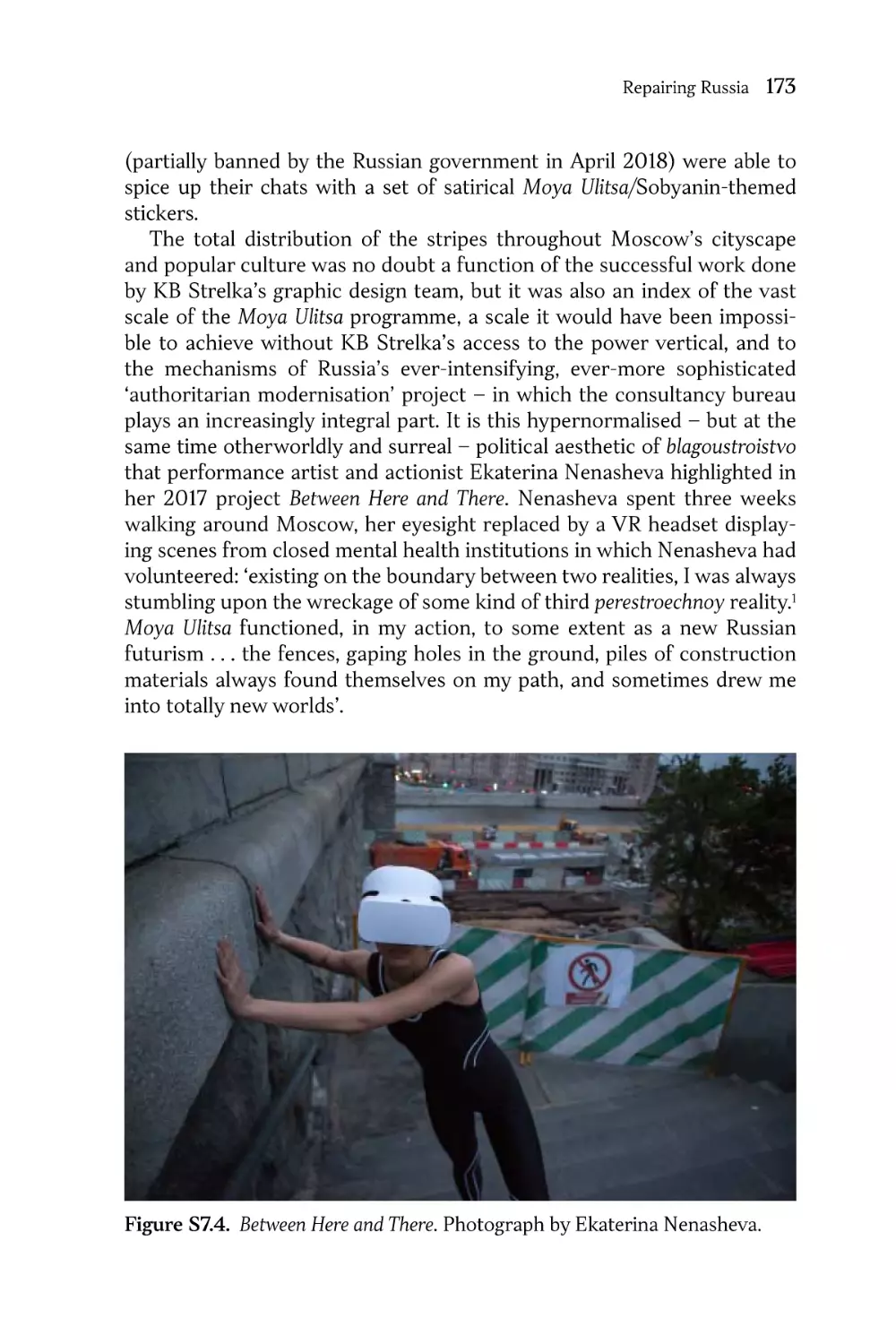
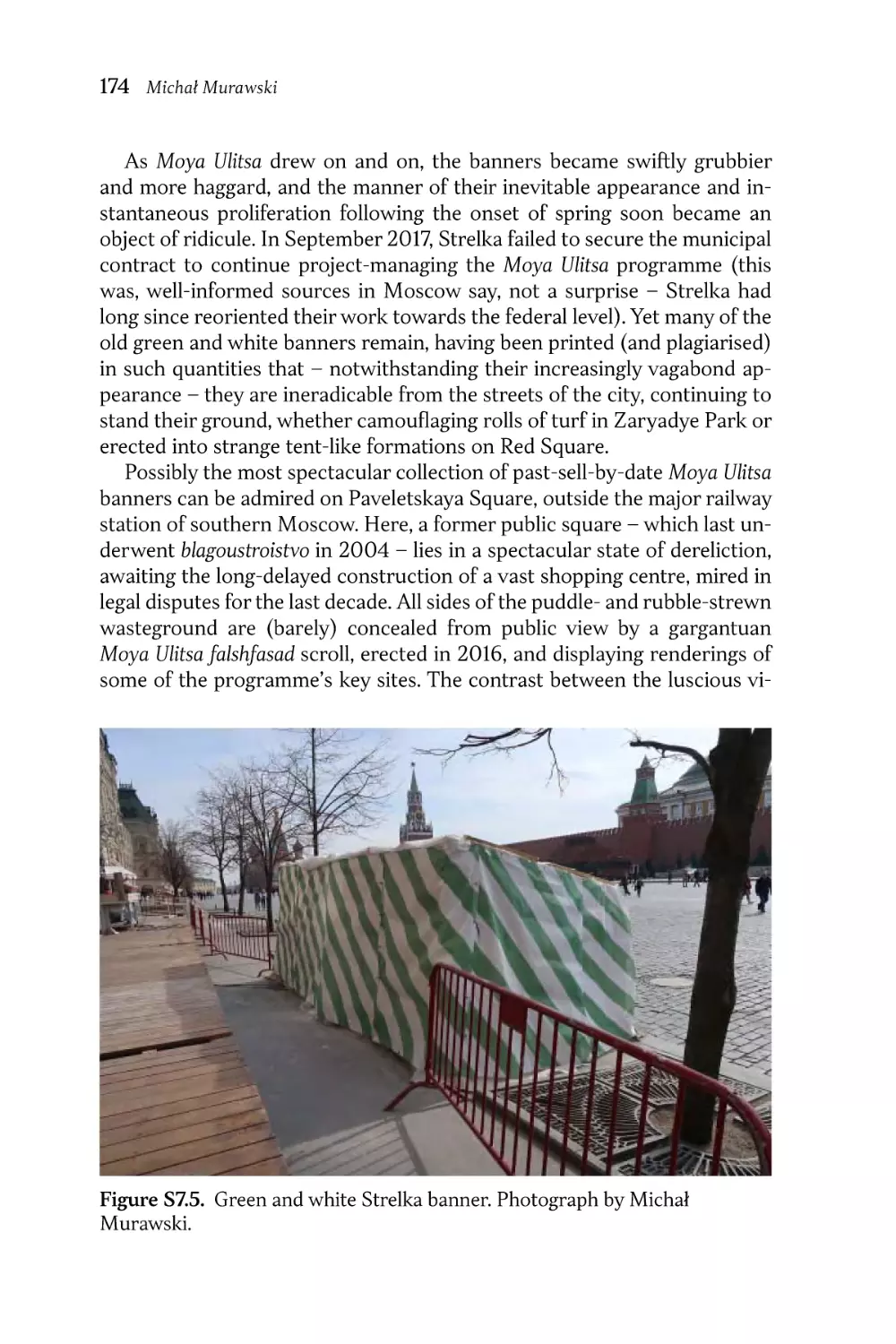
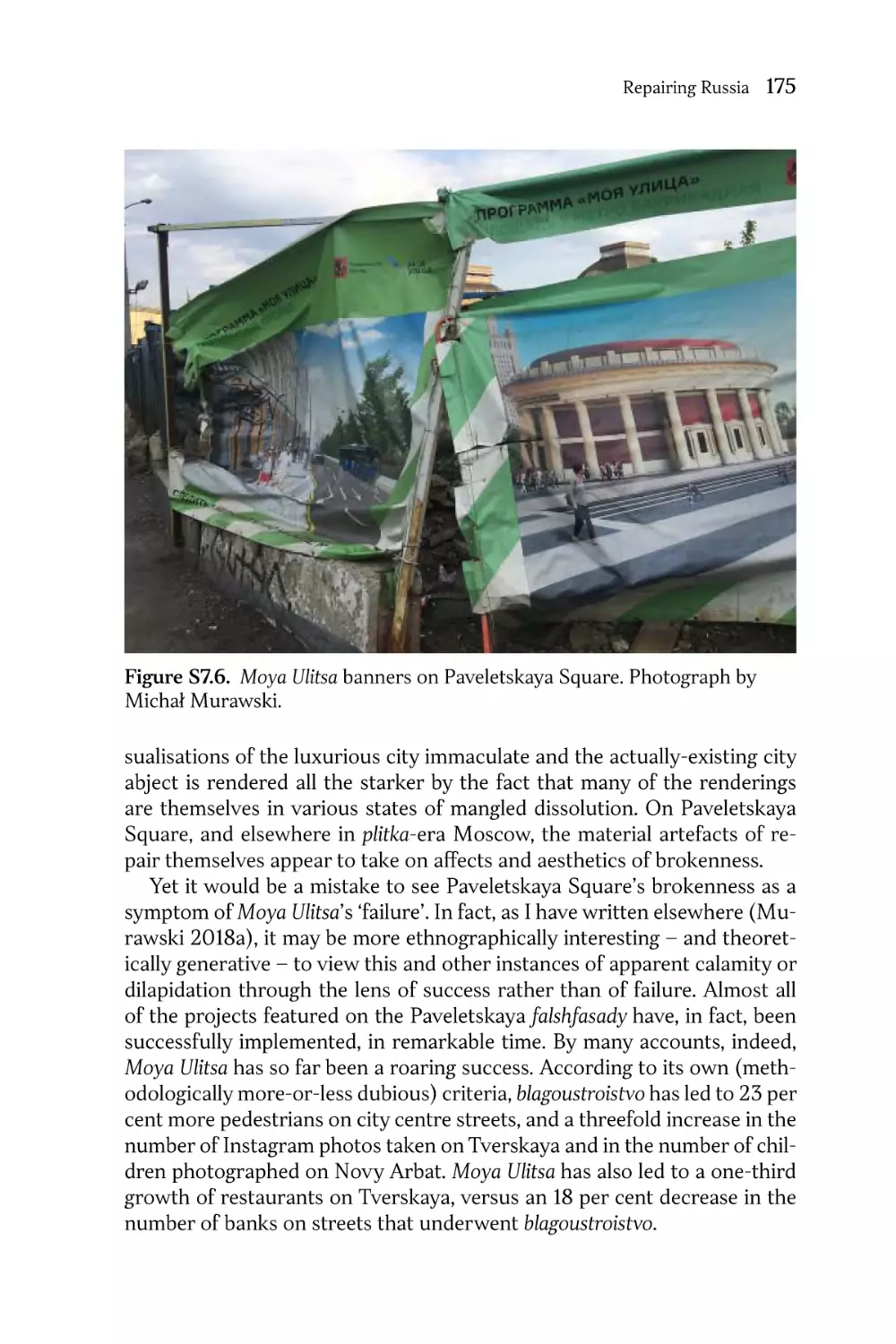






Text
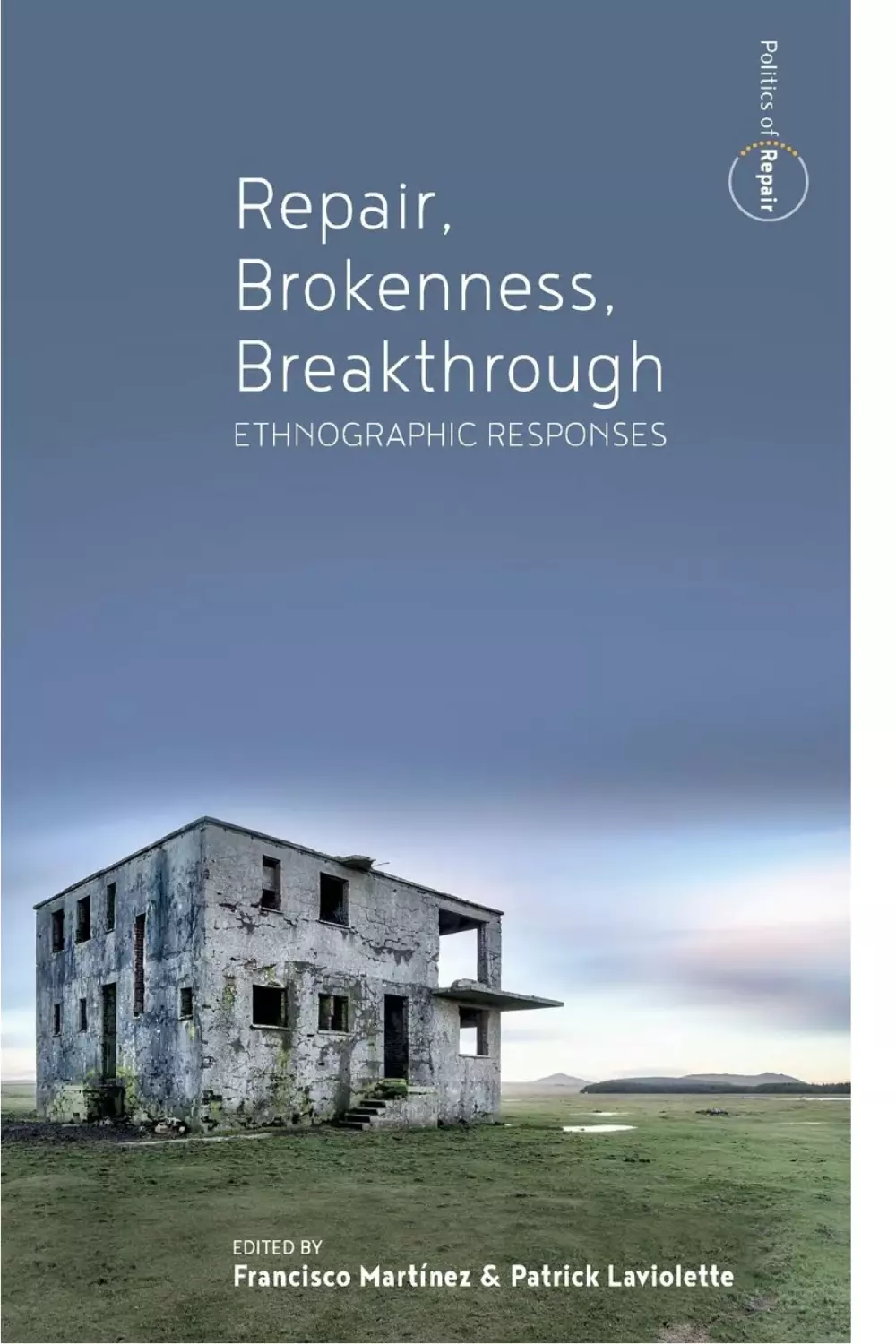
                    REPAIR, BROKENNESS, BREAKTHROUGH

Politics of Repair
Series Editors:
Francisco Martínez, University of Leicester
Patrick Laviolette, Anthropological Journal of European Cultures
Politics materialises in buildings lacking maintenance, disrepair infrastructures,
and potholes on the road. But what kind of politics, precisely? The volumes in
this series put an emphasis on repair and maintenance as an analytical means
for studying how we think about and imagine social relations.

Volume 1
Repair, Brokenness, Breakthrough: Ethnographic Responses
Edited by Francisco Martínez and Patrick Laviolette

Repair, Brokenness,
Breakthrough
Ethnographic Responses

Z
Edited by

Francisco Martínez and Patrick Laviolette

berghahn
NEW YORK • OXFORD
www.berghahnbooks.com

First published in 2019 by
Berghahn Books
www.berghahnbooks.com
© 2019 Francisco Martínez and Patrick Laviolette

All rights reserved. Except for the quotation of short passages
for the purposes of criticism and review, no part of this book
may be reproduced in any form or by any means, electronic or
mechanical, including photocopying, recording, or any information
storage and retrieval system now known or to be invented,
without written permission of the publisher.

Library of Congress Cataloging-in-Publication Data
A C.I.P. cataloging record is available from the Library of Congress
Library of Congress Cataloging in Publication Control Number: 2019028708

British Library Cataloguing in Publication Data
A catalogue record for this book is available from the British Library

ISBN 978−1−78920−331−8 hardback
ISBN 978−1−78920−332−5 ebook

CONTENTS

Z
List of Illustrations
Introduction. Insiders’ Manual to Breakdown
Francisco Martínez

viii
1

Snapshot 1. Head, Heart, Hand: On Contradiction, Contingency
and Repair
Caitlin DeSilvey

17

Chapter 1. Underwater, Still Life: Multi-species Engagements
with the Art Abject of a Wasted American Warship
Joshua O. Reno

24

Snapshot 2. Beyond the Sparkle Zones
Kathleen Stewart

41

Chapter 2. ‘Till Death Do Us Part’: The Making of Home through
Holding on to Objects
Tomás Errázuriz

45

Snapshot 3. ‘The Lady Is Not Here’: Repairing Tita Meme
as a Telecare User
Tomás Sánchez Criado

67

Chapter 3. In the House of Un-things: Decay and Deferral
in a Vacated Bulgarian Home
Martin Demant Frederiksen

73

vi Contents

Snapshot 4. Undisciplined Surfaces
Mateusz Laszczkowski
Chapter 4. A Ride on the Elevator: Infrastructures of Brokenness
and Repair in Georgia
Tamta Khalvashi

87

92

Snapshot 5. Don’t Fix the Puddle: A Puddle Archive as
Ethnographic Account of Sidewalk Assemblages
Mirja Busch and Ignacio Farías

115

Chapter 5. What Is in a Hole? Voids out of Place and Politics
below the State in Georgia
Francisco Martínez

121

Snapshot 6. Maintaining Whose Road?
Agnieszka Joniak-Lüthi
Chapter 6. Dirtscapes: Contest over Value, Garbage and
Belonging in Istanbul
Aylin Yildirim Tschoepe
Snapshot 7. Repairing Russia
Michał Murawski
Chapter 7. Village Vintage in Southern Norway: Revitalisation
and Vernacular Entrepreneurship in Culture Heritage Tourism
Sarah Holst Kjær
Snapshot 8. A Story of Time Keepers
Jérôme Denis and David Pontille
Chapter 8. Keeping Them ‘Swiss’: The Transfer and Appropriation
of Techniques for Luxury-Watch Repair in Hong Kong
Hervé Munz
Snapshot 9. Lost Battles of De-bobbling
Magdalena Crăciun
Chapter 9. Small Mutinies in the Comfortable Slot: The New
Environmentalism as Repair
Eeva Berglund

145

149

169

178

197

201

225

228

Contents vii

Snapshot 10. Why Stories about Broken-Down Snowmobiles
Can Teach You a Lot about Life in the Arctic Tundra
Aimar Ventsel

245

Chapter 10. The Imperative of Repair: Fixing Bikes – for Free
Simon Batterbury and Tim Dant

249

Snapshot 11. Repair and Responsibility: The Art of Doris Salcedo
Siobhan Kattago

267

Chapter 11. Social Repair and (Re)Creation: Broken Relationships
and a Path Forward for Austrian Holocaust Survivors
Katja Seidel

271

Snapshot 12. Living Switches
Wladimir Sgibnev

293

Chapter 12. Brokenness and Normality in Design Culture
Adam Drazin

297

Snapshot 13. And Then You See Yourself Disappear
Jason Pine

313

Epilogue. This Mess We’re in, or Part of
Patrick Laviolette

316

Index

324

ILLUSTRATIONS

Z
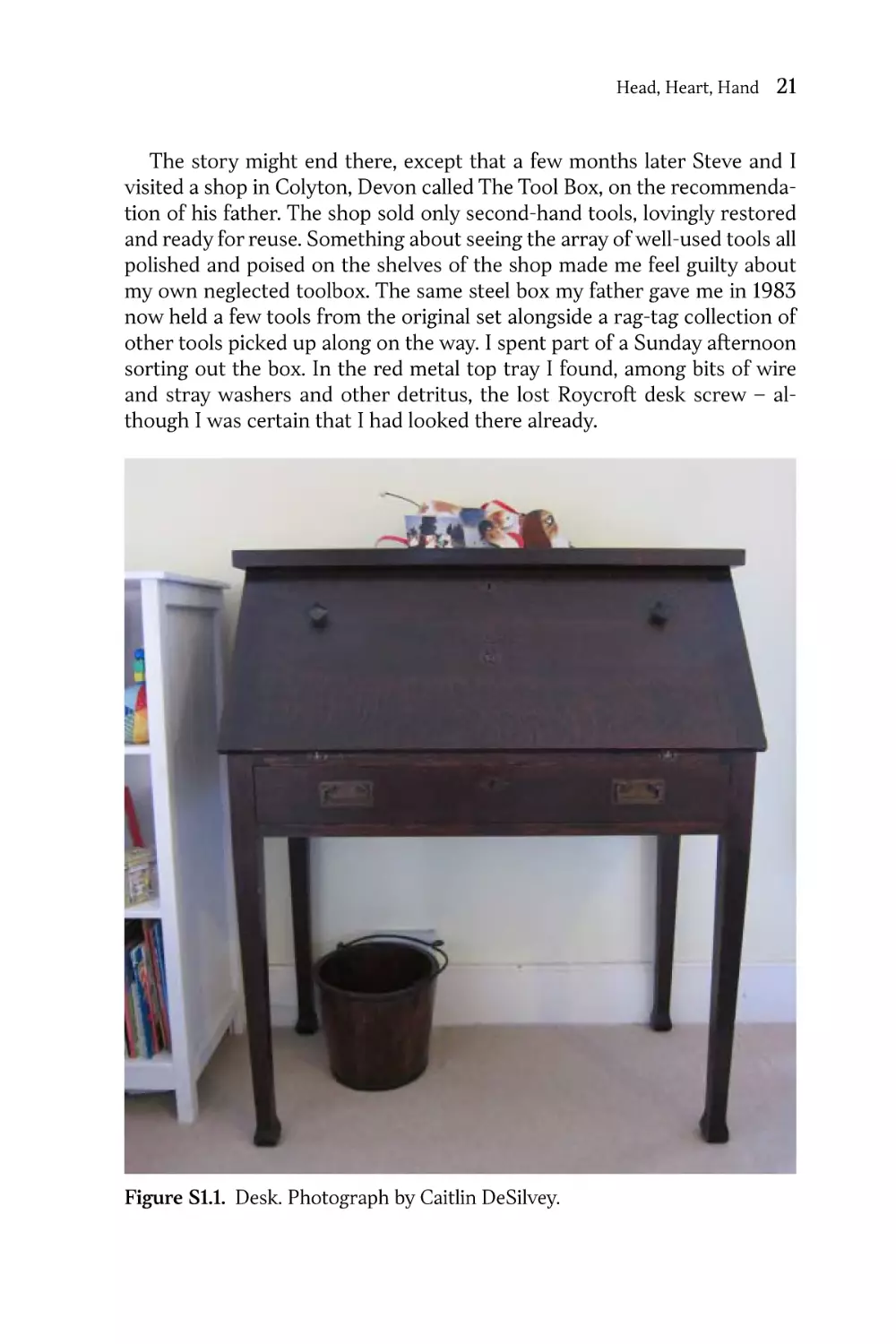
S1.1. Desk. Photograph by Caitlin DeSilvey.

21

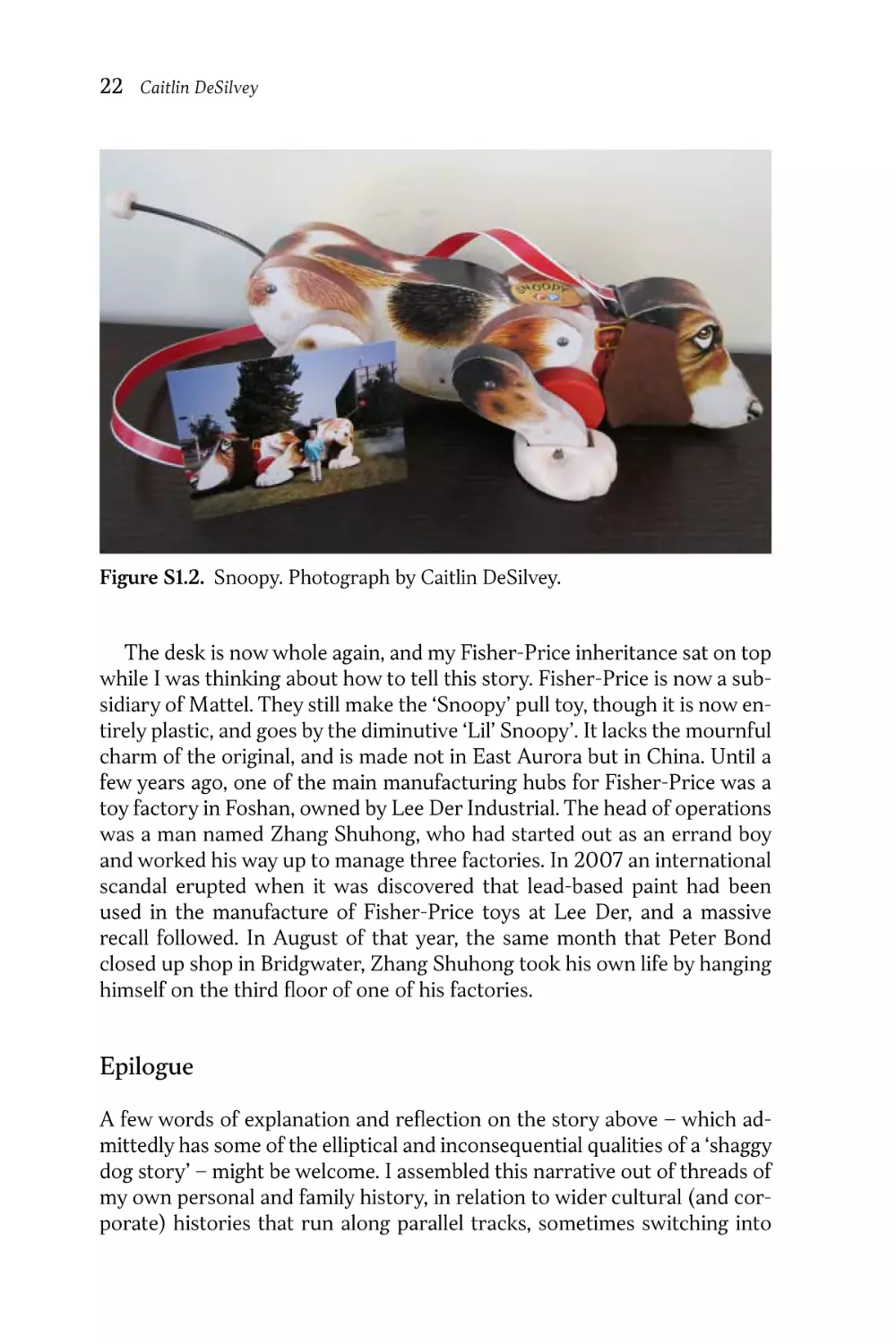
S1.2. Snoopy. Photograph by Caitlin DeSilvey.

22

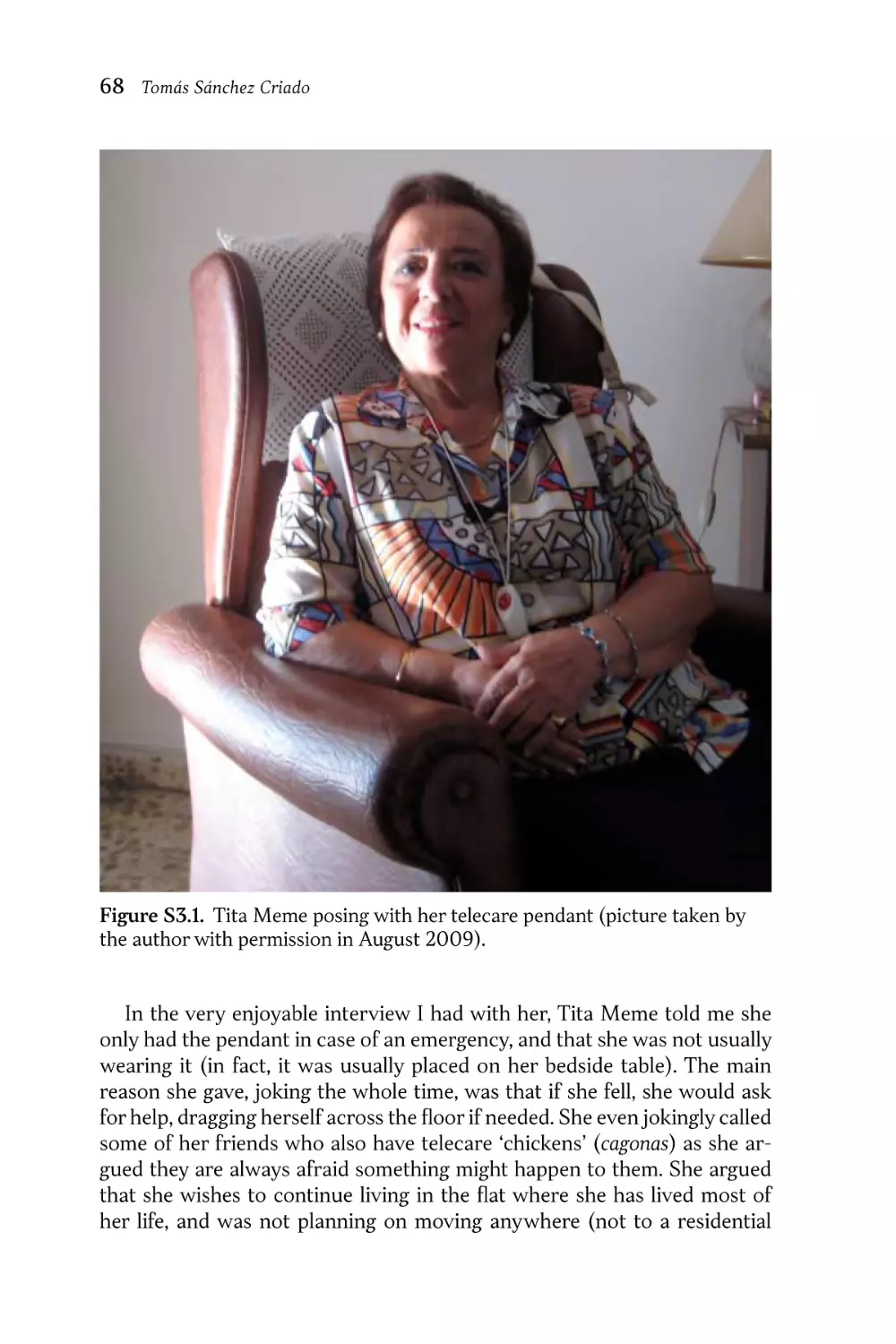
S3.1. Tita Meme posing with her telecare pendant (picture taken
with permission by the author in August 2009).

68

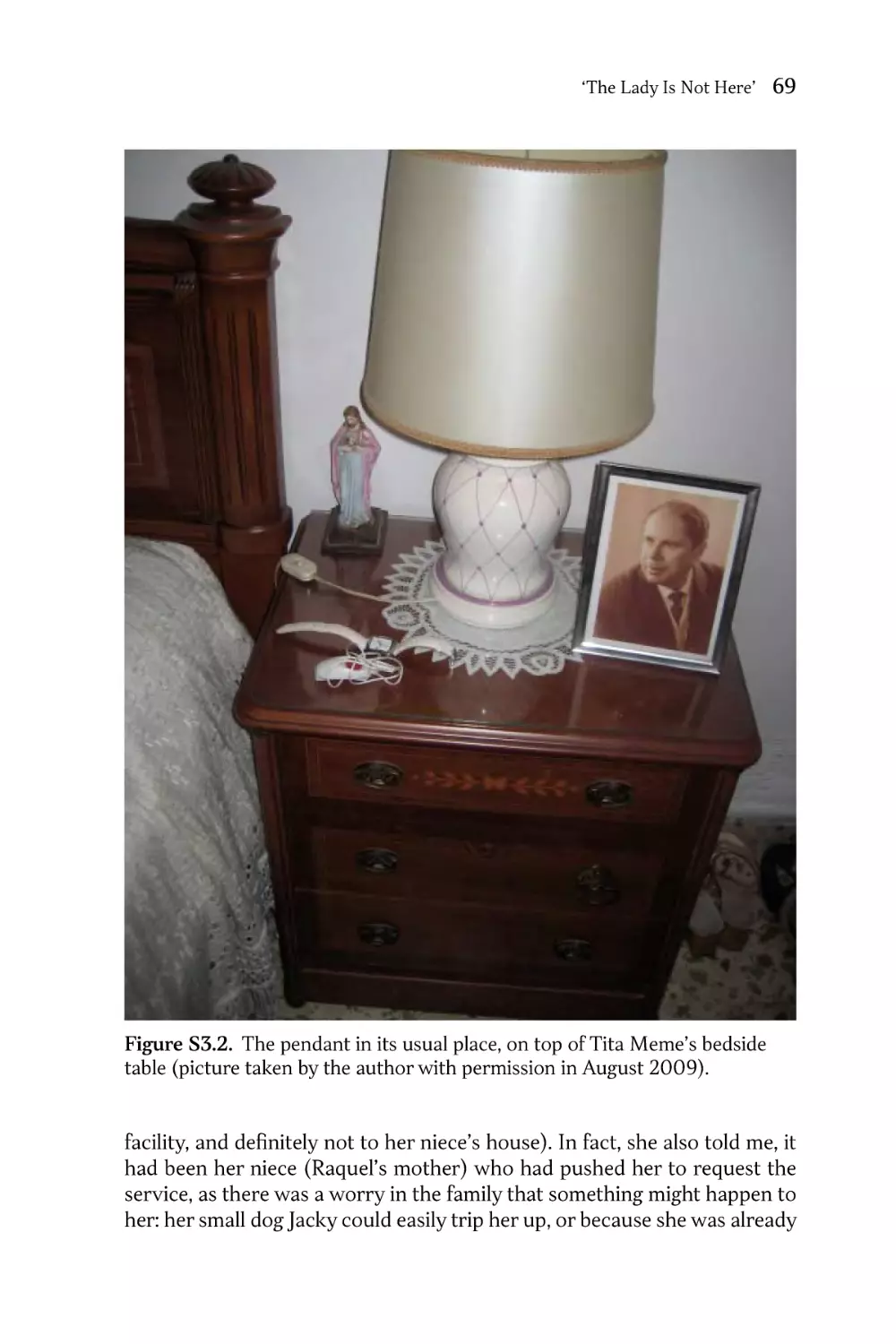
S3.2. The pendant in its usual place, on top of Tita Meme’s
bedside table (picture taken with permission by the author in
August 2009).

69

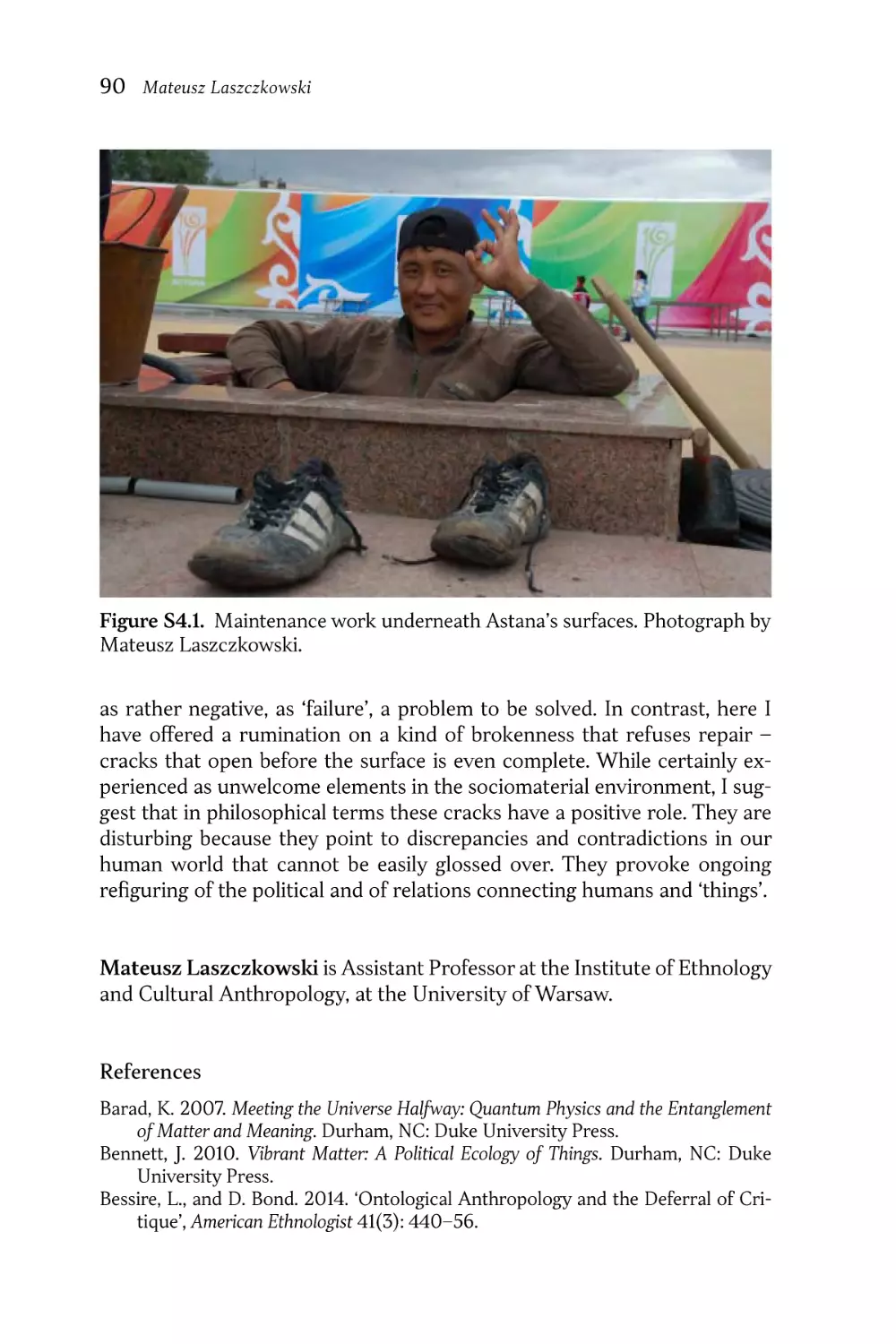
S4.1. Maintenance work underneath Astana’s surfaces.
Photograph by Mateusz Laszczkowski.

90

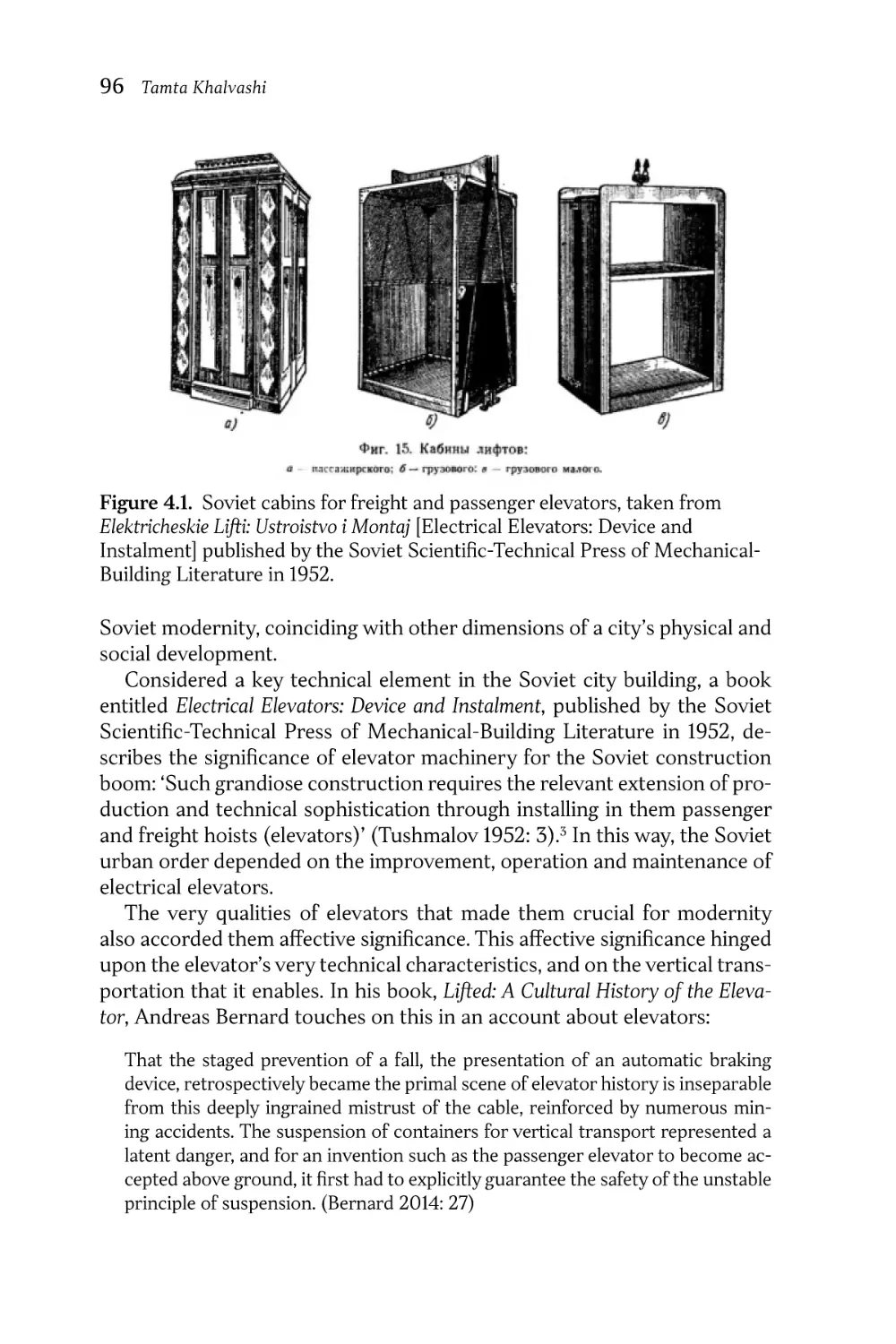
4.1. Soviet cabins for freight and passenger elevators, taken from
Elektricheskie Lifti: Ustroistvo i Montaj [Electrical Elevators: Device
and Instalment] published by the Soviet Scientific-Technical Press
of Mechanical-Building Literature in 1952.

96

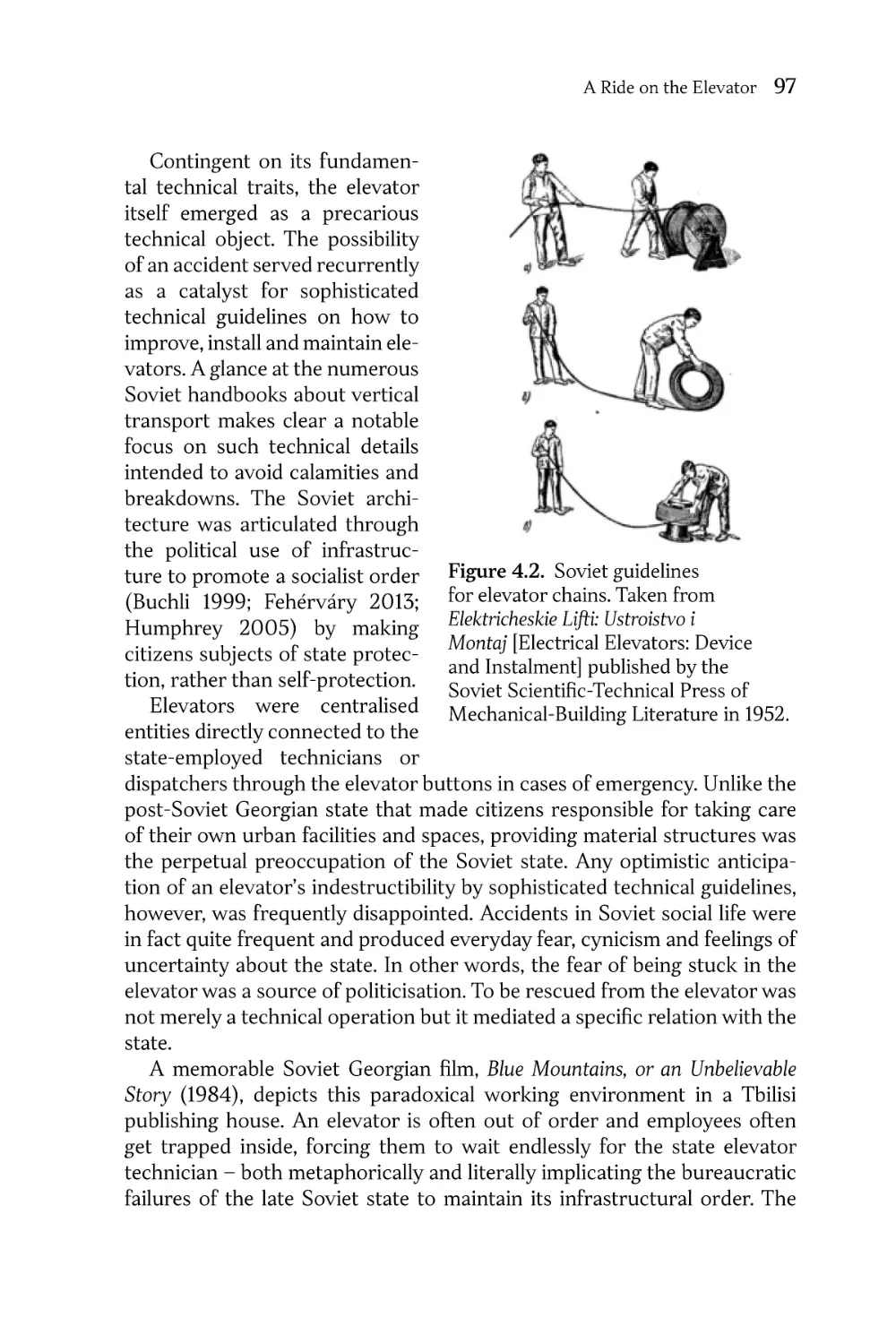
4.2. Soviet guidelines for elevator chains. Taken from Elektricheskie
Lifti: Ustroistvo i Montaj [Electrical Elevators: Device and
Instalment] published by the Soviet Scientific-Technical Press of
Mechanical-Building Literature in 1952.

97

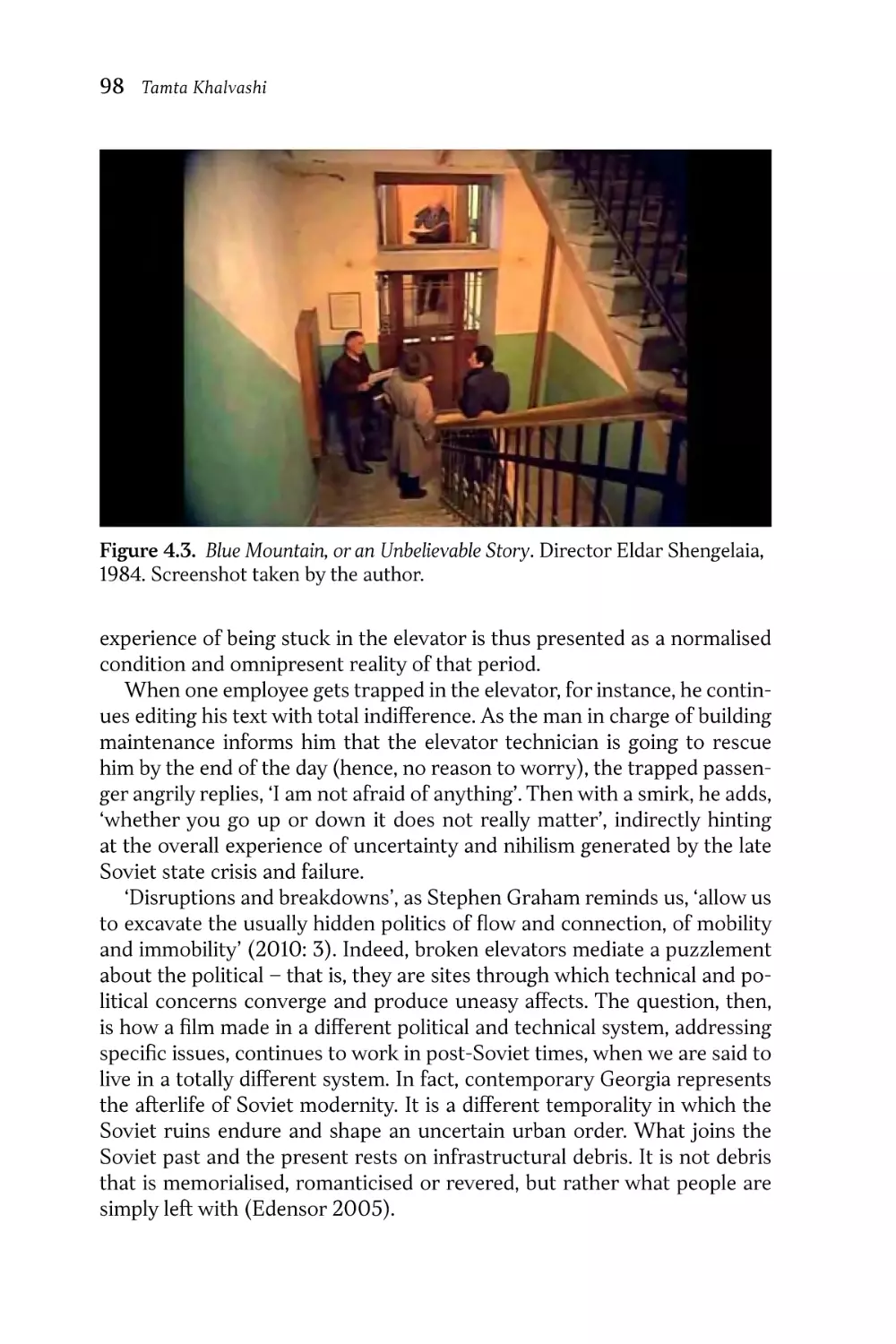
4.3. Blue Mountain, or an Unbelievable Story. Director Eldar
Shengelaia, 1984. Screenshot taken by the author.

98

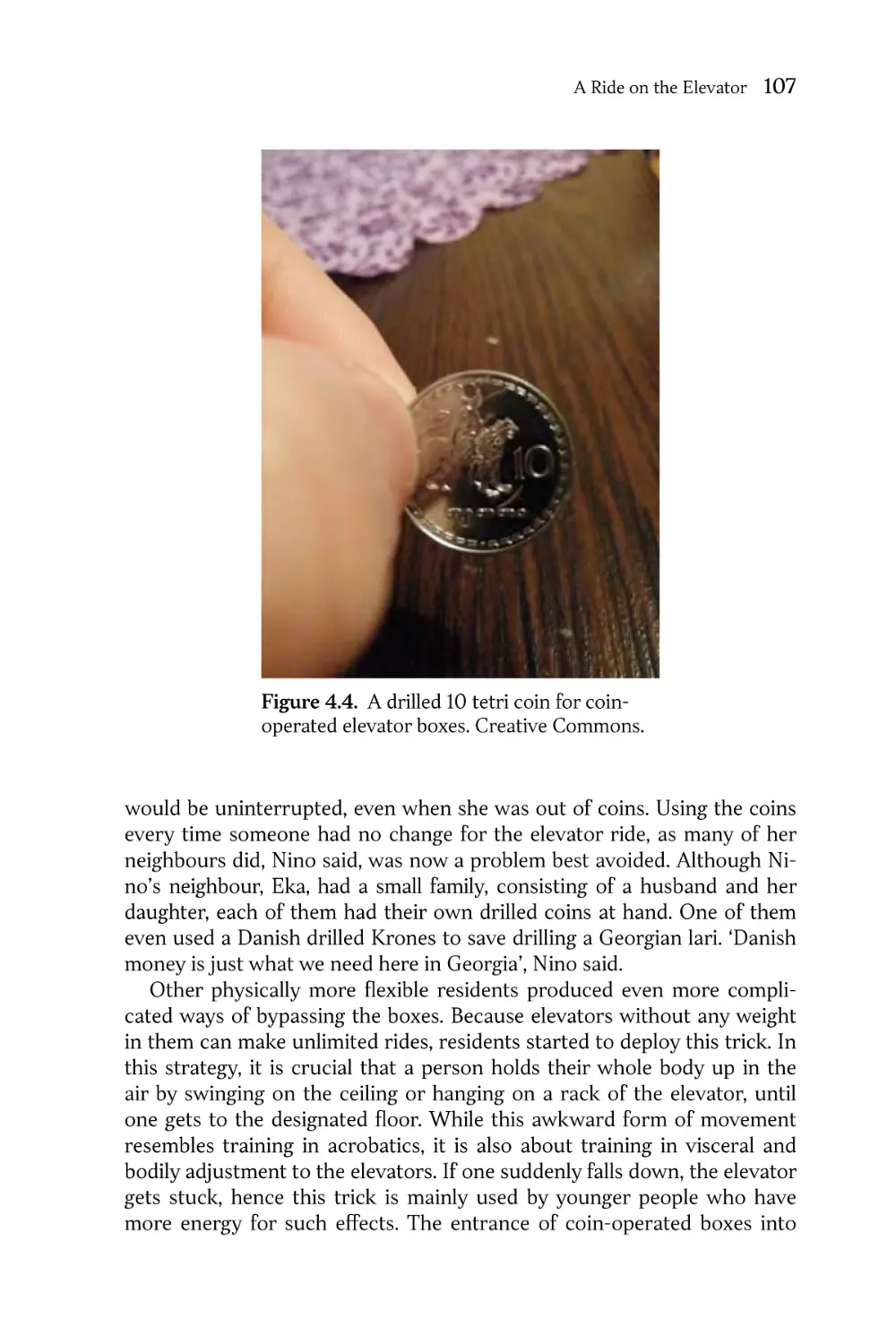
4.4. A drilled 10 tetri coin for coin-operated elevator boxes.
Creative Commons.

107

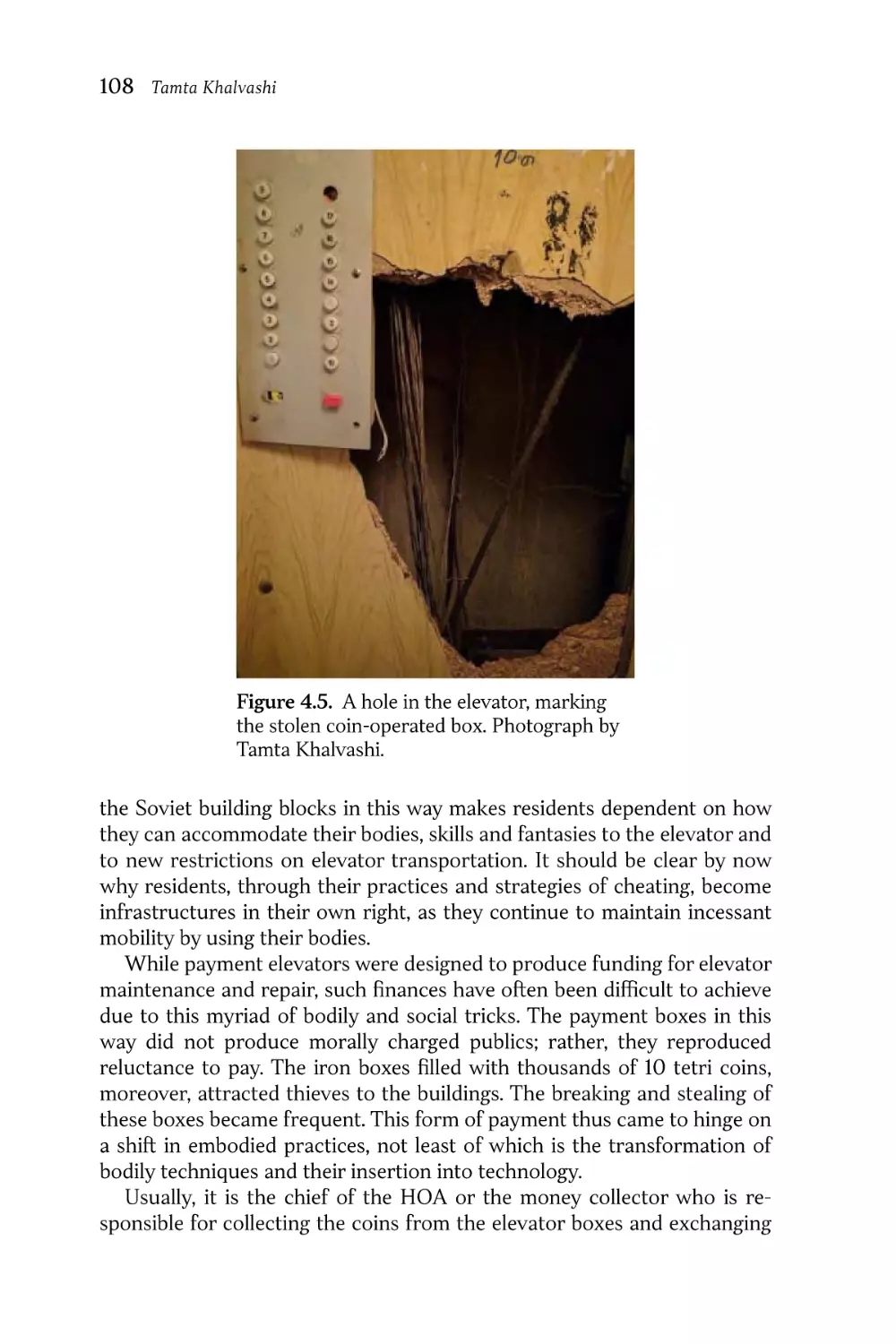
4.5. A hole in the elevator, marking the stolen coin-operated box.
Photograph by Tamta Khalvashi.

108

Illustrations ix

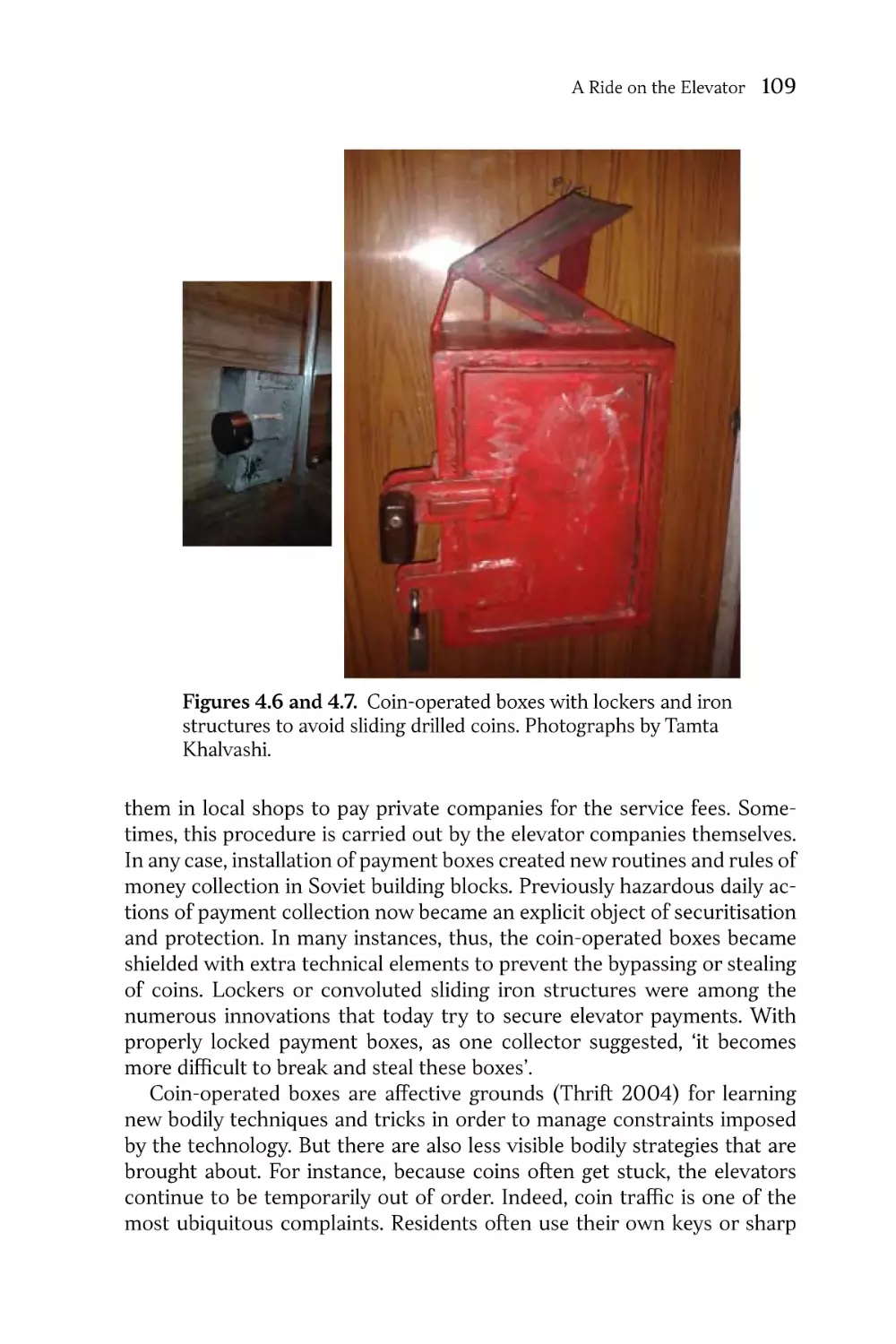
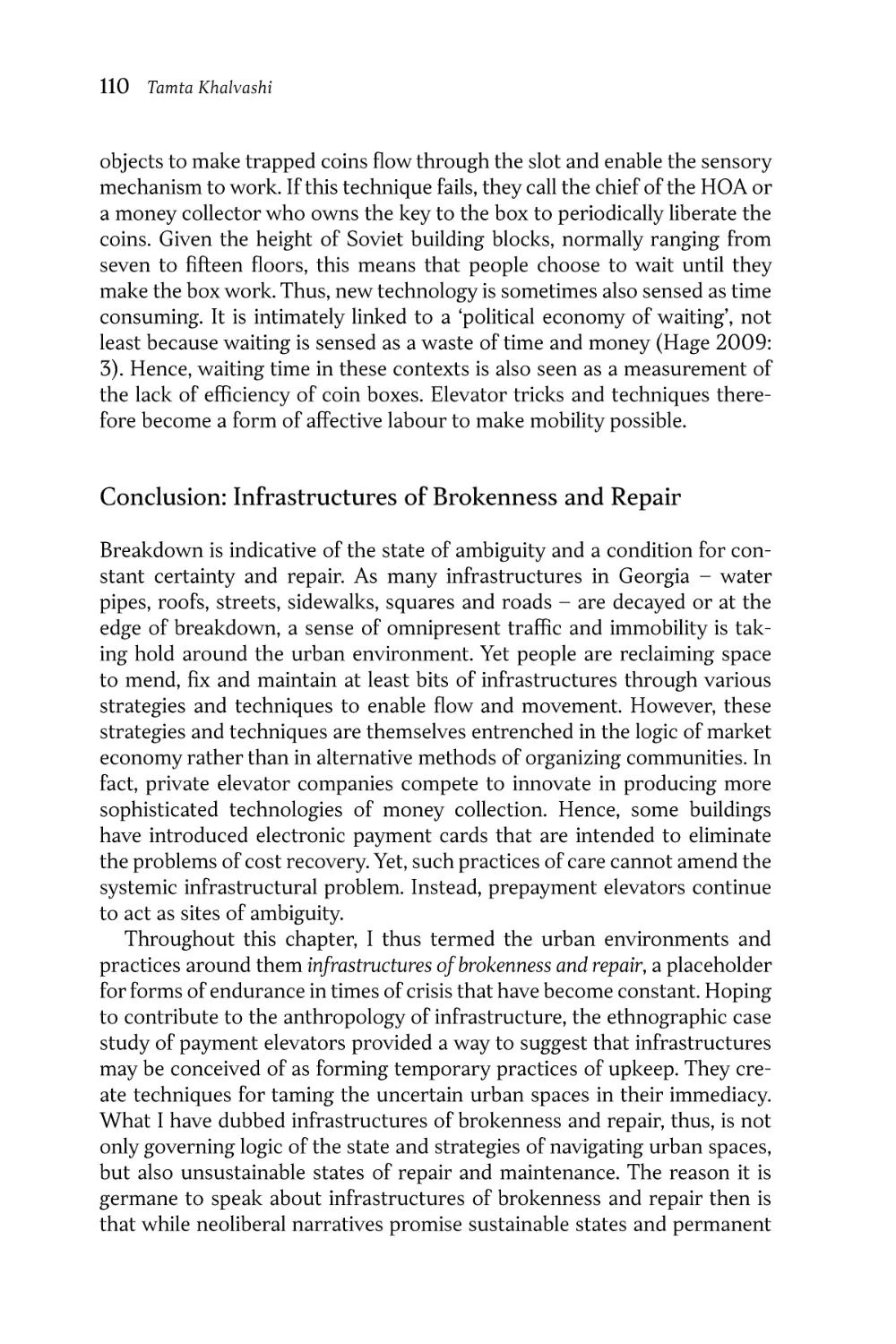
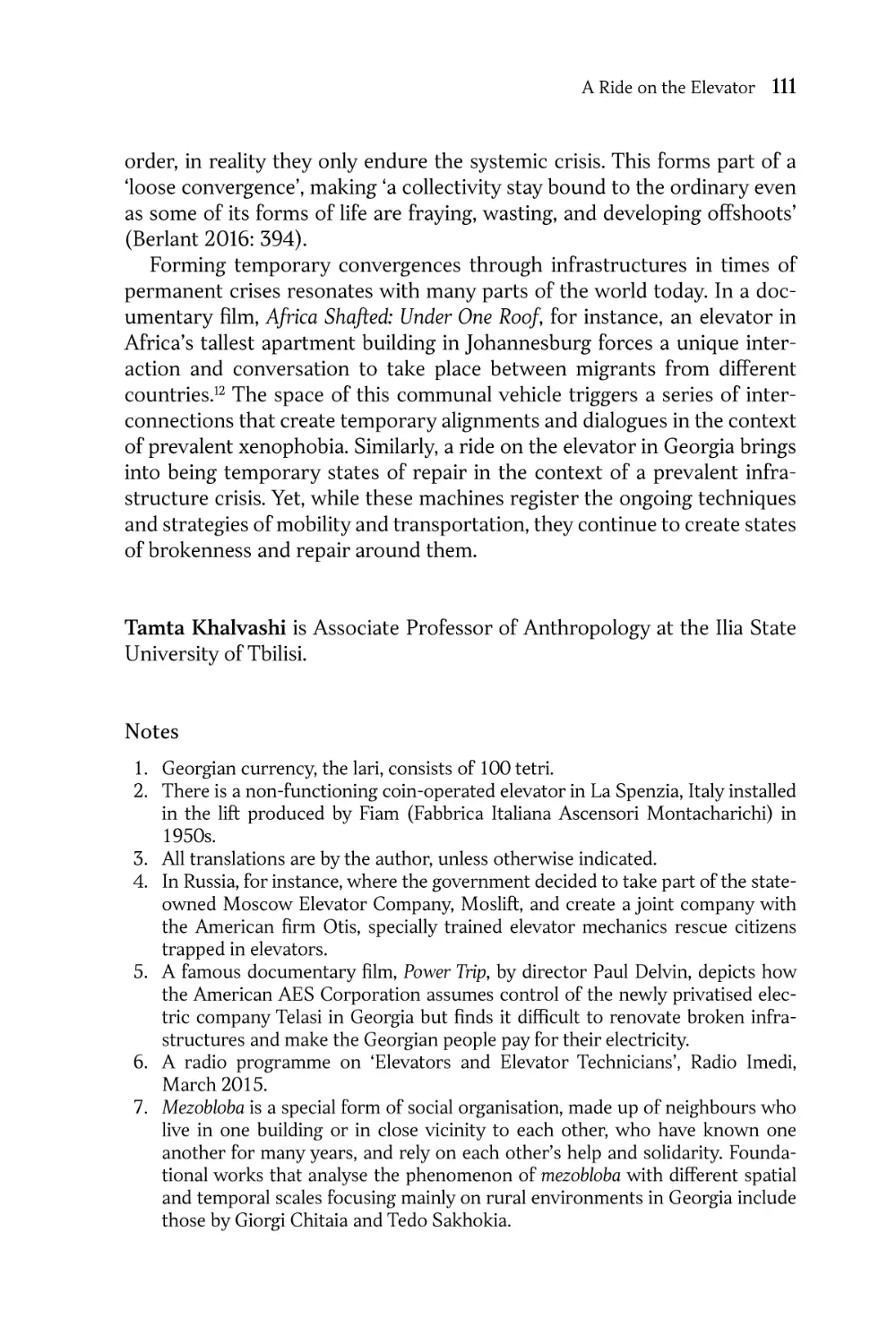
4.6 and 4.7. Coin-operated boxes with lockers and iron structures
to avoid sliding drilled coins. Photographs by Tamta Khalvashi.

109

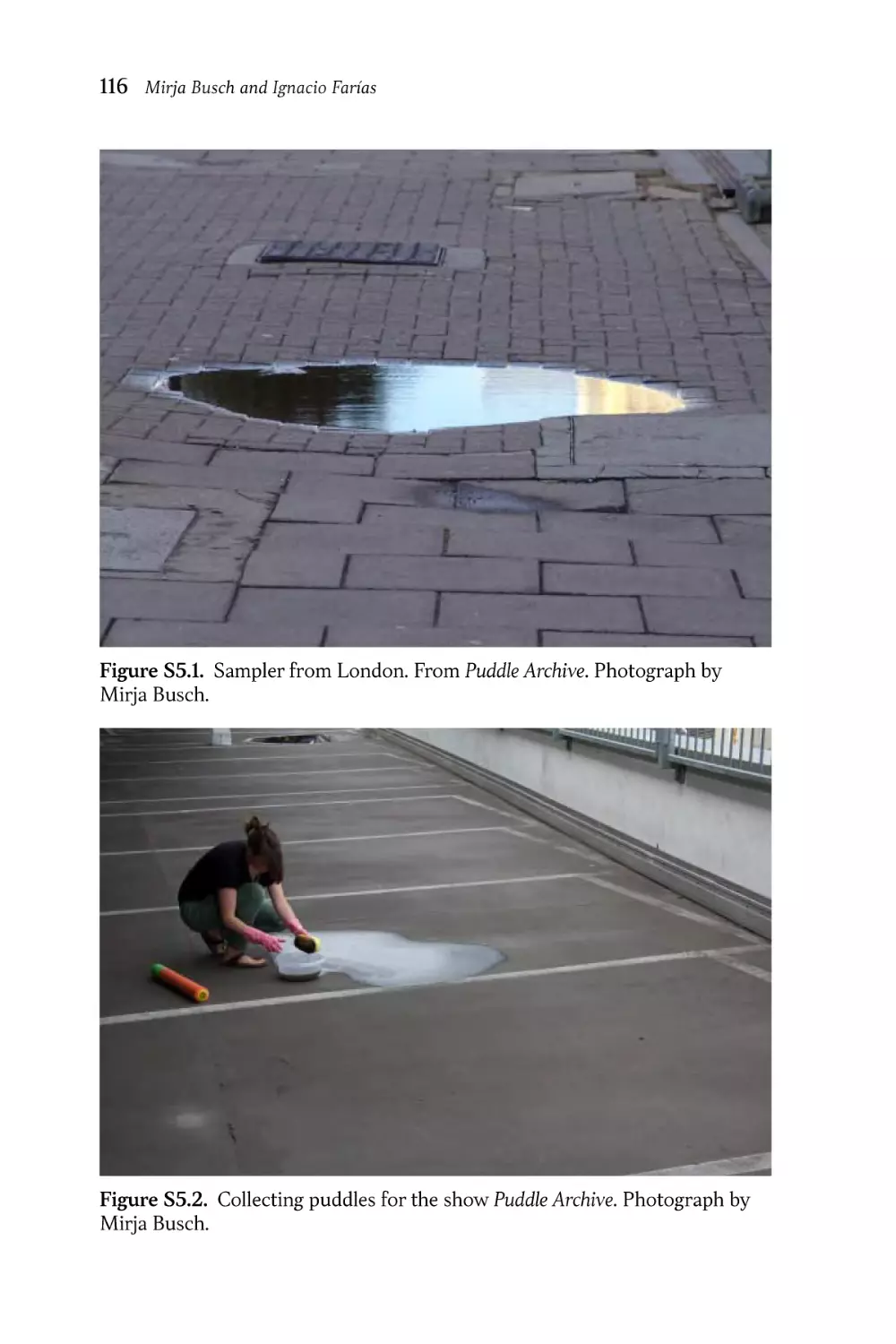
S5.1. Sampler from London. From Puddle Archive. Photograph by
Mirja Busch.

116

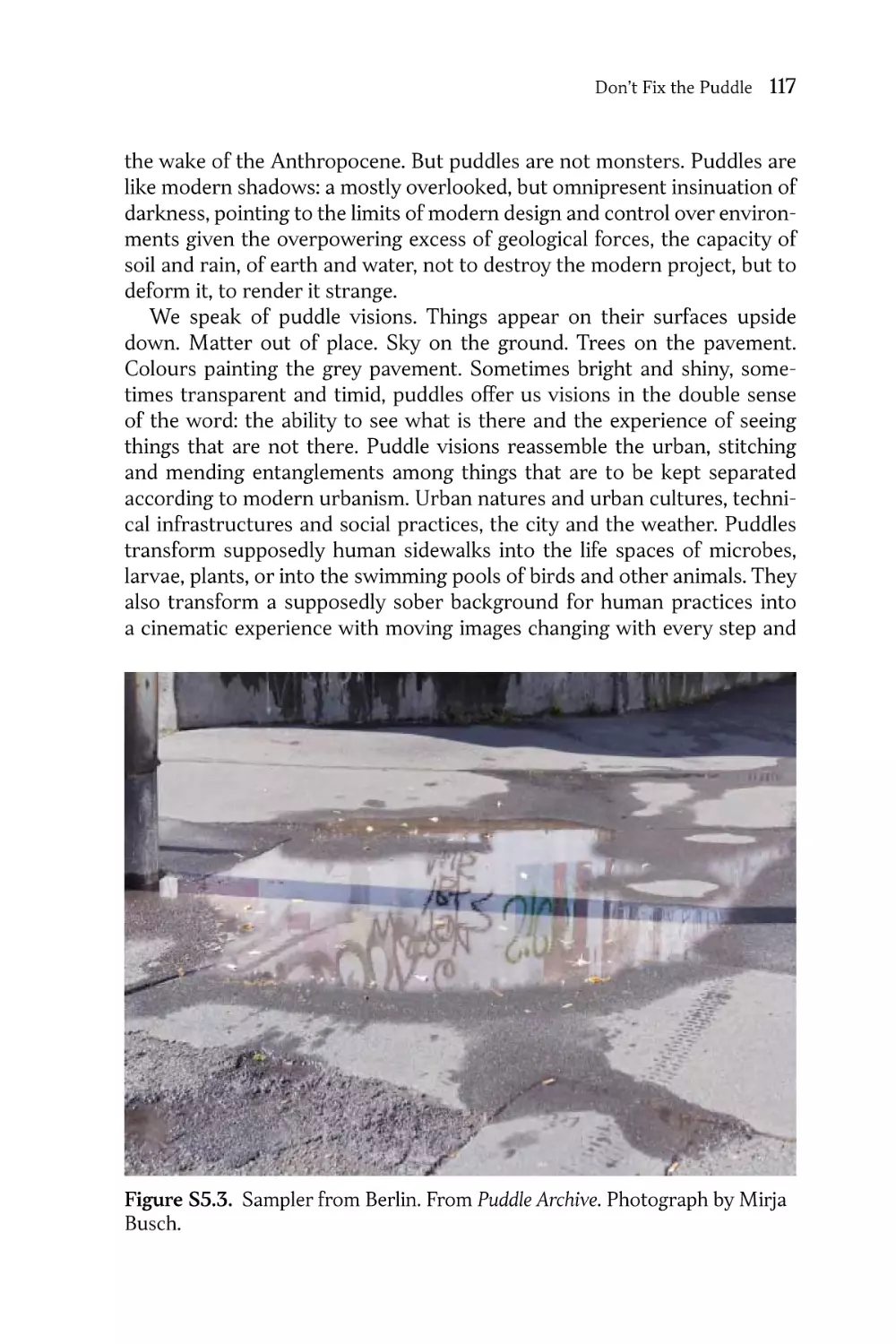
S5.2. Collecting puddles for the show Puddle Archive. Photograph
by Mirja Busch.

116

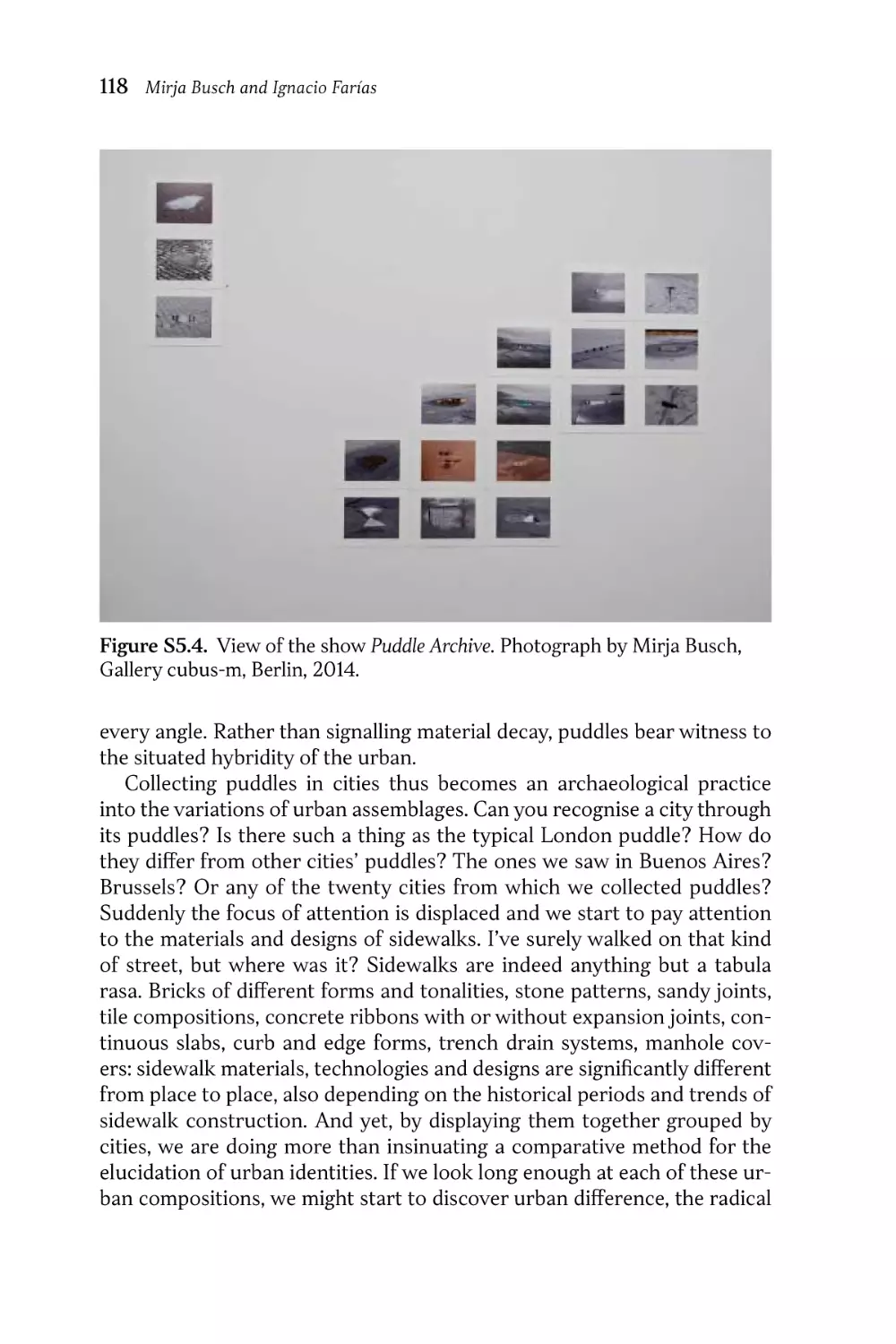
S5.3. Sampler from Berlin. From Puddle Archive. Photograph by
Mirja Busch.

117

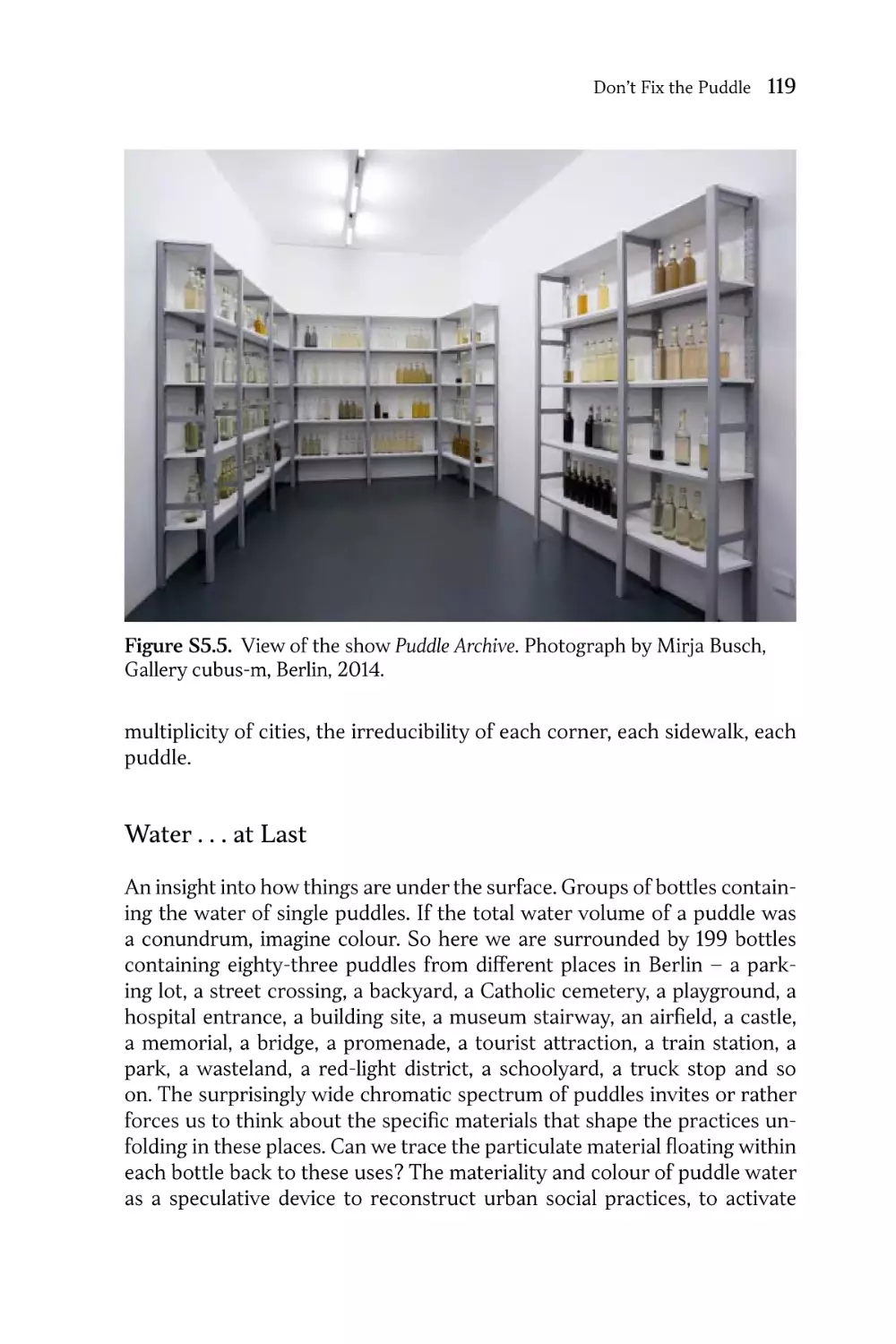
S5.4. View of the show Puddle Archive. Photograph by Mirja
Busch, Gallery cubus-m, Berlin, 2014.

118

S5.5. View of the show Puddle Archive. Photograph by Mirja
Busch, Gallery cubus-m, Berlin, 2014.

119

5.1. Foundations of the former ‘Lechkombinat’ complex, by Nino
Sekhniashvili, 2017.

126

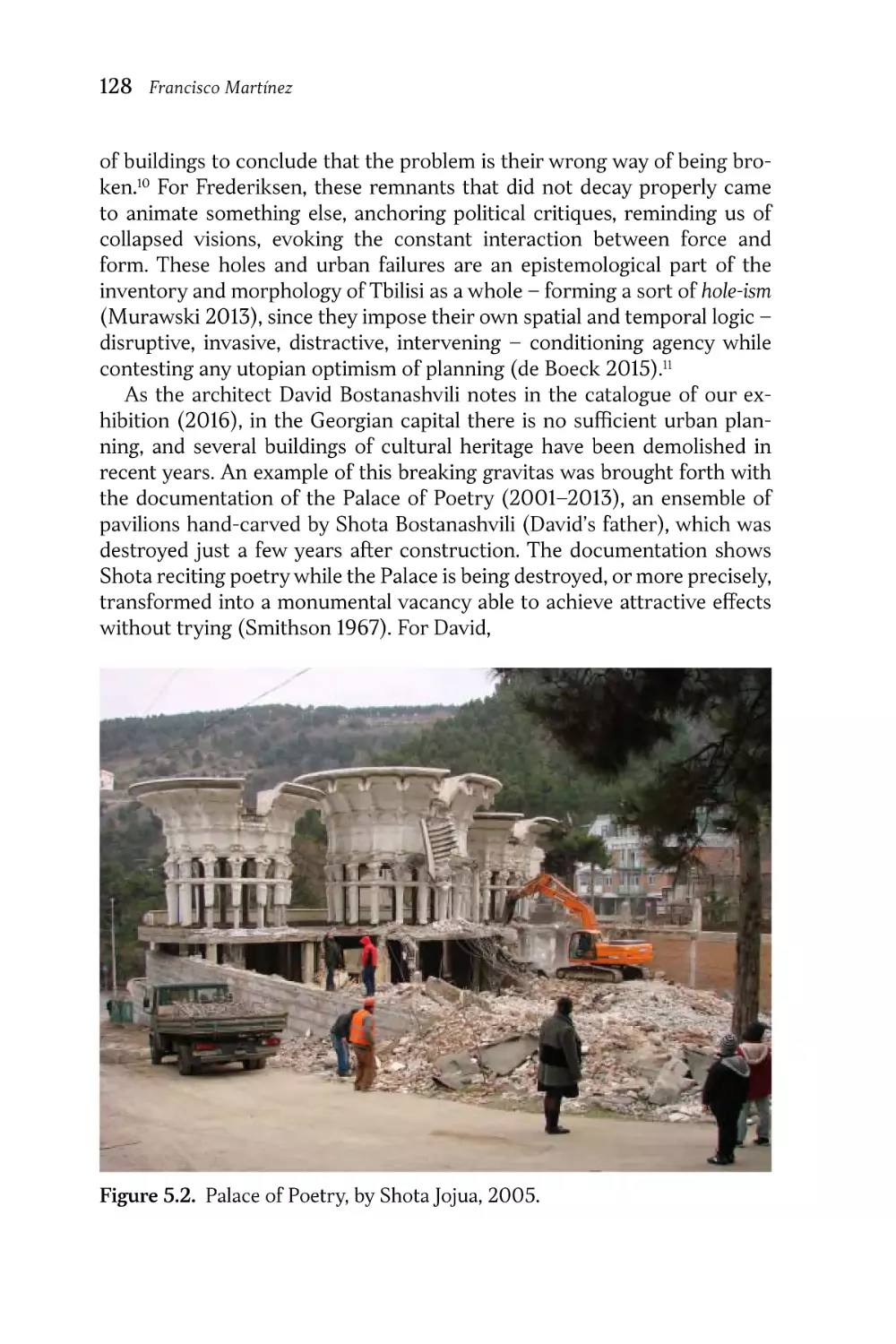
5.2. Palace of Poetry, by Shota Jojua, 2005.

128

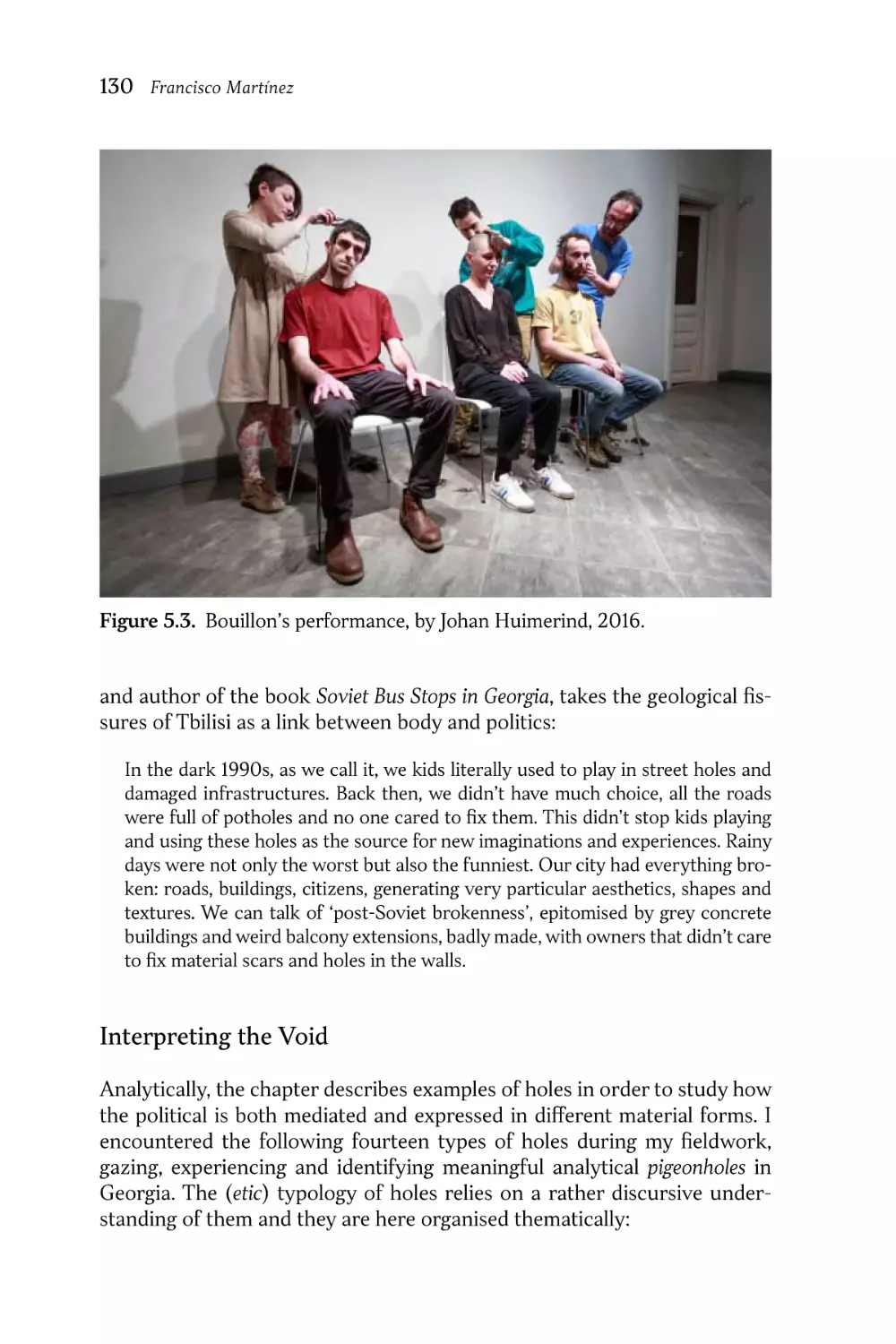
5.3. Bouillon’s performance, by Johan Huimerind, 2016.

130

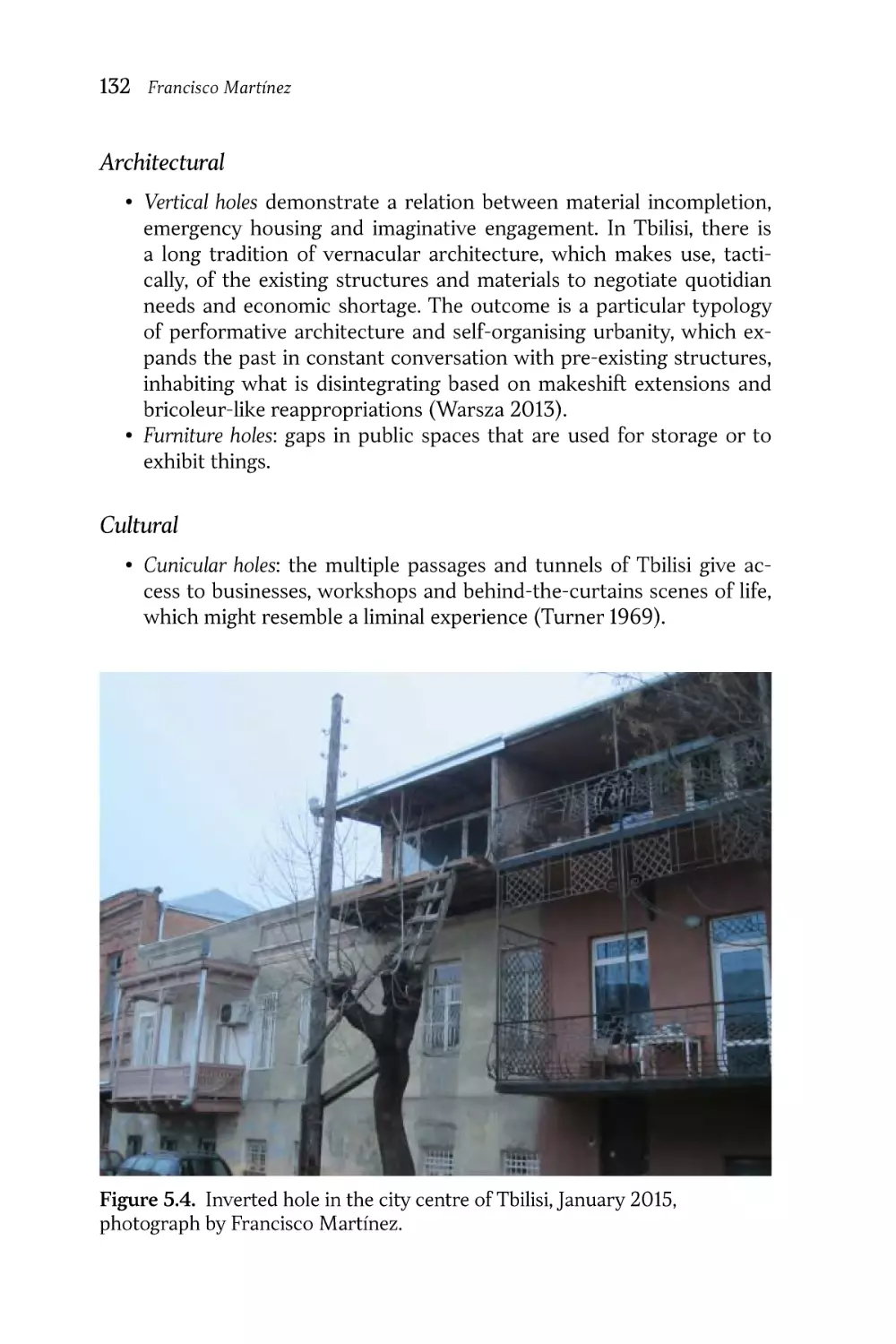
5.4. Inverted hole in the city centre of Tbilisi, January 2015,
photograph by Francisco Martínez.

132

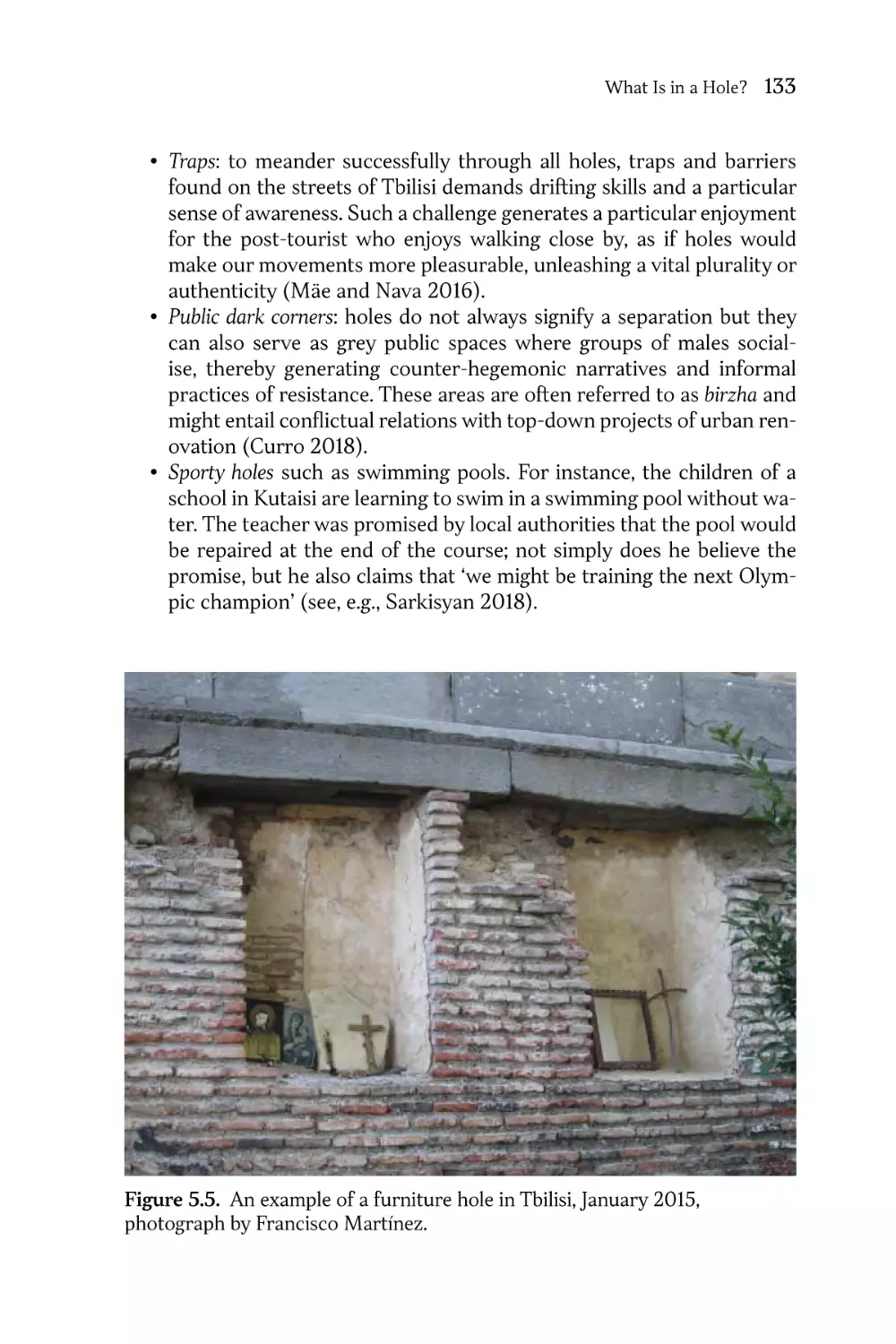
5.5. An example of a furniture hole in Tbilisi, January 2015,
photograph by Francisco Martínez.

133

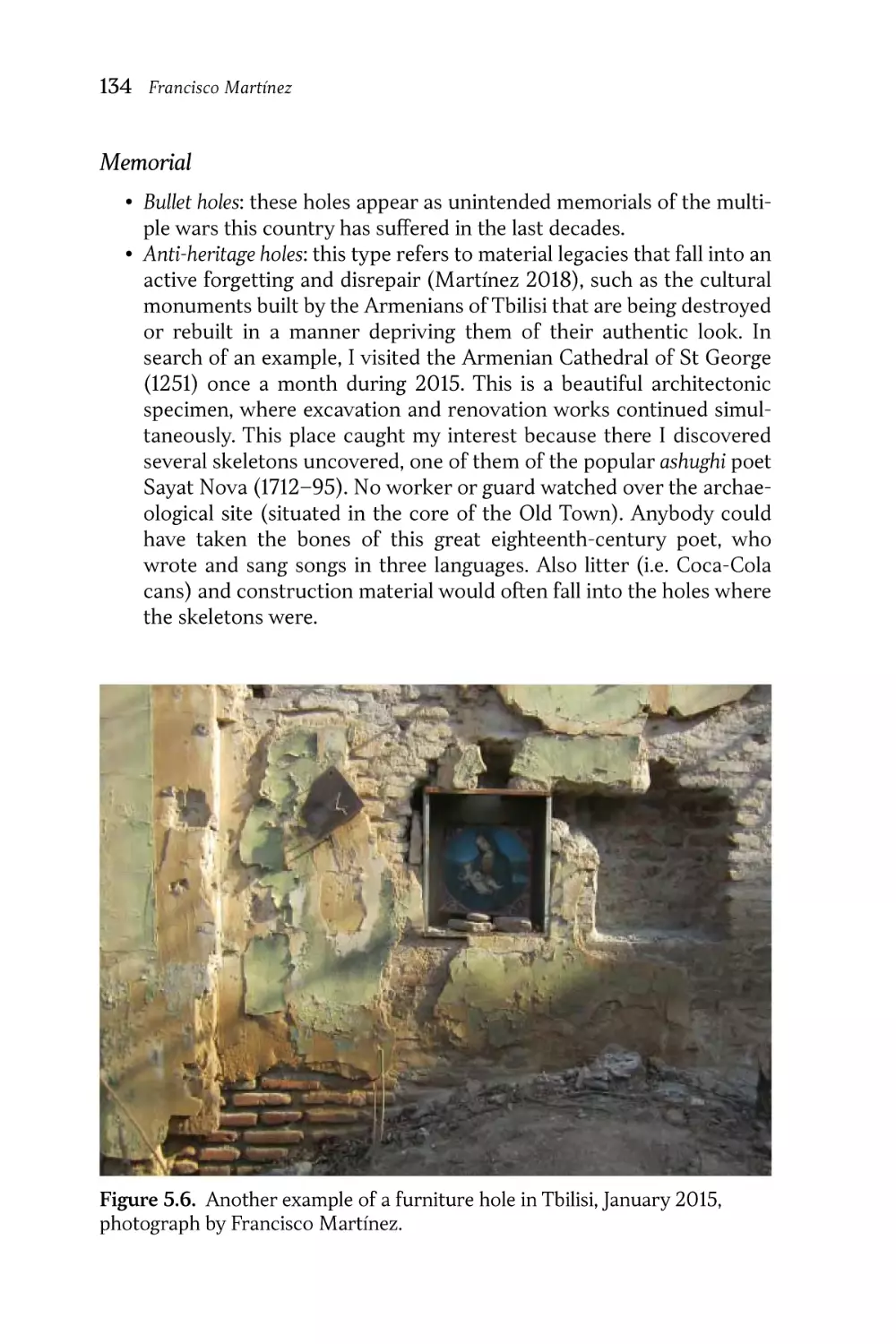
5.6. Another example of a furniture hole in Tbilisi, January 2015,
photograph by Francisco Martínez.

134

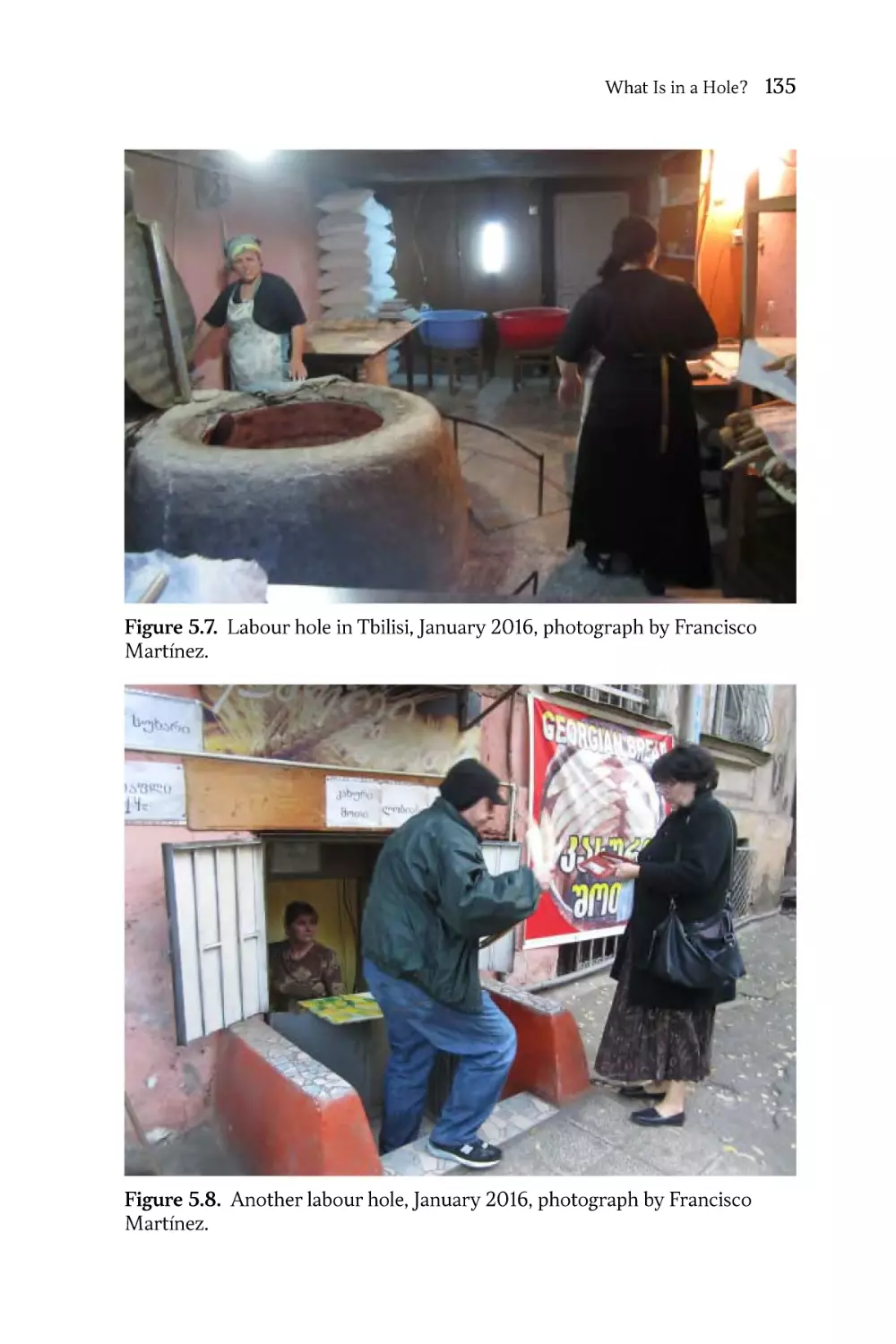
5.7. Labour hole in Tbilisi, January 2016, photograph by Francisco
Martínez.

135

5.8. Another labour hole, January 2016, photograph by Francisco
Martínez.

135

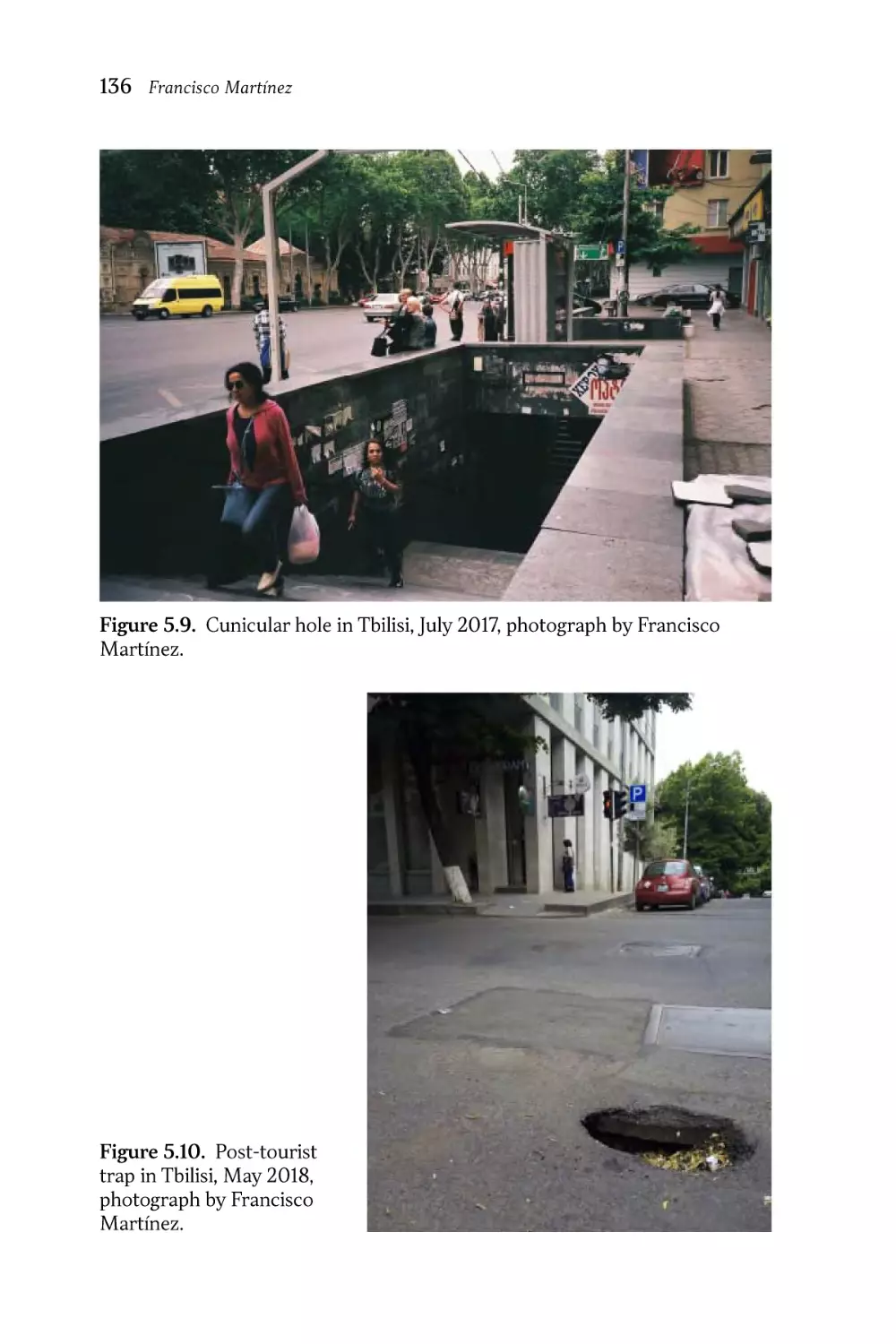
5.9. Cunicular hole in Tbilisi, July 2017, photograph by Francisco
Martínez.

136

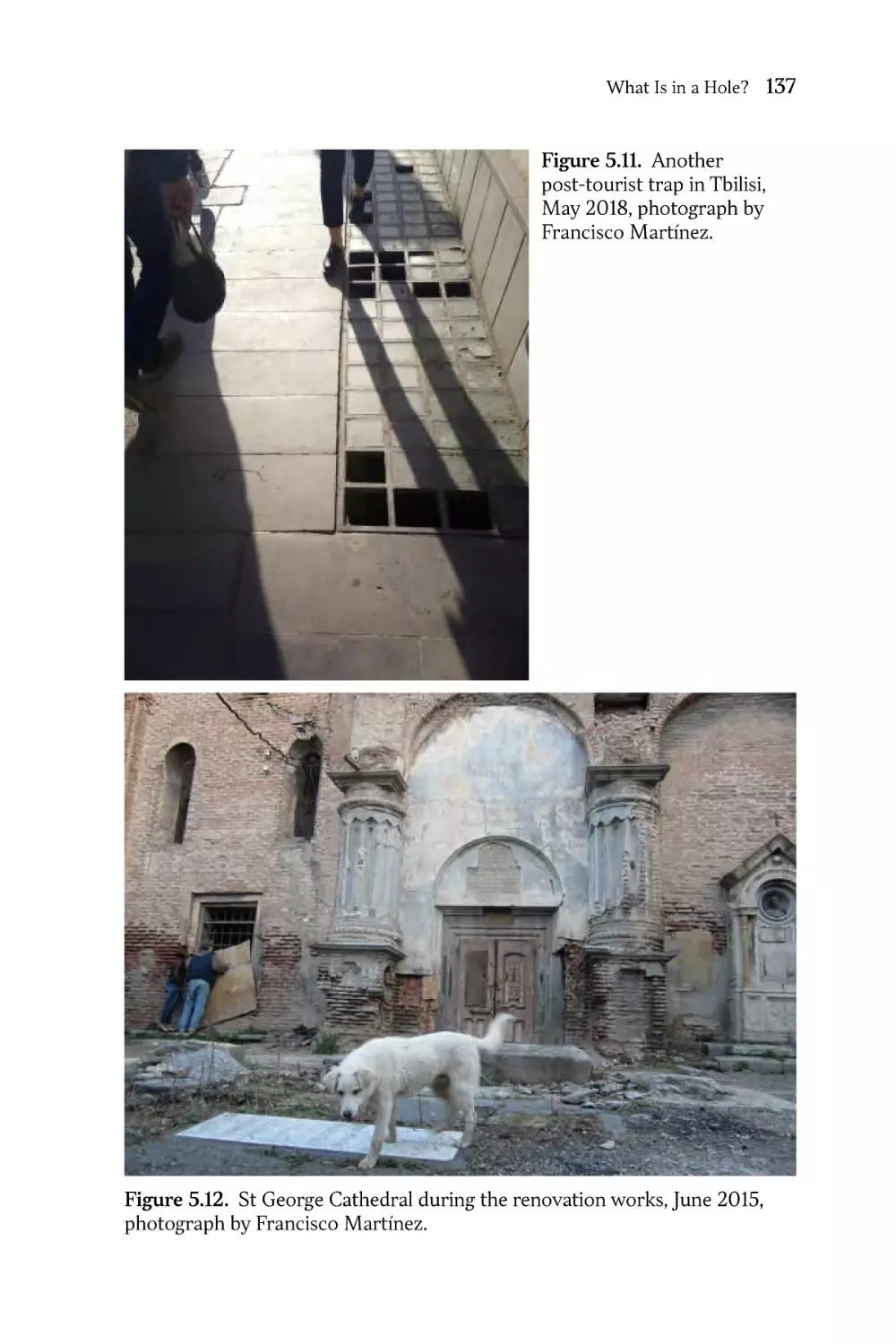
5.10. Post-tourist trap in Tbilisi, May 2018, photograph by
Francisco Martínez.

136

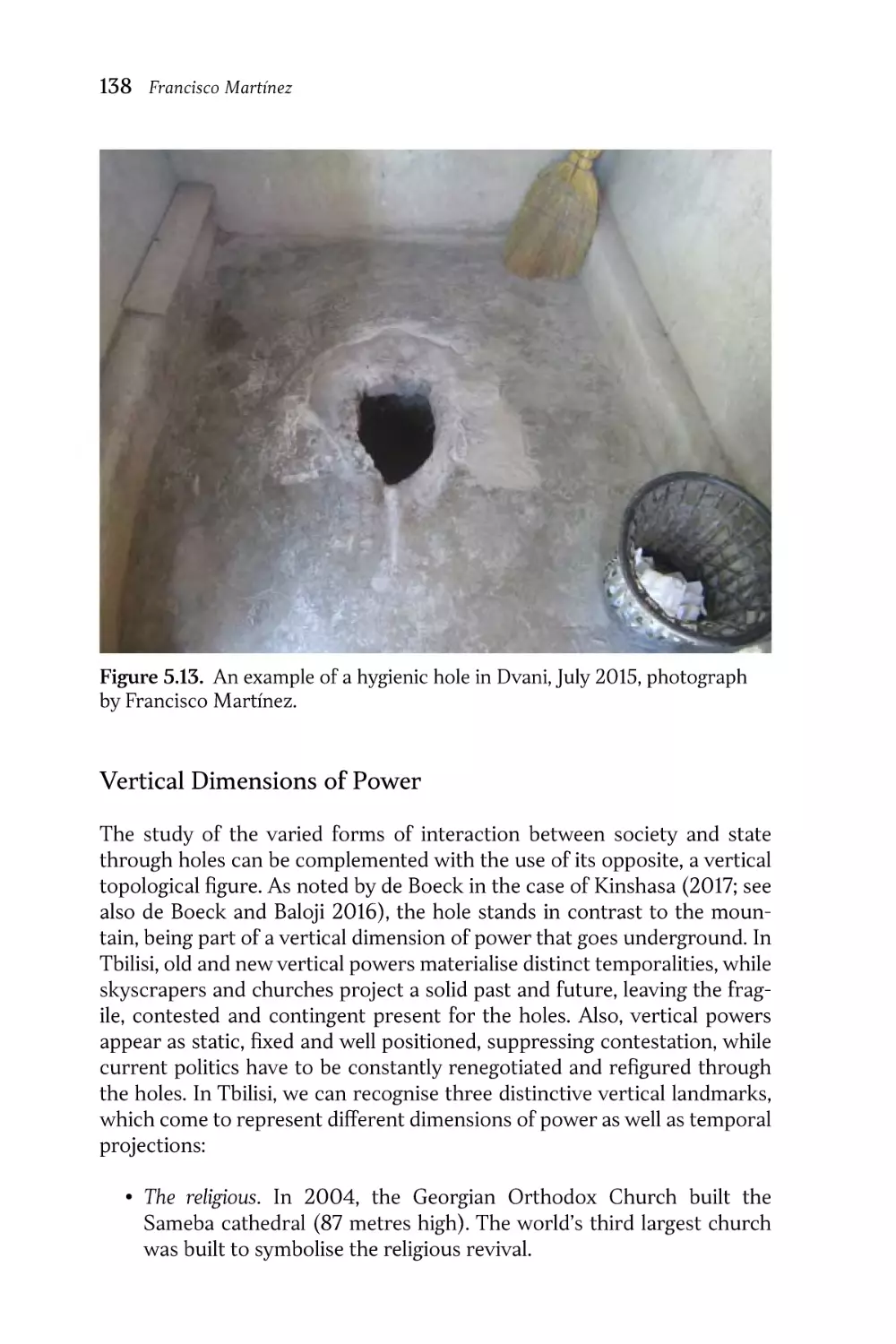
5.11. Another post-tourist trap in Tbilisi, May 2018, photograph
by Francisco Martínez.

137

x Illustrations

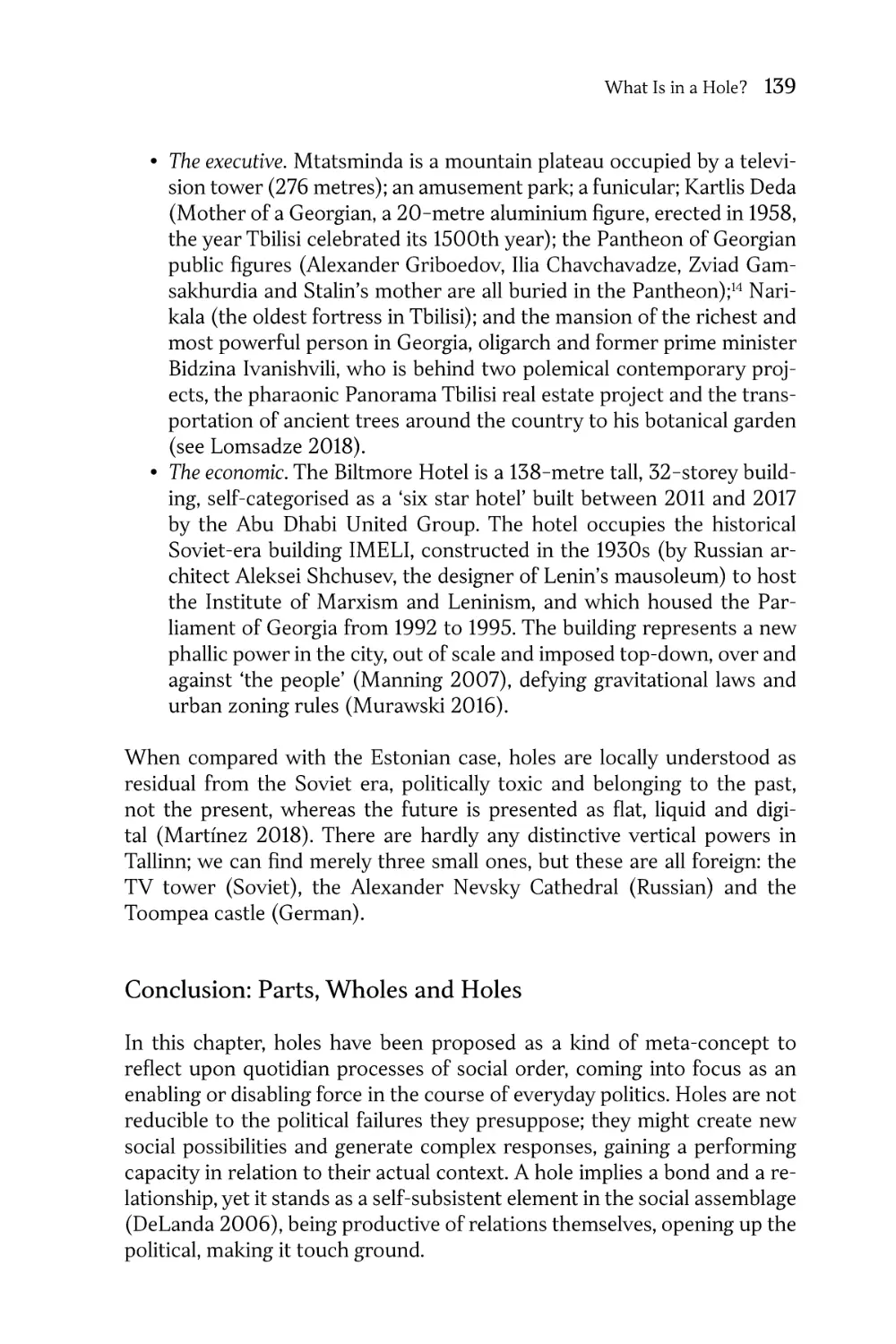
5.12. St George Cathedral during the renovation works, June
2015, photograph by Francisco Martínez.

137

5.13. An example of a hygienic hole in Dvani, July 2015,
photograph by Francisco Martínez.

138

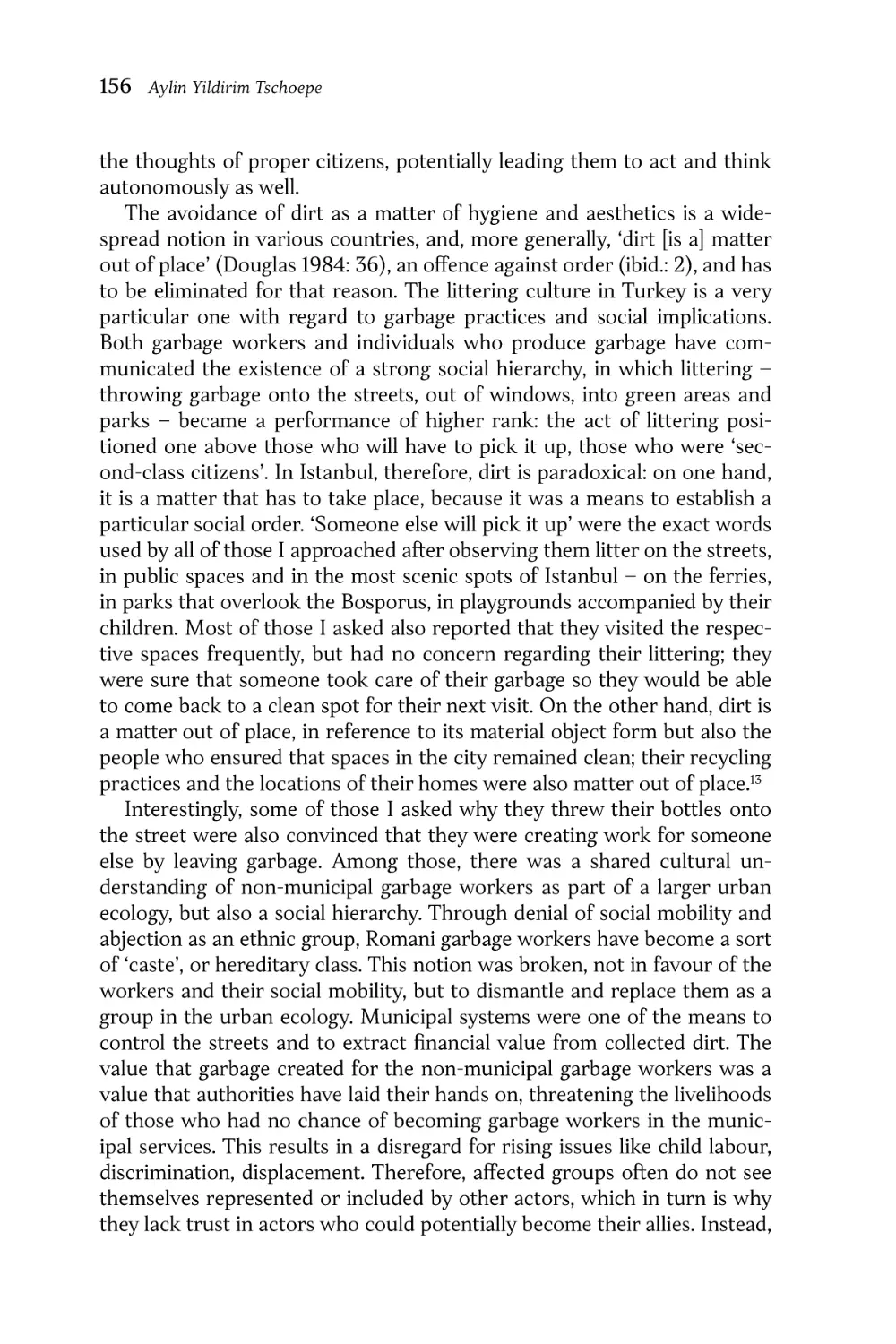
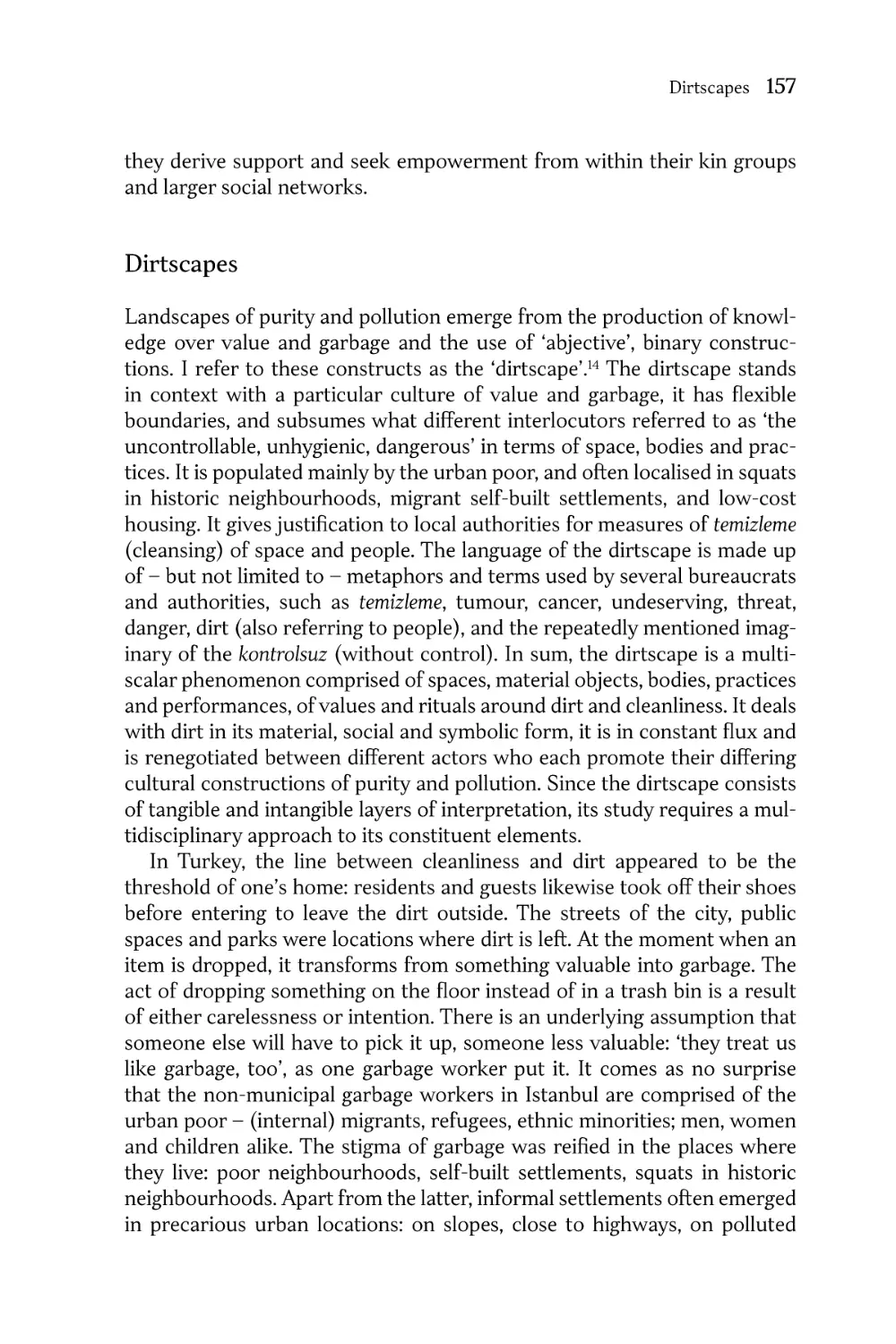
6.1. and 6.2. Two types of carts could be rented from the waste
dealer according to material. The pushcart is mainly used for old
appliances or generally old used items with a potential for a second
life. The white trash-bag carts carry plastic, paper and cardboard.
Photographs by Aylin Yildirim Tschoepe.

159

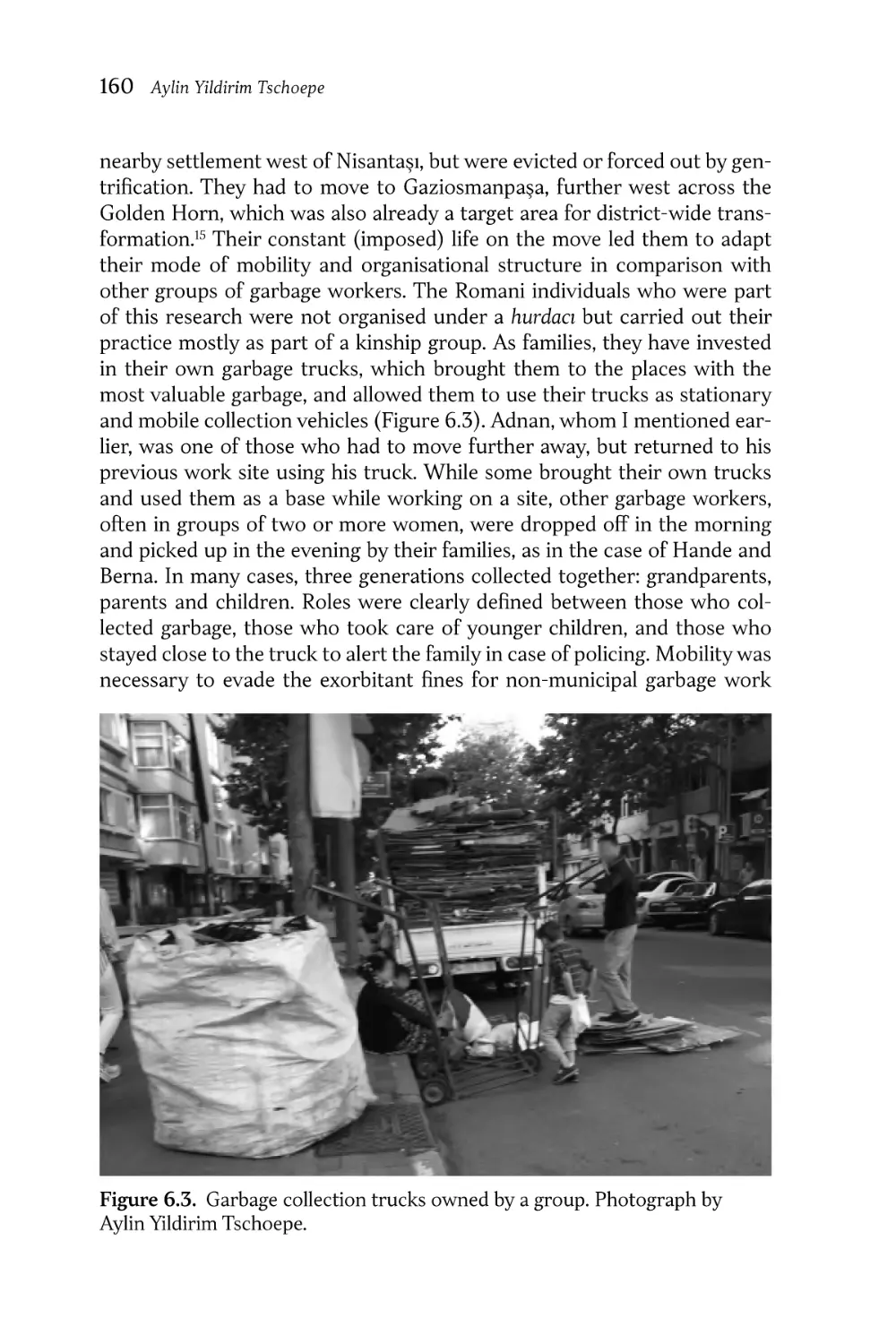
6.3. Garbage collection trucks owned by a group. Photograph by
Aylin Yildirim Tschoepe.

160

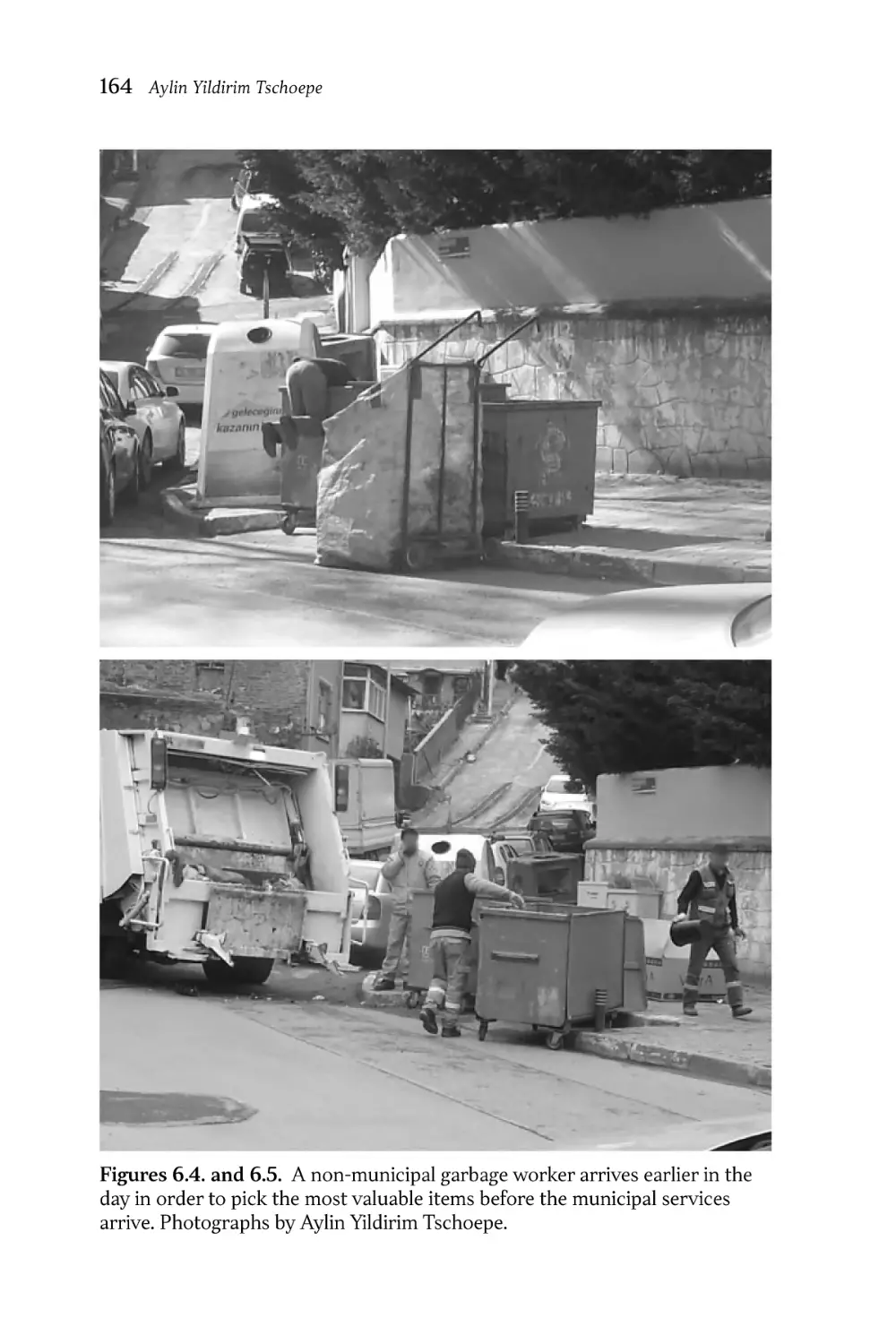
6.4. and 6.5. A non-municipal garbage worker arrives earlier
in the day in order to pick the most valuable items before the
municipal services arrive. Photographs by Aylin Yildirim Tschoepe.

164

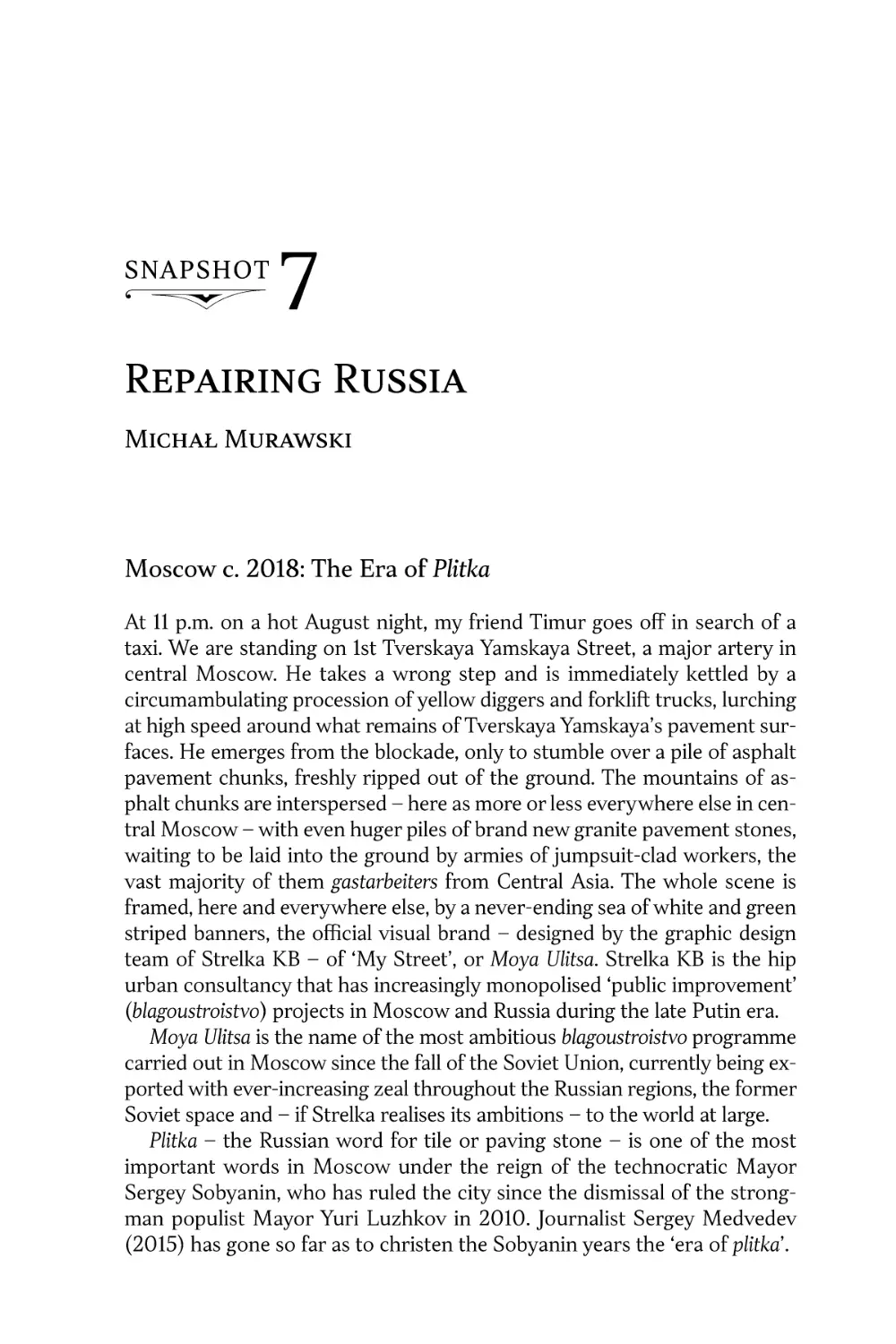
S7.1. Abstract plitka assemblage. Photograph by Michał Murawski.

170

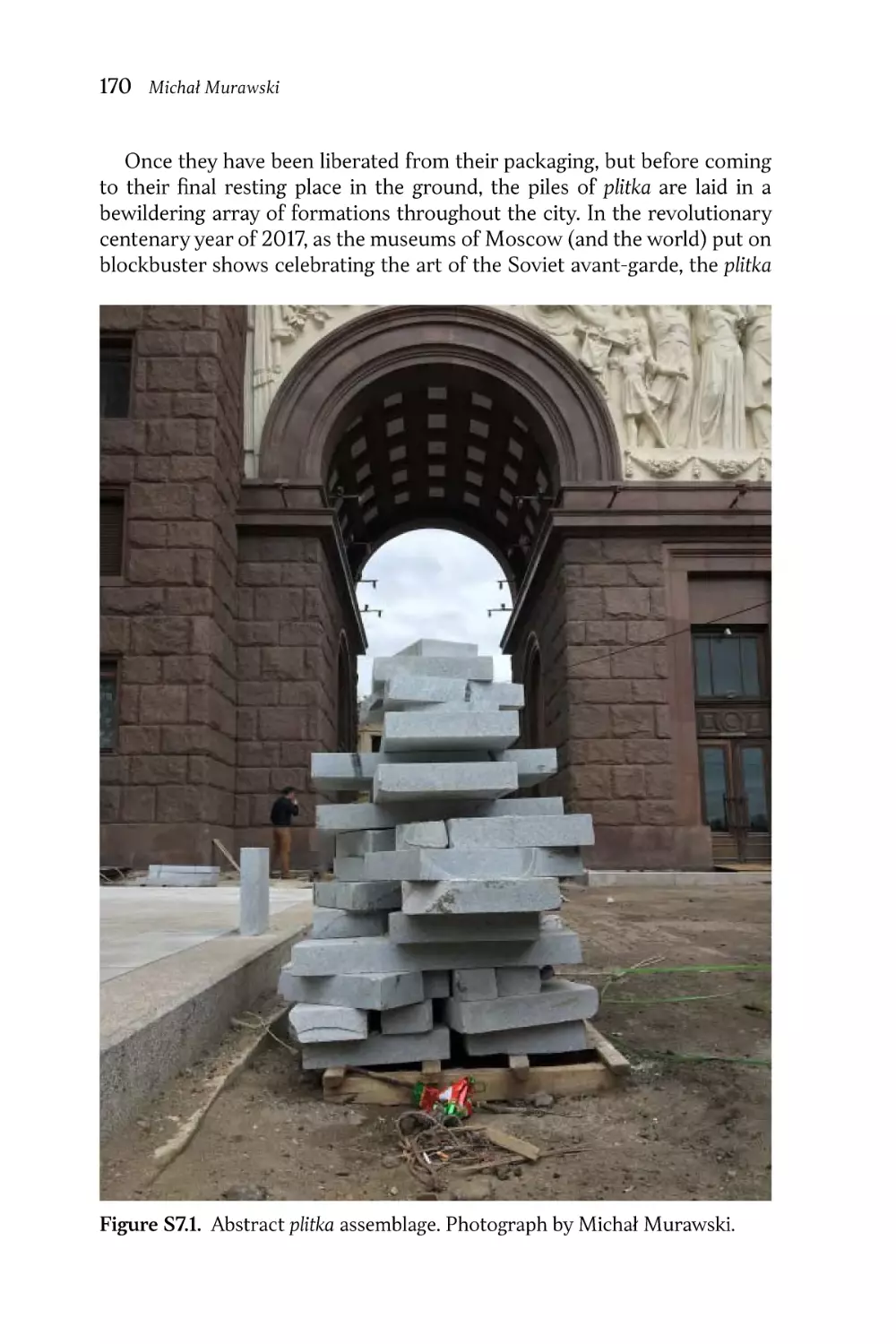
S7.2. A Volvo flanked by a square flowerpot and a plitkatekton.
Photograph by Michał Murawski.

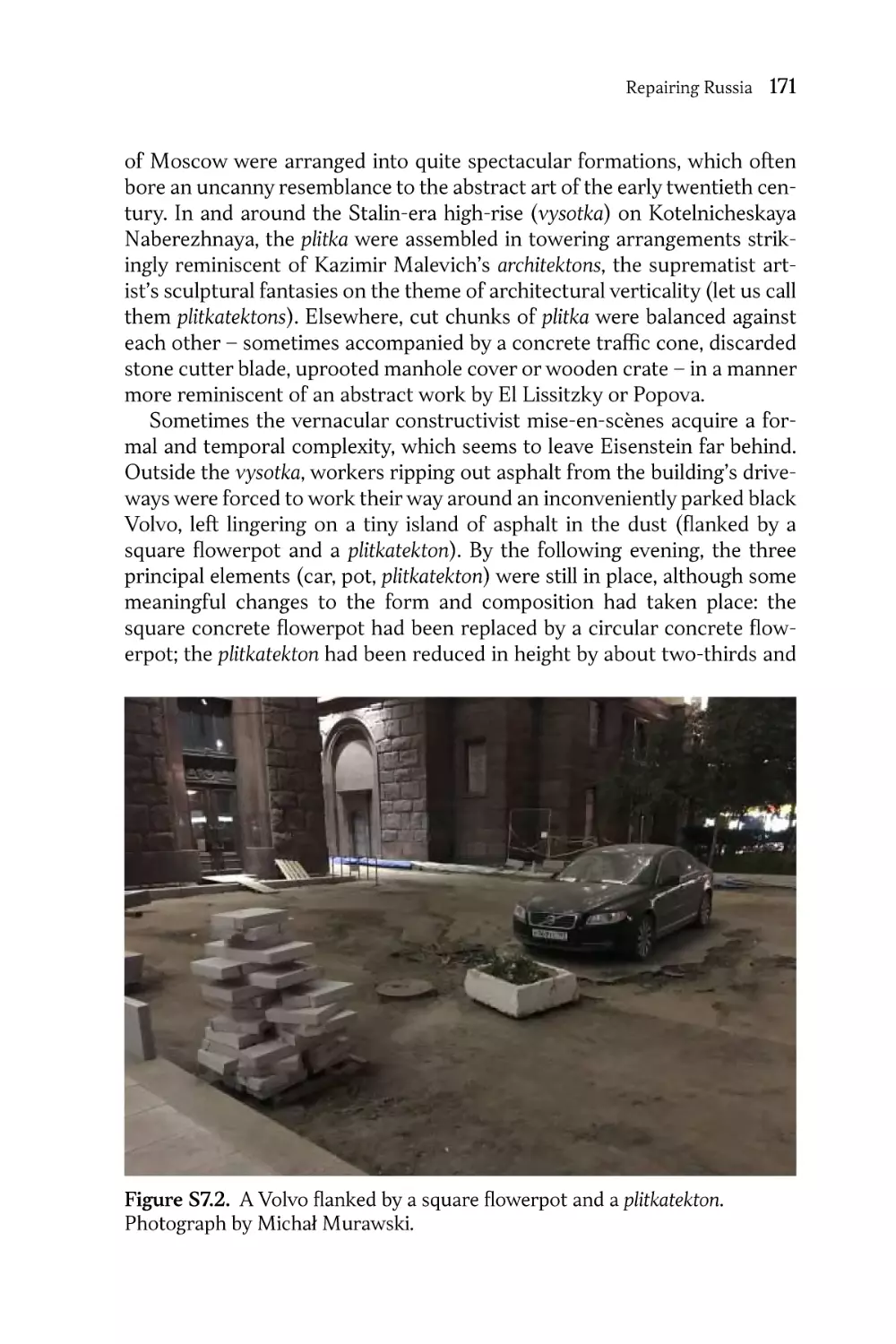
171

S7.3. The BMW arrived to stay. Photograph by Michał Murawski.

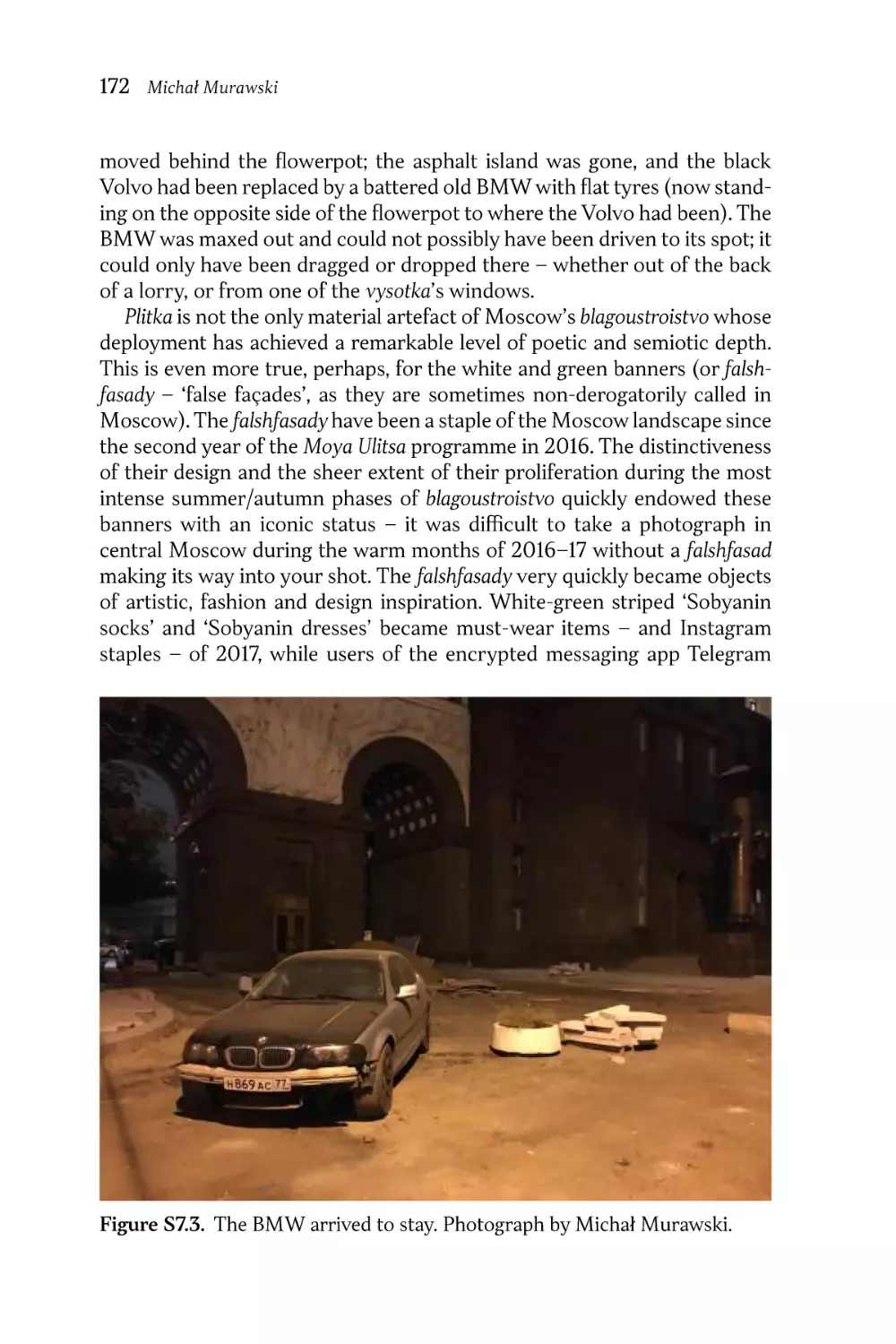
172

S7.4. Between Here and There. Photograph by Ekaterina Nenasheva.

173

S7.5. Green and white Strelka banner. Photograph by Michał
Murawski.

174

S7.6. Moya Ulitsa banners on Paveletskaya Square. Photograph by
Michał Murawski.

175

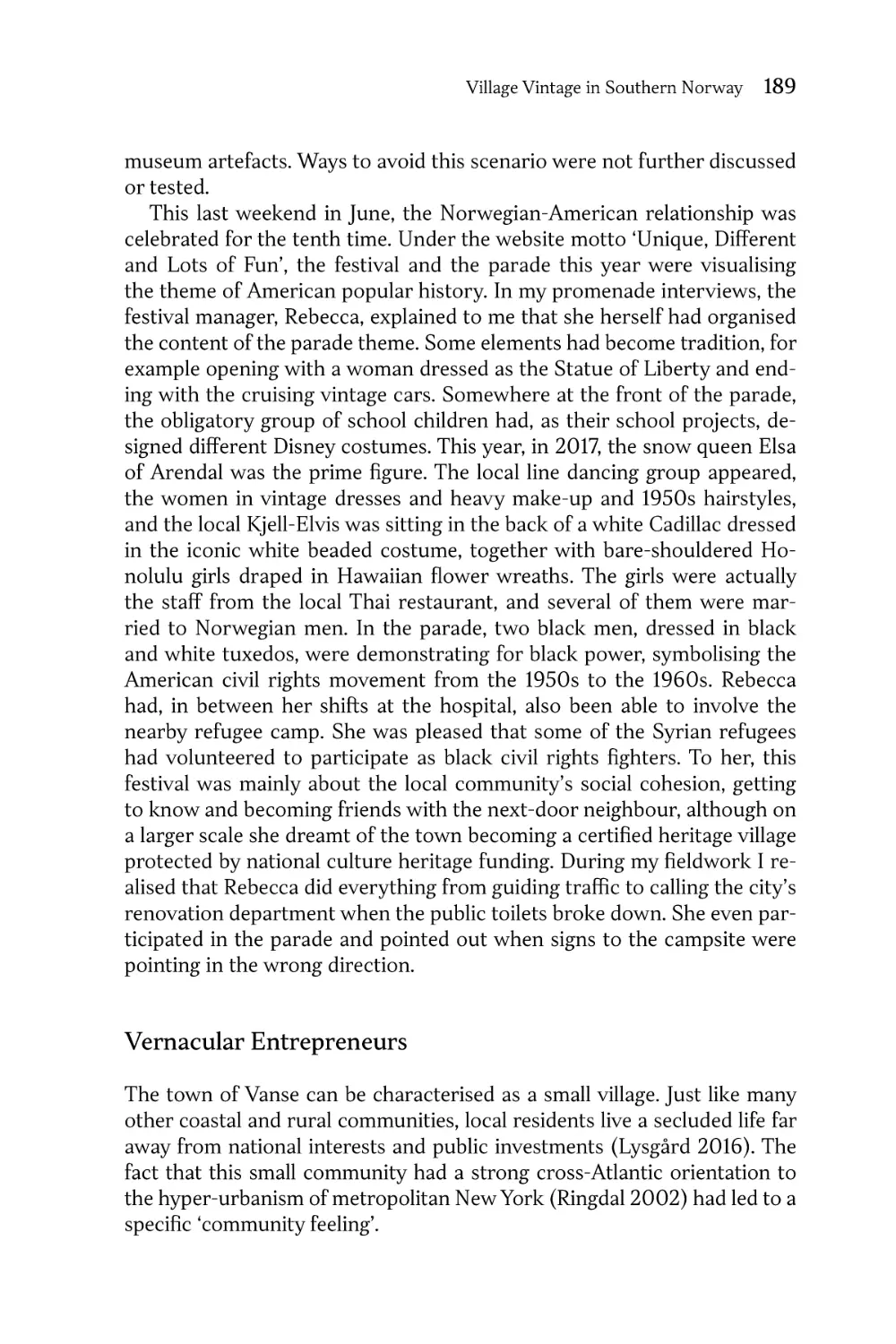
7.1. Kjell-Elvis, photograph by Thomas Høyrup Christensen, 2017.

191

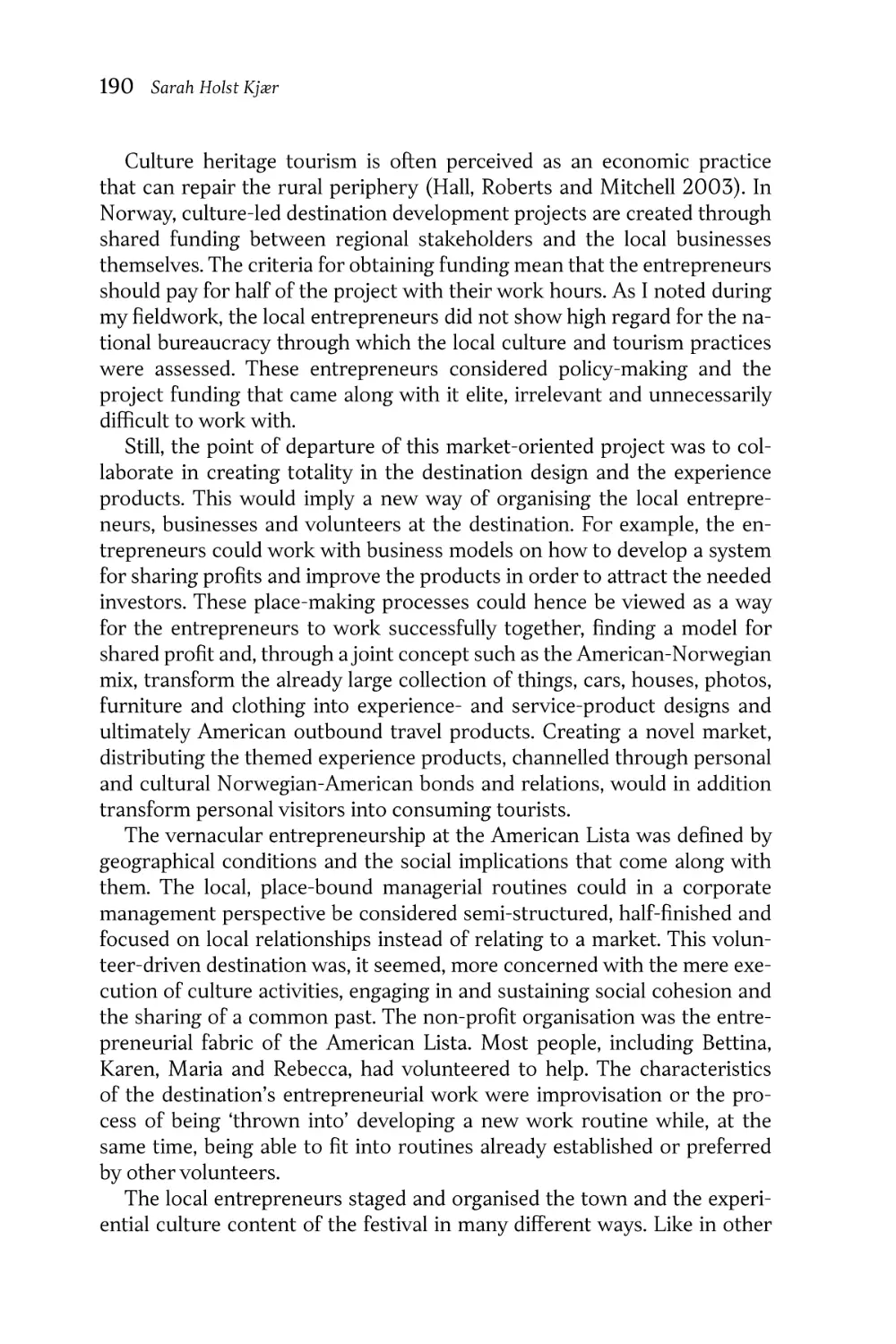
7.2. American parade, photograph by Thomas Høyrup
Christensen, 2017.

192

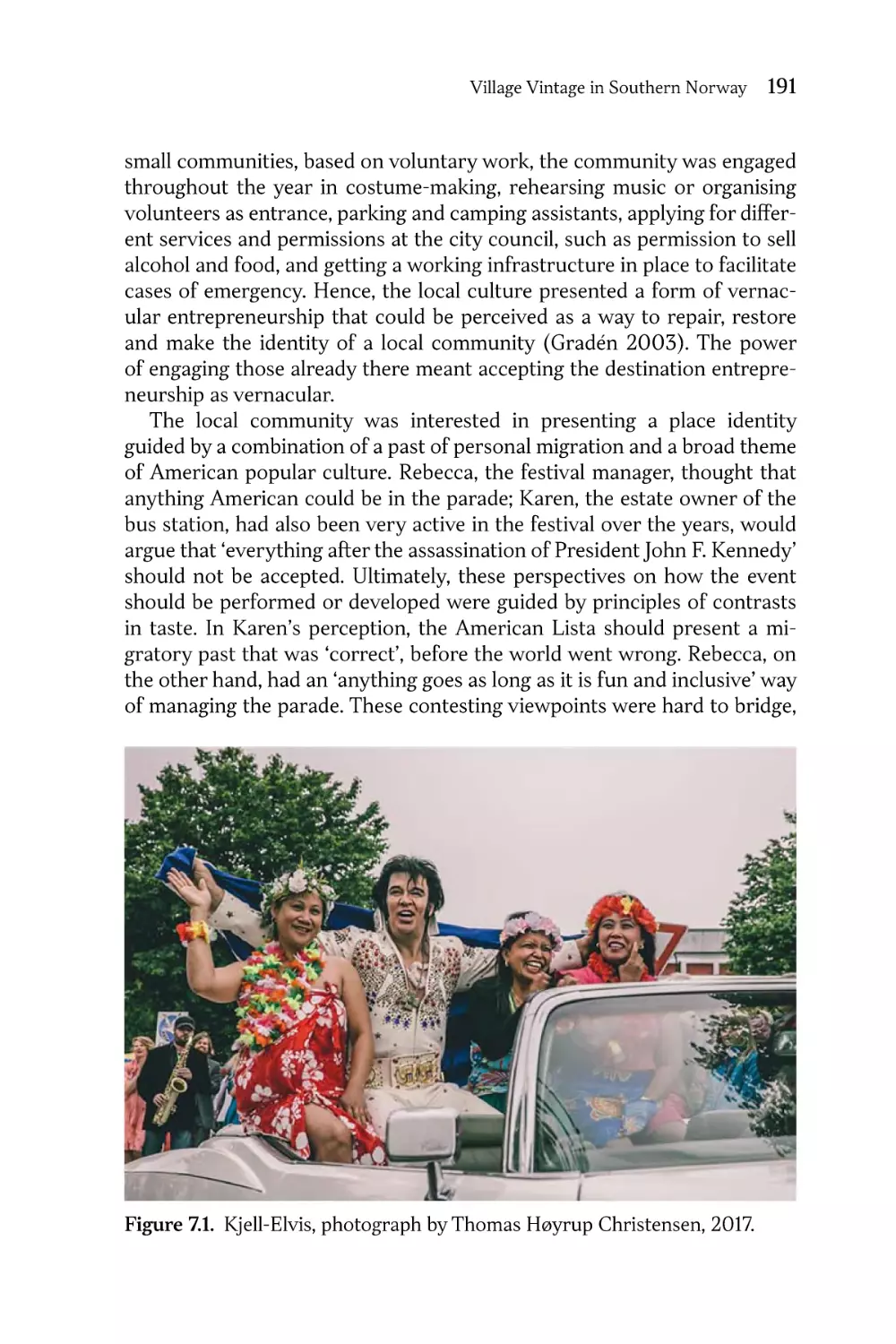
7.3. Rundown building, photograph by Thomas Høyrup
Christensen, 2017.

192

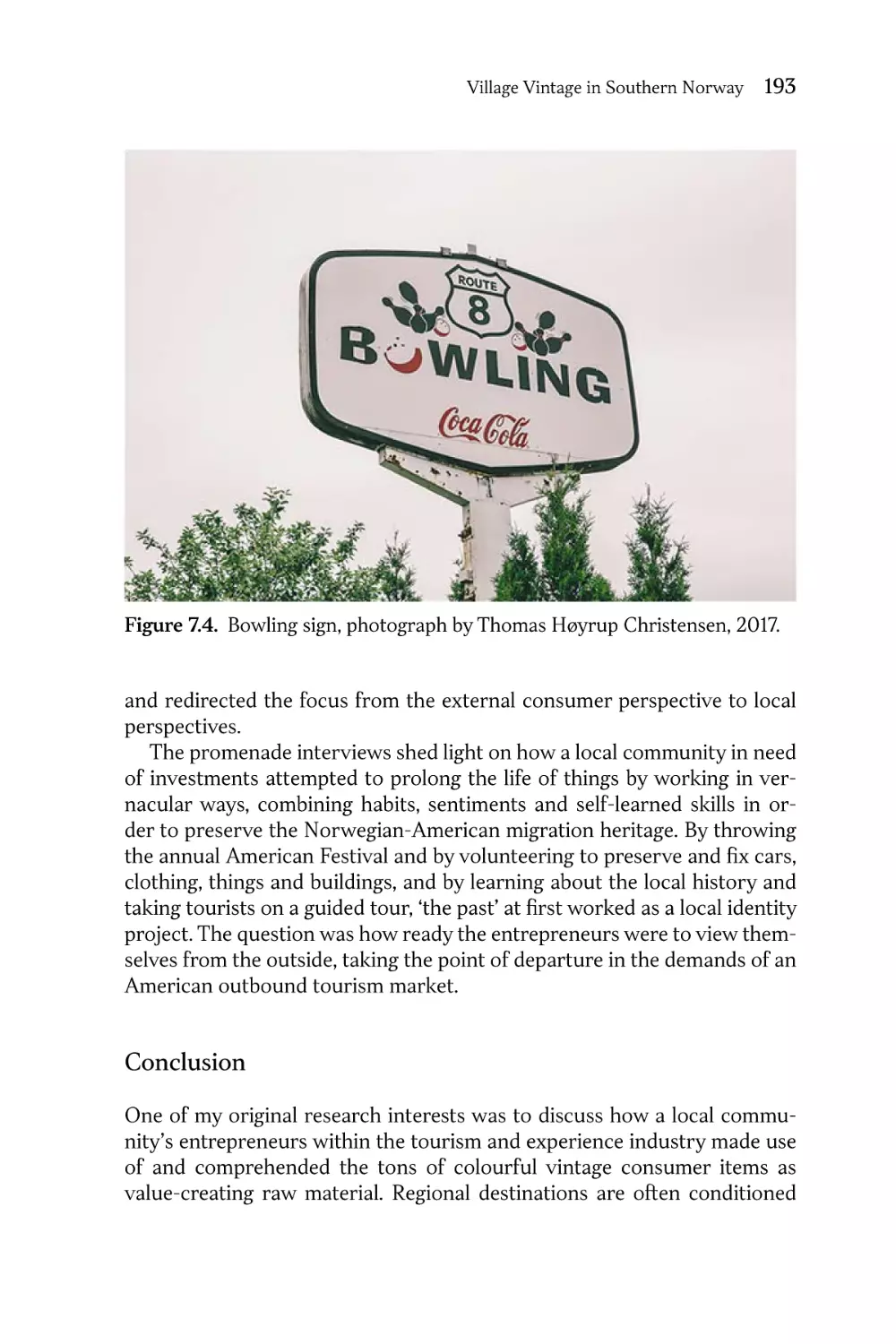
7.4. Bowling sign, photograph by Thomas Høyrup Christensen,
2017.

193

8.1. Cimier’s advertising poster covering the brand’s booth,
displayed at the 2012 annual trade fair in Basel. Photograph by
Hervé Munz.

203

Illustrations xi

8.2. Doxa advertising poster, displayed in a mall in downtown
Hong Kong in the summer of 2015. Photograph by Hervé Munz.

208

8.3. Leslie surrounded by his students during the training course.
Photograph by Hervé Munz.

209

8.4 and 8.5. At the workshop. Photographs by Hervé Munz

211

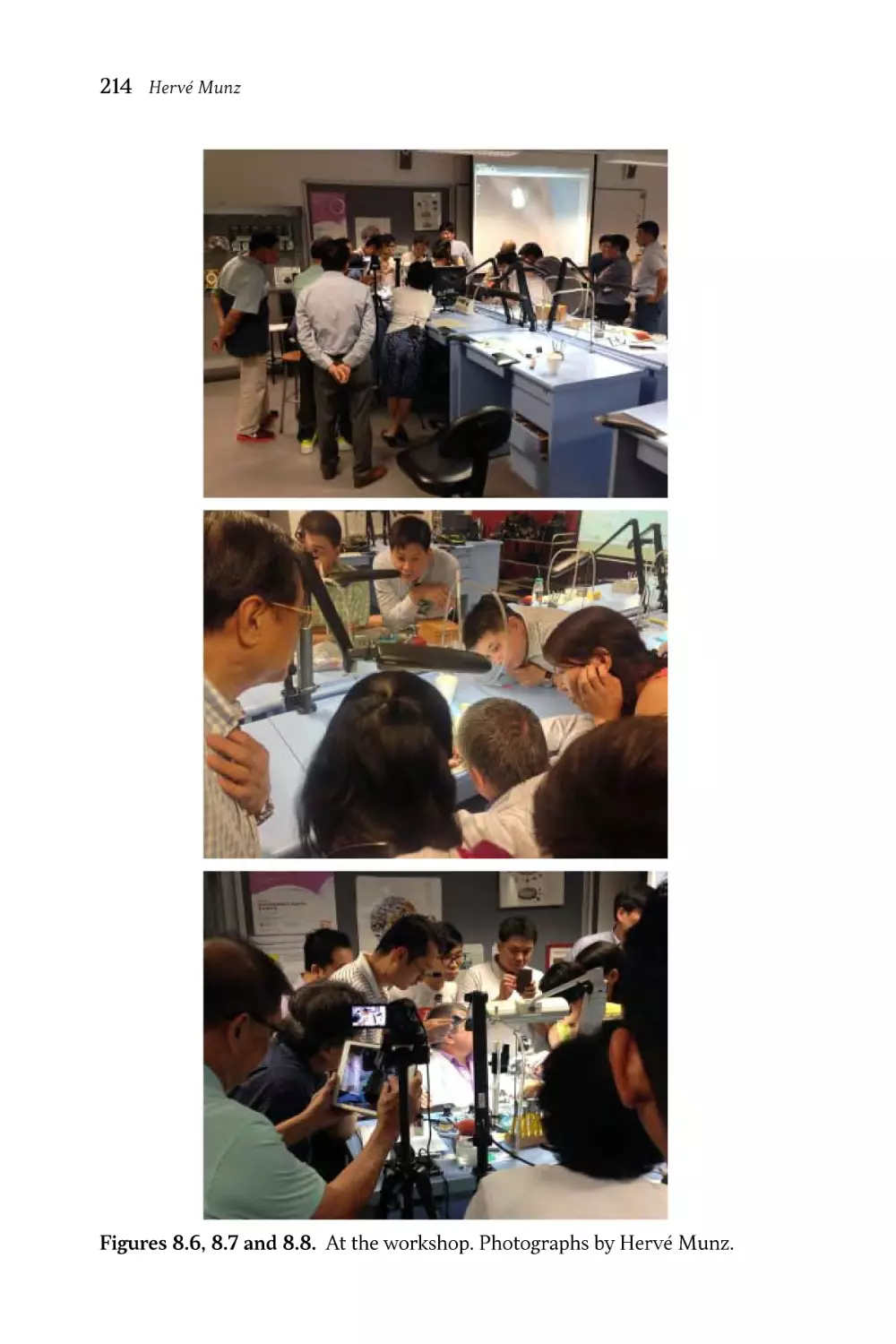
8.6, 8.7 and 8.8. At the workshop. Photographs by Hervé Munz.

214

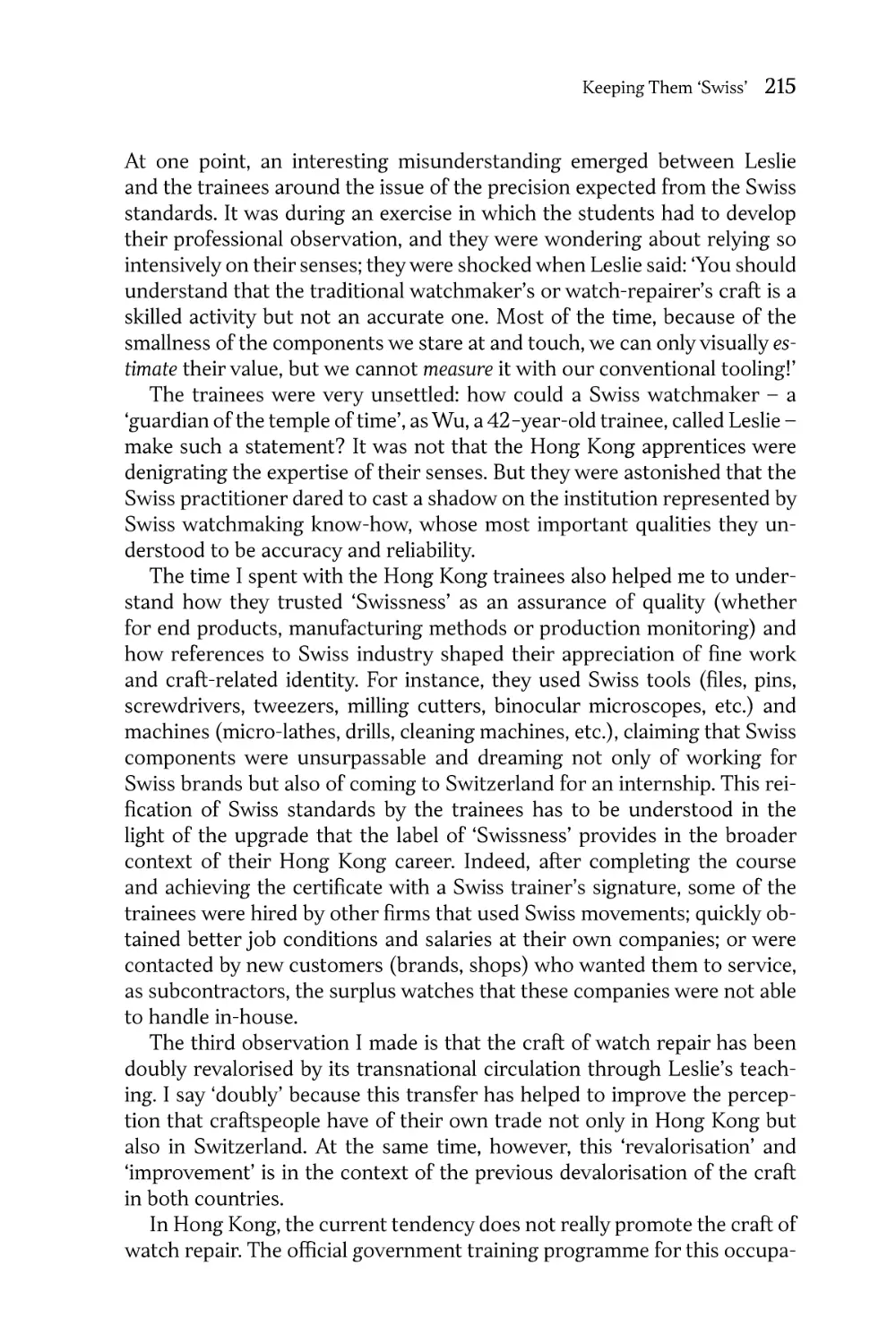
8.9. Mobile repair stall for electronic watches, tended by a local
watch repairer on a Hong Kong street. Photograph by Hervé Munz.

216

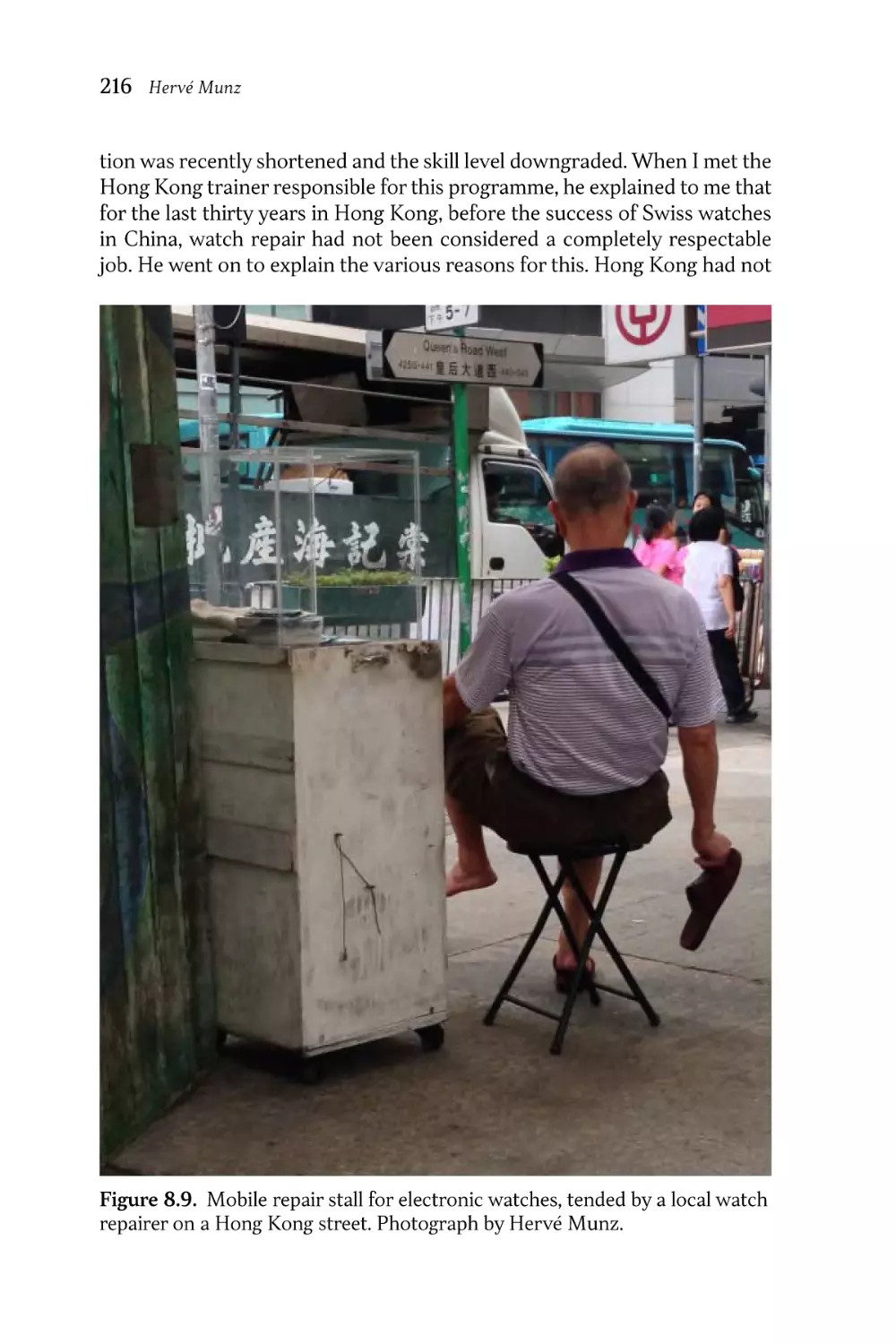
8.10. The stall is located under an urban highway bridge.
Photograph by Hervé Munz.

217

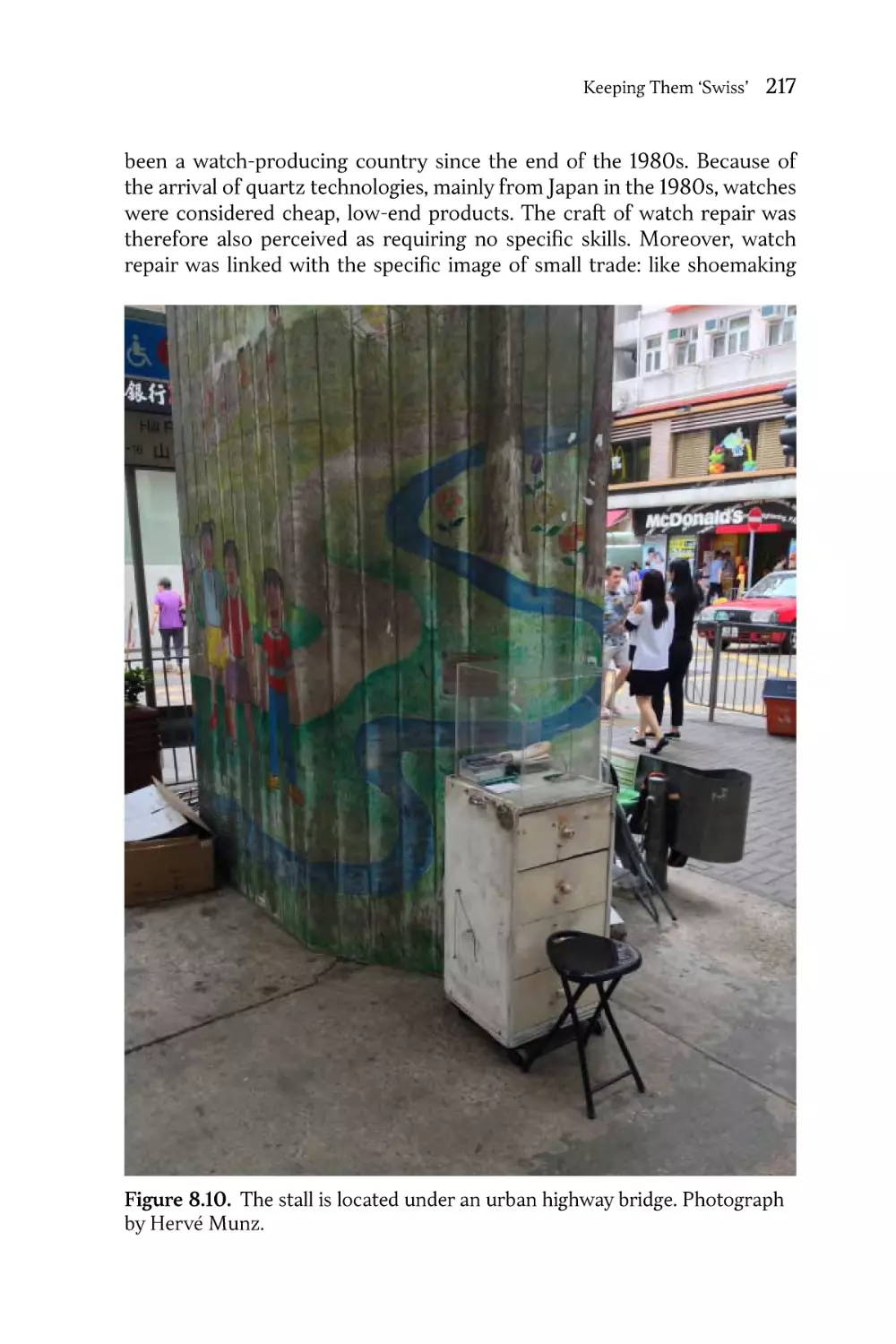
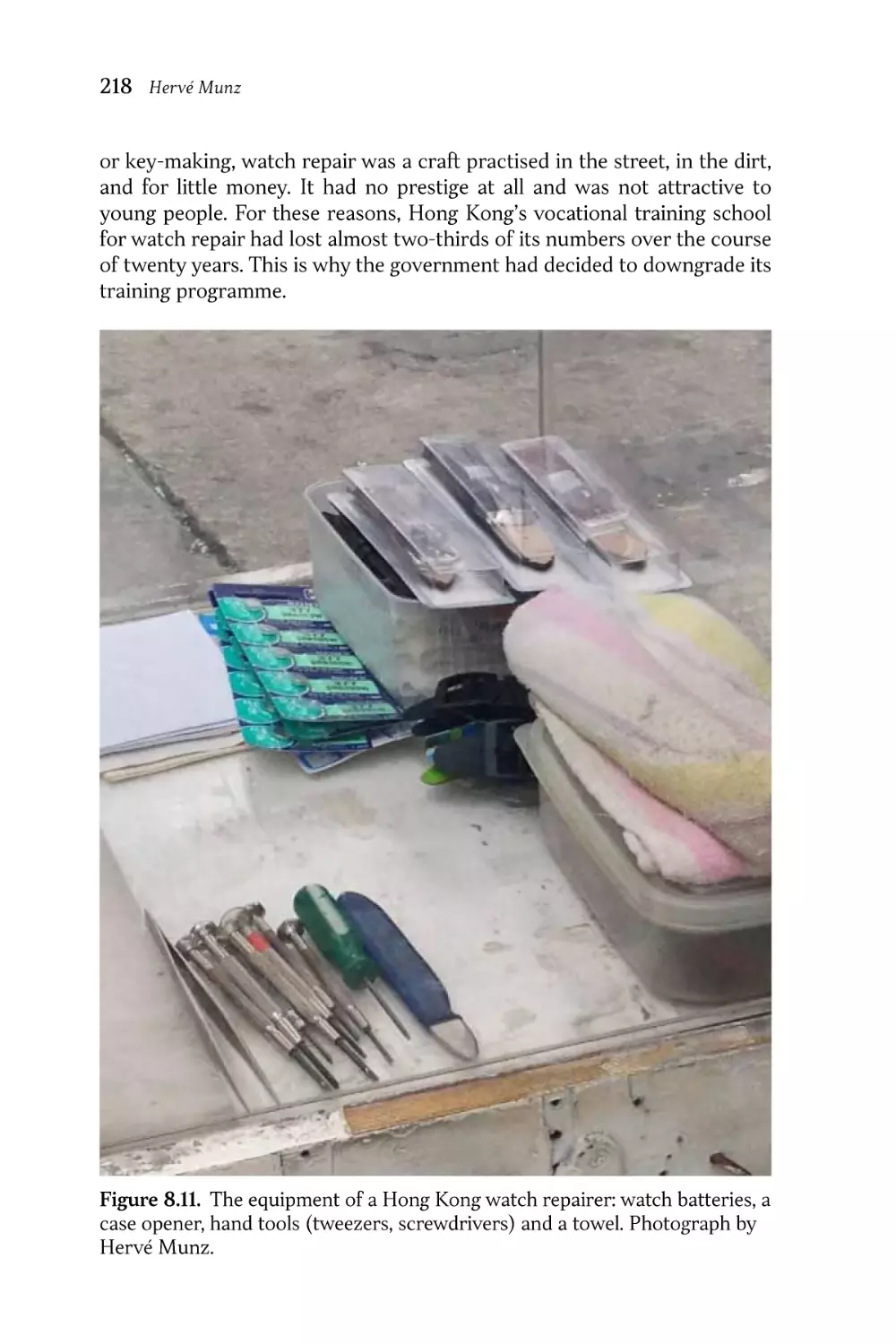
8.11. The equipment of a Hong Kong watch repairer: watch
batteries, a case opener, hand tools (tweezers, screwdrivers) and a
towel. Photograph by Hervé Munz.

218

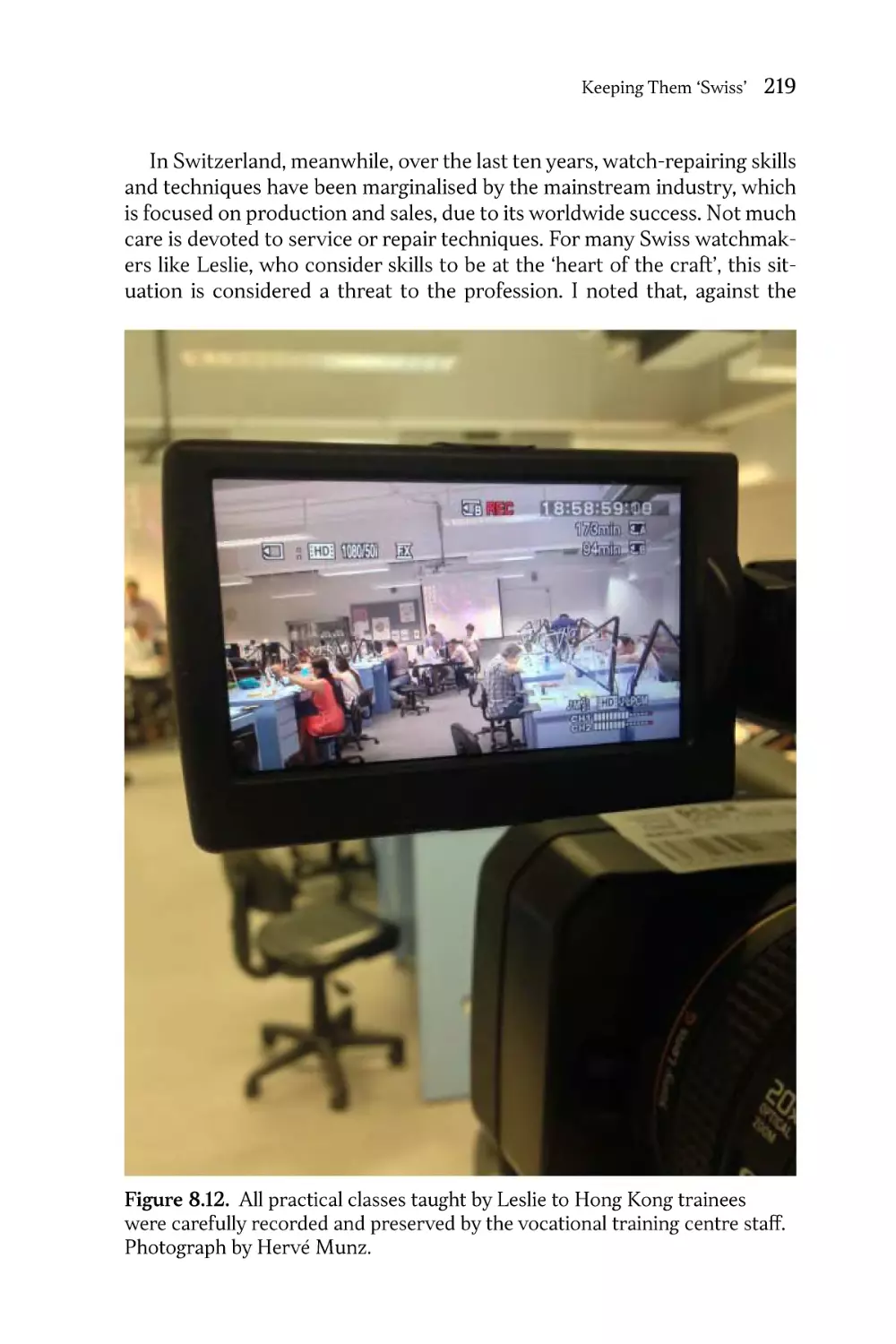
8.12. All practical classes taught by Leslie to Hong Kong trainees
were carefully recorded and preserved by the vocational training
centre staff. Photograph by Hervé Munz.

219

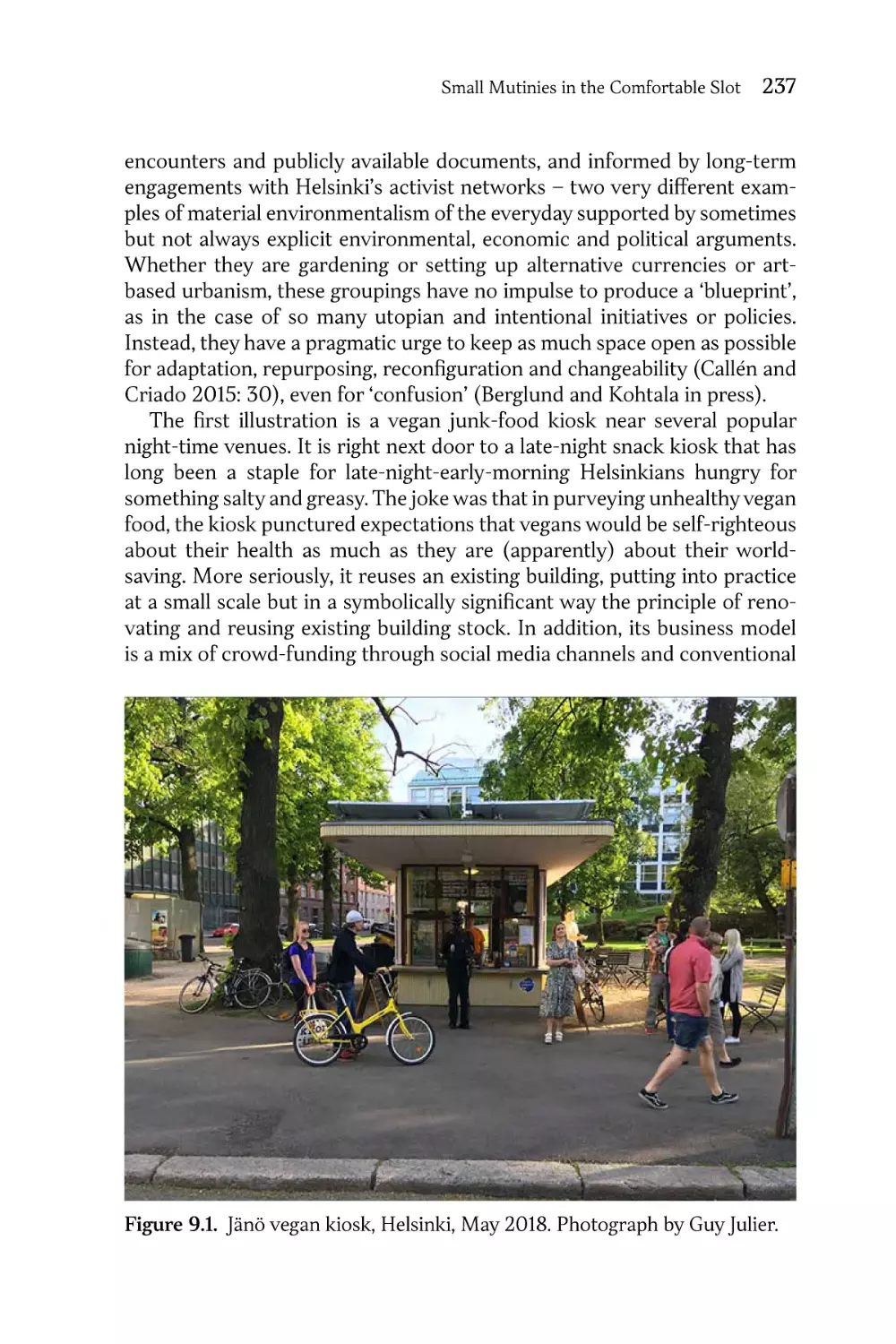
9.1. Jänö vegan kiosk, Helsinki, May 2018. Photograph by
Guy Julier.

237

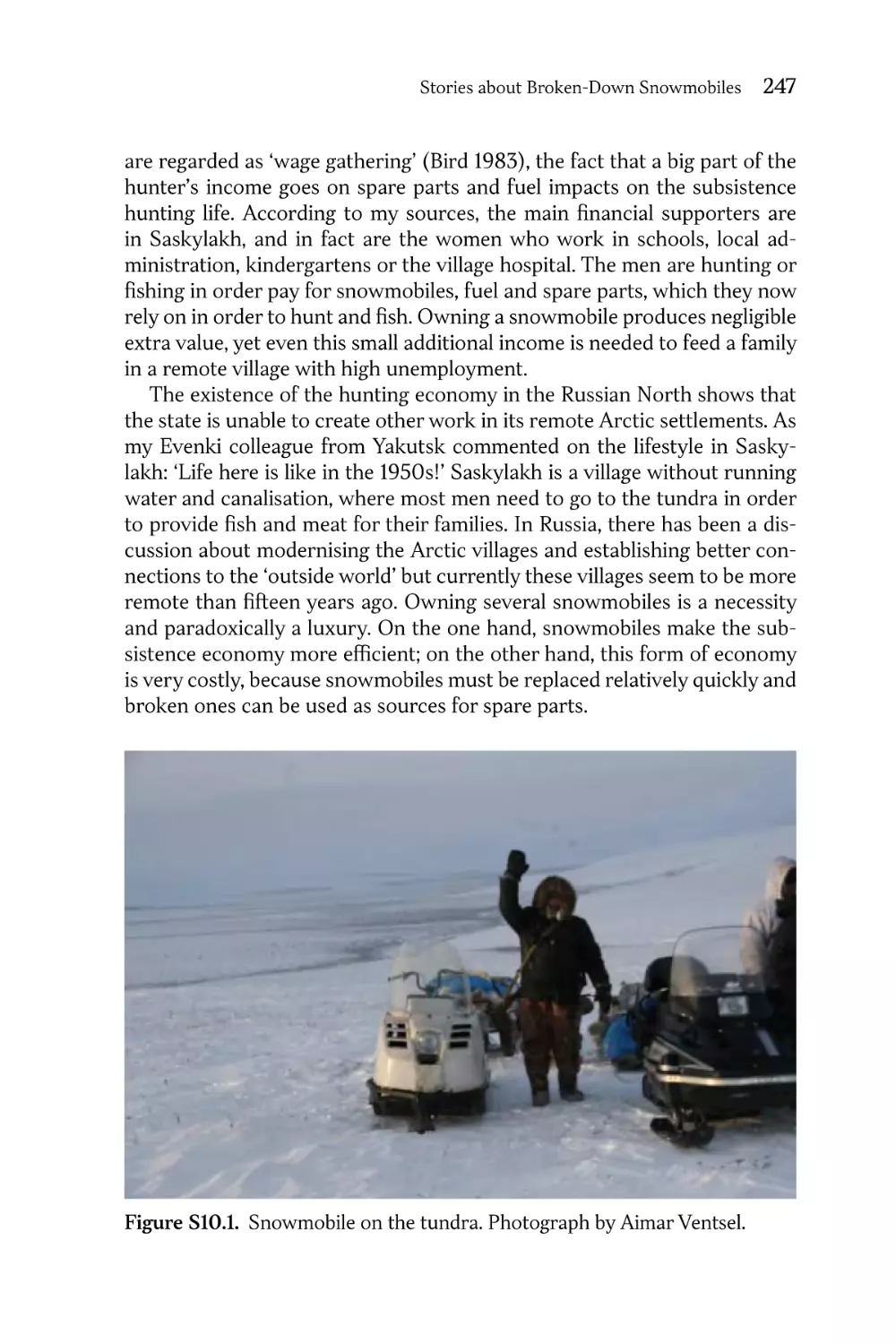
S10.1. Snowmobile on the tundra. Photograph by Aimar Ventsel.

247

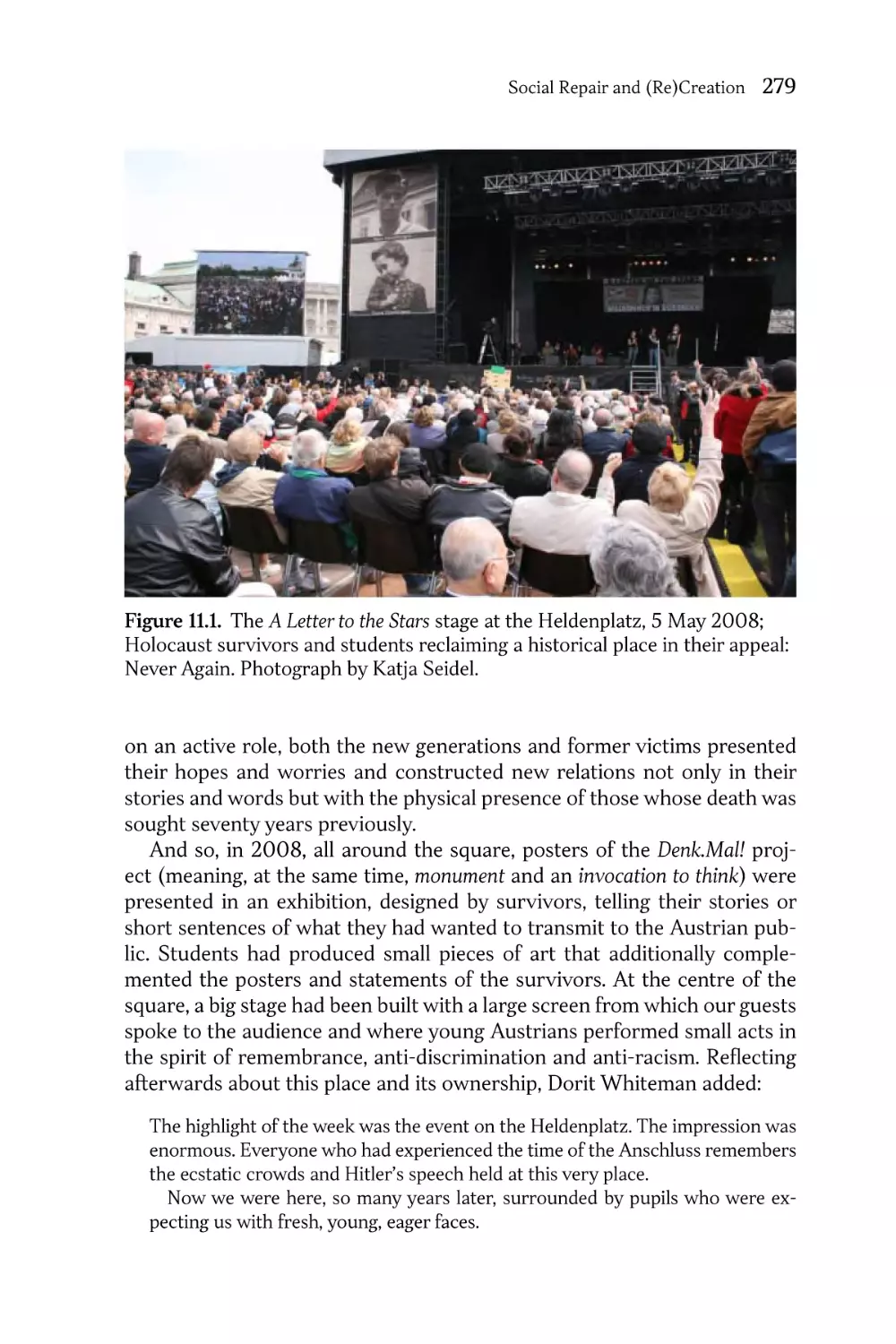
11.1. The A Letter to the Stars stage at the Heldenplatz, 5 May
2008; Holocaust survivors and students reclaiming a historical
place in their appeal: Never Again. Photograph by Katja Seidel.

279

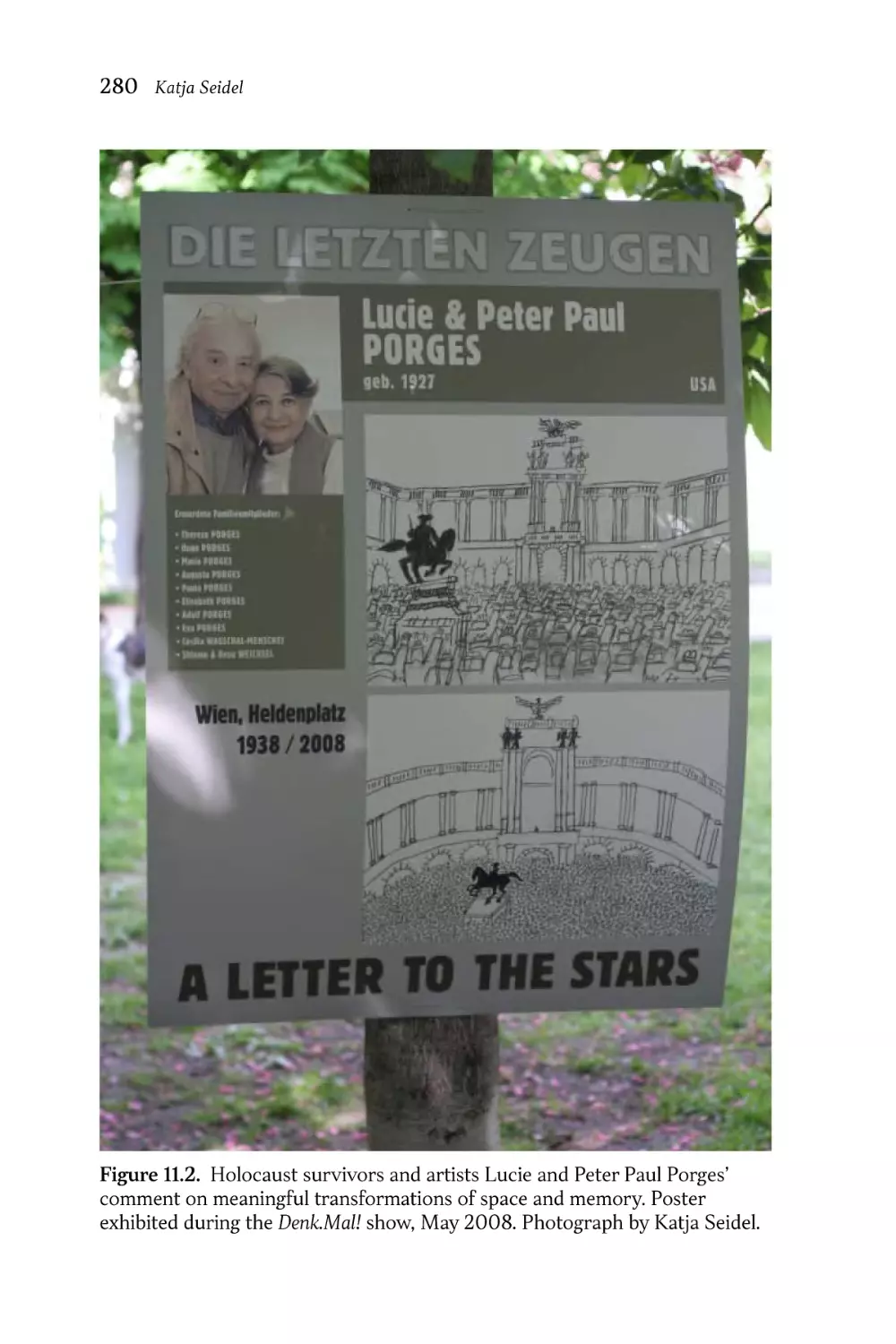
11.2. Holocaust survivors and artists Lucie and Peter Paul Porges’
comment on meaningful transformations of space and memory.
Poster exhibited during the Denk.Mal! show, May 2008.
Photograph by Katja Seidel.

280

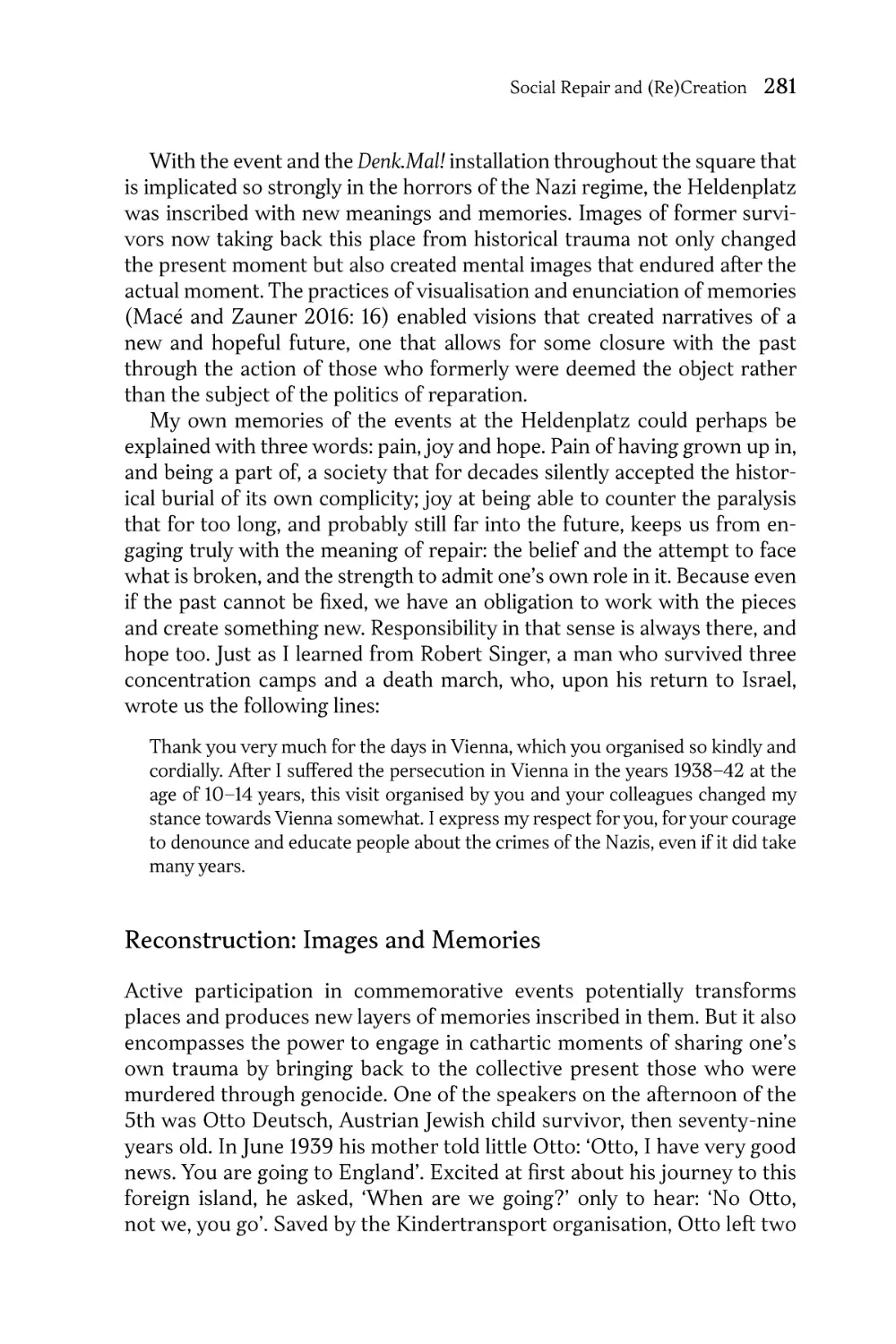
11.3. Otto Deutsch with his sister Adele and his mother Wilma
Deutsch (photograph taken in June 1939; Adele and Wilma were
murdered in an extermination camp near Minsk). Courtesy of
Otto Deutsch.

282

S12.1. Trolleybus boy in Dushanbe. Photograph by Wladimir
Sgibnev.

294

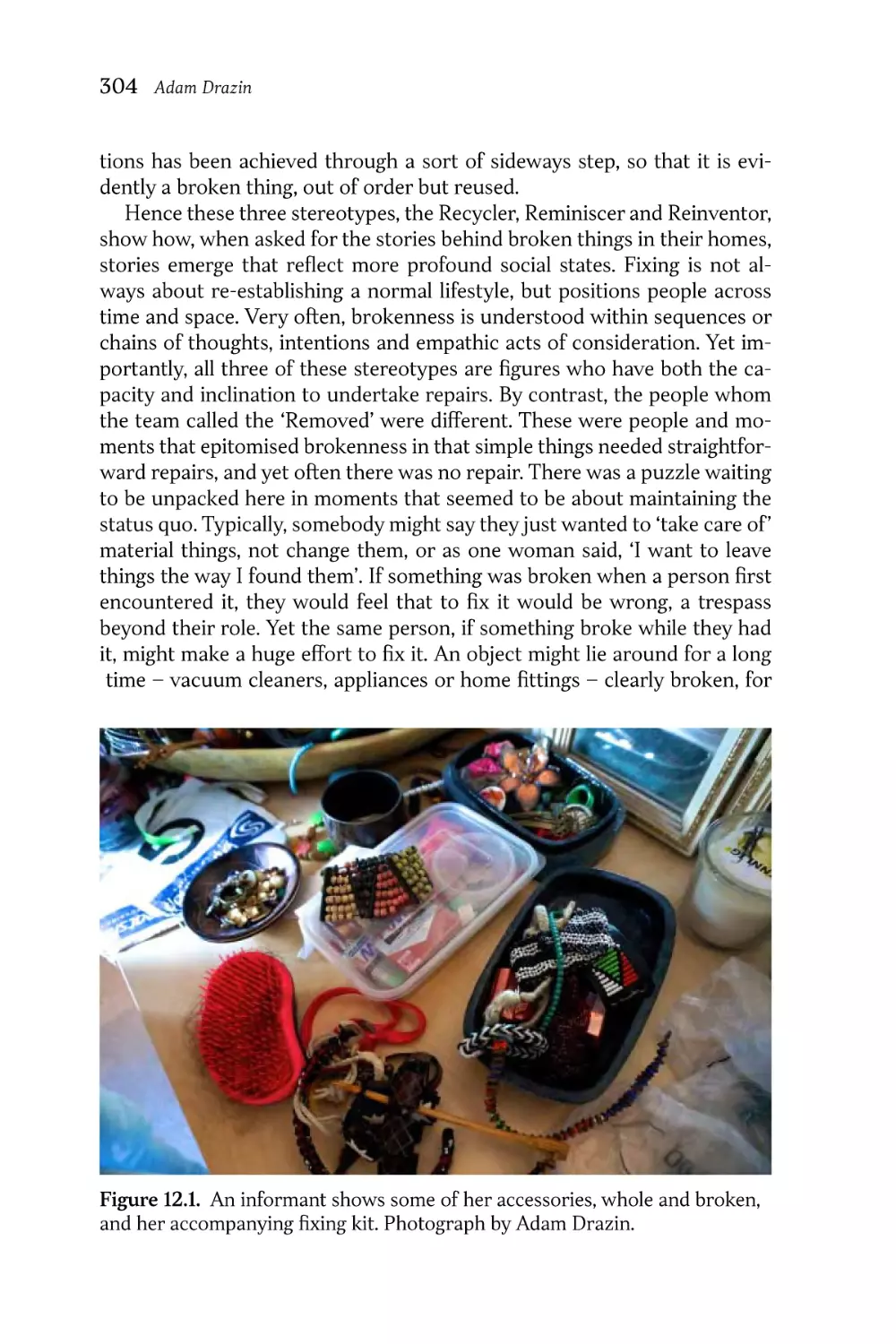
12.1. An informant shows some of her accessories, whole and
broken, and her accompanying fixing kit. Photograph by
Adam Drazin.

304

INTRODUCTION

Z

Insiders’ Manual to Breakdown
FRANCISCO MARTÍNEZ

From a certain point on, there is no more turning back. That is the point that
must be reached.
—Franz Kafka, The Zurau Aphorisms

Lose something that you highly appreciate, try hard in the art of failing,
be obdurate in the error, persist in the awkwardness, and then think of
what you have learnt. We relapse and fall, and then we stand up again.
Also things fail and slip back. They get broken again and again; they persist
in falling apart. We all know about failed conjugal lives, about fallen ice
creams, hair and porcelains. A good companion gets sick; a teenager falls in
love, again and again, merciless. Out of this (increasingly fragmented) combination – of system and error, of silence and noise, of dirt and cleanness –
we make music, art, business and politics. If you have read to this point,
it is because you also share our interest in accidents and people who have
failed, those who don’t do things as they are told, who don’t follow straight
lines, champions of the accident, insiders to failure and mistakes. I am sorry
to insist, but systems fail. Weak states are prone to violent coups and revolutions. The financial market follows patterns of boom, bust, kaboom! Vehicles crash. Buildings and infrastructures crack. Smartphones run out of
battery. We also know that our body can react strangely sometimes.
Ordinary life is made up of eventful junctures, constant surprises and
adjustments that go beyond all attempts to rigorously plan things and manifest a gap between how the world is and how it should be. Indeed, I felt
so good in the morning; I expected to take a shower and then to drink a
coffee. However, today the hot water did not work, the coffee pot appeared
empty, and the internet was slow. And then the day continues and life does

2 Francisco Martínez

not stop. Failure can be both – embedded in and disruptive of everyday life.
It is hard though to measure the depth of a failure, and also of our altered
mood, but it is worth examining instances of error and failure, as an exercise of critical breaking. The world touches us through failures. Brokenness
feels like something, but one does not know what it looks like, and even
less how to verbalise that something. Modern societies lack a language in
which to discuss failure beyond economic reasoning. In a way, it is like Roland Barthes’ argument (1978) regarding the lack of a verbal system capable of interpreting amorous experiences. Current discourses about failure
are misleading, if not annoying. They ignore the fact that failure provides
space for thinking and self-assessment by interrupting the expected flow of
things. Also, they overlook how wasted time can be socially and culturally
productive, especially in contexts where we are impelled to avoid what is
inefficient, distorted, outside of the straight line (Ahmed 2006; Martínez
2018b).
Nonetheless, accidents and brokenness do not always involve mistakes
and misbehaviour, but rather use, testing and tinkering. Likewise, failure
does not have to be understood necessarily as the end of knowledge; it can
also be considered as an experiential process integral to learning (Miyazaki
and Riles 2005), hard to replicate or reproduce, having patina and an aura
(Boym 2017). Indeed, failures do not occur twice in the same way, they
offer many lessons, and give rise to other forms of life. Ordinary failures
open up the potential for organising our lives differently, and for stepping
where we are not expected, generating disordering affects that are resistant
to categorisation.

Hardly Ever Final
What is gained from an ethnography of repair and breakage? What does it
mean to claim that something is broken? Who measures the value of fixing
up, and how? This anthology explores the conditions of brokenness and
repair in different social and cultural settings. It is, thus, about people doing
things, handling situations: holding on, letting go. Also, it studies how both
people and institutions develop strategies of maintaining, repairing and fixing up – from objects to concepts, social relations and feelings. The focus on
repair opens up a wide range of questions about responsibility, care-taking
and sustainability. To repair is an act on the world: to engage in mending and
fixing entails a relational world-building that materialises affective formations. It also settles endurance, material sensitivity and empathy, as well as
more altruistic values oriented towards the sustainability of life.

Introduction 3

Brokenness, in turn, is seen as a pervasive condition of disarray and disorder, an offence against the neat and tidy. Any breakage puts an end to a
time and to an order. Hence, it implies some sort of adjustment, a generative tension and a measure of entropy. Yet breakdown can also be part of a
continuum, ordinary and normal, full of activity and exchange (see Drazin
in this volume). Breakage is hardly ever absolute and final. Neither is repair.
Repair has continually to be worked at and is not necessarily pleasant. It
rather hurts, while simultaneously it liberates the practitioner from the tyranny of that voracious king called Breakdown. Things are constantly falling
out of place, deteriorating, malfunctioning, falling into disrepair, in some
cases losing their status as objects and always attesting to the fallibility and
fracturability of the world. To keep things as objects and in order is thus a
process without end (Domínguez Rubio 2016). Repairing equally involves
a degree of normalisation, as it recognises a certain ‘fixed’ state to which
the failing system should evolve as well as the accepted strategies to reach
unbrokenness (Ureta 2014).
For a productive dialogue between ‘breakage’ as an analytical trope
and as an ethnographic fact, we might also be interested in introducing
a few nuances about the difference between all the terms used: breakdown relates to a failure of functioning; breakage refers rather to the act
of breaking and what is left over; while brokenness alludes to the quality of being broken. All three conditions bring a failure of relationships
to the forefront, as value is reproduced or lost owing to all-too-human
choices, such as repair interventions, investment and care. Breakdown and
the death of things is thus contingent to situated decisions, grounded in
specific contexts and structures (Cairns and Jacobs 2014). One of the key
differences between them is that brokenness testifies to negligence, while
repair appears as a generative experience of care and potentiality: to repair
is a form of passing through and carrying out, a way of lending continuity
to discontinuity, despite the utter impossibility of a whole, complete, absolute restoration.

We Are All Repairers
Collectively, the research presented here reconsiders the dialectics of repair and brokenness by exploring how attempts at mending influence wider
social processes. The anthology moves the reader across a mosaic of discussions on the dynamics of material production and cultural mediation,
creating synergies across themes of ‘breakage’ and ‘repair’. We aim at providing a device for questioning what it means to fix something, as well as

4 Francisco Martínez

exploring the learning potential that breakdown entails and how the design
of things also manifests a view on their maintenance and repairability. In
this way, we hope to set out a fecund cross-disciplinary meeting ground for
the empirical and the conceptual study of responses to brokenness, contributing to crafting the field of repair studies, recalibrating ideologies of
failure, challenging innovation as the dominant paradigm, and strengthening alternate views of affect theory, critical heritage, anthropology, archaeology, material culture and media studies.
By starting with a mundane object or situation, the contributors work
with seemingly trivial details and show how they can create an understanding of large issues and political problems. It can be a malfunctioning elevator or a worn out trolleybus line in post-Soviet settings, a pothole in the
road, a sunken warship, a broken favourite toy, a stalled snowmobile in
arctic Siberia or a group of Norwegian villagers trying to use American
retro bric-a-brac for a local festival. There is a good pedagogy but also a
creative analytical strategy in such approaches. With a focus on the materiality of these processes of maintenance and repair, there is also much on
the haptic dimensions of everyday life, so often forgotten. However, what
makes repair relevant is not that things break, but that we care if they do
(Spelman 2002; Puig de la Bellacasa 2011)
Our ethnographic responses engage with these matters, developing an
open-ended combination of empirical and theoretical questions, which include: At what point is something broken repairable? How much tolerance
for failure do our societies have? Where and when do the social relationships that occur during the act of repairing something manifest themselves? What are the social relationships that take place around repair?
Our first answer would be that the relevance of repair is not its occurrence,
but the values attached, as well as its aesthetic and moral implications (see
also Alexander 2012). The effects of restoring things extend far beyond the
physical facet; they enable the recreation of social relationships.
Repair is also a practice of placing, entangled in a number of localised
relationships that contribute to creating transcendental narratives of reconstitution after abandonment, or of recuperation after breakdown. This
understanding of repair updates the Western idea that the healing of past
wrongs and empowerment can happen through verbal recounting, suggesting material repair as permeating synchronisation and public recuperation.
We can also take repair as an enactment of care, a matter of everyday interaction, manifested in the form of affirmative interventions and affective
transmissions that have significance as public feelings (Laviolette 2006;
Stewart 2007; Martínez 2017). Activities such as inhabiting, gardening
and refurbishing actively change our surrounding material landscapes and
shape the meanings associated with them (Strebel 2011). These practices

Introduction 5

show that other elements and people have been here before us, and also
that some new ones will come.

Fixing Is a Political Aspiration
The book’s affect-informed ethnographies account for how attempts to
lengthen the lives of things allow people to construct a moral self, and/
or connect with others and their environment. Overall, talking about the
values associated with repair requires understanding people’s ideas about
their society, their standards, frames of behaviour and orders of worth (Boltanski and Thévenot 2006). Repair and fixing interventions have become
matters of public concern. Arguably, this is due to the appreciation of the
limits and fragility of the worlds we inhabit and a recognition that many of
the orders of modernity are in the process of coming apart (Jackson 2014).
Failures and breakdowns are crucial situations in the production of sociotechnical inequities (Graham 2010). We can observe that breakdowns have
an impact on a large number of people simultaneously (Graham and Thrift
2007). Indeed, feelings of uselessness have become an intrinsic aspect of
contemporary life (Bauman 2004).
In turn, the recovery of past things appears as one of the most symbolic instruments used in negotiating abrupt changes and belonging. It
helps to connect generations and ensure stability in the material world,
demonstrating a relationship between things and human security (Cherrier
and Ponner 2010). Material relations are central to the process of political participation and the production of knowledge (Latour 2005; Marres
2012). For instance, we can relate the recuperation of social bonds with
the reworking of things and the engagement in practices beyond the capitalist culture of competition, consumption, expenditure and excess. The
mending of things recreates value in objects and resources that have been
wasted, reconnecting personal biographies to public and private materiality (Martínez 2018a). In so doing, repair demonstrates concern with continuity and change, and with the interaction between the two, becoming a
way of ‘preservation without permission’ (Brand 2012), and establishing a
dialectic relation between necessity and freedom (Oroza 2009).
Our possessions, the tools we use, and the built environment around
us are everyday elements of sense-making. Material and temporal considerations redefine the realm of possibility, generating specific meanings
and affects, thus making certain experiences and narratives more viable
(Kracauer [1927] 1995; Barthes 1957; Simmel 1997). Such considerations
are always conjectural to a society, and hence affect the actual power
relations, values and representations (Miller 2005). By accounting for

6 Francisco Martínez

quotidian practices of fixing and breakdown and how these acts help to
construct multidimensional connections and stabilise matter (Edensor
2016), previous studies on repair and maintenance have made visible the
multiple temporalities that shape things (Houston 2017), the politics of
recuperating (Guyer 2017; Sánchez Criado 2019) and different regimes
of maintenance (Denis and Pontille 2017). Prosaically, fixing is a practice
that restores the pragmatic or symbolic function of things (Gerasimova
and Chuikina 2009). But in this project, we want to approach repair in a
broader sense, as a theory-making practice, focusing on mending as works
of adaptation, reconnection and recuperation, which generate in turn a
rich array of physical transformations as well as new aesthetic and intellectual genres.

Talent for Destruction
My anthropological interest in repair appeared accidentally, yet with some
biographical projections, as psychoanalysts would say. My grandfather is
known for his hoarding and tinkering, and I always envied the mechanic
skills of my father. Also, my ex, before our rupture, used to tell me that I
have a facility for breaking things and relationships. ‘You have talent for
destruction’, she insisted. Then, I could not come up with a good answer,
but now I can say that breakage is just a way of changing things and seeing
what happens next. A failure, an accident, a breakdown is a new beginning
and a liminal point of assessment. It is like an adventure: an intense exploration in which we move away from a centre, going east, going south, going
off, breaking through, and feeling the adrenaline rush from ‘being in the
edge’.
Failures make evident the possibility of breakthrough, of becoming something else, telling us about accidental findings, gaps, tricksters and hackers.
This volume calls into question the assumption that creativity always leads
to novelty; in many cases, breakthroughs occur through non-heroic acts
such as tinkering, material manipulations and the rearrangement of things
(Latour 2008; Farías and Wilkie 2016). Breakthrough is a copy-error exercise with a durable impact. Hence, we can also take breakdown, erosion
and decay as the starting points of our designs, instead of novelty, growth
and progress ( Jackson 2014). Failures and lapses do not always materialise a systemic breakdown or a point of disequilibrium; they can also be
an asset, if they happen in the early stages of a process, thus becoming an
element of learning, experimentation and innovation (Birla 2016), or a window of opportunity characterised by potentiality (Latour 1996; Miyazaki
and Riles 2005). In this sense, failure can be understood not simply as a

Introduction 7

crisis, but also as a terrain of interstitiality, which can also exist as a modality of planning or as a way of keeping people busy (Abram and Weszkalnys
2013; Ssorin-Chaikov 2016).
Systems are organised by defining why some things are proper and
others failures (Douglas 1966).1 However, in our life, we most often encounter fragments of repair and brokenness and of failure and success, instead of absolutes (Murawski 2018). Defining the contours of brokenness
is, therefore, an anthropological problematic, a vantage point for making
sense of the connections and disconnections, continuities and ruptures,
subtractions and additions. As Arjun Appadurai points out (2016), no society or culture lacks a word for failure, being always presented through the
prisms of language, context and tradition. He also notes how failure – or
brokenness, in our case – tends to appear as a self-evident fact, even if it
is most often a judgement made. Error, breakage and failure exist in different languages showing distinct nuances, reflective of the societies that
produce them (Carroll, Jeevendrampillai and Parkhurst 2017), and yet the
notion of failure and success currently hegemonic in the West seems to
have been translated-imposed from the language of business. Our work
and our minds are measured through financial models, ranging from credit
ratings (a number 1) to investments (good for nothing). As a consequence,
failure has been redefined, appearing not as an outright misfortune, but as
an attribute of those behind the action, who become failures themselves
(Sandage 2005).

No Future for Archaeologists
Fixing interventions combine an assessment of something from the past
with a sought consequence towards the future. In its Latin etymology, reparare refers to a process that starts by going back, yet entailing two meanings:
‘making ready’ and ‘paying attention to’. We can thus say that through repair both people and things grow new, not in the sense of being completely
new again, but rather an experience of going through, of being reshaped
and modified, having changed from one state to another, hence suggesting
transition, intersection, transfer, transmission – a becoming with character
(Haraway 2008). Sensuous engagements with the past and efforts to stitch
things in time demonstrate the importance of repair as a form of passing
through and carrying out (König 2013), thus healing entropic pathologies
of desynchronicity (Rosa 2013).
In its etymology, also Latin, obsolēscere means ‘to grow old’, ‘be accustomed’ and ‘to fall into disuse’. Nonetheless, things generate meaning not
just in their preservation and repair, but also in their destruction and break-

8 Francisco Martínez

age – as another mode of going through and being in time (DeSilvey 2017).
Not surprisingly, the study of waste and decay is receiving increasing attention as a complementary critical angle for the study of consumption and
production (Edensor 2005; Gregson, Metcalfe and Crewe 2007; Alexander
and Reno 2012; Reno 2015; Eriksen and Schober 2017). Things break and
technologies become obsolete much faster than ever before, showing that
late-capitalism learned well how to make profit out of accidents. The way
in which actual cycles of consumption triturate materials and resources
makes us believe, however, that we can dispose of things with total impunity. Likewise, recycling cannot keep pace with increased production,
becoming also part of the current ‘accelerated archaeology’ (Stallabrass
1996) that characterises capitalist rationality and the rapid turnover of
commodities. Only repair keeps open the possibility of future remains and
ruins; if we recycle everything, there won’t be work for archaeologists and
all traces would be reduced to a digital archive.

What Lays beyond Repair?
What happens when design and planning meet the material world? What
kind of epistemological and ontological gaps are generated? When is the
next unruly failure to arrive? Each breakdown entails an emergency and
calls for being fixed (Larkin 2016). In a way, this is what we have done from
Antiquity (Gruzinski 2012). The richness of repair practices contrasts,
however, with paradigms of planning, as well as standardised design procedures (Orr 1996). As designer Ernesto Oroza (2009) points out in his
study of vernacularly produced design work in 1990s Cuba, every repaired
object can also be understood as a declaration of necessity, often a technologically disobedient one.
Everybody knows that not all that is broken can be fixed or recuperated. Yet sometimes we forget that there are things in a state of repair that
keep working zombie-like, sophisticated systems of auto-repair such as the
body, or un-failed technologies with no possible repair (i.e. floppy disks or
DVDs). The questions of skills of joining and competences are also foregrounded in this book, as well as how things might provide remission but
not repair, satisfaction without resolution. Repair is constitutive of a particular embodied thinking and web of connections, a ‘cognitive mindset’
of being able to assess a problem and identify an appropriate remedy in a
given context (König 2013).
Further on, repair cannot happen without sensory explorations and intellectual speculations, in order to ascertain what the problem might be
(Denis and Pontile 2014a). Successful maintenance always anticipates fail-

Introduction 9

ures and entails abstract thinking (Dant 2009). In their interventions, repair workers rely on improvisation and accidental wisdom (Henke 2000),
a making-do characterised by alertness, adaptability and celerity (Pine
2012). The work of repair also shows a complex repertoire of gestures and
sensual knowledge that involves emotions and is distinct from the experience generated during industrial manufacturing (Dant 2009). Bodily practices such as repair that entail skilled work with different materials become
ingrained in your mind (Sennett 2008). This process is part improvisation,
part knowledge of standards, reproducing a normative description of the
world (Denis and Pontile 2014b).
Efforts to fix generate particular infrastructures, networks and environments of everyday life that often become a condition of existence for
those involved (Larkin 2016). A distinct knowledge emerges through repair, often pointing to a discrepancy between the sense of desire and possibility. Such embodied practice is ingrained within personal experience and
shaped by the historical and cultural circumstances of its implementation.
For artist Kader Attia (2014), repair is an ethical answer to guilt, but also
a form of reappropriation and translation, moving things along, a sort of
transfer from one cultural space/time to another performed through different acts or stages. To repair is, therefore, to connect – times, people, things
(Gruzinski 2012); it is a contemporary writing of history (Gauthier 2014).
Hence, it is imperative to project onto repair not only as corrective of obsolescence, breakdown, waste, negligence, subtraction and excess, but also
an ideo-praxeological ethos for recuperating us.

The Pervasive Effects of Repair and Breakage
Brokenness reveals fragile relations between people, and that material injuries aggravate immaterial ones. The acts of fixing and mending contain
emotional states of being attached to things. These interventions are both
defensive (responding to scarcity and facilitating adaptation to changes)
and generative (reconnecting and producing new kind of affects that then
circulate in public). Also, repair can be dynamic, transforming or modifying
the artefact for a new function; or static, trying to make the object appear
as it was, to rehabilitate it according to its previous condition. Otherwise,
what is broken is not destroyed but rather exists in a state of unfinished
disposal (Hetherington 2004). As a verb, to break refers to something being separated, inoperative, scattered, uncompleted, fractured, torn down; it
also refers to an escape, trespass, interruption, changing directions, termination, pause and delay of continuity; and finally to a state of bankruptcy,
disregard, ruin, failure to function, and good luck.

10 Francisco Martínez

Through an attention to ethnographic observations and reflections, this
volume discloses what the dictionary obviates, namely that disrepair and
fixing are part of a particular structure of feeling (Williams 1977), showing
affective features of shame and cynicism, or care and solidarity in turn. The
set of contributions illustrates the strong affective power hidden in situations of disrepair and repair; broken objects often bring strong emotions
into play: frustration, disappointment, feelings of care and love as well as
loss and shame, but also energising reactions of creative action. Repair is
an open-ended process with no clear boundaries. It refers to embodied acts
of completing things that stand in a stage of in-betweenness, engaging with
signs of use and giving to disassembled pieces the opportunity for recovered meaning.
The selected authors have been invited to reflect on the social implications of repair and breakage, as well as how they are inscribed in material forms, highlighting the rather invisible relationships between order/
disorder, wound/stitch, bone/plaster, hole/cork, and system/error. Despite
some recent research in fields such as material culture and urban studies,
scholars examining sustainability, the museification of everyday life and the
changing notions of value have not yet sufficiently explored how breakage
as a phenomenon varies culturally. Nor have they comprehensively scrutinised the importance of repair as an affective generator of haptic learning, symbolic meaning and socio-psychological behaviours. This collection
therefore fills a significant conceptual niche within the humanities and social sciences by: 1) setting the general framework for a theory of repair and
bringing about a better understanding of the socio-aesthetic significance
of these practices; 2) testing the applicability of this concept in relation to
the complex processes of transmission; 3) discussing how material culture
differs and the ability to define what value can be; 4) investigating the ways
that breakage can be anticipated in advance and hence predicting certain
possibilities in distinguishing between early/late failure in a plan or system; 5) studying how social contingencies are not themselves projectless;
6) considering what needs to be fixed – is it the world, is it us, is it our
way of living, or rather our idea of failure and success?; and 7) countering
discourses of innovation, success and technological heroes with actual invisible practices of maintenance and repair.

About This Book
This anthology explores some of the ways in which repair practices and
perceptions of brokenness vary culturally and, as such, influence wider

Introduction 11

processes such as care-taking and projections towards the future. The idea
of repairing herein appears as more than a technique; it entails responsibility, attention and a moral statement, making things visible and knowable (Puig de la Bellacasa 2011). Repair is considered as a cultural issue
rather than simply a mindless mechanical procedure. This practice is part
of a wider sub-architecture of maintenance, a backstage strategy to sustain
social relations and constructions; without these reuse exchanges, skilled
work and daily re-enactments of care, the world descends into dereliction
(Sennett 2008; DeSilvey, Bond and Ryan 2013).
The volume also addresses how fixing and breakage have consequences
for how we think about personal human prospections and retrospections.
Rather than placing the emphasis on how infrastructures function, or how
things get broken, our focus is instead on the affective responses to breakage and the vernacular ways of mobilising resources and generating value,
often done as a patchwork of services and support networks without an
active design or clear planning. During the editing process, we realised that
some of these ideas would be better discussed if we provided authors with
the possibility to contribute snapshots, which would then be placed between longer chapters. These shorter insights indeed help to explore many
possible inter-articulations between knowledge and intervention, parallels
between fieldwork and the practices of tinkering, as well as to acknowledge
the role of anecdotalisation in the study of brokenness and repair. Likewise,
the snapshot-chapter-snapshot structure relates to the research arguments
about different material imaginings and the experimentality of social life,
helping to better inform the volume by including topics such as breakage
work on Chinese roads, digital telecare supporters in Madrid, consumption dilemmas with de-bobbling garments in Romania, clandestine repairers taking care of the Panthéon’s clock in Paris, or a collection of puddles
in different cities.
Overall, the book is organised in twelve chapters, intertwined with thirteen shorter snapshots. The variety in the length of each contribution type
is also intended to break the textual monotony often present in such thematic compilations. The reader is taken through a wide range of situations
and analytical understandings that go beyond the confines of specific disciplines. For example, we meet trash pickers in Istanbul, grassroots activists
in Helsinki, people handling their belongings in London homes, luxurywatch repairmen in Hong Kong, a grandmother in Chile who stabilises
kinship relations through object-maintenance, coin-operated elevators in
Tbilisi, and a bike repair shop community in Brussels, to name just a few.
At first glance, the range of examples could appear a bit too far-ranging
and the number of topics included might seem chaotically eclectic. Never-

12 Francisco Martínez
theless, much of the strength of the book lies precisely in this wide range
of examples, because they illustrate the fascinating complexities of what is
hidden behind labels like maintenance, brokenness and mending, making
and breaking relations. The reader can emerge him or herself in a richness of settings, while appreciating the nuanced ways in which each text
opens up a number of current theoretical and methodological debates in
social and cultural research. The ways in which the contributions create a
dialogue with a number of current interests in disciplines such as anthropology, sociology, STS and cultural studies also mean that it is a book of
interest for several disciplines. Summing up, this volume shows the following key ideas:
• Social relations are sustained in relation to the maintenance and use
of built forms; accordingly, the repair of broken and wasted artefacts
helps to recover identities, histories and relations, thus broadening the
considerations for the social and allowing a second opportunity.
• Any reparation has two dimensions: a practical attempt to fix what has
been broken and the symbolic charge that honours care over wasting.
Repair does not merely remake artefacts; the engagement with things
shapes the social identities of the repairers and involves subtle shifts
in the spatial, temporal, scalar and material processes, which, when
combined, help constitute further social transformations.
• The act of breaking is contagious, generating the transmission of negative affects and a sense of failed relationship. Broken means damaged, in need of urgent attention, thus unusable for the initial design
purpose.
• Brokenness is not meaningless; there is disordering power and an inherent energy level present in accidents, failures or mistakes, achieving what is understood as a breakthrough. Breakage is also a way of
touching reality, of gaining direct access to our surroundings, of connecting to the ground. It thus harbours potentiality, becoming a catalyst, incentive or trigger for self-assessment.
Francisco Martínez is a lecturer in the School of Museum Studies, University of Leicester.
Note
1. The exclusion of the deviant (the noise, dirt, darkness, the negative and so on)
informs us about a general order of things, which might, in turn, lead to negligence, discard, disinvestment or devaluation.

Introduction 13

References
Abram, S., and G. Weszkalnys (eds). 2013. Elusive Promises: Planning in the Contemporary World. Oxford: Berghahn Books.
Ahmed, Sara. 2006. Queer Phenomenology: Orientations, Objects, Others. Durham, NC:
Duke University Press.
Alexander, Catherine. 2012. ‘Remont: Work in Progress’, in C. Alexander and J. Reno
(eds), Economies of Recycling. London: Zed, pp. 255–75.
Alexander, C., and J. Reno. 2012. ‘Introduction’, in C. Alexander and J. Reno (eds),
Economies of Recycling. London: Zed, pp. 1–33.
Appadurai, Arjun. 2016. ‘Failure. Introduction’, Social Research 83(3): xxi–xxvii.
Attia, Kader. 2014. The Repair from Occident to Extra-Occidental Cultures. Berlin:
Green Box.
Barthes, Roland. 1957. Mythologies. Paris: Editions du Seuil.
———. 1978. A Lover’s Discourse: Fragments. New York: Hill and Wang.
Bauman, Zygmunt. 2004. Wasted Lives: Modernity and Its Outcasts. London: Polity.
Birla, Ritu. 2016. ‘Failure via Schumpeter: Market, Globality, Empire, and the End(s)
of Capitalism’, Social Research 83(3): 645–71.
Boltanski, L., and L. Thévenot. 2006. On Justification: The Economies of Worth. Princeton, NJ: Princeton University Press.
Boym, Svetlana. 2017. The Off-Modern. London: Bloomsbury.
Brand, Stewart. 2012. ‘Preservation without Permission: The Paris Urban eXperiment’. Introduction to the Long Now Seminar, 13 November. Retrieved from
15 March 2019. http://longnow.org/seminars/02012/nov/13/preservation-wit
hout-permission-paris-urban-experiment.
Cairns, Stephen, and Jane M. Jacobs. 2014. Buildings Must Die. Cambridge, MA: MIT
Press.
Carroll, T., D. Jeevendrampillai and A. Parkhurst. 2017. ‘Introduction: Towards a
General Theory of Failure’, in T. Carroll, D. Jeevendrampillai, A. Parkhurst and
J. Shaklesford (eds), The Material Culture of Failure. London: Bloomsbury, pp.
1–20.
Cherrier, H., and T. Ponner. 2010. ‘A Study of Hoarding Behavior and Attachment
to Material Possessions’, Qualitative Market Research: An International Journal
13(1): 8–23.
Dant, Tim. 2009. The Work of Repair: Gesture, Emotion and Sensual Knowledge. Lancaster: Lancaster University Press.
Denis, J., and D. Pontille. 2014a. ‘Maintenance Work and the Performativity of Urban Inscriptions: The Case of Paris Subway Signs’, Environment and Planning D:
Society and Space 32(3): 404–16.
———. 2014b. ‘Une écriture entre ordre et désordre: Le relevé de maintenance
comme description normative’, Sociologie du Travail 56(1): 83–102.
———. 2017. ‘Beyond Breakdown: Exploring Regimes of Maintenance’, Continent 6:
13–17.
DeSilvey, Caitlin. 2017. Curated Decay. Minneapolis: University of Minnesota Press.
DeSilvey, C., S. Bond and J.R. Ryan. 2013. Visible Mending. Axminster: Uniform.
Domínguez Rubio, Fernando. 2016. ‘On the Discrepancy between Objects and
Things: An Ecological Approach’, Journal of Material Culture 21(1): 59–86.
Douglas, Mary. 1966. Purity and Danger. London: Routledge & Kegan Paul.

14 Francisco Martínez

Edensor, Tim. 2005. ‘Waste Matter: The Debris of Industrial Ruins and the Disordering of the Material World’, Journal of Material Culture 10(3): 311–32.
———. 2016. ‘Incipient Ruination: Materiality, Destructive Agencies and Repair’, in
M. Bille and T.F. Sørensen (eds), Elements of Architecture. London: Routledge,
pp. 348–64.
Eriksen, T.H., and E. Schober. 2017. ‘Introduction: Waste and the Superfluous’, Social Anthropology 25(3): 282–87.
Farías, I., and A. Wilkie (eds). 2016. Studio Studies: Operations, Topologies and Displacements. New York: Routledge.
Gauthier, Léa. 2014. ‘Foreword’, in L. Gauthier (ed.), Kader Attia: RepaiR. Paris:
Blackjack, pp. 6–9.
Gerasimova, E., and S. Chuikina. 2009. ‘The Repair Society’, Russian Studies in History 48(1): 58–74.
Graham, Stephen. 2010. ‘When Infrastructures Fail’, in S. Graham (ed.), Disrupted
Cities. London: Routledge, 1−14.
Graham, S., and N. Thrift. 2007. ‘Out of Order: Understanding Repair and Maintenance’, Theory, Culture & Society 24(3): 1–25.
Gregson, N., A. Metcalfe and L. Crewe. 2007. ‘Moving Things Along: The Conduits
and Practices of Divestment in Consumption’, Transactions of the Institute of
British Geographers 32(2): 187–200.
Gruzinski, Serge. 2012. ‘From Holy Land to Open Your Eyes’. Leaflet accompanying Kader Attia’s installation at dOCUMENTA. Retrieved 15 March 2019, from
http://kaderattia.de/de-holy-lans-a-open-your-eyes/.
Guyer, Jane I. 2017. ‘Aftermaths and Recuperation in Anthropology’, Hau: Journal of
Ethnographic Theory 7(1): 81–103.
Haraway, Donna J. 2008. When Species Meet. Minneapolis: University of Minnesota
Press.
Henke, Christopher R. 2000. ‘The Mechanics of Workplace Order: Toward a Sociology of Repair’, Berkeley Journal of Sociology 44: 55–81.
Hetherington, Kevin. 2004. ‘Secondhandedness: Consumption, Disposal, and Absent Presence’, Environment and Planning D: Society and Space 22(1): 157–73.
Houston, Lara. 2017. ‘The Timeliness of Repair’, Continent 6(1): 51–55.
Jackson, Steven J. 2014. ‘Rethinking Repair’, in T. Gillespie, P.J. Boczkowski and K.A.
Foot (eds), Media Technologies. Cambridge, MA: MIT Press, pp. 221–39.
Kafka, Franz. 2006. The Zurau Aphorisms. London: Harvill Secker.
König, Anna. 2013. ‘A Stitch in Time: Changing Cultural Constructions of Craft and
Mending’, Culture Unbound 5(33): 569–85.
Kracauer, Siegfried. (1927) 1995. The Mass Ornament: Weimar Essays. Cambridge,
MA: Harvard University Press.
Larkin, Brian. 2016. ‘Ambient Infrastructures: Generator Life in Nigeria’, Technosphere. Retrieved 15 March 2019, from https://technosphere-magazine.hkw
.de/article1/cd07bf50−921e−11e6−9341−7d6509c7f586/76704180−91e7−11e6−
8d22−0bf4eeadcfb0.
Latour, Bruno. 1996. Aramis, or, The Love of Technology. Cambridge, MA: Harvard
University Press.
———. 2005. ‘From Realpolitik to Dingpolitik or How to Make Things Public’, in
B. Latour and P. Weibel (eds), Making Things Public: Atmospheres of Democracy.
Cambridge, MA: MIT Press, 14–41.

Introduction 15

———. 2008. ‘A Cautious Prometheus? A Few Steps toward a Philosophy of Design
(with Special Attention to Peter Sloterdijk). Retrieved 15 March 2019, from
http://www.bruno-latour.fr/sites/default/files/112−DESIGN-CORNWALL-GB
.pdf.
Laviolette, Patrick. 2006. ‘Ships of Relations: Navigating through Local Cornish
Maritime Art’, International Journal of Heritage Studies 12(1): 69–92.
Marres, Noortje. 2012. Material Participation: Technology, the Environment and Everyday Publics. Basingstoke: Palgrave Macmillan.
Martínez, Francisco. 2017. ‘Waste Is Not the End: For an Anthropology of Care,
Maintenance and Repair’, Social Anthropology 25(3): 346–50.
———. 2018a. Remains of the Soviet Past in Estonia: An Anthropology of Forgetting, Repair
and Urban Traces. London: UCL Press.
———. 2018b. ‘Doing Nothing: Anthropology Sits at the Same Table with Contemporary Art in Lisbon and Tbilisi’, Ethnography, online first, 1–19. https://journals
.sagepub.com/doi/full/10.1177/1466138118782549.
———. 2019. ‘Politics of Recuperation: An Introduction’, in F. Martínez (ed.), Politics
of Recuperation: Repair and Recovery in Post-crisis Portugal. London: Bloomsbury,
in press.
Miller, Daniel (ed.). 2005. Materiality. Durham, NC: Duke University Press.
Miyazaki, H., and A. Riles. 2005. ‘Failure as an Endpoint’, in A. Ong and S.J. Collier
(eds), Global Assemblages: Technology, Politics, and Ethics as Anthropological Problems. Malden, MA: Blackwell, 320−31.
Murawski, Michał. 2018. ‘Actually-Existing Success: Economics, Aesthetics and the
Specificity of (Still-)Socialist Urbanism. A Review Essay’, Comparative Studies in
Society and History 60(4): 907–37.
Oroza, Ernesto. 2009. RIKIMBILI: Une étude sur la désobéissance technologique et
quelques formes de réinvention. Cité du design: Université de Saint-Étienne.
Orr, Julian. 1996. Talking about Machines: An Ethnography of a Modern Job. Ithaca, NY:
Cornell University Press.
Pine, Jason. 2012. The Art of Making Do in Naples. Minneapolis: University of Minnesota Press.
Puig de la Bellacasa, Maria. 2011. ‘Matters of Care in Technoscience: Assembling
Neglected Things’, Social Studies of Science 41(1): 85–106.
Reno, Joshua O. 2015. Waste Away: Working and Living with a North American Landfill.
Los Angeles: University of California Press.
Rosa, Hartmut. 2013. Social Acceleration. New York: Columbia University Press.
Sánchez Criado, Tomás. 2019. ‘Repair as Repopulating the Devastated Desert of Our
Political and Social Imaginations’, in F. Martínez (ed.), Politics of Recuperation:
Repair and Recovery in Post-crisis Portugal. London: Bloomsbury, in press.
Sandage, Scott. 2005. Born Losers: A History of Failure in America. Cambridge, MA:
Harvard University Press.
Sennett, Richard. 2008. The Craftsman. London: Penguin.
Simmel, Georg. 1997. Simmel on Culture: Selected Writings. London: Sage.
Spelman, Elizabeth. 2002. Repair: The Impulse to Restore in a Fragile World. Boston,
MA: Beacon Press.
Ssorin-Chaikov, Nikolai. 2016. ‘Soviet Debris: Failure and the Poetics of Unfinished
Construction in Northern Siberia’, Social Research 83(3): 689–721.
Stallabrass, Julian. 1996. Gargantua: Manufactured Mass Culture. London: Verso.

16 Francisco Martínez

Stewart, Kathleen. 2007. Ordinary Affects. Durham, NC: Duke University Press.
Strebel, Ignaz. 2011. ‘The Living Building: Towards a Geography of Maintenance
Work’, Social & Cultural Geography 12(3): 243–62.
Ureta, Sebastian. 2014. ‘Normalizing Transantiago: On the Challenges (and Limits)
of Repairing Infrastructures’, Social Studies of Science 44: 368–92.
Williams, Raymond. 1977. Marxism and Literature. Oxford: Oxford University Press.

Z1
SNAPSHOT

Head, Heart, Hand
On Contradiction, Contingency and Repair
Caitlin DeSilvey

For want of a nail the shoe was lost.
For want of a shoe the horse was lost.
For want of a horse the rider was lost.
For want of a rider the battle was lost.
For want of a battle the kingdom was lost.
And all for the want of a horseshoe nail.
—Proverb of unknown origins

Craft and the Corporate Imagination
Silas and Juliana Hubbard welcomed their son, Elbert Green, into the world
on 19 June 1856 in Bloomington, Illinois. Elbert went on to make himself
a small fortune selling soap for his brother-in-law, J.D. Larkin. Despite this
success, by the last decade of the century Elbert became restless. In 1894 he
introduced himself to William Morris on a tour of England; on his return
he reinvented himself, leaving behind sales for a life of philosophising and
socialist experimentation. Inspired by Morris’s example, he set up a printing collective and craft workshops in the small town of East Aurora, near
Buffalo in the State of New York. Hubbard’s Roycroft commune espoused
elements of Morris’s Arts and Crafts ethos, but did so in a peculiarly American context that retained more than a trace of the self-promoting huckster
salesman.

18 Caitlin DeSilvey

‘Head, Heart, Hand’ was the Ruskin-derived Roycroft motto, and Hubbard championed meaningful work with the hands as a stimulant for intellectual and social engagement. The commune’s production eventually
extended to pottery, hammered copper, wrought iron, leather goods,
stained glass and furniture. Hubbard also wrote a series of quirky tracts on
self-reliance, initiative and individualism. Their pronouncements (among
them ‘There is no failure except in no longer trying’ and ‘Never explain –
your friends do not need it and your enemies will not believe you anyhow’) were enthusiastically taken up by big business and absorbed into the
nascent corporate management philosophy of the early twentieth century
(Champney 1968).
Hubbard went down with the Lusitania in 1915 but the Roycroft brand
survived his demise: Sears & Robuck briefly carried a line of its furniture.
The original print shop was repurposed as an inn and restaurant, and his
son Elbert II continued to manage the Roycroft shops until operations
ceased just before the Second World War.
Entrepreneurs Herman Fisher and Irving Price founded another business in East Aurora in 1930, specialising in high-quality wood and steel
pull toys. Fifteen years later, John and Betty DeSilvey moved to town with
their small son, Dennis. My grandfather was an expert in the repair and rebuilding of turret lathes and milling machines. He started out with a shop
in East Aurora, but eventually took his business on the road, travelling to
factories and workshops across western New York and Ohio with his fine
metal-working tools. He also played ragtime piano, visiting a circuit of
road houses and bars on his rounds. On his increasingly infrequent visits
back to East Aurora, he would sometimes stop in to play at the Roycroft
Inn.

From Handicraft to Plastic Fantastic
Betty and John’s son grew up in East Aurora and fell in love with a local girl,
Kathy Selkirk, daughter of the local paediatrician. During the summers of
their courtship in the early 1960s, when they were home from university,
Dennis worked as a milkman and Kathy worked at the Fisher-Price Factory,
where she earned $1.10 an hour assembling and packaging toys. The boredom of her job was relieved only by the salty gossip of the other women on
the line, who were mostly full-time and long-term. Her assembly-line tasks
included attaching the wings on Buzzy Bee, the first Fisher-Price toy to use
plastic in its construction. She recalls that a few women collapsed from the
heat back in the plastics section of the factory during her last summer: in
1962 Fisher-Price set up a plastics plant in Mexico.

Head, Heart, Hand 19

Dennis and Kathy married in 1965, and a decade later, after a spell in
Manhattan and New Jersey, they bought a farm in Vermont, becoming part
of a back-to-the-land urban exodus of young professionals. They raised
three children and many animals, while Dennis pursued his career as a cardiologist. Back in East Aurora, Dennis’s mother, Betty, acquired an oak,
slant-top Roycroft writing desk (c.1910), which she kept in the hallway of
her split-level suburban ranch house. Every year the Vermont family returned to East Aurora to celebrate Christmas with the grandparents. We
often received Fisher-Price toys as gifts, but at age two my favourite new
acquisition was a toy tool belt. It may or may not have been a gift from my
mother’s sister Andrea, who, after training as a dancer, eventually became a
plumber and maintenance worker. As a child I often helped my father with
carpentry projects around the farm; on my twelfth birthday he gave me a
proper contractor’s steel toolbox and a full set of tools of my own.
After Betty died in 2005, I inherited her Roycroft writing desk and her
vintage Fisher-Price ‘Snoopy’ pull toy. The Snoopy figure bears little resemblance to Charles Schultz’s famous beagle, although they were contemporaries. The lithographic label attached to the wooden body reads: ‘Made
in USA c. 1961, Fisher-Price Toys, East Aurora, NY’. I have a photograph of
my grandmother posing with a giant replica of the Snoopy pull toy on the
lawn outside the Fisher-Price factory.

Resonance and Repair
The Roycroft desk was shipped to me in Montana on a long-haul moving
van. It was badly damaged in transit: a gouge on the back panel scraped
into the stained oak to reveal a patch of raw wood. Since its creation in the
Roycroft workshops, the desk had taken on the status of an antique, and
its value was estimated at $14,000. I had never owned an object of comparable worth, so I felt responsible for its repair. A friend recommended John
Kjeland, whose past wood restoration projects included an antique backbar in Valdez, Alaska, a marquetry mural in Yellowstone National Park and
an animatronic gypsy fortune teller (which David Copperfield offered to
buy for $2 million). John did a fine job repairing the cosmetic damage to
the desk, but I still had to be gentle with it; the brass hinges that connected
the slant-top were worn, meaning the ratchets no longer caught properly.
When I packed the desk for a cross-Atlantic move in 2007, I unscrewed
the hinges and ratchets and left them with John, who promised to rebuild
them and ship them over, even though he didn’t usually work with metal. I
put the hinge screws in a little brown velvet sack and tucked them into the
desk drawer for safe-keeping. The year 2008 found me living and working

20 Caitlin DeSilvey

in Cornwall, in the southwest of the UK, trying to find my feet in a new
place and in a new job. A chance opportunity to document the contents of
an abandoned cobbler’s shop led to my meeting of Steven Bond, a photographer and son of an ironmonger from Bridgwater, Somerset.
On the back of our work in the cobbler’s shop, Steve and I came up with
an idea for a collaborative project to visit places in the region where people
repaired everyday things – shoes, clothes, books, tools, sewing machines,
typewriters. We would talk to people about what they did and the objects
they cared for, and take photographs of their workplaces. Steve was particularly fond of William Morris’s adage: ‘Have nothing in your houses that
you do not know to be useful, or believe to be beautiful’. We called the
project ‘Small is Beautiful?’ – with a nod to E.F. Schumacher (1975).
Meanwhile, the Roycroft desk languished topless, in need of repair. John
decided he couldn’t do the job, and the hinges were sent on to a ‘father &
son’ company in Rockland, Maine which specialised in custom boat hardware. In 2010 the rebuilt hinges arrived in Cornwall, new ratchets gleaming. As I screwed them in and went to fasten the folding arms that held the
edges of the desktop level, I realised I was missing one screw. I looked in the
little brown velvet sack, in my generic screw collection, in my toolbox, and
in all of the other places I could think of. No screw.
So began the search for a slot head no. 6 X ¾ inch screw – ‘just an ordinary wood screw’ – but remarkably hard to find. The man in the Falmouth
hardware shop claimed they used to be standard, but he didn’t have any in
stock (he showed me the tiny drawers where they once lived in the shop).
A local woodworker tested one of the sister screws with a magnet and surmised that it might be treated steel. I asked my father to root around in his
home workshop and asked others to check their own collections. I ended
up with a selection of screws, all roughly the right size and shape, but none
an exact match for the missing screw.
The closest match came from Peter Bond, Steve’s father, who found a
candidate in the stock that was left over after the closure of his ironmonger’s shop. Thompson Brothers had traded continuously in Bridgwater,
Somerset for 210 years, until Peter decided he could no longer hold out
against the undercut prices of the corporate DIY chains and closed his
doors in August 2007. The screw that Peter provided was new, brass and
shiny, while the old one was tarnished and steel. He suggested that I do
some ‘blueing’ on the new screw – usually a process of heating and dipping in oil, but approximated with boot polish or cold tea. I decided it was
more honest to leave the shine on as evidence of the substitution. When
I screwed it into the desktop, I delighted in noting the word on the hinge
fitting, set in a diamond shape: ‘Process’.

Head, Heart, Hand 21

The story might end there, except that a few months later Steve and I
visited a shop in Colyton, Devon called The Tool Box, on the recommendation of his father. The shop sold only second-hand tools, lovingly restored
and ready for reuse. Something about seeing the array of well-used tools all
polished and poised on the shelves of the shop made me feel guilty about
my own neglected toolbox. The same steel box my father gave me in 1983
now held a few tools from the original set alongside a rag-tag collection of
other tools picked up along on the way. I spent part of a Sunday afternoon
sorting out the box. In the red metal top tray I found, among bits of wire
and stray washers and other detritus, the lost Roycroft desk screw – although I was certain that I had looked there already.

Figure S1.1. Desk. Photograph by Caitlin DeSilvey.

22 Caitlin DeSilvey

Figure S1.2. Snoopy. Photograph by Caitlin DeSilvey.

The desk is now whole again, and my Fisher-Price inheritance sat on top
while I was thinking about how to tell this story. Fisher-Price is now a subsidiary of Mattel. They still make the ‘Snoopy’ pull toy, though it is now entirely plastic, and goes by the diminutive ‘Lil’ Snoopy’. It lacks the mournful
charm of the original, and is made not in East Aurora but in China. Until a
few years ago, one of the main manufacturing hubs for Fisher-Price was a
toy factory in Foshan, owned by Lee Der Industrial. The head of operations
was a man named Zhang Shuhong, who had started out as an errand boy
and worked his way up to manage three factories. In 2007 an international
scandal erupted when it was discovered that lead-based paint had been
used in the manufacture of Fisher-Price toys at Lee Der, and a massive
recall followed. In August of that year, the same month that Peter Bond
closed up shop in Bridgwater, Zhang Shuhong took his own life by hanging
himself on the third floor of one of his factories.

Epilogue
A few words of explanation and reflection on the story above – which admittedly has some of the elliptical and inconsequential qualities of a ‘shaggy
dog story’ – might be welcome. I assembled this narrative out of threads of
my own personal and family history, in relation to wider cultural (and corporate) histories that run along parallel tracks, sometimes switching into

Head, Heart, Hand 23

the path of my own story. In the process of assembly, I became aware of
(occasionally tenuous) connections I hadn’t been conscious of previously.
As an auto-ethnographic exercise (Okely and Callaway 1992), the story
teases out a formative tension between the attraction of things made or
mended by hand (as part of a life lived in contact with materials and their
properties) and the background swell of mass production and mass consumption that has been building for over a century, and is now threatening
to crest and crash.
The story exposes nostalgia for an authentic mode of existence that
never quite existed, tracked as a countercultural force through William
Morris, Elbert Hubbard and E.F. Schumacher. But this is an attraction
learned and honed through relationships with real people – fathers, friends
and grandparents – and real objects – tools and toys. Equally, the story
reveals that corporate entities enter personal biographies in curious ways.
Fisher-Price’s evolution from small-town operation to subsidiary of an
indifferent multinational is a corporate ‘any-story’. Yet there is equally a
genuine affection for objects produced by this compromised system, not to
mention their role in shaping our lives. There is no settled ending to a tale
like this one, just an ongoing collection of contingent and sometimes contradictory storylines, some of which may be useful when the time comes.

Caitlin DeSilvey is Associate Professor of Cultural Geography at the University of Exeter.

References
Champney, F. 1968. Art and Glory: The Story of Elbert Hubbard. New York: Crown
Publishers.
Okely, J., and H. Callaway (eds). 1992. Anthropology and Autobiography. London:
Routledge.
Schumacher, E.F. 1975. Small Is Beautiful: Economics as if People Mattered. New York:
Perennial Library/Harper & Row.

Z1
CHAPTER

Underwater, Still Life
Multi-species Engagements with the Art
Abject of a Wasted American Warship
JOSHUA O. RENO

Introduction
For European Futurists the destructive war machines crafted from steel and
iron were sublimely beautiful, no less than war itself.1 Following Alfred Gell
(1998, 1999), one needn’t be a Futurist to associate the two domains. Both
technical and artistic objects are products of artifice, which other thinking
beings may recognise and be affected by in turn, and this gives them a similar capacity to extend the agency of their creators. What, then, can be made
of machines when they disintegrate and fall to ruin? They are no longer
potential weapons of war, but are they still art objects in Gell’s sense? After
all, their very neglect might suggest the absence of repair and maintenance
rather than the presence of agentive care and creativity. Are they still beautiful in a Futurist sense? After all, their once sleek form of precise design is
now lost to the inhuman designs of other beings and forces.
For the world’s largest military, there are plenty of examples of wasted
war machines to draw from. According to the CIA, the US Navy alone
now has 430 ships in service and on reserve, some in a state that even the
most enthusiastic Futurist would have trouble exalting. When they begin
to wear, American ships become the responsibility of the Maritime Administration (MARAD). Since 1949, MARAD has decided whether to scrap,
sink or ‘mothball’ old ships as part of the Naval Defense Reserve Fleet
(NDRF). This Ghost Fleet, as it is known, consists of the Ready Reserve

Underwater, Still Life

25

Force and the Non-Ready Reserve Force. The latter do not meet standards
for readiness and are docked in three sites to await disposal: the James
River in Virginia, Beaumont in Texas, and Suisun Bay in California. NDRF
ships awaiting disposal can generate tension between military and nonmilitary interests that, for example, worn out planes stored at the Air
Force’s boneyard in the middle of the Sonoran Desert do not. Between
2000 and 2003, at least nine spills resulted from the Ghost Fleet docked
on the James River. Even more controversial has been Suisun Bay, where
in the last decade environmental activists have produced evidence that the
reserve fleet was leaking toxic pollutants not far from where civilians lived
and worked. After a protracted legal battle, the US government decided to
remove and scrap the remaining ships, a process that is still ongoing.
But mothballed vessels can be reimagined in many ways. Another
member of the Ghost Fleet is the USNS Vandenberg, an 11,000−ton transport ship that served in the Navy and Air Force off and on from 1963 to
1984. After it left the service, the ship was still used for various films, including the 1999 movie Virus starring Jamie Lee Curtis. After being mothballed, the Vandenberg was eventually scuttled off the coast of Key West
Florida in 2009 to create an artificial coral reef, the largest in the Keys.
Not long after, the Vandenberg was also the setting for an underwater art
exhibit, to display photographs that used the ship itself as a background
and the growing coral reef as curator and co-creator of the artwork. This
art is notable for two reasons. First, non-human oceanic processes and
beings are involved in the ongoing transformation of the art; these pieces
will decay and rot with the ship. Second, the sunken military ship is repurposed as both a gallery space and as a setting to frame the photographs.
In other words, it is both directly incorporated into the art, and used to
display it.
But what does it mean to have coral as a collaborator in one’s artwork?
To explore this question, I combine the insights of Gell with those of Hannah Arendt and Julia Kristeva, who offer tools to investigate the typically
hidden regimes of care that maintain durable artwork. This is what is intentionally lacking in the Vandenberg gallery. Corrupting Gell’s key concept, I
refer to the Vandenberg and similar projects as the art abject, artworks deliberately given over to the ‘countersignature’ (Marder 2009) of non-human
forces and forms. Put simply, and utilising Arendt’s terms, the art abject
is what is left over when the artlabour of maintenance and repair is subtracted from artwork. In the absence of repair, non-humans leave their indelible imprint on the work and remind witnesses that this is the fate of all
human creations, that each art object we make and maintain is destined
to exhaust and exceed our labours and become, or reveal itself as having
always already been, art abject.

26 Joshua O. Reno

I start by describing the social context of the Florida Keys and of artificial reefing of naval vessels. This is in keeping with Gell’s important insight that all art objects be understood in terms of the social interactions
they presuppose as well as those they entail (Myers 2001; Chua and Elliott
2013). Outlining the value (and limitations) of Gell’s anthropology, Born
writes: ‘Through the art object . . . social relations are distributed and dispersed both temporally and spatially. But in the process the social relations
are also relayed and transformed, as are the objects themselves’ (2005:
16). After describing the Vandenberg project, I explain the art abject and its
relevance to interpret Franke and supplement Gell by pointing attention
to the role of reparative and restorative artlabour. As such, the Vandenberg
project simultaneously recuperates a dying ship for artistic representation
and bears witness to its inevitable failure.

Artificial Reefing in the Florida Keys: A Brief History
My family’s going to eat as long as anybody eats. What they’re trying to do is
starve you Conchs out of here so they can burn down the shacks and put up
apartments and make this a tourist town. That’s what I hear. I hear they’re buying up lots, and then after the poor people are starved out and gone somewhere
else to starve some more they’re going to come in and make it into a beauty spot
for tourists.
—Ernest Hemingway, To Have and Have Not

As Hemingway notes, residents of Key West (or Conchs) are no strangers
to the creative destruction of capitalism. The use of old naval ships as coral
reefs offers a case in point. The Vandenberg is a primary attraction for divers and a source of multiple forms of revenue for the region of Key West. It
survived even the devastation of Hurricane Harvey in the summer of 2017.
This is from Key West’s Dive Center:
A diver’s delight, the massive General Hoyt S. Vandenberg is the newest compelling addition to the Florida Keys Shipwreck Heritage Trail . . . At 524 feet long,
the Vandenberg is almost two football fields long and stands 10 stories tall. The
ship’s structure begins at depths of about 40 feet and continues to a depth of
145 feet, offering so many great nooks, masts and radar dishes to explore that it
cannot all be seen in a single dive.

Accidental shipwrecks have a long and storied history in the Florida Keys.
But ships deliberately sunk to serve as coral reefs, less so.
Conchs live much of their lives in, on and under the water. Water also
drew European colonists who found the Straits of Florida a convenient

Underwater, Still Life

27

way to return with what they had taken from people in the West Indies. If
it is the water that brings many people to Florida, then it is the only barrier
coral reef in the US, and more specifically the shipwrecks they cause, that
made Key West prosperous. If not for the waste of the Spanish colonial war
machine, in fact, Key West would not exist. Many Conchs are aware that
their city’s history has its origins in maritime predation and celebrate this
fact.2 In this way, Key West residents are similar to those of Cornwall, as
discussed by Patrick Laviolette, whose analysis of recycled maritime vessels
parallels my own. The fact that ‘death and regeneration are so important
in Cornwall’, he writes, ‘has to do with the relationship that these notions
have with a legacy of maritime tragedies and mortalities’ (2006: 83).
Still today, stories of treasure hunters, pirates and famous wrecks circulate within the diving community. In 1977, Florida archaeologists discovered
eight wrecks from the 1733 Fleet, one of many ill-fated convoys to Spain.
The same year that the 1733 Fleet was found, Jimmy Buffet’s breakthrough
hit ‘Margaritaville’ described tourists descending on Key West in waves.
With a growing population and tourist industry, naturally existing coral
reefs began to suffer, as did biodiversity in the Keys in general. In the 1960s
and 1970s, Conchs were encouraged by the municipal government to dump
trash in the water, especially tyres, in order to generate artificial reefs to
supplement those in decline. This proved unsuccessful and is remembered
as a foolish mistake. Among other things, tyres are unstable and roll around
the ocean floor, disturbing and killing coral in the process. Artificial reefing
clearly had an inauspicious beginning. So, despite the history of wrecks and
their importance to Key West, the idea of sinking ships to restore the coral
coastline was not automatically appealing.
Throughout the world, ruins and relics of the Cold War lie in various
states of decay. In some cases, they may represent heritage to be reclaimed
and/or offer challenges to official narratives of global crisis (see Burström,
Karlsson and Gustafsson 2012; Gustafsson et al. 2017). Artificial reefing
of naval vessels in particular is a contentious enterprise. During the Reagan administration, the American fleet was expanded to some six hundred
vessels. At the conclusion of the Cold War, this once highly valued fleet
suddenly seemed unnecessary. Congress passed a new act requiring that
MARAD speed up the process of scrapping the ‘non-ready’ ships of the
Ghost Fleet and, in the two decades since, the number of ships was reduced
by over 25 per cent. The National Maritime Heritage Act of 1994 gave
MARAD five years to dispose of surplus ships. Since the 1980s, the primary means of doing so had been to export ships to be broken up abroad,
usually where it could be done cheaply. After the Cold War, however, there
were also growing concerns about wealthy countries exporting hazardous
waste to poorer parts of the world. Just a few years later, the 1999 deadline

28 Joshua O. Reno

had to be extended to 2006, when it became difficult for MARAD to continue exporting NDRF ships abroad. At the time, there was growing awareness about how toxic and dangerous ship-breaking was for the people who
did it and the places in which they live. These concerns became formalised
with the Basel Convention agreements of the early to mid 1990s. These
forbade the transfer of hazardous waste from Organisation for Economic
Co-operation and Development (OECD) to non-OECD countries.3 What
Basel does not do is prevent OECD countries from exporting hazardous
materials to one another. So, responding to the growing global discourse
around ship-breaking, the Environmental Protection Agency (EPA) and
MARAD eventually chose to export thirteen ships from the James River to
Teesside in the United Kingdom. However, this was never completed after it
was challenged by the Sierra Club and an NGO representing the Basel
Convention, Basel Action Network (BAN). After Basel, BAN’s efforts have
mostly been directed to identifying ‘green-washed’ businesses that disguise
polluting practices as recycling, among them ship-breaking and ship disposal at sea. With the Sierra Club they filed a successful action accusing
MARAD and the EPA of environmental wrongdoing. According to Puthucherril (2010: 50), the primary result of this was to create a robust domestic ship-dismantling operation, primarily centred in Brownsville, Texas.
But there was yet another loophole that MARAD could use to avoid
violating Basel and other environmental regulations. Since the Liberty Ship
Act was passed in 1974, the government has donated NDRF vessels for use
in the creation of artificial reefs. The SINKEX programme sank naval ships
off the east and west coasts for years. It was only in the twenty-first century
that artificial reefing became a civilian enterprise. The SINKEX programme
represents an unwanted comparison to the efforts of those who sank the
Vandenberg. As a result of this government programme, BAN released a
2011 report entitled ‘Dishonorable Disposal’ (Self 2011). The primary target
for the 2011 report was the SINKEX programme of the US Navy, which has
used old ships for target practice for many years, leaving hundreds to leak
toxic materials at the bottom of the ocean. The same year that the report
was published, BAN joined the Sierra Club in a lawsuit against the EPA, in
an effort to force the agency to forbid the practice, but dropped the suit in
2013 due to lack of funds. The US government has repeatedly claimed that
the Navy satisfies regulatory requirements but that it is also exempt from
national and international environmental regulations anyhow. The sinking
of the Vandenberg has come under fire from BAN and other groups by association. Joe Weatherby is the Key West resident and entrepreneur most
responsible for sinking the Vandenberg. He was interviewed as part of a
research project I conducted with Priscilla Bennett in 2015 and counters
BAN’s claims by emphasising how clean and careful his company’s deploy-

Underwater, Still Life

29

ment of artificial reefs is by comparison. He also accuses BAN of being
‘wolves in NGOs’ clothing’ who work on behalf of the scrapping industry.
In addition to contesting Joe’s environmental claims, BAN alleges that it
would be more cost effective to scrap the ships domestically rather than
let them go to waste on the ocean floor. Both claims frustrate Joe. To date,
there is no evidence that the Vandenberg is a source of pollution, though
this is admittedly a hard thing to prove or disprove definitively.
For these and other reasons, the private group that sank the Vandenberg,
led by Joe, sought out ways to legitimise the wreck as more than an ecological solution to the problems of marine biodiversity and more than an
economic opportunity for fishing and diving. According to them, it is also
a form of cultural heritage. If one takes the Vandenberg to be an art object,
in Gell’s sense, its presence off the coast of the Florida Keys could be regarded as evidence of the agency of the US military and its efforts to avoid
shipping wastes overseas while also meeting demands to eliminate them.
This is how BAN tends to see the ship. It could be regarded as evidence
of the foolhardy agency of local politicians and entrepreneurs who seek
convenient solutions to more profound problems. This is how some locals
see the ship, based on past efforts at restoring the reef that they remember
well. But there are other ways to abduct or hypothesise about the agency
behind the Vandenberg. It could instead be regarded as evidence of former
human occupation; finally, as a home for sailors and a weapon of war. This
is how the artificial reefers have routinely framed the ship, characterising it
at the start of their campaign as a ‘Cold Warrior’ that served the nation and
its service members well.
But Gell insists that art objects also create new social possibilities; they
are not reducible to the past agentive acts they presuppose. Consequently,
none of these semiotic accounts exhausts what the ship can yet become
in the hands, fins and polyps of others. As some fear, namely the people
behind BAN, it can lead to pollution. As those who sank the Vandenberg
hope, it can lead to greater legitimacy for artificial reefing in the Keys and
in general. It is within this contentious social context that the artwork of
Austrian photographer Andreas Franke enters the picture.

Coral Collaborators
In an interview published in Ecotone, Franke explains how he came to take
photos of the Vandenberg:
In search of a new diving challenge a few years ago, I planned to photograph
the Baron Gautsch, a former Austrian passenger ship that sank ninety-nine years

30 Joshua O. Reno

ago and lies off the Croatian peninsula of Istria. I would have a good time, relax,
and return home. But afterward, I could not stop thinking about the peculiar
emptiness and tragic stillness of the photos. Something was missing. I decided
then to use ships as a stage and animate the wrecks with scenes photographed
in a studio.
Since you can travel to the Red Sea from Austria without crossing half the
planet, I next photographed the Thistlegorm, a British freighter that sank during
World War II. I took over one hundred pictures, but it did not have that special
mystical thing a wreck can have. Aboard the lifeboat that carried me there, I
found a magazine and, on its cover, a picture of the USNS General Hoyt S. Vandenberg. I knew it would be the ship. (Franke 2013: 96)

Franke is very clear that his artwork is meant to destabilise the relationship
between reality and fantasy. On his website, he writes: ‘With my photographs of The Sinking World, I want to pull the spectators into unreal and
strange worlds. Ordinary scenes of the past play within a fictional space
and become dreamworlds you can get lost in or you can identify with’. I
cannot reprint Franke’s work here, but much of it can be accessed online
at thesinkingworld.com. An image of the Vandenberg is the first one visible
under the Underwater Art Projects heading on the main page. A long shot
of the ship’s deck with five large photographs arranged in a row, each one
with washed out colour and no borders. Each one depicting photo-realistic
scenes of people doing ordinary things – hanging up clothing on a clothes
line, dancing in a studio, boxing, waiting in line at the cinema – only set
against the backdrop of the sunken Vandenberg and its sea life. The subjects
of the photos are often in what are ordinary mid-twentieth-century, Western European clothing and settings, but none are reacting to the fish, the
water, the ghostly ship.
The unusual scenes depicted in these photographs are already notable.
But they not only contain moments taking place on the ship as a background, but as artworks are also displayed in the ship as a gallery. Visitors
to thesinkingworld.com can also see divers moving around the Vandenberg
to view the exhibit, and this, more than the content of the photos per se, is
one of the more remarked upon dimensions of Franke’s work. It is such
an immersive context to engage with art, in fact, that it can distract from
the way content and form interact. This is most obvious in the second element of Franke’s exhibit: not only are the photos arranged on the Vandenberg, but they are meant to break down and age with the ship itself, as it
is taken over by the artificially grown coral reef. The coral, Franke insists,
become collaborators in the art as a result. As the reef grows, so too will the
art transform, the images distort and warp as the ship itself will gradually
merge with the surrounding marine ecosystem. This is, after all, the point
of an artificial reef.

Underwater, Still Life

31

To describe this coral collaboration as mere ‘decay’ would be to render
the design and development of the artwork as Franke’s and his alone, one
which other beings, all with their own specific agendas and ways of perceiving the world, could only corrupt. In this regard, Franke can be compared
to other artists, most obviously British sculptor Andy Goldsworthy. Consider this passage, taken from a collection of his art installations entitled
Time:
Sunny and cold. Returned to the same place. I feel bound to this place by the
work I have already made here. It is so interesting to watch leaves dry up and
blow off the slab of rock. It would be wrong to describe it as decay – the work is
changing and becoming something else. (Goldsworthy 2000: 169)

Here Goldsworthy describes returning to photograph a site-specific sculpture he made out of fallen yellow leaves, arranged in a pattern along a long
flat rock he found on a walk in Ithaca, New York.4
Goldsworthy is notable for incorporating local materials in his work
and allowing the local surroundings and beings that inhabit them to participate in their gradual rearrangement. Andreas Franke is most different
from Goldsworthy in that he is happy to make use of deracinated materials, subjects and ideas that transcend the specific environmental settings
he works within. Though it is tempting to imagine how a site-specific art
installation would work a hundred or more feet below the ocean’s surface,
Franke does not constrain himself in this way. As a consequence, the designs that Franke starts with are simultaneously more representational and
more abstract. More representational in that he begins with direct renderings of subjects in staged and photo-realistic postures and settings. More
abstract in that the juxtaposition between the materials and subjects and
the setting in which they are placed could not be more glaring and, in this
sense, suggest additional interpretive work that could be done, metaphorical associations beyond the direct image itself. Even basic co-constructed
patterns like Goldsworthy’s can manage to allude to an individual artist’s
signature style, but the combination of photographs of historically staged
scenes, with an unusual setting and gallery space, provides even more possibilities for interpreting Franke’s work.
Where Franke and Goldsworthy overlap is in their shared commitment
to using artwork to put transformation on display, where what might ordinarily be classified as decay is presented alternatively as the artwork
changing and becoming something else, perhaps what it always was. As in
Anna Tsing’s (2015: 27) reassessment of ‘contamination’ as multi-species
collaboration, in the situational transformation of the artwork something
is gained rather than lost. I propose to characterise this contaminated and

32 Joshua O. Reno

emergent aesthetics as the art abject. The abject, in the radical psychoanalytic reading of Julia Kristeva, is a reaction to the drama of contact and separation associated with the archaic maternal figure. Hence, ‘neither subject
nor object, the abject lies between the two’ (Smith 1998: 33). As something
abject, a thing fits neither category precisely, because it is both too far from
and too close to the bodily sensorium and its unconscious fantasies. When
something is considered an object, this tends to presuppose that it can be
perceived as a discrete form, an entity that can be clearly categorised as a
distinct sort of being. By association, this presupposes a subject doing the
perceiving and categorising that does both successfully and is therefore
reliably discrete and distinct, rather than distributed in its cognition or divided in its attention. For Kristeva, the abject is neither discrete nor distinct, and therefore troubles both object and subject. At the same time, she
privileges artists, alongside analysts and religious practitioners, as those
capable of speaking the unspeakable of the abject. Kristeva writes that the
‘artistic experience . . . is rooted in the abject it utters and by the same token purifies’ (1982: 17).5
By art abject, I am referring to the abjection of art itself, meaning art not
as mastery or mediation of the abject, but a figure of aesthetic experience
that does not quite fit the category of art or promote a straightforward
understanding of the singular artist. Experiments and other engagements
with coral literally complicate perception and relation, in a similar way as
does the abject for Kristeva. Partly for this reason, Eva Hayward proposes
the figure of ‘fingereyes’ as a way to relay how corals and people sensorially accommodate to novel environments and multi-species engagements,
‘becoming more than ourselves’ in the process (2010: 593). Complementing Hayward’s more ethnographic account, Stefan Helmreich traces a genealogy of ‘figurations of coral’ among scientists and artists that ends in
a contemporary focus on their readability: ‘for today’s environmentalists,
biotechnologists, and would-be coral geneticists, coral is something to be
read – for climate change, for potentially patentable genes, for representativeness’ (2016: 60).
If coral is being increasingly ‘read’ by these scientists, for Franke it could
instead be described as writing, that is, as a full-fledged author of artistic
experience. Graham Harman echoes conventional wisdom when he writes
that ‘aesthetics is generally regarded as belonging solely to humans, or at
most to certain favoured animals such as beautiful songbirds and mournful
humpback whales’ (2007: 30). But, Harman argues, insofar as aesthetics
is about allusion, rather than direct causation, it involves non-human relations as much as human ones.6 This allure of the object, as he calls it, is not
(only) about the unthinkable or sublime from the standpoint of a subject

Underwater, Still Life

33

with aesthetic judgement, but about the ungraspable in a purely ontological sense, that which one object cannot ‘touch’ or reach in another when
they interact. In a sense, for Harman every object has an abject quality
about it, since it can never be fully represented by any other entity with
which it interacts, human or non-human. But this, in turn, would mean
that abjection does not require Kristeva’s unconscious and desiring all-toohuman mind (which Kristeva [1999] faults Arendt for dismissing). Whatever categories that the art abject may disrupt for (some) human beings,
the art abject also exists as such insofar as it involves allusive or incomplete
and open-ended relations between non-human entities beyond anyone’s or
anything’s reckoning.

Artwork - Artlabour = Art Abject
There are many ways to interpret Franke’s sinking world. The one I pursue
is to consider what artworks tend to mean, in contrast to what I call the art
abject. For this it is helpful to consider what artworks like Goldsworthy’s
and Franke’s intentionally lack, which I will call artlabour, the acts of repair
and maintenance that artworks normally depend on to remain permanent
fixtures of our social environments.
To distinguish between artwork and labour, I am relying on Hannah Arendt’s The Human Condition. Unlike ancient Greeks or Marxists with whom
she is in dialogue, these are not distinguished on the basis of assumptions
about how worthwhile actions are (their relative ‘slavishness’ or ‘nobility’,
‘productivity’ or ‘unproductivity’), but according to the different degrees to
which they partake in and therefore represent the ‘worldliness’ of the human condition. As Arendt writes, ‘Human life, in so far as it is world-building, is engaged in a constant process of reification, and the degree of
worldliness of produced things, which all together form the human artifice,
depends upon their greater or lesser permanence in the world itself’ (1958:
96). Labour refers to necessary activities that humans and non-human
living things engage in (eating, excreting, reproducing). Because the being
labouring must do so, it is harder to interpret as if it stemmed from their
freedom or, better said, as if it were an expression of who they are. If labour
represents repetitive regimes of care, for Arendt, work refers to products
of human creation that index freedom (akin to Gell’s art object), namely
the production of some thing that can be taken to index the freedom from
instinct and basic fulfilment of needs. Artwork, by most definitions, is used
as a way to index a peculiarly human ability to produce things unnecessary
for survival. Indeed, Arendt sees artworks as exemplifying work:

34 Joshua O. Reno

Because of their outstanding permanence, works of art are the most intensely
worldly of all tangible things; their durability is almost untouched by the corroding effect of natural processes, since they are not subject to the use of living
creatures, a use which, indeed, far from actualizing their own inherent purpose –
as the purpose of a chair is actualized when it is sat upon – can only destroy
them. (Arendt 1958: 167)

Here Arendt’s existential phenomenology exposes its anthropocentrism.
For Arendt, art objects are not useful as art objects for any living things
besides humans. It is for this reason that the apparent presence of cave art
painting or aesthetic tradition in burial is enough for some archaeologists
and biological anthropologists to attribute human-like cognition to Neanderthals or other early humans. It is seen as a break between the seeming
necessity of animal life and its labours and the relative freedom of human
community and culture.
This freedom would not be adequate were it simply about human freedom from constraint, since we can never cease to be worldly in that we will
eventually decay and die. Rather, it is only the durability of art objects that
unmoors them from base worldly existence. ‘Thus, their durability is of a
higher order than that which all things need in order to exist at all; it can
attain permanence throughout the ages’ (Arendt 1958: 167). Like Kristeva,
Arendt characterises this process as a form of purification of worldly things
to a quasi-sacred status:
Nowhere else does the sheer durability of the world of things appear in such
purity and clarity, nowhere else therefore does this thing-world reveal itself so
spectacularly as the non-mortal home for mortal beings. It is as though worldly
stability had become transparent in the permanence of art, so that a premonition of immortality, not the immortality of the soul or of life but of something
immortal achieved by mortal hands, has become tangibly present, to shine and
to be seen, to sound and to be heard, to speak and to be read. (Arendt 1958:
167–68)

Gell would seem to agree. For him, art, and aesthetics more broadly, are
exemplified by the power of the art object. This is why they seem to index
the specifically human ability to freely choose to do something technically
clever or inessential (i.e. not mere labour). Gell is actually more fluid on
this point than is Arendt. While the latter sticks to an essentially Aristotelian tradition, Gell shifts between a more epistemological and ontological
definition of agency. According to Liana Chua and Mark Elliott (2013),
the first part of Gell’s Art and Agency is devoted to the recognition of causal
effect (for example, our individuating folk-recognition that it ‘is’ Joe Weatherby who sank the Vandenberg and ‘is’ Andreas Franke who assembled the

Underwater, Still Life

35

artwork for it). The second part makes agency something more distributed,
the direct or indirect effect that some entity – including non-human beings
and inorganic objects – can have on others. This is evident, for instance,
when the form of the material an artist works with exerts some influence
over the creation of the final product, like a knot in the block of wood being
carved.
Artists do ‘work’ insofar as it must be done and finished (Arendt 1958:
169), and yet the immortal permanence of artwork would not be possible
without the care of what we might call artlabour. The most obvious example would be the people who feed and care for ‘starving artists’ (who of
course are not starving if they actually complete ‘work’). But it would also
include any cleaners who care for their workspaces or do repetitive necessary labour that does not create a reified ‘work’ but sustains the life of the
artist. Once the art is created, this would include the labour of preserving
and caring for the artwork itself, without which it could not be ‘immortalised’ in the way that Arendt assumes.7 Consider not only art restorers but
the janitor who routinely sweeps the museum in which the art is displayed.
Without such artlabour, artworks become what I have called the art abject.
Franke’s sinking world, like the work of Andy Goldsworthy, is a testament
to this truism.

Conclusion
What does all of this mean for understanding the work of Franke or Goldsworthy? First, by letting his artwork decay underwater, Franke is drawing
attention to the broader conditions that are necessary to immortalise art
as artwork. The artlabour of coral reefs, unlike the artlabour of museum
cleaners, preserving and restoration crews and janitors, is similarly about
necessary, repetitive and reproductive labour, but it is done for the purpose
of restoring reef life, which the artwork submits to as does the entire ship.
Franke highlights the worldliness of all art, as Arendt argues, by bringing
to the forefront the fact that all art decays, which means it always relies
on usually hidden labour to restore and maintain it. The labour done by
the coral is not hidden but brought to the forefront, which could be taken
as an implicit commentary on what the production of exclusively human
art (and, by extension, the fame of artists) entails. This is not simply about
indexing a uniquely human trait, for example agency, in other words, but
about staging the absence of the kinds of labours that normally make enduring artworks possible. What is absent from the Vandenberg gallery is
arguably just as important as what is co-present and indexed directly. The
necessary, artlabour, the regime of care that lies behind artwork, is just as

36 Joshua O. Reno

essential as the creative work of the artist or the imaginative work of art
critics, dealers, consumers and anthropologists.
Second, whether or not it was Franke’s intent, it is arguably a very political work. Gell is insistent that art objects be placed in social context and
appreciated for their broader impacts. ‘The task of the anthropology of
art’, he argues, ‘is to understand the sometimes very dominant role that
competition in the realm of aesthetic expression (underwritten by sophisticated artistic techniques) plays in many societies, even to the possible
detriment of their material productivity’ (Gell 1999: 231). One can interpret
the Vandenberg exhibit, following Gell, in an indexical fashion by comparing it to normal scenes (what Gell might call the prototype) from which it
is derived. In this indexical comparison, thinking about normal scenes of
Austrian life, work and family, one might initially think that they are utterly
disconnected from the bottom of the sea and from military vessels. One
possible interpretation, which Franke may or may not have intended, is that
there is something similarly decaying and abject about this way of life, that
it is in the past and fading from memory taphonomically. One could go
even further, and suggest that this iconic connection belies an indexical,
causal relationship that is generally hidden from view: that everyday Austrian life was somehow made possible by an unspoken violence, perhaps of
American global hegemony.
In this reading, the Vandenberg exhibit can be compared, for instance,
to James Rosenquist’s instalment painting F−111, portraying a US Air Force
fighter-bomber ‘interrupted’ by American consumer items: ‘By exemplifying the relationship between an assortment of American made products
and activities to the military-industrial complex, Rosenquist demonstrates
the way consumerism and militarism coincide and he suggests the violence
underlying these American images’ (Martucci 2007: 127). Franke interrupts not only the consumption of the image (as in F−111), but the consumption of the art object itself. You need to work to see it, to consume
something else – the experience of diving an underwater tour – and this is
no easy task since it requires significant preparation and investment in diving. In Nigel Thrift’s words, the Vandenberg, as art abject diving experience
for sale, would be one of many contemporary efforts to slow things down
for consumption of natural wonder, ‘to foreground the background of bare
life – to make it comprehensible and therefore able to be apprehended and
so made more of’ (2000: 49). In its relatively extreme inaccessibility, the
Vandenberg project could be seen as a commentary, not only on the Vandenberg itself, on bourgeois Austrian life, but on the privilege of accessing and
appreciating art, the inequality and competition that is the social precondition of the aesthetic field of art practice.

Underwater, Still Life

37

It is not only through deliberately disintegrated artworks, like Goldsworthy’s or Franke’s, that the usually hidden infrastructure of art preservation
and repair is rendered visible. Arguably, all art evinces some connection
with process and change. For Derrida, as explained by philosopher Michael
Marder, there is an ‘enigmatic kinship’ between waste and any artwork,
whether knockoff or masterpiece (quoted in Marder 2009: 129). Every
artwork’s fall into entropic disrepair, as paper, paint, clay gradually dissolve
and merge with their surroundings, is an inevitability that is as much a
part of artistic practice as is the eventual death of the artist. Art restorers
know this well (see Spelman 2002: 24). But, as Marder is quick to point
out, the idea that, ‘in such a return, the prior unity of organic nature is
restored is as absurd a proposition as the claim that the recycling of paper
regenerates the very cut tree from which it was produced’ (2009: 129).
The deformation of art is a creative event, in other words, not a passive
loss. It would be similarly absurd to interpret the sinking of the Vandenberg
as a restorative activity that returns this ship to a prior unity from which it
was rendered separate. Among other things, such an interpretation would
absolve the US military for deliberately producing and sinking so many (at
least potentially) toxic objects. The ship is an emergent event, in Marder’s
sense, not a foregone conclusion but a process and promise. As the setting
for Franke’s artwork, the Vandenberg is already developing what Harman
calls allure, already creating new and unfinished relations between beings,
organic and inorganic. These entanglements cannot exhaust the Vandenberg as art abject, since there are aspects of it that are of no account to the
water, the coral, the fish, the divers and so on. Arguably, Franke is just one
more added agent here and not necessarily the most aesthetically attuned.
Alfred Gell’s approach to art helps remind any analyst to attend to the
many ways that humans and non-humans do things with art objects, including using them as indices to help appreciate and recognise one another’s doings. Where the existential phenomenology of Julia Kristeva and
Hannah Arendt is additionally helpful, I would argue, is as a reminder that
there are many ways to regard and dismiss the doings of others as more or
less noteworthy. It is for this reason that the person who dusts a priceless
portrait or restores it is never as prominent a figure, never as indexically
rich an agent, as the artist who painted it or the owner who displays it
proudly, even though all might be causally tied to the art object’s storied
career. The art abject is, for this reason, a testimony to the agency of these
doings, of humble acts of repair and maintenance, precisely because it calls
attention to their absence. Better said, in the case of the Vandenberg at least,
it calls attention to the replacement of restorative acts by the allusive aesthetics of coral collaborators.

38 Joshua O. Reno

Joshua O. Reno is Associate Professor in Anthropology at Binghamton
University.

Notes
1. On the complicated relationship between the Italian Futurist movement and
the First World War, see Daly (2016).
2. Blackbeard and other infamous pirates used the Keys as a base of operations,
which initially attracted the relatively new American Navy (originally financed
to battle ‘Algerian corsairs’) to occupy the Keys. Once Caribbean pirates were
rooted out, Conchs continued to exploit shipwrecks that littered the ruin-scape,
many from the Spanish fleet. Before lighthouses were built in the early nineteenth
century, shipwrecks were very common and the primary source of revenue.
3. On the timeline and debate surrounding the disposal of American ships, see
Puthucherril (2010). On the global market in recycled materials and the Basel
Convention in general, see Gregson and Crang (2015); in terms of e-waste, see
Lepawsky and McNabb (2011) and Lepawsky (2015).
4. Thanks to Hunter Claypatch for drawing my attention to the work of Goldsworthy. For more on Goldsworthy’s approach, see Matless and Revill (1995).
5. In this respect, Kristeva resembles Mary Douglas (1966), whom she draws
upon and who also identifies religious practice as a method for purifying the
unspeakable and unthinkable.
6. Comparing Harman’s idea of allusion and Gell’s central notion of indexicality
is potentially fruitful, but I do not have space to do so here. Suffice to say that
allusion could be seen as a kind of abduction, or a hypothesis about the qualities and relations of an object we encounter. The difference is that, for Harman,
there is a central failure or gap that always interferes in any process of interpreting or engaging with objects; every object is simultaneously abject.
7. I am leaving out considerations of the benefactors of artwork, for instance the
rich or royalty who seek to be immortalised through depiction. On the association between kingship and immortality, see Graeber and Sahlins (2017).

References
Arendt, Hannah. 1958. The Human Condition. Chicago: University of Chicago.
Born, Georgina. 2005. ‘On Musical Mediation: Ontology, Technology and Creativity’, Twentieth-Century Music 2(1): 7–36.
Burström, Mats, Håkan Karlsson and Anders Gustafsson. 2012. World Crisis in Ruin:
The Archaeology of the Former Soviet Nuclear Missile Sites in Cuba. Gothenburg:
Bricoleur Press.
Chua, Liana, and Mark Elliott. 2013. ‘Introduction: Adventures in the Art Nexus’,
in L. Chua and M. Elliott (eds), Distributed Objects: Meaning and Mattering after
Alfred Gell. New York: Berghahn Books, pp. 1–24.
Daly, Selena. 2016. Italian Futurism and the First World War. Toronto: University of
Toronto Press.

Underwater, Still Life

39

Douglas, Mary. 1966. Purity and Danger. New York: Routledge.
Franke, Andreas. 2013. ‘The Sinking World’, Ecotone 9(1): 96–112.
Gell, Alfred. 1998. Art and Agency: An Anthropological Theory. New York: Clarendon
Press.
———. 1999. The Art of Anthropology: Essays and Diagrams. London: The Athlone Press.
Goldsworthy, Andy. 2000. Time. New York: Harry N. Abrams.
Graeber, David, and Marshall Sahlins. 2017. On Kings. Chicago: HAU Books.
Gregson, Nicky, and Mike Crang. 2015. ‘From Waste to Resource: The Trade in
Wastes and Global Recycling Economies’, Annual Review of Environment and
Resources 40: 151–76.
Gustafsson, Anders, Javier Iglesias Camargo, Håkan Karlsson and Gloria M. Miranda
González. 2017. ‘Material Life Histories of the Missile Crisis (1962): Cuban Examples of a Soviet Nuclear Missile Hangar and US Marston Mats’, Journal of
Contemporary Archaeology 4(1): 39–58.
Harman, Graham. 2007. ‘Aesthetics as First Philosophy: Levinas and the NonHuman’, Naked Punch 9: 21–30. Retrieved 7 April 2018 from http://dar.aucegy
pt.edu/bitstream/handle/10526/3073/AetheticsFirstPhilosophy.pdf?sequence
=1.
Hayward, Eva. 2010. ‘Fingereyes: Impressions of Cup Corals’, Cultural Anthropology
25(4): 577–99.
Helmreich, Stefan. 2016. Sounding the Limits of Life: Essays in the Anthropology of Biology and Beyond. Princeton, NJ: Princeton University Press.
Hemingway, E. 1937. To Have and Have Not. New York: Charles Scribner’s Sons.
Kristeva, Julia. 1982. Powers of Horror: An Essay on Abjection. New York: Columbia
University Press.
———. 1999. Hannah Arendt. New York: Columbia University Press.
Laviolette, Patrick. 2006. ‘Ships of Relations: Navigating through Local Cornish
Maritime Art’, International Journal of Heritage Studies 12(1): 69–92.
Lepawsky, Josh. 2015. ‘The Changing Geography of Global Trade in Electronic Discards: Time to Rethink the E-Waste Problem’, The Geographical Journal 181(2):
147–59.
Lepawsky, Josh, and Chris McNabb. 2011. ‘Mapping International Flows of Electronic Waste’, The Canadian Geographer 54(2): 177–95.
Marder, Michael. 2009. The Event of the Thing: Derrida’s Post-Deconstructive Realism.
Toronto: University of Toronto Press.
Martucci, Elise A. 2007. The Environmental Unconscious in the Fiction of Don DeLillo.
New York: Routledge.
Matless, David, and George Revill. 1995. ‘A Solo Ecology: The Erratic Art of Andy
Goldsworthy’, Ecumene 2(4): 423–48.
Myers, Fred. 2001. ‘Social Agency and the Cultural Value(s) of the Art Object’, Journal of Material Culture 9(2): 205–13.
Puthucherril, Tony George. 2010. From Shipbreaking to Sustainable Ship Recycling:
Evolution of a Legal Regime. Leiden: Martinus Nijhoff Publishers.
Self, Colby. 2011. Dishonorable Disposal: The Case Against Dumping U.S. Naval Vessels at
Sea. Seattle, WA: Basel Action Network.
Smith, Anne-Marie. 1998. Julia Kristeva: Speaking the Unspeakable. London: Pluto
Press.

40 Joshua O. Reno

Spelman, Elizabeth. 2002. Repair: The Impulse to Restore in a Fragile World. Boston,
MA: Beacon Press.
Thrift, Nigel. 2000. ‘Still Life in Nearly Present Time: The Object of Nature’, Body
and Society 6(3–4): 34–57.
Tsing, Anna. 2015. The Mushroom at the End of the World: On the Possibility of Life in
Capitalist Ruins. Princeton, NJ: Princeton University Press.

Z2
SNAPSHOT

Beyond the Sparkle Zones
Kathleen Stewart

Last summer, in my turbo-engine Hyundai that’s prone to explosive road
dramas, I drove across country listening to NPR’s podcast, S-Town. An hour
into the drive, the landscape suddenly dropped out of the sparkle zone of
Austin into a surprise desolation. The bubble of economic boom, population pouring in, architectural pop, foodie yoga paradise, candy bar delivery
in the middle of the night, and all of that, stopped as abruptly as the edge
of the simulated world in The Truman Show (1998). Or, to go much further
back in American pop culture, it was like stepping behind the curtain in the
Wizard of Oz’s (1939) Emerald City.
I thought, when did this happen? This new hard shift, different from and
beyond the old fakery of the lure from which you returned home, or the
early shock of the simulacra-felted world out of which you might awake
with effort and attention. This thing now where the clichés of a downturn
got surreally real and were written onto matter as if the possibility of image
itself had failed, as if the promise of self-propelled buoyant mood had gone
slack. Ruined strip malls, vast empty parking lots, even the gas station gone,
and way down at the end, where you can barely see it, a failing Chinese
restaurant. This racially mixed no-man’s land extending to the horizon with
a dull thud. Places barely connected to the sparkling territories of ongoing,
high-speed, harsh development. Places in sad decomposition only ever so
slightly still shored up by the way things were just a little while ago, maybe
the habit of a certain standing that gave you a national link. Places that
might have the utopia of a church that worked, or where people might have
the booster-club thought that their town was right and in the middle –
not too much of anything, not too little, not too close to the city, not too

42 Kathleen Stewart

far. Places that had a single gesture at middle-class feminine pomp in an
after-store selling ice cream, Crabtree & Evelyn lotion and cloth shoulder
bags. Places where the only speciality coffee shop was called something like
‘Espresso Yourself’.
Of course, the drama of country and city, of upsurge and its decay, is
not exactly new; I remember towns that had the multipurpose fancy store
with deli foods, greetings cards and arty earrings from decades ago. Certainly, within all towns, within all lives, things happen that drag and propel.
But now, driving through it, the crazy contrast between pop and decomp
seemed like a brokenness, as if the poles were too close, too easily converging on the notes of a brutal dirge. Maybe just because now, all of a sudden,
the world is an ecological shitstorm and everything seems to have come
loose from its moorings. Now that the landscape seems to be a testimony to
widespread leakage, now that the pinched faces and the impatience with the
possibility of otherness and otherwise are an almost autonomic response
to the way money, power and industry now work, when they work at all, all
of it a wound that stinks, a raw aggression. Now that all the longstanding
national sacrifice zones cordoned off to extract oily combustibles, rock and
trees have leaked everywhere and lodged in bodies as cancer or asthma.
Now that the detritus of once-was generative machineries of countless
forms of living languishes all around. What comes through in this place,
this now, this thing, is the atmospheric residue of money’s unclaimed voraciousness, the floating affects of the super-hardened, now caste-like, vortex
of race, class and gender, the explosive moments and ordinary non-events
of rampant mental illness and drugs in all quarters, with all the dreams corralled into the puny remainder of hope, now, for just a moment of safety in
private, or the dream of just drifting.
Now the sparkle zones are a machinery of speeds, intensities and tones –
a sparking, spitting experiment surging towards a finished aesthetic and the
zones of desolation have their own frictions, an unrest, matter and meaning
clumping and sheering off, tracks laid to move with less labour of living
or left standing, the accidental traces of whatever. Even passing through,
you can catch the glimpse of trajectories that dug in or took off in flights
chasing possibilities. What you’re seeing is the fractal this and that of the
business of living through a present splitting up and reeling, detouring into
the emergent and skidding back into what might have been solid once for
a little while.
The Econolodge in Dickson, Tennessee is so plastered in Christianity
that they gave me a replacement room key without even asking my name.
Because they were being Christian, meaning, in this case, because I have a
white smile, because I’m a woman of a harmless age, because I was paying
attention to them, because matter aligns with idea in a recognisable body.

Beyond the Sparkle Zones 43

And because the Bible tracts on display right next to the check-in desk
(but not quite touching) announced the felt knowledge that ‘freedom of
religion’ in this country is code for the establishment of a foundational state
religion.1 The tracts had been run off on whatever the equivalent of a mimeograph machine is now; they were all low-brow business, like the fliers the
next rack over for Busy Bee Traders, Johnny Cash’s Museum and Hideaway
Farm, and the Las Fajitas menu.
Coming into Pigeon Forge the next day, the billboards2 suddenly became
as graphic as fresh kill and there were huge white crosses everywhere;
we were in the land of stark choices between being a Christian or being a
sinner. Three rangy, sinewy young guys came into the convenience store
in homemade tats and bandanas, high on a hard day’s work in the heat,
talking too loud, ‘Ya, me and Jake have to go to probation tomorrow’. Their
eyes cut around to see their audience. The crew boss made an avuncular
show of telling me how to get out of my parking spot because they had me
blocked in.
The African-American utopian hotel in Texarkana is a high-efficiency
comfort zone, open smiles, staff gathering in clusters to get the stories of
the road. They help us find Ariana’s grandmother’s mood ring when she
loses it near the pool. The lobby’s full of truck drivers waiting on their
trucks; one’s been staying there for three weeks. They speculate about an
exhaust manifold, a weak seal, anything’s possible. They’re gingerly with
each other but puffed up too, things could go bad, they have kinds of expertise so specific they signal them in shorthand. It’s not sympathy they want;
I don’t know what it is though.
In the Comfort Inn, a mass of people, not ageing well. Fox News is on
in the breakfast room like that’s nothing and there’s automatic chatter at
contact. Not deep, not an opening, just the kind of talk of people noticing
that they are in it together. The staff member in charge of sugar-carb breakfast tells a little girl she can’t be barefoot in there, then tells the mother
she’ll have to go get shoes for the kids. Someone says I told you, not a
word from the pissed-off mother. Even families here are on their own,
not funded institutions like on parents’ weekend at the Dartmouth Hotel.
Five big bikers are in our elevator. ‘How’s your day?’ they ask. They’ve got
something to say. ‘Today was beautiful’, they say, ‘but yesterday flooded
big time’. ‘It did?’
A father coming out of the pricey aquarium asks his teenage son, ‘How
did you like that?’ ‘It was sort of good.’ ‘Well how about if I sort of slap
you?’
Beyond the sparkle zones there’s plenty going on, a circuit of reactions
caving in on itself claustrophobically, a series of gestures floating by, roosting, splintering off.

44 Kathleen Stewart

Kathleen Stewart is Professor in the Department of Anthropology at the
University of Texas at Austin.

Notes
1. Personal communication with Susan Harding (see Harding 2001).
2. See also the film Three Billboards Outside Ebbing, Missouri (Fox Searchlight Pictures, 2017).

References
Fleming, Victor et al. (dir.). 1939. The Wizard of Oz. Hollywood, CA: Metro-GoldwynMayer.
Harding, Susan. 2001. The Book of Jerry Falwell: Fundamentalist Language and Politics.
Princeton, NJ: Princeton University Press.
S-Town. 2017. Podcast from Serial and This American Life. Hosted by Brian Reed.
Weir, Peter (dir.). 1998. The Truman Show. Hollywood, CA: Scott Rudin Productions,
Paramount Pictures.

Z2
CHAPTER

‘Till Death Do Us Part’
The Making of Home
through Holding on to Objects
TOMÁS ERRÁZURIZ

Things, Time and Love
Going through some old family albums, I stopped at some photographs
of my father’s older sister’s wedding in 1967. As was usual at that time,
after the religious ceremony in the church, the celebration took place in
the house of the bride’s parents (my grandparents). The bride and groom
posed with their close family and friends in the public areas of the house.
While not the objective of the photographer, my attention and interest
were diverted to the context that surrounded those who posed. What was
left between and around the figures was disconcerting. The living room, the
dining room, the main hall, the library, the bar and the terrace were practically the same as they are today. Every single piece of furniture, including
curtains, rugs, sofas, chairs and so on, still exists in the house, and most
of them remain in the same room and in the exact same place. More than
fifty years have passed since the wedding and the only difference seems to
be that I am used to seeing the place in colours and not in the grey tones
shown in the photographs.
This first discovery led me to analyse in detail the furniture and objects
that were visible in each room. My surprise was greater when I realised
that not only did objects persist in time and space, but also their material
conditions did not seem to have changed much. Many of the tapestries and
carpets, surfaces that usually suffer great wear, remained unchanged, as

46 Tomás Errázuriz

if they had not been used in a half-century. Unlike the historical distance
alluded to by Roland Barthes (1981) when he describes his non-existence in
his mother’s dresses in an old photograph, in the images described above,
objects function as bridges between different generations.
After noticing that this obduracy of things was present in different ways
in most of the house, my attention was drawn to how different the trajectories of objects and materials in my grandmother’s house are when comparing them to these same trajectories in my own house. Not only have I
moved several times, but I also seem to have lost, thrown away or given
away many of the things I used to have only a few years ago. My house is
constantly and rapidly changing. Most things have short lives at home, and
when something arrives I rarely expect it to last for good. My impression
is that things have been wearing out in another way, existing in different
temporal regimes, if not cosmologies.
But what is the point of comparing? Today, consumption practices have
dramatically shortened the path from new to obsolescence, and multiplied
the number of objects passing through our houses. Disposal and replacement are common practices through which we usually understand the process of homemaking (Gregson 2007). Here I argue, however, that holding
onto old domestic objects has become a sort of subaltern practice, rather
defensive among groups and territories remote from capitalism (Errázuriz
2019).
The abysmal difference in the fate of objects in both houses, mine and
my grandma’s, is related to a series of given conditions. Among these we
can mention the size of her house for today’s parameters (which allows the
accumulation of ‘stuff ’); the possibility of having only one house for a lifetime; the better quality of things and their materials; an economic stability
that guarantees the maintenance of living conditions over time; a certain
disconnection from networks of capital; and a strong family identity that
prevents changes in response to new styles and changes in habits.
However, not all is difference. There is one last condition that is vital to
understanding why things last, one condition that can be reached eventually by anybody at home. This is the possibility and willingness to dedicate
time to the house and its things. Returning to the photos of the wedding,
and specifically the state in which carpets, tapestries and furniture have
been preserved, it is evident that for such persistence to occur, the investment of time and work was necessary. The long life of things also depends
on a relationship, a kind of contract of duties and rights between two entities, commonly understood as a person and a thing. Now, what is this
relationship based on?
My grandmother, born in 1922, has lived in the same house since the
late 1940s, after she married my grandfather. Received as an inheritance

‘Till Death Do Us Part’ 47

from her parents, the three-storey house is located in what used to be an
exclusive residential area of downtown Santiago. Since her husband passed
away in 1989, her sons and daughter have worried about how the neighbourhood was changing and have done everything possible to move her to
an apartment closer to where they live. She always responds that the only
way in which she will leave the house will be in a coffin. At some point, they
stopped insisting and assumed that she would stay there. So, the question
is this: how can someone be so attached to a house to the point of not being
able to imagine life without it? I believe the answer in my grandmother’s
case is love. Of course, I am not the first to mention that we should consider love when trying to understand our relationship with objects.

The Search for Enduring Love
In the middle of the 1990s, the Dutch foundation ‘Eternally Yours’ was
founded with the purpose of analysing the problem of the durability of
products in a context of environmental crisis. The diagnosis that motivates
this group is the absolute lack of what they call a ‘“psychological life span”:
the time products are able to be perceived and used as worthy objects’
(Van Hinte 1997: 19). The cover and the pages of their book work as a manifesto of the foundation, showing images of couples embracing and kissing
each other. The analogy is clear: the durability of things depends on our
relationship with them, having as an ideal those loving relationships that
we could have with someone else. One of the articles included in the book
asks, ‘What kinds of things would we love so much, that we would want to
keep them, eternally?’ While the object may vary from person to person,
the specific relationship we generate with it is of particular interest. It is
suggested, in this regard, that perhaps if we learned to love, protect and
care for our possessions, then we would do everything possible to keep
them by our side as long as possible (Koskijoki 1997).
Perhaps where the importance of a person’s emotional ties with an object have been more clearly pointed out is in the case of collectors. The
contemplation and physical handling of the pieces of a collection is a habitual experience among collectors and a cause for satisfaction. Some people
even refer to collectors as eccentric because they treat their objects as if
they were part of their family (Danet and Katriel 1994). The love of the
collector towards his objects, which translates into appreciation and appropriation, prevents him from buying in un-thought and un-loved ways
(Koskijoki 1997).
From another perspective (and although the goal is not to understand
the emotions that unite people and objects), in Aramis, or the Love of Tech-

48 Tomás Errázuriz

nology, Bruno Latour (1996) equates our bond with technology to a loving
relationship. The dream of materialising Aramis (an automated train system that promised to transform public transportation in Paris) and all of
the complex network that sustains it endures as different parties declare
their love for it. On the other hand, the epilogue, ‘Aramis unloved’, refers to
the breakdown, incomprehension and oblivion that, at the end, leads to replacement. ‘No, no, you didn’t love me. You loved me as an idea. You loved
me as long as I was vague’ (Latour 1996: 294). The last words of Aramis,
charged with the spite of the unloved one, not only question the barriers between what has traditionally been understood as human and nonhuman, but suggest that more important than these categories and their
differences are the relationships that are forged between different entities.
The possibility of uniting subjects and their objects through love is analysed by Jonathan Chapman (2005). Inspired by the Freudian idea that the
person who falls in love perceives that the limits with his beloved vanish,
forming a single unit, Chapman believes that our eagerness to consume and
surround ourselves with meaningful things has a similar origin. This author
suggests that strong feelings of empathy, and even love, arise towards those
objects that have accumulated healthy narratives over time. However, he
warns that today this type of attachment is less and less habitual, as the
love relationship is reduced to what the author calls ‘the honeymoon period’. Then, the discrepancies between the real and the imagined of the
object generate a break in the relationship. Mirroring this idea, Jean Baudrillard stated some years earlier that the ‘period of newness is, in a sense,
the sublime period of the object and may, in certain cases, attain the intensity, if not the quality, of the emotion of love’ (2012: 114). He compares this
experience to the way a child relates to his objects and toys.
Tim Cooper (2010), expert in sustainable design, similarly argues that
consumers are in great part responsible for overcoming this first break,
guaranteeing a healthy accumulation of narratives. Purchasing choices, the
care, frequency and intensity with which products are used, and decisions
regarding repair, reuse or disposal can all determine life-span and longevity. The clearest proof that these habits are becoming less common is the
number of products that are thrown away even though they remain functional (Cooper and Mayers 2000).
Paradoxically, although several authors point to the importance of love –
or of the feelings we experience towards the material world that surrounds
us – as fundamental to move towards a more sustainable environment, this
approach has not received much attention. In part, this is due to the lack
of a theoretical framework and methodological strategies that allow transformation of this ‘loving’ experience into a research variable. The lack of
a theoretical discussion and definitions is present in most of the literature

‘Till Death Do Us Part’ 49

reviewed. This is crucial if we consider that in English, the meaning of the
word love covers a wide semantic spectrum, ranging from liking something
to profound loving, from passion and charm to security and certainty, from
commitment to excitement, and so on. One way to move forward in this
understanding is to leave, for a moment, the world of objects and analyse
some of the main theories of love that have been raised by scholars, especially social psychologists, since the 1960s. Such theoretical frameworks
may offer clues to analyse how we relate to objects.

The Social Psychology of Love
One early theory of love was the ‘mere-exposure effect’. Developed by Robert Zajonc (1968), the theory argues that there is a tendency to like people
to whom we are exposed more frequently, those who are familiar to us. In
other words, there is a propensity for interpersonal attraction when there
is physical proximity. A few years later, Zick Rubin (1973) was the first to
develop an instrument to measure love empirically, establishing scales of
intensity that allowed him to distinguish between liking and loving. While
liking can lead to appreciation, admiration and desire to be with another,
loving is a much more intense, deep feeling and involves a strong desire
for physical intimacy and contact with the other. The variables that, in his
opinion, make up romantic love are: (1) attachment or need to receive care,
approval and physical contact; (2) caring and appreciation for the needs of
the other; (3) intimacy, understood as the possibility of sharing thoughts,
wishes and feelings with another person.
Overcoming the distinction between liking and loving, John Lee (1973)
proposes that there are different types of love and these can be understood
as a colour wheel, with primary, secondary and tertiary classifications.
Making use of Greco-Latin terms associated with love, he has established
several categories. Eros describes passionate, physical, sensual and intense
love; ludus distinguishes a type of love based on games and excitement;
storge is a form of love that slowly emerges over time and privileges stability and friendship; pragma is based on practical considerations and convenience; mania arises from the mixture between ludus and eros and implies
obsession, dependence, jealousy and instability; and agape refers to a kind
of disinterested love that arises through altruism and compassion.
Drawing upon these possible combinations of variables, Robert Sternberg (2004) suggests that intimacy, passion and commitment are the three
components of love. As in the colour wheel theory, these three components
are combined in different ways to give rise to new types of love. Consequently, Sternberg suggests that ‘romantic love’ is based primarily on inti-

50 Tomás Errázuriz

macy and passion and not on commitment, and is common among younger
groups. ‘Companionate love’ involves intimacy and commitment, without
passion, being habitual among close friends and sometimes in couples who
have been together for many years. Others, like ‘infatuated love’, imply only
passion; ‘empty love’ is only commitment, without intimacy or passion; and
finally, ‘fatuous love’ is passion and commitment, without intimacy.
In an attempt to change the focus, from what love is to why we stay
in relationships, Caryl Rusbult (1980) has done profound organisational
research on ‘commitment’. She has suggested that our ability to maintain
a relationship over time with another person depends on three factors: (1)
how much has been invested in the relationship (what has been sacrificed
and what are the costs to end the relationship); (2) how much is obtained
from the relationship; and (3) if there are any attractive alternatives. With
a clear influence of economic theory, Rusbult proposed an understanding
of commitment as the result of investment plus rewards, minus attractive
alternatives.
We cannot finish this brief account without considering the differentiation that Elaine Hatfield has made between two forms of love: compassionate and passionate. While the first is characterised by being based on
mutual respect, attachment, affection and trust, and implies a relationship
of respect and mutual understanding, the second is distinguished by being
sustained in intense emotions, sexual attraction, anxiety and affection. Unlike compassionate love, the passionate sort is transitory and fades with the
passage of time, although it can eventually lead to developing the compassionate kind (see Hatfield and Rapson 1993).

Objects as Expression of Love
Although there are many contemporary authors who have contributed
to theoretical discussions about the concept of love, it is rare to find references to relationships other than among humans. So, let us return to
my grandmother’s house. If we believe that love can be the answer to why
someone can become so attached to her house and cannot imagine life
without it, how can these theories contribute to understanding this particular relationship?
From the different readings that social psychology has done on the concept of love, recently reviewed, there are several elements to highlight in
order to think about the relationship with non-human environments. In
the first place, it is common to recognise the different intensities through
which love can manifest itself. This includes not only the difference between loving and liking, but also the variations in each category according

‘Till Death Do Us Part’ 51

to the weight of the variables that define them. Second, there is a certain
coincidence in the importance of closeness, physical contact and intimacy
as factors whose relevance is transversal to different types of love. Third,
a kind of split between two forms is recognised. On one hand, there are
certain manifestations that rest mainly on physical attraction, sexual desire, play and passion (see: eros/ludus/mania, passionate love, romantic love,
infatuated love). On the other, there are other forms that are based on affection, attachment, empathy, compassion, caring for others and so on (see:
compassionate love, companionate love, storge/agape/pragma, exposure effect, commitment equation).
Not only is there clarity regarding the break between these two forms
of love, but there is also consistency among most authors who consider
that they usually do not occur simultaneously. While the first form of love
could be labelled as more unstable in terms of time, space and actors involved, the second tends to stability and permanence. The idea of an intense, fleeting and unstable love is probably similar to what authors such
as Baudrillard (2012) or Chapman (2005) refer to when alluding to the
strong attraction that a desired appearance (usually new and bright) can
arouse, as well as the short honeymoon that usually follows this connection. The pre-eminence of appearance and the lack of significant narratives foretell the quick disenchantment and break in the relationship. The
ideas of Rusbult (1980) are especially clarifying to interpret these breaks
between people and objects. The inability to persist in the relationship with
objects would be directly related to the low costs of ending the relationship,
the decreasing retribution by objects, and the existence of a large number
of more attractive alternatives.
Helga Dittmar (2008), who investigates the relationship between consumer culture, identity and well-being, argues that the act of impulsive
consumption, increasingly common in contemporary societies, represents
a scenario where passion takes over our capacity for deliberation. Studies
on impulsive buyers show that 80 per cent of them later discover those
negative aspects of what they have bought, whereas 55 per cent regret having acquired it in the first place (Rook 1987; Dittmar 2001). In the popular
jargon on love relationships, these meetings could be understood as a ‘one
night stand’, or as the literal meaning of the phrase ‘touch and go’, sometimes used to refer to a sneaky love encounter whose only motor is the
sexual pleasure of physical contact.
Without a doubt, the relationship that my grandmother has established
with her objects is far from any ‘passionate love’ model. There is little room
for the transitory or untimely wishes in a material world whose relevance is
confirmed daily through a strict domestic routine. Through the repetition
of this routine, the object is recognised and respected. It is taken care of

52 Tomás Errázuriz

and its needs are met, in such a way that the relationship persists, so that
both can continue together. There is a constant investment of time and
resources, and those who make that investment are later rewarded with
confidence and security. Unlike the short and fragmented times of the ‘one
night stand’, in my grandmother’s house, objects seem to accompany the
rhythms of those living in the house, be a part of the different life cycles,
and share the process of ageing and death.
Complementary to the importance of time as a determining factor in the
relationship with the domestic material world, Daniel Miller’s approach to
the concept of ‘stuff ’ suggests another entry of interest. By stating that the
best way to understand our humanity is by paying attention to our materiality, Miller (2010) challenges the relationship between subject and object,
person and thing, animate and inanimate. Once the limits have blurred and
the focus rests on everyday practices, a dialectic is proposed between objects and subjects of devotion or love, where each constitutes and affects the
other. The object is not only a manifestation of social relations, but also has
the capacity to generate social values that affect people. Consumption and
its processes of appropriation (the purchase, time of possession, and use)
would favour the inalienability of objects, which, in turn, is directly linked
to the construction of individual and/or collective identities. Miller (1998)
starts from the idea that if people and relationships are the main means
through which we get a sense of transcendence, any object in which these
relationships can be expressed can become an object of devotion or love.

A True Love Story
How can we analyse time in a relationship? If the relationship that my
grandmother has established with her things can be understood as a long
love story based on commitment, recognition and the passage of time, it is
essential to attend to the trajectory of this relationship in order to identify
practices and milestones through which it has been built and consolidated.
As in any romantic relationship between a couple that has been together
for a long time, there are memorable moments or milestones that define
the relationship. Such moments (i.e. when they met, when they moved in
together, when they bought their own place, the arrival of a son or daughter, the illness or death of someone close) encapsulate significant experiences that not only trace a sort of navigation chart of the relationship, but
also provide an occasion for evaluation and re-signification. Besides these
memorable moments, there is the day-to-day, the small gestures, attitudes
and affection, which many refer to as fundamental for the persistence of a
relationship over time.

‘Till Death Do Us Part’ 53

Which are these moments, both the memorable and small gestures of
everyday life, that allow my grandmother to establish lasting bonds with
her material environment? The first encounter is marked by the arrival of
objects or the first memories that a person has of those things that inhabited a place before she arrived. The day-to-day will depend largely on
the systematic repetition of a set of actions that ensure the proper use,
care and maintenance of an object. But care is not a guarantee of stability
and permanence. Change, and therefore crisis, is inherent in matter and in
human relationships and, therefore, is inevitable. Faced with this destiny,
the moment of repair, as the main response, implies a re-evaluation and
re-signification. Storing the object is also a possibility that can determine
the relationship between two entities. Objects’ isolation from everyday life
is a kind of pause, a distancing without breaking, with all the risks that this
can entail (sometimes even an end and a forgetting). Finally, the leaving of
the object, which may be relocated to another house or place, represents
different forms of closure.
In order to better understand the importance of these moments for the
construction of lasting and significant love relationships, the pages that follow are an invitation to delve into the most intimate and mundane aspects
of the history of a house, its things, and those who inhabit it. With no interest in transforming this case study into a model, this journey seeks to
reflect on certain ways of relating to our domestic things that are less and
less common in contemporary societies.

Arrival
So how did this love story begin? What was that first encounter like – the
excitement and expectations? Unlike the apartment where I live, very few
things have been bought in my grandmother’s house. Instead most were received as gifts, exchanged, inherited or manufactured. The global industry
of goods, advertisement and the mysterious supply chain only appears in
some isolated artefacts of the house. On the other hand, the vast majority
of things have left visible traces of their journeys undertaken to reach the
house. They come from her parents, grandparents or siblings; they were
made at home, or they were wedding gifts. Or they were continually reproduced, shared and ‘organically’ transferred, as we witness with most of the
plants in the house.
Unlike buying something at Ikea or at a supermarket, the things in her
house come from different places and there is a particular history linked to
them. Therefore, the value given to them does not reside exclusively in the
object and its functional or symbolic qualities. Rather, it is often associated
with a previous history, to other people and/or past lives. As Michael Mc-

54 Tomás Errázuriz

Coy states, ‘Especially enduring are those things that belonged to or were
given to us by a loved one or a friend. Enduring objects of this kind possess
the special condition of having been touched or chosen by someone close
to you. A sense of their presence is triggered’ (1997: 192).
If we had domestic photos of my paternal great-grandparents and their
parents, we would recognise several items of furniture that are present
today in my grandmother’s house. Paintings, vases, pendulum clocks, cabinets, armchairs, tableware, chairs and rugs are not only household objects; they constitute a significant part of a family’s heritage, things that
store over a century of history. Both economic and symbolic value here
are evident. The bed on which my grandmother sleeps today was the same
bed on which her father died more than sixty years ago. The big painting
that hangs in the living room is the same one that hung in the house of my
great-great-grandfather. Having belonged to an elite that for several generations has remained in the same city allows, in part, for this persistence
and identity construction through things. The houses deteriorate, and in
a seismic country like Chile, they usually fall. Nevertheless, many things
are kept in the family, moving and persisting through kinship connections,
acquiring status as heirlooms. In the logic of the ‘gift economy’ or the inalienable goods, the transfer of these objects between the members of a
family and from generation to generation implies that, along with the gift
itself, something of the person who had the object before is passed on to
those who receive it. The result is that the objects that are received in this
way always maintain links with other places and known people (Mauss
1954).
Although lower life expectancies anticipated the time at which a family
could receive an inheritance, the transfer of goods occurred many times
while family members were still living. This could be the natural condition
that occurred between different generations sharing spacious houses or
the transfer of goods as wedding gifts. Weddings are probably the foundational moment for that long-lasting relationship between a house and the
dwellers. The love relationship that my grandmother maintains today with
her house goes back to the loving commitment that in 1945 she made with
my grandfather when they got married.
Furniture not inherited or received as gifts was bought by my grandfather at auctions or from well-known furniture makers. In the case of the
latter, it was common that they were fabricated only after being ordered.
Consequently, the time before delivery was long enough to generate great
expectations among the members of the household. On the other hand, the
simplest furniture, that in which the functional value predominated over
the symbolic, was mostly made by household members or by a carpenter

‘Till Death Do Us Part’ 55

well known to the family for many years, who provided all kinds of wood
services needed in the house.
In a place where things seem to last forever and replacement is rare,
arrivals may become an important event – something long expected that
the family then remembers over time. This is even the case for many home
appliances. Their arrival mobilises the family. Something anticipated, which
usually comes to replace another home appliance that may have been in
use for twenty or thirty years. My father remembers with great clarity
the arrival of the Westinghouse refrigerator in the late 1960s. It was first
selected by catalogue and then ordered from the United States. Several
months passed before the refrigerator reached the port of Valparaíso, was
transported to Santiago, and finally arrived at my grandmother’s house. It
would be another thirty-five years before this device was finally discarded
as a refrigerator and replaced with a new one.

Care and Maintenance
The apparent inalterability of things – which can be deduced from the comparison between photos of my grandmother’s house fifty years ago and
the same house today – is not a phenomenon that is clear-cut and easy
to define. The house and the things that are contained within it are far
from existing as stable matter, unaffected by the forces of the environment.
They are, instead, matter in evolution, objects of becoming, artefacts with
a physical life that entail and make possible a set of practices (Gregson,
Metcalfe and Crewe 2009). As Tim Edensor (2016) explains in the case of
buildings, the capacities and properties of matter are permanently altered
by non-human and human agents. In response to these processes, strategies for the stabilisation of matter, commonly known as maintenance and
repair, arise. Maintenance practices refer to a need for stabilising not only
the physical appearance of objects, but the human relationship with them
as well. In this sense, appearances may vary, but function and meaning are
maintained, keeping an intrinsic value that will certainly change along with
maintenance practices over time. Care, on the other hand, although like
maintenance initiatives also recognises instability and change as the basis
of social and material life, does not necessarily seek stabilisation. Annemarie Mol (2008) refers to the logic or rationale of care, as a shared work
in which a set of local, specific practices – and in which bodies are actively
involved – take place. Along with suggesting the importance of mobilising
the logic of good care in other fields, Mol warns about the disadvantage of
continuing to promote the moral and dis-involved judgement that characterises individual choice. Instead, her invitation is to stop planning and

56 Tomás Errázuriz

controlling, and invest more time in getting involved with our social and
material environment from a collaborative approach.
This silent logic of good care, which is evident only in practice, is probably what has allowed for the commitment between my grandmother and
her house to persist. A strong bond, which is renewed and transformed
over time, arises due to the constant investment of energies in care practices over an environment that is real and not imagined. This logic contrasts
without a doubt with the questioning rationality that evaluates, selects and
discards, in order to achieve a more idealistic scenario to later develop.
The short stays that characterise many of the objects that pass through my
apartment are surely related to the importance my partner and I give to our
ability to decide exactly where and how we want to live.
I have never heard my grandmother deliberate about which habits, objects or spaces lead to a correct way of living. There is no questioning
involved, you just do what you have to do, based on the real environment
and according to knowledge that is inherited, acquired and eventually
changed during repeated daily practice. Care and maintenance are, therefore, all about commitment in action. They require periodic activities and
attitudes that need to be accomplished (daily, weekly, monthly, annually), a matter of everyday interaction, generating in turn a shift of values
(Martínez 2017).
The house needs and receives constant attention. Or at least this was the
general rule some years ago, when my grandmother was still active. Different agents are involved in its care and maintenance. The clothes are kept
with mothballs to prevent them from being infested; shoes and boots are
kept in their boxes with newspaper and rags, placed so that they do not lose
their shape; delicate tapestries are protected with a cover removed only
on special occasions; mattresses are filled; sofa springs are straightened;
furniture and ornaments are shielded from direct sunlight by curtains and
shutters; wood and leather articles are moistened and polished; chair and
table joints are tightened whenever they show signs of letting go; cutlery
and metal items are polished in December before Christmas; wine glasses
are stored separately from the rest of the dishes; everything has a place that
provides certain conditions of security and access, according to its value
and function; pest control is undertaken every year to keep insects and
rodents away; the interior of the house is painted every eight to ten years.
In other words, anything for your beloved, or whatever is necessary to keep
the house in tip-top shape (or at least to keep it going).
The routine of care and maintenance generates a co-dependence between people and objects that guarantees a longer-lasting relationship
based on trust and need. Sometimes it can also generate deep feelings of cohesion, attachment and even love (Chapman 2005). A set of Chinese cups,

‘Till Death Do Us Part’ 57

or other extremely delicate objects, pass from one generation to another,
thanks to care, hence making their possession something to be proud of, a
triumph of human will over chaos (Csikszentmihalyi and Rochberg-Halton
1981). Another example is when someone takes care of houseplants. Care
and attention to these plants (water, light, nutrients and protection against
pests) result in new leaves and flowers. In case this does not happen, the
person will modify the treatment and invest more energy to reverse the
situation (Chapman 2005).

Repair
Care and maintenance on a daily basis implies a recognition of an object’s
instability and permanent transformation. Things never look like new because they rarely are, not even when they arrive home. They have a life, a
history. Wear is accepted, as long as functionality is maintained. The worn
wooden floor, the opaque aluminium pot, the tablecloth with stripes and
stains. As Tanizaki (1994) argues for pre-war Japanese architecture, the visibility of the passage of time on things and spaces allows those who inhabit
the place to feel calm and secure. Far from the anonymity of serial production, the accumulation of a patina gives signs regarding the life history of
things. The use and care are printed on the objects, forming layers of narratives. Thus, insofar as things are allowed to show the passage of time in
their surfaces and mechanisms, their biographies are also visible (Kopytoff
1986; Hoskins 1998).
On top of the patina that covers the objects in my grandmother’s house,
the marks that repairs leave are added. When the passage of time is visible,
it becomes evident that objects, at some point, fail, decompose or break. As
in any relationship, it is expected that there will be breaks and restoration
processes. There does not seem to be any fear of this happening among
those who inhabit the house. The flawless relationship is an illusion.
This correspondence between the projected image and its physical history contrasts, without a doubt, with the desire and search for environments where the pristine and smooth appearance of the new extends unlimitedly. The disruptive condition that is currently associated with the
process in which something breaks, mismatches or decomposes (Graham
and Thrift 2007) loses intensity in a house where these dynamics are intrinsically incorporated into daily life. Reparation, like care and maintenance, is
a never-ending activity in the routine that takes place in my grandmother’s
house. There is always something that needs to be fixed, and no direct link
between damage and disposing.
Contrary to the general trend of disposal and replacement (Cooper
2010), repair is usually the only possible solution in my grandmother’s

58 Tomás Errázuriz

house. Purchasing an alternative product could only occur after several
failed attempts and only if it is absolutely necessary. These attempts are
undertaken first by people who live or work daily in the home. The house
has a special room for manual work, where tools are stored and some of the
repair work is carried out. This room also houses all those parts and materials that may eventually be useful for future repair challenges. Repairing
is artisanal work in which a repertoire of gestures, emotional commitment
and sensual knowledge appear, all under a logic other than the repetition
and systematisation that distinguishes industrial productive processes
(Dant 2010). Among those who participate in this process – generally the
men of the family – there is a positive perception of manual labour and a
pride in their ability to solve a problem and restore the function of something. When the task goes beyond the capabilities of the home, there is
always a network of people specialised in fixing different objects (toilets,
electrical appliances, machines, clothes, the house itself). These are people
well known to my grandmother and they periodically visit her.
The arrangements that are made in this house could not be classified
in either of the two categories identified by Gregson, Metcalfe and Crewe
(2009). The restoration of the object is not sought to return it to a pristine state that leads to its preservation and increase of value. Nor are they
quick, temporary and visible repairs that do not require greater knowledge
or skill and that end up devaluing the object. The reparation taking place in
my grandmother’s house, rather than being a means for favouring the devaluation or revaluation, works as a strategy for the conservation of value.
And above all, it works to affirm the function and place that the object
receives in the house. There is little interest if this repair increases or decreases its potential commercial value. Repair is undertaken, first, because
in the logic of care, it is what has to be done, and second, because failures,
breaks and damage are understood as an inherent part of the relationship
with a good. In this house, to consume is also to repair.

Storage
In the closets of the sewing room, located on the third floor, all the fur
coats that my grandmother used to wear are gathered together. One can
also find party costumes and hats. In the pantry, there are suitcases, trunks
and boxes with different things that have not moved for decades. Downstairs in the garage, in an mezzanine built to store larger things, terrace
furniture, chairs, beds and other objects that are no longer used pile up.
Inside the locked cabinet under the bookshelves of the library, my grandfather used to have his carving tools, many important documents, a portable
typewriter and several audio recordings on micro cassettes. In a medicine

‘Till Death Do Us Part’ 59

cabinet located in the main bathroom of the third floor, syringes and doses
of insulin were left untouched for more than thirty years. On a shelf in the
landing of the same floor, the complete collection of Hoy magazine – one
of the few publications opposing the military regime and which arrived
periodically at the house for more than twenty years – is kept.
The house contains things, and some of those things contain more things
inside. In this house, to live means to store. Storage is about organising,
protecting, preserving and, sometimes, forgetting. Daily, weekly, seasonal
or undetermined storage. Some things never come out again. Storage occurs in every room, in unthoughtful places. Most of the things that are used
in the house have a place where they are kept. Just as happens with books
in a library, value, wear, frequency of use, and contents or purpose determine where things are, and to whom and when they are available.
Although my grandmother’s house is full of things – and my father is
afraid of the day when it will be necessary to vacate it – it is a completely
different accumulation than what happens in my apartment or my friends’
homes. In the latter, the tendency is for the storage spaces to be problematic areas that generate recurrent concern among those who inhabit the
place. This feeling has its origin in the permanent threat of disorder that
occurs due to the constant flow of new acquisitions and the always unattainable desires of a simpler, minimalist and more austere house (Boscagli
2014; Löfgren 2017). The feelings of guilt and even shame that this disorderly and unnecessary accumulation of things leads to has even led some
experts to talk about ‘obese houses’, full of things we do not really need.
Paradoxically, before cleaning or throwing out, many end up buying new
things to deal with the excess of things (Fear 2008; Löfgren 2017).
The controlled flow of objects that enter and leave my grandmother’s
house ensures the stability of what is stored. In this sense, the approach
of Shannon Mattern is interesting to consider. She presents the house and
its spaces for storage as a large personal or family archive, curated by the
inhabitants themselves. This author suggests that ‘behind the doors, closets are also active, generative spaces where media are made, where imaginaries and anxieties are formulated, where knowledges and subjectivities
are born and transformed’ (2017: 2). The analogy with the archive leads us
to consider stored things as sources that allow us to understand a family
history and reinforce a temporal consciousness or a spatialised memory
(Makovicky 2007).
Understood as a kind of material correlate of memory, storage is about
keeping and not throwing away. In a certain way, the relationship with the
object is paused. It is no longer there, but it is available, it is potentially present. It is like moving without breaking up. Relationships change over time
and things become more or less available. Similar to what happens with

60 Tomás Errázuriz

memories, some things come out again and others are simply forgotten.
As my grandmother ages and her activity decreases, the house gradually
moves from spaces of availability to spaces of storage and memories. With
time, rooms are transformed into closets and then the whole house feels
like a large cellar. Although this is not the case with my grandmother, it is
usual for this process to be interrupted when older people move to smaller
places. This produces the reduction, selection and relocation of many of
the domestic objects that have accompanied the dwellers throughout their
lives (Marcoux 2001).

Leave
Getting an object to physically disappear forever, without leaving many
signs, is a normal circumstance in the homes of the modern age. Once the
rubbish truck takes the bags away, whatever was left will never be part of
our daily environment again. It is not usual for this to happen in my grandmother’s house. A quick look at the size of the rubbish dumps leads us
to understand that objects that lose value and meaning follow alternative
paths. The idea of waste or rubbish is usually reduced to the organic that is
not consumed by the animals in the house (a dog, a parrot and a canary).
It is not a possibility to dump or discard things in which so much has been
invested – things that belonged to her parents, to her husband, or that may
be useful sometime in the future.
On the other hand, the rules of obsolescence that generally apply to consumer goods seem not to apply. Technological obsolescence is rare when
the needs of a home do not change significantly with time. Functional
obsolescence may lead to repair, disassembly or the discovering of other
functions (the old fridge can store groceries, the oven is a good place for
pots and pans, etc.). Aesthetic obsolescence does not exist at my grandma’s
house.
Objects do not disappear, but they leave. The difference is relevant.
Disappearance is predominantly physical, it happens from one moment
to another, in an instant, and the space-time break is significant. On the
other hand, leaving is a variable process that can extend in time, it can be
suspended, start again, and even never be fully realised. Under this logic,
disposal is not about waste, but about absence and its way of acquiring
meaning.
Just as most of the objects that arrive at my grandmother’s house have
particular histories of their previous trajectories, those that leave or are
forgotten also have a recognisable path. There are several ways in which
objects decrease their availability in the home. Storing things is probably
one of the most common. As previously explained, closets, shelves, cabi-

‘Till Death Do Us Part’ 61

nets, drawers and even complete rooms are spaces for suspension, transition, memory and forgetting. This is possible insofar as there is availability
of space and a disposition not to let go easily. More or less available, things
have different value, and this value may change over time. Apparently important heirlooms may lose their value for us. Likewise, the reverse process
may occur with what we thought was not worth enough. Therefore, some
things never come out again. Although they have lost all value, they remain
because of inertia, forgetfulness, or simply because there are no other replacements waiting to occupy their space. Contrary to the suggestion of
Kevin Hetherington (2004), it happens with some objects that, while they
are physically still present, oblivion leads to semiotic absence.
Relocation is another strategy in which the objects of my grandmother’s
house can move away until they lose their availability. The few things that
leave the house do not always make it into the rubbish. Instead, they frequently end up with other owners, for new purposes. On one hand, within
the logic of care, there is an ethic and responsibility to the durability of
the object that goes beyond the home itself. The transfer to new homes
is sought because this relocation allows for the object’s survival or an increase of its value (Gregson and Crewe 2003; Cooper 2005). Destinations
and people are generally known. Some grandchild or younger family member, a worker in the house, or, eventually, some charity institution to which
my grandparents were connected.
The second way in which things leave the house is when they move into
the homes of close relatives who used to live in the house. Just as many
of my grandmother’s pieces of furniture and ornaments left other homes,
over time some of her furniture left for other houses too. Far from disposal,
this relocation implies that things remain tied to the house. In fact, the
proof is that they eventually come back. This movement of things between
households of the same family is, in a certain way, a strategy of preservation of the patrimony and family identity (Marcoux 2001).
When my grandmother visits the house of one of her children, she
finds things that were previously in her place. Just as the children leave to
form new homes, eventually the objects do the same. When she visits her
younger sister, she finds things that she grew up with or saw as a child in
the homes of her parents and grandparents. There are other things that
she remembers fondly and, although she never saw them again, she knows
which branch of the family has received them. When we are in the living
room, she always comments that there were two vases of Sèvres porcelain in her grandparents’ house – one that she keeps on the cabinet and
a second one that her elder brother inherited. Several sets of chairs and
armchairs were also distributed among her brothers and sisters after her
parents passed away.

62 Tomás Errázuriz

The objects of my grandmother’s house can be kept forgotten or they
can leave the house to be integrated into new homes. However, unlike the
objects that pass through my house, the bond is rarely lost. The degrees
of availability of the object and the proximity of those who receive it may
vary, but there is rarely a total and definitive separation.

The End
What happens then? How does this love story end? After more than sixty
years together, it is difficult to distinguish between my grandmother and
her house. She situates herself, her identity and her culture in a spatial way
(Gaffin 1996). My grandmother is her house and that house is my grandmother. Still today my grandmother tells me that there is no better place to
be than in her house. This place is a guarantee of freedom, autonomy and
security, the certainty that her story belongs to her only while she is able
to inhabit it.
It is common to hear people say that when we get old we begin to live
more and more in our memories. I believe that there is a similar process
happening with this house. While familiar people living in the house move
out and my grandmother loses mobility, there are fewer and fewer spaces
that are physically inhabited, and those spaces that are remembered increase. Although rooms and places keep the names of the functions they
had, or of the people who inhabited them, they no longer serve their old
purpose.
The last three decades represent a one-way path. In 1989, my grandfather got sick and could not keep his bedroom on the third floor, so the
decision was made to move him to the second floor. The following year
he died. From then onwards, the third floor became a place to which my
grandmother went only occasionally, mainly to make sure that everything
was in order. In 2005, together with my parents and my brothers, we left
the first floor of the house, where we had lived since 1989, and moved to
another house. The first floor was rented as an independent apartment and
my grandmother never visited it again. In 2006, my grandmother was no
longer able to drive, and since then the car (and the garage area overall)
has not been used. A couple of years later, the woman who had attended
the grocery store located on the first floor for more than forty years passed
away. The place had always been managed by my grandmother, who used
to go down every weekday between 6 and 7 p.m. The store closed and there
are no intentions of opening it again.
During the following years, she got older, lost mobility, and some of her
memories were lost. The house resents this decay, intensifying the wear

‘Till Death Do Us Part’ 63

and deterioration due to the lack of maintenance, care and repair. In 2014,
my grandmother fell down the stairs and since then has not been able to
go up and down the stairs on her own. Therefore, she stopped maintaining the third floor and visiting the garden, and only left the house to go to
the doctor and on other unpostponable occasions. A short while later, she
began to be taken care of by different nurses. Her sons and her daughter,
to prevent the disappearance of valuable things in the house, locked the
library, the bar and the living room and took away many valuable objects
that were placed around the house. This year, after a few days during which
my grandmother was in very bad health, her sons and her daughter decided
to take the couch out of her bedroom and install a second bed, so that there
would always be a person accompanying her.
Today the house is only her bed, the bedroom, the adjacent bathroom,
and the sum of micro routes that are undertaken from there. She knows
each step takes time, each foot patiently waits its turn to move, under the
watchful eye of whoever directs them. The rest of the house is left aside,
waiting, showing the signs of a new moment, probably the last. There are
rooms that are forgotten, for which there is no longer any reason to enter. Others seem unreachable in her current state of health. As Gaston
Bachelard points out, ‘as soon as we become motionless, we are elsewhere;
we are dreaming in a world that is immense’ (1994: 184).
The living house contracts and decay is the natural response when resistance has disappeared. My grandmother is aware that the minute she
stays in bed and stops moving through her things will be the end of her life.
To live is to dwell with her things in her house. In tune with a long-lasting
companionate love relationship based on co-dependence, once my grandmother is gone, the days of the house will be numbered. Her home as we
know it will no longer exist. The value of things will change and a significant
part of what is now contained will probably be thrown away.
In a bond that is sustained by the investment of time and care in things,
and in the value that is given to the passage of time and accumulation of
narratives, death constitutes the main interruption, unavoidable, forced and
imposed. Death, not as an instant but as a process, which in this particular
case has as a turning point the death of my grandfather in 1989. ‘Till death
do us part’ is the end of an implicit promise, the termination of a contract
that has been guarded by the daily time of doing and being. It is the end of
a shared existence. This break also represents the freedom for objects (and
subjects) to initiate other paths that may end up in new relationships.
Accustomed today to numerous objects passing through our homes,
the possibility that things can have long lives seems strange. Although the
quality of materials and the variability of needs and functions are undoubtedly crucial to define durability, long life also has a direct relationship with

64 Tomás Errázuriz

routines that persist over time. In other words, unconscious habits that are
acquired by repeating the same task tirelessly influence the trajectory of
objects. Far from an eternal monotony, these routines suppose the repetition of cycles, seasons and rites that order and qualify the daily time. Unlike
the fleeting surprise, excitement and anxiety that many objects cause us
today, the long time of things is guarded by the foreseeable action of those
who know the origin, anticipate the effects, accompany the deterioration,
arrange, reuse, keep and occasionally let go. These routines have the potential to generate attachment, empathy, compassion and even love. When this
happens, we rescue the objects from that modern perception that separates
them as something different from the subject and the place and disparagingly throws them away, and we recover their possibility of being a constituent part of something beyond themselves.

Tomas Errázuriz is Assistant Professor at the Creative Campus of Universidad Andres Bello.

References
Bachelard, G. 1994. The Poetics of Space. Boston, MA: Beacon Press.
Barthes, R. 1981. Camera Lucida: Reflections on Photography. New York: Hill and Wang.
Baudrillard, J. 2012. The Consumer Society: Myths and Structures. Los Angeles: Sage.
Boscagli, M. 2014. Stuff Theory: Everyday Objects, Radical Materialism. London:
Bloomsbury.
Chapman, J. 2005. Emotionally Durable Design: Objects, Experiences, and Empathy.
Sterling: Earthscan.
Cooper, T. 2005. ‘Slower Consumption: Reflections on Product Life Spans and the
“Throwaway Society”’, Journal of Industrial Ecology 9(1/2): 51–67.
——— (ed.). 2010. Longer Lasting Products: Alternatives to the Throwaway Society. Burlington, VA: Ashgate.
Cooper, T., and K. Mayers. 2000. Prospects for Household Appliances. Halifax: Urban
Mines.
Csikszentmihalyi, Mihaly, and Eugene Rochberg-Halton. 1981. The Meaning of
Things: Domestic Symbols and the Self. Cambridge: Cambridge University Press.
Danet, Brenda, and Tamar Katriel. 1994. ‘Collecting, Metaphor, and the Romantic
Ethic’, in S. Riggins (ed.), The Socialness of Things. Berlin: Mouton de Gruyter,
pp. 23–61.
Dant, T. 2010. ‘The Work of Repair: Gesture, Emotion and Sensual Knowledge’,
Sociological Research Online 15(3): 7.
Dittmar, H. 2001. ‘Impulse Buying in Ordinary and “Compulsive” Consumers’, in E.
Weber, J. Baron and G. Loomes (eds), Conflicts and Tradeoffs in Decision Making.
Cambridge: Cambridge University Press, pp. 110–35.
———. 2008. Consumer Culture, Identity, and Well-being. London: Psychology Press.

‘Till Death Do Us Part’ 65

Edensor, T. 2016. ‘Incipient Ruination: Materiality, Destructive Agencies and Repair’, in M. Bille and T. Flohr (eds), Elements of Architecture. London: Routledge,
pp. 348–64.
Ekerdt, D., J. Sergeant, M. Dingel and M. Bowen. 2004. ‘Household Disbandment in
Later Life’, Journal of Gerontology, Social Sciences 59B: S265–73.
Errázuriz, T. 2019. ‘Estación Terminal: La vida de las cosas en la vivienda rural’, in
F. Alarcón (ed.), Catastro y rescate de la arquitectura popular en la vivienda rural en
el valle central. Santiago: ARQ, in press.
Fear, J. 2008. ‘Stuff Happens: Unused Things Cluttering Up Our Homes’. The
Australia Institute for a Just, Sustainable, Peaceful Future, Research Paper no.
52.
Gaffin, D. 1996. In Place: Spatial and Social Order in a Faeroe Islands Community. Prospect Heights, NY: Waveland Press.
Graham, S., and N. Thrift. 2007. ‘Out of Order: Understanding Repair and Maintenance’, Theory, Culture & Society 24(3): 1–25.
Gregson, N. 2007. Living with Things: Ridding, Accommodation, Dwelling. Wantage:
Sean Kingston.
Gregson, N., and L. Crewe. 2003. Second-hand Cultures. Oxford: Berg.
Gregson, N., A. Metcalfe and L. Crewe. 2009. ‘Practices of Object Maintenance
and Repair: How Consumers Attend to Consumer Objects within the Home’.
Journal of Consumer Culture 9(2): 248–72.
Hatfield, E., and R.L. Rapson. 1993. Love, Sex, and Intimacy: Their Psychology, Biology,
and History. New York: HarperCollins.
Hetherington, K. 2004. ‘Secondhandedness: Consumption, Disposal, and Absent
Presence’. Environment and Planning D: Society and Space 22(1): 157–73.
Hoskins, J. 1998. Biographical Objects: How Things Tell the Stories of People’s Lives. New
York: Routledge.
Kopytoff, I. 1986. ‘The Cultural Biography of Things: Commoditization as a Process’, in A. Appadurai (ed.), The Social Life of Things. Cambridge: Cambridge
University Press, pp. 64–91.
Koskijoki, M. 1997. ‘My Favourite Things’, in E. van Hinte (ed.), Eternally Yours:
Visions on Product Endurance. Rotterdam: 010 Publishers, pp. 132–43.
Latour, B. 1996. Aramis, or the Love of Technology. Cambridge, MA: Harvard University Press.
Lee, J.A. 1973. Colours of Love: An Exploration of the Ways of Loving. Toronto: New
Press.
Löfgren, O. 2017. ‘Mess: On Domestic Overflows’, Consumption Markets & Culture
20(1): 1–6.
Makovicky, N. 2007. ‘Closet and Cabinet: Clutter as Cosmology’, Home Cultures
4(3): 287–309.
Marcoux, J.-S. 2001. ‘The “Casser Maison” Ritual: Constructing the Self by Emptying the Home’, Journal of Material Culture 6(2): 213–35.
Martínez, F. 2017. ‘Waste Is Not the End: For an Anthropology of Care, Maintenance and Repair’, Social Anthropology 25(3): 346–50.
Mattern, Shannon. 2017. ‘Closet Archive’, Places Journal. Retrieved July 2017, from
https://placesjournal.org/article/closet-archive/.
Mauss, M. 1954. The Gift: Forms and Functions of Exchange in Archaic Societies. London: Cohen & Wes.

66 Tomás Errázuriz

McCoy, M. 1997. ‘Angling for Endurance’, in E. van Hinte (ed.), Eternally Yours:
Visions on Product Endurance. Rotterdam: 010 Publishers, pp. 190–200.
Miller, D. 1998. A Theory of Shopping. Malden, MA: Polity
———. 2010. Stuff. Malden, MA: Polity.
Mol, A. 2008. The Logic of Care: Health and the Problem of Patient Choice. London:
Routledge.
Rook, D.W. 1987. ‘The Buying Impulse’, Journal of Consumer Research 14: 189–99.
Rubin, Z. 1973. Liking and Loving: An Invitation to Social Psychology. New York: Harvard University Press.
Rusbult, C.E. 1980. ‘Commitment and Satisfaction in Romantic Associations: A Test
of the Investment Model’, Journal of Experimental Social Psychology 16: 172–86.
Sternberg, R.J. 1988. The Triangle of Love: Intimacy, Passion, Commitment. London:
Basic.
Tanizaki, J. 1994. El elogio de la sombra. Madrid: Siruela.
van Hinte, E. (ed.). 1997. Eternally Yours: Visions on Product Endurance. Rotterdam:
010 Publishers.
Zajonc, R.B. 1968. ‘Attitudinal Effects of Mere Exposure’, Journal of Personality and
Social Psychology 9: 1–27.

Z3
SNAPSHOT

‘The Lady Is Not Here’
Repairing Tita Meme as a Telecare User
Tomás Sánchez Criado

In the summer of 2009, I went on holiday to southern Cádiz (Spain), close
to Gibraltar, together with Raquel, my partner at the time. There I met her
parents, and Tita Meme (her grandma’s sister, who had been for her the
closest thing to a grandmother). They all knew that since late 2007 I had
been working on my PhD, an ethnographic study of how telecare services –
which had spread all over Spain as part of the public social services portfolio – might entail a change in formal and informal practices of care for older
people. In fact, on many occasions they reminded me that Tita Meme, a very
lively and vigorous older woman herself, was also a telecare user. Hence, I
ended up interviewing her in her flat, where she lived with only the company
of Jacky, a nervous little dog, constantly barking and sniffing everything.
By then, I had spent more than seven months following different workers of a telecare service in Madrid (providing support at a distance through
a series of information technologies, comprising ‘social alarm’ pendants
to call for help through a gadget, terminal or hub installed in the house;
also, they were prototyping other technologies, such as video assistance
and home sensors to monitor older people in their homes). Accompanying
social workers or emergency phone operators and, mainly, the installation,
maintenance and repair technicians daily, I had been going in and out of
many older people’s homes. Hence, I had witnessed all kinds of material-technical and emotional issues in dealing with how a new gadget irrupts
in established modes of dwelling, changing older people’s perceptions of
their autonomy, as well as the ways in which people wanted to take care
and be taken care of.

68 Tomás Sánchez Criado

Figure S3.1. Tita Meme posing with her telecare pendant (picture taken by
the author with permission in August 2009).

In the very enjoyable interview I had with her, Tita Meme told me she
only had the pendant in case of an emergency, and that she was not usually
wearing it (in fact, it was usually placed on her bedside table). The main
reason she gave, joking the whole time, was that if she fell, she would ask
for help, dragging herself across the floor if needed. She even jokingly called
some of her friends who also have telecare ‘chickens’ (cagonas) as she argued they are always afraid something might happen to them. She argued
that she wishes to continue living in the flat where she has lived most of
her life, and was not planning on moving anywhere (not to a residential

‘The Lady Is Not Here’ 69

Figure S3.2. The pendant in its usual place, on top of Tita Meme’s bedside
table (picture taken by the author with permission in August 2009).

facility, and definitely not to her niece’s house). In fact, she also told me, it
had been her niece (Raquel’s mother) who had pushed her to request the
service, as there was a worry in the family that something might happen to
her: her small dog Jacky could easily trip her up, or because she was already

70 Tomás Sánchez Criado

an aged person (eighty-five at the time) she could develop any sort of complex condition, limiting her movements at any time. Telecare, hence, was
giving Tita Meme’s relatives a certain peace of mind, while at the same time
‘supporting her autonomy’ (as the services frequently advertise).
A few weeks later, I returned alone to Madrid. One day Raquel called
me and told me an intriguing story. Apparently, the telecare service had
been trying to contact Tita Meme via their regular phone checks for several
weeks, but were met with a puzzling female voice at the other end of the
phone, stating ‘La señora no está’ (the lady is not here) and abruptly hanging up the phone. Telecare workers were astonished, as no record in their
databases showed that Tita Meme had anyone working for or living with
her. They demanded to know whether this was the case (mainly so they
could have the phone number of that person, and register her as a ‘contact’). As it turned out, after Raquel’s parents became involved in dealing
with the situation, it had been Tita Meme herself who had replied to those
calls, resulting in a quite hilarious family drama: why was she answering
the service in this way? Why wasn’t she wearing the pendant at all times,
as the service requested? Tita Meme replied to all these questions that she
was fit, and that whenever she felt something was not working, she would
of course use the pendant.
This tension (which continued for a long time afterwards) proved very
interesting food for thought, since in behaving like this Tita Meme was testing the limits of telecare services as such. Telecare services have to constantly monitor not only the technical equipment, but also the contractual
borders of the service (made up of particular behaviours by the users and
the people nearby whom they have defined as ‘contacts’, who should be
activated in case there is a need, for example, to open the doors of the flat).
In this regard, the work of these services’ operators, technicians and social
workers is to repair the service. Repair has indeed been addressed in the
growing body of literature in the social sciences either as a restoration of
social order (Henke 1999) or as a form of care for fragile things (Denis and
Pontille 2015). But in Tita Meme’s case, repair mainly addresses the ‘flesh
and bones’ side of it, not a restorative form of medical rehabilitation, but a
constant restoration of a web of embodied, legal and technical practices so
that she could be considered a user of a service, and, hence, for the service
to ‘tele-care’ for Tita Meme in meaningful ways.
Telecare is a biopolitical strategy for older people, premised upon constant self-screening and monitoring activities. This requires that older users always practise themselves as beings potentially in danger, according to
each individual’s bodily and environmental proclivities and vulnerabilities
(from having a chronic illness or a particularly dangerous condition to being at risk because of loneliness). However, Tita Meme rather unfolded as

‘The Lady Is Not Here’ 71

an intermittent user: now she took the pendant and put it around her neck,
now she didn’t; now she felt insecure and bad, and placed the pendant on
her bedside table, now she forgot. These behaviours caused multiple problems, since for telecare companies to be able to provide their service, a certain ‘continuity of the (tele)cares’ is needed. In fact, all providers struggle in
connecting the dots, the intervals, the segments of any gap in the functioning of such a complex legal, technical and behavioural ecology. And they
engage in a constant supervision of what might put the service in jeopardy,
since this is what makes them able to respond and provide immediate care,
should it be needed (López and Domènech 2008).
Are these activities of the telecare providers a form of repair of a broken
social order, or instead its technical support? In my view, what the service
workers and Tita Meme’s relatives were together doing was maintaining
an infrastructure of usership (Sánchez Criado et al. 2014), that is, creating
and ensuring the conditions for (tele)care to happen or take place in compliance with contractual terms. Rather than as a form of ‘re-instauration’
(going back to square one, revitalising and polishing in practice the terms
of the contract), this form of repair that I call ‘underpinning’ entails going
with the flow, and acting thereon. For Tita Meme to be a user (indeed, she
could be rejected from the service because of a breach of contract), and for
that to be meaningful in her care as a woman living alone in her flat, with
her little dog, she has to be constantly dammed like an overflowing river. In
these underpinning efforts, it not only matters what the telecare provider,
relatives or contacts do to ensure that Tita Meme keeps acting as a user,
but also what she herself does. Thus, underpinning could be described as
a form of repair that addresses habits as things going beyond the skin, in
and through different mediators that connect uneven events and places. To
underpin, hence, is to ensure on the go that a certain topology of habit – a
habitality (López and Sánchez Criado 2009) – can take place; or, to put
it briefly, that Tita Meme is held in her own way of practising herself as a
telecare user, whatever may happen, and in case anything happens. . .

Tomás Sánchez Criado is Senior Researcher at the Institute of European
Ethnology, Humboldt-University of Berlin.

Note
This text is an abridged version of a chapter published in Spanish: Sánchez Criado,
T. 2012. ‘¿Cómo se mantiene una usuaria? Prácticas de apuntalamiento en la teleasistencia para personas mayores’, in F.J. Tirado and D. López (eds), Teoría del actorred: más allá de los estudios de ciencia y tecnología. Barcelona: Amentia, pp. 111–55.

72 Tomás Sánchez Criado

References
Denis, J., and D. Pontille. 2015. ‘Material Ordering and the Care of Things’, Science,
Technology & Human Values 40(3): 338–67.
Henke, C.R. 1999. ‘The Mechanics of Workplace Order: Toward a Sociology of Repair’, Berkeley Journal of Sociology 44: 55–81.
López, D., and M. Domènech. 2008. ‘On Inscriptions and Ex-inscriptions: The Production of Immediacy in a Home Telecare Service’, Environment and Planning D:
Society and Space 26(4): 663–75.
López, D., and T. Sánchez Criado. 2009. ‘Dwelling the Telecare Home: Placeness,
Location, and Habitality’, Space and Culture 12(3): 343–58.
Sánchez Criado, T., D. Lopez, C. Roberts and M. Domènech. 2014. ‘Installing Telecare, Installing Users: Felicity Conditions for the Instauration of Usership’, Science, Technology & Human Values 39(5): 694–719.

Z3
CHAPTER

In the House of Un-things
Decay and Deferral in a Vacated Bulgarian Home
MARTIN DEMANT FREDERIKSEN

Directions
Gnawing to be gone. Less no good. Worse no good. Only one good. Gone. Gone
for good. Till then gnaw on. All gnaw on. To be gone.
—Samuel Beckett, Worstward Ho
When the Keskins moved out and left an empty house behind, Kemal went in
and took a doorknob that his beloved had touched every day for eighteen years;
a doll’s arm; an old marble; a piece of wallpaper; and a porcelain handle that was
hanging off the toilet chain. But he wasn’t yet thinking of setting up a museum.
—Orhan Pamuk, The Innocence of Objects
Ceramic ornament: Hanging on entrance door. rectangular ceramic tile with
engraved figure in various colours (tuscan red, princeton orange, maize yellow,
powder blue and pistachio green). attached to the door with weathered, blue
plastic clothes peg. Below a keyhole. made of gilded metal. does not serve a purpose as door is un-locked.
—Fieldnotes, Plovdiv/Bulgaria (March 2015)

Admissions
Out of the hundreds of items present in the abandoned house, the plasticwrapped lump of clay – lying in the corner of what would have been the
living room – is the only thing Drago pays any real attention to. He even

74 Martin Demant Frederiksen

steps on it from time to time, to check whether it is still soft enough to be
used one day. Drago owns this house along with the adjacent one. The two
houses share a small yard in between them, with roses below and vines
above. They were built at the same time, in the early 1990s, yet while one
has been vacated for a period of years, the other is being rented out, currently to me. I had been curious about the insides of the vacated house
for some time. And so, as Drago one day came to visit, I joined him on his
clay-check.
Inside the vacated home, we are met by an immediate mess. Aside from
cobwebs, dust and a vast variety of tools, scattered on the floor is a variety
of stuff. Items such as coloured paper, pens, a pair of shoes, a plastic clock,
paint stripper, stacks of tiles, decorated cups, oven gloves, lighters, an unopened letter, a partly withered plant, greetings cards, anti-bacterial wipes,
cushions, a plastic duck and old Christmas decorations. We make our way
through the various piles to the lump of clay, which Drago determines is
still doing just fine. Afterwards I ask him whether it would be okay if I,
once in a while, go into the house alone, promising not to break anything.
Drago laughs and says everything in there is already broken, that I am free
to spend as much time inside as I want. And so, over the next weeks I make
daily visits to the vacated house across the yard and in a notebook I eventually build up an inventory of every item inside.1
The house is located in Stariya Grad – the Old Town – in Bulgaria’s second-largest city, Plovdiv. Stariya Grad is a neighbourhood in which a series
of so-called ‘Museum Houses’ are scattered along cobbled streets. They
are either restored historical buildings or monument protected ruins that
seek to convey the history of the city. In what follows, I consider Drago’s
vacated house as one of these. That is, as a Museum House, yet one that
represents the contemporary situation rather than the distant past, with
remnants and artefacts reflecting a broken present, particularly in relation
to the question of depopulation.
Based on my fieldwork in Plovdiv in 2015, this chapter consists of two
main parts, or arguments. While in the first part I seek to locate the vacated house among the regular Museum Houses in terms of the similarities
they share, in the second part I will focus on how the items or artefacts
inside the vacated house differ from the artefacts of Museum Houses in
terms of the quality of their decay or brokenness. On an overall level, the
chapter departs from what one might call an anthropology of negativity
(Frederiksen 2017; O’Neill 2017), taking inspiration from contemporary
archaeology in a focus on present-day remnants, along with recent anthropological studies of decay, rubble and unfinished buildings (Gordillo 2014;
Pétursdóttir and Olsen 2014; Ulfstjerne 2016, 2017). More specifically, I
situate my empirical material in relation to Olga Shevchenko’s study of

In the House of Un-things 75

‘durables’ (Shevchenko 2002) and Ringel’s study of ‘shrinkage’ (2018).
Through this, I argue that the fragments and broken or decaying objects in
the house serve as a deferral of a desired situation that seeks to circumvent
the otherwise negative attitudes towards, and lack of representation of,
such empty or vacated buildings in urban space. This indefinite postponement, however, is fraught with frailty. Drawing on Samuel Beckett’s writing
on unwords, I argue that the un-things in the vacated house are suspended
between a situation of upholding a desire for something, while simultaneously sliding towards nothing.2

Museum Houses and the Architecture of National Revival
In many respects, Plovdiv may be seen as a city of ruins. As one of the
oldest cities in Europe, human settlements in and outside of the city can be
traced back to the sixth millennium BCE. Remnants of different or overlapping historical periods are scattered throughout the seven hills that the
city is built on and around. Of the numerous historical events and periods
that have left their marks on Plovdiv, it is the National Revival period that
mainly dominates the Stariya Grad neighbourhood in terms of architecture. With its position in the European part of the Ottoman Empire, Plovdiv became a central site for craftmanship and trade between Asia Minor
and Western Europe in the eighteenth and nineteenth centuries. The export and import of frieze, rice, wool, silk, cotton, leather, fur and timber saw
the rise of a local commercial bourgeoisie, and as the Treaty of Adrianople
that followed the Russian-Ottoman war of 1828–29 saw a strengthening
of Bulgarian national spirit, these families came to symbolise the National
Revival period, not least through their houses.
In 1848, large parts of Plovdiv were devastated in a fire and subsequently
the new wealthy elite built a series of extravagant new, private homes. Later
known as Bulgarian Baroque and locally as Plovdiv Houses, these were
most often two- or three-storey houses separated from their neighbours
by massive walls. They featured bay windows facing the streets and richly
decorated interiors, with wood-carved staircases and wall paintings. In the
words of a local guidebook, ‘the houses and the trim yards around them
remind us of a small family paradise that must not only suggest the financial means of the owner, but also inspire people with respect’ (Strandzhev
2004: 52).
The majority of these new homes were named after the families who
had built them, as ‘The House of’. There was the House of Stepan Hindliyan, the House of Nikola Nedkovich, the House of Veren Stambolyan, the
House of Luka Balabanov, the House of Artin Gidikov, the House of Kirkor

76 Martin Demant Frederiksen

Mesrobovich, and so on. Today, none of these names represent people or
families who presently occupy the premises, but people and families who
once did. And the items of these former residents are what is now being
displayed to the public.
Taken together, the Museum Houses of Stariya Grad represent a time of
economic growth and, just as significantly, of population growth. Crammed
in between these Museum Houses is where we find Drago’s house. Drago
is a sculptor by profession but he has not done any artworks for almost six
years due to a series of accidents and injuries. First he cut off the thumb
of his right hand. It was sewn back onto his hand but left him incapable of
working for a long time. Later he had a fire in the kitchen, which resulted
in massive burns to his face and body. Around one year ago he was ready
to begin working on his art again, but then a third accident happened. It was
on Palm Sunday and he was in the church across the street with his wife. He
met his friend there and they decided to go to the house and do some work
on the sauna they were building in the basement at the time. They were
going to cut a few pieces of material so that everything would be ready for
more extensive work being initiated the following day. As they started work,
however, Drago suffered a cut right across one of his hands with a circular
saw blade. ‘I have the blade over there in the house’, he tells me over a cigarette in the yard, ‘Some day I’m going to put it in one of the old frames and
hang it up on one of the walls out here’. He laughs. For now, all he does is
check the bag of clay, making sure that it is soft enough to one day be used.
Drago has one child, a daughter. She is grown now and a parent herself, but she no longer lives in Plovdiv. Her husband is one of Drago’s best
friends, and in fact the man with whom Drago rebuilt the two houses in the
yard. It is Drago’s hope that one day the currently vacated house will at last
be completed and his daughter and grandchild will come and live there, as
had been the original intention. Or, rather, the original intention had been
that Drago’s daughter and her family would be living with him, but since
she married his friend, she would be living just across the yard in a house
of their own, and that was just as good. However, the daughter and her
husband decided at some point to move elsewhere, and thus the second
house was never finished. The interior reveals that the abandonment was
relatively sudden: tools have been left as if work was to be resumed the very
next day. Although Drago’s house was finished, he and his wife decided to
move to another apartment that they own in Plovdiv. The idea was to then
rent out the finished house until their daughter’s potential return, although
now they do not know when, or if, that will ever happen. Consequently, the
items inside the vacated house are slowly decaying; rust is emerging on the
left-behind tools that will soon be too broken to be of any use, should work
eventually be resumed.

In the House of Un-things 77

Countdowns to Emptiness
That Drago has a daughter who has left her hometown is not a unique
story, but reflects a larger tendency in Bulgaria. On various online sites,
one can find different world clocks, world-o-meters or countrymeters that
present estimated real-time counts of the world population. Second by
second, the numbers of births and deaths on a global scale are compared,
often along with overviews of people either leaving or entering particular
countries. One can also zoom in on particular regions and countries, yet
whereas most country clocks follow the global trend of counting ‘up’ populations, other clocks are counting down. Bulgaria is a case in point.
On www.countrymeters.info, the live clock not only counts births and
deaths, but also net migration. A look at the screen on 15 December 2017
at 08.28 a.m. reveals the current population in Bulgaria to be 7,026,027
people. There have, on this particular day, been sixty-six births and 106
deaths, and net migration shows that over the last hours ten more people have left the country compared to the number of people entering. This
leaves a population ‘growth’ of minus forty-nine. Numbers continue to
change throughout the day. Two hours later, at 10.28 a.m., the population
is 7,026,016. By now, eighty-one children have been born, 130 people have
passed away, and net migration is at minus twelve. Population growth is
now at minus sixty-one, meaning twelve people less than only two hours
ago.
There is nothing remarkable about this particular day when compared
to the year 2017 as a whole. With 64,649 births, 103,684 deaths and a net
migration of minus 9,382, the population growth is at minus 48,418 on 15
December. By 31 December, the number has reached minus 50,016. And
even 2017 is not remarkable. The population growth rate in Bulgaria has
been negative since the mid 1980s, with almost two million fewer people
residing in the country since then. At this rate, the country would statistically be almost empty in some seventy years’ time.
Depopulation has had significant consequences for those still living in
the country. As Gerald Creed has observed in his study of cultural dispossession in rural Bulgaria, ‘massive migration ultimately removed a number
of social relations from the social field, which gradually simplified some
village relations while complicating family relations that were now at a
distance’ (Creed 2011: 11). Proportionally, rural areas have been affected
much more, in many places devastatingly so, by depopulation, losing both
to urban areas within Bulgaria and abroad. The vast majority of people are
leaving in order to seek out job opportunities not found in their original
place of residence. While the transition from socialism to market economy caused a steep increase in unemployment throughout the country,

78 Martin Demant Frederiksen

the tourism sector was one of the few to fare relatively well in creating
work (Ghodsee 2005), yet tourist sites were also affected (Bethmann 2013:
304). As the second largest city in Bulgaria, a hub of transportation and
economy, and a site of tourism, one would imagine Plovdiv to be among
the success stories. And the city did fare slightly better than many of the
rural areas of the country in terms of depopulation. But the tendency is
still felt. ‘There is a constant decline in the number of students enrolling’,
a university teacher tells me as we sit in her office. The main reason, she
suspects, is the substantial drop in birth rates since the 1980s and 1990s.
Moreover, she notes, tourism in Plovdiv has not been booming in the way
that many had hoped for.
This is particularly evident during winter and there is a peculiar air to
Stariya Grad as an out-of-season tourist site. Neon signs are never lit and
advertisements hang in front of closed doors. During off-season, Stariya
Grad itself has a feeling of abandonment. Nobody clears the streets after a
snowfall, and during the hours after new snow has fallen, the lack of footprints makes it appear as if Stariya Grad in its entirety is empty. Even here,
though there are actual residents in the neighbourhood, the off-season creates an atmosphere of a citta morte, a ghost city. ‘Usually’, a custodian in
one of the Museum Houses tells me as I visit, ‘people only come to Plovdiv
for a few hours’. She goes on to explain how they either come here from Sofia or from one of the Black Sea beach resorts in Varna or Burgas for a day
or afternoon trip. ‘They spend a little time walking through Stariya Grad,
see a few museums, enjoy the view from one of the hills, take a look at the
Roman Theatre, buy a few trinkets, and then they go back to where they
came from. Often they don’t even have lunch here, it’s just hit-and-run.’
And that, she continues, is even during summer. Now, off-season, there is
little else for her to do than sit and read the newspaper. Nearby, in a trinket
shop, the owner is playing his guitar, waiting for a customer to walk in. But
there are none.
In her ethno-sociological study of Plovdiv, Meglena Zlatkova has examined the urban palimpsests of the city. That is, the ways in which ‘different temporal and spatial layers might “meet up” to throw into relief the
“pieces of the city”’ (Zlatkova 2012: 217). Underneath each ideological
or historical layer, she argues, there are other layers representing former
urban formations. While this attests to the heterogeneity of Plovdiv as a
historically multicultural place, it does not mean that all layers come into
view: ‘depending on the various political and socioeconomic contexts, this
heterogeneity is not necessarily allowed in the “official text”’ (ibid.: 216).
This manifests itself particularly in official (self-)representations of the city
aimed at tourists where things such as sight-seeing options condense certain layers or aspects of history ‘in order to reproduce [a] here-and-now

In the House of Un-things 79

model of the city and to turn the physical traces of different epochs into a
well-exhibited heritage’ (ibid.: 221; see also Yukov 2008).
Distinctions between good and bad architecture and historical legacy, as
well as questions of exclusion and inclusion in the selection of what is to
be part of official representations of multiculturalism, cosmopolitanism or
heterogeneity, are of course not particular to Plovdiv.3 What is of particular interest to me here, and also touched upon by Zlatkova, is the layers
that are not represented or illuminated, but still visibly very present. With
its perpetually unopened window shutters facing the street, the vacated
house in Drago’s yard is one such example, and only one of many. Unfinished houses falling into decay are scattered around Stariya Grad, some
being more directly visible than others. And although being unintended
representations, they do actually represent themes similar to those of the
regular Museum Houses, namely questions of economy and demography.
What they make visible, however, are matters of decline rather than revival. As with many of the out-of-season Museum Houses, Drago’s house is
vacated and the reason for its emptiness reflects one instance out of many
in which depopulation has left a mark, thus sharply mirroring the contemporary situation. The question is, how do the objects present in the vacated
house relate to the artefacts on display in the regular Museum Houses?
That is, what is the quality of the slowly decaying objects scattered around
the premises?

Ruins, Rubble and Decay
Gastón Gordillo, in his overview of perspectives on ruins and their relation to the modernity that invented them, notes how heritage industries
tend to manufacture and reorder rubble into orderly, positive objects. ‘The
modernist preoccupation with ruins’, he writes, ‘has included a long and
sustained struggle against the uncoded negativity of rubble’ (Gordillo 2014:
9). He goes on to argue against Simmel’s famous attempt to separate ruins
from rubble, with the latter being viewed by Simmel as a ‘mere heap of
stones’. In that perspective, Gordillo observes, one can trace a hierarchy of
debris where the formlessness and perceived insignificance of rubble places
it at the bottom.4
As previously noted, Plovdiv may in its entirety be seen as a city of ruins.
And the ruins of Plovdiv have a clear place in the kind of hierarchy Gordillo speaks of, namely in terms of what is repaired or preserved in order
to attract the gaze of tourists, and what is left abandoned or negated as not
being part of national heritage. This has been clear in ongoing public debates about the role of specific historical periods and their corresponding

80 Martin Demant Frederiksen

monuments (Valiavicharska 2014), particularly when Plovdiv was a candidate to become European Capital of Culture (Pehlivanova 2015). During
my fieldwork, individuals attached to particular historical places, such as
the custodians working in various Museum Houses, were particularly vocal about such concerns.
An example is the House of Nikola Nedkovich, which is located just
around the corner from Drago’s place. It belonged to a merchant who lived
there with his wife and daughter. As the daughter did not establish a family
of her own, the house was left to a servant after her death. During the socialist period, the state offered the servant an apartment somewhere else
in the city so that the house could be turned into a museum. Now visitors
can walk around in the main room downstairs and upstairs, but all adjacent rooms can only be observed from behind a piece of rope. Some of the
furniture is from France, but most was locally produced, the custodian tells
me upon a visit, such as the grand Kelim carpet upstairs in the main dining room. Various artists have decorated the different rooms in individual
styles, with painted walls and ceilings, rendering this a typical house of the
Revival period. Currently, most of the rooms have been restored, the custodian continues, except for the toilet, which has not been touched (and is the
only room not on display). Restorations are an ongoing activity and they
faced a problem recently, namely that the house in its entirety had started
tilting, but a grant from the EU ensured that the foundation was repaired
last year. Now, however, they have realised that the ceiling also needs restoration in order to be preserved, but that will be both expensive and difficult
as the house has the status of a national monument of culture. If nothing
is done, however, the ceiling will at some point be broken beyond repair. In
this particular aspect, the House of Nikola Nedkovich differs significantly
from the House of Drago in that Drago seemed deliberately not to be repairing anything. This leads us to the question of deferral.

Unwords and Un-things, Decay and Deferral
Decay, as Stephen Cairns and Jane Jacobs observe (2014), is a part of life,
most often, though, as a negative index of disintegration. Þóra Pétursdóttir
and Bjørnar Olsen nonetheless argue (2014) that portrayals of urban decay
often tend to turn social and material misery into something seductive and
aesthetically pleasing. Consequently, there remains a tendency to stop disintegration as a process in terms of preservation or restoration rather than
letting objects or buildings decay completely (DeSilvey 2017). People who
were working in the Museum Houses of Stariya Grad were, for instance,
preoccupied with repair, such as the custodian in the House of Nikola Ned-

In the House of Un-things 81

kovich hoping that money would soon arrive so that the ceiling could be
restored. Drago, on the other hand, had few such concerns. Even though
on the one hand the tools scattered around his vacated house gave an appearance that work at some point was intended to be resumed, the continuously thickening layers of dust testified to the fact that the population clock
was still ticking downwards, that the house would remain unpopulated for
some time to come. Yet clearing the premises of all the objects lying around
in order to either rent it out or sell it to someone else would be an acknowledgement of his daughter never returning. Deferring that action – in terms
of not repairing for someone else or selling it to someone else – meant
that a small spark of hope could still be kept alive. This equally meant that
everything inside decayed a little more with each passing day, rust slowly
appearing on the tools, paint slowly drying out, objects slowly becoming
broken beyond repair.
It is through this aspect that the objects inside Drago’s house come to
resemble the principle of ‘unwords’ found in the writing of Samuel Beckett.
The literature of the unword, as read by Kathryn White, is a process of
advancing through nothingness, ‘to write words out of existence’, or letting words decay (White 2011: 31; see also Weller 2010; Frederiksen 2018).
Beckett had an antimonious perception of nothing as something that cannot exist, yet something which one still can (and perhaps even should)
move towards. It is simultaneously a void and a core, and it simultaneously
involves both hope and despair (e.g. Beckett 1983, 1996). This can be exemplified, writes David Kleinberg-Levin, in the story Worstward Ho, which
is ‘all about longing for something forever unapproachable, something belonging to the future of a past long lost’ (Kleinberg-Levin 2015: 149).
The same dialectic, I believe, is figuratively at stake for the objects in
the vacated house in terms of them being objects disintegrating in the process of becoming something; un-things that slowly decay through deferral,
slowly move towards nothingness exactly because of the hope that they
will someday become something. Similar to the rubble described by Gordillo, they are figures of negativity while still exerting ‘positive pressure on
human practice’ (Gordillo 2014: 11). As such, they share an affinity with
examples found in other recent anthropological studies of materiality, time
and brokenness, whether in terms of places that are emptied out, such as
Jean-Sébastien Marcoux’s depiction of elderly citizens in Canada ‘breaking
the house’ when moving from their home to a care environment through
divesting themselves of their belongings (2001), or Michael Ulfstjerne’s depiction of ghost cities in China that are barely even inhabited (2016, 2017).
More specifically, however, I want to draw a comparison with two examples that more closely resemble what I believe to be at stake here. Firstly,
in her article on consumption and durables in Russia, Olga Shevchenko

82 Martin Demant Frederiksen

recounts the story of an elderly couple in Western Siberia who purchase a
second refrigerator. This purchase puzzles their adult son Nikolai, as they
had not really been using their old refrigerator (one that they keep alongside the new one). Yet ‘none of the cooling devices . . . liberates Nikolai’s
parents from their life-long habit of hanging frozen products out of their
windows during the long Siberian winters. Thus, despite the abundance of
refrigerators, the family news Nikolai receives from Siberia is still full of
accounts of food spoiled by sudden thaws or frosts’ (Shevchenko 2002:
148). Maintenance and repair are even carried out to ensure the continuing functioning of the old refrigerator, despite the fact that it is never used.
Both refrigerators are kept as durables, just in case.
Consider also Felix Ringel’s more recent study of Hoyerswerda, ‘Germany’s fastest shrinking city’. Similar to Bulgaria, Hoyerswerda is slowly being
depopulated and marked by a lost future, in this case the socialist future
of East Germany. Hope in this context of shrinkage, Ringel notes, takes on
a particular character. Despite a lost future looming over the city, it is not
necessarily a matter of radical redirection (towards an imagined different
future) but may just as well entail ‘particular incitements to maintaining
practices’ (2018: 25, emphasis in original); it is a matter of staleness rather
than emergence (see also Dalsgaard and Frederiksen 2013). In both cases,
as in the case of Drago’s house, we see aspects of holding onto something
that is already broken, left unused or in the process of either breaking or
being emptied out.
Working alongside the clock counting down the population – in terms of
objects in time slowly turning into nothing through decay – the un-things
of the house are simultaneously working against the clock, seeking to defer
it. If the objects, and the house at large, were actually repaired, they would
lose their ‘un-ness’, they would be turned into something but also lose the
purpose of them being broken or decaying in the first place. Yet for the
un-things it is at the same time the positivity – Drago’s deferral, his not
repairing the broken – that allows them to slide towards negativity. Thus,
decay stands forth here as simultaneously a state of potentiality and a state
of disintegration.

Exit
Drago’s house is of course not a museum. Aside from the saw blade that
cut his hand, Drago is not putting anything on display. As a thought-experiment, or as a mode of representation, it is more akin to Michael Taussig’s
Cocaine Museum (2004) and his exploration of how one might set up al-

In the House of Un-things 83

ternative representations of a particular (hi)story or reality. Contrary to
Taussig’s fictional construction, however, Drago’s house is a place that actually does exist. As such, it shares an affinity with another make-believe
museum, namely Orhan Pamuk’s Museum of Innocence, a place that was at
first an idea and a novel and later became an actual museum exhibiting the
clutter that adheres to everyday life (Pamuk 2009, 2012). As such, the Museum of Innocence is rare. Indeed, as Taussig notes, museums most often
abhor clutter (2004: xii), which is one reason why Drago’s house differs
from the Museum Houses. Yet his house, along with other houses like it, is
still part of the vista of the Plovdiv cityscape, testament to a particular period of time. It is nevertheless a part of the artifice that one has to overlook
in order to see the city the way that it officially wants to be seen in tourist
brochures – representing parts of the city that dys-appear (Frederiksen
2016), scattering urban space with what Cairns and Jacobs refer to as ‘obsolete buildings’ (2014: 103) and Nick Yablon (2010) depicts as instances
of ‘untimely decay’. Also, within the framework of this volume, the introduction reflects on the frail line between that which is broken without repair and that which is broken beyond repair.
As mentioned, during winter Stariya Grad often gives the appearance of
being a citta morte, not unlike the emptied Bulgarian villages in the countryside, represented better by the un-things present in Drago’s house than
any of the other Museum Houses. Yet even though they represent, or are
representative, they are not being represented. And even though they are
supposed to become something, or rather exactly because of this, they are
becoming less and less. Rather than being some-things or no-things, they
remain un-things. Unfinished. Unintended. Unrepresented. Gnawing on to
be gone.

Martin Demant Frederiksen is a Postdoctoral Researcher in Social Anthropology at the University of Oslo.

Notes
1. For similar examples of this methodological approach, see Buchli and Lucas
(2001). For studies of home cultures, see Carsten and Hugh-Jones (1995),
Hecht (2001), Helliwell (1996), Laviolette (2008), Leivestad (2018) and Marcoux (2001).
2. As such, my use of the notion of ‘un-things’ represents what Daniel Miller
(2005) refers to as a particular nuance of thing-ness. See also Frederiksen and
Dalsgård (2014).

84 Martin Demant Frederiksen

3. See, for example, the work done on Astana (Buchli 2007), Tbilisi (Frederiksen 2012), Tallinn (Martínez 2018), Warsaw (Murawski 2012) and Odessa
(Skvirskaja 2012).
4. See also Augé (2003) and Edensor (2005).

References
Augé, Marc. 2003. Le Temps en ruines. Paris: Èditions Galilée.
Beckett, Samuel. 1983. Disjecta: Miscellaneous Writings and a Dramatic Fragment. London: John Calder.
———. 1996. Nohow On: Company, Ill Seen Ill Said, and Worstward Ho. New York: Grove
Press.
Bethmann, Carla. 2013. ‘Clean, Friendly, Profitable’? Tourism and the Tourism Industry
in Varna, Bulgaria. Berlin: LIT Verlag.
Buchli, Victor. 2007. ‘Astana: Materiality and the City’, in C. Alexander, V. Buchli
and C. Humphrey (eds), Urban Life in Post-Soviet Asia. London: UCL Press, pp.
40–70.
Buchli, Victor, and Gavin Lucas. 2001. Archeologies of the Contemporary Past. London: Routledge.
Cairns, Stephen, and Jane M. Jacobs. 2014. Buildings Must Die: A Perverse View of
Architecture. Cambridge, MA: MIT Press.
Carsten, Janet, and Stephen Hugh-Jones. 1995. About the House: Lévi-Strauss and Beyond. Cambridge: Cambridge University Press.
Creed, Gerald. 2011. Masquerade and Postsocialism: Ritual and Cultural Dispossession in
Bulgaria. Bloomington: Indiana University Press.
Dalsgaard, Anne Line, and Martin Demant Frederiksen. 2013. ‘Out of Conclusion:
On Recurrence and Open-Endedness in Life and Analysis’, Social Analysis 57(1):
50–63.
DeSilvey, Caitlin. 2017. Curated Decay: Heritage beyond Saving. Minneapolis: University of Minnesota Press.
Edensor, Tim. 2005. Industrial Ruins. London: Bloomsbury.
Frederiksen, Martin Demant. 2012. ‘“A Gate, but Leading Where?” In Search of Actually Existing Cosmopolitanism in Post-Soviet Tbilisi’, in Caroline Humphrey
and Vera Skvirskaja (eds), Post-Cosmopolitan Cities. Oxford: Berghahn Books,
pp. 120–41.
———. 2016. ‘Material Dys-Appearance: Decaying Futures and Contested Temporal
Passage’, in Peter Bjerregaard, Anders Emil Rasmussen and Tim Flohr Sørensen
(eds), Materialities of Passing: Explorations in Transformation, Transition and Transience. London: Routledge, pp. 49–65.
———. 2017. ‘Joyful Pessimism: Marginality Disengagement, and the Doing of Nothing’, Focaal 78: 9–22.
———. 2018. An Anthropology of Nothing in Particular. Winchester: Zero.
Frederiksen, Martin Demant, and Anne Line Dalsgård. 2014. ‘Introduction: Time
Objectified’, in Anne Line Dalsgård, Martin Demant Frederiksen, Lotte Meinert
and Susanne Højlund (eds), Ethnographies of Youth and Temporality: Time Objectified. Philadelphia: Temple University Press, 1−21.

In the House of Un-things 85

Ghodsee, Kristen. 2005. The Red Riviera: Gender, Tourism, and Postsocialism on the
Black Sea. Durham, NC: Duke University Press.
Gordillo, Gastón. 2014. Rubble: The Afterlife of Destruction. Durham, NC: Duke University Press.
Hecht, Anat. 2001. ‘Home Sweet Home: Tangible Memories of an Uprooted Childhood’, in Daniel Miller (ed.), Home Possessions: Material Culture behind Closed
Doors. Oxford: Berg, pp. 123–45.
Helliwell, Christine. 1996. ‘Space and Sociality in a Dayak Longhouse’, in Michael D.
Jackson (ed.), Things as They Are: New Directions in Phenomenological Anthropology. Bloomington: Indiana University Press, pp. 128–48.
Kleinberg-Levin, David. 2015. Beckett’s Words: The Promise of Happiness in a Time of
Mourning. London: Bloomsbury.
Laviolette, Patrick. 2008. ‘A Matter of Co-Opportunism: (In)Alienability in London
Social Housing’, City & Society 20(1): 130–49.
Leivestad, Hege Høyer. 2018. Caravans: Lives on Wheels in Contemporary Europe. London: Bloomsbury Academic.
Marcoux, Jean-Sébastian. 2001. ‘The “Casser Maison” Ritual: Constructing the Self
by Emptying the Home’, Journal of Material Culture 6(2): 213–35.
Martínez, Francisco. 2018. Remains of the Soviet Past in Estonia: An Anthropology of
Forgetting, Repair and Urban Traces. London: UCL Press.
Miller, Daniel. 2005. ‘Materiality: An Introduction’, in Daniel Miller (ed.), Materiality. Durham, NC: Duke University Press, 1−50.
Murawski, Michał. 2012. ‘Cosmopolitan Architecture: “Deviations” from Stalinist
Aesthetics and the Making of Twenty-First-Century Warsaw’, in C. Humphrey
and V. Skvirskaja (eds), Post-Cosmopolitan Cities. Oxford: Berghahn Books, pp.
141–70.
O’Neill, Bruce. 2017. ‘The Ethnographic Negative’, Focaal 78: 23–37.
Pamuk, Orhan. 2009. The Museum of Innocence: A Novel. London: Faber and Faber.
———. 2012. The Innocence of Objects. New York: Abrams.
Pehlivanova, Konstantina. 2015. ‘Touristic Reconstruction in Plovdiv, Bulgaria,
in the Run-up to Be a European Capital of Culture’, in S. Doempke (ed.), The
UNESCO World Heritage and the Role of Civil Society. Berlin: World Heritage
Watch, pp. 103–6.
Pétursdóttir, Þóra, and Bjørnar Olsen. 2014. ‘Imaging Modern Decay: The Aesthetics of Ruin Pornography’, Journal of Contemporary Archeology 1(1): 7–23.
Ringel, Felix. 2018. Back to the Postindustrial Future: An Ethnography of Germany’s Fastest-Shrinking City. Oxford: Berghahn Books.
Shevchenko, Olga. 2002. ‘“In Case of Fire Emergency”: Consumption, Security
and the Meaning of Durables in a Transforming Society’, Journal of Consumer
Culture 2(2): 147–70.
Skvirskaja, Vera. 2012. ‘At the City’s Social Margins: Selective Cosmopolitanism in
Odessa’, in C. Humphrey and V. Skvirskaja (eds), Post-Cosmopolitan Cities. Oxford: Berghahn Books, pp. 94–120.
Strandzhev, Ivan. 2004. ‘The Landmarks of Plovdiv’, in Nasko Nachev (ed.), Plovdiv
Guide Book. Plovdiv: Business Agency JSC.
Taussig, Michael. 2004. My Cocaine Museum. Chicago, IL: University of Chicago
Press.

86 Martin Demant Frederiksen

Ulfstjerne, Michael. 2016. ‘Unfinishing Buildings’, in M. Bille and T.F. Sørensen
(eds), Elements of Architecture: Assembling Archeology, Atmosphere and the Performance of Building Spaces. London: Routledge, pp. 387–405.
———. 2017. ‘The Tower and the Tower: Excess and Vacancy in China’s Ghost Cities’,
in S. Bregnbæk and M. Bunkenborg (eds), Emptiness and Fullness: Ethnographies
of Lack and Desire in Contemporary China. Oxford: Berghahn Books, pp. 67–84.
Valiavicharska, Zhivka. 2014. ‘History’s Restless Ruins: On Socialist Public Monuments in Postsocialist Bulgaria’, Boundary 2 41(1): 171–201.
Weller, Shane. 2010. ‘Unwords’, in D. Caselli (ed.), Beckett and Nothing: Trying to Understand Beckett. Manchester: Manchester University Press, pp. 107–25.
White, Kathryn. 2011. Beckett and Decay. London: Bloomsbury.
Yablon, Nick. 2010. Untimely Ruins: An Archeology of American Urban Modernity, 1819–
1919. Chicago, IL: Chicago University Press.
Yukov, Nikolai. 2008. ‘The “Unmemorable” and the “Unforgettable”: “Museumizing” the Socialist Past in Post−1989 Bulgaria’, in O. Sarkisova and P. Apor (eds),
Past for the Eyes: East European Representations of Communism in Cinema and Museums after 1989. Budapest: Central European University Press, pp. 307–34.
Zlatkova, Meglena. 2012. Etnosotsiologiya na Grada. Plovdiv: Universitetsko izdatelstvo.

Z4
SNAPSHOT

Undisciplined Surfaces
Mateusz Laszczkowski

On 30 May 2006, residents of Kazakhstan’s new capital Astana were
alarmed by a plume of black smoke rising above the mid-construction government quarter. As it soon became clear, the 130−metre-high building of
the Ministry of Transport and Communication was aflame. The fire had
started on one of the top floors and quickly expanded, owing to the high
flammability of the synthetic material used on the building’s shiny facade.
The bitter irony was that due to its cylindrical shape, the building had been
nicknamed by the city’s residents Zazhigalka, ‘The Lighter’. The fire at the
Transport Ministry was not an isolated incident. Several other prominent
new buildings across Astana similarly caught fire. Elsewhere, heavy plates
of imitation granite fell off buildings’ facades and crashed on the sidewalks
below, creating great danger to pedestrians and cars (Zhusupov 2008). At
the time of my year-long fieldwork in Astana in 2008–09, everyday conversation was filled with numerous cases of pavements, roadways, curbs,
elevators and pipes cracking or breaking, often before they were even put
to use, or immediately thereafter.
The surfaces of new buildings in Astana were particularly charged with
social and political meaning. Kazakhstan had achieved independence from
the Soviet Union in 1991, and six years later the country’s capital was relocated from Almaty to Aqmola, renamed Astana (‘Capital’ in Kazakh).
From around the year 2000, a construction boom started, in an effort to
transform this previously indistinct city into a worldly capital of a modern
nation (Laszczkowski 2016). In the words of Victor Buchli, who visited Astana in the mid 2000s, it was ‘at these surfaces that social life [was] made,
specific subjectivities, ethnicities and nations [were] constituted and rec-

88 Mateusz Laszczkowski

ognised . . . It [was] here that people [were] expected to know and recognise
themselves and what it means to be Kazakhstani and modern’ (2007: 42).
But Astana’s surfaces refused to serve as mere screens on which to project
ideological visions and blueprints for social transformation. By catching
fire, cracking and falling apart, they exercised their own tacit agency. They
were undisciplined.

Cracks as Ontological Openings
Over the last two decades, social science and humanities have witnessed a
massive ‘turn to things’ (Preda 1999), foregrounding and exploring material agency of non-living non-human actants (e.g. Bennett 2010; Henare,
Holbraad and Wastell 2007). This neomaterialist paradigm has multiple
origins. Actor-network theory (Latour 2005) and feminist studies of
technoscience (Barad 2007) are among the most often cited. Within anthropology, the turn to things has more recently taken on a further twist.
Engagements with ethnographic studies of non-Western cosmologies have
generated an ‘ontological turn’ (Holbraad and Pedersen 2017; Viveiros de
Castro 2012). Extremely simplified, its proponents argue that we should
embrace radical ontological alterity and think in terms of multiple worlds
generated by material agency (Law 2015). Critics, in turn, protest that such
an ontological turn means disarming anthropology of conceptual tools
necessary to critically analyse structures of inequality and domination in a
shared human world (Bessire and Bond 2014; Martin 2014).
Here, I am following in the footsteps of Hannah Knox, who charts a
‘clearing space’ (2017a: 367) in which to bring these disjunct perspectives
into dialogue. Attending to the embodied, affective relationships that people experience with material forms, she proposes, can be a productive way
to de-essentialise received categories of political theory, such as the state or
ideology. We may then be able to observe how material encounters structure and disrupt basic concepts through which humans make sense of the
political and of their world(s).
Astana is a ‘worlding’ project in Aihwa Ong’s (2011) sense of an ‘art of
being global’ – rendering the city, and metonymically also the nation, ‘world
class’ (Bissenova 2014). However, I also expand on Ong’s original meaning
of the term ‘worlding’ to mean making worlds. The new social and material
cityscape in Astana implies a reconfiguration of geospatial and temporal relations on a world scale. It is staking a claim to create a holistic set of translocal social and geopolitical relations – in brief, a world. The construction of
this cityscape is thus a geo-ontological act. This entails a particular geography, where Astana is ‘the heart of Eurasia’ (Nazarbaev 2005) – a geometric

Undisciplined Surfaces 89

as well as political and economic centre of a mega-continent. It also entails a distinct temporality, a kind of fold in temporal continuity, where
Astana – often dubbed the ‘city of the future’ – concretely materialises a
future vision in the present. But the city’s surfaces are also generative of
other possible spacetimes and worlds.
One of my local interlocutors pointed to the provisional character of
spectacular but poorly executed new buildings, bridges, monuments and
roads. He quipped that these make-do forms amounted in Astana to a ‘demo
version of a city’ (Laszczkowski 2015). ‘Demo version’ implies that beyond
what immediately presents itself to the senses, there is also some other reality, truer than the demo. The demo is merely a simplified representation
of the ‘real’. It is perhaps an outline, a test or prototype (Knox 2017b) of a
possible, desirable but as yet merely virtual world, supposedly to be developed. Perhaps the ‘real thing’ does not (yet) exist, but the demo covers up
an imperfect reality from within which the demo itself is produced.
Another interlocutor narrated his ‘discovery of the true face’ of Astana.
Upon noticing some particularly attractive new-looking buildings that he
could not recall having seen before, he had come closer for a better look.
His excitement soon turned into the bitter joy of unravelling an ugly truth:
the buildings turned out to be old timeworn structures. They had been
covered in shiny new siding on the front, but their dilapidation lay bare at
the back. ‘It takes merely walking round the corner to realise this is not a
capital, not even a proper city at all, but some dusty little town!’ my interlocutor concluded (Laszczkowski 2015: 158).
On some level, of course, these cracks and construction failures indexed
corruption. This was the focus of anti-regime opposition media, such as
the weekly Svoboda Slova (‘Freedom of Speech’), though in contemporary
Kazakhstan these groups are few and marginalised. However, the theme
of corruption was conspicuously absent from most of my conversations
with residents in Astana. ‘Corruption’ is a normative term that implies,
and therefore affirms, the existence of a public order that is transparent
and moral, and a clear divide between ‘the state’ and ‘civil society’ (Gupta
1995). In contrast, for my interlocutors, the cracks on the surfaces of new
buildings upended fundamental categories that structured Kazakhstani
politics and public life. Another world showed through the cracks on buildings’ facades, and seemingly threatened to burst the ostensible world at
the seams. In that other world, the meanings of city and village, centre and
periphery, future and past, and progress and disintegration, were all unsettled and reversed.
The introduction to this volume invites us to reflect on the ‘dialectic’ of
brokenness and repair. The emphasis, however, falls more towards repair,
which is embraced as restoration of order and meaning. Brokenness is seen

90 Mateusz Laszczkowski

Figure S4.1. Maintenance work underneath Astana’s surfaces. Photograph by
Mateusz Laszczkowski.

as rather negative, as ‘failure’, a problem to be solved. In contrast, here I
have offered a rumination on a kind of brokenness that refuses repair –
cracks that open before the surface is even complete. While certainly experienced as unwelcome elements in the sociomaterial environment, I suggest that in philosophical terms these cracks have a positive role. They are
disturbing because they point to discrepancies and contradictions in our
human world that cannot be easily glossed over. They provoke ongoing
refiguring of the political and of relations connecting humans and ‘things’.

Mateusz Laszczkowski is Assistant Professor at the Institute of Ethnology
and Cultural Anthropology, at the University of Warsaw.

References
Barad, K. 2007. Meeting the Universe Halfway: Quantum Physics and the Entanglement
of Matter and Meaning. Durham, NC: Duke University Press.
Bennett, J. 2010. Vibrant Matter: A Political Ecology of Things. Durham, NC: Duke
University Press.
Bessire, L., and D. Bond. 2014. ‘Ontological Anthropology and the Deferral of Critique’, American Ethnologist 41(3): 440–56.

Undisciplined Surfaces 91

Bissenova, A. 2014. ‘The Master Plan of Astana: Between the “Art of Government”
and the “Art of Being Global”’, in M. Reeves, J. Rasanayagam and J. Beyer (eds),
Ethnographies of the State in Central Asia: Performing Politics. Bloomington: Indiana University Press, pp. 127–48.
Buchli, V. 2007. ‘Astana: Materiality and the City’, in C. Alexander, V. Buchli and C.
Humphrey (eds), Urban Life in Post-Soviet Asia. London: UCL Press, pp. 40–69.
Gupta, A. 1995. ‘Blurred Boundaries: The Discourse of Corruption, the Culture of
Politics, and the Imagined State’, American Ethnologist 22(2): 375–402.
Henare, A., M. Holbraad and S. Wastell (eds). 2007. Thinking through Things: Theorising Artefacts Ethnographically. London: Routledge.
Holbraad, M., and M.A. Pedersen. 2017. The Ontological Turn. Cambridge: Cambridge
University Press.
Knox, H. 2017a. ‘Affective Infrastructures and the Political Imagination’, Public Culture 29(82): 363–84.
———. 2017b. ‘The Problem of Action: Infrastructure, Planning and the Informational Environment’, in P. Harvey, C.B. Jensen and A. Morita (eds), Infrastructures and Social Complexity: A Companion. London: Routledge, pp. 352–66.
Laszczkowski, M. 2015. ‘“Demo Version of a City”: Buildings, Affects, and the State
in Astana’, Journal of the Royal Anthropological Institute 22: 148–65.
———. 2016. ‘City of the Future’: Built Space, Modernity and Urban Change in Astana.
Oxford: Berghahn Books.
Latour, B. 2005. Reassembling the Social: An Introduction to Actor-Network Theory. Oxford: Oxford University Press.
Law, J. 2015. ‘What’s Wrong with a One-World World?’, Distinktion: Scandinavian
Journal of Social Theory 16(1): 126–39.
Martin, K. 2014. ‘Afterword: Knot-work not Networks, or Anti-anti-antifetishism and the ANTipolitics Machine’, HAU: Journal of Ethnographic Theory 4(3):
99–115.
Nazarbaev, N. 2005. V serdtse Evrazii. Astana: Atamura.
Ong, A. 2011. ‘Introduction: Worlding Cities, or the Art of Being Global’, in A. Roy
and A. Ong (eds), Worlding Cities: Asian Experiments and the Art of Being Global.
Oxford: WileyBlackwell, pp. 1–26.
Preda, A. 1999. ‘The Turn to Things: Arguments for a Sociological Theory of Things’,
The Sociological Quarterly 40(2): 347–66.
Viveiros de Castro, E. 2012. Cosmological Perspectivism in Amazonia and Elsewhere.
Manchester: HAU Books.
Zhusupov, T. 2008. ‘Gorod letayushchego keramogranita’, Vechernyaya Astana, 2
October.

Z4
CHAPTER

A Ride on the Elevator
Infrastructures of Brokenness and Repair
in Georgia
TAMTA KHALVASHI

When Nino finds out that she does not have a 10 tetri coin for the prepayment elevator to get to the ninth floor of her Soviet building apartment in
Tbilisi, the first thing she does is curse. Then she calls her daughter and asks
her to send a coin to her by elevator. Nino’s daughter fetches the 10 tetri
coin from a small wooden bowl standing on the shelf in the entrance hall
of the apartment, walks out to the elevator and puts the coin on top of the
prepayment box, a small iron machine fixed into the wall of the Soviet-era
lift. Down on the ground floor, Nino then presses a button for the elevator.
When the doors open again, the 10 tetri coin is waiting. Nino rides the lift
home. ‘When you come home after work or grocery shopping and you are
absolutely tired, it is a nightmare to find out that you are out of 10 tetri
coins’, says Nino. ‘Sometimes people are lucky to have family members at
home to get coins quickly. But sometimes, you need to go back to a store
and exchange money or wait for another neighbour who can give you a ride.’
Tbilisi has upward of ten thousand Soviet-era elevators, many of which
long ago exceeded their recommended life-span and which are therefore
in need of special maintenance. One stop-gap innovation has been the introduction of coin-operated lifts. Their goal is in part to raise funds for
electricity bills and technical equipment repair for the elevators, but their
immediate effect has been to discourage use of the elevator entirely for
those who can walk, or for those (like most in Georgia) who have to watch
their budget carefully. Users do not need to purchase or load up credit

A Ride on the Elevator 93

cards or tokens in advance, but ensure they have 5 or 10 tetri coins at their
disposal, depending on the residential unit.1 Inserting these coins into the
sensor boxes installed inside the elevator directly mediates access to the
flow of bodies and things, dividing rich from poor, healthy from weak, or
mindful from unmindful, those who remember and those who forget to
have coins
The increasing deployment of prepayment technologies within Georgian
elevators reflects a larger political, temporal and semiotic shift in many
parts of the world. Indeed, such technologies signal precarious times in
which dependence on regular salaries and income has become increasingly
problematic (Von Schnitzler 2016). They are therefore oriented to avoid
the nonpayment of service charges, bypassing or illegal connection to services. While prepayment technologies, from mobile phones to electricity
to water provision, are used ubiquitously in many parts of the world today, the prepayment elevators are not widespread phenomena and one can
rarely encounter it today.2 It was first introduced during the early 2000s
to ensure the collection of fees for elevator maintenance and repair in a
context of mass nonpayment and infrastructure breakdown. This was part
of the larger political process in Georgia that implied the increasing decentralisation of state maintenance for common spaces in residential buildings, prompting people to critically reflect upon how to maintain crumbling
spaces. As such, prepayment boxes emerged as additions to Soviet elevators to ensure money collection. In the past ten years, they have thus become a vivid and ready marker of transition from socialism to the brave
new world of market economics. To be sure, the transition from socialism
to neoliberal market economics created the problem of managing, caring
for, and navigating urban spaces, and offered woefully insufficient solutions, that reveal the serious challenges to the very notion of common good
not only on the level of state policies, but much smaller communities, such
as Samezoblo or neighbourhood. Prepayment elevators therefore came to
constitute the material domain through which the notions of space, community and the state are being retooled and reimagined. As such, they are
part of the global trend of privatization and marketization that reproduce
states of failure and unsustainability, especially when applied to outdated
infrastructures. Prepayment boxes are markers of such trend, as they constitute a new urban order alongside the old one.
How, then, can we understand this breakdown of urban order in Georgia? One way is to think through Brian Larkin’s idea that infrastructure
breakdown is not simply failure but becomes a condition of existence for
emergence (2008). As he argues, breakdown generates fixes and necessity
for repair (Larkin 2016). Certainly, this seems to tap into what Larkin is
getting at when arguing that infrastructures generate politics and poetics

94 Tamta Khalvashi

of space (2013). They thus create room to understand the role of breakdown and the forms of life to which breakdown gives rise. Indeed, broken
Soviet elevators are objects that have created the conditions for the emergence of prepayment technologies to help repair and maintain outmoded
elevators that had become increasingly dangerous. Yet, these new strategies of repair and maintenance have themselves become entrenched in free
market logics and politics. Hence, while these technologies are essential
for managing and caring for infrastructures, Soviet elevators nonetheless
continue to break down. Small wonder, then, that prepayment boxes do
not shape a new state of repair. Instead, they continue to reproduce states
of failure. This shapes the part of urban order that I term infrastructures of
brokenness and repair, creating both certainties and doubts about environments within which people move and experience space. This is to say that
while I retain the idea that broken infrastructures have become grounds
for certainty (Petersen and Carey 2017) to repair, I nonetheless stress the
condition of their continuous breakdown to reproduce radical ambiguity.
Most prepayment elevators in Georgia are today operated by private
companies rather than the centrally administered Soviet bureaucratic
structures, which had previously provided elevator maintenance services.
Despite their challenges, many choose prepayment machines over voluntary bill collections precisely because the latter are considered even more
unreliable for providing elevator maintenance. Hence, the new urban order
in Georgia is today predicated on the reciprocal exchange between humans
and machines. Taking a ride on a paid elevator, with all the uncertainty
about the availability of coins and regular breakdowns, has become a constant reminder to Georgians about their place in changing urban environments. Broken elevators in this way provide shifting experiential realities,
often marked by affective relations (Brennan 2004) to space, state and
community. Conceived of in this manner, what I refer to as infrastructures
of brokenness and repair are also a series of techniques, strategies and skills
by which people try to navigate uncertain urban environments. To be sure,
residents, through their practices and strategies of cheating or bypassing,
become infrastructures in their own right, as they continue to maintain
uninterrupted mobility by using their bodily techniques and skills.
As Lauren Berlant in her study on infrastructure during transitional
times argues, ‘to attend to the terms of transition is to forge an imaginary
for managing the meanwhile within damaged life’s perdurance. . .’ (2016:
394). Berlant provides a refreshing text for thinking about infrastructures
as ‘glitches’, that involve local patching and mending, while not generating durable forms of repair. Drawing on Berlant, I argue that the terms of
postsocialist transformation continue to be particularly troubled in Geor-

A Ride on the Elevator 95

gia precisely because obsolete infrastructures continue to create states of
breakdown and repair. As I will demonstrate throughout this chapter, revitalising the broken elevators does not produce a reliable and enduring
apparatus of repair and collective action. Instead, they continue to generate
breakdowns and temporary fixes while reproducing provisional states of
upkeep. So, if the infrastructural ‘glitch’ (Berlant 2016) makes apparent
the conditions of disrupted movement or circulation, it also makes evident
that collectivity stays bound to the ordinary failures that make up their
immediate life and space. The prepayment elevators thus offer us a way of
understanding the meanwhile – modes of breakdown and management,
which are no longer seen as transitory. Hence, I propose infrastructures of
brokenness and repair as an alternative to the neoliberal reform narratives
that have dominated the postsocialist transition. There have been attempts
to establish transition as a temporary process, leading to ‘new states’ and
citizens based on market economy. Yet ambiguities or breakdowns have
become embedded in everyday sociality and urban order. They are not
merely the temporary legacies of socialism but part of the ordinary in their
own right (Frederiksen and Knudsen 2015). Infrastructures of brokenness
and repair in this way are a form of communication, affect and meaning.
It is thus far from being a condition that applies only to the post-Soviet
context.

Precarious Elevators
Anyone who has spent time in Georgian cities will have been struck by
the disruptive presence of now derelict elevators in many Soviet building
blocks. Using these elevators evokes associations with taking a ride on a
rollercoaster, starting with the cracking noise of the rusting elevator chain
and doors suddenly slammed shut. Most buildings have only one elevator, but some have two, one usually for freight and another for passengers.
These elevators for carrying people and things up and down link Georgian cities to broader patterns of Soviet infrastructural modernity (Collier
2011). They also constantly resist the process of turning into the very scrap
metal that they currently tend to produce.
Elevators were key architectural features of multistorey buildings as a
result of vertical extension of building structures in Europe since the end of
the nineteenth century. They have come to form the previously unknown
semi-public material spaces within houses, making it possible to encounter
strangers almost every day (Bernard 2014: 15). The progression of multistorey housing structures and elevators was therefore a crucial indicator of

96 Tamta Khalvashi

Figure 4.1. Soviet cabins for freight and passenger elevators, taken from
Elektricheskie Lifti: Ustroistvo i Montaj [Electrical Elevators: Device and
Instalment] published by the Soviet Scientific-Technical Press of MechanicalBuilding Literature in 1952.

Soviet modernity, coinciding with other dimensions of a city’s physical and
social development.
Considered a key technical element in the Soviet city building, a book
entitled Electrical Elevators: Device and Instalment, published by the Soviet
Scientific-Technical Press of Mechanical-Building Literature in 1952, describes the significance of elevator machinery for the Soviet construction
boom: ‘Such grandiose construction requires the relevant extension of production and technical sophistication through installing in them passenger
and freight hoists (elevators)’ (Tushmalov 1952: 3).3 In this way, the Soviet
urban order depended on the improvement, operation and maintenance of
electrical elevators.
The very qualities of elevators that made them crucial for modernity
also accorded them affective significance. This affective significance hinged
upon the elevator’s very technical characteristics, and on the vertical transportation that it enables. In his book, Lifted: A Cultural History of the Elevator, Andreas Bernard touches on this in an account about elevators:
That the staged prevention of a fall, the presentation of an automatic braking
device, retrospectively became the primal scene of elevator history is inseparable
from this deeply ingrained mistrust of the cable, reinforced by numerous mining accidents. The suspension of containers for vertical transport represented a
latent danger, and for an invention such as the passenger elevator to become accepted above ground, it first had to explicitly guarantee the safety of the unstable
principle of suspension. (Bernard 2014: 27)

A Ride on the Elevator 97

Contingent on its fundamental technical traits, the elevator
itself emerged as a precarious
technical object. The possibility
of an accident served recurrently
as a catalyst for sophisticated
technical guidelines on how to
improve, install and maintain elevators. A glance at the numerous
Soviet handbooks about vertical
transport makes clear a notable
focus on such technical details
intended to avoid calamities and
breakdowns. The Soviet architecture was articulated through
the political use of infrastructure to promote a socialist order Figure 4.2. Soviet guidelines
(Buchli 1999; Fehérváry 2013; for elevator chains. Taken from
Humphrey 2005) by making Elektricheskie Lifti: Ustroistvo i
Montaj [Electrical Elevators: Device
citizens subjects of state protecand Instalment] published by the
tion, rather than self-protection.
Soviet Scientific-Technical Press of
Elevators were centralised Mechanical-Building Literature in 1952.
entities directly connected to the
state-employed technicians or
dispatchers through the elevator buttons in cases of emergency. Unlike the
post-Soviet Georgian state that made citizens responsible for taking care
of their own urban facilities and spaces, providing material structures was
the perpetual preoccupation of the Soviet state. Any optimistic anticipation of an elevator’s indestructibility by sophisticated technical guidelines,
however, was frequently disappointed. Accidents in Soviet social life were
in fact quite frequent and produced everyday fear, cynicism and feelings of
uncertainty about the state. In other words, the fear of being stuck in the
elevator was a source of politicisation. To be rescued from the elevator was
not merely a technical operation but it mediated a specific relation with the
state.
A memorable Soviet Georgian film, Blue Mountains, or an Unbelievable
Story (1984), depicts this paradoxical working environment in a Tbilisi
publishing house. An elevator is often out of order and employees often
get trapped inside, forcing them to wait endlessly for the state elevator
technician – both metaphorically and literally implicating the bureaucratic
failures of the late Soviet state to maintain its infrastructural order. The

98 Tamta Khalvashi

Figure 4.3. Blue Mountain, or an Unbelievable Story. Director Eldar Shengelaia,
1984. Screenshot taken by the author.

experience of being stuck in the elevator is thus presented as a normalised
condition and omnipresent reality of that period.
When one employee gets trapped in the elevator, for instance, he continues editing his text with total indifference. As the man in charge of building
maintenance informs him that the elevator technician is going to rescue
him by the end of the day (hence, no reason to worry), the trapped passenger angrily replies, ‘I am not afraid of anything’. Then with a smirk, he adds,
‘whether you go up or down it does not really matter’, indirectly hinting
at the overall experience of uncertainty and nihilism generated by the late
Soviet state crisis and failure.
‘Disruptions and breakdowns’, as Stephen Graham reminds us, ‘allow us
to excavate the usually hidden politics of flow and connection, of mobility
and immobility’ (2010: 3). Indeed, broken elevators mediate a puzzlement
about the political – that is, they are sites through which technical and political concerns converge and produce uneasy affects. The question, then,
is how a film made in a different political and technical system, addressing
specific issues, continues to work in post-Soviet times, when we are said to
live in a totally different system. In fact, contemporary Georgia represents
the afterlife of Soviet modernity. It is a different temporality in which the
Soviet ruins endure and shape an uncertain urban order. What joins the
Soviet past and the present rests on infrastructural debris. It is not debris
that is memorialised, romanticised or revered, but rather what people are
simply left with (Edensor 2005).

A Ride on the Elevator 99

Broken Infrastructures
‘Before installing the [coin-operated] box, I was often stuck in the elevator because these elevators are so old and we did not manage to collect
money to repair them’, recalled Nino, the middle-aged woman living in the
outskirts of Tbilisi, whom I introduced earlier. She was reflecting on the
elevator’s condition and its maintenance, which became a common issue
in the early 1990s. ‘If lucky, some buildings had an elevator technician as a
fellow tenant who could rescue trapped people. But we did not. So, I had to
wait until one of my neighbours would figure out how to rescue me.’ What
this experience left Nino feeling about her movement marks a remarkable
segue, one that shows how broken elevators bridge uncertainty and technological predicament. She said, starting to laugh, ‘When I entered these
lifts, I started crossing myself, sometimes even praying’.
Nino was one of many residents in Tbilisi who had come to experience
the constant breakdown of the Soviet-era elevators in the early 1990s. She
recalled that during Soviet times, the maintenance of multifamily buildings,
including cleaning and repairs for the common areas, was carried out by
the state housing maintenance organisations. Residents paid for maintenance and utilities, but these costs were highly subsidised and fees were
among the lowest in the world. Unlike the Soviet period, however, in the
1990s the state unplugged people from centralised systems of urban provisioning. The elevator breakdowns then became chronic in Georgia. As
Nino pointed out, getting trapped in an elevator was not only due to the
age of the elevators or lack of maintenance. Frequent power cuts and the
theft of mechanical parts to sell on the scrap market, a ubiquitous practice in the early post-Soviet era, also contributed to the regular trapping of
passengers.
The broken elevators emerged as objects of conflict, channelling political
and material crisis and decay in early post-Soviet Georgia. Together with
other infrastructures, elevators called into question established systems of
state and space. This has been expressed in daily conversations as well as
in media and literary works. One novel, Hide, by the Georgian writer Aleko
Shugladze, ironically depicts this experience in 1990s Tbilisi:
The theme of being stuck in an elevator is a very complicated one and requires
deep analysis. Trapped people can be divided into two groups: those who fall
silent and those who start screaming. This does not at all mean that the silent
ones are fearless, they just lose their voice due to fear. The screamers perhaps
are trying to encourage themselves . . . The silenced ones used the phrase: ‘You’ll
rescue me, right?’ while the screamers used the phrase, ‘Rescue me, you motherfuckers!’ (Shugladze 2016: 16)

100 Tamta Khalvashi

Being repeatedly trapped in an elevator is indexical of uncertainty in 1990s
Georgia. This actually resonates with many transitioning states across the
world (Greenhouse 2002). It provides an opportunity to probe radical ambiguities brought by postsocialist transformations that became manifested
in urban space of Georgia. To be trapped in the elevator did not merely
emerge as a source of uncertainty about the political, however, but also
came to define a particular relationship between space and community.
It mobilised a feeling of mistrust connected to the unpredictability of being rescued by ‘someone’ (previously a dispatcher) and a sense of danger
charged with the moral language of responsibility. In other words, language
of responsibility, hinging upon the availability of caring publics to rescue
trapped passengers, mediated the frustrations about the state that withered from many spheres of life.4
The broken elevators are embedded within wider political transitions and
shifts, producing their own infrastructures of brokenness and repair. Geographers Steve Graham and Simon Marvin have demonstrated how the
modern infrastructural ideal is severely fragile. They label this condition
‘infrastructure crises’ (2001: 94), indicating the breakdowns reflected in,
among other things, electricity cuts, water shortages and potholed roads
in many parts of the postcolonial and postsocialist world. In their account,
Graham and Marvin outline the broad set of forces (re)producing such ‘infrastructure crises’. In particular, they stress the role of liberalised models of
infrastructural provision together with the obsolescent infrastructure networks that in the context of post-communist countries were incorporated
unevenly into flows of privatisation, capital, information and technology.5
Indeed, the obsolescent legacies of Soviet elevators pose systematic challenges for the residents of Georgia. As old systems of maintenance disappear, new forms of urban provisioning do not provide equivalent services.
Soviet infrastructures prove stubbornly ‘intransigent’, one reason being
the lack of resources and institutional frameworks to upgrade crumbling
infrastructures (Collier 2011). Infrastructural decay thus occupies multiple
historical temporalities in Georgia. The broken elevators are the products
of past defects that are permeated into the present. They are the ruins that
serve as reminders of decay (Frederiksen 2016), as well as defiance against
it (Manning 2008). Uncertainty and doubt in this way are also present in
the invalidity of ruins (Pelkmans 2013), which are as much part of the former political system as they are the very manifestation of the current urban
order. It is this uncertainty embedded in the urban environment that forces
Georgians to develop practical techniques and solutions. These techniques,
however, create their own states of brokenness and repair, and with them,
affective worlds that are both distinct from and similar to those of the late
Soviet state.

A Ride on the Elevator 101

Fragile Maintenance
Like many other broken things, the elevators became a battlefield and a
space of creative solutions to enable mobility in early post-Soviet Georgia.
A crucial question that arose in the 1990s and that continues to linger today is who is actually going to repair or take care of outdated elevators?
As I myself grew up in an eight-storey Soviet building block in Tbilisi and
later moved to a fourteen-storey one (in both cases living on the top floor),
I came to understand how this was achieved. The most active advocates
of elevator maintenance were those living on upper floors, including my
mother, who was actively involved in finding a way to make these rides possible and safe for us. Horrified by her own memories of walking the eight
floors while carrying heavy grocery bags, she told me that a life of broken
elevators had resulted in constant back pain. Yet even when the elevator
would occasionally work due to a temporary repair of its parts, she was
constantly afraid that one of us would be trapped if we chose to ride on it.
For many residential blocks, hence, there emerged a money collector,
a resident of the building, usually living in a unit on the upper floors, who
started to serve voluntarily as a housekeeper to provide technical maintenance or elevator repair. If the residents had formerly relied on the state to
secure the mobility of elevators, in early postsocialist Georgia the elevator
movement and maintenance in this way started to hinge upon individual
collectors. In fact, the city municipalities revoked most of the state funding
for maintaining residential buildings in the 1990s. It was only in the late
2000s that the state started to provide finances for major infrastructural
breakdowns, but not for permanent maintenance. The money collectors
thus came to be responsible for reaching out to an elevator technician or a
private company to provide regular maintenance services, and to visit the
neighbours in order to secure monthly payments, usually from 5 to 8 lari a
month. In a way, the exhortation to pay for elevator maintenance came to
be managed by the money collector, who replaced the moral obligation of
the state to take care of common areas. The money collectors are thus still
key in many residential buildings in Georgia. As well as collecting money
for elevators, they sometimes also reach out to gather funds for cleaning or
renovation purposes. In most cases, such payments are made in person, as
most of the Soviet building blocks do not have bank accounts.
While the purpose of the money collector is to secure funds for elevator maintenance, the main goal of elevator technicians is to look after
the derelict technical parts of elevators that need constant care. As Kote
Mchedlishvili, a doctor of technical sciences, explained on a radio show
about elevators, the way in which Soviet elevators are constantly maintained in Georgia hinges upon the recycling of their technical parts. He

102 Tamta Khalvashi

explained, ‘When an old elevator is repaired, its extra elements are used
for repairing other elevators’, emphasising the expensive tariffs for installing new technical elements and the lack of funds to replace them.6 The
elevators thus depend on the existence of other broken elevators, whose
technical parts are referred into circulation.
Let us return to the case of Nino, who in fact herself had served as a
money collector since the 1990s, before installing the coin-operated paybox in her dilapidated Soviet building in 2016. At the time I met Nino in
2015, prepayment boxes had already replaced most of the human collectors in Georgia. Yet Nino still continued to gather payments in person and
resisted installing the coin-operated box. Of all the money collectors whom
I met during my visits in 2015 and 2016, it was Nino who seemed the most
persistent in collecting money for elevator maintenance. Although Nino
found it difficult to make neighbours pay, she insisted that it was cheaper to
run the elevator by direct payments than by prepayment boxes. Nino noted,
however, that many neighbours were unable to make payments. Identifying
the causes of nonpayment was not a very difficult task for her. Careful to
adopt a tone of voice that was not too angry, she said:
This is one of the hardest and most stressful jobs I have ever done in my life.
Most neighbours who live below the fifth floor often refuse to pay. Their explanation is that they are not using the elevator at all. But this is just an excuse.
They are ashamed to say that they do not have the seven GEL a month to pay for
elevator maintenance. Collecting money above the fifth floor is also problematic.
But at least people on upper floors try to find a solution!

The nonpaying neighbours, as Nino continued, were not only the poor
ones, however. There were also residents hiding behind those who could
pay. ‘In both cases, people were still using the elevator for free’, added Nino,
as she poured a cup of tea while slowly getting angry about her neighbours.
Every effort made by her to urge neighbours from lower floors to help
pay for the elevator failed. To avoid free rides, the technicians helped Nino
fix the elevator so that it would not stop below the fifth floor. This was a
common technique, especially in the 1990s. Another creative solution to
limit unpaid rides reported to me across Georgian cities was to remove
elevator buttons for the lower floors completely, as those living on lower
floors were considered the most unreliable payers. These technical solutions to nonpayment, however, in turn birthed strategies of bypassing. The
most common strategy, as Nino explained, was riding the elevator to one of
the upper floors and then walking down – walking down being preferable
to climbing. This left the elevator technicians the impossible task of controlling free transits.

A Ride on the Elevator 103

When neighbours evaded payments, elevators lacked repairs and often
broke down. This has evoked conflicts and unpleasant encounters between
money collectors and neighbours. Elevator maintenance in this way generated a certain shift in the relations between neighbours, what in Georgian
is called mezobloba, or the relations between neighbours based on solidarity
and friendship.7 While mezobloba is often revered and cherished in Georgia, the imperative to pay for elevators threatened to charge its meaning
with new moral economy, generating a sense of mistrust. Nino’s husband
for more than twenty years often liked to recount nostalgically, ‘We had
much more amicable mezobloba before elevators broke down. Now neighbours do not even trust each other anymore’. Nino and her husband felt
that the money collection generated a sense of mistrust that had previously
not been part of their relations with their neighbours. ‘It’s not only about
the difficulty of collecting money or bypassing but also about the mistrust
that the neighbours express about such payments. Many of our neighbours
think that we charge them more money to use it for personal reasons’, concluded Nino.8
Nino’s story opens the way for an understanding of people’s capacity to
imagine new strategies to take care of common areas in contexts of escalating socioeconomic inequalities. Yet it calls into question the collective
forms of action or coordination, and reveals skills in finding provisional
solutions to failures. Perhaps nowhere else is this more visible than in the
fragile maintenance of elevators by money collectors in Georgia. I suggest
that to some extent this is (re)produced because of insufficient funds for
decayed elevators, and to some extent because they are not perceived as
common things, that people start to capitalise on radical urban uncertainties. While the broken elevators generate strategies of repair and maintenance, these strategies are more often than not fragile. In fact, the lifting of
bodies and things continues to reproduce breakdowns and generate doubts
both in relation to space and among people. Like many other money collectors, Nino thus suffered from this spatial uncertainty, prompting her to
finally give way to a prepayment apparatus that occurred as a moral technique to replace her.

Prepaid Spaces
Maintenance and repair entail moral relations to technologies (Jackson
2014), or, as pointed out by Bruno Latour, ‘We have been able to delegate
to nonhumans not only force as we have known it for centuries but also
values, duties, and ethics’ (1992: 232). In Georgia, to pay for the mainte-

104 Tamta Khalvashi

nance of common things, such as elevators, is indeed delegated less and less
to humans, and more to non-humans, such as coin boxes. In other words,
payment technologies substitute for the unreliable payers. Just like electricity meters that emerged as ‘tools of moral improvement’ in South Africa’s
townships after apartheid (Von Schnitzler 2016: 123), so did the coin boxes
become moral devices to secure payments in post-Soviet Georgia. The coin
boxes make the elevator ride not just an occasion of transportation, but an
ethical experience. They are ineluctably embedded in prepaid motion and
emotion and persist as apparatuses for maintenance.
The steady colonisation of Soviet elevators by prepayment boxes since
the 2000s exemplifies this contention. In fact, the first elevator paybox
was invented precisely because of this failure to pay for elevator repair and
maintenance. Bacho Sharashenidze, a money collector and a skilled electrician who lived on the sixteenth floor of a Soviet residential building in
the 1990s, devised the coin-operated box to finally end the moral battle
of collecting payments.9 By the late 2000s, and in a context of large-scale
nonpayment, prepayment payboxes therefore began to be commercially
produced by Georgian companies.10 The coin-operated boxes were hailed
as a major technological innovation that it was hoped could end nonpayment problems. It introduced market mechanisms of operation and maintenance into common areas that charged the residents on the basis of use.
These iron boxes created the technical possibility for a kind of provisional
moral unity of neighbours to share maintenance and repair costs. A ride on
the elevator started to rely on a certainty in a prepayment apparatus that
recognised the unreliability of collective responsibility.
While the political underpinnings of this major infrastructural change
were not directly admitted, it was clear that this was part of larger efforts to
officially decentralise urban provisioning in Georgia since 2007. The Rose
Revolution reformers, who came into power in 2003 with the ambition to
end the postsocialist transition and modernise the country, included housing repairs in their own neoliberal critique of state regulation. The reform
implied moving away from a system of heavily subsidised, governmentfinanced utility services to one in which housing is maintained and managed by the occupants. One exemplary document entitled ‘Homeowners
Associations in the Former Soviet Union: Stalled on the Road to Reform’,
produced as part of the World Bank’s Cities in Eurasia project and reprinted by the International Housing Coalition in 2012, described this reform and its obstacles in various post-Soviet countries.11 The author of the
paper, Barbara J. Lipman, a consultant to the World Bank, observed: ‘the
legacy of Soviet times has left a mix of occupants of different incomes and
ability to pay living under the same roof’. The paper continued: ‘nor is public or private financing available for badly needed capital repairs and energy

A Ride on the Elevator 105

efficiency improvements. What can be done? Apartment owners should be
given control of the common areas’ (2012: 1).
A major purpose of that paper was to document the decrepit conditions of common areas in postsocialist residential building blocks and to
underline the importance of the Home Owners Association (HOA) in their
management and maintenance. The paper summarised the current state of
thinking in Georgia among other countries in former Soviet Union: a turn
from government intervention and regulation to its opposite, nonintervention, deregulation and privatisation of common areas. Despite adopting such views on urban provisioning, the market was still not seen as an
absolute alternative mechanism for efficiently allocating infrastructures in
Georgian cities. The local municipalities, hence, continued to provide some
funds for major infrastructural renovations for common areas, precisely
because of the lack of communal resource to repair and maintain the decayed residential buildings. Yet such state funds often proved insufficient.
Broken roofs, cracked walls, shattered stairs and peeling hallways all mark
the troubled afterlife of Soviet infrastructures in most residential buildings
throughout Georgia.
The Georgian prepayment elevators emerged as a part of this much
wider transformation of the postsocialist restructuring of the urban environment. They coincided with ambitious plans of the Rose Revolutionary
government to form new urbanism by pursuing marketisation and privatization policies (Manning 2009; Rekhviashvili 2015). Common areas in
residential buildings emerged as those few spaces that were subjected to
the principles of common property by HOA, dubbed as Amkhanagoba in
Georgian. Yet most of the common areas continue to be outside of any specific management structures or property law, which generates conditions
of disrupted property regimes, responsibilities, recourses, moralities and
circulation. The majority of residential buildings do not even have properly
functioning HOAs. Instead, in many buildings, money collectors continue
to play a crucial role in making things work.
Elevator stories hence powerfully transmit the common space tension
and ambiguity. When I told him I was writing about elevators, Levan, an
erudite former money collector and a doctor of technical sciences, plunged
into a story about recycled elevator parts. Levan’s friend, who had a spare
elevator part, did not waste it, but gave it to Levan. Levan kept the gift in
the shared attic to use in case of elevator breakdown. One day, the elevator part disappeared. It turned out that the new money collector, who
was later elected as an HOA chief, had secretly sold the recycled part. This
story helps us see that common spaces or things are not always used or
seen as common. It is this ambiguous management of common areas and
the social uncertainty about a ride on the elevator that plagued the rise of

106 Tamta Khalvashi

the prepayment boxes. In the constellation of elevator stories, the prepaid
technologies are thus constantly evoked for resurrection and maintenance
of common areas. Alexander, a retired biologist, told me how, despite the
efforts of several neighbours to collect funds without machines, they were
constantly lacking enough capital. Where the money collectors failed, the
coin-operated boxes grew.

Shortchanged Lives
Technologies are unstable objects not only due to their malfunction but
also in how people use them (Larkin 2008). While ‘technical devices can
define actors, the space in which they move, and the ways in which they
interact’ (Akrich 1992: 216), these devises can at the same time reiterate
already existing social or cultural repertoires. For Hanna Knox (2017), although objects might have the capacity to affect and reframe actors as the
grounds for new sociality, they may still reproduce conventionally framed
forms of practices. Coin-operated elevators indeed illustrate such contentions as they both reframe and at the same time reproduce actions.
As a replacement for money collectors, the elevator coin boxes were cast
to control the movement and to punish those who transgress them by denying them a ride. A great number of people living in urban Georgia thus
came to be short of change, meaning that they do not have the loose change
they need to pay for elevator transactions. While residents are shortchanged by life, as they lack the money they need, they shortchange coin
boxes by using various strategies. These strategies are fostering the practices and ideas of thrift that are widespread in many postsocialist countries
and beyond (Schlecker 2005). To be sure, thrift and cheating presume that
a stream of wealth is limited. People in Georgian elevators thus use different bodily techniques and skills of bypassing, even though the intention of
the coin-operated mechanisms is to control free rides. In this way, prepayment technologies continue to have tricky social lives in Georgia.
How the coin boxes are shortchanged and how apartments are reached
by prepayment elevators diverges in each building. The practices of bypassing have a myriad of shapes and forms. The most common trick is the use
of coins with a hole drilled through, which serves as a hanger for a thread.
The user slides the coin into the box, which registers its disposal, and then
through the help of the thread slides it back. The thread method does not
fully deliver the change to the coin box. In this way, residents are always
sure to have the necessary coin for the ride.
After installing the coin-operated boxes, Nino explained that she could
not resist getting a drilled coin for herself. She made sure that her ride

A Ride on the Elevator 107

Figure 4.4. A drilled 10 tetri coin for coinoperated elevator boxes. Creative Commons.

would be uninterrupted, even when she was out of coins. Using the coins
every time someone had no change for the elevator ride, as many of her
neighbours did, Nino said, was now a problem best avoided. Although Nino’s neighbour, Eka, had a small family, consisting of a husband and her
daughter, each of them had their own drilled coins at hand. One of them
even used a Danish drilled Krones to save drilling a Georgian lari. ‘Danish
money is just what we need here in Georgia’, Nino said.
Other physically more flexible residents produced even more complicated ways of bypassing the boxes. Because elevators without any weight
in them can make unlimited rides, residents started to deploy this trick. In
this strategy, it is crucial that a person holds their whole body up in the
air by swinging on the ceiling or hanging on a rack of the elevator, until
one gets to the designated floor. While this awkward form of movement
resembles training in acrobatics, it is also about training in visceral and
bodily adjustment to the elevators. If one suddenly falls down, the elevator
gets stuck, hence this trick is mainly used by younger people who have
more energy for such effects. The entrance of coin-operated boxes into

108 Tamta Khalvashi

Figure 4.5. A hole in the elevator, marking
the stolen coin-operated box. Photograph by
Tamta Khalvashi.

the Soviet building blocks in this way makes residents dependent on how
they can accommodate their bodies, skills and fantasies to the elevator and
to new restrictions on elevator transportation. It should be clear by now
why residents, through their practices and strategies of cheating, become
infrastructures in their own right, as they continue to maintain incessant
mobility by using their bodies.
While payment elevators were designed to produce funding for elevator
maintenance and repair, such finances have often been difficult to achieve
due to this myriad of bodily and social tricks. The payment boxes in this
way did not produce morally charged publics; rather, they reproduced
reluctance to pay. The iron boxes filled with thousands of 10 tetri coins,
moreover, attracted thieves to the buildings. The breaking and stealing of
these boxes became frequent. This form of payment thus came to hinge on
a shift in embodied practices, not least of which is the transformation of
bodily techniques and their insertion into technology.
Usually, it is the chief of the HOA or the money collector who is responsible for collecting the coins from the elevator boxes and exchanging

A Ride on the Elevator 109

Figures 4.6 and 4.7. Coin-operated boxes with lockers and iron
structures to avoid sliding drilled coins. Photographs by Tamta
Khalvashi.

them in local shops to pay private companies for the service fees. Sometimes, this procedure is carried out by the elevator companies themselves.
In any case, installation of payment boxes created new routines and rules of
money collection in Soviet building blocks. Previously hazardous daily actions of payment collection now became an explicit object of securitisation
and protection. In many instances, thus, the coin-operated boxes became
shielded with extra technical elements to prevent the bypassing or stealing
of coins. Lockers or convoluted sliding iron structures were among the
numerous innovations that today try to secure elevator payments. With
properly locked payment boxes, as one collector suggested, ‘it becomes
more difficult to break and steal these boxes’.
Coin-operated boxes are affective grounds (Thrift 2004) for learning
new bodily techniques and tricks in order to manage constraints imposed
by the technology. But there are also less visible bodily strategies that are
brought about. For instance, because coins often get stuck, the elevators
continue to be temporarily out of order. Indeed, coin traffic is one of the
most ubiquitous complaints. Residents often use their own keys or sharp

110 Tamta Khalvashi

objects to make trapped coins flow through the slot and enable the sensory
mechanism to work. If this technique fails, they call the chief of the HOA or
a money collector who owns the key to the box to periodically liberate the
coins. Given the height of Soviet building blocks, normally ranging from
seven to fifteen floors, this means that people choose to wait until they
make the box work. Thus, new technology is sometimes also sensed as time
consuming. It is intimately linked to a ‘political economy of waiting’, not
least because waiting is sensed as a waste of time and money (Hage 2009:
3). Hence, waiting time in these contexts is also seen as a measurement of
the lack of efficiency of coin boxes. Elevator tricks and techniques therefore become a form of affective labour to make mobility possible.

Conclusion: Infrastructures of Brokenness and Repair
Breakdown is indicative of the state of ambiguity and a condition for constant certainty and repair. As many infrastructures in Georgia – water
pipes, roofs, streets, sidewalks, squares and roads – are decayed or at the
edge of breakdown, a sense of omnipresent traffic and immobility is taking hold around the urban environment. Yet people are reclaiming space
to mend, fix and maintain at least bits of infrastructures through various
strategies and techniques to enable flow and movement. However, these
strategies and techniques are themselves entrenched in the logic of market
economy rather than in alternative methods of organizing communities. In
fact, private elevator companies compete to innovate in producing more
sophisticated technologies of money collection. Hence, some buildings
have introduced electronic payment cards that are intended to eliminate
the problems of cost recovery. Yet, such practices of care cannot amend the
systemic infrastructural problem. Instead, prepayment elevators continue
to act as sites of ambiguity.
Throughout this chapter, I thus termed the urban environments and
practices around them infrastructures of brokenness and repair, a placeholder
for forms of endurance in times of crisis that have become constant. Hoping
to contribute to the anthropology of infrastructure, the ethnographic case
study of payment elevators provided a way to suggest that infrastructures
may be conceived of as forming temporary practices of upkeep. They create techniques for taming the uncertain urban spaces in their immediacy.
What I have dubbed infrastructures of brokenness and repair, thus, is not
only governing logic of the state and strategies of navigating urban spaces,
but also unsustainable states of repair and maintenance. The reason it is
germane to speak about infrastructures of brokenness and repair then is
that while neoliberal narratives promise sustainable states and permanent

A Ride on the Elevator 111

order, in reality they only endure the systemic crisis. This forms part of a
‘loose convergence’, making ‘a collectivity stay bound to the ordinary even
as some of its forms of life are fraying, wasting, and developing offshoots’
(Berlant 2016: 394).
Forming temporary convergences through infrastructures in times of
permanent crises resonates with many parts of the world today. In a documentary film, Africa Shafted: Under One Roof, for instance, an elevator in
Africa’s tallest apartment building in Johannesburg forces a unique interaction and conversation to take place between migrants from different
countries.12 The space of this communal vehicle triggers a series of interconnections that create temporary alignments and dialogues in the context
of prevalent xenophobia. Similarly, a ride on the elevator in Georgia brings
into being temporary states of repair in the context of a prevalent infrastructure crisis. Yet, while these machines register the ongoing techniques
and strategies of mobility and transportation, they continue to create states
of brokenness and repair around them.

Tamta Khalvashi is Associate Professor of Anthropology at the Ilia State
University of Tbilisi.

Notes
1. Georgian currency, the lari, consists of 100 tetri.
2. There is a non-functioning coin-operated elevator in La Spenzia, Italy installed
in the lift produced by Fiam (Fabbrica Italiana Ascensori Montacharichi) in
1950s.
3. All translations are by the author, unless otherwise indicated.
4. In Russia, for instance, where the government decided to take part of the stateowned Moscow Elevator Company, Moslift, and create a joint company with
the American firm Otis, specially trained elevator mechanics rescue citizens
trapped in elevators.
5. A famous documentary film, Power Trip, by director Paul Delvin, depicts how
the American AES Corporation assumes control of the newly privatised electric company Telasi in Georgia but finds it difficult to renovate broken infrastructures and make the Georgian people pay for their electricity.
6. A radio programme on ‘Elevators and Elevator Technicians’, Radio Imedi,
March 2015.
7. Mezobloba is a special form of social organisation, made up of neighbours who
live in one building or in close vicinity to each other, who have known one
another for many years, and rely on each other’s help and solidarity. Foundational works that analyse the phenomenon of mezobloba with different spatial
and temporal scales focusing mainly on rural environments in Georgia include
those by Giorgi Chitaia and Tedo Sakhokia.

112 Tamta Khalvashi

8. The collection of money became even more challenging when intense urbanisation created the grounds for housing mobility from the 1990s onwards. While
the money collection requires a level of familiarity with the neighbours, creating a shared sense of responsibility and reciprocity, with the flow of new people
it became more rigid.
9. An article published in the Georgian online journal AT, entitled Liptis kutebis tsarmoshoba da evolutsia [The Emergence and Evolution of Elevator Boxes], discusses
how the prepayment boxes emerged in Georgia. Retrieved (2 September 2018)
from: https://at.ge/2018/01/08/%E1%83%9A%E1%83%98%E1%83%A4%E
1%83%A2%E1%83%98%E1%83%A1−%E1%83%A7%E1%83%A3%E1%8
3%97%E1%83%94%E1%83%91%E1%83%98%E1%83%A1−%E1%83%AC
%E1%83%90%E1%83%A0%E1%83%9B%E1%83%9D%E1%83%A8%E1%
83%9D%E1%83%91%E1%83%90/
10. One of the biggest producers of the coin-operated boxes in Georgia is Computer Land.
11. The project was carried out under the portion of that project directed by Christine F. Kessides of the World Bank, formerly in the bank’s Europe and Central
Asia office (ECSSD).
12. Information about this film, by Ingrid Martens (2016), can be found at https://
www.imoriginal.co/africashafted.

References
Arkich, Madeleine. 1992. ‘The De-scription of Technical Objects’, in W. Bijker and J.
Law (eds), Shaping Technology/Building Society: Studies in Sociotechnical Change.
Cambridge, MA: MIT Press, pp. 205–24.
Berlant, Lauren. 2016. ‘The Commons: Infrastructures for Troubling Times’, Environment and Planning D: Society and Space 34(3): 393–419.
Bernard, Andreas. 2014. Lifted: A Cultural History of the Elevator. New York: NYU
Press.
Brennan, Teresa. 2004. The Transmission of Affect. Ithaca, NY: Cornell University
Press.
Buchli, Victor. 1999. An Archaeology of Socialism. Oxford: Berg.
Chitaia, Giorgi. 2001. Sauniversiteto lektsiebis kursi etnograpiashi ‘Svetebi’ [University
Courses of Lectures on Ethnography ‘Svetebi’]. Tbilisi: Metsniereba.
Collier, J. Stephen. 2011. Post-Soviet Social: Neoliberalism, Social Modernity, Biopolitics.
Princeton, NJ: Princeton University Press.
Edensor, Tim. 2005. Industrial Ruins: Spaces, Aesthetics and Materiality. Oxford: Berg.
Fehérváry, Krisztina. 2013. Politics in Color and Concrete: Socialist Materialities and the
Middle Class in Hungary. Bloomington: Indiana University Press.
Frederiksen, Martin Demant. 2016. ‘Material Dys-appearance: Decaying Futures
and Contested Temporal Passage’, in P. Bjerregaard, A.E. Rasmussen and T.F.
Sorensen (eds), Materialities of Passing. London: Routledge, pp. 49–64.
Frederiksen, Martin Demant, and Ida Harboe Knudsen. 2015. ‘An Introduction:
What Is a Grey Zone and Why Is Eastern Europe One?’, in M.D. Frederiksen
and I.H. Knudsen (eds), Ethnographies of Grey Zones in Eastern Europe. London:
Anthem, pp. 1–22.

A Ride on the Elevator 113

Graham, Stephen, and Simon Marvin. 2001. Splintering Urbanism: Networked Infrastructures, Technological Mobilities, and the Urban Condition. London: Routledge.
———. 2010. Disrupted Cities: When Infrastructures Fail. London: Routledge.
Greenhouse, Carol J. 2002. ‘Altered States, Altered Lives’, in J.C. Greenhouse,
E. Mertz and B.K. Warren (eds), Ethnography in Unstable Places: Everyday Lives
in Contexts of Dramatic Political Change. Durham, NC: Duke University Press
(1−37).
Hage, Ghassan. 2009. ‘Introduction’, in Ghassan Hage (ed.), Waiting. Melbourne:
Melbourne University Press, pp. 1–12.
Humphrey, Caroline. 2005. ‘Ideology in Infrastructure: Architecture and Soviet Imagination’, Journal of the Royal Anthropological Institute 11(1): 39–58.
Jackson, J. Steven. 2014. ‘Rethinking Repair’, in Tarleton Gillepsie, Pablo J. Boczkowski and Kirsten A. Foot (eds), Media Technologies: Essays in Communication,
Materiality, and Society. Cambridge, MA: MIT Press, pp. 221–39.
Knox, Hanna. 2017. ‘Affective Infrastructures and the Political Imagination’, Public
Culture 29(2): 363–84.
Larkin, Brian. 2008. Signal and Noise: Media, Infrastructure and Urban Culture in Nigeria. Durham, NC: Duke University Press.
———. 2013. ‘The Politics and Poetics of Infrastructure’, Annual Review of Anthropology 42: 327–43.
———. 2016. ‘Ambient Infrastructures: Generator Life in Nigeria’, Technosphere
Magazine. Retrieved 9 November 2018 from https://technosphere-magazine
.hkw.de/article1/cd07bf50−921e−11e693417d6509c7f586/76704180−91e7−11e
6−8d22−0bf4eeadcfb0.
Latour, Bruno. 1992. ‘Where Are the Missing Masses, Sociology of a Few Mundane
Artefacts’, in Wiebe Bijker and John Law (eds), Shaping Technology-Building
Society: Studies in Sociotechnical Change. Cambridge, MA: MIT Press, pp. 225–
258.
Lipman, J. Barbara. 2012. Homeowners Associations in the Former Soviet Union:
Stalled on the Road of Reform. International Housing Coalition Publication.
Manning, Paul. 2008. ‘Materiality and Cosmology: Old Georgian Churches as Sacred, Sublime, and Secular Objects’, Ethnos 73(3): 327–60.
Manning, Paul. 2009. ‘The Hotel/Refugee Camp Iveria: Symptom, Monster, Fetish
Home’, in K. Van Assche, J. Salukvadze and N. Shavishvili (eds), City Culture
and City Planning in Tbilisi: Where Europe and Asia Meet. Lewiston: Mellen, pp.
71–102.
Pedersen, Morten Axel, and Matthew Carey. 2017. ‘Introduction: Infrastructures of
Certainty and Doubt’, The Cambridge Journal of Anthropology 35(2): 18–25.
Pelkmans, Mathijs. 2013. ‘Ruins of Hope in Kyrgyz Post-Industrial Wasteland’,
Anthropology Today 29(5): 16–20.
Rekhviashvili, Lela. 2015. ‘Marketization and Public-Private Divide: Contestations
between the State and the Petty Traders over the Access in Tbilisi’, International
Journal of Sociology and Social Policy 35(7/8): 478–96.
Sakhokia, Tedo. 1950. Mogzaurobani: guria, adjara, samurzakano, apkhazeti [Travels:
Guria, Adjara, Samurzakano, Abkhazia]. Tbilisi: Sakhelgami.
Schlecker, Markus. 2005. ‘Going Back a Long Way: “Home Place,” Thrift and Temporal Orientations in Northern Vietnam’, Journal of the Royal Anthropological
Institute 11: 509–26.

114 Tamta Khalvashi

Shubladze, Aleko. 2016. Gadamalva [Hide]. Tbilisi: Diogene.
Thrift, Nigel. 2004. ‘Intensities of Feeling: Toward a Spatial Politics of Affect’,
Geografiska Annaler 86 B(1): 57–78.
Tushmalov, V.A. 1952. Elektricheskie Lifti: Ustroistvo i Montaj [Electrical Elevators:
Device and Instalment]. Moscow: Soviet Scientific-Technical Press of Mechanical-Building Literature.
Von Schnitzler, Antina. 2016. Democracy’s Infrastructure: Techno-Politics and Protest
after Apartheid. Princeton, NJ: Princeton University Press.

Z5
SNAPSHOT

Don’t Fix the Puddle
A Puddle Archive as Ethnographic Account
of Sidewalk Assemblages
Mirja Busch and Ignacio Farías

The puddle lives at the corner of Kingsland Road and Dunston Street close
to the King’s Canal in London. It has an oval form. It is approximately
130 × 50 centimetres and at its deepest, although this of course depends,
is approximately 5 centimetres. It is one of those puddles that is almost
always there, that stays almost unaltered even many days after the last rain.
People don’t seem to pay much attention to it. The sidewalk offers enough
space to simply walk by. No conflicts of use on sight. The puddle seems to
have created a spot of its own, earned a right to existence, a place from
where to reflect on its surface the life of a London street.
We came to know this puddle in 2010, as we were living close by. Since
then, puddles have become a shared matter of concern, a phenomenon to
scout for and observe across every city we have visited ever since, an object
at the core of a practice in between visual arts and anthropology, an artefact to collect, a thing to think with.
Puddles do not just proliferate in cities, but literally everywhere where
humans create lines and surfaces in the environment. Just follow a path
in the forest. Here is where the puddles are. The sidewalks of modern urbanism – imagined and designed as a tabula rasa for human displacement
and sociality – are indeed the archetypical environment of puddles. Puddles thrive with modernism, in modernist environments. They are modern
others. Not the other ‘to’ modernism, but the other ‘of’ modernism, similar in this regard to the modern monsters we are just learning to face in

116 Mirja Busch and Ignacio Farías

Figure S5.1. Sampler from London. From Puddle Archive. Photograph by
Mirja Busch.

Figure S5.2. Collecting puddles for the show Puddle Archive. Photograph by
Mirja Busch.

Don’t Fix the Puddle 117

the wake of the Anthropocene. But puddles are not monsters. Puddles are
like modern shadows: a mostly overlooked, but omnipresent insinuation of
darkness, pointing to the limits of modern design and control over environments given the overpowering excess of geological forces, the capacity of
soil and rain, of earth and water, not to destroy the modern project, but to
deform it, to render it strange.
We speak of puddle visions. Things appear on their surfaces upside
down. Matter out of place. Sky on the ground. Trees on the pavement.
Colours painting the grey pavement. Sometimes bright and shiny, sometimes transparent and timid, puddles offer us visions in the double sense
of the word: the ability to see what is there and the experience of seeing
things that are not there. Puddle visions reassemble the urban, stitching
and mending entanglements among things that are to be kept separated
according to modern urbanism. Urban natures and urban cultures, technical infrastructures and social practices, the city and the weather. Puddles
transform supposedly human sidewalks into the life spaces of microbes,
larvae, plants, or into the swimming pools of birds and other animals. They
also transform a supposedly sober background for human practices into
a cinematic experience with moving images changing with every step and

Figure S5.3. Sampler from Berlin. From Puddle Archive. Photograph by Mirja
Busch.

118 Mirja Busch and Ignacio Farías

Figure S5.4. View of the show Puddle Archive. Photograph by Mirja Busch,
Gallery cubus-m, Berlin, 2014.

every angle. Rather than signalling material decay, puddles bear witness to
the situated hybridity of the urban.
Collecting puddles in cities thus becomes an archaeological practice
into the variations of urban assemblages. Can you recognise a city through
its puddles? Is there such a thing as the typical London puddle? How do
they differ from other cities’ puddles? The ones we saw in Buenos Aires?
Brussels? Or any of the twenty cities from which we collected puddles?
Suddenly the focus of attention is displaced and we start to pay attention
to the materials and designs of sidewalks. I’ve surely walked on that kind
of street, but where was it? Sidewalks are indeed anything but a tabula
rasa. Bricks of different forms and tonalities, stone patterns, sandy joints,
tile compositions, concrete ribbons with or without expansion joints, continuous slabs, curb and edge forms, trench drain systems, manhole covers: sidewalk materials, technologies and designs are significantly different
from place to place, also depending on the historical periods and trends of
sidewalk construction. And yet, by displaying them together grouped by
cities, we are doing more than insinuating a comparative method for the
elucidation of urban identities. If we look long enough at each of these urban compositions, we might start to discover urban difference, the radical

Don’t Fix the Puddle 119

Figure S5.5. View of the show Puddle Archive. Photograph by Mirja Busch,
Gallery cubus-m, Berlin, 2014.

multiplicity of cities, the irreducibility of each corner, each sidewalk, each
puddle.

Water . . . at Last
An insight into how things are under the surface. Groups of bottles containing the water of single puddles. If the total water volume of a puddle was
a conundrum, imagine colour. So here we are surrounded by 199 bottles
containing eighty-three puddles from different places in Berlin – a parking lot, a street crossing, a backyard, a Catholic cemetery, a playground, a
hospital entrance, a building site, a museum stairway, an airfield, a castle,
a memorial, a bridge, a promenade, a tourist attraction, a train station, a
park, a wasteland, a red-light district, a schoolyard, a truck stop and so
on. The surprisingly wide chromatic spectrum of puddles invites or rather
forces us to think about the specific materials that shape the practices unfolding in these places. Can we trace the particulate material floating within
each bottle back to these uses? The materiality and colour of puddle water
as a speculative device to reconstruct urban social practices, to activate

120 Mirja Busch and Ignacio Farías

knowing and speculative exercises. The puddle archive as an ethnographic
experiment, that is, an experimental way of documenting and archiving urban materials, urban lives, urban worlds.

Mirja Busch is an artist working and researching on new forms of existence and experience of objects.
Ignacio Farías is Professor and Chair of Urban Anthropology at the Institute of European Ethnology, Humboldt-University of Berlin.

Z5
CHAPTER

What Is in a Hole?
Voids out of Place and
Politics below the State in Georgia
FRANCISCO MARTÍNEZ

Thinking about Holes
This chapter is a journey through different types of holes in Georgia to understand the connection between social and material forms of order. Based
on a material and discursive analysis of both holes and vertical powers, this
research explores the way in which urban voids and material failures participate in the articulation of political discourses, coming to regulate public
life, keeping people on hold, perpetuating or mediating a particular (subterranean) order. Hence, it puts the emphasis on what holes do to people, and
how holes shape our political lives, instead of focusing on what holes are.
In this light, I agree with Roberto Casati and Achille Varzi, who argued in
Holes and Other Superficialities (1994) that there cannot be a single definition
of holes, since these forms are rather the variation of an idea.
The research oscillates from the aesthetic to the political, and it combines ethnographic fieldwork with an exhibition, two workshops, thirteen
semi-structured interviews with contemporary artists and curators, and a
typology of holes. I make use of the representational qualities of holes to
study the oscillation between lack and excess in Georgia, hence holes are
here taken as devices to think with. Paraphrasing Mary Douglas (1966),1
we can refer to holes as voids out of place – necessary to establish discourses of normality and order. In a similar way, a hole can be understood
as what does not fit, an element excluded from the normative, rejected

122 Francisco Martínez

from the system and presented as potentially dangerous – elements moved
off to the side, which contribute to our consciousness as an alien presence
(Kristeva 1982; Leder 1990).
In their incompleteness, holes enable and defy human agency simultaneously, blending us into their gravity; hence the comprehension of holes
requires an understanding of the relations around them. Often, material
failures become a sign of the inability of the state to act or invest in maintenance, but they also convey ‘voids’ in the relationship between state and
society, standing as a form of communication or separation, connecting
people to the state in qualitative ways. The paradox, however, is that holes
do not quite qualify as political, and do not respond to the criteria for
widely recognised forms of political action. They are rather infrapolitical,
de-centred and beneath the threshold of politics (Marche 2012). Yet they
are infrapolitical not as counterpoints to the state’s project (Scott 1990),
but rather as the underpinning of more visible political actions and infrastructures, putting disrepair in action (Chu 2014), becoming part of the
engineering of state affect and establishing particular modes of connection
and disconnection (Laszczkowski 2016).

Systemic Excess
In Georgian language, ‘hole’ can be written in different forms, depending
on contextual nuances: ორმო (ormo) is a word most likely used for broken infrastructures and potholes, while ხვრელი (khvreli) rather refers to
dark corners and caves. The research puts the emphasis on how Georgian
society perceives and experiences the state in daily life. Originally, it was
inspired by Filip de Boeck’s work on Kinshasa’s topoi of power, in which he
observes how holes ‘may become infrastructural elements in themselves,
because they create thickenings of publics, and offer the possibility of assembling people, or of slowing them down . . . As such they generate many
shortcomings and impossibilities, but also different opportunities, different
kinds of space’ (de Boeck 2012). Yet my interest in holes started during my
rides with Nikoloz Gambashidze, who had been acting as my driver in the
country. I often hear laments such as ‘that road has been repaired many
times in the last years, and they never finish it for good’, or ‘look here, they
built it a month ago and is already falling apart’, noting that potholes might
emerge when surfaces are not yet complete. Once, driving to the monastery of David Gareja, which has an especially difficult road leading up to
it, Nikoloz began to imagine a future with better pavements in Georgia,
with more comfortable rides and a multiplied number of tourists wishing
to travel outside of Tbilisi. Also, he wondered how the increase in visitors

What Is in a Hole? 123

would eventually change the auratic atmosphere of the monastery. I then
started to think how holes serve as devices that visualise visions of the
future and trigger new approaches towards the past. The bad state of these
roads, as well as the abandoned state of infrastructures such as railroads,
served as a trigger for a reassessment of the past by Nikoloz, admitting,
for instance, that in the 1980s they did not sufficiently value certain infrastructures, which years later fell into disrepair or suffered from a lack of
sustained maintenance.
Despite their relation to political discourses, the functioning of the state
and the experience of cities, holes are an under-theorised part of urban materiality and assemblages. They are points where the political encounters
the social world materially. But how can we represent and conceptualise
these points of encounter? Already in my initial fieldwork, I noticed how
holes are implicated in the human experience of Tbilisi and in shaping social identities, appearing as devices through which subjectivities and relationships to the state are formed. Also, several of my informants observed
how Georgian society is organised around the oscillation between incompleteness and excess, ‘caught between the unattainable and the inferior’
(Frederiksen 2012: 131). For instance, in our interview, photographer Yuri
Mechitov2 explained:
The system is not meant for helping people, but for using us . . . the Georgian
society is a system that works through excesses; and tourists come to see this
excess, in food, hospitality, emotion . . . but that very system is economically suicidal, and produces moral and physical trash.

Thinking of how to carry research on the topic of excess, material failures
and existential repair, and how to reimagine the boundaries of the political
sphere, I decided to organise several events with local artists, here taken
as a community of experts, whose work is able to make social reality conceivable in a direct and visual way (Kosuth [1975] 1991). This was a rather
explorative collaboration in the sense that artists were not my objects of
enquiry, but rather active co-conceptualisers and co-reflectors of the political potential of holes, coproducing knowledge through experimental collaboration. The research has been an exercise of producing knowledge with
others, who acted as interlocutors rather than as informants, demonstrating
an ethnographic sensibility for analysing identity, memory and community
in a similar way to anthropologists. Hence, in this project, artists and curators were not simply involved as the reality check for my interpretations,
but also as my epistemic community in a ‘joint problem-making’ where
aesthetics, knowledge production and participant observation intermingle
(Holmes and Marcus 2012; Estalella and Criado 2018). Examples of our
epistemic collaboration were two workshops and an exhibition concerning

124 Francisco Martínez

the ways in which a state of failure might be generated and sustained in the
country. The show was called Aesthetics of Repair in Contemporary Georgia,3
exploring the oscillation between a desire for wholeness and its impossibility since the results of repair works are fragile, always ongoing, defined by
necessity, punctuated by paucity, by lack, by failure.4
We were curious to understand ‘a situation in which quick, improvised
solutions are deployed as a mode of governance, mostly bumbling about,
acting on the basis of half-knowledge’ (Dunn 2012: 15). In the first workshop organised in Tbilisi immediately after the show, I presented the results
and impact of the exhibition in Estonia. In the second workshop, organised at the Free University of Tbilisi, I invited local art students to imagine
an artwork on this topic, and to explain their view. For instance, Shotiko
argued that failures are the negative material that generates the developing process of a system and can be discarded afterwards. Another student,
Mako, considered how people tend to get used to disturbing elements by
internalising breakdown and failure as normality. She asked then rhetorically: ‘Does it turn you into a victim?’ Further, Inga and Salome acknowledged that, for them, failure is related to the feeling of shame, and that one
can be a piece in the assemblage of failure without being aware of it. Tika
found it relevant to extend the borders of what a system is in our thinking,
as well as to be able to introduce elements of transgression. Finally, Anastasia outlined several examples of how systemic errors are used in everyday
life to attain something bigger, thereby reflecting on the way these failures
might be socially operative in Georgia.

Errorjungle
Artist Levan Mindiashvili entitled his contribution to the Aesthetics of Repair exhibition Unintended Archaeology, in which he assembled remnants of
what once might have been a home. Asked later about how he sees holes,
Levan had a rather positive view of them: ‘holes are first of all channels of
communication and desire. They are also an escape from isolation, a way of
leaking out, entering into a different temporal and spatial register’, as if they
were the beckoning gate of Alice in Wonderland. Artist Vajiko Chachkhiani
shared a rather neutral view of holes, as ‘always formless things that call
for being filled, constructed or at least given a shape. They help us to understand what it means to be in or out’. In his view, incompleteness might
open up interesting forms of experimentation and accentuate elements of
artistic practice such as exploration, discovery, failure and historical shifts
(see also Martins 2015). For sound artist Natalie Beridze, systemic failures
are like holes, letting in streams of fresh air, preventing the system from

What Is in a Hole? 125

becoming totalitarian. Another artist, Nika Kutateladze,5 explains that holes
refer to mobility and circulation, to the displacement of water and people.
As he argues, the worst thing that can happen to a person is stagnation.
Holes are paradoxes that can serve as sites of both tragedy and resistance, of normality and transgression, of beauty and pain. They are experienced as zones of awkward engagement and cultural friction whereby
knowledge, politics and nature come into contact (Tsing 2005). Holes can
acquire a dynamic quality as well as materialise a troubled transmission,
standing as a living mediation with the capacity of organising social life
(Berlant 2016). For instance, artist Thea Gvetadze,6 with many years’ experience living in Germany and the Netherlands, acknowledged:
I have a different approach towards society here than the one I had back in
Germany. I am fascinated by how things keep working despite the errors everywhere! This is the magical and almost undesirable talent of this society – to
be able to survive in an errorjungle . . . The errored system is still functioning
because of the society, or more or less functioning. And there is something very
dramatically beautiful in the whole thing.

Yet failure does not always motivate us to try again, harder or better;
most often, it may also result in giving up and accepting our surrender because of the difficulty in understanding how power is organised or exercised
(Dzenovska and De Genova 2018). As Lali Pertenava,7 curator and art
critic, argued:
The situation in Georgia is not a dystopia; it is a totalitarian error because it
keeps working, it is operative . . . this is a self-colonised society by how they treat
their own people. As an example, we are now organising an exhibition about art
in Georgia in the ’80s and ’90s, and the state had to appoint a foreign curator for
it. Perhaps they wanted a neutral and distant view on the works, or the Ministry
of Culture prefers someone that can be kind of controlled, not too political . . .
but they are not that sophisticated. They just need a foreign master. But it is not
only that; also, what they pay the artists, how they treat them, the means invested
and the goals. They politicise the art, but then say that the artworks should not
be political. Also, they try to avoid the term contemporary while referring to art
because they wanted it to be folkloric and serve to attract tourists.

For the Aesthetics of Repair show, artist and gallerist Nino Sekhniashvili
documented the building of a DIY house created by her father, a bricoleur
architect who worked audaciously through approximations, despite limited
professional skills. Nino explains:
In the middle of all the sadness around, nobody thinks that the arts are important
and can make a difference, especially those in power . . . Failure is related to personal expectations, and for me it can be also generational. When I think of failure

126 Francisco Martínez

and success, the fairy tale ‘The Fox and the Grape’ comes to mind. It tells how
the bunch of tasty grapes are there in front of the fox but hanging higher than
the animal could reach. No matter how hard the animal tries, the fox could not
reach the grapes, so, in turn, the fox decides to despise the grapes and convince
himself that they must be sour.

Nino’s latest project is called ‘Parks of Tbilisi’. Strolling around the city with
her daughter Vera, Nino has discovered that many of the former parks have
been constructed into something else in the last few years, also noticing
how voids – resulting from the abandonment of past buildings and infrastructures – have emerged as the parks of the future (if permission for construction is not granted). For instance, in their documentation, they have
listed the former factory Kombinat Megobroba, the former velodrome, the
foundation of an unfinished 28−storey hotel on the embankment of the
Mtkvari River, or the area of Mziuri, which changed due to flooding (in
2015, which freed the animals from the zoo) rather than dismantlement.
Archaeologist Colin Renfrew (2003) argues that his experience of excavating and interpreting past remains can be compared with those who
visit a gallery of contemporary art for the first time: both try to make
some sense out of an assemblage of artefacts. At this point, we can refer to
Jacques Rancière’s distinction (2006) between ‘aesthetic politics’ (distribution of the sensible and how aesthetics can be employed to make political

Figure 5.1. Foundations of the former ‘Lechkombinat’ complex, by Nino
Sekhniashvili, 2017.

What Is in a Hole? 127

demands) and ‘politics of aesthetics’ (concerned with the political meanings
inherent in works of art). Holes can be taken to far-reaching entanglements
of elusive politics, not simply through making statecraft appear contingent,
fragile and contestable, but also by reinforcing their power and preventing
local people from thinking critically about the present. Holes become in
this case an element of secrecy, pointing at what ‘is generally known but
cannot be articulated’ (Taussig 1999: 5). Through holes, a particular mode
of absence takes the stage, making explicit what not to know and displacing
results to some point in the future (Frederiksen 2014). Holes can work as
a closure, contributing to the reproduction of practices that reinforce the
‘opacity and uncertainty of the political’ (Gotfredsen 2015: 127), or as an
opening, demanding compensatory efforts to shore up something that appears as ceasing to exist. Hence, they do not simply signify a rupture, they
can be part of a continuum too, as a sustained suspension of knowledge, or
as a pause in a longer temporal frame.

A Forensic Inventory of the City
Holes are materialisations of emptiness that upset social order and do not
appear according to the established canons of modernity. They stop us and
defy signification with a particular sensorial impact, drawing attention to
themselves, simultaneously intimidating and attractive, thus emanating a
pre-discursive affective force (Laviolette 2014). Here, holes are taken as
an ethnographic and artistic object, and also as an epistemological vantage point from which to understand and to theorise politics in Georgia,
foregrounding thus the materiality of political expression and mediation.
Holes and material failures can be treated as both a sensor and an agent
of politics (Weizman 2014).8 They are also a mode of occupying the present (preventing people from being involved in what concerns them) and a
display of work-in-progress through which the idea of the state is reified
(Ssorin-Chaikov 2003).9
Hence, it is not as simple as to merely account for the erratic nature of
the state’s participation in society; holes, with their surplus of negativity,
also manifest the impossibility of understanding politics and of self-realisation at large. They come to scar a surface, often emerging from deeper
forms of breakdown and vulnerability, such as the inability to renovate,
preserve and develop buildings and infrastructures. Martin Demant Frederiksen (2016) draws on this hypothesis in his study of the renovation of
Aghmashenebely Avenue in Tbilisi. He correlates the speed of the construction works with the velocity of its material decay, describing the falling of the plaster ornamentation, the peeling of the paint and the scarring

128 Francisco Martínez

of buildings to conclude that the problem is their wrong way of being broken.10 For Frederiksen, these remnants that did not decay properly came
to animate something else, anchoring political critiques, reminding us of
collapsed visions, evoking the constant interaction between force and
form. These holes and urban failures are an epistemological part of the
inventory and morphology of Tbilisi as a whole – forming a sort of hole-ism
(Murawski 2013), since they impose their own spatial and temporal logic –
disruptive, invasive, distractive, intervening – conditioning agency while
contesting any utopian optimism of planning (de Boeck 2015).11
As the architect David Bostanashvili notes in the catalogue of our exhibition (2016), in the Georgian capital there is no sufficient urban planning, and several buildings of cultural heritage have been demolished in
recent years. An example of this breaking gravitas was brought forth with
the documentation of the Palace of Poetry (2001–2013), an ensemble of
pavilions hand-carved by Shota Bostanashvili (David’s father), which was
destroyed just a few years after construction. The documentation shows
Shota reciting poetry while the Palace is being destroyed, or more precisely,
transformed into a monumental vacancy able to achieve attractive effects
without trying (Smithson 1967). For David,

Figure 5.2. Palace of Poetry, by Shota Jojua, 2005.

What Is in a Hole? 129

the topic of failure is really relevant to Georgia, since the distinction between
system and error is indeed blurred . . . At first, I thought, why are you asking me
about how the system works? Why is this a question? There is no system in Georgia!
But reconsidering your question, it makes me see that maybe all the ‘errors’ and
‘failures’ are not accidental and constitute the system itself. . .

For Irena Popiashvili, Dean of the Arts Department of the Free University,
director of the Tbilisi Kunsthalle, and with many years’ experience of living
in the USA,
In order to understand the relation between system and error, we have to be
mindful of what kind of resistances we will face, including absence . . . Also, one
has to be aware that the system will keep working anyway, even if through failure
. . . the need to build from scratch a new system for the contemporary art scene
might be extended to the state too; that’s why I say to my students that they are
the ‘generation ground zero’.

For the Aesthetics of Repair exhibition, Group Bouillon prepared a scatological performance: all six members cut off each other’s hair during the
opening as a way to get rid of bad energy, start from scratch and escape
from civil pessimism.12 As explained by Natuka Vacadze, member of the
artist group:
The Georgian system is based on individual shame; the government controls
public affects by making people feel proud of some things and ashamed of some
others. The state invites us to enjoy the past, but prevents us from thinking critically about the present, and failure plays a role in this . . . By shaving our heads,
we wanted to purify ourselves against the system; yet the hair grows again and
the depressive energy soon takes over you. In the meantime, the fight against
negative energy takes all your energy, and the only thing left is hope, the hope
that one day the hair won’t come back.

The break-up of the Soviet Union and the following civil war in Georgia
produced a deep economic crisis and a radical erosion of the formal state
apparatus (with the subsequent incapability to provide basic services), a
situation of state failure that not only increased informal survival strategies
and created openings for economic benefit by different non-state actors,
but also left a void with regards to political power. Likewise, infrastructural
provisions of water and heat were, to a great extent, transformed from an
affair of the state to an affair of households or private entrepreneurs, generating a way of living as logistics characterised by a constant recalibration
of edges, boundaries and interfaces (Collier and Way 2004; Simone 2017).
Reflecting back on this matter, Nanuka Zaalishvili, architect, photographer

130 Francisco Martínez

Figure 5.3. Bouillon’s performance, by Johan Huimerind, 2016.

and author of the book Soviet Bus Stops in Georgia, takes the geological fissures of Tbilisi as a link between body and politics:
In the dark 1990s, as we call it, we kids literally used to play in street holes and
damaged infrastructures. Back then, we didn’t have much choice, all the roads
were full of potholes and no one cared to fix them. This didn’t stop kids playing
and using these holes as the source for new imaginations and experiences. Rainy
days were not only the worst but also the funniest. Our city had everything broken: roads, buildings, citizens, generating very particular aesthetics, shapes and
textures. We can talk of ‘post-Soviet brokenness’, epitomised by grey concrete
buildings and weird balcony extensions, badly made, with owners that didn’t care
to fix material scars and holes in the walls.

Interpreting the Void
Analytically, the chapter describes examples of holes in order to study how
the political is both mediated and expressed in different material forms. I
encountered the following fourteen types of holes during my fieldwork,
gazing, experiencing and identifying meaningful analytical pigeonholes in
Georgia. The (etic) typology of holes relies on a rather discursive understanding of them and they are here organised thematically:

What Is in a Hole? 131

Infrastructural
• Potholes are entropic, the bigger they get, the faster they grow. Potholes generate driving hazards and risks, yet also slow cars down so
people living in countryside areas can sell their wares along the road.
They are not meant for helping people, but sometimes they make the
speed of life slow and generate assemblages of relief around them.
• Inverted holes: non-underground structures meant to function as a
hole yet standing. For instance, the municipality of Khoni had to build
a concrete structure with pedestrian stairs in the middle of a road,
hence going nowhere, just because the neighbours did not respect the
prohibition of circulation on that road.13 As in other cases in Georgia,
fines and traffic regulations were ignored, and metal barriers on both
sides of the road were broken, so cement and concrete appeared for
the municipality as the proper solution.
• Entangled holes: failures mobilise a series of assemblages that are perceived as mismatching. For instance, walking around the city centre
of Tbilisi we can meet with multiple metal bars, pillars and columns
improvised to support a crumbling façade or building.
• Hygienic holes: in July 2015, I visited Dvani, a village located on the
military border with South Ossetia. Five houses are still burned out
from the war against Russia and the village is losing its population, especially the youth, who escape to Tbilisi in the hope of a better future.
For Nodar, the mayor of Dvani, the current problems in the village
were not the fault of the Ossetian people but the result of big politics being played in the region (Dvani’s circumstance was an error of
geopolitics). During the Supra (a traditional Georgian feast), I asked
Nodar where the bathroom was, to which he apologised for not having
a ‘civilised’ toilet, simply pointing at a wooden booth in the backyard
with a hole in the ground.

Economic
• Labour holes: underground working areas where working activities
such as baking bread take place. These places might have several
working holes inside them, oven-like.
• Global holes such as the one created in 2011 by Hayastan Shakarian,
a pensioner who, when digging for scrap metal in her garden, hacked
into a fibre-optic cable and cut the internet in Georgia and Armenia
for some hours. On the side roads, it is possible to see many signs
displaying the handwritten word ჯართი (‘scrap’), dealers, who pay 11
lari (2 euro) per kilo for various metal remnants.

132 Francisco Martínez

Architectural
• Vertical holes demonstrate a relation between material incompletion,
emergency housing and imaginative engagement. In Tbilisi, there is
a long tradition of vernacular architecture, which makes use, tactically, of the existing structures and materials to negotiate quotidian
needs and economic shortage. The outcome is a particular typology
of performative architecture and self-organising urbanity, which expands the past in constant conversation with pre-existing structures,
inhabiting what is disintegrating based on makeshift extensions and
bricoleur-like reappropriations (Warsza 2013).
• Furniture holes: gaps in public spaces that are used for storage or to
exhibit things.

Cultural
• Cunicular holes: the multiple passages and tunnels of Tbilisi give access to businesses, workshops and behind-the-curtains scenes of life,
which might resemble a liminal experience (Turner 1969).

Figure 5.4. Inverted hole in the city centre of Tbilisi, January 2015,
photograph by Francisco Martínez.

What Is in a Hole? 133

• Traps: to meander successfully through all holes, traps and barriers
found on the streets of Tbilisi demands drifting skills and a particular
sense of awareness. Such a challenge generates a particular enjoyment
for the post-tourist who enjoys walking close by, as if holes would
make our movements more pleasurable, unleashing a vital plurality or
authenticity (Mäe and Nava 2016).
• Public dark corners: holes do not always signify a separation but they
can also serve as grey public spaces where groups of males socialise, thereby generating counter-hegemonic narratives and informal
practices of resistance. These areas are often referred to as birzha and
might entail conflictual relations with top-down projects of urban renovation (Curro 2018).
• Sporty holes such as swimming pools. For instance, the children of a
school in Kutaisi are learning to swim in a swimming pool without water. The teacher was promised by local authorities that the pool would
be repaired at the end of the course; not simply does he believe the
promise, but he also claims that ‘we might be training the next Olympic champion’ (see, e.g., Sarkisyan 2018).

Figure 5.5. An example of a furniture hole in Tbilisi, January 2015,
photograph by Francisco Martínez.

134 Francisco Martínez

Memorial
• Bullet holes: these holes appear as unintended memorials of the multiple wars this country has suffered in the last decades.
• Anti-heritage holes: this type refers to material legacies that fall into an
active forgetting and disrepair (Martínez 2018), such as the cultural
monuments built by the Armenians of Tbilisi that are being destroyed
or rebuilt in a manner depriving them of their authentic look. In
search of an example, I visited the Armenian Cathedral of St George
(1251) once a month during 2015. This is a beautiful architectonic
specimen, where excavation and renovation works continued simultaneously. This place caught my interest because there I discovered
several skeletons uncovered, one of them of the popular ashughi poet
Sayat Nova (1712–95). No worker or guard watched over the archaeological site (situated in the core of the Old Town). Anybody could
have taken the bones of this great eighteenth-century poet, who
wrote and sang songs in three languages. Also litter (i.e. Coca-Cola
cans) and construction material would often fall into the holes where
the skeletons were.

Figure 5.6. Another example of a furniture hole in Tbilisi, January 2015,
photograph by Francisco Martínez.

What Is in a Hole? 135

Figure 5.7. Labour hole in Tbilisi, January 2016, photograph by Francisco
Martínez.

Figure 5.8. Another labour hole, January 2016, photograph by Francisco
Martínez.

136 Francisco Martínez

Figure 5.9. Cunicular hole in Tbilisi, July 2017, photograph by Francisco
Martínez.

Figure 5.10. Post-tourist
trap in Tbilisi, May 2018,
photograph by Francisco
Martínez.

What Is in a Hole? 137

Figure 5.11. Another
post-tourist trap in Tbilisi,
May 2018, photograph by
Francisco Martínez.

Figure 5.12. St George Cathedral during the renovation works, June 2015,
photograph by Francisco Martínez.

138 Francisco Martínez

Figure 5.13. An example of a hygienic hole in Dvani, July 2015, photograph
by Francisco Martínez.

Vertical Dimensions of Power
The study of the varied forms of interaction between society and state
through holes can be complemented with the use of its opposite, a vertical
topological figure. As noted by de Boeck in the case of Kinshasa (2017; see
also de Boeck and Baloji 2016), the hole stands in contrast to the mountain, being part of a vertical dimension of power that goes underground. In
Tbilisi, old and new vertical powers materialise distinct temporalities, while
skyscrapers and churches project a solid past and future, leaving the fragile, contested and contingent present for the holes. Also, vertical powers
appear as static, fixed and well positioned, suppressing contestation, while
current politics have to be constantly renegotiated and refigured through
the holes. In Tbilisi, we can recognise three distinctive vertical landmarks,
which come to represent different dimensions of power as well as temporal
projections:
• The religious. In 2004, the Georgian Orthodox Church built the
Sameba cathedral (87 metres high). The world’s third largest church
was built to symbolise the religious revival.

What Is in a Hole? 139

• The executive. Mtatsminda is a mountain plateau occupied by a television tower (276 metres); an amusement park; a funicular; Kartlis Deda
(Mother of a Georgian, a 20−metre aluminium figure, erected in 1958,
the year Tbilisi celebrated its 1500th year); the Pantheon of Georgian
public figures (Alexander Griboedov, Ilia Chavchavadze, Zviad Gamsakhurdia and Stalin’s mother are all buried in the Pantheon);14 Narikala (the oldest fortress in Tbilisi); and the mansion of the richest and
most powerful person in Georgia, oligarch and former prime minister
Bidzina Ivanishvili, who is behind two polemical contemporary projects, the pharaonic Panorama Tbilisi real estate project and the transportation of ancient trees around the country to his botanical garden
(see Lomsadze 2018).
• The economic. The Biltmore Hotel is a 138−metre tall, 32−storey building, self-categorised as a ‘six star hotel’ built between 2011 and 2017
by the Abu Dhabi United Group. The hotel occupies the historical
Soviet-era building IMELI, constructed in the 1930s (by Russian architect Aleksei Shchusev, the designer of Lenin’s mausoleum) to host
the Institute of Marxism and Leninism, and which housed the Parliament of Georgia from 1992 to 1995. The building represents a new
phallic power in the city, out of scale and imposed top-down, over and
against ‘the people’ (Manning 2007), defying gravitational laws and
urban zoning rules (Murawski 2016).
When compared with the Estonian case, holes are locally understood as
residual from the Soviet era, politically toxic and belonging to the past,
not the present, whereas the future is presented as flat, liquid and digital (Martínez 2018). There are hardly any distinctive vertical powers in
Tallinn; we can find merely three small ones, but these are all foreign: the
TV tower (Soviet), the Alexander Nevsky Cathedral (Russian) and the
Toompea castle (German).

Conclusion: Parts, Wholes and Holes
In this chapter, holes have been proposed as a kind of meta-concept to
reflect upon quotidian processes of social order, coming into focus as an
enabling or disabling force in the course of everyday politics. Holes are not
reducible to the political failures they presuppose; they might create new
social possibilities and generate complex responses, gaining a performing
capacity in relation to their actual context. A hole implies a bond and a relationship, yet it stands as a self-subsistent element in the social assemblage
(DeLanda 2006), being productive of relations themselves, opening up the
political, making it touch ground.

140 Francisco Martínez
In holes, meaning is not evacuated but reinforced in turn. We might take
actual holes as a fragment of a greater fragmentation, emerging from a
correlation of weaknesses. Nonetheless, despite representing fragmentation, holes are perceived as forming an entanglement, entailing a mirroring
relationship between a part and the whole, materialising public secrecy and
the labour of the negative. By their potential effect, holes can be considered
as ‘political machines’ due to their capacity to sustain order in excess, with
social efficacy in shaping and constraining human agency (Smith 2015).
They contribute to reproducing order through different ways of engaging
with breakdown and material failure, turned into an infrapolitical medium,
which organises ways of occupying time, makes visible or invisible, connects or disconnects. Holes are filled with politics because of their affectation of the relation between people, raising the question of audiences,
meanings and mediums (Moreiras 2010; Marche 2012). They call for a response and also generate their own affects, stoppages and socio-material
relations around it, appearing as a second nature in the organisation of
everyday life.
Voids also have strong metaphysical implications, enacting a threshold
to other ways of knowing, appearing as dark tropes of contagion and resistance. They transcend their very materiality, acquiring an ontological status, referring to that which is beyond representation, leading down into the
underworld, nameless, primal, unknowable, dark, at once internal to the
urban organism and external to reason, a place of the occult, of invisible
forces, of awe, puzzlement, surprise, divergence, abyss, loss, guilt. . . an element of routine disorder, an Other of modernity and modernisation.

Francisco Martínez is a lecturer in the School of Museum Studies, University of Leicester.

Notes
I want to express my gratitude to Tamta Khalvashi and Patrick Laviolette for their
comments on this chapter.
1. For Douglas, social systems are formed against dirt and waste, by defining and
excluding that which is ‘dirty’, marking the order and boundaries of the system.
The problem appears when these elements do not pass away properly or when
the hole is out of place, challenging the system’s channels of expelling and propelling. See also Clark (2012).
2. Mechitov also served as minister of culture for a month, until he expressed
his disagreement in public about the creation of a ‘Museum of Occupation’ in
Tbilisi.

What Is in a Hole? 141

3. Co-organised with curator Marika Agu, Tartu Art Museum, 2016.
4. To understand this, we drew on local terms such as scrappiness to describe
those arrangements that constitute finality without being finished; khaltura,
which expresses a state of unstable equilibria and low-key engagements; and
euroremont, a practice that emerged out of the will to achieve social status by
following what seemed to be Western standards and values. With these terms,
we placed the emphasis on the radical processes of construction and rejection
in which Georgia has been, and continues to be, immersed.
5. In May 2018, Nika presented his project, Watermill on Former Pavlov Street, as
part of the Kunsthalle Tbilisi programme. For this site-specific installation in
Tbilisi, the artist brought a watermill for corn grinding from the Guria district,
now re-accommodated in a Soviet-style apartment block in the capital as a Kabakovian installation. As he explained, the watermill followed the same route as
many migrants from rural areas, who generally look for homes in the modernist
buildings of the suburbs of Tbilisi.
6. Thea contributed to our Aesthetics of Repair exhibition with Esophageal Foreign
Bodies – a ready-made sculpture of her father, a doctor who collected coins,
sticks, pins and other miscellanea from people’s throats during his career and
then framed these obscurities, offering them to his daughter as a present.
7. Lali also took part in the Aesthetics of Repair project by writing for the catalogue.
8. Agreeing with Eyal Weizman (2014), failed materiality can be taken as evidence of power relations – a proof to be used in courts to prosecute political
abuses, as if it were a forensic testimony.
9. For instance, Nikolai Ssorin-Chaikov noted in his ethnography in Northern
Siberia (2003) how the Soviet system also materialised in unfinished constructions, turning brokenness into an ingredient of transformations and an
instrument of power. Also, we have to account for the affects and manufactured aspects of reality created by the state, which have potential consequences
(Navaro-Yashin 2012).
10. These crumbling materialities were a materialisation of failure, showing that
the manners of construction were hasty and that the reforms were only interested in the façade (producing hollow touristic shells), not the inside.
11. In Tbilisi, official discourses of success are related to attracting capital through
investment and tourists, and not necessarily to improving the living conditions
for those actually resident in the city. An example of how brokenness and repair
reveal a hoard of significant meanings is the ongoing ‘renovation’ of Tbilisi’s
Old Town, in which very little remains of historic buildings. For many private
owners, it is cheaper to remake old ornaments and façades (ersatz-like) than
to fully renovate the buildings. Paradoxically, in 2000, UNESCO attempted to
list Tbilisi’s Old Town as a World Heritage Site, but soon suspended the project
due to the lack of will from local authorities. Demolitions in the Old Town and
the rebuilding of houses without supervision or planning have provoked the
repeated protests of ‘Tiflis Hamqari’, an NGO protesting for the protection of
the heritage of Tbilisi (https://www.facebook.com/TiflisHamkari?fref=ts, last
accessed 30 April 2019).
12. Zurab Kikvadze, member of the Bouillon group, says they have no other choice
than to persist and try again. As he puts it, ‘In Georgia, we have a normality of

142 Francisco Martínez

crisis; when you work 12 hours a day, or have several employments, and cannot
make ends meet’.
13. See: ქუთაისში ცურვას უწყლოდ სწავლობენ (‘How swimming is studied in
Kutaisi’), retrieved March 2019, from http://www.myvideo.ge/v/521669.
14. In 1938, there were discussions about changing the name of the site to Stalin’s
Mountain. See კანდელაკი, ბ. [Kandelaki B.], (1955), მთაწმინდა [Mtatsminda]. Tbilisi: საქართველოს სსრ განათლების სამინისტრო საბავშვო
და ახალგაზრდობის ლიტერატურის სახელმწიფო გამომცემლობა
[Children and youth literature state publishing house of the Ministry of Education of Georgian SSR].

References
Berlant, Lauren. 2016. ‘The Commons: Infrastructures for Troubling Times’, Environment and Planning D: Society and Space 34(3): 393–419.
Bostanashvili, David. 2016. ‘Red Letters’, in F. Martínez and M. Agu (eds), Aesthetics
of Repair in Contemporary Georgia. Tartu: Tartu Art Museum, pp. 192–97.
Casati, Roberto, and Achille Varzi. 1994. Holes and Other Superficialities. Boston, MA:
MIT Press.
Chu, Julie. 2014. ‘When Infrastructures Attack: The Workings of Disrepair in China’.
American Ethnologist 14(2): 351–367.
Clark, Emily. 2012. ‘Only the Darkness Knows Who I Am’, Ph.D. dissertation. Wellington, NZ: Massey University.
Collier, Stephen J., and Lucan Way. 2004. ‘Beyond the Deficit Model: Social Welfare
in Post-Soviet Georgia’, Post-Soviet Affairs 20(3): 258–84.
Curro, Costanza. 2018. ‘Birzha’, in A. Ledeneva (ed.), The Global Encyclopaedia of
Informality. London: UCL Press, pp. 303–6.
de Boeck, Filip. 2012. ‘Infrastructure’, Cultural Anthropology, Special Issue: Urban
Africa towards an Anthropology of Infrastructure. Retrieved 15 March 2019
from https://www.academia.edu/4670577/De_Boeck_F._2012_._Infrastructu
re_Commentary_from_Filip_De_Boeck._Contributions_from_Urban_Africa_
towards_an_Anthropology_of_Infrastructure.
———. 2015. ‘“Poverty” and the Politics of Syncopation: Urban Examples from Kinshasa (DR Congo)’, Current Anthropology 56(11): 146–58.
———. 2017. ‘“The Hole of the World”: Designing Possibility through Topography in
Congo’s Urban Settings’, Forum: Resilience & Design 6(1): 42–50.
de Boeck, Filip, and Sammy Baloji. 2016. Suturing the City: Living Together in Congo’s
Urban Worlds. London: Autograph ABP.
DeLanda, Manuel. 2006. A New Philosophy of Society. London: Continuum.
Douglas, Mary. 1966. Purity and Danger: An Analysis of Concepts of Pollution and Taboo. New York: Routledge and Kegan Paul.
Dunn, Elizabeth Cullen. 2012. ‘The Chaos of Humanitarian Aid: Adhocracy in the
Republic of Georgia’, Humanity 3(1): 1–23.
Dunn, Elizabeth Cullen, and Martin Demant Frederiksen. 2014. ‘Introduction: Ethnographies of Absence in Georgia’, Slavic Review 73(2): 241–45.
Dzenovska, Dace, and Nicholas De Genova. 2018. ‘Introduction: Desire for the Political in the Aftermath of the Cold War’, Focaal 80: 1–15.

What Is in a Hole? 143

Estalella, Adolfo, and Tomás S. Criado (eds). 2018. Experimental Collaborations: Ethnography through Fieldwork Devices. Oxford: Berghahn Books.
Frederiksen, Martin Demant. 2012. ‘“A Gate; but Leading Where?” In Search of
Actually Existing Cosmopolitanism in Post-Soviet Tbilisi’, in C. Humphrey
and V. Skvirskaja (eds), Post-Cosmopolitan Cities. Oxford: Berghahn Books, pp.
120–40.
———. 2014. ‘The Would-Be State: Reforms, NGOs, and Absent Presents in Postrevolutionary Georgia’, Slavic Review 73(2): 307–21.
———. 2016. ‘Material Dys-Appearance: Decaying Futures and Contested Temporal
Passage’, in I.P. Bjerregaard, A.E. Rasmussen and T. Flohr Sørensen (eds), Materialities of Passing. London: Routledge, pp. 49–64.
Gotfredsen, Bendtsen Katrine. 2015. ‘Invisible Connections: On Uncertainty and the
(Re)production of Opaque Politics in the Republic of Georgia’, in I.H. Knudsen
and M.D. Frederiksen (eds), Ethnographies of Grey Zones in Eastern Europe. London: Anthem Press, 125−139.
Holmes, Douglas R., and George E. Marcus. 2012. ‘Collaborative Imperatives: A
Manifesto, of Sorts, for the Reimagination of the Classic Scene of Fieldwork
Encounter’, in Monica Konrad (ed.), Collaborators Collaborating: Counterparts in
Anthropological Knowledge and International Research Relations. Oxford: Berghahn
Books, pp. 127–43.
Kosuth, Joseph. (1975) 1991. Art After Philosophy and After: Collected Writings, 1966–
1990. Cambridge, MA: MIT Press.
Kristeva, Julia. 1982. Powers of Horror: An Essay on Abjection. New York: Columbia
University Press.
Laszczkowski, Mateusz. 2016. ‘City of the Future’: Built Space, Modernity and Urban
Change in Astana. Oxford: Berghahn Books.
Laviolette, Patrick. 2014. ‘Excavating into the Dark Corner’, in I Looked into the Walls
and Saw. . . Exhibition by F. Martínez and M. Krivy, ISFAG gallery of Tallinn.
Leder, Drew. 1990. The Absent Body. Chicago, IL: University of Chicago Press.
Lomsadze, Giorgi. 2018. ‘Georgia’s Traveling Trees’. Eurasianet, 22 March. Retrieved 15 March 2019, from https://eurasianet.org/s/georgias-traveling-trees.
Mäe, Rene, and Juuli Nava. 2016. ‘Exploring Tbilisi as a Post-Tourist’, in F. Martínez
and M. Agu (eds), Aesthetics of Repair in Contemporary Georgia. Tartu: Tartu Art
Museum, pp. 184–90.
Manning, Paul. 2007. ‘“Our Beer”: Ethnographic Brands in Postsocialist Georgia’,
American Anthropologist 109(4): 626–41.
Marche, Guillaume. 2012. ‘Introduction: Why Infrapolitics Matters’, Revue française
d’études américaines 131: 3–18.
Martínez, Francisco, and Marika Agu. 2016. Aesthetics of Repair in Contemporary
Georgia. Tartu: Tartu Art Museum.
Martínez, Francisco. 2018. Remains of the Soviet Past in Estonia. London: UCL Press.
Martins, Susana S. 2015. ‘Failure as Art and Art History as Failure’, Third Text Online.
Retrieved 15 March 2019 from http://www.thirdtext.org/Failure-As-Art.
Moreiras, Alberto. 2010. ‘Infrapolitical Literature: Hispanism and the Border’, CR:
The New Centennial Review 10(2): 183–204.
Murawski, Michał. 2013. ‘Palaceology, or Palace-as-Methodology: Ethnographic
Conceptualism, Total Urbanism, and a Stalin Skyscraper in Warsaw’, Laboratorium: Russian Review of Social Research 2013(2): 56–83.

144 Francisco Martínez

———. 2016. ‘Big Affects: Size, Sex and Stalinist “Architecture Power” in Postsocialist Warsaw’, in M. Bille and T. Flohr Sorensen (eds), Elements of Architecture. London: Routledge, pp. 63–83.
Navaro-Yashin, Yael. 2012. The Make-Believe Space: Affective Geography in a Postwar
Polity. Durham, NC: Duke University Press.
Rancière, Jacques. 2006. Politics and Aesthetics. London: Continuum.
Renfrew, Colin. 2003. Figuring It Out: What Are We? Where Do We Come From? The
Parallel Visions of Artists and Archaeologists. London: Thames and Hudson.
Sarkisyan, Anna. 2018. ‘The Armenian Heritage of Tbilisi: Resisting Oblivion’. Journal of Conflict Transformation, 28 March. Retrieved March 2019, from http://
caucasusedition.net/the-armenian-heritage-of-tbilisi-resisting-oblivion/.
Scott, James. 1990. Domination and the Arts of Resistance: Hidden Transcripts. New
Haven, CT: Yale University Press.
Simone, AbdouMaliq. 2017. ‘Living as Logistics: Tenuous Struggles in the Remaking of Collective Urban Life’, in G. Bhan, S. Srinivas and V. Watson (eds), Routledge Companion to Planning in the Global South. London: Routledge, 399−418.
Smith, Adam T. 2015. The Political Machine. Princeton, NJ: Princeton University
Press.
Smithson, Robert. 1967. ‘A Tour of the Monuments of Passaic, New Jersey’, Artforum
VI(4): 48–51.
Ssorin-Chaikov, Nikolai. 2003. The Social Life of the State in Subarctic Siberia. Stanford, CA: Stanford University Press.
Taussig, Michael. 1999. Defacement: Public Secrecy and the Labor of the Negative. Stanford, CA: Stanford University Press.
Tsing, Anna L. 2005. Friction: An Ethnography of Global Connection. Princeton, NJ:
Princeton University Press.
Turner, Victor. 1969. The Ritual Process: Structure and Anti-Structure. Chicago, IL:
Aldine.
Warsza, Joanna (ed.). 2013. Ministry of Highways: A Guide to the Performative Architecture of Tbilisi. Berlin: Sternberg.
Weizman, Eyal. 2014. ‘Introduction: Forensis’, in Forensic Architecture (eds), Forensis: The Architecture of Public Truth. Berlin: Sternberg, pp. 9–32.

Z6
SNAPSHOT

Maintaining Whose Road?
Agnieszka Joniak-Lüthi

Imagine a road. Is there anything more associated with a sense of placelessness, of being in between, both not here anymore but also not there yet?
At the same time, as iconic books and films such as Jack Kerouac’s On the
Road, Dennis Hopper’s Easy Rider or, less well known to an Anglo-American
audience, Andrzej Stasiuk’s Wschód and other road stories make vividly
clear, a road is also a place of experiencing, a place where ideas, things and
relationships come into being and fall apart. In contrast to their representations on maps as seemingly smooth and straightforward lines, roads ‘in experience’ are in fact continuously transforming bundles of social relations
between materials, humans, discourses, knowledge, environment, the state,
capital and more – relations that stretch across place and time.
Julie Chu (2014: 353) argues that ‘thinking infrastructurally . . . demands an outward orientation to . . . distributive forms of agency drawing
efficacy from links to elsewhere and elsewhen’. In a similar line of inquiry,
Brian Larkin (2013) notes that infrastructures, roads including, have a
‘peculiar ontology’, which is grounded in the fact that they are things but
also relations between things, and that they are matter that enables the
movement of other matter. It has been suggested that this ‘peculiar’ rhizomatic ontology supposedly emerges from its usual invisibility upon moments of ‘breakdown’ and ‘malfunction’ (Star and Ruhleder 1996; Graham
and Thrift 2007). These moments reveal the complexity of relations out of
which infrastructure is fashioned. Yet breakdown and malfunction, both
negatively charged normative terms used to describe a situation of ‘failure’
(Ureta 2014), appear to imply a simple binary where an infrastructure can
either be in a state of function, when things work ‘properly’ (i.e. in a way

146 Agnieszka Joniak-Lüthi

envisaged by the producer, engineer, designer or the state), or in a state
of malfunction. The latter designates cases where infrastructures do not
work as they are nominally expected to do, which is implicitly assumed to
be to everyone’s disadvantage. However, other studies demonstrate that
the spectrum is broader and more ambiguous, necessitating a shift beyond
the duality of function and malfunction (Campbell 2012; Kernaghan 2012;
Barnes 2017). Thinking of the ways in which roads are frequently used in
Central Asia as surfaces for drying grain and fruit in autumn, or how they
feature globally as platforms for social protest – both resulting in their clear
malfunction in the eyes of engineers – reveals the difficulty of differentiating where (and for whom) function ends and malfunction begins. Though
I would like to distance myself from the normativity of malfunction and
breakdown, the process of decay – the term I prefer – and the work of
maintenance to patch it up are nonetheless ethnographically highly interesting as they lay bare the multiple and competing interests, projections,
appropriations and asymmetric relations of which roads, similarly to other
infrastructures, are always part and which are influenced by their dilapidating materiality.
Scholars have drawn attention to the inherent sociality of maintenance
(Schwenkel 2015), and have also discussed maintenance as a source of
technological innovation and maintenance as learning (Graham and Thrift
2007). On the other hand, maintenance work has been used as a lens
through which to recast infrastructure as dynamic and mutable (Strebel
2011; Denis and Pontille 2014) among other things. In this snapshot, my
aim is to focus on the politics of maintenance, and its social ambiguity.
Jessica Barnes (2017: 148) points out that although the material object of
maintenance appears in most situations to be quite clear (for example, a
damaged road surface), the purpose of maintenance is much more complex
and involves restoring ‘the social and political relationships in which that
object is embedded’. In regard to roads, the complexity of those relations
reflects the fact that ‘roads are sticky metaphors’ (Campbell 2012: 483):
they mean different things at different times to different people. They are
platforms for projecting dreams, expectations, fears, claims to power and
political agendas, which are all extremely dynamic. Because of this, their
decay and maintenance are ambiguous processes around which tensions
accumulate.
Roads in northern Xinjiang Uyghur Autonomous Region, and in particular the recently built expressways, are the locus of such tensions. Situated
in northwest China at the border with Kyrgyzstan, Kazakhstan, Russia and
Mongolia, extensive rocky deserts and expansive pastureland characterise
the area. The latter has been used by, mainly, Kazakh pastoralists to graze
their sheep and horses. Having in the past rotated seasonally between a

Maintaining Whose Road? 147

few camps throughout the year, under government pressure transhumance
has been reduced over recent decades to migration between, most often,
just two sites: the summer pastures and the winter settlement. The section of expressway that comprises the main focus of this snapshot passes
through the Tengri Tagh/Tian Shan mountains between the city of Ghulja/
Yining and Sairam Lake, where some excellent pastures are located. It was
completed in 2015, replacing the old, winding dirt road. This change in the
materiality of the road – from a simple dirt/gravel track to a four-lane,
asphalted and fenced-off highway – has had various effects on the Kazakh
pastoralists in this region. For one, the expressway bisects and has thus
blocked some of the seasonal migration routes. As funds for underpasses
to enable the migration of wild and domestic animals appear to have often
been ‘repurposed’ by local government and Communist Party officials, pastoralists and their herds find themselves incarcerated by highway fences
and embankments.
While the purpose of the new highway is to facilitate faster travel, this
acceleration is granted selectively only to those who can afford it, individuals who take advantage of the road to move between urban centres where
the few access ramps are located. Numerous pastoralists, who moved from
distant locations in the grasslands to the direct vicinity of the road with
the aim of connecting to this new speedy world and profiting from its
increased traffic flows, found themselves excluded by fences, dykes and
embankments. Responding to this engineered exclusion, herding families
have removed sections of fence from along the expressway and added some
makeshift earth structures to bridge the dykes and establish access to the
road. This has also made it possible for motorised tourists to reach the
pastoralists’ roadside yurts, where they offer food, entertainment and accommodation. At the same time, herders have obtained direct access to the
expressway, which facilitates individual travel and has also become crucial in the transportation by truck of herds between summer and winter
pastures.
Hence, by destroying parts of the expressway infrastructure, the herders
have maintained their access to the new road. As the pastoralists remove
parts of the fence and make changes to the hard shoulder, maintenance
teams repeatedly repair those fences, remove the improvised additions and
streamline the roadside, with the purpose of maintaining the road in the
form designed by the engineers and representing the priorities of the central state. The road is meant to be convenient and smooth for those who
pay for it at toll gates, not for the herders who live between them. Secondly,
as the crucial link in the emerging Belt and Road Project, the expressway
is intended to enable long-distance transport between China and Central
Asia, in addition to spurring tourism and facilitating circulation of govern-

148 Agnieszka Joniak-Lüthi

ment, Party and military personnel in this border region. As the road ‘travels’ (Clifford 1992) through different spatial scales, being a local, translocal
and also transnational connection, tensions arise around the question of
which social-material relationships should or should not be prioritised and
maintained. Further questions about who holds the power to decide what
kind of maintenance work is needed, and who should conduct such work
in a region as ethnically divided and riven by anti-state violence as Xinjiang,
must also be considered as state-sponsored infrastructures and forms of
mobility are in the process of appropriating and encroaching upon other
material practices.

Agnieszka Joniak-Lüthi is Assistant Professor of Anthropology at the University of Zurich.

References
Barnes, Jessica. 2017. ‘States of Maintenance: Power, Politics, and Egypt’s Irrigation
Infrastructure’, Environment and Planning D: Society and Space 35(1): 146–64.
Campbell, Jeremy M. 2012. ‘Between the Material and the Figural Road: The Incompleteness of Colonial Geographies in Amazonia’, Mobilities 7(4): 481–500.
Chu, Julie Y. 2014. ‘When Infrastructures Attack: The Workings of Disrepair in
China’, American Ethnologist 41(2): 351–67.
Clifford, James. 1992. ‘Travelling Cultures’, in Lawrence Grossberg, Cary Nelson and
Paula Treichler (eds), Travelling Cultures. New York: Routledge, pp. 96–116.
Denis, Jerome, and David Pontille. 2014. ‘Maintenance Work and the Performativity
of Urban Inscriptions: The Case of Paris Subway Signs’, Environment and Planning D: Society and Space 32: 404–16.
Graham, S., and N. Thrift. 2007. ‘Out of Order: Understanding Repair and Maintenance’, Theory, Culture & Society 24(3): 1–25.
Kernaghan, Richard. 2012. ‘Furrows and Walls, or the Legal Topography of a Frontier Road in Peru’, Mobilities 7(4): 501–20.
Larkin, Brian. 2013. ‘The Politics and Poetics of Infrastructure’, Annual Review of
Anthropology 42: 327–43.
Schwenkel, Christina. 2015. ‘Spectacular Infrastructure and Breakdown in Socialist
Vietnam’, American Ethnologist 42: 520–34.
Star, Susan Leigh, and Karen Ruhleder. 1996. ‘Steps toward an Ecology of Infrastructure: Design and Access for Large Information Spaces’, Information Systems Research 7 (1): 111–34.
Strebel, Ignaz. 2011. ‘The Living Building: Towards a Geography of Maintenance
Work’, Social and Cultural Geography 12(3): 243–62.
Ureta, Sebastián. 2014. ‘Normalizing Transantiago: On the Challenges (and Limits)
of Repairing Infrastructures’, Social Studies of Science 44: 368–92.

Z6
CHAPTER

Dirtscapes
Contest over Value, Garbage and Belonging
in Istanbul
AYLIN YILDIRIM TSCHOEPE

A man in uniform kindly held the doors of the elevator of Şişhane Metro
Station open for me so I could jump in. He had a trash bin with him, in
which he gathered empty 500 ml water bottles. It was not one of the large
grey bags that non-municipal garbage workers carried around, but one of
the green bins the municipal recycling management service provided. ‘People drink a lot of water these days’, I said, to break the usual awkward
elevator silence. He smiled: ‘It is hot today [in Istanbul]. I have been picking
up a lot of these in the metro’. Like other garbage workers I have met,
Metin (all interlocutors’ names changed) complained about how people
threw their waste onto the street and expected him to pick it up; that people are too lazy to take two steps to the next trash can; that they drop their
garbage in front of him; that they would not talk to him or look him in
the eye; that they treat him like a second-class citizen; that he hoped the
municipal contractor uniform could restore his dignity, that it would lift
him above non-municipal garbage workers, especially above ‘those Romani
who do a lot of the informal work’.1
Metin mentioned that foreigners treated him differently than most
Turkish people, and went on to tell me about a group of Japanese tourists
he was impressed with because they not only brought the trash to his bin
but also thanked him. He added that most locals would rarely do that and
would instead drop the trash right in front of him. In all his disappointment
he asked me: ‘Why would you not thank someone who does that kind of
[dirty] work for you?’

150 Aylin Yildirim Tschoepe

While Metin himself was by no means in a privileged social position, he
still occupied a higher place on the social ladder than his non-municipal
colleagues. Even if classism still worked against him in everyday encounters, officially he was established as a proper citizen with social security,
healthcare and a safe work environment.
Municipal officials claimed they hired people in their recycling management workforce regardless of ethnicity. The unofficial truth, however, is
that the selection process was a discriminatory practice along intersectional lines of ethnicity and gender: there was a strong preference for hiring
Turkish men. In the Turkish conservative-religious imaginary, women are
not supposed to carry out ‘dirty’ work outside of the domestic realm, while
it is acceptable that they work as cleaners in their own and others’ households. Therefore, Turkish female garbage workers were frowned upon. It
was, however, tolerable – or, rather, consciously ignored and looked away
from – that Romani women and children worked on the streets picking
trash from morning to evening: ‘. . . You know, in our [Turkish] society,
women cannot work in the streets’, Metin told me, ‘but their [Romani]
women are a different case’. Towards the end of my fieldwork in 2016, no
one among the Romani group I got to know in the non-municipal recycling
sector had any chance to benefit from the safer work offered by the municipality, especially not the women and children among them, who were left
with the most precarious and less valuable garbage.
In Turkey, as much as anywhere else, garbage arranges society, space
and culture and organises corresponding knowledges, practices, performances and institutions. In a way, it is a ‘total social fact’, ‘at once legal, economic, religious, aesthetic’ (Mauss 1966) and intersectional. It also relates
to the creation and destruction of value, and, therefore, changes of status,
ideals and orders of value with circulation (Thompson 1979). Among various actors who produce, manage and recycle garbage in its various cultural
and material forms, my research deals with the contest among groups and
individuals who co-create landscapes of purity and pollution in a process
of contest and constant negotiation. As these actors define and defy urban,
material and bodily dichotomies between value and garbage, they complicate and question structural binaries: they perform their roles along and
against them, depending on spatial and situational context; they renegotiate Self and Other as they self-/stereotype, stigmatise and reflect. They
equally organise and empower each other within groups who are in conflict
with each other. I will draw on the specific case of recycling management in
Istanbul as part of my fieldwork over the years 2014–16, and focus on the
conditions of non-municipal garbage workers in Istanbul, particularly the
minority group of Romani Turks.2 Situating non-municipal Romani gar-

Dirtscapes 151

bage workers among other relevant actors, such as municipal services and
recycling management authorities, my main questions are: What strategies
exist to disable or enable non-municipal work with waste, and to accept or
abject individuals and groups as part of a larger framework of social and
spatial transformation in Turkey? What tactics and performances have developed to counter and complicate the situation?
It is striking how garbage workers go unnoticed by most of the population. I saw many passers-by dropping their empty cups from coffeehouse
chains right in front of them. Some would even bump into garbage workers, as if they were invisible. Non-municipal workers would probably have
preferred to remain in this invisible state and merge with the city, walking
the streets they know better than anyone else. Their new visibility – not
simply physically, but in front of the law – renders their practice illegal and
leaves those who already carry out the least desirable work of the city in a
desperate situation.

Multiple Abjections Devaluing Individuals
The forging of Turkishness and Turkish landscape through governmental
strategies structures subjects into dichotomous categories that determine
an individual as suitable (valuable) to be a citizen or not. This valorisation
of proper versus improper citizens works most obviously against political
and intellectual opponents of those in power. Concurrently, it takes less
visible but more destructive paths among the urban poor such as Turkish
internal labour migrants, many of them Kurds or Romani, and refugees –
in short, those who do not belong to a ‘hegemonic ethnoclass’ (Wynter
2003). The process of devaluing individuals is intersectional in the form
of a class-based, gendered and ethnic abjection.3 Several governmental and
municipal actors in Turkey, among other actors, used strategies to polarise
civil society and create binary oppositions among its subjects and definitions of urban space: proper as opposed to improper citizens, and clean and
healthy spaces, practices and bodies as opposed to dirty, dangerous and
(culturally and physically) contaminated ones.4
The term ‘White Turk’ has been engaged differently by various authors
during previous periods of history. I use it in reference to the hegemonically constructed ideal citizen: the nouveau riche, the neo-Islamic elite who
have risen under the rule of the AKP (Adalet ve Kalkınma Partisi; Justice
and Development Party), also referred to as AK Partisi, the White Party.5
Hereby, whiteness needs to be contextualised and differentiated from a
Western understanding of a racial epidermal scheme. It goes beyond colour

152 Aylin Yildirim Tschoepe

and refers to ethnicity, class and different forms of capital. Many among
the Turkish hegemonic ethnoclass have gained their position through prestige and privilege that came not through merit but through other channels
such as inheritance, kinship, fictive kinship or clientelism. The subject is
constituted through perceptual and conceptual boundaries (Kristeva 1982;
Shimakawa 2002); the White Turk needs an Other in terms of class and
ethnicity and abjects the ‘not-I’: Romani are exemplary Others to a Self
that is constructed as a ‘proper’ Turkishness. The Romani garbage workers, although Turks by citizenship, often considered themselves treated as
secondary citizens in their daily experience, performance and practice in
the city. Older quarters and minority neighbourhoods were strategically
selected and deemed structurally unsafe, which, in a risk-prone city like
Istanbul, easily convinced better-off residents of the necessity to redevelop
these areas. The ease and feeling of safety of the dominant Turkish Self in
the face of cleansing urban space from unwanted bodies – that is, the urban
transformation of settlements where minorities and migrants live – comes
at a price: a prevailing culture of control not only subordinates the Other,
but also contains the Self in gated communities through a ‘politics of fear’,
by which I mean governmental strategies of a legal, spatial and biopolitical
nature that create and then presumably target internal, external and ecological dangers, both real and imaginary. The performances of oppositional
and non-hegemonic groups in response to such creations have been rendered dangerous, either because they do not mimic dominant identities and
absorb state ideology (see Bhabha 1994), because these groups act autonomously, or because they criticise the state.6 As stated, the individuals central
to this research were particularly impacted. They were not simply workers
of discard; their activity made them discarded in the eyes of Turkish authorities, as if they were wasted humans (Bauman 2004), as if their working
material – trash – were turned discursively into an identity classification
that always occupies the negative side in society discourses, namely Romani, woman, poor. Through their practice, the location of their homes in
the city’s ethnic, poor neighbourhoods, and their origins in the hinterlands
and history as an ethnic group in Turkey, the Romani Turks as part of this
research expressed their situation as Other to the rising ‘white’ Turkish Self.

From Tinkers to ‘Trash Pickers’
The Self is constructed ‘as a body in a spatial and temporal world’ (Fanon
1952: 91). The inherent issue is not only that certain expectations are inscribed on the body as part of the individual’s responsibility, but also that

Dirtscapes 153

this body carries the burden of race, ethnicity, history and ancestors (ibid.:
92–93). The very means of establishing citizenship and belonging to a country, in the case of this research the Turkish ID card, also became a tool to localise citizens along the axes of gender, history, kinship, ethnicity. On blue
cards for men and orange cards for women were inscribed the names of
holders’ parents, registration of birth place, current home location, as well
as religious affiliation.7 The black letters on this document, sometimes interspersed with handwriting from officials, also inscribed the identity of an
individual onto their body; this allowed employers to immediately locate a
person on an ethnicity and class map of Turkish society, for example through
Romani-sounding names, typical places of Romani settlement throughout Turkey, and the stereotypically ethnic neighbourhoods in Istanbul. If
an individual’s past and future are already determined through the inscription of one’s identity card, what powers are left to the individual to
change their fate? Many conversations with interlocutors touched on the
question of fate or destiny at one point or another. One of these conversations took place with Adnan Abi, whom I accompanied during his tours
and breaks.8
Adnan Abi, a male garbage worker in his early forties, leaned against
his garbage-picking cart. Two young women, Hande and Berna, squatted
in front of their cart next to his. Their cart became heavy once it was filled
up with old paper, plastic and metal, which is why these two women, possibly fifteen or sixteen years old, were usually found together on their tours,
picking through the valuable garbage of upper-class neighbourhoods. Their
sisterhood not only ensured safety from outside control and dangers (policing), it also empowered them against male garbage workers from other
groups. I had seen them successfully fighting off young men from another
garbage workers’ kin group. In conversation with the three of them on
questions of fate and identity inscription, Adnan Abi asked the following:
Look at these two young women. Wouldn’t it suit this one to be a teacher?
Wouldn’t it suit that one to be a secretary? Isn’t she pretty? Don’t her eyes speak
of her intelligence and vivid mind? Could you not imagine her sitting and greeting the clients of a large company? Don’t you think that is what she could be
doing right now if she had been given the chance to go to school?

The bitter smiles of the women spoke to what Adnan said. Not only did
dominant municipal and governmental actors do very little to foster upward mobility for these women, but they added further to their hardship
with recent laws that not only forbade the practice of non-municipal garbage work, but also introduced excessively exaggerated fines9 for those
(non-municipally contracted) individuals who were caught collecting gar-

154 Aylin Yildirim Tschoepe

bage as well as for those who supported them (by providing packaging materials, for example). Adnan continued:
Like me, these two women haven’t learned anything else but trash picking. My
ancestors were tinkers in the southeast of the country. We would travel around
and mend kitchen utensils, farming tools and repair machines. Then they didn’t
need us anymore, so we moved to the larger cities like Istanbul and were left
with the work no one else wanted to do. My father was a trash picker, and I went
with him on his tours, learning the tricks of the trade. My eldest sometimes accompanies me, he says he wants to contribute to the family income. I don’t mind
the work, it’s honest work. . . . I don’t even want to work for the municipality. I
have heard that they don’t pay on time and if they do, it is never the promised
amount. What I pick and sell to the recycling facilities10 is my money, earned with
my sweat . . . Since the law has come out that forbids us to pick trash [in January
2016], I have lost about 30 per cent of my income. If they catch you, fines are
high. If the supermarkets continue to help us by giving us their packaging material, they get fines as well. Some still do it to support us, others are afraid of
having to pay 5,000 Turkish lira [fine].11

Romani interlocutors carried anger over the restriction of their mobility, as their agency was limited by lawfare (restriction of their practice and
substitution with municipal services) and biopolitical othering (Foucault
1978; Fassin 2001). Romani resisted such governmental strategies, exactly
by not joining the municipal recycling workforce and by retaining authority over their practice, time and earnings. This defence strategy spoke to
their self-determination as Romani (Okely 1983) – a correlation between
self-employment and self-identity that interlocutors emphasised in words
and actions (‘I am my own master’, ‘We are honest people’). By doing so,
they evaded subjectification through the state and did not respond to interpellation, but circumvented it through collective efforts in their social
networks. An example of this was the reorganisation of their mobility tactics after eviction from neighbourhoods near their work site. Authorities,
however, did not consider this evasion as an empowering strategy by the
Romani, but as evidence of their uncontrollability, their polluting or improper citizenhood – the performance they expected from the workers in
the first place. Such a bias reinforced the Turkish nation-state’s class-based
and ethnic, even gendered, abjection of the Romani.
Most nation-states rely on a homogeneous definition of nationhood
and citizenship, which is why those nations establish themselves by abjecting what is other, foreign – in the case of the Romani, not-Turkish. This
is clearly stated through a double language of abjection: through alleged
uncleanliness and by working with garbage. Practices of national abjection
can reveal the politics of representation of society, specifically what is seen

Dirtscapes 155

as Other, as a fundamental part of the everyday (Shimakawa 2002). In the
context of non-municipal garbage workers in Istanbul, their crafting of networks, subdivision and contest over urban spaces of valuable garbage, their
performance with and against societal expectations can be best understood
through the connection and reciprocal influence on multiple scales from
body to city in which they negotiated their coming into visibility.
The garbage workers, predominantly non-municipal ones, are subjected
as dirty or improper. They carried out dirty practices through their everyday dealing and valuation of what dominant actors deemed invaluable
(garbage). They occupied what many officials considered dirty places, the
‘dangerous’ self-built settlements, squats in historic neighbourhoods, and
slums of the city. Ironically, it is the garbage workers – the ‘dirty people
doing dirty practices and living in dirty places’ – who, through their very
practice of recycling garbage, keep the city clean, safe, proper, healthy and
sustainable. They do so in a much more efficient way than the municipal
recycling service because of their intimate knowledge of the city, where
garbage appears and how to immediately respond to it.12
Urban transformation works as a governmental tool to cleanse minority
neighbourhoods and informal settlements to implement residential and
commercial projects. Biopolitics, through politics and media, defines the
new Turkish identity and bodies. Lawfare supports urban transformation
and biopolitics by legalising the destruction of minority neighbourhoods
and illegalising not only their practices such as garbage picking, but also
the support for their practice by other groups and individuals in the city
through high fines.

‘Someone Else Will Pick It Up’
Historically, authorities have used the argument of infectiousness and danger emitted by undesirable subjects of the state as sufficient justification for
legal and physical action against these presumably impure subjects (Douglas 1984). The ‘performative danger’ (Mitchell 2015) in the case of the
Romani was described by various interlocutors in authorities and among
dominant groups through the language of purity and pollution: one must
get rid of the ‘unhealthy, unhygienic, uncontrollable, those who pollute urban space’. Those who have engaged this language of abjection imagined
that pollution spread most literally through the infected bodies of workers
in contact with dirt and diseases, while ideological pollution spread through
the dangerous performances of otherness. One such performance was considered to be the Romani group’s autonomy from the system: through their
mere presence, but also by their actions, the garbage workers could infect

156 Aylin Yildirim Tschoepe

the thoughts of proper citizens, potentially leading them to act and think
autonomously as well.
The avoidance of dirt as a matter of hygiene and aesthetics is a widespread notion in various countries, and, more generally, ‘dirt [is a] matter
out of place’ (Douglas 1984: 36), an offence against order (ibid.: 2), and has
to be eliminated for that reason. The littering culture in Turkey is a very
particular one with regard to garbage practices and social implications.
Both garbage workers and individuals who produce garbage have communicated the existence of a strong social hierarchy, in which littering –
throwing garbage onto the streets, out of windows, into green areas and
parks – became a performance of higher rank: the act of littering positioned one above those who will have to pick it up, those who were ‘second-class citizens’. In Istanbul, therefore, dirt is paradoxical: on one hand,
it is a matter that has to take place, because it was a means to establish a
particular social order. ‘Someone else will pick it up’ were the exact words
used by all of those I approached after observing them litter on the streets,
in public spaces and in the most scenic spots of Istanbul – on the ferries,
in parks that overlook the Bosporus, in playgrounds accompanied by their
children. Most of those I asked also reported that they visited the respective spaces frequently, but had no concern regarding their littering; they
were sure that someone took care of their garbage so they would be able
to come back to a clean spot for their next visit. On the other hand, dirt is
a matter out of place, in reference to its material object form but also the
people who ensured that spaces in the city remained clean; their recycling
practices and the locations of their homes were also matter out of place.13
Interestingly, some of those I asked why they threw their bottles onto
the street were also convinced that they were creating work for someone
else by leaving garbage. Among those, there was a shared cultural understanding of non-municipal garbage workers as part of a larger urban
ecology, but also a social hierarchy. Through denial of social mobility and
abjection as an ethnic group, Romani garbage workers have become a sort
of ‘caste’, or hereditary class. This notion was broken, not in favour of the
workers and their social mobility, but to dismantle and replace them as a
group in the urban ecology. Municipal systems were one of the means to
control the streets and to extract financial value from collected dirt. The
value that garbage created for the non-municipal garbage workers was a
value that authorities have laid their hands on, threatening the livelihoods
of those who had no chance of becoming garbage workers in the municipal services. This results in a disregard for rising issues like child labour,
discrimination, displacement. Therefore, affected groups often do not see
themselves represented or included by other actors, which in turn is why
they lack trust in actors who could potentially become their allies. Instead,

Dirtscapes 157

they derive support and seek empowerment from within their kin groups
and larger social networks.

Dirtscapes
Landscapes of purity and pollution emerge from the production of knowledge over value and garbage and the use of ‘abjective’, binary constructions. I refer to these constructs as the ‘dirtscape’.14 The dirtscape stands
in context with a particular culture of value and garbage, it has flexible
boundaries, and subsumes what different interlocutors referred to as ‘the
uncontrollable, unhygienic, dangerous’ in terms of space, bodies and practices. It is populated mainly by the urban poor, and often localised in squats
in historic neighbourhoods, migrant self-built settlements, and low-cost
housing. It gives justification to local authorities for measures of temizleme
(cleansing) of space and people. The language of the dirtscape is made up
of – but not limited to – metaphors and terms used by several bureaucrats
and authorities, such as temizleme, tumour, cancer, undeserving, threat,
danger, dirt (also referring to people), and the repeatedly mentioned imaginary of the kontrolsuz (without control). In sum, the dirtscape is a multiscalar phenomenon comprised of spaces, material objects, bodies, practices
and performances, of values and rituals around dirt and cleanliness. It deals
with dirt in its material, social and symbolic form, it is in constant flux and
is renegotiated between different actors who each promote their differing
cultural constructions of purity and pollution. Since the dirtscape consists
of tangible and intangible layers of interpretation, its study requires a multidisciplinary approach to its constituent elements.
In Turkey, the line between cleanliness and dirt appeared to be the
threshold of one’s home: residents and guests likewise took off their shoes
before entering to leave the dirt outside. The streets of the city, public
spaces and parks were locations where dirt is left. At the moment when an
item is dropped, it transforms from something valuable into garbage. The
act of dropping something on the floor instead of in a trash bin is a result
of either carelessness or intention. There is an underlying assumption that
someone else will have to pick it up, someone less valuable: ‘they treat us
like garbage, too’, as one garbage worker put it. It comes as no surprise
that the non-municipal garbage workers in Istanbul are comprised of the
urban poor – (internal) migrants, refugees, ethnic minorities; men, women
and children alike. The stigma of garbage was reified in the places where
they live: poor neighbourhoods, self-built settlements, squats in historic
neighbourhoods. Apart from the latter, informal settlements often emerged
in precarious urban locations: on slopes, close to highways, on polluted

158 Aylin Yildirim Tschoepe

ground near factories or garbage dumps. In 1993, a garbage hill exploded
in the Ümraniye District of Istanbul, taking the lives of many who lived
nearby and dealt with the garbage (Kocasoy and Curi 1995). While some
squats and low-income settlements have grown into socio-culturally and
economically diverse, strong communities who feel very much at home in
their neighbourhood, others are the places of individuals and groups who
have no choice but to live in the city’s dirtscape. These are under constant threat of eviction from renewal projects that are part of an urban
transformation.
Through ‘trash talk’, new avenues open up for an understanding of an
architectural ideology, and architecture and urban planning as hegemonic
tools to produce the ‘clean’ city (Argyrou 1997; Yiftachel 2009; McKee
2015; Martínez 2017). Ethnic cleansing is often disguised in spatial cleansing (Herzfeld 2006), that is, the act of getting rid of undesirable residents
and users of a particular space through demolishment, redevelopment and
exclusion of previous residents from the new development. Cultural constructions of dirty bodies, spaces and practices therefore implicate each
other. People are treated as dirt, precisely those who live in the dirtscape,
while, at the same time, they take care of transforming and recycling it.
A typical example of governmental strategies and lawfare that target the
dirtscape can be found in the transformation of the historic neighbourhood of Tarlabaşı. Renewal Law No. 5366: Preservation by Renovation
and Utilization by Revitalizing of Deteriorated Immovable Historical and
Cultural Properties, often simply referred to as the ‘Tarlabaşı Law’, was
approved on 16 June 2005. The law enables local authorities to expropriate
property owners in presumably structurally unsafe areas (structural safety
being determined by municipal experts) as a form of eminent domain. The
developer claimed that it was indeed for the common good, because they
were getting rid of ‘the cancer of the city’ (interview, Beyoglu Gap Inşaat,
2010). The tools of lawfare also empower local authorities to suspend and
overrule the status of Historic Asset Protection assigned to specific areas
by the Council for Preservation of Sites of Historic Interest. Thereby, Law
No. 5366 is repurposed not to preserve and renovate Tarlabaşı, but to exchange residents and transform space. More needs to be said about resilience such as practices of (re)organisation.
What has become garbage for one person still has value for another.
Non-municipal local networks of garbage workers precede municipal formal services and more recent, globally inspired social movements around
dirt. Garbage workers, mainly çekçekciler (‘pull-pullers’, those who pull
things from the garbage), earn their livelihood from collecting reusable and
recyclable items such as paper, plastic, metal, appliances and other materials, often also hazardous waste, and delivering them in large carts or collection trucks to recycling stations distributed all over the city. Non-municipal

Dirtscapes 159

garbage workers have different forms of organisation. I have observed two
main organisational strategies in two areas that are preferred garbage sites,
that is, areas that produce the most valuable garbage: the commercial concentrations on Istiklal Avenue in Beyoğlu and the upscale neighbourhood
of Nisantaşı in Şişli.
In the first case, the area around Istiklal Avenue, the garbage workers
used to live nearby in areas such as Tarlabaşı. They used to come with
carts to the Istiklal Avenue area and took the sorted garbage to storage
areas of a hurdacı (waste dealer) (see Figures 6.1 and 6.2). Many garbage
workers in the Istiklal area were organised under a hurdacı, someone who
owns or rents (or squats) a storage place, often old parking lots of empty
historic buildings. These were located in the rundown quarters near the
Golden Horn and Bosporus shore before the widespread urban transformation through the Galataport Project took its toll on them. The garbage
workers could rent trash-picking carts for a rental fee of 20 TL (around
$5.50) per day from their hurdacı (Şen et al. 2014) and earned around 10
TL per full cart delivered, leaving them with 40–50 TL (around $11–14)
on a good day, which, at the end of the month, was still considerably below minimum income (around 1,645 TL gross/month), even when working weekdays and weekends. Once enough recyclable material had been
collected, the hurdacı organised transport to larger recycling and transfer stations on his trucks and received payment accordingly. The transfer
stations were a kind of neutral ground for municipal and non-municipal
services, where the value of garbage is prioritised over questions of legitimacy of the collector.
In the second case, the Romani garbage workers in the Nisantaşı area
of Şişli were organised differently. Many of them had previously lived in a

Figures 6.1 .and 6.2. Two types of carts could be rented from the waste
dealer according to material. The pushcart is mainly used for old appliances or
generally old used items with a potential for a second life. The white trashbag carts carry plastic, paper and cardboard. Photographs by Aylin Yildirim
Tschoepe.

160 Aylin Yildirim Tschoepe

nearby settlement west of Nisantaşı, but were evicted or forced out by gentrification. They had to move to Gaziosmanpaşa, further west across the
Golden Horn, which was also already a target area for district-wide transformation.15 Their constant (imposed) life on the move led them to adapt
their mode of mobility and organisational structure in comparison with
other groups of garbage workers. The Romani individuals who were part
of this research were not organised under a hurdacı but carried out their
practice mostly as part of a kinship group. As families, they have invested
in their own garbage trucks, which brought them to the places with the
most valuable garbage, and allowed them to use their trucks as stationary
and mobile collection vehicles (Figure 6.3). Adnan, whom I mentioned earlier, was one of those who had to move further away, but returned to his
previous work site using his truck. While some brought their own trucks
and used them as a base while working on a site, other garbage workers,
often in groups of two or more women, were dropped off in the morning
and picked up in the evening by their families, as in the case of Hande and
Berna. In many cases, three generations collected together: grandparents,
parents and children. Roles were clearly defined between those who collected garbage, those who took care of younger children, and those who
stayed close to the truck to alert the family in case of policing. Mobility was
necessary to evade the exorbitant fines for non-municipal garbage work

Figure 6.3. Garbage collection trucks owned by a group. Photograph by
Aylin Yildirim Tschoepe.

Dirtscapes 161

that had been introduced in 2016. At the time of writing these lines, the
workers have already moved sites of practice.

Imposed Identity and Social Determinism
One might argue that garbage workers consist of a transient population.
This may be true for refugees or internal migrants, who have brief stays and
use trash picking as a temporary means to bridge a financially and personally precarious situation with the hopes to move on soon to another place.
The Romani garbage workers, however, are not transient. They have settled
in the city after being forced to migrate from their ancestral homelands.
The social (and ethnic) hierarchy they have found in cities like Istanbul left
them with the position of garbage workers, which they have been carrying
out over generations.
Imposed identity becomes a burden as it is inscribed onto the body over
time and space. Some officials have spoken clear words to the question of
identity and origin; they deemed certain minorities ‘unreliable and lazy’.
Others have found more inclusive tropes: ‘I don’t care if the garbage picker
is a Turk, Kurd, Romani or Syrian. I want to turn them into formal labour
and avoid illegal practices [like child labour]’ (environmental consultant,
Marmara Association, 2015). While a potential solution to poor labour conditions and an encouraging prospect on the urban political agenda, there
was a glitch in the implementation of this strategy: the reality of formalisation processes was that they favoured male Turkish individuals as garbage
workers. None of the formalised municipal garbage workers among the
pool of interlocutors in different neighbourhoods of Istanbul knew of female colleagues, or Romani workers regardless of gender.16 Romani or other
minority women have little prospect of formalisation for socio-cultural reasons. Instead of offering them safer, more lucrative options, women often
end up having to deal with the more precarious waste, work more hours,
are left without job security, and receive neither child support nor holidays.
When the whole family had to work on the street, the lack of childcare as
well as the lack of financial support or job security for the family forced
them to bring their children along. Often, they did not have the option to
forgo the need to use a young child as labour, so many children from the
age of five years helped out as part of the garbage worker group.
Mücela, the grandmother of a family of Romani workers, sorted some
garbage next to their truck in Nisantaşı. Four children accompanied the
family: an older girl of around seven, two boys of around four and five, and
a young girl of around two years played on the opposite side of the street in
the entrance area of an abandoned building. Mücela was around forty-five

162 Aylin Yildirim Tschoepe

years old and dressed with a colourful scarf wrapped around her head in
traditional fashion, a dark blouse and a wide, long skirt with flower prints.
She married when she was eighteen and had her first child at nineteen.
Her son got married and had children around the same age as she did,
which is not unusual in Turkey. Mücela, always with one eye on the children, explained that she would prefer to have them at school, but that they
could not afford to have one person stay at home to take them and pick
them up:
If [officials] would care about us, we would receive [subsidies] so the children
would be able to attend school. The children shouldn’t have to come here and go
trash picking in the streets . . . They don’t care about us anyway: I get sick often
from dealing with garbage and my back hurts from carrying it.

I was surprised to hear this and asked why she did not get access to basic
healthcare, as she should be entitled to get help in public hospitals.
Well, that is what they pride themselves on [providing healthcare for all]. Yes, I
can go to a public hospital, they pay for that, but they do not pay for medication I
need. So, the doctor tells me I have pain, but I cannot afford the remedy.

The costs of medication were low, yet too high for someone who earned
around 50 TL ($14) a day. When I left the field in 2016, the situation was
already precarious and unpredictable for various garbage worker families.
In fact, I could not find Adnan Abi on his usual route towards the end of
my stay in Turkey, but was able to reach him on his phone: ‘Adnan Abi, how
are you? I could not find you on your route and haven’t seen you for days.
A group of refugees is picking in your area with push carts’. ‘Yes, well, it
has been difficult to be around there recently. We have been working somewhere else, I don’t know what it will be.’ Fearing for his safety and that of
his family getting caught recycling, Adnan had to change his location, and
when we last spoke he was working temporarily in other jobs.
Once the Romani workers leave the valuable garbage areas, other garbage workers, who are already in competition with them, will take over
their routes. Precariousness and poverty will be passed down to those who
feel they have nothing to lose: the unskilled among the refugees, who shun
begging on the streets and are unable to find any other work in the marginal economic sector but garbage work. These are the ones who are even
more desperate, willing to work for even less pay under more miserable
conditions. These newcomers have not yet gone through similar skill-building processes and lack the social and spatial experience of the ‘established’
garbage workers, who have some, if few, chances of job mobility.

Dirtscapes 163

Conclusion: Performance and Knowledge as Resistance
Purity and pollution are culturally constructed notions as part of both
locally and globally shaped value systems, which are flexible and contestable. From body to urban space, these systems are influenced by the
nation-state’s imaginary, instrumentalised through lawfare and identity
politics, and manifested in the construction of a dirtscape. People, places,
practices, their identities, histories and memories can be dirt, depending
on their position along the trajectory from desirable to undesirable subject
under the dominant ideology. The hegemonic agenda foresees cleansing
the dirtscape: certain groups, their practices and performances, and neighbourhoods are symbolically and physically deemed dangerous and dirty,
because they do not fit ideological visions of proper citizens and urbanity,
because these places, people and practices are ‘uncontrollable’, and because
they bear the danger of ‘infecting’ proper subjects and spaces.
As a governmental practice, citizens and urban spaces are brought under control through urban transformation. First comes the raising of fear
regarding the threatening Other against a hegemonic ‘ethnoclass’ by depicting them as dangerous or toxic in a public discourse that constructs the
connection of poor, ethnic populations with crime, drugs and violence.17
Next, their spaces are rendered physically dangerous, that is, unsafe in
terms of hygiene, structural stability and vulnerability to disaster – for
many a knockout argument in earthquake-prone Istanbul. Third, a healthy,
safe urban solution is propagated through newly transformed neighbourhoods for proper citizens in place of the previous residents.
Dirt has a financial, political, environmental, social and cultural value,
and it is along those lines that different actors contest each other. Those
garbage workers I have met do not pursue a political purpose; their practice is a survival strategy: garbage is collected for its reuse value. They
bring garbage back into the commodity cycle. This is different from neoliberal environmental practices, which seek not only to commodify garbage and nature, but to eliminate possibilities for non-municipal garbage
workers. The abjection of garbage workers and the strategy of forbidding
their practices and redeveloping their living spaces is paradoxical: urban
transformation does not drive them out completely – gentrified neighbourhoods not only advertise themselves as clean and safe spaces, but also
produce valuable garbage. Thereby, they create the necessity for garbage
workers to keep the spaces orderly, and attract garbage workers back into
the neighbourhood.
What should receive consideration are the skills and creative energy
that are necessary for collecting garbage in places such as Istanbul. Gar-

164 Aylin Yildirim Tschoepe

Figures 6.4. and 6.5. A non-municipal garbage worker arrives earlier in the
day in order to pick the most valuable items before the municipal services
arrive. Photographs by Aylin Yildirim Tschoepe.

Dirtscapes 165

bage workers are wanderers with an intimate knowledge of the city, urban
rhythms and the lives of other dwellers through their littering practices
and the archaeology of their garbage. They need to strategise and schedule
routes and districts in order to avoid conflict with other groups and families, and coordinate visits to garbage sites before the municipal services get
there. Understanding the traffic and parking situation in the city is key in
finding suitable spaces for interim storage of garbage and garbage trucks.
They have built experience regarding the nature of and time when garbage
is brought out, and keep developing and inventing tactics to avoid policing
and fines. The garbage workers in Nisantaşı had also set up and frequented
designated social spaces, which served the purpose of meetings, exchange
of information on the daily work situation, gossip and quick meal breaks.
These spaces could change flexibly in order to escape a controlling gaze.
The knowledge, experience and skill that are acquired through these practices of resistance and resilience could be leveraged towards a viable future
for the garbage workers by themselves and other actors, who could be their
potential allies – a future that may or may not be in garbage work.

Aylin Yildirim Tschoepe is a postdoctoral researcher in the Department of
Social Sciences at the University of Basel.

Notes
1. Many interlocutors used the term ‘informal’ or ‘illegal’ to refer to particular
kinds of work in the marginal sector. I choose to avoid these terms, given that
the form of non-municipal garbage work this chapter deals with comes out
of a vernacular economy and practice. I have referred to the practitioners as
non-municipal garbage workers instead of the terms one often finds or hears
(or as workers use to refer to themselves), such as trash- or rag-picker.
2. Interlocutors have expressed a strong sense of identity as Romanlı, Romani
(also referencing their belonging to a group with a network beyond the local), but they also stressed the fact that they are Turkish citizens. More will be
explained in this chapter. They are referred to as Romani in this text as they
preferred to reference themselves as such over other identity markers in the
context of this fieldwork, but it is understood that identity constructions are
complex and fluid.
3. I focus on the non-municipal garbage workers in order to raise awareness of
those less visible in the current urban and social transformation. The cleansing
of urban space from marginal groups such as Romani garbage workers goes
largely unrecorded and unnoticed, but has gained a new momentum in the tumultuous post-attempted-coup period since July 2016.
4. My reading of governmental strategies in this context is influenced by Foucault
(2000).

166 Aylin Yildirim Tschoepe

5. See Sandra and Ayşe Çavdar on neo-Islam and urban transformation, in the
exhibition Başakşehir: An Urban Model (2014). Retrieved 20 November 2018
from https://www.stadt-koeln.de/leben-in-koeln/freizeit-natur-sport/veransta
ltungskalender/sandra-schaefer-basaksehir-urban-model.
6. The category of ‘thought crimes’ describes the pen (of critical academics, journalists, intellectuals etc.) as another form of weapon. See Mustafa Akyol in
Al-monitor (17 March 2016) on thought crimes (retrieved 5 December 2016
from http://www.al-monitor.com/pulse/originals/2016/03/turkey-erdogan-in
troduces-new-thoughtcrimes.html).
7. At the time of my research, interlocutors were in possession of the older cards,
which I describe here. Since 2016, new credit-card-sized ID cards can be obtained that do not display all the information on the physical card, but store it
digitally.
8. ‘Abi’ means ‘older brother’. The use of kinship terms for non-relatives in Turkey
(sister, brother, aunt, uncle) is a sign of respect, empathy and personal connection through creating fictive kinship. The women were younger, so they would
call me ‘Abla’, ‘older sister’.
9. ‘Restriction of Paper Picking and Fines’, Zete online news, 21 February 2016
(retrieved 28 February 2016 from https://zete.com/bakanlik-kagit-iscileriniissiz-birakti-toplayicidan-kagit-alana−140−000−tl-ceza/); ‘New Arrangement
Upsets Paper Collectors’, Milliyet.com, 24 January 2016 (retrieved 15 March 2017
from http://www.milliyet.com.tr/yeni-duzenleme-kagit-gundem−2183439/).
10. Recycling facilities such as garbage transfer stations became the space where
municipal recycling management and non-municipal garbage recycling come
together on some sort of indiscriminate terrain.
11. My interlocutors spoke of a fine of 5,000 TL (approximately $1,390), which
could go up to 140,000 TL (approximately $38,990). This legislation goes back
to earlier years, but was enforced in January 2016.
12. According to interlocutors, garbage workers more diligently separate garbage
and make use of what is reusable, while municipal services incinerate a large
share of the collected waste.
13. Among other subjects currently considered ‘matters out of place’ (certain intellectuals, journalists, professionals and the political opposition)
14. I chose the term ‘dirt’ because of its ambiguity as both valuable and invaluable,
in contrast to words like trash, litter or garbage. The phenomenon I describe
as dirtscape emerges as ‘scape’ according to the definition proposed by Appadurai: ‘terms with the common suffix –scape . . . indicate that these are not
objectively given relations that look the same from every angle of vision but,
rather, that they are deeply perspectival constructs, inflected by the historical,
linguistic, and political situatedness of different sorts of actors: nation-states,
multinationals, diasporic communities, as well as subnational groupings and
movements . . . and even face-to-face groups, such as villages, neighborhoods,
and families’ (Appadurai 1996: 33).
15. The information on locations at a district level is already widely known. I have
left out specifications when they were necessary for interlocutors’ privacy and
where they were unnecessary to understand the general dynamic.
16. I conducted this part of the fieldwork in 2015; towards the end of my stay in
2016, I did encounter some female Turkish municipal garbage workers. They

Dirtscapes 167

were, however, not part of the motorised cleaning force that did their work
across all shifts and in all areas. The few women were on daytime shifts and
were restricted to sidewalk-cleaning, equipped with a small vehicle or with a
broom.
17. ‘Drug Operation in Kustepe’ (a poor/minority/migrant neighbourhood with
many garbage workers), Hurriyet, 28 November 2016 (retrieved 6 May 2017
from http://www.hurriyet.com.tr/kustepede-uyusturucu-operasyonu−40261
112).

References
Appadurai, Arjun. 1996. Modernity at Large: Cultural Dimensions of Globalization. Minneapolis: University of Minnesota Press.
Argyrou, Vassos. 1997. ‘“Keep Cyprus Clean”: Littering, Pollution, and Otherness’,
Cultural Anthropology 12(2): 159–78.
Bauman, Zygmunt. 2004. Wasted Lives: Modernity and Its Outcasts. London: Polity.
Bhabha, Homi. 1994. The Location of Culture. London: Routledge.
Douglas, Mary. 1984. Purity and Danger: An Analysis of Concepts of Pollution and
Taboo. London: Routledge.
Fanon, Frantz. 1952. Black Skins, White Mask. New York: Grove Press.
Fassin, Didier. 2001. ‘The Biopolitics of Otherness: Undocumented Foreigners and
Racial Discrimination in French Public Debate’, Anthropology Today 17(1): 3–7.
Foucault, Michel. 1978. The History of Sexuality Volume 1. New York: Pantheon.
———. 2000. ‘Governmentality’, in James D. Faubion and Robert Hurley (eds),
Power. Volume 3 of Essential Works of Foucault: 1954–1984. New York: The New
Press, 201−22.
Herzfeld, Michael. 2006. ‘Spatial Cleansing: Monumental Vacuity and the Idea of
the West’, Journal of Material Culture 11(1/2): 127–49.
Kocasoy, Gunay, and Kriton Curi. 1995. ‘The Ümraniye-Hekimbaşi Open Dump
Accident’, Waste Management & Research 13: 305–14.
Kristeva, Julia. 1982. Powers of Horror: An Essay on Abjection. New York: Columbia
University Press.
Martínez, Francisco. 2017. ‘“This Place Has Potential”: Trash, Culture and Urban
Regeneration in Tallinn, Estonia’, Suomen Antropologi 42(3): 1–21.
Mauss, Marcel. 1966. The Gift; Forms and Functions of Exchange in Archaic Societies.
London: Cohen & West.
McKee, Emily. 2015. ‘Trash Talk: Interpreting Morality and Disorder in Negev/
Naqab Landscapes’, Current Anthropology 56(5): 733–52.
Mitchell, Gregory. 2015. Tourist Attractions: Performing Race and Masculinity in Brazil’s
Sexual Economy. Chicago, IL: University of Chicago Press.
Okely, Judith. 1983. The Traveller-Gypsies. Cambridge: Cambridge University Press.
Rademacher, Anna. 2009. ‘When Is Housing an Environmental Problem? Reforming Informality in Kathmandu’, Current Anthropology 50(4): 513–33.
Sen, Alper, Özge Çelikaslan and Pelin Tan. (eds). 2014. Surplus of Istanbul. Istanbul:
Friedrich Ebert Stiftung.
Shimakawa, Karen. 2002. National Abjection: The Asian American Body Onstage. Durham, NC: Duke University Press.

168 Aylin Yildirim Tschoepe

Tekin, Latife. 1996. Berji Kristin: Tales from the Garbage Hills. New York: Marion
Boyars.
Thompson, Michael. 1979. Rubbish Theory: The Creation and Destruction of Value. Oxford: Oxford University Press.
Wynter, Sylvia. 2003. ‘Unsettling the Coloniality of Being/Power/Truth/Freedom:
Towards the Human, After Man, Its Overrepresentation – An Argument’, The
New Centennial Review 3(3): 257–337.
Yiftachel, Oren. 2009. ‘Theoretical Notes on “Gray Cities”: The Coming of Urban
Apartheid?’ Planning Theory 5(3): 211–22.

Z7
SNAPSHOT

Repairing Russia
Michał Murawski

Moscow c. 2018: The Era of Plitka
At 11 p.m. on a hot August night, my friend Timur goes off in search of a
taxi. We are standing on 1st Tverskaya Yamskaya Street, a major artery in
central Moscow. He takes a wrong step and is immediately kettled by a
circumambulating procession of yellow diggers and forklift trucks, lurching
at high speed around what remains of Tverskaya Yamskaya’s pavement surfaces. He emerges from the blockade, only to stumble over a pile of asphalt
pavement chunks, freshly ripped out of the ground. The mountains of asphalt chunks are interspersed – here as more or less everywhere else in central Moscow – with even huger piles of brand new granite pavement stones,
waiting to be laid into the ground by armies of jumpsuit-clad workers, the
vast majority of them gastarbeiters from Central Asia. The whole scene is
framed, here and everywhere else, by a never-ending sea of white and green
striped banners, the official visual brand – designed by the graphic design
team of Strelka KB – of ‘My Street’, or Moya Ulitsa. Strelka KB is the hip
urban consultancy that has increasingly monopolised ‘public improvement’
(blagoustroistvo) projects in Moscow and Russia during the late Putin era.
Moya Ulitsa is the name of the most ambitious blagoustroistvo programme
carried out in Moscow since the fall of the Soviet Union, currently being exported with ever-increasing zeal throughout the Russian regions, the former
Soviet space and – if Strelka realises its ambitions – to the world at large.
Plitka – the Russian word for tile or paving stone – is one of the most
important words in Moscow under the reign of the technocratic Mayor
Sergey Sobyanin, who has ruled the city since the dismissal of the strongman populist Mayor Yuri Luzhkov in 2010. Journalist Sergey Medvedev
(2015) has gone so far as to christen the Sobyanin years the ‘era of plitka’.

170 Michał Murawski

Once they have been liberated from their packaging, but before coming
to their final resting place in the ground, the piles of plitka are laid in a
bewildering array of formations throughout the city. In the revolutionary
centenary year of 2017, as the museums of Moscow (and the world) put on
blockbuster shows celebrating the art of the Soviet avant-garde, the plitka

Figure S7.1. Abstract plitka assemblage. Photograph by Michał Murawski.

Repairing Russia 171

of Moscow were arranged into quite spectacular formations, which often
bore an uncanny resemblance to the abstract art of the early twentieth century. In and around the Stalin-era high-rise (vysotka) on Kotelnicheskaya
Naberezhnaya, the plitka were assembled in towering arrangements strikingly reminiscent of Kazimir Malevich’s architektons, the suprematist artist’s sculptural fantasies on the theme of architectural verticality (let us call
them plitkatektons). Elsewhere, cut chunks of plitka were balanced against
each other – sometimes accompanied by a concrete traffic cone, discarded
stone cutter blade, uprooted manhole cover or wooden crate – in a manner
more reminiscent of an abstract work by El Lissitzky or Popova.
Sometimes the vernacular constructivist mise-en-scènes acquire a formal and temporal complexity, which seems to leave Eisenstein far behind.
Outside the vysotka, workers ripping out asphalt from the building’s driveways were forced to work their way around an inconveniently parked black
Volvo, left lingering on a tiny island of asphalt in the dust (flanked by a
square flowerpot and a plitkatekton). By the following evening, the three
principal elements (car, pot, plitkatekton) were still in place, although some
meaningful changes to the form and composition had taken place: the
square concrete flowerpot had been replaced by a circular concrete flowerpot; the plitkatekton had been reduced in height by about two-thirds and

Figure S7.2. A Volvo flanked by a square flowerpot and a plitkatekton.
Photograph by Michał Murawski.

172 Michał Murawski

moved behind the flowerpot; the asphalt island was gone, and the black
Volvo had been replaced by a battered old BMW with flat tyres (now standing on the opposite side of the flowerpot to where the Volvo had been). The
BMW was maxed out and could not possibly have been driven to its spot; it
could only have been dragged or dropped there – whether out of the back
of a lorry, or from one of the vysotka’s windows.
Plitka is not the only material artefact of Moscow’s blagoustroistvo whose
deployment has achieved a remarkable level of poetic and semiotic depth.
This is even more true, perhaps, for the white and green banners (or falshfasady – ‘false façades’, as they are sometimes non-derogatorily called in
Moscow). The falshfasady have been a staple of the Moscow landscape since
the second year of the Moya Ulitsa programme in 2016. The distinctiveness
of their design and the sheer extent of their proliferation during the most
intense summer/autumn phases of blagoustroistvo quickly endowed these
banners with an iconic status – it was difficult to take a photograph in
central Moscow during the warm months of 2016–17 without a falshfasad
making its way into your shot. The falshfasady very quickly became objects
of artistic, fashion and design inspiration. White-green striped ‘Sobyanin
socks’ and ‘Sobyanin dresses’ became must-wear items – and Instagram
staples – of 2017, while users of the encrypted messaging app Telegram

Figure S7.3. The BMW arrived to stay. Photograph by Michał Murawski.

Repairing Russia 173

(partially banned by the Russian government in April 2018) were able to
spice up their chats with a set of satirical Moya Ulitsa/Sobyanin-themed
stickers.
The total distribution of the stripes throughout Moscow’s cityscape
and popular culture was no doubt a function of the successful work done
by KB Strelka’s graphic design team, but it was also an index of the vast
scale of the Moya Ulitsa programme, a scale it would have been impossible to achieve without KB Strelka’s access to the power vertical, and to
the mechanisms of Russia’s ever-intensifying, ever-more sophisticated
‘authoritarian modernisation’ project – in which the consultancy bureau
plays an increasingly integral part. It is this hypernormalised – but at the
same time otherworldly and surreal – political aesthetic of blagoustroistvo
that performance artist and actionist Ekaterina Nenasheva highlighted in
her 2017 project Between Here and There. Nenasheva spent three weeks
walking around Moscow, her eyesight replaced by a VR headset displaying scenes from closed mental health institutions in which Nenasheva had
volunteered: ‘existing on the boundary between two realities, I was always
stumbling upon the wreckage of some kind of third perestroechnoy reality.1
Moya Ulitsa functioned, in my action, to some extent as a new Russian
futurism . . . the fences, gaping holes in the ground, piles of construction
materials always found themselves on my path, and sometimes drew me
into totally new worlds’.

Figure S7.4. Between Here and There. Photograph by Ekaterina Nenasheva.

174 Michał Murawski

As Moya Ulitsa drew on and on, the banners became swiftly grubbier
and more haggard, and the manner of their inevitable appearance and instantaneous proliferation following the onset of spring soon became an
object of ridicule. In September 2017, Strelka failed to secure the municipal
contract to continue project-managing the Moya Ulitsa programme (this
was, well-informed sources in Moscow say, not a surprise – Strelka had
long since reoriented their work towards the federal level). Yet many of the
old green and white banners remain, having been printed (and plagiarised)
in such quantities that – notwithstanding their increasingly vagabond appearance – they are ineradicable from the streets of the city, continuing to
stand their ground, whether camouflaging rolls of turf in Zaryadye Park or
erected into strange tent-like formations on Red Square.
Possibly the most spectacular collection of past-sell-by-date Moya Ulitsa
banners can be admired on Paveletskaya Square, outside the major railway
station of southern Moscow. Here, a former public square – which last underwent blagoustroistvo in 2004 – lies in a spectacular state of dereliction,
awaiting the long-delayed construction of a vast shopping centre, mired in
legal disputes for the last decade. All sides of the puddle- and rubble-strewn
wasteground are (barely) concealed from public view by a gargantuan
Moya Ulitsa falshfasad scroll, erected in 2016, and displaying renderings of
some of the programme’s key sites. The contrast between the luscious vi-

Figure S7.5. Green and white Strelka banner. Photograph by Michał
Murawski.

Repairing Russia 175

Figure S7.6. Moya Ulitsa banners on Paveletskaya Square. Photograph by
Michał Murawski.

sualisations of the luxurious city immaculate and the actually-existing city
abject is rendered all the starker by the fact that many of the renderings
are themselves in various states of mangled dissolution. On Paveletskaya
Square, and elsewhere in plitka-era Moscow, the material artefacts of repair themselves appear to take on affects and aesthetics of brokenness.
Yet it would be a mistake to see Paveletskaya Square’s brokenness as a
symptom of Moya Ulitsa’s ‘failure’. In fact, as I have written elsewhere (Murawski 2018a), it may be more ethnographically interesting – and theoretically generative – to view this and other instances of apparent calamity or
dilapidation through the lens of success rather than of failure. Almost all
of the projects featured on the Paveletskaya falshfasady have, in fact, been
successfully implemented, in remarkable time. By many accounts, indeed,
Moya Ulitsa has so far been a roaring success. According to its own (methodologically more-or-less dubious) criteria, blagoustroistvo has led to 23 per
cent more pedestrians on city centre streets, and a threefold increase in the
number of Instagram photos taken on Tverskaya and in the number of children photographed on Novy Arbat. Moya Ulitsa has also led to a one-third
growth of restaurants on Tverskaya, versus an 18 per cent decrease in the
number of banks on streets that underwent blagoustroistvo.

176 Michał Murawski

Moya Ulitsa is also a success if measured by the effects on Strelka’s own
corporate growth (see Murawski 2018b). But it is even more of a triumph
if measured by the rewards reaped by development and construction firms
close to the municipality (Golunov 2017). Over the seven years of Sobyanin-era blagoustroistvo, according to the calculations of journalist Ivan
Golunov, half of the programme’s 200 billion rouble (£2.5 billion) budget
was split between five companies: over twenty billion roubles went to companies tied to prominent Russian-Vietnamese businessman Pavel Të (also a
major beneficiary of Moscow’s ongoing housing renovation programme),
while eleven billion roubles went to companies run by Alexander Biryukov, the younger brother of Moscow Deputy Mayor for Housing and Infrastructure Petr Biryukov. Blagoustroistvo falls within the portfolio of the
older Biryukov, who – on renewing the Moya Ulitsa programme, scheduled
to end in 2018, until 2020 – told journalists that the programme may in
fact be extended indefinitely: ‘Our work for the good of Muscovites will
continue without end’, Biryukov said.2
Repair itself may look like brokenness, but every apparent calamity has
the capacity to turn into a triumph. Correspondingly, while it may not always be easy to identify linear causal chains or lay down blame (or praise),
it is rarely impossible; (almost) every apparent failure is someone else’s
success.

Michał Murawski is an anthropologist of architecture and Lecturer in
Critical Area Studies at the School of Slavonic and East European Studies,
University College London.

Notes
1. Nenasheva’s chosen word literally means ‘under-reconstruction’, but it also invokes the social absurdities and uncertainties of Gorbachev-era perestroika.
2. For more info about the press conference see https://www.rbc.ru/society/
07/07/2017/595f945b9a7947172457fb1a?fbclid=IwAR12yo09EAwUiW8
A6mG25A-aqcsPeiyHhJYXNO0m-voU1xIFNouHT9yiY3o (retrieved 22 April
2019).

References
Golunov, Ivan. 2017. ‘270 millionov rubley za gektar Kak izmenitsya Moskva letom
2017 goda i kto na etom zarabotayet’. Meduza, 24 May. Retrieved 3 August 2018
from https://meduza.io/feature/2017/05/24/270−millionov-rubley-za-gektar.
Medvedev, Sergey. 2015. ‘Epokha plitki: v chem politicheskiy smysl blagoustroystva
Moskvy’. Forbes Russia, 8 September. Retrieved 3 August 2018 from http://

Repairing Russia 177

www.forbes.ru/mneniya-column/tsennosti/298897−epokha-plitki-v-chem-pol
iticheskii-smysl-blagoustroistva-moskvy.
Murawski, Michał. 2018a. ‘Actually-Existing Success: Economics, Aesthetics and
the Specificity of Still-Socialist Urbanism’, Comparative Studies in Society and
History 60(4): 907−937.
———. 2018b. ‘My Street: Moscow Is Getting a Makeover, and the Rest of Russia is
Next’. Calvert Journal, 29 May.

Z7
CHAPTER

Village Vintage in
Southern Norway
Revitalisation and Vernacular Entrepreneurship
in Culture Heritage Tourism
SARAH HOLST KJÆR

This chapter provides an analysis of how policy-based criteria on place revitalisation work in a rural setting. Moving away from cultural activities as
instruments for social cohesion and identity, I discuss the case of a regional
revitalisation project that I worked on as research manager from 2016 to
2018.1 In this project, and according to the funding criteria, ‘local culture
heritage’ was supposed to work as ‘an engine’ for the destination’s success
and prosperity. I analyse how culture heritage was transformed into culture
heritage tourism by the local entrepreneurs, volunteers and residents. I argue that the community performed a ‘vernacular entrepreneurship strategy’ focusing on self-made and self-defined goals. Hence, they moved away
from the expectations of standardised ‘corporate’, industry and business
practices. Policy-induced revitalisation can be defined as a repair strategy
aimed at reframing the place in order to produce attractiveness to moneystrong consumer groups. Still, my results show that this repair strategy is
contested by a local and vernacular way of making entrepreneurship which,
instead, focuses on executing and engaging the community through cultural
activities, ultimately making ‘Us’ instead of ‘the consuming Other’ happen.
As a researcher, I worked with a commercial top-down perspective, informed by a market and led by standardised corporate-like business training. For instance, I noted that culture activities in a rural setting more often

Village Vintage in Southern Norway

179

are based on local volunteering, residential participation and the quest for
social cohesion than on a professional producer–consumer exchange (see
also Andersen et al. 2010; Frisvoll and Rye 2016). Yet what kind of implications does this social and geographical condition have for undertaking
culture-led revitalisation and repair of a place? What happens when a community works with transforming culture heritage into tourism and how do
local entrepreneurial practices negotiate and adapt to consumer criteria in
a market-oriented project?
The results show that a vernacular form of entrepreneurship is focused
on social cohesion, local routines and the mere execution of cultural activities more than on an external market guiding the entrepreneurial
decision-making processes. The consequence of not meeting the marketoriented criteria is that the village community and its residents did not obtain the influx of capital that was necessary to professionalise and prepare
for further investments and resources. These investments were important
to secure the quality of the tourism experience, the repair of the village and
the improvement of the infrastructure. In a larger perspective, the consequences are that the area would stay as it is simply because the requested
‘corporate management principle’ in the culture-led regeneration project
could not translate into rural destination development practices. Hence the
village would lose out on support from the official society.
The upcoming section examines how local tourism and business entrepreneurs implicitly and explicitly negotiated policy-based, ‘corporate’
or even ‘elitist’ definitions of the market-oriented revitalisation of rural
destinations. It gives insight into how corporate entrepreneurship was replaced by a vernacular form of entrepreneurship. Specifically, I discuss the
case of a coastal village named Vanse, located on the peninsular of Lista in
southern Norway. Here I spent around one month over a two-year period
aiming to map and understand how the entrepreneurs could establish a
profit-oriented destination based on local culture heritage activities.

Norwegian-American Culture Heritage
The village of Vanse and the entire peninsular of Lista was by the time
of my fieldwork characterised by the historical period (1910–70) during
which Norwegians migrated back and forth several times over the Atlantic Ocean in order to do service work in America, especially in New York
City (Ringdal 2002). The place was affected by this migration period and
was home to large quantities of American mass-produced consumer items
such as 119 fully functioning, well-maintained American vintage cars, several bathroom interiors in pastels set aside in basements and storage units,

180 Sarah Holst Kjær

kitchen appliances in chrome and plastic and hundreds of polyester and nylon party dresses with matching shoes and purses from the 1950s. Hence,
clothing, kitchen appliances, interior decor, furniture, cars and buildings,
dating mainly from the 1930–60s, could be found everywhere.
At the same time, this image was not a ‘pure’ destination image. The
rural and coastal landscape also consisted of traditional Norwegian white
wooden houses, supermarkets and factories built in square-sized cement
units, and ‘ordinary’ mass-produced family homes from the 1950–80s. A
brutalistic architectural style from the 1960s had inspired the town centre,
officially named Brooklyn Square, indicating the town’s Norwegian-American heritage. Here, the shut-down bus station now contained an American
diner and a department store with imported American specialities such as
root beer, cupcake toppings and Halloween napkins. The store even specialised in Christmas decorations; most of its annual sales came from the large
numbers of regional customers drawn to the village during the Christmas
period. In the old bus station, a private museum containing a collection of
American mass-produced items occupied the second floor.
Most of the town’s total collection of vintage materiality could be considered useless and outdated. It could be perceived as waste, broken and
unfit for late-modern living. But the local residents cherished their brightcoloured vintage cars, their art deco furniture ornamented with chrome and
their slim-waisted polyester dresses with zippers often in need of repair. It
was not unusual for a work-migrating family who returned to Vanse after
months, years and decades in New York City to bring home ten to twenty
tons of American mass-produced consumer goods. Local ethnologists had
already estimated that Vanse might be the Norwegian town that had been
most influenced by modern American consumer culture, artefacts and architecture. Statistics suggest that there were around sixty-three thousand Norwegians living and working in New York City, mostly in Brooklyn, between
the years 1930 and 1970. Several Norwegian institutions, churches, businesses and organisations had been established by countrymen and women
abroad. This migration process resulted in exceptionally close connections
which, still at the time of undertaking this culture-led innovation project in
2016–18, were said to exist between Norway and America (Ringdal 2002).
Being influenced by the dream of the hard-working American, and at the
same time experiencing a migrant life in small apartments in heavily populated areas in New York City, some of the returning Norwegians had saved
up for a single family home. They wanted it to look exactly like those built
in the new developments of American suburbia. Between 1940 and the
1960s, they had sent home, or even copied, prefabricated suburban American-style houses. Coming from rural and poor conditions, the Norwegians
had also enjoyed the American kitchen appliances – blenders, toasters,
mixers – so much that when they built their American-style houses on the

Village Vintage in Southern Norway

181

peninsular, they installed two electricity standards, both the American 110
voltage and the Norwegian 230 voltage (Ringdal 2002).
The local tourism industry was strongly influenced by the theme of this
Norwegian-American migration period. Some private initiatives of collecting and semi-organising the material culture heritage had already been undertaken. They were supported by the local municipality mainly as identity
projects such as local school projects, ethnographic research projects, museological and documentary projects. Different intercultural connections,
such as a friendship between the town of Vanse and a neighbourhood
in Brooklyn, New York, had also been established (Ringdal 2002, 2014).
Many local cultural institutions had hence been involved in the migration
theme, but did not perceive themselves as business actors able to contribute to regional development, heritage tourism and entrepreneurship (Aas,
Hjemdahl and Kjær 2016).
The rural Norwegian scenery had stone hedges, white sandy beaches and
green fields. At the same time, the frequently seen American vintage car was
cruising the landscape. There were old neon bowling alley signs. A ‘half skyscraper’ in the town’s centre – an ambitious art deco building project from
the 1930s – still stood half-finished, with a staircase pointing upwards on the
rooftop. The story went that the local municipality had discovered what a
skyscraper actually was and had put a stop to the project. The half skyscaper
symbolised a conflict between the inhabitants coming home from ‘Junaiten’
(Norwegian lingo for the United States [Ringdal 2002]) and the locals who
stayed behind, not really comprehending what the migrants had experienced
in the big city. From others I heard that the building project had gone bankrupt and that this explained why the skyscraper was only half-built.
The existing cultural activities were, to a certain degree, commercialised
for experience production, but without the establishment of a professional
apparatus around them, such as a website with payment systems and systematic, quality-assessed experience-product deliverances with a supporting service infrastructure.

Methodology
Culture researchers and ethnologists, including myself, accustomed to
working in the field of heritage tourism and with hands-on fieldwork
methods, set out to pioneer the outskirts of the region, assisting local communities in defining and strengthening their self-identity and well-being,
and assisting them in getting their voices heard. I also set out to observe
‘cultural traditions in action’ at the American Festival (2017) in Vanse. In
contrast to other ethnographic researchers, I carried out a ‘business ethnography’ (Kjær 2012) aiming at commercialising and productifying local

182 Sarah Holst Kjær

culture identity. I analysed local entrepreneurship practices and culture
event executions from an external consumer perspective. Due to the funding criteria, I was obliged to make the residents evaluate their performances
from an outside corporate- and market-oriented perspective. Therefore, I
did not focus solely on the society’s self-identity or social cohesion, but
instead on whether or not the destination would be found attractive as a
consumption product.
Since the project was market-oriented, my goal was to understand a
possible future market of homecoming Americans who wanted to explore
their Norwegian roots in this particular setting. In order to analyse this
relationship-based market of Americans of Norwegian descent, I followed
some local entrepreneurs, including the owner of the American department store, Bettina, aged thirty-six, who ran the shop as her day job with a
small group of staff assisting her. Bettina visited her partners, relatives and
mentors in New York once every year and often around fifteen entrepreneurs from the small town went on the trip with her.
In the United States, I followed a group of female entrepreneurs for two
weeks in order to observe their meetings at, for example, the Norwegian
Seaman’s Church. On this trip, I also conducted fieldwork among professionals at Cornell University’s School of Hospitality Management. Here, a
Norwegian-American researcher, whose parents also came from Vanse,
was eager to see the village thrive. She gave me important insight into
what can be generalised as ‘the American taste’ in heritage tourism consumption, American experiencing strategies at destinations and sentiments
about Scandinavian culture heritage belongings. This made my global-local
‘market results’ plentiful and concrete in regard to product and service
development aimed at this outbound travel market. Many of the Norwegian-Americans we met had connections to southern Norway. Many had
been to Vanse and had strong opinions about how the place should develop.
The American Festival was located in the town centre of Vanse, and the
old bus station with its American-style shops was an obvious focal point.
From my desk research, mainly based on media clippings and the festival’s
homepage, I had the preconception that the planning, organisation and
sustainability of the event were strong: managerial routines for venue organisation, collaboration with the city regarding safety and infrastructure,
the recruitment and training of volunteer staff, culture-content curation,
contracts with artists, food and beverage offerings, shopping and pop-up
shops, restaurants, bars, camping sites, hotels and other services around
the town festival could be expected. Also, I had seen annual visitor figures
of fifteen to twenty thousand participants for the three-day event.
The last e-mail I had received from the local destination management
office, which was very interested in the commercialisation of the culture

Village Vintage in Southern Norway

183

heritage, contained the encouraging words that the entrepreneurs were
eager to show me how culture events were produced in the village. In the
local community I had scheduled ‘promenade interviews’ with the busy
entrepreneurs, keen to obtain information on how they executed their
practices. I also focused on how ‘close’ these practices were to the policy
criteria and national tourism strategies that governed, or ‘should’ govern,
the tourism industry that had obtained public funding. Additionally, I interviewed guests and visitors in order to find out how the venue, products and
services were experienced from a consumer perspective.
How did the festival manager and local shopkeepers plan the destination events in order to receive its guests? How was the event organised
and scheduled; how was work organised and divided; how were volunteers
trained and managed; how was the stage area set up and decorated; and
how was the camping site, for example, supplied with maps, signs, water
and electricity? These were just a few of the questions I had in my interview guide, which aimed at exemplifying how culture-led place innovation
happens in practice. This can be characterised as a business ethnography
framework for destination design, management and entrepreneurship
(Kjær 2011). I will later discuss how regional tourism entrepreneurship was
practised not as instructed by corporate standards, but rather was informed
by a kind of vernacular, social-consensus seeking, focus on entrepreneurship. For this discussion, I include extracts from interviews I conducted
with the festival manager, Rebecca. She was a trained nurse at the local
hospital and was around thirty years old. She had been part of the festival
committee for three years and was now the manager because no one else
wanted the (voluntary) job.
I also interviewed and followed others, such as the estate owner of the
old bus station, a woman named Karen who was around sixty years old,
as well as her daughter Maria, aged thirty. Maria was, outside of her day
job, working as the developer of the bus station, aiming to transform the
building into a museum and a motel. In a storage space, Karen and Maria
had a large collection of bathroom and bedroom décor in pastel colours.
Following the Americanised theme of the village, they had a dream of creating a ‘Heartbreak Motel’ on the third floor, which was now empty. The rest
of the building was rented out to the American diner, a smoothie bar and
some small clinics and offices. Karen and Maria were both trained physiotherapists and had participated in the American Festival since it started in
2007. This family was thoroughly engaged in the festival’s venue-making
on Brooklyn Square, which was just outside the bus station. The family
business had worked on several culture development projects over the
years and was highly dedicated to revitalising the village according to the
Norwegian-American migration theme.

184 Sarah Holst Kjær

Revitalisation
Culture-led revitalisation of places has almost become a mantra in culture
policy (McGuigan 2009). ‘Revitalisation’ often points to a place that needs
to be rejuvenated and refreshed (Florida 2005). Revitalising local culture
heritage has been defined as the refinement of a society’s ‘raw products’.
Cultural things, customs and traditions of a common social past are perceived as a raw material that can be upcycled into more customised, productified, themed and performed experience products (Olsen 1999; Sjöholm
2011; Sletvold 2001; Strömberg 2011). Revitalisation is thus a kind of repair
strategy which, when it is ‘culture-led’, implies tools and metaphors such
as place-making, makeover, culturalisation, theming and framing. Art historian Per Strömberg (2015) defines ‘theming’ as a way of restoring a place
by ‘pure-washing’ a story or a theme out of the existing conditions. Theming can also work as an ‘add on’ to or a makeover of a place. Here theming
means camouflaging elements that do not seem relevant to the entrepreneurs. In other words, theming involves the use of an overarching theme
that can work as an added value in order for a destination to stand out and
create a total experience. Strömberg (2015: 546) explains that ‘pirates, the
Wild West, Egypt, or a self-referential brand such as Nike, create a holistic
and cohesive spatial, cultural, and social organization of a consumer venue’.
‘The visual’ is a strong component in tourism marketing. In place-making, though, all senses need to be blended into a perfect balance, containing
the right mix and ideal combinations. Hence, entrepreneurs need to understand how their developmental practices should be carried out in order to
stimulate the right type of tourist ‘sensing’ at a particular place.
In revitalisation projects, theming a place implies curating and packaging the experiential cultural content by engaging all ‘the right’ or positive
sensing. In this sense, the goal is to improve the experience product. The
value-creating potential of a place also lies in transforming intercultural
and personal relationships, friendships and family ties, city-to-city and
business-to-business relations into a new tourism market. Hence, the consumer experience should, according to the project’s funding criteria, guide
the village of Vanse in how it could become a ‘thriving destination’. Ideas
about a local ‘unique’ feeling, not possible to find anywhere else meant
that this destination, through its Norwegian-American heritage, could or
should ‘stand out’ and differentiate itself from other heritage destinations,
while at the same time be profiting from a larger global market.
Ethnologist Robert Willim (Willim et al. 2006) has discussed how the
concept or strategy of ‘mixing’ different, sometimes seemingly incompatible elements is used in place-making in order to find ‘the right’ or unique
formula that will lead to a magic or extraordinary experience. Especially in

Village Vintage in Southern Norway

185

heritage destinations, one will find ‘weird mixes’ or new combinations of
local and migrating elements. Related to the context of Vanse, American
tourism consumers, in contrast to Europeans, are accustomed to and appreciate the mixing of thematically different cultural elements (Kjær 2016).
‘Culture heritage tourism’ in a rural setting can be perceived as a form
of counter-urbanism demanding the same living conditions as the metropolitans have (Hall, Roberts and Mitchell 2003). In order to obtain this,
local identity can be transformed into a corporate-like business opportunity when profit is realised through a business model. In this perspective, a
‘business model’ is a concept that refers to the field of local culture heritage
becoming a new experiential product and service through culture heritage
tourism. A business model hence implies that a network of local entrepreneurs have strategised and decided upon how to conduct business together,
dividing tasks among them in complementary ways, sharing a market and
hence also sharing its potential risks and profits. In policy-induced culture
projects, it has, in addition, become more common to expand the network of business collaborators to include non-profit and non-commercial
organisations and groups of volunteers in the value creation of a place.
These groups are often evident parts of the social community fabric and
the obvious culture-content producers of heritage. In a policy-based culture project, an ideal, non-commercial volunteer base cannot ‘invest’ their
work hours in the project and match the funding, since volunteer work
is not ‘real’ (Lysgård 2016). This ultimately makes rural business models
of collaborative ideal-commercial work impossible. This project condition
makes it difficult for community-based initiatives to enter a ‘real market’
defined by professional corporations and entrepreneurs attractive to external consumers.
Moral and value-based connotations are also attached to market-based
rural revitalisation. What is most often meant by revitalisation is, to start
with, perceiving a place as a product (Falkheimer and Thelander 2007).
‘Tailoring’ experiences, ‘branding’ the destination and ‘packaging’ services
and experiential products in order to facilitate consumers is a common terminology in culture and tourism business management (Mossberg 2007;
Thufvesson 2009). The tourism business in general seeks the moneystrong consumer; often Western, upper-middle class, experienced, and
aware of high-quality, good designs and satisfactory service performances.
In a consumer-oriented perspective, the customers – not the locals, other
social groups or classes – make the overall judgement of a destination. In
order to meet values of quality, comfort and relevance, the destination
entrepreneurs have to view themselves from the outside and take a consumer perspective on their own performance. Success or failure are judged
externally.

186 Sarah Holst Kjær

A Future Market?
The American retro materiality, which now was a rare experience in America, was possible to experience in abundance in Vanse. But the village destination was not well connected to the internet by way of a visible digital
profile or connection to international payment systems; the packaging
of experiences was not transparent or customer friendly; and the overall
impression of the maintenance of the town and the running of cultural
events did not live up to what can be expected in a high-cost country. On
the positive side, this strange mix of vintage America appearing in the rural Norwegian countryside was something attractive to the homecoming
American tourist.
During the market research in America, I, together with Bettina, the
shop owner, met up with her mentor, a successful businessman of Norwegian descent, in the Norwegian Seaman’s Church. He had been to Vanse
several times. He explained to us:
The town centre looks crappy. Sorry to say. You cannot have empty shops in
a town centre. The place looks abandoned. As if no one wants to be there. You
can easily get some huge American flags customised and designed to cover up
the sad-looking façades. That is fun! It needs to be a little ‘Harry’. I can mail you
the link to the company who does these façade covers. That would help a lot.
(Extract from fieldwork diary, November 2016)

In contrast to what one might think, the American flag in a Norwegian
context was not controversial; however, making the place ‘Harry’ could be.
Back in Norway, when I interviewed the children in the town of Vanse, they
said, ‘Please, don’t make the place Harry’. ‘Harry’ is a man’s name referring
to a Norwegian ‘hill-billy’, simple-minded and unsophisticated. What was
fun to the homecoming Americans was not fun for the local children and
their sense of identity. On the contrary, they could be quite embarrassed
when their parents dressed up in funny costumes for the festival. The right
type of rural revitalisation was also important for future generations.
Bettina was more concerned that the town centre looked abandoned
in the eyes of her mentor. ‘Should we cover the windows with American
flags?’ she asked me. At this point, I didn’t know what to do with the empty
shop windows. It could be attractive in the eyes of the American homecoming consumer to experience a vintage America strangely located in a
Norwegian traditional rural landscape. Still, this mix needed strengthening,
theming and fixing, since the village in reality was run down. It needed
mending and was infused with several other architectural trends and building techniques from different periods, creating a cluttered aesthetic.
On the American festival’s website, the event was marketed as ‘fun and
cool’. The residents had worked in their own ways to transform culture heri-

Village Vintage in Southern Norway

187

tage into culture heritage tourism. Thus, previous attempts to create experience products had already been made. A logo with the inscription ‘American
Festival Lista’ symbolised both the American Festival and the local identity.
A local graphic designer had created the logo for the first festival in 2007.
It was used to market experience products such as vintage car taxi driving
and a guided tour along ‘Route 8’, the road in the peninsular landscape that
connected the American-style houses. From the American diner, one could
pre-order a guided tour and some commercial travel companies arranged
for Norwegians to have a package experience visiting the American Lista by
bus. This trip included a meal, and the chef at the American diner made sure
that the eating experience was authentic, using original recipes collected by
the local museum. Most often, the dishes served were ‘fun’, based largely on
industry-processed and tinned food mixed in homemade dishes to colour
and spice up more basic food. The menu often included the Norwegians’
favourite comfort foods from the migration period.
A destination logo, like the ‘American Festival Lista’, has influence and
non-influence in framing what is already ‘there’. The logo showed a happy
and a sad theatre mask, some music notes and the American and Norwegian flags intertwined. But was the ‘American Festival Lista’ a self-referential
brand (Strömberg 2015) framing the festival and destination? The intertwining flags could – on a concrete level – symbolise the cultural mix which
the destination was made up of, and Bettina liked the logo very much. She
also liked the fact that the designer who had created it was a part of the social community. How does one know when a destination logo is still in style?
How can one argue that a certain type of symbolism is over-used, outdated
or even unsophisticated? What made the intertwining Norwegian-American flags in the abandoned shop windows right or wrong? What about the
logo’s sad and happy masks? While these were referring to theatrical conventions, the flags were referring to migration conventions (Gradén 2003).
Would The Norwegian Tourism Strategy (2012), which in a publicly funded
innovation project it was mandatory to follow, give any advice on when a
destination brand had gone out of style, or would the strategy instead assume that all entrepreneurs had the same perception of destination-design
and market trends?
A revitalisation plan for the destination would take the point of departure in what was already there. But perhaps the intertwining flags needed
reframing or a new way of mixing the existing components, an experiential
mix of culture activities (Willim et al. 2006) containing both the ‘traditional Norwegian’ (e.g. arts and crafts, local food specialities and the experience of a pure coastal landscape) and the ‘vintage American’ (the classic
cars, the American-style houses, the diner with its Norwegian-style hamburgers). This type of mix could, to American ‘home-coming tourists’, be a
way to revitalise, improve and reframe the destination.

188 Sarah Holst Kjær

The American Festival
In a rural revitalisation project perspective, the American Festival could be
perceived as an ‘engine for place-making’, referring to the organised event
as a way to attract visitors through spectacle. An ‘event’ can be considered
a low-cost, ad-hoc and pop-up experience product that can be changed and
adjusted quite easily from year to year. In addition, an event can make use
of non-commercial and non-profit value creators, such as volunteers who
offer their time to fill the culture content and make the event happen (Kjær
2012).
I arrived in the run-up to the festival weekend. The whole town was busy
putting up signs. Boxes of programmes were delivered, tents in the market
were raised. A circus had occupied the town centre’s parking lot and several
pop-up shop owners were arriving from far away, getting their products
ready for sale. Everything from stands with specially imported top-quality
cowboy hats to home-made hamburgers, Norwegian handicrafts and plastic
toys now transformed the town park into a market fair. On Saturday night
the town centre’s Brooklyn Square would transform into the heart of the
festival, hosting a party with line dancing and the local, Las Vegas prize-winning Elvis impersonator ‘Kjell-Elvis’, who was the festival’s top name.
Some local women, friends of Maria, the developer from the bus station,
were preparing to get into their vintage dresses and narrow 1950s pumps.
They had borrowed the outfits from the museum and were planning to
throw a private party in some of the rooms in the museum. It was even
possible to have one’s hair and make-up done in a beauty parlour, by professionals Maria had recruited from Oslo who specialised in original styles
from the 1950s. They were also using salon interiors and apparatuses from
the museum.
Studying experience product development while doing a business ethnography, it is common to conduct ‘action research’, which implies suggesting improvements to the entrepreneurs during fieldwork. Quickly, I
suggested to Maria that her idea could be developed from serving her personal friends into a business model, through which she could make a profit.
Transforming an idea into a business would have demanded entrepreneurial elements such as pricing, marketing, collaborating with others, sharing
sales, creating a stock of outfits and designing a venue. Maria, I suggested,
could take this year’s festival as an opportunity to observe how the market
reacted to her idea. She could refine the idea through a business model
perspective and hence launch it as a product at next year’s festival. Maria
did not think this was a good idea. The dresses were borrowed from the
museum; to her they were delicate heritage objects that should be protected. To rent out dresses to strangers would risk damaging important

Village Vintage in Southern Norway

189

museum artefacts. Ways to avoid this scenario were not further discussed
or tested.
This last weekend in June, the Norwegian-American relationship was
celebrated for the tenth time. Under the website motto ‘Unique, Different
and Lots of Fun’, the festival and the parade this year were visualising
the theme of American popular history. In my promenade interviews, the
festival manager, Rebecca, explained to me that she herself had organised
the content of the parade theme. Some elements had become tradition, for
example opening with a woman dressed as the Statue of Liberty and ending with the cruising vintage cars. Somewhere at the front of the parade,
the obligatory group of school children had, as their school projects, designed different Disney costumes. This year, in 2017, the snow queen Elsa
of Arendal was the prime figure. The local line dancing group appeared,
the women in vintage dresses and heavy make-up and 1950s hairstyles,
and the local Kjell-Elvis was sitting in the back of a white Cadillac dressed
in the iconic white beaded costume, together with bare-shouldered Honolulu girls draped in Hawaiian flower wreaths. The girls were actually
the staff from the local Thai restaurant, and several of them were married to Norwegian men. In the parade, two black men, dressed in black
and white tuxedos, were demonstrating for black power, symbolising the
American civil rights movement from the 1950s to the 1960s. Rebecca
had, in between her shifts at the hospital, also been able to involve the
nearby refugee camp. She was pleased that some of the Syrian refugees
had volunteered to participate as black civil rights fighters. To her, this
festival was mainly about the local community’s social cohesion, getting
to know and becoming friends with the next-door neighbour, although on
a larger scale she dreamt of the town becoming a certified heritage village
protected by national culture heritage funding. During my fieldwork I realised that Rebecca did everything from guiding traffic to calling the city’s
renovation department when the public toilets broke down. She even participated in the parade and pointed out when signs to the campsite were
pointing in the wrong direction.

Vernacular Entrepreneurs
The town of Vanse can be characterised as a small village. Just like many
other coastal and rural communities, local residents live a secluded life far
away from national interests and public investments (Lysgård 2016). The
fact that this small community had a strong cross-Atlantic orientation to
the hyper-urbanism of metropolitan New York (Ringdal 2002) had led to a
specific ‘community feeling’.

190 Sarah Holst Kjær

Culture heritage tourism is often perceived as an economic practice
that can repair the rural periphery (Hall, Roberts and Mitchell 2003). In
Norway, culture-led destination development projects are created through
shared funding between regional stakeholders and the local businesses
themselves. The criteria for obtaining funding mean that the entrepreneurs
should pay for half of the project with their work hours. As I noted during
my fieldwork, the local entrepreneurs did not show high regard for the national bureaucracy through which the local culture and tourism practices
were assessed. These entrepreneurs considered policy-making and the
project funding that came along with it elite, irrelevant and unnecessarily
difficult to work with.
Still, the point of departure of this market-oriented project was to collaborate in creating totality in the destination design and the experience
products. This would imply a new way of organising the local entrepreneurs, businesses and volunteers at the destination. For example, the entrepreneurs could work with business models on how to develop a system
for sharing profits and improve the products in order to attract the needed
investors. These place-making processes could hence be viewed as a way
for the entrepreneurs to work successfully together, finding a model for
shared profit and, through a joint concept such as the American-Norwegian
mix, transform the already large collection of things, cars, houses, photos,
furniture and clothing into experience- and service-product designs and
ultimately American outbound travel products. Creating a novel market,
distributing the themed experience products, channelled through personal
and cultural Norwegian-American bonds and relations, would in addition
transform personal visitors into consuming tourists.
The vernacular entrepreneurship at the American Lista was defined by
geographical conditions and the social implications that come along with
them. The local, place-bound managerial routines could in a corporate
management perspective be considered semi-structured, half-finished and
focused on local relationships instead of relating to a market. This volunteer-driven destination was, it seemed, more concerned with the mere execution of culture activities, engaging in and sustaining social cohesion and
the sharing of a common past. The non-profit organisation was the entrepreneurial fabric of the American Lista. Most people, including Bettina,
Karen, Maria and Rebecca, had volunteered to help. The characteristics
of the destination’s entrepreneurial work were improvisation or the process of being ‘thrown into’ developing a new work routine while, at the
same time, being able to fit into routines already established or preferred
by other volunteers.
The local entrepreneurs staged and organised the town and the experiential culture content of the festival in many different ways. Like in other

Village Vintage in Southern Norway

191

small communities, based on voluntary work, the community was engaged
throughout the year in costume-making, rehearsing music or organising
volunteers as entrance, parking and camping assistants, applying for different services and permissions at the city council, such as permission to sell
alcohol and food, and getting a working infrastructure in place to facilitate
cases of emergency. Hence, the local culture presented a form of vernacular entrepreneurship that could be perceived as a way to repair, restore
and make the identity of a local community (Gradén 2003). The power
of engaging those already there meant accepting the destination entrepreneurship as vernacular.
The local community was interested in presenting a place identity
guided by a combination of a past of personal migration and a broad theme
of American popular culture. Rebecca, the festival manager, thought that
anything American could be in the parade; Karen, the estate owner of the
bus station, had also been very active in the festival over the years, would
argue that ‘everything after the assassination of President John F. Kennedy’
should not be accepted. Ultimately, these perspectives on how the event
should be performed or developed were guided by principles of contrasts
in taste. In Karen’s perception, the American Lista should present a migratory past that was ‘correct’, before the world went wrong. Rebecca, on
the other hand, had an ‘anything goes as long as it is fun and inclusive’ way
of managing the parade. These contesting viewpoints were hard to bridge,

Figure 7.1. Kjell-Elvis, photograph by Thomas Høyrup Christensen, 2017.

192 Sarah Holst Kjær

Figure 7.2. American parade, photograph by Thomas Høyrup Christensen,
2017.

Figure 7.3. Rundown building, photograph by Thomas Høyrup Christensen,
2017.

Village Vintage in Southern Norway

193

Figure 7.4. Bowling sign, photograph by Thomas Høyrup Christensen, 2017.

and redirected the focus from the external consumer perspective to local
perspectives.
The promenade interviews shed light on how a local community in need
of investments attempted to prolong the life of things by working in vernacular ways, combining habits, sentiments and self-learned skills in order to preserve the Norwegian-American migration heritage. By throwing
the annual American Festival and by volunteering to preserve and fix cars,
clothing, things and buildings, and by learning about the local history and
taking tourists on a guided tour, ‘the past’ at first worked as a local identity
project. The question was how ready the entrepreneurs were to view themselves from the outside, taking the point of departure in the demands of an
American outbound tourism market.

Conclusion
One of my original research interests was to discuss how a local community’s entrepreneurs within the tourism and experience industry made use
of and comprehended the tons of colourful vintage consumer items as
value-creating raw material. Regional destinations are often conditioned

194 Sarah Holst Kjær

by their ability to single out one narrative, brand or main attraction that
will be attractive from a consumer perspective. In order for a rural village
to reach its ambition of becoming a global destination, making a profit and
sustaining its residents, the mobilisation of local resources is vital. Commercially transforming cultural heritage into value-creating tourism and
experience services had already been attempted at the destination. But the
tastes and preferences of an American homecoming market were difficult
to put into practice.
The touristic reuse of the American-Norwegian migration heritage
could be an entrepreneurial strategy to professionalise, commoditise, refine
and coordinate the destination in relation to an external, targeted market.
Nonetheless, local entrepreneurs did not work along the lines of a corporate business-model like practice. As I have shown, these entrepreneurs analysed their performances not from an outside perspective, but rather they
were absorbed in social dynamics and next-door neighbour collaborations.
In addition, they took a ‘volunteer approach’ for which ‘getting cultural
activities executed’ was of the most importance.
A great part of designing a heritage destination is created by ideals and
norms about place identity, originating in self-perceptions about ‘who we
are’ or who we want to be. In order to reach these ideals, repair, maintenance and fixing activities were organised, from which both frustration and
pleasure emerged, depending on the result. These feelings, in turn, defined
the vernacular entrepreneurship strategy performed by Karen, Maria, Bettina and Rebecca. In this context, I, as a representative of the public society,
was not able to fill the gap between the policy ideals of corporate entrepreneurship and the vernacular business practices of the rural destination.
Culture-led revitalisation projects have a policy whereby corporate entrepreneurship works as the formula for success. ‘Failure’ or ‘what should not
be done’ is not defined, however, and these project conditions are often
summed up in a business language far from local vernacular practices.

Sarah Holst Kjær is an assistant professor in European ethnology at the
University of Stockholm.

Note
1. The title of the project was ‘The American Lista: Culture- and Art-Based Place
Development and Norwegian-American Travel Routes Products’ (2016–19).
The project was categorised as an ‘industry research project’ and was financed
by the Regional Research Foundation Agder (RFF), Norway. The project was

Village Vintage in Southern Norway

195

aborted in 2018 because the funding criteria’s 50−50 publicly and privately
shared investments was not possible to meet by the local, volunteer-driven
entrepreneurs.

References
Aas, Tor Helge, Kirsti Mattiesen Hjemdahl and Sarah Holst Kjær. 2016. ‘Innovation
Practices in Cultural Organisations: Implications for Innovation Policy’, International Journal of Tourism Policy 6(3/4): 212–34.
Andersen, K.V., M.M. Bugge, H.K. Hansen, A. Isaksen and M. Raunio. 2010. ‘One
Size Fits All? Applying the Creative Class Thesis onto a Nordic Context’, European Planning Studies 18: 1591–1609.
Falkheimer, Jesper, and Åsa Thelander. 2007. ‘Att sätte en plats på kartan: Mediernas betydelse för platsmarknadsföring’, in Rickard Ek and John Hultman (eds),
Plats som product. Lund: Studentlitteratur, pp. 120–46.
Florida, Richard. 2005. Cities and the Creative Class. London: Routledge.
Frisvoll, Svein, and Johan Fredrik Rye. 2016. ‘Elite Discourses of Regional Identity in
a New Regionalism Development Scheme: The Case of the “Mountain Region”
in Norway’, Norwegian Journal of Geography 63: 175–90.
Gradén, Lizette. 2003. On Parade: Making Heritage in Lindsborg, Kansas. Uppsala:
Acta Universitatis Upsaliensis.
Hall, Derek, Lesley Roberts and Morag Mitchell. 2003. New Directions in Rural Tourism. Aldershot: Ashgate.
Kjær, Sarah Holst. 2011. ‘Meaningful Experience Design and Event Management:
A Post Event Analysis of Copenhagen Carnival 2009’, Culture Unbound 3:
243–67.
———. 2012. ‘Museal stedsudvikling: Tordenskjold was here!’ Nordisk Museologi 2:
64–82.
———. Frykman and Maja Povrzanović Frykman (eds), Sensitive Objects: Affect and
Material Culture. Lund: Nordic Academic Press, pp. 237–55.
Lysgård, Hans Kjetill. 2016. ‘The “Actually Existing” Cultural Policy and Culture-Led
Strategies of Rural Places and Small Towns’, Journal of Rural Studies 44: 1–11.
McGuigan, Jim. 2009. ‘Doing a Florida Thing: The Creative Class Thesis and Cultural Policy’, International Journal of Cultural Policy 15(3): 291–300.
Mossberg, Lena. 2007. ‘At skabe oplevelser ved hjælp af storytelling’, in Jørgen Ole
Bærenholdt and John Sundbo (eds), Oplevelsesøkonomi: Produktion, forbrug, kultur. Frederiksberg: Samfundslitteratur, pp. 321–39.
Olsen, Kjell. 1999. ‘Reiser til fortiden’, in Arvid Viken (ed), Turisme: Stedet i en bevegelig verden. Oslo: Universitetsforlaget, pp. 132–42.
Ringdal, Siv. 2002. Det amerikanske Lista: Med 110 volt i huset. Oslo: Pax Forlag.
Ringdal, Siv. 2014. ‘110 Volts at Home: The American Lista’, Journal of Design History
27(1): 79–96.
Sjöholm, Carina. 2011. Litterära resor: Turism i spåren efter böcker, filmer och författere.
Stockholm: Makadam.
Sletvold, Ola. 2001. ‘Vikingene i norsk turismeutvikling’, in Arvid Viken (eds), Turisme: Stedet i en bevegelig verden. Oslo: Universitetsforlaget, pp. 126–50.

196 Sarah Holst Kjær

Strömberg, Per. 2011. ‘Destinationsdesign – iscensatta fjällbyupplevelser’, in Jahn
Thon (ed.), Hvem eier byen? Tekst, plan, historie. Kristiansand: Universitetet i Agder, pp. 159–74.
———. 2015. ‘Theming’, in D.T. Cook and J.M. Ryan (eds), The Wiley Blackwell Encyclopaedia of Consumption and Consumer Studies. London: Wiley, pp. 545–49.
Thufvesson, Ola. 2009. Platsutveckling. Helsingborg: Plattformen.
Willim, Robert. 2006. ‘It’s in the Mix: Configuring Industrial Cool’, in R. Willim,
Robert and O. Löfgren (eds), Magic, Culture and the New Economy. Oxford: Berg,
pp. 97–104.

Z8
SNAPSHOT

A Story of Time Keepers
Jérôme Denis and David Pontille

One day in 1965, at 10.49 a.m., in the heart of Paris, the Wagner clock,
which has been standing over the Panthéon’s mausoleum for national heroes since the middle of the nineteenth century, stopped. It would seem
that it was sabotaged by the very person who was then in charge of winding
it every week, and who, probably tired of this task, hit it with an iron bar
until it passed away. The clock remained inert for forty years, its mechanism slowly oxidising, until September 2005, when members of a group of
clandestine explorers (called UX, for ‘Urban eXperiment’) who had made a
habit of wandering the Panthéon for years fell on it and decided to restore
it. A confirmed watchmaker who co-founded the group convinced the
members of Untergunther, the branch of UX dedicated to the restoration
of what they call the ‘invisible or abandoned cultural heritage sites’ (Murray 2008), to embark on this adventure. This was hardly their first project.
Among the few they agreed to make public, we know that they previously
rebuilt an abandoned 100−year-old bunker and renovated a twelfth-century crypt (Sage 2000).
One year after they decided to take care of the Panthéon’s clock, its
mechanism was shining like on the first day, and the clock was working
again. To achieve this spectacular result, the group built a secret workshop,
hidden in the heights of the Panthéon, into which they brought the clock
mechanism and subjected it to a series of delicate operations. They notably
soaked it in a bath, polished all its surfaces, replaced a few cables and pulleys, repaired the mechanism’s glass cabinet, and completely restored the
sabotaged escapement (Lackman 2012). The intervention cost them four
thousand euros in all.

198 Jérôme Denis and David Pontille

What can be learnt from this repair story, this ‘preservation without
permission’ as Steward Brand called it (2012), introducing the Long Now
seminar dedicated to Untergunther? First, it reminds us that an object
as visible as the clock of the Panthéon, a site emblematic of Paris and all
France, can be neglected and wither away. It comes, after all, as no surprise:
not all cultural heritage is preserved and, most importantly, there is no
consensus on what is considered heritage and what therefore needs special
attention.
Second, and consequently, this story highlights the crucial role of very
particular protagonists. Indeed, one could easily imagine that repair is an
activity that involves only two types of people: specialised professionals
who deal with the objects for which they are responsible, and amateur tinkerers who repair their own things. In this case, however, it is a group of
clandestine repairers who decided to take care of the clock. This shows that
repair can involve a technical but also a moral distribution of work, which
can be summarised in one simple question: who cares? Who wants, who
can, who should, and even sometimes who is authorised to repair a given
object? This is very clear from the various statements that Untergunther
members made in the media at the time: it’s all a matter of responsibility.
They felt obliged to repair the Panthéon’s clock because, at that time, no
one considered themselves responsible for this piece of cultural heritage.
Untergunther managed to ‘replace the state where it was incompetent’
(Boyer King 2007). Nowadays, many situations remind us how challenging this distribution of repair work can be, whether it reinforces inequalities between Northern and Southern countries, or results in controversial
claims for the establishment of a ‘right to repair’ in various domains.
But let’s go back to the Panthéon. If you come to visit the mausoleum today and raise your head, you will probably be disappointed to discover that
the clock is not on time, and that its hands remain motionless. What happened? In fact, the clock did not work for long. Once their operation was
over, the members of Untergunther were faced with a major problem: for
the clock to continue to work, they had to find someone in the Panthéon
who would agree to wind it up each week and take care of it. Someone who
would be responsible for it. They had little choice but to notify Bernard
Jeannot, the Panthéon’s deputy administrator, with whom they arranged
an informal meeting. He was enthusiastic and admiring of the group’s efforts. Unfortunately, once informed, his hierarchy within the Centre des
Monuments Nationaux did not share his euphoria; quite the contrary. Outraged at the repeated intrusion of the clandestine repairers into the public
building, Mr Jeannot’s superior fired him and brought a lawsuit against
Untergunther. The court stated that clock fixing could not be considered
a crime, and the case was dismissed. Yet Pascal Monnet, the new deputy

A Story of Time Keepers

199

administrator, did not stop here. He hired a clockmaker to bring the clock
back to its previous condition: sabotaged. Refusing to break any parts, the
clockmaster eventually agreed to remove the escapement, the very part
that was rebuilt by Untergunther, consequently stopping the clock mechanism (Lackman 2012).
What does the conclusion of this story tell us? An important clarification, to begin with: repairing is not maintaining. The mere fact that the
clock mechanism is restored does not mean that the clock can operate on
a daily basis and keep time for the coming decades. The repair operation,
however important it may be, does not replace the need to take care of the
clock and to identify a responsible person who is engaged to maintain it.
This simultaneously shows that breakdown itself is not a univocal phenomenon that would systematically call for repair. Objects may actually remain
in intermediate states, in which they are neither properly broken nor fully
functional.
Is the whole operation a failure for Untergunther then? Not necessarily. Among the sometimes contradictory and deliberately misleading
statements of the group, one can find this one, made by Lazar Kunstmann
(2009), its representative: ‘The goal wasn’t to make the clock work, but
rather to make sure it didn’t disappear’. If we agree to take this sentence seriously, we can better understand what has actually been repaired through
the action of the clandestine restorers. As Kunstmann explains during his
talk at Steward Brand’s Long Now seminar, what is most important to Untergunther is to ‘preserve traces of our past’ and to ‘conserve things as numerous as possible and as direct as possible in their testimony’. From this
point of view, the mere existence of the Panthéon’s clock, which the rust
was gnawing away and threatening to disintegrate, is a success.
But perhaps we can go a little further by trying to understand more precisely what the new deputy administrator sought to do when he asked for
the clock to be sabotaged again. Didn’t he want to go back in time as well?
Didn’t he engage himself in some kind of restoration, as he attempted to
recover the state in which the clock mechanism had been for forty years,
before intruders came to disrupt its peaceful existence? Maybe that’s why
today the hands of the Panthéon’s clock indicate 10.51, as if only two minutes had passed since 1965.

Jérôme Denis is Professor at the Centre for the Sociology of Innovation,
Mines ParisTech.
David Pontille is Researcher at the Centre for the Sociology of Innovation,
Mines ParisTech.

200 Jérôme Denis and David Pontille

References
Boyer King, É. 2007. ‘Undercover Restorers Fix Paris Landmark’s Clock’, The Guardian, 26 November.
Brand, S. 2012. ‘Preservation without Permission: The Paris Urban eXperiment’,
Introduction to the Long Now Seminar, 13 November. Retrieved March 2019
from http://longnow.org/seminars/02012/nov/13/preservation-without-permi
ssion-paris-urban-experiment.
Kunstmann, L. 2009. Interview in Article 11, 1 December. Retrieved March 2019
from http://www.article11.info/?Lazar-Kunstmann-porte-parole-de-l-a_titre.
Lackman, J. 2012. ‘The New French Hacker-Artist Underground’, Wired Magazine,
20 January.
Murray, C. 2008. ‘Clandestine Encounter: The AJ Speaks to Guerrilla Restoration
Group, the Untergunther’. The Architects’ Journal, 20 February.
Sage, A. 2009. ‘Underground “Terrorists” with a Mission to Save City’s Neglected
Heritage’, The Times, 27 September.

Z8
CHAPTER

Keeping Them ‘Swiss’
The Transfer and Appropriation of Techniques
for Luxury-Watch Repair in Hong Kong
HERVÉ MUNZ

Repair Matters Globally: The Case of the Swiss Watch Industry
In this industry, mainly located in the western, French-speaking part of
Switzerland, the word ‘repair’ is rendered in French with the professional
term ‘rhabillage’, which does not refer only to the process of fixing a watch
that is out of order or broken. The word also has a broader meaning, referring to all technical actions that attempt to maintain the functioning and
optimise the sustainability of a timepiece after it has been used. Consequently, repair practices encompass a wide spectrum of actions on watches
and clocks. In other words, the notion of rhabillage, or repair, merges with
the general business of servicing and maintaining a product.
We can better understand the current importance of repair practices in
the watch industry in Switzerland by bringing together two observations.
First, many Swiss brands have become big luxury businesses over the last
thirty years. They are highly concerned with optimising the improvement
of their reputation and controlling every stage in the chain of value (Munz
2016; Donzé and Fujioka 2017), including the after-sales stage which encompasses servicing and repair. In the last decades, the success of Swiss
watches on the international scene has been structurally linked to the gradual repositioning of this industry within the market of luxury goods (Munz
2017b). Since the beginning of the 1980s, the categories of ‘heritage’ and

202 Hervé Munz

‘transmission’ have been progressively used as a means for industry leaders
to update the value of their mechanical products and place them into the
luxury market (Munz 2017b; Oakley 2015).
In this context, the term ‘repair’ is often used to evoke the unlimited
lifetime of these watches, to define their luxury value and to justify their
price. Brand managers argue that, unlike with common goods, including
cheap or lower-end watches that are meant to be discarded after use, the
value of Swiss luxury watches is linked to their timelessness and viability:
they are made to last, which is why their price is so high, starting at several
tens of thousands of dollars.
According to these brand managers, the luxury dimension of these
watches rests on the fact that they are ‘forever repairable’. Another, related,
important source of the luxury value of these watches is their affiliation
with Swiss technical culture and their rootedness in Swiss territory. Thus,
repairability according to Swiss standards has become a strategic tool in
the brand messaging that proclaims the sustainability of products and defines them as luxury goods.
Watchmaking is indeed, undoubtedly, one of the activities most commonly associated with Switzerland. For more than a century, within the
country’s borders and abroad, it has been a much-celebrated form of ‘traditional Swiss craftsmanship’, embodying the emblematic values of quality and precision that are claimed to define the country. Watchmaking in
Switzerland is also much more than that. It currently employs nearly sixty
thousand people1 and reports exports valued at about 19.4 billion Swiss
francs (CHF) per year,2 making it the country’s third largest export sector
(after pharmaceuticals and machine tools).3
In addition, over the last thirty years, brand-name firms and organisations within the Swiss watchmaking industry have based their marketing
strategies on the creation of an image of high-end mechanical watchmaking as an ‘authentic Swiss’ practice whose authenticity is reflected in the
products themselves. These strategies have been supported by stereotypical views of this craft: Swiss watches have been presented as having been
made and strongly anchored in Switzerland, for more than four centuries,
in almost total national self-sufficiency.
However, what happens to the constitutive forms of knowledge and
techniques of repair that underlie the ‘authenticity’ of such a national industry when its activities, sales and services occur worldwide? The apparently complete self-sufficiency of the Swiss watch industry is challenged
by the fact that 95 per cent of the watches currently produced on Swiss
territory are intended for export. Obviously, the ‘authentic’ dimension
of Swiss watches is also presented outside of Switzerland. In interviews
conducted with a variety of brand managers in Switzerland, for instance,

Keeping Them ‘Swiss’ 203

Figure 8.1. Cimier’s advertising poster covering the brand’s booth, displayed
at the 2012 annual trade fair in Basel. Photograph by Hervé Munz.

they confessed that over the last decade, they had reinforced the traditionoriented aspect of their storytelling to cater to their Asian customers’ tastes.

The Global Construction of Craftspeople’s Affiliation
In order to understand how the ‘traditional’ dimension of the Swiss watch
industry and its reputation for quality are sociotechnically produced and
maintained abroad, this chapter explores the international circulation of
Swiss-made watches and the transfer of knowledge and techniques required for their maintenance in greater China4 and particularly in Hong
Kong. During the last decade, Hong Kong has indeed become the most important import market for high-end Swiss watches, where their repair has
quickly come to be perceived as a problem for Swiss companies as well as
for the Hong Kong and Chinese firms involved in the Swiss watch business.
This chapter is located where the anthropology of knowledge, materialities and craftwork (Marchand 2001, 2010, 2016; Ingold 2001a, 2001b,
2018; Harris 2007; Julien and Rosselin 2009) meets anthropotechnology,
a francophone school of thought that is close to the anthropology of tech-

204 Hervé Munz

nology transfer, globalisation and design (Geslin 2002, 2017; Baudin 2012).
My aim here is to reflect on the links between repair and servicing practices, and the value of luxury, highlighting the fact that the repair of luxury
goods, as considered through the lenses of skills and transnational circulation, offers relevant insights into globalisation in the making. Within this
theoretical framework, repair may be understood as a sociotechnical operation, a ‘making’ (Marchand 2010: 12) in which people engage with body,
artefacts and materials. Repair knowledge is a ‘process’ (ibid.) or a set of
‘skills’ connected to ‘fields of practice’ (Ingold 2001a: 114). It is durational,
not a fixed entity with definitive borders. It is, according to Harris (2007:
10), a ‘way of knowing’, rather than a ‘form of knowledge’.
For the study of craftspeople and their links to national identity, there
is also another set of studies that is particularly stimulating. Since the
year 2000, there has been a significant number of publications renewing
the paradigm of the ‘invention of tradition’, initiated by Eric Hobsbawm
(1983), and questioning the apparent obviousness with which some cultural and technical practices are considered as folklore and as national traditions. These works, focused on various objects and contexts including
cigar-making in Cuba (Simoni 2009), bread-making in Germany (Bendix
2014) and cheese-making in the Italian Alps (Grasseni 2016), have studied
the ways in which the production or consumption of these goods is lived
as an enactment of a certain affect linked to national belonging. In investigating the links between crafts and their transformation, these studies have
mainly analysed processes at the national or regional scale. They have not
really studied these links through the lenses of the transnational mobility of
skills and craftspeople nor the global circulation of professional identities.
By focusing on the international diffusion of techniques, the recent developments in anthropotechnology make it clear that techniques never circulate unchanged from one group of users to another. To be transferred
and acquired, professional knowledge (even when it is attached to materials or rigorously standardised) must necessarily be appropriated and transformed. These changes are what explains the adoption or rejection of such
techniques among a new group of users, which is why it is important to pay
attention to the potential forms of innovation, defined endogenously in dialogue with potential external norms and requirements, that result within
the groups that receive these techniques.
Coming back to the servicing of Swiss watches in Hong Kong, therefore, my principal focus is not on the ways in which Swiss watchmakers
have spread their luxury watches in Asia. Nor am I only interested in how
the Swiss have tried to reproduce their technical culture there. This research is rather a window onto broader issues related to ‘high-end’ ambiguous globalisation, while exploring the worldwide construction of the

Keeping Them ‘Swiss’ 205

identity of craftspeople and the transformations implied by the mobility of
skills. It is an attempt to show that a technical transfer from Switzerland
to Hong Kong simultaneously softens and reinforces, in the same ambivalent movement, the idea that the watch industry, Swiss identity and the
national territory must go hand in hand and that there exists a typically
Swiss watchmaker’s craft.5
In Hong Kong, I carried out ten months of participant observation in a
training centre, at trade fairs, and in stores and watch markets. I also visited
the technical schools and customer service departments of Swiss firms, undertaking more than forty semi-structured interviews with a wide variety
of stakeholders in both Swiss and Hong Kong organisations. Drawing from
this fieldwork, the present chapter attempts to answer the four following
questions:
• Why has the servicing of Swiss watches been identified as a problem
by many firms in Hong Kong?
• How has this problem led to the transfer of technical knowledge from
Switzerland to Hong Kong?
• How are Swiss techniques appropriated by Hong Kong workers?
• In what ways does the transnational circulation of these skills affect
so-called Swiss standards?
This chapter also explores the links between repair and luxury. In the last
few years, increasingly significant research has been conducted in the humanities and social sciences on repair and maintenance. Scholars have also
focused on related phenomena such as brokenness, breakdown, damage
and viability. In this research, the notion of repair is used both literally, to
describe the action of fixing up, and as a metaphor. Underlining the variety of cultural significances assigned to the action of repair, these contributions emphasise different topics: the sociopolitical conditions for the
emergence of repair practices (Henke 1999; Graham and Thrift 2007; Denis and Pontille 2015; Schulz 2015), the modes of valuation for such practices (Martínez 2017; 2019), and the techniques, materialities and bodily
involvement they imply (Dant 2009; Houston 2014; Nova 2017). Yet while
the topic of luxury has also become a prominent area of inquiry in the
humanities (Sougy 2013; Donzé and Fujioka 2017; Abélès 2018), very few
works have specifically questioned repair practices in intersection with the
issue of range and the social categories of ‘high-end’ or ‘luxury’.
Nonetheless, in spite of the relative lack of attention that has so far been
paid to the question, it is remarkable, once one has begun noticing it, in how
many various places and in connection with how many multiple industries
(watches, jewels, leatherwork, textile/fashion, shoes, antiques, etc.) luxury

206 Hervé Munz

worlds have become ‘stages’ on which the care of sustaining things over
time and periodically servicing them is claimed by actors and organisations
(Boltanski and Esquerre 2014; Munz 2016). This care for repair is explicitly displayed as a sign of quality in many companies’ marketing strategies
(Dematteo 2015; Donzé and Fujioka 2017). Consequently, it is worth conceiving of luxury as a relevant area in which to study repair practices and
likewise to approach repair as a means of constructing, justifying and/or
maintaining luxury value. In this regard, the Swiss watch industry offers a
relevant case study. Indeed, this industry has occupied a dominant position
in the market of high-added-value timepieces for more than twenty years
now (Donzé 2014; Munz 2017b; Raffaelli 2018).

Coping Mechanisms, or the ‘Swissification’ of Greater China
Over the last fifteen years, mainly due to the market growth of Hong Kong,
greater China has become the primary import market for Swiss timepieces.
In fact, the statistics6 show that over the last decade, the export value of
Swiss watches to greater China has grown by around 350 per cent. Many
observers believe that the fact that the Swiss watch industry did not collapse after the subprime crisis of 2008 was almost exclusively thanks to
greater China. In this configuration, Hong Kong occupies a key role. The
connections in the watch business between Hong Kong and Switzerland
are not new, but today they are related to the importance of the Chinese
market. On average, half of the purchases of Swiss watches by mainland
Chinese take place in Hong Kong, mainly because luxury items are overtaxed in mainland China and because the Chinese do not trust their own
watch market due to the problems of copying and fakes.
The economic success of Swiss watchmaking in greater China has been
related to wristwatches that are perceived as luxury watches; this mostly
means mechanical watches, which are usually far more expensive than
electronic ones. The mechanisms of mechanical watches are also more
complex than those of electronic ones.7 Their production, maintenance and
repair require a higher level of technical skill. In addition, due to their fragile mechanism, dust or a small shock may easily disturb their functioning,
so that they need to be serviced more frequently. More generally, high-end
mechanical timepieces are perceived by connoisseurs as being superior to
quartz because they are more obviously ‘technical’ and are regarded as entities in motion that are almost alive and generate emotion.
The triumph of Swiss watchmaking in greater China has specifically
concerned complicated and ultra-complicated mechanical wristwatches,8
which are luxury items and remain more complex than simple watches. In

Keeping Them ‘Swiss’ 207

the global hierarchy of the watch industry, complicated mechanical watches
are the most luxurious and prestigious watches and considered to be the
hardest to make, adjust, service and repair. In addition, the ownership of
the craftsmanship related to such items is today appreciated by many Swiss
actors and firms as ‘national heritage’.
Since the year 2000, the repair of Swiss mechanical watches in Hong
Kong has rapidly come to be perceived as a problem for many individuals
and organisations. In fact, this issue is related not only to Swiss brands per
se but also to non-Swiss brands using Swiss components and to Hong Kong
and Chinese companies involved in the Swiss watch business – wholesalers, dealers or retail groups, independent stores or watchmakers, brands,
trade associations, etc.
Until the second half of the 1990s, the greater Chinese market was not
greatly attracted by Swiss mechanical watches. Swiss and Japanese quartz
watches were more popular. The servicing of the few Swiss mechanical
watches sold was easily manageable by brands and stores in Hong Kong.
Firms only needed a few people in their service centres, to perform basic
tasks, and when anything more was needed, mechanical watches were often sent back to Switzerland to be repaired. There was a sufficient number
of qualified people in Switzerland and Hong Kong to meet the need. The
standard of watch-repairing courses given by the vocational training council of Hong Kong was sufficient. Firms did not have to undertake the basic
training themselves.
Since the year 2000, however, the meteoric increase in the sales of
more technical watches has proportionally expanded the number of servicing requests. Moreover, Chinese authorities have raised the taxes that
are levied on products leaving greater China for more than six months. As
a result, many firms involved in the Swiss watch business now face new
obstacles, including high maintenance costs, excessively long deadlines and
a bad reputation due to dissatisfied customers who have sometimes had
to wait months to get their watches back. To avoid these problems, these
firms have reorganised their customer services and taken new measures
to engage staff on site: they have extended their centres, increased their
number of employees and organised more training sessions for their staff
in Switzerland or with Swiss trainers.
Above all, they have committed to new knowledge-management policies for providing technical servicing according to Swiss standards and
training local workforces to perform that servicing. Swiss groups such as
Richemont or Swatch Group, for instance, have opened their own schools
with Swiss training programmes in Shanghai and Hong Kong. Non-Swiss
brands and Hong Kong dealers and retailers have also got in touch with
Swiss watchmakers in order to implement training courses for their staff.

208 Hervé Munz

Figure 8.2. Doxa advertising poster, displayed in a mall in downtown Hong
Kong in the summer of 2015. Photograph by Hervé Munz.

Various forms of craftsmanship transfer from Switzerland to mainland
China and Hong Kong have been and are still being implemented in order
to maintain the aura of Swiss timepieces in East Asia.

The Circulation of Swiss Standards in Hong Kong
This chapter points out how repair plays a key role in the international success of the Swiss watch industry, as much in the framing of its luxury image
as in its logistical organisation and economic profitability. In order to study
the transfers of skills and techniques organised by multiple companies in
Hong Kong, I conducted ethnographic inquiries in vocational schools, training centres and occupational servicing workshops. The main thread of this
research involved describing the ways in which Hong Kong and Chinese
watchmakers were trained, through multiple transmission programmes
in different organisations, in so-called ‘Swiss standards’. I wondered how
Swiss repair techniques were acquired by Hong Kong watchmakers and
how the reputation and high prestige bound up with such practices were
affected when they were passed on in translocal ways.
One of the locations of my fieldwork in Swiss watch customer service
was a training centre belonging to the Hong Kong federation of watch

Keeping Them ‘Swiss’ 209

trades. In the summer of 2015, I spent two months there as an apprentice, taking a part-time training course in watch repair taught by Leslie,
a 63−year-old Swiss watchmaker, along with thirty Hong Kong in-service
trainees who worked in firms the rest of the day.
I was allowed to sign up as an apprentice in return for my having hired
Leslie in Switzerland two years earlier on behalf of the Hong Kong federation. That, in turn, happened because on my very first stay in Hong Kong,
in 2012, I met a forty-year-old Hong Kong watchmaker named Robert who
invited me to visit the school where he had been trained twenty years earlier. When we visited the school, we were welcomed by the main teacher, a
sixty-something watchmaker named Barry, who explained that, in the early
1970s, at the beginning of his career, he had been trained in Hong Kong
by the Swiss Watch Federation. Over the years, he had always respected
what he called ‘Swiss watch standards’. But he would soon be retiring and
told me that he was afraid that this standard would not be maintained. He
asked me to do whatever was necessary, once I was back in Switzerland,
to find a master watchmaker who would agree to come to Hong Kong to
teach Swiss watch-servicing techniques. The target group for these courses
would be local watchmakers who worked in firms that were connected to
the same professional association as Barry’s school. These were not facto-

Figure 8.3. Leslie surrounded by his students during the training course.
Photograph by Hervé Munz.

210 Hervé Munz

ries but rather stores, retail chains and even brands, mainly involved in the
Swiss watches or components business.
I took Barry’s request very seriously and, after returning home, I started
to look for a watchmaker. Two months later, I met Leslie, a watchmaking teacher about to retire, who was very interested in teaching in Hong
Kong in his retirement. A few months later, during the annual international
watch trade fair in Switzerland, Leslie and I met the leaders of the association to which Barry’s school was attached, who were impressed with
Leslie’s experience. Leslie and the Hong Kong association’s leaders agreed
to move forward together.
For a period of two years, because of Leslie’s lack of English, I facilitated
negotiations, taking care of the financial and logistical details of the collaboration. During the first meeting, I specified to the Hong Kong partners
that I would not ask for any monetary payment, but that I would like to
be permitted to accompany Leslie and enter the training school in Hong
Kong to conduct ethnographic research there. I also asked to interview
other representatives of their association. After several phases of negotiation, they refused to allow me to interview their colleagues. However, they
eventually accepted me as ‘Leslie’s assistant’ and allowed me to enter the
school, while requiring me not to speak to any other trainees. At that point,
Leslie suggested that he would prefer to consider me as another apprentice,
and I was then allowed to work at the bench.
After a good first teaching experience in the Hong Kong training school,
in 2014, Leslie was invited to come back on an annual basis. It was in July
2015 that I was able to accompany him for the first time and participate in
his class in Hong Kong. In methodological terms, I followed Marchand’s
(2001) proposal to use apprenticeship as a mode of participant observation and a way to gain a closer understanding of the ways in which craftbased skill is acquired. Thus, I attended the daily classes with the other
trainees, sitting at my bench and following the teacher’s instructions. At
the beginning, I was silent and discreet; over time, I was gradually invited
by the other students to interact, to take part in discussions during breaks
and to join them on the weekends for leisure activities such as hiking and
sightseeing trips.
For two months, during the classes, I learnt some techniques of watch
servicing while also carefully observing and noting the interactions among
people in the workshops, mainly the Swiss trainer, his translator, the Hong
Kong trainees and the school staff (director, teachers and assistants). I was
particularly interested in the ways in which skills were passed on and how
trainees learnt and appropriated techniques, gestures and problem-solving
methods from Leslie’s teaching. I also focused on the ways in which these
forms of knowledge were identified, or not, by craftspeople as Swiss watch
culture and how the so-called ‘Swiss standards’ were subject to perma-

Keeping Them ‘Swiss’ 211

nent negotiation. Leslie gave the classes in French, because he spoke neither Cantonese nor English, and they were translated into Cantonese by a
translator who had been engaged for the course by the school’s leaders. For
my part, because my Cantonese is poor and most of them spoke English, I
interacted with trainees and staff in English.

Figures 8.4 and 8.5. At the workshop. Photographs by Hervé Munz.

212 Hervé Munz

More Swiss than the Swiss
Different findings drawn from my observations in the training centre show
that the circulation of skills from Switzerland to Hong Kong redefines the
ways in which belonging to Swiss watchmaking is expressed and lived. This
kind of transnational mobility simultaneously nullifies and strengthens two
ideas. First, that the Swiss watch industry is made up of Swiss citizens and
contained on Swiss territory; and that there is such a thing as typical Swiss
watch craftsmanship.
My first observation is that the ‘Swissness’ behind Swiss watches is not as
strong as it seems. The Swiss watch industry today is a global system, made
up of heterogeneous groups. It is represented by people of multiple national
identities. For instance, over the last decade, Swiss brands have hired many
Chinese and Hong Kong sales managers and even Chinese watchmaking
teachers. In Hong Kong, the majority of the watchmakers who teach in the
two Swiss schools are Chinese from Shanghai. Some of the Hong Kong
managers who work for Swiss brands have been so successful that they
have been invited to join the general boards of these brands and to become
their decision-makers for Asian regions. Moreover, what I discovered in
my fieldwork is that in the last twenty-five years, Swiss brands have also
been taken over by Hong Kong and Chinese businessmen. When I first met
the industry leaders in charge of the association that funded Leslie’s class,
I was expecting to meet executives of Hong Kong and Chinese brands. But
what I learnt was that these managers were full members of Swiss brands,
sometimes even the owners of those brands.
Second, so-called ‘Swiss watch standards’ are sometimes more strongly
defended by Hong Kong watchmakers than they are by Swiss watchmakers. The normative categories that are valued by the Hong Kong watch
industry are not always accepted by Swiss watchmakers. The industry includes many formalised norms linked to the processes of making and selling watches or teaching the watchmaker’s craft (compendia of industrial
norms, legal frameworks on the use of the labels ‘Swiss’ and ‘Swiss made’,
training ordinances, etc.). During my inquiries in Switzerland, however, I
noticed that Swiss watchmaking teachers and watchmakers rarely followed
the formally codified standards in their practices. Those standards were
highly controversial, if not contested. Instead, craftspeople adhered to diverse ways of proceeding and reminded me that technical norms varied
greatly from one brand to another, mainly because of issues of competition and differentiation. I was led to the conclusion that Swiss standards
were not definitively stabilised, despite the efforts of many stakeholders and organisations to achieve such a stabilisation and avoid excessive
variability.

Keeping Them ‘Swiss’ 213

The transfer of skills from Switzerland to Hong Kong, by contrast, has
served to reinforced Swiss watch standards. My observations in the school
gave me a completely new view of the power of Swiss standards outside
of Switzerland. A few anecdotes will illustrate this point. One day, Leslie
announced to the director of the Hong Kong school that he would have to
drop one of the exercises planned for the class because of a problem with
the equipment. He assured him that this exercise was not central to his
teaching and not necessary for the trainees. Nonetheless, he had to justify
his decision for nearly an hour. In the eyes of the school manager, it was
a huge problem for the class not to proceed as originally planned. When I
tried to find out why, I understood that the aim of the course was to reproduce watchmaker training exactly as it was carried out in Switzerland, with
no possible deviation, partly for the sake of prestige.
For the Hong Kong trainees, the standards to which they aspired were
often associated with Leslie’s opinions, technical gestures and practice
rather than with any specific kind of material, metals or tools. The Hong
Kong watchmakers taking the class were idolising Leslie as the master. The
advice that he gave them was often perceived as a Swiss standard in itself,
even when Leslie explained that sometimes he was only expressing his own
point of view on watchmaking. More specifically, according to the trainees,
this way of learning the servicing of watches according to Swiss standards
transformed their connections to the materiality of work and their professional identity. Paul, forty-five, an engineer by training and self-educated
watch repairman in charge of a family watch store, for example, asserted
that:
Even if we don’t immediately use the techniques that we learn here in our business, they are not useless at all! By learning them, we acquire a methodology
of work. This concerns, for example, the care we put into the visual control of
watch mechanisms or even the thoroughness of the cleaning of components. All
of that is really important, providing us with reference points that allow us to
become more effective and save time.

During another informal discussion, Fanny, forty, a watch repairwoman
working for a Swiss brand, noted:
The fascinating thing about Leslie is his versatility! He masters many techniques
and is able to cope on his own in many situations. For us, professionals, the key
point is to practise the craft as completely as possible. We want to learn to make
things with attention and care. And it is only the Swiss approach to the craft that
allows that. Here in Hong Kong, everything is about money and profit. People
don’t respect the profession enough. Through Leslie’s course, it is, first of all, a
relationship to time that we are learning!

214 Hervé Munz

Figures 8.6, 8.7 and 8.8. At the workshop. Photographs by Hervé Munz.

Keeping Them ‘Swiss’ 215

At one point, an interesting misunderstanding emerged between Leslie
and the trainees around the issue of the precision expected from the Swiss
standards. It was during an exercise in which the students had to develop
their professional observation, and they were wondering about relying so
intensively on their senses; they were shocked when Leslie said: ‘You should
understand that the traditional watchmaker’s or watch-repairer’s craft is a
skilled activity but not an accurate one. Most of the time, because of the
smallness of the components we stare at and touch, we can only visually estimate their value, but we cannot measure it with our conventional tooling!’
The trainees were very unsettled: how could a Swiss watchmaker – a
‘guardian of the temple of time’, as Wu, a 42−year-old trainee, called Leslie –
make such a statement? It was not that the Hong Kong apprentices were
denigrating the expertise of their senses. But they were astonished that the
Swiss practitioner dared to cast a shadow on the institution represented by
Swiss watchmaking know-how, whose most important qualities they understood to be accuracy and reliability.
The time I spent with the Hong Kong trainees also helped me to understand how they trusted ‘Swissness’ as an assurance of quality (whether
for end products, manufacturing methods or production monitoring) and
how references to Swiss industry shaped their appreciation of fine work
and craft-related identity. For instance, they used Swiss tools (files, pins,
screwdrivers, tweezers, milling cutters, binocular microscopes, etc.) and
machines (micro-lathes, drills, cleaning machines, etc.), claiming that Swiss
components were unsurpassable and dreaming not only of working for
Swiss brands but also of coming to Switzerland for an internship. This reification of Swiss standards by the trainees has to be understood in the
light of the upgrade that the label of ‘Swissness’ provides in the broader
context of their Hong Kong career. Indeed, after completing the course
and achieving the certificate with a Swiss trainer’s signature, some of the
trainees were hired by other firms that used Swiss movements; quickly obtained better job conditions and salaries at their own companies; or were
contacted by new customers (brands, shops) who wanted them to service,
as subcontractors, the surplus watches that these companies were not able
to handle in-house.
The third observation I made is that the craft of watch repair has been
doubly revalorised by its transnational circulation through Leslie’s teaching. I say ‘doubly’ because this transfer has helped to improve the perception that craftspeople have of their own trade not only in Hong Kong but
also in Switzerland. At the same time, however, this ‘revalorisation’ and
‘improvement’ is in the context of the previous devalorisation of the craft
in both countries.
In Hong Kong, the current tendency does not really promote the craft of
watch repair. The official government training programme for this occupa-

216 Hervé Munz

tion was recently shortened and the skill level downgraded. When I met the
Hong Kong trainer responsible for this programme, he explained to me that
for the last thirty years in Hong Kong, before the success of Swiss watches
in China, watch repair had not been considered a completely respectable
job. He went on to explain the various reasons for this. Hong Kong had not

Figure 8.9. Mobile repair stall for electronic watches, tended by a local watch
repairer on a Hong Kong street. Photograph by Hervé Munz.

Keeping Them ‘Swiss’ 217

been a watch-producing country since the end of the 1980s. Because of
the arrival of quartz technologies, mainly from Japan in the 1980s, watches
were considered cheap, low-end products. The craft of watch repair was
therefore also perceived as requiring no specific skills. Moreover, watch
repair was linked with the specific image of small trade: like shoemaking

Figure 8.10. The stall is located under an urban highway bridge. Photograph
by Hervé Munz.

218 Hervé Munz

or key-making, watch repair was a craft practised in the street, in the dirt,
and for little money. It had no prestige at all and was not attractive to
young people. For these reasons, Hong Kong’s vocational training school
for watch repair had lost almost two-thirds of its numbers over the course
of twenty years. This is why the government had decided to downgrade its
training programme.

Figure 8.11. The equipment of a Hong Kong watch repairer: watch batteries, a
case opener, hand tools (tweezers, screwdrivers) and a towel. Photograph by
Hervé Munz.

Keeping Them ‘Swiss’ 219

In Switzerland, meanwhile, over the last ten years, watch-repairing skills
and techniques have been marginalised by the mainstream industry, which
is focused on production and sales, due to its worldwide success. Not much
care is devoted to service or repair techniques. For many Swiss watchmakers like Leslie, who consider skills to be at the ‘heart of the craft’, this situation is considered a threat to the profession. I noted that, against the

Figure 8.12. All practical classes taught by Leslie to Hong Kong trainees
were carefully recorded and preserved by the vocational training centre staff.
Photograph by Hervé Munz.

220 Hervé Munz

background of the disrespect into which the craft has fallen in both Hong
Kong and Switzerland, Leslie’s knowledge transfer to Hong Kong was perceived, both by local watchmakers and by himself, as a way to increase and
renew the value given to this specific trade.

Conclusion
Today, one of the most emblematic crafts and national myths of Switzerland is being at least partially performed, maintained and defended abroad,
more specifically in greater China. The identity boundaries of the Swiss
watch industry have changed considerably. There is no exact partnering
between industry, technical culture and national territory. The Swiss watch
industry is now not a cluster but a global, cross-cultural system in which
Swiss territory has both a central and a marginalised role and in which
Swissness is at the same time challenged and defended. More generally, the
prestigious Swissness relating to watches and skills is the result of specific
appropriations and operations of branding that happen worldwide but not
everywhere. That is why Swiss references and national identities are being
reinforced outside of Switzerland, in Hong Kong.
It is crucial to mention, echoing findings in anthropotechnology, that
international transfers of watch-servicing skills and knowledge are more
transformations than they are uniform reproductions. In the process of
being transferred, they are translated and incorporated into new local
configurations of knowledge, and in return they also transform their new
environment of practice. This finding nourishes and extends Marchand’s
criticisms of the regular use in the social sciences of the notion of transmission, which often carries ‘problematic connotations of mechanical reproduction and homogeneous transferral of facts or informations from
one head (or body) to another’ (Marchand 2010: 12). In other words, the
imitation of others’ ways of doing, in which all apprentices are involved,
always implies a displacement and a shift from the original models (Tjitske
Kalshoven and Whitehouse 2010). The mimetic principle that makes up a
large number of training situations presupposes a transposition of gestures
and an adaptive re-orchestration of these gestures. Through the lens of
appropriation, the notion of transmission can be considered as a dynamic
through which a field of new practices opens up, rather than as a form of
repetition identical to the existing one. A transfer can only be the result
of re-compositions that are equally metamorphoses. In other words, individuals never transmit what they receive. Transmission, passing on, is
therefore equivalent to introducing a series of possible differences (Munz
2016: 354; 2017a).

Keeping Them ‘Swiss’ 221

Hervé Munz is a lecturer in anthropology, Department of Geography and
Environment, Geneva School of Social Sciences, University of Geneva.

Notes
1. Website of the Convention patronale de l’industrie horlogère suisse, ‘Census
2015 of Watchmaking and Microtechnology Personnel and Firms’, La Chauxde-Fonds, 2016. Retrieved 25 June 2017 from http://www.cpih.ch/fichiers/
files/politique-patronale/Recensement%202015_FR_vmedia_def.pdf.
2. Website of the Federation of the Swiss Watch Industry (FH), ‘The Swiss and
World Watchmaking Industries in 2016’. Retrieved 25 June 2017 from http://
www.fhs.swiss/file/59/Watchmaking_2016.pdf.
3. Since the second half of the nineteenth century, due to its centrality to Switzerland’s economic growth, the production of watches has been a primary concern for national and regional authorities. This is why the gradual formation
of watchmaking into a national symbol by economic, political, scientific and
artistic elites cannot be dismissed as simply what some authors call ‘banal nationalism’ (Billig 1995) or ‘everyday nationalism’ (Edensor 2002).
4. Greater China includes mainland China, Hong Kong, Macao and Taïwan.
5. This chapter (as is also true for the rest of my work on the watch industry),
even though it seems to be about the issues of time and time measurement,
will not be an attempt to characterise the cultural dimension of the temporality
at stake in the exercise or the global circulation of the watchmaker’s or watch
repairer’s craft. I am aware of the anthropological tradition that has problematised the cultural variety of time conceptions (Fabian 1983; Gell 1992; Ingold
1993; and more recently Schulz 2012), and the works that have studied these
conceptions in connection with watches and the watch industry (Balandier
1963; Landes 1983; Birth 2012). However, my work is not part of this tradition.
Temporality and connections to time continue of course to be crucial issues in
the making and servicing of watches; I have, however, chosen not to focus on
watchmakers’ temporal culture in my research, mainly because I have observed
how so-called technical culture and its apparent values, including particular
connections to time (including patience, perseverance, craftsmanship, traditions of know-how and intergenerational transmission) have been prominently
used as promotional tools and monopolised by watch firms to distinguish their
products on the global market. In these forms of dramatisation, Swiss craftspeople are represented as having surpassed other global competitors over the
course of centuries of crafting timepieces thanks to their very specific cultural
approach to time, materialised in their work of unmatchable quality.
6. Website of the Federation of the Swiss Watch Industry (FH) (see note 2).
7. On average, the ‘motor’ (called ‘movement’) of a simple mechanical watch is
made up of two hundred components. A mechanical movement equipped with
‘complications’ (see note 8) is made up of six to twelve hundred components. A
quartz watch movement, by contrast, consists of only a quarter as many components. A quartz movement is also easier and less expensive to produce.
8. In watchmaking, a ‘complication mechanism’ is a timing function that goes
beyond just the hours, minutes and seconds. Distinctions are made between

222 Hervé Munz

‘complicated’ watches (with chronographs, annual calendars, moon phases and
power reserve indications) and ‘ultra-complicated’ ones, which are even more
technically complex and composed of a larger number of components (producing functions such as multiple time zones, perpetual or astronomical calendars
and minute repeaters).

References
Abélès, M. 2018. Un ethnologue au pays du luxe. Paris: Odile Jacob.
Balandier, G. 1963. Le temps et la montre en Afrique noire: Enquête économicosociologique. Bienne: Fédération horlogère suisse.
Baudin, C. 2012. ‘Appropriation’, Laboreal VIII(2), 111–14.
Bendix, R. 2014. ‘Daily Bread, Global Distinction? The German Bakers’ Crafts and
Cultural Value-Enhancement Regimes’, in R.L. Brulotte and M.A. Di Giovine
(eds), Edible Identities: Food as Cultural Heritage. Burlington, VA: Ashgate, pp.
185–99.
Billig, M. 1995. Banal Nationalism. London: Sage.
Birth, K. 2012. Objects of Time: How Things Shape Temporality. New York: Palgrave
Macmillan.
Boltanski, L., and A. Esquerre. 2014. ‘La “collection”, une forme neuve du capitalisme: La mise en valeur économique du passé et ses effets’, Les Temps Modernes
3(679): 5–72.
Dant, T. 2009. The Work of Repair: Gesture, Emotion and Sensual Knowledge. Lancaster: Lancaster University Press.
Dematteo, L. 2015. ‘Political Significance of the Timeless in the Promotion of Luxury Brands’, paper given at the workshop Routes of Luxury, Collège d’études
mondiales, 8–9 January 2015, Paris [unpublished].
Denis, J., and D. Pontille. 2015. ‘Beyond Breakdown: Two Horizons of Maintenance
Work’, i3 Working Papers Series, 15−SES−08.
Donzé, P.-Y. 2014. A Business History of the Swatch Group: The Rebirth of Swiss
Watchmaking and the Globalization of the Luxury Industry. New York: Palgrave
Macmillan.
Donzé, P.-Y., and R. Fujioka. 2017. ‘Introduction’, in P.-Y. Donzé and R. Fujioka (eds),
Global Luxury: Organizational Change and Emerging Markets in the Luxury Industry
since the 1970s. New York: Palgrave Macmillan, pp. 1–15.
Edensor, T. 2002. National Identity, Popular Culture and Everyday Life. Oxford: Berg.
Fabian, J. 1983. Time and the Other: How Anthropology Makes Its Object. New York:
Columbia University Press.
Gell, A. 1992. The Anthropology of Time: Cultural Constructions of Temporal Maps and
Images. Oxford: Berg.
Geslin, P. 2002. L’apprentissage des mondes, une anthropologie appliquée aux transferts
de technologies. Toulouse: Editions de la Maison des Sciences de l’Homme/
Octarès.
——— (ed.). 2017. Inside Anthropotechnology. London: Wiley.
Graham, S., and N. Thrift. 2007. ‘Out of Order: Understanding Repair and Maintenance’, Theory, Culture & Society 24(3): 1–25.

Keeping Them ‘Swiss’ 223

Grasseni, C. 2016. The Heritage Arena: Reinventing Cheese in the Italian Alps. Oxford:
Berghahn Books.
Harris, M. (ed.). 2007. Ways of Knowing: Anthropological Approaches to Crafting Experience and Knowledge. Oxford: Berghahn Books.
Henke, C.R. 1999. ‘The Mechanics of Workplace Order: Toward a Sociology of Repair’. Berkeley Journal of Sociology 44: 55–81.
Hobsbawm, E. 1983. ‘Introduction: Inventing Traditions’, in E. Hobsbawm and T.
Ranger (eds), The Invention of Tradition. Cambridge: Cambridge University
Press, pp. 1–14.
Houston, L. 2014. ‘Inventive Infrastructure: An Exploration of Mobile Phone Repair Practices in Downtown Kampala, Uganda’, Ph.D. dissertation. Lancaster
University.
Ingold, T. 1993. ‘The Temporality of the Landscape’, World Archaeology 25(2): 152–
74.
———. 2001a. ‘From the Transmission of Representations to the Education of Attention’, in H. Whitehouse (ed.), The Debated Mind: Evolutionary Psychology versus
Ethnography. Oxford: Berg, pp. 113–53.
———. 2001b. ‘Beyond Art and Technology: The Anthropology of Skill’, in M.B.
Schiffer (ed.), Anthropological Perspectives on Technology. Albuquerque: University of New Mexico Press, pp. 17–31.
———. 2018. ‘Five Questions of Skill’, Cultural Geographies 25(1): 159–63.
Jackson, S.J. 2014. ‘Rethinking Repair’, in T. Gillespie, T., P. J. Boczkowski, and K. A.
Foot (eds), Media Technologies. Cambridge, MA: MIT Press, pp. 221–39.
Julien, M.-P., and C. Rosselin. 2009. Le sujet contre les objets, tout contre: ethnographies
de cultures matérielles. Paris: Editions du CTHS.
Landes, D.S. 1983. Revolution in Time: Clocks and the Making of the Modern World.
Cambridge, MA: Harvard University Press.
Marchand, T.H. 2001. Minaret Building and Apprenticeship in Yemen. Richmond:
Curzon.
———. 2010. ‘Preface and Introduction: Making Knowledge’, Journal of the Royal Anthropological Institute 16(1): 1–21.
——— (ed.). 2016. Craftwork as Problem Solving: Ethnographic Studies of Design and
Making. Farnham: Ashgate.
Martínez, F. 2017. ‘Waste Is Not the End: For an Anthropology of Care, Maintenance and Repair’, Social Anthropology 25(3): 346–50.
———. 2019. ‘Politics of Recuperation: An Introduction’, in F. Martínez (ed.), Politics
of Recuperation: Repair and Recovery in Post-crisis Portugal. London: Bloomsbury, in press.
Munz, H. 2016. La transmission en jeu: apprendre, pratiquer, patrimonialiser l’horlogerie
en Suisse. Neuchâtel: Alphil.
———. 2017a. ‘The Appropriation of Knowledge: An Anthropology of Transmission
in the Context of Professional Training’, in Ph. Geslin (ed.), Inside Anthropotechnology: User and Culture Centered Experience. London: Wiley, pp. 27–49.
———. 2017b. ‘Crafting Time, Making Luxury: Heritage Regime and Artisan Revival
in the Swiss Watches Industry (1975–2015)’, in P.-Y. Donzé and F. Rika (eds),
Global Luxury: Organizational Change and Emerging Markets in the Luxury Industry
since the 1970s. New York: Palgrave Macmillan, pp. 197–218.

224 Hervé Munz

Nova, N. 2017. ‘Démonter, extraire, combiner, remonter: Commodore 64 et créolisation technique’, Techniques & Culture 67: 116–33.
Oakley, P. 2015. ‘Ticking Boxes: (Re)constructing the Wristwatch as a Luxury Object’, Luxury: History, Culture, Consumption 1(2): 41–60.
Raffaelli, R. 2018. ‘Technology Reemergence: Creating New Value for Old Technologies in Swiss Mechanical Watchmaking (1970–2008)’, Administrative
Science Quarterly (online first), https://journals.sagepub.com/doi/full/10.1177/
0001839218778505.
Schulz, Y. 2012. ‘Time Representations in Social Science’, Dialogues in Clinical Neuroscience 14(4): 381–87.
———. 2015. ‘Towards a New Waste Regime? Critical Reflections on China’s Shifting
Market for High-Tech Discards’, China Perspectives 3: 43–50.
Simoni, V. 2009. ‘Scaling Cigars in the Cuban Tourism Economy’, Etnográfica 13(2):
417–38.
Sougy, N. 2003. Luxes et internationalisation (XVIe-XIXe siècles). Neuchâtel: Editions
Alphil – Presses Universitaires Suisses,
Tjitske Kalshoven, P., and A. Whitehouse. 2010. ‘Something Borrowed, Something
New? Practices and Politics of Imitation: An Introduction’, Etnofoor 22(1):
7–10.

Z9
SNAPSHOT

Lost Battles of De-bobbling
Magdalena Crăciun

In a small provincial Romanian town, Bianca, a young married woman in
her late twenties, often feels annoyed with her relatives’ opinions about
clothes. Her mother and mother-in-law nag her to stop stuffing the wardrobe with things that the couple, especially Bianca, wear for short periods
of time, far shorter than they would expect clothes to be worn. They keep
telling her: ‘I don’t have to tell you why you’ll wear this blouse only a few
times, you know it very well!’, ‘You don’t buy clothes, you’re simply throwing away your money!’, ‘It’s twice its initial size after three washes, of course
you cannot wear it anymore!’, ‘Can’t you buy something more durable
than these disposable Chinese things?’, ‘Of a better quality, like something
made in Romania?’ Usually, out of politeness, Bianca shrugs her shoulders, refraining from commenting on her mother’s durable – but drab –
garments.
Her mother-in-law urges her to buy branded garments from the malls
in Bucharest, reasoning that, if both she and her husband really like to
dress smartly and have the money to spend on clothes, they should buy
quality garments instead of not-such-high-quality clothes from the local
shops, even if this means buying less and, thus, having a smaller wardrobe.
Bianca’s other relatives and friends also believe that branding guarantees
quality. She, of the opposite opinion, does not hesitate to voice it whenever
she has the opportunity. Especially when she meets some of her former
schoolmates, who make an effort to dress themselves from the malls, but
also endlessly complain about the bobbles, fading colours, weak seams and
falling buttons of their branded garments.
On the positive side, when it comes to Bianca’s cleaning and maintenance
of their clothes, her mother and mother-in-law have only praise. They know

226 Magdalena Crăciun

that she invested in a good washing machine, only buys expensive laundry
detergents and fabric conditioners, as well as hand-washing delicate pieces.
They see her skills and patience in sewing buttons, mending holes, repairing
hems and removing stains.
In response to these critiques, Bianca argues that she and her husband
see things differently: for them, style is more important than the brand,
as the latter offers no guarantee of quality. And more, for them, clothes
become redundant when they are no longer fashionable, whereas, for their
mothers, garments become redundant when they can no longer be repaired
and, thus, are no longer usable.
This is what Bianca argues in public. Privately, in her conversations with
this anthropologist, she is not so sure of herself. Many of her fashionable
garments quickly lose their beauty: threads unravel, hems fray, seams come
out; the tight-fit turns into the loose-fit, thick fabric becomes threadbare,
smooth surfaces go bobbly. Displeased with the outdated look of the garments manufactured in Romania, convinced that the branded garments
from the malls represent expense rather than quality, and preoccupied with
the difficult maintenance and limited repairability of their garments, she is
yet to fix this dilemma.
Her biggest fight is with bobbles – the small balls of fibre that form on
the surface of clothes through friction and abrasion during wearing and
washing. On the one hand, the ‘bobbled look’ is widely considered a socially
unacceptable form of self-presentation. On the other hand, this repair process is particularly demanding. She strives to evaluate the materials more
carefully, but often fails to determine the propensity of fabrics to bobble.
Besides, she sometimes cannot resist buying flimsy, yet fashionable clothes.
To prevent the development of bobbles, she washes everything inside out
and doubles the recommended quantity of fabric conditioner. She even
bought a professional bobble remover, but never showed it to her mother
or mother-in-law. Whenever she is alone at home, she brushes, cuts or
picks bobbles off their garments. This is her domestic secret.
She wins some battles. But in most cases, the fight is short. Much to
her dismay, there comes a day when she has to admit that the bobbles are
simply too many and de-bobbling is no longer possible. The bobbled clothes
need to be discarded. However, for the worst affected clothes, the ones
disgracefully bobbled all over that she would be ashamed to wear in public,
she can neither wear indoors nor throw away. She fears that her attentive
critics will notice either the clothes’ compromised appearance or their sudden disappearance, and use this against her in their debates. Instead, she
skilfully folds them and stuffs them at the back of the wardrobe.
In the terms of this volume, Bianca’s secret, that is, de-bobbling, is part
of a maintenance process that clothes constantly require. This process be-

Lost Battles of De-bobbling 227

comes more intense when the propensity to decay is enhanced through the
planned obsolescence of garments. However, de-bobbling has to remain a
hidden process. Bobbles index a faulty materiality and Bianca cannot tell
her mother and mother-in-law that she de-bobbles garments. To confess
this would mean to admit that they are right and that their garments are
indeed prone to brokenness. Moreover, this particular repair process generates affects, not the contagious affects that sustain life together, but the
kind of affects that one keeps for herself, that consume her, distance her
from the others.
For Bianca, bobbling is different from other forms of material degradation. In most cases, she knows what to do and the results of her actions
are predictable: a hole is mended, a frayed edge repaired, a stained fabric
cleaned, a torn piece thrown away. She also knows what she can do about
bobbling, but the results of her actions are unpredictable and only temporary. While she hopes to prolong the public life of garments and exasperatedly works to remove bobbles, they keep multiplying no matter how
much she picks, brushes or cuts. In the end, there is nothing she can do to
prevent the disgraceful appearance the garments take on. This always unfinished and unfinishable repair process gives her false hope and then lets
her down. She feels ashamed, betrayed, defeated. Such negative feelings are
stronger in a postsocialist context, which is not characterised by affluence
and where the possibility for many people, including this couple, to dress to
their hearts’ desire is rather limited. This micro-ethnography demonstrates
that repair can be not only an ethical answer to the dilemmas of overconsumption, as pointed out in the introduction of the volume, but also an
aesthetic response to the dilemmas of consumption.

Magdalena Crăciun is Lecturer in the Department of Sociology, University of Bucharest.

Z9

CHAPTER

Small Mutinies in
the Comfortable Slot
The New Environmentalism as Repair
EEVA BERGLUND

Introduction: Modernity Disconnected
For the future, the most important thing is to construct lasting collaborations.
It’s about recycling structures, not wasting money on building new things when
we can use the old and build on those valuable things that we have.
—Pixelache festival open debate, speaker from the floor, August 2017
(from handwritten notes)
Yes, these different urban initiatives do have a lot in common. They don’t want to
be on this treadmill, racing to the bottom.
—Ruby van der Wekken, Finnish Urban Studies Conference, 4 May 2018,
round table on self-organising in the city (from handwritten notes)

Not many decades ago anthropologists were able to write, without too much
self-consciousness, about the SAE, the Standard Average European. I propose here a similarly abstracted ethnographic object – ‘MN’, the ‘Modern
Normal’. Such a construct allows me to essay and expand on why environmental activism, something I have been observing through anthropological
lenses for a quarter of a century now, might be helpfully conceptualised as
repair. In the 1990s, I worked on something that at the time was rarely a
focus of such study: ordinary people in an ordinary town protesting ordinary threats to their environment and quality of life. I detailed these observations in my doctoral work, subsequently published (Berglund 1998).

Small Mutinies in the Comfortable Slot

229

Sympathising with my activist interlocutors, I agreed that if there was
a problem in the situation, it was the growth-oriented, resource hungry
politics of a recently reunified Germany, and the fact that it appeared standard and unremarkable. In critiquing that bundle of ‘normal’ goals, activists were being typically European. For critique is, as Bruno Latour has
noted (2004), a core virtue of our era. It also has a tendency to run out
of steam. Further, it can get detached from concrete troubles. What resonated in Germany then, and what one can encounter in Finland and elsewhere in Europe today, is a preoccupation with material change that alerts
us to fragility and brokenness, provoking feelings of loss and frustration.
Put differently, the bundle I am calling the Modern Normal is itself falling
apart. Moreover, it is also blamed for having broken and spoiled valued
environments, as well as provoking existential fears. Such a situation fuels
an impulse to repair. This often means making good things that are wrong
in the most practical, hands-on ways. It often means alleviating negative or
uncomfortable feelings, particularly those arising from the paradoxes of
European modernity.
I use the term modern because in everyday usage it appears as an unmarked condition, less tainted politically and more vague historically than
‘industrialism’ or ‘capitalism’. The larger point is that as more and more
people and places are devastated and/or abandoned while the health of the
‘market environment’ and ‘innovation ecosystems’ are prioritised, the great
confidence once associated with modernity has receded. But materially, the
modern way has left a huge range of things needing repair, an unholy modern mess where exploitation and destruction are totally normal (Berlant
2007; Fortun 2014).
Anticipations of some future apocalypse have already contributed to
militantly defensive politics and anti-intellectual public discourse, in a way
that surely links to personal disappointments, crumbling institutions and
creaking or abandoned infrastructures bequeathed by the MN. But there
are also heterogeneous, variously activist, countercultures that sometimes
literally mend, fix and care for what we now have: the hugely growing phenomenon of pragmatic and surprisingly joyful – sometimes – activism that
can profitably be thought of as repair. In conversation with anthropological, STS and other literature on repair and maintenance, and drawing from
recent research and on personal experience, as well as on co-authoring
with other activist-oriented scholars, notably sustainable design researcher
Cindy Kohtala, I reflect on how activism as a form of repair responds to the
unravelling of the promises of modernity. The grassroots repertoires I refer
to are diffuse and emergent, but familiar by now: initiatives for improving the public realm or public services (Do-It-Yourself or guerrilla-type
environmental improvements), averting or coping with vulnerable infra-

230 Eeva Berglund

structures (urban gardens), craft-oriented, hands-on making and repair,
experiments with alternative economies and radically sustainable lifeways.
The impulse to repair may also be part of a growth in activist pedagogy
and of design and innovation for radical sociotechnical change from within
professional contexts (Lenskjold, Sissel and Halse 2015; Escobar 2018).
In politics as in scholarship, we easily classify and assess such initiatives using familiar categories of political thought such as ‘revolution’ or
‘reform’, perhaps inadvertently delegitimising such initiatives as superficial. Yet whatever labels or analytical frameworks we use, S. Ravi Rajan
and Colin Duncan surely capture something important about small-scale
efforts to better human lives when they write that the ‘world is rife with
a million mutinies now’ (2013: 70). Insisting on context-specificity, their
ecological history approach defies the idea of some worldwide movement
of resistance to an overarching force. They focus instead on seemingly unremarkable, even ‘middling’ cases. In their discussion of community initiatives North and South, rural and urban, Rajan and Duncan dub them
‘ecologies of hope’. Rather than principled resistance or heroic social protest, these self-organised self-help initiatives arise from a need to secure a
‘slightly more livable world’ (2013: 75). They argue that their proliferation
offers modest hopes for small but significant difference. Indeed, there is
something striking about the similarities reported in the literature between
initiatives from extremely different social, geographical and political contexts (see reference list). All arise from perceptions of threats to the local
environment, but ones where the definition of the ‘environment’ is wider
than bourgeois European notions of nature, and closer to what discourses
of environmental justice have proposed. At stake is the world within which
everyday life unfolds and flourishes, or fails to, where artefacts like built
structures, invisible toxins or access to services are as important as biodiversity or climate.

MN and the Materialist Environmentalisms of Everyday Life
These reflections are based on observant participation in activism (unpaid
and haphazardly recorded but informed by the academic literature cited)
in a wealthy part of the world, Helsinki, Finland, where I was born and
where I have been living for the past decade. People I describe may benefit
personally and immediately from their activism, but they are doing it on a
voluntary basis, as one way of coping with the messy legacies of globalisation, capitalism, growth economics and so on. As they intervene in the circulation of things, information and people in small-scale and generally ad
hoc ways, activist practices alter material relationships and thus change so-

Small Mutinies in the Comfortable Slot

231

ciety from the ground up. Following David Schlosberg and Romand Coles
(2016), their endeavours can be usefully dubbed a materialist environmentalism of everyday life. They parallel and intersect – as this book does –
with a dynamic growth in academic and artistic preoccupation with matter
and its effects on the one hand (e.g. Graham and Thrift 2007; Connolly
2013), and with the design of things and processes on the other (e.g. Escobar 2018). This echoes Steven J. Jackson’s idea (2014) of ‘broken world
thinking’ and the implications thereof – that stability in human society is
maintained through ongoing but usually overlooked work of maintenance,
which is remarkably resilient, creative and widespread.
What follows is also informed by engaging with activism elsewhere in
Finland, as well as the UK, Germany and the USA, over thirty years. My
premise is that activism is an imperative that emerges out of a sense of
duty as well as rebellion. Yet it is often hesitant and generally unfolds at
different intensities through a person’s life. And so there are many paradoxes involved when activists are, as Paul Chatterton and Jenny Pickerill
(2010) put it a decade ago, ‘against, within and after capitalism’ or, indeed,
against, within and after any aspects of the multiple historically shaped dependencies put in place as part of the Modern Normal over the last five
hundred-plus years.
This raises questions about time and social order in modernity. Promises
of improvements to come – always – were core to the MN, but these now
ring hollow. There is even a growth industry of anxiously anticipating futures in think tanks and governments as well as business (Granjou, Walker
and Salazar 2017). In such exercises, time is imagined as linear, a ‘progression’ of producing, acquiring and discarding things. Corporate and state
actors habitually proclaim in a kind of declamatory future tense that such
and such a future will come, whereas activists are self-conscious about
choosing between alternative pathways and yet apprehensive about uncontrollable non-human powers. They proceed on the basis of many possible
futures and their reluctance to proclaim very much at all about the future
is striking. They practise normality differently, more humbly, perhaps enabling ‘spaces of otherwise’ (Martínez 2019). Mindfully – and sometimes
with great effort – they are constructing less uncomfortable subjectivities
or identities than those offered within the MN. In responding to and critiquing ‘a range of problems with the production, supply, and circulation of
everyday material needs’ (Schlosberg and Coles 2016: 161), activism reconnects what modernity disconnected, frictionless comforts here and now
with forms of violence sometimes very distant in time and space.
The picture has shifted considerably since the 1990s, when for me as a
budding social researcher it was somewhat of a strain to present environmentalism as anything but a sociological problem, a cultural puzzle to be

232 Eeva Berglund

solved. Just a decade later, things were very different. And since then it has
become ever easier to establish the MN as a massive problem. By 2007,
Lauren Berlant for instance was able to write about a world system totally
unremarkably destroying environments and exhausting people. But she
also noted that the world was already ‘[pulsating] with counter-exploitative
activity . . . in a variety of anarchist, cooperative, anticapitalist, and radical
antiwork experiments’ (Berlant 2007: 780; see also Krøijer 2015). The two
examples I sketch out below are testament to such pulsating: Helsinki’s first
vegan junk-food kiosk, Jänö, a world-improving business; and Trashlab, an
exemplary repair club.
Such initiatives grasp matter above all, but they are also repairing conceptually, culturally and in terms of behaviour the damage wrought over
the past half a millennium. Their hesitations and heterogeneity make it foolhardy to attempt to classify groups or individuals as more or less activist or
radical. However, in Finland where citizens’ involvement in voluntary local
associations has a long, broad and often remarked-upon history, my argument applies specifically to newer initiatives identified as self-organising or
bottom-up (cf. Rantanen and Faehnle 2017). In many of these, as well as in
the discourses that have emerged around them in the last decade or two,
there is at least some impulse to be critical of capitalism and finance-driven
globalisation, and to link local exhaustion – of people, environments and
ideas alike – with translocal processes.
Such activity abounds around us if we only know to look for it. It is
unfolding within the ‘shell of the old’, enacting different ‘normals’ while
refusing to be subjected to some overwhelming external power such as
globalisation or capitalism (Massey 2004). As pragmatic as this all appears,
I also want to highlight how much emerging repertoires of activism rely on
intellectual work. These new, more materialist forms of environmentalism
require considerable trust in science (e.g. Berglund and Kohtala in press).
However, those involved understand modern science as historically constructed and politically consequential, something that I observed already
in the 1990s among the most confident environmentalists (e.g. Berglund
1998). As it seeks to reshape surroundings experienced as out of joint in
some way, activism today unpacks the ‘black boxes’ that commercial production presents to ‘users’ or ‘consumers’ as inevitable, but also as the most
developed. Activism as repair deconstructs technology made for profit,
whether pursued through in-built obsolescence or data traceability. Additionally, activism is critical of intellectual property arrangements that only
the most expensive lawyers can penetrate. But as alternative innovators,
and thus as people who reconstruct as well as deconstruct society, activists
hack the logic of proprietary capture and of passive, waste-producing consumerism. Whatever labels are used, this type of work fosters confidence

Small Mutinies in the Comfortable Slot

233

in the critique of a vague everything, what I call the Modern Normal, at the
same time as repairing its damage or at least alleviating its hurt.

The Comfortable Slot
Who are the people involved in this repair? They certainly are not the ‘social wildlife’ of the early anti-globalisation protests that observers from
‘respectable society’ complained about in the 1990s. More likely they
are those with ‘post-material values’ more focused on quality of life than
quantity of stuff (Schlosberg and Coles 2016, based on Ronald Inglehart’s
work). Also, they are among the most comfortable people: they may grumble about overtime and even useless landlords, but they are unlikely to go
hungry or to live in nasty parts of town. In fact, as so-called creative talent,
they often contribute to the marketable vibe of a city, so can be counted
among the beneficiaries of the structures and funds set up also in Helsinki
to make it internationally attractive and competitive. It was the city that
made possible many early examples of the new urban activism. In the year
2000, Helsinki was namely one of ten European Capitals of Culture, which
fed directly into an ecologically framed temporary pavilion for showcasing
sustainable design and alternative culture (Kohtala and Paterson 2015).
In 2012, World Design Capital funds fed into numerous activist projects
in visible ways. What was compelling to the city and its corporate friends
was that grassroots initiatives showed radicalism and heralded change but
did not threaten socioeconomic order or, importantly, business (Berglund
2016). Nevertheless, campaign histories and activists’ personal journeys
do hark back to earlier waves of protest. Mobilisations against the World
Trade Organization’s growing power have been important, as has the altered socioeconomic situation left by the financial crisis that began in 2007.
Futures feel more precarious now, even for the wealthier, more academically inclined. The ever-young and beautiful people of lifestyle magazines
and political programmes, who stood for the pinnacle of global progress in
the twentieth century and still populate much public culture, are viewed
less as exemplars now than as problems or fantasies. With shifts in work,
the idea of a ‘white collar’ class is totally out of date, and ‘middle class’ is
also a concept to use with caution (Carrier and Kalb 2015). Nevertheless,
these traces of the twentieth century inform how futures are imagined – at
least in advertising and policy rhetoric. If it ever existed as such, middleclass culture was a consumer culture, where ‘goods’ as material stuff were
supposed to unlock progress. These images were the legitimation for rebuilding the entire world to service and serve the technico-politico-economic
requirements of this cultural tradition. Though one should not overstate

234 Eeva Berglund

their significance, the events of 2007/8 nevertheless heralded a new phase
in, if not the demise of, the social contract, and a discernible turning away
from the political cultures that dominated before the crisis.
The genealogies of activism are not the issue here, however. Rather, the
focus is on modes of materialist environmentalism of everyday life and
their possible impacts on political and intellectual life. As Schlosberg and
Coles (2016: 161) present it, the new environmentalism is not just beyond
individualistic post-material values, it is acutely conscious of how everybody is embedded within ‘collective institutions of material flows’. It is not
just a form of resistance but of reconstruction, a prefigurative politics of
constructing the hoped-for future now. It rethinks and redesigns ways of
furnishing basic human needs in a way that ‘acknowledges the human immersion in . . . the flows of the non-human realm’ (ibid.: 161). What is noteworthy is how many people who could find a more conventionally valued
place in business-friendly creative industries as analysts, designers, architects, researchers and artists of many kinds are engaged in it. In that respect
then, ‘they’ are often ‘us’, hybrids of activist and academic. Not only do
they enjoy social capital via professional competencies, they are – often –
comfortable enough that they can afford to take on, temporarily at least,
poorly remunerated work that leaves them ‘out of pocket’. They are, as one
audience member at a discussion on the future of Helsinki put it (with admiration), ‘crazy activists who spend their time doing all this stuff ’ (event
organised by Dodo at Pasila’s Turntable urban garden, 12 June 2018). They
are part of what could usefully be dubbed a ‘comfortable slot’. Unsurprisingly, this group is also often seen, in both media and scholarship, as simply
interested in assuaging ‘middle-class guilt’ (Fredericks 2014).
Indeed, middle-class life and ‘ordinary’ aspirations do incur vast environmental and social costs, and meanwhile cultural prohibitions against
hopelessness have meant that it is not polite to point out what a pleasant dinner or fun holiday might cost in socio-environmental terms. The
middle classes and their habits have also long been taken for granted as a
Western European constant, unreflectively imagined and mobilised as the
‘everybody’ of management and marketing literature, as good consumers
and thus virtuous members of society. Sociologically they have been less
interesting than the destitute or the super-rich. They show up in recent
research mostly as a vague force behind gentrification easily elided with
‘market demand’. Until a recent apprehension that the middle classes – and
their stabilising function as guardians of the ‘social order’ – might be under threat themselves, they have invited relatively little commentary or critique, academic or otherwise (exceptions include Carrier and Kalb 2015).
Ordinary life in ordinary places has been studied by sociologists, cultural studies scholars and others largely as ‘consumer culture’, if it has been

Small Mutinies in the Comfortable Slot

235

studied at all. Anthropology has been more comfortable with subcultures
or, when dealing with social power, with networks of tightly knit or occupationally specialist groups. In studies of middle-class activism, such as Kim
Fortun’s work in India or Stine Krøijer’s in Denmark, anthropologists have
often taken a sympathetic and nuanced approach. They show the articulation of material, conceptual and affective resonances, and point out similarities and connections between places, times and groups of people, without
pre-judging the role of the lucky middle classes involved. They underscore that the life-sapping effects of complex and often intensely financeintensive planetary processes are subject to resistance and challenge anywhere and by anyone.
For Rajan and Duncan (2013), ecologies of hope arise in what they call
‘middling’ spaces, where people ‘simply and normally do what they can unless prevented’, subsequently feeling neither like failures nor world-changing heroes (2013: 75). Living in Finland, a wealthy country by any account,
puts burdens on nature and on other social groups that goes far beyond
anything approximating sustainable, even if one is an environmentalist (e.g.
Lettenmeier, Liedtke and Rohn 2014). Yet ethnographic principles require
activist efforts to be taken seriously as genuine. Perhaps activist experiences in the comfortable slot are also significant in that they help shape
‘public opinion’.
The idea of a ‘comfortable slot’ derives, in a roundabout way, from
Michel-Rolph Trouillot’s famous (1991) critique of anthropology as preoccupied with the ‘savage slot’. In 2013, Joel Robbins observed that something
like a ‘suffering slot’ had been shaping the discipline, and more recently still,
Sherry B. Ortner (2016) discusses Robbins’ own call for an ‘anthropology
of the good . . . focussed on such topics as value, morality, well-being, imagination, empathy, care, the gift, hope, time, and change’ (Robbins, quoted
in Ortner 2016: 58). Indeed, much of what is on that list is now firmly on
the research agenda. However, and this is a concern shared by both Robbins and Ortner, in training its lens on such social institutions, anthropology has settled into an un-academic kind of security about what good and
evil actually are. This also, as Robbins notes, allowed anthropology to deemphasise what is so special about it, its attention to the specificities of
living in particular places at particular times.
All of the things on Robbins’ list are part of alternative world-making
anywhere. In the comfortable slot, however, the focus on needing to repair
and to assuage some deep hurt or existential fear comes into better focus,
perhaps even a sense – voiced most easily in jest or private – that our problems don’t have cultural fixes, they require wholesale change in the social,
the economic, in everything. However, changing everything is beyond the
possible. In fact, in Finland, which is easily imagined abroad as exemplary,

236 Eeva Berglund

a society as equal and stable as they come, many features of normality are
considered worth conserving. Although here too consensus and sameness
captured in a rhetoric of ‘everyone’ has long obscured structural inequality
(Mustranta and Luhtakallio 2017), Finland’s activist initiatives are rarely
based in survival and more aimed at dysfunctions and fragilities mild by
international comparison. This is not to say their calls for urgent change are
disingenuous in any way, but rather to highlight the ease with which people
here could – and do – avoid thinking about the extremity and riskiness of
business-as-usual.
Robbins’ interest was in how ‘people live their personal and collective
lives . . . pitched forward toward what they take to be better worlds’ (2013:
459). Certainly, Helsinki activists are likely to be motivated or make sense
of their own ‘craziness’ with reference to the good life. They are also pitching forward to engage in repair, of the small and near to hand, but also of
something not clearly definable and yet calling them almost as a duty. As
others studying repair and care have noted, there is here ‘an ethical repertoire different to the liberal and modern conception of subjects as autonomous and free individuals’ (Callén and Criado 2015: 21–22). This situates
active citizens in relation to those around, who have expectations of them
as members of the same moral community. It also puts them in relation to
coordinates that resemble an older globalisation talk, not least in imputing
a total lack of alternatives, since ‘the global’ (imagined as somewhere else)
impinges upon the here and now. Indeed it does, but not as the MN narrative would have it.

Here and Now, There and Then
There is an interesting but nebulous similarity between materialist activists and political culture in Finland, namely a reluctance (or at least a
reputation for such) to shout about one’s doings, let alone achievements.
When activists hesitate to shout about the value of their small-scale, poorly
funded initiatives, they are in a sense acting rather typically. There is also a
reluctance to appear political, not only for strategic reasons familiar from
profit-driven post-political styles of environmentalism, but for historical
reasons that have inculcated a still strong politics of consensus in Finland.
(I discuss this in relation to Helsinki activism elsewhere [Berglund 2017]).
Furthermore, activists are constantly drawn into situations of compromise and collaboration with institutions, through business sponsorship or
co-optation by municipal agendas, for instance. Pragmatically accepting a
range of collaborators supports the idea that the impulse of activism is less
reform or revolution than repair. To illustrate, I sketch out – from ad hoc

Small Mutinies in the Comfortable Slot

237

encounters and publicly available documents, and informed by long-term
engagements with Helsinki’s activist networks – two very different examples of material environmentalism of the everyday supported by sometimes
but not always explicit environmental, economic and political arguments.
Whether they are gardening or setting up alternative currencies or artbased urbanism, these groupings have no impulse to produce a ‘blueprint’,
as in the case of so many utopian and intentional initiatives or policies.
Instead, they have a pragmatic urge to keep as much space open as possible
for adaptation, repurposing, reconfiguration and changeability (Callén and
Criado 2015: 30), even for ‘confusion’ (Berglund and Kohtala in press).
The first illustration is a vegan junk-food kiosk near several popular
night-time venues. It is right next door to a late-night snack kiosk that has
long been a staple for late-night-early-morning Helsinkians hungry for
something salty and greasy. The joke was that in purveying unhealthy vegan
food, the kiosk punctured expectations that vegans would be self-righteous
about their health as much as they are (apparently) about their worldsaving. More seriously, it reuses an existing building, putting into practice
at a small scale but in a symbolically significant way the principle of renovating and reusing existing building stock. In addition, its business model
is a mix of crowd-funding through social media channels and conventional

Figure 9.1. Jänö vegan kiosk, Helsinki, May 2018. Photograph by Guy Julier.

238 Eeva Berglund

bank loans, involving some considerable expertise in the legal structures of
cooperative enterprise.
This is one of several initiatives highlighting the contrast between citysponsored development at a massive scale and ‘city-making’ at the grassroots level, even in the realm of architecture and planning. For Helsinki
has been in the grip of a massive construction boom for a decade. Building and construction sites are a new normal, causing disruption to travel
and disturbing skylines and street layouts, even as some environmentally
motivated people celebrate their promise of efficient city living.1 All this is
inciting shrill debate about what the city is and what it is good for. In this
context, the reuse of the small wooden kiosks still owned by the city and
which are an icon of summer in Helsinki has been one easy way for the city
to present itself as sustainable as well as open to quirky initiatives. Alas,
for decades, the city has not upgraded these early twentieth-century constructions. Tenants are thus expected to bring them to twenty-first-century
health and safety regulation standards. Some, like this one, have been sold,
so that a large part of the enterprise from the perspective of the activists
was about documenting the renovations, recounting the story of the kiosk.
The kiosk was renovated, fitted with running water and a grease separation system to cope with the kitchen oils left over as residues of portions
of ‘Vöners with French Fries’. Clearly this was a case of repair. But in the
process the work around the physical repair was a response to the dysfunctions of the Modern Normal. Solar panels on the roof deepen the vegan’s
interest in climate politics. Crowd-funding and the cooperative business
model enact sharing economies’ prevailing politics that support profitdriven start-ups and a technologically oriented innovation culture. And
finally, for those content with being political consumers (or who are too
exhausted for anything else), the kiosk has become a statement about how
veganism can also be ‘normal’, no longer just for hair-shirted preachers of
sustainability, or even ‘hipsters’ and ‘eco-chic’ new consumers. Indeed, the
opening of the kiosk coincided with the coming out of a subculture and
into the mainstream of a new diet: beer-and-fries veganism.
Both in the repair of an old building and in the repair of a destructive (to the planet!) diet, activism here addresses harms produced in the
equally mundane activities of pursuing the good life’s older version. The
kiosk also enacts an ethic that tries to give future generations the right to
live, perhaps even to live well. Beyond training its view on the distant past
and the future, Jänö’s builders are positioned in relation to distant geographies, where changing climate already endangers lives. For some punters,
the causal links from the comfortable here-and-now to frightening times
and places far away extend to the politically live question of immigration,
with climate change considered a key driver of international migration pat-

Small Mutinies in the Comfortable Slot

239

terns. My analysis of the kiosk, then, is that it is an instance of repairing
the damages bequeathed by a temporally and spatially diffuse assemblage:
the Modern Normal. Working out more precise motivations or reasons is
not necessary. It is enough to act and even to enjoy, or to indulge a nonrepresentational, affective politics.
Another type of repair enacted in Helsinki has been the work of Trashlab, an artist-activist-academic process under the aegis of the artist collective Pixelache. The aim of Trashlab has been to pursue collaborative,
multidisciplinary explorations on waste streams, e-waste, overconsumption and sustainable solutions involving experimental electronics artists,
designers, design researchers, media researchers and waste management
experts. Institutionally somewhat precarious, it has been an important part
of a longstanding and wide ecosystem of activist initiatives in Helsinki, as
a blog post by Saša Nemec (2018) indicates. For instance in 2014, together
with other experts in avoiding waste, it collaborated with the city, turning
part of a municipal library once a month into a hands-on workshop. Library users came to tinker with broken mobile phones, laptops and music
players or learn about household cleaning with past generations’ technology. From these convivial settings, people were also drawn into the Recycling Olympic Games (or ROG) to seek the title of UpCycling Champion.
Environmentalism focused on e-waste particularly clearly links places of
consumption with places where the produced waste and damage are ‘dealt
with’ in variously dangerous ways (Brulle and Pellow 2006; Callén and Criado 2015). In that sense, Trashlab has encouraged discussion and culture
change, and been remarkably principled in pursuing discussions that go
beyond black versus white, as well as in exploring their dependency on others. As Nemec (2018: n.p.) writes, informal and open learning is to the fore,
with a ‘wider objective of the events [being] to think critically about the
relationship with our belongings and their (non)disposability’. In practice,
however, this is never straightforward, and it is impressive how tenaciously
those involved have pursued their questioning: Who should be involved?
How can they animate others in this ongoing conversation? How to rethink
what seems normal?

Disconnecting as a Cultural Tradition
Activism in the comfortable slot, as I have described it, is a multifunctional
practice. In fact, multifunctionality is something of a virtue in new forms
of environmentalism, where it is often argued that business-as-usual is
plagued by inefficiencies and alienating disconnections from the things,
people and processes shaping our lives. Activism draws together or assem-

240 Eeva Berglund

bles multiple participants into stories that reconnect what has been forgotten and disavowed in the Modern Normal and attends above all to its
built-in unsustainability. Like sustainability, activism in the comfortable
slot is a vague concept, but it is suggestive and sufficient enough, I hope, to
help mark out an international phenomenon, a new type of environmentalism related to but perhaps narrower in scope than Schlosberg and Coles’
(2016) environmentalism of everyday life.
In both global South and North, among the comfortable and the less
comfortable, activism is addressing the multiple problems of waste and
built-in obsolescence, and challenging modern innovation and its inducements to consume. Parallel attention to the problems has been growing
among designers (Tonkinwise 2014; Schultz 2016; Walker 2016) and indeed, my concept of the Modern Normal does align with how the design
field has developed alongside industrialism. Social researchers such as geographers (Graham and Thrift 2007) and anthropologists (Martínez 2017,
2018; Schober and Eriksen 2017) have also increasingly contributed to
the debate, helping to counter the technology-fetishism of the MN and
arguing for the cultural nature of the problems. Thus, like this book, they
support activist work. For instance, just to think about e-waste is to think
about a multitude of networks and entailments that become concrete in
everyday products designed for consumer comfort (Parikka 2016). Normally they are black-boxed and thus obscure and disavow links to anyone,
anything or anywhere experiencing discomfort. In reflecting on how things
and values, material effect and cultural affect located here have consequences on lives far away, activists and academic researchers are often doing similar work. They are often the same people, but this overlap should
not be overplayed.
Those of us still enjoying the privilege of research and educational jobs
can contribute to the understanding as well as the practice of new forms
of activism, particularly in the comfortable slot. But we need to take heed
of our critics and ensure we are not just hanging out with people we like,
or ignoring, or worse still judging, other modes of protest as populist. From
my current engagement with design pedagogy and scholarship (as adjunct
professor in a design department), and its impulse for world-improving
projects, I sense potential for repurposing anthropology. The discipline’s
capacity to expand the imagination through ethnographic attentiveness
might be even more valuable than we realise. Reaching outwards, it could
go beyond offering anthropology as expertise on all that is exotic, something
that designers and architects have been familiar with for over a century,
since ‘alternative’ paths to dominant forms of industrialism were inspired
by Europe’s and North America’s Others particularly. Anthropology could
help to identify, assess and intervene in the extreme destructiveness of the

Small Mutinies in the Comfortable Slot

241

cultural repertoire I have dubbed the Modern Normal, insisting on its oddity much like the new environmentalism alerts us to its destructiveness.
For repairing its damages will be far from straightforward. Anthropologists, educated in planet-embracing yet experience-near and historically
situated analysis, may find it obvious that the idea (if not the reality) of
modernity has always been rooted in concrete, often very comfortable
and well-remunerated conditions. As Ortner’s (2016) overview of recent
anthropology shows, these days our discipline is particularly focused on
counterbalancing an image of planetary reality where a ‘Western’ ‘normal’
prevails. Such anthropology re-establishes the links that others have cut,
for instance from the extractive practices that produce harms, hopelessness
and distresses and, as we are beginning to see, redundant or non-useful people or devastated, toxic landscapes. Always inventive and context-specific,
resistance to this side of globalisation is inspiring to anthropologists who
are putting it to use to develop both theoretical and real-world issues. One
such real-world issue is the legitimacy or otherwise of protest by the overconsuming urban middle classes, the ‘comfortable slot’.
Certainly that slot, in its unremarkable way, has produced unsustainability, created a mess (Fortun 2014), leaving in its wake breakage and endless
combinations and recombinations of stuff that may or may not ever again
be available for productive uses. No wonder many of us want to contribute
to what Cameron Tonkinwise calls ‘the project of transitioning our societies to less stuffed futures’ (2014: 200). Following the editors and others
who seek to highlight how the confidence, as well as the tangible experience, of modernity is coming apart, what I have argued is that this ethos is a
response to inhabiting complex and overwhelming sociotechnical systems
that ‘creak, flex, and bend their way through time’ (Jackson 2014: 223). It
is a way of coping with an unholy mess that seeps across ontological categories into matter and affect.
Finally, let me defend the apparent vagueness of it all. The kinds of initiatives I have described, that connect ecologies, matter, politics and cultural
preferences, could be framed as instances of environmentalism, alternative technology or social innovation, or even of design more generally, that
show both great exuberance and lack of clear impact. If we frame it as a
response to something like a cultural tradition – which would be implied
in identifying modernity as the unmarked standard against which others
have been measured – we can begin to see the ‘modern normal’ is utterly
peculiar. As noted in the volume’s introduction, brokenness is ‘an offence
against the neat and tidy . . . [it] foregrounds a misbehaviour, an error in
the system, a defective piece in the gears’. By my model, that defect is now
being identified as something – we don’t know exactly what – in a whole
package long taken to be unremarkable. It has been anything but.

242 Eeva Berglund

Eeva Berglund is an Adjunct Professor of Environmental Policy at the
Aalto School of Arts, Design and Architecture.

Notes
My sincere thanks to Francisco Martinez, Patrick Laviolette, Guy Julier and Cindy
Kohtala and the many people in Helsinki whose ideas inform the ideas presented
above, whether they are mentioned by name or not.
1. A Facebook group, ‘More City for Helsinki’ or ‘Yimby Helsinki’ has become
quite an influential voice (https://www.facebook.com/groups/184085073617/,
accessed 19 June 2019).

References
Berglund, Eeva. 1998. Knowing Nature, Knowing Science: An Ethnography of Local Environmental Activism. Cambridge: White Horse Press.
———. 2016. ‘Impossible Maybe, Perhaps Quite Likely: Activist Design in Helsinki’s
Urban Wastelands’, in P. Sparke and F. Fisher (eds), The Routledge Companion to
Design Studies. London: Routledge, pp. 383–94.
———. 2017. ‘Steering Clear of Politics: Local Virtues in Helsinki’s Design Activism’,
Journal of Political Ecology 24: 566–80.
Berglund, E., and C. Kohtala. In press. ‘Collaborative Confusion among Makers:
Ethnography and Expertise in Creating Knowledge for Environmental Sustainability’. Science & Technology Studies, forthcoming.
Berlant, Lauren. 2007. ‘Slow Death (Sovereignty, Obesity, Lateral Agency)’, Critical
Inquiry 33(4): 754–80.
Brulle, Robert J. and David N. Pellow. 2006. ‘Environmental Justice: Human Health
and Environmental Inequalities’. Annual Review of Public Health 27: 103−24.
Callén, Blanca, and Tomás Sánchez Criado. 2015. ‘Vulnerability Tests: Matters of
“Care for Matter” in E-Waste Practices’, Tecnoscienza 6(2): 17–40.
Carrier, James G., and Don Kalb (eds). 2015. Anthropologies of Class: Power, Practice,
and Inequality. Cambridge: Cambridge University Press.
Chatterton, Paul and Jenny Pickerill. 2010. ‘Everyday Activism and Transitions Towards PostCapitalist Worlds’. Transactions of the Institute of British Geographers
35(4): 475−505.
Connolly, William. 2013. ‘The “New Materialism” and the Fragility of Things’, Millennium: Journal of International Studies 41(3): 399–412.
Escobar, Arturo. 2018. Designs for the Pluriverse: Radical Interdependence, Autonomy,
and the Making of Worlds. Durham, NC: Duke University Press.
Fortun, Kim. 2014. ‘From Latour to Late Industrialism’, HAU: Journal of Ethnographic
Theory 4(1): 309–29.
Fredericks, S.E. 2014. ‘Online Confessions of Eco-Guilt’, Journal for the Study of
Religion, Nature and Culture 8(1): 64–84.
Graham, S., and N. Thrift. 2007. ‘Out of Order: Understanding Repair and Maintenance’, Theory, Culture & Society 24(3): 1–25.

Small Mutinies in the Comfortable Slot

243

Granjou, C., J. Walker, and J. Salazar. 2017. ‘The Politics of Anticipation: On Knowing and Governing Environmental Futures’, Futures 92: 5–11.
Jackson, Steven J. 2014. ‘Rethinking Repair’, in T. Gillespie, P.J. Boczkowski and K.A.
Foot (eds), Media Technologies. Cambridge, MA: MIT Press, pp. 221–39.
Kohtala, C., and A. Paterson. 2015. ‘Oxygen for Töölönlahti’, in E. Berglund and C.
Kohtala (eds), Changing Helsinki? 11 Views on a City Unfolding. Helsinki: Nemo,
pp. 64–71.
Krøijer, Stine. 2015. ‘Revolution Is the Way You Eat: Exemplification among Left
Radical Activists in Denmark and in Anthropology’, Journal of the Royal Anthropological Institute 21(S1): 78–95.
Latour, Bruno. 2004. ‘Why Has Critique Run Out of Steam? From Matters of Fact
to Matters of Concern’, Critical Inquiry 30: 225–48.
Lenskjold, Tau Ulv, Olander Sissel and Joachim Halse. 2015. ‘Minor Design Activism: Prompting Change from Within’, Design Issues 31(4): 67–78.
Lettenmeier, M., C. Liedtke and H. Rohn. 2014. ‘Eight Tonnes of Material Footprint:
Suggestion for a Resource Cap for Household Consumption in Finland’, Resources 3: 488–515.
Mustranta, Maria and Eeva Luhtakallio. 2017 Demokratia Suomalaisessa Lähiössä.
Tampere: University of Tampere.
Martínez, Francisco. 2017. ‘Waste Is Not the End: For an Anthropology of Care,
Maintenance and Repair’, Social Anthropology 25(3): 346–50.
———. 2019. ‘Politics of Recuperation: An Introduction’, in Politics of Recuperation:
Repair and Recovery in Post-Crisis Portugal. London: Bloomsbury, in press.
Massey, Doreen. 2004. ‘Geographies of Responsibility’, Geografiska Annaler: Series B,
Human Geography 86(1): 5–18.
Nemec, Saša. 2018. ‘Trashlab and Its History’. Retrieved November 2018 from
https://www.pixelache.org/posts/trashlab-and-its-history.
Ortner, Sherry B. 2016. ‘Dark Anthropology and Its Others: Theory since the Eighties’, HAU: Journal of Ethnographic Theory 6(1): 47–73.
Parikka, Jussi. 2016. ‘Deep Times of Planetary Trouble’. Cultural Politics 12(3):
279−92.
Rajan, S. Ravi and Colin A.M. Duncan. 2013. ‘Ecologies of Hope: Environment,
Technology and Habitation – Case Studies from the Intervenient Middle’, Journal of Political Ecology 20(1): 70–79.
Rantanen, Annuska and Maija Faehnle. 2017. ‘Self-Organisation Challenging Institutional Planning: Towards a New Urban Research and Planning Paradigm –
a Finnish Review’, Finnish Journal of Urban Studies 55(3). Retrieved 15 March
2019 from http://www.yss.fi/yhdyskuntasuunnittelu-lehti/lehden-numerot/20
17−3−vol−55/.
Robbins, Joel. 2013. ‘Beyond the Suffering Subject: Toward an Anthropology of the
Good Life’, Journal of the Royal Anthropological Institute 19(3): 447–62.
Schlosberg, David and Romand Coles. 2016. ‘The New Environmentalism of Everyday Life: Sustainability, Material Flows and Movements’, Contemporary Political
Theory 15(2): 160–81.
Schober, Elisabeth and Thomas Hylland Eriksen. 2017. ‘Waste and the Superfluous:
An Introduction’, Social Anthropology 25(3): 282–87.
Schultz, Tristan. 2017. ‘Design’s Role in Transitioning to Futures of Cultures of
Repair’, in A. Chakrabarti and D. Chakrabarti (eds), Research into Design for

244 Eeva Berglund

Communities, Volume 2: Proceedings of ICoRD 2017. Singapore: Springer, pp.
25–34.
Tonkinwise, Cameron. 2014. ‘Design Away’, in S. Yelavich and B. Adams (eds), Design as Future Making. London: Bloomsbury, pp. 198–213.
Trouillot, M.R. 1991. ‘Anthropology and the Savage Slot: The Poetics and Politics
of Otherness’, in R. Fox (ed.), Recapturing Anthropology: Working in the Present.
Santa Fe: School of American Research Press, 17−44.
Walker, Stuart. 2016. ‘Design for Meaningful Innovation’, in P. Sparke and F.
Fisher (eds), The Routledge Companion to Design Studies. London: Routledge, pp.
395–408.

Z 10
S NAPSHOT

Why Stories about
Broken-Down Snowmobiles
Can Teach You a Lot about
Life in the Arctic Tundra
Aimar Ventsel

It was the end of October 2016, and for the first time in fifteen years I was
in the Anabarskii district, located in the northwestern corner of the Republic of Sakha (Yakutia), the biggest territorial unit of the Russian Federation.
In 2000–2001, I had spent almost a year in the district collecting data for
my dissertation (Ventsel 2005, 2007). The district is located in the Arctic
tundra zone and borders the Arctic Ocean in the north. The indigenous
population lives in two villages, and are mainly reindeer herders and Dolgan
and Evenki hunters. A few incoming Sakha work in village administration
whereas the small Russian population usually works in the district’s airport or in the diamond mines. All together, the district has approximately
four thousand inhabitants and the majority of them (circa 2,500 people)
live in the district’s centre, in a village called Saskylakh. This time I was
accompanied by a local scholar, an indigenous Evenki who comes from a
reindeer herding family. Our goal was to visit different reindeer brigades
in the tundra, spend some time in a small village called Popigai and return
to Saskylakh and observe what has changed since new laws for reindeer
herding and hunting were introduced in the Republic of Sakha.
In order to follow our plan, my colleague hired two local hunters, brothers, called Afonia and Valeri. On the first evening, we went to visit them.
The hunters lived in a three-storey building, in a typical bachelor apart-

246 Aimar Ventsel

ment – it was minimally furnished, the floor was covered with spare parts
of a snowmobile, and hunting clothes and rifles hung on the walls. As it
turned out, it was Afonia’s flat and his brother, who permanently lived in
another district, was visiting him to help out in the hunting season.
When we arrived, both hunters were cutting reindeer intestines and
preparing a meal from them. After a while we sat down to eat and Afonia
told us that we would have to wait a few days because he must repair his
snowmobile. He had recently returned from a hunting trip and had to sell
his hunting kill of a few reindeer and trade some Arctic fox furs. We were
discussing the new hunting laws and how people worked around them
and I noticed that the hunting economy had changed since I last visited
the village. Most of the men who used to hunt were now engaged with
fishing, and only occasionally hunted. The reasons are manifold: the new
strict laws, falling meat prices, and increasing salaries in the village for the
women, who had a steady income compared to the men.
Suddenly Afonia announced his problem with snowmobiles. ‘When I
was on a hunting trip in April, the snowmobile broke down in a snowstorm.
I had to walk around the snowmobile for five days in order not to freeze,
and when the snowstorm was over I went to the road, found a truck that
brought me to the village.’ When I asked how he managed to walk around
his snowmobile for so many days, he chuckled and said: ‘You don’t want to
freeze to death, do you?’ He told us that it was not for the first time – last
year the lights of his snowmobile broke during a snowstorm, so he had to
wait for six days until the storm was over. By walking around his vehicle,
of course.
Later, when visiting old friends, I discovered that the ‘snowmobile revolution’ (Pelto and Müller-Wille 1987) was in full sway in the district. While
earlier most men had one or two snowmobiles, it was now common to have
three or more, with at least one for the summer period. Riding the snowmobile during the summer months was something new for me because I knew
that summer riding breaks the vehicles quickly due to the sand that can get
into the machinery. Also, the local men now preferred imported Yamaha
snowmobiles to the Russian Buran ones. Again, I heard stories of how snowmobiles break down and how expensive it is to maintain or repair them.
Currently Russia is the only Arctic country where one can encounter
professional hunters who earn their main income from hunting wild animals. Stories of broken snowmobiles reflect some aspects of life in the
country. First of all, indigenous people – as demonstrated by David Anderson (2006) – are eager to reach a level of comfortability offered by the
modern world, and adopt, without hesitation, new tools and practices that
make their life easier. This is the reason for owning several snowmobiles
and driving them all year round. When commercial hunting and fishing

Stories about Broken-Down Snowmobiles

247

are regarded as ‘wage gathering’ (Bird 1983), the fact that a big part of the
hunter’s income goes on spare parts and fuel impacts on the subsistence
hunting life. According to my sources, the main financial supporters are
in Saskylakh, and in fact are the women who work in schools, local administration, kindergartens or the village hospital. The men are hunting or
fishing in order pay for snowmobiles, fuel and spare parts, which they now
rely on in order to hunt and fish. Owning a snowmobile produces negligible
extra value, yet even this small additional income is needed to feed a family
in a remote village with high unemployment.
The existence of the hunting economy in the Russian North shows that
the state is unable to create other work in its remote Arctic settlements. As
my Evenki colleague from Yakutsk commented on the lifestyle in Saskylakh: ‘Life here is like in the 1950s!’ Saskylakh is a village without running
water and canalisation, where most men need to go to the tundra in order
to provide fish and meat for their families. In Russia, there has been a discussion about modernising the Arctic villages and establishing better connections to the ‘outside world’ but currently these villages seem to be more
remote than fifteen years ago. Owning several snowmobiles is a necessity
and paradoxically a luxury. On the one hand, snowmobiles make the subsistence economy more efficient; on the other hand, this form of economy
is very costly, because snowmobiles must be replaced relatively quickly and
broken ones can be used as sources for spare parts.

Figure S10.1. Snowmobile on the tundra. Photograph by Aimar Ventsel.

248 Aimar Ventsel

When an old friend borrowed a snowmobile from one of his brothers
and fuel from another to show me around, I wrote in my diary that the
snowmobile is not just private property but also provides security and income for the whole extended family. Snowmobiles can be a fragile instrument in a harsh climate where human life is precarious. I understood it
again when I took off for the tundra with my colleague, Afonia and Valeri.
On the first night a snowmobile broke down and we had to repair it in the
freezing cold with a rising snowstorm. I observed how skilfully the hunters
repaired the broken engine with the tools they had at hand. Due to the
snowstorm and the repair time we lost our way, had to spend a night in the
tundra and borrow spare parts from a reindeer herders’ camp. The reindeer
herders were relatives of our hunters, so the circle of people responsible for
keeping vehicles intact was extended. Now I have my own story of a breakage, and I am also aware that repair is not that far from survival.

Aimar Ventsel is Senior Researcher in the Department of Ethnology, University of Tartu.

Note
This research was supported by the institutional research funding IUT34−32 (‘Cultural heritage as a socio-cultural resource and contested field’) of the Estonian Ministry of Education and Research.

References
Anderson, David. 2006. ‘Dwellings, Storage and Summer Site Structures among
Siberian Orochen Evenkis: Hunter-Gatherer Vernacular Architecture under
Post-Socialist Conditions’, Norwegian Archaeological Review 39(1): 1–26.
Bird, Nurit H. 1983. ‘Wage-Gathering: Socio-economic Changes and the Case of the
Naikens of South India’, in P. Robb (ed.), Rural South Asia: Linkages, Change and
Development. London: Curzon, pp. 75–87.
Pelto, Pertti J., and L. Müller-Wille. 1987. ‘Snowmobiles: Technological Revolution
in the Arctic’, in R. Bernard and P. Pelto (eds), Technology and Social Change.
Prospect Heights, NY: Waveland, pp. 208–41.
Ventsel, Aimar. 2005. Reindeer, Rodina and Reciprocity: Kinship and Property Relations
in a Siberian Village. Berlin: LIT Verlag.
———. 2007. ‘Pride, Honour, Individual and Collective Violence: Order in a “Lawless” Village’, in K.V. Benda-Beckmann and F. Pirie (eds), Order and Disorder:
Anthropological Perspectives. Oxford: Berghahn Books, 34–53.

Z 10
CHAPTER

The Imperative of Repair
Fixing Bikes – for Free
SIMON BATTERBURY AND TIM DANT

Introduction
This chapter discusses how we can interrupt the cycle of consumption and
disposal to reuse a relatively simple and ubiquitous item – the bicycle. We
compare two projects that are non-commercial, community-based and
involve volunteers who recycle, redistribute and assist with the repair of
bicycles. The first is a project that repairs donated bikes and gives them to
asylum seekers and refugees who have moved into an urban area. The repair of lives broken by the disruption of seeking refuge in another country
is being helped with the life-enhancing mobility of a bicycle. The second
is a network of community bike workshops open to anybody, which help
owners to keep their bikes on the road by teaching maintenance skills (Batterbury and Vandermeersch 2016). Being able to repair their bike frees the
user from having to pay and wait for a professional service to recover their
velomobility. Both types of project operate at the margins of the system
of capitalist production and consumption in which bicycles are originally
manufactured. Both counter the tendency of advanced industrialised societies towards consuming new replacement goods rather than repairing the
broken.
The bicycle is a cheap and uncomplicated means of transport that when
in working order needs nothing other than the application of human energy to enable the seated rider to travel much faster over longer distances
than the upright pedestrian. For more than a century this basic machine

250 Simon Batterbury and Tim Dant

has enabled individual people to move about their environment as and
when they wish. There has, however, been a significant decline in cycling
as car ownership has increased all over the world (Parkin, Ryley and Jones
2007). In the UK, the proportion of all journeys by bicycle fell from 37
per cent in 1949 to 1 per cent in 2000, despite sales of bicycles continuing
to be two and a half times those of cars (Horton, Rosen and Cox 2007).
Whether or not to cycle for transport utility is linked to personal identity,
the roads one has to ride on and the distances to work and shops (Skinner
and Rosen 2007). There is also a suggestion that, in the US at least, cycling
is an inverse marker of social status. As Gilroy points out, a car culture can
distinguish a minority group from less fortunate groups living ‘within the
veil of scarcity defined . . . by the alternative transit order of the bicycle’
(2001: 102).
One aspect of taking responsibility is to repair and reuse the things we
have. In doing so, we learn how they are made, what materials they use
and how their useful life can be extended (Graham and Thrift 2007; Gregson, Metcalfe and Crewe 2009; Houston 2013). Bicycles, while simple machines, require maintenance and occasional repair. Cycling is a sustainable,
non-carbon-generating mode of transport. Repairing a bicycle enhances
the mobility of the user, engages her or him with how and what it is made
from and how its useful life can be extended to save the energy and raw materials needed to replace it. When someone voluntarily helps to overcome
its brokenness, it is an act of kindness and care between those with skills
and the bicycle user. The material interaction between the experienced repairer and the bicycle mediates a social relationship of care with the user of
the bike, responding to both the material disorder of the machine and the
practical disorder in the life of the cyclist.
We will explore the role of people who voluntarily undertake or assist
in bike repair and respond to what philosopher Hans Jonas calls the ‘imperative of responsibility’ to care both for people and the consequences
of technological progress. Jonas recognised that the costs of technological progress are not primarily felt by the individual user or consumer but
as risks to the future of humanity. The depletion of natural resources –
energy and raw materials – along with environmental degradation are
consequences that threaten all humanity. In response to the trajectory of
technological innovation in the twentieth century, Jonas revised Kant’s categorical imperative to give a new moral imperative of taking responsibility
for our material lives: ‘Act so that the effects of your action are compatible
with the permanence of genuine human life’ (Jonas 1984: 11). Jonas argues
that our first responsibility is to other human beings, including those not
yet born, but his ‘imperative of responsibility’ is also directed at technological progress. The development of technology cannot be reversed, and

The Imperative of Repair 251

indeed we need it to manage the environmental effects of existing technologies, but we can take responsibility for it, understanding its consequences,
accounting for our use of it.

Two Cases
The first example of taking responsibility, the ‘refugee bike project’, is
based in a northern city in the United Kingdom where both authors have
been repairers and have been able to undertake autoethnography and participant observation. The project repairs and maintains donated bikes for
use by asylum seekers and refugees. The second example comes from Brussels, where one author (SB) was based in 2015, researching ‘community
bike workshops’ (CBWs). In the workshops, volunteers help members to
repair their bikes using components recovered from bikes broken beyond
repair, discarded from local bike shops or bought in bulk. Their focus is on
promoting vélonomie (‘becoming an autonomous cyclist’), confidence and
pride in doing one’s own bike maintenance, as well as cycling confidently
on the urban streets. A loose network of repair workshops also forms part
of the urban non-profit sector, promoting grassroots actions to address
severe pollution and promoting sustainable transport.
These non-commercial approaches to recycling bicycles share a number
of features that we will draw attention to: donations, socio-material networks, cross-cultural engagements, and material practices including hand
tool work and material cannibalism. Volunteers are motivated by a caring
ethic to provide working bicycles to those who need them, through minimal
use of ‘new’ materials and consumed objects. They participate in networks
that donate bicycles, scavenge spare parts, work in free or cheap temporary
premises, link with other supporting networks and support those who lack
resources and skills themselves.

The Mechanics of the Bicycle
In advanced industrialised societies, we are less likely than people in the
past to make or maintain the things we use. Production and consumption
have been separated by de-industrialisation, and manufacturing now takes
place closer to raw materials or where labour is cheap. In a global process
of social stratification, those who consume are seldom those who produce.
The advancing technical sophistication of domestic objects, vehicles and
information technology has created many everyday material goods that are
less amenable to repair and maintenance. The consumer culture driving

252 Simon Batterbury and Tim Dant

their distribution has meant that replacement appears cheaper than repair;
it brings a ‘new’ object, with the most recent technological innovations, the
latest styling and a manufacturer’s guarantee against short-term failure.
The bicycle as a machine resists this tendency. It has been around for
well over a century. Its form is of two equally sized wheels, a chain driving
the rear wheel from pedals rotating a gear wheel through cranks, with the
front wheel being steerable via handlebars.1 The position of the rider in
relation to the wheels and pedals is fundamentally determined by the standard shape of the adult human body, which is why the mechanical form has
remained so consistent.2 The bicycle is a fundamentally straightforward
machine; the operation of the mechanical components and how they relate
to each other can be studied in use (although it is easiest if the bike is suspended on a stand and not actually moving). Most of the machine is visible
and its workings available for scrutiny – a very few components, such as
wheels, steering and bottom bracket bearings, are hidden from view (Dant
forthcoming). The bicycle is uncomplicated compared to the motor car,
which has gears hidden inside a gearbox, suspension underneath the bodywork, brakes hidden behind or even inside the wheels, engines enclosed
in metal casing and nowadays a host of electrical and electronic controls
interacting with all the mechanical components. The bicycle is straightforward to work on and its components very light. Replacing a gearbox in a car
requires the vehicle to be jacked up high enough to be wheeled underneath
and then jacked up itself until it can be attached with difficult-to-get-at
bolts (Dant 2010). The bicycle’s gear cassette fits easily within a hand and
is slid onto the freewheel hub with one threaded fixing – albeit one that
requires a special tool.
The simplicity, consistency of mechanical design, visibility of operations
and accessibility of components makes the bicycle a relatively easy machine to maintain and repair. It requires little skill, few tools and minimal
space or time. And yet many bicycle riders shy away from engaging with
the workings of the machine that gets them to work, to the shops or to a
day in the countryside. Repair still has a gendered quality; men are more
likely to feel they should have a go, women much less so. But plenty of men
don’t want to get their hands dirty mending a puncture or cleaning the
accumulated grease and dirt off a drivetrain (Dant and Bowles 2003). The
machinery of bicycles does have a limited life, and cheap components last
for a shorter time than good-quality ones. The most expensive components
(gears, brakes, wheels and so on) are made to be light as well as strong,
but mid-priced components are adequate for all but the aspiring racer. The
cheapest, poor-quality components are usually unbranded, heavier and produced for new budget-priced bicycles. These look much the same as more
expensive ones, but they are harder to ride, will wear more quickly and are

The Imperative of Repair 253

more difficult to adjust and to maintain. And because the cheap unbranded
componentry is often made to be sold directly to the bicycle manufacturer,
it can be difficult to replace and standard components may not fit so easily.
The reluctance of many bike owners to maintain their bicycles, combined with the purchase of cheap bikes, mean that many are not used once
they begin to require attention. They are left in cellars, garages and sheds
and sometimes outside in a yard. The owners may buy a new bike, or they
may just find other ways to get about. They may promise themselves that
they will ‘do up’ that bike in the shed and get it back to the condition it was
in when they bought it. But it is a daunting and unappealing task, so eventually they dispose of the bike. Some bikes will be given to friends or family
members, but in any local council recycling centre you will see discarded
bicycles. In 2018, the media reported how Chinese cities were impounding
thousands of abandoned bikes that were clogging city streets, having been
supplied by bike share schemes in excess of demand (Taylor 2018). Bicycles with visible signs of rust and with major bits missing are thrown into
skips, but some – usually the better-quality bikes – will have been picked
out by the recyclers at the centre as worth something. Another way of disposing of a bike is to give it to a recycling project. Some of these projects
are commercial, acquiring bikes for free (e.g. through police authorities,
universities, train stations) that have been abandoned, and then repairing
them before selling them on. Such businesses may be ‘not-for-profit’ but
use the income to pay workers and cover expenses.3

The Refugee Project
City of Sanctuary is a British NGO that offers help to people fleeing violence and persecution. They welcome and support asylum seekers and
refugees who are temporarily rehoused in the area. Asylum seekers and
refugees are distributed throughout the country and throughout the city;
the policy is not to establish concentrations that might attract attention
from those who do not approve of them being supported and allowed to
live in the UK. However, having the use of a bicycle allows these precariously positioned people, who have very little money, to visit shops, attend
English classes and visit each other. In some cases, bicycles are how their
children get to school.4

The Bicycles
The project lends donated and repaired bicycles to these household groups
of asylum seekers and refugees. At the time of writing, around 150 bicy-

254 Simon Batterbury and Tim Dant

cles have been distributed, with more in preparation. Bicycles are usually shared within a household of four or five people and are difficult to
keep track of as they are lent between groups and sometimes taken away
from the city. The project began with bicycles donated by volunteers and
friends linked to the City of Sanctuary. The word circulated through
voluntary and religious groups that there was a need for more, and this
has maintained a flow of bicycles into the project of different types: road
bikes, mountain bikes, hybrids, shopping bikes and children’s bikes. Early
on, there were a large number of single men who needed bikes and fewer
single women, many of whom were inexperienced riders. Later, a project
linked to the arrival of families led to a need for bicycles for teenagers and
young children.
The bikes being worked on were mainly between ten and twenty years
old, with componentry that had been standard for the time of production.
Most bikes that were donated were dirty and had flat tyres. Many of the
bikes were originally quite cheap and had not been maintained well – or at
least not recently. Bikes also came with worn brakes, frayed brake cable
ends, poorly adjusted gears, loose bearings and attachments for no-longerworking components (e.g. bike lights, computers, reflectors, racks etc.).
The dirt was sometimes covering up rust and sometimes was mixed with
grease and oil, especially on chains and gear cogs. Some bicycles had damaged or missing essential components such as saddles, brake levers, pedals
and so on. An online spreadsheet was used to keep track of the bikes –
where they were, the type of bike, colour, frame number and notes on the
work undertaken on them. Photos of the bikes were kept in a shared file.
The spreadsheet was also used to keep notes on repairs that needed doing
and expenditure on parts.

The Repairers
The team of active repairers began with just a couple of people but grew
a little to a core of five, with three or four others joining in or providing
particular support (e.g. locating used parts) on the periphery. The material
interaction (Dant 2005) between individual repairers and their own bicycles meant they had self-taught to a certain level of skill and confidence,
sometimes over many years. Most had learnt techniques and procedures
from family members, friends, repair books and more recently from videos
and articles on the internet; much of such learning was on a trial-and-error basis. Coming together in a group repair session to work on unfamiliar
bikes that would be used by other people provided new opportunities for
developing skills through sharing experiences and advice. In a convivial
social atmosphere, repairers asked each other about techniques, tools and

The Imperative of Repair 255

materials. Group members would, for example, discuss with others whether
a brake cable that had begun to corrode and so not move freely in its ‘outer’
sleeve could be cleaned and greased or whether it needed to be replaced.
Tools, hand creams and lubricants were shared along with techniques
and informal checking of work. One member of the group had experience
of teaching bike maintenance and earning money from maintaining and
repairing bikes, but the others were ‘amateurs’. Ages of group members
varied from teens to late sixties and this gave a breadth of experience of different eras of bike engineering. Most of the core repairers were male, but
one consistent repairer was a woman and a couple of other women joined
in repairing from time to time. Decisions about when to repair or when to
scavenge useable parts and dispose of the remainder were usually made by
two or three repairers.
One technology enabled another. A Facebook site was set up early on
that linked the repairers and some of the City of Sanctuary volunteers
supporting asylum seekers and refugees. This network of more than thirty
people not only identified a particular need for bicycles, it also organised
donations. The Facebook site was used to arrange repair sessions where
two or more repairers got together to undertake repairs. The communication through Facebook was supplemented with emails, instant messaging and occasional phone calls. There was no hierarchy among the project
workers and no special roles, although one person who had been a volunteer in the parent support organisation tended to act as a ‘go-between’ with
the households of asylum seekers and refugees.

Social Networks
There were three overlapping social networks: volunteers in the City of
Sanctuary; bike repairers; and asylum seekers and refugees. The networks
overlapped as individuals from one group interacted with individuals from
another, but there were no occasions when the networks were formally
connected. The bicycles provided the principal link between them. City of
Sanctuary volunteers offered donations of bikes, passed on requests for
bikes or reported repairs that were needed. Repairers sometimes visited
households to deliver or repair bikes, but often the bikes moved between
repairers and users via a store where users could also collect bike locks,
helmets and lights. A feature of this project was that the users were from
overseas and many came from cultures that did not routinely use bikes. A
number of the users had to learn to ride a bicycle for the first time and few
had any experience of maintaining bikes. As the refugee project progressed,
it accessed some local authority funds to run sessions for small groups to
learn riding skills and bike maintenance.

256 Simon Batterbury and Tim Dant

Locations
Early repair sessions were held in a backyard where some bikes and bike
parts had been collected. Repairers also worked in spaces adjacent to their
homes (garages, yards, cellars). The advantage of this was that repairing
bikes could be fitted around paid, domestic and other work, and personal
tool sets were ready to hand. The cellar of a cooperative food shop was
made available for storing donated bikes waiting for repair and repaired
bikes waiting to be collected by users. Two members of the cooperative
helped with handing over bikes and distributing helmets, locks and lights.
Later, an old boat-building shed, repaired by another community group,
was used for repair sessions and for storing bikes and used parts. This shed
had other uses, some of which required the removal of all the bikes, parts
and tools. A second space became available in a covered yard with a lockable cupboard and permanent bike stand, but here space, especially for
storing bikes, was limited.

Material Practices
The main focus was on getting bikes rideable and roadworthy and much
of the repair work undertaken in the project was routine and mundane:
mending punctures, replacing brake shoes, adjusting brakes, adjusting
gears, lubricating moving parts and removing redundant fittings. Tyres and
tubes were often a source of problems because where a bike had been left
resting on flat tyres, the tyre walls were often damaged and the inner tubes
were perishing. Although inner tubes could be repaired and tyres pumped
up, worn tyres and tubes that were vulnerable to puncture meant they
failed soon after. Replacing spokes, truing wheels and repacking bearings
were tasks that came up occasionally but were not routine.
The repairers tended to use their own tools at home and bring them to
joint sessions. Many bike tools are specific (e.g. cone spanners, removal
tools for cranks, freewheels, cassettes, chain links) and using a bike stand
makes working on a bike much easier. As the project progressed, a bike
stand and various tools, including specialist bike tools, were donated. Early
in the project, components such as inner tubes, spokes and brake pads were
purchased as they were needed. The parent project had some funding and
was able to reimburse expenditure on spare parts and on helmets, lights
and locks for the riders. As the repair project developed, it built up a stock
of recycled components from donated bikes that were no longer useable:
brakes, cranks, chainsets, handlebars, saddles and seatposts, cables, nuts,
bolts, pedals and so forth. These scavenged items were stored in plastic
boxes so they could be used on other bikes. The discarded frames – rusty

The Imperative of Repair 257

beyond use, bent or broken – were taken to the recycling centre, as were
any discarded metal components.

Community Bike Workshops in Brussels
The collective repair of bicycles has seen a significant upsurge in Western
countries since the 1990s, when a new phenomenon, the ‘community bike
workshop’, emerged. CBWs are a self-help alternative to bike shops. Their
origins included the ‘Bikes not Bombs’ movement in 1970s USA, and various community ventures in Europe that had a strong social support focus
or an activist basis (Carlsson 2007). They are ‘do it yourself’ responses, a
form of ‘urban commons’ where people come to repair their bikes, source
second-hand and scavenged parts, and learn maintenance skills (Nixon and
Schwanen 2019). Almost all are not-for-profits relying on volunteers to
assist the visitors to learn repair skills, though a few have paid staff, and
they are based in cheap or free premises. All try to contribute to sustainable
transport through the transmission of bike repair skills, although they have
diverse political leanings. In France, this type of skill acquisition is termed
vélonomie, or the creation of a self-sufficient or autonomous bicycle citizen
capable of riding safely and keeping their own bike maintained. Workshops
are generally open to all, many having a fee structure (perhaps 10–20 euros
a year membership or pay-per-visit). Workshops are ‘demand side’ operations – increasing demand for cheap and low-carbon-emitting transportation regardless of the participants’ social status or identity, rather than
‘supplying’ new urban cycle lanes and infrastructure. They are therefore
outside the state, or sometimes against the state.
Interviews were conducted in Brussels, Belgium in community bike
workshops and among transport organisations for ten weeks in 2014–15,
posing questions about their mission, participation, premises and links to
mainstream organisations (Batterbury and Vandermeersch 2016). Simon
Batterbury researched and participated in workshops, as an outsider but
as part of the first academic exploration of the operation and socioeconomic contributions of community bike workshops worldwide.5 Brussels
had thirteen workshops operating in 2015; one closed, but the number had
expanded to nineteen by 2018. Workshops are not only a site for repair,
they also house discussion and networking around cycling and bicycle use.
The city’s bike enthusiasts fight against pervasive automobility, in a city
where cycling forms only 4 per cent of the daily traffic.
Brussels’ economic success coexists with social polarisation (Oosterlynck 2012). Some neighbourhoods and households suffer a considerable
level of disadvantage. The city is also a refuge for many asylum seekers

258 Simon Batterbury and Tim Dant

and immigrants without legal status, who frequent bike workshops. Aside
from skilled and often temporary expatriate workers, the city has substantial populations of Italians, Spanish, Turkish, Moroccans and Congolese,
some being descendants of guest workers in manufacturing who came to
Belgium in earlier decades. Bikes are an affordable form of transport for
many individuals across society.

Bikes and Parts
In Brussels, bike workshops are relatively popular. The ‘stock’ bike circulating in the city is a functional commuter bike, quite heavy and usually
with gears to help with hilly terrain. Some bikes were sourced from local
councils or donated by people in the vicinity, some from the transient international population of Brussels. A particular feature was that several
bike shops were on good terms with the workshops and offered them
crashed bikes, part-worn tyres and other components that they did not
need. But there were occasionally shortages of spare parts in workshops.
New items like brake cables were purchased from the (usually limited)
workshop funds. Used bikes were sometimes broken down and the parts
classified and sorted into receptacles. This is an essential feature of a workshop where members of the public are present during repair sessions, and
there is a high turnover of parts and a potential for confusion. Classification of parts certainly aids repair work, although some workshops were
neater than others. Another reason to strip down and classify parts is because the workshops often have uncertain tenure in their premises and
could be forced to move. Tools stayed in the workshop and were sourced
second-hand, occasionally new, and sometimes from the numerous small
community grants available in the city.

The Repairers
Workshops tend to be staffed by people who are – largely – cycling enthusiasts and community development practitioners, similar to the ‘refugee project’ in the UK. They, and the workshop customers and their bikes,
are all ‘participants’ in the unique social field/task group of the workshop,
which combines camaraderie with practical actions and pedagogy. As one
organiser says of their workshop, ‘It’s a tiny village in the middle of the
city’. Because most workshop volunteers make their living in paid work
or are students, hours of operation can be limited, often to evenings and
weekends.
Even in the world of volunteer-run community enterprises, a desire to
tinker around with bikes must be accompanied by basic management skills

The Imperative of Repair 259

to connect the workshop to utilities, manage keys, pay bills, order a few
new spare parts at bulk prices, check that rosters have volunteers (without
which the workshop cannot open) and complete annual accounts if they
are registered as non-profit organisations. This falls to the major workshop
organisers and requires innovation on the job, since few have prior administrative experience (just one had this training). There were also two
semi-professionalised workshops with paid staff, one with a subsidy from
a university, and both had ‘stand fees’ and higher costs for parts (Vandermeersch 2015). Volunteers, largely but not exclusively male, are key for
directing citizen and community engagement and the division of essential
tasks like stripping down bikes to create a stock of parts. Four workshops
had written rules to which volunteers must adhere when on the premises,
concerning the handling of tools and dealing with clients. Formalised internal policies are more common in North American bike workshops.
Among the forty-four mechanics known to be volunteering in the thirteen workshops in mid 2015, only one was a paid bike shop mechanic beyond his workshop participation and five in total had full training in bike
repair. Some learned their mechanical skills in Points Vélos (repair stations
in major train stations, run by the Belgian NGO, CyCLO). Some volunteers
work across more than one workshop. Even when they are worn thin, interviewees expressed a passion for being a part of the workshop project: ‘I
love working here, I’m in love with this workshop’, said one (‘j’adore faire
ça ici, cet atelier, je suis amoureux de cet atelier’).
Those mechanics who regard the bike as an education tool operate
rather like teachers. They are patient with the customers, showing them
how to do mechanical tasks, but they also expect punctuality and confidence among the other volunteers. The idea is to teach, not to take over.
This skill is hard-won and one training exercise we heard about tied the
volunteer mechanics’ hands lightly behind their backs, to force them to explain maintenance to customers rather than taking it over. In the community sector, the skills and knowledge of those moved to participate can be
variable. Professionalism can be uneven among volunteers – sticking with
a tricky repair (like assisting with rebuilding a wheel) or seeing a repair
task through to completion can be demanding. Brussels has a long tradition
of countercultural protest and alternative politics, and urban radicals –
particularly those opposing car culture – congregate in bike workshops.
Because of this image, and despite the diversity of reasons why workshop
users visit them, members of the public without much knowledge of transport politics may consider a workshop to be an unwelcoming space. Social
media can reinforce, or dispel, a radical image.
Very few women in Belgium are trained bike mechanics and Brussels is
no exception. Women are present in bike shops and Belgium’s many com-

260 Simon Batterbury and Tim Dant

petitive cycling teams, but workshops are not equally staffed or patronised.
There were three women mechanics in Brussels among forty-four surveyed by Inès Vandermeersch (2015). These three felt welcomed in their
workshops, developing mechanical skills among a male-dominated fraternity. Among the workshop clients, women are a minority too.6

Social Networks
There was talk in Brussels of ‘scaling up’ and ‘federating’ workshop activity.
A broader coalition of organisations aiming to get more people mechanically competent and onto bikes would seem sensible. Workshop organisers are already active in broader pro-cycling initiatives. These include the
monthly Critical Mass rides (Masse Critique or Vélorution), the Clean Air
BXL anti-air pollution campaign,7 and Cyclehack BXL, which is part of a
global movement to enable grassroots design solutions for problems facing
urban cyclists.8 Bike workshops are seen as practical spaces for addressing
social problems too. They partner other community-minded individuals
and organisations. Nurturing key local contacts strengthens the capacity
of each workshop to temper disagreements stemming from socio-cultural
and age differences among participants and users. In terms of wider links,
the Cycloperativa workshop, in an Arab neighbourhood, best illustrates the
importance of developing and maintaining good relations with the community and its own social organisations.9 While the mechanics enjoy their
participation in the workshop, it has a particular aim to act ‘for and with’
(pour et avec) local people.10

Locations
As community-based non-profits, true community workshops have very
little money for premises. A few workshops globally, such as Working Bikes
in Chicago and the Bicycle Kitchen/Bicicocina in Los Angeles, own their
building, but this is rare. Across Europe, workshops find space in squatted
or borrowed premises, in buildings awaiting planning permits for redevelopment, or in spaces offered or subsidised by local or regional government.
If there are genuine commercial rents to meet, this means earning enough
revenue to cover these costs, and the only place to do this is through refurbishing and selling bikes, or charging for services. This can conflict with the
‘repair’ mission of serving the local population in a particular neighbourhood if that population is very low-income.
Brussels workshops have major difficulties in securing premises on anything other than precarious terms. Several, like Cycloperativa in Annessens, have an attachment to places (the quartier) and people. However, they

The Imperative of Repair 261

were forced to move in 2015 and again in 2017. The stock of tools, bikes,
and work benches and stands were relocated each time by volunteers with
cargo bikes, first to a derelict shop and later to a unit with a local government subsidy. Such relocations are seen as part of the life of a workshop
that serves a community while keeping costs very low. One mechanic said
that ‘to begin, and to maintain continuity, you must have a workshop, a
place to work, in the neighbourhood. Without that it just isn’t possible’
(quoted in Vandermeersch 2015: 40). One of the most spacious workshops
in Brussels is 123Velo, which is situated on the ground floor of a squatted
former government building with an intentional community above it that
supports and uses the workshop. It began as the effort of one individual
in 2008 but has grown significantly over the last ten years. Its customers
come from many countries, with different racial backgrounds, and speak
several languages.
A respondent whose workshop had been forced to move twice listed
the negative repercussions of working in temporary spaces: the chaos of
moving, the loss of some local supporters and visitors from the immediate
locality and even some volunteers. But workshops operate very differently
from bike shops in this regard; they can get by with out-of-the-way locations and unattractive premises, as long as there is sufficient room to stage
repair sessions and store a stock of bikes and parts securely. Interviewees
made it clear that to contribute to community development and social cohesion, ‘you must stay there, in the neighbourhood, or you lose support’ (‘Il
faut rester à la, à la mesure du quartier, aussi non on le perd’). None of the
workshops sought better premises just to expand; the quest was for stability, not profile or position. Above all, workshops want to remain accessible
to the general public and in a building that makes this possible.
Each workshop has its own feel, though there are common spatial elements across them. Aside from stacks of junk bikes and some repaired
for sale, there are working spaces and collections of stripped-down parts
in tins, drawers and diverse receptacles. Tools are accessible and usually
available to visitors rather than jealously managed. The more established
workshops have sofas, a fridge and a place to make hot drinks. Electricity
is necessary for evening activities. Running water and some heating is desirable, but a full set of utilities is not required for the limited opening hours
that some workshops maintain. Several are wired for sound and internet.

Discussion
The two types of projects discussed in this chapter have key differences. In
the refugee project, the bikes were repaired by volunteers and were effec-

262 Simon Batterbury and Tim Dant

tively owned by the project. In the community bike workshops, in contrast,
the bikes were owned by individuals who undertook their repair with the
help of volunteers. Social interaction differed between repairers and users.
Nonetheless, there were similarities between the projects.
Premises. Appropriate buildings and their accessibility haunt the voluntary sector and bike workshop activity in particular. Repair is materially located somewhere; while it can happen in private locations, this is isolating,
and in Brussels almost impossible in a city of small living spaces and apartments. The workshops are a social space, sometimes with luxuries like armchairs and stereos. In both projects everything had to be moved from place
to place when one premises had to be exchanged for another. Also, access
to water, light, heat and electricity were limited and sometimes absent.
Social networks. Communication and socialisation during the shared
practice of repair lead to new social bonds, friendship and mutual respect,
as people get to know each other. In the contexts we have described, there
were few skilled and trained individuals, so technique is learned, and certainly improved, not through formal training or instruction but on the job,
in what Paul Richards (2010) calls the ‘task group’. The task group is the
loose network of volunteers bringing their accumulated repair skills to the
workshop and then sharing and developing them as a group, around repair. Once established, the network of repairers developed into a new social
group with its own shared interests and means of communication that then
connected with other groups and activities (bicycle users, other volunteer
organisations, political interests, leisure interests and so on) through the
medium of the bicycle. Connections with outside groups are sustained
by the efforts of individuals and there are stratifications within the repair
group if decision-making is done by an ‘inner’ group rather than the occasional volunteers. And, of course, there can be occasional unpleasant
behaviour, such as sexism, which contradicts the shared ethos of helping
others through bicycles.
Value. A common feature of both projects was the absence of commercial valuation of the work and the artefacts. Neither the work nor the material of the bicycle is paid for; exchange of things and human effort is ‘free’,
in the monetary sense. While spare parts were ‘scavenged’ wherever possible from bikes deemed unrepairable and available for cannibalisation, some
parts do have to be purchased from ordinary outlets. The repairers in the
refugee project used contacts to get discounts from local shops and consumer skills in purchasing parts online for the best price. The community
bike workshops collaborated in acquiring and sharing some spare parts. In
the refugee project, a small number of donated bicycles were sold on the
second-hand market when it was agreed by the team (with the consent
of the previous owner) that the bike was not suitable for use by refugees

The Imperative of Repair 263

or asylum seekers. The money made from these transactions was recycled
into the purchase of spare parts (e.g. brake shoes, cables, inner tubes). The
repairers were keenly aware that selling bicycles was a deviation from the
core aims and values of their group. Hence, the social activity and the material exchange of this type of repair activity largely took place outside the
circuits of the conventional capitalist economy. The work and the material
performance of the repaired bicycle is valued by individuals in terms of
pleasure in riding and in being able to use the bicycle for transport. This
valuation is expressed back into the repair network in terms of thanks and
appreciation.
Skills. The repairers in both projects enjoyed the deployment of their
repair skills; demonstrating know-how and applying it to achieve ‘rideability’ was a satisfaction in itself. The material interaction – the meaningful
interaction between the repairer and the material stuff of the bicycle, tools
and components – provides this satisfaction and pleasure to varying degrees. But the social interaction in both projects enhanced the experience
of volunteers as well as their skills and capacity, working together, sharing
skills and techniques, demonstrating, discussing and comparing enhanced
learning, and getting pleasure from the experience (Richards 2010). In the
refugee project, the amateurs enjoyed coming together in repair sessions
and the community bike workshops brought novices and experienced volunteers together. Coming across difficult or unusual repairs provided a
challenge and an opportunity for sharing skills. For example, in the refugee
project, a bike with a missing seatpost had been damaged by a previous
owner trying to insert one of the wrong size. A collaborative effort by three
repairers using different techniques and ‘bricolage’ with adapted tools succeeded in reshaping the downtube enough to enable a correct-sized seatpost and collar to be fitted.

Conclusions
Our autoethnography and participant observation of bicycle repair reveals
some new and some well-worn insights about social engagement with
technology. While technology involves artefacts (tools, machines and processes), it also involves technique – ‘knowing how to do something’ (Richards 2010: 1). This is knowledge of a process or thing, applied in practice
rather than as abstract or systematic knowledge. None of the repairers we
encountered had been formally taught how to undertake repair work on
bicycles, except for a tiny number of trained mechanics volunteering their
time in Brussels. Rather, individuals were self-taught through pragmatic
interaction and experimentation with bicycles that needed attention (Dant

264 Simon Batterbury and Tim Dant

2008). In Belgium, the workshop volunteers promote vélonomie, while also
socialising among, and on, a bicycle as an artefact – participating in festivals, operating drop-in sessions, mobile fixing workshops and fundraisers.
The volunteers aim to enlarge the social field, to grow the number of bike
riders through gaining skills and enthusiasm, thereby creating a cleaner and
less polluted city. The bicycle also has symbolic value; one wedding took
place on bikes and there is participation in Critical Mass, selling posters
and t-shirts, and occasional media work. The intention of repair differs in
the refugee project and is lower-key; there is (as yet) little training of ‘users’
(or riders) in bike repair. But for the participants, there is the same sharing
and learning of skills – a similar relation between user and artefact.
What was characteristic of the repair work undertaken in both the refugee project and the community bike workshops was the ‘imperative of responsibility’. Accounting for our material lives and taking responsibility for
the things we possess and use is part of Jonas’s revision of Kant’s categorical
imperative to give a new moral injunction that underlies being human. All
the repairers we talked with or worked with were motivated not by financial
reward but by a feeling of responsibility towards those who were less fortunate than themselves, perhaps through being displaced from their home
country, perhaps through poverty or social exclusion. The work of repair
enabled the repairers to help sustain those other lives through a technology,
the bicycle, that itself is a mechanised, sustainable means of transport.

Simon Batterbury is Honorary Professor at Lancaster University and Associate Professor at the University of Melbourne.
Tim Dant is Emeritus Professor of Sociology at Lancaster University.

Notes
Simon would like to thank the Brussels Centre for Urban Studies at Vrije Universiteit Brussel (VUB) for a visiting fellowship in 2015, and we thank all the participants
in the projects studied in this chapter.
1. The safety bicycle, which originated in a number of designs around the 1880s,
was able to compete with high wheel bikes (which were fast, but not so safe)
because of John Dunlop’s invention of the pneumatic tyre. We can easily think
of ways in which the safety bicycle has developed over these 140−plus years:
gears have taken on different forms (in the hub, in the bottom bracket, with
a cassette and derailleur), handlebars have taken a variety of shapes, and although the diamond frame has remained dominant, other shapes exist. Perhaps
most importantly, the materials of manufacture have changed, with steel alloys,

The Imperative of Repair 265

2.

3.

4.

5.
6.

7.
8.
9.
10.

aluminium and carbon fibre bringing down the overall weight of many bicycles
quite significantly. But as a machine, the bicycle has remained remarkably consistent in being a two-wheeled vehicle, propelled by human energy through a
drivetrain linked through a chain.
There are of course variations: small-wheeled bicycles, recumbent bicycles and
tricycles, cargo bikes and most recently the e-bike, using battery power to supplement human energy. Nonetheless, the vast majority of bicycles ridden take
the same safety bicycle form and are very similar in the way they work.
There are a variety of different arrangements for recycling unwanted bikes.
Another model is Re-Cycle in the UK and similar organisations that ship used
and repaired bikes from the UK to African countries.
The bike project was set up to assist, and local volunteers sympathise with
the plight of refugees relocated to their communities and support the aims of
the City of Sanctuary. There are similar schemes that have made what they
do public, operating in London (https://thebikeproject.co.uk/pages/about-us),
Norwich (https://www.bbc.co.uk/news/uk-england-norfolk−43058874) and
Scotland (https://www.facebook.com/BikesforRefugeesScotland/).
See www.bikeworkshopsresearch.wordpress.com (retrieved 30 April 2019).
Thirty-two per cent of workshop visitors were women in a 2013 survey in
French-speaking Belgium outside Brussels, where there were around twentyfive workshops, and this figure was 40 per cent across French workshops in
2017 (Meixner 2017: 10).
http://www.cleanairbxl.be (retrieved 15 March 2019).
http://CyclehackBXL.be (retrieved 15 March 2019).
http://cycloperativa.org (retrieved 15 March 2019).
There are a number of directions in which these partnerships could expand,
for example linking with the twenty-seven Brussels Repair Cafés (http://www
.repairtogether.be), workshops to fix household items.

References
Batterbury Simon, and Inès Vandermeersch. 2016. ‘Bicycle Justice: Community
Bicycle Workshops and “Invisible Cyclists” in Brussels’, in A. Golub, M.L.
Hoffmann, A.E. Lugo and G.F. Sandoval (eds), Bicycle Justice and Urban Transformation: Biking For All? London: Routledge, pp. 189–202.
Carlsson, Chris. 2007. ‘“Outlaw” Bicycling’, Affinities: A Journal of Radical Theory, Culture, and Action 1(1): 21–32.
Dant, Tim. 2005. Materiality and Society. Maidenhead: Open University Press.
———. 2008. ‘The “Pragmatics” of Material Interaction’, Journal of Consumer Culture
8(1): 11–33.
———. 2010. ‘The Work of Repair: Gesture, Emotion and Sensual Knowledge’, Sociological Research Online 15(3): 7. Retrieved 15 March 2019 from http://www
.socresonline.org.uk/15/3/7.html.
———. 2019. ‘Inside the Bicycle: Repair Knowledge For All’, in I. Strebel, A. Bovet
and P. Sormani (eds), Repair Work Ethnographies: Revisiting Breakdown, Relocation
Materiality. London: Palgrave Macmillan.

266 Simon Batterbury and Tim Dant

Dant, Tim, and David Bowles. 2003. ‘Dealing with Dirt: Servicing and Repairing
Cars’, Sociological Research Online 8(2). Retrieved 15 March 2019 from http://
www.socresonline.org.uk/8/2/dant.html.
Gilroy, Paul. 2001. ‘Driving While Black’, in D. Miller (ed.), Car Cultures. Oxford:
Berg, 133–152.
Graham, Stephen, and Nigel Thrift. 2007. ‘Out of Order: Understanding Repair and
Maintenance’, Theory, Culture and Society 24(3): 1–25.
Gregson, Nicky, Alan Metcalfe and Louise Crewe. 2009. ‘Practices of Object Maintenance and Repair: How Consumers Attend to Consumer Objects within the
Home’, Journal of Consumer Culture 9(2): 248–72.
Horton, Dave, Paul Rosen and Peter Cox (eds). 2007. Cycling and Society. Aldershot:
Ashgate.
Houston, Lara. 2013. ‘Inventive Infrastructures: An Exploration of Mobile Phone
‘Repair’ Cultures in Kampala, Uganda’, Ph.D. dissertation. Lancaster: Lancaster
University.
Jonas, Hans. 1984. The Imperative of Responsibility: In Search of an Ethics for the Technological Age. Chicago, IL: University of Chicago Press.
Meixner, Evan. 2017. Etude d’évaluation sur les services vélos: enquête sur les ateliers
d’autoréparation de vélos. Angers: ADEME.
Nixon, Denver V., and Tim Schwanen. 2019. ‘Emergent and Integrated Justice: Lessons from Community Initiatives to Improve Infrastructures for Walking and
Cycling’, in N. Cook and D. Butz (eds), Mobilities, Mobility Justice and Social Justice. London: Routledge.
Oosterlynck, Stijn. 2012. ‘From National Capital to Dismal Political World City: The
Politics of Scalar Disarticulation in Brussels’, in B. Derudder M. Hoyler, P.J. Taylor and F. Witlox (eds), International Handbook of Globalization and World Cities.
London: Edward Elgar, pp. 487–96.
Parkin, John, Tim Ryley and Tim Jones. 2007. ‘Barriers to Cycling: An Exploration
of Quantitative Analyses’, in D. Horton, P. Rosen and P. Cox (eds), Cycling and
Society. Aldershot: Ashgate, 67–82.
Richards, Paul. 2010. ‘A Green Revolution from Below? Science and Technology
for Global Food Security and Poverty Alleviation’, retirement address, Wageningen University, 18 November. Retrieved 15 March 2019 from http://edepot
.wur.nl/165231.
Skinner, D., and P. Rosen. 2007. ‘Hell Is Other Cyclists: Rethinking Transport and
Identity’, in D. Horton, P. Rosen and P. Cox (eds), Cycling and Society. Aldershot:
Ashgate, 83–96.
Taylor, Alan. 2018. ‘The Bike-Share Oversupply in China: Huge Piles of Abandoned
and Broken Bicycles’, The Atlantic, 22 March.
Vandermeersch, Inès. 2015. ‘Évaluation de l’impact social d’une initiative citoyenne: le cas des ateliers collectifs de vélos à Bruxelles’, MA thesis. Luxembourg:
Haute École de Namur-Liège-Luxembourg/Haute École Louvain en Hainaut.

Z 11
SNAPSHOT

Repair and Responsibility
The Art of Doris Salcedo
Siobhan Kattago

The word ‘repair’ contains the hope that something can be fixed and restored. It also contains the idea that someone is responsible for repairing
that which is broken. In theology and philosophy, the theme of spiritual
repair is present in the Judaic idea of tikkun olam as repairing the world. For
the observant, tikkun olam complements the mitzvah or anonymous good
deed that one should do every day. Moreover, it encompasses love for the
world as God’s creation, whereby each person is its caretaker for the next
generation. Tikkun olam offers a profound sense of social justice beyond
individual redemption because the focus is on a broken world that can only
be repaired by the words and actions of individuals. The Christian ideal to
love one’s neighbour as oneself suggests yet another aspect of repair. The
Good Samaritan feels responsible for taking care of the beaten stranger at
the side of the road, while the priest and villagers ignore him. If tikkun olam
is directed towards the world, the Good Samaritan restores a broken life to
health. Finally, the Christian tenet of forgiveness is perhaps the most difficult act to free individuals from past deeds and restore their broken souls.
Immortalised in Dostoyevsky’s Crime and Punishment, it is Sonja who helps
to redeem Raskolnikov.
For Columbian artist Doris Salcedo, Dostoyevsky’s stories of broken
souls and redemption are central to her work. Salcedo, like Levinas, tries
to stay true to Alyosha’s words in The Brothers Karamazov (Salcedo 2000:
145): ‘We are all responsible for everyone else – but I am more responsible
than all the others’. It is the other person who calls me into existence. It is
the other person to whom I am infinitely responsible.

268 Siobhan Kattago

Acknowledging that it is perverse to turn pain into beauty, Salcedo tries
to dignify the lives of those affected by political violence. She begins each
project by listening to the testimony and stories of ‘a victim of political
violence’ (Salcedo 2015). It is from this process of listening that her choice
of material and artistic form emerges. Moreover, Salcedo tries to ‘honour
the singularity of the victims’ experience’. Eschewing figurative representation and photography, she works with everyday items such as chairs, shirts,
shoes, tables, wardrobes, cribs, beds, bricks, wire, candles and flowers in
order to portray the everyday life of those silenced by violence. Evoking
absence, Salcedo tries to restore the unique story of the victim in public
spaces and museums. Although a life cannot be restored, she nonetheless
believes that art is uniquely suited to small steps of reparation.
Mindful of the limits of representation, she tries not to aestheticise the
very violence that she depicts. Instead, each work of art evokes absence
and its aftermath. In the spirit of Walter Benjamin, Paul Celan and Theodor
Adorno, Salcedo approaches political violence obliquely, maintaining a fine
line between art and horror.
Since the end of the Second World War, psychological, legal and moral
understandings of repair have been accompanied by transitions to democracy, ranging from military defeat to coup d’état, negotiated transition,
civil disobedience and social movements. Within the language of justice,
repairing brokenness appeals to a deep need to balance the scales, to make
amends to the victims through reparations and public apology and to punish the perpetrators. Democratic debate about political violence is linked
with the restoration of public trust and community. Moreover, democracy
is strengthened by open discussion in the public sphere – whether through
history books, art, literature, film, memorials or museums. While Salcedo’s
work is part of this desire to come to terms with the past for the sake of a
democratic future, she is even more demanding because, like Levinas and
Dostoyevsky, she feels an acute sense of responsibility to others.
The Lithuanian philosopher Emmanuel Levinas has helped us understand that
the other precedes me and claims my presence before I exist . . . As a result, everything precedes me, everything makes its presence felt with such urgency that
I am not the one who chooses; my themes are given to me, reality is given to me,
the presence of each victim imposes itself. (Salcedo 2000: 134)

Disremembered (2014) is comprised of shirts woven from silk and raw needles to represent the grief of mothers whose children have been killed by
gun violence. Neither (2004) commemorates prisoners detained without
appeal in Guantanamo Bay by installing a white room with barbed wire
embedded into its walls. Shibboleth (2007) depicts the subterranean space
of strangers and immigrants in Europe with its cracked fissure in the Tate
Modern’s Turbine Floor.

Repair and Responsibility 269

While many of Salcedo’s installations focus on mourning, it is particularly in her public art that the theme of repair is most salient. Immediately
after the ceasefire was broken in Columbia in 2016, Salcedo arranged for
a white shroud to cover the town square of Bogota. Sewn together by volunteers, the name of a victim of political violence was written in ashes on
each white square to form a single shroud. In the end, 2,350 names were
inscribed onto the stitched white fabric to express public mourning for the
victims of Columbian state violence. Salcedo’s curator, María Belén Sáez
de Ibarra, summed up the reason for Sumando Ausencias (Adding up Absences): ‘The act of sewing together each piece of cloth in an act of reparation, of knitting our own peace and is especially important at this time of
uncertainty’ (Saez, quoted in Brodzinsky 2016).
Salcedo’s art cannot be separated from the ‘politics of mourning’. She
mourns for those killed by acts of political violence and provides a space
in which to think about their absence. Recognising the impossibility of this
task does not mean that artists should be silent. On the contrary, as Salcedo maintains, we are compelled to respond to the suffering of others.
Her work remains true to Levinas’s argument that ethics begins with the
face of the other person. ‘The face of a neighbour signifies for me an unexceptional responsibility, preceding every free consent, every pact, every
contract’ (Levinas, quoted in Salcedo 2000: 128).
Silence is part of Salcedo’s artwork. Finding inspiration from Franz
Rosenzweig’s reflections on the silence of art, she recalls how art can
bring individuals together from very different places. ‘Art is the transmission without words of what is the same in all human beings’ (Rozenzweig,
quoted in Salcedo 2000: 137). Salcedo’s art creates a space for the victims
of violence and the public to come together in silence. Offering an artistic
encounter with the possibility for change, Salcedo is part of the long tradition of tikkun olam as repairing the world. Otherwise, by choosing not
to respond, we resign ourselves to the fate of political forces beyond our
control, thereby abdicating any possibility, no matter how small, to halt the
violence that tears our world apart.

Siobhan Kattago is Senior Research Fellow in Practical Philosophy at the
University of Tartu.

References
Brodzinsky, Sibylla. 2016. ‘Columbian Artist Creates Enormous Shroud to
Honor Country’s War Dead’, The Guardian, 12 October. Retrieved 16 February 2018 from https://www.theguardian.com/world/2016/oct/12/colombiawar-art-project-bogota-doris-salcedo.

270 Siobhan Kattago

Salcedo, Doris. 2000. Doris Salcedo. London: Phaidon.
———. 2015. ‘Doris Salcedo: Artist Talk’, 2 October. Retrieved 16 February 2018
from https://www.youtube.com/watch?v=EfhuzMkKfM8.

Z 11

CHAPTER

Social Repair and (Re)Creation
Broken Relationships and a Path Forward
for Austrian Holocaust Survivors
KATJA SEIDEL

Oh, those memories
They are like naughty gnomes. They play with us. They emerge without asking
beforehand.
Then they hide or fade.
...
They do not respect time or space.
They dress up, become tiny, mocking, confusing. Sometimes they disappear,
To come back as giants, ready to crush us.
Some make us happy, others sad,
They are with us at every moment every hour of every day of our lives.
It is essential to learn to live with them and not for them.
—Lisa Seiden, in Die letzten Zeugen: Das Vermächtnis
der Holocaust-Überlebenden
(translation by the author)

Relationships are broken in war and genocide. Things and people are lost,
and memories are contested in the battle against oblivion of names and
the horrors that should never be repeated. Reason enters the realm of
the absurd and violence destroys what makes us human(e) (Nordstrom
1995). Those who survive cannot but face the gnomes of the past, asking
to remake ontologically, experientially and discursively perceptions, relationships, narratives, and a world that has crumbled under atrocious hor-

272 Katja Seidel

rors. Postwar societies live haunted by ghosts and build their being and
becoming on the relation of time and present absences. What has been
torn needs stitching, so that future generations will not repeat the horrors
and will not forget the suffering. It is in small acts, in the everyday, the
mundane and the human that a shattered world can be rebuilt. And so,
social repair is a never-ending process, which surpasses time and generations, and which entails official apologies, legal and moral accountability,
financial and material compensation, material repair and bodily as well as
psychological healing.
Drawing on one of the key ideas of the volume, namely that repair entails responsibility, care and expectations about the future, this chapter
discusses the experiences and reflections of Austrian Holocaust (child)
survivors, now living in exile, on the intergenerational memory project A
Letter to the Stars that was conducted in Vienna in 2008. In it, more than
two hundred mainly Jewish survivors/guests, most of them accompanied
by one of their grandchildren, returned to Vienna for a week to share with
the young generation in contemporary Austria their life stories of suffering,
exile and renewal. In their narratives and in the organisers’ intention, repair featured centrally as an organising albeit contested theme. With agents
from various generations and in the absent presence of the deceased, direct
and indirect experiences of suffering and each with their role in the narrative process, repair turned into a highly complex experience of diverse
perceptions.
As Lisa Seiden suggests, memories are like ‘naughty gnomes’ and the
ghosts of the past remain among the living, especially after violent extermination and mass persecution. In the present absence of the deceased
and the horrors of the past, Horkheimer and Adorno remind us about the
importance of acknowledging the relationship between truth, memory and
the living, stating that ‘only when the horror of annihilation is raised fully
into consciousness are we placed in the proper relationship to the dead: that
of unity with them, since we, like them, are victims of the same conditions
and of the same disappointed hope’ (Horkheimer and Adorno 2002: 178).
The A Letter to the Stars project brought to our awareness many ghosts,
friendly and hostile, present or denied, liberated and defeated, especially
on 5 May 2008, the most important day of the so-called 38/08 invitation
project, when an event took place on the Heldenplatz in Vienna, a place
strongly associated with Adolf Hitler’s speech and the cheering crowds that
supported him at the time of the Anschluss (annexation) of Austria.
One of the most eclectic and well-known squares in Vienna, the Heldenplatz is a symbol of imperial power, the Habsburg monarchy, the signing of
the Austrian State Treaty and, of course, the coming into power of Adolf

Social Repair and (Re)Creation 273

Hitler and the National Socialist Party in 1938. Haunted by the past, the
square thus not only symbolises monarchist power or liberal thoughts of
the Austrian republic but also inhabits the memories of the beginning of
the Holocaust as well as the beginning of the persecution of those who now
came back at our invitation. Countering the ghosts of the past, our guests
transformed the square during the public event as they gave new meanings
to and spoke out in the same location once occupied by those who would
have become their future tormentors. Reflecting back on her experience,
Dorit Whiteman, psychologist and survivor, referred to the powerful transformation she felt in the following way:
When I was on stage, it seemed unreal that I should speak from the same place
Hitler had spoken from and even more: He was dead and I was alive! The symbolism of the occasion was immense. I was sure Hitler would turn in his grave – and
I thought of the proverb: Whoever laughs last laughs best.

Like Dorit, many other guests presented their thoughts and changed the
meaning of the Heldenplatz with their presence and in the presence of their
beloved ones, both dead and alive. Their narratives on past, present and
future revealed a truth that, as Hannah Arendt (1962) reminds us, the Nazis had sought to exorcise. Hence, guest speakers such as Dorit, who has
resolved her relationship with the past, or Erwin, who provided some detail
of struggling with his (and Austria’s) ghosts, or Otto, who with the help of
a photograph connected the living with the dead (Favero 2018: 102), made
felt and heard many manifestations of the horror of annihilation, but also
contributed to the future of potential renewal.
Building on the description of visual and discursive details of the project,
some biographical vignettes and survivors’ reflective narratives, this chapter interrogates the meaning of social repair in the context of ghostly matters (Avery 2008), loss, an idea of home and intergenerational re-creation.
Some of the other contributions to this volume have also engaged with this
matter. For instance, Siobhan Kattago notes in her snapshot that the term
repair equally contains elements of hope, or even messianic redemption.
She asks if repair happens through words, and not just through actions.
Furthermore, in the introduction to this volume, Francisco Martínez situates the discussion within the Western psychoanalytic tradition, in which
verbal recounting helps to heal past wrongs. Then he proposes material
repair as a way of complementing or ‘updating’ traditional approaches towards collective recuperation. This chapter contributes to these discussions by arguing that repair and reconciliation do not always go together,
yet when they do, they might generate different kinds of pairing and, in the
presence of absence, can create new hope for the future.

274 Katja Seidel

A Letter to the Stars
Between 2007 and 2009, I worked on the intergenerational remembrance
project A Letter to the Stars, the largest Holocaust school project ever realised in Austria. Led by the organisation ‘Learning from Contemporary
History’, a society (Verein) made up of a team of nine, we organised various
events throughout the years. Among these, visiting witnesses in their new
homes was one of the most rewarding. While two travels (to Israel and
New York) had been conducted previous to my participation, in 2007 I
joined the third week-long visit, this time to London, where I accompanied
another group of students as ‘ambassadors of remembrance’ on their encounters with former Austrians. The rich experiences of these empathetic
encounters made it possible for participants to go beyond the narratives of
suffering and survival and beyond dichotomising categories of victim versus perpetrator. These meetings enabled friendships between people of different generations and life experiences, in which those taking part learned
to perceive each other as individuals with strengths and weaknesses, pain
and laughter, questions and answers.
Based on the compelling experiences of exchange, storytelling and personal encounters, the team decided to follow up with the by then biggest
project conducted by A Letter to the Stars, the invitation project 38/08. In
2008, seventy years after the ‘Annexation’ of Austria into the Third Reich,
we set out to invite 250 Austrian Jewish Holocaust survivors now living abroad to visit their former hometown of Vienna for one week. For
the endeavour, each guest was invited to come with a companion, and
as organisers we encouraged the idea to travel with one of the invitees’
grandchildren, hence seeking to address the long-term effects of violence
(Argenti and Schramm 2012) and to build relationships not only between
those directly affected but also between the survivors’ descendants and
adolescents in Austria. The invitation enabled a continuation of already established relationships from a previous project and widened the meetings
through contacts with new school classes, teachers and pupils, who, over
the course of six months, wrote letters to their future guests. They did so in
preparation for the meeting in May, in which they would meet their guests
in person, listen to their life stories, learn from their experience, accompany them to their former homes and get to know each other. Additionally,
participating school classes and our team organised a collective event on
5 May 2008, the day of the liberation of the Mauthausen Concentration
Camp in 1945 and today Austria’s Memorial Day against Violence and Racism in Memory of the Victims of National Socialism. At first, government
representatives invited our guests as honorary guests to a commemorative session in the Houses of Parliament. Subsequently, we had prepared a

Social Repair and (Re)Creation 275

public performance event at the Heldenplatz and the temporary exhibition
Denk.Mal!, which together facilitated a visible temporary renewal of a place
burdened with social trauma and history.
The intention of the 38/08 project was threefold. First, it sought to facilitate and deepen personal encounters in which young Austrians would be
educated about the Holocaust, which all too often is recalled in the abstract
number of six million victims. Second, it intended to connect new generations by inviting the survivors to travel with one of their grandchildren,
who would learn about their roots and their own family history and would
potentially find new friends in their grandparent’s former home country.
And third, the organisers hoped to contribute to a form of reparation by
providing a space to enact agency and build new affective associations in
the act of giving testimony.
Thus, in the intergenerational remembrance project, social repair, transformation of places and relations and the layering of memories featured as
a guiding theme of the week-long invitation. Ethnographies of political violence have provided excellent examples of the importance of social repair,
be it through the power of monuments, the reconstruction of destructed
material worlds, the recognition of memories and the deceased, trials that
hold perpetrators accountable or the recovery of broken relationships
(Fletcher and Weinstein 2002). As a metaphor, the rebuilding of the bridge
in Stari Most in the aftermath of the Yugoslav War comes to mind. The
bridge in Bosnia-Herzegovina was built during the Ottoman period and
was later destroyed by Bosnian Croat soldiers in 1993. Rebuilding that
bridge stands symbolically for the ways in which the act of reconstruction –
of things, memories and connections – can encourage the repair of social
and economic damage from the past (Armaly, Blasi and Hannah 2004).
Commemorative events, performances and the installation of memorial
sites constitute similar public statements, often highly political and connected to questions of reconciliation, apologies, renewal or reparation. A
Letter to the Stars as part of the long-term politics of reparation attempted a
related effort of social reconstruction – the rebuilding of relationships and
a present that through the hope for a transformed future will make a difference to those participating in it. By means of the 38/08 project and, more
specifically, the Heldenplatz event, I thus describe and analyse social repair
in the context of recovery, reconfiguration, closure and healing seven decades after the beginning of the National Socialist terror regime in Austria.
What does social repair mean seventy years after the Holocaust, and how
can we understand it in the context of trauma and coming to terms with
the past? What is its meaning in a non-material context in which fixing is
impossible? Is it presumptuous to discuss the process of repair in a context

276 Katja Seidel

where scars will never disappear and where those who endured them have
found their own ways of remaking their worlds (Das and Kleinman 2001)?
These questions had been discussed at length among the organisers
previous to the invitation and are also reflected in this chapter. How did
notions of memories and repair enter the experience of former Austrian
Holocaust child survivors now living all over the world? I cannot answer
all those questions sufficiently, and certainly not for everyone. I will try,
however, to find some responses in my experiences in 2008 and in the
comments and reflections of the survivors themselves. As such, this article discusses the effects of the A Letter to the Stars project and the various
levels – bodily, visual, discursive and cognitive – of presence that powerfully transforms places and people and thus, perhaps, remade a world that
cannot be repaired but that can be built anew in a collective creative effort
(Nordstrom 1995).

Rewind: Expectations and Purpose, before the Journey
When we decided to organise the 38/08 event, one of the first tasks was to
contact Austrian survivors whose names had been provided by the Jewish
Welcome Service two years previously. I remember the strength it took every time we picked up the phone – four women in our late twenties ringing
up people as old as our grandparents. We were aware that each of our calls
meant an interruption of people’s everyday lives and potentially the elicitation of painful memories. What does it serve to insist on not forgetting?
And what were the expectations that we produced by calling elderly people
around the world, inviting them to Vienna and to share their stories with
the new generation?
While most of our contacts had visited Austria at least once since the
end of the war and some had dedicated their lives to teaching the young
generations about the Holocaust and sharing their experiences through
books and talks (for instance Levi [2003] and Knoller [2005]), others had
indeed sought to bury the past and never returned to their former home
country. Although surprised by the invitation, most were eager to hear
about the project and responses were overwhelmingly positive and embracing. For example, when I called Lisa Seiden, who, after being saved by
the Kindertransport, lived in the UK for seven years before reuniting with
her parents in Buenos Aires where she has lived ever since, I was careful,
believing that I would have to address her and this highly emotional topic
in Spanish. When I finally found the courage to call and she picked up
the phone, I tentatively started the conversation: ‘Hola Señora Seiden. Me
llamo Katja, le llamo de Austria, Vienna’, only to hear a reply in perfect

Social Repair and (Re)Creation 277

German with a touch of a Viennese accent from the 1930s: ‘Oh, aus Wien!
Na dann können wir auch Deutsch reden!’
For us, every first contact was an act of courage and hope. Nearly always,
our counterparts on the other end of the line were quick to tell us about
their Holocaust experience, how they suffered humiliations, how hunger
and thirst nearly killed them and how their family members met a less fortunate fate. And so, while hardly any conversation went by without tears on
either side, a breath-taking trust equally filtered through the medium of the
telephone and relations were being built. And so, for those who agreed to
travel, the journey to Vienna began months before their plane took off. For
instance, Erwin Auspitz and his family fled the Nazi regime in 1939. He now
lives in Buenos Aires, where he arrived in 1941 after having passed through
Cuba, Peru and Brazil. A few weeks after his visit to Vienna he wrote:
The preparation of the journey, whereby I mean the constant rethinking of the
task that awaited me, occupied me completely. In particular the suggestion to
communicate my life story inspired me. But I wanted more. I was aiming to get
them to think. It was clear to me that most of the ancestors of these young people
were certainly active Nazis, or, at best, passive and probably sympathetic to the
circumstances of the day. I was absolutely unwilling to conceal these facts. On the
contrary, I wanted to bring them to light, of course, without hurting anyone. This
project filled me completely, and hardly a day passed without me thinking about it.

Gerald Watkins (from Pacific Palisades) expressed a similar sensation and
motivation: ‘The invitation from the Letters to the Stars organisation to visit
Austria and talk to students touched me deeply because I consider this a
very important element in the process of remembering. The youth of today
must see the holocaust [sic] as an example of the fact that hate and brutality
destroy not only the victims but also the perpetrators’.
Lisa Seiden was among those hesitant to accept the invitation. Too many
ghosts (see also the poem at the beginning of this article) inhabited the
place she calls her first home. After many weeks of meetings in Buenos Aires with eleven other invitees, many phone conversations in which we got
to know and trust each other, and with the support of her grandson, who
eventually accompanied her on the journey, she decided to accept. To her,
speaking to young Austrians in the same school she attended as a child was
what she later called ‘probably the most rewarding journey of my life’. And
so, for many survivors, accepting the proposal to participate in the project
was a task connected to a purpose rather than a ‘cost-free travel’. As in the
words of Gerald Pollack (from Old Greenwitch), ‘I accepted participation
in this project not only because the expenses would be paid, but because
I believe that the more people understand about the Holocaust, the less
likely it will be that they could ever be persuaded to take part in such a

278 Katja Seidel

tragedy, as surely some of their grandparents did. It is not “Arbeit Macht
Frei”, but “Wahrheit [truth] Macht Frei”’.
However, not all stories and moments created by our phone calls were
easy to digest. Some of our guests generated questions that shocked me to
the core, such as when I was asked by London-based Hans Spielmann one
day: ‘So what is it like in the Austrian countryside – do people still think of
Jews as horned?’ Some of our guests furthermore decided to accept the invitation, but declined to share their experiences with students. Rather, they
used the opportunity to return to Vienna with their families, spend the time
on activities of their own choosing and only attended collectively organised
programmes such as the Heldenplatz event or the visit to the synagogue in
the first district in honour of their deceased parents.

Repair: Place and Memory
During the invitation week, a public event was organised, as mentioned
above, on 5 May 2008 on the Heldenplatz. In previous years, the organisation had acted on the square with various artistic and commemorative
activities. Probably aware that one of the most striking features of monuments is that we do not notice them (Musil [1927] 1985), the A Letter to
the Stars installations, performances and memorials were not intended as
a permanent monument. Rather, the politics of repair and the transformation of space and history were enacted to produce meaning and narratives
that would transcend time. The permanency of the monument was sought
on a cognitive level, which, while the events were fleeting and inclusive,
would allow for open discourses and renewal.
For instance, in 2005, fifteen thousand students came to the historical
square in Vienna’s first district to release their letters to murdered victims
of the Nazi regime. Later, in 2005, twenty thousand white roses were displayed behind barbed wire. And in 2008, eighty thousand candles were lit
by citizens on the Night of Silence to remember and honour the victims of
the Nazi regime (Verein Lernen aus der Zeitgeschichte 2008). Projecting
their names onto a big screen in the centre of the square, the installation
and candles created presences that countered the intended eradication of
the Holocaust. And so, while a variety of happenings had already imprinted
new meanings on the Heldenplatz, these activities were mainly intended for
those living with the legacy of a genocidal regime and potentially the guilt
of a transmitted historical shame.
The active encounters of former victims of persecution and their descendants with the children, grandchildren and great-grandchildren of former
perpetrators were an intervention that worked on a different level. Taking

Social Repair and (Re)Creation 279

Figure 11.1. The A Letter to the Stars stage at the Heldenplatz, 5 May 2008;
Holocaust survivors and students reclaiming a historical place in their appeal:
Never Again. Photograph by Katja Seidel.

on an active role, both the new generations and former victims presented
their hopes and worries and constructed new relations not only in their
stories and words but with the physical presence of those whose death was
sought seventy years previously.
And so, in 2008, all around the square, posters of the Denk.Mal! project (meaning, at the same time, monument and an invocation to think) were
presented in an exhibition, designed by survivors, telling their stories or
short sentences of what they had wanted to transmit to the Austrian public. Students had produced small pieces of art that additionally complemented the posters and statements of the survivors. At the centre of the
square, a big stage had been built with a large screen from which our guests
spoke to the audience and where young Austrians performed small acts in
the spirit of remembrance, anti-discrimination and anti-racism. Reflecting
afterwards about this place and its ownership, Dorit Whiteman added:
The highlight of the week was the event on the Heldenplatz. The impression was
enormous. Everyone who had experienced the time of the Anschluss remembers
the ecstatic crowds and Hitler’s speech held at this very place.
Now we were here, so many years later, surrounded by pupils who were expecting us with fresh, young, eager faces.

280 Katja Seidel

Figure 11.2. Holocaust survivors and artists Lucie and Peter Paul Porges’
comment on meaningful transformations of space and memory. Poster
exhibited during the Denk.Mal! show, May 2008. Photograph by Katja Seidel.

Social Repair and (Re)Creation 281

With the event and the Denk.Mal! installation throughout the square that
is implicated so strongly in the horrors of the Nazi regime, the Heldenplatz
was inscribed with new meanings and memories. Images of former survivors now taking back this place from historical trauma not only changed
the present moment but also created mental images that endured after the
actual moment. The practices of visualisation and enunciation of memories
(Macé and Zauner 2016: 16) enabled visions that created narratives of a
new and hopeful future, one that allows for some closure with the past
through the action of those who formerly were deemed the object rather
than the subject of the politics of reparation.
My own memories of the events at the Heldenplatz could perhaps be
explained with three words: pain, joy and hope. Pain of having grown up in,
and being a part of, a society that for decades silently accepted the historical burial of its own complicity; joy at being able to counter the paralysis
that for too long, and probably still far into the future, keeps us from engaging truly with the meaning of repair: the belief and the attempt to face
what is broken, and the strength to admit one’s own role in it. Because even
if the past cannot be fixed, we have an obligation to work with the pieces
and create something new. Responsibility in that sense is always there, and
hope too. Just as I learned from Robert Singer, a man who survived three
concentration camps and a death march, who, upon his return to Israel,
wrote us the following lines:
Thank you very much for the days in Vienna, which you organised so kindly and
cordially. After I suffered the persecution in Vienna in the years 1938–42 at the
age of 10–14 years, this visit organised by you and your colleagues changed my
stance towards Vienna somewhat. I express my respect for you, for your courage
to denounce and educate people about the crimes of the Nazis, even if it did take
many years.

Reconstruction: Images and Memories
Active participation in commemorative events potentially transforms
places and produces new layers of memories inscribed in them. But it also
encompasses the power to engage in cathartic moments of sharing one’s
own trauma by bringing back to the collective present those who were
murdered through genocide. One of the speakers on the afternoon of the
5th was Otto Deutsch, Austrian Jewish child survivor, then seventy-nine
years old. In June 1939 his mother told little Otto: ‘Otto, I have very good
news. You are going to England’. Excited at first about his journey to this
foreign island, he asked, ‘When are we going?’ only to hear: ‘No Otto,
not we, you go’. Saved by the Kindertransport organisation, Otto left two

282 Katja Seidel

Figure 11.3. Otto Deutsch with his sister Adele and his mother Wilma
Deutsch (photograph taken in June 1939; Adele and Wilma were murdered in
an extermination camp near Minsk). Courtesy of Otto Deutsch.

Social Repair and (Re)Creation 283

days later, never to see any of his family members again. The day before,
he, his mother and his sister Dele went to take a picture of the three of
them, for him to take on his journey into a new life. It is this picture that
is dearest to the old man, his biggest treasure; the only material belonging
from his childhood and the only visual trace of his beloved ones, whom
he never fails to talk about. In Otto’s words: ‘I wouldn’t be human if my
thoughts did not wander into the past, to my parents and to my sister.
Time is not healing. As the years go by, these images only get clearer and
clearer’.
While time for Otto Deutsch was not healing, that afternoon on stage
was a form of redress, as he was given the chance to talk about his family
and to show that photograph on a large screen to an audience, who most
likely will now never forget his sister Dele and her beautiful white shoes he
adores so much. Through the photograph, we can access present absences
and perceive an emotional awareness of pain and suffering beyond words.
Through the image, Otto’s family entered the Heldenplatz, my life and the
memory of many people in the audience. In that moment, ‘in looking at us’,
the photograph as a preservation of memory from a distant past forced us
‘to truly look at it’ (Didi-Huberman 2012) and critically engage with the
normalisation of terror with which we often perceive images of the Holocaust. But more than that, as a means of visual communication it allowed
for Otto and everyone present to bring Dele and his mother to the Heldenplatz, for them to be with him on stage and to speak to us with their gaze
just as much as Otto did with his words.
I remember the moment when I heard Otto talk about his family. Interrupting myself in taking pictures of the event, I looked up from my camera
and to the big screen that transmitted a close-up of the speakers to the
large audience. On it was captured the image of the laminated photograph
that had been prepared for installation on Otto’s Denk.Mal! exhibit. Seeing
the three people in the picture, and Dele’s white shoes which Otto never
fails to mention, I had to sit down. Tears were falling from my eyes. I was
taken over by a mix of joy and sadness: joy that Otto was able to share this
moment with the audience in the presence of his absent family on the one
hand, and sadness that the present absence of his murdered family members constitutes the very everyday of Otto’s life.
There is no way to bring back what has been taken from victims in the
past. For Otto Deutsch, presenting that photo to a large audience was one
of the most moving moments in his life. It provided him with a chance to
bear witness and bring back to the present those he held so dearly in his
heart. Breaking with oblivion, he became an active agent against ‘memocide’ (Shaw 2007), the intended eradication of memory that often goes
hand in hand with genocidal crimes.

284 Katja Seidel

Repairing the Future: Never Again
The burden of survival leaves victim-survivors with the obligation to bear
witness, to present their stories in the name of those who will never have
the chance to do so. Stored outside the usual event-memory-time conundrum, these traumatic memories become locked in time (Langer 1993),
or remain as if recorded on tape (Agamben 2003). Yet there is another
burden that survivors hold – to make sure that it never happens again.
Just as Priscilla Hayner (2001) explains when arguing that the politics of
reparation always addresses past and future as well as the importance of
‘the guarantee of non-repetition’. When talking about the A Letter to the
Stars project, expectations and hopes for the future provided an important
reason for survivors’ participation. This becomes visible in Erwin Auspitz’s
speech in which he connected the Holocaust with the Argentine state terror in an appeal to the young generation:
I stand before you in mourning and tears. The six million innocent sisters and
brothers of the Shoah provide the frame of our meeting.
However, at any time, in any place, man [sic] has always understood how to
torment, to humiliate, to murder his brother. Argentina, the country in which my
family and I found a new home when we had to leave Austria and our beloved
Vienna, suffered a terrible military dictatorship thirty years ago. Thirty thousand
people disappeared. Los desaparecidos. They were not alive, but no one dug them
a grave.
What to do in the face of so much violence?
We survivors may know better than some: violence only leads to more violence. Not to solutions.
But there is a way. The search for truth. I would like to say, true, naked and
unshaded truth. Let us look at ourselves. What would we have done if we had
been the other? What would we have thought, done, felt? So many questions.
And no clear answer.
But our painful and honest search for the truth will bring success: decency and
humanity, this will be our success. And then, let us rejoice so that we can look
into each other’s eyes, take us by the hands, and dream: NEVER AGAIN!

Taking on an active role, Erwin and many others actively chose to return
to Vienna and to share their painful stories, their experiences of exile and
renewal and the importance of kindness and honesty. Aware of the dangers of Othering and racially, religiously or ethnically motivated exclusion
and scapegoating that have once again become fashionable in Europe, he
addressed the young generations in connecting personal experiences with
worrisome anticipations. Transcending the past, his speech created awareness of the importance of different kinds of pairings with truth, tolerance
and the future.

Social Repair and (Re)Creation 285

Repair or Break: The Curse of the Good Deed
Analytically, one of the key questions of this chapter is connected with
responsibility in repair – just as the introduction to this volume states.
Conversations around potential effects of the invitation kept us company
throughout the many months in which we developed the concept, whenever we got in touch with survivors, their families and the teachers and
students engaged in the project. Definitions of repair include ‘the action of
making amends for a wrong one has done, by providing payment or other
assistance to those who have been wronged’ and ‘to restore (something
damaged, faulty, or worn) to a good condition’. In the context of political violence, however, repair is more often used as a noun – ‘reparation’ – which,
in a more narrow legal-economic sense, means ‘to compensate victims of
earlier wrongdoing’ (Torpey 2003). Such compensations mostly depend
on states and include financial reparations and the restitution of material
goods stolen from the victims in the past. In Austria, these different kinds
of monetary compensations and reparation payments have come far too
late. The narrative of Austria as ‘Hitler’s first victim’ (Beniston 2003) prevailed until the 1980s and not only allowed the country to deny its genocidal complicity but also hindered monetary compensations and payments.
Important changes took place with the report of the Historikerkommission implemented by the government between 1998 and 2003, which –
addressing the crime of ‘Vermögensentzug durch Arisierung’ (Deprivation
of property through Aryanisation) – contributed greatly to untangling the
chaotic regulations from 1945 and 1950, and provided more financial reparations and pension schemes to the victimised.
As a non-governmental organisation, A Letter to the Stars worked on a
different level of amends, one that in anthropological studies on peace and
conflict is referred to as social repair or the politics of reparation. These
forms of repair belong to the realm of transitional justice and describe
various forms of redress that encompass a whole field of interconnected
activities and measures on the micro and macro level, both individual and
collective, structural and symbolic (Hinton 2010; Seidel 2017). The aim is
to ‘make up for’ past injustice, engage with the long-term effects of mass
violence, take responsibility and actively contribute to memory reconstruction and rehabilitation collectively (Robben 2000), and work towards
facilitating recognition (Povinelli 2002), or possibly even healing.
Similar to the word ‘Wiedergutmachung’ in German, reparation however
is a highly contested term. In the context of mass political violence, what
is dearest to those who suffered can never be ‘made up for’ – the loss of
family members, one’s childhood, one’s home, the possibilities of education.
Nor can these efforts undo the traumatic memories survivors carry in their

286 Katja Seidel

hearts. While we were aware of the limitations any remembrance project
has, imposed critical discussions in Austrian media and newspapers additionally challenged us to think about the risk of potentially re-traumatising,
damaging and breaking the fragile stitches that cover the wounds inflicted.
Months before the May invitation week, Austrian newspapers as well
as a variety of Holocaust remembrance institutions started campaigning
against the A Letter to the Stars initiative. Partly, the criticism was to do
with the usage of the list of names provided by the Jewish Welcome Service, a political issue, largely connected with the privileged position of the
Jewish Welcome Service to stand as the sole organisation to organise invitations to those expelled from their former homes.1 Another criticism was
related to the ‘commercialisation of remembrance’ and the apparent ‘popstyle character’ (Kirtagscharacter) of the events organised by A Letter to the
Stars.2 To this, Andreas Kuba from A Letter to the Stars responded: ‘in the
remembrance project 38/08, Austrian Holocaust survivors from all over
the world are invited by dedicated schools. We are committed solely to
the needs of the survivors and the participating schools’.3 And so, while in
the organisers’ minds and the survivors’ experience education, social repair
and healing formed the centre of the attempt to contribute to Holocaust
remembrance, criticisms voiced by often pretentious experts harmed the
project in the public perception.
However, while the above debates were unpleasant, another response
of the media was much more disturbing. The invitation project was not
a good idea, argued two articles in Der Standard, a well-known Austrian
daily newspaper, claiming that the event would ‘overwhelm the survivors’.
The young hosts, both organisers and students, would endanger the mental
balance of the survivors, the critics claimed, exposing them to more psychological pressure than they could handle. The organisers would not have
considered that their guests would have to be accompanied by professional
caregivers, because the meetings would probably lead to emotional outbursts and delicate scenes due to their emotional state.4 Not surprisingly, in
reaction, a debate unfolded in the dialectic of unexpected contributors. On
the one hand, a critical ‘elite’ that warned of ‘conceptual deficits of A Letter
to the Stars project’ and accused its operators of ‘irresponsibility, naivety
or even the “marketing of suffering”’; on the other hand, Jewish displaced
persons, who protested, vehemently ‘protecting the action because these
invitations have great emotional value for them’.5
What concerned us the most, as organisers, was the pain that these articles brought to our guests, who felt appalled by the ways in which they
were described from the outside – damaged individuals in need of protection, of psychological support, trauma counselling, psychological and physical assistance and so on. In a very critical tone, the articles questioned the

Social Repair and (Re)Creation 287

competence of the organisers and the intentions of the project itself. For
example, historian Bertrand Perz was cited commenting on the planned
invitation of survivors: ‘it sounds like a field-experiment. The event is unacceptable and undesirable’. According to the article, Perz resented the
fact that ‘aged survivors are being piloted (gelotst) into their former home
country without psycho-social care and assistance (Betreuung)’. In the same
article, Eva Blimlinger, research coordinator of the Historikerkommission,
was cited to have thumped on the need for ‘professional (psychological)
expert monitoring’ for all invited guests and disparaged the project, stating
that it was ‘more a PR action for the organisers than actual interest in the
survivors’.6 As a non-Jewish organisation and with a lack of trained psychologists,7 who would ‘take the traumatised individuals by the hand’ in
order to help them through the process of returning to Austria and facing
their past, we would endanger survivors. Rather than ‘remaking them’, we
could break them.8
It was this aspect that was hurtful (if not to say harmful) to those who
were the intended beneficiaries of the event, the survivors themselves, reducing our guests thus to solely the Holocaust experience and dismissive
of more than six decades building lives, memories, families, careers, new
homes and relations, and a future somewhere else. Many concerned people
who, all around the world, had followed the debate in Austria sent their
responses to us as well as to the newspaper agencies. Expressing his anger
towards experts’ critiques, Maximilian Lerner from New York defended
the invitation project and claimed his agency, writing:
I am outraged that others want to speak for me. I am a former Austrian who
managed to escape to America and then joined the liberation of Europe as a
soldier in the American Army. I am now a lecturer at the Museum of Jewish
Heritage in New York. . . . We who have survived the Shoah need no caretakers
(Pfleger) to visit Vienna again. (translation by the author)9

Furthermore, the critics were countered by the stated intentions of survivors, such as Bianca Gross, who wrote: ‘as for myself, I never considered
this proposed trip as a pleasure or reconciliation trip to the country of my
birth. I have and can do this on my own and spend the time the way I wish
if I do it. With the Letters to the Stars trip, I consider giving service – an
educational experience to students which they cannot glean from history
books’. Equally, Gerda Albert, today living in the USA, who had already
taken part in the Ambassadors of Remembrance project in New York, further expressed her disappointment about the lack of respect, stating: ‘The
young people who give their time and efforts to this project have shown a
genuine interest in the lives and personalities of those survivors they have
contacted. . . . [The criticism was] probably written by someone who has/

288 Katja Seidel

had little or no contact with any of the remaining survivors’ (correspondence with Gerda Albert, 2008).10
Another comment, this time sent directly to the newspaper agency, was
published on 25 January 2008. In it, outraged by the media coverage, Holocaust survivor and psychologist Dorit Whiteman from New York, who
had returned many times to Austria, often invited by the University of Vienna to hold talks, wrote:
I would like to respond to the detailed critical reactions of historians and other
experts to the Letters to the Stars campaign, whose initiators had invited survivors
of the Holocaust to a meeting in Vienna in a very touching and generous gesture.
. . . I wonder how well these critics are familiar with the daily lives of the survivors. Both as a survivor and as a psychologist I found their comments completely
out of place. We are not faded wrecks that need protection. Those of us who
survived the Holocaust spent our years working, producing, and writing – in the
business world, in art and science, and in humanitarian initiatives. We worked,
raised children and made other contributions to society. Many of us have come
back to Vienna before . . . Nobody has to be afraid of hysterical outbreaks. We
carry our wounds in the heart and not as a badge on the lapel. (Dorit Whiteman,
translation by the author)11

In the end, while survivors engaged strongly with the debate that lasted for
a few weeks, unfortunately, the journalists and experts who in advance of
the May invitation had denounced our team for acting irresponsibly, never
bothered to return to our event and see for themselves the reactions of our
guests to the effects of their own agency in remembrance.

Recap: Redemption and a Path into the Future
Considering that repair potentially functions as a mediator between a
carefully revisited past and a tentatively expected future, this chapter has
explored how anthropological notions such as reparation, healing and reconciliation help further our understanding of social repair in its manifold
manifestations. After our guests had returned home, we received dozens of
letters reflecting on their experiences, with responses overwhelmingly positive and moving. For those who came with their grandchildren, the creation
of interpersonal ties for their descendants was a significant aim. Encounters between the second (or third) generations enabled new friendships
and reconstructed lost connections between former neighbours (such as
in the case of Lisa Seiden and her three grandsons, who have all been back
to Vienna since). The combined intergenerational effort of survivors and
hundreds of students was experienced as one way to contribute to some

Social Repair and (Re)Creation 289

form of reconciliation. Furthermore, many emphasised the importance of
having been ‘invited’ by a new generation as someone who has invaluable
experience and knowledge. In Sigi Jehoshua Hoffman’s words:
Although I have been to Vienna a few times – as the city in which I spent my
childhood and part of my youth was always close to my heart – I have never tried
to connect with those living there, because the Nazi times still bore in my heart.
This was cured through the encounters with you, with the school, the pupils and
the teachers. I came back to Israel as a redeemed (gelöster) man.

The A Letter to the Stars project thus worked on various levels of the politics
of reparation for people who had lost their homes, their families and their
country seventy years earlier. Their archives of sorrow (Murphy 2011),
filled with memories of dispossession, destruction, loss and pain, turned
into repertoires for a new generation. Sharing their memories of ghosts,
stories of survival, their childhood experiences and their experiences of
reconstruction with students in Austria turned absences and pain into productive contributions for the future. And hope was established in interpersonal encounters.
For Otto, social repair meant standing in the company of his deceased
relatives (Favero 2018) and sharing the memory of his sister Dele and his
mother in a powerful act against oblivion. For Lisa, returning from Argentina to visit the places of her childhood with her grandson meant building
lasting friendships for him and for herself. Erwin used the project to express his deeply felt humanity in the intention to connect two experiences
of genocidal destruction and the postulation of non-repetition. And Dorit
as much as everyone else who followed the invitation faced the ghosts from
the past and ensured the recognition of her own agency. Many more examples could be given of the possibilities (and responsibility) of giving educative testimony in a society that in the past had taken from individuals
as group members the right to speak, and in which those who suffered
now had a chance to remind us in the current political climate that hate,
discrimination and genocidal Othering have to be addressed every day to
maintain repair beyond the past and into the future.
In the end, however, it is difficult to sum up what repair means in a situation, when each life story is different and each person’s journey brought
about distinct encounters. Speaking to the relational and transformative
quality of social repair manifested in interactions between people, the process works both ways; for me, it was a privilege to get to know inspiring,
warm-hearted individuals full of courage and hope, and to do my part in intervening in history. The project transformed my perception of the world,
of what it means to survive, to feel beauty and to live a life with, but not

290 Katja Seidel

for, the gnomes of the past. It was rewarding to know that I could give
something back; coming from the society responsible for suffering, terror
and silent acceptance, I was doing something. But more than that, my experiences during the project and the memories people shared with me emanated into my family and initiated conversations at home, where absences
that had been silenced for decades were finally talked about and listened
to. And so, my own family background slowly appeared and was put into
words in an effort of truth, learning and connecting.
Pain will never disappear fully, and no single project, no apology or any
form of reparation can fix the harm done. Notwithstanding that insight,
the bridges built by the enacted and embodied monument of recognition
have the power to create new relations, transform places and people and
reconfigure memories to a certain degree. And so, while the journey of
life and living continues in the mundane everyday of all participants, some
exigencies have come to an end and closed the spiral of terror to which
survivors are bound. None has said it better than Dorit, whose words shall
conclude this chapter:
When I told my daughter about my Heldenplatz experience she said: ‘Now you
have come full circle. Even if you will not do anything anymore, you have done
everything that you had to do’. And so I reached the end of my emotional journey. I cannot say ‘All is well that ends well’, because the bad and hurtful memories
will never dissolve. But when it comes to me, I can say that the organisers of A
Letter to the Stars enabled me to go as far as I possibly could. And for that I thank
them.

Katja Seidel is Lecturer of Anthropology at the University of Vienna.

Notes
1. For example, Wolfgang Neugebauer, former director of the DÖW (Dokumentationsarchivs des österreichischen Widerstandes), was angrily criticised: allegedly, ‘A Letter to the Stars wants to compete (Konkurrenz machen) with the
exemplary work of the Jewish Welcome Service with a mass event’ (https://
derstandard.at/3130182/Charakter-von-Shoah-Business, retrieved 15 March
2019).
2. See https://derstandard.at/3151625/Event-mit-Kirtagscharakter (retrieved 30
April 2019).
3. Andreas Kuba, cited in Peter Mayr and Nine Weißensteiner, Der Standard, print
edition, 15 December 2007.
4. See https://derstandard.at/3130182/Charakter-von-Shoah-Business (retrieved
15 March 2019).

Social Repair and (Re)Creation 291

5. Historian Margit Fritsche, in Der Standard, 25 January 2008, https://derstandard.at/3162474/Letter-to-the-Stars-Wider-die-Monopolisierung-des-Geden
kens (retrieved March 2019).
6. Eva Blimlinger, in Der Standard, 8 December 2008, https://derstandard.at/
3130182/Charakter-von-Shoah-Business (retrieved 15 March 2019).
7. The team was composed of two journalists, one historian, four anthropologists,
one psychologist in training and one project manager as well as seven supporting members who joined our efforts during the invitation week. As a team, we
had worked with teachers and students as well as survivors and their families
all over the world for the last five years. In response to the criticism, we had
made sure that six trained psychologists were on call at all times during the invitation week; luckily, as expected, no intervention was required. Additionally,
in advance of the event, the organising team met with a psychotherapist for
group supervision and psychological preparation as well as team strengthening.
8. Eva Blimlinger, in Der Standard, 8 December 2008, derstandard.at/3130182/
Charakter-von-Shoah-Business (retrieved 15 March 2019).
9. See the different letters sent in this link: https://www.ots.at/presseaussendung/OTS_20071214_OTS0280/oesterreichische-holocaust-ueberlebende-zum-projekt-a-letter-to-the-stars−3808 (retrieved 15 March 2019).
10. See https://www.ots.at/presseaussendung/OTS_20071214_OTS0280/oesterr
eichische-holocaust-ueberlebende-zum-projekt-a-letter-to-the-stars−3808 for
more examples (retrieved 30 April 2019).
11. https://derstandard.at/3151744/Letter-to-the-Stars-Der-Fluch-der-guten-Tat
(retrieved 30 April 2019).

References
Agamben, Giorgio. 2003. Was von Auschwitz bleibt: Das Archiv und der Zeuge. Frankfurt am Main: Suhrkamp.
Arendt, Hannah. 1962. The Origins of Totalitarianism. New York: Meridian Books/The
World Publishing Company.
Argenti, Nicolas, and Katharina Schramm (eds). 2012. Remembering Violence: Anthropological Perspectives on Intergenerational Transmission. Oxford: Berghahn Books.
Armaly, Maha, Carlo Blasi and Lawrence Hannah. 2004 ‘Stari Most: Rebuilding
More than a Historic Bridge in Mostar’, Museum International 56(4): 6–17.
Avery, F. Gordon. 2008. Ghostly Matters: Haunting and the Sociological Imagination.
Minnesota: Minnesota University Press.
Beniston, Judith. 2003. ‘“Hitler’s First Victim”? Memory and Representation in
Post-War Austria: Introduction’, Austrian Studies 11: 1–13.
Das, Veena, and Arthur Kleinman. 2001. ‘Introduction’, in V. Das, A. Kleinman, M.
Lock, M. Ramphele and P. Reynolds (eds), Remaking a World: Violence, Social
Suffering, and Recovery. Berkeley: University of California Press, pp. 1–30.
Didi-Huberman, Georges. 2012. Images in Spite of All: Four Photographs from Auschwitz.
Chicago, IL: University of Chicago Press.
Favero, Paolo. 2018. The Present Image: Visible Stories in a Digital Habitat. London:
Palgrave Macmillan.

292 Katja Seidel

Feldman, Allen. 1991. Formations of Violence: The Narrative of the Body and Political
Terror in Northern Ireland. Chicago, IL: University of Chicago Press.
Fletcher, Laurel E., and Harvey M. Weinstein. 2002. ‘Violence and Social Repair:
Rethinking the Contribution of Justice to Reconciliation’, Human Rights Quarterly 24(3): 573–639.
Hayner, Priscilla. 2001. Unspeakable Truths. New York: Routledge.
Hinton, Alexander. 2010. ‘Toward an Anthropology of Transitional Justice’, in A.L.
Hinton (ed.), Transitional Justice: Global Mechanisms and Local Realities after Genocide and Mass Violence. New Brunswick: Rutgers University Press, pp. 1–24.
Horkheimer, Max, and Theodor Adorno. 2002. Dialectic of Enlightenment: Philosophical Fragments. Stanford, CA: Stanford University Press. [German original Dialektik der Aufklärung, published in 1944].
Knoller, Freddy. 2005. Living with the Enemy: My Secret Life on the Run from the Nazis.
London: Metro.
Langer, Lawrence L. 1993. Holocaust Testimonies: The Ruins of Memory. New Haven,
CT: Yale University Press.
Levi, Trude. 2003. Did You Ever Meet Hitler, Miss? A Holocaust Survivor Talks to Young
People. London: Valentine Mitchell.
Murphy, Fiona. 2011. ‘Archives of Sorrow: An Exploration of Australia’s Stolen
Generations and Their Journey into the Past’, History & Anthropology 22(4):
481–95.
Musil, Robert. (1927) 1985. ‘Monuments’, in Burton Pike (ed. and trans.), Selected
Writings. New York: Continuum, p. 323.
Nordstrom, Carolyn. 1995. ‘War on the Frontlines’, in C. Nordstrom and A. Robben
(eds), Fieldwork under Fire: Contemporary Studies of Violence and Survival. Los
Angeles: University of California Press, pp. 129–55.
Povinelli, Elizabeth. 2002. The Cunning of Recognition: Indigenous Alterities and the
Making of Australian Multiculturalism. Durham, NC: Duke University Press.
Robben, Antonius. 2000. ‘The Assault on Basic Trust: Disappearance, Protest, and
Reburial in Argentina’, in A. Robben and M. Suárez-Orozco (eds), Cultures
under Siege: Collective Violence and Trauma. Cambridge: Cambridge University
Press, pp. 70–101.
Seidel, Katja. 2017. ‘Peacebuilding, Locals and Academia: A Call for Reciprocity and
Participation. Comment on Special Section “Peacebuilding and the Local”’, Social Anthropology 25(4): 485–92.
Shaw, Martin. 2007. What Is Genocide? London: Polity Press.
Taylor, Charles. 1994. Multiculturalism: Examining the Politics of Recognition. Princeton, NJ: Princeton University Press.
Torpey, John (ed.). 2003. Politics and the Past: On Repairing Historical Injustices. Lanham, MD: Rowman Littlefield.
Verein Lernen aus der Zeitgeschichte. 2008. (Barbara Foglar-Deinhardstein, MarieChristine Hartig, Andreas Kuba, Markus Priller and Katja Seidel). Die letzten
Zeugen: Das Vermächtnis der Holocaust-Überlebenden. Brno: Neografia.

Z 12
SNAPS HOT

Living Switches
Wladimir Sgibnev

At the busy Sadbarg intersection, Dushanbe’s main boulevard, the Rudaki
Avenue, makes a turn towards the railway station. Pedestrians, private cars,
taxis, marshrutka minibuses, big buses and the city’s distinctive green and
white trolleybuses juggle their way through the dense traffic. Trolleybuses
bear – as post-Soviet scholars and travellers very well know – the mark
of tapping electric current from two overhead wires suspended above the
streets, by means of their distinctive trolley poles. These poles are attached
to trolleybus roofs with a spring mechanism, intended to provide enough
pressure to keep the poles firmly in contact with the wires. On intersections, where overhead wires cross, electromagnetic switches are provided
in order to enable the poles to safely quit one pair of overhead wires for
another, leading in the desired direction.
Yet at the Sadbarg intersection, the picture looks somewhat different.
Surely, trolleybuses abound, yet magically cross the street and carry on,
with decent speed, towards the railway station with lowered poles. But
how? Public transport geeks may instantly think of dual-mode trolleybuses, equipped with some off-wire capability, like regenerative brakes
feeding into supercapacitor units, or basic diesel-electric auxiliaries. The
ethnographer, however, untarnished by propulsion-based nerdiness, stands
by and lengthily observes human–technology interactions unfolding.
Teenage boys in purple waistcoats – otherwise working as fare collectors – stand on the small ladders at the rear of trolleybuses. With one
hand, they clutch the ladder staves, and with the other, firmly hold the rope
dangling from the trolley poles. Some metres prior to the intersection, the
trolleybus boy would tear down the rope, and thus lower the contact poles.

294 Wladimir Sgibnev

Figure S12.1. Trolleybus boy in Dushanbe. Photograph by Wladimir Sgibnev.

The trolleybus keeps rolling, through inertia – without electricity supply,
brakes aren’t working anyway – while the boy holds the poles down with
the help of the rope. Once the trolleybus has reached the other side of the
intersection, the boy would jump onto the street and run after the rolling
bus, firmly holding the ropes, in order to prevent the poles from rebounding and becoming entangled in the overhead wires. The boy carries on, half
running, half jumping, enjoying the poles’ ever-rebounding springs,1 and,
still in motion, dexterously releases the rope, so that the poles, sparklingly,
rejoin the overhead wires. The loosened rope in hand, the boy jumps back
at the ladder, the engine restarts, and the bus carries on towards the busy
terminus in front of the railway station.
The reason behind this stunning, skilful, graceful dance, starring a boy
and a bus, is fairly simple: the switches at the Sadbarg intersection broke
down a while ago, and the boys double as living switches, helping the buses
to cross the intersection. Switches are among the most fragile parts of the
wiring system, and thus among the most labour-intensive in terms of maintenance and repair.
Almost all public transport networks throughout the former Soviet
Union have shed feathers following the economic decline and the political turmoil of the 1990s – most saliently in Central Asia and the South
Caucasus, where only a handful of systems have survived out of the many
dozens back in Soviet times (Sgibnev 2014). With the collapse of the USSR,

Living Switches 295

responsibility for running urban transport was transferred from central
ministries to municipalities, without any appropriate transfer of funding
(Gwilliam 2001). The ageing rolling stock was decaying and no funding was
available for the purchase of new vehicles, spare parts or the maintenance
of overhead lines. Privatisation of investment-heavy tram and trolleybus
systems largely failed, and most municipalities opted against maintaining
the high level of subsidies, leading to widespread closures (Finn 2008) and
the subsequent surge of informal minibus-based transport offers, the renowned marshrutkas.
In spite of this hostile environment, large-scale investments were injected into Dushanbe’s trolleybuses from the 2000s onwards (Sgibnev
2014). Roughly US$15 million were spent on trolleybuses from 2005 to
2010, a gigantic sum considering the country’s otherwise dire budget. In
Dushanbe, forty-five trolleybuses built in the 1970s–80s had survived the
1990s turmoil, enough to provide a basic service on a rudimentary network.
In 2001, four engines were purchased from the Russian TROLZA plant –
the first investment in the electric transit system since independence.
Starting from 2004, one hundred buses were delivered to Dushanbe. A
follow-up contract in 2008 ensured the delivery of sixty vehicles more, and
further ones are upcoming. The older engines were immediately sold for
scrap after the 2005 delivery, despite being in good shape. Even those four
vehicles delivered in 2001 were put out of service. Currently, Dushanbe’s
rolling stock is among the youngest in the whole ex-USSR, yet this large investment has proved to be excessive and unsustainable. Out of 160 engines
available, barely ninety are in daily service. What is more, funding aimed
at rolling stock replacement had no maintenance counterpart, either for
vehicles or the infrastructure. Drivers have to shoulder maintenance costs
themselves, or brand new trolleybuses are cannibalised for spare parts to
keep the rest of the fleet running.
The decision to modernise the trolleybus fleet seems therefore driven
to a large extent by show-off symbolic policies. These policies come at the
expense of those at the very bottom of the food chain: the teenage bus
conductors who are compelled to perform these risky manoeuvres. Cheap
juvenile labour, coupled with adroitness and recklessness, thus seems more
cost-effective than sending out repair troops. This constellation urges us to
draw attention to the too-often neglected labour factor, when discussing
infrastructures (Rekhviashvili and Sgibnev 2018). Indeed, other examples
abound in the region. Students are compelled to push trolleybuses from
roads when electricity provision is failing. Underage conductors are being
employed on Tajik marshrutkas for the simple reason that their salary is
cheaper than replacing vehicle doors, which inattentive passengers brutally
slam at every entry and exit. Looking at the back-end of infrastructures

296 Wladimir Sgibnev

thus may open up attention to the emergence of new and different orders
(Alexander, Buchli and Humphrey 2007), and reveal their underlying
contradictions: linking societies (Tonkiss 2013), objects and technologies
(Larkin 2013) and ensuring connectivity for the masses, all while fostering
splintering (Graham and Marvin 2001) and inequalities (Hirt 2012) at the
same time.

Wladimir Sgibnev is Senior Researcher at the Leibniz Institute for Regional Geography.

Note
1. Technical norms, reportedly, stipulate for a rebound capacity of the poles
equivalent to a weight of 24 kg. With boys weighing roughly double, the poles
would not lift them high up to the air, but the springs are strong enough to
allow for lengthy jumps. This is also revealing of the sheer strength required
to hold down the poles with one hand during the first phase of the dancing
performance.

References
Alexander, C., V. Buchli and C. Humphrey (eds.). 2007. Urban Life in Post-Soviet Asia.
London: UCL Press.
Finn, B. 2008. ‘Market Role and Regulation of Extensive Urban Minibus Services
as Large Bus Service Capacity Is Restored – Case Studies from Ghana, Georgia
and Kazakhstan: Reforms in Public Transport’, Research in Transportation Economics 22(1): 118–25.
Graham, S., and S. Marvin. 2001. Splintering Urbanism: Networked Infrastructures,
Technological Mobilities and the Urban Condition. London: Routledge.
Gwilliam, K. 2001. ‘Competition in Urban Passenger Transport in the Developing
World’, Journal of Transport Economics and Policy 35(1): 99–118.
Hirt, S. 2012. Iron Curtains: Gates, Suburbs and Privatization of Space in the PostSocialist City. Malden, MA: Wiley-Blackwell.
Larkin, B. 2013. ‘The Politics and Poetics of Infrastructure’, Annual Review of Anthropology 42: 327–43.
Rekhviashvili, L., and W. Sgibnev. 2018. ‘Placing Transport Workers on the Agenda:
The Conflicting Logics of Governing Mobility on Bishkek’s Marshrutkas’, Antipode, Online first. https://onlinelibrary.wiley.com/doi/abs/10.1111/anti.12402.
Sgibnev, W. 2014. ‘Urban Public Transport and the State in Post-Soviet Central
Asia’, in K. Burrell and K. Hörschelmann (eds), Mobilities in Socialist and PostSocialist States. Basingstoke: Palgrave Macmillan, pp. 194–216.
Tonkiss, F. 2013. Cities by Design: The Social Life of Urban Form. Cambridge: Polity.

Z 12

CHAPTER

Brokenness and Normality
in Design Culture
ADAM DRAZIN

Something is wrong with normality. Studies of repair presume there is a
problem that needs addressing, but often the brokenness can be clearer
than what the new normal should be. For the most part, repair concerns
very ordinary situations, not extraordinary ones, and the re-establishment
of ordinary predictable routine. So, in order to re-establish what is normal, it is necessary to establish conceptually what normal might be. In this
concluding chapter, I consider the implications of forms of ‘brokenness’
in a London ethnography, undertaken to inform a design project, and in
commentaries on design culture. By design culture I mean the infusion of a
sense of professional intentionality that haunts most of the manufactured
goods and services in the world, which concerns popular understandings
of how design in industry relates to the use of goods and services in everyday life. Since professional design skills of many kinds are increasingly
influential, ideas of brokenness usually reference design intentions. Anthropology has thought about brokenness culturally in several ways: as
political or economic marginality, as dislocation, as disruption of routines,
or as the shortfall of life against expectations. I suggest thinking about brokenness and repair in terms of belonging and alterity, which together create
a sense of authority within the everyday relationships where normality is
constructed and understood.
‘Some stuff just makes you look like a really lazy, bad person if you don’t
have it fixed . . . That stuff tends to get fixed quicker’, said Jenny, about her
home in London. Brokenness can reflect what sort of a person you are.

298 Adam Drazin

Sadly, Jenny did not actually feel able to fix everything in her home herself.
She did, however, know people who might: ‘My boyfriend’s dad is really
handy. He is super, super handy . . . I feel like I am surrounded by people
who do that and I think that if I was very serious, I know there are ways
I could do it and I know where to get information or who I might ask’.
Jenny’s reflections show how conversations about brokenness and repair
can quickly lead to talking about relationships, and drawing comparisons
between oneself and the people one is intimate with. Brokenness can also
seem pervasive, it has a materially leaky quality: her otherwise idiosyncratic possessions, when broken, become ‘stuff ’, and one broken thing impacts on others because the domestic routines are disrupted.
But ideas of brokenness vary. In a conversation elsewhere in London,
Bettina was much more assertive, and did not necessarily want to be more
like the other people in her life. ‘My husband thinks they are rubbish and
he tries to get every opportunity to throw them away’, she said of some of
the broken things in her home, which she carefully collected for repair and
reuse. ‘For me, I believe I can use them in the future, no matter what they
look like right now.’ What seemed in Jenny’s home a vulnerability seemed
a strength in Bettina’s.
Even in these two short examples, the experiential and intimate connection between brokenness and peripherality is already evident. People
can feel peripheral to cultural processes, often through comparing and
contrasting themselves with other people they are close to. This relativity
makes peripherality about who we are, not only where we are. Studies of
design culture in recent years have reflected on these notions. Some studies
debate the relative centricity and peripherality of professional designers
and ‘design users’ to ways of working on the material world. Other work,
meanwhile, has argued that humans in general are becoming ‘peripheral’ to
design processes, and hence rejected the idea that the design of goods and
services should put people at its heart. The brokenness study discussed
here is the work of Adjoa Armah, Kelsey McClellan, Sarah Gazzaz and Xu
He, postgraduate members of the Studio of Material Life at UCL (University College London). They worked with Daniel Charny of the organisation
Fixperts. Building on their work, I argue that processes of brokenness and
repair are not only about re-forming material things and places, but about
re-establishing the centricity of people. Many kinds of work are understood as ‘repair’, often for different reasons, but a common thread is that
people feel a sense of ‘returning’ to the centre of otherwise abstract cultural processes. A human purposiveness is restored to environments and
to objects. The anthropology of repair is, I believe, profoundly humanist.
This means that it is capable of changing how we perceive the operation of
global capital within everyday situations.

Brokenness and Normality in Design Culture

299

This chapter proceeds in four sections. I first consider how repair is of
particular cultural relevance now, not only because of material decay and
dysfunction, but because the very idea of human action in the world has
been compromised. I secondly outline the UCL Fixperts project, which
illustrates how ‘being broken’ is not a straightforward idea, and unpack
some of its dimensions. Some kinds of repair are actually about belonging
in a place enough to have the social authority to act to fix something. This
discussion of belonging leads thirdly to a consideration of peripherality in
anthropology, and how anthropologists including Gregory (2013) and Harvey and Krohn-Hansen (2018) have thought about feelings of dislocation.
Fourth, and finally, I draw on Bateson’s theory of schismogenesis to frame
everyday normality as problematic, and repairing as offering ways towards
new normals, while also offering a feeling of return to places, to routine,
and to a sense of self.

Brokenness in Global Design Chains
Why is it that repair has assumed particular importance in the contemporary world, in so many different ways and places? One of the recurring
themes of the research in this volume is the compulsion that can be encompassed in feelings of abandonment. When first presented in Göttingen
in 2017, these papers led to discussions deeper than simple, self-contained
acts of repairing things. Many field sites have the feeling of being picture
frames out of which the human subject has just stepped, if only for a moment (see especially Errázuriz and Martínez, both in this volume). Some
sites are profoundly nostalgic, where repair is a defence against the possibility of human absence and loss (Frederiksen, this volume). Repair work
is often an alternative to acquisition, investing objects with the value of
work. In many projects, the experience of brokenness as abandonment
thus evokes the imagination of a social person, as memory, as neighbour,
as labour.
Anthropological accounts of peripherality commonly propose understandings of the problematic ways that people and material things intersect
in different places. These frameworks include seeing a condition of peripherality as decay, hybridisation, movement or inequality. Decay presumes
simply that material change is inevitable, a property of the world. Things
decay and break in and of themselves, and over time material environments
tend towards obsolescence. Hybridisation is more subtle, conceiving of
ever-increasing dependence of human culture on artifice and technology.
Human–artefact entities necessarily develop, and while some embrace this,
others experience their own human nature as ever more peripheral (Har-

300 Adam Drazin

away 1990). Approaches that emphasise movement suggest that we need
to rethink the agency of people. Traditionally, people are thought about
as active and motile, and material things inclining to passive stasis, but in
a globalising world of accelerating flows, we experience ever-increasing
disjunctures (Appadurai 1996), or alternatively frictions (Tsing 2004).
Approaches to peripherality as inequality, meanwhile, retain an idea of
privileging persons above things, but see material things as politicised mediators of notions of equality among a frequently divided humanity. There
are therefore many ways of accounting for how a ‘broken’ material environment can be experienced as peripherality.
Work in the field of design throws a different light on the nature of these
problems. Design work, undertaken by professional design teams and companies, is now recognised as a key component in global infrastructures that
shape material objects and environments (Julier 2017). This is to say that
there is an increasing consciousness of design work at the same time as
companies’ and governments’ capacities to orchestrate material change
accelerates, such that material things are implicated as indices of acts of
thinking (see Drazin 2012). In design, value is often created through the
thinking work by which global industrial actors anticipate and consider the
specifics of local conditions. Fry (2008, 2012), however, argues that there
is a need for a drastic shift in how design has been undertaken up until
now, and that professional design’s role as the brain of globalised industrial
manufacturing and services, designing to support local social and practical concerns, is dysfunctional. In recent decades, rather than being led by
the development and refining of things, forms and technologies, design has
become more ‘user-centred’, led more by an exploration of human needs,
requirements, relationships and experiences (see also Buchanan 1998). Fry,
however, points out how this very humanisation of design work has been
environmentally destructive. Responding to human lives on the small scale,
as through ethnography, is a relatively short-term project that in the longer
term can ignore the environments in which humans live and upon which
we depend. He understands this in terms of processes of ‘de-futuring’, such
that design work involves re-futuring humanity:
the unsustainable nature of human beings, past and present, is a structural condition of negation. Unsustainability essentially names human-initiated processes
hostile to our future being and the being of many nonhuman others. (Fry 2012: 4)

This implies that the problem for people is, in many ways, design as currently practised. Acts of repair exist as one link in longer design chains by
which there is always prior artifice and design intentionality. Goods and
environments are understood as professionally designed, by people who in

Brokenness and Normality in Design Culture

301

turn have often tried to consider the projects, aims and intentions of local
people (who are ‘designing’, in lower case). One reason why repair comes
to assume a much more prominent role is because most kinds of work are
now understood as about re-forming what others have done before (see
Berglund, this volume; and Drazin et al. 2016). Where the problem is the
legacy of prior purpose, all work becomes an act of repurposing, and hence
repair. In Fry’s terms, brokenness concerns how people understand defuturing, and repair concerns how people respond, which can involve remaking or unmaking.
There are therefore several reasons for understanding cultures of repair as not only about getting material things working again, but about
addressing more profound senses of social brokenness lying at the heart of
ordinary, normal ways of conducting everyday life. Humans are here the
problem as well as the solution. Repair comes to be a kind of action that
assumes its nature and significance according to its positioning in the chain
of other human actions and intentions. One of the mediators of this sense
of centres and peripheries is design, creating a constant sense of global
innovation centres where futures happen, and de-futured peripheries (see
Suchman 2011). By exploring the Fixperts research at UCL, we can unpack
the diverse experiences of brokenness that can emerge in localised design
conversations.

Brokenness as a Design Problem
Fixperts is an organisation that works to promote design education, by
helping design students to work on real issues in people’s lives. It does this
by helping ‘fixperts’ (who are usually design students) connect with ‘fix
partners’, who have a problem that needs solving. Through this arrangement, design comes to be very much a personal activity, which is first about
understanding life as it is lived, and then secondly about building an understanding of the relevant ‘design problems’. This is a form of human-centred
design, but importantly it works at a face-to-face level when most such
work is more abstract. Establishing a relationship diffuses the feeling of
what designers often call ‘ownership of the problem’, so the feeling of
responsibility for the design response is shared. The brokenness project,
undertaken at UCL in 2014, comprised four postgraduate anthropologists
working with Fixperts. As I will elaborate, when undertaking a range of
ethnographic case studies in people’s homes, they quickly reframed the
work as being not about fixing but brokenness. Brokenness, not repair, was
what people talked about, and was a protracted, intriguing, diverse, com-

302 Adam Drazin

pelling and profoundly human topic, compared with the subject of fixing
or repairing, which was less verbalised since it seemed to speak for itself.
We might presume that we know what brokenness and repair are, and
how they are mutually constituted. Let me outline some of the possible
assumptions. Brokenness might appear to be an unusual, distinctive state
that sets a thing apart from other (unbroken) things, so not a part of, but
a divergence from, ordinary life. We might presume that repair work maps
fairly directly onto breakages, such that one repair addresses one condition
of brokenness. Repair, it might be presumed, comprises an aspiration for
stasis and continuity, a return to how things were, so as to preserve similar
routines. We might also make presumptions about the morality of repair:
that brokenness is not only problematic but wrong. And that repair is morally right and hence always compelling.
It quickly became evident to the team that many of these self-evident
presumptions could be challenged. A modern designer, like the students
involved in Fixperts, is called upon to be a kind of mixture of a thinker,
handy maker, crafter, psychologist and social scientist. Many designers
think about problems in a highly abstract and social fashion, and a conversation with a fix partner can produce a wide range of alternative definitions
of what needs to be addressed. If somebody has a mobility difficulty, the
problem could be interpreted as mobility, or loneliness, or provisioning, or
self-confidence. Some designers will design a transport solution. Others
may ask what they need mobility for, and consequently propose designs for
better at-home shopping services, family communications, exercising, ways
to organise social events, or how to be a better grandparent. In addition,
informants talked a lot about the broken things in their homes.
The team therefore, as a part of refocusing on brokenness rather than
repair, researched domestic material culture around London. They asked
about broken things in homes, about whether and why and how they were
seen as broken, how they came to be that way, and what was planned for
them. They acknowledged that many people go on for years without actually seeing any aspect of their lives as needing repair. The research took a
narrative approach, trying to elicit the stories behind material things, and
in doing so, it aimed to elicit such dimensions as routines, practices, ideals
and aesthetic inclinations. This was not a major long-term project, capable
of a conclusive holistic viewpoint on brokenness. Rather, it was a smallscale ethnographic work aiming to be an experimental, hypothetical interrogation of brokenness using diverse approaches.
Four themes emerged from the ethnographic discussions, and these
were presented as ‘types’, figures with whom a fixpert might find themselves working: the Reminiscer, the Recycler, the Reinventor and the ‘Removed’. These are not a definitive set of categories, but serve to unpack

Brokenness and Normality in Design Culture

303

the diverse forms of brokenness and fixing, and how different themes intersect and contradict, such as the distinctiveness of broken things; working to re-establish continuity in lifestyles, or change; the relative ‘goodness’ of repaired or broken things; and the importance of relationships in
the mix.
Reminiscing reflects situations in which a sense of nostalgia drives repair,
the compulsion to evoke, or return to a more ideal situation remembered
from the past. Yet that does not mean that a desire for stasis or continuity
drives repair. Reminiscing does not mean that one would necessarily repair
an object, because remembering can be more important than actually using
something. What it means is that there is a sense of decay and ruination
surrounding certain things, and that they appear almost as items of personal heritage. Frequently, these broken objects evoke people, relationships
and experience. When ‘repaired’, such souvenirs might also be ‘preserved’,
the state of brokenness maintained in perpetuity, and so creating permanent souvenirs.
By contrast, recycling is a form of repair with a systemic and utilitarian function, where brokenness concerns problems of value. If reminiscing
involves a perception of brokenness as decay or ruination, but preserves
value, recycling by contrast acknowledges the possibility of things becoming ‘rubbish’, a term that was once defined as when things are in a state of
zero-value (Thompson 1979. When people work to constantly reuse, they
are considering what they do in relation to broad, systemic values. People
may talk about repairing something just to get it working again, but nonetheless there are trade-offs being made against wider impacts in the system
of material goods and substances. So, the choice to recycle rather than
buy new brings short-term and long-term aims into elision and comparison. Because there is a more systemic consideration in recycling, frequently
mutual relationships and responsibilities feature strongly, and these intimate social connections assume a microcosmic quality, where one small act
stands for grander collective work.
Reinvention is different again. It takes the form of upcycling, actions to
fix things that makes them more valuable. ‘This could be better’, or ‘this
could be different’ was how brokenness was being perceived in this instance. Reinvention celebrates the skill and vision of the person doing the
work, an optimistic stance to repair in which things that no longer function
become resources. Broken mugs become flowerpots, defunct furniture is
put together in new ways and becomes something entirely different. The
transformatory dimension of reinvention reflects a more aesthetic side of
repair, in which the stylistic vision for the home of the person doing the
repair becomes highly important. It also means that things at some level
remain evidently broken. The act of repair into something which now func-

304 Adam Drazin

tions has been achieved through a sort of sideways step, so that it is evidently a broken thing, out of order but reused.
Hence these three stereotypes, the Recycler, Reminiscer and Reinventor,
show how, when asked for the stories behind broken things in their homes,
stories emerge that reflect more profound social states. Fixing is not always about re-establishing a normal lifestyle, but positions people across
time and space. Very often, brokenness is understood within sequences or
chains of thoughts, intentions and empathic acts of consideration. Yet importantly, all three of these stereotypes are figures who have both the capacity and inclination to undertake repairs. By contrast, the people whom
the team called the ‘Removed’ were different. These were people and moments that epitomised brokenness in that simple things needed straightforward repairs, and yet often there was no repair. There was a puzzle waiting
to be unpacked here in moments that seemed to be about maintaining the
status quo. Typically, somebody might say they just wanted to ‘take care of’
material things, not change them, or as one woman said, ‘I want to leave
things the way I found them’. If something was broken when a person first
encountered it, they would feel that to fix it would be wrong, a trespass
beyond their role. Yet the same person, if something broke while they had
it, might make a huge effort to fix it. An object might lie around for a long
time – vacuum cleaners, appliances or home fittings – clearly broken, for

Figure 12.1. An informant shows some of her accessories, whole and broken,
and her accompanying fixing kit. Photograph by Adam Drazin.

Brokenness and Normality in Design Culture

305

months or years. Often, this situation applied in rented or shared (student) housing, but it could be objects inherited from parents. These were
instances devoid of vision, lacking in desire or aspiration, but nonetheless deeply considerate. It was not laziness, but in many ways closer to a
sense of propriety, or even respect for others’ property, that made repair
inappropriate.
Brokenness is diverse, relative and socially situated. What appears to
one person as broken may not appear so to another. This is not only about
individual wishes, preferred aesthetics or ideals, it is also about the social
relationships and responsibilities in which people are enmeshed through
their homes. Brokenness is pervasive, with multitudes of things and assemblages in every home. It is not a divergence from normality, it is very
normal and ordinary. Brokenness does not mean repair must follow. There
are instances when the right thing to do is not to fix. Broken things confront people with the issue of whether they belong in a place, and in effect
ask people whether they have the authority, not just the capacity, to repair.
This also means that there is an immediacy or intimacy in the relationship
of people and things, where repair occurs. It is in this situation of everyday
belonging and intimacy with objects and places that peripherality comes to
be important.

Brokenness and Peripherality
Brokenness is something people live with, and seems pervasive. Sometimes
people collect broken things, preserve them and transact them. Sometimes
the brokenness is a part of their value. Two people can have different capacities for repair, opening up the possibility of exchanges. At other times,
there is also the question of belonging, the consideration of which is a more
permanent fixture in a home – the person, or the thing. In these ways, brokenness is not only about perception, but the negotiation of the sorts of relationships that occur around places and things. Brokenness, abandonment
and ruination seem to be mutually intersecting phenomena, such that one
can ask which comes first, abandonment or brokenness? (See Frederiksen
and also Reno, both in this volume.) There are two particular issues to be
considered here. One is how anthropology can think about dislocation. A
second concerns the question of whether humans can still be considered
culturally central, around places and things that resonate with this sense of
incipient or actual abandonment.
There are two accounts of brokenness that are inadequate for describing
how brokenness and peripherality connect. The first is the Heideggerian
assertion that brokenness is how the material world asserts its agency, or

306 Adam Drazin

what Steven Jackson calls ‘the world-disclosing properties of breakdown’
(2014: 230). Bill Brown especially develops this idea:
We begin to confront the thingness of objects when they stop working for us:
when the drill breaks, when the car stalls, when the windows get filthy, when
their flow within the circuits of production and distribution, consumption and
exhibition has been arrested, however momentarily. (Brown 2001: 4)

This argument positions breakage as fundamental to material culture, as
‘things’ swim into human consciousness, emerging from the background
of culturally predictable, passive material objects. Brokenness becomes
fundamental to cultural change and reconstruction. Fry, as we have seen,
extends Heidegger’s thinking to examine the intrinsic brokenness of the
designed world, problematising what it means to become human.
A second stance extends this approach to argue for a posthuman understanding of culture. Jackson (2014, 2015) argues that global human life
has become ever more dependent upon global technical infrastructures,
without which life would become unpredictable day by day. Infrastructure
only ‘becomes visible when it breaks’ (Leigh-Star and Ruhleder 1996: 113).
Human action, then, increasingly becomes relevant only as those moments
when these tremendous technological networks demand to be repaired.
Potentially, the material world is capable of circumventing the need for
humans at all (Callon and Muniesa 2005).
Neither of these versions of brokenness adequately accounts for the importance of relationships between one person and another, nor do they
consider the role of places and contexts. As the Fixperts’ work and various
studies in this volume make clear, brokenness often entails a negotiation
of relationships, with families, landlords, councils, companies and governments. Anthropologies of labour and peripherality take a very different
approach, suggesting that it is possible for human work to be viewed as
valuable in itself, and helping us to reformulate our point of view on brokenness and repair. Gregory (2013) takes issue with post-humanist thinking and the tendency to ascribe agency and value to objects and things. He
proposes that anthropology should redirect its attention not to material
infrastructures, but to ‘the 99%’ (Gregory 2013: 63). In directing attention
(back) to the periphery, one is then also directing one’s attention to people,
and to human-centred definitions of value. This has always been anthropology’s primary methodology as a discipline, to seek out peripheries as a
way to encounter people and their contrasting ways of living. Harvey and
Krohn-Hansen (2018) argue that this exercise requires a global sensibility.
Since contemporary material culture is contingent upon design and manufacturing centres distributed across the planet, people are always a labour

Brokenness and Normality in Design Culture

307

force in the process of leaving in pursuit of employment or returning from
it. Labour, knowledges and technologies must engage with global flows of
information. A growing design sector is one of the phenomena that facilitates this distribution. The conception of labour as always incipiently moving facilitates a sense of a ubiquitous need for repair:
Dislocation thus refers to the spatial movements of refugees and migrant workers, but also to other senses of disruption, such as the sentiment of feeling out of
place, or of losing your bearings as things move and change around you. (Harvey
and Krohn-Hansen 2018: 10)

Peripherality in this analysis is partly a function of the perception of value
in material places and things. For example, when a home or hometown is
seen as infrastructure, it appears as normative and fixed, but when it appears as capital (whose prime quality is the capacity to be exchanged), it is
constantly shifting and transforming. Redevelopment or changes of ownership can literally pull the floor from under you. So, when we begin to think
along the lines of repair as a form of work or labour, then the problem of
brokenness in everyday life is less about perception, or the demands made
upon humans by objects, and more about the unending work of disconnection and reconnection to places (Munz, this volume).
In this volume, the periphery implies in many instances a self-conscious
sense of marginality, a kind of liminal alterity that is assumed, not only
ascribed by the cultural observer. Living in an explicitly globalised world
implies gradient flows that are mediated through metropolitan centres,
governments (as for Yildirim Tschoepe, this volume), multinational companies and infrastructures. Holst Kjær’s work in Vanse, Norway (this volume)
illustrates a community that has a history of being ‘peripheral’ in the world
system, in the sense that people would migrate to work in the USA, moving from ‘periphery to centre’. The re-adoption of the historical American
global centre back into Vanse celebrates but changes this sense of peripherality. The gradients of global flows, once experienced through the unfolding
narratives of travel and journeys, are collapsed into instantaneous local
manifestations, meaning that everyday life is produced as peripheral. What
is very important to remember in this world of moving people and things is
the capacity to achieve a sense of returning.

Returning to Normality
When we think about brokenness and repair, we therefore have a lot to
take account of. People develop a sense of self in relation to objects, but

308 Adam Drazin

may also draw comparisons with other people. Repair manifests very clear
personal purpose and intention, and yet from a different perspective human
design intention is why there is a problem. Brokenness can manifest the
agency of objects in an animated world, and yet repair should also appreciate a human-centred way of thinking, privileging people above things. Perhaps most intriguing is the apparent contradiction of consciously living with
brokenness. Actually acting to repair something can be a question of feeling
one belongs, of having the capacity or authority, of recognition of brokenness not in things but in relationships, of a change of value, or other reasons.
I want to emphasise two particular aspects of brokenness and peripherality. One is that the sense of value is especially high in brokenness, and
it really matters how one reacts to it. The second is that the capacity to
repair is not uniform, but unevenly spread through society. The subject is
pervaded with the micropolitics of everyday life. The social stakes are exceptionally high in situations of repair at the periphery, because the difference between broken and fixed is both a small step and also worlds apart.
The studies in this volume explore disturbing themes of abandonment (e.g.
Frederiksen), dereliction (e.g. Reno), emigration (e.g. Holst Kjær), corruption, and post-industrial decline (e.g. Khalvashi). They illustrate how
these themes are not limited to a few places, but are the norm in much
of the world. Peripherality is not fun. At the same time, studies of repair
show how it can be transformative, more than simply an increase in value.
Homes are made, towns are turned around, communities are forged.
High social stakes, combined with a differential and unequal sense of authority to act, direct us towards a somewhat counter-intuitive suggestion
that repair can be highly politicised and involve a sense of competition between people who envisage different responses and have differential senses
of belonging. To explain this, we can turn to the concept of schismogenesis
to try to understand a sense of brokenness within normal ongoing community and family life, not divergent from it. Bateson ([1936] 1958, [1972]
2000) developed the theory of schismogenesis to consider how a society
can deal with the ever-present risk of social fragmentation, specifically the
Iatmul community in 1930s Papua New Guinea. His concept, in essence,
is that people’s normal identities, which are manifested in their everyday
activities, ways of talking, work and behaviour, tend towards exaggeration
through the mutual personal politics of relationships. So, two Iatmul men
who work or socialise together might tend over time to behave ever more
like Iatmul men should, according to various mutually understood principles. Over time, this competitive cycle tends eventually to unsustainable
stereotypes. This is ‘symmetrical schismogenesis’. Alternatively, a man and
a woman in Iatmul society might also in their everyday interactions assume
ever more exaggerated identities (‘complementary schismogenesis’). Even

Brokenness and Normality in Design Culture

309

though Bateson observed a tendency towards submissive behaviour among
women, relative to men, the effect is the same. In their interactions, men
and women tend to diverge and drift apart.
In many ways, Bateson’s interpretation was exceptionally pessimistic. As
far as he could see, Iatmul society and culture, the everyday identities, relationships, routines, homes, environments and ways of living, would inevitably lead towards social fragmentation. He argued, however, that a society
would often develop cultures and behaviours that would mediate against
the dangers of ‘normality’ and social fragmentation. The Iatmul villages had
a range of rituals and events where, every so often, people would behave
abnormally. In rituals and festive occasions, there would be an inversion
of stereotypically gendered behaviour, where men adopted more feminine
ways of behaving. This restored a sense of balance. Bound up within these
important ritualised behaviours was a sense of purpose, made more apparent in the layering of behaviour as ritual and as choice, making the minds
of people more evident and visible.
In contemporary anthropology, schismogenesis is often understood in
terms of selfhood, a feeling of drift within everyday circumstances (Tacchi
1998; Feld [1982] 2012). So long as the usual conditions apply, no matter
what individuals think of it, simply by behaving normally, with full appreciation of one another and out of respect for one another’s authority, people
can drift apart. It is in the light of this ‘drift’, I suggest, that we can understand brokenness and repair. Some acts of repair may be understood not as
‘invisible mending’, but as acts which, counter-intuitively, are able through
very visible transformation to achieve a re-establishment of the status quo,
meaning a more realistic normality.
Repaired things, places and communities, which are true to themselves
and yet different, in this way manage to re-establish people, not things, as
a focus of social life, and re-infuse a sense of human purpose. It is not so
much the present condition of things and relationships as the sense of directionality or steerage that repair is able to produce. We began this chapter with Jenny and Bettina in the Fixperts research. Jenny tended to make
comparisons with other people in her life: ‘Some stuff just makes you look
like a really lazy, bad person if you don’t have it fixed . . . That stuff tends to
get fixed quicker’. She was one of the people whom the group considered
an example of a Recycler. She aspired to have a home in which everything
worked and functioned, and felt it would be a waste to have to buy new
things when one should repair and reuse the things one has. Comparing
herself during the discussion to her mother, her partner, her partner’s family and her friends, she aspired to be a certain kind of person.
Bettina, by contrast with Jenny, was described as a Reinventor: ‘For me,
I believe I can use them in the future, no matter what they look like right

310 Adam Drazin

now’. Unlike the people whom the researchers characterised as Removed,
who saw things as broken but did not act to repair them, Bettina felt fully
able to assert both her authority and capacity, above other people in her
life, to repair her things and home. Unlike Jenny, she aspired to transform
things, often into wholly different kinds of objects with new purposes. Bettina’s home seemed to be pervaded by things that had become flowerpots,
cushion covers and artistic garden furniture. A ‘second life’, she called it;
‘it is easy to make the broken objects alive’. Bettina’s version of domestic
normality is built from unexpected transformations, a veritable masquerade of objects. Repaired objects in this schema retain their sense of being
broken. Both broken and fixed, their significance often lies in being what
they are not.
In thinking about brokenness, we can witness moments when, simply
through everyday routine and normal behaviour, the ordinary comes to
appear almost grotesque, both in stasis and in repair, oscillating between
exaggerated states of being. As we have seen, a sense of ‘what is broken’
very often resides not only in material things and environments, but is perceived as occurring in the social relationships, identities and experiences
that are ‘read into’ things and environments. For many people (and in many
of the examples in this volume; compare especially Seidel’s work), brokenness is a sign that ‘life’ is in some way broken, and that it is normality that
needs fixing.

Questions of Brokenness
Brokenness is pervasive, ordinary and normal. Brokenness is rarely seen
as being connected to dramatic, one-off moments of breakage, rather it
refers to normal ongoing ways in which the material world is constituted.
Through the concept of schismogenesis, we can go some way to explaining
this persistent incremental drifting kind of breakage and sense of dislocation. It is repair that tends to be remembered as the extraordinary, singular event. Acts of repair concern how one can re-establish humans as
central points in a drifting world. It is, I suggest, a profoundly humanist
phenomenon. The fact that repair establishes normality does not mean that
it is the prevalent condition of social life. By contrast, brokenness may be
more usual and repair more occasional. In this sense, repair constitutes in
multiple ways a phenomenon of ‘returning’, but not necessarily nostalgic
reconstituting.
I have argued that brokenness and repair do not necessarily converge,
or have a straightforward connection, but have a manufactured relation.
Repair can be about heritage and memories, building value, utility, main-

Brokenness and Normality in Design Culture

311

taining the status quo, or any number of other aims. Sometimes, repair preserves a sense of brokenness. Brokenness is about the previous purposes
and designs that we and others have cast over material things and places,
and how we react to those designs inherited from the past. Brokenness
can be collected and valued. In the spaces between brokenness and acts of
repair, and how people bring these two ideas into a layered elision, lies the
capacity of a person to position themselves, to locate and dislocate themselves in places where they belong, and establish positionality, capacities
and responsibilities, with respect to others.
Studies of repair at the periphery should ask about the nature of alterity,
significant others and inversions in everyday life. The idea of peripherality
in anthropology traverses a spectrum of people as exotic or as marginal. As
globalisation has gathered pace over the decades, the discipline has tended
to reframe exoticism as marginality, in recognition of mutual involvement
in relationships of globalised equality and inequality. Repair is a process
that is capable of achieving the reverse process, whereby a socioeconomic
marginality, at least for a time, can be rediscovered as exotic.
As so many chapters have argued in this volume, the importance of
brokenness and repair is on the increase, and is embedded within these
senses of peripherality. Design is one of the increasingly important cultural
elements in this package, and should be considered more in order to understand it. The growing infrastructures of design mediate global labour relations. Professional design, and the ownership of design concepts, enables
the separation of manufacturing from a company and subcontracting to
distant labour forces. The perceived peripherality of global labour to global
design is one of the currents that favours local responses to build recognition of human value and belonging. An Anthropocene world, popularly
recognised as pre-designed, also means that prior purposes and design in
material environments are often assumed. At one level, repair becomes a
form of design itself, just the next link in the chain of artifice and remaking.

Adam Drazin is Teaching Fellow in the Department of Anthropology, University College London.

References
Appadurai, A. 1996. Modernity at Large. Minnesota: University of Minnesota Press.
Bateson, G. (1936) 1958. Naven: A Survey of the Problems Suggested by a Composite
Picture of the Culture of a New Guinea Tribe Drawn from Three Points of View. Stanford, CA: Stanford University Press.
———. (1972) 2000. Steps to an Ecology of Mind. Chicago: University of Chicago Press.

312 Adam Drazin

Brown, B. 2001. ‘Thing Theory’, Critical Inquiry 28(1): 1–22.
Buchanan, R. 1998. ‘Branzi’s Dilemma’, Design Issues 14(1): 3–21.
Callon, M., and F. Muniesa. 2005. ‘Peripheral Vision: Economic Markets as Calculative Collective Devices’, Organization Studies 26: 1229–50.
Drazin, A. 2012. ‘The Social Life of Design Concepts’, in R. Smith, W. Gunn and
T. Otto (eds), Design Anthropology. London: Bloomsbury, 33−50.
Drazin, A., R. Knowles, I. Bredenbröker and A. Bloch. 2016. ‘Collaboratively Cleaning, Archiving and Curating the Heritage of the Future’, in R. Smith, K. Tang
Vangkilde, M. Kjærsgaard, T. Otto, J. Halse and T. Binder (eds), Design Anthropological Futures. London: Bloomsbury, pp. 199–214.
Feld, S. (1982) 2012. Sound and Sentiment. Durham, NC: Duke University Press.
Fry, T. 2008. Design Futuring: Sustainability, Ethics and New Practice. London:
Bloomsbury.
———. 2012. Becoming Human by Design. London: Bloomsbury.
Gregory, C. 2013. ‘On Religiosity and Commercial Life: Toward a Critique of Cultural Economy and Posthumanist Value Theory’, Hau: Journal of Ethnographic
Theory 4(3): 45–68.
Haraway, D. 1990. Simians, Cyborgs and Women: The Reinvention of Nature. London:
Routledge.
Harvey, P., and C. Krohn-Hansen. 2018. ‘Introduction: Dislocating Labour, Anthropological Reconfigurations’, Journal of the Royal Anthropological Institute 24(S1):
10–28.
Jackson, S. 2014. ‘Rethinking Repair’, in T. Gillespie, P. Boczkowski and K. Foot
(eds), Media Technologies: Essays on Communication, Materiality and Society. New
York: MIT Press, 221–40.
———. 2015. ‘Repair’, Cultural Anthropology Blog, 24 September. Retrieved 15 March
2019 from https://culanth.org/fieldsights/repair.
Julier, G. 2017. Economies of Design. London: Sage.
Leigh-Star, S., and K. Ruhleder. 1996. ‘Steps toward an Ecology of Infrastructure:
Design and Access for Large Information Spaces’, Information Systems Research
7(1): 111–34.
Suchman, L. 2011. ‘Anthropological Relocations and the Limits of Design’, Annual
Review of Anthropology 40(1): 1–18.
Tacchi, J. 1998. ‘Radio Texture: Between Self and Others’, in D. Miller (ed.), Material
Cultures: Why Some Things Matter. Chicago, IL: University of Chicago Press.
Thompson, M. 1979. Rubbish Theory: The Creation and Destruction of Value. Oxford:
Oxford University Press.
Tsing, A. 2004. Friction: An Ethnography of Global Connection. Princeton, NJ: Princeton University Press.

Z 13
SN APSHOT

And Then You See
Yourself Disappear
Jason Pine

You take this path and then you see yourself disappear. That’s how the
hiking guide at the river-rafting excursions office explains it – is it his idiosyncratic English, or does he actually mean to say this? I’m looking for a
way up Mælifellshnjúkur. I came here to disappear although only now do
I know that. I’ve been working for years on a project that dwells in human
horror. Home methlabs, the decompositioning of lives and landscapes and
objects – an exuberant, melancholic, promiscuous mixing of bio and industrial chemicals and the place they make and that makes them. Being in it
is hard and you get burned. ‘Nothing is deeper than the skin’, wrote Paul
Valéry.1
Writing is also a hazard because words are always insufficient while also
too much; you have to resist their drive to compose.
Iceland too is uncapturable and ineffable and this is good. The mosses,
the mountains the sea the lakes lava fields heaths hillocks sands sky say
more, and less, than I ever will; the only thing to do is to be here and then
you see yourself disappear.
There are places here where it seems no human should live. In the far
north region of Skagafjörður and outside a tiny town, a gravel road winds
slowly and balancingly along a steep ridge where far below a rushing river
takes all it knows to some far-off destination, never to be heard from again.
If you follow the gravel far enough with no guarantees you eventually reach
a kind of end. There are no real ends, not on gravel roads that somewhere
become something else like rocks and pond-size puddles and brooks, or
on mountain ascents where there is always another ascent that appears

314 Jason Pine

just when you make your way to a place of rest, or in valleys where the
distances dilate as you labour over grassy hummocks or green-daubed lava
rock, never have you imagined so much moss and rock. Nor is there an end
to water flows, water that rushes wildly along valleys, tumbles abundantly
over boulders, turns gently around grassy knolls, slips into sharp cuts in
a fen, varnishes flat basalt, and distributes itself impatiently down ravines
to meet and join other waters. Nor are there ends to vistas that always encompass yet one more feature, like another mountain, a weather pattern,
another lake. Nor are there ends to the days and nights as they accumulate
like a palimpsest in the sky and wash the earth below, leaving tracks of light
and shadow and colour and texture and scent and sound, outrageous and
unanswerable.
• • •
There are no real ends to roads and mountains and valleys and waters and
days and nights and there are no real ends even to people. There is a house
across the deep, steep gorge perched even hundreds of metres higher than
where you find yourself on the gravel road that disarticulates into rock and
mosses a world away on the other side. You squint to see how to get there,
but there is no way, only the empty cold air of the precipitous gorge and
the icy glacial waters running through it. People in the small town a half
hour north know about the man who owned the house. He lived alone and
happy and he loved life where he was. He was in his seventies when one
day they found his body on the floor of the gorge. Some believe that he was
happy even when he threw himself into the deep fold.
If you want to see yourself disappear, there is a lot of surface to cover
first. Hours in the car will only take you so far and then you have to trudge
across tall fields of sedge and through sponge-soaked bogs, past alarmed
whimbrels and over splintered rocks, across gurgling rivulets, to the slow
long moss heath slopes and then at last it begins. You descend into the folds
and the mosses take you the rest of the way. All other sound and sight and
sense and the waters and winds disappear. You see and smell and feel only
warm moist mosses. No one knows you’re there. No one knows you.
• • •
In 2010, Iceland appeared. Eyjafjallajökull erupted and people from around
the world came to watch. The tourist boom was welcomed by Icelanders
after their country’s economy went bankrupt. The value of their money had
plummeted, unemployment had shot up 10 per cent, and the life savings of
thousands of Icelanders had vanished. Now Iceland has appeared to two
million visitors each year, six times the number of Icelanders, who at least
have recuperated their livelihood.

And Then You See Yourself Disappear

315

• • •
Iceland is always appearing. Magma is emerging from volcanic eruptions
occurring at a mantle plume on the Mid-Atlantic Rift, the boundary of the
North American and European continental plates, creating new land. This
began twenty-four million years ago. Humans appeared 1,100 years ago
and lived by fishing and farming. Then, only a quarter of a century ago,
Iceland’s liberalised banking system transformed the island into a global
financial centre.
• • •
Deep, slow geological time and the lightening clouds of algorithmic finance,
derivative time. Their asynchrony creates ontological rifts with a human
signature. This happens in the boundary layer, the small space where rock
and air meet, the space mosses inhabit (Kimmerer 2003: 15).
• • •
SEND NUDES. This someone carved in aerial-view letters by ripping out
the mosses from the side of a hill. The message will remain for decades, as
the grow season is short.
• • •
And then you see yourself disappear. Maybe he means your personhood,
that which makes you ultimately indistinguishable from the moss graffiti
artist – your inability, despite all efforts and total will, to descend into the
fold alive.

Jason Pine is Professor of Anthropology and Media Studies at SUNY
Purchase.

Note
1. “Ce qu’il y a de plus profond en l’homme, c’est la peau . . .”, L’Idée fixe (1932: 21).

References
Kimmerer, Robin Wall. 2003. Gathering Moss: A Natural and Cultural History of
Mosses. Corvallis: Oregon State University Press.
Valéry, Paul. 1932. L’Idee fixe ou Deux Hommes à la Mer. Paris: Les Laboratoires
Martinet.

E P I LO G U E

Z

This Mess We’re in, or Part of
PATRICK LAVIOLETTE

Over the skyscrapers (Sweat on my skin, oh)
The city
This mess we’re in
—PJ Harvey, Stories from the City, Stories for the Sea

The distinct smashing sound of glass breaks the silence of a Baltic midsummer night. It’s the noise made by a bottle shattering violently on the
tarmac – at a time of year during which the skies are never completely dark.
Peeking out of the half-open window of my fourth-floor flat, I see an older
man throw a paper bag over the fence, shuffling away quickly but quietly.
There’s an admission of guilt in his clumsy stumbling gait, as he looks over
his shoulder repeatedly. Even without seeing this, there would be no doubt
as to it being him who has caused this penumbral perturbation. It’s only a
question of why? With the throw of the bag, there’s not much to suggest
it was a complete accident. Maybe he was venting some steam after losing
a bet at football this evening. England did actually win earlier, by scoring
on the stroke of the ninetieth minute – that always confuses some pundits.
Or maybe he was simply aiming to throw his beer bottle into the recycling
bins and missed. But even if they’d been open, which they are not, they face
in the opposite direction to the pavement, so again this seems an unlikely
interpretation. Besides, his sheepish demeanour indicates intent. Breakage
for breakage’s sake.
Wallowing in my own intolerance at 2 a.m., I’m tempted to shout out
at the bottle breaker, who is now escaping unscathed into the half-night.
There’s a lingering sense that I should cause him some alarm for his lack
of worldly respect. To what end though? He’s a local and I’m just a semi-

Epilogue 317

resident, someone who cannot even chastise him in his own language (either Estonian or Russian, judging by his approximate age and fairly wornout clothing). This, however, is only the most basic attempt at a Holmesian
process of deduction which Chris Pinney (2012) has playfully argued is intrinsic to any material culture approach. Those who were so inclined might
go on to ‘fantasise’ further about this petty vandal. To ask what other deeds
this man (largely silent, but far from gentle) will go on to achieve during
these wee hours of the morning. Will he redeem himself by kissing his children lovingly on the forehead as they sleep? Or by kindly feeding the cat
before it wakes everyone else up at dawn, begging for breakfast?
What a crazy world we live in, I think to myself, as the song ‘This Mess
We’re In’ springs to mind. Even though the lyrics refer to the breaking
up of a short romance, it does seem most apt since the subject is loveless love, and that somehow captures this moment well. This little incident
of everyday life occurs around the same time that Francisco has sent me
Eeva Berglund’s chapter to comment on for this very volume. I’m pleased
to read that she has reflected on the messy entanglements of activism and
apathy, whereby the unordinary character of breakage allows for a socially
accepted ethos in which the iconoclastic is fetishised to the point of reigning as the motif that best represents the twenty-first century’s consumerdriven, neoliberal economies (Latour 2002).
This short epilogue serves as a concluding ‘stream of consciousness’
statement – in keeping with some of the strategies of a book that strives to
be different. Rather than providing a summary, or offering a mini-ethnography, or arguing for any particular conceptual position, it situates itself
somewhere in between the former two aims. Far from making any original
argumentative contribution of the comprehensive sort, the semi-arranged
musings that follow should nonetheless say something more than a fragmented mêlée. Otherwise, we’d still be in the terrain of breakage – clearly
missing the mark.
Anyway, returning to my story, I’m especially annoyed about this pseudo-sacrificial bottle fracas because there will now be some shards of glass
on the road and I’ll likely cycle right through them tomorrow when using
that route. Or nearly as irksome, a car might crush the bottle fragments
later on, causing some high-pitched noise just as I’m falling asleep. Perhaps
what’s most irritating of all is that I can’t see any real repair occurring
as a result of this senseless act, except perhaps the man’s own catharsis
in having symbolically destroyed something noisily at this hour. This still
leaves me unsatisfied though, disrupting my thoughts in the way that it
epitomises many acts of callous entropy. And such a late-night observation
stands quite some distance away from any sophisticated ethnographically
informed recollection. Nor does it reside in the vicinity of a breakthrough –

318 Patrick Laviolette

other than being a sound that’s broken through a relatively peaceful night.
Still, it hardly allows us to consider any significant clash of cultures. Nor
does it provide a cosmologically shifting catalyst in any way reminiscent of
that bottle that fell from the heavens into the Kalahari Desert, as poignantly
and humorously depicted in Jamie Uys’s The Gods Must Be Crazy (1980).
Now that’s a bottle, unbroken it should be stressed, worth remembering –
worthy of several messages.
Yet even such a banal anecdote raises some questions for our times –
and for our purposes here. Who else is disturbed by noticing such acts of
carelessness, if not outright malicious contempt? Who will have to clean
up the mess and is their labour not best invested elsewhere? Of course,
such ‘public’ messes usually clean themselves up, so to speak. The glass
gets broken down into ever smaller pieces by the passing traffic, until it
ends up in a drainage sewer, or brushed away by some kind soul. Does
your average citizen really care so little for their own immediate environment? If so, how do we remain optimistic when imagining the future of
humanity? It’s all very well to ponder over the relationships between form
and functionality, brokenness and reparation, the whole and the malfunctioning, but if this is the default attitude for most people, then we really
are facing an uphill battle. So it’s worth reminding ourselves that such
‘academic’ inquiries need to matter. It is for this reason that we’ve chosen
to align short personal micro-insights alongside longer, more conceptually
developed macro-discussions, the aim being to pair certain case studies
with (auto)biographical narratives of a more evocative and thus perhaps
compelling style.
And so, contrary to the diverse contributions to this volume, such an
incident as the bottle in the street is not pursued ethnographically. If it is at
all useful heuristically, this is only insofar as it can remind us of the value
in the type of studies published herein which have sought to contextualise,
problematise and give some in-depth longue durée to their respective subjects. Hence, there’s not much point going on with any fanciful description
of nocturnal bottle-breaking here. What I can take up, though, is the potential bike journey that this broken drinking container could potentially
disrupt, if I were indeed to puncture a tyre because of the glass on the
street. As someone who has never taken a driver’s test, I perhaps have more
bicycle stories than many people. Happy, silly, even quite traumatic. Indeed, only days after submitting my dissertation, I was nearly killed on the
Marylebone Road near Baker Street by a jeep going through a red light. The
driver did not even bother to stop after I ran into the rear passenger door
at over fifteen miles per hour. That hasn’t deterred me from cycling, however. Around the time of being officially recognised as an adult, I bought a
second-hand silver Peugeot racer from a friend. It was exceptionally light,

Epilogue 319

with tyres less than an inch wide. It had been well loved and so was in good
nick. I used it myself with much affection until stupidly leaving it overnight
in the dodgy setting of an inner city back-alley. The solid chain hadn’t been
cut, but an easily breakable padlock had been smashed apart.
I cannot think right now of many ‘objects’ over the course of my life that
I’ve spent more time buying, finding, borrowing, cleaning, loaning, mending, storing, injuring myself with, swapping parts over, and even transporting around the world. This is the case, especially recently, when not actually
using a bike all that much for extended periods of time. And yet it was
through having a bike repaired that Francisco demonstrated his generosity
this past spring when, at his own expense, he restored a blue Peugeot racer
for me. I’d found this near-antique abandoned in my apartment complex a
few weeks after mine had been stolen.
I had intended this found bike as a gift for Fran, but was unable to have it
fixed when an expert mechanic had told me the rear axle had been broken
so severely as to make any future repairs unsafe. Dissuaded, I gave up. But
Fran’s perseverance has resulted in a different outcome. One that shows
a fundamental feature of repair – the best ones are often ‘invisible’, they
go unnoticed, or rather, unnoticeable. This bike also reminds us of several
features addressed in Simon Batterbury and Tim Dant’s comparative chapter on bicycle repairs. For one, such objects have kept a simplicity in their
design, their hands-on maintenance and their interchangeability of parts.
Additionally, they have an intrinsic power to stand outside normative market economy systems – consistently standing as icons for utopian visions of
self-reliance, sustainability, social justice and community-building. Indeed,
Tomas Errázuriz’s chapter in particular, in which he links love, home and
the movement of domestic objects through kinship networks, reminds us
that for many people in many circumstances, repair is a way of establishing
or reinforcing relationships. The gifting of time and/or labour in order to
mend something for someone is frequently an act of the most sacrificially
intimate sort.
These are all fundamental concepts when thinking of how we can contribute to fixing the planet in this age of the Anthropocene. Or as Jussi
Parikka (2016) prefers to call it in his little manifesto, The Anthrobscene.
His extended essay was published around the time when there was a buzz
within media and digital culture studies that started focusing on the relationship to deep geological time and the brokenness of our global energy
dependence as a species. He cites sociologist Jennifer Gabrys (2011) as an
intellectual canon for considering e-waste, fracking mineral extraction and
other globally impacting resource exploitation regimes, as well as megascale accident sources, in order to begin comprehending the mess, the obscenity, we’re in.

320 Patrick Laviolette

Parikka offers a fresh look at the ‘Gaia’ debate by emphasising not just
technology, but particularly the relationship between media industries and
the vast energy/virtual footprint that they leave in their wake. He talks of
an alternative, underground way of understanding a global onset for ‘human extinction’, thus advancing ideas about deep time, to the point where
palaeontology becomes incorporated within the ‘ontological turn’. He’s
therefore interested in a geological rather than archaeological study of our
media-driven societies. Similarly, the recent book Staying with the Trouble
by Donna Haraway (2016) is among the more powerful academic attacks
on the hubris of thinking in terms of the Anthropocene. Hers is therefore a
critique not simply on what we do, but how we think – or fail to:
The unfinished Chthulucene must collect up the trash of the Anthropocene, the
exterminism of the Capitalocene, and chipping and shredding and layering like a
mad gardener, make a much hotter compost pile for still possible pasts, presents,
and futures. (Haraway 2016: 57)

Even though most contributions to this collection have not employed
such terms so explicitly, this book is a catch bag for all these types of concerns. So, if this volume truly aims to be more than the sum, it must stand
up to competing attentions on the topic, of which there are many at the
moment (Jackson 2014; Dittmar and Tastevin 2016; Graziano and Trogal
2017). And for good reason, since this is not only a hot (perhaps overheating) area of concern, it is more importantly something that is crucial in this
day and age (Eriksen 2016). Even over a decade ago, Elizabeth Spelman
(2002) had labelled our era as the age of homo reparans. Since then, we
have been made aware of such things as broken Britain, or the museum
of broken relationships as a top tourist attraction site. Repair surely provides us with many forward-looking tropes and memes. Hence, the value of
memory repair work in terms of healing and forgiveness when it comes to
violent conflict or cultural atrocities does not seem like too far a stretch, as
Reno and Seidel have demonstrated here in relation to a relic warship and
Holocaust survivors. A suitable analytic framework for repair raises many
significant issues. Some of the more important ones have been addressed
by the contributors to this volume when dealing, for instance, with ruin
and abandonment (Frederiksen), the materiality of infrastructures and
cheating the system (Khalvashi), political upheaval or excessive economic
austerity (Tschoepe), identity translation and transmission (Munz, Holst
Kjær).
As co-editors, we would really like to think of ourselves as a ‘re’pair –
a paired duo of rebels and remakers. There is another book dealing with
ethnographies of breakages and fixing (Strebel, Bovet and Sormani 2019),

Epilogue 321

but their anthology is rather inspired by Actor Network Theory (ANT) and
more about tinkering with things. These themes are present here too. But
the present collection fits more in the vein of ethnographic anthropology
in the sense that we draw more heavily on time and the metaphorical dimensions of brokenness. The upshot would be to suggest that while one
forthcoming volume on repair deals with a Latourian ANT approach, the
other is more political and holistic. And since Latour himself has a knack
for synthesising complex ideas into relatively straightforward sound-bites,
his words capture some of the iconoclastic themes embedded within many
of the texts presented here:
Thus, we can define an iconoclash as what happens when there is uncertainty
about the exact role of the hand at work in the production of a mediator. Is it
a hand with a hammer ready to expose, to denounce, to debunk, to show up, to
disappoint, to disenchant, to dispel one’s illusions, to let the air out? Or is it, on
the contrary, a cautious and careful hand, palm turned as if to catch, to elicit,
to educe, to welcome, to generate, to entertain, to maintain, to collect truth and
sanctity? (Latour 2002: 20)

The great Pacific plastic patch is surely an indication that the pace, scale
and impact of waste production now appears almost insurmountable. Yet
innovative corrective means are sought and coping strategies continue to
persist. Humour, irony, and even sarcasm where necessary, provide such
critical mechanisms for reflection and, let’s not forget, as an incentive for
taking action. In their auto-recollections, Kathleen Stewart and Caitlin
DeSilvey embody phenomenological storytelling and non-broken prose. In
other words, there is a consistent concern with how embodied affectivity
relates to repair knowledges, whereby real and imaginary care gives some
hope to the social life of waste, rubbish, damaged goods and breakthroughs
of both the conceptual and practical sort.
Stewart’s description of the generic character of Comfort Inn roadscapes is reminiscent of the film director and author John Waters’ book
Carsick (2014), when he draws rather humorous (if somewhat bleak) accounts of America’s highway ‘non-places’ during real (and imagined) hitchhiking journeys across the US, from Baltimore to San Francisco. Such a
comparison is especially relevant given that Stewart makes two passing
references to pop culture in her opening paragraph. Such imaginative techniques seem to be exactly what Haraway is calling for when evoking, in a
deliberately non H.P. Lovecraft (1928) way, the mythological aegis of the
Cthulhu.
So even if the ebbs of the rivers need mending with walls and floodgates,
and even if the air we breathe is no longer uncontaminated, no matter how

322 Patrick Laviolette

far one travels, we need to start existing as well as thinking within paradigms of repair. In this we must invest our hopes. Our lives are entangled
with successes and failures, fixity and scrappage. To invent and to make
is human. To break, to curse, to despair, repair and mend, perhaps all the
more so. While addressing many levels and types of breakage/repair, as
well as regional and disciplinary perspectives, this volume has not sought
to highlight any particular theoretical position. Yet one could conceivably
argue that what draws these diverse ethnographic contributions together
is a focus that highlights two main features: creativity and care. It should
therefore be remembered that to mend is part of the haptic and cognitive
processes of making. Fixing is a key ingredient in what it means to be human because things, relationships, concepts and dreams are indeed always
breaking.

Patrick Laviolette is Editor-in-Chief of the Anthropological Journal of European Cultures and visiting fellow at UCL.

Note
This chapter has been supported in part by the Estonian Research Agency, Project
IUT 3−2.

References
Dittmar, Pierre-Olivier, and Yann-Philippe Tastevin. 2016. ‘Réparer le monde, ce
qu’il en reste (Éditorial)’, Techniques et Culture 65/66(1): 10–13.
Eriksen, Thomas Hylland. 2016. Overheating: An Anthropology of Accelerated Change.
London: Pluto.
Gabrys, Jennifer. 2011. Digital Rubbish: A Natural History of Electronics. Ann Arbor:
University of Michigan Press.
Graziano, Valeria, and Kim Trogal. 2017. ‘The Politics of Collective Repair: Examining Object-Relations in a Postwork Society’, Cultural Studies 31(5): 634–58.
Haraway, Donna J. 2016. Staying with the Trouble: Making Kin in the Chthulucene. Durham, NC: Duke University Press.
Harvey, Polly Jean. 2000. Stories from the City, Stories for the Sea. Island Records.
Jackson, Steven J. 2014. ‘Rethinking Repair’, in T. Gillespie, P.J. Boczkowski and K.A.
Foot (eds), Media Technologies. Cambridge, MA: MIT Press, pp. 221–40.
Latour, Bruno. 2002. ‘What Is Iconoclash? Or Is There a World beyond the Image
Wars?’, in P. Weibel and B. Latour (eds), Iconoclash: Beyond the Image-Wars in
Science, Religion and Art. Cambridge, MA: MIT Press, pp. 14–37.
Lovecraft, Howard P. 1928. ‘The Call of Cthulhu’, Weird Tales 11(2): 1–49.
Parikka, Jussi. 2016. The Anthrobscene. Minneapolis: University of Minnesota Press.

Epilogue 323

Pinney, Chris. 2012. ‘Sherlock Holmes: Father of Material Culture?’, Material World.
Retrieved 15 March 2019 from http://www.materialworldblog.com/2012/11/
sherlock-holmes-the-father-of-material-culture/.
Spelman, Elizabeth 2002. Repair: The Impulse to Restore in a Fragile World. Boston:
Beacon Press.
Strebel, I., A. Bovet and P. Sormani (eds). 2019. Repair Work Ethnographies: Revisiting
Breakdown, Relocating Materiality. Cham: Palgrave MacMillan.
Uys, Jamie (dir.). 1980. The Gods Must Be Crazy. 20th Century Fox.
Waters, John. 2014. Carsick. New York: Farrar, Straus and Giroux.

INDEX

Z
A
Adorno, Theodor, 267, 272
aesthetics, 4, 6, 10, 32–4, 36–7, 42, 60,
80, 121, 123–7, 129–30, 131n6, 7, 150,
156, 173, 175, 186, 227, 268, 302–3,
305
affect, 2, 4–5, 9–12, 24, 50–51, 88,
94–97, 100, 106, 109–10, 122, 127,
129, 140, 141n9, 175, 204–5, 227,
235, 239–41, 268, 275, 321
American, 24, 27, 36, 38n2, n3, 41,
111n4, n5, 145, 179–94, 194n1, 287,
307, 321
African American, 43
North American, 240, 259
ANT (actor network theory), 321
Anthropocene, 117, 311, 319–20
Aramis, 47–48
archaeology, 4, 8, 27, 34, 74, 118, 124,
126, 134, 165, 320
architecture, 11, 57, 75, 79, 97, 132, 158,
180, 238
Arendt, Hannah, 25, 33–35, 37, 273
Argentina, 284, 289
artists, 32–35, 80, 122, 183, 234, 269
Asia, 75, 112n11, 146–47, 169, 203–4,
208, 212, 294
Eurasia, 89, 104
Astana, 87–90
Atlantic, 19, 179, 189, 314
authenticity, 23, 133–4, 187, 202
B
Barthes, Roland, 2

Bateson, Gregory, 299, 308–9. See also
schismogenesis
Beckett, Samuel, 75, 81
Benjamin, Walter, 268
Bernard, Andreas (Lifted: A Cultural
History of the Elevator), 96
bicycle, 249–54, 257, 260, 262–64,
264n1, n2, 318–19
body, 9, 42, 152–53, 155, 234, 252, 314,
321
Brussels, 11, 251, 257–63, 264n6,
264n10
Bulgaria(n), 73–74, 77–78, 82–83
C
care, 3, 10, 35, 48, 55–7, 67, 101, 198,
206, 236, 250
Carsick (2014), 321
Celan, Paul, 268
China (Chinese), 11, 41, 56, 203,
206–8, 221n4, 225, 254
Chile, 11, 54
Christian(ity), 42–43, 267
City of Sanctuary (British NGO),
253–55, 265n4
Cold War, 27, 29
collaboration, 20, 25, 30–1, 56, 123,
182, 185, 194, 210, 236, 239, 262–3
Cornwall, 20, 27
D
decay, 6, 8, 25, 27, 31, 34–36, 42,
62–63, 73–75, 79–83, 99, 103, 105,
110, 118, 128, 146, 227, 295, 299, 303

Index

destruction, 7, 24, 26, 97, 150, 155, 229,
240, 275, 289, 300
disposal, 9, 25, 28, 38n3, 46, 48, 57, 61,
93, 106, 249
DIY (do it yourself), 20, 125
Dostoyevsky, 267–68
Douglas, Mary, 38n5, 121, 140n1
Dushanbe, 293–95
E
East Aurora NY, 17–18, 22
Electrical Elevators: Device and
Instalment, 96
entropy, 3, 317
environment, 5, 9, 25, 28–29, 33,
47–48, 50, 55–57, 70, 81, 94, 97, 100,
105, 110, 111n7, 115, 117, 145, 150, 161,
163, 220, 228–32, 234–41, 250–51,
295, 299–300, 309–11, 318
Estonia, 139, 317
Europe, 24, 26, 75, 79, 95, 156, 185,
229–30, 233–34, 240, 257, 260,
268, 284, 287, 314
Western European, 30, 75, 234
everyday, 2, 4–5, 20, 52–3, 83, 95, 97,
124, 140, 150, 229–30, 237, 240,
252, 268, 272, 290, 297, 305–10,
317
experimentation, 6, 11, 32, 42, 82, 120,
123, 230, 263, 302
F
First World War, 38n1
Fisher-Price, 18–19, 22–23
Fixperts, 298–99, 301–2, 306, 309
Franke, Andreas (Austrian
photographer) 26, 29–32, 35–37
future, 7–8, 11, 58, 60, 81–82, 89, 123,
127, 131, 139, 153, 165, 182, 186, 229,
231, 233–34, 238, 241, 250, 268,
272–74, 281, 284, 287, 289, 298,
309, 319–20
futuring, 300–1
Futurist, 24, 173
G
garbage, 149–65, 165n1, n3, n10, n12,
n14, n16

325

Gell, Alfred, 24–26, 29, 34, 37, 38n6
Georgia/Georgian, 92–95, 97, 99–104,
106–7, 110, 121–25, 127–31, 138–39,
142n4, n12, n14
Germany, 82, 125, 204, 229, 231, 284
East Germany, 82
gift, 19, 53–54, 107, 235, 319
gift economy, 54
globalisation, 27, 53, 76, 89, 93, 131,
146, 158, 182, 194, 201–4, 230, 233,
241, 251, 298–301, 307, 311, 319
Gods Must Be Crazy, The, 318
Goldsworthy, Andy, 31–33, 35, 37,
38n4
H
Haraway, Donna, 321. See also
Cthulhu
Hemingway, Ernest, 26
Helsinki, 11, 230, 233–234, 236–239,
242n1
heritage, 26–27, 79, 128, 134, 141n11,
178–79, 181–82, 184–86, 189–90,
194, 198, 287, 310
Holes and Other Superficialities (Casati,
R. & A. Varzi 1994)
Holmes, Sherlock, 317
Holocaust, 271–80, 283–84, 286–88,
291n9, n10, 320
Hong Kong, 11, 201, 203–10, 212–20,
221n4
Hubbard, Elbert Green, 17–18, 23
Human Condition, The, 33. See also
Arendt, Hannah
hybrid, 118, 234, 254, 299
I
Iceland, 313–15
iconoclasm, 321
infrastructure, 1, 9, 11, 37, 71, 92–95,
99–100, 105, 108, 110–1, 117, 122–3,
127, 130–1, 145–8, 179, 191, 229, 257,
295, 300, 306–7, 320
innovation, 4, 6, 10, 92, 104, 109, 204,
230, 238, 240–1, 250, 252, 259
centres, 301
Istanbul, 11, 149, 150, 153, 155–58,
161–63

326 Index

J
Jonas, Hans, 250
K
Kafka, Franz, 1
Kazakhstan, 87–89, 146
Key West, 25–28
Kristeva, Julia, 25, 32–33, 38n5
L
Latour, Bruno, 321. See also ANT,
iconoclasm
Laviolette, Patrick, 27, 83n1
Letter to the Stars, A (2008), 272,
274–76, 278, 280, 284–86, 289–90,
290n1
Lifted: A Cultural History of the Elevator,
96. See also Bernard, Andreas
London, 11, 115–16, 118, 265n4, 278,
297–98, 302
Lovecraft, Howard Philip, 321. See also
Cthulhu
M
machine, 18, 20. 24, 27, 42–43, 58,
92, 94, 96, 106, 111, 140, 154, 202,
215, 226, 246, 249–50, 252, 263,
265n1
Madrid, 11, 67, 70
maintenance, 4, 6, 8, 10–12, 19, 25,
33, 37, 47, 53, 55, 57, 63, 67, 82, 90,
92–94, 96–97, 99–106, 108, 110,
123, 146–48, 186, 194, 203, 205–
207, 225–26, 229, 231, 250–51, 255,
257, 259, 295, 319
material culture, 4, 10, 306
media, 59, 89, 99, 155, 182, 234, 237,
239, 253, 259, 264, 286, 288, 320
media studies, 4, 319
social media, 259
modernity, 2, 5, 60, 64, 79, 87, 96,
100, 115, 117, 127, 140, 229, 231, 246,
302
late-modern, 180
modernisation, 104, 141, 173, 247, 295
Modern Normal, 238–41
Morris, William, 17, 20, 23

N
Naval Defense Reserve Fleet (NDRF),
24–25, 28
Norway, 178–80, 186, 190, 195, 307
O
object, 4, 10, 19, 23, 24–6, 32–7,
45–52, 55–64, 75, 81–2, 94, 106,
146, 157, 188, 198, 204, 251, 299,
303, 306–10
obsolescence, 9, 46, 60, 227, 232, 240,
299
On the Road, 145
P
Pacific, 277, 320
plastic patch, 320
Paris, 10, 48, 197–98
peripheral(ity), 298–300, 305–8, 311
plastic, 18, 22, 73–74, 153, 159, 179, 188,
256, 320
Plovdiv, 73–76, 78–80, 83
poverty, 162, 264
power, 4, 6, 12, 34, 42, 117, 121, 125,
129, 138–9, 146, 150, 153, 158, 173,
189, 213, 231, 235, 272, 319
public, 4–5, 68, 76, 89, 95, 108, 121, 132,
140, 156, 163, 170, 173, 183, 197, 226,
229, 235, 261, 268, 275, 286, 293, 318
Q
quality, 3, 18, 33, 46, 53, 63, 74, 96, 121,
179, 185, 202–6, 225, 229, 252–53,
298
R
recycling, 8, 28, 37, 38n3, 101, 149–51,
154–56, 158–59, 162, 166n10, 228,
239, 251, 253, 257, 265n3, 303–4,
316
risk, 53, 70, 131, 152, 185, 250, 286,
295, 308
road, 4, 6, 18, 41, 43, 87, 89, 100, 104,
110, 115, 122–23, 130–1, 145–48, 187,
246, 250, 256, 267, 295, 313–14,
317–18, 321
road bikes, 254

Index

Romani, 149–62, 165n1–3
Romania, 10, 225–26
Roycroft (brand), 17–21
rubbish, 60–61, 298, 321. See also
garbage
theory, 303
ruins, 8, 10, 26–27, 38n2, 41, 75, 79,
98–99, 303, 305, 320
rupture, 7, 127
Russia/Russian, 75, 169, 173, 176,
245–47, 295, 317
S
Salcedo, Doris (Columbian artist),
267–69
schismogenesis, 299, 308–10
Second World War, 18, 268
skill, 6, 8–9, 11, 58, 96, 104, 106, 108,
125, 133, 162–63, 165, 193, 204–6,
208, 210, 212–13, 215–17, 219–20,
226, 249–52, 254–55, 257–60,
262–4, 294, 297, 303
socialism, 77, 93, 95, 274
(post)–Soviet, 4, 87, 92–102, 104–5,
109–10, 130, 139, 141n5, n9, 169–70,
294
standard, 5, 9, 20, 25, 178, 181, 202–9,
213, 227, 238, 252–4
Stariya Grad, 74–75, 78–80, 83
Staying with the Trouble (2016), 320.
See also Haraway, Donna
STS, 12, 229
sustainability, 2, 10, 48, 93, 110, 155,
182, 201–2, 229–30, 235, 239–40,
250–51, 298, 300, 308, 319
design, 234, 239–40
transport, 251, 257, 264
T
Tallinn, 139
Tbilisi, 11, 92, 99, 101, 122–24, 126–29,
131–39, 140n2, 141n5, 141n11, 142n14
technology, 8, 10, 32, 48, 60, 67, 93–4,
99–100, 104, 106, 108–10, 118, 146,

327

204, 217, 221n1, 232, 239–41, 250–2,
255, 263–64, 293, 296, 300, 307,
320
telecare, 11, 67–68, 70–71
tinkering, 6, 11, 152, 198, 239, 258,
321
toxicity, 25, 28, 139, 162, 241
Turkey/Turkish, 149–57, 161–62,
166n8, 166n16, 258
U
UK, 20, 231, 250, 253, 258, 265n3,
276
USA, 19, 24, 29, 36, 129, 231, 257, 287,
307
utopia, 41, 43, 128, 237, 319
Uys, Jamie (The Gods Must be Crazy),
318
V
value, 3–6, 10–11, 19, 26–27, 53–56,
59–61, 63, 123, 150, 156–59, 163,
184–85, 188, 194, 202, 206, 220,
234–36, 263–64, 300, 303, 306–8,
310–11, 314, 318
Vandenburg ship gallery, 25–26,
29–30, 35–37
Vienna, 272, 274, 276–78, 281, 284,
287–89
W
waste, 5, 8–9, 12, 24, 28–29, 60, 105,
149–51, 158–59, 161, 166n12, 174,
232, 239–40, 321
e-waste, 37, 38n3, 239–40, 309,
319
humans/people as, 152
of time, 2, 110
Y
Yakutia, 245
Z
Zaryadye (park), 174