/






















































































































































































































































































































































































































































































Author: Efron J. Weitzman St. Lehmann M.
Tags: history european history jews history of middle east israel routledge publisher
Year: 2018
Text
e Jews
The Jews: A History is a comprehensive and accessible text that
explores the religious, cultural, social, and economic diversity
of the Jewish people and their faith.
Placing Jewish history within its wider cultural context, the
book covers a broad time span, streting from ancient Israel to
the modern day. It examines Jewish history across a range of
seings, including the ancient Near East, the age of Greek and
Roman rule, the medieval realms of Christianity and Islam,
modern Europe, including the World Wars and the Holocaust,
and contemporary America and Israel, covering a variety of
topics, su as legal emancipation, acculturation, and religious
innovation. e third edition is fully updated to include more
case studies and to encompass recent events in Jewish history,
as well as religion, social life, economics, culture, and gender.
Supported by case studies, online references, further reading,
maps, and illustrations, The Jews: A History provides students
with a comprehensive and wide-ranging grounding in Jewish
history.
John Efron is the Koret Professor of Jewish History at the
University of California at Berkeley. His specialty is the
cultural and social history of German Jewry. His most recent
book is German Jewry and the Allure of the Sephardic
(Princeton University Press, 2016).
Matthias Lehmann is Professor of History and Teller Chair in
Jewish History at the University of California, Irvine. He has
wrien about the history of Sephardic Jews in the Ooman
Empire and around the Mediterranean. His most recent book is
Emissaries From the Holy Land (Stanford, 2014).
Steven Weitzman directs the Herbert D. Katz Center for
Advanced Judaic Studies at the University of Pennsylvania,
where he also serves as the Abraham M. Ellis Professor of
Hebrew and Semitic Languages and Literatures. A solar of
ancient Jewish culture and religion, his recent publications
include a biography of King Solomon from Yale University
Press and The Origin of the Jews: The Quest for Roots in a
Rootless Age (Princeton University Press, 2017).
e Jews
A History
John Efron
University of California, Berkeley
Mahias Lehmann
University of California, Irvine
Steven Weitzman
University of Pennsylvania
THIRD EDITION
is edition published 2019
by Routledge
711 ird Avenue, New York, NY 10017
and by Routledge
2 Park Square, Milton Park, Abingdon, Oxon, OX14 4RN
Routledge is an imprint of the Taylor & Francis Group, an informa business
© 2019 Taylor & Francis
e right of John Efron, Mahias Lehmann and Steven Weitzman to be identified as
authors of this work has been asserted by them in accordance with sections 77 and
78 of the Copyright, Designs and Patents Act 1988.
All rights reserved. No part of this book may be reprinted or reproduced or utilised
in any form or by any electronic, meanical, or other means, now known or
hereaer invented, including photocopying and recording, or in any information
storage or retrieval system, without permission in writing from the publishers.
Trademark notice: Product or corporate names may be trademarks or registered
trademarks, and are used only for identification and explanation without intent to
infringe.
First edition published by Pearson Education Inc, 2009
Second edition published by Routledge, 2018
Library of Congress Cataloging-in-Publication Data
Names: Efron, John M., author. | Weitzman, Steven, 1965– author. | Lehmann,
Mahias B., 1970– author.
Title: e Jews : a history / John Efron, Mahias Lehmann, Steven Weitzman.
Description: ird edition. | New York, NY : Routledge ; Abingdon, Oxon :
Routledge, 2019. | Includes
bibliographical references and index.
Identifiers: LCCN 2018015595 |
Subjects: LCSH: Jews—History. | Judaism—History.
Classification: LCC DS117 .E33 2019 | DDC 909/.04924—dc23
LC record available at hps://lccn.loc.gov/2018015595
ISBN: 978-1-138-30311-9 (hbk)
ISBN: 978-1-138-29844-6 (pbk)
ISBN: 978-1-351-01787-9 (ebk)
Typeset in Minion Pro
by Apex CoVantage, LLC
Contents
List of Figures
List of Maps
Preface to the ird Edition
Publisher’s Anowledgments
Anowledgments
Notes on Spelling and Transliteration
1. Ancient Israel and Other Ancestors
Searing for Israel’s Origins
BCE and CE: e Religious Baground of How We ink
About History
e Origins and Meaning(s) of the Name Israel
e Biblical World in Brief
A Confirmable Chronology of Ancient Israelite History
Fiing the Bible Into History
Political Awakenings
e Sear for Solomon’s Temple
Family Ties
Biblical Araeology: A Controversial est
Surviving Mesopotamian Domination
Sex and Death in Ancient Israel
The Early History of God
Where Does God Come From?
From the Historical Israel Ba to Biblical Israel
2. Becoming the People of the Book
Restoration?
Intermarriage: Biblical Arguments for and Against
Stage 1: e Composition of Biblical Literature
On Why the Bible Is Not a Book
How Does the Hebrew Bible Differ From Other Ancient
Near Eastern Texts?
A Snapshot of the Hebrew Bible in the Making
Stage 2: e Canonization of the Bible
A Crash Course in the Jewish Bible
Biblical Stories the Bible Doesn’t Tell
Modern Encounters With Mount Sinai
e Bible and the Birth of Jewish Culture
Five estions About the Jewish Bible
3. Jews and Greeks
From Alexander to Ptolemaic Egypt
Exile or Diaspora?
Seleucid Rule and the Maccabean Revolt
Did Antisemitism Originate in Hellenistic Egypt?
Is Martyrdom a Jewish Invention?
Forgoen Heroines of Hanukkah: Were the True Heroes of
the Maccabean Revolt Women?
Emerging Religious Differences
Answering Some estions About the Dead Sea Scrolls
e Aerlife of Jewish Hellenistic Culture
4. Between Caesar and God
Roman Rule and Its Jewish Allies
e Jews in Roman Eyes
Resisting Rome—and the Aermath
Who Were the Zealots?
e Mass Suicide at Masada
Leers From a Rebel
Jewish Life Before and After the Temple’s Destruction
Christianity’s Emergence From Jewish Culture
e est for the Historical Jesus
e Origin of Satan
From the Sabbath to Sunday
Did the Jews Kill Jesus?
The Transition to Late Antiquity
5. From Temple to Talmud
e Late Antique Context of Rabbinic Judaism
Jewish Life in a Christianized Roman Context
Converting the Land of Israel Into the Christian Holy Land
Jewish Life in Sasanian Babylonia
A Synagogue in a War Zone
Puing the Rabbis Into the Picture
The Emergence of Rabbinic Culture
What Became of the Priests Aer the Temple’s Destruction?
The Age of the Mishnah
e Other Ancient Jewish Language
The Babylonian Talmud and Beyond
Wading Into the Sea of Talmud
Arguing With God
e Impact of the Rabbis on Jewish Culture
A Who’s Who of the Ancient Rabbis
Craing the Bible’s Code Rabbinically
A Brief Introduction to Jewish Prayer
6. Under the Crescent
e Jews and Early Islam
Muhammad and the Jews
The Umayyad Caliphate and the “Pact of Umar”
e r’an and the Jews
e Abbasid Caliphate and the Babylonian Geonim
e Gaonic Standardization of Jewish Prayer
Egypt, Palestine, and the Karaite Challenge
e “Golden Age” of Muslim Spain
e Cairo Genizah
Medieval Messiahs
Jewish ought in the Islamic Middle Ages
How to Become a Jewish Philosopher in the Middle Ages
Jewish Lives Under Islamic Rule
Jewish Slave Trading
7. Under the Cross
From Roman Law to Royal Serfdom
Medieval Charters and Royal Authority
The Thirteenth Century
Conversion to Judaism
Ashkenaz
Jewish Communities in Northern Europe
Rabbinic Culture in Medieval Ashkenaz
The Ashkenazi Pietists
Crusades
A Jewish Polemic Against Christianity
A Disastrous Fourteenth Century
Sefarad
Life on the Frontier
e Blood Libel and Other Lethal Accusations
Sefarad and the Rise of Kabbalah
Toward Expulsion
Banning Jewish Philosophy
A People Apart?
In the Byzantine Empire
8. A Jewish Renaissance
Iberian Jewry Between Inquisition and Expulsion
e Hebrew Printing Revolution
Sephardim and Ashkenazim
e Sephardi Jews of the Ooman Empire
Ooman Safed in the Sixteenth Century
e Jews of the Moroccan Mellah
Coffee and Kabbalah
Between Gheo and Renaissance: e Jews of Early Modern
Italy
A Jewish Renaissance
Christian Humanism, the Protestant Reformation, and the
Jews
9. New Worlds, East and West
In the Nobles’ Republic: Jews in Early Modern Eastern
Europe
e Jewish Community in Poland-Lithuania
Early Modern Ashkenazi Culture
Keeping Time in Early Modern Europe
e irty Years’ War (1618–1648), Mercantilism, and the
Rise of the “Court Jews”
Glil of Hameln and Her Zikhroynes
estions of Identity: Conversos and the “Port Jews” of the
Atlantic World
Ri and Poor
e Lost Tribes of Israel
Shabbatai Zvi: A Jewish Messiah Converts to Islam
10. e State of the Jews, the Jews and the State
Changing Boundaries in the Eighteenth Century
Friedri Wilhelm I of Prussia and the Jews
Jews and Boxing in Georgian England
Jews rough Jewish and Non-Jewish Eyes
Jews and the Fren Revolution
Napoleon’s Jewish Policy
e Anglophone World
An Old Language for a New Society: Judah Monis’s Hebrew
Grammar
Jewish Emancipation in Southern and Central Europe
Status of the Jews Under Ooman Rule
Russian Jewry and the State
11. Modern Transformations
Partitions of Poland
Frankism
Hasidism
Mitnaggdism
e Volozhin Yeshiva
Israel Salanter and the Musar Movement
Incipient Modernity in Sephardic Amsterdam
e Haskalah in Central Europe
Moses Mendelssohn
Educational Reforms in Berlin
Moses Mendelssohn’s Jerusalem
Literature of the Berlin Haskalah
e Sephardic Haskalah
e Haskalah in Eastern Europe
The Galician Haskalah
The Russian Haskalah
Haskalah and Language
Wissensa des Judentums (Academic Study of Judaism)
Sholem Aleiem
e Rise of Modern Jewish Historiography
Linguistic Border Crossing: e Creation of Esperanto
e Rise of Reform Judaism
Jewish Women in Domestic Service
e New Israelite Hospital in Hamburg
Rabbinical Conferences
Neo-Orthodoxy
Positive-Historical Judaism
Religious Reforms Beyond Germany
New Synagogues and the Aritecture of Emancipation
12. e Politics of Being Jewish
A Shtetl Woman
e Move to Cities
Modern Antisemitism
The Jewish Question
Antisemitism in Germany
Antisemitism in Austria
Antisemitism in France
Antisemitism in Italy
Antisemitism in Russia
e Paths Jews Took
The Rise of Modern Jewish Politics
Jewish Socialism
Jewish Nationalism
Philanthropy and Acculturation
The Pursuit of Happiness: Coming to America
Uptown Jews: The Rise of the German Jews in America
Bertha Pappenheim and the League of Jewish Women
Downtown Jews: Eastern European Jewish Immigrants
A Meal to Remember: “e Trefa Banquet”
13. A World Upended
World War I
Jews on the Eastern Front
Jews on the Western Front
British Jewry
e Jews of Interwar Europe
Interwar Jewry: The Numbers
Soviet Russia Between the Wars
Poland Between the Wars
Romania Between the Wars
Hungary Between the Wars
The Balkans Between the Wars
Jewish Cultural Life in Interwar Central Europe
Interwar Jewish Culture in Weimar Germany
Interwar Jewish Culture in Poland
Jews in Austrian Culture
Miss Judea Pageant
Zionist Diplomacy Between the Wars
Sporting Jews
Ze’ev (Vladimir) Jabotinsky and Revisionist Zionism
Zionist Culture
Zionism and the Arabs
Mandate Palestine Between the Wars
Building Zionist Culture
Tensions With the Palestinian Arabs
The Jews of the Eastern Levant and Muslim Lands
14. e Holocaust
e Jews in Hitler’s Worldview
Phase I: e Persecution of German Jewry (1933–1939)
Responses of German Jews
German Public Opinion
The Economics of Persecution
The Night of Broken Glass
Phase II: e Destruction of European Jewry (1939–1945)
The Ghettos
e Holocaust and Gender
Mass Shootings in the Soviet Union
The Extermination Camps
Jewish Resistance
Resistance in the Vilna Gheo
e Model Concentration Camp: eresienstadt
Awareness of Genocide and Rescue Attempts
Anne Frank
15. Into the Present
In the Aermath of the Holocaust
The Rise of the State of Israel
Exodus 1947
In the State of Israel
The Canaanites
Israel’s Wars
e Eimann Trial
At Home in America
Suburbanization
The Impact of the Holocaust
Rebelling Against American-Jewish Suburbia
e Jews and the Blues
American-Jewish Cultures
American Judaisms
American Jews and the State of Israel
Eastern Europe Aer the Shoah
Soviet Union
Poland
Romania
Hungary
Western Europe Aer the Shoah
France
Jews and the Invention of Postmodernism in Postwar France
Germany
Other Western European Countries
e Jews of the Southern Hemisphere
Contemporary Antisemitism
The Road to the Future
Postscript
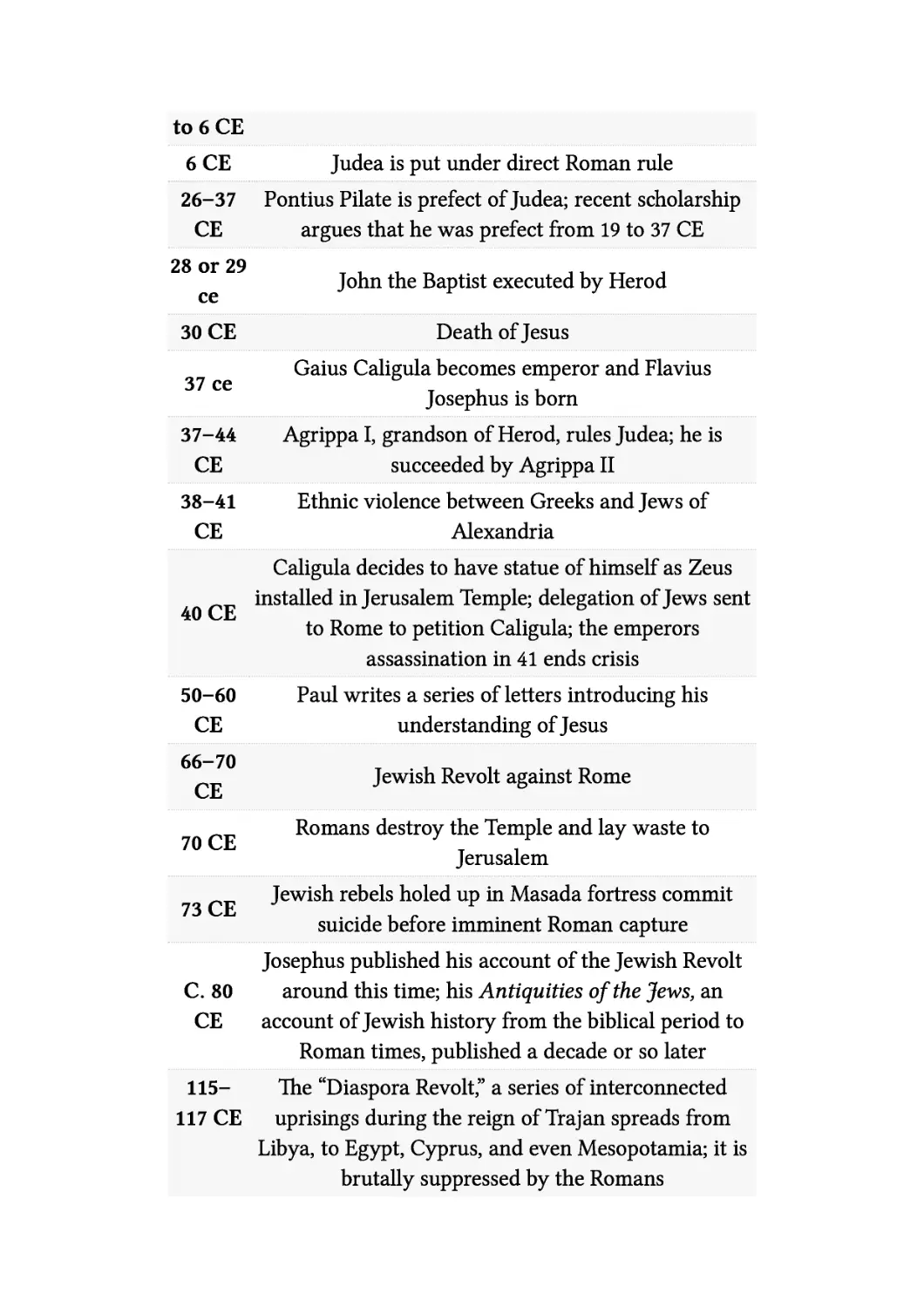
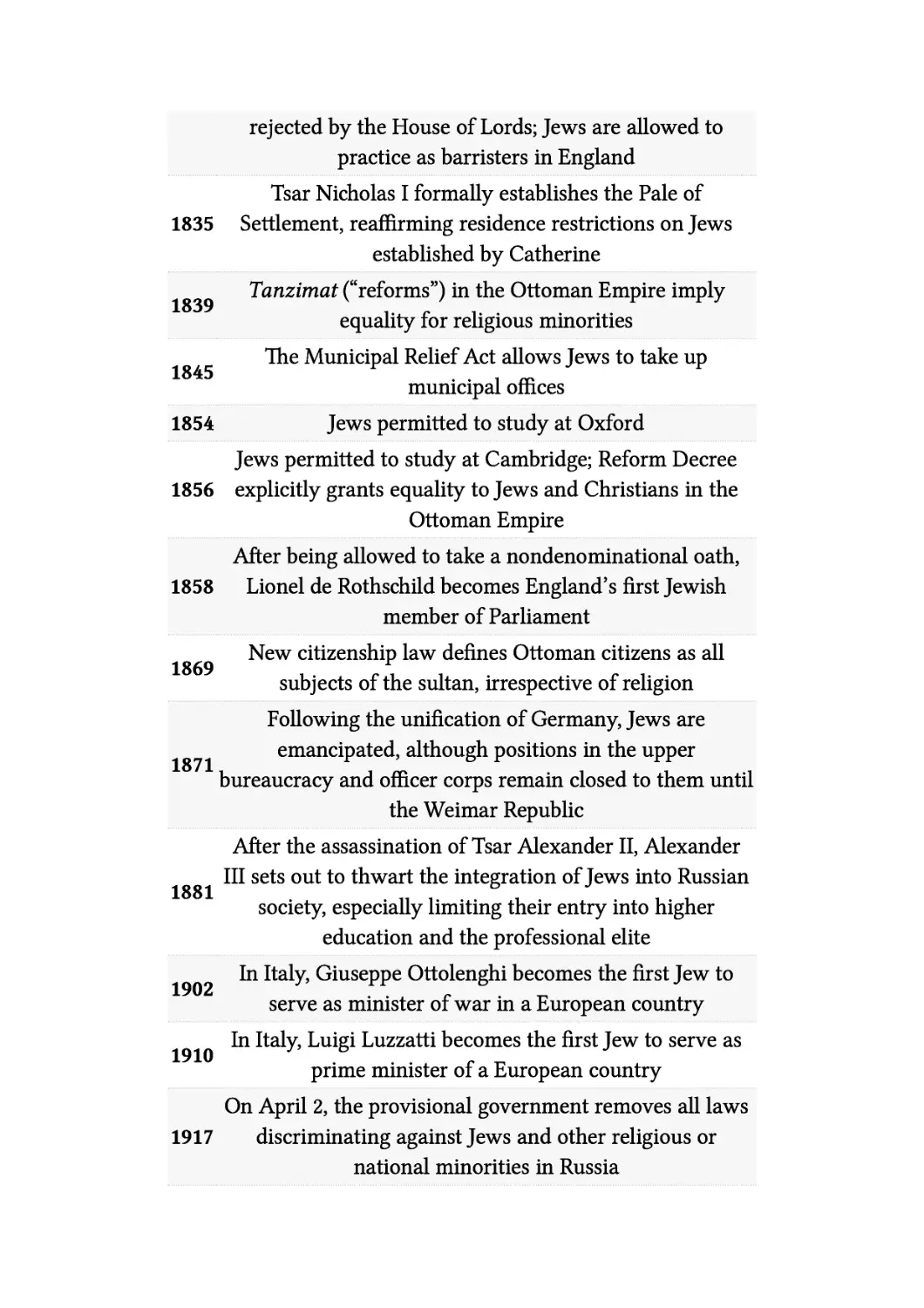
Timeline of Jewish History
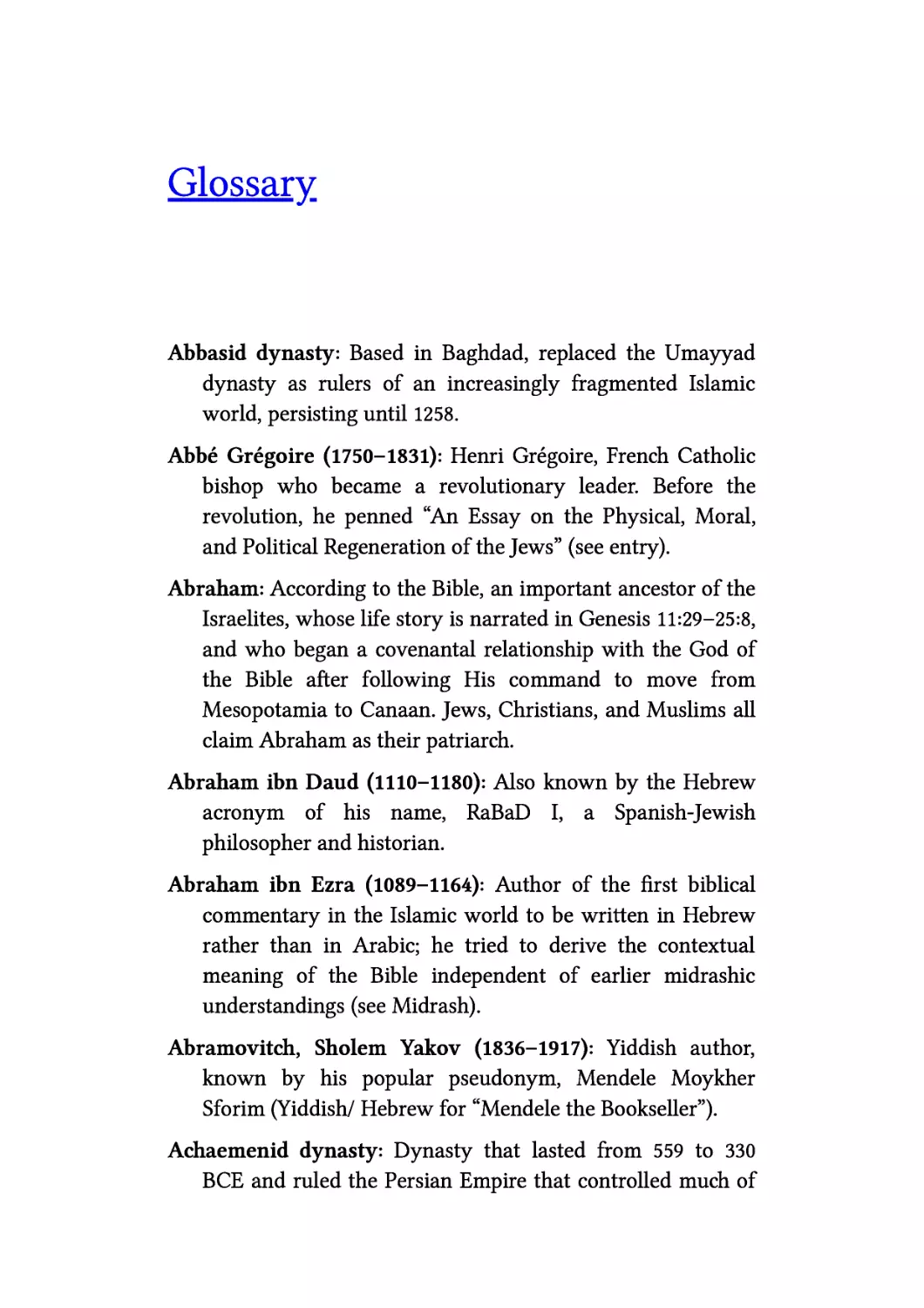
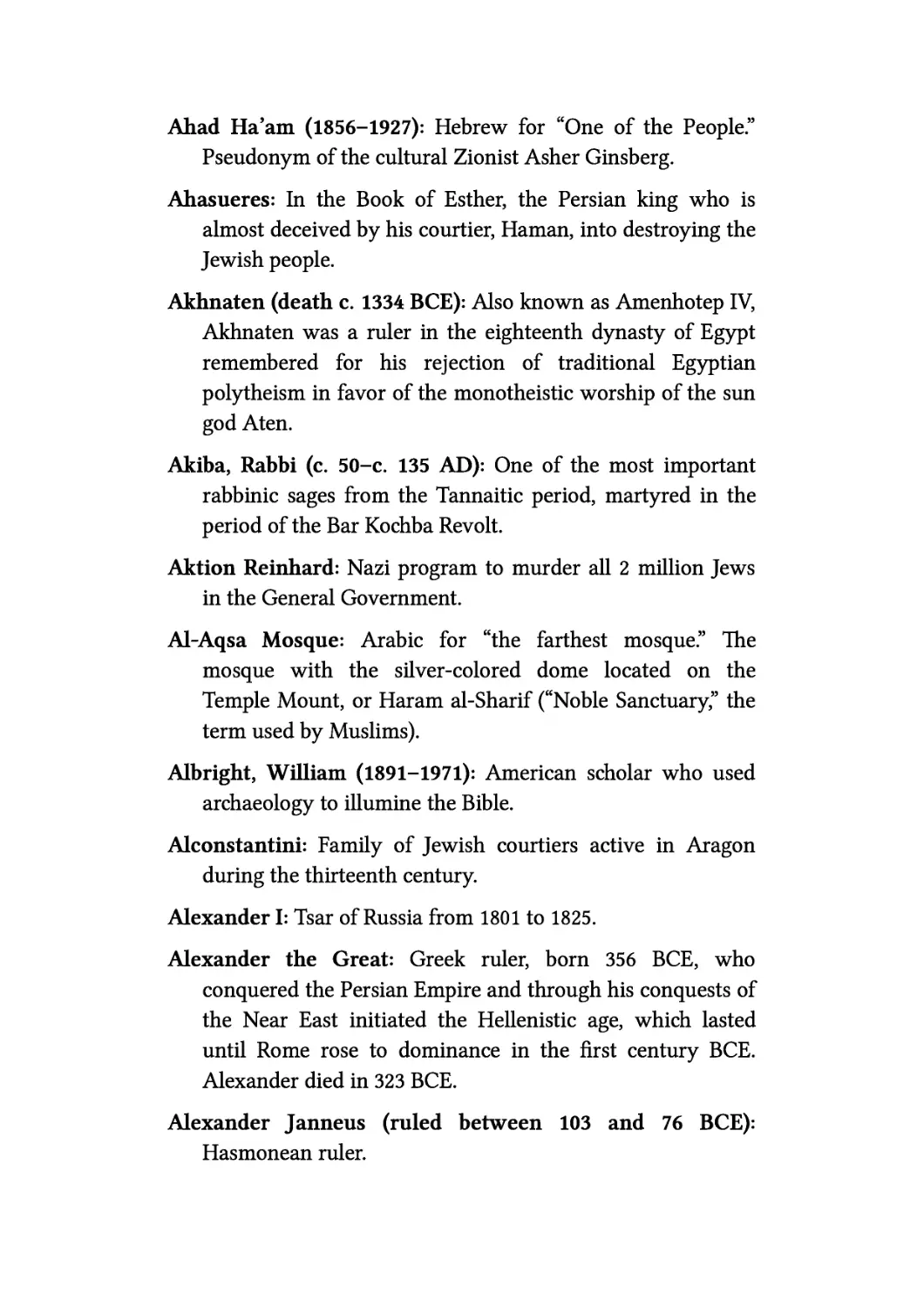
Glossary
Index
Figures
1.1 An image of the ancient Israelites?
1.2 A bronze figurine of a male deity, probably the Canaanite
storm god Baal, dating from c. 1400– 1300 BCE.
1.3 Philistine poery, very similar in its decoration to poery
from the Aegean world.
1.4 A reconstruction of Solomon’s Temple.
1.5 An inscribed pomegranate-shaped ornament once thought
to be the only known relic of the Temple of Solomon until its
inscription was discovered to be a forgery.
1.6 An ivory plaque from the royal palace in Samaria, capital
of the Northern Kingdom of Israel, dating to the ninth or
eighth century BCE.
1.7 A reconstructed layout of a typical Israelite house in the
period before the sixth century BCE.
1.8 Panel from the bla obelisk of King Shalmaneser III, from
Nimrud, c. 825 BCE, showing the tribute of King Jehu of
Israel, who is on his knees at the feet of the Assyrian king.
1.9 Does this photo capture an ancient Israelite representation
of God?
2.1 e Cyrus Cylinder.
2.2 Relief sculpture of King Darius the Great.
2.3 Fragments of a silver scroll inscribed with portions of the
priestly benediction known from Numbers 6.
2.4 One of the tablets of the Gilgamesh Epic.
2.5 A researer from the Israeli Antiquities Authority
examines 2,000-year-old fragments of the Dead Sea Scrolls at
the Israel Museum in Jerusalem, Israel, on December 18,
2012.
2.6 A page from the “Aleppo Codex,” the oldest known
manuscript of the complete Hebrew Bible, wrien around
930 CE.
3.1 A depiction of a fateful bale, the bale of Issus, fought
between Alexander the Great and the Persian king Darius III
in 333 BCE, from a first-century BCE mosaic found in the
Roman city of Pompey.
3.2 An image from a mosaic in late Roman Palestine depicting
a gate from the city of Alexandria.
3.3 A coin depicting Antious Epiphanes (Antious IV) being
crowned king by the goddess Athena.
3.4 Judith holding the head of General Holofernes, as
illustrated in the “Dore Bible” from 1866.
3.5 Members of the contemporary Samaritan community of
Nablus in the act of offering a Passover sacrifice.
3.6 Aerial view of an ancient selement at mran near the
Dead Sea, where, according to many solars, the sect that
produced the Dead Sea Scrolls once lived.
4.1 Statue of Augustus, the first Roman emperor.
4.2 A modern reconstruction of Herod’s Temple complex.
4.3 A reconstruction based on a foot found with a nail piercing
its heelbone, discovered in a Jerusalem suburb in 1968.
4.4 e fortress of Masada.
4.5 A coin minted by the Bar Koba rebels.
4.6 e earliest dated mikveh, or ritual bath, found in a
Hasmonean palace at Jerio, believed to have been in use in
the period between 150 and 100 BCE.
4.7 A 2,000-year-old religious symbol.
4.8 An ossuary (a box where the bones of the dead were
gathered) inscribed with the name Caiaphus.
5.1 A mosaic floor from a sixth-century synagogue at Beth
Alpha, near Beth Shean in modern-day Israel, depicting a
Greco-Roman zodiac.
5.2 A relief found in Iran depicting Shapur I’s victory over the
Roman emperor Valerian.
5.3 e “Madaba map” was part of a mosaic floor discovered in
the nineteenth century in a Byzantine ur at Madaba,
Jordan.
5.4 A scene from the wall painting of the Dura-Europos
synagogue depicting Mordeai and Haman from the book
of Esther, dressed in Persian garb.
5.5 A bowl with an Aramaic magical inscription used to
protect individuals from evil spirits.
5.6 An inscription from a synagogue in Rehov, Israel, from the
sixth or seventh century CE.
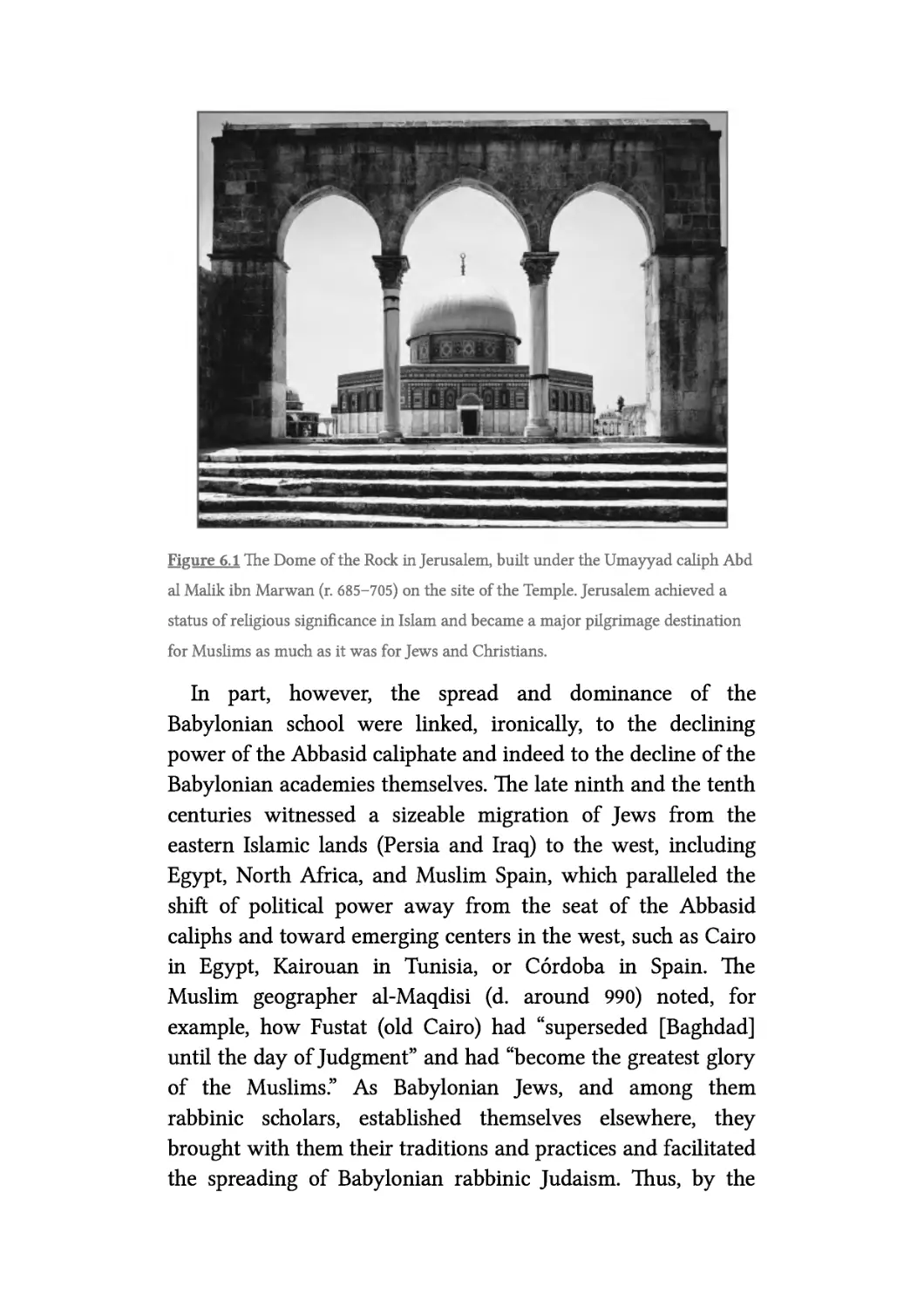
6.1 e Dome of the Ro in Jerusalem, built under the
Umayyad caliph Abd al Malik ibn Marwan (r. 685–705) on
the site of the Temple.
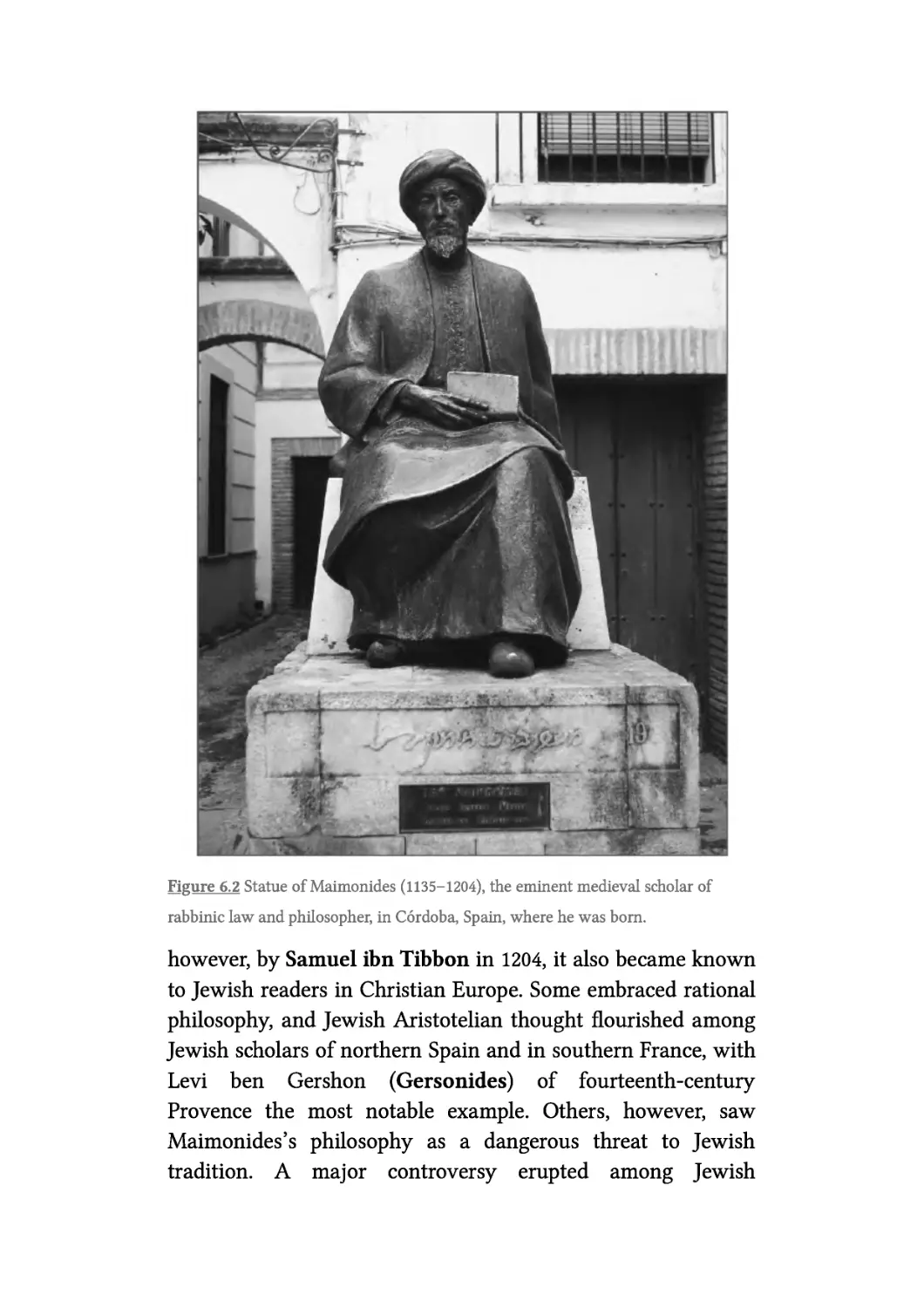
6.2 Statue of Maimonides (1135–1204), the eminent medieval
solar of rabbinic law and philosopher, in Córdoba, Spain,
where he was born.
7.1 e statue on the le is a medieval representation of the
Chur (i.e., Christianity), depicted as a proud and victorious
woman. On the right, the synagogue (i.e., Judaism) is
depicted as a blindfolded woman bearing a broken scepter.
7.2 Interior of El Transito Synagogue.
7.3 An illuminated Hebrew manuscript of the Jewish prayer
book from Spain (c. 1300).
7.4 A diagram of the ten sefirot, or emanations of God in
Kabbalistic tradition, and their relationship to one another.
8.1 Portuguese Inquisition at work: the burning of heretics aer
an auto-da-fé in Lisbon, as depicted in an eighteenth-
century print by Bernard Picart.
9.1 Page from a Hebrew sefer evronot, a book on the Jewish
calendar, depicting the zodiac sign of Pisces. Halberstadt,
Germany, 1716.
9.2 Barukh (Benedict) de Spinoza (1632–1677), the first modern
Jewish intellectual—and one of the great philosophers and
political thinkers of the seventeenth century.
9.3 Shabbatai Zvi (1626–1676), the messiah of Izmir.
10.1 e document pictured here is one of the scores of
regularly published edicts in eighteenth-century Prussia that
aempted to regulate the movement of Jews
10.2 On May 6, 1789, Daniel Mendoza knoed out Riard
Humphrey aer 35 minutes.
10.3 Frontispiece of Judah Monis’s A Grammar of the Hebrew
Tongue Being an Essay to Bring the Hebrew Grammar Into
English, to Facilitate the Instruction of All Those Who Are
Desirous of Acquiring a Clear Idea of This Primitive Tongue
by Their Own Studies.
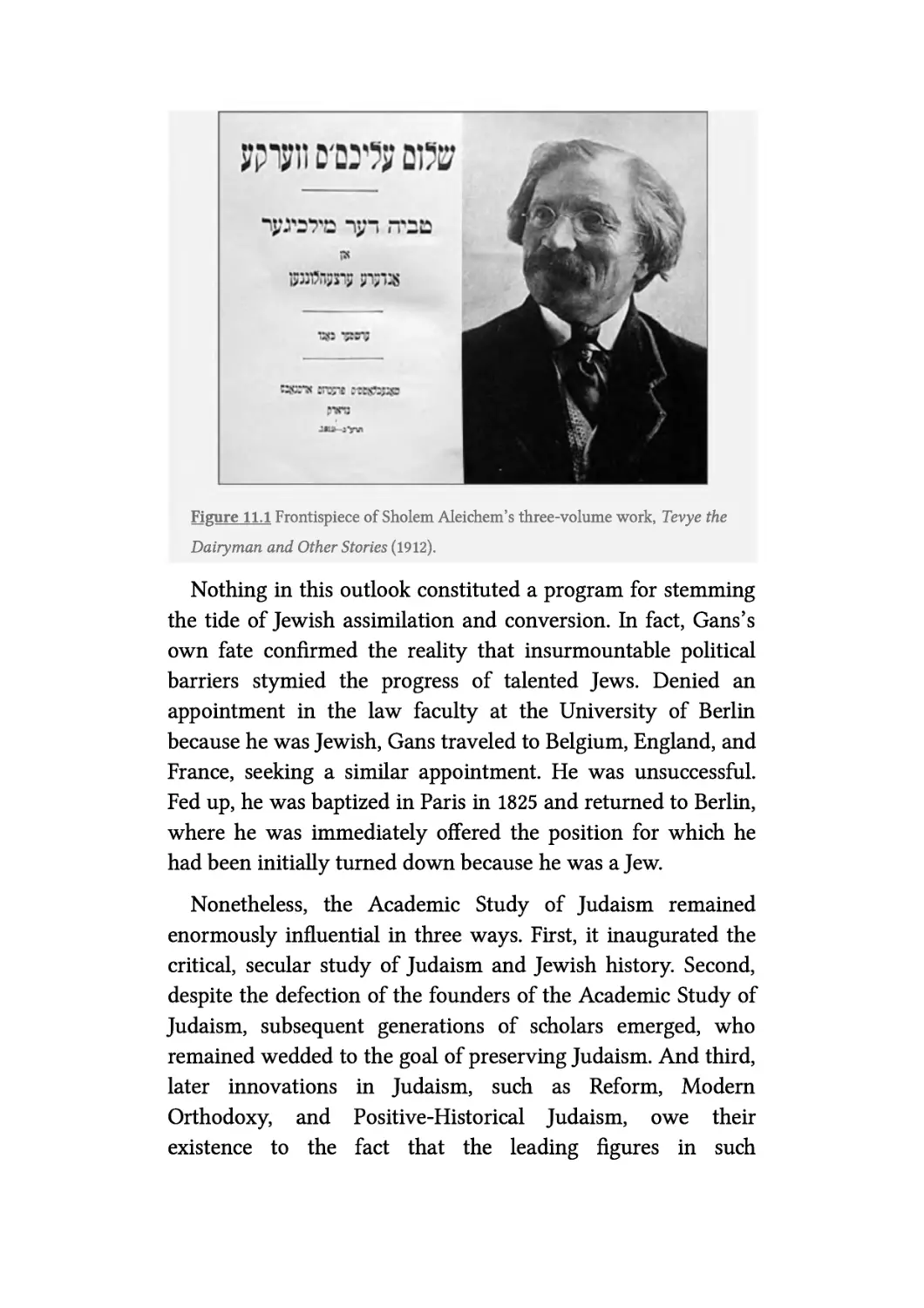
11.1 Frontispiece of Sholem Aleiem’s three-volume work,
Tevye the Dairyman and Other Stories (1912).
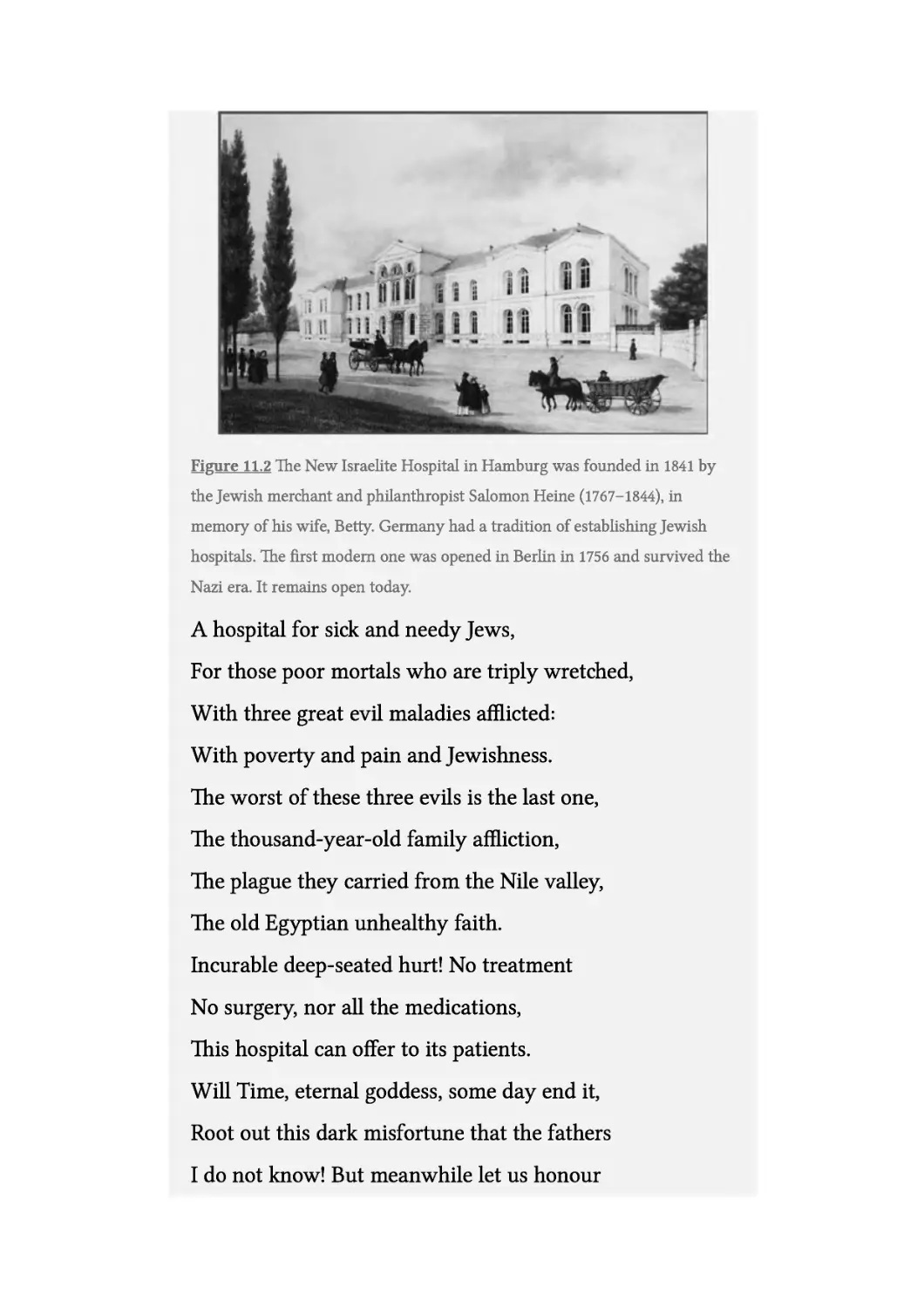
11.2 e New Israelite Hospital in Hamburg was founded in
1841 by the Jewish merant and philanthropist Salomon
Heine (1767–1844), in memory of his wife, Bey.
11.3 Modern Orthodoxy, of whi Samson Raphael Hirs was
the founder, was just as keen to ange Judaism’s aesthetic
as was Reform Judaism.
12.1 Election poster for Adolphe-Léon Willee.
12.2 Burying Torah scrolls aer the Kishinev pogrom (1903).
12.3 Satirical cartoon depicting the process of Jewish
assimilation.
12.4 Ephraim Moses Lilien (1874–1925) was a Galician
illustrator and photographer.
13.1 Youngsters at a Jewish summer camp in interwar Poland.
13.2 Zofia Oldak, winner of the Miss Judea Pageant, 1929.
13.3 Judah Bergman, aka Ja “Kid” Berg, aka “e
Whiteapel Windmill” (1909–1991).
13.4 e “White City” in Tel Aviv (1930s).
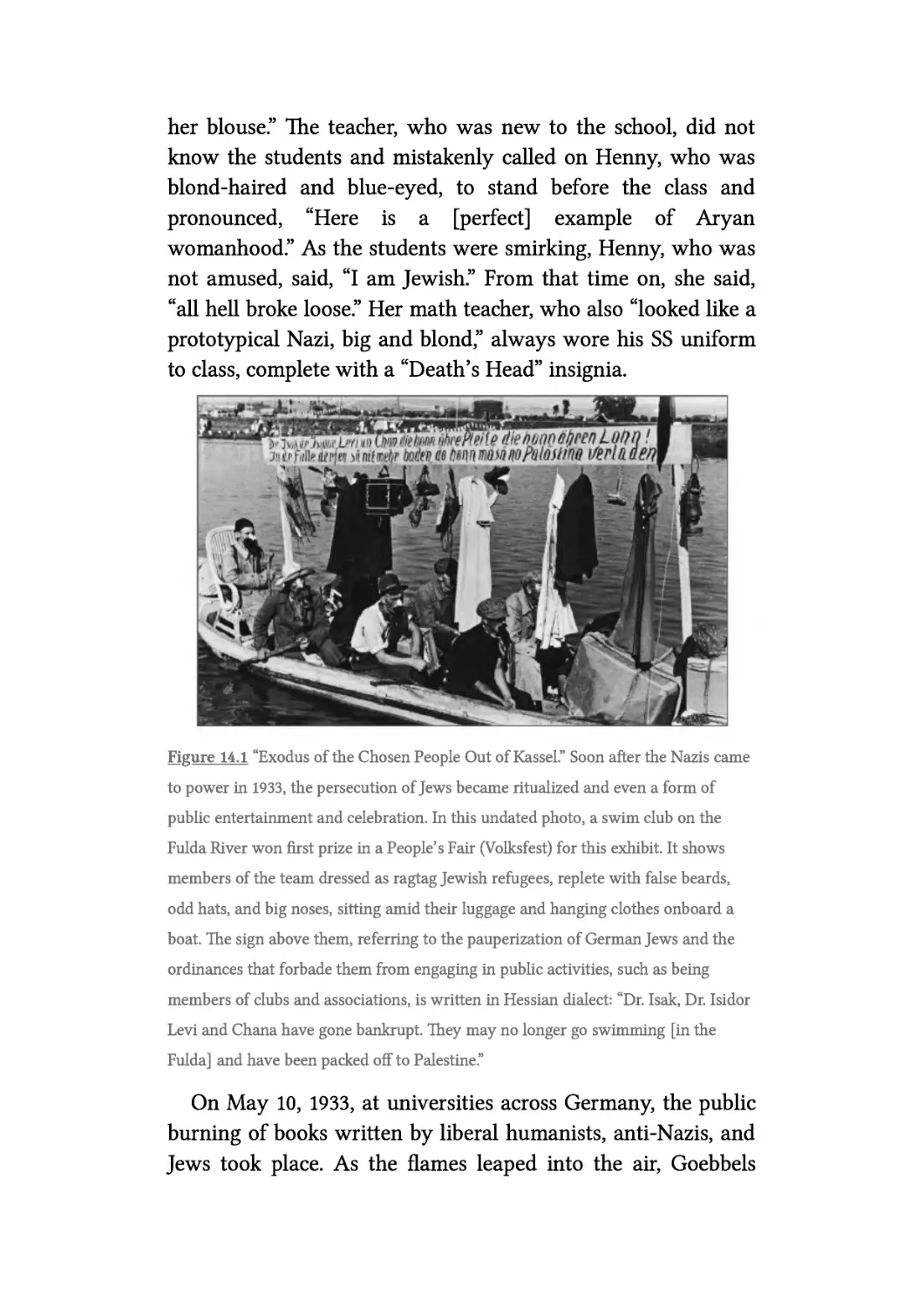
14.1 “Exodus of the Chosen People Out of Kassel.”
14.2 Welding instruction for prospective Jewish emigrants
(1936).
14.3 e burned-out interior of Berlin’s Fasanenstrasse
Synagogue aer Kristallnat.
14.4 Persecution of an Orthodox Jew in Warsaw, 1941.
14.5 Jewish money from eresienstadt.
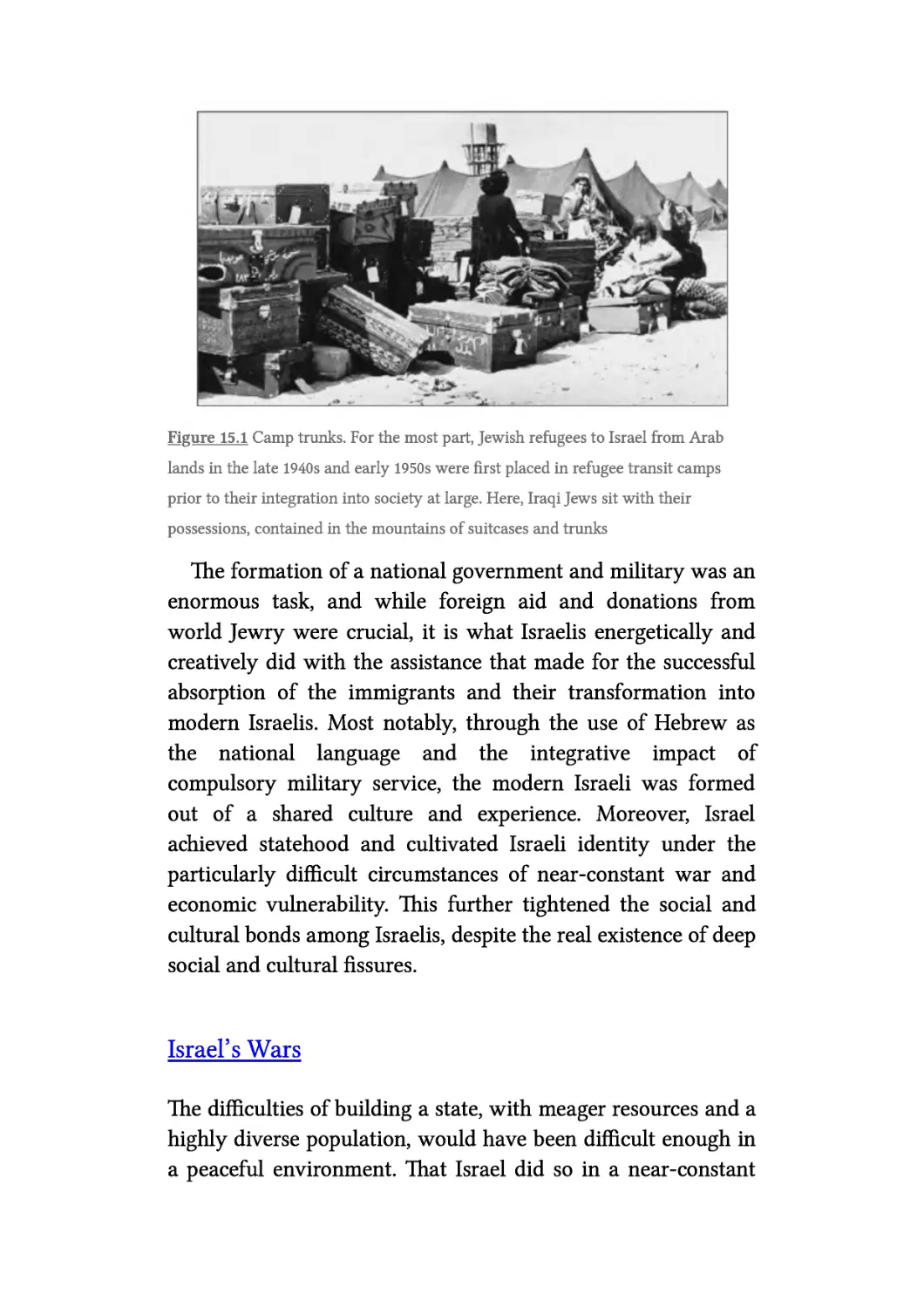
15.1 Camp trunks.
15.2 Exterior of Beth Sholom Congregation, Philadelphia.
15.3 Logo of Justice for Jews from Arab Countries (JJAC).
15.4 Itsik Fefer, Albert Einstein, and Shlomo Mikhoels (1943).
Maps
Map 1.1 Canaan in the context of the Ancient Near East
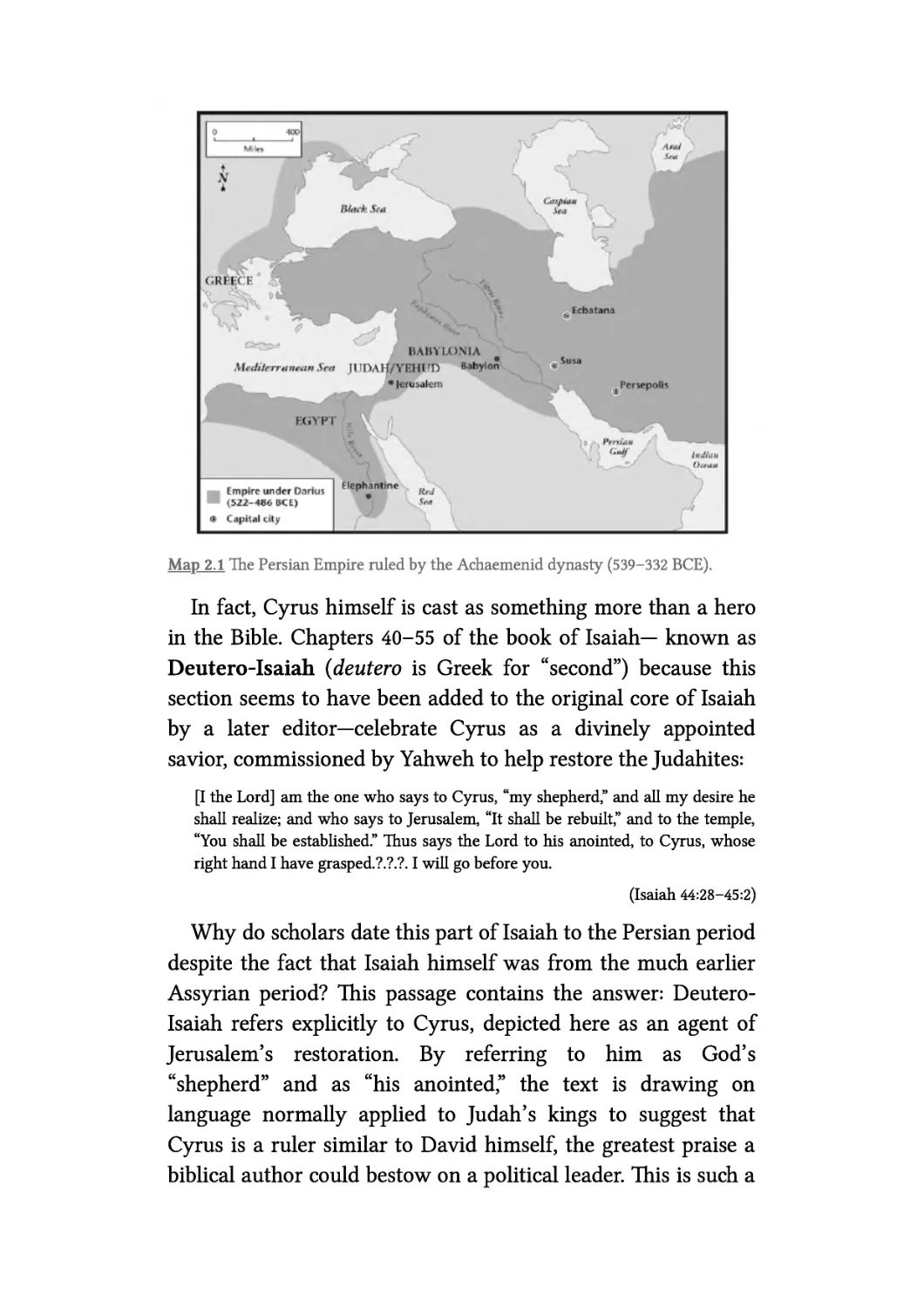
Map 2.1 e Persian Empire ruled by the Aaemenid dynasty
(539–332 BCE)
Map 3.1 e Seleucid and Ptolemaic kingdoms prior to the
former’s conquest of Judea around 200 BCE
Map 4.1 e Roman Empire in the second/third centuries
Map 6.1 e expansion of Islam, from Muhammad to the
beginning of the Abbasid caliphate (750)
Map 6.2 e Christian reconquest (Reconquista) of Muslim
Spain
Map 6.3 e trading circuit of the Jewish traders known as the
Radhanites
Map 7.1 e route of the First Crusade, 1096
Map 7.2 e expulsion and migration of Jews from Western
Europe, 1000–1500
Map 8.1 Expulsion of the Jews from Spain, with major
Sephardi communities in the Ooman Empire
Map 9.1 Jewish communities in the Polish-Lithuanian
Commonwealth
Map 10.1 e emancipation of European Jewry, 1790–1918
Map 11.1 e spread of Hasidism and Mitnaggdism in the
eighteenth and nineteenth centuries
Map 12.1 e Jewish Pale of Selement, 1835–1917
Map 13.1 e Jews of Interwar Europe
Map 14.1 Deportation routes to death camps, 1942–1944
Map 15.1 Jewish immigration to the State of Israel, 1948–1950
Preface to the ird Edition
A decade has passed since the publication of the first edition of
The Jews: A History, and we are older, perhaps a bit wiser, and
certainly more mindful of the allenges of undertaking a
history like this. Our original goal was not just to provide a
reliable account of Jewish history that would be accessible and
engaging for readers, but to do so in a way that helped readers
to learn that history—to understand it for themselves, to
remember it, to be able to question what solars claim about
it, and to feel motivated to go deeper. at has proven a
humbling allenge, and this third edition is an
anowledgment that our efforts remain a work in progress, a
project that needs to develop in dialogue with students.
Like the two earlier editions of The Jews, this one is an
aempt to balance between different goals. We wanted a
narrative that would help readers navigate through 3,000+
years of history, but we did not want to gloss over the
allenges of reconstructing and interpreting that history. We
wanted to be as inclusive as possible, incorporating the
experiences of women, slaves, workers, and others
overshadowed in earlier accounts, but at the same time we did
not want to sleight the efforts of the intellectual and cultural
elites that produced works like the Bible, the Talmuds, and
other important texts. We wanted to be faithful to the
solarship, to register areas of debate or uncertainty and to
capture new developments, but we also want our narrative to
be digestible and comprehensible, to not turn away or
overwhelm readers new to the study of history. It is for readers
to decide how successful we have been in balancing between
these goals, but we have certainly benefited from having the
ance to reflect on the shortcomings of earlier editions, and
from the feedba we have received from users.
Ea of us was responsible for roughly a third of the book,
and we wanted to lay out the anges we have made that
distinguish this volume from earlier editions.
Chapters 1–5, covering ancient Jewish history until the rise
of Islam, was wrien by Steven Weitzman, and he has
introduced a number of substantive anges, including: (1)?a
revised and expanded discussion of the foundational texts
produced in this period, especially biblical literature and
rabbinic literature; (2) a broadened discussion of religion and
culture, including more aention to topics like sexual/mating
practices, language, and prayer; and (3) the addition of new
boxes meant to make the narrative more interesting and varied
and that incorporate new resear, su as the genetic study of
Jewish ancestry. More than in earlier editions, he has sought to
call aention to some of the allenges of reconstructing
ancient history and to highlight how our assumptions shape
our understanding of the past.
Chapters 6–9, wrien by Mahias Lehmann, introduce the
medieval and early modern periods, covering the millennium
from the rise of Islam in the 600s to the end of the seventeenth
century. Chapters 6 and 7 were completely rewrien for the
second edition, and Chapters 8 and 9 expanded. e anges to
this middle part of the book are modest in the third edition,
including improvements and corrections throughout and
additional material in Chapter?9.
Chapters 10–15, covering modern Jewish history, roughly
from the era just prior to legal emancipation in Europe in the
eighteenth century until today, were wrien by John Efron.
Among the expanded and new subjects he has introduced are
(1) greater aention to questions of gender in modern Jewish
history; (2) the incorporation of new resear on Hasidism and
Mitnaggdism; (3) a discussion of anged Israeli aitudes
toward the Holocaust and Holocaust survivors; (4) a fuller
account of the Israeli-Palestinian peace process; and (5) an
entirely new discussion of the rise of contemporary
antisemitism in Europe and the United States as well as
campus politics surrounding Israel and Jews.
Publisher’s Anowledgments
The publishers are grateful to the following for permission to
reproduce copyright material:
Princeton University Press for excerpts from James B.
Pritard, Ancient Near Easter Texts Relating to the Old
Testament, Princeton: Princeton University Press, 1958, reprint
1973; Yale University Press for excerpts from James H.
Charlesworth, The Old Testament Pseudepigrapha, Volume 2:
Expansions of the Old Testament and Legends, Wisdom and
Philosophical Literature, Prayers, Psalms and Odes, Fragments
of Lost Judeo-Hellenistic Works, Yale University Press, 1985;
Harvard University Press for an excerpt from Manetho, cited in
Josephus, The Life. Against Apion, translated by H. St. J.
aeray, Cambridge, MA: Harvard University Press, 1926,
reprinted 1993, pp. 260–1; Harvard University Press for excerpts
from Josephus, The Jewish War, Volume I: Books 1–2, translated
by H. St. J. aeray, Cambridge, MA: Harvard University
Press, 1927, reprinted 1989; e Israel Academy of Sciences and
Humanities for translations from Menahem Stern, Greek and
Latin Authors on Jews and Judaism, Jerusalem: e Israel
Academy of Sciences and Humanities, vol. I (1974), pp. 210,
197–198, 431; vol. II (1980), p. 26. © e Israel Academy of
Sciences and Humanities. Reproduced by permission.; Harvard
University Press for excerpts from Philo, On the Decalogue. On
the Special Laws, Books 1–3, translated by F. H. Colson,
Cambridge, MA: Harvard University Press, 1937, reprinted
1984; WM. B. Eerdmans Publishing Co for translation of
Genesis Rabbah, adapted from Gary Porton, “Rabbinic
Midrash”, A History of Biblical Interpretation, vol. 1, eds. Alan
Houser and Duane Watson, Grand Rapids, MI: William B.
Eerd-mans, 2003, pp. 215–216; Hae Publishing for an
excerpt from a Spanish solar in Baghdad, in Alexander
Altmann, introduction to Sa’adya Gaon,?The Book of Doctrines
and Beliefs, Oxford: East and West Library, 1946, 13; Criet
Media for an eleventh-century Arabic poem, translation from
Bernard Lewis, Islam in History, revised ed., Peru, Illinois:
Open Court, 167–170; Koren Publishers Jerusalem for an
excerpt from Judah Halevi, Kuzari, translated by Isaak
Heinmann, in Three Jewish Philosophers, New York:
Atheneum, 1969, 28; Hebrew Union College Press for excerpts
from Jacob Marcus, The Jew in the Medieval World: A
Sourcebook, rev. ed., Cincinnati: Hebrew Union College Press,
1999, pp. 229–230, 215–216, 186–188, 224–225; Princeton
University Press for excerpts quoted from Mark Cohen, Poverty
and Charity in the Jewish Community of Medieval Egypt,
Princeton: Princeton University Press, 2005, 94, 119; Koninklijke
Brill NV for an excerpt from I.G. Marcus, Piety and Society,
Leiden: Brill, 1981, 93; University of Pennsylvania Press for
Song of the Cid, quoted from Medieval Iberia, ed. Olivia
Constable, Philadelphia: University of Pennsylvania Press,
1997, 113; Behrman House Inc. for excerpts from Church, State,
and Jew in the Middle Ages, ed. Robert Chazan, West Orange:
Behrman House, 1980, 58–59, 131 Penguin Random House LLC
for an excerpt from Zohar /From Kabbalah by Gershom
Solem, copyright © 1949 and copyright renewed © 1977 by
Penguin Random House LLC. Used by permission of Soen
Books, an imprint of the Knopf Doubleday Publishing Group, a
division of Penguin Random House LC. All rights reserved;
Princeton University Press for leer from Isaac Zarfati, quoted
in Bernard Lewis, The Jews of Islam, Princeton: Princeton
University Press, 1984, 135–136; e Jewish eological
Seminary for an excerpt from Samuel de Medina, English
translation from Morris Goodbla, Jewish Life in Turkey in the
XVIth Century, New York: Jewish eological Seminary, 1952,
pp. 187–188; Stanford University Press for an excerpt from
Physician of the Soul, Healer of the Cosmos: Isaac Luria and his
Kabbalistic Fellowship by Lawrence Fine © 2003 by the Board
of Trustees of the Leland Stanford Jr. University. All rights
reserved. Used by permission of the publisher, Stanford
University Press, sup.org; Paulist Press for an excerpt from
Lawrence Fine, Safed Spirituality: Rules of Mystical Piety, the
Beginning of Wisdom, Mahwah, NJ: Paulist Press, 1984, 62;
Princeton University Press for excerpts from Leon Modena, The
Autobiography of a Seventeenth-Century Venetian Rabbi: Leon
Modena’s Life of Judah, trans. Mark Cohen, Princeton
University Press, 1988, 108, 107; Yale University Press for
excerpts from Azariah de’Rossi, The Lights of the Eyes, trans.
Joanna Weinberg, New Haven: Yale University Press, 2001, 86,
241, 386–388; University of Pennsylvania Press for an excerpt
from Alexander Marx, “A Seventeenth Century
Autobiography”, Jewish Quarterly Review 8: 288–291; Hebrew
Union College Press for excerpt quoted from Edward Fram,
Ideals Face Reality: Jewish Law and Life in Poland, 1550–1655,
Cincinnati: Hebrew Union College Press, 199, 70; Liverpool
University Press for an excerpt quoted in Elanan Reiner, “e
Ashkenazi Elite at the beginning of the Modern Era:
Manuscript Versus Printed Book”, Polin 10, Oxford: Liman,
1997, 86; Penguin Random House LLC for excerpts from The
Memoirs of Glückel of Hamelin by Marvin Lowenthal,
translation copyright © 1932, renewed copyright © 1960 by
Rosamond Fisher Weiss. Used by permission of Soen
Books, an imprint of the Knopf Doubleday Publishing Group, a
division of Penguin Random House LC. All rights reserved;
Simon & Suster, Inc. for an excerpt from Jews of Spain:
History of the Sephardic Experience by Jane S. Gerber.
Copyright © 1992 by Jane S. Gerber. Reprinted with permission
of e Free Press, a division of Simon & Suster, Inc. All
rights reserved; Columbia University Press for an excerpt
quoted in Miael Meyer, ed., German-Jewish History in
Modern Times, vol. 1, New York: Columbia University Press,
1996, 97; Liverpool University Press for an excerpt quoted in
Daniel Swetsiniski, Reluctant Cosmopolitans: The Portuguese
Jews of Seventeenth-Century Amsterdam, Oxford: Liman,
2000, 246; Farrar, Straus and Giroux for an excerpt from Isaac
Bashevis Singer, The Slave, translated by the author and Cecil
Hemley, New York: Avon Books, 1961, 92; e University of
Pennsylvania Press for an excerpt by Isaac Marcus Jost, noted
in Miael A. Meyer, “New Reflections on Jewish
Historiography”, the Jewish Quarterly Review, Vol. 97, No. 4
(Fall 2007); Indiana University Press for an excerpt from Moritz
Siegel, quoted in Moika Riarz, ed., Jewish Life in Germany:
Memoirs from Three Centuries, Bloomington: Indiana
University Press, 1991, 121; Jewish Gen.org for an excerpt from
Benjamin Bialostotzky from an account of Pumpian,
hp://www.jewishgen.org/yizkor/lita/lit1203.html; Columbia
University Press for Hayim Nahman Bialik, “Be-Ir ha-
Haregah”, quoted in Alan Mintz, ed., Hurban: Responses to
Catastrophe in Hebrew Literature, New York: Columbia
University Press, 1984, 135; Penguin Random House LLC for an
excerpt from Letter to the Father / Brief an den Vater: Bilingual
Edition by Franz Kaa, translated by Ernst Kaiser and Eithne
Wilkins, edited by Max Brod, copyright © 1953, 1954, 196 by
Penguin Random House LLC. Used by permission of Soen
Books, an imprint of the Knopf Doubleday Publishing Group, a
division of Penguin Random House LC. All rights reserved;
University of California Press for an excerpt from Joseph Hall,
cited in Gerald Fleming, Hitler and the Final Solution, Berkeley:
University of California Press, 1982, 17; the Yad Vashem
Library for an excerpt from Rumkowski, Spee of 9/4/42 in I.
Trunk, Lodz Gheo, translated in Yitzhak Arad, Israel Gutman,
Abraham Margaliot, eds., Documents on the Holocaust, Yad
Vashem and University of Nebraska Press, 1981, 2831; Behrman
House Inc. for a poem from Lucy S. Dawidowicz, A Holocaust
Reader, 1976, 207; Simon & Suster, Inc. for an excerpt from
Scroll of Agony: The Warsaw Diary of Chaim A. Kaplan by
Abraham I. Katsh, Translator and Editor. Copyright © 1965,
1973 by Abraham I. Katsh. Reprinted with permission of
Scribner, a division of Simon & Suster, Inc. All rights
reserved; University of California Press for “How” in A.
Sutzkever: Selected Poetry and Prose, ed., and trans., Barbara
and Benjamin Harshav, Berkeley: University of California
Press, 1991; Solastic Library Publishing, Inc. for an excerpt
from Abba Kovner spee at Vilna 1/1/1942 quoted in Yehuda
Bauer, A History of the Holocaust, New York: Franklin Was,
1982, 250–251; Walter de Gruyter and Company for an excerpt
from Joseph Lewi, An Anthology of Modern Yiddish
Literature, e Hague: Walter de Gruyter, 1974, 306; Princeton
University Press for an excerpt from Yuri Slezkine, The Jewish
Century, Princeton: Princeton University Press, 2004, 341;
www.BibleLandPictures.com / Alamy Sto Photo for figures
1.1, 1.2, 1.3, 1.4, 1.5, 1.6, 1.7, 1.8, 2.3, 2.4, 2.6, 3.2, 3.6, 4.2, 4.6, 4.7,
5.1, 5.3, 5.6 and 9.3; Z. Radovan / Bible Land Pictures for figures
1.9, 2.1, 2.2, 3.3, 3.5, 4.3, 4.8 and 5.4; epa european pressphoto
agency b.v. / Alamy Sto Photo for figure 2.5; Ivy Close
Images / Alamy Sto Photo for figure 3.1; Stefan Sor for
figure 3.4; Erin Babnik / Alamy Sto Photo for figure 4.1;
Duby Tal / Albatross / Alamy Sto Photo for figure 4.4; e
Trustees of the British Museum for figures 4.5 and 5.5; Sonia
Halliday Photo Library / Alamy Sto Photo for figure 5.2;
Lessing images for figure 6.1; Linda Whitwam / DK Images for
figure 6.2; bpk / Kunstbibliothek, SMB / Knud Petersen for
figure 7.1; Roy Lindman for figure 7.2 licensed under the
Creative Commons Aribution-Share Alike 3.0 Unported
License; bpk / Staatsbibliothek zu Berlin / Ruth Sat for
figure 7.3; Chronicle / Alamy Sto Photo for figure 7.4; De
Agostini / G. Dagli Orti / Gey Images for figure 8.1; Granger /
Granger for figure 9.1 – All rights reserved; Arive Photos /
Stringer / Gey Images for figure 9.2; bpk for figures 10.1, 11.3,
12.3, 14.4, 14.5; Jewish Museum London for figure 10.2; e
Library of Congress for figures 10.3 and 13.4; John Efron for
figures 11.1, 12.4 and 15.4; Leo Baek Institute for figures 11.2
and 14.3; the Arives of the Yivo Institute for figures 12.2, 13.1
and 13.2; Central Press / Stringer / Gey Images for figure 13.3;
bpk / E.K. Baumgart for figure 14.1; bpk | Abraham Pisarek for
figure 14.2; Arcaid Images / Alamy Sto Photo for figure 15.2.
Every effort has been made to contact copyright-holders.
Please advise the publisher of any errors or omissions, and
these will be corrected in subsequent editions.
Anowledgments
The authors wish to express their gratitude to several
individuals whose behind-the-scenes efforts made this volume
possible. Eve Set, the editor who brought this project to
Taylor and Francis, has been a wonderfully resilient ampion,
always remaining enthusiastic even in the face of formidable
allenges that have surfaced along the way. We are grateful as
well for the patience and aention to detail shown by her
editorial assistant Zoe omson. We also wish to anowledge
the efforts of two others who were crucial to the process of
making the book a reality: production editor Bonita Glanville-
Morris and Sheri Sipka, project manager at Apex CoVantage.
As we have moved from one edition to another, we have come
to appreciate that there is mu more to producing a text book
than what its authors contribute, and we feel indebted to all
those whose efforts have made the current edition possible.
Notes on Spelling and
Transliteration
THE SPELLINGS of many place names that appear in the history
of the Jews have multiple variants, reflecting the different
languages spoken by the people who inhabited them. In cases
su as Vilna/Wilno/Vilnius (the modern-day capital of
Lithuania), we have osen the name? used by the place’s
Jewish inhabitants. Wherever possible, the authors have
transliterated Hebrew terms using those forms most familiar to
them and to lay readers. ese forms may occasionally vary
from apter to apter because they originate with different
authors. Yiddish words typically follow the YIVO (the Yiddish
acronym for the Yiddish Scientific Institute, the major
institution for the study of Yiddish and Eastern European
Jewish history and culture) system of transliteration. Hebrew
expressions less familiar to nonspecialists are transliterated to
ensure accurate pronunciation of the words. We have followed
a similar procedure for terms drawn from other languages,
su as Greek and Arabic.
Chapter 1
ANCIENT ISRAEL AND OTHER
ANCESTORS
JEWS HAVE LONG traced their origin to the Five Books of Moses
in the Bible, to the story of Abraham and Sarah and their
descendants, the Exodus from Egypt, and the revelation at
Mount Sinai. We suspect that this is where many readers
would expect a book like this to begin, and one has to admit
that stories like those told in Genesis and Exodus make for a
great opening, one of the most memorable origin stories ever
told. But there is a complication that prevents us from
beginning in this way.
Over the last few centuries, solars have come to question
the traditional account that traces the Jews ba to the people
and events described in the Bible, just as scientists came to
question the Bible’s explanation of how the world began, and
they have developed many alternative reconstructions of
ancient Jewish history, some directly at odds with the biblical
account. Since our goal in this book is to share the fruits of
modern historical resear, should we not begin with these
solarly accounts? Perhaps, but solars do not agree among
themselves about how the Jews originated. ey have been
successful in raising doubts about the stories of Abraham,
Moses, and David—thanks to modern historical and
araeological resear, we can no longer be certain that su
figures even existed—but they have not seled on an
alternative understanding of how the Jews originated. We have
to struggle not only with how lile we know about ancient
Jewish history but also with how many possible ways there are
to understand that history.
Consider how difficult it is to resolve when to begin Jewish
history. Before we can begin recounting the history of the
Jewish people, we must obviously decide when exactly to begin
it, and it is not easy to commit oneself to a particular date or
even a century as a starting point. As we have noted, Jews
themselves have long believed their history begins with
Abraham’s sojourn to the land of Canaan and the Exodus from
Egypt, but we do not know when these events occurred, if they
occurred at all, and there are other problems as well. e
people described in mu of the Bible do not call themselves
Jews, but Israelites, or the “sons of Israel” to be more precise,
and their culture and religion differ from that of later Jews in
many ways. Perhaps the beginning of Jewish history should be
placed at the point at whi the ancient Israelites become the
Jews, but when exactly does that transformation take place?
Many solars place it at the end of the period described by the
Hebrew Bible, in the wake of the Babylonian Exile in 586?BCE.
Some place it even later, aer the conquests of Alexander the
Great in the fourth century BCE, and some still later, in the age
of Roman rule and the ascendancy of Christianity. Depending
on whi account you happen to read, the story of the Jews
begins 4,000 years ago in the Middle Bronze Age, or 2,000 years
ago in the same age that produced Christianity, and some
would go so far as to argue that we cannot really speak of “the
Jews”—as opposed to the Israelites or the ancient Judeans—
until medieval or modern times.
Why is it so difficult to fix a clear starting point for Jewish
history? One reason is that we simply do not have a lot of
evidence for the earliest periods of Jewish history, but that is
not the only complication. Another is that solars do not
agree about what Jewish means exactly and how it relates to or
differs from overlapping terms used in the Bible, su as
Israelite and Hebrew. e term Jew derives from the name
“Judah” or Yehuda, but even in the Hebrew Bible that term has
several possible meanings, referring to an Israelite tribe, to a
territory in the southern part of Canaan, and also to the
kingdom based in this territory and ruled by David and his
descendants. Aer the end of the biblical period, the terms
translated as Judean and Jewish acquired still other
connotations, signifying a particular way of life or adherence
to particular beliefs. e term’s ambiguity continues to this
day, with Jewish signifying a religion for some, for others a
cultural or ethnic identity that may not be religious in
orientation, and for still others a national identity, su as
Fren, Turkish, or American. To fix a single starting point for
“Jewish” history would commit us to a specific definition of
Jewishness at the expense of other definitions that also have
merit.
Still, we must begin somewhere, and this book has opted to
begin where Jews themselves have long looked to understand
their origins—with “history” as described in the Hebrew Bible.
We put the word history in quotes here because it is not clear
that the biblical account corresponds to what counts as history
for a historian, the past as it actually happened. Modern
solarship has expressed doubts about the Hebrew Bible’s
value as a historical document, questioning whether the people
described in the Bible, su as Abraham and Moses, really
existed and whether key events, su as the Exodus and the
revelation at Mount Sinai, really occurred. e skepticism of
solars has alienated some Jews and Christians who believe in
the Bible as an accurate account of how reality works, but the
reasons for this skepticism cannot be dismissed out of hand if
one is willing to approa the evidence with an open mind.
Mindful of what modern solarship has concluded about the
Bible, one of our goals in this apter is to open the question of
what really happened, to ask whether the biblical account of
Israel’s history—its stories of Abraham and his family, the
Exodus from Egypt, Joshua’s conquest of the land of Canaan,
the rule of King David—corresponds to the past as
reconstructed by historians and araeologists.
Even as we question the biblical account, however, we will
also try to provide a sense of how it tells the story of ancient
Israel because, regardless of whether that story corresponds to
what actually happened, it is crucial for understanding the
development of Jewish culture. For one thing, Jewish culture
did not suddenly appear one day; it evolved out of an earlier
Israelite culture from whi it inherited beliefs, practices,
language(s), texts, and paerns of social organization. Why do
Jews worship a God who they believe created the world? Why
are Canaan and Jerusalem so central in Jewish culture? What
are the origins of Jewish religious practices su as
circumcision, resting on the Sabbath, and keeping kosher? Why
is Hebrew su an important language in Jewish culture? ese
questions cannot be answered without referring to pre-Jewish
Israelite culture, and biblical literature is our riest source for
understanding that culture.
A second reason for beginning with the Bible is that the
perception of the Bible as the starting point for Jewish history
is a historical fact in its own right, and an important one for
understanding Jewish identity. For the last 2,000 years at least,
Jews have looked to the Hebrew Bible to understand who they
are and how they are to behave. To this day, in fact, many Jews
trace their lineage ba to patriars su as Abraham and
Jacob; during Passover, they recount the Exodus as if in Egypt
themselves, and many look forward to the coming of a messiah
from the line of King David. We are speaking here of religious
Jews but even secularized Jews—Jews who are not animated by
faith in God and do not see their identity as a religious one—
can look to the Bible to understand themselves or draw on it as
a source for poetry, art, and other forms of cultural expression.
Even if the Bible had no value whatsoever as a historical
source (and we will see that it actually has great value as su
a source), it is important to know what it says about the past if
only to understand how Jews throughout the centuries have
seen themselves.
Keeping these points in mind, we have seled on not one but
two starting points for Jewish history. e first is ancient
Israelite history prior to the Babylonian Exile in 586 BCE.
Where did the Israelites come from, and what is the historical
connection between them and later Jews? e present apter
will aempt to answer these questions by drawing on the
Hebrew Bible, but its testimony will not be sufficient by itself
since according to modern solarship, its account is
questionable, concealing the true origins of the ancient
Israelites. What this apter introduces, therefore, is ancient
Israelite history as reconstructed by biblical solars, their best
aempt to explain the genesis of the ancient Israelites within
the context of what is known about history from other ancient
Near Eastern sources and araeological excavation.
Our second starting point, and the focus of Chapter 2, is the
emergence of the Hebrew Bible itself: where does biblical
literature come from, and how did it become so important to
Jewish culture? It is no easier to answer these questions than it
is to reconstruct ancient Israelite history, for there remains
mu uncertainty about who wrote the texts included in the
Hebrew Bible, and when and why they were wrien. It is also
unclear when these texts acquired the resonance and authority
they would enjoy in later Jewish culture. Despite the many
gaps in our knowledge, however, there is evidence to suggest
that the emergence of the Bible marks a watershed moment in
the transition from Israelite to Jewish culture; indeed, we will
argue that the formation of Jewishness and the formation of
the Hebrew Bible are inextricably intertwined.
SEARCHING FOR ISRAEL’S ORIGINS
For modern solars who approa the Bible as a text
composed by humans, nothing is sacred about the history it
tells. Consider a story that may already be familiar to you—the
Bible’s account of how David defeated the Philistine Goliath:
A warrior came out of the Philistines’ camp, Goliath by name, from Gath, whose
height was six cubits and a span. He had a helmet of bronze on his head, and
was armed with a coat of mail; the weight of the coat was five thousand bronze
shekels. He had greaves of bronze on his legs and a javelin of bronze slung
between his shoulders. e sha of his spear was like a weaver’s beam, and his
spear’s head weighed six hundred shekels of iron.?.?.
As the Philistine drew near to David, David rushed toward the bale line
toward the Philistine. David put his hand in his bag, took from there a stone,
slung it, and stru the Philistine on his forehead. e stone sank into his
forehead, and he fell face down on the ground. So David triumphed over the
Philistine with a sling and a stone.
(1 Samuel 17:4–7, 48–50)
BCE and CE: e Religious Baground
of how We think about History
As is true of history books in general, this volume
employs the abbreviations BCE and CE to help date
events in the past, especially the ancient past, but their
use to understand Jewish history in particular raises some
issues worth thinking about.
ere is something ironic about applying the
abbreviations BCE (Before the Common Era) and CE
(Common Era) to the Jews: both terms are tied to a
Christian conception of time. CE is a modern equivalent
to AD, anno domini—“the year of our Lord”—namely, the
year of Jesus’s birth. e idea of dating history in relation
to the year of Jesus’s birth was first developed in the sixth
century CE by a Christian monk named Dionysius
Exiguus, and we do not know how he was able to
calculate the year of Jesus’s birth, though solars think
he wasn’t far off (many solars think that Jesus was
probably born sometime between 6 and 4 BCE).
Historians developed the abbreviation BC, “Before Christ,”
more recently, in the seventeenth and eighteenth
centuries, counting baward from 1 BC (there is no year
zero) in order to encompass their growing understanding
of events that took place before the onset of Christianity.
AD and BC were later anged to CE and BCE, “e
Common Era” and “Before the Common Era,” not
originally to purge them of their religious association with
Jesus but to indicate dates common to all humanity,
Christian and non-Christian. To use dates like 586 BCE or
70 CE to describe Jewish history is thus to frame it in
terms of a calendar introduced by another religious
community.
For their part, Jews have longed used their own
calendar, whi counts from the creation of the world as
dated in Jewish tradition. e origins of this calendar are
obscure, but the use of creation as a starting point seems
to have been embraced by Jewish communities by the
tenth or eleventh century CE, perhaps as a reaction
against the growing influence of the Christian calendar,
and is still in use to this day (as I write this sentence, in
2018, it is the year 5778 according to the Jewish calendar).
While the application of the abbreviations BCE and CE to
Jewish history has solarly value, allowing historians to
situate the history of the Jews within a broader history of
humanity, the use of this ronological framework is also
a reminder that the way solars think about the past is
shaped by the Christian European context in whi the
field of history arose.
For thousands of years people have accepted this story as
true, but is it true in a historical sense? Did David really fight
su a bale? Did he win in the way that this episode suggests?
Underdogs do occasionally prevail in real life, so the
improbability of David’s victory isn’t enough reason to reject
the story. ere is, however, at least one specific reason for
skepticism: another reference to the defeat of Goliath tued
away elsewhere in the Bible that aributes the giant’s defeat to
someone else:
ere was another bale with the Philistines at Gob; and Elhanan son of
Jaareoregim, the Bethlehemite, stru Goliath the Giite, the sha of whose
spear was like a weaver’s beam.
(2 Samuel 21:19)
Goliath is still the enemy here, described the same way as in
the more famous version of the story (cf. 1 Samuel 17:7: “the
sha of his spear was like a weaver’s beam”). e hero who
slays Goliath is not the young shepherd David, however, but an
otherwise obscure warrior named Elhanan. Interpreters have
long recognized this problem and tried to reconcile the
discrepancy by suggesting that Elhanan was another name for
David, but this solution ignores the Bible’s claim that David
and Elhanan were two different people, a king and his servant.
Yet a third reference to this bale in the Bible—this time in a
narrative called Chronicles—tries to solve the problem by
claiming that David killed Goliath while Elhanan killed
Goliath’s brother (1 Chronicles 20:5), but Chronicles was
wrien mu later than 1–2 Samuel by an author trying to
resolve the contradictions that he found in these earlier
sources, and his solution too is rather contrived. Solars have
therefore proposed another possibility. Perhaps there is no way
to reconcile the discrepancy. One or the other of the two
accounts is simply wrong, and it seems more likely, given how
the biographies of important political figures oen become
embellished over time, that it is 2 Samuel 21 that records the
name of the real slayer of Goliath, not David but the long
forgoen Elhanan, and that the more famous version of the
story in 1 Samuel 17 is a later development, an aempt to boost
King David’s heroic image by giving him the credit for another
man’s victory. In other words, the bale of David and Goliath
as depicted in the Bible, while making for a very memorable
story, probably isn’t an accurate reflection of history, the past
as it actually unfolded.
Modern solars raise su possibilities not because they
want to undermine people’s religious beliefs but because they
are commied to a particular way of knowing reality that
bases itself not on tradition—on what people have believed in
the past—but on empirical evidence, unfeered questioning,
and reasoned explanation. Like judges in a trial, the modern
solar wants to hear from multiple witnesses and to cross-
examine them about how they know what they claim to know,
before rendering a judgment about what happened. is is how
solars approa history in general, and applying the same
basic approa to the Bible has led solars to allenge mu
of what the Bible says about history, and not just particular
episodes like David’s victory over Goliath but also sometimes
even more basic claims—that David did any of the things
aributed to him in 1–2 Samuel, for instance, or even that
there was a King David.
From the perspective of modern historical solarship, what
the Hebrew Bible says about the past becomes mu more
credible when other witnesses can ba up its testimony, when
one can point to other independent sources that can provide
corroboration. Since we are not talking about witnesses in a
literal sense, what we mean here is corroboration provided by
(1) wrien testimony composed independently of the Bible
and/or (2) the discipline of araeology, the retrieval and
interpretation of physical evidence generated by the activities
of earlier humans. e wrien testimony at our disposal
includes inscriptions from Israel itself and texts from other
ancient Near Eastern cultures that refer to Israel. e
araeological evidence consists of poery, the remnants of
buildings, tools, weapons, jewelry, and so forth. e wrien
evidence can tell us what people thought and how they
expressed themselves, and sometimes responds to specific
historical events. e araeological evidence can shed light on
what people did—the food they ate, the work they did, the
bales they fought, the dead they buried. Sometimes all this
evidence confirms what the Bible says about history, and it
certainly links it to the geography, language, and culture of the
broader ancient Near East, but more frequently it allenges
our sense of what really happened, or speaks to aspects of
Israel’s history simply not reflected in biblical literature.
Partly because people have su strong feelings about the
Bible for and against, partly because we have learned so mu
in the last century from other sources, like araeology, biblical
solarship today is marked by a lively and unresolved debate
about what really happened in Israelite history. Some argue
that there is mu that can be learned from the Bible about
ancient Israel, but others have proposed alternative accounts of
Israelite history that diverge from or even contradict the
biblical account. ese alternative reconstructions are
invariably hypothetical, and you may not find them persuasive,
but the most productive response in that instance is to study
the evidence oneself, honestly wrestle with the problems and
questions that it raises, and try to develop a more persuasive
understanding of what really happened.
Let us begin this particular reconstruction with the question
of where Israelite history begins. e Hebrew Bible
anowledges that people were living in Canaan well before
the Israelites arrived there, and their existence has been
confirmed by both literary and araeological evidence. e
region that would come to be known as Canaan, a name that is
known in pre-biblical sources and whose original meaning is
unclear, has been continuously inhabited by humans since
prehistoric times, and is the site of some of the earliest known
selements, including the site of the later city of Jerio, whi
was seled as early as 9000 BCE. e cultures of the peoples
living in Canaan, including the Israelites, has always been tied
to the area’s diverse topography and ecology: a coastal region
in the west; fertile valleys and rugged hill country in the
interior; desert to the east and south. In the period just before
the emergence of the Israelites, a period known now as the
Late Bronze Age (c. 1550–1200 BCE), Canaan was dominated
by various city-states in places like Hazor, Megiddo, and even
Jerusalem, cities ruled by kings who controlled not just the city
itself but also the surrounding territory and its villages, while
the lower classes consisted of farmers, craspeople, and some
nomads and brigands on the margins of society. ere were
conflicts among these kings, but they were also connected in
various ways, and all mutually beholden to the king of Egypt,
who ruled the region as part of its empire (see Map 1.1).
is was the geographical context in whi Israelite culture
would develop, and it is one that is accurately registered in
biblical texts. e Bible contains stories situated throughout the
land of Canaan: some stories are set in the southern desert
region, in the Negev. Others take place in the rugged and
mountainous interior, the vicinity of Jerusalem, and still others
take place in the north, in the vicinity of the Sea of Galilee or
the mountain range known as Mt. Carmel. It is clear that
whoever produced the stories preserved in books like Genesis,
Judges, and 1–2 Samuel was familiar with the terrain, weather
conditions, animals, and plant life of ancient Canaan.
Map 1.1 Canaan in the context of the ancient Near East.
But there is so mu else about the Bible’s description of
reality that is unclear or does not mat up neatly with what
we know from other sources of information. When did the
Israelites first appear in the land of Canaan? Is Genesis correct
to describe them as migrants or refugees from other places, or
did they develop from within the indigenous population of
Canaan, as the araeological evidence might suggest? Does
their history in the land begin with an act of violent conquest,
the destruction of Canaanite cities and the massacre or
expulsion of their inhabitants, or is there reason to reject the
narrative of that conquest in the book of Joshua, as again many
biblical solars and araeologists are inclined to do based on
evidence whi seems to contradict the biblical account? ere
is so mu we do not know about the early history of the
Israelites, but we can be certain of two points: (1) many
solars are skeptical of what the Bible claims about the early
history of Israel; (2) whatever accurate information it may
contain, the Bible does not tell us the whole story.
In our effort to find a starting point for our history, we can
lat on to at least one fairly solid fact: we can be fairly
confident that a people known as “Israel” was already present
in Canaan as early as the thirteenth century BCE. How is it
that we can know this? e Bible depicts the Israelites as
conquering the Canaanites, but it doesn’t tell us when exactly
this conquest happened. We can be confident that Israel existed
by this point because, in addition to the Hebrew Bible’s
testimony, a people known as Israel is mentioned in another
source that we can date to a specific time, a victory hymn from
the reign of the Egyptian king Merneptah (c. 1213–1203 BCE)
inscribed on a stele or stone slab. e relevant part of the
inscription reads as follows:
Plundered is the Canaan with every evil;
Carried off is Ashkelon;
Seized upon is Gezer;
Yanoam is made as that whi does not exist;
Israel is laid waste, his seed is not.
e peoples listed here are various enemies defeated by
Merneptah in the land of Canaan, including a people known as
Israel, allegedly annihilated by the king (thankfully, that claim
was exaggerated or else this book would have been a very
short one). Beyond confirming that Israel lived in Canaan in
the time of Merneptah, the inscription may also contain a clue
about Israel’s social organization at this stage in the
development. e Egyptians used special signs to indicate what
kind of thing a word was, and the names “Ashkelon,” “Gezer,”
and “Yanoam” in the inscription are all wrien with a sign that
indicates they were city-states, whereas “Israel” is wrien with
a sign used to signal a people or an ethnic group. e difference
in signs may indicate that the early Israelites were not
associated with a specific city as were other peoples, but were a
rurally based or nomadic people, whi is consistent with how
Genesis describes the ancestors of the Israelites—Abraham,
Isaac, and Jacob—in the earliest stages of Israelite history as
described by the Bible (see the box “e Origins and
Meaning(s) of the Name Israel”).
e Origins and Meaning(s) of the Name
Israel
e Merneptah Stele suggests that the name Israel existed
as early as the thirteenth century BCE, but it does not tell
us how the name originated. Our only explanations from
an Israelite source come from the Bible, from the book of
Genesis, whi claims that Israel was an alternative name
for Jacob, the ancestor from whom the Israelites
descended. Genesis actually contains two accounts of how
Jacob acquired this name. In Genesis 32, God bestows it
on him aer wrestling with Jacob in a struggle where
Jacob actually gets the beer of God. Unable to defeat
Jacob, God declares, “You shall no longer be called Jacob
but Israel, for you have striven (sarita in Hebrew) with
God (Elohim) and men have won.” e Hebrew words
here were meant to imply an explanation for the name
Israel: “the one who strove with God.” Elsewhere, Genesis
suggests another explanation for the name, in Genesis 35
where God names Jacob Israel at a place later known as
Bethel. is time there is no reference to a struggle.
Apparently, there was more than one understanding of
the name Israel within Israel itself.
Does Genesis reveal the true origins of Israel’s name?
Personal names constructed from a mini-sentence about a
deity were common in the Near East of this period, so it is
possible that Israel was once the name of an individual
like Jacob. We also know of cases where a ruler renames a
subject or vassal in order to signal he is anging their
status, and that seems analogous to what God is doing
here, reasserting power over Jacob by renaming him.
While the Bible’s explanations are culturally plausible,
however, it seems likely that it records later
understandings of a name whose original meaning had
been forgoen by that point, and solars have suggested
other explanations rather different from those in Genesis.
In pre-Israelite Canaan, El could signify not God but a
Canaanite god named El, and it is possible that the name
Israel originated as a description of that deity’s activities,
the subject rather than the object of the verb: “El
prevailed” or “El fought” or “El protected.” is is just an
educated guess, but we will see other evidence that Israel
inherited some of its culture from earlier Canaanite
culture, including traditions connected to the god El.
Whatever its origins, the name Israel, though aer the
Bible always associated with Jacob, eventually acquired
other meanings. Aer the first century CE, for example,
there were Jews who believed that it meant “the man (ish)
who saw (raah) God (El),” taking it as a reference to Jacob
and his descendants’ special status as people to whom
God had revealed himself. Mu more recently, Israel has
taken on nonreligious significance as the name for the
modern state of Israel.
Who is this Israel, and from where did it come? No wrien
sources exist for Israel’s history aer the Merneptah Stele until
the ninth century BCE, leaving a documentary gap in precisely
the period when Israelite society was taking shape in the land
of Canaan. As the Bible depicts events, the Israelites did not
begin as Canaanites but originated as outsiders to the land who
migrated to Canaan from abroad. Genesis traces the Israelites’
ancestry ba to a single person named Abraham, who is said
to have traveled with his wife Sarah to Canaan at God’s behest
from a region between the Tigris and the Euphrates Rivers,
referred to by later Greek authors as Mesopotamia (from the
Greek for “between the rivers”), a region located in present-day
Iraq and Syria. Abraham and his family retain their sense of
connection to Mesopotamia even aer they sele in Canaan.
When it comes time to find a wife for his son Isaac, for
example, Abraham shuns the Canaanites and sends his servant
ba to Mesopotamia, where the servant meets Rebecca, the
woman who will marry Isaac. at is also where Abraham’s
grandson Jacob, or Israel as he would come to be known aer
God anges his name, finds his two wives, Leah and Rael.
According to the Bible, in other words, the Israelites did not
originate from Canaan itself; they are immigrants from
Mesopotamia who retain a sense of connection to their
homeland long aer they leave it (for more on Mesopotamia,
see the box “e Biblical World in Brief”).
Regardless of whether figures like Abraham existed, the
Bible does register an understanding of ancient Near Eastern
geography consistent in many ways with what has been
learned from other sources. Mesopotamia was host to a
succession of civilizations, including the Sumerians, one of the
earliest civilizations in the world, and the Assyrians and
Babylonians, who play a major role in later biblical history.
Mesopotamia was home to some of the earliest cities of the
Near East, su as Ur, whi was probably the very city
mentioned in Genesis 12 as the birthplace of Abraham, and
Babylon, the ill-fated Babel described in Genesis 11. Whoever
composed this laer story seems to have known something
about Babylon. e story’s mention of a large tower
constructed in the city of Babel, a tower “with its top in the
heavens,” seems a reference to a large, towering temple that
was built in Babylon in honor of its ief god, though the fact
that this temple was built mu later than Abraham would
have lived suggests that the story of the Tower of Babel was
composed at a relatively late date.
Is there evidence to support a Mesopotamian origin for
ancient Israel? Solars have tried to establish the historical
plausibility of Abraham and his family by connecting them to
a Mesopotamian people known in ancient Near Eastern sources
as the Amurru. A related name, translated as Amorite in
English, is used in the Bible to describe a Canaanite people, but
its meaning is different in this context, a mu narrower
reference to a specific group living in the land of Canaan just
before the Israelites’ arrival. e Amurru are mentioned in
various Mesopotamian sources as a people associated with the
West (the word means “western” in fact)—that is, the region of
Syria, Phoenicia, and Canaan, whi are Western from a
Mesopotamian perspective. ey seem to have originated as a
nomadic or migrant people, growing particularly prominent in
the period between 2000 and 1600 BCE, whi is roughly the
period in whi one might place Abraham if one starts with,
say, a date of 1000 BCE for King David and then tries to count
baward using the ronological information that the Bible
provides (David’s son Solomon built the Temple 480 years aer
the Israelites le Egypt; the Israelites were slaves in Egypt for
400 years, etc.). As depicted in the Bible, Abraham and his
descendants travel from Mesopotamia to Canaan and ba,
wandering from camp to camp, never seling in a single place.
eir lifestyle fits well with the alleged nomadism of the
Amorites, suggesting to some solars that the Israelites might
have been the descendants of the ancient Amurru, with a
memory of this experience preserved in the book of Genesis.
is effort to frame Abraham’s migration as part of the larger
Amurru migration came to be known as the Amorite
hypothesis.
ere is no way to prove su a hypothesis. Searing for a
specific individual like Abraham in the scant textual and
araeological remnants that survive from the distant past—a
sheep and goat herder who lived in tents and moved from
place to place—is mu harder than looking for a needle in a
haysta since one at least knows in the laer instance whi
haysta to look in, whereas for Abraham, it is not clear in
what historical period one should look or what one should
expect to find. ere is thus no way to confirm his existence,
mu less connect him to a known historical people like the
Amurru (in the West Bank city of Hebron, there is a site
venerated by religious Jews today as the tomb of Abraham, the
Cave of Mapeleh, a site that has become embroiled in the
conflict between Israel and the Palestinians, but that
identification, developing among Jews and Christians in
antiquity, isn’t based on any actual evidence that it is really
Abraham and his descendants buried there). But on the other
hand, one cannot prove that Abraham didn’t exist, and solars
looking for something historical in Genesis have pointed to
circumstantial evidence. Names resembling Abram (Abraham’s
name before God anged it) and Jacob (Abraham’s grandson)
appear in Mesopotamian sources from the early or mid-second
millennium BCE, and the description in Genesis of the
patriars’ family life—Abraham’s adoption of a servant as his
heir, the details of how marriages are arranged, the importance
of deathbed blessings—also seemed at first to fit the culture of
this period as known from texts discovered at Mesopotamian
sites su as the city of Nuzi. When these parallels came to
light, they were seen as evidence that Genesis preserves to
some degree a memory of Israel’s emergence from an earlier
nomadic people with links to Mesopotamia.
But this is lile more than educated guesswork. No specific
event in Genesis can be corroborated, and even the effort to
connect Abraham to the Amorites has proven unpersuasive in
the end. Maybe there was an Abraham, but su a figure could
have as easily lived 1,000 years aer the Amurru since his
name and the nomadic lifestyle he led have parallels as well
from later periods of Near Eastern history. In fact, indications
can be found within Genesis itself that it was composed at a
later time. According to Genesis 11, Abraham’s family
migrated from a place called “Ur of the Chaldeans.” As we have
noted, Ur is a well-known city in Mesopotamia, but the
Chaldeans, a people from south Mesopotamia who are known
only from sources dating to the ninth century BCE and later,
could not have been living in Ur at the time of Abraham if he
came from the period between 2000 and 1600 BCE. Other
details in Genesis—its reference to the Philistines, for example
—also reflect realities that emerge in Canaan only aer about
1200 BCE, complicating aempts to place a historical Abraham
in the early centuries of the second millennium BCE. While it
is conceivable that Genesis preserves memories of real people
and events, it seems those memories have been framed within
a narrative from a later age that projects the circumstances of
the author’s day—sometime aer 1200 BCE—onto Israel’s past.
To date, there is no agreed-upon way to distinguish between
genuine historical experience and fictionalized invention in the
book of Genesis, though many solars are skeptical of mu of
what it claims about the past.
What of the other historical experience that plays su an
important role in the Bible’s account of Israel’s origins: the
Exodus from Egypt? In the days of Abraham’s grandson Jacob,
Genesis relates, Jacob’s son Joseph was brought down into
Egypt as a slave. anks to his skills as a dream interpreter, he
eventually arose to a position of power in Egypt, second only
to the Egyptian king, and was reunited with his 11 brothers
and father, who joined him in Egypt during a famine in
Canaan. eir descendants, the 12 tribes of Israel, thrived in
Egypt for some time, but at a certain point a new king came to
power who did not remember Joseph and became fearful of the
Israelites as they grew more populous, enslaving and
oppressing them. It was during this period that Moses, an
Israelite but one who grew up in the house of the Egyptian
king’s daughter, emerged to rescue his people from their plight.
Wielding divine power, he inflicted ten plagues on the
Egyptians that compelled their king to release the Israelites,
and they le for the land of Canaan, though not before
crossing the Red Sea, whi God parted to allow their passage
and then closed in order to drown their Egyptian pursuers.
eir escape from Egypt has come to be known in English as
the Exodus, from the Greek word meaning “going out” that
was used by Christians as a title for the biblical book that tells
this story. Can any of the biblical Exodus be confirmed as an
actually occurring historical event? Is there evidence that the
Israelites were slaves in Egypt? at there was a Moses who
liberated them? at the Israelites had to trek across the Sinai
wilderness before seling in the land of Canaan?
e Biblical World in Brief
To beer understand the history of ancient Israel, it is
extremely helpful to know something about the political,
social, and cultural context in whi it emerged, including
the various peoples with whom it interacted. e
following is a brief introduction to some of those peoples
and their relationship to the Israelites.
Mesopotamia is a plain between the Tigris and
Euphrates Rivers where the first civilization emerged. e
rivers flooded in the summer and receded in autumn,
leaving behind sediment for growing crops in the winter,
to be harvested in spring. e earliest known
Mesopotamian civilization is Sumerian. Advanced
irrigation systems formed larger selements, and as the
local farm economy grew to include trade, towns
emerged, one of the earliest of whi is known as Uruk.
Towns that grew powerful became city-states with
dynastic rulers. Eventually one ruler called Sargon
founded the first empire in history. According to legend,
Sargon, like Moses, was sent down the river in a basket,
found and raised by a royal gardener or water-drawer,
and grew up in the royal house, where he eventually rose
to the position of king.
Sometime in the same period as the rise of
Mesopotamian civilization, another civilization arose on
the Nile River in Egypt. Unlike the Tigris and Euphrates,
the Nile flooded regularly and predictably and there were
relatively fewer migrations and invasions into the region
as well, and thus Egypt aieved a greater degree of
political stability than Mesopotamia did, though it too
underwent periods of fragmentation. From the beginning
of the third millennium until Alexander the Great, ancient
Egyptian history is divided into Old, Middle, and New
Kingdoms, with three “intermediate periods,” when Egypt
experienced political division and economic
decentralization. Israel emerged at the end of the era
dominated by the New Kingdom (at its height under
Ramses II, who reigned between 1279 and 1212 BCE) as it
gave way to the ird Intermediate Period.
In contrast to the relative stability of Egyptian history,
Mesopotamia was dominated by a number of different
peoples. Toward the end of the third millennium, the
Sumerians were overtaken by the Akkadians, based in the
city of Akkad—this was where Sargon was from—and
they replaced the Sumerian language with a Semitic
language now known as Akkadian. From the remnants of
that empire developed two major cultural variants of
Mesopotamian civilization, a culture based in northern
Mesopotamia (what is now northern Iraq) known as
Assyria and a southern Mesopotamian culture based in
Babylon in what is now southern Iraq. Empires from
Assyria and Babylon, known as the Neo-Assyrian and
Neo-Babylonian empires respectively, appear prominently
in the history described in the Bible as major threats to
ancient Israel. e Assyrians exiled 10 of Israel’s 12 tribes,
the famous 10 lost tribes, while the Babylonians destroyed
Jerusalem, and the population that it exiled to Babylonia
were the ancestors of the people later known as Jews.
Other peoples also play an important role in the history
of ancient Israel.
e Philistines appear to have been part of a larger
movement of seafaring raiders known as the Sea Peoples
who originated somewhere in the Aegean world, from a
culture similar to that described in the poetry of Homer,
and overcame the Eastern Mediterranean at the end of the
second millennium BCE. Some of these people threatened
Egypt in the age of Ramses II and Merneptah, and the
Philistines seem to have emerged from among this people,
seling in the southern coast of Canaan in the twelh
century BCE in the area that bordered what would
become the Kingdom of Judah. e Philistines would
eventually establish five major city-states on the coast:
Gaza, Ashkelon, Ashdod, Ekron, and Gath, and their
name is the origin of the word Palestine, used by later
Greeks and Romans in reference to the area.
e Phoenicians were also seled on the coast of
Canaan in what is now northern Israel and Lebanon, but
unlike the Philistines, they were a Canaanite people with
a culture that resembled that of the Israelites themselves.
At least as known to us from inscriptional and literary
sources, they were urbanized peoples, based in cities like
Byblos and Tyre. ey were known as traders and
seafarers in antiquity, establishing colonies throughout
the Mediterranean, including Carthage, in present-day
Tunisia, whi for a time rivaled the Romans for control
over the Mediterranean.
e Arameans, based in Syria, appear to have
originated as seminomadic peoples but by the time of
ancient Israel’s political consolidation were developing
into various kingdoms in the region between the Assyrian
and the neo-Hiite kingdoms that developed in the wake
of the Hiite Empire’s collapse in the twelh century
BCE. e Arameans were an occasional threat to the
Israelites, but were themselves subdued by the Assyrians.
e language of the Arameans, Aramaic, would
eventually emerge as an international language in the
ancient Near East, used for administration and other
purposes by many non-Arameans, including Jews.
Along the eastern side of the Jordan River, Israel was
neighbored by various peoples that included the Ammo-
nites, Moabites, and Edomites, living in what is now
Jordan and southern Israel. e culture of these peoples
seems to have been very similar to that of the Israelites,
and they are depicted in the book of Genesis as having a
close genealogical connection to Israel (the Ammonites
and Moabites are traced ba to Lot, Abraham’s nephew,
and the Edomites are traced ba to Esau, Jacob’s brother),
but they are also depicted as hostile rivals. Ea developed
a kingdom during the period that the Israelites were also
developing a monary. e ultimate fate of the Moabites
and Ammonites is unclear, but at least the Edomites
survived into the first century BCE, when their
descendants were known as Idumeans. Finally, there are
the Canaanites, whi as described in the Bible means
the Canaanite inhabitants of the land inhabited by the
Israelites, the territory west of the Jordan River. According
to the Five Books of Moses, the Canaanites were supposed
to have been driven from the land and their name bloed
from memory, but other biblical sources suggest that they
persisted as slaves under Israel’s rule. ese included
peoples like the Jebusites, the inhabitants of Jerusalem
before David took over the city who may have continued
there as slaves or a lower class even aer his conquest.
Egypt itself was real enough. Like Mesopotamia, Egyptian
civilization was a river culture, forming on the banks of the
Nile River. Its development is roughly parallel to that of
Mesopotamia: a pictographic writing system (hieroglyphics, or
their cursive equivalent hieratic) developed there sometime in
the fourth millennium BCE, as did the institution of the
kingship, temples, and other aributes of early Near Eastern
civilization. From an early period, even before the invention of
writing, Egypt was in contact with Canaan. Egyptians came to
Canaan as travelers, soldiers, traders, and—in periods when
Egypt controlled Canaan—administrators, while Canaanites
traveled to Egypt as migrants, slaves, and traders (in fact, the
word Canaan might originate from the word for “trader”). e
Bible’s description of the Israelites as wandering ba and forth
between Canaan and Egypt, serving as agents of the Egyptian
government or becoming its slaves, is certainly historically
plausible in a general sense, but establishing that as a
possibility is not the same as proving that the Exodus really
happened, and the silence of sources outside the Bible lead
some to conclude that it did not. While the Merneptah Stele
refers to Israel, as we have noted, it is our only reference to
Israel in ancient Egyptian literature from this early period, and
the people to whom the hymn is referring already live in
Canaan: there is no hint that they are former slaves, not to
mention the ten plagues or the parting of the Red Sea. It is
impossible even to determine the period of time to whi the
Bible refers. Some place the Exodus in the fieenth century
BCE, but others date it to the thirteenth century, and there is
no way to decide the maer because what ronological
information the Bible supplies fails to mat up clearly or
consistently with what we know from other sources.
Another reason for doubting that the Exodus actually
happened is that the biblical account seems to reflect the
influence of ancient Near Eastern storytelling tradition. One of
the Exodus story’s best-known episodes tells of how Moses’s
mother saved her son from Pharaoh’s lethal decree by puing
the baby in a basket and sending him down the Nile River,
where he was discovered by Pharaoh’s daughter (see Exodus
2). e story is suspiciously similar to a legend told of other
ancient Near Eastern leaders, su as Sargon I, founder of the
first great Mesopotamian Empire around 2300 BCE. Here is
how an inscription describes Sargon’s birth:
Sargon, the mighty king, king of Agade, am I.?.?. My mother, the high priestess,
conceived me, in secret she bore me. She set me in a basket of rushes, with
bitumen she sealed my lid. She cast me into the river whi rose not [over] me.
e river bore me up and carried me to Akki, the drawer of water. Akki, the
drawer of water lied me out as he dipped his e[w]er. Akki, the drawer of water,
appointed me as his gardener.
Just as the portrait of David may have been filled out with
material once associated with other heroes, so too Moses’s
image reflects a similar kind of fictional expansion. is does
not rule out the possibility of a real Moses, but where to draw
the line between fact and fiction in the Bible’s account is
unclear.
ere is one event known from Egyptian history that does
bear an intriguing resemblance to the Exodus and may
conceivably represent the historical kernel of the story that it
tells: the expulsion from Egypt of a group known as the
Hyksos. e Hyksos (a Greek transliteration of the Egyptian
heqaw khasut, “rulers of foreign lands”) were a line of Asiatic
rulers, quite possibly from Canaan itself, who gained control
over part of Egypt in the seventeenth century BCE. Some see
Hyksos rule as the baground for Joseph’s rise to power in
Genesis 37–50, for in this period it would be especially
plausible for Joseph, a non-Egyptian from Canaan, to rise to a
position of power in Egypt. Hyksos rule came to an end in the
sixteenth century BCE, when the native Egyptians rebelled
against their rule and ased them from Egypt, and their
expulsion calls to mind the events described in the book of
Exodus: the rise of a new king in Egypt who does not
remember Joseph and fears the Israelites as enemies, followed
by Israel’s flight from Egypt. A connection between the Exodus
and the Hyksos had already occurred to Manetho, an Egyptian
historian who conflates the two stories, more than 2,000 years
ago.
As tempting as it is to accept this connection, however, the
Hyksos period was not the only time in Egyptian history when
people from Canaan seled in Egypt. As we have noted, two-
way traffic was frequent between Canaan and Egypt—
including slaves imported to Egypt and people fleeing from
Egypt into Canaan—all of whi makes the idea of Israel’s
sojourn in Egypt and subsequent exodus plausible in a general
sense but also gives one pause about connecting the Exodus to
any specific event, su as the Hyksos expulsion. Egyptian
texts from the period between 1500 and 1100 BCE also speak of
another troublesome people moving ba and forth in this
region: tribes of seminomads referred to as the Shasu from the
area of Palestine—and they also constitute a possible candidate
for the role of proto-Israelite, the pre-Israelite people in the
region from whom the Israelites developed. Several su
groups seem to have been in the area during the Late Bronze
Age, unruly peoples on the fringes of Canaan’s urban society,
who created problems for the authorities (we will be meeting
another su people a bit later, the Habiru). While the Israelites
may have originated as one of those groups, we la the
evidence to clin an identification. Indeed, it is possible that
the Hebrew Bible absorbs the memories of several su groups
—the Amorites, the Hyksos, and the Shasu.
Unable to verify the biblical account of Israel’s origins, many
recent solars have embraced an alternative understanding of
Israel’s origins that goes beyond, and is even at odds with, how
the Bible depicts its past: the ancient Israelites did not originate
as outsiders to the land of Canaan. ey did not migrate there
from Mesopotamia or escape there from Egypt. Instead,
Israelite culture originated from within Canaan itself as an
offshoot of the indigenous culture that had existed there in
preceding centuries. According to this hypothesis, the Bible’s
effort to differentiate Israel from? the Canaanites, to assign the
Israelites an identity rooted somewhere else, is historically
misleading, concealing the true Canaanite origins of Israelite
culture.
Figure 1.1 An image of the ancient Israelites? e scene here, carved into the wall of
an Egyptian temple at Karnak and dated to the fourteenth century BCE, shows a
group of people known as the Shasu aer their defeat by Egyptian forces. e Shasu
were a nomadic people that the Egyptians encountered in southern Canaan and
elsewhere, and some solars have identified them as the early Israelites or the
people from whom the Israelites descended.
Several converging lines of evidence support this proposal,
as different as it is from how the Bible depicts Israel’s origins.
First is the la of corroborating evidence for the Israelites
entering the land of Canaan as invaders. According to the book
of Joshua, Israel seled in the land aer violently destroying
cities su as Jerio and Ai and slaying or displacing their
indigenous inhabitants. One might reasonably expect to find
evidence of su a destructive military campaign in the
araeological record, evidence of cities violently destroyed in
this period, but there is no clear-cut evidence of su a massive
conquest. A few Canaanite cities, su as Hazor, show evidence
of destruction in this period, but no evidence exists to confirm
that this destruction was wrought by the Israelites, and some
cities allegedly destroyed at this time, according to the Bible,
show no signs of violent destruction at all. Ai, for example, is
described as being conquered in Joshua 8, but it does not seem
to have even been inhabited in this period, mu less
destroyed. What of the famous story of the conquest of Jerio?
Again, no evidence of destruction: Jerio in this period did not
even have walls to come tumbling down. e Bible itself is
somewhat inconsistent about what happened in this period in
ways that raise questions about its reliability as a historical
source. According to Judges 1:8, the tribe of Judah aaed the
city of Jerusalem, killed its inhabitants, and set the city on fire.
A few verses later, in Judges 1:21, we read that the tribe of
Benjamin did not capture Jerusalem or displace its Jebusite
inhabitants so that the Benjaminites and the Jebusites still live
together in Jerusalem. In short, even within a single apter,
the Bible includes two accounts of Jerusalem’s conquest
featuring two different tribes, with two different outcomes, and
there is no clear way to reconcile their claims. Evidently, the
author of the book of Judges was heir to two different
traditions about how the Israelites took control over Jerusalem,
and we have no way of knowing whi account to believe.
What araeology has discovered is evidence of a rapidly
growing selement of Canaan’s central highlands during the
period associated with Joshua. Prior to this period, Canaan’s
central highlands, the mountain region between the coastal
plain and the eastern desert, were—understandably— sparsely
inhabited. e region was difficult to farm and water was hard
to find. e area’s new inhabitants found ways to address these
problems, however. ey cleared the slopes, shaping their steep
sides into terraces that made them easier to farm, and they cut
cisterns where they could store the water they needed. ese
selements appear to be new to the region, rapidly growing in
number aer around 1200 BCE, but there is no clear evidence
that the inhabitants of these selements were immigrants to
Canaan arriving from the Sinai desert or Egypt. If they had just
arrived from su places, one might expect their material
culture—the houses they lived in, the pots they used—to differ
from that of the indigenous population, but it is difficult to
recognize su differences in the material evidence that
araeologists have uncovered. A few araeologists have
argued that these newcomers seem to have been former
nomads, retaining some of their former lifestyle even aer
seling down as farmers, but that argument does not hold up
either. If it were not for the biblical story of the Exodus and
conquest, there would be no real reason to think these
selements weren’t inhabited by indigenous Canaanites,
pushed by some economic or social pressure to sele in a
rugged part of Canaan beyond the control of its city-states.
Figure 1.2 A bronze figurine of a male deity, probably the Canaanite storm god
Baal, dating from c. 1400–1300 BCE. Baal is depicted here as a warrior, poised to
throw a spear or lightning strike against his enemies. Compare the description of
God in Psalm 18: 13–14: “the Lord thundered in the heavens.?.?. he sent forth his
arrows and scaered (his enemies), great lightning and he overwhelmed them.”
In addition to this araeological data, literary evidence
connects Israelite culture to the indigenous culture of Canaan.
Some of our best sources for Canaanite culture in the period
prior to Israel’s emergence are the hundreds of texts recovered
from the ancient Syrian city-state of Ugarit, a kingdom that
was especially prosperous in the fourteenth and thirteenth
centuries BCE. e people of Ugarit were not Canaanites
themselves—that is, they did not live in the land of Canaan but
in what is now Syria to the north—but their culture, religion,
and mythology were closely related to those of Canaanites
known from later sources. Ugaritic literature tells us mu
about the gods of Canaan and their misadventures— El, the
supreme creator deity; Asherah, his consort and mother of the
gods; and Baal, a warrior god associated with fertility (Figure
1.2)—and their description parallels how God is described in
the Bible. In fact, the biblical God is given some of the titles
bestowed on El or Baal in Ugaritic literature, as in Genesis
14:19, where he is called “El Elyon,” El the Most High. ere are
also striking parallels between Ugaritic and biblical ritual, and
between the form of Ugaritic literature and biblical literature
(e.g., both Ugaritic and biblical poetry deploy parallelism, in
whi the two halves of a line parallel ea other in some way,
as in Exodus 15:2, where the first half of the line, “is is my
God, and I will praise him,” is balanced by the second half, “my
father’s god and I will exalt him”).
Also consistent with the Canaanite origins theory is the
language in whi most of the Bible is wrien, now known as
Hebrew but sometimes referred to in the Bible as yehudit, the
language of Judah in southern Canaan (Israelites to the north
appear to have spoken a slightly different dialect). Linguists
classify this language as an offshoot of a western bran of the
Semitic family of languages that also includes Arabic, Aramaic,
and Ugaritic, and its closest relatives within this bran are
other languages that were used in Canaan: Moabite,
Ammonite, Edomite, and Phoenician. If Israel’s ancestors had
originated in Mesopotamia or Egypt, one might expect it to use
the languages of those places or at least for their language to
bear a clearer imprint of their influence. Instead, they use the
same language that all of Canaan’s other indigenous
inhabitants used—the same language and the same alphabetic
script used to write it down.
e resemblance between Israelite and Canaanite culture
becomes all the more striking when contrasted with another
people that emerges in Canaan in the same period that the
Israelites do: the Philistines. e Philistines came to the coast
of Canaan in the early twelh century BCE as part of a larger
migration of peoples identified as the “Sea Peoples” in
Egyptian, Ugaritic, and Akkadian sources. ey came from the
Aegean world of the Mycenaean age, the early Greek world
described in Homer’s Iliad and Odyssey, and their
Mediterranean baground is clearly visible in the
araeological record. Philistine poery is basically a variant of
Mycenaean/Greek poery; Philistine urban design,
crasmanship, dress, and consumption habits (Philistines liked
eating pork and drinking wine mixed with water) all point to
the Aegean world as their place of origin. Even what lile we
know of Philistines’ language supports this connection. e
Philistine word seren, used in the Bible to describe Philistine
rulers, is probably related to the Greek tyrannos or “tyrant.” In
other words, it is possible to clearly demonstrate the
Philistines’ origins as outsiders to Canaan because the
distinctness of their culture is clearly reflected in the
araeological and linguistic record and because it is possible
to trace that culture ba to its origin in another part of the
world beyond the land of Canaan. Not so with the Israelites,
whose language, religion, and material culture all connect them
to earlier Canaanite culture, as if they developed as an
outgrowth of that culture.
But if the Israelites came from within the native population
of Canaan, how did they come to see themselves as different
from other Canaanites, as outsiders from a region beyond
Canaan who had displaced the land’s earlier inhabitants? is
is a question under investigation to this day, and we do not
know the answer. What we can say is that the period when
Israel emerged was one of drastic social ange throughout the
region. e transition from the Late Bronze Age to the early
Iron Age in the thirteenth and twelh centuries BCE is marked
by political upheaval, decentralization, and large-scale
migration. e New Kingdom of Egypt was in decline in this
period, as was the Hiite kingdom in Asia Minor; major urban
centers su as Ugarit were destroyed, trade networks broke
down, and as the Sea People illustrate, many felt they had to
move to survive, displacing those who lived in the territory
that they sought for themselves or else expanding into
uninhabited territory. Su anges had an impact on life in
Canaan, reflected in the destruction or decline of the cities that
had dominated Canaan in the Late Bronze Age, the breakdown
of ties with Egypt, the arrival of new peoples su as the
Philistines, and the shi from an urban-based to a more rural
economy. As major powers like Egypt withdrew from Canaan,
smaller peoples emerged to fill the vacuum, coalescing into
kingdoms in roughly this period—for example, the Moabites
and Edomites, neighbors of ancient Israel who seem united by
a common culture and by allegiance to a national deity. Israel’s
emergence can be understood as part of this broader trend.
Figure 1.3 Philistine poery, very similar in its decoration to poery from the
Aegean world.
In fact, some intriguing references in pre-biblical sources
raise the possibility that the Israelites emerged more
specifically out of a Canaanite group that was beginning to
assert itself as early as the fourteenth century BCE, though not
an ethnic group but a kind of social class of marginal Canaan-
ites. In the centuries prior to the Merneptah Stele, Canaan had
been under Egyptian control, as we have noted. Important
information about what life in Canaan was like in this period
comes from a collection of texts discovered in el-Amarna in
Egypt in 1887, including a number of leers sent to the
Egyptian king by the rulers of Canaanite city-states, su as
Tyre, Sheem, and Jerusalem. e Amarna Letters indicate
that ruling Canaan was a allenge. e Egyptians were
represented by a governor in Gaza, but for the most part they
ruled through local kings based in Canaan’s city-states, kings
who were constantly at odds with one another.?e leers also
tell us something about the Canaanite language in this period,
the language from whi Hebrew evolved. What is most
important about these leers for our purposes, however, is their
references to a group known as the Habiru (or perhaps
Hapiru). e meaning of the term is not clear. Some believe it
connoted the Habiru’s violent aracter, but it may have
originally meant something like “dust maker” (as in someone
who le a trail of dust behind) or meant something like
vagabond. In any case, it is oen applied to people who occupy
impermanent and socially marginal positions as laborers,
mercenaries, runaways, and rebels, as if the term connoted
something like outcast or outlaw. e Habiru groups
mentioned in the Amarna Leers, concentrated in parts of
Canaan outside the control of its city-states, may have been
brigands or fugitives, Canaanites living beyond the control of
Canaan’s kings or the Egyptians.
A Confirmable Chronology of Ancient
Israelite History
It is not easy to date the events mentioned in the Hebrew
Bible because the ronological information it provides is
implausible (one biblical figure, Methuselah, is said to
have lived for 969 years) or too vague to connect to events
of a known date. However, a partial ronology can be
constructed by correlating biblical ronology with
information from extrabiblical sources. We list several of
those events here as a way of helping the reader to fit
what we know about the history of ancient Israel into a
larger picture. Events not mentioned here—Abraham’s
trek from Mesopotamia; the Exodus; Israel’s conquest of
Canaan—are excluded not because we can prove they did
not happen but because they cannot be securely placed
within known history or confirmed by other sources.
1207 BCE. e people of Israel appear as inhabitants of Canaan by this
point, as corroborated by the reference to “Israel” in the Merneptah Stele.
1150 BCE. Numerous sources document the arrival of the Sea Peoples on
the southeast coast of the Mediterranean around 1180 CE, a movement
that included the Philistines, who arrived on the southern coast of
Canaan at this time. e Philistines’ presence is easy to discern
araeologically, and su evidence also shows them expanding into
Canaan aer the death of the Egyptian king Ramses III in 1153 BCE, the
end of Egypt’s control over Canaan. It was in this period of expansion,
presumably, that the Philistines encountered the Israelites, a confrontation
that the Bible associates with the emergence of Israel’s monary.
C. 925 BCE. King Shishak of Egypt invades Canaan. Mentioned in 1
Kings 14:26 as happening in the fih year of Rehoboam, Shishak’s
invasion is the first specific event in the Bible confirmed by an
extrabiblical source, an Egyptian text that describes the campaign. If the
Bible’s ronology is correct, King Solomon would have died five years
earlier, in 930 BCE, placing the rise of a monary in Israel sometime
around 1000 BCE.
e ninth century BCE. e kingdoms of Israel and Judah exist by this
time, as corroborated by an inscription found at Tel Dan that refers to a
king of Israel and a king of the House of David. ere is, however, no
evidence that these two kingdoms were ever united under David and
Solomon, as the Bible claims.
853 BCE. Ahab, king of Israel, participates in a bale against the
Assyrians. Ahab is known from the Bible, but this particular bale is
reported only by an extrabiblical source, a text from the Assyrian king
Shalmaneser III. Assyrian and Babylonian sources also refer to
subsequent kings of Israel and Judah from the ninth through the early
sixth centuries—among them, Jehu, Hezekiah, and Jehoiain, the last
surviving king of Judah. is evidence lines up with how the Bible orders
their reigns.
722–720 BCE. Assyria’s conquest and destruction of the Northern
Kingdom of Israel, reported in 2 Kings 17, are confirmed by Assyrian and
Babylonian sources. Fragmentary commemorative inscriptions, Assyrian-
style buildings, and imported Assyrian poery confirm Assyria’s rule of
the former Kingdom of Israel.
701 BCE. Assyria’s conquest of most of Judah, reported in 2 Kings 18–19,
is confirmed by Assyrian documentation, including highly detailed reliefs
from a palace of Sennaerib that depicts the Assyrian siege of Laish, a
Judahite city.
598/97 BCE. e Babylonian capture of Jerusalem, an event reported in 2
Kings 24, is confirmed by the following report in a Babylonian ronicle:
In the month of Kislev, the king of Babylon mobilized his troops and
mared to the west. He encamped against the city of Judah
(Jerusalem), and on the second of Adar, he captured the city and he
seized [its] king. A king of his oice he appointed there; he to[ok]?its
heavy tribute and carried off to the Babylon.
From this same period, two seals have been published
bearing the name of Baru, probably the scribe by that
name who wrote down the prophecies of Jeremiah,
though at least one of these finds is now suspected to be a
forgery. Inspiring more confidence are Babylonian texts
that confirm the existence of Judahites in Babylonia and
even refer to Jehoiain—the captive king of Judah who
was taken off into exile in 598 BCE.
Why connect this group to the Israelites? e Habiru have
long intrigued solars because of the name’s similarity to
Hebrew, a word used in the Bible in reference to the Israelites.
ere are problems with that identification. e term Hebrew
as used in the Bible always refers to Israel, whereas the Habiru
is most likely a designation not of an ethnic group but of a kind
of social class, not just in Canaan but also elsewhere in the
ancient Near East. Still, the linguistic similarity between
Hebrew and Habiru is too striking to simply dismiss. Perhaps,
some solars hypothesize, the Israelites/Hebrews originated
from a group of unruly Habiru who had taken refuge in the
mountains to elude the control of the Canaanite city-states and
who, in the wake of the breakdown of Egyptian control and the
decline of Canaan’s city-states, were eventually able to assert
themselves and to become what the Bible refers to as the
Hebrews or the Israelites, Canaanite in origin but
differentiating themselves from the Egyptian rule and
Canaanite society that they had been resisting. No evidence
confirms this reconstruction of the Israelites’ origins, but in its
favor is the intriguing resemblance between “Hebrew” and
“Habiru,” and the theory’s effort to explain Israel’s origins in
light of what has been learned about the inhabitants of Canaan
in the period just before Israel’s first appearance in the
Merneptah Stele.
Taken all together, the evidence reviewed in this section—
the problems with treating biblical books su as Genesis and
Exodus as history, and the different picture of Canaan-ite
history that emerges from extrabiblical sources—at least raises
the possibility that the Israelites originated in a manner that is
completely different from what the Bible asserts. It would be
wrong to view this reconstruction as certain fact: it depends on
hypotheses that are debatable, and the solarly consensus, to
the extent that there is one, is subject to revision in the light of
new evidence. What is certain is that we cannot take it for
granted we know the origins of the ancient Israelites (and by
extension, the Jews): the Bible tells us only part of the story of
where they came from.
FITTING THE BIBLE INTO HISTORY
Even though the biblical account of history can be allenged
in many ways, that does not mean that it has no value as a
historical source. We have already mentioned an Egyptian
inscription that refers to Israel, proving that su a people
existed in Canaan as early as the thirteenth century BCE.
Whether a Kingdom of David and Solomon existed is a subject
of debate, but we have plenty of evidence of monaric activity
in later centuries (see the box “A Confirmable Chronology of
Ancient Israelite History”). We can likewise confirm the
existence of many of the peoples mentioned in the Bible—the
Egyptians, the Philistines, the Assyrians, the Moabites, the
Edomites, and others—and the Bible’s descriptions of Canaan’s
terrain, weather, and economy are all consistent with what we
know about Iron Age Canaan (the Iron Age, succeeding the
Bronze Age, is an araeological era that, in Canaan, runs from
around 1200 BCE to the sixth century BCE, more or less the
period between the emergence of ancient Israel and the
Babylonian Exile). While Israelite history may have been very
different from what is depicted in the Bible, its testimony is
rooted in historical reality.
What then can we say for sure about Israelite history? e
following account of that history, based on the available
textual and araeological evidence, focuses on events and
experiences registered in the Bible but also corroborated, at
least in part, by extrabiblical sources, leaving out those events
that cannot be confirmed or that involve events that are not
susceptible to historical analysis (like the encounter between
the Israelites and God at Mount Sinai). is approa yields a
different historical picture than the one found in the Bible,
beginning Israel’s history not with Abraham or the Exodus but
with events in Canaan aer the thirteenth century BCE, but
interestingly, it is consistent in many ways with what the Bible
reports about Israel’s history between, roughly, 900 and 500
BCE. It leaves many gaps in our knowledge, but it can help fit
the ancient Israelites into what we know of the history of the
region, offering insight into Israelite politics, social life, and
religion along the way. It can also help us to see some of the
lines of continuity that connect the ancient Israelites to the
later Jews who descended from them, aspects of ancient
Israelite culture that persisted into later Jewish culture.
Political Awakenings
Wherever the Israelites came from, we know that by the ninth
century BCE they had developed into what we call today a
state—an organized political entity governed from a center. e
Bible describes the origins and history of this monary, a
story that involves David, Solomon, and their successors, and
we have independent evidence for some of this history. King
Hezekiah, for example, who ruled around 700 BCE during an
Assyrian aa, is mentioned in an Assyrian inscription that
recounts the aa, and araeologists have uncovered a
tunnel that he had constructed during this period to provide
Jerusalem with a secure source of water. Given what we can
surmise about the origins of Israelite culture, that it emerged
from a rural people seled in small villages and towns, how
and why did it give rise to an organized state? And to what
extent can the Bible’s history of this state be confirmed or
fleshed out by other sources?
It helps to understand this process to situate it within a
broader historical context. As we have noted, a number of
major anges occurred in the ancient Near East in the
thirteenth and twelh centuries BCE that help to illumine
Israel’s emergence as a distinct society. One of the most
important of these anges was the end of Egypt’s control of
Canaan in the twelh century. e Bible nowhere mentions
that Canaan had been a colony of Egypt—its authors do not
seem to have a memory of Egyptian rule over Canaan, instead
remembering their ancestors as having been slaves in Egypt
itself—but what history and memory share in common is
Egypt’s role as an oppressor from whi Israel had to break
free before it could form its own independent society. And the
Israelites were not the only people in this period and region
willing to assert themselves against the Egyptians. An Egyptian
tale composed in this period tells of how an Egyptian official
named Wenamun traveled to the city of Byblos in what is now
Lebanon to purase timber, only to be told by the ruler there
to go away. at a local king would dare show su disrespect
to an Egyptian is a hint of the area’s emerging independence.
Even if we have our doubts about the burning bush, the ten
plagues, or a miraculous parting of the Red Sea, there may yet
be something historical behind the Bible’s claim that Israelite
society emerged out of a rejection of Egyptian rule.
As we have also noted, there is also something historical
about the biblical description of another confrontation in this
period, the struggle between the Israelites and the Philistines.
e Philistines, seled on the coast of Canaan, are depicted as
a major threat to the Israelites in the period just before the
emergence of a monary, and the story of David and Goliath
—whoever it was who actually killed Goliath— may have it
right when it describes them as an intimidating enemy. All
around the Eastern Mediterranean, the so-called Sea Peoples, of
whi the Philistines were one, had a highly disruptive effect.
Many important cities, su as Ugarit, were destroyed in this
period, and even powerful kingdoms like Egypt had a hard
time fending off the Sea Peoples. e Philistines had a similarly
disruptive effect on Canaan according to the Bible, and
araeology confirms that they not only established a secure
foothold on the coast but also began to expand into Canaan’s
interior. e Philistines’ incursion might have forced many
local inhabitants to move inward, whi would explain the
proliferation of small selements in Canaan’s central highlands
in this same period.
Some solars think that the earliest Israelite state first
emerged as a reaction against Philistine domination. In towns
like Beth Shemesh, a border town between Israelite and
Philistine territory that has been undergoing excavation since
the 1990s, araeologists have found evidence of elaborate
fortification efforts that would have required the support of
some kind of centralized power—presumably some kind of
Israelite state that was seeking to defend its borders against the
Philistines. It may not be a coincidence that araeologists
have also found at Beth Shemesh and other sites in the region
evidence of cultural practices that distinguish its population,
presumably a proto-Israelite population, from that of the
nearby Philistines living just a few miles away. e Philistines
liked to eat pork, for example, whereas the people of Beth
Shemesh did not, as measured by the absence of pig bones at
Beth Shemesh versus the frequency of pig bones at nearby
Philistine sites. Araeologists theorize that the taboo against
eating pork—a dietary restriction noted in the Bible and
practiced by religious Jews to this day—may have originated in
this period as a marker of social and cultural difference that
helped to clarify the identity and allegiance of the people living
in the intermediate zone between the Philistines and the local
population they were threatening to displace. A similar
explanation has been proposed for circumcision, the removal of
the foreskin from the penis, another behavior that
distinguished the Israelites from the Philistines (in case you are
wondering, yes, it is difficult to measure the absence or
presence of foreskins in the araeological record but the
significance of circumcision as a marker of difference between
Israelites and Philistines is something that the Bible itself
emphasizes). In addition to building walls, in other words, the
Canaanite inhabitants of the land began to segregate
themselves from the Philistines through social and ritual
behavior.
Until the Philistines’ arrival, this theory proposes, the
Israelites did not actively differentiate themselves from
neighboring peoples. We may have an image of the early
Israelites in a relief in an Egyptian temple at Karnak, possibly
an illustration of the victories described in the Merneptah Stele
from 1207 BCE that include that king’s conquest of a people
named Israel, and if so, they are indistinguishable from other
Canaanites. It was only aer the arrival of Philistines, true
outsiders marked by behavior different from those of the
Canaanites, that the Israelites, beginning in the region where
they had closest contact with the Philistines, developed a
collective self-consciousness fostered through distinct cultural
practices of their own. is theory is only a theory, and it does
not account for why the Israelites also came to distinguish
themselves from other Canaanites, but it is worth noting for its
aempt to explain when and how the ancient Israelites
developed a group identity and behavior different from those
of other peoples in the area: Israelite identity, like that of
Europeans, Americans, and many other national or ethnic
groups, may have crystalized as a reaction to the threat, real or
perceived, posed by the arrival of another people.
e Philistines’ arrival may have been a catalyst for political
anges as well. As the Bible depicts events, the Israelites were
highly decentralized before this time, a loose confederation of
tribes prior to the Philistines’ arrival. In theory they were
united by a common ancestry; in practice?they may have felt
lile allegiance to one another and sometimes came into
conflict. e book of Judges, named for the temporary leaders
that sometimes led the early Israelites into bale against its
enemies, records several aempts to establish a more
permanent form of leadership in this early period, a form of
rule passed down from father to son, but these efforts fail. It is
only during their conflict with the Philistines that the Israelites
establish permanent, centralized rule. e first king noted by
the Bible, Saul, dies during a bale against the Philistines, as
does his son and would-be successor Jonathan, but they are
replaced by David, who is able to secure his kingdom from the
Philistine threat. e Philistines do not disappear; they
continued to reside on the coast of Canaan, in places like
Ashkelon, and there is evidence of conflict with the Israelites
into the eighth century, but at least in the Bible, they appear far
less of a threat aer David’s reign. e securing of a border
with the Philistines, together with the withdrawal of Egyptian
imperial rule, laid the ground work for the emergence of an
independent Israelite monary.
Unfortunately, we do not know as mu about the early
history of this monary as we would like. According to the
Bible, David was really the turning point—it was he who
established Jerusalem as the capital of his kingdom and, unlike
Saul, he successfully passed down power to a son, Solomon,
though not without some violent intra-family conflict that led
to the deaths of Solomon’s older brothers Amnon, Absalom,
and Adonijah. Solomon would go on to become an even more
successful king than David, at least in terms of institution-
building. e Bible describes him as a ruler of extraordinary
wisdom who was able to organize Israel’s tribes into a single
political unit; acquire a great fortune; exert dominance over
surrounding kingdoms; and undertake a number of building
projects throughout his kingdom, including a permanent,
artfully designed house for God in Jerusalem, the Solomonic
Temple. One might expect evidence of su figures in the
araeological record, and indeed, over the first 50 or 60 years
of the twentieth century, araeologists believed that they had
found su evidence—stables in the city of Megiddo where
Solomon is supposed to have kept his horses, a Solomonic port
on the Red Sea, and Solomonic fortifications at places like
Hazor. e Solomonic age seemed to be the first truly historical
age in Israel’s past—that is, an age that could be confirmed by
multiple finds, or at least that is what solars believed until
recently. In the last few decades, the solarly consensus has
fractured. Some recent araeologists maintain that there is
something to the biblical description of the kingdoms of David
and Solomon, uncovering impressive structures that in their
view prove the existence of an Israelite state in the tenth
century BCE. Other araeologists have grown skeptical,
however, arguing that araeological finds once aributed to
that period—including all the discoveries noted above—have
been misinterpreted and belong to other ages. e debate
continues, and all that one can say for now is that it is still not
possible to point to clear-cut, incontrovertible evidence of
Solomon’s reign, not even of his famous temple in Jerusalem.
e impressive ruins one can visit at today’s Temple Mount in
Jerusalem are from the later Second Temple, and there is no
trace of an earlier structure at the site (see the box “e Sear
for Solomon’s Temple”).
Whatever reality might lie behind the biblical account of
David and Solomon, even according to the Bible, their kingdom
did not remain intact for long. From its inception, we are told,
the monary was extremely controversial and provoked
political and religious dissent. e prophet Samuel had tried to
warn the Israelites of the dangers of monary when they first
demanded a king, and what were perceived as royal abuses,
especially Solomon’s policy of extracting forced labor from his
Israelite subjects to support his ambitious building projects,
deepened those reservations among many Israelites. When
Solomon’s son Rehoboam came to power, a leader named
Jeroboam led 10 of the 12 tribes of Israel in a rebellion, leaving
the Davidic kingdom a mu-reduced state largely confined to
the territory of the tribe of Judah (this kingdom was so closely
associated with the territory of Judah, incidentally, that it was
also known as the Kingdom of Judah). Jeroboam established a
kingdom in the north known as the Kingdom of Israel, and the
Kingdoms of Judah and Israel existed side by side for two
centuries until the northern kingdom was destroyed by
Assyria, whi exiled its inhabitants, the ten “lost tribes,” to
other parts of its empire.
Here at last we are beginning to move into a historical
period reflected in extrabiblical sources. e inscription from
Dan mentioned earlier, from the ninth century BCE, refers to
both kingdoms, confirming that they both existed by this point,
as do later Mesopotamian sources. Whether there was ever a
united Kingdom of Israel, a state that united both Judah and
Israel, is an open question, however, and some argue that there
were two kingdoms from the very beginning: the Northern
Kingdom of Israel, developing first in the ninth century BCE,
and the Kingdom of Judah, coming into its own only aer the
north’s destruction at the end of the eighth century BCE.
Located in the north, the Kingdom of Israel had close ties with
Phoenicia in what is now Lebanon, as when one of its most
infamous rulers, Ahab, married a Phoenician named Jezebel,
and seems to have benefited from its greater agricultural
resources and trade relationships. Located in the south and
more isolated, Judah was the smaller and poorer of the two
kingdoms, but it also seems to have been more politically
stable. While royal power in the Northern Kingdom of Israel
passed from one ruling family to another through coups and
assassinations, the Davidic dynasty persisted in Judah almost
without interruption.
e Sear for Solomon’s Temple
Figure 1.4 A reconstruction of Solomon’s Temple.
e foregoing reconstruction of Solomon’s Temple is
based on the biblical account in 1 Kings 6–7, but we do
not really know what this temple looked like since we
have no contemporary images or araeological evidence
to work with (the araeological remnants of the Temple
complex visible in Jerusalem today are from the mu
later Second Temple, as expanded by Herod in the first
century BCE). At the beginning of the twentieth century,
in an excavation conducted between 1909 and 1911, a
British adventurer named Montagu Parker made an effort
to find Solomon’s Temple and its treasures beneath the
Temple Mount now visible in Jerusalem, but to do so, he
had to encroa on a site considered sacred to Muslims,
the Dome of the Ro; his efforts sparked rioting, and no
araeologist has been foolish enough to continue the
sear.
For a time, solars did think they had one piece of
evidence for Solomon’s Temple. e object shown here, a
thumb-sized ornament in the shape of a pomegranate and
inscribed with Hebrew words that suggested an
association with the Temple, was once believed to be a
relic from Solomon’s Temple, perhaps an ornament from a
priestly scepter. at was before 2005, however, for that
year, a team of solars commissioned to investigate the
object announced that the inscription at least was
probably a modern forgery.
Today, the absence of araeological evidence for
Solomon’s Temple has become a arged issue, having
been caught up in the Israeli-Palestinian conflict over who
should control Jerusalem. From an historical perspective,
it is wrong to deny the existence of Solomon’s Temple.
Although nothing of the First Temple survives, one cannot
simply dismiss the biblical description as a fantasy
because it fits in many ways with what we know about
temple aritecture from elsewhere in Canaan and Syria
in this period, but it is also certainly the case that the
sear for Solomon’s Temple has led many solars astray.
(For more on the controversies generated by biblical
araeology, see the box “Biblical Araeology: A
Controversial est.”)
Figure 1.5 An inscribed pomegranate-shaped ornament once thought to be
the only known relic of the Temple of Solomon until its inscription was
discovered to be a forgery.
Mu clearer than the origins of the monary is the impact
that the institution of the monary had on Israelite society
aer the tenth century BCE, both in Judah and in Israel. e
monary created, or tried to create, a political and religious
center for Israelite culture, consolidating not just power and
wealth but also the symbols of Israelite religion under royal
control. In Judah, that center was Jerusalem, where the
monary itself was situated and a temple stood. e
importance of Jerusalem as the political and religious center of
Judah is reflected in its growth. In the tenth century BCE, it
was inhabited by only a few thousand people. By the seventh
century BCE, it was many times larger, with an estimated
population of 25,000 or more.
e Northern Kingdom of Israel underwent a similar process
of royally initiated centralization, perhaps even earlier than the
Kingdom of Judah. In 1 Kings 12, it is reported that Jeroboam
built two sanctuaries at the borders of his kingdom, one in the
south at Bethel, not that far from Jerusalem, and the other in
the north at Dan. Ea housed a golden calf, identified with the
god or gods who led Israel out of Egypt, and their purpose,
claimed in 1 Kings, was to dissuade Israelites from continuing
to go to the Temple in Jerusalem and thus reverting in their
loyalties to the kings who ruled from there. e calves have not
been discovered, but a momentous sanctuary has been
unearthed at Dan, whi includes a large platform area where
the calves may conceivably have been displayed. It took longer
for the Kingdom of Israel to sele on a permanent site for its
royal capital, but it eventually did so at Samaria, where a huge
palace also has been excavated.
Even as the emergence of the monary centralized society,
it also divided it in new ways, seing the stage for the
development of two similar but distinct Israelite cultures. e
kingdoms of Judah and Israel shared a language and perhaps a
reverence for the same god, but according to the Bible they
developed two separate forms of Israelite worship. Judah based
its official cult in Jerusalem; the northern kingdom based its
shrines at Dan and Bethel. ere also emerged within ea
society new class and social divisions, especially in the
wealthier Kingdom of Israel. Prophetic texts like the book of
Amos, reflecting the situation in Israel in the mid-eighth
century BCE, protest against the self-indulgence of the ri and
their exploitation of the poor, or as Amos might have put it, of
“buying the needy for a pair of sandals” (Amos 8:6).
By the time the monary came to an end in Israel in the
eighth century BCE, and in Judah in the sixth century BCE,
there may have been subjects happy to see it go. Indeed, the
editor who produced the account of the monary now found
in the Bible, the narrative that runs from the book of Joshua
through 2 Kings known by solars as the Deuteronomistic
History, was himself a sharp critic of the monary, blaming
the misfortunes of his people on the wiedness of its kings
and suggesting through his account that Israel should never
have sought a king to begin with.
Aer the demise of the Davidic kingdom during the
Babylonian Exile in 586 BCE (to be discussed ahead), the
Israelite monary came to an end, never to be restored, but its
influence persisted well beyond its demise as a functioning
institution of governance. Messianism, the expectation that
God would send a leader savior, a royal figure, to liberate Israel
from its enemies and rebuild the Temple (a belief whi we
will look at more closely in a coming apter), was born of the
post-exilic hope that God would one day restore the king, and
the expectation of su a restoration persists into modern times
among religious Jews. e monary also exerted an influence
on how Jews conceived of God, referred to as a king in prayers
recited to this day, while Jerusalem, the political and religious
capital of the Kingdom of Judah, remains important to the
spiritual imagination and political aspirations of Jews, as in the
word Zionism, the modern movement to establish a sovereign
homeland for the Jews, whi derives from the word Zion, a
biblical synonym for Jerusalem.
Figure 1.6 An ivory plaque from the royal palace in Samaria, capital of the Northern
Kingdom of Israel, dating to the ninth or eighth century BCE. e image is of a
winged sphinx. is and another 500 or so ivory objects found in the palace complex
suggest the wealth and prosperity of Israel’s upper class in this period.
Family Ties
e term history oen calls to mind a sequence of dramatic
events and anges—wars, migrations, the rise and fall of
leaders, the conception and dissemination of new ideas— that
affect large numbers of people. But for most people, life does
not unfold on su a grand scale. ink about your own life. Is
the most influential person in your life the president of the
United States, or is it a parent, a spouse, a sibling, or a friend?
Events su as elections, wars, and epidemics certainly shape
the world you live in, and may even impinge on your personal
life in important ways, but so too do events that would not
make it into the average history book: the birth of siblings,
meeting a future spouse, or losing a loved one. Experience on
this more personal level is part of history too, though it may
not be as well documented or dramatic as what usually gets
recorded in history textbooks. Fortunately, apart from what the
evidence reveals about large-scale events su as the end of
Egyptian domination and the Philistine incursion, it also tells
us something about Israelite life on this more personal scale.
e majority of ancient Israelites lived in villages—one
estimate places the figure at 66 percent of the total population
of Canaan in the period from 1000 to 500 BCE. e rest lived in
larger towns or cities, but these were very small by current
standards—Jerusalem in the tenth century BCE was probably
home to about 1,000–2,000 people. e center of ancient
Israelite/Judahite social life and economic activity was not the
palace or the temple but the house, presumably inhabited by
the nuclear family, and it was in this seing that “history”
unfolded for the majority of Israelites—birth, marriage, death,
and the other events that defined their lives. is is memorably
captured in the book of Genesis, whi recounts the origins of
the Israelites as the history of a single family, focusing on the
relationship between husbands and wives, parents, and
ildren, the master of the house and his servants. e family
remained the basic organizing unit of ancient Israel throughout
the period portrayed by the Bible, whi describes the entire
people as a single extended family, 12 tribes descended from
the 12?sons of Jacob: Reuben, Simeon, Levi, Judah, Dan,
Naphtali, Gad, Asher, Issaar, Zebulun, Joseph (whi was
divided into two subtribes, Ephraim and Manasseh, understood
as Jacob’s grandsons), and Benjamin.
By synthesizing the Bible’s testimony with araeological
evidence, solars have reconstructed a picture of family life in
ancient Israel. e most common house plan in ancient Israel is
known as a four-roomed house (though it probably had more
than four rooms), a house plan that probably predates the
Israelites but became widespread in Canaan precisely in the
period of Israelite selement (around 1200 BCE). e family
might have lived in the ba rooms of the ground floor, but it is
also possible that their quarters were on a second story reaed
by a ladder. Mu of the first story was probably used for
storage and as a manger for a family’s animals, whi not only
kept the animals safe but also warmed the house when it was
cold outside. It is not clear where the bathroom was located.
People probably went outside and, in any case, rarely washed
themselves.
Some houses shared a courtyard with other houses probably
inhabited by members of the same extended family. Indeed, not
only immediate neighbors but also the members of one’s
village, and of neighboring villages, were likely kin. e Bible
can help fill out what it meant to be part of su an extended
kinship unit: families were united by a responsibility to protect
their members. It was the responsibility of the next of kin, a
brother or cousin, to avenge the murder of a family member
(whi could sometimes spark a cycle of revenge and
retaliation). According to the Bible, when a married man died
without an heir, it was the duty of his next of kin to beget a
ild with his widow so as to preserve the deceased’s
inheritance, a practice known as levirate marriage. We do not
know mu about what it was like to grow up in su a
household. Having ildren was an important goal of family
life, but the Bible reveals very lile about what it was like to be
a ild in su a society. We can tell, however, that boys were
favored over girls, and the first-born male over younger
ildren, although strangely, in the Bible, younger siblings
oen get the upper hand over their older siblings. is is true,
in fact, of most of Israel’s most important ancestors: Isaac
displaces his older half-brother Ishmael; Jacob prevails over
Esau; Joseph overshadows the first-born Reuben and other
older siblings, and both David and Solomon become kings even
though ea has several older brothers with a greater claim on
the throne.
Figure 1.7 A reconstructed layout of a typical Israelite house in the period before
the sixth century BCE. Most daily activities would have been performed in the
central, perhaps unroofed room, while the side rooms are believed to have been used
for storage and for keeping animals. Su houses seem to have had a second story,
and it may have been there that people slept.
Understanding this family structure is important for
understanding Israelite society in general. Modern historians
oen describe Israel as a nation—a community united by a
shared territory, language, and common history. e label fits,
more or less, but it does not quite capture how Israelites
perceived their own identity. Biblical texts su as the book of
Genesis suggest that one’s family was essential to this identity.
Individual Israelites traced their family ba at least five
generations. ose who did not fit into one’s family somehow
were considered outsiders, non-Israelites, though groups that
lived near the Israelites and shared certain customs with them
and a language—the Edomites, for instance, thought to be the
descendants of Jacob’s brother Esau—were thought to be closer
to Israel on the family tree than less culturally similar peoples,
su as the Egyptians. What defined the Israelite community,
as implied in the Hebrew Bible—what bound Israelites and
Judahites together and tied them to some peoples while
distinguishing them from others—were the same ties of kinship
that bound together parents, spouses, ildren, siblings, and
cousins into a family.
Biblical Araeology: A Controversial
est
Araeology is the study of past lives through the
physical evidence earlier people have le behind of their
activities and impact. Biblical araeology is the use of
araeology to illumine biblical literature and the society
from whi it originated. Some solars do not think
especially highly of biblical araeology, concluding that
it has been misled by a quasireligious impulse to prove the
Bible true, but whatever its value for understanding the
Bible, the field of biblical araeology offers a fascinating
case study in the allenges of connecting material
evidence with literary testimony.
e Bible served as a kind of guidebook for the first
araeological expeditions in nineteenth-century
Palestine. e first araeologists, who were also oen
theologians, produced maps and topological surveys
through whi they sought to connect biblical places to
present-day sites and ruins that they encountered during
their journeys. However, they overlooked some of the
main cities of Canaan because they did not know about
the tell, a mound formed from layers of human
selement. Araeologists today have come a long way
since the days of Edward Robinson, a congregationist
minister who made the first araeological survey of
Palestine in 1838 but who completely overlooked
important sites right under his feet, like Megiddo, because
he didn’t understand the nature of the tell. Later in the
century, however, Flinders Petrie noticed that su
mounds were not natural hills but artificial formations
created through the piling on of selements one atop of
the other. It is now known that some tells have 20 or more
layers of selement spanning two or more millennia.
Petrie also realized that since ancient poery design
was standardized according to time and place, potsherds,
or broken pieces of poery, could also be a powerful tool,
helping araeologists to distinguish between different
cultures and periods of time. Besides potsherds, other
finds—aritectural remains, glass, metallurgy, and even
deposits of refuse—also revealed insights into the origins
of particular cultures, their economy, diet, social practices,
and other aspects of ancient life not fully illumined by the
textual sources. Despite su advances, araeologists
could also go wildly astray in their sear for their biblical
past. One expedition, led by a German geologist named
Karl Mau, believed that it had discovered evidence of
Solomon and the queen of Sheba in southern Africa, not
realizing that what seemed like the ruins of the queen’s
kingdom were actually the work of indigenous Africans.
Others traced Solomon’s fleet all the way to Brazil, fooled
by a forged inscription supposedly le behind by the
Phoenician survivors of a shipwre. Even today, as we
noted earlier, it can still be a struggle to distinguish
authentic discoveries from sensationalist claims and
forged artifacts, especially when an artifact turns up in
the antiquities market rather than a controlled excavation.
Over the twentieth century, there emerged a number of
important araeologists who advanced the effort to
connect biblical and araeological evidence. ese
included figures like William F. Albright (1891–1971),
who ampioned the use of araeology to illumine the
biblical text; Kathleen Kenyon (1906–1979), famous for
her excavations in Jerio, who noted certain
inconsistencies between the araeo-logical evidence and
the biblical accounts; and Yigael Yadin (1917–1984), a
founding figure in the history of Israeli araeology,
remembered for his excavation of Masada from the
Roman period but also for his work at Hazor and other
sites that he connected to Solomon’s reign. Su solars
helped to establish biblical araeology as a respectable
intellectual enterprise, securing a place for it in academia,
but that doesn’t mean their interpretations of the evidence
were unassailable, and mu of what biblical
araeologists have concluded about the material
evidence and its connection to the Bible has been
allenged.
As Canaanite selements were unearthed, for instance,
inconsistencies emerged between the Bible and the
araeological record. As we have noted, the only major
city that shows a layer of destruction from the time of
Israelites’ conquest of Canaan is Hazor, and it is possible
that it was razed not by the Israelites but by the Sea
People, who aaed many cities on the Eastern
Mediterranean. Other Canaanite sites from this period do
not show evidence of any destruction whatsoever,
allowing solars to allenge the biblical account in
Joshua. More recently, based largely on the absence of
finds from the relevant period, araeologists have
debated the size, nature, and importance of the Davidic
and Solomonic kingdom. Since Egyptian, Assyrian, and
Babylonian inscriptions show some correspondence with
the biblical account only from the time aer Solomon,
some araeologists argue that the biblical description of
David and Solomon’s kingdom does not correspond to the
political reality in the tenth century BCE, rejecting, for
example, the link that Yadin drew between fortifications
discovered at Megido, Gezer, and Hazor and the biblical
verse that mentions that Solomon built walls in those
places (1 Kings 9:15). is debate has recently intensified
in the light of the claims of an Israeli araeologist named
Eilat Mazar, who has announced that she has discovered
a foundation for a palatial structure in Jerusalem that
could have been built in the time of David and Solomon.
Other araeologists are skeptical of her claims; the debate
has become entangled with the Palestinian-Israeli conflict
over Jerusalem, and it remains to be seen how things will
resolve themselves, if they ever will.
is debate among araeologists is not only about the
veracity of the Bible itself, however, but also about how to
use araeology to illumine the past. If araeology
cannot prove that a figure like David existed, does that
mean that it has no value for understanding ancient
Israelite history? Araeologists of other regions learn
mu about the past without the benefit of wrien
evidence. Isn’t there mu one can learn about the history
of Canaan without relying on the Bible to shape what one
is looking for? While some araeologists remain focused
on proving particular people or events from the Bible,
others now draw on fields like anthropology to broaden
their understanding of the past, seeking not to confirm or
disprove the Bible’s historical claims but to illumine those
aspects of Israelite experience not registered in the Bible,
including the day-to-day life of the Israelites. To
disconnect araeology from the Bible, some solars
came to describe their subfield as Syro-Palestinian
araeology.
Whatever the relationship between the Bible and the
material record, every summer, students can join in the
quest to uncover the lives of the Israelites and the many
other inhabitants of the region, prehistoric peoples,
Canaanites, Philistines, Greek and Roman era–Jews,
medieval Crusaders, Ooman rulers, Palestinians, and a
host of others. Several araeological expeditions in Israel
today, including some focused on biblical-era sites, are
run as summer field sools designed to train student
volunteers in the methods of field araeology in
exange for their help in the work of excavation. at
work is physically strenuous, involving digging,
shoveling, and hauling a lot of dirt in the hot sun, but it
can also be a highly rewarding educational and cultural
experience. For the last several years, the website of
Israel’s Ministry of Foreign Affairs has featured a list of
araeological expeditions that accept volunteers, and
several American universities run araeological
programs in partnership with su excavations. We
cannot recommend a specific program—the quality of field
sools varies as does the cost of participation—but the
experience is worth looking into if you are interested in
potentially expanding what araeology can tell us about
the Israelites and the other peoples living in the area.
e kinship-based structure of Israelite/Judahite society le
many individuals on the edges of or outside this structure—
widows, orphans, and non-Israelites living in Israel’s midst—in
a highly vulnerable position. In the Bible, God is identified as
“the father of orphans and protector of widows” (Psalm 68),
showing special concern for those who fell through the cras
of a kinship-based system. Like other ancient Mediterranean
societies, Israel had a strong code of hospitality: one was
supposed to be welcoming to strangers, offering them a meal if
they came to your home. Even so, some Israelites were
suspicious and sometimes abusive of strangers, a problem
widespread enough that the Bible repeatedly addresses it: “You
shall not oppress a resident alien, for you were aliens in the
land of Egypt” (Exodus 22:21). Caring for those who fell
through the safety net of the family, or stood outside of it, was
an issue of great concern to biblical authors.
e most erished possession that an Israelite family could
own was its land, the source of the family’s livelihood. When
the Israelite king Ahab tried to buy a vineyard next to his
palace, offering its owner, an Israelite named Naboth, another
plot of land or the equivalent in money, Naboth staunly
refused: “e Lord forbid that I give you my ancestral
inheritance” (1 Kings 21:3). If one was fortunate enough to
inherit land from one’s ancestors, it was vital to keep it in the
family. is is why one of the worst punishments the authors
of the Hebrew Bible can imagine is exile: the alienation of
Israel from its land.
e father, or grandfather, was the ultimate authority in the
household, passing that authority to male heirs aer his death.
In su a system, a woman was usually under the control of
men for the duration of her life. As a ild, she was under the
control of her father; at marriage (brokered between her fiancé
and her father), she was subjected to the control of her
husband. e household was a place of residence but also an
important site of economic activity— the storage of agricultural
produce, the stabling of animals, and the production of poery
and textiles—and the women of the house probably played an
important role in all these activities, but their main role was
having and caring for ildren. In the early Israelite society
depicted in the Book of Genesis, the ultimate blessing that God
bestows on Abraham and his descendants, apart from the land,
is offspring, especially male offspring. e women of this
family—Sarah, Hagar, Rebecca, Rael, Leah, Bilhah, and
Zilpah—are of interest to the storyteller only to the extent that
they help realize this blessing (see the box “Sex and Death in
Ancient Israel”).
Not everyone living in the Israelite household was a
biological relative. Slaves and hired servants lived there as
well. Slavery was a universally accepted institution in the
ancient Near East, and ancient Israel was no exception. To be
sure, the core experience in Israel’s collective memory was its
escape from slavery, an inspiration for modern-day
abolitionists, but actually the Exodus story does not imply a
rejection of slavery as an institution. e Bible implies that the
Egyptians were wrong to enslave the Israelites not because
slavery was considered wrong per se but because the Israelites
did not deserve su treatment—they had not been purased
or captured in bale but were the descendants of an ancestor,
Joseph, who had once done Egypt a great service and had
seled in the land of Egypt along with his father and brothers
with the permission of its king. e memory of the Exodus
does elicit sympathy for Israelites who have become the slaves
of other Israelites, and the Bible limits their servitude and
protects them in other ways, but slavery was woven into the
fabric of Israelite society, as it was in other ancient Near
Eastern societies, and it never occurred to whoever wrote the
Bible to abolish it.
e family ties that connected ancient Israelites were placed
under great stress during experiences like the Babylonian Exile,
whi displaced many Israelites, and the social life of their
descendants underwent further ange in the period of Greek
and Roman rule, when there emerged alternatives to family
life, su as voluntary communities like the early Christian and
the rabbinic community, whi drew some men away from the
structure and responsibilities of family life. Still vestiges of the
ancient Israelite family structure persisted well beyond the
biblical age, as illustrated by the fate of tribal affiliation, a
person’s sense of being connected to others in his community
as a fellow member of a tribe descended from a common
ancestor. We know from the Bible that those who survived the
Babylonian Exile still identified as members of tribes—the
majority from the tribe of Judah but some from the tribes of
Levi and Benjamin—and evidence from the New Testament
and other sources shows that su tribal affiliation continued
well into the first century. Today, the label Jewish (derived
from the tribal name Judah) does not imply a tribal identity in
any practical sense—the term took on other geographic,
cultural, and religious resonances in the post-biblical period—
and Jews today are more likely to think of themselves as
members of an ethnic group or a religion than as cousins in a
superfamily. Even now, however, tribal identity persists. Note,
for example, how some Jews identify themselves as
descendants of the Levites, the family arged in the Bible with
special duties related to worship (an identity frequently
reflected in a person’s last name—“Levi,” “Levine,” and the like,
though secularized Jews with su names may not realize or
care about their name’s original significance). Passed down
from father to son, Levitical identity is a lingering trace of how
tribalism once shaped identity in ancient Israel, a person’s
place in the community shaped by his position in a family tree.
Surviving Mesopotamian Domination
e political opening created by the end of Egyptian
domination, during whi time the Israelite and Judahite
kingdoms developed, began to close in the ninth and eighth
centuries BCE as the Assyrian Empire expanded westward
from Mesopotamia into Syria and Canaan. As it did with other
kingdoms that it encountered, Assyria forced the kings of Israel
and Judah to submit to its rule and pay tribute. e Northern
Kingdom of Israel, the larger of the two kingdoms, resisted this
imposition and was destroyed when the Assyrian king
Shalmaneser V and his successor Sargon II smashed its
rebellion in 722–720 BCE, an event corroborated by Assyrian
sources. A people known as the Samaritans claim to this day
to descend from the northern tribes of Ephraim and Manasseh
(see Chapter 4), but from the vantage point of the Bible’s
authors and later Jews, the destruction of the northern
kingdom marked the end of this part of the Israelite people. e
Assyrians exiled the population of the northern kingdom to
other parts of their empire, and what happened to these “ten
lost tribes” remains a mystery to this day.
e Kingdom of Judah was also conquered by Assyria a few
decades later, under the Assyrian ruler Sennaerib, and here
too the Bible’s account (2 Kings 18–19) can be corroborated, at
least in part:
In the fourteenth year of King Hezekiah, Sennaerib king of Assyria came up
against all the fortified cities of Judah and captured them. Hezekiah King of
Judah sent to the king of Assyria at Laish saying, “I have sinned. Turn from
me and I will bear any penalty you impose on me.” So the king of Assyria
imposed on Hezekiah a penalty of three hundred silver talents and thirty talents
of gold.
(2 Kings 18:13–14)
is is more or less consistent with how events are described
by Sennaerib himself in his annals:
As to Hezekiah, the Judahite, he did not submit to my yoke, I laid siege to 46 of
his strong cities, walled forts and to the countless small villages in their vicinity
and conquered [them].?.?.?. I drove out [of them] 200,150 people, young and old,
male and female, horses, mules, donkeys, camels, big and small cale beyond
counting, and considered [them] booty. [Hezekiah] I made prisoner in
Jerusalem, his royal residence, like a bird in the cage.
Sennaerib says that a?er destroying Judah’s other cities and
forts, he pinned King Hezekiah in Jerusalem “like a bird in a
cage,” but he does not destroy Jerusalem itself, as the Assyrians
had done with Samaria, the capital of the Northern Kingdom of
Israel—perhaps because Hezekiah was willing to pay a fine, as
2 Kings 18:14 reports. On this point, the biblical source seems
consistent with the Assyrian account more or less, but then the
Bible goes in a different direction, aributing the city’s survival
to a miraculous defeat of the Assyrian army:
at night [aer Hezekiah prayed to the Lord for help against the Assyrians] an
angel of the Lord went out and stru down one hundred and eighty-five
thousand in the camp of the Assyrians. When morning dawned— behold, they
were all corpses. en King Sennaerib of Assyria returned home and lived at
Nineveh.
(2 Kings 19:35–36)
Figure 1.8 Panel from the bla obelisk of King Shalmaneser III, from Nimrud, c.
825 BCE, showing the tribute of King Jehu of Israel, who is on his knees at the feet
of the Assyrian king.
According to the Bible, in other words, what ultimately
saved Jerusalem was not Hezekiah’s submission but an act of
divine intervention that destroyed the Assyrian army in Judah
and sent Sennaerib paing. Nothing like this is mentioned
in the Assyrian account, whi depicts what happened as a
typical Assyrian victory. We will not try to resolve the
discrepancy between the two accounts here, but we do note
that ea author had reasons for puing his own spin on what
happened, with the biblical account serving to underscore the
power of God, the Assyrian account underscoring
Sennaerib’s.
Assyrian domination is well aested in the araeological
record, leaving behind not just a layer of destruction but
inscriptions and the remains of buildings that were erected as
Assyria sought to integrate Canaan into its westward
expanding empire. It has le a similarly deep imprint on
biblical literature. Mu of the prophetic literature in the Bible
—texts imputed to su prophets as Isaiah, Amos, and Micah—
comes from the Assyrian period and records the fear,
confusion, and resentment triggered by Assyrian conquest.
Why would God allow his osen people to be subju-gated by
a foreign people? Was God angry with the people of Judah, and
if so, why? Would the enemy’s dominance ever come to an
end, and what would life be like then? Prophetic literature
addresses these questions, interpreting Assyrian conquest as
divine punishment but also holding out hope of God coming to
the rescue. Here, for example, is one su note of prophetic
consolation, a passage from the
Sex and Death in Ancient Israel
Both sex and death are rooted in human biology, but how
people behave sexually and how they respond to death are
also shaped by values and norms that can vary from
society to society. Most of what we know about sexual
behavior and the response to death in ancient Israel comes
from the Bible. We cannot treat its testimony as some
kind of survey that can tell us what the average Israelite
thought about these topics, but it does reveal something of
Israelite and Judahite aitudes, anxieties, and practices.
Intimate Relations
Many people assume that the Bible endorses a prudish
aitude toward sex, forbidding it outside of heterosexual
marriage. ere is and isn’t truth to that aracterization.
Something does seem incompatible between sexuality and
sacredness in the Hebrew Bible. Before it can experience
God’s revelation at Mount Sinai, Israel must abstain from
sexual activity (Exodus 19:15), and priests were subject to
more sexual restrictions than other Israelites. In contrast
to some other ancient Near Eastern deities, God himself
never acts in a sexual way, and—so far as we know—his
worship did not involve any kind of sexual activity. is
does not mean that the Bible’s authors were opposed to
sexual expression in other contexts, however. One of the
most erotic texts ever wrien is the Song of Songs, a
collection of love songs aributed to King Solomon but
probably wrien by someone else, perhaps for use in a
wedding celebration or for some other erotically arged
occasion. e song gives unforgeable expression to the
feeling of sexual yearning, the lover’s restless desire to be
with the beloved:
In bed at night, I sought the one I love—I sought him but did not find him.
I shall rise and go throughout the city, through the streets and through the
squares; I will seek the one I love. I sought him but did not find him. e
watmen found me, the ones who patrol the town. “Have you seen the
one I love?” Just aer I passed them, I found the one I love; I grabbed him,
and would not let him go until I brought him to my mother’s house, to
the room of she who conceived me.
(Song of Songs 3:1–4)
Nowhere in the song is this sexual longing condemned
as wrong. To the contrary, it is celebrated as a mighty,
irrepressible power: “vast floods cannot quen love, nor
rivers drown it” (8:6–7). And we are not dealing here with
some kind of spiritual love; the lovers in the song focus on
the body of the beloved, described in arousing detail:
Your rounded thighs are like jewels, a work of art. Your navel is like a
round goblet. Let mixed wine not be laing. Your belly like a heap of
wheat hedged with lilies. Your two breasts are like two fawns, twins of a
gazelle?.?.?. your stature is like a palm, your breasts are like grape
clusters. I thought, “I shall climb the palm, I shall take hold of its branes
and may your breasts be like grape clusters on a vine, the scent of your
breath like apples.”
(7:2–9)
But the lovers of the song cannot fully realize their
desire for one another. ey seem to stand outside society,
roaming among beautiful gardens, but society still keeps
them apart— “if only it could be as with a brother,” says
the female lover, “then I could kiss you and no one would
despise me” (8:1). e verse presupposes some kind of
sanction against sexual intimacy in public; a woman in
this society is permied to kiss a brother in public, but not
a lover. e Song of Songs is a remarkably uninhibited
celebration of desire, but it also anowledges social
constraints on the physical expression of that desire.
e Hebrew Bible does not treat sex as an inherently
sinful activity. To the contrary, Genesis 1 casts sex as the
fulfillment of God’s first commandment to humanity to be
fruitful and multiply. But it does recognize sexual
behavior as a potentially destructive act not just for the
individuals involved but for the entire community. As
related in Leviticus 18, the land had expelled the earlier
Canaanites largely because of their sexual behavior, their
practice of incest, adultery, homosexuality, and bestiality,
acts that confuse the ties that hold a family together, fail
to produce ildren, or blur the boundary between
divinely defined categories (male versus female; human
versus animal). But lest one think that the Hebrew Bible’s
sexual ideal is the modern two-parent household, it is
worth noting that it also allows for sexual behaviors at
odds with contemporary ethical norms: polygamy (men
marrying multiple wives, not women marrying multiple
husbands) and married men having sex with concubines.
It even tolerates rape in a way people today would never
accept.
In Israelite culture, a woman’s sexual activity was
controlled by fathers and husbands, and female sexuality
outside that control was considered shameful, even
threatening. Seductive and sexually aggressive women
were seen as a potentially mortal danger: “do not stray
onto her paths, for many are the slain she has stru
down” (Proverbs 7:25– 26). Biblical law regulates the
sexual life of both men and women, but it imposes more
restrictions on the laer. A man could have multiple
sexual partners—wives, servants, even prostitutes—and
divorce a woman to marry another. By contrast, biblical
law does not allow women to engage in polygamy, nor
does it sanction female sex before marriage or grant
women the right to initiate a divorce. It never explicitly
prohibits lesbianism—probably not because it endorsed it
but because what women did among themselves, outside
their interaction with men or ildren, was of lile
interest to biblical lawmakers.
What ancient Israelites actually did behind the
(probably not so private) walls of their houses is unknown
to us, but with the Hebrew Bible’s help, one can imagine
the darker possibilities. Consider as an example the sexual
experience of Jacob’s ildren: his daughter Dinah was
raped by a man who subsequently offered to marry her
(Genesis 34); his oldest son Reuben had sex with Jacob’s
concubine (Genesis 35:22); Judah, the ancestor of the
Judahites, had sex with a woman he thought was a
prostitute but was really his daughter-inlaw Tamar in
disguise (Genesis 38); and Joseph, Jacob’s favorite, was
propositioned by another man’s wife (Genesis 39).
Regardless of whether these incidents actually happened,
the authors who report them recognize that sexual
behavior oen involved the exercise of violence and
deceit, and beyond restricting sexual activity, biblical law
also sought to protect Israelites from being victimized in
these ways.
Genetics and the Search to Understand Ancient
Israelite Mating Practices
Most of what we know about the earliest Israelites comes
from two kinds of sources—the testimony of wrien
sources like biblical literature, and the material finds
uncovered by araeologists—and that limits what we can
know about certain aspects of their lives, like their sexual
practices. Recently, however, scientists have introduced a
third source of information: the testimony of DNA, the
genetic instructions encoded into the cells of an organism
that shape its growth and functioning, and it gives us a
new way to explore questions like who mated with who.
How can the cells in a person’s body register ancient
sexual behavior? To begin with, biologists can take genetic
samples from Jews living in a particular place and
compare su evidence with the genetic profile of other
populations— non-Jews living in the same place, or Jews
living in other parts of the world. is kind of analysis
reveals that Jewish populations oen have a different
genetic history than the non-Jews among whom they live,
owing in part to the mating customs they followed: their
DNA shows that Jews oen mated with the non-Jews
among whom they lived, but it also oen registers the
impact of endogamy—the practice of oosing one’s mate
from within one’s community or tribe. e genetic profiles
of many Jews throughout the world show that they have
ancestors who originated from the Near East (as shown by
genetic connections with contemporary Middle Eastern
populations, like Palestinians and Druze), and that they
and their descendants oen mated with those within their
population in ways that kept their profile distinct from
that of the non-Jewish populations among whom they
lived.
is resear is still very new and will no doubt
continue to generate many interesting findings, but it
should be noted that it is controversial and some critics
question how the evidence is being interpreted. e Nazis
used biology—and even genetics itself—to justify their
genocidal treatment of the Jews, and some are concerned
that contemporary genetics resear could be misused in a
similar way.
Critics also note that, as is the case with textual and
araeological data, the genetic data does not speak for
itself: it has to be interpreted and contextualized, and in
the course of doing so, genetic historians, like other kinds
of historians, can make mistakes in how they make sense
of the evidence. An example is a famous study from the
late 1990s in whi the scientists uncovered genetic
evidence showing that Cohanim, Jewish males who
believe themselves to be descendants of the priestly caste
established by Moses’s brother Aaron, do in fact descend
from a common lineage on the paternal side going ba an
estimated 2,000 or 3,000 years. (e original study,
conducted by Karl Skorei, Miael Hammer and a team
of other scientists was entitled “Y romsomes in Jewish
Priests,” and published in the journal Nature [385] in
1997). More recent resear, drawing on new data and
methods, has called aspects of the original study of the
Cohanim into question, and even the authors of the
original resear have revised their interpretation.
So far, this kind of resear has not anged our
understanding of ancient Jewish history—or of ancient
Jewish sexual history—in a dramatic way; if anything, it
has confirmed a highly traditional understanding of
Jewish history. But it does have the potential to expand
our understanding of the Jews’ mating and reproductive
history, not to mention what it can tell us about the
impact of events like migration and the history of
genetically related medical conditions. Given how difficult
it is to recover information about ancient Jewish women
in particular, it is especially intriguing that genetic
analysis can reveal something about both the male and
female ancestors of present-day Jews. Skepticism is
warranted given the criticisms of this kind of resear, but
so too is openness to what it may yet reveal.
Death and What Comes Aer
In the pre-Israelite religion of Canaan, or at least in
Ugaritic literature, death was imagined as a deity, Mot,
not the object of worship in the way other gods were but
a powerful, voracious being with an immense mouth and
appetite, able not only to consume multitudes of humans
but also to overcome the gods. In one of the stories told of
him in Ugaritic literature, Mot defeats Baal himself, the
god of fertility, and sends him into the underworld. Mot is
defeated in turn by the goddess Anat, and Baal is revived,
but the victory is only temporary. e struggle against
death is an ongoing one.
Biblical literature may allude to the Mot myth, but
death is not depicted there as a deity. e power of death
is recognized (as in Song of Songs 8:6, “Love is as strong
as Death”), but the Hebrew Bible contains no stories of
combat between God and death, nor does it record any
rituals for fending off death in the way that Ugaritic
literature does. In the Bible, death goes the way of other
Canaanite deities, su as Baal and Asherah, losing its
status as an independent being with a will of its own.
In fact, the Hebrew Bible seems remarkably
uninterested in the problem of death compared with other
ancient Near Eastern literature. Mu of the Gilgamesh
Epic from Mesopotamia is a quest to find the secret of
immortality. Ancient Egyptian culture seems to have been
preoccupied with death and how to make it to a good
aerlife. Some part of a person’s identity was thought to
survive death, going on to an aerlife that could be either
very terrible or very pleasant, and various rituals and
spells were developed to ensure a happy outcome. e
Hebrew Bible does not reflect this kind of preoccupation
with death. God does seem to have the power to spare
certain special people from death—figures su as Eno
and Elijah—and even to resurrect the dead, as God does
through the prophet Elisha in 2 Kings 4—but these are rare
exceptions, and for the most part death is depicted as a
divinely ordained part of experience. ose who die do go
on to some kind of aerlife in a place called Sheol, but like
the Homeric Hades, it seems to be a rather gloomy place,
its inhabitants unable to speak: the dead are “cut off” from
the Lord (Psalm 88), forsaken and forgoen about. e
Israelites believed in ghosts—as shown by 1 Samuel 28,
where the ghost of the prophet Samuel rises from the
underworld—but the Bible forbids Israel from consulting
the dead or making offerings to them. Death and the dead
are marginalized in the Hebrew Bible.
None of this is intended to suggest that the death of a
loved one was not a traumatic experience for ancient
Israelites. Like other ancient Near Eastern peoples, the
Israelites expressed their bereavement in an intense and
dramatic way, tearing their clothes, puing dust on their
heads, beating their breasts, shaving their hair, wearing
special mourning garments, and uering lamentations in
honor of the dead. e objects found in tombs—jewelry
worn by the deceased and other personal items; possible
evidence of food offerings, human and animal-shaped
figurines to protect, or provide company for, the dead;
even miniaturized shrines possibly intended to give the
dead access to the divine—give further witness to the
concern that people had for their dead loved ones.
But in the Hebrew Bible at least, the distress caused by
death does not motivate a yearning for immortality in the
way that it does in the Gilgamesh Epic. ose who wrote
Genesis and other books in the Jewish biblical canon do
not seem preoccupied with how to overcome death or
how to get into heaven—the familiar concepts of Heaven
and Hell simply do not appear in the Hebrew Bible.
Instead, what the Israelites described there seem to aspire
to is a long, prosperous life and many ildren, the laer a
kind of virtual immortality that sustained a person’s
memory aer death. Abraham’s death is the model of a
good death: he reaed an exceptionally old age (175,
according to Genesis 25:8) and, by the time he died, he
had many descendants. Finally, he was buried in a tomb
with his wife Sarah on land that he owned. at kind of
death—not immortality in heaven but resting peacefully
alongside one’s family members in the tomb and a legacy
of many ildren—is what the Hebrew Bible regards as a
happy ending to life, and the only kind of immortality it
seems to envision is having one’s name remembered by
one’s descendants.
book of the prophet Isaiah, who lived in the time of
Hezekiah and Sennaerib:
erefore thus says the Lord God of hosts: My people that dwell in Zion, don’t
fear the Assyrians when they beat you with a rod and li up their staff against
you in the way of Egypt, for in a lile while my indignation will end, and my
anger will be directed to their destruction.?.?.?. On that day his burden will be
lied from your shoulder; his yoke [removed] from your ne and destroyed.
(Isaiah 10:24–27)
Earlier prophets like Samuel, Nathan, and Elijah, figures
described in the books of Samuel and Kings, were mostly
focused on the king, mediating his relationship with God or
protesting against his abuses. In the wake of Assyrian
conquest, prophecy took on a new role in Israelite and Judahite
society, offering consolation, envisioning a post-conquest
future, articulating the desire for revenge at a time when not
just their political independence but also their religious beliefs,
their confidence in God’s protection, were being shaken.
e Kingdom of Judah was able to survive Assyrian
conquest because, for whatever reason, the Assyrians le the
Kingdom of Judah intact, if only as a rump state, destroying
many cities and usurping mu territory but never destroying
Jerusalem itself. Babylonian conquest in the period between
598 and 586 BCE was a more devastating experience. e
Babylonians in this case were what solars refer to as the
Neo-Babylonians. Whereas the Assyrians were based in
northern Mesopotamia, the Babylonians came from the south
and were under Assyrian domination themselves until the
Assyrian Empire began to disintegrate in the final decades of
the seventh century BCE. In the wake of its collapse, the Neo-
Babylonian ruler Nebuadnezzar II (604–562 BCE) sought to
take over Assyrian’s territory in Syria and Canaan, a link to
Egypt and the Mediterranean. is included the Kingdom of
Judah, whi he initially conquered in 598 BCE, exiling its
king, Jehoiain, and appointing his uncle, who he renamed
Zedekiah, to take his place. Judah might have survived as a
vassal state, but proved restive, with Zedekiah joining a
rebellion against the Babylonians that forced Nebuadnezzar
to return, and he effectively destroyed the Kingdom of Judah at
this point. In 587 or 586 BCE, he burned down the Jerusalem
Temple and looted its contents, killed Zedekiah and his sons,
and exiled a substantial portion of Judah’s population to
Babylonia.
e Kingdom of Judah did not survive these laer events but
many individual Judahites did, and the Bible tells us something
of how they adapted to captivity. e book of Jeremiah, the
second-longest book of biblical prophecy aer Isaiah, suggests
that here too prophecy helped Judahites to come to terms with
traumatic social ange. Many of the prophecies recorded in
Jeremiah are set aer Babylon’s initial conquest of Jerusalem in
598 BCE, when part of Judah’s population had already been
exiled to Babylon. One of these prophecies, recorded in
Jeremiah 29, is a leer that Jeremiah is said to have wrien to
those exiles. e leer does not encourage the exiles to hope
for return but instead urges them to sele down in the cities to
whi they have been deported:
Build houses and live; plant gardens and eat their produce. Take wives and have
sons and daughters; take women for your sons, and give your daughters to men,
that they may bear sons and daughters; multiply there, and do not decrease.
Seek the welfare of the city to where I have exiled you, and pray for it to the
Lord, for in its welfare will be your welfare.
(Jeremiah 29:5–7)
Faced with the complete devastation of his society, Jeremiah
in this passage does not envision or seek an immediate
restoration of what has been lost—the land of Canaan, Judah’s
independence, or the Temple—but instead urges his audience to
adapt to their altered circumstances, to submit to foreign rule
for the time being and make a life for themselves in exile, the
prophet elsewhere predicting a new relationship, a “new
covenant,” between God and Israel in the future that will
eventually restore to them what has been lost, albeit in a newly
altered form.
e Babylonian documents known as the Murashu Arive,
the records of a banking family compiled in the Mesopotamian
city of Nippur, show that Judahites living in Mesopotamia in
the fih century BCE did indeed sele in Babylonia, for the
arives include mention of many names identified as Judahite,
individuals seemingly integrated into Babylonian social and
economic life. In fact, apart from their names, lile
distinguishes these individuals from the non-Judahites in the
Murashu texts; some even gave their ildren Babylonian
names that incorporated the names of Babylonian gods, su as
Shamash. If these were the descendants of Judahite exiles, they
seem very seled into their new home.
is does not mean, however, that the exiles lost their
connection to their former lives in the land of Canaan. Even as
the book of Jeremiah counsels its audience to sele down, it
also urges them to sustain a long-term hope in the eventual
restoration of Israel, envisioning a renewed relationship with
God, a revitalized Davidic dynasty, even a newly reunified
Israelite people. Su texts as Jeremiah are our best evidence
for how it was that Judahite society was able to survive the
devastating impact of Mesopotamian conquest despite losing so
many central institutions, illustrating a process of creative
adjustment that allowed the exiles to sustain their Judahite
identity even as they adapted to life in exile under foreign rule.
Learning to adapt in this way proved crucial for the long-
term survival of Judahite culture. Aer the biblical period, its
descendants, the Jews, would find themselves ruled by other
foreigners: Persians, Greeks, Romans, Muslims, and others.
Biblical texts su as Jeremiah proved an important asset in
coming to terms with foreign domination, endorsing the
decision to submit to foreign rule as a religiously acceptable
one and developing ways for Judah to continue its relationship
with God outside of Canaan.
e Early History of God
Both the Bible and extrabiblical evidence show that religious
life in Israel and Judah, while it had some distinguishing
features, resembled that of surrounding cultures. At the center
of religious life in the Near East was one’s relationship with the
gods, beings who were like humans in many respects but were
bigger, stronger, harder to see—and perhaps most essentially,
lived mu longer, either never dying or doing so only if slain
by another god. What we call religion in this context was
largely about sustaining a relationship with these gods despite
the barriers that separated them from humans—seeking their
favor and protection, inducing them into revealing themselves,
understanding their intentions, caring for their needs, avoiding
their anger, seeking their forgiveness. One of the major
institutions of ancient Near Eastern culture, the temple, was
designed as a seing for divine-human interaction, and the
stories that we now think of as myths were aempts to
understand the gods and their relationship to humans.
Cultivating a relationship with the gods was also the goal of
religious practice. Two major objectives of religious practice
were (1) to discern the intentions of the gods by reading clues
they le in nature, a practice known as divination, and (2) to
secure the goodwill of the gods by praising them, tending to
their needs, and giving them gis (prayer and sacrifice). e
allenge of sustaining su relationships was that the gods
were not so accessible—they were thought to live at a distance,
on remote mountaintops or in the heavens, or were simply
deemed too large or incomprehensible for humans to
experience directly, with the exception of specially favored
mortals. Fortunately, the gods sometimes revealed themselves
in certain natural seings—mountaintops, caves, trees, by the
sides of rivers— or in special buildings constructed for their
residence, su as temples. ey could also become manifest
through the medium of statues or other special objects, like
stones and pillars, whi they could inhabit if special rituals
were performed on them. In these ways, mortals could come
into their presence, talk to them, tend to their needs, and
interact with them through prayer, sacrifice, and other rites.
All this has a counterpart in Israelite religious life.
Araeologists have uncovered several sanctuaries in Israel and
Judah—not the Jerusalem Temple but the sanctuary at Dan in
the north, a temple at Arad in Judah, and other examples. eir
design, indeed even the design of the Jerusalem Temple as
described in the Bible, exhibits the conventional aracteristics
of temples in Syria-Palestine. Some of the sacrifices and rituals
prescribed in the Bible resemble rituals known from Ugarit and
other ancient Near Eastern culture, and the psalms in the book
of Psalms have ancient Near Eastern counterparts too,
suggesting the conventions of Judahite prayer were drawn
from earlier Near Eastern culture. God himself has many of the
aracteristics of a typical ancient Near Eastern deity, a creator
god, a warrior god, a king, who acts mu as his counterparts
do in Ugarit, Mesopotamia, or Egypt, convening heavenly
councils, crushing his foes, sending dreams and other signs to
convey his intentions. ere aren’t any stories in the Bible that
depict God in relationship with other deities, but there are
vestiges of su myths here and there. In Genesis 1:26, for
example, when God says, “Let us make humankind in our
image,” solars explain the use of the plural “us” by comparing
the story to other ancient creation stories in whi the creator
god addresses a divine assembly or council before deciding to
create human beings.
In line with these parallels to ancient Near Eastern myth, the
worship practices of ancient Israel and Judah were also very
similar to those of surrounding cultures. Like other deities, God
was aended in the sanctuary by a class of servants, or priests,
who oversaw sacrifice and other cultic performances. e Bible
condemns some of the divination teniques used in
surrounding cultures to discern the will of the gods, but it
allows for su others as dream interpretation and the casting
of lots. Prophecy is another intriguing point of connection with
ancient Near Eastern religion. Prophets are a kind of divine
messenger. A deity reveals himself or herself to the prophet in
some way, through a vision or a dream, or takes over his body
and speaks through the person, and thus delivers a message to
some audience, a king, or the community at large. Figures
similar to the biblical prophets are known from other ancient
Near Eastern literatures. One inscription found at a Jordanian
site named Deir ‘Alla records the visions of a non-Israelite
prophet mentioned in the Bible itself—Balaam, featured in
Numbers 22–24. e messages of prophets were delivered
orally, in face-to-face encounters, but sometimes they were
wrien down and collected, as is the case with the prophecies
recorded in Isaiah and other biblical books. is too mirrors
what happened in neighboring cultures like Assyria, from
whi we also have collections of prophetic oracles.
One supposedly distinctive aracteristic of Israelite religion
may not be unique, although it is oen understood to be. e
gods of the ancient Near Eastern cultures surrounding Israel
and Judah oen manifested themselves to humans in the form
of anthropomorphic or zoomorphic statues. e Bible is
opposed to the use of human and animal images to represent
God, and indeed no statue of God has been discovered to date,
but evidence does exist to show that the Israelites believed
their god was actually resident in the sanctuary, manifest in
cult symbols that signaled the god’s presence indirectly or
symbolically rather than representing it in a fully visible form.
As described in the Bible, the Ark of the Covenant, a kind of
footstool or ariot for God, served su a purpose in the
temple, signaling the divine presence but leaving God himself
unseen. While other ancient Near Eastern and Mediterranean
cultures oen used human or animal-like images to visualize
their gods, some resembled the biblical cult in using non-
representational symbols to suggest rather than represent the
deity’s presence.
What is most recognizably distinctive about Israelite
worship is the deity to whom it was directed. Inscriptions from
the period of the kingdoms of Israel and Judah mention the
names of several Canaanite gods—Baal, Asherah, El—but the
deity most frequently referred to is a god never mentioned in
Ugaritic literature or other sources for Canaanite religion: a
god whose name is spelled YHWH. Apart from its appearance
in the Bible, YHWH is mentioned in leers, prayers, blessings,
and other texts known from inscriptions, and a shortened form,
yahu, is incorporated into many personal names in Israel and
Judah: Uri yahu (“YHWH is my light”), Netan yahu (“YHWH
has given”), and so on. Many of the names we know about
from ancient Israelite inscriptions, seals, and other sources are
Yahwistic names, suggesting how important the relationship
with this deity was to how people defined their identity.
YHWH (or Yahweh, as solars believe his name was
originally pronounced) appears to be a new deity relative to
other deities worshiped in Canaan. He does not appear in
Ugaritic literature or in any other Canaanite source, though we
know of a few place and personal names that sound similar.
While Israel’s name, whi we know from the Merneptah Stele,
goes ba to at least the thirteenth century BCE and
incorporates a divine name, it is the name “El,” a god known
from earlier Ugaritic/Canaanite sources, not a form of Yahweh
as in later Israelite/Judahite names. Yahweh seems to come out
of nowhere, appearing for the first time in a clearly datable
context in the period of Israel’s monary, and we can only
make educated guesses about its origins (see the box “Where
Does God Come From?”). Some solars think he arose under
the influence of an iconoclastic Egyptian king named
Akhenaten, who ruled Egypt in the fourteenth century BCE
and is famous not just for fathering King Tut but also for
developing an early form of monotheism centered on the sun
god Aten—the sole deity in Akhenaten’s newly introduced
religious ideology. Especially given the possibility that there
might have been Israelites in Egypt at this time, some solars
cannot resist seeing a possible influence on the idea of God as
it developed in ancient Israel. Among those who believed in
su influence was Sigmund Freud, whose book Moses and
Monotheism popularized the idea.
Still, it is possible to recognize lines of continuity with
Yahweh and earlier Canaanite religion. Judaism as practiced
today is monotheistic, anowledging Yahweh as the only god.
e origins of monotheism can certainly be traced ba to the
Bible, but the Bible also preserves glimpses of an earlier form
of Israelite religion mu closer to Canaanite polytheism, a
religion that identified Yahweh with the Canaanite god El or
Baal and allowed for the existence of less powerful deities
alongside him. One su glimpse is preserved in Psalm 89:
Who among the heavenly beings is like the Lord, a God feared in the council of
the holy ones, great and dreaded above all around him? Lord God of hosts, who
is like You? Your strength and faithfulness surround you. You rule the surge of
the sea; when its waves rise, you quiet them. You crushed Rahab like a carcass;
with your mighty arm, you scaered your foes.
(Psalm 89:7–10)
Figure 1.9 Does this photo capture an ancient Israelite representation of God? Some
solars think so.?.?.?. e drawing reproduced here, inscribed on a piece of poery,
was found at a site called Kuntillet Ajrud, an outpost in the southern Negev desert
dating to the eighth century BCE. An inscription above the head of the largest
standing figure mentions YHWH and “his Asherah”—the laer the name of a
goddess known from Ugaritic/Canaanite religion. is has led some solars to
identify the larger standing figure as Yahweh and the seated figure on the right as
his companion Asherah. is interpretation is sharply debated, however, and many
solars see reason to identify the figures as Egyptian deities.
e words heavenly beings here translate an expression that
literally means “sons of els” and can be taken to mean “gods,”
and what we know of Canaanite religious tradition supports
that interpretation. In Ugaritic literature, the gods, also known
as “the holy ones,” convene in special assemblies, su as one in
whi Baal meets with the gods before confronting a god called
Yam, the Sea. e psalm seems to be describing a similar divine
council, and Yahweh’s subjugation of the sea parallels Baal’s
victory over the sea god known as Yam. Another divine bale
story in Ugaritic literature pits Baal against a dragon, Lotan, a
rough equivalent to the monster Rahab mentioned in this
psalm and an even more precise parallel to another creature
defeated by God—Leviathan, a variant of the name Lotan, who
is alluded to in Psalm 74:13–14: “You divided the sea by your
might; you broke the heads of the dragons in the waters. You
crushed the heads of Leviathan.” e site of Baal’s conflict with
Yam, and the place where his home is and from whi he
issues decrees, is the mountain Zaphon in northern Syria, and
its description in Ugaritic texts is similar to the Bible’s
description of the holy mountains of Sinai and even more so to
Zion, the mountain where Yahweh’s temple in Jerusalem was
located. Indeed, the Bible transfers the name “Zaphon” to Zion
in Psalm 48: “His holy mountain?.?.?. Mount Zion, summit of
Zaphon.”
Where does God Come From?
e early history of God—where and when He was first
worshiped—remains a mystery. e earliest reference to
God outside the Bible, or YHWH as his name is spelled, is
in a ninth-century Moabite inscription known as the
Mesha Stele in a context that associates him with Israel.
Whether his history goes ba any further is unknown,
but solars have tried to tease out his origins from clues
found here and there in the Bible.
One su clue is God’s name. e meaning of YHWH is
unknown—it is not even clear how to pronounce it
because its vowels have been long forgoen (in the post-
biblical period, Jews began to avoid pronouncing God’s
name out of respect for its sanctity, at least outside the
confines of the Temple, preferring more generic titles
instead, and in this way, it seems, its vowels were
forgoen. YHWH as it appears in the Hebrew Bible today
can be wrien with vowels, but these are taken from the
Hebrew word for “My Lord,” Adonay, pronounced in lieu
of God’s name). For its part, though, the Bible suggests a
connection to the Hebrew verb “to be.” When Moses asks
his name, God responds, “I am who I am” (Exodus 3:14)—
an answer that puns on the similarity between the
consonants of YHWH and the verbal form “I am” (ehyeh).
While the root of “to be” may be the source of Yahweh’s
name, the story may misconstrue the precise connection,
however, for some solars think that it arose not from “I
am” but from the causative form of “to be”—“e One
who causes to be” or, in other words, “the Creator.”
If this reconstruction is correct (and it may not be
correct; other etymologies have been proposed), Yahweh’s
name derives from his role as a creator god. e god El
plays this role in Canaanite mythology, and that and other
connections to El (e.g., the fact that the Bible assigns
Yahweh “El” names, su as El-Elyon; the incorporation of
El in the name Israel; Yahweh’s association with Asherah,
El’s consort) all support the idea that Yahweh originated
from within the Canaanite pantheon as a version of the
god El.
But other clues within the Bible suggest Yahweh
originated outside Canaan, in the Sinai wilderness
between Canaan and Egypt. A few biblical texts describe
Yahweh as coming from the south (e.g., Deuteronomy
33:2, Judges 5:4, Habbakuk 3.3–7), and he is called
“Yahweh of the South” in inscriptions from Kuntillet
Ajrud in the Negev. “South” here seems to be the Sinai
wilderness, a territory inhabited by a people known as the
Midianites, and some solars have hypothesized that
Yahweh originated as a Midianite god, an idea known as
the Midianite hypothesis. Mount Sinai, located in this
territory, is where Moses first encounters Yahweh in the
burning bush, and where the Israelites establish their
covenant with him—stories that may reflect a vague
memory of Yahweh as a deity first encountered in this
region. How to reconcile Yahweh’s Canaanite links with
his possible Midianite origins is unclear, but several
possibilities arise. Perhaps, for example, Israel adopted
Yahweh from the Midianites and subsequently integrated
him with more northern traditions connected to the
Canaanite god El. Just as there once existed multiple
versions of Baal associated with different cities or regions
(Baal of Lebanon, Baal of Sidon, etc.), perhaps more than
one version of Yahweh may have existed originally—a
Yahweh of Samaria and a Yahweh of the south—and
perhaps the biblical God is a conflation of these different
Yahwehs.
Extrabiblical evidence also ties Yahweh to indigenous
Canaanite religion. At a site in the Negev known as Kuntillet
Ajrud, Hebrew inscriptions were discovered that refer to
“Yahweh of Samaria and His Asherah” or “Yahweh of the
South and His Asherah.” Asherah is a goddess known in Ugarit
as the female companion of the god El. e inscription may be
referring to Asherah herself or to some object associated with
her worship. While the meaning of “his Asherah” in these
inscriptions is debated, it may indicate that at some stage in
Israelite religion, Yahweh, like El in Ugaritic mythology, had a
mate.
All this has led to the theory that early Israelite religion was
not that different from pre-Israelite Canaanite religion. Yahweh
was another name for the god El, with a consort named
Asherah, or else he was a variant of the god Baal, defeating the
enemies that Baal defeats in Ugaritic myth and taking up
residence on a sacred mountain. In this early form of Israelite
religion, other less important deities seem to have existed, the
holy ones alluded to in Psalm 89, though these were
overshadowed by Yahweh’s superior power. e fact that
Yahweh seems to combine the traits of El and Baal may seem
strange, but a similar consolidation of the Canaanite divine
population has been observed in neighboring cultures in the
first millennium, as some of those cultures zeroed in on a
single deity as the most important or fused aributes of various
deities into a single god. In the second millennium BCE, the
single city-state of Ugarit anowledged the existence of more
than 200 gods. By contrast, gods from any given Canaanite
state in the first millennium BCE number ten or fewer. Moabite
religion coalesced around the god Chemosh, the Edomites
around the god Qaws, and the Ammonites around the god
Milkom. Perhaps this same trend is reflected in
Israelite/Judahite religion, with El and other Canaanite gods
consolidated into Yahweh.
How then did what we call monotheism emerge, the belief
in Yahweh not just as the supreme god but as the only god?
While some solars want to trace it ba to the Egyptian
reformer Akhenaten in the fourteenth century BCE, the
worship of Yahweh as the only god may in fact have emerged
later in Israelite history, in the period of Assyrian and
Babylonian conquest. e Bible is full of passages that praise
God as the most powerful or unique god, but su texts do not
necessarily rule out the existence of other deities; similar
statements are found in the divine praise of other Near Eastern
cultures we know to be polytheistic. Truly monotheistic
statements—texts that unequivocally assert God as the only god
—are surprisingly rare in the Hebrew Bible, surfacing only in
texts from the Assyrian— Babylonian—Persian period, su as
Isaiah 44:6–8, where God declares, “I am the first and I am the
last, besides me there is no god.” e catalyst for this ange
might have been the impact of the Mesopotamian imperialism
that we described in the last section. Both Assyria and
Babylonia were polytheistic cultures, but ea flirted with
quasi-monotheistic ideas. In one Assyrian text, for example, the
body of the god Ninurta is described as a composite of all the
other gods: “Lord your face is Shamash (the sun god).?.?. your
head is Adad (a storm god).?.?. your ne is Marduk, judge of
heaven”—as if all the gods were really only extensions of a
single supreme god. e monotheism of su biblical texts as
Isaiah 44—the insistence that Yahweh is the one and only god—
may reflect the influence of su ideas. Alternatively,
monotheism might conceivably have developed as a reaction
against Mesopotamian dominance, a way to resist efforts to
subordinate Yahweh to the conqueror’s gods by denying their
very existence. e truth is that we do not know how
monotheism took root among Israelites, but it emerged in time
for it to be one of the inheritances that they passed on to later
Jewish culture, becoming the foundation for all its religious
beliefs and practices.
However we understand the origins and history of Yahweh,
the point we want to stress here is the importance of this deity
in Judahite identity. As in other ancient Near Eastern cultures,
a person’s identity was defined in ancient Israel and Judah not
just by kinship ties, birthplace, or political allegiance but also
by a relationship with a deity, a relationship that expressed
itself in ritual behavior, myths, and even a person’s name.
Several deities seem to have been venerated in Israel and Judah
—Baal, Asherah, and others—but judging from the prevalence
of Yahwistic names and references in the inscriptional record
and the Bible, Yahweh was the most popular deity in Canaan
of the first millennium, associated with the people of Israel and
Judah in a way that the god Chemosh was associated with the
Moabites and the god Qaws with the Edomites. How Yahweh
was imagined anged in the wake of Assyrian and Babylonian
conquest, but Judah’s allegiance to him survived, as did many
other aspects of ancient Israelite religion—the importance of
the Temple (if not the ark, whi was somehow lost by the time
of the Babylonian Exile); the use of sacrifice and prayer as the
primary acts of worship; the avoidance of divine images; the
roles of the priest and the prophet as divine intermediaries; and
the use of stories like those in the Bible as a way to understand
God’s relationship to humans.
FROM THE HISTORICAL ISRAEL BACK TO
BIBLICAL ISRAEL
e historical picture we have reconstructed here is very
different from the story of Israel that emerges out of the Bible.
It is an account without su figures as Abraham, Moses, or
King David, without su events as the Exodus or Joshua’s
conquest. Whereas the Bible sharply distinguishes the Israelites
from the Canaanites, locating their origin outside Canaan, we
have suggested that Israelite culture may have developed as an
offshoot of Canaanite culture, and we have seen reason to
identify the Israelites with various precursors in the vicinity—
the Amorites, the Hyksos, and the Habiru. We have even
complicated God’s history a bit, citing evidence that Israelite
religion may not have been that different from the religion of
neighboring Canaanite peoples.
Even as we allenge biblical history in this way, however,
we also must anowledge that the Bible is our single most
valuable source for understanding the Israelite culture out of
whi Jewish culture evolved. Indeed, the Bible captures the
beginnings of the process by whi Israelite culture evolved
into Jewish culture: the emergence of a distinctly Judahite
variant of Israelite culture and its evolution under Assyrian
and Babylonian conquest.
Still, our understanding of that trajectory is hardly complete.
e anges imposed by Babylonian rule—the end of the
Davidic dynasty, the destruction of the Temple, and the exile
from Judah—play a critical role in the development of Jewish
culture out of Judahite culture, but these events alone cannot
account for the transformation. It turns out that the Hebrew
Bible itself played a catalytic role. Judahites read the Bible, or
the texts that would become the Bible, to retrieve the life they
had lost through foreign conquest and exile, and through the
act of doing so they created the beginnings of something new:
a culture focused on and generated through the interpretation
of sacred texts. To understand the rise of Jewish culture,
therefore, we must learn more about the Bible itself—how it
came to be, what it consists of, and the role that it came to play
in Judahite culture as it developed aer Babylonian conquest.
For Further Reading
For a more detailed overview of Israelite/Judahite history than
can be presented here, see Miael Coogan, The Oxford
History of the Biblical World (Oxford, England: Oxford
University Press, 1998). Although it has grown dated in
some respects, we still find the following book useful as an
overview of the allenges of reconstructing Israelite
history: J. Maxwell Miller and John Hayes, A History of
Ancient Israel and Judah, 2nd ed. (Philadelphia:
Westminster John Knox Press, 1986). For an overview of
solarly efforts to pinpoint the origin of the Jews, see
Steven Weitzman, The Origin of the Jews: The Search for
Roots in a Rootless Age (Princeton, NJ: Princeton University
Press, 2017).
On the ancient Near East, see Daniel Snell, Life in the Ancient
Near East 3100–332 BCE (New Haven, CT: Yale University
Press, 1997). For an English translation of ancient Near
Eastern texts, see James B. Pritard, Ancient Near Eastern
Texts Relating to the Old Testament (Princeton, NJ:
Princeton University Press, 1969), from whi this book
draws its translations of the Merneptah Stele and other
ancient Near Eastern texts; Miael Coogan, A Reader of
Ancient Near Eastern Texts: Sources for the Study of the
Old Testament (Oxford, England: Oxford University Press,
2012).
On family and daily life in Israel, see Philip King and Lawrence
Stager, Life in Biblical Israel (Louisville, KY: Westminster
John Knox Press, 2001). On Israelite women, see Carol
Meyers, Discovering Eve: Ancient Israelite Women in
Context (New York: Oxford University Press, 1998). On
how God relates to Canaanite religion, see Mark Smith, The
Early History of God: Yahweh and Other Deities in Ancient
Israel (San Francisco, CA: Harper Collins, 1990), and on
ancient Israelite religion in general, see Susan Nidit,
Ancient Israelite Religion (New York: Oxford University
Press, 1997), and Riard Hess, Israelite Religions: An
Archaeological and Biblical Survey (Ada, MI: Baker
Academic, 2017). For those curious about the new genetic
resear on the Jews, see David Goldstein, Jacob’s Legacy:
A Genetic View of Jewish History (New Haven, CT: Yale,
2008), and Harry Ostrer, Legacy: A Genetic History of the
Jewish People (New York: Oxford, 2012). For a critique, see
Nadia Abu El-Hajj, The Genealogical Science: The Search
for Jewish Origins and the Politics of Epistemology
(Chicago, IL: University of Chicago Press, 2012).
To find more information about other topics in Israelite history
and culture, try the Anchor Bible Dictionary, ed. D. N.
Freedman (New York: Doubleday, 1992). ere now also
exists a convenient online bibliographical resource for
those interested in various subjects in biblical studies and
Jewish
history:
Oxford
Bibliographies:
www.oxfordbibliographies.com. Mu of the bibliography
is behind a paywall, but some information is freely
accessible on the website or can be reaed if you have
access to the online catalogue of a university library. For a
listing of online resources bearing on biblical studies in
particular, see Oxford Biblical Studies Online:
www.oxfordbiblicalstudies.com/resource/InternetResources
.xhtml.
Chapter 2
BECOMING THE PEOPLE OF THE BOOK
AT WHAT POINT did the ancient Israelites recorded in the Bible,
the people of the Southern Kingdom of Judah, develop into
what we now know as the Jews? How did this ange come
about, in what circumstances, and what justifies the swit in
how we refer to them—why call them “Jews” as opposed to
“Israelites” or “Hebrews”?
As is oen the case when trying to understand the ancient
past, it is mu easier to explain why we cannot answer these
questions than to actually answer them. One reason for the
difficulty has to do with the problem that we introduced at the
beginning of the last apter: there is no agreement as to when
in history the people later known as the Jews came into being.
One reason that we refer to the survivors of the Babylonian
Exile as “Jews” is that most of the survivors of that experience
were from the tribe of Judah (though some were from the
tribes of Levi and Benjamin) or were former inhabitants of the
Kingdom of Judah, but solars’ use of the term Jew is meant
to suggest something else, a kind of cultural and religious
transformation that set in aer the Exile. e term Jew
descends from the biblical word yehudi, but that label implies a
different kind of identity in a biblical context than suggested by
the word Jewish as used in later periods. In the Bible, yehudi
refers to a person from the tribe of Judah, the fourth of Jacob’s
12 sons, or to a subject of the Kingdom of David, whi was
based in territory that belonged to the tribe of Judah. By the
first century CE, the term—and equivalent terms in Aramaic,
Greek, and Latin—still had tribal and geographic resonance but
it could also signify something else, a person commied to
distinctive laws and customs different from those of other
peoples, like the Greeks. To be Jewish in this sense did not
require descending from the tribe of Judah or living in the
territory of Judah; one needed, rather, to believe and act in
certain ways. is kind of identity is what many solars have
in mind by the terms “Jew” and “Judaism”—a kind of religious
identity rather than a tribal, ethnic, or geography-based
identity—and we do not fully understand how this ange
came about or even how to distinguish clearly between
“Israelite” and “Jew.”
An example will help to drive home how this definitional
issue affects where we place the beginning of Jewish history.
Over the course of the nineteenth century, a group of ancient
documents came to light that revealed a Judahite (or is it
Jewish?) community in the fih century BCE in a very
unexpected place: a small island known as Elephantine,
situated in the middle of the Nile River in what is now
southern Egypt. How did Jews (or Judahites) end up in su an
out-of-the-way place? Egypt at this point was controlled by the
Persian Empire, and these people were stationed there as
soldiers working on its behalf, seling on Elephantine with
their families to help guard the frontier zone between southern
Egypt and Nubia to the south. e Elephantine Papyri, wrien
in Aramaic (another Semitic language widely used in the
ancient Near East under the Persian Empire), provide a
remarkable witness to the community that produced them,
furnishing solars with personal and official leers, legal and
economic documents, and even a literary text about a wise
official named Ahiqar.
e people reflected in these documents refer to themselves
as yehudiyin, a term oen translated by solars today as
“Jews,” and there is mu to recommend that translation: they
worshiped Yahweh (or Yaho, as he is known in Elephantine
texts), bore Yahwistic names, and celebrated su holy days as
the Sabbath and the Passover. But they are also different from
the Jews we know about from other sources: they did not
regard Jerusalem as the only legitimate site of sacrifice—they
offered sacrifice to Yaho at a temple situated at Elephantine
itself before it was destroyed in 410 BCE—and they seemed to
anowledge other gods alongside Yaho. ey might have
learned something about biblical law through their contacts
with religious authorities in Jerusalem, but the Elephantine
Papyri do not include texts that cite or interpret the Bible,
mu less biblical manuscripts themselves, and there is no
evidence that either Abraham, Moses, Joshua, or David was
part of their collective memory. If by Jewish we mean a person
from the land of Judah or descended from Judahites, the
Elephantine community can be labeled Jewish, but it would be
a mistake to think its members were like the Jews we know
from later sources, and it might be less anaronistic to
describe them as another, separate off-shoot of earlier Judahite
culture.
Because the definition of the term Jewish is so fuzzy, we will
not try to pinpoint a specific date when Judahite culture
became Jewish culture. Instead, this apter will focus on
several events that appear in retrospect to have been crucial in
the development of Jewish culture out of Judahite culture. We
say “in retrospect” because it is not clear that the people
involved in these transformative moments saw themselves as
different from their ancestors. What we can gather from the
few sources surviving from this period indicates that continuity
with the past is a central value of the Judahite/Jewish culture
that emerges aer the Babylonian Exile. e people depicted in
late biblical books like Ezra and Nehemiah, composed aer the
exile, identify with the Israelites of the pre-exilic period and
yearn to preserve the traditions inherited from them. It is only
from our later vantage point that we can recognize something
new emerging in these sources, a culture distinct enough from
earlier Judahite culture to merit a new label. Moving from the
term Judahite to Jewish for this period is a way to signal that
difference without obscuring the line of continuity between
these cultures.
e present apter seeks to introduce this transitional
period in the formation of Jewish culture, a period that is
poorly documented but is nonetheless important for
understanding how Jewish culture would develop in
subsequent centuries. We will focus on two developments in
particular, whi may be interconnected. e first is the onset
of Persian rule in the sixth century BCE, whi brought an end
to the Neo-Babylonian Empire that had wrought so mu
destruction on the Kingdom of Judah. Persian governance
would go on to shape the political, social, and cultural world in
whi the ancestors of the Jews developed in the next two
centuries. e second event is the emergence of the Bible as a
sacred scripture. Some biblical texts were composed before the
Babylonian Exile but mu of it took shape in the Persian age,
and it was in this period that the Bible—or rather, the act of
reading the Bible—began to have a major impact on the
development of Jewish identity, an influence that continues to
this day to the extent that Jews still look to the Bible to
understand their origins and how to live their lives. Because of
its importance for understanding the Jews, mu of this apter
is actually a history of the Bible more than it is a history of the
Jews in the Persian period, with sections that explore where
biblical literature comes from, what it consists of, why it
became so important, and its role in the development of early
Jewish culture.
RESTORATION?
We begin with an event we have already introduced: Babylon’s
conquest of the Kingdom of Judah in the early sixth century
BCE. Although solars question whether the Babylonian
conquest was as disruptive as the Bible suggests, most continue
to regard it as a watershed moment, and with good reason.
With the end of the Davidic dynasty, Judah lost its
independence, and the political destiny of its inhabitants would
henceforth be shaped by foreign rule. e destruction of the
Jerusalem Temple disrupted the core of Judahite religious life,
forcing Judahites to find new ways to interact with God. Many
people may have remained in place in Judah, but a significant
portion of the population was exiled to Babylon, and this
exiled population seems to be the part of the Judahite society
from whi we have inherited the texts now collected in the
Jewish Bible.
Babylonian conquest had a highly devastating effect on
Judahite culture, measurable by the araeological evidence of
destruction during this period, but it also stimulated a
considerable amount of creativity, measurable by the literature
from this period now preserved in the Bible. We have been
mentioning that portions of the Bible were wrien in the wake
of the Babylonian conquest, but one might well argue that
most of it was composed, or at least revised, at this time. To be
more specific:
1. A number of biblical books were actually composed
anew during the period of Babylonian domination or
in the following centuries. ese include Jeremiah,
Ezekiel, and several other prophetic texts that respond
directly to Babylonian conquest; Lamentations, whi
mourns the destruction of Jerusalem; and the
narratives Esther, Daniel, Ezra, Nehemiah, and 1 and 2
Chronicles—about 25 percent of the books in the
Jewish Bible. Other works like the book of Ruth may
come from this time too, but that cannot be proven.
2. Additionally, a number of biblical books, though
drawing on earlier sources, are believed to have been
revised and expanded in the period following
Babylonian conquest. ese include the narratives in
the previously mentioned Deuteronomistic History,
the solarly label for a hypothetical work that
included what are now the separate books of
Deuteronomy, Joshua, Judges, 1–2 Samuel, and 1–2
Kings. It is believed by many solars that all these
books were originally part of one composition that
aimed to tell the history of ancient Israel and how it
was led astray by its rulers, and it is certain that it
must have been at least supplemented aer the
Babylonian Exile since its final two apters, 2 Kings
24–25, are a report of that event. Many solars also
believe that other sections of the Bible were edited
and expanded at this time as well, including the Five
Books of Moses.
Whatever destruction the Babylonians imposed on the
people of Judah, its survivors were evidently able not just to
preserve remnants of their pre-exilic past but also to engage in
new forms of intellectual and literary creativity. Unfortunately
for our understanding of this period, all that is le of this
creativity is what has been preserved in the Bible, whi, as
noted, reflects the perspective of those exiled to Babylonia
rather than of those le behind in the land of Canaan. Even
from the lile evidence we have, however, it is clear that
Judahite culture not only survived in this period but also
flourished in a way, thanks in part to the efforts of prophets,
historians, psalmists, and unnamed editors.
is apparent outburst of religious and literary creativity,
rooted in the impulse to sustain Israelite culture and religion in
the face of traumatic disruption, is certainly an important stage
in the transition from Judahite to Jewish culture, whi is why
many solars date the beginning of Judaism to 587–586 BCE,
the year that Nebuadnezzar destroyed Jerusalem and its
temple. Babylonian rule was relatively brief, however, ending
in 539 BCE when the Neo-Babylonian Empire was itself
defeated by the Persian king Cyrus II, founder of the
Aaemenid dynasty that would dominate the Near East for
the next two centuries (see Map 2.1). e origins of the Persian
Empire, emerging around 550 BCE, are mysterious since there
are relatively few sources for the empire’s earliest history, but
we do know that its ruling dynasty was based in present-day
Iran and soon developed an empire that reaed all the way to
Egypt and even encroaed into the Greek world, prompting
the war famously recorded by the Greek historian Herodotus.
Persia seems to have had a far less disruptive impact on Judah
than it did on the Greeks—biblical sources depict Persian rule
as an age of peace and restoration, not of conflict and
destruction—but it may nonetheless have been a catalyst for
profound ange.
Indeed, one of the heroes of this period from the Bible’s
vantage point is none other than Cyrus himself, the founder of
the Persian Empire. We know that Cyrus was a remarkably
effective empire builder, consolidating his rule in Iran,
conquering Asia Minor (present-day Turkey), where he sowed
the seeds of conflict with the Greeks, and then in 539 BCE
subduing Babylon, whi is what gave him control over the
Judahites in Babylon itself as well as those seled in the
territory of the former Kingdom of Judah. According to the
Bible, all this conquest was God’s way of restoring his people,
God giving Cyrus his empire so that he would return the
people of Judah to their home and rebuild their temple in
Jerusalem. Greeks remembered the Persians as arrogant
barbarians. e Bible remembers the Persians as benign
supporters.
Map 2.1 e Persian Empire ruled by the Aaemenid dynasty (539–332 BCE).
In fact, Cyrus himself is cast as something more than a hero
in the Bible. Chapters 40–55 of the book of Isaiah— known as
Deutero-Isaiah (deutero is Greek for “second”) because this
section seems to have been added to the original core of Isaiah
by a later editor—celebrate Cyrus as a divinely appointed
savior, commissioned by Yahweh to help restore the Judahites:
[I the Lord] am the one who says to Cyrus, “my shepherd,” and all my desire he
shall realize; and who says to Jerusalem, “It shall be rebuilt,” and to the temple,
“You shall be established.” us says the Lord to his anointed, to Cyrus, whose
right hand I have grasped.?.?.?. I will go before you.
(Isaiah 44:28–45:2)
Why do solars date this part of Isaiah to the Persian period
despite the fact that Isaiah himself was from the mu earlier
Assyrian period? is passage contains the answer: Deutero-
Isaiah refers explicitly to Cyrus, depicted here as an agent of
Jerusalem’s restoration. By referring to him as God’s
“shepherd” and as “his anointed,” the text is drawing on
language normally applied to Judah’s kings to suggest that
Cyrus is a ruler similar to David himself, the greatest praise a
biblical author could bestow on a political leader. is is su a
glowing depiction of Persian rule that some historians have
suggested that Deutero-Isaiah is a work of pro-Persian
propaganda, a proposal that is not historically implausible
given what we know about how Persian rule presented itself to
other communities that it ruled.
Insight into how the biblical portrait of Cyrus served the
political ends of Persian rule comes from a Babylonian text
from the same period known as the Cyrus Cylinder,
discovered in 1879 and now in the British Museum.
e Cyrus Cylinder is in the form of a cylinder because it
was probably used to roll out multiple copies of its text onto
other clay tablets. What it records is an account of how Cyrus
was appointed by the Babylonian god Marduk to return the
statues of Babylonia’s gods to their shrine. Its description of
Cyrus as a pious restorer of tradition parallels Deutero-Isaiah’s
claim that God appointed Cyrus to restore the Jerusalem
Temple, and some would aracterize both compositions as
works of pro-Persian propaganda, efforts to legitimize Persian
conquest as a continuation of native tradition. Realizing that it
would be easier to absorb diverse peoples into his empire if he
aligned himself with their respective beliefs, Cyrus enlisted the
help of native experts to present him in ways that fit him into
local religious tradition. One su expert, a Babylonian scribe,
composed the Cyrus Cylinder to depict Cyrus as an agent of
the Babylonian deity Marduk, ascribing to him exploits that
recalled the heroism of earlier Babylonian kings. Another, the
author of Deutero-Isaiah, presented him as an agent of God
modeled on the Israelite king. ese authors wrote in different
languages, appealing to audiences from different cultures and
devoted to different gods, but they were using the same
rhetorical strategy, casting Cyrus not as a foreign conqueror
but as a divinely appointed restorer of a religious tradition
disrupted by their mutual enemy the Babylonians.
Figure 2.1 e Cyrus Cylinder.
Why would the Judahites have aligned themselves with their
Persian rulers in this way, especially given their resistance to
earlier foreign conquerors, like the Assyrians and the
Babylonians? For one thing, the Judahites might have
remembered the disastrous outcome of earlier rebellions. Aer
all, rebellion against the Babylonians had led to Jerusalem’s
destruction. ere might have been other considerations as
well. Prophetic sources wrien in this period—the book of
Haggai, for instance, now in the Bible as one of the 12 “minor”
prophets—suggest that the returning Judahites had an
extremely difficult time farming the land, and famine and
poverty might have been one reason that Judahites were
willing to accept Persia as a patron. Another reason might have
been the presence in the land of other inhabitants who were
not so happy for the Judahites to be there. e Bible refers to
this group as “the people of the land,” neighboring residents
whom the Judahites encountered upon their return and who
sought to frustrate their efforts to rebuild Jerusalem and the
Temple. ese seem to have included the remnants of the
Ammonites, the Moabites, and various Canaanite peoples,
along with the inhabitants of the former Kingdom of Israel.
e last group, it should be noted, were not actually Israelites
themselves according to the Bible but foreigners who had been
seled in the place of the Israelites exiled by the Assyrians,
adopted some of the Israelites’ ways, and now saw the
returning Judahites as rivals (later Jewish sources would
describe this community as forebearers of the people known as
the Samaritans, to whom we will return in subsequent
apters, but this is not how Samaritans see themselves). Both
the returning exiles and their enemies turned to the Persian
government for support in their struggle, and the Judahites
prevailed in part because they were successful in winning that
support. In other words, the Judahites appear to have accepted
Persian rule because they saw an alliance with it as a way to
address their needs at a time when their position was very
precarious.
Despite its role in helping the people of Judah recover what
they had lost, however, Persian rule did introduce significant
cultural and political anges. e Judahites, both those
returning home and those remaining in Babylon or living in
Egypt, were now part of a large, multicultural empire that
expected their loyalty. ey could return to their ancestral
land, they were even permied to rebuild their Temple in
Jerusalem, but they were not allowed to restore an independent
state in Judah with a king of their own. Instead, this territory
was now to be administered as a province known as Yehud
(Aramaic for Yehuda), part of a still larger imperial
administrative unit in the Persian Empire, a satrapy known as
“Beyond the River” that encompassed the land of Canaan along
with other territory west of the Euphrates River.
Not all Judahites may have been willing to accept Persian
rule, and biblical texts from this period hint at a certain
restiveness among some. Whatever effort su Judahites made
to regain their independence failed, however, and Persian
control only tightened with time. Cyrus’s son Cambyses
conquered Egypt, and that gave Persia all the more stake in the
area linking Egypt to the rest of its empire, an area that
included Yehud. Cambyses did not last long—he died before
geing home from Egypt—but the person who emerged as his
successor, Darius I (522–486 BCE), greatly consolidated the
Persian Empire by restructuring imperial administration,
expanding roadways, and even initiating a canal between the
Red Sea and the Mediterranean. His decision to allow the
completion of the Temple, initiated by Cyrus but halted under
Cambyses, might have been part of this effort, an aempt to tie
Yehud more closely together with Persian rule by acting as a
sponsor of Jerusalem and its temple.
In addition to anging Judah’s political status, Persian rule
also fostered significant cultural ange, most clearly reflected
in a linguistic shi that occurs at this time. We have sometimes
referred to the Jewish Bible as the Hebrew Bible to reflect the
language in whi it is wrien, but that label is slightly
misleading because some of the Bible’s content— portions of
the books of Ezra, Nehemiah, and Daniel—are wrien in
Aramaic, a language that became widespread in the Persian
period because of its use as an imperial administrative
language. Hebrew was not abandoned—Jews would continue to
write in it for many centuries—but Aramaic became so
influential at this time that it altered Hebrew grammar and
vocabulary, and even anged the way its alphabet was
wrien, displacing the script of pre-exilic Hebrew with the
Aramaic script in whi Hebrew is wrien to this day. ere
were even a few Persian loanwords that penetrated Hebrew at
this time—most famously, the word pardes, from whi the
word paradise is derived, originated as a Persian loanword,
meaning garden or park.
Beyond this linguistic ange, the integration of the people
of Judah into the Persian empire is also detectable in the stories
that the Bible tells about the period. Biblical literature
composed in the age of the Aaemenid rulers makes frequent
reference to them, oen depicting them as good guys, as in
Deutero-Isaiah. Even the biblical book of Esther ( probably
wrien in the fourth century BCE), whi describes an aempt
made during the reign of the Persian king Ahasueres to
destroy the Jews, assigns the blame not to the king himself but
to his evil advisor Haman, who misleads King Ahasueres into
believing that the Jews are disloyal. Fortunately, the king
happens to be married to a member of the tribe, a beautiful
woman named Esther— and she uses her influence with the
king to persuade him to revoke his decree against the Jews and
punish Haman instead, a happy ending that the Jews are
instructed to commemorate by celebrating a holiday known as
Purim (named for the lot or pur that Haman cast to determine
on whi day to destroy the Jews). In the Persian Empire as
described in the book of Esther, other subjects seek to harm the
Jews, but the Persian king himself is not a hostile power. To the
contrary, what saves the Jews is their close connection to the
king, exemplified by Esther’s marriage to Ahasureres (for those
who might think the Bible prohibits su a marriage between
an Israelite and a foreigner, see the box “Intermarriage: Biblical
Arguments for and Against”).
A similar aitude toward Persian rule is reflected in the
Elephantine Papyri, mentioned at the beginning of the apter.
e Judahites/Jews there had their own temple, whi was
threatened by the devotees of an Egyptian deity, Khnum, god
of the source of the Nile River—and in fact their temple was
destroyed in 410 BCE. To restore it, the Judahites/Jews of
Elephantine also turned to Persian rule for help, petitioning the
Persian governor Bagavahya for his support in exange for
using their restored temple to pray to God on his behalf. As is
true of the Jews in biblical sources, the Elephantine community
sought to preserve itself through an alliance with Persian rule,
offering its allegiance in exange for protection against other
hostile local populations (unfortunately, we can’t really trace
the history of this community mu beyond its effort to restore
its temple, whi may never have been rebuilt).
In opting to preserve their religious tradition in this way,
however, Judahites had to sacrifice aspiration for political
autonomy. Accepting foreign rule meant that Judahites would
have to find ways to preserve their indigenous traditions in
political contexts ruled by other peoples, and in some cases
that meant downplaying or reinterpreting their culture to avoid
a confrontation. ey would have to learn the languages of
their rulers, along with other aspects of their rulers’ culture, so
as to successfully interact with them, and this, together with
the new trade contacts opened up under foreign rule,
inevitably exposed Judahites to new cultural influences. eir
very identity was different now; beyond their sense of
themselves as members of a particular family or kingdom,
Judahites were now subjects in a vast empire presided over by
a ruler who was a remote figure but also, through his officials,
a shaper of Judah’s political and religious life.
Intermarriage: Biblical Arguments for
and Against
Although intermarriage between Jews and non-Jews is
common in America today, Jews concerned about the
future of Jewish culture sometimes express concern about
su marriages, believing that they represent a threat to
the perpetuation of Jewish traditions and identity. is
anxiety can be traced ba to the Bible itself, whi
prohibits marriage between Israelites and neighboring
Canaanites. Nehemiah, who played su an important
role in rebuilding Jerusalem during the post-exilic period
that he has a biblical book named aer him, seemed to
have been concerned about intermarriage between
Israelites and non-Israelite women, cursing and beating
Judahites who had married women from Ashdod,
Ammon, and Moab. Interestingly, whereas the ban seems
to have originated from the fear that Israelites would be
led by su marriages to worship the gods of the
Canaanites, Nehemiah had another concern: a worry that
the ildren of su marriages were losing their ability to
speak the language of Judah.
It is worth noting, however, that other parts of the
Hebrew Bible are not as clearly opposed to intermarriage
as Nehemiah was. Its ban is focused on non-Israelites who
live within the land of Canaan. ere is no blanket ban on
marrying foreigners in general—to the contrary, Isaac,
Jacob, Joseph, and Moses find wives among peoples like
the Arameans, the Egyptians, the Midianites, and the
Ethiopians, all foreign wives, but women who did not
originate from among the Canaanites living in the land.
is might be why Esther’s marriage with Ahasueres does
not trouble the author of the book of Esther—the Persian
king was not a Canaanite. Indeed, not only does the Bible
tolerate su relationships but also some biblical books
depict intermarriage in a positive light—most famously,
the book of Ruth, believed by many solars to have been
wrien during the age of Ezra and Nehemiah, whi
claims that King David himself descended from a
marriage between an Israelite named Boaz and a Moabite
woman named Ruth. One might counter that Ruth was a
convert, adopting the god of her husband, but that
argument does not apply to Esther’s marriage with
Ahasueres, who shows no signs of adopting his wife’s
beliefs or Judahite identity.
For those looking for guidance about how to address
the allenge of intermarriage today, the Bible records a
range of aitudes toward marriages between Israelites
and non-Israelites, warning against the dangers of su
relationships but only with certain kinds of non-Israelites.
As in the books of Esther and Ruth, it even suggests here
and there that non-Israelite spouses can play a positive
role in the community’s survival.
All these anges are part of the story of how Judahite
culture evolved into Jewish culture, but by themselves they are
not enough to understand the transition. e Persian period is
also the age in whi Judahites first seem to turn to the Bible,
or rather to the texts that would eventually become the Bible,
to keep their ancestral culture alive. On the surface, this also
seems to be a highly conservative move, a turn ba to the past
that had been disrupted by Babylonian conquest, but like the
acceptance of foreign rule, it too represents a new phase in
Judahite culture. Indeed, as we will explain, it may well be the
single most important development in the Persian period for
understanding how Judahite culture gave birth to Jewish
culture.
Looking for a figure with whom to associate this ange,
historians oen associate it with the scribe Ezra, a priest,
solar, and leader of the Judahite community in the Persian
period who may have lived around 450 BCE. In later Jewish
tradition, Ezra was remembered as a Moses-like figure, credited
with, in effect, re-revealing the laws of Moses in the form that
later Jews would know in their own day (e.g., later Jews came
to believe that it was Ezra who transcribed the biblical text
from paleo-Hebrew leers into the Aramaic script in whi it
is now wrien), along with other religious practices and
institutions. at isn’t quite his role in the Bible itself, but there
he does nonetheless serve an important function, appointed by
the Persian king Artaxerxes to lead a contingent of exiles ba
home and to regulate their life in Judah and Jerusalem
“according to the law of your God” (Ezra 7). It is not clear what
the text means here by “the law of your God,” but many
solars believe it is referring to the laws of Moses—that is, the
laws in the Five Books of Moses, whi Ezra is being asked to
enforce in the province of Yehud. Some solars believe that it
was during Ezra’s administration that the Five Books of Moses
were introduced, not composed (they probably draw on
sources from the pre-exilic period) but compiled, edited, and
promulgated as a law that the people of Judah were obligated
to follow. Together with another official named Nehemiah, a
Judahite cup-bearer of the Persian king also sent on a mission
to Yehud to restore Jerusalem, Ezra is associated with the
renewal of Judahite culture as a scripture-based culture, a
culture generated through the reading and interpretation of
sacred texts.
Figure 2.2 Relief sculpture of King Darius the Great.
In all likelihood, the history of what actually happened in
this period differs from what we can read in the biblical
accounts. We rely for our knowledge of Ezra and Nehemiah on
biblical books that bear their name, and these do not provide
very mu information and suffer from a confused ronology
and other historiographical problems that make one doubt that
they are telling us a complete or accurate story of what
happened. We cannot be certain that Ezra and Nehemiah were
really contemporaries as the Bible suggests, and if not, who
came first and who came later. Nevertheless, the Persian period
does seem to be the age in whi what we have been calling
the Bible, or at least the core of the Bible—the Five Books of
Moses, and perhaps other biblical books—aieved the status as
a scripture to whi Judahites/Jews looked to understand their
origins, their obligations to God, and their future.
Because the Bible is so important to Jewish identity, religion,
and culture, we feel the need to briefly interrupt our history of
the Jews with a brief history of the Bible and how it came to
be. By Bible, we mean the Jewish biblical canon, whi did not
originate as a single book but rather as a collection of scrolls
deemed to have a special authority as works revealed or
inspired by God (the word Bible originates from the Greek
words biblia sacra, “sacred texts”). Christians also venerate the
Bible, of course, but their biblical canon differs from that of the
Jews and emerged mu later, aer the first century CE, and
isn’t part of our story here. In what follows, we aim to
condense the history of the Jewish Bible’s formation into two
discrete stages. e first, whi will require us to go ba to the
period before Persian rule, encompasses the composition of
biblical literature—when and why the texts that would become
the Bible were composed in the first place. e second stage is
the embrace of these various texts as a scripture, a record of
divine revelation that becomes the basis for religious belief and
practice. is process is oen called canonization, the act of
declaring something sacred and authoritative, and it seems to
crystalize during the Persian period itself. In truth, the
processes of the Bible’s composition and canonization cannot
be neatly distinguished. Some parts of the Bible were wrien
only aer other parts were already regarded as sacred, but
dividing our history into these two stages will give some sense
of how the Bible came to be and help us to see
interconnections between its emergence and the emergence of
Jewish culture in the same general time period.
STAGE 1: THE COMPOSITION OF BIBLICAL
LITERATURE
Sometime in the fourth millennium BCE, roughly 5,000– 6,000
years ago, writing was invented in the ancient Near East,
perhaps originating in Mesopotamia. Writing is something we
take for granted now as a part of regular life, but it is a
development that transformed the nature of human experience.
Spee, communicating by word of mouth, allowed human
beings to transmit information and ideas to one another, but its
communicative potential was limited. A community without
writing had to rely on memory, on oral tradition, a fragile
information storage system, to store its collective knowledge.
Writing made it possible to store information for longer periods
of time and also to communicate across great distances, and
thus enabled many other cultural, social, and economic
innovations, allowing for improved accounting, education, and
government administration, as well as new forms of
storytelling and personal interaction.
On why the Bible is not a Book
Although we are describing the texts collected in the Bible
as “books,” it is misleading to use that term, and it is
certainly anaronistic to think of the Bible itself as a
book when situating it in an ancient context. ere are
several reasons for this.
To begin with, the book as a physical object, as a
specific way of preserving and presenting writing, did not
emerge until aer the events described in the first three or
four apters of this book. e ancient Israelites recorded
writing on a number of different media—scrolls formed of
animal hides; tablets made of clay, wood, or wax; poery
shards and stones—but the book (sheets of parment or
paper bound together under two covers) was not devised
until mu later, coming into vogue aer the rise of
Christianity. Jews transmied biblical texts as separate
scrolls—they still transmit the Five Books of Moses and
other biblical books like Esther as scrolls—and these were
not published as a single book until long aer the age
described here.
Another reason not to think of the Bible as a book is
that doing so poses the risk that we will project our
understanding of books onto the ancient texts included in
the Bible. We see books as easy to acquire and handle, but
most Jews in antiquity did not have the option of owning
a copy of the Five Books of Moses or handling one
directly; in the first century CE, for example, there was
probably only one copy to be found in an entire village, if
that; only a small number of people were able to read it;
and the act of reading it was oen a public event,
something to be performed before an audience. We think
of books as the work of individual authors, but this
doesn’t apply to many biblical texts either: many probably
reflect the contributions of multiple people over multiple
generations, collectively producing something that
expanded over the course of its transmission. Few, if any,
of these authors put their names to their work, adding
content anonymously and transmiing the text in the
name of the ancient prophet or sage who originated the
words they were supplementing.
It is also worth remembering that the Bible as it exists
today is the result of many anges introduced long aer
antiquity. e biblical texts read by ancient Jews in their
original Hebrew did not have the titles that biblical books
have today: the titles Genesis, Exodus, and so forth come
from the Greek and Latin translations of the Bible read by
Christians. English-speaking Jews today use these titles,
but the traditional way of referring to them in Jewish
culture uses the first word of the Hebrew text as a title
(e.g., referring to Genesis as Bereshit, Hebrew for “In the
beginning”). We speak of “apters,” but the apters used
in English translations of the Bible differ from those that
divide the content of the Hebrew text of the Bible, based
on apter divisions introduced during the Middle Ages,
and there is mu else about the look and content of the
Bible today that distinguishes it from the texts read by
ancient Judeans/Jews. We think of the Bible as an ancient
book, but it wasn’t a book in antiquity, and many aspects
of it aren’t ancient, arising in medieval and modern times.
Writing also made it possible to communicate with the gods
in new ways. e gods sometimes revealed themselves to
humans, directly or in the form of a dream, oracle, omen, or
vision, but communicating across the human-divine divide was
very difficult—the gods lived in faraway places or on
mountaintops, and their vast size and radiance made it hard to
perceive or interact with them. Writing created a way to cross
this barrier and started to play this role in the ancient Near
East in the second millennium BCE. In Mesopotamia, for
example, certain special texts were thought to come from the
mouth of the gods, via human dictation, or else recorded the
experiences of those who had experienced divine revelation.
People wrote to the gods, and sometimes the gods wrote ba,
sending wrien messages directly or revealing the teniques
by whi their messages, encrypted in the stars and other
portents, could be decoded. e idea that writing could bridge
the human and the divine realms would prove crucial for the
formation of biblical literature, mu of it a record of the two-
way communication between Israel and Yahweh.
Writing reaed Canaan well before it did the ancient
Israelites. In fact, it was probably in Canaan or nearby in
places like the Sinai desert that the alphabet was invented
sometime in the period between 2000 and 1500 BCE. Using a
small number of 20–30 signs to indicate the basic sounds in a
language—22 in Hebrew—the alphabet (a word derived from
the first two leers of this writing system— aleph and bet)
originally followed a pictographic logic: ea leer originally
signified some word that began with the sound being
represented. us, for example, mem, the sign that eventually
evolved into our leer M, derived from a picture of water
(mayim). Eventually, however, it became unimportant what
ea sign was visualizing; what was crucial was its association
with a particular sound rather than with an idea or thing. e
alphabet was widely embraced because it easier to learn and
quier to write than the cumbersome writing systems that
existed until that point, writing systems that required
remembering hundreds or thousands of signs, and its practical
advantages help to explain both why it prevailed in Canaan
and why it eventually spread to other places, su as Greece
and Rome. Inscriptional evidence records various alphabetic
experiments in ancient Canaan: it took a while for people to
sele on how, and in what direction, to write their leers. By
about 1050 BCE, however—not long before our first evidence of
the kingdoms of Israel and Judah, coincidentally—the
Canaanite alphabet had seled into a conventional form from
whi there then developed more localized scripts—the
alphabets used by the Phoenicians, Edomites, Moabites, and
Israelites.
We know from inscriptions that writing was used for a
variety of purposes in ancient Israel and Judah. Reading and
writing were rare skills in antiquity, and as in other Near
Eastern societies, there arose in Israel and Judah a class of
professional scribes, whose job it was to write and read official
documents on behalf of the king or the Temple—records,
leers, and so forth. Ezra is an example of su scribes, a
solar whose knowledge of how to read and write gave him
access to forms of knowledge thought inaccessible to the larger
community. Su scribes rarely operated on their own, rather
working on behalf of rulers or temples, whi generated most
of the documents we have from the ancient Near East. But the
alphabet was easy enough to learn that professional scribes
were not the only ones who used it. We also have examples of
nonofficial writing, texts produced by individuals for their own
benefit: pious graffiti, tomb inscriptions, and even a petition for
help by someone trying to reclaim a cloak that had been
confiscated from him. One of the most remarkable of these
inscriptions comes from a tomb at Ketef Hinnom, south of
Jerusalem. Two small silver amulets are inscribed with priestly
benedictions that are almost identical to a priestly benediction
in Numbers 6:24–25: “e Lord bless you and keep you; the
Lord make his face to shine upon you, and be gracious to you!”
e amulets date to the seventh or sixth century BCE and, as
the first known instance of a biblical passage aested outside
the Bible, they indicate that its contents were beginning to be
wrien down by this time.
Figure 2.3 Fragments of a silver scroll inscribed with portions of the priestly
benediction known from Numbers 6.
If we did not have the Hebrew Bible itself, however, nothing
in the inscriptional record would ever lead us to guess the
existence in ancient Judah of a literature as varied and
sophisticated as what is preserved there. Who wrote this
literature, when, and why? Trying to answer these questions
has kept solars busy for some three centuries, and it is
impossible to describe the countless hypotheses they have
generated to explain it. Still, it is worth noting some very basic
points of consensus:
1. The Hebrew Bible reflects the ancient Near Eastern setting
in which its contents were composed. One of the great
intellectual accomplishments of the nineteenth century was the
decipherment of cuneiform, the writing system developed in
Mesopotamia. Solars were able to understand texts that had
not been read for millennia, and among what they discovered
were some very precise similarities with a literature people had
been reading all along: biblical literature. Especially
astonishing was the narrative that has come to be known as the
Gilgamesh Epic, whi, as first announced to the world in 1872
by a solar named George Smith, includes a flood story
strikingly similar to that told in Genesis 6–9. For an example of
how this text bears on a biblical work like Genesis, note how
this flood story resembles its biblical counterpart (the
Gilgamesh flood story is told in the first person by the survivor
of the flood, a figure named Utnapishtim):
a. e Dispat of Birds
At the end of forty days Noah opened the window of the ark that he
had made and sent out the raven; and it went ba and forth until
the waters dried up from the earth. en he sent the dove from him
to see if the waters had subsided from the face of the ground; but the
dove found no place to set its foot, and returned to him to the ark,
for the waters were still on the face of all the earth, and he put out
his hand and took it and brought it into the ark to him. He waited
another seven days and again sent out the dove from the ark; and the
dove came to him in the evening, and there in its mouth was a
freshly plued olive leaf, and Noah knew that the waters had
subsided from the earth.
(Genesis 8:6–11)
When the seventh day arrived, I sent forth and set free a dove. e
dove went forth, but came ba; since no resting place for it was
visible, she turned around. en I sent forth and set free a swallow.
e swallow went forth, but came ba; since no resting place for it
was visible, she turned round. en I sent forth and set free a raven.
e raven went forth and, seeing that the waters had diminished, he
eats, circles, caws, and turns not around.
(Gilgamesh Epic, Tablet 11, line 150)
b. Pleasing Odors
Noah built an altar to the Lord and he took from every clean animal
and from every clean bird and offered burnt offerings on the altar.
e Lord smelled the pleasing odor.
(Genesis 8:20–21)
en I let out [all] to the four winds and offered a sacrifice. I poured
out a libation on the top of the mountain. Seven and seven cult-
vessels I set up, upon their potstands I heaped cane, cedarwood, and
myrtle. e gods smelled the savor, the gods smelled the sweet savor.
(Gilgamesh Epic, Tablet 11, line 160)
c. e Rainbow as Sign
God said, “is is the sign of the covenant that I establish between
Me and you.?.?. my bow I have put in the clouds, and it will be a
sign of the covenant between Me and the earth. When I bring clouds
over the earth, and the bow appears in the clouds, I will remember
my covenant.”
(Genesis 9:12–15)
When at length as the great goddess [Ishtar] arrived, she lied up
the great jewels whi Anu had fashioned to her liking. “Ye gods
here, as surely as the lapis upon my ne I shall not forget, I shall be
mindful of these days, forgeing [them] never.” [e goddess’s
jeweled nelace is probably to be understood as a rainbow.]
(Gilgamesh Epic, Tablet 11, line 165)
e Flood story proved to be one of many points of
resemblance between biblical and Babylonian literature,
though as other ancient sources came to light in the twentieth
century, it became clear that the Bible shared mu in common
with other ancient Near Eastern cultures as well, with Egypt,
the Hiites, and the pre-Israelite culture of Canaan itself as
known from Ugarit, the Amarna Leers, and Phoenician
inscriptions.
Figure 2.4 One of the tablets of the Gilgamesh Epic.
And Genesis was not the only biblical text to bear a
resemblance to the literature of other ancient Near Eastern
peoples. e parallels also included law codes, ritual texts,
prophetic oracles, proverbs, psalms, and lamentations— almost
every category of literature recorded in the Bible. One more
parallel, this time from the book of Exodus, will help to drive
home how close the similarity can be.
During the nineteenth or eighteenth century BCE, long
before any evidence of Israel, a Babylonian king known as
Hammurabi promulgated a series of laws in an effort to
establish justice in his kingdom. A copy of those laws inscribed
on an eight-foot-tall stela was discovered between 1901 and
1902. e stela features a picture of Hammurabi receiving the
symbols of justice from the god Shamash, the Mesopotamian
god of justice, and a prologue confirms that the laws have
divine authorization, though it is the king who inscribes and
enforces them. Some of the laws are strikingly similar to laws
recorded in the Five Books of Moses. Compare:
When a man strikes the eye of a male or the eye of a female slave, and destroys
it, he shall free the person to compensate for the eye. If he knos out the tooth
of a male slave or the tooth of a female slave, he shall free him for the tooth.
(Exodus 21:26–27)
If a man of rank has destroyed the eye of a member of the aristocracy, they shall
destroy his eye. If he has broken the bone of another man of rank, they shall
break his bone. If he has destroyed the eye of a commoner or broken the bone of
a commoner, he shall pay one mina of silver. If he has destroyed the eye of
another man’s slave or broken the bone of a man’s slave, he shall pay one-half
his value. If a man of rank has knoed out a tooth of a free-man of his own
rank, they shall kno out his tooth. If he has knoed out a commoner’s tooth,
he shall pay one-third mina of silver.
(Code of Hammurabi 196–201)
e Code of Hammurabi and biblical law are not identical.
e Babylonian law makes distinctions between different
classes (upper-class people and commoners) that biblical law
does not, and the two impose different penalties for the same
crime. Still the form and even the content of the Babylonian
and biblical laws are strikingly similar— clear evidence for
solars that biblical law is rooted in earlier Near Eastern legal
tradition. ite recently, some fragments of a Mesopotamian
law code similar to the Code of Hammurabi were discovered
within Canaan itself, coming to light from the Bronze Age city
of Hazor, suggesting that su codes were known in the area
and could have plausibly influenced the development of
biblical law.
is and the many other parallels between biblical literature
and ancient Near Eastern literature that solars have
recognized tell us that the literature now comprising the
Hebrew Bible did not come out of a cultural vacuum; its
writers employed compositional teniques and drew on
storytelling, legal, and other literary traditions shared with
scribes from other Near Eastern cultures. Biblical literature
does exhibit traits without parallel in other ancient literatures,
but its distinctiveness emerges only against a badrop of
pervasive similarity, and the more we learn about ancient Near
Eastern literature, the more we learn about how to read biblical
literature within the historical and cultural context in whi it
originated (see the box “How Does the Hebrew Bible Differ
From Other Ancient Near Eastern Texts?”).
2. In line with the discovery that biblical literature reflects
the world in which it was composed, scholars have also come to
realize that it is the result not of divine revelation or prophetic
inspiration but of human authorship, not the work of one
author but of many and emerging from a long process of
composition and compilation. A comparative approa to the
Bible can help place it in an ancient Near Eastern seing, but it
does not tell us who wrote the Bible. Before the onset of the
modern age, it scarcely occurred to Jews and Christians to ask
this question because they assumed they knew the answer,
believing that the Bible was of divine origin, wrien down by
Moses and other prophets transcribing the words of God. In the
seventeenth and eighteenth centuries (CE), however—an age
when traditional ideas and religious authority were being
questioned in Europe, and when scientists were beginning to
base their explanations on careful observation rather than faith
in the unseen—solars began to doubt the traditional
explanation for the Bible’s origins, noticing evidence within the
Five Books of Moses that seemed to contradict divine or
Mosaic authorship.
ey noticed, to be more specific, that the Five Books of
Moses do not actually describe Moses as the author of the
entire narrative. at was an inference by early Jewish and
Christian readers of the Bible who were looking to know who
wrote these anonymous texts and identified Moses as their
author because he is depicted within the narrative as writing
down God’s words, but these texts never explicitly identify
Moses as their author, and in fact, as suggested by hints here
and there, seem to be wrien from someone else’s perspective.
Not only is Moses himself referred to in the third person, as if
it were someone else doing the writing, but also in
Deuteronomy 34, the last apter of the Five Books of Moses,
the text even describes his death and burial, events that the real
Moses should not have been able to write about.
If Moses did not write the Five Books of Moses, who did?
e Torah itself never discloses its author’s identity, but
judging from various clues discovered here and there in the
text, he lived long aer Moses. A famous example of su a
clue appears in Genesis 36:31: “ese are the kings who reigned
in Edom before any king reigned over the Israelites.” e
reference to Israelite monary places the verse’s author not in
the days of Moses but later, aer the establishment of the
monary around 1000 BCE. Whoever wrote the Five Books of
Moses, this author was not Moses but someone from a later
age.
How does the Hebrew Bible Differ from
other Ancient Near Eastern Texts?
Although biblical literature resembles the literature of
other ancient Near Eastern cultures in many ways, it does
have unique aracteristics. Part of this distinctiveness is
tied to the theological assumptions of the Bible’s authors,
their belief in Yahweh as the only god that maered (if
not the only god altogether), but it is not just the Bible’s
theological presuppositions that distinguish it from other
ancient Near Eastern mythologies. If modern literary
solarship of the Bible is correct, its authors developed
their own distinctive forms of literary communication,
developing new ways to convey psyological and moral
complexity. For an introduction to the distinctive artistry
of biblical literature, see Robert Alter’s The Art of Biblical
Narrative (New York: Basic Books, 1983) or Meir
Sternberg’s more allenging The Poetics of Biblical
Narrative (Bloomington: Indiana University Press, 1987).
Ultimately, however, what is most distinctive about the
Hebrew Bible is its reception history—the role that it
played in later Jewish and Christian history. Some ancient
Near Eastern texts, su as the Gilgamesh Epic, were also
transmied for long periods of time, but no community
survived long enough to preserve them beyond antiquity,
and it is only in the last two centuries that they have
come to light again, retrieved from obscurity through
araeological excavation and the decipherment of su
ancient languages as Akkadian and Ugaritic. By contrast,
the texts preserved in the Bible were never lost or
forgoen—initially preserved by Jews, then by Christians
as well—and what distinguishes them from ancient
Mesopotamian, Egyptian, or Ugaritic literature is the way
they have remained alive for readers. A text like the
Gilgamesh Epic essentially died and had to be brought
ba to life by modern solarship; biblical texts have
remained religiously and culturally vital through
thousands of years of being read, through Jews and
Christians looking to understand these texts as a divine
voice speaking to their day and age, applying their
imaginations to them, and expanding on their content
through interpretation and retellings.
As they dug deeper, solars reaed an even more
surprising conclusion. A close reading of the Five Books of
Moses reveals some rather odd features that are hard to explain
if the narrative is the work of a single author. In Genesis 6:19,
for example, God tells Noah to take two of every kind of
animal to store on the ark. Just a few verses later, in 7:2–3, he
gives a different version of the same command, instructing
Noah to take seven pairs of every clean animal and two of
every unclean animal. Why does God seem to repeat the same
command twice? Why is the command different in the two
versions, making a distinction between clean and unclean
animals in one passage, making no su distinction in another?
And why does the text swit from one name for God to
another from one passage to the next, using the name Elohim
in 6:22, then Yahweh in 7:1? Genesis, indeed all of the Five
Books of Moses, is full of su inconsistencies. ese books also
contain many examples of what biblical solars refer to as
doublets: the same story told twice in slightly varying form—
two accounts of how Hagar is driven from Abraham’s
household (Genesis 16 and 21:9–21), two accounts of how
Jacob’s name was anged to Israel (Genesis 32:14– 33 and
Genesis 35:9–10), and so on. If Moses or any other individual
author wrote the Five Books of Moses, why does the text
contain so many factual discrepancies, vary its terminology
and style, and tell the same basic story in doubled form?
Finding it difficult to answer this question as long as they
adhered to the idea that the Five Books of Moses were wrien
by an inspired Moses, solars came up with another
explanation for their authorship known as the Documentary
Hypothesis. is theory proposes that the Five Books of Moses
are not actually the work of a single author but a composite of
preexisting sources. At some point, an editor wove these
sources together into a narrative that is coherent but far from
seamless. When this editor’s sources contradicted one another,
he sometimes let the contradiction stand rather than smoothing
it out, perhaps because he wanted to rea different audiences
with a stake in different versions of the story he was telling.
e effort to distinguish between and reconstruct these earlier
sources is known as source criticism, and using su an
approa, solars have recognized four su sources in the
Five Books of Moses, including a source wrien by an author
very interested in ritual maers, known as P, short for the
priestly source; a source probably from Judah, known as J,
from the German spelling of Yahweh (hence the Jahwist in
German), this author’s favored word for God; a source known
as E because of its preference for the word Elohim as a name
for God; and a source known as D, the core of the book of
Deuteronomy, whi seems to have been wrien separately
from all the other sources. e Documentary Hypothesis
remains a hypothesis—the original sources have not been
found—but no one has come up with a more plausible
explanation for the puzzling way that the Five Books of Moses
tell their tale. It also has the advantage of being consistent with
what we know of literary practice in the ancient Near East, for
there too, as illustrated by the evolution of the Gilgamesh Epic,
texts were oen a composite of preexisting material, once
separate sources woven together into a longer document.
e Documentary Hypothesis does not apply to other books
in the Bible, but solarship has reaed similar conclusions
about how many of them were composed. We have already
noted that part of Isaiah, the section known as Deutero-Isaiah,
was wrien long aer the time of the prophet Isaiah in the
eighth century BCE. Mu of “First Isaiah,” apters 1–39, do
indeed seem to come from the Assyrian period, and it is not
impossible that it records the words of the prophet himself, but
apters 40 and following reflect conditions in the Persian
period, even mentioning King Cyrus by name, as we have
noted. Jeremiah and Ezekiel also seem to have grown through a
long process of supplementation.
is approa to the authorship of the Hebrew Bible not
only allenges the traditional view of its authorship but also
conflicts with our idea of authorship itself. Like the Five Books
of Moses, the Bible’s other books were also traditionally
ascribed to prophets or divinely inspired kings, su as
Solomon. Ascribing a book to a particular person, someone
with a name, suits the modern conception of authorship as a
fundamentally individual effort. According to biblical
solarship, however, the Five Books of Moses, Isaiah, and
other biblical texts in the Hebrew Bible are not individually
authored texts; they are more akin to the Web, developing over
time, in an unplanned way, through the contributions of
multiple people.
While the Documentary Hypothesis is just a hypothesis, and
we don’t have any direct evidence of the sources that were
used to compose it, we do have other kinds of evidence that
biblical books evolved over a long period of time. In Chapter 3
we will introduce the Dead Sea Scrolls. One reason these texts
are so important is that they include the earliest known copies
of biblical texts that date from as early as the second century
BCE. Many of those manuscripts are different from the Hebrew
Bible as it is known today, preserving forms of books su as
Samuel and Jeremiah at an earlier stage in their literary
development. e Dead Sea Scrolls provide us with before-and-
aer snapshots of the biblical text as it developed, allowing us
to see with our own eyes how it grew and anged over the
course of its transmission (see the box “A Snapshot of the
Hebrew Bible in the Making”).
3. The development of biblical literature is tied to the history
of the Kingdom of Judah. Once solars recognized the Bible as
a work of human beings and saw that it reflected the
circumstances in whi it was composed, they set about trying
to contextualize its composition in a more specific way, to
place it within the framework of history. e result of this
effort was a recognition that the composition of biblical
literature spans mu of the history of the Kingdom of Judah in
particular, and that it reflects a distinctively Judahite (as
opposed to northern Israelite) point of view.
Consider the four sources of the Five Books of Moses that
we have just introduced: J, E, P, and D. Two and possibly three
of those sources are thought to be the work of Judahite authors
(J, P, and probably D; E may have come from the north). e
historical narratives of Samuel and Kings, focused as they are
on the Davidic monary and the Jerusalem Temple, also come
from Judah, some material perhaps having arisen in the royal
court itself, and the book of Ruth, a story about the Moabite
woman who became David’s great grandmother, is also Judah-
focused. Isaiah, Jeremiah, and the majority of other prophetic
texts come from Judah as well, or else were wrien by
Judahites in exile, as seems the case with Ezekiel. e book of
Psalms contains many hymns probably originally composed
for use in the Jerusalem Temple, the sayings gathered in
Proverbs probably represent the work of Jerusalem
intellectuals, and the book of Lamentations preserves the
mournful response to Jerusalem’s destruction by the
Babylonians. Works su as Esther and Ezra-Nehemiah seem to
come from Judahites living in exile, or else recently returned to
Judah in the Persian period. In short, most of the Hebrew Bible
was composed in Judah or by exiled Judahites, preserving very
lile of the literature and culture of the Northern Kingdom of
Israel.
Situating the Bible within Judahite culture explains many
things about it. Why does Genesis seem more positively
inclined toward Jacob’s son Judah, the ancestor of the
Judahites, than his older brothers Reuben, Simeon, and Levi?
Why do the best and most important kings in biblical history
(Hezekiah and Josiah) come from the House of David in Judah,
while many of its worst kings (Jeroboam or Ahab) come from
the Northern Kingdom of Israel? Why is the Jerusalem Temple
so central while the temples of northern Israel are marginalized
or condemned? Why does the Bible seem far more interested in
the Judahite survivors of Babylonian conquest and their fate
than the Israelite survivors of Assyrian conquest? e answers
to these and many other questions emerge when one
recognizes the Hebrew Bible as the work of authors coming
from the Kingdom of Judah or from the exiles of Judah living
in Babylonia.
A Snapshot of the Hebrew Bible in the
Making
e biblical manuscripts found among the Dead Sea
Scrolls demonstrate that the Hebrew text that constitutes
the Jewish Bible today does not always preserve the
original form of biblical compositions. A dramatic
example is what solars learned about 1 Samuel 11 from
a version of that text found among the Dead Sea Scrolls.
at version contains a passage (marked in italics ahead)
that does not appear in the present-day Hebrew text of the
Bible. While it is possible that the additional material was
inserted into the text secondarily, it is more likely that a
scribe accidentally deleted it when he was copying the
text that become the version of 1 Samuel read by Jews
today.
1 Samuel 11:1–2 as the text appears in the Hebrew Bible today:
Nahash the Ammonite went up and besieged Jabesh-Gilead. All the men
of Jabesh-Gilead said to Nahash, “Make a covenant with us, and we will
serve you.”
1 Samuel 11 as known from the Dead Sea Scrolls (4Q Samuel A):
Nahash king of the Ammonites oppressed the Gadites and the Reubenites
viciously. He put out the right eye of all of them and brought fear and
trembling on Israel. Not one of the Israelites in the region beyond the
Jordan remained whose right eye Nahash king of the Ammonites did not
put out, except seven thousand men who escaped from the Ammonites and
went to Jabesh Gilead. Then, after a month, Nahash the Ammonite went
up and besieged Jabesh-Gilead. So all the men of Jabesh-Gilead said to
Nahash, “Make a covenant with us, and we will serve you...”
e effort to trace the transmission of the Bible as a
text, to reconstruct its earliest form and how it anged
over time, involves a kind of solarship known as text
criticism, whi compares different versions of the Bible
in an effort to reconstruct the history of its scribal
transmission and the relationship of the versions to ea
other.
Figure 2.5 A researer from the Israeli Antiquities Authority examines
2,000-year-old fragments of the Dead Sea Scrolls at the Israel Museum in
Jerusalem, Israel, on December 18, 2012. e Israeli Antiquities Authorities
and Google are collaborating on a project to put the Dead Sea Scrolls online.
How is it that so mu Judahite literature was preserved
compared to what lile survives of the literature from the
northern kingdom? e Bible itself suggests an answer. When
the Kingdom of Israel was destroyed in 722–720 BCE, its
inhabitants effectively slipped off the radar screen, deported to
other parts of the Assyrian Empire, probably assimilating into
the local populations among whom they seled. If we have
some of its literature preserved in the Bible, it is probably
because some Israelites fled the northern kingdom at the time
of its destruction and passed their literary traditions on to the
people of Judah. e Kingdom of Judah was eventually
destroyed as well, but its population persisted aer the
Babylonian conquest, preserving their traditions in exile and
some eventually returning to Judah. It was almost certainly
this community that preserved the texts now collected in the
Jewish Bible.
e aempt to reconstruct the origins of biblical literature is
an ongoing project, subject to revision in light of new evidence
and theories. What solars have discovered thus far, however,
has done mu to explain how this literature came to be.
Biblical literature is different from other ancient literatures in
many ways, but mu of it is a variant of the kind of literature
produced elsewhere in the ancient Near East in the same
historical period, reflecting the same compositional and scribal
practices that shaped Ugaritic, Babylonian, and Egyptian
literature. We can only hypothesize about who wrote the Bible,
but it is possible to connect mu of its composition to known
history—not to events that we are not sure actually happened,
su as the Exodus, but certainly to demonstrable historical
experiences, su as Assyrian, Babylonian, and Persian
conquest. If we were to try to sum up the results of 300 years of
biblical solarship in one sentence, we would say that its most
important accomplishment is to reinterpret a text seen as
supernatural and timeless as the work of humans from a
particular historical period.
What all this does not explain, however, is how biblical
literature became the Bible, a collection of texts fundamentally
different from any other ancient Near Eastern document or
library because of its role as a sacred scripture in later Jewish
(not to mention Christian) culture. Solars are probably right
that the book of Genesis combines the work of human authors
living between 1000 and 500 BCE, that it is basically a variant
of ancient Near Eastern literature, and that its composition was
influenced by historical events, but all that only deepens the
mystery of how su a text came to be seen as divine
revelation. To understand that development, we must return to
the history of the post-exilic Judahite community in the
Persian period, connecting the emergence of the Bible as a
sacred scripture to cultural and political anges taking place at
this time.
STAGE 2: THE CANONIZATION OF THE BIBLE
What emerged from the period of Babylonian conquest and
Persian rule was not the Bible but an assortment of texts—
scrolls rather than what we think of today as books. Together,
these texts constitute what is now known as the biblical canon,
a collection of writings united by the belief among Jews that
they have a special religious authority. We do not know why
certain books composed in this early period made it into this
emerging biblical canon while others did not, but what we do
know is that any text composed in pre-exilic Judah, the
Babylonian Exile, or during the period of Persian rule that was
not included in the canon did not survive, with one possible
exception. In our discussion of the Elephantine community, we
alluded to a text that preserves the teaings of an Assyrian
sage named Ahiqar, an Aramaic composition from the fih
century BCE. We do not know if this text was wrien by a
Judahite—Ahiqar’s story was known throughout the ancient
world—but we can infer from su evidence that his story was
at least known to Judahites in this period, if not a composition
they produced themselves. Apart from this ance discovery,
and a few inscriptions, all the other texts we have from Judah
and Jews prior to the second century BCE survived only
because they were included in the biblical canon, passed down
from one generation to the next because of their sacred status.
But what kind of collection is the Bible and why did its
contents become so important to later Jews? In other ancient
Near Eastern texts, scribes developed catalogues of books
deemed worthy of a collection in a library or for use as a
curriculum in teaing their students. It may be that the first
efforts to collect and catalogue Judahite literature had similar
motivations, but at some point it became a very different kind
of collection, of value not just for solars but also for the
broader community. Jews came to believe that their connection
to the past and their prospects for the future depended on their
understanding of these books. ey felt an obligation to follow
the laws in the Five Book of Moses and looked to other biblical
texts for additional guidance about how to live their lives. At
stake in their interpretation of biblical literature was their
sense of identity, how they differed from other peoples, and
their understanding of reality, including their relationship with
the god they believed had created that reality. e texts
included in the Bible were not necessarily wrien to serve su
purposes. Some, like Genesis, might have originated as stories
that parents told their ildren to answer their questions about
where things came from. Others, like some of the hymns in the
book of Psalms, may have been intended for recitation during
worship in the Jerusalem Temple. e Bible includes prophetic
texts wrien as critiques of contemporary society, but also
educational texts probably composed by professional scribes
and meant for their students, and one biblical text, the Song of
Songs, is so erotic in content that solars suspect it may have
originated as a marriage hymn or even as a kind of
pornography. How did su a hodge-podge come to acquire so
mu significance for Jews?
e earliest stages in the development of the biblical canon
may predate the Babylonian Exile. Especially intriguing is the
reported discovery of a long-lost Torah of Moses during the
reign of King Josiah (640–609 BCE), an incident reported in 2
Kings 22–23. Allegedly rediscovered during repair work on the
Temple, the scroll records the commands the people of Judah
must follow to keep their covenant with God. e people have
been violating those commands, Josiah realizes, and so he
initiates a major reform of Judah’s religious life, suppressing its
idolatrous practices. Modern solars suspect that the scroll in
question was the book of Deuteronomy and that its
rediscovery was actually a ruse staged by the king in an effort
to pass off a newly composed law book as an ancient Mosaic
text that people would feel they had to follow. If that
hypothesis is correct, what we have in 2 Kings 22–23 is a
description of how one of the books of the Five Books of Moses
came to be published, whi suggests in turn that the biblical
canon was already developing even before the exile.
is incident happened not long before the Babylonian Exile,
however, and from what we can tell, Judahite religion before
this was not scripture-centered: figures like David consult
prophets when they want to discern the will of God and are
never depicted in the Bible reading the laws of Moses or trying
to make sense of its content. Beyond Josiah’s reform, what
seems to have pushed Judahite culture in this direction was the
Babylonian conquest and the disruption that it caused.
Judahites seeking to salvage their culture in the wake of that
experience turned to these texts to fill in the vacuum le by the
destruction of other institutions. God himself was believed to
be manifest in the Temple, and for this reason people visited
the Temple to interact with Him or take refuge in His presence.
e Temple’s destruction rendered God inaccessible. For
hundreds of years, Judah had been ruled by a single family, the
descendants of David, providing a sense of political continuity
with the distant past. Nebuadnezzar put an end to this
political tradition when he effectively ended the Davidic line.
In response to these abrupt, traumatic anges, Judahites
focused on surviving remnants of their culture to connect them
to the pre-exilic period, objects like the cultic vessels used in
Solomon’s Temple that had been deported to Babylon but were
potentially retrievable. Texts from ancient Judah were yet
another remnant from the pre-exilic past, serving the people of
Judah as another link to what they had lost.
Investing these texts with even more value was the fact that
so mu of it preserved, or seemed to preserve, the words of
God to Israel—God’s promise to Abraham and his descendants,
the divine revelation at Mount Sinai, and the visions and
oracles revealed to later prophets, su as Isaiah and Jeremiah.
ese divine messages had been addressed to earlier Israelites,
but some were also intended for future generations; sometimes,
in fact, they seemed to address precisely those dire
circumstances in whi the Judahites found themselves aer
the Babylonian conquest:
When Moses finished writing down in a book the words of this teaing [Torah]
to the very end, he commanded the Levites who carried the ark of the covenant
of the Lord, saying, “Take this book of the teaing [Torah] and put it beside the
ark of the covenant of the Lord your God; let it be a witness against you.?.?.?.
For I know that aer my death you will act corruptly, and you will turn aside
from the way that I have commanded you. At the end of days trouble will befall
you because you will do what is evil in the sight of the Lord, angering Him with
your acts.”
(Deuteronomy 31:24–26, 29)
Judahites struggling to survive in a devastated Judah or
languishing in Babylonian exile looked to this and other
prophetic passages to find an explanation for their misfortunes.
If, as su texts suggested, exile was their punishment for
having done evil, there might yet be the opportunity to soen
God’s anger, to repair Israel’s relationship with him, to regain
what was lost—but how? In the Five Books of Moses, Jews
found a way to learn what God expected of them and a guide
for how to move forward, and biblical interpretation—the
reading and understanding of texts— thus emerged during this
period as a way to reestablish a relationship with God.
Examples of su biblical interpretation can already be
found in the Bible itself, in the books of Ezra and Nehemiah.
Oen treated in biblical manuscripts and by modern solars
as a single composition, Ezra-Nehemiah was probably
composed in the fourth century BCE, and as we have noted in
passing, it is one of our major sources for the history of the
early post-exilic community. Of special relevance to our
discussion here is what Ezra-Nehemiah tells us about the
emergence of a proto-biblical canon in this period. e Five
Books of Moses as we know them today may not have existed
by this point, but something like them did, a text Ezra-
Nehemiah refers to as “the book of the law” or “the law of
Moses.” If not referring to the actual Five Books of Moses we
have today, this law book anticipates many of its
aracteristics: it contained divine commands that Israel was
obligated to obey, it was identified as a “teaing” or “Torah” of
Moses, and the public reading of its contents was an important
communal experience.
Based on what we can tell from Ezra-Nehemiah, this text
was critical to the post-exilic community’s efforts to revitalize
itself. In its view of things, the first step was the return from
exile and the rebuilding of the Temple, but those steps were not
sufficient for a full restoration of the community. When Ezra
and Nehemiah reaed Yehud, they found that things were still
terribly awry: Jerusalem was largely unrestored and vulnerable
to its enemies. e people were full of complaints, and—of
greatest concern to Ezra and Nehemiah—they were on the
verge of assimilating into the local population, inter-marrying
with foreigners, adopting their ways, and even forgeing how
to speak their native tongue. e Judahites had returned to the
land, but they were still slaves: “Its ri yield goes to the kings
whom you have set over us because of our sins; they have
power also over our bodies and over our livesto at their
pleasure, and we are in great distress” (Nehemiah 9:37). For
Ezra-Nehemiah, a full restoration requires the people to
recommit to God’s law, a process that involves reading and
studying Moses’s teaing.
From this perspective, the climax of Ezra-Nehemiah occurs
in the eighth apter of Nehemiah, when Ezra summons the
people to Jerusalem for a public reading of the law, an
opportunity for them to remember what it is that God had
commanded them to do. But it takes more than reading the law
aloud to understand its contents; it must also be studied and
interpreted, a process that begins on the very next day:
On the first day of the seventh month, Ezra the priest brought the Torah before
the congregation, men and women and all who could comprehend what they
were hearing.?.?. Ezra opened the scroll in the sight of all the people, and as he
did so, all the people stood up. Ezra blessed the Lord, the great God, and all the
people answered, “Amen, Amen,” with hands upraised. en they bowed their
heads and prostrated themselves before the Lord with their faces to the ground.
Jeshua, Bani, Sherebiah, Jamin, Akkub, Shebbethai, Hodiah, Maaseiah, Kelita,
Azariah, Jozabad, Hanan, Pelaiah, and the Levites explained the Torah to the
people while the people stood in their places. ey read from the scroll of the
Torah of God, translating it and giving the sense, so they understood the
reading.
(Nehemiah 8:2–8)
According to the books of Ezra and Nehemiah, neither the
Temple’s reconstruction nor the appearance of prophets among
the people was enough to restore Judah’s relationship with
God. It was only by reading and understanding the words of
the Torah (Hebrew for teaing, a word eventually applied to
the Five Books of Moses) that the Judahites were able to fully
restore their relationship with God. According to this narrative,
in fact, as Ezra begins to read this Torah, it is as if God himself
becomes manifest, with those wating the scribe as he opens
the scroll bowing down to anowledge the sanctity and
authority of the words he was reading.
Being able to read the Torah in this early period was not
something that came easily to people. Literacy continued to be
a rare and hard-won skill, and even for those who knew how
to read, biblical literature would have represented a allenge,
wrien in a dialect of Hebrew different from the Aramaic-
saturated Hebrew of the post-exilic period and containing
many interpretive problems, informational gaps, and linguistic
puzzles. To make sense of this text required training and skill
that only a few experts possessed, like knowing advanced
mathematics in our own day and age, and that is what made
figures like Ezra so important for the community: su figures
had the specialized knowledge necessary to read and
understand the text.
We would point to Ezra’s reading of the Torah as a reflection
of an important shi in the transition from Israelite to Jewish
culture: the emergence of a sacred text, the Torah of Moses, as
the ultimate source of communal and religious norms in
Judahite society, and of reading as the act that connected the
Judahites to God. We do not know for certain that the Torah
referred to in this passage is the Five Books of Moses known
today, but it was certainly similar, probably an earlier form of
today’s Torah, and its role in the early post-exilic community
anticipates the Bible’s role in later Jewish communities.
is development might have been further encouraged by
the Persians, who had a stake in how the communities under
their rule were organized. e reader might remember that
according to the Bible, Ezra and Nehemiah were actually
commissioned by the Persian king himself to govern Judah
according to the law of God, and there might be some truth to
su a claim. As part of his efforts to consolidate the
organization of the Persian Empire, Darius I apparently tried to
codify the local laws of the various communities under his
rule, or at least this is the implication of a document from
Egypt that indicates that he ordered his satrap to form a
commiee of Egyptian sages to gather in writing all the old
laws of Egypt down to the time of Persia’s conquest, a collation
of public law, temple law, and private law. A similar effort
might be reflected in the book of Ezra, where the Persian
Empire not only recognizes the law of God but also puts its
own authority behind it, ordering it to be taught to those who
do not know it and giving Ezra the power to punish those who
violate it.
Although their testimony is not very clear, the Elephantine
Papyri may preserve a glimpse into Persia’s role in
disseminating the laws of Moses among Judahites living
outside Yehud. One of the Elephantine documents is a leer
sent by a certain Hananiah to the Elephantine community
instructing it how to keep Passover, a springtime festival. e
Elephantine community does not seem to know about the laws
of Moses, never citing them in any of its documents, but the
following leer, dated to 418 BCE, may be an effort to
introduce or impose them:
Now, this year, the fih year of King Darius, word was sent from the king to
Arsa[mes saying, “Authorize a festival of unleavened bread for the Jew]ish
[garrison]” So do you count fou[rteen days of the month of Nisan and] ob[serve
the Passover], and from the 15th to the 21st day of [Nisan observe the festival of
unleavened bread]. Be (ritually) clean and take heed. [Do n]o work [on the 15th
or the 21st day, no]r drink [beer, nor eat] anything [in] whi the[re is] leaven
[from the 14th at] sundown until the 21st of Nis[an. Br]ing into your closets
[anything leavened that you may have on hand] and seal it up between those
date[s].
As one can tell from all the words between braets, the
leer is fragmentary and mu of its contents must be
reconstructed, but what is actually preserved of this document
suggests that it was an effort to inform the Elephantine
community about how to keep the festival of Passover.
Hananiah does not mention the Torah as the source of these
laws, but some of his instructions seem to come from it
(though not all). What is no less interesting here is that the
leer seems to have been commissioned by the Persian
government: “Word was sent from the king.” How did the laws
associated with Moses become so authoritative in Judahite
culture? is leer, when read together with the book of Ezra,
points to a possible answer: adopting a policy of respecting
local tradition, and recognizing the laws of the Torah as a
codification of that tradition for the people of Judah, Persia
may have recruited officials like Ezra or the Hananiah of this
leer to tea and enforce it as a local law code.
If this is what happened, it apparently had an impact. Not
too long aer the end of Persian rule, about 120 years aer
Hananiah wrote his leer, a Greek traveler named Hecateus, a
contemporary of Alexander the Great, wrote a description of
Judah, and the society he describes seems governed by the laws
of Moses: “e colony was headed by a man named Moses.?.?.
he established the temple that they hold in ief veneration,
instituted their forms of worship and ritual, drew up their laws,
and ordered their institutions.” If we accept this testimony as
authentic, Judah at the end of the Persian period, in the fourth
century BCE, was a society governed by the laws of Moses,
and that was certainly true of Judah/Jewish culture in the
following centuries when the laws of Moses were not only
revered by Jews themselves but also officially recognized by
foreign rulers who granted the Jews the right to follow these
laws and sometimes baed up their enforcement with their
own power—this according to Jewish sources from the first
century BCE and later. It is impossible to fill in the gap
between the Elephantine Papyri and Hecateus’s description in
any detailed way, but the Torah’s emergence as a religious and
social arter for the people of Judah seems to have taken root
in the intervening period, the Persian period, and perhaps with
encouragement from the Persian government.
To be clear, we are not trying to suggest that it was Persian
rule that created the Five Books of Moses or that it was
canonized to serve their political interests. ese books were
part of the cultural legacy that Jews inherited from ancient
Israel, a point of connection to their ancestors, and they read
them to learn where they came from and how to sustain their
relationship with their god. From a historical perspective,
however, it would be a mistake to assume that this
commitment to the Five Books of Moses had always been a
part of Israelite culture. e books themselves may have
existed prior to the Persian period, but there is lile evidence to
suggest they exerted the authority and influence that they did
in the later period—there is no sign of them or their influence,
for example, in the texts recovered from the Persian period
community of Elephantine. e situation seems different in the
centuries following Persian rule, and what lile we know about
the intervening period helps us to understand this
transformation by relating it to broader developments in the
Persian Empire, including its effort to make subjects more
governable by promoting the dissemination and enforcement
of local legal tradition.
But all this relates only to the Five Books of Moses. What
about the rest of the Jewish Bible? e Jewish biblical canon
now has two other parts: (1) the Prophets, the section that
includes the historical narratives of Joshua, Judges, 1–2 Samuel,
and 1–2 Kings; the large or “major” prophetic texts of Isaiah,
Jeremiah, and Ezekiel; and 12 brief or “minor” prophetic books;
and (2) the Writings, whi include Psalms, Proverbs, Job,
Chronicles, Ezra-Nehemiah, and a variety of other writings.
(is tripartite structure of the Jewish biblical canon, dividing
it into the Torah, Prophets, and Writings, has yielded one of the
words that Jews use to this day to refer to the Bible, Tanak or
Tanakh, an acronym constructed from the first leers of T
orah, N evi’im=Prophets, and K tuvim=the Writings). When
and how did the books in these sections become a part of the
Jewish Bible?
We do not know the answer to this question, but what lile
we can infer suggests that their canonization was influenced by
the earlier canonization of the Five Books of Moses, with these
later books considered a kind of supplement or extension of the
Torah. Let us begin with the Prophets. e latest books in this
section, “minor” prophets like Haggai, Zeariah, and Micah,
were composed during the Persian period, and it seems
reasonable to suppose that this is when this section of the
canon was also seled. What made the content of this section
important for early Jews is that it records the words and deeds
of the prophets who succeeded Moses—Joshua, Samuel, Elijah,
Elisha, Isaiah, Jeremiah, and all the rest—thus sustaining a
ain of revelation through the period of the kingship and
exile. Moses himself was considered a unique prophet, with
more direct access to God than any other human, and these
later works of prophecy may have had a lower or second
authority compared to his, but they still represented a form of
communication with God, a way to learn what he wanted,
intended, and expected, and while these prophets rarely add
new laws to follow, they do record other kinds of divine
messages that reinforce the Torah’s authority, including
exhortations to remain loyal to God, to avoid worshipping
other gods, and to promote social justice by not abusing the
poor. ey also warn about what will happen if Israel ignores
God’s commands—the divine punishment that follows
disloyalty and disobedience. One piece of evidence that this
section was seen as a supplement to the Torah is the final
verses at the very end of the Prophets, appearing in the last
apter of the book of Malai, whi urges the Israelites to
remember the teaing of Moses. is final exhortation
suggests that one of the basic roles of this section of the Bible
was to emphasize the importance of abiding by God’s
commands.
e third section of the Jewish Bible, the Writings, consists
of a variety of different kinds of writing—hymns to God,
didactic texts, and narratives—and is harder to generalize
about. It was probably the last section of the Jewish biblical
canon to take shape—it still seems to have been somewhat fluid
well beyond the Persian period—but it too may have begun to
take shape in this earlier period. We do not know enough to
explain how books like Job or Esther entered the canon, but it
may be significant that a number of books in this section are
associated with David and Solomon. Many of the psalms in the
book of Psalms were ascribed to David; the book of Ruth tells
the story of his great grandmother, a Moabite woman named
Ruth; mu of 1 and 2 Chronicles is about his reign, while
three other books in this section—Proverbs, Ecclesiastes, and
the Song of Songs—are said to record the words of Solomon.
David and Solomon were obviously important figures in
biblical tradition, but as described in Samuel and Kings, they
are flawed figures, great kings but sinful ones who go astray
from God. e David and Solomon of the Writings are rather
different, pious figures whose writings offer insight into God
and guidance for how to behave. It is possible that their
writings were included in the Bible because, by the Persian
period, David and Solomon were seen as Moses-like figures in
their own right, prophets or teaers who offered insight into
God and guidance for how to behave.
Solars are prey confident that the canonization process
began in the Persian period, but it’s not clear when it ended.
Centuries aer the Persian period, there was still some debate
over whether books like Ecclesiastes should be included in the
Jewish biblical canon, and we know of other books that may
have been considered canonical by some Jews but rejected by
others. Since there was no real way to authenticate a
composition as a genuine work of the biblical past, authors
sought to pass off certain works as biblical by imitating the
style of books like Genesis and by ascribing authorship to
biblical figures like Moses and Solomon, yielding a strange and
fascinating assortment of texts known in modern times as the
Pseudepigrapha (from the Greek, meaning “false writing”).
We have many su texts that were wrien in the centuries
following Persian rule, books ascribed to Eno, Moses, and
other biblical figures, and it is possible that they became a part
of the Bible for some Jews (see the box “Biblical Stories the
Bible Doesn’t Tell”), though they did not make it into the
biblical canon venerated by Jews today.
It is not always clear why su text did not make it into the
Jewish Bible while other books like Daniel did. In fact, some of
these biblical-like works are now a part of certain Christian
biblical canons, books like the Wisdom of Solomon that are
part of what Catholics refer to as the Deutero-canonical books
(Protestants, excluding them from their canon, refer to these
texts as the Apocrypha, texts of dubious origin and authority).
For the most part, however, su books were probably
composed too late to gain mainstream acceptance among Jews.
Despite the fluid nature of the canonization process, by the end
of the Second Temple period, there does seem to have emerged
a consensus among most Jews about what was in the Bible, a
canon that more or less resembles the Jewish Bible as known
today.
You might have noticed that over the course of this apter
we have slipped into using the term Jewish, as opposed to
Israelite or Judahite. Why the difference? e Jews we are
speaking of here saw themselves as the direct descendants of
the Israelites, but their reverence for the Bible and their use of
biblical interpretation to understand and connect themselves to
God appear to be a major difference from their ancestors in the
pre-exilic period. e culture they developed was a good
approximation of the Israel described in the Bible—a culture
devoted to a god named YHWH, centered in Jerusalem, and so
forth—but the fact that this reconstituted culture was generated
through the reading of the Bible is precisely what distinguishes
it from the Israelite religion of earlier centuries. For us,
therefore, the emergence of the Bible and biblical interpretation
—not an event to be placed in a particular year or even a
century but a shi in cultural and religious orientation taking
shape over longer period—marks the beginning of Jewish (as
distinct from Israelite) history.
A CRASH COURSE IN THE JEWISH BIBLE
Because the Bible became so central to Jewish culture aer the
Persian period, exerting a shaping influence on Jewish life to
this day, it is important to have some sense of its contents. We
devote the remainder of this apter to giving you a kind of
crash course in the Jewish Bible: an introduction to its contents
and meaning as these emerged in early Jewish culture. Readers
who feel they are already familiar with the Bible, or who are
eager to push on with the narrative of Jewish history, may
want to skip ahead to the next apter. For those who need
more of a sense of what we mean by “the Bible” in this book,
the following is an aempt to squeeze in some concise
introductory information.
Biblical Stories the Bible Doesn’t Tell
Some pseudepigraphical works were found among the
Dead Sea Scrolls, but most were known long before then,
from translations into languages su as Greek, Latin,
Syriac, Ethiopic, and Armenian that were preserved by
various Christian communities. anks to these
translations, we have all kinds of texts aributed to
biblical figures but not preserved in the Bible:
“apocalypses” that describe the revelation of divine secrets
to biblical figures su as Eno, Moses, Baru
(Jeremiah’s secretary), and Ezra; “testaments” that
preserve the last words of Jacob’s 12 sons, Moses, and
others; and various hymns and prayers aributed to
David and Solomon. How do we know these works are
not really from the authors to whom they are ascribed?
Some Jews and Christians believed that they were, but
solarship has come to recognize that they were actually
composed by Jews between 200 BCE and 200 CE (several
were also probably reworked by later Christians), in some
cases because they were wrien in Greek as used in this
period, in others because they reflect ideas and
interpretive traditions, including Christian ideas, known
to have arisen in this later time. We do not know why
these texts did not become a part of Jewish and Christian
Bibles, but ances are that they were simply composed
too late to be included, most having been wrien aer the
Jewish biblical canon was more or less closed. Wrien
centuries aer the age they describe, pseudepigraphical
literature cannot help us understand what happened in
the age of Abraham and Moses, but it is an extremely
useful resource for understanding how the Bible was
interpreted in early Jewish culture.
Specific examples of su pseudepigraphical works
include the following:
I Eno and other books aributed to the primeval sage Eno mentioned
in Genesis 5:21–24. e biblical text claims that Eno “walked with
God”—something it never explains but that later Jews took to mean that
Eno was taken on a heavenly journey. I Eno and other words
aributed to Eno describe what he saw and learned in heaven,
including secrets of nature and knowledge of the future. Su literature
seems to first emerge in the third and second centuries BCE.
Jubilees records an alternative revelation to Moses at
Mount Sinai delivered by angel. It tells the history in
Genesis and Exodus from an angelic perspective, revealing
many details not reported in the corresponding biblical
text, including commandments not mentioned there.
Interestingly, it operates according to a different kind of
calendar than most Jews in this period used, a solar
calendar of 364 days different from the lunar calendar that
forms the basis of the Jewish calendar to this day. Because
they followed the wrong calendar, the author of this work
believed, many Israelites had been celebrating the
festivals at the wrong time, ruining their relationship with
God. Despite its claim to have been revealed at the time of
Moses, Jubilees was wrien in the mid-second century
BCE.
e Wisdom of Solomon, probably wrien in the first
century BCE or first century CE, purports to record
wisdom that the biblical king tried to share with his
fellow kings. e insights it reveals include a description
of what happens to people aer they die—their judgment
by God, the punishment of the wied, and the
immortality granted to the righteous. e Wisdom of
Solomon is a deuterocanonical book, included in the
Greek Bible and part of the Bible for certain Christian
ures today, and it is one of a number of works
aributed to Solomon. Another example known from the
Pseudepigrapha, perhaps from the fih or sixth century
CE, is the Testament of Solomon, whi recounts how the
king enlisted various demons to help build the Temple
(thus reflecting Solomon’s role as a master exorcist and
magician).
In addition to works ascribed to biblical figures, we also
have preserved in the Apocrypha and Pseudepigrapha a
number of biblical-like books clearly wrien to emulate
the Bible and telling stories set in biblical times and
modeled on stories in Genesis and other biblical books.
Examples from the Apocrypha include Tobit, the story of
a righteous man who is among the Israelites deported to
Assyria; and Judith, whi recounts how a pious widow
single-handedly saved her people from Nebuadnezzar.
An example from the Pseudepigrapha is Joseph and
Aseneth, an account of Joseph’s relationship with his
Egyptian wife, here depicted as a convert.
By the term Bible we mean the Jewish biblical canon, not a
single book but a collection of texts deemed sacred and
authoritative by Jewish communities. Other religious
communities also venerate the Bible, but they define and
understand its contents differently. e early Christian Bible
relied on a Greek translation of the Bible, whi included
translations of books found in the Hebrew version used by
Jews in the Jewish Bible but oen in a different form and also
included deuterocanonical/apocryphal books su as Tobit and
Judith not found there. is laer set of books, as noted earlier,
is still part of scripture in the Roman Catholic and Eastern
Orthodox Chures. For their part, Protestants embraced a
canon without the deuterocanonical/Apocryphal books, and
Protestant solars made an effort to go ba to the Hebrew
text in their translations and commentary, but their Bible, like
all Christian Bibles, also includes the New Testament, whi is
also not part of the Jewish Bible.
Arguably, there are as many conceptions of the Bible as
there are religious communities that venerate it (incidentally,
biblical figures su as Abraham, Moses, and David are also
part of Muslim sacred history, but Muslims believe that God,
known in Arabic as Allah, also revealed himself to a later
prophet, Muhammad, and it is the record of those later
revelations, the Quran, that constitutes the Muslim scriptural
canon). Our focus is the Bible as defined and understood by
Jews, a text now divided into three sections, as we have
mentioned:
1. e core of this Bible is the Five Books of Moses:
Bereshit (Genesis), Shemot (Exodus), Vayikra
(Leviticus), Bamidbar (Numbers), and Devarim
(Deuteronomy), a section identified with the “Torah of
Moses” mentioned by su sources as Ezra-Nehemiah.
As used in the Bible, the word Torah can mean
“law”—and so it was translated by the Septuagint,
whi renders it with the Greek term nomos—but it
can also mean “teaing.” e Torah was read in both
ways by early Jews: as a divine law and also as a
divine teaing, a source of wisdom and a guide for
how to live one’s life.
2. e second section of the Jewish biblical canon,
Prophets, contains two kinds of material: (a) the
“Former Prophets,” texts that record an account of
Israelite/Judahite history from the conquest of Canaan
to the Babylonian Exile (Joshua, Judges, 1–2 Samuel,
and 1–2 Kings). ese books are seen as works of
prophecy because they were thought to have been
wrien by some of the prophets described within their
narrative, like Samuel, a prophet from the time of
David; and (b) the “Laer Prophets,” texts that record
the words of prophets from the period of Assyrian,
Babylonian, and Persian rule. e first 3 books in this
section, Isaiah, Jeremiah, and Ezekiel, are known as
the “Major Prophets” because of their length, while
the other 12 books are called the “Minor Prophets”
because of their brevity.
3. e third section, the “Writings,” includes the Psalms,
the Proverbs, the Song of Solomon, Daniel, Ezra-
Nehemiah, and other miscellaneous writings. ese
works were also evidently perceived by early Jews as
prophetic, but in contrast to the Torah and the
Prophets, whi preserve God’s efforts to
communicate with Israel, several of the books in this
section record the human side of the divine-human
interaction—words addressed to God in gratitude or
need (the Psalms) and observations about how God
operates (e.g., Proverbs and Ecclesiastes).
Although the Bible read by Jews today shares mu in
common with the Bible developed in early Jewish culture, they
are not the same thing. One way to see this difference is to
contrast the Bible in use today with the Greek translation used
by ancient Greek-speaking Jews and then by Christians—a
translation but one that captures what the Bible was like more
than 2,000 years ago.
Figure 2.6 A page from the “Aleppo Codex,” the oldest known manuscript of the
complete Hebrew Bible, wrien around 930 CE. e manuscript was damaged in
riots that occurred in Syria in 1947 (note that the boom right corner of the page has
been burned off), but mu of it survived. For more on what this fascinating
document tells us about the Bible and the effort to find its missing pages, see
www.aleppocodex.org.
e Jewish Bible in use today is known as the Masoretic
Bible, named for the group of scribes, the Masoretes, who
copied this particular version of the biblical text. Active
between the sixth century CE and the tenth century CE, the
Masoretes not only copied the Bible but also developed a
variety of devices to help Jews read it. In its original form, the
Hebrew Bible mainly records the consonants of words, not the
vowels (with a few exceptions), and las punctuation marks to
help readers make sense of the text. Without these guides, the
biblical text can be very confusing and ambiguous, hard even
to pronounce, mu less understand. To facilitate
interpretation, the Masoretes developed vowel signs, an accent
system, and textual divisions that guided how biblical books
were read aloud in the synagogue, and marginal notations that
helped with the understanding of particular words.
e Septuagint (a term that originally referred to a Greek
translation of the Torah but here is used loosely to describe the
Greek translation of the Jewish Bible in its entirety) preserves a
form of the biblical canon from a mu earlier period than the
Masoretic Bible. Not only does this version predate the impact
of Masoretic scribal activity but also it translates a different
form of the biblical text. e Greek version of the story of
David and Goliath, for example, is some 50 verses shorter than
the Masoretic version. While the Masoretic Bible organizes the
canon into the three sections that we have been following here
—the Torah, the Prophets, and the Writings—the Septuagint is
organized in a different way and includes a number of books
not found at all in the Masoretic version—deuterocanonical
texts/apocryphal texts like Tobit and Judith. e Septuagint
may reflect an alternative version of the Bible before its text
and ordering were fixed in the form that would become the
Jewish Bible venerated by Jews today.
Over time, Jews standardized the version of the biblical text
they believed to be authoritative. Most of the textual
differences between different manuscripts of the Hebrew text
of the Bible were leveled out by the second century CE, when
Jewish religious authorities seled on the particular version of
the biblical text that would eventually become the Masoretic
Bible. Why did Jews standardize the text in this way? Perhaps
because they did not have access to other forms of the Hebrew
biblical text, whi had been lost by that time—the Temple
may have served as a storehouse for biblical manuscripts in
their different forms, and its destruction in 70 CE may have
entailed their loss—but it is also possible that at a time when
there were sharp sectarian divisions among Jews—and an
emergent Christian community with its own approa to the
Bible—Jewish religious leaders wanted to minimize the
differences between biblical versions to reduce the interpretive
conflicts that su differences could lead to. In any case, the
Masoretic Bible became the authoritative version of the Bible
for Jews, transmied with only small variations through the
Middle Ages, and the invention of the printing press around
1440 by Johannes Gutenberg standardized its form and content
still more. Today’s Jewish Bible overlaps in many ways with
the biblical texts read by early Jews, as we can see by
comparing the Masoretic Bible to biblical manuscripts among
the Dead Sea Scrolls, but that comparison also shows that
today’s Jewish Bible is significantly different from what they
read.
e limits of time and space prevent us from summarizing
the Bible’s contents beyond what we have already done, but
some of its most essential claims need to be stressed to
understand the development of Jewish culture:
1. Although God was the creator of the world and all
humanity, his relationship with Israel was special, granting it
blessings and protection but also imposing responsibilities that
distinguished it from other peoples. e Bible begins by
portraying God as the creator of all the peoples of the world,
but it quily zeroes in on his relationship with Israel, a people
specially favored by God as a “treasured possession” (Exodus
19:5). Why God focuses on the Israelites is never made clear.
Other peoples are viewed suspiciously by the authors of the
Bible, especially the Canaanites, who are associated with
idolatry and various sexual offenses, but the ancestors of the
Israelites are not exactly models of upright behavior
themselves: Jacob resorts to triery in order to secure his
father’s blessing. Jealous of Joseph, his brothers sell him into
slavery. e Israelites who flee Egypt prove rebellious and
unfaithful. Whatever their shortcomings, God recognizes
something about the Israelites that moves him to single them
out for special treatment. To Abraham, he promises many
descendants and the land of Canaan; he intervenes to rescue
the Israelites from slavery in Egypt; he uses his power to
protect them in the wilderness from famine, enemies, and other
threats; he leads them safely to Mount Sinai, where he reveals
himself through the medium of the prophet Moses and
instructs them in how to build a portable sanctuary where he
can reside among them; and then, aer 40 years of wandering
in the wilderness, God permits the Israelites to enter the land
of Canaan, described as a land of milk and honey, and take the
land from its inhabitants.
e central problem that preoccupies the Hebrew Bible, one
might say, is how to sustain the special relationship with God
established at Mount Sinai, a relationship that the Five Books
of Moses describe as a covenant, a voluntary pact binding God
and the people of Israel in a relationship of mutual obligation.
e history of this relationship goes ba to Noah and
Abraham, who ea establish a covenant with God, but most of
the Torah focuses on the covenant that God establishes with
the Israelites at Mount Sinai through the mediation of Moses.
e laws in Exodus, Leviticus, Numbers, and Deuteronomy are
the stipulations of the covenant, the terms that Israel must
abide by in its relationship with God.
e importance of the Sinai covenant for understanding
Jewish religious life and thought cannot be understated. e
obligations it imposed on Israel established the ground rules for
its society once it was established in Canaan, regulating how
Israelites were to interact with their Israelite neighbors, slaves,
enemies, criminals, and those Israelites who lived in their
midst, but no less importantly, the commandments also
established the framework for God’s ongoing relationship with
the Israelites—how the Israelites were to interact with God, the
sacrifices they were to offer him, and all the other things they
needed to do to sustain God’s support.
We cannot review all these commandments here—they cover
the gamut from instructions for how to build the sanctuary
where God was thought to have a presence (known as the
Tabernacle) to rules governing how to observe the Sabbath and
other holy days, to dietary and sexual prohibitions of various
sorts, to laws governing the administration of justice and the
treatment of the poor. What we can do is stress their
importance: following the commandments revealed at Mount
Sinai was considered essential for maintaining the relationship
that bound God and the Israelites together: it entitled the
Israelites to the land of Canaan and ensured they would have
or could regain divine protection in times of trouble. To this
day, the revelation at Sinai and the establishment of a covenant
with God there are the defining moments in Jews’ relationship
to God, comparable in their significance for Jews to the role of
the crucifixion for Christians.
2. Israel’s relationship with God depends on intermediaries,
though these often turn out to be flawed. One basic allenge of
maintaining a close relationship with God is that it is
impossible to see him. References here and there in the Hebrew
Bible suggest that God may have some kind of physical body,
but with the exception of Moses and a few other exceptional
mortals, it is lethal for human beings to see him. Indeed, even
hearing God’s voice was considered an overwhelming
experience: Deuteronomy tells us that the Israelites cannot bear
to hear his voice at Sinai, whi is why, according to this text,
they turn to Moses to interact with God on their behalf.
Unable to see, draw near to, or communicate directly with
God, the Israelites resorted to two ways of indirectly
interacting with Him. First, they relied on certain objects to
symbolize or convey the divine presence. e most famous of
these is the Ark of the Covenant, a wooden est that
contained the tablets of the covenant inscribed at Sinai and
whi served as a throne or footstool for God, a resting place
where some part of God’s invisible self was present, flanked by
the statues of two erubs, winged creatures that served as his
guardians or entourage. God did not appear directly to the
Israelites, but his presence was radiated through the ark, whi,
as a result, was so dangerous to look at or approa that it had
to be kept hidden from the Israelites in a tent, the Tabernacle
or Tent of Meeting (later King David would move the ark to
Jerusalem, and it was soon thereaer deposited in the Temple
built by Solomon. For more on the fate of the ark, see the box
“Five estions About the Jewish Bible”). e Temple itself
would become another symbol of God’s presence: God was
thought to reside there, present in the innermost sanctum,
known as the Holy of Holies, and when the Israelites visited
the Temple, as they would during the festivals of Sukkout,
Passover, and Shavuot, they felt they were drawing near to
God in a physical sense.
e second way in whi the Israelites interacted with God
was through the mediation of certain special people,
individuals empowered to serve as go-between, to speak or act
on God’s behalf. e intermediaries they relied on—the
prophet, the king, the priest—have all le their imprint on the
Hebrew Bible; many texts are ascribed to prophets; others are
associated with the founding figures of Israel’s monary,
David and Solomon, and the priests have le behind ritual
legislation and other material recorded in the Five Books of
Moses. In every case, their authority derived from their status
as a representative or servant of God.
e prophet was a kind of spokesperson for God with the
ability to hear his voice and communicate with him in turn.
Some prophets in ancient Israel would have visions of God,
perhaps in the form of a dream; others heard his voice; still
others were able to decipher signs that he would send. We
associate prophets with prediction, the supernatural ability to
foretell the future, and a good portion of biblical prophecy does
indeed involve predictions of the future, sometimes dire
predictions of divine punishment and suffering; sometimes
more optimistic visions of the future in whi Israel overcomes
its enemies, finds peace, and reconciles with God. e prophets
in this sense were theological weather forecasters, predicting
the good or bad things in store for the Israelites, but at least in
some cases it was possible for the Israelites to influence the
future, to ange it by anging their ways, turning away from
sinful behaviors toward doing what was right. e prophets
could serve other roles as well—they functioned as social
critics, speaking on God’s behalf to denounce the ri and the
powerful for the sins and the injustices they commied; and
they also acted as consolers, providing reassurance in times of
danger or devastation. Sometimes, prophets also spoke ba to
God, pleading with Him to spare the Israelites from
destruction, or seeking to understand why he acted as he did.
Moses is the model of the prophetic intermediary. His main
role is to convey God’s words to the people, to demonstrate
God’s power through the feats and wonders that he performs,
and to intercede when God is angry with the people. Later
prophets play a similar role, though according to one biblical
text, they had less direct access to God than Moses, seeing God
in visions and dreams rather than speaking to him “face to
face” as Moses did (Numbers 12:6–8). e Bible tells us of
several prophets active in the earliest centuries of the
monary— Samuel and Nathan in the time of David, Elijah,
and Elisha in the Northern Kingdom of Israel, but none of
these figures appears to have wrien anything down (though
Jewish tradition ascribes 1 and 2 Samuel to Samuel). Beginning
in the age of Assyrian conquest, some prophets or their
followers began to write down the words of prophecy, whi is
how we have the prophetic texts that comprise the Major and
Minor Prophets (Isaiah, Jeremiah, etc.).
Modern Encounters with Mount Sinai
God’s revelation at Mount Sinai has been the foundation
of Jewish religious life since antiquity, but modern Jewish
thinkers—those who feel commied to the Sinai covenant
but also accept modern solarship—face a daunting
allenge: how to make sense of an experience at odds
with a modern scientific understanding of reality? At the
core of the Sinai experience, of course, is a supernatural
being, and a secular-minded skeptic could question it on
those grounds, but even the more historically plausible
aspects of the story—the existence of a mountain named
Sinai or of a prophet named Moses—cannot be verified
historically. Some biblical solars argue that the entire
account of the Sinai revelation is a fiction, added
secondarily to the Torah.
Beyond the historical problems with the biblical
account, there are also the ways it is contradicted by
modern experiences like the Holocaust, and modern
values like egalitarianism. e Holocaust, in whi
millions of Jews perished, both secular and religious,
called into question the commitment God had made to
Israel at Sinai. Feminist Jews struggle with the Torah on
other grounds: its narratives marginalized women; its
laws and rituals exclude them and can even be cited as a
rationale for abusing them.
Modern Jewish thinkers have developed various ways
to bridge between Mount Sinai and modernity. One way
around the allenge of modern biblical solarship was
to minimize the Sinai revelation as a historical event and
to emphasize instead its impact on the mind—how Sinai is
experienced, felt, and remembered. For someone like the
German-Jewish theologian Franz Rosenzweig (1886–1929),
for example, the Bible registers something genuine, but it
did not particularly maer, for example, whether the
Israelites actually crossed the Red Sea in the way the
narrative claims—the original event might have been
owing to some rare but naturally occurring weather
phenomenon. What was crucial was the psyological-
spiritual insights registered by the Torah’s stories, like
feeling one’s birth as a gi that comes from beyond
oneself (the emotional insight at the core of the Creation
story), or feeling commanded— obligated to do something
we probably would not oose to do on our own, an
experience at the root of the Sinai narrative. Rosenzweig
did not reduce religious experience to a mere projection of
the mind—he saw in the Bible a genuine revelation of God
—but for him, the experience of revelation had no verbal
content—all the words of the Torah were produced by
human beings. is shows the influence of modern
biblical solarship on how he saw the Torah, but on the
other hand, it did not maer to him that it allenged the
veracity of the biblical account in a historical sense
because regardless of whatever really happened in history,
he saw the act of reading the Torah as its own religious
experience, drawing its interpreters into an encounter
with God through the power of its narratives.
Others repurpose traditional Jewish interpretive
teniques in order to rehabilitate the Sinai experience
from a modern perspective. In Chapter 5, we will be
introducing a mode of rabbinic interpretation known as
midrash; we will leave most of our explanation for this
approa for later, but one trait is worth noting now:
midrash oen finds meaning in the silences of the biblical
text, uncovering in the gaps of the Torah whole episodes
nowhere directly recorded there, along with lessons and
laws that go beyond anything that it explicitly
promulgates. Adopting this tenique, modern
interpreters have reinterpreted the Sinai revelation in
ways meant to address the allenges of modernity. e
post-Holocaust philosopher Emil Faenheim (1916–2003),
a refugee from the Nazis, provocatively supplemented the
Sinai experience by treating the Holocaust as a second
revelation that threatened to decimate the Jews’ faith in
God but at the same time also issued a new kind of
imperative for Jews to remain faithful to the Sinai
covenant—to deny Hitler any posthumous victory against
the Jews by not giving up on God and resolving to survive
as a Jew. e feminist theologian Judith Plaskow, evoking
midrash as a precedent, reimagines the Sinai experience in
a way that casts aside the Bible’s male-centric description
of God and involves women as full partners in revelation.
For many Jews, these kinds of efforts are beside the
point. Some religious Jews do not anowledge the
allenges of modern solarship, or haven’t learned
about them. Secular Jews might not see the point of trying
to salvage a story they take to be a myth. But many Jews
find themselves somewhere in between a commitment to
Jewish religious tradition and a secularized orientation,
and the interpretations described earlier come from the
struggle to integrate those clashing perspectives, efforts to
reinterpret the experience of Sinai in light of modern
values and doubts.
e two other kinds of intermediaries who help sustain
Israel’s relationship with God are the priest and the king, both
defined by their membership in a particular family. Priestly
status was a maer of genealogy, of descent from Aaron, the
brother of Moses. e larger tribe of Levi from whi Aaron
came was commissioned to play a supportive role in the
sanctuary, a kind of lower class of Temple official who helped
guard the sanctuary and maintain its cult (these are known in
English as the Levites). e priest presented Israel’s offerings
before the Lord, protected the holiness of the sanctuary, and
delivered messages from God through the Urim and ummim,
mysterious objects worn by the priests. ey functioned, quite
literally, as the servants of God, maintaining his Temple and
overseeing the gis made to him, and they also served as
religious experts, with the know-how needed to construct and
maintain the sanctuary, protect against the impurity that was
constantly threatening to contaminate the sanctuary and
render it uninhabitable for God, and to oversee sacrifices and
other rituals that Israel relied on to sustain its relationship with
God.
e role of the king was assigned through genealogy as well:
the only legitimate kings as far as the Bible is concerned are
the descendants of David. e king led Israel into war on God’s
behalf, administered justice, and helped keep God accessible to
Israel by building and sustaining the Temple. e king had a
practical, political role as the leader of the army and
government, but the Bible describes it as a religious role as
well, describing David in particular as having a personal
relationship with God. God even goes so far as to refer to
David and his successors as his “sons,” and in what amounts to
a kind of covenant with David, he promises to establish his
kingdom forever. Kingly status was conferred by a prophet
who would effectively deputize the king as a representative of
God through a ritual of anointment, the pouring of oil over the
head or body. It was because of this ritual that the king was
sometimes referred to as the “anointed one,” the mashiach or
messiah in English.
While Israel relies on these intermediaries to interact with
God, however, the Bible oen describes them as failing in their
roles. e kings of Israel and Judah are consistently
disappointing. Many abandon God for other gods, and even the
greatest kings, David and Solomon, commit terrible sins that
show their wavering commitment to God (David commits
adultery with Bathsheba and murders her husband to cover up
his wrongdoing; aer a life of wise rule, Solomon turns to the
foreign gods of his wives). e priests also oen fall short,
growing corrupt and self-serving; indeed, in the book of
Ezekiel, God grows so incensed at what is happening in the
Temple that he initiates its destruction himself. Even prophecy
proves an unreliable connection to God, oen failing to
convince the Israelites to ange their ways. Hence, another
difficult question that the Hebrew Bible posed to its early
Jewish readers—given the sinfulness of their ancestors, and the
failure of their leaders, how will their relationship with God
survive?
3. Although there are crises in Israel’s relationship with God,
they can be overcome. e Bible establishes what it takes for
Israel to sustain a relationship with God; it also dramatizes
how easily that relationship can go awry. e Israel portrayed
in the Bible, led astray by its leaders, frequently violates its
obligations to God, straying aer other gods and commiing
other sins against fellow Israelites. One main role of the
prophets was to serve as a warning system, cautioning Israel
against su behaviors, urging it to ange its ways, but as we
have noted, they oen fell short in this role, unable to persuade
the Israelites to ange their ways. Even Moses had a hard time
geing the file Israelites to listen to him.
According to the Bible, in fact, the Israelites ultimately fail
to live up to their side of the covenant, so alienating God that
he allows their enemies to destroy the kingdoms of Israel and
Judah and to send them into exile. Mu of the Bible is
preoccupied with the misfortune that befalls the Israelites, with
why God would allow his people to suffer so mu if he is just
and cared for his people. Different biblical texts handle this
problem differently. e book of Job is famous for suggesting
that mortals cannot understand why God acts as he does. Its
central aracter, a righteous man named Job, is not an
Israelite himself, but the misfortunes he suffers at the hands of
God—the loss of his wealth, ildren, and health—make him a
symbol of any God-believing person who must endure
suffering without understanding why God would allow su a
thing. Sometimes, the book of Job seems to suggest, God allows
the righteous to suffer, and there is no explanation, or none
that a mortal can understand. According to other biblical texts,
however, the reason for Israel’s suffering is clear; God is
punishing it for its sins, or for the sins of its ancestors.
Even in the wake of disaster, however, biblical literature
envisions a future in whi Judah and indeed all Israel will be
restored. Alongside their condemnations of the Israelites and
their warnings of divine punishment, prophetic books oen
envision su a reconciliation sometime in the future, an age
when God saves the Israelites from their enemies, restores
what they had lost, and renews his covenant. ese
descriptions are the basis for what later Jews and Christians
would understand as the esatological age, an age at the end
of time when God intervenes in reality in some dramatic way
to punish his foes and restore his people.
But this future restoration is not necessarily foreordained:
prophetic literature repeatedly calls on its audience to ange
its ways, to turn away from wiedness to righteousness, from
other gods ba to God, as if its fate were in its own hands. In
other words, it is not enough for the Israelites to wait for God’s
plans to unfold; they must make a ange in their behavior to
create a future for themselves beyond the misfortunes of the
present. Later Jews came to believe that what keeps open the
possibility of su self-correction is the Torah itself, from
whi the Israelites could learn what God expects of them and
how to repent for their sins.
ese observations scarcely qualify as a summary of the
Bible’s contents, but they may be enough to suggest why it
proved su a valuable resource for Jews in the wake of
Babylonian and Persian conquest. By reading scripture, Jews in
this period could see all that had been lost because of their
ancestors’ sins, but they could also find hope for the future and
guidance for the future.
e problem that Jews encountered as they tried to derive
su guidance from the Bible was that it was not always so
easy to make sense of its texts, whi were wrien in an
araic language, were incomplete and did not always make
sense, and were wrien for an age different from the one in
whi Jews now lived. e allenges of understanding and
following biblical law are well illustrated in a recent book
called A Year of Living Biblically by A. J. Jacobs, who tries to
follow every law in the Bible literally. He soon finds that it is
extremely difficult to actually implement most of these laws,
partly because many of them are impractical, and partly
because some of them conflict with modern American values,
and thus he has to behave in ridiculous ways to implement
them or do some creative interpretation in order to do so
without geing arrested, as when he tries to toss some small
pebbles on the shoes of some Sabbath-breakers without them
noticing to implement the penalty for Sabbath violation (see
Numbers 15:32–36)—and even then he is not really following
the law, whi clearly mandates that the offender be stoned to
death.
It is not just modern readers who encounter su problems;
ancient readers of the Bible did as well. Consider the Bible’s
command to keep the Sabbath, part of the Ten
Commandments. ere is mu at stake in keeping this
particular command: not only will God punish those who
disobey them, he declares in the Ten Commandments, but also
their descendants will be punished, while he will show
kindness to those who obey them “to the thousandth
generation” (Exodus 20:5–6). But to observe the Sabbath, one
has to know things that the biblical text simply does not make
clear. You shall not work on the seventh day, it orders, but
what does it mean to work? Does preparing a meal count as
work? Going to the bathroom? Caring for a ild or a si
person? If the person died as a result of your decision to keep
the Sabbath, would that not violate another command in the
Ten Commandments, the command against killing? e Torah
stresses the duty to follow God’s commands clearly enough,
but it oen does not provide enough instructions for how to
actually do so.
Yet another problem faced by early interpreters was the
difficulty of applying by-then ancient texts to the
contemporary reality in whi they happened to live. In 2
Samuel 7, God promises David that his descendants will rule
forever. What did su a promise mean in a world in whi
there was no Davidic dynasty and Jews lived under the rule of
foreign powers? e prophecies of Isaiah refer to the Assyrians.
What did su prophecies mean when Jews faced not Assyria
but the Greeks and the Romans? Early biblical interpretation is
based on the assumption that the Bible is a perpetually relevant
text, that it is God’s way of addressing Jews as they live in the
present, that it will speak to their needs or give them a sense of
the future, but that assumption of relevance stood in tension
with the fact that a good portion of the Bible was out of date
by the time it was read by ancient interpreters, born of and
referring to a bygone age.
Early Jewish readers of the Bible solved these problems in a
way that oen violates our sense of the Bible’s intended or
literal meaning. ey saw meaning in tiny details that seem
trivial by our way of reading. From a spare law, su as the
command to keep the Sabbath, they derived numerous
restrictions and rituals that do not seem to have any basis in
the biblical text. ey read prophecies addressed to the bygone
era of biblical times as predictions of their future, or even as
references to events happening in their own day. ey did not
read the Bible literally, stiing only to what it said explicitly,
but filled in its gaps with fanciful stories and newly created
laws. But while their interpretations do not always strike
modern readers as very plausible, they did serve the needs of
Jews themselves in this period and there is a logic to them.
Generally, even the most fanciful interpretations are
responding to something in the text, some odd detail or
troubling inconsistency that could not be understood without
going beyond the information supplied in the Bible. Early Jews
assumed that God had some reason for implanting these
problems in the text, and biblical interpretation was an aempt
to figure out that reason, treating the Bible’s inconsistencies
and gaps as signals that a message, law, or lesson was
encrypted in the text, a meaning one could detect by resolving
the inconsistency or filling the gap.
Let us return to the Sabbath command as an illustration. e
Bible actually contains two versions of the Ten
Commandments: one in Exodus 20 and a second version in
Deuteronomy 5. e two versions are nearly identical, but
there are several small differences, including how the Sabbath
command is worded: thus, Exodus 20 commands Israel to
remember the Sabbath day, whereas Deuteronomy 5 bids Israel
to keep or guard the Sabbath. Why would God issue two
different versions of the same command? Modern solars have
certainly noticed this inconsistency, and for them the two
versions of the Ten Commandments represent yet another
doublet in the Torah, more evidence that it conflates material
drawn from different sources. at is a plausible explanation,
but it was inconceivable for early Jewish interpreters, who
instead saw the inconsistency as evidence for something else,
not a contradiction but a sign that God was trying to send two
distinct messages:
“Remember” and “Keep”—these two words were said by God as one word.?.?. as
it is said [in Psalm 62:12]: “One [thing] God has spoken, two have I heard.”
(Mekhilta de Rabbi Ishmael)
In a communicative feat impossible for mortals, God gave
both commandments at the same time, or rather he said one
thing, but humans heard two. How is this possible? As
suggested by Psalm 62 (as this interpreter reads that psalm),
God can communicate in a way that humans cannot,
surpassing the limits of human spee by making two
statements at once. Jewish biblical interpreters believed that
God’s words more generally—the entire Torah—exceeded the
limits of ordinary human communication, and had to be read
very deeply and creatively for the reader to be able to
apprehend God’s intentions or understand the full meaning of
a word or verse.
e particular interpretation cited earlier is taken from a
collection of rabbinic interpretations of the book of Exodus
known as Mekhilta de Rabbi Ishmael. We will introduce the
rabbis in Chapter 5, and we will see there that they practiced a
form of biblical interpretation known as midrash that was
distinctive in many ways, not least because of its repeated
assertion that the biblical text could support more than one
interpretation. But the rabbis were not alone in their
assumption that the difference between “remember” and
“keep/guard” was significant. Some early Jews, including the
members of the Dead Sea Scrolls community, concluded that
the command in Deuteronomy 5 to “keep” the Sabbath
represented a distinctive commandment, not an inconsistent
version of the command in Exodus 20 but another command
revealed at the same time. According to their interpretation,
Deuteronomy 5, the second iteration of the Ten
Commandments, indicated that Jews had an obligation not
simply to observe the Sabbath day itself but to safeguard its
observance by stopping work before the Sabbath so as to avoid
doing something that might cause one to miss its start time.
ough in biblical times the starting point of the Sabbath was
fixed as Friday at sunset, by the first century CE, many Jews
were ending work even earlier on Friday, in the aernoon
around 3:00 p.m. What prompted this practice of preemptively
stopping work a few hours before evening, it seems, was their
interpretation of the Torah’s command not just to keep but “to
guard” the Sabbath.
While this reading might conflict with our modern sense of
what the biblical authors intended to communicate, early
Jewish interpreters had their reasons for reading it in this way.
Nowhere does the Torah indicate when the Sabbath actually
begins, an ambiguity that places one in danger of violating it.
is reading helps to address that problem by fixing a start
point early enough to avoid any possibility of not resting on
the Sabbath. To our eyes, su interpretation stretes a small
discrepancy between two biblical passages well beyond any
intended meaning, but early Jews did not operate according to
our standards of plausibility. Early biblical interpretation
becomes more comprehensible when one remembers that what
may seem to us to be trivial details and inconsequential
inconsistencies in the biblical text had serious religious and
existential consequences for early Jews, who believed it was
crucial to understand its content, even when puzzling, in order
to sustain their covenant with God (see the box “Five
estions About the Jewish Bible”).
THE BIBLE AND THE BIRTH OF JEWISH
CULTURE
One of the few constants in Jewish culture, persisting from the
days of the Temple until the modern age, is an engagement
with the Bible, the effort to understand its content and to relate
it to the present. is is not to say that every Jew has engaged
the Bible in the same way, but the engagement itself is one of
the few threads that run through all of Jewish history,
connecting diverse communities that are otherwise very
different from one another. Even today, long aer modern
solarship has called the divine authorship of the Bible into
question and many Jews have become secularized, the Bible
remains central to Jewish life. e history it tells shapes how
Jews remember their origins, its laws govern the lives of the
religiously observant, and its prophecies and psalms continue
to guide and inspire.
A case can be made that Jewish culture predates the creation
of the Bible. In the Elephantine Papyri, aer all, we have
evidence of a Persian-period Judahite community, with many
of the aributes of later Jewish communities but no sign of the
Bible itself—evidence that suggests that Jewish culture was
taking shape before the rise of the biblical canon. Alternatively,
one can make the case that the Bible predates the Jews, first
taking shape in ancient Judah before many of the events that
would turn that culture into Jewish culture— for example, the
Babylonian Exile, the Persian conquest, and the missions of
Ezra and Nehemiah. Rather than try to solve?the ien-and-
egg question of whi came first, we end this apter by simply
emphasizing that the development of the Jews and the
development of the Jewish Bible have been inextricably
connected since the beginning, with Jewish culture generated
through an engagement with the Bible even as it was giving
shape to the Bible.
Five estions about the Jewish Bible
1. You have been avoiding the term Old Testament to
describe the Bible. Isn’t the Old Testament the same thing
as the Jewish Bible? If Jews don’t use the term Old
Testament, why not?
Old Testament is a specifically Christian term. It
originates from a prophecy in the book of Jeremiah that
envisions that God would one day establish a “new
covenant,” and Christians believed this new covenant had
been realized through Jesus. When there emerged a
distinctively Christian biblical canon in the third and
fourth century CE, the section having to do with Jesus—
the Gospels, and so forth—was referred to as the New
Testament because it was thought to set forth this new
covenant (New Testament is from a Latin translation of
the Greek for “new covenant”), and with that meaning,
the term distinguished that part of the canon from what
they referred to as the Old Testament, the covenant
established at Mount Sinai as set out in what we have
been calling the Jewish Bible. Christians believed that the
Sinai covenant, limited to Israel, had been replaced by the
covenant established through Jesus and extended to all
peoples. In the view of early Christians, Jews were being
blindly stubborn by adhering to its laws, whereas Jews
understood themselves to be maintaining the obligations
their ancestors had undertaken at Sinai. e Old
Testament differs from the Jewish Bible in other ways as
well. It orders the books differently than the Jewish Bible,
and most Christians knew it from a Greek, Latin, or other
translation rather than in the Hebrew original. e main
reason that Jews do not use the word Old Testament,
however, is that the term defines the content of the
Hebrew Bible in light of the New Testament, whi Jews
do not accept as part of their Bible.
2. Why then don’t Jews accept the New Testament as part
of their Bible?
Jews do not accept the New Testament as part of their
Bible because they do not accept Jesus as the messiah or
the son of God. ere were Jews in the time of Jesus who
looked forward to a messiah, a savior from the line of
David, but for many, Jesus did not fit with their
expectations of what this figure would be like or what he
would accomplish, dying without delivering the Jews
from their oppressors or making the other anges
expected of the messiah. Interestingly, it is possible that
by this point some Jews might have expected not one but
two messianic figures, the first suffering or dying before
the second messianic figure would appear, and Jesus’s
suffering and death could have fit into su an
expectation, but early Christian belief posed another
allenge to Jewish belief as well, developing the view
that in light of Jesus, Jews no longer had to follow the
laws of Moses as a condition of their relationship with
God. is contradicted what Jews considered a
fundamental obligation of their covenant with God (the
obligation to abide by the laws of Moses was so intense
that there were Jews in Jesus’s day willing to die rather
than to violate them). Since Jews did not believe that Jesus
was who Christians claimed him to be, they did not
accept the consequences of that belief, whi included the
redefinition of their canon to include a New Testament at
odds with Jewish commitment to the laws of Moses.
3. How did Jews come to be known as “the People of the
Book”?
is label originated as a Muslim description of the
Jews, but it was not applied only to them. It also described
Christians and another group called the Sabians, some
other kind of religious group defined by its commitment
to a scripture. When applied to the Jews, “the Book” refers
to the Torah, whi describes people and events that
Muslims regard as part of their sacred history too but in a
wrien form that they believed to have been corrupted by
the Jews who transmied it. e Jews and others
described in this way are considered non-Muslims subject
to conversion, and if they refuse to convert, they are
subject to a subordinate status that includes the payment
of a special tax known as the jizyah. However, if they
accept those terms, they were to be protected, and thus
being a “people of the book” was a beer status than
being a pagan, relatively speaking. In modern times, Jews
have come to refer to themselves by this label, forgeing
its negative connotation in Islamic tradition and applying
it specifically to themselves (as opposed to Christians) in a
positive sense. Today, the term is sometimes used to signal
Jewish commitment to books in general rather to the
Torah in particular.
4. You have mentioned that according to the Bible the
penalty for what we might consider a minor religious
violation, like gathering stis on the Sabbath, was death.
Do Jews impose su a penalty today and if not, why not,
if su a penalty is commanded in the Bible? At a more
general level, why does Jewish religious practice today
seem to assume all kinds of obligations and prohibitions
nowhere mentioned in the Five Books of Moses?
e meaning of biblical law in Jewish culture has been
shaped by ideas and interpretations developed by a group
of solars known collectively as the rabbis, who emerge
in the centuries following the destruction of the Second
Temple. Since we will not introduce the rabbis until
Chapter 5, we cannot fully answer this question at this
point, but to make a long story short, the rabbis saw Jews
of their day as heir to the covenant established at Mount
Sinai and thus believed that biblical law was still binding
on them, including the cases where it applied the death
penalty. However, they understood the Sinai revelation to
have included something that they referred to as the Oral
Torah, an aspect of divine revelation that was not
recorded in the Five Books of Moses and was instead
delivered orally, passed down in this way from Moses to
Joshua and the prophets and from them to the rabbis
themselves. e Oral Torah elaborates biblical law,
working out details not addressed in the Bible,
introducing qualifications and making exceptions. As far
as the penalty on Sabbath violation is concerned, for
example, the reason that rabbinic Jews today do not
impose the death penalty is that they believe that no
present-day religious court has the authority to impose
su a penalty. Even if su a court existed, moreover, it
seems doubtful that the rabbis would have enforced a
death penalty for an offense like gathering stis on the
Sabbath, understanding that death was an excessively
harsh penalty for a relatively minor violation of the
Sabbath. us, they interpreted the Bible in ways that
effectively ruled out the imposition of su a penalty,
either by establishing a very high threshold to establish
guilt (e.g., that a person could receive the death penalty
only when a court is able to ascertain that the accused
offender had been specifically warned not to commit the
act) or by suggesting in this case that the penalty applied
only to the days of Israel’s wandering in the wilderness.
5. I do not know very mu about the Bible, but I did once
see Indiana Jones and the Raiders of the Lost Ark. What is
the ark and how did it get lost?
e ark refers to the Ark of the Covenant, described in
the Five Books of Moses as a kind of est in whi the
tablets of the covenant were kept. e ark was dangerous
to look into or to handle, and the Bible tells stories of God
striking down those who mistreat it or get too close, but
despite the danger, King David is able to relocate it to
Jerusalem, and Solomon to place it in the Temple as the
source of its holiness. What happens to it aer that is
unclear. When Solomon’s Temple is destroyed by the
Babylonians, there is no mention of it among the cultic
items carried off to Babylon, nor does the Bible report it
being removed or destroyed before then. So what
happened to the ark? No one knows. Some sources suggest
it was concealed beneath the site where the Temple stood
or in a cave. Other sources report that it was carried off by
the Romans aer the destruction of the Second Temple.
Ethiopian tradition claims that it was smuggled off to
Ethiopia and is there to this day. All these are later
traditions, however, and its actual whereabouts are
unknown. In Jewish culture, the ark persists in
metaphorical form. Within the synagogue, the scrolls of
the Torah are kept in a closet or nie known as “the holy
ark,” the aron ha-kodesh, named in commemoration of the
original ark kept in the Holy of Holies. is “ark” recalls
the Temple, but its main function is to protect the holiness
of the Torah scroll itself as the primary manifestation of
God’s presence among his people. e ark’s fate in Jewish
tradition thus mirrors Judaism’s evolution from a Temple-
centered religion to one that looks to the Torah for access
to God.
For Further Reading
For an authoritative solarly history of the Persian Empire,
see Pierre Briant, From Cyrus to Alexander: A History of
the Persian Empire (Winona Lake, IN: Eisenbrauns, 1998).
For more on Jewish history in the Persian period, see
William David Davies and Louis Finkelstein, The
Cambridge History of Judaism, Volume 1, the Persian
Period (Cambridge: Cambridge University Press, 1984).
ere are many textbooks and surveys that review the content
of the Hebrew Bible/Old Testament in more detail than we
were able to do. See, for example, Miael Coogan, The Old
Testament: A Historical and Literary Introduction to the
Hebrew Scriptures (New York: Oxford University Press,
2006). For a translation of the Bible with supplementary
information that explains its significance for Jews, see
Adele Berlin et al., The Jewish Study Bible (Oxford,
England, and New York: Oxford University Press, 2004),
whi contains helpful notes and essays. For an accessible
introduction to how modern solarship was able to figure
out the authorship of the Torah, see Riard Elliot
Friedman, Who Wrote the Bible? (San Francisco, CA:
HarperSanFrancisco, 1997). For an introduction to the Bible
as read by early Jews, see James Kugel, The Bible as It Was
(Cambridge, MA: Harvard University Press, 1997), and for a
contrast between ancient and modern ways of reading the
Bible, Kugel’s How to Read the Bible, a Guide to Scripture,
Then and Now (New York: Simon and Suster, 2007). For
those interested in learning more about what the Bible has
meant for Jews at different points in their history, we can
recommend Benjamin Sommer, Jewish Concepts of
Scripture: A Comparative Introduction (New York: New
York University Press, 2012). For a translation of the
Apocrypha, with some commentary from the perspective
of Jewish studies, note Lawrence Wills and Jonathan
Klawans, The Jewish Annotated Apocrypha (forthcoming
from Oxford University Press). For a translation of biblical-
style pseudepigraphia, see James Charlesworth, The Old
Testament Pseudepigrapha, vols. 1 and 2 (Garden City, NY:
Doubleday, 1983–1985).
Chapter 3
JEWS AND GREEKS
SOMETIME BETWEEN the third and first centuries BCE, a Jew
named Ezekiel composed a work that shows how important the
Bible was for early Jews and yet also captures how different
Jewish culture in this period was from that of ancient Israel.
e subject of Ezekiel’s composition was the Exodus, and his
interest in this event shows his commitment to the biblical
past. What reveals that we are in a different epo is how
Ezekiel recounted this story: in his version, the Exodus is a
Greek tragedy.
e biblical account of the Exodus may not seem
particularly “tragic” according to common understanding of
that term, but the classical genre of tragedy was defined not by
an unhappy ending but by formal traits that Ezekiel’s play,
wrien in Greek and known as the Exagoge, exhibits in the
scant 269 lines that happen to survive. is is clear even from
its opening lines, a monologue delivered by Moses that
provides the audience with the baground it needs to follow
the story:
And when from Canaan Jacob did depart,
with threescore souls and ten he did go down
to Egypt’s land, and there he did beget
a host of people: suffering, oppressed,
ill-treated even to this very day
by the ruling powers and by wied men.
For Pharaoh, seeing how our race increased
in swarms, devised against us this grand seme:
he forced the men to manufacture bris
for use in building loy walls and towers;
us with their toil he made his cities strong.
he ordered next the Hebrew race to cast
their infant boys into the river deep.
At whi point, she who bore me from her womb
did hide me for three months.
e content is taken from Genesis and Exodus, but Ezekiel’s
version of the story is wrien in Greek, in a poetic meter
typical of Greek tragedy. e very idea of beginning a play in
this way, with a monologue that provides the audience with a
historical overview, is one that Ezekiel probably borrowed from
the great tragedian Euripides. Ezekiel borrowed other elements
from Greek tragedy too. To dramatize the parting of the Red
Sea, for example, he resorted to a cleverly cost-effective device,
using a survivor of Pharaoh’s army to describe what happened
in retrospect—a theatrical tri for dealing with hard-to-stage
spectacles developed by the Greek playwright Aesylus.
e Exagoge is an example of the early Jewish fascination
with the biblical past, but it also illustrates the anges that
Jewish culture went through in the wake of Alexander the
Great. Alexander was born in Macedonia in 356 BCE, and
before he was 30 he had managed to conquer the Persian
Empire, defeating Darius III in 331 BCE. Alexander was not
the first Greek to travel in the Near East, and he did not rule
this empire for long (he died in 323), but the impact of his
conquests transformed the cultures of the ancient Near East for
centuries, initiating a period known as the Hellenistic age
(from Hellas, the Greek word for “Greece”) that lasted until the
Roman conquest of the Near East and Mediterranean in the
first century BCE. Under the rule of Alexander’s successors,
Greek, or rather a dialect of Greek known as koine, became
widely used, and Greek-style cities, distinguished by a
distinctively Greek notion of citizenship, were established
throughout the Near East. e most famous was the city of
Alexandria in Egypt, founded by Alexander himself and
renowned in antiquity for its aritectural wonders and library,
and many other cities were founded or reorganized in similar
ways, including Jerusalem. Greek forms of education and the
literature that formed the curriculum for this education—the
writings of Homer, Plato, and so forth— spread with the Greek
city-state, along with Greek artistic tastes, aritectural
conventions, and styles of dress. is is how our author learned
the skills he needed to compose a “Tragedy of Moses”—Ezekiel
probably lived in Alexandria or? another? Hellenized city,
receiving an education that included the Bible but also Greek
literature.
Not all early Jews were so receptive to Greek influence. In
this same period, another Jewish author wrote the book of
Jubilees, a pseudepigraphical text to whi we referred in
Chapter 2. Like the Exagoge, Jubilees is a retelling of the
Pentateu, but it las any obvious signs of Greek influence.
Whereas the Exagoge was wrien in Greek, for example,
Jubilees, though now preserved in full only in Ethiopic and
Latin translation, was originally wrien in Hebrew (as known
from Hebrew fragments found among the Dead Sea Scrolls).
And it is not just Greek that its author avoids: he seems
opposed to any kind of foreign influence on Jewish religious
life as well, warning future generations of Israel, for instance,
against “walking in the feasts of the gentiles aer their errors
and aer their ignorance” (Jubilees 6:35)—apparently a
reference to Jewish embrace of non-Jewish religious practice.
e phrasing may sound biblical, but Jubilees was wrien in
the second century BCE, when Greek influence on Jewish
culture was becoming acute, and the “gentiles” to whi it
refers are not the Canaanites of?the Bible but probably a
Hellenized population known to the author of this work from
his environs. e Exagoge and Jubilees illustrate different
responses to Greek culture: one embracing it, the other
distancing itself from it.
Why did some Jews emulate Greek culture, while others
shunned it? A Jew living in Judea (the name used by the
Greeks to refer to the territory of Judah/Yehud) was in a
relative bawater compared to other places and may therefore
have been more insulated from Greek influence than a Jew
living in a cosmopolitan center, su as Alexandria, but
solars now realize that Judea too was subject to Hellenistic
influence. In the same century when Jubilees was wrien,
other Judeans were using Greek, studying in Greek educational
institutions, and according to one source, even wearing Greek-
style hats. Whether a Jew emulated the Greeks was not just a
maer of geography but also depended on other factors,
including one’s economic circumstances (probably only the
privileged could gain access to the kinds of sools where one
could learn Greek) and whether one lived in the vicinity of a
city where su sools and other Greek institutions could be
found.
Part of what was aractive about Greek culture, at least for
those with ambition to rise in society, is that it offered a new
range of opportunities not available under earlier rulers. Greek
identity as defined in the Hellenistic age was not restricted to
people with a particular parentage or birthplace; in theory at
least, it was accessible to any non-Greek willing to adopt the
Greek language and follow Greek customs. By speaking,
dressing, and acting in a Hellenized fashion, a Jew might gain
stature, influence, or even more specific advantages, like
employment from the government. e very accessibility of
Greek culture also made it threatening, however, for Jews
found that their adoption of Greek was sometimes at odds with
the traditions linking them to their ancestors and to God. As
the culture of those who ruled the Jews, moreover, a Hellenized
way of life was linked in the minds of many Jews with the loss
of independence, illicit taxation, and other forms of social
humiliation and economic exploitation. Some Jews were in a
position to be influenced by Greek culture and yet actively
resisted it for political or religious reasons, seeking to revive
the ancient traditions of Israel as a kind of alternative to the
Hellenized world around them.
In reality, however, most Jews found options between the
poles of complete resistance to Greek culture and complete
assimilation, adjusting to life under Hellenistic rule even as
they cultivated a Jewish identity. Our playwright Ezekiel is an
example. ough his play is wrien in Greek in imitation of
Greek literary models, his oice of subject maer is revealing.
Retelling the Exodus story suggests an author who saw himself
as faithful to the tradition established by Moses; indeed,
perhaps he opted to recount the experiences of Moses—the
story of an Israelite raised by a foreign princess but nonetheless
remaining true to his Hebrew identity—precisely to
demonstrate that it was possible to sustain a strong Jewish
identity in a foreign seing. Our focus in this apter is this
balancing act between adapting to Hellenized culture and
sustaining a commitment to the biblical past and Jewish
identity. e Jewish culture that emerges over the course of the
Hellenistic period is the product of interaction with Greek
culture, certainly not always embracing Greek influence in the
obvious way that Ezekiel does, sometimes resisting it, but in
one way or another transformed by the process of
Hellenization. We aim to tell the story of this encounter, how
Jews first encountered the Greeks, the people and events that
were important in shaping their interaction, the varied ways in
whi Jews responded to the political and social anges
introduced by Greek rule, and the impact of Hellenization on
the formation of Jewish identity and culture.
FROM ALEXANDER TO PTOLEMAIC EGYPT
According to some accounts, it did not take long for the Jews
and the Greeks to strike a rapport—it was happening already in
the fourth century BCE. Clearus, a Greek disciple of the
great philosopher Aristotle who lived between 384 and 322
BCE, wrote of how his master once met a Jew during one of his
visits and found the man to be astonishingly like-minded. e
Jew had an exotic baground— his people were the
descendants of Indian philosophers, Aristotle claimed, and
their city had a strange-sounding name: Hierusalem—but he
spoke Greek, and indeed, he impressed Aristotle as having the
very soul of a Greek. If Clearus is to be believed, from their
very earliest encounter, Jews and Greeks were able to
overcome the linguistic and cultural differences dividing them
and discovered mu that was familiar in the other.
Figure 3.1 A depiction of a fateful bale, the bale of Issus, fought between
Alexander the Great and the Persian king Darius III in 333 BCE, from a first-century
BCE mosaic found in the Roman city of Pompey. e partially effaced image of
Alexander appears at the le side of the scene, seated on his famous horse
Bucephalus; Darius appears in the middle of the scene, with his arm outstreted as
if having just thrown a spear at him. Although Darius survived the bale of Issus,
his defeat there marked the beginning of the end of Aaemenid power.
But this story is probably not to be believed—Aristotle
himself never mentions su an encounter in his own writings,
and the true story of what happened when Jews and Greeks
first encountered one another is unknown. Trade contacts
between Palestine and the Greek world went ba to the
Persian period and even earlier, and a Greek military presence
can be detected on the coast of Palestine as early as the seventh
century BCE. When Alexander the Great conquered Judea,
puing an end to Persian rule, certain cultural anges ensued
—the Macedonians probably replaced Aramaic with Greek as
the language of governance, for example. Still, it may not have
been clear to Jews at the time that they were living in a whole
new epo. Judea had been under foreign rule for centuries by
that time, and Alexander probably continued Persian
administrative practice, allowing the Jews of Judea to live
according to their native laws and institutions as long as they
avoided making trouble for him.
While we do not know very mu about this period, there is
reason to think not everyone in Palestine was content to accept
Alexander’s rule. To the north of Judea, in the territory of the
former Kingdom of Israel, lived another people who believed in
Yahweh; they were not Jews, however, but the ancestors of the
people later known as the Samaritans (whom we will introduce
more fully later). Some reports state that they rebelled against
the Greeks, seizing the official appointed by Alexander to
oversee Syria—and burning him alive. Gruesome evidence also
points to how the Greeks responded: the discovery in a cave at
a site called Wadi Deliyeh of some 200 skeletons, perhaps the
remains of refugees hunted down by Alexander’s forces in
their effort to suppress the revolt (Aramaic papyri found in the
cave and dating between 365 and 335 BCE place these
unfortunate inhabitants in the period of Alexander’s conquest).
We learn from the first-century historian Josephus that Jews
too may have been reluctant to accept Greek rule, sustaining
an allegiance to Persia, but there is no evidence of a rebellion
in Judea at this time, and Josephus may well be right when he
reports that the people soon decided of their own will to
submit to Alexander.
Whatever Alexander’s intentions for Judea (if he gave the
area any thought at all), he did not live long enough to
implement them himself. When he died in 323 BCE, his
generals, known as the Diadochi or successors, fell to fighting
over who would control the territory he had conquered, not
just in Palestine but also in Greece, Asia Minor, and Egypt.
Judea, situated between Egypt and Mesopotamia, found itself
in the middle of this conflict. Aer decades of warfare,
Alexander’s successors eventually divided his empire into
separate kingdoms, two of whi are relevant for Jewish
history. His general Ptolemy secured control over Egypt,
establishing a dynasty that lasted until Egypt was conquered
by the Romans in 30 BCE. e Ptolemaic kingdom ruled Judea
until 200 BCE, the year Judea was conquered by Antious III,
ruler of the kingdom established by Alexander’s general
Seleucus I. Based in Syria, the Seleucid kingdom ruled Judea
until the first few decades of the first century BCE, when the
region came under Roman control (see Map 3.1).
e rulers in arge of these kingdoms were Greek, but they
were different from those Greeks immortalized by classical
literature: Pericles, Socrates, Euripides, and the like. Classical
Greek culture was centered in Athens. Alexander and his
successors were from Macedonia, to the north, a people
regarded by the supercilious Athenians as barbarians in their
own right. As we have noted, the Ptolemaic and Seleucid
kingdoms promoted the establishment of Greek-style cities (the
polis) whose citizens ran their own affairs, but unlike Athens of
the classical age, these were not completely independent city-
states. Situated within large kingdoms, these cities were
granted their status by rulers who expected loyalty, taxes, and
military support in return.
It is also important to keep in mind that the rulers of the
Ptolemaic and Seleucid kingdoms were themselves transformed
by their encounters with Near Eastern culture, adapting to
local culture, intermarrying with the local population, and
aligning themselves with local tradition. e process began
with Alexander himself, who in Egypt offered a sacrifice to the
Egyptian god Apis and, when in Persia, wore the clothes of
Persian royalty. Best known for her doomed love affair with
the Roman Marc Antony, een Cleopatra VII (69–30 BCE),
the last Ptolemaic ruler of Egypt, provides another memorable
example. Cleopatra’s ancestry was Macedonian; even her name
was Greek (it means “her father’s glory”). Why then do we
think of her as an Egyptian queen? Partly because that is how
she presented herself: she learned Egyptian and identified with
the goddess Isis, and even her suicide by cobra bite was an
Egyptianizing tou (the cobra being a symbol on the Egyptian
royal crown). Hellenistic has come to connote the kind of
fusion of Greek with Near Eastern culture that Cleopatra
exemplifies: not a one way process in whi the Near East
adapted Greek culture, but a process of two-way influence in
whi Greeks and the peoples of the Near East adapted to one
another.
Map 3.1 e Seleucid and Ptolemaic kingdoms prior to the former’s conquest of
Judea around 200 BCE.
Like the Persians before him, Ptolemy I, founder of the
Ptolemaic line, probably allowed Jews in Judea to rule many of
their own affairs according to their ancestral laws. At the same
time, he and his successors introduced organizational anges
that tied Judea more closely to the rest of the kingdom.
Evidence from this period is hard to come by, but some insights
can be gleaned from a cae of leers wrien by and to a
Ptolemaic official named Zenon, an aide to a finance minister
of Ptolemy II who went on a fact-finding tour of Palestine in
259–258 BCE. Discovered in Egypt in 1915, the Zenon papyri
reveal a Palestine that was monitored, controlled, and
economically exploited by the Ptolemaic king. Based in the
ancient coastal city renamed for the king, Ptolemais (present-
day Akko or Acre), and working through various officials,
agents, and informants, Ptolemaic rule involved itself in
various aspects of social life in Judea, penetrating down to the
level of small villages.
e Zenon documents hint at some of the anges that
would eventually facilitate the Hellenization of Judea. ey
suggest that the Ptolemies relied on local aristocrats to help
administer their rule, individuals like a figure named Tobias,
whose family would become infamous over the course of the
Hellenistic period for its members’ role in tax collection in the
area. ey also suggest increased urbanization and perhaps
even the learning of Greek by some locals. Additional evidence
for the influence of Hellenistic culture is the coins minted by
Jerusalem authorities in the period between 300 and 250 BCE
that bear the likeness of Ptolemy I and his wife Berenice—
evidence that Jerusalem itself was closely tied to Ptolemaic
rule.
ere is not a lot of other evidence for how Jews responded
to Ptolemaic rule or for the process of Hellenization in this
early period, and the fourth and third centuries BCE remain
something of a dark age in our understanding of Judean
history. An example of how difficult it is to pinpoint Greek
influence at this time is the debate among solars about how
to date the biblical book of Ecclesiastes. Is this work from the
Persian period or from the Hellenistic age? Some argue for the
later date, noting parallels between its skepticism and
uncertainty and certain strains of Greek philosophy, but on the
other hand, Ecclesiastes is wrien not in Greek but in Hebrew
and the parallels with Greek thought are not precise enough to
prove the influence of Greek philosophy. We can’t really
determine when Ecclesiastes was wrien other than to note
that it must have been in the Persian period or later since its
texts contain some Persian loanwords, but if solars are right
to date its composition to the early Hellenistic age, Ecclesiastes
shows that Greek culture was not yet having the direct impact
it would have on Jewish texts like Ezekiel’s tragedy. It is not
until the second century BCE that Judean society begins to
show signs of being significantly impacted by its exposure to
Hellenistic culture, and even for this period, solars do not
agree about how profound the effect was, some believing that
it was still fairly superficial, and others that it transformed the
very nature of Jewish culture.
In any case, as of this point in our history, we can no longer
focus exclusively on what was happening in Judea. By this
time, Jewish communities had long existed outside the land of
Judah in Mesopotamia and Egypt. Some, like the Jewish
community in Babylonia, arose as a result of exile, but we
know that others, like the Elephantine community, formed in
other ways, and Hellenistic rule intensified their size and
dispersion throughout the Near East and Mediterranean. e
reason for this growth seems to be both economic and political.
Under Hellenistic rule, Jews found expanded economic
opportunities beyond Judea’s borders, and the support of
Hellenized rulers like the Ptolemies helped to create a place for
them in societies like Egypt. One su opportunity was the
possibility of a military career under Ptolemaic rule, a role that
we know relocated many Jewish males and their families to
Egypt and other places. Like the Persians before them, the
Greeks employed or conscripted Jews as soldiers, seling them
and their families in places that they needed to fortify,
something they may have done because, as non-native
Egyptians themselves, the Ptolemies found it useful to rely on
other non-Egyptians to help ensure their security. One example
of how this brought Jews into Egypt comes from a Jewish text
known as the Letter of Aristeas (discussed in more detail
ahead), whi reports that Ptolemy I brought to Egypt 100,000
captives from Judea and seled 30,000 of them in forts
throughout the land. ough probably exaggerated, the
numbers suggest one of the processes that contributed to the
growth of a Jewish community in Egypt, eventually one of the
largest Jewish communities in the Hellenistic period.
Jews were also drawn to places su as Egypt by other
economic opportunities opened up under Hellenistic rule.
Josephus notes that in addition to the Jews taken to Egypt by
Ptolemy I as war captives, “not a few of the other Jews came to
Egypt of their own accord, for they were aracted by the
excellence of the country and Ptolemy’s liberality” (Josephus,
Antiquities 12.9). Josephus might be projecting the situation of
his own day ba onto an earlier period, but wrien evidence
from Ptolemaic Egypt confirms that Jews there found a wide
range of economic opportunities at this time, owning land,
farming it as tenants, or working for the government as police
and tax collectors. We know this in part thanks to Jewish
inscriptions and papyri from Hellenistic Egypt, including
documents discovered in a garbage dump near an Egyptian site
called Oxyrhynus, whi can speak of social and political
tensions that faced the Jews of Alexandria and Egypt during
the Roman period, but also suggest that Jews were well
integrated into the economy of Hellenistic Egypt before then,
doing business, paying taxes, and aieving positions of status
and influence. For the Jews mentioned by su evidence, Egypt
was not a place of exile or servitude but simply a place where
one could make a living, and its appeal in that regard might
explain why Jews were drawn there from Judea, a place that
offered a mu narrower range of economic and social
opportunities as well as greater instability and danger as a site
of conflict between the Ptolemies and Seleucids. Similar
opportunities elsewhere in the Hellenistic world drew Jews to
su places as Syria, Asia Minor, and Greece.
As we mentioned briefly earlier, solars once believed that
Jews living in diasporic seings like Egypt were more
susceptible to Hellenistic influence than the more religiously
conservative Jews of Judea (for the meaning of the term
diaspora as a description of Jewish communities outside Judea,
see the box “Exile or Diaspora?”). Many solars now reject the
contrast as too simplistic—even within a single locale like
Jerusalem or even within a single family, Jews could respond in
a variety of ways to Greek culture and Greek rule. Still, a case
can be made that Jews in Alexandria faced the pressures and
allenges of Hellenization a bit earlier than their counterparts
in Judah if only because, living at the seat of Ptolemaic rule,
they would have encountered it earlier and would have been
more integrated into the Hellenistic world than Palestine was
in the third century BCE, with more opportunities for social
and cultural interaction with Greek speakers. By the time of
Ptolemy II, the famous library of Alexandria was in operation,
and its treasure-house of 200,000 books drew the best solars
of the day to Alexandria. Jews felt the city’s aractions as well,
judging from the large Jewish community that emerged in
Alexandria by the end of the Hellenistic age. In the Near East
in the same period, by contrast, Judea was a bawater,
perhaps with a Hellenized elite of some sort in Jerusalem but
with a population that was still largely rural and with limited
exposure to foreigners or Ptolemaic rule. e Jews of
Alexandria lived at the heart of Hellenistic culture, and
especially their literary efforts give us our best opportunity to
explore how Jews, or at least a wealthy and educated subset of
the Jewish community, adopted and adapted Greek culture in
the third century BCE.
Only a thin slice of these literary efforts survives from this
period, but enough has been preserved in the citations of later
Christian authors to indicate that Jews were active participants
in Alexandria’s ri intellectual life. Ezekiel was not the only
author to recast biblical history in light of Greek literature; we
have examples of Jewish-Greek histories, epics, and philosophy,
and most of these works were probably wrien by Alexandrian
Jews. e earliest known Jewish author to write in Greek is a
historian named Demetrius, probably living at the end of the
third century BCE, who tried to solve various ronological
problems in his biblical sources in a way that recalls the
historiographical methods of the Greeks. Another Jew, Philo
(not to be confused with the more famous Philo of Alexandria,
who lived in the first century CE), wrote an epic poem about
Jerusalem. e earliest known Jewish philosopher, Aristobolus,
lived in Alexandria in the second century BCE. His effort to
explain the Bible in light of Greek philosophy includes the
earliest examples of allegorical biblical interpretation, a reading
tenique borrowed from Greek solars who had been using it
to find insights into the universe and the human soul in the
myths told by the poets Homer and Hesiod.
Allegorical biblical interpretation, first developed in
Alexandria, is based on the assumption that the Bible, like the
epics of Homer as these works were understood by
philosophers in the Hellenistic age, had two levels of meaning:
(1) the surface meaning that tells a story of divine and human
beings and (2) an implicit, allegorical meaning that the
interpreter aims to bring out by reading the people and events
of the text as coded symbols for abstract concepts. On the
surface, a text like the Torah appears to be a book of stories and
laws, but interpreters in the tradition of Aristobolus used
allegory to show that its details also had a higher significance
as a philosophical teaing about the nature of God. To clarify
what the Bible means when it refers to God’s “hand,” for
example, Aristobolus explains that it cannot be taken literally:
Now “hands” are clearly thought in our own time in a more general way. For
when you, being king [Aristobolus is addressing a king named Ptolemy], send
out forces, wishing to accomplish something, we say, “e king has a mighty
hand,” and the hearers are referred to the power whi you have. Now Moses
indicates this also in our law when he speaks thus, “God brought you out of
Egypt with a mighty hand.?.?.” it is necessary that the hands be explained as the
power of God. For it is possible for people speaking metaphorically to consider
that the entire strength of human beings and their active powers are in their
hands.
By using this tenique, Aristobolus solves a specific question
for someone reading the biblical text with some knowledge of
Greek philosophy: what does the Torah mean when it refers to
God’s hand? Someone reading the Bible literally might infer
from this that God looked like a human being, a crude belief
according to cuing-edge philosophy that saw the physical
body as an impermanent, corruptible thing that obstructed
thought and understanding, but that is to miss the true
significance of what Moses was saying in the Torah according
to Aristobolus. Read more deeply, its true meaning is perfectly
consistent with a conception of the divine as an incorporeal
being, but one can see that only when one recognizes that the
text is using “hand” as a symbol for divine power. Beyond
explaining a puzzling expression in the Bible, this way of
reading helps to turn it into a (from a Hellenized perspective)
intellectually informed text consistent with the thought of
Greek philosophers like Plato.
It is important to stress, though, that while the emulation of
Greek culture helped Jews to participate in the cultural life of
Alexandria, su adaption did not necessarily mean
abandoning a Jewish identity or a commitment to the laws of
Moses. To the contrary, judging from the sources we have, it
allowed for new ways to express this identity and fostered new
forms of engagement with the Torah. While authors su as
Demetrius, Philo, and Aristobolus (notice that all three names
are Greek) tried to accentuate the similarity between Greek
and Jewish culture, translating biblical history into a form
familiar to Greeks, or finding similarities between the Torah
and Greek philosophical thought, they seem to have remained
strongly connected to Jewish tradition, focusing on the Bible,
God, and Jewish history. Aristobolus recognized the value of
philosophers, su as Plato, but one of his arguments was that
Moses was the beer philosopher: “It is evident that Plato
imitated our legislation,” he writes, a remark that makes it
legitimate for Jews to read Plato even as it asserts Moses’s
superiority.
Exile or Diaspora?
Different terms are used to describe the Jewish
communities that formed outside the Land of Israel, and
ea implies a different understanding of this experience.
e Hebrew term galut translates as “exile” and is a
description that implies that Jews living outside the land
are not at home, and that their residence abroad is a kind
of punishment imposed on them against their will. Many
early Jews were indeed seled abroad against their will,
exiled there by the Babylonians or taken as war captives
during the Hellenistic period, and Jewish sources believed
to have been wrien in the Hellenistic period—the
apocryphal book of Tobit, for example—describe life
outside the land as a divine punishment and a place of
danger, a realm where Jews are subject to various kinds of
peril and look forward to their return to their ancestral
homeland. Other Jews reseled abroad of their own
accord, however, moving for economic reasons or to take
refuge from political conflicts in Judea, and life outside
the land was not necessarily a negative experience from
that point of view. Describing the Elephantine community
as a community in exile is almost certainly misleading
since there is no evidence that its members ever suffered
from exile, and the same is true of many Jews in the
Hellenistic age. Relevant in this regard is the testimony of
the first-century Jewish author Philo of Alexandria, who
describes Jewish communities outside Palestine not as
exiles but as colonists, a description that mirrors the
selement of Greeks throughout the Hellenistic world and
suggests voluntary reselement. And while these Jews
revered Jerusalem as their motherland, he continues, they
also regarded their new places of residence as a
“fatherland,” a erished inheritance in its own right to
whi they felt a strong sense of kinship. is is why
many solars use another word to describe Jewish
communities outside Judea that does not imply forced
expulsion or divine punishment: diaspora, from the Greek
for “dispersion.” Whi term is the more appropriate
description depends on the history of the community in
question, how it came to sele where it did, and how its
members saw their own history and motives for living
outside Judea.
e single most enduring aempt to bridge between Jewish
and Greek cultures in Ptolemaic Alexandria was the translation
of the Torah into Greek, the translation that we have referred
to earlier as the Septuagint (introduced in Chapter 2). Many
Jews in Ptolemaic Egypt probably spoke Greek as their first
language, and knowledge of Hebrew may have been rare.
Despite his erudition, for example, the first-century Philo of
Alexandria does not seem to have known mu Hebrew,
perhaps knowing only the meaning of biblical names and lile
else about its vocabulary or grammar. One of the basic roles of
the Septuagint was to render the Bible accessible to those
Greek-speaking Jews, but it may have had another,
nonlinguistic purpose as well: to further integrate Jewish
tradition with Greek culture. One can detect the influence of
Greek philosophy, law, and even mythology in its translation,
adaptations that helped in subtle ways to diminish the
differences between Greek and Jewish cultures.
e story of how the Septuagint came to be translated is
preserved in the previously mentioned Letter of Aristeas,
composed in Alexandria in the second or first century BCE.
According to this leer, the Septuagint was an initiative of
Ptolemy II, who commissioned a translation of the laws of the
Jews as part of his effort to expand the number of books in the
library of Alexandria. To accomplish the task, the king sent a
delegation to Judea to ask the high priest in Jerusalem to send
six translators from ea of the 12 tribes to help in the task. It
was these 72 translators who inspired the translation’s title, the
Septuagint, whi derives from the word for “seventy” in Latin.
e Letter of Aris-teas describes the delegates’ journey to
Jerusalem from the perspective of one of the king’s envoys, a
Ptolemaic official named Aristeas.
According to this text, it was not the Jews themselves who
initiated this translation but the Ptolemaic king, out of a desire
to fill out his library, but it is far from clear that the leer
accurately describes the Septuagint’s origins, and it is possible
that it emerged from within the Jewish community, though
perhaps with support from the Ptolemaic king. What is
important here is the role that the leer assigns the Septuagint
as a bridge between the Jews and the Greeks. As depicted by
the leer, the Greeks and Jews of the story share mu in
common even before the Septuagint brings them closer
together. Ptolemy shows great respect for Jewish tradition,
making a costly gi to the Jerusalem Temple and showering
honor on the translators, while for their part, the Jews in the
story exhibit the virtues of cultured Greeks, sharing their
appreciation for beauty, order, and truth. e narrative goes so
far as to claim that the Jews and the Greeks worship the same
God, though the laer call him Zeus. Even though the laws of
Moses impose behavior that distinguishes the Jews from other
peoples—for example, special dietary laws—the Letter of
Aristeas claims that when the Torah is fully understood, it
demonstrates that the Jews share the same underlying
commitment to wisdom, goodness, and beauty that
aracterizes Greeks su as Ptolemy II. By rendering the
contents of the Torah accessible to them, the Septuagint could
help Greeks to appreciate that the Jews were not barbarians but
an enlightened people like themselves.
Figure 3.2 An image from a mosaic in late Roman Palestine depicting a gate from
the city of Alexandria. To the right of the gate is a tower with a flame coming out of
its top—perhaps a depiction of the famous lighthouse of Alexandria, one of the seven
wonders of the ancient world. It was at the site of the lighthouse, on an island off
the coast of Alexandria, that the?Jews of Alexandria celebrated an annual festival in
honor of the Septuagint, the Greek translation of the Torah. Perhaps seeking to
associate the Septuagint with the lighthouse, Philo of Alexandria described the
island as the place from whi the “light” of its version of the Bible shone out to the
world.
For all that it does to translate Jewish culture into the
philosophical and aesthetic categories of Greek culture, the
Letter of Aristeas is not seeking to erase the boundary between
Jewish and Greek culture. rough the voice of a Jewish high
priest in the story, the narrative makes it clear that the very
purpose of the law that was being translated was “to prevent
[the Jews] from being perverted by contact with others or by
mixing with bad influences.” (line 142). e author of this text
does not want to erase the boundary between Jewish and
Greek culture, only to emphasize an underlying commonality
that transcends their differences. What we can glimpse in the
Septuagint, the Letter of Aris-teas, and other Jewish texts
composed in Ptolemaic Egypt is not the abandonment of a
Jewish way of life for a Greek way of life but the effort to
preserve a distinct Jewish culture by loosely aligning it with
the culture of Alexandria’s Ptolemaic rulers.
Su literary behavior seems to correspond to Jewish social
behavior in this period. We know from Philo’s later testimony
that Jews in Alexandria and elsewhere in Egypt were able to
sustain a distinct cultural identity throughout the Hellenistic
period even as they participated in the larger culture and
economy of Alexandria. Many lived in separate,
semiautonomous communities bound together by distinctive
civic and religious institutions permied them by their
Ptolemaic rulers. By the first century CE, two of Alexandria’s
five quarters were predominantly Jewish—and the city’s Jewish
community was allowed its own court system and
semiautonomous leader known (at least by the Roman period)
as the ethnarch. is does not mean that Jews lived only within
these communities; one should not imagine these
neighborhoods as gheos to whi Jews were confined, but
they were places where Jews could concentrate as communities
and where they could more easily nurture a culture different
from that of the Greeks or native Egyptians, a culture defined
by its own customs and laws.
Jews in Egypt also developed distinct ways of worshipping.
Many Jews in the Second Temple period regarded the
Jerusalem Temple as the only legitimate temple, but we know
of two other Jewish temples, both in Egypt. e temple at
Elephantine, mentioned in Chapter 2, had been destroyed at
the end of the fih century BCE, and the Jews/ Judahites there
were evidently unable to rebuild it, but we know of another
Jewish temple in Egypt established sometime in the second
century BCE by Onias, a Jewish high priest (either Onias III or
Onias IV; our only informant, the historian Josephus, seems
confused about whi Onias it was who built this temple). It
functioned for several hundred years until it was shut down by
the Romans in 74 CE, shortly aer their destruction of the
Second Temple. Josephus tells us how the temple came to be
built; having fled Judea, Onias secured the permission of the
Ptolemaic king (probably Ptolemy VI) and his queen to build
the temple at a place called Leontopolis, the site of a ruined
Egyptian temple, and according to Josephus, the temple he
established there was modeled on the one in Jerusalem,
resembling it, albeit on a smaller scale. It is unclear whether
Onias intended this temple to rival the one in Jerusalem or saw
it as a complement to it, but either way, he evidently believed
that he was acting at God’s behest, claiming the temple
fulfilled a prophecy in Isaiah 19:19 that forecast the
construction of an altar to the Lord in the land of Egypt.
It is also in Ptolemaic Egypt, in the third century BCE, that
we have our first evidence of the institution later known as the
synagogue. e synagogue would eventually become the
central meeting place for Jewish communities throughout the
Mediterranean and Near East, a place of communal worship
and other community activities. By the first century CE, it was
already central to Jewish life both in Judea and in Alexandria.
Our earliest evidence of this institution comes from Ptolemaic
Egypt, in fact, though that doesn’t necessarily mean that it
originated there. ere is a theory that it arose under the
influence of Egyptian temples, whi included annexes that
served as places of study and writing, but that is conjecture,
and there are other perfectly plausible explanations for its
emergence—that it arose during the Babylonian Exile as a kind
of mini-sanctuary to replace the Temple in Jerusalem or even
that it developed within Judea itself as a functional
replacement for the city gate in pre-exilic Judah, the place
where town elders would assemble to make various communal
decisions. However it originated, the synagogue, like Onias’s
temple, allowed the Jews of Egypt a way to sustain a religious
life different from that of Egyptians and Greeks.
What exactly the synagogue’s role is in this early period is
hard to say, however, and it is not clear that it had yet
developed the roles that it would play in later antiquity.
Actually, the term synagogue, from the Greek, meaning an
“assembly place,” wasn’t yet in use in this period. Inscriptions
from Ptolemaic Egypt refer to the institution as a “prayer
house”— proseuche, from the Greek, meaning “prayer,” a term
that would remain in use until around the second century CE,
when it was eclipsed by synagogue. As this earlier name
suggests, the institution seems to have emerged as a center for
communal prayer. What that would have entailed in this early
period is anyone’s guess, but it may have involved recitation of
the kinds of prayers we know about from the book of Psalms
and post-biblical literary sources—prayers for help, vows,
expressions of gratitude,? and perhaps prayers for God to
support the Ptolemaic rulers. ese prayer houses are
sometimes also described as “holy places,” as if a god resided
there, but?there is no reason to think that they were temples,
the site of animal sacrifice like the temples of Elephantine and
Onias. (It is possible that Jews made donations to these
synagogues in fulfillment of vows made to God, but the
evidence for that practice is from synagogues from the Roman
period.) e synagogues of later periods would derive their
holiness from the Torah scrolls kept within them, whi were
regarded as holy objects in their own right, and it is reasonable
to suppose that the synagogues of Ptolemaic Egypt were the
site of Torah-reading as well, but there is no clear evidence for
that in this early period. What is clear is that these institutions
developed a central role in the lives of the Jews of Egypt and
Alexandria who invested significant resources in their
construction. One synagogue in Alexandria was so immense
and impressive that it was remembered by Jews centuries aer
its destruction during a war with the Romans in 115–117 CE.
Even as Jews developed their own institutions, however,
they were also careful to cultivate a close relationship with
their Ptolemaic rulers as protectors and patrons of their
distinctive way of life. at dependence is reflected everywhere
in our evidence from this period: in synagogue inscriptions that
honor the Ptolemaic king and queen for their support, and in
literary texts like the Letter of Aristeas that praise the
Ptolemaic king as a generous patron. As different as their
cultures were from one another, what Jews and the Ptolemies
shared in common was that they had both originated from
outside of Egypt, whi made them allies in their relationship
to Egypt’s native population. e relationship thus followed a
paern set by the Persians during their earlier rule over Egypt
in whi the government expected the allegiance and support
of Jews, including military service, in exange for its support
of their communal institutions.
But while Ptolemaic rule appears to have been supportive of
Alexandria’s Jews—welcoming enough that Jews emigrated
there from Judea—their situation was not completely secure.
e Greek selers of Egypt were only part of Egypt’s
population, whi also included native Egyptians descended
from those who had been there before Alexander’s arrival, and
some portion of this population was not happy about the Jews’
presence in their midst, and did what they could to discredit
and displace them. We do not have clear evidence of anti-
Jewish riots in the Ptolemaic period of the sort that beset the
Jews of Alexandria when it was under Roman rule, but
evidence does exist of the anti-Jewish resentment that would
eventually boil over into su violence. In fact, the earliest
known specimens of anti-Jewish literature come from
Ptolemaic Egypt. An example of this literature is a history of
Egypt wrien by Manetho, a Hellenized-Egyptian priest.
Manetho’s account includes a kind of anti-Exodus story that,
while it never mentions the Jews directly, was clearly wrien
to ridicule them. In this topsy-turvy version of events, Moses is
a renegade Egyptian priest whose commands to his followers
are the very antithesis of what a Hellenized sensibility would
value:
He made it a law that they should neither worship the gods nor refrain from any
of the animals prescribed as especially sacred in Egypt, but should sacrifice and
consume all alike, and that they should have intercourse with none save those of
their own confederacy.
One can recognize a grain of truth in Manetho’s description
—the laws of Moses do prohibit the worship of other gods and
certain foods as well, but Manetho has spun Mosaic law into a
sacrilegious rejection of Egyptian religion. And who are
Moses’s followers? In one passage, Manetho identifies them
with the Hyksos, cruel invaders resented by native Egyptians;
elsewhere he suggests they included lepers whom the king
wanted to cleanse from the land. Manetho’s accusations call to
mind later antisemitism, but the thinking involved was
different from that of Christian anti-Judaism or modern
antisemitism (see the box “Did Antisemitism Originate in
Hellenistic Egypt?”). As an Egyptian living under foreign rule,
he associated the Jews with Egypt’s humiliation by foreign
invaders and seems to have seen their expulsion from Egypt, as
he suggests through his version of the Exodus story, as a way
to revive his own culture.
is kind of claim endangered the Jews of Egypt in two
ways. It could incite Egyptians themselves to acts of violence—
this happened in Alexandria in the first century CE when the
Greek and Egyptian population of the city rioted against its
Jewish community—and no less threaten-ingly, it could also
poison the relations between the Jews and the Ptolemies. As a
member of the Ptolemaic court, Mane-tho was in a position to
influence the king, and his Exodus story is probably an aempt
to do just that by stressing the Jews’ rebelliousness against an
earlier king of Egypt. e Ptolemies claimed to embody the
Greek value of philanthropia, a love of all humanity; as
Manetho describes them, the Jews are the mirror image of this
virtue, misanthropes whose history and ritual exude a hatred
of humanity. Su rhetoric seems to have had lile effect in the
days of Ptolemy I or Ptolemy II, when Ptolemaic rule seems
more supportive of the Jews than of native Egyptians, but we
know that native Egyptians were allowed to play more of a
role in the Ptolemaic government by the end of the third
century BCE, and as their influence with the Ptolemies grew,
the status of Egyptian Jews became more precarious.
Mu of the Jewish literature that survives from this period
can be understood as a response to this pressure, an effort to
enhance or safeguard the status of the Jews by aligning them
with the Ptolemies or fiing them into Egyptian society. Some
works, su as the Letter of Aris-teas, stress the cultural affinity
between the Jews and the Hellenized Ptolemies in both an
explicit and implicit way. Aristobolus’s philosophical work was
dedicated to the Ptolemaic king. Still other works implicitly
rebut the accusations of some Egyptian authors by stressing the
Jews’ positive contributions to Egyptian society. A narrative
wrien by a Jew named Artapanus is an example: in its
account of the biblical past, Abraham is welcomed into the
home of the Egyptian king, to whom he teaes astronomy,
Joseph is beloved by the Egyptians for organizing the way they
farm the land, and Moses is honored by the priests of Egypt as
a god. e Jews were not misanthropic foreigners, Artapanus
shows through his history; on the contrary, they had been
welcomed guests, benign and pious benefactors of their non-
Jewish neighbors, and deserve credit for some of Egypt’s
greatest accomplishments.
Whatever the inherent aractions of Greek culture, su
evidence suggests, Egyptian Jews also embraced it for
pragmatic reasons, to secure their place in Hellenized-Egyptian
society. Hellenization should not be understood as simply a
process of assimilation, the process whereby a minority group
abandons its distinctive identity as it adopts the behaviors and
values of a prevailing culture. It certainly has elements of su
a process, but it could also serve as a way of preserving Jewish
culture, allowing Jews to sustain their identity, culture, and
community in an environment where they were resented by
the native population and highly dependent on their Greek
rulers. During this period, Egyptian Jews translated the Torah
into Greek; recast biblical history in the form of su Greek
literary genres as tragedy, history, and epic; and used Greek
interpretive teniques su as allegory to turn the Bible and
its laws into a philosophical text. All these practices mimic
Greek practice and make Jewish culture more Greek-like, but
they also helped Jews to preserve their own distinct identity
and ancestral traditions within a Hellenized context.
SELEUCID RULE AND THE MACCABEAN
REVOLT
Lile is known in general about life in Judea in the third
century BCE, and it is hard to discern the impact of Hellenistic
rule or the influence of Greek culture. As we have noted,
important anges were certainly occurring in this period; it is
just that they do not surface in obvious ways in Judean
literature composed prior to around 200 BCE.
One text known as the Wisdom of Ben Sira, wrien by a
sage named Jesus ben Sira around 200 BCE, offers a rare
glimpse into the experience of a Jewish intellectual from this
period. e “discovery” of this text is a fascinating story. It was
never really lost, having been preserved in the Apocrypha in a
Greek translation known as Ecclesiasticus (not to be confused
with Ecclesiastes), but it was only at the end of the nineteenth
century that substantial fragments of the original Hebrew were
discovered in a synagogue in Cairo, in a forgoen storage
room used in the Middle Ages for the deposit of sacred texts
(the number of texts found in this storage room, known as the
Cairo Genizah, and their implications for understanding
Jewish history dwarf the more famous discovery of the Dead
Sea Scrolls, but they pertain mostly to the Middle Ages, not
antiquity). If one compares the Wisdom of Ben Sira to a work
like Ecclesiastes, composed a century or two earlier, there are
clear differences (Ben Sira clearly presupposes a biblical canon,
whereas Ecclesiastes does not), but it is hard to pinpoint what
difference Hellenization has made. Is the book’s association of
the Torah with wisdom a sign of su influence, suggesting
that the study of the Torah was being remodeled on
philosophy? ere is no consensus on how to answer this
question since Ben Sira never refers to philosophy or cites the
writings of any particular philosopher. If Ben Sira is any
indication of what sages in Judea were thinking about in 200
BCE, it tells us they were interested in finding wisdom like
their Greek counterparts, an interesting coincidence but not
one that necessarily reflects the process of Hellenization.
Did Antisemitism Originate in
Hellenistic Egypt?
e answer depends on what one means by antisemitism.
If one means prejudice against Jews that stereotypes and
ridicules them, ascribes to them malevolent motivations,
suggests something wrong and harmful about their
practices and beliefs, and sometimes manifests itself in
violence against Jews and their communal institutions,
antisemitic fits as a description of the rhetoric of Manetho
and other later Egyptian-Hellenistic writers, like
Lysimaus and Apion. But some recent solars have
resisted using that label, whi was coined in the
nineteenth century, for the anti-Jewish aitude of ancient
authors like Manetho on the grounds that it is
anaronistic, and they have proposed other terms like
Judeophobia as a beer description, a fear of the Jews.
ey argue that projecting the term antisemitism onto
antiquity falsely suggests continuity between ancient
hostility toward the Jews and more recent antisemitism,
born of modern racial theories and political ideas, or for
that maer Christian antisemitism, fueled by distinctive
theological ideas unique to Christianity. Ancient
Judeophobia seems to have been born of communal
rivalry among groups competing with the Jewish
community for political and social status under Hellenistic
rule, and the use of ridicule and stereotyping should be
understood as part of a more widespread practice of
ethnic caricature wielded against various peoples,
including the Egyptians and the Greeks, who were also
the object of stereotyping by Jews. It would be wrong to
disconnect pagan Judeophobia in the Hellenistic-Roman
period from later Christian anti-Judaism, whi
perpetuated some of its tropes, but it is also wrong not to
notice the differences between ancient hatred of the Jews
and medieval and modern antisemitisms—for example,
that ancient Judeophobia was based not on alleged
religious sins or racial traits but on a perception of the
Jews as a people who rejected widespread Hellenistic
values.
At about the time that Jesus ben Sira was writing this work,
however, something was happening that would soon bring the
influence of Hellenistic culture out into the open. In 202–200
BCE, Judea was wrested from the Ptolemaic kingdom by the
Seleucid kingdom under Antious III. Far from trying to
ange the cultural status quo, Antious III seems to have
followed the practice of earlier foreign rulers and affirmed the
Jews’ right to live according to their ancestral customs, a policy
that persisted under his successor Seleucus IV. ere soon
emerged signs of conflict, however. Seleucus IV, who ruled
from 187 BCE to 175 BCE, reportedly made an effort to rob the
Jerusalem Temple, reflecting a desperation for funding that
made him oblivious to Jewish religious sensibilities. His official
Heliodorus was unsuccessful for some reason—according to the
Jewish account because angelic beings bloed his way into the
Temple and knoed him off his horse—but aer Seleucus’s
assassination (allegedly by Heliodorus), he was succeeded by
his brother Antious IV, who was not so easily deterred. It
was during his reign that the emerging conflict between
Seleucid rule and the Jews of Judea erupted into a war known
as the Maccabean Revolt.
e Maccabean Revolt is remembered today in connection to
Hanukkah, a holiday celebrated through the lighting of a
special nine-braned lamp or menorah over an eight-day
period. Hanukkah commemorates the rededication of the
Temple aer it was defiled by the Greek king Antious IV,
understood as a miracle, and those who celebrate it may have
only a skety understanding of the historical events that lie
behind the holiday, whi in America has absorbed some of the
qualities of Christmas (observed on the twenty-fih day of the
month of Kislev in the Jewish calendar, Hanukkah always falls
around Christmas time) and in Israel has been given a Zionist
spin. But some of those events are known to historians thanks
in large part to two narratives preserved in the Apocrypha,
known as 1 Maccabees and 2 Maccabees. Neither text is
completely reliable—in fact, they contradict ea other on some
key points—but they allow us to situate the Maccabean Revolt
in the larger history of Seleucid Judea, and to recognize it as a
response not just to a specific ruler but to broader anges
introduced through the process of Hellenization.
e causes and course of the Maccabean Revolt are hard to
reconstruct because our sources are incomplete and somewhat
inconsistent, but what they suggest is that the revolt was a
response to what Jews in Judea perceived to be a threat to their
ancestral way of life. Antious is blamed for introducing some
of the most offensive and dangerous of these anges, but
others were introduced earlier by Jews themselves, especially
by the high priests in arge of the Jerusalem Temple. At this
time, the most powerful position in Judean society was the
high priest, the person in arge of the Jerusalem Temple and
its staff. It was a position that seems to have been confined in
this period to a single family known as the Oniads, but there
arose in this period a struggle over who would hold it, with a
priest named Jason displacing Onias III and securing the
position for himself by offering a bribe to Antious (it was
this Onias or his son Onias IV who would go on to establish
the temple at Leontopolis in Egypt). A few years later, Jason
was replaced himself by another ambitious priest seeking the
high priest-hood named Menelaus, who offered the king a
bribe of his own, whi he could afford only by plundering the
Temple treasure. e violation of the Temple’s sanctity le the
population of Jerusalem deeply upset. ese were the figures
who introduced offensive Greek practices into Jerusalem
according to 1 Maccabees, laying the groundwork for the even
more intrusive anges that Antious sought to impose.
e most prominent of these anges was Jason’s
establishment of a gymnasium in Jerusalem, a Greek
institution for the physical and intellectual training of young
men. What was so offensive about an educational institution
like the gymnasium? We do not know exactly, but we can
guess. e word comes from the Greek for “to train naked,”
referring to the fact that the young men there exercised in the
nude. Our sources don’t actually describe the young men
training in Jason’s gymnasium as nude, but historians have
made su an inference. e text known as 2 Maccabees
mentions that these young men began to wear Greek-style
hats, and since it doesn’t mention them wearing any other
clothing, solars have surmised that they were otherwise
naked, wearing a hat to protect them from the sun but nothing
else, as was the practice of Greek athletes. Since we know from
later sources that religiously observant Jews were offended by
nudity, especially in the presence of God, it is plausible to
suppose that what was offensive about this gymnasium was its
exposure of male bodies. Beyond that, their nudity exposed the
fact that Jewish males were circumcised—for some an
embarrassing point of difference from non-Jews, whi they
sought to cover over through a procedure known as epispasm,
a tenique to cover over or reverse the act of circumcision
(this according to 1 Maccabees).
e adoption of Greek customs offended Jewish religious
sensibilities in other ways as well. e introduction of Greek-
style athletics created problems, for example. e priests, who
were supposed to be the guardians of Jewish tradition,
abandoned their duties to join in athletic contests in pursuit of
Greek-style prizes, while Jason’s desire to participate in
athletics led to an even more serious offense when he sent
delegates to an Olympics-style contest with money intended to
support a sacrifice to Hercules, venerated as a god. Had the
delegates followed his instructions (whi they did not), Jason
would have been supporting the worship of a foreign deity, the
greatest of offenses according to the Bible.
Jason’s embrace of Greek athletic culture was part of a still
larger ange that he was trying to introduce—the
transformation of Jerusalem into a Greek-style city, a polis,
with all the trappings of a city as the Greeks understood that
institution. In fact, Jason literally wanted to ange the name
of Jerusalem, renaming it Antio in honor of Antious. To be
recognized as a polis by the Seleucid authorities was to win
certain privileges—certain rights for its male inhabitants, the
ability to mint coins, and other benefits—and it may well be
that Jason sought this status for Jerusalem as a way of
strengthening its status within the Seleucid kingdom and of
integrating it into the larger Hellenistic world. For many Jews,
however, these anges threatened the Jews’ traditional way of
life, destroying the lawful ways of living and introducing new
customs contrary to the laws of Moses, to paraphrase the view
of the author of 2 Maccabees. Menelaus went even further: he
stole golden vessels from the Temple to bribe a Greek official
and to sell to other cities and went so far as to arrange for the
murder of Onias, a former high priest who had been critical of
his actions. Nothing symbolized the threat to Jewish tradition
more than the effort by Jews in this period to cover over the
marks of their circumcision. Circumcision distinguished Jews
from the Greeks, who evidently had a hard time understanding
the practice, thought it barbaric, and made fun of it. Some Jews
in Jerusalem in this period tried to remove or hide the marks of
their circumcision in an effort to align themselves with Greek
culture. at was to try to erase what the Bible casts as the sign
of Israel’s covenant with God.
We can thus see how the period of Antious’s rule became
a period of crisis for Jews in Jerusalem, associated with the
disruption of religious tradition and the violation of the
Temple’s sanctity, but what pushed things over the edge into
full-scale war was the direct intervention of Antious himself.
Especially aer Menelaus took over, the political situation
began to deteriorate. He and Jason fell into fighting, creating a
disturbance that Antious took to be a revolt, and whi he
sought to suppress, and it was this intervention that sparked
the Maccabean Revolt. Antious not only saed the Temple,
another violation of its sanctity, but also is said to have erected
some kind of sacrilegious object within it, an idol or an altar, in
an effort to rededicate it to the god Zeus. So many religious
taboos were being violated that some believed an orgy
happening within the Temple itself, or so suggests 2
Maccabees, whi reports that during this period non-Jews
were having sex with prostitutes in its precincts.
To establish order, Antious also established a citadel in
Jerusalem manned by non-Jewish soldiers, taking direct control
over the city. e aspiration of every major city within the
Seleucid kingdom was to secure from its rulers a formal
recognition of its autonomy along with a related status that
sources at this time refer to as “inviolability,” the right not to be
intruded into by outside powers. None of this amounted to full-
fledged independence—it was a kind of favor that cities were
seeking from Seleucid rule in exange for their deepened
support—but su recognition meant that a city could govern
its internal affairs and command the respect of other cities.
ough the Seleucids may never have officially anowledged
this status for Jerusalem, they had respected its sanctity in
practice, and this is what Antious was threatening—the city’s
ability to control its own affairs and guard the inviolability of
its temple. Especially his incursion into the Temple must have
le many Jews feeling powerless, humiliated, and outraged at
the insult to their god.
And even his violation of the Temple’s sanctity isn’t by itself
what makes Antious so infamous in Jewish memory, for he
took an even more drastic step. Alongside his other offenses,
the king issued an edict that banned Jewish religious practice
in general, outlawing circumcision, the Sabbath, and the Torah.
Antious’s forces destroyed whatever copies of the Torah they
found and executed those found adhering to its laws, including
women who were punished for circumcising their sons by
being forced to parade around the city with their babies
hanging from their nes and then hurled down head-first
from its wall. Antious also apparently tried to compel Jews
to break the laws of Moses by threatening and torturing them
to death. We have reports of Jews in this period being forced to
walk in a procession in honor of the Greek god Dionysius and
of being forced to eat swine’s flesh, whi was taboo according
to the laws of Moses. Some refused, oosing to die rather than
betray the law, and the memory of their defiance seared itself
into Jewish memories, producing the earliest accounts of
Jewish martyrdom, of Jews oosing to die out of a sense of
religious commitment (see the box “Is Martyrdom a Jewish
Invention?”). Assaulting the Temple was bad enough, but
Antious dared to go even further, seeking to suppress Jewish
religious tradition in a way that might have ended Jewish
culture itself had it succeeded, especially given that according
to one account, an order was sent to other cities that they
should also execute Jews who did not ange over to a Greek
way of life.
Antious’s motive for these measures is one of the great
puzzles of the period. Why did he believe that he had to
intervene so drastically into the affair of Jerusalem? Why
aa Jewish religious practice if he thought he was dealing
with a political uprising? How did su an idea occur to him
given that there was no clear precedent for religious
persecution in earlier history, and especially given that earlier
rulers were usually respectful of local religious tradition? We
do not know the answers to these questions, but solars
haven’t stopped trying to answer them. Some have theorized
that Antious suffered from mental illness, and as support
they point to his reputation for bizarre behavior (a reputation
reflected in a joke at the time that made fun of Antious by
anging his title Epiphanes to Epimanes, or “Madman”).
Perhaps, as suggested by the same title Epiphanes (Greek for
“the revealed god”), he truly thought himself a divine being,
and resented the Jews for not worshipping him as did other
peoples. A later Roman emperor named Caligula would punish
the Jews for refusing to recognize him as a god, aempting to
have a statue of himself installed in the Jerusalem Temple, and
maybe su divine ambitions drove Antious as well.
Alternatively, perhaps Antious was influenced by the anti-
Jewish prejudice of his day. According to a first-century Greek
writer named Apion (whose criticisms of the Jews prompted
Josephus to write a refutation called Against Apion), Antious
was motivated by outrage at the barbarity of Jewish religious
practice, believing that the Jews kidnapped Greek youths,
faened them up, and then sacrificed them. He sought to
abolish Judaism, this story suggests, as a kind of humanitarian
intervention, to stop kidnapping and cannibalism. In all
likelihood, though, this report probably tells us more about
Apion’s own anti-Jewish prejudices than it does Antious’s
actual motives—in fact, it is an eerie anticipation of the blood
libel of the mu later medieval period that accused Jews of
murdering ildren in order to consume their blood during
Passover.
Other solars have tried to discern a more pragmatic
motive for the king’s behavior, arguing that he was driven by
financial, political, or military considerations, using the Jews to
reassert himself aer a humiliating withdrawal from Egypt
under pressure from the Romans, or driven by a desperate need
for the funding that the Temple could provide. One proposal
from a highly respected solar of the period, Elias Bierman,
proposed that Antious was drawn into an internal religious
conflict among two Jewish factions, between cosmopolitan
“reformers,” like the priests Jason and Menelaus, who were
seeking to align Judaism with Hellenistic values by eliminating
its exclusiveness and self-isolation, and a more religiously
conservative faction. e idea to outlaw distinctive religious
practices like circumcision and Sabbath observance did not
come from Antious himself, Bierman argued, but from the
reformers with whom the king had aligned himself. is theory
is different from other aempts to explain the events of the
period because it does not focus on Antious’ motivations and
casts the Maccabean Revolt more as a civil war among
different ideological factions within Judean society rather than
as a rebellion against a foreign power.
Is Martyrdom a Jewish Invention?
A martyr is a person who willingly submits to death,
allowing others to kill him or her, or even taking his or
her own life, out of a sense of commitment to God or
religious principle. In recent times, martyrdom is oen
associated with Islam, but the term itself, from the Greek
martyrein, “to witness,” arose in Christianity where
martyrdom was seen as an exemplary way to express
one’s commitment to God and a way to emulate Jesus’s
death. In fact, the practice of dying for one’s religion is
rooted in still earlier Jewish culture. e earliest known
accounts of people oosing to die for their religion
appear in 2 Maccabees’ account of Antious’s
persecution, leading solars to conclude that what would
come to be known as martyrdom originated in this period.
e Bible does not contain accounts of people willing to
sacrifice their lives out of devotion to God or the laws of
Moses—a few suicides, yes, but not religiously motivated
self-sacrifice out of religious commitment. e behavior
appears to be new to the Hellenistic period, first recorded
in sources wrien in Greek, like 2 Maccabees. Why does
su behavior emerge in this period? Part of the
explanation is political. As depicted in 2 Maccabees,
martyrdom is an act of resistance, a refusal to betray
God’s laws under any circumstance, an aempt to
preserve a measure of Jewish self-determination in a
context where Jews found their lives controlled by others.
Jews might not control their political destiny under a
foreign ruler like Antious, but martyrdom gave them a
way to control something—their dignity and the manner
of their death.
But we don’t have any accounts of martyrdom during
the period of Assyrian, Babylonian, and Persian rule,
when Israelites or Jews also found themselves under
foreign domination. Was there something specific about
the Hellenistic period that fostered this behavior? Perhaps
it was Greek culture itself that served as a catalyst, for the
Greeks had their own martyrs of a sort, people who ose
to die rather than betray their principles. e most famous
case, probably known to some Jews by the second century
BCE, was Socrates, who ose to commit suicide rather
than abandon his calling as a philosopher, and it is quite
possible that this example exerted an influence on Jewish
thinking, introducing a new ideal of what it meant to live
a truly commied life.
So did Jews invent martyrdom? In a sense, yes, but the
Greeks had an important role in its development too, a
conclusion that further complicates our understanding of
the relationship between Jews and Greeks in this period:
even in the act of resisting their Greek rulers, Jews could
be emulating their culture.
Many of these theories have some evidence to support them,
but none is completely persuasive because they depend on
sources that we have reason to be suspicious of and involve a
lot of speculation. ere are many reasons for su suspicion.
Sources like 1 and 2 Maccabees were wrien long aer the
events they report, and it is not clear how their authors knew
what they claim to know. ey describe miraculous events that
can seem fictionalized— stories of angelic beings intervening to
save the Jews or of Antious IV converting to Judaism on his
deathbed—and they sometimes contradict the other narrative’s
account. It is thus possible that they exaggerate Antious’s
impieties to make him look bad. We know that su
exaggeration was used against earlier kings, described by
hostile sources as arrogant and disrespectful of religious
tradition so as to justify replacing them with another ruler. e
Cyrus Cylinder, mentioned in the last apter, is an example of
su an account: wrien by a supporter of the Persian king
Cyrus, it seeks to discredit the Babylonian king that he was
replacing, a ruler named Nabonidus, and it does so by
describing as sacrileges and arrogance what the Babylonian
king himself might have intended as acts of piety. It is possible
that the same strategy shapes our sources’ description of
Antious IV, similarly accentuating his impieties to discredit
him as a ruler. is is not to deny that Antious did injurious
things to the Jews and their culture; it is to call aention to the
fact that everything we know about him comes from sources
that aren’t completely reliable and may have their own reasons
for describing things as they do.
Easier to understand than Antious’s behavior is why a
Jewish leader like Jason and Menelaus might collaborate in an
effort to introduce Greek customs and institutions into
Jerusalem. As we have noted, Hellenistic culture offered new
opportunities to the ambitious, who could improve their lot in
life by learning Greek and adopting Greek behavior. It also
offered new opportunities to communities, who could improve
their status by aligning themselves with their Hellenistic rulers.
e more Jerusalem could approximate a Greek polis, for
example, the more likely it was to secure the king’s respect,
whi could mean greater autonomy, royal investment in the
city’s institutions, and financial benefits, like tax breaks and the
right to mint coinage. e behavior of a Jason or Menelaus in
Jerusalem may not have been all that different from that of
Aristobolus or Ezekiel in Alexandria: their adoption of Greek
institutions and customs was not necessarily an abandonment
of Jewish tradition as 1 and 2 Maccabees claim nor a militant
religious reformation as Bierman contended, but a pragmatic
effort to improve Jerusalem’s status within a Hellenized world
and to deepen the connection between Jews and Seleucid rule.
Figure 3.3 A coin depicting Antious Epiphanes (Antious?IV) being crowned
king by the goddess Athena.
Clearly, however, many Jews did not see things in this way.
While some embraced the anges taking place, others strongly
opposed them, and the reason is that they were seen as a threat
to what is referred to for the first time in this period as
Judaism, a Greek word for a Jewish way of life defined by
commitment to the laws of Moses and distinctive religious
practices like circumcision, Sabbath observance, and worship in
the Jerusalem Temple. ere is no evidence that Jews resisted
Seleucid rule as long as they could practice this way of life.
Even when Seleucus IV threatened to invade the Temple, they
did not openly rebel but tried to talk him out of it. Antious’s
intervention forced the issue, however, by forcing Jews to
oose between their commitment to the law and the adoption
of a Greek way of life, and that is when there emerged a sharp
conflict between the two cultures. Some Jews tried to avoid
confrontation by running away, seeking refuge in Judea’s
wilderness, but they were hunted down, according to 1
Maccabees. Others resisted but passively, oosing to die rather
than agreeing to violate the law. But a good number of Jews
turned to yet another option—rebellion, seeking not necessarily
to end Seleucid rule completely in this way, but to secure a
measure of autonomy, to win ba the right to live in
accordance with their own laws and traditions.
1 Maccabees tells the story of how this rebellion began.
According to its narrative, Antious’s officials came to the
town of Modi’in, not far from Jerusalem, to compel the Jews
there to offer a sacrifice in accordance with the king’s decrees.
e officers turned first to a Jew named Mattathias, a priest
and an important leader in the town, and demanded that he be
the first to offer the sacrifice, but Maathias openly defied
them, not only refusing to offer the sacrifice but also brazenly
striking down a Jew who had stepped forward to offer the
sacrifice, along with a Seleucid officer. He and his five sons
then took to the hills and began a kind of guerilla war against
the Seleucids. ey were not the only ones involved in the
ensuing uprising—we have indications of another group that
seems to have been active in the revolt at an even earlier
period, known as the Hasidim or “e Pious,” but its leaders
were at some point eclipsed by Maathias and his family. Aer
Maathias’s death, his son Judah took command, and it is
from Judah’s niname, “e Maccabee” or “e Hammer,” that
the Maccabees and the Maccabean Revolt get their name.
At first, as Bierman proposed, the Maccabean Revolt may
well have been more of a civil war among Jews than a
rebellion against foreign rule, with the Maccabees initially
targeting Jewish collaborators rather than the Seleucids
themselves. As they gained more of a following, however, the
Maccabees began to allenge the Seleucid kingdom more
directly, with Judah winning several victories that allowed him
to retake Jerusalem and restore the Temple cult—the event
commemorated by Hanukkah. It may seem remarkable that
Judah was able to defeat the mu larger armies of the
Seleucids, but he seems to have been a skillful guerilla
commander and motivator, converting a small band of
followers into a large, highly enthused army. It did not hurt
that Antious was distracted by what was happening in the
eastern part of his kingdom, or that Judah recruited the support
of the Romans, whose might was all too apparent to the
Seleucids since it was their intervention that had forced
Antious to withdraw from Egypt.
Judah was soon killed in bale, but the fight with the
Seleucids continued under his brothers Jonathan and then,
aer his death, Simon. It is not clear when to date the end of
the Maccabean Revolt: in 161 BCE, Judah defeated Nicanor, a
Seleucid general who had threatened to destroy the Temple,
and this is where 2 Maccabees ends its story, but we might end
the revolt in the late 140s, when Simon worked out a deal with
the Seleucid ruler Demetrius II Nicator that exempted him
from having to pay tribute and secured his position as the high
priest. In any case, by around 140 BCE, following the account
in 1 Maccabees, the Maccabees had consolidated their control
over Judea, restored the temple, and driven the non-Jews from
the land. Simon was honored for this feat by being declared the
high priest and ruler of the Jews “forever,” whi meant that
this position would pass down to his descendants and that the
Macca-bees would now represent a political dynasty. Known as
the Hasmoneans (a name perhaps inspired by the place where
the Maccabean family was from), his successors controlled
Judea until it came under Roman control in 63 BCE.
As historians once described this period, the Maccabees
protected Judea from the encroaments of Hellenization,
undoing the anges introduced by Antious and his Jewish
collaborators and restoring the traditions of the Jews. In fact,
even aer the death of Antious IV, even aer the Seleucids
restored the Jews’ right to practice their laws, the Hasmonean
campaign to re-Judaize Judea continued. Simon continued his
military conquests, capturing sites like Gezer, expelling its non-
Jewish inhabitants and reset-tling it with Jews. Simon was
succeeded by his son John Hyrcanus, who ruled from 134 to
104 BCE, and he went on to subdue peoples living on the
borders of the Hasmonean state, including the Idumeans,
descendants of the Edomites. Rather than expelling them,
however, he gave them a oice—they could remain in the land
if they became Jews, an act of forced conversion that imitated
Antious’s effort to force the Jews to ange their way of life.
His son Aristobolus 1 would offer the same oice to the
Itureans, a people seled in what is now Lebanon. Hasmonean
power reaed its height under Aristobolus’s brother
Alexander Janneus, who ruled from 103 to 76 BCE, ruthless,
cruel, a heavy drinker, and a ruler resented by many of his
Jewish subjects but an effective conqueror. He continued this
policy of Judaization as well, conquering the Greek cities on
the coast and forcibly converting their inhabitants.
Both literary and nonliterary evidence confirms an effort in
this period to restore what was seen as the traditional Jewish
way of life. 1 Maccabees, whi seems to have been wrien by
a supporter of Hasmonean rule, closely imitates the style of
biblical narratives like Joshua and Samuel. e holiday later
known as Hanukkah, an eight-day festival now observed with
the lighting of a lamp known as a menorah, was newly
introduced by the Maccabees, but it too seems to have been
based on a biblical model, paerned on the biblical festival of
Sukkot and on Solomon’s dedication of the First Temple as
described in 1 Kings. Hasmonean coins are inscribed in the
ancient Hebrew script from the time of the First Temple, and
an avoidance of foreign wine and other imports is reflected in
the poery found in Judea at the time of the Maccabees, as if a
boyco of foreign goods were in effect. e effort to Hellenize
Jewish culture seems to have provoked a balash in
Hasmonean Judea, a rejection of the non-Jewish population in
the region and an effort to revive the idealized native tradition
of the Judeans perceived to have existed before the onset of
foreign rule and the anges it imposed.
None of this means that the Hasmoneans reversed the
process of Hellenization, however. e sources are focused on
the adoption of Greek customs and the abandonment of Jewish
practices, as if these were mutually exclusive lifestyles, but the
process of Hellenization is mu more complex than that,
reshaping Jewish culture in ways that Jews themselves did not
always recognize. For one thing, the Jews, including the
Maccabees, did not sever their contacts with Hellenized
peoples. e Maccabees had a conflict with Antious IV, but
they sustained relationships with other peoples, other Greeks
like the Spartans, the Romans, and eventually the Seleucid
kingdom itself, reconciling with it during the reign of John
Hyrcanus—all of whi required a knowledge of Greek and
Hellenistic diplomatic etiquee. ey also took Greek names,
su as Alexander, or in the case of the one female Hasmonean
ruler, Alexandra; built palaces and tombs modeled on
Hellenistic prototypes; and minted coins with Greek legends
and symbols that emulated Seleucid coinage. One Hasmonean
ruler even merited the niname Philhellene, “Lover of the
Greeks.” It turns out that the Hasmoneans themselves, for all
their effort to retrieve the ancient traditions of biblical Israel,
exemplify the process of Hellenization, the ways in whi
Greek influence affected not just language but also behavior,
culture, and identity.
is might seem like a contradiction at first. Why did the
Maccabees/Hasmoneans resist Hellenized culture so
strenuously during the Maccabean Revolt only to behave like
typical Hellenized rulers themselves? Were they two-faced
politicians who abandoned their ideals as soon as they gained
power and wealth? It is tempting to draw su a conclusion,
especially given that many of the Hasmoneans do seem rather
Maiavellian in their political behavior, continually switing
political and religious allegiances, but in the Hasmoneans’
defense, it should also be pointed out that they may not have
seen the inconsistency that we do. It became a clié in modern
European thought to describe the cultures of Judaism and
Hellenism as incompatible opposites, as symbols of faith versus
reason, tradition versus modernity, or East versus West, but
su ways of imagining this period artificially polarize things.
e Hasmoneans themselves probably did not see the inherent
rivalry that mu later Europeans did 2,000 years later; their
objective was winning the right to practice their ancestral
customs, and they seem to have had no compunctions about
allying themselves with Greeks or adopting certain modes of
Greek behavior provided that they could do so without
betraying their religious obligations. Whether they succeeded
is a different story. e Hasmoneans eventually grew
unpopular with many of their Jewish subjects but this needn’t
have been because of their adoption of Greek ways: there was
plenty else for their subjects to be upset about— the
Hasmoneans’ questionable claim to the high priest-hood; the
taxation and conscription probably necessary to support their
wars; their cruelty (Josephus claims, implausibly, that
Alexander Jannaeus alone slew 50,000 Jews); and their misuse
of communal funds, as when John Hyrcanus took money from
David’s tomb to pay for mercenaries to control the population.
Forgotten Heroines of Hanukkah: Were
the True Heroes of the Maccabean Revolt
Women?
e best-known heroes of the Maccabean Revolt are males
—Maathias, Judah the Maccabee, Simon—but there is
also evidence that women played an important role in the
revolt as well. Women were among those who voluntarily
surrendered their lives rather than follow Antious’s
decrees. 2 Maccabees tells the story of one su woman,
an unnamed mother who urges her seven sons to die
resisting Antious before accepting death herself (in later
Jewish tradition, she is given the name of Miriam or
Hannah), and other women were martyred as well,
including the two women paraded around Jerusalem with
their circumcised babies hanging from their nes. Su
women stand up to Antious before Maathias and
Judah appear.
Later Jewish legend preserved the memory of women
playing other roles in the revolt. A medieval text tells of a
daughter of Maathias who shamed her brothers into
fighting Antious through a very brazen action.
According to this story, the Greeks had required all new
brides to be deflowered by the Greek governor.
Maathias’s sons were going to go along with this,
proceeding with a marriage ceremony for their sister,
until she stood up at the ceremony, exposed her breasts,
and allenged them to do something to stop her
defilement—the incitement that started the revolt. is is a
mu later legend, but it may have its origins in a story
composed during the Hasmonean period, the story of
Judith, a widow who steps forward to defend Israel
against an aaing enemy army while all its men stand
by helplessly. Judith’s story is set in biblical times (the
enemy she fights are Assyrians), but a number of parallels
with Judah the Maccabee—their similar names and their
parallel beheadings of an enemy general—suggest the
story reflects the events of the Maccabean Revolt. In later
Jewish tradition, Judith was sometimes made a sister of
the Maccabees and her story read during Hanukkah,
suggesting that Jews themselves saw the connection, and
she may actually have been inspired by the heroism of
Hasmonean women like the mother of John Hyrcanus
who died a defiant death.
Given that Judean society in this period, like earlier
Israelite society, was male-dominated, how do we account
for the emergence of stories like the book of Judith, whi
describe women acting more bravely than men and
geing the beer of male enemies? e Hasmonean line
included one prominent female ruler, Salome Alexandra
or Shelamzion in Hebrew. e Hasmoneans seem to have
believed that widows were eligible to assume the throne,
and though brothers and sons usually seized this role,
infighting within the Hasmonean family allowed
Alexandra to rise to power, becoming the leader of Judean
society (not its high priest but the one who appointed this
position) between 76 and 67 BCE. It is possible that these
stories reflect her impact, but they may also tell us
something about gender more broadly in this period. e
women in these stories step forward because the men are
unable to defend against the enemy, passively accepting
its commands or too afraid to allenge it, and the
contrasting bravery of mothers, sisters, and widows only
underscores that powerlessness. In other words, while
these stories focus on female heroes, they were still
viewing things from a male perspective: the role they
ascribe to female heroines like Judith may have been a
way to underscore the ill effects of foreign rule, the
passivity of the men an indication that something was
very wrong in Judean society.
e Hasmoneans’ fusion of Jewish traditionalism and the
embrace of Greek culture may not have been unique, for there
is evidence that other Jews also saw no inherent contradiction
between Greek and Jewish culture. A good example is one of
the sources we have been relying on for our knowledge of the
Maccabean Revolt—2 Maccabees—whi is actually an
abridged account of a longer five-volume work wrien by a
certain Jason of Cyrene that no longer survives. e first
known work to use the terms Judaism and Hellenism is 2
Maccabees, whi uses those Greek terms to refer to two
distinct ways of life. By Judaism, 2 Maccabees means the
adherence to Jewish law: circumcision, the Sabbath, and the
other customs and practices that Antious tried to abolish.
Hellenism refers to participation in the gymnasium and other
foreign customs associated with the Greeks. Piing these ways
of life against one another, 2 Maccabees would seem to support
the view of Judaism and Hellenism as incompatible lifestyles,
but the work itself actually complicates this distinction because
it itself is wrien in Greek, and emulates Greek literature. If
worshipping like a Greek is forbidden, why is writing like a
Greek permied? ese behaviors provoked different responses
because the problem was not the adoption of Greek customs
per se but, as 2 Maccabees 4:13 puts it, “an extreme of
Hellenization”— adopting Greek practices that contradicted the
laws of Moses or threatened ancestral tradition.
Figure 3.4 Judith holding the head of General Holofernes, as illustrated in the “Dore
Bible” from 1866. e episode calls to mind the beheading of General Nicanor by
Judah the Maccabee as described in 2 Maccabees—one of several parallels that
suggest the story of Judith was inspired by the Maccabean Revolt.
We cannot say for certain that 2 Maccabees reflects the
Hasmoneans’ own views on this maer, but it does suggest a
way to understand their seemingly inconsistent behavior.
Antious had forced Jews to oose between Jewish tradition
and foreign practices, a situation that le those commied to
Jewish tradition no oice but to rebel or, if rebellion was not
possible, to accept death rather than betray the law. In the
absence of su compulsion, it was not necessary to oose
between cultures. Some Greek practices—sacrificing to
Heracles, eating unclean food— were clearly forbidden by the
laws of Moses, but others were not expressly prohibited, and so
Jews might engage in those without feeling they had violated
their covenant with God.
It is also worth remembering that Hellenization could be
extremely subtle, affecting Jewish culture in ways that Jews
themselves did not realize. In fact, the very conception of
Jewish identity itself, of what it was that Jews were trying to
preserve, anged in this period under the influence of
Hellenization. e term Jew, as it was used in this period, still
bears geographical and genealogical significance, tying Jews to
the land of Judea or identifying them as descendants of Judah,
but it also now implies something else—a commitment to a
way of life defined by adherence to certain laws and customs.
is shi in Jewishness from an identity ascribed to people at
the moment of birth or by virtue of their birthplace to one that
they generated through their own actions and convictions is so
significant that some solars see this period as the true point
of transition from Israel to the Jews, the moment at whi
Judean culture produces something we can think of as a
religion, Judaism, a voluntarily undertaken form of identity
defined not by descent or geography but by belief, personal
commitment, and the enactment of certain customs and rituals.
e strongest evidence for this argument is the fact that this
period gives us our earliest stories of conversion, of non-Jews
choosing to become Jewish by adopting a Jewish way of life.
ere is the conversion of the Idumeans and other non-Jews at
the behest of the Hasmoneans—a oice made under the threat
of expulsion but nonetheless cast as a oice—as well as
fictional stories of converts, like one in the apocryphal book of
Judith about an Ammonite named Aior who converts aer
he witnesses Judith’s defeat of her enemies. Indeed, 2
Maccabees features su stories, including an episode in whi
Antious himself decides to become Jewish shortly before his
death. Su stories reflect the same shi in identity, the sense
of Jewishness as a lifestyle available to anyone regardless of
ancestry or geographical baground.
Some Jewish sources in this period describe this way of life
by the Greek term politeia, “citizenship,” and that might reveal
something about the origins of the shi in question. e
Hellenistic definition of citizenship, spread through the Near
East as the institution of the polis itself spread, was oen tied
to birthplace and descent, but it also allowed for the possibility
of someone not born into a community to become a member of
it by adopting its laws. is notion of citizenship colored how
Jews defined what it meant to be a Jew, as reflected in
Josephus’s description of the Jewish community as a politeia to
whi Moses invited “all who desire to come and live under the
same laws with us, (the prophet) holding that it is not family
ties alone which constitute membership but agreement in the
principles of conduct” (Against Apion, 2.210). e laws that
defined this community, the laws of Moses, were not an
invention of the Hellenistic age, but their significance as the
basis of Jewish identity—adherence to these laws making one a
Jew regardless of whether one was born in Judea—may have
developed in light of the Hellenistic conception of what it
meant to be a member of a community.
In our review of the Ptolemaic period, we noted that Jewish
embrace of Greek culture did not necessarily entail an
abandonment of their identity as Jews. e history of the
Maccabees helps to illustrate a related point: even those Jews
who were highly resistant to foreign culture and were willing
to risk death to protect their ancient tradition against su
innovations were transformed by the encounter with
Hellenistic culture. ose Jews too were in the orbit of Greek
language and social convention, drawing on it when it was in
their interest to do so, and, ironically, their effort to bale the
Greeks in the Maccabean Revolt only intensified their exposure
to Greek culture, bringing them into direct contact with Greek
rulers and their ways. Jews could oose the degree to whi
they emulated the Greeks, deciding not to speak, eat, or
worship like them, but the very idea that one had su a
oice, that one became a Jew by acting Jewish or a Greek by
acting Greek, is yet another effect of Hellenistic influence.
EMERGING RELIGIOUS DIFFERENCES
We have seen that an important value in Jewish culture of this
period was tradition, whi in this context we can define as a
commitment to preserve what the Jews had inherited from
their ancestors, including the laws of Moses, the Temple, and
other connections to their biblical forebearers. e anges we
have been arting—the imposition of foreign rule and
Hellenization—threatened these connections, but the rupture
was neither complete nor irreversible in the minds of Jews, and
they invested tremendous effort—and sometimes risked their
lives—to preserve them.
A deep aament to tradition was widespread among Jews
in this period. We have already noted the revival of araic
Hebrew script, both in coins and in biblical texts from this
period, and a similar engagement with the past is reflected in
Jewish literature from this time, virtually all of it engaged in
the Bible, oen emulating its genres and style. e Dead Sea
Scrolls give us some of our earliest evidence of the prayers that
Jews recited, and these too routinely evoke precedents from the
biblical past, employ biblical phraseology, and yearn for God to
act in the present as he did in biblical times. e most
influential social class in this period, the priesthood, was one
that derived its authority from its connection to biblical figures
like Aaron, and the Jerusalem Temple, though newly
constructed in the Second Temple period, also linked Jews to
the biblical past through its cultic vessels, vestiges of Solomon’s
Temple that survived its destruction. With Jews spread now
over several continents, divided by the languages they spoke
and the different political contexts in whi they lived, what
seems to have united their culture is this allegiance to
tradition, to the laws of Moses, to the customs of the ancestors,
and to the Temple.
But the importance of su tradition also introduced new
divisions, differences over what it consisted of and how to
sustain it. e most important inheritance from the past was
the laws of Moses, the Torah, but Jews differed over how to
interpret and apply their commandments. For many Jews,
moreover, tradition was more than just the Bible; it might
include other sacred texts that purported to record divine
revelation, or unwrien traditions transmied from generation
to generation by word of mouth or by example. Also at the
center of Jewish tradition was the Temple, but Jews were
divided by struggles over who was entitled to be high priest,
how to enact sacrificial and purity law, and when to sedule
the festivals.
One of the sisms that seems to have emerged at this time
was that between Jews and the descendants of the northern
tribes of Israel, the people later known as the Samaritans. We
know from a later period that the Samaritans also saw
themselves as the descendants of Israel bound by the law of
Moses, but they believed that the cult it established was now
located not in Jerusalem, as the Jews believed, but in the north,
on Mount Gerezim, a mountain near the modern-day
Palestinian city of Nablus. e Bible, of course, places this cult
in Jerusalem, claiming that it was located there by David and
Solomon, but it is the Jewish Bible that makes that claim. e
Samaritans developed a different conception of the biblical
canon, excluding Jerusalem-centered books like Samuel and
Kings and venerating only the Five Books of Moses, whi
never specify Jerusalem as the intended location of the Temple
cult. In the Samaritan understanding of biblical history, they
were the ones to continue the covenant established by Moses,
and the Jews were Israelites who had gone astray. What we
know about Samaritan belief comes from a mu later period
(the Samaritan community survives to this day, albeit with a
population of a few hundred; see Figure 3.5), but the origins of
their conflict with the Jews seem to go ba to the Persian
period, judging from biblical sources and as corroborated by
recent excavation, whi indicate that a cult was first
established on Mount Gerezim in this period.
By the second century BCE, the Hasmonean age, there had
also emerged sharp differences within the Judean community
itself, among different religious groups. e catalyst for some
of this conflict appears to have been the political and social
turmoil caused by the conflict between Antious and the
Maccabees. For centuries, the high priest in Jerusalem had
come from the line of David’s priest, Zadok. at family lost
this position in the time of Antious’s persecution, and when
the high priesthood was eventually claimed by the Maccabees
—making them and their Hasmonean successors the ultimate
guardians of the Temple cult—this seemed wrong to many
Jews. Doubts about the Temple and the legitimacy of its
priesthood seem to have fueled the rise of dissident religious
groups, some founded by displaced priests like the Onias, who
went on to establish a Jewish temple in Egypt, others perhaps
constructing alternatives to Temple worship, as we will see
may have been the case of the Dead Sea Scrolls sect.
Figure 3.5 Members of the contemporary Samaritan community of Nablus in the act
of offering a Passover sacrifice.
Photo courtesy of Stefan Sor
Apart from the disruption caused by Antious’s actions and
the Maccabean Revolt, other factors contributed to the rise of
these divisions as well, su as the rising influence of a new
kind of religious leader. e priestly class had the authority to
define proper religious behavior but only within the precincts
of the Temple, and even there its authority became increasingly
suspect in the wake of Antious’s persecution and the
Maccabean Revolt. To understand their obligations as Jews,
many turned to other kinds of religious authorities, arismatic
teaers, and prophets with different ideas about God, the
Torah, and how to live one’s life. In many cases, su leaders
derived their authority from their ability to interpret the
biblical text, but their authority might also derive from their
knowledge of oral traditions. e main point to grasp is that
they functioned as authoritative guardians of tradition:
through their interpretive efforts, they determined the
particulars of biblical law and the meaning of biblical stories;
they guided their followers in their understanding of the past
and the future; and they functioned as intermediaries between
Jews and their ancestors, and between Jews and their God. e
priests by no means lost their influence in Hellenistic Judea,
but they had to compete for that influence with figures whose
influence came from their expertise, their communication
skills, in some cases their supernatural or prophetic ability, and
the devoted efforts of their followers.
Under the influence of these leaders, most of whom are
unknown to us as named individuals but whose influence we
can piece together from our textual evidence, there emerged in
this period several competing groups of Jews bonded together
not by kinship, as were the priests and the Maccabees, but by a
shared understanding of tradition. We know of three of these
groups by name: the Pharisees, the Sadducees, and the
Essenes, groups best known to us from the writings of
Josephus from the first century CE but arising mu earlier in
the second century BCE. Solars oen refer to these groups as
sects, but whether that label is appropriate depends on what
one means by sect. e definition we accept here is a small,
well-organized group that breaks away from a larger
community in the belief that it alone embodies the ideals of
that community. By this definition, the Essenes probably
qualify as a sect. Josephus reports that they had special rules of
admission, and they oen lived together in tightly organized
communities bound together by the shared ownership of
property and ritualized communal meals. e label does not
apply quite as well to the groups known as the Sadducees and
the Pharisees. e Sadducees may have been more a social
class than a sect. eir name connects them to Zadok, the
legendary priest, and they may have consisted mostly of
wealthy priests. e Pharisees bear a name that seems to have
originally meant “separatist,” as if they had withdrawn from
the larger society, but they too don’t quite adhere to our
definition of a sect. ey were a larger group than the Essenes,
and they seem less marginal, drawing a lot of support from the
larger community, not separating themselves from politics but
exerting significant influence over it. Even the Hasmoneans,
though sometimes at odds with the Pharisees, ultimately felt
compelled to align themselves with their perspective because of
their popularity. Were the Pharisees well organized or
countercultural enough to classify as a sect as we have defined
that term here? e question has to remain open because while
they have some of the qualities of a sect, they sometimes seem
closer to what we might call a political faction.
Perhaps a beer label than sect is “sools of thought” or
“philosophies,” the original meaning of the Greek term
haireseis that Josephus uses to describe these movements.
Many of the differences he notes do indeed seem philosophical,
reflecting different ideas about the nature of human existence,
and the term becomes even more appropriate when one notes
that Greek philosophical sools in this period—Cynicism,
Epicureanism, and Stoicism—were not just intellectual
perspectives but specific groups of teaers and their disciples
who socialized and sometimes lived together. Like su sools,
groups like the Pharisees and Essenes were marked by
distinctive beliefs and ideas. e Pharisees held that everything
is determined by fate but also allowed room for humans to
make their own decisions. ey also believed that the soul
survives the death of the body: the virtuous received a new life
while the sinful suffered eternal punishment. e Sadducees
denied the immortality of the soul and the governance of fate,
believing that humans have free oice between good and evil.
Like the Pharisees, the Essenes believed in the immortality of
the soul and in divine providence, but they did not make the
same allowance for human will. Described in this way, these
groups do sound like philosophies, and in fact, seeming to
clin the connection, Josephus likens the Pharisees to the
Stoics.
To define su groups only by their beliefs is also
misleading, however, because what also distinguishes these
groups is their behavior, what they define as the proper way of
life. e Pharisees’ conduct was governed by the laws of Moses
but also by what Josephus calls the “tradition of the fathers,”
laws not wrien in Scripture that may have been transmied
orally from elders to disciples. is may refer to the oral
tradition that would come to be known as the Oral Torah in
rabbinic Judaism (see Chapter 5), in whi case it conceivably
governed many aspects of life not explicitly addressed in
biblical law, ranging from Sabbath observance to conversion to
the laws of purification to the distinctions between various
kinds of oaths (all subjects of debates between Jesus and the
Pharisees according to the New Testament). Josephus also tells
us that the Pharisees were recognizable by a kind of shared
ethos: they simplified their lifestyle and avoided luxury, were
supportive of ea other and the community, laid great
emphasis on the observance of the commandments—a quality
that the New Testament’s references to the Pharisees stress as
well—and were very deferential to their elders. e Essenes too
were distinguished by their lifestyle: common ownership of
property that nullified the difference between ri and poor;
the exclusion of wives from the community; no ownership of
slaves; devotion to menial labor; a regimented daily life of
prayer in the morning, work, and communal meals conducted
in an environment of respectful silence; and an extremely strict
understanding of the law that entailed executing anyone
blaspheming the name of Moses and prohibited going to the
bathroom on the Sabbath.
One of the reasons the Dead Sea Scrolls are so important—
apart from what they reveal about the history of the biblical
text—is that they include documents produced by one of these
communities. Whi community, though, is a maer of recent
solarly controversy. A Roman writer named Pliny placed an
Essene selement between Jerio and the En-Gedi oasis, near
where the scrolls were found, and the discovery of a selement
in that area at a site called mran may be the remains of that
selement. e community described by the scrolls also
resembles the Essenes in many ways: it too had strict initiation
procedures, communal ownership of property, overlapping
theological beliefs, like its conviction that everything had been
determined by God in advance, and even similar toilet habits.
ough most solars identify the Dead Sea Scrolls sect as
Essene, the Essene hypothesis is not without its weakness, and
some solars have argued for identifying the sect as a bran
of the Sadducees. Whoever this community was, the textual
remnants it le behind offer us a ance to view one of these
groups from the inside out, not as this group appeared to
outsiders but from the perspective of those who belonged to it.
Although we do not know how this community came to be,
we do have some information about its origins and history
from the scrolls themselves. Sometime in the first half of the
second century, probably aer Antious’s persecution, the
sect coalesced around a leader known as the Teaer of
Righteousness. His identity is unknown, but he seems to have
been a priest or a religious expert who fell into conflict with
the Jerusalem authorities, especially a figure known as the
“Wied Priest,” who may have been the high priest at the time
(the “Wied Priest” has been identified with one of the
Maccabees, Jonathan or Simon, but his identity is a mystery
and the title “Wied Priest” might have been applied to
multiple priests). For reasons that are unclear, in 150 BCE or so,
the Teaer and his followers withdrew into the Judean
wilderness, where, many solars believe, they established the
selement near the Dead Sea uncovered at mran, located
very close to where the scrolls were found (Figure 3.6).
Many of the Dead Sea Scrolls were not wrien by this
community. Works found there like 1 Eno and Tobit were
known from translations into other languages that survived
into the present and were available to solars well before the
discovery of the scrolls. eir discovery in the caves of
mran revealed the Hebrew or Aramaic original of these
texts, but they weren’t composed by the Dead Sea Scrolls
community itself. Other texts found in the caves do seem to
come from this community, however, reflecting its specific
beliefs and practices, and, among other insights, these reveal it
to have been a sect as we have defined that term. e
community of the scrolls was highly organized, disciplined,
communitarian, and hierarical; its members ate, prayed, and
studied together, and their behavior was strictly regulated
under the supervision of specially appointed officials and
teaers. Texts like the Community Rule and the Damascus
Document, found in multiple copies, lay out the rules and
rituals that this community was to follow, including rituals to
allow initiation into the group and its secrets, expel
transgressors, and stage the periodic renewal of one’s
commitment to the community. Contrary to what solars used
to believe, members of the community may not have practiced
celibacy—some of the scrolls assume the permissibility of
marriage and ildren—but the community does seem to have
been dominated by men closely bonded to one another by their
shared religious life and studies. Evidence for the community’s
social organization is a cemetery excavated at mran where
men are not buried with their families but together in the main
part of the cemetery, while women (and one ild) were found
buried in extensions from the main section.
Figure 3.6 Aerial view of an ancient selement at mran near the Dead Sea,
where, according to many solars, the sect that produced the Dead Sea Scrolls once
lived.
In another common manifestation of a sectarian orientation,
the members of this community seem to have been very
alienated from the outside world. One of the last scrolls to have
been published, a composition known as the Halakhic Letter,
suggests there was a period in the community’s history when it
tried to rea out to the authorities in Jerusalem to resolve its
disagreements with them. e leer dissents from their views
on religious maers like the status of non-Jewish offerings in
the Temple, sexual practice, and purification rules and rituals,
but it does so diplomatically. e leer might reflect a stage in
the community’s history before it was completely alienated
from Jerusalem. Other documents are mu more hostile to
outsiders, however. Biblical commentaries among the scrolls,
using a distinctive interpretive tenique to detect hidden
prophetic meanings in the biblical text that solars have come
to refer to as pesher, complain of conflict with the Wied
Priest and another unnamed foe known as the “Liar” or the
“Scoffer,” a rival of the Teaer of Righteousness. Other
sectarian texts also allude to persecution or tensions with
outsiders. Even apart from its grievances against specific
individuals, there is mu that upset the community about the
behavior of other Israelites. It seems to have been disturbed by
their use of what the community believed to be the wrong
calendar, a 354-day lunar calendar that followed the cycles of
the moon instead of a 364-day solar calendar. e book of
Jubilees—not wrien within the community but very
important to it, judging from the number of copies found
among the scrolls— describes the use of the lunar calendar as
an imitation of foreigners and their festivals. is perception of
the lunar calendar as a religious mistake had serious
consequences: from the perspective of the author of the book of
Jubilees, it meant that the sacrifices and festivals observed in
the Jerusalem Temple were being practiced on the wrong days
and were therefore not in accord with God’s commands in the
Torah. is might well have represented one of the legal
grievances that alienated the Dead Sea Scroll community from
the religious authorities in Jerusalem, preventing them from
participating in the sacrifices offered in the Second Temple.
Answering Some estions about the
Dead Sea Scrolls
Where and How Were the Scrolls Discovered?
e scrolls were hidden in a series of caves in the Judean
wilderness near the northwest shore of the Dead Sea.
Most of the scrolls were discovered in the period between
1947 and 1956, with one notable exception that had been
discovered mu earlier and in an unexpected location. In
1896, Solomon Seter (a solar of Judaism in
Cambridge who eventually went on to play an influential
role in shaping the Jewish Conservative movement in
America) found two manuscripts of what would later be
recognized as the Damascus Document in a storehouse of
sacred texts in a Cairo synagogue known as the Cairo
Genizah. It was not until the laer discovery of this same
composition among the Dead Sea Scrolls that solars
realized what it was. How it got from Judea to a Cairo
synagogue is unclear, but we do know that people have
been finding hidden scrolls in the Judean wilderness since
antiquity. Apart from the Damascus Document, the Dead
Sea Scrolls began to come to light aer a ance discovery
in 1947 when a Bedouin shepherd in sear of lost sheep
found seven scrolls concealed in large jars in what would
later be labeled Cave 1. ey were passed on to antiquities
dealers, who sold them to solars, and the laer began to
excavate that cave and others nearby. e biggest yield
came from cave fragments of more than 500 manuscripts.
e nearby site of mran was also excavated in the
1950s, and finds there seemed to associate it with the
scrolls, including what solars thought were tables used
by scribes and two inkwells, but the link between the
mran selement and the scrolls is debated to this day.
Are the Dead Sea Scrolls the Greatest
Manuscript Discovery of All Time?
e scrolls are significant for many reasons. ey give us
our earliest evidence of the biblical text and help us to
understand its development. ey give us an insider’s
view into an early Jewish sect. Although not mentioning
Jesus and not Christian texts themselves, they illumine the
Jewish baground from whi Christianity emerged,
including concepts like “the new covenant.” Prayer texts
from mran shed light on the early history of Jewish
liturgy, and the legal and interpretive texts among the
Dead Sea Scrolls generate interesting connections with
later rabbinic Judaism. It has now been 70 years since
their discovery and solars are still learning from the
scrolls.
But are they the greatest manuscript discovery of all
time? at is debatable. For all the insights they offer, they
have not fundamentally anged our understanding of
Jewish history in this period. Solars still prey mu
rely on sources like 1 and 2 Maccabees and Josephus for
our basic understanding of this period, including our
understanding of early Jewish sectarianism. Meanwhile,
other manuscript discoveries have revealed many more
manuscripts than the 900 or so texts discovered among the
Dead Sea Scrolls (of whi about 115 compositions have
been aributed to the Dead Sea Scrolls sect). e
aforementioned Cairo Genizah has yielded more than
200,000 fragmentary texts that cover a period of 1,000
years, shedding new light on everything from ancient
texts like Ben Sira and the Damascus Document to
medieval social, economic, and religious life. e Cairo
Genizah dwarfs the Dead Sea Scrolls in what it tells us
about Jewish history. ere is no doubt that the scrolls are
a priceless intellectual treasure, but a sensationalist media
has slighted the significance of other discoveries and the
public’s fascination with them may be damaging the
scrolls themselves since there are now reports that the
almost nonstop traveling exhibition of the scrolls, while
stoking the curiosity of hundreds of thousands of people,
is threatening their preservation.
Was ere an Attempt to Cover Up the Dead Sea
Scrolls?
It is true that by the late 1980s, many of the Dead Sea
Scrolls had not yet been published, including important
documents, su as the Halakhic Letter, their appearance
delayed by the small size of the publication team, la of
funding, and other haphazard factors. e delay was
frustrating, but the work of piecing together and
deciphering the thousands of fragments involved was
painstaking, and many solars were content to wait for
the official team of solars arged with publishing the
scrolls to complete their work. Aer decades, however,
some lost patience and accused the team of being too
controlling—or worse, of deliberately suppressing the
scrolls for fear that their content would undermine
Christianity. Pressure from su groups, and especially the
publication of unofficial reconstructions and photographs,
helped to speed up official publication in the 1980s and
1990s. While the original team was not faultless, there is
no reason to think there was a calculated plot to suppress
the scrolls for fear of what they might reveal.
What Is the Most Interesting Newly Discovered
Text Among the Scrolls (Apart From Biblical
Manuscripts and Other Texts Previously Known
From Other Sources)?
at depends on what you find interesting. Many people
are intrigued by the Copper Scroll, a text inscribed on
copper sheets rolled up in the form of a scroll, because it
represents a kind of treasure map, instructions for how to
find an assortment of treasure hidden in Jerusalem and its
vicinity. is treasure might represent the wealth of the
Temple hidden in the time of its destruction by the
Romans, but some believe that the treasure never existed
since none of it has been found (and many people have
looked). Texts that seem to anticipate Christian beliefs—
texts like the so-called Aramaic Apocalypse that contains
the phrase “son of God” or a text that purportedly referred
to a “pierced messiah”—generated excitement initially but
have proven disappointing, not actually saying what
people thought they said. e scrolls include astrological
texts, exorcistic texts, and texts wrien in secret code, but
these are too fragmentary to tell us very mu. Some of
the most informative texts are probably the least
interesting to read, at least to those looking for some kind
of adventure story or profound spiritual insight. If one is
interested in the history of Jewish law and legal
interpretation, works like the Halakhic Letter can draw
you in. If one is interested in the history of Jewish
worship, one might study texts like the Word of the
Luminaries, a collection of supplicatory prayers that
anticipate later rabbinic prayer in some respects, or The
Songs of the Sabbath Sacrifice, a collection of angelic
hymns recited on successive Sabbaths that reflects the
sect’s belief that it was capable of interacting with the
angels and joining them in heavenly praise. e best
sources for understanding the community itself are works
like the Damascus Document and the Community Rule,
whi give us insight into its organization and activities.
Virtually all of the Dead Sea Scrolls are fascinating for
one reason or another: what makes them interesting are
the kinds of questions we bring to them.
Are ere More Scrolls Yet to Be Discovered?
Many of the caves in the Judean wilderness have been
seared, but there may be others that have yet to be
found, and who knows what can yet turn up in the
antiquities market? A controversial Israeli expedition
called “Operation Scroll,” happening in the 1990s just as
Israel was poised to withdraw from the territory of
Jerio, found documents in caves in that region (though
nothing as dramatic as the Dead Sea Scrolls). More
recently, an intriguing text dubbed The Vision of Gabriel
showed up in a private collection, a Hebrew text inscribed
onto a three-foot-tall stone tablet and possibly connected
to the Dead Sea Scrolls (its origins are unknown, however,
and it is hard to make sense of its partially preserved
content), and araeologists have uncovered a twelh
cave that probably once held Dead Sea Scrolls that were
looted. ere is no doubt people will continue to sear
for additional scrolls, but the desire to satisfy one’s
curiosity does come at a cost, encouraging the
unscrupulous to loot sites and to fabricate forgeries, like a
recently publicized collection of 70 metal books
supposedly found in a cave in Jordan that are very likely
to be fakes. Perhaps, the most promising way to find new
textual material is suggested by the recent use of
advanced imaging photography developed by NASA to
detect previously unnoticed writing on already recovered
Dead Sea Scroll fragments. is approa seems to have
uncovered traces of a previously unknown manuscript
and may yet yield other discoveries and insights.
e Dead Sea Scroll community also does not seem to have
liked the use of Aramaic or Greek, languages used by Jews
elsewhere in Judea and the Diaspora. It probably included
members who could read these languages, whi were
commonly used in Judea at the time, but its scribes preferred to
use Hebrew—indeed, a special dialect? of Hebrew that was
unique to this group. Other dialects of Hebrew from the Greek
and Roman period show loan-words from Greek. e Dead Sea
Scrolls sect seems to have avoided su borrowings, apparently
striving to write in a purified dialect of Hebrew modeled on
that of the Torah. It also contains other distinctive features,
including code words like “Wied Priest” that only a member
of the community could understand. One solar has described
its Hebrew as an “anti-language,” a deliberate aempt to use
language to distinguish itself from other Jews believed
corrupted by their exposure to foreign culture, and this is
consistent with how the community describes itself (see the
box “Answering Some estions About the Dead Sea Scrolls”).
One su description is in the Damascus Document, whi
includes a kind of coded history of the sect: in biblical times, as
it recounts this period, most Israelites had gone astray, whi is
why God had hidden his face from them and allowed
Nebuadnezzar to destroy the Temple. Only a small group of
Israelites, a “remnant,” realized the people’s sinfulness and
were led ba to a proper understanding of the law by the
Teaer of Righteousness. e sect probably saw itself as that
remnant surrounded by a “congregation of traitors,” Israelites
who continued to violate their covenant with God and were
thus doomed to suffer his wrath. Developing a distinctive
language was one of the ways it isolated itself from outsiders;
another was to relocate to a relatively remote location in the
Judean desert.
e Dead Sea Scrolls community grew so antagonistic
toward the outside world, in fact, that it seems to have
imagined itself at war with it in a direct sense. e reader
might recall that the Bible contains prophesies of a future time
when God will intervene in the world to save his people and
punish the wied. Su ideas developed in the Second Temple
period into what is known as esatology, a kind of
fascination with how God will intervene in the world at the
end of time. Many Jews were keen to know what would
happen then, reading “apocalyptic” texts like Daniel and 1
Eno to learn what lay in store for them (the term
apocalypse, from the Greek for “the liing of a veil,” was used
as a title for one su text, the book of Revelation in the New
Testament, and from that it came to be used to describe the end
of days or texts that forecast the end of days). e Dead Sea
Scrolls sect went a step further, however, not merely trying to
visualize the esatological future but also actively preparing
for it. Indeed, its members believed that they themselves were
living at the beginning of the end of days, the final era of
judgment and deliverance, and imagined this age coming about
through a bale, what we would now call an apocalyptic war,
in whi it would join with God’s forces to help defeat the
enemy. A description of this war appears in a text called the
War Scroll, whi describes it as a 40-year bale between the
“sons of light,” God and his army of angels and righteous
Israelites, and the “sons of darkness,” an army of foreigners and
their demonic allies. e War Scroll was possibly consulted by
the sect as it prepared for a bale that it believed already
underway.
Given its effort to withdraw from the outside world and its
antagonism to foreigners, did the Dead Sea Scrolls community
somehow escape the process of Hellenization that we have
been describing in this apter? Certain aspects of Greek
culture it did keep at bay, but even the Dead Sea Scrolls
community was not immune to the more subtle effects of
Hellenization. We have seen that over the course of the
Hellenistic age, Jewish identity developed from its origins as a
form of kinship and ethnicity into a commitment to a
particular way of life motivated by belief and expressed
through ritual practice and scriptural interpretation. A practice
like conversion, new to this period, is rooted in the belief that
people can redefine their identity through their oices and
actions, that they can overcome the identity imposed on them
by birth and align themselves with a new community. e
Dead Sea Scrolls community is born of this same sense of
identity, constituted by initiates who freely and publicly affirm
their commitment to the community in a covenant ceremony
and can be kied out of the community if they don’t adhere to
its rules. e sect may have included families, with wives and
ildren there only because their husbands were there, but it
was itself an alternative to the family, a group held together
not by feelings of kinship but by beliefs and rituals. It was
what solars now label a voluntary association, similar to the
non-Jewish philosophical sools, clubs, and mystery cults so
prevalent in the Hellenistic world, and their resemblance is
probably not a coincidence, for what made all these kinds of
social organizations possible was the same Hellenistic ethos
that reshaped Jewish culture itself at this time, a sense of the
community as a kind of mini-polis constituted of freely
associating individuals, and of membership in that community
as a status open to all (or at least open to all adult males)
willing to abide by its laws.
THE AFTERLIFE OF JEWISH HELLENISTIC
CULTURE
e historical period we have been concerned with in this
apter streted from the fourth century BCE to the first
century BCE, but the Hellenization of Jewish culture continued
well beyond those years. To illustrate the persistent influence
of Greek culture, we conclude this apter with an example
from a later period of history, a Jewish tradition that is both
traditional and Hellenized at the same time: the ritualized
retelling of the Exodus during Passover.
Even as the Israelites were departing from Egypt, the Bible
reports, Moses was commanding them to remember the
experience, establishing the rites of the Passover festival as a
commemoration of the Exodus. Passover as practiced today,
reflecting anges that can be traced ba to the third century
CE, is very different from the biblical festival, however, when
the festival was celebrated with a sacrifice of a lamb. Now, the
central act of the Passover festival is a banquet structured by a
service known in Hebrew as the seder that consists of blessings,
prayers, stories, questions, and comments as laid out in a kind
of scripted recitation of the Exodus story known as the
Haggadah (from the Hebrew for “telling”). One reason for the
ange in the Passover ritual is the destruction of the Temple,
whi made it impractical for Jews to offer the Passover
sacrifice, but the difference also reflects the impact of
Hellenization.
In fact, the Passover meal as structured by the Haggadah
shares many traits with the customs of the Greek symposium,
a ritualized banquet devoted to philosophical discussion.
Participants in a symposium would recline for the meal while
being served by servants. As they drank wine (the word
symposium comes from the Greek, meaning “to drink
together”), they might sing a song in honor of a god or give a
spee enumerating the god’s special gis to humankind.
When the food was served, its arrival might occasion a
question, or one might pi up a piece of food to discuss its
origins. All these customs are paralleled in the Haggadah’s
script for the Passover meal: Jews are to recline at the table and
drink four cups of wine. Participants sing songs and recite
speees in praise of God for what He did during the Exodus,
and they ask questions about the foods eaten during the meal.
e Haggadah even incorporates Greek words, su as
afikomen —a special piece of matzoh eaten at the end of the
seder—whi comes from a Greek word for the entertainment
aer the meal.
None of this means that the Haggadah was consciously
modeled on the Greek symposium. To the contrary, its authors
deliberately avoided the imitation of Greek practices at odds
with their own tradition—the invocation of foreign gods or the
kind of excessive revelry and drinking at the end of a meal that
might lead to an orgy, as happened in some symposia.
Participants in the seder saw themselves as fulfilling an age-old
biblical injunction to commemorate the Exodus, and the
stories, songs, symbols, and rituals of the Haggadah are mostly
modeled on or drawn from the Bible. From the perspective of
its participants, in other words, the Passover seder was a
traditional Jewish act. But as we have seen, even when Jews
resisted Hellenistic influence or sought to insulate themselves
from foreign contact, they were still participants in Hellenistic
culture. Its influence can be detected in every aspect of Jewish
life, even in how Jewish tradition itself was enacted, as the
Haggadah illustrates when it draws on the conventions of the
Greek symposium to commemorate the Exodus.
e impact of Greek culture on the formation of Jewish
culture has been obscured by the passage of time. At its height,
the Jewish community in Alexandria—the most influential
Jewish community outside of Judea in the Hellenistic period—
probably numbered in the hundreds of thousands, yielding
su great intellectuals as Philo of Alexandria, a prolific Jewish
philosopher active in the first century CE. at community
went into decline in late antiquity, however—overshadowed in
its influence on Jewish culture by the Jewish communities that
developed in Palestine and Babylonia at this time, communities
also influenced by Hellenistic culture but less obviously so. We
know of the Septuagint, the writings of Philo, and other
accomplishments of the Alexandrian Jewish community only
to the extent that its literature was preserved by later
Christians.
But the influence of Hellenistic culture transcends the fate of
any particular author or community, and its impact on Jewish
life was both intensified and broadened by the Romans, who
were themselves Hellenized by the time they established an
empire that encompassed most of the world’s Jewish
population. A Jew might oppose Hellenistic influence, or be
unconscious of that influence, but for Jews living in the Roman
Empire, it was not possible to operate completely outside the
cultural and social framework that Hellenism had established.
Greek language, ideas, laws, and customs would have a major
impact on early Christians, su as Paul (yet another Jew who
wrote in Greek), and, less obviously but no less importantly, on
the sages who would shape rabbinic Judaism—even those who
opposed studying Greek and taking Greek names. ere was
no escaping the influence of Hellenistic culture because
Judaism itself was an outgrowth of that culture, inheriting a
distinct identity from the Hebrew Bible but reshaping that
identity under the influence of—and in response to—the
Greeks.
For Further Reading
For important, if dated, studies of the Jewish encounter with
Greek/Hellenistic culture, see Elias Bierman, The Jews in
the Greek Age (Cambridge, MA: Harvard University Press,
1962), Martin Hengel, Judaism and Hellenism: Studies in
Their Encounter in Palestine During the Early Hellenistic
Period (London and Philadelphia: SCM Press and Fortress
Press, 1974), and William David Davies and Louis
Finkelstein, The Cambridge History of Judaism, Volume 2,
the Hellenistic Age (Cambridge: Cambridge University
Press, 1989). On the impact of Hellenization, see John
Collins, Between Athens and Jerusalem: Jewish Identity in
the Hellenistic Diaspora (Grand Rapids, MI: William B.
Eerdmans Publishing, 2000), and Eri Gruen, Heritage and
Hellenism: The Reinvention of Jewish Tradition (Berkeley:
University of California Press, 1998).
is apter’s depiction of sectarianism is indebted to Shaye
Cohen, From the Maccabees to the Mishnah (Philadelphia:
Westminster John Knox Press, 1987). On diasporic Jewish
life, see John Barclay, Jews in the Mediterranean Diaspora:
From Alexander to Trajan (323 BCE–117 CE) (Edinburgh: T?
& T Clark, 1996). On the Samaritans, see Reinhold Pummer,
The Samaritans: A Profile (Grand Rapids, MI: William B.
Eerdmans Publishing, 2016).
For surveys of Jewish literature in this period, see George
Nielsburg, Jewish Literature Between the Bible and the
Mishnah (Philadelphia: Fortress Press, 1981) and Miael
Stone, ed., Jewish Writings of the Second Temple Period
(Philadelphia: Van Gorcum and Fortress, 1984). For a
reliable introduction to the Dead Sea Scrolls, see James
VanderKam, The Dead Sea Scrolls Today (Grand Rapids,
MI: William B. Eerdmans Publishing, 1994), and Lawrence
Siffman, Reclaiming the Dead Sea Scrolls: The History of
Judaism, the Background of Christianity, and the Lost
Library of Qumran (New York: Doubleday, 1994). For an
accessible translation of Greek Jewish texts, whi is also
the source of the translation of Ezekiel’s tragedy described
at the beginning of this apter, see James Charlesworth,
Old Testament Pseudepigrapha, vol. 2 (Garden City, NY:
Doubleday, 1985), especially 7–34 (Letter of Aristeas); 35–
142 (Jubilees); and 775–919 (Ezekiel’s tragedy and other
Jewish texts in Greek). One can now add to these books
online resources, like the website of the Orion Center for
the Study of the Dead Sea Scrolls and Related Literature at
the Hebrew University, whi offers a bibliography and
other kinds of information for those interested in the Dead
Sea Scrolls: hp://orion.mscc.huji.ac.il.
Chapter 4
BETWEEN CAESAR AND GOD
THE MACCABEES did not rely on the help of God alone in their
war with the Greeks. ere was another, more earthly power
that they turned to as well: the Romans. e?Romans were
already so powerful by this time that the mere possibility they
might intervene was intimidating, and the Maccabees’ efforts
to cultivate a “friendship” with them (a euphemism used at the
time to describe political alliances) may help to explain why
the Seleucids, who had been defeated by the Romans in the
past, were willing to end their conflict with the Jews. In the
end, however, it was not the Jews’ Greek foes but their Roman
friends who proved more dangerous. In the next century, the
help that Rome offered the Jews became a pretext for taking
over Judea, and Roman rule would prove to have devastating
consequences for their traditional way of life that went beyond
anything that happened in the Seleucid period.
e event that opened the door for the Romans was a feud
that broke out between two Hasmoneans, Aristobolus II and
Hyrcanus II, over who would succeed their mother, Salome
Alexandra, who died in 67 BCE. By then the Roman general
Pompey was in the area, having taken over the territory that
had belonged to the former Seleucid kingdom, and he used the
conflict between Aristobolus and Hyrcanus to insert himself
into Judean politics as a kind of impartial arbiter. Aer hearing
the claims of ea side, he initially deferred making a decision,
but when Aristobolus proved uncontrollable, Pompey moved
against him. In 63 BCE, he arrested Aristobolus and mared
on Jerusalem to root out what was le of his support.
Pompey scandalized the Jews by entering the Temple, a
space forbidden to all but the priests, but according to
Josephus, he was otherwise highly respectful of Jewish
tradition, refraining from looting the Temple’s contents and
ordering the resumption of its sacrifices. While definitely intent
on eliminating any resistance, he seemed to want to respect
Jewish religious sensibilities. He also seemed to want to restore
self-rule to the Jews, establishing Hyrcanus as ruler of Judea.
Even as he did so, however, Pompey made it clear that he was
really in arge now, taking mu of the territory the
Hasmoneans had ruled and puing it under a Roman governor
and reducing Judea to the status of a tribute-paying dependent.
Judea was not fully incorporated into the Roman Empire for
some time, but it was from this moment, as Josephus would
later note, that the Jews became subject to Rome.
e ensuing centuries of Roman rule saw many momentous
anges in Jewish culture. It was during the Roman period, in
the wake of major Jewish revolts in the first and second
centuries CE, that Judea lost mu of its Jewish population, and
there was a shi in the center of Jewish communal life from
Jerusalem to a region north of Judea and to diasporic locations
like Babylon and Rome. During this period, Jewish religious
life became more diffuse as well. Aer the destruction of the
Temple in 70 CE, Jews developed new ways of worshipping
and interacting with God that were not dependent on the
offering of sacrifice or the physical building of the Temple,
news forms of prayer for example that could be practiced in
the synagogue. Many of the Jewish groups we encountered in
Chapter 3 —the Hasmoneans, Pharisees, Sadducees, and
Essenes/Dead Sea Scrolls sect—disappeared by the second
century CE, while new non-Temple-centered movements
began to flourish: Christianity, whi began as a form of
Judaism, and rabbinic Judaism, whi would eventually
reshape religious belief and practice for the majority of Jews.
Too mu happened during the Roman period to fit into a
single apter, and so we have opted to divide our coverage of
this period into two. e present apter covers the early
Roman period, from 63 BCE to 135 CE, from Pompey’s
conquest to the Jewish revolts of the first and second centuries
CE. Chapter 5 follows Jewish culture into the seventh century
CE, by whi time its center of gravity had shied from a
Roman-controlled Palestine to a Persian-controlled Babylonia.
Along the way, we will tou on significant political and
religious developments: the rise and decline of the Herodian
dynasty, Jewish revolts against Rome and their impact, the
birth of Christianity and its split from Judaism, and the
eventual “rabbinization” of Judaism.
ROMAN RULE AND ITS JEWISH?ALLIES
In some ways, the Romans were not that different from the
Jews. Like Jewish society in antiquity, Roman society was
agrarian-based, patriaral, and highly traditional. e Romans
revered their gods and erished the traditions bequeathed to
them by their ancestors. Like Jewish culture, Roman culture too
had been transformed by its encounter with the Greeks. By the
second century BCE, however, Jewish culture and Roman
culture were on sharply divergent paths because, by then, the
Romans were operating in the Hellenistic world from a
position of mu greater power than the Jews. By dint of its
military genius and skillful manipulation of alliances, Rome
completely reshaped the Hellenistic world, establishing itself as
the supreme power by the first century BCE.
How the Romans aieved this position of supremacy is a
subject for another book, but a few important turning points
bear mentioning. By the fourth century BCE, the Romans had
largely consolidated their control over the other peoples of
Italy, expanding their rea into the larger Mediterranean. In
the Western Mediterranean they faced a serious rival, the
Phoenician colony of Carthage in North Africa, but by the
second century BCE, aer three harrowing wars known as the
Punic Wars, Rome was able to subdue Carthage once and for
all, gaining unallenged control over Spain and North Africa.
In the Eastern Mediterranean and the Near East, it faced the
Seleucids and the Ptolemies, among other kingdoms, but it
soon overcame their resistance as well. Together with her
Roman lover Marc Antony, Cleopatra VII, the last of the
Ptolemies, had hoped to reenergize her kingdom, but Cleopatra
and Antony’s ambition collided with that of Julius Caesar’s
posthumously adopted son, Octavian, who aer defeating
them in 31 BCE added the title of pharaoh of Egypt to his
expanding powers. Under Octavian, Rome would control a
territory that streted from Spain in the west to the Euphrates
in the east (see Map 4.1).
Map 4.1 e Roman Empire in the second/third centuries.
It was also under Octavian that Rome completed its
transformation from a republic to an empire. Republic in this
context was a kind of oligary presided over by the Roman
Senate, a council of elders (the word senate is related to the
Latin senex, meaning “old man”). e Roman Senate did not
pass legislation, as the U.S. Senate does, but made
recommendations and appointed various offices. Pompey’s
conquest of Judea occurred only a few decades before the
Roman republic came to an end in the time of Julius Caesar
and Octavian. e laer ostensibly acted to restore the
republic, but he purged senators he did not like and paed the
Senate with those he did, and the result was a compliant body
that voted him more and more offices, powers, and titles,
including “Imperitor,” from whi the word emperor derives,
and “Augustus Caesar,” the reason Octavian is also known as
Augustus. e senate also granted him and his successors
supreme authority over all of Rome’s legions and provincial
governors, making the emperor ruler not just of Rome but also
of all its considerable territory. On the surface, Octavian had
restored the republic, but it was he who turned it into an
empire.
In the course of absorbing the Mediterranean and the Near
East into this empire, the Romans also came to control mu of
the world’s Jewish population, not just in Judea and Egypt but
throughout North Africa, Asia Minor, Greece, and even Rome.
By the first century CE, in fact, the only significant Jewish
community outside the Roman Empire comprised the Jews in
the Parthian kingdom, whi had displaced the Seleucid
kingdom as the ruler of the territory east of the Euphrates and
was then Rome’s only major rival in the Near East. We know
very lile about this Jewish community, however, for our main
source of information is the Babylonian Talmud, a source that
took shape in the sixth and seventh centuries CE, centuries
aer the period we are focused on in this apter (for more on
the Talmud, see Chapter 5). Since historians are limited in what
they can say about the past by the sources that happen to be
available to them, Jewish history between 63 BCE and the age
of the Babylonian Talmud is almost completely limited to what
happened within the Roman Empire.
Among the sources we do have, the most important for
understanding Jewish history in the early Roman period is one
we have already mentioned on several occasions: the historian
Flavius Josephus. Born in 37 CE to a family of priestly and
Hasmonean descent, Josephus was in an excellent position to
report on Jewish-Roman relations in the first century CE,
fighting against the Romans for the first part of his career, then
aligning himself with them in the second half of his life. We
know from his own account of his life that he had been a
general in the Jewish army during the Jewish Revolt against
the Romans in 66 CE. When, in 67 CE, he and his men were
pinned down in a cave at Yodefat (oen spelled Jotapata),
Josephus was forced to make a decision: join his men in a
suicide pact or surrender to the Romans. Josephus ose both.
Under pressure from his men, who threatened to kill him
themselves if he did not agree to take his own life, Josephus
assented to the suicide pact and proposed a loery to
determine who would kill whom first. Somehow, his lot proved
to be one of the last two to be drawn, and it was at that
moment that he anged course, he and the other remaining
soldier deciding that it was beer to surrender to the Romans
aer all. (Josephus implies that it was divine intervention that
saved him, but historians suspect that he manipulated the lots.)
Josephus then served the Romans as a translator and mediator
during their siege of Jerusalem, moving to Rome aer the
Romans destroyed Jerusalem in 70 CE and beginning to publish
— first an account of the revolt, then an even lengthier
“prequel,” the Jewish Antiquities, whi recounts Jewish
history from the biblical age to the time just before the Jewish
Revolt, along with a smaller work entitled Against Apion (a
defense of the Antiquities against critics) and an
autobiography. Since the latest of these sources seem to come
from the 90s CE, we assume that Josephus died around 100 CE.
ese are the works from whi mu of our knowledge of
this period is derived, but Josephus is by no means our only
source of information; we have several other textual sources:
the copious writings of the Jewish philosopher Philo of
Alexandria, the Dead Sea Scrolls, pseudepigraphical texts
wrien in this period, references to the Jews in Greek and
Roman sources, and the New Testament, an invaluable source
for early Christian history of course but also an important
source for understanding Jews and Judaism in the first century
CE. Anyone who has traveled to Israel and seen the excavated
portion of the Temple complex in Jerusalem, or wandered
among the ruins of Caesarea on the coast north of Tel Aviv, or
climbed up to the fortress of Masada overlooking the Dead Sea
will know that the Roman period also le behind substantial
araeological evidence. And a fair number of inscriptions and
coins offer additional insights into Jewish social, political, and
economic life. But without the narratives of Josephus, it would
be mu harder to fit all this evidence into a larger picture, for
he provides us with our only extended narrative of Jewish
history in the first 150 years or so of Roman rule.
As dependent as modern historians are on Josephus,
however, they have also learned to be cautious in their use of
his writings. Some of Josephus’s historical claims have been
partially corroborated by other sources or by araeology: his
description of the Essenes corresponds in many ways to the
Dead Sea Scrolls sect, the excavation of the southwest corner of
the Temple Mount corroborates some of what he says about its
aritecture, and the discovery of Masada has done mu to
confirm his account of the bale that happened there aer the
fall of Jerusalem. But Josephus was an ancient historian, not a
modern one: his understanding of how to reconstruct the past
was in line with the standards of Greco-Roman historiography
of the day, but not with our own standards. He oen simply
paraphrased the testimony of earlier sources without
questioning them or seeking to corroborate their claims,
accepted explanations that many historians today would find
implausible or simplistic, and even invented speees and other
details to spice up his narrative or make a point.
Also undercuing Josephus’s credibility is the evidence
suggesting his goal was public relations, both for himself, to
defend against accusations of treason, and for his Roman
patrons, who saw in their victory against the Jews an
opportunity for self-promotion. Josephus’s ability to publish his
works—indeed, his very survival in Rome, where he had many
rivals and critics unhappy with him—depended on his ability to
curry favor with the emperors Vespasian and his sons Titus
and Domitian, a new imperial dynasty that owed mu of its
stature to its victory against the Jews during the Jewish Revolt
of 66–70 CE. e fact that Josephus took the first name
“Flavius,” inspired by the family name of his imperial sponsors
(the Flavians), reflects his desire to be closely associated with
them. Josephus tells us that Titus personally endorsed his
account of the Jewish Revolt, designating it the official account.
We cannot be certain that he actually had Titus’s personal
endorsement (this might be another of Josephus’s dubious
boasts), but it is not hard to see why the emperor might have
approved: his historical accounts are clearly works of pro-
Roman (and more precisely pro-Flavian) propaganda,
glorifying Rome’s heroism in defeating the Jews, extolling the
leadership of Vespasian and Titus, and clearing them of blame
for the Temple’s destruction (Josephus’s account assigns
responsibility to the relessness and sinfulness of the Jewish
rebels).
Figure 4.1 Statue of Augustus, the first Roman emperor.
But while his pro-Roman bias undermines Josephus’s
credibility as an historian, it is also an interesting historical
datum in its own right, for Josephus’s pro-Roman sympathies
illustrate one way in whi Jews responded to Roman
conquest. Unable to resist Roman rule but also unwilling to die
for his cause, Josephus and other like-minded Jews decided to
submit to it voluntarily, a oice he justified through his
writings. e list of peoples subdued by the Romans was long,
he notes in his history of the Jewish Revolt, and their
submission to Rome was a powerful argument for the Jews to
yield as well:
Look at the Athenians.?.?. the men who, off the coast of lile Salamis, broke the
immense might of Asia. ose men today are the servants of the Romans and
the city that was queen of Greece is governed by orders from Italy.?.?. Myriads
of other nations, swelling with greater pride in the assertion of their liberty, have
yielded. And will you alone disdain to serve those to whom the universe is
subject?
(Jewish War 2:358–361)
Josephus is asking a rhetorical question here, to whi the
answer, in his view, was obvious: the Jews should by all means
submit to the Romans, an invincible power that could have
aained its empire only because of the support of God himself.
And he was not alone in this view—many other like-minded
Jews in both Palestine (the Roman name for the region
between the Mediterranean Sea and the Jordan River) and
diasporic communities like Alexandria adopted a similar
aitude toward Roman rule, not just opting to accept it but
actively participating in it. e family of Philo of Alexandria,
the first-century Jewish philosopher, is an example; one of his
nephews, Tiberius Julius Alexander, even became an important
governor-general under the Romans, serving as Titus’s second
in command during his siege of Jerusalem in 70 CE. Philo
himself may have tried to remain aloof from politics, but he
too reflects this aitude toward Rome, describing emperors like
Augustus as ideal rulers who mirrored the qualities of God in
their just and peaceful administration of the world.
e praise of the Romans one can find in the writings of
Josephus and Philo may seem fawning and insincere to us, but
it reflects a survival strategy that goes ba to the Persian
period and is reflected in biblical sources like Deutero-Isaiah,
whi describes the Persian Cyrus as an agent of God. We
might have lile sympathy for “collaborators,” but there were
good pragmatic reasons for why writers like Josephus
embraced foreign rule. e Roman Empire brought many
advantages—improved infrastructure, relative peace, and a
well-developed legal system, along with support and protection
for Jewish religious practice and civic rights— and it was also
extremely dangerous to try to resist it, as Jews could learn by
observing what had happened to other peoples who had
aempted to fight the Romans. In their heart of hearts, Jews
like Philo and Josephus may have privately detested Roman
rule, but whatever secret resentment they nursed, they
concluded that outwardly submiing to Rome was the safest
course for the Jews, and they may have sincerely believed that
the Romans’ great power derived from God himself, who was
using them to serve his own ends just as he had used the
Persians.
For its part, Rome had reasons of its own to try to win the
goodwill of its Jewish subjects. Like the empires that had
preceded it, Rome preferred to build its empire on the existing
political structure of the societies it ruled, relying on the local
aristocracy to rule on its behalf. At first, it did this in Judea as
well, but when the Hasmoneans proved too mu trouble,
Rome pushed them aside in favor of a more pliant ruler,
Herod, a descendant of Idumeans who had converted to
Judaism under duress during the Hasmonean period and who
would go on to rule Judea from 37 BCE until his death in 4
BCE. Herod worked hard to cultivate a good relationship with
the Romans, building Caesarea and other cities in honor of
Augustus, and visiting with him and other high-ranking
Romans on several occasions. ey in turn depended on Herod
to keep the peace in Judea, whi he was able to do with an
army that included Romans, Gauls, and Germans. He kept tight
control over the priesthood, appointing a friend to the high
priesthood, and also over the Sanhedrin of Jerusalem (from the
Greek for “meeting” or “assembly”), a kind of supreme court or
ruling council that seems to have played an important role in
religious and civic affairs in the city (this organization is
infamous for its role in the trial of Jesus, but its history and
workings are very murky). In exange for Herod’s loyalty, the
Romans granted him additional territory and high status
within the empire.
Herod is best known for two reasons—his rebuilding of the
Temple and the role he plays in the story of Jesus. Both tell us
something about the nature of his rule. He was an extremely
active builder, initiating the construction of cities like Caesarea,
fortresses su as Masada, palaces, theaters, and other kinds of
buildings not just in Palestine but also as far away as Greece.
His expansion of the Temple, a project he undertook in 20 BCE,
was his most ambitious project (see Figure 4.2). Employing
10,000 workers and taking years to complete (according to John
46), the project involved the demolition of the existing temple
and the erection of a new one atop a platform big enough to
accommodate courts, gates, porticos, a fortress known as the
Antonia, and other large buildings. e resulting complex, its
massive dimensions now confirmed by excavations of the
Temple Mount’s support walls, was one of the most awe-
inspiring spectacles of the day—so magnificent that, according
to Josephus, Titus hesitated to destroy the Temple because he
judged it an “ornament” for the empire.
Herod’s interest in the Temple creates the impression of a
ruler deeply commied to Jewish tradition, and he might have
undertaken the project to encourage just that perception.
Despite the support of Rome, Herod could not take his
legitimacy as a Jewish ruler for granted. From the perspective
of Jewish tradition, he had no claim to the kingship or the high
priesthood since he was not a descendant of David or Aaron;
his very Jewishness was in question since his grandfather was
an Idumean convert, and not everyone may have accepted the
legitimacy of su conversion, especially one that had been
undertaken under compulsion (the Idumeans had been forced
to convert by the Hasmoneans as part of their effort to Judaize
the land of Judea and its bordering regions). To lend stature to
his rule, Herod did try to associate himself with the
Hasmoneans, taking as his second wife a princess from that
family named Mariamne, but their relationship soured, and
Herod had her executed. Herod offended his Jewish subjects in
other ways as well, introducing various Hellenistic or Roman
innovations into Jerusalem, su as athletic games and Greek-
style entertainment arenas. His subjects were so suspicious of
su undertakings, in fact, that they assumed the theater he
built in Jerusalem had images of men in it—a violation of the
biblical command against making images in the likeness of
God—and he had to take his critics on a tour of the theater to
assure them this was not the case. Herod’s rebuilding of the
Temple seems another effort to shore up his reputation with his
Jewish subjects, casting him as a ampion of Jewish piety in
the tradition of King Solomon while also creating a significant
public works project that kept a lot of artisans and laborers
employed for several decades.
e other reason that Herod is so famous (or rather
infamous) is that he appears in the Gospel accounts in
Mahew and Luke of Jesus’s birth, and his image there reflects
another side of the king. According to Mahew 2:1–18, Herod
learned that the king of the Jews had been born in Bethlehem
(whi, if true, would have undermined his own status as king
of the Jews), and unable to find the ild, he ordered the death
of all the ildren of Bethlehem. e story, absent from the
other Gospel accounts, does not necessarily record an actual
historical event (it may have been composed to suggest a
parallel with the Exodus story, recalling Pharaoh’s effort to
slay Israel’s male babies), but it does capture something
genuine about Herod’s ruthless suppression of rivals. Deeply
suspicious of those around him, when Herod sensed that
someone was a threat, he did not shirk from killing him or her.
Herod’s victims included his wife, three of his ildren, his
mother-in-law, John the Baptist, and countless others—a record
of ruthlessness that stood out even by Roman standards. A
story told centuries later claimed that when Augustus heard
that Herod had slain a number of baby boys, including his own
ild, he quipped that he would sooner be Herod’s pig than his
son.
Figure 4.2 A modern reconstruction of Herod’s Temple complex. For a more
updated, “virtual” tour of Herod’s Temple, see hps://www.youtube.com/wat?
v=HHLD6RXVLaM.
In fairness to Herod, though, we might note that his
paranoia was not that delusional. He had many rivals,
including what was le of the Hasmoneans, and several
aempts were made to assassinate him. As a master of the arts
of survival, however, he was oen able to anticipate his
enemies and knew how to protect himself, building fortresses
at Masada, and elsewhere, and developing an extensive spy
network. Herod managed to rule for more than three decades
through a combination of skillful public relations, good
intelligence, and sheer brutality.
Herod’s successors continued to stay close to Rome, and the
family stayed in power through mu of the first century CE,
but its rule was fractured and the Herodians were ultimately
unable to keep a lid on the tensions within Jewish society. Aer
Herod’s death, his sons essentially divided his kingdom.
Arelaus (who ruled from 4 BCE to 6 CE) took control of
Judea, Samaria, and Idumea; Herod Antipas presided over the
Galilee and Perea, areas north of Judea, from 4 BCE to 39 CE;
and Herod Philip took responsibility for the Golan in the
northernmost part of the country, ruling from 4 BCE to 33/34
CE. Arelaus was a particularly ineffective ruler, so outraging
his subjects that Augustus banished him to Gaul in what is
now France, but his brothers fared beer in their parts of the
Herodian kingdom. A few decades later, in 37 CE, a grandson
of Herod, Herod Agrippa I, known as Agrippa I, came to
power and briefly revived the fortunes of the Herodian line,
winning popular support in Judea through his pious
commitment to Jewish tradition, but his reign was relatively
brief, as he died in 44 CE. His successor, Agrippa II, and his
sister Berenice were unable to sustain control over their
subjects in Jerusalem, whi broke out in revolt in 66 CE.
Herodian rule did not really survive the Jewish Revolt of 66–70
CE, essentially disappearing with the destruction of Herod’s
Temple in 70 CE.
e Herodians were able to rule for as long as they did, over
a century, largely because they had the support of the Romans,
but that association may have been part of what cost them
their legitimacy with many of their subjects. When a ruler like
Arelaus failed as a ruler, moreover, the Romans had to step
in more directly and that only increased the tensions. Aer the
ill-fated reign of Arelaus, Rome sent officials of its own to
administer Judea more directly on its behalf, minor-league
governors known first as a prefect and later as a procurator,
but these only exacerbated tensions through their cruelty,
venality, and disdain for Jewish tradition. e most infamous
of these officials was Pontius Pilate, prefect of Judea between
26?and 37 CE (or perhaps 19–37 CE, according to some recent
solars). Pilate is remembered today for his role in Jesus’s trial
but was notorious among Jews at the time, in Philo’s words,
because of “the briberies, the insults, the robberies, the outrages
and wanton injuries, the executions without trial constantly
repeated, the ceaseless and supremely grievous cruelty”
(Embassy to Gaius, 302). Pilate’s disrespect for Jewish tradition
provoked several major confrontations with the Jews, though
when he was finally relieved from duty, it was for
mismanaging relations with the Samaritans. Not every Roman
administrator was this bad—Philo has a lot of respect for a
governor named Petronius who helped avoid a major conflict
during the reign of Caligula—but Pilate seems to have been
typical of many of the procurators who administered Judea in
the decades before the great revolt: capable of great brutality in
the pursuit of maintaining social order, understaffed, perhaps
venal, and at a loss to understand the Jews and their customs
(see the box “e Jews in Roman Eyes”).
e Jews in Roman Eyes
Following is a sampling of how the Romans saw the Jews,
as voiced by some of its leading thinkers and writers. Note
the variety of aitudes reflected in these texts, ranging
from Varro’s admiration to the hostility of the historian
Tacitus and encompassing responses that combine a lile
of both admiration and hatred.
Varro (Roman solar living between 116 and 27 BCE): “Yet Varro.?.?.
thought the God of the Jews to be the same as Jupiter, thinking that it
makes no difference by whi name he is called, so long as the same thing
is understood.”
Cicero (Roman orator and statesman who lived between 106 and 43
BCE): “Even while Jerusalem was standing and the Jews were at peace
with us, the practice of their sacred rites was at variance with the glory of
our empire, the dignity of our name, the customs of our ancestors.”
Seneca (Roman philosopher who killed himself in 65 CE): “e customs
of this accursed race have gained su influence that they are now
received throughout all the world. e vanquished have given laws to
their victors.”
Tacitus (Roman historian living between 56 and 117 CE): “e Jews are
extremely loyal to one another, and always ready to show compassion,
but toward every other people they feel only hate and enmity. ey sit
apart at meals and they sleep apart, and although as a race, they are prone
to lust, they abstain from intercourse with foreign women; yet among
themselves, nothing is unlawful. ey adopted circumcision to distinguish
themselves from other peoples by this difference. ose who are
converted to their way follow the same practice, and the earliest lesson
they receive is to despise the gods, to disown their country, and to regard
their parents, ildren, and brothers as of lile account.”
From Menahem Stern, Greek and Latin Authors on Jews
and Judaism, Jerusalem: e Israel Academy of Sciences
and Humanities, vol 1 (1974), pp. 210, 197–198, 431; vol II
(1980), p. 26. © e Israel Academy of Sciences and
Humanities. Reproduced by permission.
e fact that the Romans had su a hard time ruling the
Jews means that Josephus’s pro-Roman aitude is not a reliable
index of how Jews in general responded to Roman rule. Rome
did successfully cultivate close relationships with the elite of
Jewish society—the Herodian dynasty, the high priests in
Jerusalem, aristocrats like Philo, and others who the Romans
hoped would serve as intermediaries with the broader Jewish
community. Yet, beyond that upper eelon, and even within it,
there were many Jews who were deeply resentful of Roman
rule, detested the Romans as cruel oppressors, resented their
indifference to Jewish religious tradition, and afed under the
taxes they imposed. We cannot conduct a poll of political
aitudes in this period, but it is clear from the uprisings that
broke out aer Herod’s death that something was not working
in how Rome was managing the Jews under its control. At least
this was the case for Judea. Jews living in other regions might
have had a different relationship with Roman rule—Jews in the
Galilee seem a bit more willing to come to terms with Roman
rule than the Jews of Judea, for example—but what happened
between Jews and Rome in Judea had repercussions for Jews
throughout the Roman Empire, and brought to the surface
tensions that were by no means restricted to a particular
geographical region.
RESISTING ROME—AND THE AFTERMATH
We have seen that some Jews in this period, including our two
most important sources, were ready to argue that Roman rule
was good for the Jews. Indeed, Philo describes Emperor
Augustus as an ideal ruler—a peacemaker who unified the
world, brought civilization to the barbarians, and ended piracy
and other social problems. Not every successor lived up to his
example—Caligula was especially bad—but most did, acting
with benevolence toward the Jews and improving the world in
whi they lived. And thanks to araeology, one can see the
constructive impact of Roman rule that might have led
someone like Philo to this assessment: the improvement of the
water supply in cities like Jerusalem and Caesaria through the
building of aqueducts, for example, or the development of
beer roads, streets, and ports.
Why is it then that Roman rule was so unpopular among
many Jews? Like other peoples, the Jews wanted to be free, to
control their own lives, but that wasn’t the only issue. By this
point, Jews had lived under foreign rule for many centuries—
under the Babylonians, the Persians, and the Greeks, and if
anything, Rome was even more adept at controlling large
populations, knowing beer than to rely on force to control its
subjects but using patronage, the bestowal of benefits, to win
their gratitude and loyalty. It used this method with the Jews as
well, granting Jewish communities special privileges, making
donations to the Temple, and developing close relationships
with Jewish leaders, like Herod. What is it then that led so
many Jews not just to hate Roman rule but also to risk their
lives to defy it?
One motive for su resistance was the commitment the
Jews felt to traditional practices that the Romans sometimes
infringed upon, accidentally or willingly. Some Jews felt that
belief in God itself prevented them from submiing to Roman
rule. One su group emerged during an uprising that broke
out in 6 CE, led by a teaer named Judas who was opposed to
Roman rule as a maer of principle. Only God was king, he
proclaimed, and no Jew should submit to a human ruler. Judas
seems to have died early on in this conflict and his supporters
scaered, but his message resonated for many Jews, leading to
the rise of a movement described by Josephus as a Fourth
Philosophy, a kind of revolutionary religious ideology that
would survive into the period of the Jewish Revolt, motivating
rebel groups like the Sicarii and the Zealots.
is view seems to have been in the minority, and most Jews
probably saw no inherent conflict between Roman rule and
belief in God, but over time, their experience of Roman rule
gave many Jews other reasons to see it as a threat to their
traditions. e most extreme case was triggered by Emperor
Caligula, who, because he was suspicious of the Jews’ loyalty
to him, sought to install a statue of himself as Jupiter in the
Temple, an act that would have probably provoked a major
rebellion had not the Roman governor Petronius stalled the
order long enough for the problem to go away when the
emperor was assassinated. at kind of direct threat by an
emperor was rare, but more local offenses were more common,
commied either through insensitivity or through deliberate
acts of provocation, and it did not take mu to trigger a crisis.
Indeed, even a single action of a single soldier could trigger a
major confrontation, as when, according to Josephus, a Roman
soldier once sparked a large-scale riot when he turned his ba
to a crowd of Jews and, to put things nicely, emied a loud
noise in their faces.
But religion was not the only source of conflict: Jewish
restiveness was also fueled by economic hardship. While some
Jews prospered under the Romans, whi facilitated trade and
the accumulation of wealth in the trans-Mediterranean
economy that developed under their rule, many Jews fell into
poverty. First-century Judea was afflicted with periodic famines
and widespread unemployment. Herod’s reconstruction of the
Temple can be seen as a kind of employment program, giving
thousands of laborers work for several decades, but judging
from sources like the Gospels, poverty and class divisions were
major social problems in first-century Palestine. Roman rule
made economic survival mu more difficult by confiscating
land and imposing various kinds of taxes and tolls (according
to one estimate, about 30 percent of a typical farmer’s income
went to paying taxes). ere is not a lot of evidence from
whi to reconstruct the causes of poverty in this period, but it
seems that a number of other causes also contributed to it:
famine in the 40s; heightened unemployment aer the
completion of Herod’s Temple; and the consolidation of wealth
as Herod and other wealthy people took ownership of mu of
the land in Palestine. As a result, many Jews found themselves
landless or in debt. Some sold themselves or their ildren into
slavery out of desperation, while others turned to banditry, a
rampant problem in Judea during this period. It would be
wrong to suggest that conflicts like the Jewish Revolt were
peasant uprisings—the rebels included upper-class people like
Josephus himself—but economic grievance does seem to have
been a factor, with the conflict offering an opportunity to end
onerous taxation, to loot the palaces of the wealthy, and to get
access to the resources of the Temple.
What made Roman rule even harder to bear is that many
Jews could imagine a mu beer reality. Drawing on the
traditions of apocalypticism that had begun to take shape in
the Hellenistic period, some Jews in this period also looked
forward to a future when God would intervene against the
Romans. A number of apocalyptic texts come from the Roman
period, including the aforementioned War Scroll, whi
imagines a final bale between the sons of light, perhaps the
Dead Sea Scrolls sect itself, and the sons of darkness, whi
might include the Romans. Many solars read apocalyptic
literature from this time period as a kind of passive resistance,
a fantasy that encourages waiting for God to intervene to save
his people from their enemies, but it can also be read as a
incitement, encouraging Jews to believe that God was about to
step in and that they should be prepared for ange. We cannot
tell for certain, but some Jewish uprisings, perhaps even the
Jewish Revolt itself, might have been fueled by the belief that
the end-time had arrived or was soon to do so, that God and
his angels were about to enter the fray against the enemy and
reestablish divine rule over the earth. Texts like the War Rule
might even have been used as a kind of training manual for
su a conflict.
All this helps us to understand why Jews resented Roman
rule and wanted to bring it to an end; it does not explain why
they were so ready to act on this impulse. As Josephus would
observe, Roman rule was virtually invincible and resisting it
was suicide. Other peoples had tried to rebel against it and
failed, and Rome could be brutal to those who resisted its rule.
Among its enforcement practices, the most notorious was the
act of crucifixion—the “most wreted of deaths” in the words
of Josephus. It was applied specifically to slaves, mutinous
troops, and non-Romans who were deemed enemies of the
state, and it was meant to be terrifying, staged at the busiest of
roads so that many people would see and be deterred from any
subversive thought. It was one thing to grumble about the
Romans in private or to fantasize in secret about Rome’s future
destruction at the hands of God; it was another thing to defy
the Romans openly, and Josephus was not the only Jew to
conclude that it was beer to submit to Rome than to
heroically resist and perish.
And yet, by 66 CE, many Jews—not all, by any means, but
many—were convinced that it was both necessary and feasible
to rebel against Rome and were confident enough that they
declared their rebellion in the most public of ways: halting the
sacrifices offered in the Temple on behalf of the emperor and
the Roman people. us began what is known by modern
historians as the First Jewish Revolt against Rome in Judea,
whi soon spread to the rest of Palestine. is is the war that
Josephus participated in personally and would go on to
describe at su length, and it is arguably the best-documented
provincial rebellion of any that occurred under Roman rule.
e event that triggered the revolt was a conflict that broke
out between the Jewish and Greek inhabitants of Caesaria, and
the subsequent overreaction of the procurator Florus. But what
really fueled it were deeper religious, economic, and social
grievances that had been taking root in Judean society since
Pompey’s invasion in 63 BCE. e widespread sense of
grievances helps to explain why so many Jews supported the
revolt. Although Jews in the Diaspora do not seem to have
become very involved in the revolt, it drew support from every
corner of Jewish society within Palestine itself, from Judea in
the south to the Galilee and the Golan in the north, from the
poor as well as from members of the wealthy elite, from priests
and nonpriests. For a time, the rebels were able to shake off
Roman rule, forming a kind of government that was able to
mount a defensive army and even mint coins, until the Romans
sent a force large enough to violently suppress the rebellion.
Figure 4.3 A reconstruction based on a foot found with a nail piercing its heelbone,
discovered in a Jerusalem suburb in 1968. e skeletal remains of the man in
question were found in a tomb with a Hebrew inscription reading, “Jehohanan the
son of HGQWL.” He was in his twenties when he was crucified. We have many
accounts of crucifixion, but they la many details. is find is a very rare piece of
araeological evidence of crucifixion, and the dearth of evidence for the practice
makes it difficult to figure out how it was actually carried out or how death
occurred. One possible reason that more crucified bodies have not been identified is
that the nails used in su executions seem to have been considered a powerful
medical amulet and were removed from bodies for that reason.
As presented by Josephus, the Jewish rebels appear reless,
even self-destructive, but we have to keep in mind that he was
writing in retrospect, aer the disastrous outcome of the
rebellion was clear, and that his description is shaped by his
pro-Roman bias. In reality, the rebels had good reason for
thinking they might succeed in a war against Rome. Nero sent
the governor of Syria, Cestius Gallus, to suppress the revolt,
but he was unexpectedly defeated in a way that boosted Jewish
confidence. e Romans were further distracted by the political
instability that followed Nero’s death in 68 CE, an event that
triggered a power struggle in whi, in a single year, power
quily passed through three emperors until finally Vespasian,
the military commander in arge of operations in Judea,
established himself in the role. While Rome was distracted in
su ways, the Jews in Judea made the most of their
advantages: they were far more numerous than the few
thousand Roman troops stationed in Palestine on the eve of the
revolt, and they could also rely on their knowledge of the
terrain and on the formidable defenses of Jerusalem, a city
protected by three walls, as well as other Herodian fortresses,
su as Masada. e first bale with the Romans would have
boosted their confidence even more when, unexpectedly, the
rebels were able to rout the enemy. While Rome could have
been expected to send a larger force, it had a powerful enemy
in the region—the Parthian kingdom, based in present-day Iran,
whi had once briefly conquered Jerusalem in 40 BCE—and
the rebels hoped to draw the Parthians into the war through
the mediation of the large Jewish community living in
Mesopotamia beyond the Roman Empire.
Who were the Zealots?
e word zealot as used today refers to someone
fanatically commied to a cause, and it derives from the
name of one of the militant groups active during the
Jewish Revolt. Zeal in a biblical context refers to a kind of
jealous commitment to protect one’s God and people, and
it could sometimes express itself in violent form, as when
the priest Phineas, outraged when he sees an Israelite
having sex with a Midianite woman, slays them both in
the act of sexual intercourse. e Zealots were a
revolutionary group in the first century CE motivated by
a similarly passionate and violent intensity to resist
Roman rule. Some solars refer to all Jewish
revolutionaries in this period as Zealots, and indeed the
term zealous can be applied by Josephus to anyone
showing passionate enthusiasm for a cause, but the
revolutionary group that he refers to as the Zealots was a
specific faction that emerged in the final stages of the
revolt, the best remembered of several revolutionary
factions that included groups like the Sicarii, named for
their use of a certain kind of dagger, and the followers of
leaders like Simon, son of Giora. At the end of the revolt,
at a point when the Zealots were lodged within the
Temple, they came into conflict with some of these rival
groups, and also turned against the city’s provisional
government for deciding to surrender to the Romans,
killing the high priest and executing others they suspected
of treason. Some Zealots were eventually dislodged from
the Temple by a rival faction; others remained and died
fighting the Romans.
Aside from the Parthians, the rebels also counted on another
powerful ally, one that had helped their ancestors in many
previous bales—God. In the decades prior to the revolt, the
Romans had had to put down a number of mini-insurrections
led by prophet-like figures who had convinced their followers
that God was on their side by promising to perform various
miracles or to show them divine visions. One su figure, a
prophet named eudas, claimed he could part the Jordan
River as if he were Moses or Joshua; another unnamed Egypt
prophet led thousands of followers in a failed aempt to take
Jerusalem. ese movements were inevitably quashed, and
their leaders killed, but their failure did not discredit the belief
that God himself might one day intervene against the Romans.
In fact, just before the revolt, rumors that su intervention
was imminent spread like wildfire. Sages discovered in the
Torah a prophecy that someone from Judea would rule the
world, and people witnessed all kinds of uncanny events that
seemed to augur victory: a sword-shaped star appearing over
Jerusalem, a bright light appearing around the sanctuary
during Passover, and armed baalions hurtling through the
clouds. e rebels still believed that God would defend them
even at the very end of the war, when the Romans had them
pinned down in the Temple Mount.
We know only in retrospect that their confidence was
mislaid. Vespasian’s return to Rome to assume the role of
emperor temporarily halted Rome’s effort to suppress the revolt
in Judea, but it was soon resumed under his son Titus. Leading
an immense force to subdue to Jerusalem, Titus aieved
victory within the year, and what helped him in this effort was
internal dissension among the rebels themselves. By the time
the Romans placed a siege on Jerusalem, the remaining rebels
in the city—the Zealots and other groups—had turned on one
another, launing aas against ea other as they vied for
control over the Temple Mount (see the box “Who Were the
Zealots?”). It did not help that the city was full of refugees and
pilgrims who happened to be there for the festival of Passover,
puing greater pressure on the limited resources of a city
under siege.
Aer about six months of this, Titus’s army was able to
break through Jerusalem’s walls and take control of the city
and the Temple Mount. In August of 70 CE the Romans
destroyed the Temple. According to Josephus, it had been
destroyed against the will of Titus, consumed in a fire started
by a soldier acting on his own, but some solars suspect that
Josephus, who sought to curry favor with the imperial family
aer he swited sides to the Romans, was trying to make
excuses for Titus, and they argue that the general did in fact
order the burning of the Temple. Whatever led to its
destruction, the loss of the Temple was a disaster that le su
a deep imprint on Jewish memory that it is mourned by Jews
to this day, commemorated on the ninth day of the Jewish
month of Ab (a fast day known as Tisha B-Av), and its loss
wasn’t the only reason the Roman destruction of Jerusalem
was so devastating. Josephus claims that a million Jews died
during the siege of Jerusalem, a number whi is unrealistically
high but whi nonetheless suggests the revolt’s devastating
impact on Judea.
It did take a few more years for Rome to quash all the
remaining rebels, but quash them it did. At the fortress atop
Masada, some 960 rebels (not the Zealots but the Sicarii)
withstood a Roman siege until 73 CE, but when they saw that
the Romans were about to capture the fortress, they decided to
kill themselves rather than become slaves (see the box “e
Mass Suicide at Masada”). Aer this and a few other mop-up
operations, the Romans did what they could to make sure the
Jews never rebelled again. Rebel leaders were paraded through
the streets of Rome before being executed; the Romans looted
the Temple of its vessels, whi were carried off to Rome, and
did not allow the Temple to be rebuilt; and the Jews were
further humiliated by a special tax that redirected funds once
intended for the Second Temple to a temple of Jupiter in Rome.
In case all this was not enough to get the Jews to think twice
about another revolt, Rome stationed an entire legion in
Jerusalem to control things there and closed down the temple
at Leontopolis, lest it too become the center of a rebellion.
Yet even these efforts were not enough to convince many
Jews to accept Roman rule. Jerusalem had been defeated, but
there were Jewish communities now throughout the Roman
Empire, some with their own grievances against their non-
Jewish neighbors or the Roman authorities and who were not
deterred by what happened in Judea. North Africa was one
su place. Jews in these places lived alongside large Greek-
speaking and native populations, and their tense relationship
oen became violent. e situation we know best is
Alexandria, but it could well have been typical of multiethnic
cities in North Africa more broadly. e Greeks and Egyptians
of the city had long resented their Jewish neighbors, and
Roman rule seemed only to feed their resentment, oosing
sides or playing one side off against another. For their part, the
Jews—their status in the city precarious—feared and resented
their non-Jewish neighbors and occasionally stru out at them
as well. e result was decades of ethnic conflict that
sometimes became violent: in 38 CE, Alexandria erupted in
anti-Jewish rioting, in whi many Jews were killed and
synagogues destroyed; in 41 CE, with the death of Caligula, the
Jews stru ba in a riot of their own; and in 66 CE, the Jews
and Greeks fought again in a conflict that ended with a Roman
massacre of the Jews. A few years later, some of those involved
in the Jewish Revolt evidently recognized that su tensions
might allow them to transfer their rebellion to su places, for
Josephus tells us that aer the Roman victory in Judea,
surviving rebels went to Egypt and Cyrene (what is now Libya)
and tried to stir things up there. ey failed, betrayed to the
Romans by fellow Jews eager to avoid trouble, but they weren’t
completely off base in their feeling that these communities
were ripe for their own rebellion against their non-Jewish
neighbors and rulers—just a few decades too early.
Indeed, far from marking the end of Jewish resistance to the
Romans, the Jewish Revolt is really the first in a series of major
uprisings that encompassed both diasporic Jewish communities
and Judea itself. We know less about these revolts than we do
about the First Jewish Revolt because we la a Josephus to tell
us what happened—that is, a source that records the sequence
of events—but they may have posed an even greater threat to
Roman control over the Jews and provoked a greater balash.
One of these rebellions, known by modern historians as the
Diaspora Revolt, was actually a series of (eventually)
interconnected Jewish uprisings that occurred in 115– 117 CE
during the reign of Emperor Trajan. e foment seems to have
started in Libya, beginning like earlier ethnic riots in
Alexandria between Jews and Greeks, but this time, the
Romans were not able to contain the violence, and it quily
spread to other parts of the Jewish world— to Egypt, Cyprus,
and perhaps as far as Mesopotamia. e Roman historian
Cassius Dio claims that the Jews perpetrated all kinds of
atrocities during this war, even eating the flesh of their victims.
e cannibalism arge is probably concocted—decades before
the war, Greco-Egyptian writers su as Apion had been
accusing the Jews of kidnapping Greeks to sacrifice and eat
them—but what it does tell us nonetheless is that the revolt
was serious enough to cause a level of hysteria within the non-
Jewish population. Another measure of how threatening this
revolt became was the balash it provoked. To quell the
uprising in Mesopotamia, the Romans put thousands to death.
In Cyprus, Jews were banned from the island. In Egypt, the
great Jewish community of Alexandria was devastated. Jews
continued to live there, but for all intents and purposes, the
Alexandrian Jewish community—the community that produced
the Septuagint, Philo, and mu else—came to an end at that
time.
But even that devastating outcome did not suppress Jewish
hopes of throwing off Roman rule. Some 15 years later, in 132
CE, yet another major Jewish uprising exploded in Judea itself,
the Bar Koba Revolt. As is true for the Diaspora Revolt, we
have just enough evidence to sense how important this revolt
was but not enough to reconstruct a clear picture; in fact, the
causes of the revolt are a maer
e Mass Suicide at Masada
One of the most memorable moments in Josephus’s
description of the Jewish Revolt (though he may have
poaed it from a source) is his account of the Roman
siege of Masada. e episode includes one of the most
eloquent speees in Josephus’s narrative, Eleazar ben
Yair’s, the Sicarii leader at Masada, impassioned (but
reasoned) argument for suicide as the only way for the
rebels to preserve their freedom and honor. en follows
one of his narrative’s most horrifying moments—a
description of how the rebels carried out the act:
While they caressed and embraced their wives and took their ildren in
their arms, clinging in tears to those parting kisses, at that same instant,
as though served by hands other than their own, they accomplished their
purpose, having the thought of the ills they would endure under the
enemy’s hand to console them for their constraint in killing them.?.?.
Wreted victims of necessity, to whom to slay with their own hands
their own wives and ildren seemed the lightest of evils! Unable, indeed,
any longer to endure their anguish at what they had done, and feeling
that they had wronged the slain by surviving them if it were but for a
moment, they quily piled together all the stores and set them on fire;
then, having osen by lot ten of their number to dispat the rest, they
laid themselves down ea beside his prostrate wife and ildren, and
flinging their arms around them, offered their throats in readiness for the
executants of the melanoly office.?.?. then, the nine bared their throats,
and the last solitary survivor, aer surveying the prostrate multitude, to
see whether haply amid the shambles there were yet one le who needed
his hand, and finding that all were slain, set the palace ablaze, and then
collecting his strength drove his sword clean through his body and fell
beside his family.
(Jewish War 7:391–397)
Did su an incident really happen? We have reason to
think that it did. Evidence uncovered during the
excavation of Masada corroborates aspects of Josephus’s
account. Skeletal remains of men, women, and ildren
may be the remains of the site’s defenders and the
families they killed before they killed themselves. Eleven
poery pieces, ea inscribed with a name or the
niname of a man, may have been the lots used by the
rebels to determine who would slay whom (though
Josephus claims that only ten lots were drawn). In recent
years, however, some solars have expressed doubts
about Josephus’s account, pointing to details that Josephus
or his source may have made up to make his story more
appealing for his audience, whi probably included
Greeks and Romans. Eleazer’s spee, for example, eoes
elements of what Socrates says before he takes his own
life.
Regardless of whether the mass suicide at Masada
unfolded in the way Josephus describes, what is clear is
that the story addresses an issue that preoccupies the
historian throughout his account of the Jewish Revolt—
what we might call the ethics of voluntary death.
Josephus’s narrative includes many episodes of Jews
oosing to die for the sake of God or to escape defeat and
subjugation, and his interest in this act reflects a broader
admiration for voluntary death that he shared with both
his fellow Jews and the Romans. Jews in this period
esteemed those willing to die rather than betray God or
the laws of Moses—recall our discussion of martyrdom in
Chapter 3. For their part, Romans also admired those
willing to die to preserve their honor and freedom, who
used suicide to exert a final measure of control over their
lives and to avoid the humiliation of defeat. Josephus’s
description of what happened at Masada is admirable
from both perspectives. What is interesting, though, is
that Josephus mixes this admiration for voluntary death
together with grave reservations about the oice to die.
Another famous episode in his account of the revolt is his
description of his own brush with suicide when trapped in
a cave by the Romans. His fellow soldiers wanted to kill
themselves rather than surrender just as the rebels would
later do at Masada, but Josephus resisted, offering an
argument against suicide that represents a kind of
counterpoint to Eleazar’s later argument in favor of
suicide. Josephus’s arguments did not persuade his fellow
soldiers, who then forced him to participate in a suicide
pact, but he managed to survive nonetheless (he
persuaded his men to use a loery system to decide who
would slay whom, and somehow found a way to be
among the last two to be osen in the loery, at whi
point he persuaded the other soldier to surrender with
him to the Romans) and he suggests that he did so
because God did not want him to die. In light of this
account, it becomes difficult to tell whether Josephus
thought that the suicide at Masada was the right thing to
do. He may have admired the rebels’ courage, but it is
striking that when it came time to consider su a fate for
himself, it was the argument against suicide that
prevailed.
Figure 4.4 e fortress of Masada.
of ongoing and probably irresolvable debate. e sources—
really just a few references in later Roman, Christian, and
rabbinic texts—point to at least two possibilities: (1) the revolt
might have been triggered by an imperial decree against
circumcision or perhaps a ban against castration, conflated
with circumcision. One problem with this theory, apart from
the fact that there is not mu evidence of su a ban, is that it
is not clear why the Roman Empire would try to ban
circumcision given the numbers of Jews in the empire that it
would have affected, not to mention non-Jews who practiced
circumcision. Hence many solars are inclined to accept
another explanation also suggested by the sources: (2) the
revolt was a reaction against an aempt by Emperor Hadrian
to turn Jerusalem into a pagan city with the name Aelia
Capitolina. e name Aelia Capitolina— Aelia in honor of
Emperor Hadrian’s family, and Capitolina in honor of the
Roman god Jupiter Capitolinus—associated the city with a
pagan god, and it is even possible that a temple might have
been dedicated to Jupiter on the site of the Temple. e
construction of su a city and temple would have deeply
offended Jews, both obstructing the hope of rebuilding a Jewish
temple in Jerusalem and erasing the traditional Jewish identity
of Jerusalem. One can imagine su a move stirring a revolt—
Jews had nearly risen up when Caligula tried to install a statue
of Jupiter in the Temple a century earlier—but it too suffers
from its share of historiographical problems, including
indications that the city was refounded as a pagan city after
the Bar Koba Revolt rather than before it, as punitive
reaction to the rebellion rather than as its cause. We have far
less literary evidence for the Bar Koba Revolt than we do for
the Maccabean Revolt or the First Jewish Revolt against Rome,
so the truth is that we just do not know what caused it.
We also do not know very mu about its leadership.
According to rabbinic literature, the leader of the revolt, Simon
bar Kosiba—or Bar Koba as he was known to his followers—
was recognized by the great rabbi Akiba as a messianic figure,
a divinely sent redeemer predicted by Scripture; indeed, the
niname Bar Koba or “Son of a Star” refers to a messianic
prophecy in Numbers 24:17: “a star shall come out of Jacob.”
Perhaps then the rebels’ goal was not just to assert their
independence from Rome but also to initiate the messianic age.
e evidence we have from the rebels themselves never makes
su claims, however—there Bar Koba appears as a pious
military leader but nowhere makes claim to the kind of
messianic or supernatural status ascribed to him in certain
rabbinic legends (see the box “Leers From a Rebel”). We do
know that Bar Koba ran a kind of provisional administration
able to mint coins—or rather recycle Roman coins by erasing
their imperial images and reinscribing them with Bar Koba’s
name. From these coins, moreover, we know that Bar Koba
held a position known as the nasi, variously translated as
“prince,” “patriar,” or “president.” e term is used in the
book of Ezekiel to describe a quasiroyal figure. Does the use of
this term on
Letters from a Rebel
e rebel leader Bar Koba was long shrouded behind a
veil of myth. Greek and Roman sources give us some
information but few details. Christian literature and
rabbinic literature give a more colorful portrait of Bar
Koba, portraying him as a bandit and a failed messiah,
but their testimony dates from long aer the revolt,
reflecting an awareness of the revolt’s tragic outcome, and
the stories they tell incorporate recognizably legendary
motifs and exaggerations. So lile information can be
gleaned from these sources, or even from the thousands of
coins le behind by the rebels, that until fairly recently
even Bar Koba’s name remained unclear. Was it Bar
Koba, “Son of a Star” as in Christian sources, or Bar
Kozeba, “Son of a Liar” as registered in rabbinic sources?
Beginning in the 1950s, documents from the time of the
Bar Koba Revolt began to come to light and then, in
1961– 1962, came the most remarkable discovery of all:
the discovery of 15 leers that recorded correspondence
between Bar Koba himself and his followers, found in a
cave in the Judean desert where some of those followers
had apparently taken refuge (the cave, uncovered by the
araeologists Yigael Yadin, was dubbed the “Cave of
Leers”). ese leers do not reveal as mu as we would
like, but they do tell us some things. e leader’s real
name, they show, was Shimon Bar Kosiba (Bar Koba
and Bar Kozeba were ninames, the laer sarcastic), and
they reveal something of what he was like as a leader.
Also discovered in the cave were the remains of human
skeletons, including that of a ild; some of the oldest
textiles known from the Roman period, dated to the time
of the Bar Koba Revolt and telling us something about
what Jews wore in this period; and a cae of legal
documents belonging to a woman named Babatha
(discussed later).
e following two leers show Bar Koba struggling
to sustain the discipline and motivation of his followers:
From Shimeon bar Kosiba to the men of En-Gedi. To Masabala and to
Yehonathan bar Ba’ayan, peace. In comfort you sit, eat, and drink from
the property of the House of Israel, and care nothing for your brothers.
From Shimeon ben Kosiba to Yeshua ben Galgoula and to the men of
the fort, peace. I take heaven to witness against me that unless you
mobilize [destroy?] the Galileans who are with you every man, I will put
feers on your feet as I did to ben Aphlul.
Some solars believe that su leers reflect a war
taking a turn for the worse, coming from Bar Koba at a
time when he was having to rebuke his troops for
declining discipline and commitment. Since the leers are
undated, however, it is impossible to put them into any
kind of sequence in relation to ea other or the overall
course of the war. e second passage’s reference to
“Galileans” is another intriguing but ultimately elusive
aspect of these documents. Some believe it might refer to
Christians, who were occasionally known as Galileans
because of Jesus’s association with that area, but we do
not know who they really were or how they related to the
rebels.
For these translations, and for more about Bar Koba,
see Yigael Yadin, Bar-Kochba: The Rediscovery of the
Legendary Hero of the Last Jewish Revolt Against Imperial
Rome (London: Weidenfeld and Nicolson, 1971), whi
also describes the discovery of the Babatha leers, whi
come from the period between 93 and 132 CE.
Figure 4.5 A coin minted by the Bar Koba rebels. e side pictured on the
le depicts what seems to be the façade of the Temple, including what may be
the lost Ark of the Covenant in the interior. e side pictured on the right
features a lulav and etrog, symbols of Sukkot, a festival associated with the
inauguration of the Temple. Su imagery raises the possibility that one of
the goals of the Bar Koba Revolt was to restore the Temple.
the Bar Koba coins suggest that Bar Koba was seen as su
a figure? We do not know. Some coins also feature the name of
a priest, Eleazar, and that, together with the coins’ depiction of
the Temple’s façade, suggests that the rebels’ goal may have
been the restoration of the Temple, but that too is just an
educated guess. In many ways, the Bar Koba Revolt was
more consequential than even the First Jewish Revolt, but
without a Josephus to tell us its story, we know very lile
about those involved in the conflict, either the Jews or even
those in arge of the Roman forces.
From the lile evidence that survives, we can only piece
together a very incomplete picture of how the Bar Koba
Revolt unfolded. It appears to have begun in the summer of 132
CE, spreading to mu of Judea—whether it extended farther
afield into places like the Galilee is disputed, as is whether the
rebellion ever captured Jerusalem. Some of the coins feature
the legend “for the freedom of Jerusalem,” and it is unknown
whether this means that Jerusalem’s liberation was something
that the rebellion aieved at some point or merely aspired to.
It is also unknown how the rebellion came to an end, though it
does seem that the last major bale occurred at Bethar,
southwest of Jerusalem. Inscriptions suggest that up to 11 or 12
Roman legions were involved in the subjugation of Judea—by
one estimate, more than 50,000 soldiers. e remains of a 10-
meter triumphal ar built by the Romans near the city of Beth
Shean, inscribed with leers some 15 ines in height, hint at
what a great victory they believed they had aieved.
As murky as our understanding of the war is, what is clear is
that, like the Diaspora Revolt, the Bar Koba Revolt provoked
a terrible balash from a Roman government intent on
reestablishing its control. e revolt culminated in 135 CE in a
final bale a few miles from Jerusalem at the city of Bethar, in
whi Bar Koba was slain. Rabbinic sources depict this
period as an age of terrible persecution: the Romans forbade
circumcision, the teaing of the Torah, and other Jewish
religious practices, and they executed in horrifying ways those
who defied them by publicly keeping the commandments. e
executions of Rabbi Akiba and nine other sages became
legendary in later Jewish tradition, their deaths remembered as
acts of heroic martyrdom, a “glorifying of God’s reputation”
(kiddush ha-shem, more precisely the sanctification of God’s
name), as su practice came to be known in rabbinic sources,
since the executed were thought to have bravely submied to
torture and death rather than betray their allegiance to God.
Solars have questioned whether su a persecution ever
took place, but this was certainly a very difficult time for Judea,
whi lost mu of its Jewish population during the war. If one
believes the Roman historian Cassius Dio, 985 villages were
razed to the ground, 580,000 people were slain, and so many
people were taken slaves that the price of slaves fell throughout
the empire. Jews were forbidden on pain of death from
entering Jerusalem except for one day a year, the ninth of Ab,
when they were allowed into the city to mourn the Temple.
Jewish culture survived in other areas—in the Galilee and in
Diaspora seings, su as Babylonia and Rome—but in Judea, it
was largely devastated. Indeed, the Romans sought to obscure
the connection between the land of Judea and the Judean
people by ang -ing the name of the area to Palestina, a name
derived from a people who had been seled in the area’s
coastal region, the Philistines.
Josephus had concluded that it was folly to rebel against the
Roman Empire. e Bar Koba Revolt seems to have led later
Jewish intellectuals also to rethink rebellion as a tactic of
communal survival. Rabbinic literature, our principal literary
source for Jewish culture in the period between 200 and 650
CE, records a range of views about Roman rule. Some sages
extolled the benefits of Roman rule, and some collaborated
with the Roman government—leading sages, su as Judah the
Patriar, are even said to have enjoyed a close relationship
with the emperor—but others criticized its oppressiveness and
moral failings. To the extent it is possible to generalize,
however, rabbinic literature seems to ba away from a posture
of open resistance, distancing itself from su rebels as Bar
Koba and greatly narrowing the scenarios in whi kiddush
ha-shem, martyrdom, was justified. In fact, in a story that is
probably not historical but nonetheless speaks volumes about
the rabbinic aitude to Roman rule, rabbinic literature traces
the pedigree of rabbinic culture ba to Yohanan ben Zakkai, a
sage who ose not to join in the Jewish Revolt but rather to
escape from Jerusalem by concealing himself in a coffin taken
out of the city and to place his personal fate and that of his
tradition in the hands of the Romans rather than to die with
the rebels. ere may have been other Jewish uprisings against
Roman rule in the following centuries, but those are even less
well documented than the Bar Koba Revolt, and it was not
until the rise of Islam many hundreds of years later, in the
seventh and eighth centuries CE, that Jews living within the
Roman Empire would see a viable alternative to its rule.
We should also note, however, that submission and rebellion
weren’t the only two options available to Jews. Recognizing the
danger of rebellion did not necessarily mean that one had to
willingly embrace Roman rule, and other, less confrontational
ways were available to resist it. Some Jews may have adopted a
kind of deliberately ambiguous posture toward Roman rule,
not allenging it directly but not exactly yielding to it either.
A possible example is Jesus’s response when asked whether
Jews should pay taxes to the Roman Empire (Mahew 22:15–
22; Mark 12, 14–17; Luke 20:20–26). e question put Jesus in a
very perilous situation. Saying yes would seem to endorse
Roman rule, making Jesus look like a collaborator at a time
when many Jews were extremely resentful of Roman taxation,
but saying no would amount to a rejection of imperial rule,
whi could get Jesus in serious trouble with the Roman
authorities. Jesus avoided the pitfalls of either response by
finding an answer in between them: “Give to the emperor the
things that are the emperor’s, and to God the things that are
God’s.” On the surface, Jesus seems to be saying that Jews
should pay their taxes to Rome, but on closer examination, the
statement is actually quite equivocal and could be understood
to be saying the opposite: yes, pay Caesar his due, but since
God is the only true king (or so many Jews in Jesus’s day
believed) nothing is really due Caesar, while Jews’ true loyalty
remains with God, to whom they owe everything. A Roman
could thus hear one thing, while an anti-Roman Jew might
hear something more subversive. We will not get into the
vexed question of whether this incident really happened; the
kind of equivocal response it describes is certainly plausible,
with parallels in rabbinic literature, and it may well illustrate
one of the teniques that Jews used in their interaction with
the Romans, seeming to acquiesce to them but in an equivocal,
double-edged, or hesitating way that reflects a refusal to
completely yield to the Romans.
Another form of what we might think of as
nonconfrontational resistance was the continued production of
apocalyptic literature, whi looked forward to a time beyond
the end of foreign domination. We know of apocalyptic texts
composed in the immediate aermath of the First Jewish
Revolt, pseudepigraphical texts now known as 2 Baru and 4
Ezra that were aributed to biblical figures living in the
aermath of the First Temple’s destruction but were really
composed in the wake of the Second Temple’s demise, probably
at the end of the first century CE or early second century CE.
Su texts ponder the question of why God would have
allowed the destruction, accepting it as divine punishment for
Israel’s sins, but they also include visions of the future that
foresee the defeat of God’s enemies and the restoration of his
people. According to su texts, while the Temple was
destroyed, its essential core persists untoued by the enemy,
in the form of the Ark of the Covenant hidden underground
from the enemy or as a heavenly shrine accessible only to
those select few to whom God reveals it. ese are reflections
of the author’s imagination, but they may reflect a real
development in this period: the emergence of an underground
Jewish culture kept a secret from outsiders, a culture nursing
hopes for revenge and restoration, but concealing itself behind
the veneer of telling stories about the biblical past.
Yet another way to resist Roman rule without directly
allenging it was simply to leave the empire, and many Jews
did this as well. e devastation of the Bar Koba Revolt and
its aermath, along with other economic troubles in third-
century Palestine, seems to have prompted even some rabbinic
sages to leave for Syria, Asia Minor, and Babylonia (whi was
especially enticing because it was outside the Roman Empire)—
a “brain drain” that the sages of Palestine were not able to
reverse despite their efforts to restrict migration and extol life
in the Holy Land. Compared to Rome, Babylonia was a
veritable refuge for Jews—so appealing that one sage explained
the Babylonian Exile not as divine punishment but as God’s
effort to save the Jews from the decrees of the Romans
(Babylonian Talmud, Gittin 16b–17a).
While all this suggests that Jewish resistance to Roman rule
probably continued well beyond the revolts of the first century
CE, it is also clear that many Jews now avoided direct
confrontation with Rome. Indeed, it is probably not irrelevant
for understanding their long-term survival that the two most
successful movements to emerge out of Jewish culture in the
aermath of the Bar Koba Revolt— Christianity and rabbinic
Judaism—both developed a nonconfrontational approa to
Roman rule. Jews never forgot the destruction of the Second
Temple, and many never fully integrated into the Roman
Empire, but the communities that endured the longest under its
rule seem to have been those willing to acquiesce to its power,
or else those who opted to relocate beyond its rea.
Jewish Life Before and Aer the Temple’s Destruction
We again pi up the thread of Jewish political history aer the
second century CE in Chapter 5. Before then, we turn our
aention to Jewish social and religious life in the period just
before and aer the Second Temple’s destruction. e
destruction of the Temple is recognized today as a major
turning point in Jewish history, not just for political reasons
but also because of its impact on how Jews lived their lives,
how they worshiped, and how they connected to one another.
In what remains of this apter, we will try to understand this
ange by looking at snapshots of Jewish culture before and
aer the Temple’s destruction.
Jewish Life Before the Temple’s Destruction
What was it like to be a Jew in the decades before the Second
Temple’s destruction? e answer depends on what kind of Jew
we are talking about—a Pharisee or an Essene, a priest or a
non-priest, a man or a woman, a denizen of Jerusalem or a
resident of a Galilean village. ere had developed many
variations of being Jewish in this period.
Unfortunately, mu of this diversity of experience is lost.
Just a slice of it is preserved in the surviving wrien evidence,
whi consists of either literary texts composed by members of
the intellectual elite or inscriptions, papyri, and coins that
record mostly a narrow range of public, economic, and legal
activities. Consider some of the many people whose
perspectives are not registered in this evidence. We know from
sources like the Gospels that there were many poor people in
Palestine in the first century—people who were hungry and
si, who were sometimes driven to begging, prostitution, and
thievery—and we know as well that at least some in society
were greatly concerned about su poverty: both Jesus and the
later rabbis would express great concern for the poor and
encourage arity and other ways to help them (though there
was also suspicion of those who gave arity too publicly, as a
way of making themselves look good). But although we know
that poverty was a major social problem, we do not have any
sources from the poor themselves. Wealthy Jews in this period,
like other wealthy people in the Roman Empire, oen put their
wealth on display, in well-decorated houses and tombs. e
poor were not in a position to leave monuments to the lives
they endured.
e same is true of other figures at the boom of the early
Jewish social ladder. With the exception of a few
unconventional groups like the Essenes, who refused to own
slaves, most Jews in this period were like the non-Jews of the
Roman Empire in their aitude toward slavery, accepting it as
an established part of life, enlisting slaves, interacting with
them, or serving as slaves themselves, but slaves, too, didn’t
leave behind any accounts from whi we can learn their
experience. We know as well that many Jews served as menial
laborers, free in status perhaps but forced by economic
dependency to toil on the farms of wealthy estates, or quarry
stone for Jerusalem’s stone industry, mine salt near the Dead
Sea, or make a living as fishermen if they lived near Palestine’s
other great body of water, the Sea of Galilee (as did some of
Jesus’s disciples). We do not have firsthand evidence of any of
these experiences either.
An immense gap in the record is the perspective of women.
Some women do emerge in the sources, but in general, women
are largely marginal, and never have a voice of their own, with
the very rare exception of what can be gleaned from a find like
the Babatha documents, described ahead. In some
communities, women may have been discouraged from having
any kind of public presence. Speaking of the situation in
Alexandria, for example, Philo of Alexandria remarked that
women are best suited to the indoor life and should never stray
from the house. It is not clear that women elsewhere abided by
su a restriction—Jesus encounters many women during his
travels, who seem to freely approa him—but they seem to
have been expected to cover their heads with a mantle as a
sign of their unavailability. Araeology has uncovered some
unexpected glimpses of the lives of women, though what it
tells us is limited. Perhaps the most remarkable discovery
occurred in 1961 when in the same cave where he discovered
the Bar Koba leers, the Israeli araeologist Yigael Yadin
uncovered a cae of legal and business documents now
known as the Babatha arive, named for the young Jewish
widow from the second century CE to whom these documents
belonged. e documents are a fascinating glimpse of
Babatha’s life, telling us about her marriages, her fight for ild
support, and her business transactions. But the rarity of this
evidence, found tued away in a hidden crevice in a remote
cave, is a reminder of how lile testimony we have from or
about Jewish women in antiquity, either because it wasn’t
transmied as the writings of male authors like Philo and
Josephus were or because it was never wrien down to begin
with, and unfortunately, most of that information will never be
retrieved.
As limited as our evidence is, however, we can draw from it
a number of insights into Jewish social, religious, and cultural
life in the decades before the Second Temple’s destruction.
What is of special interest here are those aspects of Jewish
culture that distinguished the Jews from non-Jews, that marked
their culture as different from that of Greeks, Romans, and
others. Philo and Josephus are both very proud of these
differences, claiming that Jews would sooner die than betray
their ancestral customs, and securing the right to practice them
was always an important issue in the Jews’ interaction with
their Roman rulers. It is true, as we noted in the last apter,
that Jews did not agree on the content of their religious
tradition, and sectarian disputes continued in the Roman
period, but despite su differences, many Jews were united by
their commitment to the laws of Moses and the traditions of
the ancestors and in this way were able to develop a culture
distinct from that of the non-Jews among whom they lived in
Palestine or elsewhere.
At the center of this tradition was the Jerusalem Temple
itself, whi drew Jews together annually on the three great
festivals of Passover, Shavuot, and Sukkot. In the period of
the Second Temple, these three festivals were all pilgrimage
holidays that required Jews to travel to Jerusalem to worship in
the Temple. We do not know if Jews felt an obligation to aend
these festivals every year, but we know that in the Roman
period, tens of thousands of pilgrims visited Jerusalem for the
festivals, forcing an expansion of the Temple complex and its
walkways to accommodate the large crowds. Although
synagogues existed by this point, it seems to have been
impossible for Jews to imagine worshipping God without the
Temple. Even the Dead Sea Scrolls community, though it may
have rejected how the Jerusalem Temple cult was managed,
looked to the Temple as a model for its own religious practices
and envisioned its restoration in the esatological future.
Reflecting the importance of the Temple in this period was
the stature of those associated with it, the priests. In the
absence of the Davidic dynasty, the priesthood, or at least the
priestly families at the upper eelons of the priestly class,
emerged as Judea’s preeminent social elite— not just as a
religious caste but also as a ruling class. For this reason, Herod
and the Romans took great care to control the office of the high
priesthood, intervening in appointments and assuming control
over the priestly vestments that the high priest needed to
perform his duties. Despite this cooptation of the high
priesthood, however, the priesthood in general retained its
authority and status. Josephus cites his priestly pedigree as
proof of his noble origins, and the titles priest and priestess (the
laer a title bestowed on the wives and daughters of priests)
would continue to function as signs of high status centuries
aer the Temple’s destruction.
Apart from the Temple, many Jews also shared in common a
distinctive lifestyle that distinguished them from non-Jews.
Sabbath observance was important, as was the synagogue, and
the right to maintain these and other traditions was important
to Jews whether they lived in Palestine itself or in a diasporic
seing. For reasons that remain unclear, sustaining a state of
purity seems to have become important for many Jews, at least
for those living in Jerusalem or Palestine. Impurity was
conceived of as a kind of infection that one could contract by
exposure to bodily fluids, the dead, and non-Jews rendered
impure by their worship of idols. It was not an illness, but one
had to get rid of it in order to interact with holiness, God’s
presence, as manifest in the Temple and other holy people and
things. For reasons we do not fully understand, cleansing
oneself of impurity seems to have become a preoccupation for
many Jews in Palestine in this period, not just for priests but
also for others who tried to avoid impurity by using stone
vessels (unlike a metal vessel or an open clay vessel, stone was
thought resistant to impurity) and by immersing themselves in
a ritual bath known as the mikveh (plural: mikva’ot) (Figure
4.6). e different groups that we have noted developed
different approaes to handling impurity: the Pharisees
stressed the importance of hand-washing before meals, while
the Essenes avoided oil, whi other Jews used for bathing but
whi they saw as a source of impurity. e Essenes also
developed distinctive toilet habits, defecating in private and
burying their excrement, whereas other Jews, evidently not
seeing excrement as a source of impurity, were less concerned
about it and didn’t mind doing it in public.
Figure 4.6 e earliest dated mikveh, or ritual bath, found in a Hasmonean palace at
Jerio, believed to have been in use in the period between 150 and 100 BCE. Since
the Hasmoneans were priests, and other early mikva’ot have been discovered in
contexts that suggest that they too were used by priests, it has been surmised that
priests were the ones to introduce the mikveh to ensure the state of purity they
needed to be in to enter the Temple. Aer the Temple’s destruction, ritual bathing
retained its importance for other reasons, including the purification of women aer
menstruation and as part of the conversion process for non-Jews, the laer use
suggesting that Jewish ritual bathing may have been the origin of Christian baptism.
Another distinguishing trait of early Jewish culture was the
rejection of cult images, statues, and other divine images
venerated by non-Jews in this period. It was once assumed that
early Jews rejected images altogether. e Ten Commandments
in Exodus 20 and Deuteronomy 5 prohibit the Israelites from
making idols “in the image of anything in the heavens above,
or on the earth below or in the sea under the earth” (Exodus
20:3; Deuteronomy 5:7), and that command was sometimes
taken in Jewish tradition as a blanket ban on depicting God in
any form, along with humans. e prohibition need not be
interpreted in su a broad way, however, and we know from
later in the Roman period, in the third and fourth centuries,
that synagogue art included images of people. For the earlier
period we are concerned with here, the end of the Second
Temple period, Jewish art does seem to avoid su
representation: what survives of Jewish art from this time—
wall paintings, mosaic floors, decorated vessels, coins—exhibits
geometric paerns, images of plants, birds, and fish, and
religious symbols like the menorah (a seven-bran lamp used
in the Temple), but it consistently avoids the presentation of
people and of God himself. e images that Jews especially
shunned were those of other gods. Jerusalem itself was a divine
image-free zone, but elsewhere, in Alexandria or Rome, Jews
found themselves living among su images, whi were
venerated by their non-Jewish neighbors, and there they had to
coexist with them. What Jews strenuously resisted was
venerating su images themselves, a trait that sharply
distinguished them from Greeks, Egyptians, and other peoples
who were long accustomed to incorporating su images into
their religious practice and could thus more easily include the
veneration of the emperor’s statue within their existing
traditions of worship.
Figure 4.7 A 2,000-year-old religious symbol. Detail from the Ar of Titus in Rome,
built to honor Titus’s defeat of the Jews during the First Jewish Revolt. Depicted
here is a procession carrying the Temple menorah and other artifacts looted from
Jerusalem following the Temple’s destruction. Although these objects were
deposited in a Roman temple and then eventually looted or destroyed, the menorah
and other objects associated with the Temple would continue as important religious
symbols for Jews well aer the Temple’s destruction, especially the menorah, whi
was used as a symbol in synagogues ancient and modern and appears on the
emblem for the state of Israel and on the seal of Mossad, Israel’s national
intelligence agency, among other places where it has come to serve as a symbol of
the Jewish nation, Jewish tradition, or the vision of Judaism as a source of universal
enlightenment.
What all this suggests is that Jewish culture in this period
was not defined solely by Jewish allegiance to the Temple. It
was also manifest in certain behaviors—distinctive rituals, the
avoidance of cult statues, and other religious practices to whi
Jews could adhere whether they lived in Judea itself or in some
diasporic community like Alexandria. But the Temple itself
remained a central, unifying force in Jewish culture, as
suggested by Philo, for example, who describes the three major
pilgrimage festivals as times when Jews transcended the
geographical differences that divided them, coming together
from all four corners of the earth:
Countless multitudes from countless cities come, some over land, others over
sea, from east and west and north and south at every feast.?.?.?. Friendships are
formed between those who hitherto knew not ea other, and the sacrifices and
libations are the occasion of reciprocity of feeling and constitute the surest
pledge that all are of one mind.
(Philo, Special Laws 1:69–70)
As this description suggests, the Temple was an important
source of Jewish unity, bringing Jews together from all over the
world into a shared experience of goodwill and common
purpose (in theory at least; in reality the festivals were
sometimes unruly events, aracterized by overcrowding and
periodically disrupted by rioting and other kinds of violence).
Jews unable to visit the Temple themselves could still express
their support for it by sending their payment of an annual half-
shekel Temple tax, used to support the daily sacrifice. By this
point, Jews were dispersed throughout the Roman Empire and
beyond, divided by geographical, political, and economic
differences, and it is not an exaggeration to say that what held
them together despite these differences, sustaining the sense of
common identity, was their shared allegiance to the Temple.
Jewish Life After the Temple’s Destruction
e Temple’s centrality in the religious life of Jews explains
why its destruction was su a significant turning point in
Jewish history. We do not have many sources from the century
or so following the Temple’s destruction, but the few that we
do give us some glimpses of the grief and devastation that this
event generated. us, for example, in 2 Baru, an apocalypse
from this period that we mentioned earlier, life continuing
without the Temple can scarcely be imagined:
Blessed is he who was not born, or he who was born and died. But we, the
living, woe to us, because we have seen those afflictions of Zion and that whi
has befallen Jerusalem.?.?.?. You farmers, sow not again. And you, o earth, why
do you give the fruit of your harvest? Keep within you the sweetness of your
sustenance. And you, vine, why do you still give your wine? For an offering will
not be given again from you in Zion, and the first fruits will not again be
offered. And you, bridegrooms, do not enter and do not let the brides adorn
themselves. And you, wives, do not pray to bear ildren, for the barren will
rejoice more. And those who have no ildren will be glad, and those who have
ildren will be sad. For why do they bear in pains only to bury in grief?
(2 Baru 10:6–15)
e loss of the Temple meant that Jews could no longer
practice the sacrificial rites mandated by the Torah, and that
meant that Jews could not interact with God in the way that
the Bible instructed, no longer able to offer the requisite
sacrifices needed to atone for their sins or to thank God for his
generosity. How would Jews be able to continue their
relationship with God without the access that the Temple
provided? e social structure of Jewish life was greatly
affected by the Temple’s loss as well. e priest-hood, the
religious elite of first-century Jewish society, was deprived of
its reason for being, and Jews no longer had the opportunity to
connect to Jews from other places as they had done during the
pilgrimage festivals of Passover, Shavuot, and Sukkot,
threatening the communal unity that tied Jews to one another
across the divide between the Diaspora and the homeland. For
some, like the author of the foregoing passage, the loss of the
Temple must have seemed like the end of the world.
And yet, as we know in retrospect, Jews found ways to
sustain their religious life in the absence of the Temple. Many
Jews probably did not give up on the hope of restoring the
Temple, but there also developed in the wake of its destruction
new forms of religiosity that did not depend on sacrifice. Some
of these were long familiar to Jews— circumcision, the
observance of the Sabbath, the avoidance of forbidden foods.
ey were not dependent on the Temple cult, and Jews simply
continued to practice them in the absence of the Temple. By
this point, the synagogue was also a well-established
institution in many communities in both Palestine and the
Diaspora, and it would prove to offer an important venue for
communal religious practice in the post-Temple age—the public
reading of the Torah, prayer, donations in honor of God, and
other religious activities. e two centuries following the
Temple’s destruction are not well documented, but it seems to
be during this period that Jews began to develop lasting
alternatives to the Temple cult that would allow them to
interact with God without sacrifices and from wherever they
happened to live.
How was Jewish culture able to adapt so successfully? We
do not know, but it seems likely that part of the answer has to
do with anges already beginning to take place before the
Temple’s destruction. Well before 70 CE, some Jews had grown
disenanted with the Temple and its priest-hood, and began
developing alternatives to its cult. is is one reason that the
religious life of the Dead Sea Scrolls community is so
intriguing—alienated from the Jerusalem Temple, its members
turned to prayer as a substitute for sacrifice. ose who
developed these practices may not have seen themselves as
replacing Temple ritual, but their efforts introduced options to
whi larger numbers of Jews could turn in the wake of the
Temple’s destruction.
Also important is what had begun to happen to the
priesthood in the Second Temple period. e priesthood did not
come to an end with the Temple’s destruction, but its situation
anged significantly. From at least the time of Antious’s
persecution and the Maccabean Revolt, events that disrupted
the priestly succession and raised doubts about how the Temple
was being managed, there were Jews who questioned the
legitimacy of the priests in arge of the Temple—whether this
or that high priest had a right to the office, or whether this or
that rite was being properly performed. During the Roman
period, when Herod and the Romans themselves oen
interfered in the appointment of the high priesthood, its
credibility suffered even more. While all this was happening to
the priesthood, other kinds of leaders were emerging who
offered alternative ideas about religious life: wonder-workers,
prophets, and sages who derived their authority not from a
priestly lineage or their role in the Temple rite but from their
supernatural and interpretive abilities and who introduced
conceptions of the Torah or God that did not necessarily
depend on the Temple. e Teaer of Righteousness, the
founder of the Dead Sea Scrolls community, was one su
figure from the Hellenistic period, and Jesus was another from
the Roman period, a teaer of humble origins who was
nonetheless able to exert an influence on fellow Jews by
performing marvelous feats, teaing, and predicting the
esatological age, and they were not the only su figures to
emerge in the decades before the Temple’s destruction. at
event was devastating to the priesthood, whi lost the
institution from whi it derived its role and authority, but by
that point there existed other forms of religious leadership that
could fill the vacuum, figures not tied to the Temple and thus
able to operate in its absence.
While Jewish religious life was already beginning to ange
in profound ways before the Temple’s destruction, however,
that event is still a major turning point in Jewish religious life,
dislodging the priesthood from its position of authority and
creating a pressing need for alternatives to the sacrificial cult.
Or rather, we might say that it was the combination of the
Temple’s destruction and the Bar Koba Revolt that marked a
major ange, for it was probably the laer event, whi saw
the transformation of Jerusalem into a pagan city, that ended
the possibility of restoring the Temple in the way that it had
been restored aer the destruction of the First Temple. We are
more or less guessing here because of how lile evidence
survives from this period, but it seems likely that in the wake
of these events, it became clear to many Jews that the Temple’s
restoration was not going to happen anytime soon, and that
they would need alternative ways of worshipping God. For
Jews living in places outside Jerusalem, that simply meant
sustaining the local religious practices and institutions they
had had before the Temple’s destruction, but there also now
emerged new conceptions of religious life that, while never
abandoning the memory of the Temple, ultimately replaced it
as a way of relating to God.
As it happens, the anges in Jewish culture of this period
proved to be a harbinger of anges that would set in
throughout the Roman world, for over the next centuries, there
seems to be a mu broader trend away from Temple-centered
religion. By the second and third centuries CE, pagan
intellectuals like Lucian of Samosota and Porphyry were
voicing criticisms of sacrifice as an ignorant form of religious
expression, and offering contemplation and a disciplined
lifestyle as the best way to interact with the divine. By the end
of the fourth century CE, public sacrifices were abolished by a
Christianized Roman Empire. As sacrifice went into decline, so
too did other manifestations of a temple-centered culture.
Temples themselves suffered neglect or destruction, or were
turned into ures and (aer the rise of Islam) mosques,
where the central act of worship was not sacrifice but prayer.
Priests found their authority eclipsed by other kinds of
intermediaries— the philosopher, the monk, and the spiritual
master whose authority derived from insight and an exemplary
lifestyle rather than from ritual expertise. In this new terrain, it
became more important to have access to one’s spiritual
master, by following him as a disciple, by reading his writings,
or by venerating his remains, than it was to have access to any
particular place. ere also developed in this period religious
practices that made temples far less necessary than they had
been in the earlier Roman Empire: especially noteworthy is the
increasing importance of the reading of sacred texts as a way
to interact with God.
e reasons for this ange are not fully understood. e
most obvious catalyst was the rise of Christianity, whi we
will describe ahead, but its success and influence were
intertwined with other factors. One was a ange in the
tenology of writing: the development of the codex (the
precursor of the modern book) and a corresponding decline in
the use of the scroll. A codex was less expensive to produce
than a scroll, easier to transport and to circulate, and its
embrace may help to explain the emerging importance of
sacred texts in the religions that developed under Roman rule,
not just Christianity but also other religious communities, like
the Manieans, followers of a prophet named Mani, for whom
sacred texts were also important. No less important was a shi
in the nature of religion itself in this period: a greater emphasis
in Christianity and other religions on personal internal
transformation, the care for others, and a sense of community
based on shared beliefs rather than shared ancestry or a shared
birth in a particular city or region.
e Temple’s destruction forced many of these anges onto
Jews earlier than was the case for other peoples. e ange
was not welcome—Jews would grieve the Temple’s destruction
on the ninth day of the month of Av (Tisha b’Av), fasting,
performing other mourning rites, and even visiting the site
where the Temple stood, and many would pray for its
restoration. In retrospect, however, we can see that having to
live without the Temple forced Jews to make anges that
helped their culture survive in the non-Temple-centered
environment that emerged in the Roman world, necessitating
the turn away from sacrifice to the study of sacred texts as the
primary religious act, and the eclipse of the priest by other
kinds of religious authorities.
One of the consequences of this transformation was the
emergence in Jewish culture of a new kind of religious
authority known as the rabbi, not a priest or a prophet, but a
teaer who derived his authority from his knowledge of the
Torah and his pious religious observance. Possibly emerging
out of the Pharisees or other Second Temple period groups,
su sages eventually formed a kind of solarly network of
teaers and disciples defined by a distinctive aitude toward
Jewish tradition and religious practice. ese sages were very
interested in the Temple and its rituals, studying them in great
detail, but part of what distinguishes them from earlier Jewish
solars of the Second Temple period is that they saw the act of
study itself, rather than the Temple cult, as the most important
form of interaction with God, a kind of substitute for the
Temple cult. rough their interpretation of the Torah, these
early rabbis helped to reconceptualize Jewish religious
tradition in ways that ensured its continued vitality in an age
without temples and sacrifices.
e rabbis who emerge in the Roman period merit mu
more sustained aention than we can squeeze into this apter,
and thus we will make them our focus in the next apter. But
rabbinic Judaism was not the only non-Temple-centered
religious community to emerge in the wake of the Temple’s
destruction: we have started to refer to Christianity, whi
originated as a form of Jewish culture that took shape in the
years just before and aer the Temple’s destruction.
Christianity and Judaism are now two separate religions, but
the boundary between them was not so clear in the beginning:
Christianity’s founding figures— Jesus, his 12 disciples, Paul—
were all Jews, and saw themselves as continuing the tradition
started by Abraham and Moses. Christianity’s origins are thus
part of the story of Jewish culture in this period, not only
because Christians would go on to shape the world in whi
many Jews lived but also because Christianity itself is an
outgrowth of Jewish culture in the Roman period, reflecting the
very anges we have been describing in this section. We
cannot describe the life of Jesus or the early history of
Christianity with the detail su important subjects deserve,
but a brief look at how Christianity evolved out of Judaism will
serve us as a way to transition from Jewish culture as it existed
in the days of the Second Temple period to what developed in
the wake of its destruction.
Christianity’s Emergence From Jewish Culture
Christianity traces its origins ba to an itinerant Jewish
teaer and wonder worker put to death in Jerusalem during
the administration of Pontius Pilate. In Hebrew, his name
seems to have been Yehoshua or Yeshua, but he is beer known
by the Greek form of this name, Jesus. (Christ, the other name
by whi he is known, did not originate as a personal name but
rather as a title, christos, a Greek rendering of the Hebrew
word “anointed one,” applied to Jesus by his followers to signal
his status as a royal figure in the line of David.) Today, Jesus is
part of Christian belief and history, but he saw himself as a
Jew, spent his life amid other Jews in the Galilee and Judea,
and drew on earlier Jewish tradition in what he taught and
how he behaved. Mu can be learned about the origins of
early Christianity by placing it in a Jewish context.
Although he is the first century’s most famous Jew, Jesus is
largely a mystery from a historical point of view. We have no
writings from Jesus himself, nor is he mentioned by any
contemporary author, and so we must rely on later sources—
the leers of Paul and the Gospels of Mahew, Mark, Luke,
and John—wrien 30–60 years aer his death. ere are
certainly Christians who accept the Gospels as unerringly
accurate, but modern solarship is more skeptical because
these sources are hard to corroborate, make inconsistent
claims, and tell their stories in ways that seem to have been
colored by the beliefs, literary goals, and circumstances of their
authors. But the nature of the Gospels as historical sources
deserves far more aention than we can devote to it here.
We can say a few things about Jesus with relative certainty.
Although the traditional Christian calendar places his birth in 1
CE, there is reason to be skeptical of that dating, and it was
possible he was born at any point between 4 BCE and 6 CE
(the Gospels are confusing on this point). He reportedly hailed
from Bethlehem, the city of King David’s birth, but he was
known as Jesus of Nazareth, a town in the Galilee, because that
is where his parents were from. e Gospels report that Jesus
had an early association with John the Baptist, a popular
teaer and prophet who facilitated the baptism of Jesus, an
immersion in water that allowed for the forgiveness of sin. We
cannot confirm that association from sources outside the New
Testament, but we have independent testimony from Josephus
that John really existed—he was reportedly executed by Herod
—and that he really ampioned baptism, whi seems to have
developed out of earlier Jewish use of immersion as a form of
purification. We also can corroborate the existence of other
important figures mentioned in the Gospels: Herod, Pontius
Pilate, and even Caiaphas, the high priest at the time of Jesus’s
death. Solars have no reason to doubt that Jesus was
crucified; this was a sadistic form of execution that the Romans
used against outlaws and slaves as a warning to those who
would consider allenging the order of things. e Gospels
depict his execution differently, however, even disagreeing
about when it happened (see the box “e est for the
Historical Jesus”).
While Jesus himself is largely beyond the historian’s rea,
what we know about Jewish culture in the first century can
help to explain the rise of the movement he inspired. In
Chapter 3, we noted the rise among Jews in Judea of various
“philosophies” or sects—the Pharisees, the Sadducees, and the
Essenes/Dead Sea Scrolls sect—movements that continued into
the first century. e Pharisees appear to have exerted the most
influence on the broader population, but no single movement
represents the definitive form of Judaism. Christianity arose as
one of these movements, initiated by a Jew and drawing its
earliest followers from the Jewish community. In some
respects, the early Christians bear a particularly close
resemblance to the Pharisees—they were both popular
movements organized around teaers and held similar beliefs,
su as their shared expectation of a resurrection of the dead—
but in other respects, the Christians resembled the Essenes.
Joining a community like the Pharisees or the Essenes was a
way to live an ideal lifestyle—to avoid the distractions of
ordinary life in order to draw closer to God or study his laws.
e group formed by Jesus and his followers was of a similar
aracter, and if all we knew of Christianity was what was
recorded in the New Testament, it would appear as yet another
first-century Jewish sect or sool.
Many Jews in the late Second Temple period believed the
troubles of the present would soon give way to a different,
beer age. Israel was supposed to enjoy God’s protection, and
yet the lives of Jews were full of suffering and injustice:
disease, drought, famine, and oppression at the hand of foreign
rulers. Why did God allow the righteous to suffer in this way?
Why did God not intervene to save them? As noted in Chapter
1, the prophets of the Hebrew Bible answered these questions
by interpreting Israel’s troubles as punishment for Israel’s sin, a
disciplining or astising that would end one day. Some
prophetic passages even refer to a specific time when
everything would be set right—a “day of the Lord” or “the end
of days” when God would deliver his people. Jews in the
Greco-Roman period took even more of an interest in what
would happen in that final period of divine judgment, bale,
and deliverance—the “esato-logical age,” as solars now
refer to it. Some Jews, believing that time to be close at hand,
actively prepared for it.
While it was probably widely assumed by Jews that God
would come to their rescue in the end, they differed over how
exactly the esatological age would play out. In some Jewish
apocalyptic texts from the first or second century CE, God
intervenes directly, or through his angels or other supernatural
beings. In others, God works through special humans—either
the Davidic messiah, a kingly figure from the line of David, or
a priestly messiah, an alternative savior figure from the line of
Aaron. e Dead Sea Scrolls community seems to have
anticipated these two messiahs working in stages, and there
were probably other conceptions of the messiah and the
apocalyptic age circulating in first-century Judea as well.
Underlying these ideas is the assumption that the present was a
transition between the biblical past and an idealized future,
and that the progress from one to the other had been
determined in advance, following a precisely scripted sequence
of events. is script was a secret, but God had revealed it to
certain special humans who had thus come to grasp where
things were headed, when and how God would finally make
things right. Jews looked to the messiah (or other supernatural
saviors) as a catalyst for this transformation.
Among those who believed they knew this esatological
script were the members of the Dead Sea Scrolls sect, and this
knowledge was an important rationale for their special
lifestyle. e sect seems to have believed that it was living near
or even at the beginning of the esatological age, not yet in
the age of final judgment and messianic deliverance but in an
initial, difficult period of testing and preparation before that
age. One text found among the Dead Sea Scrolls, the War
Scroll, seems to have been wrien to prepare for a final
esatological war between the sons of light, who fight with
the support of God and his angels, and the sons of darkness, an
army led by a group of non-Jewish foes known as the Kittim
(perhaps the Romans). It is possible that the Dead Sea Scrolls
sect saw itself as already in the earliest stages of this final
bale.
e early Jesus movement believed itself similarly positioned
in time. Like the Teaer of Righteousness, the Jesus of the
Gospels knows the plan for the esatological future, revealing
glimpses of it to his followers. Indeed, he has a special role in
that plan not just as a herald but as a divine deliverer, the
messiah long expected by Jews. e descriptions of Jesus
preserved in the New Testament actually combine several
Jewish messianic traditions from this period. Jesus is identified
as the Davidic messiah—hence, the importance of associating
him with Bethlehem, the city of David’s birth—but he is also
ascribed some of the aracteristics of other esatological
figures: the Son of Man and the priestly messiah (see the Letter
to the Hebrews, whi describes Jesus as a priestly figure). One
of the distinctive elements of early Christian messianism is its
claim that Jesus would act out his messianic role in two stages,
fulfilling some of it in an initial appearance ended by his death
and then returning in the esatological age to complete the
work. e belief in a messiah that comes in two stages, having
already come and returning for a second time, would
eventually distinguish Christian messianism from mainstream
Jewish messianism, but even this belief has partial Jewish
antecedents, su as the belief registered in the Dead Sea
Scrolls that it would take two messiahs to do the job.
We also know from the book of Revelation, an early
Christian apocalypse wrien during or shortly aer the First
Jewish
e est for the Historical Jesus
e quest for the historical Jesus, to understand what he
really did and said as a person, has been frustrated by the
small amount of firsthand evidence. Certainly more direct
evidence exists for Jesus’s world than for the ages of
Abraham, Moses, or David, and yet a close examination of
this evidence renders Jesus himself nearly as inaccessible.
e following are the sources that solars work with in
reconstructing the historical Jesus:
1. Writing in the 50s, Paul is the earliest extant
source to speak of Jesus. Encountering Jesus only
aer the laer’s death, however, he is not an
eyewitness to his life or crucifixion and has lile
to say about Jesus before his death.
2. e Gospels provide us with four accounts of
Jesus’s life, and they are the indispensable basis
for any biography of Jesus. eir testimony is
even later than Paul, however, and does not
always mat up with what one can infer from
his leers; they report nothing about Jesus that
can be directly corroborated by extrabiblical
evidence in the way one can confirm the actions
of figures su as Herod; and they are sometimes
inconsistent among themselves in what they
report. (An example of an inconsistency is the
timing of Jesus’s death. According to the Gospel
of Mark, he is crucified at 9:00 a.m., the morning
aer the Passover meal is eaten, while according
to the Gospel of John, he was crucified aer
noon, the day before the Passover meal was
eaten.) By comparing the Gospels to one another
and noting their differences, solars have come
to recognize that ea shapes the information it
has inherited from earlier sources, sometimes
even inventing reported details in the way that
Josephus invents details in his historical
accounts. As an example of how a Gospel
depiction of Jesus can be shaped to reflect the
beliefs of its author, consider the description of
Jesus by the author of John as “a lamb of God
who takes away the sins of the world” (John
1:29). e author’s perception of Jesus as a lamb
offered up as a sacrifice may explain why he
preferred a different ronology for Jesus’s
crucifixion than that found in Mark. In John’s
ronology, Jesus dies on the same day, at the
same time, that the Passover lamb was sacrificed,
thus deepening the sense of Jesus as a “lamb of
God.”
3. Josephus refers to Jesus in a brief passage in
Antiquities 18:63–64:
About this time [Pilate’s day], there lived Jesus, a wise man, if
indeed one ought to call him a man. For he was one who
wrought surprising feats and was a teaer of su people as
accept truth gladly. He won over many Jews and many
Greeks. He was the Messiah. When Pilate, upon hearing him
accused by men of the highest standing among us, had
condemned him to be crucified, those who had in the first
place come to love him did not give up their affection for him.
On the third day he appeared to them restored to life, for the
prophets of God had prophesied these and countless other
marvelous things about him. And the tribe of the Christians,
so called aer him, has till this day not disappeared.
Here we would seem to have clear-cut
corroboration for the existence of Jesus, and it
has been cited as su by Christian historians
since the fourth century CE. But since the
sixteenth century, solars have suspected that
the passage was forged by a later Christian, or at
least tampered with, for its implication that
Josephus was Christian (“He was the Messiah”)
seems unlikely given what Josephus says
elsewhere about his religious beliefs (not to
mention that Josephus’s description of Jesus as
the messiah is missing from an Old Arabic
version of the Antiquities). Even if Josephus
wrote this passage, he did so in the 80s or 90s,
decades aer Jesus’s death, so like the Gospels, it
does not represent firsthand or contemporary
information either.
4. Supposed araeological evidence for Jesus’s
existence has proven very dubious as well. In
2002, for example, an artifact was made public
that seemed at first to be powerful corroboration:
a burial box inscribed in Aramaic with the words
“James, son of Joseph, brother of Jesus.” For about
a year, solars tried to determine whether the
Jesus referred to here was the famous Jesus, but
their efforts bore no fruit in the end, because,
while the burial box is probably authentic, the
inscription wrien on it has been shown to be a
forgery.
5. Various noncanonical gospels, including a
recently published gospel aributed to Judas
Iscariot, have come to light, offering another
potential source of information about Jesus.
ese have proven to be later and less credible
than the canonical gospels, however. e Gospel
of omas might be an exception: depending on
who you believe in the debate over when it was
wrien, it might predate some of the canonical
gospels. But even if it is early, it does not offer as
mu help as one might expect, for it is a
collection of Jesus’s sayings, not a narrative, and
while it may reveal something of Jesus’s original
teaings and beliefs, it does not supply
biographical information.
While there is plenty of reason to be skeptical
of the sources, one can say this in favor of the
Gospel accounts: their authors know too mu
about Judea in the period between Herod and
Pontius Pilate to be discounted in the way many
biblical solars discount Genesis and Exodus.
Without other sources against whi to e
them, they have proven a beer gauge of what
early Christians believed about Jesus than a
source for what Jesus was really like, but for now,
their depictions of Jesus are as close as we can
come to the historical Jesus.
Figure 4.8 An ossuary (a box where the bones of the dead were gathered)
inscribed with the name Caiaphus. An individual named Caiaphus was a
high priest in Jerusalem at the time of Jesus’s trial.
Revolt against Rome, that at least some early Christians
envisioned the esatological age as one of violent conflict
between God and his forces against the Devil and his forces
(see the box “e Origin of Satan”). is conception is very
similar to the one recorded in the War Scroll and other Jewish
apocalyptic texts that anticipate a final esatological bale, as
are many other elements of early Christian esatology— the
expectation of a final judgment of the righteous and the
wied, for instance, or the anticipated resurrection of the
dead. To be sure, not every element of early Christian
messianic belief has a demonstrably Jewish origin. One
distinctive idea with no clear Jewish antecedent was the belief
in Jesus as a divine being, the son of God, whi seems to be
born of the Greek idea of the “divine man,” rulers and heroes
who combine divine and mortal aributes. anks especially to
the study of the Dead Sea Scrolls, however, many key elements
of Christian esatological belief are now recognized as having
developed out of earlier Jewish belief.
Yet another possible connection between Jesus and early
Judaism is his most famous meal, the “last supper” that he had
with his disciples on the night before his crucifixion. Since this
meal happened on or near Passover, some solars argue that
what Jesus and his disciples were in fact doing on this occasion
was celebrating the Passover meal (indeed two of the Gospels
identify it as a Passover meal), and they have tried to explain
what transpired during the Last Supper in light of the rituals of
the Passover meal as known from rabbinic sources and the
Dead Sea Scrolls. us, for example, Jesus’s efforts to explain
the wine and bread at the meal can be understood in light of a
later rabbinic custom of explaining the unleavened bread,
wine, and other food items consumed during the Passover
meal, while the singing of a hymn at the end of the Last Supper
parallels the singing of certain Psalms at the end of the
Passover meal. During the meal, Jesus makes certain references
to the esatological age, and su references call to mind a
description in a Dead Sea Scrolls composition known as the
Rule of the Congregation of an esatological banquet at whi
the messiah (or actually the two messiahs expected by the
Dead Sea Scrolls community) will eat bread and wine in the
presence of the leaders and sages of the Israelite community.
e debate over the connection between the Last Supper and
Passover continues, but a link to the esatological banquet
envisioned by some Jews would explain a lot about what was
at stake in the Last Supper, including the role of the meal itself
as an important episode in the messianic age.
e Origin of Satan
By the Roman period, many Jews believed the world to be
populated by various supernatural beings in addition to
God. Belief in angels was widespread—the belief that God
had at His command various supernatural servants and
messengers that he dispated on various missions, that
intervened on behalf of pious humans, or that would fight
on their behalf against God’s enemies during the
esatological war. Angels appear in the Hebrew Bible,
but by the Roman period, they had come to acquire
individual personae, names, and specific roles. Something
similar was true of evil spirits, the demons Jews blamed
for various medical and mental problems. e Gospels’
depiction of Jesus suggest that exorcism—the eviction of
demons from people’s bodies—was a mu-in-demand
skill in Palestine in the first century CE, and we have
evidence of exorcistic teniques from the Dead Sea
Scrolls and Josephus.
Satan—or similar figures with names like Mastema,
Belial, and Asmodeos—developed in this period as the
most powerful of the evil spirits (the word devil,
incidentally, originates from the Greek word diabolos,
slanderer, used as a translation for Satan in the Greek
Bible). In the War Scroll, for example, Belial leads the
army of the sons of darkness, an enemy force that
combines human and supernatural enemies. e name
Satan in particular, from the Hebrew word for adversary,
appears here and there in the Hebrew Bible, sometimes
functioning as a celestial being hostile to God, but he
doesn’t seem particularly important; the name does not
function as a personal name for the most part; and he
doesn’t play the kinds of roles ascribed to him in later
Judaism and Christianity. By the first century, however,
Satan is a mu more developed figure, playing some of
the roles we now associate with him—a being fallen from
heaven, an enemy who seeks to harm or control people, a
force that has to be vanquished by God in the final bale
at the end of days. However, even then, he still does not
have many of the qualities associated with Satan today;
he wasn’t described as red or depicted with horns or
holding a pitfork, nor is he understood to preside over
the torture of the damned— these are traits developed in
later periods. It is not clear why Satan developed as he did
—some argue for the influence of Persian dualism, whi
pied a good god against a destructive god of darkness,
but that is only one possible explanation. It is interesting
to note, however, that Satan’s description in this period
does sometimes mirror that of the Roman emperor, as in
Luke 4:6, where he claims to have been given control over
the whole world.
As one final way of illustrating the Jewishness of the early
Jesus movement, let us consider Jesus’s death itself and how it
was understood by his followers. As we have noted, the first
century saw the rise of a number of arismatic figures who
drew large followings through their prophetic or wonder-
working ability or with promises of radical ange. Su
figures oen came to a premature end, as John the Baptist did
under Herod, but the death of the leader did not necessarily
spell the end of his following, as is the case with the Fourth
Philosophy, for example, an anti-Roman movement that
survived the death of its founder, Judas the Galilean, who
disappears aer a failed insurrection against the Romans in 6
CE but was still influential decades later during the Jewish
Revolt and is even mentioned in the New Testament (Acts
5:37), wrien around 80 or 90 CE.
e Jesus movement followed this same paern, persisting
beyond Jesus’s death, but this was not just because its members
were particularly loyal. ey understood Jesus’s execution in
light of earlier Jewish understandings of death. Before God’s
final deliverance, many apocalyptic texts disclose, the righteous
would have to endure a period of tribulation, a time of
suffering, and even death. What made this suffering bearable
was the knowledge that it was only temporary: the suffering
would end, the dead would be restored, and evil would be
vanquished. In fact, the death of the righteous could be
instrumental to this happy ending: in a first-century text
known as the Testament of Moses, the prophet foresees an age
of persecution when Jews will be crucified because of their
commitment to the law. During this period, the testament
continues, a Levite named Taxo will withdraw into a cave,
resolving to die so as to trigger God’s intervention in history.
Early Christians drew on su ideas to make sense of Jesus’s
death, interpreting it as a sacrifice undertaken to save others,
and the trigger for the esatological age. Jesus’s death wasn’t
the end of the early Christian movement in part because, by
that point, death itself was not seen as an end but rather as a
transition to a new phase of existence, and as a catalyst for
ultimate salvation.
For the purposes of this brief sket, we have osen to
accentuate the parallels between the Jesus movement and the
Dead Sea Scrolls and other esatologically oriented literature,
but we could have easily drawn parallels also with other kinds
of Jewish cultures. Some solars are prone to stress Jesus’s
connections not to Jewish apocalyptic tradition but to Jewish
wisdom tradition, stressing Jesus’s role as a teaer and his
formulation of parables and other wise sayings. Some would
note, for example, that there are striking parallels between
Jesus and Hillel, another famous teaer active in the first
century BCE and important in later rabbinic culture, including
their promulgation of “golden rules” (Jesus: “In everything do
to others as you would have them do to you”; Hillel: “What is
hateful to you, do not do to your fellow”). Others have
discerned connections between Jesus and revolutionary groups
from this period, noting traces of anti-Roman sentiment in
some of his behavior and sayings that suggest the Romans
were not completely wrong to suspect him of being opposed to
their rule. One of Jesus’s disciples, Judas Iscariot (infamous for
betraying Jesus), has a name that resembles “Sicarii,” the rebel
group that ended up on Masada, fueling speculation that Jesus
had direct contacts with this anti-Roman group. is is pushing
things beyond the evidence, but what has definitely proven
true is that the more one learns about Jewish culture in this
period, the more one can appreciate the extent to whi Jesus
and his followers were part of this culture.
But while the discovery of connections like these has helped
to beer situate early Christianity within the Jewish cultural
and religious context out of whi it emerged, they also
sharpen a long-standing question that is not of minor
significance for understanding the course of Jewish history or
Jewish life today: given its Jewish origins, why aren’t
Christians today Jews? In other words, how did Christianity
grow into its own religion as opposed to continuing as a kind
of Judaism?
Solars stress that the “parting of the ways” between
Judaism and Christianity—that is, their development into two
discrete, oen antagonistic religious communities—was not a
simple or immediate development, taking many centuries to
unfold, but the reasons for this split go ba to the very
beginning of Christianity, if not to Jesus himself, then certainly
to Paul, his earliest and most influential interpreter.
Paul was a Jew who identified with the Pharisees before his
conversion to Christianity, but the experience he had of Jesus
took him, and Christianity, in a very different direction from
that being followed by other Jewish followers of Jesus. In a
series of leers wrien between 50 and 60 CE (only some of
the Pauline leers in the New Testament are believed by
solars to have been wrien by Paul himself), Paul helped to
organize the Christian communities taking shape in Asia
Minor, Greece, and Rome. rough those leers, he introduced
his understanding of what it meant to be a Christian. In his
view, Jesus’s death and resurrection had introduced a radical
ange in the relationship between God and humanity. Before
Christ, the Jews enjoyed a special relationship with God by
virtue of their participation in the covenant established at
Mount Sinai, whi through the laws and rituals it imposed
established a way for Jews to aieve salvation not available to
non-Jews, but the Sinai covenant was a temporary measure,
Paul reveals; God had never given up on the rest of humanity,
however sinful it may have been, and had sent Jesus to extend
the possibility of salvation beyond the Jews to the rest of the
peoples. Now that Christ had been resurrected, Paul claimed,
the law, like a teaer whose job was done, was no longer
necessary, for one could overcome sin and aieve salvation by
trusting what God had done through Jesus. Along with this
ange came another one, no less radical: aer Jesus’s
resurrection, it was possible for non-Jews to join in this new
relationship with God, a “new covenant.” Salvation was no
longer a maer of being Jewish or adhering to Mosaic law but
of faith in Christ.
Christianity’s acceptance of non-Jews did not of itself mark
the rupture between Judaism and Christianity. ough some
Jews at this time may have looked askance even at converts,
not to mention non-Jews, many Jewish communities in this
period had room not just for proselytes but also even for “God-
fearers”—non-Jews who venerated God and adhered to Jewish
law but did not convert to Judaism. Early non-Jewish followers
of Jesus may well have fallen into this laer category, but
Paul’s theology did mu more than welcome non-Jews into
the Jewish relationship with God in this way; it allowed them
to bypass Judaism and its laws altogether in their pursuit of a
relationship with God. To the extent that Jewish religious life
in this period was defined by the laws of Moses, what Paul was
advocating was not a Judaism to whi non-Jews were
welcome but a new relationship with God in whi, as Paul put
it, “ere is no longer Jew or Greek” (Leer to the Galatians
3:28).
From the Sabbath to Sunday
One example of how early Christianity came to
distinguish itself from Judaism is reflected in the calendar,
in the Christian shi from Saturday to Sunday as the most
important day of worship during the week. Like other
Jews, Jesus and his followers observed Saturday, the
seventh day of the week in the Jewish calendar, as the day
of rest commanded in the Torah. Jesus does allow for
certain activities that other Jews might have prohibited—
for example, he allows his disciples to plu grain on a
Sabbath when they are hungry (Mahew 12:1–8)—but
Jews in general debated what activities were allowed on
the Sabbath, so Jesus was not unique in having a
controversial view, and nowhere in the Gospels does he
suggest that Sunday should be made a day of worship
instead of Saturday. at ange only took place later,
sometime aer Paul, as Christians sought to differentiate
themselves from the Jews. Some Christians continued to
follow Jewish law, but most, coming from non-Jewish
bagrounds and following Paul’s understanding of the
“Old Covenant” as no longer binding, did not feel
obligated to follow the Torah’s command to keep the
Sabbath, turning to Sunday whi had taken on newfound
significance as the day of Jesus’ resurrection. We cannot
fully reconstruct the process by whi Sunday came to
replace the Sabbath for Christians, but a turning point
came in the fourth century CE, when Sunday was
officially adopted as a day of rest. Shiing the most sacred
day of the week from the seventh day to the following
day, the first day of the new week, not only signaled that
Christians were distinct from the Jews but conveyed the
message that their religion marked a new beginning, a
new era in God’s relationship with humanity that super-
ceded the covenant established at Mount Sinai.
However, by transferring elements of the Sabbath to
Sunday, including sometimes referring to Sunday as the
Sabbath, Christians also anowledged a continued sense
of connection to Judaism.
Paul’s theology le open the possibility of a Christianized
Judaism—Jews who identify as Jews and adhere to Jewish law
but believe in Christ as well—and indeed Paul never seems to
have abandoned his own Jewish identity, depicting his embrace
of Christ as a transformation within a religious tradition rather
than as a conversion from one religion to another. But although
there continued to be Jewish Christians for some time (a vague
category that encompasses born Jews who converted to
Christianity and also Christians who felt they should follow
Jewish law), Paul’s theology provided a compelling rationale
for accepting non-Jews into the movement without requiring
them to become Jews. By the time the canonical Gospels were
wrien (between 70 and 100 CE), many Christians regarded
themselves as something other than Jewish. By the second
century, Christians like the soon-to-be-martyred Ignatius were
condemning Judaizing Christians for blurring the line between
two communities they considered uerly distinct (for an
example of Christianity’s emerging distinction from Judaism,
see the box “From the Sabbath to Sunday”).
ough Christianity soon detaed itself from Jewish
culture, it was still rooted in Jewish tradition. It laid claim to
the Bible, understanding Christians rather than the Jews as the
true successors to the tradition established by Abraham and
Moses. In this way, early Christians can be compared to a
group briefly introduced in previous apters, the Samaritans.
e Samaritans were not Jews—they did not live in Judea,
worship in the Jerusalem Temple, or accept the Jewish biblical
canon—but they professed an overlapping identity, venerating
the Five Books of Moses (but not other biblical books), tracing
their descent to the Israelite tribes of Ephraim and Manasseh,
and viewing their temple on Mount Gerizim as the cult
ordained by Moses. What fueled the antagonism between the
Jews and the Samaritans was not just their differences but also
their similar self-image as descendants of biblical Israel. e
Jews faced a similar rival in the Christians, a people with its
own way of worshipping God, its own understanding of the
Bible, and its own claim to the status of God’s people.
It is in the context of this rivalry that one must understand
the emergence of a virulent anti-Judaism in early Christian
culture, a hostility already evident within the Gospels and
coming into sharp relief by the second century. Christians
inherited some of the suspicions and prejudices of earlier
pagan Judeophobia, whi focused on Jewish religious
practices as evidence of Jewish malice and barbarism, but
Christian antisemitism was not a simple continuation of earlier
pagan ideas. Christians did not belile Jews for rejecting cult
statues or worshipping an alien God— Christians behaved
similarly, aer all. What emerged in place of these motifs was a
theological and moral critique of the Jews for their alleged role
in the death of Jesus and their rejection of his status as the
messiah and son of God. Christian anti-Judaism is perhaps best
conveyed in the words of those who promulgated it—say, the
fourth-century theologian Gregory of Nyssa (while perhaps
falsely assigned to Gregory, the passage ahead nonetheless
sums up Christian grievances against the Jews):
Did the Jews Kill Jesus?
One of the accusations that early Christians lodged
against Jews is that they were guilty of deicide, of killing
the son of God. Responsibility for his death was placed
not just on individual Jews living at the time but on the
Jewish people as a whole, past and present, as if today’s
Jews somehow participated in Jesus’s trial and execution
too. e earliest known accusation of this nature is found
in the writing of the bishop Melito of Sardis, who died
around 190 CE, and it is a arge sometimes leveled
against Jews to this day. As recently as 2011, Pope
Benedict XVI found it necessary to publish a work that
laid out the reasons why the Jews were not to be held
responsible for Jesus’s death.
So were (are) the Jews responsible for the death of
Jesus? Let us address this question historically. Although
the Romans were the ones to actually execute Jesus, some
of the Gospels do what they can to transfer guilt to the
Jews—not just individual Jews but the whole people,
reporting that it voluntarily accepted responsibility (see,
e.g., Mahew 27:25). As we have noted, however, it is not
clear that we can rely on the Gospels for an
understanding of what really happened. As solars have
pointed out, their authors (writing between 70 and 100
CE) may have been seeking to distance themselves from
the Jews, at that period involved in rebellion against the
Romans or else being punished for that rebellion and thus
dangerous for Christians to be identified with. Since they
were seeking non-Jewish converts, the authors of the
Gospels may also have wanted to exonerate the non-Jews
involved in the crucifixion lest they antagonize their non-
Jewish (and especially Roman) audience. is is how
secular solars explain the Gospels’ efforts to assign
collective responsibility to the Jews: religious readers
might not be so qui to question the New Testament’s
reliability, but in recent decades authorities like the
Catholic Chur have reexamined the New Testament and
found no reason in it to hold the Jews collectively
responsible for the death of Jesus, now or at the time.
It is certainly possible that individual Jews might have
informed on Jesus, or supported his execution. We know
of Jews in this period, including Josephus himself, who
threw their support to the Romans and informed on or
worked against fellow Jews: su Jews did this to protect
themselves or to get the beer of their rivals or because
they sincerely supported the Romans, and their behavior
is similar to that of modern defectors and informers who
ally themselves with a foreign power, sometimes for self-
serving reasons but sometimes out of a sincere sense that
cooperating with that power is a beer course for their
people than defiance. We have no way to confirm the
testimony of the Gospels, but on the basis of an example
like Josephus, there is nothing historically improbable
about their claim that Jesus was betrayed to the Romans
by Judas Iscariot or other fellow Jews. It is a far step from
su individual cases, however, to holding the Jews
collectively responsible for Jesus’s death as a people. e
vast majority of Jews, living throughout the Roman
Empire, would not have even heard of Jesus, mu less
consented to his death at the hands of an enemy
conqueror, and there were probably many Jews who
would have balked at handing over a fellow Jew to the
Romans. e absurdity of the accusation becomes clear
when one considers whether it would be fair to hold all
Italians today responsible for the death of Jesus simply
because there were Romans involved in his execution. e
issue is not simply a maer of seing the historical record
straight: the accusation of deicide has long served as a
rationale for prejudice in the Christian world, fostering
the impression of Jews as persecutors even at times when
they were the ones being persecuted.
Murderers of the Lord, murderers of the prophets, rebels, and full of hatred
against God, they commit outrage against the law, resist God’s grace, repudiate
the faith of their fathers. ey are confederates of the devil, offspring of vipers,
scandal-mongers, slanderers, darkened in mind, leaven of the Pharisees,
Sanhedrin of demons, uerly vile, qui to abuse, enemies of all that is good.
(In Christi Resurr. Orat. 5, PG 46, 685)
Concentrated in the preceding passage are some of the main
themes of Christian anti-Judaism: (1) the Jews had refused to
accept Jesus as the messiah and son of God, (2) the Jews had
murdered God by conspiring to kill Jesus (a view that plays
down the fact that Jesus had actually been executed by the
Romans; see the “Did the Jews Kill Jesus?”), and (3) the Jews
were “confederates of the devil,” perpetrating various sins
under the cloak of piety. In another difference from pagan
antisemitism, Christians developed su views through the
interpretation of the Bible, using it to document Jewish sins
even as they drew on it to support their own religious claims.
In the first two or three centuries of the Common Era,
Christian hostility toward the Jews may have posed no more of
a threat to them than Samaritan hostility did. Despite the legal
and economic sanctions that followed the revolts of the first
and second centuries, Judaism’s legal status remained basically
the same: it was recognized by imperial rule as a legitimate
religion entitled to protection. Christianity did not enjoy su
protection, and in fact suffered through several periods of
intense persecution by the Roman government.
However, unlike the Samaritans (who still endure but
number only a few hundred today), the Christian community
was a rapidly growing and increasingly influential one, and the
more influence it gained, the more its anti-Jewish tendencies
posed a threat to Jews. Already by the first century, the
Christians were making inroads in Syria, Asia Minor, Greece,
and even Rome (where Christian missionizing efforts evidently
created su a disturbance that the Jews of the city were
expelled yet again in the 40s); they had even begun to win
African converts. By the second century, Christians were living
throughout the empire and beyond—the Christian historian
Eusebius places a Christian community as far away as India at
this time. It is not clear when Christians became the majority
in the empire—they were still facing bouts of persecution in the
early fourth century—but by this period their influence was
su that even the emperor became an adherent. In 312, as he
prepared for bale, Emperor Constantine I had a vision that
inspired him to order his troops to affix a sign of Christ on
their equipment. Under his rule and that of almost all his
successors, the ur had a defender in the Roman Empire.
Even aer its Christianization, the Roman Empire never
declared Judaism illegal, continuing legal protections for the
communities within its domain. But Jewish culture was now
vulnerable in its conflict with Christianity in a way that it had
not been before. Christian mobs, sometimes riled up by local
leaders, aaed synagogues as they did pagan temples,
turning some of them into ures. ey could also drive Jews
from the communities in whi they lived, as happened in
Alexandria in 414. Although su violence was not necessarily
endorsed by the Roman authorities—indeed, they sometimes
intervened to protect the Jews—even the emperor could not
always save the Jews. Aer the burning of a synagogue in the
Mesopotamian town of Callinicum in 388 CE, Emperor
eodosius initially tried to intervene to have it rebuilt but
then gave up the aempt under pressure from St. Ambrose. e
Chur did not seek to exterminate the Jews—they were
preserved as the Old Testament was preserved—but those Jews
living under Christianized Roman rule were now a
marginalized minority in a society premised on their purported
theological failings.
By this time, Christians were clearly outsiders to Jewish
culture, a people who defined themselves, and were seen by
many Jews as well, as something other than Jewish. But that is
an identity that crystallized only aer the first century. For the
first few decades of Christian history— in the days of Jesus and
his immediate disciples, perhaps still in the time of Paul—the
early Christian community was still hard to distinguish from
the Jews, one of several competing understandings of God, the
Torah, Jewish tradition, and the esatological future. e
Jewish origin of Christianity means that what we have
described in this apter is as mu a part of Christian history
as it is Jewish history—indeed mu of what we know about
this time period comes from solars not of Jewish studies but
of early Christianity seeking to retrieve the historical Jesus or
to understand the baground of the New Testament. What we
want to emphasize here, however, is that the earliest Christian
community is at the same time a part of the history of the
Jews. It is only because of what we know in retrospect—
Christianity’s development into a separate religion and its
subsequent antagonistic relationship with Judaism—that we
may balk at the idea of treating the earliest Christians as Jews,
but they were, and the wrien evidence they have le behind
tells us many things about early Jewish culture that we would
have had a hard time seeing without su evidence: what life
was like for Jews in the Galilee, for instance, or how a
community in this period dealt with the early death of a
arismatic teaer. ere is still a lot of debate among solars
about what is and isn’t “Jewish” about early Christianity—what
it inherited from Jewish tradition and what it absorbed from
Greek and Roman culture—but one could have the same debate
about other forms of Jewish culture known from this period,
the Judaism of Philo or Josephus. What distinguished
Christianity from other kinds of Judaism was not its
commingling of Jewish and non-Jewish culture per se but the
fact that it was so successful at integrating non-Jews and
worked so hard to distinguish itself from earlier Jewish
tradition that it eventually came to see itself as distinct from
Judaism.
e Transition to Late Antiquity
In the period between Pompey’s invasion of Judea and the Bar
Koba Revolt, Jewish culture was forced into a series of
anges by its conflicts with Roman rule. e destruction of the
Temple during the First Jewish Revolt compelled Jews to
develop alternatives to the act of sacrifice and the institution of
the priesthood. e balash triggered by the Diaspora Revolt
precipitated the decline of large Jewish communities, like that
of Alexandria, whi had exerted so mu influence during the
Second Temple period. e de-Judaization of Jerusalem and
Judea in the wake of the Bar Koba Revolt ended the hope of
restoring the Temple and shied the center of Jewish life in
Palestine to the Galilee. e Jewish culture that emerged from
all this ange was very different from that of 100 BCE, shaken
and reorganized by two centuries of Roman domination and
Jewish resistance.
It would be a mistake, however, to aribute all the ange of
this period to the violent conflict that developed between Jews
and Romans in the first two centuries of the Common Era. e
Roman world itself was not a static thing—it too underwent
continuous ange and development, spliing into western and
eastern halves in the third century CE and acquiring in its
eastern half a new capital at Constantinople in present-day
Turkey. It absorbed various migrations and invasions, struggled
under periods of economic decline, and underwent a process of
gradual Christianization that eventually penetrated into every
aspect of religious and social life. e differences are so
marked, in fact, that it has become common among historians
to label the period between the third century CE and the
Islamic conquests of the seventh and eighth centuries as “late
antiquity,” considered a kind of transitional age between the
pagan Roman Empire and the cultures that developed in
Europe, North Africa, and the Near East in the Middle Ages.
Late antique culture was continuous with the Hellenistic and
Roman culture that we have been concerned with in the last
two apters, but it saw major new developments as well,
including the emerging dominance of monotheistic faith and
its role as a driving force of empire. e impact of this period
on subsequent history is reflected in the fact that the two
religions that emerge as most dominant at this time,
Christianity and Islam, shape the culture of mu of the
world’s population to this day.
To give some sense of Jewish history in late antiquity, we
thus need to move beyond the revolts of the first and second
centuries CE to the following centuries. Our focus in the next
apter will be the development of what is now known as
rabbinic Judaism, whi is oen described as a response to the
destruction of the Second Temple but really developed only
many centuries aer the Temple’s loss, probably long aer
many Jews had adapted to living without it. To understand its
emergence, we need to place rabbinic Judaism in the context of
the Mediterranean and Near Eastern culture that developed in
late antiquity, a culture distinguished from earlier antiquity by
a number of developments, including the decline of temples
and sacrifice; the rise of a new conception of community
defined by shared religious belief rather than by ethnicity or
citizenship; and a heightened reverence for holy men revered
for their knowledge and disciplined lifestyle. Our goal in the
next apter is to introduce rabbinic Judaism within the
context of these broader cultural anges, and to explore how it
became the most influential form of Judaism to emerge from
late antiquity.
For Further Reading
e Roman period, and especially the first century, has been
the focus of extensive solarship, in part because of its role
as baground for early Christianity and in part because of
sensational araeological discoveries, su as those at the
Temple Mount and Masada. For more about Jewish history
and culture in this period, see Emil Sürer, The History of
the Jewish People in the Age of Jesus Christ, as updated by
Geza Vermes and Fergus Millar (Edinburgh: T & T Clark,
1973), Shmuel Safrai and Menaem. Stern, The Jewish
People in the First Century, 2 vols. (Assen: Van Gorcum &
Co., 1974, 1976), and William Horbury, William David
Davies and John Sturdy, The Cambridge History of
Judaism, Volume Three: The Early Roman Period
(Cambridge, England: Cambridge University Press, 1999).
For further discussion and a bibliography of more specific
topics, see John Collins and Daniel Harlow, The Eerdman’s
Dictionary of Early Judaism (Grand Rapids, MI: William B.
Eerdmans Publishing, 2010), whi covers the period
through the second century CE. Translations used here of
both Philo and Josephus can be found in the Loeb Classical
Library of Harvard University Press. Translations of Dead
Sea Scrolls material are taken from Elisha Qimron and
James Charlesworth, The Dead Sea Scrolls: Hebrew,
Aramaic and Greek Texts with English Translations,
Volume 1: Rule of the Community and Related Documents
(Tübingen: J. C. B. Mohr [Paul Siebe] and Louisville, KY:
Westminster John Knox Press, 1994).
Mu resear has been devoted to understanding Jesus, Paul,
and early Christianity against an early Jewish badrop.
See, for example, Paula Fredriksen, Jesus of Nazareth, King
of the Jews: A Jewish Life and the Emergence of
Christianity (New York: Knopf, 1999), and Ed Parish
Sanders, Paul and Palestinian Judaism: A Comparison of
Patterns of Religion (Philadelphia: Fortress Press, 1977).
Also helpful for understanding the connections between
the New Testament and early Judaism is Amy-Jill Levine
and Marc Breler, eds., The Jewish Annotated New
Testament (Oxford, England: Oxford University Press,
2011).
ere now also exists a wealth of online resources for those
who want to learn more about Jewish history in the Roman
period. ere are websites devoted to Josephus, like Flavius
Josephus Online, and still other resources bearing on other
sources from this period, like 4 Enoch: The Online
Encyclopedia of Second Temple Judaism, and Christian and
Islamic Origins: www.4eno.org, not to mention
innumerable sites related to the Roman Empire and
Christianity.
Chapter 5
FROM TEMPLE TO TALMUD
IN THE CENTURIES that followed the destruction of the Second
Temple, there emerged a community of solars now known by
the title rabbi who have had a transformative effect on Judaism
into the present. ese solars introduced a new conception of
the Torah and how to study it very different from anything
that had existed previously. ey developed ways of
interacting with God that did not depend on the Temple, and
their solarly activity produced a wealth of new compositions
—the Mishnah, Midrashic literature, and the Talmud—that
would become as important to guiding Jewish life as the
Hebrew Bible. It is hard to determine how influential these
sages were in their own day, but their efforts had su an
impact on the later development of Jewish culture that Judaism
today is really “rabbinic Judaism,” Judaism as reshaped by
ideas and practices originating in the late antique context,
whi we will be exploring in this apter.
Who were “the rabbis,” and how did they come to exert su
an influence on Jewish life? It might have been easier to
answer these questions if the rabbis themselves had le us a
historical account like the ones that biblical authors produced
for ancient Israel or that Josephus wrote for the Second Temple
period, but they did not. In lieu of su a narrative, however,
one text can serve as a starting point for rabbinic history—it
will not help us to pin down the actual origins or development
of rabbinic Judaism, but it does tell us something of how the
rabbis placed themselves in history.
e work in question, Pirkei Avot, or the “Chapters of the
Fathers,” is included in a larger document known as the
Mishnah that we will examine later in this apter. Pirkei Avot
is not a history but a kind of anthology that gathers together
the pithy observations and teaings of early rabbinic sages.
e name Avot, or “Fathers,” might refer to the “fathers” or
early authorities in the rabbinic movement or else to the
teaings themselves, as the fundamentals of wisdom. Its
opening apter is what is of interest here, as it presents an
intellectual genealogy that establishes the credentials of the
rabbinic sages by tracing their authority ba to the biblical
age. Pirkei Avot traces the transmission of the Torah from
Moses to Joshua, from Joshua to the prophets and elders of the
biblical period, and from the prophets and elders to the sage
Yohanan ben Zakkai and his students, founding figures in the
rabbinic movement who lived in the transitional period
between the Second Temple period and the age that followed
the Temple’s destruction. According to the rabbis’ own
understanding of their history, in other words, they were the
successors to Moses, continuing a tradition that reaed all the
way ba to Sinai.
Pirkei Avot makes it appear as if rabbinic Judaism flowed
directly out of the Judaism of the Second Temple period, but in
fact, it differed from what it grew out of in many ways. In the
Jewish culture of the Second Temple period, the central
religious authority was the priest, whose primary role was not
to interpret the Bible or prea to the people, though he might
do su things, but to perform the rituals that allowed Israel to
interact with God in the Temple. In rabbinic Judaism, formed
in the wake of the Temple’s destruction, the priest was eclipsed
by the rabbi, the solar and teaer whose place in Jewish
society was based on intellectual merit rather than on coming
from a particular family line and whose authority was based
not on his role in the rituals of the Temple but on his study and
interpretation of the Torah. is shi in the nature of religious
authority had momentous consequences for the development
of Judaism as a religion and culture, allowing for very different
understandings of the Jewish past and of how to continue its
traditions into the present.
e focus of this apter is the rabbinic movement and its
transformative impact on Jewish culture in late antiquity. e
term rabbi (“my teaer”) was used as a general term of
respect in Jewish antiquity, applied to various sages, judges,
and teaers (including Jesus) by their disciples and followers.
In the context of this apter, what we mean by rabbi is not
just a respected Jewish teaer in a general sense but a sage
within a particular social network that emerged aer the
Second Temple’s destruction: the community of sages reflected
in the Mishnah, the Talmud, and other texts that came out of
this movement. Jewish culture in general is not extensively
“rabbinized” until long aer the death of these sages, but they
were the ones to initiate this transformation, and that is why
we make them our focus in this apter.
THE LATE ANTIQUE CONTEXT OF RABBINIC
JUDAISM
Before we introduce the rabbis, however, it is important to put
their movement into a larger context, and here we run into a
familiar problem that has obstructed us repeatedly in our
aempt to reconstruct ancient Jewish culture. Most of what we
know about these figures comes from texts that are very hard
to contextualize or to connect to evidence from other sources.
If we try to move beyond rabbinic literature, we find that we
do not know very mu about Jews or Jewish culture in a
broader sense. To be sure, we have references in Christian
sources along with the araeological remnants of synagogues,
tombs, and inscriptions that generate a lot of insight, but all
this evidence is not enough to give us a very complete picture
of Jewish life beyond what is represented in rabbinic sources,
or of how the rabbis fit into Jewish society. Still, the evidence
we do have does allow us to sket in at least some of the
larger context in whi rabbinic culture developed—or rather
contexts since that culture developed in two seings: in
Palestine, controlled by the Roman Empire, and in Babylonia,
ruled by a dynasty known as the Sasanians.
Jewish Life in a Christianized Roman Context
What we know of Jewish life in the Roman Empire aer the
Bar Koba Revolt suggests that many Jews in subsequent
centuries probably saw themselves as continuing the traditions
of their ancestors—the laws of Moses and other ancient
traditions inherited from the biblical past. It is true that Jewish
religious life in this period differed in one glaringly obvious
respect from that of earlier periods—there was no longer a
Temple—but even so, the Temple remained important for Jews,
if only as a memory, a symbol of what Jews had lost and what
they might yet regain. In fact, we know that Jews still had
reason to think the Temple’s restoration was within the realm
of possibility centuries aer its destruction. In 362 CE, a Roman
emperor named Julian — known in Christian sources as “the
Apostate” because of his hostility to Christianity—undertook to
rebuild the Temple as part of his effort to reverse the
Christianization of the Roman Empire and also perhaps to
recruit Jewish support for his war against Persia. It is hard to
know what Jews made of Julian’s aempt but some evidence of
Jewish support has been identified. An inscription discovered
on the “Wailing” Wall in Jerusalem (a remnant of the wall that
surrounded Herod’s Temple complex) uses a verse from Isaiah
66 to express the rejuvenation some Jews may have felt at the
time: “When you see it [i.e., the Temple], your heart will
rejoice and your bones will sprout like green grass.” Solars
believe this may be a contemporary reaction to the aempted
restoration of the Temple.
As it happens, Julian died before he finished the project,
assassinated by a Christian or slain in bale, depending on
whi sources one believes, but the hope of rebuilding the
Temple persisted long aer antiquity. Jews developed rituals
and customs that kept alive the memory of its loss—the
observance of the fast day of Tisha B’Av falling during
summertime and the shaering of glass during Jewish
weddings were two ways that they commemorated its
destruction. In their prayers and blessings, Jews continued to
express the hope that the Temple would be restored one day,
though they looked not to foreign rulers but to the long-
anticipated messiah to rebuild it. What is also important to
note, however, is that the hope of a restored Temple did not
prevent Jews from adapting to a world without it. Many laws
and rituals could be observed without it or were newly
developed in its absence, and those seem to have been
sufficient to sustain a vital Jewish religious life no longer
dependent on the Temple. Indeed, the most telling aspect of
Julian’s aempt to rebuild the Temple from the perspective of
Jewish history may well be that its failure doesn’t seem to have
made mu of a difference to Jews—rabbinic sources never
actually mention it, as if the rabbis had never heard of the
aempt. By this point, it seems that Judaism had evolved to the
extent that the actual presence or absence of the Temple in
Jerusalem made lile difference to how Jews lived their lives or
expressed themselves religiously.
It is also clear that even as Jews continued to find ways to
maintain their distinct identity, they also participated in the
non-Jewish world around them. Mu of Jewish life in this
period mirrors non-Jewish culture and can sometimes be
indistinguishable from it. e economy of Jewish life—Jewish
involvement in agriculture and other ways of making a living;
what Jews produced, used, and purased—oen cannot be
neatly differentiated from that of non-Jewish neighbors; their
basic wardrobe seems similar to that of Romans (tunics and
mantles), and they engaged in similar leisure activities. For
example, going to the public bathhouse—not just to get clean
but also to socialize, receive medical treatment, and seek
various forms of pleasure—became an important part of Jewish
social life as it was in non-Jewish Roman life, even though su
baths might have been decorated with statues that one might
think forbidden by the biblical law against divine images or
involve public nudity offensive to some Jewish religious
sensibilities.
But at the same time, Jews also found ways to engage in the
broader culture of late antiquity in a way that also reflected a
distinctly Jewish orientation. To return to the subject of
clothes, for example, what a Jewish man or woman in this
period wore might be basically the same as that of non-Jews,
but Jews did introduce differences that marked their distinct
identity. eir clothing could be produced in distinctive ways—
in adherence to biblical law, for example, Jews might avoid
mixing linen and wool—and some Jewish men visibly
distinguished themselves by adding fringes (tzitzit in Hebrew)
to their mantles in fulfillment of another biblical command
(this kind of fringed mantle, known in Hebrew as a tallit, has
become a regular part of the dress of religiously observant Jews
today, worn under the clothes throughout the day and over the
clothes during prayer).
Both of the trends we have been describing here—the
abiding commitment of Jews to their ancestral culture and
their adaption to the late antique Roman world around them—
are well illustrated by the synagogue. As was noted earlier, the
synagogue was an institution that originated as early as the
third century BCE and further developed aer the destruction
of the Second Temple. By the first century, synagogues (or
structures given other names but serving analogous functions)
were established throughout the Eastern Mediterranean—not
only in Palestine but also in Egypt, Asia Minor, Greece, and
perhaps Italy. e large number of synagogues in late antiquity
(we have indications of at least 11 in the city of Rome alone),
their wide distribution around the Mediterranean and Near
East, and the amount of resources invested in their
construction and decoration all indicate they were central to
Jewish communal life. Why was the synagogue su an
important institution? It served as a kind of community center,
the seing for many public activities, like the administration of
justice, business transactions, and the manumission of slaves,
but its most basic role was to connect Jews to the Bible. Scrolls
of the Torah were kept there, the synagogue was where Jews
publicly read from the Torah during Sabbaths and other
religious occasions, and some synagogues may have featured a
“seat of Moses,” a special air where the synagogue leader or a
respected elder may have been seated as a sign of honor (the
purpose of these airs is debated, however). e synagogue
also came to evoke the Temple. e synagogue was not
invented to take the place of the Temple—it emerged before the
Second Temple’s destruction—but it came to be seen as a kind
of virtual Temple, replicating in its design some of the elements
of the original Jerusalem Temple (thus, the nie where the
Torah scrolls were kept came to be known as the holy ark or
aron hakodesh, a sacred est in Solomon’s Temple where the
tablets of the covenant were kept). e synagogue is thus an
excellent illustration of a widespread Jewish commitment to
tradition, to the Bible, and even to the now-absent Temple.
But the example of the synagogue also illustrates the ways
in whi Jewish culture had adapted to its cultural
surroundings in the Hellenized-Roman world of late antiquity.
e aritecture and decorations of late antique synagogues
oen imitate the elements of non-Jewish public buildings.
Some synagogues feature mosaic floors decorated with images
from the zodiac, a Greco-Roman way of imagining the heavens
that included the personification of the seasons and the sun
god himself, Helios. Evidently, those who frequented su
synagogues did not perceive su images to be a violation of
the biblical prohibition against divine images: they were simply
emulating widespread non-Jewish imagery. Other aritectural
or decorative elements were borrowed from ures aer the
spread of Christianity. An example is the use of a screen or
partition to separate off and hide the Torah scroll. is element
seems to emulate Solomon’s Temple, where the Ark of the
Covenant was concealed within the Holy of Holies, but it is at
the same time an imitation of the contemporary Christian
practice of using screens to separate the priests and their
activities around the altar from the lay congregation. It is
known that some synagogue and ur screens were actually
made in the same workshops.
From su evidence, we can see how it was that Jewish
culture continued in late antiquity, and even flourished in some
seings. Jews were able to find ways to maintain a distinct
cultural and religious identity—to engage the Bible, to build
and sustain communal institutions, to practice their laws and
traditions—and they did so in ways that were also adapted to
their cultural environs in a late antique world. Some Jewish
communities under Rome were devastated by the uprisings of
the first two centuries of the Common Era, but others thrived,
and new communities could emerge even in remote regions,
like Germania and Gallia, far from where Jews had lived in the
past.
And yet in many ways, the late antique Roman world was
not a hospitable one to Jews and Jewish culture. Jewish
communities thrived in some places, but there is also evidence
of an overall political and cultural decline, especially aer the
fourth century CE. Some historians have argued for a dramatic
Jewish demographic downturn over the course of late
antiquity. By some estimates, the world Jewish population in
the first century was as high as 10–12 million, but the world’s
Jewish population 1,000 years later, as extrapolated from
medieval sources, seems to have been mu lower—2?million.
at would make for an extraordinary fall in the world’s
Jewish population, and needs to be greeted with a fair amount
of skepticism—we really don’t have mu evidence for Jewish
population figures one way or the other at su an early period
—but there are certainly indications of declining political
fortunes. Aer the end of the Herodian dynasty, there emerged
in the second or third century CE a kind of national leadership
based in Palestine known as the patriar or the nasi in
Hebrew, whi had some kind of legal authority and official
recognition by the Roman government, though nothing like the
power of Herod or his influence with the Romans. e
patriars claimed Davidic lineage, whi elevated their status
to that of a quasiroyal figure; they seem to have been wealthy
and respected; and they had influence over Jews in Palestine
and even the Diaspora, but the nature of their authority and
their status in the eyes of the Roman government are debated
by solars, and their powers seem to have been quite limited,
restricted to internal communal maers—judicial and religious
maers like overseeing the Jewish calendar (whi had to be
carefully regulated by judges who determined when ea lunar
month began). And whatever influence this institution might
have exerted at its height in the third and fourth centuries CE,
it did not survive for very long: the patriarate was abolished
by 429 CE, perhaps replaced by local Jewish councils or some
other form of leadership but nothing as stable or as visible as
the earlier Hero-dian dynasty, the high priesthood, or even the
patriarate.
Figure 5.1 A mosaic floor from a sixth-century synagogue at Beth Alpha, near Beth
Shean in modern-day Israel, depicting a Greco-Roman zodiac. e central figure is
the sun god Helios, while the symbols in the surrounding wheel, labeled with
Hebrew names, are the classic 12 zodiac signs of Greco-Roman astrology,
corresponding to the 12 months of the year. Su zodiacs may have been used to
help measure the passage of the year as in non-Jewish communities, but the zodiac
eventually developed into a conventional Jewish decoration of its own and is still
used in su a way by some Jewish communities.
Another possible reflection of decline is the various
indications we have of Jews in this period seeking to escape
their circumstances. For some Jews, escape took the form of
apocalyptic or messianic fantasy, looking beyond the present
for savior figures who could deliver them from the travails of
the world around them. Many Jews may have converted to
Christianity in this period, but Jesus was not the only
messianic figure that Jews looked to for a way out. Around 450
CE, for example, there emerged a Jewish messianic movement
led by a figure known as Moses of Crete, who reportedly
claimed he was the original Moses, returned to once again
deliver the Israelites from their enemies. His followers suffered
a tragic end when the sea failed to part for them as it had for
the biblical Israelites, but su experiences did not discredit the
hope for a future savior. Texts like the Book of Zerubbabel, a
seventh-century composition, show that Jewish messianism
continued to the very end of antiquity, in part as a way to
imagine a life beyond the end of Roman rule. As this
composition depicts things, the biblical figure Zerubbabel
meets the messiah in Rome itself, though he is unrecognized by
anyone else because he is disguised as a poor beggar. e
messiah’s woes are temporary, however: Zerubbabel learns he
will eventually reveal himself as a new emperor who will
displace Rome and reestablish the Kingdom of Israel.
Of course, as mentioned in the last apter, there was also
escape in a less fantastical sense—moving beyond the control of
the Roman Empire. is became all the more feasible in the
third century CE thanks to the rise of the Sasanian kingdom
in Iran and Mesopotamia, a successor to the Parthian kingdom.
During the reign of Shapur I between roughly 240 and 270 CE,
the Sasanian kingdom had been able to defeat the Romans in a
decisive bale, even capturing the emperor himself, and
conquered territory from the Romans on its eastern frontier,
territory inhabited by many Jews. Shapur himself, along with
subsequent rulers, seemed hospitable to Jews; rabbinic
literature depicts Shapur as a close friend of the rabbinic sage
Samuel. We will have more to say about the situation for Jews
in the Sasanian kingdom later in the apter; suffice it to say
for now that compared to what Jews faced in the Roman
Empire, the Sasanian kingdom could seem a kind of refuge.
Although many Jews may have been seeking a way out of
the Roman Empire, however, we know of no revolts
comparable to the Jewish rebellions of the first and second?
centuries (though there were occasional uprisings, su as a
Jewish revolt in 351/2 during the reign of Gallus). Perhaps this
was because the consequences of those earlier rebellions were
so terrible that few Jews wanted to risk rebellion, but there is
also reason to think that things may have improved for Jews a
bit within a few decades of the Bar Koba Revolt. In 193, a
soldier named Septimus?Severus became Roman emperor,
initiating a dynasty that lasted until 235 CE. Certain measures
by Septimus suggest hostility to the Jews, including possible
legislation that forbade conversion to Judaism and Christianity,
and there might even have been a local Jewish uprising in
Palestine during his reign, but the evidence for all that is rather
thin, and in other respects, he seems to have treated the Jews
quiet favorably, evidently allowing native-born Jews to assume
high-ranking public positions without having to take on duties
at odds with their religious faith, and throwing his support
behind the institution of the patriar, who served as a kind of
intermediary between the Jews and the Romans. Severus is
remembered as very sympathetic to the Jews, and something
similar is true of the last in the Severan line as well, Alexander
Severus, emperor between 222 and 235 CE, who seems to have
had a sufficiently positive relationship with Jews that a
synagogue in Rome was named in his honor. In other words,
relations between Jews and the Romans seem to have improved
under the Severans.
Following the end of the Severan dynasty in 235, however,
came a period of political and economic aos that made life
difficult not just for Jews but also for many people—half a
century of crises and catastrophes that included inflation and
the collapse of currency, invasions in various parts of the
Roman Empire, assassinations, civil wars, and plagues. Recent
historians have allenged the idea of an empire-wide crisis in
the third century CE, but it was certainly a period of
significant and disruptive anges for many. In fact, the empire
itself became sufficiently destabilized over the course of the
century that Emperor Diocletian, in 285 CE, thought it
necessary to appoint a co-emperor to help rule it, a spliing of
the empire into two parts—a Western Roman Empire and an
Eastern Roman Empire—that became permanent aer the
death of Emperor eodosius I in 395 CE. To be sure, the
eastern part of the empire, where the majority of Jews lived,
did not suffer the sharp decline the western part did. e city
of Rome, the capital of the Western Empire, was saed in 410
CE, and the Western Empire itself had fallen by the end of the
century, whereas the Eastern Roman Empire, later known as
the Byzantine Empire, continued all the way into the fieenth
century. It too faced its share of political, economic, and
military problems, however, shrinking in size until basically it
was confined to a region in present-day Turkey, the Balkans,
and southern Italy. e decline of Jewish life in the Roman
Empire can be understood to some degree to reflect the broader
decline of the Roman Empire itself.
Figure 5.2 A relief found in Iran depicting Shapur I’s victory over the Roman
emperor Valerian.
Beyond these political and social anges, there was another
development that made life extremely difficult for Jews under
Roman rule: the Christianization of the Roman Empire.
Although it originated out of Judaism, Christianity developed a
competing understanding of the Bible and God’s relationship
with humanity that could demonize Jews. Christians had not
been a major threat to the Jews through the first three
centuries of the Common Era. Indeed, Christians themselves
were a persecuted minority through the end of the third
century, especially during the reign of Diocletian, when
ures were dismantled and Christians executed.
Christianity’s influence nonetheless grew throughout this
period, winning more and more adherents and exerting more
and more influence on the broader society, and this eventually
anged the relationship between Christians and Jews.
A major turning point came during the rule of Constantine
the Great (324–337 CE), famous for establishing a new capital
of the empire, known as Constantinople (present-day Istanbul).
On the eve of a bale, Constantine had a divine vision that
convinced him to become a defender of Christianity, and he
and virtually all of his successors deployed imperial power to
do so, using legislation and other instruments of the state to
support Christianity and undercut the influence and status of
the Jews. With the exception of the aforementioned emperor
Julian “the Apostate,” who during a brief reign lasting from 361
to 363 CE tried in vain to revive the Temple, Christianity
would have imperial baing in its struggle with Judaism from
the fourth century onward (see the box “Converting the Land
of Israel Into the Christian Holy Land”).
e Christianized Roman Empire never sought to abolish
Judaism, continuing to recognize it as a legally sanctioned
religion even as it sought to disempower it. Some Christians
were sympathetic to the Jews or drawn to Jewish religious
traditions, aending synagogues and Jewish festivals, and in
some places synagogues were built in close proximity to
ures, more evidence of close social relations. Christian
theology was hostile to Jews for reasons we have noted in the
last apter, but it too developed a kind of tolerance for Jews,
thanks in large part to the influence of Augustine of Hippo,
the great Christian theologian who lived between 354 and 430.
Augustine had sharp religious differences with Judaism,
believed the Jews had misunderstood the Bible, and interpreted
their suffering and dispersion as divine punishment for their
rejection of Christ, but he did not advocate the violent
opposition to the Jews aracteristic of other Christian thinkers
of the day, arguing that they should be permied to exist,
albeit in a miserable state, as living testimony to the truth of
Christian belief. e influence of Augustine’s view of the Jews
is probably a major reason that Jews were able to survive
under Christian rule through the end of antiquity and the
Middle Ages. ere were Christian leaders who wished to
convert Jews to Christianity—in some cases, Jews were even
forced to convert under threat of expulsion or death—but by
and large the Augustinian approa prevailed, allowing for the
continuation of Jewish communities, albeit in a weakened
state.
Despite this tolerance, however, proponents of the Chur
and Christianized Roman rule did act on their hostility to the
Jews. Constantine himself did not introduce major anges in
the legal status of the Jews—in fact, he lied the prohibition
that barred Jews from visiting Jerusalem or mourning the
Temple’s loss—but his legislation adopted a very nasty tone
against the Jews, describing their religion as a “nefarious sect.”
Subsequent emperors and ur counsels, independent of the
emperor but oen working in consultation with him,
introduced legislation that was designed to discourage or
prevent the kind of close social interaction that had developed
between Jews and Christians in many places: Christians were
forbidden from aending synagogues, and Jews were not
allowed to marry Christians, own Christian slaves (to avoid the
slave’s conversion to Judaism), or hold certain high offices.
A measure of the growing separation between the two
communities was the detament of the Christian holiday of
Easter from Passover. Because the Gospels associate Jesus’s
death and resurrection with Passover, the two holidays were
oen celebrated in conjunction, whi meant that Christians
had to follow the Jewish calendar to know when to celebrate
Easter. By the fourth century, Christians came to object to the
idea that a Christian holiday could be dependent on the timing
of a Jewish holiday, and turned to a new system for
determining the date of Easter that made its timing
independent of Passover. Christianity aer the fourth century
was no longer a minority religion—it was in arge—and the
effect of its laws was not just to contain the Jews as
competitors but to turn them into second-class citizens, socially
segregated from the Christian population, without some of the
legal protections they had enjoyed under a pagan Roman
Empire and now dependent on a government hostile to their
religious beliefs.
eir weakened legal position also made Jews more
vulnerable to the aas of local Christian communities now
under the leadership of bishops, local ur leaders who
became increasingly powerful in the fourth century CE and
thereaer. Su aas, oen targeted at the synagogue, could
be highly destructive. Although Roman law officially protected
the synagogue from destruction or seizure, the fact that the
government had to intervene to protect synagogues is one
measure of the extent to whi Jews were subject to violence
from the local Christian community. In 388 CE, to cite one of
the most infamous examples, a synagogue at Callinicum in
present-day Syria was destroyed by a mob at the instigation of
the local bishop. e incident suggests the level of hostility that
some Jewish communities faced in this period; it also registers
the bishop’s growing influence over the fate of local Jewish
communities, for while the emperor at the time, eodosius the
Great, had intended to rebuild the synagogue of Callinicum, he
was talked out of it by Ambrose, the highly influential bishop
of Milan.
It is very difficult to generalize about Christian-Roman
treatment of the Jews in this period—sometimes the Roman
government would intervene against the Jews, and sometimes
it would act to protect them—and the situation became only
more complex as the Roman Empire began to fragment from
the fih century onward. In the Western Roman Empire, as
centralized imperial power came to an end, bishops exerted
even more influence, sometimes acting on anti-Jewish or
proselytizing impulses in a way that could devastate the local
Jewish community. An example is what happened in the sixth-
century town of Clermont (in present-day France), where, with
instigation from the local bishop, Avitus, who hoped to convert
the town’s Jews, a conflict broke out between Jews and
Christians that resulted in the destruction of the synagogue
and the forced conversion of the Jewish community under the
threat of expulsion. Other Christian leaders, however, were
more tolerant, su as Gregory the Great, who became pope
in 590 CE (the pope is the bishop of Rome, always a powerful
position because of Rome’s importance and eventually
becoming the most important authority in the Roman Catholic
Chur). ough certainly wanting Jews to convert to
Christianity, Gregory is known to have ordered bishops to
compensate Jews for the seizure of synagogues and condemned
forced conversions.
Alongside the history of persecution we have been
describing, we also have to factor in the ways in whi the
development of Jewish culture was stimulated by its exposure
to Christianity. Christians and Jews continued to live in close
proximity in many communities, allowing for interaction and
mutual influence. We have already noted that synagogues
could emulate the design of ures, and that was only one of
many ways in whi
Converting the Land of Israel into the
Christian Holy Land
Among the consequences of the Christianization of the
Roman Empire was a major ange in the cultural profile
of Palestine, now not just the ancestral homeland of the
Jews but also a sacred place for Christians.
Christians inherited from Judaism a reverence for
Palestine as the Holy Land, but it had different meanings
for the two communities. For Jews, Palestine, or that part
of it that corresponded to the biblical Canaan, was a gi
bestowed on their ancestors by God as part of his
covenant with the Israelites. Jerusalem was especially
significant as the capital of the Davidic kingdom and the
location of the Temple, where God was thought to have a
physical presence on Earth. Early Christians understood
the Temple, Jerusalem, and the Holy Land in a
metaphorical way or else they were interested in the
Heavenly Jerusalem and did not see their relationship
with God as tied specifically to geography in any literal
sense. Eventually, however, the geographical Holy Land
became important to Christians as well. By the third
century, Caesarea, on the coast of Palestine, had become a
center of Christian activity, and Christianity soon made
inroads into the rest of Palestine too. Jerusalem had been
the site of the most important events in the Christian
conception of history—the crucifixion and resurrection of
Jesus—and even before the fourth century, it had become
important to many Christians to make pilgrimage there as
a way of remembering the sacred events of Jesus’s life and
of feeling close to God. e fourth century was a turning
point, however, especially during the reign of
Constantine, who, in addition to building a new Christian
capital for Rome at Constantinople, aimed to restore the
hidden tomb of Christ. Aer a journey by his mother,
Helena, to Jerusalem, during whi she uncovered the
relics of what was believed to be the cross on whi Jesus
was crucified, Constantine initiated the construction of a
ur at the site of the discovery, whi came to be
known as the Chur of the Holy Sepulre. By the fih
century, ures were built in other places in Jerusalem
as well, and at other places associated with Jesus, in the
Galilee and elsewhere, whi drew even more Christian
pilgrims and immigrants.
Despite the Christianization of the Holy Land, Jews
continued to live there and perhaps even thrived. ey
were prosperous enough as a presence to build and restore
impressive synagogues at over 100 sites (the influx of
Christian pilgrims and immigrants might have actually
benefited local Jewish communities economically even as
it swamped them demographically). While it would be
misleading to describe this period as one of clear decline
for Jews in Palestine, however, Christianity clearly came
to dominate: Christian ures appeared everywhere;
even remote regions like the Judean wilderness became
the site of Christian monasteries; and Jews became a
demographic minority. Christians would continue to
dominate the Holy Land until the Sasanian and Muslim
conquests of the seventh century CE, and their sense of
connection to the Holy Land would continue long aer
that, ultimately motivating the wars known as the
Crusades, a centuries-long effort that began in the
eleventh century CE as an effort to regain Christian access
to Jerusalem.
Figure 5.3 e “Madaba map” was part of a mosaic floor discovered in the
nineteenth century in a Byzantine ur at Madaba, Jordan. Dating to the
sixth century CE, it depicts a Christianized Holy Land with Jerusalem at its
center, pictured here, and one can see a number of the Christian shrines that
had been built there by this time, including the Chur of the Holy Sepulre
(a large structure in the center of the city perpendicular to the Cardo, the
columnated roadway streting across the city). Other parts of the map not
visible here depict sites associated with stories from the Hebrew Bible and
New Testament venerated by Christian pilgrims.
Jewish culture was reshaped through its interaction with
Christianity. In addition to the bishop, another group of
religious authorities who emerged in this period were?the
monks, individuals who withdrew from society to live alone or
in small communities, embracing a kind of deliberate poverty
that shunned normal social life and worldly pleasure. No exact
equivalent to the monk developed in Jewish culture, whi
never embraced a complete renunciation of sexuality or
withdrawal from social life, but it is probably not a coincidence
that the rabbi of late antiquity mirrors many of the qualities of
the monk. Both the rabbis and many monks participated in
communities defined by a close bond between teaers and
disciples; and both functioned in similar ways as mediators—
mediators between humans and God and also mediators
among humans, as arbitrators of communal disputes. ey did
not share the practice of celibacy, but the rabbis of late
antiquity did practice a kind of bodily self-denial, not
disavowing sex and marriage but seeing their life of study as
an alternative to sexuality, in tension with married life if not a
substitute for it. It is hard to trace direct lines of influence
between late antique monastic culture and rabbinic culture, but
the rise of monasticism helped set the stage for the rabbi’s
importance by popularizing a new kind of religious figure
whose status derived from a life of religious self-discipline.
While Jews certainly adapted their culture to a Christian
context, however, the fact is that Christianized Roman rule
posed many new threats. Christian theologians and writers
fostered negative stereotypes; Jews were subject to pressure to
convert; and they were vulnerable to harassment and physical
aa—and all this in a political context where the government
was less willing or able to protect them, where Jewish
communities were hemmed in by anti-Jewish legislation and
sometimes caught in between the conflicts that divided
Christians or that broke out between the Roman Empire and
the Sasanians or, later, the Muslims. Jews fared beer than
pagans did in a Christianized Roman Empire— the laer more
or less disappeared—but their situation certainly seemed to
deteriorate, at least when compared with the condition of Jews
living beyond the Roman Empire, and especially in Babylonia.
e Babylonian Jewish community seems to have been a
large one well before the end of the Second Temple period, but
we can scarcely follow its history aer the end of the biblical
period—what we know of its intervening history in the Second
Temple period comes from some brief references in Josephus’s
writings, a bit of araeological evidence, and mu later
rabbinic sources. Over the course of late antiquity, however—
aer the third century CE—Babylonian Jewry finds a voice of
its own, developing into a major center of Jewish life that
eventually overshadowed the Jewish culture of the Christian
world. Because of its success in this Babylonian context, Jewish
culture has a history that can be detaed from that of the
Roman Empire, developing in a different direction from that of
the Jewish communities in Palestine, Alexandria, Rome, and
Constantinople. We turn now to a sket of the
Babylonian/Persian Jewish community as the second important
context for understanding rabbinic Judaism, a context in whi
it developed from the subculture of a small network of solars
into a nearly worldwide Jewish culture, streting in its
influence from Babylonia to North Africa and into Europe.
Jewish Life in Sasanian Babylonia
In a sense, the Jews of Babylonia were in the same basic
situation as Jews living under Roman rule—they too faced the
allenge of sustaining their culture under foreign domination
—but the political and cultural environment in Babylonia was
different in important ways. For many centuries, the Jews of
Babylonia lived under the same rulers that governed Judea—
the Babylonians, the Persians, the Seleucids—but that anged
in the first century BCE, when they came under the rule of the
Parthian confederacy, based in Iran. When the Parthians fell in
the third century CE, the aforementioned Sasanian kingdom,
another multiethnic empire based in Persia, took control. e
Sasanians closely identified themselves with a religion known
as Zoroastrianism, whi traced its history ba to an ancient
Iranian prophet named Zarathustra (or Zoroaster, as the Greeks
referred to him), who taught about a supreme god named
Ahura Mazda and his epoal bale with an evil spirit named
Angra Mainyu. Zoroastrian priests could be very zealous in
defense of their religion, and their royal allies are mentioned in
sources as sometimes prohibiting certain Jewish religious
observances and persecuting the Jews (along with Christians,
Buddhists, and others). Fire was a very sacred symbol in
Zoroastrian faith associated with Ahura Mazda and considered
a source of goodness and purity, and Jews had to take care to
avoid offending their religious sensibilities by keeping their use
of Hanukkah candles out of sight. All in all, however, the
relationship between Jews and their Zoroastrian-Sasanian
rulers seems to have been mu more cordial than that
between Jews and Christian-Roman rulers. Zoroastrian efforts
to intervene in Jewish behavior seem sporadic; Zoroastrians
never accused the Jews of betraying or killing God, never tried
to proselytize them, and did not engage in the prolonged
polemic and persecution that Jews suffered through in a
Christianized Roman Empire. For their part, Jewish (or at least
rabbinic) sources seem more positively inclined toward
Sasanian rule than they do toward Roman rule.
Key to this relationship with Sasanian rule was a kind of
Jewish leadership that traced its history ba to the Babylonian
Exile but that really emerged in the third century CE: the
exilar. In some ways, the exilar resembles the institution
of the patriarate—both were semi-royal representatives of the
Jewish people who claimed Davidic descent; both exercised
some level of control over the Jewish court system; and both
served as intermediaries with the foreign government that
ruled the Jews. Of the two, however, the exilar seems to have
been a more powerful figure and the institution proved far
more durable as well, surviving into the Muslim period and
continuing in one form or another into the fieenth century
CE.
e exilar not only played a diplomatic and judicial role
but also exerted economic power, appointing the official who
oversaw the marketplace. An exilar known as Mar Zutra II,
in power between 512 and 520 CE, felt sufficiently powerful
that he rebelled against the Sasanians, seing up an
independent state that survived for seven years—a reminder
that Jewish/Sasanian relations were not always so cordial or
the exilar so loyal. For the most part, though, the exilar
functioned as an intermediary between the Jewish community
and the Sasanian state, helping to maintain good relations. e
relationship could be so close, in fact, that according to a
Persian source, the early fih-century Sasanian ruler Yazhgird
I, son of Shapur III, was married to a daughter of the exilar.
For their part, the Sasanians also had a stake in cultivating
good relations with the Jews. Mesopotamia was a kind of
frontier zone between the Sasanian kingdom and the Roman
Empire, a site of frequent conflict (for the impact this could
have on Jews living in the region, see the box “A Synagogue in
a War Zone”). e fact that the Christians living under the
Sasanians had reason to sympathize with their coreligionists in
the Christianized Roman Empire made them more politically
suspect than the Jews. By contrast, Sasanian rule found in the
Jews a population with a history of good relations with earlier
Persian rulers and a history of bad relations with Rome.
e Jews of the Sasanian kingdom also seem well integrated
into their environment in other respects. In places like Mahoza,
a city on the bank of a canal connecting the Euphrates and
Tigris Rivers, Jews lived and interacted with non-Jews on a
daily basis. More evidence of integration is the language that
Jews in Babylonia used, not a Hebrew unfamiliar to non-Jews
or the Persian of the Sasanian elite but the Aramaic used by
the general population. Not that Jews completely assimilated
into their surroundings—it has been noted that there are far
fewer Persian loanwords in Babylonian rabbinic literature than
Greek loanwords in Palestinian rabbinic literature—but there
were many opportunities for interaction with non-Jews, and
the result is a Jewish culture adapted in many ways to a
Babylonian environment.
Two examples can illustrate this process of adaptation. e
first emerges from the different sex lives of Jews in Palestine
and Babylonia. For Jews in general, being fruitful and
multiplying were a biblical commandment, and geing
married and having ildren were considered a duty. Rabbinic
sources composed in a Roman context, however, sometimes
register an ambivalence about geing married. Marriage was
thought to be in tension with higher obligations, especially
Torah study, and some sages seem inclined to put off marriage
so that they could pursue those other obligations. Babylonian
sources reflect a different aitude, preferring that the sage gets
married as early as possible. us it is said of one Babylonian
sage who married at the age of 16, Rav Hisda, that his one
regret was that he did not get married at the age of 14. e
difference between Palestinian and Babylonian rabbinic culture
may well reflect the difference between a Hellenized Christian-
Roman Empire and a Sasanian one, for the Palestinian view
mirrors the aitude of Greco-Roman philosophy and
monasticism, whi valued sexual self-restraint and celibacy,
whereas the Babylonian view mirrors the aitude of
Persian/Zoroastrian culture, whi valued ildbearing as a
form of immortality. Another cultural contrast between Roman
and Sasanian sexual culture might explain a difference between
Palestinian and Babylonian Jewish aitudes toward
monogamy: Palestinian rabbinic sources incline toward
monogamy, whereas Babylonian rabbinic sources are more
open to polygamy and even to having “a wife for a day” (i.e., of
marrying a woman for a temporary period to sanction brief
sexual relations with her while being married to someone else).
e former view mirrors the monogamous tendencies of
Roman society, and the laer, Sasanian sexual ethics.
Yet another example of Jewish culture adapted to
Babylonian-Sasanian culture involves magical practice. Despite
a biblical prohibition of magic, Jews employed what we would
think of as magical practices to protect themselves in a
dangerous and unruly world, consulting the stars, seeking to
protect themselves from demons, and using incantations and
amulets to summon supernatural help. We have evidence of
late antique magical practice from both Palestine and
Babylonia, and it too speaks to some of the cultural differences
that developed between Jews in these regions. A compilation of
Jewish magical recipes known as Sefer Ha-Razim (e book of
secrets), composed in Palestine in the fourth or fih century,
reflects its Greco-Roman environment: it is wrien in Hebrew
but contains an invocation of the Greek sun god Helios in a
Greek-transcribed-into-Hebrew script. Jews in Babylonia
practiced magic too, but mu of what we know of their
practice, coming from hundreds of Jewish magic bowls
discovered in Mesopotamia and Iran, reflects the influence of
Babylonian/Persian culture. e purpose of the bowls was
probably to imprison evil spirits, probably by trapping them
within the bowl (su bowls were oen found upside down as
if to cat something underneath). What is significant here is
that the names of some of the demons are of Mesopotamian or
Persian origin, as in the case of Lilith, a figure known from
rabbinic sources as a temptress demon responsible for
nocturnal emissions and miscarriages (in later rabbinic legend,
she is identified as Adam’s first wife before God created Eve,
fleeing Adam aer a fight and menacing newborns ever since).
Lilith seems to be an outgrowth of a class of demon known
from Babylonian sources.
A Synagogue in a War Zone
Jews living in the borderland between the Sasanian and
Roman Empires sometimes found themselves caught in
the center of conflict, and the precariousness of their
situation is reflected in the history of a remarkably
preserved synagogue found in 1932 at a site known as
Dura-Europos. Located on the Euphrates River in
present-day Syria, the city of Dura-Europas was
established during the Seleucid period and its inhabitants
found themselves passing from the control of one empire
to the next, first ba and forth between the Parthians and
the Romans, and then between the Romans and the
Sasanians. e synagogue was located just inside the city
wall, and during a final defense of the city around 256 CE,
its inhabitants tore off the roof and filled the building with
sand in order to strengthen the wall. ey thereby buried
what was inside the building, including magnificent
murals that depict various biblical scenes, and thus
preserved them. For historians of Jewish art, these murals
are important evidence that Jews in this period did not
necessarily interpret the biblical commandment against
divine images as a prohibition against representational art
—the murals depict many humans, including a nude
daughter of Pharaoh bathing in the Nile. Among the other
reasons that these illustrations are fascinating is the way
they reflect the site’s borderline status between the
Romans and the Sasanians; some of the biblical figures are
dressed in Roman garb, and others in Persian garb.
But the Dura-Europos synagogue also aests to
something else: the peril of life in a war zone between
empires. e murals themselves have been subject to
violence, with the eyes of some of the biblical figures
gouged out. It is possible that the perpetrators were pious
Jews offended by the presence of human images in the
synagogue and mutilating them once they took control
over the synagogue, but that is speculation and other
explanations are possible. Noting that several of these
mutilated figures are dressed in Persian garb, in fact, one
solar has suggested that the perpetrators were not Jews
but Roman soldiers symbolically striking out at images
they took to be Persian enemies. Whatever one makes of
all that, the synagogue itself came to a violent end during
a bale between the Romans and Sasanians, a terrible
fight that, as araeologists have recently discovered, may
have involved the use of poisonous gas against the Roman
defenders of the city. e fate of the Dura-Europos
synagogue captures the vulnerability of Jews in this
region compared to the Jews of southern Mesopotamia,
the region of Babylonia. Living closer to the center of
Sasanian power, the Jews of Babylonia were able to
establish a more stable and secure community than was
possible for the Jews of Dura-Europos, a community
devastated by the conflict between the Romans and the
Sasanians.
Figure 5.4 A scene from the wall painting of the Dura-Europos synagogue
depicting Mordeai and Haman from the book of Esther, dressed in Persian
garb.
Su differences between the Jewish cultures of the Roman
and the Sasanian Empires should not obscure the many
connections between them. ere were trade routes that
connected the Roman world to the Sasanian kingdom, and
many kinds of people traveling from one realm to the other:
soldiers, diplomats, traders, and even intellectuals, like the
Athenian philosophers who sought refuge from Christianity in
the Sasanian court aer the closure of their academy in 529 CE.
e Jews themselves were an important intermediary, and their
ability to move from Palestine to Babylonia in late antiquity
was crucial in the relocation of rabbinic culture from one
context to the other. Despite su overlap, however, there were
boundaries that divided the two cultures—a political boundary
but also linguistic, geographic, and other cultural differences
that allowed Sasanian Jewish culture to develop in a very
different direction, as is becoming clearer from recent
solarship that is working to situate Babylonian rabbinic
literature more precisely within a Mesopotamian-Persian-
Zoroastrian context.
Figure 5.5 A bowl with an Aramaic magical inscription used to protect individuals
from evil spirits.
e world we have been describing was anged in
significant ways in the seventh century CE in the wake of
Islamic conquest. e Byzantine Empire persisted but lost
mu of its territory to Islamic rule, and the Sasanian kingdom
came to a complete end in the mid-seventh century CE when it
was conquered by Arabs. Islamic rule marks a new period in
Jewish history; it is certainly the end of the story we are telling
in this apter, but it did not end the Jewish culture that had
developed in Sasanian Babylonia. Not only did that culture
continue into the Islamic period but also its influence grew as
Islamic rule expanded at the expense of a fractured Roman-
Christian world.
So to return to the issue that began our discussion, how do
the rabbis themselves fit into the two historical contexts that
we have briefly sketed? Not very clearly. Rabbinic literature
does reflect many of the cultural developments we have
described, but what is less clear is the impact that rabbis had
on the larger community. Non-rabbinic sources do occasionally
mention figures identified as rabbis—for example, the magic
bowls mentioned earlier sometimes refer to Yehoshua bar
Perahya, a rabbi known from rabbinic sources—but for the
most part, there is lile trace of the celebrated rabbis of the
Mishnah and Talmud, the most important rabbinic texts, in any
of the araeological and inscriptional evidence we have from
Palestine or elsewhere. At a large cemetery found next to the
town of Beth Shearim in the Galilee, a site where some 30
catacombs were discovered dating from the second to the
fourth centuries, the tombs of several rabbis were found,
including three successors of the great sage Judah the Patriar,
who we will encounter in a few pages as the reputed editor of
the Mishnah. Another inscription from northern Israel and
probably dating to the fourth century CE marked the building
on whi it was posted as the study house of Rabbi Eliezer ha-
Qappar, another figure known from rabbinic sources. Su
inscriptional testimony establishes the rabbis as a presence in
late antique Palestine, but they do not tell us very mu about
them and their activity or clarify their influence on the
surrounding Jewish community. If su evidence is any
indication, the rabbis were definitely a part of Jewish society
but not necessarily playing anything like the central religious
and intellectual role that rabbis played in medieval and modern
Jewish culture.
is near invisibility of the rabbis beyond the bounds of
rabbinic literature generates one of the mysteries of rabbinic
history that preoccupies solars today. We know in retrospect
that the rabbis, or at least the literature that records their
words and deeds, eventually redefined what it meant to be
Jewish in mu of the world. How did it happen that a small
group of sages who in their own day had lile discernible
impact beyond their own study circles came to transform
Jewish culture? e historian’s answer to this question spills
over into the medieval period, the subject of later apters, but
it begins earlier, in the period between the destruction of the
Second Temple in 70 CE and the rise of Islamic rule in the
seventh century, and it is that part of the story that we aim to
reconstruct in the rest of this apter.
PUTTING THE RABBIS INTO THE PICTURE
Rabbinic literature is vast in its size and scope—the Talmud is
described as a “sea” for good reason—and it yields all kinds of
information about Jewish life in late antiquity, but it is a very
triy historical source. Rabbinic texts like the Babylonian
Talmud, weaving ba and forth between Hebrew and
Aramaic, are highly tenical and opaque, and their
argumentation follows a logic that only the initiated
understand. e stories preserved in this literature presumably
reflect the experience of real people, but oen in a way we
cannot nail down: they appear in texts from a later period,
mixing earlier with later material, legends with the memory of
historical incidents and people, and what they say oen tells us
more about the anonymous editors or compilers of these later
texts than about the people and events that the stories describe.
A mu-discussed illustration of the problems involved in
reconstructing rabbinic history from these kinds of sources is a
famous story told of one of the founding figures of rabbinic
Judaism, the sage Yohanan ben Zakkai. Yohanan lived in
Jerusalem in the time of the Jewish Revolt, but he was also
known for his activities at a place called Yavneh (or Jamnia, as
it is known in Greek sources from the Roman period), a coastal
town, and this story explains how he got from one place to the
other. Yohanan had been trapped in Jerusalem by the rebels,
who were wating to make sure no Jews defected to the
Romans, but he managed to escape by hiding in a coffin that
his disciples carried outside the city. Making his way to the
Roman general Vespasian, Yohanan predicted that the general
would become ruler, a prophecy that was immediately
confirmed by a messenger coming from Rome to announce that
Vespa-sian would now be emperor. A grateful Vespasian
allowed Yohanan to make one request, and in one version of
the story, Yohanan asks permission to move to Yavneh with his
disciples, thus establishing this place as the first center of
rabbinic learning and judicial authority aer the Second
Temple’s destruction.
Did Yohanan really do these things? Is this how rabbinic
Judaism emerged in the wake of the Temple’s destruction?
While we cannot rule out su possibilities, the story as we
have it dates from long aer the time of Yohanan, and it has
been preserved in rabbinic sources in multiple forms that differ
from one another in many ways. Might the story preserve the
memory of real events transmied orally from Yohanan’s
disciples to their successors until the time it was wrien down?
Possibly, but many of the story’s details seem more legendary
than historical. Yohanan’s prophecy of Vespasian’s kingship,
for example, bears a suspicious similarity to a story that
Josephus tells about himself in his account of the Jewish Revolt
and is probably based on some variant of that story circulated
in Palestine aer 70. Josephus and other classical authors also
told stories of people who escaped dangerous situations by
hiding in coffins. We know from the existence of multiple
versions of the Yohanan story that it was greatly revised over
the course of time, and it is impossible to tell whi details
were part of the story in its original form or even whether any
reflect what really happened. If one visits Yavneh today, there
is a tomb there believed by religious Jews to be that of Gamliel
II, Yohanan’s successor, but the tomb really has its origins in
the mu later Islamic period, and there is no araeological
evidence of any kind of rabbinic activity at Yavneh or
elsewhere at su an early period.
e story of Yohanan’s escape from Jerusalem illustrates the
allenge of reconstructing rabbinic history: it is hard to know
when the sources are describing what really happened and
when they reflect later legend. ough solars have not
always been able to overcome this allenge, however, they
have not stopped trying, extracting from rabbinic texts many
clues about who the rabbis were and how they came to exert
an influence over the larger Jewish community. e following
survey, informed by recent solarship, focuses on three key
moments in the development of rabbinic Judaism: (1) the
emergence of the rabbinic movement aer the Second Temple’s
destruction; (2) the establishment of rabbinic authority in the
larger Jewish community sometime in the following centuries;
and (3) the relocation of rabbinic culture to Babylon and its
development into a worldwide Jewish culture. It is, one must
admit, misleading to describe rabbinic history in su a
straightforward manner. Solars vary widely on how they
reconstruct the origins and development of early rabbinic
culture, and the sources do not even permit one to reconstruct
a clear ronology of events. Important figures like Yohanan or
Judah the Patriar are largely beyond our rea as real-life
people, and we can reconstruct only a partial picture of the
institutional and cultural contexts in whi they operated.
What we aim to do here is merely to introduce some
significant moments in the development of rabbinic culture in
a way that will help you to situate the rabbis and the literature
associated with them in a larger history that begins with the
Temple’s destruction in 70 CE and ends in the Islamic age.
e Emergence of Rabbinic Culture
e emergence of the rabbis, occurring between the end of the
Second Temple period and 200 CE, is really a maer of
speculation since we have no rabbinic literature from this
period, only traditions found in rabbinic sources from later
centuries that are questionable as to their historical accuracy.
Nevertheless, by puing this testimony together with what we
know of Jewish culture from Josephus and other Second
Temple period sources, it is possible to offer some educated
guesses about where the rabbinic movement came from and
how its development was tied to the Jewish Revolt and other
events that followed in the first and second centuries CE.
According to Pirkei Avot, the rabbis’ pedigree goes ba to
sages living in the period of the Second Temple, su as Hillel
and Shammai, who probably lived in the first century BCE.
Hillel, supposedly born in Babylonia and a contemporary of
Herod’s, is an especially important sage in rabbinic memory.
e earliest list of rabbinic rules for interpreting the Torah is
associated with him, as are many wise sayings, including the
famous “If I am not for myself, who will be for me, but if I am
for myself alone, what am I?” Both Hillel and his contemporary
Shammai are remembered as the founders of sools—probably
like the circle of disciples who gathered around Jesus rather
than an institutionalized sool in the sense that we use the
term today—and it was these disciples who seem to have
transmied the teaings of their masters to later generations.
e debates between Hillel and Shammai and their respective
sools, covering legal issues ranging from how to recite
certain blessings to what it took for a non-Jew to convert to
Judaism, loom large in how rabbinic literature recalls the
Second Temple period and connects it to their own age. Hillel,
for example, is remembered as the ancestor of the line of sages
who would hold the office of the patriar.
Did Hillel and Shammai—and the other sages listed in Pirkei
Avot for that maer—really do and say the things aributed to
them by later rabbinic literature? It is impossible to say.
Aempts have been made to link Hillel’s teaers, Avtalion
and Shema’ayah, with two important sages known from
Josephus, a Pharisee named Pollion (perhaps originally
Ptollion) and his disciple Samais, but that identification is far
from certain and there is no pre-rabbinic evidence for Hillel
himself. e images of Hillel and Shammai in later rabbinic
texts are the work of later understandings of what it meant to
be a sage, and it is impossible to rea beyond them ba to the
historical Hillel and Shammai.
While we cannot say mu about the pre-rabbinic Judaism
of the first and second centuries CE, there do appear lines of
continuity between rabbinic Judaism and what preceded it in
the Second Temple period. To begin with, there is the title
rabbi itself, whi literally means “my master.” e rabbis used
the term to refer to one another, but the term itself seems to go
ba to the Second Temple period as a way for disciples to
address respected teaers (it is used in the New Testament by
people addressing Jesus). e rabbis put their own spin on the
title, deciding who merited it and reserving it for sages who
lived aer the Temple’s destruction (e.g., they don’t call Hillel a
rabbi), but they were building on a title, and a tradition of how
teaers and students should interact, that took shape in the
pre-rabbinic period.
Beyond this linguistic continuity, there seems to be a more
specific link between the rabbis and the Pharisees. Some of the
Second Temple figures whom the rabbis cite as revered
predecessors are described in other sources as Pharisees. An
example is Gamliel I (or Gamliel the Elder), a grandson of
Hillel. He is an important figure in rabbinic literature,
responsible for rulings like one that allowed women to remarry
on the evidence of only one witness to the death of her
husband (as opposed to the two witnesses oen required by the
rabbis to establish the truth of something). He is also the
ancestor of important rabbis like Gamliel II, successor to
Yohanan ben Zakkai, and Judah ha-Nasi, associated with the
composition of the Mishnah. What is relevant here is that he is
also known to us from the New Testament, from the book of
Acts, apter 5, where he is depicted as a Pharisee and
respected teaer of the law, and from later in Acts, apter 22,
as the teaer of Paul himself. (Gamliel is so important for
Christianity that he was sainted by the Catholic Chur, whi
deemed him a convert, and his body supposedly interred in a
cathedral near the leaning tower of Pisa.)
Beyond links between certain pre-Temple sages in rabbinic
lore and historical individuals known from other sources, the
rabbis also resemble the Pharisees in several of their religious
views. One of the Pharisees’ distinguishing traits is their
respect for an extrascriptural tradition of legal and religious
practice transmied from teaer to disciple, a tradition that
seems to anticipate the central role of oral tradition in later
rabbinic culture. Rabbinic records of Pharisaic conflicts with
the Sadducees usually side with the Pharisees, and the beliefs
and legal positions aaed to the Pharisees oen have
parallels in rabbinic sources. According to Josephus, for
example, the Pharisees held a view moderating between
predestination and free will, believing that human destiny is
determined by fate while also allowing that humans can
nonetheless control what is in their power. is is consistent
with a teaing aributed to the famous Rabbi Akiba in Pirkei
Avot 3:19: “Everything is foreseen, yet freedom of oice is
granted.” Su parallels are cited as evidence that rabbinic
Judaism developed as a post-Temple offshoot of Pharisaic
Judaism.
While a Pharisaic origin for rabbinic Judaism is certainly
plausible, however, solarship has complicated things. e
rabbis never actually identified themselves as Pharisees (in
contrast to Paul and Josephus, who anowledged their
affiliations with this group), nor did they identify themselves
with any other specific sect from the Second Temple period. In
fact, it has been argued that the rabbis were opposed to
sectarianism in general, reconceiving Jewish tradition in ways
designed to overcome the factionalism that divided Judean
society in the Second Temple period. It is possible that the
early rabbinic movement absorbed various kinds of religious
affiliates, Pharisees but also priests, Zealots, the religious
authorities referred to in the New Testament as scribes, and
perhaps even some early followers of Jesus (su an identity
has been suspected for Rabbi Eliezer ben Hyrcanus, who is said
to have told Rabbi Akiba of a teaing he learned from a
Yeshua son of Pantera, a figure identified as Jesus).
Whatever ties they had to Second Temple period Jewish
culture, early rabbinic sages seem to have adapted their
understanding of Jewish legal and ritual tradition in light of
the Temple’s destruction, reinterpreting it in a way that
allowed for religious practice without a temple or the act of
sacrifice. Rabbinic literature aributes this transformation to
none other than Rabbi Yohanan ben Zakkai, the sage who
escaped Jerusalem just before its destruction:
As Rabban Yohanan ben Zakkai was coming from Jerusalem, Rabbi Joshua
(Yohanan’s leading student) followed him and beheld the Temple in ruins. “Woe
unto us,” Rabbi Joshua cried, “that this, the place where Israel atoned for its sins
is laid waste.” “My son,” Yohanan said to him, “Be not grieved; we have another
atonement as effective as this. And what is it? It is acts of loving kindness, as it
is said [in Scripture], ‘For I desire mercy and not sacrifice.’”
(Hosea 6:6) Avot de Rabbi Nathan 4:18
According to this story, Yohanan recognized a way for Israel
to sustain its relationship with God without the Temple,
substituting acts of loving kindness— gemilut hasidim —for the
act of sacrifice. Like other rabbinic stories told of Yohanan, this
one is probably beer classified as legend than history, but the
real Yohanan may indeed have worked to revise Jewish
tradition in light of the Temple’s destruction, although in very
specific ways tied to how to implement certain religious duties
dependent on the Temple cult. Before 70 CE, for example, when
the shofar (a ram’s horn used as an instrument) was blown on
Rosh Hashanah (the Jewish New Year), it was permied to do
so only in the Temple. Yohanan decreed that aer the Temple’s
destruction it could be blown anywhere. e effect of this and
other ordinances aributed to Yohanan was to allow the Jews
to continue religious practices that had been dependent on the
Temple into the period following its destruction.
e Bar Koba Revolt and its aermath also had a major
impact on the development of rabbinic Judaism. While some
rabbis supported the revolt, others did not, and their desire to
avoid another su disaster seems to have had an influence on
early rabbinic views on subjects like messianism, the belief that
God would soon send someone to deliver them from their
enemies. Bar Koba was reportedly recognized as a messiah
by none other than Rabbi Akiba. His niname, Bar Koba,
“son of a star,” cast him as a fulfillment of a messianic prophecy
in the book of Numbers: “a star shall come out of Jacob”
(Numbers 24:17), and that perception of him as a divinely
appointed savior with supernatural powers might have given
some Jews the confidence they needed to join him in a fight
against a far more powerful enemy like the Romans. But the
disastrous outcome of the Bar Koba Revolt called su
messianic expectation into question—the rebels were defeated,
Bar Koba evidently died in the fighting, and Akiba and other
sages were executed. Formulated in the aermath of the revolt,
rabbinic literature registers the reassessment all this caused.
One rabbi is remembered as claiming that the prophecy in
Numbers predicted not a savior but a liar (kozav, a pun on Bar
Koseba’s actual name)—that is, that Bar Koba was a
messianic imposter rather than the real thing. Many solars
believe that in the wake of the Bar Koba Revolt, rabbis tried
to curb messianic expectation, discouraging speculation about
when he was going to arrive, postponing the messianic age
indefinitely or playing down the difference that the coming of
the messiah would make.
Rabbis in this period may also have baed away from
martyrdom, the willing decision to accept death at the hands of
the enemy or to take one’s own life rather than betray one’s
commitment to God. Jews had been emboldened during the
Maccabean Revolt and the anti-Roman wars that followed by
the belief that being willing to die for God and his laws would
redeem their death, that they would be resurrected, and that
their sacrifice would atone for the sins of their people and
redirect God’s wrath against the enemy. Sharing these beliefs,
many ose death over surrender both during the first revolt
against Rome (recall the story of Masada) and during the Bar
Koba Revolt, when Akiba and other Jews were similarly
willing to accept torture and death out of devotion to God.
Martyrs were venerated figures in late antiquity, most
conspicuously among Christians for whom martyrs who
accepted suffering and death in imitation of the sufferings of
Christ were heroes and an inspiration for the faithful.
Admiration for the martyr is evident in rabbinic literature as
well, but one also detects there an effort to curtail the practice.
According to a rabbinic view, for example, a Jew was required
to die for the law but only if being compelled to commit the
most serious offenses—murder, idolatry, and incest; otherwise,
he was permied to break the law in order to save his life (this
makes for an interesting contrast with Philo’s and Josephus’s
claim that Jews would sooner die than violate even the smallest
detail of their laws). e founding figure of the rabbinic
movement, Yohanan ben Zakkai himself, exemplified through
his escape from Jerusalem to Yavneh a Judaism that rejected
rebellion and defiant death in favor of submission to Rome and
a life of study.
Unfortunately, beyond the questionable anecdotes preserved
in mu later rabbinic sources, we possess no evidence for
Yohanan and other rabbinic figures who lived in the first two
centuries of the Common Era, making it impossible to know
for certain what happened in this important phase in the
development of rabbinic culture. It is not even certain that we
can speak of a rabbinic movement in this early period, for the
rabbis may not yet have had a clear sense of themselves as a
group, operating individually or in small circles but without a
sense of being part of a particular community. What we are
referring to as “the rabbinic movement,” a coherent, semi-
organized network of solars distinguished by a common
lifestyle, belief system, ways of interpreting scripture, and
institutions of learning, may actually describe a situation that
does not crystallize until aer Yohanan and Akiba.
Connecting the rabbis to the Pharisees answers the question
of where the rabbis came from originally, but it also raises
another question—What is it that allowed this movement to
flourish in the centuries aer the Second Temple’s destruction
while other Jewish groups did not? is was a time when the
central institutions of Jewish life in Jerusalem—the Temple and
the Herodian dynasty— were destroyed or drained of influence.
e priesthood probably continued in this period but its role in
society was eclipsed by that of the rabbi (see the box “What
Became of the Priests Aer the Temple’s Destruction?”). Why
were the descendants of the Pharisees—if that is who the early
rabbis were—so successful in the post-Temple period?
We do not know the answer to this question, but we can
make an educated guess. e power of the Herodian line was
tied to the Roman support it enjoyed. When the Hero-dians
failed as mediators between the Jews and the Romans, they lost
that support. e priests’ authority was tied to the Temple, and
its destruction deprived them of a clear role in society, not to
mention an important source of income, the priesthood
deriving its funding from the offerings contributed to the
Temple. e authority of the Pharisees and then the rabbis was
tied to their role as legal and scriptural experts. eir influence
did not come from or depend on some central institution but
was tied to the expertise, reputation, and arisma of
individual sages respected for who they learned from, their
knowledge of the law, perhaps in some cases their supernatural
and healing power (the second-century disciple of Akiba, Rabbi
Meir, was one su sage known for his wonder-working
power). Like Jesus, an individual sage might be executed but
the movement was able to continue, as disciples would carry
on the teaings of their master and transmit them to their
disciples; in this way, the rabbis as a group were even able to
survive a devastating event like the Bar Koba Revolt despite
the death of respected sages like Akiba.
Also significant in the wake of the Bar Koba Revolt was
the relocation of the center of rabbinic activity to the Galilee,
in the north. According to rabbinic lore, Yohanan ben Zakkai
moved from Jerusalem to Yavneh, a city on the coast south of
where Tel Aviv is today, but aer the Bar Koba Revolt, the
center of rabbinic activity shied to Usha and then to other
sites in the Galilee, a calmer and more prosperous region than
a war-torn Judea.
It was probably also crucial to the success of rabbinic
Judaism that the early rabbis were willing to live with Roman
rule. Some, including probably the famous rabbi Akiba, were
supporters of the Bar Koba Revolt, but in the wake of its
disastrous outcome, the rabbinic movement in general seems to
have come to terms with Roman rule—if not actively aligning
with it, at least avoiding open rebellion. Rabbinic literature can
be extremely critical of Roman rule, but in stories like that of
Yohanan ben Zakkai, it distances itself from rebellion,
recommending submission, or at least stopping short of public
defiance of Rome. It may have been this political posture that
spared the rabbinic movement the fate suffered by Jewish
movements, su as the Zealots and the Bar Koba rebels,
whi did not survive the rebellions they waged.
What became of the Priests aer the
Temple’s Destruction?
e Second Temple period was a time when the
priesthood flourished. e high priest was, in effect, the
ruler of Judean society until the rise of the Herodian
dynasty, and even then, the upper eelons of the
priesthood continued to be at the center of Judea’s elite
class, enjoying considerable wealth, status, and cultural
influence. With the destruction of the Second Temple, the
priesthood lost the ief rationale for its existence: the role
it played in offering sacrifices and guarding the Temple’s
sanctity. Still, the priesthood did not disappear or lose its
prestige, and it may even have made a partial comeba in
late antique Palestine as an influential cultural elite.
One of the most intriguing sources of evidence for a
priestly resurgence in late antiquity is the composition in
this period of complex and allusive synagogue poems
known in Hebrew as piyyutim (singular: piyyut). Usually
wrien in Hebrew, early piyyutim were composed to
accompany the public reading of the Torah, in connection
with Sabbath, holiday worship, and other public occasions
in the life of the synagogue. What connects them to the
priesthood is that some were composed by Galilean
priests, including figures with su names as Yohanan the
Priest, and others by persons with close social connections
to the priestly families who seled in the Galilee aer the
Temple’s destruction. ey oen incorporate Temple-
centered themes, yearning for its reconstruction, or
alluding to the 24 “priestly orders,” the names of the
priestly wates that served in rotation in the Temple
when it stood. e offering of the Yom Kippur sacrifice,
used to atone for the community’s sins and sustain God’s
presence in the Temple, inspired piyyutim that glorify the
Temple cult and the priest (these poems form the basis of
a Yom Kippur service followed to this day in many
communities). Priests may also have been the ones to
produce Hekhalot literature, a late antique offshoot of
apocalyptic literature whose descriptions of the heavens
and the angelic worship there are modeled on the Temple
cult (the term Hekhalot refers to the ambers of this
heavenly Temple).
While priests sustained their interest in the Temple,
they were never able to actually restore its cult, mu less
fully recover their power within Jewish culture. By the
time piyyutim and Hekhalot literature were being
composed in late antiquity, the priestly class may already
have been largely absorbed into the rabbinic movement
(both genres draw heavily on rabbinic literature). To this
day in religiously observant communities, priests are
granted certain privileges during worship (e.g., the right to
be called up first in reading the Torah and to recite the
priestly benediction), but it is rabbinic law that has
determined these privileges, signifying the priesthood’s
subordination to rabbinic authority.
Su historical baground helps to illumine where the
rabbinic movement came from and how it managed to secure a
footing for itself in Palestine in the first few centuries aer the
Jewish Revolt, but it does not explain rabbinic influence on the
broader Jewish culture. Although he looms large in later
rabbinic imaginations, Yohanan may have had lile impact on
Jewish life in his own lifetime. Rabbinic literature credits
Yohanan with moving the Sanhedrin to Yavneh, whi it
depicts as a kind of centralized religious court that decided
things for the larger Jewish community. But some historians
question the very existence of the Sanhedrin, and to the extent
that a Jewish court system did exist in Palestine aer the First
Jewish Revolt, no real evidence indicates that Yohanan
controlled it. e picture is similarly murky when it comes to
understanding when and how the rabbis were able to influence
what happened within synagogues or other Jewish communal
institutions.
We can understand how someone like Paul was able to exert
an influence: he and other early Christian missionizers engaged
in active outrea, traveling throughout the Roman world to its
largest cities and writing in the Greek that many people,
including the many Greek-speaking Jews of the Diaspora,
could understand. e early rabbis did not operate in this way.
ey used a solarly Hebrew and Aramaic that many Jews
beyond Palestine probably did not understand, and even within
Palestine itself, they seem to have mostly operated in this early
period in the more rural parts of Palestine, villages and towns
rather than urban centers, where they would have been more
visible. It is hard to know what kind of influence su figures
had in this early period or how they would have exerted
influence beyond their circles.
us we find that the beginnings of rabbinic history do not
answer the question we have posed for ourselves. We can make
educated guesses about where the rabbis came from, but at this
early point there is no clear evidence that they were able to
influence Jewish culture in general, no imprint of rabbinic
influence on any inscriptions or araeological evidence from
this time. We cannot even tell how mu impact the rabbis had
on one another in this period since the details of how they
interacted with ea other, what their study life was like, and
how they were organized remain murky in a period that we
know about only from mu later rabbinic texts. To understand
how the rabbinic community had su an impact on Jewish
culture, we have to look to developments that took shape aer
the end of the second century CE, and to a key turning point
that occurred at this time: the composition of a work known as
the Mishnah.
e Age of the Mishnah
e Mishnah is the foundational document of rabbinic
Judaism. It is so important, in fact, that it enjoys a kind of
scriptural status in Jewish religious life to this day, second in
importance only to the Bible. As a composition, it is very
different from the Bible. It is not a book of prophecy nor does it
contain any kind of history like the one recorded in the Five
Books of Moses; it is a compilation of originally oral traditions
aributed to various sages from the end of the Second Temple
period through to the beginning of the third century, the time
of the Mishnah’s composition. Like the Bible, however, its
content was endowed with great significance, becoming a
subject of study, interpretation, and debate, and, like the Bible
as well, its content would go on to shape how Jews live their
lives and interact with God. Its appearance marks the
emergence of the rabbis as a discrete if somewhat discordant
group.
What is the Mishnah? e name comes from a Hebrew word
meaning “to repeat” or “to study” and perhaps refers to how
the Mishnah was learned or transmied through repetition.
Mu of it is a record of various rulings or legal opinions, some
presented anonymously, some aributed to individual rabbis,
though it also includes brief anecdotes, descriptions of religious
practices, biblical interpretation, wise sayings, and other
miscellaneous material. It is organized into six divisions known
in English as orders, ea of whi focuses on a different
category of religious law. e order Zeraim (Seeds) addresses
the handling of agricultural products from the Land of Israel,
considered divine property. Moed (Sacred time) pertains to the
Sabbath, the major festivals and other holy days. Nashim
(Wives) encompasses laws having to do with marriage and
divorce. Neziqin (Damages) addresses courts, criminal, and
civil law. e subject of Qodashim (Holy things) is the Temple
cult, and Toharot (Purities), how to maintain the state of purity
and avoid impurity. Ea of these orders is divided into
tractates that cover more specific topics, making for 63
tractates in all.
e Mishnah reads like a law code, and it is tempting to
compare it to codifications of Roman law from the same
period, but some of its aracteristics make it hard to imagine
how it could have functioned as a law code in any practical
sense. Some of its material—the order having to do with the
Temple, for example—had no practical application in a world
without a Temple. Also noteworthy is that the Mishnah
frequently records dissenting opinions, as in the opening lines
of the first tractate, Berachot, a tractate concerned with various
blessings and prayers:
From when does one recite the Shema in the evening? From the hour when the
priests enter to eat their terumah [a kind of Temple offering] until the end of the
first wat [about a third of the way into nightfall] so the words of Rabbi
Eliezer. e sages say, “Until Midnight” Rabbi Gamliel says, “Until the sun rises
in the morning.”
e Shema is a scriptural passage from Deuteronomy 6:4–9
that Jews recite every day, morning and evening, as an
affirmation of their faith in God. To fulfill this law, one has to
know when the evening begins and ends, a practical issue that
the foregoing passage seeks to address, but note that it doesn’t
quite resolve it, instead reporting three different views about
when the evening ends. e recording of different opinions,
and of the majority view along with the minority view, would
become one of the hallmarks of rabbinic literature from this
period, and suggests that regardless of whatever goals
motivated the composition of the Mishnah, its purpose was not
simply to establish or to clarify the law but to preserve and
convey the differing views of multiple sages.
A tenth-century solar named Sherira Gaon, the venerated
head of an important rabbinic academy in Babylonian who
lived some between 900 and 1000 CE, developed the first
known explanation for the Mishnah’s origins—he aributed its
organization to the third-century sage Rabbi Judah ha-Nasi
(active around 200 CE), though Sherira also concludes that
Rabbi Judah himself did not compose the words of the
Mishnah but was working with the teaings of earlier rabbis
and building on earlier aempts to organize them. For mu of
the period prior to Rabbi Judah ha-Nasi, Sherira explains, the
sages had been able to personally transmit these teaing
directly from one generation to another, but the Temple’s
destruction and other crises, along with the continued growth
of the oral tradition, required an intervention. While earlier
generations agreed on the content of the tradition, they
understood and formulated these traditions in different ways
and as these teaings were passed from one generation to the
next, they grew even more varied, causing Rabbi Judah to be
concerned that parts of the tradition would be lost—hence his
effort to conserve and organize the tradition in the form of the
Mishnah.
Was Sherira correct in his explanation for the Mishnah’s
origins? He was writing some seven centuries aer the
Mishnah’s composition, and probably projects onto its history
the role of the Mishnah in his own academic culture. e
Mishnah does seem to draw on earlier oral sources, but it does
not tell us who compiled it, why, or in what circumstances.
Rabbi Judah does figure prominently in it, but he is not
identified in the Mishnah itself as its editor—that is an
identification that only later sources would make, and it is not
clear that it is correct. Complicating things still further is the
existence of another rabbinic work from this time known as
the Tosea, whi overlaps with the Mishnah in its
organization and content but differs from it in many ways and
is not aributed to Judah (it was associated with the sages
Hiyya and his student Oshaya). Is the Tosea some kind of
supplement to the Mishnah, as its name suggests (Tosea
means “addition”), a revised version of it, or a study tool?
Might it represent an alternative or competing version of the
Mishhah, an aempt of another set of rabbis or sool to
organize their own version of the oral tradition according to
their views? Some solars believe that at least parts of it
predate the Mishnah; others argue that it came aer it; and still
others believe that the two compilations developed
concurrently. at there are so many theories about the
Tosea’s relationship to the Mishnah reflects how lile we
understand about the composition of either work.
e remembered connection with Rabbi Judah ha-Nasi does
suggest that the Mishnah’s composition is somehow tied to the
institution of the patriarate, and that is worth thinking
about. e Hebrew equivalent to “patriar” seems to be nasi,
the very title that Judah bears, and it may well be the baing
of the patriarate that gave this document its original
authority. ere is a lot of debate among historians of this
period about the nature of the patriar’s/nasi’s authority and
when he emerged as an important figure in the Jewish
community, but it seems clear that the position had become
important by the third century CE, precisely the period when
the Mishnah was being composed (a leer from the Christian
solar Origen, dated to around 240 CE, describes a Jewish
leader known as an ethnar, very possibly another title for the
patriar, as a kind of virtual king).
Judah might well have been the most influential of these
figures. ere is reason to think that he was the first patriar
to operate beyond rabbinic circles, sending rabbis to serve as
judges and scribes in local communities. By moving the
patriarate to Sepphoris, an important Galilean city, he played
an important role in the transition of the rabbinic movement to
a more urbanized seing, where it could exert more influence
on the larger population, and he may also have made the
rabbinic vocation itself more accessible to people by creating
salaried positions for certain sages and by establishing a tithe
to support poor disciples. Enhancing these efforts to rea
outside rabbinic circles, Judah also seems to have cultivated a
political relationship with the Roman Empire that gave his
office authority not just in Palestine but also in other Jewish
communities in the Roman world. Judah is remembered in
rabbinic literature as a personal friend of the Roman ruler
Antoninus—perhaps the Severan emperor Carracalla. at is
probably an exaggeration of Judah’s stature, but it may well be
the case that he had some kind of close relationship with at
least the local Roman government.
e compilation of the Mishnah, whether Judah was its
editor himself or it was produced by loyal disciples, can be
seen as another extension of the patriar’s emerging influence.
It does not impose Judah’s particular legal views in any direct
way, allowing for dissenting opinions from other sages, but it
arguably asserts a subtler kind of authority simply by
organizing the collective teaings of the rabbis up until that
point, deciding what was worth transmiing. We know from
the Tosea and later sources of rabbinic teaings le out of
the Mishnah that the Mishnah preserves only a part of a mu
larger body of rabbinic teaing. at might tell us something
about the purpose of the Mishnah, that it was an effort not
simply to preserve and to organize but also, in a way, to
determine what constituted the tradition, whose perspective
counted as part of it. But then again, it may be misleading to
look for any kind of over-aring agenda for the Mishnah—we
really do not know what purpose it was intended to serve.
What is clear, at least in retrospect, is that the Mishnah’s
emergence represents an important step in the consolidation of
rabbinic Judaism. For the rabbis who operated in the
Mishnah’s wake, its composition marked a major division in
their history. ose sages who were recorded in the Mishnah
came to be known as the Tannaim, from the Aramaic word
tanna (“repeater”), referring to one who studied the tradition.
Rabbinic sages living aer Judah to 500 CE or so came to be
known as the Amoraim, from the Aramaic word amora
(“speaker”), referring to one who repeated the words of a sage
aloud as a kind of spokesperson or translator. An amora was
someone who stood by the teaer when he taught, receiving
the master’s words and then trying to make them clear to a
larger audience. at was the role of the Amoraim, to receive
the teaing of their Tannaitic teaers—the Mishnah—and
then explain it to others. e distinction was imposed aer the
fact and is very artificial—the Amoraim introduce their own
teaings as well—but the fact that the Amoraim were thought
to have an authority subordinate to that of the Tannaim
captures the Mishnah’s significance as a turning point in post-
Mishnaic rabbinic culture.
We know of the Mishnah’s stature in the following centuries
because we have some of the interpretation that it inspired, or
actually quite a bit of that interpretation. e Palestinian and
Babylonian rabbinic communities ea developed their own
interpretive response to the Mishnah. e Palestinian response
is preserved in what is known as the Palestinian Talmud, the
Talmud of the Land of Israel, or the Jerusalem Talmud,
completed by the fourth or early fih century CE (not in
Jerusalem, as the laer name implies, but probably in Tiberias
in the Galilee, to whi the seat of Palestinian rabbinic activity
eventually moved). e Babylonian response is recorded in the
Babylonian Talmud, completed in the sixth or seventh century
CE. We will return to the Babylonian Talmud later; what is
important here is the Palestinian Talmud.
e Palestinian Talmud is not the Talmud you may have
heard of before—that shorter term refers to the later
Babylonian Talmud, whi has eclipsed the Palestinian Talmud
in its impact on subsequent Jewish culture—but it is the earlier
of the two Talmuds, and it is our best evidence for the
Palestinian rabbinic culture that developed in the aerglow of
the Mishnah. It is wrien in Hebrew and a Galilean dialect of
Aramaic, with many Greek and Latin loanwords that reflect a
rabbinic culture influenced by the cultural environment of a
Hellenized-Roman Palestine (though solars detect in the
Palestinian Talmud a mu greater hostility to Roman rule
than is evident in how the Babylonian Talmud relates to
Sasanian rule). Its basic organization is tied to the Mishnah,
with the Palestinian Talmud as it exists now covering a lile
more than half of its tractates. A lot of the material in the
Palestinian Talmud is a hodge-podge of biblical interpretation,
stories about the Bible or rabbinic figures, and other material
that may be only loosely connected to whatever Mishnaic
passage is the focus, and that gives it a kind of unfinished feel.
e Palestinian Talmud always suffers from a comparison
with the later Babylonian Talmud, whi was mu more
carefully organized and more fully elaborated, beer
integrating its source material into a well-orestrated whole,
but su comparison is anaronistic, judging the Palestinian
Talmud by a literary standard that did not exist yet in the time
of its composition. For us, what is important about this text is
what it tells us about the status of the Mishnah by this period:
it had become the focus of rabbinic activity as if it were a kind
of quasiscripture in its own right, drawing efforts from readers
to explain its text, resolve apparent contradictions between it
and other Tannaitic sources, and derive legal conclusions.
We should hasten to note that the Mishnah was not the only
focus of rabbinic solarly activity. e rabbis sustained an
interest in the Bible itself, of course, developing distinctive
ways of reading it, known as midrash, whi we will explore a
bit later. Sometime during the Tannaitic period in Palestine,
several rabbinic works of scriptural interpretation were
composed especially focused on the legal sections of the Torah,
including the Mekhilta of Rabbi Ishmael (focused on Exodus),
Sifra (on Leviticus), Sifre Be-Midbar (on Numbers), and Sifre
Devarim (on Deuteronomy). Su works show that the rabbis
thought very carefully about how to make sense of the biblical
text, developing a very sophisticated range of teniques for
understanding it. But part of what distinguishes rabbinic
biblical interpretation from earlier forms of Jewish biblical
interpretation is the existence alongside the Torah of another
authoritative source, the rabbinic tradition articulated by the
Mishnah and elaborated upon in the Palestinian Talmud. Su
laws, as the Mishnah itself suggests, were like mountains
hanging by the hair—that is, there were many laws but they
seemed very thinly connected to the Torah, with lile or no
support in its text. How exactly did this extrabiblical legal
teaing in the Mishnah relate to the Torah? Did it somehow
derive from the laws of the Torah, arising through some kind
of biblical interpretation that the Mishnah does not make
explicit? is seems to be the view of some early sages who
endeavored to identify the scriptural origins of extrabiblical
rabbinic traditions through midrashic interpretation, but other
rabbis developed an alternative view—that this tradition
originated independently of the Torah, that it represented a
distinct inheritance. A preoccupation with this problem, of
how to relate rabbinic teaing to the Torah, is one of the
animating goals of rabbinic interpretation as it emerges in the
wake of the Mishnah.
Although it might have originally derived its authority from
the patriarate, the Mishnah would go on to outlive the
institution of the patriar and exert its own independent
authority. As we know from earlier in the apter, the
patriarate went out of existence in the fih century CE, but
the rabbinic movement survived long aer its demise. is may
be partly because the rabbinic movement maintained some
level of independence from the patriarate even though rabbis
associated with it. Even during the time of Rabbi Judah, some
rabbis are remembered as resistant to his authority, or so
rabbinic sources claim, and the rabbinic community seems to
have grown more independent of the institution over time,
wresting control over some of the central powers of the
patriar—the ability to regulate the calendar, ordain new
rabbis, and other judicial powers that the patriar once
dominated. But another reason for their continued authority
even aer the end of the patriarate is the emerging status of
the Mishnah itself and the literature associated with it, a new
kind of sacred Scripture that authorized all manner of laws and
religious practices beyond what was in the Torah. As those
with expertise in this literature able to understand and apply it,
the rabbis were able to exercise a kind of religious authority
that was not dependent on any particular office or geographic
center.
It is very difficult to trace the development of rabbinic
authority in Palestine over late antiquity, but what evidence we
have suggests a movement that continued to develop and grow
in influence. We have noted that Palestine in this period seems
to have become less hospitable for Jewish culture as it became
more and more Christianized, but there is also evidence that
Palestinian Jewish culture, including rabbinic, seems to have
flourished, at least in some places. Not only did Jews in Roman
and Christian Palestine produce the Palestinian Talmud, and
many works of Tannaitic and Amoraic biblical interpretation,
but they also created Aramaic translations of the Bible that
could add a lot of material in the renderings of the Bible (su
translations were known by the term targum, from the
Aramaic word for “translation”), the liturgical poems known as
piyyut (from the Greek word for “poetry”), magical texts, and
the earliest examples of Jewish mystical literature, known as
Hekhalot literature.
e other Ancient Jewish Language
For Jews, Hebrew was not just an ancestral language; it
was a sacred language, the language of the Torah, and its
special status explains why they continued to use it for
literary and religious purposes well beyond the end of late
antiquity even when it was longer used in everyday life.
By the onset of late antiquity, however, most Jews in the
Near East used another Semitic language, Aramaic, whi
is closely related to Hebrew. Aramaic was not considered
as holy as Hebrew, but it too plays a very important role
in Jewish religious, social, and cultural history from the
biblical period into modern times.
Already in the period of Persian rule, the age of Cyrus
and Darius, Aramaic was widely used in Babylonia and
elsewhere. Biblical books from this period like Ezra-
Nehemiah and Daniel contain sections wrien in
Aramaic, and the Elephantine Papyri are wrien in
Aramaic as well. Su was its impact that it anged
Hebrew itself: at some point in the Persian period, for
example, the Canaanite script used to write Hebrew was
replaced by the square script of Aramaic. Aramaic
continued to be widely used by Jews into late antiquity, in
both Palestine and Mesopotamia, and many Jewish texts
from this period were composed in the language.
Aramaic was so widely used, in fact, that it became
necessary to produce Aramaic translations of the Bible,
known as targumim (singular: targum). e earliest
known Aramaic translations are found among the Dead
Sea Scrolls, and Aramaic translations continued to be
produced in late antiquity, including works probably
composed in Palestine, like Targum Pseudo-Jonathan and
Targum Neofiti (the most important targum, Targum
Onkelos, is from Babylonia). One noteworthy
aracteristic of late antique targumim is that they oen
expanded greatly on the Hebrew biblical text. As a tiny
example, compare the wording of Genesis 1:1 with how it
is rendered in Targum Neofiti (the italicized words
indicate the differences):
Genesis 1:1–2: In the beginning God created the heavens and the earth,
the earth was a formless void and darkness covered the face of the deep,
while a wind/spirit from God hovered over the surface of the earth.
Targum Neofiti: In the beginning and in great wisdom, God created
and finished the heavens and the earth. And the Earth was void and
formless, desolate from humans and animals alike. It was emptied of all
planted vegetation and trees. Darkness was spread on the surface of the
depths, and a merciful spirit from before the Lord blew across the waters
(this translation is taken from Sefaria.com).
ere aren’t many Jewish speakers of Aramaic today
(though there are some, like Kurdish Jews in northern
Iraq), but it still exerts an influence on Jewish life.
Important works in Jewish mystical tradition, like the
Zohar, are wrien in Aramaic. e traditional form of the
wedding contract that lays out the responsibilities of the
groom to the bride—the ketuba —is cast in Aramaic.
When a Jew remembers the dead during the prayer
service, the traditional hymn recited for su a purpose,
the Kaddish, is mostly in Aramaic.
Late antique Palestine also saw the emergence, beginning in
the seventh century, of the Masoretes, a group of scribes
initially based in Tiberias who endeavored to preserve the
Hebrew biblical text in what they regarded as its correct form
and to ensure its proper pronunciation and liturgical anting
in the synagogue. To do this, they developed a complex system
of vowel and punctuation signs added above and below the
consonants of the biblical text involving scores of signs and
requiring extensive grammatical and interpretive analysis. e
result of the effort that they initiated, a development over
many centuries and spanning the divide between late antiquity
and the Middle Ages, is an astonishing act of solarship on a
par with the production of the two Talmuds. It has been
observed that the Masoretes felt it necessary to add 14 signs to
just the first word of the Bible, bereshit (“In the beginning”),
and they exerted a comparable level of intellectual effort for
every single word in the Hebrew Bible—a half million words! It
is not quite clear that the Masoretes were rabbinic Jews—some
might have been anti-rabbinic—but they came from the same
environment, and their productivity suggests a vital intellectual
culture able to flourish in Palestine notwithstanding the
disadvantages of living in a context dominated by Christianity
(for the oldest biblical manuscript bearing the imprint of
Masoretic activity, from around 930, see the image of the
Aleppo Codex in Chapter 2).
All this evidence suggests that rabbinic culture developed
and flourished in Palestine over the course of late antiquity,
and there is also reason to think that the rabbis’ understanding
of Jewish religious tradition was exerting an increasing
influence over the broader Jewish community at least by the
final centuries of this period. One piece of evidence for this
influence is the inscription pictured ahead, from a synagogue at
a site called Rehov in the Beth Shean Valley and dated to the
sixth or seventh century CE. e inscription cites religious
laws bearing on tithing and agricultural practice, and these
directly parallel material in the Tosea and the Palestinian
Talmud, evidence that by this time rabbinic literature was
indeed influencing synagogue life in at least some Palestinian
Jewish communities. e inscription even alludes to “Rabbi,”
whi could well be a reference to Judah ha-Nasi since the title
“Rabbi” without a name is how rabbinic sources oen refer to
him.
But this is not very mu evidence to go on, and it is
relatively late, from the sixth or seventh century CE. When did
the rabbis and their solarly efforts begin to exert influence on
the larger Jewish community beyond rabbinic circles, and how
did they manage to acquire that influence? Did the rabbis
control whatever court system existed in this period, as
rabbinic sources might lead one to think? When did they begin
to shape what was happening in synagogues, or the way non-
rabbis prayed, or how the Torah was understood beyond the
study house? Despite mu solarship on these questions,
their answers remain elusive. A find like the Rehov inscription
testifies to rabbinic influence by the end of late antiquity, but it
amounts to only one piece of evidence, and it hardly fills in the
picture for earlier centuries.
To beer understand the rabbinization of Judaism, therefore,
we have to keep moving forward in history, beyond the Land
of Israel, beyond the Roman Empire, to the Jews of Babylon.
Although able to sustain a vital culture in Palestine, rabbis
there were at a distinct disadvantage, living under a
Christianized Roman Empire that continuously pressured Jews
to convert and subjected them to legal discrimination, the
confiscation of synagogues, and bursts of violence against
individuals and communities. Jews in Babylon lived in a
relatively more receptive environment, within a more stable
communal structure under the leadership of the exilar. We
know from the Babylonian Talmud that rabbinic culture took
root there, and it was in this seing that it developed into the
form that was able, by the end of antiquity, to direct Jewish life
more broadly.
Figure 5.6 An inscription from a synagogue in Rehov, Israel, from the sixth or
seventh century CE. e inscription cites agricultural laws also known from rabbinic
texts—evidence for rabbinic literature’s growing influence on Jewish culture in late
antiquity.
e Babylonian Talmud and Beyond
e origins of the Jewish community in Babylonia go ba to
the time of the Babylonian Exile in 586 BCE, and its history
runs throughout the period covered by the four previous
apters, though lile is known about that history. Aer the
third century CE, Babylonia began to emerge as a major center
of rabbinic activity. is shi is reflected in the career of a
single sage named Rav Abba, known simply as Rav in rabbinic
literature. From what rabbinic sources suggest, Rav was born
in Babylonia, but like other sages from there, he went to
Palestine to study, reportedly receiving his ordination from
Rabbi Judah ha-Nasi. But then around 219 CE, Rav returned to
Babylonia and established a bet midrash, or study house, at
Sura, whi became one of the most important rabbinic
academies in Babylonia. For later Babylonian rabbis, Rav’s
return to Babylonia was a turning point in their relationship
with Palestine, long the center of rabbinic authority: “From the
time Rav arrived in Babylonia,” declared one sage, “we in
Babylonia have put ourselves on the same footing as Israel”
(Babylonian Talmud, Bava Kama 80a).
Like Yohanan ben Zakkai and Judah ha-Nasi, Rav’s portrayal
in rabbinic literature may not be an accurate depiction, but it
does tell us something about how the sages of Babylonia saw
themselves: while they never broke from their roots in
Palestinian rabbinic Judaism, and held Palestinian figures su
as Yohanan ben Zakkai and Judah ha-Nasi in esteem, they saw
themselves as having a comparable authority and were willing
to act independently in developing their own distinctive brand
of rabbinic culture.
Rav was not alone in migrating to Babylonia; many other
sages emigrated there as well. Why leave Palestine, a land
sanctified by its association with biblical history and the
Temple? Probably because Jewish life in Palestine was growing
increasingly difficult in this period. Recall that a number of
prominent sages had been martyred during the Bar Koba
Revolt and that Judea had become de-Judaized in its wake. e
Roman Empire in general and Palestine in particular suffered
significant economic downturn in the third century, adding to
the pressures on Palestinian Jews. e Christianization of
Palestine, culminating in a Christian majority by the fih
century, made life there religiously inhospitable for Jews as
well.
As the rabbinic movement began to coalesce in Babylonia, it
began to assert itself vis-à-vis its Palestinian counterpart,
emboldened perhaps by the fact that Babylonia happened to
fall beyond the jurisdiction of Roman law and hence beyond
the patriar’s legal authority and enforcement powers,
whatever those were. Babylonian independence is detectable
already in the second century, when a sage named Hananiah,
having emigrated to Babylonia aer the Bar Koba Revolt,
made an aempt to regulate the calendar from there—a direct
allenge to Palestinian legal supremacy. A threat of
excommunication was enough to stifle Hananiah’s allenge,
but the episode was an early sign of the self-confidence that led
later Babylonian sages to claim a legal authority equivalent to
the sages of Palestine.
e sages of Babylonia could not ignore the centrality of
Palestine in Jewish history, but they asserted an almost
equivalent status for themselves. ey boasted of the fact that
their roots in the biblical past predated those of their
Palestinian colleagues—aer all, as the site of the Garden of
Eden and the original home of Abraham, Babylonia was
arguably where Jewish history had begun. Yes, Babylonia was
also a place of exile, but since their arrival in Babylonia,
Babylonian sages claimed, the Jews there had jealously
preserved their pedigree by avoiding intermarriage, keeping
their line purer than did the Jews of Palestine (according to the
Babylonian Talmud, in tractate Qiddushin 69b, the Jews of
tainted descent in Babylonia had long before gone ba to
Palestine with Ezra). In other words, Babylonian sages saw
themselves as in no way inferior to their counterparts in
Palestine, and some may have seen themselves as more
authentic and authoritative.
e intellectual vibrancy of the Babylonian rabbinic
community has been wonderfully preserved in the Babylonian
Talmud, a composition that is extremely difficult to describe
because of its scope, breadth, and intricate argumentation. For
Babylonian sages aer the Tannaitic period, as for Palestinian
sages in the same period, the Mishnah had become a canonical
document, but Babylonian sages developed their own
interpretive response to it, building on earlier Palestinian
tradition but adapting it, elaborating it, and injecting their own
voice through the inclusion of Babylonian Amoraim, who are
cited by name in its text alongside Palestinian Amoraim. e
successors to the Amoraim in Babylonia are the unnamed
sages known as the Saboraim (“explainers”) or, in a term coined
by modern solarship, the Stamaim (“anonymous ones”)—
who finalized the Talmud in the period between 500 and 700
CE. eir accomplishment, reflecting the work of generations,
is stunning for its very distinctive and carefully structured
argumentation, a record of complex and colorful interpretation,
ba-and-forth dialectic, storytelling, and more that runs for
some 2.5 million words (for the allenge of reading even a
snippet of this massive work, see the box “Wading Into the Sea
of Talmud”).
e Babylonian Talmud intermixes Palestinian and
Babylonian traditions in a way that makes it appear as if the
sages of the two places were all engaged in one conversation.
But by comparing Babylonian and Palestinian rabbinic
literature, solars have been able to distinguish between the
two variants of rabbinic culture. By the time of
Wading into the Sea of Talmud
e Babylonian Talmud is as important for understanding
the religious development of Judaism as the Bible, but it is
mu harder to interpret. From the moment one begins to
read it, one is already swimming in the deep end.
In a nutshell, the Talmud (or Gemara, an Aramaic term
that describes the Talmud’s analysis of the Mishnah) is a
kind of commentary or response to the Mishnah, an effort
to understand the reasons for what it says, to raise
questions about things that are unclear, and to resolve
apparent discrepancies between the Mishnah and other
rabbinic traditions. Its basic unit of organization is not the
book or the apter but something that is not clearly
marked in the text: the sugya, a kind of unified analysis
launed by some issue in the Mishnah that follows a
ba-and-forth between different claims and
counterclaims, with lots of digressions or apparent
digressions. It can be hard to pinpoint where exactly a
sugya ends, but it has a structure, initiated by a particular
topic, question, or issue posed by the Mishnaic text that it
seeks to relate to Scripture or other rabbinic traditions
through a kind of ba-and-forth argument, shakla ve-
tarya, as it is known in Aramaic. e resulting discussion
can seem meandering, but part of the fun of reading the
Talmud is learning to recognize how the component parts,
the teaings of different rabbis, are oen ingeniously
integrated into a structured discussion greater than the
sum of its parts.
To give you a taste of how the Talmud works, let us
consider a famous—and disturbing—passage from the
tractate known as Qiddushin (39b—i.e., page 39; the b
signifies the baside of the page). e passage begins
with an interpretive observation about the Torah
aributed to a rabbi named Jacob, a sage from the late
second century CE who was thought to have been a
teaer of Judah the Patriar:
It was taught: Rabbi Jacob says, “ere is not one commandment in the
Torah where the reward for keeping the commandment is laid out right
next to the command whi does not presuppose the doctrine of the
resurrection of the dead” (or in other words, whenever the Torah
explicitly specifies the reward for following a command right next to the
command, it is implying that the reward is actually bestowed in the
World to Come, the aerlife). us, when it talks about honoring parents
(in the Ten Commandments), it is wrien: “that your days may be long,
and that it may go well with you” (Deuteronomy 5:15). Again in
connection with the law of leing the mother bird go from the nest, it is
wrien: “at it may go well with you and you may live long.”
(Deuteronomy 22:7)
What Rabbi Jacob is seeking to demonstrate in this
passage is that the Torah endorses the doctrine of
resurrection, the idea that God rewards those who follow
his commandments by granting them life aer death. e
Torah itself never suggests su an idea explicitly—we
know from our mu later vantage point that it is
something that Rabbi Jacob is projecting onto the biblical
text—but he claims that it is being referred to in two
biblical verses, whi he cites here: Deuteronomy 5:15 and
Deuteronomy 22:7.
Deuteronomy 5:16 Honor your father and your mother, as the Lord God
commanded you, so that your days may be long and that it may go well
with you.
Deuteronomy 22:7 If you come to a bird’s nest, in any tree or on the
ground, with fledglings or eggs, with the mother siing on the fledglings
or the eggs, you shall not then take the mother with the young. Let the
mother go, taking only the young for yourself, in order that it will go well
with you and you will live long.
e two commandments may not seem all that similar to
one another. e first is the commandment to honor one’s
parents; the second requires the Israelites to let the mother
bird go when taking eggs or baby birds from its nest so as
not to eat the mother and its offspring at the same time.
What the two commandments share in common is that
they both explicitly state the reward right aer presenting
the commandment, and it is the same reward—the person
will do well and live a long life. is is why Rabbi Jacob
has zeroed in on these particular commandments, but
why does he think they are referring to life aer death?
Neither mentions the aerlife explicitly. Why not read
them more straightforwardly as promises of a long life in
this world? In the ensuing passage, the Talmud will offer
an argument for why Jacob’s less obvious interpretation
must be right.
Having put Rabbi Jacob’s position on the table, this
passage then proceeds to a disturbing story that seems at
first to call into question whether there is any reward at
all for following these commandments:
Now, there was an incident when a man’s father said to him, “Ascend to
the top of the building and bring me down some young birds,” and (the
son) went up to the top of the building, shooed the mother bird away and
took the young ones, and on his return he fell and he died. Where is this
man’s “it will go well with you,” and where is his “you will live long”?
What is relevant about this story is that the man it depicts
is fulfilling both of the commands mentioned by Rabbi
Jacob—he honors his father by obeying his instruction to
find him some young birds, and he follows the other
command by leing the mother bird go before taking
them. By all rights then, if the Torah’s promise of a
reward is true, the man should have gone on to a long life,
and yet, not only does he suffer an untimely death but
also he dies aer just completing the very commandments
that ought to have guaranteed him a long life. We learn
from later in this Talmudic passage that some rabbis
believed that Jacob’s own grandfather, Elisha ben Abuyah,
witnessed a similar episode, and that it shook his faith in
the Torah so profoundly that he became a heretic (because
of this heresy, Elisha is shunned by the rabbis: they won’t
even mention him by name, referring to him only as Aher,
“e Other”). e man’s death raises disturbing questions
about the value of obeying the Torah’s commandments
and believing its promises: the world does not seem to be
a place where people are rewarded for following the
Torah.
But the Talmud is not citing this story here to cast
doubt on the Torah. As it interprets this episode, it
actually supports Rabbi Jacob’s position that the reward
for fulfilling these two commandments is life aer death.
How so? e death of the young man proves that the
Torah’s references to living a long life cannot possibly be
a reference to long life in this world— otherwise the man
would not have died—and the only other possibility, if one
assumes the Torah to be truthful, is that the reward must
come in the aerlife: the Talmud continues: “‘that it will
go well with you’ means in the world where all is well and
‘you will live long’ means the world where life is
completely long.” e Torah keeps its promises; it’s just
that the reward is not the temporary reward of extended
life in this world but a truly long life in the next world.
So Rabbi Jacob would seem to have evidence for his
view: it is supported by the o-observed reality that
people aren’t rewarded for following these
commandments in this world. But the Talmud is not done
yet. Mu of this passage as it has unfolded so far appears
in an earlier work known as the Tosea, but the passage is
mu shorter there and the Talmud supplements it in a
way that reveals one of its most distinctive qualities, its
love of arguments that involve smart allenges and
counterallenges. e text continues (the comments in
braets are meant to help explain the passage):
But perhaps su a thing never happened? Rabbi Jacob actually saw this
occurrence. en perhaps that man was having sinful thoughts [while he
was performing the commandments, thus bringing punishment down on
himself]? But the Holy One, blessed be He, does not link thoughts to
actions [and hence thinking a sinful thought would not have been enough
to trigger divine punishment]. Perhaps then what he was thinking about
was idolatry [the worst possible sin], as it is wrien: “at I may cat
the house of Israel in their own heart” (Ezekiel 14:5), whi means that
one is punished for idolatrous thoughts.
What is going on here? e Talmud is posing allenges
to Rabbi Jacob’s position. First, someone suggests that the
incident didn’t really happen, in whi case the argument
it supports doesn’t stand, but that objection is brushed
away; Jacob saw it with his own eyes. en another
possibility is floated that would neutralize Jacob’s analysis
from a less obvious direction: yes, the man was
performing the commandments that entitled him to a
reward but perhaps he was secretly sinning at the same
time by thinking evil thoughts, whi would have
neutralized his righteous actions and rendered him
susceptible to divine punishment. If this is what
happened, the son’s death was of no relevance for
determining whether the reward is given in this world or
the next because the son wasn’t actually entitled to the
reward at all; he had forfeited it by thinking sinful
thoughts. e Talmud then mentions a possible objection
to this objection: it is accepted among the sages that God
doesn’t punish people for merely thinking evil thoughts,
but there is an answer to that in turn: perhaps the man
was thinking idolatrous thoughts, idolatry constituting
su a terrible sin that God is willing to punish Israel for
merely thinking about commiing it, as the Talmud
proves by citing a verse from the book of Ezekiel.
is is a classic example of the ba-and-forth dialectic
so aracteristic of the Talmud, and what it all leads to is
a allenge to Jacob’s interpretation: the man’s death does
not prove that his reward must be in the aerlife because
even as he was fulfilling the commandments, it is
conceivable that he was commiing an invisible thought-
sin that negated the reward. But Rabbi Jacob is allowed to
respond to this allenge:
is was what he (R. Jacob) might have responded; if you anowledge
that there is a reward for fulfilling a commandment in this world, then
surely that should have protected him from the idolatrous thoughts that
might do him harm.
If the Torah was referring to a reward of long life to be
given in this world, one would assume that su a reward
would have protected the man from thinking evil
thoughts that would have led to his death. Aer all, the
Torah wouldn’t be making good on its promise of a long
life if the promise turned out to be conditional or could be
neutralized. us Jacob’s argument is restored: the man
was indeed entitled to the reward of a long life, and his
untimely death was proof that su a reward had to be in
the world to come.
e argument goes on through several more allenges
and responses that we will not try to reproduce here
because we have seen enough to get a sense that what the
Talmud is about is the ba-and-forth: the delight of
encountering a brazen claim that seems far-feted until
someone adduces a clever argument for it, the distinctive
pleasure of following the intellectual jousting as various
aempts are made to allenge the argument, and the
“aha!” moments that come when someone successfully
parries an objection or is able to overcome all his
opponent’s defenses.
is ba-and-forth—once one learns how to follow it—
is what makes the Talmud so fun to read, but as this
example also shows, there are oen larger issues at stake
in the dialectic. Here the rabbis are confronting problems
that threaten their very commitment to the Torah: why is
it that bad things happen to those who keep God’s
commandments? Why does God make promises in the
Torah that He doesn’t seem to keep? What is the purpose
of obeying his commands if doing so doesn’t protect one
from harm? Why not conclude, as Elisha ben Abuyah did,
that there is no point to following the Torah? What can
seem like academic argumentation for its own sake—the
belaboring of small textual and legal problems, the
convoluted and implausible hypotheticals, the frequent
digressions where the rabbis seem to get sidetraed by
unrelated issues, the relentless nitpiing at one another’s
arguments—frequently proves to be carefully structured
arguments if one follows them to the end, and they reveal
a community of solars willing to wrestle not just with
how to make sense of the Torah but also with how to
make sense of life itself, including the question of why
keep the Torah’s commandments or believe what it says
in a world where there is no clear reward for doing so.
For those who want to study the Talmud, it has never
been more accessible. e entire text of the Talmud, and
other classic rabbinic texts along with English
translations, can now be found online, for free, at a site
called Sefaria, a wiy fusion of the word safari with the
Hebrew word for book, sefer (www.sefaria.org). ere are
now English commentaries as well. But it is difficult to
understand the Talmud’s argumentation by reading it on
one’s own, so the best way forward is to follow the advice
of the rabbis themselves and find oneself a teaer.
the final editing of the Babylonian Talmud in the sixth and
seventh centuries CE, the sages of Babylonia had developed
their own distinctive intellectual culture. ey studied in large
academies that were more institutionalized, hierarical,
insulated, elitist, and enduring than the study circles or study
houses of Palestinian sages. e more centralized nature of
study meant that students had to travel greater distances and
spend more time away from home than did their predecessors,
leading to prolonged absences that had implications for their
families ba at home. Even if its details are exaggerated, some
historical truth does lie behind the Babylonian legend that
Akiba had a wife willing to wait 24 years while he finished his
studies—only the underlying reality is probably not the actual
relationship between Akiba and his wife but the experience of
Babylonian sages who had to leave their spouses for long
periods to pursue their studies.
Rabbinic study as it is reflected in the Babylonian Talmud
was governed by a highly developed ethos of argumentation
tempered by solarly etiquee. Sages debated one another not
necessarily to resolve the issue at hand but rather for the love
of debate and for the respect that one could aain through
intellectual acuity. It is not unusual for a debate in the
Babylonian Talmud to lead to no clear conclusion: the point
was to develop arguments, objections, and responses to
objections, not necessarily to rea a clear judgment about the
law. A story told in the Talmud of a famous rabbinic duo
captures this aspect of Babylonian rabbinic culture. Aer the
death of his study partner, Resh Lakish, the sages provided
Rabbi Yohanan with a new study partner. Unlike Resh Lakish,
this colleague was willing to anowledge when Yohanan was
correct. Rather than being consoled, however, Yohanan missed
his old partner all the more:
“When I made a statement, he [Resh Lakish] would pose twenty-four difficulties,
and with twenty-four solutions I would solve them and thus our discussion
expanded. But you [Yohanan’s new partner] say, we learned a teaing that
supports you. [In other words, the new partner would simply agree with
Yohanan, ending any debate]. Of course I [Yohanan] know that I am right.”
[Yohanan] would go out and tear his clothes, crying “Where are you the Son
of Lakish, where are you the Son of Lakish?”
(Babylonian Talmud, Bava Metsia, 84a)
What Yohanan yearns for in this story is not to win the dispute
but to debate a sharp colleague willing to counter his every
argument so that the dispute will never end. is ethos helps to
explain the form of the Babylonian Talmud itself, whi can go
on at great length, moving from argument to counterargument
to counter-counterargument without clear resolution because
its editors were interested not in conclusions but in the ba-
and-forth itself.
It was this particular form of rabbinic culture, the one
reflected in the Babylonian Talmud, that had the greatest
impact on later Jewish culture. As noted earlier, when we refer
to the Talmud today, we are referring to the Babylonian
Talmud, and it is the Babylonian Talmud’s conception of
rabbinic culture—the way it reframes and understands the
Mishnah and rabbinic scriptural interpretation—that became
authoritative for later Jewish culture.
Historically, what follows the composition of the Talmud is
the emergence in Babylonia of solarly leaders known as the
Geonim (singular: Gaon), who were Babylonian rabbinic sages
at the head of the two most important rabbinic academies in
Babylonia, Sura and Pumbedita. ese figures retained their
influence even aer the Sasanians were defeated by the
Muslims, and it was through their religious authority that
rabbinic culture—and more specifically the Babylonian rabbinic
culture articulated by the Talmud— began to exert influence on
Jewish communities throughout the Islamic world. All this is to
jump ahead a few centuries, and we will be looking at the
Geonim in more depth in the next apter. All that we would
note here are some of the factors that helped the rabbis of
Babylonia to exert su an influence on the Jewish world.
To begin with, as noted elsewhere, the rabbis benefited from
a more favorable social and political environment that gave
them an edge over their counterparts in Palestine. Whereas the
rabbis of Palestine found themselves hemmed in by Roman
legislation and Christian anti-Judaism, the rabbis of Sasanian
Babylonia were able to find a relatively secure environment to
develop their culture. And whereas the rabbis of Palestine lost
an important source of institutional baing when the
patriarate disappeared, the rabbis of Babylonia benefited
from an association with a more enduring community leader,
the exilarate, whi, as it turns out, lasted longer than the
Sasanian kingdom itself.
Second, the rabbis of Babylonian benefited from an event
that happened aer the completion of the Talmud: the Muslim
defeat of the Sasanian kingdom in the mid-seventh century CE.
We will introduce Islam and its relationship to the Jews under
its rule in the next apter; suffice it to say for now that Islamic
conquest had the effect of unifying most of the territory where
Jews lived, politically reconnecting the Jews of Babylon with
Jews in Palestine and also Egypt, North Africa, and even
faraway Spain (the Geonim apparently used the Jewish
community of Qayrawan in present-day Tunisia as a
communication hub through whi to rea these more remote
communities). ey had as an example to follow the efforts of
Muslim solars who were also trying to establish a religious-
legal system for a population seled over the same expanse of
territory.
ird, the rabbis of Babylonia benefited from a tenological
advance that set in during the Islamic period: the introduction
of paper manufacturing to the Middle East in the eighth
century. e Muslims had established a new capital in Iraq at
the newly constructed city of Baghdad, whi also became the
center of Babylonian rabbinic activity when the academies of
Sura and Pumbedita both relocated there. e establishment of
a paper mill in Baghdad in 794 greatly boosted the production
and circulation of books in the environment in whi the
Geonim were operating, and while the Geonim continued to
value the oral transmission of tradition, they also took
advantage of this new tenology to communicate their views,
developing a genre known in English as the responsum, a
wrien answer to a question posed by a correspondent, to stay
in tou with far-flung communities. Because these far-flung
communities could not engage in the kind of interpersonal
instruction that happened within Babylonia’s rabbinic
academies, they needed to find another way of gaining access
to the learning there if they were to understand rabbinic
tradition, and that seems to have been what prompted Gaonic-
era sages to authorize the writing down of the Talmud in the
eighth century CE, even though as part of the Oral Torah it
was supposed to be transmied orally. To some degree, puing
the Talmud in writing weakened the authority of the Geonim,
as Jews elsewhere began to think themselves able to draw their
own legal conclusions from the Talmud without needing to
follow the remote guidance of Gaonic solars, but the
circulation of a wrien Talmud also helped to disseminate
Babylonian rabbinic Judaism throughout Islamic lands.
For su reasons, the rabbis of Babylonian gained enough
legal and religious influence that by the ninth century, their
leaders were ready to cast themselves as the supreme legal
authority within the Jewish world (by “Jewish world,” we mean
in this context the Jewish population living under Islamic rule,
an estimated 90 percent of the worldwide Jewish population
during the Middle Ages). It was then that a Geonic solar
named Pirkoi ben Baboi, in a leer addressed to the Jews of
North Africa, claimed that it was the Babylonian sages, not the
Palestinian rabbis, who preserved Jewish tradition in its purest
form. e Palestinian Jewish community, under a hostile
Roman Empire, had allowed the Torah to be corrupted, he
argued, whereas the rabbinic academies of the Babylonian
community had preserved it intact, and for this reason should
have ultimate legal authority. Sometime in the same period, the
920s, this authority was put to the test when Palestinian and
Babylonian rabbis had another dispute over who would set the
calendar, long the jealously guarded prerogative of the
Palestinian community. e outcome confirmed the
ascendancy of Babylonian rabbinic culture. Some communities
followed the Palestinian reoning for a time, but in the end, it
was the Babylonians’ calculation—and by extension,
Babylonian legal authority—that prevailed. ere were many
Jews in this period who resisted the authority assigned to the
rabbis and rabbinic sources—most notably, the community
known as the Karaites, to whom we will return in the next
apter—but the intensity of that resistance is itself evidence of
the impact that rabbinic culture was having by the end of
antiquity. e Geonic effort to establish rabbinic authority was
aieving su success by the time late antiquity was giving
way to the Middle Ages that Jewish culture was now seling
into two basic camps: rabbinic Judaism and an anti-rabbinic
Judaism that developed in reaction to the Judaism of the
Babylonian sages.
Arguing with God
e rabbinic love of debate and dialectic is reflected in
how the rabbis understood God: the Talmud contains
many stories of biblical figures or even the rabbis
themselves arguing with God, and this is not considered
an act of impiety. e idea was not exactly new. e Bible
itself records cases of prophets or other biblical figures
like Abraham and Job complaining to God, negotiating
with him, and even allenging him in a way. Only in
rabbinic literature, however, are there stories of humans
engaging God in intellectual, solarly debate, allenging
him on interpretive or legal grounds in the way the rabbis
might allenge their teaers or peers, and su acts are
not considered heretical or impious.
A famous example involves a legal dispute between
Rabbi Eliezer and the other sages in whi Eliezer
commands wondrous acts to support his position. “If the
law agrees with me,” he tells his colleagues, “let this carob
tree prove it,” and the carob tree is lied up and
transported a hundred cubits from its place. e other
sages do not question the miracle, but it has no effect on
their position. And so Eliezer summons another
supernatural witness: “If the law agrees with me, let this
annel of water prove it.” e water in the annel
begins to flow baward, but the sages reject this proof
too. Finally, an exasperated Eliezer declares, “If the law
agrees with me, let it be proved from heaven,” at whi
point a heavenly voice rings out, “Why do you dispute
Eliezer, with whom the law always agrees?” One might
think this seled the maer in Eliezer’s favor, but the
other sages counter, “We do not heed the divine voice
because long ago, at Sinai, you wrote in the Torah, ‘Aer
the majority you must incline’” (Exodus 23:2). In other
words, the resolution to disputes su as this should
follow the majority view. How does God respond when
allenged by the sages in this way? Laughing, he
concedes, “My sons have defeated me, my sons have
defeated me” (Babylonian Talmud, tractate Bava Metsia
59b).
is story registers the way the love of ba-and-forth
dialectic in Babylonian rabbinic culture colored the
rabbis’ understanding of God. Remember that who wins
the debate does not maer all that mu in this culture;
what does maer is how one debates, and here the sages
do so brilliantly, outwiing God by citing His own words
against him, a divine decree in the Torah that trumps any
miracle. is is why, rather than taking offense at their
allenge, God is delighted to have been defeated in the
argument, for like the rabbis themselves, he values
opponents willing and able to allenge him with a smart
objection.
According to the rabbis’ interpretation of the Torah, it
was God’s will that the sages resolve disputes according
to their own interpretive ability and communal consensus,
and that meant that it was theologically acceptable for
them to come into intellectual conflict with God himself,
as they do in this story, provided that they did so in a
respectful tone, with the right motives, and with strong
arguments to support their position. For the rabbis, God
was a fellow solar, whi meant that they could
allenge him in the way they allenged one another.
Indeed in what may be the most surprising aspect of
Babylonian rabbinic theology, God in the rabbis’ view
was capable of being bested in su debates, willing to
concede to the stronger argument.
THE IMPACT OF THE RABBIS ON JEWISH
CULTURE
We have tried to explain the origin of the rabbis, who they
were, and how they came to exert an influence over the
broader Jewish world, but there is another question we have
yet to address: How is a rabbinized Jewish culture different
from the Jewish culture that preceded it? e following aempt
to answer this question is largely based on the Babylonian
Talmud as mediated through later Geonic understanding
(unless otherwise noted, the Talmudic references in what
follows are to tractates from the Babylonian Talmud). It would
be anaronistic to assume that the Talmudic take on rabbinic
culture applies to the rabbis of Palestine or even to the rabbinic
culture of Babylonia prior to the sixth century CE. But it was
the Talmud’s take on things that exerted the most influence on
later Jewish culture, determining how Jews understood
rabbinic teaing, and so from here on in this book it will
define what we mean by rabbinic culture.
e most fundamental ange introduced by rabbinic
culture, arguably the root of all the others, was the
establishment of the rabbi as the authoritative interpreter of
Jewish tradition. Biblical tradition establishes three kinds of
intermediaries between God and Israel: the Temple and its
priesthood, the king, and the prophet. Rabbinic literature
justifies the role of the rabbi in Jewish society by aligning it
with all three figures even as it also casts the rabbi as their
replacement. While they did not allenge the prerogatives of
the priestly class, the rabbis usurped its role by developing
Torah study into a substitute for sacrifice. ey did not claim to
be kings, but the patriar, including Judah?ha-Nasi, claimed
Davidic descent, and the rabbis in general further identified
themselves with kingly tradition by reimagining David as a
sage preoccupied with the study of the Torah just as they were.
As Pirkei Avot suggests, rabbinic tradition also cast itself as
heir to the prophets, not claiming prophetic powers but casting
rabbis as the heirs to the Torah revealed to Moses and the other
biblical prophets. Sometimes, the Talmud intimates that the
rabbis eclipse even Moses himself. In one well-known story,
God permits Moses a glimpse of Akiba teaing the Torah to
his disciples. Aer listening to and not comprehending Akiba,
the prophet can only express astonishment that God ose to
reveal the Torah through him rather than so learned a sage
(Menahot 29b). Taking over the roles played by other leaders in
earlier Jewish society, the rabbi was cast as the primary
intermediary between God and Israel.
A Who’s Who of the Ancient Rabbis
To help sort out all the rabbinic names we have been
mentioning, here is a list of some of the most prominent
sages featured in rabbinic literature, important for their
role within rabbinic literature itself and/or for their place
in later Jewish culture.
Tannaim
Rabbi Yohanan ben Zakkai: A first-century sage, Yohanan ben Zakkai is
remembered in rabbinic literature for going over to the Roman side
during the Jewish Revolt and convincing the new emperor to allow him to
relocate to Yavneh, the first seat of rabbinic learning.
Rabbi Eliezer ben Hyrcanus: A disciple of Yohanan and peer of Gamliel
II, remembered, among other things, for a legal dispute against his fellow
sages when the laer even voted against the heavenly voice that
supported Eliezer’s position. Eliezer was also remembered for being
accused of heresy and punished with excommunication.
Rabbi Akiba ben Joseph: A second-century sage of humble origins,
honored for his modesty and for his martyrdom during the Bar Koba
Revolt. Akiba is remembered for his role in systematizing rabbinic legal
tradition and developing new hermeneutical principles that stressed the
significance of every detail in the biblical text. Akiba’s peers and disciples
included many other prominent sages, like Ishmael ben Elisha, Shimon
Ben Azzai, Shimon bar Yohai (later known as the supposed author of the
Zohar, a mystical commentary on the Torah), and Meir (also a disciple of
Elisha ben Abuyah, who became a heretic aer the failure of the Bar
Koba Revolt).
Rabbi Judah Ha-Nasi: Traditionally, the patriar credited with the
composition of the Mishnah and so revered that aer his death, Jews
across the Roman Empire wanted to be buried near him in the necropolis
of Beth Shearim.
Amoraim
Rabbi Yohanan bar Nappaha: An orphan who became a master of the
Torah and eventually the head of the academy in Tiberias in third-
century Palestine, remembered for his intellectual exanges/debates with
Resh Lakish, another Palestinian sage remembered for having been a
bandit and gladiator before he became a sage.
Rav: e founder of the Babylonian academy at Sura, a trading town on
the Euphrates. His migration to Babylonia around the year 220 CE marks
the beginning of that rabbinic community’s ascendancy.
Samuel: Head of the academy in Nehardea in third-century Babylonia
and friend of King Shapur I of Persia, his disputes with Rav play a central
role in the Babylonian Talmud. Samuel established an important political
principle for later Jewish tradition: “the law of the land is the law”—that
is, the law of the societies where Jews lived is binding on Jews, even in
some cases taking precedence over Jewish law.
Rav Ashi: As the head of the academy at Sura in the early fih century,
he cultivated good relations with the Persian government. e Talmud
states that from Judah Ha-Nasi to Ashi no one combined learning and
high office in su perfect harmony. Following the views of later Geonim,
he is also credited with mu of the solarly and organizational work
that led to the Babylonian Talmud, along with Ravina, though this work
was completed by subsequent generations.
is list leaves out scores of rabbis mentioned in the
Mishnah and the Talmuds, and we can’t cover them all,
but it is important to note one group almost completely
excluded from rabbinic circles altogether: women. While
rabbinic literature anowledges the learning of a few
exceptional women, su as Beruriah, wife of Meir, the
rabbis did not generally allow women into their circles as
teaers or disciples. e question of whether women
could be rabbis was not articulated until the nineteenth
century, and the first female rabbis in the Reform,
Reconstructionist, and Conservative movements were not
ordained until the twentieth century. Today, however,
there are many women, including Orthodox women,
seeking to enter the culture of Talmud study, and there are
even now several volumes of a feminist Talmud
commentary on its way to being completed in the next
few
years.
See
www.geskult.fu-
berlin.de/e/judaistik/Forsung/talmudbavli.
e central activity of the rabbi was Torah study, depicted in
rabbinic sources as a lifelong commitment of supreme
importance. Some sages held that the very reason God created
humanity was for it to labor in study (cf. Sanhedrin 99b), and
the sages debated whether su study took precedence over
other important commandments and responsibilities, su as
the duty to preserve one’s own life. Fulfilling this duty to study
was not quite like becoming a monk—rabbis got married and
worked for a living—but as noted, it did require a deferral of
worldly pursuits, or existed in tension with them, and rabbinic
literature struggles to reconcile the demands of study with
other obligations, su as a man’s duty to satisfy his wife’s
sexual needs.
e rabbis were not the only Jews commied to the Torah,
but their understanding of the Torah was distinctive in many
ways. e rabbis developed their own way of interpreting the
Hebrew Bible, known as midrash. Deriving from a Hebrew
root meaning “to seek” or “to investigate,” midrash is not an
easy term to define. It can refer to collections of rabbinic
interpretations of the Bible, but it also describes the mode of
interpretation reflected in these collections (these midrashic
collections, incidentally, come from Palestine, not Babylonia: in
Babylonian rabbinic Judaism, midrash is incorporated into the
Talmud). Like other early Jews, the rabbis assumed that every
detail in the Torah was significant, but midrashic interpretation
is even more preoccupied with those details, its commentary
triggered by small gaps and redundancies in the text. For the
rabbinic interpreter, even small deviations in how a word is
spelled hint at a story or message that the rabbi aims to draw
out through interpretation.
It is common to distinguish two types of midrash: halakhic
midrash and aggadic midrash, reflecting a distinction
between two modes of rabbinic expression, known as
Halakhah and Aggadah. Halakhah, from the root meaning “to
walk,” involves the study of law and custom, while Aggadah,
from the root “to tell,” is a mu looser category that
encompasses stories, wisdom, and other nonlegal teaings.
Accordingly, halakhic midrash focuses on the legal sections of
the Torah or on sections from whi one can derive legal
conclusions, while aggadic midrash addresses nonlegal
sections, like the stories of Genesis, and seeks to draw nonlegal
conclusions from its interpretation. While the two kinds of
midrash approa the biblical text with different kinds of
interest, they use a similar creativity, and similar interpretive
teniques, to draw out the implications they discover there,
finding in biblical literature all manner of legal guidance and
moral, social, and cosmological insight nowhere made explicit
in the text.
How midrashic interpretation responds to the Bible can
strike the modern reader as wildly fanciful. It transforms
biblical figures—Adam, Jacob, and David, for example—into
rabbinic-like sages, draws connections between far-flung
biblical verses that seem to have nothing to do with another,
and even sometimes reverses what you or I might regard as the
plain sense meaning of a biblical text. (is is what happens in
the story about Rabbi Eliezer cited previously in this section.
Exodus 23:2, the verse cited by the rabbis in support of the
principle of majority rule, actually says the opposite of what
they claim: “You shall not follow a majority in wrong-doing.”)
Even so, midrashic interpretation has rules: specific
assumptions and reasoning teniques allowed the rabbis
interpretive freedom but also constrained how they drew
meaning from the biblical text (see the box “Craing the
Bible’s Code Rabbinically”).
One of the most conspicuous aracteristics of midrash is
that there is no su thing as the midrashic reading of the
biblical text; rabbinic literature can assign different, even
contradictory meanings to a biblical verse, sometimes
presenting different interpretations of the same verse side by
side without any indication that one is considered correct and
the other wrong. e rabbis believed that God is able to
communicate different things to different perspectives
simultaneously, and thus it is possible to draw different but
equally valid conclusions about the meaning of the Torah: “It is
taught in the sool of Rabbi Ishmael: ‘Behold, my word is like
fire, declares the Lord, and like a hammer that shaers ro’”
(Jeremiah 23:29). As this hammer produces many sparks, so a
single verse has many meanings (Sanhedrin 34a). God’s
“word”—understood in this midrash not as prophecy but as
Scripture—is like a fire that can spark different meanings when
the text is subject to interpretation.
In this regard, midrash mirrors the nature of rabbinic
culture, whi allowed for and even celebrated disagreement
and fierce argumentation among the rabbis, debate that could
be sharp enough to be described in the Babylonian Talmud as
“the war of Torah.” In fact, it is the process of argumentation,
not the particular legal conclusions that it might lead to, that
most interests the editors of the Babylonian Talmud; as we
have already noted, mu of its ba-and-forth does not lead to
a clear decision about the legal issue at stake. Even when
rabbinic literature comes down clearly on one side of a legal
dispute, it does not discredit the dissenting view. To the
contrary, it grants that the losing view has value too, as
suggested by the following episode:
For three years there was a dispute between the sool of Shammai and the
sool of Hillel. One side said, “e law is according to our views” and the other
side said, “the law is according to our views.” A divine voice declared, “Both
sides are the words of the living God, but the law is according to the sool of
Hillel.”
(Erubin 13b)
As a practical maer, the law was to be determined
according to the views of the sool of Hillel, but the views of
both sools were thought to reflect the divine will—the reason
that even the losing side of a rabbinic dispute is worthy of
respectful transmission.
is is not to say that the rabbis liked losing debates. Failure
to argue properly, to parry an objection or answer a question,
was a source of shame for the rabbis, and it was important to
avoid shaming an opponent precisely for that reason. Why is it
that God preferred the sool of Hillel to the sool of
Shammai, the story asks. “Because they were gracious and
modest, and would tea their words and the words of the
House of Shammai.” As in other stories we have seen, what
rabbinic culture valued was not winning the argument so mu
as knowing how to make it in the right way, and that includes
showing respect to opponents.
What most distinguishes the rabbinic approa to the Torah
is not just its interpretive approa but also its very
understanding of what the Torah consists of. By the time of the
Babylonian Talmud, rabbinic sages had come to believe that
the Torah revealed to Moses had two forms, the Written
Torah, preserved in the Bible, and an Oral Torah, transmied
by the sages. e laer is now preserved in wrien form—the
Mishnah and the Talmudic commentary it inspired—but its
transcription into writing was relatively late, and it was
originally transmied orally from rabbis to their disciples
through face-to-face teaing. You may recall that the
Pharisees venerated an unwrien tradition, and the Oral Torah
may represent a later offshoot of that tradition, but for the
rabbis of the Talmud, this tradition was more than just an
ancestral inheritance: it was the Torah itself— part of what God
revealed to Moses at Mount Sinai:
Rabbi Levi son of Chama said in the name of Rabbi Shimon the son of Lakish,
“What is the meaning of the verse, ‘I will give thee the tablets of stone and the
Torah and the commandment whi I have wrien to tea them’?” [Exodus
24:12]. “‘Tablets’ refers to the Ten Commandments. ‘Torah’ refers to the Five
Books of Moses. ‘And the commandment’ refers to the Mishnah. ‘Whi I have
wrien’ refers to the Prophets and the Writings. ‘To tea them’ refers to the
Gemara [another word for the Talmud but here not the Babylonian Talmud,
whi does not exist yet, but rather the rabbinic study of the Mishnah].” [e
verse] teaes all of them were given to Moses at Sinai.
(Berakhot 5a)
In a manner that is typical of midrash, Rabbi Shimon ben
Lakish responds to the apparent wordiness of the text cited
from Exodus 24:12, whi piles on a long, seemingly redundant
series of phrases in reference to God’s revelation at Mount
Sinai. According to the text, this verse actually contains no
redundancy, since ea phrase refers to a different aspect of
God’s revelation to Moses, some referring to the component
parts of the Wrien Torah, and others referring to the
components of the Oral Torah—the Mishnah and its study by
the rabbis. According to this and other rabbinic texts, to read
the Hebrew Bible is to encounter only a part of what God had
revealed to Moses—and, in fact, a very small part. To fully
understand God’s revelation at Sinai one needs to study the
Oral Torah as manifest in the teaings of the rabbis
themselves.
e concept of the Oral Torah, like mu else in rabbinic
culture, is paradoxical. It consists of orally transmied
teaings of the sages themselves: their legal debates and
rulings, biblical interpretations, wise sayings of the sort
collected in Pirkei Avot, and stories of the rabbis’ own exploits.
is tradition was not fixed like the wrien biblical canon; it
grew over time, becoming larger and more complex through
the rabbis’ rulings, argumentation, and interpretive activity. It
also incorporated within it alternative, even contradictory
views of the meaning of the Torah. e rabbis knew that Moses
would scarcely have comprehended what the Torah had come
to encompass in their own day, and yet they also believed,
paradoxically, that all this interpretive creativity on their part
was already revealed at Sinai— what rabbis taught their
students, the questions students asked their teaers, the
debates among colleagues: all were part of what was revealed
to Moses, though Moses himself hadn’t realized it.
Why wasn’t the Wrien Torah sufficient? Why did God
need to reveal himself through the Oral Torah? Jewish solars
would ponder these questions long aer the rabbinic age,
answering them in different ways, but what their answers
share in common is that the two Torahs were interdependent,
that Jews needed one to fully understand and enact the other.
is point is illustrated in Shabbat 31a by means of a story
about the great sage Hillel. A non-Jew seeking to convert
insists that Hillel tea him only the Wrien Torah, not the
Oral Torah, and Hillel agrees to tea him in a manner that
cunningly demonstrates the indispensability of the Oral Torah.
In the first lesson, Hillel recites to him the Hebrew alphabet in
its conventional order, beginning with aleph. On the next day
he reverses the order, beginning with the last leer of the
alphabet, tav. When the convert objects that this was not how
things were presented the day before, Hillel makes his point
explicit: just as a student is dependent on a teaer and
interpersonal instruction for how he understands the alphabet,
so too must he rely on the guidance of the Oral Torah, the
teaings of the rabbis, to understand the Wrien Torah.
e Oral Torah was necessary in the rabbis’ view because,
from their perspective, the Wrien Torah was insufficient by
itself: they recognized that it contained too many gaps and
interpretive difficulties to enact without supplementation. As
noted in Chapter 2, the wording of a biblical command—for
example, the injunction to keep the Sabbath—is too vague and
incomplete to put into practice without elaborating on it in
some way and filling in gaps. e Oral Torah provided that
supplementation, helping to make sense of what could not be
understood by reading the biblical text alone. Indeed, more
than merely helping to explain biblical law; the concept of the
Oral Torah allowed the rabbis to develop a new kind of
revelation alongside the Wrien Torah, an unfolding, ever
ramifying revelation that they themselves helped create
through their intellectual effort. Rabbinic culture was a
conservative one, revering what it had inherited from the
Bible, but it was also highly creative, valuing legal,
interpretive, and argumentative innovation. e concept of the
Oral Torah helped to resolve the tension between these
conservative and creative impulses by allowing the rabbis to
understand their own creativity as part of the tradition they
were preserving.
Craing the Bible’s Code Rabbinically
For modern readers of the Bible, midrash appears to be a
very strange way of making sense of the text. Oen it
seems to invent the interpretive problem that it is
purportedly solving, and the “solutions” it comes up with
can go far beyond anything that the text could have been
intended to mean. An example can help to illustrate how
midrash differs from how you or I might read the biblical
text. A modern reader would probably not be puzzled by
the fact that the first leer of the Torah happens to be the
Hebrew leer bet (in the word bereshit, “in the
beginning”), but this did puzzle rabbinic interpreters, who
wondered why God began his Torah with the second
leer of the alphabet rather than the first (aleph):
Yonah in the name of Rabbi Levi [said]: “Why was the world created
with a bet? [in other words, what was God teaing by beginning Genesis
1 with the second leer of the alphabet, not the first?]: Just as a bet is
closed on its side and open from its front, so also you are not permied to
inquire about what is above [in the heavens] and what is below [on the
earth].” Rabbi Judah son of Pazzi explained the Creation according to the
words of Bar Qappara: “Why [was the world created] with a bet? To
make known to you that there are two worlds” [by whi is meant this
world and the aerlife, implied by the numerical value of bet, the second
leer of the alphabet and used as a symbol for the number two]. Another
interpretation: “Why [was the world created] with a bet? Because [bet] is
an expression of blessing [the Hebrew word for “blessing” begins with
bet]. And why not aleph [the first leer of the alphabet]? Because it is an
expression of curse” [the word for “curse” begins with aleph].*
Not only does the problem that provokes these
responses seem a lile contrived, but also the sages’
solution seems to stray wildly from the Bible’s intended
meaning as we might reconstruct it, positing that God
purposely used the leer bet to communicate some
message not expressly stated by the text if read literally—
to warn against metaphysical speculation, to hint at the
existence of an aerlife, or to imply the blessedness of
creation. For many modern readers, the first sentence of
Genesis, but not the first leer, certainly bears
significance. For the rabbinic reader, even the shape of
that leer was significant.
But this way of reading the text does not mean that the
rabbis were simply making up their interpretations of the
Bible without concern for logic or reason. Certain rules
govern their interpretation, though the rabbis themselves
seem to have disagreed over those rules. One difference
had to do with whether the language of the Torah could
be understood in the same way that human language is.
e view that “e Torah speaks in human language” was
associated with Rabbi Ishmael, a second-century sage,
who rejected his contemporary Akiba’s efforts to find
divine meaning in the tiniest elements of the biblical text,
including redundant words and even the appearance of
individual leers. Su differences notwithstanding, the
rabbis shared the belief that scriptural language required
special teniques of interpretation—of how to extract
meaning from a word or leer, relate it to other parts of
Scripture, and resolve apparent contradictions.
Rabbinic literature sometimes gave specific labels to
these teniques, whi it referred to as methods or rules
(middot). A famous example of su a rule is gematria, the
calculation of the numerical value of leers (aleph = 1; bet
? = 2, etc.) to understand a word’s meaning (an interest in
the mathematical value of leers is evident in the
preceding passage, whi draws on the fact that bet has
the value of two to argue that God begins with this leer
to tea that two worlds exist, this one and the next one).
A list of 7 su rules was aributed to Hillel, and another
of 13 rules was ascribed to Rabbi Ishmael. In actuality,
midrashic interpretation is not limited to these 7 or 13
interpretive teniques—not even Rabbi Ishmael always
follows the rules ascribed to him—but the formulation of
su lists suggests that rabbinic culture was highly self-
conscious about how it read Scripture, developing its own
criteria for what constituted a plausible interpretation of
the Bible.
*Genesis Rabba on Genesis 1:1; adapted from the work of
Gary Porton, “Rabbinic Midrash,” in A History of Biblical
Interpretation, vol. 1, eds. Alan Hauser and Duane Watson
(Grand Rapids, MI: William B. Eerdmans, 2003), 215–216.
But what difference did all this make to the actual lives of
Jews? In a very real sense, the understanding of the Torah we
have been describing here was limited in late antiquity to a
small and highly insulated group of intellectuals, and there is
very lile evidence of their interpretations having mu of an
effect on the broader Jewish community in the age of the
Mishnah and Talmud themselves. at began to ange by the
end of late antiquity, however, and certainly by the Islamic
period, and through the influence of the Geonim, rabbinic
concepts like the Oral Torah would come to shape what would
become medieval Jewish culture. is apter concludes with
one example of that influence, a brief description of how the
rabbinization of Jewish culture transformed the way Jews
worshiped God.
It is very difficult to reconstruct the history of how Jewish
worship became rabbinicized. e Dead Sea Scrolls include
prayers and blessing that illumine the prehistory of rabbinic
religious practice, but there is a big ronological gap between
this evidence and the earliest rabbinic evidence from 200 CE
and later, and it is not possible to explain the origins of many
of the innovations that the laer introduces—for example, the
obligation to recite the Shema assumed by the Mishnah. ere
is a bit of evidence to suggest that the rabbis themselves did
not invent this practice, but we simply do not know when Jews
began to understand the instructions in Deuteronomy 6:4–8 as
a commandment to recite Deuteronomy 6:4–8 itself twice a
day. e emergence of the Shema as a ritualized liturgical
performance predates the Mishnah, as did many other Jewish
ritual practices, but we cannot reconstruct this history. What
we want to focus on here is how the rabbis transformed the
ritual inheritance they received from earlier Jews, and here we
can draw some broad conclusions
As we noted, the rabbis emerged in the wake of the Temple’s
destruction, facing circumstances that ruled out any immediate
prospect of rebuilding the Temple: first the defeat of the Bar
Koba Revolt in the second century CE and then Emperor
Julian’s failure to rebuild the Temple in the fourth century CE.
is does not mean that the Temple cult was not important to
the rabbis. Rabbinic literature shows that they developed a
keen interest in the intricacies of the Temple’s rituals and
mourned its destruction, and that the Temple remained a
model of worship for them. e rabbis tied the timing of their
three daily prayers to the timing of the daily sacrifices in the
Temple, adopted liturgical practices taken from the Temple
(e.g., the use of “Amen” as a response), showed deference to
priests and Levites, and required those engaged in prayer to
face in the direction of the Temple—all signs of their
continuing reverence for the Temple. What there is no evidence
of the rabbis doing, however, is trying to rebuild the Temple
itself: the religious life they developed was premised on its
absence.
In lieu of the Temple, the rabbis accepted the synagogue as
the main seing for communal worship, seeking to regulate the
kind of worship that took place there. Some elements of the
prayer service they developed were drawn from or inspired by
the Temple cult, but mu of it involved practices that
originated independently of the Temple cult or aer its demise
(see the box “A Brief Introduction to Jewish Prayer”). But the
synagogue was not the only seing for the new forms of
worship that rabbinic literature introduced; the home was also
an important seing, as in the case of the rabbinic
reformulation of the Passover ritual. In the Second Temple
period, Passover was a pilgrimage festival that revolved around
a visit to the Temple and a special kind of sacrifice. Under
rabbinic influence, its celebration came to focus on a meal
conducted in the home, adopting the Greco-Roman customs of
the symposium into a retelling of the Exodus that turned it into
a kind of study session.
e reason the rabbis were able to adapt Jewish worship in
these ways has to do with their conception of the Torah.
Midrash allowed the rabbis to tease out details of religious
practice not made explicit in the biblical text, and the Oral
Torah allowed for mu additional supplementation. e
rabbinic understanding of the Sabbath is a classic example,
including all kinds of prohibitions not found in the Bible. e
rabbis identified 39 categories of labor within the Bible’s
prohibition against work, including activities su as writing
two leers or even erasing in order to write two leers. ey
regulated with great precision what objects could be handled
or carried during the Sabbath, how food was to be prepared,
even what kinds of shoes one could wear (e.g., sandals with
nails protruding from the soles were forbidden). Some of these
rules could be derived from or connected to specific biblical
verses, but many could not and were developed instead
through elaboration of the Oral Torah.
While the rabbis’ conception of the Torah allowed for many
innovations, however, the rabbinic discussion of su maers
in the Mishnah and Talmud seems to have been largely
academic. ey addressed issues of Halakha, of law, but law in
this case did not necessarily mean law as actually practiced:
indeed the Mishnah addresses aspects of the Temple cult that
must have been only theoretical in an age without the Temple.
And even if the rabbis did aim to shape the actual practice of
Jews, there is lile evidence that their efforts had mu impact
on the larger Jewish community in the age of the Mishnah and
the Talmuds so far as one can tell from synagogue art and
other evidence for actual Jewish religious practice in this
period; indeed, rabbinic literature itself anowledges that the
religious life of the larger community oen did not follow the
rabbis’ prescriptions. But their interpretive and solarly efforts
did pave the way for the development of new religious
practice. e Bible offered a very incomplete roadmap for how
to worship God, especially in the absence of the Temple and
sacrifice. Going well beyond biblical law, the Oral Torah helped
to fill in the gaps and allowed for adjustments in light of
present-day circumstances.
A Brief Introduction to Jewish Prayer
e prayers of biblical figures are oen depicted as
spontaneous acts, calls for help in times of need or to
express gratitude. Prayer was not always spontaneous,
however. e book of Psalms preserves prayers that were
artfully craed, and in some instances, were meant for use
as part of Temple worship. By late antiquity, aer the
Temple’s destruction, prayer took the form of a structured,
communal activity. e form of the prayers recited in this
communal context was developed by the sages of the
Mishnah and the Talmuds, and it was the Geonim who
standardized them as a prayer book followed during
religious services to this day.
Since at least the time of the Mishnah, it has been the
practice for communal prayer to happen three times a
day, though in the Mishnah there was a debate over
whether the third evening prayer was obligatory. Every
act of communal prayer follows the same basic script,
built around two building blos:
1. e Shema and its blessings. e Shema (“Hear”), a
title taken from the opening word of Deuteronomy 6:4–9
(“Hear O Israel, the Lord is our God, the Lord is one”),
involves the recitation of that and two other scriptural
passages to emphasize God’s relationship to Israel. e
blessing celebrates God’s role in the creation of the world,
the Exodus, and the giving of the Torah.
2. e Amidah, also known as the Tefilah or “Prayer,”
consists of a series of blessings that combine praise and
thanksgiving with petition for forgiveness, healing, the
restoration of Jerusalem, and other benefactions from
God.
Several times a week, including Shabbat, the prayer
service also incorporates a ritualized reading from the
scroll of the Torah following a fixed sedule of readings.
e rabbis required a quorum of ten adult males, a
minyan, for the performance of communal prayer, and it
was only in the twentieth century that some Jewish
communities began to count women as a part of the
quorum. None of this prevents Jews from praying
privately and spontaneously, but it makes prayer a
different kind of experience than it is for many
contemporary Christians—an everyday, communal
activity.
When the Mishnah and Talmud were canonized during the
Geonic period, moreover, so too were the religious practices
that were developed through these compositions. Citing earlier
rabbinic tradition as their authority, the Geonic sages
developed and disseminated the first Jewish prayer book that
standardized the wording and sequence of the synagogue
prayer service (the first siddur, or Jewish prayer book, actually
originated from the order of prayers as spelled out by the
ninth-century Gaon Amram ben Sheshna, beer known as
Amram Gaon, in a responsum probably meant for Jews in
Spain). It was also in this period that the Haggadah was
canonized as well, the text that lays out the order (or seder) of
the rabbinic Passover service: the blessings, prayers, rabbinic
comments, and psalms recited during the Passover meal.
Although it draws on material from the Mishnah, the
Haggadah is a Geonic creation: it was Amram Gaon who
codified its contents in his siddur, and the earliest known
versions come from this period.
rough Geonic influence, in other words, the rabbinic
understanding of how to worship God became the way many
Jews actually worshiped God, establishing the wording of the
prayers to be recited three times a day, the blessings recited
before and aer meals in gratitude to God, traditions for how
to read the Torah in the synagogue, and so on. e Geonim
were building on material that they inherited from earlier
sages through the Mishnah and Talmud, but they are the ones
who deserve the credit for institutionalizing rabbinic teaings
as actual religious practice beyond the rabbinic academy by
standardizing its content, puing it into writing, and using
their legal authority, cultural influence, and international
contacts to disseminate it among Jewish communities
throughout the Islamic world.
is is only to describe the initial formation of rabbinic
worship, whi is still evolving as you read this, and we must
be careful not to project rabbinic religious practice as it
developed in later periods onto the period of late antiquity that
we are recounting in this apter. Many religious practices now
part of rabbinic tradition—the requirement to cover one’s head
with a kippah (a small cap) as a sign of humility before God,
the bar mitzvah, and the practice of reciting the Kaddish prayer
for the dead—were developed only in the medieval or early
modern periods. But the development of these later practices
occurred in a culture thoroughly shaped by the textual legacy
of earlier rabbinic culture, and it is fair to say that even today,
Jewish worship remains thoroughly rabbinicized, as illustrated
by the Passover Haggadah, now considered so essential to
Passover observance that very few Jews, including Jews who
know lile of rabbinic tradition otherwise, can celebrate the
festival without following it to some degree. As the most
widely circulated Jewish text outside the Bible, the Haggadah
is living proof of the impact and lasting legacy of late antique
rabbinic culture.
For Further Reading
Because rabbinic literature is so vast, and its usefulness as a
historical source so vexed, it is harder to find readable
surveys of rabbinic history than for biblical history. Still,
good introductions are available. See Shaye Cohen, From
the Maccabees to the Mishnah (Philadelphia: Westminster
John Knox Press, 1987); Lawrence Siffman, From Text to
Tradition: A History of Second Temple and Rabbinic
Judaism (Hoboken, NJ: Ktav Publishing, 1991); Hershel
Shanks, ed., Christianity and Rabbinic Judaism: A Parallel
History of Their Origins and Development (Washington,
DC: Biblical Araeology Society, 1992); and for more
detail, Steven Katz, Cambridge History of Judaism, Volume
4: The Late Roman-Rabbinic Period (Cambridge, England:
Cambridge University Press, 2006). Our understanding of
the rabbinic/late antique period is constantly anging in
light of new approaes and information. For some of this
new perspective, see Charloe Fonrobert and Martin Jaffee,
The Cambridge Companion to the Talmud and Rabbinic
Literature (Cambridge: Cambridge University Press, 2007),
and Eyal Ben Eliyahu et al., Handbook of Jewish Literature
From Late Antiquity (Oxford, England: Oxford University
Press, 2012).
For a sense of the wider religious context, see Peter Brown’s
classic, The World of Late Antiquity AD 150–750 (New
York: Harcourt Brace Jovanovi, 1971), or more recently,
Glen Bowerso et al., Late Antiquity: A Guide to the Post-
classical World (Cambridge, MA: Belknap Press of Harvard
University Press, 1999), or for a shorter introduction, Guy
Stroumsa, The End of Sacrifice: Religious Transformations
in Late Antiquity (Chicago and London: University of
Chicago Press, 2009). For recent resear on the Iranian
context of the Babylonian Talmud, see Shai Secunda, The
Iranian Talmud: Reading the Bavli in Its Sasanian Context
(Philadelphia: University of Pennsylvania Press, 2013). For
more on the Babylonian Talmud within its cultural milieu,
see Jeffrey Rubenstein, The Culture of the Babylonian
Talmud (Baltimore, MD: Johns Hopkins University Press,
2005).
On religious life in antique Judaism, see Lee Levine, The
Ancient Synagogue: The First Thousand Years (New Haven,
CT: Yale University Press, 2000). For the history of Jewish
prayer, see Stephen Reif, Judaism and Hebrew Prayer: New
Perspectives on Jewish Liturgical History (Cambridge,
England: Cambridge University Press, 1993). ough dated
in its approa, Ephraim Urba’s The Sages: Their
Concepts and Beliefs, 2 vols. (Jerusalem: Magnes Press,
1965) provides an overview of rabbinic religious belief.
Translations of representative rabbinic narratives from
midrashic works and both Talmuds can be found in a
volume from the Talmudist Jeffrey Rubenstein, Rabbinic
Stories (Mahwah, NJ: Paulist Press, 2002). For an
introduction to how to read rabbinic texts, see Barry Holtz,
ed., Back to the Sources: Reading the Classic Jewish Texts
(New York: Simon and Suster, 1984), 129–211; Holtz has
also recently published an engaging volume that can serve
as an introduction to the allenge of reconstructing the
lives of individual rabbis: Barry Holtz, Rabbi Akiva: Sage of
the Talmud (New Haven, CT: Yale University Press, 2017).
Chapter 6
UNDER THE CRESCENT
WAS THERE a “medieval” period in Jewish history? e term
Middle Ages was first used by Christian writers in the fieenth
century, and it was intended as pejoratively as it sounds:
nothing more than an intermediate stage separating the period
of classical antiquity from the period of the Renaissance, the
“revival” of classical civilization in modern Europe. In
European historiography, the Middle Ages, extending roughly
from the fih to the fieenth century, were therefore long
treated as a dark age, a long twilight, and it is this negative
view that informed writings on the Jewish Middle Ages as
well. Historians have come to anowledge, however, that the
notion of a “medieval” period is problematic: first, it is
Eurocentric and makes lile sense when applied to other parts
of the world, and, second, it seems to dismiss an entire
millennium as lile more than an interlude. Nonetheless, the
concept of the “Middle Ages” is by now so deeply rooted in the
historical imagination that one can hardly avoid using it, but
when we employ it in the following two apters it will be
with the understanding that there was nothing particularly
second-class or dark about this period in Jewish history.
When do the Jewish Middle Ages begin? e common point
of departure in European history is the fragmentation and
reconfiguration of the Roman Empire in late antiquity. In 286
CE, Emperor Diocletian divided the empire into a western and
an eastern part, a division that eventually became permanent.
Reeling under pressure from the “barbarian” invasion of
Germanic tribes, Slavs, and other non-Greco-Roman peoples,
the Western Roman Empire persisted until the fih century CE,
when the last emperor of Rome, Romulus Augustus, was
deposed and exiled in 476 CE. From the perspective of Jewish
history, however, the collapse of the Western Roman Empire
was of secondary importance as most Jews at the time lived
elsewhere: in the Eastern Roman Empire (the Byzantine
Empire), with its capital Constantinople, whi outlived its
western counterpart by centuries (it survived, though in its last
couple of centuries only a shadow of its former self, until the
conquest of Constantinople by the Ooman Turks at the end of
the medieval period, in 1453), and in the Persian Empire. In this
part of the world, another development took place that
undoubtedly inaugurated an entirely new era—also in Jewish
history: the rise of Islam in the seventh century.
Within a few decades aer the death of Muhammad, the
founder of Islam, in 632, his successors had established an
empire that streted far beyond the Arabian Peninsula, where
the new religion had been born. In 636, Muslim Arab forces
routed the Romans at the bale of Yarmuk and established
control over Syria and Palestine by 641; from there, they went
on to conquer Iraq and Persia, defeating the Persian army in
637 at the bale of Qaydisiyya. e conquests of Egypt and
North Africa followed, and by the early 700s, the Muslims had
extended their empire all the way from Spain in the West to
Afghanistan in the East. Having dismantled the ancient Persian
Empire and taking possession of the Byzantine territories in the
Near East, this vast empire now included the overwhelming
majority of world Jewry under the shared roof of Islamic rule.
For centuries, the major centers of Jewish life—Palestine and
Babylonia—had been divided by the political frontier that
separated the Roman and the Persian Empires. Aer the rise of
Islam, the Jews of both areas were now, for the first time since
the days of Alexander the Great in the fourth century BCE,
united under one empire. Unlike Alexander’s empire, however,
the Islamic caliphate lasted for centuries and most areas
conquered in the early decades of Islamic history, with the
notable exception of Spain, remain part of the Muslim world to
this day.
It is estimated that about 90 percent of all Jews lived under
Islamic rule in the early Middle Ages, until at least around the
year 1200; however, this balance began to shi, ever so slowly,
partly because of emigration to Christian Europe, but mostly
due to the successful push of Christian forces on the Iberian
Peninsula, who reclaimed the territories conquered by the
Muslims in the eighth century, thus bringing more and more
Iberian Jews into the realm of Christendom. Uniting most Jews
under the umbrella of Islamic rule alone seems to warrant the
widely accepted convention to recognize a new period in
Jewish history— the Middle Ages begin with the rise of Islam.
is period also corresponds, not coincidentally, with other
major social and cultural anges transforming the Jewish
world. As we saw in the previous apter, one of the most
striking differences from late antique Jewish culture was the
impact of rabbinic literature on Jewish life in the Middle Ages,
whi had now become central to the Jewish scriptural canon.
As interpreted and expanded upon in this period, rabbinic texts
and their influence came to reshape Jewish culture, with Jews
looking to the Mishnah and Talmud as a source of juridical,
religious, and legal authority. For mu of the early medieval
period, Jewish leaders in Palestine and in Baghdad competed
for influence and authority among the far-flung Jewish
Diaspora. At the end of this process, whi was of course by no
means as inevitable and straightforward as it might appear in
hindsight, the Babylonian Talmud had been established as the
primary work of reference for the rabbinic culture that was to
define the Jewish experience of the medieval period and
beyond.
As we will see in the introduction to Chapter 8, the end of
the fieenth century—in particular the expulsion of the Jews
from Spain in 1492—can be seen as a transitional moment into
a new historical period, the early modern era. e Jewish
Middle Ages, then, are a conspicuously long period, unfolding
over more than eight centuries on a very broad stage in
multiple geographic seings and cultural contexts. It therefore
goes without saying that the present overview will be able to
provide only some of the basic conditions that shaped Jewish
life in the Middle Ages and offer some glimpses into the ri
cultural creativity of medieval Jewry, a legacy that continued
to shape Judaism in subsequent centuries. Whereas Jews
everywhere in the medieval world were tied by a shared
textual tradition—the Bible, the Mishnah, and the Talmud—and
maintained a sense of shared destiny, their experiences were
also influenced by the Muslim and Christian environments in
whi they lived. e current apter will focus on the Jews of
the Islamic world, the vast majority of the Jewish population in
the early part of the Middle Ages, and Chapter 7 will then turn
to the Jews of Christendom, in particular in Western and
Northern Europe.
At the beginning of the Middle Ages, Jewish communities,
mostly living in the lands of the Mediterranean basin and in
the Middle East, oriented themselves toward one of the
spiritual centers in Palestine or Babylonia. Many cities— for
example, Cairo in Egypt or Ramla in Palestine—even hosted a
number of different communities: a Palestinian and a
Babylonian synagogue, alongside the synagogue of the
Karaites, a group that allenged the authority of rabbinic “oral
tradition” (represented most importantly in the Talmud). Ea
of these communities was tied to its spiritual and political
leadership in Palestine or Babylonia, with whom they
maintained intensive contact by seeking guidance regarding
questions of religious law, sending financial contributions for
the maintenance of the solarly academies operating in
Tiberias (later Jerusalem) and Baghdad, and receiving honorary
titles bestowed by the Palestinian and Babylonian leaders on
their supporters in the lands of the Diaspora.
As the Islamic world fragmented into smaller political units,
from the tenth century on, and as a growing number of Jews
moved westward and established thriving communities in
North Africa and in Spain, as well as beyond the realm of Islam
in Christian Europe, the Jewish world witnessed the emergence
of new communal identities. By the late tenth and early
eleventh centuries, we see the rise of independent Jewish
centers—for example, in Egypt, Tunisia, and Spain—that
emancipated themselves from the hegemony of the older
spiritual centers in the East. As a result, the later medieval
period was marked by the emergence of various territorially
defined Jewish subcultures, whi continued to be in contact
with one another but whi also ea developed their own
cultural identity. e Jewish Middle Ages, then, began with the
unification of most of the Jewish world under the roof of
Islamic rule, organized around the two spiritual centers of
Babylonia and Palestine. By the tenth century, a new paern
began to emerge, the rise of territorial, culturally distinct
Jewish communities around the Mediterranean and in Europe,
ea of whi developed its own unique flavor and set the
stage for an increasingly diverse Jewish world in the modern
period.
THE JEWS AND EARLY ISLAM
Muhammad and the Jews
Muhammad was born in 570 CE and is said to have received
his first revelation at the age of 40, in the year 610. He
continued to receive revelations throughout his life, whi
were collected aer his death in 632 and together make up the
holy book of Islam, the r’an. Muhammad’s prophetic
message represented a radical kind of monotheism that did not
sit well with his contemporaries in his home-town, Mecca,
whi at the time served as a major pagan pilgrimage site and
trading hub. Facing growing hostility, Muhammad eventually
abandoned Mecca together with?his followers and relocated to
the oasis of Yathrib, later known as Medina, some 250 miles
north of Mecca. is migration, known in Arabic as hijra,
marks the beginning of the Islamic calendar. In Medina,
Muhammad founded the first community of believers (umma)
and established himself as both a prophet and a political leader.
It was there that he encountered a large number of Jews.
e r’an is full of aracters and stories that are familiar
from the Hebrew Bible and the New Testament. Abraham
appears as the spiritual ancestor, the first monotheist; he was,
in the words of the r’an, “not a Jew, not yet a Christian; but
he was an upright man who had surrendered [in Arabic,
‘muslim,’ to God]. ose of mankind who have the best claim
to Abraham are those who followed him, and this Prophet
[Muhammad] and those who believe [with him].” Islam
recognized figures like Moses, David, Solomon, and Jesus as
true prophets; Muhammad, however, was to be the “seal of
prophecy,” the last prophet whose task it was to reestablish the
true, pure divine revelation that, according to Islamic theology,
had been corrupted by Jews and Christians. e striking
appearance of so many elements of Jewish and Christian
tradition in Islam was due to the influence of members of both
religions living on the Arabian Peninsula with whom
Muhammad would have had contact, first during his life in
Mecca, whi saw the coming and going of traders from
throughout the peninsula, and later in Medina, where, as
noted, he encountered a large number of Jews. e influence of
Jewish beliefs and rituals on the teaings of Muhammad can
be discerned not only in the pages of the r’an but also in
early Muslim religious practice. e Islamic reverence for
Jerusalem, from where Muhammad was believed to have
ascended on a miraculous journey to heaven, is a case in point,
and in the early days of Islam, Muslims prayed facing
Jerusalem, until another revelation anged the direction of
prayer (qibla) toward Mecca.
Whatever the expectations of Muhammad and his followers,
the Jews of Medina did not embrace the leader of the Muslims
as a prophet and did not join the new religion. At first,
coexistence between the “believers”—that is, the Muslims—and
the Jews was ensured by Muhammad’s ordinance for Medina,
whi stipulated that “the Jews have their religion and the
Muslims have theirs,” though it also included an ominous
warning against “those who act wrongfully and sin, for they
bring destruction upon themselves and their households.” e
ensuing confrontation between Muhammad and the Jews of
Medina has sometimes been described as the earliest anti-
Jewish persecution in Islamic history; in reality, though, the
conflict is probably best understood in terms of clashing
political and economic interests. As Muhammad sought to
consolidate his authority in Medina and extend his power
beyond, waging a bale against the pagan Arab tribes of the
Peninsula and eventually conquering his hometown, Mecca, in
630, he also confronted his Jewish detractors, who failed to
accept his prophetic mission and were accused, justly or not, of
not being loyal to Muhammad and threatening his rule. As a
result of this largely political confrontation, two of the major
Jewish clans were forced to leave Medina in 624 and 625 and
their lands were distributed to Muhammad’s allies. In 627, the
members of a third Jewish clan, the Banu rayza, were
accused of conspiring with forces from Mecca that had laid
siege to Medina, and Muhammad resolved to make an example
of them; several hundreds are said to have been killed.
e following year, Muhammad took on the oasis of
Khaybar, where some of the expelled Jews of Medina had
relocated. e bale of Khaybar ended with the capitulation of
the Jews, who accepted the terms of surrender dictated by the
victorious Muslims, who “made peace with them in return for
fiy percent of their produce.” is set an important precedent
for the treatment of Jews and Christians in places conquered
by Muhammad and, later on, by his successors, validated by a
r’anic revelation. e Jewish and Christian “people of the
book” were granted peace and protection in exange for
paying a tribute, called jizya, to the Muslims: “Fight against
those to whom Scriptures were given,” the r’an says in
reference to Jews and Christians, who were recognized as
having received previous divine revelations, “until they pay the
tribute out of hand, and are humbled” (r’an, 9:29).
On the one hand, then, the Muslim community was
expected to wage bale against those who did not accept Islam
—to engage in jihad, or holy war. But on the other hand, it was
also clear that whereas pagans had no oice, at least in theory,
but to accept Islam or face death, Jews or Christians would be
le alone as long as they anowledged the political supremacy
of the Muslims, paid their tribute (whi later became a regular
form of poll tax), and accepted an inferior, humbled status
within the order of Islamic society. e earliest encounter
between Muhammad and the Jews was, then, one of conflict
and, indeed, warfare. e outcome of this conflict also laid the
foundations, however, for a remarkably stable modus vivendi
that allowed Jews and Christians to live (and oen thrive)
under Muslim rule throughout the Middle Ages.
Pronouncements on Jews and Christians in the r’an and the
prophetic traditions aributed to Muhammad (hadith) reflect
the ambivalent aitude that arose out of the early political
confrontations yet also highlight the potential for toleration
that medieval Islam would display toward these older religious
traditions (see the box “e r’an and the Jews”).
e Umayyad Caliphate and the “Pact of Umar”
As we saw in the introduction to this apter, the new Muslim
state expanded rapidly in the decades aer Muhammad’s death
in 632. e first four caliphs (as the leaders of the Muslim
community were known, from the Arabic khalifa, or
“successor”) ruled from Medina until the fih caliph,
Mu’awiya, established the first caliphal dynasty, the Umayyad
caliphate, and moved their capital to the Syrian city of
Damascus. e Umayyad caliphate endured until 750; by that
year, the Muslims had created a formidable empire that
extended from the Atlantic coast in the West to the Indus delta
in the East. e expansion into Christian Europe was eed
only when the Muslim forces were defeated at the Bale of
Tours in 732 and their siege of the Byzantine capital
Constantinople failed in 717–718. Within their vast empire,
however, Muslims long remained a relative minority of the
population as Islamization lagged behind the swi
establishment of military-political control. is was certainly
true for the first two centuries of Islamic rule, and it is
estimated that as late as the tenth century, the majority of the
population in Egypt were Coptic Christians, and in northern
Syria, Christians represented a majority until the twelh
century. Even aer more substantial numbers of Christians
embraced Islam in Egypt and Syria in the fourteenth century,
large Christian minorities remained.
is meant that the Muslim rulers had to be pragmatic in
dealing with their non-Muslim subject population. e r’an
declared that “there is to be no compulsion in religion” (r’an
2:256), and it would have been impossible to impose the new
religion by force in as broad a territory as the one that was
conquered by the early Islamic Empire. Building on the
precedence of Muhammad’s treatment of the Jews of Khaybar,
Islamic law (shari’a) therefore recognized the continued
existence of Jewish and Christian communities under Muslim
rule. Treated as dhimmis —literally, “protected people”—Jews
and Christians were granted protection of life and religious
freedom in exange for the payment of a special poll tax (the
jizya). Conditions defining the parameters of coexistence
between dhimmis and Muslims were spelled out in a document
referred to as the Pact of Umar, traditionally aributed to the
second caliph, Umar ibn al-Khaab (r. 634–644), though the
oldest version of this text that we know of comes from the
tenth century. Under these circumstances, the transition to
Islamic rule was likely not particularly traumatic, and perhaps
was even a welcome ange, from the point of view of many
non-Muslim populations in the territories conquered by the
Muslims. e Jews, of course, had long been used to living as a
religious minority, and their legal status under Islamic rule
turned out to be rather similar to what it had been in Roman
and Byzantine law. For the Christian populations in the Middle
East, too, Islamic rule may not have represented as big a
ange as one might have imagined, as most Christians in the
Middle East were Monophysite Christians, who were separated
theologically from the Orthodox Christianity of the Byzantine
emperors, whose rule they oen resented.
What is most striking about the Pact of Umar, even more so
than its various stipulations, is its form. It was phrased as a
treaty, as a pact, whi obligated both sides of the agreement:
the Jews and Christians, who were expected to submit to the
restrictions spelled out in the Pact, and the Muslim state, whi
recognized a specific slot for the Jewish and Christian
communities within Islamic society. In other words, the legal
protection of the Jews (and the Christians) did not depend on
the whims of the individual ruler but was inscribed as a basic
principle in Islamic law. Several of the stipulations found in the
Pact of Umar reflected the conditions of the early years of the
Muslim conquest: dhimmis were not allowed to “shelter any
spy” nor “wear swords or bear weapons,” conditions that
arguably served the security interests of the young Islamic
Empire rather than any theological considerations. Other
stipulations were more explicitly discriminatory: for example,
the rule not to build new houses of worship nor restore those
that had fallen into disrepair. is law was likely derived from
a similar restriction against the building or restoration of
synagogues that had existed already in Byzantine law. But it is
clear that over time, exceptions were made and ways around
the wholesale prohibition of new non-Muslim houses of
worship were found: the synagogues and ures in cities
established by Muslims, su as (new) Cairo, Kufa, and
Baghdad, are testimony to that.
Still other conditions in the Pact of Umar were designed to
symbolically enforce a social hierary in whi the dhimmis
occupied a clearly defined and legally secured but inferior
position. Jews and Christians had to promise, for example, to
show deference to the Muslims and to rise from our seats when they wish to sit
down.?.?.?. We shall not ride on saddles.?.?.?. We shall not take any slaves that
have been alloed to the Muslims.?.?.?. We shall not build our homes higher
than theirs.
e public display of dhimmi religions was also restricted,
initially perhaps to avoid their influence on the young Muslim
community, and later as a way to mark the social hierary.
e sale of wine to Muslims was not allowed (as consumption
of alcohol is prohibited to them); neither the public display of
non-Muslim religious symbols and books nor “raising [their]
voices” during prayers or funeral
e r’an and the Jews
Muhammad, the prophet of Islam, experienced his first
revelation when he was around 40 years old. e holy
scripture of Islam, the r’an, was not revealed in one
single instance but rather in portions throughout the
prophet’s lifetime, from around 611 until his death in 632.
A apter in the r’an is called a sura; when the text of
the r’an was standardized, the individual apters were
arranged according to their length, with the second sura
being the longest one and the shortest apter appearing
at the end (the first apter, a brief statement of the main
Muslim credo in the unity of God, is an exception). Being
revealed over two decades, the individual portions of the
r’anic text oen respond directly to specific historical
events, and thus the pronouncements dealing with Jews
(and Christians) that one finds in the r’an need to be
understood as a response to Muhammad’s own encounter
with the Jews of Arabia.
In 628, the Muslims of Medina defeated the Jews living
in the nearby oasis of Khaybar and the bale ended with
the surrender of the Jews, who were granted protection of
life and property in exange for paying an annual tribute
to the Muslims. is became an important precedent for
the Muslim treatment of Christians and Jews in territories
that were conquered by the expanding Islamic Empire,
and it was duly confirmed in the following r’anic
passage revealed aer the bale of Khaybar:
Fight against those to whom the Scriptures were given, who believe not in
Allah nor in the Last Day, who forbid not what Allah and his messenger
have forbidden, and follow not the true faith, until they pay the tribute
out of hand, and are humbled.
(Sura 9:29)
is is the classical proof text in Islamic law
establishing the basis for the interaction between Muslims
and the so-called People of the Book—namely, Jews and
Christians— who possessed their own divine revelation
(the Torah and the New Testament, respectively) and were
thus in a different category than were the pagans. Jews
and Christians were expected to pay a special tax (the poll
tax, or jizya) and recognize the superiority of the new
Islamic order in exange for being granted toleration and
protection. In fact, the r’an mandated the political
expansion of the Muslim state, but it prohibited the use of
force to spread the new religion: “ere is no compulsion
in religion” (Sura 2:256).
Some passages in the r’an display a rather positive
aitude toward the Jews and Christians and seem to
express an early expectation that the Jews of Medina,
Muhammad’s residence aer leaving his native Mecca in
622, may be drawn to the new religion. Consider the
following:
Children of Israel, remember the favor I have bestowed upon you. Keep
your covenant, and I will be true to Mine. Dread My power. Have faith in
My revelations, whi confirm your Scriptures, and do not be the first to
deny them.
(Sura 2:40–41)
In fact, Jews, Christians, and a somewhat mysterious
group referred to as “Sabeans” were reassured in the
r’an:
Believers, Jews, Christians, and Sabeans—whoever believes in God and
the Last Day and does what is right—shall be rewarded by their Lord;
they have nothing to fear or to regret.
(Sura 2:62)
But it soon became clear that the Jews rejected
Muhammad’s claims as a prophet, and relations between
Muslims and the Jews in Medina deteriorated quily.
Other passages in the r’an reflect the tensions that
emerged at the time:
O you who believe! Take not the Jews and Christians as friends. ey are
friends to one another. Whoever of you befriends them is one of them.
Allah does not guide the people who do evil.
(Sura 5:51)
Another passage singles out the Jews, no doubt because
of the political rivalry between the early Muslims and the
Jews of Medina and Khaybar, who were accused of
conspiring against Muhammad with the pagan
inhabitants of Mecca:
You will find that the most implacable of men in their enmity to the
faithful are the Jews and the pagans, and that the nearest in affection to
them [the Muslims] are those who say: “We are Christians.” at is
because there are priests and monks among them; and because they are
free from pride.
(Sura 5:82)
e aitudes toward Jews and Christians in the r’an
are thus ambiguous: on the one hand, those traditions
were recognized as legitimate religions based on earlier
divine revelations; at the same time, the r’an accused
Jews and Christians of having tampered with God’s word,
and political tensions between the groups led to some
clearly hostile statements, particularly against the Jews.
Overall, however, it was the r’anic mandate for
tolerating the “People of the Book” in exange for
payment of the jizya and acceptance of an inferior social
status that shaped Muslim-Jewish relations throughout
the Middle Ages.
processions was to be permied. At the same time, a certain
anxiety seems to have persisted about the mingling of Muslims
and non-Muslims, and several stipulations of the Pact of Umar
were intended to ensure the maintenance of social boundaries
separating Muslims and dhimmis. “We shall not aempt to
resemble the Muslims in any way with regard to their dress,”
the Christians and Jews pledged, and “shall always adorn
ourselves in our traditional fashion. We shall bind the zunnar
[a kind of belt] around our waists.”
Not all of these conditions were always implemented. In
fact, despite an enjoinder “not to speak as [the Muslims] do,”
Arabic quily became the vernacular language shared by
members of all religions, including the Jews, throughout the
Islamic world west of Iran. Also in their dress, the dhimmis
seem to have assimilated to Muslim customs, so that, in 850,
Caliph al-Mutawakkil, ruling in Baghdad, felt the need to
prescribe a special kind of dress to be worn by Jews and
Christians so they could readily be distinguished from
Muslims. More generally speaking, it appears that the basic
conditions of the Pact of Umar— maintaining social boundaries
and the social hierary, no new synagogues and ures, and
so on—were more oen than not observed in the brea.
Numerous Muslim rulers employed dhimmis in public office
and put them in a position of authority over Muslims, whi
clearly ran counter to the principles of the Pact of Umar, and
complaints about Jews or Christians violating the conditions of
their status as dhimmis were frequent.
Around the beginning of the twelh century, for example,
an Islamic legal solar in the Moroccan city of Tangiers was
approaed with a complaint against a Jewish doctor living in
Fez, also in Morocco, who
wears a turban and a ring, rides on a saddle on a beautiful riding animal and sits
in his shop without a distinguishing mark and without a belt (zunnar), and he
also walks around in the market streets without a distinguishing mark whi
would allow him to be recognized [as a dhimmi]. Rather he [wears] the most
exquisite dress, like the Muslim notables or even beer.
e Jewish doctor was thus in clear violation of the
fundamental principles of dhimma law, marking religious
difference and inferior status. e Muslim legal solar
responded by restating the conditions of the Pact of Umar,
astising the Jew for transgressing its rules and urging the
Muslim authorities in Fez to implement them. He also prefaced
his remarks to the Muslims who had addressed this question to
him and who were clearly upset with the Jewish doctor’s
behavior by reminding them of a saying of the prophet
Muhammad regarding the dhimmis: “Humiliate them, but do
not oppress them.” What was at stake, then, was the
implementation of the law, not some kind of arbitrary
repression against the Jews. For most of the medieval period,
moreover, it was only when additional interests were at stake—
political rivalry, for example, or economic tensions—that the
Muslim authorities were pushed to rigidly enforce the more
restrictive rules of the Pact of Umar. e most striking
difference between the legal situation of the Jews under Islam
and Christendom in the Middle Ages, then, was not so mu a
greater or lesser degree of discrimination or tolerance, but
rather the remarkable stability of the legal status accorded the
Jews under Islamic law.
e Pact of Umar was as notable for the restrictions it
imposed as it was for those it did not: it curtailed neither
economic freedom nor the freedom of residence and travel.
is represented an important difference from the situation of
the Jews in many parts of Christian Europe, where Jews were
oen excluded from certain (or even most) professions and
where they could not simply establish residence wherever they
wanted. In the Islamic world, by contrast, all a Jew (or
Christian) needed was a receipt that he had paid his yearly poll
tax in his regular place of residence, and this allowed him to
freely move about everywhere in the vast territory that was
under Muslim rule. We find the Jews of medieval Islam
engaged in a wide range of economic activities, from trade to
metalworking, weaving, tanning, sugar manufacture, and
silkwork to owning agricultural land, vineyards, and orards.
e elite of the community were oen doctors, the most
prominent of whom might be employed in the services of
various Muslim rulers, trading families engaged in large-scale
international trade, and religious leaders.
THE ABBASID CALIPHATE AND THE
BABYLONIAN GEONIM
In the year 750, the Umayyads fell to the Abbasids, a rival
dynasty who, in their bid for power, almost exterminated the
Umayyad ruling clan. e new Abbasid rulers moved the
caliphate from Damascus to the city of Baghdad (founded in
762), and with that move they realigned the political geography
of the Middle East (see Map 6.1). From the perspective of
Jewish history, this ange was important as the Babylonian
Jewish leadership, the Geonim —the heads of the Babylonian
rabbinic academies in Sura and Pumpedita (introduced in
Chapter 5)—now found themselves right in the political center
of the Islamic Empire. By the ninth century, the two yeshivot
of Sura and Pumpedita had relocated to Baghdad, where their
respective leaders competed for power and influence with the
nominal head of the Babylonian Jewish community, the so-
called exilar (rosh ha-golah), who claimed to be a descendant
of the biblical Davidic dynasty and represented the community
to the caliphal authorities.
Map 6.1 e expansion of Islam, from Muhammad to the beginning of the Abbasid
caliphate (750).
Baghdad under Abbasid rule became the largest city in the
Islamic world and, indeed, is estimated to have been, at the
time, the largest city of the world outside China. Baghdad was
not only the seat of the caliphate but also a hub of commerce
and trade, aracting immigrants from all over the Islamic
Empire and beyond. e Abbasid dynasty did away with the
policy of their Umayyad predecessors, who had favored the old
Arab elites; in fact, the numerous non-Arab Muslims of the
Islamic East had been a driving force behind the Abbasid
rebellion against Umayyad rule. e remarkable confluence of
ethnic groups and religious cultures made Abbasid Baghdad
into a cosmopolitan center, a hub of international commerce,
and also a center of cultural creativity. Caliph al-Mansur (ruled
754–775) sponsored the translation of a wide range of texts into
Arabic, making pre-Islamic Persian literature and ancient
Greek philosophy and science part of the Muslim cultural
canon. e Jews, with their two yeshivot and the exilar, also
were an important element of the cultural and ethnic mix of
Abbasid Baghdad, and they joined the theological-
philosophical discussions that arose out of the encounter
between ancient Greek philosophy and monotheistic religion.
It is striking how Muslims, Jews, Christians, and Zoroastrians
all participated in Arabic kalam, as the rational theology
developing in the Abbasid period was known. One Spanish
Muslim solar visiting Baghdad at the time was taken aba
when he aended a discussion of kalam that included Muslims
of various sects as well as members of other religions, Jews
among them.
Ea group had its own leader, whose task it was to defend its views, and every
time one of the leaders entered the room, his followers rose to their feet and
remained standing until he took his seat. In the meanwhile, the hall had become
overcrowded with people. One of the unbelievers rose and said to the assembly:
we are meeting here for a discussion. Its conditions are known to all. You,
Muslims, are not allowed to argue from your books and prophetic traditions
since we deny both. Everybody, therefore, has to limit himself to rational
arguments. e whole assembly applauded these words.
e Muslim visitor from Spain did not like what he saw: “You
can imagine,” he concluded, “that a?er these words I decided to
withdraw.”
e most prominent representative of the flourishing Jewish
culture thriving in Abbasid Baghdad was Saadya ben Yosef
(882 or 892–942), who presided as Gaon over the academy of
Sura from 928 until his death (hence he is oen referred to as
Saadya Gaon). Saadya was born in Egypt and was the first
outsider to be appointed head of one of the two Babylonian
yeshivot. He translated most of the Bible into Arabic and made
major contributions to the study of Hebrew philology
(composing the first known Hebrew dictionary), Jewish liturgy,
and rabbinic law. He authored an influential theological
treatise, called the Book of Beliefs and Opinions, whi he
wrote in Arabic and whi was stimulated by kalam and the
intellectual climate of the early Abbasid caliphate. Saadya
began this book with a discussion of epistemology (how people
know what they know and the mistakes to whi they are
vulnerable), and then continued, among other topics, to
provide proof that the world was created (rather than of
infinite existence), to define the nature of God and his
aributes, to explain the reasons for divine law, and to
reconcile free will with divine providence, all as a way of
establishing the Wrien and Oral Torah on rational grounds.
If reason can aain the truth in this way, however, why does
one need revelation? According to Saadya, revelation imparts
the truth to those incapable of rational investigation and
provides guidance for those engaged in philosophical
speculation. Ultimately, however, reason and revelation always
led to the same truth, and for Saadya, there could be no
contradiction between reason and faith, between philosophical
thinking and the revealed truth of the Torah. Talking about
miracles and prophecy, for example, he noted that:
the reason for our belief in Moses lies not in wonders or miracles only.?.?.?. Only
after we heard the prophet’s message and it was right,” Saadya explained, “did
we ask him to produce miracles in support of it.?.?. if we hear [the prophet’s]
call and at the onset found it to be wrong [i.e., being against reason], we do not
ask for miracles, for no miracle can prove the [rationally] impossible.
Saadya was not only a thinker comfortable with the
principles of rational theology as it was developed at the time
by Muslim solars but also a ampion of Babylonian over
Palestinian rabbinic leadership. A key moment in the
competition between the two centers was the calendar
controversy of 921–922, during whi Saadya ben Yosef played
an important role (though he was appointed as head of the
Sura academy only a few years later). “e basic problem
facing the ancient Israelite calendar—and the later Jewish one
based on it,” explains historian Marina Rustow, “was how to
reconcile the lunar months the Torah presumes with the
agricultural or solar cycle it commands. Twelve lunar months
add up to a span roughly eleven days shorter than the solar
year.” Without making any adjustments, therefore, the festival
of Passover, for example, would move through the solar year,
but the Bible prescribes it as a spring festival. erefore, the
rabbis followed a system of intercalating an extra month
(during 7 years out of every 19-year cycle).
Declaring the beginning of a new lunar month and of the
occurrence of a leap year had long been the prerogative of the
Jewish leadership in the Land of Israel. Upon the sighting of
the new moon, the rabbinic court in Palestine would declare
the beginning of a new month and used a system of beacons to
announce the beginning of the month to Jewish communities
elsewhere. e calendar could also be determined, of course, on
the basis of fixed astronomical calculations, but until the
controversy in the 920s it was understood that if there was any
discrepancy between the lunar tables used by Jewish
communities elsewhere and the actual observation of the new
month in Palestine, one would follow the laer. In 921,
however, when Meir Gaon of Tiberias announced the calendar
and leap years for the following three years, it differed from
the mathematical calculation of the calendar of the
Babylonians. Rather than deferring to the authority of the Land
of Israel, Saadya understood this as an opportunity to assert
the independence and, indeed, primacy of the Babylonian
academies over their counterparts in Palestine. A controversy
ensued when Jewish communities celebrated the Jewish New
Year in the fall of 922 on different days, depending on whether
they followed the Palestinian or Babylonian rabbinic
authorities. In the end, it seems, the Babylonian reoning
emerged victorious (the Jewish calendar today still follows it),
though even in later years the conflict flared up on a few
occasions and some communities continued to resist the
dominance of the Babylonian rabbis.
At the heart of Babylonian rabbinic culture stood the two
academies of Sura and Pumpedita. ese institutions
functioned as something more than academies of rabbinic
learning, including as a supreme court. ey competed, as in
the calendar controversy, over the loyalty of Jewish
communities the world over with their counterpart in
Palestine, the rabbinic yeshivah in Tiberias (whi moved to
Jerusalem in the tenth century). Twice a year, in late winter
and late summer, the Babylonian academies hosted kallot
(“gatherings”; singular: kallah), in whi solars arrived from
far and wide, bringing donations from their home communities
and in exange hoping to receive honorific titles bestowed
upon them by the Babylonian Geonim.
e Gaonic practice of writing responsa (singular:
responsum) was perhaps the most important way in whi a
Gaon exerted his authority across a great geographic expanse.
e responsum was a method of justice-by-correspondence, in
whi a given Gaon wrote out a judicial opinion in response to
a specific legal inquiry and thereby established a legal
precedent to whi subsequent legal solars might refer. e
responsum has served as an important component of Jewish
law ever since, dealing with maers su as the correct order
of prayers, dietary laws, marriage and divorce, personal injury,
and business liability. With the prestige of the Geonim behind
them, responsa provided a connection between the most
remote Jewish communities, who might use the arguments of
these leers to make daily decisions about their prayers or
their business practices or to finalize decisions about divorce,
dowries, or inheritances. Maintaining su annels of
correspondence over oen vast geographical distances owed
mu to the establishment of the Islamic Empire, whi united
the overwhelming majority of medieval Jewry under the roof
of a common legal system and a shared Arabo-phone culture
(see the box “e Gaonic Standardization of Jewish Prayer”).
e influence exerted by the Babylonian Geonim over a far-
flung Jewish Diaspora was formidable. is is not to say that
they entirely vanquished the authority of the rabbinic leaders
of Palestine, but it was a clear indication of their growing
success when Isaac ben Jacob Alfasi (1013–1103), a rabbinic
solar in North Africa, ruled that if there was a disagreement
between the Palestinian and the Babylonian Talmud (discussed
in Chapter 5), the laer would take precedence. While the
Palestinian Talmud continued to be considered an authoritative
source as well by later solars, even today when people talk
about “the Talmud,” they invariably mean the Babylonian
Talmud that came to define, more than any other work,
rabbinic culture. Why was it that the Babylonian tradition
emerged dominant when the rabbis of Palestine could lay claim
to representing the authority of the Holy Land? Historians
have generally linked this to the political dynamics of the time:
aer all, the Babylonian Geonim found themselves at the very
center of the Islamic Empire once the Abbasids had established
their capital there. While there is no evidence that their
physical proximity to the caliphs itself enhanced their political
power, it is clear that their location in the political, cultural,
and commercial hub of the empire could only enhance their
rea throughout the Jewish world, whereas Palestine was
more of a provincial bawater within the Islamic Empire.
Figure 6.1 e Dome of the Ro in Jerusalem, built under the Umayyad caliph Abd
al Malik ibn Marwan (r. 685–705) on the site of the Temple. Jerusalem aieved a
status of religious significance in Islam and became a major pilgrimage destination
for Muslims as mu as it was for Jews and Christians.
In part, however, the spread and dominance of the
Babylonian sool were linked, ironically, to the declining
power of the Abbasid caliphate and indeed to the decline of the
Babylonian academies themselves. e late ninth and the tenth
centuries witnessed a sizeable migration of Jews from the
eastern Islamic lands (Persia and Iraq) to the west, including
Egypt, North Africa, and Muslim Spain, whi paralleled the
shi of political power away from the seat of the Abbasid
caliphs and toward emerging centers in the west, su as Cairo
in Egypt, Kairouan in Tunisia, or Córdoba in Spain. e
Muslim geographer al-Maqdisi (d. around 990) noted, for
example, how Fustat (old Cairo) had “superseded [Baghdad]
until the day of Judgment” and had “become the greatest glory
of the Muslims.” As Babylonian Jews, and among them
rabbinic solars, established themselves elsewhere, they
brought with them their traditions and practices and facilitated
the spreading of Babylonian rabbinic Judaism. us, by the
time the Babylonian academies themselves folded, around
1040, the Babylonian rabbinic tradition had come to dominate
medieval Jewish culture as far away as North Africa or Spain.
e Gaonic Standardization of Jewish
Prayer
e Bible establishes prayer—praise, petition, confession,
and thanksgiving—as an important form of
communication with God, but the idea of prayer as a
continuous religious obligation, one to be performed by
Jews several times a day and following a fixed sequence of
prescripted blessings and prayers, seems to have
developed over the course of the Second Temple and
rabbinic period. e rabbis of late antiquity developed the
central communal prayers recited to this day, and even
ordered them in a fixed sequence, but that was not the
end of the process. It was not until the Gaonic period that
the first prayer book, the siddur (from the Hebrew word
for “ordering”), was developed. e earliest systematic
ordering of the prayers, compiled by the ninth-century
Gaonic leader Amram, from material in the Talmud and
earlier Gaonic sources, established that prayers were to be
recited throughout the year on weekdays, Sabbaths, the
new moon, and special fast days and festivals. Saadya
developed another siddur about a century later.
e prayer book established by the Geonim has been
substantially supplemented throughout the centuries with
piyyutim (liturgical poems) and other materials. In
addition, the Hebrew poetry of medieval Spain le its
impact on Jewish liturgy, as did the Jewish mysticism of
the Kabbalah. Regional differences developed over time,
with the Ashkenazi, Sephardi, Italian, Yemenite, and other
traditions ea acquiring their own particular liturgical
flavor. In the modern era, the prayer book underwent
revisions in the liberal strands of modern Judaism.
However, the influence of Gaonic efforts is still evident in
the basic structure of the prayer service, and indeed in the
very existence of the prayer book.
And what is the structure of Jewish communal
worship? Jewish men (the obligation of communal prayer
was imposed only on males until the rise of the Reform
and Conservative movements) are required to pray at
certain hours three times a day in correspondence to the
time of communal sacrifice in the Temple. One need not
worship in a synagogue, but communal prayer requires a
quorum or minyan of at least ten adult Jewish males.
Prayer follows a precisely scripted sequence of recitations
organized around two major components: the Shema, a
declaration of faith in God derived from the biblical books
of Deuteronomy and Numbers, and the Amida (from the
Hebrew for “standing”), a sequence of 19 petitionary
prayers uered while standing. e Kaddish, a well-
known part of the service, is a largely Aramaic recitation
said at the close of individual sections of the service and
at its conclusion; the one at the end, the Mourner’s
Kaddish, is recited by close relatives of the deceased and
seems to have become part of the Jewish mourning
process in the Middle Ages. e service also includes a
public Torah reading on Mondays, ursdays, and the
Sabbath.
However, the Palestinian tradition did remain dominant in
another area—that is, in establishing the authoritative text of
the Bible. e Masoretes who were active in Tiberias in the
eighth and ninth centuries (see Chapter 2) established the
correct reading of the biblical text and added vowels and
symbols for the anting of the text. e oldest manuscript text
of the Hebrew Bible that has come down to us from the
medieval period is the so-called Aleppo Codex, produced by
the Tiberian Masoretic solar Aharon ben Asher and
completed around the year 900.
EGYPT, PALESTINE, AND THE KARAITE
CHALLENGE
In 909, the Fatimid rulers of Ifriqiya, modern-day Tunisia,
established a counter-caliphate in defiance of the Abbasid
caliph residing in Baghdad. Sixty years later, they conquered
Egypt and soon aer took control over Palestine as well. us,
by the tenth century, the Islamic Empire, once united under the
caliphs of Damascus and later Baghdad, began to fragment into
smaller political units. ough the Abbasid caliphate nominally
existed until 1258, when the Mongolian invaders saed
Baghdad, power shied to competing dynasties, especially in
the Western part of the Islamic world, and even in Iraq, the
Abbasid caliphs lost mu of their political and military clout.
Belonging to the Shi’ite bran of Islam, the Fatimid caliphs
of Egypt were themselves something of a religious minority in
the predominantly Sunni areas where they ruled; that and the
large percentage of non-Muslims living in Egypt at the time
may account for what is oen described as a rather tolerant
aitude toward the dhimmi population under the Fatimids. In
fact, non-Muslim courtiers, or those who had only recently
converted to Islam, were so prominent in their administration
that the Fatimids were criticized for relying on the services of
dhimmi officials in apparent violation of the inferior status of
non-Muslims. One Muslim author in the eleventh century
denounced the situation and wrote sarcastically: “e Jews of
this time have reaed/e pinnacle of their desires, for they
rule./ ey have power and wealth,/And have produced
councilor and king./O people of Egypt! I advise you:/Become
Jews, for heaven itself has become Jewish.” We know indeed of
quite a few Jews and Christians who occupied important
positions within the Fatimid administration. One Babylonian
Jew, Ya’qub Ibn Killis, had converted to Islam before he
ascended to become the ief minister of the Fatimid state, but
other Jews and Christians served in less prominent positions
without ever embracing Islam.
Many of the Jews employed at the Fatimid court were
Karaites. e Karaites (from the Hebrew root qara’, meaning
“to read”) differed from the mainstream of medieval Jewry in
their rejection of the authority of the Mishnah and the Talmud.
e Karaites insisted that law was to be derived through the
critical interpretation of the biblical text, unmediated by an
“oral tradition,” as in rabbinic Judaism. For example, rabbinic
tradition understands the biblical injunction not to “burn any
fire throughout your selements on the Sabbath day” (Exodus
35:3) as a prohibition against kindling a new fire on the
Sabbath day, but one could still sit by the light of a fire that
had been lighted before the onset of the Sabbath. e Karaites,
by contrast, maintained that the biblical prohibition referred
not only to lighting a fire but also even to allowing an already-
lit fire to burn. Or consider another example: rabbinic tradition
maintains that it is prohibited to eat meat and milk products
together, on the basis of the rather ambiguous biblical verse,
“You shall not boil a kid in its mother’s?milk” (Exodus 23:19).
e Karaites did not accept this nonliteral interpretation and
were oen denounced by their rabbinic counterparts in the
Middle Ages as “eaters of meat with milk.” Another bone of
contention was the calendar: the Karaites criticized the practice
of rabbinic Jews who observed a second festival day on the
biblical holidays of Sukkot, Passover, and Shavuot in
communities outside the Land of Israel, and derisively called it
a “festival of their own invention.” e rise of Karaism is
usually dated to the eighth century, and by the tenth century,
Karaites began to trace the origins of their group to the eighth-
century solar Anan ben David, though historians today
think that the followers of Anan ben David and the Karaites
were originally different groups with different ideas and were
merged, in the Karaite imagination, only at a later point.
By the tenth century, Karaite communities were well
established throughout the Middle East and maintained their
own synagogues, being especially prominent in Egypt and
Palestine. In fact, they emphasized the obligation to dwell in
the Holy Land and thus made up a significant portion of the
Jewish population in Jerusalem. Cities like Cairo in Egypt or
Ramla in Palestine counted not only two rabbinic synagogues—
Palestinian and Babylonian—but also a Karaite one. In the
wake of the Crusades, many Karaites relocated from Palestine
to the Byzantine Empire, and some even went further north to
medieval Poland and Lithuania. e Karaite leader of this
movement toward the Byzantine Empire was Tobias ben
Moses, credited with translating or organizing the translation
of classic Karaite texts from Arabic to Hebrew. Despite the
success of this relocation, the Karaites drew comparatively few
members; according to the twelh-century account of the
wide-ranging traveler Benjamin of Tudela, only 500 Karaites
lived in Constantinople. In the end, the rabbinic tradition of the
large majority of medieval Jews withstood the allenge
presented by Karaism, but in the tenth century, Karaite solars
made important contributions to the study of Hebrew
philology, philosophy, and biblical exegesis.
e heated polemics between rabbinic Jews and Karaites in
the Middle Ages notwithstanding, we should not imagine the
two groups to have lived in clearly delineated, separate
communities. anks to the vast evidence found in the Cairo
Genizah (see the box “e Cairo Genizah”), we know, for
example, that marriages between rabbinic and Karaite Jews
were quite common in Egypt. Marriage contracts determined
how to negotiate the different religious observances of the
couple. e leaders of both communities recognized these
marriages, and rabbinic officials even drew up legal documents
according to Karaite rules. No less remarkable is the fact that
political alliances could cut across the seemingly clear divide
separating rabbinic and Karaite Jews: when the Gaon of the
Jerusalem yeshivah needed to secure an official appointment
from the Fatimid caliph in Cairo, supporting his claim to legal
authority within the community, it was oen members of the
Karaite elite who employed their contacts at the caliphal court
to help out. It is even more striking to see how the heads of the
Babylonian rabbinic academies of Sura and Pumpedita
employed the services of Karaite merants, su as the Tustari
family, as part of their network to dispat responsa to
communities in Egypt or North Africa. Ironically, then,
Karaites were among those who assisted the Geonim of the
Palestinian and Babylonian academies to establish their
authority elsewhere in the Jewish world.
Given their proximity to the Holy Land, the Jews of Egypt
were closely tied to the Gaonic leaders in Palestine. e
yeshivah of Tiberias had moved to Jerusalem in the tenth
century and, as a result of the Crusades (Jerusalem fell to the
Crusaders in 1099), it moved first to Tyre (in modern-day
Lebanon), and then Damascus, and eventually relocated to
Fustat (old Cairo) in Egypt. In the last third of the eleventh
century, competition arose to the Gaon of the Palestinian
yeshivah as a leader of Egyptian Jewry with?the establishment
of the office of ra’is al-yahud (“head of the? Jews” in Arabic,
known as nagid in Hebrew). e ra’is al-yahud was appointed
by the caliphal government, in the view of one historian,
holding a function similar to the patriar of the Coptic ur,
and represented the Jewish community to the Muslim
authorities. Oen, the position was held by Jews who also
served the caliphs as court physicians, as in the case of the
famous medieval solar Moses Maimonides, who was the
head of Egyptian Jewry in the 1170s and again from about 1195
until his death in 1204. From the twelh through the fieenth
centuries, the position of ra’is al-yahud in Egypt was held by
descendants of Maimonides.
e rise of the ra’is al-yahud as the head of a unified
Egyptian Jewish community was an example of what some
historians have described as the transition from the
“ecumenical” to the “territorial” organization of medieval
Jewish life. Whereas in the early Abbasid and Fatimid period,
Jews the world over organized themselves around competing
spiritual centers in Palestine and Babylonia, by the eleventh
century, a new paern of territorial community had emerged.
Jews in Egypt were now united under a shared territorial
leadership that transcended the loyalty to a declining Gaonic
authority. In a similar fashion, other communities— in Tunisia,
for example, or in Muslim Spain—emerged and this led to the
rise of local and regional Jewish identities. Jews continued to
be in contact with one another across su political and
cultural boundaries that separated them, but the later medieval
period was marked increasingly by the rise of distinct Jewish
subcultures in many different seings.
Writing in the ninth century, the Karaite author Daniel ben
Moshe al-misi admonished his Jewish readers to remember
Jerusalem, the holy city of Judaism, and to consider the
example of the Christians and Muslims who were floing to
the city as pilgrims.
Do not the nations other than Israel come from the four corners of the earth to
Jerusalem, every month and every year in the awe of God? What, then, is the
maer with you, our brethren in Israel, that you are not doing even as mu as
is the custom of the Gentiles?.?.?.? Hearken to the Lord, arise and come to
Jerusalem, so that we may return to the Lord.
During the Fatimid period, Jews from Egypt, throughout the
Mediterranean, and even from Northern Europe went indeed
to great trouble to travel to Jerusalem and participate in the
annual pilgrimage on the occasion of the Sukkot festival. When
the Crusaders conquered Jerusalem in 1099 (on the impact of
the Crusades on European Jewry, see Chapter 7), however, they
banned Jews from living in the city, and Jewish life in
Jerusalem resumed only when the Muslim forces under Saladin
retook the city 88 years later. One rabbi from the nearby Syrian
city of Aleppo testified to the ravages wrought by the
Crusaders in Palestine: “A haughty arm has stru, it has made
way with the brooms of destruction, and has ased away all
who unify the Name [i.e., Jews] from every border of the Holy
Land.” In general, however, the Crusaders had lile oice but
to come to terms with the local population of the territories
they had conquered (they lost their last outpost, Acre, to the
Muslims in 1291), and Palestine continued to aract Jewish
pilgrims and immigrants even during this period. Judah ha-
Levi, the Spanish poet and philosopher, set out for Palestine in
1140; in the thirteenth century, rabbis from Northern Europe
(England, France, and Germany) migrated to the Holy Land,
and the prominent Spanish rabbi Nahmanides (Moshe ben
Nahman) seled in the Land of Israel a few years before his
death in 1270. Still, with the removal of the Jerusalem yeshivah
to Syria and then to Egypt and the turmoil of the Crusades, the
Land of Israel ceased to function as a cultural, mu less
political, center for the Jewish world in the later medieval
period.
THE “GOLDEN AGE” OF MUSLIM SPAIN
e period of Islamic rule in Spain (known as Sefarad in
Hebrew and al-Andalus in Arabic) is popularly remembered as
a “golden age” in Jewish history. Like Egypt under Fatimid rule,
Muslim Spain in the tenth/eleventh centuries emerged as a
major center of Jewish culture in its own right. When the
Umayyad caliphate was destroyed by the Abbasids, the
surviving scion of the defeated dynasty escaped to Spain,
where his descendant, Abd ar-Rahman III (r. 912–961),
eventually established a counter-caliphate, the Umayyad
caliphate of Córdoba (in 929). Córdoba at the time was a vast
and sophisticated city of 100,000 or more inhabitants and home
to great libraries—the caliph’s collection was said to hold
400,000 volumes—a magnificent mosque, and a huge royal
palace constructed on the outskirts of the city at Madinat az-
Zahra. Just as al-Andalus appeared like a land of unequaled
ries and beauty in the medieval Muslim imagination, Jewish
observers too praised the land for its natural bounty, and also
as a center of trade and culture, aracting people and goods
from throughout the Islamic world. Hasdai ibn Shaprut (919–
970), who served as court physician and advisor to Abd ar-
Rahman III and his successor, al-Hakam (r. 961–976), eoed
those sentiments:
e land is ri, abounding in rivers, springs, and aqueducts; a land of corn, oil
and wine, of fruits and all manners of delicacies; it has pleasure-gardens and?
orards, fruitful trees of every kind, including the leaves of the trees upon
whi the silkworm feeds.?.?.?. ere are also found among us mountains.?.?.
with veins of sulphur, porphyry, marble and crystal. Merants congregate in it
and traders from the ends of the earth.?.?. bringing spices, precious stones,
splendid wares for kings and princes and all the desirable things of Egypt.
e Cairo Genizah
When Scripture and other sacred writings age to the point
of disuse, Jews do not treat them as they would normal
trash; rather, su texts are buried in consecrated ground.
Since it is inefficient to prepare a hole in the ground for
every old document and book, writings were deposited in
a repository, called genizah, where they would remain
until they would be buried all at once. For reasons
unknown to us, the genizah of the Palestinian synagogue
in Old Cairo was never emptied and writings accumulated
over the centuries. e Cairo Genizah, as it is commonly
referred to, held thousands of books and documents of
various length. Over the centuries, people had deposited a
wide range of documents, from sacred texts to business
leers, in the genizah, presumably because they were
wrien using the Hebrew script. e documents from the
Cairo Genizah have proved a veritable treasure trove for
historians.
In the mid-nineteenth century, a solar named
Abraham Firkovit began to mine the Cairo Genizah for
books and documents, whi he took ba with him to his
native Russia. ere, in St. Petersburg, remains the largest
collection from this remarkable cae. Firkovit did not
publicize the provenance of his finds, however, and he le
mu behind. Only later in the same century did Solomon
Seter, a Talmud solar in Cambridge, England (and
later president of the Jewish eological Seminary of
America in New York), recognize the monumental
importance of the Cairo Genizah. Two Scoish women
had traveled to Egypt and brought ba with them the
Hebrew text of the apocryphal book Ecclesiasticus (known
in Hebrew as Ben Sira), whi had been known until then
only in Greek. Following the scent of this extraordinary
discovery, Seter found the treasures of the Cairo
Genizah and systematically removed them. He brought
thousands of pages ba to Cambridge, and there he
assembled an enormous collection of Judeo-Arabic and
Hebrew documents—all wrien in Hebrew leers.
ese documents, including leers, contracts, bills of
sale, wills, and literature dating from the tenth to the
twelh centuries, have revolutionized not only medieval
Jewish history but also the history of the region in
general, by virtue of their astounding wealth of
information about daily life, commerce, marriage, and
Muslim-Jewish relations, to name only a few topics.
Today, historians from many areas of specialization rely
on the Cairo Genizah for a window into the
Mediterranean world of 1,000 years ago.
e rise of the Umayyad caliphate in Córdoba coincided
with the rise of an increasingly self-confident Andalusian
Jewry thriving in Muslim Spain. e eleventh-century Muslim
solar Sa’id al-Andalusi (d. 1070) described how Hasdai ibn
Shaprut led the Jews of Sefarad into a new age of cultural
independence from the established centers of Jewish life in the
East, in particular the Gaonic academies of Babylonia. e
Muslim author could not help but notice, of course, how this
development paralleled the anges in the larger Islamic world,
with Umayyad Spain proclaiming its independence from the
Abbasid caliphate in Baghdad.
[Hasdai] was the first to open for Andalusian Jewry the gates of their science
and jurisprudence, ronology, and other subjects. Previously, they had recourse
to the Jews of Baghdad in order to learn the law of their faith and in order to
adjust the calendar and determine the dates of their holidays.?.?.?. When Hasdai
became aaed to [caliph] al-Hakam II, gaining his highest regard for his
professional ability, his great talent, and his culture, he was able to procure
through him the works of the Jews in the East whi he desired. en he taught
the Jews of Spain that of whi they had previously been ignorant. ey were
able as a result of this to dispense with the inconvenience whi had burdened
them.
What this Muslim observer described here as the
singlehanded accomplishment of Hasdai ibn Shaprut, assisted
by the caliph in Córdoba, was, of course, part of a larger
development that we have already seen in the case of Fatimid
Egypt: the decline of the Babylonian center of Jewish culture
and the rise of new centers elsewhere.
Hasdai ibn Shaprut rose to his position of influence at the
court in Córdoba, thanks to his reputation as a physician—in
particular his discovery of various antidotes to poison—and
when he gained the confidence of the caliph, he came to serve
as a diplomatic intermediary on a number of occasions. When
the Umayyad caliph of Córdoba entered negotiations with the
Byzantine emperor (their religious difference notwithstanding,
both were enemies of the Abbasid caliphs of Baghdad), Hasdai
played a role, as he did in establishing relations with various
Christian rulers in Europe. He also corresponded with Joseph,
king of the Khazars, a Turkic people on the northern shore of
the Bla Sea, whose leading families had embraced Judaism
(whi arguably seemed like a neutral position for a state
wedged between the Muslim and Byzantine zones of
influence). Like modern solars of the Khazars, Hasdai was
intrigued by the notion of a sovereign Jewish state in Khazaria,
and he made sure to inquire whether the king of the Khazars
had any information regarding the coming of the messiah (as it
turns out, he did not). Hasdai’s skills as a mediator were not
only beneficial in diplomacy; when the Byzantine emperor sent
a rare Greek manuscript on pharmacology to the Umayyad
caliph in Córdoba, he also dispated a monk who would
translate the work from Greek into Latin (its title in Latin was
De Materia Medica), and it fell to Hasdai to then translate the
Latin into Arabic.
Like the caliph himself, who sponsored Islamic and secular
solarship, Hasdai also became a patron of the arts and
sciences. Among his protégés were two of the leading solar-
poets of the Hebrew language, Menahem ben Saruq and
Dunash ben Labrat, who helped to lay the foundations of the
“golden age” of Hebrew poetry in medieval Spain and whose
work was emblematic of the cross-cultural encounter between
Jewish/Hebrew and Islamic/ Arabic culture. Menahem ben
Saruq (c. 920–970) moved from Tortosa, in northeastern Spain,
to Córdoba, sometime toward the middle of the tenth century,
to become Hasdai’s personal secretary. In that position, he was
responsible for penning Hasdai’s leer to the king of the
Khazars, but later he fell out of favor and wrote a lengthy
poem lamenting the abuse he had suffered. Menahem ben
Saruq was an accomplished poet, but one of his greatest
aievements was the creation of a Hebrew dictionary, the
Mahberet, or “notebook,” whi was notable because of the
pioneering way in whi it defined biblical words in Hebrew,
as opposed to translating them into another language, su as
Arabic. Having been wrien in Hebrew, it had a widespread
impact because it served as the ief source of Hebrew
philological instruction for Jews who did not know Arabic. It
was thus especially important in Christian Europe, where the
great sage Rashi and his grandson Jacob Tam, among others,
were reliant on the Mahberet. From a philological point of
view, the book’s lasting claim to fame was to establish that
Hebrew is a language with cogent, identifiable rules. Another
one of Hasdai’s protégés was Dunash ben Labrat (920–990),
who had been a student of Saadya Gaon in Iraq and is credited
with introducing Arabic meter into Hebrew poetry. Like
Menahem ben Saruq, Dunash also was a notable Hebrew
grammarian. One of his contributions was to distinguish
between transitive and intransitive verbs in the Hebrew
language and to identify Hebrew verbs as being composed of
three-leer roots. He was deeply critical of Menahem’s
dictionary, claiming its misunderstandings would lead to
impiety.
e rise of Hebrew poetry in al-Andalus is a prime example
of how the Jews of medieval Islam embraced the cultural
values of their surrounding society and made them their own.
e celebration of Hebrew, whether in pioneering grammatical
studies or the creation of new Hebrew poetry, was in a way the
Jewish version of the Islamic celebration of Arabic as the
language of the r’an. Jews used Arabic as well, to be sure,
both as their vernacular language and for philosophical and
scientific writing. But at the same time, the grammarians and
poets of medieval al-Andalus adapted the ideal of arabiyya, the
idea of Arabic as the perfect, divine language, to Hebrew, the
language of the Bible. As a result, Hebrew came to be seen as a
“holy tongue,” holding a place analogous to that of Arabic in
Islamic culture.
Menahem ben Saruq and Dunash ben Labrat disagreed on
the proper adaptation of Arabic grammar and literary rules to
Hebrew poetry. Menahem felt that one could not superimpose
standards of Arabic poetry onto Hebrew poetry, while Dunash
felt that not only could it be done but also it was incumbent to
do so. Menahem’s position was rooted in his observation that
the Hebrew poetry of the Bible has no discernible meter, in
contrast to Arabic poetry (how biblical poetry works, and
whether it has any kind of meter, continues to puzzle solars),
and it was his belief that biblical poetry should be the model
for Hebrew poetry in the present. Dunash ben Labrat, in
contrast, concluded from the close linguistic relationship
between Hebrew and Arabic, whi share grammatical
structures and vocabulary, that Arabic poetry could and should
function as a model for Hebrew poetry, and he worked to close
the literary gap between them by developing a tenique for
imitating the quantitative metrics of Arabic poetry in Hebrew.
In the end, Dunash’s approa to adapt the meter of Arabic
poetry to Hebrew came to dominate the production of secular
(and some liturgical) Hebrew poems in medieval Spain.
Also the content of Hebrew poetry was shaped by the
conventions of its Arabic counterpart. What may appear its
most striking feature, given the conventional image of the
medieval period as a deeply religious age, was the blatantly
secular aracter of mu of the poetic creations of the time. It
is true that the poets of medieval Spain wrote splendid
religious poems as well, many of whi are still a part of the
Jewish prayer book, but mu of their writing also celebrated
the courtly life of al-Andalus, the joys of wine and love.
Modern readers are oen particularly surprised by the
homoerotic imagery of many of these poems. Whatever this
says about individual poets, it seems clear that homosexuality
was not quite the taboo that it was in biblical law, and it
reflected the adoption of social, cultural, and literary influences
from a surrounding Islamic Arabic culture that did not see a
problem either with poetry celebrating homoerotic encounters
or with the drinking of wine, both theoretically not allowed
under Islamic religious law.
One of the great figures of Spanish Hebrew poetry at its
heyday in the eleventh century was Samuel ha-Nagid (ibn
Naghrela). Although he was also deeply learned in rabbinic
tradition, procured copies of Mishnah and Talmud for the
benefit of solars in Sefarad, and donated olive oil for the
illumination of synagogues in Jerusalem, many of his poems
reflect the secular, courtly culture of al-Andalus, in whi he
felt at home as well:
Your debt to God is righteously to live,
And His to you, your recompense to give.
Do not wear out your days in serving God;
Some time devote to Him, some to yourself.
To Him give half your day, to work the rest;
But give the jug no rest throughout the night.
Put out your lamps! Use crystal cups for light.
Away with singers! Boles are beer than lutes,
No song, nor wine, nor friend beneath the sward—
ese three, O fools, are all of life’s reward.
e poem is a good illustration of the balance that the
Hebrew poets of al-Andalus, and indeed the Jews of the
medieval Islamic world, stru between their devotion to
religious, rabbinic culture on the one hand and a secular
culture shared with their non-Jewish neighbors on the other.
“Some time devote to [God], some to yourself,” Samuel says: a
curious invocation of secular time in an ostensibly religious
age.
e Spanish caliphate lasted until the beginning of the
eleventh century, when, once again, various local rulers shook
off the central power of Córdoba. Spain descended into civil
war, and the once-formidable Umayyad-Spanish caliphate was
succeeded by a plethora of small fiefdoms and emirates, known
as the taifas. eir disunity and ongoing mutual warfare
emboldened the Catholic rulers of the northern Spanish
kingdoms, who overcame their own divisions and pushed ba
against the Muslim rulers of al-Andalus. By the late eleventh
century, roughly the northern half of the Iberian Peninsula had
been taken by the Christian Reconquista, or reconquest, with
the city of Toledo falling into Christian hands in 1085 (see Map
6.2). Despite the anging political circumstances, however, the
“golden age” of Jewish culture continued. Like Hasdai ibn
Shaprut in the days of the caliphate, other Jewish solar-
leaders emerged, serving the courts of the taifa kings, with
Samuel ha-Nagid being the most prominent example.
Not only a solar and poet, Samuel also served as a close
advisor and ief minister of the Muslim ruler of Granada. In
several of his poems, Samuel ha-Nagid even intimates that he
served as military commander in Granada’s campaigns against
various of its neighbors, and his aievements arguably
represented the pinnacle of what a dhimmi could aieve in
medieval Islam. e downfall of his son Joseph, who succeeded
him in his political role, however, illustrates the limitations
inherent in the social-religious order of the time, as well as the
fact that medieval coexistence could always turn into violence.
e medieval Jewish ronicler Abraham ibn Daud explained
in his Sefer ha-Kabbalah (The Book of Tradition) the following
about Joseph ibn Naghrela: “of all the fine qualities whi his
father possessed he laed but one. Having been reared in
wealth and never having to bear the burden in his youth, he
laed his father’s humility. Indeed, he grew haughty, to his
destruction.” Muslim sources corroborate the image of Joseph
ha-Nagid as overly confident in his power, so that he got
entangled in palace intrigues and ethnic tensions in Granada,
and in 1066, a violent mob rose up against him and killed him
along with many of the Jewish community in Granada. is
pogrom-like event (whi, curiously, is hardly known to us
from Jewish sources but described in contemporary Muslim
Arabic sources) shows that even in the “golden age” of
medieval al-Andalus, an entire Jewish community could pay
the consequences for the (real or alleged) wrongdoings of one
of its leaders.
In the buildup to the violent aa of 1066, a venomous
poetical aa against Joseph ibn Naghrela and the Jews of
Granada wrien by a Muslim author, Abu Ishaq of Elivra,
seems to have played a role. e text shows, incidentally, the
social and political role of poetry at the time, and it illustrates
the unease of many Muslims with the rise to prominence and
power by Jews (and Christians) under Islamic rule.
He [Badis, the king of Granada] has osen an infidel as his
secretary
When he could, had he wished, have osen a Believer [i.e., a
Muslim].
rough him, the Jews have become great and proud
And arrogant—they, who were among the most abject
And have gained their desires and aained the utmost
And this happened suddenly, before they even realized it.?.?.
Medieval Messiahs
As at the end of the Second Temple period, many Jews in
the Middle Ages continued to harbor messianic
expectations, oen heightened by tumultuous events, su
as the Crusades, the Mongolian invasion, or the expulsion
from Spain. Jewish culture had never developed a single
coherent picture of the messianic age, and medieval Jews
differed in how they envisioned it. Maimonides counted
messianism among the essential doctrines of Judaism,
stating that God “will send our messiah at the End of
Days, to redeem those who await his salvation at the End,
and God, in his loving kindness, will revive the dead,” but
others, like Joseph Albo (c. 1380–1445), in his work
entitled Sefer ha-Ikarim (Book of core beliefs), neglect to
include messianism as a central Jewish tenet. Some
believed that the messianic age would bring political
deliverance for the Jews; others saw it as a more cosmic
ange. Some discouraged speculation about the timing of
the messianic age; others tried to precisely calculate its
arrival. While Jews could differ on these points, messianic
belief in a general sense seems to have been widespread.
At particular times in the Middle Ages, various groups
of Jews came to expect the messiah’s arrival in their
lifetime— sometimes within a few brief years or even
months. We do not know very mu about these
messianic movements, but in general, they seem to focus
on a arismatic individual, usually thought to have been
of Davidic descent, who claimed (or who was acclaimed
by others) to be the messiah. Jewish historians generally
call these figures “false messiahs,” by virtue of the fact
that—judged in retrospect— they did not bring about the
messianic redemption. eir following certainly did not
believe them to be false, however, and some won many
su followers.
One of the earliest false messiahs in the Middle Ages,
Serenus (or Severus), illustrates the threat su
movements sometimes posed to the Jewish community,
advocating not only subversive ideas but also the
suspension of Jewish law. It is reported in one source “that
many went astray aer him and commied heresy—
refusing to recite the core prayers, and disregarding the
unsuitability of foods.” Serenus, who also permied
working on the second day of festivals and abolished the
ketubbah and certain incest laws, was eventually arrested
and brought before the caliph, who handed him over to
the Jewish community for execution. Another su figure
was David Alroy, a messianic leader from twelh-
century Kurdistan, whose followers sent a leer “to all
Jews dwelling nearby and far off.?.?. [that] the time has
come in whi the Almighty will gather together his
people Israel from every country to Jerusalem the holy
city.” Upseing the social and political order, militant
messianic movements like those led by Serenus and David
Alroy could be very dangerous for their adherents.
Maimonides tells of one messianic figure in Yemen who
said when asked for proof of his claims, “Cut off my head
and I will come ba to life immediately.” His captor
complied, and the anticipated resurrection did not follow,
though according to Maimonides, many foolish people
were still expecting the fellow to rise from the dead.
Medieval Jewish messianism can be seen as the mirror
image of medieval Jewish everyday life. e messiah, aer
all, embodied the hope that Jews would one day be
redeemed from the conditions in whi they lived in a
diasporic present and returned to the Land of Israel. Even
someone as prosperous as Hasdai ibn Shaprut, living a life
of influence and prosperity in Córdoba, was nonetheless
discontent enough to want to learn the date of God’s
promised redemption. e popularity of messianic belief is
a reminder that for medieval Jews, life encompassed more
than merely earning a living or keeping a home.
Put them ba where they belong
And reduce them to the lowest of the low.?.?.
ey dress in the finest clothes
While you wear the meanest.
ey are the trustees of your secrets
—yet how can traitors be trusted?.?.?.
eir ief ape [referring to Joseph ha-Nagid] has marbled his
house
And led the finest spring water to it.
Our affairs are now in his hands
And we stand at his door.?.?.
Hasten to slaughter him as an offering,
sacrifice him, for he is a fat ram
And do not spare his people
For they have amassed every precious thing.?.?.
Do not consider it a brea of faith to kill them
—the brea of faith would be to let them carry on.
ey have violated our covenant with them
So how can you be held guilty against violators?
What is no less remarkable than Abu Ishaq’s violent language
is the fact that even in this vitriolic, polemic aa against the
Jews of Granada, the author felt obliged to essentially present a
legal argument: the Jews, he claimed, had violated “our
covenant with them”—that is, the conditions set out in the Pact
of Umar—and therefore it was acceptable to take revenge
against them. By appointing a Jew as ief minister, the
Muslim ruler of Granada had inverted the social hierary,
thus undermining his own legitimacy as well as the protection
granted to the Jews. is explanation does not ange the fact
that many (according to one Muslim source 3,000) people were
killed in the aa, but it does explain why su eruptions of
violence against Jews were the exception and rather rare in the
Islamic Middle Ages.
Map 6.2 e Christian reconquest (Reconquista) of Muslim Spain.
However unusual, one of the most severe episodes of
persecution under medieval Islamic rule occurred as Muslim
al-Andalus began to fall apart under the relentless pressure of
the Christian counterconquest of the twelh and thirteenth
centuries. Two Berber dynasties from North Africa intervened
and succeeded to temporarily counter the Christian
Reconquista. First came the Almoravids, who entered al-
Andalus in 1086, following the Christian capture of Toledo.
During their rule they established a harsh religious regime,
destroying and dispersing the Jewish community of Granada
(whi had just recovered from the violence of 1066) when they
took control of the city in 1090. In the 1140s, the Almoravids
were replaced by the Almohads, also Berbers from North
Africa and driven by a religious zeal that exceeded that of their
predecessors. Under Almohad rule, one of the few forced
conversions to Islam of the medieval period decimated the
Christian population of North Africa, while thousands of Jews
in North Africa and Muslim Spain likewise were obligated to
embrace Islam or flee Almohad territory, either north into
territories held by the Christians or east, to Egypt. e details
of the Almohad persecution are not very well known. In a
leer wrien by a Jew of Moroccan origin living in Egypt, we
read, “As to the congregations of the West [i.e., Morocco],
because of [our] sins, they all perished.?.?. they either
apostatized or were killed.” It was on account of this that the
great solar Maimonides, born in Córdoba in 1135, was forced
to flee Spain, together with his family. What is puzzling is that
they first moved to Fez, in Morocco, the heartland of the
Almohads; he later moved on to Egypt. As to the Almohad
forced Islamization, Maimonides ruled that temporary
conversion was permissible to save one’s life (since Islam, as a
monotheistic religion, is not considered idolatry, from the point
of view of Jewish law), with the caveat that one had to leave
the land of persecution as soon as possible in order to return to
Judaism elsewhere.
e Almohad persecution did not spell the end of Jewish life
in Muslim al-Andalus, but it certainly meant the end of the
“golden age” that the Jews had experienced under Islamic rule.
e focus of Jewish life and culture on the Iberian Peninsula
now shied to Christian territory; we will return to Spain,
therefore, in the following apter when exploring the Jewish
experience under Christendom.
JEWISH THOUGHT IN THE ISLAMIC MIDDLE
AGES
As we saw earlier, Islamic culture in the Middle Ages
facilitated the encounter with classical Greek philosophy, and
like their Muslim or Christian counterparts, Jewish thinkers
also wrestled with the implications of rational, philosophical,
and scientific thinking for their religious tradition. Once again,
Muslim al-Andalus proved a particularly fertile ground for a
Jewish engagement with the main cultural trends of the time.
One of the striking features of the period was the facility with
whi ideas about the nature of God, creation, or prophecy
were exanged between authors of different religious
bagrounds. us Bahya ibn Paquda, in the late eleventh
century, adopted a portion of one apter in his book Hovot ha-
Levavot (Duties of the Heart) from a theological text wrien in
Arabic by a Christian author (he copied the passage almost
verbatim), and the same text appeared again in the writings of
the Islamic thinker al-Ghazzali. To cite another example,
Solomon ibn Gabirol (c. 1020–1057) penned a philosophical
work whose translation into Latin under the title Fons Vitae
(The Fountain of Life) proved to be more influential on later
Christian theology than the original (whi has been lost) ever
was in Jewish circles.
At the risk of making things appear too sematic, there
were two philosophical traditions that shaped medieval Jewish
(as well as Muslim and Christian) philosophy: Neo-platonism
and Aristotelianism. Neoplatonism, a reading of Plato’s
philosophy that developed in late antiquity, exerted great
influence on Christian and Muslim mystics in the medieval
period and, at least indirectly, on Jewish Kabbalah (we will
discuss the emergence of Kabbalistic literature in Christian
Spain in Chapter 7). In the Neoplatonic view, all existence can
be understood as the result of a process of “emanation” or
“radiation” that has its origins in a pure, unqualified, spiritual
“first principle.” e further removed from its origin, the less
spiritual and the more material does existence become, down
to the material world that we inhabit. e human body, in its
materiality, inhabits the lower rung in this hierarical order of
emanation, but the human soul, whose origin lies in the pure,
spiritual first principle, has the potential to liberate itself from
the body and to return to pure spirituality. Some of Solomon
ibn Gabirol’s poetry can be understood as an expression of
Neoplatonic ideas, as in the following passage from a poem
entitled “Keter malkhut” (Royal crown), in whi he imagines
human beings as extensions of the presence of God in the finite
world:
You bestowed upon it the spirit of wisdom
and called it “soul”.?.?.
And you placed it in the body to serve it and keep it.?.?.
because from fire [the body] was created,
evolving from nothing into something
when God came to it in fire.
More influential was Aristotelianism, whi dominated
medieval Jewish philosophy from the twelh century onward
and well into the early modern period. Abraham ibn Daud of
Spain first criticized the Neoplatonic view of Solomon ibn
Gabirol in his book Emunah Rabah and developed a Jewish
engagement with Aristotelian philosophy instead. For the great
medieval solar Maimonides, the ancient Greek philosopher
Aristotle (fourth century BCE) had “reaed the highest degree
of intellectual perfection open to man, barring only the still
higher degree of prophetic inspiration.” Jewish thinkers of the
medieval Islamic world were exposed to the philosophy of
Aristotle through Arabic translations of his work, as well as
Arabic translations of Greek commentaries on Aristotle and
the work of Islamic philosophers of the Aristotelian sool,
su as al-Farabi (d. 950), Avicenna (d. 1037), and, especially,
Aver-roes (who was born in Córdoba; d. 1198).
e Jewish Aristotelians differed from the earlier
practitioners of rational theology, or kalam, and from Neo-
platonic thinkers, in that they posited a clear boundary
between philosophical and prophetic knowledge. If earlier
philosophers like Saadya Gaon had argued that reason and
faith could always be reconciled, the Aristotelian philosophers
maintained that these were two entirely different sets of
knowledge and that philosophy had to operate without any
regard to the revealed truths of the Bible and the prophets.
Only what could be demonstrated following Aristotle’s rules of
logic could be accepted as philosophical truth, and only aer
the fact could one juxtapose—and perhaps harmonize—
philosophy and religion. e question of creation, for example,
was one that preoccupied the Jewish Aristotelians, mu like it
did their Muslim or Christian counterparts: Aristotle had
maintained that the world was eternal and that one could not
possibly assume a beginning point for prime maer; the Bible,
of course, taught that the world had been created by God and
therefore must have had a beginning. Some medieval Jewish
philosophers were willing to accept Aristotle’s idea of an
eternal world, whereas others tried to defend the biblical
notion of creation from within philosophical discourse.
Maimonides, though he rejected the arguments of the kalam in
favor of creation as philosophically flawed, advanced his own
theory refuting Aristotle’s idea of an eternal universe with no
beginning or end. Others, like Isaac Albalag (living in Christian
Europe in the thirteenth century), were willing to accept the
idea of an eternal universe, against the religious notion of
creation in time, as a more reasonable proposition.
Judah ha-Levi (c. 1075–1141), who had been born in
Christian Spain but lived most of his life in Muslim al-Andalus
until he le the Iberian Peninsula to move to Palestine in 1140,
was troubled by the implications of rational philosophy for
rabbinic Judaism. He therefore wrote, in Arabic, a treatise
entitled The Book of Argument and Proof in Defense of the
Despised Faith, whi was subsequently translated into
Hebrew and came to be known as the Sefer ha-Kuzari, or Book
of Kuzari. Ha-Levi framed his defense of Judaism against
Christianity, Islam, and the Karaites, but above all against
rational philosophy, as a dialogue between the king of the
Khazars and a rabbi. In the story (whi was, of course,
fictional, though the conversion of the Khazar ruling class to
Judaism appears to be historical fact), the Khazar king has a
dream in whi he is told by an angel that his intentions are
praiseworthy but his actions are not, and thus he sets out to
discover truth. e king summons, one aer another, a
philosopher, a Christian, and a Muslim, but is unconvinced by
all of them, until he finally invites a rabbi, who lays out the
principles of Judaism. e Khazar king is persuaded, and the
bulk of the Kuzari consists of the ongoing dialogue between
the rabbi and his new pupil. Ha-Levi’s imaginary philosopher,
summarizing his view of the world, illustrates well the
allenge presented by philosophy to traditional Judaism:
God is, in the opinion of the philosophers, above the knowledge of individuals,
because they ange with the times and there is no ange in God’s knowledge.
He does not know you, mu less your intentions and actions, nor does He listen
to your prayers or see your movements. Even if philosophers say that He created
you, they only speak in metaphor, because He is the cause of causes in the
creation of all creatures, but not because this was His intention from the
beginning. He never created man, for the world is without beginning, and no
man arose other than through one who came into existence before him.?.?.?.
Everything is reduced to the Prime Cause—not to a Will proceeding from it, but
to an Emanation, from whi emanated a second, a third, and a fourth cause.
Judah ha-Levi, through the voice of the rabbi (called the
haver in the Hebrew version of his book), sets Judaism against
philosophy. Unlike Saadya Gaon, who had maintained that
ultimately there could be no contradiction between rational
philosophy and revealed religion, the Kuzari clearly posits an
insurmountable difference between philosophical and
prophetic knowledge. Ha-Levi argues that the Jewish people
alone possess the spirit of prophecy, and that God had revealed
himself to them specifically. When Moses spoke to Pharaoh,
ha-Levi’s rabbi explains,
[H]e did not say: “e God of heaven and earth”.?.?. sent me. In the same way
God commenced His spee to the assembled people of Israel: “I am the God you
worship, who has led you out of the land of Egypt.” He did not say “I am the
Creator of the world.”
Mu of the Kuzari enlists the superior qualities of the Jewish
people and its land, the Land of Israel, as well as its language,
Hebrew. Ha-Levi even goes so far as to declare that “any
gentile who joins us sincerely shares our good fortune, but he
is not equal to us,” for he would not possess the spirit of
prophecy that, in ha-Levi’s understanding, was transmied
from Abraham to Isaac to Jacob and on to the Jewish people as
a community tied by common descent, not merely a shared
belief.
Modern readers have been disturbed by Judah ha-Levi’s
ethnocentric—some say, racist—understanding of Jewish
identity, though this does not seem to have disturbed his
medieval readers. His work should also be understood in the
particular historical situation in whi he lived. Caught
between Islam and Christendom, ha-Levi longed for Israel. In
one famous poem he lamented,
My heart is in the East, though I am at the westernmost end
How can I savor and enjoy my food?
How can I fulfill my vows and obligations, while
Zion lies bound by Edom and I by the ains of Arabia.
Zion—Jerusalem—lying bound by Edom, a common name
for Christianity in medieval Jewish literature, referred to the
Crusaders who had conquered the holy city and banished its
Jews, whereas the “ains of Arabia” invoked the turbulent
times under Almoravid rule that Judah ha-Levi experienced in
Spain. Ha-Levi responded, then, not only to the onslaught of
rational Aristotelian philosophy but also to a deteriorating
political situation in whi the Jews found themselves
increasingly caught between their warring Christian and
Muslim neighbors. His pessimistic tone regarding life in Spain
—“how can I savor and enjoy my food”—notwithstanding,
Judah ha-Levi himself was still a representative of the literary
“golden age” of Spanish Jewry. No less than about 800 poems
wrien by him have come down to us, including secular poetry
on wine, love, and the beauty of boys and women.
e towering figure of medieval Jewry in the Islamic world
was another solar of Spanish origin, Moses Maimonides
(Moshe ben Maimon, also called the Rambam, 1135–1204;
Figure 6.2). He was born in Córdoba and he and his family
were forced to leave Spain during the Almohad persecution;
they first moved to Fez and Maimonides eventually seled in
Cairo, where he became a physician in the service of the
Fatimid court and rose to power within the Egyptian Jewish
community. Maimonides shaped Jewish culture in several
important ways: first, he was one of its most accomplished
philosophers (within the dominant trend of Jewish
Aristotelianism), laying out his philosophical worldview in a
book he wrote in Arabic, the Guide to the Perplexed. Second, in
addition to many other writings and commentaries on rabbinic
tradition, he authored a work, in Hebrew, that became a classic
in the study of Jewish law, a comprehensive law code entitled
Mishneh Torah. And, third, Maimonides was an important
political leader within his community, establishing what
became essentially a dynasty of leadership for the Egyptian
Jewish community that lasted several generations. He also
reaed out, moreover, to Jewish communities in other lands,
in particular the Jews of Yemen. In his epistle to the Jews of
Yemen, Maimonides warned them against the dangers of
following false messiahs, a recurring theme in medieval and
early modern Jewish history (see the box “Medieval
Messiahs”).
Maimonides’s Guide to the Perplexed (wrien in the late
1180s) dealt with all the common themes that preoccupied
medieval philosophers: the relation between reason and
prophecy; the question of creation; the rationale of the
religious commandments; man’s free will versus God’s
foreknowledge of all human action; the existence of evil; and,
of course, the nature of God. Maimonides anowledged the
limits of reason in understanding God: we can know only what
God is not, but it would be philosophically wrong to aribute
any positive traits to the divine. us we know that God is not
imperfect, he is not more than one, he is not material, and so
on. e common anthropomorphic language of the Bible,
whi described God in positive terms—God speaks, wills, gets
angry, and even is imagined in terms of the human body, as
when he leads the Israelites out of Egypt “with an outstreted
arm” (Exodus 6.6)—thus needed to be understood
metaphorically. Projecting human aributes onto God,
therefore, is philosophically erroneous (and idolatry is a
philosophical error). e problem with this rationalistic
approa was, though, that a God as understood by the
Aristotelian philosophers remained elusive, unknowable, and
impersonal.
Saadya Gaon distinguished between those biblical
commandments that could be understood rationally as
promoting an ideal society or advancing one’s spiritual
perfection and those that could be accepted only on the
authority of divine revelation but were beyond human
reasoning. e ceremonial laws, for example, those prescribing
the sacrifices in the Temple, were an example of su laws that
seemed to elude rational comprehension. Not so, Maimonides
argued: all divine commandments can ultimately be derived
through reason. “It is fiing for man to meditate upon the laws
of the holy Torah and to comprehend their full meaning to the
extent of his ability,” he taught in his Mishneh Torah. But he
also made sure to warn that “Nevertheless, a law for whi he
finds no reason and understands no cause should not be trivial
in his eyes” and still needed to be fulfilled in its entirety.
Maimonides’s own rational explanation of ceremonial law that
he offered in his philosophical Guide to the Perplexed was quite
audacious: the animal sacrifices in the Temple that were
prescribed in great detail in the Bible were essentially a
concession to the times. “As at the time the way of life
generally accepted and customary in the whole world.?.?.
consisted in offering various species of living beings in the
temples,” God’s infinite wisdom
did not require that He give us a Law prescribing the rejection, abandonment,
and abolition of all these kinds of worship. For one could not then conceive the
acceptance [of su a Law], considering the nature of man, whi always likes
that to whi it is accustomed.
Su an essentially historical, rational explanation of the
commandments seemed to suggest, of course, that the real
purpose of religious law was something more profound, and
that would raise the question as to why one should still
practice the commandments once one had understood their
actual, deeper, philosophical meaning.
Maimonides himself understood well the potential danger
inherent in philosophical study. “It is not the purpose of this
treatise,” he clarified in the introduction to his Guide to the
Perplexed, to tea “the vulgar or the beginners in speculation,
nor to tea those who have not engaged in any study other
than the science of the Law”—that is, biblical and rabbinic
tradition. Philosophy was the highest form of understanding
and the loiest goal one could aieve: but it was also
dangerous for those uninitiated in philosophical thinking as
they could be led astray, away from Jewish law and tradition,
by engaging in philosophical speculation. Maimonides put it
thus:
One of the parables generally known in our community is that comparing
knowledge to water.?.?.?. He who knows how to swim brings up pearls from the
boom of the sea, whereas he who does not know, drowns. For this reason no
one should expose himself to the risks of swimming [i.e., philosophical
speculation] unless he had been trained in learning to swim.
(See the box “How to Become a Jewish Philosopher in the
Middle Ages.”)
In the context of medieval Islamic culture, Maimonides’s
philosophical work was widely respected. Once his Guide to
the Perplexed was translated from Arabic into Hebrew,
Figure 6.2 Statue of Maimonides (1135–1204), the eminent medieval solar of
rabbinic law and philosopher, in Córdoba, Spain, where he was born.
however, by Samuel ibn Tibbon in 1204, it also became known
to Jewish readers in Christian Europe. Some embraced rational
philosophy, and Jewish Aristotelian thought flourished among
Jewish solars of northern Spain and in southern France, with
Levi ben Gershon (Gersonides) of fourteenth-century
Provence the most notable example. Others, however, saw
Maimonides’s philosophy as a dangerous threat to Jewish
tradition. A major controversy erupted among Jewish
intellectuals of Spain and France in the 1230s, with
excommunications and counter-excommunications traded
between adherents of the pro- and anti-Maimonidean camps,
and the polemic flared up again in the early 1300s when the
foes of Maimonidean thought issued a ban, forbidding the
study of philosophy and science to anyone under the age of 25.
(As can be imagined, the ban could hardly be enforced, not
least because the decree itself provided a loophole and
exempted students of medicine from the prohibition.)
How to become a Jewish Philosopher in
the Middle Ages
How did medieval Jews acquire the learning necessary to
engage in both scriptural interpretation and philosophy?
e following text, wrien in Arabic by a Joseph ben
Judah ibn Aknin around 1180, sheds some light on this
issue. It lays out a plan of study for a Jewish student until
the age of 20, a plan that begins with traditional Jewish
sources and ascends to Greek philosophical and scientific
works:
Reading and Writing: e method of instruction must be so arranged
that the teaer will begin first with referred the script, in order that the
ildren may learn their leers, and this is to be kept up until there is no
longer any uncertainty among them.
Torah, Mishnah, and Hebrew Grammar: en he is to tea them the
Pentateu, Prophets, and Writings, that is the Bible, with an eye to the
vocalization and the modulation in order that they may be able to
pronounce the accents correctly.?.?.?. en he is to have them learn the
Mishnah until they have acquired a fluency in it: “Tea thou it to the
ildren of Israel, put it in their mouths” [Deuteronomy 31:19]. e
teaer is to continue this until they are ten years of age, for the sages
said, “At five years the age is reaed for the study of the Scriptures, at
ten for the study of the Mishnah.” e ildren are then to be taught the
inflections, declensions, and conjugations, the regular verbs.?.?. and other
rules of grammar.
Poetry: e teaer is to instruct his pupils in poetry. He should, for the
most part, have them recite religious poems and whatever else of beauty
is found in the different types of poetry, and is fit to develop in them all
good qualities.
Talmud: en say the wise: “At fieen the age is reaed for the study of
the Talmud.” Accordingly, when the pupils are fieen years of age the
teaer should give them mu practice in Talmud reading until they
have acquired fluency in it. Later, when they are eighteen years of age, he
should give them the type of instruction in it whi lays emphasis on
deeper understanding, independent thinking, and investigation.
Philosophic Observations on Religion: When the Talmud is so mu a
part of them that there is hardly any ance of its being lost, and they are
firmly entrened in the Torah and the practice of its commands, then the
teaer is to impart to them the third necessary subject. is is the
refutation of the errors of the apostates and heretics and the justification
of those views and practices, whi the religion prescribes.
Philosophy: ese studies are divided into three groups. e first group is
normally dependent on maer, but can, however, be separated from
maer through concept and imagination. is class comprises
mathematical sciences. In the second group, speculation cannot be
conceived of apart from the material, either through imagination or
conception. To this section belong the natural sciences. e third group
has nothing to do with maer and has no material aributes; this group
includes in itself metaphysics as su.
Logic: But these sciences are preceded by logic, whi serves as a help
and instrument. It is through logic that the speculative activities, whi
the three groups above mentioned include, are made clear. Logic presents
the rules, whi keep the mental powers in order, and lead man on the
path of clarity and truth in all things wherein he may err.
Translation from Jacob Marcus, The Jew in the Medieval World: A
Sourcebook 315–1791, rev. ed. (Cincinnati, OH: Hebrew Union College
Press, 1999), 429–430.
Maimonides’s contribution to rabbinic literature and, in
particular, to Jewish law was no less important and daring than
his accomplishments as a philosopher. In fact, for mu of the
medieval and early modern period—until the Jewish
Enlightenment rediscovered his philosophical work in the
eighteenth century—he was associated primarily with his
Mishneh Torah (literally, “repetition of the law”). Maimonides
was not the first medieval rabbi to compose a comprehensive
digest of Jewish law—Isaac Alfasi, head of the rabbinic
academy of Lucena, near Córdoba, had done so a century
earlier—but his Mishneh Torah still was a major innovation in
a number of ways: first, he ose to write in a clear Hebrew,
modeled on the language of the Mishnah rather than biblical
Hebrew or the Aramaic of the Talmud—in order to address as
wide an audience as possible. Second, he rearranged a vast
amount of material that he culled from classical rabbinic
literature into apters organized according to subjects, making
his code more accessible and user-friendly than earlier texts.
Finally, he decided to forego the ambiguity and ba-and-forth
of the argument that is so typical of Talmudic writing; instead
he presented his material in concise form and presented clear
legal rulings rather than open-ended discussions. While this
was neither the first nor the last aempt to create an all-
encompassing digest of rabbinic law produced by a rabbinic
authority, and though Jewish law today sometimes differs from
the rulings established by Maimonides, the Mishneh Torah
continues to be one of the great works of medieval rabbinic
literature.
If philosophy and rabbinic law were among the
preoccupations of medieval Jewish thinkers, the study of the
Bible also saw a great deal of innovation in the medieval
period and once again Muslim al-Andalus emerged as a major
center. e medieval period saw the rise of a running
commentary on the biblical text. Many of the commentaries
wrien in the period still appear in the traditional Jewish
printed edition of the Bible known as the Mikraot Gedolot
(literally “big Scriptures”) and continue to serve as an
important tool for understanding the difficulties of the biblical
text in the original Hebrew. Medieval Jewish commentators
understood the biblical text in different ways, but two
interpretive modes are especially important. Derash, related to
the word midrash, is an aempt to go beyond the explicit
meaning of the text and tease out latent meanings or
knowledge hinted at in the grammar, word oice, or spelling
of the Hebrew text. Peshat, oen translated as “literal
interpretation,” “contextual interpretation,” or the “plain sense”
of the text, sought to understand the biblical text in its literary
and linguistic context.
Medieval commentators made great advances in the
understanding of the peshat of the biblical text with the tools
of grammatical and philological study that they learned from
Muslim solars who developed these fields through the study
of the r’an. Relying on peshat was also useful in combating
rival interpretations of the biblical text—for example, by
Christian theologians—as its principles were universally shared
across religious boundaries, unlike the more figurative or
metaphorical interpretations of the Jewish midrash or
competing Christological readings of passages that appear in
the Hebrew Bible (or Old Testament).
One of the most famous medieval commentators was
Abraham ibn Ezra (1089–1164), a close associate of Judah ha-
Levi, who drew on Arabic grammatical science to rationally
derive the contextual meaning of the Bible. Although he was
also a prolific poet, philosopher, mathematician, and
astronomer, ibn Ezra is best remembered today for his biblical
commentary—the first to appear in the Islamic world wrien in
Hebrew rather than in Arabic. ere he tried to strike a
compromise between interpreters who relied on midrash for
understanding the Bible and those who tried to understand the
Bible independently of rabbinic tradition based on their own
reasoning alone. He used grammar and his observations of the
world to explain the plain sense meaning of the text while
following rabbinic tradition in understanding biblical law.
Some of what he suggests, or mysteriously hints at, about the
authorship of the Bible—the idea that the second half of the
prophet of Isaiah was wrien aer the exile, for example—
anticipates the findings of modern biblical solarship.
e need for commentary demonstrates the peculiar mix of
conservatism and innovation that marked the Jewish Middle
Ages, innovation fostered by the encounter with Islamic
intellectual culture. Both the Bible and the Talmud presented
allenges to comprehension—sometimes even on a basic level.
Most of the Bible was already over 1,000 years old by the onset
of the Jewish Middle Ages; even a learned person might not be
able to fully understand the text in its entirety. e Talmud
was even harder to comprehend, requiring readers to work
through highly tenical and convoluted argumentation.
rough the power of reason, medieval commentators were
able to unravel the puzzles posed by these texts. Just as
philosophy, science, and mysticism in this period were
penetrating the secrets of the universe, biblical commentary of
the sort that ibn Ezra exemplifies was revealing the secrets of
the biblical text, whereas Maimonides sought to cut through
the complex structure of Talmudic arguments to establish a
clear and, in his view, rational summary of what the rabbis
referred to as the Oral Torah. Like medieval Jewish philosophy
and poetry, biblical commentary of the day manifests both the
religious traditionalism of Jews in this period and their
openness to new ideas from the outside world.
JEWISH LIVES UNDER ISLAMIC RULE
While historians oen dwell extensively on the
accomplishments of small literate elites, most medieval Jews, of
course, were neither poets nor philosophers, and the life of the
average person in the Middle Ages was hardly shaped by the
debates between Jewish Aristotelians like Maimonides and
their detractors. Fortunately, however, a vast number of
medieval documents survived the ages in a storage room in a
synagogue in Old Cairo (see the box “e Cairo Genizah”) and
allow us a glimpse into the everyday lives of Jews living in the
Islamic world between the tenth and the twelh centuries.
Beyond the highbrow culture reflected in the writings of
rabbis, philosophers, and poets, we get a beer sense of
everyday life in a medieval Jewish community.
By the tenth century, the time when we begin to have an
abundance of records from the Cairo Genizah, two important
demographic developments had reshaped the Jewish world: the
migration from East to West, whi we have referred to earlier
and whi precipitated the relative decline of Babylonia and
the rise of new centers of Jewish life in Egypt, North Africa,
and Spain; and the urbanization of mu of the Jewish world
under Islamic rule. In pre-Islamic Babylonia, for example,
many Jews had still lived an agrarian way of life in the
countryside. e Islamic conquest, however, set in motion a
gradual shi to the cities, partly because special taxes burdened
non-Muslim owners of land and partly because of the new
opportunities offered by the cosmopolitan urban centers that
emerged throughout the Islamic Empire. Although we still read
of Jews who owned orards, fields, or livesto in the tenth or
eleventh centuries, in su cases they usually employed local
agents to look aer their land. By and large, though, theirs had
become an urban community and, as far as we can tell from
the evidence in the Cairo Genizah, a highly mobile one. e
hundreds of leers preserved from the period show how Jewish
merants from Sijilmasa in Morocco or Seville in Spain
maintained ongoing and close contact with their Jewish
counterparts in Cairo and as far away as Samarkand in Central
Asia, the Byzantine capital Constantinople, or the port cities of
India.
ough far from typical in the scope of their operations, one
great merant family deserves to be pointed out: the
Radhanites, who traded in silk fabrics, slaves, furs, and swords
and had dealings that extended to Europe and China (see Map
6.3 and the box “Jewish Slave Trading”). is is how one
Muslim ronicler described the Radhanite merants,
illustrating the fact that the medieval Islamic world stood at
the very center of global commerce as well as the important
role played by Jewish merants:
ey speak Arabic, Persian, Greek, Frankish, Andalusian, and Slavonic. ey
travel from East to West and from West to East by both land and sea. From the
West, they bring adult slaves, girls, and boys, brocade, beaver pelts, assorted
furs, sables, and swords. ey sail from the Land of the Franks in the Western
Sea [i.e., the Mediterranean] and set out for al-Farama [in the Nile Delta, in
Egypt]. ere they transport their merandise by pa animal to al-lzum [a
port on the Red Sea].?.?.?. At al-lzum they set sail for al-Jar and Jidda [on the
Arabian Peninsula], aer whi they proceed to Sind, India, and China. From
China they bring musk, aloeswood, camphor, cinnamon, and other products
obtained from those regions.?.?.?. Some go straight to Constantinople to sell
their merandise to the Byzantines, while others go to the capital of the king of
the Franks [referring to the kings of Western Europe] and sell their goods there.
Islamic rule did mu to facilitate this kind of wide-ranging
trade by introducing new, safer forms of vessels and building
additional lighthouses while uniting a territory streting from
the Atlantic seaboard all the way to India under the umbrella
of an Islamic, Arabophone culture. Even aer the demise of the
Abbasid caliphate, the political borders did not permanently
disrupt what could be described, in somewhat anaronistic
language, as a vast area of free trade.
Most Jewish merants conducted their business on a more
modest scale than the Radhanites, to be sure, but the Cairo
Genizah preserves a large number of documents from
numerous Jewish families maintaining close trading relations
with Jews in other lands. Oen, their trading partners were
family members, while marriage politics were another way of
forging alliances between merant families in different
locations. We should not imagine this as an exclusively Jewish
operation, however, and merant leers from the period are
full of references to cooperation with Muslim traders,
especially when it came to the organization of overland travel,
whi was usually conducted by caravan. On the other hand,
the high-profile commerce in luxury goods also exposed Jewish
traders to extortion as they could be accused of subverting the
conditions of dhimma inferiority. Consider one example from
the early eleventh century, a leer from the Taherti brothers in
Qayrawan, Tunisia, to the Tustari brothers in Cairo. (is,
incidentally, also illustrates the oen-close and cordial
relationship between rabbinic Jews, like the Tahertis, and
Karaites, like the Tustaris.)
e cloaks sent by you have arrived, and I wish to thank you for your kindness
and exertion in this maer.?.?.?. All you have sent, my lord, is fine, but I wish to
ask you to buy everything all over again, for the three robes striped with curved
lines, as well as the white robe whi I wanted to have for me as a mantle, were
taken from me by a man who imposed on me. Present circumstances make su
things necessary; I cannot go into detail about this.?.?.?. I would like the robe to
be deep red, as red as possible, and the white and yellow also to be of excellent
color. I did not like the color of the yellow whi arrived. Also, the white robe
whi is to serve as a mantle should be of the same quality.
Historian Shlomo Dov Goitein explained that Taherti had
probably been forced to sell the merandise to Muslims,
perhaps a competitor, who may have threatened to invoke the
principles of the Pact of Umar and denounce the Jewish trader
for wearing luxury garments. is did not deter Taherti,
however, from relying on the services of Muslim merants
otherwise:
I have another wish, my lord. Should a caravan set out in whi trustworthy
Muslims, who have given you sureties, will travel, let the merandise of my
brothers be sent with them as if it were yours. ey would profit from this in
many respects. e balance for the garments ordered will be sent to you with the
pilgrims’ caravan in a purse of gold dinars.
Relations between Jews and Muslims were frequent at all
levels of society. It has oen been said that the Jewish
communities enjoyed legal autonomy under Islamic rule.
While the medieval state was certainly less involved in
people’s everyday lives than modern governments today, Jews
still had to deal with the Muslim state authorities directly. As
far as the conditions reflected in the documents preserved in
the Cairo Genizah are concerned, ea individual dhimmi was
himself responsible for paying his poll tax to the state, and
while the government consulted the Christian and Jewish
community leaders in assessing the overall tax burden, it was
not the community that collected the poll tax (the practice may
have been different elsewhere and in other periods). In legal
maers, too, it was by no means infrequent that the Islamic
courts got involved with internal Jewish affairs. For example,
the Muslim government would seize part of an inheritance if a
Jew had le only female heirs, for according to Islamic law a
daughter could never inherit more than half her father’s estate,
even though according to Jewish law the female heirs would
have been entitled to the entire inheritance. But Jews appealed
to Muslim courts on their own initiative as well. Again,
differences in Islamic and Jewish laws of inheritance might
prompt Jewish heirs to involve the Muslim courts when they
would stand to benefit from the application of Islamic law.
Map 6.3 e trading circuit of the Jewish traders known as the Radhanites.
In other instances, individuals directly allenged the
authority of the rabbis by taking their case to a Muslim court.
During Maimonides’s time, for example, a Jewish man who
was a kohen (i.e., of priestly descent) found himself unable to
marry a divorced woman because su a union was prohibited
in Jewish law, so he decided to contract marriage before a
Muslim judge. When some community leaders wanted to
introduce anges in the order of prayers in the synagogue by
abolishing or reducing the number of poetic insertions into the
regular liturgy, their opponents did not hesitate to involve the
Muslim authorities. On another occasion, Moses Maimonides’s
son, Abraham Maimonides, also wanted to introduce certain
reforms in the Cairo synagogue, including a new seating
arrangement, banning cushions and reclining pillows, and
reforming the text of the liturgy, but his adversaries denounced
the plan to the sultan. More frequent, however, was the
practice of Jews who turned to the Islamic courts to register
contracts—for example, for the sale of a house—rather than to
fight their legal bales.
As we saw in the merant leer cited earlier, cooperation
among traders and even stable business partnerships between
members of different religious communities were common.
Without any restrictions on places of residence, Jews and
Muslims were oen neighbors and, speaking the same
language—Arabic—would have had extensive dealings with
one another in their everyday life. In the twelh century, a
Jewish traveler from Christian Europe, Benjamin from the
Spanish city of Tudela, visited numerous cities throughout the
Middle East and wrote an extensive travelogue about his
experiences. Benjamin noted with some amazement how Jews
and Muslims even seemed to share religious practices, su as
the veneration of the tombs of saints or other religious figures.
On the pilgrimage to the burial site of the biblical prophet
Ezekiel, in Babylonia, he noted, for example,
People come from a distance to pray there from the time of the New Year until
the Day of Atonement. e Jews have great rejoicings on these occasions.
ither also come the Head of the Diaspora [the rosh ha-golah] and the Heads of
the academies [the Babylonian yeshivot] from Baghdad. eir camp occupies a
space of about two miles, and Arab merants come there as well.?.?.?.
Distinguished Muslims also come there to pray, so great is their love for Ezekiel
the Prophet.
Jewish Slave Trading
One aspect of Jewish trading deserves special notice
because of the role it continues to play in antisemitic
arges against Jews: slave trading. e arge that Jews
ran the slave trade in historical times is a willful
distortion of history, but it is true that Jews in the Islamic
world did participate in the slave trade, as did Muslims
and Christians in the same era, all trading in and owning
slaves. If anything was distinctive about Jewish slave
owning, it is probably the legal issues generated by the
possibility of conversion to Judaism. Biblical law made a
distinction between Israelite and non-Israelite slaves, and
the former were entitled to certain protections that the
laer were not (and incidentally, it is not clear that
medieval Jews ever owned fellow Jews as slaves). at
gave non-Jewish slaves an incentive to convert to
Judaism. It was forbidden for a master to compel the
conversion of a slave, but a slave could convert
voluntarily, and that, apparently, was a route to
manumission for some. e conversion to Judaism of
many slaves explains why Christians sought to prohibit
Jewish ownership of Christian slaves.
is everyday interaction does not mean that a community
like that of medieval Cairo did not know any tensions between
Jews and Muslims. In fact, the Judeo-Arabic leers from the
Cairo Genizah coined a term, sinut (a word of Hebrew origin
that did not appear in biblical or Talmudic literature), to
specifically denote anti-Jewish hatred. Maimonides, too,
though he was a respected physician at the Fatimid court and
head of the Jewish community in Egypt, noted rather darkly in
a leer that he dispated to the Jews of Yemen, “God has cast
us into the midst of this people, the nation of Ishmael [i.e., the
Muslims], who persecute us severely, and who devise ways to
harm us and to debase us.” e Jews in the period of the Cairo
Genizah, then, knew good times and bad in the relations with
the medieval Muslim state.
e prominent role of successful merants should not divert
our aention from the fact that mu of the Jewish community,
in medieval Cairo as elsewhere, was very poor. In the Middle
Ages providing welfare was not something that the
government concerned itself with, though prominent members
of the court privately made pious endowments for the benefit
of the poor. e Jewish community also tried to mitigate the
circumstances of poverty. In his Mishneh Torah, Maimonides
ruled that people were
commanded to give the poor man according to what he las. If he has no
clothing, he should be clothed. If he has no house furnishings, they should be
bought for him. If he has no wife, he should be helped to marry. If it is a woman,
she should be given in marriage.
e highest form of arity, however, according to
Maimoindes, was to provide one’s fellow Jew with an
opportunity so he could earn his own living.
A frequent allenge was the need to provide support to
poor foreigners—for example, refugees who had found their
way to the thriving city of Cairo in hope of a beer life. One
leer of solicitation found in the Cairo Genizah suggests that
su hopes were sometimes disappointed:
I have no cover, and no cou, and no work to whi I can resort. I am from a
faraway place, namely Rahba [in Iraq]. I have been here three months and none
of our coreligionists has paid any aention to me or fed me with a piece of
bread. So I have turned to God the exalted and to my master to do for me what
is appropriate for every wayfarer and give me as arity a lile money to raise
[my] spirits, for I am miserable and dying from hunger.
Another allenge was to provide support for Jewish
communities elsewhere, most importantly in the Holy Land,
and the need to provide ransom for Jews who had fallen
captives to pirates. A leer sent from Alexandria to Old Cairo
in the middle of the eleventh century noted, for example, that
ree captives arrived in the company of harsh masters from among the king’s
merants. ey announced, “We found these three people taken off a ship
wherein Byzantine soldiers had plundered them and stripped them of all their
merandise”.?.?.?. We took upon ourselves the yoke of providing their food for
about a month. We labored hard seeking the cost of one of them, but found only
ten dinars in pledges. We request that of the fiy dinars needed, forty remain the
obligation of the communities of Fustat.
Piracy was only one of the many dangers involved in
medieval travel, and many a long-distance merant lost his
life while away on business. “Years have waned, but I still
mourn and have not found solace,” Moses Maimonides
lamented long aer he had received the news of his brother
David, a merant, drowning in the Indian Ocean. A frequent
problem was the fate of the wives le behind by their traveling
husbands. If the husband failed to return home but there was
no conclusive evidence that he was in fact dead, the woman
found herself tied to her missing husband without any
possibility of remarrying or of collecting the money guaranteed
her in her marriage contract; she would become what is known
in Hebrew an agunah. It was a widespread practice among
both Muslims and Jews that the husband would grant his wife
a conditional divorce before seing out on a long-distance trip,
freeing his wife from any obligation if he did not return within
a specified period of time.
We learn, in fact, quite a bit about family life, marriage, and
the lives of women—maers that were rarely addressed in
literary sources and that we otherwise know very lile about—
from the documents preserved in the Cairo Genizah. Marriage
was typically a deal negotiated between two families, serving
the economic interests of both, and endogamy, especially
marriage between first cousins, was frequent and had the
advantage of preserving capital (the dowry and the dower)
within the wider family. In su circumstances, the oice of a
marriage partner was largely preordained or, at any rate, likely
to be the oice of the bride’s father rather than her own. We
do hear of cases, however, when the bride-to-be defied the
plans that others made for her and, indeed, legally speaking a
woman could not be married against her will. In one example,
about whi we learn from a leer in the Cairo Genizah, a
group of Karaites from Cairo went to Jerusalem and remained
there for several months. Among the travelers was the young
Rebecca as well as two men, Abraham and Simon, both of
whom wanting to marry her. e elders within the group
preferred that she be joined to Abraham, but Rebecca herself
wanted Simon. Abraham then swore to kill one of the two if
she would not marry him, and the girl had to be careful not to
leave her home unaccompanied. When the elders consulted
with her father, ba in Cairo, he insisted that Rebecca should
marry whomever she preferred. Geing impatient with the
situation, Simon bribed an official of the rabbinic (not the
Karaite) community in Jerusalem to draw up a fake marriage
contract betrothing Rebecca to Simon, with counterfeit
signatures of the Karaite elders and all. e seme failed,
however, and aer the ensuing scandal, the official was
removed from his position. Rebecca, for her part, decided—
quite sensibly, it seems—not to marry either of her suitors.
A Jewish marriage in the Middle Ages was usually
formalized in a number of stages. First, parents ose future
mates for their ildren and agreed on the formal terms, to be
fulfilled later. Upon reaing marriageable age, the couple and
their families would begin the two official stages of marriage
(whi were eventually combined into one): betrothal and
wedding. At the betrothal, the families legally commied to
the specific terms of the marriage contract, meaning that the
bride and groom had to divorce to break the betrothal (even
though the marriage had not truly begun). e wedding
ceremony marked the official beginning of the marriage and
took place under the huppah, or wedding canopy, aer whi
the couple would begin their life together. Marriage thus
constituted a promise between two parties, whi took the
form of the marriage contract called the ketubbah (plural:
ketubbot) and obliged the husband and wife to bear
responsibility for one another’s well-being. While many of the
medieval ketubbot are formulaic and essentially the same as
those used in a traditional Jewish wedding ceremony today,
others, especially the ones drawn up by Karaites (or in cases of
Karaite-rabbinic mixed marriages), were oen mu more
personalized and detailed. “I, Hezekiah, the bridegroom,”
declared one su Karaite document,
will provide her with clothing, cover, and food, supply all her needs and wishes
according to my ability and to the extent I can afford. I will conduct my life
toward her with truthfulness and sincerity, with love and affection. I will not
grieve nor repress her and will let her have food, clothing, and marital relations
to the extent habitual among Jewish men.
In the Islamic realm, polygamy was still permied, while
monogamy had become the norm for Jews in Christian Europe.
Since it is common in the Bible and allowed in rabbinic law, as
well as in Islamic law, the Jewish communities of medieval
Islam took it for granted that a husband could have more than
one wife, as long as he provided for all of them and met the
conditions set out in the marriage contract. In reality, however,
it seems that this was not a very common practice and most
families consisted of a husband, wife, and an average—
according to one rough estimate based on data from the Cairo
Genizah—of four ildren. What was frequent, however, was
for divorced or widowed women to remarry. Almost half (45
percent) of all women who appear in the Genizah documents
were married more than once. While a few independent
women—a wealthy widow, for example—could afford to live on
their own and participate in the city’s economic life, this was
still a patriaral society, in whi most women depended for
their livelihood on men—their fathers and husbands.
at is not to say, however, that women did not play an
important role in economic life: some owned real estate that
they leased, lent money, or entered into business partnerships.
Women who le their houses were expected to cover their hair
and dress modestly, but unlike Muslim women they were not
required to veil their faces. ey were, indeed, by no means
confined to the privacy of the home, and the synagogues of
medieval Cairo, for example, featured women’s galleries and
women’s aendance of synagogue seems to have been
common. Like elsewhere in the traditional Jewish world, of
course, women were excluded from active participation in the
synagogue service. ey would usually know the basic Hebrew
prayers, though few received any kind of formal education and
the study of Bible and rabbinic learning was considered a
privilege of the men. Still, there were examples of particularly
learned women among the Jews of medieval Islam, though few
references have survived in our sources. One poem discovered
in the Cairo Genizah has been identified as having been
wrien by the wife of the famous Spanish Hebrew poet
Dunash ben Labrat (her name, unfortunately, is not known to
us). A space where women would socialize with one another
was the public bath, an important feature of any city in the
medieval Islamic world, and women were also known to travel,
oen unaccompanied by their husbands—for example, to visit
relatives or to make the pilgrimage to a holy shrine or to the
holy city of Jerusalem.
As in late antiquity, the synagogue remained the central
communal institution of the Jewish community. It was not just
a place for public prayer or the reading from the Torah but also
the focal point of all communal affairs. is is where the
rabbinic court met, classes for soolildren were held,
travelers were hosted, and public arity was dispensed: in
Cairo, bread was distributed to the poor twice a week in the
synagogue, and wheat, clothing, or cash on an occasional basis.
e different subcommunities ea maintained their own
synagogues—as we saw, Cairo featured Babylonian,
Palestinian, and Karaite synagogues—though the division was
not as clear-cut as we might imagine and people sometimes
shied adherence from one congregation to another. As the
main public space of the community, the synagogue was where
social hieraries were put on display (e.g., through the seating
arrangement) and public bans against transgressors of rabbinic
authority were declared. ey were also the space, however,
where individuals— including women—had the right to voice
their grievances if they felt wronged by the legal system and, at
least in exceptional cases, they were entitled to interrupt the
public prayer service and voice their complaints in front of the
entire community.
e merant leers preserved in the Cairo Genizah made a
clear distinction between the lands of Islam and the Christian
countries in Europe, both the Byzantine Empire and Western
Europe. at should not suggest an impermeable boundary
separating the worlds of medieval Islam and Christendom,
however, and Jewish traders from Northern Europe and the
Byzantine Empire appear frequently enough in the documents
of the Cairo Genizah. Travel also occurred in the opposite
direction: a Spanish-Jewish traveler in the tenth century,
Ibrahim b. Ya’qub, marveled at the fact that when he visited
the German city of Mainz, he had no trouble finding spices
from India and the Far East, whi were imported via the trade
routes traversing the Muslim world. More surprisingly, he also
encountered a man in Mainz who was able to translate a
manuscript on the proper cantillation of the Bible from Arabic
into Hebrew.
We should not, therefore, exaggerate the division between
Jews living “under the Crescent” and those living “under the
Cross.” It is to the laer, the increasingly important Jewish
communities of Christian Europe, that we turn in the next
apter.
For Further Reading
For Jewish life under Islamic rule, note the classic six-volume
work of Shlomo Dov Goitein, A Mediterranean Society: The
Jewish Communities of the Arab World as Portrayed in the
Documents of the Cairo Genizah (Berkeley: University of
California Press, 1967–1993), and Shlomo Dov Goitein, A
Mediterranean Society: An Abridgment in One Volume, ed.
Jacob Lassner (Berkeley: University of California Press,
2003). For a one-volume history, see Bernard Lewis, The
Jews of Islam (Princeton, NJ: Princeton University Press,
1985). For a comparative view of the Christian and Muslim
Middle Ages, see Mark R. Cohen, Under Crescent and
Cross: The Jews in the Middle Ages (Princeton, NJ:
Princeton University Press, 2008). For a survey and
translation of primary sources, see Norman Stillman, Jews
of Arab Lands (Philadelphia: Jewish Publication Society of
America, 1979). On the Cairo Genizah, see Adina Hoffman
and Peter Cole, Sacred Trash: The Lost and Found World of
the Cairo Geniza (New York: Soen Books, 2011).
For the poorly documented Gaonic period, see Robert Brody,
The Geonim of Babylonia and the Shaping of Medieval
Jewish Culture (New Haven, CT: Yale University Press,
1998). For the more rily illumined Jewish history of
Islamic Spain, see Eliyahu. Ashtor, History of the Jews in
Muslim Spain (Philadelphia: Jewish Publication Society of
America, 1973–1984).
For the Fatimid period and Karaism, see Marina Rustow,
Heresy and Politics of Community: The Jews of the Fatimid
Caliphate (Ithaca, NY: Cornell University Press, 2008). On
women, see the pertinent material in Judith Baskin, Jewish
Women in Historical Perspective (Detroit, MI: Wayne State
University Press, 1998). For medieval travelogues, see Elkan
Nathan Adler, ed., Jewish Travellers (New York: Hermon
Press, 1966). For Karaite authors, see Leon Nemoy, Karaite
Anthology (New Haven, CT: Yale University Press, 1952).
For more on Jewish communal life and self-rule, see Marc
R. Cohen, Jewish Self-Government in Medieval Egypt: The
Origins of the Office of Head of the Jews, ca. 1065–1126
(Princeton, NJ: Princeton University Press, 1981). On Jewish
merants and the economy of the Genizah period, see
Jessica Goldberg, Trade and Institutions in the Medieval
Mediterranean: The Geniza Merchants and Their Business
World (Cambridge: Cambridge University Press, 2012). On
poverty and arity in medieval Cairo, Marc R. Cohen,
Poverty and Charity in the Jewish Community of Medieval
Egypt (Princeton, NJ: Princeton University Press, 2005). For
studies of Jewish literature and thought, consult Raymond
Seindlin, Wine, Women and Death: Medieval Hebrew
Poems on the Good Life (Philadelphia: Jewish Publication
Society of America, 1986), and Dan Pagis, Hebrew Poetry of
the Middle Ages and the Renaissance (Berkeley: University
of California Press, 1991). For studies of medieval Jewish
thought, see Colee Sirat, A History of Jewish Philosophy
in the Middle Ages (Cambridge, England: Cambridge
University Press, 1985), and Daniel Frank and Oliver
Leaman, The Cambridge Companion to Medieval Jewish
Philosophy (Cambridge, England: Cambridge University
Press, 2003). On Maimonides, see Isadore Twersky, A
Maimonides Reader (New York: Behrman House, 1972), and
Sarah Stroumsa, Maimonides and His World: Portrait of a
Mediterranean Thinker (Princeton, NJ: Princeton
University Press, 2009). On the emergence of regional
Jewish “subcultures” in the Middle Ages, see Javier
Castaño, Talya Fishman and Ephraim Kanarfogel (eds.),
Regional Identities and Cultures of Medieval Jews
(Liverpool, UK: Liman Library, 2018).
Chapter 7
UNDER THE CROSS
DIVIDING THE medieval Jewish world between the lands of Islam
and the lands of Christendom, as we have done here, is not
without its problems. ere was mu that Jewish communities
in both areas had in common. eir legal status, for example,
was partly derived in both cases from the precedent of Roman
law. Cultural contact between the Jews of the Islamic world
and Christian Europe was also frequent and, as a result, they
influenced one another. e interplay between the different
cultural centers in the medieval Jewish world can be seen in
the case of the rise of the Babylonian Talmud as the prime
(though never exclusive) authoritative source of rabbinic
culture. Produced by the academies in Babylonia and
disseminated throughout the Jewish Diaspora in the days of
the Islamic Empire, it was the solars of medieval Northern
Europe, Rashi (1040–1105) and his successors, who made the
Talmud into the ultimate work of reference for rabbinic culture
and the Jews, in the words of historian Talya Fishman, into the
“people of the Talmud.” e unique situation of Spain, serving
as the frontier and baleground between Islam and Western
Christendom for the beer part of the Middle Ages, is another
case where a clear distinction between the Jews of the Muslim
world and those of the Christian world hardly captures the
experience of people living at the time. What is more, while the
juxtaposition between Jews “under the Crescent” and “under
the Cross” may be too stark, internal differences within ea of
these political-cultural areas were significant and make broad
aracterizations problematic. What did the isolated Jewish
merants of the Carolingian Empire in Northern Europe have
in common with centuries-old urban communities, like those
of Constantinople or Rome? Can we really assume that the
well-documented Jewish community that le behind the Cairo
Genizah had a similar experience as the Jews of so many other
places in the Islamic world about whom we know precious
lile? Local circumstances and contingencies oen determined
the day-to-day experience of medieval Jews, and any broad
picture that we can draw here will have to simplify a complex
and ever-evolving reality.
Nevertheless, if we are mindful of the potential problems
with organizing medieval Jewish history in this way, we can
still make the case that the Jews in their everyday experience,
their interaction with their non-Jewish neighbors, and their
cultural creativity were deeply influenced by the Islamic and
Christian civilizations among whi they lived. e relation
between Christianity and Judaism, for example, was unique
and produced an encounter between medieval Christians and
Jews that was both particularly intimate and particularly prone
to tension, and even violence. e fact that Christians did not
only recognize the Jewish Bible as part of their own holy
scriptures (the “Old Testament”) but also saw themselves as
nothing less than the “new Israel,” as having replaced the Jews
as God’s osen people, shaped their relation to the older
religion. Jews and Christians were equally concerned with
establishing social and theological boundaries around and
between their religious communities. Yet they also influenced
one another, and the fact that this dialogue was more oen
than not coued in the language of polemics or overshadowed
by outbreaks of violence should not obscure the fact that
medieval Christian culture constructed itself in important ways
as a direct response to Judaism, and that Judaism too was
shaped and reshaped by its interaction with Christianity.
If the “Middle Ages” have a negative connotation in Jewish
history, this is largely due to the dark view of the experience of
medieval Jewry under Christian rule. Many years ago, the
American-Jewish historian Salo Baron denounced the
“larymose” tendency of mu of Jewish historiography.
Baron took issue with a view that understood medieval Jewish
history as a string of one persecution aer another, from the
Crusades to the Bla Death, and medieval Jewry as a culture
that was doomed from the outset and went under with a series
of expulsions that marked the end of the European Jewish
Middle Ages. Su a pessimistic view does not do justice to the
centuries of Jewish life and cultural flourishing in medieval
Europe. Violence—even extreme violence—occurred and
Christian hostility against the Jews should not be trivialized.
But neither Jewish life nor Jewish-Christian relations can be
reduced to those catastrophes, nor can the focus on the
negative side of medieval European Jewish history adequately
account for the fact that, as a percentage of the world’s Jewish
population, the Jewish communities of Christian Europe would
eventually outnumber their coreligionists in the Islamic world.
Any population figures for the medieval period can provide
only a rough estimate. Although numbers appear in the
writings of Jewish travelers su as Benjamin of Tudela in the
twelh century, as well as other Jewish and non-Jewish
sources, they are not usually reliable. A modern “guesstimate”
(by historian Salo Baron) suggests the following picture for
medieval Christian Europe: in the year 1300, France and the
“Holy Roman Empire” (mostly German-speaking lands in
Central Europe) ea had about 100,000 Jews. By the end of the
medieval period, around 1490, this number was mu smaller
in the case of France (20,000), due to the expulsion of the Jews
from mu of France in the fourteenth century, and also
somewhat smaller in the case of the Roman Empire (80,000). By
contrast, the Jewish communities of Southern Europe had
grown significantly between 1300 and 1490 (i.e., before the
large-scale expulsion of the Jews from Spain in 1492, whi
marked the end of the medieval period): the numbers rose from
50,000 to 120,000 in Italy, from 150,000 to 250,000 in Spain, and
from 40,000 to 80,000 in Portugal. An area that saw a
spectacular growth in its Jewish population, largely due to
immigration from France and the German-speaking lands, was
Eastern Europe: Poland-Lithuania had about 5,000 Jews in 1300
and that number increased to 30,000 by 1490; in the case of
Hungary, it rose from 5,000 to 20,000. (is, by the way,
compares to an estimate of anywhere between 20,000 and
40,000 Jews in twelh-century Egypt.) As we said, these
numbers have a very large margin of error, but they
demonstrate a general trend of Jewish demographic expansion
in Europe (with the obvious exception of those countries that
expelled their Jews in the course of the period). At the same
time, it is important to point out that the Jews never
represented more than 1 percent of the total population in any
medieval kingdom, except Spain. (is is less significant than it
seems, though, for the Jews were oen a far larger percentage
of the urban population, even if not in the kingdom at large.)
Given the varied and ri experience of the Jews under
medieval Christendom, the following pages cannot provide
anything close to a comprehensive overview. Because of the
important ways in whi they have shaped Jewish cultures in
later centuries, the focus here will be on the communities of
Ashkenaz—northern France and the German Empire— as well
as Sefarad—that is, the Christian kingdoms of medieval Spain.
We will also hear about the Jews of medieval Italy and other
areas (e.g., see the box “In the Byzantine Empire”), but the
main narrative will concentrate on these two cultural areas
that bequeathed a particularly ri legacy to the Jews of the
modern world.
FROM ROMAN LAW TO ROYAL SERFDOM
e Christian aitude toward Judaism and the Jews had
always been ambiguous. Consider the following passages
wrien by the apostle Paul in the first century, in his leers to
the Romans and to the Galatians, respectively:
So I ask, have they [the Jews] stumbled so as to fall? By no means! But through
their stumbling salvation has come to the Gentiles, so as to make Israel jealous.
Now if their stumbling means ries for the world, and if their defeat means
ries for Gentiles, how mu more will their full inclusion mean!.?.?. if some of
the branes were broken off, and you, a wild olive shoot, were graed in their
place to share the ri root of the olive tree, do not boast over the branes.
(Romans 11:11, 17)
Abraham had two sons, one by a slave woman and the other by a free woman.
One, the ild of the slave, was born according to the flesh; the other.?.?. was
born through the promise. Now this is the allegory: these women are two
covenants. One woman, in fact, is Hagar, from Mount Sinai, bearing ildren for
slavery. Now Hagar is Mount Sinai in Arabia and corresponds to the present
Jerusalem, for she is in slavery with her ildren. But the other woman
corresponds to the Jerusalem above; she is free, and she is our mother.?.?.
you.?.?. are.?.?. like Isaac [the son of a free woman]. But just as at that time the
ild who was born according to the flesh persecuted the ild who was born
according to the Spirit, so it is now also. But what does the scripture say? “Drive
out the slave and her ild; for the ild of the slave will not share the
inheritance with the ild of the free woman” [Genesis 21:10].
(Galatians 4:22–30)
If we unpa these texts, we see how closely Christian self-
understanding was intertwined with the Christian view of the
Jews. ough the Jews had temporarily “stumbled” so as to
give the gentiles the opportunity to find salvation, God had by
no means rejected them altogether. “Do not boast” over the
Jews, Paul admonished his readers in the leer to the Romans,
for the Jews, at the end of days, would once again occupy their
place as God’s osen people. e leer to the Galatians,
however, spoke a different language: God’s bond with the
Christians had in fact superseded the old covenant with the
Jews. Paul did not hesitate to equate the Christians with the
descendants of Abraham’s osen son Isaac, relegating the
Jews to the place held by Isaac’s brother Ishmael in the biblical
story, who, being deemed a negative influence on Isaac, had
been driven out, along with his mother, Hagar, into the desert.
In the same way, Paul seemed to suggest, the vestiges of
Judaism had to be removed so that the new faith, Christianity,
could be fulfilled. Medieval Christendom oscillated between
these two poles: on the one hand, the Jews were seen as living
in error but ultimately indispensable, and thus having a place
in Christian society; on the other hand, they were seen as a
potential threat to the purity of Christian faith and society.
Applied to political and legal practice, theological arguments
could be marshaled in favor of extending tolerance to the Jews
or to support their exclusion from medieval society. For mu
of the period, the more pragmatic, tolerant aitude prevailed,
but the alternative view of Paul in the leer to the Galatians,
whi held the Jews to be a threat and unhealthy influence,
was always there to be acted upon.
Saint Augustine, who can be seen as the founding father of
Western Christianity (354–430), codified what became the
dominant aitude toward the Jews. Citing the verse from
Psalms 59:12, “Kill them not, lest my people forget,” Augustine
argued that the Jews had an important role to play within
Christian society and needed to be tolerated. According to
Augustine, the Jews served as “witnesses” to the truth of
Christianity. On the one hand, they testified to the antiquity of
biblical prophecy, whi was important because Christians
interpreted passages from prophetic writings like Jeremiah as
foretelling the coming of Jesus. On the other hand, the Jews
served as a foil for Christianity. eir life as a discriminated
minority living in dispersion proved, in Augustine’s view, that
they had been punished for their rejection of Jesus and
demonstrated a life in the absence of grace. Drawing a stark
contrast between “carnal” Judaism, indentured to the law, and
“spiritual” Christianity, liberated through grace, the fate of the
Jews provided living proof of the truth of Christendom.
is theological construct was embraced by later leaders of
the Christian ur and was translated into a basic toleration
—though not “tolerance”—of the Jews in medieval law. Pope
Gregory I (“the Great,” pope between 590 and 604) declared,
for example, that “the Jews are not to be [unjustly] restrained;
nor shall injustice be done to them.” A balance needed to be
established between imposing restrictions and an inferior
position on the Jews and not treating them arbitrarily and
unjustly. In the words of Gregory I, “Just as license ought not
be granted to the Jews to presume to do in their synagogues
more than the law permits them, just so ought they not suffer
curtailment of those things whi have been conceded to
them.” e canon (a law promulgated by the pope) known as
Sicut Iudaeis non, first issued in the twelh century and
repeated by nearly every pope thereaer, spelled out the idea
of the Augustinian equilibrium again, prescribing an inferior
position for the Jews but also providing basic guarantees and
legal protections to them. is treatment of the Jews differed
radically from the aitude of the medieval Chur toward
other religions, most importantly Islam, whi was seen as an
enemy of Christendom. In a leer from 1063, Pope Alexander II
expressed this contrast clearly: “e maer of the Jews is
entirely different from that of the Saracens [Muslims]: the
laer actively engage in war against Christians; the former are
everywhere ready to be subservient.”
e peculiar place of the Jews in medieval Christian society
was not only present in theological writings or Chur
legislation but also communicated through images and art,
bringing the message of not only Jewish subservience but also
the necessity of the Jews as witnesses of the triumph of
Christianity into public places. Numerous sculptures on ur
facades, as well as images on stained-glass windows or
illuminated manuscripts from the medieval period, depicted
two women representing Ecclesia (i.e., Christendom) and
Synagoga (i.e., the Jews). e figure symbolizing the
“synagogue” looks downcast, holds a broken staff, and wears a
blindfold, showing the Jews being astised by God for their
failure to accept the truth of Christianity. e opposite figure,
representing Ecclesia, looks proud, is wearing a crown, holds
onto a scepter that is intact, and clearly stands for the triumph
of Christianity. But whereas the two figures draw a clear
contrast between the old and the new covenant, just as in
Augustine’s doctrine, one requires the presence of the other. It
is only in the contrast between the victorious ur and the
downtrodden synagogue that the message of the images
emerges; only the juxtaposition of the two images conveys the
idea that the triumph of Christendom lies precisely in its
having “superseded” Judaism (see Figure 7.1).
In the case of the Islamic Empire, religious and political
leadership had been closely intertwined since the days of
Muhammad. Christianity, on the other hand, began as the
religion of a small minority within the Roman Empire, and
only in 313 did Emperor Constantine become a Christian and
Christianity eventually became the empire’s official religion.
(e process was by no means a straightforward and linear
one; the last pagan emperor, Julian, who ruled briefly in the
early 360s, unsuccessfully tried to turn ba the
Christianization of the Roman Empire.) Roman imperial law
had long recognized the status of Judaism, and Jews had been
citizens of the empire. e rebellion against Roman rule in
Judea in the first century CE had not engendered any ange in
the legal position of the Jews elsewhere. Even aer the
Christianization of the empire, the interests of the state and of
the Chur were never perfectly aligned, and throughout the
medieval period, state and Chur were oen pied against
one another when it came to exercising authority over the
Jews. In 388, conflict arose when a bishop in Mesopotamia
allowed the burning of a synagogue, but he was reproaed by
Emperor eodosius I, who ordered the synagogue to be
rebuilt. e emperor’s intervention provoked the anger of the
bishop of Milan, Ambrose, who excommunicated eodosius;
the emperor relented at first, only to declare a few years later
that all aas against synagogues were considered a major
crime.
In the 430s, eodosius II (ruled 408–450) redefined the legal
status of the Jews in a way that reflected the new reality of the
Roman Empire as a Christian state. While his code of law, the
eodosian Code, reaffirmed Jewish citizenship and granted
protection against any arbitrary cancelation of their legal
rights, it also lumped together “Jews, Samaritans, Heretics, and
Pagans” in one section and imposed new restrictions. Jews
were not to be permied to hold public office or any kind of
position of authority over Christians. ey were also not
allowed to build new synagogues, nor could they, under the
threat of death and loss of property, convert any Christian to
Judaism. Later imperial law codes, su as the one promulgated
by Justinian (ruled 527–565) in the Eastern Roman (or
Byzantine) Empire, included further restrictions. Because
Justinian saw himself as the head of both Chur and state, his
law code further undermined the status of the Jews, who, for
example, were no longer to enjoy any kind of legal autonomy
and whose testimony against Christians was not to be accepted
in court.
Medieval Charters and Royal Authority
In 286 CE, Emperor Diocletian divided the Roman Empire into
a western and an eastern part. is split eventually became
permanent, with the western part of the empire falling to the
successive waves of invasions from the north. e last emperor,
Romulus Augustus, was deposed and exiled in 476 CE, and new
dynastic kingdoms emerged in Spain, England, France, and
other parts of formerly Roman Europe. In the year 800, the
Carolingian king Charles the Great (Charlemagne, ruled 768–
814) was crowned as the “Holy Roman emperor” by the pope,
but aer the death of his son and successor, Louis the Pious, in
840, the empire was split into three parts (whi subsequently
fragmented even further). e eastern part came to be known
as the “Holy Roman Empire” (aer 1512, the “Holy Roman
Empire of the German Nation”) and encompassed mu of
Central Europe, reaing from the Netherlands in the
northwest to northern Italy in the south, and from Belgium in
the west to the Cze lands in the east, including all of what is
today Germany at its center.
In the Carolingian Empire, Jews continued to enjoy the
collective rights that they had under Roman law. e
Carolingian emperors, especially Louis the Pious, however,
went further and issued privileges to individual Jewish
merants by granting them special rights and protection in
order to promote trade and commerce.
A typical example of su a arter of privileges from the
Carolingian period stipulated,
[W]e have taken under our protection the following Hebrews, R. Domatus and
his nephew Samuel.?.?.?. Do not presume to exact from the above Hebrews
taxes, horse fees, residence fees, and road tolls. In addition, we permit them to
trade and freely to sell their possessions to whomever they will. ey have the
right to living by their own laws. And they may hire Christian [men] to work
for them, except on Christian feast days and Sundays. ey are also free to
acquire foreign slaves and to sell them within our borders. If a Christian has a
dispute or litigation with them, he must bring in his behalf three acceptable
Christian witnesses, in addition to three Hebrew ones.?.?.?. If Jews have a
dispute or litigation with a Christian, they must produce Christian witnesses in
their behalf. ese Hebrews complained to us about certain Christians, who.?.?.
have induced slaves of the Hebrews to despise their masters and to have them
baptized.?.?. they urge these slaves to be baptized in order to free themselves
from their masters. e sacred canons in no way ordain su manumission.?.?.?.
Further, you are to make it known that anyone who plots against their lives [of
these Jews] or actually murders one of them will have to pay our palace ten
pounds of gold, for we have taken these Hebrews into our protection so long as
they remain faithful to us.
Su ample rights, and especially the fact that the emperor
sided with the Jews when it came to the question of releasing
or not pagan slaves who had turned to Christianity, drew an
angry response from ur leaders like Agobard, the bishop of
Lyon, who joined a rebellion against Louis the Pious in 833.
Louis the Pious had issued a decree that, in the spirit of the
foregoing arter, prohibited anyone from baptizing a slave
owned by a Jew without the consent of the slave’s owner, and
Agobard denounced it, saying, “a decision has gone out from
the court of the most Christian and most pious emperor whi
is so contrary to the law of the Chur.” e bishop of Lyon
juxtaposed the aitude of the emperor with what he perceived
as the imperative of Chur law, whi insisted on the
inferiority of the Jews and “forbade all fraternization with
Jews.?.?. [and] prohibited.?.?. anyone who has become impure
through fraternizing and dining with the Jews from breaking
bread with any of our priests.”
Figure 7.1 e statue on the le is a medieval representation of the Chur (i.e.,
Christianity), depicted as a proud and victorious woman. On the right, the
synagogue (i.e., Judaism) is depicted as a blindfolded woman bearing a broken
scepter. ese particular statues are from a thirteenth-century cathedral in Bamberg,
Germany, but similar images appeared in many other places in Christian Europe—
for example, Notre Dame in Paris.
Until about the tenth century, the Jews of the Carolingian
Empire collectively had a certain legal status that was
informed by the legacy of Roman law. Over time, however,
their position began to erode. Although Louis the Pious had
issued arters with special privileges to individual Jewish
merants, su arters increasingly became the only
foundation of Jewish existence in the empire. “From the late
eleventh century onward,” historian Kenneth Stow observed,
“Jews no longer resided in a given territory by inherent right.
Instead, their residence came to hinge on a arter that the
ruler offered the entire Jewish community.” e conditions set
out in su arters were at times quite beneficial, to be sure.
e problem, however, was that now the entire Jewish
community, not only certain individuals, depended for their
protection and legal status entirely on su privileges. e
Jews, in other words, who had collectively enjoyed an inherent
legal status in Roman law, now came to depend on individual
benefactors. Moreover, as political power in the medieval Holy
Roman Empire fragmented, by the late eleventh century it was
local rulers rather than the central imperial authorities who
issued privileges to the Jews—thus being responsible for
providing protection—and who were now also in a position to
revoke su privileges whenever it seemed opportune to them.
A good example of an eleventh-century arter offering
protection to an entire Jewish community was that issued by
the bishop of Speyer, a town in the German Rhineland, in 1084:
When I wished to make a city out of the village of Speyer, I Rudiger, surnamed
Huozmann, bishop of Speyer, thought that the glory of our town would be
augmented a thousandfold if I were to bring Jews. ose Jews whom I have
gathered I placed outside the neighborhood and residential area of the other
burghers. In order that they not be easily disrupted by the insolence of the mob,
I have encircled them with a wall.?.?.?. I have accorded them the free right of
exanging gold and silver and of buying and selling everything they use.?.?.?. I
have, moreover, given them out of the land of the Chur burial ground to be
held in perpetuity.?.?.?. Just as the mayor of the city serves among the burghers,
so too shall the Jewish leader adjudicate any quarrel whi might arise among
them or against them. If he be unable to determine the issue, then the case shall
come before the bishop of the city.?.?.?. ey [the Jews] may legally have nurses
and servants from among our people.?.?.?. In short, in order to aieve the height
of kindness, I have granted them a legal status more generous than any whi
the Jewish population have in any city of the German kingdom.
As we will see ahead in the discussion of the First Crusade
that ravaged the Jewish communities of the Rhine-land, the
protection promised in local arters was tenuous as it
depended on the enduring goodwill of the authorities who had
granted them, as well as on their power to enforce the promises
made to the Jews. e legal status of the Jews remained
ambiguous, and it set them apart from everyone else: on the
one hand, they were not treated the same as the townspeople,
yet, on the other hand, they were not foreigners either. Over
time, as European monars tried to assert their power and
centralize control, the Jews increasingly came to depend on the
central royal authorities for their security and their rights (or
“privileges,” as they were called in the Middle Ages). Frederi I
(Barbarossa), emperor of the Holy Roman Empire, made this
legal dependence of the Jews explicit when he declared, in
1157, that the Crown had taken the Jews under its protection
“because they pertain to our amber.” In the following
century, in 1234, Emperor Frederi II pronounced the Jews of
the empire to be servi, or “serfs,” of the royal treasury. In other
European kingdoms, too, the royal authorities—for example,
King Riard I of England in 1189, Duke Frederi II of Austria
in 1244, and King Boleslav of Poland in 1264—asserted that the
Jews were to be considered “property” of the Crown. A legal
compilation from thirteenth-century Castile (one of the
Christian kingdoms of medieval Spain), the Libro de los fueros
de Castilla, explained thus:
e Jews belong to the king; although they might be under the power of nobles
or with their knights or with other men or under the power of monasteries, all
should belong to the king under his protection and for his service.
Royal protection no doubt could prove beneficial for the
Jews, but it also meant that they were subject to a unique legal
status that set them apart from the remainder of medieval
society. Since the Jews were so closely identified with royal
power in the eyes of the regular townspeople, aaing the
Jews became one way of expressing dissatisfaction with the
Crown. In the Catalan city of Girona in 1320, for example, it
was reported that “some people, in contempt of royal
authority.?.?. threw ros and harmed Jews.” At the same time,
exclusive dependence on royal protection also meant that Jews
were subject to uneed exploitation. e Jews could be
taxed at the discretion of the king: in England, for instance, a
series of tallages were imposed in the course of the thirteenth
century, leading to the ruin of mu of English Jewry and in
the process reducing its economic usefulness to the Crown. In
1290, when King Edward I needed additional tax revenues from
the landed nobility, he seized the debts owed to the Jews,
allowed the knights to repay them to the royal treasury minus
the interest, in exange received the immediate tax payment
from the nobility that he sought, and agreed to give in to
religiously and economically motivated pressures to
permanently expel the Jews from the kingdom. Bleeding the
Jewish moneylenders and financiers as mu as possible and
eventually expelling the Jews from England in 1290 altogether
illustrates the peril of the unique legal status of the Jews as it
had developed in medieval Europe.
e irteenth Century
e thirteenth century witnessed not only the expulsion of the
Jews from England but also a hardening in the aitude of the
Catholic Chur. When Pope Innocent III (1198– 1216)
reaffirmed the canon Sicut Iudaeis of his predecessors, he
introduced it in terms that le no doubt about his feelings
about the Jews:
Although the Jewish perfidy is in every way worthy of condemnation,
nevertheless—because through them the truth of our own faith is proven—they
are not to be severely oppressed by the faithful. us, the prophet says, “Do not
slay them, lest they forget your law.”
In 1215, Innocent III convened the Fourth Lateran Council,
whi among many other issues addressed the proper place of
the Jews in Christian society. Next to the censure of Jewish
“immoderate usury”—the lending of money at excessive
interest—and the renewed assertion of the longstanding
prohibition of Jews holding positions of authority, the Fourth
Lateran Council emphasized the importance of social
segregation: “In some provinces,” it noted,
a difference in dress distinguishes the Jews or Saracens [Muslims] from the
Christians, but in certain others su a confusion has grown up that they cannot
be distinguished by any difference. us it happens at times that through error
Christians have relations with the women of Jews or Saracens, and Jews or
Saracens with Christian women. erefore, that they may not, under pretext of
error of this sort, excuse themselves in the future for the excesses of su
prohibited intercourse, we decree that su Jews and Saracens of both sexes in
every Christian province and at all times shall be marked off in the eyes of the
public from other peoples through the aracter of their dress.
e council’s decree suggests, of course, that socializing
across religious boundaries must have been frequent and that
in many parts of Christian Europe it was impossible to tell the
difference between Jews and Christians. Especially the
possibility of sexual relations between a Jewish man and a
Christian woman—even if she was a prostitute—was seen as
endangering the purity of Christian society. A law code
compiled in thirteenth-century Castile expressed the same
concern when it stipulated that
Jews who live with Christian women are guilty of great insolence.?.?. [and] shall
be put to death. For if Christians who commit adultery with married women
deserve death on that account, mu more so do Jews who have sexual
intercourse with Christian women, who are spiritually the wives of Our Lord
Jesus Christ.
e theological thinking underlying the anxiety about sexual
encounters between members of the two religions was thus
spelled out clearly: contact with Jews presented a danger to the
purity of the body of Christian society, not only to the integrity
of Christian faith. In fact, the concern regarding Jewish-
Christian interaction was not limited to the realm of improper
sexual encounters. e same thirteenth-century legal code
from Castile, Alfonso X’s Siete partidas, also stipulated, “We
forbid any Christian man or woman to invite a Jew or a
Jewess, or to accept an invitation from them, to eat or drink
together, or to drink any wine made by their hands.” Any social
contact, in other words, was liable to violate the ideal order of
Christian society (though, it needs to be pointed out, Jewish
leaders were no less worried by unrestrained socializing, not to
mention sexual encounters, between Jews and Christians). e
solution ordained in the Fourth Lateran Council, familiar from
Islamic stipulations regulating the proper place of religious
minorities, was that Jews had to be distinguished by their
dress. Secular Christian rulers implemented this rather vague
injunction by ordering Jews to aa a special badge to their
clothes so they would easily be distinguished and marked as
Jews—and thus, as social outcasts. e degree to whi su
rules were enforced is difficult to ascertain, to be sure, and it
varied from one place to another.
ough the ur of the thirteenth century grew more
apprehensive about the place of the Jews in Christian society, it
was still beholden to the traditional stance set out by Pope
Gregory I. us Pope Gregory IX, in the 1230s, saw it fit to
defend the Jews against arbitrary treatment and undue
exploitation at the hands of the secular authorities. “Certain of
these lords,” the pope warned in a leer to the arbishops and
bishops of France, “rage against these Jews with su cruelty
that, unless they pay them what they ask, they tear their
finger-nails, pull out their teeth, and inflict upon them other
kinds of inhuman torments.” e same Gregory IX, however,
also oversaw a new apter in the confrontation with Judaism
when he responded to a arge brought forward against the
Talmud, the foundational work of rabbinic Judaism, by one
Niolas Donin in 1236. Donin was a Jewish convert to
Christianity, and he composed a text with 35 accusations
against the Talmud, whi he portrayed as blasphemous,
insulting of Christianity, proving that the Jews had strayed
from their own religion as contained in the books of the Old
Testament. As a result of Donin’s denunciation, the pope wrote
to the kings throughout Catholic Europe with the request to
confiscate all copies of the Talmud, but only in Paris did action
ensue. In 1242, a trial against the Talmud was staged in Paris.
Predictably, the Inquisition concluded that the accusations
were justified and 24 cartloads of Talmud manuscripts and
other rabbinic writings were burned in public.
Conversion to Judaism
Although less common than Jewish converts to
Christianity, examples exist of conversion from
Christianity to Judaism. e converts to Judaism who do
occasionally appear in the sources oen found their way
to Judaism through their training in Scripture as Christian
clerics. Bodo, the aplain to the Holy Roman emperor
Louis the Pious (r. 814–840), converted to Judaism in 838
and adopted the Hebrew name Eliezer before fleeing to
Muslim Spain, where he remained for the rest of his life.
Proselytes also came to Judaism from other corners of
society. As was the case with medieval Christians and
Muslims, Jewish households could include slaves and
servants, and they would sometimes convert to the
religion of their masters. In fact, Jewish law encouraged
the circumcision and conversion of non-Jewish slaves, and
in all probability the bulk of converts to Judaism came
from this population.
Once converted and eventually freed, these slaves held
full standing as formal converts and enjoyed the
protection that Jewish law afforded them. e conversion
of slaves was deeply troubling to Christian authorities
who sought to impede it. e Fourth Council of Toledo in
633 issued a document entitled “On the Keeping of
Slaves,” in whi it was stated, “Jews should not be
allowed to have Christian slaves nor to buy Christian
slaves, nor to obtain them by the kindness of any one; for
it is not right that the members of Christ should serve the
ministers of Antirist. But if henceforward Jews presume
to have Christian slaves or handmaidens they shall be
taken from their domination and shall go free.” e
boundary between Christianity and Judaism remained as
clear as it did not just because Jews sought to defend it
but also because Christian authorities patrolled the
boundary.
Some Christian theologians, however, preferred that the
Talmud (and other rabbinic writings) be censored, not
destroyed: the new Christian interest in the Talmud had led
them to believe that the texts of rabbinic tradition themselves
could be used in the polemical assault on Judaism. Just like
earlier Christian theologians had interpreted the Hebrew Bible
in a Christological way, they now claimed that the Talmud and
other ancient Jewish texts also contained veiled references to
Jesus that proved the truth of Christianity. Spain in the
thirteenth and fourteenth centuries saw a series of staged
public debates in whi a Christian—usually a Jewish convert
to Christianity familiar with both traditions—sought to prove
that a proper reading of the Talmud confirmed Jesus as the
messiah and that the Jews were wrong in their rejection of
Christianity. e most famous of these disputations took place
in the summer of 1263 in Barcelona, where the Jewish convert
Pablo Cristiani faced one of the leading rabbis of the time,
Moses ben Nahman (Nahmanides), in a debate convened by
the king of Aragon, James I.
Two accounts—a Christian one in Latin, and Nahmanides’s
response, in Hebrew—were wrien about the disputation.
Nahmanides turned out to be a brilliant debater, and his own
account certainly makes it appear that he “won” the debate.
Nonetheless, his own wrien polemic was considered a
blasphemous insult to Christianity when it came to the
aention of the Dominican friars, and Nahmanides was forced
to leave Spain, eventually moving to the Holy Land. Other su
debates ensued elsewhere in Spain (it appears that Nahmanides
had indeed intended his own wrien response as a guide for
Jews finding themselves in the situation of having to refute
Christian religious polemics)—for example, in Majorca in 1286,
in Avila in the 1370s, and in Pamplona in 1375. Meanwhile,
King James I of Aragon, who saw no problem with employing
Jews (and Muslims) in the administration of his kingdom,
actively supported the missionary effort to convert the Jews. In
1242, he went so far as to issue a decree that compelled Jews
and Muslims to aend missionary sermons delivered by
Dominican and Franciscan friars, even promising that state
officials would compel the aendance of any reluctant Jew or
Muslim who failed to show up for these occasions.
As we will see ahead, however, the increasingly hostile
aitude of the Chur and the growing conversion-ary
pressure were not the only feature of Jewish life in the
thirteenth century: Jewish culture continued to flourish
everywhere in Christian Europe, and the Jewish communities
of both Northern Europe and the Mediterranean continued to
expand (also see the box “Conversion to Judaism”).
ASHKENAZ
Jewish Communities in Northern Europe
Considering that today the overwhelming majority of Jews are
Ashkenazi Jews and that Jewish culture as we know it now,
especially in North America, is dominated by the flavor of
Ashkenazi traditions, it is easy to forget that until at least the
eleventh century, Ashkenaz was a remote bawater of Jewish
life. Most Jews of antiquity and the early medieval period lived
in the lands around the Mediterranean and in the Middle East,
whereas a Jewish presence in Northern Europe emerged only
gradually. For medieval Jews, “Ashkenaz”—a place name that
appears three times in the Bible—was understood to refer to an
area that included the Jewish communities of the German
Empire and of northern France (the laer sometimes was also
called “Tsarfat”). Under the Carolingian emperors
(Charlemagne and his successor Louis the Pious), a number of
Jewish merants made their way from Italy across the Alps
and established themselves in towns in the German Empire,
especially in the Rhineland. Until the eleventh century, the
most important of these northern Jewish communities was the
one in Mainz (in today’s southwestern Germany), while other
communities emerged in Speyer, Worms, Cologne, Regensburg,
and Trier. Jewish selement was small in the towns of
medieval Ashkenaz, in contrast to the large urban communities
one could find in the Islamic world, and the overall number of
Jews in Ashkenaz paled in comparison to the sizeable Jewish
population of medieval Spain. By the end of the tenth century,
there may not have been more than 4,000 or 5,000 Jews living
in the German Empire. Eventually, however, the number of
Jews began to grow, and some historians estimate that by the
fourteenth century, a total of about 100,000 Jews lived spread
out over 1,000 different towns in the empire.
A similar trend holds true for the Jewish presence in
northern France: while the Jewish communities of southern
France, in particular in Provence, had a long and venerable
tradition and were closely tied to the Jews of Catalonia and
Christian Spain, we know very lile about Jewish life in
northern France before the year 1000. ereaer, however,
northern France (in particular the regions of Normandy and
Champagne) emerged as an area of selement that aracted
Jewish merants, later drawn into moneylending, and as a
center of Jewish learning. e city of Troyes, for example, was
the home of the famous rabbi Solomon ben Isaac, commonly
known by his acronym Rashi, one of the most important
solars of medieval Ashkenaz and, indeed, of medieval
Judaism in general (more on Rashi ahead). By the twelh
century, the cultural identity of the Jews in the German
Empire, Ashkenaz, and of those in northern France, Tsarfat,
became more distinct, but the two areas continued to be in
close contact. Yet another area in Northern Europe that
witnessed Jewish selement around this time was England,
where Jews of Fren origin began to establish themselves
following the Norman conquest in 1066.
As we saw in the privilege extended to the Jews of Speyer by
the bishop of that town in the late eleventh century, the Jews
generally had the right to adjudicate their own internal affairs.
“Just as the mayor of the city serves among the burghers,” the
arter from Speyer read, “so too shall the Jewish leader
adjudicate any quarrel whi might arise among them or
against them.” e Jews, like everyone else, were ultimately
subject to the royal authorities, of course, and they even found
justification for this in the Talmudic legal principle of dina de-
malkhuta dina, or “the law of the land is the law.” As a tight-
knit group legally and religiously set apart from the
surrounding Christian society, however, the Jewish
communities also had ample room to run their own affairs
according to the dictates of Jewish law. In Ashkenaz as
elsewhere in the Jewish Diaspora, communities were guided by
rabbinic and lay leaders, though the two were more closely
intertwined than in other parts of the Jewish world. Generally,
ea community was independent and local custom was
particularly erished in Ashkenaz, and nowhere did a
supreme, supralocal religious authority or clear hierarical
structure of religious leadership emerge. In certain places, kings
appointed individuals to oversee the affairs of the Jews, to be
sure—for example, the Presbyter of the Jews in England or the
Rab de la Corte in Castile—but even then the task of these
officials was to serve as intermediaries between the central
government and the Jews, not as superior authorities in maers
of Jewish law. In Ashkenaz and elsewhere, rabbis of various
locales sometimes gathered in irregular synods, or meetings, to
determine legal maers of common interest. By and large,
however, authority rested with the local community rabbi or
with individual rabbinic leaders whose prestige and power
derived from their solarly reputation, not from a specific
office.
A number of su rabbinic solars exerted great influence
over the Jews of Ashkenaz in their own and subsequent
generations, including Gershom ben Judah (Rabbenu
Gershom, d. 1040), Solomon ben Isaac (Rashi, d. 1105), Jacob
ben Meir Tam (Rabbenu Tam, d. 1171), and Meir ben Barukh of
Rothenburg (d. 1293). Rabbenu Gershom is credited with a
number of decrees, or takkanot, that defined the legal contours
of medieval Ashkenazi culture— for example, the prohibition of
polygamy or the prohibition against divorcing one’s wife
against her will. Another rule aributed to Gershom ben Judah
was the principle that once the majority of the community
leadership had consented to an ordinance or decree, the entire
community was bound by the majority’s decision.
One of the legal innovations of the medieval Ashkenazi
communities was the so-called herem ha-yishuv, whi
allowed the local Jewish community to regulate the selement
of Jews and keep out newcomers, in order either to defend
itself against outside competition or to allow it to exclude
individuals believed to undermine public morals. Jewish
communities in the Islamic world, by contrast, did not as a rule
claim any su prerogative, probably a reflection of the
different legal status enjoyed by Jews under Christian and
Muslim rule in general. Another common legal arrangement
was the maarufiya, essentially a monopoly that allowed a Jew
to enter into an exclusive business relation with a Christian
and protected him against competition from other Jews doing
business with the same person. is practice needs to be
understood in a context where Jewish merants or financiers
oen conducted major transactions for Christian patrons,
primarily from among the nobility.
Rabbinic Culture in Medieval Ashkenaz
A long-established narrative claims that the two centers of
Jewish culture in medieval Europe, Ashkenaz and Sefarad, had
their roots in the two competing centers of antiquity, Palestine
and Babylonia: Ashkenazi culture, it is said, had its origins in
Palestine, whose traditions were transmied through the
Byzantine lands and Italy by merant families who
established themselves north of the Alps in the Carolingian
period. e most prominent of these families was the
Kalonymus family of Lucca in Italy, who originally hailed
from the southern part of Italy that was part of the Byzantine
Empire and ultimately from Palestine. Medieval Sephardi
culture, on the other hand, is said to have its roots in that other
center of late antique Jewish culture, Babylonia. Recently,
however, historians have allenged this account as overly
simplistic: the rabbis of both medieval Ashkenaz and medieval
Sefarad received the teaings of the Talmud from the Geonim
in Babylonia. However, if they applied these teaings
differently, that was mostly due to the influence of the
surrounding medieval cultures among whi they lived, not
because of the genealogy of their respective traditions. e
same holds true for the Ashkenazi and Sephardi variants of
Jewish liturgy. While some solars have claimed that the
Ashkenazim preserved the Palestinian traditions, whereas the
Sephardim followed Babylonian liturgy, this interpretation
relies primarily on poetic insertions (piyutim) that were
preserved meticulously in Ashkenaz, many of whi can be
traced ba to Palestine. is view ignores the fact that the
basic structure and wording of all prayer rites, including the
Ashkenazi one, essentially follow the Babylonian model.
Considering the geographic distance from the centers of
rabbinic learning in the Mediterranean and in the Middle East,
it is astonishing not only how innovative the rabbis of
medieval Ashkenaz were in their study of the Jewish textual
traditions but also how influential their teaings turned out to
be for the subsequent development of rabbinic solarship. e
towering figure in this regard was Rabbi Solomon ben Isaac,
active in the eleventh century (1040–1105). Widely known as
Rashi, he was a native of Troyes, in northern France, and
studied at the rabbinic academies in Mainz and Worms in
Germany. When he was about 25 years old, he returned to
Troyes, where he established a sool of his own. His
solarship and that of his sons and disciples had a tremendous
impact on the study of both the Bible and the Talmud
throughout the Jewish world. Rashi penned a commentary on
most of the books in the Bible as well as a comprehensive
commentary on almost the entire Babylonian Talmud. His
biblical commentary was the first Hebrew book ever to be
printed, in 1475, and practically all subsequent Jewish editions
of the Hebrew Bible included Rashi’s commentary. His
explanation of the Babylonian Talmud likewise had an impact
everywhere in the Jewish world: within half a century aer his
death, his Talmudic glosses were known to rabbis throughout
Europe, and within a century, they were read by solars
everywhere, including Christian Hebraists who sought to
understand the text of the Talmud. When the complete
Babylonian Talmud was printed in Italy in the 1520, Rashi’s
glosses were printed on the margins of the text, and all
standard editions of the Talmud since have included the
commentary by the medieval Ashkenazi sage.
In his commentary on the Bible, Rashi combined midrashic
interpretation (on Midrash, see Chapter 5) with an exploration
of the “plain meaning” (called peshat) of the biblical text, and
generally ose that midrashic reading that was most faithful
to the plain sense of the text. He elucidated difficult passages,
translated obscure words into contemporary Fren, and
presented essentially a digest of the traditional rabbinic
understanding of the biblical text. Consider Rashi’s gloss on
the following well-known passage: “You shall not take
vengeance or bear a grudge against your countrymen. Love
your fellow as yourself: I am the Lord” (Leviticus 19:18). In his
commentary, Rashi explains what “taking vengeance” means, a
concept whose implications are not spelled out in the biblical
text, and he wonders why the biblical verse speaks of both
“vengeance” and “grudge,” whi one could think mean the
same thing:
You shall not take vengeance. A person says: “Lend me your sile,” and the
other fellow answers, “No.” On the following day the other fellow asks: “Lend
me your axe,” and the person answers: “I won’t lend you, just as you didn’t lend
me.” is is vengeance. But how then would you define a grudge? A person says:
“Lend me your axe.” e other fellow answers, “No.” But the very next day the
other fellow says: “Lend me your sile” and the man answers: “Surely, here it is.
I am not like you who wouldn’t lend me your axe.” Now this is a grudge,
because this man was treasuring up hatred in his heart, even though he didn’t
take vengeance.
Elsewhere in his commentary, Rashi goes beyond the
explanation of what the text actually means and includes the
way it has traditionally been understood by the rabbis, and the
way it is applied in Jewish law. Another well-known passage,
from Leviticus 24:19–20, reads, “If anyone maims his fellow, as
he has done so shall it be done to him: fracture for fracture, eye
for eye, tooth for tooth. e injury he inflicted on another shall
be put on him.” Rashi explains this as follows:
Shall be put on him. Our rabbis have explained that this does not mean puing a
real blemish in him, but that he should make good the injury with money. is is
done by estimating the injury as one would with a slave who has been injured.
e proof for all this is seen in the phrase “put” [on him; i.e., something—money
—is put from one hand into another].
Rashi’s commentary on the Talmud was a similar tour de
force. Rashi established the correct reading of the Talmudic
text. (In an age before printing, a large number of different
manuscripts were in circulation, presenting all kinds of small
or major variants, so a first act of interpretation was to
determine whi version was the correct one.) As in his
commentary on the Bible, he elucidated difficult words and
passages and explained tenical terms. Designed to be used
alongside the wrien text of the Talmud, Rashi’s commentary
was thus an important step in the textualization of a rabbinic
tradition that had been carried on orally in Ashkenaz far
longer than in the Sephardi communities of Spain or North
Africa. In the end, Rashi’s glosses allowed students of rabbinic
culture to read the Talmud as a coherent narrative and the
Talmud to emerge as the centerpiece of traditional Ashkenazi
education and jurisdiction. Rashi was followed by his own sons
and students, who continued the systematic study of the
Talmudic text, taking Rashi’s commentary as a point of
departure. ese additional glosses are called tosafot, and their
authors, who were active in France and Germany in the twelh
and thirteenth centuries, are therefore referred to as the
“tosafists.” Like Rashi’s commentary, the tosafot were
subsequently included in practically all printed copies of the
Talmud, and already in the thirteenth century their method of
Talmud study was introduced to the world of Sephardi Jewry
by Nahmanides (Rabbi Moshe ben Nahman, d. 1270) of Girona,
a center of Jewish learning north of Barcelona.
e tosafists, in the words of one recent historian, “regarded
the entire Talmud as a unified and inherently coherent corpus.”
ey “identified textual parallels and created a comprehensive
system of cross-referencing,” guided by two assumptions: “the
notion that the Talmud’s language was fixed and authoritative,
and the notion that the Talmud was internally consistent.” e
tosafists developed a sophisticated method of dialectic study of
the Talmudic text and relied on a wide range of solarship,
from Gaonic writings to studies of Hebrew grammarians in
medieval Spain and the Talmudic dictionary of Natan ben
Yehiel of Rome (known as Arukh, completed in 1101). eir
method involved identifying the smallest inconsistencies and
making the most subtle logical distinctions in the Talmudic text
(or in Rashi’s commentary on the Talmud), trying to reconcile
contradictions and establish the best possible reading of the
text. e tosafists were also aware of the tension between
religious precepts as they appeared in the Talmud and the
actual customary practice of Ashkenazi Jews; taking both the
Talmudic text and Ashkenazi custom to be authoritative, their
endeavor included the harmonization of apparently
incompatible understandings of Jewish law. In one sense, Rashi
and the tosafists contributed to the rise of a uniquely
Ashkenazi culture that was distinct from its Sephardi
counterpart. At the same time, however, their approa to the
study of the Talmud, precisely because it came to occupy su
a central place in their own intellectual endeavors, shaped the
encounter of Jews with the Talmudic text elsewhere in the
Jewish world and to this day.
Whereas the tosafist engagement with the Talmud involved
the open-ended dialectical study of the smallest details of the
text, they were also concerned with providing practical legal
guidance. One of Rashi’s students, Simha ben Samuel of Vitry,
France (who died some time before Rashi himself—i.e., before
1105), composed an invaluable collection of liturgy and law
called Mahzor Vitry. is work included the prayers for the
whole year, along with laws pertaining to liturgy, the
observance of the Sabbath and the holidays, marriage, and
ritual slaughter, making it a unique book of reference for the
legal traditions and customs of northern Fren Jewry in the
late tenth and early eleventh centuries. Other members of the
tosafist sool engaged in the systematic collection of the
religious customs (minhag) of the medieval Ashkenazi Jews, a
society particularly sensitive to the authority of local and
family custom even when it might contravene established
halakhic practice: minhag mevatel Halakhah (“custom nullifies
law [or legislation]”), a phrase that appears in the Jerusalem
Talmud, was frequently invoked by Ashkenazi authorities. One
su collection of customs was that of Jacob Molin of Mainz (d.
1427).
As we saw in the previous apter, the towering
aievement in the realm of legal codes had been
Maimonides’s Mishneh Torah, an all-encompassing,
encyclopedic guide to Jewish law. e intersection of tosafist
culture with that of medieval Spain produced, in the fourteenth
century, another law code that proved, in some ways, even
more influential than Maimonides’s work. In 1303, the tosafist
solar Asher ben Yehiel (known as the “Rosh”) le his native
Germany and moved to Toledo, the capital of the Christian
Kingdom of Castile in Spain. ere his son, Jacob ben Asher (d.
1340), penned a new comprehensive code of Jewish law, called
the Arba’ah Turim. e work was the result of the remarkable
encounter of medieval Ashke-nazi and Sephardi culture,
following Maimonides and the author’s father, the Rosh, in its
legal decisions, introducing the solarship of the Ashkenazi
rabbis to medieval Spain, and adopting a novel, thematic
organization of Jewish law that departed both from the
structure found in the Talmud and from that proposed by
Maimonides. e four-part division of Jacob ben Asher’s
Arba’ah Turim became the standard for all subsequent codes of
Jewish law, the most influential (to this day) being the law code
wrien by Joseph Caro (and annotated for Ashkenazi readers
by Moses Isserles) in the sixteenth century.
e Ashkenazi Pietists
Around the same time that the tosafists transformed Talmud
study into the cultural ideal of medieval Ashkenaz, a very
different religious movement emerged in the towns of the
Rhineland as well: the so-called Hasidei Ashkenaz, or
“Ashkenazi pietists,” a group that should not be confused with
the laer-day Hasidism that began in eighteenth-century
Eastern Europe. e teaings of the Hasidei Ashkenaz are
associated in particular with three descendants of the
prominent Kalonymus family, Samuel, Judah, and Eleazar. e
pietists produced a great deal of esoteric writings, but their
most important and most well-known work is a collection of
some 2,000 exempla, or moralizing stories, and exegetical
vignees, known as the Sefer Hasidim (The Book of the
Pious). e book’s authorship is aributed to Samuel the Pious
and his son Judah the Pious (d. 1217), and it not only presents
the ideals and virtues of Ashkenazi Hasidism but also allows a
glimpse into the lives of medieval Ashkenazi Jews more
generally. According to Eleazar of Worms, the Hasidei
Ashkenaz preserved an ancient, esoteric tradition that had been
transmied by a certain “Abu Aaron,” who had received his
learning in Babylonia. Abu Aaron had brought “the secret of
ordering the prayers and the other secrets” to Italy, from
whence they had been transmied down to the Kalonymus
family of Lucca, who had subsequently moved to Ashkenaz.
e pietistic ideal of the Hasidei Ashkenaz derived from the
uncompromising desire to fulfill the “will of the Creator”
(retson ha-bore), beyond the requirements of religious law
itself. e Ashkenazi pietists invoked the Talmudic dictum,
“You shall forever be resourceful in fearing God,” and
developed an ideology of piety that involved an intense sense
of self-sacrifice in the service of God’s will. “Pay aention to
how some people risk their very lives for the sake of personal
honor,” Sefer Hasidim explained:
For example, knights go into the thi of bale and even sacrifice themselves to
enhance their reputations and to avoid being humiliated. Moreover, consider
how many stratagems respectable women adopt in order to avoid being
discovered aer they become pregnant as the result of an affair. Not to speak of
thieves. If these people work so hard for only monetary benefits, how mu the
more should [a pietist] be resourceful for the sake of his Creator’s honor.
e pietists invoked the ideal of martyrdom that had
emerged out of the tragedy of the First Crusade (see ahead) and
suggested that if one was willing to make the ultimate sacrifice
and give up one’s life for the “sanctification of God’s name”
(kiddush ha-shem), how mu more so should the righteous
Jew be willing to accept the burden of piety in his or her
everyday life. Submission to the “will of the Creator” meant to
go beyond the leer of Halakhah (though not against it),
accepting prohibitions and embracing pious acts that were
stricter than what religious law actually prescribed.
e greater the suffering, the Hasidei Ashkenaz taught, the
greater the reward: this was the reason why the Creator had
endowed mankind with the “evil inclination,” and only by
overcoming one’s desire to sin could one aieve the ideal of
true piety. e flipside of this idea was a highly original
understanding of repentance. e Ashkenazi pietists taught
that there were different kinds of atonement, with ritualized
penitential practices not only mating the severity of the
transgression and its deserved punishment but also
counteracting the pleasure that had been derived from
commiing the sin in the first place. One example was a person
who had transgressed religious law by having sexual
intercourse with an unmarried woman who was ritually
impure (i.e., had not immersed herself in the ritual bath
following her menstruating days). “He should not participate in
social activities with women for a year or two,” Eleazar of
Worms taught, “nor look at a woman’s face, breasts, or
genitals, even those of his wife when impure, before she has
ritually bathed.” Another form of atonement involved mating
the suffering from the acts of penance to the pleasure derived
from the transgression:
He should suffer remorsefully in proportion to the pleasure he experienced when
he kissed, fondled, and had intercourse with her. He should fast at least forty
days, eat no meat, drink no wine during the night preceding or following the
days he fasts.
Yet another form of penance—whi, according to Eleazar, was
“not found in practice”—consisted of entering into a situation
similar to the one that had led to the original transgression and
resisting the temptation of sinning again: if he found himself
again alone in the same woman’s company, and both desired to
sleep with one another, but he resisted the temptation of doing
so, he would prove that he had truly repented and defeated his
evil inclination. One can imagine why the pietists did not want
to encourage seeking out opportunities to practice this laer
kind of penance.
Judah the Pious, author of the greater part of Sefer Hasidim,
wanted to mold the pietists into a socially distinct group, a sect
of sorts that separated itself from the mainstream Jewish
community. He did not hesitate to distinguish the “righteous”—
that is, those who followed his pietistic ideal—from the
“wied”—that is, all other Jews; nor did he shy away from
counting the most learned rabbinic solars, if they were not
part of the Hasidei Ashkenaz, among the “wied.” e pietist
took it upon himself to engage in ever more demanding
practices of devotion and penance that would atone for the sins
of his generation. “It once happened,” Sefer Hasidim recounts,
illustrating the extreme nature of the pietistic ideal, that
a Pietist used to sit on the ground among insects in the summer, and in the
winter, he would put his legs into a container filled with water until his legs
became stu in the ice. His friend asked him: “Why do you do that??.?.?.” [e
Pietist] said to him, “I myself have not sinned that mu, but it is impossible that
I have not commied minor sins. For those, I would not have to undergo su
acts of suffering. But the Messiah suffers because of our sins.?.?.?. Also, the
perfectly Righteous bear suffering.?.?. when the Righteous endure suffering,
many benefit.”
Eventually, Judah’s sectarian program failed; it is not clear
how large of a movement, if it ever became one, the Hasidei
Ashkenaz were. It fell to his cousin, Eleazar of Worms, to
transform Judah’s sectarian idea into a personal, individual
form of pietism that appealed to Ashkenazi society as a whole
and not only to a small elite.
Crusades
In 1095, Pope Urban II called on all Catholic Christians for a
campaign to wrest control over Jerusalem and the Holy Land
from the Muslims. e following year, the first wave of
Crusaders set out from northern France, and by 1099, the
Crusading armies had conquered Jerusalem from the Muslims
and established the Kingdom of Jerusalem, whi would last
until the Muslim forces under Saladin took it ba in 1187. In
the spring of 1096, as the first Crusading knights mared
through the Rhineland, they turned their wrath against the
Jewish communities that they encountered on their way. One
Hebrew ronicle describing the events identified the
motivation of the Crusaders as a vendea against all those they
considered enemies of Christendom:
When they passed the cities where Jews dwelled, they said: Behold, we are going
far away, to take our vengeance on the Ishmaelites [the Muslims]. But the Jews
live among us, whose fathers unwarrantedly slew and hanged him on the cross.
First, we will take our vengeance on them, and blot them out. e memory of
Israel will no longer exist.
Indeed, in the spring of 1096 marauding Crusading knights and
bands of rabble who joined them aaed the Jewish
communities of the Rhineland and elsewhere in Central
Europe, leaving about 1,000 Jews dead and many forcibly
baptized. Only in Speyer, the local bishop was able to protect
all but 11 of the Jews in his city. In Regensburg, the city’s Jews
were driven into the Danube River and baptized. Many other
communities, su as those of Mainz and Worms, were
destroyed.
Despite the widespread violence, forced conversions, and
gruesome acts of martyrdom, the Ashkenazi communities of
the Rhineland recovered more quily from the onslaught than
might have been expected. ough many historians have seen
the First Crusade as a turning point in medieval Jewish history,
it did not permanently derail the expansion of Jewish life in
Northern Europe, nor did the events inaugurate a period of
sustained persecution. In fact, the German emperor Henry IV
issued an edict in 1097 allowing those Jews forcibly converted
the previous year to return to their old religion, and the violent
aas against the Jews were not repeated during the
subsequent Second and ird Crusades, in the 1140s and the
late 1180s. Bernard de Clairvaux, the spiritual leader of the
Second Crusade, actively protected the Jews of the Rhineland,
and Ephraim of Bonn, who wrote a ronicle of the Second
Crusade, reported nothing like the widespread violence of the
Crusade half a century earlier. Rabbi Eleazar of Worms, for his
part, related in a brief memoir of events during the ird
Crusade that the Jews had obtained a decree from Emperor
Frederi Barbarossa that “anyone who kills a Jew will be
killed” and that participating in the Crusade could not be
invoked as a justification (see Map 7.1).
When considering the lasting impact of the First Crusade,
what maers perhaps even more than the events of 1096 was
the way they were remembered in subsequent generations. e
onslaught of the Crusade—or, rather, the Jewish response to the
violence that enveloped them— shaped Ashkenazi culture in
important ways. e central image that was expressed in
liturgical poems, memorial lists of those who died, and a
number of rather detailed ronicles describing the events was
an ideal of martyrdom and self-sacrifice. e narrative
accounts of the Crusade, the longest of whi an anonymous
account traditionally (but mistakenly) aributed to a Solomon
ben Samson as well as another, shorter, ronicle called Mainz
Anonymous, dwell at length on the presumably heroic conduct
of the Ashke-nazi Jews in places like Mainz and Worms who
had osen martyrdom and indeed suicide rather than falling
into the hands of the Crusaders or being baptized. Historians
are still debating how reliable these ronicles or the accounts
preserved in liturgical poems really are: there is no doubt about
the fact that many Jews were killed and others killed
themselves and their families, but how widespread was this
behavior? It is clear that the texts celebrating the self-sacrifice
of the Jewish martyrs of 1096 were wrien, sometimes decades
aer the events, not as objective historical accounts. Instead,
the authors may have wanted to find justification for the acts
of murder and suicide that could not really be reconciled with
Jewish law yet were painted in the glowing colors of sacrifice
and martyrdom. ey may also have wanted to address the
growing threat of voluntary conversion to Christianity among
Jews in the twelh century, a reading suggested by historians
Jeremy Cohen and Avraham Grossman. However reliable the
details presented in the Hebrew Crusade narratives, they did
engrave the image and ideal of martyrdom— kiddush ha-
shem, or “sanctification of [God’s] Name,” as it was called in
Hebrew—into the collective memory of Ashkenazi Jewry.
Not that the acts of self-sacrifice escaped the aention of
contemporary Christian observers of the Crusades. Albert of
Aix, for example, noted as follows:
e Jews, seeing that their Christian enemies were aaing them and their
ildren, and that they were sparing no age, likewise fell upon one another,
brothers, ildren, wives, and sisters, and thus they perished at ea other’s
hands. Horrible to say, mothers cut the throats of nursing ildren with knives
and stabbed others, preferring them to perish thus by their own hands rather
than to be killed by the weapons of the uncircumcised.
Map 7.1 e route of the First Crusade, 1096.
e accounts in the Hebrew narratives provide some rather
gruesome and disturbing descriptions, whi, of course, are
impossible to verify and whi may be implausibly detailed,
given the fact that those who had gone through the events did
not live to tell the tale. Nonetheless, the ronicles capture the
image of a community caught up in extreme violence and an
equally extreme ideology of religious martyrdom. Consider the
story reported in Mainz Anonymous about one Jewish family
in Worms:
ere was a certain young man, named Meshullam ben R. Isaac. He called out
loudly to all those standing there and to Zipporah his helpmate: “Listen to me
both great and small. is son God gave to me. My wife Zipporah bore him in
her old age, and his name is Isaac. Now I shall offer him up, as did our ancestor
Abraham with his son Isaac.” Zipporah replied: “My lord, my lord. Wait a bit. Do
not stret forth your hand against the lad, whom I have raised and brought up
and whom I bore in my old age. Slaughter me first, so that I not witness the
death of the ild.” He then replied: “I shall not delay even a moment. He who
gave him to us will take him as a portion. He will place him in the bosom of
Abraham.” He then bound Isaac his son and took in his hand the knife with
whi to slaughter his son and made the benediction for slaughtering. He then
slaughtered the lad. He took his screaming wife from the amber, and the
crusaders killed them.
While in this case the woman, Zipporah, responded in a way
that one may have expected from a mother, other examples
highlight the particularly active and heroic role played by
women, a prominent feature of the Hebrew accounts of the
Crusade. us the ronicle aributed to Solomon ben Samson
tells of Rael, a Jewish woman of Mainz, who was determined
to sacrifice her four ildren. First, her older son Isaac was
killed; then,
[w]hen the ild Aaron saw that his brother Isaac was slain, he screamed again
and again: “Mother, mother, do not buter me,” and ran and hid under a est.
[Rael] had two daughters also who still lived at home, Bella and Matrona,
beautiful young girls, the ildren of her husband Rabbi Judah. e girls took the
knife and sharpened it themselves that it should not be nied. en the woman
bared their nes and sacrificed them to the Lord God of Hosts who had
commanded us not to ange His pure religion.?.?.?. When this righteous woman
had made an end of sacrificing her three ildren to their Creator, she then
raised her voice and called out to her son Aaron?.?.?. she dragged him out by his
foot from under the est where he had hidden himself, and she sacrificed him
before God, the high and exalted.
Eventually, Rael herself was killed by the Crusaders when
they entered the home, and when the father witnessed the
scene, he threw himself upon his sword and killed himself, too.
e last detail is significant: the father was carrying a sword,
he was armed, and indeed the ronicles tell us that the Jews
had been by no means passively awaiting disaster only to
sacrifice themselves. When Mainz was aaed by the
Crusaders led by Count Emio, the Jews,
although they saw the great multitude, an army numerous as the sand on the
shore of the sea, still clung to their Creator. en young and old donned their
armor and girded on their weapons, and at their head was Rabbi Kalonymus ben
Meshuallam, the ief of the community. Yet because of the many troubles and
the fasts whi they had observed they had no strength to stand up against the
enemy.
Besides the praise for the heroic conduct of the Jews of Mainz,
who were willing to defend themselves but were willing to
bear the burden of martyrdom, too, can one detect here a
subtle critique of the religious leadership that had exhausted
the community by imposing upon it pious but ultimately
counterproductive acts, su as continued fasting, in the vain
hope of averting disaster?
When trying to make sense of the acts of martyrdom
reported in the Hebrew ronicles, it is important to realize
that many Jews did not really face a oice between baptism
and death, but that in many instances the Crusaders and the
mob were set to kill, not to convert, them. What is more, the
ideology of self-sacrifice that was aributed to the generation
of the Crusade in the later ronicles is, of course, primarily an
expression of the ideology that formed after, and in response
to, the events, an ideology constructed and propagated in the
ronicles themselves. We should not assume, in other words,
that individuals like “Rael” in Mainz or “Meshullam” in
Worms were fanatics motivated by an uncompromising
ideology of kiddush ha-shem; they may simply have been
desperate. Be that as it may, the ideal of martyrdom that
emerged out of the violence and destruction of the First
Crusade would shape medieval Ashkenazi culture for many
generations to come. e Hasidei Ashkenaz of the thirteenth
century, for example, still promoted kiddush ha-shem (though
of a spiritual kind) as an all-encompassing ideal that should
guide the behavior of the pious.
Where did this ideology of martyrdom come from?
Ironically, it seems to have been influenced by the cultural
values of Christian society. A Crusading knight, for example,
could not necessarily expect to ever return home alive: his
participation in the struggle to conquer the Holy Land from the
Muslims was a sacrifice, both in material terms and by puing
his life in danger. It is no coincidence that one of the draws to
participate in the Crusade was the indulgence promised by the
pope, according to whi engaging in the holy war against the
enemies of Christendom would atone for the individual’s sins
and be rewarded in the aerlife. As one Muslim writer at the
time observed about the European Crusaders, “e Franks said:
‘Here our heads will fall, we will pour forth our souls, spill our
blood, give up our lives.’” In this heated atmosphere of religious
sacrifice, it may not have been so strange to see Jews embrace a
similar ideal of martyrdom, if only to prove that Judaism was
by no means inferior to Christendom, for the glory of whi
the Crusading knights were willing to give their life.
Related to the celebration of the martyrs was a greater
sensibility toward memorializing the dead. As historian Ivan
Marcus explains,
the [Ashkenazi] custom of reciting annually the list of the local righteous dead—
and, later on, the anniversary of one’s parents’ death—is mainly derived from
the Christian monastic practice of compiling and reading necrologies, lists of the
dead arranged by date of death.
Like their Christian neighbors, Ashkenazi Jews began to create
memorial books (Memorbücher) recording the names of the
departed, and they embraced rituals of commemorating the
dead, su as the liturgical memory service (yizkor) on the Day
of Atonement and the three festivals of Sukkot, Passover, and
Shavuot, as well as the recitation of the ancient Kaddish prayer
(whi in and of itself has nothing to do with death) as the
mourner’s prayer (also see the box “A Jewish Polemic Against
Christianity”).
A Jewish Polemic Against Christianity
e anti-Jewish strain in medieval Christian culture had a
marked impact on Jewish culture and demography. For
one thing, it stirred in many Jews a deep hatred of
Christianity, a sentiment oen kept concealed from
outsiders but sometimes surfacing in Jewish ritual and
literature. Jews developed their own anti-Christian
polemical literature or parodied Christianity in works
su as Toledot Yeshu, a derogatory history of Jesus that
inverts the Christian practice of using Jewish sources
against the Jews by using the New Testament against
Christians. In the following passage, for example—whi
depicts Jesus in a disrespectful debate with the rabbis
about the Talmud—the narrative uncovers something
unusual about Jesus’s paternity, not that he was born of
God but that he was the fruit of an unlawful and
illegitimate sexual union:
One day Yeshu [Jesus] walked in front of the Sages with his head
uncovered, showing shameful disrespect. At this, the discussion arose as
to whether this behavior did not truly indicate that Yeshu was an
illegitimate ild and the son of a niddah [a menstruant not supposed to
have sex]. Moreover, the story tells that while the rabbis were discussing
the [Talmudic] Trac-tate Nezikin [Damages], he gave his own impudent
interpretation of the law and in an ensuing debate he held that Moses
could not be the greatest of the prophets if he had to receive counsel from
Jethro. is led to further inquiry as to the antecedents of Yeshu, and it
was discovered through Rabban Shimeon ben Shetah that he was the
illegitimate son of Joseph Pandera. Miriam admied it. Aer this became
known, it was necessary for Yeshu to flee to Upper Galilee.
Christian sources complain of other blasphemous
practices, of Jews relieving themselves on Christian
symbols or hanging an effigy of Haman during Purim in
mo emulation of the Crucifixion. At first, one is
tempted to dismiss su reports as akin to the host
desecration accusation— trumped-up arges concocted to
justify anti-Jewish violence—but recent solars think
they may actually bear some truth. Purim in particular, a
raucous, carnivalesque holiday, may have been a time
when Jews expressed pent-up resentment of Christianity
in a moingly subversive, if not directly confrontational,
way.
A Disastrous Fourteenth Century
As traumatic as the events of the First Crusade must have
been, the level of violence was still relatively localized and
abated quily, and incidents of aas against Jews remained
an exception until the late thirteenth century. en, however,
two major series of widespread violence erupted: first, the
Rindfleis massacres, thus called aer the leader of a mob
that went on a rampage for five months and ravaged over 40
communities throughout Bavaria in 1298, with the memorial
books listing no fewer than 3,400 victims. is outbreak was
followed a few decades later by the Armleder massacres of the
1330s, like the previous wave of violence sparked by an
accusation that Jews had desecrated the host. e Armleder
massacres reaed an even larger geographic area, including
more than 100 Jewish communities in Alsace (in France), and
turned into violence against part of the Christian population as
well (see the box “e Blood Libel and Other Lethal
Accusations”).
An even greater frenzy of anti-Jewish violence erupted in
the late 1340s as Europe was reeling from the effects of the
bubonic plague, the Bla Death, whi le, according to some
estimates, as mu as one-third of Europe’s population dead.
Unable to understand the causes of the plague, Christians
turned once again against the Jews, who were accused of
poisoning wells and whose presence among Christians was
believed by many to have provoked the wrath of God. In
Provence and Catalonia, it is said, the massacres caused more
deaths than the plague itself, and the violence quily spread
throughout mu of Western and Central Europe, affecting
hundreds of Jewish communities from France and northern
Spain and throughout the German Empire, all the way to
northern Italy and Hungary. e events, whi oddly did not
spark the same kind of expansive literary response among Jews
as the Crusades, were no doubt the single most disastrous anti-
Jewish persecution that the medieval world had seen to that
date. Aer the massacres had abated, many towns that had
osen to expel their Jewish population during the plague
readmied them to assist in reconstructing a normal life, but
violence against Jews now remained a factor on a relatively
high level, in terms of both frequency and geographic spread.
By the time of the Bla Death in the mid-fourteenth
century, Jewish life in most of France as well as in England had
already come to an end: in 1290, as we saw earlier, King
Edward expelled the Jews from England when he was pressed
to do so by the landed nobility, who were the primary debtors
of Jewish moneylenders. e situation in France was more
complicated as political control was more fragmented; when
King Philip IV expelled the Jews in 1306, the decree applied
only to the royal lands in central France (around the capital,
Paris), and subsequent kings allowed the return of some Jews,
only to expel them again a few years later. e expulsion from
France thus became final only in 1394, under King Charles IV,
and even then Jews continued to live in southeastern France
until 1501 and were never permanently ejected from the
territories of the pope around Avignon, in southern France.
e factors behind these expulsions varied, but there were a
few common factors that impelled the monars of England
and France to remove the Jews from their realms. ere was, of
course, the increased hostility from the Chur, as well as
public anti-Jewish feelings. ese were made worse by the fact
that in both England and France, Jews had come to play an
important role in moneylending, and since the Jews were seen
as “property” of the royal treasury, the nobility who defaulted
on their debt essentially lost their lands to the central royal
authorities. By extorting taxes and all kinds of irregular
payments from the Jews, the kings indirectly imposed new
taxes on the Christian customers of the Jewish moneylending
business as well, and the more the Crown exploited the Jews,
as it was wont to do, the more it undermined the very
possibility for the Jews to continue to render useful services to
the economy in general and to the Crown in particular. Popular
anti-Jewish feelings arose as a consequence of the interplay of
these factors—religious apprehension, economic pressure,
political tensions—and found their expression in repeated,
localized outbreaks of violence. A ritual murder accusation in
the Fren city of Blois in 1171, for example, led to the trial and
execution of more than 30 Jews in the town. In 1190, when the
English king was away on a Crusade, Jews were aaed in
numerous places throughout England; in York, they took refuge
in the king’s tower and eventually commied mass suicide—as
many had done a century earlier in Germany during the First
Crusade—and their aaers finally burned all the bonds of
debts owed to Jews that had been deposited in the town’s
cathedral. As a result, the king ordered that all debt obligations
to Jews had to be recorded in duplicate, with one copy
remaining in the royal treasury. at, of course, also gave the
king direct knowledge of all business dealings of his Jewish
subjects, as well as the opportunity to exploit this information
against the nobility indebted to Jewish creditors. us, when
the English barons agreed to advance King Edward the sum of
115,000 pounds that he urgently needed in exange for
expelling the Jews and canceling all debts owed to them (and
whi would have been claimed by the Crown), he alone knew
how beneficial the deal was for the monary, as only about
10,000 pounds of outstanding Jewish loans remained.
e fourteenth century was bookended by major disasters
that befell the Jews of Europe: a decade before the turn of the
century, all Jews were expelled from England. A century later,
in 1391, the Jews of Spain fell victim to a wave of massacres
and forced conversions that le behind a severely traumatized
community. In the middle decades of the century, especially
during the Bla Death, most Jewish communities in Europe—
in France and the German lands in particular—were affected by
widespread persecution. is is not to say that Jewish life
throughout the century and everywhere was a litany of
suffering, but the fourteenth century certainly did see the
unraveling of the earlier medieval order, and it would take time
for Jewish life in Western Europe to recover, a process that
would unfold in the early modern period (Chapter 8).
SEFARAD
Life on the Frontier
e Jews of medieval Spain lived on the frontier between Islam
and Christendom. e Christians saw the centuries-long bale
to gain control over those parts of the Iberian Peninsula that
had fallen under Muslim rule aer 711 as a Crusade, a holy
war to return those lands to the realm of Christendom.
Invoking this notion of restoring a political order that had been
disturbed by the eighth-century expansion of Islam into
Southwestern Europe, they called the military campaign
against the Muslims the Reconquista, or “reconquest.” e Jews
living in Muslim al-Andalus and in the Christian territories of
the northern part of the Iberian Peninsula naturally were
affected by the conflict, and though they had no stake in the
confrontation between the warring parties, the anging
political fortunes on the peninsula obviously impacted their
lives as mu as they affected the lives of their Christian and
Muslim neighbors.
e famous Hebrew poet and philosopher Judah ha-Levi, for
example, lamented in a poem, “Between the hosts of Seir [i.e.,
Christendom] and Kedar [i.e., Islam], my host is lost; Israel’s
host vanishes. ey wage their wars and we fall when they fall
—thus it was ever in Israel.” Another
e Blood Libel and other Lethal
Accusations
In 1144, the Jews of Norwi, England, faced a strange
accusation: when the body of a Christian boy named
William was discovered in the woods, the Jews of the
town were rumored to have abducted, tortured, and
ritually murdered him, just like their ancestors were
believed to have killed Jesus. e ritual murder accusation
of 1144 was probably the first of its kind, but it was soon
followed by a similar libel in the Fren city of Blois in
1171, and throughout the medieval period and even to
modern times, Jews of different places were subjected to
ritual murder arges. In Norwi, the local sheriff
investigated the case but determined that it had been a
false accusation.
In 1235, in the German town of Fulda, an additional
accusation was made: that the Jews had not only
murdered a Christian ild but also in fact used his blood
for ritual purposes. us the blood libel against Jews was
born, and Jews throughout Europe found themselves
exposed to similarly outlandish accusations on dozens of
occasions. More oen than not a blood libel would lead to
popular violence against the Jewish community that stood
accused. Sometimes the authorities intervened and
defended the Jews; at other times they seemed to give
credence to the libel. Given the strict prohibition against
consuming even the blood of kosher animals, it was
patently clear to anyone who knew anything about Jewish
laws and traditions that the blood libel could be only a
fabrication. In fact, several kings, emperors, and popes
intervened and declared that these accusations against the
Jews were false, but to no avail: the blood libel remained,
was still used by the Nazis in the twentieth century, and
can be found even today in antisemitic and anti-Zionist
propaganda in the Middle East.
In the Middle Ages, the association of Jews with blood
was further complicated by the claim that Jews used
Christian blood as a palliative. Medicine and magic were
closely linked, and the Jewish application of Christian
blood was said to effect miraculous cures. In the Middle
Ages it was said that if a blind Jew were to smear his eyes
with the blood of monks, his eyesight would be restored.
According to popular wisdom, Constantine was said to
have been strien with leprosy for his persecution of
Christians and was advised by his Jewish physician to
bathe in the blood of Christian ildren. e leprotic
Riard the Lionhearted was said to have been given
similar advice to cure his disease. Other medievals firmly
believed that Christian blood applied topically cured Jews
of the wound of circumcision. In Hungary it was claimed
that once a year Jews strangled a ild or virgin with
phylacteries, drew blood from the victim, and smeared it
on the genitals of their ildren to ensure fertility. Finally,
belief was widespread that Jewish males menstruated, a
view articulated by the Italian astrologer Cecco d’Ascoli,
who declared that “aer the death of Christ all Jewish
men, like women, suffer menstruation.” is would be a
arge repeated with some consistency for centuries to
come. Christian blood was said to cure Jewish male
menstruation, and thus it was necessary for Jews to
procure it.
A related anti-Jewish accusation known as host
desecration follows a similar trajectory. e precipitant
for this kind of accusation was the Fourth Lateran Council
in 1215, whi officially recognized the belief that the
wafer used in the Catholic ceremony of the Euarist, the
host, actually became the body of Christ during the
ceremony, a doctrine known as transubstantiation. Some
Christians maintained that Jews, believing in this doctrine
themselves, stabbed and mutilated the host in a kind of
reenactment of the crucifixion of Christ, allegedly causing
it to shed blood. Su accusations—the first known case
occurred in 1243— oen had two consequences: a cult
would be established on the site of the desecration, and
the community would seek retaliation against the local
Jewish community; many Jews were tried and executed
for this reason. In 1290, for example, a Jewish
moneylender in Paris was accused of host desecration, an
event commemorated in a apel built on the site and
probably also the trigger of an expulsion of Jews from
France in 1306. Another accusation in 1370 led to the
virtual end of the Jewish community in medieval
Belgium. e last Jew killed for the “crime” of host
desecration died in the seventeenth century.
poet and philosopher of medieval Spain, Moses ibn Ezra,
likewise referred to the political vicissitudes of the time in his
poetry. In one text, he decried his own displacement from his
native city of Granada aer it had fallen to the Almoravids, a
Muslim dynasty that wrought a period of religious intolerance
and persecution in Muslim al-Andalus in the late eleventh
century. Moses ibn Ezra found refuge in the Christian
territories of northern Spain. Reflecting on his fate, he
compared the sophistication of Arabic-speaking al-Andalus to
what he considered a culturally inferior and baward Jewish
community in the lands of Christian Spain. For the Jews of the
Christian north, he had lile else but scorn:
Fortune has hurled me to a land where the lights of my understanding
dimmed/And the stars of my reason were beclouded with the murk of faltering
knowledge and stammering spee./I have come to the iniquitous domain of a
people scorned by God and accursed by man/Amongst savages who love
corruption and set an ambush for the blood of the righteous and innocent./ ey
have adopted their neighbors’ ways, anxious to enter their midst,/And mingling
with them they share their deeds and are now reoned among their
number./ose nurtured, in their youth, in the gardens of truth, hew, in old age,
the woods of forests of folly.
Ibn Ezra clearly had lile regard for his new Christian
environment and its Jews: the “lights of.?.?. understanding” are
“dimmed,” “stars of.?.?. reason.?.?. beclouded,” and his
coreligionists of Christian Spain are described as “savages who
love corruption.” But there is something else in his text, a
cursory remark that deserves our aention: “ey,” the Jews of
Christian Spain, he writes, “have adopted their neighbors’
ways”; they “mingle” with Christian society and are “reoned
among their number.” As unsophisticated as their culture
appeared to the Andalusian poet-philosopher, in other words,
the Jews of northern Spain seemed to be quite at home in
Christian society. ere were no shadows of looming
persecution; quite to the contrary, the Jews in Reconquista
Spain were deeply integrated into general society, and though
ibn Ezra did not think this was a good thing, they were almost
indistinguishable from their Christian neighbors. If we do not
reduce medieval Jewish history to intellectuals, poets,
philosophers, and rabbinic solars, and if we consider Jewish
society at large—Jewish merants, owners of vineyards,
buters, and artisans, and not to forget Jewish women, who
were by and large excluded from the pursuits of the mu-
celebrated literary high culture—then a different, more
nuanced picture of medieval Jewish life emerges.
e first major victory of the Christian Reconquista was the
capture of the city of Toledo in 1085. Long aer the Christians
had established their rule and made Toledo the capital of the
Kingdom of Castile, the Jews of the city continued to display a
highly Arabized culture, and their language skills allowed their
elites to engage in the cross-cultural and diplomatic exange
between the Christian and Muslim states of the Iberian
Peninsula. Still in the thirteenth century, Jews played an
important role in the translation work sponsored by the
Castilian king Alfonso X, making works of Arabic solarship
on mathematics, philosophy, medicine, astronomy, and other
topics available to a Christian readership in Europe. Jews
would collaborate with Christians in this endeavor by
translating texts from Arabic into the Romance vernacular
(e.g., Castilian), and a Christian solar would then translate
the Romance texts into Latin.
e cross-cultural contact that endured for centuries, the
wars of the Reconquista and sectarian violence
notwithstanding, was expressed in other ways, too: consider
the example of the synagogue built at the behest of Samuel ha-
Levi Abulafia in 1357 in Toledo, a wealthy court Jew who
served as the treasurer of the Castilian king Pedro I. e wall
stucco decoration presented a blending of Islamic art, with
geometric and floral motifs as well as Hebrew and Arabic
script as decorative elements, and the symbolism of the
Christian Kingdom of Castile, with the royal coat of arms of
Castile and Leon and a Hebrew inscription celebrating the
prominence of the building’s patron, Samuel ha-Levi (see
Figure 7.2). e model for this kind of decorative art can be
found in the aritecture and artwork in the Christian royal
palace in Seville, the fourteenth-century Alcázar, whi in turn
was inspired by the magnificent palace, also dating from the
fourteenth century, of the Muslim rulers of Granada: the
famous Alhambra, built by the Nasrid sultans of the last
remaining Muslim kingdom on Iberian soil.
Figure 7.2 Interior of El Transito synagogue.
e Reconquista gained momentum in the thirteenth
century, and by mid-century, the kingdoms of Castile, Aragon,
and Portugal had gained control over the vast majority of the
Iberian Peninsula. Córdoba was conquered in 1236, Valencia in
1238, Seville in 1248, and Murcia in 1266. As a result of the
accelerated pace of conquest in the thirteenth century, a
growing number of selers were needed to repopulate the
areas that came under Christian rule. e newly conquered
territories drew a large number of migrants, and among them
were many Jews. In fact, Spain aracted Jewish immigrants
from across the Pyrenees as well in this period, with Rabbi
Asher ben Yehiel, who moved from Germany to Toledo early
in the century, arguably the most famous example. When he
first arrived in Castile, Asher ben Yehiel was surprised to learn
the extent of legal autonomy that the Jewish communities of
the kingdom seemed to enjoy: “in all countries with whi I am
familiar,” he noted,
capital cases are not judged [by Jews] except here in Spain. I was greatly
surprised when I came here, that it was possible to judge capital maers.?.?.?. I
accepted this custom for them, but I never agreed with them in the destruction
of life.
e Jewish communities in Christian Spain, in other words,
had the right to impose capital punishment—the death penalty
—on members of their community, a right that no Jewish
community of the medieval or early modern period ever held.
is should not lead us to overstate the power of the
community over the lives of individual Jews, however, nor
should we mistake the prerogatives granted to the Jewish
community for genuine legal autonomy, whi remained, aer
all, subject to the ultimate authority of the Crown. As
elsewhere in Europe at the time, the monars of the Christian
kingdoms in Spain claimed the Jews living under their rule as
“property” of the royal treasury. is reality allowed individual
Jews to circumvent the juridical institutions of the community
and its rabbis, appealing to the Christian authorities instead. In
fact, at least during the initial phase aer the Christian
conquest, many Jews established themselves in places where
there was no organized community or established religious
infrastructure at all.
Jews played a role in the colonization effort of the
Reconquista from the outset. Two Jewish moneylenders, for
example, appear in the famous medieval epic celebrating the
adventures of the Christian nobleman and warrior known as
“El Cid Campeador,” who conquered Valencia from the
Muslims in the 1090s (Valencia subsequently reverted to
Muslim rule and was finally reconquered by King James I of
Aragon in 1236). According to the epic “e Song of the Cid”
(El Cantar del mio Cid), the warrior hero, who had fallen into
disfavor with King Alfonso VI, sought out the help of two
Jewish moneylenders, Raguel and Vidas. A supporter of the
Cid, Martin Antolinez of Burgos (in Castile), explained his
master’s request to the two Jews:
Is it you, my good friends, Raguel and Vidas? I should like a word with you two
in private.?.?.?. Both of you give me your hands and promise to keep this secret
from everyone, Moors [Muslims] and Christians alike, and I shall make your
fortune so that you will be ri for life. When the [Cid] Campeador went to
collect the tribute, he received vast sums of money and kept the best part of it.
For this reason accusations were brought against him. He has in his possession
two ests full of pure gold. e King, as you know, has banished him and he
has le his properties, holdings, and manors. He cannot carry the ests with
him, for then their existence would be revealed. e [Cid] Campeador will
entrust them to you and you must lend him a suitable amount of money. Take
the ests and keep them in a safe place.
Figure 7.3 An illuminated Hebrew manuscript of the Jewish prayer book from Spain
(c. 1300). e image depicts knights on horseba, a reflection of a culture
celebrating ivalric virtues during this period’s Christian “reconquest” of Spain.
Jewish financiers could provide a crucial service: not
identified a priori with the political interests of the Christians
or the Muslims, they were seen as politically neutral actors
who could be trusted to be above the fray of political intrigues
and military confrontation. roughout the Christian
kingdoms of the Iberian Peninsula, Jews were also employed as
tax farmers, a role that essentially consisted of advancing
capital to the government and then collecting the tax revenue
from the local population, retaining a profit. A common
arrangement in all premodern states, Jews were oen
employed in this capacity. As historian Javier Castaño argued,
Jews were not as prominent in tax farming in Christian Spain
as oen believed, but they still played a role far greater than
their share of the overall population. Jews were about 3 percent
of Castile’s population in the late fieenth century, but of the
500 tax farmers that we know of in the years between 1439 and
1469, 15 percent were Jews. It is important to add, though, that
most Jews were of course not engaged in moneylending or tax
farming, and Jewish economic activities in Reconquista Spain
were significantly more diverse than in many other parts of
Europe. Jews worked in many professions of the urban
economy, as tailors, buters, goldsmiths, or merants, but
they also owned agricultural land and engaged in the making
of wine or olive oil.
As the major Christian kingdoms—Castile, Aragon, and
Portugal—extended their conquests in the course of the
thirteenth century, leaving only a rump state under Muslim
rule until they completed the Reconquista with the capture of
Granada in 1492, the royal authorities increasingly asserted
their power in the newly conquered territories. Laws were
codified and legal practices unified throughout the various
kingdoms, with the crowning accomplishment arguably the
compiling of the law code known as Las Siete Partidas (“the
seven parts”) under King Alfonso X of Castile in the thirteenth
century (though they would be fully implemented only in the
following century). As the Crown asserted its direct oversight
over the Jewish communities, however, its interests inevitably
clashed with those of other political players: the baronial
authorities, the Christian municipalities, and the Catholic
Chur. Ea had its own claims on exercising oversight over
the Jewish minority, and ea competed for its share of taxes
collected from the Jews. e Chur, for example, insisted that
Jewish landowners also pay the tithe (diezmo) that had to be
paid by all Christian landowners to the Chur, but even
where the Crown acceded to su claims from the Chur it
enforced the rules unevenly. In the towns, where most Jews
lived, local municipal authorities saw direct, exclusive royal
sovereignty over the Jews as an intrusion on their own rights,
and Jewish communities oen found themselves at the center
of power conflicts between the central royal government, city
leaders, the Chur, and the landed nobility. What is more,
because they were seen as royal property, the Jews were
particularly susceptible to bearing the brunt of any popular
anger and discontent with the Crown, and anti-Jewish violence
was oen informed by traditional kinds of anti-Jewish
prejudice as mu as it was motivated by political
circumstances.
A good example of this dynamic is the aas suffered by
Jews in the late 1340s, during the bubonic plague, whi led to
violence against Jews throughout Europe. Jews were aaed
in the city of Barcelona, for instance, and the king of Aragon,
Peter IV, tried to assert his authority and enforce the protection
of the Jews against popular hostility, whi apparently was
whipped up by certain preaers in the local ures. In late
May 1348, Peter IV wrote to the “faithful councilors and
citizens of the city of Barcelona”—that is, the leaders of the
city’s government—noting that
through information supplied to us by the Jews of the aljama [community] of
the aforementioned city, we have learned that recently, when the populace of the
aforesaid city had been aroused, certain men of that city.?.?. invaded the Jewish
quarter and there killed several of the Jews.
He lauded the city leaders who had tried to protect the Jewish
quarter, but he saw it fit to remind them nonetheless that “we
wish that the aforesaid Jews, who live under our special
protection, be preserved unharmed as our royal subjects from
improper oppression and disturbance.” Ten days later, the king
sent another missive to Barcelona, this time addressing the
bishop and clerical leaders of the city. He expressed his concern
about the incitement of the population against the Jews and
admonished the ur leaders that they make, “to the extent
of your power..., provisions through whi the Jews of the
aforesaid quarter might be protected from undeserved
persecution.” In particular,
we require and entreat, since you care to provide in su a manner for the
dignity of our honor, that the sermons offered by preaers and others in the
ures of the aforesaid city, through whi incitement against or danger to the
aforesaid Jews might develop, be completely suppressed.
e royal warning, however, seems to have failed to ensure
the protection of Barcelona’s Jews, and the following year, in
February 1349, Peter IV wrote to the municipal councilors of
the city concerning
the rash intrusion carried out this year against the aljama of the Jews of the
aforesaid city by several men of that city. We are impressed deeply with the
gravity of the maer.?.?. since the justice by virtue of whi we live and reign
has not yet been done. Indeed, what is worse, those intruders despise the sting of
our aforesaid discipline as a result of this la of punishment for their crime and
continue their evil design. ey do not hesitate to spread covertly threats against
those Jews, that during the coming Holy Week they will aa them and destroy
them totally.?.?.?. You must take care to make su provisions and ordinances
concerning these maers as may seem necessary to you, so that the aforesaid
aljama and all its members will be protected.
Religiously motivated anti-Jewish sentiment, therefore,
could be mobilized and lead to violence against the Jewish
minority, but this mobilization always happened in a particular
local political context, in whi the Crown, the Chur, the
city’s government, and the Jewish community itself all played
a role.
In many areas of Reconquista Spain, the social reality was
even more complex, as a sizeable Muslim minority ended up
living under Christian rule, alongside the Jews. While many
Jews retained their Arabized culture long aer the Christian
conquests, this did not necessarily translate into good
relationships with their Arabic-speaking Muslim neighbors.
Relations between the two minorities were tense at times, as
they clashed with one another over maers su as competing
economic interests, religious conversion, or sexual encounters
between members of the two religious groups. e conversion
of Christians to Islam or Judaism was not something that the
medieval Christian authorities would have tolerated, of course,
but the competition over converts from Islam to Judaism or
vice versa was another maer. Other problems arose when
Jews were allowed, like their Christian counterparts, to own
Muslim slaves, or when Jewish men frequented Muslim
prostitutes. At times, inter-minority relations deteriorated into
violence and mirrored the paerns of anti-minority
confrontation found in Christian society. A striking example of
this was Muslims who participated in Christian assaults on the
Jews during the Holy Week of Easter. us King James of
Aragon noted that, in the early fourteenth century,
some Muslims living in Deroca, despite a proclamation that no one, during the
eight days of Easter, dare stone or throw stones at our castle of Deroca where the
Jews live, scaled the walls of that castle and then aaed the Jews living in that
castle with ros and swords, seriously injuring some of them.
Sefarad and the Rise of Kabbalah
e literary culture produced by the Jews in Christian Spain
represented both a continuation of the legacy of Muslim al-
Andalus and the integration of influences that reaed Spanish
Jewry from Europe north of the Pyrenees. Consider the
example of Hebrew poetry by individuals like Todros ben
Judah Abulafia (d. 1306), whi both represented a
continuation of the Andalusi tradition of Hebrew poetry and
experimented with new styles that were inspired by the
troubadour poetry of Christian Europe.
Arguably the most renowned solar of medieval Christian
Spain was Moses ben Nahman, known also as Nahmanides
(1194–1270), who was born in Girona, Catalonia, and who
departed for the Holy Land in 1267 and lived the last years of
his life in Jerusalem and Acre. Nahmanides played a central
role in the controversy over Moses Maimonides’s philosophical
writings in the 1230s (see Chapter 6), and the king of Aragon
summoned him to a public disputation with Pablo Cristiani, a
Jewish convert to Christianity, in Barcelona in 1263.
Nahmanides was an extraordinarily prolific writer: about 50 of
his works have been preserved. He le his imprint in several
areas, in particular through his commentary on the Bible and
his writings on the Talmud. He was responsible more than
anyone for introducing the kind of Talmud study to the
Sephardi world that had been developed by the tosafists of
northern France, and he created a new synthesis of the
Talmudic solarship of Spain, northern France, and Provence
(southern France). Like the tosafists, he was concerned with the
close study of the Talmudic text for its own sake, and not
primarily for the sake of determining legal practice, whi had
been the focus of the Sephardi approa to the Talmud. At the
same time, Nahmanides insisted, as Isadore Twersky has
described it, “that study of Talmud must be supplemented by
study of kabbalah whose concepts and symbols infuse the
normative system with spirituality and theological vision.”
Kabbalah, a form of Jewish mysticism, then, was the second
area in whi Nahmanides had a major impact. He did so
primarily through his seminal commentary on the Bible, whi
joined those of his predecessors, Abraham ibn Ezra of Spain
and Rashi of northern France, as one of the classical
commentaries that have shaped traditional Jewish biblical
solarship to this day. Nahmanides was the first to integrate
the teaing of Kabbalah into his glosses on the Bible, and he
made ample use of midrashic interpretations in his biblical
commentary, whi reflected his broader theological
understanding of God, the role of the Jewish people, and the
Torah. He oen cited the interpretation of a verse “by way of
the plain meaning of Scripture,” followed by another
interpretation that he introduced with the words “by the way
of Truth”—that is, its interpretation in the spirit of Kabbalah.
Kabbalah literally means “tradition,” something that has
been “received,” and refers to the mystical teaings that
developed in Provence and Spain in the twelh and thirteenth
centuries. Forms of “mysticism” can be found in all religious
traditions, and the term usually refers to a religious experience
of communion (or unity) with the divine, transforming the
individual’s consciousness and leading to the disclosure of
“secret,” “hidden” knowledge. Mysticism was part of the Jewish
tradition since antiquity, and various forms of Jewish
mysticism developed over the centuries. In the mid-twelh
century, a new Jewish mystical literature emerged in Provence,
in southern France. It was probably not a coincidence that this
very area also was the scene of a controversy over the teaing
of Jewish philosophy, in particular the writings of Maimonides,
and in a sense the lore of Kabbalah was a response to the
allenge of philosophy.
For the Aristotelian philosophers like Maimonides, the
divine commandments primarily served an educational
purpose; they were designed for the benefit of humans,
whereas a self-sufficient and all-powerful God clearly did not
really “need” individuals to perform ritual or address God in
prayer. But what was the rationale for the commandments
once their philosophical message had been learned? What was
the point of praying if God could not be moved by prayer?
Kabbalah offered an altogether different understanding of
prayer and the commandments: for the kabbalists, the words of
prayer and the deed of performing the commandments not
only were beneficial for the individual Jew but also had an
actual impact on the life of the divine realm itself; they literally
sustained the universe and they were more than mere symbols.
One of the earliest works of Kabbalah was the strange and
obscure Sefer ha-Bahir (whi, ironically, translates roughly
as the “book of clarity”), composed in twelh-century
Provence. e Sefer ha-Bahir was wrien, at least at first sight,
in the form of an ancient midrash, expounding on ea verse of
the Bible. It raised more questions than it answered, however.
“You think you know the meaning of this verse?” the Bahir
asks its reader at one point, and continues: “Here is an
interpretation that will throw you on your ear and show you
that you understand nothing of it at all.” For all its obscurity,
the Bahir had a great impact on subsequent Kabbalistic
literature. It enumerated, for example, a series of ten
“potencies” of God, according to the ten phrases “Let there
be.?.?.” in the biblical story of creation. Later Kabbalah
developed this idea of ten potencies (or spheres)— sefirot, as
they were called—into a complex system of interrelated powers
that together made up the divinity (Figure 7.4). Kabbalah
presented a mythical universe in whi “God,” the divine
realm, was the scene for the interplay of the ten sefirot, and all
ten were contained within the one God.
Nahmanides, Jonah Gerondi (d. 1263), and others developed
this Kabbalistic lore further in thirteenth-century Catalonia, on
the Spanish side of the Pyrenees. Another sool of Kabbalah
developed in Castile in the late thirteenth century. e single
most influential work of Jewish mysticism—the Zohar, or
“book of splendor”—emerged within this circle of Castilian
kabbalists toward the end of the century, around 1290. Moses
de Leon was the central figure in the composition and
circulation of what became known as the Zohar, a mystical
text wrien as a midrashic homily on the text of the
Pentateu in araic Aramaic. In fact, the Castilian kabbalists
claimed that the text preserved a tradition that dated ba to
the days of Rabbi Simeon bar Yohai and his disciples in the
second century CE, and though certain critical spirits
questioned the ancient pedigree of the work, it came to be
widely accepted throughout the Jewish world as containing
divinely inspired truths, no less authoritative than those
conveyed in the Mishnah or the Talmud.
For the kabbalists, God’s revelation in the Torah is not
designed to convey historical knowledge about the origins of
the world or of the Jewish people; nor is its primary purpose
the teaing of law or the communication of the divine
commandments. Below the surface of the text, the kabbalists
believe, there is a hidden, more profound message: the essence
of God himself, not just the manifestation of his will in history
or law, is encoded in the biblical text. Kabbalah provides the
key to unlo the secrets of the divine; understood in a
Kabbalistic way, the Torah reveals the nature of God himself
and discloses the secrets of the cosmos. In the words of the
Zohar,
Rabbi Simeon said: If a man looks upon the Torah as merely a book presenting
narratives and everyday maers, alas for him!.?.?. the Torah, in all of its words,
holds supernal truths and sublime secrets.?.?.?. us the tales related in the
Torah are simply her outer garments, and woe to the man who regards that
outer garb as the Torah itself.?.?.?. See now. e most visible part of a man are
the clothes that he has on, and they who la understanding, when they look at
the man, are apt not to see more in him than these clothes. In reality, however, it
is the body of the man that constitutes the pride of his clothes, and his soul
constitutes the pride of his body. So it is with the Torah. Its narrations whi
relate to things of the world constitute the garments whi clothe the body of
the Torah; and that body is composed of the Torah’s precepts [i.e., the
commandments]. People without understanding see only the narrations, the
garment; those somewhat more penetrating see also the body. But the truly wise,
those who serve the most high King and stood on Mount Sinai, pierce all the
way through to the soul, to the true Torah whi is the root principle to all.
It is impossible to summarize the thinking of the Zohar and
the Castilian kabbalists in the limited space available here. To
get a taste of the poetic imagery used in the Zohar, consider
this comment on the first verse of the Bible, Genesis 1:1,
outlining the origins of all existence, the beginnings of
creation:
“In the beginning”—when the will of the King began to take effect, he engraved
signs into the heavenly sphere. Within the most hidden recess a dark flame
issued from the mystery of the Infinite (ein-sof), like a fog forming in the
unformed—enclosed in the ring of that sphere, neither white nor bla, neither
red nor green, of no color whatever. Only aer this flame began to assume size
and dimension, did it produce radiant colors. From the innermost center of the
flame sprang forth a well out of whi colors issued and spread upon everything
beneath, hidden in the mysterious hiddenness of ein-sof.
According to the kabbalists, the world came into being
through a process of “emanation.” e ultimate root of all being
is the ein-sof, the “Infinite,” and from this root spring forth the
layers of emanation, described variably as beams of light, flows
of water, and the like, in Kabbalistic writings. e ten sefirot
are the first products of this emanation. ey are arranged, in
the kabbalist’s imagination, in a specific order of emanation
and descending proximity to their point of origin, and the
result is a complex structure of ten “potencies,” or
manifestations of the divine, that interact with one another—
and whi all are part of the divine realm itself.
Figure 7.4 A diagram of the ten sefirot, or emanations of God in Kabbalistic
tradition, and their relationship to one another. Keter is the highest of the sefirot, the
point beyond whi the mind cannot go. e uniting of Hokhmah and Binah,
masculine and feminine aspects of God, produced the lower seven sefirot. Jewish
mystics believed humans mirrored this structure and their soul originating from
within it, and are thus in a position to influence God through their actions,
promoting a harmonic and integrated relationship between the different parts of the
sefirotic system through ethical and ritual practice.
ere are several important ideas related to the structure of
the ten sefirot: first, there are two sides, the le side and the
right side. e two are oen depicted as the “male” and
“female” sides of the divinity, and Kabbalistic literature
employs the image of a sexual union to describe how the
sefirot of “wisdom” (hokhmah, on the right, male side) and that
of “understanding” (binah, on the le, female side) unite to
produce the lower seven sefirot of the divine realm. Ideally,
there is a perfect balance between the two sides. At the top of
the lower seven sefirot, for example, there are the potencies of
“love” (or “greatness”) and of “power” (or “judgment”): the
former, on the “male” or right side, represents God’s mercy,
whereas the other, on the “female” or le side, represents his
power to pass judgment and inflict punishment. If both are in
perfect harmony everything is in order, but if the side of
“judgment” becomes too strong, for example, it produces and
gives strength to the forces of evil. e task of the kabbalist,
ultimately, is to restore the perfect harmony and effect the
union of the sefirot, and it is through prayer and performance
of the commandments that this can be aieved.
At the lower end of the sefirotic structure is the potency of
yesod, “foundation,” whi the Zohar describes in shoingly
explicit language as the “phallus” of the divinity. It is through
this sefirah that the divine energy, or “light,” is anneled all
the way down from the highest sefirah, keter (“crown”), and
passed on to the lowest potency, known as malkhut
(“kingdom”) or shekhinah (a term that denotes God’s presence
in the world in rabbinic literature). is is where the divine
world is connected with the lower worlds, all of whi
ultimately emanate from their shared point of origin: the
worlds inhabited by angels and, at the very boom, the
material world inhabited by humans. Just as it is the task of the
kabbalist to facilitate the union and balance of the female and
male sefirot, it is necessary to ensure the flow of energy from
the world of the sefirot down, through the union of yesod and
malkhut.
e strength of this complex theosophical structure was that
it allowed the kabbalists to relate to the personal God of
revelation. Whereas philosophers like Maimonides had tried to
argue away the anthropomorphic language that the Bible
employs to describe God (having a face, geing angry, etc.), the
kabbalists embraced precisely this language as providing a clue
into what “God,” understood as the divine realm encompassing
all ten sefirot, “looked” like. is allowed them to experience
the divine through mystical practice, and to believe that their
prayers and performance of commandments had a direct
impact on the structure of the sefirot in the divine world above,
and thus on the proper functioning of the cosmos.
e rise of Kabbalah in thirteenth-century Christian Spain
should not obscure the fact that other facets of Jewish literary
creativity remained as well. In the realm of philosophy, for
example, Hasdai Crescas of Barcelona (c. 1340– c.? 1411)
continued what had long been a distinguished tradition of
Spanish Jewry. Crescas wrote a philosophical treatise called Or
Adonai (“the light of the Lord”), whi he completed in 1410
and whi presented a systematic exposition of the central
dogmas of Judaism. He criticized medieval Jewish
Aristotelianism, for example, as it was developed in the
philosophy of Maimonides, and some solars have noted the
striking modernity of Crescas’s philosophy and how his
thinking “foreshadows the scientific revolution about to
transform European thought in the sixteenth and seventeenth
centuries” (Robert Seltzer). Crescas argued, for example,
against the Aristotelian notion of space. Whereas the Jewish
Aristotelians had maintained that the universe was finite,
Crescas suggested that it was open and infinite. To cite another
example, the Aristotelians had argued that maer was the
potentiality for being, but for Crescas, maer was a primary
entity that existed in actuality. Philosophical speculation
continued among the Jews who were displaced by the
expulsion from Spain in 1492, but in the end, it was Kabbalah
that had the more significant and lasting impact on Jewish
culture in subsequent centuries (see the box “Banning Jewish
Philosophy”).
Toward Expulsion
During the summer of 1391, Jewish communities throughout
the Iberian Peninsula were aaed; tens of thousands, it
seems, were killed or converted to Christianity to escape the
violence. e riots began in Seville in June of that year, and
while their rapid spread throughout Castile and beyond its
borders into the Kingdom of Aragon is still not very well
understood, there were certainly plenty of precedents
elsewhere in medieval Europe. e violence of 1391 was
followed by enduring conversionist pressure, in particular as
the result of another staged disputation, this time in the city of
Tortosa, whi lasted for several months, from February 1413
to November 1414. As a result of this persistent onslaught, an
even larger number of Jews embraced Catholicism and
depleted the ranks of Spanish Jewry. We will take a closer look
at the consequences of this wave of conversions, whi created
a whole new social class of converted Jews, known as
conversos (or, in a derogative term, as marranos), in the
beginning of the following apter. Here, we will briefly
consider the last century of what remained of Spanish Jewry in
the wake of the violence of 1391 and the widespread
conversions that ensued.
Historians in the past have pointed out the difference
between the apparent readiness of Ashkenazi Jews in the
Rhineland to die as martyrs rather than undergo baptism
during the First Crusade and the mass conversions of Spanish
Jews in 1391 and later. e comparison is problematic to begin
with, of course, as we are talking about two entirely different
historical contexts, in different parts of Europe and involving
events separated by three centuries. e juxtaposition of
Ashkenazi martyrdom and the conversions in Spain is wrong
on another account as well: there was, aer all, widespread
“martyrdom” in Spain and thousands died, whether at the
hands of their aaers or by sacrificing their own lives. Rabbi
and philosopher Hasdai Crescas described the events that
roed Spanish Jewry in 1391 in a moving leer that he sent to
southern France:
On the day of trouble and distress.?.?. God’s anger was kindled against the holy
city.?.?., the community of Toledo.?.?.?. ere, its rabbis who were the pure and
oice seed of Rabbi Asher, fathers, ildren, and disciples, sanctified the Name
in public. ere were many who were converted as they could not bear the
pressure. e following Sabbath, the Lord poured out his anger like fire, shook
his sanctuary and desecrated the crown of his Torah, that is the community of
Barcelona whi was overtaken on that day. e number of the dead reaed
two hundred fiy. e rest of the community escaped to the fortress where they
took refuge while the enemies looted the Jewish streets and put some on fire. e
governor of the city had no hand in the aa. On the contrary he did his best to
save them.?.?.?. en the masses and the mobs rebelled against the city leaders,
they aaed the Jews who were in the fortress with bows and catapults Many
died as martyrs.?.?.?. All the rest were baptized. Only a few escaped to baronial
cities.?.?.?. ey were the elite. Because of our sins there is today no one known
as a Jew in Barcelona.
Banning Jewish Philosophy
Among those with reservations about the study of
philosophy was the great Spanish rabbinic solar
Solomon ben Adret (1235–1310). However, ben Adret, who
was conversant with the work of Maimonides and other
philosophers, was not completely opposed to
philosophical speculation. e following ban represents
something of a compromise, prohibiting the study of
philosophy up until the age of 25 but not going as far as
others who would have banned it altogether:
Woe to mankind because of the insult to the Torah! For they have strayed
far from it.
Its diadem have they taken away.
Its crown they have removed
Every man with his censer in his hand offers incense Before the Greeks
and Arabs.
Like Zimri [a biblical Israelite who had sex with a Midianite woman;
Numbers 25], they publicly consort with the Midianitess
And revel in their own filth!
ey do not prefer the older Jewish teaings
But surrender to the newer Greek learning the pre-rogatives due their
Jewish birthright.
erefore have we decreed and accepted for ourselves
and our ildren, and for all those joining us, that for the
next fiy years under the threat of the ban, no man in our
community, unless he be twenty-five years old, shall
study, either in the original language or in translation, the
books whi the Greeks have wrien on religious
philosophy and science.?.?.?. We, however, excluded from
this our general prohibition the science of medicine, even
though it is one of the natural sciences, because the Torah
permits the physician to heal.
Jacob Marcus, trans. The Jew in the Medieval World: A
Sourcebook 315–1791, rev. ed. (Cincinnati, OH: Hebrew
Union College Press, 1999), 215–216.
While Crescas speaks of hundreds of victims, other sources
mention thousands; one historian, Haim Beinart, even
estimated that as mu as one-third of Spanish Jewry was
killed and another third baptized in 1391. In any event, given
the traumatic experience of the summer of 1391 and the fact
that merely 100 years later, in 1492, the Jews were finally
expelled from Spain, it is easy to see the last century of Spanish
Jewry as a period of inevitable decline.
We will discuss the maer of the expulsion further in the
next apter. What is surprising, however, is the fact that the
surviving Jewish communities of Spain actually seemed to
regain their footing once they had recovered from the initial
trauma of 1391. e Jewish map of Christian Spain, to be sure,
looked very different now: some cities, like Barcelona, or the
island of Mallorca, ceased to have a Jewish community at all,
and others were only a shadow of their former selves. But by
1480, one recent estimate still puts the number of Jews in the
Kingdom of Castile alone at about 100,000 (about 3 percent of
the population), with most Jews now living in smaller towns
rather than the large urban centers of the Iberian Peninsula.
Cultural creativity continued, and even peaceful Jewish-
Christian cooperation did not come to an end. In the 1420 and
1430s, for example, Rabbi Moses Arragel of Guadalajara
produced a Romance Bible and commentary at the request of
the grand master of the Order of Calatrava (a military order
established in the twelh century). A Hebrew printing press
was established, in the city of Guadalajara, in 1476, and
Hebrew book printing was well underway in Spain by the time
of the expulsion. In terms of a reviving economy, too, the
Jewish communities of fieenth-century Spain were rebuilding:
one historian even speaks in a recent study of the Jews in
fieenth-century Morvedre, north of Valencia, of a “Jewish
renaissance.”
Map 7.2 e expulsion and migration of Jews from Western Europe, 1000–1500.
In Castile, Abraham Benveniste was appointed in 1421 as
Rab de la Corte, a sort of “ief rabbi” representing the Jews of
the kingdom, and convened a conference of the Castilian
communities in Valladolid in 1432. A range of ordinances were
passed and Jewish community life was reorganized. e
continued effort of centralization, whi continued under the
subsequent leader Abraham Seneor, a prominent banker of the
royal court, led to what historian Javier Castaño has described
as a “development of proto-national consciousness of the Jews
in Castile in a process similar to processes undergone by other
ures in the West.” Ironically, as Jewish history in medieval
Spain was approaing its end, the Jews of Castile and Aragon
may have identified more than ever with the respective
kingdoms in whi they lived (and not only with their local or
regional environment). It is therefore, perhaps, not altogether
surprising to see how tenaciously the exiled Spanish Jews held
on to their Iberian legacy even aer they were expelled in 1492
(see Map 7.2).
A PEOPLE APART?
e image that we have of Jewish society in medieval Christian
Europe is oen one of a community living in isolation from its
non-Jewish environment, frequently subject to persecution,
and guided by religious tradition. On all three accounts, Jewish
life in the Middle Ages was more complicated than that. It is
true that the basic religious difference between Christians and
Jews was taken for granted by everyone and shaped the
encounter between members of the two religious communities.
It is also true, as we have seen throughout this apter, that
Jews were oen the victims of violence. e Jewish religious
tradition, finally, did indeed provide the foundation for the
way Jews lived and thought about themselves, the world
around them, and their place in history, and nobody would
have ever thought of Jewish identity in the medieval period as
anything but tied to the teaings of the Jewish religion.
e eminent American-Jewish historian Salo Baron argued
in an article he published in 1928 that the situation of the Jews
in medieval society is oen misunderstood. e Jews, Baron
reminds us, were for the most part an urban population and
thus belonged to a small minority whose legal status (and
privileges) set them apart from the overwhelming majority of
people, the peasants. Peasants were most everywhere in
medieval Europe treated as serfs, tied to the land they tilled,
and if a landowner sold his possessions, he also sold the
peasants living on his estate along with the land itself. Jews
never enjoyed “equal rights,” of course, in medieval societies,
whether Christian or Muslim—but nobody really enjoyed
“equal rights,” a concept that would have made no sense to
anyone at the time. Instead, Jews constituted a clearly defined
group that enjoyed certain privileges and that offered them
opportunities unavailable to the bulk of the population, the
peasants. At the same time, of course, Jews as a group were
always subject to certain restrictions, but that too was the case
for prey mu everyone else in medieval society, at least
outside the nobility.
In the Byzantine Empire
Elsewhere in this apter, we have identified Christianity
with the Catholic realms of Western and Northern
Europe, but it is important to keep in mind that
Christianity extended beyond the orbit of the Catholic
Chur, taking a very different form in Southeastern
Europe and Asia Minor. In what was the divided Roman
Empire, the eastern half was known as the Byzantine
Empire, though the people who lived in it called
themselves Romans and understood their emperor to be
the heir to the throne of Caesar. is territory covered
roughly the eastern portion of the Mediterranean Sea,
until it was halved in size by Muslim conquest into a
mu smaller empire that included southern Italy, mu
of the Balkan Peninsula, and Asia Minor. By the end of
the eleventh century, Byzantines had lost their foothold in
Italy too, and invading Seljuk Turks captured mu of the
empire’s heartland in Asia Minor in 1071, but a mu-
reduced Byzantine Empire continued until its capital in
Constantinople succumbed to the Ooman Turks in 1453.
e situation for Jews under Byzantine rule was
different from that of Jews in Catholic Europe. In a
kingdom that understood itself as a continuation of the
Roman Empire, Byzantine Jews, like their non-Jewish
neighbors, understood themselves to be Romans and did
not hesitate to assert the ancient legal status of Judaism as
an officially recognized religion as a source of protection.
On the other hand, they also faced legal discrimination
and persecution under Byzantine rule. On the eve of the
Muslim capture of Palestine in 634, Jews found themselves
reeling from the persecution imposed on them by
Emperor Heraclius (610–641) because they (allegedly) had
aided the Persians in their capture of Jerusalem in 614—a
major reason, it seems, that Jews were so receptive to
Muslim rule in Palestine and other territories that the
Muslims had captured from the Byzantines. Several later
emperors also tried to forcibly convert the Jews, and the
iconoclastic controversy of the eighth and ninth centuries
—a sism over whether Christians should venerate holy
images—was particularly severe for the Jews, who,
because of Judaism’s religious prohibition against graven
images, were identified with the anti-iconic camp.
ese incidents notwithstanding, as one of many
different ethnic groups in the empire, Byzantine Jews
enjoyed a relatively stable existence. According to the
medieval Jewish traveler Benjamin of Tudela, “[T]here is
mu hatred against them.?.?.?. But the Jews are ri and
good men, aritable and religious; they eerfully bear
the burden of the exile.” In the eleventh century,
conditions were sufficiently welcoming that Jews
immigrated into the Byzantine Empire from elsewhere.
Important centers of learning developed in ebes and
Constantinople, and Jewish merants excelled in the
textile trade despite efforts to exclude them from the silk
business. Byzantine Rabbanite Judaism did not produce
many great solars of the legal tradition, though many
poets and midrashists hailed from the empire. Byzantine
Karaite legalists, on the other hand, set the agenda for
their entire movement for four centuries (on the Karaites,
see Chapter 6). e Rabbanite Tobias ben Eliezer penned a
well-known midrashic compilation, Midrash Leqah Tov.
He also participated in a messianic movement that took
the Jews of Greece by storm, as the Crusaders made their
way eastward from Europe.
Both Christian and Jewish authorities were equally
interested in maintaining clear dividing lines between their
communities. Anyone who violated the boundaries separating
Jews from Christians was seen as a threat to the existing social
and religious order by both Jewish and Christian leaders. e
Chur and the state, of course, were in a mu stronger
position than the Jewish community to set rules and enforce
them. But when the Chur insisted, as it did on numerous
occasions throughout the medieval period, that Christians
should not partake of Jewish food or drink wine made by Jews,
they demanded nothing that the rabbis would not have
endorsed, too. Dietary restrictions in Jewish law, aer all, also
served the purpose of maintaining clear social boundaries
between Jews and gentiles.
Everyday reality, however, was another maer; consider, for
example, the problem of sharing wine. Talmudic rules
regarding the production and handling of wine are quite strict.
It is therefore not surprising to see that many Jews, from
northern France to southern Spain, were engaged in wine
making, thus supplying the Jewish community with a beverage
that was used for religious ritual (e.g., Sabbath observance
includes the blessing over wine on Friday evening and
Saturday morning), and that served as a staple in everyday life
as well. (According to the calculations of one historian, a
Jewish family in late fieenth-century Umbria, in central Italy,
drank on average between 1.5 and 3 liters of wine a day.)
Despite all theoretical restrictions imposed by religious law,
however, it was also widely known that some Jews in Italy
were not too strict when it came to tasting non-Jewish wines:
“I have known that from time immemorial our forefathers in
Italy habitually drank ordinary [i.e., non-Jewish] wine,” the
Venetian rabbi Leone da Modena explained in the seventeenth
century. On the other hand, Christians were wont to ignore the
admonishments of the Catholic Chur when it came to
enjoying a nice glass of Jewish wine. In the fourteenth century,
for example, Father Taddeo, abbot of a monastery in Umbria,
praised the Trebbiano red wines of a Jewish winemaker as the
best in the area, and the monks of the confraternity of S.
Stefano were among the regular patrons of a tavern operated
by a Jew in the 1380s in Assisi, and oen purased their wine
there.
Jewish-Christian interaction was manifest in all walks of
life, from the elite of “court Jews” all the way down to the
lower classes of society. Within highbrow culture, there are
many examples of cross-cultural influence, from the fields of
philosophy and theology to literature. e Hebrew poet
Immanuel of Rome (d. 1328), for example, was influenced by
the Hebrew poetic tradition that had developed in medieval
Spain, but he was also clearly aware of Italian poetry of his
time. His Mahberet ha-tofet ve-ha-eden (a poem on “hell and
paradise”) reflected the influence of Dante’s great epic, the
classic of Italian literature. Cross-cultural cooperation can be
found at the opposite end of the social order, too, among
individuals who were outcasts from both Jewish and Christian
societies. A surprising example is the case of Abramo di
Ventura da Roma, a Jew who made a living as a professional
criminal in the 1430s in Perugia, Italy, as the head of a band of
criminals that included both Jews and Christians and that
specialized in kidnapping the ildren of wealthy Jewish
merants and bankers to extort ransom payments.
While historians have long anowledged that relations
between Jews and Christians in Spain or Italy may not have
always followed the leer and spirit of religious laws trying to
keep them apart, Ashkenazi Jewry has at times been seen as
more traditional and subservient to rabbinic authority. Also in
medieval Ashkenaz, however, social reality was more
complicated. us Rabbi Isaac of Corbeil in thirteenth-century
France was asked about the case of a Jewish woman who had
been baptized and taken a Christian lover. Subsequently she
had second thoughts, returned to Judaism, and her Christian
partner converted to Judaism. Were they allowed to marry?
Rabbi Corbeil ruled that they were not. is was hardly a
typical case, to be sure, but it does suggest, as other examples
from rabbinic legal discussions of the period, that also in
Ashkenaz Jewish-Christian relations could not always be as
closely monitored as both the Jewish and Christian authorities
would have wanted, and that individuals did at times defy the
authority of their religious leaders.
Interaction with Christianity even informed the
development of religious ritual in medieval Ashkenaz. As they
incorporated cultural practices and values from surrounding
Christian society, Ashkenazi Jews transformed those practices
and values and made them their own, providing a good
example of the nature of interreligious exange in the Middle
Ages that always involved elements of both accommodation
and resistance. us, the Jewish rite of circumcision, the ritual
by whi baby boys are initiated as members of the Jewish
community, underwent anges in the medieval period that in
some cases seem modeled on the Christian rite of baptism.
During the age of Charlemagne, the institution of godparents—
adults not related to the infant who participated in the baptism
ceremony along with the biological father—was introduced
from the Byzantine East into the Catholic West. It is probably
not a coincidence that a similar honorific role developed in the
medieval Ashkenazic circumcision rite: the ba’al ha-brit or
sandek is an adult male (women could play a similar role as
well) who passes the ild to the father and holds the baby
during the circumcision.
Another ritual of ildhood, one used to introduce young
boys to Torah study, may have been influenced by Christianity
as well. As part of the ceremony, the young boy would be
given cakes baked with honey and inscribed with verses from
the Bible, thus symbolically enacting a passage found in
Ezekiel 3:3: “I ate it, and it tasted as sweet as honey to me.”
Historian Ivan Marcus has suggested that this practice of eating
the sweet cakes with verses from Scripture on them may have
been “a Jewish transformation of the central liturgical mystery
of the ur, the Euarist,” when Christians partake of the
host as a symbol of Christ. us, Jews were influenced by the
rituals and religious ideas of their Christian neighbors. eir
adapting them to Judaism, however, was not a process of
imitation or cultural assimilation, but involved a process that
transformed the meaning of the rituals and symbols they
adopted and made them their own.
For Further Reading
For recent and more detailed overviews, see Kenneth Stow,
Alienated Minority: The Jews of Medieval Latin Europe
(Cambridge, MA: Harvard University Press, 1991); Robert
Chazan, The Jews of Medieval Western Christendom
(Cambridge, England: Cambridge University Press, 2006);
and Robert Chazan, Reassessing Jewish Life in Medieval
Europe (New York: Cambridge University Press, 2010).
For the history of Jews in particular regions, see Yitzhak Baer,
A History of the Jews of Christian Spain, 2 vols., trans. L.
Seffman (Philadelphia: Jewish Publication Society of
America, 1961–1966); Jane Gerber, The Jews of Spain (New
York: Free Press, 1992); Jonathan Ray, The Sephardic
Frontier: The Reconquista and the Jewish Community in
Medieval Iberia (Ithaca, NY: Cornell University Press,
2006); Cecil Roth, The History of the Jews of Italy
(Philadelphia, PA: Jewish Publication Society of America,
1946); Ariel Toaff, Love, Work, and Death: Jewish Life in
Medieval Umbria (London: Liman Library of Jewish
Civilization, 1998); David Malkiel, Reconstructing
Ashkenaz: The Human Face of Franco-German Jewry,
1000–1250 (Stanford, CA: Stanford University Press, 2009);
and Joshua Holo, Byzantine Jewry in the Mediterranean
Economy (Cambridge: Cambridge University Press, 2009).
On the Crusades and martyrdom, see Robert Chazan,
European Jewry and the First Crusade (Berkeley:
University of California Press, 1989).
On Jewish-Christian relations, see Joshua Tratenberg, The
Devil and the Jews: The Medieval Conception of the Jew
and Its Relation to Modern Anti-Semitism (Philadelphia:
Jewish Publication Society of America, 1943); Solomon
Grayzel, The Church and the Jews in the XIIIth Century
(New York: Hermon Press, 1966); David Berger, The Jewish-
Christian Debate in the High Middle Ages (Philadelphia:
Jewish Publication Society of America, 1979); Jeremy
Cohen, The Friars and the Jews (Ithaca, NY: Cornell
University Press, 1982); Robert Chazan, Daggers of Faith:
Thirteenth-Century Christian Missionizing and Jewish
Response (Berkeley: University of California Press, 1989);
Israel Yuval, Two Nations in Your Womb: Perceptions of
Jews and Christians in Late Antiquity and the Middle Ages
(Berkeley: University of California Press, 2006); Jonathan
Elukin, Living Together, Living Apart: Rethinking Jewish-
Christian Relations in the Middle Ages (Princeton, NJ:
Princeton University Press, 2013); and David Nirenberg,
Communities of Violence: Persecution of Minorities in the
Middle Ages (Princeton, NJ: Princeton University Press,
1996).
On Jewish communal life, see Louis Finkelstein, ed., Jewish
Self-Government in the Middle Ages, reprint (Westport, CT:
Greenwood Press, 1972). For Jews and the economy, see
Joseph Shatzmiller, Shylock Reconsidered: Jews, Money-
Lending and Medieval Society (Berkeley: University of
California Press, 1990). On medieval Jewish families, see
Elisheva Baumgarten, Mothers and Children: Jewish Family
Life in Medieval Europe (Princeton, NJ: Princeton
University Press, 2004). On medieval Jewish ritual and
Christianity’s influence on it, see Ivan Marcus, Rituals of
Childhood: Jewish Acculturation in Medieval Europe (New
Haven, CT: Yale University Press, 1996). On medieval
rabbinic culture, see Talya Fishman, Becoming the People of
the Talmud (Philadelphia: University of Pennsylvania
Press, 2011). On medieval Jewish literature, see Susan
Einbinder, Beautiful Death: Jewish Poetry and Martyrdom
in Medieval France (Princeton, NJ: Princeton University
Press, 2002). On the Hasidei Ashkenaz, see Ivan Marcus,
Piety and Society: The Jewish Pietists of Medieval Germany
(Leiden, e Netherlands: E. J. Brill, 1981). For major
studies of Jewish mysticism by Gershom Solem, see his
Major Trends in Jewish Mysticism (New York: Soen
Books, 1941), On the Kabbalah and Its Symbolism (New
York: Soen Books, 1965), and Origins of the Kabbalah,
trans. A. Arkush (Philadelphia, PA: Jewish Publication
Society of America, 1987); Moshe Idel, Kabbalah: New
Perspectives (New Haven, CT: Yale University Press, 1988).
For an online collection of medieval Jewish sources in
translation,
see
www.fordham.edu/halsall/jewish/jewishsbook.html.
Chapter 8
A JEWISH RENAISSANCE
THE EXPULSION of the Jews from Spain in 1492 marked in many
ways the end of one period in Jewish history and the beginning
of another. As we have noted, the expulsion from Spain was
the culmination of a long process of a Jewish exodus from
Western Europe and the decline of Jewish communities that
had once defined medieval Jewish culture. England had
expelled its Jews as early as 1290; a series of expulsion orders,
especially in 1306 and 1394, evicted the Jews from most parts of
France. e German lands of Central Europe laed a strong
central authority, whi is perhaps one reason why a wholesale
expulsion of the Jews from medieval Germany never occurred,
yet numerous German regions and cities likewise expelled their
Jews in the course of the fieenth century, and a final wave of
expulsions in the wake of the Protestant Reformation and the
Catholic Counter-Reformation ended Jewish life in many of
the remaining areas of Western and Central Europe. By 1570,
the only free imperial city in Germany where Jews still lived
was Frankfurt, and the remnants of a Jewish presence in
Western Europe were restricted to a few ecclesiastical states
(administered by the Chur) in German-speaking lands and
some principalities in northern Italy.
But these expulsions also marked a new stage in Jewish
history aracterized by the emergence of two major Jewish
communities in the east: in the Ooman Empire, where many
of the Spanish Jews sought refuge, and in Poland-Lithuania,
whi emerged as the new center of Ashkenazi Jewry. e
Polish-Lithuanian and the Ooman Jews le their imprint on
the Jewish culture of the early modern period. ese
demographic and cultural centers of early modern Jewish life
showed a remarkable resilience in the reconstruction of Jewish
culture in the generations aer the forced mass migrations
from the west, but it was also a culture profoundly transformed
by its relocation in new Eastern European and Middle Eastern
seings. We see in the rise of these new cultural centers the
beginning of modern Jewish history, and so before we turn to
their specific histories, we begin this apter with a broad
consideration of the anges that helped transform medieval
Jewish culture into early modern Jewish culture.
What was the early modern period in Jewish history? Does
this term, typically used by historians of Europe to describe the
era from the fieenth to the eighteenth centuries, make any
sense when applied to the Jewish historical experience? e
modern age in Jewish history was a time of revolutionary
anges, by the end of whi Jewish life, religion, and society
looked completely different from what they had been before
the onslaught of modernity. By contrast, the early modern age
was one of transition or gradual ange. at is to say,
profound anges occurred throughout the Jewish world in the
two centuries between the Spanish expulsion and the
eighteenth century, but Jewish identity and culture remained
largely intact. e first fissures appeared in the culture’s
foundations, but the overall structure of Jewish tradition
remained strong.
e main factors in the transformation of Jewish culture in
the early modern period were several and came from both
outside and inside the Jewish world:
(1) e forced migrations themselves played an important
role as they led not simply to the relocation of individuals and
entire communities but also to encounters between different
Jewish traditions. e Spanish Jews “exported” their own
cultural heritage to those places where they seled aer the
expulsion, whether in North Africa or the Ooman lands in
Turkey and the Balkans. Aer a few generations, they had
imposed their cultural hegemony over the local Jewish
communities, the Sephardi tradition deeply transforming and
in many cases replacing the traditions of, for example, the
Greek-speaking Romaniot Jews of the formerly Byzantine
lands.
Both the Spanish Jews and the Ashkenazi Jews of France
and Germany also took their languages with them, so that
Yiddish became the predominant language of the Jews in
Eastern Europe, and Ladino (Judeo-Spanish) the dominant
language of the Jews in the Ooman Balkans and Turkey.
What was striking in both cases was that now, perhaps for the
first time ever, Jews spoke a language that was completely
different from the language of their non-Jewish environment.
Unlike the situation in medieval Spain and Ashkenaz, the
Arabic-speaking lands, or early modern Italy, Jews did not
speak their own variety of the local language but rather a
separate, “Jewish” language. (is is the significance of
Yiddish, whi means “Jewish.”)
(2) Different was the fate of those who remained on the
Iberian Peninsula: in Spain, many Jews converted to
Catholicism in the wake of the violence of 1391 and through
the year of expulsion in 1492. at year, many more embraced
Christianity, whereas others made their way across the border
to Portugal. ere, they faced another forced mass conversion a
mere five years later, in 1497. is mass conversion of Jews, by
far outnumbering the forced conversions of the Crusades,
created an entire class of people who were nominally Catholics
but many of whom retained a sense of Jewishness. us,
between 1391 and 1497, a significant portion of Iberian Jewry
came to live under the guise of Christianity. Many, perhaps
most, of these so-called conversos (sometimes also referred to
as marranos, a derogatory term literally meaning “swine”)
ultimately assimilated into Christian society, but a large
number continued to adhere to their Jewish identity and some
Jewish practices, secretly maintaining an entire subculture of
clandestine Judaism. ey generated a constant trile of
emigrants who le the Iberian Peninsula in subsequent
centuries, seling in various parts of Europe and the
Mediterranean, and many returned openly to Judaism when
they had an opportunity to do so. For the conversos,
assimilation into the surrounding Christian society was a lived
reality. ey were the first collective of Jews (or former Jews)
for whom “Jewishness” held an ethnic rather than a religious
meaning, and for whom the affirmation of their Jewishness in a
religious sense became a maer of oice rather than an
accident of birth. is presented an entirely new allenge and
anticipated the modern Jewish predicament when Jewish
identity could no longer simply be taken for granted.
(3) Another factor that transformed Jewish culture
profoundly, just as it did with European culture in general, was
the invention of printing. Print, one of the most important
tenological innovations of human history, arguably marked
the end of the Middle Ages and the beginning of a new era as
mu as anything else. e new possibilities for
communicating knowledge to a growing number of people had
a transformative impact on the development of Jewish culture
in the early modern age. Different Jewish traditions that had
maintained only sporadic contact now began an exange of
knowledge on an unprecedented scale. Ashkenazi Jewry, for
example, was exposed more systematically than ever before to
the traditions of the Sephardi “golden age” in medieval Spain,
as well as the new cultural trends to be found among the
Spanish Jews living in Ooman lands aer 1492. Printed books
not only enabled the spreading of ideas and information across
cultural divides but also made information far more accessible
to a mu broader audience (see the box “e Hebrew Printing
Revolution”).
(4) e early modern age saw the spread of new ideas
generated within Jewish culture, most importantly the
unprecedented dissemination of the esoteric teaings of
medieval and early modern Jewish mysticism (Kabbalah),
knowledge of whi had previously been restricted to a small
elite in the Middle Ages. Early modern European Jews, like
their Christian neighbors, also began to grapple with the
impact of the scientific revolution. Medieval Judaism, to be
sure, had not necessarily been hostile to “secular” knowledge.
Some, like Maimonides, the great philosopher and solar of
medieval Sephardi Jewry, had tried to reconcile Jewish and
“secular” learning. Others had been indifferent to what they
perceived as “external” wisdom, deeming it to be of lile
consequence for Jews. In the early modern age, many Jews
encountered a whole universe of scientific knowledge that
allenged traditional notions: for example, the discovery that
Earth was not the center of the cosmos but rotated around the
sun and not the other way around, as had been the traditional
understanding according to the Bible, classical Greek
philosophy, Talmudic Judaism, and medieval Christianity. e
fight between the traditional and the Copernican worldviews
was the early modern equivalent of the contemporary fight
over evolution. Early modern Jews, like non-Jews, had to come
to terms with a new scientific understanding of the world that
was no longer easily reconcilable with their religious
traditions.
An important role in the dissemination of scientific
knowledge and its transformative impact on early modern
Jewish culture was played by doctors. Beginning in the
sixteenth century, Jews from Poland, Tunisia, Germany, and
Turkey came to Italy to study medicine at the universities at
Pavia and Padua. is was the first cadre of Jews to be exposed
to science in a secular seing, and they returned to their
communities aer their medical studies as anged Jews.
(5) Political anges in Christian Europe further transformed
Jewish life and reversed the trend of expulsion from the west
by the end of this period. Partly as a result of the stalemate in
the religious war ravaging Europe in the wake of the Protestant
Reformation and the Catholic Counter-Reformation, Christian
rulers began to give precedence to the political and economic
interests of the state over religious considerations. e new
economic politics of mercantilism, ea ruler trying to aract
as mu capital and trade as possible to his own territory,
reshaped aitudes toward Jews: the Christian state began to
consider the potential economic use of Jews as outweighing
their religious status. e expanding financial needs of
European states during and aer the irty Years’ War led
many Christian sovereigns to regard Jews not as a religious
threat but rather as an economic asset. Whether focused on
merants aracted to the port cities of the Atlantic seaboard
and Italy or “court Jews” serving as financiers to Christian
monars, the perception that Jews would be useful to the
economic interests of the state transformed the political
conditions of Jewish life significantly.
In this apter, as well as Chapter 9, we explore these issues
in greater detail. We ask how the exodus of the Jews from the
west and the establishment of new centers of Jewish life in the
east anged the contours of Jewish culture in the early
modern age. And we explore how early modern Jewish culture
anged in this age of discovery, when some—like the
conversos, or the medical students at Italian universities—
found themselves immersed in a non-Jewish environment,
when scientific developments undermined traditional
certainties, and when the printing revolution reshaped the
paerns of communication and the transmission of knowledge
in the Jewish Diaspora.
Until around 1700, Sephardi and Middle Eastern Jews still
represented the majority of the world Jewish population.
roughout the period, however, the demographic growth of
the Ashkenazi Jews in Eastern Europe was impressive, and
even the widespread massacres afflicting Eastern European
Jewry in the mid-seventeenth century turned out to be a
temporary setba. Estimates for Polish-Lithuanian Jewry
suggest a population growing from around 30,000 in 1500 to
100,000 (perhaps even more) in 1575. Around the beginning of
the eighteenth century, Ashkenazi Jews represented, for the
first time in Jewish history, a majority of the Jewish population
and Polish-Lithuanian Jewry became the largest Jewish
community in the world (see the box “Sephardim and
Ashkenazim”).
e largest urban Jewish communities in the early modern
period were in the cities of the Ooman Empire, with Salonika
(in modern-day Greece) and the imperial capital Istanbul
(Constantinople) both having about 20,000 Jews in the mid-
sixteenth century. Most Jewish communities in Europe,
including those in Eastern Europe, were mu smaller, with
only a few communities—Prague, Vienna, Frankfurt, Cracow,
Lvov, Lublin, Mantua, Rome, Venice, and Amsterdam—
exceeding 2,000 souls before 1650. roughout the German
lands, where most cities had expelled their Jews by the
sixteenth century, the remaining Jews lived dispersed, oen in
very small rural communities. In the decades aer 1650,
communities living in important port cities in Western Europe
and in Italy expanded significantly: the Jewish population of
Amsterdam grew from just over 3,000 in 1650 to over 6,000 by
1700, while in the Italian port city of Livorno, it rose from
about 1,250 in 1645 to 2,500 in the late seventeenth century. e
largest communities in Central Europe were Frankfurt, Prague,
and, toward the end of the period, the sister communities of
Hamburg-Altona-Wandsbek in northern Germany. In Eastern
Europe, the vast expansion of the Jewish population occurred
primarily in a large number of small and midsize communities,
especially in the eastern part of the Polish-Lithuanian lands.
IBERIAN JEWRY BETWEEN INQUISITION AND
EXPULSION
e summer of 1391 was a fateful moment for Spanish Jewry.
From early June through August, one Jewish community
(known as aljama) aer another was aaed by local
Christians. By the end of the widespread violence, many
synagogues throughout Spain had been made into ures
(e.g., the two synagogues that can still be seen in the city of
Toledo), thousands of Jews had either undergone conversion to
escape popular wrath or fled, and many had been killed. e
events of 1391 and the continuing pressure in subsequent years
led to a mass conversion of Jews to Christianity, creating an
entirely new substratum in medieval Spanish society. Next to
the established Christian and Jewish communities (the laer
showed a remarkable resilience and regeneration in the
remaining century before the expulsion), there was now a third
group: the conversos, also oen referred to at the time as “new
Christians.” In some places—for example, in the cities of
Barcelona and Valencia—no Jewish community remained aer
1391 and all the former Jews now lived as conversos.
e aas on the Jews of Spain had not been the result of
an orestrated push toward mass conversion. In many places,
the Crown and its representatives tried, as they had before, to
protect the Jews against violence, but incited by lower-ranking
clergy and popular preaers, su as Fer-rant Martínez in
Seville, the mob invaded Jewish quarters and made a point of
aaing the Jews precisely because they were seen as protégés
of the Crown. e new situation would have seemed like a
dream fulfilled for Christian Spain: at last, aer years of
missionary fervor, a large portion of the Jews had undergone
baptism, albeit under pressure.
Yet in reality, the mass conversion soon created a whole set
of new problems. On the one hand, the new Christians (recent
Jewish converts) could not all necessarily be expected to fully
embrace their new faith. It is true that some were sincere in
their embrace of Catholicism. A former rabbi of
e Hebrew Printing Revolution
e invention of printing in Europe around the middle of
the fieenth century was perhaps the single most
important tenological innovation of the early modern
period. e cultural consequences of print were numerous
and revolutionized the ways in whi information was
exanged. e innovation in Europe (printing in China
preceded the invention of printing in the West by several
centuries) is generally associated with the printing
workshop of Johannes Gutenberg of Mainz in
southwestern Germany. Gutenberg began to print in the
1440s and produced his famous two-volume printed Bible
in 1455. As early as 1444 we already hear of a business
contract between a Christian goldsmith and a Jew in
Avignon, in southern France, who wanted to engage in
the “art of artificial writing” (i.e., print). Nothing came of
this first endeavor (only 48 movable Hebrew leers had
been made), but it is clear that Jews experimented with
this new tenology from the very beginning and were
eager to use it for Hebrew printing.
e first printed Hebrew works that we know of were
produced several decades later in Italy: the medieval code
of Jewish law known as Araba’a Turim was printed in
1475 near Padua, whereas the eleventh-century biblical
commentary by Rashi came off the press in Reggio di
Calabria in southern Italy. Spanish Jews developed
Hebrew printing in the 1480s and then introduced the new
tenology to the Ooman Empire aer the expulsion
from Spain (a Hebrew printing press was opened by
Sephardi exiles as early as 1493 in Constantinople). For
centuries, Italy—particularly the city of Venice—was the
center of Hebrew printing, whereas printing presses
proliferated in other parts of the Jewish world—the
Ooman Empire, Cracow and Lublin in Poland, and
Prague—in the sixteenth century. In the seventeenth
century, successful Hebrew printing houses operated in
various German and Polish cities as well, whereas
Amsterdam, Holland, became a new center of Hebrew
print in the seventeenth century and Livorno, Italy, in the
eighteenth century.
Among the most well-known Jewish printers was the
Soncino family, whi began its business in 1484 in the
Italian city of Soncino (from whi the family name is
derived). ey later expanded and opened printing houses
in Salonika and Constantinople in the Ooman Empire (in
the 1520s and 1530s, respectively). It was, however, a
Christian printer, Daniel Bomberg, who was responsible
for some of the most influential Hebrew printing ventures
of the period: working in Venice, in 1517–1518 he printed
a “rabbinic Bible” (i.e., the Hebrew text of the Bible
together with its classical Aramaic translation and the
most influential commentaries printed on the margins of
the page). In the early 1520s, he printed a complete edition
of the Talmud. e pagination of every Talmud printed
even today still follows the pagination of Bomberg’s
edition, making it possible to navigate this vast
compendium and give precise citations.
Bomberg’s editions of the Bible and the Talmud are
only one example of the profound impact of printing on
the development of Jewish culture in the early modern
period. First of all, printing greatly expanded the
readership of books. e printed book was still an
expensive commodity in the sixteenth and seventeenth
centuries, to be sure, but it was infinitely more accessible
than the hand-copied manuscripts of the Middle Ages.
More people had access to more books, and it was
precisely this “democratizing” effect that made printing
perhaps the most important tenological innovation of
the period. Literacy rose significantly as printed books
became more widely accessible, and knowledge of Jewish
texts—from the Bible to the Talmud to the prayer book—
became mu broader.
Books were not only more widely available but also
studied differently. Before print, few people had direct
access to wrien texts, so knowledge was primarily
transmied orally in a teaer-student relationship.
Important texts were memorized, whereas the distinction
between the “original” text and its interpretations or
commentaries was blurred when they were studied orally,
rather than from a wrien page. Printing anged all this
as it established an authoritative and widely available
text, while it standardized Jewish practices more than
before. e unifying impact of print is particularly
noticeable in the synagogue liturgy. Differences remained
between various traditions, to be sure, but a trend evolved
toward unifying practices in both the Sephardi and the
Ashkenazi worlds.
Moreover, printing exposed more readers to more ideas
by making the exange of knowledge and information
possible across large geographic distances and in less time.
Exange of information no longer had to rely on the
personal contact made through travel or leers; rather,
wide audiences could be reaed in many different places.
In Eastern Europe, for example, printing exposed
Ashkenazim to the cultural production of the Sephardi
world, and it played a major role in the broad reception of
new works, su as the Shulhan Arukh (see Chapter 9).
However, printing posed a new allenge to the
authority of the rabbis. Before, the individual Jew would
consult his or her rabbi with all questions relating to
correct Jewish practice. Teaing and learning constituted
a personal interaction between the rabbi and his students.
Print made books more easily available, and individuals
could begin to learn by themselves without the guidance
of the rabbis. It is true that study in pairs or groups
continued to be a typical feature of Jewish learning, but
individual reading, for study or for pleasure, also became
more feasible.
None of this should be exaggerated. e impact of print
did not ange Jewish life overnight. Books continued to
be a relatively rare commodity, and traditional practices
of reading and learning were not dismantled at once. But
printing did initiate a process of democratizing Jewish
culture, the consequences of whi could still be felt
centuries later.
Burgos, Solomon ha-Levi (1351–1435), converted to
Christianity in 1391, went to Paris to study theology, and years
later returned to Burgos as the bishop of the city. Under his
Christian name, Pablo de Santa María, he penned a historical
work, The Seven Ages of the World, for the education of the
Castilian king, John II. On the other hand, many of the Jewish
converts never fully integrated into their new community,
never truly embraced the new faith, and continued to think of
themselves as Jews. In fact, the conversions of 1391 and the
following years created an odd situation that was
unprecedented in the medieval period: religious differences
now divided families, one spouse having converted to
Christianity, the other having remained a Jew. Siblings and
cousins were divided by religion as well. Further complicating
maers, most conversos continued to live in close proximity to
their former coreligionists. ey continued to inhabit the same
houses, to do business with ea other, and to socialize with
Jewish friends and family members. What is more, those
conversos who wished to continue to live secretly as Jews
could do so because their Jewish neighbors provided them with
books, kosher food, and information about holidays and
religious practice.
Sephardim and Ashkenazim
Sephardi
e term Sephardi derives from Sefarad, a word that
appears in the biblical book of Obadiah and has been used
in reference to Spain since the Middle Ages. In the strict
sense of the word, Sephardim are the Jews of the Iberian
Peninsula (Spain and Portugal) and their descendants.
Aer the expulsion of the Jews from Spain in 1492 and the
forced conversions in Portugal in 1497, Sephardi Jews
established communities in the Ooman Empire (whi
they eventually came to dominate culturally and
linguistically), in North Africa, in various cities of Italy
and northwestern Europe, and in the Americas of the
colonial period. e Sephardim of northern Morocco
continued to use their Spanish-Jewish dialect, known as
Haketia; the Ooman Jews spoke Judeo-Spanish, known
as Ladino; and the Sephardi Jews of Europe and the
Atlantic seaboard continued to use Portuguese and
Spanish throughout the early modern period.
Ashkenazi
e name Ashkenaz appears in three biblical books
(Genesis, Chronicles, and Jeremiah). In the Middle Ages,
the term was applied to the Rhineland, and by the early
modern period, “Ashkenaz” included the Yiddish-speaking
communities of Western, Central, and Eastern Europe. If
France and Germany were the center of the medieval
Ashkenazi world, its demographic and cultural epicenter
had moved to Poland and Lithuania by the sixteenth and
seventeenth centuries.
e terms Sephardi and Ashkenazi are also applied to
describe the different liturgic and religious-legal traditions
that developed in Spain and the Middle East on the one
hand and in Northern and Eastern Europe on the other. In
this broader sense, Sephardi would include Jewish
communities from the Middle East (e.g., Syria, Egypt, or
Iraq) who were not of Spanish or Portuguese origin but
shared liturgic and religious-legal traditions with the
Iberian Jews. In terms of their liturgical practice, it has
been suggested that the Sephardi tradition is a
continuation of the practice of Babylonia, whereas the
Ashkenazi tradition was transmied from Palestine
through Italy to Northern Europe. In reality, however, the
division is not as clear-cut as this model suggests. In
today’s usage, the term Sephardi is oen misleadingly
employed to refer to all non-Ashkenazi or all non-
European Jews.
Several other groups within early modern Jewry have a
historical experience and religious-cultural heritage that
set them apart from both the Sephardi and Ashkenazi
Jews. ese include, in Europe, the Italian Jews who
continued to follow their own Italian-Jewish traditions
and who lived side by side with the Sephardi and
Ashkenazi immigrants who made Italy their home.
Outside Europe, these include, for example, the Jews of
Yemen, India, Iran, and Muslim Central Asia, as well as
the Jews of Ethiopia.
At the same time, the “old” Christians (people with no
Jewish ancestry) now faced formidable competition in
practically all areas of life from “new” Christians. Jews could
be, and were, restricted to certain economic and social roles. As
Christians, however, the conversos were able to rise high in
Christian society and compete with Christians for positions in
the state and, as in the case of Solomon ha-Levi, even in the
Chur. Together with the (probably not unjustified) suspicion
of the sincerity of their religious convictions, this created new
tensions, whi erupted in 1449 in a violent aa that was
directed not at the Jews but at the conversos of Toledo.
In response to these events and given the fact that many
conversos continued to occupy commercial and professional
roles that were identical to those they played when they were
Jews, the municipal council of the city—then the seat of the
Castilian king—adopted new legal statutes that introduced a
novel distinction between “old” and “new” Christians:
We declare the so-called conversos, offspring of perverse Jewish ancestors, must
be held by law to be infamous and ignominious, unfit, and unworthy to hold
any public office or any benefice within the city of Toledo.?.?. or to have any
authority over the true Christians of the Holy Catholic Chur.
Known as the statutes of “purity of blood,” or limpieza de
sangre, this legislation introduced an entirely new concept that
ran counter to established Chur law and, more generally,
against medieval sensibilities. Personal status had been defined
by one’s religion, and just a century earlier the major law code
of Castile, Las Siete Partidas, had explicitly prohibited
reminding a Jew or Muslim converting to Christianity of his or
her pre-conversion baground. Limpieza de sangre racialized
Jewish identity and disassociated it from religion and theology.
Initial opposition by the Crown and the Chur
notwithstanding, and though the particular law of 1449 was
later revoked, the standard of “purity of blood” was gradually
adopted throughout Spain and Portugal over the course of the
sixteenth century.
e violence of 1391 was followed by an unabated
conversionist movement, led largely by Dominican and
Franciscan friars. One aspect of the process was the staging of
disputations between Christians and Jews. One su public
“debate,” the most important of its kind during the medieval
period, took place in Tortosa from February 1413 to November
1414. e Christian side, led by a converso to add insult to
injury, set out to repudiate Judaism by focusing on the question
of whether the messiah had come yet. By the disputation’s end,
the Christian side predictably declared victory over the Jewish
representatives, with contemporary reports stating that
hundreds of Jews ended up converting to Catholicism.
Violence, forced conversions, and endless persuasion had
devastating consequences for Spanish Jewry.
Identity of both individuals and groups is oen expressed by
exclusion: we know who we are and what we have in common
as a group primarily by defining who we are not and what we
do not have in common with others. It might be difficult at any
given time to clearly pinpoint what it means to be Jewish, for
example. e easiest way of defining Jewishness is to identify
what it is not. If a basic distinction in medieval Spanish society
between “us” and “them” was a religious one, seing Jews
apart from Christians and Muslims, the mass conversions of
the fieenth century eroded this certainty. e conversos now
represented a group that was somewhere in between, whose
status was ambiguous: Christian in name, yet still bearing the
stigma of Jewishness.
In 1478, the Catholic monars of the recently united
Spanish kingdoms of Castile and Aragon decided that it was
time to tale the problem of converso religious ambiguity.
ey requested authorization from the pope to establish a
national Inquisition, whi began its work in 1481. e
Inquisition was not concerned with Jews, as is oen believed,
but with Christians—including, of course, the “new” Christians.
Its task was to root out “heresy,” beliefs and practices that were
seen as contrary to Chur doctrine, and the most important
“heresy” of them all was the secret practice of Judaism—
Judaizing, as it was known.
Inquisition tribunals were set up throughout the Iberian
Peninsula, and inquisitors established traveling courts, visiting
places that laed a permanent court. When the Inquisition
came to town, the process began with a “grace period” of 30 or
40 days during whi people could come forward, confess their
“crime,” and be reconciled with the Chur. is was still a
public and humiliating process, and confession did not
necessarily spare one of punishment, except for eluding the
death penalty. e inquisitors would also provide the public
with a list of practices that were supposed to be indicators of
secret Judaizing—for example, people refraining from eating
certain foods, avoiding labor on Saturdays, doing extra
shopping before Jewish holidays, slaughtering animals in a
certain way, or observing rites of mourning that were seen as
Jewish.
Once the Inquisition process began, the accused was
presumed guilty unless she or he could prove otherwise. e
Inquisition tried to get a full, voluntary confession because,
although it had recourse to torture, confessions given under
torture were of lile value and were notoriously unreliable.
e records kept by the Inquisition meticulously documented
the evidence provided by witnesses and the declarations by the
defendants. Today, they represent a fascinating and ri source
for historians trying to reconstruct the lives of conversos and
other victims of the Inquisition, providing many surprising
insights into daily life. One historian has even published a book
of recipes based on Inquisition records, for culinary traditions
were oen identified as signs of Judaizing. Refraining from
pork might be an obvious example, but a whole converso
cuisine developed and was documented by the inquisitors
themselves.
In a testimony before the Inquisition court of Ciudad Real,
dated December 30, 1483, a certain María Días declared that
she had observed the following:
In the house of the said Pedro de Villarruuia they were keeping the Sabbath and
they dressed in clean and festive cloths of linen [in honor of the Sabbath]. And
she knows and saw that they were praying on those Saturdays from a book.?.?.?.
And they prepared food on Friday for Saturday, and they prepared the entire
house on that day, cleaned and washed, and lit new candles.?.?.?. ey kept the
holidays of the Jews and were fasting on their fast days until the night. And one
never saw them eating rabbit or hare or eagle [whi are unkosher animals].
e defendants could prove their innocence only by proving
that the witnesses were unreliable and motivated by personal
revenge and enmity. e problem for the accused, however,
was that the identity of the witnesses was not disclosed. If
convicted of the “crime” of Judaizing heresy, the “guilty” party
was handed over to the secular authorities, their property was
confiscated, and they were burned at the stake (Figure 8.1). In
fact, the public spectacle, at once restoring the injured honor of
the Chur and staging a powerful warning for all other
Judaizers, was so important that even if someone was found
guilty of heresy a?er he or she had died, the Inquisition would
have their body exhumed and burned in public and their
property confiscated. With all that, it is important to remember
that Judeo-Conversos were only one of the groups that were
singled out by the Inquisition, whi continued to operate for
several centuries, on the Iberian Peninsula officially until the
1830s and in the Spanish colonies in the Americas until the
1820s. e overall number of individuals killed was smaller
than the grim popular image of the Inquisition might suggest:
according to some modern historians, the Inquisition carried
out some 44,000 trials between 1540 and 1700, but less than 2
percent of the individuals put on trial were burned at the stake.
e fate of Judeo-Conversos seems to have been
disproportionately dire, however. Another modern study
suggests that, under the jurisdiction of the Inquisition of
Aragon, 25,890 cases were tried. Of those, 942 involved crypto-
Jews—and of that number, 520 (2 percent of the total, but 55
percent of those accused of “Judaizing”) were executed.
Figure 8.1 Portuguese Inquisition at work: the burning of heretics aer an auto-da-
fé in Lisbon, as depicted in an eighteenth-century print by Bernard Picart.
When, in January 1492, Catholic Spain conquered the last
Muslim stronghold in southern Spain, the emirate of Granada,
a new political situation had been created on the peninsula.
Most of what is modern-day Spain was now under one unified
rule, that of the “Catholic monars” Ferdinand and Isabella. In
Mar of that year, the monars signed an edict that ended
the history of a community that had lived in Spain since
Roman times, and it was not until the late nineteenth century
that individual Jews began to “return” to Spain, and not until
1954 that another synagogue would be built there. e edict
declared that “we have been informed that in our kingdoms
there were some bad Christians who judaized and apostasized
against our holy Catholic faith, mainly because of the
connection between the Jews and the Christians.” e edict
then enumerated steps that had been undertaken to solve the
“problem,” from the segregation of Jews and Christians
enforced in 1480 to the establishment of the Inquisition a year
later and on to the partial expulsion of Jews from cities in
southern Spain in 1483. All this, they concluded, “proved to be
insufficient as a complete remedy” and “in order that there
should be no further damage to our holy faith,.?.?. we have
decided to remove the main cause for this through the
expulsion of the Jews from our kingdoms.”
Map 8.1 Expulsion of the Jews from Spain, with major Sephardi communities in the
Ooman Empire.
A moving force behind the edict of expulsion was, no doubt,
the Inquisition and its ief inquisitor, Tomás de Torquemada.
Historians still debate the real purpose of this edict: did the
Catholic monars use the religious reasoning as a pretext, did
they even mean what they said when ordering all Jews to
leave, or did they secretly hope that this would be the last
incentive for the remaining Jews to also convert to Christianity,
thus removing Judaism as a religion without necessarily
removing the Jews? It has been shown that lile was gained
economically by expelling the Jews while lile direct damage
resulted to the Spanish economy from the expulsion. e real
motivations thus seem to have been religious and political.
Whatever the purpose, probably half the Spanish Jews decided
to convert and stay; the other half le, most of them for
neighboring Portugal, while smaller numbers went to North
Africa, Italy, and Ooman Turkey. Historians disagree about
the actual numbers of Jews who le Spain at the time, but
probably around 100,000 Jews went into exile.
Portugal provided a logical refuge, an exile that could be
reaed by land since traveling overseas was impractical for
many. However, it was only a few years later that the Jews of
Portugal faced their own demise. e marriage contract
between the Portuguese king Manuel and Isabella, daughter of
the Spanish monars Ferdinand and Isabella, stipulated that
Portugal would have to follow the Spanish example and
likewise expel its Jews. On December 5, 1496, the Portuguese
king gave all the Jews, many of them Spanish refugees from
1492, ten months to abandon his kingdom. In reality, however,
the Portuguese Crown preferred conversion. In early 1497,
Jewish ildren up to 14 years of age were seized by the state
and baptized. Many were sent to the island of São Tomé, a
Portuguese possession off the coast of Angola—a part of
Portugal’s colonial selement policy that ended, according to
contemporary Jewish ronicles, in the death of the ildren
involved. en in Mar 1497, the order of expulsion was
essentially transformed into a forced mass conversion of all
Jews, and instead of being expelled, the new conversos were
now prohibited from leaving Portugal at all. e Portuguese
knew that the transformation of an entire community of
former Jews into Christians would take time, and it was not
until 1536 that the Inquisition began to operate in Portugal.
Certainly many conversos ultimately assimilated into Christian
society and forgot about their Jewish origins. However, some,
especially in Portugal—where the entire community had been
forced into conversion—but also in certain places in Spain,
maintained a distinct crypto-Jewish converso culture that
survived for many generations.
e Inquisition continued its obsessive aempt to root out
all Judaizing, and its activities were soon expanded to the
newly gained Spanish and Portuguese possessions overseas. In
1569, for example, the Spanish Crown established the
Inquisition in Lima (Peru) and Mexico City. ese efforts
notwithstanding, still several generations later many conversos
had not integrated into Christian society, were still rejecting
the Christian faith, and continued to perceive themselves as
Jews (as an ethnic group, if not religiously).
When the Portuguese first opened their borders to converso
emigration in 1506, a constant trile of conversos le the
country. Many went to join communities established by the
Spanish-Jewish exiles of 1492—for example, in the Ooman
Empire—whereas others sought opportunities in Northern
Europe, establishing new communities in the early decades of
the seventeenth century in places su as Amsterdam,
Hamburg, and London (see Map 8.1).
THE SEPHARDI JEWS OF THE OTTOMAN
EMPIRE
e demise of Spanish Jewry coincided with the expansion of
the greatest Islamic empire of the early modern period, the
Ottoman Empire, in the Eastern Mediterranean. e origins of
the Ooman state go ba to around 1300. Constantly
expanding at the cost of other Muslim principalities in
Anatolia and of the major Christian power of the east, the
Byzantine Empire, the new Ooman state finally conquered
the city of Constantinople in 1453. Later known as Istanbul,
Constantinople had once been the capital of Christianity. It
then was converted into the capital of an Islamic empire that,
at its peak, streted from Algeria in the west to Iraq in the
east, from Hungary in Southeastern Europe to Yemen at the
southern tip of the Arabian Peninsula. e Ooman Empire
survived until aer World War I, though it began losing
territory on its European front beginning in the late
seventeenth to the early eighteenth century.
It was in this vast empire that many Spanish, or Sephardi,
Jews found a new refuge. Some arrived in the major cities of
the Ooman Empire soon aer the expulsion from Spain in
1492, whereas others immigrated in the following decades and
were later joined by conversos escaping the Inquisition in
Portugal and Spain. ey established a new and thriving center
of Jewish life under the protection of the Ooman sultans.
Jewish roniclers of the time went out of their way to praise
the hospitality of their new home, and a popular (but
historically inaccurate) myth developed that the Ooman
sultan Bayezid II had actually invited the Spanish Jews to
sele in his empire.
Even before the arrival of the Spanish Jews, the Ooman
lands had absorbed Jewish immigrants from elsewhere in
Europe. Rabbi Isaac Zarfati, for example, wrote a leer
addressed to his fellow Jews in Germany in whi he declared,
I have heard of the afflictions, more bier than death, that have befallen our
brethren in Germany—of the tyrannical laws, the compulsory baptisms and the
banishments, whi are of daily occurrence.?.?.?. I proclaim to you that Turkey is
a land wherein nothing is laing, and where, if you will, all shall yet be well
with you. e way to the Holy Land lies open to you through Turkey.?.?.?. Here
every man may dwell at peace under his own vine and fig-tree.
Zarfati, and many Jewish observers a?er him, juxtaposed the
relative freedom that the Jews encountered under the Ooman
sultans with their dire conditions in mu of Christian Europe
at the time. It is significant that Zarfati employed biblical
language in his praise of the Ooman Empire, alluding to 1
Kings 4:25: “During Solomon’s lifetime, Judah and Israel lived
in safety..., all of them under their vine and fig trees.” e
implicit comparison between King Solomon and the Ooman
sultans could hardly escape the readers of Zarfati’s missive.
By 1516–1517, the Oomans had conquered Syria and
Palestine and incorporated the Jewish Holy Land into their
empire. When the Sephardi exiles and conversos fleeing the
Inquisition arrived in the Ooman Empire, some made their
new home in the city of Safed in the Galilee (what is today
northern Israel), where they established a thriving new center
of Jewish learning. e main centers of Jewish life under
Ooman rule were, however, the major port cities of the
empire: Constantinople (Istanbul), the imperial capital;
Salonika (in modern-day Greece: essaloniki); and Edirne (in
the European part of Turkey). e Oomans were particularly
interested in developing their capital city and even resorted to
forced transfers of entire population groups to Istanbul in the
wake of their conquest of the city in 1453 (a policy known as
sürgün in Turkish). Among those who were transferred to the
capital city were many Jews. It is interesting to note that at
about the same time that the Spanish monars decided to
drive all the Jews out of their dominions, the Ooman sultans
were moving entire Jewish communities into the very center of
their empire.
One of the most renowned rabbis of Ooman Salonika was
Moses Almosnino (d. c. 1580), a Sephardi Jew. In the 1560s,
Almosnino was part of a Jewish mission from Salonika to the
sultan in Istanbul to negotiate more favorable economic
conditions for his community. During the lengthy visit to the
imperial capital, Almosnino wrote a short history about the
Ooman sultans and a description of the city, all of it in the
Judeo-Spanish language of the Sephardi Jews.
e population in Constantinople [Istanbul] and its surrounding areas.?.?. grew
ten times during the reign [of Sultan Suleyman the Magnificent, r. 1520–1566].
One can certainly call this city of Constantinople and its surrounding areas a
kingdom and climate unto itself.?.?. for the immeasurable number of its people.
If the tenfold increase of the population was probably an
exaggeration, the Jewish population in Istanbul did rise from
about 12,000 in 1490 to over 20,000 in 1688. By that time, more
than half of the city’s Jewish population was of Sephardi
origin. e community of Salonika also grew to an impressive
size in the same period. e Sephardim there were by far the
most dominant group within the Jewish community, and the
Jews represented a significant percentage of the overall
population of the city. Some 20,000 Jews lived in Salonika in
the mid-sixteenth century, a number that grew to about 30,000,
or 50 percent of the total population of the city, in the
following century.
Ooman Jewry throughout the early modern and modern
periods was an eminently urban society. e major cities of the
Ooman Empire—in particular port cities, su as Istanbul,
Salonika, Alexandria (in Egypt), and later Izmir (in Turkey)—
were cosmopolitan centers with a population unmated by
most European cities in terms of their religious pluralism and
multiethnic makeup. Ooman Jews thrived, especially in the
sixteenth century. Jews and Christians were considered
dhimmis, non-Muslims protected by the Islamic state who had
to abide by certain restrictions and paid a special poll tax
(jizya). In reality, some restrictions that Islamic law imposed on
the non-Muslim population were ignored even in the capital
city Istanbul. For the most part, the Ooman authorities were
interested in securing the regular payment of taxes and in
maintaining public order. e administration of daily life,
economic activities, and the exercise of religious authority all
were the prerogative of the Jewish and Christian communities,
who could otherwise expect lile interference in their affairs
on the part of the state.
One can learn mu about Jewish life under Ooman rule
from responsa wrien by the rabbis at the time. (Responsa are
legal opinions wrien by rabbis to address questions submied
to them by individuals or by Jewish communities.) One su
text, whi says a lot about the economic situation of Ooman
Jewry, was sent by the Salonikan rabbi Samuel de Medina
(1505–1589) to the Jews of Janina, a city in northern Greece.
e question addressed to Rabbi de Medina was as follows:
e Jews of Janina complain about visiting Jewish merants who compete with
the local shopkeepers.?.?.?. Would it be permissible for the Jews of Janina to use
their influence with the local government officials to forbid these non-resident
merants to sell their merandise in the city?
Samuel de Medina’s lengthy and carefully worded
responsum started out by declaring,
[T]he opinions expressed in the Talmud and by the legal solars of former
generations regarding su cases do not apply to our own time.?.?.?. [Today,] we
[Ooman] Jews live under one sovereign who imposes no restrictions on travel
or on commercial activities on any of his subjects. We see, for instance, that
merandise from Sofia [Bulgaria] is sold in Angora [Turkey].?.?.?. e same is
the case regarding the sale of Turkish products in Egypt.?.?.?. And considering
the fact that Moslem and Christian merants are permied to sell their wares
all over the Empire, why should Jews discriminate against Jewish merants?
He therefore declared the exclusion of nonresident Jewish
merants from Janina illegal and added,
is is all the more true in the case of the Ooman Empire where no trade
barriers whatsoever are put in the way of foreign merants. Surely, the Jews of
one city cannot legally keep out Jewish merants of another city or of another
kingdom.”
Samuel de Medina’s responsum is interesting from a variety
of perspectives. To begin, it reflects the self-confidence of the
Sephardi rabbinate just a few decades aer the trauma of the
expulsion from Spain. Boldly declaring that certain opinions
expressed in the Talmud “do not apply in our own time,”
Samuel de Medina interprets Jewish law with an eye to the
requirements and conditions of his age and feels at liberty to
rule against opinions and precedents established by earlier
generations of rabbis.
In addition, Rabbi de Medina identifies the Ooman context
as one of essentially unrestricted commercial freedom, as one
large economic area under a single political administration
without any kind of economic discrimination. If Jews were
pushed into certain marginal sectors of the medieval and early
modern European economies—for example, moneylending,
banking, peddling, and pey trade—no su restrictions existed
in the Ooman Empire. Jews were excluded from many trades
and cras in Christian Europe because, as Jews, they could not
become members of one of the guilds that controlled access to
most professions. In the Ooman lands, Jews could form their
own guilds, and, even more surprisingly, guilds with a mixed
membership of Muslims, Jews, and Christians were not
uncommon.
In the sixteenth century, Salonika and several other cities in
the empire, including Safed in northern Palestine, became the
major centers of Ooman manufacture and commerce of
textiles. Spanish Jews moving to the Ooman Empire brought
with them new teniques for producing stronger broadcloth at
a lower cost. e textile sector emerged as the economic basis
of the Sephardi communities in Salonika and Safed and came
to be identified so mu with the Jews of Salonika that by the
mid-sixteenth century the Ooman government required them
to pay their poll tax in cloth to provide for the Janissary corps,
a key part of the Ooman military. As the century progressed,
however, the competition of cloth manufactured in England,
both of superior quality and at beer cost, led to a slow decline
in the Ooman Jewish textile industry. e sector collapsed in
Safed, though it held out longer in Salonika. In Europe, the
textile and garment trade was also crucial to the Jewish
economy, and thus Jewish involvement was, by the early
modern period, an international phenomenon.
e trading network that Samuel de Medina alluded to in his
responsum was concerned with internal trade within the
confines of the empire. e Sephardi Jews, however, also
emerged in the sixteenth century as intermediaries between
Ooman lands and Europe. Sephardi Jews living in the
Ooman Empire knew European languages (Spanish/Judeo-
Spanish or Portuguese), and they maintained a net of family
and business relations throughout the emerging Sephardi
Diaspora. Spanish Jews and Portuguese conversos established
themselves in port cities throughout the Mediterranean
(outside the Ooman Empire, primarily in Italy in cities su
as Venice, Ancona, and Ferrara, as well as in North Africa), and
in new communities that emerged in the cities of the Atlantic
seaboard (Amsterdam, Hamburg, and London in northwestern
Europe, and Bordeaux and Bayonne in southwestern France).
ese communities formed one of the most impressive trading
diasporas in the early modern period, spanning various
continents and straddling the cultural divide between the
Islamic world and the various Christian powers of Western
Europe.
e Jews of the Ooman Empire contributed to the
economic development of the major Ooman cities and
perhaps the empire more generally, and their fate was tied to
the fortunes of this vast Muslim state. roughout the
sixteenth century, the Oomans moved from one military
triumph to another, and even twice laid siege (though
unsuccessfully) to the Habsburg capital, Vienna, first in 1529
and again in 1683. is period of Ooman imperial expansion
also was the golden age of Ooman Jewry, a period of
economic well-being and remarkable religious freedom. It was
under these circumstances that the Sephardim and former
conversos, aer seling in the Ooman Empire, were able to
overcome the trauma of expulsion or forced conversion and to
generate an unexpected Sephardi renaissance under Ooman
rule.
Living in Spain, the Jews had interacted quite freely with
their neighbors and were very mu part of the dominant
culture—interreligious violence and forced conversions aer
1391 notwithstanding. But the Ooman Empire was a
multiethnic and multireligious empire, especially in its
provinces in the Balkans and in the major port cities in whi
the Jews seled. us the Sephardim maintained their own
traditions and even their own language: Judeo-Spanish, or
Ladino. In the European provinces of the empire and in
Turkey, Ladino eventually became the predominant Jewish
language. In places su as Salonika, even non-Jews would
speak some Ladino as it soon emerged as a dominant language
in the marketplace. Elsewhere—for example, in Istanbul or
Janina—Greek-speaking Jewish communities that had lived in
the city since late antiquity continued to exist side by side with
the more recent Sephardi arrivals. (In the Middle Eastern parts
of the empire, on the other hand, the Spanish Jews generally
assimilated into the local Jewish culture and adopted Arabic as
their primary language.)
e fact that Spanish Jews continued to maintain their
original language—whi in later centuries became the
predominant Jewish language, even among those Jews who had
no Sephardi ancestry—does not mean that Jews were
completely isolated from their non-Jewish environment.
Certainly many Jewish men living in places like Istanbul or
Edirne had at least some knowledge of Turkish or another local
language, and many Jewish traditions were clearly influenced
by the Ooman environment. Popular culture is a good
example of the cultural mix that was generated by the mass
immigration of Sephardi Jews into the Ooman Empire:
bringing with them old traditions from Spain, they continued
to sing ballads whose origins were in medieval Spanish culture.
But the tunes they used were influenced by Ooman musical
traditions.
If some Jews spoke at least some Turkish or other languages
outside their homes, within Sephardi families and
communities, Ladino remained the principal idiom. Many
women, in fact, probably did not speak any other language.
us, what emerged in the Ooman lands of the sixteenth
century was a unique Hispano-Jewish culture transplanted, as
it were, to the multiethnic empire of the Ooman sultans.
Ladino, like other Jewish languages wrien in Hebrew
aracters, borrowed extensively from Hebrew and languages
spoken in Ooman lands, su as Turkish and Greek, but it
remained close enough to Spanish that even today a Spanish
speaker would be able to understand most of it without major
difficulties. It is curious, however, that Ladino remained largely
the language of popular culture, whereas rabbinic elites
continued to write almost exclusively in Hebrew—in fact, a
flourishing Ladino literature did not emerge until the early
eighteenth century, when, in 1730, the Istanbul rabbi Jacob
Huli published the first volume of an encyclopedic
commentary on the Bible wrien in Ladino, the Me’am Lo’ez.
In the sixteenth century, only relatively few works were
wrien and printed in Ladino, Moses Almosnino of Salonika
being the most prominent author.
It was not only Spanish Jews exiled in 1492 who arrived in
the Ooman Empire. roughout the sixteenth century and
beyond, a constant trile of conversos continued to leave
Portugal and Spain, oen escaping the Inquisition but, at times,
simply in sear of a beer life. ese former conversos
established a far-flung Diaspora, providing an important link
between the Islamic and the Christian worlds, especially in the
commercial realm, where, in the early modern period, they
undertook the lion’s share of trade between these two regions.
One outstanding example of the networks established by
former conversos is Doña Gracia Mendes. Born into a
converso family in Portugal in 1510, her husband had been the
owner of one of the most important banking houses in Lisbon
and was involved in overseas trade. When he died in 1535,
Doña Gracia inherited his large estate. With the establishment
of the Portuguese Inquisition a year later, Gracia Mendes
decided to leave. She went first to Antwerp (in today’s
Belgium). e family fortune was so significant that the Holy
Roman Emperor Charles V tried to have the estate confiscated,
but bribing the emperor and providing him a generous loan,
Gracia Mendes was able to save most of her assets and procure
a passage of safe conduct from the Venetian government and
moved to Venice.
e family later moved to Ferrara and, around 1553, began
to live openly as Jews. Soon aerward, Doña Gracia le for
Istanbul in the Ooman Empire. It was there that she and her
nephew Joseph rose to unprecedented prominence. Joseph was
appointed duke of the island of Naxos, whi the Oomans
had recently conquered from the Venetians, and controlled a
large network of tax farms in the empire. Tax farming involved
advancing the tax income for a given region to the government
and leasing the right to collect those taxes from the local
population. It was a common practice in pre-modern states and
an economic sector in whi the Spanish Jews had been active
during the medieval period.
In 1555, Joseph and Gracia Mendes demonstrated their
international connections when they tried to organize an
Ooman boyco of the Italian port of Ancona. Part of the
papal states, previous popes had invited Jews and conversos to
sele in Ancona to promote trade with the Ooman Empire. In
1555, however, a new pope, the Counter-Reformation pope
Paul IV, came to power and initiated a cradown on
conversos who were secretly practicing Judaism in his lands.
When two dozen conversos were burned at the stake in
Ancona, Gracia Mendes and her nephew Joseph convinced the
Ooman sultan to formally protest and tried to organize a
boyco of the papal port city. e effort ultimately failed, but it
illustrates the close connections of the Sephardi converso
Diaspora, oen based on family and kinship ties, linking the
major port cities of the Mediterranean and—increasingly in the
seventeenth century—the Atlantic world.
OTTOMAN SAFED IN THE SIXTEENTH
CENTURY
Palestine, or Eretz Yisrael (“the Land of Israel”), as it was
known to the Jews, came under the rule of the sultans of
Constantinople when the Oomans conquered it, along with
Syria and Egypt, from the Mamluks in the early sixteenth
century. Soon aerward, the city of Safed (Tsfat), in the region
known as the Galilee in northern Israel, began to aract a
growing number of Jewish immigrants. Former conversos
fleeing the Inquisition in Spain and Portugal— along with Jews
from other parts of the Ooman Empire, from the neighboring
Arabic-speaking lands, from North Africa and Italy and other
parts of Europe—were drawn to Safed and established there
what became the leading Jewish community in the Holy Land
in the sixteenth century. One reason was the flourishing of
Safed’s economy in the first century aer the Ooman
conquest. Its Jewish population peaked in the late 1560s when
it reaed perhaps as many as 1,800 households, though it
declined as the economic situation deteriorated in the
following decades.
For many of the rabbis and solars who moved to Safed at
the time, however, it was more than its favorable economic
environment that aracted them to the city. Consider this
account by an anonymous Jewish traveler from the year 1495,
before the Ooman conquest and the great expansion of the
city:
Safed is built on the slopes of a mountain and is a great city. e houses are
small and modest, and when the rain falls it is impossible to walk about on
account of the dirt, and also because it is on the hillside. It is also difficult to go
out in the markets and the streets even during the summer, for you must always
be climbing up or down. However, the land is good and health-giving and the
waters are quite good.?.?.?. Around Safed there are many caves in whi great
and pious men have been buried. Most of these are about six miles from the
town, and I saw some of them.?.?.?. About six miles from Safed is a certain
village called Meron, where very great and pious saints.?.?. are buried. We
entered a certain cave nearby in whi twenty-two solars lie, and they said
that these were the disciples of Rabbi Shimon bar Yohai of saintly and blessed
memory; and near the spot on the hillside there is an extremely fine monument,
whi can be seen as far as Safed.
Shimon bar Yohai was believed to be the author of the
Zohar, the central work of Jewish mysticism (Kabbalah), and
his grave in Meron was an important destination for Jewish
pilgrims since the fourteenth century. Actually compiled in the
late thirteenth century in Spain, the Zohar had become the
most authoritative work of Kabbalah and was the basis for the
Kabbalistic imagination of all subsequent generations. e
belief that its presumed author was buried close to Safed along
with numerous other holy figures of Jewish history contributed
to the reputation of the city as a highly spiritual place.
Many of the solars aracted to sixteenth-century Safed
were Sephardim, oen of converso origin, and Moses di Trani
later even declared, “In Galilee [i.e., in Safed] people would
say: Let us be grateful to the kings of Spain for having expelled
our sages and judges, so that they came here and re-established
the Torah to all its pristine glory.” One of these luminaries of
rabbinic learning, born in either Spain or Portugal and making
his way to Safed, was Joseph Karo (1488–1575). Also a mystic,
Karo is most famous for his compendium of Jewish law, the
Shulhan Arukh (first printed in Venice in 1565), whi, for
Orthodox Jews, remains the main code of Jewish law even
today (more on the Shulhan Arukh and its impact in Chapter
9).
A second figure leaving his imprint not only on the Judaism
of his generation but also on Jewish beliefs and practices to this
day was Isaac Luria (known as ha-Ari; 1534–1572). Luria was
born to an Ashkenazi father and a Sephardi mother in
Jerusalem. When his father died while Luria was still a small
ild, his mother took him to live in Egypt, where he grew up
and resided until emigrating to Safed in 1570. ough he lived
in Safed for less than three years before his untimely death at
the age of 38, Luria’s teaings and the religious practices
ascribed to him and his disciples transformed Jewish religious
life in subsequent generations.
Safed had been a center of Kabbalah before Luria’s arrival
there—presumably this was what aracted him to the city in
the first place. Solars su as Joseph Karo, Moses Cordovero
(1522–1570), and others had created a culture of ascetic
mystical practice and study. One Safed Kabbalist, Abraham
Berukhim, described the common midnight study vigil, noting
that “most solars of Torah, when they rise in the middle of
the night in order to study, sit upon the ground, wrap
themselves in bla, mourn, and weep on account of the
destruction of the Temple.” e community included several
individuals— for example, Joseph Karo—who claimed to have
mystical visions in whi they received secret divine
knowledge, preparing for su visions through ascetic practices
and self-mortification.
It was in this climate that Luria began to tea his own
insights into Jewish mysticism. He did not put any of his
highly imaginative teaings into writing, however, and what
we know about Lurianic Kabbalah is from the accounts of
various of his disciples, in particular Haim Vital (1543–1620),
who saw himself as Luria’s preeminent student.
It is impossible to introduce Luria’s elaborate, imaginative,
yet unsystematic teaings in the limited space available here.
To give a taste of Lurianic Kabbalah—illustrating how
influential it was on later Judaism, but also how “foreign” it
might seem to modern readers—we present briefly two key
concepts of Lurianic mysticism (tikkun and gilgul) and a
religious practice invented by the Safed Kabbalists (Kabbalat
Shabbat).
Historian Lawrence Fine has described the main theme of
Lurianic myth, whi is the basis of the idea of tikkun, the
“restoration” or “mending” of the world:
Drawing on the basic themes of exile and redemption that permeated Safed even
prior to Luria’s activities there, he devised a complex and distinctive set of
mythological doctrines. At the heart of this mythology stands the.?.?. notion that
sparks of divine light have, in the process of God’s self-disclosure or emanation
[i.e., in the process of Creation], accidentally and disastrously become embedded
in all material things. According to Luria, these sparks of light yearn to be
liberated from their imprisoned state and return to their source within the
Godhead, thus restoring the original divine unity. e human task in the face of
this catastrophic situation is to bring about su liberation through proper
devotional means.
is is the process of tikkun, or restoration, the purpose of
whi is not only to disentangle the sacred sparks of divine
light trapped in the material world but also to restore the
original unity of the “male” and “female” aspects of the
Godhead—oen described in the Kabbalistic sources employing
rather explicit sexual metaphors—as it existed prior to
Creation. e ultimate purpose of every religious act—whether
it is prayer, a mitzvah (the performance of a religious
commandment), or the study of the texts of Jewish tradition—if
accompanied by the right intention, is to advance the process
of tikkun. Lurianic Kabbalah provided a powerful rationale for
accepting divine law and the performance of Jewish ritual:
nothing less than the redemption of the world depended on
every single religious act as long as it was carried out with the
proper intention. It thus tremendously empowered both the
individual Jew and the Jewish people in general. According to
Lurianic teaings, everything (and certainly everything that
truly maers) depends on the religious actions of the Jewish
people. In a generation facing the uprooting of the once-
splendid Spanish-Jewish community, this empowerment
through Kabbalah proved to be aractive. It was a potent
answer to the precariousness of Jewish existence.
According to Lurianic Kabbalah, it was not only the sparks
of divine light that were trapped in the “shards” of the material
world: as a result of Adam’s sins (as reported in the famous
biblical story), the “sparks” of all future souls also fell into and
were trapped by the material world. erefore, part of the
process of tikkun is the liberation of these soul-sparks
(nitsotsot ha-neshamot). In the understanding of the Safed
Kabbalah, this happens through the transmigration of the
souls, known in Hebrew as gilgul. e scaered soul-sparks
must be “reassembled” through their various transmigrations
until they are reconstituted to their original form and can be
reunited with their divine root.
e idea of gilgul is not mentioned in the Talmud, nor was it
discussed by medieval Jewish philosophers su as Maimonides
or Judah ha-Levi; others, including Saadya Gaon and Abraham
ibn Daud, rejected the idea. Since the earliest Kabbalah,
however, transmigration was taken for granted and can be
found, for example, in the twelh-century Sefer ha-Bahir. It
was the Safed Kabbalists who developed the idea of gilgul
further and interpreted events in the Bible, but also the
historical experience of the Jewish people or of individual Jews,
as a history of transmigrations. e soul, it was taught, would
return to a situation similar to the one in an earlier gilgul in
order to mend the damage done through transgressions in a
previous life.
e Lurianic Kabbalists also developed elaborate theories as
to the necessary reincarnations for a variety of different
transgressions and sins. Eventually, this Kabbalistic idea of
gilgul proved to be highly influential in both popular and
learned Jewish culture in the following centuries. In the early
1700s, Rabbi Elijah ha-Kohen of Izmir included a long list of
gilgulim in his immensely popular work Shevet Musar, whi
was widely read by Jews in the Ooman Empire and Eastern
Europe:
I will give you many examples how the soul of the wied returns in gilgul, so
that the person may remember it and will not sin and will thus escape this
agony. e Kavanot ha-Ari writes that the one who has sexual relations in
candle light returns in gilgul of a goat. e one who is haughty against other
people returns in gilgul of a wasp. e one who has killed a person returns in
gilgul of water, and the proof is “[Only ye shall not eat the blood;] thou shalt
pour it out upon the earth as water” [Deuteronomy 12:16]. e one who has
illicit sexual relations with a woman who is married or engaged returns in gilgul
of a water mill, and there both, man and woman, are judged. e one who
speaks slander returns in gilgul of a stone.
Finally, a ritual developed among the Safed mystics,
practiced and developed by Luria himself, is the welcoming of
the Sabbath “queen,” known in Hebrew as Kabbalat Shabbat.
Described by Luria’s disciple Hayim Vital, this practice
involved going to the outskirts of the city on the Sabbath eve,
turning one’s face toward the west as the sun sets, and
welcoming the “Sabbath een.” Prior to the regular evening
prayer service, one would recite Psalm 29 and then the phrase
“Come O Bride, Come O Bride, O Sabbath een,” followed by
Psalms 92 and 93.
Anyone familiar with synagogue services on Friday night—
when the Sabbath begins at nightfall—will recognize how this
tradition has survived into contemporary Jewish practice
throughout all streams and traditions of Judaism, except that
the ritual (turning toward the west; the recitation of the
Kabbalistic hymn Lekhah dodi likrat kallah, ending with the
phrase “Come O Bride.?.?.”) is now performed inside the
synagogue rather than in the fields on the outskirts of the city,
as was the practice in sixteenth-century Safed. is is by no
means the only tradition common among Jews today that goes
ba to this moment in Jewish history—the custom of studying
through the first night of the Shavuot festival is another
example. It is a good illustration of how influential Lurianic
Kabbalah has been for subsequent generations of Jews,
regardless of whether they knew or cared about some of the
more esoteric aspects of Luria’s teaings.
THE JEWS OF THE MOROCCAN MELLAH
e largest community of Jews in the Islamic world outside the
Ooman Empire was that of Morocco. Jews had lived in
Northern Africa since antiquity and had been closely
connected to the Jews of Muslim Spain in the Middle Ages. In
the wake of the expulsion of 1492, many Spanish Jews
relocated to Morocco—the city of Fez alone is said to have
received 20,000 in the decades aer 1492—where a sense of
distinction between the exiles (known as megorashim) and the
indigenous Moroccan Jews (toshavim, also called derogatively
forasteros, or “strangers,” by their Sephardi counterparts)
persisted until modern times. Jewish society in Morocco was
very diverse, from Spanish-speaking Jews in port cities
engaging in overseas trade with Europe to Arabic-speaking
Jews in the country’s interior, oen serving as middlemen
between the urban centers and the tribal hinterlands. e
Sephardi rabbinic elite (the “sages of Castile”) came to
dominate the religious life of Moroccan Jewry, but as in the
case of the Ooman lands, a unique blend of the Spanish-
Jewish heritage and local conditions developed also among the
various communities of Jews in Morocco.
Coffee and Kabbalah
In the mid-sixteenth century, a new beverage appeared on
the scene in Middle Eastern cities like Cairo, Istanbul, and
Damascus: coffee, imported from Yemen, where it had
been popular for centuries. e adaptation of the drink
was slower in Europe. When it finally caught on in the
eighteenth century in Prussia, the king, Frederi the
Great, complained:
It is disgusting to notice the increase in the quantity of coffee used by my
subjects, and the amount of money that goes out of the country in
consequence. Everybody is using coffee. If possible, this must be
prevented. My people must drink beer.
In the Islamic world, Muslim solars debated whether
the consumption of this stimulant was permissible, and in
eighteenth-century Germany, Frederi the Great was not
the only one to denounce the new drink. Mostly, however,
Muslim and Christian authorities were concerned less
with coffee as a commodity than with the coffee house as
a social venue. King Charles II tried, unsuccessfully, to
ban coffee houses in England, and no more successful
were successive aempts by conservative Muslims to
force to closure of coffee houses in the Ooman Empire.
e Jewish public embraced coffee as a drink wherever
it became available, whether in the sixteenth century in
Ooman Egypt and Palestine, in the late sixteenth/early
seventeenth century in Italy, or by the eighteenth century
in Germany. Unlike some of their Muslim or Christian
counterparts, the rabbis did not question the
permissibility of coffee itself: instead, they debated the
proper blessing to be recited over coffee, whether it was
kosher for Passover, and how one could enjoy a hot cup of
coffee on the Sabbath, when cooking is not allowed. ey
were also wary about the social impact of the coffee
house, whi would lead to idle socializing not for the
sake of the Torah and to encounters between Jews and
non-Jews. Nonetheless, as Rabbi Haim Benveniste of the
Ooman city of Izmir was forced to anowledge in the
seventeenth century,
In our city there is a bier and bad custom that on the Sabbath, [Jews] go
to coffeehouses and drink from the coffee that is prepared especially for
the needs of Israel [i.e., the Jews].?.?.?. And there is no doubt that if it
weren’t for the Israelites, the proprietor of the coffeehouse would prepare
only half of what he prepares.?.?.?. And as this custom became
established, there isn’t a single one who wouldn’t drink.?.?. men, women,
and ildren, and the majority of rabbinic solars among them.?.?.?. And
the elite are included more than the poorer people.
Drinking coffee was not only associated with secular
pastimes, however. As the historian Ellio Horowitz has
suggested, certain Kabbalistic rituals were linked in their
growing popularity during the early modern period to the
spread of coffee consumption. e kabbalists of Safed, for
example, emphasized nocturnal rituals: “At midnight,” as
one observer testified,
they sat in the darkness reciting Tikkun Hatzot in a larymose voice.
Aer they completed the Tikkun they studied some Zohar, and then the
drink called coffee was brought, quite hot, and given to ea person.?.?.?.
Aerwards songs and hymns are recited.?.?. and there is celebration until
the morning. At first light in the morning prayers are recited and all
return home in peace.
Coffee, as a stimulant, according to Horowitz, was an
important ingredient in this shi to nighime rituals, and
in his view, the spread of similar nocturnal Kabbalistic
practices in seventeenth-century Italy was accompanied
by the simultaneous spread of the new commodity, coffee.
Jews in early modern Moroccan cities, including Fez and
Marrakesh, lived in separate quarters, not unlike the Italian
gheos emerging in the same period. In 1438, the Jews in the
Moroccan city of Fez were removed into a special quarter, or
mellah —a term that denotes the Jewish quarters or gheos
that were established in various cities throughout Morocco in
the early modern period. e same Moroccan ruler who moved
the Jews from Old Fez into the Jewish mellah, Sultan Abd al-
Haqq ibn Abi Sa’id (r. 1421–1465), also appointed a Jew, Aaron
ben Batash, to the office of vizier (or ief minister) during the
last few years of his reign. e decree moving the Jews of Fez
out of mixed neighborhoods and into the Jewish mellah had
been a response to anti-Jewish disturbances, and an aempt to
provide beer protection. But in 1465, many of the mellah’s
inhabitants died in the aa of Muslim rebels who rose
against the ruling dynasty, partly in protest of the appointment
of the Jew Aron ben Batash to the vizierate. ese events
illustrate the ambiguity of the Jewish experience in early
modern Morocco: on the one hand, the Jews of Morocco were
subject to rules and practices that were oen far more
restrictive than those in the Ooman Empire. e various
Moroccan rulers, through to the nineteenth century, took the
r’anic imperative of “humiliating” or “humbling” the non-
Muslim minorities quite literally, and unlike in the Ooman
lands, the Jews of Morocco lived in separate quarters, like some
of their European coreligionists did. On the other hand,
individual Jews, su as Aron ben Batash, could rise to
prominent positions in the royal court, whereas Jews of
Spanish and Portuguese origin seling in the cities of
Morocco’s Atlantic coast established a mu-needed annel of
trade and communication with Europe and provided crucial
services to the country.
A second mellah was established in the city of Marrakesh, in
southern Morocco, in the mid-1500s. Slowly, su separate
Jewish quarters extended throughout the country, and by 1900,
the Jews of most Moroccan towns lived in a mellah. is
process was not always linked to a desire to protect the Jews,
or meant as a measure of oppression. In the case of Marrakesh,
the creation of the Jewish quarter was part of a larger effort of
the Sa’di dynasty (whi ruled the country from 1511 to 1659)
to transform Marrakesh, their new capital, into a royal city that
could compete with the older capital, Fez. Since Fez boasted a
Jewish quarter—symbolizing the sultan’s direct control over his
non-Muslim subjects—creating a mellah for the Jews of
Marrakesh became part of the effort to demonstrate the
legitimacy and political power of the new dynasty. While the
mellah was designed as a separate living quarter for the Jews, it
never became an exclusively Jewish space. In Marrakesh, non-
Muslim foreigners—mostly European Christians—were
required to take up residence in the city’s mellah, whi, by the
seventeenth century, included, for example, a Franciscan
ur alongside the Jews’ synagogues.
e ambiguity between participation in the life of the
Moroccan city and physical separation of the Jewish living
quarter, between cultural integration and discrimination at the
hands of the majority, can be seen in the travelogues wrien
by European travelers of the period. One Christian visitor in
the late seventeenth century portrayed the Jewish community
of Morocco thus:
e Jews are very numerous in Barbary, and they are held in no more estimation
than elsewhere.?.?.?. ey are subject to suffering the blows and injuries of
everyone, without daring to say a word even to a ild of six who throws stones
at them. If they pass before a mosque, no maer what the weather or the season
might be, they must remove their shoes, not even daring in the royal cities, su
as Fez and Marrakesh, to wear them at all, under pain of five hundred lashes and
being put into prison, from whi they would be released only upon payment of
a heavy fine. ey dress in the Arab fashion, but their cloaks and caps are bla
in order to be distinguishable. In Fez and Marrakesh, they are separated from the
inhabitants, having their quarters apart, surrounded by walls, the gates of whi
are guarded by men set by the king so that they can conduct their business in
peace and sanctify their Sabbath and their other holidays. In the other cities,
they are mixed with the Moors [the Muslims]. ey traffic in nothing other than
merandising and their trades. ere are several of them who are quite ri.
Still in the late eighteenth century, another Christian
traveler described a community marked simultaneously by
social isolation and cultural integration. At the same time, the
author reveals his own European bias:
e Jews in most parts of this empire [Morocco] live entirely separate from the
Moors [the Muslims]; and though in other respects oppressed, are allowed the
free exercise of their religion. Many of them, however, to avoid the arbitrary
treatment whi they constantly experience, have become converts to the
Mahometan faith [i.e., to Islam].?.?.?. In most of the sea-port towns, and
particularly in Tetuan and Tangier, the Jews have a tolerable smaering of
Spanish; but at Morocco [Marrakesh].?.?. and all the inland towns, they can only
speak Arabic and a lile Hebrew. ey nearly follow the customs of the Moors
[Muslims], except in their religious ceremonies; and in that particular they are
by far more superstitious than the European Jews.
e image that emerges from these travelogues is distorted,
to be sure, by the prejudices of their authors, who were
sympathetic neither to Muslims nor to Jews. But it does give a
good impression of what was a very diverse Jewish
community, at once subjected to the humiliating conditions of
the dhimmi (the Jews were the only non-Muslim minority in
Morocco) but also, at the same time, thoroughly integrated into
the fabric of Moroccan society and culture.
BETWEEN GHETTO AND RENAISSANCE: THE
JEWS OF EARLY MODERN ITALY
Italy served as a cultural bridge between Northern Europe and
the Mediterranean world, and it was a crossroads of Jewish
cultures. Italy was not a unified state in the early modern
period but rather an oen confusing mix of different
principalities, duies, republics, kingdoms, and, of course, the
realm of the pope with its center in Rome. For mu of the
early modern period, the Jews lived only in the northern half
of the Italian peninsula. Sicily was under Spanish rule and thus
expelled its Jews in 1492; when the Kingdom of Naples came
under Spanish domination, its Jews were expelled in 1541.
Rome had a Jewish community whose origins dated to
antiquity. Other centers of Jewish life in sixteenth-century Italy
were Mantua, Ferrara, Venice, and the territories of Tuscany
and Savoy.
e Venetian government allowed Jews late in the
fourteenth century to reside temporarily in Venice and engage
in moneylending. e arter issued in 1397, however, made a
stipulation that Jews could stay in Venice for no longer than 15
days at a time, and even though many Jews managed to evade
the restrictions placed on their residence in the city, they still
were not allowed to practice Judaism in public or to open a
synagogue. It was only in 1509 that a larger number of Jews
floed into the city as war refugees. Soon aer, the Venetian
authorities realized that the presence of the Jews would be
beneficial to the social and economic interests of the city. As
moneylenders, they provided a mu-needed service to the
Christian poor, enabling Christians to avoid violating the
Chur’s prohibition of lending money against interest to their
coreligionists. But as in so many other parts of Christian
Europe, and clearly distinct from the situation in the lands of
Islam, the presence of the Jews was always controversial. As a
result—in fact, a compromise between exclusion or expulsion
of the Jews and granting them a right of residence—the city of
Venice ordered the creation of a strictly segregated Jewish
quarter. e area to whi the Jews of Venice were confined
was known as the Ghetto Nuovo. It was the term ghetto that
came to denote the segregated Jewish quarters that were
established in other Italian cities in the sixteenth and
seventeenth centuries, as well as outside Italy.
e discussions in the senate of Venice about tolerating the
continued presence of Jews in the city were typical for the
ways in whi various Italian states and cities dealt with
Jewish immigration and residence. e most powerful
argument in favor of allowing the presence of Jews was one of
raison d’état, or the interest of the state, balancing religious
prejudice, popular resentment against Jews, and the fear of
competition among the Christian “middle class.” A good
example of the competing aitudes was the debate in the
Venetian Great Council. One Francesco Bragadin argued that
“it was necessary to have Jews for the sake of the poor,” as
there was no other institution in place to provide loans for
those in need, and “he cautioned about arguing against the
Jews, for even the Pope keeps them in Rome.” e next speaker
supported this point,
and he spoke well for an eighty-six-year-old man, saying that Jews are necessary
to assist the poor.?.?. the statutes must be confirmed.?.?. and the Jews allowed to
lend at interest, because they have no other livelihood.
e continued presence of Jews in Venice also met
opposition, however, whi was coued in religious and
political language:
Next Sier Gabriel Moro.?.?. got up and spoke out against the Jews, saying that
they should not be kept, and that Spain drove them from her lands, then they
came to Naples and King Alfonso lost his kingdom.?.?. and now we are going to
do the same thing and stir up the wrath of God against us.
However,
many other members of the Consiglio, who were concerned for the well-being of
the poor, said that when the Jews were driven out of Spain they brought with
them a great quantity of gold. ey went to Constantinople, and [the Ooman
sultan] Selim conquered Syria and Egypt.
e opponents of Jewish selement, then, resorted to a
typical medieval argument: allowing the Jews to live in their
midst would inevitably provoke God’s wrath. In the face of
early modern considerations of raison d’état and a
secularization of European politics, this kind of argument had
lost some of its persuasiveness. e party supporting continued
selement of the Jews in Venice prevailed, arguing that their
services were needed (e.g., as moneylenders for the Christian
poor), and greatly inflating the economic significance of the
Sephardi immigration to the Ooman Empire, whi as an
Islamic state had never seen the Jewish presence as a problem
but simply as a fact of life.
In Mar 1516, the first gheo in Jewish history was
established in Venice. e example of Venice was later followed
by many other cities throughout the Italian peninsula. In 1555,
Pope Paul IV took power in Rome and issued his infamous bull
referred to as Cum nimis absurdum, aer its opening words:
It is profoundly absurd and intolerable that the Jews, who are bound by their
guilt to perpetual servitude, should show themselves ungrateful toward
Christians; and, with the pretext that Christian piety welcomes them by
permiing them to dwell among Christians, they repay this favor with scorn,
aempting to dominate the very people whose servants they should be.
e bull of this Counter-Reformation pope initiated a new
period in the history of relations between the Catholic Chur
and the Jews, not least for the Jews of Rome. e Chur
increased the pressure on the Jews in Catholic Europe. In
August 1553, the Chur issued a decree condemning the
Talmud as blasphemous and ordered that it be burned—an
order that was widely obeyed throughout Italy. e Index of
prohibited books issued by Pope Paul IV in 1559 included the
Talmud and was later extended to many other Jewish books.
Jewish books that were not banned outright were subjected to
censorship by the Inquisition: the Index expurgatorius of 1595
listed a total of 420 different Hebrew works that could be
published only a?er certain passages that the Chur
considered to be offensive to Christians were taken out or
revised.
Jews had lived in Rome since antiquity and had always been
protected by the Roman Catholic Chur. In 1555, however, the
lives of the approximately 4,000 Roman Jews anged
significantly when the pope decreed that they move to a small
area on the northern bank of the Tiber River to be surrounded,
as in the Venetian gheo, by a wall that was to be closed at
nighime. e Jews were also ordered to wear a distinctive
yellow badge (they wore a yellow head covering in Venice). A
description of the crowded conditions of the Roman gheo
before it was razed to the ground (nothing of the original
gheo remains today) was provided by a traveler in the middle
of the nineteenth century, and probably gives a sense of what
the gheo must have looked like in the sixteenth century:
[D]irectly ahead are the gheo houses in a row, tower-like masses of bizarre
design, with numerous flowerpots in the windows and countless household
utensils hanging on the walls. e rows ascend from the river’s edge, and its
dismal billows wash against the walls.?.?.?. When I first visited it, the Tiber had
overflowed its banks and its yellow flood streamed through the Fiumara, the
lowest of the gheo streets, the foundations of whose houses serve as a quay to
hold the river in its course.?.?.?. What melanoly spectacle to see the wreted
Jews’ quarter sunk in the dreary inundation of the Tiber! Ea year Israel [the
Jews] in Rome has to undergo a new Deluge, and like Noah’s Ark, the gheo is
tossed on the waves with man and beast.?.?.?. Before 1847, a high wall.?.?.
separated the Palace of the Cenci from the Jews’ Square.?.?.?. Here was the
principal gate of the gheo. If we now enter the streets of the gheo itself we
find Israel [the Jews] before its booths, buried in restless toil and distress.
roughout the sixteenth and seventeenth centuries, most
(though not all) Italian cities with a Jewish community
followed the example of Venice and Rome and restricted their
Jewish populations to gheos: Florence and Siena in 1571,
Verona in 1602, Padua in 1603, Mantua in 1612, Ferrara in 1624,
and Modena in 1638, with the gheo of Correggio established
as late as 1779. e irony is that the era of the gheo in Italian-
Jewish history was in many ways less violent than other
periods: almost no accusations of ritual murder were made (as
had happened in the infamous blood libel of Trent in 1475,
whi led to the death of the entire Jewish population—some
30 persons—of the city), and in general violence against the
Jews or the threat to expel them subsided significantly.
e Jews of Rome created their own pun on the word ghetto:
they called it their get, from the Hebrew word meaning a leer
of divorce. In the Roman case, the Jews were reseled in a
separate part of a city in whi they had lived for centuries. In
Venice, the establishment of the gheo marked the beginning
of a permanent presence of the Jews in the city. In both cases,
as in most other Italian cities, the establishment of the gheos
imposed a new set of restrictions on the Jews, while it created a
specific space for the Jews in the urban landscape, and thus a
specific slot for the Jews within Italian society. It is in this
sense that the establishment of the early modern Italian gheo
was experienced with mu ambivalence: the wave of
expulsions from Western Europe, whi had begun with the
expulsion from England in 1290 and reaed its high point with
the Spanish expulsion in 1492, was finally coming to an end.
e early modern Christian state, first in Italy and soon
elsewhere in Western Europe, came to terms with a continued
or renewed Jewish presence. It assigned the Jews a separate
space, tried to limit as mu as possible and to control the
interaction of Jews and Christians, and had the gates of the
gheo loed aer nightfall: but in the spirit of raison d’état, it
also came to recognize the economic utility of the Jews.
Commerce began to displace religious considerations that had
led to the progressive exclusion of Jews from Western
European Christendom at the close of the Middle Ages. is
led in some instances to Jews enjoying more generous
conditions than other religious minorities. In Venice, for
example, the arter of 1548 allowed the Jews to build
synagogues (they previously held their religious services in
private homes), whereas the Greek Orthodox Christians were
allowed to build their first ur in this Catholic city only in
1573, while Protestants received permission to conduct private
services but not to have their own ur, the first one being
erected only in 1657.
What was the impact of the gheo on the development of
Italian-Jewish culture? At first, one would expect to see a
growing isolation, and to a certain degree that was the case
when, in the course of the sixteenth and seventeenth centuries
Jewish mysticism, or Kabbalah, came to dominate Jewish
religious practices. But at the same time, Jews continued to
socialize with Christians, meeting in taverns and drinking and
gambling together. Jews in Rome shared the culinary taste of
their Christian neighbors, their synagogue tunes sounded mu
like Catholic sacred music, they routinely referred to December
25 as Natale, or Christmas, in their rental contracts, and they
commonly used Italian names, with their Hebrew names
largely employed only in the synagogue.
e autobiography of the seventeenth-century Venetian
rabbi Leone Modena (1571–1648) provides ample evidence of
the cultural proximity of Jews and Christians. With reference
to the ancient art of alemy (considered a serious science until
the eighteenth century, a by-product of whi was the belief
that one could make gold or silver out of lead through emical
processes), Modena writes about his son Mordecai: he
began to engage in the cra of alemy with the priest Grillo, a very learned
man.?.?.?. Finally.?.?. he arranged a place in the Gheo Vecio and with his
own hands made all the preparations needed for the cra. ere he repeated an
experiment that he had learned to do in the house of the priest, whi was to
make ten ounces of pure silver from nine ounces of lead and one of silver.
Even religious events could be shared by Jews and Christians,
as the repeated reference in Modena’s autobiography to a
Christian audience of his sermons in Venice suggests:
At the end of Tevet 5382 [1622], a celebration was held in the Great Synagogue
at the conclusion of the study of the talmudic tractate Ketubbot. Eighteen
sermons were delivered, and on the last night.?.?. I gave the sermon before a
huge standing crowd, paed in as never before, with many Christians and
noblemen among the listeners.
Even though Jews and Christians continued to socialize in
this age of the gheo and continued to partake of a shared
culture, the awareness of being different persisted. As one
historian of Italian Jewry has remarked, “[A]like did not mean
identical.” Italian-Jewish culture was both Italian and Jewish.
e subculture of the Italian Jews was in many ways a mirror
image of the culture of their Christian neighbors. e culture of
Renaissance Italy influenced them—and they adapted it to their
own cultural needs—but they also defined their own
Jewishness in conscious distinction from their environment.
ey may have shared the culinary taste of other Italians and
eaten pasta—but they were also bound by the Jewish dietary
laws, whi set them apart from the Christians. ey may have
used their Italian names—but they also knew that in their
synagogues they would step into a Jewish space and be
identified by their Hebrew names. us, the Italian Jews
acculturated, shaping their own culture in relation to the
Christian culture that surrounded them, but they never lost
their sense of difference, of “otherness.” Cultural “assimilation”
did not lead, and does not necessarily lead today, to a negation
of Jewish identity.
An exceptional but nevertheless telling example that
illustrates both inclusion and exclusion of the early modern
Italian Jews is the case of Sara Coppio Sullam, born to a
Venetian Jewish family around 1592. In 1618, she began a
correspondence with the Italian monk Ansaldo Cebà of Genoa
aer reading his verse epic L’Ester. e two exanged leers,
pictures, and poems for many years, evidence of the cultural
affinity that Jews and Christians could experience. At the same
time, Cebà’s unconcealed expectation that Sara would
eventually convert to Christianity (whi she never did) also
illustrates the continuing sense of difference that always
separated the members of the two groups, despite all that they
might have in common.
Sara Sullam gathered a salon of learned Christian men—
poets, painters, and priests—who met in her home in the
Venetian gheo for intellectual conversation and, oen
enough, to ask Sara for money. Some of her guests, however,
later came to betray her, and one wonders whether the reason
was that she was, aer all, a Jew, residing in the gheo, and
hence on the margins of Venetian society. One priest and poet
who was a regular in Sara’s salon accused her in a public
treatise of having denied the immortality of the soul—
considered a heretical stance by both Catholic and Jewish
authorities—to whi Sara Sullam responded by publishing a
treatise of her own, Manifesto di Sarra Copia Sulam hebrea, in
whi she defended her own views and aaed her opponent.
Sara Sullam certainly was an unusual woman, but her example
demonstrates the extent to whi a Jewish woman (at least one
belonging to a prominent and wealthy family), living in the
gheo of Venice, could participate in the culture of Renaissance
Italy.
e Jewish communities of Italy were diverse and well
connected to Jewish communities in both Europe and the
Ooman world. At least eight different synagogues were
operational in the gheo of Venice, where most Ashke-nazi
and Italian Jews were engaged in moneylending and
secondhand clothes dealing; the more recent Sephardi and
converso immigrants (known as Levantini and Ponentini,
respectively) were mostly merants. In the center of the
gheo in Rome, five different synagogues—called the Cinque
Scole —were housed in the same building, ea representing a
different rite (Italian, Sicilian, Ashkenazi, Castilian, and
Catalan). Ea Italian-Jewish community had its own flavor,
with Ancona and Ferrara dominated by the Sephardi and
converso immigrants, Verona having a strong Ashkenazi
presence, and the Great Synagogue of Mantua— home to the
famous Italian rabbi and philosopher Judah Messer Leon (d. c.
1526)—following the Italian rite. e Italian communities thus
facilitated throughout the period the cultural exange
between Jews of different origin and their diverse traditions, a
contribution greatly enhanced by Italy’s emergence as the
main center of Jewish print in Hebrew, Yiddish, and Ladino. Its
communities were mu smaller than those of the Ooman
Empire (Rome about 4,000, Venice 2,500, Mantua over 2,300,
and other communities numbering in the hundreds). Together,
the Italian-Jewish communities of the sixteenth century
probably did not exceed 30,000 souls.
A distinctive feature of Italian-Jewish society at the time
was the proliferation of confraternities (hevrot), voluntary
associations that were formed for a variety of purposes. e
Gemilut Hasadim confraternity of Ferrara, for example,
established in 1515, promised in its statutes
to aend the si who are poor and are in need, and to keep vigil over them at
night and day, and to serve them for the honor of God until they recover. And to
care for the dead when there is need, and aer their death to make a coffin for
them.?.?. and to wash their body and carry them to the cemetery and to bury
them and to stand vigil over them until their burial.
Other confraternities were established for the study of the
Torah (talmud torah)—for example, in Rome sometime before
1540—and for a host of other religious purposes. e
establishment of su confraternities goes ba to medieval
Spain and southern France, where su pious associations are
known from the thirteenth century. Imported by the Spanish-
Jewish émigrés aer 1492, these voluntary confraternities
became an important venue for socializing in the Jewish
communities of early modern Italy and the Ooman Empire. In
Italy, they had their equivalent in Christian society as well:
Miel de Montaigne noted during his visit to Rome in 1581,
for example, that “they have a hundred brotherhoods and
more, and there is hardly a man of quality who is not aaed
to some one of these.”
e rabbis decried any activity that did not involve
performing a religious ritual or the study of the Torah. ey
called it bitul torah, literally “annulment of Torah.” In the
rabbinic ideal, Jewish time was guided by the rhythms of
religious life—the three daily prayers, the regular study of the
Torah, the weekly day of rest (Shabbat), the holidays. Jewish
space, more clearly delineated in the Italian gheo than ever
before, was to be defined by a religious topography—the
synagogue, the study house (bet midrash), the sool of higher
learning (yeshiva), and the like. e Jewish confraternities
provided a new outlet for Jews to socialize without allenging
the rabbinic ideals—and as mutual aid associations they
fulfilled an important function in the organization of Jewish
society. ey offered a seing for individuals to come together
and socialize, ostensibly with a religious purpose (study,
arity, etc.), but in reality providing a place for spending time
together outside the confines of one’s family and outside
official communal spaces like the synagogue.
A JEWISH RENAISSANCE
In the fieenth century, European solars coined the term
Middle Ages, referring to the period between the downfall of
the classical world of ancient Greece and Rome and their own
times, known as the period of Renaissance, whi literally
means “rebirth.” e Renaissance was aracterized by a
resurging interest in the classical heritage of European
civilization. Marked by a conscious break with the “medieval”
past, Renaissance thought and art sought to reclaim classical
learning, but it was also marked by a plethora of new
discoveries: the invention of print and other tenological
innovations (e.g., gunpowder, whi made possible the
expansion of the Ooman and Spanish Empires); the European
discovery of new continents; and scientific progress,
emblematic of whi was the replacement of the old Ptolemaic
system of astronomy with the Copernican system, questioning
for the first time the centrality of Earth in the known universe.
Beginning in the Italian cities of Florence and Rome, the
Renaissance also created a new art and aritecture.
Eventually, the movement spread across Europe, and hardly a
European country remained untoued by the transformative
force of the Renaissance.
All this did not fail to have an impact on Jews and Jewish
culture. Jews in Italy were taking an interest in contemporary
Italian Renaissance culture, cultivating the arts of rhetoric,
music, and dance, whereas the aritecture of Jewish
synagogues all across Europe betrayed the influence of
Renaissance art—whi is evident, for example, in the extensive
rebuilding in the Prague gheo under the sponsorship of its
leader Mordeai Maisel in the late sixteenth century.
At the same time, scientific discoveries presented new
allenges to the rabbis. One case in point is Rabbi Isaac
Lampronti of Ferrara in Italy (1679–1756), author of an
encyclopedic work entitled Pahad Yitshaq, whi shows his
interest in Jewish law and in the advances of contemporary
science and medicine. A curious example is Lampronti’s
discussion of whether it is permied to kill lice on the Sabbath.
Traditional Jewish law forbids the killing of an animal on the
Jewish day of rest, but earlier rabbis had argued that lice grew
out of moisture in the ground and thus cannot be considered
living creatures (e.g., in contrast to flies). Challenging this
ruling, Lampronti cited contemporary scientific studies that
suggested lice, like flies, reproduced themselves sexually and
thus were to be considered animals, and that there was no su
thing as spontaneous generation of creatures from moisture or
roen fruit. “I would say,” Lampronti concluded, “that if the
sages of Israel might have heard the proofs of the gentile sages,
they might have reconsidered and anowledged [their]
opinions.” Even though this conclusion may seem self-evident,
others contradicted Lampronti. What was at stake, aer all,
was to determine what is permied and what is prohibited on
the Sabbath, and it raised the larger question of whether
scientific insights could be allowed to allenge the authority
of the ancient and medieval rabbis.
Scientific knowledge was spread around the Jewish world
through a variety of annels. With the invention of print, the
exange of information became mu easier and knowledge
became more widely accessible. e growing number of Jewish
physicians, who had obtained a university education and thus
had become familiar with European Renaissance thought and
science firsthand, also contributed to the dissemination of
scientific thought. Some of these Jewish physicians in the
early modern period were conversos who had received their
education living as Christians in the prestigious universities of
Spain and Portugal at the time (e.g., Salamanca, Alcalá,
Coimbra). Emigrating abroad and living there openly as Jews,
these converso physicians played an important role in
spreading scientific knowledge. At the same time, some Italian
universities—first and foremost, the University of Padua—
opened their doors to Jewish students of medicine. Providing
them with a comprehensive education that included the liberal
arts, Latin philology, and natural sciences, in addition to the
medical curriculum, Padua aracted a growing number of
Jewish students from Italy, Germany, Poland, and the Ooman
Empire.
Another example of the impact of Renaissance culture on
Jewish literature is the (albeit short-lived) revival of historical
writing, especially in Italy, in the sixteenth century. e
writing of history had not been part of the Jewish tradition
since Josephus Flavius in the first century CE, but it
experienced a revival in the generation aer the expulsion from
Spain. Shlomo ibn Verga was a Spanish Jew living as a
Christian in Portugal aer the forced conversions of 1497 until
he le for Italy nine years later. ere, he wrote, sometime
during the 1520s, his ronicle Shevet Yehudah, whi has been
described as a “proto-sociological” study of recent Jewish
history. Most importantly, ibn Verga was interested in finding
the “natural causes” for the continuous persecution of the Jews,
explaining their sufferings by means of historical analysis
rather than through theology. Instead of arguing that the
persecution of the Jews past and present was best understood
as divine punishment for transgressing God’s laws, ibn Verga
suggested that social and historical reasons accounted for the
violence against Jews. Samuel Usque, an Iberian Jew, wrote
another historical work, Consolaçam as Tribulaçoens de Israel
(Consolation for the Tribulations of Israel, in Portuguese and
printed in Ferrara, 1553), likewise focusing on the long history
of Jewish suffering.
Other historians of the period discovered for the first time an
interest in non-Jewish history. Elijah Capsali of Crete (d.
1555), for example, had studied in Padua and wrote a history of
the Venetian and Ooman Empires, including an extensive
account of the expulsion of the Jews from Spain and their
reselement in Ooman lands (Seder Eliyahu Zuta, wrien in
the 1520s). Joseph ha-Kohen (d. 1578) wrote a ronicle of the
Fren and Turkish kingdoms (published in 1554) and prepared
a Hebrew translation of Francisco López de Gómara’s Spanish
History of New India and Mexico (1568). Beyond the Italian
cultural area, it was David Gans (d. 1613), a Westphalian Jew
living in Prague, who wrote a remarkable historical work
entitled Tsemah David (Prague, 1592), whi was divided into
two parts: one covered general history, the other Jewish history
up to the date of the work’s publication. e sense of parallel,
rather than shared, histories of the Jews and of the world
betrays a traditional outlook, to be sure, but Gans’s and others’
interest in general history nevertheless indicates the opening of
a new horizon of knowledge.
One of the most intriguing figures in this regard, and
certainly the one more imbued with the thinking of the
European Renaissance than any other, was the Italian Jew
Azariah de’ Rossi (c. 1513/1514–1578). Born in Mantua, de’
Rossi was the most accomplished representative of the Jewish
Renaissance, and he was a controversial figure. Other
luminaries of the time opposed his work—for example, the
celebrated Rabbi Judah Loew of Prague (known as MaHaRaL),
even though the laer was one of the foremost advocates of a
reform of Jewish education and displayed an interest in secular
and philosophical studies as long as they could be reconciled
with Jewish tradition. De’ Rossi’s major work, Me’or Einayim,
was banned by some of the leading rabbis of the time, and it
was only with the onset of the Jewish Enlightenment in the
eighteenth century that his pioneering study was rediscovered.
e third part of Me’or Einayim contains 60 apters of
critical historical studies, in whi Rossi inquired into the
ancient history of the Jews by comparing sources from the
Jewish tradition—namely, the Talmud—with ancient Jewish
and non-Jewish historical sources. His critical approa to the
Talmud (though he did not extend it to the study of the Bible)
was clearly informed by the new critical studies of the
Renaissance period and was nothing short of revolutionary for
Jewish literature at the time.
A typical passage from de’ Rossi’s work, introducing a
historical problem, is the following:
[A]nd let us return to the city of Alexandria. We are confronted with three
different accounts. e wied murderer is identified as Trajan in the Palestinian
Talmud, Tarkinus in the Midrash Rabbah texts, and Alexander of Macedon in
tractate Sukkah of the Babylonian Talmud, while in tractate Giin, they ange
their opinion, and the name of Hadrian is proffered. Now we have undertaken to
investigate the truth of all this, although we are not really concerned with the
actual event, for whatever happened, happened. Rather, our aim is to ensure that
our rabbis are not found to be giving contradictory accounts of well-known
events.
De’ Rossi anowledges that the ancient rabbis had not had
any interest in historical studies—and it is precisely this fact
that serves him as a justification to call their authority on
maers other than Jewish law into question. Well known, he
suggests, is the following:
[T]he aitude of our sages toward all occurrences in the world and to events
that happen over the course of time to ri and poor alike that have no
connection with Torah, but are simply of a general nature and cases about whi
one would pronounce, “It makes no difference whiever way one looks at
them.”.?.?. We thought it worthwhile to expatiate on the truth of these
[historical] maers. For since the sages of blessed memory were exclusively
devoted to and immersed in the study of Torah and did not distract themselves
by the conceit of idle talk or read documents about the remote past, it will not
come as a surprise to us should they make some mistakes or give a shortened
account of any of those stories.
Eoing the pronouncement by Maimonides but in clear
opposition to the dominant opinion of the rabbis of his own
time, de’ Rossi argued that the rabbis of the Talmud “proceeded
on the basis of human wisdom and evaluation whi was the
solarly approa prevalent in their time and in those parts of
the world.” To elucidate the historical past, therefore,
[I]t has been necessary for me to seek the help of many gentile sages for the
clarification and elucidation of certain issues. Of course, I would not accept their
statements whi hint at heresy or make light of our Torah, God forbid. But
merely because they are not Jews, they are regarded as aliens whom we do not
usually introduce into our community. Consequently, it might occur to some
pious individual?.?.?. to contrive against me and make me the target for his
aa on the grounds that in Sanhedrin [i.e., Mishnah, tractate Sanhedrin, 10:1],
our rabbis of blessed memory forbade the reading of profane literature.
CHRISTIAN HUMANISM, THE PROTESTANT
REFORMATION, AND THE JEWS
Beginning in Italy, Christian solars of the late fieenth and
sixteenth centuries began to develop an interest in the study of
Hebrew. e humanists, as the Christian solars with their
renewed interest in historical and philological studies were
known, directed their aention to the study of the three
classical languages, including Hebrew, the language of the “Old
Testament” of the Bible, in addition to Greek and Latin. e
humanists emphasized the study of the classical sources in
their original language—the slogan ad fontes (“to the sources”)
captures their intellectual program well—and by the middle of
the sixteenth century it was common for Hebrew to be taught
formally with Greek and Latin in European universities.
Christian solars, especially in Italy, sought the help of Jews
to tea them the Hebrew language, so they could gain an
understanding of rabbinic literature. Some developed a special
interest in Kabbalah as they believed that they could prove the
truth of Christianity from ancient Jewish traditions and, in
particular, from the esoteric lore of Jewish Kabbalah. One
Christian solar, Giovanni Pico della Mirandola (d. 1494), for
example, was introduced to the Hebrew language by Jewish
solars, including Elijah Delmedigo (d. 1497) and Johanan
Alemanno (d. c. 1504).
Other solars followed Pico della Mirandola’s example.
ough outside Italy Christian humanists had mu less direct
contact with their Jewish counterparts, in Germany humanist
solars also displayed an interest in Hebrew and in Jewish
texts. Perhaps the most prominent example was Johannes
Reulin (1455–1522), who developed a deep interest in the
Hebrew language, whi he considered to be the original
language of humanity and the vehicle of communication
between God and man. Reulin also showed a great curiosity
for the Kabbalistic tradition, whi he adapted for Christian
purposes. Among the books published by Reulin figures De
arte cabalistica (On the Art of Kabbalah), published in 1517.
A few years earlier, in 1510, Reulin had been involved in a
public controversy that came to be known as the “Reulin
affair” and was a rallying point for solars who defended the
humanist approa to language and religious knowledge
against the opposition of more conservative forces in the
Chur. e occasion was the anti-Jewish polemic wrien by a
Jewish convert to Christianity, Johannes Pfefferkorn (1469–
1523), who arged that what kept the Jews from recognizing
Christianity was their aament to rabbinic tradition.
Pfefferkorn demanded the wholesale confiscation and
destruction of all Hebrew books. e arbishop of Cologne
convened a panel of solars to evaluate Pfefferkorn’s
suggestion; Reulin turned out to be the only dissenting voice
to reject the confiscation of Hebrew books. Although the
Jewish community was able to bribe imperial officials to stop
the confiscations, the public controversy piing Reulin and
other humanists against Pfefferkorn and his supporters in the
Chur continued for several years and preoccupied
theologians well beyond Germany. Reulin was accused of
“Judaism” by the Inquisition and was eventually fined by the
papal court.
Reulin’s vocal defense of Hebrew literature does not
necessarily mean that he was free of anti-Jewish prejudice; his
interest was primarily Jewish literature, not the Jewish
community living in Germany. Other humanists were in fact
openly hostile to Jews and Judaism. Erasmus of Rotterdam (c.
1466–1536), one of the most famous representatives of
Christian humanism, was arguably the most prominent
example of anti-Jewish aitudes within the humanist camp.
Having mastered Greek and Latin, Erasmus did not aa
mu significance to the learning of Hebrew and was critical of
Reulin’s engagement with Jewish thought, in particular
Kabbalah. In one of his books, Erasmus even declared, “I would
rather, if the New Testament could remain inviolate, see the
entire Old Testament done away with than see the peace of
Christendom torn to ribbons for the sake of the Jewish
scripture.”
Humanism, with its focus on the original biblical text and its
critique of Chur tradition, prepared the ground for the great
sixteenth-century revolution in Western Christianity, the
Protestant Reformation. Creating a lasting split between
Catholicism and Protestantism, the Reformation shaered the
certainties of Western Christendom and produced a wide range
of cultural, religious, and political transformations in European
societies.
Historians have long disagreed on the Reformation’s impact
on the Jews and have alternatively pointed to the positive and
negative ways in whi the anges wrought by the
Reformation affected the lives of European Jews at the time
and in subsequent generations. Martin Luther (1483–1546), the
German theologian who became the leading figure of the
Reformation, stands for what appear to be entirely
irreconcilable opinions: at first he showed a conciliatory
aitude toward the Jews that differed starkly from the
traditional anti-Judaism of the late medieval Christian Chur.
Later, however, he adopted an increasingly intolerant and
violent stance and actively lobbied for the expulsion of Jews
from various German territories.
In a text Luther wrote in 1523, “at Jesus Christ Was Born a
Jew,” he indicted the Catholic Chur for persecuting the Jews,
emphasized the Jewish origins of the Christian religion, and
called for tolerance toward his Jewish contemporaries. At the
same time, it is clear from this pamphlet that he nevertheless
anticipated the conversion of the Jews and, in fact, this was the
ultimate rationale for affording them greater tolerance:
I will therefore show by means of the Bible the causes whi induce me to
believe that Christ was a Jew born of a virgin. Perhaps I will aract some of the
Jews to the Christian faith. For our fools—the popes, bishops, sophists, and
monks—the coarse bloheads, have until this time so treated the Jews that to be
a good Christian one would have to become a Jew.?.?. they have dealt with the
Jews as if they were dogs and not human beings. Whenever they converted
them, they?.?.?. only subjected them to papistry and monk-ery. When these Jews
saw that Judaism had su strong scriptural basis and that Christianity [i.e., the
Catholicism of the Roman Chur] was pure nonsense without Biblical support,
how could they quiet their hearts and become real, good Christians?
However, it soon became clear to Luther and others that the
Reformation had lile impact on Jewish aitudes toward
Christianity. e advance of the Reformation had by no means
generated larger numbers of Jewish converts, and, speaking
with disappointment 20 years later, Luther wrote another text,
“Concerning the Jews and eir Lies” (1543), in whi he
reiterated his goal of Jewish conversion. Now, however, he
advocated for increasing the pressure on the Jews as a means to
aieve this aim. Moreover, he was increasingly concerned
about what he considered to be the Jews’ blasphemous
rejection of Christianity—and he came to advocate the
expulsion of the Jews from Christian territories lest the
Christians become complicit in su “blasphemy” commied
under their eyes:
What then shall we Christians do with this damned, rejected race of Jews? Since
they live among us and we know about their lying and blasphemy and cursing,
we cannot tolerate them if we wish not to share in their lies, curses, and
blasphemy.?.?.?. First, their synagogues?.?.?. should be set on fire.?.?.?. Secondly,
their homes should likewise be broken down and destroyed.?.?.?. irdly, they
should be deprived of their prayer-books and Talmuds.?.?.?. Fourthly, their
rabbis must be forbidden under threat of death to tea any more.?.?.?. Fihly,
passport and traveling privileges should be absolutely forbidden to the Jews.?.?.?.
Sixthly, they ought to be stopped from usury.?.?.?. Seventhly, let the young and
strong Jews and Jewesses be given the flail, the ax, the hoe, the spade, the distaff,
the spindle, and let them earn their bread by the sweat of their noses as is
enjoined upon Adam’s ildren.
Despite what appears to be a radical shi in Luther’s
aitude toward Jews and Judaism, he was consistently hostile
to Judaism, whi he never considered to be a legitimate
religious option. Whether in 1523 or 20 years later, Luther’s
objective always was the conversion of Jews to Christianity—
but as he grew increasingly frustrated with rabbinic
interpretations of the Bible, whi he saw as a blasphemous
rejection of the Christian reading of the same text, his aitude
turned more violent. “Judaism,” from the outset, represented for
Luther the opposite of true Christianity, and Jews shared this
role of adversary with the “papists” (the Catholic Chur), the
Devil, and the Ooman Turks, all of whom Luther presented as
a threat to true Christendom.
Luther’s diatribe against the Jews was not just theoretical
talk. In 1537, for example, he actively instigated the decision to
expel Jews from Saxony. e Jews developed meanisms to
defend themselves and were by no means the passive objects of
Christian policy making. Led by Josel (Joseph) of Rosheim (d.
1554), the leading representative of German Jewry who used
his influence on Emperors Maximilian I (1493–1519) and
Charles V (1519–1556) to advocate for the Jews, they fought
ba. In 1543, Josel was able to convince the city council of
Strasbourg to ban the reprint of Luther’s anti-Jewish writings
in that city. Another case of Josel’s successful lobbying on
behalf of the German Jews can be found in his Hebrew
memoirs:
In the year [1537] the Elector John Frederi of Saxony was about to outlaw us
and not allow the Jewish people even to set foot in his country. is was due to
that priest whose name was Martin Luther—may his body and soul be bound up
in hell—who wrote and issued many heretical books in whi he said that
whoever would help the Jews was doomed to perdition.?.?.?. With the approval
of our rabbis I was given some leers of high recommendation from certain
Christian solars.?.?.?. I did not succeed in presenting the leers until the
Elector came to Frankfurt where he met with other rulers, particularly the
Margrave of Brandenburg who also intended to expel all his Jews. However,
through the course of events and because of disputations whi I had in the
presence of Christian solars, I succeeded in convincing the rulers, by means of
our holy Torah, not to follow the views of Luther, Bucer [another Protestant
reformer], and his gang, with the result that the rulers even confirmed our old
privileges.
rough the sixteenth century, and into the seventeenth
century, it was the more hostile aitude displayed in Luther’s
text of 1543 that was more influential, and the wave of
expulsions that had affected Jewish communities throughout
Germany before the Reformation continued, or even
accelerated, in its wake. In the course of the seventeenth
century, among Protestant millenarianists (those who were
awaiting the imminent “second coming” of Christ) or among
the Protestant movement of Pietism, the more tolerant aitude
of Luther’s earlier text on the Jews was again foregrounded. In
seventeenth-century England, for example, a more tolerant
aitude toward Jews developed against the exclusionary vision
that persisted among Luther’s followers in Germany at least
until the Enlightenment and contributed to the readmission of
the Jews to the British isles.
Moreover, Protestantism allenged the established authority
of the Catholic Chur and set out to “demystify” Christian
beliefs. One of the central aspects of the Protestant polemic
against the established Catholic order was the rejection of
what the reformers considered to be superstition and magic.
One consequence of this “disenantment” of the medieval
Christian mind-set in the wake of the Protestant Reformation
was the decline of one of the oldest and vilest antisemitic
accusations of the Middle Ages, the blood libel, the false
accusation against Jews of commiing ritual murder. Aer the
first su blood libel had occurred in England in 1148, it was in
the German-speaking lands that the number of ritual murder
trials against Jews reaed its height in the fieenth and
sixteenth centuries. Aer 1570, the number of trials declined
significantly as a result of imperial protection of the Jews,
Jewish self-defense, and the new thinking of the Reformation
that called into question many of the old teaings of the
Chur. However, though ritual murder trials were suppressed
from the seventeenth century on by the imperial and
theological elites, the popular belief in the blood libel persisted
well into the nineteenth century (and was revived by Nazi
propaganda in the twentieth century).
e impact of humanism and the Reformation on the Jews of
Central Europe was thus ambiguous. In fact, it was arguably
less the Reformation than some of its unintended political
consequences that led to a sea ange in aitudes toward the
Jews, and eventually to the return of Jewish life to Western
Europe: the most important anges being the stalemate that
resulted from the prolonged confrontation between Catholic
and Protestant forces in the long years of the irty Years’ War
and, in its wake, the emergence of state politics that were now
increasingly guided by pragmatic considerations of economic
benefit rather than by religious concerns.
For Further Reading
On the period in general, see Jonathan Israel, European Jewry
in the Age of Mercantilism, 1550–1750, 3rd ed. (Oxford,
England: Liman Library of Jewish Civilization, 1998), and
David Ruderman, Early Modern Jewry: A New Cultural
History (Princeton, NJ: Princeton University Press, 2010).
On Spain and the Inquisition, see Jonathan Ray, The Sephardic
Frontier (Ithaca, NY: Cornell University Press, 2006); Henry
Kamen, The Spanish Inquisition (New Haven, CT: Yale
University Press, 1999); Joseph Perez, The Spanish
Inquisition (New Haven, CT: Yale University Press, 2006);
and Haim Beinart, The Expulsion of the Jews from Spain
(Oxford, England: Liman Library of Jewish Civilization,
2005).
On conversos, see Renée Levine Melammed, Heretics or
Daughters of Israel? The Crypto-Jewish of Castile (Oxford,
England: Oxford University Press, 1999); Renée Levine
Melammed, A Question of Identity: Iberian Conversos in
Historical Perspective (Oxford, England: Oxford University
Press, 2004); David Graizbord, Souls in Dispute: Converso
Identity in Iberia and the Jewish Diaspora, 1580–1700
(Philadelphia: University of Pennsylvania Press, 2003); and
Ana Saposnik, The Lima Inquisition: The Plight of
Crypto-Jews in Seventeenth Century Peru (Madison, WI:
University of Wisconsin Press, 2015).
On the Ooman Empire, see Esther Benbassa and Aron
Rodrigue, Sephardi Jewry (Berkeley: University of
California Press, 2000); Avigdor Levy, The Sephardim in the
Ottoman Empire (Princeton, NJ: Darwin Press, 1993);
Minna Rozen, A History of the Jewish Community in
Istanbul: The Formative Years, 1453–1566 (Leiden, e
Netherlands: E. J. Brill, 2002); and Yaron Ben-Naeh, Jews in
the Realm of the Sultans (Tübingen, Germany: Mohr
Siebe, 2008).
On Muslim lands in general, see Bernard Lewis, The Jews of
Islam (Princeton, NJ: Princeton University Press, 1987), and
Norman Stillman, The Jews of Arab Lands (Philadelphia,
PA: Jewish Publication Society of America, 1979).
On Morocco, see Shlomo Deshen, The Mellah Society (Chicago:
University of Chicago Press, 1989), and Emily Gorei,
The Mellah of Marrakesh: Jewish and Muslim Space in
Morocco’s Red City (Bloomington: Indiana University Press,
2006).
On Safed and Lurianic Kabbalah, see Lawrence Fine, Physician
of the Soul, Healer of the Cosmos: Isaac Luria and His
Kabbalistic Fellowship (Stanford, CA: Stanford University
Press, 2003).
On Italy, see Robert Bonfil, Jewish Life in Renaissance Italy
(Berkeley: University of California Press, 1994), and
Kenneth Stow, Theater of Acculturation: The Roman Ghetto
in the Sixteenth Century (Seale: University of Washington
Press, 2001).
On the scientific revolution, see David Ruderman, Jewish
Thought and Scientific Discovery in Early Modern Europe
(Detroit, MI: Wayne State University Press, 2001).
On the Protestant Reformation, see Dean Bell and Stephen
Burne, eds., Jews, Judaism, and the Reformation in
Sixteenth-Century Germany (Leiden, e Netherlands: E. J.
Brill, 2006).
On blood libel, see Ronnie Po-ia Hsia, The Myth of Ritual
Murder (New Haven, CT: Yale University Press, 1988).
Chapter 9
NEW WORLDS, EAST AND WEST
IN THE NOBLES’ REPUBLIC: JEWS IN EARLY
MODERN EASTERN EUROPE
e early modern period saw the exodus of Sephardi Jews from
the Iberian Peninsula eastward into the Ooman Empire, as
well as a parallel migration of Ashkenazi Jews from Central
Europe to Eastern Europe, from Germany into Poland. Like the
Ooman Empire, whi became a major center of early
modern Sephardi culture in the sixteenth century, Poland-
Lithuania emerged as the new heartland of Ashkenazi Jewry.
Continuous growth throughout the early modern period,
despite the disastrous persecutions of the mid-seventeenth
century, to whi we shall return later in this apter, made
Polish-Lithuanian Jewry into the single largest Jewish
community in the world by the end of the seventeenth century.
Also not unlike the Jews of the Ooman Empire, Jews in
Poland-Lithuania compared their situation favorably with the
conditions of Jewish life in the West. Moses Isserles (1520–
1572) of Cracow (known by the Hebrew acronym of his name
as the ReMA), one of the leading Polish rabbis in the sixteenth
century, wrote to a former student,
In this country [Poland] there is no fierce hatred of us [Jews] as in Germany.
May it so continue until the advent of the Messiah.?.?.?. You will be beer off in
this country.?.?. you have here peace of mind.
Popular imagination created a pun on the Hebrew name for
Poland, Polin. e story is that when a group of exiled Jews
arrived in Poland they heard a divine voice declare, “Poh lin”
(“Dwell here”). is does certainly not mean early modern
Poland-Lithuania was without anti-Jewish persecutions: the
historian Bernard Weinryb has counted over 50 local
persecutions in Poland between the 1530s and the early 1700s,
whi totals two every three years. However, even the mass
murder of Jews during the Chmielnii massacres of 1648 and
the turmoil of the Russian and Swedish invasions of Poland in
the following decade, traumatic as they must have been, did
not stop the demographic expansion of Polish-Lithuanian
Jewry (see Map 9.1).
Jews were immigrating from Germanic lands to Poland
probably no later than the eleventh century, and this paern
continued in subsequent centuries and accelerated in the
sixteenth century. Only in the wake of the massacres of the
seventeenth century was this trend somewhat reversed, when
Eastern European Jews sought refuge in Germany and
elsewhere in Western Europe, where the political conditions
had begun to ange and a return of the Jews marked the
renewed growth of Jewish communities in the west. anks to
the massive influx of Ashkenazi Jews from Germanic lands,
Poland-Lithuania became a flourishing center of Jewish culture
in the sixteenth century, sustained by a relatively tolerant legal
environment and economic opportunities that grew with the
expansion of the Polish-Lithuanian Commonwealth to the east.
Exact numbers are, as elsewhere during this period, difficult to
establish, and estimates of the Jewish population in Poland-
Lithuania vary considerably. It has been suggested that
150,000–170,000 Jews lived in Poland-Lithuania in the mid-
sixteenth century.
e Polish-Lithuanian Commonwealth created in the Union
of Lublin of 1569 was a multinational and multireligious state.
One of the largest states in Europe at the time, it bordered the
Baltic Sea in the north and the Bla Sea in the south,
streting from Pomerania in the northwest to Ukraine in the
southeast. In the middle of the seventeenth century, Poles
represented only about 40 percent of the country’s population,
with ethnic minorities including Ukrainians, Russians, and
Lithuanians but also immigrant populations, su as Germans,
Italians, Scots, and—of course—the Jews. Poland-Lithuania was
no less diverse religiously, with Catholics representing less
than half the population and harboring Orthodox, Protestant,
Muslim, and Jewish minorities. us, at least a degree of
religious toleration was no less imperative here than it was in
the contemporary Ooman Empire, and though the Jews
hardly enjoyed “equal rights” (a foreign concept in those days),
they did enjoy far-reaing religious freedom and autonomy.
Map 9.1 Jewish communities in the Polish-Lithuanian Commonwealth.
Jews benefited from royal arters and the privileges granted
to them by nobility and the Polish kings—for example, the
privilege of Casimir III “the Great” (1310– 1370), granted in
1334, whi in turn confirmed the earlier arter granted by
Prince Boleslav of Kalisz in 1264 for Great Poland. Su
privileges were renewed and at times amended with ea new
king ascending the throne.
In the Polish-Lithuanian Commonwealth, in contrast to the
Ooman model, it is impossible to speak of one coherent legal
status. Jews were subject to a variety of different authorities
and different legal circumstances. A number of Polish cities—
namely Warsaw, Cracow, Gdansk, and Lublin—did not admit
Jewish selers, and some royal cities actually extracted the
privilege de non tolerandis Judaeis from the king, allowing
them to exclude Jews from their midst. Warsaw, for example,
obtained this right in 1527. In some cases, cities tried to restrict
the Jewish population to a separate quarter or a nearby suburb,
su as Kazimierz, outside Cracow, whi had a Jewish
population of about 4,500 in the first half of the seventeenth
century (compared to a general population in Cracow of about
28,000).
With the death of the last king of the Jagiellonian dynasty,
whi had ruled Poland from 1386 to 1572, the country became
a nobles’ republic with the landed gentry electing the king in
Parliament, the Sejm. Earlier in the sixteenth century, the
constitution of 1505 had severely limited the power of the king
as all legislation required the unanimous approval of
Parliament. e dependency of the monary on an oen
deadloed Sejm meant that the central authorities in the
Polish-Lithuanian Commonwealth were considerably
weakened at a time when other European monars began to
consolidate their power and enhance the authority of their
governments. By the seventeenth century, Poland had come to
resemble a federation of territories and private estates more
than one centralized state.
Especially aer 1569, Polish selement expanded eastward
into Belarus and the Ukraine. Magnates and lesser noblemen
acquired large estates on whi they founded numerous new
villages and towns. Vast stretes of territory with thousands
of lile hamlets and small towns became the private domains
of Polish nobility. One magnate was Jan Zamoyski, who le at
his death in 1605 personal property the size of about 2,460
square miles, including 11 towns and over 200 villages. One of
the towns owned by Zamoyski was the city of Zamosc, where
he welcomed a number of Sephardi immigrants with the
purpose of developing it into a commercial center for trade
between Poland and Ooman lands. Another magnate, Prince
Konstanty Wasyl Ostrogski, owned no less than 100 towns and
1,300 villages, with an annual profit that equaled the tax
revenue of the entire country. e nobles became essentially
autonomous rulers over their estates, installing their own
courts and maintaining their own private armies.
For the management of properties of this size, spread out
geographically throughout the country, the magnates needed
intermediaries and agents to oversee the thousands of peasants
working for them; to administer the vast estates; to market
agricultural produce, lumber, and cale; and to provide all
kinds of goods to the populations in the many villages. It was
in this function as intermediaries that many Jews established
themselves in ever larger numbers in the eastern parts of the
country, managing the Polish nobles’ estates, leasing a variety
of economic monopolies, and becoming a dominant part of the
local urban bourgeoisie in the newly colonized territories in the
east. e lease, or arenda, was an arrangement of particular
importance in the relation between Jews and magnates and
between Jews and the general population.
A significant portion of Jews in Poland made a living as
leaseholders, or arrendators, whi came to be considered a
traditionally “Jewish” economic activity. For magnates the
leasing of a monopoly on anything from the distillation and
sale of alcohol to salt mining to the right to collect tolls and
taxes was a convenient way of raising cash and outsourcing
the exploitation of the resources in their vast estates. Liquor
production (beer, vodka, etc.) and its distribution in taverns
and bars were one of the hallmarks of the arenda system, but
the arenda for a given town or region would likewise include
monopolies on mills, salt mines, grain warehouses, tobacco
sales, and collection of bridge tolls. e general arrendator —a
wealthy individual or the entire Jewish community—would
then subdivide the general arenda to individual leaseholders
who made a living operating a distillery, running a tavern, or
operating a sawmill. e Jewish arrendator oen found himself
in a conflict of interest with other sections of the population,
including the peasants and townspeople, who might resent
high prices, tolls, and taxes being collected by the leaseholder.
Anti-Jewish hostility in this context was therefore
economically motivated just as oen as it was an expression of
religious prejudice, and the potential for conflict between the
Jewish arrendators and their non-Jewish (and Jewish)
neighbors was real.
By 1539 King Sigismund I had granted to the nobles
authority over the Jews living in the localities they owned.
us the decision to allow Jewish selement or even encourage
it was entirely up to ea individual magnate, as was the
treatment of his Jewish subjects. Some magnates, su as the
founder of the town of Oleszowo, declared that “the Polish
Crown flourishes with people of diverse estates, particularly in
regard to their religious allegiance, on the principle that no
authority shall exercise power over faith, honor, and
conscience.” Others took the opposite stance, su as Jan
Magier, who declared in 1591, “I exclude from residence Jews, a
sordid, cunning, underhanded, and anti-Christian tribe because
of the principles of their faith.” is situation led to many
inconsistencies in the legal status of Jews in early modern
Poland-Lithuania and made them subject to the whims of their
noble masters. Jewish literature from the time contains
examples of abuse and arbitrary treatment at the hand of
Polish landowners. Generally, however, the interests of the
Polish nobility and the Jews converged, as the laer performed
indispensable services for the magnates and fulfilled a crucial
role in the economy of the nobles’ estates, and both sides
benefited from the contractual relationship between the Jewish
leaseholder and landowning magnate.
A situation that was in many ways similar is described in
the autobiography of a young Jew born in Moravia, then part
of the Habsburg Empire, whi was, next to the Ooman
Empire and Poland-Lithuania, the third empire in Eastern/
Southeastern Europe with a large Jewish population. e
autobiography, wrien in poor Hebrew and neglecting to give
the name of the author, is a good illustration of the economic
life of many Jews in Eastern Europe in the seventeenth century
and their dependence on the goodwill of local notables. “My
mother then showed her ability in supporting the family by her
own efforts,” the author explains, “and [she] started to
manufacture brandy out of oats.?.?.?. is was hard labor, but
she succeeded. In the meantime my father pursued his studies.”
Not infrequently did Jewish women play an active role in the
economic life of Eastern European Jews of the period, and they
were by no means relegated to their homes. In fact, the
arrangement described in this early part of the autobiography,
a division of labor of sorts that envisioned the men as students
of the Torah and women as the breadwinners, was probably
more an exception in the early modern period; it became a
universal ideal only later during the nineteenth century (and
still informs the practice of many ultra-Orthodox Jews today).
e autobiography by this Moravian Jew exemplified that a
strict separation of spheres—working women and Torah-
studying men—was generally not possible to sustain under the
circumstances of the early modern period:
One day a holy man, R. Loeb, the Rabbi of Trebit.?.?. came to our town and
stayed in our house. When he saw the troubles of my mother,.?.?. he had pity on
her, and gave my father some gold and silver merandise.?.?. to get him used to
trade.?.?.?. My father was successful and did a good business. Incidentally this
brought him the acquaintance of the Count who owned the city. e laer liked
him, and turned over to him the distillery in whi they were working with
seven great keles, and he gave him servants to do the work and grain to
prepare brandy. For this my father paid him at the end of the year a specified
amount, in addition to paying a certain percentage of the income in taxes, as
was customary.
As in Poland-Lithuania, the brewing and distilling of alcoholic
beverages were an important economic activity of Jews
elsewhere in Eastern Europe.
e autobiography also testifies to the oen-precarious
nature of the economic alliance between Jews and nobles. e
author describes how unnamed Jewish enemies, presumably
competitors, ruined his father’s reputation:
e laer [the Count] made arges against him in connection with the
distillery and other business maers, and put him into prison for two months.?.?.
nothing could be done to save my father, and he had to give up half his wealth
in order to be released. On this occasion his enemies wreaked their revenge on
him.?.?. and urged the Count to expel my father.?.?. from his property. e
Count did so.
us, if the Jews fulfilled a crucial function in the magnate-
dominated economy of Eastern Europe, they were also
dependent on the goodwill of their patrons. In fact, as the
example cited here shows, at times rivalries within the Jewish
community could actually lead individual Jews themselves to
get their Christian overlords involved in internal disputes—a
sign of a la of discipline and coherence within the
community that many of its lay and religious leaders were well
aware of and tried to contain through ordinances that
prohibited taking conflicts to non-Jewish courts.
THE JEWISH COMMUNITY IN POLAND-
LITHUANIA
e semiautonomous governing body of the Jewish
community, the kehillah, paralleled the Christian municipality
in its structure and its functions. As Gershon Hundert, a
historian of early modern Polish Jewry, has observed, “what
divided Jews from Christians, beyond the psyological
distance, was not residence but jurisdiction.?.?. Jews were in
the town but not of it.” ough Jews tended to live in particular
streets or sections of a city, they were generally not subject to
the jurisdiction of the municipality and instead elected their
own leadership, raised their own taxes, provided their own
services—from paving streets to providing for the needs of the
poor—and maintained their own courts. e leadership of the
early modern Polish-Lithuanian kehillah was an oligaric lay
leadership that derived its legitimization from both the
authority it had been endowed with by the Polish Crown and
Jewish tradition and Talmudic law. e lay leaders of the
community, the tovim, were elected annually by all tax-paying
members. e rabbis were not part of the elected leadership
but, rather, employees of the kehillah. However, the rabbi’s role
as representing religious authority, as teaer of rabbinic
tradition, and as judge of the rabbinic courts, was crucial in
providing legitimacy to the kehillah and its institutions.
e autonomy of the Jewish community found a clear
expression in its right to grant or deny residence rights to Jews
from outside the city. e prerogative over hezqat ha-yishuv,
as the right of residence was known in Hebrew, was a common
feature of Jewish autonomy in many Jewish communities in
Europe since the Middle Ages (though it had not been used in
Spain nor in the Ooman Empire, where, as we have seen,
conditions for Jewish selement were far less stringent and
Jews generally enjoyed freedom of movement and residence
throughout the empire). In Poland-Lithuania, as in many other
European countries, the presence of Jewish outsiders was
regulated by ea community. In Kazimierz outside Cracow,
for example, a nonresident Jew was not allowed to sele or do
business. In general a community’s arter, usually limiting the
number of residents, as well as local economic conditions,
determined whether an individual received the right of
residence. e purpose of su measures, as of numerous other
community ordinances regulating economic and communal
life, was to avoid rivalry and competition between Jews, whi
was seen as detrimental to the community at large. Outside
Poland-Lithuania, in German-speaking lands of Central
Europe, government restrictions on the permissible number of
Jewish selers applied as well.
One of the most important officials of larger Jewish
communities was the shtadlan, or intercessor, whose job it
was to represent his community—and oen the Jews of an
entire province—to the various levels of the non-Jewish
government. e communities at large were collectively
responsible for the tax burden of all Jews and needed to
maintain annels of communication with the royal
authorities, with the city governments, and with the noble
magnates. Legislation could directly or indirectly affect Jewish
life in the commonwealth, and the community oen had to
defend itself against antisemitic accusations—namely,
accusations of ritual murder and host desecration that
continued to haunt Polish-Lithuanian Jewry throughout the
early modern period. It fell to the shtadlan, always a well-
connected individual with diplomatic skills and knowledge of
the Polish language and of the ins and outs of politics in the
commonwealth, to represent the Jewish community to the
outside world.
By the sixteenth century, the desire for coordination of the
collective needs of Polish Jewry led to the creation of a central
body representing all Jewish communities in Poland and a
similar organization in Lithuania. In Poland, the emerging
institution was known as the Council of Four Lands (va’ad
arba’ aratsot), though in reality its constituent regions
fluctuated between three and four until the seventeenth
century and exceeded four lands in the eighteenth century. e
Lithuanian Council of Provinces was an equivalent institution
in that part of the commonwealth, and similar supraregional
bodies existed outside Poland-Lithuania as well. Meeting on
occasion of the annual commercial fairs of Lublin and other
cities, when Jews from all over the region came together, the
va’ad arba’ aratsot and similar institutions did not employ a
standing “national” bureaucracy but had, by 1576, established a
central court, represented the Jews to the government, oversaw
the distribution of the tax burden, and mediated conflicts that
transcended the boundaries of individual cities and regions.
Like the local communities, the central representative bodies of
Polish-Lithuanian Jewry employed shtadlanim who interceded
with the central government and the Sejm. ey wated the
legislative process closely to head off any new measures that
might be detrimental to the Jews of the realm. In 1623, for
example, the Lithuanian Council of Provinces adopted a
resolution that
in any period of the sejmiki meeting before the Diet the heads of ea
community are to stand guard and carefully investigate lest any innovation be
introduced whi might prove to be a harmful thorn to us. e necessary
expenditure should be defrayed by ea community.
If the community leadership and the Council of Four Lands
were dominated by lay leaders, the rabbinate continued to play
a central role in the lives of early modern Polish-Lithuanian
Jewry. is was a traditional society based on a shared
religious tradition and Jewish religious law. Religion was not
just one part of life: rather, religious beliefs and rabbinic law
permeated all aspects of the individual and collective existence.
e rabbis were the ones responsible for the interpretation and
application of religious law in the ever-anging conditions of
the rapidly expanding Polish-Lithuanian community. In doing
so they had to be mindful of the demands of Halakhah as it
was represented in the Talmud and the growing body of
rabbinic legal literature while also considering the
requirements of social circumstances. An example is the
following case described by one of the luminaries of Polish
rabbinic culture in the sixteenth century, Rabbi Moses Isserles
of Cracow (1520–1572):
ere was a poor man in the land who betrothed his grown daughter to her
proper mate. And during the time of her engagement.?.?. the father died.?.?. and
the daughter was le bereaved. She was without father and only [had] relatives
who forsook her and averted their eyes from her, except for one relative.?.?. who
brought her into his home.?.?.?. And when the time for her wedding came.?.?.
there was no dowry or other needs. Yet everyone told her that she should
ritually immerse herself and prepare for her wedding because she would have a
dowry. And this virgin did as her female neighbors told her. She listened to their
voice and they covered her with the veil on Friday as is done to virgins. And
when the shadows of the evening became long and the day [the Sabbath] was
almost sanctified, when her relatives were to give the dowry, they tightened
their hands and did not give as they were supposed to, and there was about a
third missing from the dowry. Also, the groom reneged and did not want to
marry her and did not pay aention to all the words of the town leaders who
spoke to him saying that he should not embarrass a daughter of Israel because of
contemptible money.?.?.?. And the work of Satan succeeded until it was about an
hour and one-half into the Sabbath when they reconciled themselves and the
groom agreed to enter under the marriage canopy and, in order not to embarrass
a worthy daughter of Israel, I arose and performed the marriage at this time.
What is remarkable here is that according to rabbinic law, as
codified in the Mishnah, it was prohibited to perform a
wedding on the Sabbath, yet Isserles decided to do so
nonetheless “in order not to embarrass a worthy daughter of
Israel” and taking into account the special circumstances of the
case. One of the things illustrated by Isserles’s response is the
flexibility of legal practice within the confines of traditional
Jewish law. Traditional society retained an unwavering
commitment to Halakhah as divine law, all of whi was
believed to have been given to Moses at Mount Sinai along
with the Ten Commandments and the remainder of the Bible.
But the rabbis also retained a flexibility, a willingness to
interpret and reinterpret the law, and a pragmatic approa
that recognized the need to reconcile the demands of the law
with the demands of particular social circumstances that could
vary from case to case.
In 1648, the order of traditional Jewish society was severely
shaken when a wave of violent persecution swept through the
Ukraine—the Chmielnii massacres (or, in Hebrew, the gezerot
tah ve-tat, aer the years in the Jewish calendar), followed by
the violence of the subsequent Russian and Swedish invasions
that lasted through mu of the 1650s. at year, Bogdan
Chmielnii (1595–1657), son of a minor noble, led the
Cossas of the Ukraine into a major insurgency against the
Polish regime. e Cossas, as the historian Bernard Weinryb
has described them, were “a by-product of the tension between
the nomads of the southern Russian steppes and the
inhabitants of the seled borderlands.” ey were independent
warriors, at times in the service of the Polish Crown and at
times rising in rebellion against it. In 1648, Chmielnii forged
an alliance between his Cossa forces and the Ukrainian
peasantry, with whi they shared their Greek Orthodox
religion, piing them against the Polish state and landowning
nobility; he also ensured the support from the Crimean Tartars.
e insurgency led to some of the worst massacres in Jewish
history, and thousands of Jews were killed alongside many
Catholic Poles.
e worst massacres occurred in the spring and summer of
1648. Many Jews fled the rural areas of the war zone to
fortified cities; in many cases it was there that the Cossa
forces caught and massacred them in large numbers—for
example, in Nemirov, where thousands were reported to have
been killed. Numerous Jewish ronicles describe the suffering,
death, and destruction of those months. One of the most
famous is a book called Yeven Metsulah (Abyss of Despair) by
Rabbi Nathan Neta Hanover (d. 1683). Here is what he says
about some of the earliest massacres commied by
Chmielnii’s followers:
Many communities beyond the Dnieper, and close to the balefield.?.?. who
were unable to escape, perished for the sanctification of His Name. ese
persons died cruel and bier deaths. Some were skinned alive and their flesh
was thrown to the dogs; some had their hands and limbs opped off, and their
bodies thrown on the highway only to be trampled by wagons and crushed by
horses; some had wounds inflicted upon them, and thrown on the street to die a
slow death.?.?.; others were buried alive.?.?.?. ere was no cruel device of
murder in the whole world that was not perpetrated by the enemies.?.?.?. Also
against the Polish people, these cruelties were perpetrated, especially against the
priests and bishops. us, westward of the Dnieper several thousand Jewish
persons perished and several hundred were forced to ange their faith.
Hanover noted here and elsewhere in his ronicle that the
Jews were not the only ones aaed and massacred. In fact,
modern historians have pointed out the social and political
dimensions of the Chmielnii revolt against Polish rule in the
Ukraine and have suggested that perhaps Jews were not so
mu singled out for religious reasons as they were aaed
because they were identified with the Polish regime. As we
have seen, the Jews in the Ukraine were playing an important
role as agents of the Polish landowners and as mediators
between the Polish aristocrats, oen residing in faraway cities,
and the local, enserfed Ukrainian peasant population. Hanover
pointed to this fact in his ronicle when he wrote about a
certain Jew:
[He] was the nobleman’s tax farmer, as was the customary occupation of most
Jews in the kingdom of [Lile] Russia [i.e., Ukraine]. For they ruled in every
part of [Lile] Russia, a condition whi aroused the jealousy of the peasants,
and whi was the cause of the massacres.
Modern historians have also significantly revised the
estimated number of Jews who were killed at the hands of the
rebels. It is now clear that the numbers given in contemporary
ronicles are unreliable and oen exaggerated. Historian
Shaul Stampfer has recently argued on the basis of arival
resear that perhaps 20,000 out of 40,000 Jews in the Ukraine
were killed in the massacres. Even though this number, both of
the total Jewish population and those killed, is significantly
lower than had been assumed earlier, it still suggests that half
the Jewish population of Ukraine was massacred within just a
few months. What is more, Jews continued to suffer, alongside
their Catholic Polish neighbors and others, from the continued
violence during the Russian and Swedish invasions and the
continuing Cossa rebellion in subsequent years. At the time,
the massacres were seen by Ashkenazi Jewry as the “third
destruction” (aer the destruction of the First and Second
Temples in Jerusalem), as Rabbi Shabbatai Horowitz called it.
Perhaps most surprising is the fast recovery of the Jewish
communities in Poland-Lithuania from the disaster. Many Jews
who had fled across the border now came ba (though most of
those who had fled to cities in Germany and Holland remained
there). Others had survived by accepting baptism and returned
to Judaism aer the massacres; the Polish king authorized them
to do so as early as 1649. e Chmielnii massacres played an
important role in Ashkenazi memory, and word of the horror
spread throughout the Jewish world—but they did not end the
continued expansion and flourishing of Polish-Lithuanian
Jewry in the early modern period.
EARLY MODERN ASHKENAZI CULTURE
A source that is oen quoted by historians of Jewish culture in
early modern Poland-Lithuania is the last apter of Rabbi
Nathan Neta Hanover’s ronicle of the Chmielnii
massacres. In this apter, Hanover describes the “six pillars” of
the world, all of whi could be found among the Jews of
Poland-Lithuania: Torah study (to the description of whi he
dedicated most of his apter), prayer, arity, justice, truth,
and peace. It is obvious that Hanover was drawing an idealized
picture of Polish-Lithuanian Jewry, a nostalgic portrait of a
world that had come under the assault of widespread violence
and destruction. Yet even if we admit that Hanover idealized
his community, the description in his Yeven Metsulah
nevertheless gives an impression of the centrality of rabbinic
learning in early modern Polish-Lithuanian Jewish culture:
[T]hroughout the dispersions of Israel there was nowhere so mu learning as in
the Kingdom of Poland. Ea community maintained academies, and the head of
ea academy was given an ample salary so that.?.?. the study of the Torah
might be his sole occupation.?.?.?. Ea community maintained young men and
provided for them a weekly allowance of money that they might study with the
head of the academy. And for ea young man they also maintained two boys to
study under his guidance.?.?.?. If the community consisted of fiy householders
it supported not less than thirty young men and boys.?.?.?. ere was scarcely a
house in all the Kingdom of Poland where its members did not occupy
themselves with the study of Torah.
Other contemporary sources were more critical of the
shortcomings of their generation, to be sure, and admonished
the public for not doing enough and for falling short of the
ideal described in Hanover’s ronicle. But there is other
evidence of a growing rea of rabbinic learning at the time,
primarily due to the impact of printing.
e Italian-Sephardic Soncino family had pioneered the
printing of Talmudic tractates since the 1480s, followed by a
complete set of the Talmud printed by Daniel Bomberg in
Venice in the 1520s. However, with the growing interference of
the Catholic Chur, through censorship or outright
prohibition of the Talmud, Jewish printers ceased to print the
Talmud in Italy aer the middle of the sixteenth century. In
Poland-Lithuania, however, with its more liberal religious
climate, editions of the Talmud surpassed the number of all
other printed works, including the Bible. Over 100 tractates of
the Talmud were printed in Cracow alone in the sixteenth and
seventeenth centuries, and 60 in Lublin. One historian
estimated that some 48,000–80,000 copies of Talmudic tractates
were thus produced in Polish printing houses at the time.
Used in the rabbinic academies throughout the
commonwealth, study of the Talmud—now so widely available
in print—became the main focus of Jewish learning in Poland-
Lithuania and led to the rise of its peculiar method of study
known as pilpul. Pilpul was a mode of study in whi every
single apparent inconsistency or contradiction within the
Talmud, or between its medieval commentaries, was resolved
and reconciled through interpretation. Inconsistencies were to
be discovered and reconciled by the avid student of the Talmud
without regard to either the literal meaning of the texts or the
normative legal practice they established. In due course, pilpul
came under aa from some of the leading rabbis of the
period, su as Rabbi Judah Loew of Prague (the MaHaRaL,
d. 1609) or Rabbi Yom-Tov Lipmann Heller (1579–1654). eir
critique led eventually to a modernization of rabbinic
education in subsequent generations— an educational reform
that anticipated the more radical approa of the eighteenth-
century Jewish Enlightenment.
In fact, rabbinic culture was by no means uniform and was
not without internal tensions. Rather, it was undergoing some
significant and even radical transformations in the early
modern period—in Poland-Lithuania as the new center of
Ashkenazi culture no less than in other parts of the Jewish
world. We have already discussed the emergence of a new
sool of Jewish mysticism, Lurianic Kabbalah, in the Ooman
city of Safed in the sixteenth century. In Ashke-nazi culture in
the sixteenth century, Kabbalah was only one among several
areas of study and, like all others, was subservient to the study
of the Talmud. By the seventeenth century, however, it asserted
itself as a primary source of reference for Ashkenazi culture
and displaced other fields of study— namely, philosophy. e
major work of Kabbalistic teaing, the Zohar, came to occupy
a place that was second to none, not even the Talmud, and
Rabbi Shabbatai Horowitz went out of his way to declare in
1647 that “surely those persons who decline to study
[K]abbalah do not merit a soul.”
Another product of the flourishing Jewish culture of
sixteenth-century Ooman Safed had a major impact on early
modern Ashkenazi rabbinic culture. e Sephardi rabbi Joseph
Karo, residing in Safed, wrote in the years 1555–1563 a major
new code of Jewish law. Called Shulhan Arukh (“the set table”),
the law code was printed for the first time in Venice in 1565. It
soon gained wide acceptance and authority throughout the
Sephardi Diaspora and beyond, and its growing popularity
caused a major debate among the Ashkenazi rabbis of Poland-
Lithuania. Eventually the Shulhan Arukh became the almost
universally accepted digest of Jewish law, and it remains so
among Orthodox Jews to this day. At first, however, in the
sixteenth and seventeenth centuries, it was highly
controversial.
Jewish law had developed over many centuries and in many
different places, and though its fundamental set of beliefs and
practices was shared, a myriad of more or less significant
differences evolved as well. Ashkenazi Jews did not allow the
consumption of legumes during the Passover holiday, for
example, whereas Sephardi communities did. During Passover,
rice was not consumed by Ashkenazim, whereas it was
permied by some Sephardim and prohibited by others, and it
actually was a typical Passover food for Syrian Jews. With the
printing of a universal code of Jewish law, su differences
would be allenged as it would recognize one practice as
being correct and imply that others were wrong.
Karo based his decisions in the Shulhan Arukh on three
medieval law codes, two of whi had been wrien by
Sephardi authors and one by a German rabbi who lived in
Spain. us even Moses Isserles, an Ashkenazi rabbi
sympathetic in principle to the codification of Jewish law in
print, could not accept an a priori primacy of Sephardi legal
interpretation. What Isserles did in response was to ange
Ashkenazi Jewry profoundly: in the 1570s he published in
Cracow a new edition of Karo’s Shulhan Arukh with his own
comments, in whi he clarified the Ashke-nazi practice where
it differed from Karo’s opinion. But Isserles’s version of the
Shulhan Arukh proved to be controversial, too, because a
printed and uniform code of law presented a allenge to
traditional ways of learning. One rabbi, Hayim of Friedberg,
argued, alluding to the title of the Shulhan Arukh,
Just as a person likes only the food that he prepares for himself, in accordance
with his own appetite and taste.?.?. thus he does not like another person’s
rulings unless he agrees with that person. All the more does he not wish to be
dependent upon the books of other authors, just as a person likes only the food
he prepares for himself, in accordance with his own appetite and taste, and does
not aspire to be a guest at their prepared table [shulhan arukh].
In the seventeenth century, individual rabbis were still
opposed to the dominance of the Shulhan Arukh, but even
Rabbi Isaiah Horowitz, who had opposed it before, admied in
1626,
[Isserles’s] coinage has been accepted, and we must follow his opinions and
render decisions in accordance with his views.?.?.?. In the Diaspora, in the lands
of the Polish Crown, in Bohemia, Moravia, and Germany, the [practice] has
spread to render decisions in accordance with his views.
is quote not only testifies to the eventual widespread
acceptance of the Shulhan Arukh with Isserles’s glosses in the
seventeenth century but also indicates the development of a
sense of an Ashkenazi identity that found its expression here in
the geographic scope within whi Isserles’s ruling was
considered to be authoritative. is Ashkenazi cultural area
included Poland-Lithuania, the Habsburg lands of Bohemia
and Moravia, and the Jewish communities of Germany.
Apart from adhering to a common rabbinic tradition
codified by Moses Isserles, the Ashkenazi world was
aracterized by its vernacular language: the use of the Yiddish
language. Yiddish had developed as the spoken language of the
Ashkenazi Jews in northern France and the Rhine-land, and
like the Spanish Jews took their Judeo-Spanish language with
them when they moved eastward to the Ooman Empire, the
Ashkenazi Jews preserved their Yiddish language aer they
moved to Poland-Lithuania. ere, the language underwent
significant ange, to be sure, and the Western Yiddish of
Germany and the Eastern Yiddish of Poland-Lithuania are
quite distinct. Perhaps surprisingly, there never emerged a
Judeo-Polish language, and Yiddish—a Jewish language with a
Germanic base and Hebrew-Aramaic as well as Slavic elements
—remained the common language of the Ashkenazi Jews in
Eastern Europe.
Early modern Ashkenazi culture thus not only was rabbinic
elite culture produced in Hebrew, focusing on the
interpretation of the classical texts of Judaism, but also
included a ri literature in the vernacular language where
rabbinic and popular culture intersected. Doubtless the most
popular and most well-known work of this literature was the
Yiddish rendering of the Pentateu (together with the weekly
readings from the Prophets and the “five scrolls” read at certain
points in the Jewish year), known as Tsenerene (from
“tse’enah ure’enah”; Song of Songs, 3:11) and wrien toward
the end of the sixteenth century by Jacob ben Isaac
Ashkenazi of Yanov (1550–1624/1625). ough we do not
know when it was printed for the first time, the edition of 1622
declared that it had been preceded by three earlier editions that
were all already out of print at the time.
Tsenerene presents the weekly portion of the reading from
the Pentateu and the prophetic readings that accompany it
during the Sabbath morning service in the synagogue, using
Yiddish rather than Hebrew quotations from the original
throughout and providing explanations and interpretations
interwoven with legends, folktales, and ethical admonishment.
Avoiding philosophical or Kabbalistic teaings and using an
accessible language, Tsenerene was intended to provide a basic
understanding of the tradition to uneducated readers who had
no access to Hebrew education.
Tsenerene was oen presented as a book for women, just as
the terms vaybertaytsh (for Yiddish translations) and
vaybershrift (for the typeface commonly used in Yiddish print;
vayber means “women”) suggested a gendered use of language.
In reality, the title page of the earliest extant edition of
Tsenerene states that “this work is designed to enable men and
women.?.?. to understand the word of God in simple language.”
It is clear that Yiddish literature was not intended exclusively
for women, nor was it necessarily read primarily by women.
Rather, a distinction was made between those who possessed
rabbinic learning and Hebrew literacy and those who did not.
It is true, however, that the traditional educational system
provided only boys with a basic training in Hebrew and
rabbinic literature in sools, whereas the education for girls
was largely informal and done in the vernacular Yiddish.
Traditional Jewish society was organized around two separate
male and female cultural spheres. Men were expected to
participate in public ritual in the synagogue and were, at least
in theory, subject to the ideal of perpetual Torah study,
whereas women were “exempt” (as rabbinic law called it, or
excluded) from many rituals. eir role was, as one historian
has phrased it, that of “facilitators” (enabling men to fulfill
their religious duties) and of “bystanders.” In the course of the
early modern period, the rabbinic elite realized that it needed
to provide women— and the numerous unlearned men—with a
way to absorb the cultural values of the Jewish religion, and
this is what led to the development of a growing Yiddish
literature during early modern times.
Keeping Time in Early Modern Europe
e rhythm of time—of hours, days, weeks, and years—
seems so obvious and natural to us that it is easy to forget
that mu of it is determined by culture no less than it is
by the cycles of nature, su as the circadian and the lunar
cycles or the seasons of the year. e biblical story of
creation has bequeathed upon the modern West the
tradition of the seven-day week, but there are non-
Western cultures that organize their lives differently, and
the Fren revolutionaries aer 1789 instituted a short-
lived revolutionary calendar that replaced the seven-day
with a ten-day week. e Jewish calendar differs from
both its Christian and its Islamic counterparts in that it is
based on a combination of the lunar and the solar cycle:
as in the Islamic calendar, the months of the Jewish
calendar are based on the lunar cycle. Since the lunar year
is shorter than the solar year (12 lunar months are about
11 days shorter than the solar year), this means that
without adjustments, festivals that occur in a specific
month wander through the seasons, so that the Muslim
monthlong fast, Ramadan, can occur in the summer in
some years and in the winter in other years. e Bible,
however, prescribes that the festival of Passover, for
example, has to be observed in the spring, so that the
Jewish calendar needs to make up for the difference
between the solar and lunar year, whi is accomplished
by adding an additional month during 7 years out of ea
19-year cycle.
Given the historical origins of Christianity, there was
some overlap between the Christian and Jewish calendars.
Over the centuries, however, as the Chur sought to
distance the Christian religion from Judaism, the
Christian calendar was modified with the explicit goal of
making a clear break with the Jewish calendar. e
weekly day of rest was set for Sunday, rather than the
Jewish Sabbath, and it was determined that Easter was
always to fall on a Sunday as well, rather than follow the
date of the Jewish Passover, the time of Jesus’s crucifixion,
and subsequent resurrection as told in the New
Testament. Emperor Constantine said at the time, “it
appeared an unworthy thing that in the celebration of this
most holy feast [Easter] we should follow the practice of
the Jews, who have impiously defiled their hands with
enormous sin.” e irony is that, in order to avoid the
coincidence of Easter with Passover, the Christian
calendar turned out to be rather complicated to calculate
and had lile to do with astronomical science (“Easter is a
holiday, not a planet,” as the late sixteenth-/early
seventeenth-century astronomer Johannes Kepler
reportedly quipped). Determining the correct time to
observe Easter became a major issue of denominational
conflict between different Christian Chures. e
calendar played an important role in Catholic-Protestant
conflicts in the sixteenth and seventeenth centuries, for
example, and the Gregorian reform of the Christian
calendar in 1582 led to differences in the calendar and the
celebration of Christian holidays on different days in
different parts of Europe. Protestant states resisted the
adoption of the Gregorian reform until the eighteenth
century, and the Orthodox ures of the East (e.g., in
Russia or in Greece) celebrate Easter on a different date
than Christians in the West to this day.
e calendar also became one of the balefields of
Christian-Jewish religious polemics, and Jewish authors
developed a literary genre, the sefer evronot, in whi
they discussed the Jewish calendar, laid out the rules for
the inter-calation of an additional month during the leap
year, fixed the calculation of the new moon that
determined the date of the festivals, and sought to defend
its superiority over the Christian reoning of time.
Especially since the advent of printing, there also was a
proliferation of calendars for popular use, everything from
perpetual calendars that explained how to calculate the
festivals for any given year to handy poet diaries for a
specific year. Hebrew printing houses in Italy and the
Ooman Empire began urning out calendars from the
sixteenth century, and given the ephemeral nature of the
calendar, printing diaries and almanacs that had to be
replaced ea year was a lucrative business. Not all of
these calendars were always carefully produced, however,
and complaints abound that faulty calendars were to
blame for Jews transgressing the law. Once the production
of calendars had taken off, printers customized them to
make them ever more user-friendly and provide an
abundance of information. e Hebrew calendars oen
included, for example, information on Christian holidays,
whi shaped the rhythm of public life and whi Jews
therefore needed to be aware of, as well as the dates of
important trading fairs and the like. e calendars are
thus emblematic of Jewish life in early modern Europe,
integrating the observance of Jewish sacred time with
both the rhythm of Christian sacred time and the secular
calendar of trading fairs or agricultural life.
Figure 9.1 Page from a Hebrew sefer evronot, a book on the Jewish calendar,
depicting the Zodiac sign of Pisces. Halberstadt, Germany, 1716.
e use of Yiddish also enabled women to develop their
own, distinctly female ways of religious expression: the early
modern age saw the proliferation of tkhines, prayers wrien
in Yiddish for women (and at times by women, though oen by
male authors for a female audience). Collections of tkhines
appeared from the late sixteenth century on and, by providing
women with the possibility of religious expression independent
of the male-dominated ritual of Hebrew synagogue liturgy,
invested female ritual (e.g., lighting the Sabbath candles or the
monthly ritual immersion in the mikvah) with meaning. One
su tkhine, said upon lighting the Sabbath candles, reads like
this:
Master of the Universe, may the mitsvah of my lighting candles be accepted as
equivalent to the mitsvah of the High Priest when he lit the candles in the
precious Temple. As his observance was accepted so may mine be accepted.?.?.?.
May the merit of the beloved Sabbath lights protect me, just as the beloved
Sabbath protected Adam and kept him from premature death. So may we merit,
by lighting the candles, to protect our ildren, that they may be enlightened by
the study of Torah, and may their planets shine in the heavens so that they may
be able to earn a decent living for their wives and ildren.
(On Jewish women in early modern Germany, see the box
“Glil of Hameln and Her Zikhroynes.”)
THE THIRTY YEARS’ WAR (1618– 1648),
MERCANTILISM, AND THE RISE OF THE
“COURT JEWS”
As we discussed in Chapter 8, the impact of the Protestant
Reformation, and the Catholic Counter-Reformation, on the
fate of the Jews was ambiguous. No longer were the Jews the
only religious minority in the Christian lands of Western
Europe (Eastern Europe had always been more diverse, as we
have seen in the case of Poland-Lithuania). e sism between
Catholics and the various sects of Protestantism would at times
divert aention from the Jews. In England or Holland, and
later in colonial North America, the prime targets of religious
suspicion by Protestant regimes were Catholics, and Jews were
seen as a lesser evil or even with sympathy. On the other hand,
the expulsion of Jews from territories in German-speaking
lands continued in the age of Reformation, and Luther’s own
anti-Jewish pronouncements are notorious. e Counter-
Reformation of the Catholic Chur beginning in the 1550s, in
turn, led to increased antisemitism as well. As we have seen, a
campaign against the Talmud began in 1553, and in 1555 Pope
Paul IV segregated the Jews of Rome into a gheo and resumed
the persecution of former conversos in the papal port city of
Ancona.
Between 1618 and 1648 a cruel war ravaged Central Europe,
with the German-speaking lands of the Holy Roman Empire as
the main baleground. e bales of the war and the ensuing
famines and epidemics devastated entire regions, and the death
toll ascended to one-half or two-thirds of the population in
certain areas. e irty Years’ War was, in part, a religious
war between Catholic and Protestant forces, but it also was a
war over political hegemony in Europe, piting the Habsburgs
of Austria and Spain against France, the Netherlands,
Denmark, and Sweden.
e Jews of the empire generally fared beer than their
Christian neighbors. One Frankfurt rabbi observed the
following:
We have seen with our own eyes and heard with our own ears that the living
God dwells in our midst, even standing by us in wondrous ways.?.?.?. e
soldiers, for years now on mar through the towns and villages, have oen
treated us more kindly than the non-Jews, so that Gentiles have sometimes
brought their belongings to Jews for safekeeping.
Aer the crushing in 1620 of the rebellion of the Bohemian
Protestants—whi had triggered the initial conflagration— the
city of Prague was pillaged by imperial troops, with the notable
exception of the Jewish gheo. In fact, houses owned by
Protestants adjacent to the gheo were confiscated and made
available for purase by Jews, finally alleviating the crowded
conditions of the Prague Jewish quarter. is preferential
treatment of the Prague Jews was no coincidence, of course:
Jacob Bassevi (d. 1634), one of their leading figures, became
one of the most important financiers of the war and thus
rendered important services to the Hapsburg war effort.
roughout the empire, Jewish financiers and provisioners
emerged as a crucial factor in the war. Jews actually benefited
from their role as outsiders since they were seen as neutral in
the religious confrontation between Catholics and Protestants.
Most important, they were able to provide exactly the kinds of
services (financing and provisioning for the armies fighting the
war) that were most needed—a result, to be sure, of the
economic roles into whi they had been pushed in the course
of the Middle Ages, su as moneylending and trade.
With the Swedish invasion of 1630 (the “Swedish war” lasted
until 1635), Jews once again were able to provide essential
services as financiers and provisioners, this time for the
Swedish troops. It seems that the Swedes generally treated the
Jews beer than others—no doubt because they were relying
on their services. Nonetheless, aer the defeat of the Swedes
the favorable treatment of the Jews at the hands of the
Habsburg emperor continued. A new Jewish elite of financiers
and provisioners emerged, working on both sides of the war.
Surprising as it may seem, the Jewish population appears to
have remained stable, and some communities actually grew
during this time.
No decisive victory having been aieved by either side, the
irty Years’ War ended with the Peace of Westphalia in 1648.
Recognizing the need for religious tolerance aer 30 years of
bloodshed and devastation, the new order also benefited the
Jews as a religious minority, albeit indirectly. Moreover, the
prominent role of individual Jewish financiers and provisioners
was not forgoen aer the war was over. From the 1650s on,
we see the rise to prominence of the so-called court Jews
(Hofjuden, in German), individuals who provided essential
services to the rulers of the numerous German states in the
postwar order. Arguably the most prominent one was Samuel
Oppenheimer of Heidelberg (1630–1703), who organized, for
example, the Austrian defense against the Ooman siege of
Vienna in 1683.
Glil of Hameln and Her Zikhroynes
Glil of Hameln (thus known aer her first husband,
though she was born in Hamburg in 1646 and lived there
with her husband, Hayim) is known mostly for her unique
memoir (Zikhroynes), whi she began to write aer
Hayim passed away in 1689. Eleven years later she moved
to Metz, home of her second husband. She died in 1724.
Addressed to her ildren and wrien in Yiddish, the
memoir was first published in the nineteenth century,
providing a ri portrait of Jewish life in seventeenth-
century Germany. Writing one’s memoirs was in itself a
new phenomenon among Jews in the seventeenth century.
Memoirs suggest yet another feature of Jewish modernity
emerging at the time: a sense of self and individuality, a
sense that one’s own experiences and sensibilities were
relevant, even though they continued to be expressed, by
Glil and others, within the confines of Jewish tradition.
e two passages cited here illustrate several aspects of
Glil’s world: the constant presence of death; the nature
of Jewish-gentile relations, showing how their respective
worlds overlapped (e.g., in business transactions) but also
remained apart (note the role of language); insights into
the popular culture of early modern Jews, with a dead
person in this story appearing to others in their dreams—
something that is simply taken as a fact; and, finally,
Glil running the family business aer her husband’s
death, yet facing the constant fear of what the future
might bring:
[My father] was already a widower when he became engaged to my
mother. For fieen years he had been married to.?.?. Reize, who
maintained a large and fine house.?.?. a previous marriage had blessed her
with a daughter, beautiful and virtuous as the day is long. e girl knew
Fren like water. Once this did my father a mighty good turn. My father,
it seems, held a pledge against a loan of 500 Reisthaler he had made to a
nobleman. e gentleman appeared at his house one day, with two other
nobles, to redeem his pledge. My father gave himself no concern, but
went upstairs to fet it, while his stepild sat and played at the
claviord to pass away the time for his distinguished customers. e
gentlemen stood about and began to confer with one another in Fren.
“When the Jew,” they agreed, “comes down with the pledge, we’ll take it
without paying and slip out.” ey never suspected, of course, that the girl
understood them. However, when my father appeared, she suddenly
began to sing aloud in Hebrew, “Oh, not the pledge, my soul—here today
and gone tomorrow!” In her haste the poor ild could blurb out nothing
beer. My father now turned to his gentlemen. “Sir,” he said, “where is the
money?” “Give me the pledge!” cried the customer. But my father said,
“First the money and then the pledge.” Whereupon our gentlemen spun
about to his companions. “Friends,” he said, “the game is up—the wen, it
seems, knows Fren”; and hurling threats they ran from the house.?.?.?.
My father raised the ild as though she were his own. And eventually he
married her off. She made an excellent mat.?.?. but she died in her first
ildbirth. Soon aer, her body was robbed and the shroud taken from
her. She revealed the outrage to someone in a dream; the body was
exhumed and the robbery confirmed. (Glikl, Zikhroynes, book 1, apter
2)
I was still harassed by a large business, for my credit had not suffered
among either Jews or Gentiles, and I never ceased to scrape and scurry. In
the heat of the summer and the rain and snow of the winter I betook me
to the fairs, and all day long I stood in my store.?.?.?. Despite all my pains
and travelling about and running from one end of the city to another, I
found I could hold out no longer. For though I had a good business and
enjoyed large credit, I stood in constant torment, once let a bale of goods
go astray or a debtor fail me, I might fall, God forbid, into complete
bankruptcy and be compelled to give my creditors all I had, a shame for
my ildren and my pious husband asleep in the earth. (Glikl, Zikhroynes,
book 6, apter 2)
Still, the situation of European Jewry remained precarious at
times. Under pressure from the local burghers, the Austrian
emperor decided to expel the Jews from Vienna in 1670
(Samuel Oppenheimer was the first Jew to sele in Vienna aer
this last expulsion). A number of wealthy Jewish families from
Vienna found a new home in Berlin, where Frederi William
of Hohenzollern (1640– 1688) invited them to sele. When
these Viennese Jews established themselves in Berlin in 1671,
they laid the foundations of what became one of the most
important Jewish communities in the following two centuries.
Frederi William’s reasons for inviting the Jews from Vienna
were mainly economic and marked a new policy vis-à-vis the
Jews guided by pragmatic considerations rather than religious
ideology. Recognizing their potential contribution to the
reconstruction of his country aer the devastation of the irty
Years’ War, the Prussian monar encouraged the selement of
various religious minorities that would bring mu-needed
skills to his country. e number of Viennese Jews moving to
Berlin—about 50 families—pales, to be sure, in comparison to
the 20,000 or so Huguenots (Fren Protestants) who were
taken in during the 1680s, but it did mark a new beginning.
In fact, if the previous trend of expulsion and dislocation of
the Jews from west to east was reversed in the seventeenth
century, it was due primarily to a new primacy of economic
considerations in state politics: the rise of mercantilism.
inking in terms of mercantilism, the wealth of a nation
depends on the supply of capital and considers trade to be
something of a zero-sum game in whi the profit of one side
means a loss for the other. As European rulers of the early
modern period, in particular in the wake of the irty Years’
War, sought to consolidate their power, the politics of
mercantilism went hand in hand with a quest for expanding
the role of the state. Raison d’état, the interest of the state,
increasingly gained primacy over other— namely, religious—
considerations.
An early example of the politics of mercantilism and the
new aitude toward Jews could be found in Italy. As we have
seen in Chapter 8, the senate of Venice acquiesced to the
presence of Jews in the city because of their perceived
economic benefit. Also the Grand Duke of Tuscany, Ferdinand
I, considered the potential economic benefits of Jews and new
Christians if they were to sele in his territory, and in 1593 he
granted a arter, known as “La Livornina,” whi declared
that “none shall be able to make any inquisition, inquiry,
examination or accusation against you or your families,
although living in the past outside our Dominion in the guise
of Christians”—a hardly veiled invitation to former conversos
to sele in the Tuscan cities of Livorno and Pisa without
having to fear the Inquisition. Ferdinand’s move proved to be a
great success, and by the eighteenth century, Livorno had
become not only one of the largest Sephardi communities in
Western Europe but also the preeminent port city of Italy and a
major commercial hub.
e argument of the economic benefits derived from Jewish
selement and immigration was employed by Jewish leaders as
well. Daniel Rodriga, a Jew of Portuguese converso origin,
successfully lobbied the Venetian government in the 1570s and
convinced it to actively invite former conversos to come and
live openly as Jews in Venice, without having to fear the
Inquisition. His argument was that this would help Venetian
commerce with the Ooman Empire. In the following century,
in 1638, Simone Luzzatto (c. 1583–1663)—highly respected by
both Christians and Jews in Venice—published his influential
Discorso circa il stato de gl’hebrei (Discourse on the State of
the Jews), probably the first systematic treatment of the role of
the Jews in international trade, wherein he made the case for
the economic usefulness of the Jews to the European states.
In Central Europe, it was aer the religious stalemate and
disillusionment of the irty Years’ War that a class of court
Jews rose to prominence and rulers throughout Western
Europe began to reconsider and reverse their earlier
exclusionist policy vis-à-vis the Jews. Monars like Frederi
of Prussia encouraged the establishment of Jewish communities
in cities throughout Germany, based on the perceived utility of
the court Jews and the hope that these Jews, with their
international connections and expertise in commerce, would
aract trade to their territories (see the box “Ri and Poor”).
QUESTIONS OF IDENTITY: CONVERSOS AND
THE “PORT JEWS” OF THE ATLANTIC WORLD
Balthazar de Orobio, born in Portugal around 1617 to a family
of conversos, was apprehended by the Inquisition in 1656. In
1662 he emigrated to the Dut port city of Amsterdam, where
he anged his name to Isaac. He explained his baground:
[In Spain] I presented a Christian appearance, since life is sweet; but I was never
very good at it, and so it came out that I was in fact a Jew. If, then, whilst I was
there, confronted with the risk of [loss of my] freedom, status, property, and
indeed life itself, I was in reality a Jew and a Christian merely in outward
appearance, common sense shows that in a domicile where Providence from
above affords me a life of freedom, a true Jew is what I shall be.
Orobio was born some 120 years a?er the forced conversion of
the Jews in Portugal in 1497. Like him a large number of these
forced converts and their descendants retained a sense of
Jewishness in spite of their outward adherence to Christianity.
Su a large number of conversos sought to leave Portugal that
the Portuguese Crown banned emigration between 1499 and
1507 and again between 1532 and 1538, in the meantime
establishing an Inquisition in 1536. e ferocious campaign of
the Inquisition proved to be counterproductive. Even more
than a genuine desire to return to Judaism, it was the
persecution at the hands of the Inquisition that pushed an
increasing number of Portuguese conversos to leave their
country and establish, from the late sixteenth through the end
of the seventeenth century, a diaspora of former conversos.
One of the more unlikely destinations of the Portuguese
converso emigration from 1580 (when Spain annexed Portugal)
until the 1640s was Spain. ere, the Portuguese “new
Christians” still had to live under the guise of Catholicism, but
they were safe from the Portuguese Inquisition, whi had no
jurisdiction over them in Spain. Especially under the Count of
Olivares as head of the Spanish government,
Ri and Poor
e prominence of individual court Jews in Germany or
Jewish merants in Venice and Amsterdam should not
lead us to think that most early modern Jews were
wealthy: they were not. Like the Christian or Muslim
societies around it, Jewish society was stratified and
divided into social classes, with the wealthy representing
a very small percentage and the vast majority being poor.
ough estimates for this period are necessarily imprecise,
the image that emerges is rather consistent throughout the
Jewish world: Jewish communities most everywhere were
impoverished in the course of the sixteenth and
seventeenth centuries, leading to social tensions within
the communities and conflicts with non-Jewish neighbors.
During the fieenth century, the percentage of
underprivileged Jews in German lands rose from 25 to
over 50 percent; in the mid-1700s, as mu as two-thirds
of the Jews in Germany were poor. At the end of the
eighteenth century in the city of Amsterdam, the largest
and one of the wealthiest Jewish communities of Western
Europe, about 80 percent of the Ashkenazi Jews and 50?
percent of the Sephardi Jews received public assistance.
e situation was not mu different in the Ooman
Empire, where poverty increased in the course of the
seventeenth century and the poor made up between one-
half and three-quarters of the Jewish communities.
e situation was aggravated by the arrival of large
numbers of Jewish refugees from Eastern Europe in the
wake of the irty Years’ War and the Chmielnii
massacres of the mid-seventeenth century. e poorest of
the poor, known in German as Betteljuden (“beggar
Jews”), were forced to move from one town to another
and ask for temporary shelter and food. e Christian
author Johann Buxtorf noted in his book Synagoga
Judaica (1603),
Where there is a man who suffers from noticeably great poverty, his
rabbis, who know him, give him a begging-leer, in whi they document
his want and poverty; they demonstrate also that he is pious and of the
Jewish faith, etc.
Equipped with su a leer of recommendation, the
itinerant poor would roam the Jewish communities, whi
gave out tiets for a limited number of days for lodging
and food in the home of a community member, aer
whi the beggar-Jew was expected to move on.
e vagrant poor were oen associated in the popular
imagination with crime, and indeed Jewish banditry was
on the rise in seventeenth-century Germany. ere were
all-Jewish robber bands—observing the Sabbath rest and
traditional dietary laws—as well as associations between
Jewish and Christian criminals. In terms of the numbers,
where they are available, crime rates among Jews in early
modern Germany did not differ mu from those of the
Christian majority, but from the 1600s on a new anti-
Jewish stereotype emerged that identified Jews (namely
the poor Betteljuden) with crime and gangsterism. e
stereotype survived into modern antisemitic prejudice
even though, in the age of emancipation, actual crime
rates among Jews decreased dramatically until they
actually compared favorably with those of the general
population.
Traditional Jewish society had long practiced arity to
relieve the suffering of its poor. Codes of Jewish law,
whether the writings of the medieval philosopher
Maimonides or the sixteenth-century Shulhan Arukh,
included detailed laws concerning the giving of arity
(tsedakah). In the early modern period, Jewish
communities had to deal with growing poverty that led to
an expansion of the traditional modes of poor relief.
Various aritable societies provided dowries for poor and
orphaned girls, redeemed captives, sent money to the poor
communities of the Holy Land, provided medical care,
and buried the dead. Ooman Jewry in particular
developed an elaborate system of poverty relief, funded
by the community taxes paid by the wealthy and the
middle class. At the same time, Ooman rabbis
perpetuated the traditional belief that poverty was a
divinely ordained fate and a necessary feature of human
life, and that the community could only try to alleviate
the suffering, not ange the basic realities of social
inequality.
It was first among the Sephardi communities of the
West—namely, in Amsterdam—that a new—one might say,
modern—approa to providing support for the poor
developed. In response to the large influx of poor
Ashkenazi Jews from Germany and Poland, the Sephardi
leadership in Amsterdam grew anxious about the
financial burden this imposed on the community—and
about the negative consequences of rampant poverty for
the image of the Jews in gentile society. A new approa
developed there that began to consider poverty as not
only an economic problem but also a moral one. is in
turn spearheaded the emergence of a modern Jewish
philanthropy that sought not just to assist the poor but
also to eradicate poverty.
Portuguese conversos seling in Madrid assumed a leading role
as bankers and tax farmers in Spain, and their connections to
Portuguese conversos elsewhere in Spain, Portugal, and their
colonies in the New World helped them play an important role
in trade as well. In the early 1600s, a Spanish official in the
province of Guipúzcoa complained that “since these people
have entered this region, they have usurped the business and
the profits of its natives, in the shipments made to Seville and
to the Indies.” Historians estimate that some 10,000 Portuguese
conversos emigrated to Spain, seling in su places as Madrid,
Seville, and Malaga, in those years; others established
themselves in the Spanish colonies of Peru and Mexico.
However, the downfall of Olivares in 1643 prompted a major
balash against the Portuguese conversos in Spain; Portugal
had regained its independence from Spain three years earlier,
whereas in Mexico the Inquisition renewed its persecution in
the years aer 1642.
As the sixteenth century came to a close, the Portuguese
conversos discovered new roads of emigration. Some went to
establish themselves in southwestern France, where they were
tolerated and could even practice Judaism without being
disturbed by the Inquisition, but they continued to be regarded
officially as Christians until the eighteenth century. In other
places—namely, in Amsterdam and Hamburg, as well as in the
Italian port cities of Venice and Livorno—they found an
environment that allowed them to openly return to Judaism
and establish their own new Jewish communities. Converso
emigration to Hamburg, Amsterdam, and Livorno began in the
1590s. By the end of the seventeenth century, the laer two
communities—Amsterdam and Livorno—were the largest
communities of Portuguese Jews, ea exceeding 3,000 souls.
Other communities were established by Portuguese Jews, as we
shall see, in London, in the Caribbean, and eventually in North
America. Between 850 and 1,000 Portuguese Jews from
Amsterdam were active in Dut Brazil (in the Recife area,
from 1630 until the Portuguese recaptured the region in 1654),
and at the end of the seventeenth century some 625 Portuguese
Jews lived in Curação, 400 in Jamaica, 300 in Barbados, and
just 75 in New Amsterdam (later called New York).
e community in Amsterdam is clearly the best studied, in
part because of the wealth of the arival material that is
available to historians and in part because of the importance of
Amsterdam as the foremost center of world trade in the
seventeenth century. In fact, it was its economic possibilities as
mu as the religious freedom it promised that aracted
Portuguese conversos to sele in Amsterdam in the first place.
Having only recently thrown off Spanish rule, the politics of
the newly independent Protestant Netherlands were marked by
religious tolerance that extended to the conversos who wished
to return to Judaism, and obviously they were at a safe distance
from the Catholic Inquisition. But the main reason why
conversos were aracted to Amsterdam and similar locations
in the Atlantic world, and the reason why the local authorities
were willing to accept the influx of this population, was the
growing economic role played by the Portuguese-Jewish and
converso Diaspora in international commerce.
e main circuits of the Portuguese trading Diaspora linked
Amsterdam with Portugal and Spain, where the former
conversos continued to have extensive contacts, and across the
Atlantic, linking Amsterdam, London, and Hamburg with the
Spanish colonies and the non-Spanish territories of the
Caribbean. When Surinam became the main source of Dut
sugar imports, Portuguese Jews from Amsterdam played a
significant role in its colonization. In 1730, 115 of the 400
plantations in Surinam were owned by Jews. In 1639, Jews
established the first synagogue of the Western Hemisphere in
the township known as Joden Savanne (“Jews’ Savannah”).
e Amsterdam Jews were engaged prominently not only in
the Dut Atlantic trade and the importation of colonial goods
but also in related cras—for example, operating sugar
refineries, tobacco workshops, workshops cuing and polishing
diamonds, and ocolate-making facilities. ey were also
successful as brokers in the Amsterdam sto exange. In 1657
a full 10 percent of the brokers at the Amsterdam sto
exange, described in colorful detail by a Sephardi author in
Confusión de confusiones (1688), were Jewish. is book draws
a picture of a gambling elite of Portuguese Jews, loving life,
pleasure, and luxury—an image perpetuated by many rabbis
denouncing the laxity in religious observance among the
wealthy Sephardi merants of Amsterdam and other su
communities in the West.
e description of the Amsterdam Jewish quarter by a (non-
Jewish) German visitor, Philipp von Zesen, in a book that reads
like the early modern version of a travel guide (published in
1664), contrasts with the oen bleak image of the crowded
Jewish quarters in other European cities and aests to the
wealth of the Amsterdam Sephardim in the seventeenth
century:
[We get to] the Breite Gasse [“wide street”] in whi there are living mostly
Jews who came here from Portugal, and some from Spain, many years ago
because they were persecuted. is street, adorned with beautiful buildings, is
wide (as the name suggests) and leads straight to the Anthon watergate. It has
two side streets on ea side.?.?.?. Between the second side street and the Mont-
Albans-gra there the Portuguese Jews have their sool and their Temple, or
the big Jewish ur [i.e., the synagogue], whi was created by joining two
houses and whi has two entrances.?.?.?. One goes up on a wide staircase on
both sides up to the ur [the synagogue] where there is always light lit in
glass lamps and, during the high holidays, in precious silver andeliers. In the
middle [of the synagogue] stand the teaers [i.e., the rabbi and cantor].?.?.?.
Around them sit or stand the other men, with Hebrew books in their hands and
with a white cloth over their hat, hanging down their ba [i.e., wrapped in the
tallit, or prayer shawl]. e women are separate from the men, up on the
balcony behind a laice fence. Behind the wooden benes one sees a large
wooden wardrobe [i.e., the ark in the front of the synagogue].?.?.?. In there they
keep many precious objects, among others the books of Moses wrapped in
artfully designed covers [i.e., the Torah scrolls].
Less than ten years aer von Zesen’s visit, in 1675, the
Portuguese Jews of Amsterdam opened a new, magnificent
synagogue, whi became a popular tourist destination for
both Jewish and non-Jewish visitors and whi exists to this
day.
Alluding to the particular seing in whi these
communities of former conversos found themselves, historians
have called them communities of port Jews who were
distinguished by their engagement in international commerce,
their social integration into the surrounding society, and their
nonideological secularism. In fact, the Portuguese “port Jews”
of Amsterdam, Hamburg, or London can be seen as “the first
modern Jews” ever, as having established a Jewish community
and culture that departed from traditional models and ways of
life that still went largely unallenged in the major centers of
early modern Jewry in Poland-Lithuania and the Ooman
Empire.
e Amsterdam Sephardim are considered to be “the first
modern Jews” for a number of reasons. To begin, this was the
first Jewish community ever that had to completely “reinvent”
its Jewish tradition. Unlike those Jews and conversos who had
joined existing communities in Italy or the Ooman Empire,
the community in Amsterdam was new. When speaking of a
“return” to Judaism, we need to remember that the conversos
who emigrated to Amsterdam in the course of the seventeenth
century had been born into families that had lived as Catholics
for generations. ey may have had a sense of belonging to the
Jewish people and may have been eager to re-embrace Judaism,
but they knew lile of Jewish traditions and practices and did
not, of course, read Hebrew. e ex-conversos in Western
Europe have therefore been called “the new Jews,” as they had
to reinvent a tradition that they had lost generations earlier
and that the Inquisition had tried to destroy.
us, whereas Jews elsewhere in the early modern period
absorbed their knowledge of Jewish texts and rituals from their
parents and grandparents, the former conversos who emigrated
to Amsterdam in the seventeenth century had to learn Judaism
from scrat. A ri literature was created by rabbis—many of
whom were of converso origin themselves—who addressed
their works to an audience of Portuguese Jews who wanted,
and needed, to relearn what it meant to live according to
rabbinic tradition. In 1609, Moses Altaras published an
abridged version of the Shulhan Arukh in Spanish, printed in
Venice under the title Libro de mantenimiento de la alma (book
of maintenance of the soul). Other su works included Isaac
Athias’s Tesoro de preceptos (thesaurus of precepts, 1627, in
Spanish), Thesouro dos Dinim (thesaurus of laws, 1645–1647, in
Portuguese) by Menasseh ben Israel, and Abraham Farrar’s
Declaração das seiscentas e treze encomendanças da nossa
sancta ley (explanation of the 613 commandments of our holy
law, 1627, also in Portuguese). Knowledge that traditional
society imparted to its ildren in the family home and in
sools was now learned from books, oen by adult
immigrants, and it was learned from books wrien in
European languages printed in Latin aracters (as opposed to
Yiddish and Ladino, whi were wrien using the Hebrew
alphabet). is was mu more similar to the modern-day
“how to run a Jewish household” type of practical guides than
it was to the traditional mode of Jewish learning.
ough Amsterdam failed to produce luminaries of rabbinic
learning of the caliber of the communities in Eastern Europe,
its educational system proved to be very successful and was
showered with praise by a visiting Ashkenazi rabbi from
Prague, Shabbatai Sheel Horowitz, who expressed his
admiration of the educational institutions established by the
Portuguese-Jewish community in Amsterdam in the
seventeenth century. Another visitor from Eastern Europe,
Shabbatai Bass, visited Amsterdam in 1675 and praised the
curriculum of its famous academy, Ets Hayim, whi
introduced Jewish ildren gradually and in a systematic way
to the teaings of Jewish tradition. e pupils were divided
into six levels:
1. Learning how to read the Hebrew prayers
2. Learning how to recite the weekly portion of the
biblical text according to its traditional cantillation
3. Studying of the Pentateu with its classical
commentaries
4. Studying of the Prophets and other biblical writings
5. Study and interpretation of Jewish law (Halakhah);
study of grammar; study of a different law every day,
based on the Talmud, and review of the laws of any
upcoming festival according to the Shulhan Arukh
6. Advanced study of Jewish law, including the medieval
commentaries on the Talmud and the major law codes
of Maimonides and Joseph Karo
Notable is the systematic structure of the curriculum, with
ea level building upon the foundations of the previous one,
as well as the emphasis on Hebrew grammar and the study of
practical Halakhah, rather than the pilpul method typical of the
Eastern European sools that, as we have seen, was criticized
for generating ever new subtleties in the interpretation of the
Talmud and its commentaries without regard to the meaning of
the text or its practical application. In the Amsterdam model,
the influence of European humanism, with its focus on the
classical languages (here Hebrew), was combined with the
Spanish-Jewish tradition of emphasizing grammatical studies
and practical Halakhah.
In reality, this dedication to the re-creation of a rabbinic
tradition for the former conversos of Amsterdam represented
only one part of their cultural identity. e Portuguese
Sephardim of Amsterdam were eager to provide a Jewish
education to their ildren, but their religious life was focused
primarily on the synagogue and the religious calendar of
Jewish life. e community tried to ensure that Jewish law—its
dietary restrictions, the observance of the Sabbath—was
respected and, apparently, was rather successful in its
endeavor, but in contrast to other Jewish communities at the
time, we find few references in rabbinic writings from
Amsterdam that relate to economic life. It seems that Jewish
law then was not the all-encompassing point of reference that
it was in traditional Jewish societies, but instead was relegated
to the synagogue and religious ritual. e western Sephardim
in Amsterdam and elsewhere were also the “first modern Jews”
because they distinguished between the religious and secular
spheres of their individual and collective lives. eir regained
Jewish religion was only part of their identity.
ough it might be surprising given the fact that they had
mostly fled Portugal and Spain to escape persecution by the
Inquisition, it was precisely a continued sense of belonging to
the Portuguese and Spanish culture that sustained the western
Sephardim as a distinct group within European Judaism. eir
Spanish and Portuguese culture was as mu a factor in their
self-understanding as was their Jewishness. is can be seen as
yet another manifestation of their “modernity”: the
simultaneous identification with their Jewish origin and
religion on the one hand, and general Spanish and Portuguese
language, literature, and culture on the other hand.
us the Sephardi Jews of Amsterdam and other
communities in the West continued to use the Portuguese and
Spanish languages as the community was replenished with
new arrivals of converso immigrants from Spain and Portugal
until the 1720s. ough most were familiar with Dut,
Portuguese remained the spoken language within the
community, whereas Spanish was the language of highbrow
literature, assuming an almost sacred aracter as the language
of biblical and liturgical translations used by the western
Sephardim. What is more, the Sephardi Jews of the West,
unlike their Ooman counterparts, continued to maintain close
contact with the Iberian Peninsula and were an eager audience
for the literature of the early modern “golden age” (siglo de oro)
of Spanish literature, reading the works of Góngora and
evedo, staging Spanish plays in the Amsterdam theater, and
establishing literary academies modeled aer the Spanish
literary circles of the time (Academia de los sitibundos and
Academia de los floridos, founded in 1676 and 1685,
respectively). Many Amsterdam Jews, among them leading
rabbis, possessed extensive libraries containing works of
European classical and Renaissance literature in the original or
in Spanish translation.
Rather than being merely consumers of Spanish and
Portuguese culture, Sephardi authors in Amsterdam produced
their own literature in the languages of their former homeland.
Miguel de Barrios (1635–1701), for example, was born in Spain
and returned to Judaism in the Italian city of Livorno. Toward
the end of 1662, he came to Amsterdam, though he le shortly
thereaer and lived for 12 years, once again under the guise of
Christianity, as a captain of the Spanish army in Brussels (part
of what continued to be the Spanish Netherlands). He
maintained his connection to the Jewish community of
Amsterdam, however, and eventually returned there. Daniel
Levi de Barrios, as he was known aer reverting to Judaism,
was a prolific poet and playwright. Some of his works
provoked the censure of the local rabbinate. One of his
supporters, Rabbi Jacob Sasportas (d.? 1698)—among the
leading Sephardi rabbis of the time—noted about de Barrios
that he
wrote poetry in the vernacular and.?.?. was called a poeta. He composed many
works of poetry, including a Pentateu in verse, entitled “Melody of the World,”
Harmonia del mundo, whi he had divided into 12 parts ea of whi he
dedicated to a duke, su as the Duke of Livorno, and to the princes of Holland,
Portugal, Spain, and England. All of these promised to reward him and sent him
their picture, their banner, their coat of arms.?.?.?. I was among those who
supported him to get permission to have the book published, while part of the
Mahamad [the governing council of the Sephardi community] and most of the
rabbis opposed it saying that the book contained phrases whi were not in
accordance with our Torah and, also, that he transformed our Torah into gentile,
secular literature by copying it in verse form.
Sasportas’s words testify to how mu a former converso
intellectual in Amsterdam, like Daniel Levi de Barrios, saw
himself both as a Jew and as part of contemporary European
culture. It was this closeness to secular European culture and
the far-reaing social and cultural integration of the western
Sephardim that made them more modern than most of their
Jewish contemporaries elsewhere—and it predictably aroused
the disapproval of some of their religious leaders. One of them,
Rabbi Saul Levi Morteira (d. 1660) of Venice, who had become
a leading rabbi in Amsterdam and a critic of its Sephardi
community, admonished his listeners in one of his sermons:
We must strive to carry out Gods will by remaining separate and recognizable
and distinct from [the Gentiles] in every respect.?.?. [so that] whoever sees us
will recognize and know and understand the difference between us and the other
peoples, since in this land we?have no external sign to differentiate us as is the
case in all the other lands of our exile. We must therefore establish this
differentiation ourselves. We must not imitate the Gentile hairstyle, we must not
eat of their foods or drink of their wines.?.?. When we travel, we must pray and
bring tefillin [phylacteries, used during the weekday morning prayers] with us,
so that all who see us will recognize us.
In another sermon he thundered,
What has enabled the last remnant of “the exile of Jerusalem whi is in
Sefarad” [Obadiah 20—i.e., Iberian Jewry] to preserve its identity is their refusal
to inter-marry with the Gentiles of the land. is has preserved their lineage and
their identity, so that they are not lost to the community of the Eternal. Woe to
the one who mixes in with them while still in a Gentile state, before conversion,
for he destroys his offspring and his future remembrance.
Morteira’s admonition against sexual relations between
Portuguese Jews and Christian women suggests a certain
religious laxity among at least some of its members. His
insistence on the “pure lineage” preserved by the conversos in
the Iberian lands that was then endangered through sexual
licentiousness points to another issue: the concern among the
western Sephardi Jews with maintaining their Iberian pedigree.
Evidently traditional Judaism did not allow intermarriage
(whi in any case was impossible in the absence of civil
marriage prior to the secularization of European law), but the
preoccupation with lineage and nobility of descent was a
marginal concept in Jewish law, even while it was of great
importance to the Sephardim in the West. In a clear departure
from Jewish law, in fact, the Sephardim tried to preserve the
identity of their Spanish-Portuguese Jewish “nation,” as they
called themselves according to the usage of the time (natie, in
Dut, or nação, in Portuguese), not only against
intermarriage with non-Jews but also against inter-marriage
with non-Sephardi Jews—namely, Ashkenazim.
is question became more urgent with a growing influx of
Ashkenazi immigrants to Western Europe, in particular to
cities su as Amsterdam, Hamburg, and London, during the
irty Years’ War and in the wake of the Chmielnii
massacres of the mid-seventeenth century. e Ashkenazim of
Amsterdam established their first synagogue in 1649 and
maintained their own independent congregation. In 1671, the
Sephardi community decided that an Ashkenazi Jewish man
who married a Spanish-Portuguese girl would not be able to
join the Sephardi community; in 1697, they went one step
further and declared that a Sephardi man who married a non-
Sephardi woman would have to leave the community. Still in
1762, Isaac de Pinto, living in Amsterdam, noted in an open
leer to the Fren philosopher Voltaire that the Portuguese
Jews of Western Europe
are scrupulous not to intermingle, not by marriage, nor by covenant, nor by any
other means, with the Jews of other nations.?.?.?. e distance between them
and their brethren is so great that if a Portuguese Jew dwelling in Holland or
England were to marry an Ashkenazic Jewish woman, he would immediately
lose all his special privileges: he would no longer be considered as a member of
their synagogue, he would have no part in all sorts of ecclesiastical and lay
offices, and he would be completely removed from the Nation.
Curiously, it was descent more than religion that determined
one’s belonging to the Spanish-Portuguese Jewish “nation.” As
Amsterdam Rabbi Menasseh ben Israel noted in his famous
address to Oliver Cromwell, Lord Protector of England, when
he praised the advantages of the Jewish people in various
countries,
[W]e see, that not only the Jewish Nation dwelling in Holland, Italy, traffics [i.e.,
trades] with their own stos but also with the ries of many others of their
Nation, friends, kinds-men and acquaintance, whi notwithstanding live in
Spain.
at is to say, the members of the “nation” in Amsterdam
continued to maintain contacts with family members who still
lived in Spain—who were, thus, still living as Christians and
apparently had no intention of abandoning the Iberian
Peninsula and returning to Judaism.
At the same time, one of the most well-known and
influential aritable organizations maintained by the western
Sephardim, the Dotar societies, whi provided dowries for
poor girls and orphans, likewise established an ethnic, rather
than religious, definition of who was eligible for their support.
e Venetian Dotar society provided that the applicants had to
be “poor Hebrew girls, Portuguese or Castilian on the father’s
or the mother’s side”—a definition of ethnic descent, even
though in Jewish law it was relevant only that one’s mother be
Jewish. e Amsterdam Dotar society founded in 1615 went
even further and extended its support also to those conversos
still living as Christians in Catholic lands but completely
excluded non-Sephardim from its membership or as
beneficiaries.
Again, what is strikingly “modern” about this is the
ambiguity of Jewish identity as it developed in those
exconverso communities in Western Europe. e relatively
straightforward definition of Jewishness in rabbinic law was
now becoming more complicated as cultural-ethnic distinctions
irrelevant to Jewish law determined one’s being part of the
Spanish-Portuguese Jewish “nation,” while one’s religious
Jewish identity turned out to be only part of being a member
of the “nation.”
In some cases, people even anged their religious identities
according to the circumstances—though, to be sure, this was a
practice that was not condoned by the leadership of the
community. Daniel Levi de Barrios, as we have seen, reverted
to the life of a converso aer having returned to Judaism for
several years. Other examples are rather striking, like the case
of a certain Abraham Righeo, who acted as a Christian when
he was in Antwerp or Florence and as a Jew when he was in
Padua or Ferrara. When living in Venice, it was reported that
he would walk the streets of the city while alternating the
yellow hat of the Jews and a bla hat that he kept under his
arm, depending on the circumstances.
Some more radical examples of deviation serve as
counterpoint to the Jewish tradition otherwise successfully re-
established by the Amsterdam Sephardim. A few intellectuals
of converso origins began to question rabbinic authority and
the validity of rabbinic Judaism—even of revealed religion
more generally. Uriel da Costa (d. 1640), for example, had been
born in Porto and studied theology in the most prestigious
Portuguese university at Coimbra. He reverted to Judaism aer
emigrating to Amsterdam in 1615 and soon aer moved to
Hamburg. ere he wrote a treatise allenging rabbinic law
(as opposed to biblical law), and he later explained the
following in an account of his life wrien shortly before his
death:
Having finished our Voyage, and being arrived at Amsterdam, where we found
the Jews professing their Religion with great freedom, as the Law directs them,
we immediately fulfilled the Precept concerning Circumcision. I had not been
there many Days, before I observed, that the Customs and Ordinances of the
modern Jews were very different from those commanded by Moses: Now if the
Law was to be strictly observed, according to the Leer, as it expressly declares,
it must be very unjustifiable for the Jewish Doctors [i.e., the rabbis] to add to it
Inventions of a quite contrary Nature.?.?.?. e modern Jewish Rabbins [rabbis],
like their Ancestors, are an obstinate and perverse race of Men.?.?.?. is
Situation of Affairs put me upon writing a Treatise in defense of myself, and to
prove plainly out of the Law of Moses, the Vanity and Invalidity of the
Traditions and Ordinances of the Pharisees [who, he claimed, were the
predecessors of the rabbis], and their repugnancy to that Law.?.?.?. Some time
aer this, as Age and Experience are apt to occasion new discoveries to the Mind
of Man.?.?.?. I began to question with myself, whether the Law of Moses ought
to be accounted the Law of God, seeing there were many Arguments whi
seemed to persuade, or rather determine the contrary. At last I came to be fully
of Opinion, that it was nothing but a human Invention, like many other Systems
in the World, and that Moses was not the Writer; for it contained many ings
contrary to the Law of Nature.
Da Costa sent his first treatise from Hamburg to Venice,
whose rabbis urged the Hamburg community to
excommunicate da Costa, whi they did in 1618. Five years
later, Uriel da Costa returned to Amsterdam and intended to
publish a more extensive aa on rabbinic tradition, Exame
das tradições phariseas (Examination of Pharisaic [i.e.,
rabbinic] Traditions). e text opens with a frontal aa on
the very foundation of rabbinic Judaism, declaring that “e
tradition called the Oral Torah is not a truthful tradition, nor
did it originate with the [wrien] Torah.” Da Costa again
ridiculed rituals of rabbinic Judaism—the phylacteries,
circumcision, the prohibition to consume meat and milk
together—and added a lengthy argument denying the
immortality of the soul. e book was banned by the
Amsterdam community’s leadership, and until a copy was
found in the Copenhagen royal library in the 1980s it was
believed that all traces of da Costa’s writing had been
successfully destroyed. Excommunicated and socially isolated,
da Costa reconciled with the community in a public ceremony
in 1633, but seven years later, in 1640, he commied suicide,
the exact circumstances of whi are unclear.
It is hardly surprising that the Amsterdam community
reacted as vigorously as it did to da Costa’s allenge: not only
did the rabbis see their authority being allenged openly, but
also the very foundations of a community established by
former conversos were questioned by one of its own members.
Da Costa, however, was not the last one to criticize rabbinic
tradition. In 1656, the Amsterdam leadership excommunicated
Barukh (Benedict) de Spinoza (1632–1677) for his heretical
views (Figure 9.2). In 1670, Spinoza published in Latin his
famous Tractatus theologicopoliticus, a pioneering work for
modern philosophical and political thought and for modern
biblical criticism. What is most relevant in terms of social
history, however, is the fact that Spinoza—unlike da Costa—
never sought to return to the Jewish community that had
expelled him, and he never converted to Christianity either, as
other critics of the Jewish tradition had done before him and
would do later. Spinoza can be seen as the first-ever secular
Jew, one who rejected the religious teaings of traditional
Judaism without embracing another religion. Spinoza thus
anticipated a form of Jewish identity that was to become a
unique feature of the modern Jewish experience.
What needs to be emphasized, though, is that in spite of the
ambiguous religious identity of some conversos, and in spite of
individuals allenging the very foundations of rabbinic
tradition, the Spanish-Portuguese Jews of Amsterdam and
elsewhere in Western Europe integrated with surprising ease
into the culture of rabbinic Judaism. Certain individuals may
have been torn and struggled with their identity, but the
persistence of traditionalism in these communities established
by former conversos is probably more remarkable than the
occasional ideological dissent or religious laxity. In fact, though
the Amsterdam Jews can be called the “first modern Jews” in
the sense that their experience foreshadowed some of the
dilemmas faced by modern Jews elsewhere in Europe a century
or more later, they did not develop an ideology of reform and
religious enlightenment. is would happen in the eighteenth
century in Germany. Dissenters could be found among the
Amsterdam Jews, but in general their unique fusion of Jewish
and Iberian culture was still a rather conservative one.
Figure 9.2 Barukh (Benedict) de Spinoza (1632–1677), the first modern Jewish
intellectual— and one of the great philosophers and political thinkers of the
seventeenth century.
In certain ways, the new Sephardi-Portuguese communities
in England and in the New World were a more radical example
of those trends of modernity that we see in Amsterdam. Jews
had been expelled from England in 1290 by Edward I. In the
1630s, a number of converso merants established themselves
in England, where they continued to live as Christians.
As radical Protestant puritans advocated for a return of Jews
to England—believing that England had an important role to
play in the conversion of the Jews who would be aracted
finally to Christianity in its “purified” Protestant form, as
opposed to Catholicism—Menasseh ben Israel, an Amsterdam
rabbi, likewise began to labor for a return of Jews to England.
He believed that prior to the final redemption the prophecy had
to be fulfilled that Jews would be scaered “from one end of
the earth to the other” (Deuteronomy 28:64), and it was
England that still had no Jewish community and was known in
medieval Jewish writings as katseh ha-arets, “the end of the
earth” (see the box “e Lost Tribes of Israel”).
e Lost Tribes of Israel
When the Assyrians captured and destroyed the northern
kingdom of ancient Israel in 722 BCE, they led the ten
tribes making up its population into captivity. For
centuries, the Jewish imagination was sparked by
speculations over what had become of those “lost tribes.”
It was already stated in biblical prophecy (i.e., Ezekiel
37:19–24) that the “return” of the lost tribes was tied to the
final redemption of the Jewish people. According to the
myth that developed over time, the ten “lost tribes” lived
in a mythical Israelite kingdom beyond a river called
“Sambation”—a river flowing with ros and sand that
stopped running every Sabbath, and from beyond whi
the lost tribes would return to join their Jewish brethren
in the days of the messiah.
roughout the centuries, Jewish and Christian writers
and travelers were intrigued by the legend of the lost
tribes. In the Middle Ages, the most famous case was the
traveler Eldad ha-Dani (ninth century), who claimed that
he hailed from the tribe of Dan, now living in Ethiopia,
and who told of other tribes living in Africa, Arabia, and
Asia.
e fascination with the myth of the ten tribes grew in
the early modern age—the era of European discoveries. As
Europeans encountered new and unknown lands and
peoples to the east and west, and in particular following
the European arrival in the Americas in 1492, the legend
of the ten tribes became a favorite model to explain
hitherto completely unknown cultures and to link foreign
peoples to something familiar. e Christian Venetian
traveler Marco Polo (d. 1324), for example, reported that
Jewish kingdoms existed in the distant Orient. In 1644,
Aaron Levi de Montezinos (d. c. 1650), a converso,
returned to Amsterdam from South America and claimed
that he had been greeted by a group of natives in Ecuador
with the Shema Israel prayer. One of the most prominent
Sephardi rabbis in Amsterdam at the time, Menasseh ben
Israel, published a treatise, first in Spanish and then in
Latin and English translations, under the title The Hope of
Israel. In this book, he reported on Montezinos’s findings
and argued that these Native Americans were descendants
of the lost tribes and that their discovery hailed the dawn
of messianic times. e age of discovery spawned many
su accounts among both Jewish and Christian
observers. Exotic lands were identified with the mythical
kingdom of the ten tribes, and numerous peoples—from
the English to native Americans to the Japanese and the
Pashtuns of Afghanistan—were at some point believed to
be descendants of the lost tribes.
In the middle of the sixteenth century, David Reuveni
(d. c. 1538) aroused messianic hopes when he claimed that
he hailed from the kingdom of the lost tribes and that he
had been sent to forge an alliance to fight the Ooman
Turks and hasten redemption. Reuveni was received by
Pope Clement VII, and his subsequent visit to the king of
Portugal (1525–1527) generated mu excitement and
messianic hopes among the conversos of that country.
One of them, Diogo Pires (d. 1532), secretary in the
council of the Portuguese king, was so taken with
Reuveni’s claims that he decided to return to Judaism,
circumcised himself, and adopted the name Solomon
Molho. He made his way to the Ooman Empire, where
he studied with several renowned Kabbalists and
eventually came to believe that he was the messiah. Even
though he was sought by the Inquisition as a renegade
converso, Molho went to Italy, where he made a huge
impression on the pope, who was awed by his prophetic
predictions of a flood in Rome and an earthquake in
Portugal. Reuveni and Molho met their end when they
joined to visit the Holy Roman Emperor Charles V to
convince him of their messianic mission and the
impending intervention of the ten lost tribes in the final
struggle before redemption.
e myth of the lost tribes and the emergence of
prophetic-messianic figures su as Reuveni and Molho
were signs of the upheavals of the early modern era as an
era of discovery and acute messianic expectations among
Jews and Christians alike. e myth of the lost tribes
helped early modern Jews, and Christians, to understand
the anging world around them—to insert the exotic
features of a new world into the familiar paerns of
biblical history and prophecy.
In 1655, Menasseh ben Israel headed to London with a
pamphlet he had wrien in praise of Jewish virtues and their
beneficial impact on the economy and in refutation of several
common antisemitic accusations. He wanted to convince
Oliver Cromwell (d. 1658), Lord Protector of the English
commonwealth, to readmit the Jews to England. Cromwell
favored this move and convened an assembly— known as the
Whitehall Conference—of merants, lawyers, and clergy to
discuss the proposal. Due to the opposition of the most
conservative clergy and the merants, fearing a new rival in
Jewish commercial networks, the proposal failed. However, as
England went to war with Spain in 1655, a number of
conversos who were still subjects of the Spanish Crown found
it expedient to dissociate themselves from England’s wartime
foe and commercial rival and began to present themselves in
public as refugees from Spanish persecution—and as Jews.
eir request for permission to gather privately for Jewish
worship and for a Jewish burial place was granted by the
government, and thus, without mu fanfare and without a
formal arter allowing the Jews to return to England, the first
Jewish community of modern England was born.
is London community, whi aracted more former
conversos and eventually other Jews from abroad, was among
the first communities established on an entirely voluntary
basis. As su, it laed the disciplinary authority and the legal
autonomy of the traditional Jewish community, whi was the
basis for Jewish life almost everywhere else at the time. In this
sense, as in the relative la of religious observance and the
continuing ambiguity of many of these former conversos vis-à-
vis rabbinic tradition, the London community, like the new
communities established in the European colonies of the New
World, anticipated mu of what became a cornerstone of the
modern Jewish experience. As historian Todd Endelman has
argued, “What bound the community [of London] together in
its first half century or so was less an allegiance to Jewish
practice than kinship, a shared past, and a common language
and cultural outlook.” At the same time, it was ironic that the
failure to adopt a formal arter to read-mit the Jews at the
Whitehall Conference opened a new and mu less torturous
path toward emancipation for English Jewry later, as they had
never been subject to a formal set of laws defining, and
restricting, their legal status.
e first Jews to establish a permanent presence in North
America arrived in September 1654 in what was then the Dut
colony of New Amsterdam —a city that later, aer the English
took control in 1664, was renamed New York. ese 23 Jewish
immigrants arrived from northern Brazil, where they had
seled when the area was a Dut colony. With the Portuguese
defeat of the Dut in 1654, the Jews—many of whom were
former conversos who had returned to Judaism once they were
beyond the rea of the Inquisition—had to abandon the
colony. Most found a new home elsewhere in the Caribbean or
went ba to Holland, but a small number ventured farther
north.
Most of the new arrivals were Sephardi Jews of Spanish and
Portuguese descent, and throughout the seventeenth and
eighteenth centuries all American synagogues followed the
Sephardi rite and traditions. However, even among the first
Jewish immigrants in 1654 were a number of Ashkenazi Jews,
who were joined, in the following decades, by more Ashkenazi
immigrants. ey eventually came to represent the majority of
American Jewry, yet for a while, they continued to be
integrated into the existing Sephardi congregations. In fact, the
establishment of a joint Sephardi-Ashkenazi Jewish community
in New York and elsewhere in colonial North America was
different from the practice in most European cities, where
members of the two major Jewish groups maintained separate
synagogues and avoided mingling with ea other.
e initial welcome in Dut New Amsterdam was frosty;
the governor, Peter Stuyvesant, tried to have the Jews removed
from his colony but had to give in to the Dut West India
Company, whi had decided that the Jews were to be
tolerated. e trading company did so in part under the
influence of the prosperous Jewish community ba in
Amsterdam, but most importantly because of pragmatic
considerations that guided both the Dut and English in their
policy toward the Jews: whatever was good for the colony’s
wealth trumped traditional religious hostility against the Jews.
Seeing as assets the Jews’ family and commercial ties that
spanned the Atlantic world—especially those of the Sephardim
—the English ose to be more tolerant toward the Jews in
their colonies than they were in England. e naturalization
law for the colonies of 1740 opened naturalization to all
Protestants and Jews residing at least seven years in the
colonies, creating a legal status for the Jews that they would
not enjoy anywhere in Europe until at least 50 years later.
Figure 9.3 Shabbatai Zvi (1626–1676), the messiah of Izmir. Zvi’s appearance as the
“messiah” in 1665 generated excitement throughout the Jewish world. e episode
effectively ended with his conversion to Islam aer the Ooman authorities grew
weary of the phenomenon.
By the eve of the American Revolution, five Jewish
communities existed in North America, all on the Atlantic
seaboard and connected in numerous ways with communities
in the Caribbean and Europe. In addition to New York, Jews
had established communities and synagogues in Philadelphia,
Newport, Charleston, and Savannah. e numbers throughout
the colonial period remained fairly low (about 100 in New York
in 1695, rising to slightly over 240 in 1771), but the Jews had
created the basis for what would become in due course the
largest Jewish community of the modern world.
SHABBATAI ZVI: A JEWISH MESSIAH
CONVERTS TO ISLAM
A startling episode of messianic excitement roed the Jewish
world in the second half of the seventeenth century: in 1665,
Shabbatai Zvi (1626–1676) (Figure 9.3), of the Turkish port city
of Izmir, was revealed as the messiah by a young Jewish
mystic, Nathan of Gaza (1643–1680). He was not the only false
messiah of the early modern age, but his movement was
certainly the most successful one, his followers coming from all
walks of Jewish society almost everywhere in the Jewish
Diaspora.
Shabbatai Zvi, described as manic-depressive by modern
solars, reputedly engaged in a variety of “strange” and
“bizarre” acts defying Jewish tradition when he was in Izmir,
notably pronouncing the divine name in public (traditionally
only the high priest had been allowed to pronounce the name
once a year, on the Day of Atonement, in the holiest part of the
Jerusalem Temple). Zvi was married twice, but ea time the
union had to be annulled because he failed to consummate the
marriage. Expelled from Izmir by the community in the early
1650s, he began to wander through Ooman Greece. During
periods of exaltation, Zvi continued to engage in “strange”
behavior—for example, when he celebrated the three major
festivals of Passover, Shavuot, and Sukkot all in one week. At
times, Zvi claimed to be the messiah and announced that the
divine commandments had been abolished, introducing the
ironic blessing of “Him [God] who permits the forbidden.”
In 1662, Shabbatai Zvi seled in Jerusalem, and a year later
he was sent by the Jerusalem community on a fund-raising
mission to Egypt. ere he was married to Sarah, an Ashkenazi
girl orphaned during the massacres in the Ukraine in 1648.
Raised by Christians, she had returned to Judaism and lived in
Amsterdam before she moved to Livorno, Italy. Sarah—whose
reputation for promiscuity only added to the scandal—had
repeatedly declared that she would marry the messiah. In 1665,
Zvi visited Nathan of Gaza, a Jewish mystic of the Lurianic
sool, who claimed to have prophetic visions. When Nathan
fell into a trance during Shavuot of that year, he publicly
declared that Zvi was the messiah, the laer now reassured in
his mission.
Word that Zvi was the messiah spread like wildfire through
the Jewish communities of the Ooman Empire, the Sephardi
communities of Western Europe, and throughout Italy, North
Africa, and Eastern Europe. ough it was primarily the
networks linking the communities of the Sephardi Diaspora
that disseminated information about the Sabbatian movement,
Ashkenazi Jews were likewise drawn into the excitement. Some
sources claim that it had been the prophecy of Sarah,
predicting her future marriage to the messiah, that contributed
to the spread of Sabbatian beliefs among Ashkenazi Jews.
Glil of Hameln (1646–1724), in her famous seventeenth-
century memoir, describes the response to the news about
Shabbatai Zvi in Hamburg:
About this time people began to talk of Shabbatai Zvi.?.?.?. Our joy, when the
leers arrived [bringing news about Shabbatai Zvi], is not to be told. Most of
them were addressed to the Sephardim who, as fast as they came, took them to
their synagogue and read them aloud; young and old, the German [Jews] too
hastened to the Sephardic synagogue. e Sephardic youth came dressed in their
best finery and deed in broad green silk ribbons, the gear of Shabbatai Zvi.
“With timbrels and with dances” [Exodus 15:20] they one and all trooped to the
synagogue.?.?.?. Many sold their houses and lands and all their possessions, for
any day they hoped to be redeemed. My good father-in-law le his home in
Hameln, abandoned his house and lands and all his goodly furniture.?.?. for the
old man expected to sail any moment from Hamburg to the Holy Land.
On December 12, 1665, a memorable Sabbath in his
hometown of Izmir, aer reciting morning prayers in one
synagogue, Zvi mared to the Portuguese synagogue
accompanied by a large crowd. Aer beginning to smash the
door with an axe, he was finally admied. Historian Gershom
Solem describes the remarkable scene that followed:
Shabbetai Zevi [sic] read the portion of the Torah not from the customary scroll
but from a printed copy; ignoring the priests and levites present, he called up to
the reading of the Law his brothers and many other men and women [a major
innovation, of course, as women were traditionally not actively involved in the
public synagogue service], distributing kingdoms to them and demanding that
all of them pronounce the Ineffable Name [of God] in their blessings. In a
furious spee against the unbelieving rabbis, he compared them to the unclean
animals mentioned in the Bible.?.?.?. en he went up to the ark, took a holy
scroll in his arms, and sang an ancient Castilian love song about “Meliselda, the
emperor’s daughter”; into this song, known as his favorite throughout his life, he
read many kabbalistic mysteries. Aer explaining them to the congregation, he
ceremonially proclaimed himself.?.?. the redeemer of Israel, fixing the date of
redemption for the 15th of Sivan 5426 (June? 18, 1666)?.?.?. Shabbetai Zevi
announced that in a short time he would seize the crown of “the great Turk”
[i.e., the Ooman sultan]. When Hayyim Benveniste, one of the dissenting
rabbis present, asked him for proof of his mission, he flew into a rage and
excommunicated him, at the same time calling on some of those present to
testify to their faith by uering the Ineffable Name. e dramatic scene
amounted to a public messianic announcement and the substitution of a
messianic Judaism for the traditional and imperfect one.?.?.?. Besides other
innovations in the law, he promised the women that he would set them free
from the curse of Eve. Immediately aer this Sabbath he dispated one of his
rabbinical followers to Constantinople to make preparations for his arrival.
Zvi was arrested by the Ooman authorities on his way to
the imperial capital, Istanbul, in February 1666. ough
imprisoned, he was treated with leniency and transferred to
the fortress of Gallipoli, whi held important political
prisoners. Zvi’s detention by no means diminished messianic
excitement throughout the Jewish Diaspora. Numerous people
from near and far came as pilgrims to visit Zvi. e rabbinate,
both in the Ooman Empire and abroad, continued to be
divided between supporters and opponents of the messianic
movement, and news about the messiah continued to be
exanged by both sides with great speed. e excitement
reaed its height in July and August, but in September the
Ooman authorities grew weary of the messianic agitation and
Zvi was brought to Edirne. ere, in the presence of the sultan,
he was given the oice between facing death or converting to
Islam. rowing his many followers into a profound crisis, Zvi
ose to embrace Islam.
Zvi’s conversion spelled the end of the Sabbatian movement
as a mass phenomenon. Many individuals, including some
leading rabbis, however, continued to believe in his messianic
mission, interpreting his apostasy as part of the process leading
to redemption. Several hundred of his adherents in Salonika
even followed his example and converted to Islam, forming a
Muslim-Sabbatian sect known as the dönme, remnants of
whi exist in Turkey to this very day.
e success of the Sabbatian movement can be explained by
a convergence of several trends of early modern Jewish history:
the messianism of the former conversos in Western Europe; the
impact of the Chmielnii massacres and influx of Jewish
refugees from Eastern Europe into Western European and
Ooman communities, creating a sense of crisis and promoting
messianic expectations; the consequences of print, making
possible the fast exange of information on an unprecedented
scale; the impact of Lurianic Kabbalah on an elite of rabbis,
many of whom supported the false messiah; and a critique of
established rabbinic tradition that was pronounced elsewhere
as well and found its expression in Shabbatai Zvi’s open
allenge of traditional rabbinic law.
For Further Reading
On Ashkenazi Jewry of the period, see Jacob Katz, Tradition
and Crisis (Syracuse: Syracuse University Press, 2000).
On Poland-Lithuania, see Bernard Weinryb, The Jews of Poland
(Philadelphia, PA: Jewish Publication Society of America,
1972); Gershon Hundert, Jews in Poland-Lithuania in the
Eighteenth Century (Berkeley: University of California
Press, 2006); Edward Fram, Ideals Face Reality: Jewish Law
and Life in Poland, 1550–1655 (Cincinnati: Hebrew Union
College Press, 1997); and Antony Polonsky, The Jews in
Poland Russia, Volume 1: 1350–1881 (Oxford, England:
Liman Library of Jewish Civilization, 2010).
On early modern Germany, see Miael Meyer, ed., German-
Jewish History in Modern Times, vol. 1 (New York:
Columbia University Press, 1996), and Ronnie Po-Chia Hsia
and Hart-mut Lehmann, eds., In and Out of the Ghetto
(Cambridge, England: Cambridge University Press, 1995).
On the printing of Hebrew calendars and their cultural
significance for early modern Jewry, see Elisheva
Carleba, Palaces of Time: Jewish Calendar and Culture in
Early Modern Europe (Cambridge, MA: Belknap Press of
Harvard University Press, 2011).
On Amsterdam and the Atlantic world, see Miriam Bodian,
Hebrews of the Portuguese Nation (Bloomington: Indiana
University Press, 1999); Yosef Kaplan, An Alternative Path
to Modernity: The Sephardi Diaspora in Western Europe
(Leiden, e Netherlands: E. J. Brill, 2000); Daniel
Swetsinski, Reluctant Cosmopolitans: The Portuguese
Jews of Seventeenth-Century Amsterdam (Oxford, England:
Liman Library of Jewish Civilization, 2004); and
Mordeai Arbell, The Jewish Nation of the Caribbean
(Jerusalem: Gefen Publishing, 2002).
On North America, see Eli Faber, A Time for Planting: The First
Migration, 1654–1820 (Baltimore, MD: Johns Hopkins
University Press, 1992).
On Shabbatai Zvi, see Gershom Solem, Sabbatai Sevi: The
Mystical Messiah (Princeton, NJ: Princeton University
Press, 1973).
Chapter 10
THE STATE OF THE JEWS, THE JEWS
AND THE STATE
INTRADITIONAL JEWISH fashion, we begin with a question: when
does the modern period in Jewish history begin? e answer
would seem to be self-evident: with the onset of modernity, of
course. Modernity is something that we can generally define as
the state of conscious recognition that the present is unique,
original, and meaningfully different from previous eras. Of
course, since time immemorial ildren and young adults have
thought of their parents as old fashioned or stu in their ways
and have believed their age to be different from previous eras.
But modernity is not merely a tenical term for the ancient
expression of youthful rebellion. While young people have
always tended to seek out new fashions and experiment with
new trends, the world most people inhabited until the
eighteenth century was not too radically different from that
whi their parents and grandparents knew. While there were
many anges in the past, including tenological
advancements and even the emergence of new social classes
and the decline of others, social ange was nonetheless slow
and barely perceptible. e same holds true of the economic
circumstances of human existence. Concentrating on Europe,
economic historians have concluded that income for almost
everyone remained stagnant and at about the same level from
at least the year 1000 until the mid-nineteenth century.
Modernity, by contrast, saw the rise of entirely new, clearly
visible, cultural, and intellectual sensibilities that were
conditioned by tangible anges in the economic, political, and
social environment. e kinds of anges we reference took
place in Europe and include monumental historical
developments, su as the Enlightenment, the rise of modern
science, the decline of the aristocracy and absolute monary,
and the emergence to political and economic power of the
middle classes—or bourgeoisie. ey also include the
beginnings of industrialization and the rise of the factory
system, as well as large-scale migration from the countryside
to the cities and the formation of distinctive urban sensibilities
and lifestyles.
In the nineteenth century, both the bourgeois ampions of
free trade and the working classes that were the productive
babone of the capitalist order became highly politicized.
Even the shrinking landed aristocracy emerged from the
upheavals as a class with a new self-awareness and demanded
and saw to it that it received political representation to protect
its interests. To tap into the disparate hopes and frustrations of
these groups, mass political parties emerged to represent them.
For the first time, the issues that motivated the creation of
these new political entities were debated in constitutional
assemblies, legislative bodies, and parliaments. Some of these
institutions, whi emerged as early as the seventeenth
century, came into being through either revolution, internal
reform, or a combination of both. For example, we see su
developments in England in 1688 and 1830; the United States in
1776; France in 1789, 1830, 1848, and 1870; and Canada,
Australia, and New Zealand in the second half of the
nineteenth century. While the various forms of representative
democracy still limited participation, excluding, among others,
women, blas, and aboriginal peoples, these developments
nonetheless mark the increasing democratization of society.
All these political transformations of the social order were
preceded by and to a large extent inspired by the intellectual
revolution of the eighteenth century known as the
Enlightenment. e leading figures of the Enlightenment—
men su as the Fren philosophes Montesquieu, Rousseau,
and Voltaire; the English economist Adam Smith; and the
German philosopher Kant—proposed a refashioning of society
based on reason, progress, faith in human ingenuity, and an
abiding belief in the capacity of all people for improvement.
Inspired by the scientific revolution of the seventeenth century
and its inner logic and practice of close observation and
experimentation, the philosophes rejected all truths based on
tradition and religious authority, ampioning instead a world
where individuals, exercising their natural right to liberty,
created new economic, political, and social structures for the
benefit of both individuals and the greater good. ese ideas
also gave rise to individualism, the self-conscious recognition
that people have personal identities that, while shaped by the
larger culture of whi they are part, are nonetheless products
of personal experience, of individual decisions and
opportunities both taken and missed.
e emergence of Enlightenment thought and the liberal
political and economic structures that followed in its wake
throughout the course of the eighteenth and nineteenth
centuries also saw the development of critiques of these rapid
anges to traditional modes of existence. In Britain,
conservative thinkers su as Edmund Burke advanced a
political theory hostile to the Fren Revolution. In France,
monarists continued to resist the new republic. Others began
to reject the egalitarian ideology of the Enlightenment and the
Fren Revolution by claiming that historical development was
determined by the relative superiority and inferiority of certain
races. In the political realm, the Fren Revolution spawned
collectivist ideologies, including nationalism, whose exclusivist
passions ensured conflict based on ethnic, national, or
linguistic identity, thereby again allenging the universalistic
tendencies of the Enlightenment. Imperialism and colonialism
further inflamed nationalist auvinism.
Romanticism, an artistic and intellectual movement that first
emerged in the eighteenth century but that increased in appeal
following Napoleon’s defeat in 1815, further cemented
particularism by stressing national difference based on the
perception that various ethnic groups possessed certain
instincts and drives based on language, history, folk culture,
and race. In Germany, Karl Marx advanced a theory of history
that predicted the abolition of private property and the
bourgeoisie through proletarian revolution, whi would
eventually lead to the creation of a classless society. In Austria,
psyiatrist Sigmund Freud allenged what he regarded as the
hypocrisy of the moral-istic bourgeois order by pointing out
the effects of irrational impulses and sexual urges that
contributed to the formation of individual personalities.
Finally, those wishing the destruction of bourgeois society
employed one of the key aracteristics of the age— mass
politics—to bring about their aims. By the twentieth century,
communism, fascism, and Nazism had all become
revolutionary systems of violence and oppression dedicated to
the ruthless destruction of enemies, the decimation of
parliamentary democracy, the abolition of freedom of
expression, the eradication of individualism, the celebration of
violence, and, in the case of Nazism, the promotion of racism.
e modern period thus sees the emergence of mighty
historical forces, many vying implacably with ea other, to
reinvent society.
Modernity has le its trace on all groups, to greater and
lesser degrees. For Jews, its impact has been acute. Many of the
key markers of the modern age—urbanism, trade, literacy and
numeracy, the acquisition of higher education—were
developments that Jews pursued with great enthusiasm.
Modernity has seen the rise of the professional with expertise
in a specialized area of knowledge. In the modern period, in
addition to commerce, notable areas of su expertise have
been law, medicine, and journalism—known as the “liberal
professions.” Over the last 200 years, Jews the world over have
produced lawyers, doctors, scientists, journalists, entertainers,
and business-people in numbers wildly disproportionate to
their percentage of the population. Just as the word doctor
became a term of opprobrium in postexpulsion Spain, for it
was used as a euphemism for “Jew,” the practice of the free
professions in modern Europe likewise became synonymous
with the Jews.
Similarly, for those who both celebrated and derided modern
arts and entertainment, Jews were in the thi of producing
them. From experimental modernist poetry, with a small and
rarified audience, to the Hollywood blo-buster, seen by
millions, Jews have been central figures in the creation of
modern culture. Finally, if the modern world has seen the
emergence of groups espousing ideologies wishing to overturn
contemporary society and remake it anew, Jews emerged as
both expert revolutionaries and victims of revolution par
excellence. Oen, Jews found themselves at the center of those
messianic and maniacal aempts to reinvent the world.
In large measure, the modern period in Jewish history is
aracterized by the dynamic of successful cultural, economic,
and social integration, on the one hand, and a balash against
those successes, producing social anxiety and hostility toward
Jews, on the other. At the interstices of those opposing
developments is an energizing and creative friction that serves
as the motor of the modern Jewish experience. Even as Jews
could not but bring with them into their encounter with
modernity their ancient cultures, collective sentiments, and
indeed their psyology, their transformation since 1700 has
been radical and total. e period bears witness to the
development of new forms of Judaism, both religious and
secular, the birth of various Jewish political ideologies, greater
geographical dispersion than ever before, genocide,
displacement, the establishment of the State of Israel, and
greater social, economic, and cultural integration than ever
before in Jewish history. Of course, the entire world has been
demonstrably transformed over that same time as well. Mark
Twain is reputed to have once remarked, “e Jews are just like
everybody else, only more so.” How that came to be the case is
the story that follows.
CHANGING BOUNDARIES IN THE EIGHTEENTH
CENTURY
In 1700, the Jews of Europe were easily distinguishable from
their non-Jewish neighbors. ey dressed differently, ate and
drank differently, spoke differently, and read and wrote (and
even thought) from right to le. ey were still governed by
and within the structures of Jewish autonomy, a self-contained
world that had begun to cra by the eighteenth century but
still continued to serve Jews as it had since Roman times.
Kehillot, autonomous communities, functioned on the basis of
Jewish law and were served by a vast network of Jewish social
welfare institutions and fraternities— hevrot (singular:
hevrah)—that provided for their members from cradle to
grave. e elementary sool (heder) and the rabbinic academy
(yeshiva) provided education for men in sacred sources and
religious values and ensured the transmission of Jewish culture
from one generation to the next. Jewish separateness, however,
did not mean cultural insularity, as Jews shared the culture of
their surroundings, even if they sometimes modified that
culture to suit Jewish tastes and sensibilities. is also means
that Jews were highly distinguishable from one another, for
their dispersion endowed them with great inner diversity.
e overall feudal order in whi su autonomous entities
operated saw Jews occupy a place alongside, as opposed to
inside, the dominant social order. In return for exorbitant taxes,
Jews were accorded residence and occupational rights.
Depending on where one lived, these came in the form of
arters or leers of protection, and while they ensured Jewish
well-being, Jews proved beer able to develop vertical alliances
with those who issued them the arters than to make social
connections with their immediate neighbors. is tendency
oen contributed to a further sense of Jewish separateness and
vulnerability born of the envy felt by those Christians who
were not the beneficiaries of protective arters.
Jews also earned a living in ways that distinguished them
from non-Jews, most of whom were peasants engaged in
agricultural production. All over Europe, Jews suffered under
the yoke of occupational restrictions and myriad taxes. In
Western Europe, nearly 90 percent were engaged in low-level
commerce, generally earning a living from trading, artisanry,
and peddling. Aser Lehmann, who was born in 1769, was
rather typical for the age. In his autobiography he tells us of
the difficulties he encountered trying to earn a living when he
departed from his hometown of Zeendorf, Germany, to study
in Prague, a distance of 36 miles. His parents were poor and
sent him off with a mere five gulden, knowing that he would
be assisted along the way by fellow Jews. Jewish society had
developed a system to take care of itinerant travelers and
students. Destitute, Aser obtained a blett, whi was a billet
or coupon that entitled him to food and lodging from Jews
along the way:
I accepted the first blett, and it turned out to be as good as the man had said.
One has to spend money not only for food, but in every town and borough I had
to pay 10, 12, and even 18 kreuzers as a poll tax
It was expensive to be a Jew: town entrance taxes, poll taxes,
and Jewish community taxes all cut deeply into meager
livelihoods. Arriving at the small town of Eger on a Friday
aernoon, Aser went to the synagogue and was in turn
invited ba to the home of a well-to-do congregant:
And he had a table the likes of whi I’ve never seen again in all my days: a long
dining room, in front of every person two large silver candelabra, ea with
eight branes, for every person two silver plates, for soup and roast, everything
made of silver, several forks and spoons. It was the same with the food; there
were all kinds of dishes, and on Schabbes aernoon, too, there were double
portions of kugel [pudding] made with lokschen [noodles], and with the very
best fruit, fruit of every kind.
Aser soon had to leave, and needing to earn a living, he took
on a number of odd jobs, tutoring commissions, and eventually
turned to peddling, whi:
was not restricted in those days... [but] when I came to the acquaintances of my
father and offered my wares, with one voice the Catholic peasants, their wives
and daughters said: “Oh, you prey fellow, what a pity you will go to hell and
purgatory. Get yourself baptized!”
When he arrived at a Lutheran town, he wrote:
I couldn’t sell a thing. One found villages with some forty to eighty peasants
who didn’t have a penny’s worth of goods bought from a merant in their
houses. ey wore nothing but what they had made themselves of wool or linen.
e tolerant spirit advocated in Enlightenment tracts had yet to
make itself felt in the German countryside. ere the Jew,
though familiar to all, remained an alien figure (see the box
“Friedri Wilhelm I of Prussia and the Jews”).
ere was an important exception to the social
marginalization of the Jews in eighteenth-century Central
Europe. Among the well-to-do, there was increasing
fraternization among Jews and non-Jews. Deep friendships,
platonic relationships, and romances aracterized a new form
of Christian-Jewish contact. Love mates and personal
ambition also led to conversions. In the opening decades of the
century, the majority of the apostates were to be found among
the Sephardic communities of Western Europe. By the end of
the eighteenth century and into the opening decades of the
nineteenth century, the majority of converts were to be found
in Germany.
Friedri Wilhelm I of Prussia and the
Jews
Friedri Wilhelm I, who reigned from 1713 to 1740, was
ill-disposed toward Jews, especially poor ones. As with his
predecessors, he extracted large sums from Jews for the
privilege of living in his domains by selling them
expensive leers of protection. Not long aer Friedri
Wilhelm ascended the throne, he sought to limit the
number of Jews in his kingdom by arging those with
more than one ild exorbitant sums for residence
permits. A second ild cost 1,000 talers and a third ild
2,000 talers. Beyond this, he imposed on Jews marriage,
birth, death, divorce, travel, and occupational taxes; a
special tax for his coronation; and in 1714, a tax to avoid
having to carry a red hat while in Berlin. An edict of
October 26, 1719, stipulated whi gates foreign Jews had
to use to enter Berlin, and on November 13, 1719, another
edict forbade Jewish beggars from entering Prussia
altogether. In 1725, the Berlin Jewish community had to
contribute 7,000 talers to the building of a ur in
nearby Potsdam. An edict of 1727 prohibited Jews from
selling goods made of spun wool. In 1728, Jews were
required to pay taxes and fees collectively instead of on an
individual basis. e cost of leers of protection alone was
raised to 15,000 talers for all of Prussia. e 1728 tax
“reform” edict also prohibited Jews from trading in spices
and working in most handicras, and it stipulated that
goods taken in by Jewish pawnbrokers could be sold only
aer a two-year wait. e various prohibitions against
Jews increased their general poverty. Reduced to dealing
in used clothes and bric-a-brac, as well as begging, the
issue of the Jews’ so-called unproductive labor became a
major topic both of the emancipation debates and the
Jewish Enlightenment, and even Zionism thereaer. All
parties, seeing a link between occupation and aracter
formation, sought to alter the economic and occupational
structure of Jewish life to “regenerate” what was widely
considered a “degenerate” Jewish existence.
Figure 10.1 e document pictured here is one of the scores of regularly
published edicts in eighteenth-century Prussia that aempted to regulate the
movement of Jews. Issued by Friedri Wilhelm I on January 10, 1724, this
edict declares that “all Jews who do not have a leer of passage must leave
the country at once.”
In Central Europe, many of these conversions were
undertaken for a variety of overlapping reasons: frustration
with continued anti-Jewish discrimination; to escape what
many felt was the stigma of being Jewish; to improve their
social status; to fulfill occupational desires; or to marry a
Christian. In Berlin in particular, converts tended to come from
among the wealthier Jews. In Germany, about 22,500 people
converted throughout the course of the nineteenth century. In
Berlin, between 1770 and 1830, nearly 1,600 Jews were baptized
(according to the card file of converted Jews compiled by the
Nazis in the 1930s), over 1,200 of them in the first three decades
of the nineteenth century. (In truth, at least 400 of Berlin’s
converted Jews were not Jewish according to Halakhah, as
their mothers were not Jews at the time they were born.) Many
of those baptized were illegitimate ildren born to mixed
Jewish-Christian couples. What is clear is that in the
eighteenth century women were more frequently represented
than men among Berlin’s Jewish converts, whi in turn led to
a rise in the number of Jewish men who underwent baptism in
the early nineteenth century. While the waves of conversions
amounted to only about 27 people per year in Berlin, it
nevertheless alarmed German-Jewish leaders—they referred to
it as a “baptism epidemic”—because among the converts were
many distinguished names. By contrast, in Russia, where a
significant number of conversions took place in the 1840s and
1850s, there was no panic about apostasy because those
converting were already socially marginal.
In Berlin, the misgivings of some prominent figures about
being Jewish underscored the self-doubt many Jews felt once
they had come into close contact with the non-Jewish world.
ough conversion was a radical response, a sense of Jewish
cultural inferiority gripped the Jewish world from the
eighteenth century on. Rahel Levin Varnhagen (1771–1833)
was born into a wealthy, observant family in Berlin. A brilliant
intellectual, she turned her home into a literary salon, as did a
number of other Jewish women in Berlin and Vienna. ere,
for the first time in the modern era, Jewish women facilitated a
fascinating encounter. Into their homes they invited
distinguished poets, authors, artists, philosophers, and political
figures, Jews and non-Jews together in a spirit of friendship,
religious harmony, and intellectual exange. Rahel had long
lamented the fact that as a woman the gates to formal higher
education were loed to her and that her Jewish coreligionists
still had to enter cities through a separate Jews’ gate. She
confronted a double discrimination and described her whole
life as a “slow bleeding to death.” In 1819, to marry a minor
Prussian diplomat, Varnhagen converted to Protestantism. On
her deathbed, she confessed her sense of “how painful to have
been born a Jewess... to whi I can ascribe every evil, every
misfortune, every vexation that has befallen me.”
e sentiments of Abraham Mendelssohn (1776–1835), the
son of the Berlin philosopher Moses Mendelssohn, illustrate
perfectly the deep anxieties of prominent Jews. Abraham and
his wife raised their two ildren as Protestants so that greater
social opportunities would be opened to them. Moses had been
unable to impart to his son his own deep-seated belief that
conversion was too high a price to pay for emancipation. In a
leer Abraham wrote to his daughter upon her confirmation
into the Lutheran ur in the summer of 1820, one can detect
that he was first and foremost convinced of the efficacy of
conversion. e fact that he also viewed Christianity as a
religion that preaed decency accorded with his humanitarian
spirit:
We have educated you and your brothers and sister in the Christian faith,
because it is the creed of most civilized people, and contains nothing that can
lead you away from what is good, and mu that guides you to love, obedience,
tolerance, and resignation.
Two years later Abraham and his wife converted to the
Lutheran faith. While the majority of Jews remained within the
fold, in the era of emancipation, social pressures and
seductions led a small but nonetheless influential cohort of
upper-class Jews in Germany to abandon Judaism.
In France, prior to the revolution of 1789, about 3,500
Sephardim, mostly merants, resided in the south and
southwest of the country. ey were involved in international
trade, had a solid and far-flung network of fellow Sephardic
merants with whom they dealt, and operated a guild
structure not dissimilar from that of their non-Jewish
counterparts in the cities of southwest France. ey were also,
to a great extent, well acculturated in terms of language, dress,
and overall deportment. However, the bulk of the Fren-
Jewish population was the approximately 30,000 Ashkenazim
who lived in the northeastern regions of Alsace and Lorraine.
ey were wholly unlike the Sephardim of Bordeaux and
Bayonne. e ief economic activities of this traditional,
Yiddish-speaking community were pey trade and
moneylending. With great linguistic, cultural, religious, and
economic differences in relation to their peasant neighbors,
Alsatian Jews in some way typified the radically distinctive
aracter of a Jewish community on the eve of the Fren
Revolution.
By the mid-eighteenth century, as many as 8,000 Jews were
in England, about 6,000 of them Ashkenazi immigrants who
had come to Britain from the Continent to join the previously
established Spanish and Portuguese Jews. Between 1750 and
1815, a further 8,000–10,000 Jews arrived. ese two waves of
Ashkenazi selers, mostly from Germany, Holland, and
Poland, formed the basis for the modern Jewish community of
Britain. (A modest number of Sephardim fleeing the
Inquisition’s renewed persecution in Spain and Portugal
between 1720 and 1735 also contributed to the growth of the
Jewish community.) Once in England, the new immigrants,
both Sephardim and Ashkenazim, joined the Jews of London
and earned a living from selling a wide array of goods, ranging
from oranges and lemons to wates and belt bules. In
particular, Jews became identified with hawking their trade in
secondhand items, especially used clothing. eir calling out to
prospective customers and aggressively pursuing them—
competition was extremely tight—was a common cause of
Christian complaint. London alone had hundreds of su
Jewish merants. e sight and sound of Jews, unfamiliar
with the English language, calling out to Christian customers
and dealing in goods that oen came from dubious provenance
heightened the perception of Jewish otherness. is same scene
played out all over the Continent.
e Jewish urge to emigrate developed because with the
exception of a handful of wealthy Jewish families in ea
country, the vast majority of eighteenth-century Jews were
impoverished. Germany alone had nearly 10,000 Jews who
were officially classified as Betteljuden (“beggar Jews”). In
Holland, the material success enjoyed by the Sephardic
community in the seventeenth century suffered reverses in the
eighteenth century, with the closing of the United East India
Company and the overall decline in Dut trade. By 1799, the
situation had goen so bad that 54 percent of Dut Sephardim
lived off assistance from the Jewish community. ings were
even more dire among the Ashkenazim, the vast majority of
whom earned a living as either peddlers of secondhand clothes
dealers, buters, cale dealers, or purveyors of various
foodstuffs. None of this was sufficient to provide an adequate
means of support, and at the close of the eighteenth century a
staggering 80 percent of Ashkenazim in Holland received
welfare.
Sephardic Jews in the Ooman Empire hardly fared any
beer, and they too experienced significant economic decline
by the end of the eighteenth century. Prior to this time,
however, fundamental anges in world trade resulted in an
increasing share of international shipping going to Dut,
English, and Fren fleets in the Atlantic. Balkan trade routes
and the Jews who were so heavily involved in the commerce
that went through them became increasingly marginalized. As
Jews were global traders and merants, a downturn in one
area could have a far-flung impact elsewhere. In Greece, the
Salonikan textile industry, whi was largely in Jewish hands
and was a major source of income for Balkan Jews, went into
severe decline, impoverishing many of the city’s 30,000 Jews
and those in communities far from Salonika itself. Arbitrary
taxation, epidemics, the competitive rise of Greek and
Armenian merants, the inability of Jewish traders to adapt
and develop new economic strategies, and the overall decline
of the Ooman Empire exacerbated the increasing
impoverishment of Ooman Jewish communities.
In Italy, too, the economic situation of the Jews was perilous.
ere, Jewish communities in Venice and Rome saw their
Jewish populations shrink by about half throughout the course
of the eighteenth century. Between 1700 and 1766, the Jewish
community in Venice fell to about 1,700, while that in Rome
dwindled to 3,000 by 1800. Other communities, su as Mantua,
Verona, and Padua, merely stagnated. At the same time that
Jewish poverty and demographic decline deepened, economic
theories of wealth and poverty shied, from mercantilism, with
its emphasis on the accumulation of capital and government
protectionism, to physiocracy, the economic idea that national
wealth and productivity derived primarily from agriculture.
is shi away from trade and toward domestic self-
sufficiency would have an important impact on the way
European social commentators viewed Jews and their
participation in the economy. In the context of the new
economic theory, Jewish poverty was seen as symptomatic of
deeper moral inadequacies, thus making the physiocratic
critique of trade that mu more potent.
Aside from religious differences, Jewish poverty and its
supposed links to criminality created an impression of the Jews
as outside the bounds of respectable society. In his Discourse on
the Diseases of Workers (1700), the Italian physician Bernadino
Ramazzini observed that Jews, who were involved in tailoring,
maress restoration, and selling old linen and canvas for the
manufacture of paper, “are a lazy race, but active in business.”
He complained that “they do not plough, harrow, or sow” and
wryly added, “but they always reap.” In England, both Jewish
and Christian dealers in secondhand goods became infamous
for purasing stolen wares, and Jews became linked to various
kinds of criminal activities, su as passing counterfeit coins,
pi-poeting, shopliing, burglary, stealing from carts and
warehouses, assault, robbery, and even murder, as was the case
in 1771 when nine London Jews broke into a premises in
Chelsea with intent to rob but also shot dead the servant of the
house. And in Germany, where Jews were largely restricted to
pawnbroking and trade in secondhand clothes and other used
items, they came into contact with members of the underworld
and joined them in criminal activity. Some Jews formed bands
of highway robbers, holding up stagecoaes in daring armed
robberies. Other bands, with names su as the “Long Hoyum”
and the “Great Dut,” specialized in commercial and
residential burglaries. Jewish bands tended to be almost
entirely male (sometimes women could be found among
Christian bands) and religiously observant, and the bandits
continued to live in Jewish communities. Still other bands were
composed of Christians and Jews. Significantly, prior to
emancipation (and for quite some time thereaer) these mixed
robber bands were among the first venues outside of intimate
relationships in elite circles where religious difference was not
a hindrance to genuine Christian-Jewish social interaction.
In the largest Jewish community in the world, that of
Poland-Lithuania, the situation was quite different. By the
eighteenth century the Jewish population was 750,000 (550,000
in Poland and 200,000 in Lithuania). Since the Middle Ages,
Jews had been encouraged to sele and trade there, while
others took refuge in Poland in times of distress. Aer the Jews
were expelled from the German city of Braunsweig in 1546,
Eliezer Eilburg, a rabbi and medical practitioner, arrived in the
Polish city of Poznan and declared it to be a place “where the
Jews live in safety, ea one under his vine and his fig tree, and
there is none to make them fearful.” In 1565 a visiting papal
diplomat was astonished to observe that Jews:
possess land, engage in commerce, and devote themselves to study, especially
medicine and astrology.... ey possess considerable wealth and they are not
only among the respectable citizens, but occasionally even dominate them. ey
wear no special mark to distinguish them from Christians and are even
permied to wear the sword and to go about armed. In general, they enjoy equal
rights.
While it is unclear what the Vatican’s man meant by “equal
rights,” Jews agreed that their situation was good. e
eighteenth-century mystic Pinhas of Korets expressed the
widely shared view among Jews that “in Poland exile is less
bier than anywhere else.”
Indeed, the kinds of residential and occupational restrictions
and humiliating distinctions that were the lot of Western
European Jews were largely unknown or unenforceable in
premodern Poland, particularly in the areas of greatest Jewish
selement. Jews lived all over but especially in the densely
Jewish urban centers of the east and the south. In those places,
Jews lived among Christians and not separate from them,
exhibiting a preference, however, for living directly on or very
near the market square, a sign of their deep involvement in the
urban economies. Up to 75 percent of all Polish-Lithuanian
Jews lived in cities, towns, and villages owned by aristocrat-
magnates, whose estates were the babone of the economy.
(By contrast, in lands held by the Crown, residential and
occupational restrictions were in force, while lands owned by
the Chur sought to exclude Jews altogether. Catholic
clergymen oen expressed opposition to Jews living in
marketplaces because they tended to be where ur
processions took place.) Fear that Jews would leave due to
mistreatment or in sear of beer conditions elsewhere meant
that the owners of the private towns where most Jews lived
encouraged toleration, oen in defiance of the wishes of the
local Christian residents who resented Jewish competition.
Magnates protected the welfare and security of the Jews in
return for their managerial and financial skills. us, Jews
enjoyed an important measure of power and protection from
arbitrary abuse.
e central role of Jews in the magnate economy can be
measured by the fact that Jews made up 80–90 percent of
merants in many Polish towns, oen making them the only
inhabitants involved in commercial activities. Up to 60 percent
of all domestic trade was in Jewish hands, while in the area of
international trade, Jews were likewise prominent. By 1775 the
ratio of Polish-Jewish merants to Polish Christian merants
aending the international commercial fairs in Leipzig was 7 to
1. e Jewish merants exported furs, skins, textiles, and
metal goods. (Into the twentieth century, these would remain
traditional items of trade among Jews the world over.) ey
worked as jewelers, haberdashers, tailors, buters, bakers, and
book-binders. At the beginning of the eighteenth century one
Christian municipality complained that instead of confining
their commerce to their own street, as they were obliged to by
law, Jews “brew beer and mead, sell wine, grain, fish, salt,
candles, meat, etc., in our marketplace. ey even sell pork,
whi they do not eat.” e diversified nature of the Polish-
Jewish economy stood in marked contrast to that of Western
European Jews, who tended to earn a living exclusively
through pey trade or small-scale commerce.
Unlike their coreligionists in Western Europe, the Jews of
Poland were more closely tied to the rural economy, trading in
agricultural goods, between estates and local markets, where
they were suppliers to villages. While many dealt in luxury
goods prized by the nobility, su as gold, silver, gemstones,
and furs, the unique feature of the Polish-Jewish economy was
the arenda system. is involved the leasing of large estates by
Polish lords to Jews who, in return for paying rent to the
nobleman, were granted the monopoly on a host of
commodities and methods of raising revenue. Jewish lessees
earned income from tax and toll collection and sales of grain
(oen to court Jews in Germany), salt, and grain-based alcohol,
one of the most important sources of income for at least one-
third of Poland’s Jews in the eighteenth century. Vodka became
as popular a drink among Polish commoners as beer, with
income from sales of vodka on royal estates rising from 6.4
percent in 1661 to 40 percent aer 1750.
Although the nobles retained most of the profits, the Jews
were the ones most visibly associated with the alcohol trade.
e Jewish innkeeper became a prominent figure in the
region’s social and cultural life. In his novel The Slave, the
great twentieth-century Yiddish author Isaac Bashevis Singer
described the Jewish arrendar (leaseholder) and his relation to
the serfs, as it existed in Poland following the Chmielnii
massacres (1648–1650):
Josefov by day was a confusion of sounds: opping, sawing; carts arriving from
the villages with grain, vegetables, fire wood, lumber; horses neighing, cows
bellowing; ildren anting the alphabet, the Pentateu, the commentaries of
Rashi, the Gemara. e same peasants who had helped Chmielnii’s buters
strip the Jewish homes now turned logs into lumber, split shingles, laid floors,
built ovens, painted buildings. A Jew had opened a tavern where the peasants
came to swill beer and vodka. e gentry, having bloed out the memory of the
massacres, again leased their fields, woods, and mills to Jewish contractors. One
has to do business with murderers and shake their hands in order to close a deal.
By the last third of the eighteenth century, the economic
security of Polish Jewry started to deteriorate as the Polish
aristocracy began to respond to calls to limit Jewish
involvement in the alcohol trade. ese demands oen came
from the lower (and sometimes impoverished) gentry, who saw
themselves as competing with Jews for the favor and leases of
the wealthy aristocratic landholders. In 1768, pressure from the
Chur and lower gentry led the Sejm, the Polish parliament,
to forbid Jews from keeping inns and taverns without the
consent of municipal authorities. ough many estate owners
ignored the legislation, Jewish involvement in the alcohol trade
slowly began to decline.
In addition to the economic incentive to push Jews out of the
liquor trade came the accusation that they deliberately sought
to ply peasants with vodka to keep them drunk. is
Jews and Boxing in Georgian England
e emergence of Jewish prizefighters in the eighteenth
century is testimony to the class aracter of the Jews in
England. e greatest of these boxers was the ampion
Daniel Mendoza (1763–1836), who proudly fought under
the moniker “Mendoza the Jew.” His story testifies to the
particular nature of Anglo-Jewish integration and identity.
Mendoza tells us in his memoirs that his parents, who
“were by no means in affluent circumstances,” sent him
“at a very early age to a Jews’ sool,” where he “was
instructed in English grammar, writing, arithmetic. I was
also instructed in the Hebrew-language, in whi, before I
quied sool, I made considerable progress.”
Mendoza was a sports superstar, beloved by Jews and
Gentiles alike. No Jew on the Continent could have
expected to be embraced in this way by the public at
large. In what was perhaps the earliest manifestation of
sports merandising, non-Jewish porcelain and croery
manufacturers produced commemorative piters and
mugs bearing Mendoza’s likeness. at Mendoza was a
Jew and openly proud of it seemed to make lile
difference to the English public and certainly did not
prevent him from occupying an important place in the
popular culture of Georgian England. Songs were even
composed about Mendoza and, in particular, the
monumental bales he fought with his principal
opponent, Riard Humphreys, whom Mendoza fought
three times. One of these songs referred to the allenge
Humphrey issued to Mendoza at the laer’s boxing sool
and Mendoza’s comprehensive victory when their third
and final fight took place at the end of September 1790:
My Diy he went to the sool, that was kept by this
Danny Mendoza,
And swore if the Jew would not fight, he would ring
his Mosaical nose, Sir,
His friends exclaimed, go-it, my Diy, my terrible,
give him a derry;
You’ve only to sport your position, and quily the
Levite will sherry.
Elate with false pride and conceit, superciliously prone
to his ruin,
He haughtily stalk’d on the spot, whi was turf’d for
his uer undoing;
While the Jew’s humble bow seem’d to please, my
Diy’s eyes flash’d vivid fire;
He contemptuously viewed his opponent, as David
was viewed by Goliath.
Now Fortune, the whimsical goddess, resolving to
open men’s eyes;
To draw from their senses the screen, and excite just
contempt and surprise,
Produced to their view, this great hero, who promis’d
Mendoza to beat,
When he proved but a boasting imposter, his promises
all a mere eat.
For Diy, he stopt with his head,
Was hit through his guard ev’ry round, Sir,
Was fonder of falling than fighting,
And therefore gave out on the ground, Sir.
Figure 10.2 On May 6, 1789, Daniel Mendoza knoed out Riard Humphrey
aer 35 minutes. Mendoza, wanting to give Humphrey a sporting ance,
allowed his opponent to rest for half an hour, only to resume the fight and
kno him out again. is engraving, by an unknown non-Jewish artist, bore
the caption “e Christian Pugilist proving himself inferior to the Jewish
Hero, as Dr. Priestly when oppos’d to the Rabbi David Levi.” Levi had offered
the natural philosopher and theologian Joseph Priestly a ringing and learned
defense of Judaism. e comparison between Levi and Mendoza sees the
boxer become the physical, as opposed to spiritual, defender of his people. In
the popular nineteenth-century boxing magazine, Boxiana, Pierce Egan wrote
in 1812 that Daniel Mendoza, “‘though not the Jew that Shakespeare drew’
yet he was that Jew, the anowledged pride of his own particular
persuasion.”
became a staple of Eastern European antisemitic discourse,
later compounded by expressions of political and national
antagonism. Already by the start of the eighteenth century,
Polish Jews were being painted as enemies, or at least as not
being genuinely Polish, for to be Polish was to be Catholic.
e superior economic condition and greater occupational
diversity of Polish Jewry found their analogue in the political
sphere. Aer 1550, Polish Jewry enjoyed the most elaborate
form of communal autonomy to be found anywhere in Europe.
In ea town, local Jewish government was led by a
partnership of wealthy merants and leaseholders on the one
hand and the rabbinic elite on the other. eir authority existed
by virtue of the fact that they paid most of the taxes; it was this
that gave them the right to vote and hold office. By contrast,
the general population of the community (kehillah) was
excluded from participating in political affairs. e
disenfranised included all women, single men, and the poor,
the laer group determined by how mu one paid in taxation.
(is was by no means unusual. Even aer the Fren
Revolution of 1789 the only people eligible to vote were males
who paid a certain amount in taxes, while Fren women did
not get the vote until 1945.) In the early modern Polish-Jewish
communities, the leadership employed a system of electors to
appoint candidates to all official positions. e officers of the
communal council (kahal) included: executive officers
(parnasim or roshim), assistants to the executives (tovim),
treasurers (neemanim), auditors (ro’eh heshbon), commiee
heads (gaba’im), judges (dayanim), and tax assessors
(shama’im).
Among their activities, the councils maintained religious
institutions and courts, gave some support to sools, and
provided arity, welfare, and loans. ey were also
responsible for appointing rabbis, regulating social and
economic behavior, and dealing with the Polish authorities.
e funds required to provide all of these services were
substantial and were raised through internal Jewish
community taxes. e community was also served by a vast
network of voluntary associations, many dedicated to the
performance of specific religious commandments: carrying out
burials, visiting the si, and providing dowries for brides.
Jewish community governments met at local and regional
assemblies. Above these stood the Council of Four Lands
(Va’ad arba aratsot). Established in 1580, and effectively a
Jewish national parliament, it met twice annually at the great
fairs in Lublin in the early spring and in Jaroslav in the late
summer. By the eighteenth century, the council was composed
of a lay assembly and a council of rabbis. ese two bodies
formed the two “houses” of Parliament, with the lay leadership
proposing various plans and measures to tale particular
problems, while the rabbis then formulated the corresponding
legislation or edict in strict accordance with the demands of
Jewish law. e council represented Polish Jewry before the
king and the Polish parliament (Sejm); formulated responses to
aas on Jews; and, through the office of the shtadlan
(intercessor), lobbied the Sejm to not pass legislation that was
harmful to Jews.
e trend toward state centralization in the eighteenth
century meant that bodies representing different estates, as
well as ethnic and religious groups within the state, were
increasingly considered unnecessary and an impediment to the
creation of a rationalized bureaucracy. In 1754, Empress Maria
eresa abolished the first of the regional Jewish councils, that
of Moravia. In Poland, the process of administrative
centralization only compounded the main issue that confronted
the Council of Four Lands—namely, the apportionment and
collection of taxes owed by Jews to the Polish treasury.
Generally, the council calculated a figure and paid the
government in one lump sum and then extracted sums from
local communities. e nobility had long complained that this
was to their disadvantage, preferring instead a head tax. In
1764, Poland’s last king, Stanislaw August Poniatowski,
ascended the throne and implemented fiscal reforms, one of
whi was to make the state responsible for calculating the
Jewish poll tax. With its principal task now taken from it, the
Council of Four Lands was deemed redundant and was
officially dissolved.
In contrast to Polish Jewry’s economic importance and even
social interaction with the majority, there was the social and
economic marginalization of Central and Western European
Jewry at the dawn of the modern era. However, this should not
be mistaken for insularity. While these Jews may have had
very limited social contact with non-Jews, they were, as Jews
had always been, intimately aware of the world around them.
Acculturation into contemporary mores long preceded the
liing of legal disabilities. In England, whi had no real
Jewish intellectual class to agitate for religious modernization,
the process took root early, gradually, in a secular fashion, and
perhaps more un-self-consciously than in other places.
Uniquely in England, the majority of Jews began to adopt the
social conventions of the English poor, while on the Continent,
Jews tended to imitate the fashions of the middle and upper
classes (see the box “Jews and Boxing in Georgian England”).
Where English Jewry’s modernization took place without
open rebellion against communal leadership, the situation on
the Continent was different. ere, communal authorities
aempted to both ban Jewish participation in non-Jewish
culture and curb the wayward behavior of community
members. Take the case of the north German communities of
Hamburg, Altona, and Wandsbe. An ordinance issued by the
Hamburg kahal (community council) in 1726 declared, “Jews of
both sexes are prohibited from walking to public houses or
inns, or from visiting bowling alleys, fencing sools, or
comedies on the Sabbath and holidays. Women under no
circumstance should aend the opera.” Other ordinances
castigated Jews for wearing the latest fashions from Paris,
including the application of false beauty spots by women. Yet
another warning sought to regulate the boisterous Jews of
Hamburg in synagogue. ere, things seem to have goen out
of control:
[It is forbidden] under penalty of 10 Reisthaler, that on certain holidays, no
one is allowed to shoot gunpowder or laun roets in the synagogue. [ey
must] also abstain from hiing and throwing, punishable by a fine of 4
Reisthaler; therefore, everyone in the community is obligated to warn his
ildren and servants that they should obey this order.
is indicates not only the rowdiness of Jewish synagogue
worship at the time but also that in this period, the Baroque
Age, when fireworks became a staple of European celebrations,
Jews too incorporated them into their own religious festivities
in imitation of their Christian neighbors.
e rabbis despaired of these trends, constantly complaining
that they were losing their authority over a community that
was regularly aending concerts, visiting bars, going to
bowling alleys, wearing fashionable clothes, and embracing
vernacular culture. In Venice, Rabbi Shmuel Aboab (1610–1694)
warned not only against Jews aending the theater but also
against an initiative to open their own “theatres and circuses,
establishments whi turn kosher Jewish maidens into
prostitutes.” In Germany, Rabbi Jonathan Eybesütz (1690–
1764) passed a ruling that:
e Israelites are to keep away from places of [ill-repute] or other places in
whi transgressions are a common habit, and more so from places known as
Sauspiel [theater], comedy, opera, and where plays are performed, since Our
Sages of Blessed Memory said: sieth not in the seat of the jesters, these are the
houses of theaters, namely those places in whi comedians entertain.
Indeed, Jewish participation in non-Jewish culture was
increasingly in evidence prior to emancipation. It becomes all
the more intriguing to consider that just as some Jews were
clearly becoming more visibly European, eighteenth-century
Christian thinkers began to consider the extent to whi that
process would succeed and even whether su a
transformation was fully possible or even desirable.
JEWS THROUGH JEWISH AND NON-JEWISH
EYES
When Europeans debated whether to award Jews civic equality
and admit them to citizenship, discussions were oen coued
in ethnological and anthropological descriptions and
assessments of Jews and Jewishness. Just who and what were
the Jews? Could they become real Europeans? Opinion was
mixed.
One of the most vivid descriptions of an eighteenth-century
Jewish community comes from the German author Johann
Wolfgang von Goethe (1749–1832), who ventured into the
Frankfurt gheo. e Judengasse, or Jews’ Street, as the gheo
was called, was home to 3,000 inhabitants and was one of the
largest, poorest, and most densely paed Jewish quarters in all
of Europe. It was in these humble circumstances that the
Rothsild family emerged. Mayer Amsel Rothsild (1743–
1812), scion of the family, sent his sons to five European cities—
Frankfurt, London, Paris, Vienna, and Naples—where they
proceeded over the course of the nineteenth century to build
the largest private banking house in the world and to amass a
vast fortune. e Rothsild name had not yet become
synonymous with modern capitalism and fabulous wealth
when Goethe visited the Jewish quarter. e majority of
Frankfurt’s Jews were then simply very poor. In his
autobiography, Goethe tells us that:
the confinement, the dirt, the swarm of people, the accents of an unpleasant
tongue, all made a disagreeable impression, even when one only looked in when
passing outside the gate. It took a long time before I ventured in alone; and I did
not return easily aer once escaping the obtrusiveness of so many people
untiringly intent on haggling, either demanding or offering.... And yet, they
were also human beings, active, obliging, and even in the stubbornness with
whi they hung on their customs, one could not deny them respect.
Besides this, the girls were prey, and quite liked it if they encountered a
Christian boy on the Fiserfelde on the Shabbat, who proved himself friendly
and aentive. I was extremely curious to learn their ceremonies. I did not leave
until I had repeatedly visited the sool, aended a circumcision, a wedding, and
observed the festival of Sukkot. Everywhere I was welcomed, well entertained,
and invited to return.
Goethe’s amazement that the Jews were genuine “human
beings” was not mere hyperbole. e accumulated impact of
social and economic marginalization born of 1,700 years of
Christian teaing—whi portrayed the Jews as cruel and
inhuman, responsible for the crucifixion of Jesus, doomed to
eternal wandering, enjoined to murder Christian ildren to
use their blood to bake matzah, and bent on eating and
extorting Christians—led Europeans, both learned and illiterate
alike, to question the very humanity of the Jews and inspired
aempts to find out what made them appear to be so
fundamentally different from non-Jews.
In the eighteenth century, European expansion and the
development of modern branes of science and the arts
converged to help shape the way educated Europeans saw
Jews. One of the fundamental principles of the Enlightenment
was that all people were created equal. is notion, however,
came into question with the increasing contact white
Europeans had with other races as a result of slavery,
imperialism, and the great voyages of discovery. e
observation that human groups differed physically from one
another could be translated into the spurious notion that
humans could be lined up on a scale reflecting racial
superiority and inferiority. In the eighteenth century,
anthropologists and biologists initially concerned themselves
with the task of classifying human groups. Soon, however, they
sought to explain the reasons for su differences among
humans. e father of modern anthropology, Johann Friedri
Blumenba (1752–1840), believed that Homo sapiens had
originated in the Caucasus and that human difference was the
result of degeneration from the original human type—the
Caucasian. (In Blumenba’s day that group was said to
include a wide range of peoples, among whom were
Europeans, Jews, Arabs, and even bla Africans.) e further
away from the Caucasus a group of people ended up seling,
the greater their degeneration and hence their difference from
the original Caucasians.
Blumenba, a liberal and a man of the Enlightenment,
rejected any notion of permanent racial aracteristics and
instead held that differences in human appearance were
conditioned by climate, and those qualities were susceptible to
alteration when geographic relocation had occurred. “Unless I
am mistaken,” he wrote, “there are instances of peoples who
aer they have anged their localities and have migrated
elsewhere, in the process of time have anged also their
original form of countenance for a new one, peculiar to the
new climate.” In 1795 Blumenba turned his aention to Jews
and observed that they were an exception to the “rules” of
nature. eir wide geographic dispersion notwithstanding,
different environments had been unable to effect a ange in
Jewish appearance:
Above all, the nation of the Jews, who, under every climate, remain the same as
far as the fundamental configuration of [the] face goes, [are] remarkable for a
racial aracter almost universal, whi can be distinguished at the first glance
even by those lile skilled in physiognomy, although it is difficult to limit and
express by words.
Could it be true that all Europeans were subject to ange
except the Jews?
According to other thinkers, the inalterability of the Jews
had to do with their peculiar biology. In 1812, a Dut
anatomist, who studied the skull of a 30-year-old Jewish man,
noted the peculiarly “large nasal bones,” the “square in,” and
the specifically Jewish “bony impressions on both sides of the
lateral orbits.” is, he argued, was due to the fact that “among
Jews, the muscles primarily used for talking and laughing are
of a kind entirely different from those of Christians.” In 1812,
the year the Jews were first emancipated in Prussia, the Berlin
anthropologist Karl Asmund Rudolphi (1771–1832) remarked
on the consistency of Jewish physical features, aracteristics
that set them apart from the European majority:
Under Julius Caesar [the Jews] were almost as deeply rooted in Rome as they are
today in some states of Germany and in Poland, and in a word, have become
indigenous... [But] their form has not anged. eir color is here lighter, there
darker, but their face, their skulls everywhere have a peculiar aracter.
It is in the context of these sentiments that we must
understand Goethe’s astonishment that not only were the Jews
“human” but also their women were “prey” as well. To be
sure, behind this laer comment was Goethe’s thrill of having
entered into the “Oriental” world of the gheo. He was drawn
to the exotic beauty of the Other. But more significant here
than Goethe’s visual seduction is the fact that his remarks are
truly a departure from the norm. Most Christians had never
thought about Jews in terms of beauty and humanity. Rather,
Jews represented religious enemies and economic rivals. It even
took Goethe a few aempts to overcome his reticence and to
stay and observe the gheo, and not run away, repulsed as he
was by the sights and sounds of the Judengasse.
Certainly some Christians may have seen fashionably aired
Jews at the theater; some may even have shared the odd joke
with them in the vernacular, but the majority of Christians saw
Jews, prior to their emancipation, as impoverished,
unintelligible, and unappealingly different. e Fren
philosopher Denis Diderot spoke for many when he excoriated
the Jews as an:
angry and brutish people, vile, and vulgar men, slaves worthy of the yoke
[Talmudism] whi [you] bear.... Go, take ba your books and remove
yourselves from me. [e Talmud] taught the Jews to steal the goods of
Christians, to regard them as savage beasts, to push them over the precipice... to
kill them with impunity and to uer every morning the most horrible
imprecations against them.
While Diderot may have been among the most intolerant
thinkers in the so-called Age of Toleration, it was his
contemporary Voltaire who best summed up the
Enlightenment’s ambivalent aitude toward the Jews: “In
short, they are a totally ignorant nation who have combined
contemptible miserliness and the most revolting superstition
with a violent hatred of all those nations whi have tolerated
them. Nevertheless, they should not be burned at the stake.”
e source of Voltaire’s clemency was his enlightened belief
that all people, including the Jews, had the capacity for
improvement.
One of the principal arguments concerning the Jews was
whether they were capable of becoming productive members
of society. For many, their occupations and religious
obligations rendered the Jews at best useless and at worst
pernicious. Would they remain mired in pey trade and
endless study, or would they be able to contribute to the
general welfare? Some pointed out that the principal
responsibility for the condition of the Jews lay with Christian
society. is was the claim made by the Englishman John
Toland. In his tract of 1714, Reasons for Naturalizing the Jews
in Great Britain and Ireland on the Same Foot With All
Nations, Toland expressed the conviction that “the Jews... are
both in their origin and progress not otherwise to be regarded
than under the common circumstance of nature.” In Germany
in 1781, the Prussian bureaucrat Christian Wilhelm Dohm
(1751–1820) published On the Civic Improvement of the Jews.
He argued that the Jews be emancipated, for it would make
them “happier, beer people, more useful members of society.”
Dohm’s remedy was typical of the German solution to the
problem; while heartfelt, it was piecemeal. He wished to
remove economic restrictions on Jews to encourage them to
farm and to pursue arts and science. However, he wished to
limit pey trade among them because he considered it
corrupting and, finally, he insisted that Jewish access to
government service jobs be restricted until su time as they
had demonstrated that they had anged. is approa meant
that the Jews were to be placed under constant surveillance
and inspected for measurable improvement before they could
be emancipated. Other German supporters of Dohm’s
fundamental position advocated a lengthy period of
reeducation for the Jews prior to emancipation. In Germany,
Jewish progress toward emancipation was bound up with the
gradual political development of German society. In France, by
contrast, as we will see, emancipation was theoretically
unconditional, coming as it did as a by-product of the
revolution.
On the Continent, Dohm’s tract, whi ushered in the
debate and spawned a vast number of publications on the
Jewish question, was the first text that advocated the
emancipation of the Jews based on the Enlightenment
proposition that Jewish difference and deficiency (when he
compared them to Christians) were historical rather than
innate. In other words, nothing was inherently wrong with the
Jews that would prevent them from fulfilling their obligations
to the state. If Christians treated them well, then Jews would
respond in kind, for aer all, declared Dohm, “the Jew is more
man than Jew.” Whether in England or on the Continent, su
sentiments were relatively novel in that they downplayed
Jewish difference and stressed the common humanity that Jews
shared with non-Jews.
Not everyone was convinced. e German Hebrew Bible
solar Johann David Miaelis (1717–1791) strenuously
objected to Dohm’s position. Miaelis questioned both the
capacity of Jews to become citizens and the wisdom of those
who advocated for it. For Miaelis, the Jews were simply
criminals. He even quantified it, claiming that they were
“twenty-five times as harmful or more than the other
inhabitants of Germany.” Not just their individual behavior but
their religion made “citizenship and the full integration of the
Jew into other peoples” impossible. According to Miaelis, the
Jew “will never be a citizen with respect to love for and pride
in his country... and he will never be reliable in an hour of
danger.” Miaelis arged that Jews in a Christian army would
neither eat the rations nor fight if the country were aaed on
the Sabbath. Now it would seem from this that Miaelis was
really advocating anges in Jewish behavior, suggesting that if
Jews gave up, say, keeping kosher, then they could fit in. But
Miaelis remained suspicious of Jewish “hypocrisy,” on moral
grounds; he claimed, “when I see a Jew eating pork, in order no
doubt to offend his religion, then I find it impossible to rely on
his word, since I cannot understand his heart.” Here we can see
how neither the traditional nor the assimilated Jew was
acceptable to Miaelis. Until this point, Miaelis’s brief
against Jewish emancipation was made on cultural grounds.
However, to cement his case against Jewish emancipation, he
included another line of argumentation, concluding that
“modern warfare requires a specific minimum height for the
soldiers... [and] very few Jews of the necessary height will be
found who will be eligible for the army.” Here was a
nonbehavioral feature that the Jews could never ange. In
other words, ultimately their physical nature rather than any
cultural differences prevented them from becoming German
citizens.
In 1793, the German philosopher Johann Gottlieb Fite
(1762–1814), who admied the Jews were worthy of human if
not political rights, combined a moral argument against the
Jews with the proposal for a physical solution to the “problem.”
Claiming that the Jews constituted a “state within a state,”
Fite desired to eliminate Jews as a potentially subversive
group: “I see absolutely no way of giving them civic rights;
except perhaps, if one night we op off all of their heads and
replace them with new ones, in whi there would not be one
single Jewish idea.” A radical solution, it indicates the extent to
whi some saw Jews as fundamentally at odds with the
creation of modern society.
Despite the warm reception in some circles that Dohm’s
ideas received, resistance to full Jewish political emancipation
in Prussia prevailed until the last quarter of the nineteenth
century. More immediately, however, a major policy ange
took root in neighboring Austria. ere, in 1782, the reform-
minded emperor Joseph II issued his Edict of Toleration, whi
sought to “make the Jewish nation useful and serviceable to the
State mainly through beer education and enlightenment of its
youth.” e edict promised many social benefits to Jews. ey
would be permied, even encouraged, to aend non-Jewish
primary and secondary sools, learn cras and new trades,
and even train with Christian masters. e edict also repealed
the law mandating Jews to wear beards, as well as distinctive
and humiliating clothing. It also abolished body and town
entrance taxes and eliminated the prohibition against Jews
leaving their homes before noon on Sundays and (Christian)
holidays.
To reap the benefits, Jews had to agree to some anges in
their own behavior. ey were to adopt German surnames and,
most invasive of all, they were expressly forbidden to use
Yiddish in wrien business and legal transactions. To facilitate
aesthetic and cultural anges prior to their aendance at state
sools, Jews were to enroll in German-language Jewish
sools. Joseph II hired a Jewish educator from Bohemia, Herz
Homberg (1749–1841), to be director of these institutions.
Homberg encountered stiff opposition from both rabbis and lay
leaders, who denounced him to the authorities as a
revolutionary and an atheist.
e overall intention of the edict was to wean Jews away
from Jewish culture as part of the empire’s goal of
Germanizing its subject populations. To that end, the General
Sool Order of 1774 made mass education a goal, while in
1785 the Habsburg monary opened German-language Jewish
sools in the newly won territory of Galicia. e goal of these
sools was to promote Galician Jewry’s productiveness and
acculturation. e Edict of Toleration was issued under the
assumption that Jews were morally and aesthetically defective
and required reeducation. Behind its passage lay Joseph II’s
belief that by fostering educational, occupational, and
linguistic anges, the Jews could be reformed and turned into
worthy and virtuous citizens.
e promotion of policies designed to ange Jewish culture
came not only from non-Jewish society. Increasing numbers of
Jews also sought to effect su anges. In order to encourage
Jews to accept the Edict of Toleration, the enlightener Naali
Herz Wessely (1725–1805) published a Hebrew tract entitled
Divrei shalom ve-emet (words of peace and truth) (1782).
Wessely claimed that there were two distinct varieties of
knowledge: torat ha-adam, secular knowledge, and torat ha-
elohim, religious knowledge. He held that familiarity with the
former would enhance the capacity of Jews to appreciate beer
the divine teaings. According to Wessely, secular knowledge
“comprised etiquee, the ways of morality and good aracter,
courtesy, proper syntax, and purity of expression.” Wessely’s
work elicited a firestorm of protest and in many places it was
literally burned. e Polish rabbi David ben Nathan Tevele of
Lissa, one of the harshest of Wessely’s many critics, referred to
him as “a sycophant, an evil man, a man poor in
understanding, the most mediocre of mediocre men” and
described Words of Peace and Truth as “eight apters of
bootliing.” Reversing Wessely’s formulation, Tevele declared
that “our ildren shall study the sciences as an adornment;
however, the foundations of their education will be in
accordance with the command of our ancient sages of the
Talmud.” And then the Polish rabbi delivered the coup de
grâce: “Wessely, a foolish and wied man, of coarse spirit, is
the one who las civility. A carcass is beer than he!” e
traditional Jewish aesthetic with its own notions of beauty and
propriety now stood in stark contrast with those of the
Christian and, more recent, Jewish bourgeoisie. e bale lines
in Jewish society were drawn. For the time being, in Central
Europe the traditionalists won the day, as very lile came of
Joseph’s reforms. eir importance lay in their symbolic value,
as an expression of the desire to ange Jewish morality and
aesthetics. But all over Western and Central Europe, Jewish
society and culture were about to ange radically—and
nowhere more so than in France.
On the eve of the revolution in 1789, the debate over what to
do with the Jews also engaged Fren intellectual circles. In
1785, the primary Fren advocate of Jewish emancipation, the
Abbé Grégoire (1750–1831), entered an essay contest
sponsored by the Royal Academy of Metz. It posed the
question, “Are there possibilities of making the Jews more
useful and happier in France?” Grégoire, a liberal Jesuit priest,
entitled his response An Essay on the Physical, Moral, and
Political Regeneration of the Jews. Following a principle
already laid down by Dohm, Grégoire declared, “Let us reform
their education, to reform their hearts; it has long been
observed that they are men as well as we, and they are so
before they are Jews.” For Grégoire, the reason that Jews stood
in need of “regeneration” was that they had been made
degenerate because of mistreatment by the Christian
government. ey differ from their non-Jewish neighbors
because “they [had] never been treated as ildren of the
country” in whi they live but suffer from “the load of
oppressive laws under whi they groan.” Grégoire counseled
the opponents of Jewish emancipation: “You require that they
should love their country—first give them one.”
Nevertheless, even Grégoire’s staun support of the Jews
was laced with ambivalence. As a man of the Enlightenment,
he pushed for Jewish liberation while conceding at the same
time that Jews displayed multiple “marks of degeneration.”
Many of these were physical. He pointed to their uncleanliness;
the prevalence of skin disorders among them; a diet that “is
more suited to the climate of Palestine than ours”; the
endogamy of the Jews, whi “causes a race to degenerate, and
lessens the beauty of individuals”; and the practice of early
marriage, a moral failing with physical consequences
“prejudicial to both sexes, whom it enervates.” Some arges
were even sexual. Provocatively, Grégoire claimed that Jewish
women were nymphomaniacs and Jewish men were ronic
masturbators. Still, he believed that an open heart, kind
treatment, and Fren citizenship would lead to the “physical,
moral, and political regeneration of the Jews.”
JEWS AND THE FRENCH REVOLUTION
e historical anges that would facilitate the practical
implementation of a program of regeneration were unleashed
in the course of the Fren Revolution. In 1789, the subject of
both Protestant and Jewish emancipation came up for debate in
the Fren National Assembly. With the Protestants soon
admied to citizenship alongside the Catholic majority, the
question of Jewish eligibility became more urgent. Amid
heated opposition, Count Stanislas de Clermont-Tonnerre, a
Parisian deputy to the National Assembly and a Freemason,
rose in the house on December 23 and declared, “e Jews
should be denied everything as a nation, but granted
everything as individuals.” is justly famous phrase meant
that Jews would be granted citizenship at the cost of communal
autonomy, something many Jews would object to, even while
welcoming the liing of heavy taxes and other discriminatory
impositions. e Jews could not maintain a state within a state,
while the revolutionary state guaranteed them their rights as
individuals. ey would be granted liberty and equality on the
condition that they become Fren and relegate religious
practice to the private realm.
Despite the declarations on behalf of the Jews, the debate on
Jewish citizenship was postponed because of the vociferous
complaints of Alsatian deputies that the Jews from their region
were unworthy for citizenship. e relationship between Jews
and non-Jews in Alsace-Lorraine was particularly tense. e
peasants were constantly in debt to small Jewish
moneylenders, while occupational restrictions forced Jews into
competition with their Christian neighbors. ese factors,
combined with age-old cultural antipathies, led a deputy from
Lorraine to ask the amber, “Must one admit into the family a
tribe that is a stranger to oneself, that constantly turns its eye
to [another] homeland, that aspires to abandon the land that
supports it?”
At this point, the Sephardic community saw that its ances
for winning civic emancipation would be improved by
disengaging from the Ashkenazim of northeastern France. ey
turned to the authorities, invoking the leers of patent that
they had held since the sixteenth century, guarantees that had
effectively extended civic rights to this acculturated
community for nearly 200 years. On January 28, 1790, the
Fren National Assembly made the following declaration:
All of the Jews known in France, under the name of Portuguese, Spanish, and
Avignonese Jews, shall continue to enjoy the same rights they have hitherto
enjoyed, and whi have been granted them by leers of patent. In consequence
thereof, they shall enjoy the rights of active citizens.
With this the Sephardim of France became the first Jews in
Europe to enjoy complete equality.
is situation meant that the Ashkenazim remained
unemancipated and politically isolated. However, revolutionary
politics aided their cause. e radical Jacobin faction had
assumed increasing dominance in Paris, whi in turn became
decisive in the National Assembly. In January 1791, the Jews of
Paris, dressed in their National Guard uniforms, argued their
case before the Paris Commune, whi in turn informed the
assembly that “general will” demanded that the Jews be
emancipated. e issue played out a while longer until
September 28, 1791, when the Ashkenazim were finally granted
citizenship. All the Jews of France had now been emancipated.
Radical revolutionary politics had worked to the benefit of
Jewish emancipation, as the Jacobins countered their critics by
declaring that whosoever was opposed to Jewish emancipation
was, in effect, an enemy of the revolution. Even prior to the
onset of what is known as “e Reign of Terror,” few risked
turning their bas on the revolution. It would be wrong,
however, to simply assume that the legislative decision to
emancipate the Ashkenazim was motivated by fear of the
Jacobins. Rather, the Jews were emancipated in France because
of their symbolic significance. Considered degenerate and
corrupt, Jews were the ideal sample group for those wishing to
test the revolution’s ability to transform the “degraded and
corrupt” into model revolutionary citizens. No class had so far
to rise, and no group in Europe would so allenge the
Enlightenment’s and the revolution’s optimistic claims about
human nature’s capacity for improvement, as the Jews. e
Jews were thus part of a grand “thought experiment.”
Although, as elsewhere, the process of Jewish acculturation
in France had already begun at least a century before the
revolution, in the wake of their emancipation Jews rapidly and
eagerly adopted Fren customs and habits. ey also took up
arms in large numbers in defense of the nation, served in
government posts, increasingly sent their ildren to Fren
sools, and became deeply integrated into the economy of
France. ey did all this and remained true to Judaism. Jewish
emancipation went wherever Napoleon led his armies. Like the
Jews of France before them, these Jewish communities would
also enter unarted territory as they sought to synthesize the
demands of citizenship and Judaism.
Napoleon’s Jewish Policy
As the revolution gave way to empire, Napoleon Bonaparte set
about conquering Europe and Jews were emancipated
wherever Fren armies were victorious: Holland in 1796,
northern and central Italy in 1796–1798, and the western
regions of Germany in 1797. While this was in keeping with
the political goals of the revolution, Napoleon, who seized
power as the First Consul of France in 1799, also enacted policy
that ran counter to the radical ideals of liberty, equality, and
fraternity. One area where his conservatism was in evidence
was his Jewish policy.
e emancipation of Fren Jewry did not end the debate on
the Jewish question. Serious doubts lingered about whether the
Jews could be regenerated. As ever, the focus fell on the Jews of
Alsace. Tensions between Jews and peasants had always been
high in this eastern province, but ironically they increased with
the new opportunities both groups came to enjoy as a result of
the revolution. When the National Assembly sold off the
confiscated lands of émigré nobles, Alsatian peasants were free
to make land purases. Short of funds, they borrowed money
from Jewish moneylenders, and quite soon some 400,000
peasants were in deep debt to a few thousand Jews. is
situation only got worse when Napoleon anged France’s
currency, making the money that had been lent to the peasants
useless. How would they pay off their loans to their Jewish
creditors? ey could not. Between 1802 and 1804, Alsatian
courts foreclosed on new peasant holdings and passed the
aristocratic estates to Jewish lenders. Simmering hatred for
Jews erupted into full-scale confrontation.
Seizing on this situation and buoyed by Napoleon’s
increasingly autocratic and regal pretensions, royalists
speaking on behalf of the aggrieved peasantry accused Alsatian
Jews of profiteering from the revolution. In this arge lay the
origins of a European-wide canard that described Jews as
beneficiaries of modernity, conspiring to orestrate historical
developments to their own advantage, while “true nationals”
suffered the consequences. For modern antisemites, many of
whom had a romantic aament to the distant collective past,
the claim that Jews were responsible for bringing about the
destabilizing conditions of modernity became one of the
central arges against them. Antisemites celebrated the
mythical time prior to Jewish emancipation as an age of
alleged perfection, an era to whi they wished to return.
Everything they loathed and considered roen about
contemporary society could be and was oen aributed by
them to the emancipation of the Jews, the most immediately
visible beneficiaries of the emancipation of European society.
Indeed, Napoleon saw the emancipation of Alsatian Jewry as
a failed political experiment. Neither the spirit of the
Enlightenment nor the power of the revolution had been able
to effect the anticipated regenerative anges. Complaints
against Jews did not die out. Inundated with peasant
grievances, Napoleon, who had not hitherto given mu
consideration to Jews and was inherently hostile to commercial
culture, now turned to the Jews, whose traits he felt revealed
the socially disruptive effects of trade. In 1806, to assuage the
hostility of the Alsatian peasantry, Napoleon suspended all
debts owed to Jews for one year. Although he rejected a
recommendation that the Jews be expelled and another that
emancipation be rescinded, the debt suspension was merely the
beginning of Napoleon’s reaction. His Jewish policy became
part of his larger plans for scaling ba the gains of the
revolution and embarking upon the administrative
restructuring of France. His goal was to bring both the Catholic
and Protestant ures under centralized control. Likewise,
the Jewish community would also be subject to the discipline
of the state.
To effect the integration of Jews into the life of the nation
and to assert greater control over them, Napoleon first set out
to learn about the Jews, a group about whi he knew barely
anything. Like earlier Enlightenment-inspired investigations,
this aempt was also ethnographic and sociological in nature.
On July 29, 1806, Napoleon convened an Assembly of Jewish
Notables, a body of 112 distinguished lay and clerical Jewish
leaders from France and Fren-controlled Italy. e emperor
put before the delegates a list of 12 questions designed to
ascertain the relationship of Fren Jews to the state and to
their fellow citizens. Reflecting the atmosphere of mistrust,
Count Molé, a member of the Council of State and an opponent
of Jewish emancipation, introduced the questions to the
assembly, with a most threatening preamble:
e conduct of many among those of your persuasion has excited complaints,
whi have found their way to the foot of the throne: ese complaints were
founded on truth; and nevertheless, His Majesty has been satisfied with stopping
the progress of the evil, and he has wished to hear you on the means of
providing a remedy.
Napoleon’s wishes were further clarified by his minister:
Our most ardent wish is to be able to report to the Emperor, that, among
individuals of the Jewish persuasion, he can reon as many faithful subjects,
determined to conform in everything to the laws and to the morality, whi
ought to regulate the conduct of all Frenmen.
Here was the first serious loyalty test administered to the Jews
by a modern state. e stakes were enormous.
e questions were as follows: (1) Is it lawful for Jews to
marry more than one wife? (2) Is divorce allowed by the Jewish
religion? (3) Can Jews and Christians marry? (4) In the eyes of
Jews are Frenmen considered brethren or strangers? (5) What
conduct does Jewish law prescribe toward Frenmen not of
their religion? (6) Do Jews born in France, and treated by the
law as Fren citizens, consider France their country, and are
they bound to defend it and obey its laws? (7) Who names the
rabbis? (8) What kind of police jurisdiction do the rabbis have
among the Jews? (9) Are the forms of elections of the rabbis
and their police jurisdiction regulated by Jewish law, or are
they sanctioned only by custom? (10) Are there professions
from whi Jews are excluded by their law? (11) Does Jewish
law forbid Jews taking usury from their brethren? (12) Does it
forbid or allow usury toward strangers?
By August of 1806, the assembly gave its official response.
Some of the questions were easy to answer. Insisting that Jews
considered Frenmen their brothers, the assembly asserted
that Jews were loyal to France and its laws and were prepared
to defend it. Indeed, Jewish law mandated that non-Jews be
treated as equals. True to the spirit of enlightened toleration,
the assembly claimed, “[W]e admit of no difference but that of
worshipping the Supreme Being, every one in his own way.” In
a departure from the tradition of communal authority, the
assembly averred that rabbinical authority extended only into
the spiritual realm. e question concerning intermarriage
proved far triier. e rabbis could not sanction marrying
outside the faith, so they gave a subtle and carefully craed
response to avoid giving offense. ey replied that the Torah
did not prohibit Jews and Christians marrying and explicitly
enjoined against unions only with the seven Canaanite nations,
as well as Amon, Moab, and Egypt. With regard to marriage to
Frenmen and Frenwomen, the rabbis noted that Jewish
marriages, to be considered valid, required only a betrothal
ceremony called kiddushin, as well as special benedictions.
ese can be performed only if both bride and groom
“consider[ed] these ceremonies as sacred.” Without the
blessings, the assembly concluded the marriage was civilly but
not religiously binding. Shrewdly, the rabbis observed,
“Catholic priests themselves would [not] be disposed to
sanction unions of this kind”—that is, unions that had no
sacramental aracter.
Of particular interest is the first question, regarding
polygamy. While few would have known that polygamy
among Ashkenazim was expressly forbidden in a ban issued by
Rabbi Gershom ben Yehuda (c. 960–1028), a towering German
Talmud solar and communal leader, most people, even those
as ignorant about Judaism as Napoleon, would have observed
that Jewish men took only one wife. Why then would this have
been the first question to whi he sought an answer? If we
bear in mind that the questionnaire was designed to test the
ability of the Jews to become Europeans, the interest in Jewish
marriage customs reveals the extent to whi Judaism was seen
as Oriental, its practices exotic and non-Western. With its
titillating implications of a harem, few rituals allenged
Christian notions of morality to the extent that polygamy did.
Aberrant sexuality and racial inferiority are two tropes of a
shared discourse. Recall the pro-emancipationist Abbé
Grégoire’s claim that Jewish men and women were
hypersexualized beings or Goethe’s fascination with Jewish
beauty. Sexuality became central to the modern discourse on
Jews and Judaism. Indeed, the physical aracter of Jews,
perhaps even more than their religious identities, would take
the leading role in non-Jewish and Jewish discussions of Jewish
status and Jewish fate in the modern period.
Napoleon was satisfied with the answers he received and
correctly assumed that the Jews of France constituted a loyal
community that wished to serve him and the nation. Not
content to leave it at that, Napoleon sought to make the
ratification of the assembly’s responses a grand affair, one that
would confirm his own magnanimity and imperial rule. To this
end, he convened a Grand Sanhedrin, named aer the
supreme religious and judicial body of Jewish antiquity. Its
seeming revival aer 1,700 years sent a surge of messianic
excitement through the Jewish world. Ever the keen strategist,
Napoleon called the Sanhedrin not merely to exact the loyalty
of Alsatian Jews. By 1807, aer defeating the Prussians, the
Fren established the Duy of Warsaw as a semi-
independent Polish commonwealth. With military supplies in
great demand, Napoleon turned to Eastern European Jewish
army contractors, who made available to him the military
supplies his troops needed. As Napoleon correctly envisioned,
in the aermath of the meeting of the Sanhedrin, Eastern
European Jews greeted him with enthusiasm as an enemy of
Polish bawardness and Russian autocracy. e Grand
Sanhedrin confirmed the widespread Jewish belief that
Napoleon had been “osen [by God] as an instrument of His
compassion.” e Italian representative at the Grand Sanhedrin,
Rabbi Salvatore Benedeo Segre (1757–1809), even declared
that Napoleon was a greater man than any figure from the
Bible. By 1812, when Napoleon failed to bring liberation to the
Jews of Eastern Europe, they turned against him, and like the
majority of Europeans, Eastern European Jewry likewise saw
Napoleon as a tyrant to be crushed, a symbol of a failed
revolution.
Meanwhile, the Sanhedrin, Count Molé claimed:
[would] bring ba the Jews to the true meaning of the law, by giving
interpretations, whi shall set aside the corrupted glosses of commentators; it
will tea them to love and to defend the country they inhabit; but will convince
them that the land, where, for the first time since their dispersion, they have
been able to raise their voice, is entitled to all those sentiments whi rendered
their ancient country so dear to them.
France, in other words, would be the Jews’ new Holy Land, and
they were to love it and serve it as loyally as they did the
original. e 71 members of the Grand Sanhedrin concurred
that the Torah was both religious law and political
constitution, and was fully consistent with Fren law. e
former was immutable, but the laer was in use only “for the
government of the people of Israel in Palestine when it
possessed its own kings, pontiffs, and magistrates;... these
political dispositions are no longer applicable, since Israel no
longer forms a nation.” Judaism would be reconstructed as a
privately held faith, and Jewish identity would be reconstituted
to create Frenmen of the Mosaic persuasion— the self-
conception that Western European Jews would embrace in the
nineteenth century.
Napoleon was not yet finished with the Jews. In 1808, as part
of his administrative centralization of France, Napoleon
established the Consistory, the formally constituted
representative of Fren Jewry to the national government in
Paris. It continues to function to this day as the ief
administrative body of Fren Jewry. At the same time,
Napoleon extended the anti-Jewish measures of Alsace. New
laws, known among Jews as the Infamous Decrees, limited
their residence rights and suspended all debts owed to them for
ten years. is was a retrograde step that, while not rescinding
emancipation, certainly contravened the spirit of the
Enlightenment and the revolution.
Following Napoleon’s defeat and the restoration of the
Bourbon monary to the throne, the Infamous Decrees were
not renewed, and Judaism was accorded complete equality
with Christianity in 1831. e state paid the salaries of
Consistory officials, something the revolution had guaranteed
for Christian denominations but not for Jews. As far as Fren
Jews were concerned, practice had finally caught up with the
egalitarian sentiment that had swept the nation since 1789.
THE ANGLOPHONE WORLD
While no formal emancipation occurred in the English-
speaking world, the story of the aainment of equal rights in
England should be seen in the larger context of European
Jewish emancipation, for it will permit us to see what was
unique about the fate of Jewish communities in Britain and the
wider Anglophone world. In England, resolution of the Jewish
question was bound up with the process of according religious
“dissenters” their civic rights. e quest in England focused on
the right to hold political office; Jews had been naturalized in
British common law since the end of the eighteenth century
and had already long enjoyed most freedoms. is also held
true for dissenting Protestants and Catholics, but when they
ea were accorded full rights to hold office in 1829 only the
anomalous situation of the Jews remained exceptional.
Between 1830 and 1833 emancipation bills that came before
Parliament were passed in the House of Commons but rejected
in the House of Lords.
Facing few social or legal restrictions, Anglo-Jewry became
increasingly anglicized and materially comfortable. However,
community elites resented the discrepancy between their
anomalous political status and their cultural and economic
position. As one of the leaders of the drive for Jewish
emancipation put it in 1845, the Jews:
desired to be placed on an equality in point of civil privileges with other persons
dissenting from the established ur not so mu on account of the hardship
of being excluded from particular stations of trust or honor, as on account of the
far greater hardship of having a degrading stigma fastened upon us by the laws
of our country.
Over time, Jewish legal disabilities were lied. In 1830, Jews
were able to open shops in the City of London; in 1833 they
were free to practice as barristers; and in 1845 the Municipal
Relief Act permied Jews to take up all municipal offices. In
1854 and 1856, respectively, Jews were permied to study at
Oxford and Cambridge. Despite the strides made in the third
and fourth decades of the century, the one hurdle Jews in
England were still unable to straddle was that of assuming a
seat in Parliament. e issue was put to test several times by
Lionel de Rothsild (1808–1879). He had repeatedly been
elected to Parliament by the City of London but steadfastly
refused to swear the obligatory Christian oath. Eventually, a
compromise was reaed whereby ea house of Parliament
could determine its own oath, and in 1858 Rothsild took a
nondenominational oath that allowed him to become
England’s first Jewish member of Parliament. e last act in
the drawn-out legislative drama came in 1871, when the final
barriers against Jews holding fellowships at Oxford and
Cambridge were lied. In all, English Jews were never as
vigorous as their continental coreligionists in demanding the
liing of legal barriers; this came to pass because over the
course of the nineteenth century very few Jews felt aggrieved
by the remaining disabilities in England. In fact, the majority
thrived in its relatively tolerant atmosphere. Compared to the
situation on the Continent, the good fortune of Anglo-Jewry
was enviable.
An Old Language for a New Society:
Judah Monis’s Hebrew Grammar
e story of the first Hebrew grammar to be published in
the United States reflects a deep ambivalence toward Jews
in colonial America. Judah Monis (1683–1764) was
America’s first Hebrew teaer and taught at Harvard
College from 1722 to 1760. Born in either Italy or North
Africa, into a family of Portuguese conversos, Monis
migrated first to New York and then moved to Cambridge,
Massauses, and received his M.A. from Harvard in
1720, becoming the first Jew to receive a college degree in
the American colonies. At that time, all Harvard upper-
classmen were required to study Hebrew. As part of his
graduation requirements, Monis wrote A Grammar of the
Hebrew Tongue, and in 1720 he submied a handwrien
copy of it to the Harvard Corporation for its “judicious
perusall.” On April 30, 1722, the corporation “Voted, at
Mr. Judah Monis be approved instructor of the Hebrew
Language.” e positive aitude of Harvard toward
Hebrew was offset by its requirement that all members of
its faculty be professing Christians. One month before
taking up the appointment, Monis converted to
Christianity. For this act, he was severely criticized by
both Jews and Christians, both parties seeing him as an
opportunist. Monis argued for his sincerity with the
publication of three books defending the deep faith that
lay behind his conversion. Nevertheless, he was greeted
with great suspicion, and the records of the Cambridge
First Chur state that he secretly observed the Jewish
Sabbath on Saturdays. Both Chur and Harvard records
refer to Monis as “the converted Jew,” “the converted
rabbi,” and “the Christianized Jew.”
Figure 10.3 Frontispiece of Judah Monis’s A Grammar of the Hebrew Tongue
Being an Essay to Bring the Hebrew Grammar Into English, to Facilitate the
Instruction of All Those Who Are Desirous of Acquiring a Clear Idea of This
Primitive Tongue by Their Own Studies. In 1724, to save his students from the
burden of copying, Monis petitioned the Harvard Corporation to publish his
grammar. Aer mu procrastination, Hebrew type was shipped from
London, and in 1735 1,000 copies of Monis’s Grammar were published. It was
the first Hebrew textbook published in North America.
Away from Europe in the rest of the English-speaking world,
the situation was somewhat different, for official decrees of
emancipation were not required. In 1654, Portugal conquered
Dut Brazil and expelled the small Jewish community of
Recife. Some of the exiles went to Surinam, Curação, and
Jamaica, while 23 of them made their way to New Amsterdam
(later renamed New York)—they were the first Jews to come to
North America. ough opposed to admiing them, Governor
Peter Stuyvesant yielded to the directors of the Dut West
India Company, who granted the Jews the same “civil and
political liberties” enjoyed by their coreligionists in Holland.
Later, under British rule, the Plantation Act of 1740, whi
granted naturalization to foreign Protestants and Jews
throughout the British Empire, saw Jews in the American
colonies gain the full array of civil liberties, with the exception
of restrictions on holding public office in Maryland and New
Hampshire. ose bans were lied in 1826 and 1877,
respectively.
e 2,500 Jews in the United States in 1776 had been
guaranteed liberty within the general constitutional context.
e security enjoyed by American Jews was enshrined in law
in Article VI of the Constitution of 1789, whi declared, “no
religious test shall ever be required as a qualification to any
office or public trust under the United States.” Of course,
unofficial social restrictions against American Jews entering
certain venues, institutions, and fields of endeavor prevailed
into the twentieth century, but this rarely vitiated Jewish
enthusiasm for America. On August 17, 1790, Moses Seixas, the
warden of Congregation Kahal Kadosh Yeshuat Israel, beer
known as the Hebrew Congregation of Newport, Rhode Island,
wrote to George Washington, welcoming the newly elected
first president of the United States on his visit to that city.
Washington responded warmly to the invitation and in so
doing took the opportunity to lay out the fundamental
American principles of religious freedom and separation of
ur and state:
May the Children of the Sto of Abraham, who dwell in this land, continue to
merit and enjoy the goodwill of the other Inhabitants; while every one shall sit
under his own vine and fig tree, and there shall be none to make him afraid.
Annually, Newport’s Congregation Kahal Kadosh Yeshuat
Israel, now known as the Touro Synagogue, rereads
Washington’s leer in a public ceremony (see the box “An Old
Language for a New Society: Judah Monis’s Hebrew
Grammar”).
In Canada, where the first Jewish selement dates to 1759,
Jews seled mostly in Montreal and were engaged in the fur
trade. While free to practice their religion and run for office,
they were not able to actually hold office until 1832, when
legislation was enacted to scrap the mandatory Christian oath
for those wishing to take their seat in Parliament.
In Australia, where white selement dates to 1788, at least
eight Jews were among the convicts on the First Fleet
transported to Botany Bay in Sydney. By 1830 about 300 Jewish
convicts had arrived, and by 1845 that number had swelled to
800. Most were freed aer serving short sentences and took
their place in the life of the colony without hindrance. e
unique feature of the Australian-Jewish community in the era
of emancipation is that Australia is the only country in the
world that had a Jewish population from the very first day of
its European selement. Jews were therefore not seen as
immigrants or interlopers. eir right to reside in Australia was
never questioned. A pioneer society at great remove from
Europe, Australia provided Jews with a level of freedom and
acceptance rarely equaled elsewhere. From the beginning, Jews
enjoyed full civil rights, were free to vote and sit in Parliament,
and received grants of Crown land for cemeteries and
synagogues. Jacob Levi Saphir, a European rabbi who
sojourned in Australia between 1861 and 1863, recorded thus in
his Hebrew travelogue Even Sapir (The Sapphire Stone):
ere is no discrimination between nation and nation. e Jews live in safety,
and take their share in all the good things of the country. ey also occupy
Government positions and administrative posts. In this land [Australia] they
[Gentiles] have learned that the Jews also possess good qualities, and hatred
towards them has entirely disappeared here.
In South Africa, Jews too enjoyed religious and civic
freedom from the early nineteenth century. Only in the Dut
territories, where being a member of the Reformed Chur was
a prerequisite for holding office, were Jews (and very oen
Catholics) summarily and periodically excluded from full
participation.
JEWISH EMANCIPATION IN SOUTHERN AND
CENTRAL EUROPE
An important feature of the emancipation process is the extent
to whi it differed from place to place. As we have seen, in
France and the territories it conquered with its revolutionary
armies, emancipation was extended to the Jews as part of the
legacy of the Fren Revolution. In the English-speaking world,
emancipation was granted through the passage of discrete
pieces of legislation, whi followed naturally upon common
law or was granted automatically without any formal
declaration or legal process (see Map 10.1).
Italian Jewry experienced yet another kind of emancipatory
process, one that was unique to it. When the Jews of Italy were
first emancipated in 1797 by Napoleonic forces, they were still
a largely traditional community living in gheos first
established in the sixteenth century. However, they quily
embraced the social and economic opportunities that came in
the wake of emancipation. is rapidly transformed Italy’s
40,000 Jews, making them an integral part of the country’s
minuscule bourgeoisie. Aer their newly won freedoms were
rescinded in the wake of Napoleon’s defeat, Jews were drawn
to the Italian liberation movement and many became deeply
involved in secret revolutionary societies, or Carbonari. ese
groups promoted a liberal agenda of civil rights and an end to
clerical and aristocratic rule.
Map 10.1 e emancipation of European Jewry, 1790–1918. Civic emancipation was
a protracted process that began with the Fren Revolution and continued into the
era aer World War I. e variety of dates on this map reflects the uneven process of
Jewish emancipation.
us, the revolutionaries seeking to unify Italy—who finally
succeeded in 1859—saw Jews as reliable and ideal allies in the
struggle against the forces of reaction. During the
Risorgimento, the period of national revival extending from
1830 to 1870, when the ideological and military bales for
unification were fought, Jews by the thousands actively
participated in the struggle, many earning honor and
distinction along the way.
Secular and deeply embedded in modern Italian culture,
Italian Jews were heavily invested in the project of Italian
nation building. e aritects of Italian unification, Giuseppe
Mazzini (1805–1872), Giuseppe Garibaldi (1807–1882), and
Count Camillo Cavour (1810–1861), all recognized the political,
military, and financial contributions made by Jews. ey
considered Jews to be central to the foundation of the Italian
republic and ampioned their emancipation, the progress of
whi followed on the heels of nationalist military victories,
with the Jews of Rome the last community to be liberated in
1870. Italian Jews displayed a degree of loyalty and patriotism
that set them apart from other continental Jewries in two ways.
First, neither Sephardic nor Ashkenazic, Italian Jews practiced
the Apam rite of prayer, so called because the Hebrew initials
of four Italian communities—Asti, Fossano, Alessandria, and
Moncalvo—form the word Apam. Second, Italian Jewry’s
distinctiveness was reinforced in the political realm; it was
only in Italy that the nationalist leadership sided with the Jews.
In most of Europe, nationalist forces looked upon Jews with
suspicion, if not outright hostility. e acceptance of Jews by
Italian nationalists makes the case unique. Italy saw the
election of Europe’s first Jewish minister of war, Giuseppe
Oolenghi (1838–1904), and was the first nation in Europe to
have a Jewish prime minister, Luigi Luzzai (1841–1927), who
served in that role from 1910 to 1911, aer siing in Parliament
for many years. Already by 1871, 11 Jews had been elected to
the Italian parliament, a greater number than in any other
country in Europe.
In Central Europe, Germany presents us with a somewhat
different model of Jewish emancipation. e process was
shaped by the fact that Germany did not become a unified state
until 1871. When in 1781 Dohm launed the emancipation
debate with his On the Civic Improvement of the Jews,
Germany was made up of 324 separate principalities. e
progress of emancipation was uneven, with some German-
Jewish communities being recipients of civic rights, thanks to
Fren conquest. is le vast numbers of Jews behind. Even
aer the Congress of Vienna set about restructuring Europe in
the wake of Napoleon’s defeat in 1815, Germany was still made
up of 38 different principalities. is ensured that disparities in
political status would continue to aracterize the situation.
e problem confronting proponents of Jewish emancipation
in Germany was twofold. First, unlike the situation in France,
Holland, and the English-speaking world, emancipation
remained conditional. Rather than simply granting
emancipation by decree, German authorities sought to
micromanage the progress of emancipation with a carrot-and-
sti approa. Upon detecting signs of “improvement”
authorities exhibited greater inclination to “reward” the Jews.
is served only to enhance optimism and frustration and,
eventually, create disappointment. Having instituted cultural,
religious, and occupational anges, Jews considered
themselves to have done enough to warrant full freedom. By
contrast, seeing some improvement, German authorities now
insisted on more. In this situation, they were able to
continually move the metaphorical “finish line,” while Jews
were forever asing it. Results-oriented as opposed to
ideologically commied, the Germans could not, as the Fren
had done, leave it to the Enlightenment and the liberal political
system it spawned to “regenerate” the Jews. Emancipation was
thus not considered an inherent right but a reward for a self-
regenerative job well done.
e second structural problem that impeded full-scale
Jewish emancipation in Germany stemmed from the allenge
of emancipating a group within a society that was not yet fully
emancipated. e political structures that made for Jewish
emancipation in England, the rest of the English-speaking
world, and France were absent in Germany. It was not a
unified state, a constitutional monary, a liberal republic, or a
revolutionary nation.
e roy path of Jewish emancipation in Germany can be
divided into three distinct stages:
1. Between 1781 and 1815, the Jewish question was
debated and certain legislative measures were enacted,
su as the edict of 1812 that made Jews “natives and
citizens of the Prussian state” with “the same civic
rights and liberties as those enjoyed by Christians.”
2. Between 1815 and 1848, in the wake of the post-
Napoleonic reaction, the emancipation that Jews in
formerly Fren territories in western Germany had
enjoyed was annulled. Popular sentiment, informed by
a general anti-Fren, anti-Enlightenment, and
reactionary Christian aitude, staunly opposed
Jewish emancipation. is aitude manifested itself
most dramatically in 1819 with the Hep Hep riots, so
called because the rampaging mobs shouted out, “Hep
Hep, Jud’ vere!” (Hep Hep, Jews drop dead!). e
violence first erupted in the city of Würzburg among
rioting university students, then rapidly spread to
southern and western Germany and then north to
Hamburg and Copenhagen, and even south to Cracow.
Ostensibly a response to the emancipation debate, the
riots indicate the passions that the subject evoked.
Würzburg, with its tiny Jewish population of 30
families, is a measure of how radically hostile the
opposition to the idea of Jewish equality was. ough
local governments offered physical protection to Jews,
authorities noted that the extension of civil rights to
Jews was so inflammatory that withholding
emancipation was the most prudent course. e
revolutions of 1848 furthered the cause of Jewish
emancipation but the conservative reaction of 1850–
1851 saw many gains reversed.
3. Between 1871 and 1933, Germany went from being a
unified nation for the first time to being ruled by the
Nazis. During this period, the country’s 600,000 Jews
were finally emancipated, and became central to
Germany’s intellectual, social, cultural, and
commercial life. e year 1933 marks the date that
emancipation was rescinded.
While Jewish emancipation in Germany was tied to state
building, just as it had been in Italy, the intensity of the debate
was far greater in Germany. e respective national liberation
movements also viewed Jews differently. While German
nationalists tended to see Jews as an impediment to the
creation of a homogenous Christian nation, in Italy the
nationalists saw Jews as valuable and loyal allies in their
struggles, but in France there was no other way to organize the
state other than to give citizenship to all.
Jewish emancipation in Central Europe was more than a
strict ange in legal status. It came with the expectation of
and desire for acculturation. Aer 1871, most middle-class Jews
in Western and Central Europe expressed their Jewishness
through their voracious consumption of European high culture.
Whether through the aainment of a university education or
by becoming aficionados and patrons of opera, theater, and
classical music, Jews celebrated and participated in European
culture to a greater extent than ever before. e majority was
able to do this while still retaining a sense of Jewish
distinctiveness. Acculturation did not mean assimilation or
disappearance into the majority. Rather, it meant for many
becoming secular and combining European culture with
Jewishness, as opposed to strict Jewish observance. When
Sigmund Freud declared himself to be a “godless Jew,” he was
describing a modern form of Jewish identity, one not derived
from religious practice but steeped in ethnic self-consciousness.
STATUS OF THE JEWS UNDER OTTOMAN RULE
At the same time that Italian and German Jews were
emancipated, the 150,000 Jews in the Ooman Empire also saw
their legal status ange. In that region, Jews lived in a vast
area that included Turkey, parts of the Balkans, and cities along
the Aegean. As a monotheistic religious minority, Jews (as well
as Christians) living under Islamic rule were regarded as
dhimmi, protected and tolerated, yet socially and legally
inferior to Muslims. Under Ooman rule, the non-Muslim
community was divided into millets, administrative units
organized on the basis of religion. e four non-Muslim millets
were Armenian, Catholic, Jewish, and Greek Orthodox, and
ea group enjoyed considerable cultural and social autonomy
in this arrangement.
As the Ooman Empire began to slip into decline by the end
of the eighteenth century, administrators looked to emulate
European forms of state organization in order to modernize
and reassert central control over an increasingly fractious
realm. Ooman elites turned to France, seeing it as a model of
a robust, centralized nation-state. e reorganization of the
Ooman state was partly triggered by the recognition that the
status of non-Muslim minorities could not remain unanged.
In 1839, the sultan announced the Noble Rescript of the Rose
Chamber, a series of reforms (Tanzimat) that guaranteed the
life, honor, and property of “the people of Islam and other
nations.” Equality had not been clearly articulated but was
implicit in the decree. With the Reform Decree of 1856,
equality was explicitly granted to Jews and Christians. is
was amended once more in 1869, with the passage of a new
citizenship law that defined all Ooman citizens as subjects of
the sultan, irrespective of their religion. Although the
constitution was granted in 1876, it was not really
implemented until the Young Turk Revolution of 1908.
Legal and social practice, however, lay far apart. Because
Ooman modernization was uneven and haleartedly
implemented, so too was emancipation. Western ideas and
practices did not displace indigenous modes of governing but
rather overlapped with them. Without a thoroughgoing process
of Oomanization, aracterized by state-sponsored education
and linguistic ange, Jews never developed the kind of
aament to Turkey and its language that their coreligionists
formed vis-à-vis their respective countries, and neither did its
other minorities. Further contributing to the alienation, the
conservative Muslim establishment succeeded in maintaining
the discriminatory jizya, or poll tax, levied on non-Muslims.
e regime also shut Jews and Christians out of the
bureaucracy, ensuring an almost complete Muslim monopoly
on all bureaucratic positions of importance within the state.
Despite the granting of equal rights in 1856, Jews were not
subject to compulsory military conscription until 1909. Until
that time, aitudes toward dhimmi remained unanged,
severely compromising the 1869 law that had granted
citizenship and equality.
e rise of nationalist movements toward the end of the
nineteenth century, the disintegration of the Ooman Empire,
and the impact of Western colonialism created massive anges
for the Sephardic Jews of Southeastern Europe and Asia Minor.
Once imperial subjects, the Sephardic communities now found
themselves residing in one of many new nation-states that
emerged in the wake of the empire’s collapse. Belgrade and
Monastir, whi had significant Sephardic populations, were
now ruled by Serbia, while the Jews of Sarajevo became
subjects of the Habsburg Empire. In that same year of 1878,
Bulgaria came into existence and extended its authority over
most of the Jews of northern race and those south of the
Danube. Greece, whi became independent in 1830, had a
small Jewish population, but aer it annexed Salonika during
the Balkan Wars of 1912–1913, it inherited a large Jewish
community. is was the heartland of Sephardic culture and
the Ladino language. Like their Ashkenazic coreligionists, who
would suffer the loss of collective protection afforded by living
in multinational empires, Sephardic Jews in the eastern Levant
had to construct a new relationship to the nation-state and
negotiate its homogenizing impulses.
e end of the Ooman Empire and the advent of modern
Turkey in 1923 were a time of increased Jewish
marginalization. e genocide of Armenians during the war
and the transfer of the Greek population ba to Greece in
exange for Turks living in Greece saw the virtual
disappearance of the Christian minority, leaving the Jews alone
and isolated as the major dhimmi population. Intensely
nationalistic, the Turkish state embarked on a program of
“Turkicization” that intruded on the traditional educational
curriculum of Jews. Under Mustafa Kemal Atatürk, the father
of modern Turkey, the state rededicated itself to implementing
the Fren model of administration, with a strong central
government, but dispensed with intermediary structures, su
as the millet. Atatürk also brought about the formal separation
of mosque and state in 1928, when Islam ceased to be the
official religion. Even though these factors could have ensured
Jewish integration into the modern Turkish state, they did not.
Rather, as with the rise of nation-states in Europe between
World War I and World War II, Ooman Jews saw their
political and cultural autonomy curtailed, while they
experienced official exclusion at the national level.
RUSSIAN JEWRY AND THE STATE
In the nineteenth century, Russia was home to the world’s
largest Jewish population—approximately 5 million. By the
1870s—when most of Central, Southern, and Western
European, Ooman, and Anglo Jewries had been legally
emancipated—the vast majority of the world’s Jews, those in
Eastern Europe, remained unemancipated, a condition that
would prevail until 1917. e path to emancipation taken by
Russian Jewry was longer and more arduous than that of other
Jewish communities.
Over the course of the nineteenth century, many of the same
issues that animated the emancipation debate in Western and
Central Europe also came to the fore in Russia. But differences,
particular to the Russian context, also conditioned government
discourse and actions. Unlike states in the rest of Europe,
virtually no Jews were in Russia until the eighteenth century.
e large-scale Jewish presence there came about with the
Polish Partitions of 1772, 1793, and 1795. Over those two
decades, Poland was dismantled and divided between Austria,
Russia, and Prussia.
e encounter between Polish Jews and the respective
empires that came to govern them in the wake of the partitions
determined the various paths to modernity taken by Eastern
European Jewry. Overnight, Polish Jews found themselves
accidentally in or deliberately migrated to other parts of
Europe, spreading their culture and their sensibilities. By the
same token, while the traditional culture of Polish Jews
remained intact for quite some time, the exposure to new
forms of European culture also began to leave its mark on
Eastern European Jews.
With the partition of 1772, Russia inherited the lion’s share
of Polish Jewry, approximately a half million, and thus began
the tsarist administration of the Jews. Initially, coming under
Russian control did not significantly alter Jewish existence.
Jews continued to enjoy considerable social and cultural
autonomy and lived as a separate estate among a host of other
ethnic minorities in the western borderland regions of Russia.
is situation began to ange only aer the middle of the
nineteenth century, when ever more Jews became Russian
speakers and official policy underwent a ange designed to
handle the rising number of Jews.
Russia inherited its Jews so late that it was not until the
1860s, aer Russification had begun to make an impact, that
the term Russian Jew first became popular. Nevertheless, even
aer this time, the overwhelming majority of Jews in Russia
retained their own languages, Yiddish and Hebrew; maintained
their own forms of dress and occupation; and operated a vast
network of legal, educational, and aritable institutions, all of
whi went to ensure a deep sense of religious and ethnic
distinctiveness.
Russian policy toward the Jews was dictated by St.
Petersburg’s need to deal with this large influx of foreigners.
Successive tsars enacted policies aracterized by a mixture of
confusion, contradiction, ineptitude, bigotry, and a genuine
desire for reform. We must be cautious before branding
Russian policy toward the Jews as driven by antisemitism pure
and simple. Sometimes it was, but at other times Jews were
treated no differently (even if badly) than other groups in
Russian society. Russia was an autocracy and the tsar, who
monopolized all political power and decreed all laws, was, in
theory, answerable only to God. No one in Russia enjoyed
rights either as individuals or as part of a collectivity that were
not expressly granted by the sovereign. In the nineteenth-
century Russian context, the Jewish situation was not so
anomalous, especially when one considers that the majority of
the population consisted of serfs and remained so until the
abolition of serfdom in 1861.
Russia’s first great acquisition of Polish Jews occurred
during the reign of Catherine the Great, who ruled from 1762
to 1796. At first amenable to the Jews, she, somewhat like
Napoleon, was responsive to complaints about them from
various quarters, especially merants. In 1764, when
Catherine issued an invitation to foreigners to sele in Russia,
she explicitly excluded Jews. But wishing to promote the
growth of towns and cities, in 1786 she decreed that the newly
acquired Jews be registered as urban residents, with all the
privileges that entailed. No su inclusion of Jews into the
estate structure had ever occurred before in Europe. Still, the
decree meant lile real ange, for the kahals, the governing
boards of Jewish communities, were not disbanded since the
government saw them as valuable sources of revenue. So
Jewish autonomy remained intact, negating the potential
impact of the inclusion of Jews into Russia’s estate system.
Also, too many Jews lived outside of urban areas to make the
decree meaningful. Finally, complaints from Christian
merants about Jewish competition and Catherine’s fears of
social reform in the wake of the Fren Revolution led to the
passage of a law in 1791 that confined Jews to the newly
acquired territories.
e vast area in whi Jews were required to reside later
became known as the Pale of Settlement. Nearly all 5 million
of Russia’s Jews lived in the Pale. ere they made up about 12
percent of the area’s total population. With a distinct
preference for living in towns and cities, they were oen the
absolute majority of residents in those places. By contrast, Jews
were never an absolute majority in any place in Western
Europe. Overall, by the end of the nineteenth century, Jews
were the fih-largest ethnic group in the Russian Empire,
behind Russians, Ukrainians, Poles, and Belorussians. ey
were the empire’s largest non-Slavic, non-Christian group.
Encompassing mu of the western provinces acquired from
the Polish Partitions and home to half the world’s Jews, the
Pale was a vast area covering 386,100 square miles,
approximately the size of France, Germany, and Austria
combined. By way of an American comparison, the size of the
Pale was equivalent to the combined area of California, New
York State, and Florida. e Pale was abolished only with the
February Revolution of 1917.
e starting point for an analysis of Russian laws pertaining
to Jews must begin with the recognition that the government
ruled according to a highly complex legal system in whi, by
the late eighteenth century, people were divided into numerous
groupings, of whi some were estate-based and some were
nationally based, ea of whi was ruled according to distinct
laws. Unlike Western Europe, Russia never had a feudal
system, so legal emancipation on the Fren or Central
European models could never have taken place before 1905,
when Russia received a constitution. Before then, Jews could
not have been incorporated into any citizenry as equals.
Russian governments consistently struggled with the question
of how to fit the country’s newly acquired Jewish population
into this complex legal matrix.
Successive tsarist regimes established commissions designed
to provide them with information about and recommendations
for the reform of Jews and Jewish life. ese reports, some of
whi were deeply hostile to Jews, were nonetheless oen
issued in the spirit and language of Western European
eighteenth-century enlightened opinion. Just su a mixture of
liberal intent and harsh application aracterized the Statute
of 1804 Concerning the Organization of the Jews, the
preamble of whi noted that “the following regulations are in
accord with our concern for the true happiness of the Jews and
with the needs of the principal inhabitants of those provinces.”
e statute was Russia’s first basic law pertaining to Jews,
but lile in the way of happiness was experienced, thanks to
this legislation. e goal of the statute was to fit the Jewish
population into one of the existing legal categories of farmer,
factory worker and artisan, merant, or towns-man.
According to its provisions, Jews were to be admied to
municipal councils and could gain entrance to Russian sools;
were required to use either Russian, German, or Polish in
commercial or public documents; and were to be granted tax
exemptions, land, and loans to establish agricultural colonies.
Finally, the statute insisted on elections for Jewish community
leadership positions every three years to prevent mini
dictatorships arising. Other provisions, however, made the lot
of the Jews worse. In particular, because Jews had been
consistently blamed for promoting the drunkenness and
exploitation of the Russian peasantry, they were banned from
selling alcohol in villages, whi until then had been a major
source of income for large numbers of Russian Jews. is led to
the threat of large-scale expulsion from the countryside. While
the departure of many contributed to the process of
urbanization, it also created new difficulties as Jews struggled
to earn a decent living in the poorly developed urban
economies. e government also failed to promote and
financially support the occupational ange it claimed it
wanted to see. Many of the provisions of the 1804 statute were
never effectively enforced. In sum, the reforms had lile
impact, and Jewish society continued to find itself in desperate
straits. At the same time, Jews remained a remote and
somewhat insignificant foreign population on Russia’s western
frontier. ey did not yet constitute an important group within
the minds of the tsar or his ministers.
e Jewish policies of successive tsarist regimes were
confused and confusing and ranged from benevolent
paternalism that aimed at integration of the Jews to crueler
forms of forced assimilation. ere were harsh decrees issued
to integrate and Russify the Jews and equally harsh decrees
designed to drive Jews out of Russia. For Jews (and others),
beneficent paternalism could have the same devastating impact
as cruel autocracy.
e reign of Tsar Niolas I (1825–1855) exemplified the
tension between the integrationist efforts and conversionist
agenda of various imperial governments. While Catherine II
and Alexander I tried to implement administrative integration,
Niolas promoted official enlightenment, encouraging
conversion to Orthodoxy through the use of the military.
Niolas imposed compulsory military service—Russia’s vast
sool of imperial socialization— on many of the groups
inhabiting Russia’s newly acquired Polish territories in the
west of the country. Whereas Jews previously had been exempt
from military service upon payment of a tax, in 1827 Niolas
withdrew that option for the majority of them. Now most Jews
were subject to conscription for a period of 25 years, beginning
at age 18. But unlike most other groups, a disproportionate
number of underage Jewish ildren were taken, some as
young as 10 years old—the average age was 14—for a
preparatory period prior to the beginning of their 25-year
service. ey were known as cantonists, and while the policy
of recruitment was in force between 1827 and 1855, about
50,000 Jewish boys found themselves serving as forced recruits
in the tsar’s army.
e impact of this was devastating on the ildren in
question and their distraught families. Niolas’s ultimate goal
of Jewish service in the cantonist baalions was conversion.
Unlike non-Jewish cantonists and ildren of Russian soldiers
who were quartered with their families, Jewish cantonists lived
in barras and were likely never to see their families again.
e young recruits were subject to physical and psyological
pressure. Floggings (applied ecumenically in the Russian army),
constant threats, miserable conditions, and forced baptisms
were the lot of these young Jewish boys. For those who sought
a way out, self-mutilation became an all-too-common tactic; if
one shot oneself in the foot (literally), or cut off a few fingers,
one was thrown out of the army. Others simply fled into the
forests. For the close-knit families, many oen lit mourning
candles in the expectation that they would never see their sons
again. Finally, Jewish communities were fractured by the
policy because the tsar le the recruiting up to the Jewish
communities. Under pressure from the government, in the last
two years of the dra, communal authorities sent out
khappers (Yiddish for “caters”) to apprehend young Jewish
boys. According to the Hebrew account of Yehudah Leib Levin,
“[O]ne aernoon, a cart pulled by two majestic horses drew up
to a house. Six heavy-set men with thi red nes entered the
house and soon emerged holding a six-year-old boy who was
screaming and flailing his arms.” As with countless su
episodes, it was common for the grieving parents to “thrust
into the hands of their sons books of Psalms, sets of tefillin
(phylacteries), whatever small religious objects they had in
their possession. Stay a Jew! ey entreat their boys. Whatever
happens, stay a Jew!” Indeed, Jewish conversion rates among
draees were lower than among other sectarian groups. An
official government memorandum noted, “Jews do not abandon
their religion during army service, in spite of the benefits
offered to them for doing so.”
e communal administration of the dra bred corruption.
Wealthy Jews paid for replacements, while the poor had no
resources with whi to secure the release of their sons.
Resentment, trauma, and class conflict among Eastern
European Jews exacerbated social divisions created by the
advent of new religious movements and the Jewish
Enlightenment. One popular Yiddish folk song of the era
stresses the theme of class conflict as it evokes the bierness
and suffering the ildren, the families, and the communities
experienced:
Tots from sool they tear away
And dress them up in soldiers’ gray.
And our leaders, and our rabbis,
Do naught but deepen the abyss.
Ri Mr. Roover has seven sons,
Not a one a uniform dons;
But poor widow Leah has an only ild,
And they hunt him down as if he were wild.
It is right to dra the hard-working masses;
Shoemakers or tailors—they’re only asses!
But the ildren of the idle ri
Must carry on, without a hit.
Communal solidarity was severely compromised, and all over
Russia revolts against the kahal authorities broke out. When
Rabbi Eliyahu Shik stood up to the authorities in the town of
Mir, according to one account:
ere was a great tumult when he proposed that the community revolt against
the kahal leaders, wreak havoc upon their community house and raze it to the
ground. Everyone grabbed a hatet or an ax and followed the rabbi to the kahal
building, broke down the doors, cut the bonds of the captives and freed them.
Niolas I’s goal of using the military to promote the
integration of ethnic minorities into Russian society was by
and large a failure, especially as it pertained to Jews. By law,
Jewish and non-Jewish soldiers were distinguished from one
another; Jews were barred from joining certain units and were
subjected to different criteria for promotion. Because Niolas
had formally established the Pale of Selement in 1835, whi
reaffirmed the residence restrictions on Jews established by
Catherine, Jewish soldiers were required to return to the Pale
upon completion of their military service, even though many
had served in Russia’s interior. e army as brutal reform
sool failed to draw the majority of Jews closer to Russian
society.
e cantonist experience le deep psyological scars upon
Russian Jews and their descendants. In part, this was because
of the central role the cantonists assumed in Jewish popular
culture. Novelists, playwrights, autobiographers, and
songwriters all used the motif of the suffering youngsters to
portray the heavy yoke that was Jewish life in Russia. Some
authors used the cantonist experience to reflect the anging
nature of Russian Jewry or their own personal transformation
upon leaving Russia. Yehezkel Kotik’s Yiddish autobiography,
My Memories (Mayne Zikhroynes, 1912), recounted how brutal
army service led many recruits to undergo radical personality
anges. Kotik recalled that a cantonist friend of his, Yosele,
entered his grandfather’s house aer an absence of many years.
He was:
barefoot, clad in a large, coarse peasant shirt that reaed down to his ankles but
without any pants... his face was swollen and pale, like that of a corpse.... I went
up to him and said, “Yosele, Yosele!” But all my aempts to arouse him were
futile—he didn’t respond. He had become like a log.... ey brought him a glass
of tea and a sweet roll, but he refused to eat or drink. It was a lost cause.
Yosele had been forcibly converted. But no Jew in these
accounts emerged from their time in the army unanged, and
their experience in turn impacted other Jews. e memoirist
Mary Antin recalled, “ere were men in Polotzk [her
hometown] whose faces made you old in a minute. ey had
served Niolas I, and came ba unbaptized.” To this very day,
many descendants of Russian-Jewish immigrants continue to
testify that their ancestors may have arrived in New York
harbor in 1900 to avoid conscription for a period of 25 years—
this despite the fact that the policy was abandoned in 1855. It is
all the more ironic, then, that aer introduction of universal
conscription in 1874, Jews enlisted in the Russian army for a
regular six-year term out of all proportion to their numbers in
the general population.
Even while the senior officials of Niolas I were carrying
out his policy of military recruitment, the more liberal-minded
among them also adopted a different approa that was
realized only aer the tsar’s death in 1855. Under the
leadership of P. D. Kisilev, minister of state domains and the
person responsible for peasant affairs, S. S. Uvarov, minister for
public education, and Count A. G. Stroganov, minister of
internal affairs, a commiee was established in 1840 with the
telling title “Commiee for the Determination of Measures for
the Fundamental Transformation of the Jews in Russia.” It
determined that the Jews could never be fully integrated into
Russia without first undergoing a moral and cultural
transformation. Kisilev was influenced by Enlightenment ideas
of human malleability and perfectability. He believed that
human nature could be transformed through education, noting
that “the estrangement of the Jews from the civil order, and
their moral vices do not represent some sort of particular or
arbitrary deficiency of their aracter, but rather became firmly
established through [their] religious delusions.” Kislev was
determined to use Jewish sools to eliminate the civic and
moral imperfections of Russia’s Jews. Seeking to emulate the
situation in France with Napoleon’s calling of the Sanhedrin in
1807, Kisilev noted, “[T]he Jewish clergy [in France] has been
turned into an instrument of the government in the execution
of its policies.”
As would so oen be the case in Russia, Kisilev’s commiee,
whi concluded its work in 1863, failed to realize its
ambitions. To make effective use of the sools and rabbinate
required that the kahals be abolished. is happened in 1844.
And yet Russian law and Russian social reality were oen in
conflict, as many kahals continued to operate clandestinely.
Moreover, the government-sponsored Jewish public sools
that were founded failed to aract the anticipated number of
Jews and thus, like the army recruitment program, became a
failed experiment for the integration of Russia’s Jews.
Toward the end of the nineteenth century, during the reigns
of the last three tsars—Alexander II (1855–1881), Alexander III
(1881–1894), and Niolas II (1894–1917)— Russian policy
toward the Jews anged from the integrationist models of the
early tsars, however imperfect they may have been, to
exclusionary ones. Despite the fact that Alexander II forbade
the conscription of ild recruits and allowed Jewish
professionals and students to reside outside the Pale, his
policies toward the Jews basically continued the failed aempts
of his predecessors, as he too was unprepared to entertain any
basic restructuring of the social order that would lead to the
recognition of individual rights. However, under him the
process of Russification intensified along with an increase in
the number of Jews aending state-sponsored Jewish sools,
Russian gymnasia, and universities. In 1865, a mere 129 Jews (3
percent of the total number of students) were enrolled at
Russian universities, whereas two decades later that number
had risen to 1,856, or 14.5 percent of all university students.
Just prior to World War I, when 80 percent of Russians were
illiterate, almost all Jewish boys and most Jewish girls could
read and write Yiddish. Tellingly, by 1900 over 30 percent of
Jewish men and 16 percent of Jewish women could also read
Russian.
A significant feature of the slow but discernible integration
of Jews into Russian society, albeit without emancipation, was
the emergence of new Jewish communal leaders. e official
end of the kahal in 1844 and the impact of the draing of ild
recruits led to a crisis of communal authority. New leaders
arose who bore different credentials from the previous leaders
of Eastern European Jewry. ey were not drawn from the
rabbinic elite but were, rather, wealthy young merants. It is
true that the overwhelming majority of Russian Jews were
poor (as were the majority of Russians), but it bears emphasis
that a substantial merant class also existed among Jews in
Russia. By the mid-nineteenth century, the 27,000 officially
registered Jewish merants made up 75 percent of all the
merants in the Pale. When Niolas I centralized the system
of taxation gathering, the principal source of whi was
alcohol sales, great opportunities opened up for Jews, already
heavily involved as they were in the alcohol trade. e
wealthiest su Jewish merants were also permied to
operate in the vast regions outside the Pale, thanks to a decree
of 1848. Dealing almost exclusively with non-Jewish merants
and state officials, these Jewish “tax farmers,” as they were
called, amassed significant wealth. Influenced by the ideals of
the Jewish Enlightenment and their frequent contact with non-
Jews, they became Jewish communal leaders of a very different
cast from their rabbinic predecessors. While some may have
been indifferent to Jewish custom and community, others—su
as Evzel Gintsburg—were major philanthropists and promoters
of the Haskalah, or Jewish Enlightenment. Other merants,
su as Izrail Brodsky, a pioneer of the sugar industry, and
Samuil Poliakov, a railroad baron, aieved enormous success
and thus influence. e merants, who were recognized by the
state for their services, began to have increasing influence with
Russian officialdom, whi sometimes sought advice from
them in formulating Jewish policy.
As important as this group was, it was unable to
substantially alter the economic or political lot of most Jews.
Following the assassination of Alexander II in 1881, Alexander
III set out to stymie the integration of Jews into Russian society
and especially curb Jewish access to higher education and
entrance into the professional elite, a development increasingly
apparent in the previous reign of Alexander II. While the
treatment of Jews up until that time was not exactly
anomalous, with harshness aracteristic of the treatment
suffered by many groups, Alexander III’s policies and those of
his successor, Niolas II, marked a significant and overt
aempt to use laws and ordinances to reverse the integration
of Jews into Russian society.
e establishment of a quasi-constitutional monary in
1905 resulted in an odd situation, whereby Jews, who were
granted the electoral franise and permied to organize
political parties, were elected to the Duma, or parliament. Once
there, they joined non-Jewish colleagues in demanding Jewish
civic equality. e presence of Jews in the parliament
betokened the unusual situation whereby Jewish political rights
in Russia were aained before civil rights— the exact opposite
of the situation in Western Europe. e monary and
conservative forces, as well as the uncooperative stance
adopted by the le, succeeded in undermining the 1905
revolution and the goal of Jewish emancipation remained
unfulfilled.
Despite the reactionary policies of both Alexander III and
Niolas II, Jewish social and cultural integration proceeded
apace without the granting of formal emancipation. Finally, it
took the overthrow of the tsar and the installation of the
Russian Provisional Government to usher in the emancipation
of Russian Jewry. On April 2, 1917, the “Decree Abolishing
Religious and National Restrictions” proclaimed, “All
restrictions on the rights of Russian citizens whi had been
enacted by existing laws on account of their belonging to any
creed, confession, or nationality, shall be abolished.”
e fall of the Provisional Government and the Bolshevik
seizure of power did not mean an immediate reversal of recent
Jewish fortune. Jewish emancipation was enshrined in law and
was reinforced by Lenin’s decision to recognize the Jews as a
nationality with distinct cultural and political rights.
Jewishness became a category recognized in Soviet nationality
law. Despite this, as in eighteenth-century France, Soviet Jews
would be denied everything as Jews and granted mu as
Soviet citizens.
Between the Fren and the Bolshevik Revolutions the
political status of world Jewry anged drastically. For over a
century the Jewish struggle to aain civic rights was a
protracted and complicated one. In Central and Eastern
Europe, in particular, seeming advances were quily followed
by reversals. As su, one cannot speak of Jewish emancipation
as a unitary phenomenon. ere were different kinds of
emancipation, ea bearing the mark of specific features, su
as country, region, and political conditions. As this apter has
demonstrated, the state of the Jews oen determined the state’s
aitude toward the Jews, as did the state of the state. Over the
period that Jewish civic status anged, the political struggle
was accompanied by a Jewish cultural revolution, one that
profoundly and permanently anged the Jewish people. It is to
these developments we now turn.
For Further Reading
On the problem of periodization in modern Jewish history, see
Miael Meyer, “When Does the Modern Period in Jewish
History Begin?,” Judaism 24 (1975): 329–338.
For selected general histories of Jews in specific countries or
regions, see Todd Endelman, The Jews of Britain, 1656–2000
(Berkeley: University of California Press, 2002); Paula
Hyman, The Jews of Modern France (Berkeley: University
of California Press, 1998); Miael A. Meyer, ed., German-
Jewish History in Modern Times, 4 vols. (New York:
Columbia University Press, 1996); William O. McCagg, A
History of Habsburg Jews, 1670–1918 (Bloomington: Indiana
University Press, 1989); Hillel J. Kieval, Languages of
Community: The Jewish Experience in Czech Lands
(Berkeley: University of California Press, 2000); Raphael
Patai, The Jews of Hungary (Detroit, MI: Wayne State
University Press, 1996); Israel Bartal, The Jews of Eastern
Europe, 1772–1881 (Philadelphia: University of Pennsylvania
Press, 2002); Zvi Gitelman, A Century of Ambivalence: The
Jews of Russia and the Soviet Union, 1881 to the Present
(New York: Soen Books, 1988); Esther Benbassa and
Aron Rodrigue, Sephardi Jewry: A History of the Judeo-
Spanish Community, 14th–20th Centuries (Berkeley:
University of California Press, 2000); Stanford J. Shaw, The
Jews of the Ottoman Empire and the Turkish Republic
(New York: New York University Press, 1991); André
Chouraqui, Between East and West: A History of the Jews
of North Africa (Philadelphia: Jewish Publication Society of
America, 1968); Nissim Rejwan, The Jews of Iraq (London:
Weidenfeld and Niloson, 1985); Hasia Diner, The Jews of
the United States, 1654–2000 (Berkeley: University of
California Press, 2004); Suzanne D. Rutland, Edge of the
Diaspora: Two Centuries of Jewish Settlement in Australia
(Sydney: Harper Collins, 1988); Judith Elkin, The Jews of
Latin America (New York: Holmes & Meier, 1998); and
Alan Dowty, The Jewish State: A Century Later (Berkeley:
University of California Press, 1998).
On emancipation, see Pierre Birnbaum and Ira Katznelson,
eds., Paths of Emancipation (Princeton, NJ: Princeton
University Press, 1995); Salo Wimayer Baron, “Gheo and
Emancipation,” Menorah Journal 4, 6 (1928): 515–526;
Frances Malino, The Sephardic Jews of Bordeaux:
Assimilation and Emancipation in Revolutionary and
Napoleonic France (Tuscaloosa: University of Alabama
Press, 1978); Ronald Seter, Obstinate Hebrews:
Representations of Jews in France, 1715–1815 (Berkeley:
University of California Press, 2003); Jacob Katz, Ghetto
and Emancipation: The Social Background of Jewish
Emancipation, 1770–1870 (Cambridge, MA: Harvard
University Press, 1973); Frances Malino and David Sorkin,
eds., Profiles in Diversity: Jews in a Changing Europe,
1750–1870 (Detroit, MI: Wayne State University Press, 1998);
Artur Eisenba, The Emancipation of the Jews in Poland
(Oxford: Basil Blawell, 1991); and Miael C. N.
Salbstein, The Emancipation of the Jews in Britain: The
Question of the Admission of the Jews to Parliament, 1828–
1860 (Rutherford, NJ: Fairleigh Diinson University Press,
1981).
On the social and economic conditions in various Jewish
communities in the eighteenth and early nineteenth
centuries, see Yosef Kaplan, An Alternative Path to
Modernity: The Sephardi Diaspora in Western Europe
(Leiden, e Netherlands: E. J. Brill, 2000); Todd Endelman,
The Jews of Georgian England: Tradition and Change in a
Liberal Society (Philadelphia, PA: Jewish Publication
Society of America, 1979); John Klier, Russia Gathers Her
Jews: The Origins of the “Jewish Question” in Russia, 1772–
1825 (DeKalb: Northern Illinois University Press, 1986);
Gershon Hundert, The Jews in a Polish Private Town: The
Case of Opatów in the Eighteenth Century (Baltimore, MD:
Johns Hopkins University Press, 1992); Gershon Hundert,
Jews in Poland-Lithuania in the Eighteenth Century: A
Genealogy of Modernity (Berkeley: University of California
Press, 2004); Murray Jay Rosman, The Lords’ Jews:
Magnate-Jewish Relations in the Polish-Lithuanian
Commonwealth During the Eighteenth Century
(Cambridge, MA: Harvard University Press, 1990); Glenn
Dynner, Yankel’s Tavern: Jews, Liquor, & Life in the
Kingdom of Poland (New York: Oxford University Press,
2014); Mordeai Breuer and Miael Graetz, German-
Jewish History in Modern Times, Volume 1: Tradition and
Enlightenment, 1600–1780, ed. Miael A. Meyer (New
York: Columbia University Press, 1996); Steven M.
Lowenstein, The Berlin Jewish Community: Enlightenment,
Family, and Crisis, 1770– 1830 (New York: Oxford
University Press, 1994); and John S. Levi and George F. J.
Bergman, Australian Genesis: Jewish Convicts and Settlers,
1788–1850 (Melbourne, Australia: Melbourne University
Press, 2002).
Chapter 11
MODERN TRANSFORMATIONS
THE JEWISH PEOPLE were energized by their encounter with
modernity, stepping forward to meet its allenges by trying to
refashion themselves and their faith to suit the demands of
anging times. Jewish thinkers, writers, and ordinary people
produced a dizzying array of cultural and political options that
reflected the prodigious diversity of the Jewish people. e
relationship of Jews to modernity was not merely reactive; it
was also proactive. In the process of refashioning themselves,
Jews also contributed to the creation of modern sensibilities.
What made for the ri variety of responses was the fact that
beginning in the early modern period but becoming even more
pronounced in the eighteenth century, the Jewish world,
particularly in Europe, began to fracture. is was especially
the case among Ashkenazim, the majority faction among world
Jews. Despite certain differences in Halakhah (Jewish law) and
minhag (Jewish custom) between Western and Central
European Jews, on the one hand, and those from Eastern
Europe, on the other, the pan-Ashkenazic religious culture had
been relatively uniform. Beyond this, there was what has been
termed a “meta-Ashkenazic interconnecting web of [family
and business] relationships.” But in the eighteenth century,
whatever religious and social cohesion had existed began to
further unravel as Ashkenazic communities that extended from
England to Russia became increasingly different from one
another.
Radically divergent policies across eighteenth-century
Europe also le a deep impact on the aracter of various
Jewish communities. In liberal England, the small Jewish
population became increasingly English, whereas, at the same
time on the Continent, Empress Maria eresa expelled the
Jews of Prague in 1744 as if they constituted a foreign body.
What a contrast to the situation in France, where the
revolution transformed Jews into Fren citizens. At the same
time, German Jews, while becoming ever more German and
middle-class, were still denied the full benefits of civic
freedoms. Within the Jewish world, moderate and radical
Sabbateans fought bierly with ea other, while small but
significant numbers le Judaism altogether, oosing apostasy.
Eastern European Jews, while politically disenfranised,
nevertheless expressed great cultural vibrancy with the advent
of Hasidism and its opposition movement, Mitnaggdism.
Proponents of the Haskalah or Jewish Enlightenment further
contributed to the splintering of Eastern European Jewry. e
Ashkenazic world split into a variety of types, courtesy of both
historical forces and Jewish aempts to confront, adapt, and
oen anticipate ange. Jews who initiated transformations in
Jewish society oen did so in reaction to contemporary
developments, but it would be inaccurate to claim that Jews
were merely playing cat-up. e modern Jewish proponents
of the reform or regeneration of Jewish life also acted just as
Jews always had, as agents of their own destiny, filled with
new ideas born of Jewish needs and experience.
PARTITIONS OF POLAND
In Eastern Europe, Jewish life began to undergo a period of
radical ange in the last quarter of the eighteenth century. Of
the many developments to have an impact on Jews, the
Partitions of Poland proved to be of utmost significance.
Poland, not for the last time in its history, became a
baleground for European power struggles and succumbed to
economic crisis, political impotence, and war. Austria, Prussia,
and Russia partitioned Poland among themselves on three
occasions during the eighteenth century: 1772, 1793, and 1795.
Having inherited the Jews of the now-defunct Polish state,
Russia took in approximately 750,000 Jews, while Austria
became home to 260,000 and Prussia, 160,000.
As a consequence of the partitions, Polish-Lithuanian Jewry
divided along the imperial frontier. In Austria and Prussia,
Jewish elites became more Europeanized, learning to speak
local vernaculars, su as German, Hungarian, and Cze.
Religiously, they embraced liberal forms of Judaism, and
culturally, they became increasingly secular, exposed to
Western ideas and eventually political emancipation. Cities
su as Berlin, Vienna, Prague, and Budapest became major
Jewish centers, cities where Jews threw themselves into the
hurly-burly of modern culture. However, the majority of Jews
were to be found in Eastern Europe, and remained steeped in
traditional Jewish culture, and were overwhelmingly poor. e
spliing of Ashkenazic Jewry, occasioned by the partitions and
the subsequent cultural and economic relationship between
German Jews and their Eastern European counterparts, forms a
central and fascinating transnational theme in modern Jewish
history.
In Russia, whi inherited the majority of Poland’s Jews,
there were barely any liberal trends and no one was
emancipated. Economic opportunities were uneven, with a
bustling entrepreneurial culture in Ukraine and poets of deep
poverty in the northwest. But even there, great wealth and a
small but emerging middle class were to be found. e Jewish
encounter with modernity in Russia developed differently from
the way the situation unfolded in East-Central Europe. While
some Jewish elites were deeply aracted to European culture,
transformation among the majority of Jews in Eastern Europe
tended to be more a product of internal processes that first
manifested themselves within the context of religious
innovation.
FRANKISM
In the wake of the Sabbatean movement, various new religious
experiments emerged among Polish Jews. One of the most
subversive was Frankism, named aer its leader, Jacob
Leibowitz, a Jew from the Polish province of Podolia who,
during a sojourn in the Ooman Empire, took on the name
Yakov Frenk or Frank. e term Frank was used to refer to a
European in the Orient (for Polish Ashkenazim it also denoted
Sephardim visiting Poland from Turkey). “Frankism” was
originally a derogatory term directed at the descendants of
Frank’s followers who converted to Roman Catholicism and
aempted to conceal their Jewish bagrounds. Jacob Frank
(1726–1791) preaed certain doctrines and engaged in a
number of practices that were in deep conflict with Judaism.
ese included the rejection of rabbinic authority and the
Talmud, belief in the Trinity, acceptance of the New Testament,
and a belief in the Kabbalistic notion of “purification through
sin,” whi, in the case of the Frankists, involved sexual orgies.
While the Frankists initially thought of themselves as a bran
of Judaism, they eventually came to see themselves as a
separate religious group, largely independent from both
Judaism and Christianity.
On January 27, 1756, Frank and his followers, many of
whom were Sabbatians, were caught engaging in antinomian
activities in the village of Lanorona near Cracow. ese
included reading banned Sabbatian books, wife swapping, and
other hedonistic acts. A Jewish religious court in Brody began
proceedings against the group and, aer obtaining admissions
of guilt, issued a herem (writ of excommunication) against
them. Not content with this outcome, the rabbis sought the
assistance of the bishop of Kamenesk-Podolsk, Mikoiaj
Dembowski, informing him that the group’s practices were an
affront not only to Judaism but also to Christian morals. For
their part, the Frankists claimed that their study of Kabbalah
led them to the conclusion that there are three persons within
one God and that the rabbis were persecuting them because
their teaings resembled those of Christianity. e rabbis’
tactic failed, as Dembowski, instead of condemning them,
threw the full weight of the Polish Chur behind the Frankists
and arranged for a public disputation between them and the
rabbis, whi took place during June 20–28, 1757. Referring to
themselves as the Contra-Talmudists, the Frankists were
declared the victors. e rabbis were fined, those Jews in
Lanorona who were said to have caused the furor to begin
with were sentenced to be flogged, and the Talmud was
ordered to be burned in the city square. e court also
designated Sabbatians as Contra-Talmudists and granted them
the same legal status as other Jews living in Poland.
With Dembowski’s sudden death in 1757, the Frankists lost
their protector and the rabbis reignited their campaign against
Frank and his followers, many of whom fled to Turkey. ings
took a radical turn, however, with the emergence of Kajetan
Ignacy Soltyk, a Polish priest who served as bishop of Kiev and
later Cracow. In 1753 he had initiated a arge of ritual murder
against Jews of Zhitomir, whi saw 14 of the accused
sentenced to death. By 1757 Soltyk had become embroiled in a
number of political scandals, including arges of bribery,
forgery, and even murder. To deflect aention from himself he
sought to revive the subject of Jewish ritual murder, believing
that if he could provide Jewish witnesses who would verify
claims that Jews did in fact ritually use the blood of Christian
ildren, he would emerge as a hero, his personal problems
would disappear, and his political opponents would be
vanquished. To do so, he obtained a royal invitation for the
Frankists to return to Poland, and then arranged for their
participation in another public disputation, where they would
affirm Soltyk’s accusations. In preparation for the event they
submied a list of seven debating points, the last one reading,
“e Talmud teaes that Jews need Christian blood, and
whoever believes in the Talmud is bound to use it.” is was
the evidence Soltyk needed—one group of Jews testifying that
another group engaged in ritual murder.
e disputation took place in Lwów from July 17 to
September 19, 1759. is time, however, the result was
inconclusive, in part because the Vatican, whi had never
accepted the arge of ritual murder, was again unconvinced
and displeased. During the disputation, the Chur ceased
considering the Frankists to be a Jewish sect and instead
regarded them as Jews on the cusp of conversion. Two days
before the conclusion of proceedings, on September 17, 1759,
Jacob Frank was baptized in Lwów Cathedral and assumed the
name Jakub Josef. He was baptized again the following day in
Warsaw; his godfather was none other than Augustus III, King
of Poland and Grand Duke of Lithuania. ereaer, before
large public assemblies aended by many dignitaries,
approximately 3,000 Jews converted in Lwów, Lublin, and
Warsaw. Many nobles acted as godparents, while some of the
newly converted Jews were immediately ennobled courtesy of
a Lithuanian statute of 1588, whi awarded su privileges to
baptized Jews and their ildren.
Following Frank’s death in 1791, Warsaw became the most
important Frankist center. An anonymous pamphlet printed in
1791 claimed that there were 6,000 baptized Frankists living in
the city, while in Poland as a whole there were 24,000. Toward
the end of the eighteenth century, Frankism had lost mu of
its energy and unity. Although Frankists existed as an
identifiable social group into the 1880s, by this time, the
founder’s doctrine neither was taught nor did it any longer
animate the group. Instead, in nineteenth-century Warsaw,
Frankism survived as a mutual aid society, and what bound
members to ea other was no longer Frankist Sabbatianism
but business connections. While Frankism’s direct impact on
Judaism was negligible, its mere existence was testament to a
new spiritual ferment among Polish Jews. However, Frank’s
contemporary and fellow Podolian Israel Ba’al Shem Tov also
led a religious revival. is was one that sublimated the
messianic and Kabbalistic dimensions of Frankism, shunned its
transgressive practices, and remained firmly within the bounds
of normative Judaism. at movement was called Hasidism,
and unlike Frankism, it was a monumental success.
HASIDISM
One of the most profound developments in the religious
history of the Jewish people took place with the advent of
Hasidism in the eighteenth century. Originating among small,
elite groups of Torah solars and kabbalists in the
southeastern Polish province of Podolia in the 1750s, Hasidism
was an expression of religious revival based on arismatic
leadership, stamped by mystical teaings and practices.
Podolia, whi had been occupied by the Turks from 1672 to
1699, was a multiethnic, multireligious environment, whi
was aracterized by a high degree of religious tolerance. e
emergence of a new social expression of pietistic revival would
have been in keeping with this most religiously diverse part of
Europe. Never a movement insofar as it never had a central
authority or organization, Hasidism is a collective term used to
denote a highly diverse number of groups that, while sharing
mu in common, were also distinct from one another, on
ideological and cultural grounds and on the basis of allegiance
to different dynasties or courts. Hasidism emerged against a
baground of dramatic ange in eighteenth-century Poland—
its political partition, the dissolution of the Council of Four
Lands, increasing social tensions among Jews, and the ongoing
ramifications of Sabbatianism and Frankism. Where previous
generations of historians once contended that Hasidism
emerged in the context of communal crisis, new resear has
established that eighteenth-century Polish Jewry was growing
demographically and enjoyed a firm economic base. It was not
in decline. To be sure, the partitions created some uncertainty
and there was considerable antisemitism stemming from the
peasantry and the Chur, whi accused Jews of medieval
crimes, su as ritual murder and host desecration. On the
whole, though, at the time Hasidism emerged, Polish Jewry
was culturally vibrant, enjoyed considerable autonomy, and
was socially as well as economically quite secure.
Hasidism’s beginnings are associated with Israel ben
Eliezer, known as the Ba’al Shem Tov (1700–1760). A Ba’al
Shem Tov was a wonder worker, especially renowned for his
healing talents. Known by his acronym, the BeShT, Israel ben
Eliezer was a kabbalist, a faith healer, a writer of amulets
designed to ward off illness, and an exorcist. While the
traditional view of the BeShT was that he was an unlearned
but pious man, he was, in fact, a solar, a prominent and
respected figure in his community. It was in the last 20 years of
his life, 1740–1760, when residing in the Mezhbizh, one of the
largest towns in the Ukrainian part of Poland and an important
commercial and military center, that his spiritual message
began to aract an increased following, especially in elite
pietistic circles. Within the community, at the bet midrash
(house of study), he headed a group of rabbinic solars who
were also Kabbalistic adepts. He also became acquainted with a
wide cross section of Christians, among them nobles, priests,
and even criminals, serving them as their healer, just as Jews
also frequented Christian shamans when in need of a cure, a
potion, or an incantation. e BeShT also turned to Christians
when he needed them to assert their authority and provide
protection for the Jewish community. e need for assistance
derived from the fact that despite the tradition of religious
tolerance in this region, beginning in the sixteenth century,
Roman Catholic forces, fearing the spread of Protestantism,
began a hunt for heretics and blasphemers. Among the targeted
were not only Christians but also Jews. Among his earliest
followers, there were also ritual slaughterers, cantors, and
teaers. While always mindful of and aentive to the needs of
the lower classes, the Ba’al Shem Tov did not include them in
his inner circle. ose places were reserved for the elite.
Similarly, despite what would become the enormous popularity
of the BeShT’s religious teaings, they were not intended for
mass consumption. at would come in later Hasidic
generations.
At the core of the BeShT’s theology, there was an emphasis
on certain Kabbalistic concepts. Central among them were let
atar panui mineh (the idea that all creation contains the Divine
presence) and that one can therefore worship God through
avodah be-gashmiyut (corporeal methods). is meant that
God’s presence could be felt in mundane activities, su as
eating, working, and having sex; accordingly in their
performance it is possible to build a relationship with God.
at said, the BeShT also taught the importance of adopting an
aitude of hishtavut (indifference) to the material aspects of
human existence. In the generation following his death his
adherents referred to themselves as Hasidim. Traditionally, this
was a term reserved for kabbalists or the deeply devout, su
as the Hasidei Ashkenaz of twelh-and thirteenth-century
Germany. It was never a term to be applied to Jews en masse,
and as su, use of the word in this way was both novel and
highly contentious. One further innovation of the Ba’al Shem
Tov and his followers was their introduction of the Sephardic
prayer book, aributed to the sixteenth-century kabbalist
Yitzhak Luria and his disciples.
We know lile about the BeShT’s personal life since he did
not leave a wrien record, save for a handful of leers. Most of
what we do know comes from the miraculous stories and
legends aributed to him by his disciples. e most famous
su collection of stories, over 200 of them, is known as Shivhei
ha-BeShT (In Praise of the Baal Shem Tov), whi first
appeared in 1815. Beyond this there was a proliferation of texts
claiming to be the BeShT’s oral teaings. In fact, In Praise of
the Baal Shem Tov tells us more about his followers and the
way they sought to represent their leader than it does about
the BeShT. In these tales, supernatural occur-rences take place
with great frequency, the Ba’al Shem Tov performs miracles,
and the world appears not as it is but as it should be. Typical
for hagiographies, the hero meets with considerable opposition
wherever he goes, but through the power of his message and
his personal arisma he begins to win over those who once
scorned him.
Of the many themes that appear in the tales, stories that
tea the importance of reconciliation, repentance, and
economic justice prevail. Hasidism proclaims the need for
Jewish unity, and one story stresses the role played by the
BeShT in bringing this about. Two disputants arrive at
reconciliation aer accepting the judgment of the BeShT, his
Solomonic wisdom leading the story’s editor to say of the
litigants, “Both the guilty and the innocent agreed with [the
BeShT] because in his great wisdom he appealed directly to
their hearts, so that all were satisfied.” In a Poland torn apart
by Great Power struggles, with a Jewish community that had
lost its governing body in 1764, this message stressing unity
and togetherness was met with great receptivity. e Shivhei
ha-BeShT had an impact far beyond Hasidic circles. It elevated
storytelling to a high art in Hasidic culture and because many
of the masters of modern Yiddish and Hebrew literature came
from Hasidic environments, and even as they le those places
behind, they took with them the precious legacy of Hasidic
storytelling, later adapting it to secular culture. Hasidic music
also came to play a role in Jewish musical forms in synagogues,
across denominational lines, and in Jewish secular music,
particularly klezmer. Seemingly secular expressions of Jewish
culture cannot always be completely divorced from religion’s
impact.
In its formative period, Hasidism went through three distinct
phases. e first was during the lifetime of the BeShT, when a
small clut of disciples followed his path. But it must be
stressed that the BeShT neither consciously created a
movement nor founded any institutions or held office; he never
even formally taught. Most likely because of this there was
never any opposition to him during his lifetime. at would
begin in earnest a lile over a decade aer he died. In the
second generation, a leading figure did emerge. Rabbi Dov Ber
of Mezri (d. 1772), known as the Maggid (preaer) of
Mezri, was not the designated successor to the BeShT but
was one of a number of equally important Hasidim. However,
his emergence was nonetheless a vitally important
development because his erudition allenged the
contemporary (though unfounded) critique of Hasidism by its
opponents that it neglected Torah study. Dov Ber, an ascetic,
was widely recognized as an accomplished Talmudist. His
advent did not mean a radical ange in the nature of
Hasidism. Rather, the ecstatic aracter and theology of
Hasidism were further theoretically refined. For example, he
and his followers gave serious consideration to the necessity of
mental preparation prior to prayer and the place of song within
it. But Dov Ber also expressed disapproval of the more
exuberant behavior of some of his students. For example, he
rebuked Rabbi Avrom of Kalisk, who, together with his circle
of Hasidim, had taken to somersaulting during prayer. Dov Ber
and his fellow intellectuals’ emphasis on Torah study ensured
that Hasidism remained within the bounds of normative
Jewish tradition, all the while maintaining what was new and
exciting about it.
In theological terms Dov Ber’s important contribution to
Hasidism is his emphasis on the concept of the shekhinah, or
divine presence in the world, something already present in the
teaings of the BeShT. Dov Ber elaborated on the medieval
Kabbalistic tradition that posited that the shekhinah was to be
found everywhere, even in “the lower realms” and thus all
living creatures are but one part of the shekhinah. Moreover,
the shekhinah represents the core of being and is encased in an
outer shell or husk. From this, Dov Ber believed that both the
inner essence and the outer casing were actually one
indivisible unit. God is thus in everything and in union with
everything. With distinctions thus erased Dov Ber allowed for
the idea that heaven and earth are actually one and the same.
His is a cosmic theory of unification. Hasidism came to
emphasize and celebrate the omnipresence of the Divine both
in thought and in deed, encouraging its followers to come to
know God, an essential goal in the quest for moral self-
perfection, whi in turn was a necessary precondition for
aaining the ultimate state of being—the negation of the self. A
perfect state of spiritual being is one in whi the world, the
self, and God come together as One.
Map 11.1 e spread of Hasidism and Mitnaggdism in the eighteenth and
nineteenth centuries. is map depicts those cities and towns that became major
Hasidic centers as well as those Mitnaggdic locations where opposition to Hasidism
was strongest.
While Dov Ber was not a man of the people—he was a
bedridden intellectual—he succeeded in spreading Hasidism by
moving his “court,” known in Yiddish as a hoyf, from the fairly
remote southeastern province of Podolia further north to
Volhynia (see Map 11.1). From Volhynia, Hasidism spread
rapidly, north to Belorussia and Lithuania and west into
Galicia. Because Russian and Austrian authorities did not
regard Hasidism as a separate movement, Hasidim were not
required to obtain government permits to open new
synagogues and study houses. Ignored by the authorities,
Hasidism was free to bran out. With the strategic move of
his court to a more central location, Dov Ber dispated his
emissaries, young men, to a very wide geographic area, where
they preaed and won over many new adherents, especially
students. e laer then traveled ba to Dov Ber’s court and
from there went out as foot soldiers of Hasidism in sear of
new recruits. Aer the Maggid’s death in 1772 Hasidism
displayed the qualities and energy of a genuine movement.
e Maggid of Mezri had a number of disciples who
emerged as leaders even while Dov Ber was still alive.
Important Hasidic communities were led by Aron ha-Godol
[“the Great”] in Karlin and Menaem Mendel of Vitebsk. e
demographic boom experienced by Eastern European Jewry in
the nineteenth century also spurred the expansion of Hasidism
and the formation of Hasidic courts, the formation of whi
made for considerable intellectual and ritual diversification
within Hasidism. Among leading figures aer Dov Ber’s death
in 1772 were Ya’akov Yosef of Polnoye (d. 1783) and Pinhas
Shapiro of Korets (d. 1790). Diversity notwithstanding, one
important cultural aracteristic bound all Hasidim together
and that was language. From its beginnings in the eighteenth
century and then well into its growth phase in the nineteenth,
Hasidism was adopted almost exclusively among Eastern
European Yiddish-speaking Jews. In places where Jews spoke
European vernacular languages—Hungarian in Budapest,
German or Cze in Prague, and German in Poznan—Hasidism
did not take root. Similarly, in geographic terms, Hasidism
never crossed the border into Germany. Differences in religious
culture and language were among the most decisive markers of
the radical split that took place within modern Ashkenazic
culture, between Eastern and Central Europe.
e missionary aspect of Dov Ber’s leadership was
augmented by Rabbi Ya’akov Yosef of Polnoye. He had been a
practitioner of the old-style, elitist mystical pietism, whereby
he fasted regularly and cut himself off from the people, even
praying apart from the congregation with a few like-minded
rabbis. He even refused to eat with members of the community
because he did not trust their method of ritual animal
slaughter. At some point he came in contact with the BeShT
and underwent a major transformation of aitude even while
continuing, for the most part, with his old mystical practices in
a somewhat less ascetic form. His signal contribution to early
Hasidism lay in his many writings, all of whi are considered
to be the foundational texts of Beshtian Hasidism. Of first rank
among these was Toledot Ya’akov Yosef (the Generations of
Ya’akov Yosef) (1780). Considered the first book that outlined
Hasidic teaings—many more were soon to follow from other
authors—it was a compilation of his exegetical writings and
weekly sermons on Torah portions. Ya’akov Yosef’s aim was
twofold: to put the BeShT’s teaings before a broad audience
and to explain Hasidism more fully. e book also provided
Ya’akov Yosef with the opportunity to laun a stinging
critique of the traditional authorities, whom he denounced as
arrogant solars who remained aloof from the people.
According to Ya’akov Yosef:
Because of their divisiveness they were bere of Torah.... [Because the function
of solars is] to go before the people and light their way with Torah, showing
them the proper path to follow, but because of their coarseness of spirit the
rabbis disdained to lead them.
However, Ya’akov Yosef was himself an elitist and also
astised the uneducated classes for being disdainful toward
the rabbis, warning of the dire consequences of su an
aitude: “When the people despise the solars, then the Jews
are forced to bend the knee to the unbelievers, and vice versa.”
Showing respect for the intellectual classes, according to
Ya’akov Yosef, also has moral benefits: “[t]he honor that they
give to the solars allows the Jews to transcend [the gentiles].”
Of particular importance was Ya’akov Yosef’s formulation of
the doctrine of the tzaddik, or righteous man. Charismatic
leadership became central to Hasidism, at the expense of
normative rabbinic authority, traditionally derived from one’s
status as a solar. e eighteenth-century philosopher
Solomon Maimon (c. 1753–1800) was for a brief time a Hasid
before he le Poland in sear of a secular education in Berlin.
Here is his description of the role of the Talmudic solar in
traditional Jewish society:
e study of the Talmud is the ief object of a learned education among our
people.... Nothing stands higher than the dignity of a good Talmudist. He has the
first claim upon all offices and positions of honor in the community. If he enters
an assembly—be he of any age or rank—everyone rises before him most
respectfully, and the most honorable place is assigned to him. He is director of
the conscience, lawgiver, and judge of the common man.
e tzaddik, by contrast, derives his authority from what were
believed to be his divine powers. According to Hasidic
teaings, the tzaddikim are variously described as “emissaries
of God,” capable of “sustaining the entire world,” of existing on
a level that is “higher than the angels,” possessing the “power to
transform Divine judgment into Divine mercy.” Su is his
power that Hasidic teaing declares, “Whatever God does, it is
also within the capacity of the tzaddik to do.” Ya’akov Yosef
saw the tzaddik as a communal leader, whi was a new and
innovative understanding of his role and thus a departure from
the BeSht’s thinking on this subject. So influential was Ya’akov
Yosef’s conception, that from this time on, the social structure
of Hasidism was formed around the primary relationship
between the tzaddik and the masses.
e third phase of Hasidism’s early growth was
aracterized by decentralization. Between the last quarter of
the eighteenth and the beginning of the nineteenth centuries,
the paern of succession for Hasidic leadership was established
and became dynastic. It was believed that the tzaddik could
bequeath his religious arisma to his sons. Characteristic of
the Ashkenazic world as a whole in the eighteenth century,
Hasidim also underwent a certain splintering (sometimes
bier) with a wide variety of separate groups or courts
emerging, all with various ritualistic, theological, and even
aesthetic differences. Hasidism grew rapidly in this third phase,
thanks to the decision by the Russian government in 1804 to
legalize Hasidic prayer houses and restrict the anti-Hasidic
forces, known as the Mitnaggdim. e other reason for the
growth of Hasidism was due to the work of Rabbi Shneur
Zalman of Lyady (1745–1812). He developed a distinct brand
of Hasidism called HaBaD, the largest of all contemporary
Hasidic sects. e word is an acronym of three key concepts:
hokhmah (wisdom), binah (reason), and da’at (knowledge). For
Shneur Zalman, intellect and reason were considered
legitimate paths to God, along with mystical and deeply
emotional devotion. His teaing also emphasized the need to
nurture social bonds, with an emphasis on brotherly love,
arity, and kindness.
Shneur Zalman developed a systematic theology, whi he
set down in a book entitled Likutei Amarim (collected sayings).
Popularly known as the Tanya, the book, whi is a guide for
Hasidic practice and stresses the need for regular Torah study,
first appeared in 1796 and remains a core Hasidic text to this
day. In the Tanya, Shneur Zalman taught that through a
personal relationship with a tzaddik, the average person or
beinoni could aieve devekut, a state of “cleaving to God.”
is is a fundamental teaing of Hasidism and is derived from
Lurianic Kabbalah, with its traditions of seeking mystical
communion with the Divine. Indeed, Shneur Zalman
emphasized the study of mystical texts to a greater degree than
other contemporary Hasidic leaders. One of Hasidism’s
strengths is that the relationship between the tzaddik and his
disciples is intimate and mutually necessary. As a mark of this
intimacy, Hasidim use the more familiar and warmer sounding
word rebbe instead of the formal rabbi to refer to their tzaddik.
Ya’akov Yosef of Polonye oen referred to the tzaddik as the
head or eyes of the body, with the Jewish people as the feet;
only their unity represents cosmic completeness. Hasidism
openly celebrates this codependency between rabbinic
leadership, whi Ya’akov Yosef called “men of form” and the
masses, whi he designated “men of maer.” In Toledot
Ya’akov Yosef, it is wrien, “I adjure you that there ought to be
union between heaven—that is, the rabbis—and earth— that is,
the masses of the people—so that one may influence the other,
and so that truth and compassion may meet.”
While the traditional rabbinate was initially alarmed at the
rise of Hasidism, in the long run Hasidism bolstered the
waning control of religious elites. is happened in the
economic realm, where Hasidism’s emergence helped bring
about a measure of social harmony and stability to the Jewish
economy. When a Jew leased an asset of any sort from a Polish
landlord, the price a Jew could pay was firmly fixed by the
kahal, according to the laws of hazakah (“occupancy”). e
point was to avoid a bidding war among Jews, keep prices in
e, prevent the landlord from price gouging, and ensure
some sort of equity of income and opportunity among Jews.
e problem was that in the eighteenth century many Jews
were ignoring the prices set by the laws of hazakah and were
outbidding their fellow Jews. Hasidic leaders were adamant
that the system of hazakah be followed for the benefit of all
and, with their arismatic leadership, were able to enjoin Jews
to observe the dictates of the system. In so doing, they
stabilized the Jewish economy and shored up their own
authority by being seen as arbiters of fairness. In reality,
Hasidic leaders were oen in league with the ri and hence
served to exacerbate class divisions, but the overall impression
was that they were on the side of the people.
One of the keys to Hasidism’s success was that it proved to
be a “big tent,” capable of encompassing Jews from all walks of
life. Learned and uneducated Jews, ri and poor ones, rural
inhabitants and those in cities were all to be found among the
ranks of followers. Another source of its success was the extent
to whi it introduced mysticism into everyday religious
practice. Aer the failure of the Sabbatean revolt in the
seventeenth century, unfulfilled messianic yearning still
prevailed among the Jewish people. ere was a great demand
for Hebrew and Yiddish books that explained Lurianic
Kabbalah. For large numbers of Polish Jews, Kabbalah was the
best means through whi to communicate with God and
introduce the Divine into daily life. Kabbalistic passages were
inserted into daily prayer and certain Kabbalistic practices
became aracteristic of Jewish life cycle events. Kabbalah was
thus already a well-established component of Jewish religious
culture in Poland prior to the advent of Hasidism. However,
when it emerged, Hasidism contributed to the spread and
entrenment of Kabbalistic thought through its print culture,
publishing a vast number of books for both the learned elite
and commoner alike that made Kabbalah comprehensible and
usable. Hasidism positioned itself as the keeper of the keys to
Kabbalah and aracted many adherents who believed the best
path to Kabbalah came from the institutional authority and
resources that Hasidism possessed. Aer all, the Ba’al Shem
Tov himself was employed by his community as a practitioner
of practical Kabbalah. Hasidism sought to annel the people’s
mystical longing and energy into the psyology of the
believer, thereby neutralizing its destructive social impact.
While it would not tolerate false messianic claims, neither did
it discourage speculation about the coming messianic age. In
fact, it openly encouraged people to perform the
commandments in the spirit of messianic longing.
Hasidism emphasized mystical prayer as an efficacious way
of connecting with God directly, and the BeShT taught that by
praying with intense concentration (kavanah) on ea one of
the leers that make up Scripture as opposed to the words—one
was supposed to see and hear them on an experiential,
metaphysical level—the worshiper could aain a state of
devekut. According to the historian Moshe Rosman, “this
tenique for communion with God therefore democratized
Jewish worship and shied the center of spirituality from study
to prayer.” Hasidic prayer was (and is) intended to bring about
a state of ecstatic joy. As su it is an extremely physical and
raucous act, with overt gesticulations, swaying to and fro
(known in Yiddish as shokling), hand clapping, foot stamping,
singing, and dancing. e earliest Hasidim, as noted, even
performed somersaults during prayer. In fact, prayer was
sometimes regarded as an erotic act, with one Hasid boldly
declaring, “Prayer is copulation with the Shekhinah [‘Divine
presence’].” Ya’akov Yitshok of Przysua expressed another
view. He asked rhetorically, “What is proper prayer?” and
responded, “When you are so engrossed that you do not feel a
knife when it is thrust into your body.”
By stressing the presence of God even in the most mundane
circumstances and acts, Hasidism endowed every human
action with mystical and deep religious significance. According
to Aryeh Leib Sarahs (1730–1791):
I did not go to the Maggid of Mezri to learn interpretations of the Torah from
him, but to note his way of tying his shoelaces and taking off his shoes. For of
what worth are the meanings given to the Torah, aer all? In his actions, in his
spee, in his bearing and in his fealty to the Lord, man must make Torah
manifest.
If God was to be detected in the mundane act of tying one’s
shoelaces, Hasidic theology held out the hope that even for the
common folk it was possible to come into immediate contact
with the Divine.
Essential to Hasidic teaing was the need to ward off
misery, whi, it was believed, stood in the way of aaining
devekut. Hasidism stressed that the way to God was through a
joyous demeanor. e BeShT did not recognize a separation
between body and soul and believed that both had to be
elevated by being nourished with pleasure at one and the same
time. One of the BeShT’s disciples claimed that the master told
him, “[S]top, for this way is dark and bier and leads to
depression and melanoly. e glory of God does not dwell
where there is depression but where the joy in performing His
mitzvah prevails.”
e belief that God’s presence could be encountered in all of
life’s activities even extended to eating. Foods consumed by
Hasidim were osen for the way they could be interpreted
mystically. For example, it became customary on Sabbath to
eat a set number of dishes in a fixed order. One of these was a
type of noodle, known in Yiddish as farfel. Even though the
word is actually derived from the Italian form of pasta called
farfalle, Hasidim ate the delicacy on the Sabbath because the
word farfel could be linked to the Yiddish word farfalen,
meaning nullified or forgiven, a reference to the absolved sins
of the Sabbath observer. A baked noodle dish called kugel
(pudding) also became customary fare at the Sabbath table
because the noodles clung to ea other when cooked and
hence symbolized unity and peace. One of the most significant
and mystically endowed practices of Hasidic food consumption
occurred at the rebbe’s tish, or table. On the Sabbath and
festivals, disciples made pilgrimages to the Hasidic court, sat at
his table, carefully wated him eat, and when he was finished
they descended on his shirayim, or leovers, in the belief that
the rebbe’s food had been sanctified. is idea, derived from
earlier Kabbalistic traditions, indicates how successfully
Hasidism transformed mystical ideas into central elements of
the life and daily practices of individual Jews.
Given that eighteenth-century Polish Jews lived in very
close proximity to and in relative harmony with Christians,
interacting with ea other in many ways and at all levels of
society, a fact aested to in Hasidic stories, it is intriguing to
consider cultural borrowing in the realm of religious practice.
Where did Hasidic rituals come from? While there is no direct
evidence of Hasidism adopting aspects of the surrounding
Christian religious cultures or Hasidic leaders even being in
communication with Christian leaders, some Hasidic customs
do bear certain similarities to those of nearby Christians. For
example, some Orthodox Old Believers in Podolia as well as
Romanian mystics in the Carpathian mountains engaged in
ecstatic prayer, replete with singing and dancing, reminiscent
of Hasidism’s intensity and exuberance of religious experience.
While the Uniate and Orthodox ures had “holy hermits,”
arismatic individuals who operated as informal religious
leaders, faith healers, and miracle workers, the Hasidic tsaddik
sometimes approximated that sort of individual. Catholic
pilgrimages to shrines have their analogue among the Hasidim
as well. But pilgrimage is an essential practice in many if not
most major religious traditions, and this should be taken as
proof that what might look like cultural borrowing by the
Hasidim are really just expressions of faith that are common to
many religious traditions, some at great remove from one
another. As an example, one might point to various Central
and Northern European Protestant groups, su as akers and
German Pietists, who sought to purposefully negate one’s own
personality during prayer. is would become an important
feature of Hasidic worship, but given that su Christian faith
communities did not live near the Hasidim we must again
assert that Hasidism shares certain ritual features found in
other religions, whi are not necessarily the product of
cultural transfer or imitation. e one exception to this
phenomenon is the Hasidic court, whi in their opulence and
household structure have led historians to conclude that they
were most likely created in conscious imitation of the houses of
the nobility.
Israel Ba’al Shem Tov and his followers adhered strictly to
the regnant rabbinic beliefs and practices of their day.
However, they rebelled against the Kabbalistic pietism that
preceded them by taking it out of the exclusive hands of the
elite, popularizing Kabbalah, and giving the average Jew access
to it. In the BeShT’s own time the circle of followers was
limited to about ten people, but in the generations that came
aer him Hasidism would become a mass phenomenon. e
incorporation of traditional Kabbalistic practices into daily life
and the emphasis on joy and spiritual ascent marked a crucial
innovation in the history of Eastern European Judaism. With
these anges the Hasidic movement won many new followers.
It also garnered many new enemies.
MITNAGGDISM
Hasidism and their putative enemies, the Mitnaggdim
(“Opponents”) have long been presented as diametrically
opposed to ea other insofar as Hasidism was presented as a
breakaway sect while the Mitnaggdim were depicted as the
upholders of traditional Judaism. In truth, representatives of
both camps came from the same solarly elite. Both shared an
identical commitment to the Torah and Halakhah (Jewish law)
and a reverence for Kabbalah. ere were, however,
differences, and quite oen they were bier ones. Initially,
Hasidism met with fierce opposition from learned elites,
especially in Lithuania and Belorussia. One consequence of the
bale is that Hasidim, who did not initially see themselves as a
splinter group, gained a collective identity once the bale lines
were drawn, while the Mitnaggdim likewise crystallized into
an identifiable group. e conflict was motivated by two
principal grievances. e first involved maers of faith while
the second was political in nature. In the realm of religion,
early disputes centered on the Hasidic introduction of
Kabbalah into the daily life of the masses. Traditional
authorities had previously held that su esoteric practices had
to be confined to Talmudic masters and mystical adepts.
eological disagreements could also have social and economic
consequences. Su was the case in the early dispute that
centered on methods of animal slaughter. Hasidim had three
principal concerns in this area: (1) that untrained slaughterers
were operating in the villages, (2) that some of the slaughterers
could be Sabbateans, and (3) that the knives then in use for
slaughtering were insufficiently sharp. is laer issue was
connected to the widespread belief in reincarnation and
concern about the fate of a soul that transmigrated into an
animal that had been rendered unkosher (treyf) because the
knife it had been slaughtered with was not properly honed and
had torn, rather than cut, the animal’s flesh. If a Jewish soul
were to enter into su an animal, then it too would be
considered to have been “killed,” because the meat would never
be eaten by a pious Jew, and the soul would have no ance to
re-enter a Jewish body. As su, Hasidim were especially strict
about the need for the knife blade to be extremely sharp,
smooth, and completely free of nis. e degree of blade
sharpness toued off a great dispute. Traditional rabbis
maintained that the Hasidic blades were so sharp and thin that
they could develop nis that would tear the animal’s flesh,
rendering it unkosher. Su questions of theology also had an
economic dimension because growing numbers of Hasidim
refused to eat meat slaughtered under the supervision of the
kahal. e kosher meat tax was a crucial source of income for
the community board, whi stood to lose this revenue because
large and increasing numbers of people were oosing to eat
only meat slaughtered according to Hasidic standards.
e Mitnaggdim had other complaints. ey were appalled
by the Hasidim’s apparent la of aention to Torah study (a
false accusation), the establishment of their own places of
worship and their modes of prayer, and what they considered
their la of decorum. Among other criticisms of the Hasidim
were arges of sexual promiscuity, drunkenness, immodesty,
and violations of the times set for communal prayer. e
drinking and generally ecstatic nature of Hasidic practices
were, for the Mitnaggdim, frighteningly reminiscent of
Sabbatean and Frankist deviancy.
e religious dispute led directly to the political insofar as
the traditional rabbinic elite felt its authority threatened by the
increasing popularity of Hasidic rebbes. e rabbis sensed that
their grip over the people was losing out to the arismatic
power and araction of the tzaddik. e leading opponent of
the Hasidim was the greatest Talmud solar of his generation,
Rabbi Eliyahu ben Shlomo Zalman (1720–1797). Known as
the Vilna Gaon (“Sage of Vilna”), this exceptional man, who
never held public office, was nonetheless a revered figure. He
earned a stellar reputation as a man of prodigious intellect and
deep piety and by the nineteenth century had become an iconic
figure among Eastern European Jews. Descended from a family
of solars, he showed great promise at an early age and was
sent away at the age of 7 to study with a leading Lithuanian
rabbi. Soon unsatisfied, he preferred to study alone. At the age
of 18, he le Vilna and entered a period of “exile,” during whi
he visited Jewish communities throughout Poland and
Germany. Upon his return and for the rest of his days, he led
an ascetic life of studious seclusion.
He is remembered for many aievements, not the least of
whi was his astounding memory. He could recite by heart
the Torah, both the Babylonian and the more rarely studied
Jerusalem Talmud, as well as the many commentaries. He
worked at improving his memory by constantly reviewing
legal literature; it is said that once a month for his entire life he
went over the Babylonian Talmud. Unlike other solars of that
day, who tended to concentrate solely on the halakhic or
legalistic dimension of rabbinic literature, he also mastered the
literary component of the corpus in the form of Midrash and
Aggadah. He wrote scores of commentaries on a vast array of
subjects, from the Bible to the Talmud to Kabbalah to
astronomy and algebra. All his treatises, however, represent the
tiniest fragment of his accumulated knowledge. His
commitment to solitary study was somewhat of an innovation
in Judaism—it is a maer of contention as to what degree he
even aended synagogue, believing that it was primarily a
venue for the dissemination of gossip—as was his elevation of
Torah study to an end in and of itself. While it would be
incorrect to claim that the Gaon was a student of
Enlightenment thought— he was most definitely not—he was
nonetheless reflective of the age, where emphasis was placed
on the individual and his capacity for improvement. Also, in
promoting the personality of their father, we can detect in the
Gaon’s sons the power of a modernizing ethos that celebrates
heroic individuality.
Most significantly, the Vilna Gaon led a major
transformation in the way that Jews studied, initiating a shi
away from a focus on codes of Jewish law to the Talmud. By
endowing Talmud study with primacy over all other forms of
Jewish learning, the Vilna Gaon ushered in an institutional and
social revolution among Jewish intellectual elites. is ange
in focus and the advent of the modern yeshiva bespoke a
particular road to modernization among observant circles in
Eastern Europe, one that was different from the secularized
cast of modernization that took place among Jews in Central
Europe and later among those in Eastern Europe. ey would
seek to throw off or modify what they saw as the burden of
tradition while pious circles recast, reconceptualized, and
became more self-conscious about their orthodoxy. e
emphasis on Torah study was not merely an idiosyncratic
expression of the Vilna Gaon but part of a larger Mitnaggdic
theology he helped formulate in response to Hasidism.
Rejecting the Hasidic concepts of the beinoni and devekut and
their inherent promise that even the most humble Jew could
aain mystical union with God, Mitnaggdism insisted on the
stark separation of the material and the spiritual worlds and
emphasized that Torah study was the only legitimate way to
approa God. Similarly, they considered the idea that God
was present in the world of the mundane and material to be an
affront.
Even the Vilna Gaon’s dogged enemies, the Hasidim,
anowledged and continue to recognize the man’s greatness.
So large did he come to loom in the culture of Eastern
European Jewry that Jews from across the political and cultural
spectrum—traditionalists, Mitnaggdim, and Maskilim (Jewish
proponents of the Enlightenment)—all tended to see him as
their intellectual ancestor. Ironically, for his followers, the
devotion that he engendered meant that he inadvertently
played a role somewhat akin to a Hasidic rebbe or tzaddik.
Particularly because of the Hasidic insistence on God’s
presence even in the most mundane spheres of life as well as
their popularization of Kabbalah, the Vilna Gaon considered
Hasidism a Jewish heresy and sought its eradication. He was
uncompromising and refused all overtures by the Hasidim to
meet and work through their differences. When Shneur
Zalman of Liady and Menaem Mendel of Vitebsk went to
Vilna to meet with him he le the city rather than give them
an audience. With his troops inspired to zealotry, the bale
began in earnest in 1772 when in two communities—Vilna and
Brody—the Mitnaggdim seized and burned Hasidic texts, had
their leaders arrested, and forbade their followers all contact,
especially of a religious nature, with the Hasidim. e key act
in this first wave of organized opposition was the Vilna Gaon’s
issuance of a writ of excommunication (herem) against his
Hasidic enemies. From the wording we can clearly see the
Mitnaggdic belief in Hasidic separatism, rejection of traditional
authority, and disregard for accepted religious practices:
[ey] meet together in separate groups and deviate in their prayers from the
valid text for the whole people.... [ey] conduct themselves like madmen.... e
study of Torah is neglected by them entirely.... Owing to our many sins they
have succeeded in leading astray in many locales the sons of Zion.... ey
consistently mo the angels of the Lord and desecrate the men of greatness in
the presence of ignoramuses.... When they pray according to falsified texts they
raise su a din that the walls quake... and they turn over like wheels
[somersaults]... Yet all this is only a lile fraction, only a thousandth part of
their disgusting practices.... erefore we do declare to our brethren in Israel, to
those near and far.... All leaders of our people must wear the garment of zeal-
otry, zealotry for the Lord of Hosts, to extirpate, to destroy, to outlaw and
excommunicate them. And with God’s help we have already uprooted their evil
belief from among us, and just as we have uprooted it here, may it be uprooted
everywhere.
Issued at the conclusion of Passover in 1772, the herem was
signed by 16 leading rabbis of Vilna, including the Vilna Gaon,
and circulated throughout many communities. e Gaon, who
was firmly supported in his campaign by the Vilna kahal
(official community), followed this up with another leer,
detailing other Hasidic practices that he considered
transgressive. ese included not praying at the appointed
times, being careless with prayers, inserting new or
mispronounced words, and adopting Isaac Luria’s Sephardic
rite of Kabbalah instead of the Ashkenazic rite, as well as
shouting and bellowing during worship. e second leer
included a particularly bier denunciation of Hasidic aire,
su as the shtrayml, or fur hat. He also aracterized the
wearing of white on Sabbath and festivals as a blatant aempt
to appear saintly. In all, the Gaon saw Hasidic garb as an
ostentatious display of piety. He surely knew, however, that
both the shtrayml and the wearing of white preceded the
advent of Hasidism. He was infuriated by what he thought
were excessive expressions of joy, arging Hasidim with
frivolousness, made most manifest in their constant smoking of
tobacco. Later critics also lam-basted the Hasidim for their
supposedly excessive alcohol consumption. So intemperate
were the denunciations of the Hasidim that they were accused
of homosexuality and bestiality. Still others condemned
shokling, whi they considered lascivious, and accused the
Hasidim of ejaculating during prayer. For those communities
outside of his native city, the Vilna Gaon urged that they too
ostracize and excommunicate the Hasidim, whi they did. In
Judaism, the herem —in its most extreme application—was a
kind of social death, where all contact, including speaking with
the excommunicated party, was prohibited. For Jews, who lived
on the social margins of European society to begin with, the
consequences of being driven away from one’s own
community were dire.
e conflict with the Hasidim reaed a peak between the
years 1785 and 1815, becoming so extreme that Mitnaggdic
leaders forbade “intermarriage” with Hasidim. ey also turned
to the tsarist government, denouncing Hasidim as political
subversives and spies, demanding that they be arrested and
jailed. e Russian authorities oen obliged. (e prison release
dates of incarcerated Hasidic leaders, su as Shneur Zalman of
Lyady, became days of celebration, some still observed to this
day.) It also needs recalling that both Russian and Austrian
authorities refused to outlaw Hasidism. Without the support of
the state, beyond the herem, Mitnaggdim had few coercive
meanisms at their disposal with whi to crush the Hasidic
movement. In their responses to the Vilna Gaon, the Hasidim
maintained a stance of great respect, even covering for him by
claiming that his evaluation of Hasidism was based on having
been fed faulty information. e Hasidim did not want to
create a rupture with either the traditional Jewish community
or the kahal itself, as evidenced by the fact that Shneur Zalman
of Liady counseled his followers to be moderate in their
behavior and aitude toward the Mitnaggdim.
In the end, all the writs of excommunication, as well as the
bans and the denunciations, issued continually until the first
quarter of the nineteenth century, came to naught. One reason
is that most of the Mitnaggdic objections to Hasidic practice
had no basis in Jewish law, something the Vilna Gaon surely
knew. e extravagant accusations by the Mitnaggdim were
reminiscent in tone of those directed toward Sabbatians and
Frankists, a reflection of the fact that this was simply the way
one was supposed to denounce so-called heretics. e death of
the Vilna Gaon in 1797 also severely weakened the Mitnaggdic
campaign, whi was never as big as its actions and
denunciations would suggest. In the vanguard were relatively
few rabbis and most of them were from Lithuania. e
religious revival that was Hasidism continued to blossom;
within about three generations of its founding, Hasidism
became a mass movement, capturing the hearts and minds of
mu but not a majority of Eastern European Jewry. In fact,
most Eastern European Jews did not identify with either camp.
Another reason the bale petered out is that the Mitnaggdim
and the Hasidim eventually made peace, ea considering the
other to be Torah—true upholders of the faith. eir
reconciliation allowed for them to form a united front against
that whi both groups considered to be the greatest internal
enemy facing the Jewish people—the Haskalah or Jewish
Enlightenment.
THE VOLOZHIN YESHIVA
While the Mitnaggdim drew spiritual inspiration from the
Vilna Gaon, they followed the practical lead of his most
talented student, Rabbi Hayim of Volozhin (1749–1821).
Although Hayim was opposed to the Hasidim, he did not
regard them as heretics, as his revered teaer had done. He
considered them sincere and God-fearing Jews, albeit in error.
Hayim’s great contribution was to build an institution that
gave practical expression to the Mitnaggdic position. In 1803 he
founded what would become Lithuanian Jewry’s most
prestigious Talmud academy, the Volozhin yeshiva. More than
just a venue in whi to continue the bale against the
Hasidim, Volozhin represented an entirely new Jewish
institution—the self-supporting, independent yeshiva.
Previously, Torah study generally took place in a bet midrash, a
study hall adjacent to a synagogue and under the auspices of
the local rabbi. By contrast, before the Volozhin yeshiva
opened, Hayim sent out a call to all of Lithuanian Jewry to
offer financial support to the project. He sent emissaries far and
wide to collect funds, and in so doing, the Volozhin yeshiva
was seen not as the product of a single community but, rather,
as an institution that belonged to the whole nation.
e Volozhin yeshiva recast the religious culture of Eastern
European Jewry. Students came from great distances to study
there, and it helped shape a national elite in the same way that
Oxford and Cambridge universities did in England. According
to the Hebrew poet and student at the Volozhin yeshiva Hayim
Nahman Bialik (1873–1934), Volozhin was the “sool where
the soul of the nation was formed.” A vast array of Jews, from
those who remained in the world of Torah Judaism to those
who would later make major contributions as writers,
philosophers, poets, and Zionists, were educated there.
e yeshiva of Volozhin resembled the great European
universities in another way. Its pedagogy offered a Torah-
centric version of a liberal arts education. Volozhin did not
train young men to become rabbis. Talmud study was
undertaken for its own sake (torah lishma) and not for the
purpose of making legal decisions or in the name of ecstatic
and mystical fulfillment, as was the case among the Hasidim.
Rather, in intellectual terms, the goal of Torah study was to
arrive at a clear comprehension of the text. is stood in stark
contrast to the complicated dialectical method previously
common among Torah solars, pilpul (from the Hebrew word
for pepper and a reference to the oen-fiery mode of Talmudic
argumentation). Never before in the history of Judaism had
su intellectual purism dominated Torah study. But Hayim
also taught that there was a spiritual reward to Torah study,
observing that the Torah is an embodiment of God and as su,
the more intensively one studies it, the closer one is drawn to
becoming one with God. His emphasis on the value of Torah
study as a means of aieving communion with God is a
synthesis of Mitnaggdic and Hasidic values. Volozhin became
the prototype for all the great Talmudic academies of Eastern
Europe, su as those in the towns of Mir, Brisk, Slobodka, and
Telz.
At its peak at the end of the nineteenth century, the
Volozhin yeshiva was home to approximately 450 students
from all over Europe and the United States. Despite its size, a
highly selective admissions process made acceptance into
Volozhin extremely difficult. Life was rigorous for the students,
mostly single men aged between 18 and 25. ey were deeply
immersed in Torah study, whi took place six days a week,
with some students beginning their day as early as 3:00 a.m.,
breaking at 8:00 a.m. for morning prayers, aer whi they
studied until 1:00 p.m. Lun and a further break would follow
until 4:00 p.m., when studies were resumed and lasted until
10:00 p.m., with some students even continuing until midnight.
Students lived off stipends granted by the yeshiva, whi
had raised funds for that purpose. is was a modern
innovation that no previous yeshiva had undertaken.
Traditionally, the local community supported su institutions
and local residents provided for the students’ room and board.
e financial independence that the young solars at Volozhin
enjoyed, thanks to the stipend, was very important in their
own maturation process. ey were no longer infantilized, as
young Torah solars had once been. Students were also
encouraged to organize themselves into vaadim (councils) for
the purpose of raising supplementary funds and exercising a
whole host of organizational functions at the yeshiva. is also
helped their sense of self-worth to blossom. Another source fed
their growing self-confidence: because students were no longer
dependent on handouts from townspeople, the locals adopted a
mu more respectful tone and manner toward the Volozhin
students, for they were fast becoming a new elite.
For most of the students at Volozhin, it was their first time
away from home and the diverse origins of the student body
gave the yeshiva a very cosmopolitan feel. Moreover, the
impact of the separation from family and familiar surroundings
and the new forms of community, independence, and male
bonding they experienced le a permanent impression on the
students. Almost all of them studied together in the Great Hall
and, encouraged by the heads of the yeshiva, did so in pairs
(khevruta). ey worked on different texts at the same time.
While study was not coordinated, the method of study—with
its high-decibel singing, hypnotic anting, foot stamping, and
bodily swaying— lent a uniformity and an intensity to the
experience that made the participants feel as though they were
part of a single great spiritual, social, and intellectual
undertaking. Impressions of the study hall at Volozhin
remained with students forever. Decades aer leaving, Eliezer
Isenstadt recalled the following vividly:
Imagine a building of large proportion, all of whi— barring the large vestibule
—is one massive auditorium filled with tables and benes. e tables are
covered from corner to corner with oversized and heavy tomes. e benes are
occupied by three hundred to three hundred and fiy gyrating young men,
swaying ba and forth, immersed in Torah study, whi they sing. is was not
the first time I had ever seen su a phenomenon: in our bet midrash on the
High Holidays those who prayed would gyrate from side to side and their
variegated tunes would eo through the building. But what I saw [at Volozhin]
with my own eyes and with my own ears was beyond anything I could imagine.
e transformative nature of all these new social and
cultural arrangements was augmented by new intellectual
allenges. At Volozhin, as well as at other similar institutions,
there was considerable innovation in the method of Talmud
study, with emphasis put on the logic of a Talmudic argument,
the plain meaning of the text, and the linguistic structure of a
Talmudic passage. Ironically, with its stress on abstraction and
intellectualism, the Volozhin methodology bred a certain
skepticism. Stressing critical analysis above received wisdom,
Volozhin fostered the questioning of authority, albeit in the
circumscribed and tightly controlled culture of the yeshiva.
Chaim of Volozhin even declared, “[A] disciple is forbidden to
accept the statements of his teaer when he questions them,
and sometimes the truth is on the side of the disciple, just as a
small tree ignites a large one.” In a world dominated by
tradition, this encouragement of independent thought marked
a significant concession to the age and to the sensibilities of
modern culture.
In the late nineteenth century, the tsarist government began
to impose itself on the yeshiva, demanding that secular
subjects, taught in Russian, be introduced into the curriculum.
e yeshiva reluctantly complied and offered the minimum
amount of Russian-language study acceptable to the
government. A dispute over succession to the position of rosh
yeshiva in the early 1890s fractured the relation between the
institution and the tsarist regime; fearing that the mood could
turn the Volozhin yeshiva into a hotbed of political radicalism,
the place was closed down in 1892, on the pretext that it had
failed to properly implement the teaing of Russian-language
subjects. Although it reopened a few years later, the Volozhin
yeshiva never regained its preeminence.
ISRAEL SALANTER AND THE MUSAR
MOVEMENT
While pure intellectualism was one of the defining features of
the modern yeshiva, in the rest of the Jewish world, increasing
laxity of religious practice, the araction to Haskalah,
revolutionary politics, and Zionism also began to take root in
nineteenth-century Eastern Europe. To counter some of these
modernizing trends, Rabbi Israel Salanter (1810–1883) formed
the Musar movement. Preaing the goal of ethical self-
perfection and self-restraint, something he considered
inseparable from Torah study, Salanter hoped to foster a
spiritual and ethical revival within Lithuanian Jewry. e
Musar (“ethics”) movement developed its own method of
instruction, whi eventually came to dominate the world of
the Lithuanian yeshiva and competed with the intellectual
approa of Volozhin. Students read the ethical literature of
Judaism in addition to those passages of the Bible and Talmud
that taught ethical lessons. Students would read su stories,
even singing them to evocative melodies in dim light to
heighten the experience. While Salanter did not argue against
the ultimate importance of Talmud study, he elevated personal
introspection to a level at least equal to, if not above, solarly
aievement. Some rabbis even ordered their students to keep a
journal to record their personal failings. Salanter’s stress on the
cultivation of the individual personality, while owing nothing
to the formal teaings of modern psyology, was
nevertheless reflective of the modernizing age in whi he
lived, with its emphasis on self-analysis and personal growth.
As with Hasidism and Mitnaggdism, the Musar movement
was not homogeneous. Aer Salanter’s death different streams
emerged, ranging from the deeply emotional forms of practice
at the Slobodka yeshiva, founded in 1881, to the stringently
ascetic Musar culture of the Novaredok yeshiva, established in
1896. is movement too was not without its critics. In 1897,
students at both the Telz and Slobodka yeshivot rose in revolt
against Musar itself, whi they increasingly came to see as an
infringement on their Talmud study as well as on their
personal lives. e flames of rebellion and reaction were stoked
when both sides resorted to making their respective cases in
the Hebrew press. e recourse to newspapers among
Orthodox Jews for the purpose of carrying on a religious
dispute became commonplace in the twentieth century, and the
debate over Musar was one of the earliest manifestations of
this distinctly modern practice.
Despite the vibrant inner life of traditional Jewish elites,
increasing secularism was proving aractive to many su
Jews. One of the earliest creative responses to this came from
Rabbi Esriel Hildesheimer (1820–1899). In 1851 in the
Hungarian town of Eisenstadt (Kismarton in Hungarian), he
opened the first yeshiva to include secular subjects in the
curriculum. Hildesheimer encountered considerable hostility
and le Hungary in 1869 for the more liberal environment of
Berlin. ere he became leader of the separatist Orthodox
community, and in 1873 he established the Orthodox
Rabbinical Seminary, whose ethos lay in training rabbis
equally commied to Orthodox Judaism and the modern
methods of critical solarship.
For some rabbis, the times demanded even greater
concessions to non-Jewish culture. In 1905, Rabbi Isaac Jacob
Reines (1839–1915) opened Eastern Europe’s first modern
yeshiva in the town of Lida. Fearing that the tide was shiing
away from tradition, Reines declared, “[S]oon, the vital and
vivid Judaism we still find among the Jews of Russia will suffer
a fate like that whi befell her in France. A dreadful disaster is
imminent!” To prevent su a catastrophe, Reines moved away
from the intellectualism of Volozhin and the Musar-centered
yeshivot of Lithuania, offering students practical education in
addition to Torah study. Incorporating Hebrew language and
grammar, as well as Jewish history, into the curriculum, Reines
promised that his:
yeshiva will provide its students with a secular education equal to that of the
public sools. ey will be taught to speak and write Russian fluently, and will
study Russian and world history, geography of the five continents, arithmetic,
geometry, algebra, and some natural sciences.
Neither the Torah nor ethics was le behind but instead both
were joined with a secular curriculum to produce Jews faithful
to both Jewish and Russian culture.
By the early nineteenth century, the feud between the
Hasidim and the Mitnaggdim lessened in intensity. With the
emergence of su new secularizing trends as the Jewish
Enlightenment, the once-bier enemies found common cause.
In defense of religious practice and Torah study, the two most
powerful forces of Eastern European Judaism formed a unified
front to combat what the rabbis and the rebbes saw as the
dangers of modernity. In making the self-conscious decision to
counter the secularizing trend of the Haskalah, both Hasidim
and Mitnaggdim came to reject all secular study to an
ideological extent that was new in Jewish history. Rabbis in the
medieval and early modern period were, far more than their
ultra-Orthodox modern counterparts, open to the acquisition of
secular wisdom. Yet, in the self-conscious opposition to
modernity, even the new forces of tradition in Eastern Europe
proved to be inherently modern movements.
INCIPIENT MODERNITY IN SEPHARDIC
AMSTERDAM
Unlike in Eastern Europe, the principal allenge faced by the
Jews of Western Europe at the start of the modern period was
the claim that Jewish society was stu in the past and that the
Jewish religion was wedded to outmoded traditions and
needed to be radically modernized. is was not just an
expression of Christian antipathy. Individual Jews too had
internalized many of the negative impressions. is was the
case among certain Sephardic Jews in Western Europe, some of
whom were in the vanguard of anging Jewish aitudes to
Judaism. In Amsterdam, Uriel da Costa (c. 1585–1640) and
Baru Spinoza (1632–1677), both descendants of families
forced to convert to Catholicism on the Iberian Peninsula,
allenged some of the most fundamental teaings of Judaism
as well as the authority of the community’s rabbis.
Da Costa, who together with his family fled Portugal for
Holland in 1617, was never able to adjust to the Judaism he
saw in Amsterdam, for it conflicted too radically with the
biblical Judaism he was drawn to and that made him seek a
return to his ancestral faith. He dismissed rabbinic Judaism as
nothing more than a coercive system for the performance of
meaningless rituals, devoid of spirituality. Sanctioned by the
communal authorities, he recanted and promised to quietly
conform or, as he derisively put it, “become an ape among the
apes.” Unable to remain silent, he fell afoul of the rabbis again
and in 1640 was forced to submit to a humiliating public
ceremony, whi included the public recantation of his
opinions, 39 lashes across his bare ba, and being forced to lie
on the threshold of Amsterdam’s Spanish-Portuguese
synagogue so that all in the congregation could tread on him as
they le. Traumatized by the event, he retreated, wrote his
autobiography, and not long thereaer, shot himself to death.
Spinoza embraced a rationalist critique of Judaism, whi
led to his rejection of all revealed religion. He denied the idea
of divine providence and the immortality of the soul, and held
that the Torah was not literally given by God to the Jews.
Rather, he believed that the ceremonial laws of Judaism were
the articles of the constitution of a now-defunct state: ancient
Israel. As su, they were no longer binding upon Jews.
Spinoza, who rejected the authority of the rabbis, was
excommunicated in 1656 at the age of 23. Harshly worded but
altogether formulaic, the herem read as follows:
e Lords of the maamad [Sephardic council of elders], having long known of
the evil opinions and acts of Baru de Espinoza, have endeavored by various
means and promises, to turn him from his evil ways. But having failed to make
him mend his wied ways, and, on the contrary, daily receiving more and more
serious information about the abominable heresies whi he practiced and
taught and about his monstrous deeds, and having for this numerous
trustworthy witnesses who have deposed and born witness to this effect in the
presence of the said Espinoza, they became convinced of the truth of the maer;
and aer all of this has been investigated in the presence of the honorable
chachamin, they have decided, with their consent, that the said Espinoza should
be excommunicated and expelled from the people of Israel. By the decree of the
angels, and by the command of the holy men, we excommunicate, expel, curse,
and damn Baru de Espinoza, with the consent of God, Blessed be He, and with
the consent of all the Holy Congregation, in front of these holy Scrolls with the
six-hundred-and-thirteen precepts whi are wrien therein, with the
excommunication with whi Joshua banned Jerio, with the curse with whi
Elisha cursed the boys, and with all the curses whi are wrien in the Book of
the Law. Cursed be he by day and cursed be he by night; cursed be he when he
lies down, and cursed be he when he rises up; cursed be he when he goes out,
and cursed be he when he comes in. e Lord will not spare him; the anger and
wrath of the Lord will rage against this man, and bring upon him all the curses
whi are wrien in this book, and the Lord will blot out his name from under
heaven, and the Lord will separate him to his injury from all the tribes of Israel
with all the curses of the covenant, whi are wrien in the Book of the Law.
But you who cleave unto the Lord God are all alive this day. We order that no
one should communicate with him orally or in writing, or show him any favor,
or stay with him under the same roof, or within four ells of him, or read
anything composed or wrien by him.
Aer the issuance of the herem, Spinoza le Amsterdam and
never sought readmission to the faith or the community.
Although he abandoned the practice of Judaism, he did not
convert to Christianity. Refusing membership in a religious
community was not yet a viable social option in Spinoza’s day.
It was, in fact, a recipe for an individual’s social isolation and
loneliness. Still, by oosing the path he took, Spinoza
embraced what would later become one of many alternative
forms of Jewishness and that included rejecting Judaism
without the formal adoption of another religion. It is this
stance that has led many to refer to Spinoza as the first modern
Jew.
e Sephardic converso experience that led to a radical
critique of Judaism differed significantly from the
contemporary Ashkenazic experience. While the former
constituted the reactions of troubled and disaffected
individuals, Ashkenazic intellectuals, first in Germany and
later in Eastern Europe, formed a loyal opposition, a movement
for ange, with a clearly articulated ideology. ose
movements for intellectual and institutional reform differed
significantly from the social transformations of Jewish life that
took place in England and Holland.
e reformist project known as the Haskalah, or Jewish
Enlightenment, is one of the most important developments in
the entire history of European Jewry. It began in Central
Europe in the 1740s, and like the followers of the European
Enlightenment, whi was its inspiration, its followers stressed
the primacy of the individual and his capacity for self-
improvement. Seeking to wrest control from the rabbis, who
held a monopoly on knowledge and education, the Maskilim
(proponents of the Haskalah) succeeded in creating the first of
what would turn out to be many competing secular ideologies
that captured the hearts and minds of modern Jews. e
Haskalah served as a “gateway ideology” through whi Jews
traveled to arrive at liberalism, Jewish nationalism, socialism,
Orthodoxy, Reform Judaism, and, even in rare cases, apostasy.
e Haskalah sought to reform Jews and Judaism by
harmonizing religious and social life with the ideals of
bourgeois culture. Maskilim sought to cultivate those necessary
virtues they believed to be absent in the core principles of
rabbinic Judaism. Already in the premodern era, there was
heated debate over secular knowledge in the form of
philosophy and its compatibility with the Torah. e Haskalah
saw the reemergence of this kind of debate but now the focus
was squarely on the desirability of acquiring a scientific
education, European languages, and cultural mores. e
Maskilic Jewish project in the West, and then in the East, can
be seen as an aempt to transform the aesthetic of the Jews
and Judaism: physically, sartorially, linguistically, morally,
theologically, liturgically, politically, and occupationally.
THE HASKALAH IN CENTRAL EUROPE
e emergence in Germany of an elite that stood apart from
the rabbis was a consequence of the repressive legal code, the
Jewry Regulation (Juden-Reglement), issued by Frederi II in
1750. By subordinating the Jewish community to the demands
of the centralized state the authority of the kehillah was
greatly diminished. Contemporaneously, new economic
policies led to the emergence of a small band of Jewish
entrepreneurs who supported a cadre of Jewish intellectuals. In
close contact with Prussian officials whose dedication to
cameralist economics and Enlightenment values they shared,
the wealthy and the wise of Berlin Jewry rose to lead in place
of the rabbis, and sought to promote cultural anges among
the Jews, reflective of their own improved status. Despite the
concern expressed by some Maskilim that the moneyed elites
were thoughtlessly aping Christian culture, both groups saw
their respective Europeanization in terms of habits and
behaviors as not merely a maer of individual oice but an
exemplary path for the advancement of the Jews as a whole.
e Berlin Haskalah emerged just at that time when Jews
were absorbing secular European culture to a greater extent
than ever before; it was also the moment when Europeans
began to debate the issue of Jewish emancipation. e
Haskalah constituted an elaborate Jewish response to these
historical developments. In their self-conscious aempt to
create a new Jewish culture, the Maskilim arrogated to
themselves a form of authority previously held by the rabbis,
and as su, they constituted a new social group in Jewish
society. Prior to the emergence of the Haskalah, there had been
grumblings about the need to break the monopoly on
education, knowledge, and communal authority held by the
rabbis, but lile came of it. One of the truly innovative features
of the Haskalah, however, was that it broadened the demands
of a few individuals into a movement that disseminated its
demands in German-language periodicals, as well as in Hebrew
prose, Yiddish plays, and literary salons, forming what the
historian Shmuel Feiner has called a new Jewish “republic of
leers.”
Nevertheless, this allenge to the rabbis did not make the
Maskilim enemies of religion. On the contrary, unlike the
anticlerical sentiments of the Fren philosophes,
contemporary Jewish (and non-Jewish) enlighteners in
Germany were mostly conservative men respectful of religious
belief and religious morality. e Maskilim were dedicated to
reforming Jews to beer prepare them to assume their place as
citizens in a modern state. is did not demand the
abandonment of religion. eir ultimate goal was to ange the
Jewish aracter, to create a new kind of Jew— in Hebrew, ish
yehudi shalem, an ideal of perfected, integral Jewish manhood.
e new Jew would be a person who adhered to both Judaism
and modern culture.
Moses Mendelssohn
In Germany, the most visible symbol of the possibility of a Jew
living in two worlds—the traditional Jewish and the modern
secular—was the Berlin philosopher Moses Mendelssohn
(1729–1786). e son of a Torah scribe, Mendelssohn had first
been exposed to secular wisdom in the form of Maimonidean
philosophy by his tutor and intellectual mentor, Rabbi David
Hirshl Fränkel of Dessau. When Fränkel moved to Berlin to
take up the post of ief rabbi, Mendelssohn, aged 14, followed
him there. Working as a bookkeeper in a Jewish silk factory by
day, Mendelssohn, who had arrived in the capital speaking
only Yiddish and knowing only Jewish texts, soon learned
Latin, Greek, German, Fren, and English. He also studied
various branes of contemporary and ancient philosophy.
Consequently, his reputation soared and he earned the title of
the “Jewish Socrates.” In 1763, the Berlin Jewish community
honored him by absolving him of payment of Jewish
communal taxes.
Mendelssohn was a genuine celebrity in Berlin’s intellectual
world. He was sought out for his aracter as mu as for his
intellect. His closest non-Jewish friend, the man who first
encouraged him to publish, was playwright Gotthold Ephraim
Lessing (1729–1781), whose drama The Jews (1749) was the
first of at least 50 German-language plays between 1750 and
1805 to portray the Jews in a positive light. is was no small
thing. According to Mendelssohn, the critics objected to
Lessing’s main aracter because “he was mu too noble and
generous.” ey claimed that it was an “improbability” that
su a Jew could really exist. And as if to prove the point that
su Jews could and really did exist, 30 years later Lessing used
Mendelssohn as a model for the aracter Nathan in his classic
play Nathan the Wise (1779). (Lessing also created Nathan as a
counterpoint to Shakespeare’s Shylo.) Nathan was a
spokesman for the Enlightenment values of universal
brotherhood and tolerance. When publisher and poet Friedri
Nicolai wrote to Lessing, “I am indebted to [Mendelssohn] for
the most eerful hours of the past winter and summer. I never
le him, regardless of how long we were together, without
becoming either beer or more learned,” he was expressing a
truly revolutionary sentiment. Rarely had a non-Jew spoken so
warmly of a Jew. It was, for most non-Jews, inconceivable that
one’s wisdom or moral aracter could be improved by
friendship with a Jew. is was because the idea that the Jews
were degenerate was so deeply a part of the European mind-set
that only Jewish improvement could be imagined stemming
from intimate Christian-Jewish relations. Few Christians
thought that they could benefit either morally or intellectually
from close contact with Jews, especially devout ones, whi is
what Mendelssohn remained his entire life.
With his hunba and unaractive appearance,
Mendelssohn was an unlikely cultural icon. For those non-Jews
who laid eyes on him for the first time, he evoked the kind of
contempt that most Jews had learned to expect. We can see this
from the vivid description of a Christian university student
who saw Mendelssohn when the philosopher visited the
University of Königsberg in 1777. His physical appearance
alone, especially in a university lecture hall, was enough to
incite the crowd. However, people are oen judged by the
company they keep, and the negative and hostile expressions
Mendelssohn aroused soon gave way to feelings of awe when
the students realized the purpose of his visit:
Without paying aention to those present, but nonetheless with anxious, quiet
steps, a small, physically deformed Jew with a goatee entered the lecture hall
and stood standing not far from the entrance. As to be expected there began
sneering and jeering that eventually turned into cliing, whistling, and
stamping, but to the general astonishment of everyone the stranger stood with
an ice-like silence as if tied to his place.... Someone approaed him, and
inquired [why he was there], and he replied succinctly that he wanted to stay in
order to make the acquaintance of Kant. Only Kant’s appearance could finally
quiet the uproar....
At the conclusion of the lecture, the Jew pushed himself forward with an
intensity, whi starkly contrasted with his previous composure, through the
crowd to rea the Professor. e students hardly noticed him, when suddenly
there again resounded a scornful laughter, whi immediately gave way to
wonder as Kant, aer briefly looking at the stranger pensively and exanging
with him a few words, heartily shook his hand and then embraced him. Like a
brushfire there went through the crowd, Moses Mendelssohn. “It is the Jewish
philosopher from Berlin.” Deferentially the students made way as the two sages
le the lecture hall hand in hand.
Mendelssohn was engrossed in the study of philosophy and,
in particular, ethics, aesthetics, and language. His concern, like
that of his disciples and so many more modern Jews, involved
a linking of these three areas of philosophical speculation and
using them as the basis for a new Jewish educational
curriculum. Mendelssohn began his publishing career in 1758
with the Hebrew weekly Kohelet Musar (the moralist). In this
publication, the first-ever journal in Hebrew, whi shows the
influence of philosophers su as Loe, Shaesbury, Wolff,
and Leibniz, Mendelssohn sought to establish a code of morals
and ethics based upon his commentaries of classical Hebrew
sources. He also encouraged his readers to contemplate nature
and beauty and to appreciate a higher aesthetic. Nature, whi
was God’s creation, as well as poetry and art, the product of
man’s artistic genius, were to be equally embraced and
celebrated.
In Mendelssohn’s understanding of aesthetics, he oen had
in mind poetry and the formal rules of rhetoric. It is with this
that his ideas about language came to play su a decisive role
in the Haskalah. In 1778, to assist with the transformation of
Jewish youth and lead them to an aesthetic awakening,
Mendelssohn began the publication of his own German
translation of the Bible (in Hebrew aracters) with an
accompanying Hebrew commentary called the Bi’ur. e
book’s proper name was Sefer Netivot hashalom (book of paths
to peace). e text and commentary were both faithful to
tradition and employed the exegetical modes of medieval
Sephardic rabbis, who focused on the recovery of the authentic
text at the expense of elaborate midrash. Originally intended
for the use of his son, Joseph, who, Mendelssohn said, “has all
but given up his Hebrew studies,” the translation into German
became a staple of the Haskalah educational system.
Mendelssohn saw it as a vehicle for exposing traditional Jews
to modern culture, geing unobservant Jews to return to
Judaism, and weaning Jews from the general use of Yiddish
and their reliance on Yiddish translations of the Bible, two of
whi had appeared just a few years before the Bi’ur. Indeed,
this is precisely what Rabbi Ezekiel Landau (1713–1793), ief
rabbi of Europe’s largest Jewish community, Prague, and one of
Mendelssohn’s most bier critics, derided about the
translation. He claimed that it served to degrade the Torah
“into the role of handmaiden to the German-language.”
Mendelssohn, a native Yiddish speaker, came to reject Yiddish
(except when writing to his wife), speaking of it disparagingly
and in a way that inspired generations of Jewish ideologues to
also reject it. He detected a cause-and-effect relationship
between the lowly status of the Jews and their vernacular: “I
fear,” he declared, “that this jargon has contributed not a very
lile to the immorality of the common man and I expect a very
good effect from the increasing use of pure German idiom.”
Obviously Mendelssohn failed to note that Yiddish had never
compromised his own ethical makeup. Nevertheless,
Mendelssohn’s emphasis on language meant that it became
central to the Maskilic goal of transforming the Jewish
aracter. While he became a ampion of Hebrew and
German, as the Haskalah moved eastwards, Maskilim in other
lands would come to promote Hebrew and Yiddish, as well as
Russian and Polish.
EDUCATIONAL REFORMS IN BERLIN
e earliest Maskilim were drawn from three groups:
autodidacts, physicians, and rabbis, and while they emphasized
different things in their call to reform Jewish education, they
all had one thing in common—a raging sense of inadequacy. In
his algebra textbook of 1722, physician Ansel Worms said
that he published it in order “to open the gates of
understanding to the nation [the Jews] whi walks in the
dark.” All Maskilim repeatedly lamented Jewish intellectual
inferiority and pleaded with their fellow Jews to acquire the
rudiments of secular wisdom. Typical was the cry from
Moyshe Marcuze, a Jewish doctor from Poland, who had taken
his medical degree in Germany. In his Yiddish Seyfer Refues
(book of remedies) (1790), he urged his readers to “take a leaf
out of the pages of the Gentiles” and learn science and modern
medicine.
In Central Europe, the Haskalah first spread through
individual initiative and not through an organized movement.
Before the establishment of government sools that offered a
dual curriculum, private tutors employed in the homes of the
wealthy introduced a new pedagogic agenda, instructing
students in secular as well as religious subjects. en in Berlin
in 1778, the first of the new Maskilic sools opened for
instruction. Called the Jewish Free Sool, it offered courses in
Hebrew, German, Fren, arithmetic, meanics, geography,
history, and natural science. Jewish soolteaers were the
first group to propound Enlightenment principles beyond their
own circles.
Along with tutors and soolteaers, physicians constituted
the other group advocating anges in Jewish society. Medical
doctors were the vanguard of new cultural currents among
Central European Jews, because they were the first aspiring
Jewish intellectuals not to aend a yeshiva, oosing, instead,
to enter medical sool. As a consequence, Germany acquired
a scientifically trained, skeptically inclined Jewish elite that
served as a role model for future generations of German Jews.
Moses Mendelssohn’s Jerusalem
Since the 1770s, Mendelssohn had been formulating his
position that Judaism constituted the principles of natural
religion (belief in the existence of God, in the immortality of
the soul, and in divine providence) combined with a singular
revelation of the law to Jews. In 1783 he laid out the
philosophical position of the Haskalah in his book entitled
Jerusalem. In two separate parts, Mendelssohn presented his
vision of the ideal society. In the first section, he declared the
state to be pluralistic and tolerant. Only secular authorities
could compel action; Mendelssohn rejected all religious
instruments of coercion, su as excommunication and
censorship. “Let everyone be permied to speak as he thinks, to
invoke God aer his own manner.” Like his contemporary
omas Jefferson, who declared in his Notes on Virginia (1781),
“[I]t does me no injury for my neighbor to say there are
twenty gods or no god,” Mendelssohn held religious beliefs to
be a strictly private maer and advocated freedom of
conscience, as well as the separation of ur and state.
In the second part of Jerusalem, Mendelssohn turned his
aention specifically to Judaism, outlining an ideal form of the
religion to conform to his image of the ideal state. An ideal
Judaism was, like the state, tolerant and rational, and he drew
upon the metaphor of the house to illustrate Judaism’s
relationship to the larger society. On the ground floor resided
all of humanity, or at least that large portion that accepted
natural religion. In saying that Jews and Christians occupied
the same moral ground, Mendelssohn meant that both
communities shared fundamental beliefs and were socially
compatible. However, he also added that Jews dwelt on the top
floor or in the aic of the metaphorical house. ere they
performed their ceremonial laws derived from revelation,
whi applied to them alone.
According to Mendelssohn, Judaism did not constitute a
revealed religion but revealed legislation. He maintained that
adherents of other faiths have their own means of aieving
moral goodness; Judaism’s path is the way of the Torah. us,
it is imperative that the commandments be maintained and
observed because they have eternal moral value and are
“absolutely binding on us as long as God does not revoke them
with the same kind of solemn and public declaration with
whi He once gave them to us.” Ceremony, he believed, also
provided for communal distinctiveness and the retention of
Jewish identity.
In arguing that Judaism was eternally relevant and
compatible with philosophical ethics, Mendelssohn expressed
the opinion that Judaism was the ideal religion for the secular
state because it was free from supernatural dogma, embodying
as it did the rationalistic principles of the Enlightenment.
Jerusalem represents something very new in the history of the
Jewish book. It presents Judaism as a religion for readers
seeking to learn more about it. Traditional Jewish solarship
engages the Torah according to a variety of methodologies—
legalistic, mystical, and exegetical, to name but three. e
rabbis had not, however, produced texts outlining Judaism as
though it were a religion that could be explained in a primer. In
doing that, Mendelssohn’s Jerusalem and similar books that
followed were distinct inventions of modernity.
While Mendelssohn was a pillar of German Jewry, he was
not a vocal advocate of either Jewish emancipation or religious
reform. While he doubtless would have welcomed it, he was
not prepared to compromise Judaism for the sake of
emancipation, believing it to be an inherent right, one that
must be granted without strings aaed. It was not a
privilege, and thus he declared at the end of Jerusalem that if
the abandonment of Judaism were the price to pay for
emancipation, then the Jews would have to reject the offer.
LITERATURE OF THE BERLIN HASKALAH
Mendelssohn’s disciples were more active than their master in
promoting the cause of the Haskalah. In addition to the new
sools that were founded, new publications were dedicated to
spreading the Jewish Enlightenment. e Hebrew-language
journal Ha-meassef (The Gatherer), whi appeared on and off
between 1783 and 1811, was published by the Society of
Friends of the Hebrew-Language. Wrien in a highly
ornamental biblical Hebrew, whi reflected the
Enlightenment’s general rejection of medieval culture and its
preference for antiquity, Ha-meassef published poetry, biblical
exegesis, and articles on natural science and philology. It also
carried biographies of distinguished Jews, book reviews, and
news concerning Jewish communities abroad. While the
journal played an important role in the secularization of the
Hebrew language, it did not last long because, as with the
Maskilim’s complaint that Yiddish separated Jews from non-
Jews, Hebrew did no more to bring them together. Besides this,
aer the era of Mendelssohn’s immediate disciples, fewer and
fewer German Jews could understand the language.
For that reason, in 1806, the language of the Berlin Haskalah
anged to German, heralded by the publication of the journal
Sulamith. Bearing the revealing subtitle A Periodical for the
Promotion of Culture and Humanism Among the Jewish
Nation, Sulamith signaled that its goal was to conduct a
“civilizing” mission among the Jews. But more than this, the
modernization of Judaism and the promotion of secular culture
were objectives explicitly tied to the goal of emancipation. In
the opening volume of the journal, the editor stated:
Religion is the essential intellectual and moral need of a cultured man. It is the
purpose of Sulamith expose this religion to the highest light... [and it] wants to
point up the truth that the concepts and commands contained in the Jewish
religion are in no wise harmful to either the individual or to society... [and]
would never be an obstacle to any political constitution.
Harmonizing Judaism with European culture was the goal of
the German Haskalah. And Sulamith was commied to the
ideals of the Enlightenment. In its second issue, the periodical
stated, “Enlightenment teaes us that we must think liberally
and act humanely, not offend anyone who thinks differently or
worships differently than we.” No national group has ever been
able to live up to su noble sentiments at all times, but that
German Jews adopted them as a code by whi to live came to
define how they saw themselves and how they wished to be
seen by others.
Aer Mendelssohn’s death in 1786, the leadership of the
German-Jewish community passed to one of his disciples, a
wealthy entrepreneur from Königsberg, David Friedländer
(1750–1834). In desiring religious reform, he was not seeking,
like Mendelssohn, to forge a harmonious synthesis of
traditional Judaism and modern secular culture. A man of
wealth and taste, he had to contend with the fact that his
political status was not commensurate with his social position.
He spoke and wrote German, enjoyed classical literature, and
was generally rooted in the European cultural landscape, a
feature that would come to aracterize German Jewry from
that time on.
While Mendelssohn’s principal objective was to share a
common culture with Germans, for Friedländer and other
second-generation Maskilim who had already been reared in
German culture, their principal concern was the aainment of
political equality. Wealthy, cultured, but politically
disenfranised, these men were concerned with the abolition
of humiliating taxes imposed on Jews and their exclusion from
state service, and desired the repeal of the law that held well-
to-do Jews responsible for paying off the debts of those Jews
who had gone bankrupt or who had been found guilty of
stealing property. To their dismay, when in 1790 Jewish
community leaders approaed the Prussian government to
abolish this law, the regime refused.
While their worldview was shaped by the discrepancy
between their wealth and political marginality, men su as
Friedländer keenly felt the need for internal ange. ey
feared that Jewish religious ceremonies, unless subject to
reform, would continue to hinder the quest for civic
emancipation. Aer Jews were emancipated in Prussia in 1812,
Friedländer published a pamphlet arguing for religious reform.
He called for the abandonment of Hebrew and of the study of
the Talmud and demanded that all Kabbalistic references in
prayers be excised, along with calls for the restoration of
Jerusalem. With these demands Friedländer emerged as a
radical. When in 1799 he offered to convert to Christianity but
then reversed himself, declaring Christian dogma contrary to
reason, few in the Jewish community were perturbed because
this was a private affair. But his new proposals split Prussian
Jewry because of the consequences that acceptance of his
religious reforms would have on the community as a whole. At
the 1813 community elections, Friedländer was
overwhelmingly defeated. He retreated into private life,
becoming even more extreme in his demands. By 1815 he
insisted that entirely new prayers for Jewish worship be
composed and that Sabbath services be conducted on Sundays
instead of Saturdays so as to beer align Judaism with
Christianity. Still, he never converted, wishing to remain
within the fold. Despite his personal defeats, Friedländer’s goal
of anging the face of Jewish worship began to take root.
Reform rabbis ultimately inherited the mantle of the Maskilim
and continued to advocate from the pulpit for their ideal of
philosophical, social, and aesthetic synthesis.
e Haskalah led to other innovations in Jewish thought and
practice. Saul Aser (1767–1822) was a Jewish book dealer
from Berlin and a political journalist. A staun defender of
Jewish rights, Aser allenged Joseph II’s right to enlist Jews
into the army to fight the Turks in the absence of
emancipation. In 1792, Aser published Levia-than, a book
that allenged Mendelssohn’s synthetic conception of Judaism
as a combination of natural religion and revealed legislation.
Aser’s book was also the first to aempt to discern an
essence of Judaism, insisting that it contained dogmas.
According to Aser, Judaism was in possession of unique
truths, of whi he identified 14. Ten, he said, were purely
abstract articles of faith, while four were ceremonial practices.
e ten abstract principles centered on three basic beliefs: (1)
that God revealed himself to the people of Israel at Mount
Sinai, (2) that Jews had to uphold their faith in messianic
redemption, and (3) that the dead would be resurrected. e
four essential ceremonies were circumcision, observance of the
Sabbath, observance of holy days, and the seeking of God’s
favor through atonement. All these were immutable principles
and practices and could not be abandoned. ere were,
however, 613 commandments in Judaism, while Aser had
identified only 4 that were indispensable. He claimed that both
Jews and non-Jews had reduced Judaism to a cold legalism,
with the laws being the end rather than the means to spiritual
fulfillment. Arguing against Kant, who, like Spinoza, had seen
Jewish law as the political constitution of a now-defunct state,
Aser was the first person to aempt to transform Judaism
from a political and national ethos into a purely religious one.
Aser’s aim, in keeping with the Enlightenment, was “to
present Judaism in su a way that any enlightened man might
embrace it, that it might be the religion of any member of
society and that it would have principles in common with
every religion.” Later nineteenth-century reformers would
aempt to further aenuate the ethnic dimension of Judaism in
the name of pure religion. is was accompanied by anging
terminology, su as using the word temple rather than
synagogue because it was a universal word for a house of
prayer and describing Jews, for example, as Germans,
Frenmen, and Americans of the Mosaic persuasion.
THE SEPHARDIC HASKALAH
Mendelssohn’s translation project was part of a larger literary
trend, for the eighteenth century saw a flowering of
translations of canonical Hebrew works into vernacular
languages. Not only in the Ashkenazic world were the Bible
and other texts translated into German and Yiddish, but also
seminal religious texts were rendered into Ladino in the
Sephardic Diaspora.
ese Ladino publications were part of a larger global
phenomenon. Most Jews knew lile or no Hebrew and were
increasingly reliant on the vernacular as a means of retaining
their allegiance to Judaism and its print culture. In fact, su
publishing domesticated Jewish practice by democratizing
access to Jewish sources. Just as Yiddish began with Middle
High German and added elements of other languages, notably
Hebrew, Aramaic, and Slavic words, Ladino began with
Spanish as its base and later incorporated Hebrew, Turkish, and
Greek, eventually forming a distinct Jewish language. It
developed to become the lingua franca of the Jewish
communities of the Ooman Empire, principally those in the
Balkans and Asia Minor.
In the era of print, spoken Ladino was augmented by the
creation of modern literary texts. is not only heralded
Ladino’s arrival as a literary language but also proved central
to the modernization of the Sephardic Jews. e most
important of these works was Jacob Huli’s (1689–1732) Me-am
Loez. is multivolume compendium of rabbinic lore and Bible
commentary began appearing in 1730, and aer Huli died in
1732 other authors wrote subsequent volumes. is effort went
on well into the nineteenth century. Initially greeted with
skepticism by the rabbis, the popular success of the book
eventually won it rabbinic approbation. Huli’s Me-am Loez
inspired other Ladino authors. Between 1739 and 1744,
Abraham Asa translated the Bible into Ladino, replacing the
first su translation of 1547. In 1749, Asa also provided a new
translation of important portions of the authoritative Code of
Jewish Law, the Shulhan Arukh. e translations of su
foundational texts provided a spur to other Ladino authors
who produced a diverse corpus of literature that included
religious poetry, Purim plays, and ethical works. By the
nineteenth century, religious treatises in Ladino included the
full range of rabbinic literature; works on Halakhah, however,
continued to appear in Hebrew.
In the eighteenth century, Sephardic intellectuals and
merants came into contact with expatriate Italian Jews,
known as Francos. ey lived in some of the Ooman Empire’s
important port cities, and the secular ways of these Francos
began to have an important impact on Sephardic Jews. In
Livorno, David Moses Aias wrote the first book in Ladino
that rehearsed the basic themes of the European Haskalah. In
his Guerta de Oro (garden of gold) (1778), he encouraged his
fellow Sephardim to adopt Western learning and European
languages. His book also included an introduction to the Italian
language. Aias inspired other authors, and throughout the
nineteenth century many textbooks appeared offering Jews
instruction in various European languages, Turkish, Hebrew,
geography, and mathematics. Just as the Haskalah journal Ha-
meassef dedicated itself to telling the story of “the great men of
our nation,” nineteenth-century Ladino authors began to
produce biographies of distinguished Jewish personalities from
the secular world, su as Moses Montefiore, Adolphe
Crémieux, and the Rothsilds. Even the classic authors of
contemporary Yiddish literature, su as I. L. Peretz, Sholem
Aleiem, and Sholem As, were translated into Ladino and
were extremely popular.
THE HASKALAH IN EASTERN EUROPE
e Haskalah in Eastern Europe was both similar to and
different from its counterpart in Western Europe. As in the
west, Eastern European Maskilim wished to bring about
occupational and moral reform through the introduction of
secular knowledge into the Jewish sool curriculum. Eastern
European ideologues similarly displayed a nagging sense of
Jewish inferiority. Already in the eighteenth century, some
individuals sought out knowledge beyond the Pale of
Selement. Rabbi Baru Si of Shklov (1740– 1810), a
disciple of the Vilna Gaon, translated Euclidian geometry into
Hebrew in accordance with the Gaon’s teaing that “if one is
ignorant of the secular sciences in this regard, one is a
hundredfold more ignorant of the wisdom of the Torah, for the
two are inseparable.” Many Eastern European Jewish critics
lamented that Jews were ignorant of the sciences, fearing that
they were laughingstos before the gentile world. e
Lithuanian Talmudist turned Maskil and German philosopher
Solomon Maimon (1753–1800), who criticized the traditional
education system among his fellow Eastern European Jews,
said that aer discovering the world of science he had:
found a key to all the secrets of nature, as I now knew the origin of storms, of
dew, of rain, and su phenomena. I looked down with pride on all others who
did not yet know these things, laughed at their prejudices and superstitions, and
proposed to clear up their ideas on these subjects and to enlighten their
understanding.
Yet these and other like-minded solars remained lone
individuals. ey embraced enlightened principles but did not
promote a systematic program of curricular and behavioral
ange. e Haskalah in Eastern Europe did not really emerge
in full force until the 1820s, but when it did, significant
differences from its German predecessor were apparent.
First, among Eastern European Jews, there was no
substantive and intellectually prominent elite that pushed for
greater contacts with non-Jews. Jewish merants, physicians,
and intellectuals who promoted the Haskalah were not part of
a social circle that included non-Jews. ere were no salons of
the variety that existed in Berlin and Vienna, where Jews,
especially women, socialized and exanged ideas with non-
Jews. Second, the languages of the Haskalah in Eastern Europe
were Hebrew and Yiddish, even though many Eastern
European Maskilim knew Fren, German, Russian, and Polish.
Aside from a couple of Yiddish plays and a significant though
small number of publications in Hebrew, the Berlin Haskalah
soon swited to German. ird, the Eastern European Jewish
community, compared to the Jewish community in Germany,
was more hostile to deviations from traditional behavior. e
Haskalah in Eastern Europe did not merge with Reform
Judaism as it later did in Germany; there Maskilim and later
Reformers worked in opposition to Jewish tradition. Fourth,
where Prussian authorities were wary of the Haskalah and
Reform Judaism, for fear that they could soon turn into
expressions of political radicalism, the government played a
very different role in Russia. Because the Russian Maskilim
faced a large and implacably hostile community, led by
Hasidim and Mitnaggdim, they turned to the Russian
authorities to support their quest for reform. e Niolaevan
government (1825–1855) advocated the Haskalah among Jews,
hoping that it would lead to their integration into Russian
society. In actuality, Niolas I sought the conversion of the
Jews and nearly all Russian Jewry knew it. Hence the alliance
between Maskilim and the state served to cast great popular
suspicion on the Maskilim and oen alienated them from
Jewish society. Fih, the particular social and cultural
circumstances that prevailed in Galicia also ensured that the
Haskalah there looked very different from its German
forerunner. Socially, for example, a wide gulf separated
Maskilim from the Jewish masses. While the bulk of German
Jewry became middle-class and therefore came to share the
social aspirations and cultural inclinations of German
Maskilim, most Eastern European Jews remained extremely
poor throughout the course of the nineteenth century and thus
socially distant from the Maskilim in their midst. No Maskilic
role model emerged whose behavior Eastern European Jews
wished to emulate. None of the Eastern European Maskilim,
for example, ever aained the paradigmatic status that was
accorded Mendelssohn in Germany.
e Galician Haskalah
Aer Berlin and Königsberg, the Haskalah spread into Galicia,
a region of Poland that had been annexed to the Austrian
Empire in 1772. is area, whi lay between Germany and
Russia, had a Jewish population of around 300,000. In its major
cities, su as Brody, Lemberg (Lvov), and Tarnopol, the
Haskalah found a home. In all these places, and later in certain
port cities of southern Russia, most notably Odessa, an
emerging Jewish commercial class welcomed the winds of
Europeanization.
Many of the most prominent Galician Maskilim came from
well-to-do families or were supported by the social and
economic elite of Galician Jewry. As in Germany, they were
preoccupied with the process of embourgeoisement. is
helped give the Haskalah a conservative cast. Even though the
Maskilim were oen derided as radicals by both the traditional
Jewish leadership and Christian authorities, the Haskalah was
in fact a conservative social experiment. Tolerance was a
hallmark of Enlightenment and Haskalah ideology. However,
this did not mean that the Haskalah was aracterized by
libertinism or an “anything goes” aitude but, rather, it was
tempered by demands for conformity. Bourgeois self-discipline
became a substitute for traditional religious and communal
discipline.
However, Brody was not Berlin. Unlike the Prussian capital,
Galicia was heavily Hasidic and mostly Yiddish-speaking. Both
aracteristics would leave their mark on the Haskalah in this
region. In terms of Maskilic texts, those from Galicia differed
from those that had been produced in Berlin in the areas of
language, genre, and object. Despite Joseph II’s reforms of 1782,
whi included a ban on the use of Yiddish in official
documents, the language persisted, and indeed thrived, and
thus Maskilim, seeking to have an impact upon the people,
used the Jewish vernacular in their writing from the very
outset.
e kinds of genres that marked the literary output of the
Galician Haskalah were also new. Here, the beginnings of a
secular Jewish national culture in both Yiddish and Hebrew
developed with the production of plays, novels, poetry, and
periodicals. In short-run Hebrew journals, su as Yosef Perl’s
Tsir neeman (Faithful Envoy) (1813–1815), or the longer-lived
journal Kerem Khemed (Vineyard of Delight) (1833–1843, 1854,
1856), published by Shneur Sas, space was devoted to
solarship, polemics, and exegesis. Kerem Khemed was the
earliest periodical devoted to solarly analysis and critical
reviews of Hebrew literature and medieval poetry, and
philosophy of history. It was also a vehicle for the publication
of satire, either in translation or original works in Hebrew.
Satire assumed great social and artistic importance in the
Galician Haskalah. By contrast, satire and humor more
generally played almost no role in the Berlin Haskalah. e
main object of Galician satire was the rabbinate in general and
Hasidism in particular. While Moses Mendelssohn indignantly
but solemnly aaed the rabbis’ power to coerce and
excommunicate and David Friedländer cautiously questioned
the need for ceremony in Judaism, Galician authors drew
devastatingly biting and wiy portraits of Hasidic life. eir
criticism was deeply personal as many of the Maskilim in the
Galician and later Russian Haskalah came from Hasidic
bagrounds. ey shared an internalized anticlericalism of the
sort that eighteenth-century Fren philosophes, who were
mostly from Catholic bagrounds, adopted in their aas on
the Catholic Chur. But unlike men su as Voltaire, who
became deeply anti-Christian, the Maskilim did not seek to
destroy Judaism. Rather, they sought only to extirpate what
they believed were the most obscurantist and superstitious
manifestations of contemporary Jewish religious culture.
e greatest exponent of the early form of Maskilic satire
was Yosef Perl (1773–1839). Originally from a Hasidic family,
Perl became a Maskil and in 1813 established a Jewish sool in
the Galician city of Tarnapol. e sool took as its model
Mendelssohn’s Jewish Free Sool in Berlin. Shortly thereaer,
Perl, seeking to spread enlightenment among the Jews, began
to publish calendars that contained scientific information,
interspersed with relevant Talmudic passages. Perl’s most
important literary activities coincided with the spread of
Hasidism into Galicia and the publication of the Shivhei ha-
Besht and the writings of Naman of Bratslav. An implacable
enemy of Hasidism, Perl wrote many entreaties to the Austrian
authorities, in whi he lambasted Hasidism for its
bawardness and implored the government to ban the
movement. Of particular significance was a memorandum Perl
wrote in German between 1814 and 1816, entitled Über das
Wesen der sekte Chassidim (On the Essence of the Hasidic
Sect). Perl sent the manuscript to the governor of Galicia, Franz
von Hauer, explaining that his goal was to expose Hasidic
customs, claiming that his depictions of Hasidic life were
drawn directly from their own books. Referring to it as a “sect,”
Perl observed that Hasidism was growing “from hour to hour
like the disease of cancer,” and that it was retarding the cultural
development of the Jewish people. Aware of the storm of
outrage its publication would cause, the censor did not permit
Perl to print the text, but, nonetheless, the government was
sympathetic to Perl’s claims and maintained close surveillance
over the Hasidim.
In 1819, Perl published his most significant literary work,
Megaleh Temirin (Revealer of Secrets). He wrote two versions
of this novel: one Hebrew and one Yiddish; the laer did not
appear in print until 1937. Aimed at the Hasidim and wrien in
the form of leers—there are 151 and an epilogue—the book
tells the story of Ovadyah ben Psakhyah, a Hasidic hero who,
through his magical powers—he could make himself invisible
and self-transport from place to place—takes possession of a
cae of leers that reveal a number of plots, the most
important one being the sear for a German-language book (it
was Perl’s On the Essence of the Hasidic Sect) that was said to
contain all the secrets of Hasidic life. Perl’s story, a hilarious
comedy of errors, reveals the various intrigues and no-holds-
barred tactics employed by the Hasidim to gain possession of
the book and thus keep the secrets of Hasidism from the
outside world. In the first leer, Reb Zelig Letitiver writes to
Reb Zaynvl Verkhievker, instructing him:
For now, I’m informing you that first of all you should do whatever you can to
get hold of this bukh, so that we can know what’s wrien there and so we’ll
know the name of the bukh, so as to direct our Faithful to buy the bukh and
burn it up and wipe it out, and also to find out who the author is so as to take
revenge against him. In case the author’s name isn’t wrien in the bukh, maybe
it contains the author’s picture, the way the sinners print their picture at the
beginning of their trashy books. en, even if he’s from another country, our
rebbe will look at his picture and punish him just by looking. So don’t be lazy
about this! Be qui to get hold of the bukh and send it to me.
Perl painted su a vivid picture of Hasidic life that most
contemporaries took Revealer of Secrets to be a genuine
account rather than a satire. One other aspect of Perl’s book
came to have an unintended consequence—the extent to whi
he turned the Hasidim into appealing aracters. He had them
speak Hasidic Hebrew, whi, while not grammatically correct,
was full of vitality and rang true to Perl’s readers. By
peppering their language with Yiddish wiicisms, Perl created
Hasidim who were worldly, wise, and full of humor. Perl’s
panoramic Jewish comedy became a standard trope for mu
Jewish literature and theater that blossomed at the end of the
nineteenth century. Considered by some to be the first Hebrew
novel, Revealer of Secrets was the first text in the genre of
Maskilic anti-Hasidic satire and became the gold standard for
all similar works that followed throughout the nineteenth
century.
In the work of Nahman Kromal (1785–1840), the Galician
Haskalah also produced a significant aempt to outline a
philosophical approa to Jewish history. Jewish philosophers
of note virtually disappeared aer Mendelssohn and did not
emerge again until the end of the nineteenth century;
Kromal was a singular exception. Born into a merant
family from Brody that maintained traditional values and
customs, Kromal was married off at the age of 14 and, like
Moses Mendelssohn before him, earned a meager living as a
bookkeeper while privately studying European languages and
philosophy.
In his book Moreh nevukhe ha-zeman (a guide for the
perplexed of our time), whi appeared posthumously in 1851,
Kromal outlined an idealist philosophy of Jewish history. (He
borrowed the title from Maimonides’s philosophical treatise on
Judaism, A Guide for the Perplexed.) Kromal claimed that the
spirit of Judaism differed from that of other religions because it
embodied a unique relationship to the Absolute Spirit. us the
evolution of Jewish history revealed with greater clarity than
other cultures the development of the Absolute Spirit of world
consciousness, a concept he borrowed from Hegel. Kromal
identified three distinct historical stages of Judaism: (1) growth
— from the time of the patriars to the conquest of Canaan,
(2) maturity—selement of Israel until the death of King
Solomon, and (3) decline—history of the divided kingdoms of
Israel and Judea. But the story does not end with decline and
demise since the Jews are an “eternal people.” Kromal posited
that following the period of decline, Israel entered into a series
of cycles, ea marked by rebirth or growth and aracterized
by an ever more intensified and introspective relationship with
the Absolute Spirit. is in turn was followed by a period of
maturation and another phase of decline. He concluded that
the turn to philosophy and Kabbalistic speculation in the
Middle Ages constituted yet another stage of rebirth.
Kromal was the first modern Jewish thinker to place
historical development at the center of a philosophical
understanding of Judaism. In so doing, he sought to establish
the continuing relevance of a tradition that to many seemed at
odds with the modern world. By endowing Judaism with
eternal purpose and reason, Kromal produced a philosophical
alternative both to Hasidism and traditional rabbinic culture.
Claiming that Judaism remade itself over the course of its
history, Kromal also allenged the contemporary notion
among some gentile critics that Judaism was an araic, if not
dead, religion. For Kromal and his disciples, Judaism was a
vital force whose eternality depended on its capacity to adapt
and ange.
e Russian Haskalah
From the Galician center of Brody, the Haskalah moved into
the Russian Empire, where it went through three identifiable
phases: from the early nineteenth century to the 1840s, from
the 1840s to 1855, and from 1855 to the early 1880s. e
founding document of the Eastern European Haskalah was a
book by Yitzhak Ber Levinzon (1788–1860), entitled Teudah
be-Yisrael (testimony in Israel). Wrien in Hebrew and
published in 1828, with the support of the tsar, testimony in
Israel argues for the relevance of natural sciences and foreign
languages to the Jewish sool curriculum and urges Jews to
ange their occupations from commerce to cras and
agriculture.
Levinzon, in fact, said nothing that other Maskilim had not
already said. In fact Testimony in Israel is quite similar to
Wessely’s Divre Shalom ve-Emet (words of peace and truth)
except that it goes to extreme lengths to justify the Haskalah in
light of Jewish tradition, claiming that nothing in the program
ran counter to traditional Judaism, and, in fact, that the
Haskalah drew its inspiration and strength from the Torah. e
real significance of the book lay in the way it reflected the
particular nature of the Russian Haskalah and its close ties to
the state. Even though it bore the obligatory approbation of the
rabbis, Levinzon did the unthinkable and dedicated his book to
Niolas I. He did this as an expression of gratitude, for aer
having petitioned for a stipend to assist with publication, the
tsar granted Levinzon a subvention of 1,000 rubles.
e impact of Testimony in Israel was enormous because its
appearance signaled a break between the moderate Haskalah
and Talmudic circles in Vilna. Mitnaggdic and Maskilic
criticism of Jewish culture were similar in the early nineteenth
century. Even Levinzon’s demand for secular wisdom was
replete with rabbinic justifications for this innovation and the
study of sciences was permied in certain Maskilic circles. Yet,
the tsar’s patronage and the increasing tendency of the
Haskalah toward secularization contributed to a sharpening of
the bale lines between opponents and proponents of the
Haskalah. Opposition between these two camps reaed a peak
in the 1840s, with the advent of the Russian-government-
sponsored Haskalah.
During the second phase, from the 1840s until 1855, the
Haskalah spread, thanks to the establishment of modernized
state-run Jewish sools. Already during the reign of
Alexander I (r. 1801–1825) and continuing under Niolas I (r.
1825–1855), it was determined that the authority of the state
and Christianity must be strengthened through the sool
system. To illustrate the point, the ministry of education was
merged with the ministry of public worship. Consequently,
Jews were fearful of sending their ildren to Russian sools.
In 1840, out of 80,017 ildren aending elementary and
secondary sools in Russia, only 48 were Jews. However, Jews
who were inclined to provide their ildren with a secular
education could send them to a small number of privately
established modern Jewish sools in cities su as Riga and
Odessa. Beginning in the 1840s, as part of his carrot-and-sti
approa to the social integration of Russian Jewry, Niolas
arged his minister of education, Sergei Uvarov, to sponsor a
program of “official enlightenment.” is led to the creation of
a network of reformed Jewish sools, two government-
sponsored rabbinical seminaries, one in Vilna, the other in
Zhitomir, and the enactment of a set of regulations restricting
certain customs, deemed superstitious and a barrier to
enlightenment. ese included prohibitions on traditional
Jewish garb and early marriage. e law instituting this
reformist program was passed in November 1844.
To bring the program to fruition, Uvarov cultivated the
support of local Maskilim as experts, soolteaers, and
advisors. An admirer of the integration efforts of German
Jewry, he sought out the assistance of the director of the
modern Jewish sool in the Russian German city of Riga, Max
Lilienthal (1814–1882), to introduce the project to the Russian-
Jewish masses. Uvarov dispated Lilienthal on a tour of the
Pale of Selement to ascertain the aitude of Jewish
communities to the government’s new educational policies.
Almost everywhere he went, Lilienthal, a German-speaking,
clean-shaven, short-coated “reformer,” was greeted with
suspicion and hostility by Jewish communal leaders, who were
steeled against both the government and the Maskilim. Only in
Odessa, whi would later become a center of the Hebrew-
language revival, did local Jewish enlighteners warmly accept
Lilienthal. In sear of new economic opportunities, Lilienthal
soon le Europe for the United States, where he became a
communal leader, first in New York and then most notably in
Cincinnati, where he was instrumental in the development of
American Reform Judaism.
Although Niolas’s reform project found nearly universal
support among Russian-Jewish enlighteners desirous of using
the prodigious resources of the state to implement their own
social vision and oust the existing elites (especially the Hasidic
rebbes), most Jews associated “official enlightenment” with the
conversionary goals of the conscription decree. Indeed, for
Niolas—the proponent of official nationalism, dynastic
patriotism, and Orthodox discipline—the line between
integration and conversion was blurred. In a secret
memorandum, the tsar averred that “the purpose of educating
the Jews is to bring about their gradual merging with Christian
nationalities, and to uproot those superstitions and harmful
prejudices whi are instilled by the teaings of the Talmud.”
Even though the curriculum of the new sools included the
teaing of all Jewish subjects, even the Talmud, by Maskilic
instructors, most Jews balked at sending their ildren to these
institutions. ey simply did not appreciate that there was any
distinction between “sool service” and “military service.”
Lilienthal admied that any program of Jewish enlightenment
would have to overcome Jewish hostility to government
intervention in Jewish affairs—hostility that extended also to
the Maskilim. He declared that “an honest Jewish father will
never agree to train his ild for conversion.”
Altogether, about 3,000 ildren were educated at the
sools, a figure that is proportionately similar to the 80,000
Russian ildren receiving elementary and secondary-level
sooling. Despite their paltry numbers, those who emerged
from these institutions made significant contributions to Jewish
culture. e first cohort of graduates from Niolas’s Jewish
sools, as well as from the two modern, rabbinical seminaries,
produced the generation that founded modern Russian-Jewish
culture and politics. At the same time, the profound opposition
of the majority of Jews to all forms of nontraditional education
fueled mass resistance to government sools. e Maskilrabbis
who graduated from the government-run yeshivot failed to
win the respect of the masses. e source of their education
plus the fact that they made hardly any significant
contributions to rabbinical literature was another measure of
Niolas I’s failed program. In sum, too many Jews remained
rightly suspicious that the government’s Jewish educational
program was intended to promote Jewish conversion to
Christianity.
e final phase of the Haskalah coincided with the liberal,
reformist reign of Alexander II (r. 1855–1881). It began with
great hope, with certain discriminatory laws against Jews
rescinded and residence restrictions for some groups of Jews
relaxed. But aer Russia crushed the Polish uprising of 1863,
reaction set in and the state embarked on an intensified
program of Russification. e country’s nascent
industrialization and modernization, whi held out the
promise of new opportunities and employment, also
contributed to the Russification of the Jews because command
of the national language became a prerequisite to obtain
certain beer-paid jobs. When the social benefits of secular
sooling became evident—a university degree was the
passport out of the Pale of Selement—Jewish students began
to seek entry into Russian institutions of higher learning in
large numbers, something that had never occurred prior to this.
What emerged as a result of these developments was, for the
first time, a university-educated, Russian-speaking Jewish
intelligentsia. is cohort began, as their Maskilic predecessors
had done in Germany, to promote the ideas of the Haskalah in
the vernacular, and so, for the first time, they began to publish
Russian-language Jewish newspapers.
It was during the third and final phase, in the 1860s and
1870s, that the Russian Haskalah entered its most radical
period. With many Maskilim stemming from traditional
bagrounds, writers su as Sholem Yankev Abramovit
(Mendele Moykher Sforim), Yehudah Leib Gordon, Moshe Leib
Lilienblum, and Peretz Smolenskin were profoundly influenced
by contemporary Russian literary and political trends. Already
by the middle of the nineteenth century, the shtetl (town),
where the majority of Jews lived, had begun to go into
economic decline. e emancipation of the serfs in 1861 and
the spread of railroads in Russia saw the beginnings of a great
flight from the land. Far from train lines and rendered
economically marginal, the shtetlekh seemed to be le behind
by history. (In fact they remained heavily populated until they
were destroyed during the Holocaust.)
e great and recurring theme in the work of these Maskilic
writers was the grinding poverty of the Jewish masses. is
saw them reject the agenda of the Maskilim of the previous
generations. Hebrew philology, biblical exegesis, and the
dispute with the Hasidim were now considered luxuries that
Russian Jewry could not afford to waste time on. Instead, they
sought to represent in their literary works the terrible material
destitution and cultural bawardness of Russian Jewry, with a
view to alleviating its lot. ey were activist authors, who
bierly criticized traditional Jewish education, the economic
and political structure of Jewish communities, and even the
institution of arranged marriages. e rabbi, the melamed
(elementary soolteaer), and the community leader were
held up as figures of ridicule and contempt, men who
represented all that was wrong with Jewish life in Russia.
Similarly, the shtetl was described not only as a real place
where millions of Jews lived but also as a symbol of their
paroial bawardness. e shtetl was not a mere place of
residence but a state of mind. In Yiddish literature of the
Haskalah, a narrow-minded Jew who had not seen mu of the
world was referred to as kleynshtetldik (small-townish).
Mendele typified the radical Maskilic critique of traditional
Jewish society, with unvarnished portrayals of shtetl life in
Yiddish classics su as Dos vintshfingerl (The Magic Ring,
1865), Fishke der krumer (Fishke the Lame, 1869), Di klyatshe
(The Nag, 1872), and Masoes Binyomin hashlishi (The Travels
of Benjamin the Third, 1878). By contrast, the heroes in the
literary works of this generation of Maskilim were always the
young men, those who longed to break out of the shtetl, make
their way to the big city, acquire secular wisdom, and master
European languages.
In the end Jewish society could not be reformed so long as
economic and political discrimination remained the lot of
Russian Jews. In fact aer the 1870s conditions only became
more restrictive. In terms of promoting Haskalah, the Maskilim
can be said to have been only partially successful insofar as
those who became most radicalized tended to gravitate toward
Russian-language and culture, rejecting both Hebrew and
Yiddish. Even the Maskilic ampions of Hebrew began to
despair for the future of the language. In his poem of 1871, “For
Whom Do I Toil?” Yehuda Leib Gordon (1831–1892), a leading
Hebrew poet of the nineteenth century, asked aingly, “Alas,
who will probe the future, who will tell me, whether I am the
last of the poets of Zion, whether you are not the last readers?”
On the other hand, the majority of Jews rejected the Haskalah
and its radical critique of their way of life, and continued to
speak Yiddish and pray in Hebrew. However, that was far from
the end of it, for the impact of the Haskalah among Eastern
European Jews was profound. It was just not immediate.
Rather, the Maskilim provoked a delayed reaction. Eventually
the Haskalah led to total cultural renewal, creating a path to
Jewish modernization, the birth of modern Hebrew and
Yiddish culture, Jewish politics, and secularization.
HASKALAH AND LANGUAGE
Language formed a key component of the modern Jewish
experience. Four essential Maskilic positions reflected a welter
of Jewish cultural predispositions, generational and
socioeconomic realities, and political inclinations. In both
Central and Eastern Europe, early Maskilim favored the use of
Hebrew. In the initial prospectus of the Haskalah journal Ha-
meassef, the emphasis on Hebrew was made in the following
way. Explaining the contents of a section entitled “Essay and
Disquisitions,” the editors noted:
At the source will be the words of men who are learned in languages in general
and in the wisdom and aracter of Hebrew in particular. is section will
illuminate subjects in Hebrew grammar, clarify problems of phraseology and
rhetoric, art a path in Hebrew poetry, and tea the reader to recognize the
meaning of the individual root words.
In the Russian Haskalah, a similar sentiment predominated.
What began as a standard Maskilic position later became one
of the central planks of Zionism, the followers of whi
became the staunest advocates of Hebrew culture. In 1868,
the Hebrew novelist Peretz Smolenskin (1840–1885) founded a
journal with the optimistic name Ha-shahar (The Dawn). More
explicitly political than the editors of Ha-meassef, Smolenskin
declared:
When people ask what the renewal of the Hebrew language will give us I shall
answer: It will give us self-respect and courage.... Our language is our national
fortress; if it disappears into oblivion the memory of our people will vanish from
the face of the earth.
Many doubted the moral appropriateness of using Hebrew
for modern, secular culture, while others questioned the project
on aesthetic grounds. Did Hebrew have a vocabulary and
syntax that could be modernized? e issue of whether it could
really be done successfully was answered with the work of the
Lithuanian-born Abraham Mapu (1808–1867). Regarded as the
father of the modern Hebrew novel, he turned explicitly to
Israel’s past as a source of inspiration for modern Jewish
renewal. Influenced by the Fren Romantic sool, Mapu’s
Love of Zion (1853) was wrien in sparse language interwoven
with biblical passages. With its evocative descriptions of
ancient Israel’s terrain, the novel tells of the romance between
Amnon and Tamar in the days of King Hezekiah and the
prophet Isaiah. Mapu’s utopian depiction of life in ancient
Israel was extremely popular with Eastern European Jewish
readers, who, leading lives of great material hardship, were
swept away in an escapist Jewish fantasy.
Yet other Eastern European modernizers rejected the idea
that the language of the Bible could best carry Jews into the
modern age and likewise dismissed the idea that Judaism and
Jewishness could be fashioned only in Hebrew. Maskilic
populists argued that for strategic, political, and cultural
reasons, ange should be propounded in the dominant
language of the people: Yiddish. In the Russian census of 1897,
97 percent of respondents claimed that Yiddish was their
mother tongue. Yiddish was the language of millions, indeed
the most widely spoken vernacular in Jewish history. e great
author Sholem Yankev Abramovit (1836–1917)—known by
his popular pseudonym Mendele Moykher Sforim (“Mendele
the Bookseller”)—is considered to be der zeyde (“the
grandfather”) of modern Yiddish literature. Abramovit, the
founder of modern Jewish prose in both Hebrew and Yiddish,
spoke out against the Hebraists: “ose of our writers who
know Hebrew, our Holy Tongue, and continue to write in it, do
not care whether or not the people understand it.” Despite the
dire warnings of his friends, he abandoned Hebrew prose for
Yiddish because “my love for the useful defeated false pride.”
He went on to publish in the first successful weekly Yiddish
newspaper, Kol Mevasser (The Herald), founded in Odessa in
1863. According to Abramovit, his novella The Little Man
(1864), a satire about the baward state of the Jews in the Pale
of Selement, “laid the cornerstone of modern Yiddish
literature. From then on, my soul desired only Yiddish.” By the
turn of the twentieth century, Yiddish no longer served only
the cause of the Haskalah but was the language of Jewish
literary modernism and political expression.
Hebraists faced stiff competition not only from Yiddish as a
language but also from Yiddishism, as an ideological
movement, whi was begun in the 1860s by Alexander
Zederbaum (1816–1893) with the publication of Kol Mevasser.
ough Yiddish was already at least 800 years old, Kol
Mevasser marked the emergence of Yiddish as a modern
literary language, for it standardized Yiddish orthography and
provided an opportunity for the best young Yiddish writers of
the day to publish their works.
By the modern period, Hebrew and Yiddish were engaged in
an unfortunate language war. What should never have been an
either/or oice saw militants pit one language against the
other. Some, like the Zionist author Mia Yosef Berdievsky
(1865–1921), did not believe it had to be that way. ere was
room and indeed necessity for both tongues, something the
average Eastern European Jew would have instinctively
believed. Hebrew was, for Berdievsky, the language of Jewish
tradition and texts, but so too was Yiddish:
e [Yiddish] language is still so indivisible from the Jew, so thily rooted in his
soul, that all we can say about it is, this is how a Jew talks;... You see, anyone
can learn Hebrew, provided that he confines himself to his desk for a few years,
stuffs himself with the Bible and grammar, and reads some melitse books. e
mastering of Yiddish, however, is a gi; a faculty one must be born with. I am
speaking, of course, of the real thing, of radical, authentic Yiddish.
For Berdievsky, who wrote mostly but not exclusively in
Hebrew, Yiddish was “purely Jewish [for] in it is expressed and
revealed the soul of a people.” For the Hebrew poet Bialik,
Hebrew and Yiddish were a “mat made in heaven.” Yiddish
played a pivotal role in the creation of modern Hebrew,
although that is something hardly any of the Hebraists would
dare admit. In addition to being a living repository of Hebrew
words and expressions, Yiddish also provided Hebrew with
vocabulary, syntax, and intonation, serving to modernize and
animate the ancient language. (Modern Hebrew would also
borrow liberally from other European languages.) As a
vernacular Jewish tongue, Yiddish also served as a model and
source of hope for those seeking to turn Hebrew into a daily
language for millions of Jews.
e prestige of Yiddish grew immeasurably in the
nineteenth century, especially thanks to the creation of a
towering literary canon. Due to the dazzling talents of
Mendele, I. L. Peretz (1852–1915), and Sholem Rabinowitz,
beer known as Sholem Aleiem (1859–1916), Yiddish prose
and poetry were elevated to the status of a great European
literature. is gave hope to the ideological proponents of the
language while it gave untold pleasure to millions. Yiddish also
gained currency as the language of a vibrant newspaper,
periodical, musical, theater, and later, film culture (see the box
“Sholem Aleiem”).
e principal theoreticians of Yiddishism were the Jewish
nationalist Nathan Birnbaum (1864–1937), who also coined
the term Zionism, and the philosopher, literary critic, political
activist, and aritect of secular Jewish culture Chaim
Zhitlovsky (1865–1943). Together, they developed
sophisticated theories of Diaspora nationalism and in 1908
organized the First Yiddish Language Conference in
Czernowitz, at whi Yiddish was declared “a national
language of the Jewish people.” ough the language was
expressive of the Jewish soul, as Berdievsky said, the great
author I. L. Peretz declared at Czernowitz that Yiddish was to
be the means by whi Jews would draw closer to non-Jews:
We no longer want to be fragmented, and to render to every Molo nation-state
its tribute: ere is one people Jews, and its language is Yiddish. And in this
language we want to amass our cultural treasures, create our culture, rouse our
spirits and souls, and unite culturally with all countries and all times.... If
Yiddish is to become a full member in the family of the languages of the world,
it must become accessible to the world.
It is in su expressions that the universalism of the Yiddishists
appeared to clash with the more paroial sentiments of the
Hebraists. In truth, however, both languages were so deeply
Jewish that neither one became “accessible to the world.”
e Orthodox likewise embraced Yiddish. Unlike Jewish
political revolutionaries or modernists, they used Yiddish to
stem the tide of secularization. While they reserved Hebrew for
liturgy and Torah study, Yiddish was now the product of self-
conscious oice and thus an expression of Orthodoxy’s own
antagonistic encounter with modernity. For Rabbi Akiba
Joseph Slesinger (1837–1922), who officially defined the
ideology of ultra-Orthodoxy (haredi, in Hebrew), Yiddish was
elevated to the status of a sanctified language. In his work of
1864, The Heart of the Hebrew, the Hungarian Slesinger
invoked the authority of his teaer, Moses Sofer.
Our sainted ancestors, who were forced not to speak Hebrew, anged the
language of the nations into Yiddish.... us we have to understand Rabbi
Sofer’s command that we must not ange the language (i.e., replacing Yiddish
with another language) since our Yiddish is, from the viewpoint of Jewish law,
just like Hebrew.
Yiddish was not merely spoken in the Orthodox world but also
used in religious solarship, and books in that language
constituted about 8 percent of the library holdings of the
Volozhin yeshiva. e old canards about Yiddish being the
language of Jewish women and unlearned men simply do not
comport with social reality. Yiddish readers in Eastern Europe
had access to a vast array of reading maer, both religious and
secular. Yiddish literacy was nearly universal, an astonishing
development in light of the fact that on the eve of the Russian
Revolution, Russian literacy stood at a mere 20 percent.
Finally, there were those Maskilim who insisted that Jews
learn European vernaculars. Even while the Berlin Haskalah
sought to revitalize Hebrew, its proponents simultaneously
extolled the virtues of learning German. Mendelssohn even
claimed that it would be of ethical benefit to the Jews to learn
the language, since Yiddish was morally corrupting. Aer the
Ashkenazic Jews of France had been emancipated in 1791, the
communal leader and merant Berr Isaac Berr (1744–1828)
sent a leer to the Jews of Alsace and Lorraine, in whi he
made the following exhortation to his Yiddish-speaking
coreligionists: “Fren ought to be the Jews’ mother tongue
since they are reared with and among Frenmen.” Wherever
the Haskalah began to make an impact, voices were to be heard
encouraging Jews to learn the language of the majority. In the
first Russian-language Jewish weekly, Razsvet (e Dawn), the
author Osip Rabinovi pointed out, “In other European
countries the Jews speak the pure language of their Christian
brothers, and that fact does not hinder them from being good
Jews.” For his own community, he stressed, “e Russian-
language must serve as the primary force animating the
masses, because, apart from Divine providence, language is the
constitutive factor of humanity. Our homeland is Russia—just
as its air is ours, so its language must become ours.”
Important though they were, the positions we have outlined
were those of cultural ideologues. Other prominent Maskilim
counseled Jews to be bearers of more than one culture. In his
1866 poem “Awake My People!” the Russian-Jewish poet Judah
Leib Gordon exhorted his readers to “Be a man abroad and a
Jew at home.” Generally speaking, most Jews would have
concurred. ey were not content with monolingualism and
oen deployed a variety of languages in different social,
intellectual, and political seings (see the box “Linguistic
Border Crossing: e Creation of Esperanto”). All over Europe
and in the Ooman Empire, Ashkenazim and Sephardim
inhabited polyglot worlds where they had facility with three or
four languages, at least two of whi were Jewish. Because
they could speak several languages, Jews adapted well and
quily to anging economic and political circumstances. is
stood them in particularly good stead in the era of mass
migration. Combined with vastly superior literacy rates
compared to non-Jews, multilingualism also made vast
amounts of information accessible to Jews. e acquisition of
su knowledge both threatened tradition and prepared Jews
beer than most for the demands of modernity.
WISSENSCHAFT DES JUDENTUMS (ACADEMIC
STUDY OF JUDAISM)
One of the catalysts for the emergence of new Jewish cultural
expressions and religious streams within Judaism was the rise
of historical consciousness in the nineteenth century. e
discipline of history, as we understand it, the desire to grasp
the meaning of historical development, to separate myth from
reality and record “what really happened,” as the historian
Leopold von Ranke (1795–1886) said, is a product of modernity.
Beginning in the second decade of the nineteenth century in
Germany, the first Jewish historians began to appear. Dedicated
to casting a reflective and introspective eye on the Jewish past,
they sought to apply critical methods of solarly analysis to
those texts that had once been the focus principally of religious
devotion and exegesis. Urgency for su a project also came
from a violent outburst of antisemitism in Germany. e Hep
Hep riots of 1819 (see Chapter 10) inspired a group of largely
assimilated German-Jewish university students to join together
with some aging Maskilim to defend Jews against a host of
arges that surfaced during the riots. ey believed that their
mightiest weapon in the forthcoming cultural bale was the
writing of objective history. To this end, in 1819 they founded
the Society for Culture and the Academic Study of the Jews,
thus inaugurating modern Jewish solarship, known as the
Academic Study of Judaism or, by its German name,
Wissenschaft des Judentums.
e old method of Jewish learning was no longer sufficient
to satisfy the needs and sensibilities of these young Jewish
intellectuals. ey had been the first Jews to study anything
other than medicine at the university level, and armed with the
critical academic skills they acquired in the study of history
and philology, they sought to define the place of Judaism in the
modern world. e proponents of the academic study of
Judaism were motivated by two main impulses. e first was
the wish to have Jewish studies (and by extension the Jewish
people) accorded the respect of inclusion in the university
curriculum. ey believed that only through education could
bigotry be eliminated. Secular Jewish solars were of the
opinion that civic equality for Jews that was not accompanied
by the formal recognition of the cultural value and riness of
Judaism would be without value and would, in fact,
compromise the legal gains made by individual Jews.
Emancipation without respect would ring hollow. Second,
prominent figures in the Academic Study of Judaism
movement feared that rapid and increasing social integration
meant that not only non-Jews but also Jews themselves needed
to learn about Jewish religious culture. But they were not
optimistic. In his programmatic study On Rabbinic Literature
(1818), historian Leopold Zunz declared that in Germany post-
biblical Hebrew literature was “being led to the grave,” while
bibliographer Moritz Steinsneider declared sarcastically that
Judaism needed to be studied so as “to give it a decent burial.”
As Joel Abraham List (1780–c. 1848), a Jewish elementary
sool director and one of the founders of the Society,
remarked, “Jews one aer another are detaing themselves
from the community. Jewry is on the verge of complete
disintegration.” Conversion to Christianity was the most
extreme expression of this “disintegration,” whi, beginning in
the eighteenth century, increased dramatically. Poet Heinri
Heine (1797–1856), who was a member of the Society for
Culture and the Academic Study of the Jews, converted to
Lutheranism in 1825 in order that he might earn a doctorate or
take up a career in the law. His conversion was pragmatic.
Heine called his baptismal certificate “the tiet of admission to
European culture.” Heine forever regreed his conversion and
told a friend some years later, “I make no secret of my Judaism,
to whi I have not returned, because I never le it” (see the
box “e New Israelite Hospital in Hamburg”).
When members of the Mendelssohn family and other
famous Jewish personalities began to convert, it bespoke a
crisis born of the unfulfilled hopes Jews invested in
emancipation. is was the internal motivation for the
founders of the Academic Study of Judaism. e movement’s
ideology held that in the academic study of Judaism “the bond
of science, the bond of pure rationality [and] the bond of truth”
would unite Christians and Jews by erasing the differences
between the two groups. As Eduard Gans (1798–1839), a jurist,
historian, and founding member of the Society for Culture and
the Academic Study of the Jews, put it in 1822:
everything passes without perishing, and yet persists, although it has long been
consigned to the past. at is why neither the Jews will perish nor Judaism
dissolve; in the larger movement of the whole they will have seemed to have
disappeared, yet they will live on as the river lives on in the ocean.
In other words, the Jews would become invisible while
Jewishness would persist. oting philosopher Johann
Gofried von Herder, Gans predicted, “ere will be a time
when no one in Europe will ask any longer, who is a Jew and
who is a Christian?”
Sholem Aleiem
Sholem Aleiem (1859–1916) was one of the most gied
of all Jewish writers. Like his equally talented
contemporaries, Mendele Moykher Sforim and I. L. Peretz,
Sholem Aleiem had begun as a Hebrew writer but
swited to Yiddish in order to speak to his people in their
own language. To a greater extent than his fellow Yiddish
authors, Sholem Aleiem wrote in su a way as to
perfectly capture the nuance and cadence, the rhythms
and paerns, of spoken Yiddish. Doing this created an
intense intimacy with the reader that few authors in any
language have been able to enjoy. Readers heard
themselves or their neighbors in Sholem Aleiem’s
aracters.
Sholem Aleiem was a brilliant humorist and created
beloved aracters, su as Tevye the Dairyman and
Menaem Mendl, the laer a ne’er-do-well semer, into
whose mouths he put expressions and aphorisms that
were so appealing that they were quily incorporated
into Yiddish. e Tevye aracter, upon whom the
Broadway musical Fiddler on the Roof was based, was
famous for his running monologues with God, arguing
with him in a time-honored Jewish tradition. In the story
“Tevye Strikes It Ri,” we see another aracteristic
aspect of Sholem Aleiem’s style, as Tevye’s words flow
in a torrent of stream-of-conscious prevarication:
Well, to make a long story short, it happened early one summer, around
Shavuos time. But why should I lie to you? It might have been a week or
two before Shavuos too, unless it was several weeks aer. What I’m
trying to tell you is that it took place exactly a dog’s age ago, nine or ten
years to the day, if not a bit more or less.
Sholem Aleiem wrote biting (and late in life, rather
dark) social commentary. In 1909, he published the short
story “Talk About the Riviera,” a brilliantly wiy satire on
the emergence of middle-class values among Jews and, in
the process, their adoption of gentile habits. In this case,
Jews going on vacation become the object of ridicule and
self-parody as the monologist mos his own plight—
being stu at an expensive European holiday resort:
Talk about the Riviera?—anks but no thanks.... Because the Riviera is
the kind of place they’ve got over in Italy that doctors have thought up
only to squeeze money out of people. e sky is always blue there. Same
old sky as ba home. Sun is the same too. Only the sea, that’s the worst
part! Because all it does is heave and crash about and make a great
thundering nuisance of itself—and, by God, you never stop paying for it
either. Why pay for it? Oh, no reason. No reason at all.... One good thing
about the place, though—give credit where credit is due—it’s warm there.
It’s always warm there, the whole blasted year. Both summer and winter.
Yes, but what’s the point? e point is the sun keeps you warm. Well, yes,
but what’s the point? Keep a good fire going at home and you won’t be
cold either. “Air __ __,” they say. Well, yes, the air isn’t too bad as air
goes. Doesn’t smell too bad either. Got kind of a fragrance to it. Only it’s
not the air that smells, it’s the oranges that smell. Out there, they grow
oranges. But I don’t know if that’s enough reason to be traveling all that
way for it. Seems to me there is air all over. And you can buy oranges at
home, anyway.
Sholem Aleiem enjoyed international fame and was a
genuine hero, read by Jews the world over. As the literary
critic Irving Howe put it, “Every Jew who could read
Yiddish, whether he was orthodox or secular, conservative
or radical, loved Sholem Aleiem, for he heard in his
stories the arm and melody of a common shprakh, the
language that bound all together.” When Sholem Aleiem
died on May 13, 1916, over 100,000 people lined the streets
of New York City to pay their respects. To this day, it
remains one of the largest funerals the city has ever seen.
Figure 11.1 Frontispiece of Sholem Aleiem’s three-volume work, Tevye the
Dairyman and Other Stories (1912).
Nothing in this outlook constituted a program for stemming
the tide of Jewish assimilation and conversion. In fact, Gans’s
own fate confirmed the reality that insurmountable political
barriers stymied the progress of talented Jews. Denied an
appointment in the law faculty at the University of Berlin
because he was Jewish, Gans traveled to Belgium, England, and
France, seeking a similar appointment. He was unsuccessful.
Fed up, he was baptized in Paris in 1825 and returned to Berlin,
where he was immediately offered the position for whi he
had been initially turned down because he was a Jew.
Nonetheless, the Academic Study of Judaism remained
enormously influential in three ways. First, it inaugurated the
critical, secular study of Judaism and Jewish history. Second,
despite the defection of the founders of the Academic Study of
Judaism, subsequent generations of solars emerged, who
remained wedded to the goal of preserving Judaism. And third,
later innovations in Judaism, su as Reform, Modern
Orthodoxy, and Positive-Historical Judaism, owe their
existence to the fact that the leading figures in su
developments were imbued with the spirit and methodological
innovations ushered in by Wissenschaft des Judentums.
THE RISE OF MODERN JEWISH
HISTORIOGRAPHY
Leopold Zunz (1794–1886) was a historian of Judaism and one
of the founders of the Wissenschaft des Judentums movement.
Typical of a new generation of Jewish solars, Zunz, who
studied philology at the University of Berlin and obtained a
doctorate from the University of Halle, studied Jewish texts,
employing secular, critical methods. His overriding ambition
was to obtain command over the entire corpus of medieval
Jewish literature and historically situate ea work. Within a
few years of founding the Society for Culture and the
Academic Study of the Jews, he became the editor of the
important but short-lived Journal for the Academic Study of
Judaism, the first publication in the field of Jewish studies. His
initial contribution was a biography of the medieval biblical
exegete Rashi. Zunz was ordained as a rabbi and served for
two years as preaer in the New Synagogue in Berlin, a
Reform congregation, but eventually le because he was too
wedded to tradition to accept the innovations of Reform
Judaism. is became a feature of his solarship when, for
example, he wrote an essay extolling the high ethical value of
wearing tefillin (phylacteries). However, his disenantment
with Reform Judaism did not mean any abandonment of
Reform’s sense of Judaism’s historical development over time.
Uncovering that process remained for him a noble and
necessary goal.
Linguistic Border Crossing: e Creation
of Esperanto
A noteworthy linguistic innovation was the invention of
Esperanto by a Polish-Jewish ophthalmologist, Ludwik
Lazar Zamenhof (1859–1917). Raised in Bialystok,
Zamenhof was reputedly troubled by the animus that
existed between the city’s three main ethnic groups: Poles,
Belorussians, and Yiddish-speaking Jews. He believed that
if only they shared a language, mu of the hostility they
felt toward ea other would dissipate. To that end, in
1887 he published the first book in Esperanto, a word that
means “one who hopes.” is was an apt description for
Zamenhof, because his utopian goal was to create a
language that was easy to learn and would become a
universal second language. His ultimate hope was that it
would promote peace and international understanding.
Zunz was a very productive solar, writing on a vast array
of subjects, including synagogue liturgy and practice and
Jewish religious poetry, as well as an important study of Jewish
names. His preeminent solarly work, Die goesdienstlien
Vorträge der Juden historis entwielt (The Sermons of the
Jews, Historically Developed) (1832), is a masterful study of the
history of Jewish preaing and constitutes one of the first
aempts to describe the development of the entire Midrash.
Just as the Haskalah was connected to politics, so too was
Zunz’s solarship. His Sermons of the Jews convinced the
German authorities who were wary of religious innovation—
they felt it was but a short step to political rebellion—not to
ban Jewish preaing in German. Zunz demonstrated that Jews
had preaed sermons in the vernacular since the rabbinic
period and thus contemporary German Jewry’s doing so was in
a time-honored tradition. Zunz was convinced that Jews had to
apply the critical tools of modern solarship to the
examination of Jewish texts in the same manner that
Christians were doing for their own sources. It was this, Zunz
believed, that would mark the Jews as full participants in
German culture, because through their use of history, they
would be treading an intellectual path similar to that of their
Christian neighbors.
To a great extent, Zunz was a literary historian. He produced
lile in the way of a history of the Jews. e first great
exponent of that genre was Isaac Marcus Jost (1793–1860), a
boyhood friend of Zunz. Between 1820 and 1828, he published
his nine-volume Geschichte der Israeliten Seit der Zeit der
Makkabäer bis auf Unsere Tage (history of the Israelites from
the Maccabean period to our own day). is was the first
modern history of the Jews, one that focused on their
relationship to their host societies. Jost had received a
traditional Jewish education and also studied history at
university. For most of his life he taught in Jewish sools,
especially at those institutions that can be considered
progressive heirs of Berlin’s Jewish Free Sool. ough lile
read today, Jost’s historical work was a significant aievement
for it was the first to apply the methodological principles of
modern history writing to the Jewish past. Wrien in an
impartial tone and in a simple, unadorned style, Jost’s work
was directed to common Jew and Christian statesman alike. Its
principal thrust was to demonstrate the loyalty Jews had
displayed to their host societies throughout history. Beyond
this, Jost’s goal was to show that histories of European states
were incomplete if the Jewish dimension to national life was
ignored. ough highly learned, Jost’s History of the Israelites
was flat and apologetic and owed more to the rationalism of
the Enlightenment than the more vivid nationalist sensibility
of the Romantic era in whi he actually lived. In later works,
however, Jost first raised important questions about the Jewish
past that have preoccupied historians ever since. In 1832, he
wrote the Geschichte des Israelitischen Volkes (general history
of the Israelite people), a two-volume summary of his magnum
opus, in whi he traed the uniqueness of the Jewish mar
through history. If in Jost’s day history writing generally
focused on high politics and war wrien by the victors, could
one write the history of a group on the margins? As Jost asked,
“Can there be a history of a slave?” Today, we might refer to
su an aempt as “a history of the subaltern.” Being a member
of a long-reviled group on the periphery of European society
made Jost especially aentive to the special nature of writing
the history of the “Other.”
Jost also initiated a more programmatic approa to the
study of the past. He urged fellow Jewish historians to use all
available sources to write Jewish history:
[T]he historical sources are scaered far and wide.... One is confronted by an
immense number of deeds, speees, laws, disputes, opinions, stories, poems,
legends, and other phenomena affecting the lot of the Israelites. is is to say
nothing of the many different places, times, and thinkers. One must consider as
well human inclinations, cultural variations, historical seing, and in general the
prevailing circumstances of entire nations, districts, and individuals, to say
nothing of natural predispositions, emotions, and intellectual movements. All
this is necessary to arrive at a certain historical understanding and to derive
fruitful results and just evaluations.
While Jost may have pioneered the writing of a
comprehensive history of the Jews, it was Heinri Graetz
(1817– 1891) who brought su a project to its apogee. Graetz
was the leading Jewish historian of the nineteenth century, and
his greatest solarly aievement was his 11-volume History
of the Jews, published between 1853 and 1876. is work
differed markedly from that of his predecessor. Where Jost’s
language was cold and dry, Graetz’s was flamboyant and
deeply impassioned, and where Jost seemed detaed from his
subject, Graetz was an advocate for the Jewish people against
the prejudice that had followed them throughout history. His
passions sometimes got the beer of him, and he oen lost all
semblance of objectivity. He was merciless toward those he
deemed enemies of the Jews. ese included entire peoples,
su as the Romans, the Christians, and the Germans, as well
as individual antagonists, su as Martin Luther and Voltaire.
Graetz was nothing if not ecumenical in drawing up his list of
enemies, for on it he included Hellenized Jews, su as Herod
and Josephus, early modern apostates, su as Johannes
Pfefferkorn, and contemporary reformers of Judaism, su as
Abraham Geiger. Graetz also uerly rejected the historical
importance of the mystical tradition in Judaism and was deeply
hostile toward Eastern European Jewish culture—in particular,
Hasidism.
Displaying virtuosic erudition, Graetz wrote Jewish history
as no one had before. It has been called “suffering-and-
solarship history” because he focused almost exclusively on
the history of anti-Judaism and later antisemitism and the
history of rabbinic culture. Writing in a highly emotive style,
Graetz observed, “is is the eighteen-hundred-year era of the
diaspora, of unprecedented suffering, of uninterrupted
martyrdom without parallel in world history. But it is also a
period of spiritual alertness, of restless mental activity, of
indefatigable inquiry.” In keeping with the way national
histories were wrien in his day, Graetz’s magisterial sweep
rarely offered a glimpse of the social world of the Jewish
people. He concentrated on Jewish intellectual life and the
impact on Jews of the host societies’ policies. He painted a
bleak picture of Jewish life, yet at the same time evoked the
grandeur of Jewish tenacity and creativity. Conceptually,
Graetz’s great innovation was to depict the Jews as a national
group. Where previous practitioners of the Academic Study of
Judaism saw the Jews as a religious community, Graetz was a
Romantic; he described the Jews as an “ethnic group” and
maintained that their history possesses a “national aracter.”
In contrast to Jost and Geiger, Graetz aracterized the post-
Talmudic era as:
by no means the mere history of a religion.... Its object is not simply the course
of development of an independent people, whi, though it possesses no soil,
fatherland, geographical boundaries, or state organism, replaced these concrete
conditions with spiritual powers. ough scaered over the civilized portions of
the earth and aaed to the land of their hosts, the members of the Jewish race
did not cease to feel themselves a single people in their religious conviction,
historical memory, customs, and hopes.
THE RISE OF REFORM JUDAISM
Aer some brief Fren-inspired aempts at transforming the
synagogue service in Holland (1796) and in the Kingdom of
Westphalia (1808), and the establishment of a private
congregation in Warsaw in 1802 called Di Daytshe Shil
(Yiddish for “the German synagogue”), the focus of religious
reform shied to Germany. e first synagogue there to
introduce some aesthetic anges was the private service
founded in Westphalia by the man known as the father of
Reform Judaism, Israel Jacobson (1768–1828). Jacobson’s
temple not only met with Jewish opposition but also in 1817
was forced by the Prussian government to close. e
authorities were of the opinion that the willingness to abandon
religious tradition might translate into a desire to institute
radical political ange. Jacobson le Berlin and moved to the
more hospitable environment of Hamburg.
ere, in 1818, the New Israelite Temple Association founded
the Hamburg Temple. e association wished “to restore public
worship to its deserving dignity and importance.” As an early
defender of the temple stated, “Look at the Gentiles and see
how they stand in awe and reverence and with good manners
in their house of prayer.” Inspired by Jacobson’s first efforts at
reforming the style of synagogue services, the board of the
Hamburg Temple insisted on strict decorum; emphasized the
Saturday morning service (at the expense of the normal thrice
daily services) and limited it to two hours; allowed for a oir
and organ; instituted a confirmation ceremony for boys and
girls; mandated weekly sermons in German, time for whi
was made by eliminating the traditional weekly reading of the
prophets; introduced a German-language prayer book, whi
most significantly eliminated references to the coming of a
personal messiah; and removed prayers that called for an end
to Jewish exile and a return to Zion.
Jewish Women in Domestic Service
Unlike the cantonists, merants, rabbis, and maskilim,
women as well as the subject of gender relations have not
received the aention they deserve from historians of
Eastern European Jewry. One important social category in
particular, that of “maidservant,” has been almost entirely
ignored in Jewish historiography. e reasons for this are
due to the fact that Jewish history has to a
disproportionate extent been wrien from the perspective
of intellectual history, that “maidservants” did not display
a specific class identity or consciousness, and that they
were women. But Jewish women as domestic servants and
the sheer number of them speak for a most important yet
neglected aspect of the life of the modern Jewish family.
Aside from earning a living, one of the main reasons
Jewish women went into domestic service was their need
for a large dowry. Although there were special funds and
institutions established in Jewish communities to provide
dowries to young women in need, the amounts available
were unequal to the demand. us young women who
either laed a well-todo relative or were without access
to meager communal funds sought work as domestic
servants so as to save enough in order to provide a dowry
for themselves. In fact, already in the seventeenth century,
Jewish communal records in Lithuania show that young
Jewish women applying for a dowry were required to
demonstrate that they had worked as a maid for at least
three years. Self-reliance was thus a critical prerequisite to
obtaining communal assistance. If su proof were
unavailable the communal authorities would assign the
woman to a wealthy household, where she would work to
earn her dowry. Beyond this, Jewish communal
institutions strictly regulated the terms of service for
female domestics, whi included a kind of siness
insurance whereby employers were mandated to care for
servants for one full month should they fall ill. Employers
were also expected to contribute toward the dowries of
unmarried Jewish girls. By contrast, su regulations did
not exist in the relations between non-Jewish servants and
their Jewish employers. However, that is not to say that
su provisions were not offered on a voluntary basis.
Whatever the motivation to become a domestic servant,
it was the path taken by very large numbers of young
Jewish women. In the eighteenth century in the Polish
town of Opatow, one study has demonstrated that half of
all Jewish homes with five people or more employed a
Jewish domestic servant, while according to the census of
1897, some 35 percent of Jewish women in the Russian
Empire claimed they worked as domestic servants. Even
in the United States, where, by the end of the nineteenth
century, there were greater economic opportunities than
in the old country, there were still not enough permanent
industrial, manufacturing or clerical jobs for all the Jewish
women seeking employment. As su, in 1900 some 12
percent of Jewish women worked as domestic servants.
Although domestic servants worked 12-hour days and
were responsible for cleaning, cooking, shopping for the
family, and taking care of si family members, many
young Jewish women saw the work as respectable,
preferable to working in a sweatshop or, as was the case
for many women, working alone in a room with a male
employer who did not own a factory but ran his business
out of his apartment.
Respectability was not always the defining
aracteristic of relations between domestic servants and
their employers. e young women were oen vulnerable
and taken advantage of. ey were frequently used for
sex, whi in some cases was consensual but nevertheless
things could go terribly wrong. Su was the case of Leia
Vaismanova. In 1869 she told a Russian court that she had
lost her virginity to a Jewish soldier who was a guest in
the home of her employer. She had become pregnant but
instead of keeping his word and marrying Leia, he
abandoned her. Rape was far from uncommon.
Perpetrators could be either men in the family or those
who came into contact with the servant while she was
carrying out her domestic duties. Rya Gierszeniowna
was a Russian-Jewish woman, who was twice raped by
the local buter when she went to buy meat for the
family. Not infrequently, the housemaids were
impregnated. Yet even when the father was a single man
he rarely married the woman.
In late nineteenth-century Russia Jewish women who
engaged in premarital sex took huge risks. With the great
emphasis placed on a bride’s virginity there were serious
social and legal consequences for an unmarried woman
who was not a virgin. Public humiliation, social ostracism,
and the sanctioned right of a bridegroom to abrogate a
commitment to wed were some of the consequences faced
by an unmarried woman found not to be a virgin. In
traditional cultures, and Jewish culture in nineteenth-
century Eastern Europe was no exception, the community
was highly unlikely to punish the man who reneged on
the promise of marriage. While there were a few cases of
Jewish women suing their lovers for seduction or arging
men with having raped them, most women did not pursue
those men through legal annels. According to the
historian ChaeRan Freeze, who has studied marital and
sexual relations between Jews in late nineteenth-century
Russia, this is understandable “given the onerous process
and the dismal prospects of success.” In the case of
reneging on a promise of marriage “the plaintiff had to
prove that her lover had expressed a ‘serious intention’ of
marriage.” is was extremely difficult given that these
relationships were usually secret, with no third party who
could support the woman’s claim. e other fact that
discouraged women from seeking redress in the courts
was that despite the fact that if found guilty a man could
face a prison sentence of up to two years the sentence did
not include the stipulation that he marry the woman. As
su, her material and social circumstances would have
remained unanged.
Because of social pressures and expectations sexual
relations were not merely a private maer but also oen a
public one. Soured relations between domestic servants
and their employers could sometimes lead to public
scandal because both men and women wishing to ruin the
reputation and standing of a person against whom they
bore a grudge could level arges of sexual impropriety. In
1885, the domestic servant Rakhil Krupen accused her
employer, Girsh Kolodnyi, of raping her. She filed a
petition to the procurator of the Moscow court, claiming
that “he took advantage of my weakness and violently
deprived me of my virginity and honor.” She went on to
claim that aer “observing the signs of pregnancy in me
and wishing to hide his vile behavior [he] dismissed me
from the house.” She concluded her accusation with a
simple request: “I humbly ask Your Excellency... to
investigate my case and bring Girsh Kolodnyi to trial for
his action.” A police investigation was initiated and a
number of men and women, Jewish and Christian, were
interviewed and their testimonies entered into the record.
One person aer another testified that Kolodnyi was not
guilty of the accusations laid by Krupen. More than this,
however, Krupen’s own behavior and morality became
the focus. According to the Christian peasant woman,
Praskovia Ivanova Kondakova, who had lived at the
Kolodnyis’ as a wet nurse for about four months, “All this
time she [Krupen] behaved like a street walker... [and]
carried on with the servants and the yard men.” Another
witness, a 22-year-old Jewish man named Gesel
Borukhovi Itskovi, declared that he knew Krupen for
about a year and a half when she stayed at the Kolodnyis’,
claiming that “she is absolutely an immodest girl who
became involved with various people.” Apparently
Itskovi’s proof of Krupen’s immodesty was rooted in
the fact that “he sometimes remained to spend the night
at the Kolodnyis’ and had sexual relations with Krupen,
who herself persuaded him [to do so].” According to the
police report, Itskovi “had nothing good to say about
her. Her slander against Kolodnyi was raised on
instructions from people who are ill-disposed to the
Kolodnyis.” Irrespective of whether accusations of a sexual
nature were true or false, and there were most certainly
both, domestic service provided very large numbers of
poor Jewish women with mu-needed income while at
the same time oen rendering them vulnerable to the
people they served and the severe cultural norms that
shaped the contours of Jewish social life.
Domestic servants were considered to be more than just
employees. ey were thought of as members of the
family, privy to and participants in the intimate details of
family life. Given the entangled and sometimes unseemly
if not criminal nature of some of these relationships, the
historian Rebecca Kobrin has rightfully suggested that
historians expand “our focus from the Jewish family to the
Jewish household” in order to “appreciate more fully how
issues of class, gender, and sexuality shaped the daily life
experiences and inner worlds of the East European Jewish
‘family’ in the last two centuries.”
e rabbinical court of Hamburg immediately published a
volume of responsa that set out its opposition to the temple.
en rabbis from across Europe rose up in indignation. e
most important opponent of the Hamburg Temple was Rabbi
Moses Sofer (1762–1839). Popularly known as the Hatam Sofer,
in 1806 he was appointed rabbi of Pressburg, at the time the
most important Jewish community in Hungary. A renowned
Talmudist, his yeshiva was the epicenter of the bale against
Reform Judaism. Leading the forces of traditional Jewry, he
opposed any anges in Judaism, his bale cry encapsulated in
dire warnings su as this:
May your mind not turn to evil and never engage in corruptible partnership
with those fond of innovations.... Do not tou the books of Rabbi Moses
[Mendelssohn] from Dessau, and your foot will never slip.... e daughters may
read German books but only those that have been wrien in our own way
[Yiddish], according to the interpretations of our teaers.... Be warned not to
ange your Jewish names, spee and clothing—God forbid.... Never say:
“Times have anged.”
Institutionally, it took two generations for Reform Judaism
to become firmly established in German congregations. Aer
the founding of the Hamburg Temple, Reform houses of
worship were not built in significant numbers until the
e New Israelite Hospital in Hamburg
On the occasion of the laying of the hospital’s foundation
stone in 1841, author Heinri Heine (1797–1856), nephew
of the hospital’s patron, Salomon Heine, wrote the
following poem, in whi he considered the inheritability
and indelibility of Jewish identity. Heinri, who had
converted to Protestantism in 1825 because he was unable,
as a Jewish law graduate, to gain admission to the bar,
never stopped thinking of himself as Jewish.
Figure 11.2 e New Israelite Hospital in Hamburg was founded in 1841 by
the Jewish merant and philanthropist Salomon Heine (1767–1844), in
memory of his wife, Bey. Germany had a tradition of establishing Jewish
hospitals. e first modern one was opened in Berlin in 1756 and survived the
Nazi era. It remains open today.
A hospital for si and needy Jews,
For those poor mortals who are triply wreted,
With three great evil maladies afflicted:
With poverty and pain and Jewishness.
e worst of these three evils is the last one,
e thousand-year-old family affliction,
e plague they carried from the Nile valley,
e old Egyptian unhealthy faith.
Incurable deep-seated hurt! No treatment
No surgery, nor all the medications,
is hospital can offer to its patients.
Will Time, eternal goddess, some day end it,
Root out this dark misfortune that the fathers
I do not know! But meanwhile let us honour
By pouring timely balm upon the lesions.
1830s. ereaer, Reform Judaism spread, even becoming a
palpable presence in rural areas. In 1837, the small village of
Walldorf had 1,580 inhabitants, 567 of whom were Jewish.
Moritz Siegel was born in the village and was the son of a well-
to-do textile merant. His description of Jewish religious life
in the German countryside indicates the extent to whi
religious reform was bound up with other factors, including
Jewish contact with non-Jewish society, exposure to general
education, and one’s social status and class. Essentially, two
groups of Jews resided in Walldorf, one poorer and traditional,
the other wealthier and religiously progressive:
In the years of my youth, these two factions also went their own ways socially,
so that on holidays, for example, the Festival of Weeks [Shavuot] or the Festival
of Booths [Sukkot], the celebrations were held separately. In our social circle
there prevailed a highly proper tone, within the boundaries of the most refined
customs and manners, and to be included in our circle was a privilege. Already
at the time we celebrated our balls with a gay dinner and lively conversation,
with speees and wine, and although our menus did not conform to the
precepts of ritual law, this was no cause for us to enjoy ourselves less. e
dietary laws were not strictly observed by the younger generation, most of
whom had seen the world and thereby departed from the old customs. I
remember quite well, already as a seven-or eight-year-old boy, seeing young
grownups from my family circle or other circles smoking their cigars on
Saturday and eating at the inns. is was at the end of the 1840s. To be sure, the
fact that many young people had received their training in the outside world
contributed to this; the growing association with non-Jews and aendance at
secondary sools also bore part of the blame; and, in addition, liberal thinking
in Christian circles at that time carried over to the Jewish population. What had
once been regarded as inadmissible, that is, writing on Saturday, was permied
by Rabbi Hofmann [the Reform rabbi of Walldorf], and was also not objected to
by his successors, so that gradually one custom aer another crumbled away
and... Walldorf soon gained a reputation for being very liberal among
communities that were more hesitant in their reforms.
Most of the new Reform sools and temples that opened in
Germany largely in the second half of the nineteenth century
expressed the universalistic sentiments of the Enlightenment,
touting the way su ideals harmonized with Judaism. As
Gohold Salomon, the preaer at the Hamburg Temple put it,
“e summons to be an Israelite is the summons to be a human
being.” But the most important development that facilitated the
growth of Reform theology and practice was the appearance in
the 1830s of a new kind of rabbi. University-educated and
familiar with the secular disciplines of history, philology,
philosophy, and classics, the new German rabbi was heir to the
Haskalah and oen a proponent of Wissenschaft des
Judentums. Neither in Eastern Europe nor in other parts of
Western Europe did rabbis with Ph.D. degrees appear on the
religious landscape. Of particular significance is the fact that
su rabbis appeared among German Orthodox as well as
Reform rabbis. is feature made Judaism in Germany distinct,
marking it as a unique innovation in Ashkenazic civilization.
e new rabbinical elite brought a fresh sensibility to the
practice and theology of Judaism, one born of their own
intellectual encounter with secular studies. Typifying the new
outlook was Abraham Geiger (1810–1874). e product of a
traditional Jewish education, Geiger was the spiritual leader of
Reform Judaism. Aer aending the University of Bonn, where
he studied Near Eastern languages and philosophy, Geiger
spent a lifetime in solarship, writing the history of Judaism.
He employed historical solarship to demonstrate that
instituting reforms was not anathema to Judaism because
Jewish culture was constantly in flux, engaged with its
surroundings, and flexible enough to respond to the demands
of the times.
Geiger’s contribution to the writing of Jewish religious
history was novel in a number of ways. Methodologically, his
approa was truly comparative; he made a genuine aempt to
historicize religious origins, seeking to discover the relationship
between the three great monotheistic faiths: Judaism,
Christianity, and Islam. Moreover, Geiger sought to elevate
new textual sources of rabbinic Judaism to their proper place in
the development of Christianity and Islam. In Geiger’s
estimation, both the Gospels and the r’an bore the
unmistakable stamp of Midrashic and Talmudic wisdom.
Geiger integrated Reform innovations into a coherent
ideology and subjected the Jewish religious canon to the
dictates of modern textual criticism. In contrast to Graetz,
Geiger strenuously denied the national element in Judaism.
Only ancient Israel could be aracterized as a national entity,
but even then, Judaism as an idea did not really require the
trappings of nationhood: a common language, a territory, and
national institutions. For Geiger, Judaism’s greatness and its
survival through the ages lay in the fact that it transcended
national-political externalities. Rather, Judaism was free to
grow as a pure expression of faith in God. is formulation
suited Jews who wished to proclaim their loyalty to Germany
and remain true to Judaism.
As someone who saw the history of Judaism in evolutionary
terms, Geiger divided its development into four conceptual
periods: (1) Revelation, a period “whi extends to the close of
the biblical-era, whi cannot be said to have ended at the time
of Exile, for its outgrowths continued well beyond that date”;
(2) Tradition, “the period during whi all biblical material was
processed, shaped, and molded for life,” whi stretes from
“the completion of the Bible to the completion of the
Babylonian Talmud”; (3) Legalism, when “the spiritual heritage
was guarded and preserved, but no one felt authorized to
reconstruct it or develop it further”—this period extended from
the completion of the Babylonian Talmud into the middle of
the eighteenth century; and (4) Critical Study, a period of
liberation “marked by an effort to loosen the feers of the
previous era by means of the use of reason and historical
resear.” Geiger saw this final period as aracterized by the
aempt to “revitalize Judaism.” In so doing, he endowed his
own age with the aracter of creative vitality akin to the first
and second periods of Judaism’s initial genius and subsequent
growth. Geiger regarded it as solarship’s task to reverse the
atrophy of the third period and revitalize Judaism.
Rabbinical Conferences
Despite Geiger’s efforts to provide Reform Judaism with a solid
intellectual and philosophical grounding, divisions soon began
to appear not just between reformers and their opponents but
also among the reformers themselves, split between lay
reformers and rabbis. To heal the fissures and to facilitate the
broad acceptance of Reform Judaism, the rabbi and publicist
Ludwig Philippson (1811–1889) proposed that those dedicated
to reform meet to confer about the most pressing issues facing
the movement. To that end, rabbinic conferences were held in
Germany in 1844, 1845, and 1846. It is noteworthy that similar
divisions between traditionalists and reformers also appeared
among German Catholics and Protestants in the 1840s. Jewish
religious leaders were not alone in seeking to define the role of
religion in the modern world.
e first of the conferences took up a variety of issues, some
of whi produced broad consensus among the participants.
For example, all agreed on abolishing the demeaning oath that
Jews were still required to swear in courts in certain German
states. On the subject of Jewish patriotism, one delegate
concluded, “[T]he Jew anowledges every man as his brother.
But he anowledges his fellow countryman [the Germans] to
be one with whom he is connected by a particular bond.” e
proponent of radical Reform, Samuel Holdheim (1806–1860),
seeking to denationalize the links between Jews, likewise
declared, “e doctrine of Judaism is thus, first your
compatriots then your coreligionists.”
At the second conference of 1845 the 30 participants devoted
themselves to the question of language and Jewish liturgy. Just
as language posed a problem for Maskilim and their opponents,
so too did the debate over language concern religious
reformers. On the one hand, increasing use of German at home
le fewer and fewer Jews with a command of Hebrew; on the
other, the continued use of what was once the Jews’ national
language might compromise the conferees’ claims to German
patriotism. A split emerged between those who supported
retaining the centrality of Hebrew prayer and those who felt it
both practical and necessary to pray in German. Abraham
Geiger declared Hebrew to be his mother tongue but
nevertheless declared solemnly, “[A] German prayer strikes a
deeper ord than a Hebrew prayer.” Ultimately, Geiger held
the opinion that Hebrew was dispensable because “anyone who
imagines Judaism to be walking on the crutes of a language
deeply offends it.”
Geiger encountered opposition from Zaarias Frankel
(1801–1875), the founder of Positive-Historical Judaism. For
Frankel, who favored moderate reforms, Hebrew was essential
for “it is the language of our Scripture whi... is a constant
reminder of our Covenant with God.” Frankel also feared that
dispensing with Hebrew meant that it would become the
intellectual property of the rabbis alone; this would bring about
a brea with the people and thus, as far as Frankel was
concerned, could not have been God’s intention. In fact,
maintaining the centrality of Hebrew was so self-evident to
Frankel that he resisted a law to ensure that Hebrew would be
the language of liturgy because no one had “ever thought of
abandoning the Hebrew language.” A narrow majority
determined that the retention of Hebrew was a subjective
claim by its proponents and that it was probably not necessary.
At this point, Frankel walked out of the conference.
Two other issues occupied the aendees at the second
conference: Sabbath observance and messianism. e radical
Samuel Holdheim found himself almost entirely alone in his
recommendation that the Sabbath be shied from Saturday to
Sunday, the day osen by his congregation in Berlin and later
among some classical Reform congregations in the United
States. e overwhelming majority insisted on Saturday as the
Jewish Sabbath. Messianism was reaffirmed as a central tenet
of Judaism but was declared a universal conception, divorced
from any projected return of the Jews to the Land of Israel.
Women and Early Reform Judaism
e final conference of 1846 was a less arged affair than the
previous two but it also aieved less. ough it was never put
to a vote apparently due to “a la of time,” the most important
thing to come out of the assembly was the report it heard on
the status of women in the synagogue. From its beginnings the
new Reform movement was concerned with the relationship of
women to Judaism. ey were determined to make Judaism
significant for women and include them as active participants.
ey saw a reformed, modernized religious service and a
proper religious education as essential to the creation of a well-
rounded, moral individual. To that end, they ampioned
greater gender equality and in their desire to westernize
Judaism they proposed the elimination of those religious
practices they considered “Oriental.”
In 1786, the Maskil Isaac Euel and the religious reformer
and community leader David Friedländer published
translations of parts of the liturgy into German specifically for
women, who, generally speaking, did not have sufficient
competency in Hebrew to understand the service. In truth, this
was increasingly the case for men as well. e Hungarian
advocate of Reform Judaism, Rabbi Aaron Chorin, articulated
the movement’s position on women thus: “Women must not be
excluded from the soul-satisfying experiences whi come to
us through a solemn worship service.”
ere were also new ceremonies created specifically for
girls, whi were intended to include them more fully in the
devotional life of the congregation. In 1814 the first
confirmation ceremony for girls took place in Berlin. Intended
to be the female equivalent of the bar mitzvah, it quily
spread throughout Germany and soon thereaer across Europe.
e egalitarianism inherent in introducing confirmation
ceremonies for girls did not completely overturn traditional
gender roles but could be interpreted by proponents as a means
of reinforcing them. For Rabbi David Frankel of Rybnik, a city
that today is in southwest Poland but that had been part of
Germany until 1918:
religious instruction has become a necessity for girls as mu as for boys.
Indeed, in regard to their future profession as mothers and educators, I consider
it [the religious education of girls] as even more urgent, since it depends on
them [the women] whether the house of the Israelite can be regarded as truly
Jewish.
e education of young girls and boys focused on the moral
and ethical teaings of Judaism and on the biblical history of
ancient Israel. Many congregations even replaced the bar
mitzvah ceremony with confirmations. In practical terms this
meant that where receiving honors in the synagogue had
previously been the preserve of male congregants, girls could
now publicly pledge their allegiance to Judaism, be blessed by
the rabbi, and be counted as full members of the Jewish
community.
As early 1837, Abraham Geiger had argued for women’s
legal majority and formal equality in Jewish law as well as the
abrogation of the morning prayer thanking God “she lo asani
ishah” (who has not created me as a woman). e laer prayer
was soon removed from Reform prayer books. Geiger was also
opposed to various traditional laws pertaining to weddings,
marriage, and divorce. He uerly rejected as primitive the idea
that a man “acquires” a wife and that she legally “belongs” to
him. Interestingly, Geiger was not willing, however, to ange
the formulaic wedding ceremony because “nobody is thinking
about what it once meant.” He also objected to Jewish divorce
law that prevented a wife from annulling a marriage against
the husband’s will. He maintained that secular divorce law
should replace Jewish divorce law. Still, Geiger’s position on
women in Judaism was radical only in relation to Orthodoxy.
He still very mu believed that the inherent differences
between men and women determined the role they could play
in Jewish life. By contrast, the radical reformer Samuel
Holdheim demanded a complete ange in the wording and
even the oreography of the Jewish wedding ceremony. He
too was offended by the notion of the groom “acquiring” the
bride and proposed eliminating the traditional formula
whereby the groom and he alone, says, “Be thou consecrated
unto me with this ring.” Instead, Holdheim insisted that both
bride and groom say to ea other, “I consecrate myself to
thee.” e elimination of the word ring reflected the fact that
Holdheim wanted to do away with rings altogether because in
Jewish law they symbolized acquisition.
At the aforementioned Reform conference of 1846 German
rabbis prepared a “Report of the Commiee on the Religious
Status of Women in Judaism,” whi demonstrated that they
had scoured biblical and rabbinic literature to make the case
for women’s equality in Judaism, recommended the
emancipation of women from the binds of traditional halakhic
categories, abolished differences in terms of rights and
obligations, called for women to be counted in a minyan, the
prayer quorum traditionally composed of ten males over the
age of 13, abolished the male prayer wherein the male
worshiper thanked God for not having made him a woman,
and suggested new educational programs tailored to women’s
needs. However, they never voted on any of the proposals.
Significantly, issues to do with marriage, divorce, and women
assuming leadership roles in the synagogue were not discussed.
All the positive talk and sincere belief in egalitarianism did not
lead to immediate practical ange. In fact even something as
relatively non-contentious as seating arrangements did not
reflect the high-minded talk of the reformers. Seating in the
new egalitarian atmosphere of Reform Judaism conformed to
traditional arrangements. Unlike the United States, Reform
services in Europe retained separate seating for men and
women into the twentieth century. e first synagogue to
introduce mixed seating was the Jewish Religion Union in
London in 1902, followed by the Union Libérale Israélite in
Paris in 1907. It was not until 1930 that the first major
synagogue in Germany allowed men and women to sit
together.
However, although the reformers failed to enact deep-seated
anges in the halakhic status of women, German Jews
succeeded in creating a new religious language, one that
reflected a new religious consciousness in whi, according to
Geiger, emphasis was placed on “the beneficial influence of the
feminine heart.” He spoke, albeit in essentialist terms, of the
way women were constitutionally receptive to deep religiosity
thanks to what he called their “true female sentiments.” ose
who advocated for a ange in women’s status within Judaism
did not employ the language of human, civic, or religious
rights to argue for equal treatment with men. In refraining
from su language Jewish Reformers merely reflected the
general outlook of German society. In other words, just as
feminism gained lile traction in nineteenth-century German
society so too did it make lile headway in German-Jewish
society. Instead, bourgeois culture in Germany considered
women the moral sex, compassionate, caring, and with an
innate sense for “the beautiful and the loy.” According to
historian Benjamin Baader, the impact of this general
sentiment on Jews saw women move from “a marginal to a
more central position in Jewish culture.” Crucially, this was not
due to a anged understanding or reinterpretation of Jewish
law but rather the impact of bourgeois culture on German Jews
and as su “the modern Jewish culture that welcomed women
was a non-Torah and non-Halakhah centered modern Judaism.”
Certain historians have referred to the anges that took
place as the “feminization” of Judaism in nineteenth-century
Germany, and there is no doubt, according to the historian
Miael Meyer, that with the adoption of bourgeois values
there came an increased emphasis on “sentiment, emotion,
morality, and aesthetic experience.” Meyer even points out that
the move of men to recite prayers in German is reminiscent of
the traditional practice of women praying in Yiddish, but he
also identifies other features at work that complement the
“feminization” thesis. Among these, he notes that the emphasis
on morality was less about the impact of feminine qualities on
a reformed Judaism but was a conscious response by Reform
rabbis to the harsh allenge Judaism faced from prominent
thinkers, like the philosopher Immanuel Kant, who had decried
Judaism for laing all morality. In addition, the conversion to
Christianity by prominent Jewish salon women who claimed
that Judaism was spiritually barren may also have spurred
Reform Judaism’s “internalization of bourgeois values,”
including an emphasis on emotion. Finally, Jewish men, like
women, sought a more emotional religious experience, whi,
rather than deriving from men adopting behaviors believed at
the time to be aracteristic of women, Meyer aributes to the
impact of a highly emotional Romanticism, whi had a deep
impact on important Jewish intellectuals. In the end there is no
doubt that the face of Judaism in Germany was largely
anged by a combination of factors that were a consequence
of German Jewry adopting middle-class values, greater
aentiveness by rabbis to the role women might play as
participants in the religious life of the community, and the
need felt by many Jewish men to move from an orthopractic
Judaism to one that emphasized Judaism’s spiritual, moral, and
ethical aributes.
In the end, the conferences enjoyed mixed success. e new
rabbinate certainly made its presence felt and initiated a
serious discussion about the future of Judaism. Over time,
some of the assemblies’ proposals were instituted in various
communities both in Germany and abroad. ese included the
introduction of the organ, new prayers in lieu of those calling
for the restoration of Temple sacrifice, the use of the vernacular
in liturgy, and equality for women. We must stress, however,
that the aesthetics, ideology, and sensibility of European
Reform Judaism did not resemble current Reform practices in
the United States. Rather, Reform Jewish congregations in
nineteenth-century Europe for the most part still had
segregated seating; they were not confronted with the issue of
widespread intermarriage and the place of non-Jews among the
congregants; and they were far more insistent on the
denationalization of Judaism. While nineteenth-century
Reform and Orthodox Judaism in Europe staunly opposed
Zionism, contemporary Reform congregations are equally
staun supporters of the national idea in Judaism and identify
strongly with Israel.
NEO-ORTHODOXY
e increasing prominence of the reformers inspired the
growth of conservative reaction. e term Orthodoxy is itself a
product of the modern period and does not appear until 1795.
By the nineteenth century it was used as a term to distinguish
traditional from Reform Jews. In response to the Reform
assemblies, 116 German and Hungarian rabbis circulated a
leer of protest, decrying the actions of the reformers. Sensing
that Judaism was imperilled, the newly Orthodox not only led
a defensive reaction but also went on the offensive. e leader
of what became known as Neo-Orthodoxy was Samson
Raphael Hirs (1808–1888), from Hamburg. ough Hirs’s
family members voiced opposition to the Hamburg Temple,
they were in favor of many aspects of the Haskalah. Aer
receiving a traditional Jewish education, Hirs went to a non-
Jewish high sool and then to the University of Bonn in 1829,
where he studied classical languages, history, and philosophy.
It was there that he met Abraham Geiger and the two formed a
Jewish debating society.
Figure 11.3 Modern Orthodoxy, of whi Samson Raphael Hirs was the founder,
was just as keen to ange Judaism’s aesthetic as was Reform Judaism. A premium
was placed on appearing appropriately aired in a manner befiing someone
communing with God. In the mid-nineteenth century, modern rabbis, of whatever
denominational stripe, were aracterized by their having aended university. In
this portrait, note Hirs’s collar and academic gown, whi were also typical of
contemporary Christian clerical dress. He is also sporting a very closely trimmed
beard, and while one can assume Hirs’s head is covered, his skullcap is not visible
in this picture.
Between 1830 and 1841, Hirs served as the rabbi of a
principality in north Germany. During this time, he began to
formulate his response to what he saw as the crisis beseing
modern Jews. In 1836 he published his important Nineteen
Letters on Judaism, and a year later he published Choreb:
Israel’s Duties in the Diaspora. Both of these works sought to
establish the essential harmony between traditional Judaism
and modernity.
e more famous of the two works, The Nineteen Letters,
inaugurated a new form of Judaism, a self-consciously modern
Orthodoxy that embraced rather than rejected modernity. e
book is a passionate defense of traditional Judaism wrien in
the form of an epistolary exange between two young Jews—
Benjamin, the spokesman for the “perplexed” of his generation
of Jewish intellectuals whose faith was waning, and Naphtali,
the representative of traditional Judaism. Naphtali responds to
the skeptical questions of Benjamin in the form of 18 answers
that explore the relationship of Jewish to secular culture.
Hirs articulates the belief that it is the task of human beings
to actualize the infinite good, inherent in the Deity. But the
exercise of free will prompts people to confront the oice
between good and evil. Here, according to Hirs, an entire
community needs to be dedicated to the mission of teaing
humanity to strive for goodness and obedience to God’s will.
Su a daunting task requires a collectivity with distinctive
laws and customs that would illuminate the path for individual
Jews, making it possible for them to guide the rest of humanity.
e universal applicability of Jewish ethics was a belief shared
by all streams of German Judaism. As one of the
correspondents writes in the Nineteen Letters:
Consider for a moment the image of su an Israel, living freely among the
nations, striving for its ideal! Every son of Israel a respected, widely influential
priestly exemplar of justice and love, disseminating not Judaism—whi is
prohibited—but pure humanity among the nations!
Unlike Moses Mendelssohn, who saw Judaism and secular
culture as compatible yet distinctly separate spheres, Hirs
sought to integrate the two in a practical way. He coined the
term Mens-Jissroeïl, thereby linking the German words for
human being (Mensch) and Israel (Jissroeïl) to designate a Jew
who fully and with equal gusto celebrated both of these aspects
of his personality, the general and the specifically Jewish. From
1851 until his death, Hirs served as the rabbi of the Israelite
Religious Society, a separatist Orthodox community in
Frankfurt, whi was a city whose Jewish residents had largely
accepted classical Reform Judaism. rough Hirs’s talent and
efforts, the flourishing congregation was made up of about 500
families. At both the synagogue and the two sools he opened,
Hirs practiced what he preaed, providing an education that
combined secular subjects and the Torah. is method was
expressed in a Hebrew concept that he coined, Torah im
derekh erets, the fulfillment of whi was to combine a
commitment to the Torah with active participation in the life
of the state and society. is is but one way that Hirs’s brand
of Judaism differed from the traditional Orthodoxy that
preceded it.
Another important area of difference had to do with the role
of women in Judaism. roughout history the study of rabbinic
texts has been the almost exclusive preserve of men. Only quite
recently has this begun to ange within Orthodox
communities. Whenever the issue of women studying classical
Jewish sources was brought up in traditional communities,
rabbis tended to rely on biblical expressions, su as “e
king’s daughter is all glorious within,” whi rabbis of the
Talmud understood as meaning that a woman’s place was in
the domestic sphere, the word within being a euphemism for
home. Elsewhere in the Talmud there is the verse, “And you
shall tea them to your ildren [l’vanekha].” However the
literal translation of the last word does not mean ildren but
rather “sons.” is was understood to mean that a father’s
obligation was to tea his sons the Torah and not his
daughters. Finally, another proof text used to deny women
access to the study of the Torah was the Talmudic warning that
“Anyone who teaes his daughter Torah, it is as if he taught
her sexual licentiousness.”
e two leading figures of Modern Orthodoxy in Germany
were Samson Raphael Hirs and Esriel Hildesheimer (1820–
1899), founder of the first Orthodox rabbinical seminary in
Germany. Like Hirs, Hildesheimer was also raised in a
somewhat enlightened Orthodox environment, aending
Hasharat Zvi, whi opened in 1796 and was the first Orthodox
elementary sool in Germany to tea secular as well as
Jewish subjects; it even became co-ed in 1827. Most unusual for
an Orthodox rabbi, Hildesheimer, in 1844, earned a doctorate in
the field of biblical studies. In addition to their openness to
secular subjects Hirs and Hildesheimer proved to be
trailblazers in another area. ey argued that girls and women
were permied and required to study the Torah. In
ampioning this they not only diverged sharply from the
traditional Orthodox position but also were closer to the
Reformers than either would have cared to admit, for they
were vehement opponents of Reform Judaism.
According to the solar of German Orthodoxy David
Ellenson, Hirs’s call for women’s education came in the
larger context of his belief that to lead a proper Jewish life it
was incumbent on men and women to “study in order to
practice.” Opposed to the Academic Study of Judaism, with its
propensity to undermine rather than undergird tradition,
Hirs believed that action without learning was meaningless
and that throughout Jewish history women have performed
heroically to save the Jews. In this age of secularism and
assimilation Judaism was under threat, and as in the past, it
would again fall to women to save the Jews, but that was
possible only if action was informed by learning. In his book
Choreb he wrote:
No less should Israel’s daughter’s learn the content of the Wrien Law and the
duties whi they have to perform in their lifetime as daughter and young
woman, as mother and housewife.... e deliverance from Egypt was won by the
women and it is by the pious and virtuous women of Israel that the Jewish spirit
and Jewish life can and will be revived.
e first line of defense against the forces of assimilation was
to be the Jewish home, and thus for Hirs it was essential that
Jewish women be educated in the Torah so that they could pass
it on to their ildren. According to Hirs, however, Torah
study for women was to be confined to the Five Books of
Moses, the Prophets, and the Writings. ese books offered
lessons for a practical life. e more theoretical works of
Judaism, the Talmud and Oral Law, were to remain off-limits
to Jewish women. For Hirs, what most Jewish women as well
as men needed was to study those texts that promote a “fear of
the Lord and the conscientious fulfillment of our duty.”
Hildesheimer adopted a similar position to Hirs, wherein
he stressed the importance of the home as the space where
ildren would be inculcated with Jewish values and a love of
the Torah and that women would play a central role in the
education and formation of the Jewish ild. To do this
effectively women needed to learn the Torah. Here,
Hildesheimer turns to the expression, “e king’s daughter is
all glorious within” but not to draw from it the idea that
women should be kept from Torah study but the exact
opposite. e socialization of ildren in the ways of Judaism
that begins in the home demanded a Torah-literate mother. As
he observed in his tract A Few Words Regarding the Religious
Instruction of Girls (1871), “if it is true that knowledge is
power, then the Jewish knowledge of our wives and young
ladies will contribute to an invincible Jewish power.”
Neither Hirs not Hildesheimer viewed women in anything
but traditionally gendered ways. ey saw a woman’s place as
being in the home. To a great extent this is also the way that
most of the Reformers, even those who ampioned greater
gender equality, saw Jewish women. However, both the
Reformers and Hirs and Hildesheimer shared a deep concern
with Jewish continuity. While the views of both camps on how
to secure Judaism for future generations differed markedly,
both agreed that inculcating a love for Judaism must begin at
home. While these men of the nineteenth century still
continued to believe that a woman’s place was in the home,
they reimagined the place of domicile, elevating its importance
and the centrality of the woman’s role in it. To carry out
Hirs’s task of practical action effectively required that a wife
and mother first receive a formal Jewish education. us even
as they reaffirmed traditional gender roles Hirs’s and
Hildesheimer’s creation of modern Orthodoxy made them,
along with the Reformers, important early contributors to what
would become anging conceptions of gender in Judaism.
Positive-Historical Judaism
e third significant stream of Judaism to emerge in the middle
of the nineteenth century was termed Positive-Historical
Judaism. Zaarias Frankel (1801–1875) was the founding
figure of what would later emerge in the United States as
Conservative Judaism. He came from a family of distinguished
Talmudists but was, like Samson Raphael Hirs, imbued with
the values of the Enlightenment. He aended the University of
Budapest and received a Ph.D. in the natural sciences,
philosophy, and philology. e term Positive-Historical refers
to Frankel’s belief that the essence of Judaism was “positive,”
Divinely revealed, and therefore could not be anged but by
rabbinic fiat. But he also recognized that Judaism developed
within history, and thus its traditions and entire post-biblical
development were subject to alteration and continual
reinterpretation.
Frankel rejected unbending Orthodoxy as well as radical
Reform. Instead, he was in favor of moderate accommodation.
As to the question of authority, unlike the Reformers, who took
it upon themselves to institute anges, and the Neo-Orthodox,
who considered the entire corpus of Jewish law to be
inviolable, Frankel considered modifications only if they did
not run counter to the sensibilities of the majority of Jews. For
Frankel, who saw his brand of Judaism as stemming from Neo-
Orthodoxy, religious practice, as established by the people, was
a form of Divine revelation and thus could not be easily
dismissed. However, to save Judaism from wholesale rejection
by the people, Jewish leadership must “take into consideration
the opposition between faith and conditions of the time. True
faith, due to its Divine nature, is above time... but time has a
force and might whi must be taken account of.” Espousing a
democratic position, Frankel asserted that ange was
permissible in Judaism but that it was the people’s sensibilities
that would determine when “certain practices [would be
allowed to] fall into disuse.... Only those practices from whi
it [the Jewish people] is entirely estranged and whi yield it
no satisfaction will be abandoned and will thus die of
themselves.” Frankel’s mission was to determine the rate and
nature of ange in Judaism, his goal being to prove that Jews
and Jewish law had been flexible throughout history and that
being so in his day was in keeping with the well-established
tradition of innovation in Judaism.
In his magnum opus, Darkhe ha-Mishnah (The Paths of the
Mishnah) (1859), Frankel historicized the work of the ancient
rabbis, described the place and time in whi they worked, and
gave them credit for innovative legal thinking and practice.
Coincidentally appearing in the same year as Charles Darwin’s
On the Origin of Species, Frankel’s work posited a theory of
evolution as it applied to Halakhah, maintaining that Judaism
was the product of development and not the result of
spontaneous creation. While previous depictions of the rabbis
focused on their role as vehicles for transmiing Halakhah,
Frankel represented them as active figures rising to meet the
allenges of the present. According to Frankel, the rabbis
“instituted ordinances in accordance with the condition of the
state and of human society in their days.” Darkhe ha-Mishnah
emerged from the lectures that Frankel gave as head of the
Jewish eological Seminary, founded in Breslau in 1854.
Similar to a yeshiva in that it taught traditional Jewish texts, it
also included Jewish history in the curriculum, thus combining
Positive-Historical Judaism’s reverence for tradition with its
belief in the power and utility of historical investigation. Both
symbolic and representative of this goal was the presence of
historian Heinri Graetz on the faculty. e Jewish
eological Seminary in Breslau was the precursor to
Conservative Judaism’s New York institution of the same
name, whi was established in 1886.
RELIGIOUS REFORMS BEYOND GERMANY
Liberal Judaism spread to other parts of Europe, usually in a far
more conservative manner and at a mu slower pace than in
Germany. One important exception was Hungary, where
developments moved rapidly. Prior to 1867, the year Hungary’s
542,000 Jews were emancipated, every Jew in Hungary by civil
law had to belong to a local congregation, all of whi were
Orthodox. Aer Hungary gained autonomy from Habsburg
Austria in 1867, the government called upon all Jewish leaders
to meet and form a single nationwide religious organization.
is resulted in a sism that led to the emergence of three
distinct groups, ea organized separately in civil law. e
Neolog, who emerged in 1868, were traditional in practice but
were open to some religious and many substantial aesthetic
innovations; the radical Orthodox, who were “ultra-religious,”
were exceptionally scrupulous in their devotion to Jewish law
and were opposed to any and all reforms; and a third group
represented the status quo ante. ese were the Orthodox Jews
of the pre-1867 era.
Some of the more significant reforms and aesthetic
innovations also took hold among traditional Jews. In England
two synagogues broke from the establishment. e West
London Synagogue of British Jews was established in 1810. e
congregation’s most important social innovation was to bring
together Ashkenazim and Sephardim as congregants; in the
domain of religion, the synagogue took the novel but hardly
radical step of abrogating the second day of the four major
festivals: Pesa, Sukkot, Shavuot, and Rosh Hashanah. e
Manester Reform Association, composed of many German
Jews, began to conduct its own services in 1856. Never as
radical as their coreligionists in Germany, the association
members used the prayer book of the West London Synagogue
but retained the second day of festivals.
In France, reforms were undertaken under the auspices of
the central Consistory. is meant that, based on law, Fren-
Jewish communities retained their hierarical structure and
national cohesion. Still, synagogues that were nominally
Orthodox adopted reforms su as confirmation ceremonies,
the use of organs and oirs, and rabbis wearing vestments that
were nearly identical with those of the Catholic clergy.
Synagogue officials even donned uniforms with gold braid,
epaulets, and the famous Napoleonic three-cornered hat. In the
British Empire, Orthodox rabbis were called “reverend,” and
the leading cleric became known as the ief rabbi, a position
modeled on that of the Anglican arbishop of Canterbury. In
1844, Nathan Adler became the first su ief rabbi and
instituted many of the anges in decorum aracteristic of
Reform Judaism, although in terms of Jewish law, practice
remained strictly Orthodox.
NEW SYNAGOGUES AND THE ARCHITECTURE
OF EMANCIPATION
Typical of new trends and anging sensibilities were
innovations in synagogue aritecture. Across the world,
Jewish congregations, Orthodox included, were imbued with
the spirit of emancipation and religious reform. Increasingly
middle-class and keen to display social prominence, as well as
to assert their status as citizens with equal rights, Jews began
to build monumental synagogues that served as aritectural
declarations of their residential permanence, as well as
announcing to their neighbors that they were both proud of
their Jewish identities and their Jewishness was completely
compatible with being loyal citizens of their nations.
From the mid-nineteenth century to World War I, su
synagogues were to be found around the globe. Prior to
emancipation, synagogues had generally been small places of
worship and study, while the new synagogues, very oen
recalling the size and grandeur of the Temple in Jerusalem,
were enormous structures built in eclectic styles, oen modeled
on ures and neo-Islamic forms. e “aritecture of
Emancipation” and the modern aesthetic of the synagogue
service that were initiated by Reform Jews spread to other
denominations and far beyond the confines of Germany. In
Budapest, the Great Synagogue in Dohány Street, also known
as the Dohány Synagogue, or the Tabac-Shul (the Yiddish
translation of dohány is tabac, or tobacco), was built between
1854 and 1859 by the Neolog Jewish community. One of the
largest in the world, the synagogue is grand, with a capacity of
2,964 seats (1,492 for men and 1,472 in the women’s galleries).
e building is more than 174 feet long and is 87 feet wide. e
design of the Dohány Street synagogue is principally neo-
Islamic but also features a mixture of Byzantine, Romanesque,
and Gothic elements. e western façade boasts ared
windows with carved decorations and briwork in the
heraldic colors of the city of Budapest: blue, yellow, and red.
Above the main entrance is a stained-glass rose window. e
gateway is flanked on both sides by two polygonal towers with
long ared windows and crowned by copper domes with
golden ornaments. e towers soar to a height of 143 feet ea,
their decoration featuring carvings of geometric forms and
clos, while atop the façade sit the Ten Commandments. e
synagogue’s interior is adorned with colored and golden
geometric shapes. e Holy Ark is located on the eastern wall,
while above it sits the oir gallery. A gigantic 5,000-pipe
organ, exquisite enough to have been played by Franz Liszt,
bespoke the congregation’s commitment to making beautiful
music central to the synagogue service. Distinguished cantors
from the Great Synagogue in Dohány Street earned worldwide
acclaim.
While the Dohány Street synagogue was built by the
reformist Neologs (various Reform congregations built similar
edifices in other European and American cities), the Orthodox
likewise built similar houses of worship. In fact, Orthodox
congregations built the majority of su synagogues. Like their
reform-minded coreligionists, Orthodox Jews also strove to
present a form of Judaism to the world that was stately,
solemn, and modern.
e names of new synagogues frequently bore the word
Great or Grand. is was the case in Paris, Rome, and Sydney.
In 1878, exactly 90 years aer the first Jews landed in Australia,
the Great Synagogue of Sydney was consecrated. Designed by
the distinguished aritect omas Rowe, it is a glorious
structure, a harmonious blend of Byzantine and Gothic styles.
e interior is spacious, the height of the synagogue
accentuated by cast-iron columns that rea up to plaster
decorations, ares, and a paneled and groined ceiling covered
with gold leaf stars and other elaborate decorations. Further
enhancing the grandeur is the abundance of sunlight that pours
through magnificent stained-glass windows. When built, the
90-foot-high twin sandstone towers made the synagogue the
tallest building in the city. Although skyscrapers have now
dwarfed the Great Synagogue, the fact that well into the
twentieth century a Jewish house of worship was the tallest
building in Australia’s largest metropolis spoke to the
community’s confidence in itself and in the nation that it called
home. And in apparent fulfillment of Saul Aser’s dream that
Judaism, if presented in an enlightened way, “might be the
religion of any member of society,” a Christian minister from
Melbourne reported aer a visit to the Great Synagogue in
1896,
e galleries are well filled, so is the amphitheatre like floor space. Facing the
ark-alcove, but separated from it by a wide unoccupied space, is the Almemmar,
or tribune, a highly ornamented wooden structure with seats for the Rabbis and
presiding officials of the synagogue, and a spacious reading stand on whi to
repose the roll of the Torah, and up to whi the successive readers of the
lessons advance, supported on either hand by prominent members of the
congregation.... All the males in the body of the synagogue wear the tallithim
[prayer shawls] and have their hats on. As I took my seat the sweet musical
voice of the second minister rose clear, plaintive, voicing the heart-cry of the
ildren of the dispersion to their fathers’ God to remember Zion and the set
time to favour her. e musical Hebrew had a sobbing plaintiveness,
indescribably arming, ever and anon the congregation took up the responses.
e venerable Chief Rabbi—the Reverend A.B. Davis—now takes his place at the
reading stand; the sacred roll is unwound; the aged man, his natural force
scarcely abated, in clear, ringing tones, a kind of semi-ant, recites the law of
the Lord; the great congregation are on their feet. is is the psyological
moment... Rabbi Davis, raising the sacred scroll high in the air, descended from
the tribune, and with slow and stately step, mared up the broad steps to the
Ark, in whi he deposited the Law of the Lord.... en the Chief Rabbi, taking
his stand at the top of the flight of steps, in front of the Ark, preaed his
sermon; a wonderful effort for an aged man, delivered ore rotundo, with
wonderful fire and passion.... As I passed into the life of the streets, and
nineteenth century feeling again asserted its potency, I felt like one who had
been in Dreamland, and had heard things whi it is not lawful for a man to
speak to the fool multitude.
With the recognition by this Christian clergyman that the
Jews engaged in “majestic worship,” the elders of Sydney’s
Great Synagogue might have been well satisfied that the
aesthetic anges they rang in were having a positive social
and ecumenical impact. In the United States, the Touro
Synagogue (1763) in Rhode Island resembled congregational
meetinghouses of the colonial era, while synagogues in the
South, su as Beth Elohim (1792) in Charleston, South
Carolina, looked very similar to the Georgian ures found
in the same city. e laer was rebuilt in Greek Revival style in
1841 aer a fire in 1838 destroyed the original building. At the
inauguration ceremony for the new Beth Elohim, Reverend
Gustavus Poznanski observed in the fashion typical of Reform
Jews of his era, “is synagogue is our Temple, this city our
Jerusalem, and this happy land our Palestine.”
In Rome, the majestic Great Synagogue was modeled on the
Roman and Byzantine-styled Grand Synagogue of Paris, built
between 1867 and 1874. Inaugurated in 1904, the synagogue in
the Italian capital was constructed in an eclectic blend of
Roman, Greek, Assyro-Babylonian, and Egyptian styles. Its
location was of great significance for it was built on the site of
the Roman gheo and thus represented the emancipation of
Italian Jews from an enclosed world marked by restrictions and
physical confinement. At the inauguration, in the presence of
Italy’s most important political dignitaries, the Jewish
community president, Angelo Sereni, blended republican
political hopes and Jewish religious sensibilities (a symbol of
the ideal nineteenth-century synthesis), when he declared:
e construction of this Temple is not only a manifestation of the religious
feelings of one part of the citizenry who alone may take pleasure in it. It is also
an affirmation, a solemn pronouncement that gives cause for rejoicing to all
those, with no distinction whatsoever, who harbor high and noble ideals of
liberty, equality, and love.
As this apter has shown, Jews in the eighteenth and
nineteenth centuries responded creatively to the allenges of
modernity. In the realms of religious and secular culture,
innovation was the order of the day, from Hasidism in Poland
to Mitnaggdism in Lithuania, from Reform Judaism, Neo-
Orthodox, and Positive-Historical Judaism in Germany to
secular Sephardic culture in Italian port cities. Everywhere,
Jews were either claiming to be maintaining tradition or
consciously breaking with the past. Everywhere they were
reconsidering Judaism and their individual Jewish identities in
light of the anging times. Beyond religious and cultural
innovations, late nineteenth-century Jewish life underwent
significant ange in the social and economic realms. Many of
these anges, long advocated by non-Jewish society,
nevertheless led to unexpected hostility on the part of non-
Jews, whi in turn gave rise to innovations in both non-Jewish
and Jewish political culture. It is to su developments that we
turn in the following apter.
For Further Reading
On religious life in Poland, see Gershon Hundert, Jews in
Poland-Lithuania in the Eighteenth Century: A Genealogy
of Modernity (Berkeley: University of California Press,
2004); David Biale, et al., eds., Hasidism: A New History
(Princeton, NJ: Princeton University Press, 2017); Immanuel
Etkes, The Gaon of Vilna: The Man and His Image
(Berkeley: University of California Press, 2002); Immanuel
Etkes, Rabbi Israel Salanter and the Mussar Movement:
Seeking the Torah of Truth (Philadelphia, PA: Jewish
Publication Society of America, 1993); Ada Rapoport-
Albert, ed., Hasidism Reappraised (London: Vallentine
Mitell, 1996); and Eliyahu Stern, The Genius, Elijah of
Vilna and the Making of Modern Judaism (New Haven, CT:
Yale University Press, 2013).
On religious life in Central Europe, see Miael A. Meyer,
Response to Modernity: A History of the Reform Movement
in Judaism (New York: Oxford University Press, 1988);
Mordeai Breuer, Modernity Within Tradition: The Social
History of Orthodox Jewry in Imperial Germany (New
York: Columbia University Press, 1992); Jacob Katz, A
House Divided: Orthodoxy and Schism in Nineteenth-
Century Central European Jewry (Hanover, NH: University
Press of New England, 1998); and Miael Brenner et al.,
German-Jewish History in Modern Times, Volume 2:
Emancipation and Acculturation, 1780–1871, ed. Miael A.
Meyer (New York: Columbia University Press, 1996).
On the Haskalah, see David Sorkin, The Transformation of
German Jewry, 1780–1840 (New York: Oxford University
Press, 1987); Shmuel Feiner and David Sorkin, eds., New
Perspectives on the Haskalah (Portland, OR: Liman
Library of Jewish Civilization, 2001); Shmuel Feiner, The
Jewish Enlightenment (Philadelphia: University of
Pennsylvania Press, 2004); Shmuel Feiner, Haskalah and
History: The Emergence of a Modern Jewish Historical
Consciousness (Portland, OR: Liman Library of Jewish
Civilization, 2002); Miael Brenner, Prophets of the Past:
Interpreters of Jewish History (Princeton, NJ: Princeton
University Press, 2010); David Fishman, Russia’s First
Modern Jews: The Jews of Shklov (New York: New York
University Press, 1995); Miael Stanislawski, For Whom Do
I Toil? Judah Leib Gordon and the Crisis of Russian Jewry
(New York: Oxford University Press, 1988); Steven
Zipperstein, The Jews of Odessa: A Cultural History
(Stanford, CA: Stanford University Press, 1991); Shaul
Stampfer, “Gender Differentiation and Education of the
Jewish Woman in Nineteenth-Century Eastern Europe,” in
Antony Polonsky, ed., From Shetl to Socialism: Studies from
Polin (London: Liman Library of Jewish Civilization,
1993), 187–211; Olga Litvak, Haskalah: The Romantic
Movement in Judaism (New Brunswi: Rutgers University
Press, 2012); Mahias Lehmann, Ladino Rabbinic Literature
and Ottoman Sephardic Culture (Bloomington: Indiana
University Press, 2005); and Aron Rodrigue, “e Ooman
Diaspora: e Rise and Fall of Ladino Literary Culture,” in
David Biale, ed., Cultures of the Jews (New York: Soen
Books, 2002).
Chapter 12
THE POLITICS OF BEING JEWISH
AMONG the most salient features of Jewish life in the modern
period were the anges in residential paerns and the
astronomical growth in the Jewish population. By the last
decades of the nineteenth century, the village Jew of Alsace,
Bavaria, and Bohemia in Western and Central Europe had
largely disappeared. In Eastern Europe, the shtetl Jew, though
still in evidence until the Holocaust, had become an
increasingly less visible figure on the Jewish social landscape.
Rather, what typified and conditioned mu of Jewish
existence in the modern period was the move to cities. e
increase in the sheer number of Jews and in Jewish population
density put pressure on local economies. In sear of economic
and educational opportunities, Jews le their smaller towns for
expanding urban areas. Population growth and mobility
shaped every aspect of Jewish life, including occupational
oice, residential paerns, and emigration, as well as political
affiliation and organization. Oen, the oices Jews made
occasioned a host of responses and reactions among their
gentile neighbors that ranged from sympathetic to hostile. e
reactions depended on whether one saw Jewish social mobility
and increasing prominence in European affairs as a positive or
a negative development. Even more so, feelings about Jews
proved to be a litmus test for feelings about modernity. ite
oen, those disen-anted with it blamed Jews.
Over the course of the nineteenth century, the number of
Jews in the world increased dramatically. In 1800, the Jewish
population stood at about 2.7 million. at number rose to 8.7
million in 1900 and then just over 12 million by 1910. e
population explosion occurred primarily in Europe, where the
Jewish rate of growth was greater than that of any other
European people. By 1900, approximately 82 percent of all the
world’s Jews lived in Europe. Nearly 50 percent of those Jews,
approximately 5.2 million, lived in the Russian Empire, with a
further 20 percent, nearly 2 million, residing in what, aer
1867, became the Austro-Hungarian Empire. By the late 1870s
just over 10 percent lived in North America and South America
(1 million) and a total of about 7 percent lived in the Middle
East and Asia (432,000) and Africa (340,000). Prior to the
outbreak of war in 1914, most of the world’s Jews were subjects
of multiethnic empires: the Russian, Austro-Hungarian,
Ooman, Fren, or British.
What contributed to Jewish population growth were high
birth rates and low death rates. e trend originated in the
eighteenth century, though exact numbers are hard to come by
for that period. We can be more precise about the period
between 1850 and 1880; in Eastern Europe, there were 17 more
Jewish births than deaths for every 1,000 people. Even in places
where the Jewish birth rate remained relatively low, su as in
Western Europe, the low death rates due to the higher survival
rate among Jewish infants ensured a positive Jewish
demographic balance. As one Jewish journal article on the
subject proudly noted in 1910, “e death rate among Jewish
ildren in the unhealthy, narrow confines of the Frankfurt
gheo is lower than the rate among the city’s [Christian]
patricians.”
Statistics the world over showed the Jews to have been an
extraordinarily healthy people. ey tended to live longer than
non-Jews, had a significantly lower infant mortality rate, had a
lower death rate, and seemed to be far less susceptible to the
most common diseases of the day, particularly ildhood
illnesses, su as measles, scarlet fever, and diphtheria.
Contemporary doctors and social critics offered several
explanations for this. First, they all suggested that the virtual
absence of alcoholism among Jews, a disease that ravaged
Europeans, especially in Eastern Europe, proved to be a great
advantage. Second, having fewer offspring meant that Jewish
parents could divide their material resources among a smaller
number of ildren. Fewer mouths to feed made for a higher
caloric intake per individual and therefore a greater survival
rate. ird, contemporary physicians noted that Jewish
mothers in both Eastern Europe and America breast-fed their
ildren to a greater extent, and for a longer period of time,
than non-Jewish mothers. is was widely considered to be
advantageous for a baby. Fourth, Jewish mothers, especially in
Western Europe, tended not to work outside the home aer
marriage; thus they were on hand to tend to their ildren.
And even in Eastern Europe, where Jews were more closely
tied to rural economies, the grinding agricultural work done by
peasant women was largely unknown among the Jewish
population (see the box “A Shtetl Woman”). In 1902, one
Viennese physician noted that the excellent health of Jewish
ildren could be aributed in part to “the early exemption of
pregnant [Jewish] women from physical labor.” Fih, medical
opinion at the turn of the twentieth century unanimously
credited Jewish hygiene habits, particularly regular hand-
washing, with stemming the spread of infectious disease. Sixth,
by the late nineteenth century, Jews, especially those in
Western and Central Europe, were beer educated, earned
more, and, overall, enjoyed higher standards of living than
non-Jews. e vast majority of Jews displayed a host of
bourgeois customs and habits that in the areas of hygiene and
nourishment worked to minimize infant mortality and improve
and extend the life of adults. Of course, most Eastern European
Jews and immigrants from that part of the world who seled in
New York and London were decidedly poor and working-class,
but they too lived longer and healthier lives than their Slavic,
Irish, or Italian neighbors and had a significantly lower
incidence of infant mortality. ere is no doubt that the
modern period produced healthy, vibrant Jewish communities.
A Shtetl Woman
In Eastern Europe, Jewish women oen worked outside
the home and were integral to the Jewish as well as local
economy. One gets a vivid sense of the economic role of
Jewish women in Eastern Europe before World War I in
Benjamin Bialostotzky’s account of his Lithuanian shtetl,
Pumpian. Recalling his grandmother’s working life, whi
he saw as typical for traditional Jewish women,
Bialostotzky also recounted how in contrast to their male
counterparts, who led more insular lives, Jewish
businesswomen forged relationships with non-Jewish
women and thus the world outside the shtetl of Pumpian:
My bobeh [grandmother] Chana had traits very aracteristic of many
Jewish Lithuanian women. My zeyde [grandfather] earned very lile
from teaing. His main task was waiting for the Messiah, but my bobeh
was an eyshes khayil, a “woman of valor” [the term is the name of a song
based on Proverbs 31:10–31 and is recited by a husband to his wife at the
Sabbath table]. She had a garden at home and with her own hands
worked and weeded all the plots. From the garden she raised food that
was sufficient for months. My bobeh supported zeyde’s household, and
that was aracteristic of many su Jewish women. If not for them, the
community’s economic situation would have been in shambles. e
women made it possible with their labor for their devout husbands to
study and to have conversations with the Messiah. ese Jewish women
kept the stores, went to market, stood at fairs, bought and sold, planted
gardens, washed and sewed and spun and wove, and simply sacrificed
their lives for the Torah of their husbands!
inking about my bobeh Chana, I remember something else that was
very aracteristic of her and other su Jewish Lithuanian women. She
brought together the Jews and the village, the gentile world. She spoke
Lithuanian fluently and would go to the village a verst [two-thirds of a
mile] or two from Pumpian to purase wheat from the peasants and
would also sell them goods from the shtetl. She established a strong
connection with many gentile women. When the gentile women came to
the shtetl on market days or holidays, before doing anything else they
would always come to greet my grandmother. Su Jewish women were
the salt of the earth, and there were many of them in my shtetl, just as in
the other shtetlakh. My bobeh wove friendships with the gentile
Lithuanians who lived in the area.
By the outbreak of World War I, the Jewish population
explosion had begun to run its course. Greater affluence,
increased use of birth control, rising levels of assimilation that
in certain instances extended to apostasy, mixed marriage,
emigration, and aging all took a significant demographic toll,
especially in Western Europe. In Germany, for example, the
Jewish community was demographically replenished only by
the influx of Eastern European Jewish immigrants. Jewish birth
rates declined not only in Western Europe but also in Russia,
Hungary, Poland, and Romania.
THE MOVE TO CITIES
Despite the decline in the rate of population growth, Jews
remained highly visible due to urbanization, a process that
began among Jews before it reaed the general population. By
1925, more than a quarter of the world’s Jews lived in a mere
14 large cities, and just prior to the outbreak of World War II
half of all Jews lived in cities with populations of over 100,000.
is led the distinguished Jewish historian Salo Baron to
observe, “one may thus speak of the metropolitanization rather
than the urbanization of the Jews.”
“Metropolitanization” began in earnest toward the end of the
nineteenth century, when neighborhoods with significant
Jewish populations began to proliferate throughout European
capitals. Oen, this was the result of Eastern European Jewish
migration. London’s Jewish population, heavily crowded into
the East End, rose from 40,000 in 1880 to 200,000 by 1914
thanks to the arrival of Russian Jews. Internal Jewish migration
from rural or provincial areas to the capital and major cities
also contributed to metropolitanization. Sigmund Freud’s
Jewish Vienna grew from 72,000 in 1880 to 175,000 in 1910,
largely as a result of migration from Galicia. ere they made
up half of the entire population of the Second District,
Leopoldstadt. In 1808, the year Napoleon passed his Infamous
Decrees, the Jewish population of Paris stood at a mere 8,000.
By 1900 the Jewish population of the city had grown to 60,000,
largely due to Jews moving to the capital from Alsace.
Crowded into the Marais district, the area was also known by
its Yiddish name, the Pletzl (Lile Place). Amsterdam’s Jewish
community also grew as a result of migration from the Dut
provinces to the capital. While the Jews of Amsterdam totaled
20,000 in 1800, that number had expanded to 90,000 by the turn
of the twentieth century. Here, the Jewish presence was so
pronounced that Amsterdam itself was known as Mokem
(Yiddish for the Hebrew word for “place”). Among all
Amsterdamers, whether Jewish or gentile, Mokem remains the
colloquial word for the Dut capital. In Germany, when the
Second Rei was founded in 1871, its capital city, Berlin, had a
Jewish population of 36,000. In a mere 40 years, that number
had quadrupled, and by 1910 Berlin had 144,000 Jewish
residents. Mu of the growth was due to the arrival of Eastern
European Jews, a large percentage of whom resided in the slum
area known as the Seunenviertel.
e same paern was to be seen among Sephardic Jews in
the Mediterranean region. In Greece, Salonika became one of
Europe’s largest Jewish cities, earning it the exalted title Ir
v’em be-Yisrael (“Metropolis and Mother of Israel”). A haven
for Jews aer their expulsion from Spain in 1492, Jews
continued to come to the city over the centuries. By 1900,
Salonika had a Jewish population of nearly 90,000, a full half of
the entire population. With more than 50 synagogues, 20
Jewish sools, and a full range of Jewish institutions, the city
was a vibrant Jewish center. Like cities elsewhere, Salonika’s
Jewish population increased in the last quarter of the
nineteenth century due to the arrival of Eastern European
Jewish immigrants. e beginnings of the decline of Jewish
Salonika, however, are not aributed to declining birth rates, as
was the case elsewhere, but to the rise of Greek nationalism. In
1917, a massive fire swept through the city, leaving 53,000 Jews
homeless. In the aermath of the devastation, Greek
nationalists saw their ance to confiscate substantial tracts of
land from the fire-ravaged Jewish quarter and impose a
draconian program of Hellenization on Jews and other non-
Greek minorities who had displayed allegiance to the imperial
rulers of the city, the Ooman Turks. Many Jews began to
leave, and by 1939 the Jewish community of Salonika had
shrunk to 56,000.
In Eastern Europe, Jews were leaving their shtetlekh (small
towns) and villages and moving to nearby large cities. e
image of Sholem Aleiem’s protagonist Tevye the Dairyman
as the prototypical Russian Jew corresponded less and less to
the social reality of Eastern European Jewish life. Between 1897
and 1910 the Jewish urban population of Russia increased by
about 1 million, or 38.5 percent. Of the 5.2 million Jews in the
Empire, 3.5 million lived in cities. Between 1869 and 1910 the
Jewish population of the imperial capital, St. Petersburg, grew
from 7,000 to 35,000, while in the Bla Sea port city of Odessa
—a lively Jewish intellectual and commercial center, home to
Yiddish, Hebrew, and Russian writers—the Jewish population
rose dramatically from 55,000 in 1880 to 200,000 in 1912. Over
this period, the percentage of Jews among the total population
went from 25.2 to 32.3 percent. In Warsaw, whi would
become the largest Jewish city in Europe, a Jewish population
of 12,000 in 1804 had, by 1910, climbed to 337,000 or 38 percent
of the total population. is increase was the result of mass
migration from the Pale of Selement; it first began in the
1860s and increased substantially over the rest of the
nineteenth century. Approximately 150,000 Jews from
Lithuania, Byelorussia, and Ukraine moved to Warsaw (see
Map 12.1).
Even in cities where the absolute numbers of Jews were not
large, their percentage of the total population stood well above
50 percent. Cities su as Bialystok, Berdiev, Grodno, Pinsk,
Lvov, Lodz, Lublin, Cracow, and Vilna all had relatively small
Jewish populations as late as 1880, but by 1900, Jewish
immigrants, mostly from surrounding areas, had poured into
these towns, substantially anging their aracter. At the turn
of the century, Berdiev was 88 percent Jewish; Pinsk, 80
percent; Brody, 75 percent; Bialystok, 66 percent; and Vilna, 40
percent. Jews made up between 25 and 50 percent of the total
populations in scores of towns and cities in the Russian Empire.
Towns like these constituted the provincial heartland of
Eastern European Jewry.
Outside of Europe, similar trends were in evidence by the
start of the twentieth century. In a very short period of time
New York City grew into the largest urban Jewish center in
history. A mere 10,000 Jews lived in the city in 1846. Between
1881 and 1917, mass migration mostly from Russia and Galicia
saw the Jewish population grow to 1.5 million. By that point of
time, Jews made up a full 26.4 percent of the total population of
America’s largest city. In the Southern Hemisphere, with
relatively small Jewish populations, the results of urbanization
were perhaps even more striking. By 1900, nearly all Australian
Jews were to be found in Sydney, Melbourne, or Adelaide.
Nearly half of Argentina’s Jews resided in Buenos Aires.
Brazilian Jews were to be found almost exclusively in Rio de
Janeiro or São Paulo, while Uruguay’s Jews lived mostly in the
capital, Montevideo.
Map 12.1 e Jewish Pale of Selement, 1835–1917. By 1897, approximately 5
million Jews lived in the Pale of Selement, a vast area covering over 386,000 square
miles.
In the Muslim world too, where large numbers of Jews lived
in small villages in countries su as Morocco and Yemen, the
tendency toward urbanization was evident. From across North
Africa all the way to Iran, Jews were mostly to be found in
cities. Jewish artisans and merants were highly visible in
Casablanca, Fez, Mogador, Algiers, Constantine, Oran, Tunis,
Baghdad, Teheran, and Istanbul.
Living in large cities had a significant impact on Jewish
society and culture. e profile of the urban Jew was one of a
people alienated from the land. is image shaped the ideas of
political ideologues from divergent bagrounds, Jewish and
gentile, who lated on to this feature of Jewish life, seeing it
as especially pernicious. Zionists sought to transform Jews by
returning them to agricultural work, while enemies of the Jews
pointed to their urbanization as a symbol of their divorce from
the rural and thus “authentic” heart and soul of the nations in
whi they lived. City life also had a decisive impact on the
occupational oices of Jews. eir preference was to work in
the industrial and commercial sectors and in the professions.
Cities also provided Jews with an array of cultural and
intellectual offerings, exposing them to ideas and ideologies
that would allenge in significant ways both Jewish practices
and Jewish beliefs. Making the most of opportunities afforded
them by their move to cities, Jews became extremely
prominent in all spheres of commercial and intellec-tual
activity. An unforeseen response to Jewish success and cultural
integration was the explosive growth across Europe of
antisemitism.
MODERN ANTISEMITISM
e modern period has seen Jews become heavily involved in
politics. is engagement, however, was not always voluntary,
for Jews, like other European people, sometimes got caught up
in political movements against their wishes. e politics of
antisemitism is one su case. Antisemitism, an ideology that
sought to aribute contemporary social ills to the Jews,
actually led them into politics, where they hoped to forge
robust responses to the wide variety of accusations directed at
them.
Modern antisemitism is aracterized by ideological claims
and organizational features that make it different from
traditional anti-Judaism. Ideologically, it is a mostly secular
faith, although not exclusively so, and grounds its claims in
two core beliefs: first, that there exists a Jewish conspiracy to
control the world, and second, that the Jews are a distinct race
possessed of physical and psyological aracteristics unique
to them. Organizationally, the nineteenth century saw the
advent of antisemitic political parties in Central and Western
Europe. Ideologues and politicians who subscribed to
antisemitism oen turned hatred of Jews into full-time jobs.
ey were baed by a vast array of associations, clubs,
organizations, and lobby groups that espoused antisemitic
views, whether based on economic, religious, or racist
principles. While these groups disagreed about mu, they
generally concurred that the Jews were responsible for all that
ailed the modern world. Promising a cure, politicians and
cultural critics emerged on both the right and le of the
political spectrum. e new radical right, composed of
monarists, clerics, nationalists, university students, and
members of the struggling lower-middle classes, were
especially receptive to antisemitism. On the other hand, while
the le was not immune to Jew hatred, it was more likely to
focus on aaing individual Jews, su as the capitalist
Rothsilds or commercial occupations that aracted large
numbers of Jews, su as banking, the sto market, or even
pey trade and peddling. Antisemitism was an ideology that
was oen able to unite Europeans ordinarily divided along
class, religious, and national lines.
e Jewish estion
Over the course of the nineteenth century, the movement of
Central and Western European Jews into European culture and
out of insular Jewish communities led to the emergence of a
new Europe-wide discourse about Jews known as the Jewish
question. e term, whi applied to the new problem of the
secular Jew, was first used in France in 1833 but was
popularized by the German Protestant theologian Bruno Bauer
in an 1843 essay of that title. Bauer decried what he saw as the
Jews’ wish to enter the modern world without surrendering
their distinctive culture. e refusal to disappear had been,
according to Bauer, the cause of gentile opposition to them.
Blaming Jews for the hostility they inspired, Bauer noted:
In history, nothing stands outside the law of causality, least of all the Jews.... e
will of history is evolution, new forms, progress, ange; the Jews want to stay
forever what they are, therefore they fight against the first law of history—does
this not prove that by pressing against this mighty spring they provoke counter-
pressure?
Reversing Christian Wilhelm Dohm’s firm contention that “the
Jew is more man than Jew,” Bauer now declared:
[A]s long as he is a Jew, his Jewishness must be stronger in him than his
humanity, and keep him apart from non-Jews. He declares by this segregation
that this, his Jewishness, is his true, highest nature, whi has to have
precedence over his humanity.
Nevertheless, Dohm’s sentiments still resonated in some
quarters in the 1830s. With social disabilities against Jews still
firmly in place, a German historian and one-time clergyman,
August Friedri Gfrörer, declared, “Let us cease treating the
Jews as white negroes, then they will no longer hate us as
tyrants or deceive us as fools.” But su enlightened sentiments
were falling out of fashion and notions of Jewish subversion
fueled by greed and a desire to dominate Christian Europe
were beginning to win the day.
Bauer’s claim that Jews possess an immutable collective
loyalty and essence and plot against the rest of the world lies at
the heart of modern antisemitism. But su tropes are
themselves of ancient provenance. In classical antiquity,
writers su as Tacitus and Juvenal denounced the Jews for
being misanthropic. e Catholic Chur taught a theological
version of these secular claims, decrying Jewish obstinacy for
refusing to accept Jesus and fomenting hatred against all
Christians. e Chur Father Origen, in the third century,
claimed that the Jews had “formed a conspiracy against the
human race.” Muslim thinkers said similar things about the
Jews’ refusal to accept the Prophet Muhammad. Still, it was
only in the modern period that su claims became the stuff of
politics.
Bauer and his followers drew on ancient and modern as well
as religious and secular prejudices against Jews to create a
potent mix of arges that emerged with surprising strength in
the closing decades of the nineteenth century. e reason for
the popularity of antisemitism rests on the fact that it is not
only about Jews and their alleged flaws. While Jews are its
principal targets, modern antisemitism also levels a broader
critique at the nature of modern society. Antisemites believe in
the Jewish presence lurking behind every aspect of modernity
that they find objectionable, and since modernity is
multifaceted, the Jews can be accused of anything and blamed
for everything, including unbridled capitalism, Marxism,
liberalism, communism, ethnic exclusiveness, cosmopolitan
universalism, parliamentary democracy, the uprooting of the
peasantry, the demand for workers’ rights, the campaign to
enfranise women, the white slave trade in women, the
“taking over” of various European cultures, disloyalty to the
nation, excessive patriotism, and, above all, a plot to start a
race war against their enemies. As one astute German-Jewish
observer wrote in 1890:
Everywhere this anti-Semitic fury signifies nothing more and nothing less than
the beginnings of the social revolution. Let it be clearly understood by all who
support anti-Semitism openly or secretly, or who merely tolerate it; it is not a
question of the Jews at all, it is a question of subverting the entire order of life,
society, and the state!
Still, Jews are not merely scapegoats. Genuine antisemites truly
believe their accusations against Jews. e belief in Jewish
culpability is as real as the antisemites’ sense of grievance.
By the 1860s and 1870s, legal emancipation throughout
Western and Central Europe was a fact. European Jews,
historically suspicious of their Christian neighbors, were
increasingly secure and confident of their place in a secular
political order. Most Central and Western European Jews,
having accepted the fundamental premises of Enlightenment
discourse that they stood in need of regeneration, energetically
dedicated themselves to the project of Europeanization.
Believing that they had succeeded, Jews now expected that the
reward for their efforts would be the end of Jew hatred. Many
Christians, however, were disappointed with the results of
emancipation or were never truly convinced it could ange
the Jews. During the 1848 revolution the composer Riard
Wagner (1813–1883) was a supporter of Jewish emancipation.
Nevertheless his commitment to it was half-hearted. In his
paradigmatic antisemitic essay of 1850, Judaism in Music, he
wrote, “with all our speaking and writing in favour of the Jews’
emancipation, we always felt instinctively repelled by any
actual, operative contact with them.” While Jews, especially
those in urban areas, did move closer to European culture,
most proved unwilling or unable to erase the communal and
psyological aracteristics of Jewishness or, more radically,
do what Wagner called on them to do—namely, to engage in an
act of “self-extinction.”
e persistent refusal of the Jews to disappear frustrated
many Europeans—both antisemites and even philosemites.
Jews continued, for the most part, to marry among themselves,
to live in Jewish neighborhoods, and to work in largely Jewish
sectors of the economy, su as commerce, manufacturing, and
the liberal professions. e fields of journalism, art, and
popular entertainment also proved extremely aractive to
Jews. eir rapid acculturation had been remarkable, and Jews
genuinely believed they had done all that could be reasonably
asked of them. For many Jews (and for some non-Jews), the
Jewish question had been solved. But it alarmed many that
these radical social and cultural anges the Jews underwent
failed to diminish their strong sense of collective identity,
whi, to many observers, appeared to be an indelible vestige
of their ancient tribal identity. Jewish particularity, combined
with remarkable professional success, engendered hatred and
envy. For Jews, the balash came, then, as a great sho.
Charges of Jewish distinctiveness and harmfulness were
central to four critical discourses of the nineteenth century:
those of urbanization, capitalism, international politics, and
race. Urbanization and the concomitant flight from the land led
many Europeans to long romantically for a return to pre-
industrial society. Reactionary nationalists, most of whom lived
in cities, glorified the peasant and the soil. Antisemites held
Jews in contempt for exemplifying the kind of lifestyle typical
of increasing numbers of Christians—urban and cosmopolitan.
As the prominent German antisemite and “rural romanticist”
Oo Glagau declared in 1879, “[A]ll Jews and persons of
Jewish descent are born opponents of agriculture.” Antisemitic
nationalists projected their own misgivings about their
alienation from the nation’s rural roots onto modern Jews.
Absent ties to the land, Jews were never able to convince non-
Jewish critics of their authentic aament to it. Zionists, too,
would see the Jewish return to agriculture as an essential
ingredient in the creation of the new Jew.
As supporters of a liberal, capitalist, democratic order, Jews
were seen benefiing from social anges other groups
considered to be detrimental. Liberalism and free commerce
abeed social mobility, and those who wished to preserve the
ordered hierary of society, even if they occupied a low rung
on its ladder, hated Jews for their upward rise. ere was the
old nobility anxious about the loss of long-standing privileges,
new commercial elites, protective of their recently won wealth
and status, and the vast petit bourgeoisie, made up of state
bureaucrats, soolteaers, small shopkeepers, shop workers,
and artisans. All of these groups became increasingly
disaffected by the social anges then underway. In response
they formed political interest groups to redress their particular
resentments. Agitating against Jews was core to their various
missions. One su group was the National Union of
Commercial Employees, whi was founded in Hamburg in
1893, and by 1913 had nearly 150,000 members. It claimed that
German commerce was made up of “two nationalities,
Germans and Jews.” e laer were barred from membership
in the National Union because of their “unpleasant Jewish
qualities, namely la of courage, greed for profits, sultry
sexuality, la of honesty and cleanliness.... e German
concepts of fidelity and faith [are] essentially different from
Jewish concepts of commercial honesty.” Many among these
same groups also rebelled against mass society and consumer
culture, for whi they held Jews responsible. One of their
most hated symbols was the department store, an innovation
they associated with Jews. As a new social institution, it
symbolized the mass market and signified the end of seled
cultural norms, su as intimate relations between storekeepers
and shoppers. It also signaled the end of artisanship, whi
appeared lost with the advent of mass production teniques.
In the violent riots against Jews in France in 1898 during the
Dreyfus Affair, a particular target of the demonstrators was
Jewish-owned stores. In at least 30 different towns the
windows of large stores were smashed and the contents
pillaged. In Poitiers, the local Ligue Anti-sémitique du
Commerce, whi had over 200 members, launed a campaign
urging women, “For the honor and the salvation of France, buy
nothing from the Jews.” One delegate to the Ecclesiastical
Conference held at Reims in 1896 referred to Jews when he
declared, “We know only too well about the merciless war
waged on small traders by big department stores, those
immense bazaars selling the produce of the whole world under
one roof.”
In the area of international politics, military, economic, and
colonial competition between England, France, and Germany
became increasingly intense. Aggressive jingoism, nationalism,
and racism contributed to the combustible atmosphere prior to
World War I. In Russia, while the autocratic rule of the tsar
remained tenuously intact, radical groups continually sought
the destruction of the old order. At the same time, the
multinational Austro-Hungarian Empire began to toer under
the sway of competing nationalist aspirations while the
Catholic Chur reacted with hostility and fear at the rising
tide of liberalism, modern science, and socialism. Antisemitism
proved a unifying ideological component of the agendas of
these sometimes-competing political and social forces.
Finally, race science provided antisemites with the ability to
endow their demagoguery with a veneer of scientific authority.
Antisemitism tended increasingly toward secularization, and
the use of scientific discourse animated and gave substance to
what was called the “Jewish racial question.” It focused upon
determining the physical and psyological aracteristics of
the Jews in order to ascertain whether these differed
fundamentally from those of non-Jews. A typical su
description comes from the Austrian physician August
Weisba, who in 1867 observed:
the [European] Jews have a small stature, have mostly straight, but also curly,
hair, of predominantly dark, not rarely also red, color, usually gray and light
brown eyes, and a lively pulse. ey have a large, mesocephalic (more oen
dolio-than braycephalic) head..., a long face whi is moderately wide
between the eeks, very narrow at the top, and narrow between the corners of
the lower jaw, with a moderately high forehead... e nose starts out very
narrow at its root, is in general very big and of considerable length and height,
but at the same time very narrow.
Whether one maintained that there was a single Jewish race or
two—Sephardim and Ashkenazim—Jews were always said to be
easily identifiable. According to the distinguished geographer
and ethnologist Riard Andree, writing in 1881:
anthropologically, the Jews are the most interesting objects, for no other racial
type can be traced ba through the millennia with su certainty as the Jews.
And no other racial type displays su a constancy of form, withstanding the
influences of time and environment as does this one.
Physical anthropologists began to build an enormous data
bank, accumulating statistics about the Jewish body by
measuring skull size, est circumference, height, and the range
of eye and hair color. Antisemites used su statistics to merely
reaffirm their belief in Jewish difference, and hence
incompatibility with Europeans. At its most extreme the racial
antisemites argued not only for Jewish difference but also for
the threat they posed and for their extermination. Science
never anged their opinions of Jews; instead, it hardened
them.
Beginning in the 1870s, antisemites in Western and Central
Europe dedicated themselves to reversing the gains that Jews
had made as a result of their legal emancipation. While the
general arges against Jews were eoed in one country aer
another, ea variant had specific causes and aracteristics
that were driven by local concerns.
Antisemitism in Germany
Germany provided many of the tropes and mu of the
organizational structure of the modern antisemitic movement.
In the nineteenth century, the major supporters of the German
antisemitic parties came from the lower-middle classes and the
small farmers; both groups were particularly hard hit by the
economic depression of 1873, for whi they blamed Jews.
Parallel to the increased social and economic vulnerability of
the lower-middle classes was the rise of the Jews, who,
especially aer their emancipation in 1871, made
extraordinarily rapid social, economic, educational, and
cultural strides. Within a very short period of time, most
German Jews became solidly middle-class, earned more than
their non-Jewish neighbors, aieved far higher levels of
education than Germans, and played a vital role in the cultural
life of the nation. Despite the fact there were only about
600,000 German Jews (about 1 percent of the total population),
the visibility of successful individual Jews and the
disproportionate presence of Jews in certain fields inflamed the
feeling that Jews had commandeered modern Germany.
Europe’s first antisemitic political party—the Christian
Social Workers Party —emerged in Berlin in 1878. At its head
was Adolf Stöer (1835–1909), court preaer to the Kaiser.
Stöer’s initial goal had been to form a political party that
would curb the influence on workers of the Social Democrats.
His platform stressed Christian ethics and reconciliation
between the state and the working classes. Stöer enjoyed
very lile success, as social democracy continued to spread
among the German proletariat, but the introduction of
antisemitic rhetoric into his speees produced political
traction. In 1879 Stöer gave an inflammatory spee at a
party rally that signaled his shi in strategy. It was entitled
“What We Demand of Modern Jewry.” Stöer insisted, “Israel
must renounce its ambition to rule Germany” and that the
“Jewish press become more tolerant.” He declared that Jewish
capital should be curbed by the abolition of the “mortgage
system in real estate and property should be inalienable and
unmortgageable” and that quotas be put in place “to find out
the disproportion between Jewish capital and Christian labor.”
otas should likewise be extended to limit the “appointments
of Jewish judges in proportion to the size of the population”
and to ensure the “removal of Jewish teaers from our
grammar sools.” Stöer offered a bleak prognosis should
these steps not be taken: “Either we succeed in this and
Germany will rise again, or the cancer from whi we suffer
will spread further. In that event our whole future is threatened
and the German spirit will become Judaized.” Stöer’s slogan
was “A return to a Germanic rule in law and business, a return
to the Christian faith.”
Stöer was a demagogue, and his powerful oratory
aracted a faithful albeit small following. However, aer 1879
the larger movement to annel widespread social discontent
into antisemitism snowballed and many groups and parties
emerged, coalescing into what was called the Berlin
movement. Antisemitism had become so widespread that the
party of the traditional elites, the Conservative Party, feared
that if it did not declare its tacit antisemitism openly, it would
lose ground to the radicals. In 1892, the Conservative Party
therefore adopted the Tivoli Program. In the name of
Christianity, monary, fatherland, and anti-capitalism,
paragraph 1 of the Tivoli Program declared, “We combat the
widely obtruding and decomposing Jewish influence on our
people. We demand a Christian authority for the Christian
people and Christian teaers for Christian pupils.”
In their aas on Jews, the conservatives were joined by
associations su as the powerful Agrarian League, both a
political party and rural lobby group; the nationalist Pan
Germans, who demanded union with Austria; and the Reform
Clubs, whose grassroots members dedicated themselves to the
bale against liberalism. It is no accident that antisemites
jointly opposed liberalism, while by contrast 85 percent of
German Jews voted for liberal and social democratic political
parties. ese alliances demonstrated that antisemitism could
mobilize a party representing social elites alongside
organizations that promised to deliver large numbers of
disgruntled lower-middle class voters. Antisemitism proved to
be a great political unifier.
German political parties helped make antisemitism
acceptable and, in some quarters, even respectable.
Everywhere, antisemitic discourse was out in the open.
Pamphlets, posters, books, cartoons, and magazines deriding
Jews, accusing them of all sorts of conspiracies, and
caricaturing their physical features were to be found all over
Europe. But Germany, with its highly literate population and
its prominent publishing industry, produced the lion’s share of
su material. e German antisemitic movement was
extremely well organized, spreading propaganda through clubs,
societies, and fraternities, many of whi were hardly fringe
groups but, rather, respectable organizations at the center of
German society. Many were not specifically antisemitic. ey
ran the gamut from colonialist organizations with close
government connections to a vast array of right-wing clubs
promoting su pursuits and lifestyles as occultism,
vegetarianism, nudism, sun worship, and hiking. In all of these,
Jews were not welcome. With their emphasis on the perfection
of Aryan bodies, oen juxtaposed with Jewish ones or their
pseudo-pagan practices, oen grounded in the celebration of
the country’s pre-Christian, Germanic roots, Jews were
excluded, regarded as essentially different, if not the enemy.
Seeing Jews as racially alien, antisemites went so far as to
predict that Jewish and German friction would result in an
apocalyptic race war. Wilhelm Marr (1819–1904) invented the
term antisemitism. In his seminal text The Victory of the Jews
Over the Germans, Considered From a Non-Religious Point of
View (1879), Marr refrained, as his subtitle suggested, from
aaing Judaism the religion, an important departure from
previous manifestations of anti-Jewish sentiment. He claimed
that it was “idiotic to blame Jews for the crucifixion, a
performance staged, as we all know, by the Roman authorities.”
Marr, in fact, defended the Jews from religious persecution and
blamed the medieval Chur for relegating Jews to a marginal
and despised economic role. Marr praised Jews for being
“highly gied and talented, tough, of admirable endurance and
resilience.” Presenting a counter-image of the Jews as weak,
humiliated, and rejected by God, Marr actually claimed that
Jews were mu stronger than the Germans. e source of
their vigor lay in their racial aracteristics, whi permied
them to “triumphantly resist the western world for 1,800 years.
[e Jews then] rose in the nineteenth century to the position
of the number one major power in the West.” More powerful
than Britain or France, not to mention Germany, the Jews,
according to Marr, had aieved dominance over the West, and
since this had been the preeminent power, it meant that Jews
were now the most powerful force on Earth.
Marr believed Jewish racial peculiarities made it impossible
for non-Jews to live on an equal footing with them. Of the
inevitable race war, Marr predicted that the Jews would win:
Of tougher and stronger fiber than we, you Jews remained the victor in this
people’s war whi you fought by peaceful means while we burned and
massacred you but did not possess the ethical strength to confine you to
yourselves and to intercourse among yourselves.
For Marr, the problem was no longer the separateness of the
Jews but their post-emancipatory integration into German
society. is historical process, he believed, had led to Jewish
material success. Once granted civic freedom the Jews were
able to deploy their superior racial qualities to great advantage.
e granting of emancipation, according to Marr, represented
German ethical weakness. is largesse had bafired, for all
the freedoms accorded Jews translated only into misery for the
Germans. Marr’s antisemitism was a product of his cultural
pessimism. He saw Germans as powerless to defeat the Jews
and concluded his book with an anguished cry, “Finis
Germaniae!” [Germany is finished!].
Not all antisemites shared Wilhelm Marr’s pessimism. Some
were hopeful that emancipation could be scaled ba. In 1880–
1881, the infamous Antisemite’s Petition was presented to the
German ancellor Oo von Bismar. With a quarter of a
million signatures, the petition demanded immigration
restrictions, the dismissal of Jews from government jobs, the
judiciary, and higher education, and the separate registration of
Jews according to religion in all surveys. Bismar refused to
accept it.
anks to the organizing power of the German antisemites
and the wide appeal of their message, the year 1882 saw over
300 people, Adolf Stöer among them, aend the First
International Antisemites’ Congress in Dresden. Held at a
prominent hotel in the center of the city, the congress issued a
“manifesto to the governments and peoples of the Christian
countries, whi are in danger because of Jewry.” Like Wilhelm
Marr’s The Victory of the Jews Over the Germans, the
“Manifesto to the Governments” also lamented the course of
modern history and its consequences:
e victorious ideals of the Fren Revolution— liberty, equality, and fraternity—
have torn down the barriers against the Jewish race that had been erected for the
protection of the Christian peoples.... e emancipation of the Jews... whi
decades ago raised the expectation in Europe that the Jewish clan would
assimilate into the Christian nations, has resulted in an absolute disaster. It has
merely served to convince any thinking person that it is completely impossible
for the European nations to be able to establish a modus vivendi with the Jewry
living in their midst.
Aendees at the convention demanded the establishment of a
“universal Christian alliance” to combat Jewish influence. With
the threat of violence they concluded, “the Jewish question can
only be solved to satisfaction once and for all by following the
manner in whi the Arab, Tartar, and Turkish questions were
solved in the past by the European states under aa.”
At the Dresden conference, a picture of the alleged victim of
the 1881 Tiszaeszlar (Hungary) blood libel fraud hung behind
the speaker’s podium. It was a striking link between modern
antisemitism and medieval anti-Judaism. At the end of the
nineteenth century, the medieval arge that Jews ritually
killed Christian ildren and used their blood to bake matzah
was resurrected. Between 1891 and 1900, at least 79 su
arges were laid against Jews across Central and Eastern
Europe, plus 1 in America.
While finding a home in the vast political and associational
life of Germany, antisemites drew on the nation’s intellectual
strengths. Science and philosophy combined to produce a new
racial antisemitism. Prior to World War I, the idea of race as
the ief organizing principle in the bale against Jews
received its most elaborate treatment in the work of the
economist and philosopher Karl Eugen Dueh-ring (1833–
1921). One of the principal aritects of modern racial
antisemitism, Duehring produced an influential polemic
entitled The Jewish Question as a Racial, Moral, and Cultural
Question (1881), in whi he declared that race and not religion
defines the Jews. Even those who had abandoned Judaism and
converted to Christianity remained, for Duehring, “racial Jews.”
In fact, he claimed that it was through conversion and
assimilation that Jews entered German society in order to
undermine it from within. Indeed between 1880 and 1919,
25,000 German Jews converted to either Protestantism or
Catholicism, while the intermarriage rate also grew in the
period aer emancipation, rising from 4.4 percent in the period
between 1876 and 1880 to 21 percent between 1916 and 1920.
us for Duehring, keeping Jews and Germans entirely apart
was therefore absolutely necessary for German well-being.
No one beer typified the blending of racist antisemitism
and pseudo-philosophy than Houston Stewart Chamberlain
(1855–1927). An English Germanophile, Chamberlain was one
of Germany’s most prominent and well-connected antisemites.
His influential Foundations of the Nineteenth Century (1899)
was Adolf Hitler’s bedside reading, and Hitler visited
Chamberlain when the laer was on his deathbed.
Chamberlain was also Riard Wagner’s son-in-law and a
member of the antisemitic circle at Bayreuth, presided over by
the composer’s wife, Cosima. Together with the Wagners,
Chamberlain provided the libreo for racist antisemitism,
based upon a cultural critique that alleged the Jews were
biologically incapable of producing beautiful culture. Instead,
they mimied, commodified, and debased European art.
Embracing Nietzse’s myth of the superman, Chamberlain
ampioned the theory of Nordic supremacy, depicting history
as a cataclysmic struggle between the Aryan and the Semite.
He described the former as creative and noble and the laer as
destructive and barbaric: “Not only the Jew, but also all that is
derived from the Jewish mind, corrodes and disintegrates what
is best in us.” e Jews were, in Chamberlain’s view, a powerful
threat because “this alien people has become precisely in the
course of the nineteenth century a disproportionately
important and in many spheres actually dominant constituent
of our life.” Antisemites repeatedly evoked this dark fantasy—
namely, that they were losing control of their nations to the
Jews they had emancipated. Chamberlain was a crucial figure
in the antisemitic pantheon. e emperor Wilhelm II read
Chamberlain aloud to his ildren, and Foundations of the
Nineteenth Century became standard reading in military
officers’ sools. Antisemitism became part of the ruling
ideology. For emphasizing Teutonic racial and moral
superiority, urging Germany to exert itself as a world power,
Chamberlain was hailed as a hero and a visionary by German
militarists and conservatives. Hitler referred to him as a
“Prophet of the ird Rei.”
It is important to recall that despite the widespread
antisemitic sentiment that swept over Germany, it was not
mated by any retraction of the Jews’ newly won legal rights,
nor was there any diminution in their social and economic
gains. At this very same time in America, for example, quotas
were in place against Jews aending universities and
restrictions prevented them from living in certain
neighborhoods, working in various firms, geing medical and
legal internships, or even staying at certain hotels and resorts.
By way of a further comparison, in Eastern Europe there was
violence against Jews. None of this occurred in Germany,
where, paradoxically, the blossoming of the antisemitic
movement coincided with German Jewry’s own flowering.
Many Jews were not even fully aware of the antisemitic
movement, or if they were, they dismissed it as a fringe
phenomenon. Now, aer the Holocaust, we need to be mindful
of this question: if things were so bad for Jews in nineteenth-
century Germany, how was it that they were so good?
Strangely, what drove antisemitism in Germany was the fact
that Jews had done exactly what was demanded of them. ey
became German, participating fully and eagerly in the cultural
and economic life of the nation, but they had done it to su an
extent and so successfully that it occasioned an envy-driven
balash.
Antisemitism in Austria
e cradle of modernism, turn-of-the-century Vienna, was an
exciting and frenetic city. In fields su as art, music,
psyology, and modern politics, the gliering culture of the
Austrian capital broke new ground. Vienna had one other
distinction. It was also the most intensely antisemitic city in
Central Europe, with antisemitic politicians holding the reins
of power in the Vienna municipal government for two decades.
ere was also a vast array of rabid nationalists, racists, and
occultists, who, while not in political office, repeatedly and
persuasively argued that the Jews were responsible for the
aging Habsburg Empire’s problems. ese ideologues produced
a heady brew of hate, their literature and antisemitic cartoons
readily available all over Vienna. eir discourse was an
important element of the city’s baground aer. Young
men, including Adolf Hitler, proved especially susceptible to
the anti-Jewish sentiment then swirling around the imperial
capital.
In 1880, 72,500 Jews lived in Vienna, but by 1900 that
number had swollen to 146,000 and Jews constituted about 8.77
percent of the city’s total population. With their numerical
increase came greater visibility. e Jews of the city were
principally of two cultural types. e first was the acculturated
German-speaking minority that included famous writers, su
as Arthur Snitzler and Stefan Zweig, musicians, su as
Gustav Mahler and Arnold Soenberg, and renowned
physicians, su as Sigmund Freud. e second group, by far
the majority, was composed of the Yiddish-speaking Jews who
had moved to Vienna from the Austrian hinterland, primarily
Galicia. Both groups proved worrisome to the antisemites—the
former because they were too mu a part of Austrian culture,
and the laer because they remained too foreign. As in
Germany, anti-Jewish hostility seemed to increase as Jewish
participation in the cultural and economic life of Vienna
deepened.
e empire’s social problems, rooted in class divisions, rural-
urban splits, the discontent of urban workers, the
impoverishment of the peasantry, and the rise of aggressive
nationalism, both German and Slavic, found expression in
Viennese politics. Social divisions pied le against right and
German Austria against the various Slavic nationalist
movements seeking independence from the multiethnic
Habsburg Empire. Jews, trusted by neither side, were caught in
the middle of this historic struggle. Culturally, they tended to
identify with the German elite, while politically, as elsewhere
in Europe, they were liberals, an inclination that originated
during the revolutions of 1848, when together with industrial
workers and students, Jews supported the progressive cause.
In this environment, antisemitism emerged as virulent and
all-pervasive, serving to unify a society coming apart at the
seams. Politicians and rabble-rousers quily capitalized on the
widespread social discontent to point the finger of blame at
Jews, who as a religiously different and professionally
successful minority were seen as the cause of Austria’s woes.
In his newspaper, The Fatherland, the conservative Catholic
intellectual Karl von Vogelsang (1818– 1890) summed up the
views of many who still resisted the liberating anges ushered
in by the Fren Revolution. Its masthead read, “Our Bale Is
Against the Spirit of 1789.” Vogelsang held Jews responsible for
the exploitation and impoverishment of peasants, artisans, and
industrial workers, a position that became widespread in
Viennese antisemitic circles.
e Prussian victory over France in 1870 inflamed
nationalist passions. At the forefront of the new Pan-German
movement, whi called for the unification of all German
speakers, was the radical antisemite Georg von Sönerer
(1842–1921). Leader of the German Nationalists, von
Sönerer’s politics rested on two principles. e first was his
call for the breakup of the Habsburg monary and the push
for Austrian union with Bismar’s Germany. e second
element of his political agenda was his radical antisemitism.
More than any other individual, Sönerer anged the tone
and nature of Austrian politics. Debate gave way to verbal
abuse and street fighting.
Sönerer unleashed powerfully aggressive antisemitic
sentiments. With his massive ego, he portrayed himself as a
militant medieval knight come to save the German people from
the Jews. He held huge rallies, gave blood-curdling speees
about the “harmful Jewish plutocracy,” and aaed Jews for
their alleged control of the press. He claimed that “the removal
of Jewish influence from all fields of public life is
indispensable.” Sönerer invited other racists to the podium;
their recommendations included higher taxes on Jewish
income, marriage and occupational restrictions, and violence.
He amassed support from broad elements of the Viennese
population, ranging from the lower-middle classes to artisans
to student fraternities. Changes to electoral rights in 1884
prompted the enfranisement of many more artisans and
small businessmen. ey now came out in large numbers to
support Sönerer and other antisemites running for office, one
of whom campaigned to have Jews murdered. Sönerer
ampioned the latest racist ideas and was a major proponent
of Volkish ideology, his crude slogan being “Let the Jew believe
in what he may, racially he is a swine.”
Sönerer’s political success came to an end in 1888, when
he led a violent demonstration against the offices of a liberal
daily newspaper. Jailed for four months, he was stripped of his
parliamentary seat for five years. While his own career was in
taers, the Austrian antisemitic movement that Sönerer
unleashed did not die. His principal political adversary, Karl
Lueger (1844–1910), immediately sensed an opportunity.
Drawing on the same pool of student, artisan, and lower-
middle class support as Sönerer, Lueger expanded his
electoral base by appealing to soolteaers, white-collar
workers, state and municipal bureaucrats, and Catholics.
Where Sönerer had been a Protestant and dismissed the
Chur, Lueger sought to empower religious institutions,
playing on fears of Catholic decline in the face of increasing
secularization. He oen held his own antisemitic rallies in
ures. When the emperor Franz Josef appealed to Pope Leo
XIII to condemn Lueger officially, the Pontiff not only refused
but also gave Lueger his blessing.
Lueger was enormously successful and his career pointed to
the future of modern politics. He developed the politics of the
crowd with his demagoguery and spellbinding oratory, while
constantly harping on the pernicious role of Jewish plutocrats
and financiers. at the bulk of Austrian Jews were extremely
poor, especially those in the provinces, seemed to maer lile
to him or his followers. His principal theme was alleged Jewish
power: “Whenever a state has allowed the Jews to become
powerful, that state has collapsed.” No concrete example was
given because to his audience the claim appeared self-evident.
In the municipal elections of 1897, Lueger’s campaign moo
paraphrased a line from Karl Marx’s Communist Manifesto,
when instead of “workers of the world” it called on all
antisemites to unite. Liberals were outvoted ten to one. Aer
having twice previously refused to appoint Lueger, this time
Emperor Franz Josef, beloved by Jews, could no longer resist.
Karl Lueger became mayor of Vienna, the first major city in
Europe to be ruled by a declared antisemite. With his
enormous public support, Lueger made antisemitism a
respectable and winning political formula. When, for example,
the Viennese city councilor, Hermann Bielohlawek, took to the
floor of the house in 1902 and in Lueger’s presence declared,
“Yes, we want to annihilate the Jews. We are not ashamed to
say the Jew must be driven from society,” the parliamentary
record noted that there was “approval and applause.” is was
the kind of discourse that Lueger fostered. His own oratory,
arisma, political skill, and radical agenda proved especially
appealing and paradigmatic. Between 1908 and 1913 Adolf
Hitler resided in Vienna and saw for himself the power of
antisemitic political demagoguery. Both Sönerer and Lueger
proved inspirational to him. From both he imbibed political
antisemitism and the power of emotional and brutal rhetoric,
the necessity of presenting oneself as a savior of the German
people, as well as the value of tapping into popular frustration
and social discontent.
e other significant source of Viennese antisemitism was a
fringe group of occultists led by Guido von List (1848–1919)
and Lanz von Liebenfels (1874–1954). List, who would become
a major influence on the head of the Nazi SS, Heinri
Himmler, rejected Christianity because of its Jewish roots and
urged a return to paganism, especially the religions of ancient
Europeans. He was also a proponent of the mystical
interpretation of the Runic alphabet, the script of the ancient
Germanic tribes. While List’s mysticism, paganism, and cult of
Odin may seem marginal, when the establishment of a Guido
von List Society was proposed in 1905, over 50 prominent
Germans and Austrians signed up. By the time the society was
officially founded in 1908, many more public figures had
joined.
Lanz von Liebenfels, a former monk and publisher of the
antisemitic Ostara: Newsletters of the Blond Champions for the
Rights of Man, was one of the most influential of Austria’s
occultist-antisemites. A pornographic pamphlet widely
available at newsstands across Vienna, Ostara depicted a
struggle between blond Aryans and a race of hairy ape-men. In
1904, Liebenfels published his book Theozoology, in whi he
advocated the sterilization of the “si” and “lower races” while
extolling the virtues of the “Aryan god men.” Liebenfels was a
major influence on Hitler and represented an extreme secular
antisemitism. He extolled racial purity, supported eugenics and
selective breeding, and declared Jews to be subhuman,
recommending that they be castrated.
Austrian antisemitism of the fin-de-siècle pointed the way to
the future. In terms of organization, crudeness, ubiquity, and
acceptability as public discourse, it had few peers. e
utilization of violence, demagoguery, and the realization of
political power in its name served only to highlight the
singular contribution of Austria to the counter-Enlightenment
political culture of the late nineteenth century.
Antisemitism in France
While mu of the social criticism inherent to German and
Austrian antisemitism also appeared in France, other factors
informed Fren antisemitism. Principally, there have been two
major sources of antisemitism in modern France: a right- and a
le-wing tradition. A third source, tied to Fren imperial
politics, emerged later and somewhat less frequently.
Antisemitism proved to be a regular feature of post-revolution
Fren politics. Right-wing antisemitism originated in royalist
and conservative Roman Catholic or Protestant circles,
primarily in the political philosophies of men su as Count
Joseph de Maistre (1753–1821) and Viscount Louis de Bonald
(1754–1840). Hostile to the Fren Revolution, Fren
reactionaries su as these longed for the restoration of the
monary, the nobility, and the Chur. In particular, they
lamented that the revolution had liberated the Jews, whom
they deemed as parasites and whose cunning they predicted
would soon conquer France. Jewish emancipation symbolized
everything that seemed wrong and “unnatural” about 1789.
From the early nineteenth century, Fren antisemitism also
issued from le-wing and secular politics. In Charles Fourier
(1772–1837), Pierre-Joseph Proudhon (1809– 1865), and
Alphonse Toussenel (1803–1885), socialism and anarism
found their most strident and influential antisemitic voices.
Concerned with identifying the cause of proletarian misery,
socialists identified the Jews as the source of the plight of the
Fren underclass, both rural and urban.
For Fourier, Jews epitomized the danger of capitalism and
predatory commerce. He lamented their emancipation, an act
he decried as “shameful,” and claimed that Jews stood poised to
dominate France. Only their small numbers prevented the
country from becoming “one vast synagogue.” Fourier believed
the Jews were incapable of ange. In contrast to the
Enlightenment idea of Jewish “regeneration,” Fourier declared:
ey will reform, say the philosophers. Not at all: ey will pervert our morals
without altering theirs. Besides, when will they reform? Will it take a century
for them to do so?... e Jews, with their commercial morality, are they not the
leprosy and perdition of the body politic?... Let the Jews remain in France for a
century and they... will become in France what they are in Poland and end by
taking commercial industry away from the nationals who have managed it
without the Jews thus far.... Wherever they are conspicuous, it is at the expense
of the nationals.
Fourier insisted that for the sake of France, the number of Jews
residing there had to be strictly limited, and their freedom of
movement within the nation’s borders restricted, so that they
could be forced into “productive” labor. Ultimately, Fourier
wanted the Jews expelled from France, and he even entertained
the fanciful idea of Rothsild resurrecting the Jewish nation
under his kingship in the Land of Israel.
Proudhon, the anarist, famous for his expression “Property
is e,” maintained that Jewish financiers (and Protestant
merants) were bleeding France. But the sins of the Jews
extended beyond their contribution to commerce. Eoing the
radical secularism of philosophers su as Diderot and Voltaire,
Proudhon accused the Jews of being “the first authors of that
evil superstition called Catholicism in whi the furious,
intolerant Jewish element consistently overwhelmed the other
Greek, Latin, barbarian, etc. elements and served to torture
humankind for so long.” But in a contradictory fashion,
Proudhon eoed de Bonald and de Maistre by drawing on
Christian tropes, saying that Christians were justified in calling
the Jews “deicides.” And like Fourier, he also wished to be rid of
the Jews:
e Jew is the enemy of humankind. e race must either be sent ba to Asia or
exterminated.... By the sword, by amalgamation, or by expulsion the Jew must
be made to disappear.... ose whom the peoples of the Middle Ages loathed by
instinct, I loath upon reflection, irrevocably. Hatred of the Jew, as of the
Englishman, needs to be an article of our faith.
With Toussenel, a student of Fourier, the link between anti-
capitalism and antisemitism was made explicit. He was best
known for depicting the contemporary Jewish financier as a
modern version of the medieval usurer. Eliding the distinctions
between medieval moneylending and modern capitalism,
Toussenel decried that France was gripped by “economic
feudalism,” of whi the Jews were the new nobility. In his
seminal book The Jews: Kings of the Epoch (1845), Toussenel
railed against government corruption and social unrest,
blaming the Jews for both. eir “economic feudalism...
entrenes itself in the soil more deeply ea day, pressing with
its two feet the throats of the royalty and the people.” Toussenel
thundered, “the Jew reigns and governs France” and
recommended “the king and the people... unite in order to rid
themselves of the aristocracy of money.”
Fren antisemites on the le dismissed or at least
minimized the aievements of the Fren Revolution, claiming
that true freedom had yet to be aained. With the
emancipation of the Jews, new autocrats had emerged to rule
France. Toussenel encouraged his fellow countrymen to
recognize that “freed supposedly of the yoke of nobiliar
feudalism by the revolution of ‘89, in fact they had done no
more than ange masters.”
In the late nineteenth century, France’s leading antisemitic
agitator was Edouard Drumont (1844–1917). A journalist and
one-time parliamentary deputy representing Algiers, Drumont
penned the scurrilous, 1,000-page, two-volume work Jewish
France (1886). Reissued in over 100 editions, it was one of
France’s most widely read books and one of the best-selling
antisemitic screeds of all time. A mélange of racist, paternalist-
socialist, and anti-capitalist thinking, Jewish France depicts the
historic clash between Aryans and Jews. Drumont’s Aryans
were, of course, from Gaul, ivalrous, idealistic, and brave,
traits he claimed were inherited by contemporary Frenmen.
Pied against them were the Jews, whom he aracterized as
cunning, avaricious, treasonous criminals with repugnant
physical features.
Drumont juxtaposed the dire social and economic conditions
of Fren workers and peasants with the success of Jewish
bankers and entrepreneurs. “e Jews,” he claimed, “possess
half of the capital in the world.” e same, he said, was true for
France. To solve the problem and redistribute wealth more
equitably, Drumont suggested taking a cue from the
revolution’s expropriation of noble and ecclesiastical ries. He
called for the establishment of “e Office of Confiscated
Jewish Wealth,” justifying the organized the by claiming that
Jewish wealth was “parasitical and usurious [because] it is not
the carefully husbanded fruit of the labor of innumerable
generations. Rather, it is the result of speculation and fraud.”
Dispensing with the Jews was central to the counterrevolution
against the Fren republic that Drumont proposed:
With a government scorned by all and falling apart at the seams, 500 determined
men in the suburbs of Paris and a regiment surrounding the Jewish banks would
suffice to carry out the most fruitful revolution of modern times. Everything
would be over by the end of the day.
Placing special emphasis on the destructive influence of Jews
over France aer 1870, the year it was defeated by Prussia,
Drumont, anticipating the tactic of German reactionaries and
Fascists aer that country’s defeat in World War I, blamed the
Jews for France’s decline rather than placing responsibility for
the defeat on the nation’s military and political elites.
With the popularity of Drumont, antisemitism became
central to the republican-radical versus royalist-clerical split in
France, sharpened as it was by the Dreyfus Affair, one of the
nineteenth century’s most dramatic manifestations of
antisemitism. In 1894, a Jewish army officer, Alfred Dreyfus
(1859–1935) was falsely accused of spying for Germany. e
arges were based on forged documents and a massive cover-
up in the military. All the while protesting his innocence,
Dreyfus was found guilty of treason in a secret court-martial,
during whi he was denied the right to examine the evidence
against him. e army stripped him of his rank in a
humiliating public ceremony that included having his epaulets
torn off his uniform and his sword broken. He was sentenced
to life imprisonment on Devil’s Island, a penal colony located
off the coast of South America.
e Dreyfus Affair took on even greater significance in 1898
when the famous author Emile Zola resurrected the cause of
Dreyfus’s innocence in his newspaper article entitled
“J’accuse!” It was a stunning denunciation of the army, whi
he arged with responsibility for the cover-up. Among doubts
as to the justice of the verdict and amid unleashed popular
passions, the army conducted a new trial. Again Dreyfus was
found guilty, but this time with “extenuating circumstances.”
Although returned to Devil’s Island in 1899, Dreyfus was
granted a presidential pardon when the real identity of the
traitor and details of the cover-up emerged. Despite the pardon,
public furor forced a delay in his full exoneration, whi did
not occur until 1906.
For the antisemites, the affair was proof of Jewish treaery.
For the defenders of the Fren Revolution and the ird
Republic, Dreyfus was an innocent victim of a terrible
conservative conspiracy. e nation was split. While a mob
estimated at 100,000 took to the streets of Paris in 1898, crying,
“Death to the Jews,” intellectuals and artists also emerged to
voice their opinions on Dreyfus. For the great Fren
Impressionist painter, Auguste Renoir, Dreyfus was guilty
because:
[the Jews] come to France to make money, but the moment a fight is on, they
hide behind the first tree. ere are so many in the army because the Jew likes to
parade around in fancy uniforms. Every country ases them out; there is a
reason for that, and we must not allow them to occupy su a position in France.
Renoir was joined by the radical antisemite Edgar Degas, the
master of so many delicate scenes of beautiful ballerinas. His
tenderness deserted him, however, when it came to Jews. He
was known to laun into violent tirades against them,
sometimes bringing himself to tears. He fired a model merely
because she expressed doubts about Dreyfus’s guilt and on
another occasion announced in an art gallery that he was
headed for the Paris law courts. An art dealer in aendance
was reported to have asked him, “[T]o aend the [Dreyfus]
trial?” to whi Degas replied, “No, to kill a Jew!” Another
luminary among the impressionists, Paul Cézanne, was
similarly convinced of Dreyfus’s guilt. e affair actually split
the Impressionist movement, with painters Lucien Pissarro,
Claude Monet, Paul Signac, and others firmly in Dreyfus’s
camp.
Dreyfus’s ordeal ultimately transcended his own personal
fate or even that of Fren Jewry. (He was restored to his
former military rank and later awarded the Legion of Honor.)
Rather, the affair tested the strength of republican France. It
discredited the military and the Chur and was su a blow to
the conservative establishment that in 1905 France officially
enacted the separation of ur and state. e ird Republic
appeared to have withstood the reactionary forces. Defeated,
the antisemites bierly looked on as Fren Jews continued to
enjoy distinguished careers at the highest levels of the state
bureaucracy, in the military, in politics, and in academia. ey
remained unreconciled to the final verdict and maintained
even more vehemently that Jews controlled France, particularly
the judiciary. Was not Dreyfus’s acquial proof of this?
Decades later, the remnants of the anti-Dreyfussards merged
with the right-wing and Fascist camps in interwar France.
Fren antisemitism was also bound to France’s imperial
politics, especially in the Near East. e connection was made
most clear in the Damascus Affair (1840). When a Capuin
monk—Father omas—and his servant disappeared, fellow
monks and local Christians claimed that Jews had murdered
the two men for ritual purposes. When they petitioned the
Muslim leader of the city, Sharif (“Sheriff”) Pasha, to
investigate, the Fren consul in Damascus, Count Rai-
Menton, suggested to the sheriff that Jews killed the two men
so as to use their blood to bake matzah. Mass arrests followed
the ransaing of the Jewish quarter. About 70 men and 60
boys, most between the ages of 5 and 12, were taken into
custody. Some of the city’s most notable Jews had their beards
set on fire and their teeth pulled out. One of the accused was
murdered in custody while another converted to Islam under
duress. To bring an end to their suffering, a Jewish barber
named Negri confessed. ereaer, a riot broke out during
whi a synagogue was ransaed and the Torah scrolls
desecrated.
e maer soon escalated into an international incident
with competing imperial ambitions coming into play. England
and Austria aempted to use the case to undermine Fren
interests in the Near East while the Austrians were also
aggrieved by the fact that one of the arrested Jews was an
Austrian citizen. e United States, while quite removed from
events in Syria, seems to have been moved to protest the
torture of Jews on humanitarian grounds. e Damascus Affair
demonstrates the extent to whi an antisemitic episode can, in
fact, actually have lile to do with Jews, although their fate
was central to the drama. In fact, the day before Father
omas’s disappearance, a Muslim had threatened to kill him
for allegedly having blasphemed against the prophet
Muhammad. Rai-Menton had fabricated the story of Jewish
guilt because (even if he had sincerely believed the story)
blaming anyone in the Muslim community would have upset
France’s imperial relations with Muhammad Ali, the Egyptian
ruler of Syria and ostensibly France’s protégé. Father omas
and his servant effectively went missing on Muhammad Ali’s
wat, reason enough for the laer to have colluded with Rai-
Menton. Significantly, the ritual murder arge was easily
accepted by the Muslim community, even though the
accusation was unknown in the Islamic world and was an
import of European imperialism.
Figure 12.1 Election poster for Adolphe-Léon Willee. Willee (1857–1926) was the
self-declared “antisemitic candidate” for Paris’s 9th arrondissement in the legislative
elections of 1889. In the picture, a bare-ested Marianne stands above a host of
Fren types, including the stripe-shirted worker and the aging military officer. On
the ground at their feet lie the shaered Tablets of the Law, bearing the word
Talmud. Willee, a staun supporter of Edouard Drumont, calls upon voters to
support his campaign against “Jewish tyranny.” e poster declares, “It is not a
question of religion. e Jew is of a different race, hostile to ours. Judaism—here is
the enemy!” Willee lost his bid for election.
Public meetings in support of the Jews were held in London,
Paris, New York, and Philadelphia. e lawyer Isaac Crémieux
and the Orientalist Solomon Munk, both Fren Jews, and Sir
Moses Montefiore, the leading figure of British Jewry, were
sent on a mission to secure the release of the falsely accused
Jewish prisoners. Aer several meetings with Muhammad Ali,
despite his initial obstinacy, the delegation secured from him
the unconditional release of the men and a full recognition of
their innocence. Tragically, the exonerations came too late for
many of the accused. e affair had begun in February and it
was then August; only 9 remained alive of the 13 originally
imprisoned.
Beyond the sphere of international relations, the Damascus
Affair was also of great significance within the Jewish world.
e episode contributed to the emergence and growth of the
popular Jewish press. Wrien in European languages and
therefore open to general scrutiny, itself a marker of increasing
European cultural literacy and integration, newspapers—su
as the German Allgemeine Zeitung des Judenthums, founded in
1837; the Fren Archives Israelite de France, first published in
1840; and England’s Jewish Chronicle, established in 1841 (and
still in existence)—were joined by a host of other Jewish
publications across Europe and the United States, all of whi
helped spread word of the Damascus Affair. e Jewish press
transformed a local issue into a modern, international media
event.
e advent of a vigorous Jewish press heralded the onset of
modern Jewish public opinion and became an important means
of discussing the “Jewish question.” Journalism and newspaper
publishing also became a common career path for modern
Jews. Invariably, in the West, wherever Jews owned
newspapers, whether for principally Jewish or non-Jewish
consumption, su as the Berliner Tagblatt or the New York
Times, they promoted liberal politics. In the early twentieth
century, mass circulation newspapers— su as the Yiddish
dailies from Warsaw, Der Moment and Der Haynt; New York’s
Forverts; and the biweekly Ladino newspaper from Istanbul, Il
Tiempo —exposed Jewish readers to world news and politics.
ey also made Jews feel as though they were part of a global
Jewish community.
e Damascus Affair had other important consequences.
Montefiore and Crémieux, as well as the Rothsilds,
represented a handful of Jews with access to seats of power and
political influence. While the affair testified to Jewish
vulnerability, the presence of strong and well-placed Jewish
advocates also reflected this new source of Jewish collective
vigor. e affair also seems to have altered Jewish sensibilities.
Perhaps because the injustice was perpetrated in France, the
liberal nation that most loudly proclaimed the values of liberty,
equality, and fraternity, the sense of betrayal Jews felt was
especially keen. e events in Damascus spurred Jews into
collective action; they were unwilling to suffer silently; they
would now protest injustices with all the means at their
disposal. e international dimensions of the affair thus
inculcated a new sense of mutual Jewish responsibility.
Philanthropy emerged as a major goal of western Jews,
prepared more than ever to assist their needy coreligionists in
the Middle East and, eventually, in Eastern Europe.
Finally, it should be noted, that in France, just as in
Germany and Austria, the antisemitic movement did not
succeed in disenfranising Jews, and their integration and
embourgeoisement across Western Europe continued apace.
Nevertheless, there were lasting consequences of the campaign
of Fren antisemites in that they provided forces on both the
right and on the le of the political spectrum with a new
language of social and cultural criticism.
Antisemitism in Italy
In contrast to Germany, Austria, and France, antisemitism was
not a constitutive factor of political life in modern Italy. In
1938, when Mussolini imposed race laws, the unprecedented
move aroused opposition not only among many ordinary
Italians but also among many loyal Fascists. While political
antisemitism barely existed in Italy, there was religious
antipathy and it originated within the Vatican. On one
occasion it exploded and had a major impact on political affairs
and the formation of the modern Italian state. e Mortara
Affair (1858) evinces the effects of antisemitism even in the
absence of Jews, as was the case in the great struggle between
Catholic and secular, nationalist forces.
On the evening of June 23, 1858, in the city of Bologna, papal
police broke into the home of the Mortara family and snated
six-year-old Edgardo from his distraught and bewildered
mother. According to Inquisition authorities in Rome, the
family’s Catholic housekeeper had had Edgardo secretly
baptized when he had fallen very ill at the age of one. e
police had the law on their side, for the abduction of Edgardo,
the most infamous example of several su cases in nineteenth-
century Italy, was sanctioned by canon law, whereby a ild
once baptized, even involuntarily, had to be removed from his
or her Jewish home. Edgardo was taken away in haste, and his
Catholicization began immediately. Frantic efforts to have the
ild released came to naught; his parents were repeatedly told,
however, that they could be reunited with their son provided
they themselves converted. Despite the storm of international
protest, both popular and diplomatic, Pope Pius IX refused to
relent and in fact raised Edgardo as his own “adopted” son.
Edgardo Mortara eventually joined the priesthood in 1873. A
celebrated preaer, he failed, despite consistent efforts, to
induce his parents to convert. He died in a Belgian abbey on
Mar 11, 1940, two months before the Nazis invaded.
Beyond the immediate family tragedy, the event had
profound historical repercussions. Count Camillo Cavour, the
aritect of Italian unification, and Napoleon III of France, both
of whom sought to undermine the temporal authority of the
papacy, used the affair to agitate against Vatican rule. In
Britain, a leading Jewish figure, Moses Montefiore, took up the
cause, while in Austria, Emperor Franz Josef appealed to the
pope in vain. Protestants across Europe and the United States,
where the New York Times ran more than 20 editorials
demanding Edgardo’s release, mobilized against the
obscurantism of the Catholic Chur. e plight of Edgardo
also catalyzed liberal Catholic protest against the conservative
papacy of Pius IX.
e Mortara Affair emerged against the badrop of the
Vatican’s waning authority in the modern, secular world.
While it smaed of medievalism, the kidnapping of Edgardo
Mortara and the international responses, aracterized by the
mobilization of outraged political, public, and editorial opinion,
mark it as a distinctly modern episode. While Edgardo was lost
to his family and the Jewish community, in the long term the
aermath of the abduction diminished the power of the
papacy, for it galvanized the forces promoting liberalism,
nationalism, Italian unification, and anticlericalism. In 1870,
Italian troops entered Rome and the temporal power of the
popes, whi had lasted for 1,000 years, came to an end.
Antisemitism in Russia
Although prior to the 1880s many of the harsh decrees of the
tsars that pertained to Jews appear to have been driven by
antisemitism, very oen it was more the desire for reform
rather than retribution that drove su policies. However, aer
1881 the state purposefully sought to exclude Jews, and their
situation among Russia’s minorities became anomalous. From
that time until the fall of the Romanovs, a series of laws and
ordinances, outbreaks of violence, and new kinds of
accusations constitute a transformed response to Jews, one
where Russia joined the ever-rising orus of antisemitic
sentiment heard across Europe but with more dramatic,
devastating, and long-lasting consequences.
Whether popular or official, nineteenth-century Russian
antisemitism was a curious blend of the premodern theological
variety with some distinctly modern innovations. Along with
official government policy that targeted Jews, popular
sentiment also hardened. Among the Russian masses, the ever-
present, religious hatred of Jews was joined by a new
development—violence. is marked Russian antisemitism as
unusual in the context of late nineteenth-century antisemitism.
Not since the outbreak of the Hep Hep riots in 1819 had Jewish
communities been physically aaed on a level comparable to
the violence that erupted in 1881, when a series of riots swept
through southern Russia. (Two smaller outbreaks of violence
against Jews had already occurred in Odessa in 1859 and 1871.)
ese riots were known by the Russian word pogrom, a term
that connotes wanton violence, havoc, physical aas against
members of a particular group, and the destruction of property.
e pogroms were one product of the turbulent political
situation in late nineteenth-century Russia. Following the
accession to the throne of Alexander II (son of Niolas I) in
1855, the new tsar arted a somewhat liberalizing course, all
the while asserting his autocratic rule. Among his
aievements were the emancipation of the serfs (1861) and the
institution of far-reaing reforms of military and
governmental administration. But the anges he wrought
made him too radical for the reactionary forces and too
moderate for liberals and the burgeoning revolutionary
movement. Unsatisfied with the reforms, radical activities
increased among the intelligentsia, whi in turn prompted
Alexander to respond with heightened repression. When a
populist movement (Narodnichestvo, “Going to the People,” or
Narodism) arose in the late 1860s, the government arrested and
prosecuted hundreds of students.
Many of the radicals turned to terrorism, and on Mar 1,
1881, a member of the terrorist group People’s Will (Narodnaya
Volya) assassinated Alexander with a hand-thrown bomb.
Among the ploers was Hessia Helfman, a Jewish woman,
who, for many Russians on the right, came to symbolize what
they saw as a Jewish plot against Russia. With religious
tensions already high because of the convergence of Easter and
Passover that year, the assassination furthered the division
between those who wept for the fallen tsar and those who did
not. e assassination saw the outbreak in mid-April of aas
against Jews in southern Russia, whi spread like wildfire and
raged until 1883, with approximately 200 pogroms leaving
some 40 Jews killed and thousands wounded, homeless, and
destitute. Rape was also widespread. e pogroms began in the
town of Elizavetgrad, where a government report noted:
e city presented an extraordinary sight: streets covered with feathers and
obstructed with broken furniture whi had been thrown out of residences;
houses with broken doors and windows; a raging mob, running about yelling
and whistling in all directions and continuing its work of destruction without let
or hindrance, and as a finishing tou to this picture, complete indifference
displayed by the local non-Jewish inhabitants to the havoc wrought before their
eyes.
e Jewish memoirist Mary Antin reported how the violence
began:
Somebody would start up that lie about murdering Christian ildren, and the
stupid peasants would get mad about it, and fill themselves with vodka, and set
out to kill the Jews. ey aaed them with knives and clubs and scythes and
axes, killed them or tortured them, and burned their houses. is was called a
“pogrom.” Jews who escaped the pogroms came to Polotzk [her hometown] with
wounds on them, and horrible, horrible stories, of lile babies torn limb from
limb before their mothers’ eyes. Only to hear these things made one sob and sob
and oke with pain. People who saw su things never smiled any more, no
maer how long they lived; and sometimes their hair turned white in a day, and
some people became insane on the spot.
Wrien aer she had immigrated to the United States,
Antin’s account is most likely exaggerated. e vivid
description “of lile babies torn limb from limb before their
mothers’ eyes” eoes motifs drawn from mu earlier
accounts of anti-Jewish violence in Eastern Europe. It is also
improbable that “people who saw su things never smiled any
more.” However, her general description of the pogrom as a
brutal aa by drunken rioters using deadly weapons against
Jews is correct. Antin’s compelling account, even if not precise
in all of its historical details, is most valuable, however,
because it is a genuine reflection of the terror and trauma the
pogroms evoked among Jews, perhaps especially among those
who were not there. e pogroms did more than any other
event to shape Jewish views of Russia thereaer.
Although the government did not orestrate the pogroms,
local authorities rarely intervened, and only light sentences
were meted out for those perpetrators who were arrested. e
new tsar, Alexander III, immediately set out to destroy the
revolutionary movement. Jews, who right-wing agitators
identified as conspirators against Mother Russia, were subject
to harsh legislation. e May Laws (1882), promulgated aer
the 1881 assassination of Tsar Alexander II, demanded that
Jews move into urban areas from villages and rural selements
located outside of cities and towns. In their new locations, they
had few prospects for employment and the general economic
and social conditions were bleak. Jews could not buy or rent
property, other than their own residences, were ineligible for
civil service jobs, and were forbidden to trade on Sundays and
Christian holidays. Specific laws targeted the Jewish
intelligentsia. Beginning in 1882, the first Jewish quota was
introduced at the Military Medical Academy, limiting Jews to
just 5 percent of all students. is was followed by the
imposition of quotas at a variety of institutions, until in 1887
the Russian Ministry of Education established a formal, Russia-
wide numerus clausus, or quota: 10 percent within the Pale of
Selement, 5 percent outside it, and 3 percent in both Moscow
and St. Petersburg. is led to an exodus of Russian-Jewish
students to Germany. By 1912, over 2,500 Russian Jews were
studying at German universities and tenical sools, two-
thirds of them aending the universities at Berlin, Königsberg,
and Leipzig. Of the Russian Jews at Prussian universities, 85
percent studied medicine, while the figure was 90 percent at
non-Prussian institutions. In 1889, the Russian Ministry of
Justice ordered that all “non-Christians,” meaning Jews, would
be admied to the bar only upon permission granted by the
minister. For the next 15 years, no Jew was registered as a
barrister in the Russian court system. Over subsequent years
ever more restrictions were added, further degrading the
conditions of life for Russia’s 5 million Jews. Tsar Alexander
III’s tutor and overprocurator of the Holy Synod, an aritect
of conservative reaction, Konstantin Pobedonostsev, was said
to have remarked that the only way for the Jewish question to
be solved in Russia was for one-third to emigrate, one-third to
convert to Christianity, and one-third to perish.
e impact of anti-Jewish state policies was intensified by
enormous demographic growth and rising population density
among Jews. Hunger, poverty, and a future that seemed
hopeless led many to emigrate abroad and even more to move
to Russia’s bigger cities. For the masses of poor Jews, the
policies of the last two tsars had a profoundly negative impact
on the Jewish economy. While historians debate whether some
Jews actually benefited from or were victims of Russian
industrialization, what cannot be denied is that pauperization
among most Jews was spreading. In 1898, approximately 20
percent of Jews in the Pale of Selement applied for Passover
arity, while in Odessa 66 percent of Jews were buried at the
community’s expense. By 1900, up to 35 percent of Russian
Jewry were receiving poor relief of one sort or another. Poverty
and despair also led many Jews to agitate for revolution,
thinking that perhaps socialism or Zionism or a combination of
the two could offer a panacea for the plight of Russian Jewry.
Of course, it was not just Jews who led lives of material
deprivation in Russia. When the last tsar, Niolas II, assumed
the throne in 1894, peasants, workers, and students rioted and
continued to agitate for ange. In 1902, Niolas appointed a
new minister of the interior, Vyaeslav Plehve, to deal with
the situation. In a spee given in Odessa in 1903, Plehve,
referring to Jews, stated pointedly and threateningly:
In Western Russia some 90 percent of the revolutionaries are Jews, and in Russia
generally—some 40 percent. I shall not conceal from you that the revolutionary
movement in Russia worries us but you should know that if you do not deter
your youth from the revolutionary movement, we shall make your position
untenable to su an extent that you will have to leave Russia, to the very last
man!
Incitement continued against Jews, marked by a virulent
antisemitic campaign depicting them as menaces to
Christianity and the seled social order. It culminated in a
pogrom that erupted in the town of Kishinev (in present-day
Moldova) on April 6, 1903. e Kishinev pogrom lasted for
three terrifying days. Both Russians and Romanians joined in
the riots in a scenario where old prejudices blended with new
methods. Just a week prior to the pogrom, a leer was
circulated around the teahouses of the city, claiming that Jews
performed ritual murder and that with Easter fast approaing
the Jews would again sacrifice a Christian ild. e rumors
were spread by a local journalist, Pavel Krushevan, who sought
to whip up both his readers and his newspaper sales.
Beginning with the claims of human sacrifice, the circular
continued with more modern arges, observing that killing
young Christians:
is the way of their jeering at us, Russians. And how mu harm do they bring to
our Mother Russia! ey want to take possession of her... they publish various
proclamations to the people in order to excite it against the authority, even
against our Father the Tsar, who knows the mean, cunning, deceitful, and greedy
nature of this nation, and does not let them enjoy liberties.... But if you give
liberty to the Zjid [a pejorative term for Jew], he will reign over our holy Russia,
take everything in his paws and there will be no more Russia, but Zjidowia.
Russians were dispated to Kishinev from surrounding
towns, with students from theological seminaries, high sools,
and colleges leading the arge. While some soldiers and police
warned Jews of impending pogroms, most issued no warning
and offered no assistance. is was true of the garrison of 5,000
soldiers stationed in the city. Although they could have easily
turned ba the mob, they remained in their barras.
As was the case in 1881, the government did not orestrate
the pogroms, contrary to popular Jewish opinion, but its
antisemitic policies and refusal to intervene created the climate
wherein pogroms could and did flourish. According to official
statistics, in Kishinev, 49 Jews were killed, 587 injured, scores of
women and girls were raped, 1,350 houses and 600 businesses
and shops were looted and destroyed, and about 2,000 families
were le homeless. It was estimated that material losses
amounted to 2,500,000 gold rubles—a huge sum in those days
and especially for a community that was poverty-strien even
before the pogrom.
International protest was immediate, akin to the reaction to
the Damascus blood libel and the Mortara Affair. Kishinev’s
Jews were especially adept at spreading word about the
pogrom through the world’s press. So too did Jews throughout
the world quily mobilize philanthropic support for the
victims. A variety of prominent people in Russia, inspired by a
host of differing political agendas, protested on behalf of the
Jewish victims, even if they offered competing accounts of
what had taken place. e famed novelist Leo Tolstoy spoke
out, as did the Jewish historian Shimon Dubnov, the Zionist
Ahad Ha-Am, and the poet Hayim Nahman Bialik, while other
Jews founded the Historical Council in Odessa, the purpose of
whi was to investigate the Kishinev pogrom. Bialik was
called upon to collect oral testimonies and other documentary
material for a report on the events. ough the report was
never published, Bialik’s work provided the source material for
his epic Hebrew poem, Be-Ir ha-Haregah (“In the City of
Slaughter”). e poem, whi became a bale cry for the
Zionist revolt against the conditions of exile, opened with an
anguished summons to the reader:
Arise and go now to the city of slaughter;
Into its courtyard wind thy way;
ere with thine own hand tou, and with the eyes of thine
head,
Behold on tree, on stone, on fence, on mural clay,
e spaered blood and dried brains of the dead.
Soon, however, Bialik’s pain turned to rage when instead of
saving his invective for those who perpetrated the atrocities, he
blamed the victims, in particular, the men, for their apparent
passivity in the face of the aaers. Challenging Jewish
manhood, Bialik “outed” the once-proud Jews, calling them
cowards:
Come, now, and I will bring thee to their lairs
e privies, jakes, and pigpens where the heirs
Of Hasmoneans lay, with trembling knees,
Concealed and cowering—the sons of the Maccabees!
e seed of saints, the scions of the lions!
Who, crammed by scores in all the sanctuaries of their shame
So sanctified My name!
It was the flight of mice they fled,
e scurrying of roaes was their flight;
ey died like dogs, and they were dead!
e impact of the poem on the nascent Zionist movement
was enormous. With translations into Yiddish by Bialik and
into Russian by Vladimir Jabotinsky, the poem obtained a wide
audience and established Bialik as the national poet.
For antisemites long convinced that the Jews enjoyed undue
influence and control and sought the downfall of Christianity
and especially Mother Russia, the activist, global response to
the Kishinev pogrom only reinforced their view that the Jews
worked in league with ea other in a most coordinated and
malicious way, stopping at nothing to aieve their goal of
taking over the world. Even the world’s response to the
pogrom was “proof” of Jewish cunning, for the Jews had
planned it that the world would react sympathetically. Who
else but Jews could and would orestrate su a thing?
Figure 12.2 Burying Torah scrolls aer the Kishinev pogrom (1903). At the turn of
the twentieth century, Jews made up approximately one-third of Kishinev’s
population of 145,000. An important element in the city’s industrial sector, Jews
were largely employed in cras, many as skilled artisans. Agricultural work,
especially of the seasonal variety, provided a living for many Jews, as did peddling.
Poverty was widespread and increasing and can be measured by the number of
families that applied for Passover relief: 1,200 in 1895; 1,142 in 1896; 1,450 in 1897;
1,494 in 1898; 1,505 in 1899; and 2,204 in 1900. Aside from the general poverty of the
area, economic restrictions on Jews further exacerbated an already precarious
economic situation. An important social welfare network of arity provided
assistance to the city’s Jews, and in 1898, all su aritable institutions were united
under the name of “e Society in Aid of the Poor Jews of Kishinev.”
Aer a period of mounting economic, religious, and political tensions, on April 6,
1903, a pogrom broke out. In addition to the loss of life and destruction of residential
and commercial properties, there was also widespread desecration of synagogues.
Here, men are posing for the camera with desecrated Torah scrolls, whi have been
placed on streters prior to burial. e custom of burying unusable sacred texts
follows from a discussion in the Babylonian Talmud, Tractate Shabbat 115, a–b.
As su, the Kishinev pogrom of 1903 le more than just
suffering in its wake. at event gave birth to an even more
devastating legacy, one that retains its terrible power until
today— e Protocols of the Elders of Zion. In terms of a
foundational document it is Russia’s most influential and
catastrophic contribution to modern antisemitism. It was first
published four months aer the pogrom in late August 1903 in
nine newspaper installments by the abovementioned Russian
journalist from Kishinev, Pavel Krushevan; he most likely also
wrote or co-wrote it. The Protocols are a notorious forgery that
purport to be the minutes of a meeting of Jewish elders ploing
world domination. e “discovery” of The Protocols was the
unimpeaable documentary evidence that proved the “truth”
of everything antisemites in Russia and beyond already long
believed. No longer were the accusations limited to this or that
particular country. Instead, The Protocols portrayed Jews as
conspiring on a global scale to foment the most hated forces of
modernity: liberalism, parliamentary democracy, capitalism,
Marxism, and anarism. Both the Russian Revolution of 1917
and Germany’s defeat in World War I turned The Protocols
from being just another antisemitic text into the “bible” for
antisemites the world over. Reactionaries circulated The
Protocols during the Russian Civil War to arge that the
overthrow of the tsar was in fact a “Jewish revolution.” In
postwar Germany, The Protocols was used to “prove” that the
Jews were promoters of a Judeo-Bolshevik conspiracy to
conquer the nation. Aer World War I, the book enjoyed wide
success in Western Europe and was published in the United
States under the title, The International Jew by the automobile
magnate Henry Ford, and in Germany it was enthusiastically
embraced by the Nazis. Today it is used to claim that Israel is
the seat of the Elders of Zion. e central theme of The
Protocols, that there exists a gigantic Jewish conspiracy against
the world, continues to resonate with large numbers of people
from different cultures. It especially resonates in the Muslim
world, where it is a best seller and was even adapted into a 41-
part Egyptian television series. And aer having sunk into
obscurity for decades Krushevan is currently heralded as a
hero among pro-Russian, anti-Western forces in Eastern
Europe.
roughout 1905–1906, Kishinev and some 300 other towns
were again stru by pogroms as the country erupted in
revolution. Mainly organized by the monarist Union of
Russian Peoples, and with the cooperation of local government
officials, the pogroms le over 1,000 people dead and many
thousands more wounded. Reactionary forces blamed Jews for
the revolution, the constitution that the tsar reluctantly granted
in October of 1905, and the general political turbulence then
roing Russia. ey openly called for the extermination of the
Jews. In the wake of the 1903 pogroms Krushevan’s original
serialized newspaper articles entitled, “e Program of World
Conquest by Jews,” were read by few. However, aer the
pogroms of 1905, those articles were now issued in book form
as The Protocols and received a wider audience, one that grew
by leaps and bounds in the 1920s.
While the violence of the pogroms did not have its analogue
in the West, the reasons for them were entirely familiar and
identical to the sorts of complaints heard elsewhere in Europe
—Jewish economic competition and a totally unfounded but
widespread sense that Russia was being taken over by Jews.
Here the government did play a role in that it promoted this
line of thinking to marshal the people against revolutionary
radicalism, in whi many Jews were active. e tsar failed to
so mu as condemn the pogrom-ists, let alone compensate
Jews for their losses. All requests for the merest display of
compassion were rebuffed. It is lile wonder that Jews joined
others in feeling abandoned by Mother Russia.
e ritual murder arge brought against Mendel Beilis
(1874–1934) in 1911 in Kiev confirmed the continued presence
in Russia of older, more familiar forms of antisemitism. In
February 1911, liberals in the ird Duma (parliament)
introduced a proposal to abolish the Pale of Selement. A tidal
wave of right-wing and monarist organizations objected
strongly. Armed with government subsidies they embarked on
an anti-Jewish campaign. When in Mar 1911, the body of a
young Christian boy was found in Kiev, the tsarist authorities
arged Mendel Beilis, the Jewish manager of a Kievan bri
kiln, with ritual murder. is occurred despite the fact that the
authorities already knew the identity of the criminal gang that
had killed the boy.
For more than two years, Beilis remained in prison on
trumped-up arges while the government built its case,
largely through producing forged documents and buying off
and threatening witnesses. Entirely novel in this whole episode
was the decision of the prosecutor to go beyond Beilis and also
put Judaism and world Jewry on trial, calling “expert”
witnesses to affirm the reality of the blood libel. Beilis’s plight
became symbolic of the larger struggle between the regime and
opposition forces. e liberal and revolutionary press exposed
the mainations of the minister of justice, including the fact
that throughout the trial he had reported to the tsar, who had
kept a close wat on the proceedings. e Beilis case not only
drew international aention to the plight of the Jews in Russia
but also united the conservative Octobrists and the radical
Bolsheviks in their opposition to the government. Eventually,
to the surprise of the regime and the world, Beilis was
acquied by a jury of illiterate peasants. e fate of Judaism
was less clear than that of Beilis. e jury failed to deliver a
clear-cut verdict on the blood libel, unable to decide whether
Jews were obliged to practice it.
THE PATHS JEWS TOOK
e impact of massive Jewish population growth and
urbanization, desperate economic circumstances in Eastern
Europe, the rise of organized, violent antisemitism, and the
emergence of nationalist ideologies and mass political
movements influenced Jews in the way they assessed their
current situations and imagined their futures. Under the sway
of su forces, the Jewish people began to set out in new social
and political directions. e decisions taken by millions of Jews
concerning where they would live, what politics they favored,
what languages they would speak, and what, if any, Jewish
ritual they would practice began to take shape in the last third
of the nineteenth century.
At that time, the bulk of the Jewish people, especially those
in Eastern Europe, lived, for the most part, in small towns or
cities in crippling poverty under a regime that combined
hostility with callous indifference to their plight. In the West,
material conditions among Jews were sound, indeed geing
increasingly beer, but the tone and stridency of the
antisemitic movement were alarming and confusing precisely
because they seemed to grow in tandem with Jewish
acculturation. e different social, economic, and cultural
conditions in various European countries also determined the
variety of Jewish responses to the Jewish question. ere was
no unitary Jewish response. However, if one general statement
can be made, it is that nowhere did Jews sit passively in the
face of economic misery and antisemitism. e flowering of
nationalist sentiment among Jews, whi also began to grow in
the last two decades of the nineteenth century, was both a
reaction to su outside forces as antisemitism and the result of
internal developments whose origins can be traced to the
anging nature of Jewish consciousness that originated with
the Haskalah. Many of the developments that historians once
saw as being a direct response to the events of 1881 actually
began long prior to that date—community rupture, the turn to
political radicalism, and the less dramatic but powerful process
of acculturation that began as early as the 1780s.
Yet the pace and nature of Jewish responses to economic and
political pressure sped up considerably at the end of the
nineteenth century. In the period between 1881 and 1921, from
the outbreak of the pogroms until the aermath of World War
I, Jews organized, resisted, accommodated, and adapted
themselves to the circumstances in a host of ways. Essentially,
we can identify three major Jewish responses to these events:
(1) the rise of modern Jewish politics, basically socialism or
nationalism; (2) an activist response among Western European
Jews aracterized by the development of Jewish advocacy and
philanthropic organizations; and (3) mass migration out of
Europe.
e Rise of Modern Jewish Politics
Toward the end of the nineteenth century, young Jews,
energized by frustration and inspired by hope, turned to mass
politics. Some sought salvation in socialism, others in
nationalism, and still others in a combination of the two.
Despite or because of their disenfranisement and the fact
that the Jewish population in the Pale of Selement increased
at a staggering rate of 22 percent from 1881 to 1897, or
approximately 100,000 per year, Jews in Russia were far more
involved and invested in political activity than their
emancipated coreligionists in Western Europe, although
important figures in the West, su as eodor Herzl, came to
have an enormous impact on Jewish political culture.
e burgeoning revolutionary ferment sweeping across
Russia in the last decades of the nineteenth century aracted
Jewish students to socialism. Many young Jews believed that
the Jewish question could be solved only in the context of the
larger social question, and that meant geing rid of the old
order. Both cruel autocracy and oppressive capitalism would
have to be eliminated for both the Jewish and non-Jewish
underclasses to be free. Later, preferring not to throw
themselves into the general revolutionary movement then
raging in the Russian Empire, other Jews articulated a specific
Jewish socialism, believing it to be the key to a secure Jewish
future.
Others saw no future for the Jews in Europe at all. Jewish
nationalists regarded antisemitism as an incurable cancer,
poverty an inescapable fact of life, and assimilation a scourge
that would lead to the disappearance of the Jews. ey held out
that the return of the Jews to their ancestral homeland in
Palestine was the only solution to the Jewish dilemma. Still
others embraced the establishment of Jewish communal
autonomy in the Diaspora. Not only did Jews adopt socialism,
Zionism, and territorialism but also the boundaries between
them were oen fluid. What emerged was a syncretistic mixing
of ideological positions and political experimentation that
proved ri and was reflective of the energy but also the
fragmentation and divided nature of modern Jewish culture
and society.
Jewish Socialism
Jews first became involved in le-wing politics in Central
Europe. Almost all German-Jewish socialists came from
comfortable middle-class homes and were rarely concerned
with specifically Jewish needs. Ferdinand Lassalle (1825–
1864), who as a 15-year-old expressed deep dismay at what he
aracterized as the submissiveness of Jews in the face of the
Damascus Affair, never entered the field of Jewish politics but
instead became an organizer of German workers and founder
in 1863 of the General German Workers’ Association. Similarly,
the socialist thinker Eduard Bernstein (1850–1932) was
principally concerned with the lot of impoverished German
workers. Whenever su men did consider the “Jewish
question,” the response of Bernstein was rather typical: “I
believed that the solution would be found in the Socialist
International.” Writing aer the calamity of World War I,
Bernstein concluded, “To this belief I still adhere, and it is more
important to me that any separatist movement.”
What was true in Germany was also true in Eastern Europe,
where socialists su as Rosa Luxemburg (1871– 1919),
founder of the Social Democratic Party of Poland and
Lithuania, claimed in 1916 to have “no room in my heart for
Jewish suffering.” She felt “equally close to the wreted
victims of the rubber plantations in Putamayo, or to the
Negroes in Africa with whose bodies the Europeans are
playing cat-ball.” Leading Bolshevik and commander of the
Red Army, Leon Trotsky (1879–1940), whose real name was
Lev Davidovit Bronshteyn, was similarly commied to
international socialist revolution. He believed it would solve all
of humanity’s problems, including the plight of the Jews. “e
Jews do not interest [me] more than the Bulgarians,” he
declared in 1903 to a Jewish delegation that had come to him
for assistance. By contrast, the same cannot be said for the bulk
of Russian-Jewish socialists who were passionately driven by
their concern for the needs of Jewish workers in the Pale and
elsewhere.
The Bund
Although anarist and socialist ideas had long proliferated in
Jewish immigrant centers in London and New York, and strike
activity and revolutionary agitation had begun among Jewish
workers in the Pale of Selement in the 1890s, the key moment
in the history of Jewish socialism occurred in 1897 in Vilna
with the founding of the Bund, short for Algemayne Bund fun
Yidishe Arbeter in Rusland, Poyln un Lite (General Association
of Jewish Workers in Russia, Poland, and Lithuania). Many of
the Bund’s early leaders were revolutionaries estranged from
their Jewish roots. However, observing the deteriorating Jewish
economy, whi saw Jews shut out of higher-paying jobs in the
industrial sector, confined to sweatshop labor in terrible
conditions that included an average workday of between 16
and 18 hours, and ongoing discrimination, led many to agitate
among their people.
Under the leadership of Aleksandr (Arkadii) Kremer (1865–
1935), the Bund did not officially regard itself as a separate
political party but rather as part of the Russian Social
Democratic Party. However, there was always ambiguity on
this point. Why organize at all if there was not tacit
recognition of a specific need to lead Jewish workers? As
Kremer declared, “Jewish workers suffer not only as workers
but also as Jews, and we must not and cannot remain
indifferent at su a time.” Despite claims to the contrary, the
Bund, by virtue of its very existence, was from its inception a
nationalist organization speaking the language of international
revolution. Even if the leadership did not see it this way, the
Jewish rank and file did. And not only they—the future leader
of the Bolshevik Revolution, Vladimir Lenin, correctly
aracterized the Bund as a national Jewish party with a
specifically Jewish aracter. By 1903, the plight of the Jews in
Russia had become clearer to the Bund leadership, and—
demanding autonomy—they wanted the Social Democrats to
regard them as “the sole representative of the Jewish
proletariat.” Leading Jewish Social Democrats, su as Trotsky,
opposed this, and the Bund seceded from the party.
e Bund’s influence grew quily among Jewish workers,
particularly in the northwest. For most Jews in the Russian
Empire, a predilection for le-wing politics was more than just
a maer of individual oice. For many rank-and-file Jewish
socialists in Eastern Europe, politics were deeply bound up
with their own sense that the Jews were a distinct nation and
that the Jewish question could not be solved within a larger
framework of world revolution. With a mission beyond the
purely political, the Bund sought to address a variety of
cultural issues that related specifically to the needs of the
Jewish worker. Among the Bundists’ earliest activities was the
organization of Jewish self-defense units during the period of
pogroms between 1903 and 1907. By creating a sort of de facto
national army, the Bund was the first Jewish political
organization to encourage and support the idea that Jews
should take up arms to protect Jewish life and property. While
it was a secularist movement, the Bund’s rank-and-file
membership was more traditional than the leadership in its
approa to religion. Only the most radical of Jews would have
been in accord with the feelings expressed by the socialist
Yiddish poet David Edelstadt:
Ea era has its new Torah—
Ours is one of freedom and justice...
We also have new prophets—
Börne, Lassalle, Karl Marx;
ey will deliver us from exile,
But not with fasts and prayers!
By 1905, the Bund had 35,000 members and was the largest
Jewish political party in Eastern Europe. In command of a
powerful constituency, the Bundist leadership aempted to
return to the ranks of the Social Democratic Party. Within a
few years the partnership began to flounder. Bier internal
debates and constant aas from within the Russian Social
Democratic Party drove the Bund to openly break with the
Social Democrats and promote the idea of national cultural
autonomy as part of its continued commitment to socialist
revolution. Bundists expected that aer the revolution the
dictatorship of the proletariat would transfer responsibility for
culture, education, and law to democratic institutions elected
by the various national minorities. Jewish institutions, the
Bund maintained, would conduct their work in the national
language of the Jewish masses—Yiddish.
By the end of 1917, the Bund began to split between those
who wished to remain within the framework of the Russian
Social Democratic Party and those who were keen to join the
Bolsheviks. (Members of the laer group obtained important
positions within the newly established Soviet government but
in the 1930s were for the most part killed in Stalin’s purges.)
With the consolidation of the Russian Revolution, political
parties other than the Bolsheviks were eventually banned and
the Bund was eliminated. e exiled Russian Bundists joined
their comrades in newly independent Poland, where, first
under the leadership of Vladimir Medem (1879–1923), the
Bund became the largest and best supported of all Jewish
political parties. While it was fiercely anti-Zionist, it could
hardly ignore the increasing popularity of the movement, and
in response, Medem refined what would become a central
element of Bundist ideology— doikayt, the Yiddish word for
“hereness.” Medem held that the Jewish people could not turn
their bas on the places where their history and culture had
unfolded. Not only was it important to preserve that past but
also he asserted that building upon it “here,” by whi he
meant the Diaspora, was the key to a successful Jewish future.
Central to the Jewish cultural patrimony was Yiddish, and the
Bund represented itself as the guardians of secular Yiddish
culture. e organization portrayed its principal opponents, the
Zionists, as unrealistic and irresponsible in wishing to wren
Jews from their homes, move them to Palestine in a risky
endeavor, and turn Jews away from Yiddish language and
culture and toward Hebrew, the language of baward
religiosity.
In terms of electoral politics, the Bund had some notable
successes in the interwar period. In the first city council
elections held in Poland in 1919, 160 Bundists won seats on
various municipal councils. In Warsaw and Lodz, cities with
large Jewish working-class populations, the party received 20
percent of the Jewish vote. Yet despite su successes at the
local level, in terms of national politics, the Bund was quite
unsuccessful. e main reason for this was the party’s staun
refusal to form strategic alliances with other Jewish parties.
is ideologically rigid stubbornness prevented the Bund from
fulfilling mu of its promise.
By contrast, the Bund’s great aievement was to offer
working-class Jews a Jewish alternative to radical politics.
Bundism tapped into the vast reservoir of Yiddishkayt (Yiddish
cultural identity) that informed the sensibilities of Eastern
European Jewry by celebrating all things Yiddish, the language
spoken by the majority of Jews well into the twentieth century.
In so doing, the Bund fostered Jewish nationalism (while
claiming not to). It is lile wonder that the non-Jewish Russian
Marxist theoretician Georgi Plekhanov quipped that the
Bundists were merely “Zionists with seasiness.”
Jewish Nationalism
Because of the political and cultural success of Zionism, with
the establishment of the State of Israel and the regeneration of
Hebrew as a daily spoken language, there has been a tendency
to equate Jewish nationalism solely with Zionism. But doing so
has meant that alternative forms of Jewish nationalism have
been forgoen and indeed wrien out of the narrative of
modern Jewish history. When considered at all, these other
expressions of Jewish nationalism have been dismissed as
utopian. However, for large numbers of Eastern European Jews
in the period before World War I, other forms of Jewish
nationalism proved aractive, meaningful, and, as far-feted
as they may seem today, realistic. Zionism, precisely because it
seemed the most utopian and radical of all political programs,
took considerable time to become a popular political option
among Jews; even then it was confined mostly to those in
Eastern Europe and only in the interwar period did its appeal
begin to blossom among the Jewish masses. e near-universal
acceptance of Zionism by world Jewry today is a post-
Holocaust phenomenon. Until that time there were other
options.
Yiddishism
All varieties of Jewish nationalism had to confront the question
of “here or there?” Where would the Jewish question best be
solved? In the Diaspora or in Palestine? Diaspora nationalism
was one of the most intriguing and influential of all Jewish
political ideologies. In the beginning was Chaim Zhitlovsky
(1865–1943), a Russian-Jewish intellectual, who formulated a
socialist and nationalist ideology premised on the idea that it
was the Yiddish language that endowed Jews with their
national identity.
In 1904, Zhitlovsky arrived in the United States as an
unknown emissary of the Russian Party of Socialist
Revolutionaries. Within a few short weeks he had wrien
articles, publicly debated, and lectured to audiences that he by
turns inspired and enraged. Su was the force of his
arguments and personality that he could not be ignored. He
stayed for 18 months, le, and returned to America
permanently in 1908, an indefatigable promoter of a new
Jewish politics that he called yidishe kultur (Yiddish culture).
Zhitlovsky promoted the idea that not only among the Yiddish-
speaking Jews of Eastern Europe but also among American
Jews the future lay with the creation of an autonomous Yiddish
culture, replete with a full network of sools and social
institutions. He believed that were it not to do so, American
Jewry was destined to disappear into the larger environment.
He was aware, of course, that not all Jews spoke Yiddish but he
said they could learn it. e son of a student of the Volozhin
yeshiva, Zhitlovsky considered the resurrection of Hebrew to
be an unaainable fantasy while other Jewish languages, su
as Ladino, were not spoken by sufficient numbers of Jews to
serve as the foundation upon whi a Jewish future could be
built. His demand that Jewish students be reared upon a diet of
progressive nationalism made him the first Jewish political
figure of any orientation to argue for a fully developed Jewish
sool system.
With great philosophical sophistication, Zhitlovsky taled
the difficult theoretical problems that lay at the core of modern
Jewish identity formation. In his voluminous writings he
examined whether the Jews were a religious group or a nation;
a religious or a secular nation; whether they required their own
country or whether national aspirations could be fulfilled in
the Diaspora; and whether all of these questions could be
answered best through Zionism or some form of territorialism.
Most crucially, Zhitlovsky was moved to consider the fate of
a people that while it had once been solely defined in religious
terms had now to an increasing extent abandoned its faith in
God. And even for those who remained pious Zhitlovsky
believed that religion was a private affair and had no place in
the public sphere. Yet without religion what force was it that
made for Jewishness? At the end of the eighteenth century,
argued Zhitlovsky, Western society was shaken by the rise of
free thinking and science, both of whi undermined the
authority of religion. is undermined the self-conception the
Jews had of themselves as well—namely, as a group bound by
faith. But what happens if that faith is lost? Zhitlovsky’s
analysis made him the aritect of Jewish secularism. In
August 1939 he reiterated that whi he had argued for a long
time:
Jewish secular culture in its modern form is Yiddish. It is not the first form of
secular Jewish culture in our history. But it has brought a new feature into
Jewish life. Previously, belonging to the Jewish people was associated with
belonging to the Jewish faith. Leaving the Jewish faith meant leaving the Jewish
people. Today, any Jew who lives with his people in the Yiddish language sphere,
whether he believes in the Jewish religion or whether he is an atheist, belongs to
the Jewish people. When a Jew satisfies his spiritual-cultural needs in Yiddish—
when he reads a Yiddish newspaper, or aends a Yiddish lecture, or sends his
ild to a Yiddish secular sool, when he holds a conversation in Yiddish—he is
without doubt a Jew, a member of the Jewish people.
Although largely forgoen today, Zhitlovsky was a major
modern Jewish intellectual. at his contemporary anonymity
is due to the fact that the political vision he promoted was
never realized cannot be in doubt. While his dreams for
Yiddish did not come to pass, his belief that the Jewish people
formed a Jewish nation based on a Jewish language was not
altogether different from Zionist ideology, nor was it as far-
feted as it may now seem, especially when it is recalled that
unlike Yiddish, very few Jews were able to speak Hebrew until
well into the twentieth century. For all newcomers to Palestine
and later Israel, Hebrew was a foreign language that had to be
learned. While never a member of the Bund, he was a great
inspiration to it and was a driving force behind its developing a
nationalist consciousness and for its acceptance of an ideology
that saw nationalism and internationalism as compatible. In
other words, Jewish nationalism, whether Diasporic or Pales-
tino-centric, could be combined with a commitment to
progressive, le-wing politics. is vision of Zhitlovsky’s came
to be shared by secular Jews of all political stripes. And finally,
while his hope for a Yiddish-speaking American Jewry did not
last beyond a generation or two, his belief that American Jewry
could blossom into a vibrant and creative community on its
own soil was most certainly realized.
The Folkspartey
While Zhitlovsky did not form a political party, many of his
ideas were implemented by the Bund and the short-lived
Folkspartey. Founded in St. Petersburg in 1906 and led by the
distinguished historian Shimon Dubnov (1860–1941) the
Folkspartey occupied the political center. One of the greatest
historians of the Jewish people, Dubnov specialized in the
history of Eastern European Jewry. Unlike his predecessor,
Heinri Graetz, who focused on the long history of Jewish
intellectual life and the history of antisemitism, Dubnov
concentrated on the social life of the Jewish people, especially
their politics and institutions. For him, the Jews, especially
those in Eastern Europe, had built themselves up into a nation.
His political vision was informed by his interpretation of
Jewish history and experience of Eastern European Jewish life.
e ideology of the Folkspartey proceeded from the
assumption that the Jews were a national group with their own
unique institutions, language(s), religion, and worldview. e
party’s political platform stood for democracy, national
minority assemblies, national minority rights, cultural
autonomy, and the establishment of autonomous national or
ethnic territories within the Russian Empire. e Folkspartey
was particularly sensitive to Jewish mass culture and instead of
trying to ange Jews, as the Maskilim or the acculturationists
had sought to do, it was respectful of Jewish culture as it
existed. As su, it insisted on the right of Jews to use Yiddish
as the official language in the public life of the anticipated
Jewish autonomous territory. Here, Jews would elect their own
representative organs to control their state-budgeted sool
system and cultural institutions. ese would function in
Yiddish, possibly in combination with Hebrew.
Despite Dubnov’s stature and the force of his ideas, the
Folkspartey had some inherent weaknesses. It was small and
laed the funds and infrastructure to grow into a big political
party. Beyond this, its increasing hostility to both Bundism and
Zionism saw it lose ground. Catering to the political center and
with middle-class support, the Folkspartey considered the Bund
too narrow and not sufficiently independent of the general
socialist movement. It demanded a more uniquely Jewish
response to the Jewish problem than the offer of paradise on
earth aer the workers’ revolution. It alienated the le, whi
was its natural ally in the program to build a network of
Yiddish secular sools, a system that would be at the core of
national cultural autonomy. On the other hand, its advocacy of
Yiddish ensured the hostility of Zionists, who had their sights
set on the establishment of a Hebrew-speaking homeland. On
class grounds, as a bourgeois party, the Folkspartey also
competed with any number of Zionist parties for middle-class
votes and finally, its staun secularism alienated the
Orthodox.
Zionism
e earliest expressions of Jewish nationalism were heavily
indebted to the notion of messianic redemption and restoration
of the Jewish people to the Holy Land. Yehuda Alkalai (1798–
1878), a rabbi from Sarajevo, and a Prussian rabbi, Zvi Hirs
Kaliser (1795–1874), called upon Jews to return to Palestine
to effect the divine salvation of the Jewish people. Kaliser
demanded that Jews take history into their own hands rather
than wait for redemption. ey were to seize the moment, just
as Italian, Polish, and Hungarian nationalists had done. is
combination of redemptive imperative, secular inspiration, and
a desire to actively shape Jewish history became the credo of
Zionism.
Like some Bundists, the earliest advocates of Jewish
nationalism were Jews estranged from their Jewish heritage. In
1862 a one-time socialist and colleague of Karl Marx, Moses
Hess (1812–1875), published Rome and Jerusalem, the title
being a reference to the connection between the unification of
Italy and the hope that Jerusalem would again rise as the
national capital of the Jewish people. Hess broke with the then
prevalent view among German Jews that being Jewish was
merely a maer of religion. Rather, Hess saw the Jews as a
distinct national group and allenged the idea that they could
ever or would ever want to be absorbed into the majority, “for
though the Jews have lived among the nations for almost two
thousand years, they cannot, aer all, become a mere part of
the organic whole.” Anticipating Zionism, Hess interpreted the
Jewish question through the lens of nationality and—typical for
his age—race rather than religion. A secular Marxist, he
rejected religion, but unlike Marx he no longer considered class
essential either. Collective identity and hostility to Jews were
the products of deeper national and biological divisions: “e
German hates the Jewish religion less than the race; he objects
less to the Jews’ particular beliefs than to their peculiar noses.”
Hess’s understanding of modern antisemitism’s secular
nature was prescient but resonated very lile with his
contemporaries. Up until the last two decades of the nineteenth
century, Jewish nationalism aracted very few adherents since
deeply religious circles rejected the idea of short-circuiting the
divine plan of Jewish dispersion, while secular, middle-class
Jews in the West anticipated that the current liberal era would
soon see them emancipated. Radical Jews in Eastern Europe
were mostly drawn to socialism.
In the 1880s, nationalism began to penetrate Eastern
European Jewish intellectual circles. Energized by the pogroms
of 1881–1882, a new movement called Hibbat Tsiyon (“Love of
Zion”; its members were Hovevei Tsiyon, “Lovers of Zion”)
emerged, with hundreds of apters organized into a loose
federation in Russia and Romania. eir goal was to see the
Land of Israel seled by Hebrew-speaking Jewish farmers and
artisans. With their political program short on details and their
organization desperately strapped for funds, Hibbat Tsiyon
remained a small movement. It was rejected by most Orthodox
Jews who opposed its Maskilic leadership, whi included the
lapsed Orthodox Talmud solar Moshe Leib Lilienblum
(1843–1910) and the Russian-speaking doctor Leon Pinsker
(1821–1891).
Hibbat Tsiyon was a somewhat spuering, hamstrung
movement, laing effective organization. In fact its first
selement efforts in Palestine (1881–1904), known as the First
Aliyah (“First Ascent”), can, in practical terms, be regarded as
a failure. Nevertheless, the ideology of Hibbat Tsiyon
represented the first phase of what would become central to
later Zionist ideology—the movement of secular Jews to the
Land of Israel. Hibbat Tsiyon did not call for the establishment
of a Jewish state; that would come later. Rather, it more
vaguely promoted the idea of an ingathering and remaking of
Jews in the Land of Israel.
Zionism was a revolutionary movement, for it entailed a
rejection of traditional religious, family, and social values. In
the first instance, Zionism rebelled against the traditional
concept of waiting for the messiah to usher in the return of the
Jews to Zion. It was a self-conscious effort to realign Jewish
history, to stage-manage it by being proactive and not
fatalistic. Second, Zionism was also a revolt of the youth
against their parents. Finally, it meant a rejection of the most
fundamental fact of Jewish social life—living in the Diaspora.
Like all revolutions, Zionism required the energy and support
of the masses, but in all revolutions certain individuals emerge
through the force of their ideas or their arismatic
personalities to shape those revolutions. In Zionism’s formative
phase toward the end of the nineteenth century, Leon Pinsker,
eodor Herzl, and Ahad Ha-Am, respectively, provided the
movement with a reason, an élan, and a mission.
Leon Pinsker
Leon Pinsker (1821–1891) was one of Zionism’s most
significant early figures. Although head of Hibbat Tsiyon, his
reputation was not built on his leadership qualities. Rather, his
importance is due to his manifesto Auto-Emancipation (1882),
whi he wrote in response to the pogroms. It was the very
first great theoretical work of its kind. Like many educated
Russian Jews who were deeply shoed by the pogroms,
Pinsker abandoned the idea that Jewish integration into the
larger society was either possible or desirable. e reason was
antisemitism:
ough you prove yourselves patriots a thousand times... until some fine
morning you find yourselves crossing the border and reminded by the mob that
you are, aer all, nothing but vagrants and parasites, without the protection of
the law.
In Auto-Emancipation Pinsker offered one of the earliest
psyological and sociological analyses of antisemitism. While
many had claimed that the pogroms were a display of medieval
hatred, Pinsker astutely asserted that they were distinctly
modern. Antisemitism, he said, existed because Jews were
incapable of being assimilated into the majority. ey were
terminal strangers. Ethnic tension was exacerbated by
economic competition wherein Jews were shut out of local
economies and preference was given to members of one’s own
ethnic group. Pinsker maintained that every society had a
saturation point when it came to Jews, and that, once there
were too many of them, economic and social discrimination
emerged to limit their opportunities. At its most extreme,
violence would erupt.
In addition to being a lawyer, Pinsker took a medical degree
at the University of Moscow and practiced medicine in Odessa.
It is noteworthy that in Auto-Emancipation he called
antisemitism “Judeophobia,” an extreme fear or dread of Jews.
He claimed that Europeans perceived Jews as disembodied, as
ghosts, or frightening apparitions. “A people without a
territory is like a man without a shadow, a thing unnatural,
spectral.” ough it was an ancient Greek word, “phobia” was
rarely used in ordinary spee at the end of the nineteenth
century and was a word that he would most likely have
learned in his medical studies. Judeophobia, claimed Pinsker,
was a psyopathology, “an inherited aberration of the human
mind” passed through the generations. It was, according to Dr.
Pinsker, incurable. e only way to mitigate the effects of the
disease was for the Jews to emancipate themselves from
Christian society. For Pinsker, the transformation entailed the
return of the Jews to a national home of their own; he did not
specify where. is process required that the Jews develop a
genuine sense of national self-awareness. While emancipation
had been a gi bestowed upon western Jews, the anges he
was advocating in Jewish self-consciousness could come only
from within through an act of “auto-emancipation.” Modifying
a traditional version of Jewish history, Pinsker concluded his
work by saying, “Help yourselves and God will help you.”
Pinsker wrote his manifesto in German to appeal to western
Jews. For the most part, they either ignored or dismissed it.
Even in the East, despite translations into Yiddish, Hebrew, and
Russian, his ideas gained lile popular acceptance. However,
among Jewish intellectuals who shared Pinsker’s post-pogrom
disenantments, the response was mu more enthusiastic.
Theodor Herzl
Zionism was predicated on two essential points: (1) that all
Jews, irrespective of where they lived, were part of a single
nation with a common heritage and that they shared the same
hopes for a national future built on a shared cultural
patrimony; and (2) that the Jewish people were to build the
institutional framework through whi they would develop
their goal of an autonomous Jewish homeland. ese two
principles formed the ideological core of political Zionism, the
ief aritect of whi was eodor Herzl (1860–1904).
Born and raised in Budapest, Herzl and his family moved to
Vienna, where he established his career. Although a lawyer by
training, he devoted himself to playwriting and journalism.
Several of his plays had runs in Vienna theaters, and eventually
he became the Paris correspondent for the liberal daily New
Free Press. Herzl was an unlikely leader of the Zionist
movement. Born into an assimilated family that like many
others in Central Europe celebrated Christmas with greater
enthusiasm than they did any of the Jewish holidays, Herzl
aended the University of Vienna, where he joined the
German nationalist student fraternity, Albia. When, however,
that organization began to espouse antisemitism, he quit. His
own experience of the increasingly raucous tone of German
and Austrian racism led Herzl to entertain wild fantasies in
sear of a solution to the “Jewish problem.” In 1893 he
envisioned a mass conversion of Jews to Catholicism. He wrote
in his diary, “[A]s is my custom, I had thought out the entire
plan down to all its minute details,” something that would be
aracteristic of his later political activities: “e conversion
was to take place in broad daylight, Sundays at noon, in St.
Stephen’s Cathedral, with festive processions and amidst the
pealing of bells. Not in shame, as individuals have converted
up to now, but with proud gestures.” He portrayed himself as a
Moses figure, leading young Jews to the promised land of
conversion, one that he did not intend to enter: “I could see
myself dealing with the Arbishop of Vienna; in imagination,
I stood before the Pope—both of whom were very sorry that I
wished to do no more than remain part of the last generation
of Jews.”
As the level of antisemitism in Vienna increased, Herzl
questioned more deeply his previous commitment to
assimilation. In 1894, he introduced the subject of antisemitism
into one of his plays for the first time. Entitled The New Ghetto,
the drama was a savage critique of the assimilated Jewish
bourgeoisie of Vienna, who had relinquished their Jewish
identities without fully becoming Austrians. At the play’s
conclusion, the hero, Jakob, dies in a duel. For young Jewish
men, to participate in a duel was to partake of a particularly
seductive aspect of Christian culture, one bound up with honor
and maismo, two aracteristics the antisemites constantly
accused Jews of laing. By 1896, all 44 Austrian dueling
fraternities had passed resolutions denying Jews the right to
duel. According to an official resolution, “[T]here exists
between Aryans and Jews su a deep moral and psyic
difference [that] no satisfaction is to be given to a Jew with any
weapon, as he is unworthy of it.” Seeking satisfaction, Herzl’s
Jakob aracter dies, a consequence of his futile aempt to
participate in gentile culture.
In 1894, two episodes in particular led Herzl to a new
awareness about the Jewish question: the Dreyfus Affair and
his deep sho that it took place in France, beacon of liberty,
and the election of Karl Lueger as mayor of Vienna, the first
major political victory for the antisemites. For Herzl, this
signaled an ominous development. During the September
mayoral election campaign of 1895, he wrote illingly in his
diary:
I stood outside the polls on the Leopoldstadt on election day to have a close look
at some of the hate and anger. Toward evening I went to the Landstrasse district.
A silent, tense crowd before the polling station. Suddenly Dr. Lueger appeared in
the square. Wild eering.... e police held the people ba. A man next to me
said with loving fervor, but soly: “at is our Führer.” More than all the
declamations and abuse, these few words told me how deeply antisemitism is
rooted in the heart of the people.
More determined than ever, Herzl sought out wealthy
philanthropists to support what would be his greatest
production—the establishment of a Jewish national home-land.
He needed finances and approaed the Rothsilds, as well as
Baron Maurice de Hirs, a man already supporting Jewish
agricultural colonies in Argentina and Palestine. Neither Hirs
nor the Rothsilds were Zionists and wanted nothing to do
with Herzl. Nevertheless, out of notes he prepared for the
meetings with the two financiers, Herzl composed the tract
that would become his political manifesto, The Jewish State:
Attempt at a Modern Solution of the Jewish Question (1896).
ree thousand copies were printed and sent to leading
figures in the press and politics, and the slender volume was
soon translated into several languages. It was met with
ridicule. As a Jew in Freud’s Vienna, with unimaginably
grandiose plans, it should come as no surprise that (in some
quarters) Herzl was considered mentally deranged. His claim
that “we are a people, one people” upset those western Jews
who had placed all their hopes on emancipation and being
accepted as citizens of their respective countries. Among the
Jews of Eastern Europe, however, the impact of Herzl’s ideas
was immediate and electric, despite the fact that the Russian
censor had banned publication of The Jewish State. In the east,
Herzl was seen as a prodigal son returning to his people and a
messianic figure, a persona he did mu to cultivate.
Herzl’s analysis of modern antisemitism was similar to
Pinsker’s. Concluding that it was ineradicable, he stated his
goal: “Let sovereignty be granted us over a portion of the globe
large enough to satisfy the rightful requirements of a nation;
the rest we shall manage for ourselves.” To this end, Herzl
recommended the establishment of two agencies: the “Society
of Jews,” whi “will do the preparatory work in the domains
of science and politics” and “will be the nucleus out of whi
the public institutions of the Jewish State will later on be
developed” and the “Jewish Company,” whi “will be the
liquidating agent of the business interests of departing Jews,
and will organize trade and commerce in the new country.”
Before any Jews moved to the new state, Herzl insisted that
Jewish sovereignty be “assured to us by international law.”
In both The Jewish State and then in his utopian novel
Altneuland (Old New Land, 1902), Herzl painted a picture of
what the new state would look like. He considered how the
land would be purased, the nature of workers’ housing,
compensation for labor, the nature of government, “an
aristocratic republic,” one where both army and priesthood
“must not interfere in the administration of the State.” Like
Switzerland, the Jewish state would be politically neutral and
similarly multilingual, a place where “every man can preserve
the language in whi his thoughts are at home.” As for
Hebrew, Herzl never imagined it could be resurrected, for “who
amongst us has a sufficient acquaintance with Hebrew to ask
for a railway tiet in that language?” e inhabitants would
speak “the language whi proves itself to be of the greatest
utility for general intercourse.” e people would rally around
a flag that would be white, with seven gold stars, white
symbolizing “our pure new life; the stars are the seven golden
hours of our working-day.” Beyond this, a Jewish state would
be open to “men of other creeds and different nationalities,”
with all accorded “honorable protection and equality before the
law.”
To realize his ambition, Herzl set about assembling a Zionist
conference to discuss his ideas. He sought to hold it in Muni,
but aer the Jewish establishment there, both Reform and
Orthodox, formed a united front of opposition, the venue was
shied to Switzerland. e First Zionist Congress opened on
August 29, 1897, in Basel. Ever the impresario, Herzl insisted
that the 200 aendees wear formal aire to give the
proceedings an air of solemnity. Even the 80 Russian Jews in
aendance, not generally accustomed to wearing su finery,
agreed to Herzl’s demand. He was producer, director,
scriptwriter, and star of the Basel conference. Herzl ascended to
the podium and gave flight to his soaring oratory, demanding
the establishment of a Jewish homeland that would be “openly
recognized” by the world and “legally secured” by what were
then the Great Powers. ose in aendance were awestru.
Figure 12.3 Satirical cartoon depicting the process of Jewish assimilation. The
Schlemiel: An Illustrated Jewish Humor Magazine ran from 1904 to 1923. e
magazine was founded in Berlin by Leo Winz, a Jew from Ukraine. With his other
publications, su as Ost und West (East and West), Winz’s declared aim was to
“reverse” the process of assimilation and make it acceptable to give public expression
to Jewishness in Wilhelmine Germany. In this 1904 cartoon entitled “Darwinism,”
taken from The Schlemiel, whi depicts the evolution of a Hannukah menorah into
a Christmas tree, the caption reads, “How the menorah of the goatskin dealer named
Cohn from Pinne [a Polish city that came under Prussian rule in 1793] developed
into the Christmas tree of Kommerzienrat Conrad in Berlin’s Tiergartenstrasse.” A
Kommerzienrat was an honorary title conferred on distinguished financiers or
industrialists. And “Conrad’s” address in Berlin is an exclusive one. e joke depicts
the assimilatory process befalling Eastern European Jews as they move away
geographically and socioeconomically from their roots.
e success of the conference buoyed his already supreme
self-confidence. On September 3, he noted in his diary:
Were I to sum up the Basel Congress in a word—it would be this: At Basel I
founded the Jewish State. If I said this out loud today I would be answered by
universal laughter. Perhaps in five years, and certainly in fiy, everyone will
know it.
By the Jewish New Year in 1897, within the space of five
weeks, the two greatest modern Jewish political movements,
Bundism and Zionism, had been born.
Mu more work needed to be done, however. Herzl had
long believed that Zionism could not be a politically marginal
movement but had to have the full baing of the international
community to fulfill its aims. He turned to feverish diplomatic
activity. Herzl obtained an audience in Constantinople in 1898
with the German emperor, Wilhelm II, hoping that the Kaiser
would influence the sultan to sign a arter granting
permission to Jews to sele in Palestine. e emperor seemed
sympathetic and promised to take up the maer when he next
met the sultan. Later in the year, Herzl followed the imperial
retinue to Palestine and again met with Wilhelm and again
was led to believe that he was amenable to the idea of a Jewish
homeland in Palestine. Months passed, nothing happened, and
Herzl finally realized he was being strung along. A later
meeting with the sultan ended in disappointment; the best the
sultan would offer was his government’s approval of Jewish
selement throughout the Ooman Empire, without guarantee
of a separate Jewish entity in Palestine. While Herzl’s
diplomatic missions, whi included meetings with both the
British colonial and foreign secretaries, all ended in failure,
Zionism began to grow. e number of associations increased
rapidly from 117 at the time of the Basel Congress to 913
within a year. e congresses became important annual events,
passing further resolutions, ea one taking nascent state-
building steps despite the absence of any ceded territory.
ough still a minority position on the Jewish political
landscape, the growing success of Zionism was accompanied
by vigorous internal criticism. For all his brilliance and energy,
the critics complained that Herzl had neglected one crucial
issue—the Jewishness of his imagined state. Russian Zionists
expressed profound concern that Herzl’s universalist vision
took no account of the Jewish aracter of his proposed
homeland. In Altneuland Herzl imagined the land crisscrossed
with electric trolley cars, doed with the latest scientific
resear institutions, and full of people engaging in modern
commerce. ere would be English boarding sools, Fren
opera houses, and Viennese coffee shops. Everywhere in this
pan-European paradise people would at away in their native
tongues. Tel Aviv would be just like any major European
capital, only with a sunny climate and an ocean view. Above
all, there would be no pogroms. Aer its founding in 1909, Tel
Aviv did, in many ways, come to resemble Herzl’s vision.
But for many Eastern European Zionists, creating a Jewish
state was always about more than merely finding a place of
refuge. For them, nationalism involved the creation of a new
Jew and a new Jewish culture, expressed in Hebrew. In Odessa,
the Russian Empire’s second-largest Jewish city and a center of
Maskilic activity, Herzl’s un-Jewish vision for a Jewish state
met with great resistance. e issue turned on whether Herzl
wanted to establish a Jewish state or merely a state for Jews.
Proponents of a Jewish cultural renaissance grounded in
Hebrew—Moses Leib Lilienblum, Hayim Nahman Bialik, and a
young ex-Hasid from Ukraine, Asher Ginsberg, beer known
by his nom de plume, Ahad Ha-Am (“One of the People”)—
imagined something far different from that whi Herzl
sketed out in Altneuland.
At the 1901 Zionist congress, splits within the movement
became apparent, prompting the emergence of the Democratic
Faction. Inspired by the philosophy of Ahad Ha-Am and led
by the man who would become the first president of the State
of Israel, Chaim Weizmann (1874–1952), the group sought to
place greater emphasis than Herzl had ever done on Jewish
culture. ough they never officially split from Herzl, their
cultural mission became central to the Zionist enterprise
thereaer.
rough indomitable will and arisma Herzl led the
movement in its earliest phase. ough he died prematurely in
1904 at age 44, Herzl’s lasting legacy was the creation of the
World Zionist Organization (WZO). e WZO was a
democratic and progressive body that housed the nation-
building institutions, su as the Jewish Colonial Office and the
Jewish National Fund. ese were the agencies arged with
the purase and rational management of land in Palestine on
behalf of the Jewish people. estions of Jewish culture,
politics, and the work of state building would be taken up by
those who followed Herzl.
Ahad Ha-Am
If Herzl was the representative of political Zionism, Ahad Ha-
Am (Asher Ginsberg) (1856–1927) became the great spokesman
and theoretician of cultural Zionism. Bierly opposed to
Herzl’s diplomatic activities, emphasis on Jewish selement,
and cavalier aitude to Jewish culture, Ahad Ha-Am recalled
the First Zionist Congress at Basel thus: “I sat alone among my
brothers, a mourner at a wedding banquet.”
Where Herzl was concerned to protect the physical safety of
the Jews, Ahad Ha-Am had been long dedicated to their
spiritual welfare. A brilliant Hebrew stylist, steeped in Jewish
culture, Ahad Ha-Am rejected the state-building efforts of
Herzl, insisting that nation building required the establishment
of a Hebrew-speaking vanguard who would create a spiritual
center in the Land of Israel. According to Ahad Ha-Am, the
new, Hebrew culture would radiate out to the Jewish world to
invigorate a moribund and decadent Diaspora Jewry.
Long before Herzl appeared on the world stage, Ahad Ha-
Am had been a fierce critic of Jewish selement efforts in
Palestine. While a member of Hibbat Tsiyon, Ahad Ha-Am
penned a famous critique of the organization in 1889 entitled
“is Is Not the Way.” In this essay he expressed his
dissatisfaction with selement efforts. He objected to
pioneering that served only the interests of those immediately
involved in colonization efforts but failed to move the spirit of
all Jews to the Zionist idea. In an oblique reference to Hibbat
Tsiyon, Ahad Ha-Am wrote, “e demon of egoism—individual
or congregational— haunts us in all that we do for our people,
and suppresses the rare manifestations of national feeling,
being the stronger of the two.” Instead of immediately seling
in Palestine, “we ought to have made it our first object to bring
about a revival—to inspire men with a deeper aament to the
national life, and a more ardent desire for the national well-
being.” Pessimistic about the disorganized and haphazard
nature of Jewish selement, Ahad Ha-Am insisted that:
every step needs to be measured and carried out with sober and considered
judgment, under the direction of the nation’s statesmen and leaders, in order
that all actions be directed to one end and that individuals do not, in their
private actions, upset the apple-cart.
What was needed was “unified and orderly action.”
With his emphasis on the rebirth of the Hebrew language
and the need to cultivate enthusiasm for the Zionist idea
among Diaspora Jews, Ahad Ha-Am became the ampion of
Russian Zionists. Although aer the Basel conference the name
Hibbat Tsiyon was dropped in favor of the term Zionism, Ahad
Ha-Am saw the advantages of the former. In his 1897 essay
“e Jewish State and Jewish Problem,” he wrote:
Zionism, therefore, begins its work with political propaganda; Hibbat Tsiyon
begins with national culture, because only through the national culture and for
its sake can a Jewish State be established in su a way as to correspond with the
will and the needs of the Jewish people.
Ahad Ha-Am was also one of the first Zionists to call aention
to the reality of Palestine’s Arab population and the real
prospect of a confrontation between them and Zionists. In his
“Truth From Eretz Yisrael” (1891), a scathing critique of local
conditions, he warned against ignoring the Arab population: “If
the time comes when the life of our people in Eretz Yisrael
develops to the point of encroaing upon the native
population, they will not easily yield their place.”
When, in 1922, he finally moved to Tel Aviv, the modern
world’s first Hebrew-speaking Jewish city, Ahad Ha-Am was
surrounded by his beloved Odessa circle, whi included the
poet Bialik and Tel Aviv’s first mayor, Meir Dizengoff.
Instrumental in advising the laer on the shape the city should
take, Ahad Ha-Am was the inspiration for Tel Aviv’s main
academic institution, the Herzliyah Gymnasium. (He also
helped found the Hebrew University of Jerusalem.) One of his
closest confidants was Moshe Glison, an editor of Tel Aviv’s
first daily newspaper, Ha’aretz (The Land), the official line of
whi oen reflected Ahad Ha-Am’s own views.
Ahad Ha-Am’s importance lies in the fact that he was both
Zionism’s ief theoretician and its greatest critic. His sober
realism stood in marked contrast to the fantasies and grandiose
plans of political Zionists. Whether questioning Herzl’s
leadership, aempts at Great Power diplomacy, the nature of
agricultural produce on Zionist selements, or the thorny
problem of the Jewish aracter of the state, he provided
something essential to the nascent movement— an internal
Zionist critique and a cultural vision.
The Uganda Proposal and Territorialism
e other political development that went directly to the heart
of the problem beseing political Zionism and its relation to
the question of Jewish culture in any possible Jewish state
emerged during the controversy over Uganda. In the wake of
the Kishinev pogrom of 1903, the British government offered
parts of Uganda to the Zionist movement for the purpose of
Jewish autonomous selement. At the Sixth Zionist Congress
of 1903, Herzl suggested Uganda as a temporary refuge for
Russian Jews. Still commied to Palestine as the only proper
place for a Jewish state, Herzl called Uganda a “night asylum.”
Nevertheless, his unwise use of the name “Uganda proposal”
saw Herzl meet strenuous opposition, especially from Eastern
European Jews. Still, he managed to secure a vote of 295–178 in
favor of sending an “investigatory commission” to determine
the suitability of Uganda. Although the Zionist movement
formally rejected the plan in 1905, some members remained
commied to finding a place of immediate refuge for Jews
under threat. To this end, in 1905, a body called the Jewish
Territorial Organization (ITO) was established, dedicated to
“obtaining a large tract of territory (preferably within the
British Empire) wherein to found a Jewish Home of Refuge.” Its
president was the British author and Zionist Israel Zangwill
(1864–1926). Its members were known as territorialists or ITO
men. e ITO considered many places, including Australia and
Canada, both countries vast and with mu vacant territory.
While nothing came of these plans, both nations did eventually
become places of refuge for Jews, although mainly aer the
Holocaust. One undertaking prior to World War I that met
with some success was the Galveston Project. With financial
support from the American-Jewish banker Jacob Siff, some
9,300 Jews seled in Texas between 1907 and 1914.
e influence of the ITO was greatly reduced aer the
issuance of the Balfour Declaration in 1917 and Zangwill’s
passing in 1926. It eventually folded in 1943; however, before
that time, with worsening conditions for Jews in Europe,
territorialism entered a second phase with the founding in
London in 1935 of the Frayland-lige far Yidisher
Teritoryalistisher Kolonizatsye (Freeland League for Jewish
Territorial Colonization). Increasingly violent antisemitism in
Poland and the rise to power of Hitler in Germany in 1933
again made urgent the need to find a place where large
numbers of Jews could immediately sele. e violent riots
between Arabs and Jews in Palestine that broke out in 1920 and
again in 1929 convinced the Frayland-lige that Palestine would
not prove a viable haven for Jews fleeing Europe. Britain’s
issuance of the White Paper in May 1939 severely restricting
Jewish immigration to Palestine also served to increase Jewish
support for a non-Zionist territorialist response to the crisis
facing European Jewry.
Hitler’s invasion of Poland essentially ended any possibility
of success for the Frayland-lige. e movement spuered along
during the war and at its conclusion sought to obtain an
autonomous Jewish territory for the selement of some 250,000
displaced persons. Zionist factions thwarted their every move,
fearing the Frayland-lige would dissuade Jews from going to
Palestine. In terms of active success only a few small Jewish
selements in New Jersey and Argentina were established in
the 1950s. Already by this point, selement plans had given
way to nurturing what remained of the destroyed culture of
Eastern European Jewry. In 1979, under the leadership of the
Yiddish linguist Mordkhe Saeter, the Frayland-lige anged
its name to the Yidish-lige (League for Yiddish).
Varieties of Zionism
ere were other varieties of Zionism beyond those previously
outlined. Herzl and Ahad Ha-Am shared a vision of Zionism
that was avowedly secular and bourgeois. In 1902, despite
religious opposition to Zionism, Mizrahi was established as the
ief organ of religious nationalism. Seeking to counter the
secularism of most Zionist streams, Mizrahi combined strict
adherence to tradition and nominal acceptance of Zionism.
Figure 12.4 Ephraim Moses Lilien (1874–1925) was a Galician illustrator and
photographer. A Zionist, he produced many of the movement’s most classic and
widely disseminated images. In addition to taking the renowned photograph of
eodor Herzl looking out in solitary contemplation from the balcony of his hotel
room at the First Zionist Congress in Basel in 1897, Lilien produced many pen-and-
ink images in the art nouveau style, celebrating Zionism. It was Lilien who was
largely responsible for the popularization of symbols su as the menorah, the Star
of David, and the olive bran, depicting them as quintessentially Jewish and
Zionist. At the Fih Zionist Congress in Basel in 1901, Lilien organized an exhibition
with other Jewish artists, in whi his style represented a new, modernist, Jewish
aesthetic. is striking illustration was one of the most widely reproduced Zionist
images. Entitled From Ghetto to Zion, it was the semi-official picture of the Fih
Zionist Congress and was used subsequently by the Jewish National Fund, turned
into postcards, and issued as a stamp by the Israel Postal Service in 1977. An elderly,
religious Jew sits forlorn, enveloped in thorns, a symbol of his diasporic
imprisonment. Over his shoulder stands an androgynous angel, with a Star of David
on the tunic, pointing the way to Zion, where, in the distance, another religious Jew,
rejuvenated by agricultural labor, walks in the sunlight behind a plow and oxen. At
the base of the drawing, Lilien has quoted a verse from the Shemoneh Esreh prayer:
“Our eyes will behold Your return to Zion in mercy.”
One of the most historically significant variants of Jewish
nationalism came in the form of socialist Zionism. Its leading
exponents were Nahman Syrkin (1868–1924) and Ber
Boroov (1881–1917). Syrkin, the founder of Labor Zionism,
sought to combine utopian or prophetic socialism and Jewish
nationalism. As su, he differed from Bundists who believed
that the “Jewish problem” would be solved when the general
social revolution took place. Syrkin also maintained that the
only viable socialist solution for Jews was the establishment of
a socialist Jewish state in Palestine. In 1897, he led the Socialist
Zionist faction at the First Zionist Congress, and in 1898 he
published “e Jewish estion and the Socialist Jewish State,”
in whi he called for the establishment of cooperative
selement of the Jewish masses in Palestine. Syrkin was
particularly aentive to the immediate needs of the Diaspora,
urging the organization of self-defense among Russian Jews
facing pogroms. Like Ahad Ha-Am, Syrkin was also a
vociferous internal critic of Zionism, aaing virtually every
stream, including what he called the “bourgeois and clerical”
elements of the World Zionist Organization. He also fell out
with Ahad Ha-Am over what he regarded as the laer’s
disregard for antisemitism and the immediate need for mass
migration. He was, therefore, amenable to the Uganda
proposal, and he regarded Ahad Ha-Am’s notion of Israel as a
“spiritual center” as an unrealistic and unaffordable luxury.
Socialist Zionism also spawned a more radical wing of
Marxist Zionists, whose great theoretician was Ber Boroov.
By synthesizing class struggle with nationalism, he aempted
to interpret Marxism in accordance with Jewish nationalism.
Despite recognizing the growth of antisemitism, Boroov did
not regard antisemitism as the impetus for Zionism, nor did he
see Zionism as the principal motivation or means for spiritual
renewal. Rather, he sought to usher Jews out of the abnormal
socioeconomic condition of the Diaspora, whi he considered
the cause of Jewish economic and political powerlessness.
Being a minority meant that the Jews would always lose out to
the controlling interests of the ruling majority. Boroov was
one of the founders of Poalei Tsiyon (e Workers of Zion),
formed in 1906 and a forerunner of Israel’s Labor Party. Poalei
Tsiyon became the first socialist Zionist political party and had
branes across Eastern and Central Europe, Britain, and the
United States. (Various local branes of the party had existed
as early as 1901.) Addressing the Russian Poalei Tsiyon at its
first convention in December 1906, Boroov stated, “e
Jewish nation in the Galut [Diaspora] has no material
possessions of its own, and it is helpless in the national
competition struggle.” What was needed was for Jewish life to
be made economically productive again, and this could come
about only through mass migration to the Land of Israel.
Zionist Culture and the Founding Generation
As Zionist theoreticians of all stripes continued to theorize,
idealistic pioneers, wishing to work the land, continued to
arrive in Palestine prior to the outbreak of World War I. During
the Second Aliyah (1903–1914), about 35,000 Jews seled in
Palestine, taking the total Jewish population to 85,000 or 12
percent of the total. e aliyah was not uniform in aracter.
Middle-class Jews tended to live in Tel Aviv, whose population
grew to 2,000 by 1914, while pious immigrants went to
traditional religious centers. Although many of the immigrants
le aer a few weeks due to the difficult conditions, a group of
about 2,000 to 3,000 Zionists who were ideologically commied
to the idea of creating the new Hebrew-speaking Jew also
arrived at this time. ey had no intention of returning to
Europe. Among this group were David Ben-Gurion (1886–
1973), first prime minister of the State of Israel, Berl
Katznelson (1887–1944), a leading figure of Labor Zionism,
and Yitzhak B en-Zvi (1884–1963), solar of Oriental Jewish
communities, a founder of the Jewish defense agency, Ha-
Shomer, and second president of the State of Israel.
Two of the more important developments that took place in
Palestine in the period before World War I were the
establishment of Jewish agricultural selements and the revival
of the Hebrew language. e first agricultural collective,
known as a kvutza (group), was set up in Degania in 1910
along the shores of the Sea of Galilee. Ten men and two
women formed an autonomous economic undertaking; they
rejected private property, capitalism, and urbanism and made
decisions on the basis of direct democracy. Later, the expansion
of su selements, where the inhabitants considered
themselves an extended family, became known as kibbutzim
(singular: kibbutz). e official Israeli legal definition of a
kibbutz is “an organization for selement whi maintains a
collective society of members organized on the basis of general
ownership of possessions. Its aims are self-labor, equality, and
cooperation in all areas of production, consumption, and
education.” Eventually, however, different ideological and
cultural goals and even economic practices would come to
aracterize the varieties of kibbutzim.
Aer World War I more kibbutzim began to develop, and by
the early 1940s the kibbutz population had grown to 25,000
members, approximately 5 percent of the total Jewish
population of Palestine. But more important even than the
number of people living on kibbutzim was the ideology that
informed them and in turn was employed to define the new
nation. Aaron David Gordon (1856–1922) was the major
theoretician of Jewish agricultural labor and stressed that the
regeneration of the Jews could come about only if they worked
with their own hands. As su, he spoke out sharply against
the then practice of employing Arab workers on Jewish
agricultural selements. Jewish self-sufficiency was his
catphrase. It was during this time that the agricultural
laborer became for Zionism what the cowboy was in American
culture—a symbol of aament to the land, a pioneer spirit,
and an authentic representative of the nation. Arab opposition
to Jewish selement was apparent from the very beginning,
and the existence of kibbutzim called for the establishment of
military guard units, su as Ha-Shomer, whi came into
existence in 1909. e Second Aliyah also saw the
establishment of new political parties, su as Ha-Po’el Ha-
Tsa’ir (e Young Worker) (1905), whi espoused the ideology
of Gordon, and the Marxist Zionist party Poalei Tsiyon (1906).
Zionist culture in Palestine at this time was also
aracterized by a deeply hostile aitude to religious
Orthodoxy and especially Yiddish language and culture. Men
su as Ben-Gurion made secularism and the bier rejection of
Yiddish central to the culture of the Yishuv (Zionist selement
in Palestine prior to 1948) and then the State of Israel. Many of
the most fervent Zionists exanged their names for new,
Hebrew ones and were single-minded in their devotion to the
Hebrew language. To take the first three prime ministers as
examples, David Ben-Gurion (“son of a lion cub”) had been
David Grün, Moshe Share (“servant”) had previously been
Moshe Shertok, while Levi Shkolnik became Levi Eshkol
(“cluster of grapes”), thereby denoting his link to the Holy
Land’s soil. Other Zionists took up last names su as Peled
(“steel”) and Tzur (“ro”). e hebraizing name ange was
intended to indicate a total transformation from Yiddish-
speaking Diaspora Jew to the new, Hebrew pioneer—tough,
fearless, and reborn. is was not particular to Zionism. Su
name anges also took place at the same time in the Soviet
Union, where a new man, Homo sovieticus, was also being
created. Joseph Dzhugashvili became Joseph Stalin (“steel”), his
protégé Vyaeslav Mikhailovi Skryabin became Molotov
(“hammer”), while the one-time airman of the Politburo Lev
Kamenev (“ro”) had previously been Lev Rosenfeld.
Although modern Hebrew fiction’s origins can be traced to
Europe—first with Maskilim in eighteenth-century Berlin and
then nineteenth-century Eastern European authors, who
explored pastoral themes set in ancient Judea or the spiritual
life of the shtetl—it was during the Second Aliyah that the
political and literary elite saw to it that Hebrew would become
the lingua franca of the new Jew. is gave rise to a modern
Hebrew literature, with writers su as Mia Yosef
Berdievsky (1865–1921), Saul Terniovsky (1875–1943),
Yosef Chaim Brenner, (1881–1921), and Shmuel Yosef Agnon
(1884–1970), all of whom arrived in Palestine with the Second
Aliyah. Deeply influenced by the German philosopher
Nietzse, many hard-core Zionists were commied to the
“transvaluation of Jewish values.” ey were revolutionaries
who wished to overturn the culture of the Diaspora and create
the new, Hebrew man and woman. Some made the distinction
between Jews and Judaism a point of ideology. According to
Berdievsky, “Our hearts, ardent for life, sense that the
resurrection of Israel depends on a revolution—the Jews must
come first, before Judaism—the living man, before the legacy of
his ancestors.” Brenner was harsher, asserting that Jewishness
in the absence of religion is possible and natural:
We, the living Jews, whether or not we fast on Yom Kippur and whether or not
we eat meat and milk [together], whether or not we hold to the morality of the
Bible, and whether or not we are in our worldview students of Epicurius, we do
not stop feeling that we are Jews.... e best of our people here and abroad are
fighting, and they don’t believe in the Messiah and they have nothing to do with
traditional theological Judaism.
e most extreme among Hebrew writers and Zionist
ideologues promoted an ideology of shlilat ha-Golah, “negation
of the Diaspora.”
Shmuel Agnon, who was the greatest of the authors to arrive
in Palestine before World War I, did not share the religious
rejectionism of some of his fellow Hebrew writers of the
Second Aliyah. Born into a Hasidic family in the Galician town
of Buczacz, and remaining personally observant, Agnon oen
returned to the conflict between tradition and modernity in his
works. He wrote evocatively of shtetl life but never in a
nostalgic or maudlin way, arting instead its demise,
particularly in the wake of World War I, as he did in his 1938
novel A Guest for the Night, whi was inspired by a return
visit to his hometown. Agnon’s talents were su that he won
the Nobel Prize for literature in 1966, an award he shared that
year with the German-Jewish poet Nelly Sas.
e man most associated with the rebirth of Hebrew was
Eliezer ben Yehuda (1858–1922), who insisted that his family
speak only Hebrew aer they immigrated to Palestine in 1881,
despite the fact that they barely spoke the language. Still he
persisted, believing that ildren held the key to the revival of
Hebrew. If they could learn it, then it would flourish. He
observed, “e Hebrew language will go from the synagogue to
the house of study, and from the house of study to the sool,
and from the sool it will come into the home and... become a
living language.” For it to become a language of the street, it
needed a new vocabulary and Ben Yehuda toiled away at what
would become his 17-volume work A Complete Dictionary of
Ancient and Modern Hebrew. He invented hundreds of words
for a language that was not yet suited to modernity but soon
would be. Inspired to give his own young son a Hebrew
vocabulary, ben Yehuda invented the Hebrew words for
bicycle, doll, ice cream, and jelly —the very kinds of words that
young ildren needed if they were to live their lives in
Hebrew.
e Second Aliyah was far more successful than the First.
ese pioneers built new political, military, and economic
institutions and a Hebrew culture, all of whi proved durable.
Nevertheless, Jewish selement in Palestine remained
vulnerable. Most of the 85,000 Jews who lived there by 1914
were poor, and the local economy had difficulty sustaining
su numbers. Beyond this, the 700,000 Arabs of Palestine were
increasingly opposed to Jewish selement, as were the
Oomans, the region’s political overlords. In Europe, however,
the aermath of World War I would see antisemitism intensify
and the call of Zionists become ever more urgent.
Philanthropy and Acculturation
e second significant response to the Jewish question entailed
a robust assertion of Jewish rights combined with philanthropy
and a redoubled commitment to acculturation. Together with
the Damascus blood libel, the Mortara Affair made Jews aware
of the need for a central body to represent their interests, and
in 1860 in Paris they founded the Alliance Israélite
Universelle. Under the leadership of Adolphe Crémieux, the
organization’s moo, taken from the Talmud, was “All Israel is
responsible for one another.” In addition to actively combating
discrimination against Jews wherever it occurred, the Alliance
also built a vast network of sools throughout the Ooman
Empire to westernize the Jews of the Balkans and the Islamic
world and provide them with modern, secular education. At its
peak, the Alliance ran 183 sools with 43,700 students across
an area streting from Morocco to Iran. Instruction was in
Fren, while Jewish subjects, taught according to modern
pedagogic methods, reflected the cultural sensibilities of
Franco-Judaism. An especially important undertaking of the
Alliance was its commitment to providing a modern education
to Jewish women, who came to enjoy social mobility and
increased status as a result. e Alliance contributed to the
breakdown of traditional Jewish communities across North
Africa and the Middle East, and as increasing numbers of Jews
became acquainted with Fren, they oriented themselves
toward Europe and secular culture. Moreover, the Alliance
contributed to the development of a Jewish bourgeoisie and
overall increasing prosperity in Jewish communities
throughout the Middle East and Asia Minor, particularly in
cities su as Istanbul, Salonika, and Izmir.
Philanthropy, in both monetary and educational terms,
became a central feature of Jewish communal life in the
nineteenth century. In fact, philanthropy became the basis for a
Jewish social policy that was administered by experts in
possession of modern economic and diplomatic skills. Before
the advent of the Alliance in 1860, Jewish philanthropy in the
form of arity was directed at the poor within one’s own
community. Aer this time, however, philanthropy was
anneled outward to the needy of other lands. is coincided
with two anges: the rise in income levels of western Jews,
whi enabled them to donate money to Jews in distress, and
the rise of mass Jewish immigration due to dire economic
circumstances and pogroms in Russia and Rumania, whi
brought poor, helpless Jews into direct contact with the Jews of
Western Europe. As su, Western European Jews established
large organizations to assist and educate their less fortunate
coreligionists in Eastern Europe and the Near East. Aer the
Alliance was established, it became a model for similar
organizations, su as Great Britain’s Anglo-Jewish
Association (1871), the Israelitise Allianz zu Wien (Israelite
Alliance of Vienna) (1872), and in Germany the Hilfsverein der
deutsen Juden (Aid Association of German Jews) (1901). All
sought to alleviate Jewish poverty at home and abroad and,
where possible, to promote educational programs to secularize
and westernize Jewish youth.
Philanthropy also supported Jewish agricultural semes.
rough his Jewish Colonization Association, Baron de Hirs
funded Moisesville, a Yiddish-speaking agricultural selement
in Argentina. It began in 1889 with the arrival of 824 Russian
Jews. Most of the 81,000 Jews who immigrated to Argentina
between 1901 and 1914, however, seled in cities. In Palestine
in 1880, out of a total population of 450,000, 25,000 were Jews,
two-thirds of whom lived in Jerusalem while the rest resided in
Safed, Tiberius, and Hebron, cities with religious significance.
Known as the Old Yishuv (selement), the Jewish population
was roughly split evenly between Sephardim and Ashkenazim,
the former arriving in the wake of the expulsion from Spain
and the laer toward the end of the eighteenth century. Both
communities were deeply religious and desperately poor,
surviving on arity sent from abroad (see the box “Bertha
Pappenheim and the League of Jewish Women”).
Philanthropy also had a decided psyological impact. ose
in receipt of aid felt cared for, sensing that they were not being
forgoen. e philanthropic communities, on the other hand,
derived an important sense that their largesse was deeply
meaningful, a fiing testament to the nations where they
prospered to the point of being able to offer assistance. is
further enhanced their sense of gratitude to those nations
where they had been free to succeed. e large Jewish
philanthropic network throughout the world also created a
conscious sense that the Jews, though globally dispersed, were
a united people, with a sense of mutual responsibility for ea
other’s welfare.
While considerable friction could be found between
organizations, antagonisms of a kind that mirrored the larger
national tensions between countries, the aid associations
worked together for the greater Jewish good, co-sponsoring
and jointly funding many projects ranging from sooling to
refugee repatriation. Socioeconomically and ideologically, the
leaders of these Jewish organizations and the larger
communities they represented shared mu in common.
Economically secure and solidly middle-class, their members
were unified in their aament to their respective lands, to
emancipation, to acculturation, and to Europe.
Just as philanthropy was an important expression of middle-
class Jewish values, so too was the establishment of Jewish self-
defense organizations to combat antisemitism. In fact,
philanthropic and self-defense activities oen engaged the
same community leaders. In 1893, the Central Union of
German Citizens of the Jewish Faith was founded; its goal
was to safeguard Jewish civil and social equality and combat
antisemitism. It did so vigorously, using public relations
campaigns, the media, and the court system. It repeatedly sued
antisemites for libel and enjoyed great success in the German
courts. In the United States, the Anti-Defamation League was
established in 1913. With a similar mission to that of its
German counterpart, the League’s arter states:
e immediate object of the League is to stop, by appeals to reason and
conscience and, if necessary, by appeals to law, the defamation of the Jewish
people. Its ultimate purpose is to secure justice and fair treatment to all citizens
alike and to put an end forever to unjust and unfair discrimination against and
ridicule of any sect or body of citizens.
e Pursuit of Happiness: Coming to America
Unlike those Jews in Eastern Europe who turned to Jewish
politics or those in Western Europe who built strong Jewish
communities based on bourgeois values, a third path taken by
millions of Jews was to leave for the West. In response to
economic distress and discrimination, vast numbers le
Eastern Europe in sear of opportunity. Between 1881 and
1924, nearly 2.5 million Jews fled Eastern Europe in what was a
largely nonideological response to persecution and stifling
economic conditions. Nearly 85 percent of those Jews went to
the United States, or, as the immigrants called it in Yiddish, the
goldene medineh, the “Golden Land.” Demographically
speaking, American Jewry’s rise was spectacular. In 1800
approximately 10,000 Jews lived in the United States. at
number had grown to 300,000 by 1870, but by 1880 the number
had risen to 1.7 million, and by 1915 America was home to
over 3 million Jews.
In the mid-nineteenth century, America underwent a
population explosion with the arrival of vast numbers of
immigrants from Central and Northern Europe. Among them
were impoverished, young Jewish men from rural Germany.
While most came principally in sear of economic
opportunity, they were further motivated to depart Europe due
to a host of antisemitic restrictions, among them limitations on
the number of Jewish marriages, laws against opening
businesses, and others against the entrance of Jews into various
professions. e sense of dismay aer the failure of the liberal
revolutions of 1848 and the prosecution of Jewish
revolutionaries prompted others to leave Germany. Between
1830 and 1860 perhaps as many as 200,000 Central European
Jews arrived in America. ough, as we will see, there were
important distinctions and tensions between the elites of the
two Jewish immigrant groups—Central and Eastern European—
and important cultural differences as well, the reasons for the
mass of Jews leaving Europe and coming to the United States,
their successful integration once there, and the forms of
Judaism they came to practice have mu in common. We can
see the period of 1820 to 1924 as a century-long time of Jewish
immigration out of Europe’s poorer regions to the relative
abundance of the West.
Uptown Jews: e Rise of the German Jews in America
Moving on quily from their ports of embarkation, German-
Jewish emigrants, mostly single men, seled Midwestern cities,
su as Cincinnati, St. Louis, and Chicago. Some headed
farther west to San Francisco. Most earned a living as they had
in Europe, as itinerant peddlers. With astonishing speed, these
immigrants soon gave up their carts and pas for small stores
and businesses and in some cases, su as that of Lazarus
Straus, they turned those lile shops into large department
stores. From modest beginnings, they created global brands
su as Levi’s, named aer the German-Jewish immigrant Levi
Strauss, who, together with another immigrant, Jacob Davis,
took out a patent to manufacture pants with copper-riveted
poets for working men. Still others began as peddlers in the
Midwest and the Deep South and became captains of finance in
New York. In the 1850s and 1860s they opened businesses, some
of whi are still in operation today. Among the itinerant
salesmen who wandered the American countryside selling su
items as shoelaces, fabric, clothes, and pots and pans was
Marcus Goldman, the founder of Goldman Sas; Henry
Lehman and his siblings, who formed Lehman Brothers;
Joseph, William, and James Seligman, who formed J. and W.
Seligman & Co.; and J. S. Bae, whose brokerage house
eventually became Prudential Bae. Having made it in
America, these families and others, su as the Guggenheims
and the Siffs, formed the babone of the American-Jewish
establishment. While these were certainly exceptional success
stories, the overall experience of the German-Jewish migration
to America was one in whi the vast majority became solidly
middle-class, productive citizens.
e process of Americanization accompanied the
immigrants’ movement into the middle class. eir
embourgeoisement also provoked renewed interest in their
religious life, something that had initially been neglected as the
immigrants struggled to make a living in rural America in
communities with few Jews and no Jewish leaders. Now they
sought to build new Jewish institutions and, in so doing,
created a uniquely American Judaism. With considerable
hyperbole, the German-born rabbi Adolf Moses of Mobile,
Alabama, declared, “From America salvation will go forth; in
this land [not in Germany] will the religion of Israel celebrate
its greatest triumphs.”
One of the first steps in the consolidation of American
Judaism was the organization of the scaered frontier
communities under a more centralized form of leadership. e
most important institution established for this purpose was the
Union of American Hebrew Congregations (UAHC),
founded in 1873. Under the leadership of the Cincinnati rabbi
Isaac Mayer Wise (1819–1900), the Union called for the
establishment of institutions that would provide instruction in
“the higher branes of Hebrew literature and Jewish theology.”
To this end, Hebrew Union College (HUC) was established in
1875 for the training of Reform rabbis (see the box “A Meal to
Remember: e ‘Trefa Banquet’”). Wise served as president of
HUC from its opening until his death in 1900.
Bertha Pappenheim and the League of
Jewish Women
In Central Europe, Jewish philanthropic efforts were
generally directed by men, though middle-class Jewish
women were heavily involved in the work. A notable
exception was the role played by Bertha Pappenheim
(1859–1936). From an Orthodox Viennese family, she early
on became commied to feminism and social welfare,
trying to marry the two to Jewish concerns. More
famously known as the patient Anna O. in Josef Breuer
and Sigmund Freud’s Studies on Hysteria, Pappenheim
worked as a soup kiten volunteer, nursery sool
administrator, and headmistress of a Frankfurt orphanage.
In 1902 she founded the “Care for Women Society,” whose
objective was to place orphans in foster homes, educate
mothers in ild care, and provide vocational counseling
and employment opportunities for women.
Pappenheim’s greatest legacy was the League of Jewish
Women, whi she founded in 1904 and presided over for
20 years. e League had three main objectives: the
international campaign against the prostitution and
“white slavery” of young Jewish women from Eastern
Europe and the Near East; the promotion of the full
participation of Jewish women in the political structures
of the Jewish communities; and vocational training, so
that Jewish women could enjoy financial independence.
While seen as a radical by her opponents, Pappenheim
was in fact quite conservative. Women were trained in
traditional female occupations, su as nursing, social
work, and housekeeping. Pappenheim also remained
commied to religious tradition and made instruction
about Jewish family observances central to the training
she offered on running a proper Jewish home. Her
traditionalism aside, Pappenheim was a maveri, and the
league she created was an important vehicle for the self-
assertion of Jewish women.
e UAHC’s initial constitution also called upon the
organization to “provide means for the relief of Jews from
political oppression and unjust discrimination, and for
rendering them aid for their intellectual elevation.” To a great
extent this became an imperative for those German Jews who
had come to America in sear of opportunity and had stru it
ri. In addition to funding various institutions for the benefit
of all the residents of cities su as New York, Chicago, St.
Louis, and San Francisco, German-Jewish notables offered
mu-needed assistance to Jewish newcomers through a
network of aritable and social institutions. Until 1881, the
demands on these arities were modest, but with the massive
influx of Eastern European Jews the situation anged
radically, as did the face of American Jewry.
Downtown Jews: Eastern European Jewish Immigrants
While some 15 percent of Eastern European Jews went to
Germany, France, England, Palestine, South Africa, Canada,
Argentina, and Australia, 85 percent went to the United States.
More than any other country, moving there was on the minds
of potential immigrants. As one of those immigrants, Mary
Antin, recalled:
America was in everybody’s mouth. Businessmen talked of it over their
accounts; the market women made up their quarrels that they might discuss it
from stall to stall; people who had relatives in the famous land went around
reading their leers for the enlightenment of less fortunate folk... ildren
played at emigrating; old folks shook their sage heads over the evening fire, and
prophesied no good for those who braved the terrors of the sea and the foreign
goal beyond it; all talked of it, but scarcely anyone knew one true fact about this
magic land.
Jews scrimped and saved, selling off all their possessions for
a tiet in steerage. e conditions were deplorable on a
journey that lasted anywhere from ten days to three weeks.
e journey, wrote the immigrant George Price, was “a kind of
hell that cleanses a man of his sins before coming to the land of
Columbus.” Having had lile to eat once their kosher food
quily ran out, nauseated from seasiness and the open
latrines they had endured on board, the immigrants
disembarked, mostly in New York harbor, starved, fatigued,
fearful, and discombobulated. Numbered and leered before
they disembarked, the immigrants were led into the red-bri
buildings of Ellis Island (opened in 1892), where they were
subject to medical inspections and a host of intimidating
questions, unsure whether their answers would assist or hinder
their entry. Once admied, they received assistance from
Jewish aritable organizations, su as the United Hebrew
Charities, founded in 1874, and the Hebrew Immigrant Aid
Society (HIAS), founded in 1881. Established by Russian Jews
and still in operation today, HIAS provided temporary housing
to those without relatives, ran soup kitens, and provided
clothing for needy Jews. It has proven to be a lifeline to
millions.
Unlike their German-Jewish predecessors, between 70 and 90
percent of the Eastern European Jews remained in New York.
Aside from the fact that they had lile money with whi to
travel beyond the city, New York had industries that required a
skilled workforce. Aer 1900, a greater percentage of Jews were
skilled industrial workers than were any other immigrant
group, beneficiaries of the process of industrialization that had
already begun in Eastern Europe. While Jews were only 10
percent of immigrants between 1900 and 1925, they constituted
25 percent of all skilled industrial workers entering the United
States in that period.
A Meal to Remember: “e Trefa
Banquet”
In July 1883, over 200 Jews and non-Jews gathered at
Cincinnati’s exclusive Highland House restaurant to
celebrate Hebrew Union College’s ordination of its initial
graduating class of four American-trained rabbis. e
college’s founder, Isaac Mayer Wise, a man who strove for
unity among American Jews, nonetheless presided over an
evening that brought about anything but solidarity.
Together with his close friend, the traditionalist Reverend
Isaac Leeser, both men sought to emphasize
commonalities among American Jews rather than those
things that separated them. But there were already deep
fissures in the Reform camp. e traditionalists like Wise
were confronted by radical reformers, men who had
aended the mid-century reform rabbinical conferences
in Germany and were determined to rid Judaism of what
they considered antiquated practices.
e dinner that evening, with its lavish Fren menu,
became immediately infamous. e first course was lile-
ne clams followed by so-shell crabs, shrimp salad,
meats, ice cream, and eese. It is unclear whether Wise
was responsible for the fiasco or whether some of the
radicals, seeking to do misief, had “goen” to the
caterer, Gus Lindeman. Wise, who kept a kosher home,
claimed he knew nothing about it and had, in fact,
ordered Lindeman to serve kosher meat. How the shellfish
and dairy products came to be served is uncertain. A
subsequent investigation by a panel of rabbis from the
Union of American Hebrew Congregations (UAHC)
cleared Wise of wrongdoing, but the damage was done.
e “Trefa Banquet,” as it came to be known, was but
one step in the division of the American Reform
movement into radical and more traditional camps. In the
years aer the banquet, a series of debates between
radical rabbi Kaufmann Kohler and traditionalist rabbi
Alexander Kohut set out the positions of both parties. In
1885, the UAHC conference in Pisburgh, dominated by
radicals, adopted the Pisburgh Platform, whi described
observance of traditional Jewish laws governing diet and
dress as “altogether foreign to our mental and spiritual
state” and “apt rather to obstruct than to further modern
spiritual elevation.”
e various divisions among American Jews were soon
institutionalized with a formal split into Reform,
Conservative, and Orthodox camps, with many variations
within ea bran. e “Trefa Banquet” of 1883, while
not the cause of su divisions, was profoundly symbolic
of them.
Cultural reasons compelled many Jewish immigrants to stay
in New York. ey oen had family members who had
preceded them to America. Here they found the necessary
institutions of Jewish life, su as synagogues, ritual bath-
houses, and kosher buters in abundance. ey were able to
converse with fellow speakers of Yiddish, read a lively Yiddish
press, and for entertainment aend the Yiddish theater, whi
aracted millions. Between 1890 and 1940, at least a dozen
Yiddish theater companies performed on the Lower East Side,
in the Bronx, and in Brooklyn, with another 200 traveling
companies performing all over the United States. Plays oen
dealt with themes of generational conflict between immigrant
parents and their American ildren and Old World versus
New World culture and values. e theater also produced
Yiddish versions of European classics by authors su as
Shakespeare, Oscar Wilde, Goethe, and Ibsen, and even a
mu-loved production of Harriet Beeer Stowe’s American
classic, Uncle Tom’s Cabin.
e leading light of the Yiddish theater was Abraham
Goldfaden (1840–1906). A Hebrew and Yiddish poet and
playwright, Goldfaden’s revolutionary innovation was to adapt
Western popular theater, an art form that was alien to Judaism,
and to transform it in su a way as to make it acceptable to
and popular among Jews. In single-handedly creating the entire
enterprise of Jewish show business, Goldfaden trained Jewish
actors and created opportunities for Jewish set and costume
designers, makeup people, musicians, libreists, playwrights,
and many others. He also helped reconfigure the Jewish
economy through its heavy involvement in show business.
e cultural impact of the Jewish theater under Gold-faden
was enormous. According to a recent account, Goldfaden
“turned show business into an integral part of Jewish culture,
and [thus] contributed tremendously to the secularization and
acculturation of Ashkenazi Jews.” ough largely unknown
today, Goldfaden’s importance was recognized by
contemporaries, and not just in the world of Yiddish theater.
When he died, the New York Times reported on the funeral of
“the ‘Yiddish Shakespeare’ and bard of the Jewish stage”:
Fully 75,000 Jews turned out yesterday morning for the funeral of Abraham
Goldfaden, the Yiddish poet, playwright, and Zionist, who died on Wednesday
at his home, 318 East Eleventh Street. All the streets through whi the funeral
procession of 104 coaes passed on its way to Washington Cemetery, in
Brooklyn, were thronged with mourners. Even the fire-escapes were crowded.
Eastern European Jewish immigration between 1881 and
1914 differed from contemporary non-Jewish immigration in
important ways. Above all, this was to be a permanent
selement. A smaller percentage of Jews returned to Europe
than any other immigrant group. Nearly 95 percent of Jews
stayed, while the comparable number for non-Jews was 66
percent. Jewish immigration involved families. While the
Italians, the Irish, and the German Jews of the mid-century
came as single males, Jews from Russia at the end of the
nineteenth century came with mu larger percentages of
women and ildren. Between 1899 and 1910, 43 percent of
Jewish immigrants were women, while 25 percent were
ildren under the age of 14. e fact that 70 percent of Jewish
immigrants were between the ages of 14 and 44 is a measure of
the extent to whi young Jews anticipated starting entirely
new lives in the United States.
e relative youth of the Jewish immigrants also meant that
the way they built families is a crucial part of the history of
Jews in the United States. And here we see how anging
gender norms anged the Jewish family as a unit, the
aracter of the burgeoning Jewish community as a whole, and
even the larger role played by Jewish women with the impact
they would come to have on American society. e leader of
the birth control movement in America was Margaret Sanger
(1879–1966), a non-Jewish woman who, on October 16, 1916,
opened her first birth control clinic in the heavily Jewish,
working-class, and socialist Brownsville section of Brooklyn in
New York. According to Sanger, it was Jewish women who
pleaded with her to open her clinic in their neighborhood.
Society’s resistance to Sanger and the birth control movement
gave it a political aracter. In fact, it was Jewish women active
in socialist circles who were among the first in the United
States to draw aention to the subject of women’s reproductive
rights. Already in 1900, the radical Emma Goldman (1869–
1940) began lecturing Yiddish-speaking audiences on the
importance of contraception. She became affiliated with Sanger
and her campaign on behalf of making contraception legal and
readily available to the women of America. Similarly, Rose
Pastor Stokes (1879–1933) was a poor Jewish immigrant from
Eastern Europe, who worked in a Cleveland cigar factory. A
member of the Socialist Party and then later on a member of
the Communist Party’s Central Executive Commiee, she had
also previously been a widely read New York journalist for the
Yidishes Togblat (Jewish daily news). In that role she became
involved with multiple social causes, including the campaign
for women’s access to contraception, and became financial
secretary of the National Birth Control League (NBCL), an
organization dedicated to legalizing the publication and
distribution of birth control information.
From the beginning Margaret Sanger published articles
advocating birth control in the le-wing press. (Goldman
eventually broke with Sanger because of her refusal to go along
with Goldman’s commitment to anarism.) e distribution of
birth control information also contravened article 1142 of the
New York Penal Code, and so it was also a potentially criminal
maer as well. Neither of these things deterred the Jewish
female activists, who offered Sanger their wholehearted
support. Both the radical Yiddish secularists as well as
Orthodox Jewish women were open to the use of
contraceptives, and in this respect, Eastern European Jewish
women who came to America would soon follow the fertility
paerns of their Jewish sisters in Western and Central Europe,
who had, by the early twentieth century, reduced their fertility
rates through the use of contraception and via abortions.
Sanger’s relationship with Jewish women had already been
forged in the 1910s when she worked among immigrants on the
Lower East Side as an obstetric nurse for Lillian Wald’s
Visiting Nurses’ Association. She had witnessed the ill effects
of too frequent ildbirth as well as the material struggle to
feed, clothe, and educate the ildren of the poor immigrants.
Sanger was also moved to do something about the oen-deadly
abortions that were all too common. In 1917 it was determined
that only one-third of immigrant women on the Lower East
Side knew of any other method of contraception aside from
abortion, with many immigrant women having more than ten
of them during their ildbearing years. Aside from abortion,
some women also knew of condoms and the withdrawal
method, both of whi placed the onus on the man. Eventually,
the widespread use of contraception among Jewish (and other)
women restored a good measure of control over ild-bearing
to women themselves. In addition to the efforts of Sanger and
other Jewish activists, the idea of contraception became
integral to Jewish popular culture and was publicized in the
many Yiddish versions of Sanger’s newspaper column on
health and sex education entitled, “What Every Girl Should
Know.” New York’s Yiddish theater, whi both reflected and
helped shape the outlook of immigrant Jews on a host of social
issues, also promoted the idea that contraception was essential.
In 1916, Harry Kalmanowitz’s play Birth Control, or Race
Suicide brought the issue of contraception and safe family
planning to the Yiddish stage. In fact Jews became so identified
with the birth control movement that it was the National
Council of Jewish Women that pioneered the establishment of
birth control clinics, usually referred to as Mother’s Health
Bureaus, during the 1920s and 1930s. ough Jews in New York
City had the highest number of ildren per marriage of any
immigrant group in 1915, by the early 1930s, Jewish fertility
rates compared favorably to the national average.
Once newly arrived Jewish immigrants found work, it was
mostly in the garment industry, centered in New York. Many
arrived from Europe with knowledge of basic cras, like
tailoring. Jews made up over 50 percent of skilled workers in
the clothing trades and a further 40 percent in the production
of leather goods. Many Jewish immigrants worked out of their
apartments in the densely paed Lower East Side of
Manhaan. Dirt and disease and a generally foul atmosphere
were the consequences of unprecedented overcrowding. By
way of comparison, the heavily Jewish tenth ward of
Manhaan had 626 persons per acre, while Prague had 485
inhabitants per acre, and Paris had only 125. By 1910, 540,000
Jews lived in the one and a half square miles that constituted
the Lower East Side.
e conditions in the tenement flats were deplorable—
overcrowded, coroa-infested, with fetid air, poor lighting,
substandard plumbing, and intensely hot in summer. Where
they could, upper-class German Jews, su as the financier
Jacob Siff, who described philanthropy as the “ideal and aim
of Judaism,” offered assistance. Others made alleviating the
plight of the immigrants their life’s work. In 1895, the nurse
Lillian Wald (1867–1940) founded the Henry Street Selement,
a meeting place for workers offering them nursing, social,
educational, banking, and cultural facilities. A tireless fighter
for improvements in public health nursing, housing reform,
suffrage, and the rights of women, ildren, immigrants, and
working people, Wald recalled how one of her first visits to a
tenement set her on her life’s mission:
Over broken asphalt, over dirty maresses and heaps of refuse we went.... ere
were two rooms and a family of seven not only lived here but shared their
quarters with borders... [I felt] ashamed of being a part of society that permied
su conditions to exist.... What I had seen had shown me where my path lay.
Pragmatic considerations also played a role in motivating
German Jews to assist. As stated in the newspaper the
American Hebrew, “All of us should be sensible of what we
owe not only to these... coreligionists, but to ourselves, who
will be looked upon by our gentile neighbors as the natural
sponsors for these, our brethren.”
With no division between workplace and home, hours were
crushingly long. Inspectors in 1891 reported that during the
sla season clothing workers put in a minimum work week of
between 66 and 72 hours. During the busy season of 1904–1905
it was up to 19 hours per day, seven days per week. According
to Bernard Weinstein, who arrived in America in 1882:
e front room and kiten were used as work-rooms. e whole family would
sleep in one dark bedroom. e sewing maines for the operators were near the
windows of the front room. e basters would sit on stools near the walls, and
in the center of the room, amid the dirt and dust, were heaped in great piles of
materials. On top of the sofas several finishers would be working.... Old people...
using gaslight for illumination, would stand and keep the irons hot and press the
finished coats, jaets, pants, and other clothes on special boards.
anks to newly established unions, hours grew somewhat
shorter for work done in factories, tellingly called
“sweatshops.” In 1894, aer the cloak-makers’ union went on
strike, workers were rewarded with a ten-hour day. By 1901
clothing-union workers in factories put in a 59-hour workweek.
Exploitation was rife and pay was extremely low, around $3.81
per week for men and a miserable $1.04 per week for women.
Conditions in the factories were also hazardous, something
that became tragically apparent in the massive Triangle
Shirtwaist Fire, whi erupted near closing time on Mar 25,
1911. With the fire spreading rapidly, an illegally loed door
prevented the female workers from escaping down the stairs.
Many waited in vain at the windows only to see that the fire
department ladders reaed just to the fih floor and the fire
hoses likewise proved too short. At that point, many ose to
jump out of the ninth floor. An eyewitness, Benjamin Levy,
described the harrowing scene:
I was upstairs in our work-room when one of the employees who happened to
be looking out of the window cried that there was a fire around the corner. I
rushed downstairs, and when I reaed the sidewalk the girls were already
jumping from the windows. None of them moved aer they stru the sidewalk.
Several men ran up with a net, whi they got somewhere, and I seized one side
of it to help them hold it.
It was about ten feet square and we managed to cat about fieen girls. I
don’t believe we saved over one or two however. e fall was so great that they
bounced to the sidewalk aer striking the net. Bodies were falling all around us,
and two or three of the men with me were knoed down. e girls just leaped
wildly out of the windows and turned over and over before reaing the
sidewalk.
I only saw one man jump. All the rest were girls. ey stood on the
windowsills tearing their hair out in the handfuls and then they jumped.
In the end, 146 young women workers, mostly Jewish and
Italian, lost their lives. Across the political spectrum, the city
reeled with righteous indignation. Demands from all corners
came for improvement in working conditions, and the
governor of New York state appointed a Factory Investigating
Commission, whi for the next five years examined working
conditions in factories. e result was the passage of important
factory-safety legislation. In the Jewish community, the fire
redoubled the commitment to trade unionism and progressive
politics, more generally.
Even before the fire, agitation against bosses for improved
conditions was actually a source of internal Jewish conflict, for
of the 241 clothing factories in New York City in the 1880s, 234
were owned by German Jews, including the Triangle Shirtwaist
Factory. As a trade union leader observed, “e early class
struggles in the modern clothing industry in New York were
Jewish class struggles; both masters and men were of the
Hebrew race.” ese class struggles were, however, far more
than just a history of Jewish “masters and men.” ere is an
important gender dimension to this story and to the Jewish
immigrant experience more generally. While Jewish women
shared many of the social and familial aracteristics of other
immigrant women, they also differed in crucial ways. Jewish
women were far more likely than their gentile counterparts to
participate in public life as well as aend night sool. In the
garment industry Jewish men and women worked side by side
and, as su, did not earn a living in separate spheres, as was
commonly the case among other immigrant groups. While still
patriaral, Jewish society took on a different cast because of
shared work experience. Jewish men tended to be far more
commied to the idea of gender equality and women’s rights,
and this included women’s suffrage, where Jewish men in New
York stood solidly with women in their struggle to win the
right to vote.
e refusal of working-class Eastern European Jews to be
exploited extended beyond the garment industry and their
relations with German-Jewish factory owners. In May 1902,
Jewish women organized a successful kosher meat boyco in
response to a sudden price hike that saw meat go from 12 cents
to 18 cents per pound. e boyco commiee of 19 women
demanded that meat wholesalers reduce their prices, leading as
many as 20,000 protestors on mares and demonstrations
through the Lower East Side. For one month the agitation
continued and spread throughout the city, with men joining
the women. On June 5 the strike was officially ended when, in
a compromise, prices were rolled ba to 14 cents per pound. It
is important to recall that most of the adult Eastern European
Jews arrived in America already highly politicized, having
been participants in the class and cultural struggles that had so
gripped and energized them ba in Europe.
e “uptown” German Jews and “downtown” Eastern
European Jews were not divided just along employer-employee
lines. ere were deep cultural differences as well. e sincere
compassion of German Jews was oen mixed with
condescension toward their coreligionists. ey were especially
ashamed of the immigrants’ appearance, dress, language,
cultural institutions, and preference for le-wing, if not
socialist, politics. German Jews also feared that antisemites
would see them in the same light as they saw the immigrants,
allenging the very Americanness of German Jews. Similar
anxiety gripped Jews in Germany, who feared that the recent
arrival of Eastern European Jews compromised them. German
Jews sought to “civilize” the Eastern European newcomers by
sponsoring English classes, courses on American culture, and
vocational training.
For their part, Eastern European Jews, though grateful for
the assistance, never felt a sense of inferiority and were
resentful of the condescension. ey did not care mu for the
ways of their “uptown” coreligionists, especially what many
considered to be the lax religious practices of these
overwhelmingly Reform Jews. Especially galling was the fact
that prior to emigrating many of the Eastern European Jews
had been distinguished solars and leaders revered in their
communities. Now they were reduced to seeking handouts
from Jews who did not respect them. As a contemporary
observed:
In the philanthropic institutions of our aristocratic German Jews you see
beautiful offices, desks, all decorated, but strict and angry faces. Every poor man
is questioned like a criminal, is looked down upon; every unfortunate suffers
self-degradation and shivers like a leaf, just as if he were standing before a
Russian official. When the same Russian Jew is in an institution of Russian Jews,
no maer how poor and small the building, it will seem to him big and
comfortable. He feels at home among his own brethren who speak his tongue,
understand his thoughts and feel his heart.
As soon as it was possible, Eastern European Jews sought to
establish self-help organizations and created a network of
lantsmanshan, the Yiddish word for the mutual aid societies
that were organized around the Eastern European city of one’s
origin. ey sprang up as soon as the great wave of migration
began, and by 1914 at least 534 of them in New York were
providing the immigrants with insurance, siness benefits,
interest-free loans, and coverage of burial costs. e arrivals
from Eastern Europe also founded a network of Jewish
arities, orphanages, hospitals, a sool for deaf mutes, and
societies to provide for the Jewish blind and physically
handicapped. A Passover Relief Commiee provided free
matzah to the poor. But where poverty was rife, so too was
crime, and large numbers of Jewish women were led into
prostitution on the Lower East Side. Other Jewish immigrants
went into pey crime, and by the last decade of the nineteenth
century there were enough Jewish inmates to warrant the
establishment in 1893 of a Jewish Prisoners’ Aid Society.
Reflective of the many-faceted nature of new Jewish life in
America, the Lower East Side was also an intensely religious
place. Hundreds of synagogues and, by 1903, at least 307 heders
and several yeshivas operated on the Lower East Side,
including the Yeshiva Isaac Elanan, whi was opened in
1896 and would later grow into Yeshiva University, the
premier institution for the training of men for the modern
Orthodox rabbinate. Ten years before, in 1886, two Sephardic
rabbis had founded the Jewish eological Seminary as an
institution to train men for the Conservative rabbinate.
Jewish life was further strengthened by the tight bonds of
ethnic solidarity. Intermarriage was almost nonexistent, and in
the early years of immigration Jews were even averse to
marrying other Jews from different European towns. Still, as
time passed, it was difficult for the immigrants to reestablish
anything like the all-encompassing religious life they enjoyed
in Europe. e distance from centers of tradition, the demands
of working seven days a week to make ends meet, the lure of
socialism, and the seductions of American life all made
adherence to tradition increasingly difficult. With time, the
revolt against tradition saw German Jews, Eastern European
Jews, and even the small Sephardic population begin to put
aside their ethnic and cultural differences, melding into one
larger community, as they gradually le Europe behind in the
process of becoming American. By the outbreak of World War
I, there were millions of American Jews where only decades
before there had been relatively few. In a mere 30 years
America had become home to one of the biggest, most vibrant
Jewish communities in the world.
For Further Reading
On modern antisemitism, see Jacob Katz, From Prejudice to
Destruction: Antisemitism, 1700–1933 (Cambridge, MA:
Harvard University Press, 1980); Shmuel Almog,
Nationalism & Antisemitism in Europe, 1815–1945 (New
York: Pergamon Press, 1990); Peter G. J. Pulzer, The Rise of
Political Anti-Semitism in Germany & Austria (Cambridge,
MA: Harvard University Press, 1988); John M. Efron,
Defenders of the Race: Jewish Doctors and Race Science in
Fin-de-Siècle Europe (New Haven, CT: Yale University
Press, 1994); John Weiss, The Politics of Hate: Anti-
Semitism, History, and the Holocaust in Modern Europe
(Chicago: Ivan R. Dee, 2003); George L. Mosse, Toward the
Final Solution: A History of European Racism (Madison,
WI: University of Wisconsin Press, 1985); Riard S. Levy,
Antisemitism in the Modern World: An Anthology of Texts
(New York: D. C. Heath, 1991); and Edward H. Judge,
Easter in Kishinev: Anatomy of a Pogrom (New York: New
York University Press, 1992).
On politics, see Ezra Mendelsohn, On Modern Jewish Politics
(New York: Oxford University Press, 1993); David Vital, A
People Apart: A Political History of the Jews in Europe,
1789– 1939 (Oxford, England: Oxford University Press,
1999); Eli Lederhendler, The Road to Modern Jewish Politics:
Political Tradition and Political Reconstruction in the
Jewish Community of Tsarist Russia (New York: Oxford
University Press, 1989); Jonathan Frankel, Prophecy and
Politics: Socialism, Nationalism, and the Russian Jews,
1862–1917 (Cambridge, England: Cambridge University
Press, 1981); Miael Stanislawski, Tsar Nicholas I and the
Jews: The Transformation of Jewish Society in Russia,
1825–1855 (Philadelphia: Jewish Publication Society of
America, 1983); Miael Berkowitz, Zionist Culture and
West European Jewry Before the First World War
(Cambridge, England: Cambridge University Press, 1993);
Arthur Hertzberg, The Zionist Idea: A Historical Analysis
and Reader (Philadelphia: Jewish Publication Society of
America, 1959); Miael Brenner, Zionism: A Brief History
(Princeton, NJ: Markus Wiener, 2003); Steven J. Zipperstein,
Elusive Prophet: Ahad Ha-Am and the Origins of Zionism
(Berkeley: University of California Press, 1993); Amos Elon,
Herzl (New York: Soen Books, 1975); Jehuda Reinharz,
Fatherland or Promised Land: The Dilemma of the German
Jew, 1893–1914 (Ann Arbor: University of Miigan Press,
1975); Noam Pianko, Zionism and the Roads Not Taken:
Rawidowicz, Kaplan, Kohn (Bloomington: Indiana
University Press, 2010); and Joshua M. Karlip, The Tragedy
of a Generation: The Rise and Fall of Jewish Nationalism in
Eastern Europe (Cambridge, MA: Harvard University Press,
2013).
On Jewish society and culture in the nineteenth century, see
Steven E. Asheim, Brothers and Strangers: The East
European Jew in German and German Jewish
Consciousness, 1800– 1923 (Madison, WI: University of
Wisconsin Press, 1999); John M. Efron, Medicine and the
German Jews: A History (New Haven, CT: Yale University
Press, 2001); John M. Efron, German Jewry and the Allure
of the Sephardic (Princeton, NJ: Princeton University Press,
2016); Mirjam Zadoff, Next Year in Marienbad: The Lost
Worlds of Jewish Spa Culture (Philadelphia: University of
Pennsylvania Press, 2012); Derek J. Penslar, Shylock’s
Children: Economics and Jewish Identity in Modern Europe
(Berkeley: University of California Press, 2001); Roni Aaron
Bornstein, Schnorrers: Wandering Jews in Germany, 1850–
1914 (Tel Aviv: Dekel, 2013); Steven Beller, Vienna and the
Jews, 1867–1938: A Cultural History (Cambridge, England:
Cambridge University Press, 1989); Marsha L. Rozenblit,
The Jews of Vienna, 1867–1914: Assimilation and Identity
(Albany: State University of New York Press, 1983); David
Feldman, Englishmen and Jews: Social Relations and
Political Culture, 1840–1914 (New Haven, CT: Yale
University Press, 1994); Nancy L. Green, ed., Jewish
Workers in the Modern Diaspora (Berkeley: University of
California Press, 1988); Nancy L. Green, The Pletzl of Paris:
Jewish Immigrant Workers in the Belle Epoque (New York:
Holmes & Meier, 1986); Irving Howe, World of Our Fathers
(New York: Harcourt Brace Jovanovi, 1976); Tony
Miels, A Fire in Their Hearts: Yiddish Socialists in New
York (Cambridge, MA: Harvard University Press, 2005);
Jeffrey S. Guro, When Harlem Was Jewish, 1870–1930
(New York: Columbia University Press, 1979); Marion A.
Kaplan and Deborah Dash Moore, Gender and Jewish
History (Bloomington: Indiana University Press, 2011);
Benjamin Nathans, Beyond the Pale: The Jewish Encounter
With Late Imperial Russia (Berkeley: University of
California Press, 2002); ChaeRan Y. Freeze, Jewish Marriage
and Divorce in Imperial Russia (Hanover, NH: University
Press of New England, 2002); Olga Litvak, Conscription and
the Search for Modern Russian Jewry (Bloomington:
Indiana University Press, 2006); Jeffrey Veidlinger, Jewish
Public Culture in the Late Russian Empire (Bloomington:
Indiana University Press, 2009); Hillel J. Kieval, The Making
of Czech Jewry: National Conflict and Jewish Society in
Bohemia, 1870–1918 (New York: Oxford University Press,
1988); Benjamin Harshav, Language in Time of Revolution
(Berkeley: University of California Press, 1993); Robert
Alter, Hebrew and Modernity (Bloomington: Indiana
University Press, 1994); Dan Miron, A Traveler Disguised:
The Rise of Modern Yiddish Fiction in the Nineteenth
Century (Syracuse: Syracuse University Press, 1996); Carole
B. Balin, To Reveal Our Hearts: Jewish Women Writers in
Tsarist Russia (Cincinnati: Hebrew Union College Press,
2000); Marion A. Kaplan, The Making of the Jewish Middle
Class: Women, Family, and Identity in Imperial Germany
(New York: Oxford University Press, 1991); George L.
Mosse, German Jews Beyond Judaism (Cincinnati: Hebrew
Union College Press, 1985); Aron Rodrigue, Jews and
Muslims: Images of Sephardi and Eastern Jewries in
Modern Times (Seale: University of Washington Press,
2003); and Aron Rodrigue, French Jews, Turkish Jews: The
Alliance Israélite Universelle and the Politics of Jewish
Schooling in Turkey, 1860–1925 (Bloomington: Indiana
University Press, 1990).
Chapter 13
A WORLD UPENDED
THE TWENTIETH CENTURY was an age of extremes. Advances in
medicine, science, public services, education, labor and safety
laws, and women’s and minority rights improved the lot of
millions. At the same time, unprecedented levels of carnage,
brutality, and cruelty likewise aracterize the era. Across the
globe, perpetrators and victims alike came from all racial,
ethnic, religious, and class bagrounds.
e twentieth century can be said to have begun with World
War I. Up until 1914, the broad paerns of nineteenth-century
life—its pace, manners, social hieraries, and imperial political
structures—still prevailed. With the onset of war, however, it
soon became apparent that the scale and nature of the
conflagration were su that nothing of the old order would
survive. Along with millions of young men, it too died in the
trenes.
Already transformed by the great nineteenth-century
historical processes of secularization, acculturation,
politicization, migration, and urbanization, Jewish society was
further shaken to the core by World War I and its aermath.
Jews in Eastern Europe suffered violence and communal
devastation during the war and while those in Central and
Western Europe experienced initial patriotic euphoria, the
camaraderie was soon shaered by the intensification of
antisemitism as the war began to go badly for the Central
Powers. Yet inspired by nationalism and spiritual revival, Jews
in the interwar period created vibrant, modern Jewish cultures
that bespoke self-confidence and faith in the future. Others
participated in the majority cultures as scientists,
entrepreneurs, writers, journalists, musicians, actors, and
directors. eir work was not Jewish in any definable way, but
the disproportionate presence of Jews in these fields of
endeavor nevertheless saw them bring to their creative
activities the aitude of the marginalized—a willingness to not
follow conventions and to create something entirely new.
Sigmund Freud, typical of su Jews, declared in a 1926 address
to the B’nai B’rith Lodge (of whi he was a member) that
what he found most appealing about Jews and what he shared
with his people was their fierce independence, born of their
being outsiders: “As a Jew I was prepared to join the
Opposition and to do without agreement with the ‘compact
majority.’” Indeed, whether as young Zionists rebelling against
their father’s assimilation, women allenging gender
hieraries, Communist revolutionaries trying to remake the
world, modernist Hebrew poets rebelling against the canon, or
psyoanalysts unearthing the hidden secrets of bourgeois
respectability, young Jews in the interwar period very oen
stood in opposition to the forces of authority, both Jewish and
non-Jewish.
WORLD WAR I
World War I erupted on August 1, 1914, and what all
Europeans imagined would be a short war dragged on until
November 11, 1918. e Allied Powers—made up of the British
Empire, France, Russia, and aer 1917 the United States—
defeated the Central Powers, composed of the German Empire,
the Austro-Hungarian Empire, and the Ooman Empire. At the
conclusion of hostilities, the war had completely transformed
the map, culture, politics, mentality, and importance of Europe.
Approximately 9 million people were slaughtered, while nearly
22 million were missing or le crippled and mutilated.
European economies were le in taers, and four empires—the
Austro-Hungarian, German, Russian, and Ooman—had
collapsed. To many, European civilization appeared to have
completely crumbled.
e impact of the war was felt for decades to come. An
entire generation was lost, and for winners and losers alike, the
war was an unmitigated disaster. Due to its massive losses,
France sought revenge against Germany and exacted a harsh
selement in the Versailles Treaty. Germany’s defeat and
subsequent humiliation contributed to the climate of
resentment responsible for the rise of Nazism. e war also
contributed to National Socialism’s culture of violence and lust
for vengeance. Italian Fascism too was a product of the war,
while in Russia, with a staggering casualty toll of 9 million, the
war also provided the opportunity for the Bolshevik victory.
Indeed many returning soldiers and civilians alike not only
were physically damaged but also were le brutalized and
susceptible to the aggressive messages and exhortations to
further violence of radical ideologues, su as Lenin, Mussolini,
and Hitler.
Also for European Jewry, the war was a disaster. Like their
fellow Europeans, Jews floed to enlist. Approximately 1.5
million Jewish men fought for their respective homelands.
Many died, and many more were maimed and missing in
action. In Eastern Europe there were also substantial losses of
Jewish property. In short, the war undermined the very
existence of Jewish life—in different ways in both Eastern and
Western Europe.
Jews on the Eastern Front
On the eastern front, the war raged in the heart of the Pale of
Selement and Galicia, home to almost 4 million Jews. In these
regions, antisemitism was already strong but was exacerbated
by the war as the local population accused Jews of assisting the
enemy. In addition to being denounced and robbed by Poles
and Ruthenian peasants, Jewish civilians were treated brutally
by Russian and Cossa troops. Despite the fact that some Jews
served as officers in the Russian and Rumanian armed services,
they were unable to prevent the violence meted out to Jews by
invading Russian forces. Jews suffered pogroms, mass rape,
the, and forced labor, and implementing a “scored earth”
policy, the Russians destroyed Jewish homes, businesses,
synagogues, sacred religious objects, and sools. Shtetlekh and
villages were particularly hard hit, especially if the small
communities were unable or unwilling to pay protection
money to the Russians. In several towns in the heavily Jewish
Kielce province of central Poland, more than 90 percent of the
buildings were destroyed. By the spring of 1915, about 100
Jewish communities in this area had been completely
devastated. Decrees were enforced against publishing and
theater performance in Yiddish and Hebrew, along with bans
on telephone use. Jews were taken hostage and were subject to
semi-judicial executions and outright murder, while forced
expulsion of Jews also occurred on a massive scale. A Jewish
soldier with the Austro-Hungarian army reported thus:
Whenever the Russians came through, the Christians would put icons in their
windows. If there was no icon, the house was therefore Jewish, and the soldiers
could destroy it without fear of punishment. When our brigade mared through
one village, a soldier spoed a house on a hill, and told our commander that it
was probably the home of Jews. e officer allowed him to go and have a look.
He returned with the eerful news that Jews were indeed living there. ey
opened the door and found some twenty Jews half dead with fear. e troops led
them out, and the officer gave his order: “Slice them up! Chop them up!” I didn’t
stay to see what happened next.
Somewhere between 500,000 and 1 million Jews were
expelled and moved east behind Russian lines, many given a
mere 24–48 hours’ notice to leave their homes. e Russians
took Jewish hostages to ensure that Jewish communities
complied with the evacuation orders. Forced deportations
precipitated a refugee crisis of enormous proportions. In May
1915, over 100,000 homeless Jews poured into Warsaw alone.
Other expulsions, su as those from Galicia and Bukovina—
both in the Habsburg Empire—saw vast numbers of Jews
driven into the capital cities of Vienna and Budapest, where
they existed in terrible conditions in refugee camps. Jews were
unable to return home because eastern Galicia and Bukovina
remained in Russian hands until 1917. Central and western
Galicia fared even worse as those areas were so devastated that
Jews who fled oen had no homes, businesses, or communal
institutions to whi they could return. e massive
international outcry against Russian mistreatment of Jews had
the unintended effect of stiffening Russian resolve and
increasing the persecution.
e social and material conditions of Eastern European
Jewry lay in ruins. At least 500,000 Jews served in the Russian
army, and about 70,000 men, oen the family’s sole
breadwinner, were killed while many thousands went missing
in action. is le thousands of agunot (women whose
husbands are either unwilling or unable to grant a bill of
divorce). Agunot became a serious problem for Jewish society,
as rabbinical courts refused to accept claims of widowhood
without proof, and thus remarriage under Jewish law was
impossible. For the Jews of Eastern Europe, World War I was a
defining moment. It devastated economies, fractured families,
destroyed the Jewish community, and exposed the vulnerability
of Eastern European Jewry to violence and persecution on a
local and state level.
Jews on the Western Front
Unlike Jews in Eastern Europe, those in Western and Central
Europe, like their gentile compatriots, greeted the war with
great enthusiasm. Everywhere, Jews floed to enlist. In
Germany, 100,000 men or 18 percent of the total Jewish
population served; 12,000 of them were killed and 35,000 were
decorated. In the Austro-Hungarian army, some 275,000 or 11
percent of all Jews fought. On the opposing side, about 41,500
Jews from across the empire fought for Britain. Of 10,000 who
enlisted as volunteers prior to the institution of conscription in
May 1916, 18 percent fought as officers, double the proportion
of voluntary recruits to officers in the rest of the British army.
e highest-ranking Jewish soldier of World War I was Sir
John Monash (1865– 1931), commander of the Australian
forces. No other Great Power so lavishly rewarded Jews for
their heroic efforts. Jews of the British Empire received 5
Victoria Crosses, 50 Distinguished Service Orders, and 240
Military Crosses. In all, approximately 15 percent of Britain’s
Jewish population fought in the war, in contrast to 11.5 percent
for the general British population. In France, 35,000 Jews or 20
percent of the total Jewish population joined the army. Jewish
women from all over Western Europe moved beyond the
confines of bourgeois domesticity and volunteered for service,
mostly working in clinics, military hospitals, and welfare
agencies.
For German Jews, the war was an especially auspicious
event because this was their first opportunity since their legal
emancipation in 1871 to make the ultimate sacrifice for their
country. ey were swept up in the patriotic frenzy that
aended the outbreak of hostilities. On Wednesday, August 5,
1914, German Jews of all denominations heeded the emperor’s
call for a day of prayer. roughout Germany and Austria,
Jews poured into synagogues to celebrate special war services.
Over the course of the war, German and Austrian Jewish
newspapers of all orientations stressed their patriotic duty. A
Zionist newspaper in Vienna declared, “In these trying days
the Jews are the truest of the true. No other Austrian
nationality is as willing to sacrifice as the Jews.” Journalists
drew on biblical imagery to bolster Jewish morale, with one
Austrian Jewish newspaper telling its readers on Rosh
Hashanah 1914 that the war was a holy one for Jews, and they
should recall the akedah, the binding of Isaac by his father
Abraham, both because it was the New Year and because the
patriar Abraham and Austrian Jewry were alike, as both had
been called upon to sacrifice their sons. Jewish soldiers were
oen described as modern Maccabees. In a eulogy for a Berlin
rabbi who fell in bale, the speaker said of the dead aplain,
“German courage and Maccabean heroism came together in his
worldview.” e book of Psalms was also an inspiration. In
1914, an article entitled “e War and the Psalms” appeared in
the German-language newspaper The Truth and quoted Psalm
144: “Send forth Your hand from on high; redeem me and save
me from the mighty waters, from the foreigners’ hand, whose
mouth speaks falsely, and whose right hand is a right hand of
lies.” Here, Austrian Jews depicted themselves as biblically
sanctioned saviors of Russian Jews. To some extent the notion
that the German and Austrian armies were liberators possessed
a grain of truth. ey certainly posed as su, even printing
posters in Yiddish announcing themselves as liberators. Eastern
European Jews, however, were rarely fooled, even when the
German general Eri Ludendorff issued a proclamation in
Yiddish entitled “An mayne libe Yidn in Poyln” (To my dear
Jews in Poland). In it he promised Jews protection, freedom,
and equality aer Germany had won the war. e Jews were
right to be skeptical. Freedom and equality did not come their
way, and aer Germany’s defeat, Ludendorff became a radical
antisemite and an early supporter of Hitler.
All German and Austrian Jews spoke of duty and service but
perhaps none more enthusiastically than the Orthodox Jew
Joseph Wohlgemuth. He drew parallels between Germans and
Orthodox Jews, explaining how both were culturally adapted
to fighting a patriotic war:
e fact that Germans, more than other nations, have learned how to obey has
made it possible for their leaders to prepare for the anticipated victory and carry
it out. e adherent of traditional Judaism possesses this inclination toward
lawfulness to an even greater degree. His entire life is oriented to subservience
to the law.... Always loyal to the law, now too he has fought like a hero and died
like a hero, just as the law demands.
A small number of prominent Jews spoke out against the
war. Aer initially supporting the cause, the philosopher
Martin Buber (1878–1965) became an opponent, while the
solar of Jewish mysticism Gershom Solem (1897– 1982)
and the psyoanalyst Sigmund Freud (1856–1939) were
against the war from the start. Solem’s father threw his son
out of the house for his pacifism. In a lecture to B’nai B’rith,
Freud said that the war was proof that even in the best people,
aggressive and egotistical impulses were merely repressed but
never entirely absent. e war, he told his audience, truly
displayed that even the most cultured Europeans “have not
descended as deeply as we fear because they had not risen as
high as we believed.”
e heady feelings of patriotism experienced by most
German Jews soon gave way to disappointment and
disillusionment. Just as Jews had drawn on biblical symbolism
to justify their efforts and draw closer to their gentile
compatriots, non-Jewish Germans drew on Christian symbols
that excluded Jews. As the nationalist author Walter Flex
observed, “[T]he sacrificial death of the best among our people
is but a divinely ordained repetition of the most profound
miracle of whi the earth knows, the vicarious sufferings of
Jesus Christ. e wine of Christ is prepared from German
blood.”
As the war dragged on and frustration became mixed with
auvinism, German Jewry began to find itself out of tou
with prevailing sentiment. Although it was a young Jew, Ernst
Lissauer, who wrote “e Hate Song Against England,” one of
the war’s most popular poems and a personal favorite of the
kaiser’s, the predominately liberal and Anglophile Jewish
community rejected it. On the balefield too, differences
between German and Jewish soldiers began to show. In the
trenes, one Jewish soldier wrote, “e Jewish comrade
suddenly realized that he felt as if he were discovering an
unknown world.” at world, according to another Jewish
soldier, was one where “the average German simply does not
care for the Jew. I don’t want to be anything here but a
German soldier—and yet I am given no oice but to believe
that it is otherwise.”
e increasing sense of distance came to a head with the
Jew Count (Judenzählung) of 1916. As the war ground on and
Germans begun to demand explanations for why the qui
victory they had been promised had not materialized,
accusations came from antisemitic quarters that German
military efforts had been compromised because Jews were
dodging the dra and shirking service at the front. German
Jews were incredulous that they of all people could have their
loyalty questioned. e Prussian War Ministry conducted the
Jew Count, a census to determine whether the arges of dra
dodging were true. Noting that Jews were serving at the front
in disproportionately large numbers, the war ministry never
published the results.
e Jew Count was a critical moment in German-Jewish
history. It shaered the Jewish illusion that non-Jewish
Germans had accepted the process of Jewish acculturation and
social integration. e sense of frustration led to greater efforts
at Jewish self-assertion. e majority remained patriotic to
Germany but many rededicated themselves to their Jewishness
as well. For many young German Jews, the process of
reclaiming their Jewish identities had already begun to occur
with their encounter with Eastern European Jews on the
eastern front. In the interwar period, young German Jews
idealized these Jews as authentic representatives of Jewish
peoplehood.
For other German Jews, Zionism beoned in the aermath
of the Jew Count. According to the philosopher Ernst Simon
(1899–1988):
e dream of commonality was over. e deep abyss, whi had never
disappeared, opened up once more with terrible force.... Our vital energy would
have drained away completely... if Judaism had not spread out its arms to take
us ba.... We had come home; we had once more become Jews.... Now we were
Zionists, at first without wanting or realizing it.
British Jewry
In Britain, the war allowed for Christian-Jewish social tensions
to surface. British Jewry was heterogeneous. e establishment
was middle-class, anglicized, and religiously liberal. Aer 1881,
mass immigration from Russia brought about 60,000 working-
class, Yiddish-speaking, Orthodox Jews to England. Most
seled in London’s East End, with smaller numbers going to
Manester, Leeds, Liverpool, and Glasgow.
When war broke out, Jews from the British establishment
signed up enthusiastically, identifying themselves with the
national cause. e official voice of the community was the
world’s oldest Jewish newspaper, The Jewish Chronicle,
founded in 1841. As late as 1914, the paper favored neutrality,
but when war was declared the paper anged its stance,
declaring on August 7, 1914, “England has been all she could be
to Jews, Jews will be all they can be to England.”
Still, great discomfort with the cause persisted among Jews.
Most members of the native Jewish community had their roots
in Germany. Many still had family and business interests there.
Some community leaders, su as Lord Rothsild and Lucien
Wolf, openly objected to Britain’s entente with the hated tsarist
regime. Antisemites aaed them and, despite professions of
loyalty as well as a rash of name anges to more English and
less German-sounding ones, hostility against Jews was on the
rise. In May 1915, when the British ship RMS Lusitania was
sunk by a German submarine, East Londoners rioted for three
days, smashing and looting German- and Austrian-owned
shops. Charges of Jewish cowardice and shirking accompanied
anti-German hostilities. is tense situation was compounded
by the refusal of many immigrant families to volunteer their
sons for the army. Few Russian-Jewish immigrants wished to
risk their sons’ lives to defend Russia, Britain’s ally.
With the imposition of conscription in April 1916, British-
born sons of immigrants were called up, but not men of
military age (18 to 41) who had been born in the Russian
Empire. Approximately 30,000 Jewish men were thus exempt,
classified as friendly aliens. is discrepancy exacerbated
tensions between native and immigrant Jews and between Jews
and non-Jews. In June 1917, a pogrom took place in Leeds. A
mob numbering several thousand destroyed Jewish homes and
looted shops in the city’s Jewish section. By the Jewish New
Year, tensions were so inflamed that in September about 3,000
Jews and gentiles fought ea other in the streets with bats and
iron bars.
While the war exposed fault lines within the Jewish
community and the vulnerability of Jews to popular animosity,
the state continued to promote and defend Jews, never
countenancing the aitude of the mob. Moreover, a British
victory would spell the end of Ooman dominance in the
Middle East. e Zionist movement believed it would be the
great beneficiary of these developments as it was moving to the
center stage in British-Jewish communal politics.
THE JEWS OF INTERWAR EUROPE
Aer the end of World War I, Zionism, Bundism, territorialism,
and other forms of Jewish nationalism captured the hearts of
European and Middle Eastern Jewry. Under grave threat in the
new states that emerged in the wake of the war, Jews from
Europe to the Middle East were subjected to exclusion,
economic boyco, discrimination, and physical violence. ey
responded in a number of ways, including the establishment of
self-defense units, immigration, and political activism within a
Jewish sphere and also as part of Central and Eastern European
revolutionary movements. Some promoted Jewish territorial
separation, while others embarked on an intense engagement
with Jewish culture conducted at a high level and at a feverish
pace. It is one of the great paradoxes of the modern Jewish
experience that as Jews were faced with increasing threats,
discrimination, economic ruin, and violence in both Central
and Eastern Europe, they were phenomenally productive in the
cultural sphere. In particular, secular Jewish culture flourished
in Germany, Poland, and the Soviet Union. In Poland Jewish
religious culture also continued to thrive.
Aer the Paris Peace Conference of 1919 that rearranged the
map of Europe, new states emerged from the ruins of the
German, Austro-Hungarian, Russian, and Ooman Empires.
Among the new states were Poland, the Soviet Union,
Czeoslovakia, Hungary, Lithuania, Latvia, Estonia, Rumania,
Greece, and Yugoslavia. ough all were founded on
democratic and universal principles, the majority failed to live
up to the ideals enshrined in their wrien constitutions and by
the 1930s they had become authoritarian regimes. (e only
exception was Czeoslovakia.) Right-wing nationalists
preaed an integral nationalism that tended to favor the
dominant ethnic, religious, and language groups in the country.
As a result, Jews were increasingly shut out of the new
economies and societies by a systematic process of
discrimination. In Russia, the situation was markedly different
as the Bolshevik Revolution completely anged the nature of
Jewish life, opening up many avenues of opportunity for social
and cultural integration and shuing many others in terms of
Jewish culture and politics.
Violence against Jews also marked the interwar period. In
Poland, over 100 pogroms occurred by 1919, the biggest in
Lvov, where 70 Jews were murdered. Similar outrages occurred
in Hungary and Lithuania. e scale of carnage was greatest,
however, in Ukraine. Despite the facts that minority rights
were guaranteed, that Jews were represented in the central
government, or Rada, that they enjoyed considerable
autonomy, and that Yiddish was even printed on the Ukrainian
currency, the locals everywhere accused Jews of spying for the
Bolsheviks. In a time of food shortages, requisitions, and fear of
the Communism, Ukrainian peasants and Cossas turned on
Jews. e pogromists had different reasons for hating the Jews.
According to historian Jeffrey Veidlinger, some blamed them
“for the communist onslaught, some blamed the Jews for the
war; some blamed the Jews for the economic collapse, and
others blamed the Jews simply for being Jews.”
Whatever the reason, looting, rape, and murder took place
on an unprecedented scale. e situation was so horrific that
the Federation of Ukrainian Jews in America held a convention
in New York to draw aention to the atrocities. Aended by
800 delegates, the goal of the aendees was to mobilize
assistance for the victims as well as garner the political and
diplomatic support of the government of the United States.
Reporting on the gathering, the headline in the New York
Times on September 8, 1919, bore the ominous words,
“6,000,000 Are in Peril,” whi had been drawn from the
dramatic statement made to the convention by the president of
the Federation, Joseph Seff:
We come out now before the world with the determined slogan “ose pogroms
must stop.” It is only a question of holding these facts continually before the
civilized world; we must not permit the world to slumber. is fact that the
population of 6,000,000 souls in Ukraine and in Poland have received notice
through action and by word that they are going to be completely exterminated—
this fact stands before the whole world as the paramount issue of the present
day.
Between 1919 and 1921, at least 100,000 Jews were killed in
pogroms and at least that many girls and women were raped.
Among Jews, the Ukrainian minister of defense, Semion
Petlura, was widely regarded as responsible for the pogroms.
While he never ordered them he never aempted to halt them
either and even went so far as to justify them. In an act of
vengeance, Sholom Shvartsbard, a Jewish refugee from the
pogroms in Paris, who had lost 14 family members in a
pogrom, murdered Petlura in the Fren capital in 1926.
Shooting him on the street three times, Shvarts-bard exclaimed
with ea pull of the trigger, “is, for the pogroms; this, for
the massacres; this, for the victims.” He was tried and acquied
by a Fren jury, whi held that he had commied a “crime of
passion.”
Everywhere, Jews tasted new freedoms yet, paradoxically,
saw antisemitism on the rise. In 1918, the German Empire
collapsed, Kaiser Wilhelm fled to Holland, and the Weimar
Republic (1919–1933)—Germany’s first real experiment in
liberal democracy—came into existence. Under Weimar the last
vestiges of exclusion were lied and the nation’s 564,000 Jews
enjoyed unprecedented access to coveted positions in the state
and society. Some Jews placed their hopes in socialist
revolution. On November 7, 1918, Kurt Eisner, who was Jewish,
overthrew the Bavarian government and became prime
minister. Eisner declared Bavaria a socialist republic but one
that, in contrast to what the Bolsheviks had done in Russia,
would protect private property. He was assassinated by the
nationalist Anton Graf von Arco auf Valley in 1919, while
Ernst Toller, who was later found guilty of high treason for
assisting Eisner, became one of the most important pacifists,
poets, and playwrights of the interwar period. Not long aer
the Nazis rose to power and Toller fled Germany (he
commied suicide in 1933), the propaganda minister, Josef
Goebbels, declared, “Two million German soldiers rise from the
graves of Flanders and Holland to indict the Jew Toller for
having wrien: ‘the ideal of heroism is the stupidest ideal of
all.’” e Jewish anarist Gustav Landauer also preaed a
new pacifist dawn and was assassinated for it. Standing at the
center of the political spectrum, the Jewish lawyer Hugo Preuss
wrote the liberal constitution of the Weimar Republic, whi
was oen referred to by Nazis and other right-wing parties as
the Judenrepublik (“Jew Republic”). In 1922, the Jewish
industrialist Walter Rathenau became foreign minister, an
unprecedented aievement for a Jew. But his assassination by
right-wing extremists that same year also indicates the fragile
nature of Jewish life in the public eye. As radicalism took root
and le and right baled ea other for supremacy in the
unstable political and economic conditions of postwar
Germany, those on the right were particularly keen to hold
Jews responsible for Germany’s defeat and postwar suffering.
In this environment, antisemitism reaed vicious heights.
Interwar Jewry: e Numbers
As a result of the combined impact of mass immigration, the
social and economic dislocation caused by World War I, and
the economic warfare waged against Jews in the inter-war
period, European Jewry declined as a percentage of the
European population but, remarkably, increased in sheer
numbers. In 1900, 82 percent of all Jews lived in Europe. By
1925, it was 62 percent, while by 1939 only 57 percent of Jews
were to be found there. Despite this important trend, millions
of Jews still lived in Europe: 8.7 million in 1900 and 9.3 million
by 1925. Nearly everywhere they were a very visible presence
in society and the economy. In the fields of law and medicine,
Jews were especially prominent. In Budapest, they were 51
percent of the lawyers, 49 percent in Odessa, and about 40
percent in Berlin. Non-Jews in major cities were also quite
likely to have a Jewish doctor. In Vienna and Budapest
respectively, 63 percent of all doctors were Jews. Even though
interwar Polish Jewry can be classified as having been lower-
middle-class and proletarian, Jewish professionals and
intellectuals, perhaps totaling 300,000 people altogether, were
important and highly visible. In 1931, of all Poland’s
physicians, 56 percent were Jews (4,488). In Polish cities the
picture is even more startling. In Cracow, Jews constituted 61
percent of physicians, 66 percent in Warsaw, 71 percent in
Lvov, 74 percent in Vilna, and 83 percent in Lodz, Poland’s
second-largest city. Jews constituted 43 percent of Poland’s
teaers, 33 percent of her lawyers, and 22 percent of her
journalists (see Map 13.1).
Across Europe, Jews were also highly visible in the business
sector, with 60 percent of all German Jews engaged in
commerce, compared to about 16 percent for non-Jews. In
interwar East-Central Europe, Budapest had the second-largest
Jewish population, with 215,000 Jews, in 1920. (Only Warsaw,
with 219,000, had a bigger Jewish population, a number that
swelled to 352,659 by 1931.) In the Hungarian capital, Jews
made up 23 percent of the total population but controlled 60
percent of the city’s commerce. Nearly 65 percent of all
bankers and executives in the financial sector were Jewish,
while 88 percent of the members of the sto exange were
Jewish. Perhaps as mu as 90 percent of all Hungarian
industry was financed by privately owned Jewish banks. By
contrast, while 60 percent of Hungarians were involved in
agriculture, only 4 percent of Jews were, and while 44 percent
of Jews were involved in trade, only 4 percent of Hungarians
were similarly engaged. In Czeoslovakia, Romania, Italy, and
Greece, the proportion of Jews involved in commerce was
similarly high. In Poland, most Jews who were not members of
the professions were employed in the commercial and
industrial sectors. In certain areas, su as Galicia, Jews
constituted almost the entire commercial class. On the whole,
however, none of this served to make the Jews wealthy.
Families su as the Rothsilds and the Sassoons were an
exception. Rather, the economic activities of Jews made most in
Western and Central Europe comfortable, while the majority in
Eastern Europe and the Middle East remained poor. Yet despite
economic realities, interwar political and economic conditions
across Europe made all Jews objects of envy and hatred by
nationalist political groups.
In terms of trade, Jews were to be found concentrated in
leather goods, textiles, clothing, and shoe manufacture. One
field that aracted Jews was cosmetics. Firms su as Max
Factor and Helena Rubenstein, though founded before World
War I, all became internationally famous in the inter-war
period. In Germany, Nivea, the skin cream invented in 1911 by
the Jewish scientists Isaac Lifsütz and Paul Unna, was
repaaged in 1925 in the now-famous blue-and-white
container and soon became a household product worldwide.
Another commercial phenomenon closely associated with
Jewish entrepreneurs was the department store. Consumers in
Paris shopped in the Grand Magasin du Louvre and Grands
Magasins du Printemps, while in Berlin the department stores
of Wertheim, Tietz, and Kauaus des Westens aracted new
middle-class customers, as did Gerngross and Herzmansky in
Vienna. What these professional and commercial
aracteristics show is that by the interwar period, Jews had
made very significant economic strides, especially in Western
Europe.
Map 13.1 e Jews of Interwar Europe. In 1933, the total world Jewish population
was 15.3 million. Of this number, 60 percent, or 9.5 million, lived in Europe. Of the
9.5 million, about 5.5 million Jews lived in Poland and Russia.
In Eastern Europe, despite the desperate conditions caused
by World War I, Jews remained integral to the local postwar
economies, and in the Soviet Union they enjoyed a level of
occupational freedom that they had not previously known. e
3.3 million Jews of Poland, who made up about 10 percent of
the total population, paid approximately 40 percent of all taxes:
lile wonder, given the fact that in 1931 in a small city su as
Tarnopol, of the 19,667 economically active persons in the city,
92.5 percent were Jews. In the larger city of Bialystok, of the
16,354 people involved in commerce, 84.5 percent were Jews,
while in the capital, Warsaw, 33,910 people were actively
involved in commerce, of whom 75 percent were Jews. In
Romania (662,779), Hungary (450,000 Jews), Lithuania (157,500),
Latvia (95,675), and Estonia (4,500), the Jews of East-Central
Europe were essentially the productive and commercially
active middle class. By contrast, in nearly all these countries,
the majority of non-Jews were still tied to rural economies.
Not only did Jews differ from non-Jews occupationally but
also their paerns of domicile differed significantly from the
majority. By 1930, nearly 30 percent of all Jews were to be
found in a mere 19 cities worldwide. Few ethnic groups were as
resolutely urban as the Jewish people. By the 1930s, 90 percent
of Latvian, 85 percent of German, 80 percent of Hungarian, 75
percent of Polish, and 70 percent of Rumanian Jews lived in
cities. Very oen, they were found in capitals: Copenhagen (92
percent), Paris (70 percent), Vienna (67 percent), and London
(67 percent). ough not the capital of the United States, New
York by the interwar period was 25 percent Jewish, thus
making it the largest Jewish city in the world. In all, prior to
World War II only 1 to 2 percent of all Jews earned a livelihood
from agriculture.
Soviet Russia Between the Wars
In November 1917, Vladimir Lenin and Leon Trotsky led the
Bolshevik Revolution and tsarist Russia was transformed into
the Soviet Union. e revolution was a mixed blessing for Jews.
Never before had so mu oppression been inflicted alongside
the granting of so mu liberation, especially in the early phase
—the February Revolution— whi saw the Jews of Russia
finally emancipated and the Pale of Selement abolished
forever. Judaism and secular Jewish culture fared less well than
did Soviet Jews as individuals, who now enjoyed access to new
occupations, professions, and education in a way unimaginable
to their forebears in tsarist Russia. ey also enjoyed a good
measure of physical protection too, as the Red Army sought to
save Jews from pogroms. roughout the 1920s, the Soviet
regime actively fought against antisemitism, whi it saw as a
primitive by-product of capitalist exploitation.
But political expressions of national Jewish identity were
dealt with severely. As was the case with politics in general, all
Jewish political activity was crushed as the Bolsheviks grabbed
the monopoly on power and shut down the Russian bran of
the Bund and various Zionist parties. Further alienation was
caused by the Marxist atheism of the Bolshevik Revolution,
whi led to a direct assault on traditional Judaism. By the
early 1920s, the Jewish Section of the Communist Party
(Yevsektsia) had systematically closed down about 1,000
Hebrew sools and 650 synagogues and religious sools.
Jewish religious life was essentially snuffed out or forced
underground. In the most radical expression of the goals of the
Fren Revolution, the Jews were to disappear as a religious-
ethnic collectivity but enjoy rights as individual Soviet citizens.
Despite its zeal and commitment to communism, the
Yevsektsia was always suspect in the eyes of Soviet authorities.
It was shut down in 1930, arged with Jewish nationalism,
and most of its leaders were eventually imprisoned or executed
during the Stalinist purges of 1936–1938. e suffering of Jews
and Judaism under the Soviets led many to quip, “the Trotskys
make the revolution and the Bronshteyns pay for it,” a
reference to Trotsky’s original family name—Bronshteyn.
In the 1920s, the Soviet Union, whi believed that language,
more than any other aracteristic, defined nationhood, poured
considerable resources into promoting social, political, and
cultural institutions in the languages of its many ethnic groups.
e aim was to indoctrinate ea minority in the teaings and
ways of the new state. While the Soviets dismissed Hebrew and
Zionism as expressions of Jewish reaction, Yiddish culture
thrived in the interwar period. Admiedly, mu of it was of
dubious worth as Yiddish writers and journalists produced
propaganda, oen virulently anti-religious, in the service of the
revolution. Yiddish writers and linguists even anged the
orthography of Yiddish so as to erase the Hebrew spelling of
those words in Yiddish that were derived from Hebrew. Still,
there was mu that was of high quality, and the Soviet Union
was the only country in the world to have state-sponsored
Yiddish institutions, among them sools, courts, and
publishing houses.
Alongside the pedestrian outpourings of Soviet propaganda
in Yiddish, brilliant works of art appeared, especially
expressionist literature and poetry. A thriving Yiddish
publishing industry emerged. In 1924, only 76 books and
pamphlets appeared. By 1930, that number had increased to
531. Over the same period, the number of Yiddish newspapers
increased from 21 to around 40. An important site of Soviet
Jewish cultural production was the State Jewish eater in
Moscow. With Jewish actors su as Shlomo Mikhoels, one of
the greatest interpreters of King Lear in any language, and the
celebrated artist Marc Chagall as set designer, the Soviet Jewish
eater produced stunning works while introducing Jewish
themes into Soviet culture. In so doing, it promoted a “distinct
Jewish identity.” Once seen by historians as a mere propaganda
tool, the theater’s deployment of “national forms—languages,
myths, aretypes, and symbols—were semiotic systems that
aroused preexisting emotions and expectations among [Jewish]
audiences familiar with the codes.” Because the productions
were in Yiddish, Soviet Jews oen interpreted them as being
more than mere propaganda. ey were seen as distinctly and
authentically Jewish. Just as the Soviet Union was in the
process of creating a new man, Homo sovieticus, so too were
the interwar producers of Soviet Yiddish culture creating a new
form of Jew, the Soviet Jew. In 1926, the leading figure among
Soviet Yiddish writers, Dovid Bergelson, declared in his article
“ree Centers” that the Soviet Union, in contrast to
assimilationist America and decaying Poland, would be the
future homeland of Jewish culture.
In the field of Soviet Yiddish literature, Yiddish modernism
began in 1917–1918 in Kiev with the group Eygns (Our Own).
Aer that time, Yiddish avant-garde groups were to be found
in Moscow, Warsaw, and Berlin, in writers’ circles su as
Yung Yidish (Young Yiddish), Khalyastre (e Gang), and
Shtrom (e Current), and among those who published
journals, su as Oyfgang (Ascent or Sunrise) and Milgroym
(Pomegranate). Until 1932, when the Communist Party forced
all writers into the Union of Soviet Writers, great artistic and
ideological diversity had been the norm among Yiddish writers
in the Soviet Union. e demand for conformity compromised
what had been an exciting quest for artistic experimentation.
ose Jews who produced Soviet Yiddish culture occupied a
particularly delicate position. On one hand, they were both
part of the state apparatus and proponents of the regime. On
the other hand, by working in the Yiddish language, Jewish
cultural activists played an important role in reaffirming and
preserving a distinct form of Jewish identity. As adherents of
Soviet language theory, many Yiddishists believed that the
language reflected Jewish identity. As Esther Frumkina, a
Soviet Yiddish activist, observed in 1923, “Whether it is
beaming or laughing, serious, and harsh or so and dreamy,
dry or damp—[Yiddish] is always a divine work of art, always
a picture of the people that created it.”
Yet despite state support, Yiddish culture showed signs of
decline, as young Soviet Jews displayed a preference for
Russian. Sales of Yiddish newspapers were poor; by the end of
the 1920s, total circulation of the three largest dailies was only
28,000. Few people read the works of the prominent Yiddish
modernists, the Yiddish-reading public still preferring the
classics of Yiddish literature and even Yiddish translations of
European classics above the latest avant-garde Yiddish
offerings. With the destruction of the religious sool system,
the only Jewish educational alternative were the secular
Yiddish sools, with 366 su institutions in 1924 and 1,100 in
1930. Student enrollment over that period increased from
54,000 to 130,000, but these ildren tended to be in Ukraine
and Belorussia. In the Russian Republic, whi had few Jews
before the large post-revolution migration, less than 17 percent
of Jewish students were enrolled in Yiddish sools. Even
religious Jews tended to send their ildren to non-Jewish
sools because there the atheist message denigrated all
religions and not especially Judaism, as was the case in Yiddish
sools. A prominent slogan displayed in Yiddish sools read,
“He who does not work, does not eat,” a reference to the
“unproductive” Torah solar. at Yiddish sools existed only
at the elementary level further discouraged Jewish parents
from sending their ildren to su institutions. Entrance to
secondary sools (and, naturally, university) required Russian.
Even though some party cells, courts, and trade unions
conducted their affairs in Yiddish, most operated in Russian.
Increasingly, Jews considered Russian prestigious, while
Yiddish and Hebrew were thought of as cultural remnants from
the shtetl. Advancement in all spheres of Soviet society was
dependent on mastery of Russian, and that is the cultural route
upon whi most Jews embarked. It was not just educated Jews
who took seriously the message that by abandoning Yiddish
and adopting Russian social rewards lay in store. As a Jewish
porter remarked at a transport workers’ union meeting in 1924,
“For many years I have carried hundreds of pounds on my ba
day in and day out. Now I want to learn some Russian and
become an office worker.” Deepening acculturation among
Soviet Jews was another reason that the Yevsektsia was
dismantled in 1929. ere was simply no longer a need for a
Yiddish-speaking section of the party.
Until World War II, Jews tended to enjoy more favorable
treatment within the context of Soviet nationality policy than
other ethnic groups. Like Poles and Germans, Jews were seen
as Western. A large intellectual class and a very high literacy
rate meant that in Soviet eyes Jews were “advanced.”
Significant numbers had been convinced socialists even before
the Bolshevik Revolution, and thus they were granted greater
autonomy than those ethnic minorities the Soviets considered
more baward and in greater need of cultural reeducation.
One problem for Soviet theoreticians of nationality policy was
the landlessness of Jews. Here, they were said to resemble
“gypsies” more than Germans. Members of the Yiddish
intelligentsia—and here they concurred with their arenemies,
the Zionists—also found the Jews’ la of territory problematic.
To solve the anomalousness of the Jewish situation, Yiddish
intellectuals pushed for the formation of a Jewish territory in
the Soviet Union. e regime also saw merit in the idea.
In 1928, Stalin implemented his Five-Year Plan, a program of
agricultural collectivization and rapid industrialization,
designed to quily modernize Russia. Stalin also sought to
encourage socialism among the nationality cultures through a
mixture of compulsion and reward. To aract Jews to the
agricultural aspect of the seme, the Soviets decided to create
a Jewish territory in the vast, isolated area called Birobidzhan.
It lay on the Soviet border with China. is region was osen
for four reasons: (1) to redirect recently arrived Jewish farmers
away from agricultural selement in Ukraine, Belarus, and
Crimea, where their presence agitated locals; (2) to buffer the
Soviet Union from Chinese and Japanese expansionism by
creating Soviet selement in Russia’s far east; (3) to exploit the
region’s natural resources; and (4) to gain international
recognition for the Soviets having established the very first
Jewish national homeland.
A massive social engineering project, Birobidzhan was
elevated in 1934 to the status of a Jewish Autonomous Region
(JAR). In addition to those from Russia, Jews from Argentina,
Lithuania, and the United States came and seled, desiring to
participate in the great experiment. Ultimately, the Communist
Party’s goal was to establish an autonomous Jewish territory
that promoted secular Jewish culture, rooted in both Yiddish
and socialist principles. e idea was to provide an alternative
to Zionism and selement in Palestine. Birobidzhan boasted
Yiddish sools, newspapers, and cultural institutions. e
regional government also printed street signs, railway station
signs, and postmarks in both Yiddish and Russian. In 1935, the
government decreed that all government documents, including
public notices, announcements, posters, and advertisements,
had to appear in both Yiddish and Russian, and in 1946 the
city’s main thoroughfare was renamed Sholem Aleiem
Street. But the dismal conditions failed to aract large numbers
of Jews. (e Jewish population peaked in 1948 at about 30,000,
one-quarter of the total population.) Land had been neither
surveyed nor drained and was mostly unsuitable for farming,
and as su, by 1939, less than a quarter of the Jews worked in
agriculture, most having moved into traditional Jewish
occupations in the service industries. In the end, Stalin’s purges
of 1936– 1938 destroyed the Jewish experiment, as the JAR’s
Jewish leaders were arrested for “counter-revolutionary”
activities. Even the wife of the region’s Jewish Communist
Party head, Matvei Khavkin, was imprisoned, accused of
spiking her homemade gefilte fish with poison and feeding it to
the secretary of the Central Commiee of the Communist
Party, Lazar Kaganovi, during his visit to the JAR in 1936.
From an internal Jewish perspective, the Birobidzhan project
was always doomed to failure, as the rapidly assimilating
Jewish youth of the Soviet Union were uninterested in
returning to what looked to many like a laer-day version of
the Pale of Selement.
Yet with all the opportunity and temptation offered by the
Soviet state also came danger. With members of the Russian
intelligentsia fleeing in the wake of the revolution, a substantial
number of men of Jewish baground filled the ranks of
revolutionary leadership. Among them were Leon Trotsky,
basically second in command to Vladimir Lenin; Gregory
Zinoviev, leading theoretician, head of the Comintern, and one
of the most powerful men in the Soviet Union following
Lenin’s death in 1924; Yakov Sverdlov, head of the All-Russian
Executive Commiee; and Lev Kamenev, a member and
airman (1923–1924) of the party’s five-man ruling Politburo.
e apparatus of Stalinist coercion, the Soviet secret police, or
NKVD, also had a disproportionate Jewish presence. In January
1937, 42 of the top NKVD officials were Jews. e NKVD was
divided into 20 separate directorates. Twelve of them (60
percent) were run by Jews. Until 1938, the Soviet Foreign
Service was almost exclusively Jewish. e reason for the
disproportionate Jewish presence in the government and secret
police had nothing to do with a particular Jewish penant or
desire to exact revenge on those who had discriminated against
their ancestors in the Pale of Selement. Rather, the
prominence of Jews was a result of their having made the most
of opportunities for advancement that opened up aer the
revolution. Despite their origins, Jews in positions of power
had next to no regard for Judaism or sympathy for the plight of
the Jewish people. Nevertheless, their prominence ensured that
the Bolshevik Revolution would be associated with Jews in the
minds of the revolution’s enemies and antisemites thereaer.
e fact that 72 percent of Bolshevik Party members in 1922
were ethnic Russians, and that it was Latvians who provided
the highest rate of ethnic overrepresentation, counted for lile
in terms of Russian and foreign perceptions of the revolution.
Everywhere, it was seen as a Jewish plot.
Although the Bolsheviks failed to win the support or
sympathy of the Jewish masses, Jews took advantage of the
new freedoms and opportunities that came their way,
especially in the revolution’s early phase. e anged
circumstances made for the creation of a new form of radically
secular Jewish identity, and a sort of Jewish subculture
emerged. Soviet Jews came to occupy a disproportionate
presence in the intellectual, scientific, and cultural life of the
nation. In this respect, Soviet Jewry, in a strictly sociological
sense, came to replicate German or American Jewry, even
considering the vast political, social, and economic disparities
among these examples.
e anges to Jewish life engendered by the revolution
were dramatic and transformed the face of Russian Jewry. Jews
were no longer prevented from living in certain areas. By 1939,
40 percent of Jews had le the area that had been the Pale of
Selement. About 1.3 million Jews lived in parts of Russia that
had been off-limits to them as recently as 1917. In 1912,
Moscow had a Jewish population of 15,300. In 1939, it was
about 250,000. On the eve of World War II, 87 percent of all
Soviet Jews were urban dwellers, and half of them were to be
found in the largest 11 cities. Urbanization was accompanied
by economic advancement, thanks to Lenin’s introduction of
the liberalizing New Economic Policy of 1921. While they were
less than 2 percent of the total Soviet population, Jews were 20
percent of all private traders by 1926. ey were also 40 percent
of Soviet artisans (mostly tailors). e industrialization of the
first Five-Year Plan also altered the social profile of Jews, as
they le areas of traditional Jewish selement for the Soviet
Union’s new industrial cities. Between 1926 and 1935, the
number of Jewish salary and wage earners tripled, reaing a
high of 1.1 million in the laer year.
More literate than Russians—85 percent compared to 58
percent in 1926—Jews were well prepared to take advantage of
the opportunities the revolution afforded. With free access to
education and the elimination of the pre-revolutionary elite,
the Soviet Union became an intellectual meritocracy for
members of the formerly “exploited classes,” a category in
whi many Jews found themselves. By 1939, 26 percent of all
Soviet Jews had a high sool education, compared to 8 percent
of the total population. Jews were to be found in the two upper
grades of Soviet high sools at a rate of 3.5 times their share of
the general population. At universities, even though the
proportion of Jewish students declined with the overall
opening up of admissions and the implementation of certain
programs that gave preference to “indigenous” nationalities in
non-Russian republics, Jews continued to disproportionately fill
the ranks of university students. Between 1929 and 1939, the
number of Jews aending university rose from 22,500 to 98,000,
11 percent of the total or five times their percentage of the total
population. Jews were 17 percent of all university students in
Moscow and 19 percent in Leningrad. In the Ukrainian capital,
Kiev, they were 36 percent of all university students. In 1935,
Jews formed 18 percent of the total graduate student
population of the Soviet Union.
Where discrimination had kept Jews away from state
employment under the tsars, urbanization, education, and
loyalty to the Bolshevik regime saw Jews become white-collar
state employees aer 1917. e Soviet revolution considered all
bureaucrats who had served the tsarist regime as
untrustworthy. By contrast, highly literate and well-educated
Jews were seen as indispensable to the revolution. Lenin
observed:
e fact that there were many Jewish intelligentsia members in the Russian
cities was of great importance to the revolution. ey put an end to the general
sabotage that we were confronted with aer the October Revolution.... It was
only thanks to this pool of a rational and literate labor force that we succeeded
in taking over the state apparatus.
By 1939, 82 percent of all employed Jews in Moscow and 63
percent of those in Leningrad were in state service. In all, there
were 364,000 su Jewish workers in the Soviet Union on the
eve of World War II. ey were mostly bookkeepers,
tenicians, engineers, teaers, and those classified as
“cultural and artistic workers.”
Soviet Jews also filled the ranks of the professional classes.
In percentage terms that exceed those of pre-Nazi Berlin,
Vienna, or any major city in the West before the war, by 1939
Moscow and Leningrad Jews made up about 70 percent of all
dentists, nearly 60 percent of pharmacists, 45 percent of defense
lawyers, 40 percent of physicians, 31 percent of all writers,
journalists, and editors, and just under 20 percent of all
scientists and university professors. In the performing arts,
nearly 25 percent of all musicians and 12 percent of artists,
actors, and directors were Jews. e presence of Jews in the
public life and culture of the Soviet Union was unmistakable.
e state’s official support of Yiddish culture in the interwar
period notwithstanding, the Soviet Union quily advanced the
Russification of the Jews, a process that was already underway
toward the end of the nineteenth century. In 1926, only a
quarter of the Jews declared Russian as their “native language.”
By 1939, that number had risen to 55 percent. Urbanization,
increased educational opportunities, the atheism of the
revolution, and the campaign against antisemitism all
contributed to increasing contact between Jews and Russians.
is in turn led to a dramatic rise in the intermarriage rate.
Between 1924 and 1936, the rate of mixed marriages for Jewish
men increased from 2 to 12.6 percent in Belorussia, from 3.7 to
15.3 percent in Ukraine, and from 17.4 to 42 percent in the
Russian Republic. By the outbreak of World War II, most
Russian Jews were, to varying degrees, literate in both Russian
and Jewish culture. e Nazi war of annihilation le millions
of these Yiddish-speaking Jews dead. ose Russian Jews not
immediately caught in the onslaught tended to be the more
Russified Jews, those who lived in big cities, deeper inside
Russia’s interior. is too sped up the process whereby Soviet
Jews became less identifiably Jewish through traditional
markers, su as language use and religious practice. As in
Western Europe, however, the intellectual and cultural
presence of Soviet Jews was so noticeable that they retained
the appearance of a distinct caste.
Soviet Jewish distinctiveness extended to relations with Jews
abroad. roughout the 1920s, contact had been maintained
through American aid organizations that assisted Soviet Jews.
In the 1930s, as the Great Purge (1936–1938) spread fear and
terror through the Soviet Union, Jews found themselves
increasingly isolated. Even though the purges were not aimed
at Jews per se, and many of those who conducted purges were
Jewish (they later became victims themselves), Jews were
always particularly vulnerable to arges of “internationalism”
and disloyalty. With relatives abroad, they had to be
particularly careful about contact with the outside Jewish
world. Displaying too great an interest in Jewish culture, whi
was increasingly dismissed as “petit bourgeois nationalism,”
was also extremely risky. All Jewish political and cultural
expressions were scrutinized for “errors” and “deviations” from
orthodox Marxist-Leninist principles. With so many Jews in
positions of political and cultural prominence, they were also
disproportionately represented among those purged. e
liberation experienced by Russian Jewry during the first phase
of the Bolshevik Revolution was eventually supplanted by fear,
discrimination, and persecution. is was the lot that faced
most Russians under Stalin and beyond, but the sense that they
had been betrayed by the revolution was especially acute
among Jews because few ethnic groups in Russia had
experienced su a meteoric rise aer the events of 1917.
Poland Between the Wars
In the new postwar national economies, fear of Jewish
competition and propaganda about Jewish exploitation led to
economic discrimination and the imposition of quotas against
Jews. According to the 1931 government census, there were 3.1
million Jews in Poland, the largest Jewish population in Europe
outside of Soviet Russia. Economically, the periods 1919–1923
and 1936–1938 were especially bad. Jews were usually the only
link between the village producer in Poland and more distant
markets. Peasants did try to sell some goods in the nearest
towns, but those markets were too small and the peasants had
neither the know-how nor the connections to compete in more
distant markets. e consequences of the worldwide depression
created an economic crisis in western Poland, the country’s
more industrially developed region. e shrinking economy
prompted consumer demand for eap goods, and Jewish
peddlers were well situated to roam the countryside, selling
their wares door to door. In these difficult economic
circumstances, Jewish merants and peddlers, with minimum
operating costs, competed for the small customer base with
non-Jews, thereby exacerbating long-standing cultural and
religious tensions.
e overall structure of the Polish economy was fragile, and
both Jews and Poles struggled to make ends meet. Outright
discrimination made the Jewish situation especially precarious.
Already in 1919, the parliament had declared Sunday to be an
official day of rest, meaning that Jews would not trade on
Saturdays and could not trade on Sundays. In retaliation for
their presence and as part of the seme to nationalize
industries, Jews were dismissed from government jobs. All but
400 of the 4,000 Jews who worked on the Polish railroads were
fired, while all 6,000 employed in the lumber industry likewise
lost their jobs. Of 20,000 people employed by the city of
Warsaw, whose Jewish population was 30 percent of the city’s
total, only 50 Jews were employed in government service. e
situation was so bad that thousands le, especially to Palestine,
Australia, and Latin America, significantly anging the face of
Jewish life the world over. In 1934, the ief rabbi of Radzilow,
Yehoshuah Gelgor, wrote a desperate leer to Nehemiah
Rozenbaum in Australia. He had migrated to the country town
of Shepparton, 120 miles from Melbourne, where in the 1930s
there emerged a community of Polish-Jewish orardists. e
rabbi’s leer to Rozenbaum gives a vivid sense of the terrible
circumstances of one family but reflects the larger crisis
confronting Polish Jewry:
I do not know you, seeking your compassion for your nephew Zundel, son of
your brother Yitzak from Grajewo, who is in frightful condition, simply dying
from hunger and cold. He is si and bedridden, unable to earn anything. Our
shtetl is very poor because of the crisis prevailing in Poland. us we cannot
help him, and since I am a neighbor of his, I cannot witness his poverty and
destitution and not write it down on paper. It is very upseing when one enters
his home. He is above all a sensitive man; he is embarrassed to talk about his
situation. He keeps silent, but as a neighbor I know of his poverty. My
conscience dictated that I should ask him for an address of friends abroad and
write to them telling how their friend Zundel, son of Yitzak, Rabbi of Grajewo,
is naked and barefoot and hungry and his entire family is starving. He has three
nice grown marriageable daughters who all sit at home with nothing to do. ey
would want to work but there is no work and there are no proposed mates
since no one wants to marry a poor girl. Every young man wants a woman with
a dowry. ese girls don’t even have proper clothing, and on top of everything,
now is the terrible winter with a great frost and he doesn’t even have fuel with
whi to heat the oven. His situation is very sad. So it is my holy duty to alert
and awaken pity for him and his whole family and not allow him and his whole
family to die of hunger and cold and be evicted from his residence since he
doesn’t have money to pay rent. erefore you must know that if you direct
your tzedokeh [arity] to this place, you will simply save people from dying of
starvation.
Following the military coup d’état of 1926 by Marshal Josef
Pilsudski (1867–1935), political conditions improved somewhat
for Poland’s Jews. He personally opposed antisemitism, as did
the Polish Socialist Party (PPS) that he once led, and in 1927
the military government accorded legal status to Jewish
communal organizations, the kehillot, and these became the
annel for funding Jewish institutions and social services. But
the death of the marshal in 1935 saw the radicalization of
Polish politics, whi became increasingly ethno-nationalist.
e Endek Party, headed by Roman Dmowski (1864–1939),
led the antisemitic campaign. For him, the Jews could never be
Poles because:
in the aracter of this race so many different values, strange to our moral
constitution and harmful to our life, have accumulated that assimilation with a
larger number of Jews would destroy us, replacing with decadent elements,
those young creative foundations upon whi we are building the future.
Like other right-wing Polish nationalists, Dmowski was bierly
opposed to the Treaty of Versailles, in large part because of its
Minorities’ Treaty, whi held that Poland must guarantee
“total and complete protection of life and freedom of all people
regardless of their birth, nationality, language, race, or
religion.” He also wished to redraw the border with Germany
that he believed had not been placed far enough west.
Maintaining that Jews were responsible for the treaty, he
claimed it was the product of an “international Jewish
conspiracy.”
Pilsudski was more accommodating on the issue of Poland’s
minorities than his bier rival, Dmowski, who believed that
Germans and Jews were threats to Poland and that to be Polish
was to speak Polish and be Catholic. In his Poland, there was
no room for minorities, especially Jews. But in truth, during
the interwar period, the political center and the le came to
hold similar views, even if the antisemitism of the laer was
not expressed as crudely as was that of the right. Neither
Pilsudski nor the Polish Socialist Party favored the possibility
of any form of Jewish national autonomy and were wholly
commied to Jewish assimilation. One way this was sought
was by not funding the Yiddish or Hebrew sool systems,
despite the obligation to do so in the Minorities’ Treaty. Jews
and not the state were responsible for the costs. To make
maers worse, the state denied graduates of su institutions
admission to Polish universities. is served to guarantee that a
national network of Jewish sools would fail and, indeed, it
did. e majority of Jewish ildren aended Polish sools in
the interwar period.
In the economic realm aer 1936, the nationalists
orestrated a campaign of boycos against Jewish businesses.
Despite the fact that Jewish merants barely made enough to
survive, a widespread propaganda campaign harped on the
themes of Jewish exploitation and responsibility for Poland’s
economic plight. e fact that Jews in interwar Poland were
overwhelmingly poor, with about 30 percent of them receiving
welfare, seemed to have lile impact on those who propagated
the myth that Jews were enriing themselves at the expense of
“true Poles.” e impact of the boyco on the Jewish economy
was devastating. Jewish businessmen had great difficulty
obtaining government-baed loans, while Jewish artisans
could not get licenses. Official Polish unions of shopkeepers
and artisans even promoted a program to resele Christian
merants and artisans in western and eastern regions with
large Jewish populations. While the program was a failure,
with probably only 1,000 Catholic shopkeepers and artisans
making the move, the plan revealed the extent to whi
nationalists would go to remove Jews from the Polish economy.
roughout the interwar period, Jews were increasingly
denied admission to universities and enrollment declined
dramatically, from about 25 percent in 1921 to just over 8
percent in 1938. In addition to the 1937 imposition of quotas on
Jews, antisemitic violence and the constant threat thereof
aracterized the atmosphere at universities across Poland.
Jews were sometimes made to sit on “gheo benes” at the
ba of classrooms, and at some universities Jews were
aaed and thrown through windows from the upper floors.
Violence against Jews was spreading, and between 1935 and
1937 pogroms again swept through Poland, claiming the lives
of 79 Jews and leaving about 500 injured. e prevailing
atmosphere was summed up by Cardinal Hlond, primate of
Poland, who in a pastoral leer of February 29, 1936, declared
that:
A Jewish problem exists, and will continue to exist as long as the Jews remain
Jews.... It is a fact that the Jews fight against the Catholic Chur, they are free-
thinkers, and constitute the vanguard of atheism, and of revolutionary activity.
e Jewish influence upon morals is fatal, and the[ir] publishers spread
pornographic literature. It is also true that the Jews are commiing frauds,
practicing usury and dealing in white slavery.
In favor of boycoing Jewish businesses but opposed to anti-
Jewish violence, Hlond advised Poland’s Catholics:
One ought to fence oneself off against the harmful moral influences of Jewry,
and to separate oneself against its anti-Christian culture, and especially to
boyco the Jewish press.... But it is not permissible to assault Jews.... When
divine mercy enlightens a Jew, and he accepts sincerely his and our Messiah, let
us greet him with joy in the Christian midst.
Romania Between the Wars
Romanian Jewry in the interwar period was extremely diverse,
some communities Western in orientation, with a Germanized
elite, a majority Yiddish-speaking Eastern European type, a
Hungarian-speaking community, and other communities that
were variations on these essential types. However, irrespective
of su internal differences—and they were significant—they
maered lile to Romanians. Jews in Romania faced similar
forms of discrimination as those meted out in Poland.
Although this new state was formed in 1919, it resisted
granting legal equality to Jews until 1923.
In 1930, of 756,930 Jews in Romania, 318,000 earned a living
from commerce, and as was the paern elsewhere in Eastern
Europe, Romania’s overwhelmingly poor Jews were held
responsible by nationalist elements for the state of the
economy and the suffering of the masses. Parties across the
political spectrum promoted a policy of restricting what they
called “Jewish capital.” Rejecting the nation’s obligation under
law to protect minorities, a professor at the University of Iasi,
Alexandru C. Cuza, head of the violently antisemitic League of
National Christian Defense, declared on July 14, 1926:
It is monstrous that the constitution should speak of the rights of the Jews. e
solution ought to be to eliminate the Jews by law. e first step ought to be to
exclude them from the army. Leases of forests granted to Jews should be
canceled. All land held by Jews should be expropriated. Likewise, all town
houses owned by Jews should be confiscated. I would introduce a numerus
clausus in the sools.
Cuza was particularly successful in winning support among
university students, who agitated repeatedly during the
interwar years for a total ban on admission of Jewish students.
In 1922, medical students at a number of universities sought a
prohibition against Jewish students dissecting Christian
cadavers. Violent demonstrations at universities were common;
the 1926 murder at the University of Cernauti of a Jewish high
sool student while he inquired about admission was only the
most extreme manifestation of the hatred then gripping
Romania.
e National Liberal Party, the National Peasant Party, and
the National Christian Party were all stridently antisemitic,
while the fascist Iron Guard Party, founded in 1927, like the
Nazi Party in Germany, elevated violent antisemitism to the
center of its ideology. Its leader, Corneliu Zelea Codreanu,
combined a bloodthirsty antisemitism with Fascism and
mystical Christianity. By 1938, Codreanu’s rivals, the National
Christian Party, under the short-lived dual leadership of the
poet Octavian Goga and the professor Alexandru Cuza,
imposed antisemitic laws, inspired by Germany’s Nuremberg
Laws. Even though King Carol crushed the Goga-Cuza
government two months aer it took power, anti-Jewish
measures were not rescinded, and by 1939 at least 270,000
Romanian Jews had lost their citizenship. In 1940, the passage
of more antisemitic legislation, whi now defined Jews in
racial terms, tightened the noose around Romanian Jewry.
Property was confiscated, Jewish institutions were closed
down, newspapers were shut, and Jews were by and large
excluded from the nation’s economy and society. In the late
1930s, desperate to leave Romania, Jews actively sought ways
to enter Palestine. But British policy and the deteriorating
conditions in Romania, including the closure of Zionist
organizations that aempted to facilitate the departure of Jews,
stymied the plan. In 1935, only 3,616 Romanian Jews emigrated
to Palestine, a figure that was significantly reduced in the
following years.
Hungary Between the Wars
In Hungary, the loss of the war, whi precipitated the demise
of the Austro-Hungarian Empire, le the nation brutalized and
dispirited. e country underwent a Communist revolution in
Mar 1919 under the leadership of Béla Kun (1886–1938 or
1939). His disastrous management of the nation and the
economy led to widespread suffering. Aer a failed anti-
Communist coup aempt in June 1919, Kun organized a Red
Terror campaign with the aid of the secret police and
revolutionary tribunals. Hundreds were executed, whi in
turn increased antisemitic sentiments, as Kun was never
permied to forget the fact that his father had been Jewish. As
a result, all Jews in Hungary were held responsible for Kun’s
actions and Hungary’s woes. In retaliation, right-wing
extremists in a White Terror campaign between 1919 and 1920
murdered hundreds of Jews. Having been previously accepted
as Hungarians, as evidenced by the large numbers that had
been ennobled and the high intermarriage rate, Jews were no
longer considered truly Hungarian. Antisemitism dominated
the political culture until the destruction of Hungarian Jewry
in the Holocaust.
In 1920, there were 473,355 Jews in Hungary, approximately
6 percent of the total population. ey were to be found
disproportionately in all areas of commerce and the
professions. Lile wonder then that Budapest was known
derisively as “Judapest.” In that same year, the government of
Admiral Niolas Horthy introduced the quota system at the
universities, restricting the Jewish presence to a maximum of 6
percent of all students. While outright pogroms ceased because
the economy was still dependent on Jewish businessmen, the
refugee civil servants from the lost territories, along with the
lower-middle classes and the small gentile middle classes, were
determined to push Jews out of Hungarian public and
commercial life. By 1938, there were 35,000 baptized Jews in
Hungary, and when combined with a declining birth rate and
emigration spurred on by the government assault on Jews, the
overall size of the Jewish population went into decline, sinking
to 444,567, or 5 percent of the total population. On May 24,
1938, the Hungarian parliament instituted race laws. Among
other provisions, the law limited the employment of Jews in
private businesses to 20 percent. A year later, the law was
supplemented by further discriminatory measures, whi
included more stringent application of the numerus clausus,
confiscation of Jewish landed property, and denial of
citizenship through marriage, naturalization, or adoption.
e Balkans Between the Wars
e principal issue facing the Jews of the Balkans in the wake
of the demise of the Ooman Empire aer World War I was
poverty and discrimination, the two being closely linked.
While the small Ashkenazic communities in the Balkans
tended to be comparatively beer off than the majority
Sephardim, both communities were adversely affected by the
overall decline of the Balkan economy, whi had been
ravaged by the war. Social and economic dislocations also
resulted in a rightward political dri so that the Jews of the
Balkans faced similar difficulties to those encountered by other
European Jewish communities in this period. ough Jews had
been guaranteed equal rights in places su as Serbia, Bulgaria,
and Greece, enforcement varied widely and the widespread
multiethnic tensions of the region saw Jews increasingly
marginalized. In these relatively small communities—in the
inter-war period, Turkey, Greece, Yugoslavia, and Bulgaria
were home to about 82,000, 75,000, 68,000, and 48,000 Jews
respectively—economic and social pressure from nationalist
forces proved a constant problem. Across the region, the
creation of peasant cooperatives, government use of specially
designated state import-export agencies, and the desire in
Turkey to create a Muslim middle class to replace the role
previously filled by Jews, Greeks, and Armenians all had
devastating consequences for Jews. Finally, the impact of the
Great Depression of 1929 did severe damage to the Jewish
economy in the Balkans. In the 1920s in Greece, Jews involved
in the sugar, rice, coffee, and tobacco trades increasingly shut
down their businesses or transferred operations abroad. In
Salonika, where the 61,000 Jews were one-sixth of the total
population, they were responsible for a fih of all economic
activity. eir exclusion from economic life would allow many
“true” Greeks to fill the commercial void. In Greece, two Jewish
banks, the Amar Bank and the Union Bank, continued to
operate in the interwar period and loans to Jews were available
but the overall trend in this once-thriving community was
toward increasing poverty, as it was across the Balkans. In
Bulgaria, Jews organized as best as they could. With the
assistance of the American Joint Distribution Commiee, Jews
formed their own cooperatives and loan banks called kasas.
ey were helpful in small measure, but the community faced
increasing pauperization. By 1940, about 17 percent of the Jews
of the Bulgarian capital, Sofia, were receiving financial
assistance from the aritable association Bikur Holim.
As elsewhere in the Balkans, the social marginalization of
Jews was nonetheless accompanied by increasing
westernization and secularization. is is most apparent in the
area of language use. In 1895, only 2.79 percent of Serbian Jews
claimed to speak Serbo-Croatian. at figure had jumped to 49
percent by 1931. Conversely, over the same period, those who
spoke Ladino went from 80.35 percent down to 30 percent. In
Bulgaria, a cradle of Ladino culture, nearly 90 percent of Jews
claimed the language as their mother tongue in 1926, a figure
that declined to just below 40 percent in 1934. Ladino usage
had also fallen markedly due to the impact of the ideology and
education system of the Alliance Israélite Universelle, whi
discouraged Jews from speaking the language. (In Bulgaria, by
contrast, the slow but steady Bulgarization of the Jews was due
in large part to the disappearance of the Alliance sools.) Also,
the nationalist movements that emerged in these new countries
insisted that all citizens speak the national language, and the
fact that Ladino had its detractors, even among Jewish
journalists and intellectuals who wrote in the language, further
compromised its standing. In the 1920s, Atatürk’s Latinization
of the Turkish alphabet was accompanied by the Latinization
of Ladino script. Subsequent to this and the general decline in
Ladino usage in Turkey, Ladino publishing was greatly
diminished. In Sarajevo, where in 1931, 51 percent of Jews still
spoke Ladino, Serbo-Croatian was increasingly used in the
administration of Jewish community institutions, and even
came to replace those newspapers previously published in
Ladino. Even in Salonika, the largest Ladino-speaking
community, Greek was increasingly used, in large part because
of the state’s rigorous and uncompromising Hellenization
program. All over the Balkans, social and economic
advancement required that Jews adopt the dominant languages
and relegate Ladino to the domestic sphere. As with Yiddish,
the Holocaust destroyed the last remnants of Ladino culture,
while those who survived the Nazi genocide and made their
way to Israel confronted a burgeoning nation-state that was
singularly focused on the promotion of Hebrew, commiing
few if any resources to maintaining other Jewish languages.
JEWISH CULTURAL LIFE IN INTERWAR
CENTRAL EUROPE
In contrast to the state-sponsored Yiddish culture of the Soviet
Union, Jewish cultural activities that took place elsewhere in
interwar Europe were private initiatives. Two of the most
important centers were Germany, where secular Jewish culture
was produced in the German-language, and Poland, where
Yiddish predominated but was not exclusive, as Polish and
Hebrew were also used in the production of what was both
high and mass secular Jewish culture.
Interwar Jewish Culture in Weimar Germany
A combination of the encounter with their brethren on the
eastern front during World War I, growing antisemitism aer
the war, and a rejection of the assimilatory path of their
parents’ generation saw young German Jews between the wars
turn energetically to Jewish culture, in the aempt to reclaim
what had been lost in the process of becoming German. But the
German-Jewish engagement with Jewish culture was not a
mere process of reclamation. Instead, an aempt was made to
create a specifically modern Jewish culture, one that looked to
the past but did not seek to take German Jews ba into it. Su
a move would be impossible. Rather, the Jewish encounter with
Judaism in Weimar Germany would foreshadow most
contemporary approaes by Jews to gain access to their own
cultural treasures by the “invention” of new traditions.
Prior to World War I, certain German Jews, some very
detaed from Judaism, were already beginning to express an
intense interest in their religious and ethnic heritage. Gershom
Solem, who le Germany for Palestine in 1923 and became
one of the most formative figures in Jewish intellectual life in
the twentieth century, turned to the study of Jewish mystical
texts. In Prague, Franz Kaa began aending the Yiddish
theater and studying Hebrew, while Franz Rosenzweig, a man
so alienated from Judaism that he was on the brink of
conversion, recaptured his faith and became a Jewish
philosopher of renown. Together with Martin Buber,
Rosenzweig prepared a new translation into German of the
Hebrew Bible. Many su figures were in youthful rebellion
against what they considered the stultified Judaism of their
middle-class parents. Kaa’s bier leer to his father
exemplified su revolt:
But what sort of Judaism was it that I got from you?... It was indeed, so far as I
could see, a mere nothing, a joke—not even a joke. Four days a year you went to
the synagogue, where you were, to say the least, closer to the indifferent than to
those who took it seriously, patiently went through the prayers as a formality,
sometimes amazed me by being able to show me in the prayer book the passage
that was being said at the moment, and for the rest, so long as I was present in
the synagogue (and this was the main thing) I was allowed to hang around
wherever I liked. And so I yawned and dozed through the many hours (I don’t
think I was ever again so bored, except later at dancing lessons) and did my best
to enjoy the few lile bits of variety there were, as for instance when the Ark of
the Covenant was opened, whi always reminded me of the shooting galleries
where a cupboard door would open in the same way whenever one hit a bull’s-
eye; except that there something interesting always came out and here it was
always just the same old dolls without heads. Incidentally, it was also very
frightening for me there, not only, as goes without saying, because of all the
people one came into close contact with, but also because you once mentioned
in passing that I too might be called to the Torah. at was something I dreaded
for years.... at’s how it was in the synagogue; at home it was, if possible, even
poorer, being confined to the first Seder, whi more and more developed into a
farce, with fits of hysterical laughter, admiedly under the influence of the
growing ildren. (Why did you have to give way to that influence? Because you
had brought it about.)...
Still later, I did see it again differently and realized why it was possible for
you to think that in this respect too I was malevolently betraying you. You really
had brought some traces of Judaism with you from the gheo-like village
community; it was not mu and it dwindled a lile more in the city and during
your military service.... Basically the faith that ruled your life consisted in your
believing in the unconditional rightness of the opinions of a certain class of
Jewish society, and hence actually, since these opinions were part and parcel of
your own nature, in believing in yourself. Even in this there was still Judaism
enough, but it was too lile to be handed on to the ild; it all dribbled away
while you were passing it on.
Most Central European Jews were secular, so for those
looking to “return” to their Jewish roots, something other than
religious practice would have to necessarily constitute their
Jewish identities. ey became what have been called “post-
assimilatory” Jews. Rather than revive and mimic authentic
traditions, they sought to construct new ones. In some ways,
what Jews were doing aer World War I in Germany was
similar to what non-Jews were doing—namely, trying to
explore and recapture the spirit of cultures that were no more,
thanks to the social and economic impact of modernity.
Additionally, German Jewry turned increasingly to their Jewish
identities in the wake of the Jew Count of 1916 and the
increasing antisemitism in the postwar period. For others, the
enthusiasm brought about by the political success of Zionism,
whi had secured the Balfour Declaration, as well as the
intense encounter with Eastern European Jews, both during
and aer the war, inspired many young German Jews to reject
what they considered to be the sterile bourgeois Judaism of
their assimilated parents.
e anges that occurred were most dramatic in the area of
youth culture. In Imperial Germany, most Jews aended public
sools and, where permied, joined German youth groups. By
contrast, in the Weimar period (1919–1933) Jewish sools were
established and the Jewish youth movement blossomed. In
cities su as Frankfurt, Hamburg, and Cologne, over 50
percent of Jewish ildren aended a Jewish sool. Muni
and Nuremberg opened Jewish sools that had been closed for
la of aendance decades earlier. In Weimar Germany, Jews
were now mostly excluded from the German youth
movements. In response, by the 1920s, a third of Jewish
youngsters were members of a broad array of Jewish youth
organizations from Zionist to right-wing German nationalist.
Gershom Solem and his three siblings typified this beer
than most families. Gershom was a Zionist, Werner was a
Communist, Eri was a liberal, and Reinhold was a German
nationalist. Jewish hiking and scouting groups became
extremely popular, with even the most secular ones insisting
on taking kosher food with them on their trips, more as an act
of rebellion against their acculturated parents than an
expression of faith. Others aempted to play games in Hebrew.
At the center of the “renaissance of Jewish culture,” a term
coined by the philosopher Martin Buber in 1900, was the
Lehrhaus. Established in Frankfurt in 1920 by the philosopher
Franz Rosenzweig (1886–1929), the Lehrhaus was a sool of
Jewish adult education. Although its name is derived from the
Hebrew bet midrash (“study house”), the Lehrhaus,
aracteristically for the larger project of inventing Jewish
tradition in Weimar, was not a replica of the traditional bet
midrash but was modeled on the vast network of
contemporary German adult education sools.
e goal of the Lehrhaus was to offer a systematic
“reappropriation” of Jewish knowledge through the teaing of
classical Jewish texts and traditions. Pedagogically, the most
original concept of the Lehrhaus was what Rosenzweig called
“learning in reverse order.” He sought to offer a kind of
instruction that was “a learning, no longer out of the Torah
into life, but out of life... ba into the Torah.” By this was
meant that the teaers themselves had only recently acquired
Jewish knowledge, “returning” to Judaism from having been on
its outermost periphery. In 1913, Rosenzweig was about to
convert, a promise he had made to his already converted
cousins. He had wrien to his parents, “We are Christians in all
things, we live in a Christian state, go to Christian sools, read
Christian books, our whole culture is based on a Christian
foundation.” Still, he asked for a “time of contemplation” so
that he might study more closely that from whi he was
departing. It was the ten-day period between Rosh Hashanah
and Yom Kippur. Aending Yom Kippur services at an
Orthodox synagogue in his hometown of Kassel, he is said to
have undergone some kind of epiphany or mystical experience,
though he never discussed it. He reversed his decision to leave
the faith, calling the period his “ten days of return” to Judaism.
At the Lehrhaus, the relationship of teaers to students was
more egalitarian than was the hierarical norm in Germany,
and teaing was to be in the form of a dialogue, not a
monologue, with teaers only one step ahead of the students.
e system was a great success. With branes across
Germany, the Lehrhaus had enrollments of around 2,000
students per semester in Berlin and about 1,000 per semester in
smaller cities. ese were higher numbers than the
corresponding enrollment figures for non-Jewish adult
education sools.
e Lehrhaus was concerned with more than just imparting
factual knowledge. A larger philosophical goal lay behind the
enterprise. ough the Lehrhaus closed in 1930, three years
before the Nazis came to power, one of the teaers, Riard
Ko, summed up prophetically the aims of the Lehrhaus:
If our historical suffering should recur one day, then we want to know why we
suffer; we do not want to die like animals, but like humans.... Oen enough
others and we ourselves have told us that we are Jews. We have heard it too
oen. e Lehrhaus shall tell us why and for what purpose we are Jews.
As part of the “renaissance” of Jewish culture in the Weimar
Republic, the era saw the production of two Jewish
encyclopedias, the five-volume Jüdisches Lexikon and the ten-
volume Encyclopaedia Judaica, whi covered A through L.
(e project had to be abandoned with the rise of the Nazis.)
ese works covered all fields of the Jewish experience, but as
an illustration of the modern and untraditional outlook of the
editors, the Jüdisches Lexikon, for example, allocated more
space to Freud than to one of the greatest of the medieval
sages, Namanides. e editors were guided by the desire to
introduce to German Jews the ri variety of Jewish culture, to
reestablish the leading position of German-Jewish solarship
—prior to World War I, great multivolume Jewish
encyclopedias had appeared in English, Russian, and Hebrew—
and to contribute to the creation of a modern Jewish
consciousness among German-speaking Jews by presenting
Judaism and Jewish history in the distinctly modern form of
the reference book. Also, these works deviated from the model
of solarship established by the Wissenschaft des Judentums
in that they concentrated less on texts and concerned
themselves with the social history of the Jewish people. ey
contained lengthy entries on taxes, workers, Jewish
communities and trades, and the Jewish press, but there were
also entries by the literary critic Walter Benjamin on “Jews in
German Culture” and Gershom Solem’s seminal entry on
“Kabbalah,” a decisive inclusion of a subject studiously avoided
by previous generations of German-Jewish solars
embarrassed by that tradition in Judaism. e more popular
Jüdisches Lexikon was a lavish production that covered Jewish
sociology, folklore, art, costume, and music and included
superb maps, inserts of Jewish sheet music, and facsimiles of
leers by famous personalities. Ea of its five volumes had a
print run of 10,000.
As part of the turn to Jewish culture in Weimar, a number of
individuals began to use contemporary expression-ist forms in
the production of Jewish art but aempted to claim the new
forms as inspired by ancient Jewish culture. For example,
composers of Jewish atonal synagogue music claimed they
based their compositions on ancient Oriental Jewish musical
forms. Others, troubled by the assimilatory trend of German
Jewry, turned with appreciation to Eastern European Jews,
whom they prized as “authentic” Jews. Connected to this,
German Jews involved in the reappropriation of Jewishness
became enamored of Hebrew and Yiddish. While only a small
vanguard made the actual effort to learn the languages,
Hebrew, once ignored, and Yiddish, once reviled, enjoyed great
prestige in this environment. e small number of German
Zionists turned to the study of Hebrew, and by 1927, over 30
communities throughout Germany offered evening classes. In
addition, the early 1920s saw Berlin become an important
center of Hebrew culture. Authors su as Hayim Nahman
Bialik, Mia Yosef Berdievsky, David Frismann, Uri Zvi
Greenberg, and the later Nobel laureate Shmuel Yosef Agnon
lived there. Bialik even taught at the Lehrhaus, while YIVO
(the Yiddish acronym for the Yiddish Scientific Institute, the
major institution for the study of Yiddish and Eastern
European Jewish history and culture) was founded in Berlin in
1925 before making its home in Vilna and later New York.
Finally, Weimar Jews floed to the theater to wat Yiddish
expressionist productions by the Vilna Troupe and the Moscow
State Yiddish eater. Moscow’s Hebrew-language theater,
Habimah, also drew appreciative audiences. With avant-garde
set design and direction, what passed for “authentic” Jewish
themes in the minds of German Jews was combined with their
predilection for artistic modernism. In Eastern Europe, at the
time, Jewish audiences viewed su productions quite
differently, as simply modern European theater, something at
great and welcome remove from “traditional” Judaism.
e experiment of inventing a secular Jewish culture in
interwar Germany was, of course, the product of a minority of
Jews but an impassioned one. How broad their impact in
Germany might have become, we cannot say, for the storm
clouds for German Jewry were fast approaing. But in the
period from 1919 to 1933, German Jewry went very far toward
creating a viable secular Jewish culture, one that embraced
things Jewish in new and modernist forms, and with hindsight,
they can be said to have produced a model of Jewish culture
that for the majority of Jews who are today secular has become
predominant in the Jewish world (see the box “Jews in
Austrian Culture”).
Interwar Jewish Culture in Poland
Despite the ruinous material conditions that existed for Eastern
European Jews in the interwar period, they managed to
produce a gliering secular Jewish culture, especially in
Yiddish, whi reaed its zenith before being abruptly cut
short by the Holocaust. Polish Jewry at this time existed in
what has been termed a polysystem —namely, a culture that
was expressed in three languages: Yiddish, Polish, and Hebrew.
One of the major differences between the secular Jewish
culture produced in Germany and that to be found in Poland
was that in the laer, politics played a mu greater, if not
determining role. Yiddish and Hebrew cultures were generally
linked to Jewish nationalist positions; Bundism and Folkism in
the case of the former and Zionism in the case of the laer,
with some overlap considering that as Zionism grew in
strength in the interwar years, some Zionist leaders and most
rank-and-file supporters expressed themselves in Yiddish. Even
though they were oen bierly split, the adherents of the two
Jewish languages were united in their rejection of the idea that
a real Jewish culture could be expressed in Polish—another
contrast with the potential of a secular Jewish culture in
German. at said, while the 1931 census demonstrated that 80
percent of Poland’s 3 million Jews declared Yiddish as their
mother tongue, with 12 percent claiming Polish and 8 percent
claiming Hebrew, increasing numbers (among the Yiddish and
Hebrew speakers) were beginning to speak Polish in the
interwar period. ese figures, however, are not a true
reflection of reality because there never were a quarter of a
million Hebrew speakers (8 percent) in Poland, nor were there
so many that had Polish as their mother tongue. Prior to the
census, Zionists encouraged Jews to declare Hebrew as their
first language in protest of the ongoing discrimination against
Jews. Even the declared figure of 80 percent for Yiddish is
subject to debate for there was a protest element within that, as
some Polish speakers may have registered as Yiddish speakers.
Whatever the true case, the overwhelming majority of Polish
Jews spoke Yiddish but were oen bilingual and trilingual, and
the trend appeared to be in the direction of the increasing
Polonization of the Jewish population.
By the mid-1930s, about 500,000 elementary-sool-age
Jewish ildren resided in Poland, about 100,000 of whom
aended Jewish sools. Despite the increasing secularization
of Polish Jewry, approximately 56 percent of all Jewish ildren
were enrolled in religious sools su as Horev and other
yeshivot for boys, and the girls’ sool system, Beys Yaakov. At
these institutions, classical Hebrew texts were studied, with
Yiddish as the language of instruction. At the Tarbut and
Yavneh sools, Hebrew was the language of instruction, with
nearly 34 percent of ildren aending them, while in the small
Shul-kult sools, aended by 1.3 percent of Jewish ildren, a
bilingual education in Yiddish and Hebrew was offered. Finally,
in the TSYSHO (Central Yiddish Sool Organization), where 9
percent of ildren aended, classes were conducted in
Yiddish. All these sools also taught Polish. e principal
reason the other 400,000 elementary-age Jewish ildren
aended Polish state sools, however, was that they were free
of arge, unlike Jewish sools, so aendance there was less
an ideological expression on the part of parents than it was an
economic necessity. Moreover, to gain admission to state-run
high sools—the Tarbut and TSYSHO systems also ran high
sools—good Polish was required and Jewish sools were not
considered strong enough in this area of instruction.
In a variety of pursuits, su as literature, journalism,
solarship, theater, cabaret, music, the movie industry, and
sports, secular Jewish culture in Poland blossomed. e
Jews in Austrian Culture
From the end of the nineteenth century, Jews or people of
Jewish descent had been central to the modernist culture
of Vienna. Sigmund Freud, eodor Herzl, the composer
Gustav Mahler, the playwright Arthur Snitzler, and the
writer and aphorist Karl Kraus are only the most well
known. In terms of cultural criticism, Jews ran the three
most important Viennese cultural journals, while those
who sat on the editorial boards of the major liberal dailies
were also primarily Jewish. e importance of Jewish
involvement in the arts continued into the interwar
period. But the political context had anged, and where
once there had been a multinational empire there now
was a republic, a diminished and fragile nation-state
where antisemitism was rampant.
Aer World War I, some Jewish artists looked to the
Catholic Chur as a symbol of the multinational
Habsburg Empire that had once afforded them stability,
protection, and opportunities. In 1920, the Salzburg
Festival opened, founded by the part-Jewish Hugo von
Hofmannsthal, the Jewish theater director Max Reinhardt,
and the non-Jewish composer Riard Strauss. Under
Reinhardt’s direction, the festival opened with a
performance of Everyman, Hofmannsthal’s version of a
fieenth-century English morality play.
Hofmannsthal, who had only one Jewish grandfather,
had already been arged with seeking to undermine
German culture with his 1906 drama Oedipus and the
Sphinx, whi critics dismissed as having been wrien in
a “Jewish-German way.” At Salzburg, Everyman contained
a Catholic redemptive theme, and Catholic liturgy was
central to the play. Hofmannsthal even wrote the first
publicity pamphlet for the festival in the form of a
cateism. e antisemites reacted harshly, perhaps as
mu to the perceived Jewishness of Hofmannsthal as to
his and Reinhardt’s claim that they were merely
aempting to draw universal and collective lessons from
Catholic Baroque theater, whi, as Hofmannsthal hoped,
would infuse the new republic with the spirit of the now-
defunct Habsburg Empire. In truth, the festival was
reactionary but was seen as anything but by the true
custodians of reactionary culture, who would not
associate Jews with that kind of political or cultural
expression. Hofmannsthal drew on Jewish patronage to
support the Salzburg Festival, further tainting it in the
eyes of critics by reinforcing the sense that Jews were
outsiders come to commandeer Austrian culture.
is was a sentiment that was further enhanced by the
deep involvement of interwar Jews in the production of
Heimatoperette, light operas with nationalist, Alpine
themes, meant to emphasize the beautiful natural
wonders and traditional values of Austria. e most
famous of these was The White Horse Inn (1930), where
the majesty of the Alpine landscape and nostalgia for the
Habsburg Empire are juxtaposed with contemporary
social and economic distress. e main composer Ralph
Benatzky was not Jewish, but it did not maer, for scores
of others who worked on the operea were. For the
antisemites, Jews, not being “true” Austrians, did not have
the right to extol the virtues of the “real” Austria, the
Austria of the Alps. In fact, the Austrian Alpine tourist
industry in the inter-war period was an extremely
conservative movement, as these regions aempted to
modernize without industrializing. Alpine Austria sought
to sell an image of itself to urban dwellers that glorified its
stratified, rigid social structure, its deeply conservative
paerns of behavior, and its ethnic and religious
homogeneity. Nevertheless, Jewish artists pursued Alpine
themes, a classic example of this genre being the silent
film Romeo and Juliet in the Snow (1920) by the German-
Jewish director Ernst Lubits. It is a retelling of
Shakespeare’s story, but with a happy ending, and is set
among the traditional inhabitants of the Alps. Jews were
most decidedly not a part of Alpine culture, and thus their
writing opereas and novels and making films about it
were regarded as unforgivable transgressions.
e more Jews were deeply involved in European
cultural life in the interwar period, the more some began
to fear a balash, imagining life in various European
cities without Jews. e Austrian Jewish author Hugo
Beauer’s Stadt ohne Juden (City Without Jews) of 1922,
Artur Lansberger’s “tragic satire” Berlin ohne Juden
(Berlin Without Jews) of 1925, and the satirical comedy
sket by the Polish Yiddish comedian Shimen Dzigan,
“Der letster Yid fun Poyln” (“e Last Jew of Poland”),
performed in Warsaw in 1935, all signaled a world where
the antisemites had goen their fondest wish—the
departure of the Jews and the return of culture into
Christian hands. ese Jewish works all point to how
boring and lifeless these cities had become without Jews.
Beauer, a Viennese Jew, sold 250,000 copies of his
utopian novel City Without Jews in its first year of
publication. Wrien 16 years before Hitler annexed an
approving Austria to Nazi Germany, Beauer has the
Viennese celebrate their triumph in expelling the Jews:
For Vienna the last day of this year was a holiday unparalleled in the
history of that gay and carefree city. By mobilizing all means of
transportation, by borrowing locomotives from neighboring countries,
and by interrupting all other traffic the authorities had succeeded on that
day in sending out the last Jews, in thirty enormous trains. At one o’clo
in the aernoon whistles proclaimed that the last trainload of Jews had
le Vienna, and at six o’clo in the evening all the ur bells rang to
announce that there were no more Jews in all Austria. en Vienna began
to celebrate its great festival of emancipation. With his powerful voice,
audible even at the opposite end of the square, the Chancellor [Dr. Kurt
Swerfeger] began to speak—briefly, coolly, but all the more effectively:
“Fellow citizens, a gigantic task has been completed. Everyone who is not
Austrian at heart has le the territory of our small but beautiful country.
Now we are alone, a single family.... We must show the world that we can
live without the Jews. Nay, more—we must show that we will recover
because we have removed the foreign element from our organism.”
In rapturous delight, the crowd yelled, “We promise... Hail, the
liberator of Austria!”
In the book, the Austrians are initially overjoyed at the
expulsion of the Jews but soon it becomes apparent just
exactly what the Jews meant to the cultural and economic
life of Vienna. eaters and concert halls shut down while
department stores, cafés, hotels, and resorts suffer
significant losses. Vienna’s once-brilliant cultural life is no
more. e economic downturn is so severe that there are
calls to allow the Jews to return. Not only are they
welcomed ba, but also, no longer having Jews to blame
for society’s ills, the Nazi Party collapses, as it is they who
are held responsible for having precipitated the crisis to
begin with.
Beauer was denounced by the right wing as a “Red
poet” and a “corruptor of youth.” In 1925, three years aer
publishing City Without Jews, Beauer was shot to death
by a Nazi. At his trial, the murderer, Oo Rothsto,
offered the defense that he killed the author in order to
save German culture from Jewish degeneration. Declared
insane, Rothsto was jailed but then set free aer only 18
months. e Wiener Morgenzeitung, a Zionist paper,
editorialized that the murder “was not directed against
Beauer alone, but against every intellectual who wrote
for a cause.” As in interwar Germany, the lenience of the
Austrian courts in dealing with right-wing crimes was an
ominous development.
World War I had exacerbated the widespread and long-
held belief that the promotion of cultural modernism by
Jews indicated the unbridgeable gulf that existed between
them and “real” Austrians. In 1927, novelist Ludwig
Hirsfeld published a humorous travel guide to Vienna
and Budapest as part of a series of su guides to cities
including London, Rome, Prague, and Cologne. Entitled
What Isn’t in Baedeker: Vienna and Budapest, Hirsfeld’s
book contained a apter entitled “Peculiarities at One
Must Get Used to in Vienna.” One su oddity was the
need to play the game “Is He a Jew?” According to
Hirsfeld, this was the game that all Viennese played
and, depending on the answer, residents of the capital
then decided whether they liked the person. Since his is a
guidebook, Hirsfeld tips his own hand by advising
readers not to be “too interesting or original, otherwise
you will suddenly, behind your ba, become [mistaken
for] a Jew.” Indeed, in Germany, author omas Mann had
expressed a similar sentiment: “It is a fact that simply
cannot be denied that, in Germany, whatever is enjoyed
only by ‘genuine Teutons’ and aboriginal Ur-Germans,
but scorned or rejected by the Jews, will never really
amount to anything, culturally.”
Although Zionism grew in strength among Austrian
Jews, especially among those from Eastern Europe, the
cultural activity of many Jews in interwar Austria was
less specifically Jewish than the contemporary renaissance
of Jewish culture in either Germany or Poland and tended
to manifest itself more overtly in a liberal, pacifist
humanism. Whether the creators were actually Jews—su
as the authors Joseph Roth, Friedri Torberg, and Stefan
Zweig; the cabaret performer and composer of famous
Wiener Lieder (songs about Vienna) Hermann Leopoldi;
converts, su as the café-house wit Hermann Bro;
philosophers, su as Ludwig Wigenstein and Karl
Popper, whose parents had already converted to
Protestantism before their sons were born; or gentiles,
su as author Robert Musil—to the enemies of
modernism, su important distinctions of identity made
lile difference. ey branded everyone whose modernist
culture they opposed as “Jewish,” even if they were not. It
would seem that all that was required, as Hirsfeld had
said, was to be “too interesting or original.”
field of Yiddish literature was especially vast, with genres
ranging from eap pulp fiction for the masses all the way to
experimental prose and poetry intended for the intellectual
vanguard. e literary group Yung Vilne (Young Vilna)
exemplified the diverse nature of Polish-Jewish thought.
Established in 1929, the group was basically le-leaning, but of
several tendencies, and le a lasting legacy, publishing literary
works, anthologies, and periodicals. Among its leaders were
the poets Abraham Sutzkever, Chaim Grade, and Leyzer Wolf,
who concluded his autobiography with a sentiment that spoke
for many in the group, certainly before the Holocaust led to its
destruction and the dispersal of surviving members. Wolf
dreamt: “My distant ideal—a single nation. e world—a single
land.” But mostly, they considered it crude (and dangerous
because of the Polish censors) to write overtly political poetry,
preferring more subtle and sophisticated forms of social and
artistic expression. e greatest and most famous of the Polish
Yiddish authors of interwar Poland were the Nobel laureate
Isaac Bashevis Singer (1902–1991) and his brother Israel
Joshua Singer (1983–1944), who rank among the most
distinguished names in modern Jewish culture.
Among the jewels in the crown of interwar Yiddish culture
in Poland was the theater. Operating on a shoestring budget,
Yiddish theater was exceptionally popular and a genuine
vehicle for national Jewish expression. Comedies, farces, and
revues were staged by small theaters, su as Azazel and
Folkste’ater (People’s eater); cabarets were performed at
Ararat; Khad Gadyo put on avant-garde puppet theater, and
Sambatyon was a theater grotesque-rie founded in 1926 in
Warsaw. Yiddish theater performed su Jewish plays as The
Dybbuk, as well as works by Shakespeare, Molière, and Eugene
O’Neill. A new art form came into its own in the interwar
period—Yiddish stand-up comedy, particularly political satire.
Performing at clubs su as the i Pro o and the Morskie
Oko, the two greatest exponents of the form, Shimen Dzigan
and Yisroel Shumaer, became cult figures, both in Poland and
later in Israel aer the Holocaust. It is a significant comment
on interwar Jewry and its relation to the theater that just as in
the Soviet Union, where Shlomo Mikhoels was the unofficial
head of Soviet Jewry, the theater director Mikhl Weiert
played a similar role in Poland. During the war, he would
become head of Aleynhilf, the Jewish social self-help
organization. Jewish theater was not confined to Yiddish.
Polish-language Jewish theater was also popular, a sure sign
that increasing numbers of Polish Jews had facility with the
national language.
Yiddish solarship during the interwar period likewise
flourished. anks in large part to the increasing number of
Polish Jews with access to university educations, large numbers
of solars produced historical, linguistic, economic,
folkloristic, and ethnographic studies of Polish Jewry. Mu of
the work was sponsored by YIVO, with its headquarters in
Vilna, the city known as the “Jerusalem of Lithuania.” Among
YIVO’s founding supporters were Albert Einstein and Sigmund
Freud, while the driving organizational force behind it was its
director, from 1925 until 1939, Max Wein-rei (1893–1969),
the distinguished linguist and historian of the Yiddish
language. Under his guidance, the institute was dedicated to
researing the history, language, literature, culture, sociology,
and psyology of Eastern European Jewry. From humble
beginnings, it became one of the Jewish people’s great
repositories of knowledge. (Aer the outbreak of war, YIVO
moved to New York in 1940, where it remains to this day.)
During the interwar period, the Bund, whi was the most
popular Jewish political party, was the staunest promoter of
Yiddish culture. It operated a vast network of cultural
activities, aimed in particular at future generations. Among
these were two ildren’s organizations, SKIF (e Union of
Socialist Children) and Tsukun (“e Future”). On the eve of
World War II, youth membership in the Bund stood at 12,000.
With Jewish life under assault, these associations gave young
Jews venues wherein they could express their Jewish identities
and develop invaluable leadership skills. Jewish youth culture
was extremely well developed by the interwar period, with all
Jewish political parties operating youth movements. In more
than 100 communities, the Bund also supported the Yiddish
sool network, whi ran classes from kindergarten up
through a teaer’s training college. In all, more than 24,000
students aended. e Bund also operated summer camps for
impoverished urban youth, providing thousands with
wholesome food and a welcome sojourn in the fresh air of
Poland’s countryside. Other organizations, su as the Society
for the Protection of Jewish Health (TOZ), funded largely by
the Joint Distribution Committee in New York, likewise
offered summer camps and published health magazines for
young readers. Contributing to the deep sense of Jewish
nationhood among Poland’s Jews was the fact that the country
had a vast network of Jewish social services that included
hospitals, sanatoriums, orphanages, welfare offices, and a
parallel network of institutions that serviced religious Jews.
Polish Jews were avid newspaper readers and the Jewish
press flourished in the interwar period. Here again, the Yiddish
press outshone both the Hebrew and Polish-Jewish press,
publishing a wide array of genres, from daily newspapers to
specialist periodicals, su as ildren’s newspapers, health and
beauty magazines, and sports papers. In 1936– 1937, Warsaw
alone boasted 11 Yiddish dailies (there were 25 throughout
Poland), covering all points on the political and religious
spectrum. e sheer number of newspapers is reflective of the
diversity of Polish Jewry. No group of 3 million people could be
homogenous, and Polish Jewry was split along religious,
political, linguistic, and cultural lines. Even among Yiddish
speakers, a large linguistic and therefore cultural divide existed
between those who spoke Lithuanian Yiddish (Litvish) and
those who spoke Polish Yiddish (Poylish). While mutually
intelligible, both forms of Yiddish are pronounced very
differently, with accent being only the most immediately
noticeable of the many cultural differences between the two
groups. Amid all the secular activity, however, it should not be
forgoen that the Jewish community of Poland remained an
overwhelmingly traditional society, deeply aaed to its
religious heritage. Hasidism and Minagdism continued to
flourish, and Poland remained the center of religious
solarship.
Despite the dramatic growth of Zionism between the wars
and in contrast to Yiddish, Hebrew literature and culture
actually went into decline in interwar Poland. e reasons for
this were a declining readership and the fact that many of the
best Hebrew authors le Poland for Palestine during the ird
Aliyah (1919–1923) and Fourth Aliyah (1924– 1929), turning
Palestine into the principal center of secular Hebrew culture.
Despite several short-lived aempts, there was not one
sustainable Hebrew daily or even weekly newspaper le, and
no Hebrew theater, while only 12.6 percent of Jewish
elementary and 6.2 percent of Jewish high sool students
received a Hebrew education. Commentators inside and
outside Poland lamented the situation. On the absence of
Hebrew literature in Poland, one of the country’s last Hebrew
writers, Z. Z. Weinberg, declared, “[T]he time has come for
grave digging and burial,” while an editorial from the
newspaper Ha’aretz in Palestine asked, “Has the day come
when Polish Jewry is fated to live like the other parts of our
nation in America, Germany, Russia, etc.,—without the ring of
a Hebrew word? e idea is a terrible one and difficult to
accept.” But as a measure of the cultural complexity of Polish
Jewry, Hebrew for secular purposes was not entirely
abandoned. e relatively small numbers that wished to read
Hebrew literature and newspapers now read the material
imported from Palestine. In a similar vein, Polish Jews, even if
they did not understand Hebrew, floed to the Hebrew theater
to see performances by visiting acting troupes from Palestine,
su as Habimah and Ohel. Still, Hebrew-language use trailed a
distant third behind Yiddish and Polish.
With the establishment of an independent Poland aer
World War I, Polish was increasingly used as a daily language
among Jews. A number of Polish-language Jewish newspapers
existed, with the two leading ones in Warsaw having combined
daily sales of 100,000. Rather than promote assimilation, most
of the Polish-Jewish newspapers were mildly Zionist in
orientation, published the works of Yiddish and Hebrew
authors in translation, and were staun advocates for Jews in
the face of antisemitism. Nevertheless, the Polish-Jewish press
faced considerable hostility from the ampions of Yiddish and
Hebrew, who decried Polish-language Jewish culture as
inauthentic and assimilationist (see the box “Miss Judea
Pageant”).
A central element of interwar Jewish culture in Poland was
the existence of a wide array of competing Jewish political
parties. While the paern and culture of Jewish politics were
forged in late tsarist Russia, it came into its own in interwar
Poland. Covering the entire spectrum of
Figure 13.1 Youngsters at a Jewish summer camp in interwar Poland. TOZ, the
Polish acronym for the social welfare organization Society for the Protection of
Jewish Health, fought to eradicate the widespread incidence of tuberculosis,
diphtheria, and traoma among Jews in interwar Poland. One of the organization’s
moos, “Air-Sun-Water,” was intended to promote the benefits of all three. As the
economic conditions among Jews deteriorated aer World War I, disease became
rampant due to the poor living conditions in the Jewish districts of Poland’s
overcrowded cities. To give ildren a respite from their dank living conditions, TOZ
promoted summer camps across Poland that were aended by tens of thousands of
youngsters. Here, before World War II, ildren at the TOZ summer camp in
Pospieszka, just outside Vilna, sit in formation to spell the acronym TOZ.
Miss Judea Pageant
While many Yiddish and Hebrew speakers considered
those Jews who spoke Polish to be assimilationists, this
was not actually the case. One example of the deep
involvement in Jewish affairs and the promotion of Jewish
popular culture by the Polish-language Jewish press
occurred in February 1929. In the midst of economic crisis
and intensive antisemitism, the newspaper Nasz Przeglad
(Our Review), whi was sympathetic to Zionism,
sponsored a beauty contest, the Miss Judea Pageant.
Hundreds of Jewish women, aged 18 to their early
twenties, sent in photos of themselves to the editors. Just
over 130 pictures were published, and readers were
invited to oose the 10 they liked best. e finalists were
then to aend a gala event at the exclusive Hotel Polonia
in Warsaw, where a panel of Jewish journalists would
crown the most beautiful Jewish woman in Poland. e
Yiddish press was dismissive of the contest, claiming that
it mimied gentile culture, was superficial and
assimilationist, and was part of an aempt to destroy
“real” Jewish culture—Yiddish culture. Despite su
arges, the Jewish public was thrust into feverish
excitement by the contest, never once considering it an
aping of gentile culture. In fact, the contest generated
intense discussions about the notion of “Semitic beauty,”
with articles in Nasz Przeglad about the need to promote
it. Most of the contestants, in fact, conformed to
stereotypical notions of “Oriental” or “Semitic” beauty.
ey were dark-haired and swarthy, exotic types,
diametrically opposed to what passed for “typical” Polish
good looks—blond hair, fair complexion, and blue eyes. It
is noteworthy that it was this Polish-language Jewish
newspaper that touted the “Semitic” ideal of beauty,
promoting it as something distinct and superior. is was
hardly an expression of assimilationism.
e 1929 winner of the Miss Judea Pageant was 20-
year-old Zofia Oldak. In addition to becoming the toast of
Jewish Poland, where she met the leading figures in
Polish-Jewish cultural and political life, Oldak was also
the winner of numerous prizes, many of whi were
donated by some of Jewish Warsaw’s premier boutiques.
ese included a fur coat, couture garments, perfumes,
and a record player. But because Nasz Przeglad had
promoted the winner as a Jewish national icon, the public
reacted negatively, claiming that the prizes she won were
inappropriate for her Jewish heroine status. e paper
then promoted a Miss Judea Fund to whi readers could
contribute for “educational opportunities” for Ms. Oldak.
e positive feelings generated by the beauty contest
did not last long. e Miss Judea Pageant soon turned into
a political cause célèbre. When Ms. Oldak went to a gala
event hosted by the Warsaw kehillah (a quasi-
governmental body composed of different Jewish political
parties), the president of the body, Hershl Farbstein,
toasted her by reciting “Song of Songs.” Farbstein was a
member of the religious Zionist party, Mizrai. His
sworn enemies from the ultra-Orthodox Agudas Yisroel,
who were also part of the governing board of the kehillah,
aaed him viciously for reciting a sacred text to the
winner of a beauty contest. Soon thereaer, upon the
death of a leading figure of Agudas, Farbstein, as
president of the kehillah, was seduled to deliver a
eulogy at the rabbi’s funeral. Trouble broke out at the
cemetery when Farbstein took to the podium to speak. His
opponents shouted epithets at him while his supporters
broke into a ant of “Miss Judea, Miss Judea.” e
anting then degenerated into an all-out brawl in the
middle of the cemetery. e whole sorry affair became
grist for the Jewish humorists’ mill as Yiddish satirists and
cabaret performers produced stories, cartoons, cabaret
sketes, and a musical recalling the whole affair. Because
the events took place around Passover, even a parodic
Haggadah was produced, with Miss Judea asking the Four
estions.
Figure 13.2 Zofia Oldak, winner of the Miss Judea Pageant, 1929. e event
illuminates some of the most important social fault lines of interwar Polish
Jewry—the struggle between secular and religious forces, among religious
political parties, and between the Polish-Jewish press and the Yiddish press.
Here is “Miss Judea,” Zofia Oldak, pictured on the front page of Nasz
Przeglad, wearing a gown of silver lamé and an ermine wrap fashioned by M.
Apfelbaum of 125 Marszalkowska Street, Warsaw.
ideologies, there were Bundists and Poale Tsiyon on the le,
General Zionists and Folkists, represented by the smaller
Folkspartey, occupying the center, and Jabotinsky’s Revisionist
Zionists were situated on the right flank, as were, to some
extent, Agudas Yisroel, the religiously devout, anti-modern,
anti-Zionist yet nationalist party led by a coalition of Hasidic
and non-Hasidic rabbis, the Gerer Rebbe among them. ese
and a wide array of splinter parties vied for the allegiances of
the Jewish people. In particular, they aimed at winning the
support of Polish-Jewish youth, who had become intensely
politicized at this time. All political parties had youth groups
aaed to them, with very large memberships.
e central feature of interwar Jewish politics was its
divisiveness. Polish politics were similarly divided, but the
Jewish situation—aracterized by questions of “Here or
there?” “Yiddish or Hebrew or Polish?” “Religious or secular?”
“Socialist or bourgeois?” and combinations and permutations
of all these positions—made Jewish politics intensely complex
and fractured. e intensity and bierness of the splits were
commensurate with the reality of Jewish political
powerlessness. Jewish political parties were unable or
unwilling to put aside differences or, at least, compromise with
ea other. Without a unified voice, they were largely rendered
weak and ineffective in the context of Polish national politics.
By the mid-1930s, the three most powerful political forces in
Jewish Poland were the Zionists, the Bundists, and Agudas
Yisroel. In an environment of intense nationalism and
antisemitism, the Zionist message was especially appealing,
although its prestige was severely compromised by the fact that
in Palestine, the Yishuv —the Jewish community of Palestine
before the establishment of the State of Israel—had proven
incapable of absorbing large numbers of Jews, with only about
140,000 Polish Jews making it there in the interwar period. And
within Poland, Zionism had yet to capture the trade union
movement or large religious blos. Still, Zionism, whi had
at times in the 1930s as many as 30 delegates in the Sejm (the
Polish parliament), did benefit from the fact that most Western
governments in the interwar period bloed Jewish
immigration, leading many Jews to warm to the idea of Jewish
self-actualization through Zionism.
A special reason for Zionism’s appeal was that it was an
umbrella ideology that could make room for socialists,
antisocialists, bourgeois centrists, secularists, and the
religiously pious. Despite its commitment to Hebrew, there was
even room for a le-wing Yiddish Zionist party, Linke Poyley
Tsiyen (Le Workers of Zion). Zionists were split between two
visions: a Palestino- and Hebrew-centric approa dedicated to
immediate selement in Palestine and the more pragmatic
approa adopted by the General Zionists, who wished to sele
the Land of Israel but also to contribute to Diaspora politics by
ensuring that Jewish national rights in Europe were respected.
e split was important but not definitive. Sufficient agreement
kept the movement intact. e virtue and appeal of Zionism
was that it tapped into Jewish national feeling but also
provided hope for some kind of eventual escape from
existential threat and material want.
As large as the Bund was, its appeal was limited by the fact
that its message was meant only for Eastern European, secular,
and mostly working-class Jews and, like the Zionists, Bundists
too were unable to alleviate the plight of the Jewish masses.
But the movement nevertheless enjoyed success, especially
among the Yiddish intelligentsia and in city elections.
However, it never succeeded in geing a single deputy elected
to the Sejm. Still, as the conditions grew increasingly worse for
Polish Jewry, the nationalist dimension of the Bund’s activities,
whi included self-defense units, became increasingly
prominent as its inter-nationalist agenda began to diminish.
e Bund’s great aievement was to offer an alternative to an
assimilationist path. It did this by tapping into the vast
reservoir of Yiddishkayt (Jewish pride and feeling) that
informed the sensibilities of Eastern European Jewry and did
so by celebrating all things Yiddish. In so doing, the Bund was
a major force in fostering Jewish nationalism and keeping
Jewish culture alive.
Agudas Yisroel was perhaps the most successful of the
parties in that it was able to control local kehillah politics and
it ran the largest of the private Jewish sool systems. But the
increasing secularization of Polish Jewry, the slow dri to the
adoption of Polish language, and the fact that its natural
constituency, the Hasidim, remained mired in desperate
poverty all meant that Agudas Yisroel was unable to alter the
larger cultural trajectory of Polish Jewry or care for the most
basic material needs of the Jews it represented.
ZIONIST DIPLOMACY BETWEEN THE WARS
Not long aer war erupted in 1914, British Zionists led by
Chaim Weizmann approaed Whitehall with a proposal.
Weizmann sought British government support for the
establishment of a Jewish homeland in Palestine, whi, in
turn, would support British imperial interests in the region.
Both the government and the Zionists were certain that the
Ooman Empire would collapse and that Britain would come
to dominate mu of the Middle East. Intent on controlling the
Eastern Mediterranean as well as shipping lanes to India,
British authorities understood that a foothold in Palestine was
necessary to that aim (see the box “Sporting Jews”).
Sporting Jews
One of the most important cultural developments in the
modern period, and one that is directly tied to Jewish
nationalism, was the participation of Jews in organized
sports. Toward the end of the nineteenth century, Jews
began to establish sports clubs, the first having been
founded in 1895 by German Jews living in Istanbul aer
they had been expelled from the local German gymnastics
club. A second Jewish gymnastics club, Ha-Gibbor (later
called Samson), was founded in the Bulgarian city of
Plovdiv. Aer 1897, clubs spread throughout Europe, the
Americas, and eventually the Middle East. By the
interwar period, sports were one of the most eloquent and
ubiquitous expressions of Jewish modernity and
secularization. Inspired by Max Nordau (1849–1923), the
Zionist leader who, in 1898, called for the creation of a
“Muscular Judaism,” Zionist sports clubs, su as Maccabi,
Hakoah, and Ha-Gibbor, had branes all over Europe.
e Zionists’ rival in Poland—the Bund—also promoted
sports through its network of sports clubs called
Morgnshtern (Morning Star). In Hungary, the
participation and success of Jews in both table tennis and
fencing proved so spectacular that these two sports were
identified as “Jewish.” In the former, Viktor Barna (1911–
1972), who won 32 World Championship medals, among
them 23 gold, 6 silver, and 3 bronze, was described by Sir
Ivor Montagu, president of the International Table Tennis
Federation from 1926 to 1967, as “the greatest table tennis
player who ever lived.” Fencing, in particular, because of
the upper-class milieu from whi it sprang, was
extremely popular among Hungarian Jews. Many of them
were assimilated, others were raised as Catholics, and
some were even converts. As was oen the case, however,
the disproportionate presence of Hungarians of Jewish
extraction among national and Olympic ampions only
ensured that that they would be identified and stigmatized
as Jews. Nevertheless, Hungarian Jews celebrated their
aievements. In the United States, the Detroit Tigers’ first
baseman and power hier, Hank Greenberg (1911–1986),
who was open about and proud of his Jewish identity, was
inspirational to American Jews. Especially in an era of
widespread antisemitism, American Jews longed for a
muscular sports hero of their own, and that Greenberg
played the quintessential American sport at the highest
level ensured his iconic status in the Jewish community.
His refusal to play on Yom Kippur in 1934 further
endeared him to American Jews. Greenberg’s principled
stance was immortalized by the prolific American poet
and writer for the Detroit Free Press Edgar Guest:
Come Yom Kippur—holy fast day wide-world over to the Jew—
And Hank Greenberg to his teaing and the old tradition true Spent
the day among his people and he didn’t come to play Said Murphy to
Mulrooney, “We shall lose the game today! We shall miss him in the
infield and shall miss him at the bat, But he’s true to his religion—and I
honor him for that!”
In the 1938 season, Greenberg came very close to
overtaking Babe Ruth’s record of 60 home runs in a single
season. With five games remaining, Greenberg had hit 58.
In those last games, several piters ose to walk him
rather than give him a ance to break Ruth’s record.
Greenberg never complained, but many observers—and
there were non-Jews among them—believed that major
league baseball did not want a Jew breaking Ruth’s
record.
In two sports in particular—boxing and soccer—
interwar Jewish identity was forged and energized. In
Britain and the United States, in particular, the continued
existence of a Jewish working class saw many Jews take
up boxing. Most of them ildren of Eastern European
Jewish immigrants, Jewish boxers adopted colorful names
and oen fought with a Star of David on their trunks.
Men su as Barney Ross, Benny Leonard, Ja “Kid”
Berg, Ted “Kid” Lewis (Gershon Mendeloff), “Slapsie”
Maxie Rosenbloom, and “Baling” Levinsky were world-
class fighters and electrified a Jewish world that was
suffering discrimination and violence and was desperately
in sear of heroes.
In Austria, Hakoah Vienna was an all-Jewish social-
athletic club with 5,000 members. It sponsored a vast
array of sports, but its soccer team was at the heart of the
club and aieved the greatest renown. Competing in the
Austrian league, the team finished second in the 1921–
1922 season but won the Austrian National Championship
in 1924–1925. Jewish players from all over the world made
up the team, while Jewish fans the world over celebrated
their glorious triumph.
Figure 13.3 Judah Bergman, aka Ja “Kid” Berg, aka “e Whiteapel
Windmill” (1909–1991). During the interwar period, when Jews were still
predominantly working-class and poor, they produced many fine boxers. In
England and the United States, Jews were prominent in the sport, and a
number of national and world ampions were found in the lower-weight
divisions. Perhaps the greatest of Jewish boxers, Gershon Mendelhoff, aka Ted
“Kid” Lewis (1894–1970), born in London’s East End and known as the
“Aldgate Sphinx,” was the winner of nine official world and national titles.
What especially endeared these boxers to the working-class Jewish public was
that like Daniel Mendoza in an earlier age, interwar Jewish boxers celebrated
their Jewishness. ey most oen wore trunks emblazoned with Stars of
David—Kid Berg also entered the ring wearing a prayer shawl (tallis)—and
continued to live in the densely Jewish neighborhoods of London’s East End
and New York’s Lower East Side. In the 1920s and 1930s, when Fascism was
on the rise across Europe and antisemitism became increasingly virulent,
Jewish boxers became folk heroes, not only for their skills in the ring. Many
of London’s Jewish boxers associated with criminal gangs, including the
notorious “Bessarabians,” led by Max Moses, at one time himself an East End
boxer. Jewish boxers and gangsters also took it upon themselves to be
physical defenders of the Jews, especially against groups like Oswald
Mosley’s British Union of Fascists.
To aieve their geopolitical goals, the British concluded
agreements with various parties, some of whi were
contradictory and most of whi were hazy in their details and
obtuse in their language. Deals were stru with the Arabs, the
Fren, and the Zionists. At the start of the war, the British
cultivated an alliance with anti-Ooman Arab nationalists
through emir Husayn, sharif of Mecca and Medina. e British
promised Husayn an independent Arab state, one that Husayn
believed would include Palestine, along with mu of the
Middle East. For his part, Husayn agreed to raise an Arab force
to aa Britain’s enemy, the Ooman Turks. Led by his son,
Feysal, aas on Ooman forces began in 1916. In that same
year, the secret Sykes-Picot Agreement, named aer a British
cabinet member and a Fren diplomat, called for the postwar
division of the Middle East between the two imperial powers.
is agreement, of course, appeared to run counter to the
promises made to Husayn. Meanwhile, some members of the
British cabinet were convinced of the necessity of controlling
the Suez Canal, the waterway to India, and believed that
supporting the Zionists would give them a foothold in
Palestine, whi was the best way of realizing their imperial
designs.
While some British officials were sympathetic to Zionism
because they were evangelical Christians, others were drawn to
Zionism out of an exaggerated sense that Jews wielded genuine
economic and political power in the United States and Russia.
ey believed that Jews could force America, then still neutral,
into the war and that the Jews controlled the Russian
government of the February Revolution. Other British officials
feared that Germany, given its alliance with the Oomans,
might make some sort of offer to the Zionists, thus seducing
world Jewry to the side of the Triple Alliance.
Weizmann, a supporter both of Ahad Ha-Am’s cultural
Zionism and the political activism of eodor Herzl, matured
as a leader during the war. A emist of considerable renown
at Manester University, Weizmann was heralded during the
Great War due to his advances in the production of acetone,
whi was used in the production of explosives and was crucial
to the British war effort. As a result, Weizmann saw the doors
of power opened to him. Possessed of great personal emistry,
this appealing Anglophile from near Pinsk, who mastered the
English language, set about cultivating the British ruling
classes.
Like Herzl, Weizmann oen acted alone, to the dismay of his
Zionist comrades but to the delight of the larger Jewish public,
who greatly admired him. Some Zionists believed that
Weizmann’s success could lead to Ooman reprisals against a
defenseless Yishuv. Like other Russian-Jewish expatriates, they
were deeply suspicious of the Russian-British alliance. Within
British government circles, there was considerable opposition
to the Zionist movement, but Weizmann’s powers of
persuasion paid off. In November 1917, the British War Cabinet
issued what would later be called the Balfour Declaration,
named aer Foreign Secretary Arthur James Balfour. It stated,
His Majesty’s Government view with favor the establishment in Palestine of a
national home for the Jewish people, and will use their best endeavors to
facilitate the aievement of this object, it being clearly understood that nothing
shall be done whi may prejudice the civil and religious rights of existing non-
Jewish communities in Palestine, or the rights and political status enjoyed by
Jews in any other country.
e wording was painstakingly craed and went through
several dras. In addition to the commitment safeguarding the
rights of non-Jews in Palestine, as well as Jews in the Diaspora,
most significant are two small words: “a” national home—
designed to suggest that Palestine would be just one of many
places Jews might live—and “in” Palestine— to indicate that a
Jewish national home or state would not take up the entire area
of Palestine, just a part of it. is declaration of support for
Zionist aims by the world’s greatest empire was the first major
political aievement of the Zionist movement and a personal
triumph for Chaim Weizmann. Despite Weizmann’s singular
aievement in securing the Balfour Declaration, the Zionist
movement faced some of its greatest allenges from within.
Ze’ev (Vladimir) Jabotinsky and Revisionist Zionism
Leadership within the World Zionist Organization (WZO) was
held by a group called the General Zionists. Aer Herzl’s death
in 1904, this group supplied a string of presidents to the WZO:
David Wolfssohn (1905–1911), Otto Warburg (1911–1920),
Chaim Weizmann (1920–1931 and 1935–1946), and Nahum
Sokolow (1931–1935). As its name suggests, General Zionism
represented a mainstream element within Zionism, free of
stark ideological positions and commied to the primacy of
establishing a Jewish state over any class, cultural, party, or
personal interests. An opposing group known as the
Revisionists, led by Ze’ev (Vladimir) Jabotinsky (1880–1940),
emerged to strike a far more militant pose. Hailing from
Odessa, Jabotinsky was an intellectual of considerable force, a
respected translator, and a revered orator who captivated
crowds in six languages.
Jabotinsky saw himself as heir to Herzl in that he too
emphasized politics and diplomacy. And like Weizmann,
Jabotinsky aligned himself with the British during the war, to
help establish the Jewish Legion. e Jewish Legion was
composed of three volunteer Jewish combat units who fought
for the British. Totaling about 5,000 men, they formed the 38th,
39th, and 40th Baalions of the Royal Fusiliers. All had very
different experiences. e 38th Baalion, comprising veterans
from the Zion Mule Corps (created by Jabotinsky and Joseph
Trumpeldor in 1915) as well as the British, Russian, and
American armies, served as a true combat unit. e 39th
Baalion, on the other hand, saw combat during the September
1914 offensive but also spent a great deal of time training in the
desert. e 40th Baalion, known as the “Palestinians,”
included David Ben-Gurion, Levi Eshkol, and Yitzak Ben-Zvi.
Ben-Gurion, known to his superiors as a poor and ill-
disciplined soldier, even had his rank and pay reduced during
his service. In contrast to the 38th Baalion, the 40th spent
most of its time training in the desert and being “Anglicized”
by British officers, who ordered them to participate in sporting
events and educational courses.
Jabotinsky, a courageous commander of the 38th Baalion,
was also a combative political figure. He brought his penant
for militarism into his political ideology, dismissing
Weizmann’s approa as too diplomatic and altogether too so.
He sought to convince the WZO to force Britain to uphold its
pledge in the Balfour Declaration, whi he took to imply the
unrestricted immigration and selement of Jews in all of
Palestine, including the Transjordan. While Labor Zionism was
determined to expand Jewish selement in Palestine, create a
Jewish state, and establish a new, Hebrew culture, it spoke the
language of internationalism and socialism. It bore few
outward traces of militant aggressiveness in its culture or
rhetoric. is stood in marked contrast to the tenor of
Jabotinsky’s politics. Jabotinsky, a deeply cultured and
cosmopolitan man, was also an admirer of Mussolini and was
openly lured to fascist symbols and rhetoric (see the box
“Zionist Culture”).
In 1925, Jabotinsky formed the World Union of Zionist
Revisionists, the name of whi was intended to indicate the
corrective he wished to introduce into Weizmann’s centrist
Zionism. Revisionism was always more popular in the
Diaspora than in the Yishuv, where Labor Zionism held a tight
rein on the political culture. Jabotinsky spent most of the
interwar period in Europe, as he had been banished from
Palestine by the British, who held the Revisionists iefly
responsible for the 1929 riots. He and his followers were
convinced that some kind of a catastrophe, particularly
economic, was about to befall European Jewry and that only
unrestricted immigration to Palestine, coupled with the
formation of a militarized Jewish nation, would be an effective
response to the plight of the Jews. In Poland and other parts of
Eastern Europe, whi in the 1930s were in the grip of ultra-
nationalist and fascist regimes with openly antisemitic
agendas, Jabotinsky’s message of aggressive Jewish militarism
fell on receptive ears. Even though Revisionists carried out the
important service of forming self-defense units against Polish
pogromists, the presence of genuine fascists in Eastern Europe
tended to moderate the behavior of Betar and the Revisionists
in Europe.
Zionist Culture
In 1923, Ze’ev Jabotinsky formed a militant youth league,
Betar, an acronym for “Brit [Covenant of] Yosef
Trumpeldor” (“League of Yosef Trumpeldor”), his goal
being to imbue Jewish youth with the same martial values
and spirit that typified the fallen hero of Tel Hai. Betar
was also the place where the ancient warrior Bar Koba
fought his last stand against the Romans. is linkage of
ancient and modern symbols of Jewish militancy became
central to Zionist culture. It is for that reason that the
festival of Hannukah was magnified in importance by the
Zionists and transformed from a minor religious holiday
recognizing the eight-day divine miracle of the oil into a
national holiday celebrating Jewish resistance to
oppression. Masada, too, became an important symbol in
the Zionist pantheon of sacred places. e ancient hilltop
fortress where Jews were believed to have commied
suicide rather than fall into Roman hands was venerated
as an example of Jewish heroism. Today, in a solemn
annual ceremony held atop Masada, Israeli military cadets
swear an oath to defend their country.
In Palestine, by contrast, the Revisionists were on the
political ba foot as Labor Zionism held sway. As su, the
Revisionists there regarded themselves as a revolutionary cell.
As a radical vanguard, they tended to extremism. In 1932, they
formed the Brit ha-Biryonim (League of ugs). e league
made a virtue of violent protest, its anthem, wrien by Ya’akov
Kahan, proclaiming:
War! War for our country, for freedom, war—
And if freedom dies forever—Long live vengeance!
If there is no justice in the land—the sword shall judge!
e volcanoes will be silent—We shall not be silent.
In blood and fire fell Judea
In blood and fire shall Judea rise!
In 1933, on a Tel Aviv bea, Chaim Arlosoroff, the leader of
Israel’s main labor party, Mapai, was assassinated. Right-wing
assassins were tried for the crime, and radical groups like the
Revisionists found themselves severely weakened. In genuine
opposition to the conciliatory position of mainstream Zionism
toward the British and the Arabs, Jabotinsky led the
Revisionists out of the WZO in 1935 aer the Zionist Executive
rejected Jabotinsky’s hard-line political program. He resigned
from the Zionist movement and founded the New Zionist
Organization (NZO). Its goal was to undertake political activity
independent of the World Zionist Organization, lobby for
unrestricted immigration of Jews to Palestine, and establish a
Jewish state. Jabotinsky’s militarism was not mere rhetoric. It
split the Yishuv. In April 1937, during the Arab riots, members
of the Haganah —the Zionist popular militia established aer
the Arab riots of 1920 and 1921—defected, with forces loyal to
Jabotinsky forming the Irgun Tzvai Le’umi (e National
Military Organization). Known also by its acronym, ETzeL, it
was the military arm of the Revisionist movement. In support
of Jabotinsky’s rejection of the Haganah’s policy of “restraint,”
ETzeL launed armed reprisals against Arabs, actions that
served to further alienate the Revisionists from the Jewish
Agency, whi condemned su behavior. (In 1944, ETzeL
would declare war on the British as well.) One of the
significant aievements of Jabotinsky’s military operations
was bringing more than 40 boatloads of Jewish refugees from
Europe to Palestine.
Zionism and the Arabs
Various Zionist groups had articulated different positions
regarding the Arabs. Herzl took a typically European liberal
line, believing that the local Arab population in Palestine
would welcome Jews, who would bring economic and
agricultural know-how to the land. In fact, Feysal’s assurance
in 1919 to the American Zionist Felix Frankfurter suggests a
similar sentiment among some Arabs. Stressing bonds of
kinship, Feysal wrote:
We feel that the Arabs and Jews are cousins in race, having suffered similar
oppressions at the hands of powers stronger than themselves, and by a happy
coincidence have been able to take the first step towards the aainment of their
national ideals together. e Arabs, especially the educated among us, look with
the deepest sympathy on the Zionist movement.... We are working together for a
reformed and revived Near East, and our two movements complete one another.
e Jewish movement is national and not imperialist. Our movement is national
and not imperialist.... Indeed, I think that neither can be a real success without
the other.
Feysal later claimed he did not remember writing the leer,
while Arab nationalists claimed it was a Zionist forgery. Most
likely it was wrien by Feysal at the Paris Peace Conference of
1919 to curry favor with the British and because Palestine was
of marginal importance to him, as he had set his sights more
squarely on Syria.
In contrast to Herzl’s aitude toward the Arabs, Ahad Ha-
Am was extremely wary and more farsighted, noting as early
as 1891 that Arabs were objecting to the presence of Jewish
immigrants, particularly to their purase of land from the
Oomans. Socialist Zionism of varying stripes was riddled
with contradictions. Socialists tended to express sympathy for
the Arabs, whom they identified as similar to themselves: an
economically exploited class. But their desire to lead the class
struggle that would unite Jews and Arabs, piing them against
two empires—the Russian and the Ooman—meant that Jews
would dominate and lead Arabs rather than form an
egalitarian union with them. Many Labor Zionists were
convinced that only Jewish democracy would provide Arabs
with an environment free of imperial oppression. Above all, the
Labor Zionist belief in “conquest by labor” meant that their
position would lead them into conflict with indigenous Arabs,
including the displacement of many through the Jewish
aempt to own and control the land. Ben-Gurion’s constant
recourse to the historic claims of the Jewish people to the land
was typical of this contradiction.
e position of Jabotinsky and the Revisionists differed
starkly from the more accommodationist approaes of the
General Zionist and Socialist Zionist camps. Political
maximalists, they sought to create a Jewish state on both sides
of Jordan. In their vision, if Arabs were prepared to live under
Jewish sovereignty, they were free to stay. If not, they were free
to move to neighboring Arab lands. Jabotinsky believed that
given Jewish political and military weakness, it was crucial to
redress the power imbalance between Arabs and Jews. Only
from a position of strength would Jews be able to fairly
negotiate with Arabs. Jabotinsky expressed sympathy for Arab
nationalist claims but believed in light of the threats facing
Jews in Europe that Zionist aspirations were morally
compelling. Testifying before the Peel Commission in 1937,
Jabotinsky observed:
[I]t is quite understandable that the Arabs of Palestine would also prefer
Palestine to be the Arab State No. 4, No. 5, or No. 6—that I quite understand; but
when the Arab claim is confronted with our Jewish demand to be saved, it is like
the claims of appetite versus the claims of starvation.
Mandate Palestine Between the Wars
In 1917, Britain invaded Palestine to defeat the Turks, and by
September 1918 they were in complete control of the land.
Palestine remained under British military administration until
1920. At the San Remo Conference, the Allied Powers divided
up the former Ooman Empire. Lebanon and Syria went to
France, while Britain took control of Palestine and Iraq. British
dependencies were called mandates, and according to President
Woodrow Wilson’s notions of national self-determination, the
mandate governments were to lead their arges toward
democracy.
By international agreement and in accordance with the
terms of the Balfour Declaration, Britain was to facilitate
Jewish immigration to Palestine. Eventually, the vague
language of the declaration gave way to the evasive and
obstructionist policies of the British mandatory government.
From the perspective of Zionist leadership, 1917– 1920 was a
period of growth. Britain dispated Sir Herbert Samuel, a
Jewish former cabinet minister, to be high commissioner of
Palestine. With deep sympathy for Zionism, Samuel was
permied to deal with the Jewish Agency, the de facto Jewish
government of the Yishuv. Jewish immigration to Palestine
increased from 1,800 in 1919 to 8,000 in 1920–1921. In May
1921, Haj Amin el Husseini, a leading figure in Palestinian
politics in the mandate period and a man appointed by Sir
Herbert Samuel to the position of grand mui of Jerusalem,
instigated Arab riots in Jaffa and Petah Tikvah, whi claimed
the lives of 43 Jews. As a result, in 1922 the aitude of
Whitehall to Jewish immigration anged. Winston Churill,
in his capacity as colonial secretary, declared in a White Paper,
“We do not intend for Palestine to become as Jewish as
England is English.” Britain then aimed to limit Jewish
immigration to a level commensurate with the ostensible
economic capacity of the country to absorb immigrants. e
Zionists were content to place a limit on Jewish immigration,
for they too agreed that the local economy could not support
an infinite number of newcomers. ey came to favor a policy
of selective immigration. e Arabs, on the other hand, were
bierly disappointed that the Balfour Declaration was not
rescinded altogether and refused to countenance any form of
Jewish selement whatsoever. In 1925, there were 121,000 Jews
in Palestine, a mere 14 percent of the total population, but by
1930 the number had risen to 175,000 Jews, or 17 percent of the
total. e lower birth rate of Jews was offset by their lower
death rate in comparison to the Arab population and the
steady, though relatively small, influx of immigrants. During
the mandate period, Arabs also immigrated to Palestine from
surrounding countries.
In the immediate postwar period, the Zionist movement was
beset by certain structural problems. e leadership of the
movement was in Germany, while London occupied an
increasingly important place. e majority of the Zionist rank
and file, however, lived in Eastern Europe, while the most
important economic benefactors were to be found in the
United States. Additionally, in the early 1920s, the funds and
donations that the Zionist movement anticipated, especially
from American Jewry, the largest financial supporter of
Zionism, were not forthcoming. Beyond this, the number of
immigrants, about 10,000 per year, was lower than expected,
and Weizmann’s leadership came under aa from various
quarters—from Jabotinsky, who believed Weizmann was too
accommodating to the British, and from far away in the United
States. ere, the leader of American Zionism was the
distinguished lawyer Louis Brandeis (1856–1931), who headed
the Federation of American Zionists from 1914 to 1916 when
his appointment to the U.S. Supreme Court forced him to give
up that position of leadership. Nevertheless, he retained a
lifelong aament to the cause. Brandeis was imbued with
American pragmatism and had lile patience for the
ideological sisms within the Zionist movement. Because of
Brandeis’s intellectual and moral authority, Weizmann saw
him as a competitor. eir falling out was more than a failed
relationship between two powerful, headstrong men but
exemplified the fractured and weakened nature of the Zionist
movement in the early 1920s. Brandeis, inspired by the political
Zionism of Herzl, believed that the Balfour Declaration
officially recognized Zionist aspirations and that aention now
had to be placed on the construction of a sound economy in
Palestine. Weizmann, by contrast, felt that the political work of
Zionism was just beginning. He regarded the Zionist
Organization as a provisional government and the Keren
Hayesod (Foundation Fund), the name of the fund-raising
campaign he launed in the United States in 1920, as the basis
of a national treasury. Indeed, the workers’ movement in the
Yishuv drew funds from Keren Hayesod for salaries,
agricultural selements, public works, and industrial projects.
Brandeis objected to this use of public funds. Although he
supported trade unions and expected big business to act in a
morally responsible manner, Brandeis saw the American
Zionist organization as a business, obliged to seek out private
investment, using public funds only for nonprofit initiatives,
su as medical care and education.
In 1920, maers came to a head at the Zionist conference in
London. Weizmann publicly confronted Brandeis, telling him,
“I do not agree with your philosophy of Zionism. We are
different, absolutely different. ere is no bridge between
Washington and Pinsk.” In many respects, Weizmann was
correct: Brandeis and the Eastern European Zionists were
uerly different. Brandeis had no time for Zionist theorizing
and argumentativeness, preferring to concentrate on rational
organizing: “Members! Money! Discipline!” at is what
Zionism needed. What further separated Brandeis from the
Eastern European Zionists was that he was not overly
concerned with the Jewish aracter of a future homeland and
instead regarded the American ideals of Wilsonian national
self-determination, cultural pluralism, and democracy to be at
one with the needs of a Jewish state. For Brandeis, Zionism and
Americanism were fully compatible. As he said in 1915, “Every
American Jew who aids in advancing the Jewish selement in
Palestine, though he feels that neither he nor his descendants
will ever live there, will likewise be a beer man and a beer
American for having done so.”
Under the British Mandate, the various institutions and
political culture of a future Jewish state were established. Oen
Western-educated and fluent in English, Zionist leaders in
Palestine were able to develop close working relations with the
British high commissioners. Since Palestinian Arab leaders
refused to sit on a joint Jewish-Palestinian Legislative Council,
Zionists were free to develop the structures and experience
required for self-government on their own. Driven by military
needs, the ruling British authority built Palestine’s road, rail,
telephone, and telegraph systems, as well as the port of Haifa.
When the Jewish state was eventually established, it inherited
a modern infrastructure and its leadership had honed the
administrative skills to run that state.
Still, despite permiing Jewish immigration, fostering Jewish
political autonomy, and incorporating the weak economy of
the Yishuv into that of the British Empire, British efforts were
the fruit of self-interest. ey did lile to assist the Zionist
Organization directly. Zionist selement in Palestine remained
tenuous and to succeed required massive financial assistance
from world Jewry, as well as a steady supply of immigrant
labor. In contrast to other modern nationalist movements, all of
whi had an indigenous peasantry, whose labor formed the
babone of a local economy, Jews needed to import a labor
force to create a national economy that could support an
independent Jewish state. is was extremely difficult.
Although an agricultural economy carried out on collective
farms, su as the moshav or kibbutz, became mainstays of the
Jewish economy in the 1920s, Jewish immigrants to Palestine
remained an overwhelmingly urban people. By 1938, only
about 15,000 people lived on 68 collective agricultural
selements. Still, the ideal of the Jewish agricultural laborer
captured the imaginations of Palestinian and world Jewry
alike.
e ird Aliyah (1919–1923) whi brought about 35,000
Jews to Palestine, mostly from Ukraine and Russia, fostered a
pioneer ethos that stressed themes of sacrifice, national rebirth,
the anguish involved in preparing the soil, clearing malarial
swamps, and defending the land. Central to the literature and
music of the period was halutziut (pioneering), and the halutz
(pioneer) became a revered figure in Israeli culture. e
sentiments of this group were articulated by Uri Zvi
Greenberg (1896–1981), a Yiddish and then later a Hebrew
poet, whose uncompromising and sometimes violent imagery
reflected the passions of those who made up the ird Aliyah.
Building the land and defending it to the death were recurrent
themes in Greenberg’s work and in that of other Hebrew poets
of that era. As he wrote in “With My God, e Blasmith”:
And over me stands my God, the blasmith, hammering
mightily.
Every wound that Time has cut in me, opens its gash and spits
forth the pent-up fire in the sparks of moments.
is is my fate, my daily lot, until evening falls.
And when I return to fling my beaten mass upon the bed, my
mouth is a gaping wound.
en, naked, I speak to God: “You have worked so hard.
Now night has come; let us both rest.”
e ird Aliyah was similar to the second in that at its core
were young Jews with deep Zionist as well as socialist
convictions. eir lasting aievements were to build some of
the most important institutions of the Yishuv and what would
become the State of Israel. In 1920, this generation of leaders
founded the Histadrut, the major labor union. It built roads,
housing, and expanded agricultural selements. Beyond this,
the Histadrut was also an all-encompassing cultural and social
institution, sponsoring sporting activities, a newspaper, book
publishing, and medical insurance for Jewish workers.
e health care facilities of the Histadrut were supplemented
by the work of Hadassah, the largest Zionist women’s
organization. Established in 1912 by the American-Jewish
activist Henrietta Szold (1860–1945), Hadassah grew quily
and had over 40,000 American members by 1927. e large and
energetic membership specialized in providing health care to
both Jews and non-Jews in Palestine, and by 1930 Hadassah
had opened four hospitals, a nurses’ training sool, and 50
clinics. With medical resear laboratories, pharmacies, and
prenatal and infant health centers, Hadassah was able to exert
an enormous influence on the development of the Yishuv. It
helped to drastically reduce the incidence of tuberculosis,
malaria, traoma, and typhoid. As a result the Jewish
mortality rate fell from 12.6 per 1,000 in 1924 to 9.6 per 1,000 in
1930. Jewish infant mortality in the Yishuv also declined
sharply over that same period, from 105 per 1,000 to 69 per
1,000.
Among the most important developments in the 1920s was
the political triumph of Labor Zionism. Under the leadership of
Ben-Gurion and Chaim Arlosoroff (1899–1933), the le
abandoned its doctrinaire Marxism and made peace with the
Yishuv’s bourgeois elements. By 1930, the various streams of
the le coalesced into Mapai, an acronym for Mifleget Poalei
Eretz Yisrael (Land of Israel Workers’ Party). Rather than shun
private capital, Mapai recognized it as essential to the welfare
of the Yishuv. ough Brandeis had been defeated by
Weizmann, the American’s belief in the need for private
enterprise and sound financial accounting found a footing in
the policies of Ben-Gurion.
e Jewish Agency, founded in 1923, was responsible for
facilitating Jewish immigration to Palestine, purasing land
from Arab owners, and formulating Zionist policy. It was
largely controlled by Mapai and the Histadrut. Aer 1929, the
Jewish Agency also took control of the Haganah. is
effectively meant that Mapai, led by Ben-Gurion, who had
become a de facto prime minister during the British Mandate
period, now enjoyed the allegiance of most workers, had built a
de facto government, and had a military force under its
control. Ben-Gurion’s special aievement lay in centralizing
the political, economic, and military structures in Palestine,
placing them under the control of his own party. All su
institutions could now be put in the service of the Zionist
revolution, and for Ben-Gurion the goals of that revolution
were nothing less than overturning 2,000 years of Jewish
history, or at least his tendentious reading of it:
Galut [Diaspora existence] means dependence— material, political, spiritual,
cultural, and intellectual dependence—because we are aliens, a minority, bere
of a homeland, rootless, and separated from the soil, from labor, and from basic
industry. Our task is to break radically with this dependence and to become
masters of our own fate—in a word, to aieve independence.
In its early stages, Zionism was a movement driven by
secular Jews. By the 1920s, however, the voices of religious
Jews in Palestine added an important dimension to Zionist
ideology. Most crucial in this development was Avraham
Yitzhak Kook (1865–1935), who in 1921 was appointed the first
Ashkenazic ief rabbi of Palestine. Kook forged an important
alliance between Orthodox Jews, traditionally hostile to
Zionism, and secular leaders of the movement. Kook, who in
his youth had personally opposed Zionism and all forms of
secular Jewish nationalism, began to see Zionism as part of a
cosmic plan for divine redemption. Although he interpreted the
work of Labor Zionists in ways they personally rejected—he
saw them as unwiing servants of the Lord—both factions
made accommodation for ea other. ereaer, secular and
Orthodox Jews in Palestine and then in Israel have reaed a
general consensus, deeply strained to be sure, but thus far
workable, about how to live together. With the necessity that
coalition governments be formed out of unions between
secular and religious parties, both sides regularly abandon core
principles for the sake of maintaining power.
e Fourth Aliyah (1924–1929) was of a different aracter
than its predecessors. Restrictions on departure from the Soviet
Union reduced the number of Russian-Jewish immigrants to a
trile. At least half of the 67,000 Jews who came to Palestine
in the mid- to late 1920s were middle-class shopkeepers and
artisans from Poland. Fleeing the economic crisis that gripped
Poland and the campaign to push them out of the national
economy, they were not pioneering souls, like Jews who made
up previous waves of immigration. Rather, they were urbanites
who seled in cities, principally Tel Aviv, and expanded the
economy of the Yishuv by introducing the commerce of leisure
in the form of cafés, hotels, and restaurants, as well as new
industries, particularly in the field of construction.
e development of urban culture (and economy) was
reflected in anges that took place within Hebrew literary
culture in the 1920s and 1930s. Writers struggled to modernize
the language by making it less ornate, having it reflect as well
as energize the language of the street. A distinctly hard-edged
urban poetry emerged that took account of modern life and its
capacity to alienate. In his poem wrien aer the State of Israel
was established, “Said John Doe of His Neighborhood,”
Avraham Shlonksy (1900–1973) expressed the modernist
poets’ themes of fear, grief, agony, and boredom:
e house I live in is 5 floors high, and all its windows
yawn at their opposites, like faces of those standing
before a mirror.
ere are 70 bus routes in my city, all o-full, stifling
with the sten of bodies; traveling, traveling, traveling,
deep into the heart of the city, as if one couldn’t die of
boredom right here, in my own neighborhood
e house I live in is 5 floors high—
that woman who jumped from the window opposite only
needed 3.
Here was modern, Hebrew poetry that was neither biblical
in its use of imagery, overly formal in its language, nor
idealistically romantic in its subject maer. It constitutes a
complete rejection of the lyricism of Bialik and the founding
generation of modern, Hebrew poetry.
While some may have felt psyologically estranged in their
new land, the majority of those who faced difficulties were
mostly victims of the economic crisis that hit Palestine in the
mid-1920s. At least half of the 13,000 who arrived in 1926 le
the country, while in 1927 more than 5,000 people departed,
more than double the number who had arrived. Immigration
stagnated in 1928, when only about 2,000 people arrived, with
about the same number leaving. e Fourth Aliyah is generally
considered to have ended in 1929, when Arab riots in
Jerusalem erupted in protest against Jewish immigration.
More than 250,000 Jews came to Palestine in the Fih
Aliyah (1929–1939), the majority having fled Hitler’s Germany
and Austria. Most seled in urban areas, with over half going
to Tel Aviv, whi grew from 4,000 Jewish residents in 1921 to
135,000 in 1935. ese Central European immigrants expanded
the commercial and light industrial sector of the economy.
Most noticeably, this aliyah included many professionals,
particularly physicians, lawyers, accountants, scientists, and
solars, all of whom greatly enhanced the intellectual life of
the Yishuv.
Building Zionist Culture
Early Zionists sought to establish national cultural institutions,
the most important of whi opened in the interwar period. In
1903, Boris Shatz, a founder of the Royal Academy of Art in
Sofia, Bulgaria, proposed to eodor Herzl that a sool of arts
and cras be established in the Land of Israel. In 1905,
delegates to the Seventh Zionist Congress in Basel decided to
establish the Bezalel Sool of Art, and a year later the Bezalel
Academy of Art and Design opened in Jerusalem. From its
inception, Bezalel was intended to be a national academy of
art, its goal being the creation of a new, national Jewish style
that would be aieved by blending Middle Eastern and
European forms. e Bezalel Sool artists used art nouveau to
portray both biblical and Zionist subjects. Besides the aempt
to create a new style, what further enhanced the concept of a
national sool of art were the diverse origins of artists at
Bezalel. European and Middle Eastern Jews worked together at
the academy. Particularly influential in creating a national style
of decorative art were Yemenite Jews, who possessed a long
tradition of jewelry making, silversmithing, and elaborate
costume design. World War I cut Bezalel off from its executive
commiee in Berlin, as well as from its patrons and supporters
across Europe. Due to la of funds, the academy closed in
1929, but under the directorship of the Berlin print artist Josef
Budko, Bezalel reopened in 1935 as the New Bezalel Sool for
Arts and Cras. Budko influenced a shi in Bezalel’s emphasis
to typography and graphic arts—particularly important in the
public visual culture of the Yishuv, with its growing need for
posters, signage, and graphics that were expressive of national
development.
e arrival of numerous Jewish aritects from Germany in
the interwar years had a decisive impact on building styles and
teniques in the Yishuv and, in particular, on Tel Aviv.
Founded on sand dunes in 1909, Tel Aviv experienced
significant growth in the interwar period. is coincided with
the high point of modernist aritecture’s Bauhaus movement.
Most of the aritects working in Tel Aviv at this time were
refugees from Europe and implemented Bauhaus designs, or
what became known as the International Style. At least 17 of
the city’s aritects had been students at the Bauhaus sool in
Dessau, Germany, whi the Nazis closed on April 11, 1933.
Championing function over form, volume over mass, repetition
over symmetry, Bauhaus aritecture focused on the social
dimension of building design and was especially preoccupied
with creating a new form of social housing for workers. Some
of the key design elements that were adapted for the climate in
Palestine were the installation of small, horizontal strip
windows, called “thermometer windows,” to balance the need
for light and for keeping out the strong sun, balconies to take
advantage of the moderate climate, placing buildings on stilt-
type columns, whi raised them off street level, thereby
creating room for a garden area and providing for greater
airflow, and finally, a flat, as opposed to the traditional,
European steeple roof. e buildings are usually between two
and four floors and covered with a shade of white plaster. In
all, the style is aracterized by asymmetry, functionality, and
simplicity. e modernist style of the aritecture helped
establish Tel Aviv as the first Hebrew City. It was not beholden
to historic styles but, rather, to the new, the modern, the avant-
garde. e style was an apt expression of Zionism’s social and
cultural goals—the emphasis on function over form, collective
well-being over individualism, and new over old.
During the interwar period, the foundations of a national
Hebrew theater were also erected. Habimah (e Stage) was
the world’s first Hebrew theater company, founded in Moscow
in 1917. Out of the revolutionary and messianic atmosphere,
whi then had Russia in its grip, the country became a
laboratory of both political and cultural experimentation. One
su experiment was Hebrew theater, and its use of the
ancient, sacred tongue for modern, secular culture. e
language of the prophets also fit the language of revolution.
David Ben-Gurion, who visited Moscow in 1923, was
astonished. Knowing the opposition to Hebrew of the regime,
and especially the Jewish Section of the Communist Party,
Ben-Gurion asked rhetorically:
Does all this exist in the Moscow of 1923, where the state library does not allow
Hebrew newspapers, and conceals many of its Hebrew books, where study of the
Hebrew-language is not permied?... A sense of miracle grips me, a feeling of
wonder, of rebellion against the laws of reality.
Bialik, who had also visited the theater in Moscow, was
stru by how incongruous it was for there to be a Hebrew
theater in the Soviet Union:
Perhaps under the strange circumstances of the Revolution in Moscow,...
Habimah, too, drank from the intoxicating cup affecting others. I do not know if
the masters of Habimah will be privileged to enjoy again su months and days.
What Ben-Gurion and Bialik saw was actually a multi-cultural
event. Habimah performed in Hebrew the classic Yiddish play
by Ansky, The Dybbuk, under the direction of the Armenian
director Eugene Vakhtangov. Bialik was the Hebrew translator
of The Dybbuk.
Led by Nahum Zema, Habimah performed in Moscow for
nearly eight years until it le on a world tour in 1926 to
perform The Dybbuk. e company never returned to the
Soviet Union. In 1927, while in the United States, Habimah
split. Some, including Zema, stayed in America, while the
others went to Palestine. Although many accomplished
Hebrew prose stylists and poets were working in Palestine at
this time, there were but few playwrights. e earliest plays
staged by Habimah were the historical dramas B’layil Zeh (On
This Night, 1934), whi depicted the destruction of the Temple
in Jerusalem, and Yerushalayim ve-Romi (Jerusalem and Rome,
1939), about the ancient Roman Jew Josephus. By 1930, three
professional Hebrew theater companies were active in the
Yishuv. Habimah later developed into the National eater of
Israel.
As far ba as 1884, Hibbat Tsiyon had proposed the
establishment of a university where instruction would take
place in Hebrew. is remained a goal of many within the
Zionist movement, but funding and staffing su an institution
took time. While the cornerstone of the Hebrew University in
Jerusalem was laid in 1918, it was not until 1925 that the
institution finally opened its doors. e faculty was composed
almost exclusively of academics from German-speaking Europe
who had come in the Fih Aliyah. e Tenion in Haifa,
dedicated to resear and instruction in the sciences, was
opened in 1924 by the German-Jewish foundation Ezrah. In the
12 years between the laying of the cornerstone in 1912 and the
beginning of classes, a bier debate raged over the language of
instruction. Ezrah, whi had managed to open 20 other
sools between 1912 and 1913, demanded that German be
used at the Tenion, for it was the preeminent language of
science. e organization allenged the partisans of Hebrew,
claiming that the ideas and practice of modern science could
not be expressed in the ancient language. Aer Germany’s
defeat in World War I, instruction in Hebrew became the norm
throughout Palestine. Both the Hebrew University and the
Tenion were more than places of higher learning—they were
national institutions, established to educate leaders of a new,
modern nation by providing them with a secular education in
Hebrew. During the interwar period, the revolutionary and
youthful leadership of the Yishuv was successful in building
the institutions and essential aracteristics of Zionist culture,
one that was felt in all fields of the arts, solarship, and public
sector service. is new Jewish culture was vital, as it was
informed by both European and Jewish elements fused in an
entirely novel and experimental way.
Tensions With the Palestinian Arabs
At first, European Zionist aspirations were animated by the
myth that the Land of Israel was empty of inhabitants. But
those Jews who migrated there soon found out that this was far
from the case. About 700,000 non-Jews were living in Palestine
in 1914, a number that increased to nearly 1 million by 1939.
Rather than the benign, cooperative relationship between Jews
and Arabs that Herzl and many later Labor Zionists imagined,
the encounter was marked by hostility and a recurring cycle of
violence. From the beginning of Zionist selement, neither side
has been willing to see the merits in the other party’s claims.
From the Zionist perspective, the young immigrant Jews
harbored utopian and peaceful visions of a Hebrew future on
the land. ey assumed that Arabs would welcome their
tenological and scientific know-how and were convinced
that Arabs would appreciate the material benefits of modern,
productive land management. By contrast, Palestinian Arabs
saw the Zionists as predatory colonialists from Europe come to
dispossess them.
So long as the size of the Jewish population was negligible,
so too was Arab protest against the Jewish presence. is
anged during the interwar period as the Jewish population of
Palestine grew from about 85,000 in 1914, or 12 percent of the
total population, to 475,000, or approximately 31 percent of the
total population on the eve of World War II. Growing Arab
nationalism, hatred of the British mandatory authorities, and
genuine fear of displacement due to the growing stream of
Jewish immigrants— most of them refugees fleeing Europe and,
to a lesser extent, a host of countries in the Middle East—led to
increasing Arab frustration and anti-Jewish violence. In 1920,
Arabs aaed the Jewish selement in the Upper Galilee at
Tel Hai and killed eight Jews, among them the Zionist leader
and veteran of the Russo-Japanese war Yosef Trumpeldor
(1880–1920). His last words were purported to be “Never mind,
it is good to die for our country.” Revered by the political right
as an example of the muscular Jew who fought ba and by the
political le as a defender of socialist agricultural selements,
Trumpeldor’s death became a national inspiration and a
milestone in the development of Zionist collective memory.
On September 24, 1928, a minor incident at Jerusalem’s
Wailing Wall, whi was under Muslim jurisdiction, led to
rioting and substantial loss of life. Orthodox Jews erected a
screen to separate Jewish male and female worshipers. Arabs
considered this a provocative first step to a Jewish takeover of
the Al-Aqsa Mosque on al-Haram al-Sharif, or the Temple
Mount. Protests and counterprotests ensued. For nearly a year
tensions simmered, until August 23, 1929, when bands of
armed Arabs mared on Jerusalem and aaed the Jewish
quarter of the Old City. e rioting soon spread to Haifa, Jaffa,
and Tel Aviv. For five days the bloodleing continued. e
result was 133 Jews killed, 60 of them massacred in Hebron. In
repelling the rioters, the British killed 116 Arabs.
One of the most significant Zionist responses to increasing
Arab militancy was the formation of the defense organization,
the Haganah. Originally a popular militia, established in 1921
for the purposes of protecting agricultural selements, the
Haganah laed a strong central authority, was poorly
equipped, and laed proper training. ereaer, and
particularly in response to the Arab Revolt of 1929, the
Haganah was transformed into a beer-trained and more
effective armed force. By 1936, the Haganah had 10,000 men
under arms and about 40,000 reservists. Soldiers were now
equipped with arms purased from overseas and with light
weapons they had manufactured themselves.
e British response to the riots made it clear to the Yishuv
that they were losing the confidence of Whitehall. e colonial
secretary, Lord Passfield, issued a White Paper in 1930,
recommending that Jewish land purases and immigration
levels be restricted. Although the British prime minister,
Ramsay MacDonald, essentially overturned the White Paper in
1931, it was clear to Chaim Weizmann that doors that had once
been open to him were now closing. Even Jewish deaths at the
hands of the Arabs failed to arouse British sympathy. Beatrice
Webb, Lord Passfield’s wife, commented callously, “I can’t
understand why the Jews make su a fuss over a few dozen of
their people killed in Palestine. As many are killed every week
in London in traffic accidents, and no one pays any aention.”
At the official level, the British were beginning to realize that
they could not adhere to the terms of the Balfour Declaration
and accommodate Arab demands at the same time.
Constant Jewish immigration to Palestine throughout the
1930s exacerbated Arab opposition and led to increasingly
organized protests, the most significant of whi was the Arab
Revolt of 1936–1939. In 1936, a loose coalition of Arab political
parties, known as the Arab Higher Commiee (AHC), was
created. Led by Grand Mui Haj Amin al-Husayni, it declared
a national strike in April 1936, a boyco of all Jewish and
British products, and a tax revolt in support of three basic
demands: the cessation of Jewish immigration, an end to all
further land sales to the Jews, and the establishment of an Arab
national government. e protests soon turned violent, with
aas directed at both the Jews and the British. With the aid
of their regional Arab allies, the British were able to mediate a
cease-fire, whi fell apart in 1937. Between 1937 and 1939,
Palestine was drened in blood. With the aid of Syria, Iraq,
and Egypt, Palestinian resistance to Zionism took on the
aracter of a pan-Arab nationalist uprising. (Nazi and Italian
Fascist agents also offered them encouragement and
assistance.) Arab demands and expectations grew as the
uprising became intertwined with a peasant revolt. Internecine
feuds also erupted. Poverty-strien fellahin aaed
Palestinian landowners, British authorities, and Jews. e
British responded with brutal force. By 1939, nearly 5,000
Arabs and 415 Jews had been killed, and thousands were
wounded and imprisoned. e AHC was dissolved, and the
grand mui fled to avoid capture by the British.
In the midst of the Arab Revolt, the British Peel
Commission (1937) issued its recommendation for the
partition of Palestine into Jewish and Arab states. e Arab
state, the larger of the two, was to be united with Transjordan
and would consist of what is today the West Bank, the Gaza
Strip, and the Negev. e Jewish state was to consist of the
Mediterranean coastal plain and the Galilee. e zone between
Jaffa and Jerusalem, including both of those cities, would
remain under British control.
e Arabs rejected the partition plan; the Zionist leadership,
while opposed to the proposed size of the Jewish state,
nonetheless grudgingly accepted it. However, important Zionist
factions rejected the partition, the most significant being the
Revisionists, led by Jabotinsky. A smaller group of religious
Zionists also rejected the partition, believing that God had
promised the Land of Israel in its entirety to the Jewish people.
Figure 13.4 e “White City” in Tel Aviv (1930s). In this district the buildings are
covered with a shade of white plaster— hence the name of the area. e buildings
were mostly residential, but many commercial structures were also built in this
style. Su buildings predominate Tel Aviv’s aritectural landscape, giving it the
greatest collection of Bauhaus aritecture in the world. In the “White City,” about
4,000 su buildings were constructed between the 1930s and 1948. Over half of
them were constructed between 1931 and 1937, coinciding with the arrival of
refugees from Nazi Germany. La of funds, the harsh bea weather, and a neglect
of the buildings when the style fell out of fashion mean that today many of the
buildings are in a state of disrepair. Approximately 1,100 of these International Style
buildings are slated for preservation. White City is considered su an aritectural
gem that in July 2003 UNESCO, the United Nations Educational, Scientific and
Cultural Organization, proclaimed the “White City” of Tel Aviv–Jaffa a World
Cultural Heritage site.
As the 1930s passed, it became increasingly clear to Britain
that war with Nazi Germany was a distinct possibility. Of
particular concern to the British was the fact that many Arab
nationalists were aracted to Hitler’s message, especially his
antisemitism. Yet Britain could not ance alienating the Arabs
by accommodating Zionist ambitions, and it could ill afford to
jeopardize its access to oil, a resource that it would desperately
need should the nation find itself at war. e British White
Paper of 1939 reflected a ange in aitude to Zionism and
fears for the health of the British Empire in the face of Nazi
belligerence and Italian designs on North Africa and the
Mediterranean. e British then renounced the idea of
partition, declaring that Arab Palestine would become an
independent state within ten years and that Jewish
immigration would be limited to a further 75,000 people over
the next five years.
e Jews of the Eastern Levant and Muslim Lands
In 1914, while nearly 90 percent of the world’s Jews were of
Ashkenazic origin, approximately 1 million Jews of Sephardic
and Middle Eastern descent were still living in the Balkans and
in Muslim lands, streting from Morocco to Afghanistan.
ese communities were highly differentiated from one
another culturally and socioeconomically, living under a
variety of political regimes and religions. e massive anges
that affected the Muslim world in the nineteenth and into the
twentieth centuries are manifold. Both internal and external
causes were driving political, social, and economic
transformations, with the impact of European dominance in
the area among the most important. Certainly for Jews of the
region, European, especially Fren, hegemony played a
decisive role in anging the aracter of Sephardic and Middle
Eastern communities. is historical influence was highly
uneven, with communities su as those in Istanbul, Baghdad,
and Tehran far more receptive to westernization than Jewish
communities in, say, Kurdistan, Afghanistan, and the interior
of Yemen.
Language is an important marker of difference among these
Jews. e Sephardic communities of Western Europe retained
Spanish and Portuguese into the eighteenth century. Neither
was ever wrien in Hebrew script and can make no claim to
being Jewish languages. ereaer, descendants of these
Sephardim adopted the local vernacular. By contrast, Sephardic
Jewry in the Ooman Empire, especially in the Balkans and in
Turkey, developed Ladino into the Jewish vernacular. e
Oomanization of Balkan Jewry came at the expense of the
indigenous, Greek-speaking Romaniot Jews, who largely
disappeared, demographically swamped by the large Sephardic
influx beginning in the sixteenth century. In the Balkans,
Ladino retained Spanish as the core language but liberally
incorporated Hebrew, Turkish, and Greek. Unlike other Jewish
languages, it was wrien in Rashi script, originally a fieenth-
century form of cursive script used by Spanish Jews. Eastern
Sephardim have used numerous names for their language in
addition to Ladino: Espaniol (Spanish), muestro Espaniol (our
Spanish), and djudezmo.
Ironically, Ladino culture flourished where Fren, thanks to
the Alliance Israélite Universelle, made its greatest inroads.
Fren became the language of high culture, but Ladino
remained the vernacular language of the Jewish masses and
catered to their tastes with scores of newspapers, novels, plays,
and translations. At the same time, the number of religious
texts appearing in Ladino went into marked decline, as Jews
increasingly wanted their Ladino literature to reflect their
secular sensibilities.
In the wake of the expulsion from Spain, across North
Africa, the Sephardic population never exceeded that of the
indigenous Jewish communities. Spanish soon died out, and
Sephardim, like native-born Jews, began to speak Judeo-Arabic.
(A few small communities in northern Morocco, su as
Tangier and Tetuán, spoke a form of Judeo-Spanish called
Haketia, whi remained in use until the twentieth century.) In
other Arab lands, su as Iraq, Syria, and Lebanon, Jews spoke
Arabic. A neglected yet significant number of Arabic-speaking
Jewish intellectuals emerged in the late nineteenth and early
twentieth centuries, and their contributions mark a distinctly
Middle Eastern Jewish encounter with modernity. Arabic
writers su as Esther Azhari Moyal (1873–1948) in Beirut and
later Jaffa, who was an outspoken feminist and supporter of
Arab women’s rights, as well as a passionate defender of Jews,
and the Egyptian nationalist playwright and journalist Ya’qub
Sanu’ (Jacob Sanua) (1839–1912) aracterize an engagement
between modern Jews and Arab culture that further
illuminates the vast cultural differences that existed among
Jews in the Muslim world. In Iran, Jews spoke Judeo-Persian
until the twentieth century, at whi time they shied to Farsi.
By contrast, a large proportion of Sephardic and Middle
Eastern Jews became Fren speakers, thanks to the vast
educational network established by the Alliance Israélite
Universelle, and thus felt a greater affinity for European culture
and colonial authority.
In North Africa, Jews in Libya, Tunisia, Algeria, and
Morocco composed the only non-Muslim minority in the
Maghreb, the area of Africa north of the Sahara Desert and
west of the Nile River. Until the arrival of the European powers
in the nineteenth century, Jews lived as dhimmi, second-class
but protected subjects of the sultan. ey paid an annual tax,
the jizya, and lived under the strictures of the Pact of Omar, an
eighth-century legal code intended to ensure Jewish
subservience to the Muslim majority. At certain times, it was
imposed more stringently than at others, depending on many
variables, including who was in power and whi Muslim
religious forces were in the ascendancy. Jewish status was
anged when the Fren took control of North Africa and
extended Fren citizenship to Jews. e first beneficiaries
were the 15,000 Jews of Algeria in 1830, thanks to the tireless
efforts of Adolphe Crémieux (1794–1880), leading statesman,
founder of the Alliance, and from 1834 until his death, vice
president of the Consis-tory. Tunisia’s 25,000 Jews won
citizenship in 1881 while the 100,000 Jews of Morocco gained
their civil rights in 1912. Finally, in 1916 the 16,000-strong
Jewish population of Libya (an Italian colony) was
emancipated.
e majority of North African Jews were desperately poor,
though for a significant number, socioeconomic conditions
improved with the opportunities that came in the wake of
European colonization. Christians, who were also dhimmi,
benefited equally from European rule. By the twentieth
century, like their Ashkenazic coreligionists, North African
Jews tended to concentrate in urban centers or in port cities.
Many engaged in commerce, while the majority were artisans
and tradesmen. e officially constituted Jewish communities
in Morocco were called mellahs, while in other parts of North
Africa they were called haras.
Across North Africa, violence and discrimination had
plagued Jewish communities for centuries. A non-Jewish
account of Jewish life in Tunisia shortly before the coming of
the Fren painted a miserable picture:
[e Jews] had to live in a certain quarter, and were not allowed to appear in the
streets aer sunset. If they were compelled to go out at night they had to provide
themselves with a cat-o’-nine-tails... whi served as a kind of passport to the
patrols going around at night. If it was a dark night, they were not allowed to
carry a lantern like the Moors and Turks, but a candle, whi the wind
extinguished every minute. ey were neither allowed to ride on horseba nor
on a mule, and even to ride on a donkey was forbidden them except outside the
town; they had then to dismount at the gates, and walk in the middle of the
streets, so as not to be in the way of Arabs. If they had to pass the “Kasba,” they
had first to fall on their knees as a sign of submission, and then to walk on with
lowered head; before coming to a mosque they were obliged to take the slippers
off their feet, and had to pass the holy edifice without looking at it. As Tunis
possesses no less than five hundred mosques, it will be seen that Jews did not
wear out many shoes at that time.
Muslim humiliation of and discrimination against Jews
diminished significantly with the arrival of European rule.
anks to the Fren presence, economic and educational
opportunities became available, and even the health of Jews
improved with the introduction of new systems of sanitation.
By 1900, the lifespan of Algerian Jews was significantly higher
than that of their Muslim neighbors, a feature in keeping with
the rest of the Jewish world.
e largest Jewish community in North Africa lived in
Morocco, a highly fragmented society whose Jewish population
followed suit. ere were Jewish city dwellers, village Jews in
the Atlas Mountains, and Jewish Berbers, all making for a
highly diverse population. According to the Moroccan census
of 1936, three-quarters of Morocco’s 161,000 Jews were
bilingual in Berber and Arabic, and another 25,000 were
exclusively Berber speakers. ere were also Spanish-speaking
Jews in the north of the country, whi, for a while, was under
Spanish control. As in other parts of North Africa, the Jewish
population was also divided into what were known in Hebrew
as megorashim (descendants of those expelled from the Iberian
Peninsula) and toshavim (native-born Jews).
In Tunisia, the Jews were divided between an Arabic-
speaking majority and an Italian-speaking minority. Where
possible, they sought to remain separate. ey aended
different synagogues, were buried apart from ea other, and
turned to parallel community institutions. Lile inter-marriage
occurred between the two groups. In certain circumstances,
however, the lines between the two communities blurred,
especially when a wealthier or more westernized Arabic-
speaking Jew returned from Europe and sought access to the
Italophone community. e size of a Jewish community also
played a decisive factor in this process. Where a haras was
especially small, separate institutions made lile sense and
could, in fact, endanger the existence of the community. In
those circumstances, there was a mu greater degree of
fraternization.
In Algeria, the Jewish population had grown considerably in
the interwar period, from 74,000 in 1921 to 99,000 in 1936. e
Crémieux Decree of 1870, whi bestowed Fren citizenship
on Algerian Jews, was a source of Muslim and Christian envy
and hostility. e access to Fren education provided
unprecedented opportunities for Algerian Jews and their social
and economic situation soon outstripped that of any other
Jewish community in the Maghreb and tended to exceed that
of their Muslim neighbors. By 1941, although they constituted
only 2 percent of the total population, Jews were 37 percent of
all Algerian medical students and 24 percent of all law
students. Organized into the Consistory system—in Algiers,
Constantine, and Oran, Algerian Jews were linked directly to
the central Consistory in Paris and to the Fren
administration in Algiers. e level of Jewish acculturation was
extremely high, as the Jews rapidly became Fren speakers
and oen sent their ildren to Paris for study and work. By
the interwar period, about 90 percent of the Jews were evenly
divided among artisans, merants, and salaried employees of
the Fren state.
Libya was under Ooman control from 1835 until 1911 and
then was ruled as a colony by the Italians from 1911 until 1943,
at whi point the British captured it. In Libya, with a
relatively small Jewish population of about 25,000 in the
interwar period, Jews were nevertheless a notable presence.
e 15,300 Jews who lived in Tripoli in 1931 formed about 20
percent of the capital city’s total population. In the late 1930s,
the situation of the Jews began to markedly deteriorate when
Mussolini’s Fascist government extended its antisemitic laws to
Libyan Jews.
By the 1930s, the existence of the ancient Jewish
communities found throughout the Middle East became
increasingly precarious. In most cases, Arab nationalism and
Muslim fundamentalism played their part in the decline. Even
in Turkey, with the more favorable conditions under the rule of
Atatürk, the Jewish population declined in the twentieth
century, a process that began in earnest in the 1920s. In 1927,
half of the 81,500 Turkish Jews lived in Istanbul. ey were
mostly Sephardim, but there were Ashkenazic communities as
well. Over the course of the next decade, significant numbers
began to leave for the Americas and Palestine.
Iraq, where the Jews, mindful of their long tenure in that
country, referred to themselves in Hebrew as Babylonian Jews,
came under Ooman control in 1638. Iraqi Jews were
essentially divided into two main groups: the mountain Jews of
Kurdistan, numbering up to 20,000 in the twentieth century,
and the highly Arabized communities of the lowland regions,
principally Baghdad. Originally one community, sometime in
the fieenth century the Jews split into these two distinct
communities. Mostly poor artisans, traders, and
agriculturalists, Kurdish Jews were subject to the oppressive
rule of local Kurdish ieains, called agas. ey spoke Judeo-
Kurdish, an Aramaic dialect known as Targum by its speakers,
and had their spiritual center in Mosul. e harsh conditions of
Jewish life in Kurdistan became worse in the 1930s and 1940s,
when riots against Jews in the south of the country began to
move northward. In response many Kurdish Jews emigrated to
Palestine.
Most Iraqi Jews, however, lived in Baghdad, a center of both
Jewish religious and secular culture. Baghdad was home to one
of the leading rabbinic authorities of the nineteenth century,
Joseph Hayyim (1834–1909), a revered solar, renowned for
his halakhic flexibility and his receptivity to modernization. By
1927, Baghdad also had five Alliance sools, whi Rabbi
Hayyim publicly opposed, believing that they would lead not
merely to Jewish modernization, something he deemed
important, but to Jewish secularization. His fears were not
unfounded. Iraqi Jewry was faced with some of the same
competing ideological trends that were readily apparent in
other Jewish communities and its Western-educated elite
likewise dominated communal affairs.
Like other Iraqis, the Jewish community was deeply affected
by British rule. When the British captured the southern Iraqi
city of Basra in November 1914, the governing Oomans
panied and their rule became arbitrary and oen brutal,
aracterized by executions and extortion of Jews, Christians,
and their fellow Muslims. Under these circumstances, many
Jews fled. When the British occupied Baghdad in Mar 1917,
the Jews of the city declared it a “Day of Miracle.” Jewish
communities in Mosul and Kirkuk did likewise. When the
British took control of Iraq, Jews were granted civil rights and
made equal to Muslims before the law.
When the British arrived in 1917, Baghdad was a noticeably
“Jewish city.” Jews were the single largest ethnic group in the
capital. Of a total population of 202,000, 80,000 or 40 percent
were Jews. Sunnis, Shi’ites, and Turks totaled 101,000;
Christians, 12,000; Kurds, 8,000; and Persians, 800. e Jews
were a significant presence in nearly all walks of life. In 1926,
when the Baghdad Chamber of Commerce was established, of
the 15 members, 5 represented Jewish merants, 4 Muslim
merants, 3 British-owned businesses, 1 ea for Christian
and Persian merants, and 1 for the banks. e importance of
the Baghdadi Jewish community went beyond its numerical
superiority. Part of the strength of the Jewish merant class,
with the Sassoon and Kadoorie families most prominent,
derived from its vast international trading networks, extending
in one direction to London and in the other to India and on to
the Far East.
roughout the period of the British Mandate, 1922– 1932,
the Jews of Iraq continued to enjoy economic vitality and
participate in government and national affairs. However, a
rising orus of Muslims, eoing the language of European
fascists, began decrying Jewish “control” of the Iraqi economy
and the disproportionate Jewish presence in the country’s
administration. As Baghdad became a gathering point for Arab
nationalists from Syria and Palestine, implacable hostility to
Zionism further contributed to the increasingly delicate
position of Iraq’s Jews.
When Iraq gained full independence in 1932, Jews became
Iraqi citizens. is did not, however, protect them from Arab
hostility as mu as they had hoped it would. In 1936, rising
Arab nationalism broke out in violence against the Jews of
Iraq. ree people were shot and killed around the Jewish New
Year. e next day, whi had been declared Palestine Day, was
marked by violent protests, as antisemitic sermons rang out
from mosques. As was the case elsewhere, when the loyalty of
Iraqi Jews was questioned, the response was a ringing assertion
of Jewish patriotism, a swipe at Europe, and a dissociation
from Zionism. In 1936, the Jewish sool principal, solar, and
writer Ezra Haddad proclaimed:
e Arab Jew, when he makes his aitude to the Zionist question clear, feels in
his innermost being that he does that of his own free will and motivated by
considerations of justice, conscience and... well-established facts. And when he
speaks of the Arab lands, he speaks of homelands whi from time immemorial
surrounded him with generosity and affluence—homelands whi he considered
and continues to consider as oases in the midst of a veritable desert of injustices
and oppressions whi were the Jews’ lot in many of the countries whi boast
of culture and civilization.
Not long before he published this piece, Haddad published
another with the title “We Were Arabs Before We Became
Jews.” Haddad’s declarations on behalf of Jewish Arabization
reflected general community sentiment. e Jews of Iraq were
indeed among the most Arabized of all communities in the
region. eir level of cultural integration and modernization
was enhanced by the Alliance education they received and,
according to a report sent from the British consul-general’s
office in Baghdad to the foreign office in London in 1910,
contributed to further the process of secularization: “In
contradistinction to past days, the clergy enjoy no influence
over their coreligionists, and this may confidently be ascribed
to the effect of education diffused among the classes of the
community.”
e secularization of the Jewish middle classes rapidly
advanced among all Sephardic and Middle Eastern Jewries.
Even poor Jews were not immune. Nothing so clearly
illustrates the results of this process as the formal critique
lodged in 1929 by an Alliance teaer, Monsieur L. Loubaton.
He feared a complete “de-judaization” among the Jews of
Tunisia:
Hebrew instruction for ildren, whi was highly valued in the time preceding
the arrival of the Alliance, can be said to be nonexistent.... e ildren are
ignorant of all that represents the beauty and uniqueness of our doctrine; they
have no notion of biblical history or Jewish history; they are totally unaware
that a modern Jewish literature exists.
At the synagogues, Loubaton saw only impiety:
I myself go out to the terrace for a moment. It is like entering a public meeting
place. Everyone has closed his book, circles of people have formed, and there is
aing, yawning, jesting, laughing. In the evening, more than three-fihs of
those aending services are gathered on the terrace.
In the city of Sousse, the situation was the same: “Let us
consider the cafés on a Saturday. ey are literally invaded by
Jews. With few exceptions, all are smoking, gambling— oen
for large sums of money—at cards or at bagammon, or
discussing business.” Loubaton also observed that “already,
mixed marriages are becoming common.” e only remedy that
he envisioned was the “founding of yeshivot and for the
encouragement of theological studies [and] the creat[ion] of a
rabbinical corps.” is needed to be undertaken by the Alliance,
for “the very preservation of Tunisian Jewry, whi now shows
so many signs of degeneration, depends on this undertaking”
Loubaton clearly failed to recognize or was unwilling to
appreciate the cultural path that Middle Eastern Jewry had set
out on. What he identified as a local, Tunisian Jewish problem
was, in fact, part of a general historical process that existed in
modern Jewish communities, whether in Europe, the Middle
East, or the Americas. e decline of traditional observance
went hand in hand with rising educational and socioeconomic
levels and the emergence of new, vibrant secular cultures.
For Further Reading
On World War I, see George L. Mosse, The Jews and the
German War Experience, 1914–1918 (New York: Leo Bae
Institute, 1977); David Reter, The Jews of Vienna and the
First Word War (London and Portland, OR: Liman Library
of Jewish Civilization, 2001); Mark Levene, War, Jews, and
the New Europe: The Diplomacy of Lucien Wolf, 1914–1919
(Oxford, England: Oxford University Press, 1992); Tim
Grady, The German-Jewish Soldiers of the First World War
in History and Memory (Liverpool: Liverpool University
Press, 2011); and Derek J. Penslar, Jews and the Military: A
History (Princeton, NJ: Princeton University Press, 2013).
On Jewish politics and culture in the interwar period, see
Miael Brenner and Gideon Reuveni, eds., Emancipation
Through Muscles: Jews and Sports in Europe (Lincoln:
University of Nebraska Press, 2006); Miael Brenner, The
Renaissance of Jewish Culture in Weimar Germany (New
Haven, CT: Yale University Press, 1996); Steven Beller,
Vienna and the Jews, 1867–1938: A Cultural History
(Cambridge, England: Cambridge University Press, 1986);
David Shneer, Yiddish and the Creation of Soviet Jewish
Culture, 1918–1930 (Cambridge, England: Cambridge
University Press, 2004); Jeffrey Veidlinger, The Moscow
State Yiddish Theater: Jewish Culture on the Soviet Stage
(Bloomington: Indiana University Press, 2000); Anna
Shternshis, Soviet and Kosher: Jewish Popular Culture in
the Soviet Union, 1923–1939 (Bloomington: Indiana
University Press, 2006); Yuri Slezkine, The Jewish Century
(Princeton, NJ: Princeton University Press, 2004); Miael
Steinlauf and Antony Polonsky, eds., Polin 16 (Oxford:
Oxford University Press, 2003); Zvi Gitelman, ed., The
Emergence of Modern Jewish Politics: Bundism and
Zionism in Eastern Europe (Pisburgh, PA: University of
Pisburgh Press, 2003); Ezra Mendelsohn, The Jews of East
Central Europe Between the World Wars (Bloomington:
Indiana University Press, 1983); and Jeffrey Shandler, ed.,
Awakening Lives: Autobiographies of Jewish Youth in
Poland Before the Holocaust (New Haven, CT: Yale
University Press, 2002).
On Zionism and the Yishuv, see Tom Segev, One Palestine
Complete: Jews and Arabs Under the British Mandate (New
York: Owl Books, 2001); Anita Shapira, Land and Power:
The Zionist Resort to Force, 1881–1948 (New York: Oxford
University Press, 1992); Anita Shapira, Berl (Cambridge,
England: Cambridge University Press, 1984); Yosef Gorni,
Zionism and the Arabs, 1882–1948: Study of Ideology
(Oxford, England: Oxford University Press, 1987); Yoav
Gelber, “e Historical Role of the Central European
Immigration to Israel,” Leo Baeck Institute Year Book 38
(1993): 323–339; Itamar Even-Zohar, “e Emergence of
Native Hebrew Culture in Palestine, 1882–1948,” in Jehuda
Reinharz and Anita Shapira, eds., Essential Papers on
Zionism (New York: New York University Press, 1996), 727–
744; Anat Helman, “Taking the Bus in 1920s and 1930s Tel
Aviv,” Middle Eastern Studies 42, 4 (July 2006): 625–640;
Anat Helman, “European Jews in the Levant Heat: Climate
and Culture in 1920s and 1930s Tel Aviv,” Journal of Israeli
History 22, 1 (2003): 71–90; David N. Myers, Re-inventing
the Jewish Past: European Jewish Intellectuals and the
Zionist Return to History (New York: Oxford University
Press, 1995); Dan Horowitz and Moshe Lissak, Origins of
the Israeli Polity: Palestine Under the Mandate (London:
University of Chicago Press, 1978); and Hillel Cohen, Year
Zero of the Arab-Israeli Conflict 1929 (Waltham, MA:
Brandeis University Press, 2015).
On Sephardic and Middle Eastern communities, see Aron
Rodrigue, Images of Sephardi and Eastern Jewries in
Transition: The Teachers of the Alliance Israélite
Universelle, 1860– 1939 (Seale: University of Washington
Press, 1993); Esther Benbassa and Aron Rodrigue, The Jews
of the Balkans: The Judeo-Spanish Community, 15th to 20th
Centuries (Berkeley: University of California Press, 2000);
Julia Phillips Cohen, Becoming Ottomans: Sephardi Jews
and Imperial Citizenship in the Modern Era (New York:
Oxford University Press, 2014); Julia Phillips Cohen and
Sarah Abrevaya Stein, eds., Sephardi Lives: A Documentary
History, 1700–1950 (Stanford, CA: Stanford University
Press, 2014); Aron Rodrigue and Sarah Abrevaya Stein, eds.,
A Jewish Voice From Ottoman Salonica: The Ladino
Memoir of Sa’adi Besalel a-Levi (Stanford, CA: Stanford
University Press, 2014); Sarah Abrevaya Stein, Making Jews
Modern: The Yiddish and Ladino Press in the Russian and
Ottoman Empires (Bloomington: Indiana University Press,
2004); and David M. Bunis, ed., Languages and Literatures
of Sephardic and Oriental Jews: Proceedings of the Sixth
International Congress for Research on the Sephardi and
Oriental Jewish Heritage (Jerusalem: e Bialik Institute,
2009).
Chapter 14
THE HOLOCAUST
THE GREATEST CATASTROPHE to befall the Jewish people in their
long history occurred between 1933 and 1945. Due to the
actions of the Nazis and their accomplices across Europe, Jews
were robbed of their rights, dispossessed of their property, and
slaughtered without pity. At the war’s end at least 6 million
were dead and both the Ashkenazic and Sephardic civilizations
that had flowered on European soil over the previous
millennium had been uerly destroyed.
e assault on European Jewry began with World War I. e
war, whi devastated Europe, took the lives of a generation of
young men and le societies and economies in ruins. e
violence and loss were translated by many returning veterans
into a vicious political ideology bent on destruction and
vengeance. Across the Continent in the interwar period,
fascists either came to power or le their mark on Europe’s
political culture, preaing the virtues of integral nationalism,
anti-communism, militarism, violence, and antisemitism. Aer
the war, Jews across Europe confronted virulent antisemitic
rhetoric, economic boycos, the imposition of quotas, and
outbreaks of violence.
In fascism’s most extreme variant, Nazism, antisemitism was
elevated to holy writ. Even if a majority of those who voted for
Adolf Hitler (1889–1945) did not do so because of the Nazi
party’s antisemitism, the majority of Germans were indifferent
to the endless harangues against Jews. While all too many
applauded Hitler’s threats to exact retribution against the Jews
for Germany’s defeat and humiliation in World War I, most
dismissed them as bluster or paid no heed. Vast numbers,
however, believed that “something had to be done about the
Jews,” even if they never considered anything beyond this
vague demand. While the destruction of European Jewry by
the Nazis was not inevitable and was not even foreseeable
when they came to power, their radical antisemitism was
apparent from the start. Jews were central to Hitler’s political
worldview, and in his war of world conquest, he saw them as
Germany’s principal enemy.
THE JEWS IN HITLER’S WORLDVIEW
e state-sponsored aa on German Jewry began when
Adolf Hitler became ancellor of Germany on January 30,
1933. Upon taking office, Hitler unleashed a violent political
program that targeted Jews, political enemies, and all groups he
considered inferior. He was driven by an unquenable desire
to avenge Germany’s defeat in World War I, and an ambition
for world conquest. All these aspects of Hitler’s political and
cultural ideology were intimately linked.
Jews occupied the center of Hitler’s worldview. Seeking to
dehumanize them, in his speees and in his political testament
Mein Kampf (1925), Hitler repeatedly called Jews “parasites,”
“maggots,” “coroaes,” “bacilli,” and “cancer.” ese
descriptors were not Hitler’s invention. He borrowed them
from the language and ideas of antisemites who had preceded
him, especially those drawn from the circles of occult-racists in
Vienna, not one of whom had held the reins of political power.
Hitler, by contrast, was determined to practice a “biological
politics,” using the nation’s intellectual, economic, and military
resources to forge a new world order. Once in office, Hitler had
the means to implement a program predicated on the idea that
Germans were biologically and morally superior to all other
groups. In the racial hierary as set out in Nazi ideology,
Germans were Übermenschen (“supermen”), while Jews were
categorized as inferior Untermenschen (“subhumans”)
disguised in human form, though they were, in fact, held to be
inhuman. “In the course of centuries, their exteriors had
become Europeanized and human looking,” Hitler once
confided to an early supporter:
e Jew is the counter Man, the Anti-Man. e Jew is the creation of a different
God. He must have grown from a different root of the human tribe. If I put the
Aryan next to the Jew and call the former a man, then I have to call the other by
another name. ey are as far apart as the animal is from the human. Not that I
want to call the Jew an animal. He is farther removed from the animal than the
Aryan. He is a being foreign to nature and removed from nature.
From the earliest phase of his political career, Hitler openly
expressed a desire to do violence to Jews. In 1922, he was
interviewed by the anti-Nazi journalist Josef Hell, who asked
him, “What do you want to do to the Jews once you have full
discretionary powers?” Hell recalled that until that point Hitler
had spoken calmly but then something snapped and he was
dramatically transformed:
His eyes no longer saw me but instead bore past me and off into empty space;
his explanations grew increasingly voluble until he fell into a kind of paroxysm
that ended with his shouting, as if to a whole public gathering: “Once I am really
in power, my first and foremost task will be the annihilation of the Jews. As
soon as I have power, I shall have gallows aer gallows erected on the
Marienplatz, in Muni, for example—as many of them as traffic allows. en
the Jews will be hanged one aer another, and they will stay hanging until they
stink. ey will stay hanging as long as the principles of hygiene permit. As
soon as they have been untied, then the next bat will be strung up and that
will continue until the last Jew in Muni has been exterminated. Exactly the
same procedure will be followed in other cities until Germany is completely
cleansed of Jews.”
Hitler’s pathological hatred of Jews was su that he confessed
to having an adverse physical reaction to them, claiming that
they physically nauseated him: “e odor of these caan
wearers oen siened me,” he wrote. But he judged their
morality as being even more offensive than their smell. And it
was with this that Hitler and the Nazis came to hold Jews
responsible for all the ills of humanity:
Was there any kind of filth or brazenness, particularly in cultural life, in whi
there was not at least one Jew participating? As soon as you cautiously cut into
su an abscess, you would find, like a maggot in a roing body, blinded by the
sudden light, a lile Yid!
Hitler set himself a political goal with religious-like fervor: to
create a purified world ruled according to the laws of racist
biology, wherein he played the role of high priest. Su an
expansionist agenda, one that demanded war be waged on a
global scale, was justified because, according to Hitler, “all
occurrences in world history are only the expression of the
races’ instinct of self-preservation, in the good or bad sense.”
By starting and winning a preemptive war, the Nazis sought to
defeat their eternal enemies and then remake the world anew.
According to historian Saul Friedländer, Hitler preaed
“redemptive anti-Semitism.” Assuming for himself the role of
crusader in a quasireligious mission, Hitler observed, “I believe
that by defending myself against the Jew, I am fighting for the
work of the Lord.” Essential to the creation of a pristine
universe was the removal of the Jewish menace. Hitler believed
that the Nazis were performing a service for all humanity by
destroying the Jews, who, he was convinced, were bent on
“world domination.” e consequences of not taking on this
task were dire: “if... the Jew is victorious over the other peoples
of the world, his crown will be the funeral wreath of humanity
and this planet will... move through the ether devoid of men.”
Hitler imagined his bale against the Jews—and Bolsheviks,
categories he elided—to be an apocalyptic struggle on a global
scale and thus he had to laun a world war because the Jews
lived everywhere.
Nazi ideology was also driven by its desire for vengeance for
Germany’s defeat in World War I and subsequent humiliation
at Versailles. Because the Nazis regarded the loss as the fault of
the Jews, revenge would come through world conquest and the
assertion of German hegemony. “Justice” would be delivered in
the form of the destruction of the Jews. e Holocaust, then,
was not a separate or discrete aspect of World War II but lay at
the center of Nazi war aims.
For a long time, historians have debated just when Hitler
took the fateful decision to exterminate European Jewry. One
group of historians, referred to as “intentionalists,” maintain
that it was always Hitler’s intention to embark on mass
murder, a goal he had set himself sometime toward the end of
World War I. Few historians subscribe to this view today. An
opposing view is held by historians referred to as
“functionalists.” ey maintain that the decision to murder
European Jewry evolved during World War II, with Germany
controlling ever-increasing numbers of Jews, as a result of
territorial conquest. In this reading, genocide becomes
somewhat of a practical solution to a logistical problem. While
it is indeed most plausible that the decision was made during
the war, the problem with the functionalist thesis is that it
downplays the role of ideology and thus it would seem that the
term moderate intentionalism best describes the Nazis’
decision-making process that led them down the path to
genocide. is position recognizes the centrality of
antisemitism to Nazism and Hitler’s determination to rid
Germany of Jews, while it anowledges that “removing” Jews
did not originally mean murder but most likely dispossession
and expulsion. In other words, Hitler’s aim at first was to
throw the Jews out of Germany and the territories she
occupied, and only later was a policy ange instituted that
had genocide on a European-wide scale as its goal. As su, the
history of the Holocaust can be divided into two periods: 1933–
1939 and 1939–1945. e first phase sees the exclusion of Jews
from the economic, social, and cultural life of Germany and
Austria, while the second coincides with the war and the
systematic plunder and extermination of European Jewry.
PHASE I: THE PERSECUTION OF GERMAN
JEWRY (1933–1939)
Although Hitler’s assault on Jews began upon his taking office,
he had thought about it long before 1933. His promise to push
the Jews out of German public life was a central plank of the
Nazi Party’s Twenty-Five Point Program (1920). Point 4
stated, “Only a member of the race can be a citizen. A member
of the race can only be one who is of German blood, without
consideration of creed. Consequently no Jew can be a member
of the race.” e implementation of this program was made
possible by Hitler’s rise to power and the increasing
centralization of the Nazi state. rough a combination of
intimidation, violence, weak opposition, and his personal
popularity, Hitler gained control of the most important organs
of state: the armed forces, the judiciary, the state treasury, and
the press.
At the heart of the system of repression were the
concentration camps. At first, only four specific groups were
targeted for incarceration: political enemies, inferior races,
criminals, and “asocial elements.” e first concentration camp,
Daau, just outside of Muni, was opened in Mar 1933,
and Jews were among the first inmates. In the early phase of
the Nazi regime, Jews were taken to camps, frequently because
they were socialists, not because they were Jews, and on
signing a statement declaring that they had been well treated,
they were oen released. Other Jews, however, were killed
outright in the camp. Over the course of the ird Rei, the
camp system grew enormously large and was composed of a
variety of different kinds of camps. Recent resear has
conclusively established that during the war the camp system
had mushroomed into something that was far greater than
previously thought. ere were, apparently, some 30,000 slave
labor camps, 980 concentration camps, 6 extermination camps,
1,000 prisoner-of-war camps, and, while not tenically camps,
about 500 brothels with sex slaves.
At first, anti-Jewish policy proceeded along two tras. On
one, storm troopers from the Nazi paramilitary organization,
the SA, also called “brownshirts,” and other party activists
physically aaed Jews and their property at random.
Decisions on when and where to do this were taken at a
regional and local level. On the other tra, more conservative
government officials sought likewise to persecute Jews but
wished to do so in a way that was less obvious and would not
harm Germany’s international reputation and economic
recovery. us, aer the so-called Night of the Long Knives,
Hitler’s purge of the SA in 1934, the anti-Jewish campaign was
increasingly directed from Berlin, although local initiatives
were still encouraged, provided they were in keeping with the
government’s goals. Whether regionally or centrally directed,
the persecution of the Jews became an ongoing ritual within
Nazi Germany.
e goal to remove the Jews from German public life and
effectively rescind their emancipation began in dramatic
fashion. On April 1, 1933, the Nazis led a boyco of Jewish-
owned stores and businesses. At precisely 10:00 a.m. that day,
all over Germany, jabooted thugs stood vigil outside Jewish-
owned businesses bearing signs that read, “Do not buy from
Jews.” ey also painted antisemitic slogans on shop windows
and harassed and intimidated German customers who wished
to enter the premises of Jewish retailers and professionals. On
April 4, 1933, Zionist leader Robert Wels encouraged German
Jews to turn the circumstances to their advantage. In an article
he wrote in the Jüdische Rundschau, a Zionist newspaper, the
headline read: “e Yellow Badge, Bear It With Pride!” Wels
was not referring to the wearing of a yellow badge as a
distinguishing marker for Jews under Nazi rule. (at decree
was first implemented on November 23, 1939, against Polish
Jews over 10 years of age and for German Jews on September 1,
1941.) Rather, he was referring to the vandalism recently meted
out by Nazi hooligans:
Many Jews suffered a crushing experience last Saturday [the day of the
boyco].... e patrols moved from house to house, stu their placards on shops
and signboards, daubed the windows, and for 24 hours the German Jews were
virtually placed in the stos. In addition to other signs and inscriptions one
oen saw windows bearing a large Magen David, the Shield of King David. It
was intended to dishonor us... Jews, take up the Star of David and bear it with
honor!... We remember all those, who for five thousand years, were called Jews
and were stigmatized as Jews. We are [now] reminded that we are Jews. We say,
“yes [we are]” and bear that with pride too.
Wels was imploring hitherto assimilated Jews to seize the
moment and return to the fold. For others, secure in and proud
of their Jewishness, the events of April 1 occasioned a complete
reevaluation of who they were as people. Edwin Landau was
43 years old when the boyco took place. He was a working-
class Prussian Jew who had been raised on a steady diet of
German patriotism. He recalled that on the day of the boyco
“[t]wo young Nazis stationed themselves outside of our
establishment and prevented the customers from entering. I
couldn’t believe my eyes. I simply could not imagine that this
was happening in the twentieth century.” Landau’s entire
world caved in at this moment and worse than the boyco’s
harm to his plumbing business was the sense that his service to
and love of Germany had all been a colossal error:
And we young Jews had once stood in the trenes for this people in the cold
and rain and spilled our blood to defend our nation from its enemies. Were there
no comrades le from this time who were disgusted by this behavior? We saw
them pass by on the street, including many for whom we had done many a good
turn in the past. ey now wore smiles on their faces and could scarcely conceal
their satisfaction.... What we were looking at now was Satanism and it was only
the beginning. I gathered my war medals and pinned them on, then I went into
the street and visited the Jewish shops, where I was also stopped. But I was
seething inside; I wanted to scream my hatred into the faces of these barbarians.
Hatred, hatred—when had this emotion first taken hold of me? A ange had
come across me in the last few hours. is land and this people, whi I had
always loved and appreciated, had suddenly become my enemy. I was no longer
a German, or at least I wasn’t supposed to be one. Of course, it takes more than a
few hours for that to happen. But all of a sudden I realized: I was ashamed that I
had once been part of this people. I was ashamed of the trust I had placed in so
many people who now revealed themselves to be my enemies. Suddenly even
the street seemed strange to me. In fact, the entire city was strange. ere are no
words to describe the sensations I felt in these hours.
Landau was a member of the ultra-nationalist Rei
Association of Jewish Frontline Soldiers, hence his reaing for
his medals before venturing out onto the street. But unusually
for a member of this organization he was also an Orthodox
Jew. On the Friday night before the following day’s boyco, he
went to the synagogue and returned home for Sabbath dinner:
As I began to celebrate the Sabbath in the circle of my family, just as I had
always done, and came to the line in the prayer where it says, “ou who has
osen us from among all the peoples,” and my ildren, who were looking at
me with innocent and questioning eyes, saw that I was losing my grip.... e
ildren did not know or understand why I cried so loudly, but I knew that it
was because I was taking leave of my Germanness; it was my inner separation
from my former fatherland, a funeral. I buried forty-three years of my life....
[F]rom that day forward I would be German no more.
And then a few days later in the final dramatic scene of his
protracted metaphorical burial, Landau went to the cemetery:
I visited the graves of my parents, grandparents, and great-grandparents and
talked to them. I gave them ba everything that I had absorbed and cultivated
in the way of Germanness over the past three generations. I shouted to them in
their graves. “You were mistaken, I too, was misled, but now I understand that I
am no longer a German. And what will my ildren be?” No answer came. e
gravestones remained silent.
e propaganda minister, Joseph Goebbels (1897– 1945),
declared on the day of the boyco, “e year 1789 is hereby
eradicated from history.” Indeed, the Nazis set out to eliminate
the Fren Revolution, with its ideology of liberty, equality,
and fraternity. e revolution, whi had emancipated the
Jews, was, for the Nazis, an historic error. It would be corrected
methodically, exhaustively, and through the legal system. Ea
day brought with it new laws and intensified discrimination.
From their first day in power, the Nazis began to spin an
intricate web of laws that ensnared Jews, and from whi
escape was impossible. Over the years, the central government
in Berlin, along with municipal authorities, issued hundreds of
laws, decrees, and local ordinances, vitiating any form of
normal life for Jews whatsoever. e laws do not seem to have
followed any logical paern of implementation but were
merely designed to stigmatize and terrorize Jews and reduce
their lives to nothing more than the naked struggle for
survival. ere were “big” laws, su as those that stripped all
Jews of their German citizenship, and then there were “small”
laws that applied to just a handful, su as the 1938 law that
banned Jews from owning guns. e laer category of laws is
in some way the most revealing, for it is in their passage that
we can clearly see the lengths to whi the Nazis went to
ensure that every last Jew was removed from every aspect of
German public life. ere were never too few Jews engaged in
any one occupation, hobby, or pastime to ignore. e
persecution of a handful of Jews was treated with the same
urgency and zeal that would eventually be applied to the
treatment of millions. is totalizing goal demanded that Jews
be victimized on a micro as well as a macro level.
On April 4, the German Boxing Association excluded all
Jewish boxers. ere were not many su young men, and
therein lies its significance. No Jew was to be spared exclusion
and no German organization would be spared total
Aryanization. April 7, 1933, saw the passage of a law that
affected many more Jews. It was the “Law for the Re-
Establishment of the Professional Civil Service,” and it resulted
in the dismissal of all civil servants who were not of “Aryan
descent.” (On April 11, “non-Aryan” was defined as “anyone
descended from non-Aryan, particularly Jewish, parents or
grandparents. It suffices if one grandparent is non-Aryan.”) In a
society that practiced terror and encouraged informing on
others, the possibility of coming under suspicion was especially
high. e April 7 law led some 2 million state employees and
thousands of lawyers, doctors, civil servants, and students to
comb through the historical record to prove, should it have
ever been necessary, that they were “pure Aryans.” is in turn
meant thousands of priests, pastors, town clerks, arivists, and
hospital administrators, all those in possession of official
records, assisted those in sear of their racial ancestry. All of
them, in other words, became part of a gigantic bureaucracy
designed to persecute Jews for the purposes of ensuring
Germany’s racial purity. e definition of “non-Aryan” formed
the foundation for all subsequent persecution of the Jews.
When Hitler came to power Jews formed 16 percent of all
Germany’s lawyers and 11 percent of all her doctors. Like
Jewish business owners, they too were subject to the boyco of
April 1, 1933, and brownshirts stood outside Jewish legal offices
and medical practices to warn off German clients and patients.
In Mar 1933, the League of National-Socialist Lawyers
demanded that every law firm in Germany become Judenrein
(Jew-free). In Prussia 60 percent of Jewish lawyers lost their
licenses on April 7, 1933, but even before this Jewish lawyers
and judges had been beaten up and even dragged from court in
the middle of proceedings. Initially, the only Jewish lawyers
who could continue to practice were World War I veterans or
those who had already been in practice since August 1, 1914.
However, they were removed from the national registry of
lawyers and put on a special list. On September 27, 1933, even
these Jewish lawyers lost their exceptional status. No Jew could
practice law in Germany anymore.
Hitler was particularly cautious when it came to Jewish
doctors, especially since 50 percent of all the physicians in
Berlin were Jewish. (ey made up 60 percent of all the doctors
in Vienna.) To have dismissed them all at once, when so many
German patients depended on them, risked a balash. As su,
the campaign against Jewish doctors occurred in three stages.
In the first phase, beginning in 1933, Jewish physicians were
expelled from the national insurance seme and were replaced
with “Aryan” doctors, who had long sought a way into the
system. Persecution paid off. By 1934, the annual taxable
income of “Aryan” doctors had increased by 25 percent. When
the financial windfall resulting from the persecution of Jewish
physicians is combined with the fact that Nazi Germany
organized itself along racial lines and that primacy was given
to biology (with doctors serving as arbiters of life and death), it
is lile wonder that the German Medical Association was the
most easily and eagerly Nazified of any professional group.
Over 50 percent of German doctors were members of the Nazi
Party.
e second phase, whi began in the summer of 1938, saw
the decertification of all Jewish physicians. Jews could no
longer treat Germans and could refer to themselves only by the
degrading term “si-treaters,” rather than physicians. Due to
emigration, forced retirement, incarceration, suicide, death,
and murder, a mere 285 Jewish physicians still remained in
Germany by early 1939. In the final phase, whi covered the
war years, health care for Jews was confined to the few
remaining Jewish hospitals the Nazis permied to remain open.
Eventually, even these institutions, with the exception of the
Jewish Hospital in Berlin, were closed down and the staffs,
together with their patients, were deported to gheos and
death camps in the east. ere, until their own deaths, Jewish
doctors and nurses continued to administer treatment to the
si and dying Jews as best as they could.
In April 1933, the systematic dismissal of Jewish faculty and
teaing assistants at the universities began. Even at this early
stage, with no inkling of what the future held, mortal fear
gripped German Jews. e philologist and professor of
Romance languages at Dresden’s Tenical University Victor
Klemperer, who remained in hiding with his non-Jewish
spouse in Dresden throughout the war, recorded in his diary on
April 12, 1933, “For the moment I am safe. But as someone on
the gallows, who has the rope around his ne, is safe. At any
moment a new ‘law’ can ki away the steps on whi I am
standing and then I’m hanging.” And indeed new laws kept
coming. On April 19, Jewish cale dealers in the state of Baden
were forbidden to speak Yiddish. On April 21, kosher
slaughtering of animals was outlawed, while on April 25 the
“Law Against the Overcrowding of German Sools and
Universities” was passed. Jews were not to exceed 5 percent of
enrollments.
From the beginning, swimming pools were of particular
concern to the Nazis and they made it a priority to have Jews
banned from them. eir fears were driven by the belief that
Jewish bathers would pollute the water and thus infect healthy
Aryans. en there was the supposed sexual threat posed by
Jews clad only in bathing suits. e public swimming pool was
a site that the Nazis used to generate an endless stream of
pornographic antisemitism. Jews experienced rapid and abrupt
social ostracism. Children were especially affected and
confused by how quily their worlds collapsed. Playmates
with gentiles one day, Jewish ildren were shunned the next.
Hilma Geffen Ludomer, a Jewish girl from Berlin, recalled,
“Suddenly, I didn’t have any friends. I had no more girlfriends,
and many of the neighbors were afraid to talk to us.” Martha
Appel from Dortmund remembered:
[T]he ildren had been advised not to come to sool on April 1, 1933, the day
of the boyco. Even the principal of the sool thought Jewish ildren’s lives
were in danger.... My heart was broken when I saw tears in my younger ild’s
eyes when she had been sent home from sool while all others had been taken
to a show or some other pleasure.... Almost every lesson began to be a torture
for Jewish ildren. ere was not one subject anymore, whi was not used to
bring up the Jewish question. And in the presence of Jewish ildren the teaers
denounced all the Jews, without exception, as scoundrels and as the most
destructive force in the country where they were living. My ildren were not
permied to leave the room during su a talk; they were compelled to stay and
to listen; they had to feel all the other ildren’s eyes looking and staring at
them, the examples of an outcast race.
As the situation grew worse, she noted, “[W]ith ea day of the
Nazi regime, the abyss between us and our fellow citizens grew
larger.... Of course we were different... since we were hunted
like deer.” Henny Brenner, in Dresden, recalled how fearful her
teaers made her. Her biology teaer taught Nazi racial
theory to the ildren and came into the class looking the part,
with “her hair in braids and a big round swastika broo on
her blouse.” e teaer, who was new to the sool, did not
know the students and mistakenly called on Henny, who was
blond-haired and blue-eyed, to stand before the class and
pronounced, “Here is a [perfect] example of Aryan
womanhood.” As the students were smirking, Henny, who was
not amused, said, “I am Jewish.” From that time on, she said,
“all hell broke loose.” Her math teaer, who also “looked like a
prototypical Nazi, big and blond,” always wore his SS uniform
to class, complete with a “Death’s Head” insignia.
Figure 14.1 “Exodus of the Chosen People Out of Kassel.” Soon aer the Nazis came
to power in 1933, the persecution of Jews became ritualized and even a form of
public entertainment and celebration. In this undated photo, a swim club on the
Fulda River won first prize in a People’s Fair (Volksfest) for this exhibit. It shows
members of the team dressed as ragtag Jewish refugees, replete with false beards,
odd hats, and big noses, siing amid their luggage and hanging clothes onboard a
boat. e sign above them, referring to the pauperization of German Jews and the
ordinances that forbade them from engaging in public activities, su as being
members of clubs and associations, is wrien in Hessian dialect: “Dr. Isak, Dr. Isidor
Levi and Chana have gone bankrupt. ey may no longer go swimming [in the
Fulda] and have been paed off to Palestine.”
On May 10, 1933, at universities across Germany, the public
burning of books wrien by liberal humanists, anti-Nazis, and
Jews took place. As the flames leaped into the air, Goebbels
declared, “e soul of the German people can again express
itself. ese flames not only illuminate the final end of an old
era; they also light up the new.” Increasingly pessimistic Jews
recalled the prophetic words of the nineteenth-century
German-Jewish poet Heinri Heine, who, in his play
Almansor, said of book burning, “at was only a prelude;
where they burn books they will, in the end, burn human
beings too.” On July 14, celebrated as Bastille Day in France,
the Nazis outlawed all other political parties. On that same day
they also passed “e Law for the Prevention of Genetically
Diseased Offspring.” It permied the sterilization of anyone
suffering from a host of diseases, including “feeble-mindedness,
sizophrenia, manic depression and severe alcoholism.” Many
who were later involved in the murder of Jews in the death
camps “trained” in these sterilization and euthanasia programs.
Local municipalities energetically ostracized Jews,
prohibiting them from using public parks, zoos, and beaes.
Not long aer the regime came to power, Jews were banned
from membership in local sports clubs, automobile clubs,
oral societies, and the German National Chess Association.
e Editor Law, passed on October 4, 1933, called for
journalism to be racially purified, whi in turn led to the
dismissal of Jewish journalists and publishing executives and
banned Jews from serving as newspaper editors. e law’s
passage was driven by the fact that Jews were heavily
represented in the mass media. While in 1933 the
overwhelming majority of Germany’s 4,700 newspapers and
periodicals were not in Jewish hands, the existence of two
Jewish-owned media conglomerates, the House of Ullstein and
the House of Mosse, was sufficient proof for the Nazis that
there actually existed an entity they dubbed the “Jewish press,”
whose goal was to brainwash Germans and control the country
on behalf of the world Jewish conspiracy.
e year 1934 lulled some Jews into a false sense of security.
e anti-Jewish agenda seemed to recede in importance as the
regime was principally concerned with consolidating its power
and rooting out political opponents. But in truth the
persecution and suffering of the Jews continued unabated.
Widening exclusion and public humiliation were experienced
everywhere, while poverty also began to grip this once-
comfortable middle-class community. At least 20 percent of
German Jewry had by now lost their livelihood.
In 1935, party radicals at the local level ramped up physical
aas against Jewish persons and property, and this was
accompanied by the continued issuance of new anti-Jewish
laws. at year Jews were forbidden to be art and antique
dealers as well as authors and musicians. On July 10, 1935,
hiking was forbidden to Jews if there were more than 20 of
them in a hiking party. At the national level a new phase in
Hitler’s assault on the Jews occurred with the passage of the
Nuremberg Laws (September 1935), whi revoked the
German citizenship of Jews and those considered to be
“racially” Jewish. Reflecting the obsession with what the Nazis
called “race defilement,” the laws also forbade intermarriage
between Jews and Germans, and in fact, all sexual contact
between them. Jews and gentiles accused of having had sex
were oen publicly humiliated, paraded through the streets
with obscene signs hung around their nes proclaiming their
“guilt.” e Times of London called the Nuremberg Laws a
“cold pogrom.” In practical terms, the laws did not ange the
lives of German Jews. Rather, they ratified the discrimination
Jews were already suffering. e point was to exacerbate and
further legislate the social divide between Jews and Germans.
As Hitler told one of his adjutants, “Out of all the professions,
into a gheo, enclosed in a territory where they can behave as
becomes their nature, while the German people look on as one
looks at wild animals.”
In 1936, the Olympic Games were held in Berlin and the
Nazis ordered that anti-Jewish signs be taken down for fear of
offending visitors to Germany. However, the strategic
disappearance of a few signs did nothing to ease the
discrimination. On January 11, Jews could no longer work as
accountants, while on April 3 they were barred from being
veterinarians. On June 8, 1937, all postal workers married to
Jewish women had to take early retirement. On July 27, 1938, it
was decreed that all streets in Germany named aer Jews were
to be renamed. On Mar 22, 1938, Jews were forbidden from
owning private vegetable gardens, while on November 12,
1938, a law was enacted that prohibited Jews from aending
movies, theaters, the opera, and concerts. Robbing Jews became
law on February 21, 1939, when they were ordered to turn in
all jewelry made of gold, silver, platinum, and pearls. e dates
are revealing for they show more clearly than anything else
that there was no respite for the victims. Ea day brought
with it new restrictions and more suffering, as German Jews
lived under a regime that practiced terror and arbitrariness,
through the judicial system. is meant that they had no
protection and no one to whom they could appeal.
When one year passed into the next and it became certain
that the Nazis were not going to disappear, an air of
desperation began to swirl around German Jews. On October
27, 1937, Victor Klemperer confided to his diary:
e thought that it makes no difference how I am going to spend the rest of my
life is constantly on my mind: I no longer believe there will be any political
ange. Furthermore, I don’t believe a ange will help me in any way in my
circumstances or in my feelings. Feelings of scorn, disgust, and deep distrust
towards Germany will never leave me. And until 1933 I was so convinced of my
being German.
Responses of German Jews
In their overall persecution of Jews, the Nazis were especially
insistent that they play no part in the enjoyment or
performance of German culture. Nor were they to earn a living
from their involvement in it. In response, a young Jewish
theater director, Kurt Baumann, requested that Jews be
permied to form an organization that would cater to their
cultural needs. In his memoirs, Baumann noted:
My idea to found a Jewish cultural circle was based on very simple numbers; at
the time, 175,000 Jews alone lived in Berlin, many other big cities had,
percentage wise, similar concentrations. I figured that a city of 175,000
inhabitants could have their own theater, opera, symphony orestra, museum,
lectures, and even Hochschule [Institute of Higher Education], and this with the
economic proportion of a mid-sized city.
In April 1933, the Nazis agreed to Baumann’s request and
permied the formation of the Kulturbund Deutser Juden
(Cultural Association of German Jews). Later, the Nazis
insisted the organization remove the word German from its
name and it was officially called the Jüdischer Kulturbund
(Jewish Cultural Association). e Nazis had three principle
reasons for allowing the Kulturbund to come into existence.
First, they could claim that Jews were not being mistreated and
were having their cultural needs met; second, the Kulturbund
could function as a segregated Jewish cultural space and source
of employment for Jews; and, finally, the Kulturbund created
the framework that ensured the complete cessation of Jewish
involvement in German culture.
Beginning with Berlin, the Kulturbund soon blossomed and
had branes all over the country. In April 1935, the Nazis
placed all of Germany’s Jewish cultural societies under one
umbrella organization, called the Rei Association of Jewish
Cultural Societies. In negotiating the terms of the Kulturbund’s
activities, the Nazis stipulated that (a) the Kulturbund was to
be staffed only by Jewish artists and would be self-funded by
arging the all-Jewish audiences a monthly fee of 2.50
Reismarks; (b) only the Jewish press was allowed to report
on Kulturbund events; and (c) no events of any kind could
proceed until the Kulturbund’s programs were first submied
to Hans Hinkel, head of the Prussian eater Commission, for
approval. Shut out of the cultural life of the nation, Jews active
in the Kulturbund were forbidden to perform medieval and
Romantic-era works, the classics of German theater, su as
Siller and Goethe, while foreign works, su as Shakespeare’s
Hamlet, were permied but not the “To be or not to be”
soliloquy. e German musical tradition was also declared off-
limits to Jews, and from the very beginning in 1933, Jews were
forbidden to play Wagner and Strauss. Beethoven, Brahms, and
Ba were added in 1936, and aer the Austrian Ansluss of
1938, so too were Mozart and Subert. Jews were forced to
altogether reconfigure their cultural activities in a sphere
completely separate from that of Germans. ey were confined
to a cultural gheo, one that anticipated the physical gheos
into whi Jews would later be herded.
By 1938, the Kulturbund had 76 branes in 100 cities and
towns across Germany and had a membership that hovered
around 20,000. Under constant and intrusive surveil-lance by
the Gestapo, from its foundation until late 1938, the
Kulturbund put on 8,457 different cultural events. e profound
involvement of Jews in German culture and a measure of the
community’s deep well of talent are evidenced by the fact that
nationwide, the Kulturbund was able to support three theater
companies, two philharmonic orestras, one opera, one
cabaret, one theater sool, and several oirs and also hosted
many lecture series. Aendance at these events was highly
regulated. Members were entitled to aend two cultural events
per month—alternately an opera and their oice of a lecture in
the fields of philosophy, art, religion, or music in one month
and, the next month, a drama and a concert. ese activities
even occasioned heated debates over the nature of Jewish
culture. In September 1936, the Kulturbund held a conference
entitled, “What Is Jewish Music in Nazi Germany?” ere were
great differences of opinion. Some musicologists maintained
that Jewish music did not yet exist, while others held that all
music created by composers of Jewish origin was Jewish music.
Others took a middle position and noted that only if a piece of
music contained certain aracteristics could it then be
classified as authentic Jewish music.
e Association was divided over whether to present
programs of general culture or those of a specifically Jewish
aracter, as the Zionists insisted. It was telling that the very
first production of the Kulturbund was Gohold Ephraim
Lessing’s play about interfaith tolerance, Nathan the Wise. e
oice was bold but controversial among Jews and was
staunly defended by Kurt Singer, one of the founders of the
Kulturbund. is physician and Weimar-era conductor of the
Berlin Opera wrote to a Zionist newspaper in 1933:
ere can be no doubt that Nathan should be the very first play [we] produce,
precisely because it is a modern, combative work. Its language, its dramatic
qualities... and its purely human, timeless spiritual nature are all ords that
resonate in harmonic unity.
e play’s message was a stark contrast to the hateful teaings
of the Nazis but also a biersweet memento of an earlier, more
optimistic moment in the history of relations between Germans
and Jews. e Zionist response to the play, however, was a
clear-headed assessment and warning to Jews not to be
seduced by the play’s message:
We Jews regard Nathan the Wise as a great work of art and an expression of
humanistic ideals. But we also consider it to be a period piece, and we do not
want to create the impression that the Kulturbund... sees this as the real German
spirit, as opposed to another spirit [Nazism], whi we label as inauthentic; we
are not entitled to instruct the Germans.... Rather than comforting ourselves
with the knowledge that Lessing wrote Nathan the Wise 150 years ago, it is our
desire to cope with the current plight of Jews. Should the performance of Nathan
the Wise, whi we welcome as an artistic event, have the explicit or implicit
intention of segregating the Jews in an old world of illusions, then we would
have to object to su a performance.
e Kulturbund’s ultimate significance lies in the fact that it
provided a venue for Jews to continue their engagement with
culture, a necessary tonic in su bier circumstances, and it
also supplied work for actors, directors, musicians, singers,
costumers, set designers, and makeup artists. About 2,500
people earned a modest but desperately needed living as
employees of the Kulturbund. On September 11, 1941, the
Kulturbund was officially dissolved. With the Nazis now
fighting a two-front war against Great Britain and the Soviet
Union and having already begun the mass murder of Jews on
the eastern front, there was no longer any need to keep up the
pretense.
In September 1933, responding to an idea put forth by a
number of Jews, the Nazis established a new central
organization for German Jewry, the Reisvertretung der
deutsen Juden (Rei Representation of German Jews). It
was led by Rabbi Leo Bae (1873–1956) of Berlin. As was the
case with the Kulturbund, in 1935, the organization was forced
to ange its name to the Rei Representation of Jews in
Germany, thus reflecting the idea that according to Nazi
ideology, the term German Jew was an oxymoron. An
ecumenical body, the Reisvertretung represented all streams
of German Jewry and was the one organization permied to
speak for the Jewish community to the Nazi government. Its
principal activities were to provide vocational training,
especially to those preparing to emigrate, cater to the
educational needs of young and old alike, and make available
extensive welfare services and economic assistance in the form
of labor exange and small loans. Given that the large number
of Jews who had lost their livelihoods were denied social
welfare and the right to go to sool, the Rei Representation
of Jews in Germany provided invaluable material aid and
spiritual encouragement to the increasingly desperate Jews of
Germany. Aer its last leaders were deported to eresienstadt
in 1943, the Reisvertretung was shut down.
e principal Jewish response to Nazi persecution was to
leave Germany, though departure did not take place in a mad
rush but, rather, in a steady exodus. Psyological, economic,
and demographic factors helped fashion Jewish decision-
making when it came to emigration. When the Nazis came to
power in 1933, 525,000 Jews lived in Germany. Only 37,000 le
that year, in large part because none of them could predict the
catastrophe to come. ere was always a sense that once in
power the Nazis would calm down and begin to govern more
responsibly. Across the political and cultural spectrum, German
Jewry expressed similar sentiments of dismay but also
certainty that the situation would improve. In June 1933, the
liberal Central Union of German Jews, representing the
majority of German Jewry, declared:
[T]he great majority of German Jews remains firmly rooted in the soil of its
homeland, despite everything. ere may be some who have been shaken in
their feeling for the German Fatherland by the weight of recent events. ey will
overcome the sho, and if they do not overcome it then the roots whi bound
them to the German mother earth were never sufficiently strong.
e Orthodox Jewish community wrote to Hitler in October
1933:
e position of German Jewry today, as it has been shaped by the German
people, is wholly intolerable... [their economic and social position] means that
German Jews have been sentenced to a slow but certain death by starvation....
[But] even if some individuals harbor su an intention, we do not believe it has
the approval of the Führer and the Government of Germany.(italics added)
In 1933, the founding proclamation of the Rei Representation
of German Jews stated:
In the new State the position of individual groups has anged, even of those
whi are far more numerous and stronger than we are. Legislation and
economic policy have taken their own authorized road, including [some] and
excluding [others].... e German Jews will be able to make their way in the
new State as a working community that accepts work and gives work.... We
hope for the understanding assistance of the Authorities, and the respect of our
gentile fellow citizens, whom we join in love and loyalty to Germany.
Even the Zionists cautioned against wholesale departure for
Palestine, believing that the sight of a mass flight of Jews from
Germany would encourage other nations to step up
discrimination against Jews in order to hasten their departure.
Indeed, like many other factions, Zionists still imagined a
future for Jews in Germany, albeit on an entirely new political
footing. On May 30, 1933, an article appeared in a Zionist
newspaper stating the following:
Figure 14.2 Welding instruction for prospective Jewish emigrants (1936). e trauma
of forced emigration from Nazi Germany was oen accompanied by the need for
occupational retraining. ese men from Berlin are learning the trade of welding.
eir activity was sponsored by the Hilfsverein der Juden in Deutsland, the Relief
Organization of Jews in Germany. Pursuant to their policy of forcing Jews to leave
the country, the Nazis arged the Hilfsverein with facilitating the emigration of
Jews, who began fleeing Nazi Germany as soon as Hitler took power. In 1933, there
were approximately 525,000 Jews in Germany, and in 1938, the year it was annexed
to Nazi Germany, Austria’s Jewish population stood at 192,000. By September 1939,
approximately 282,000 Jews had le Germany and 117,000 had fled Austria. Between
1933 and 1939 most went to neighboring countries, but were later captured by the
Nazis, aer their conquest of Western Europe in 1940. Between 1933 and 1939,
approximately 95,000 emigrated to the United States, 60,000 to Palestine, 40,000 to
Great Britain, and about 75,000 to Central and South America. Just under 20,000
German and Austrian Jews made their way to Shanghai, in Japanese-occupied
China.
Only a fraction of the half million German Jews can emigrate; an even smaller
percentage have the prospect of seling in Palestine and thus returning to
agriculture on their ancestral soil. Undoubtedly one cannot let the Jews of
Germany starve, hence German Jewry can make a virtue of necessity—if the
State gave them the opportunity.... e first step toward integrating the Jews
into the new State should be domestic colonisation. Jewish farming villages in
Germany are no less possible than in Argentina or Soviet-Russia. One can
assume that the Jewish farmer in Germany will develop certain capabilities
peculiar to him, whi, without negating his own nature, will be of value to the
life of the German Volk.
While turning Germany’s overwhelmingly urban, bourgeois
Jews into farmers was unrealistic, the general tenor of the
responses of all sectors of German Jewry to Nazism should not
be dismissed as naïve or delusional. Jewish history and
psyology had made Jews keen observers of political storm
clouds on the horizon. ough deeply distressed, most did not
panic. Hitler was not the first antisemite in history, and he
would not be the last. e historical record showed that the
Jewish people had survived all previous antisemitic regimes.
Why should this be different? As the German-Jewish historian
Ismar Elbogen wrote in a Jewish newspaper in 1933, “ink of
the history of our forefathers; repeatedly they experienced su
catastrophes, yet did not surrender their will to live!” e
highly stratified class structure of Germany, as reflected in the
elitism of its political culture, also made it difficult for anyone
to believe that an ill-educated, loutish Austrian corporal could
take control of a nation like Germany for a sustained period of
time. Recent politics only gave credence to this view. e
average lifespan of a Weimar government was nine months,
and most Jews, as well as European statesmen, expected the
Nazis to fall sooner rather than later.
German Public Opinion
Germans voiced barely a word of opposition to the persecution
of the Jews. Not all but most either approved or simply did not
care. Widespread enthusiasm for the regime led many to a
conviction that the Jews were a problem, if not a “misfortune,”
for Germany. Oen le unarticulated, the widespread feeling
was that “something” had to be done about the Jews. Su
sentiments cut across gender, class, religious, and educational
lines. Lydia Gosewski was a leader of the Nazi Women’s
League and implored her sisters to be merciless:
Oen, mu too oen, one hears.... “I find the fight against the Jews too
severe.”... Sentimental gush that the other person is also a human being and feels
and senses like ourselves.... e Jew... is a subtle poison since he destroys what is
necessary to our life. If we are to be healed as a people... and conquer a place in
the world that is our due, then we must free ourselves ruthlessly from that
parasite.
In 1933, no university professors spoke out when books were
burned and their 1,200 Jewish colleagues were dismissed.
University students were even more openly antisemitic than
their teaers and celebrated the exclusion of Jewish students.
As early as January 1933, before the dismissal of Jewish
professors, students harassed fellow German students who had
aended classes taught by Jews. At the Tenical University of
Berlin, students brought cameras into classrooms to
photograph the German students enrolled in su classes.
Outside of the university no real support for Jewish professors
came from the intellectual classes. In the business world, Jews
were dismissed from their positions on corporate boards, with
the vacancies filled by eager German executives. In some
instances, positions were found for Jews overseas, but the
majority had no su good fortune. e companies they served
did lile for their Jewish employees. As the Hamburg banker
Alwin Muenmeyer admied in a rare moment of self-
criticism, “We did nothing and we didn’t think anything of it.”
Jews also waited in vain for the representatives of the
Protestant and Catholic ures to speak out. On April 4, 1933,
when taking a public stand was at least possible, Bishop Oo
Dibelius, the leading Protestant clergyman in Germany,
showed his support for the regime by declaring, “I have always
considered myself an antisemite.” In July 1933, the Vatican
signed a concordat with the Nazis, in consequence of whi
Rome did not raise a voice of protest against the persecution of
the Jews. Occasionally, both ures expressed concern about
the mistreatment of Jewish converts to Christianity. For the
most part, although they tended not to be as viciously
antisemitic as the Nazis, the clerical and intellectual elites of
Germany were enthusiastic about the Nazi revolution. Like the
great majority of Germans, they were indifferent to the fate of
the Jews.
No one was able to claim with any sincerity that he or she
did not know what was going on. Anti-Jewish laws were
widely reported in the press, and high-ranking Nazis su as
Joseph Goebbels publicly boasted about their campaign to
remove the Jews from German life. A consistent trope of this
propaganda depicted the Jews as the sworn enemies of the
German people. As early as 1928, Goebbels published an article
in his newspaper, Der Angriff (The Attack) entitled “Why Are
We Enemies of the Jews?” He listed several reasons: “e Jew
was the cause and beneficiary of our enslavement,” he was “the
real cause for the loss of the Great War,” and “it is because of
the Jew that we are pariahs in the world.” In short, “the Jews
had triumphed over us and our future... he is the eternal enemy
of our national honor and our national freedom.”
A relentless stream of antisemitic propaganda permeated all
aspects of daily life and would continue to do so until the end
of the war. Germany was doed with antisemitic billboards
and posters, exhibiting vile images of Jews, oen bearing
captions su as “e Jewish Conspiracy,” “e Wire Pullers:
ey Are Only Jews,” and aer 1939, “e Jews Wanted the
War.” Hate-filled radio programs, plays, and movies entertained
the masses, while the reading public was offered a steady diet
of antisemitic newspapers, magazines, and “solarly journals.”
e teaing of hate began in ildhood. Books for young
readers, su as The Poisonous Toadstool, carried hideous
images of Jews that were intended to frighten and “educate.” In
July 1937, the Degenerate Art exhibition opened in Muni,
displaying art by Jews and other artists disapproved of by the
regime. e Nazis heaped scorn on all elements of modern art,
the “degeneracy” of whi they blamed on Jews. On November
8, 1937, the German Museum in Muni showed a huge exhibit
entitled The Eternal Jew. rough the use of inflammatory
pictures and captions, the Nazis sought to depict Jews as
thoroughly repellent, and in fact admied as mu. At the
conclusion of a film shown at the exhibition, the ief
ideologue of the Nazi Party, Alfred Rosenberg, appeared on the
screen and said to the audience, “You are horrified by this film.
Yes, it is particularly bad, but it is precisely the one we wanted
to show you.”
e Economics of Persecution
When Hitler came to power, about 100,000 Jewish-owned
enterprises were operational in Germany. Business quily
turned sour. Even though the April 1, 1933, boyco was called
off aer one day, an unofficial boyco remained in place.
Companies refused to deliver goods to Jewish businesses, storm
troopers stood a threatening vigil outside Jewish shops,
windows were repeatedly smashed, German welfare recipients
were not permied to use their food stamps in Jewish-owned
grocery stores, local newspapers were forbidden to publish
advertisements for Jewish businesses, and campaigns
discouraging Germans from buying products from Jewish-
owned enterprises continued unabated. One widespread claim
declared, “Whoever buys Nivea products is helping to support
a Jewish company.”
e economic stranglehold on German Jewry ensured that
by 1938 between 60 and 70 percent of Jewish businesses had
shut down or become “Aryan property.” Businesses in the laer
category were most likely to have been stolen through the
provisions of the campaign known as Aryanization, whi
referred to the transfer (under pressure) of Jewish-owned
businesses to “Aryan” owners. It occurred in two stages: a
“voluntary” period from 1933 to 1938 and then thereaer a
period of compulsory transfer. Aryanization measures were
coordinated by economic advisors to local Nazi leaders, local
ambers of commerce, and industry, as well as regional and
central tax authorities. Duplicity, threats, intimidation, and
violence went hand in hand with the “orderly” meanics of
business transfer, whi eventually evolved into the systematic,
transcontinental robbing of Jews and the traffiing in these
stolen goods. In 1935, the head of the program, Herbert Göring,
brother of Hermann Göring, outlined one of the strategies for
taking over a Jewish-owned firm:
One method is apparently [for us] to approa Jewish firms with an offer to help
them as Party members by joining their board of directors, administrative board,
executive board or in some other “advisory” capacity, naturally in return for a
fee.... Once the ties to the Jewish firm have been firmly established and people
have managed in some way to “get inside,” then difficulties of a personal or
political nature are soon created for the Jewish owner.
On Mar 26, 1938, a German official wrote with undisguised
glee to Hermann Göring regarding the situation in Vienna
(recently annexed to the Rei):
[It] can be anticipated that the Jews will be ready to sell their stores and
companies at the eapest prices. I think it will be possible, in this way, to bring
a large part of Jewish property into Aryan hands under the most favorable
economic terms.
Aer the Kristallnat of November 1938, all pretense of
voluntary ownership-transfer was dropped and the outright
the of Jewish property and businesses became the order of the
day. Jewish enterprises that had remained in Jewish hands until
that point were put under a government-appointed trustee,
whose task was to “Aryanize” them. e frenzy to rob Jews led
to internecine Nazi envy, evident in the remarks of the Nazi
Party ief of finance of South Westphalia in November 1938:
As we all know, as of January 1, 1939, no Jew is to be owner of an enterprise any
longer. is means that Aryanization will have to be conducted at an
extreme[ly] high pace... people who only recently joined the Party and who in
the past were on the other side of the fence are now taking over Jewish
businesses for ridiculous prices. People now talk of Aryanization profiteering—
just as they talked in the past about the profiteers from inflation.
e widespread enthusiasm for the regime lay in large part
with the fact that Germans became material beneficiaries of
the dispossession of the Jews. By first securing loyalty through
extremely generous social programs, su largesse was
supplemented by the, first from German Jews, and then from
foreign Jews and the very nations the Nazis conquered when
they exacted tribute and hauled off the booty. Billions of
Reismarks in stolen property were directed into Germany’s
genocidal war of conquest, alleviating Germans of the cost of
the war they instigated. According to historian Götz Aly:
By exploiting material wealth confiscated and plundered in a racial war, Hitler’s
National Socialism aieved an unprecedented level of economic equality and
created vast new opportunities for upward mobility for the German people. at
made the regime both popular and criminal.
In 1935, Hitler declared that Germany would be ready to go
to war in four years. To do so, however, he believed it
imperative to remove Jews from German society so that they
could not, in his mind, stab Germany in the ba as he had
claimed they had done in World War I. It is for this reason that
Hitler’s assault on the Jews was intensified as war approaed.
e year 1938 marks a drastic downturn in the perilous
condition of German Jewry. At the start of the year, German
Jews had to turn in their passports, with new ones going only
to those intending to emigrate. On Mar 12, 1938, Hitler
annexed Austria, the act known as the Ansluss. As he rode
into Vienna amid the adoring throng, a further 190,000 Jews
fell under Nazi rule. e antisemitic frenzy that ensued in
Austria surpassed anything like that whi had occurred in
Germany. Antisemitism was key to the popular support the
Nazis enjoyed in Austria, something that distinguished it
somewhat from Germany. Beatings, arrests, and outright the
began immediately, as did public humiliation; Jews were forced
to scrub the capital’s cobblestone streets while being taunted
by the gathering crowds that they had never done an honest
day’s work. By contrast, the city’s most famous Jewish
resident, Sigmund Freud, did not have to get down on all fours.
His celebrity saved him from that. He was, however, under
surveillance, was interrogated, had his apartment broken into,
and was robbed by storm troopers. e Nazis even placed a
swastika over the entrance to his apartment building. On June
4, 1938, together with his wife, Martha, and his daughter, Anna,
he was allowed to leave Austria, but not before Princess Marie
Bonaparte paid his hey ransom, his emigration tax had been
paid, and he had signed a declaration stating that he had not
been mistreated. He added a sarcastic comment to his
signature, addressed, perhaps, to the Austrians themselves: “I
can most highly recommend the Gestapo to everyone.” While
Freud was able to spend the last year of his life in London, his
three sisters were less fortunate. Denied exit visas by the Nazis,
they all perished in concentration camps.
e local aas on Jews were so outrageous that the head
of the Security Service, the SD, Reinhard Heydri (1904–
1942), the man who would come to have operational
responsibility for the “Final Solution,” told the head of the
Austrian Nazis to beer control the mobs who had aaed
Jews “in a totally undisciplined way.” If he did not, Heydri
said that the Gestapo would arrest them all. Even this threat
did not work. e violence continued, as did the the. Shortly
aer the Ansluss, the Nazis established the Property Transfer
Office. Five hundred bureaucrats worked efficiently and within
18 months were able to report to SS ief Heinri Himmler
(1900–1945) that they “had practically completed the task of de-
Judaizing the Ostmark [Austrian] economy.” Nearly all Jewish-
owned businesses had been stolen. Prominent Jewish
executives were murdered, and the majority of Jews were
rendered penniless.
It is a measure of the Austrian zeal for the that of the
33,000 Jewish-owned businesses in Austria, 7,000 were stolen
even before the Property Transfer Office had been established
in May 1938. e Nazis also stole apartments. By the end of
1938, of the 70,000 apartments owned by Jews in Vienna, 44,000
had been taken by gentiles. As Jews moved in with one
another, oen up to six families per apartment, the
overcrowding plunged the persecuted into further distress. On
August 20, 1938, the Central Office for Jewish Emigration
opened in Vienna. It had been established by Adolf Eimann
(1906–1962), who ran the operation that robbed wealthier Jews
in order to finance the forced migration of the poorer majority.
Working with ruthless efficiency, the Central Office arranged
the forced emigration of 110,000 Jews between August 1938 and
June 1939. Eimann gained valuable experience organizing
these mass deportations and went on to establish a similar
office in Prague for the deportation of Cze Jewry. Later, his
job would involve working out the logistics of the mass murder
of European Jewry.
As the situation in Germany and Austria grew increasingly
worse and many Jews were aempting to leave, Franklin
Roosevelt, president of the United States, called for an
international forum to discuss the ensuing refugee crisis. e
Evian Conference (July 6–13, 1938) was convened with 32
nations in aendance. Part of the invitation read, “[N]o
country would be expected to receive a greater number of
emigrants than is permied by its existing legislation.” In other
words, no special efforts to assist Jewish refugees were
expected. Even before the conference began, deals were
brokered to ensure that nations would do even less than what
they were capable of doing. In this regard, Britain insisted that
the possibility of Palestine as a place of refuge not be publicly
discussed, while the United States requested that no mention
be made of the fact that American immigration quotas went
unfilled year aer year. Sometimes outrageously disingenuous
claims were made in order to avoid providing a haven for Jews.
e Australian delegate to the conference, the cabinet minister,
omas Walter White, declared:
Under the circumstances... Australia cannot do more... undue privileges cannot
be given to one particular class of non-British subjects without injustice to
others. It will no doubt be appreciated also that, as we have no real racial
problem, we are not desirous of importing one.
It was a claim that would have come as a great surprise to
Australia’s aboriginal population. In fact, the most unequivocal
Australian support for Jews in distress came from aboriginals.
On December 6, 1938, William Cooper led a deputation from
the Australian Aborigines’ League to the German consulate in
Melbourne. He brought with him a firmly worded resolution,
aempting to present “on behalf of the aborigines of Australia,
a strong protest at the cruel persecution of the Jewish people by
the Nazi Government of Germany.” Consul-general Dr. R. W.
Dresler refused the delegation admiance. Nonetheless, a
group that was itself suffering from racist policies stood up for
the Jews of the ird Rei. It was a bold and heroic gesture,
and even if without effect, it signaled an aempt to intervene
in a way that few nation-states did.
Aer 1921, Canada began to close its doors to immigrants
and in 1931 effectively bolted them. From that time forward, an
extremely strict quota system was put in place, largely
designed to keep out Jewish refugees. Only 15,800 were granted
entry into Canada between 1921 and 1931. As in many
countries, especially those hard hit by the Depression,
Canadians were largely opposed to allowing in foreigners
during the interwar period. e prime minister, Maenzie
King—who supported British appeasement policies toward the
Nazis and met with Hitler, describing him as “a reasonable and
caring man... who might be thought of as one of the saviors of
the world”—shared the common prejudices of his day. In 1939,
ignoring pleas from the Canadian Jewish community to admit
Jews and their promises that they would financially support the
stranded passengers of the S.S. St. Louis, King refused to grant
them asylum. e prime minister’s aitudes were eoed by
the director of the Immigration Bran of the Department of
Mines and Resources, Frederi Charles Blair. In 1938, he wrote
to King, boasting that “Pressure by Jewish people to get into
Canada has never been greater than it is now, and I am glad to
be able to add that aer thirty-five years of experience here,
that it has never been so carefully controlled.” e following
year, when asked how many Jewish immigrants Canada would
accept aer World War II, Blair replied, “[N]one is too many.”
Groups that were willing to help could not, and those that were
in a position to do so would not. Chaim Weizmann summed up
the international mood aptly when he observed, “e world
was divided into two camps: those that wanted to get rid of the
Jews and those that refused to take them in.”
Jews wishing to leave Hitler’s Germany faced many
obstacles. e entry permits of various nations demanded that
the immigrants provide proof of their ability to support
themselves. However, aer they had paid the Nazis the
exorbitant flight tax, valued at about 25 percent of one’s
property value, and exanged their Reismarks for foreign
currency at terrible exange rates, lile was le over that
would prove “sustenance capacity.” Another fact that militated
against German Jewry leaving en masse was that as a
percentage of the total population Jews had twice as many
people over the age of 60. It was simply harder for older people
to leave, learn a new language, and start life afresh in a foreign
land. In addition, the ief obstacle to leaving was that there
was barely anywhere to go. Still, even though most countries
refused to accept Jewish refugees, by the outbreak of World
War II about half of the German-Jewish population had
managed to leave.
One means by whi many escaped was through the
Ha’avara Agreement (1933–1939). e German Ministry of
the Economy and Zionist representatives in Germany
concluded a deal on August 27, 1933, that permied the
transfer of Jewish assets to Palestine in exange for the export
of German goods to Palestine. About 100 million Reismarks
were transferred, and about 60,000 German Jews emigrated to
Palestine between 1933 and 1939. Neither side trusted the other.
e Zionists were under no illusions that the Nazis were being
altruistic, and the Nazis were always ambivalent about
Zionism, enticed by the idea that it was a means of ridding
themselves of Jews but also fearful that an independent Jewish
homeland would be a bridgehead in the so-called world Jewish
conspiracy. Aer Evian, the Jewish situation deteriorated
across Europe and the noncommial nature of the conference
made it clear that the plight of the Jews would not become an
international cause. Other governments felt free to follow the
Nazi lead and pursue antisemitic policies without fear of world
censure. In 1938, both Italy and Hungary joined Germany in
instituting antisemitic race laws, while other states in Eastern
Europe continued to discriminate against Jews both legally and
socially. e refusal of the world’s nations to take in Jewish
refugees merely emboldened Hitler, leading him to believe that
most countries were in agreement with his policies. An internal
SD report on the Evian Conference stated:
[T]he many speees and discussions show that with the exception of a few
countries that can still admit Jewish emigrants, there is an extensive aversion to
a significant flow of emigrants either out of social considerations or out of an
unexpressed racial abhorrence against Jewish emigrants.
e headline of a Nazi newspaper was more blunt, screaming,
“Nobody wants them!”
On August 17, 1938, all Jews were forced to adopt the
additional names of Israel for a man and Sara for a woman,
while on October 5, Heinri Rothmund, head of the Swiss
Alien Police and Switzerland’s delegate to the Evian
Conference, recommended that passports of Jews be stamped
with the leer “J.” e Nazis passed the measure into law. e
territory of the ird Rei, whi had been expanded with the
annexation of Austria, was further enlarged when, pursuing a
policy of appeasement, the Western powers ceded the
Sudetenland to Hitler on October 1, 1938. Hitler, who had been
initially greeted with considerable skepticism in Germany’s
elite military circles, was increasingly celebrated as a great
conqueror. He had rearmed Germany, brought it international
recognition (hosting the Olympic Games in 1936),
disenfranised and robbed the Jews in the absence of
meaningful international protest, and expanded the country’s
territory, all without the German army firing a shot. With his
regime consolidated, his personal appeal at record levels, and
his justified sense that the world was indifferent to the fate of
the Jews, he launed his most massive assault yet.
e Night of Broken Glass
On October 28, 1938, Germany expelled some 17,000 Polish
Jews from its territory, dumping them in a no-man’s land
across the border. In Paris on November 7, Hershel Grynszpan,
the distraught son of two of the deported Jews, entered the
German embassy and shot the third secretary, Ernst vom Rath.
Two days later vom Rath died at 5:30 p.m. Hitler and Goebbels
were in Muni that evening to celebrate the fieenth
anniversary of the November 9, 1923, Beer Hall puts. When
the news arrived of vom Rath’s death, the two men conferred
quietly but neither made any public reference about the
shooting and vom Rath’s death in their speees. News of his
passing was precisely what the two men had been waiting for.
Hitler secretly authorized a proposal by Goebbels to unleash
“spontaneous” demonstrations against the Jews. Typical of his
leadership style, aer having given his orders, Hitler receded
into the baground. If the aa on the Jews was successful,
he was prepared to allow Goebbels to enjoy the kudos. If the
pogrom were in some way to bafire, Hitler had insulated
himself and Goebbels would be entirely responsible. Since the
summer of 1938, there had been constant talk in certain upper
eelons of the party of the need to carry out a large pogrom.
Now the moment had arrived. On the night of November 9–10,
the SA, party functionaries, and fanatical citizens carried out a
series of pogroms throughout the Rei known as the
Kristallnat, or Night of Broken Glass. Scores of Jewish
homes and 7,500 Jewish-owned shops and businesses were
destroyed, and over 1,000 synagogues were looted and
ransaed, with about 300 burned down or destroyed. Ninety-
one Jews were killed, hundreds more commied suicide or died
later as a result of beatings and other forms of mistreatment,
and about 26,000 were rounded up and placed in concentration
camps. Goebbels was ecstatic, recording in his diary:
I see a blood-red [glow] in the sky. e synagogue burns.... From all over the
Rei information is now flowing in: 50, then 70 synagogues are burning. e
Führer has ordered that 20–30,000 Jews should immediately be arrested.... In
Berlin, 5, then 15 synagogues burn down. Now popular anger rages.... It should
be given free rein. As I am driven to my hotel, window-panes shaer. Bravo!
Bravo! e synagogues burn like big old cabins.
e police and fire brigades were ordered by Hitler not to
interfere except when German life and property were in
danger.
It was not only commercial establishments and synagogues
that were destroyed but also private apartments were violated.
e Swiss consul reported that in Cologne:
organized parties moved through [the city] from one Jewish apartment to
another. e families were ordered to either leave the apartment or they had to
stand in the corner of a room while the contents were hurled from the windows.
Gramophones, sewing maines, and typewriters tumbled down into the streets.
One of my colleagues even saw a piano being thrown out of a second-floor
window.
While Goebbels was reporting on events that occurred in big
cities, su as Muni and Berlin, the bloodlust and sadism
perpetrated on November 9–10 was just as apparent in small
cities and towns. In the western German town of Wili, a
report on events there tells us that the synagogue was
destroyed and the huge lead-light window crashed to the
ground. en “a shouting SA man climbed to the roof, waving
the rolls of the Torah: ‘Wipe your asses with it, Jews,’ he
screamed while he hurled them like bands of confei on
Karnival.”
In Nuremberg, Arnold Blum was 16 years of age and “stood
before the burning shul [synagogue] and wated as the
firemen protected the surrounding buildings, being careful not
to put any water on the isolated curls of smoke rising here and
there from the devastated sanctuary that was once our shul.”
He was in “deep sho, empty of strength, gued, as was our
shul.” en his emotions began to ange:
Slowly my senses returned in a wave of anger. I clened my fists, my eyes filled
with tears of outrage. My silence screamed: “Kooma Adonai, veyafootsoo
oyvea....” “Rise up, Lord, and scaer your enemies....” But the clouds did not
part, the shofar did not sound, the strong hand and outstreted arm did not
appear. It was not the year of the Lord. He had averted His face.
One of the Jews arrested that night was Max Moses Polke.
At the time he was a 41-year-old lawyer from Breslau. At 10:30
on the morning of November 9, he was on his way home from
the train station—he had just returned from a trip to Berlin—
and despite desperately trying to go unrecognized he was
spoed by someone who knew him:
I was recognized by a man whom I had defended a few years before.... He
incited a person standing next to him to start insulting me, with other rowdies
joining in.... e insults soon gave way to physical abuse. Covered with blood, I
aempted to flee to a house entrance but the doorman drove me ba.
Polke was then taken to the police station, on the way to whi
he went “past the burning synagogue. It’s great dome stood
crooked. Flames shot out of the interior. I couldn’t help but
think of the destruction of the Temple in Jerusalem.” At the
station he was taken to the courtyard, where he saw a number
of Jews he knew but “they didn’t recognize me with my
swollen and disfigured face. My lips were so thi that I could
hardly speak. Four lower teeth and one upper one were loose.”
From the police station he and the other Jewish arrestees were
mared out and made to run the gauntlet through an abusive
crowd shouting “the vilest insults, of whi the oruses of
‘Die Jews!’ were the mildest.” From there they were loaded
onto a train and sent to the concentration camp at Buenwald.
Upon arrival:
young SS men appeared and welcomed us with blows to the head.... ey lined
us up on the camp’s parade ground and made us stand still for hours. e
famous shaving of our heads and beards was almost a pleasant relief because at
least we could sit down during the ceremony.
Polke had lost his right to practice law, and he and his wife
were entirely dependent on the income from her shoe shop.
But in the days following the Kristallnat, the decision was
taken to carry out the complete exclusion of Jews from the
German economy, and so:
my wife had been forced to sell the rest of her inventory to a shoe merant at
dumping prices. According to the new laws, she not only could not have the
shaered windowpanes replaced by the insurance company but was actually
required to have new ones made with her own money.
On top of this, Polke was forced to pay a tax equal to the
amount of 20 percent of his property’s value. While terrified
and impoverished they were also fortunate:
On Tuesday, December 13, 1938, at 10:15 A.M. I received the coveted Palestine
Certificate from the English General Consul in Berlin.... On December 18, 1938,
we le Germany forever. I had to leave my seventy-year-old mother alone in
Breslau.
Polke’s story encapsulates the tragic situation of German Jewry
by 1938. He had been disenfranised; subjected to violence
and humiliation, arbitrary arrest, incarceration in a
concentration camp; and forced to wat helplessly as his city’s
synagogues and Jewish-owned businesses were burned to the
ground or were looted or, more simply, expropriated.
For five years, discrimination, robbery, and defamation met
with popular indifference or approval. e widespread violence
and property damage of Kristallnat, however, were not quite
as popular as Goebbels’s diaries would indicate. A Nazi report
declared that “in viewing the ruins and aendant measures
employed, all of the local crowds observed were obviously
benumbed over what had happened and aghast over the
unprecedented fury of Nazi acts that had been or were taking
place with bewildering rapidity.” Still, there was barely any
protest, whi by now had lile ance of success anyway. To
allay any doubts among the populace about the legal basis of
Nazi persecution and to help Germans justify the orgy of
destruction to themselves, the Nazis broadcast a radio version
of Shakespeare’s Merchant of Venice not long aer the Night of
Broken Glass. e message was that Shylo, who stood for all
Jews, got his comeuppance, as had the Jews of the ird Rei
on Kristallnat. e November pogrom would be the last time
that su a violent outburst against the Jews would take place
in full view of the German public.
In the immediate wake of the damage and destruction
carried out that night, the question of insurance compensation
was especially urgent. To discuss the maer, Göring called a
meeting for November 12, for the iefs of all economic
departments of the government. Also in aendance were
Goebbels and Heydri, as well as Eduard Hilgard, a
representative of the German insurance companies. He told
those in aendance that the major insurance companies could
not default on claims without risking their international
reputations and business. ey had to pay out, especially since
some of the policyholders were actually German owners of
property that had been rented to Jewish shopkeepers. On the
other hand, honoring those claims would have been an
astronomical expense. e windows alone that were broken on
the Kristallnat were valued at 6 million dollars.
It was Hitler who formulated the policy Göring was about to
announce. He told the meeting that aer the insurance
companies had paid out to Jewish property owners, the
government would then impound the money as part of a one
billion Reismarks fine, whi they called an “atonement
penalty,” for the murder of vom Rath. It was also determined
that the Jews were to pay for the cleanup. Having devised this
seme to further cripple the Jewish economy, Hitler and
Göring sought to accelerate and complete the process of
Aryanization by forcing what remained of Jewish property into
the state’s coffers. e state would pay the Jewish owner the
bare minimum for damaged property and in turn sell it to
“Aryans” at its real value, thereby poeting the sizeable
difference. Finally, Göring declared that effective January 1,
1939, all Jewish business activity was to cease. is last
stipulation meant that Jews would have to sell their businesses
as well as works of art, jewelry, and other valuables. In the
frenzied atmosphere of the meeting, Goebbels insisted on the
implementation of further laws making it illegal for Jews to
aend theaters, concerts, circuses, and parks and from siing
together with non-Jews on trains. Heydri suggested revoking
the drivers’ licenses of Jews and denying them access to all
resorts, cultural institutions, and even hospitals. Not to be
outdone, Göring responded to Goebbels’s recommendation that
Jews be denied all access to forests by suggesting that some
sections be open to them, but the “Alpers would see to it that
the various animals, whi looked damned mu like the Jews
—the Elk too has a hooked nose—go into the Jewish enclosure
and sele down among them.” All of these suggestions became
law. Göring concluded the meeting by saying, “Incidentally, I’d
like to say again that I would not like to be a Jew in Germany.”
Most Jews agreed with Göring’s statement, and about
115,000 le in the wake of the pogrom. For some, leaving
turned out to provide only the illusion of relief. On May 13,
1939, a German passenger ship, the S.S. St. Louis, le Hamburg
bound for Cuba with 900 Jews aboard. Most were headed for
the United States. Cuba had arged ea one $150 for an
entrance visa, but one week before the ship departed, Cuba
declared the visas invalid. And still the St. Louis sailed. Upon
arrival in Havana, the passengers were denied entrance into
the port. e German press, whi had fanned the flames of
antisemitism in Cuba to orestrate precisely this response,
was overjoyed. Here was further confirmation that no one
wanted the Jews. On June 2, the ship set sail for Miami, amid
protracted negotiations with the Cuban government. A Jewish
welfare agency had provided sustenance to the Jews while they
were in Cuba, and still the government would not yield. e
U.S. government also refused to admit the St. Louis. e ship
then had no oice but to return to Europe. Belgium, Holland,
Great Britain, and France offered to take the Jews until the
United States would admit them. e process took too long for
those who landed in Belgium, Holland, and France. Trapped
during the German invasion, the passengers of the St. Louis
were deported and murdered in the death camps.
Immediately aer Kristallnat, more decrees and laws
followed. On November 15, all Jewish ildren still aending
public sools were expelled. (On June 20, 1942, the law applied
to all sools.) A November 23 police ordinance prevented Jews
from entering certain areas and determined the times that Jews
could appear in public. On November 29, it became illegal for
Jews to keep carrier pigeons, a stunningly pey decree in light
of the major assault on Jewish life. On December 3, Heydri’s
desire to immobilize Jews became law—they were forbidden to
own automobiles and motorbikes and had to turn in their
drivers’ licenses.
At the November 12 meeting, Göring still harbored a desire
to “ki the Jew out of Germany.” e ultimate goal at this
stage remained forced emigration. e Madagascar Plan was
the idea of shipping Jews off en masse to the Fren island. e
plan, whi was first entertained in the 1930s by Poland, was
seriously considered by the Nazi government. It would be
abandoned in 1940 when the Nazis failed to defeat England; it
had intended to use the British fleet to transport the Jews to
Madagascar. At the start of the war, the Nazis also toyed with
the Nisko Plan, also known as the Lublin Plan, the idea of
whi was to send Jews to a “reservation” near the city of
Radom, some 80 kilometers south of Warsaw. Like the idea of
Madagascar, it was shelved as impractical, despite the fact that
by January 1940 about 70,000 Jews from Vienna,
Czeoslovakia, Germany, and western Poland had already
been relocated there.
Hitler was concerned about uninhibited private profiteering
from the Aryanization of Jewish businesses and property. On
December 6, 1938, Göring warned regional Nazi party heads
that all profits from Aryanization belonged to the Rei and
were to be deposited with the finance ministry. Göring offered
a most revealing reason for this demand: “[I]t is only thus that
the Führer’s rear-mament program can be accomplished.” e
forthcoming world war would be partly financed by robbing
Jews.
Kristallnat and its immediate aermath essentially
brought to an end the millennial existence of German and
Austrian Jewry. As Hitler’s foreign policy became more
bellicose, so too did his threats against Jews become
increasingly blunt. On January 21, 1939, he told the Cze
foreign minister, Frantisek Chvalkovsky, “[W]e are going to
destroy the Jews. ey are not going to get away with what
they did on November 9, 1918. e day of reoning has come.”
And then on January 30, 1939, on the sixth anniversary of his
accession to power, Hitler told the German parliament, the
Reistag:
Today I will once more be a prophet: if the international Jewish financiers in and
outside Europe should succeed in plunging the nations once more into a world
war, then the result will not be the Bolshevization of the earth, and thus the
victory of Jewry, but the annihilation of the Jewish race in Europe!
PHASE II: THE DESTRUCTION OF EUROPEAN
JEWRY (1939–1945)
World War II broke out on September 1, 1939, when Germany
invaded Poland. One week before, on August 23, 1939,
Germany and the Soviet Union had signed a nonaggression
treaty known as the Molotov-Ribbentrop Pact, named aer
the foreign ministers of the two countries. e pact included a
secret protocol, in whi the independent countries of Finland,
Estonia, Latvia, Lithuania, Poland, and Romania came under
“spheres of influence” of the two nations. e pact ensured
Hitler that he would not have to fight a war on two fronts, and
Stalin benefited by acquiring vastly expanded territory. Aer
the German invasion of Poland and that of the Soviets from the
east on September 17, the country fell aer three weeks and
was partitioned, for the fourth time since the eighteenth
century.
Figure 14.3 e burned-out interior of Berlin’s Fasanenstrasse Synagogue aer
Kristallnat. As the Jewish population of Berlin’s western suburbs grew rapidly
from less than 5,000 in 1885 to over 23,000 by 1910, it became necessary to build a
new synagogue. e Fasanenstrasse Synagogue, one of the largest in Berlin, was
built between 1910 and 1912 and sat 1,720 worshipers. e total cost for the purase
of the land and construction was 1.7 million gold marks. e monumental
synagogue was predominantly of Romanesque design, with some Byzantine
elements. It was home to a liberal congregation headed by Berlin’s last ief rabbi,
Leo Bae. e Nazis closed the Fasanenstrasse Synagogue in 1936, and it was
destroyed on Kristallnat, one of over 1,000 synagogues destroyed on that night.
Joseph Goebbels, minister of propaganda, personally gave the order to burn down
the synagogue.
e defeat of Poland on October 6, 1939, also meant its
division, as prearranged by the two conquerors. As a
consequence, 1.2 million Jews in the east of the country came
under Soviet control and more than 2 million Jews in central
and western Poland came under direct Nazi rule. e was the
handmaiden of murder. Not long aer invading, the Germans
froze all Jewish bank accounts, safety deposit boxes, and
securities. All these assets were then to be deposited in one
bank, and for deposits of over 2,000 zlotys, account holders
were prohibited from withdrawing more than 250 zlotys per
week to cover living costs.
In November 1939, the Nazis established the Trust Office of
the General Government of Poland. Its purpose was to secure
confiscated Polish national assets, Jewish assets, and property
now deemed ownerless because of the war. In Warsaw alone,
Jewish real estate assets amounted to approximately 50,000
properties, valued at 2 billion zlotys. With those confiscations,
not only did the owners lose out but also the building
superintendents and tradesmen who maintained them—
plumbers, carpenters, electricians, and handymen—all lost their
livelihoods. Literally tens of thousands of small, medium, and
large businesses owned by Jews were stolen by the Trust Office,
whi in turn dismissed the Jewish employees of these
enterprises. With so mu booty to process, a sub-bran of the
Trust was established to sell off the property, clothes, and
household items of Jews deported from their communities into
the gheos.
Policies that had been implemented against German Jews
aer Hitler came to power were now imposed on Polish Jews.
An order of December 16, 1939, decreed that Polish Jews in the
General Government, the area under Nazi control, no longer
had any claims on disability pensions, unemployment
insurance, and siness benefits. Hospitalization for Jews was
permied only in exceptional circumstances, and as of Mar
6, 1940, Jewish doctors, dentists, and midwives were permied
to treat only Jewish patients, thus severely limiting the ability
of the Jewish medical community to earn a living.
Plunder and dispossession were a maer of Nazi policy,
though it differed from place to place according to whim and
local conditions, but the situation in the small Ukrainian town
of Boryslav was rather typical. When the Nazis captured it on
July 1, 1941, there were 14,000 Jewish residents. e mayor of
the town immediately gave the order to the Ukrainian
nationalist militias to prepare for a pogrom. According to
Duvid Graysdorf, one of Boryslaw’s 400 Jewish survivors, the
massacre, whi occurred on July 4, “took the lives of over 800
people.” Jews were then “ordered to wear white armbands with
the blue mugen duvid. Heavy ransoms were imposed on the
Kehileh... and the general confiscation of all Jewish property
was put into effect.” In August 1941, the Nazis imposed a fine of
20 million rubles on the Jews of the Boryslav. e
“justification” given was that Lvov, 61 miles away, had been
severely damaged in the war and, because the war was the
fault of the Jews, they had the responsibility of paying for the
damage. People stood in long queues at the offices of the
Jewish Council, paying a lot or just a lile. Giving 18 rubles
(the figure numerically equivalent to the word chai, Hebrew
for life) was quite common, but all amounts, including
payments in kind, were accepted. Jews handed over gold and
silver items, wates, brooes, candelabras, and wedding
rings. e silverware alone weighed in at over 1,400 kilos. To
ensure payment, the Germans with their Ukrainian
collaborators took Jewish hostages. By August 8, the
“contribution,” as the Nazis called it, had been paid.
Everywhere, German soldiers, policemen, officials, and even
civilians felt entitled to take anything they wanted. In Warsaw
and Lodz, military and police forces confiscated the contents of
textile and grocery warehouses. In Lodz, the robberies were so
brazen and on su a huge scale that senior Nazi officials
complained about the “wild confiscations.” In February 1940 in
the small town of Kutno in central Poland, ethnic Germans
(Volksdeutsche) robbed Jews of su household items as
bedding and furniture. Nearly every Jewish home was
plundered. Sometimes the extortions were for private use by
German officials and were very specific. In Warsaw a demand
was issued to the airman of the Judenrat on July 22, 1941, on
behalf of Brigita Frank, wife of Hans Frank, governor-general
of occupied Poland. She insisted on being given “a coffee-
maker to brew Turkish coffee, one lady’s traveling kit, and
leather boxes large enough to serve four or six people on a
picnic.” With the German conquest, arbitrary terror was also
immediately inflicted on Poland’s Jews. Beatings, shootings,
and public humiliation aracterized daily life. Szaje Chaskiel,
a survivor of the Lodz gheo, Auswitz, and Buenwald,
recalled what happened when the Nazis arrived in
Czestoowa:
I was 10 years old and had only 4 years of sooling when World War II broke
out in Poland in 1939. In January 1940, the Gestapo decided to hang 10 Jewish
people in the city square in the town that I lived in with my family. Amongst the
10 was my father’s uncle Manus. e Jewish police ose my father as one of the
people to go out and hang them. My father refused and fought with the police.
One of the Gestapo came into our home and tried again to force my dad to hang
these people—again he refused. e Gestapo came ba, took my father out and
shot him. My sister and I carried our father to a cart and we wheeled him to the
cemetery. At the age of 11, I had to dig a hole and bury my father.
In the postwar trials at Nuremberg, David Wajnapel testified
about what happened when the Nazis arrived in his
hometown:
A few weeks aer the entry of the German troops into Radom, police and SS
authorities arrived. Conditions became immediately worse. e house in the
Zeromski Street, where their headquarters were, became a menace to the entire
population. People who were walking in this street were dragged into the
gateway and ill-treated by merciless beatings and by the staging of sadistic
games. All SS officers, as well as the men, took part in this. Being a physician, I
oen had the opportunity to give medical help to seriously injured victims of the
SS.
A Polish report wrien in 1940 entitled “Activity of the
Occupation Authorities on Polish Territory” noted thus: “e
Jews are the object of indescribable mental torture. Face
slapping; kiing; insulting address; ridicule; stealing furniture,
furs, food reserves—these are daily occurrences.” Religious
Jews, in particular, were favorite targets of the Germans, who
delighted in humiliating them. Orthodox Jews were force-fed
pork and made to urinate and defecate on Torah scrolls. Jewish
men were made to pay to have their beards shaved or their
beards were very oen burned off or cut off so brutally that
lumps of flesh came away from the face.
Su horrors occurred outside of two of the main institutions
created by the Nazis to destroy the Jews—the gheos and the
camps. But the randomness of the terror experienced outside
those seings remained a constant feature of Jewish life under
German occupation until the end of the war. However, the
establishment of gheos and camps facilitated the practice of
terror on a far larger, more systematic scale.
e Gheos
On September 21, 1939, just aer Poland’s collapse, Reinhard
Heydri ordered the gheoization of Polish Jewry, a process
that took place between October 1939 and April 1941. All
Jewish communities of fewer than 500 persons were dissolved,
and the inhabitants were herded into nearby gheos, most of
whi, according to Heydri, were “to be located along
railroad lines.” e goal was the immediate concentration of
Jews for the purposes of exploiting them for the German war
effort and, as Heydri said, for a “final aim” yet to be
determined but one “whi will require an extended period of
time.”
Heydri’s order also carried the stipulation that ea gheo
was to be administered by a Council of Jewish Elders, a
Judenrat. Ea Jewish Council was composed of 24 members
drawn from the prewar secular and religious elites. e Jewish
Councils led a desperate struggle to provide welfare to Jews—
they were responsible for housing, medical care, food
distribution, and education, and the laer provision was
permied only in some gheos, not all—but their principal
obligation remained the “exact and punctual execution” of Nazi
orders. eir tasks included providing the Nazis with maps of
the gheos and accurate lists of Jews and their professions,
slave labor, confiscated Jewish property, valuables, and
“contributions.” Worst of all, the Jewish Councils were later
made responsible for selecting whi gheo inhabitants were
to be sent to the gas ambers at extermination camps. By co-
opting the councils, the Nazis pursued a strategy of making
Jews complicit in their own destruction.
e word ghetto is a misnomer, for the gheos established
by the Nazis bore no resemblance to the original gheo, first
established in Venice in 1516. ough intended to separate Jews
from the rest of the population, the early modern gheo—its
gates were open in daylight hours— never prevented contact
between Jews and gentiles and, in fact, never fully inhibited
Jewish life. e Nazi gheos, by contrast, were loed from the
outside and secured by German guards. One incarcerated Jew
referred to the gheo as a “prison without a roof.” Surrounded
by a fence or a wall, Nazi gheos were constructed in the
poorest sections of towns. e non-Jewish population was
moved out and Jews were transferred in.
ere were about 1,150 gheos, and ea varied significantly
based on when and where it had been built, the nature of the
local economy, the occupational structure, the demographic
and cultural makeup of the Jewish community, and the
topography of the surrounding area. Gheoization was not a
uniform, centrally planned operation and mu was le to
local initiative. Despite the differences between gheos, all of
them were places of terror, overcrowding, starvation,
epidemics, and isolation from the outside world. A prevailing
aracteristic of gheo life all over Poland was the sense of
isolation Jews felt, as they were cutoff from the outside world.
As Jurek Beer, who was in the Lodz gheo, wrote in his
novel, Jacob the Liar, “Well... it is evening. Don’t ask me what
time it is. Only the Germans know that.” e Nazis confiscated
radios, telephones, and newspapers, declaring the use of su
items to be punishable by death. Mail service barely
functioned. Even walking was regulated. On August 2, 1941, a
Nazi decree forbade Jews in the Vilna gheo “to use sidewalks”
and compelled them to “use only the right-hand verges of
roadways and walk in single file.”
As accustomed as Polish Jews were to antisemitism, the
ferocity of the Nazi version took them by surprise. On Mar
10, 1940, a Hebrew diarist in the Warsaw gheo, Chaim
Kaplan, made the penetrating and defiant observation:
e gigantic catastrophe whi has descended on Polish Jewry has no parallel,
even in the darkest periods of Jewish history. First, in the depth of the hatred.
is is not just hatred whose source is a party platform.... It is a hatred of
emotion, whose source is some psyopathic malady. In its outward
manifestations it functions as physiological hatred, whi imagines the object of
hatred to be unclean in body, a leper who has no place within the camp.... It is
our good fortune that the conquerors have failed to consider the nature and
strength of Polish Jewry, and this has kept us alive.... But we do not conform to
the laws of nature. A certain invisible power is embedded in us and it is this
secret whi keeps us alive and preserves us in spite of all the laws of nature....
e Jews of Poland... love life, and they do not wish to disappear from the earth
before their time. e fact that we have hardly any suicides is worthy of special
emphasis. We have been le naked but as long as that secret power is concealed
within us, we shall not yield to despair. e strength of this power lies in the
very nature of the Polish Jew, whi is rooted in our eternal tradition that
commands us to live.
When Kaplan wrote these lines, the Nazi death maine was
still not operating at full capacity. e situation would only get
worse. In the beginning, aid was made available to those
incarcerated in gheos through the Joint Distribution
Committee (“the Joint”), an American organization founded in
1914 to offer material assistance to Jewish communities abroad.
e Joint was permied to send in food parcels and other
necessities to gheos located in the General Government,
whi it did through the Jewish Social Self-Help (JSS or, in
Yiddish, Aleynhilf), an organization that was headquartered in
Cracow under the leadership of theater director Dr. Miael
Veyert. In turn, the JSS distributed the items inside the gheo
directly to individuals or through other mutual aid societies.
Known by their Polish or Russian acronyms, these agencies
included TOZ, Society for Safeguarding the Health of the Jews;
CENTOS, Society for the Care of Orphans and Abandoned
Children; and ORT, Society for Trades and Agricultural Labor.
In Warsaw, the JSS was known as ZETOS and was headed
by the distinguished historian of Polish Jewry Emanuel
Ringelblum (1900–1944). Under his creative and energetic
leadership, ZETOS became a vast organization, operating
departments that dealt with refugee affairs, housing, clothing,
culture, and public kitens. While the JSS oen acted in
concert with the Jewish Councils, in Warsaw ZETOS was
continually opposed to the Judenrat. Because of this and due to
the assistance it was able to dole out, ZETOS won the trust of
the people and was seen by them as the leading Jewish force in
the gheo. Operating on a budget of about $20,000 per month,
the JSS distributed money through “house commiees,”
established in the courtyards of apartment buildings in the
gheo. ese commiees, whi did not exist in other gheos,
aempted to provide for the starving inhabitants’ material and
spiritual needs by running kitens and organizing recreational
activities, makeshi sools, and religious services. Tenants
paid dues that were determined at a public meeting, and means
testing saw to it that the wealthier were taxed at a higher rate
than the poor. Taxes were supplemented by ongoing fund-
raising campaigns. In 1940, 788 house commiees were serving
the needs of 7,500 people, and by 1942 the number of
commiees had increased to 1,108. e task was
overwhelming, and it meant that despite its best efforts ZETOS
was unable to provide sufficient food and other forms of
welfare for Jews in the gheo. In Warsaw, at least 75 percent of
the 100,000 Jewish ildren under the age of 15 required
welfare assistance of some kind.
e Joint’s relief activities ended when Nazi Germany
officially declared war on the United States in December 1941.
Aer that, conditions in the gheos quily deteriorated. e
first to succumb were the refugees brought into the gheos
from surrounding towns. ey had no local contacts and were
entirely dependent on a welfare system that was unable to
provide even for the native Jews of the city, let alone
newcomers. Piotrkow’s Jewish population went from 8,000 to
12,000, while in Cracow the prewar Jewish population of 56,000
increased to 68,000, thanks to the arrival of Jewish refugees
from neighboring small towns. Warsaw took in as many as
150,000 refugees from at least 700 locales. Overcrowding was a
constant problem. e gheos were large, with the biggest in
Warsaw, whose population at its peak was about 450,000, an
extraordinary number given that the prewar Jewish population
of the city was 337,000. A German official in Warsaw reported
in January 1941, “e Jewish quarter extends over about 1,016
acres... Occupancy therefore works out at 15.1 persons per
apartment and 6 to 7 persons per room.” In Vilna, a Jew wrote,
“About 25,000 persons live in our gheo in 72 buildings on 5
street sections. is comes to one-and-a-half to two meters per
person. Narrow as the grave.” Similar conditions prevailed in
the Lodz gheo, whi held about 200,000 Jews, and Lvov, with
about 120,000, the second and third largest gheos,
respectively.
Figure 14.4 Persecution of an Orthodox Jew in Warsaw, 1941. e man is having his
beard cut off by two soldiers while a third looks on, laughing. Just as in Nazi
Germany before the war, the persecution of Jews in Poland (and elsewhere) aer the
war began was aracterized by humiliation and an aempt to shame. It was also a
source of “entertainment” for German soldiers, as can be seen in this photograph.
Religious Jews, in particular, were singled out for su abusive treatment.
Because of overcrowding, plumbing broke and toilets
overflowed, leading to the spread of diseases. Very lile
heating was available in winter, and water became extremely
scarce. Of the 31,271 apartments in the Lodz gheo, only 725
had running water. Parents were oen faced with the insoluble
dilemma of whether to use precious water for cooking or for
washing lice out of their ildren’s hair. In su conditions,
typhus, tuberculosis, and dysentery ran rampant. People were
caked in lice. A typhus epidemic that broke out in the Warsaw
gheo in late 1940 claimed 43,239 victims. Starvation became
not just a by-product of gheo life but was the consequence of
a deliberate policy of the Nazis. In Lodz, the starving young
diarist Dawid Sierakowiak recorded on December 28, 1942:
e ration for the first ten days of January has been issued. ere are no
potatoes at all in it, only 5 kilos of vegetables and a bit of marmalade... the
prospect of cold and hunger fills me with indescribable terror.... Today we went
to bed without supper because [my sister] Nadzia portioned out our remaining
potato scraps for tomorrow and the day aer tomorrow.
Dawid was 18 years old when he died on August 8, 1943, of
what was known as “gheo disease,” a combination of
tuberculosis, starvation, and exhaustion. For Sara Plagier, a 14-
year-old girl also in the Lodz gheo, food even determined
time itself:
In the gheo we had no need for a calendar. Our lives were divided into periods
based on the distribution of food: bread every eighth day, the ration once a
month. Ea day fell into two parts: before and aer we received our soup. In
this way the time passed.
At the beginning of 1942 in the small southeastern Polish
town of Józefów, official rations for the 1,800 Jews were 72
grams (2.5 ounces) of bread per day and 200 grams of sugar a
month. Jews sometimes also received 60 grams of soap and 1
liter of paraffin. e daily bread ration in Warsaw was less
than 100 grams (3.5 ounces). ere the bread was oen made
with sand or sawdust. In January 1941, the official total daily
caloric intake granted to Warsaw’s Jews was 220. By August
1941, it was reduced to 177. Moreover, it had become
increasingly unaffordable. A kilogram of bread cost 4 zlotys in
1940, rose to 14 zlotys in May 1942, and was feting 45 zlotys
by the summer. e meager amount and poor quality of the
bread coupled with the rising prices had the desired effect for
the Nazis. In January 1941, 818 people starved to death in the
Warsaw gheo. Month aer month the number rose. In August
5,560 perished from hunger. e situation was so bad that the
Jewish gheo hospital was able to conduct some of the first-
ever clinical studies of the effects of hunger on the human
body. By January 4, 1942, Chaim Kaplan’s tone had anged as
he described the hunger, disease, and misery that surrounded
him:
It is not at all uncommon on a cold winter morning to see the bodies of those
who have died on the sidewalks of cold and starvation during the night.... In the
guers, among the refuse, one can see almost naked and barefoot lile ildren
wailing pitifully. ese are ildren who were orphaned when both parents died
either in their wanderings or in the typhus epidemic.
Only smuggling prevented even more people from dying, and
it was oen organized by the prewar Jewish criminal class and
executed by ildren small enough to pass through tight
spaces. e young smugglers risked their lives to sneak
vegetables past the Jewish police and Nazi guards. ey
became memorialized in popular song:
Over the wall, through holes, and past the guard,
rough the wires, ruins, and fences,
Pluy, hungry, and determined,
I sneak through, dart like a cat
Smuggling was very dangerous and the Nazis thought nothing
of killing ildren they had caught on the spot, and yet the
operations went on undeterred. According to Emanuel
Ringelblum:
Among the Jewish victims of the smuggling there were tens of Jewish ildren
between 5 and 6 years old, whom the German killers shot in great numbers near
the passages and at the walls...
And despite that, without paying aention to the victims, the smuggling
never stopped for a moment. When the street was still slippery with the blood
that had been spilled, other [smugglers] already set out, as soon as the “candles”
[smuggler look-outs] had signaled that the way was clear, to carry on with the
work...
e smuggling took place a) through the walls, b) through the gates, c)
through underground tunnels, d) through sewers, and e) through houses on the
borders.
Smuggling, soup kitens, and rudimentary medical care, as
crucial as they were, could not prevent thousands of Jews from
dying of starvation and disease in the gheos. By 1942, it is
estimated that at least 80,000 died in this way in the Warsaw
gheo alone.
Early on, Nazi ranks were divided about the purpose of the
gheos. ere were two groups: the productionists, who
thought gheos could be effectively exploited for the Nazi war
effort, and the aritionists, who were of the opinion that the
sole purpose of the gheos was to destroy the inhabitants. In
truth, both policies were pursued, but the aritionists always
had the upper hand—and the final say. In fact, the Nazis
pointed to the unsanitary gheo conditions as justification for
murdering the inhabitants. As the Nazi Party ideologist Alfred
Rosenberg said aer visiting the Warsaw gheo, “[S]eeing this
race en masse, whi is decaying, decomposing, and roen to
the core, will banish any sentimental humanitarianism.” Joseph
Goebbels expressed similar sentiments even more bluntly aer
visiting the Vilna gheo: “e Jews are the lice of civilized
e Holocaust and Gender
Gender and the Holocaust
By employing a gendered analysis in Holocaust studies
historians have been able to provide a rier, more
detailed and more nuanced picture of the way Nazism
impacted both men and women differently. Not only were
there gendered differences in the way Jewish victims
reacted to their torment but also the phenomenon of
women as perpetrators has become an important subject
of resear on Nazism and the Holocaust.
Women as Perpetrators
ink of Nazism and one immediately thinks of violent
men, whether jabooted storm troopers, Gestapo agents,
male vandals and arsonists toring synagogues on the
Kristallnat, heartless death squad soldiers shooting over
a million Jews on the eastern front, or SS officers like Josef
Mengele waiting for the arrival of trainloads of Jews, most
of whom he directed to be gassed immediately. However,
historical resear since the 1980s has instructed us to pay
aention to the involvement of women in aiding and
abeing the regime’s policies. Many were directly
involved, be it as soolteaers, who in their lessons
instructed pupils on how to “spot a Jew” and the other
fine points of Nazi race science, as bureaucrats in the
euthanasia program, as clerical staff in the Aryanization
program of Jewish property, as stenographers recording
the mass shootings of Jews, as participants in the
sterilization and forced abortion programs, as active
participants in the Nazi seme of colonizing Eastern
Europe, or, of course, as guards in concentration camps.
e historian Claudia Koonz has documented the way
non-Jewish German women facilitated their husband’s
criminal activities by providing a comforting and
supportive home atmosphere that allowed them to
separate the public from the private sphere. Moreover,
Nazi women’s organizations, su as the Bund deutscher
Mädel (League of German Girls) and the Nazi Women’s
League, indoctrinated girls and women with the ideology
of Nazism, especially stressing self-sacrifice and the role
they were to play as wife, mother, and homemaker. It has
been estimated that in Eastern Europe alone half a million
German women played an active role in all areas to do
with Nazi conquest with as mu commitment,
willingness, and even joy as German men. As for serving
a regime that adhered to strictly conservative gender
roles, German women were aracted to the ideology of
Nazism, the regime’s larger goals, and what was for many
the opportunity to create a new female space in the public
sphere. According to historian Dalia Ofer, “being a
woman did not hinder fascination with race, power,
authority, and obedience.”
Jewish Women as Victims
According to historians of gender, women’s victimhood as
well as behavior and coping strategies differed in
important ways from that of men. Beyond this, given the
vast geographic, demographic, cultural, social, economic,
and temporal spheres in whi the Holocaust took place,
the nature of suffering among Jewish women across
Europe was highly diverse. Historians have found that
examining daily life is a particularly useful way to gain a
deeper understanding of the multiplicity of Jewish
experiences under Nazism. Studying the way Jewish
women between 1933 and 1939 were forced to function in
the public sphere, carrying out mundane activities, su as
shopping and caring for family, especially providing them
with scarce food and trying to retain a semblance of
normalcy for them, is a fruitful way to gauge the
differences between the reaction of Jewish men and
women to Nazism.
In Eastern Europe Jewish women were faced with
doing many of the same things but within the context of a
genocidal war against the Jewish people. Jewish women’s
behavior in Eastern Europe was also conditioned and
determined by coming from a culture so radically
different from that of the majority among whom they
lived, another feature that made it so different from that
faced by German Jews.
Germany
In Germany the government-led assault on Jews began as
soon as Hitler took office in 1933. According to historian
Marion Kaplan, until 1937 most Jewish men tried to hang
on to their businesses. ey had, aer all, worked hard to
make them profitable concerns, poured years of savings
and effort into building them up, and were loath to let go.
Women, on the other hand, seemed to sense earlier than
men or permied themselves to recognize earlier than
men just how dire the current situation was. An
important reason for this is that while men were at work
it was women who were engaged on a daily business out
in the public sphere. ere they faced the difficulties of
purasing food during the reduced trading hours the
government alloed to Jews, dealt with their ildren who
had been ostracized at sool, and stopped receiving
greetings in the street from neighbors, something that was
especially noticeable in villages and small towns, whi
were home to 17 percent of German Jews. Almost
overnight Jews experienced hostility and humiliation from
people they once knew, got glared at and frequently
abused by passersby, and bore witness to myriad other
things both big and small that indicated that life was now
radically different. In the memoir literature the decline of
neighborliness is commented upon more by women than
men because it was they who were more deeply
embedded in the life of the neighborhood. According to
Rabbi Joaim Prinz from Berlin, “e Jew’s plight is to be
neighborless.... Who knows how long one can stand a life
without neighbors.” For Jewish women the answer to
Prinz’s query was “not long.” It appears that women, far
sooner than men, realized that only viable recourse for
Jews was to leave Germany as soon as possible.
Women also tended to purposefully suppress their inner
feelings in order to maintain an outer appearance of calm
and quiet perseverance. ey did so especially for the sake
of their young ildren, who were scared and not fully
capable of understanding what was happening, as well as
to create as normal an atmosphere as possible at home.
Finally, it was women who mostly dealt directly with the
Nazis when the occasion called for it. For example, aer
the arrest of Jewish men, it was their wives who were
called to the police to secure their release. e reason for
this is that in maintaining traditional gender roles and
social taboos, Nazis in Germany before the war tended to
not be violent with Jewish women, something that cannot
be said for Jewish men. Indeed, as mayor of Berlin Oskar
Maretzky told the Jewish journalist Bella Fromm in 1933,
“I am only against Jews, not against Jewish women.
Especially not against arming Jewesses.” Nevertheless,
tasked with directly interacting with Nazi officials was an
intimidating, if not terrifying, an always risky
undertaking that took great courage.
Eastern Europe
Eastern European Jewry differed markedly from that of
Central and Western Europe in three principle ways:
language, class, and religion. While most Eastern
European Jews could understand the vernacular of the
countries in whi they lived, the majority spoke Yiddish.
is created a natural cultural and social barrier that,
while far from airtight, made for very different kinds of
Jewish-Christian relations than those that existed in
Germany before Hitler came to power. Unlike German
Jews, who were mostly middle-class and whose women
were for the most part homemakers, most Jews in Poland
were working-class, with 30 percent of Jewish women
working for a living. Considerably poorer than German
Jews, most Jewish women in Poland were also
homemakers, unable to afford the domestic help that
German-Jewish women frequently employed. From a
religious standpoint the Jews of Eastern Europe were far
more traditional, and this holds true even for Jews who
considered themselves secular. ere was also a very large
and visible Orthodox segment of Jewish society, a fact
that saw this group singled out for particularly brutal
treatment by the Nazis.
e economic crisis in the interwar period meant that
the ordinarily poor Jews were now impoverished by the
time the war began in 1939. ey thus had fewer
resources at their disposal than German-Jewish families
had in 1933. At the start of the war large numbers of
Jewish men in Eastern Poland fled, at the behest of their
mothers and wives, who knew of the greater dangers
faced by Jewish men should they fall into Nazi hands.
is meant that women were le behind as the family’s
sole breadwinner and caretaker. e dire circumstances
and world political situation faced by Polish Jewry in 1939
precluded the sear for places of refuge, as had been the
case for Jews in Germany between 1933 and 1939. As
su, Polish-Jewish women had far fewer options
available to them and operated in a more constrained
environment.
Living under brutal occupation and forced into gheos
beginning in 1930, in Poland Jewish women engaged in all
forms of resistance to the Nazis. ey were frequently to
be found among the smugglers who defied the Nazis by
surreptitiously bringing food and weapons in the gheos.
Jewish women were beer placed to go disguised than
Jewish men. Even Jewish men who looked Polish and
could speak the language fluently were at great risk of
detection. e mere order by a Nazi who suspected
someone of being Jewish to drop his trousers could reveal
the incriminating evidence that would bring with it the
inevitable death penalty.
With their men having fled or gone into hiding or
already murdered, women were oen the ones who alone
had to make the terrible decision to relinquish their
ildren to a convent when the ance arose. Others had
to make the wrening oice to abandon their ildren to
non-Jews who were prepared to care for them. Jewish
women in Eastern Europe also defied traditional gender
roles because of the war and its demands and
opportunities. As su, women served as couriers, taking
messages from one gheo to another, and they also took
up weapons to fight in the Warsaw gheo and in partisan
units. Whether it was feeding and caring for family
members, providing education, smuggling or taking up
arms, or engaging in the many other acts of trying to
normalize the abnormal situation confronting Eastern
European Jewry during the Holocaust, Jewish women in
Eastern Europe experienced the horror in ways different
to Polish-Jewish men and differently from their Jewish
sisters in Germany and Western Europe. It is a gendered
approa to historical analysis that informs us that this
was the case.
humanity. One has to exterminate them somehow, otherwise
they will continue to play their tortuous and annoying role.”
Cynically, Nazi doctors and party officials embarked on a
deliberate policy of spreading disease, and then claimed that
exterminating the gheo inhabitants would prevent the spread
of contagion.
Jewish suffering brought forth a new artistic genre—
Holocaust music. e subject maer of the songs was grim and
blunt: beatings, shootings, starvation, torture, and the loss of
family and home. e songs capture the multiple moods of the
doomed. Some were defiant. In Kovno, Jewish slave labor
brigades sang:
We don’t weep or grieve
Even when you beat and lash us,
But never for a moment believe
at you will discourage and dash us.
Other songs reflected despair tinged with the faintest hope
of emerging alive. Workers led from the Radom gheo used to
sing:
Work, brothers, work fast,
If you don’t, they’ll lash your hide.
Not many of us will manage to last—
Before long we’ll all have died.
Aer his wife’s death in 1943, Vilna songwriter and
resistance fighter Shmerke Kaczerginski wrote the following
Yiddish love song, Friling (Springtime):
I walk through the Gheo alone and forsaken,
ere’s no-one to care for me now.
And how can you live when your love has been taken,
Will somebody please show me how?
I know that it’s springtime, and birdsong, and sunshine,
All nature seems happy and free,
But loed in the Gheo I stand like a beggar,
I beg for some sunshine for me.
Aer the defeat of Poland, the Nazi war maine swept
through Western Europe, ensnaring ever more Jews in its grip.
Between April and June 1940, the Nazis conquered Denmark
(Jewish population 8,000), Norway (Jewish pop. 2,000), France
(Jewish pop. 350,000), Belgium (Jewish pop. 65,000),
Luxembourg (Jewish pop. 3,500), and Holland (Jewish pop.
140,000). In Southeastern Europe in April 1941, the
communities of Serbia (Jewish pop. 75,000) and Greece (Jewish
pop. 77,000) came under Nazi control. Occupation brought
roundups of Jews, passage of anti-Jewish laws and ordinances,
confiscation of property, and the pressing of Jews into forced
labor. Antisemitic legislation was also adopted in countries
allied with Nazi Germany, either before the war began or
thereaer: Slovakia (Jewish pop. 135,000), Viy France (Jewish
pop. 350,000), Italy (Jewish pop. 57,000), Romania (Jewish pop.
757,000), Hungary (Jewish pop. 650,000), Bulgaria (Jewish pop.
50,000), and Croatia (Jewish pop. 30,000).
In Germany, the myriad antisemitic decrees continued to
mount. On the very day the war broke out, September 1, 1939,
a law was passed preventing Jews from leaving their homes
aer eight o’clo in the evening (nine o’clo in summer). e
rationale was that they “used the blaout to harass Aryan
women.” On September 23, 1939, Jews had to turn in their
radios; in July 1940, Jews in Berlin were permied to shop for
food for only one hour per day, from four o’clo to five o’clo
in the aernoon—that is, aer all the best produce had been
sold. In Würemberg at the turn of the year 1939–1940, the
minister of food and agriculture forbade Jews from purasing
cocoa and gingerbread. On June 26, 1941, a law was passed that
made it illegal for Jews to own soap or shaving cream; in
August of 1941, Jews were forbidden to borrow library books,
and by February 1942 they could no longer purase
newspapers and magazines. On February 14, 1942, all bakeries
and cake shops had to display signs saying that they could not
sell to Jews. On May 15, 1942, Jews were no longer considered
worthy of owning pets and so that small pleasure was banned.
In June 1942, Jews were forbidden to buy eggs, then the next
month it was milk, and in September, it was meat. On June 12,
1942, Jews could no longer own “electrical and optical
equipment, bicycles, typewriters, and records.” ey all had to
be turned in to the authorities. In October 1942, Jews were
forbidden to buy books. On November 6, 1942, it was declared
illegal for Jews to possess cigars and cigarees. Increasingly
during the war, Jews were moved into “Jews’ Houses,” separate
apartment buildings for them alone. ose Germans writing
Ph.D. dissertations were instructed to quote Jewish authors
only when it is “unavoidable on scientific grounds.” Jewish
authors were to be listed in a separate bibliography.
In June 1940, as the Nazis conquered Western Europe, the
Soviet Union gained control over the Baltic states: Lithuania,
Latvia, and Estonia. In addition, the Soviets, through military
victories and the terms of the Molotov-Ribbentrop Pact, gained
control over Volhynia and eastern Galicia (annexed from
Poland in September 1939) and from northern Bukovina and
Bessarabia (annexed from Romania in 1940). ese additional
territories were home to about 2 million Jews, and thus the
Soviet Union’s Jewish population went from 3 million in 1939
to 5 million by 1940. ese annexed Jewish communities, whi
had displayed remarkable cultural vibrancy in the interwar
period, alarmed the Soviet authorities, who feared that they
had inherited millions of Jewish nationalists rather than Soviet
patriots. Concerned about their aament to the various
forms of Jewish secular and religious culture, Moscow
immediately set about suppressing Jewish cultural and
religious institutions. Yiddish newspapers, synagogues, and
sools were shut down. Some Zionist and Bundist leaders as
well as religious functionaries, merants, businessmen, and
industrialists were killed, but most were exiled to Siberia. With
this reprieve, the Soviets inadvertently saved a quarter of a
million Jews from certain death at the hands of the Nazis by
deporting them to the Soviet interior. Whatever ill will the
Soviet assault on Jewish life generated among Jews, however,
soon subsided with the Nazi aa on the Soviet Union.
Mass Shootings in the Soviet Union
On June 22, 1941, Hitler launed Operation Barbarossa, the
war against the Soviet Union. Germany invaded with 134
divisions at full fighting strength, while 73 more divisions were
stationed behind the front, ready for deployment. In all, there
were more than 3 million German soldiers, supported by
650,000 troops from Germany’s allies, beginning with Finnish
and Romanian forces, whi were later joined by units from
Italy, Croatia, Slovakia, and Hungary. e invading forces
streted from the Baltic Sea in the north to the Bla Sea in
the south, a distance of over 2,200 kilometers. e war with
Stalin’s Russia was to be the great apocalyptic struggle with
communism, one that Hitler called a Vernichtungskrieg (war of
annihilation). Given his linking of Jews and Bolshevism, this
was to be the race war that antisemites had been predicting
since the nineteenth century. Despite the Soviet Union’s assault
on Jewish life, Jews were under no illusions—their destiny lay
with Soviet victory. Jews in the territories annexed by the
Soviet Union looked upon the Soviets as liberators and were
especially buoyed by the sight of Jewish Red Army officers. In
all, as many as 500,000 Jews served in the Red Army during the
war and about 180,000 of them fell in bale. Non-Jews in these
same areas saw things very differently. On the whole, they
considered the Soviets as their oppressors, Jews as Bolshevik
collaborators, and Germans as liberators. is interpretation of
power relations would manifest itself in widespread local
complicity with the Nazis in the murder of Jews. Among Soviet
Jews, the war also sparked a great awakening. For those Jews
who had their Jewish identity aenuated, if not obliterated by
the Bolshevik Revolution, the war against the Nazis rekindled a
sense of their ethnic origins. e Jewish writer Ilya Ehrenburg
delivered a spee in August 1941, in whi he gave voice to a
new sentiment:
I grew up in a Russian city. My native language is Russian. I am a Russian
writer. Now, like all Russians, I am defending my homeland. But the Nazis have
reminded me of something else: my mother’s name was Hannah. I am a Jew. I
say this with pride. Hitler hates us more than anyone else. And that does us
credit.
Hitler appears to have decided upon the mass murder of
Soviet Jewry at some point during the planning phase of the
invasion of the Soviet Union. en, sometime in the last three
months of 1941, this was extended to European Jewry as a
whole. e exact timing of the order is a point of conjecture
among historians because no wrien and signed document has
ever been discovered. It probably never existed. Rather, the
decision to destroy the Jews was most likely conveyed orally
from Hitler to Himmler. By this time, Hitler no longer really
distinguished between the Allies and the Jews. ey were one
and the same, and both were the enemy. In fact, in light of
Hitler’s belief in a world Jewish conspiracy, he was convinced
that the Jews ran Washington, London, and Moscow. e Jew
as enemy was Nazism’s most consistent doctrinal theme. On
November 18, 1942, in the midst of the slaughter of European
Jewry, the Rei Propaganda Directorate of the Nazi Party
issued its “Word of the Day”: “Who bears the guilt for the war?
Roosevelt, Churill, and Stalin bear responsibility for the war
in the eyes of history. Behind them, however, stands the Jew.”
Another directive issued that same month bore a picture of
Roosevelt with a number of smiling men identified as Jews,
implying that the American president was their puppet.
Ominously, the caption read, “ey Will Stop Laughing!!!” e
arges and threats never varied and were publicly known
from beginning to end. is was an ideological race war, one to
finally rid the world of Jews. For Hitler, it would be history’s
most decisive moment. e destruction of the Jews was a
crucial part of the Nazi quest for Lebensraum (living space) in
the Soviet Union. e Lebensraum policy was based upon
killing, deporting, or enslaving the Slavic peoples, whom the
Nazis considered inferior; the elimination of the Jews; and the
repopulation of the area with at least half a million people of
German racial ancestry. Together with the 350,000 ethnic
Germans indigenous to Eastern Europe, the Germanic
colonizers would rule the land, whose natural resources and
agricultural riness were to be exploited to meet the needs of
Germany.
Between 1939 and 1941, over 300,000 Polish Jews fled east
into the Soviet Union. With the German invasion of Russia, as
many as 1 million Soviet Jews were able to flee eastward,
largely into Soviet Asia. is still le approximately 2 million
Jews, who were unable to escape the invading Nazis. Close on
the heels of the German troops who aaed the Soviet Union
were four mobile death squads, the Einsatzgruppen.
Designated by the leers A, B, C, and D, ea killing unit was
made up of between 600 and 1,000 men and was ea further
divided into two or three smaller commando squads, whi
themselves had small subunits that were sent out to murder
Jews in small and scaered communities. Composed of SS
police baalions, regular German army units, and local
collaborators, the Einsatzgruppen fanned out in sear of
civilians from the Baltic states in the north to the Bla Sea
region in the south. While the perpetrators came from all walks
of life, the leaders of the death squads came from a narrower
social spectrum. Handpied by Heydri, they were not drawn
from Germany’s criminal class but, rather, from its educated
elite. ree of the first four commanders of the Einsatzgruppen
(EG), Franz Walter Stahleer (EG A), Oo Ras (EG C), and
Oo Ohlendorf (EG D), all held Ph.D. degrees. Only Arthur
Nebe (EG B) did not have a doctorate. Among other death
squad leaders, there was a physician, a pastor, and even an
opera singer.
e murders followed a similar paern. Troops would arrive
in a town in the early hours of the morning, take their victims
by surprise, and mar them out of town, where they were
robbed and made to strip. e naked Jews were then maine-
gunned directly into or were dumped into antitank dites,
quarries, gorges, or pits that they had been forced to dig
themselves. Killings generally went on from dawn to dusk, the
killers more oen than not drunk, as they shot their victims
without mercy or letup. No German was ever forced to
participate in the shootings. ere are hardly any recorded
instances of soldiers being demoted or disadvantaged in some
way for seeking to be excused. All the killers murdered Jews of
their own free will. At first the Einsatzgruppen mostly targeted
Jewish men, but later women and ildren were included in the
shootings. ey also murdered Soviet political commissars,
partisan fighters, Roma (Gypsies), the si, and the disabled.
e numbers killed by the death squads were staggering,
approximately 100,000 Jews per month for the first five months
of operations. In the Baltic states between June 22 and
November 25, 1941, Einsatzgruppe A, the most lethal of the
four, killed 135,567 Jews. e killings took place rapidly and on
an enormous scale. In two periods of just two days ea,
November 29–30, 1941, and December 8–9, 1941, Einsatzgruppe
A together with the Latvian SS, the Arjas Kommando, shot
25,000 Latvian Jews from Riga in what was known as the
Rumbula Massacre. Einsatzgruppe B, operating in Belarus, had
killed 45,467 Jews by mid-November 1941. One of the biggest
killing sites was the Blagovshina forest, southeast of Minsk.
Beginning in November 1941, Jews, Soviet prisoners of war,
and partisans were shot there by Einsatzgruppe B and local
collaborators. e first victims were the 100,000 Jews from the
Minsk gheo. At the start of May 1942, Jews were brought
there from Germany, Bohemia and Moravia, Poland, Holland,
and Belgium and killed. In addition to shooting, the
commanders of Einsatzgruppe B introduced dynamite and then
gas vans to murder their victims. Estimates put the number of
Jews killed in this region at about 200,000. In one of the most
notorious mass killings on the Eastern Front, Einsatzgruppe C
shot 33,371 Jews from Kiev at a ravine named Babi Yar, in a
two-day slaughter that took place on September 29 and 30,
1941. According to Nazi documents, the belongings of the Jews
were sent to the National-Socialist Welfare Association and
distributed to needy Germans.
Romania was an ally of Nazi Germany, and in the regions
under its control it largely murdered Jews without German
encouragement or even mu assistance. ese areas were
where Einsatzgruppe D was deployed. In retaliation for the
Soviets having le a timed explosive device that destroyed
Romanian Army headquarters in Odessa on October 16, 1941,
the Romanian fascist government ordered the rounding up of
Jews. On the morning of October 22, Romanian death squads
shot 19,000 of them at Odessa’s port. Later in the aernoon a
further 20,000 Jews were mared out of Odessa to the village
of Dalnic, where, aer being tied together in lots of 40–50
people, they were shot into antitank dites. ose in this
group not killed in this way were herded into warehouses,
whi were set alight. Under Romanian administration, it has
been estimated that between 270,000 and 370,000 Jews in
Bessarabia, Bukovina, Transnistria, and Dorohoi County died
or were murdered at Romanian hands during the Holocaust.
With reference to Romania, Holocaust solar Raul Hilberg
asserted, “[N]o country, besides Germany, was involved in
massacres of Jews on su a scale.” While the Romanians were
slaughtering Jews in this region, so too were the Germans.
Sometimes smaller Jewish communities in the region of
Einsatzgruppe D’s operations were wiped out in a day or two.
From December 11 to 13, 1941, Einsatzgruppe D killed 11,000
Jews of the Bla Sea town of Simferopol. Altogether, this unit,
under the command of Oo Ohlendorf, murdered 90,000 Jews
from June 1941 to Mar 1942. With assistance from
Lithuanian, Latvian, Estonian, Ukrainian, Romanian,
Hungarian, and ethnic German “militia units,” the four
Einsatzgruppen murdered approximately 1.4 million Jews by
the spring of 1943.
Rivka Yoselevska was at the site of a mass shooting on
Saturday, August 15, 1942. In May 1961, she delivered her
eyewitness testimony at the trial of Adolf Eimann in
Jerusalem. Speaking in Yiddish, she told the courtroom that on
the day in question Germans and Belorussians entered the
gheo in Zagorodski, Belarus. It was early morning and the
Jews had been ordered from their homes and made to go
through a roll call that lasted all day. at evening a tru
arrived at the gheo gates:
ose who were strong enough climbed up by themselves, but the weak ones
were thrown in. ey were piled into the tru like cale.... e rest they made
run aer the tru.... I was holding my lile girl and running aer the tru, too.
Many mothers had two or three ildren. All the way we had to run. When
somebody fell down, they wouldn’t let him get up; they shot him on the spot. All
my family was there.
We arrived at the place. ose who had been on the tru had already got
down, undressed, and stood in a row.... It was about three kilometres away from
our town. ere was a hill and a lile below it they had dug something like a
dit. ey made us walk up to the hill, in rows of four, and... shot ea one of
us separately.... ey were SS men. ey carried several guns with plenty of
ammunition poues...
[My six-year-old daughter, Merkele, and I] stood there facing the dit. I
turned my head. He asked, “Whom do I shoot first?” I didn’t answer. He tore the
ild away from me. I heard her last cry and he shot her. en he got ready to
kill me, grabbed my hair and turned my head about. I remained standing and
heard a shot but I didn’t move. He turned me around, loaded his pistol, so that I
could see what he was doing. en he again turned me around and shot me. I
fell down...
I felt nothing. At that moment I felt that something was weighing me down. I
thought that I was dead, but that I could feel something even though I was dead.
I couldn’t believe that I was alive. I felt I was suffocating, bodies had fallen on
me.... I pulled myself up with the last bit of strength. When I reaed the top I
looked around but I couldn’t recognize the place. Corpses strewn all over, there
was no end to the bodies. You could hear people moaning in their death agony....
e Germans were not there. No one was there.
When he shot me I was wounded in the head. I still have a big scar on my
head, where I was wounded by the Germans.
When I saw they were gone I dragged myself over to the grave and wanted to
jump in. I thought the grave would open up and let me fall inside alive. I envied
everyone for whom it was already over, while I was still alive. Where should I
go? What should I do? Blood was spouting. Nowadays, when I pass a water
fountain I can still see the blood spouting from the grave. e earth rose and
heaved. I sat there on the grave and tried to dig my way in with my hands. I
continued digging as hard as I could. e earth didn’t open up. I shouted to
Mother and Father, why I was le alive. What did I do to deserve this? Where
shall I go? To whom can I turn? I have nobody. I saw everything; I saw
everybody killed. No one answered. I remained sprawled on the grave three days
and three nights.
Hermann Graebe was an engineer and manager of a German
construction firm in Ukraine. Traveling around and recruiting
construction workers, he had occasion to witness the mass
murders of Jews. Determined to do what he could to prevent
su killings, Graebe, like Oskar Sindler, sought to use his
position to save as many Jews as possible by providing them
with work. On one occasion in July 1942, hearing that a
massacre was about to take place, he obtained a “writ of
protection” from the deputy district commissioner and hastily
went to Rovno. Brandishing a gun, and the writ, he managed
to secure the release of 150 Jews just before they were to be
shot. On October 5, 1942, he accidentally came upon an
execution squad killing Jews from the small Ukrainian town of
Dubno. Aer the war at the Nuremberg trials, Graebe was the
only German to testify for the prosecution and gave the
following eyewitness testimony of the slaughter of 5,000 Jews
(he was the target of su hostility that he le Germany in
1948 and emigrated to San Francisco):
My foreman and I went directly to the pits. Nobody bothered us. Now I heard
rifle shots in qui succession from behind one of the earth mounds. e people
who had got off the trus—men, women, and ildren of all ages—had to
undress upon the order of an SS man who carried a riding or dog whip. ey
had to put down their clothes in fixed places, sorted according to shoes, top
clothing and undergarments. I saw heaps of shoes of about 800 to 1000 pairs,
great piles of under-linen and clothing.
Without screaming or weeping these people undressed, stood around in
family groups, kissed ea other, said farewells, and waited for a sign from
another SS man, who stood near the pit, also with a whip in his hand. During
the fieen minutes I stood near, I heard no complaint or plea for mercy. I
wated a family of about eight persons, a man and a woman both of about fiy,
with their ildren of about twenty to twenty-four, and two grown-up daughters
about twenty-eight or twenty-nine. An old woman with snow white hair was
holding a one-year-old ild in her arms and singing to it and tiling it. e
ild was cooing with delight. e parents were looking on with tears in their
eyes. e father was holding the hand of a boy about ten years old and speaking
to him soly; the boy was fighting his tears. e father pointed to the sky,
stroked his head and seemed to explain something to him.
At that moment the SS man at the pit started shouting something to his
comrade. e laer counted off about twenty persons and instructed them to go
behind the earth mound. Among them was the family I have just mentioned. I
well remember a girl, slim with bla hair, who, as she passed me, pointed to
herself and said, “twenty-three years old.” I walked around the mound and found
myself confronted by a tremendous grave. People were closely wedged together
and lying on top of ea other so that only their heads were visible. Nearly all
had blood running over their shoulders from their heads. Some of the people
shot were still moving. Some were liing their arms and turning their heads to
show that they were still alive.
e pit was nearly two-thirds full. I estimated that it already contained about
a thousand people. I looked for the man who did the shooting. He was an SS
man, who sat at the edge of the narrow end of the pit, his feet dangling into the
pit. He had a tommy-gun on his knees and was smoking a cigaree. e people,
completely naked, went down some steps, whi were cut in the clay wall of the
pit and clambered over the heads of the people lying there to the place to whi
the SS man directed them. ey lay down in front of the dead or wounded
people; some caressed those who were still alive and spoke to them in a low
voice. en I heard a series of shots. I looked into the pit and saw that the bodies
were twiting or the heads lying already motionless on top of the bodies that
lay beneath them. Blood was running from their nes. e next bat was
approaing already. ey went down into the pit, lined themselves up against
the previous victims and were shot.
Beginning in 1942, the Nazis sought to hide all trace of the
Einsatzgruppen’s crimes. ey were motivated to do so for
three reasons: (1) the Allies had goen word of the shootings;
(2) the bodies began to pose a health problem (in the areas
around the death camps, the bodies of the murdered Jews
began to contaminate the groundwater); and (3) they were
concerned that future generations of Germans would not be
able to understand and appreciate the need for the shootings.
Under the direction of SS officer Paul Blobel, special units,
Sonderkommandos, all numbered 1005, began to exhume and
cremate the corpses. e work was mainly done by Jews, who
were forced to sta the bodies between logs, or metal grates,
dren them with gasoline, and then set them alight. Giant
bone-crushing maines were then brought in to destroy the
remains and the ashes were scaered or reburied in the pits
from whi the corpses had been removed. At the completion
of the gruesome task, the workers were shot to death.
Despite the vast numbers of Jews murdered by the
Einsatzgruppen, the Nazis considered the process laborious,
inefficient, and too dependent on valuable manpower. It also
proved too emotionally difficult for the Germans to carry out.
On November 29, 1941, even as the death squads were
functioning at full capacity, Heydri invited representatives of
the government, the Nazi Party, and police agencies to a
meeting “followed by luneon” to discuss “the remaining
work connected with this final solution.” Originally seduled
for December 9, 1941, the meeting was postponed and took
place on January 20, 1942. Known to history as the Wannsee
Conference, it was named aer the suburb of Berlin in whi
it was held. Before the 15 invitees, Heydri began by asserting
the authority of Himmler (and by extension himself) over what
was referred to as the “Final Solution” and then summarized
the various methods used against the Jews thus far, indicating
that they were insufficient to deal with the “11 million Jews”
from across Europe that had been slated for annihilation.
Operations on a grander scale were to be employed. He told the
participants, “In the course of the practical execution of the
final solution, Europe will be combed through from West to
East.”
e registration, deportation, expropriation, and murder of
so many Jews required expert planning and, above all, the
cooperation and coordination of all branes of the Nazi
government. Heydri assured those at the meeting that the
decision had been taken at the very highest authority and that
there was no turning ba. e 90-minute Wannsee Conference
was the moment when every major minister or senior
bureaucrat of the Nazi government became fully complicit in
what would come to be known as the Holocaust.
e Extermination Camps
By the time of the Wannsee Conference, the Nazis had already
decided to murder all the Jews of Europe but the realization of
this goal required a ange in strategy. Hitler, who had taken a
keen interest in the “progress” of the Einsatzgruppen, was
concerned that the extermination of Europe’s Jews could not be
carried out expeditiously by shooting. For the mass shootings,
the murderers went aer the Jews by hunting them down.
Now, the Jews would be brought to their executioners and
murdered in extermination camps, fixed killing installations,
where they were to be gassed to death. While thousands of
Nazi concentration and labor camps were spread across
Europe, there were only six extermination camps, all located in
Poland because of its large Jewish population and the country’s
central location. ey were Chelmno, Belzec, Sobibor,
Treblinka, Lublin-Majdanek, and Auswitz.
Auswitz and Majdanek were the most complex of the six
because they were composite camps, housing an extermination
center and slave labor operations. While thousands were
murdered at Majdanek, the current state of resear does not
permit accurate estimates of the number killed there because of
the complex uses to whi the camp was put. Jews were
usually diverted there when they were on their way to other
extermination camps and temporarily spared in order to use
them as slave labor. Majdanek was also a killing center for
victims who could not be killed elsewhere due to logistical
reasons, su as congestion, and finally, it also served as a
storage depot for property and valuables taken from the Jewish
victims at Belzec, Sobibor, and Treblinka.
e largest extermination camp was Auswitz-Birkenau
in southern Poland, 50 kilometers west of Cracow. Auswitz
was divided into three camps, with 39 subcamps on its
periphery. e three main camps were Auswitz I, Auswitz
II, and Auswitz III. Auswitz I functioned more like a
concentration camp and was designed for the incarceration and
elimination of political enemies and to ensure a steady stream
of slave labor. It was also the place that the notorious medical
experiments on babies, twins, and dwarfs took place. e
enforced sterilization and castration of inmates likewise
happened here, as did hypothermia experiments, where victims
were placed into large vats of ice and freezing cold water to see
how long they could survive, the stated goal being the desire to
learn how long German pilots shot down over places like the
North Sea could remain alive. Auswitz II or Birkenau was
where the gas ambers in Auswitz were located. Auswitz
III, known as Buna or Monowitz, was where prisoners worked
at the Buna, synthetic rubber works. By November 1944, over a
million Jews and tens of thousands of Roma, Poles, and Soviet
prisoners of war had been gassed to death at Auswitz in four
gas ambers by means of the cyanide-based insecticide,
Zyklon B.
e first gassing of Jews began at Chelmno on December 8,
1941. ere, Jewish and Roma (Gypsy) prisoners were gassed
by being driven around in vans, with a hose aaed to the
exhaust pipe, whi had been redirected into the passenger
compartment. ough deadly, this method proved inefficient
and the Nazis began to construct death camps with gas
ambers, in order to implement Aktion Reinhard, the murder
of all 2 million Polish Jews in the General Government.
According to the SS officer in arge of the program, Odilo
Globocnik, the aims of Operation Reinhard were: (1) to
“resele” (i.e., to kill) Polish Jewry; (2) to exploit the labor of
some Polish Jews before killing them; (3) to confiscate the
personal property of Jews (clothing, currency, jewelry, and
other possessions); and (4) to identify and secure alleged
hidden and immovable assets, su as factories, apartments,
and land. e killing was undertaken at three specially
constructed extermination camps: Belzec, Sobibor, and
Treblinka. Unlike Auswitz and Majdanek, these were pure
killing centers that existed for no other purpose than
exterminating as many Jews as possible as quily as possible.
ey were constructed and administered by the SS criminal
police captain Christian Wirth. More than just an
administrator, Wirth was also the first commandant of Belzec
and personally participated in the killings and persecution of
victims there and at the other camps under his arge. His level
of brutality was su—he was notorious for whipping Jews in
the face and killing babies—that Wirth epitomized the barbaric
Nazi tormentor of Jews. ough lile known today, Globocnik
and Wirth are two of history’s greatest mass murderers.
ese facilities were manned and operated by about 100
people who, like Wirth, had gained experience in institutional
mass murder in the euthanasia or T-4 Program, whi
operated in Germany between 1939 and 1941. Its aim was to
reengineer the biological or racial aracter of society by
eliminating the si and the “inferior” from the gene pool.
Categorized as “life not worthy of life,” about 100,000 mentally
and physically disabled ildren and adults went to their
deaths in six killing facilities in Germany and Austria. Most
were gassed with carbon mon-oxide, a method personally
recommended by Hitler. e T-4 operations were not confined
to Germany. Early in the war, the SS rounded up and shot at
least 17,000 Poles in various hospitals and asylums as part of
the program. e link between the euthanasia program and the
Holocaust lies in the shared personnel, similar killing methods,
and ideological justification of eliminating lives deemed
worthless or harmful. However, unlike the killing centers of the
T-4 program, the extermination camps were neither hospitals,
nor were they disguised as su. Rather, they looked like
military encampments with soldiers in uniform, barbed wire
fences, guard towers, barras, and twice daily roll calls that
lasted for hours, irrespective of the weather.
Gassing operations at Belzec lasted from Mar 1942 until
December 1942, at Sobibor from May 1942 until October 1943,
and at Treblinka from July 1942 until August 1943. Most of the
victims were from the Polish gheos of Lublin, Warsaw, Lvov,
Cracow, Czestoowa, Bialystok, and Radom. Deporting Jews
to extermination camps was known euphemistically as
“reselement” or “evacuation,” and the Nazis used
collaborating locals—Ukrainians, Belo-russians, Romanians—
and helpers from the Baltic states to assist them.
Approximately 1.7 million Jews were gassed to death in these
three extermination camps. Aktion Reinhard was so
comprehensively murderous that a mere 120 people survived
Belzec, Sobibor, and Treblinka (see Map 14.1.)
According to Globocnik’s own figures, during Aktion
Reinhard the Germans confiscated huge amounts of Jewish
property and valuables, worth more than 178 million
Reismarks. Most of the booty was sent to the SS Economic
Administrative
Main
Office
(Wirtsas-
Verwaltungshauptamt, WVHA), while other items were
divided among the Ministry of the Economy, the regular army,
the SS, and ethnic Germans (Volksdeutse) in Nazi-occupied
Eastern Europe.
Aktion Reinhard officially concluded on November 4, 1943,
with Aktion Erntefest (Operation Harvest Festival), the
planned murder of the last remaining Jews in the General
Government. At the Majdanek, Poniatowa, and Trawniki
camps, the Nazis forced Jews to dig their own mass graves, and
then, on November 3 and 4, carried out simultaneous
massacres at all three locations. With music blaring from
loudspeakers so as to drown out the cries of the victims, as
many as 10,000 Jews were shot at Trawniki and 18,000 at
Majdanek on the first day. At Poniatowa, 15,000 Jews were shot
to death over the two-day period. On November 30, 1943,
Himmler sent Globocnik a thank-you leer: “I express to you
my thanks and gratitude for the great and unique merits you
have earned by the performance of Aktion Reinhard for the
benefit of the entire German nation.”
e summer of 1942 was the most deadly in Jewish history.
Warsaw’s prewar Jewish population of 337,000 made it the
largest su community in Europe. It was decimated with
astonishing rapidity. Between July 22 and September 21, 1942,
mass deportations began from the Warsaw gheo. In that 52-
day period, about 300,000 people were taken and gassed at
Treblinka. Of the 450,000 people crammed into the gheo at its
peak, only about 55,000 Jews now remained alive. ey were
spared because they were either working in German factories
within the gheo or were in hiding. A small remnant of this
group would form the core of the resistance that would break
out in April 1943. In all the gheos, the liquidation process was
similar. e Nazis would demand of the Judenrat a specified
number of Jews, generally to be delivered the next day. In
Warsaw, on July 22, 1942, the quota was set at a minimum of
6,000 per day. e responsibility for this fell on the head of the
Judenrat, Adam Czerniakow (1880–1942), the Germans having
threatened him that his wife would be shot on the spot if he
did not comply. He negotiated for exemptions, in particular for
orphans. His requests were turned down and he refused to sign
the “reselement” order. Consumed by despair, the next day he
commied suicide. He le two suicide notes, one to his wife
and the other to his fellow members of the Judenrat, in whi
he stated bluntly, “I am powerless. My heart trembles in sorrow
and compassion. I can no longer bear all this. My act will prove
to everyone what is the right thing to do.”
Lodz, the second-largest gheo, with 200,000 Jews, was
located in a major industrial city where the incarcerated Jews
worked in factories—there were more than 100 by August 1942
—for the German war effort. e gheo leader was Chaim
Rumkowski (1877–1944). He constantly assured the gheo
inhabitants (and himself) that they would be spared if they
kept working and were seen as productive. is led him to
make decisions few other gheo leaders made or perhaps had
to make. On September 4, 1942, he spoke to the entire gheo:
e gheo has been stru a hard blow. ey demand what is most dear to it—
ildren and old people. I was not privileged to have a ild of my own and
therefore devoted my best years to ildren. I lived and breathed together with
ildren. I never imagined that my own hands would be forced to make this
sacrifice on the altar. In my old age I am forced to stret out my hands and to
beg: “Brothers and sisters, give them to me! Fathers and mothers, give me your
ildren....” (Bier weeping shakes the assembled public).... Yesterday, in the
course of the day, I was given the order to send away more than 20,000 Jews
from the gheo, and if I did not— “we will do it ourselves.” e question arose:
“Should we have accepted this and carried it out ourselves, or le it to others?”
But as we were guided not by the thought: “how many will be lost? but “how
many can be saved?” we arrived at the conclusion that however difficult it was
going to be, we must take it upon ourselves to carry out of this decree. I must
carry out this difficult and bloody operation. I must cut off limbs in order to save
the body! I must take away ildren, and if I do not, others too will be taken,
God forbid... (terrible wailing).
I cannot give you comfort today. Nor did I come to calm you today, but to
reveal all your pain and all your sorrow. I have come like a robber, to take from
you what is dearest to your heart. I tried everything I knew to get the bier
sentence cancelled. When it could not be cancelled, I tried to lessen the sentence.
Only yesterday I ordered the registration of nine-year-old ildren. I wanted to
save at least one age group—ildren from nine to ten. But they would not yield.
I succeeded in one thing—to save the ildren over ten. Let that be our
consolation in our great sorrow.
ere are many people in this gheo who suffer from tuberculosis, whose
days or perhaps weeks are numbered. I do not know, perhaps this is a satanic
plan, and perhaps not, but I cannot stop myself from proposing it: “Give me
these si people, and perhaps it will be possible to save the healthy in their
place.” I know how precious ea one of the si is in his home, and particularly
among Jews. But at a time of su decrees one must weigh up and measure who
should be saved, who can be saved and who may be saved.
Map 14.1 Deportation routes to death camps, 1942–1944. Of the approximately 6
million Jews who perished in the Holocaust, around 2.75 million were murdered in
the six extermination camps that operated in Poland. Trains from all over Europe
arrived at the camps on a daily basis. Most Jews were sent to their deaths
immediately upon arrival. is was the fate of about 875,000 of Auswitz’s 1
million Jewish victims. At Treblinka, the second-largest death camp, situated 80
kilometers northeast of Warsaw, between 25 and 35 SS men and police and an
auxiliary guard unit of between 90 and 150 non-Germans murdered as many as
925,000 Jews between July 1942 and August 1943.
Common sense requires us to know that those must be saved
who can be saved and who have a ance of being saved and
not those whom there is no ance to save in any case...
A broken Jew stands before you. Do not envy me. is is the
most difficult of all orders I have ever had to carry out at any
time. I rea out to you with my broken, trembling hands and
beg: Give into my hands the victims! So that we can avoid
having further victims, and a population of 100,000 Jews can be
preserved! So, they promised me: If we deliver our victims by
ourselves, there will be peace!!! (shouts from the crowd about
other options... some saying “We will not let the ildren go
alone—we will all go!!!” and su).
ese are empty phrases!!! I don’t have the strength to argue
with you! If the authorities were to arrive, none of you would
be shouting!
Rumkowski remains a controversial figure. His personal
manner and his administration of the gheo were
unnecessarily cruel—he rode around the gheo imperiously in
a horse-drawn carriage and had his picture printed on gheo
currency. He was widely reviled by Jews of the gheo. Yet
Lodz remained the last gheo to be liquidated, perhaps because
Rumkowski had made Jewish workers useful to the Germans.
ey were not, however, indispensable. In August 1944, the
Nazis began transporting Jews out of the Lodz gheo to
Auswitz. At the same time, the Red Army was closing in on
Lodz, but it stopped its advance a mere 75 miles from the city.
Still remaining in the gheo were 70,000 Jews. Had the Soviets
continued their mar, liberation could have been at hand and
perhaps Rumkowski’s theory may have proven correct. Instead,
he and his family were placed on one of the last trains to leave
the city. It is said that Rumkowski was murdered in Auswitz
by some of his fellow deportees from Lodz.
In addition to the destruction of Polish and Slovakian Jewry
in 1942, the Nazis began the wholesale deportation to the gas
ambers of Jews from Western Europe, beginning with those
from Holland, France, and Belgium. Although the number of
Jews in the west was far smaller than in Eastern Europe, the
fact that they had not been corralled into gheos made their
rounding up more complicated. e job was done, however, by
collaborationist regimes and local Nazi sympathizers. A report
sent to Himmler on September 24, 1942, read, “e new Dut
police squadrons are performing splendidly as regards the
Jewish question and are arresting Jews in the hundreds, day,
and night.” In 1939, Holland was home to 140,000 Jews. In two
years of deportations, 1942–1944, 107,000 Dut Jews were
gassed in Auswitz and Sobibor, approximately 75 percent of
Holland’s prewar Jewish population.
In France, with the biggest Jewish population in Western
Europe—350,000—the Viy government instituted antisemitic
race laws. e impact on the Fren-Jewish economy was
devastating, as confiscations, dismissal from jobs, and the
institution of quotas severely restricted the lives of Jews. Of the
Jewish population, only 150,000 were Fren-born. e rest
were stateless Jews, mostly from Poland, who had come as
refugees in the interwar period. When the deportations began,
they were taken first. e roundups were almost exclusively
conducted by Fren gendarmes and, by the end of 1942, 42,500
Jews had been deported to Auswitz from France. By the time
of the last deportations in 1944, over 77,000 Jews from France
had been murdered in Nazi camps. Over 14 percent of those
deported were under the age of 18.
e situation in Belgium differed from that in Holland and
France. Despite the fact that over 90 percent of Belgium’s
70,000 Jews were foreign-born, Belgians were less compliant
with Nazi demands. Large numbers of “ordinary” people
helped rescue Jews, while over 25,000 Jews went into hiding,
assisted by the Belgian Resistance, whi, heavily influenced
by Communists, was sympathetic to Jews. Consequently,
German military police carried out the deportations between
1942 and 1944. Nearly 25,000 Jews from Belgium were sent to
their deaths in Auswitz.
Jews from the four corners of Europe were paed into
sealed cale cars without food, water, or toilets and shipped to
one of the six extermination camps. Sometimes, in the case of
the Jews from Greece, the trip to Auswitz took as long as
four days. Many were dead upon arrival. ose still living were
ordered off the train, where they were confronted by SS
doctors, guards, and snarling dogs. At Auswitz, the notorious
Nazi doctor Josef Mengele awaited the transports. Victims were
then directed by him to go either to the le or to the right—that
is, to instant death or to a temporary reprieve. Up to the final
moment, lying and deception continued. Gas ambers were
oen disguised as showers, and an orestra composed of
fellow Jews serenaded victims on their way to be gassed. At
Auswitz, up to 2,000 people were crammed into ea gas
amber, dying an agonizing death in about 20 minutes as
people desperately aempted to climb over ea other to
escape. If a person was allowed to live, he or she was
condemned to either serve as a slave laborer or become the
object of ghastly medical experiments. At other times, survival
was the arbitrary result of congestion at the gas ambers and
crematoria. For those who survived the initial selection, fear,
starvation, terror, and a deliberate process of dehumanization
began. With shaven heads, striped prison clothes, and a
number taooed on the forearm, inmates were stripped of their
individual identities. People were then subject to the camp
social hierary, whi mirrored Nazi racial categories.
German political and “asocial” prisoners were on top, then
Slavs, and then Jews on the boom rung.
In all, approximately 60 percent of Holocaust victims were
murdered in the six death camps, where the killing was
conducted according to assembly-line methods. It was, says
historian Omer Bartov, “industrial murder.” Not all the killers
were brutal thugs. e huge death toll and the efficiency of
slaughter in the camps also required the efforts of respectable,
educated people. To make it efficient, the Nazis constantly
refined and experimented with varying methods. An army of
specialists, among them aritects, builders, engineers,
accountants, and economists, brought their expertise to bear on
the process of killing men, women, and ildren.
e killing process was intended to be self-financing. In
1942, Göring declared, “e war must sustain the war!” In the
eastern territories, whi encompassed the Baltic states, eastern
Poland, western Belarus, Ukraine, and Russia, Göring’s
statement was put into practice with the announcement of
October 24, 1942, that Jewish property “regardless of its worth
and usefulness” was to be expropriated. So deeply ingrained
was the German belief in the “right” to spoliation of the Jews
that directives su as that of October 24 were oen
superfluous or out of date. Already in August 1942, the Jews of
Kovno had been robbed of all possessions and the gheo had
been made to function as a “cashless economy.”
Among their many larcenous calculations, Nazi bureaucrats
in the Food Ministry took account of the extra food that would
be available to Germans with the extermination of the Jews. It
was the that sustained the German war maine. In the
camps, those slated for gassing were stripped of their clothes
and possessions, including jewelry, wates, eyeglasses, and
other items. Work details of prisoners pied through the
belongings. Women’s hair was shaved off and sent to Germany
to make carpet underlay, while clothes and shoes were sent to
needy Germans on the home front. Gold teeth were extracted
from corpses. ese robberies were officially recorded as
“general administrative revenues” in the annual budget of the
ird Rei, thus hiding the reality, whi was that the
systematic robbery of the Jewish people (and others) supported
the creation of Germany’s racist welfare state. During the
destruction of Hungarian Jewry in the summer of 1944, around
7,000 Hungarian Jews were being gassed and cremated ea
day. So frantic was the pace of murder that nearly one-third of
the total number of Jews killed at Auswitz was gassed in a
two-month period that summer. To speed up and reduce the
costs of the burning process, Nazi engineers designed a means
whereby human fat oozing from the burning bodies was
anneled ba to fuel the flames of the crematoria. In this
way, the the continued even aer the Jews were dead.
In the last year of the war, as Germany faced total defeat,
Hitler was determined to at least be victorious in his war
against the Jews. e Nazis, even at the expense of the war
effort, dedicated themselves with great energy to the
destruction of those Jews still alive. When the Allied armies
began closing in on the Rei in the winter of 1944–1945, the
Nazis began to empty the camps of prisoners, sending them by
train and on foot ba to Germany. ey did not want
prisoners to fall into the hands of the Allies and provide
evidence of Nazi atrocities. e forced mares were brutal,
and anyone unable to keep up the hectic pace was simply shot
on the spot. Approximately 250,000 Jews and non-Jews died on
these death mares. Survivors found themselves interned in
concentration camps in Germany, su as Bergen-Belsen,
Daau, and Buenwald. On January 27, 1945, the Soviet
army entered Auswitz and liberated the 7,000 remaining
inmates, while between April and May 1945, the concentration
camps in Germany were liberated by British and American
forces.
Jewish Resistance
All over Europe, Jews refused to passively accept their fate at
the hands of the Nazis and their collaborators and resisted in a
variety of ways. ese ranged from emigration when possible,
as was the case for about half the Jews in Germany and Austria
before the war, to various forms of spiritual resistance and
outright armed struggle. In Western and Eastern Europe, Jews
tried to save their ildren by sending them away to be cared
for by non-Jews. About 10,000 Jewish ildren from the Rei
were sent to England on what were called Kindertransport.
On the continent, when the war began, many parents entrusted
their ildren to convents, where they were saved and raised as
Catholics.
In Poland, Emanuel Ringelblum undertook one of the most
significant acts of resistance by organizing a secret operation
code-named Oyneg Shabbes (Sabbath Delight), the goal of
whi, Ringelblum said, was to gather “materials and
documents relating to the martyrology of the Jews of Poland.”
Documenting gheo life in as mu detail as possible,
Ringelblum enlisted the help of dozens of writers, journalists,
teaers, rabbis, social scientists, and historians. ey wrote
reports, collected documents and photographs, commissioned
papers and even essays from soolildren, and conducted
interviews with gheo dwellers from all walks of life. One
worker considered his job “a sacred task,” while another, David
Gerber, only 19 years old, wrote in his will:
What we could not cry out to the world, we buried in the ground. May this
treasure be delivered into good hands, may it live to see beer times, so that it
can alert the world to what happened in the twentieth century.
Just prior to the liquidation of the Warsaw gheo in the spring
of 1943, the arive, consisting of thousands of documents, was
placed in three milk cans and ten metal boxes and buried in the
cellars of several Warsaw buildings. (In 1946, two of the milk
cans were unearthed; in 1950, the boxes were found.)
Mu of what we know about gheo life, particularly in
Warsaw, comes from Ringelblum’s material. Among other
things, the Oyneg Shabbes arive revealed the extent of
Jewish resistance to the Nazis. We learn that the death rate
from hunger would have been even higher were it not for the
extensive smuggling activities of ildren. Cultural programs
existed in all gheos. Poets, painters, writers, and even
musicians did their best to carry on their work. Although
religious services were banned in most places, including
Warsaw, Ringelblum reported the existence of 600 clandestine
synagogues. In most gheos—Lodz was a notable exception—
the Nazis forbade Jewish education. In fact they systematically
destroyed libraries and shut down Jewish newspapers and all
forms of intellectual life. Still, an illegal Jewish high sool
functioned in the Warsaw gheo between 1940 and 1942.
Vocational courses, as well as those in pharmacology and
tenical drawing, were offered. Several university-level
courses were available, some in the field of medicine. One of
the riskiest undertakings was organized political activity, whi
was completely banned. Zionist and Bundist youth
nevertheless continued to print newspapers and offer spiritual
and intellectual comfort to the gheo inhabitants. When word
of mass murders began to spread in the gheos and the full
understanding of the word deportation became clear, political
youth groups anged tactics and began to concentrate on
mounting armed resistance.
For several reasons, armed resistance, though also
widespread, was not a viable option for most Jews. Starvation,
disease, and terror in the gheos and the rapidity of
Einsatzgruppen executions destroyed the fabric of Jewish
existence. Jews had no government-in-exile, as did the Poles,
and thus there was no access to information or weapons. e
isolation of the gheos meant Jews had no one upon whom
they could rely, nor could they gain the military intelligence
necessary to mount armed operations against the Germans.
e exclusion of Jews from the civic life of Central and Eastern
European nations before the war meant that there was no
formally trained Jewish military officer corps. As su, Jewish
access to arms depots was impossible. Many Jews in the
gheos also had difficulty believing the reality of the mass
shootings and death camps. In addition, Jewish family life was
intensely strong, so many felt great reticence about abandoning
family members to go off and join an underground gheo
organization or escape and hook up with partisan groups,
many of whi were antisemitic (see the box “Resistance in the
Vilna Gheo”).
Given the fact that the Jewish population was composed
largely of starving civilians, ildren, and the elderly and that
so many had been killed over time, the amount of physical
resistance is remarkable. Of 5.7 million Soviet prisoners of war,
all bale-hardened young men, 3.3 million died at the hands of
the Nazis, with barely any resistance mounted at all. Even the
leader of the Polish Home Army, General Stefan Rowei, said
on February 5, 1941:
Active warfare against the Nazis can take place in our country, only when the
German people will be broken by military defeats, hunger and propaganda....
Any aempt by us to take action while the German army is at full strength,
regardless of their numbers,... will be drowned in a terrible bloodshed.
Jews, who had less to lose, did not wait for the collapse of
the German army. Acts of resistance occurred in as many as
100 gheos and extermination camps, su as Sobibor,
Treblinka, and Birkenau. As many as 30,000 Jews formed their
own partisan units or joined up with Soviet partisans operating
in forests in the east. Jews also joined with Fren partisans in
Western Europe and with Italian, Yugoslav, and Greek units in
Southern and Southeastern Europe. In those gheos where
ances of survival were negligible, Jewish Councils were more
likely to cooperate with underground groups. In Bialystok,
Judenrat leader Efraim Barash provided money and work
passes for members of the underground. In Minsk, the fourth-
largest gheo, with around 100,000 Jews, about 10,000 fled to
the forests with the assistance of the Judenrat. Most of them
were killed fighting the Germans, and in the autumn of 1943
the Nazis destroyed the gheo. By contrast, in those gheos
where Jewish Council members believed that their gheos
might survive, su as in Lodz, there was no cooperation with
resistance groups.
e Warsaw Ghetto Uprising of April 1943 represents the
most well-known case of Jewish armed resistance to the Nazis.
Aer the end of the mass deportations from the Warsaw gheo
in September 1942, only about 55,000 Jews were le alive. No
one over age 80 survived; only 45 people between the ages of
70 and 79 were alive; and of the 31,458 ildren under the age
of 10 at the start of the deportations, only 498 survived.
Feelings of guilt and a burning desire for revenge swept the
gheo.
About 1,000 young people, members of Zionist or Bundist
youth movements, formed the Jewish Fighting Organization
under the command of Mordeai Anielewicz (1919–1943). As
the Germans entered the gheo to liquidate it on the eve of
Passover, April 19, 1943, Jewish resistance fighters were lying
in wait. Armed with pistols and Molotov cotails, they fought
pited bales with the Germans, who were eventually forced
to bring in reinforcements and heavy artillery. For three weeks
street bales between Nazi soldiers and Jewish gheo fighters
raged until Anielewicz was killed, Jewish hideouts were
discovered, and many arrests were made. On May 16, 1943, SS
General Jürgen Stroop reported that Warsaw was completely
liquidated. As a mark of his victory, he blew up Warsaw’s
Great Synagogue.
In the end, whether a Judenrat cooperated with a resistance
movement made no difference. Even the fact of resistance
made no difference to the final outcome. e rationale behind
armed resistance among Jews was different than it was for
non-Jews. For the laer, all resistance activity was part of the
larger war effort to secure victory against the Nazis. For the
Jews, who had lost everything, taking up arms against the
Nazis was not part of an overall strategy for military victory. It
was about revenge and self-respect. In his last leer, Mordeai
Anielewicz wrote, “[T]he fact that we are remembered beyond
gheo walls encourages us in our struggle... Jewish armed
resistance and revenge are facts. I have been witness to the
magnificent, heroic fighting of Jewish men in bale.”
So different was the Jewish situation that even survival was
considered with ambiguity, for it brought with it the stark
realization that all was lost. What did survival even mean in
su circumstances? In the Vilna gheo, the great Yiddish poet
and partisan fighter Avrom Sutzkever (b. 1913) darkly
pondered what it meant for a Jew to emerge from Hitler’s
inferno. On February 14, 1943, amid the ruins and remnants,
Sutzkever wrote the poem “How?”
How will you fill your goblet on the day of liberation?
And with what?
Are you prepared, in your joy, to feel the dark shrieking of
your past where shards of days lie congealed in a
boomless pit?
You will sear for a key to fit your old jammed los.
You will bite into the street like bread, thinking: It used to
be beer.
Resistance in the Vilna Ghetto
Beginning on July 4, 1941, the Nazis began shooting
Vilna’s Jews in massive pits at the nearby forest of Ponary.
Employing a rationale used by Chaim Rumkowski in
Lodz, the head of the Vilna Judenrat, Jacob Gens, had
turned over Jews to the Nazis in the hope that he would
be able to save a remnant. Gens believed he too could
save Jews through a “life-for-work” plan. Addressing the
gheo, he defended his action:
With hundreds I save thousands; with the thousand that I deliver, I save
ten thousand.... at there be some remnant, I myself had to lead Jews to
their death. And in order for some people to come out of this with a clean
conscience I had to put my hands into filth, and trade without conscience.
For those convinced that the goal of the Nazis was to
exterminate all Jews, strategies su as Gens’s were
pointless. On January 1, 1942, with over 30,000 of Vilna’s
57,000 Jews already shot, the Hebrew poet and gheo
fighter Abba Kovner (1918–1987) read a declaration to a
gathering of youth movement members encouraging
resistance:
Since our last meeting... our nearest and dearest have been torn from us
and led to death with masses of other Jews.... e truth says that we must
not believe that those who have been taken from us are still alive, that
they have been merely deported. Everything that has befallen us to this
point means... death. Yet even this is not the whole truth.... e
destruction of thousands is only a harbinger of the annihilation of
millions. eir death is our total ruin. It is difficult for me to explain why
Vilna is bleeding while Bialystok is peaceful and calm.... But one thing is
clear to me: Vilna is not just Vilna. [e shootings at] Ponary are not just
an episode. e yellow pat is not the invention of the local SS
commander. is is a total system. We are facing a well-planned system
that is hidden from us at the moment.
Is there any escape from it? No. If we are dealing with a consistent
system, fleeing from one place to another is nothing but an illusion.... Is
there a ance that we might be rescued? Cruel as the answer may be, we
must reply: no, there is no rescue!... Maybe for dozens or hundreds; but
for the... millions of Jews under the yoke of German occupation there is
no rescue.
Is there a way out? Yes. ere is a way out: rebellion and resistance.
Within weeks of this spee, Zionist youth leaders and
Communists within the gheo formed the United
Partisans Organization (UPO), known in Yiddish as the
Fareynikte Partizaner-Organizatsye. Led by the
Communists Itsik Wienberg and Abba Kovner, the UPO
sought to unite the various resistance groups in the
gheo, carry out acts of sabotage, and encourage
widespread resistance. ey succeeded in blowing up a
German military train, smuggling arms into the gheo,
seing up an illegal printing press outside of the gheo,
and establishing links with nearby Soviet partisans. e
UPO also sent couriers to the Warsaw and Bialystok
gheos to warn Jews about the mass killings of Jews in
the occupied Soviet Union. In the numerous songs they
sang, Vilna partisans gave expression to their deepest
hopes. In the Rudnii forest, the UPO fighters gathered
ea morning for reveille and sang their official song in
Yiddish, a mar entitled “Never Say” (Zog Nit Keyn Mol):
Never say that you are walking your final path;
Leaden skies conceal blue days!
e hour we have longed for is so near,
Our step will beat out like a drum. We are here!
From the green land of palms to the
Land of white snow;
We arrive with our pain, with our hurt.
And wherever a spurt of our blood has fallen
Our might and courage will sprout.
e morning sun will gild our today
And yesterday will vanish with the enemy,
But if the sun and the dawn are late in coming,
May this song go from generation to generation like a
password.
is song is wrien with blood and not
With pencil-lead
It’s no song of a free-flying bird,
A people among collapsing walls
Sang this song with pistols in their hands.
Never say that you are walking your final path;
Leaden skies conceal blue days!
e hour we have longed for is so near,
Our step will beat out like a drum. We are here!
When the Nazi secret police, the Gestapo, infiltrated the
local Communist underground in July 1943, it learned that
Wienberg was the leader of the UPO. It demanded that
the Judenrat turn him over. Aer an agonizing debate
within the resistance organization, Wienberg
surrendered. He commied suicide with cyanide given
him by Jacob Gens.
Gens’s aitude to resistance was mixed. Initially, he
maintained close connections with the UPO but later
concluded that the organization’s activities placed the
whole gheo at risk, so he sought to extract concessions
from the Germans by turning over Jews for forced labor
in Estonia. e gheo inhabitants were also opposed to
the resistance organization, believing that their best hope
for survival lay with deportation to Estonian labor camps.
Gens was shot and killed by the Gestapo on September 14,
1943, during the final liquidation of the gheo.
e Model Concentration Camp:
eresienstadt
On November 24, 1941, the Germans established a “model
gheo”—in reality, a concentration camp—in the
Czeoslovakian town of Terezin. It was known by its
German name, eresienstadt, until its liberation on May
8, 1945. Most of the acculturated Jews imprisoned there
were German, Cze, Dut, and Danish. Among them
were elderly and prominent Jews and Jewish veterans of
World War I.
e Nazis used eresienstadt for propaganda purposes.
ey called it a “spa town” and claimed that elderly
German Jews had been brought there so that they could
“retire” in safety. By 1942, conditions in the gheo were so
bad that thousands perished from starvation and disease.
e Nazis built a crematorium there to dispose of 200
bodies a day. Still, the Nazis persisted with their deception
and in June 1944 permied the International Red Cross,
whi wanted to investigate rumors of extermination
camps, to visit and see conditions for themselves. In
preparation, the gheo was “beautified.” Large numbers of
Jews were shipped to Auswitz to avoid the appearance
of overcrowding. Gardens were planted, buildings were
renovated, and cultural events were staged for the visitors.
eresienstadt had a Judenrat, and the Red Cross
delegation was even introduced to the camp’s Jewish
“mayor,” Paul Eppstein. e investigators le satisfied that
Jews were being well treated. A propaganda film was
made about the “excellent” conditions for Jews in
eresienstadt, the Nazis having coerced the Jewish
prisoner and film director Kurt Gerron to make it. Aer
finishing the film, most of the cast, along with Gerron,
who years before had starred alongside Marlene Dietri
in The Blue Angel, was deported to Auswitz, where they
were murdered.
Due to the high number of prominent artists interned at
eresienstadt, the Nazis, as part of their elaborate hoax,
permied cultural activities. Painters, writers, academics,
musicians, and actors taught classes and put on
exhibitions, readings, lectures, concerts, and theater
performances. Jewish themes were emphasized. e
gheo even maintained a lending library of 60,000
volumes. e Viennese artist Friedl Dier-Brandeis
(1898–1944) gave art classes and lectures to ildren,
offering them a sophisticated form of art therapy that was
designed to allow them to cope with the stress of their
situation. Just before she was deported to Auswitz in
September 1944, she filled two suitcases with 4,500
drawings, and le them hidden at eresienstadt.
Approximately 140,000 Jews were sent to ere-sienstadt.
About 33,000 died there. Approximately 90,000 were
deported from there to Auswitz, Treblinka, other
extermination camps, as well as gheos farther east, and
murdered in those places.
Figure 14.5 Jewish money from eresienstadt. Known as Judengeld, or Jews’
money, this 50-kroner banknote was used in the eresienstadt gheo
(January 1943).
And time will quietly gnaw at you like a criet caught in a
fist.
en your memory will resemble an ancient buried town.
And your gaze will burrow down like a mole, like a
mole
Awareness of Genocide and Rescue Aempts
What did contemporaries know about the mass murder of the
Jews, when did they know it, and, in the case of the Allies,
what did they do with the information they had? In the prewar
phase, Nazi policy toward Jews was public knowledge. is
was, aer all, happening to neighbors. Once the war and the
subsequent slaughter of European Jewry began, most preferred
not to know the details, and the German use of euphemisms
helped camouflage reality. But news of the killings was difficult
to keep secret. German soldiers and civilians in Poland took
pictures of suffering and humiliated Jews, visited the gheos,
and, in Warsaw, even filmed what they saw. Pictures and
artifacts brought ba were shared, providing graphic evidence
of what was happening. At official levels, the Nazis published
pictures of filthy, lice-ridden gheo inhabitants to justify
German claims that the Jews were subhuman. Photographers
accompanied the Einsatzgruppen and recorded for posterity
pictures of the mass graves, including dramatic pictures of
uniformed killers in the act of shooting Jews. Still, with the
nation at war, Germans focused on their own losses, ignoring
the fate of a people cast as their mortal enemy.
In the West, definitive news of Hitler’s war against the Jews
was made known in London and Washington, thanks to a leer
dated August 8, 1942, from Gerhard Riegner, a representative of
the World Jewish Congress in Geneva. He spoke about “a plan
to exterminate all Jews from Germany and German-controlled
areas in Europe.” In the autumn of 1942, a Polish underground
courier, Jan Karski, snu into the Warsaw gheo to learn
firsthand what was happening. On December 1, 1942, he
informed the Polish government-in-exile in London of the
extermination of Polish Jewry. Karski’s report was then relayed
to the Allies. roughout 1942, the Allies repeatedly threatened
the Nazi leadership with severe retribution for its crimes. e
leaders of Germany’s allies, including Mussolini in Italy,
Admiral Horthy of Hungary, Marshal Antonescu of Romania,
and President Tiso of Slovakia, were all aware that Jews were
being deported to their deaths, as did the collaborationist
regime of Viy France under Marshal Petain and Pierre Laval.
On December 17, 1942, a declaration was made in the British
parliament. e Germans “are now carrying into effect Hitler’s
o-repeated intention to exterminate the Jewish people in
Europe.” In April 1944, an eyewitness report came from
Auswitz, with the stunning escape of two Jewish inmates,
Rudolf Vrba and Alfred Wetzler. Making it to Slovakia, they
then dictated to Jewish officials a highly detailed 32-page
account of Auswitz-Birkenau and the preparations then
being made for the arrival and impending destruction of
Hungarian Jewry. Lile came of this revelation. Fearing that
Hungary might make a separate peace with the Allies,
Germany occupied Hungary in Mar 1944. e SS were now
in arge of the country, and Adolf Eimann was dispated
to Budapest to organize the deportation of the Jews. He worked
with great haste. Between May 15 and July 7, 1944, 437,000
Hungarian Jews were murdered in Auswitz. Nearly all were
gassed upon arrival (see the box “e Model Concentration
Camp: eresienstadt”).
ough Jews sought assistance from the West as soon as the
war began, Jewish leaders had difficulty coming to terms with
the Nazi program of genocide. Many found it hard to believe,
and thus their incomplete knowledge and skepticism hindered
their actions. Jews were, the world over, a politically impotent
minority. In the United States, they had very lile access to
power and, given the extent of antisemitism, Jewish leaders
were loath to plead the Jewish cause when the national war
effort was at stake. In the 1940s, few American parents would
have wanted their sons to die saving the lives of European
Jews. In Palestine too, despite family ties to Eastern Europe,
even the Yishuv did not completely comprehend the events.
Beyond this, the Yishuv was weak and had nothing to offer
European Jewry in terms of rescue. Nongovernmental agencies,
su as the Red Cross, sought to maintain neutrality and
turned a blind eye to the extermination process, even aer
delegations visited the eresienstadt gheo and Auswitz.
Despite being in possession of a steady stream of information
concerning the destruction of European Jewry, Pope Pius XII, a
man who was deeply hostile to Jews—believing, among other
things, that they were behind a Bolshevik plot to destroy
Christianity—steadfastly refused to issue any kind of
unambiguous condemnation about the murder of European
Jewry. Even in quarters where more sympathy could have been
expected, su as in the Fren Resistance, none was
forthcoming. In June 1942, a statement in Cahiers, the official
organ of the Fren underground, observed, “Antisemitism in
its moderate form was quasi universal, even in the most liberal
societies. is indicates that its foundation is not imaginary.”
Across Europe, civilian populations were generally
indifferent, if not enthusiastic, about the removal of Jews from
their respective societies. at said, thousands of Jews were
saved by the brave actions of individuals. Raoul Wallenberg, a
Swedish diplomat in Budapest, provided 30,000 Jews with
Swedish passports, set up “safe houses” for them, and
distributed food and medical supplies. In Lithuania, the
temporary Japanese consul named Chiune Sugihara saved
thousands of Jews. In the summer of 1940,
Anne Frank
Anne Frank was born to Oo and Edith Frank on June 12,
1929, in Frankfurt, Germany. Aer the Nazis seized power
in 1933, the Franks fled to Amsterdam. Anne, who had
remained behind in the care of her grandparents, joined
the family in Holland in February 1934.
e Germans occupied Amsterdam in May 1940, and
the SS installed a civil administration, appointing Arthur
Seyss-Inquart as Rei commissar. In January 1941, the
German occupation authorities demanded that all Jews be
registered. is amounted to a total of 159,806 persons,
including 19,561 persons born of mixed marriages. Among
the total number of registered Jews were approximately
25,000 Jewish refugees from the German Rei. e Frank
family was among this group.
e arrest and deportation of Jews led to a protest strike
by Dut workers in February 1941. is show of support
notwithstanding, there was widespread collaboration in
Holland with the Nazis. In July 1942, Dut sympathizers
helped round up Jews and concentrate them in
Amsterdam, while they sent foreign and stateless Jews to
the Westerbork transit camp. From there, Jews were
deported to Auswitz and Sobibor.
During the first week in July of 1942, Anne Frank and
her family went into hiding—four other Dut Jews were
in the same house as the Franks. For two years, they lived
in a secret aic apartment at 263 Prinsengrat Street.
ey were hidden and given food and clothing by friends
of Oo Frank. anks to a tip from an anonymous
Dutman, the Gestapo uncovered the hiding place on
August 4, 1944, and the Franks were arrested and sent to
Westerbork on August 8. One month later, the Franks and
the other Jews who had been hiding with them were
deported to Auswitz. Because they were young and
eligible for forced labor, Anne and her sister, Margot, were
transferred to the concentration camp Bergen-Belsen in
late October 1944. Both of them died of typhus in Mar
1945, only weeks before the British liberated the camp on
April 15, 1945. e only family member to survive the war
was Oo Frank.
Anne wished to become a writer, and in addition to her
diary, for whi she is most famous, she wrote short
stories, fairy tales, essays, and the beginnings of a novel.
Anne was between 13 and 15 years of age during her two
years in hiding; she was enormously productive during
that time, filling five notebooks and writing more than 300
loose, handwrien pages. Her diary, whi was published
posthumously in 1947 and has been translated into about
70 languages, covers an astonishing array of subjects,
from the personal to the political. She was an astute
observer, capable of mixing hard-bien realism with an
optimism that bespeaks her profound humanity. Her diary
entry for June 20, 1942, clearly gives a sense of the noose
tightening around Jewish life, and yet her resilience shines
through:
Anti-Jewish decrees followed ea other in qui succession. Jews must
wear a yellow star, Jews must hand in their bicycles, Jews are banned
from trams and are forbidden to drive, Jews are only allowed to do their
shopping between three and five o’clo... Jews must be indoors by eight
o’clo... Jews are forbidden to visit theaters... Jews may not visit
Christians. Jews must go to Jewish sools, and many more restrictions of
a similar kind. So we could not do this and were forbidden to do that. But
life went on in spite of it all.
On April 17, 1944, Anne wrote what turned out to be her
final entry:
I see the world gradually being turned into a wilderness, I hear the ever
approaing thunder, whi will destroy us too, I can feel the sufferings of
millions and yet, if I look up into the heavens, I think that it will all come
right, that this cruelty too will end, and that peace and tranquility will
return again. In the meantime, I must uphold my ideals, for perhaps the
time will come when I shall be able to carry them out.
Anne Frank was one of the more than 1 million Jewish
ildren murdered by the Nazis and their collaborators.
Polish-Jewish refugees in Kovno learned that two Dut
colonial islands, Curacao and Dut Guiana (Suriname), did
not require formal entrance visas. e honorary Dut consul
in Kovno, Jan Zwartendijk, told the refugees that he could
stamp their passports with entrance permits to the islands. But
to get to them, the refugees would have to pass through the
Soviet Union. e Soviet consul was prepared to let them pass
on one condition: that in addition to the Dut entrance
permit, they would also have to show a transit visa from the
Japanese because geing to the Dut islands required that
they transit through Japan. Sugihara requested the transit
visas, but the foreign ministry in Tokyo flatly refused. In
defiance, from July 31 to August 28, 1940, Sugihara and his wife
worked feverishly to write out over 6,000 visas by hand. In
France, Pastor Andre Trocme and Daniel Trocme in the
Huguenot village of Le Chambon-sur-Lignon, France, hid and
saved 5,000 Jews. In Holland, a combination of widespread
complicity with the Nazis and flat, open terrain, whi meant
there were neither mountain nor forest hideouts, led to a huge
death toll. Of 140,000 Jews in the Netherlands in 1939, 107,000
were exterminated. But at least 25,000 of the survivors owe
their lives to their Dut compatriots who hid them (see the
box “Anne Frank”).
roughout Poland too, thousands of individuals hid Jews at
great personal risk. ere was no promise of reward and only
the guarantee of death if caught. A Polish aid organization,
Zegota (e Council for Aid to Jews), was set up in 1942 by
le-wing political parties that received funds from the Polish
government-in-exile. e most dramatic mass rescue of Jews
during the Holocaust occurred in occupied Denmark. On the
night of October 1, 1943, the Germans began rounding up Jews
but found very few because the Danish resistance, the police,
the ures, the Danish royal family, and various social
organizations had found hiding places for the country’s 7,500
Jews. From their hideouts, Jews were shuled to the coast,
where they boarded fishing boats that ferried them to neutral
Sweden. Over the course of a month, about 7,200 Jews and 700
of their non-Jewish relatives made it to safety in Sweden.
Across Europe, tens of thousands of individuals blessed with
courage and conscience saved Jewish neighbors and strangers.
eir heroic actions, however, were not enough to stop the
genocide.
A particularly contentious issue among historians has been
the assessment of Allied behavior—in particular, whether
Britain and the United States should have bombed the death
camps to stop or at least impede the slaughter. In June 1944, the
U.S. War Department said it could not be done, even though it
never investigated the possibility of bombing the camps. A
variety of excuses were offered. Su an undertaking,
according to assistant secretary of War John J. McCloy:
could only be executed by the diversion of considerable air support essential to
the success of our forces now engaged in decisive operations and would in any
case be of su doubtful efficacy that it would not amount to a practical project.
Even though requests to bomb the train lines leading to
Auswitz-Birkenau were dismissed as logistically unfeasible,
the Americans were bombing factories at and around the
extermination camp between August 20 and September 13,
1944. Ironically, it was also claimed that innocent people in the
camps would have been killed. It is true that millions of Jews
had already been murdered by this time, so bombing the camps
would not have prevented the Holocaust. e real value in
mounting a sustained campaign to destroy the death factories
would have been a symbolic act but an important one.
On January 13, 1943, outraged by their government’s refusal
to act decisively to rescue European Jewry, members of the U.S.
Treasury Department released a damning document entitled
“Report to the Secretary on the Acquiescence of is
Government in the Murder of the Jews.” On January 17, 1944,
the report was submied to President Roosevelt, who
responded by establishing the War Refugee Board. It was
mandated to negotiate with foreign governments, even enemy
ones, to rescue Jews. e whole government was put at the
War Refugee Board’s disposal, but its efforts were stymied at
nearly every turn. e board received lile government
funding, and President Roosevelt took hardly any personal
interest in it. And yet, the War Refugee Board was able to save
200,000 Jews, a significant number. A concerted effort, if
undertaken earlier, and with more serious support, could have
saved even more Jews. In the end, all that stopped the slaughter
was Allied victory over Nazi Germany, in particular the Red
Army’s conquests of the killing fields of Eastern Europe. For 6
million Jews, however, victory came too late.
For Further Reading
On the Holocaust, see Israel Gutman, ed., Encyclopedia of the
Holocaust 4 volumes (New York: Macmillan, 1990); Lucy
Dawidowicz, The War Against the Jews, 1933–1945 (New
York: Holt, Rinehart and Winston, 1975); Lucjan
Dobroszyi, ed., The Chronicle of the Łódź Ghetto, 1941–
1944 (New Haven, CT: Yale University Press, 1984);
Christopher R. Browning, Fateful Months: Essays on the
Emergence of the Final Solution, 1941–42 (New York:
Holmes & Meier, 1985); Roman Mogilanski, The Ghetto
Anthology: A Comprehensive Chronicle of the
Extermination of Jewry in Nazi Death Camps and Ghettos
in Poland (Los Angeles: American Congress of Jews from
Poland and Survivors of Concentration Camps, 1985); Alan
Adelson and Robert Lapides, eds., Lodz Ghetto: Inside a
Community Under Siege (New York: Viking, 1989); Yitzhak
Arad et al., eds., The Einsatzgruppen Reports: Selections
From the Dispatches of the Nazi Death Squads’ Campaign
Against the Jews, July 1941–January 1943 (New York:
Holocaust Library, 1989); Ernst Klee et al. eds., “The Good
Old Days”: The Holocaust as Seen by Its Perpetrators and
Bystanders (New York: Free Press, 1991); Christopher R.
Browning, Ordinary Men: Reserve Police Battalion 101 and
the Final Solution in Poland (New York: Harper Collins,
1992); Primo Levi, Survival in Auschwitz (New York:
Tou-stone Books, 1996); Isaiah Trunk, Judenrat: The
Jewish Councils in Eastern Europe Under Nazi Occupation
(Lincoln: University of Nebraska Press, 1996); Saul
Friedländer, Nazi Germany and the Jews: The Years of
Persecution, 1933–1939 (New York: Harper Collins, 1997);
Saul Friedländer, Nazi Germany and the Jews: The Years of
Extermination, 1939– 1945 (New York: Harper Collins,
2007); Marion A. Kaplan, Between Dignity and Despair:
Jewish Life in Nazi Germany (New York: Oxford University
Press, 1998); Miael Berenbaum and Abraham J. Pe, The
Holocaust and History (Bloomington: Indiana University
Press, 1998); Alan Adelson, The Diary of Dawid
Sierakowiak: Five Notebooks From the Lodz Ghetto (Oxford,
England: Oxford University Press, 1998); Miael
Berenbaum and Yisrael Gutman, eds., Anatomy of the
Auschwitz Death Camp (Bloomington: Indiana University
Press, 1998); Nikolaus Wasmann, KL: A History of the
Nazi Concentration Camps (New York: Farrar, Straus and
Giroux, 2015); Abraham I. Katsh, Scroll of Agony: The
Warsaw Diary of Chaim A. Kaplan (Bloomington: Indiana
University Press, 1999); Yitzhak Arad et al., eds., Documents
on the Holocaust: Selected Sources on the Destruction of the
Jews in Germany and Austria, Poland, and the Soviet
Union (Lincoln: University of Nebraska Press, 1999); Susan
Zuccoi, Under His Very Windows: The Vatican and the
Holocaust in Italy (New Haven, CT: Yale University Press,
2000); Gulie Ne’eman Arad, America, Its Jews, and the Rise
of Nazism (Bloomington: Indiana University Press, 2000);
Deborah Dwork and Robert Jan van Pelt, Holocaust: A
History (New York: W. W. Norton, 2002); Alan E. Steinweis,
Kristallnacht 1938 (Cambridge, MA: Belknap Press of
Harvard University Press, 2009); and Donald L. Niewy,
ed., The Holocaust: Problems and Perspectives of
Interpretation (Boston, MA: Wadsworth Cengage Learning,
2011).
Chapter 15
INTO THE PRESENT
MOST HOLOCAUST SURVIVORS eventually made their way to
countries far from Europe. In Israel, the United States,
Australia, Canada, and Latin America, Jewish refugees set
about the quietly heroic task of rebuilding their shaered lives.
Having escaped their would-be killers, the response of
survivors to the nightmare of the Holocaust was to get
married, raise a family, and provide for their ildren. at this
is what the overwhelming majority of Jews were able to
aieve, irrespective of where they ended up, is one of the great
and unsung success stories in Jewish history.
e dissolution of Jewish life in Arab lands also quiened in
the postwar world. While some Jewish communities in North
Africa were directly toued by the Holocaust, with the Nazis
incarcerating thousands of Jews in concentration camps they
established there, the majority of Middle Eastern Jewish
communities effectively came to an end by 1950 not because of
the Nazis but due to local politics. Arab nationalism,
antisemitism, and anti-Zionism had been on the rise prior to
World War II. In Iraq, occupational and educational
discrimination, as well as physical aas, including murder,
became the lot of Iraqi Jews aer the country aieved
independence in 1932. Su developments culminated in the
Farhud, a pogrom that occurred on June 1 and 2, 1941.
Demobilized Iraqi soldiers joined by tribesmen and ordinary
Baghdadis went on a rampage and looting spree against the
capital’s Jews. When it was over, 180 Jews had been killed and
hundreds more had been wounded. Significant numbers of
Muslims who came to the aid of their Jewish neighbors were
also killed by the mob. With the emergence of the State of
Israel in 1948, levels of suspicion and outright persecution
increased to su an extent that emigration was the only
option. Most Jews ose to go to Israel. e continued existence
of Jewish communities elsewhere in Muslim lands—the
exceptions were Morocco and Iran (until the Islamic Revolution
of 1979)—also became untenable.
Even before the establishment of the State of Israel, Jews all
over the Arab world were considered potential traitors and
branded as Zionist agents. Life for them had become
increasingly difficult and violent. In November 1945, a pogrom
in Libya resulted in the murder of 140 Jews and the destruction
of five synagogues. In June 1948, amid protests against the new
Jewish state, rioters murdered 12 Jews and destroyed 280
Jewish homes. Although emigration was illegal, more than
3,000 Jews le for Israel. When the British legalized emigration
in 1949, and in the years immediately preceding Libyan
independence in 1951, further riots prompted the departure of
some 30,000 Jews. Over time and as mandated by Libyan law,
Jewish assets were seized and transferred to state ownership.
As late as July 1970, the innocuously worded “Law Relative to
the Resolution of Certain Assets to the State” held that a state-
appointed general custodian would administer the liquid funds
of the property of Jews as well as the companies and the
company shares belonging to Jews.
e situation was similar in Syria for its 30,000 Jews. e
1947 pogrom in Aleppo caused 7,000 of the town’s 10,000 Jews
to flee. In 1949, banks were instructed to freeze the accounts of
Jews, and all their assets were expropriated. Nearly all Jewish
civil servants were dismissed from their jobs, freedom of
movement within Syria for Jews was severely curtailed, and
frontier posts were established to control the movement of
Jews out of the country. In all, approximately 800,000 Jews
from Arab lands were displaced and dispossessed aer the
establishment of the State of Israel.
By the middle of the twentieth century, the ancient Jewish
civilizations, in both Christian Europe and the Muslim Middle
East, had come to an end through a mixture of voluntary
immigration, forced expulsions, and mass murder. As a result,
the geographical centers of Jewish selement shied. Aer the
war, the Soviet Union, Israel, and the United States emerged as
the three countries with the largest Jewish communities in the
world. By the end of the twentieth century, the demise of the
Soviet Union resulted in a massive exodus of Jews. A century
aer the first great wave of migration out of Eastern Europe,
Jewish dispersion from Russia aer 1990 again significantly
anged the face of Jewish communities across the world.
e emergence of Israel a mere three years aer the
Holocaust was greeted with unrestrained joy by world Jewry.
Even avowedly secular Jews saw Israel as a miracle.
Emotionally, the Jewish people had experienced a wild mood
swing in a very short period of time, one that saw them go
from deep despair to euphoric hope. It was a reversal of
national fate that knew no parallels in Jewish history. For
individual survivors, however, the postwar experience proved
far more complex. Refugees who went to Western Europe or
the Americas were mostly welcomed by local communities.
Oen, they married local Jews but also maintained wide
networks of friends among Holocaust survivors. ey formed
official Holocaust survivor organizations, as well as more
informal groups, that provided material aid, comfort, and the
opportunity to share stories. e remaining members of one
su group still meets regularly in Melbourne, Australia. ey
call themselves the “Buenwald Boys” due to the fact that
when the Buenwald concentration camp was liberated in
April 1945, 60 out of the more than 900 young prisoners made
their way to Australia. Mostly orphans, they landed in
Melbourne, and with financial and emotional support from the
local community they went about rebuilding their shaered
lives. According to Ja Unikowski, one of the survivors, “Aer
all we had been through, we came to realize that we had
arrived in a paradise, too good a life for many Europeans to
imagine.” Ea year, on the anniversary of their liberation, the
Buenwald Boys celebrate their survival by hosting the
Buenwald Ball. Across the world, the dwindling numbers of
survivors continue to meet in groups dedicated to the
preservation of the memory of the Holocaust.
In addition to the impact of the Shoah, the Cold War,
decolonization and wars in the Middle East, the collapse of
communism, and the impact of global capitalism are just some
of the phenomena that in reshaping the world have
transformed the Jewish people yet again. Since 1945, the rise of
new Jewish centers, the growth of ultra-Orthodoxy, declining
birth rates among secular Jews, ongoing assimilation in many
quarters, and, conversely, Jewish revival in others all
aracterize a people still feeling the effects of their encounter
with modernity.
IN THE AFTERMATH OF THE HOLOCAUST
Between 1945 and 1952, approximately 250,000 Jews, 80 percent
of whom were from Poland, ended up in displaced persons
(DP) camps administered by the Allies and the United Nations
in Germany, Austria, and Italy. e last DP camp closed in
1957. By 1946, 185,000 displaced persons were, mu to their
dismay and horror, in Germany, living “among the murderers.”
e ultimate goal of the DPs was to leave Europe, but, as was
the case before the war, few countries were enthusiastic about
opening their doors to refugees. Britain was especially
determined that Jews should not rea Palestine and so it
turned many away from there. Nevertheless, from 1945 to 1948,
the Brihah (Flight) organization managed to smuggle more
than 100,000 Jews into Palestine (see the box “Exodus 1947”).
However, most DPs were stu in camps.
In the DP camps, Jews immediately tried to reestablish a
semblance of normality. In the first place, this meant having
ildren. e Nazis le very few Jewish ildren alive and so
the most fundamental task of the survivors was a procreative
one. e birth rate was tremendously high among the DPs. In
1945, the birth rate among non-Jews in Bavaria (the state
where most DP camps were located) was 5 births per 1,000
persons. Among Jews in 1946 it was 14.1. Very soon,
kindergartens and sools were opened, with teaers coming
from Palestine and the United States. Religious services were
held and yeshivot were founded. In 1946, a new edition of the
Talmud was published in Muni, the frontispiece showing the
camps surrounded with barbed wire and the Jews walking
beneath the rays of the sun into the Land of Israel. Denied the
practice of religion for so long, Jews in the DP camps created
lively religious centers. e DP camps in the American zone of
occupation in 1946 were home to four yeshivot, 18 rabbis, 16
kosher slaughterers, and significantly, four very busy mohelim
(circumcisers).
e DP camps were also sites of vibrant, secular culture.
Starved for information throughout the war, the DPs were
voracious consumers of news and literature. Over 170 eclectic
publications catered to a wide array of interests and political
positions. eater and musical troupes toured the camps, while
169 sports clubs from the camps played against ea other. In
addition to soccer, boxing— perhaps not surprisingly—proved
especially popular. e DP camps were, of course, only
temporary refuges. e majority of survivors wished to leave
Europe and start new lives far away from the killing fields.
e Rise of the State of Israel
Despite its bierness over the 1939 White Paper, the
leadership of the Yishuv realized that it had no oice but to
fight alongside Britain against Germany. Further impetus came
from the fact that the grand mui, an unabashed antisemite,
lived in Berlin during the war, had an audience with Hitler on
November 30, 1941, was on close personal terms with Heinri
Himmler, and frequently broadcast Arabic-language messages
of support for the Nazi campaign against European Jewry over
the radio on Nazi Germany’s Oriental Service. Moreover, as the
Germans advanced into Egypt under the command of General
Erwin Rommel, the Yishuv had reason to fear that the
Holocaust would come to them. Since the summer of 1942 an
SS Einsatzgruppen unit had been on standby in Athens, ready
to move on Palestine in advance of Rommel’s anticipated
victory, and then begin exterminating the Jews. In May 1942,
600 Zionists gathered in New York’s Biltmore Hotel and issued
what became known as the Biltmore Program. e document
addressed the refugee problem-in-the-making that would
follow the end of the war. e delegates officially rejected the
White Paper on behalf of the Zionist movement, as well as
plans for partition, demanding immediate Jewish sovereignty
in all of Palestine and for it to be considered a “Jewish
commonwealth.”
Exodus 1947
In July 1947, the Exodus le France for Palestine with over
4,500 Holocaust survivors on board. British destroyers
surrounded the ship outside of Palestine’s territorial
waters and then boarded, transferring the passengers onto
British navy ships, and sent them ba to France. ere
they refused to disembark, and the Fren authorities
would not force them to do so. Passengers went on a
hunger strike. To avoid adverse publicity, the British then
misguidedly took the passengers on to Hamburg, where
they were sent to displaced persons camps. e public
outcry was immense, as was the embarrassment and
humiliation for Britain. In the end, the affair served to
garner worldwide sympathy for the Holocaust survivors
and Zionism.
In the 1940s, the combined impact of the Holocaust and
Britain’s obstructionism, whi continued to prevent Jewish
refugees from geing to Palestine, radicalized certain elements
in the Yishuv. e paramilitary organization, the Irgun, 2,000
strong and led by Menaem Begin (1913–1992), a future
prime minister of Israel, called for a revolt against the British
in Palestine. It launed military operations against British
installations, as did an even more extreme terror group, the
Stern Gang, named aer its leader, Avraham Stern (1907–
1942). It repeatedly aaed the British, funding itself through
criminal activity, including robbing the Histadrut Workers’
Bank. Aer Stern was killed by the British in 1942, some of his
followers formed Lehi, an acronym for Lohamei Herut Yisrael,
or Warriors for the Freedom of Israel. Its leader was Yitzhak
Shamir (b. 1915), another future prime minister of Israel.
Commied to extremist acts, Lehi was responsible for the 1944
assassination of Britain’s minister of state for the Middle East,
Lord Moyne, and the 1948 assassination of the United Nations
representative in the Middle East, Count Folke Bernadoe. In
1945, the Haganah, the Irgun, and Lehi joined forces to aa
the British, who had 100,000 soldiers in Palestine. e British
craed down with a violent operation known as “Bla
Sabbath.” ey imposed a curfew on Tel Aviv and Jerusalem,
arrested 3,000 Jews, tortured many, and deported some to
Africa. One month later, the Jewish response was fierce. In July
1946, the Irgun blew up the King David Hotel in Jerusalem,
whi served as British military and administrative
headquarters. Ninety-one people were killed, most of them
British personnel.
By 1947, Britain was no longer an imperial power. “Rule or
quit,” cried one English newspaper headline. Severely
weakened, Britain no longer had the capacity or the will to
rule. It was time to leave Palestine. In February, recognizing
that it had lost control of the situation, Britain turned the
jurisdiction of Palestine over to the United Nations. Pressure
for British departure also came from the Arab side. Aer the
war, the Arab Higher Commiee was reconstituted, expressed
vehement opposition to any partition plan, demanded the
cessation of Jewish immigration, and called for immediate
Palestinian Arab independence. e United Nations (UN)
Special Commiee on Palestine reiterated the Peel Commission
plan for partition. In a tactical concession, Ben-Gurion, the
leading political figure of the Yishuv, accepted the
recommendation that there be an Arab state and a Jewish state,
and he agreed to the placement of Jerusalem under
international trusteeship. Arab states remained opposed. On
November 29, 1947, the UN General Assembly put the maer
to a vote and received the necessary two-thirds majority: 33 to
13. As the mandatory power, Britain had abstained; the Soviet
Union, whi saw in the Yishuv a potential socialist ally, voted
yes, most likely to curb British influence in the Middle East; the
United States supported partition, as did Latin American
nations, who, with no geopolitical considerations at stake, were
deeply moved by the plight of the Jews. e resolution was due
to take effect in May 1948. Although the partition plan gave the
Zionists far less than what they wanted, the vote was a great
diplomatic victory, the greatest since the Balfour Declaration of
1917.
e problem was that the vote of November 29 came from a
body without the power to enforce it. Diplomacy quily
turned to military struggle between Jews and Arabs. War broke
out in two stages between November 1947 and May 1948—
initially, a civil war, between Jews and Arabs in Palestine. In
the first few weeks more than 80 Jews and 90 Arabs were
killed. Arabs aaed Jewish stores and exploded bombs in city
centers, while the Haganah aaed Arab villages. Palestinian
militia groups killed hundreds of Jews. Jewish Jerusalem was
under siege, and some neighborhoods were on the verge of
starvation. Palestinian Arabs were soon joined by forces from
across the Arab world. e Yishuv was outnumbered two to
one. Violent opposition to the partition plan was not confined
to Palestine. In Aleppo, Syria, 300 Jewish homes and 11
synagogues were burned to the ground, and 2,000 Jews fled. In
Aden, 76 Jews were murdered. In Baghdad, mobs ran riot in
Jewish areas and Chief Rabbi Sassoon Kadoori was forced to
issue a statement condemning Zionism. By April 1948, mass
demonstrations in the Iraqi capital brought ants of “Death to
the Jews!”
e second phase of fighting in Palestine carried into 1948.
In Mar, the Jewish leadership, in an aempt to secure the
borders of a future Jewish state, drove Palestinian guerillas out
of the villages from where they were launing aas. To
aieve what was known as Plan D, in many cases the Jewish
authorities sanctioned the expulsion of Arab villagers. One
hundred thousand Arabs were forced from their homes with
the Israeli conquest of Lydda and Ramle, but these expulsions
were not part of a systematic policy. According to the available
evidence, Israeli objectives were centered on conquest and not
depopulation. ere were also massacres, the most notorious of
whi occurred on April 9, 1948, in the Palestinian village of
Deir Yassin, near Jerusalem. ere, the Irgun killed
approximately 120 Arabs, many of whom were unarmed
civilians.
e military victories buoyed Ben-Gurion and his comrades
and led them to the conclusion that the time was ripe to
declare independence, in full expectation of a multinational
Arab invasion. At 4:00 p.m. on May 14, 1948, just hours aer
the Union Ja was lowered over Palestine, signaling the
British departure, Ben-Gurion read the Declaration of
Independence from the Tel Aviv Museum. Declaring the
establishment of the State of Israel, Ben-Gurion recounted the
history of Zionism and the series of international agreements,
including the Balfour Declaration, that preceded the UN vote.
He stressed the Jewish people’s unbroken aament to the
Land of Israel, noted their struggle, in defiance of international
restrictions, to get there, and, of course, he addressed the
impact of the Holocaust. Solemnly, he proclaimed, “By virtue
of our natural and historic right and on the strength of the
resolution of the United Nations General Assembly, [we]
hereby declare the establishment of a Jewish state in Eretz-
Israel, to be known as the State of Israel.” at night, the new
state was recognized by the United States and three days later
by the Soviet Union. Ben-Gurion was named prime minister,
and Chaim Weizmann became the first president aer the
honor had been declined by Albert Einstein.
e next day, Arab armies from Egypt, Transjordan, Syria,
Lebanon, and Iraq, together with volunteer units from Saudi
Arabia and Yemen, aaed, beginning what would be called
by Israel the War of Independence. Palestinians would later
refer to it as the Nakba, or “catastrophe.” e Arab invaders
numbered about 25,000, while the Yishuv’s armed forces
consisted of about 35,000 Haganah troops and 3,000 from the
Stern and Irgun forces. Israel also had several thousand people
who had fought in the British Army in World War II. ey
were soon joined by 3,500 Jewish and non-Jewish volunteers
who had come to Israel from abroad to help defend the new
state. ese laer two groups were bale-hardened World War
II veterans, and their extremely valuable military experience
made a significant difference to Israel’s fortunes.
Even though Ben-Gurion had already begun a massive
stopiling of weapons in 1946, and the Yishuv had also begun
to produce its own light weapons, when the war began, Israel
possessed no heavy maine guns, artillery, armored vehicles,
antitank or anti-aircra weapons, military aircra, or tanks.
is began to ange thanks to Czeoslovakia’s violation of
the British-initiated United Nations Security Council
Resolution 50 (May 29, 1948), whi called for an arms
embargo on the region. e Czes began supplying the Jewish
state with critical military hardware, including fighter planes.
Just three days before this, a historic development took place.
On May 26, 1948, by order of David Ben-Gurion, the Israel
Defense Forces (IDF) was officially established. Created as a
conscript army, it came into being with the incorporation into
the IDF of the Haganah, the Irgun, and the Stern Gang. Two
days later, on May 28, the Israel Air Force was formed out of
the preexisting Air Service, the aerial arm of the Haganah.
Originally it used commercial airplanes it converted to military
use and a variety of obsolete World War II combat aircra,
including British Spitfires and Cze-built German
Messersmidts. Foreign, particularly American, volunteers
were so prominent in flying combat missions during the War of
Independence that English, not Hebrew, was the operational
language of the air force. Now with a well-equipped, unified
national army and air force, Israel was in a beer position to
mat the (mainly British) heavy equipment and planes
already owned by the invading Arab states. e number of
Israelis under arms also began to grow significantly, and by the
spring of 1949 there were 115,000 Israeli troops, while the Arab
forces totaled about 60,000. Shortly aer the creation of the
State of Israel its overall military superiority relative to the
surrounding Arab countries was firmly established.
Aer prolonged and fierce fighting for a month, a United
Nations–brokered truce in June 1948 made it possible for Israel
to regroup and resupply its army. When the Arabs
recommenced hostilities in July, Israel fought and won
decisively, capturing the western Galilee, territory that was to
have gone to the Palestinian Arabs in the partition plan. Israel
also took control of the Negev. e new territories enlarged the
new state by 20 percent more than the partition plan initially
allowed. A Palestinian state did not come into being and,
instead, Egypt and Transjordan (later renamed Jordan) seized
control of those parts of Palestine they conquered in the war.
e UN partitioned Jerusalem between Israel and Jordan, with
the laer controlling the most important of Jewish holy sites,
the Western Wall.
Beer armed, beer trained, and more determined than their
enemies, Israel had come through its first great life-and-death
struggle. e victory saw Israel forge an ethos of embaled
heroism while the values and aievements of the founding
generation took on mythical proportions. But a sense of the
nation’s permanent vulnerability also came to aracterize the
outlook of Israelis. Even though the Arab forces were poorly
coordinated and had fought as separate armies, with very lile
in the way of real unison of purpose and tactics, they
nevertheless inflicted a heavy toll on Israel. In the War of
Independence a total of 6,373 Jews were killed or 1 percent of
the Jewish population. (A further 15,000 were wounded.) e
war remains Israel’s costliest in terms of lives lost and maimed
and had a major impact on the culture and psye of Israelis
and Diaspora Jews thereaer. e war also had catastrophic
consequences for the Palestinians. Between 600,000 and 750,000
fled or were expelled from their homes and turned into
refugees.
Only 50 years separated Ben-Gurion’s proclamation of the
State of Israel and eodor Herzl’s diary entry at the First
Zionist Congress in Basel in 1897, when he wrote, “Today I
created the Jewish state!” Aer the War of Independence, Ben-
Gurion declared:
We extend our hand to all neighboring states and their peoples in an offer of
peace and good neighborliness.... e State of Israel is prepared to do its share in
a common effort for the advancement of the entire Middle East.
ese intentions have not translated into peaceful coexistence.
And when they have, as has been the case with the peace
treaties Israel has signed with Egypt and Jordan, relations have
been anything but warm.
IN THE STATE OF ISRAEL
e war of 1948 gave birth to the modern Israeli, imagined as a
selfless, Hebrew-speaking warrior and pioneer who had
returned to the ancestral homeland to till the soil and defend it
when necessary. For all of Ben-Gurion’s efforts to link the State
of Israel with the long, historical experience of the Jewish
people, there developed in the 1940s an influential aspect of
Israeli culture that sought to establish a clear demarcation
between Israeli and Jewish identity.
e Canaanites
Although it had only about two dozen registered members, a
new group that called itself the Canaanites touted the contrast
between the healthy, suntanned, native-born Israeli, or sabra,
and the equally mythical, weak, downtrodden Jew of the
Diaspora. e Canaanite activists included poets, authors,
journalists, sculptors, and educators. Led by the poet Yonatan
Ratosh and the sculptors Binyamin Tammuz and Yitzhak
Danziger, the Canaanites rejected Judaism and longed for a
return to a Middle Eastern identity that predated both Judaism
and Islam. ey claimed that large parts of the Middle East,
whi they named the Land of Kedem (kedem, meaning east or
antiquity), constituted an ancient, Hebrew-speaking
civilization. ey aspired to a Hebrew renaissance, one that
would liberate Jews from Judaism and Arabs from Islam. Both
religions, they believed, consigned their adherents to medieval
superstition, keeping at bay the advances of secular modernity.
Influenced by Fascist culture and the way it both glorified
the past and was very mu future-oriented at the same time,
the Canaanites were radicals who rejected any links to Judaism
and Jewish history, preaing instead a Hebrew universalism.
Before and during the 1948 war, they objected to the expulsion
of Arabs, believing that this constituted only a population
transfer from one part of the Land of Kedem to another. Most
Jews rejected the Canaanite ideology of “negation of the
Diaspora,” but its glorification of the new, Hebrew man and
woman proved appealing to intellectual circles, and the sharp
distinction the Canaanites pointed to between Israelis and
Diaspora Jews was keenly felt at all levels of Israeli society and
helped shape an important element of Israeli culture in the
state’s formative period.
Despite the self-portrait of heroic self-reliance, the new,
fragile state with approximately 600,000 Jews not only required
the financial and political support of the international
community but also desperately needed Jewish immigrants,
even though some high-ranking officials complained that Israel
could not take in any and all Jews. e minister of finance,
Eliezer Kaplan, stated, “We need workers and fighters.” Others
were concerned about the cultural level of some immigrants,
while still others freed about their political affiliations. Some
government officials objected to immigrants based on their
countries of origin, while some preferred to make admission
contingent upon occupation. ose who came as refugees,
without ideological commitment to the Zionist cause, were, in
theory, especially unwelcome. But in reality, the losses
sustained in the Shoah made sure that the new state could not
pi and oose whi Jews to accept, and so, to facilitate mass
immigration, on July 5, 1950, the government promulgated the
Law of Return, whi endowed “Every Jew [with] the right to
immigrate to the country.” Over the next four years, some
700,000 Jews arrived. e two largest groups included
Holocaust survivors from Europe and Jewish refugees from
Arab lands. Adjustment for both was difficult.
Approximately 350,000 Holocaust survivors had made their
way to Israel by 1949. ere they took comfort among ea
other, with a wide network of groups offering support, and, as
in the Diaspora, the survivors did a remarkable job of doing
the unremarkable—rebuilding family life. Survivors
immediately participated in the task of defending and building
up the fledgling state, but their political and cultural
integration proved very difficult under the circumstances.
Many survivors felt that they were the last Jews alive and
believed they had an obligation to share their experiences.
However, they oen faced incredulousness. Miael Goldman
was a 17-year-old prisoner in a Polish labor camp near
Przemysl. One day he was brought before the camp’s
commandant, Franz Swammberger, who proceeded to whip
him. Goldman received 80 lashes. His ba had been turned
into raw meat and yet astonishingly he survived and
eventually made his way to Israel. When he later recounted his
story to his relatives they did not believe him, certain that he
was either exaggerating or perhaps hallucinating. Shoed,
Goldman declared that his family’s response was “the eighty-
first blow.” His story became symbolic of su encounters, so
mu so that it was made into a popular Israeli film entitled
The Eighty-First Blow. e mood and the culture of the country
meant that few people wanted to listen to su tales of sorrow.
e heroic ethos of the new, Hebrew warrior promoted social
antipathy toward survivors, insofar as the laer physically
embodied the weakness Zionist ideology so cruelly claimed
was aracteristic of Diaspora Jewry. David Ben-Gurion
contemptuously referred to Holocaust survivors as “human
dust,” while others were equally callous. A Mapai (Labor Party)
leader said of the survivors, “ey must learn love of the
homeland, a work ethic, and human morals.” However, a more
complex rationale informed the official encouragement of
silence and the shunning of Holocaust survivors. e presence
of survivors evoked the painful realization that contrary to
Zionist claims of power and self-reliance, the Yishuv was
incapable of rescuing large numbers of Jews, let alone
preventing or even puing a stop to the Holocaust. Contempt
and incomprehension on the part of Israelis on the one hand
and the survivor’s sense of estrangement and alienation on the
other meant that what most commonly aracterized the
encounter between survivors and native-born Israelis was
awkward silence.
By September 1949, the Jewish population of Israel stood at
957,000. One out of every three Israelis was a survivor. Nearly
all those who had come to Palestine prior to the war lost family
members in the Holocaust. Many people were wraed with
guilt about their escaping in time. For their part, some
survivors seethed with anger at the leaders of the Yishuv. Yosef
Rosensa, a leader among the Jewish displaced persons at
Bergen-Belsen, berated the Zionists, “You danced the hora
while we were being burned in the crematoriums.” While
relations between survivors and the Yishuv were oen tense,
Israel provided Holocaust survivors with something few other
places could— an environment free of antisemitism, the
security of being surrounded by fellow Jews, and the ance to
be reunited with family members thought to have perished
during the war. ousands of Jews could relate to the
experience of Rita Waxman, a recently arrived survivor, in the
winter of 1949. While shopping in Haifa one day, Waxman
caught a glimpse of a soldier queuing up to buy a movie tiet.
She stopped dead in her tras. “Haim?” she called out. As he
turned, they stared at ea other. ey embraced—mother and
son. Haim was now 21. Separated in Poland when Haim was
14, ea presumed the other to have been killed. In addition to
ance encounters su as this, thousands of Jews were
reunited thanks to newspaper advertisements and radio call-in
shows.
In addition to Holocaust survivors, very large numbers of
Jews from Arab lands also came to Israel mid-century.
Altogether, some 260,000 Jews from Arab countries immigrated
to Israel between 1948 and 1951, where they made up about 56
percent of the total immigration to the new state. ere were
also later waves of migration—for example, from Egypt in 1956
and from other North African countries into the 1960s.
Between May 1948 and December 1949, 35,000 Jews came
from Yemen. In the next few years, they were joined by a
further 14,000. All 49,000 Yemenite Jews arrived in the country
on a total of 450 airline flights in what was known as
Operation Magic Carpet. Not all politicians were enthusiastic
about the arrivals from Yemen. e Knesset member Yitzhak
Greenbaum declared:
By bringing Yemenites, 70 percent of whom are si, we are doing no good to
anybody. We are harming them by bringing them into an alien environment
where they will degenerate. Can we withstand an immigration of whi 70
percent are si?
Others had a very different response, welcoming the Yemenite
Jews by romanticizing that they are “a fabulous tribe, the most
poetic of the tribes of Israel. eir features bear the ancient
Hebrew grace, their hearts are filled with innocent faith and a
fervent love of the Holy Land.” Ben-Gurion exhibited both
tendencies. In November 1950, he wrote of the Yemenite Jews
to ief of staff and later famous araeologist Yigael Yadin:
is tribe is in some ways more easily absorbed, both culturally and
economically, than any other. It is hardworking, it is not aracted by city life, it
has—or at least, the male part has—a good grounding in Hebrew and the Jewish
heritage. Yet in other ways it may be the most problematic of all. It is 2,000 years
behind us, perhaps even more. It las the most basic and primary concepts of
civilization (as distinct from culture).
e following year, Ben-Gurion told the Knesset that the
government’s goal was to inculcate the Yemenite immigrant in
the ways of Israel to the extent that he forgets where he came
from, just “as I have forgoen that I am Polish” (see Map 15.1).
Map 15.1 Jewish immigration to the State of Israel, 1948–1950. By 1950, the two
most ancient centers of world Jewry—Europe and the Middle East—had been
decimated by mass murder and forced emigration. For Holocaust survivors in
Europe and Jewish refugees from Muslim lands, the newly created State of Israel
proved the most favored destination.
One of the largest waves of immigration to Israel was called
Operation Ezra and Nehemia (1950–1951), an airli of 100,000
Jews from Iraq. Although Zionism was never very strong
among Iraqi Jews, when the Iraqi government stopped making
distinctions between Jews and Zionists aer the establishment
of the State of Israel, emigration became imperative. When Iraq
froze the assets of departing Jews, effectively stealing their
property, the Israeli government, whi had been directed by
the United States and Britain in 1948 to compensate Palestinian
refugees, linked the two events, effectively neutralizing both
claims. Iraqi Jewish refugees, expecting Israel to compensate
them for their losses, were told by Jerusalem to lodge claims
with the government of Iraq, the very entity that had robbed
them. By the 1970s, discontent among Middle Eastern Jews ran
so high that a protest movement called the Bla Panthers,
named aer its American counterpart, was formed. ey
succeeded in calling aention to economic, educational, and
social disparities between Mizrahim (Middle Eastern Jews) and
Ashkenazim.
e absorption of immigrants was a huge and expensive
undertaking. In 1949, it was estimated that to provide 230,000
immigrants with housing and employment would cost as mu
as $700 million. In addition to receiving foreign assistance, the
government resorted to inflationary measures and printed
money to pay for government services. It also instituted an
austerity program, with strict price controls and rationing of
food, raw materials, and foreign currency. Modeled on British
wartime rationing, the program was intended to ensure a
minimum standard of living both for veteran Israelis and
newcomers.
While the goal of providing a minimum standard of living
was aieved, the program was extremely unpopular. Women,
in particular, bore the brunt of its impact, for it was mostly
they who waited in long lines to purase staples. Aer
queuing for hours, women oen went home empty-handed
because the food had run out. Oentimes, certain foodstuffs
were declared suddenly available and women had to go
through the routine of returning daily to stores. e situation
was worse in summer. Few people owned refrigerators, so food
could be bought only in small quantities lest it spoil. e
program bred widespread anger, frustration, and uncertainty.
e system also bred corruption as the government determined
whi shops would sell what and whi suppliers would have
the right to provide certain items. Still, some supporters of the
plan were even drawn to it for ideological reasons. e poet
Uri Zvi Greenberg, then a member of the Knesset, was so
enamored of the austerity program that he wanted it to become
Israel’s “lifelong constitution.” His was a Zionist celebration of
privation and anti-consumerism. Others were more pragmatic.
e aritects of the plan were certain that given the allenges
facing the country, there was no other way. As Ben-Gurion
declared in the Knesset, without the austerity program it would
be all but impossible to carry out the country’s three great
tasks: “defense, immigration absorption and the maintenance
of an acceptable living standard.”
Serious social problems notwithstanding, Israel has been
enormously successful in integrating so many people, from so
many different cultures, with a wide variety of religious and
political sensibilities. e divisions among modern Jews that
we have arted in this book have not disappeared. Jews
remain split between secular and religious, le and right, those
of Ashkenazic baground and those who are not. And where
income distribution among Israelis was once fairly even, the
gap between the haves and have-nots is widening. Despite and
out of the vast differences, however, a nation was forged.
Above all, it was government that provided the solid
institutional framework for the new Jewish state. Jewish
sovereignty, depicted with a national flag and an anthem, also
provided people with a rallying point and sense of belonging
and purpose. Organizationally, Israel had long prepared for
national independence. With the declaration of statehood in
May 1948, government ministries were immediately formed
out of the various departments and bureaus that made up the
National Council and the Jewish Agency. While national
governance was new, administering individual departments
was not. Newly created government ministries—su as health,
religious affairs, politics, culture, education, finance,
immigration, labor, trade, industry, commerce, and foreign
affairs—all had fairly experienced leaders from the outset. is
is not to say that efficiency was the handmaiden of experience.
Assuredly, it was not, for the cabinet ministers presided over a
notoriously cumbersome bureaucracy. To make maers worse,
the pay and conditions of civil service jobs were abysmal and
failed to aract Israel’s best and brightest. Yet the necessary
infrastructure for successful governance was in place.
Initially, Israel was run by a provisional government. It
enjoyed the loyalty of the majority, and its authority to
establish a supreme court, issue the nation’s currency and
postage stamps, and collect taxes went unquestioned. While
dissatisfaction accompanied the austerity program, the
government’s right to install it was also broadly accepted.
What was needed was the formation of a permanent
government, always intended but postponed due to the War of
Independence. Adhering to the principle of universal suffrage,
the election of a new government was set for January 25, 1949.
Elections continued to employ the long-established system of
proportional representation. is had been the case in both
Zionist Congresses and in the Yishuv’s National Assembly. e
Constituent Assembly, whi later became the Knesset, was to
have 120 members. ey were to be elected by voters,
irrespective of race, creed, or sex, so long as they were at least
18 years of age. e provisional government, led by Ben-
Gurion (Labor), won the first election. ereaer, the Labor
Party held onto the reins of power until 1977.
Elections remain based on the system of proportional
representation, in whi small parties are crucial for the
formation of government. In this arrangement, majority and
minority parties, oen with starkly conflicting world-views,
are dependent on ea other, and small parties pledge
allegiance to the party with the highest number of seats,
usually in return for legislative favors. A reflection of the
radical and oen irreconcilable diversity of modern Jews, this
system, with its myriad parties and narrow agendas, while
functioning, has also proven to be highly unstable.
Figure 15.1 Camp trunks. For the most part, Jewish refugees to Israel from Arab
lands in the late 1940s and early 1950s were first placed in refugee transit camps
prior to their integration into society at large. Here, Iraqi Jews sit with their
possessions, contained in the mountains of suitcases and trunks
e formation of a national government and military was an
enormous task, and while foreign aid and donations from
world Jewry were crucial, it is what Israelis energetically and
creatively did with the assistance that made for the successful
absorption of the immigrants and their transformation into
modern Israelis. Most notably, through the use of Hebrew as
the national language and the integrative impact of
compulsory military service, the modern Israeli was formed
out of a shared culture and experience. Moreover, Israel
aieved statehood and cultivated Israeli identity under the
particularly difficult circumstances of near-constant war and
economic vulnerability. is further tightened the social and
cultural bonds among Israelis, despite the real existence of deep
social and cultural fissures.
Israel’s Wars
e difficulties of building a state, with meager resources and a
highly diverse population, would have been difficult enough in
a peaceful environment. at Israel did so in a near-constant
state of war is a remarkable aievement. Aer the 1948 War of
Independence, Israel fought six wars against Arab nation-
states. In the summer of 1949, she signed armistice agreements
with Egypt, Jordan, Lebanon, and Syria, but belligerence took
other forms, and in August 1949 Egypt closed the Suez Canal to
Israeli shipping. In response to a 1951 UN resolution calling on
Egypt to open the shipping lanes, the Egyptian government
relaxed its prohibition only to reimpose the ban in 1952. Border
skirmishes also took place and verbal hostility continued to
mount. e Egyptian foreign minister, Muhammad Salah al-
Din, declared in 1954, “e Arab people will not be
embarrassed to declare: We shall not be satisfied except by the
final obliteration of Israel from the map of the Middle East.” In
the Sinai Campaign (1956), Israel fought its second war
against the Arabs. In October, with the support of France and
Britain, Israel captured the Sinai Peninsula. e U.S.
government, previously unaware of the seme, was furious
and publicly rebuked Britain and France. ereaer, European
states would become minor players in Middle Eastern affairs,
shadows of their former imperial selves. e United States, by
contrast, became the dominant party in brokering Arab-Israeli
relations. e United States forced Israel to surrender the Sinai
(a UN force moved in, ensuring Israel’s shipping access
through the Straits of Tiran), and Israel emerged from the Sinai
Campaign with its regional and global reputation enhanced
while Muhammad Salah al-Din’s boast appeared to be an
empty threat.
Under the powerful Egyptian ruler Gamal Abdul Nasser,
plans were again made to laun war against Israel. e Six-
Day War (1967) was Israel’s third war against the Arab world.
In May, Nasser decided to provoke hostilities by closing the
Straits of Tiran to Israeli shipping. He ordered the UN force in
the Sinai to leave, and a war of words occupied the world for
two tense weeks. e blood-curdling rhetoric about Israel’s
imminent obliteration that came from Arab capitals filled
Israel’s citizens with dread. Following the Eimann trial,
whatever feelings of superiority Israelis may have once felt
toward Holocaust survivors had begun to dissipate (see the box
“e Eimann Trial”). In fact, the crisis Israelis were now
facing made them identify with the Holocaust more than ever.
e possibility of their own defeat and the sense of impending
doom were so great that rabbis sanctified public parks in the
expectation that the death toll would climb into the hundreds
of thousands, and the bodies would have to be buried in mass
graves.
e Eimann Trial
An important ange in Israeli aitudes toward Holocaust
survivors took place with the Eimann trial, whi was
held in Jerusalem from April 11 to August 16, 1961. Adolf
Eimann, a member of the Nazi SS, was a leading figure
in organizing the deportation of Jews to extermination
camps. He had escaped from American custody aer the
war and wandered around Germany until 1950, when,
with the help of a Catholic organization dedicated to
ferrying ex-Nazis out of Europe, he fled to Argentina.
ere he lived under the alias Ricardo Klement, until 1960,
when agents of the Israeli Security Service (Mossad)
abducted Eimann and brought him to Israel to stand
trial. He was indicted on 15 criminal arges, including
crimes against humanity, crimes against the Jewish
people, and membership in a criminal organization. ree
judges presided over the trial while Eimann sat in a
specially constructed bulletproof glass booth in the do.
e prosecution presented more than 1,500
incriminating documents and 100 witnesses (90 of whom
were Nazi concentration and extermination camp
survivors). On December 11, 1961, the judges announced
their verdict: Eimann was convicted on all counts. He
was hanged at midnight between May 31 and June 1,
1962. His remains were cremated and his ashes scaered
in the sea beyond Israeli territorial waters.
e trial was given wide international coverage, and in
Israel dramatic survivor testimonies, most heard for the
very first time, alerted Israelis to the detailed horrors of
the Holocaust. A anged aitude and consciousness
emerged as empathy for the victims and memory of the
event became increasingly central to Israeli culture and
sense of self.
On June 5, sensing that it could wait no longer, the Israeli air
force bombed the airfields of Egypt, Jordan, Syria, and Iraq,
destroying their fleets. With lightning speed, Israel then moved
into Gaza and Sinai, took the Golan Heights from Syria,
occupied the whole west bank of the Jordan River, and
captured Jordanian-controlled East Jerusalem. Israel was now
28,000 square miles larger. Although the country had lost 776
soldiers and sustained about 5,200 casualties, the entire Jewish
world was electrified by the Israeli victory, especially the sight
of Israeli soldiers at the Western Wall. Even the staun
secularist general Moshe Dayan (1915–1981) entered
Jerusalem’s Old City, proclaiming, “We have returned to all
that is holy in our land. We have returned never to be parted
from it again.” Amid the euphoria, few gave mu thought to
the 1 million Palestinians now under Israeli occupation. One
who did was the now celebrated author Amos Oz, who in a
1967 article, “Land of Our Forefathers,” warned, “Even
unavoidable occupation is a corrupting occupation.” One of the
most dire assessments came from the philosopher and public
intellectual Yeshayahu Leibowitz, who immediately aer the
war urged that Israel not hold on to the territories. His advice
went unheeded, and he declared, “Israel won the war in six
days and lost it on the seventh.” Eight Arab nations convened
in Khartoum at the end of August 1967, vowing to carry on the
struggle against Israel, and declared the following three
principles: no peace with Israel; no negotiations with Israel; no
recognition of Israel.
Victory in the Six-Day War proved a turning point in the
aracter and nature of Israel as its domestic life and foreign
policy anged. e state began to pursue an agenda of
territorial expansion and selement building on Palestinian
land, a policy that has split Israeli Jews and Jewish public
opinion abroad. e selements are also a focal point of
widespread international criticism of Israel.
Israel’s fourth war is known as the War of Attrition (1968–
1970). It was a conflict of low but constant intensity in whi
Egypt sought to eject Israel from Sinai. e Soviet Union
supported Egypt, with Russian pilots flying sorties in Egyptian
planes. e war proved inconclusive, and a truce was signed in
1970. Aempts to sign a formal peace treaty failed as the Israeli
government refused to meet Arab demands for withdrawal
from the occupied territories. Terrorist activity of the Palestine
Liberation Organization (PLO), whi had been founded in
1964, stiffened Israel’s resolve not to negotiate a deal. e most
infamous terrorist aa was the seizure of Israeli athletes at
the 1972 Muni Olympic Games, perpetrated by the
Palestinian group Bla September, whi had close ties to PLO
leader Yasser Arafat. Aer a protracted standoff and a boted
rescue operation by German paramilitary troops, 11 of the
athletes were killed. e murders of Jews at an event organized
to express international goodwill and fellowship, and in
Germany of all countries, proved especially shoing.
e fih Arab-Israeli war was called the Yom Kippur War
(1973). Aer making friendly overtures to Israel, Anwar Sadat,
Nasser’s successor, planned to aa Israel. Egypt would cross
the Suez and its ally Syria would descend on the Golan
Heights. e aa began at 2:00 p.m., on October 6, 1973. With
many Israelis fasting and at synagogue observing Yom Kippur,
the country was caught completely by surprise. e aa on
the Day of Atonement was only part of the reason for this.
Buoyed by the events of 1967, an overconfident Israeli military
and intelligence establishment ignored repeated public threats
by Sadat and detailed warnings by King Hussein of Jordan and
the U.S. Central Intelligence Agency. e 1973 war presented a
far graver threat than any previous war. Although Israel
ultimately prevailed, the losses were enormous: 2,688 dead,
7,200 wounded, and 294 taken prisoner. e myth of Israeli
military invincibility was shaered. Politically and culturally,
the country became increasingly factionalized between right
and le. In the course of this crisis of morale, the fragile
political consensus disintegrated. For their part in the Yom
Kippur failure, Prime Minister Golda Meir (1898– 1978) and
Defense Minister Moshe Dayan were forced to resign.
In the international arena, Israel grew increasingly isolated.
OPEC, the Arab-led cartel of oil-producing nations, used its
control of oil production as a weapon against the West.
Tripling the price of petroleum, Arab states applied pressure to
ird World countries to break off relations with Israel. e
plight of the Palestinians likewise engaged world opinion
against the Israeli occupation, especially in Western European
le-wing circles. In 1974, the head of the Palestine Liberation
Organization, Yasser Arafat, took the podium at the United
Nations with an olive bran in one hand and a gun in his
holster to make the case to the General Assembly for
Palestinian independence. In November 1975, the General
Assembly passed a resolution condemning Zionism “as a form
of racism,” with a vote of 75 for, 35 against, and 32 abstentions.
It was a staggering blow.
In Israel, geopolitical tensions brought dramatic political
ange. In 1977, Menaem Begin, head of the right-wing
Likud party, was swept into office with the electoral support of
Jews from Arab lands, dissatisfied with their treatment at the
hands of the Ashkenazic establishment, and those alienated by
Labor’s secularism and its disdain for religious Orthodoxy. is
was the Labor Party’s first electoral defeat since the founding
of the state in 1948. e triumph of the right was of historic
proportions. Menaem Begin was a man of intense political
passions, given to demagoguery and histrionics. He repeatedly
invoked the legacy of the Holocaust to denounce his political
enemies and to justify his policies and personal actions. In
addition to his former membership in the Stern Gang and his
violent opposition in the early 1950s to Ben-Gurion’s
willingness to accept financial compensation from the German
government for the Holocaust, Begin is also to be remembered
for pursuing both peace and Israeli territorial expansion at one
and the same time.
When President Anwar Sadat concluded that peace with
Israel was possible and desirable, he made the historically
monumental decision to come to Israel and meet with Begin. In
November 1977, an ecstatic Israeli public welcomed President
Sadat. e Knesset also gave the Egyptian leader an
enthusiastic reception as he addressed the amber. e next
year, at Camp David, Anwar Sadat, Menaem Begin, and U.S.
president Jimmy Carter negotiated a peace treaty, whi was
signed in 1979. Sadat’s decision proved to be a fatal one.
Viewed as a traitor for his overture to Israel, Sadat was
assassinated by the group Egyptian Islamic Jihad on October 6,
1981. Although his successor, Hosni Mubarak, stu to the
peace treaty with Israel, official circles in Egypt and other Arab
countries have done next to nothing to ange popular
sentiment toward Israel and Jews. In the press throughout the
Muslim world, the state-controlled media regularly publish
hostile articles about Israel, while antisemitic caricatures of
Jews are standard fare.
Begin’s 1977 victory led to the promotion of a “Greater
Israel” program, intended to expand the territory of the state
through the establishment of Jewish selements all over the
Land of Israel. (It was a policy that le-wing governments also
pursued.) Begin stu to this policy even while signing a peace
treaty with Egypt, as, for example, when during his tenure as
prime minister, Israel formally annexed the Golan Heights. e
deep divides in Israel’s political culture, particularly in
response to expansionist policies, began to emerge more fully
under Begin’s premiership. e distinguished Hebrew
University political historian Jacob Talmon wrote to the prime
minister in October 1980:
Mr. Prime Minister.... e desire at the end of the twentieth century, to dominate
and govern a hostile foreign population... is like an aempt to revive
feudalism.... e idea is simply not feasible... as France learned in Algeria.
A host of military, labor, and business leaders expressed
similar sentiments. Begin and an increasingly strident right-
wing ignored their warnings. Begin and his minister of
defense, Ariel Sharon (b. 1928), launed Israel’s sixth Arab-
Israeli war, Operation Peace in Galilee (1982). Sharon led
Israeli troops into Lebanon to drive the deeply entrened
Palestine Liberation Organization from the country. e
ground war resulted in large numbers of casualties, with
approximately 600 Israelis killed. Over objections from
members of the Israeli military, Sharon relessly disregarded
the original plan to move no farther than 25 miles into
Lebanese territory. Instead, he led his troops to the outskirts of
Beirut and cut off the city’s food, electricity, and water
supplies. Deep dismay gripped regular soldiers who formed a
movement named “Soldiers Against Silence.” In a newspaper
article, former foreign minister Abba Eban wrote that “these
six weeks have been a dark page in the moral history of the
Jewish people.” It was about to get worse. In seeking to oust
Palestinian guerillas from the city and drive the PLO from
Lebanon altogether, the Israeli army was assisted by Lebanese
Christian forces. Taking advantage of the Israeli presence,
Lebanese militia entered the Sabra and Shatila refugee camps,
where, on September 16–18, 1982, they massacred as many as
2,300 innocent civilians.
Around the world, the reaction was one of outrage, mostly
directed at Israel but also toward Jews in the Diaspora. Airport
workers in Italy boycoed the Israeli national airline El Al and
synagogues in Rome and Milan were bombed. e Rome
bombing caused the death of a 2-year-old. e link between
Israel’s treatment of the Palestinians and Nazi treatment of
Jews became a common element of anti-Zionist propaganda.
But the massacres in Lebanon sparked fury in Israel too. On
September 25, 1983, 300,000 Israelis demonstrated in Tel Aviv,
demanding to know what role their government had played in
the slaughter. Public opinion condemned Sharon and his troops
for failing to intervene to stop the killing. An Israeli judicial
commission found that while the Israeli army did not
participate in the murders, it could and should have stopped
them. e commission held that Sharon “bears personal
responsibility.” e so-called Kahan Commission concluded
that Sharon should not hold public office again. (He later
became prime minister.) Begin stayed in office until 1983 and
le broken and in disgrace. Even though for a short while the
objective of driving the PLO from Lebanon and stopping cross-
border shelling into northern Israel had been aieved, the
Lebanon war had irreparably damaged the domestic credibility
of the government as well as Israel’s international standing.
With a weakened political system, Israelis opted for a Labor-
Likud coalition government with a rotating premiership. In
1983, Yitzhak Shamir of Likud first took office as prime
minister for a two-year term. Shamir, a hard-liner who had
voted against the peace treaty with Egypt, remained commied
to staying in Lebanon despite its enormous costs. He also
continued the expansionist selement policies of his
predecessor. True to his own baground as a member of the
Stern Gang, Shamir condoned the vigilantism of various West
Bank seler groups. e unprecedented phenomenon of
conscientious objection to military service increased under his
administration while the fragility of the national economy
contributed to social unrest. e Lebanon war, the building of
selements, and the implementation of expensive social
programs designed to buy popular support were unsustainable.
Inflation hit 400 percent per year. Panic selling on the Tel Aviv
sto exange followed, as did a run on banks, with people
withdrawing increasingly worthless shekels from savings
accounts to buy durable goods.
e government crisis reaed its peak in the summer of
1984. New elections were called. e results revealed the
weakness of the two major parties, Likud and Labor, and
demonstrated that they were powerless to form a government
without the assistance of smaller, primarily religious parties. To
curry favor, both major parties lavished the smaller parties
with all sorts of rewards, out of all proportion to their electoral
strength. e stalemate at the polls promoted Shimon Peres (b.
1923) to the post of prime minister. Peres was a veteran of
Labor Zionism, a close ally of Ben-Gurion, and an
accomplished tenocrat. Commied to bringing the troops
home, Peres ended the Israeli occupation of southern Lebanon
in 1985. Only about 200 Israeli soldiers remained in the
southern “security zone.” Between 1985 and 1988, many of
them were killed as Palestinian militants returned to the area,
supported by Hezbollah, a new military and political group.
With support from Iran, Hezbollah has proven to be an
implacable enemy of Israel.
As the years passed, the Israeli occupation of Palestinian
territory became more deeply entrened and institutionalized.
In 1987, Palestinians in the occupied territories rebelled,
launing the intifada, an Arabic word for “shaking off.” e
intifada took the form of civil unrest, store closings, tax strikes,
mounting barricades, and throwing stones at Israeli soldiers.
e minister of defense, Yitzhak Rabin (1922–1995), responded
with brutal force but to lile effect. He was unable to quell
Palestinian rage and discontent. More broadly, Israel’s political
standing has never fully mated its military power, and the
country has sometimes been stymied in dealing with enemies.
In the first Gulf War (1990–1991), Iraq fired Scud missiles on
Tel Aviv. Fearful that the warheads were tipped with emical
or biological weapons, Israelis donned gas masks and sought
safety in underground shelters for nearly two weeks. Prevented
by U.S. pressure from retaliating, nothing pointed to increasing
Israeli impotence—conjuring up Holocaust images—as starkly
as the sight of Jews in Tel Aviv waiting in fear of being gassed.
For many, especially Holocaust survivors, the fear they saw
among native-born Israelis was vindication that their
supposedly passive behavior during the Holocaust was not the
result of a flawed Diaspora mentality. On January 25, 1991, an
article in the Israeli newspaper Davar bore the headline “Yes, It
Happened to Us as Well”:
Our aitude to the Jews murdered in the Holocaust, an aitude of hard-hearted
vanity mixed with insecurity and anxiety, anged considerably. It became more
sober, human, and so, a lot less “Israeli,” a lot more “Jewish.” e certainty that
“it will not happen to us” has turned into a realization that “it did happen to
us”.... In this respect, the recent events are one more step in the process of
anging our aitude [to] the Jewish reaction in the [Second World] war. e
Jews of Europe took from us, perhaps finally, the status we assumed we
deserved, the status of judges siing, cold and distant, on the high ben, issuing
a verdict on millions of Jews.... Now we cannot escape the conclusion that it is
barely conceivable that a public under stress would react with heroism.... e
present events will accelerate the process of reconciliation with the past, in
whi fear was not dandyism—it was a fear of real death.
According to the historian Dina Porat, for many in Israel,
the situation created by the Gulf War was analogous to the
Holocaust. Saddam was Hitler; the coalition against Iraq was
considered the Allies of World War II, while the Palestinians
dancing on the rooops as the Scud missiles hit Tel Aviv
reminded some survivors of the joy expressed by Poles at
seeing the Warsaw Gheo burning; the American soldiers
operating the Patriot missiles designed to intercept the Scuds
were the Righteous Among the Nations (honor-ific used by the
State of Israel to describe non-Jews who saved Jews during the
Holocaust), and most important of all, the passive role played
by Israel, even if forced upon it by America, reminded
everyone of the helplessness experienced by European Jewry in
the Holocaust. Survivors were especially stru by all of this.
Some were scathing about what they were witnessing. ey
said the panic reflected the Americanization of Israel, that it
was a society that had gone so. To Holocaust survivors, the
sight of people fleeing Tel Aviv for Eilat, in the far south of the
country or sending their families to friends and relatives in
Jerusalem was a marker of the decline of Zionism’s ethos of
heroism. e tables had now turned. Said one:
We, the survivors [of the Holocaust], are the true Zionists of today, because we
know what it means to stand up against fears, against those who aa you, and
it certainly means never abandoning your place in Israel, come what may. We
know, more than Sabras [native-born Israelis] more than newcomers from other
countries and situations, the value of a Jewish state.... Ea of us witnessed su
horrors and suffering, both as a result of a gigantic world war and of the anti-
Jewish policies of the Nazis, that now a few bombs that have destroyed a few
buildings here and there, or being confined to your home, in your own country,
and for just a few weeks, seems to us to be ild’s play.
In a book on the Gulf War called Shoah in a Sealed Room:
The Shoah in the Daily Press During the Gulf War, the author
stated that while there was no uniform survivor response,
“Holocaust survivors and their families show the lowest level
of anxiety compared to other groups in the population.” Some
survivors refused to cower. Said one, “I will never wear a
mask”; “I lost my ability to be afraid”; “Hitler did not wipe me
out, and a pisher like Hussein certainly will not.”
A combination of being prevented from striking ba at Iraq,
Saddam’s antisemitism, the threat of being gassed, and the
differing reactions of some Holocaust survivors and native-
born Israelis to these events all had a profound impact on
Israeli aitudes to the Shoah and precipitated a revaluation of
previous Zionist assumptions about the Holocaust and Jewish
behavior in Europe. On Holocaust Memorial Day (Yom ha-
Shoah), April 7, 1992, Ehud Barak, ief of general staff and
future prime minister of Israel, headed a delegation of 18
representatives of the Israel Defense Forces to Auswitz.
ere, Barak delivered a spee he had wrien himself.
Standing solemnly at this death camp, Barak and his fellow
soldiers were in military uniform, a sight whose symbolic
importance he was acutely aware of: “ere is something
symbolic, a kind of circle closing, in the fact that I am here
today as the IDF commander.” With reference to previous
Israeli aitudes to the Shoah he observed, “We, the first
generation of redemption... find it difficult to understand the
scope and meaning of what happened” in Auswitz. But what
was now clear was that European Jewry could not have
rescued itself especially since “not even one government was
willing or capable of defending or sheltering them.” en,
addressing the Jews of Europe as “our deceased brothers,” he
quoted the Mishnah (Avot 2:4), “condemn not your fellow man
until you stand in his place” and as su “know that we are,
therefore, unable to criticize you.” In saying this Barak
allenged the widely held view of those in the Yishuv and the
later state of Israel that had they been there they would have
handled the situation differently. Instead, Barak said that
Israelis had no right to pass critical judgment because it was
now clear that the Jews of Europe had been in an impossible
situation. e Gulf War had created a groundswell of empathy
and understanding in Israel and brought home to Israelis the
idea that the respective fate of Diaspora and Israeli Jews was
not as far apart as Zionist ideology had once preaed.
The Israeli-Palestinian Peace Process
Barak also pointed to two important lessons for Israel from the
Holocaust. e first was that the country needed to remain
“very strong” and, second, that it could not depend on military
strength alone. Political wisdom and understanding were also
required to secure safety and peace. Ever since the 1970s the
term peace process has been used to describe the various,
mostly American-mediated efforts and proposals, to create a
lasting peace agreement between the state of Israel and
neighboring countries as well as with the Palestinians.
Concerning the laer, the goal is a “final status agreement,”
whi would establish a Palestinian state in Gaza and the West
Bank in exange for Palestinians agreeing to accept the
existence of the state of Israel and permanently halt aas
against it. It is based on a formula oen called “land for peace.”
However, with the important exceptions of the peace treaties
signed with Israel by Egypt in 1979 and Jordan in 1994,
formalizing peace agreements between the parties has proven
elusive. Indeed more emphasis has been put on “process” than
on “peace,” whi has effectively resulted in a stalling tactic by
all parties for one reason or another in order to buy time and
avoid making concessions, the essence of any meaningful
peace agreement.
e early 1990s brought about events that promised to be a
catalyst for peace. e defeat of Iraq in the Gulf War and the
fall of the Soviet Union, both in 1991, and the 1992 Israeli
elections that gave le-wing parties 60 out of 120 seats
provided Prime Minister Yitzhak Rabin (1922–1995) with a
diplomatic and political mandate. His government conducted
secret and the first-ever face-to-face talks with the PLO that
ultimately led to the Oslo Accord, whi was signed on the
White House lawn on September 13, 1993. In a moment that
was as awkward as it was historic, President Bill Clinton
witnessed PLO leader Yasser Arafat and the Israeli prime
minister, Yitzhak Rabin, shake hands.
e Accord stipulated that Israeli troops would withdraw in
stages from the West Bank and Gaza and that a “Palestinian
Interim Self-Governing Authority” would be set up for a five-
year transitional period, leading to a permanent selement
based on UN resolutions 242 and 338. e agreement spoke of
puing “an end to decades of confrontation and conflict” and
of ea side recognizing “their mutual legitimate and political
rights.” For his part, Rabin, speaking on behalf of the Israeli
people, said, “We who have fought against you, the
Palestinians, we say to you today, in a loud and a clear voice,
enough of blood and tears... enough!” Other than the peace
accord signed with Jordan in 1994, various aempts in the
early to mid-1990s promised mu but delivered precious lile.
On November 4, 1995, the peace process was set ba
immeasurably when an Israeli right-wing extremist Yigal Amir
assassinated Yitzhak Rabin in Tel Aviv.
An important aempt to revive the peace process was made
by President Bill Clinton at Camp David in July 2000. Clinton
brought Israeli prime minister Ehud Barak and PLO airman
Yasser Arafat together for negotiations that were intended to
move beyond process and generalities and deal at a granular
and detailed level. Su an approa had no precedent in prior
negotiations. However, the details also revealed just how far
apart both sides were. e talks were intended to tale the
following issues: territory, the governance of Jerusalem and the
Temple Mount, Palestinian refugees and the right of return,
security arrangements, and Israeli selements.
Israel offered the Gaza Strip, a large part of the West Bank,
while keeping major selement blos and most of East
Jerusalem. Israeli negotiators proposed that the Palestinians be
granted administration of, but not sovereignty over, the
Muslim and Christian arters of the Old City, with the
Jewish and Armenian arters remaining under Israeli control.
e Israelis also proposed Islamic custodianship of the Temple
Mount with Israel retaining control over the Western Wall. e
Israelis were not prepared to accept the unconditional right of
Palestinian return but did offer that a total of 100,000 refugees
would be allowed to return to Israel on the basis of
humanitarian considerations or in the interests of family
reunification, and they offered to contribute to a fund for
Palestinian refugees. For their part, the Palestinians rejected the
idea of accepting a state on the West Bank that was not
contiguous because the land was doed with Israeli
selements. On the issue of East Jerusalem, Barak had told the
Americans that he could not extend to the Palestinians
anything more than purely symbolic sovereignty over any part
of East Jerusalem. As for security issues, Israel demanded that
the Palestinian state be demilitarized with the exception of its
security forces and that it not be permied to make alliances
without Israeli approval. It also demanded use of Palestinian
airspace and the right to deploy troops on Palestinian territory
in the event of a military emergency. In the end neither could
accede to the demands of the other, despite ea side claiming
that it had offered significant concessions. In the end both sides
arged the other with having caused the talks to fail.
Rabin’s suppression of the First Intifada (1987–1993) had
failed, and a second intifada erupted in 2000. It followed but
was not directly caused by the visit on September 28, 2000, of
General Ariel Sharon and an escort of over 1,000 Israeli police
officers to the Temple Mount in Jerusalem, site of the Dome of
the Ro and the al-Aqsa Mosque. Sharon’s deliberately
provocative act, in whi he declared that the entire complex
would remain under perpetual Israeli control, exacerbated the
ordinarily high tensions and suspicions aendant to the politics
of the Temple Mount.
e violence of the Second Intifada exceeded that of the first.
Palestinian suicide bombings, a tactic first used in the 1980s,
were reintroduced with manifest frequency and devastation.
Whereas there were 28 su acts between 1989 and 2000,
terrorist organizations su as Hamas, Al-Aqsa Martyrs
Brigade, Palestinian Islamic Jihad, and the Popular Front for
the Liberation of Palestine carried out 40 suicide bombings in
2001, a number that rose to 47 in 2002. In the month of Mar
that year there were 15 suicide bombings, an average of one
every two days. e normality of daily life was shaered. With
the “Passover Massacre” on Mar 27, 2002, when during a
Passover seder at the Park Hotel in Netanya 30 aendees,
mostly elderly tourists, were killed and 140 were injured, Israel
stru ba by launing Operation Defensive Shield. e
largest military operation in the West Bank since the 1967 Six-
Day War, its stated goal was to stop the terrorist aas. With
a tremendous show of force the Israeli military destroyed
almost the entire Palestinian public administration and re-
established full and exclusive military control over the West
Bank, including Areas A and B, whi were destined to be
handed over to the Palestinian Authority according to the
terms of the Oslo II Accord. Palestinian leader Yasser Arafat’s
compound in the city of Ramallah was almost completely
destroyed and placed under siege. e death toll, including
both military and civilian, was about 3,000 Palestinians and
1,000 Israelis, as well as 64 foreigners.
In Mar 2002, when the violence was at its most intense,
yet another peace proposal was issued. is time it was an
Arab peace initiative sponsored by Saudis, the first of its kind.
Under this plan Israel would withdraw to the lines of June
1967, a Palestinian state would established in the West Bank
and Gaza and there would be a “just solution” of the refugee
issue. In return, Arab countries would recognize Israel. is
plan, like others before it, has not been taken up because the
fundamental issues as discussed at Camp David remain the
stumbling blos and the Saudi plan offers no way around
them.
It is against the baground of the violence in the spring and
summer of 2002 that yet another peace plan was proposed. e
artet on the Middle East—namely, the United States, the
European Union, the United Nations, and Russia—sought to
salvage what was le of the “peace process” with a new plan,
the so-called Roadmap for Peace. e terms of the three-phased
plan called for an end to the violence; a halt to Israeli
selement building; the reform of Palestinian institutions; the
Palestinian acceptance of Israel’s right to exist; the
establishment of a viable, sovereign Palestinian state; and that
both parties rea a final selement on all issues by 2005. In
November 2003, the United Nations Security Council endorsed
the Roadmap in UN resolution 1515, whi called for an end to
all violence, including “terrorism, provocation, incitement, and
destruction.” By the end of 2003, the Palestinian Authority had
not taken sincere, let alone successful, measures to prevent
Palestinian terrorism, while Israel had neither withdrawn from
Palestinian areas occupied since 28 September 2000 (the start
date of the Second Intifada), as called for by the Roadmap, nor
frozen selement expansion. ese were some of the most
important requirements of Phase I of the Roadmap. With the
terms unfulfilled, the Roadmap for Peace stalled permanently.
e Second Intifada, with its very high civilian death toll,
saw Israeli armed forces pressed into serving the politics of the
occupation. Once engaged with armies of enemy states, they
were now reduced to quashing a popular uprising. e site of
well-armed Israeli soldiers aaing Palestinians, many of
them stone-throwing ildren, only worsened the image of
Israel in world public opinion, a sentiment that reaed a
crescendo during the Gaza War of 2014. As early as 1984,
Alexander Haig, former secretary of state under U.S. president
Ronald Reagan and a staun supporter of Israel, warned, “e
sympathy of world opinion whi had always before largely
belonged to Israel, was in considerable measure transferred to
the Palestinian Arabs. Acts of terrorism against Jews... aroused
less indignation that Israeli acts of reprisal.” Haig’s analysis has
been proven correct, despite the specter of Palestinian suicide
bombings, car rammings, and stabbings targeting Israeli
civilians. Su aas over the next decades engendered
widespread revulsion among understandably terrified Israelis,
including the most vocal critics of the occupation. In response
to the suicide bombings, in June 2002, the government of Ariel
Sharon began construction of a wall to separate Palestinian and
Israeli populations in the West Bank. e respective names for
the wall indicate how deep the divide is between the two
peoples. Israelis refer to it as a “security fence,” while
Palestinians and their supporters call it the “Apartheid Wall.”
While official peace initiatives continued to fail, an informal
agreement was announced in December 2003. Negotiated by
the Israeli politician and one of the aritects of Oslo Yossi
Beilin and the former Palestinian information minister Yasser
Abed Rabbo, the Geneva Accord reverses the concept and
process as laid out in the Road-map, in whi a political
selement was to be preceded by measures designed to
increase a sense of security and confidence. Geneva gave
primacy to a peace agreement, whi it was hoped would lead
to peace and security. Most significant among the terms of
Geneva was that Palestinians were to essentially give up their
“right of return” in exange for almost the entire West Bank,
though there could be a symbolic return by a few Palestinians.
For its part, Israel would give up some major selements but
keep others that were close to the border. ere were also to be
land swaps. e Palestinian capital would be in East Jerusalem,
with Israel retaining sovereignty over the Western Wall. Again
this effort also came to naught.
At the U.S. Naval Academy in Annapolis in 2007 President
George W. Bush brought together Israeli prime minister Ehud
Olmert and Palestinian Authority president Mahmoud Abbas
for peace talks. In addition, representatives from the artet
on the Middle East and more than a dozen Arab countries
aended. is was somewhat of a milestone in so far as those
countries did not officially recognize the State of Israel. Olmert
offered to relinquish parts of East Jerusalem as part of a
broader peace selement as well as most of the West Bank.
Abbas’s counter offer was to let the Israelis keep 1.9 percent of
the West Bank in exange for land in Israel, and he demanded
prior to meeting in Annapolis that that all six central issues be
debated at the conference: Jerusalem, refugees and right of
return, borders, selements, water, and security. As for
Olmert’s offer, a broad coalition of Israeli right-wing politicians
and groups, foreign Jewish organizations, and Christian Zionist
groups objected vehemently. On the Palestinian side, Hamas,
whi had won parliamentary elections and taken control of
the Gaza Strip, was not represented and declared it would not
be bound by anything decided. Four days before the parties
met in Annapolis on November 27, 2008, Hamas held a
demonstration in the Gaza Strip, opposing any peace treaty
with Israel. Hamas was baed by Iran, whi called for a
boyco of the conference. Meanwhile, in the West Bank, large
demonstrations against the terms of the Annapolis agreement
were quelled violently by the PLO’s Fatah militants. In other
words, hardliners on both sides were opposed to concessions
and ultimately to making peace.
Subsequent to Annapolis all aempts at arriving at a
meaningful peace deal have been opposed by uncompromising
extremist groups. Hamas, classified as a terrorist organization
by most countries in the West, is dedicated to the destruction
of Israel and is a purveyor of an implacable brand of
antisemitism that combines a deep religious belief that the
presence of Jews is a pollutant that threatens the pristine
Muslim aracter of Palestine, a belief first articulated by the
founder of the Muslim Brotherhood Hasan al-Banna, and
modern Western antisemitic representations of and beliefs
about Jews. Many of these ideas are even part of the
Palestinian Authority’s educational curriculum, constituting a
program of ildhood indoctrination and incitement. On the
other hand, the seler movement in Israel, in tandem with the
Likud government and frequently baed by prominent right-
wing Jewish voices in the United States, has become
increasingly opposed to making any concessions. Indeed the
Israeli right-wing has continued to expand selement building,
and there are increasingly loud calls for the formal annexation
of the West Bank. If this were to come to pass and Israel were
to not grant those Palestinians full citizenship, then the result
would be apart-heid and thus the end of Israel as a liberal
democracy.
Coming into office in 2008, President Bara Obama, like his
predecessors, continued the sear for a just resolution to the
conflict. Under the guidance of Secretary of State John Kerry,
direct negotiations between Israelis and Palestinians continued
to take place, the ultimate aim of whi is to arrive at an
official “final status selement” to the Israeli-Palestinian
conflict. e end game is known as a “two-state solution,” with
Israel remaining a Jewish state and the establishment of a state
for the Palestinian people. at hoped-for scenario seems lile
more than a pipe dream at this moment in time. Hamas and its
supporters, whether other militant groups or non-violent
international organizations, su as BDS, insist upon claiming
that “from the river to the sea Palestine will be free.” In other
words, all of historic Palestine is to become the area that would
constitute a Palestinian state. Some advocating this position
maintain that Jews could live in this Palestinian state, while
others make no su guarantee. Either way, this version of a
“one-state solution” would see the end of the State of Israel as a
Jewish state. By contrast, the one-state solution proposed by
strident voices on the Israeli right consider all of historic
Palestine to be part of Israel and thus Jewish. ere is no room
for a Palestinian state in this scenario, and in order to avoid the
apartheid scenario mentioned earlier some have advocated the
expulsion of the Palestinians. Driven by fundamentalist
religious considerations, rampant nationalism, and blind
hatred, neither of these one-state solutions constitutes anything
more than a recipe for endless injustice and suffering. e
unresolved condition of the Palestinians remains the greatest
moral and political allenge facing the state of Israel.
e great geopolitical issues confronting Israel parallel the
domestic tensions that beset Israeli society. e unstable
political system, with its reliance on small parties designed to
cater to specific interest groups, reflects the cultural fracturing
of the Jewish people in the modern period. Should the state be
a religious one? If so, what kind of Judaism ought to reign? e
divisions and subdivisions defy easy solutions and do not
encourage political compromise. Secular sensibilities and
practices, reflective of a free democratic society, whether the
desire or need to drive in nearby proximity to ultra-Orthodox
neighborhoods on a Sabbath or Jewish holiday, operate public
transport on su days, or open stores and the like, present
irreconcilable problems. How does a liberal state cater to the
demands of those who host gay pride mares in Jerusalem
without alienating those for whom su a thing is religiously
offensive? By the same token questions surround the protection
offered by the state to the marers themselves, especially in
light of the events of 2015, when Yishai Slissel, an ultra-
Orthodox man, aaed participants in a Jerusalem gay pride
mar. One of his victims, Shira Banki, died from her stab
wounds. Slissel was convicted of murder as well as six
counts of aempted murder, his aa on the parade coming a
mere three weeks aer his completion of a ten-year sentence
for a similar aa in 2005.
Debates over the aracter of the State of Israel reflect the
multiple worldviews formed by Jews in the wake of
emancipation, acculturation, and the Holocaust. Zionism’s call
for an ingathering of Jews put Israel to the test with the large
influx of Ethiopian- and Russian-Jewish immigrants who came
to the country in the 1980 and 1990s. An intransigent rabbinic
establishment, with a disproportionately important and
powerful role in party politics, was loath to believe that all the
immigrants were indeed Jewish, or at least Jewish in a way
that satisfied Israeli rabbis. In the end, however, these
newcomers have been integrated into Israeli society, and in the
case of the nearly 1 million Jews from the former Soviet Union,
they have noticeably anged the cultural and political
landscape of Israel.
Zionism has come to mean different things to different
Israelis: from liberal conceptions that envision a secular Jewish
state living alongside a Palestinian one to the apocalyptic
nationalism of the selers who believe that building the
selements could hasten the Messianic Age. Many Israelis even
believe that the word Zionism is an anaronism and should be
abandoned now that Zionism has moved into a “postzionist”
stage aer having aieved its ultimate goal of establishing a
Jewish state. Others suggest that the word and ideology behind
it still retain their value given that antisemitism can still
threaten Diaspora communities and that Israel remains far
from secure and still requires the allegiance of all Jews,
wherever they may live.
An immigrant society, Israel has known only radical social
ange. In its first 50 years of existence, Israel’s population has
increased from 600,000 to 6 million. e pioneering ethos has
given way to the reality of life in an industrial, largely urban
modern welfare state. e farmer and writer Moshe Smilansky
(1874–1953), who believed passionately in the redemptive
quality of agricultural work in the national Jewish revival, once
decried Tel Aviv’s “shopkeeping mentality,” whi, he said,
would lead the residents to “husterism, assimilation, and
apostasy.” Earning an honest living in an urban center never
led to apostasy in the Diaspora. It is ironic that he predicted it
only for Israel. Smilansky was wrong, of course. Tel Aviv has
been transformed into the world’s biggest and liveliest Jewish
city. e country as a whole has followed the global trend of
urbanization. In the mid-1950s, 16 percent of Israelis worked in
agriculture. By 1995 that figure stood at only 3 percent.
Whether they were refugees or motivated Zionists, nearly all
Jews who came to build a new life in Israel had turned their
bas on their countries of origin. But by the 1970s and 1980s,
the impact of multiculturalism and ethnic revival prompted
Jews from Morocco to celebrate festivals rooted in their North
African heritage, while Hasidic Jews began to make devout
pilgrimages ba to Eastern Europe. e nearly 1 million
secular Jews from the former Soviet Union who had come to
Israel as of the year 2000 have their own political parties and
Russian-language media. A burgeoning Israeli prose literature
is wrien in Russian; movies oen feature foreign languages
alongside Hebrew. With its largely Georgian script, Dover
Koshashvili’s Late Marriage (2001) relates the culture clash
experienced by Georgian immigrants, as they encounter
modern, secular Israeli mores, while English, Arabic, and some
Hebrew form the dialogue in Eran Kolirin’s film The Band’s
Visit (2007), the touing and thoughtful story of an Egyptian
Police orestra’s trip to Israel. e multilingual approa also
holds true for popular music, where contemporary Israeli
groups, su as the Ethiopian hip-hop ensemble Kafeh Shahor
Hazak (Strong Bla Coffee), sing in Hebrew and Amharic, as
does the Idan Raiel Project. Raiel, of Eastern European
Jewish heritage, uses music as a means of reinvigorating
Ethiopian identity in Israel, observing, “I noticed that
immigrants from the Ethiopian community anged their
names when they got to Israel. ey try to assimilate into
Western culture and don’t keep their roots.” He has urged the
youth of that community to “remember that they like hip-hop
but they are not from Harlem, they like reggae but they are not
Bob Marley. e Ethiopians have a great culture that should be
erished.” ese diverse expressions of creativity, sometimes
rooted in an artist’s ethnic pride in Diaspora roots, have
become important to the anging nature of Israeli identity and
are helping redefine Israeli culture, whi, in its
transformation, is becoming a multilingual polysystem,
reminiscent of but in no way identical to the experimental,
multilingual culture of interwar Jewish Poland.
In addition, many citizens and residents of Israel are not
Jewish at all and are not acculturated into Zionism. A good
number are foreign guest workers, and about 20 percent of
Israel’s total population is of Arab origin. Many are in
solidarity with the Palestinians, frustrated that the equality
guaranteed them by law does not always translate into social
reality. About 25 percent of Jewish Israelis consider themselves
religious, and within that group is a sizeable ultra-Orthodox
non-Zionist camp. How does Israel go about inculcating a
national ethos into an increasingly heterogeneous, and in some
sectors non-Zionist and non-Jewish, population? One of the
greatest allenges confronting Israel is reconciling its Jewish
aracter and eodor Herzl’s ideal of a “tolerant modern civil
state.” e story of Israel’s Mizrahim illustrates another sort of
social allenge altogether.
Mizrahim in Israel
In the middle of the twentieth century there were about
900,000 Jews known as Mizrahim living in Arab lands, Iran,
and Turkey. For a host of reasons their continued residence in
those countries was becoming less and less tenable: poverty,
discrimination, outright persecution, Zionist aspirations,
messianic longing, and enticement by the State of Israel and
Zionist emissaries all served, to one degree or another, to draw
Jews from their homes in the Muslim world and to Israel. e
waves of migration extended from the middle to the last third
of the twentieth century.
e departure of Jews from the Middle East to Israel is
highly politicized. e State of Israel has officially considered
them to be refugees and has tied their fate to that of the
Palestinians in the aempt to draw an equivalency between the
fate of the two groups. Some even refer to a “Jewish nakba,”
using the Arabic word Palestinians use to denote their
catastrophe of 1948. Many Mizrahim in Israel, however, recoil
at being considered refugees. Yehouda Shenhav, an Israeli
sociologist of Iraqi heritage, states:
Any reasonable person, Zionist or non-Zionist, must anowledge that the
analogy drawn between Palestinians and Mizrahi Jews is unfounded. Palestinian
refugees did not want to leave Palestine. Many Palestinian communities were
destroyed in 1948, and some 700,000 Palestinians were expelled, or fled, from the
borders of historic Palestine. ose who le did not do so of their own volition....
In contrast, Jews from Arab lands came to this country under the initiative of
the State of Israel and Jewish organizations. Some came of their own free will;
others arrived against their will. Some lived comfortably and securely in Arab
lands; others suffered from fear and oppression.
Whatever the impetus for their departure, the mass exodus
of Mizrahim to Israel began a slow process of sociological,
cultural, political, and religious ange that continues to have a
profound impact on Israeli society. Whereas in demographic
terms Israel had been at the time of its founding predominantly
Ashkenazic (80 percent), the population is about now about
evenly split. Although the rate of marriage between the two
groups continues to rise, this has not led to a diminution, let
alone disappearance, of Ashkenazi and Mizrahi ethnic
identities into some sort of mythical melting pot. e reason
for this is revealed in sociological studies that show that the
offspring of these “mixed marriages” interpret and perceive
their identity on the basis of markers su as skin color, last
name, and place of residence, all of whi tend to reveal whi
group one belongs to or originated from. Moreover, those
“mixed” Israelis who are more educated tend to eventually
marry Ashkenazi partners, whereas less well-educated “mixed”
Israelis tend to marry Mizrahi partners. According to the
sociologist Barbara Okun, “su paerns suggest that
intermarriage in Israel does not necessarily reduce ethnic
differences in socioeconomic status or the salience of ethnicity
among disadvantaged groups.”
Once the Mizrahim began to arrive in Israel in very large
numbers, the Ashkenazic establishment saw these newcomers
as baward “orientals” whose traditions and culture were
similar to that of Israel’s enemies, the Arabs. e aitude of
David Ben-Gurion, the first prime minister of Israel, was
typical of the Ashkenazic leadership in the early years of the
state: “ose [Jews] from Morocco had no education. eir
customs are those of Arabs.... e culture of Morocco I would
not like to have here.... We don’t want Israelis to become
Arabs.” In 1949, an official of the Jewish Agency said of the
newcomers, “[We] need to tea them the most elementary
things—how to eat, how to sleep, how to wash.” e view that
they were primitive was widespread. In 1949, an incendiary
editorial in the newspaper Ha’aretz declared:
[e North African Jews]... have almost no education at all, and what is worse is
their inability to comprehend anything intellectual.... In the... [immigrant
absorption] camps you find filth, gambling, drunkenness, and prostitution....
[ere is also] robbery and the. Nothing is safe from this anti-social element,
no lo is strong enough.
e le-wing author of this piece, Arye Gelblum, then took a
swipe at the future right-wing prime minister Menaem Begin
and his political party:
Perhaps it is not surprising that Mr. Begin and Herut are so eager to bring all
these hundreds of thousands at once—they know that ignorant, primitive and
poverty-strien masses are the best raw material for them, and could eventually
put them in power.
Like Ashkenazic immigrants, particularly Yiddish-speaking
ones, Mizrahim were forced to abandon the language and
culture of their previous homes and saw that culture maligned.
(e denigration of Yiddish culture had the added dimension of
being the culture that most of Israel’s leaders grew up in,
making the ridicule that mu more intimate and vicious.) In
Israel’s version of the “melting pot,” Mizrahim were
encouraged to conform to a Western, Ashkenazic, Zionist ideal.
Public sools and the army were the main institutions that
sought to foster the transformation. Young Mizrahim studied
Ashkenazic heritage and historical figures and, in the public
religious sools, prayed and practiced Judaism according to
Ashkenazic customs.
Mizrahim were also victims of systematic housing,
occupational, and social discrimination in a way that Ashke-
nazi immigrants were not. is has led to wide and deeply
entrened socioeconomic gaps between Mizrahim and
Ashkenazim and more recently among Ashkenazim. e laer
is reflective of global trends of inequality, whereas the former
has specific and more localized causes rooted in policies and
prejudices encountered by Mizrahim upon arrival in Israel.
Researers identify three principal factors that have
contributed to the economic disadvantages experienced by
Mizrahim: (1) geographical remoteness from centers of power;
(2) a poor economic base when starting out as immigrants; and
(3) limited educational opportunities. First, like European
immigrants, most of those from Arab lands had been highly
urbanized, but when they arrived in Israel they were oen sent
to squalid tent cities (ma’abarot), with few amenities. When
they moved out of the camps, they were seled in Israel’s least
developed areas, far from the country’s economic, political, and
cultural centers. is naturally inhibited their participation in
these three areas of national life, thus severely limiting the
ances of full integration. Second, in practical terms,
geographic marginalization meant economic deprivation,
ensuring that the Israeli middle class was made up almost
exclusively of Ashkenazim, while Mizrahim, many of whom
came to Israel with cra skills, worked in traditionally low-
paying artisanal jobs or became manual laborers; many
Ashkenazic immigrants had owned their own businesses in
their countries of origin and were more commercially adept or
they were professionals. In addition, many Ashkenazim
received assistance from family who had migrated to Palestine
years before, while Jews from the Middle East rarely had su
sources of support. Many Holocaust survivors also received
compensation payments from the German government, and
while incommensurate to the pain and suffering they had
experienced, these payments provided a valuable extra source
of income and thus a “leg up” once they were seled in Israel,
with its small and underdeveloped socialist economy. Mizrahi
immigrants, by contrast, largely arrived with few possessions
from Arab states, some of whi froze their bank accounts,
effectively stealing their money. e absence of negotiated
compensation payments from those states su as Holocaust
survivors received from Germany further widened the
economic gap between Mizrahim and Ashkenazim. ird,
along with poor housing and low-paying jobs the educational
system into whi many Mizrahim were placed was separate
and unequal. Insofar as Ashkenazim tended to aend secular,
Western sools that anneled students toward higher
education, Mizrahim generally went to sools that led to
vocational jobs. e divided educational system has led to a
divided and inequitable labor market. e totality of this
situation led Yosef Amoyal, a North African Jewish cobbler
living in Jaffa, to express the sentiments of many poor
Mizrahim in a leer he wrote to Prime Minister Ben-Gurion: “I
seem to be a stepson to the Israeli people.”
In the face of discrimination, Mizrahim have not been silent.
ere have been significant protest movements, su as the
Wadi Salib riots and the Bla Panther movement. e former
were a series of street protests that took place in the deprived
Haifa neighborhood aer whi the protests were named. ey
were sparked by the July 9, 1959, police shooting of a Moroccan
Jewish immigrant, Ya’akov Elkarif. Two days later, the riots
spread to other cities, as demonstrators protested both the
shooting and ethnic discrimination in Israel more generally.
In January 1971 young Mizrahim, referring to themselves as
Bla Panthers, began protesting outside the Knesset against a
la of educational and employment opportunities, and poor,
crowded housing conditions. e demonstrations were
ongoing, and throughout the following months activists
demonstrated and posted signs around Jerusalem proclaiming:
Enough!
We are a group of exploited youth and we are appealing to
all
Others who feel they are getting a raw deal.
Enough of not having work;
Enough of having to sleep 10 to a room;
Enough of looking at the big apartments they are building
for new immigrants
Enough of having to stomach jail and beatings...;
Enough of broken promises from the government;
Enough of being underprivileged;
Enough discrimination.
How long are we going to keep silent?
We are protesting our right to be treated just as any other
citizen in the country.
At the core of the protestors’ anger was the claim that while
new immigrants were awarded benefits that allowed them to
buy new houses and cars and have access to good educations,
these things came at the expense of veteran Israelis from the
Middle East. Protests reaed a climax on May 18, 1971. Known
as the “e Night of the Panthers,” between 5,000 and 7,000
demonstrators gathered in Jerusalem’s Zion Square without
police permission. When security forces arrived to disperse the
crowd, protestors hurled stones and Molotov cotails, leading
to injuries on both sides; 20 people were hospitalized and police
arrested over 100 activists. roughout the year, protestors
gave speees addressing “the war of the Bla Panthers
against the Ashkenazi government.” Protests in one form or
another have continued. In 1997 a group of intellectuals formed
Hakeshet Hademokratit Hamizrachit (Mizrahi Democratic
Rainbow Coalition) to continue the demand for economic and
social equality, beer jobs, housing, and education.
e long-running protest movements and insistent demands
for equality that continue have had a positive impact.
Politicians have been responding and the socioeconomic divide
between Ashkenazim and Mizrahim is narrower in the second
and third generations than it was in the first. However, many
Mizrahim still live in the same development towns in both the
north and south of the country where they seled in the 1950s
and 1960s, and though su places now have modern
infrastructure, they frequently suffer from poor facilities and
significant social problems, su as drug abuse and crime. By
way of comparison, whereas most Jews incarcerated in Israeli
prisons are Mizrahim, over 90 percent of Israel’s senior judges
are Ashkenazi.
Educational opportunities have improved, though they are
far from ideal. According to data gathered in 2011 from the
Central Bureau of Statistics, 28.8 percent of second-generation
Mizrahim have a university or college degree, compared to 49.6
percent of Ashkenazim. e study also indicates that the
ances of Mizrahim aaining a higher education are nearly
three times lower than people belonging to any other ethnic
group, a statistic reflected in the fact that a mere 9 percent of
senior faculty at colleges and universities is Mizrahi. While
some of these data are contested and difficult to calculate
because the government maintains information about ethnicity
for only the first generation, all researers agree that the gap
in educational opportunities between Ashkenazim and
Mizrahim remains substantial.
Positive economic anges are clearly noticeable and there is
a new Mizrahi middle class. at said, the income gap between
Mizrahim and Ashkenazim remains significant. In 2015,
Ashkenazi employees earned 31 percent more than the average
wage, while Mizrahi employees only earned 14 percent more
than the national average. Israel’s overall economic inequality
is growing, and this includes poorer Ashkenzim as well. is
situation is further compounded by two structural factors that
have benefited small numbers of Israelis while disadvantaging
many more. ese are the turn to neoliberal economic policies
and the Occupation.
In 1985 the Israeli government largely abandoned its tightly
controlled statist economic system and adopted a “free market”
economy. e government gradually esewed mu
responsibility for economic and social initiatives and in its
stead control of the economy passed to what has become a
corporate elite. is has seen the privatization of state
companies and utilities, rising executive salaries, depressed
wages, reduced taxes, and a skyroeting cost of living. In 2010,
Israel was accepted into the OECD (Organization for Economic
Co-operation and Development), a 35-member club of the
world’s wealthiest countries. Once a relatively poor nation,
Israel now ranks twenty-third by per capita GDP and
nineteenth on the UN’s Human Development Index, whi
takes into account not just economic performance but also
health, education, and gender equality indicators. ese
impressive gains must be seen against the badrop of another
statistic—namely, that Israel has the third highest income
inequality of all OECD nations. Already socioeconomically
disadvantaged before the 1985 reforms, Mizrahim have lost
ground once again.
e foregoing reflects global economic trends, while the
Occupation is a strictly local factor that adversely impacts
large sectors of Israeli society. e ongoing socioeconomic
plight of the Mizrahim is not divorced from the Occupation,
the long-lived maintenance of whi is a very expensive
undertaking, one that Israel has prioritized since 1967,
irrespective of whi government has been in power. anks to
disproportionate investment in selements, enhanced state
allocations for security, bypass roads, highly subsidized
sools, and municipal services, significantly less financing is
available for investment in social services and economic
growth to alleviate the oen desperate conditions in Israel’s
poorest areas—towns and cities that are largely populated by
Mizrahim. Adding to income inequality is the fact that a
relatively small economic elite actually profits substantially
from the Occupation. Among the beneficiaries are construction
companies, defense contractors, and security firms that obtain
lucrative government contracts and eap credit, generous tax
breaks, and enjoy the advantages of eap Palestinian and
foreign labor. is too comes at the expense of the economic
and social well-being of Israel’s poorest citizens.
In its original formulation, the conflict between Mizrahim
and Ashkenazim was about access of opportunity and an end
to discrimination. e improvement of the fortunes of the
Mizrahim has also been accompanied by a mu greater
involvement in politics and culture. ough significant
disadvantages remain, Mizrahim are part of the ruling elite. In
the cultural realm, while first-generation Mizrahi immigrants
were forced to “tone down” open expressions of the cultures
they brought with them and become “Israeli,” the second and
third generations now demand that Oriental Jewish culture be
treated on par with Ashkenazi culture. Still, it cannot be
overlooked that while the socioeconomic inequalities between
Mizrahim and Ashkenazim have improved, their persistence
remains a serious social ill.
e socioeconomic, political, and cultural emergence of the
Mizrahim, in large part a consequence of their being half the
Jewish population of Israel, has led to a process known as
“Orientalisation” or “Mizrahisation.” A second-and third-
generation Mizrahi intellectual and cultural elite is leading this
process, and they are joined by a younger generation of
Ashkenazi le-wing activists who celebrate the “rediscovery”
or “reassertion” of Judaism’s Oriental roots, something they
believe to be a necessary ingredient for peaceful Jewish-Arab
coexistence. Young Ashkenazim also exhibit political solidarity
with the social justice causes on behalf of Mizrahim. However,
there is still a real divide between the two groups, and it
concerns the country’s current and future self-image. e
question now discussed is, how should Israel be in the world?
Is it a Western outpost in the Middle East or is it a Jewish
nation whose aracter will be predominantly Middle Eastern?
What does the greater sway of Mizrahim, who tend to be more
religious (66 percent of Ashkenazim and only 32 percent of
Mizrahim consider themselves secular) and have greater
affinity for Likud and the Occupation, portend for the future
direction of the country, both the nature of its Jewish identity
and its relations with Palestinians?
AT HOME IN AMERICA
Aer World War II, the United States emerged as home to the
world’s largest and most influential Jewish community. In the
past, Jewish communities enjoyed preeminence based upon
antiquity of selement or the intellectual prestige of their
rabbinate. By contrast, the American-Jewish community
derived its strength from a combination of demography and
economic power. From a class of poor immigrants, American
Jews rose rapidly in the postwar era to become middle- and
upper-middle-class professionals and businesspeople. By the
1930s, the proportion of Jews working in industry had fallen to
20 percent, while the percentage engaged in commerce and
public sector employment had risen to 60 percent. During the
interwar period, the percentage of Jews engaged in the liberal
professions rose from 3 to 15 percent. e economic advantages
from su a rise up the ladder of success have come as a
blessing but also at considerable social and cultural cost.
Aer World War I, Jews (and other immigrants) who had
poured into the United States since 1881 were still newcomers.
Many still had relatives in Europe and maintained strong ties
to the older centers of Jewish life. Still, the work of building an
“American Jewry” was well underway. e great pressure on
second-generation American Jews was to enter into the
American mainstream. Many Jews in the interwar period
sought to rid themselves of many of the markers that most
clearly identified them as Jews. Yiddish was the most visible
sign of Jewish difference. e 1930 U.S. census indicated that
about 1,750,000 Yiddish speakers lived in the United States. e
language was as vibrant as the Jewish community itself. But
many Jews began to consider that they had to abandon Yiddish
to become American. Public sool authorities agreed and were
even amenable to the demands of Zionist activists, who
succeeded in 1931 in having Hebrew become an elective in
New York City’s public high sools. Ironically, Hebrew-
language instruction accompanied increasing Jewish
acculturation.
While the public sool was the great vehicle for the
integration of immigrants into American life, powerful forces
were deeply hostile to Jews (and other minority groups).
Antisemitism was widespread throughout America in the first
half of the twentieth century and was to be found not just in
the ideological baggage of hate groups like the Ku Klux Klan
but also in “respectable” society. Clubs and hotels, su as the
Hilton ain, refused admission to Jews, and discrimination
was evident in employment and housing. Educational
institutions were also restricted. Aer the rush of Jews into the
universities in the 1920s, a balash followed, aimed at curbing
the disproportionate presence of Jewish students on campus,
and quotas against Jews were put in place. In the Ivy League,
these quotas were not removed until the early 1960s. In the
1920s many of the most stridently antisemitic voices were
those of prominent and revered Americans. e most famous
was the automobile magnate Henry Ford, whose newspaper
The Dearborn Independent published The Protocols of the
Elders of Zion. Ford repeatedly spoke of a “Jewish menace,” as
did another antisemite from Detroit, an infamous Catholic
priest named Father Coughlin, who spewed invective against
Jews via his Saturday aernoon radio program that went out to
15 million listeners per week. Into the 1930s a slew of nativist
associations, su as the Daughters of the American
Revolution, the American Coalition of Patriotic Societies, the
Veterans of Foreign Wars, the American Legion, and in the
1940s the America First Party, all promoted American
isolationism, rejection of the New Deal, anti-communism, and
antisemitism. ey also lobbied vigorously for immigration
quotas on Jews to remain in force. And they had the political
power to do so. By the early 1940s, the American Legion had
1.2 million members, of whi 28 were senators and 150 were
congressmen. e overall atmosphere was su that it was still
possible in that age for a Democratic congressman from
Mississippi, John Rankin, to make antisemitic speees in the
House of Representatives and use the pejorative word kike to
refer to Jews.
It is a curious fact of American life that individuals who
were beyond the pale of respectable Jewish society stepped into
the fight against antisemitism and became, on this one issue,
admired heroes. Notorious Jewish gangsters, su as Meyer
Lansky and David Berman, broke up Nazi rallies in New York
and Minneapolis in the 1930s, while the official Jewish
establishment preferred to remain quiet, despite repeated
requests from rabbis to get su events closed down. While no
legal means could prevent su rallies, on one occasion New
York state judge Nathan Perlman personally asked Meyer
Lansky to break up a German-American Bund rally. His only
stipulation was that no one would be killed. Years later, Lansky
recalled, “I was a Jew and felt for those Jews in Europe who
were suffering. ey were my brothers.” In Minneapolis, David
Berman, who controlled the city’s illicit gambling, aaed
Nazis at a Silver Shirt Legion rally. At an appointed time,
Berman and his men burst into the meeting room and beat up
the Nazis. Covered in blood, Berman took the microphone and
announced, “is is a warning. Anybody who says anything
against Jews gets the same treatment. Only next time it will be
worse.” Berman and his men did the same thing on two more
occasions, aer whi no more Silver Shirt rallies were held in
Minneapolis.
A different Jewish response to fascism and the intolerance
that permeated the political culture in the interwar years led to
one of the most remarkable contributions of Jews to American
—indeed to world—culture. In 1934, two impoverished Jewish
boys in Cleveland, Jerry Siegel and Joe Suster, brought to life
the fictional comic-book aracter Superman. Siegel imagined
the discovery of a young ild in the Midwest, who was born
on a distant planet and possessed extraordinary strength.
Superman represents a Jewish assimilationist fantasy. Clark
Kent, Superman’s alter ego, plays the bespectacled nerd.
oughtful, shy, and “mild-mannered,” he was, despite his all-
American demeanor, the weak Jew of common stereotype. But
for Siegel and Suster, he had another side—that of the
fearless, invincible Superman, the Man of Steel, who fought for
“truth, justice, and the American way.” Siegel and Suster
worked on their aracter for four years before Superman
made his initial appearance in the fateful year of 1938, when
the Nazi menace increasingly threatened Jews and the rest of
the free world alike.
Superman was a patently Jewish creation. On the planet
Krypton, from whi he hails, Superman was known as Kal-El,
Hebrew for “Vessel of God.” He shared mu with the biblical
Moses, who also emerged from obscure origins, was discovered
as a ild, and rose to defeat injustice in the form of Pharaoh,
becoming a fighter for truth, justice, and the Jewish way. Siegel
and Suster may also have drawn from Jewish folklore to
create their hero by reworking the tale of the Golem, the
mythical figure of sixteenth-century Prague who protected the
beleaguered Jews of the gheo. Prior to World War II, this
ancient figure of Jewish folklore was widely popularized in
books, plays, and films, and Superman’s protective instincts
and great strength recall certain aributes of the Golem.
Jewish marginality began to be eased in the wake of World
War II, in whi 550,000 American Jews served, 10,500 were
killed, 24,000 were wounded, and 36,000 were decorated for
bravery. Aer the war, American Jewry experienced significant
anges in its relationship to America. Like other returning
veterans, American Jews were beneficiaries of the GI Bill, as
opportunities to pursue higher education increased. But more
specifically, victory over the Nazis and American awareness of
the Holocaust began to make overt antisemitic sentiments
unacceptable. With few exceptions, the social barriers faced by
American Jews in the 1920s and 1930s began to disappear and
Jews ascended the socioeconomic ladder. In the course of the
process, Jews also began to enter into the American religious
consensus. Antisemitism did not entirely disappear but
increasingly took political forms, whi further contributed to
the Jewish embrace of American values. In the aermath of the
espionage trial of Ethel and Julius Rosenberg, executed for
treason in 1953, John Rankin, alluding to Jews, said in the
House of Representatives:
[C]ommunism is racial. A racial minority seized control in Russia and in all her
satellite countries, su as Poland, Czeoslovakia, and many other countries I
could name. ey have been run out of practically every country in Europe in
the years gone by, and if they keep stirring race trouble in this country and
trying to force their communistic program on the Christian people of America,
there is no telling what will happen to them here.
In response, American Jews reaffirmed their loyalties to
America and to Jewish values and asserted the compatibility of
the two. One of the great themes that animate the postwar
American-Jewish experience is the compatibility of secular,
bourgeois identity and the assertion of ethnic identity. While
the majority of American Jews were no longer religiously
observant, they remained identifiably Jewish. ey explored a
host of cultural possibilities and modes of political expression
in the English language that allowed for intense expressions of
Jewishness. Indeed, in the post-war period English became the
most important language aer Hebrew for the production of
modern Jewish culture.
Suburbanization
e period between 1948 and 1967 represents a distinct era in
the history of the American-Jewish experience. During that
time, prosperity and suburbanization fostered the creation of a
distinctly American-Jewish religiosity. In the 1950s, most Jews,
especially those in large cities, continued to live in densely
populated Jewish neighborhoods. In New York in particular,
Jews in parts of the Bronx and Brooklyn felt as though they
were living in a majority Jewish world. For the most part, Jews
socialized among themselves and lived in neighborhoods that
provided all the amenities required for Jewish life: kosher
buter shops, bakeries, and delis, as well as bookstores,
libraries, synagogues, nursing homes, and welfare agencies.
Increasing prosperity, the racial realignment of cities, and a
postwar housing shortage encouraged Jews to leave urban
areas and move to the suburbs. Some towns had “gentlemen’s
agreements,” legal covenants or deed restrictions between
developers and town officials that contained “no Jews” clauses;
as a result, Jews tended to congregate in certain neighborhoods
where they were welcome. In these new residential areas they
built elaborate synagogues, marking both their success and
their intention to stay. Laing the density of urban life, these
new suburban communities did not offer the vast array of
secular amenities previously available to Jews in cities. Instead,
the synagogue became the center of communal life (see the box
“Rebelling Against American-Jewish Suburbia”).
Like suburban ures, the new synagogues were hardly
places of traditional devotion. American Jews remained secular
and confined worship to life cycle and holiday occasions.
Synagogue pews sat empty on most days, despite the fact that
over half of American Jews held congregational membership.
Most people joined the suburban synagogues for the
educational and even recreational programs they offered.
Religious practice had lile to do with their oice to join.
According to the American sociologist Herbert Gans, the
synagogues represented “not a return to the observance of
traditional Judaism, but a manifestation in the main of a new
symbolic Judaism.” American “symbolic Judaism” was fully
consistent with a genuine commitment to American civil
religion. American Jews wholeheartedly supported the
activities of the American Civil Liberties Union and joined the
fight to maintain separation of ur and state and to keep
religion out of public sools. In so doing, they considered that
what was good for them was also good for America.
e Impact of the Holocaust
In the aermath of the Holocaust, American Jews dedicated
themselves to eradicating radical discrimination, particularly
that faced by African Americans. Most saw in the fight a direct
link to Jewish experience. In a classic essay, the theologian
Abraham Joshua Hesel (1907–1972) wrote:
At the first conference on religion and race, the main participants were Pharaoh
and Moses. Moses’ words were: “us says the Lord, the God of Israel, let My
people go that they may celebrate a feast to me.” While Pharaoh retorted: “Who
is the Lord, that I should heed his voice and let Israel go? I do not know the
Lord, and moreover I will not let Israel go.” e outcome of that summit meeting
has not come to an end. Pharaoh is not ready to capitulate. e exodus began,
but it is far from having been completed. In fact, it was easier for the ildren of
Israel to cross the Red Sea than for a Negro to cross certain university campuses.
Let us dodge no issues. Let us yield no in to bigotry, let us make no
compromise with callousness.
(See the box “e Jews and the Blues.”)
It was not just the vicissitudes of ancient Israel that provided
inspiration. e Holocaust was of direct significance in forming
Jewish responses to the struggle for civil rights. Rabbi Joaim
Prinz, a refugee from Nazism, was one of the official
representatives of the Jewish community to the mar on
Washington in 1963. In his address to the crowd, he said:
When I was the rabbi of the Jewish community in Berlin under the Hitler
regime, I learned many things. e most important thing that I learned under
those tragic circumstances was that bigotry and hatred are not the most urgent
problem. e most urgent, the most disgraceful, the most shameful and the most
tragic problem is silence.
Sometimes those who refused to remain silent paid a terrible
price. Andrew Goodman and Miael Swerner, two Jewish
men from New York, together with African American James
Chaney, were murdered in 1964 in Mississippi while
investigating the bombing of bla ures. Although
Goodman and Swerner never invoked a connection between
being Jewish and their civil rights work, American Jews saw
them as symbols of a Jewish commitment to social justice and
revered them as heroes and martyrs.
But despite Jewish participation in the civil rights struggle,
bla-Jewish relations began to falter toward the end of the
1960s over issues related to education. Jewish groups opposed
segregation but feared the consequences of social engineering
involved in busing. Most Jewish organizations refused to
participate in the 1964 boyco of New York City sools by the
civil rights movement, whi was calling for action to address
racial inequalities in education. e urban riots in the summer
of 1965 drove another wedge between the communities.
Looting and burning of stores in cities, including New York,
Philadelphia, and Los Angeles, resulted in the destruction of
Jewish property. In Philadelphia, Jews owned 80 percent of the
damaged stores. In the Los Angeles neighborhood of Was,
Jews owned 80 percent of the furniture stores, 60 percent of the
food outlets, and 54 percent of the liquor stores that were
vandalized and looted. e owners themselves were not
affluent people but small shopkeepers besieged by the mob.
Jewish organizations were careful to avoid arges of
antisemitism, interpreting the riots as a symptom of the larger
racial animosities playing themselves out at the time.
Embaled Jewish store owners did not always see it that way.
Rebelling Against American-Jewish
Suburbia
In the late 1950s and early 1960s, a rebellion of sorts
against the materialism and perceived shallowness of
American-Jewish suburban culture began. In particular,
writers su as Philip Roth, Saul Bellow, and Bernard
Malamud wrote of the immigrant Jewish experience with
a certain admiration and then more scathingly examined
the next step in the transformation of American Jews,
whi took place in the suburbs. ey lamented the
cultural loss that su a process entailed.
While Jews were prevalent in every aspect of the
entertainment industry, as performers they were
especially drawn to stand-up comedy, and the growing
revolt against postwar authority and tradition provided
grist for the Jewish comedian’s mill. Many got their starts
in the Jewish holiday resorts of the Catskills in upstate
New York. ere, the humor was deeply and openly
Jewish. Later, television and Hollywood beoned, and
although Jewish themes were not always part of the
material of Jewish comedians, biting social criticism and
parody became hallmarks of artists su as Mel Brooks,
Larry Gelbart, Carl Reiner, Neil Simon, Woody Allen, and
Lenny Bruce. e critical, comedic voice that paid
particular aention to language, deploying it in the
service of “observational humor,” was indelibly associated
with Jews.
Lenny Bruce (1925–1966), one of the most important
Jewish comedic voices, was born Leonard Alfred
Sneider. Early in his career, he was found guilty on
obscenity arges but refused to censor his act, wanting to
sho and offend with words the America that he held to
be prudish and hypocritical. Bruce was, for example,
unsparing in his criticism of politics, religion, and the
justice system. He also reflected on Jewish assimilation in
America by blurring lines of ethnic difference. In one of
his most beloved sketes, he praised aspects of gentile
culture that he found to be Jewish and was dismissive of
Jews he identified as having strayed too far from their
roots. In so doing, he both celebrated and ridiculed
American and postwar Jewish culture:
Now I neologize Jewish and goyish.
Dig: I’m Jewish. Count Basie’s Jewish. Ray Charles is Jewish. Eddie
Cantor’s goyish.
B’nai B’rith is goyish; Hadassah, Jewish. Marine corps— heavy goyim,
dangerous.
Kool-Aid is goyish. All Drake’s cakes are goyish. Pumperniel is Jewish,
and, as you know, white bread is very goyish. Instant potatoes—goyish.
Bla erry soda’s very Jewish. Macaroons are very Jewish—very Jewish
cake. Fruit salad is Jewish. Lime jello is goyish. Lime soda is very goyish...
If you’re Italian or Puerto Rican and live in New York or any other big
city, you’re Jewish. If you’re Jewish and live in Bue, Montana, you’re
going to be goyish even if you’re Jewish.
Of course, not everyone has sought to issue su
devastating critiques but, rather, in silent recognition of
what Lenny Bruce was driving at, some Jews have
aempted to reinvigorate American-Jewish life and
impart it with a meaningfulness that they believed was
lost with the process of suburbanization. is takes many
forms—day sools, summer camps, “birthright” trips to
Israel, learning Hebrew, a vast Jewish Internet presence,
new journals of Jewish opinion, the growth of ultra-
Orthodoxy, and the Jewish Renewal movement, among
them. One of the most interesting developments has been
the creation of what the cultural critic Jeffrey Shandler
has called “postvernacular language and culture,” by
whi he refers to the multifarious ways Yiddish
continues to provide meaning and purpose even to people
who do not have command of the language. He observes
that Yiddish serves as “a language of study, as an
inspiration for performers and their audiences, as a
literature increasingly accessible through translation, as a
selective vocabulary sprinkled through the spee of Jews
and non-Jews, and as an object of affection.” What may
have once been an ideological commitment to the
language in the immediate postwar years has been
transformed into a more positive and creative application
of Yiddish, intended to recapture some of what was lost
through genocide, acculturation, and suburbanization. But
it constitutes more than an aempt to keep alive that
whi can never be fully resuscitated. Instead
“postvernacular Yiddish” is a vehicle for entirely new
explorations and experimentation in Jewish culture.
Figure 15.2 Exterior of Beth Sholom Congregation, Philadelphia. Across the
United States aer World War II, Jews began to leave the deteriorating inner
cities for the suburbs. By 1957, approximately 50,000 of Philadelphia’s Jews,
one-fih of the total Jewish community, had moved to the northern suburbs.
Many of the city’s major Jewish institutions were also relocating, among
them the Home for the Jewish Aged, the Einstein Medical Center, and Gratz
College. By 1965, ten Reform and Conservative congregations were
established in and around the suburb of Elkins Park. One of the synagogues
to relocate to this area was Temple Beth Sholom, a congregation originally
founded in 1919. In 1954, the congregation’s rabbi, Mortimer J. Cohen,
commissioned the distinguished aritect Frank Lloyd Wright to build a new
synagogue. Cohen wrote to Wright, “Our hope is to make Beth Sholom
(House of Peace) a symbol for generations to come of the American and the
Jewish spirit, a House of Prayer in whi all may come to know themselves
beer as ildren of the living God.” e complicated design—Cohen wanted
a sunken bimah (reader’s platform), that recalled the passage from Psalms
130, “Out of the depths I cry to ee, O Lord!” while Wright wanted the
building to soar to 100 feet (zoning laws permied a thrust of only 65 feet).
e grand conceptions meant delays and spiraling costs. e only synagogue
ever designed by Wright, Beth Sholom finally opened in 1959. While it was an
exceptional example of modernist, ecclesiastical aritecture, the temple also
typified the large, postwar suburban synagogues whose designs owed very
lile to history and promised a new beginning for postwar Jewish
communities. Beth Sholom’s main sanctuary seats 1,020 worshipers, while the
Sisterhood Sanctuary, located downstairs, replicates the main sanctuary on a
smaller scale and seats 242. e building’s structure is pyramid-shaped, with
three steel tripod girders supporting steeply inclined walls. e design allows
for complete freedom from internal support columns and thus provides an
entirely open space. e laice walls of the sanctuary are composed of
translucent layers of wire, glass, and plastic. In daylight hours, the glass walls
allow natural sunlight to fill the sanctuary, while at night artificial lighting
permits the entire building to glow from within. Wright, who passed away
just before the building was completed, described Beth Sholom as a
“luminous Mount Sinai.”
As early as 1965, bla nationalist leader Stokely Carmiael
told whites, and perhaps especially Jews, given their heavy
participation in the civil rights movement, that they were to
“get off the bandwagon,” for they had no role to play in the
struggle of African Americans. In the 1970s, official Jewish
opposition to racial quotas in university admissions and hiring
also further soured relations between the two groups. Later,
public expressions of hostility from two prominent African
Americans set off a firestorm. In 1984, Jesse Jason referred to
New York City as “Hymietown,” while Nation of Islam leader
Louis Farrakhan called Judaism a “guer religion.” As of 2018,
he continues to give virulently antisemitic speees and
interviews. In 1991, the incident in whi an African American
ild, Daren Cato, was accidentally hit and killed by a car
driven by a Hasid in Brooklyn led to a full-scale riot—Jews
called it a pogrom—in whi Yankel Rosenbaum, a visiting
yeshiva student from Australia, was stabbed and killed. A
widening socioeconomic gap between blas and Jews drove
them further apart. While both groups continued to publicly
voice a similar commitment to ethnic self-assertion and shared
aspirations to “social justice,” they tended to pursue these goals
more separately than together.
While it is true that in the 1960s American Jews began to
invoke the Holocaust on behalf of the civil rights crusade,
Holocaust memory had begun to play a major role within
American-Jewish self-understanding as early as the 1950s.
Poems and prayers of remembrance for European Jewry were
incorporated into liturgy across the Jewish denominational
divide. A Haggadah published in New York in 1950 included a
picture of Auswitz and another of Treblinka in the “Pour Out
Your Wrath” section of the Passover seder service. Public
monuments to the recent European tragedy were erected as
well. anks to the Synagogue Council of America, new
synagogues that opened in the suburbs throughout the 1950s
received ritual objects salvaged from Europe. New
communities thus aempted to form direct links to ancient
communities that no longer existed. Warsaw gheo memorial
events were held all over America, and Jewish summer camps
ose the midsummer fast of Tisha Ba’Av, whi
commemorates the destruction of the two Temples in
Jerusalem, to tea ildren about the recent horrors in Europe.
e Jews and the Blues
A tradition of cultural affinity between Jews and African
American culture long predated the advent of the civil
rights era. Cultural icons, su as the Russian immigrant
Irving Berlin (1888–1989), were especially drawn to
ragtime music, even though they did not fully understand
the great Sco Joplin’s syncopated rhythms. Berlin even
wrote songs for bla performers. In Hollywood, Al Jolson
(1886–1950), who was born in the village of Srednik in
Lithuania, appeared in the first talking picture, The Jazz
Singer (1927). Performing in blaface, Jolson played the
son of a cantor—whi he was in real life—caught
between his father’s wish that he follow in his pious
musical footsteps and his own wish to sing bla music. In
an era when singing in blaface elicited far different
reactions than is the case today, Jolson was warmly
embraced by African Americans. In addition to his close
and lifelong personal relationships with African
Americans he was a staun and vocal advocate of
breaking down barriers on Broadway for bla
performers. When he died suddenly in 1950 some 20,000
people aended his funeral at Temple Israel on
Hollywood Boulevard, among them Noble Sissle, the great
jazz composer and bandleader, who was the official
representative of the Negro Actor’s Union. Buried at
Hillside Memorial Park, the elaborate monument at his
gravesite was designed by America’s foremost African
American aritect, Paul Revere Williams. At Jolson’s
grave a six-pillar marble structure is topped by a dome,
next to whi is a three-quarter-size bronze statue of
Jolson, resting on one knee, arms outstreted, in the
familiar pose he used to sing his hit song, “Mammy.” e
inside of the dome features a huge mosaic of Moses
holding the Ten Commandments, and identifies Jolson as
“e Sweet Singer of Israel.”
George Gershwin (1898–1938) was deeply influenced by
African American music and in 1924 penned the classic
Rhapsody in Blue. He followed this with a string of
spirituals, rags, and blues, including the American original
“I Got Rhythm.” e year 1935 saw the premiere of his
play Porgy and Bess, and Gershwin so perfectly captured
the feel and cadence of bla life and music in that
production that the highly critical New York Herald-
Tribune review of the play called it “a piquant but highly
unsavory stirring-up together of Israel [and] Africa.”
Jews also played prominent roles as managers of bla
artists, when hardly any white promoters dared to cross
color lines. Ella Fitzgerald, John Coltrane, Miles Davis,
Louis Armstrong, and B. B. King all had Jewish managers.
A most significant development took place in the late
1950s when two Jewish immigrant brothers from Poland,
Leonard and Phil Chess, founded Chess records in
Chicago. At this hallowed institution they recorded blues
giants, su as John Lee Hooker, Elmore James, Bo
Diddley, Ea James, Willie Dixon, Buddy Guy, Howlin’
Wolf, and Muddy Waters. Chu Berry also recorded for
Chess in 1950. Many of these performers had no record
contracts at the time that the Chess brothers signed them
and were poor and lile known outside Chicago’s south
and westside club scene. e Chess brothers not only
recorded music that suited bla tastes but also introduced
the most authentic modern American musical tradition to
white audiences and performers the world over. What in
large measure allowed for the British invasion of the
1960s, spearheaded by the Beatles, the Rolling Stones, and
virtuosos su as Eric Clapton, came courtesy of the
precious Chess recordings that made their way to
England, allowing the young Englishmen to learn from
their idols.
In the 1960s, Jewish performers, su as Bob Dylan,
were deeply influenced by the blues, again helping
introduce an American art form to white American
audiences. Jewish musical promoters were also in the
forefront of breaking down racial barriers in the 1960s. At
the famed Fillmore West in San Francisco and Fillmore
East in New York, America’s leading concert promoter,
Bill Graham, himself a ild survivor of the Holocaust,
invited bla artists su as Jimi Hendrix, Albert King,
and B. B. King to take the stage with white performers at
a time when most venues in America were still
segregated.
Just as the Holocaust spurred American Jews’ commitment
to homegrown civil rights, they discovered another civil rights
issue that needed addressing—the plight of Soviet Jewry. With
a nagging sense that the United States and American Jews in
particular had perhaps not done all they could have done for
European Jewry during the war, they now refused to sit idly
while another European Jewish community suffered
discrimination. e “Free Soviet Jewry” movement became a
rallying cry for American Jews, at both the individual and
institutional levels. By supporting the desire of many Soviet
Jews to emigrate, the campaign also demonstrated the
community’s loyalties in the Cold War, especially important
given the extent to whi American Jews identified with the
political le, whi oen brought them under suspicion.
In the 1980s, as the remaining victims of the Holocaust were
rapidly beginning to pass away, survivors—Eli Wiesel among
them—began to express fears that the memory of the Holocaust
would fade away with the eyewitnesses. is has proven to be
incorrect. e Six-Day War invigorated Jewish self-
consciousness by making American Jews aware of the
precariousness of Israel’s existence. Its vulnerability occasioned
public reflection on the extermination of European Jewry and
inspired the ongoing work of commemoration. e aging of the
survivors and the multicultural environment of the 1970s and
1980s that celebrated group difference contributed to propelling
the Holocaust to a central place in American-Jewish culture.
Aer the fall of communism, visits by Jewish groups, especially
of young people, to the death camps in Poland have intensified
the public culture of Holocaust awareness among American
Jews.
In the immediate postwar period, Holocaust memorialization
was conducted by and for Jews. More recently, however,
Holocaust awareness has emerged into American culture. As
American Jews became integrated into public life, oen
holding elected office, their fellow non-Jewish politicians began
to aend Holocaust memorial events. e widely wated 1978
NBC miniseries Holocaust further intensified American public
interest in the event, as did Steven Spielberg’s 1993 film
Sindler’s List. e diary of Anne Frank is as well known to
American sool ildren as any diary by an American citizen.
Classes on the Holocaust in high sools and universities are
common place throughout the United States, as is the
phenomenon of Holocaust survivors publicly recounting their
experiences to students. anks to these transformations,
Holocaust memory has taken on an American cast, exemplified
by the opening on the Washington Mall of the United States
Holocaust Memorial Museum in 1993. What the
Americanization of the Shoah will mean for the way the
Holocaust is remembered remains to be seen.
American-Jewish Cultures
Since the 1960s, the prominence of American Jews in fields
su as politics, journalism, entertainment, business, and
academia has been so disproportionate that it has become
commonplace. Prohibitions or inhibitions against Jews
occupying important positions in the public life of the nation
are no longer an issue. Senator Joseph Lieberman’s run for the
office of vice president in 2000 and Bernie Sanders’ campaign
in 2016 to be the Democratic candidate for the presidency is
testament to that. e culture or religion of American Jews no
longer constitutes a barrier to integration. Film, television, and
theater address Jewish themes with su regularity that non-
Jewish audiences can see them as universal or even uniquely
American. e Jewish aspect of cultural creations does not
hinder their massive appeal. High sool students across
America read Elie Wiesel’s Holocaust memoir, Night, while the
American public warmly received television programs su as
Seinfeld, with several identifiably Jewish aracters. NBC
initially hesitated to pi up Seinfeld for fear that it might be
“too Jewish,” and then it was delighted to have been proven
wrong by the extent to whi “Middle America” loved the
program.
American Judaisms
Secular Jewish culture, from nineteenth-century Yiddish
theater to Hollywood films and television, has outpaced
religious innovation on American soil. Institutionally, the three
denominations of Judaism—Reform, Conservative, and
Orthodox—predominate. While all three have undergone
significant anges in America, all trace their aesthetic and
doctrinal origins to Europe. Reconstructionism represents one
of the few aempts to develop a new form of distinctively
American Judaism. Its founder, Mordecai Kaplan (1881–1983),
immigrated from Vilna to the United States with his family in
1889. An observant Jew and a graduate of the Jewish
eological Seminary, Kaplan grew increasingly disenanted
with Orthodoxy. He articulated his critique of American
Judaism in a work entitled Judaism as a Civilization (1934),
where he rejected the notion of supernatural revelation as a
fundamental basis for Judaism and argued instead that
Jewishness was a civilization. While he identified beliefs and
practices as important to Judaism, Kaplan assigned great
significance to language, culture, literature, ethics, art, history,
social organization, symbols, and customs. Kaplan’s
anthropological approa dovetailed with the needs of second-
or third-generation American Jews, moving toward “symbolic
Judaism.” Kaplan’s effort to “reconstruct” or revive Judaism
along ethnic lines proved remarkably prescient. Although
Reconstructionism failed to win the sympathies of American
Jewry to any appreciable extent, perhaps because its stress on
Jewish ethnicity alienated American Jews who were seeking
acceptance as Americans, Kaplan’s idea of the synagogue as a
social and cultural center, offering a variety of cultural and
educational programs, has won wide acceptance among all
streams of Judaism. Kaplan, an egalitarian, also instituted the
bat mitzvah ceremony for girls. His daughter Judith was the
first celebrant in 1922. is innovation entered Jewish practice
the world over.
Kaplan’s concerns for the future of Judaism were grounded
in his fears of secularization’s negative impact on Jews. As
early as 1920, he saw American Judaism as stagnant and
claimed that its creative developments were initiatives of
Eastern European Jewish immigrants. “Judaism in America,” he
wrote, “has not given the least sign of being able to perpetuate
itself.” While su dire predictions have not come true,
American-Jewish leaders, especially since the 1960s, have
continually expressed their concerns and fears that assimilation
is ravaging the Jewish community. ey point to Jewish
religious and cultural illiteracy, the very small numbers of
ildren aending Jewish day sools, the fact that perhaps
half of America’s Jews have never been to Israel, the decline in
giving to Jewish arities, and, above all, the 50 percent
intermarriage rate in 2004, a dramatic rise from about 9 percent
in 1964.
e solarship on intermarriage takes an ambivalent view
of the numbers. ere are pessimists and optimists as regards
the historical significance of su trends. Inter-marriage is a
sign of the decline of suspicion and hostility on both sides of
the religious divide—hence the ambivalence. Where once
religious belief and communal aitudes led parents to object to
intermarriage and even perform the ritual of siing shivah (the
custom of mourning the dead), parental interest is now
principally concerned with the individual happiness of
ildren. e personal shame and communal stigma that once
accompanied intermarriages have largely disappeared. Mutual
acceptance in the most intimate sense has broken down
traditional barriers.
Jewish religious leaders have met the allenges of inter-
marriage in various ways. e Reform movement has taken the
most proactive stance in mounting outrea programs to
intermarried couples and by easing conversion. Some Reform
rabbis have even performed wedding ceremonies in tandem
with Christian clergy to satisfy the needs of both parties to the
marriage. is has elicited cries of “assimilation” and “betrayal”
from Conservative and Orthodox circles, and even those within
the Reform movement have been split over the issue. In 1983,
in response to the increasing number of ildren from mixed
marriages, the leaders of the Reform denomination undertook
to accept as Jewish anyone who had had a Jewish education
and had at least one Jewish parent, mother or father. ey also
permied non-Jewish spouses to become synagogue members
and to participate in the life of the congregation. In making
these anges, American Reform rabbis have made repeated
reference to both the social reality of contemporary American-
Jewish life and the continued impact of the Holocaust. e
Jewish people, they argue, are not in a demographic position to
turn anyone away. Reconstructionists typically sided with the
Reform movement on this issue, whereas Orthodox Jews have
held to the ancient prohibitions against intermarriage.
Conservative Jews, as oen happens, found themselves
somewhere in the middle, not condoning inter-marriage but
recognizing that it does not necessarily manifest the desire to
reject Judaism. Rather, it is a consequence of an open society in
whi there are no barriers to dating people of a different or of
no faith. Indeed, people can oen fall in love for reasons that
do not reflect a larger cultural or philosophical position. e
Conservative movement thus neither officially promotes nor
rejects intermarriage. Some congregations have adopted a
policy of kiruv, drawing intermarried couples nearer without
explicitly endorsing su unions. Conversions to Judaism have
also anged the nature of American-Jewish life and have
increased in number together with the rise of intermarriages.
In 1954, about 3,000 non-Jews converted to Judaism. At the end
of the 1970s the rate of conversion was about 10,000 per year.
Between 1967 and 2000, American Jewry entered a new
period of its postwar history. In the last 30 years of the
twentieth century, American Jews tended toward two opposing
poles in terms of their Jewish identities. Many developed
intense commitments to Jewish culture and engaged in the
sear for continuity. Many others became more secular and
drew further away from organized Jewish life. e laer
development has given rise to expressions of great alarm
within the Jewish community about the future of American
Jewry. Fears about biological continuity have been a feature of
the modern Jewish experience. Before World War I, Jewish
leaders and demographers in Western and Central Europe
repeatedly expressed fears that assimilation was leading to the
demise of Jewish communities. Recent American-Jewish
expressions of this phenomenon fit into these long-held
concerns.
While religious practice among most American Jews
remains relatively weak, the Jewish community possesses great
reserves of institutional strength and cultural creativity.
Unrivaled anywhere else in the Diaspora is the commitment to
secular Jewish studies at the highest educational levels.
Universities all over America are fulfilling the dreams of the
nineteenth-century founders of Wissenschaft des Judentums as
they produce cuing-edge resear and tea about Jewish
civilization in all its forms to paed classrooms of students
from a dizzying array of bagrounds. Secular education is also
found in bastions of modern Orthodoxy. Yeshiva University in
New York maintains a commitment to observant Jewish
practice that is perfectly compatible with secular education.
While synagogue membership and aendance at Reform and
Conservative congregations may be on the decline, ultra-
Orthodoxy, by contrast, is experiencing a revival that began
aer World War II. Ultra-Orthodox Jewish communities were
especially devastated during the war, given that their inability
to pass as non-Jews and their la of close contacts among
neighboring gentiles meant that most were unable to be
hidden. Aer the war, the remnants of Hasidic communities
began to rebuild life in Israel, Britain, Canada, France, Belgium,
Australia, and especially the United States. e postwar story
of American Hasidism runs counter to the standard narrative
of Jewish acculturation and suburbanization. Instead, Hasidic
communities dedicated themselves to rebuilding their numbers
and remaining apart from American culture through
communal insularity and scrupulous observance of religious
ritual to an extent rarely seen before the war.
e postwar growth of American ultra-Orthodoxy was led
by the heads of the three major Hasidic courts: the Satmar
Rebbe, Joel Teitelbaum (1887–1979); the Lubaviter Rebbe,
Menaem Mendel Sneerson (1902–1994); and the Bobover
Rebbe, Shlomo Halberstam (1907–2000). Under their
leadership—and that of smaller sects, su as Belzer, Vishnitzer,
Gerer, Skverer, and Bratslaver—the number of American
Hasidim has increased significantly. Only a few thousand made
their way to the United States aer the war. Out of about 3,000
Bobover in 1939, only about 300 survived the Holocaust. By the
year 2000, between 7 and 9 percent of American Jews were
Orthodox, and probably half of them, about 350,000, were
Hasidim. is constitutes about half the world’s estimated
700,000 Hasidim. e growth rate of American Hasidim is
approximately 5 percent per year, far in excess of that of
secular Jews, whi means a doubling of their population every
15 years. One estimate has it that between 8 and 10 million
Hasidim will reside in America by the year 2075.
e Hasidic communities in postwar America avoided
assimilation by retaining Yiddish for daily spee, maintaining
traditional dress—one group can be distinguished from another
by su markers as hats, pants, and even shoe style and so
color—and living in densely paed, mostly urban
communities, su as Borough Park, Crown Heights, and
Williamsburg in Brooklyn, New York, and in Monsey and New
Square in Roland County, New York. In those communities, a
vast network of sools, social service agencies, and voluntary
associations provide for community members from cradle to
grave.
Beyond agreeing upon the need to avoid American culture,
Hasidic communities have differed in terms of their relations
with the outside world. While most have been extremely
insular, especially when it comes to contacts with the rest of
American Jewry, Lubavit or Chabad Hasidism vigorously
promotes its form of Judaism among secular Jews. e
community sends emissaries out to the wider world,
approaing Jewish men on the street to lay tefillin and women
to light Shabbat candles; driving around in “mitzvah-mobiles”
and beoning to Jews via megaphones; and instituting
Hannukah lighting ceremonies in public squares and even the
White House. Especially active among young Jews, by the
1990s, Lubavit had established more than 900 so-called
Chabad Houses on American college campuses as well as
others in 70 different countries. (Even Reform Judaism’s late
twentieth-century outrea program to unaffiliated Jews owes
some measure of inspiration to the success of su programs
run by Chabad.) Chabad has also been extremely effective in
establishing a vast publishing industry, with Yiddish
newspapers, textbooks, and novels, and a communications
network, with radio, television, movies, and Internet sites.
In part due to Chabad’s success, many among the
Lubaviter Rebbe’s followers genuinely believed that he was
the messiah. For many critics, this was idolatry, some going so
far as to claim that Chabad Judaism is Christo-logical in
nature. e claims and counterclaims about the Lubaviter
Rebbe, as well as difficulties of leadership succession among
both Satmar and Bobover Hasidim, have fostered deep
divisions and intense acrimony within ultra-Orthodoxy. In
part, this is a consequence of the growth and success of
Hasidism in the United States, where communities now in the
tens of thousands are far more difficult to manage and control
than their small predecessors and where the economic success
of various Hasidic communities, su as Chabad, add a further
dimension to various power struggles. In some measure,
centralized leadership is giving way to centrifugal forces.
Elsewhere, independent prayer and study groups, new
synagogues, and secular Jewish cultural activities have found
grassroots support across the United States. Some of them are
syncretistic, combining Eastern traditions, su as meditation
and anting, with Judaism, or incorporating Hasidic singing
into otherwise secular services. A well-established alternative
synagogue in Berkeley, California, called the Aquarian Minyan,
was established in 1974. For the High Holidays it offers
“services [that] are co-created and led by members and friends
of the Aquarian Minyan community [and]... will combine
innovative and traditional approaes, including participatory
liturgy, music, anting, meditation, and movement.”
e sexual politics of the 1960s also ushered in allenges to
American Judaism. Jewish women, an important constituency
of Second Wave feminism, demanded equal religious rights, an
innovation that in 1972 saw Sally Priesand (b. 1946) become
Reform Judaism’s first ordained female rabbi; she was followed
in 1974 by Sandy Sasso (b. 1947), who became the first
ordained female Reconstructionist rabbi; and finally, in 1985,
Amy Eilberg (b. 1954) became the first woman to graduate
with rabbinical ordination from the Conservative movement’s
Jewish eological Seminary. At an informal level, many new
anges and innovations were appearing thanks to feminism.
New Jewish rituals were developed, specifically tied to life
cycle events, su as giving birth to daughters or menstruation.
In some quarters Rosh Chodesh (New Moon) was adopted as a
special time for women to study texts and perform Jewish
rituals particular to them. Many of the demands put forth by
Jewish feminists appeared in the pages of Lilith, a Jewish
feminist magazine founded in 1973. Even Orthodox
communities have felt the impact of su anges, and
women’s study groups and access to higher education have
become commonplace. Reflecting a greater willingness to
finally make their voices heard, gay Jews, who long felt shut
out of communal life, began to establish separate synagogues
in the 1980s. A perfect microcosm of the broader Jewish
community, these congregations ranged from liberal to the
liturgically conservative. e place of gay Jews in the ritual life
of American synagogues remains a controversial issue in
Conservative congregations, is accepted in Reform temples,
and is anathema in Orthodox circles.
In contrast to these aforementioned progressive strains, an
extreme right-wing Jewish politics was also born in the 1960s.
As American Jews became more solidly middle-class,
thousands of poor Jews who did not have the means to move to
the suburbs remained in the inner cities. Inspired by militant
bla nationalists and protective of what he called the “lile
Jews” stranded in hostile neighborhoods, Rabbi Meir Kahane
(1932–1990) founded the Jewish Defense League (JDL) in
1968, with its moo “Never Again,” a reference to the
Holocaust. An aggressive alarmist, Kahane castigated the
major American-Jewish organizations for not doing all they
could to protect American Jews from “another Holocaust.”
Kahane’s vigilantes patrolled the streets with baseball bats and
lead pipes, threatening and sometimes carrying out violent acts
against those they thought threatened Jews. In response to the
JDL, American-Jewish welfare agencies began to take notice of
the “lile Jews” and engaged in a concerted effort to financially
assist Jews who had been le out of the “American dream.” e
JDL also demonstrated outside the United Nations, Soviet
consulates, and Russian artistic performances on behalf of
Soviet Jewry. Its activities presented a model of Jewish political
militancy that was novel in the American seing. Kahane
seled in Israel and in 1984 won a seat in the Knesset
representing the Ka party, whi he founded in the early
1970s. Under Kahane, Ka proposed compensating Arabs to
leave Israel and expelling those who refused to do so. Branded
as racist by the Knesset, Ka was banned from participating in
the 1988 elections. In 1990, an Egyptian militant assassinated
Kahane in New York City.
Immigration continues to transform American Jewry. In the
period between 1967 and 2000, new Jewish immigrants arrived
from Syria, Morocco, Iran aer 1979, and Russia aer 1991.
Native Jews regarded it as their responsibility to integrate the
new arrivals and provided considerable community resources
for their absorption. While not all the new immigrants wanted
to be incorporated into Jewish communities, the presence of so
many newcomers has added great diversity to religious and
neighborhood life. Brighton Bea in Brooklyn became “Lile
Odessa,” while the Pico-Robertson section of Los Angeles, a
densely populated enclave of Persian Jews, has acquired all the
markings of an authentic, urban Jewish neighborhood.
Figure 15.3 Logo of Justice for Jews from Arab Countries (JJAC). As was the case in
Europe in the interwar period, the rise of Arab nationalism and Muslim
fundamentalism in the 1930s and 1940s led to increasing hostility toward Jews. is
was exacerbated by the founding of the State of Israel in 1948. At this point, Jewish
life became all but impossible in Arab lands and approximately 800,000 Jews from
across the Middle East le voluntarily, fled, or were displaced and dispossessed. e
JJAC, founded in 2002, is a coalition of major American-Jewish communal
organizations. Its mandate is “To ensure that justice for Jews from Arab countries
assumes its rightful place on the international political agenda and that their rights
be secured as a maer of law and equity.” To that end, the JJAC seeks to educate the
public on the historic plight of Jews who were displaced from Arab countries and to
advocate for redress.
All over the United States but especially in New York City
and Los Angeles there is also a very large expatriate Israeli
community. ey tend to have fewer formal communal
affiliations than other immigrant Jewish groups, preferring
their own social networks. e sheer number (we do not have
precise figures) has had a significant impact on Israel itself and
not just in terms of their absence. Whereas other groups of
Jewish immigrants are, for the most part, lost to their home
countries forever, the impact of Israeli immigrants, particularly
those in the United States, has served to strengthen ties
between Israelis and the Diaspora, as vast numbers of them
now have relatives living in America.
American Jews and the State of Israel
Aer 1967, American Jews overwhelmingly defined their
Jewishness through support for Israel. At the time, significant
numbers of American Jews actively opposed the war in
Vietnam and were disproportionately represented in radical
student politics. Like others on the le, they voiced their
opposition in terms of their disavowal of “American
imperialism.” Generally supportive of countries engaged in the
postcolonial struggle, American Jews admired Israel as a small,
heroic bastion of democracy. Israel was seen as a David to its
neighboring Goliaths and not just by Jews but also by most
people on the political le. But in the summer of 1967, the rise
of Holocaust consciousness and the continued reverberations in
the aermath of the Eimann trial produced support for Israel
as a specifically Jewish cause. M. Jay Rosenberg, a le-wing
radical who had only the most marginal identification with
Jewish culture, recalled the impact of the Six-Day War:
On Monday June fih [1967], I awoke to the news that Israel was at war.... I
knew that my concern was not as a leist or even, at that moment, as an
American. I did not fear for Israel because she was ‘the only democracy in the
Middle East’ or because she was a ‘socialist enclave’ surrounded by ‘feudal
sheikdoms.’ I cared because Israel was the Jewish state and I was a Jew. Her
anguish was mine, the anguish of my people. I would not forget that.
Rosenberg’s view reflected those of many other American
Jews. People felt an intimate bond with the fate and future of
Israel. is intensified aer the Yom Kippur War of 1973, when
Israel became increasingly dependent on US aid. American-
Jewish political groups began to calculate their interests in
terms of the impact of certain American policies on Israel and
lobbied accordingly. Consensus stifled debate within the
American-Jewish community regarding Israel’s policies, and
Israel’s embaled status was repeatedly invoked to inhibit
critical Jewish voices and dissent. In the early 1980s,
progressive groups su as Breira (“Option” or “Choice”), its
successor, New Jewish Agenda, and American Friends of Peace
Now were hounded and decried from within the Jewish world.
e 1982 Lebanon war was a watershed in the way Israelis
began to reassess aspects of state policy. It exercised a similar
impact on American Jews. Just as Israelis spoke out against
their government, American Jews voiced similar opinions
publicly. Young Jews, especially on university campuses, split
from the Jewish establishment’s uncritical support of Israel.
Out of deep and abiding concern, increasing numbers of
American Jews expressed objections to the occupation and to
the seler movement. at many of the selers, including
some of the most radical, were American, added another level
of intensity to the protest. American Jewry split over Israel
even more bierly aer the Oslo Accords of 1993. While the
majority waxed enthusiastic about the prospects for peace,
symbolized by the famous handshake between Yitzhak Rabin
and Yasser Arafat on the White House lawn, others could not
accept the necessary diplomatic accommodations.
While the relationship between American Jewry and Israel
remains strong, it is complex, with trends and under-currents
that are reflective not merely of the relationship itself but of
larger anges in the political and cultural outlook of American
Jewry. Similarly, just as America and American Jewry have
anged radically since World War II, Israel has anged
dramatically as a country since its founding in 1948. With it,
Israel’s aitude toward American Jewry and the Diaspora
more generally has likewise shied.
In order to assess the relationship between American Jews
and Israel it is necessary to have a fundamental picture of the
sociological and cultural aracter of American Jewry. It is
admiedly difficult to generalize about a population of over 5
million, but data gleaned from reputable sources gives us a
fairly clear picture and provides us with the best means of
examining the relationship. According to an extensive survey
undertaken by the Pew Resear Center in 2013, American
Jews overwhelmingly claim to be proud of being Jewish and
feel that they have a strong sense of belonging to the Jewish
people. However, 22 percent describe themselves as having no
religion. is figure becomes even more revealing when the
survey’s results are analyzed by generation. Fully 93 percent of
Jews in the aging Greatest Generation identify as Jewish on the
basis of religion, while only 7 percent describe themselves as
having no religion. By contrast, among the youngest
generation of American-Jewish adults, the millennials, 68
percent identify as Jews by religion, while a full 32 percent
describe themselves as having no religion and identify as
Jewish on the basis of ancestry, ethnicity, or culture. Compared
with Jews by religion, those who identify as having no religion
are also less likely to be connected to Jewish organizations or
be raising their ildren Jewish. Reform Judaism is the largest
Jewish denomination in the United States, claiming the
allegiance of 35 percent of American Jews, while 18 percent
identify with Conservative Judaism, 10 percent with Orthodox
Judaism, and 6 percent with a variety of smaller groups, su
as the Reconstructionist and Jewish Renewal movements.
At a most basic level this portrait of American Jewry has
consequences for its relationship to Israel. ere is no doubt
that most American Jews still support Israel. According to the
survey, about 70 percent of those Jews surveyed say they feel
either very aaed (30 percent) or somewhat aaed (39
percent) to Israel. is figure remains unanged from the year
2001. In addition, 43 percent of Jews have been to Israel, with
23 percent having gone more than once. (About 40 percent of
Israelis have visited the United States at least once.) And
despite the fact that 62 percent of those surveyed say that being
Jewish is mainly a maer of ancestry and culture, while only
15 percent say it is mainly a maer of religion, 40 percent of
Jews say “they believe the land that is now Israel was given by
God to the Jewish people.” Behind all of these figures there is
an important story to be told.
According to a 2016 study of Israeli Jews, a majority feel
they share a common destiny with American Jews and have
either “a lot of” or “some” things in common with them.
American Jews describe their relationship to Israel in different
terms, with 70 percent of them saying they support and feel
emotionally aaed to Israel. However, despite this, the era of
unquestioning support for Israel from American Jews is over.
Some historians have drawn on the language of romance to
suggest that the relationship has progressed from being a
“courtship” or a “love affair” into a “marriage,” a good one, but
with all of the ups and downs aracteristic of su a long-
term relationship. Historically speaking, however, the fact that
American Jews are adopting a more critical stance toward
Israel does not signal a radical ange as mu as it is reflective
of a return to what had been the normative American-Jewish
aitude toward Zionism; until 1948, with the exception of a
deeply commied few, most Jews offered it tacit rather than
concrete support. is largely remained the case until 1967, the
Six-Day War ushering in an era of full-throated American-
Jewish (and American) support for Israel. At the outset, it
needs to be clear that the end of the era of unquestioning
support does not mean a desire to end the relationship. e
number of Jews who oppose the existence of Israel as a Jewish
state is relatively minuscule, confined to a few ultra-Orthodox
Jewish sects on the one hand and, on the other, relatively small
numbers of le-wing, secular Jews, a significant number being
members of the professoriate. e overwhelming majority of
American and world Jewry wish to see Israel thrive and be
secure. What has anged for the majority of American Jews is
not the issue of whether the state should exist but what the
state should look like. is in itself is among the oldest of
internal Zionist arguments, many of whi we have explored
earlier in this book. e disputes among American Jews over
Israel are driven by what the various camps believe to be in
Israel’s best interests. Especially for liberal-minded Jews, to be
“pro-Israel” no longer necessarily means to support the policies
of its government. By contrast, those on the right tend to
consider those whom they would not consider “pro-Israel” to
by definition be “anti-Israel.” Inevitably, of course, the different
policies Jews advocate are reflective of their own brands of
Jewishness. Whereas once American Jews believed that only
Israelis knew what was best for their country, the inhibition to
speak up has now dissipated.
e allenges put to Israel from an increasingly vocal
American Jewry crystallize around multiple issues: religion,
demography, culture, and politics, to name but some of the
most important categories. Of course they are not distinct from
one another and frequently overlap.
Religion:
While the majority of religiously affiliated Jews in the
United States are liberal, the authority of their main
denominations, Reform and Conservative Judaism, is quite
severely curtailed in Israel. At the founding of the state, Prime
Minister David Ben-Gurion’s government ceded authority over
religious affairs to the Israeli Chief Rabbinate, a strictly
Orthodox institution. It has remained that way ever since. As
su, Orthodox institutions receive state funding while for the
most part the Reform and Masorti (Conservative) movements
have to fund themselves, usually with support from the United
States and the Jewish Agency for Israel, whi provides
relatively small amounts. However, the life cycle events the
two religious branes preside over are not recognized by the
State of Israel. e Orthodox establishment has control over
laws that pertain to marriage, divorce, conversion, burial, and
many other areas of life. is situation has real-life
consequences—for example, for converts wishing to emigrate
to or be buried in Israel. As of June 2017 a bill pending passage
in the Knesset states that individuals who convert in Israel
under Reform, Conservative, and private Orthodox auspices
would not be eligible for citizenship under the Law of Return.
It has been reported that leading figures in the pro-Israel lobby
group AIPAC (American Israel Public Affairs Commiee) have
issued stern warnings to Prime Minister Netanyahu about the
consequences of a ri between American Jews and Israel if the
foregoing forms of Judaism continued to be seen as
illegitimate. e religious establishment’s disregard for non-
Orthodox women’s spirituality and piety has also animated a
major dispute over egalitarian worship at the Western Wall.
e still unresolved maer has proven a particularly delicate
issue for the government of Benjamin Netanyahu, whi has to
placate the Orthodox religious establishment and
simultaneously not offend American Jewry. at is becoming
increasingly difficult in light of the fact that Netanyahu’s
government has reneged on the agreement. Rabbi Ri Jacobs,
president of the Union for Reform Judaism, has stated that the
collapse of the deal “will signal a very serious rupture in the
relationship between North American Jewry and the State of
Israel.”
Reform and Conservative Judaism have oen been treated
with contempt in official circles. In July 2015, Religious Affairs
Minister David Azoulay, from the Orthodox Shas Party, said on
Israeli radio that “A Reform Jew, from the moment he stops
following Jewish law, I cannot allow myself to say that he is a
Jew.” Even an avowedly secular Jew, su as David Ben-
Gurion, had grave misgivings about American Judaism. When
in 1961, prominent American Jews objected to Israel’s
kidnapping of the Nazi Adolf Eimann and then puing him
on trial in Israel, a country that did not even exist when the
Holocaust took place, Ben-Gurion lashed out: “[e] Judaism
of Jews of the United States is losing all meaning and only a
blind man can fail to see the day of its extinction.”
However, the place of non-Orthodox forms of American
Judaism is more complicated than just their relation to the
official rabbinate. According to Daniel Elazar, founder of the
Jerusalem Center for Public Affairs, it is not merely the
rabbinate that stymies the Reform and Conservative
movements in Israel. ough it is slowly anging, mu of the
Israeli public, and that includes non-Orthodox Jews, does not
consider these American branes of Judaism to be authentic,
and the public rejects the anges that these movements have
made to traditional Judaism. e marginalization and
fundamental la of respect for the religious sensibilities of
most religiously affiliated American Jews are at heart a
political problem as mu as a religious one. With Israel’s
parliamentary system based upon a system of proportional
representation, no party, on either the right or the le, can
form a government without forming an alliance with some of
the religious parties. at fact alone makes the possibility of
Israel accepting American styles of Judaism as authentic and
religiously binding rather remote. is is further complicated
by the fact that at a most basic level, where Israeli Jews are
becoming increasingly religious, American Jews are decidedly
moving in a secular direction. All of the foregoing will have
serious cultural, political, and social consequences that among
other things will have a significant impact on mutual relations
between American and Israeli Jews well into the future.
Demography:
One reason for the growing divide is a natural, demographic
one and in many ways applies to almost all Diaspora
communities. However, the rather long selement of Jews in
the United States makes the American case somewhat different.
A large percentage of those Jews trace their American origins
to the period of mass migration between 1881 and 1920. Now
long situated and warmly accepted in American society, the
younger generation of American Jews has no firsthand
experience of discrimination at a personal level, and with the
possible exception of Iran, there is no Jewish community
currently under threat. us the idea of Israel as a safe haven
for persecuted Jews no longer comports with historical reality
generally speaking and the situation in the United States in
particular. As su, what once animated the Zionism of
previous generations of Jews no longer holds true for younger
adult American Jews. Moreover, where once Jewish support for
Israel was cultivated on the basis that Israel is vulnerable to
neighbors wishing it ill, the younger generation of American
Jews has never really seen Israel militarily in peril. Rather, it
has seen Israel only as a regional military superpower and, for
increasing numbers of young Jews, an occupying force. is
contrasts with the sentiment of Israelis, many of whom feel the
daily threat of terrorism as well as the danger that emanates
from the aos and violence in neighboring states. Israeli and
American Jews, especially young ones, simply do not share the
same view of Israel when it comes to geopolitics and Israel as a
state actor.
Rabbis, communal leaders, and academic researers have
also pointed to the demographic consequences of intermarriage
for the future of American Jewry. Approximately 58 percent of
American Jews currently marry outside of the faith, and of that
group, 37 percent who have ildren say that they are not
raising them to be Jewish. ere are many serious social
consequences born of this situation. In simple terms, future
generations will see fewer and fewer ildren born of su
marriages who express aament to Jews, Judaism, and the
State of Israel. On the other hand the extremely high birth
rates among Orthodox American Jews will ensure a steady
growth of at least one segment of American Jewry with strong
allegiance to Israel. So as one group of American Jews pulls
away, another moves toward Israel’s embrace.
Culture:
On a cultural level, as Israel has grown with age, it has
developed a thi Hebrew culture that the majority of
American Jews have no access to. Just as American Jews are
deeply American, Israeli Jews are far more deeply Israeli than
ever before. Neither most American Jews nor most Israeli Jews
are members of immigrant communities. Most Israeli Jews
were born in Israel, while most U.S. Jews were born in
America. As older generations die off there are fewer family
connections than ever before between the two countries, and
with the passage of time so too do shared historical experiences
and sentiments disappear. For example, Holocaust survivors in
America and those in Israel shared both memories of the “old
country” and the horrors of the Shoah so that ea had an
intuitive understanding of the other even without personally
knowing ea other. By contrast, the respective life experiences
and cultural heritage of the native-born American Jew and the
native-born Israeli Jew are at great remove from one another.
As Yossi Klein-Halevi has correctly noted, “Israeli Jews’
identity is inseparable from the military.” is is simply not the
case for American Jews or indeed world Jewry.
To be sure, the estrangement is mitigated by certain
important factors, su as increased travel between the two
countries, but with increasing numbers of American Jews
claiming that they are culturally but not religiously Jewish
(many secular Israelis feel similarly) then the one tie that
would bind ea group to the other—namely, religion—is being
undone. Moreover, according to author Daniel Gordis, “there is
a pervasive commitment to the sort of liberalism that embraces
universalism and rejects particularism whi has actually
become the religion of young American Jews.” e very high
intermarriage rate of Jews in the United States would aest to
this. By contrast, Israel as a Jewish state was intended to be
ethnically and religiously particularistic, and as su was never
supposed to resemble the United States. is strikes increasing
numbers of young American Jews as illiberal. As members of
one ethnic minority among many, American Jews live,
according the sociologist Steven M. Cohen, “in a culture that is
marked by radical inclusivity, cosmopolitanism and what we
call Jewish personalism—they make decisions on how to be
Jewish based on personal meaning.” By contrast, Cohen
observes:
Israeli Jews have traditional, premodern notions about what it means to be
Jewish. ey live in a part of the world that has strong group boundaries, is
fairly conservative with respect to anging norms and locates authority in the
traditional rather than the personal sphere.
About 70 percent of American Jews describe themselves as
politically liberal, and if they anowledge a religious
dimension to their Jewishness then that too would tend to lean
toward the liberal end of the spectrum. By contrast Israel has
in the political realm as well as the religious sphere dried to
the right. While that stands to alienate many liberal American
Jews, the anged direction of Israel has aracted the
allegiance of increasing numbers of Orthodox Jews, many of
whom had previously been opposed to a Jewish state for
religious reasons. In fact, most American Jews who immigrate
to Israel are not secular pioneers, as once was the case, but
Orthodox. ey also tend to hold right-wing political views
and leave their mark on Israeli politics and culture but in a
way that creates further distance between the majority of
American and Israeli Jews.
In the cultural realm there is one other important factor that
shapes the current American-Jewish relationship to Israel and
it has to do with the country’s Ashkenazi-Mizrahi divide. More
religious and politically conservative than Ashkenazi Jews,
Mizrahim makeup about 50 percent of Israel’s Jewish
population, and their cultural and political proclivities have
been serving to recast Israel ever since the right-wing Likud
party, whi they largely support, first came to power in 1977.
Coming from societies that never experienced a thoroughgoing
critique of religion and reaction against that process, Mizrahim
have tended to be more embracing and less hostile toward
religion than many secular Ashkenazic Jews. Ironically, this
also holds true for secular Mizrahim, who, for the most part,
are also more inclined to incorporate aspects of Jewish
religious practice into their daily lives. In the political realm,
the second-class status of Jews as dhimmi in Arab lands and
their dispossession and displacement from those countries aer
1948 also color the aitude of Mizrahim toward Palestinians
and the rest of the Arab world. Similarly the discrimination
they faced at the hands of the Ashkenazic establishment,
especially in the period aer 1948, contributed to a Mizrahi
political and cultural balash against le-wing, secular
Zionism. eir culturally and political conservative views thus
place them at odds with the dominant regime of American-
Jewish political sensibilities. e Mizrahim have played a
central role in creating today’s Israel, and even if American
Jews do not understand or if they do but prefer not to
anowledge the reasons behind Israel’s social transformation,
some of the consequences of it are a source of contemporary
disquiet and disillusionment for many liberal American Jews.
Politics:
Another source of fracture revolves around aitudes toward
democracy. e need for an open, democratic society is a sine
qua non for nearly all Americans, Jews included. In a 2016 Pew
Resear survey of Israelis 76 percent of the population
believed it was possible to have a democratic and Jewish
society. However, broken down among religious communities,
only 58 percent of ultra-Orthodox (Haredim) believed this was
the case. More troubling still, while 62 percent of Israeli Jews
believe democratic principles should take priority over
religious law (Halakhah), a full 89 percent of ultra-Orthodox
Israelis believe that Halakhah should be given preference if
there is a contradiction between the two legal codes. With
Israel’s rightward dri, even a demotion let alone an
abandonment, of democratic principles could lead to a
monumental rupture between the majority of American Jews
and Israel.
In the political realm the most important cause of distancing
or critique (not necessarily the same thing) of young
American-Jewish millennials from Israel turns on the
government’s treatment of the Palestinians. e 2016 Pew
Resear survey of Israelis highlights the radically different
ways American and Israeli Jews assess the conflict with the
Palestinians. At a most fundamental level, only 38 percent of
Jewish Americans compared to 56 percent of Israeli Jews think
the Israeli government is making a sincere effort to aieve
peace with the Palestinians. On the whole, however, Israeli and
American Jews agree that the Palestinians are not sincere in
their efforts to aieve peace. As for the impact of West Bank
Jewish selements, 42 percent of Jews in Israel say the
continued building of these selements helps the security of
the country, whereas only 17 percent of American Jews agree.
In fact, 44 percent of American Jews say the selements
actually imperil Israel’s own security interests; that figure for
Israeli Jews is only 30 percent.
One source of these differing views of the political situation
is rooted in fundamental misperceptions of Israel by American
Jews. According to the historian of American Jewry, Jonathan
Sarna, in the era prior to the advent of the Internet, most
information that the Jewish world received from and about
Israel was “very positive and monoromatic,” so mu so that
Jews “could really project a lot onto Israel, and American Jews
liked that. In recent years, American Jews have discovered the
real Israel, and that is never as good as the Israel of your
imagination.” e stark reality of the Occupation is there for all
who wish to see it, and as su, the once universally positive
representation of Israel by a government office su as the
Sonut (Jewish Agency) is dismissed as so mu propaganda
by young, skeptical American Jews. In view of this, many of
the guides on the very popular Taglit-Birthright program that
takes young Jewish adults to Israel for the first time present the
Palestinian viewpoint so that the American visitors can hear
that side of the story as well as the Israeli-Jewish one. In fact,
the educational guidelines of Taglit call on the programs to
“respect the integrity and sensibilities of participants and... not
aempt to missionize.” Taglit even monitors for political bias
by sending third-party compliance officers to observe every
group and survey its members.
Despite the oen heavily manipulated and propagandistic
presentation of the plight of the Palestinians under occupation,
there is enough reliable documentation of all kinds, many from
reputable Israeli sources, to lead increasing numbers of young
Jewish Americans to no longer accept at face value Israeli
government claims about the situation on the West Bank and
in Gaza. Indeed, millennial Palestinians are just as likely to
disbelieve official statements that come from the Palestinian
Authority as young Israeli and American Jews are to disbelieve
official word from Jerusalem. It needs to be recognized that
with the advent of social media and alternative news outlets
millennials across the world have far less faith in official
government pronouncements than ever before. us while
young American Jews may not accept the Israeli government’s
view of the situation, they are also highly skeptical of their
own government’s statements on a whole array of subjects,
none of them having anything to do with Israel and the
Palestinians. is is a universal phenomenon. e greater
democratization of the news demands greater transparency.
Speaking specifically, the deep entrenment of skepticism and
disbelief of government and traditional media cannot but color
the American-Jewish relationship with Israel.
It should also be born in mind that the growing debate and
argument about Israel’s policies toward the Palestinians are
causing fractures and fault lines within the American-Jewish
community as well. One important source of the friction is that
AIPAC appears to many to have all but abandoned its non-
partisan posture with regard to Israeli and even American
politics. Its words and actions bespeak an organization that
supports the rightward turn in Israeli politics and Likud
policies more specifically. ose views are also increasingly
reflected in the far more conservative, Republican-leaning
leadership of major American-Jewish organizations. However,
with a solid 70 percent of American Jews self-identifying as
politically liberal and voting Democratic, it appears that the
leaders of these organizations are beginning to be less and less
reflective of the socioeconomic and political makeup of the
overwhelming majority of American Jews. So too does it mean
that the views on Israel of rank-and-file young Jews differ
significantly from the leadership of major Jewish organizations.
Nonetheless, it would be wrong to speak of irreparable rupture.
AIPAC, despite its conservative tilt, has been very successful in
garnering support from younger Jews but so too has J-Street, a
liberal alternative to AIPAC. In either case, though they view
the origin and remedy to the current situation very differently,
adherents of both camps believe themselves to be motivated by
faithfulness to Zionism and the welfare of the state of Israel.
In the end, the very real religious, political, and cultural
divisions within American Jewry mean that there is no
singular American-Jewish relationship with Israel. ose
fissures bespeak a plurality of voices, opinions, and levels of
commitment. For young American Jews, there is also an
element of fatigue, if not boredom, with the Israeli-Palestinian
conflict, its seeming intractability at odds with other historic
conflicts around the world that have been resolved. Moreover,
millennials live in times marked by instant resolution and
gratification. ey are also a simple cli away from answers to
an infinite number of questions. ose posed by Israel and its
relationship to the Palestinians, to democracy, liberal values,
egalitarianism, American Jewry, and the meaning of Jewish
identity and Judaism do not lend themselves to easy answers.
Nearly all observers report seeing a waning of interest in Israel
on the part of young American Jews, many of whom consider
issues of social justice at home in the United States to be of
greater relevance and urgency than issues to do with Israel.
Just as this situation was not predictable even just a few years
ago, so too is the future of the American-Jewish and Israeli-
Jewish relationship impossible to foretell. For now what is clear
is that cultural anges among Jews in the two biggest Jewish
populations in the world, together representing about 80
percent of world Jewry, are serving to redefine the nature of
the relationship in ways both positive and negative.
At the beginning of the twenty-first century, most American
Jews are no longer bound to Judaism or Jewishness by social or
communal discipline but out of a conscious oice. Large
numbers, perhaps as many as 2 million out of America’s 5.5
million Jews, remain unaffiliated. But there is a vast reservoir
of talent, creativity, and energy still propelling American Jewry
in novel directions.
EASTERN EUROPE AFTER THE SHOAH
Soviet Union
e war and the Holocaust exacted a terrible toll on Soviet
Jewry. e prewar Jewish population stood at around 3 million.
Around half that number was murdered in the Holocaust, and
untold numbers of Jews died in combat, fighting for the Red
Army. In 1945, the total Jewish population of the Soviet Union
had been reduced to about 1.5 million. Altogether, Jewish losses
during the war were proportionately higher than they were for
any other Soviet nationality. Still, with the large number of
Jews deported and evacuated deep into Russian territory, as
well as the overall Allied victory, the Soviet Union emerged
aer the war with the largest Jewish population in Europe.
In 1942, the Soviet government permied the formation of
the Jewish Anti-Fascist Committee (JAFC). e goal was to
marshal political and financial support for the Soviet war effort
from Jewish communities in the West. In 1943, Shlomo
Mikhoels (1890–1948), the renowned actor, and the Yiddish
poet Itsik Fefer (1900–1948) traveled to the United States,
Canada, and Mexico to garner moral and financial support for
the Soviet Union. Ilya Ehrenburg, a prominent Soviet Jewish
journalist, writer, and leading member of the JAFC, stayed
behind but reminded American Jews, “ere is no ocean
behind whi you can hide.... Your peaceful sleep will be
disturbed by the cries of Leah from Ukraine, Rael from
Minsk, Sarah from Bialystok—they are weeping over their
slaughtered ildren.” e delegation not only met with
celebrities su as Albert Einstein, Charlie Chaplin, Eddie
Cantor, and Yehudi Menuhin but also addressed large rallies,
including one at New York’s Polo Grounds, aended by 50,000
people. During the war, Jewish organizations from abroad,
mostly in the United States, provided about $45 million in aid
to the Soviet war effort. With its own newspaper and through
the offer of support to Yiddish artists and writers from Russia,
Poland, Romania, and the Baltic, the JAFC was the only official
Jewish institution operating in the Soviet Union. It therefore
became a focal point of Jewish cultural activities, and for
many, a promoter of Jewish nationalism. As su, the JAFC
came under suspicion by the regime.
Joseph Stalin, increasingly paranoid and psyotic, began an
antisemitic campaign against “rootless cosmopolitans,” a code
word for Jews allegedly harboring “anti-patriotic views.”
Between 1948 and 1953, the Soviet authorities initiated a
deliberate campaign to liquidate what remained of Jewish
culture. Prior to his own arrest, the celebrated Yiddish author
Peretz Markish remarked to a friend, “Hitler wanted to destroy
us physically. Stalin wants to do it spiritually.” e most well
known of Stalin’s victims was the Yiddish actor and de facto
head of Soviet Jewry Shlomo Mikhoels. On January 13, 1948, he
was murdered by the secret police. ey then ran over him
with a tru to make it look like an automobile accident. As
part of the sham, Mikhoels was even honored with a large state
funeral. Not long aerward, Markish went to Mikhoels’s
dressing room and wrote the opening stanzas of his poem “Sh.
Mikhoels—A Memorial Flame at Your Coffin.” Courageously
declaring that Mikhoels had been murdered, Markish has the
anguished voice of Mikhoels state bluntly that he (and the
Jewish people) were murder victims:
I want eternity to come before your violated threshold
With murder-marks and blasphemy on my face, e way my people roam five-
sixths of the earth—
Marked by axe and hate—for you to know them by.
With Mikhoel’s murder, a campaign was initiated against
Jewish culture that saw libraries, publishing houses, resear
institutes, theaters, and at the end of 1948 the JAFC itself shut
down. Su closings were immediate and without warning.
Ester Markish, wife of Peretz Markish, recalled the closure of
the Soviet Union’s last Yiddish publishing house:
[T]rus filled with State Security agents pulled up in front of the house. Soldiers
in civilian clothes burst into the printing plant and disconnected the maines.
Everything came to a standstill; all was silence. “Your publishing house is closed
down!” one of the pogrom-ists bellowed.
Hundreds of Yiddish writers, journalists, editors, actors,
performers, artists, and musicians were arrested, their state
subsidies withdrawn. Many were sentenced to years of hard
labor in the Gulag, the Soviet prison system. Others, su as
the distinguished Yiddish authors Itsik Fefer, Dovid Bergelson
(1884–1948), and Peretz Markish (1895–1949), were publicly
tried, found guilty of aempting to establish a Zionist state in
Crimea, and executed.
When Jews were arrested, the press began to print the
original Jewish name of the accused in parentheses aer his or
her assumed Russian name, thus “exposing” or “outing” those
Jews arged with being “anti-patriotic.” Descriptions of the
arges oen carried editorial comment that drew on a
nineteenth-century antisemitic trope—namely, that being
Jewish precluded fully comprehending the national culture. As
a question posed in the official party organ, Pravda, asked,
“What kind of an idea can Gurvi have of the national
aracter of a Soviet Russian man?”
e campaign against “Zionist cosmopolitans” in positions
of leadership in the Communist Party culminated in November
1952 in the Prague show trials of Rudolf Slánsky and his
comrades. “During the investigation,” it was announced, “we
discovered how treason and espionage infiltrate the ranks of
the Communist Party. is annel is Zionism.” One of the
arges brought against Slánsky was that he used Jewish
doctors to assassinate his enemies. On December 1, Stalin
announced to the Politburo:
Every Jewish nationalist is the agent of the American intelligence service. Jewish
nationalists think that their nation was saved by the U.S.A. (there you can
become ri, bourgeois, etc.). ey think they’re indebted to the Americans.
Among doctors, there are many Jewish nationalists.
On December 3, 13 former Communist leaders of
Czeoslovakia, 11 of whom were Jews, were executed.
Figure 15.4 Itsik Fefer, Albert Einstein, and Shlomo Mikhoels (1943). During their
trip to the United States in 1943 on behalf of the Jewish Anti-Fascist Commiee
(JAFC), Fefer and Mikhoels met with a number of celebrities, including Charlie
Chaplin and Albert Einstein. e JAFC trip was a huge success, in that it raised large
sums of money and garnered mu moral support for the Soviet war effort. At the
moment that Soviet Jewry was faced with extinction by the Nazi invasion, the JAFC
was also a rallying point for Jewish national identity in the Soviet Union. e trip to
the United States by Mikhoels and Fefer also helped American and Russian Jews
reconnect with ea other. Out of the contacts came a decision to publish
simultaneously in the United States and the Soviet Union a bla book documenting
the anti-Jewish crimes of the Nazis. In 1944, the writer Ilya Ehrenburg sent a
collection of leers, diaries, photos, and eyewitness accounts to the United States to
be used in the book. The Black Book was published in New York in 1946, with a
preface wrien by Albert Einstein. No Russian edition appeared.
On January 13, 1953, Stalin, who saw conspiracies
everywhere, turned on Soviet Jewish physicians, accusing them
of a plot to poison him and members of the Communist Party
leadership. at day in Pravda, the headline read, “Vicious
Spies and Killers Under the Mask of Academic Physicians.” e
article informed the Soviet public that:
e majority of the participants of the terrorist group were recruited by a
bran-office of American intelligence—the international Jewish bourgeois-
nationalist organization called “Joint” (American Joint Distribution Commiee).
e filthy face of this Zionist spy organization, covering up their vicious actions
under the mask of kindness, is now completely revealed.... Unmasking the gang
of poisoner-doctors [has] stru a blow against the international Jewish Zionist
organization.
Initially, nine people were arrested, suspected of taking part in
the “Doctors’ Plot.” In the period from 1948 to 1953, the arges
against Jews multiplied, as they were accused of corruption,
speculation, and other economic crimes against the state.
Retribution was demonstrable. e percentage of Jews in the
Central Commiee of the Communist Party declined from ten
in 1939 to two in 1952. In the Soviet Republics, Jews were
removed almost entirely from positions of authority in the
party. In addition, Jews were systematically dismissed from
leading positions in the armed forces, the press, the
universities, and the legal system. To ethnically cleanse the
state apparatus of Jews, the Soviets engaged in a massive
exercise of “investigative genealogy,” studying the bagrounds
of leading figures to see if they were of Jewish descent and,
thus, enemies of the state.
One month aer Stalin’s death on Mar 5, 1953, Pravda
declared that the Doctor’s Plot had been a fraud, and the
accused were released from prison. A thaw in relations set in,
and the repression eased. Many Jews got their jobs ba, whi
was easier in scientific fields, whereas ideologically sensitive
positions in the humanities, as well as in the security apparatus
and foreign affairs, remained off-limits. Even though many of
those Jews who had been murdered or imprisoned were
officially “rehabilitated” when Stalin’s successor, Nikita
Khrushev, denounced Stalin in 1956, he never mentioned the
campaign against Jews. While Jews gained ba some measure
of their individual rights, Jewish cultural institutions were
never restored and antisemitism was not officially denounced,
as it had been in the 1920s. Some Jews were pleased that the
worst excesses of the system were being corrected and
aempted to make the best of the situation. Others were less
satisfied.
Although deranged, Stalin was not entirely incorrect. e
war had indeed fostered the emergence of Jewish nationalism
among many Soviet Jews, and that sentiment intensified during
the postwar period, with the assault on Jewish culture. e
establishment of the State of Israel in 1948, whi was initially
supported by the Soviet Union, also encouraged—as the Soviets
had feared—Zionist sympathy among Soviet Jews. When Golda
Meir, Israel’s first ambassador to the Soviet Union, arrived in
1948, large demonstrations in support of Israel greeted her at
every public appearance. On October 4, Rosh Hashanah, she
aended synagogue and the assembled crowd began shouting
“Shalom!” At Yom Kippur services ten days later, a crowd
gathered outside the Metropole Hotel to serenade the
delegation of Israeli diplomats with the ant “Next Year in
Jerusalem!”
e only officially sanctioned and state-supported expression
of Jewish culture was the Yiddish newspaper Sovietish
heymland (Soviet homeland), launed in 1961. But in the more
relaxed post-Stalin period, the authorities granted permission
for the existence of a large number of unofficial clubs, societies,
and organizations dedicated to Jewish culture. Religious life,
though severely circumscribed by the Bolshevik Revolution,
was never entirely eliminated. Although their numbers were
greatly reduced by the mid-1930s, select synagogues continued
to function throughout the Soviet period, and religiously
commied Jews continued to celebrate Jewish holidays, oen
in secret. In some cases, the meanings of holidays were
reinterpreted in light of current realities. Passover seders, for
instance, could commemorate the oppression of Jews under
Egyptian slavery while simultaneously anowledging the
current oppression under whi Soviet Jews were living.
Religious practice was not necessarily an expression of faith
among Jews in the Soviet Union. Rather, it was just as likely an
expression of ethnic solidarity.
e brief period of liberalization under Khrushev, whi
saw the opening of a Moscow yeshiva and the publication of a
siddur (prayer book), came to an end in 1957. For the next
seven years a widespread campaign against all religions stru
with particular ferocity against Judaism because, unlike the
similar program in the 1920s, this one went beyond a critique
of religion and was plainly antisemitic. e postrevolutionary
aa on Judaism in the 1920s was largely conducted in
Yiddish because it was meant for internal consumption. During
the campaign in the 1950s and 1960s, publications were
presented in the major languages of the Soviet Union and were
thus accessible to non-Jews. Very oen, the aas were anti-
Zionist tirades, with accusations that Jews, especially Zionists,
actually collaborated with the Nazis during the war.
Synagogues were closed, and in 1960, the baking of matzah for
Passover was banned. e laer decree was repealed in 1964 in
the face of widespread international protest.
Loss of jobs and status, trials against Jews for having
commied “economic crimes” in the early 1960s that resulted
in a disproportionate number of Jews executed, general
economic stagnation, Cold War tensions, and the euphoria
aroused by Israel’s victory in the Six-Day War led to an
increase in the number of Jews wishing to emigrate to Israel.
Jews were overrepresented among Soviet dissidents and were
increasingly seen as intellectual agitators against the regime.
e accusation was not far from the truth. A favorite joke
among Soviet Jews revealed where they stood in relation to
communism, and even in relation to their parents, who had
oen been true believers.
A political instructor asks Rabinovi:
“Who is your father?”
“e Soviet Union.”
“Good. And who is your mother?”
“e Communist Party.”
“Excellent. And what is your fondest wish?”
“To become an orphan.”
Indeed Soviet Jews felt like orphans and were treated as
su. Discrimination in education and employment increased,
but rather than ba down, Jews requested exit visas in ever-
increasing numbers. Moscow soon began to believe that geing
rid of troublesome Jews was preferable to forcing them to
remain in the Soviet Union. American political pressure also
played an important role in the Kremlin’s ange of policy. In
the early 1970s, the regime began to permit Jews who wished
to depart to do so. Not everyone who applied to leave could go,
but nearly a quarter of a million went to Israel, the United
States, Australia, and Canada. In 1974, the Soviets reversed
policy aer the U.S. Congress passed the Jason-Vani Act,
whi denied Most Favored Nation status to the Soviet Union
unless it liberalized its emigration policies. Rather than
capitulate, the Soviet Union hardened its stance, barely
permiing any Jews to leave the country between 1980 and
1986.
American-Jewish organizations su as the American-Jewish
Conference on Soviet Jewry and the Anti-Defamation League
have tended to credit themselves with bringing about the
liberalization of Soviet immigration policy, without fully
recognizing the role played by Soviet Jews themselves. While
the collective efforts of the “Let My People Go” campaign were
far from negligible, increasingly vocal dissent by Soviet Jews,
including the aempted hijaing of a plane from Leningrad to
Israel in 1970, and the subsequent trial in whi the defendants
openly expressed Zionist sentiments, probably led to the
relaxation of Soviet emigration restrictions in 1971–1972. Many
Jews were inspired by the actions of the accused. As one Soviet
Jew, Dov Goldstein, later recalled of the hijaers, “[H]ere are
Jews who don’t simply talk about Israel, don’t just dream, but
they do something, and are not afraid of the danger and the
punishment.” e Soviet Union seems to have concluded that it
was mutually beneficial to simply have Jews leave rather than
turn these “Prisoners of Zion,” as they were known, into
martyrs.
Most important for the massive exodus of Jews from the
Soviet Union were the liberalizing reforms of President Mikhail
Gorbaev and then the Soviet state’s collapse in 1991.
Between 1988 and 1994, 776,867 legal emigrants le the Soviet
Union. About 200,000 Jews seled in the United States, as
many as 100,000 went to Germany, and nearly 500,000 seled
in Israel, joining the more than 200,000 Jews who had gone to
Israel in the two decades prior to 1988. In total nearly 1.3
million Jews fled the Soviet Union between 1968 and 1994.
Despite significant growth in communal institutions, su as a
network of sools, synagogues, and community centers, the
Jewish population is shrinking and though for different reasons
—principally immigration and aging—reflects the general
demographic decline of Russia. In 2006, the total number of
Jews in the areas contained in the former Soviet Union (Russia,
Ukraine, Belorussia, the Baltic states, Moldavia, Transcaucasia,
and Central Asia) was about 345,000. Of this number, 228,000
live in the Russian Federation.
Poland
Aer the war, about 250,000 Jews remained in Poland. When
aempting to return to their homes, stunned survivors were
greeted with hostility and violence. Jewish leaders were
convinced that the Chur had it in its power to effect a
transformation in the public’s negative aitude toward Jews. In
May 1945, the Central Commiee of the Jews in Poland wrote
to the then highest-ranking official of the Catholic Chur in
Poland, Adam Sapieha, the arbishop of Cracow, requesting
that he intercede:
For a long time we have been receiving alarming and frightening reports from
various cities and towns about bestial murders commied by armed bands on
the defenseless remnants of the Jewish population. We are even more concerned
since sporadic incidents have been recently transformed into systematic and
organized action, the goal of whi is to annihilate the survivors.... We are
turning to your Eminence, as to one of the leading representatives of the noble
Polish humanitarianism, and we appeal to you to speak in public about the
maer.
e Central Commiee was right to be fearful. About 1,500
Jews were killed in pogroms that swept through Poland in the
postwar period. e largest of these occurred in the town of
Kielce on July 4, 1946, in the wake of an accusation that Jews
had ritually murdered a Polish ild. About 50 Jews were shot
or beaten to death with iron bars by the mob, whi included
policemen and soldiers sent to restore order. Any hope that the
Chur, whi saw itself as the authentic custodian of Polish
national interests, might offer solace to the victims came to
naught. Cardinal Hlond, primate of Poland, explained away the
pogrom as a consequence of Jewish participation in the
Communist government:
e fact that this condition [anti-Jewish violence] is deteriorating is to a great
degree due to Jews who today occupy leading positions in Poland’s Government
and endeavor to introduce a governmental structure whi the majority of the
people do not desire. is is a harmful game, as it creates dangerous tensions. In
the fatal bale of weapons.... it is to be regreed that some Jews lose their lives,
but a disproportionately large number of Poles also lose their lives.
At various points thereaer, antisemitism entered into
political discourse, either as a vestige of Polish Catholicism or
for the purposes of discrediting political opponents. In 1968,
Communist hardliners resorted to an antisemitic campaign and
rounded up Jewish party functionaries. About 20,000 Jews
emigrated, mostly to Israel, between 1968 and 1970. By the late
1970s, only about 5,000, mostly elderly, assimilated Jews were
still in Poland, caught in a cultural no-man’s land. Not seen as
sufficiently Polish by Poles, they also had no place in the
Jewish community.
e second half of the 1970s was an era of political
liberalization, during whi it became possible to raise the
subject of Jewish identity in Poland. Dissident Catholic
intellectuals organized Jewish “Culture Weeks,” while young
Jews opened a forum known as the Warsaw Jewish Flying
University. e university did not put out a call for collective
Jewish action or promote the idea of reinvigorating Jewish life
in Poland. It was aware that was impossible. It was, however, a
valuable and meaningful experience for the participants on an
individual level. Some of them began to learn Yiddish, others
lectured on Jewish subjects to gentile audiences, some
considered immigration to Israel, though they never le, while
others became religiously observant. When it disbanded in
1981, the university had about 60 members, all of whom
developed strong aaments to Jewish identity.
Aer 1989, American-Jewish organizations began to provide
various forms of assistance to Jews in Poland. As a result of
American encouragement, large numbers of Jewish youth
began to aend Jewish events. Jewish newspapers and an
important journal of Jewish opinion, Midrasz, began to appear.
Ea summer the Cracow Jewish Festival takes place in the old
Jewish quarter of the town, the largest Jewish festival of its
kind in Europe. A smaller Jewish cultural festival also takes
place ea year in Wroclaw. e Center for Jewish Culture in
Cracow is an extremely active institution, sponsoring lectures,
exhibitions, concerts, and summer sool programs, with
courses in Polish, English, and German on Jewish history and
culture. In Cracow, an independent Jewish youth society,
Czulent (Cholent), is dedicated to the integration of young
Jews from Cracow and its surrounding region. e
organization especially caters to the significant number of
people in Poland who find out only later in life about their
Jewish roots. Czulent sets itself the task of rein-tegrating su
people into Jewish life, teaing them Jewish traditions,
customs, history, and culture. It also seeks to promote
community development and Poland’s Jewish heritage and to
strengthen Polish-Jewish relations.
In 1994, the first Jewish sool in Warsaw since 1949 opened.
In 2007, the Lauder-Morasha Sool had an enrollment of 240
students, ranging in age from 3 to 16 years old. e sool is a
secular Jewish institution; students are taught Hebrew and
Jewish tradition and culture, alongside a standard Polish
curriculum. e sool has a sister sool—Lauder Etz Chaim—
in the western Polish city of Wroclaw. ese sools are part of
a larger network of 36 Lauder sools and kindergartens in 16
Central and Eastern European countries. ere is now a boom
in Jewish tourism to Poland, and the post-Communist
government retains very close and open ties to Israel.
Elsewhere in the Eastern Bloc, what remained of Jewish life
in the aermath of the Shoah lay in taers. e security of
Jews was compromised by the presence of Jews in the
Communist leadership in the various client states of the Soviet
Union. Most of these countries permied Jewish emigration,
and those Jews who could leave did so. Predictably, the elderly
and infirmed stayed behind. e largest postwar Jewish
populations in Communist Europe were to be found in
Romania and Hungary.
Romania
In Romania, 400,000 Jews survived out of a prewar total of
700,000. Aer the Soviet Union, this was the largest Jewish
population in postwar Europe. With the abolition of the
Romanian monary in 1947, a cradown on Jewish economic,
political, and institutional life followed. Over 40 percent of
Jews were engaged in commerce; their economic ruin was
assured with the nationalization of the economy. Many Jews
were rounded up for forced labor. e political inclinations of
Romanian Jews both before and aer the war were decidedly
Zionist. ere were 100,000 Romanian members of the Zionist
movement, whi was banned in 1948 because, according to a
government denunciation, “[Zionism] in all its manifestations,
is a reactionary nationalist movement of the Jewish
bourgeoisie, supported by American imperialism, that aempts
to isolate the masses of Jewish workers from the people among
whom they live.” e Jewish Democratic Commiee, an arm of
the Romanian Communist party that had assisted with the
suppression, was also eliminated.
Aer 1948, all Jewish communal needs and activities were
supplied and coordinated by the Federation of Romanian
Jewish Communities. ough the government closed down
many communal institutions, the federation was permied to
maintain synagogues and cemeteries and run a yeshiva, ritual
bathhouses, kosher slaughterhouses, and kosher bakeries. e
Federation also published a Romanian, Yiddish, and Hebrew
newspaper. Beginning in 1964, the ief rabbi served as the
airman of the Federation. In the early 1960s, about 100,000
Jews were still in Romania. While all sools were nationalized
in 1948 and Jewish sools were closed down, an exception was
made for a few Jewish sools with instruction in Yiddish,
whi remained in operation until 1961. Other exceptions to
the closure of many Jewish institutions in 1948 were the State
Jewish eaters in Buarest and Iasi. ey had no connection
with the community but nonetheless performed in Yiddish
until 1968.
Beginning in 1953, with Stalin’s death, Romania began to
skillfully carve out greater independence from Moscow, not by
rebelling but by displaying loyalty and exploiting maers of
mutual interest. In 1958, Moscow, convinced of Romania’s
reliability, withdrew Soviet troops, allowing Buarest greater
freedom of movement. It sought closer ties to the West, and the
regime, suffering under antisemitic misapprehension, believed
that this was to be aieved by currying favor with Jews.
Following the Six-Day War, Romania refused to follow
Moscow and sign a statement denouncing “Israeli aggression.”
It also refused to break off diplomatic relations. In fact, in 1969,
Romania and Israel elevated the status of their respective
diplomatic missions to the rank of embassies.
Despite certain positive tendencies in foreign and domestic
policy with regard to Israel and Jews, the social life of
Romanian Jewry continued to disintegrate as a result of aging,
emigration, and poverty. Many Holocaust survivors were
elderly, and today over half of Romania’s Jews are between the
ages of 60 and 80. However, the biggest factor in the decline of
the community was the departure of the Jews. Between late
1949 and the end of 1989, close to 300,000 Romanian Jews were
sold to Israel for hard currency. Under the reign of Nicolae
Ceausescu (1965–1989) in particular, these sales for thousands
of dollars ea were made a priority. A key figure in the
postwar life of Romanian Jewry was the talented ief rabbi
Moses Rosen. rough skillful maneuvering, he convinced the
regime of what it wanted to hear—namely, that it would be to
their material advantage to treat Jews well. Knowingly, he
observed, “I succeeded in convincing the Romanian
Government that, by doing good to the Jews, by meting out
justice to them, it could obtain advantages in maers of
favorable public opinion, trade relations, political sympathies.”
Some have seen Rosen as a willing tool of the regime and an
apologist for it. Many Romanian Jews, however, were able to
exit the country thanks to his intercession with the authorities.
Only around 10,000 largely poor Jews are le in Romania, their
pensions rendered nearly worthless aer the fall of
communism. e community is funded almost entirely by the
American Joint Distribution Commiee.
Hungary
Aer World War II, about 80,000 Jews lived in Hungary,
organized into about 250 Jewish communities. Many of the
smaller rural communities were not viable, and those Jews
soon moved to Budapest or emigrated. e Hungarian
government abolished anti-Jewish legislation and tried and
punished those involved in the Hungarian Holocaust. While
isolated pogroms broke out in 1946, the government officially
recognized the Jewish community in 1948, offering it financial
assistance and guaranteeing freedom of religious practice.
Between 1948 and 1952, substantial aid also arrived from the
American-Jewish Joint Distribution Commiee. Zionism was a
powerful movement and ran sools and youth groups. In 1948,
the Hungarian government established formal diplomatic
relations with Israel.
e situation anged drastically aer the Communists came
to power in 1949. Accused by enemies of being a “Jewish
government”—at least 9 out of 25 politburo members were
Jews, with many more occupying positions of authority at the
party’s lower levels—the Communists in power meted out
particularly harsh treatment toward Jews to allay suspicions of
a Jewish Communist conspiracy against Hungary. Many Jewish
institutions were closed, religious observance was banned,
Jewish activists were arrested, Zionism was outlawed, and
emigration was prohibited. Hardship was increased in the
wake of a series of expulsions of “capitalists” and
“unproductive elements” in 1951, wherein about 20,000 Jews,
mostly from Budapest, were driven from cities to the
provinces. Aer spending time interned in labor camps, exiled
Jews were permied to return to the capital in 1953. In the
wake of the 1956 Hungarian Revolution and its suppression by
the Soviets, it is estimated that another 20,000 Jews fled
Hungary. Aer 1956, the more liberal regime of Janos Kadar
relaxed restrictions on the economy and loosened censorship.
Aer the 1960s, as they were before the war, Jews were again
disproportionately represented among doctors, lawyers,
academics, journalists, politicians, and cultural circles.
Jewish communal life was supported with government
money, and a broad network of institutions was established,
including dozens of synagogues, a hospital, old age homes, and
secular and religious sools. With the collapse of the
Communist government in 1989, finances, in large part from
abroad, were used to rebuild communal institutions and
provide for the needs of East-Central Europe’s largest Jewish
community of 100,000 people.
Ironically, Jewish life in cities su as Cracow, Budapest, and
Prague (Jewish population 1,600) gives the impression of being
very lively, thanks to tourists visiting Jewish sites. Ea
summer throngs of people stand in line to visit Europe’s oldest
functioning synagogue, the medieval Altneusul in Prague, or
the magnificently ornate Tabakshul in Budapest. In Poland, the
majority of the aendees at Europe’s largest Jewish summer
event, the Jewish Culture Festival in Cracow, are non-Jews, as
are the owners of the “Jewish” shops in the city’s Old Jewish
arter, Kazimiersz. In Poland, statues and pictures of dancing
Hasidim are emblazoned on everything from refrigerator
magnets to vodka boles. Jewish kits is to be seen
everywhere. In this environment East-Central Europe has
become the site of “virtual Judaism.”
WESTERN EUROPE AFTER THE SHOAH
France
Fren Jewry suffered terribly during the war at the hands of
the collaborationist Viy regime and a deep sense of trauma
and betrayal gripped postwar Fren Jews. ey wondered
how, in the nation that first emancipated the Jews and that was
seen by so many as a beacon of liberty, the Holocaust could
have occurred with su widespread Fren complicity.
Between the end of the war and the 1970s, the issue was
avoided altogether in Fren public discourse, but between the
1970s and the 1990s avoidance slowly turned to acceptance of
responsibility. In 1995, the government of President Jacques
Chirac officially admied Fren culpability for the way Jews
were treated under Viy.
Despite having lost one-quarter of its Jewish population
during the war, Fren Jewry began to grow in the postwar
period due to the arrival of Jews from North Africa. With over
500,000 Jews, over 50 percent of whom live in Paris, France is
home to the third largest Jewish community in the world. In
the 1950s, Jews came from Tunisia and Morocco, and then in
1962 almost the entire Jewish community of Algeria migrated
to France. Many of the 220,000 North African Jews who came
to France in the 1960s arrived as Fren citizens. As su, they,
like other immigrants with Fren citizenship, were entitled to
generous government loans, as well as housing and
employment assistance. A Jewish social welfare agency, the
Fonds Social Juif Unifié (FSJU), founded in 1949, also offered
material assistance and advice to the immigrants.
e Jews who migrated to France tended to be wealth-ier
and spoke Fren, while the poorer North African Jews
generally seled in Israel. Like Eastern European Jews who
migrated to New York and London at the end of the nineteenth
century, North African Jews who went to France also
transformed the social and cultural profile of the extant Jewish
community. Middle Eastern Jews became the dominant force in
Franco-Jewish communal, cultural, and religious life in what
had been a predominantly Ashkenazic population. New
synagogues, community centers, and sools sprouted. In the
1950s only ten consistorially supervised kosher buters could
be found in the Paris region. By 1977, that number had
increased to 97. In the postwar period, most of the rabbis
trained in France were Sephardim of North African origin, as
have been the last two grand rabbis, René Sirat and Jacques
Sitruk.
ere are significant differences in religious aitudes among
North African Jews in France. According to one important
sociological study that examined the first generation of su
immigrants, the Tunisians were the most observant, and the
Algerians the least observant, with the Moroccans falling
somewhere in between. Despite institutional growth, North
African immigrants tended not to participate heavily in the
activities of the organized community, preferring to conduct
their religious and cultural lives in the home. As elsewhere in
the contemporary Jewish world, Lubavit Hasidism is a
vibrant presence in France, with significant numbers of
adherents in Paris and Strasbourg.
Among the postwar North African newcomers, just under 30
percent were working-class, about the same percentage were
employees and professionals, and 15 percent were small
merants and artisans. e paern of upward socioeconomic
ascent followed the general paern among Diaspora Jews.
With a rapid reduction of the fertility of North African Jewish
immigrants—a 50 percent decline between the years 1957–1961
and 1967–1971—their economic status improved, making it
possible for them to provide their ildren with education. In
the postwar period, a greater proportion of Jews in France—
Sephardim and Ashkenazim—than non-Jews aend institutions
of higher learning.
Jewish immigrants from North Africa introduced a new
expression of Jewishness into the Fren public sphere. Like
Jewish elites in Britain, those in France preferred “quiet
diplomacy” to vigorous protest. By contrast, North African
Jews were more assertive than the Ashkenazic establishment.
Politically, North African Jewish immigrants expressed a
combative style, reminiscent of the interwar Jewish immigrants
from Eastern Europe, whose ranks and political culture had
been decimated by the Holocaust. Still, a more demonstrative
style of Fren-Jewish political culture that cuts across the
Sephardic-Ashkenazic divide emerged in the late 1960s. It can
be aributed to the impact of the Six-Day War, the 1967 slur of
Charles de Gaulle that the Jews were “an elite people, sure of
themselves, and domineering,” his implication of Jewish
disloyalty to France, the subsequent realignment of Fren
foreign policy away from Israel in favor of the Arabs, and the
student revolt of May 1968, whi included many Jewish
intellectuals who became more militantly expressive of their
Jewishness.
A rise in the number of antisemitic incidents, including
cemetery and synagogue desecrations, beatings of Jews, and
murderous terrorist aas, most oen perpetrated by
Muslims, and the emergence of the political far right under
Jean-Marie Le Pen in the 1980s continue to stoke the fears of
Fren Jews. Most significant in the anging political culture
of Fren Jewry is the extent to whi Zionism, repudiated by
Jewish organizations before World War II, was warmly
embraced aer it. However, Zionism was not the only political
or cultural form of Jewish expression to emerge. In 1967, the
Gaston Crémieux Circle, a Diasporist movement, was
inaugurated by Jews of Eastern European origin. It celebrated
Yiddish culture not in the hope of reviving the language but as
a model for Fren Jews to articulate a new form of Fren-
Jewish identity. eir slogan, le droit à la difference (“the right
to be different”), was a repudiation of the Fren Revolution’s
ideal of the homogenizing impact of national citizenship.
Arguing for the right of minority cultures to exist in France,
the circle’s leader, Riard Marienstras, formed alliances with
other national minority groups, su as Bretons and
Armenians. Although France did not adopt a presidential
commiee’s report that recommended official state recognition
of national minority cultures, the circle was instrumental in
leading the Fren debate on the nature of Fren identity. In
the 1970s and 1980s, both le- and right-wing governments
publicly endorsed the right of France’s national minorities “to
be different.”
Jews and the Invention of
Postmodernism in Postwar France
e intellectual life that has taken shape in France since
World War II has had a major impact on contemporary
academic life in Europe and the United States, and some
of its most seminal thinkers have been Fren or Fren-
speaking Jews. e famous philosopher and literary
theorist Jacques Derrida was born in 1930 to a Jewish
family in Algeria and later moved to Paris to continue his
studies. Derrida, who died in 2004, is famous for
introducing an interpretive method known as
deconstructionism that aimed to allenge prevailing
assumptions about textual meaning, otherness, religion,
and the ethics of interpretation. ough Derrida claimed
to know lile about Judaism, subsequent interpreters have
discerned in his writings a deep engagement with Jewish
themes and an analogy between his negatively
constructed Jewishness and the deconstructive project.
Among those who stressed the Jewishness of Derrida’s
thinking was his associate Hélène Cixous (b. 1937), also
an Algerian-born Jew, who has been enormously
influential in her own right as a feminist writer. One of
the other major Fren-Jewish thinkers to exert a far-
reaing intellectual impact, including upon Derrida, was
Emmanuel Levinas (1906–1995), who was born in
Lithuania and moved to France in 1923. Seeking to
overcome the limits of German phenomenology, Levi-nas
sought to place otherness and a responsibility to the other,
rather than the self, at the center of his philosophical and
ethical system. Among his writings are his readings of
Talmudic texts, whi he enlisted in his rethinking of
rationality and ethics. Beyond their general influence on
academic life, su thinkers have had a major impact on
the field of Jewish studies, influencing solars to apply a
host of critical categories to Jewish texts and experience,
su as postmodernism, feminism, queer theory, and
contemporary ethical thought.
In 1980, Alain Finkielkraut, a Jewish intellectual whose
refugee parents had arrived in France from Poland in the 1930s,
articulated another vision of Jewish identity, one that was
based on neither Sephardic nor Ashkenazic nostalgia nor
Zionism or Yiddishism. Finkielkraut wished for Jews of his
generation to develop forms of identity that were not
dependent on the trauma of the Holocaust. He found su an
identity to be inauthentic because, as he put it, “I inherited a
suffering that I had not undergone.” Deeply sensitive to Jewish
history and memory and the centrality of the Shoah, he
nonetheless called for a personal, rather than collective,
engagement with Jewishness. In addition to Marienstras and
Finkielkraut, many other Fren-Jewish intellectuals openly
propose reconfigurations of Jewish identity, whether in the
form of religious Orthodoxy, Sephardic militancy, or a return
to medieval Jewish philosophical traditions in lieu of the perils
(to Jews) inherent in Western thought and nationalism (see the
box “Jews and the Invention of Postmodernism in Postwar
France”).
Germany
In Germany, postwar Jewish life can be divided into two
phases: (1) 1945–1951, the era of the displaced persons (DPs)
camps and (2) 1951 to the early twenty-first century. Most of
the DPs had le Germany by the early 1950s, taking in-depth
knowledge of Judaism and strong Jewish identities with them.
Many people stayed behind for a variety of reasons. Some were
too old and si to move or psyologically shaered by recent
events. Others felt they simply had nowhere else to go. Some
Jews had quily established businesses and were commied to
providing for their families, some had German spouses, and
many were simply fearful of another rupture and starting over
again. Others, who wanted to leave, stayed because they felt a
deep-seated obligation to help those who could not or would
not leave.
Aer the DP camps closed in the 1950s, about 30,000 Jews
lived in Germany, in over 100 different communities. About
12,500 of them had le Germany between 1933 and 1938 and
returned aer the war. About half the Jews in Germany were
of Eastern European origin, and the other half were German-
born, but this breakdown differed considerably according to
region. In Bavaria, over 90 percent of the Jews were from
Eastern Europe, whereas German Jews made up 70 percent of
the community in Berlin. Officially constituted communities
also differed greatly in size. Some had only 6 or 7 people, while
Berlin had 8,000 and Muni, 3,300.
Deep disagreements oen divided community members. In
some towns, German Jews refused to accept Eastern European
Jews as full members of their respective communities. e
nature of religious observance also anged, thanks to the
encounter between Eastern European and native German Jews.
Eastern European Orthodoxy held sway over the Liberal
Judaism of German Jews. Different tunes, different customs,
different forms of Hebrew pronunciation brought forth old
frictions between German and Polish Jews in many towns.
Disagreements were even greater over the future of the
communities. Generally speaking, Eastern European Jews saw
their presence in Germany as a temporary stop on their way to
Israel, while many German Jews felt an historic obligation to
stay and rebuild Jewish life.
e oice to stay was not easy, and certainly most Polish
Jews would have preferred to leave. A spate of ritual murder
arges in Bavaria in 1948, the more than 100 Jewish cemetery
desecrations that had occurred throughout Germany by 1949,
and the daubing of swastikas and antisemitic graffiti on
buildings exacerbated Jewish antipathy to being in Germany.
ose who remained in Germany oen felt like history’s
remnant, their sense of aloneness worsened, as one solar has
noted, by being “shunned and despised by Jews outside
Germany.” In July 1948, the World Jewish Congress warned
that Jews should never again sele on “blood-soaked German
soil.” Major Jewish organizations even bloed membership of
Jews from Germany into the 1960s. Many who stayed had
difficulty explaining to their ildren why, if the majority of
DPs had managed to leave Germany, they remained behind.
Children felt as though they unfairly bore the stigma of their
parents’ wrong decision. While the parents were “suspicious of
and ambivalent toward all things German,” ildren oen
resented being placed in the position of being raised in
Germany. ere are even problems of categorization for those
born in Germany. Who were they? ey were not German
Jews, for that would suggest a continuation of prewar German
Jewry, but rather they were “Jews in Germany,” an ambivalent
term of self-description that is still in official use, as the
community’s governing body, founded in 1950, is named the
Central Council of Jews in Germany.
Aer 1989 and the collapse of the Soviet Union, Germany
again became a land of Jewish immigration with the eventual
arrival of about 100,000 Jews from Russia. ese immigrants
provided a demographic boost to the preexisting Jewish
population in Germany of about 30,000 and soon began to take
up prominent positions within the communities. In fact, for
several years, community business was conducted in Russian
and then translated into German. As of 2012, the estimated
200,000 Jews of Germany form the fastest-growing Jewish
community in Europe.
While Jewish life in Germany is fraught with the impact of
the past, a younger generation of German Jews has its eyes on
the future. Increasingly, discussions concerning issues of Jewish
identity take place in the public sphere. As a consequence, an
exciting new German-Jewish culture is in the making. ere is
a small but growing literary, theater, and film scene that tales
the theme of being a Jew in Germany. Universities too
contribute to the Jewish discourse. In Muni and Berlin
significant numbers of students, most of them not Jewish,
pursue Jewish studies and produce original solarly resear
of the highest standards. In both cities, new museums of Jewish
history aract large numbers of visitors. Aside from organized
Jewish life, informal networks—Jewish study groups, oral
societies, the Tarbut (Hebrew for “culture”) adult education
conference, whi aracts around 300 participants annually—
are evidence of an increasingly vibrant Jewish cultural life in
Germany.
Other Western European Countries
Elsewhere in Western Europe, Jewish populations have never
been able to recover from the Holocaust, natural demographic
decline, emigration, and assimilation. In 1939 the Jewish
population of Holland stood at 140,000. In 2005 it was 30,000.
Belgium was home to 90,000 Jews on the eve of the war and
now has 31,000 Jews. Italy’s Jewish population has decreased
from 57,000 in 1939 to 28,000 in 2005. In all these countries,
basic issues of finding Jewish spouses—less of a problem in
Belgium, with its significant Hasidic population—and the
absence of Jewish cultural life have resulted in a steady exodus
of young Jews to England, the United States, and Israel.
Even in England, beyond the Holocaust’s rea, the Jewish
population shrank from over 400,000 in the 1950s to under
300,000 by the 1990s. e main reason for the decline is a very
low birth rate and high death rate. Middle-class and relatively
affluent, with a plethora of communal institutions, British
Jewry has enjoyed material success. For a brief period in the
1970s and 1980s, five Jews served as cabinet ministers in
Margaret ater’s government. But events in the Middle East
plague British Jewry and raise public concern. Groups within
the radical le, su as the British Association of University
Teaers, whi in 2006 called for an academic boyco of
Israeli universities and mainstream liberal institutions su as
the New Statesman, the Guardian, and the BBC, have at
various times given expression to virulent anti-Israel
sentiments, sometimes indistinguishable from antisemitism. On
January 14, 2002, the New Statesman ran a story on “excessive”
Jewish influence and power and carried a front-page
illustration of the Union Ja being pierced with a Star of
David with the caption “A Kosher Conspiracy?” Although Jews
are not under any threat in England, younger, more dynamic
voices have urged the ordinarily quiescent leadership, the
Board of Deputies, to be more aggressive when representing
the community. is faction felt particularly frustrated and
abandoned by traditional leaders at the time of the proposed
boyco of Israeli academic institutions. e board’s traditional
approa of “quiet diplomacy” was, according to Jewish critics,
a remnant of an earlier, more insecure time, and what was
called for now was a more combative mode of self-defense. e
divide over this issue may yet spill over into other areas of
Anglo-Jewish life and prove a force for creative and more vocal
expressions of Jewish identity.
THE JEWS OF THE SOUTHERN HEMISPHERE
In the eighteenth and nineteenth centuries, Jewish immigrants
began to make their way to Latin America, South Africa, and
Australia. Stable and seled, these communities were far from
centers of tradition and authority.
Latin America is home to approximately 400,000 Jews, with
the biggest communities in Argentina and Brazil. In Argentina,
Jews have had a very mixed experience since World War II. In
1946, Juan Perón, a Nazi sympathizer and Catholic
authoritarian, came to power. While he put an end to Jewish
emigration and allowed the country to be a haven for Nazis on
the run—Adolf Eimann was captured there in 1960 by Israeli
agents—Perón also established diplomatic relations with Israel
in 1949. During the military dictatorship of 1976–1983, Jews
were accused of le-wing and sometimes Zionist sympathies
and were prominent targets of the junta and secret police. ey
were kidnapped, tortured, and numbered among the
desaparecidos, or “the disappeared.” During this period, Jews
lived in fear and many emigrated to Israel.
When the junta fell in 1983, antisemitic aas also declined.
e Jewish community welcomed the democratically elected
government of Raul Alfonsín. But antisemitism had not
disappeared, and tragedy stru the community in 1994 when
the central Jewish communal offices in Buenos Aires were
blown up by terrorists in the pay of the Iranian government.
Right-wing Argentine circles also appear to have been
involved, their presence in the government helping to explain
the deliberate foot-dragging of the investigation. In 2005, the
Argentine investigator declared the bombing to have been the
work of a Lebanese suicide bomber from Hezbollah. No one
has yet been brought to justice. Eighty-seven people were
murdered in the aa, and over 100 more were injured.
About 181,000 Jews remain in Argentina. As elsewhere, they
are overwhelmingly secular, middle-class, and concentrated in
commerce. Once a thriving center of spoken Yiddish culture
and publishing, the community is almost entirely Spanish-
speaking now, though Yiddish theater is still performed. ere
is also a wide of array of Jewish cultural, sporting, and
educational institutions. But the community is anything but
secure. e collapse of the community’s cooperative banking
system in the 1960s still continues to be felt, and the most
recent economic crisis produced an increase in poverty rates,
so relatively large numbers of Jews have osen to emigrate to
Spain, whose Jewish community has enjoyed something of a
boost. In the context of economic and possibly political
uncertainty, Argentinean Jews fear the resurgence of
antisemitism.
In the interwar period, neighboring Brazil took in
approximately 30,000 Jewish immigrants, and about 42,000
Jews were living there when the Nazis came to power in 1933,
aer whi time Brazil tightened its restrictions on Jews
seeking to enter the country. For 20 years aer World War II,
postwar immigration and natural growth saw the community
grow to around 120,000, though some estimates put it at
150,000 Jews. Mostly centered in São Paulo and Rio de Janeiro,
the communities came to boast an array of day sools,
community centers, museums, and Jewish newspapers. Deeply
integrated into the economic and cultural life of the country,
Jews also came to hold important political offices at state and
federal levels. In contrast to Argentina, antisemitism in Brazil
in the postwar period has been negligible. As in many other
countries, deep poets of assimilation and an intermarriage
rate perhaps as high as 60 percent reflect the high level of
Jewish integration into the dominant society.
Since World War II, in lands of the British Commonwealth,
su as Canada, South Africa, and Australia, Jews have
enjoyed levels of social acceptance barely mated anywhere
else. In Canada, when antisemitism has flared, it has largely
been confined to ebec, linked with Franco-phone hostility to
the Anglo-Protestants. Following World War II, Canada
reversed its strict anti-immigration policies and between 1946
and 1960, 46,000 Jewish immigrants were admied into
Canada, a combination of Holocaust survivors and Jews who
fled Hungary aer the 1956 uprising. e Jewish population
reaed 200,000 by 1950.
By 2005, 372,000 Jews lived in Canada, making it the fourth-
largest Jewish community in the world. Most Jews are seled
in the urban centers of Montreal, Toronto, and Winnipeg. Well
integrated into Canadian society, Canadian Jewry, more
conservative than its American counterpart, has exhibited a
greater degree of insularity (a trait shared by other ethnic
groups in Canada) and a mu stronger degree of commitment
to Jewish traditions than American Jews. Zionism, continuing
use of Yiddish aer the 1950s, less geographical dispersion, and
greater contact with refugees and Holocaust survivors—by
1990, between 30 and 40 percent of Canadian Jews were
descendants of Holocaust survivors compared to 8 percent of
American Jews—have made for a tightly knit Jewish
community in tou with older traditions.
Jewish life in South Africa thrived both before and in the
decades aer the war despite considerable difficulties. In 1948,
the country adopted apartheid and South African Jewry had to
walk a thin line between protest and acquiescence. e ruling
Afrikaner elite was also antisemitic and South African Jewry
was constantly on trial. Not too many Jews expressed their
disgust with the system, preferring to keep a low profile while
accepting its social benefits. However, two of the most
outspoken white critics of apartheid were Jews— Helen
Suzman (b. 1917–2009) and Joe Slovo (1926–1995). Suzman, an
economist, was a member of the liberal Progressive Party and
spent 36 years in Parliament as a dogged English-speaking
opponent of apartheid in a political amber full of male
Afrikaner Calvinists. Slovo, an immigrant from Lithuania, was
head of the South African Communist Party and one of the few
white members of the African National Congress. By the 1980s,
a host of Jewish groups were working with bla Africans to
bring an end to apartheid. In 1985, Jews for Justice, located in
Cape Town, and Jews for Social Justice, centered in
Johannesburg, joined forces to reform South African society
and aempt to bring the white and bla communities
together.
While Afrikaner rule never pursued antisemitism as a maer
of policy, Jews nonetheless felt insecure. Some started leaving
as early as 1960 in the aermath of the Sharpeville Massacre, in
whi 69 bla Africans were killed and at least 200 were
injured when police opened fire on demonstrators protesting
against the pass laws whi dictated where, when, and for how
long a person could remain in “white” areas. In the 1970s and
1980s, as racial tensions rose and political conflict seemed
unavoidable, many Jews began to leave in fear of violence.
Some, especially university students, le to avoid military
service on behalf of a regime they disliked and an ideology
they loathed. Between 1970 and 1992, more than 39,000 Jews
le South Africa for Britain, the United States, and Australia.
At its peak in the 1970s the Jewish community was around
120,000 strong. Due to emigration, this number has shrunk
considerably and as of 2012, only about 67,000 Jews remained.
One of the few postwar communities that continues to grow
is Australian Jewry. With 112,000 Jews, Australia is the ninth-
largest Jewish community in the world. It has benefited from a
very tolerant atmosphere, a strong economy, and since the
1970s, waves of migration from South Africa, Russia, and
Israel. As of 2001, 12.5 percent of all Jews in Australia were
South African. e two largest communities live in Melbourne
and Sydney, both exhibiting different aracteristics thanks to
the fact that Jewish immigrants to Melbourne, beginning in the
1930s, tended to be Yiddish-speaking Jews from Eastern
Europe, Poland in particular, while more acculturated German,
Austrian, and Hungarian Jews gravitated to Sydney. In 1933,
some 23,000 Jews were living in Australia. Between 1938 and
1961, the arrival of refugees, Holocaust survivors, and
Hungarian Jews fleeing the political turmoil of 1956 resulted in
a total Jewish population increase to 61,000.
Australian Jewry is deeply commied to Jewish tradition,
Zionism, and a particular form of Jewishness best described as
yiddishkayt, the legacy of Yiddish language, culture, and
history. e community takes its particular cast from interwar
refugees and postwar Holocaust survivors. Aer the war,
survivors and refugees were intensely concerned with the
Jewish future. Given that postwar governments admied Jews
but felt that it was the responsibility of the existing Jewish
community to assist the newcomers, an elaborate communal
welfare system was established to assist with the integration of
survivors. Representatives of the welfare agencies met
incoming boatloads of Jews at the ports, organized housing and
employment, and provided interest-free business loans. e
task of caring for the refugees was a great burden for the small,
local Jewish community, whi in turn requested and received
help from American aid agencies, su as the Joint Distribution
Commiee, the Hebrew Immigrant Aid Society, and the
Refugee Economic Corporation. Given the high number of
Holocaust survivors in Australia, between 1952 and 1965
significant funding was obtained from the Conference on
Jewish Material Claims Against Germany. With its higher
percentage of Polish Jews who came to Australia bearing a
strong philanthropic and social service tradition, Melbourne
Jewry was extremely energetic and proactive in assisting the
immigrants. As su, this tended to aract an even greater
percentage of Holocaust survivors, 60 percent of whom seled
in Melbourne.
e impact of su a high percentage of Jews who either fled
from interwar persecution or survived the Nazis came to have
a decisive impact on Australian-Jewish culture. Seeking to
rebuild Jewish life aer the devastation of the Holocaust, the
community focused aention on its ildren, pouring its
resources and energy into building up what would become the
largest and most successful network of Jewish day sools in
the Diaspora. By 1943, a German-Jewish refugee in Sydney,
Elanan Blumenthal, had already established the North Bondi
Jewish Kindergarten and Day Sool. A newspaper report in
the Hebrew Standard of Australasia reported on the official
opening of the institution, revealing the founders’ raison d’être:
“Let us sadly remember them, all those who over there on the
other side are experiencing the full brunt of mysterious Jewish
suffering and all the centers of Jewish learning are lying in
ruins.” e focal point of the Australian day sool system is in
Melbourne, home to the world’s largest su sool, Mount
Scopus Memorial College, founded in 1949. By the 1980s, the
sool had over 3,000 students, spread over several campuses.
e immediate success of Mount Scopus served as inspiration
to open other Jewish day sools. Su institutions cater to a
gamut of modern Jewish ideologies, from ultra-Orthodox to
Zionist sools, to a Bundist-inspired Yiddish day sool.
Jewish day sools exist in all major cities in Australia, and it is
estimated that approximately 70 percent of Australian-Jewish
ildren are educated in these institutions. Despite the
overwhelmingly secular aracter of Australian Jewry, the
intermarriage rate as of 1996 was only 15 percent. at figure is
on the rise and as of 2012 may be as high as 25 percent, a
number that remains extremely low in comparison to other
Diaspora communities. Some sociologists have aributed this
to the high proportion of Jews aending day sools.
What constitutes an unusual model of modern Jewish
identity in Australia is the extent to whi Jews have been able
to remain insular while being, for the most part, secular. A
1992 survey of aitudes toward religion found that 6 percent of
respondents identified themselves as “strictly Orthodox,” 33
percent were “traditional religious” (not necessarily observant
but when they do aend synagogue, even if infrequently, they
oose an Orthodox one), 15 percent were “Liberal/Reform,” 43
percent were “Jewish but not religious,” and 3 percent were
either opposed to religion or identified as something else. e
popularity of Chabad Judaism among otherwise secular Jews is
further testament to a kind of Jewish diversity rarely seen
elsewhere and one that reflects an ecumenical spirit among
Australia’s secular Jews.
CONTEMPORARY ANTISEMITISM
While antisemitism remains a pervasive phenomenon, its
intensity and visibility ebb and flow. By various measures—
social acceptance, economic well-being, and educational
aainments, to name but three—few periods in history have
been as good for Jews as the current one. Even religious anti-
Judaism is on the wane, in the case of the Catholic Chur’s
Nostra Aetate (1965), whi not only recognizes that the
Chur received the wisdom of the Old Testament from the
Jews but also admits:
True, the Jewish authorities and those who followed their lead pressed for the
death of Christ; still, what happened in His passion cannot be arged against all
the Jews, without distinction, then alive, nor against the Jews of today. e
Catholic Chur is the new people of God, the Jews should not be presented as
rejected or accursed by God.
e Chur has aempted to build bridges between Catholics
and Jews and has sought to come to terms with the disastrous
impact of its millennial, anti-Jewish teaings. In 1979, Pope
John Paul II went to Auswitz and paid homage to Jewish
Holocaust victims, and in 1986 he became the first modern
pontiff to visit the Rome synagogue. Pope Francis has
continued this display of goodwill toward Jews.
Despite all of this, we are nonetheless currently in a period
of antisemitic resurgence. According to an Anti-Defamation
League survey of 2012, “disturbingly high levels” of
antisemitism were to be found in ten European countries. Since
the turn of the twenty-first century antisemitism has risen to
levels not seen since World War II, and while its intensity bears
lile resemblance to that whi occurred in the period between
and during the two world wars, understanding the impact and
nature of contemporary antisemitism will be sorely
compromised if it is measured only against that whi was
perpetrated by the Nazis and their accomplices. Instead, even
as we set about describing and analyzing it on its own terms,
we will see that in its modern guise, antisemitism in the
twenty-first century relies to a great extent on tropes,
accusations, stereotypes, and visual imagery drawn from the
entire history of antisemitism. us many of the antisemitic
depictions and specific arges in current use will be familiar
from earlier apters of this book, but now they are deployed
within an entirely new historical context. ere are, however,
also some entirely new forms of antisemitism, su as
intemperate and incendiary arges leveled at Israel and the
aempts to delegitimize its very existence as well as new
arenas for its expression and dissemination, su as at
universities and via electronic media.
Nowhere today are Jews assailed by antisemitism as they are
in France, whi is home to about 500,000 Jews and 5 million
Muslims, the two largest su populations in Europe. Most
members of both communities trace their roots to North
Africa. Until the late 1960s some even led lives in France
aracterized by fraternization and shared cultural memories,
language, foods, aire, and even religious traditions. In Paris
they oen lived as neighbors, frequently in the poorest, outer
suburbs. e tensions produced as a result of the Fren exit
from Algeria led to increasingly racialized notions of
Frenness and a hardening of categories su as “Europeans”
versus “Muslims.” France’s pro-Arab orientation during and
aer the 1967 Six-Day War meant a realignment of the
relationship of Jews to the Fren state. e increasing anxiety
and sense of difference experienced by the two communities
were exacerbated by what one historian has called
“transnational activism on behalf of both sides in the Israeli-
Palestinian conflict.” e student unrest of May 1968 and the
concomitant emergence of a radical le-wing politics took on a
stridently pro-Palestinian and anti-Zionist aracter. All of
these developments came together and has led to the rise of an
“ethno-religious identity politics” that has divided the two
communities.
One notable aracteristic of resurgent antisemitism is that it
has frequently been violent and France is the country that has
seen more violence aimed at Jewish citizens than anywhere
else in the Diaspora. e 2002 Lyon car aa was one of the
earliest manifestations of the revived antisemitism. In this
aa, two cars rammed their way through the main gates of a
synagogue and then careened into the main sanctuary. e
masked assailants then set fire to the vehicles, causing severe
damage to the synagogue. Another ominous aracteristic of
modern Fren antisemitism is the targeting of individual Jews.
On January 21, 2006, Ilan Halimi, a young Fren Jew of
Moroccan descent, was kidnapped by a group called the Gang
of Barbarians, led by Youssouf Fofana. Over a period of three
weeks, Halimi was mercilessly tortured and eventually
murdered. From Mar 11 to Mar 19, 2012, Mohammed
Merah, a Frenman of Algerian descent born in Toulouse,
commied the Toulouse and Montauban shootings, a series of
three murderous shooting sprees. In the third of those aas
on Mar 19, four people, including three ildren, were killed
at the Ozat Hatorah Jewish Day Sool. Four other persons
were wounded. Before police eventually killed Merah aer a
three-day siege, he justified his actions by claiming to have
targeted Fren soldiers because they fought Al Qaeda in
Afghanistan, while he murdered the Jewish soolildren
because “e Jews kill our brothers and sisters in Palestine.” In
July of 2014, during the height of Israel’s war in Gaza against
Hamas, the situation reaed a boiling point, with
demonstrations in France and across Europe that were
blatantly antisemitic, with calls in Berlin for Jews to be sent to
the gas ambers and demonstrators in other European capitals
openly embracing Hitler and his antisemitic policies. Chants of
“Death to the Jews!” were commonplace in Paris, an eerie
recapitulation of the same ants heard expressed by 100,000
demonstrators in the same streets in the summer of 1898
during the Dreyfus Affair. On Sunday, July 13, 2014, hundreds
of protestors stormed into the Marais, Paris’s historic Jewish
quarter. Armed with axes and iron bars and bearing Hamas
and ISIS flags, they made their way to the Don Isaac Abravanel
synagogue. Among the 200 worshipers inside was the ief
rabbi of Paris. e 300 or so demonstrators trapped the Jews
inside the synagogue while hurling epithets, including, “Hitler
was right!” and “Jews, get out of France!” In what was a
remarkable display of naïveté and incompetence a mere six
police officers had been assigned to monitor the demonstration
that day.
During January 7–9, 2015, radical Islamists went on a
murderous rampage at a number of locations in and around
Paris. On January 7, at the offices of the satirical magazine
Charlie Hebdo, 12 people were shot dead and a further 12 were
wounded. e justification for the killings was the supposed
disrespect the magazine had shown toward Islam. However, on
January 9, a terrorist named Amedy Coulibaly entered the
Hypercaer kosher supermarket armed with semi-automatic
weapons. He murdered Jewish shoppers and took several
hostages. During the protracted standoff Coulibaly described
his mission as one to avenge the Prophet and kill the Jews. In
other words, unlike the specific reason, as spurious as it was,
offered for the Charlie Hebdo murders, those at the
supermarket were perpetrated simply because the victims were
Jews and not for anything they were said to have specifically
done. When police finally stormed the grocery store, they shot
Coulibaly dead and released the 15 hostages. Lassana Bathily, a
Muslim who worked at the supermarket, had acted heroically
throughout as he risked his life by hiding people from the
gunman in a downstairs refrigerator. ese are only the most
notorious incidents of antisemitic violence in France, where
reported antisemitic hate crimes have more than doubled, from
423 in 2013 to 851 in 2014. By early 2014 the number of Fren
Jews who had emigrated to Israel surpassed the number of
American Jews who were emigrating, and conversations
within the Jewish community are largely animated by the
constant repetition of the question of whether to leave or stay.
is not only is a measure of the palpable fear felt among an
increasing number of Jews in France but also has also sent
showaves through the Fren political establishment. Aer
the Hypercaer supermarket aas, Prime Minister Emanuel
Valls delivered one of the greatest speees on antisemitism
ever given by a leading European politician. To rapt aention
he declared to the National Assembly on January 13, 2015:
Without its Jews France would not be France. is is the message we have to
communicate loud and clear. We haven’t done so. We haven’t shown enough
outrage. How can we accept that in certain sools and colleges the Holocaust
can’t be taught? How can we accept that when a ild is asked, Who is your
enemy? the response is e Jew? When the Jews of France are aaed, France is
aaed; the conscience of humanity is aaed. Let us never forget it.
In England, a country with a Jewish population half the size
of France’s and with a comparatively weak tradition of
antisemitism in the modern period, there has been a marked
increase in expressions and acts of antisemitism since the Gaza
War in the summer of 2014. e year 2016 was particularly
worrying. According to the Community Security Trust (CST), a
British arity established in 1994 to ensure the safety and
security of the Jewish community in the United Kingdom,
there were 1,309 antisemitic incidents in 2016. is was a 36
percent increase over the 960 incidents recorded by CST in
2015 and the highest number since su figures began to be
compiled in 1984. Of the 1,309 antisemitic incidents, 107 were
violent assaults, an increase of 29 percent from the 87 violent
incidents recorded in 2015. In addition, there were 65 incidents
of damage and desecration of Jewish property and 1,006
incidents of abusive behavior, including verbal abuse,
antisemitic graffiti, antisemitic abuse via social media, and one-
off cases of hate mail. Antisemitism also has a distinct political
dimension in the United Kingdom, where the situation is
compounded by the aitude of some members of the Labor
Party and its leader, Jeremy Corbyn, who in the past has
lauded Hamas, without regard to the group’s antisemitic
ideology, something blatantly enshrined in its 1988 arter.
Under Corbyn’s leadership a significant number of Labor
politicians have been emboldened to make anti-Israel
statements that have relied on age-old negative tropes about
Jews. is toued off a crisis in Labor, resulting in the
expulsion from the party of a number of politicians who had
made the offending remarks. Most prominent among them was
the ex-mayor of London, Ken Livingstone. In April 2016 he was
expelled from the Labor Party following a BBC interview in
whi he stated, “When Hitler won his election in 1932 his
policy then was that Jews should be moved to Israel. He was
supporting Zionism before he went mad and ended up killing
six million Jews.” By simultaneously claiming that Hitler took a
pro-Zionist stance and was a mass murderer Livingstone was
implying that Zionism as an ideology is in itself a warrant to
commit genocide against the Palestinians. Challenged by
members of his own party, Livingstone has refused to ba
down. On Mar 30, 2017, when entering court for a hearing on
his previous comments, Livingstone doubled down. Uerly
fabricating history, he stated that “right up until the start of the
Second World War,” there was “real collaboration” between
Jews and Nazis. He offered a “proof,” the following: “e [Nazi]
SS set up training camps so that German Jews who [were]
going to go there [Palestine] could be trained to cope with a
very different sort of country.” In the summer of 2016, in the
midst of the political crisis, a Labor politician, Sadiq Kahn,
became the newly elected mayor of London and the first-ever
Muslim to hold that post. Addressing the antisemitism that was
rife within his own party, he declared:
I am adopting a strict zero-tolerance approa to anti-Semitism and all hate
crime.... We need to send the message far and wide that anti-Semitism is totally
unacceptable and can never be justified, and I will be encouraging other mayors
across the country and Europe to sign the pledge. We must work together to root
out anti-Semitism wherever we find it—and, yes—that includes within the
Labour Party.
Even countries with tiny Jewish communities are not
immune from the scourge of antisemitism. Here Israel is very
mu at the center of the discourse, the criticism of whi does
not automatically amount to antisemitism. is is an important
distinction that must not be forgoen, as will be more fully
elucidated ahead. However, there is a certain strain of anti-
Israel sentiment that collapses the categories of anti-Zionism,
anti-Israel sentiment, and antisemitism. At times medieval
anti-Jewish arges have been incorporated into a new form of
antisemitic rhetoric. is was precisely the case in August 2009,
when, in a modern variant of the ancient blood libel, the
Swedish tabloid Aftonbladet reported that the Israel Defense
Forces kidnapped Palestinian youth and dismembered their
bodies for the purpose of selling their organs. Also in Sweden,
le-wing politicians have helped foster a climate of
indifference to a rise in antisemitic rhetoric, abuse, and
violence by the application of spurious analogies and false
equivalencies. In the city of Malmö in particular, a one-time
mayor of the city, Ilmar Reepalu, set the tone. In a 2010
newspaper interview he responded to the assertion that
antisemitism was on the rise in his city, stating that “We accept
neither Zionism nor antisemitism. ey are extremes that put
themselves above other groups, and believe they have a lower
value.” He also criticized Malmö’s Jewish community for
supporting Israel: “I would wish for the Jewish community to
denounce Israeli violations against the civilian population in
Gaza. Instead it decides to hold a [pro-Israeli] demonstration in
the Grand Square [of Malmö], whi could send the wrong
signals.” He has, of course, never demanded that Swedes,
native-born or immigrants, denounce antisemitism despite his
claim that it was no different from Zionism. While Reepalu did
not elucidate on what he meant by “send the wrong signals,” it
is reasonable to assume an implication of Jewish disloyalty,
that a true Swede would, by definition, be opposed to Israel
and those holding a rally in support of Israel, namely, Jews in
Malmö could not be authentic (in a moral sense) Swedes. In
October of 2015, in response to a wave of stabbings of Jews by
Arabs in Israel, a rally in Malmö heard ants of “death to the
Jews” and demands for “more stabbings.” A number of local
politicians, including two members of Parliament, were in
aendance and voiced no objection to the ants. e Swedish
government, headed by the Social Democratic prime minister
Stefan Löfven, is known for its staun support of the
Palestinian cause and its criticism of Israel. ere is, of course,
nothing intrinsically antisemitic about this except for the fact
that the country’s foreign minister, Margot Wallström,
suggested that the motivation for the series of terrorist aas
across Paris that took place on November 15, 2015, in whi 90
people were killed and hundreds more were wounded,
stemmed from the frustration of Palestinians. Statements su
as these are commonplace in Swedish political life. Because of
the collapsing of categories su as Jews and Israelis, aas on
Jews are justified or at least tolerated because it is as if it is
Israelis who are being targeted and they, in the logic of
Swedish political discourse, are fair game.
Even in Denmark, with its proud history of saving its Jews
during World War II, violence stru. However, here the
political climate and response were quite different from that in
Sweden. On February 15, 2015, a gunman killed 37-year-old
Dan Uzan, a young Jewish man on security duty outside
Copenhagen’s main synagogue, where at the time, a bat
mitzvah was being celebrated. At the funeral for Uzan the
Danish prime minister, Helle orning Smidt, wiped tears
from her eyes, and at a vigil the following day she told the
assembled crowd that “an aa on the Jews of Denmark is an
aa on Denmark.” Indeed, the murder of Uzan took place
only a maer of hours aer the same gunman had opened fire
at a cultural center that was hosting a debate on Islam and free
spee, where he killed one of the featured speakers, Finn
Norgaard, a documentary film-maker. In Norway, just aer the
aa, hundreds of young Muslims mobilized to form a
protective “ring of peace” around the Oslo’s main synagogue.
In contrast to Sweden, no spurious justification or
rationalization for an aa on Jews was offered by Danish
political elites. Almost all of the aas on European Jews were
perpetrated by radical Islamists, most of them born in Europe.
On some occasions they have claimed the aas are revenge
for Israeli treatment of Palestinians. Doing so, of course,
collapses the distinction between Israeli Jews and those from
European countries, making a moery of the distinction
between anti-Zionism and antisemitism. For the terrorists, it is
a distinction without a difference.
e marked rise in antisemitism in Europe has alarmed the
continent’s Jews. A survey conducted in 2013 by the European
Union Agency for Fundamental Rights showed that almost a
third of Europe’s Jews have considered emigrating, with
numbers as high as 46 percent in France and 48 percent in
Hungary. And those figures predate the worst of the violent
terrorist aas against Jews. According to Jeffrey Goldberg of
The Atlantic, “In 2014, Jews in Europe were murdered, raped,
beaten, stalked, ased, harassed, spat on, and insulted for
being Jewish.” Many Jews have le Europe while many
defiantly proclaim the need to stay and claim their rightful
place in Europe, and still others see merit or necessity in doing
both. is position was expressed by the Fren-Jewish
philosopher Alain Finkielkraut at the time of the Hypercaer
murders on January 9, 2015. In an interview, Jeffrey Goldberg
asked, “Do you have a bag paed?” Finkielkraut responded
pessimistically, “We should not leave,” he said, “but maybe for
our ildren or grandildren there will be no oice.”
e situation in Europe has led many to rashly opine that
the situation today resembles that found in Europe in the
1930s. at is a gross misunderstanding both of the past and
the present. e greatest difference is that there is not one
government in Western Europe actively promoting
antisemitism and neither is there a state seeking to introduce
antisemitic laws. e one country that constitutes something of
an exception to the rest of Europe in terms of the place of
antisemitism in its political culture is Hungary, home to
approximately 120,000 Jews. ere the Jobbik party is openly
antisemitic and racist against the Roma, and alone among
political parties in the European Union it has the strong
support of paramilitary Fascist groups. It describes itself as “a
value-centered, conservative, patriotic Christian party with
radical methodology.” Jobbik’s opponents also consider it to be
a neo-Nazi party. With over 20 percent of the votes in the 2014
national elections, Jobbik is the third largest party in the
National Assembly. Fidesz, the current governing party of
Prime Minister Victor Orban, shares mu of the ideology of
Jobbik though tends not to be as blatantly antisemitic,
preferring instead to use coded language and tactics in order
exploit antisemitism, whi remains deeply entrened in
Hungary. It is still standard political practice in that country
and Poland that one discredits a political opponent by claiming
that he is Jewish or of Jewish extraction. Fidesz, however, goes
further. In the opinion of the Jewish Hungarian civil rights
activist Eszter Garai-Édler:
In an effort to maximize votes, the Hungarian government in everyday life
tolerates Nazi ideology... honoring anti-Semites, like the Hungarian Catholic
bishop, Ookár Prohászka (1858–1927), a cleric who was the intellectual and
spiritual force behind Europe’s first racial law, the 1920 Numerus Clausus.
Fidesz has also showered prestigious state awards on “rabidly
and openly anti-Semitic journalists, araeologists, [and]
musicians.” According to Peter Feldmájer, the ex-president of
the Federation of Hungarian Jewish Communities, Hungary is:
a country... where fascists are rampant, where the courts turn murderers into
role models for the youth, where streets and squares are named aer anti-
Semites and where Hungarian Nazi authors form part of the national curriculum
in sools.
e current campaign by Orban to shut down the liberal
Central European University, funded by the Hungarian-born
Jewish financier George Soros, has been notable for the way it
has resorted to old antisemitic tropes. For example, in his
annual State of the Union spee on February 14, 2017, Orban
spoke of the “transnational empire of George Soros, with its
international heavy artillery and huge sums of money.” And
yet, despite this, Fidesz has not introduced specifically anti-
Jewish legislation. ere is, in other words, no state-sponsored
campaign against the Jews, as there was in the 1930s. In fact,
leading political figures, su as Angela Merkel in Germany,
David Cameron in Britain, and Manuel Valls in France, have
openly denounced antisemitism, and in 2017, contrary to
widespread fears, voters in Holland, Austria, and France
rejected right-wing populist parties.
Still, the subject of the future of Jews in Europe has
reverberated across the Jewish world. Jewish community
centers, synagogues, official bodies su as the Anti-
Defamation League, and Jewish studies programs at
universities in the United States and beyond have held
workshops and seminars, hosted lectures, and sponsored
resear studies on the subject. Until the election of Donald
Trump to the presidency of the United States in November
2016, American Jewry’s principle concerns about antisemitism
were focused on Europe. However, with its race-baiting
rhetoric, the Trump campaign garnered the open support of the
white nationalist right, as well as the endorsement of the Ku
Klux Klan and notorious individuals, su as David Duke. In
the first ten days aer the November 8 election, the Southern
Poverty Law Center (SPLC) recorded 100 antisemitic incidents,
whi was about 12 percent of the total recorded hate crimes.
e same center also reported that in 2016 there were 917 hate
groups active in the United States, up from 892 in 2015.
Tellingly, the SPLC categorizes hate groups by type, su as
anti-immigrant, anti-LGBT and anti-Muslim. ere is,
however, no category for antisemitic groups, according to Mark
Potok, a senior fellow at the SPLC. In response to a reporter’s
question as to why this was the case, Potok said, “e reason
we don’t have a separate category for anti-Jewish groups is
that the vast majority of them are all anti-Semitic.” Individual
instances of antisemitic abuse, the daubing of swastikas on
Jewish institutions and college dormitories housing Jewish
students, and cemetery desecrations have increased in
frequency.
Donald Trump is, of course, not singly responsible for this
situation. Antisemitic hate groups and crimes long preexisted
Trump’s entrance into politics. e FBI Hate Crime Statistics
Report for 2014 showed that 60 percent of the reported
religion-based crimes in the United States were directed
against Jews and Jewish institutions. However, there can be
lile doubt that Donald Trump’s presidential campaign
contributed to a rising climate of hate, both of his own doing
and that of his supporters. For example, in February 2016
Trump twice retweeted from the Twier feed
@WhiteGenocideTM, whi regularly posts antisemitic
content while the user’s location was set as “Jewmerica.” en
on July 2, 2016, Trump tweeted an image of Hillary Clinton.
Next to her was a six-pointed star bearing the words, “Most
Corrupt Candidate Ever!” Clinton’s face was set in front of a
badrop of hundred-dollar bills. e tweet was a nasty brew
that equated Jews with money, corruption, and influence
pedaling, for it implied that Hillary Clinton had been bought
and paid for by Jews. e tweet unleashed a storm of protest
and indignation, with the campaign denying that it was in
anyway antisemitic. Trump himself tweeted on July 4, 2016,
“Dishonest media is trying its absolute best to depict a star in a
tweet as a Star of David rather than a Sheriff’s Star, or a plain
star!” e next day, it was revealed by mic.com, an online
publication, that the image had been lied from an antisemitic
Internet message board used by members of the alt-right, neo-
Nazis, and white supremacists.
Another antisemitic element to emerge from Trump’s
campaign is the online harassment of Jewish journalists.
According to a report by the Anti-Defamation League (ADL),
entitled “Anti-Semitic Targeting of Journalists During the 2016
Presidential Campaign,” between August 2015 and July 2016, at
least 800 journalists received some 19,000 antisemitic tweets,
sent from 1,600 Twier accounts. “e top 10 most targeted
journalists (all of whom are Jewish) received 83 percent of
these anti-Semitic tweets.” e majority of the messages used
words su as “kike,” “Israel,” and “Zionist,” and laid claims to
any number of conspiracies Jews are said by antisemites to
engage in, the most common being that Jews control the media
and global finance, and were the ones that carried out the 9/11
terrorist aas. A common feature of many of the tweets is
that they contained ghastly photoshopped images of the
journalists in Nazi extermination camps, lining up to go into
gas ambers or lying on wooden bunks in camp barras. In
other instances, similar photoshopped pictures were those of
the journalists’ ildren. An unusually large number came
from self-identified Trump supporters. According to the ADL
report, the words that show up most frequently in the bios of
Twier users sending antisemitic tweets to journalists are
“Trump,” “nationalist,” “conservative,” “American” and “white.”
Jewish journalists who had wrien articles critical of Trump
were particular targets of the tweets. e Politico journalist
Hadas Gold was sent a picture of herself aer being shot in the
head; it bore the caption “Don’t mess with our boy Trump or
you will be first in line for the camp.” In another instance,
when Julia Ioffe wrote a profile of Donald Trump’s wife,
Melania, for the May 2016 issue of GQ that was perceived by
some as unflaering, she became the target of two well-known
neo-Nazis, who then encouraged their supporters to flood her
Twier account, making “sure to identify her as a Jew working
against White interests.” Jonathan Wiseman of the New York
Times, another journalist who was especially targeted, was the
first to call aention to a tactic employed by those sending out
antisemitic tweets: the use of triple parentheses around a
Jewish journalist’s name. e symbol—((()))—is a typographical
transcription of an eo sound effect used on an antisemitic
podcast whenever a Jewish name was mentioned. is tactic
carries another eo as well. During Stalin’s antisemitic purge
between 1948 and 1952, the original Jewish names of the
accused were placed in parentheses in the Soviet press. us
outed, they could no longer hide behind the Russian names
they had adopted in service to the Revolution. e current
American use of the eo led to a defiant response and
repurposing of the symbol by Jewish journalists and those who
supported them; they placed the symbol around their own
Twier screen names to identify themselves as Jews. It is a
hypermodern version of the call by the German Zionist Robert
Welts, who in April 1933 declared to his fellow Jews, “e
Yellow Badge—Bear it with Pride!”
Perhaps the most blatant use of antisemitic tropes by the
Trump campaign came with its closing television
advertisement just before the November 8, 2016, election. It
depicted Hillary Clinton and three easily identifiable Jews as
ar villains: the financier George Soros, the air of the
Federal Reserve, Janet Yellen, and Goldman Sas CEO Lloyd
Blankfein. e narrator begins:
e establishment has trillions of dollars at stake in this election. For those who
control the levers of power in Washington [picture of Soros] and for the global
special interests [picture of Yellen]. ey partner with these people [picture of
Clinton] who don’t have your good in mind.
e narrator continues:
It’s a global power structure that is responsible for the economic decisions that
have robbed our working-class, stripped our country of its wealth and put that
money into the [picture of Blankfein] poets of a handful of large corporations
and political entities.
e use of su well-worn antisemitic arges in a political
advertisement for a presidential candidate was as shoing as it
was deliberate. As Josh Marshall, journalist for the online
website Talking Points Memo, wrote, “is is an ad intended to
appeal to anti-Semites and spread anti-Semitic ideas. at’s the
only standard that really maers. is is intentional and by
design. It is no accident.” At a press conference in February
2017, President Trump responded to a question from an ultra-
Orthodox Jewish supporter about what his government
intended to do about the “upti” in antisemitism in the United
States. Defensively and rudely, Trump snapped at the reporter,
Jake Turx, “Not a simple question. Not a fair question. Okay, sit
down. I understand the question. So here’s the story folks.
Number One: I am the least antisemitic person that you’ve ever
seen in your entire life.”
e antisemitism that preexisted but was emboldened by
Donald Trump’s campaign came from the extreme right wing
of the political spectrum, mostly neo-Nazis and those who
identify as white nationalists. But there has also been a rising
tide of le-wing antisemitism, whi, while oen hurling
similar arges and even using some of the same iconographies
as those on the right, tends to have a very different social base,
one that is more educated and is frequently encountered most
openly on college campuses. ere are two principal drivers of
this phenomenon: race and Israel. e first derives from the
underlying aracter of America’s own history of racism. e
twin pillars upon whi that history and its legacy rest are skin
color and under-representation; indeed, skin color and under-
representation have historically gone hand in hand in the
United States. As su it is only reasonable that an American
understanding of racism be seen through this lens. e problem
is that while this is appropriate for peoples of color in the
United States, it is not a universally applicable framework to
understand other forms of prejudice, su as antisemitism.
First, antisemitism obviously long predates the advent of the
United States, with its roots in religious conflict and not an
economic system based on slave labor or conquest, as was the
case with Native Americans. Second, antisemitism is not
predicated on skin color or under-representation. In fact one of
the distinguishing features of modern antisemitism is the
combination of indistinguishable physical features from a
white majority (most Jews being Caucasian) and
overrepresentation as the means by whi Jews are said to
engage in a surreptitious conspiracy to aieve control of the
economy or the nation. Beginning in the nineteenth century,
especially in Europe, the disproportionate presence of Jews in
fields su as medicine, law, commerce, journalism, and the
arts led to howls of disapproval by all antisemites. Irrespective
of the country they were in, the universal claim was that Jews
had “taken over” control of the societies in whi they lived. In
the United States in the early twentieth century Ivy League
universities imposed quotas on the admission of Jewish
students. ere were also bans against Jews working in various
occupations, su as advertising and banking, while housing
covenants prevented Jews buying homes in certain parts of
America. In both Europe and the United States the antisemitic
balash against Jewish success, whi called for boycos,
quotas, and the passage of laws intended to curb Jewish
upward mobility, contributed to a climate of hatred. In Europe
it was a necessary precondition to what ended up as genocide.
is is eoed today in right-wing cries of Jewish “influence”
and “control” over society. On the le, over the last 30 years at
least, there has been a tendency to fail to see the reality of
antisemitism because of the assumption that racial prejudice is
something that only people of color can suffer and that
overrepresentation, dubbed by the le as “white privilege,” is
some sort of shield against hatred. However, as history makes
clear, whiteness did not protect Jews in Europe before and
during World War II and it does not today in either Europe or
the United States.
Indeed it is not clear that whiteness is always the proper
color descriptor for Jews. While most people would consider
the majority of American Jews to be white, absolutely no white
nationalist would. ey are very explicit about this. In the
spring semester of 2017 flyers posted on college campuses
across America declared, “WHITE MAN are you si and tired
of the Jews destroying your country through mass immigration
and degeneracy? Join us in the struggle for global white
supremacy at the Daily Stormer.” At a meeting of European
and American white supremacists held in New Orleans in 2005,
David Duke told the 300 participants that European Americans
were facing [their] “greatest crisis in history,” that there was a
“genocide” against every “White nation on earth” as a result of
“massive immigration” and “the worldwide power of Jewish
supremacism.” e claim that Jews promote mass immigration
—on certain right-wing websites there is even the arge that
Jews bring radical Muslims into the United States in order to
have them destroy it—is a arge with firm historical roots. In
an infamous passage in Mein Kampf, Hitler wrote of the
occupation of the Rhineland region of Germany by Fren
troops aer World War I. Among those troops were bla
soldiers from Senegal and the Congo, about whom Hitler
railed:
It was and it is Jews who bring the Negroes into the Rhineland, always with the
same secret thought and clear aim of ruining the hated white race by the
necessarily resulting bastardization, throwing it down from its cultural and
political height, and himself rising to be its master.
Claims from many on the political le, Jews among them, that
Jews enjoy “white privilege” simply ignore the claims of white
supremacists that Jews are not white and thus completely
misunderstand or overlook the very complicated nature of
modern antisemitism.
University campuses, almost all of whi ampion diversity
and inclusion, have sometimes become sites of outright
antisemitism. In fact instances of antisemitism by faculty
members who would position themselves on the le have
occurred at a number colleges. A vicious string of antisemitic
tweets from assistant professor of rhetoric and composition Joy
Karega at Oberlin College led to her dismissal in 2016. Among
other incendiary claims about Jews, on December 23, 2014, she
posted a picture of Jacob Rothsild, a member of the Jewish
banking family, with the caption, “We own your news, the
media, your oil, and your government.” is view of Jews
controlling the government can be heard from the more radical
anti-Zionist voices on the le, who specifically claim that
American policy toward Israel, if not all of American foreign
policy, is dictated by a cabal of pro-Israel Jewish groups that
control the Congress. For example, this view is clearly depicted
in a cartoon prominently displayed on the website of the
“Islamophobia Resear and Documentation Center,” whi is
housed at the University of California-Berkeley’s Center for
Race and Gender. e cartoon shows a gigantic male figure
with a blue-and-white armband emblazoned with a Star of
David (identical to ones the Nazis forced Jews in gheos to
wear) standing behind and just as tall as the dome of the
Congress, whispering instructions into its ear while
simultaneously pointing menacingly at a young Muslim
woman holding a Palestinian flag. e idea that Jews control
the Congress or any nation’s government for that maer dates
from the nineteenth century and is a central feature of the
notorious Protocols of the Elders of Zion. at su a view
would appear on the website of a campus unit under the
auspices of an academic resear center at one of the world’s
leading universities tests the genuineness of UC Berkeley’s o-
repeated commitment to creating an environment that is
devoid of bigotry and is a safe and welcoming one for all
students. It is noteworthy that among conspiracy-minded
antisemites, there are times when lile separates those on the
far le from those on the far right. For example, the Oklahoma
City bomber Timothy McVeigh shared the very sentiment
expressed in the aforementioned cartoon when he used the
acronym ZOG (Zionist-occupied government) to refer to the
government of the United States.
For the most part, antisemitism on college campuses tends
not to be expressed by faculty as mu as it is by students. Pew
Resear Center’s 2013 Survey of U.S. Jews found that
antisemitism in the United States was a problem mostly
confronting Jews aged 18–29 years. Some 22 percent of people
in that age braet reported being called offensive names
during 2012. By comparison, the figure was 6 percent for those
aged 50–64 years and only 4 percent for those 65 or older. is
means that college-aged Jewish students are to be found among
the group most frequently facing antisemitism. Moreover,
name-calling and insults on the street are unlikely to appear in
official crime statistics or be reported by the media and so the
numbers may well be considerably higher. e “National
Demographic Survey of American-Jewish College Students
2014: Anti-Semitism Report,” by Barry Kosmin and Ariela
Keysar, surveyed 1,157 Jewish students on 55 campuses and
found that 54 percent of Jewish students reported experiencing
or witnessing antisemitism on campus during the six months
from September 2013 to Mar 2014. e survey further
revealed that 6 percent of Jewish students reported incidences
of bias by faculty in the classroom. By contrast 50 percent of
the students surveyed reported experiencing individual
expressions of antisemitism from fellow students, while some
10 percent reported experiencing antisemitic aitudes in
campus clubs and societies. e survey also revealed that many
Jewish students witnessed antisemitic graffiti, noticeboards,
flyers, social media, and emails as well as the defacing and
tearing down of posters put up by Jewish student
organizations.
To place the American situation in a larger global context,
an almost identical study of Jewish students at universities in
the United Kingdom revealed very similar numbers to the
United States, with 51 percent of the 985 British-Jewish
students surveyed reporting having experienced antisemitism
on campus. e common perception that antisemitism at
British universities is significantly worse than on American
college campuses is belied by the statistics. In fact, according to
the “National Demographic Survey,”:
American students face more interpersonal prejudice and harassment whi
accounts for nearly half the U.S. incidents but less than one-third in [the] U.K.
Institutional anti-Semitism is also apparently regarded as slightly more of a
problem in the U.S. if we combine the administrative and faculty categories at
15% compared to 11% in the U.K.
Finally, British-Jewish students are “more likely to face
antisemitism in student clubs and societies and mu more in
student unions i.e. political contexts.” at said, on American
campuses, heated exanges between Jewish and non-Jewish
students, calls by student unions for their universities to divest
from funds that have investments in Israeli companies, calls
from some faculty and students for a boyco of Israeli
universities, intensely vehement anti-Israel demonstrations,
and the shouting down of Israeli speakers as well as the
confrontational tactics of groups su as Students for Justice in
Palestine or the Boyco, Divestment, and Sanctions movement
(BDS), whi is well established on college campuses and
promotes an “anti-normalization” campaign that seeks to
delegitimize the State of Israel, have become commonplace.
One of the tactics common to these groups is to refuse all
aempts at dialogue with political opponents. Taken together,
all of these actions have contributed to a climate of
intimidation that many Jewish students consider antisemitic.
Mu of this is not reported because these activities are not
inherently illegal and indeed are protected spee.
Most disturbing, however, is the perception of Jewish
students and even faculty that on some campuses, reporting
su incidences is a fruitless exercise. eir view is that there
are university administrations that are not receptive to
complaints by Jewish members of campus and are slow to act
expeditiously when antisemitic incidents are reported. Su
was the case at San Francisco State University. According to an
April 2017 editorial in the J, a Bay Area Jewish newspaper, San
Francisco State has had “a problematic reputation for decades.”
It goes on to state that “the campus has been considered
unfriendly to Zionism, and—at times—to Jewish life in general.”
Jewish faculty and community leaders contend that the
situation has only grown worse. An email of April 12, 2017,
sent by Jewish students to the university’s president, Leslie
Wong, accused the university of “institutional anti-Semitism.”
e email, whi pointedly accuses of Wong of doing nothing
in the face of antisemitism on campus, included this explosive
arge: “We also now know, from our advisors, that anti-
Semitic rumors of ‘Zionist power’ freely flow, and are repeated,
throughout the University and your administration.” In sum,
the email informed Wong that:
participation in Jewish life at SF State has become increasingly politicized. As
you know, on the quad, and in classrooms, we have to decide every day whether
we need to take a stand again against lies, intimidation, and one-sided
stereotypes. We know that prospective Jewish students have decided not to come
to SF State precisely because of the campus climate.
On June 19, 2017, an NGO called e Lawfare Project, a
group of San Francisco State University students, and members
of the local Jewish community filed a lawsuit in a US federal
court in California against San Francisco State. e case alleges
that “SFSU has a long and extensive history of cultivating anti-
Semitism and overt discrimination against Jewish students,”
whi has led to students being afraid to wear “Stars of David
or yarmulkes on campus.” e complaint further states that:
SFSU continues to affirm its preference for those targeting the Jewish
community... by claiming to handle su incidents successfully by removing the
Jewish students from their lawful assembly without allowing them the
opportunity to exercise their free spee rights.
Defendants in the case include the Board of Trustees of the
California State University System, SFSU president Leslie
Wong, and several other university officials and employees.
Action at this level by Jewish students and faculty to so
publicly confront a university administration is unusual. e
larger point, however, is that from a Jewish perspective having
antisemitism taken as seriously as other forms of racial and
ethnic discrimination remains a desire rather than a reality at
too many universities.
Another source of today’s antisemitism derives from a
virulent hatred of the State of Israel. It must be clearly stated
that there is a difference between criticism of Israel’s policies
and behavior and antisemitism. In no way is all su criticism
an expression of antisemitism. Indeed, Israel’s own political
culture invites criticism; it is considered a normative
aracteristic of a society that guarantees freedom of spee,
freedom of the press, and freedom of assembly and has a
vigorous parliamentary system of government. Moreover, until
World War II and the Holocaust, only a relatively small
minority of Jews were Zionists. While Zionism was growing in
popularity in the interwar period, especially in Poland, the
majority of the world’s Jews were either agnostic and far more
concerned with integration into their host societies, a position
that was most pronounced in Western Europe and the United
States, or vehemently hostile to Zionism, the position of the
Bundists, the Yiddish, socialist labor movement in Poland and
Lithuania, and the most popular Jewish political persuasion
before the war. Further to the political le were Jewish
Communists in both Europe and the United States who were
likewise hostile to Zionism. Whether guided by a Jewish
political sensibility or an apolitical Jewish sensibility, a
principled Jewish anti-Zionism has long existed that in no way
can be considered antisemitic. Similarly, a nonpolitical but
rather an extreme religiously mandated Jewish anti-Zionism
also exists, best expressed by the Neturei Karta, an ultra-
Orthodox sect that even lives in Israel, the creation of whi
they consider to be a sin. Formed in Jerusalem in 1938, the
group calls for a dismantling of the State of Israel, believing
that Jews are forbidden to have their own state until the
coming of the Jewish messiah. Neturei Karta’s views may well
be misguided and naïve, but it would be incorrect to claim that
these people are antisemites.
However, there are no doubt instances when there is no
distinction between anti-Zionism and antisemitism. is
phenomenon might manifest itself in three ways. First is when
criticism of Israel exists in a near-total vacuum, when accusers
single-mindedly and almost obsessively focus on Israel’s
behavior to the exclusion of any reference to the outrages
commied by other state actors. Su things may be reported
on but rarely do they raise the world’s popular ire and nor do
they occupy the world’s press to anywhere near the extent that
Israel does. University student unions do not call for boycos
of other nations, huge protest rallies against individual nation-
states rarely take place, and nor are there sustained, well-
funded, well-organized BDS-like campaigns of delegitimization
against the existence of any other country. It is as if there is
something qualitatively and quantitatively so monstrous about
Israel’s behavior that it exists alone as an outlier, with no other
nation commiing injustices that can begin to compare to
Israel’s. None of this is to deny the negative impact of Israel’s
occupation of the West Bank and Gaza on both the Palestinians
and on Israel itself. However, to ignore the outrages that are
perpetrated on a daily basis by countries across the globe and
singularly focus on Israel invites skepticism about the
motivations of Israel’s critics. Second is when Israel’s actions
are described as “typically Jewish,” whi necessitates the
invocation of a host of antisemitic stereotypes or, conversely
and perversely, when Zionism is equated with Nazism and
Israelis are depicted as Nazis. For the genuinely implacable
haters of Israel, the fixation upon it as the locus of all evil and
the principal cause of the world’s most important problems
sees in that obsession and monomaniacal focus a recapitulation
of nearly all of history’s antisemitic stereotypes and arges.
ese include the Jews’ supposed cruelty, immorality,
bloodlust, thievery, sense of osenness, and control of world
governments and institutions. Its opponents now frequently
use these terms to describe the State of Israel. ird, hostility to
Israel can be antisemitic without being deliberately so, insofar
as it can be unconscious, emerging from what the philosopher
Bernard Harrison has called “the climate of opinion.” In his
formulation this:
climate of opinion is not, aer all, the work of an individual mind. It is
something formed out of a multitude of spoken and wrien items—books—
articles, news items, pronouncements by television pundits and news
anormen, lectures, stories, in-jokes, stray remarks— of equally multitudinous
authorship.
Harrison goes on to say that “when enough people in a given
social circle have bought into a given climate of opinion, that
climate of opinion becomes dominant in that circle.” As this
applies to BDS, the legal solar and founder of the Louis D.
Brandeis Center for Human Rights Under Law at Baru
College, Kenneth Marcus, writes, “Whether BDS advocates are
aware of it, either consciously or unconsciously, they oen
spread anti-Jewish stereotypes, images, and myths.”
A new type of possibly unconscious antisemitism that seems
to be spreading concerns the exclusion of Jews from certain
organizations and events that consider themselves as
representing a politics of progressive values. To give but one
example, on June 24, 2017, three people carrying Jewish Pride
flags were asked to leave the annual “Chicago Dyke Mar.”
e Chicago-based LGBTQ newspaper Windy City Times
quoted one Dyke Mar collective member as saying the
rainbow flag with the Star of David in the middle “made
people feel unsafe,” and that the mar was “pro-Palestinian”
and “anti-Zionist.” According to one of those asked to leave,
Laurel Grauer, “ey were telling me to leave because my flag
was a trigger to people [who] found [it] offensive.” Another
marer asked to leave was an Iranian Jew, Eleanor Shoshany-
Anderson: “I was here as a proud Jew in all of my identities....
e Dyke Mar is supposed to be intersectional. I don’t know
why my identity is excluded from that. I felt that, as a Jew, I
am not welcome here.” What is perhaps unconsciously
antisemitic here is that the Star of David was not meant to
represent the star on the flag of the state of Israel but rather the
Jewish identities of the flag bearers. Before being asked to
leave, the ejected women were not asked about their political
views of the Israeli-Palestinian conflict, the problematic nature
of whi can be set aside were that to have happened. It was
simply assumed that the Star of David, a Jewish symbol that
dates ba to antiquity, was an expression of Zionism and that
the women must by definition be political enemies of the
LGBTQ community.
For actual Zionists or just Jews mistaken for Zionists (as
anyone bearing a Star of David flag is) there is simply no space
within the orbit of intersectional politics. It has been
increasingly the case that self-declared Zionists are not
welcome at su events because Zionism, it is believed, is a
reactionary, if not fascist, political ideology. To assert su a
view requires a significant level of ignorance, unwiing or
conscious, about the le-wing and socialist roots of Zionism
and Israel. It also means that LGBTQ Israelis are not
considered valued members of that transnational community,
their mere citizenship making them a guilty party.
Mu of the new antisemitism—namely, that whi has
arisen since the 1960s and continues to metastasize— allows for
an unholy alliance that links the right and le in a hatred of
Israel and Jews. According to the Fren-Jewish leader Roger
Cukierman, antisemitism has made possible a “brown-green-
red alliance”—that is, among ultra-nationalists, the populist
green movement, and the radical le. e anti-globalization
movement is one instance that sees a marriage between le
and right. For the far right, Jews seek to remake and weaken
the world through the inevitable race mixing that would occur
in globalized societies. Furthermore, globalization would
destroy national sovereignty and lead to the creation of one
world community, with the global supplanting the local. For
the contemporary far le, informed by the pronouncements of
nineteenth-century opponents of capitalism, su as the Fren
anarist Pierre-Joseph Proudhon, and the German founder of
communism, Karl Marx, the creation of a global world order is
the work of capitalists, headed by a cabal of Jewish financiers.
Into the anti-globalization ideological mix came Zionism, for it
represented the animating ideology behind the so-called Jewish
conspiracy to control world governments, accumulate wealth,
and promote the interests and hegemony of Israel, whi it sees
as a repressive, colonial, racist state. For the Fren anti-
globalization activist Jose Bové, a farmer turned politician, the
State of Israel, with the support of the World Bank, was puing
in place “a series of neoliberal measures intended to integrate
the Middle East into globalized production circuits, through the
exploitation of eap Palestinian labor.” As su, to its most
extreme opponents, globalization is not so mu an organic
development emerging out of late twentieth-century
tenological ange but a deliberate plot hated by Jews,
inside and outside of Israel and the bodies they are said to
control, su as the International Monetary Fund, the World
Bank, and the World Trade Organization. It is for these reasons
that at anti-globalization demonstrations some protestors carry
Israeli flags with the Star of David replaced with swastikas.
One further aracteristic of contemporary European
antisemitism, particularly on the le, is its “status as an
epiphenomenon of anti-Americanism,” something referred to
by the sociologist Andrei Markovits as “twin brothers.”
e rhetoric of anti-globalization ideology from both the le
and the right can sometimes share a position while being in
radical disagreement about its meaning. Su is the case with
colonialism. For the right, colonialism must be opposed
because it leads to miscegenation, race mixing, and the decline
of the “white race,” something they claim Jews very mu seek
to promote. For the le, the anti-colonial position within the
ideology of anti-globalization necessitates a dogged anti-
Zionism, whi it brands a racist, colonial-seler movement.
ese are of course very different rationales for opposing
colonialism, the former in the name of racism, the laer
serving the cause of anti-racism; however, to work effectively,
both require the demonization of Jews and Israel. At their core
both views share a belief in the limitlessness of Jewish power
and malevolence. It is the very malleability of antisemitism
that makes all these seemingly contradictory positions an
actually coherent ideology with a power so great and insidious
that at times it leads to the far right and the far le peddling
the same age-old myths and accusations about Jews.
Irrespective of where on the political spectrum
contemporary antisemitism comes from and whether it is
conscious or unconscious, whether the arges are ancient ones
that have been repurposed or entirely new canards, it is clear
that the scourge of antisemitism has resurfaced. It has gained a
new lease on life from the Internet and social media as well as
from unscrupulous politicians. e resurgence of antisemitism
calls for vigilance from all quarters for both moral and
practical reasons. ere is, first of all, the imperative to bale
all forms of prejudice, but there is also a utilitarian need, for as
the ex-ief rabbi of Great Britain, Lord Rabbi Jonathan Sas,
has warned, “Anti-Semitism was always only obliquely about
Jews. ey were its victims but not its cause. e politics of
hate that begins with Jews never ends with Jews.” e
combination of rampant conspiracy theories and blatant
antisemitism that course through so mu of the Muslim world
and are central to right-wing extremist ideology as well as a
monomaniacal focus on Israel to the exclusion of all else only
serves to make societies susceptible to simplistic diagnoses of
and solutions to their real economic, social, and political
problems. Curb the influence of the Jews and economic
prosperity, jobs, and even national sovereignty will be returned
to those communities and countries that have lost them.
Eliminate Israel and most of the Middle East’s problems will be
solved. ese are hallucinatory ideas, for antisemitism, in the
words of the British lawyer Anthony Julius, is “a site of
collective hatreds, cultural anxieties and resentments... a
discursive swamp, a resource on whi religious and political
movements, writers, artists, demagogues, and the variously
disaffected, all draw, without ever draining.” e central idée
fixe of antisemitism is one in whi Jews, as a nefarious and
evil force, shape history rather than people, their political
leaders, and the decisions they make together. It is, in other
words, an abdication of responsibility dressed up as a grand
theory of history. However, an aempt to solve the world’s
problems by aaing Jews will not advance society’s
collective interests, let alone cure its ills. Sadly, history has
demonstrated this all too frequently.
e Road to the Future
Historians are not in a position or expected to make predictions
about the future. It would be foolhardy to do so. No one
writing a history of the Jewish people in 1939 could have
imagined that within six years two-thirds of European Jewry
would be murdered or that within nine years there would be a
Jewish state in Israel. Nor could anyone have predicted that the
bulk of the Jewish people would no longer perform the rituals
of Judaism and be unfamiliar with many of its fundamental
practices and teaings. Secularization and social acceptance
have created unimaginable opportunities as well as unforeseen
problems. Just as one can be killed by hate, one can be loved to
death as well. What we can say with certainty is that the Jews
of today bear lile resemblance to those Jews with whom we
began our long story.
For the overwhelming majority, in a mere 300 years, the
places where Jews lived, the languages they spoke, the jobs
they performed, the clothes they wore, and even the foods they
permied themselves to eat have all anged. is has
happened as a result of their complex encounter with the
modern world, both its blessings and its horrors. In their
engagement with modernity, Jews fashioned a set of responses
that allowed them to transform general culture and Jewishness.
How these will serve the needs of the Jewish people in the
future should be le to succeeding generations of historians to
ponder.
POSTSCRIPT
As difficult as it was to determine a starting point for Jewish
history, it is even more allenging to figure out how to end it.
Since 2009, when the first edition of this book was published,
Jewish history has continued to unfold of course, but the
anges are too recent, too unstudied, for us to fully
understand them.
e year 2010 saw the beginning of profound political and
social anges in the Arab world—mass protests, revolutions,
and civil wars. e media initially aracterized these anges
as “e Arab Spring,” casting them as the beginning of a
positive transformation, but it remains premature to try to
anticipate the course that they will take. In Egypt, mass
protests led President Hosni Mubarak to cede power in 2011
and then came the election of Mohamed Morsi, a leader from
the Muslim Brotherhood movement, but his presidency
provoked opposition within a year, and a popularly supported
coup has since displaced him. In Syria, political protests
catalyzed into a civil war with religious and geopolitical
dimensions. As of 2018, more than 200,000 people have died in
the conflict between forces loyal to Syrian president Bashar al-
Assad and the opposition; countries like Turkey, Iran, and the
United States have been drawn into it; and its outcome is also
unknown. All this ange has significant implications for Israel
and its conflicts with its neighbors, but no one yet knows
where things are headed.
Within Israel itself, there have been other significant
developments in this period as well. Rising housing costs,
poverty rates, and other economic and social grievances fueled
the rise of a large social justice movement in Israel manifest in
a series of mass demonstrations in 2011. ese have since
subsided, but the underlying economic and social issues have
not gone away. Also unresolved is an ongoing debate within
Israel over the role of the ultra-Orthodox in Israeli society, an
issue that goes ba to the founding of the State of Israel but
that has provoked a series of recent conflicts over efforts to
segregate men and women on buses in certain neighborhoods,
how women can pray at the Western Wall in Jerusalem, and
the military responsibilities of the ultra-Orthodox, and was an
issue in the most recent Israeli election in 2013. e Israeli-
Palestinian conflict remains unresolved, complicated by Israeli
politics, Palestinian divisions, and the periodic involvement of
the United States and Europe, zigzagging between moments of
renewed conflict and efforts to restart negotiations.
In the United States, the other major Jewish population
center in the world today, Jewish history over the last few
years is similarly difficult to aracterize. Organized Jewish life
is certainly undergoing ange. e Jewish Federation, an
important umbrella organization for Jews in many American
cities, the mainstream religious denominations, and other
established communal institutions face declining support,
while newly formed organizations and privately funded
foundations have become increasingly important, but it is not
possible from our vantage point to gauge the longer-term
direction of American-Jewish communal life. Some point to a
declining sense of connection to Israel among American Jews,
while others contend that programs like Taglit-Birthright, an
organization that sponsors free trips to Israel for young Jewish
adults, has strengthened that connection. Major religious
denominations have embraced gays and lesbians—and more
recently, transgendered people—as rabbis, but the impact of
this transformation is still playing itself out. In both Israel and
the United States, the Internet is having a major influence on
Jewish life, spawning new kinds of interaction and education,
new forms of religious and cultural expression, and new outlets
for antisemitism, but where this is headed is as hard for us to
see as the future of the tenology that drives it.
Also impossible for us to capture here is the ongoing history
of Jews living elsewhere in the world. ere are roughly 14
million Jews in the world today, and most of that population is
concentrated in Israel and the United States, but there continue
to be significant Jewish populations (in the hundreds of
thousands) in France, Canada, the United Kingdom, Russia,
Argentina, Australia, Germany, and other countries, and
interest in Jewish culture shows signs of revival even in places
like Poland, among non-Jews as well as among Jews. ere, the
annual Jewish Culture Festival in Cracow is the largest of its
kind in Europe. Besides this a new Museum of the History of
Polish Jews has opened in Warsaw. Developed by an
international team of 120 solars and curators, the vast
exhibition space is divided into eight galleries, whi present in
tenologically and historiographically innovative ways the
history of Jews on Polish soil, ever since their first arrival in
the Middle Ages. While significant space is allocated to the
Holocaust, the museum’s focus is on Jewish life, and as su, it
seeks to allenge a commonly held and historically incorrect
view that considers the entire history of Polish Jewry as tragic,
if not destined to end the way it did.
Most recently Jews have looked at the new papacy of Pope
Francis as a positive development. Among his early gestures
was the reaffirmation of the Second Vatican Council and
Nostra Aetate, the official Vatican declaration in 1965 that
stated that Jews cannot be held responsible for the death of
Jesus. e declaration also stresses the religious bond shared by
Jews and Catholics, reaffirms the eternal covenant between
God and the Jewish people, and calls for a halt to all aempts
to convert Jews to Christianity. Pope Francis also met early on
with an official delegation of Jews to reaffirm the importance of
continuing to strengthen Catholic-Jewish relations, declaring
that “due to our common roots a true Christian cannot be anti-
Semitic.” Most unusual of all, while he was still Cardinal Jorge
Mario Bergoglio, arbishop of Buenos Aires, Pope Francis co-
authored a book with an Argentinean rabbi, Abraham Skorka.
Entitled On Heaven and Earth: Pope Francis on Faith, Family
and the Church in the 21st Century, the book is a series of
conversations between the two men on a variety of religious
and secular themes of mutual interest. Among the topics they
discuss are God, prayer, abortion, the Holocaust, the Arab-
Israeli conflict, and interfaith dialogue. ere have been few
popes elected to the Holy See who have been as warmly
welcomed by world Jewry as Pope Francis has been and few
popes who before and since their taking office who have made
as mu effort as Pope Francis to understand Jews and promote
mutual understanding and respect between the two faiths.
One day it will become possible to integrate all these
disparate events and anges into a historical account of the
Jews. For now, it will have to suffice merely to note that the
story we have aimed to tell in this volume is far from over, and
is evolving even as we write these words.
For Further Reading
On the survivors in postwar Europe, see Yehuda Bauer, Flight
and Rescue: Brichah (New York: Random House, 1970);
Miael Brenner, After the Holocaust: Rebuilding Jewish
Lives in Postwar Germany (Princeton, NJ: Princeton
University Press, 1997); Lucy S. Dawidowicz, From That
Place and Time: A Memoir, 1938–1947 (New York: W. W.
Norton, 1989); and Jan T. Gross, Fear: Anti-Semitism in
Poland After Auschwitz (New York: Random House, 2006).
On Israel, see Howard M. Saar, A History of Israel: From the
Rise of Zionism to Our Time (New York: Knopf, 2001);
Anita Shapira, Israel: A History (Waltham, MA: Brandeis
University Press, 2012); Tom Segev, 1949: The First Israelis
(New York: Free Press, 1986); Tom Segev, The Seventh
Million: The Israelis and the Holocaust (New York: Owl
Books, 1991); Benny Morris, The Birth of the Palestinian
Refugee Problem, 1947–1949 (Cambridge, England:
Cambridge University Press, 1987); Yael Zerubavel,
Recovered Roots: Collective Memory and the Making of
Israeli National Tradition (Chicago: University of Chicago
Press, 1995); Derek J. Penslar, Israel in History: The Jewish
State in Comparative Perspective (London: Routledge,
2007); David N. Myers, Between Arab and Jew: The Lost
Voice of Simon Rawidowicz (Waltham, MA: Brandeis
University Press, 2008); Eli Lederhendler, The Six-Day War
and World Jewry (Bethesda, MD: University Press of
Maryland, 2000); Alvin Z. Rubinstein, ed., The Arab-Israeli
Conflict: Perspectives (New York: Harper Collins, 1991);
Alan Dowty, Israel/Palestine (Cambridge, England: Polity
Press, 2005); Alan Dowty, The Jewish State: A Century
Later (Berkeley: University of California Press, 1998);
Benny Morris, ed., Making Israel (Ann Arbor: University of
Miigan Press, 2007); and Cary Nelson and Gabriel Noah
Brahm, eds., The Case Against Academic Boycotts of Israel
(Chicago: MLA Members for Solars’ Rights, 2015).
On postwar American Jewry, see Arthur A. Goren, The Politics
and Public Culture of American Jews (Bloomington:
Indiana University Press, 1999); Eli Lederhendler, New York
Jews and the Decline of Urban Ethnicity, 1950–1970
(Syracuse: Syracuse University Press, 2001); Robert M.
Seltzer and Norman J. Cohen, eds., The Americanization of
the Jews (New York: New York University Press, 1995);
Marc Dollinger, Quest for Inclusion: Jews and Liberalism in
Modern America (Princeton, NJ: Princeton University Press,
2000); and Hasia Diner, The Jews of the United States: 1654–
2000 (Berkeley: University of California Press, 2006).
On Soviet Jewry, see Salo W. Baron, The Russian Jews Under
Tsar and Soviets (New York: Soen Books, 1987); Jeffrey
Veidlinger, The Moscow State Yiddish Theater: Jewish
Culture on the Soviet Stage (Bloomington: Indiana
University Press, 2000); Yuri Slezkine, The Jewish Century
(Princeton, NJ: Princeton University Press, 2004); Anna
Shternshis, Soviet and Kosher: Jewish Popular Culture in
the Soviet Union, 1923–1939 (Bloomington: Indiana
University Press, 2006); Elissa Bemporad, Becoming Soviet
Jews: The Bolshevik Experiment in Minsk (Bloomington:
Indiana University Press, 2013); Zvi Gitelman, A Century of
Ambivalence: The Jews of Russia and the Soviet Union, 1881
to the Present (Bloomington: Indiana University Press,
2001); Zvi Gitelman et al., eds., Jewish Life After the USSR
(Bloomington: Indiana University Press, 2003); and Jeffrey
Veidlinger, In the Shadow of the Shtetl: Small Town Jewish
Life in Soviet Ukraine (Bloomington: Indiana University
Press, 2013).
On Jews in contemporary Europe, see Eliezer Ben-Rafael et al.,
eds., Contemporary Jewries: Convergence and Divergence
(Boston: E. J. Brill, 2003); Zvi Gitelman et al., eds., New
Jewish Identities: Contemporary Europe and Beyond (New
York: Central European University Press, 2003); Bernard
Wasserstein, Vanishing Diaspora: The Jews in Europe Since
1945 (Cambridge, MA: Harvard University Press, 1996);
Sander L. Gilman and Karen Remmler, eds., Reemerging
Jewish Culture in Germany: Life and Literature since 1989
(New York: New York University Press, 1994); and Ethan B.
Katz, The Burdens of Brotherhood: Jews and Muslims From
North Africa to France (Cambridge, MA: Harvard
University Press, 2015).
On Jews of the southern hemisphere, see Kristin Ruggiero, ed.,
The Jewish Diaspora in Latin America and the Caribbean:
Fragments of Memory (Portland, OR: Sussex Academic
Press, 2005); Gideon Shimoni, Community and Conscience:
The Jews in Apartheid South Africa (Hanover, NH:
University Press of New England, 2003); and Suzanne D.
Rutland, Edge of the Diaspora: Two Centuries of Jewish
Settlement in Australia (New York: Holmes & Meier, 1997).
Timeline of Jewish History
Ancient Israelite/Biblical History
Accurate dating of events in the biblical narrative is
notoriously difficult; not all solars agree on the historicity of
various events in the Bible, su as the exodus from Egypt or
the conquest of Canaan by the Israelites. Others believe that
while these events did take place, they cannot be accurately
dated. Dating historical events from other ancient cultures, like
that of Egypt, can also be complicated, with the same event
dated in different ways by different solars.
2334–2279
BCE
Life of Sargon I (“the Grea”), founder of one of
the earliest centralized empires in Mesopotamia
19th or 18th
century BCE
Babylonian king Hammurabi promulgates his
code of laws
16th century
BCE
Expulsion of Hyksos by native Egyptians
1500–1100
BCE
Seminomads from Canaan called “Shasu” appear
in Egypt
1482 or 1457
BCE
utmoses III victorious at Megiddo in Canaan,
begins Egyptian control over Canaan
14th–13th
century BCE High point of Syrian city-state of Ugarit
1377–1361 or
1350–1334
BCE
Amenhotep IV rules in Egypt, renames himself
Akhnaten
1213–1203
Merneptah rules in Egypt
BCE
1207 BCE People of Israel appear to live in Canaan by this
point (see “Merneptah Stele” in the glossary)
1156/55 BCE Death of Egyptian king Rameses III and end of
Egyptian control of Canaan
1200–1000
BCE
Alleged period of the Judges
1180 BCE Philistines arrive on Canaanite coast around this
time
1000 BCE Around this time, David rules as king over
Israelites
C. 930 BCE
Death of Solomon
C. 925 BCE King Shishak of Egypt invades Canaan
9th century
BCE Kingdoms of Israel and Judah exist by this point
9th–8th
centuries
BCE
Assyrian Empire expands from Mesopotamia
into Syria and Canaan
853 BCE Ahab, king of Israel, participates in a bale
against the Assyrians
722–20 BCE Assyria’s conquest and destruction of the
Northern Kingdom of Israel
701 BCE
Assyrians conquer most of Judah
598/597 BCE
Babylonians capture Jerusalem
587/586 BCE Destruction of First Temple by the Babylonian
king Nebuadnezzar II
539 BCE
Edict of the Persian king Cyrus II allowing
Babylonian exiles to return to the province of
Yehud andrebu:
the Temple
522–486 BCE Reign of Persian king Darius I, who permits the
completion of the Temple
5th century
BCE
Judahite (or Jewish) community on the Egyptian
island of Elephantine
Hellenistic Period
356
BCE
Birth of Alexander the Great
331
BCE
Alexander the Great invades Asia, soon defeating
Darius III and conquering the Persian Empire,
including Judea
323
BCE
Alexander dies; Egypt and Judea pass to the control of
the Ptolemaic kingdom
283–
246
BCE
Reign of Ptolemy II; Zenorfs arive and the
Septuagint date to this period
C. 200
BCE
Wisdom of Ben Sira composed
202–
200
BCE
e Seleucid king Antious III conquers Palestine
from the Ptolemies, beginning Seleucid rule in Judea
175–
164
BCE
Rule of Antious IV
167
BCE
Antious IV rededicates Jerusalem Temple to Zeus,
and outlaws circumcision, Sabbath observance, and
Torah study
167/166
BCE
Maathias and his sons, including Judah the
Maccabee, begin guerrilla war against Seleucid rule
164
BCE
Recaptured by Judah the Maccabee, the Temple is
purified and rededicated to God
C. 150
BCE
“Teaer of Righteousness” and his followers
withdraw into the Judean desert
140
BCE
Judah’s brother Simon is recognized as high priest and
ruler of the Jews, a position passed down to his
descendants the Hasmoneans; during
Maccabean/Hasmonean rule in Judea, both the Dead
Sea Scrolls community and other Jewish sects arise
Roman Period Until the Bar Koba Revolt
1st
century
BCE
Activity of Hillel and Shammai
76 BCE Death of Alexander Jannaeus, an important
Hasmonean king
67 BCE
Hasmonean een Salome Alexandra dies, seing off
succession struggle between her sons, Aristobolus II
and Hyrcanus II
63 BCE
Pompey intervenes on behalf of Hyrcanus II, arresting
Aristobolus II and conquering Jerusalem; Hyrcanus II
appointed ruler of Judea, but a Roman governor
controls mu of the territory that the Hasmoneans
once ruled
63
BCE-14
CE
Life of Augustus, first Roman emperor
44 BCE
Julius Caesar assassinated
37 BCE
With Roman help, Herod conquers Jerusalem from a
briefly revived Hasmonean dynasty and begins his
rule over Judea around this time
30 BCE Rome conquers Egypt, ending Ptolemaic rule there
20 BCE Herod begins massive expansion of the Temple
4 BCE
Herod dies
4 BCE
Birth of Jesus
to6CE
6CE
Judea is put under direct Roman rule
26–37
CE
Pontius Pilate is prefect of Judea; recent solarship
argues that he was prefect from 19 to 37 CE
28or29
ce
John the Baptist executed by Herod
30 CE
Death of Jesus
37 ce Gaius Caligula becomes emperor and Flavius
Josephus is born
37–44
CE
Agrippa I, grandson of Herod, rules Judea; he is
succeeded by Agrippa II
38–41
CE
Ethnic violence between Greeks and Jews of
Alexandria
40 CE
Caligula decides to have statue of himself as Zeus
installed in Jerusalem Temple; delegation of Jews sent
to Rome to petition Caligula; the emperors
assassination in 41 ends crisis
50–60
CE
Paul writes a series of leers introducing his
understanding of Jesus
66–70
CE
Jewish Revolt against Rome
70 CE Romans destroy the Temple and lay waste to
Jerusalem
73 CE Jewish rebels holed up in Masada fortress commit
suicide before imminent Roman capture
C. 80
CE
Josephus published his account of the Jewish Revolt
around this time; his Antiquities of the Jews, an
account of Jewish history from the biblical period to
Roman times, published a decade or so later
115–
117 CE
e “Diaspora Revolt,” a series of interconnected
uprisings during the reign of Trajan spreads from
Libya, to Egypt, Cyprus, and even Mesopotamia; it is
brutally suppressed by the Romans
132 CE
Bar Koba Revolt erupts in Judea
135 CE Bar Koba Revolt culminates in a final bale at
Bethar, in whi Bar Koba himself is killed
Rabbinic Period/Late Antiquity
175–
220
Judah ha-Nasi (“the Patriar”) active
c.
200
Mishnah redacted by Judah ha-Nasi
219 Aer study in the Land of Israel, RavAbba (“Rav”)
returns to Babylonia and establishes what would become
a major rabbinic academy at Sura
226 Fall of Parthian kingdom and rise of the Sassanian
dynasty
286 Diocletian divides the administration of the Roman
Empire into eastern and western Roman halves
312 Constantine affixes the sign of Christ on his troops’
equipment aer a vision before the Bale of the Milvian
Bridge
330 Constantine makes Constantinople capital of the Roman
Empire
362/3 Roman emperor Julian “the Apostate,” as part of effort to
reverse the empires Christianization, plans to
rebuild the Jerusalem Temple but dies before fmishing
the project
395 Roman empire splits into Western and Eastern (or
Byzantine) Empires
414
Christian mobs drive Jews out of Alexandria
354–
430
Life of Augustine of Hippo
429
Office of patriar abolished by this time
476 e last emperor of Rome, Romulus Augustulus, is
deposed, marking the end of the Western Roman Empire
Jews Under Medieval Islam
c. 570
Birth of Muhammad in Mecca
622 Muhammad flees Mecca for Medina, where he
establishes a community of followers
628
Muslims of Medina defeat Jews of nearby Khaybar;
Jews are granted protection in exange for annual
tribute paid to Muslims a precedent for the jizya
c. 632
Death of Muhammad
634 Muslims conquer Palestine from the Byzantine Empire
634–
44
Rule of Umar I
642
Muslims conquer Iraq
661 Mu’awiyya establishes the Umayyad Caliphate, ruled
from Damascus; it lasts until 750
711
Umayyads capture Spain
c.
754–
775
Appearance of Anan ben David, regarded by the
Karaites as the founder of the sect
732 Fren monar Charles Martel holds Muslim armies to
the area south of the Pyrenees at the Bale of Tours
750
Umayyad dynasty falls to Abbas ids
750–
1258 Abbasid dynasty rules from its new capital, Baghdad
756
Abd-al-Rahman I, the Umayyad scion, flees from the
Abbasids and establishes princedom in Spain; he rules
until 788
912 Abd-al-Rahman III comes to power and consolidates
power in Spain, establishing a rival caliphate based in
Cordoba; he rules until 961; his reign marks the
beginning of a “golden age” in Jewish culture in
Andalusia (Muslim Spain)
928 Saadya (882–942) becomes Gaon of the academy of
Sura; he holds the post until his death
968–
998
Sherira presides as Gaon of Pumbedita
969 Fatimids establish dynasty with capital in Fustat (near
present-day Cairo); it lasts until 1171
c. 970
Death of Hasdai ibn Shaprut, distinguished Jewish
courtier of Abd-al-Rahman III; death of Menahem ben
Suruq, Hasdai ibn Shaprut’s personal secretary and the
creator of a Hebrew dictionary called the Mah beret
c. 990 Death of Dunash ben Lab rat, Hebrew grammarian
998–
1038
Haipresides as Gaon of Pumbedita
1013 Period of the Taifas, independent mini-states ruled by
princes, begins in Muslim Spain
1056
Death of Samuel ha-Nagid, Hebrew poet and successful
courtier, who rose to become a vizier and general in the
Muslim Kingdom of Granada
1057 Death of Solomon ibn Gabirol, Hebrew poet
1066
Joseph ha-Nagid, courtier in Granada and son of Samuel
ha-Nagid, is killed aer becoming entangled in the
conflicts between rival Muslim factions in Granada;
riots target the Jewish community of Granada
1085 Spanish Christian forces capture Toledo from Muslims
1086 Princes from Muslim Spain call in support from the
Berber Almoravid dynasty in northwestern Africa e
Almoravids take control of the local princedoms and
aempt, unsuccessfully, to forcibly convert the Jews;
their dynasty lasts until 1147
1099 Jerusalem falls to the Crusaders and Jewish institutions
of learning there are ravaged
1141
Death of Judah ha-Levi
1047–
1212
e Almohads, North African followers of an extremely
strict interpretation of Islam, rule in Spain and persecute
Jews and Christians
1165–
1173
Benjamin of Tudela travels from Spain to the Middle
East
1164 Death of Abraham ibn Ezra, biblical commentator,
philosopher, scientist, and poet
1171
Fatimids displaced from Egypt by Saladin
1204
Death of Maimonides
1250 Mamluks begin their rule of Egypt; it lasts until 1517,
when they are defeated by the Oomans
1258
Mongolian invasion of Abbasid empire
1290s Moses de Leon composes the Zohar in Spain
e Jews in Medieval Christian Europe
590–604
Gregory I is pope; he insists that Jews ought not to
be forcibly converted or killed even though they are
in religious error
612–621
Under the reign ohe Christian Visigothic king
Sisebut in Spain, Jews face restrictions and
oppressive policies, including forcible conversion
633 Fourth Council of Toledo reaffirms a prohibition on
the ownership of Christian slaves by Jews
711 Muslims conquer Spain, as many Christians flee to
the mountains in the north; most Jews stay put
800 Charlemagne, King ohe Franks, takes title “Holy
Roman emperor”; he initiates a symbiotic
relationship between the Jews and the king that
allows Jewish life to thrive
838
Bodo, the aplain to the Holy Roman emperor
Louis the Pious (r. 814–840), converts to Judaism,
adopting the Hebrew name Eliezer; he flees to
Muslim Spain
950S/960S
Correspondence between Hasdai ibn Shaprut of
Cordoba and a Khazar king named Joseph, who
recounts the story of the Khazars’ conversion to
Judaism
960–1040 Life of Gershom ben judah, “Light ohe Exile,” who
established a sool of Talmudic studies in Mainz
1040–
1105
Life of Rashi
1066
William the Conqueror (r. 1066–1087), the Duke of
Normandy, captures England and brings with him
Jews of Fren origin, language, and culture
1071 Seljuk Turks capture mu ohe Byzantine Empire’s
heartland in Asia Minor
1084
In the Rhineland, Bishop Riidiger of Speyer issues a
community arter that grants the Jews economic
privileges and protections, while also confining
them to residence “some way off from the houses
ohe rest of the citizens”
1090 King of Germany and Holy Roman Emperor Henry
IV issues arter guaranteeing Jews protection
1056–
1105
Reign of Henry IV, king of Germany and Holy
Roman emperor, who safeguards and supports Jews
living in his realm
1095 Pope Urban II calls for removal of Muslims from
Holy Land, launing First Crusade
1096 Crusaders aa Jewish communities of Rhineland
in Speyer, Worms, Trier, and Mainz
1099 Crusaders kill Muslims and Jews upon reaing
Jerusalem
1110–
1180
Life of Abraham ibn Daud, Spanish historian and
philosopher
1120
Calixtus II promulgates Sicut Judaeis papal bull,
whi grants Jews protection and forbids Christians
from forcibly converting them
c. 1140–
1217
Life of Judah the Pious, founding figure of
Rhineland community known as Hasidei Ashkenaz
1144
e first blood libel in Christian Europe surfaces in
the English town of Norwi; the Capetian king
Louis VII of France expels from his realm Jews who
had converted to Christianity and returned to
Judaism
c. 1150–
3230
Life of Samuel Tibbon, who translated
Maimonides’s Guide for the Perplexed from Arabic
to Hebrew
1158 Visiting England, Abraham ibn Ezra publishes
Yesod Mora (The Foundation of Awe)
c. 1160–
1235
Life of David Kimhi, Hebrew grammarian and
biblical commentator, son of Joseph, also an
important grammarian
1171
Blood libel in the town of Blois in France
1182
German emperor Frederi I (“Barbaras sa”)
declares that all the Jews ohe empire are imperial
property
1189–
1192
During the ird Crusade, Jews are massacred in
several English cities
1190
150 Jews are massacred at York Castle
1194–
1270
Life of Nahmanides
1212 Catholics defeat Muslim forces at Las Navas de
Tolosa in the far south of Spain, placing many
centers of Jewish population and culture, su as
Barcelona, Toledo, Valencia, Saragossa, Tortosa, and
Tudela, under Christian rule
1215
Fourth Lateran Council officially asserts that the
wafer (the “host”) and wine used in the Catholic
ritual of the Euarist actually becomes the body
and blood of Christ during the ceremony (the
doctrine is known as transubstantiation); the
Council also imposes upon Jews the requirement to
wear distinguishing marks (badges) or items of
clothing
1209–
1229
Albigensian Crusade targets the heretical movement
ohe Cathars in southern France
1232
Maimonidean Controversy
1240
Public disputation between Jews and Christians is
held in Paris; it culminates in the burning ohe
Talmud two years later
1240–
1291
Life of Abraham Abulafia, itinerant mystic
1242 e Talmud is condemned by an inquisition; 40
cartloads are burned
1263 Public disputation between Jews and Christians
held in Barcelona
1280S Series of blood libels in Mainz, Muni, and other
German towns
1290 Edward I (r. 1272–1307) orders the expulsion ohe
Jews from England
1298 Rindfleis massacres of Jews in southern and
central Germany lead to thousands of deaths
1306
Jews expelled from France by Phillip IV
1320 During the Shepherds’ Crusade, northern Fren
crusaders moving through the south of the country
kill hundreds of Jews
1349 Jews of Strasbourg are massacred on St. Valentine’s
Day aer an accusation of well poisoning
1378
A Spanish ardeacon named Ferrant Martinez
begins preaing against the Jews, calling for the
destruction of synagogues
1391
A series of anti-Jewish riots sweep through the
Iberian Peninsula; many Jews are killed or forcibly
converted
1413–
1414
Public disputation between Jews and Christians
held in Tortosa
1438 Jews in the Moroccan city of Fez are moved into a
separate quarter (inellah)
1453
Ooman Turks capture Constantinople, puing an
end to the Byzantine Empire and placing its large
Jewish population under Muslim rule
1463–
1494
Life of Giovanni Pico dela Mirandolla, Christian
Kabbalah solar
1469
Isabella, heir to the throne of Castille, and
Ferdinand, heir to the throne of Aragon, are
married and unite their kingdoms
1475 Last major blood libel accusation of the Middle
Ages surfaces in Trent, Italy
1483 Tomas de Torquemada appointed as inquisitor
1492
Ferdinand and Isabella defeat Kingdom of Granada,
last Muslim stronghold in Iberia; they call for the
expulsion of all Jews from Spain except for those
willing to convert
1496 Portugal orders expulsion of Jews unless they
convert
1497 Jews of Portugal forcibly converted en masse
1498
Jews of Provence expelled
1516
First gheo established in Venice
e Early Modern Period
1334 Charter by the Polish king Casmir the Great grants
residential and economic rights to Jews
1386-
1572
Jagiellonian dynasty rules in Poland
1442
and
1450
Expulsions of Jews from Bavaria
1449
Mob aas converso population in Toledo
1455 Gutenberg prints famous two-volume Gutenberg
Bible
1455-
1522 Life of Johannes Reulin, German humanist
1475
e law code Arb’a Turim by the Spanish rabbi
Yaakov ben Asher (d. 1340) is printed in Padua, as one
of the first Hebrew books that appeared in print
1478
Ferdinand and Isabella ask pope to authorize Spanish
Inquisition to investigate the secret practice of
Judaism by Jews who had converted to Christianity
1481
Spanish Inquisition begins its work
1483 Partial expulsion of Jews from cities in southern Spain
1484
e Soncino family opens its printing house in the
Italian city of Soncino; they later open printing
houses in Salonika (1520s) and Constantinople (1530s)
1492 On Mar 31, Ferdinand of Aragon and Isabella of
Castile decree expulsion of all Jews from their realms
1496 On December 5, aer his marriage to Isabella, the
daughter of Ferdinand and Isabella, King Manuel of
Portugal orders all Jews to leave his kingdom within
ten months
1497 In Mar, all Jews in Portugal are forcibly baptized
and converted to Christianity
1506
Following anti-converso riots in Lisbon, Portugal
temporarily opens its borders to allow conversos to
emigrate; many join Spanish exiles in the Ooman
Empire and Italy, while others later establish new
communities in Amsterdam, Hamburg, and London
1510 Expulsion of Jews from Electorate of Brandenburg,
including its capital Berlin
1516
Gheo established in Venice
1516-
1517
Oomans conquer the Holy Land and incorporate it
into their empire
1517
Jewish immigrants, including many former conversos,
flo to the city of Safed in the Galilee; Martin Luther
said to have posted his 95 Theses on the door of the
Castle Chur of Wiemberg; with this, Luther
allenged the Catholic Chur’s teaings on
penance, its sale of indulgences, and even the
authority of the pope
1517-
1518
In Venice, the Christian printer Daniel Bomberg
prints a “rabbinic Bible” (the Hebrew text together
with its classical Aramaic translation and the most
influential rabbinic commentaries on the page
margins)
1519-
1556
Reign of Holy Roman Emperor Charles V
1520 e Christian printer Daniel Bomberg produces the
first complete printed edition of the Talmud
1520s Shlomo ibn Verga writes his ronicle Shevet
Yehudah
1523 Martin Luther writes “at Jesus Christ Was Born a
Jew”
1525-
1527
David Reuveni, claiming to hail from the kingdom of
the lost tribes of Israel, is received by Pope Clement
VII and the king of Portugal
1527
Warsaw obtains privilege de non tolerandis Judaeis
from the king of Poland, allowing the city to bar Jews
from living in its borders
1529 Oomans besiege Vienna but fail to capture it
1534-
1572
Life of Isaac Luria, known as ha-Ari
1536
Portuguese Inquisition established
1539 King Sigismund I grants to the nobles authority over
the Jews living in their localities
1541 Jews expelled from Naples aer it comes under
Spanish domination
1543 Martin Luther writes “Concerning the Jews and eir
Lies”
1553 Samuel Usque publishes his “Consolation for the
Tribulations of Israel” in Ferrara
1555
Joseph and Gracia Mendes, former conversos, at this
point living openly as Jews in Istanbul, try to organize
an Ooman boyco of the Italian port of Ancona in
response to the persecution of conversos Pope Paul IV
issues a bull called Cum nimis absurdum, whi
marks a worsening in relations between the Chur
and the Jews
Gheo established in Rome
e Chur issues a decree condemning the Talmud
as blasphemous
1565
Shulhan Arukh first printed in Venice
1569 Spanish crown establishes Inquisition in Lima and
Mexico City; creation of the Polish-Lithuanian
Commonwealth with the Union of Lublin
1570
Death of Safed Kabbalist Moses Cordovero
1570S
Moses Isserles publishes edition of Joseph Karo’s
Shulhan Arukh with glosses for Ashkenazi customs in
Cracow
1571 Jewish populations of Florence and Siena restricted to
gheos
1572 Death of Moses Isserles of Cracow (“Rema”)
Mid-
16th
century
to 1764
Council of Four Lands (va’ad arba’ aratsot) exists as a
central institution of Jewish self-government in
Poland
1578 Death of Azariah de’ Rossi, author of Me’or Einayim
1592 David Gans publishes Tsemah David in Prague
1593
Grand Duke of Tuscany, Ferdinand I, grants arter
that in effect allows former conversos to sele in
Livorno and Pisa
Late
16th
century
Jacob ben Isaac Ashkenazi of Yanov writes Yiddish
rendering of the Pentateu, called Tsenerene
1609
Moses Altaras publishes abridged Spanish-language
version of the Shulhan Arukh, entitled Libro de
manten-imiento de la alma (Maintenance of the Soul),
in Venice
1618 Correspondence of Sara Coppio Sullam of Venice
with the Italian monk Ansaldo Cebà of Genoa
1618-
1648
irty Years’ War ravages Central Europe, ending
with Peace of Westphalia
1620
e Bohemian Protestants’ rebellion is crushed and
Prague, with the exception of the Jewish quarter, is
pillaged by imperial troops
1639 Synagogue established in the township of Joden
Savanne (“Jews’ Savannah”) in Surinam
1648
Death of Venetian rabbi Leone de Modena;
Chmielnii massacres sweep through Ukraine
1649 Ashkenazim of Amsterdam establish their first
synagogue in the city
1650s
onward Rise to prominence of “court Jews” (Hofjuden)
1654
First Jews to establish a permanent presence in North
America arrive in the Dut colony of New
Amsterdam (later New York)
1655 Menasseh ben Israel publishes pamphlet to persuade
Oliver Cromwell to readmit the Jews to England
1656 e Amsterdam Jewish community excommunicates
Spinoza
1665
Shabbatai Zvi (1626-1676) of Izmir is declared to be
the messiah by Nathan of Gaza, a young Jewish
mystic
1666
Shabbatai Zvi converts to Islam
1670 Expulsion of Jews from Vienna; many move to Berlin;
Spinoza publishes his Tractatus theologico-politicus
1675
An Eastern European Jew, Shabbatai Bass, visits
Amsterdam and praises the curriculum of the Ets
Hayim academy, established by the Portuguese-
Jewish community
1683
Death of Nathan Neta Hanover, ronicler of
Chmielnii massacres; Simone Luzzao publishes
“Discourse on the State of the Jews” in Venice;
Oomans besiege Vienna but are repulsed
1689 Glil of Hameln begins writing her memoir
e Age of Emancipation
1714 John Toland publishes the earliest call for Jewish
emancipation, a tract called “Reasons for Naturalizing the
Jews in Great Britain and Ireland on the Same Foot With
All Nations”
1740
e Plantation Act grants naturalization to foreign
Protestants and Jews throughout the British Empire; Jews
living in the American colonies gain full array of civil
liberties except in Maryland and New Hampshire, where
bans on holding public office persist until 1826 and 1877,
respectively
1759
Jews first sele in Canada
1768
Pressure from the Chur and lower gentry leads the
Polish parliament to forbid Jews from keeping inns and
taverns without the consent of municipal authorities
1772
First Polish Partition
1781 Christian Wilhelm Dohm, a Prussian bureaucrat,
publishes On the Civic Improvement of the Jews
1782
Austrian emperor Josephs II issues Edict of Toleration;
Naali Herz Wessely publishes Divrei shalom ve-emet
(Words of Peace and Truth)
1785 Abbé Grégoire publishes “An Essay on the Physical,
Moral, and Political Regeneration of the Jews”
1788
Jews first sele in Australia; at least eight in number,
they are among the first group of convicts shipped to
Botany Bay (Sydney)
1789
Fren Revolution begins
1790 On January 28, the Fren National Assembly
emancipates the Sephardim
1791 On September 28, the Fren National Assembly
emancipates the Ashkenazim
1793
Second Polish Partition
1795
ird Polish Partition
1797 Italian Jews are first emancipated by Napoleonic forces
1799 Napoleon seizes power as First Consul of France
1804
e first basic law concerning Jews in Russia is
introduced in the form of a “Statute Concerning the
Organization of the Jews”
1806 On July 29, Napoleon convenes Assembly of Jewish
Notables and addresses series of questions to it
1807 Napoleon convenes “Grand Sanhedrin” in Paris
1808
Napoleon establishes the Consistory, to represent Jews to
the central government in Paris; Napoleon issues
“Infamous Decrees” in Alsace, limiting Jews’ residence
rights there and suspending for ten years payment of
debts owed to them
1812 Jews are declared “natives and citizens of the Prussian
state,” but their emancipation is rescinded in 1815
1815
Congress of Vienna
1819
Rahel Levin converts to Protestantism in order to marry
Karl August Varnhagen, a minor Prussian diplomat; anti-
Jewish “Hep” riots sweep across Germany
1822 Abraham Mendelssohn, son of Moses Mendelssohn, and
his wife convert to Lutheranism
1827
Tsar Niolas I introduces conscription policy under
whi a disproportionate number of underage Jewish
ild recruits (called “cantonists”) are pressed into
military service; the policy lasts until 1855
1830
Bill seeking to grant Jews the right to hold office is passed
by the English House of Commons but rejected by the
House of Lords
1831
Judaism accorded complete equality with Christianity in
France, following the restoration of the Bourbon
monary to the throne
1832 Jews in Canada allowed to take seats in Parliament
1833 A second bill seeking to grant Jews the right to hold
office is passed by the English House of Commons but
rejected by the House of Lords; Jews are allowed to
practice as barristers in England
1835
Tsar Niolas I formally establishes the Pale of
Selement, reaffirming residence restrictions on Jews
established by Catherine
1839 Tanzimat (“reforms”) in the Ooman Empire imply
equality for religious minorities
1845 e Municipal Relief Act allows Jews to take up
municipal offices
1854
Jews permied to study at Oxford
1856
Jews permied to study at Cambridge; Reform Decree
explicitly grants equality to Jews and Christians in the
Ooman Empire
1858
Aer being allowed to take a nondenominational oath,
Lionel de Rothsild becomes England’s first Jewish
member of Parliament
1869 New citizenship law defines Ooman citizens as all
subjects of the sultan, irrespective of religion
1871
Following the unification of Germany, Jews are
emancipated, although positions in the upper
bureaucracy and officer corps remain closed to them until
the Weimar Republic
1881
Aer the assassination of Tsar Alexander II, Alexander
III sets out to thwart the integration of Jews into Russian
society, especially limiting their entry into higher
education and the professional elite
1902 In Italy, Giuseppe Oolenghi becomes the first Jew to
serve as minister of war in a European country
1910 In Italy, Luigi Luzzai becomes the first Jew to serve as
prime minister of a European country
1917
On April 2, the provisional government removes all laws
discriminating against Jews and other religious or
national minorities in Russia
Innovations in Modern Jewish Culture
1700–
1760 Life of Israel ben Eliezer, the Baal Shem Tov
1720–
1797
Life of Rabbi Eliyahu ben Shlomo Zalman, the Gaon of
Vilna
1730 In Istanbul, Jacob Huli publishes the first volume of a
biblical commentary wrien in Ladino, Me’am Lo’ez
1739–
1744 Abraham Asa translates the Bible into Ladino
1740–
1810
Life of Rabbi Baru Si of Shklov
1745–
1813
Life of Rabbi Shneur Zalman of Lyady
1753–
1800
Life of Solomon Maimon
1758 Moses Mendelssohn begins his publishing career with
the Hebrew weekly Kohelet Musar (The Moralist)
1759 Jacob Frank and 500 of his followers convert to
Catholicism in Poland
1772 Vilna Gaon delivers writ of excommunication (herem)
against Hasidim
1772–
1811
Life of Rabbi Naman of Brats lav
1772
Death of Dov Ber of Mezeri
1778
Moses Mendelssohn begins the publication of a German
translation of the Bible (in Hebrew aracters), as well
as an accompanying Hebrew commentary
David Moses Aias publishes Guerta de Oro (Garden of
Gold), one of the first pieces of Ladino Haskalah
literature
Jewish Free Sool opens in Berlin
1779 Gohold Ephraim Lessing publishes his play Nathan
the Wise
1780
First book outlining Hasidic teaings, Rabbi Ya’akov
Yosef of Polonoy’s Toledot Ya’akov Yosef(The Story of
Ya’acov Yosef) appears
1783 Death of Ya’akov Yosef of Polonoy Moses Mendelssohn
publishes Jerusalem
1784–
1811
e Hebrew-language Haskalah journal Ha-meassef(The
Gatherer) appears sporadically
1791 Berr Isaac Berr exhorts Alsatian Jews to learn Fren
1792
Saul Aser publishes Leviathan
1796
Shneur Zalman of Lyady publishes Likutei Amarim
(Collected Sayings). Popularly known as the Tanya, it is
a systematic theology and guide to Hasidic belief and
practice
1797–
1856
Life of Heinri Heine
1803 Rabbi Hayim of Volozhin establishes Volozhin yeshiva
1806
First issue of Sulamith appears in Berlin
1810–
1883
Life of Rabbi Israel Salanter, founder of the Musar
movement
1812 David Friedländer publishes pamphlet calling for Jewish
religious reform
1815 Shivhei ha-BeShT (In Praise of the Baal Shem Tov)
published
1817 Israel Jacobserfs Reform Temple is forced to close by the
Prussian government
1818
e New Israelite Temple Association founds the
Hamburg Temple; Rabbi Moses Sofer (the “Hatam
Sofer”) spearheads a campaign against it
1819 Joseph Perl publishes a Haskalah satire, Megaleh
Temirin (Revealer of Secrets), aimed at the Hasidim
Society for Culture and the Scientific Study of Judaism,
founded in Berlin
1820
Isaac Marcus Jost (1793–1860) publishes the first of his
nine-volume History of the Israelites From the Mac-
cabean Period to Our Own Day
1828 Isaac Ber Levinsohn publishes Teudah be-Yisrael
(Testimony in Israel)
1832 Leopold Zunz publishes Sermons of the lews
1836 Samson Raphael Hirs publishes Nineteen Letters on
Judaism
1845
At the rabbinic conference, Abraham Geiger, affiliated
with Reform, is opposed by Zaarias Frankel, the
founder of Positive-Historical Judaism
1851
InEisenstadt, Hungary, Rabbi Esriel Hildesheimer opens
the first yeshiva in the modern world that includes the
teaing of secular subjects
Nahman Komal’s Guide for the Perplexed of Our Time
published
1853 Abraham Mapu publishes the first Hebrew novel, Love
of Zion
1853–
1876
Heinri Graetz publishes eleven-volume History of the
Jews
1854 Jewish eological Seminary founded in Breslau
1859 Zaarias Frankel publishes Darkhe ha-Mishnah (The
Paths of the Mishnah)
1859–
1916
Life of Sholem Rabinowitz, beer known as Sholem
Aleiem
1863
Sholem Yankev Abramovit, beer known as Mendele
Moykher Sforim (Mendele the Bookseller), founds the
first successful Yiddish weekly, Kol Mevasser (The
Herald) in Odessa
1864 Rabbi Akiba Joseph Slesinger publishes Lev ha-ivri
(The Heart of the Hebrew)
1866 Judah Leib Gordon publishes “Awake My People!”
1868 Peretz Smolenskin founds the journal Ha-shahar (The
Dawn)
1887 Ludwik Lazar Zamenhof, a Bialystok Jew, publishes his
first book in Esperanto, a language invented by him
1897 In the Russian census, 97 percent of Jewish respondents
claim Yiddish as their mother tongue
1905 Rabbi Isaac Jacob Reines opens Eastern Europe’s first
modern yeshiva in the town of Lida
Jews and Modern Politics
1833 e phrase “Jewish question” first appears in public
discourse in France
1837 Allgemeine Zeitung des Judenthums (Universal
Newspaper for Judaism) founded in Germany
1840
Damascus Affair
Archives Israelite de France first published in France
1841
Jewish Chronicle founded in England
1842–
1921
Life of the radical Austrian antisemite George von
Sonerer
1843 Bruno Bauer publishes the essay “e Jewish estion,”
popularizing the term
1845 Alphonse Toussenel publishes The Jews: Kings of the
Epoch
1850 Riard Wagner publishes Judaism in Music
1856–
1927
Life of Ahad Ha’am
1858
Mortara Affair
1860
Alliance Israélite Universelle founded
1860–
Life of eodor Herzl
1904
1861
Tsar Alexander II emancipates the serfs
1862
Moses Hess publishes Rome and Jerusalem
1863 Ferdinand Lassalle, a German Jew, founds the General
German Workers Association
1870–
1871
Franco-Prussian War ends in Prussian victory and the
creation of the German Empire
1870 Crémieux Decree bestows Fren citizenship on
Algerian Jews
1873 Economic depression in Germany aer sto market
crash
1874 United Hebrew Charities founded in the United States
1878
e Christian Social Workers Party, headed by Adolf
Stöer, emerges in Berlin as Europe’s first antisemitic
political party
1879
A large number of antisemitic groups coalesce into the
Berlin movement Wilhelm Marr publishes The Victory
of the Jews Over the Germans, Considered From a Non-
Religious Point of View
1880–
1881
Antisemite’s Petition is presented to German ancellor
Bismar
1881
Karl Eugen Duehring publishes The Jewish Question as
a Racial, Moral, and Cultural Question
Hebrew Immigrant Aid Society founded in the United
States
On Mar 1, Tsar Alexander II is assassinated by the
terrorist group People’s Will; among the ploers is a
Jewish woman
1881–
1883
Beginning in mid-April, anti-Jewish riots (pogroms)
sweep through southern Russia
1881–
1882 Hibbat Tsiyon (Love of Zion) movement founded
1882 First International Antisemites’ Congress held in Berlin
1886
Edouard Drumont publishes Jewish France
1892 e Conservative Party in the German Empire adopts
the antisemitic Tivoli Program
1893 Central Union of German Citizens of the Jewish Faith
founded
1894 A Jewish captain in the Fren army, Alfred Dreyfus, is
falsely accused of spying for Germany
1896 eodor Herzl publishes The Jewish State: Attempt at a
Modern Solution of the Jewish Question
1896–
1898
e Russian secret police in Paris concocts an
antisemitic forgery entitled The Protocols of the Elders
of Zion
1897
Aer being elected for a third time as mayor of Vienna,
the antisemite Karl Lueger takes office; his accession to
mayor had twice been vetoed by Emperor Franz Josef
First Zionist Congress takes place in Basel
e Bund (General Association of Jewish Workers in
Russia, Poland, and Lithuania) is founded in Vilna
1898
Emile Zola publishes “J’accuse!,” arging the Fren
army with a cover-up in the wrongful conviction of
Alfred Dreyfus
1899
Houston Stewart Chamberlain publishes Foundations of
the Nineteenth Century
Alfred Dreyfus is given a presidential pardon when the
real identity of the traitor is revealed; due to public
anger Dreyfus is not fully exonerated until 1906
1902
Religious Zionist party Mizrai founded
1903 Kishinev pogrom prompted the Uganda Proposal
1904
e occultist and racist Lanz von Liebenfels publishes
Theozoology, whi advocates sterilization of the “si”
and “lower races”
1905 France officially enacts the separation of ur and
state; another wave of pogroms in Russia, including in
Kishinev
1906 Alfred Dreyfus is fully exonerated of the arge of
treason and restored to his former military rank
1908–
1913
Adolf Hitler lives in Vienna, where it is thought he is
deeply influenced by the prevailing antisemitic political
culture
1908 Antisemitic and occultist Guido von List Society
founded in Vienna
1910 First Jewish agricultural collective founded in Degania
1911 Ritual murder arge against Mendel Beilis in Kiev
Triangle Shirtwaist Factory fire in New York
1913 Anti-Defamation League established in the United
States
World War I and Its Aermath
1914
World War I erupts on August 1
1916 Prussian War Ministry conducts “Jew Count”
1917
Russian Revolution Balfour Declaration
1917-
1921
As many as 60,000 Jews killed in anti-Jewish violence in
Ukraine
1918
World War I ends on November 11
On November 7, Kurt Eisner declares Bavaria a socialist
republic
1919 Béla Kun leads Communist Revolution in Hungary
1919-
1920 “White Terror” campaign in Hungary targets Jews
Admiral Niolas Horthy comes to power
1920 Lehrhaus established by Franz Rosenzweig in Frankfurt
Histadrut founded
1921 Haganah founded in Palestine aer Arab riots
1922 German-Jewish industrialist Walter Rathenau becomes
foreign minister of the Weimar Republic
1923
Jewish Agency founded
1925 YIVO (Institute for Jewish Resear) founded in Vilna
Ze’ev Jabotinsky forms the World Union of Zionist
Revisionists
1926
Shlomo Shvartsbard, a pogrom refugee, assassinates
Ukrainian minister of defense, Semion Petlura, in Paris
Military coup d’état by Marshal Josef Pilsudski in
Poland
1927 e Fascist and antisemitic Iron Guard party is founded
in Romania
1928 Stalin implements “Five-Year Plan” in the Soviet Union
1929
In August, Arab riots target Jews in Jerusalem, Haifa,
Jaffa, Tel Aviv, and Hebron; overall, 133 are killed; the
British army kills 116 Arabs in its suppression of the
riots
1930
White Paper by English colonial secretary Lord Passfield
recommends curtailing Jewish immigration and land
purases in Palestine
1934 Birobidzhan is declared a Jewish Autonomous Region
1934-
1939
Great Purge in the Soviet Union
1936-
1939
Arab Revolt in Palestine
1937 Irgun Tzvai Le’umi (e National Military Organization)
founded in Palestine
British Peel Commission recommends a partition of
Palestine into Jewish and Arab states; it is accepted by
the Zionists and rejected by the Palestinian Arab
leadership
e Holocaust
1920
Nazi Party’s Twenty-Five Point Program makes removal
of Jews from German public life a central plank of its
platform
1925
Hitler publishes Mein Kampf
1933 January 30: Adolf Hitler, as head of the single largest
party in the Reistag, is appointed ancellor
Mar 21: First concentration camp is established at
Daau
April 1: Boyco of Jewish shops announced
April 7: “Law for the Reestablishment of the Professional
Civil Service” bars Jews from employment; Jews banned
from most professions
Medical sools closed to Jews (but only in 1938 are
doctors thrown out completely)
April 25: Laws against the “overcrowding” of German
sools and universities cap Jewish aendance at 5
percent
May 10: Nazis organize book burnings
June 16: Kulturbund established
July 14: Law against creation of new political parties is
passed
August: Jews are banned from public swimming pools
September: Nazis set up Reisvertretung der deutsen
Juden (Rei Representation of German Jews) to
represent German Jewry to the government
September: Nazis sign concordat with Vatican
1934 June 30: Purge of Nazi storm troopers (SA), known as
the Night of the Long Knives
1935 September and November: Nuremberg Laws
1934- Stalin stages show trials, executes victims of political
1938 purges, and sends many to slave labor camps in the
Soviet Union
1935-
1937 “Aryanization” of Jewish property in Germany
1936-
1939
Spanish Civil War
1936 Mar 7: Wehrmat mares into Rhineland
1937 July: Degenerate Art exhibition opens in Muni
1938 Mar 12: Germany annexes Austria (Ansluss)
July 6-13: Evian Conference
August: Jews forced to adopt “Israel” and “Sarah” as
middle names
September 27: In the Muni Crisis, the Western powers
capitulate to Hitler’s demands on Czeoslovakia
October: Germany gets the Sudetenland
A red leer “J” is stamped into German Jews’ passports
(at the suggestion of Swiss border police)
November 7: Hershel Grynszpan, whose parents had
been expelled from Germany, assassinates German
diplomat Ernst vom Rath
November 9-10: Kristallnat throughout the Rei
Near-total exclusion of Jews from Germany economy
and society
1939 January 30: Hitler makes spee in Reistag threatening
the destruction of Jewry
Mar 15: Wehrmat enters Prague
August 23: Molotov-Ribbentrop Pact of nonaggression
between the Soviet Union and Germany
September 1: Germans invade Poland
September 3: France and Britain declare war on
Germany
1940 Nazis set up “gheos” in Eastern European cities
April-June: Nazis conquer Denmark, Norway, France,
Belgium, Luxembourg, and Holland
1941
Nazis conquer Yugoslavia and Greece
Mass murder of European Jewry commences
1941 June 22: Beginning of German campaign against the
Soviet Union (Operation Barbarossa)
1941-
1942
Einsatzgruppen kill as many as 1.4 million Jews in the
occupied USSR
December 7: Pearl Harbor
December 11: Germany declares war on United States
1942
January 20: Wannsee Conference
1942-
1944
Chelmno, Auswitz, Belzec, Sobibor, Majdanek,
Treblinka in full operation
1943
April-May: Warsaw Gheo Uprising
October: Danish resistance smuggles Jews of Denmark
to Sweden
1944
June 6: D-Day: Normandy Invasion
1945
May 9: End of World War II in Europe
e Jews Aer 1945
1941 June 1-2: An anti-Jewish pogrom (Farhud) sweeps
through Baghdad
1944 Militant Zionist group, Lehi, assassinates Britain’s
minister of state for the Middle East, Lord Moyne
1945
November: Anti-Jewish pogroms in Libya
1945-
1948
e Brihah (“Flight”) organization smuggles more than
100,000 Jews from displaced persons (DP) camps to
Palestine
1946 June-July: British carry out Operation Bla Sabbath
against Jewish militias in Palestine
July: e Irgun blows up the King David Hotel, British
military and administrative headquarters, killing 91
people
July 4: Anti-Jewish pogrom in Kielce, Poland
1947 February: Britain hands over jurisdiction of Palestine to
the United Nations (UN)
Pogrom in Aleppo, Syria
November 29: e UN General Assembly approves the
Peel Commission plan for partition
1948 May 14: Ben-Gurion declares the independence and
establishment of the State of Israel
May 15: Syrian, Lebanese, Egyptian, Transjordanian, and
Iraqi troops invade the newly established country
June 11-July 8: A UN-brokered truce between Israel and
the Arab states holds until it is broken by an Egyptian
aa
July: Israeli offensives aim to secure communication
between Tel Aviv and Jerusalem; Lydda (today, Lod) and
Ramle are captured and their Arab populations expelled
July 18-October 15: Second UN-brokered truce is
observed
1948-
1949
May 1948-December 1949: Operation Magic Carpet
brings 49,000 Yemenite Jews to Israel
October 15-July 1949: Israel launes several successful
military operations to drive out Arab armies and secure
the borders of the state
1949 Wave of Jewish cemetery desecrations in Germany
Israel signs armistice agreements with Egypt,
Transjordan (later Jordan), Syria, and Lebanon; resulting
borders give Israel an area 20 percent larger than the one
proposed in the Partition Plan
January 25: e Labor Party wins the first elections held
in Israel
In Syria, banks are instructed to freeze Jewish assets and
nearly all Jewish civil servants are dismissed from their
jobs
August: Egypt closes the Suez Canal to Israeli shipping
1950-
1951
Operation Ezra and Nehemia airlis 100,000 Jews from
Iraq to Israel
1952 Antisemitic show trials of Rudolf Slánsky and others in
Czeoslovakia
1953 In the United States, Ethel and Julius Rosenberg are
executed for espionage on behalf of the Soviet Union
Stalin accuses Soviet Jewish physicians of trying to
poison him, claiming to have uncovered a “Doctors’
Plot”
1956
Sinai Campaign
1957 Foehrenwald, southwest of Muni, is the last DP camp
to close
1961
Trial of Adolf Eimann begins
1964 Palestine Liberation Organization (PLO) founded
Andrew Goodman and Miael Swerner, two Jewish
men from New York, together with James Chaney, an
African American, are murdered in Mississippi while
investigating the bombing of bla ures
1967
June: Israel’s victory in the Six-Day War leaves it in
control of the West Bank, Gaza Strip, Golan Heights,
and Sinai Peninsula
August: At Khartoum, eight Arab nations declare that
there will be “no peace with Israel; no negotiations with
Israel; no recognition of Israel”
1968 Jewish party functionaries are rounded up in Poland
1968-
1970
War of Arition between Egypt and Israel
1972 Eleven Israeli athletes are murdered at the Muni
Olympic Games by Palestinian terrorists
Sally Priesand becomes Reform Judaism’s first ordained
woman rabbi
1973
Yom Kippur War
1974
Sandy Sasso becomes the first ordained
Reconstructionist rabbi
1975 UN General Assembly passes a resolution condemning
Zionism as “a form of racism”
1976 Israel frees hostages taken by Palestinian and German
hijaers at Entebbe airport in Uganda
1977 Menahem Begin, head of the right-wing Likud Party,
wins the elections in Israel
1979 A peace treaty is signed between Egypt and Israel
1980
Israel formally annexes East Jerusalem
1981 Israeli air force destroys Iraqi nuclear reactor Osiraq
1982
Israeli prime minister Menahem Begin and minister of
defense Ariel Sharon laun Operation Peace in Galilee,
aaing PLO bases in Lebanon
September 16-18: Christian Lebanese militia kill as many
as 2,300 civilians in the Palestinian refugee camps at
Sabra and Shatila
1985
Amy Eilberg becomes the first woman to graduate with
rabbinical ordination from the Conservative
movement’s Jewish eological Seminary
1987 Intifada breaks out in the occupied territories
1989 Fall of the Berlin Wall and end of Communist rule in
Eastern Europe
1990
As a result of the Soviet Union’s collapse, thousands of
Soviet Jews immigrate to Israel, North America, Europe,
Australia, and other parts of the world
Iraqi Scud missiles hit Tel Aviv during the first Gulf War
1993
Israel signs Oslo Accords with the PLO
1994
Israel signs peace accord with Jordan
Israeli prime minister Yitzhak Rabin, Israeli foreign
minister Shimon Peres, and PLO airman Yasser Arafat
share the Nobel Peace Prize “for their efforts to create
peace in the Middle East”
e building of the Asociación Mutual Israelita
Argentina (Argentine Jewish Mutual Association, or
AMIA) in Buenos Aires is bombed by Hezbollah
terrorists, killing 85 people
Lauder-Morasha Jewish Day Sool opens in Warsaw
Prime Minister Yitzhak Rabin is assassinated by an
Israeli right-wing extremist, Yigal Amir
1995 On May 24, Israel withdraws its last troops from
southern Lebanon under Prime Minister Ehud Barak
In late September, the second intifada erupts
2000
Israel evacuates its selements and outposts in the Gaza
Strip under Prime Minister Ariel Sharon’s
“Disengagement Plan”
2005
In early January, Israeli prime minister Ariel Sharon
suffers a stroke that renders him comatose; he is
succeeded by Ehud Olmert
2006 Second Lebanon War, fought mainly between Israel and
Hezbollah from July 12 until August 14
On November 9, the new Ohel Jakob synagogue and a
Jewish community center open in Muni on the site of
the original Ohel Jakob synagogue, destroyed on
Kristallnat in 1938
Following the Reconstructionist and Reform movements,
the Jewish eological Seminary, the seminary for
Conservative Judaism in the United States, decides to
accept openly gay students into its rabbinical sool.
e first openly gay rabbi in the Conservative
movement, Rael Isaacs, is ordained in 2011
2007 Aer three dozen meetings that reportedly bridged
many differences, Ehud Olmert, prime minister of Israel,
and Mahmoud Abbas, president of the Palestinian
National Authority, break off negotiations over a deal to
resolve the Israeli-Palestinian conflict; Israel’s incursion
into the Gaza Strip later that same year, responding to
roet fire, had various consequences, including a
worsening of Israeli-Turkish relations
2008
Alina Treiger becomes the first woman ordained as a
rabbi in Germany since Regina Jonas, who was ordained
in 1935 and killed in Auswitz in 1944
2010
Large-scale demonstrations break out in Tel Aviv and
elsewhere in Israel in response to a widening social and
economic divide within Israeli society.
Uprisings in the Middle East and North Africa,
beginning in 2010 and growing in 2011, culminate in the
“Arab Spring,” whi drives from power rulers in Egypt,
Tunisia, Libya, and Yemen
Glossary
Abbasid dynasty: Based in Baghdad, replaced the Umayyad
dynasty as rulers of an increasingly fragmented Islamic
world, persisting until 1258.
Abbé Grégoire (1750–1831): Henri Grégoire, Fren Catholic
bishop who became a revolutionary leader. Before the
revolution, he penned “An Essay on the Physical, Moral,
and Political Regeneration of the Jews” (see entry).
Abraham: According to the Bible, an important ancestor of the
Israelites, whose life story is narrated in Genesis 11:29–25:8,
and who began a covenantal relationship with the God of
the Bible aer following His command to move from
Mesopotamia to Canaan. Jews, Christians, and Muslims all
claim Abraham as their patriar.
Abraham ibn Daud (1110–1180): Also known by the Hebrew
acronym of his name, RaBaD I, a Spanish-Jewish
philosopher and historian.
Abraham ibn Ezra (1089–1164): Author of the first biblical
commentary in the Islamic world to be wrien in Hebrew
rather than in Arabic; he tried to derive the contextual
meaning of the Bible independent of earlier midrashic
understandings (see Midrash).
Abramovit, Sholem Yakov (1836–1917): Yiddish author,
known by his popular pseudonym, Mendele Moykher
Sforim (Yiddish/ Hebrew for “Mendele the Bookseller”).
Aaemenid dynasty: Dynasty that lasted from 559 to 330
BCE and ruled the Persian Empire that controlled mu of
the Middle East and Central Asia at its height. It was
founded by Cyrus II (see entry), who permied the Jewish
exiles to return to Judah and begin the restoration of the
destroyed Temple.
Aelia Capitolina: Roman city built at Jerusalem in the period
of the Bar Koba Revolt.
Aggadah: Nonlegal material in rabbinic literature that can
include stories about the rabbis, scriptural interpretation,
sayings, and other miscellaneous material.
Agnon, Shmuel Yosef (1884–1970): Hebrew author and 1966
Nobel Laureate.
Agrarian League: A late nineteenth-century German
antisemitic political party and lobby group advocating on
behalf of agrarian interest.
Agrippa I: Grandson of Herod (see entry) and popular but
short-lived ruler of Judea during 37–44 CE.
Agrippa II (born c. 28–92 CE?): Last king of the Herodian
line.
Agudes Yisroel: Political arm that represented all branes of
Orthodoxy in the Zionist Organization, founded in 1912.
Agunah: (pl. agunot) Literally, an “anored” or “ained”
woman. In Jewish law, a wife who is tied to her marriage
and unable to remarry because her husband has not given
her a get (see entry)— either because he is deliberately
trying to avoid paying the sum specified in the ketubbah
(see entry) or because he went missing without his death
having been verified.
Ahab: King of the Northern Kingdom of Israel during roughly
871–852 BCE. Ahab and his wife Jezebel figure prominently
in the biblical account of the northern kingdom and he is
mentioned as well in the Mesha Stele.
Ahad Ha’am (1856–1927): Hebrew for “One of the People.”
Pseudonym of the cultural Zionist Asher Ginsberg.
Ahasueres: In the Book of Esther, the Persian king who is
almost deceived by his courtier, Haman, into destroying the
Jewish people.
Akhnaten (death c. 1334 BCE): Also known as Amenhotep IV,
Akhnaten was a ruler in the eighteenth dynasty of Egypt
remembered for his rejection of traditional Egyptian
polytheism in favor of the monotheistic worship of the sun
god Aten.
Akiba, Rabbi (c. 50–c. 135 AD): One of the most important
rabbinic sages from the Tannaitic period, martyred in the
period of the Bar Koba Revolt.
Aktion Reinhard: Nazi program to murder all 2 million Jews
in the General Government.
Al-Aqsa Mosque: Arabic for “the farthest mosque.” e
mosque with the silver-colored dome located on the
Temple Mount, or Haram al-Sharif (“Noble Sanctuary,” the
term used by Muslims).
Albright, William (1891–1971): American solar who used
araeology to illumine the Bible.
Alconstantini: Family of Jewish courtiers active in Aragon
during the thirteenth century.
Alexander I: Tsar of Russia from 1801 to 1825.
Alexander the Great: Greek ruler, born 356 BCE, who
conquered the Persian Empire and through his conquests of
the Near East initiated the Hellenistic age, whi lasted
until Rome rose to dominance in the first century BCE.
Alexander died in 323 BCE.
Alexander Janneus (ruled between 103 and 76 BCE):
Hasmonean ruler.
Alexander Severus (208–235 CE): Roman emperor
remembered as being friendly to the Jews.
Alfonso X (r. 1252–1284): King of Castile, a medieval Iberian
kingdom, who is known for promoting the translation of
philosophy and science from Arabic into Castilian and
Latin, a project in whi Jews played a central role.
Aliyah: Hebrew for “ascent.” Term used to denote immigration
to the Land of Israel. First Aliyah (1881–1904): first
selement efforts by Hibbat Tsiyon in Palestine. Second
Aliyah (1903–1914): immigration of about 35,000 Jews to
Palestine between 1903 and 1914. ird Aliyah (1919–1923):
immigration of about 35,000 Jews to Palestine, mostly from
Ukraine and Russia. Known for its pioneer ethos. Fourth
Aliyah (1924–1929): immigration of about 67,000 Jews to
Palestine. Most were middle-class shopkeepers and artisans
fleeing the interwar economic crisis and discrimination in
Poland. Fih Aliyah (1929–1939): immigration of about
250,000 Jews to Palestine. Most of them were Jews fleeing
Germany and Austria aer Hitler’s rise to power; over half
went to Tel Aviv.
Aljama: See Kahal.
Alkalai, Yehuda (1798–1878): Rabbi from Sarajevo who called
on Jews to return to the Land of Israel in order to bring
about the divine salvation of the Jewish people.
Alliance Israélite Universelle: International organization
founded by Fren Jews in 1860 to represent Jewish
interests and concerns among Middle Eastern and Balkan
Jews.
Almoravids: A North African Muslim dynasty that took
control of Spain in the eleventh century and carried out a
persecution of Christians and Jews.
Almosnino, Moses: Renowned rabbi of Ooman Salonika (d.
c. 1580) who took part in a mission to the sultan to
negotiate beer economic conditions for the Jews of his
city.
Alphabet: e new kind of writing system invented in the
Middle Bronze Age (2000–1500 BCE), perhaps in Canaan.
Named aer the system’s first two leers, aleph and bet, it
expressed the basic sounds of a language using a small
number of aracters.
Alroy, David: Messianic figure in twelh-century Kurdistan.
Amarna Letters: Collection of Egyptian documents,
discovered at el-Amarna in 1887, whi provide a glimpse
into the difficulties that the Egyptians had ruling Canaan’s
city-states. ey refer, among other things, to a people
called “Habiru” (see separate entry).
Amenhotep IV: Another name for Ahknaten before his
embrace of the sun god Aten.
Amida: From the Hebrew for “standing.” A sequence of 19
petitionary prayers uered while standing, whi makes up
the heart of every prayer service.
Ammonites: A people known from the Hebrew Bible seled
east of the Jordan River. e Bible describes the Ammonites
as descendants of Abraham’s nephew Lot.
Amoraim: Generations of rabbinic sages who lived in the
period aer the redaction of the Mishnah and whose views
are recorded in the Talmud.
Amorites: A Mesopotamian people named in ancient Near
Eastern sources, once thought by solars to be connected
to Abraham’s origins.
Amram (d. 875): A Gaonic leader and head of the Talmudic
academy at Sura. Author of many responsa (see entry) and
of the first siddur (see entry).
Amurru: An Akkadian word that refers to a Semitic-speaking
people associated with the region west of Mesopotamia,
and whose migrations were once thought a possible
badrop for Abraham’s migration to Canaan. Also known
as the Amorites.
Anan ben David: A formative figure in the development of
Karaite ideology, to whom his rabbinic opponents
aributed the bale cry “Abandon the words of the
Mishnah and of the Talmud”—a reflection of the Karaite
rejection of Oral Torah and the rabbis in favor of the
Wrien Torah as the sole source of legal authority. Most of
Anan’s polemical activity took place in the second half of
the eighth century.
Ancona: An Adriatic port city in Italy that was the target of an
aempted boyco by Joseph and Gracia Mendes (see Doña
Gracia Mendes) in 1555, when the Counter-Reformation
pope Paul IV (see entry) initiated a cradown on
conversos (see entry) secretly practicing Judaism in his
lands. eir effort failed.
Anielewicz, Mordeai (1919–1943): Commander of the
Jewish Fighting Organization, consisting of about 1,000
Zionist and Bundist youth movement members, who
fought in the Warsaw Gheo Uprising (see entry).
Ansluss (German, “union”): e annexation of Austria by
Nazi Germany in 1938.
Anti-Defamation League: American organization established
in 1913 to protect Jewish civil and social equality and to
fight antisemitism.
Antious III “the Great”: Seleucid ruler (r. 223–187 BCE)
who conquered Judea from the Ptolemaic kingdom in 202–
200 BCE. He followed the policy of earlier rulers in
allowing the Jews to live according to their ancestral
customs.
Antious IV Epiphanes: Seleucid ruler (r. 175–164 BCE) who
adopted a hostile stance toward the Jewish religion, looting
and desecrating the Temple, and later, banning
circumcision, Sabbath and Festival observance, and the
Torah itself. e rule of Antious IV caused many Jews in
Judea to see rebellion against the empire as the only way to
preserve their way of life.
Antisemite’s Petition: A petition presented to the German
ancellor, Oo von Bismar, in 1880–1881, whi
demanded the dismissal of Jews from positions in
government, the judiciary, and higher education, as well as
myriad other discriminatory measures. It was signed by a
quarter of a million people, but Bismar refused to accept
it.
Apocalypse: A genre of literature that reveals secrets about the
heavens or the future.
Apocrypha: Of Greek origin, the term used to refer to Jewish
texts from the Second Temple period not included in the
Jewish or Protestant biblical canons but that are included in
the Catholic biblical canon, in whi context they are
referred to as the deuterocanonical texts. Examples include
Tobit and Judith.
Aramaic: A Semitic language group whose dialects were
widely spoken and wrien in the Middle East from the
twelh century BCE until the seventh century CE, when
Arabic began to replace it. Large parts of the books of Ezra
and Daniel were wrien in Aramaic, as was mu of the
Talmud. Today, different dialects of Aramaic are still
spoken by small Christian, Mandaean, and Jewish minority
populations.
Arameans: People seled in what is now known as Syria and
known from the Bible as a foe of the Israelites. eir
language, Aramaic, become widely used in Mesopotamia
and the Persian Empire.
Arelaus or Herod Arelaus (23 BCE-18 CE): Son of Herod
the Great who became ruler of Judea, Samaria, and Idumea
aer the death of his father until the Romans established
direct Roman rule of the Judean province in 6 CE.
Arenda: “Lease” or “rent.” e arenda system involved the
leasing of large estates by Polish lords to a Jewish lessee
(arendator), who, in return for paying rent to the
nobleman, was granted the monopoly (see entry) on a host
of commodities and means of raising revenue.
Aristobolus: Earliest known Jewish philosopher, who lived in
Alexandria in the second century BCE. His explanations of
the Bible using Greek philosophy included the earliest
examples of allegorical biblical interpretation, a tenique
borrowed from Greek Homer solars.
Aristotelianism: One of the great currents in medieval
thought, it held that philosophy must proceed
independently of supernatural sources of knowledge. In
this system of thought, one must rea the truth by means
of empirical observation, reasoned inference, and logical
demonstration.
Ark of the Covenant: A wooden receptacle in whi the
tablets of the covenant were thought to have been kept
during biblical times. e Ark of the Covenant has been
understood as a kind of divine footstool or ariot that
signaled God’s presence among the Israelites.
Arlosoroff, Chaim (1899–1933): David Ben-Gurion (see entry),
made peace with the bourgeois Zionist parties.
Aryanization: Word used to refer to the transfer (under
pressure) of Jewish-owned businesses to “Aryan” owners
during the ird Rei; the peak period of su activity was
1935–1937.
Aser, Saul (1767–1822): Jewish book dealer and political
journalist from Berlin. Author of Leviathan (1792), whi
tried to discern an essence of Judaism by identifying what
he believed were its dogmas.
Asher ben Yehiel (c. 1250–1327): A medieval Ashkenazi rabbi
who moved from Germany to Toledo, Spain.
Asherah: A Canaanite goddess known from Ugaritic literature,
who was the female companion of El and the mother of the
gods.
Ashkenaz: Hebrew name referring to medieval Germany.
Ashkenazi (or Ashkenazic): From the Hebrew word used to
describe the area of the Rhineland in Germany (Ashkenaz).
e term initially referred to the Jews in Germany and
northern France in the Middle Ages. With the migrations of
Jews from the German lands eastward to Poland in the
early modern period, the term came to encompass all of
Yiddish-speaking Jewry and its descendants.
Assembly of Jewish Notables: In 1806, Napoleon convened an
Assembly of Jewish Notables, a body of 112 distinguished
lay and clerical Jewish leaders from France and Fren-
controlled Italy. e emperor put before the delegates a list
of 12 questions designed to ascertain the relationship of
Fren Jews to the state and to their fellow citizens.
Assyrian Empire: e Mesopotamian Empire that began its
westward expansion into Syria and Canaan in the ninth
century BCE, crushing the Kingdom of Israel in 722–720
BCE under Shalmaneser and his successor, Sargon II.
Augustine (354–430): Christian theologian who shaped
Christian aitudes toward Jews.
Augustus: e name by whi Octavian became known aer
assuming the title of Augustus Caesar in 27 BCE (see
Octavian).
Auswitz: Nazi extermination camp complex located 50
kilometers west of Cracow. ree main camps were housed
there: Auswitz I (administrative offices, prisoner
incarceration, medical experiments on inmates, and
killing); Birkenau (death camp); and Monowitz (slave labor
camp). In addition, dozens of satellite camps formed a ring
around Auswitz.
Auswitz-Birkenau: e Nazi death camp in Auswitz (see
entry). Approximately 1 million Jews were murdered there,
mostly in the gas ambers by means of Zyklon B (see
entry).
Azariah de’ Rossi (c. 1513/1514–1578): Mantua-born
physician and solar, whose erudite work Me’or Einayim
showcased the historical critical spirit of his time.
Baal: A Canaanite warrior god associated with fertility.
Baal Shem Tov: See Israel ben Eliezer.
Babatha Arive: Documents of a second-century Jewish
woman, discovered in 1960.
Babi Yar: Site of the shooting on September 29–30, 1941, of
33,371 Jews from Kiev by Einsatzgruppe C (see
Einsatzgruppen).
Babylonian Talmud: Finalized and edited between 550 and 650
CE by the Saboraim or (in a term coined by solars)
Stammaim in Babylonia, successors to the Amoraim (see
entry), this massive work of carefully structured legal
debate, biblical interpretation, and storytelling that takes
the Mishnah (see entry) as its starting point runs more than
2.5 million words in 63 volumes. (See Talmud for
information on the Palestinian Talmud.)
Bae, Rabbi Leo (1873–1956): Berlin rabbi who led the
Reisvertretung der deutsen Juden (Rei
Representation of German Jews), set up by the Nazis in
September 1933 as the political organization of German
Jewry.
Baghdad: In addition to being the capital of the Islamic world,
the city also dominated the Jewish world under the
Abbassid caliphate from roughly the seventh to the
eleventh centuries, when it was home to the great Talmudic
academies.
Bahir: See Sefer ha-Bahir.
Bahya ibn Paquda: A Jewish philosopher living in eleventh-
century Muslim Spain. Author of the influential book of
ethics Hovot ha-Levavot (Duties of the Heart).
Balfour Declaration: November 1917 declaration by the
British War Cabinet, whi expressed support for the
establishment of a national home for the Jewish people in
Palestine. Named aer Foreign Secretary Arthur James
Balfour.
Bar Koba Revolt: Jewish revolt that broke out in Judea in
132, led by Simon bar Kosiba, who became known as Bar
Koba (“Son of a Star”) to his followers. e niname was
a reference to the messianic prophecy in Numbers 24:17: “a
star shall come out of Jacob.” e revolt was crushed by the
Romans in a last bale at Bethar in 135, close to Jerusalem.
Bar Koba was later dubbed “Bar Koziba,” from the word
kazav, meaning “lie.”
Barrios, Miguel de (1635–1701): Poet and playwright writing
in Spanish, born as a converso in Spain and later active in
Amsterdam.
Bassevi, Jacob (d. 1634): Important financier for the
Habsburgs of the irty Years’ War.
Bayezid II (r. 1481–1512): Sultan under whose rule many
Muslims and Jews fleeing Spain came to the Ooman
Empire. ough no document has been found to support
the legend that Bayezid invited Spanish Jews to sele in the
sultanate, the Ooman state was no doubt a welcoming
refuge for them.
Begin, Menahem (1913–1992): Leader of the Irgun (see entry),
a 2,000-strong militia in Palestine, advocating open revolt
against the British in the post-WWII period. Served as
prime minister of Israel, 1977–1983.
Beilis, Mendel (1874–1934): A Jewish man accused of ritual
murder in Kiev in 1911.
Beinoni (Hebrew, “average”): An ordinary person, described
in the Tanya (see entry) as being able to aieve union with
God (see Devekut) through the mediation of the tzaddik
(see entry).
Belzec: Nazi death camp in the Lublin district in Poland.
Ben-Gurion, David (1886–1973): First prime minister of the
State of Israel.
Ben-Zvi, Yitzhak (1884–1963): Solar of Oriental Jewish
communities, founder of the Jewish defense agency, Ha-
Shomer, and second president of Israel.
Berdievsky, Mia Yosef (1865–1921): Hebrew author.
Berenice (born around 28 CE): A member of the Herodian
dynasty who together with her brother Agrippa II ruled
Judea during the First Jewish Revolt against the Romans
and who abeed the laer in their defeat of the Jews.
Berlin: movement: A coalescence of antisemitic parties and
interest groups in Berlin that came together in 1879.
Bernstein, Eduard (1850–1932): German-Jewish socialist
thinker.
Berr, Berr Isaac (1744–1828): Alsatian Jewish communal
leader.
Beruriah: Learned wife of Rabbi Meir respected for her
erudition in the Talmud.
BeShT: See Israel ben Eliezer.
Betar: Militant youth league founded by Zeev Jabotinsky (see
entry) in 1923. An acronym for “Brit [Covenant of] Yosef
Trumpeldor” (see entry) and the site of a heroic last stand
by Bar Koba (see entry).
Bethel: Site of a sanctuary constructed by Jeroboam I in the
south of the Kingdom of Israel, not far from Jerusalem.
Bet midrash: Hebrew for “study house”; the central institution
of rabbinic learning.
Bialik, Hayyim Nahman (1873–1934): Hebrew poet.
Biltmore Program: Statement issued at a May 1942 conference
by American Zionists about the refugee problem that
would follow the end of the war. e delegates officially
rejected the White Paper of 1939 (see entry), as well as
plans for partition, demanding immediate Jewish
sovereignty in all of Palestine.
Birnbaum, Nathan (1864–1937): Principal ideologist of
Yiddishism. He also coined the term Zionism.
Birobidzhan: Yiddish-speaking territory created by the Soviets
on the eastern border with China. In 1934 it was officially
designated as a Jewish Autonomous Region (JAR).
Bi’ur: Moses Mendelssohn’s (see entry) commentary to the
Bible published in 1778. Its proper name was Sefer Netivot
hashalom (Book of Paths to Peace).
Bla Death: An epidemic of bubonic plague and other
contagious diseases that swept across Europe between 1347
and 1350. Unable to understand the medical causes of the
plague, and with their hostility stoked by blood libel and
host desecration accusations, many Christians came to
suspect the Jews of poisoning wells out of malice and
vengeance.
Bla Panthers: Protest movement formed in the 1970s by
Mizrahi (see entry) Jews in Israel, named aer the
American group of the same name.
Blood libel: Medieval accusation that Jews killed Christians to
use their blood to make the unleavened bread eaten during
Passover and for other rituals (despite the fact that Jewish
law explicitly prohibits the consumption of blood).
Bonald, Viscount Louis de (1754–1840): Fren counter-
revolutionary philosopher and politician, who saw the
Fren Revolution’s emancipation of the Jews as a
historical error, one that would result in free Jews
conquering France.
Boroov, Ber (1881–1917): Yiddish linguist and theoretician
of Marxist Zionism.
Brandeis, Louis (1856–1931): Distinguished American lawyer
and leader of the Federation of American Zionists from
1914 to 1916, when he was appointed to the U.S. Supreme
Court and dropped his formal affiliation, though not
sympathy, with the organization.
Brenner, Yosef Chaim (1881–1921): Hebrew author.
Buber, Martin (1878–1965): German-Jewish philosopher and
Zionist.
Bund: Short for Algemayne Bund fun Yidishe Arbeter in
Rusland, Poyln un Lite (General Association of Jewish
Workers in Russia, Poland, and Lithuania), founded in
Vilna in 1897.
Byzantine Empire: e name given to the eastern half of the
Roman Empire, beginning in 330, when Constantine moved
his capital to the newly named Constantinople (formerly
Byzantium; today Istanbul). e empire’s “orthodox”
Greek-based Christianity developed quite differently from
the “Catholic” Latin-based Christianity of the Roman west.
e Byzantine Empire lasted until 1453, when it was
conquered by the Ooman Turks.
Cairo: Capital of the Fatimid caliphate, whi ran from Tunisia
in the west to Palestine and Syria in the east. Home of the
Cairo Genizah (see entry).
Cairo Geniza: h: is genizah (repository of sacred texts) in a
Cairo synagogue became famous aer its discovery at the
end of the nineteenth century. It contained approximately
200,000 medieval manuscripts and fragments in Hebrew,
Arabic, Judeo-Arabic, and Judeo-Greek and has proved of
great importance to historians and Judaic studies solars.
Caligula: Roman emperor (r. 37–41) who, angry with the Jews
for refusing to honor him as a god, decided in 40 CE to
have a statue of himself as Zeus installed in the Jerusalem
Temple. A Jewish delegation that included Philo of
Alexandria (see entry) vigorously protested the plan.
Caligula’s assassination in 41 averted a major crisis.
Caliph: Arabic for “successor,” these leaders followed
Muhammad and continued to expand the community of
Muslim believers.
Cambyses: Son and successor of Cyrus II (see entry) who
conquered Egypt for the Aaemenid Empire.
Canaan: An ancient term for the region that encompasses
parts of modern-day Israel, Lebanon, Syria, the West Bank,
and the Gaza Strip. In the Bible, God allots the Land of
Canaan to the Israelite tribes as an “inheritance” (Numbers
34:2), and their descendants sele there in the time of
Joshua.
Canaanites: e peoples who inhabited the Land of Canaan
before the Israelites.
Cantonists: Underage Jewish recruits taken from their families
between 1827 and 1855, on average at the age of 14, for a
preparatory period before their 25-year service in the
Russian army. Fiy thousand Jewish boys were forcibly
recruited in this way.
Casimir III “the Great” (1310–1370): (Kazimierz III Wielki, in
Polish) Polish monar who granted a arter to the Jews.
Central Union of German Citizens of the Jewish Faith:
Association founded in 1893 to safeguard Jewish civil and
social equality and combat antisemitism.
Chabad: See HaBaD.
Chamberlain, Houston Stewart (1855–1927): English
Germanophile, who became one of Germany’s most
prominent and well-connected antisemites. Author of a
foundational antisemitic work, Foundations of the
Nineteenth Century (1899).
Chanukah: See Hannukah.
Charlemagne (r. 768–814): King of the Franks from 768 until
his death, Carolus Magnus (“Charles the Great”) acquired
the title of emperor from the pope in 800, borrowing from
the past glory of the Western Roman Empire. He initiated
the symbiotic relationship between the Jews and the king
that would allow Jewish life to thrive in France despite
efforts by some Chur officials.
Chelmno: Site of a Nazi death camp, 70 kilometers from Lodz
in Poland.
Chmielnii massacres: e slaughter of thousands of Jews
during the course of a Cossa uprising against the Polish
regime in the Ukraine in 1648. Wave of violent aas are
referred to in Hebrew as the gezerot tah ve-tat (“evil
decrees of [the years] [5]408 and [5]409”). ey were led by
Bogdan Chmielnii (c. 1595–1657).
Christian Kabbalah: e pursuit by some Renaissance
Christian solars, su as Giovanni Pico della Mirandola
(see entry), of the study of Jewish mystical texts, oen in
the belief that they would yield esoteric truths confirming
Christian belief. (See Kabbalah.)
Christian Social Workers Party: First antisemitic political
party. Founded in Germany in 1878 by the court aplain
Adolf Stöer.
Cixous, Hélène (b. 1937): Algerian-born Jewish feminist
theorist.
Codes: Rabbinical works that sought to organize, epitomize,
and clarify law for daily use.
Commentaries: Works in whi solars interpreted and
explained biblical and rabbinic texts.
Constantine I: Roman emperor (r. 306–337) who, aer a vision
that he had before a bale in 312, announced the toleration
of Christians in the empire in 313, in the Edict of Milan. He
later converted to Christianity.
Constantinople: e capital of the Eastern Roman Empire,
later called the Byzantine Empire, built by Constantine on
the site of the older city of Byzantium in 330. e city fell
to the Oomans in 1453. It was officially renamed Istanbul
in 1930.
Conversos: Spanish for “convert.” Jews who had converted to
Catholicism in Spain and Portugal, specifically during the
fourteenth and fieenth centuries, some of whom
assimilated into the majority society, while others secretly
continued practicing Judaism.
Córdoba: Important city in Muslim Spain, whi aracted
some of the Jewish world’s leading intellectuals.
Cordovero, Moses (1522–1570): Known as RaMaK, Cordovero
was an important Kabbalah (see entry) solar who built a
circle of followers in Safed (see entry).
Costa, Uriel da (d. 1640): Portuguese converso (see entry) who
reverted to Judaism aer emigrating to Amsterdam. He
published two critiques of rabbinic law, both of whi
earned him excommunication. Although he reconciled with
the Jewish community, his officially sanctioned public
humiliation by the community eventually led him to
commit suicide.
Council of Four Lands (va’ad arba’ aratsot, in Hebrew): A
central body that represented all the Jewish communities in
Poland, first formed in 1580 and lasting until 1764, when it
was dissolved by the Polish parliament, the Sejm (see
entry). A similar body existed in Lithuania.
Counter-Reformation: e revival in the Catholic Chur,
also known as the “Catholic Reformation,” that began in
the mid-sixteenth century (see Reformation).
Court Jews (German, Houden): Beginning in the 1650s,
wealthy Jewish individuals who provided essential services
and goods to the rulers of the numerous German states.
Covenant: A formal alliance or agreement between God and
various humans. According to the Hebrew Bible, God
establishes su alliances with Noah, Abraham, and the
Israelites at Mount Sinai that are binding on their
descendants.
Cracow (Kraków, in Polish): City in southern Poland. In the
Middle Ages, Cracow lay on a commercial route between
Germany and Prague. German-Jewish merants began to
sele in Cracow in the late thirteenth century. As its
prestige grew in the fieenth and sixteenth centuries,
Cracow continued to aract Jews, who helped the city
develop into a thriving commercial hub and one of the
greatest centers of rabbinic solarship. By the twentieth
century, Cracow had become an important site of secular
Jewish culture and political activity. In 1939, Cracow’s
60,000 Jews made up a quarter of the city’s total population.
Crémieux, Adolphe (1794–1880): Leading statesman and
founder of the Alliance Israélite Universelle (see entry).
Crypto-Jews: Jews who disguised their Judaism under the
guise of conversion.
Cuneiform: A complex writing system developed in
Mesopotamia.
Cyrus II: Persian king (r. 559–530 BCE) who defeated the Neo-
Babylonian Empire in 539 BCE and allowed the exiles in
Baby-lonia to return to Judah and restore the Temple.
Known as “the Great,” Cyrus founded the Aaemenid
dynasty (see entry).
Cyrus Cylinder: A clay cylinder from the sixth century BCE
that praises the Persian king Cyrus for his restoration of the
Babylonians’ traditional cults.
Czerniakow, Adam (1880–1942): Head of the Warsaw
Judenrat (see entry). He commied suicide during the great
deportations of Warsaw Jewry to the Treblinka death camp.
Damascus Affair (1840): Blood libel in the Syrian capital of
Damascus, where the local Jewish community was accused
of having killed a Capuin monk and his servant.
Damascus Document: A Dead Sea Scrolls (see entry)
community document that includes an account of the
group’s origins. It does not mention the rebuilding of the
Second Temple or anowledge its existence.
Dan: Site of a large sanctuary constructed by Jeroboam in the
north of the Kingdom of Israel.
Darius I (“the Great”): Aaemenid king (r. 522–486 BCE) who
consolidated the Persian Empire. Darius allowed the
completion of the restoration of the Jewish Temple in the
province of Yehud (Judah), whi had begun under Cyrus
II.
Darius III: Last king of the Aaemenid dynasty and ruler of
the Persian Empire (r. 336–330 BCE). Defeated by
Alexander the Great in 331 BCE.
Darkhe ha-Mishnah (1859): A history of the Mishnah wrien
by Zaaria Frankel, in whi he claimed that the rabbis
“instituted ordinances in accordance with the condition of
the state and of human society in their days.”
David: Second king of Israel, who defeated the Philistines and
secured the kingdom’s borders.
Davidic messiah: Developed especially in first-century Jewish
esatology, the Davidic messiah was represented as a
kingly figure from the line of David, who would deliver
Israel from its enemies (see Messiah and Priestly messiah).
Dayan, Moshe (1915–1981): Israeli general, politician, and
government minister.
Dead Sea Scrolls: An assortment of some 800 to 900
manuscripts, dating from the final centuries of the Second
Temple period, discovered in a series of caves located close
to the Dead Sea. e scrolls include the earliest known
manuscripts of the Hebrew Bible; Hebrew and Aramaic
compositions su as Jubilees, 1 Eno, and Tobit,
previously known only in translation; and still other
compositions from a sectarian community, possibly
Essenes, who may have lived at the nearby site of mran.
Degania: First kibbutz. Established in 1909 in northern Israel.
Degenerate Art exhibit: Staged in Muni in July 1937, an
exhibition of modern art by Jewish and non-Jewish artists,
whose work the Nazis declared to be “degenerate.”
Deir Yassin: Palestinian village that was the site of a massacre
by the Irgun (see entry) on April 9, 1948. e group killed
120 Arabs, many of whom were unarmed civilians.
Demetrius: Earliest known Jewish author to write in Greek.
Lived at the end of the third century BCE and tried to solve
ronological problems in biblical sources in a manner
reminiscent of Greek historiographical methods.
Democratic Faction: A Zionist group in the Ahad Ha’am (see
entry) camp that emerged aer 1901 and sought to place
greater emphasis than had eodor Herzl (see entry) on
Jewish culture.
De non tolerandis Judaeis: A privilege granted by the crown
to a number of Polish cities in the early modern period that
allowed them not to admit Jews.
Derash: A mode of interpretation that aempts to go beyond
the explicit meaning of the biblical text, trying to discern
latent meanings or knowledge hinted at in the grammar,
word oice, or spelling of the Hebrew text (contrast
Peshat).
Derrida, Jacques (1930–2004): Outstanding literary theorist
who coined the term deconstructionism and became one of
the representative faces of poststructuralism. Born to a
Jewish family in Algeria, he arrived in France in the late
1940s.
Deuterocanonical: Term used by the Catholic and Eastern
Orthodox Chures to describe books su as Tobit and
Judith, whi were not part of the Hebrew Bible but were
included in the Greek translation of the Bible (the
Septuagint). For the Catholic and Eastern Orthodox
Chures, these books are part of the Scriptures, while
Protestants see them as the Apocrypha (see entry).
Deutero-Isaiah: Greek for “Second Isaiah,” in reference to
apters 40–55 of the book of Isaiah, whi seem to have
been added to its original core by a later author. is
section makes explicit reference to Cyrus II (see entry).
Deuteronomistic History: e hypothetical work assumed by
biblical solars to be the basis of the great historical
narratives in the Hebrew Bible (i.e., the books of
Deuteronomy, Joshua, Judges, 1–2 Samuel, and 1–2 Kings).
While some of its stories may go ba to the beginnings of
Israelite history, Bible solars believe that their
compilation dates to the period of the Babylonian Exile in
the sixth century BCE. One of its goals was to explain why
God permied the catastrophe of the destruction of the
Temple in 587–586 BCE, conquest of Judah, and exile of its
population.
Devekut (Hebrew, “cleaving”): State of “cleaving with God”
described in the Tanya (see entry).
Dhimmi: A non-Muslim (but monotheistic) person party to the
Pact of Umar, whi offered protection in exange for
loyalty to the Muslim state.
Diaspora: From the Greek for “to scaer” or “disperse.” With
the translation of the Hebrew Bible into Greek (see
Septuagint) the term came to be used to refer to the exile of
the Jews aer the destruction of the Temple by the
Babylonians in 587/6 BCE, and thereaer to the population
of Jews living outside the Land of Israel. It is used more
generally to mean a group’s state of exile or dispersion
from a homeland. e term also refers to ethnic or religious
groups scaered across countries but maintaining ties with
ea other across imperial, national, or city boundaries.
Diaspora Revolt: Series of unconnected Jewish uprisings in the
Roman Empire from 115–117, during the reign of Trajan (r.
98117). e first revolts took place in Libya, spread to
Egypt, and then to Cyprus.
Dier-Brandeis, Friedl (1898–1944): Viennese artist interned
at eresienstadt.
Digests: Compilations of legal positions that were not
systematically organized.
Dina de-malkhuta dina: Aramaic term denoting the legal
principle of “the law of the land is the law,” according to
whi Jews were to follow the law of the state as long as it
did not conflict with Jewish law.
Disputations: Publicly staged debates between Christians and
Jews that took on new importance in fourteenth-century
Spain, aer the violent riots against Jews in 1391 (see
Tortosa).
Dmowski, Roman (1864–1939): Polish politician and founder
of the auvinistic National-Democratic Party (see Endek
Party).
Documentary Hypothesis: A theory developed by biblical
solars to account for idiosyncrasies in the Pentateu,
su as factual discrepancies and contradictions. It proposes
that the Torah was not wrien by a single author, su as
Moses, but compiled from preexisting sources.
Dohm, Christian Wilhelm (1751–1820): Prussian bureaucrat
who published the essay On the Civic Improvement of the
Jews in 1781, arguing for the removal of restrictions on
Jewish participation in political and economic life.
Doikayt: e Yiddish word for “hereness,” and a central
element of Bundist ideology, developed by Vladimir
Medem (see entry), that stressed the need to work for an
improvement in the conditions under whi Jews lived in
the Diaspora.
Dominicans: A religious order of mendicant friars established
by Dominic in 1214, known for its obedience to the ur
and involvement with the Holy Inquisition.
Domitian: Son of Vespasian, brother of Titus (see entries), and
Roman emperor who ruled from 81 to 96.
Donin, Niolas: A Fren-Jewish convert to Christianity who
incited a campaign against the Talmud in the thirteenth
century.
Dönme: A sect of followers of Shabbatai Zvi, who converted to
Islam in the second half of the seventeenth century, as did
Zvi. Remnants of them live to this day in Turkey.
Dotar societies: Organizations maintained by western
Sephardi communities that provided dowries for poor girls
and orphans.
Dov Ber of Mezeri, Rabbi (d. 1772): A respected Talmudist
and follower of the Baal Shem Tov (see entry), who was
instrumental in disseminating the BeShT’s message. He
steered Hasidism to stay within the bounds of the
normative Jewish tradition. Dov Ber succeeded in
spreading Hasidism partly by moving his hoyf (Yiddish for
“court”) northward to Volhynia from the relatively remote
southeastern province of Podolia.
Dreyfus, Alfred (1859–1935): Fren-Jewish army captain
falsely accused in 1894 of spying for Germany.
Drumont, Edouard (1844–1917): A journalist and leading
Fren antisemite; author of a two-volume diatribe entitled
Jewish France (1886).
Dubnov, Shimon (1860–1941): One of the greatest historians
of the Jewish people, Dubnov specialized in the history of
Eastern European Jewry. He was also a political figure and
headed up the Folkspartey, whi advocated democracy,
national minority assemblies, national minority rights,
cultural autonomy, and the establishment of autonomous
national or ethnic territories within the Russian Empire.
Duehring, Karl Eugen (1833–1921): German economist and
philosopher. A key ideologist of modern racial
antisemitism, who published a work in 1881 called The
Jewish Question as a Racial, Moral, and Cultural Question.
Dunash ibn Labrat (920–990): A student of Saadya Gaon, the
first to be credited with introducing Arabic meter into
Hebrew poetry.
Dura-Europos: City between the Roman Empire and the
Parthian/ Sasanian kingdoms in present-day Syria.
Edirne: Formerly Adrianople (in English), this city in race,
the European part of Turkey, became a major Jewish center
aer the 1492 expulsion of the Jews from Spain, along with
the cities of Salonika and Constantinople (see entries).
Edomites: A people known from the Hebrew Bible seled
south of the Kingdom of Judah and the Dead Sea. e Bible
describes the Edomites as descendants of Jacob’s brother
Esau. In Greek sources, the Edomites were known as the
Idumeans.
Egypt: e ancient civilization based around the Nile basin
that exerted considerable influence on the history of early
Israel. e modern State of Egypt was in conflict with the
State of Israel until the peace treaty of 1979.
Eimann, Adolf (1906–1962): SS bureaucrat who worked out
the logistics of the mass murder of European Jewry.
Eilberg, Amy (b.1954): First woman to become an ordained
Conservative rabbi.
Einsatzgruppen: German for “task forces.” e four mobile
death squads that followed 3 million regular German army
(Wehrmat) troops during the invasion of the Soviet
Union (see Operation Barbarossa) in June 1941. Composed
of between 500 and 900 men ea, including Sutzstaffel
(SS), police baalions, regular German army units, and
local collaborators, the squads systematically shot and
killed approximately 1.4 million Jews in the region from the
Baltic states in the north to the Bla Sea in the south.
El: e supreme creator deity in the Canaanite pantheon. e
Bible refers to God using the same name and titles, su as
El Elyon (“El, the Most High”).
Elephantine: An island situated in the middle of the Nile River
in southern Egypt that in the fih century BCE was home
to a garrison of Judahite soldiers and their families,
deployed there by the Persian Empire. A set of documents
from the island, the Elephantine Papyri, has yielded
invaluable data to solars.
Eliezer ben Yehuda (1858–1922): Staun advocate of Hebrew,
who immigrated to Palestine in 1881. Author of the 17-
volume Complete Dictionary of Ancient and Modern
Hebrew.
Elijah Capsali of Crete (d. 1555): Graduate of Padua
University and author of a history of the Venetian and
Ooman Empires, including an extensive account of the
expulsion of the Jews from Spain and their reselement in
Ooman lands (Seder Eliyahu Zuta, wrien in the 1520s).
Elisha ben Abuyah: A Tannaitic-era sage who came to be
regarded as a heretic by his fellow sages and was thus oen
referred to not by name but as “e Other One.”
Eliyahu ben Shlomo Zalman Gaon, Rabbi (1720–1797):
Eliyahu of Vilna, the Vilna Gaon, or GRA. Greatest Talmud
solar of his generation and the leading opponent of
Hasidism.
Endek Party: Polish short form for the anti-Jewish, xenophobic
National-Democratic Party founded by Roman Dmowski
(see entry) in 1897.
England: e Jews of England were expelled in 1290 by
Edward I. In the 1630s, a number of converso merants
established themselves in England, where they continued to
live as Christians. When war broke out with Spain in 1655,
a number of them began to identify as Jews, marking the
beginning of the Jewish community’s reconstitution.
Enlightenment: e intellectual revolution of the eighteenth
century.
Erasmus of Rotterdam (c. 1466–1536): Most famous
representative of Christian humanism. Critical of the
engagement of su humanists as Johannes Reulin (see
entry) with Jewish texts.
Eretz Yisrael (Hebrew for “e Land of Israel”): e term
used by Jews for the area roughly equivalent to that
composed today by the State of Israel and the Palestinian
territories of the West Bank and the Gaza Strip.
Esatology: Religious thought concerned with the end of the
world.
An Essay on the Physical, Moral, and Political
Regeneration of the Jews: Essay by Abbé Grégoire (see
entry), published in 1785, for a contest by the Royal
Academy of Metz soliciting responses to the question “Are
there possibilities of making the Jews more useful and
happier in France?”
Essenes: A religious sect that emerged in the second century
BCE. As described by Josephus, its members believed in the
immortality of the soul and in divine providence, but they
did not make the same allowance for human will that the
Pharisees (see entry) did. eir lifestyle was ascetic,
cultivating self-control. Many solars identify the Dead
Sea Scrolls sect as an Essene community.
Esther: Biblical book, set in the Persian Empire, whi features
the rescue of the empire’s Jews from imminent destruction
due to the intrigues of an evil courtier. e deliverance of
the Jews takes place as a result of the interventions of
Esther, a Jewish woman selected to marry the king of
Persia, and her guardian Mordeai. Probably wrien in
the fourth century BCE (see Ahasueres, Haman, and
Purim).
Ets Hayim: Academy established by the Portuguese-Jewish
community of Amsterdam in the late seventeenth century,
acclaimed for its systematic curriculum.
ETzeL: Acronym for Irgun Tzvai Le’umi (see entry).
Evian Conference: Conference convened by U.S. president
Franklin Roosevelt on July 6–13, 1938, to address the
refugee crisis caused by Nazi rule in Germany and Austria.
Exilar: Title of the leader of the Jewish community in
Babylonia in late antiquity into the Islamic period.
Expulsions: Especially in the medieval period, many cities or
entire countries ose to expel their Jewish population. e
largest expulsion occurred in 1492 in Spain.
Ezra (“the scribe”): Leader of the Judahite community during
the Persian period for whom the biblical book of Ezra is
named.
Farhud: Anti-Jewish pogrom in Baghdad that occurred on June
1–2, 1941.
Fatimid Empire: A Shiite Muslim dynasty that ruled Egypt
from 969 to 1171 and also controlled other parts of North
Africa and Palestine during this period.
Fefer, Itsik (1900–1948): Leading Soviet Yiddish poet, killed in
Stalin’s campaign against Yiddish writers and artists.
Ferdinand II of Aragon and V of Castile: Ferdinand “the
Catholic” (1452–1516; r. with Isabella over Castile 1474–
1504; r. over Aragon 1479–1516) married Isabella I of
Castile in 1469 (see Isabella).
First International Antisemites’ Congress: Convened in
Dresden in 1882, it demanded the formation of a “universal
Christian alliance” against Jewish influence.
First Yiddish Language Conference: It took place in 1908 in
Czernowitz, at whi Yiddish was declared “a national
language of the Jewish people.”
Flavius Josephus: Born (b. 37 CE, d. c. 100 CE) to a priestly
and Hasmonean family, served as a general in the Jewish
army leading the Jewish Revolt against Rome in 66 CE. In
67, he surrendered to the Romans and worked for them as a
translator and mediatory. In 70, with Jerusalem destroyed,
he moved to Rome and began writing his first history, the
Jewish War, followed by the Jewish Antiquities, and a
polemical work entitled Against Apion, defending the
Antiquities.
Flinders Petrie, William (1853–1942): Pioneering English
araeologist.
Folkspartey: Diaspora nationalist political party that claimed
the Jews were a national group. e party’s political
platform stood for democracy, national minority rights,
cultural autonomy, and the establishment of an
autonomous Jewish territory within the Russian Empire.
Fourier, Charles (1772–1837): Fren antisemite, utopian
socialist, and philosopher.
Fourth Lateran Council: e Lateran Councils were
ecclesiastical synods held at the Lateran Palace in Rome.
e Fourth Lateran Council, held in 1215, officially
recognized the belief that the wafer used in the Catholic
ceremony of the Euarist, the host, actually became the
body of Christ during the ceremony, a doctrine known as
transubstantiation. Charges of host desecration against
Jews (see entry) soon followed. e Council also prescribed
identifying clothes that Jews were required to wear, su as
badges and conical hats for men.
Fourth Philosophy: e name given by Flavius Josephus to a
movement begun in 6 CE by a teaer named Judas, with
the baing of the Pharisees (see entry). Judas proclaimed
Roman rule a kind of slavery and urged the nation to free
itself. While no major revolt occurred in this period, the
movement was a precursor to the Sicarii, a leading faction
in the Jewish Revolt.
Franciscans: A religious order established by Francis of Assisi
in 1209 whose members were active in anti-Jewish
agitation.
Frank, Jacob (1726–1791): Frankism was a messianic religious
movement in Poland led by Jacob Frank, who claimed to be
a reincarnation of Shabbatai Zvi, as well as King David. He
advocated acceptance of the New Testament and a belief in
purification through sin, including violations of sexual
taboos. In 1795, he and 500 adherents converted to
Catholicism.
Frankel, Zaarias (1801–1875): Dresden rabbi who founded
Positive-Historical Judaism (see entry).
Frayland-lige far Yidisher Teritoryalistisher Kolonizatsye:
Founded in London in 1935. Given the urgency occasioned
by the rise of Hitler and Polish discrimination against Jews,
the Liga did not believe Palestine was a viable location for
mass Jewish selement. Its goal was to procure a tract of
land for agricultural and industrial colonization in an
underpopulated part of the world where Eastern European
Jews could sele.
Frederi II of Hohenstaufen (1194–1250; r. 1212–1250):
Holy Roman emperor (from 1220) who tried to exonerate
the Jews of the blood libel, convening a council of Jewish
converts to Christianity, presumed experts in Jewish
practice, to refute it. (e efforts proved unsuccessful.)
Freud, Sigmund (1856–1939): Viennese Jew and father of
psyoanalysis.
Friedländer, David (1750–1834): Wealthy German-Jewish
entrepreneur from Königsberg, who argued for religious
reform within the Jewish community, calling for the
abandonment of Hebrew and of the study of the Talmud.
Galveston Project: Selement of 9,300 Eastern European Jews
in Texas between 1907 and 1914. Funded by American-
Jewish banker Jacob Siff. e idea was to divert them
away from east coast U.S. cities.
Gamliel: e name of several early rabbis and patriars who
traced descent to Hillel.
Gans, David (1541–1613): Author of Tsemah David (Prague,
1592), a history divided into two parts: one covered general
history, and the other Jewish history up to the date of the
work’s publication.
Gans, Eduard (1798–1839): Jurist, historian, and founding
member of the Society for Culture and the Scientific Study
of the Jews.
Gaon: See Geonim.
Geiger, Abraham (1810–1874): Frankfurt-born philologist and
historian who became the spiritual leader of Reform
Judaism.
Gemara: From the Aramaic word for study, Gemara refers to
the part of the Talmud that registers the rabbinic
discussions that developed in response to the Mishnah.
General Government: Nazi-occupied area of Poland,
designated as a separate administrative unit. Some 2
million Jews lived there and it was the location of four of
the death camps and hundreds of gheos. It was
administered by Hans Frank, who, at the Nuremberg Trials,
was found guilty of war crimes and crimes against
humanity. He was hanged on October 16, 1946.
Geonim (plural of Gaon): Literally, “pride” or “splendor”; a
title equivalent to “His Excellency,” an honorific used for
the heads of the two most important Babylonian rabbinic
academies at Sura and Pumbedita, active between 600 and
1000 CE. When Baby-lonia came under Islamic rule,
Muslim authorities affirmed their legal authority, and
eventually all the Jewish communities in the rapidly
expanding Islamic world came under their sway.
Gershom ben Judah (c. 960–1040): Known as the “Me’or ha-
Golah” or “Light of the Exile,” a major Central European
rabbi of the Middle Ages who established a Talmudic
academy in Mainz. He is most famous for a takkanah (see
Takkanot) enforcing the practice of monogamy.
Gersonides (1288–1344): Levi ben Gershom of France, a
philosopher who ampioned the Islamic Aristotelian
tradition.
Get: A bill of divorce delivered by the husband to his wife.
Ghetto: In response to the growing influx of Jews into Venice,
the authorities ordered in 1516 the strict confinement of the
Jews to a part of the city called the “Gheo Nuovo.” e
term ghetto, a Venetian word meaning “foundry,” came to
denote segregated Jewish quarters established in other
European cities in the sixteenth and seventeenth centuries.
Gilgul (pl. gilgulim): (Hebrew for “revolution”) Mystical term
from the Safed Kabbalah for the transmigration of souls.
Ginsberg, Asher: See Ahad Ha’am.
Giovanni Pico della Mirandola (1463–1494): A Christian
solar who pursued Jewish mysticism, seeing it as a
confirmation of Christian belief and a source of esoteric
truth.
Glil of Hameln (1646–1724): Glikl bas Yehuda Leib, a Jewish
businesswoman known through her famous seventeenth-
century Yiddish memoir.
Gnosticism: Named for the Greek word for knowledge
(gnosis), a movement or movements that focused on the
pursuit of a special religious knowledge.
Goldfaden, Abraham (1840–1906): Yiddish poet, playwright,
and theater impresario who adapted Western popular
theater to make it acceptable among American Jews.
Gordon, Aaron David (1856–1903): eoretician of Jewish
labor who spoke out against the practice of employing
Arab labor on Jewish agricultural selements, arguing for
Jewish self-sufficiency.
Gordon, Yehuda Leib (1831–1892): One of the leading Hebrew
poets of the nineteenth century, he is famous for his 1871
poem “For Whom Do I Toil?”
Graetz, Heinri (1817–1891): Leading Jewish historian of the
nineteenth century, who, between 1853 and 1876, published
an 11-volume History of the Jews.
Granada: Site of the last Muslim stronghold in Iberia;
conquered by the Christian monars Isabella and
Ferdinand (see entries) in 1492.
Greenberg, Uri Zvi (1896–1981): Israeli poet and politician
who began writing in Yiddish but swited almost
exclusively to Hebrew aer moving to Eretz Yisrael in 1924.
Grégoire, Henri: See Abbé Grégoire.
Gregory the Great (540–604): Pope who sought Jewish
conversion but also protected Jews.
Ha’avara Agreement (1933–1939): Deal between the German
Ministry of the Economy and Zionist representatives
concluded on August 27, 1933, whi permied the transfer
of Jewish assets to Palestine in exange for the export of
German goods to Palestine.
HaBaD: Also commonly spelled “Chabad.” Hebrew acronym
for the words hokhmah (wisdom), binah (reason), and da’at
(knowledge). e name of the brand of Hasidism developed
by Rabbi Shneur Zalman of Lyady (see entry) and the
largest of contemporary Hasidic groups.
Habiru (also Hapiru): A term found in the Amarna Leers,
whi refers to a socially marginal class composed of
rebels, runaways, mercenaries, and outcasts living outside
the Canaanite city-states. e term’s linguistic similarity to
the word Hebrew suggests some kind of connection
between the Habiru and the Israelites.
Hadassah: Established in 1912, a Zionist women’s
organization, whose large and energetic membership began
by providing health care in Palestine to both Jews and non-
Jews and by 1930 had opened four hospitals, a nurses’
training sool, and 50 clinics.
Haganah: Hebrew for “defense.” e Zionist popular militia
established aer the Arab riots of 1920 and 1921 in
Palestine.
Haggadah: e recitation of the Exodus story read at the seder
(see entry) on the festival of Passover.
Hai: Son of Sherira (see entry), served as Gaon of Pumbedita
until 1038.
Halakhah: Jewish religious law. Like its Islamic equivalent,
shari’ah, it encompasses both civil and religious
commandments and prohibitions.
Halakhic Letter: One of the most important scrolls for
understanding the history of the Dead Sea Scrolls sect. It is
a leer by the Dead Sea Scrolls (see entry) community to
the priestly authorities in Jerusalem and lists the laws that
were being violated in Jerusalem in the eyes of the
community.
Halberstam, Shlomo (1907–2000): Known as the Bobover
Rebbe, Halberstam played a major role in the postwar
rebirth of Hasidism.
Haman: e evildoer in the Book of Esther, who plots to have
the Persian Empire’s Jews killed but is finally stru down
himself by the king.
Hannukah: A festival created to commemorate the restoration
of the Temple cult in Jerusalem following the victories of
Judah the Maccabee and his insurgency against the
Seleucid ruler in 165 BCE.
Hanover, Nathan Neta (d. 1683): Author of a ronicle about
the Chmielnii massacres (see entry) called Yeven
Metsulah (Abyss of Despair).
Ha-Po’el Ha-Tsa’ir (“e Young Worker”): Founded in 1905,
it espoused the ideology of A. D. Gordon, the major
theoretician of Jewish agricultural labor. He stressed that
the regeneration of the Jews could come about only if they
worked with their own hands.
Hasdai Crescas (c. 1340–1410 or 1411): Jewish philosopher
and legal solar in Christian Spain.
Hasdai ibn Shaprut (915–970 or 990): A Jewish courtier who
became one of the most trusted officials of the caliph Abd
al-Rahman III. Abd al-Rahman had claimed the caliphate in
929, presenting a allenge from Spain to the Abbassid
caliphate based in Baghdad. Hasdai became a leading
diplomat, the overseer of the caliphate’s customs, and the
head of its Jewish community.
Ha-Shomer: A Jewish guard unit founded in 1909 by Yitzhak
ben-Zvi (see entry).
Hasidei Ashkenaz (“e Pious of Ashkenaz”): A mystical
pietist movement of the thirteenth century, whi in its
esoteric and moralistic writing sought to inculcate a life in
obedience to God’s will with responsibilities imposed on
members beyond what Jewish law explicitly required,
including acts of penitence through bodily self-
mortification.
Hasidism: From the Hebrew term hasid (“pious man,” pl.
hasidim), used generally to designate especially scrupulous
observers of the law, as well as ascetics. Hasidism was the
movement of religious revival based on arismatic
leadership and stamped by mystical teaings and practices
that originated in the southeastern Polish province of
Podolia in the 1750s. In contrast to earlier generations of
hasidim, the followers of what we call “Hasidism” today
did not promote ascetic practices.
Haskalah: A movement that began in Berlin in the 1740s, with
the intention of promoting among Jews Enlightenment
values, including philosophical rationalism, religious
modernization, and the introduction of secular subject
maer into the Jewish sool curriculum. Following its
German phase, the Haskalah evolved in a different
direction aer it took root in Galicia and Russia. e
overall impact of the Haskalah was to transform the Jewish
people as it led down a path toward increased secularism
and greater participation of Jews in European culture and
involvement in politics, informing those who craed
Jewish political responses to the social condition of
European Jews.
Havruta or Hevruta: Term that refers to the traditional study
of the Talmud and other Jewish sacred texts in pairs.
Hayim of Volozhin, Rabbi (1749–1821): Leading figure of
Mitnagdism (see entry). Founder of the prestigious
Volozhin yeshiva (in 1803).
Hayyim, Joseph (1834–1909): Baghdad rabbi and community
leader.
Hebrew: A member of the Semitic language family closely
related to other dialects of Canaanite used by Judahites and
Israelites in the period described by the Hebrew Bible. e
language in whi most of the Hebrew Bible is composed,
along with later Jewish sacred texts from the Second
Temple period, late antiquity, and the Middle Ages.
Revived as a spoken vernacular in the twentieth century
and used today as the national language of the State of
Israel.
Hebrew Immigrant Aid Society: Founded by Russian Jews in
1881 to aid Jewish immigrants to New York.
Hebrew Union College: Seminary established in Cincinnati in
1875 for the training of Reform rabbis.
Heine, Heinri (1797–1856): Acclaimed German-Jewish poet
who converted to Lutheranism in 1825.
Hekhalot: Early Jewish mystical literature that depicts
heavenly ascents.
Helena (c. 250–330 CE): Mother of the emperor Constantine.
Hep riots: Anti-Jewish disturbances that began in Würzburg
and spread from southern and western Germany
northward to Hamburg and Copenhagen, and even south to
Cracow. ey seem to have broken out in response to
debates about Jewish emancipation. Rioters shouted out
“Hep, Jud’ vere!” (Hep, Jews drop dead!).
Herod: King of Judea from 37 BCE until his death in 4 BCE; a
pliant Roman ally who replaced the more troublesome
Hasmonean rulers. Best known for his rebuilding of the
Temple and his role in the story of Jesus, he managed to
rule for more than three decades, despite repeated
assassination aempts and allenges to the legitimacy of
his rule.
Herod Antipas (roughly 20 BCE–40 CE): Son of Herod the
Great who became ruler of the Galilee aer the death of his
father. He is remembered for his role in the deaths of John
the Baptist and Jesus, as described in the New Testament.
Herod Philip or Philip the Tetrar: Son of Herod the Great
and brother of Arelaus and Herod Antipas, who inherited
the northeast part of his kingdom.
Herzl, eodor (1860–1904): Chief aritect of political
Zionism.
Hesel, Abraham Joshua (1907–1972): Born in Warsaw,
Hesel became one of American Jewry’s most significant
theologians. Rising to prominence during the civil rights
movement, he linked the Jewish experience to the struggle
of African Americans against racial discrimination.
Hess, Moses (1812–1875): A socialist who became a Jewish
nationalist, publishing in 1862 a work entitled Rome and
Jerusalem, whi linked the recent unification of Italy to
his hopes for the restoration of Jerusalem as the capital of
the Jewish people.
Hevrah (pl. hevrot): Jewish social welfare institution or
fraternity that provided for members from cradle to grave.
Heydri, Reinhard (1904–1942): Head of the Nazi
Sierheitsdienst (SD, or Security Service), with operational
responsibility for the “Final Solution.”
Hezekiah: King of Judah from the late eighth until the early
seventh century BCE, who became a vassal of the Assyrian
king Sennaerib.
Hezqat ha-yishuv: Right of residence. e Jewish kehillah (see
entry) strictly controlled the residence rights of Jews who
came from outside the city in order to ensure that local
resources were not strained by the presence of outsiders.
Hibbat Tsiyon (“Love of Zion”): A movement with the goal of
seling the Land of Israel with Hebrew-speaking farmers
and artisans, whi emerged in the 1880s with hundreds of
apters in Russia and Romania. Its adherents were called
Hovevei Tsiyon (“Lovers of Zion”).
Hildesheimer, Rabbi Esriel (1820–1899): Founder of the first
modern yeshiva that included the teaing of secular
subjects (in Eisenstadt, Hungary, in 1851). In 1873, he
established the Orthodox Rabbinical Seminary in Berlin.
Hillel: An important sage in rabbinic memory who probably
lived in the first century BCE. Many wise sayings in Pirkei
Avot (Chapters of the Fathers) are associated with him, as
is the earliest list of rabbinic rules for interpreting the
Torah. He and his disciples are known for their
disagreements with Shammai (see entry) and his followers.
Himmler, Heinri (1900–1945): Commander of the
Sutzstaffel (“Protective Squadron” or SS).
Hirs, Samson Raphael (1808–1888): German rabbi born in
Hamburg who founded modern Orthodoxy (Neo-
Orthodoxy).
Histadrut: Major Zionist labor union founded in Palestine in
1920.
Hitler, Adolf (1889–1945): Leader of Nazi Germany.
Holdheim, Samuel (1806–1860): Proponent of radical reform
who sought to denationalize the links between Jews living
in different countries.
Homberg, Herz (1749–1841): Bohemian Jew commissioned by
the Habsburg emperor Joseph II to direct state-run,
German-language sools for the empire’s Jewish
population.
Host desecration: e arge that Jews stabbed and mutilated
the host (used in the Catholic ceremony of the Euarist) in
a kind of reenactment of the crucifixion of Christ, allegedly
causing it to shed blood. e first known accusation was
made in Berlitz, near Berlin, in 1243. Consequently, the
Jews of Berlitz were burned, and the place of their deaths
was renamed Judenberg, “Jews’ Mountain.”
Humanists: Classical solars of the late fieenth and
sixteenth centuries who emphasized the study of ancient
sources in their original languages.
Huppah: Wedding canopy under whi the Jewish wedding
ceremony takes place.
Hyksos: Asiatic rulers, perhaps from Canaan, who gained
control over part of Egypt in the seventeenth century BCE.
e term derives from the Greek transliteration of the
Egyptian heqaw khasut, “rulers of foreign lands.” Some
solars have identified the Hyksos as the people from
whom the Israelites descended, but the evidence is
inconclusive.
Index: List of prohibited books issued by the Chur. In 1559,
Pope Paul IV (see entry) added the Talmud to it.
Infamous Decrees: Anti-Jewish measures passed by Napoleon
in 1808, targeting the Jews of Alsace. e decrees limited
Alsatian Jews’ residence rights and suspended all debts
owed to them for ten years.
Inquisition: e Inquisition was originally established by the
papacy in the 1230s in response to heretical movements in
Europe, su as the Cathars in southern France. is “Papal
Inquisition” was controlled by the Chur and focused on
rooting out heresy among Christians. e Spanish
Inquisition was established and administered by Isabella
and Ferdinand (see respective entries), with authorization
from the pope, in 1481. Unlike the earlier Papal Inquisition,
it was concerned with seeking out a particular kind of
heresy—the secret practice of Judaism—“Judaizing”—by
conversos (see entry). A Portuguese Inquisition was
established by King João III in 1536.
Intifada (Arabic for “shaking off”): e wave of protests by
the Palestinians of the occupied territories in the West Bank
and Gaza, whi began in 1987. e Second Intifada (also
referred to as al-Aqsa Masjid Intifada), whi began in
September 2000, was more violent than the first and
included suicide bombings and other aas against Israeli
civilians and soldiers. (See al-Aqsa Mosque.)
Irgun Tzvai Le’umi (abbreviated by the Hebrew acronym
ETzeL): “e National Military Organization”; a militia
that broke off from the main Zionist fighting force in pre-
state Palestine, the Haganah, during the Arab riots of April
1937. It was loyal to Ze’ev Jabotinsky (see entry) and
rejected the Haganah’s policy of restraint.
Isabella I of Castile (1451–1504; r. 1474–1504): Isabella “the
Catholic,” with her marriage to Ferdinand II of Aragon (see
entry) in 1469, presided over the increasing unification and
centralization of Christian Spain. Named “the Catholic
monars,” she and Ferdinand were permied to establish
the Spanish Inquisition (see Inquisition). In 1492, the
Christian monars defeated the last Muslim stronghold in
Iberia, the Kingdom of Granada, and in the wake of this
conquest issued an edict of expulsion of all the Jews in
Spain, except for those willing to convert to Christianity.
Ishmael ben Elisha: A sage known from rabbinic literature
who was executed in the time of the Bar Koba Revolt.
Islam: e monotheistic world religion founded by
Muhammad in the seventh century. Islam in Arabic means
“submission.”
Israel: e name bestowed upon Jacob by a mysterious
stranger (Genesis 32:29), with whom he struggles an entire
night (Genesis 32:25). e Hebrew etymology of the name
given in the Bible is “one who has struggled with God.”
Israel also becomes the collective designation of the 12
tribes whose descent the Bible traces to the sons of Jacob;
later, it becomes the name for the Jewish people.
Israel ben Eliezer (1700–1760): Born in Podolia in present-day
Ukraine, and the founding figure of Hasidism (see entry).
Known as the Baal Shem Tov or BeShT, Israel ben Eliezer
was, as his Hebrew name indicates, a “Master of the Good
Name,” meaning someone who could use the esoteric
names of God for practical, magical effects, su as healing
or exorcism. His transformation into the founder of an
incipient religious revival seems to date to Rosh Hashanah
(the Jewish New Year) of 1746, when he had a vision of the
messiah.
Isserles, Moses (1520–1572): Leading Polish rabbi born in
Cracow and known by his Hebrew acronym as ReMA. He
composed the work ha-Mapah (The Table-Cloth), a
commentary on the Shulhan Arukh (see entry).
Jabotinsky, Ze’ev (Vladimir) (1880–1940): Respected
translator and talented orator from Odessa who founded
the right-wing Revisionist movement, aer breaking with
the General Zionists.
Jacob: e son of Isaac and Rebecca, and the grandson of
Abraham and Sarah. Jacob fathered Reuben, Simeon, Levi,
Judah, Issaar, Zebulun, and Dinah from his wife Leah;
Gad and Asher from her maidservant Zilpah; Dan and
Naali from the maid of his wife Rael; and Joseph and
Benjamin from Rael herself.
Jacobson, Israel (1768–1828): Father of Reform Judaism who
in 1817 founded a private synagogue in Westphalia with a
reformed service.
Jason: High priest whose actions helped ignite the Maccabean
Revolt.
Jebusites: e Canaanite inhabitants of Jerusalem prior to its
conquest by the Israelites.
Jeroboam: A leader who organized a rebellion of 10 of the 12
tribes against the rule of Rehoboam, son of Solomon.
Jeroboam became the first king of the Northern Kingdom
of Israel.
Jerusalem: e political and religious center of the Kingdom of
Judah, where, according to the Bible, Solomon constructed
the Temple.
Jerusalem (1783): Work of political theory and Jewish
theology by Moses Mendelssohn.
Jesus: Born between 4 BCE and 6 CE. Central to Christian
belief and history as the Christ (Greek for the Hebrew
phrase “anointed one”). An itinerant Jewish teaer and
wonder worker whose Hebrew name seems to have been
Yehoshua (Joshua). He was put to death in Jerusalem under
the administration of the Roman prefect, Pontius Pilate.
Jew Count: e Judenzählung was a census conducted by the
Prussian War Ministry in 1916, during World War I, to
determine whether Jews were avoiding frontline service.
Noting that Jews were serving at the front in
disproportionately large numbers, the war ministry never
published the results.
Jewish Agency: Organization founded in 1923, whi was
responsible for facilitating Jewish immigration into
Palestine, purasing land from Arab owners, and
formulating Zionist policy.
Jewish Anti-Fascist Committee (JAFC): Organization set up
in 1942 with the permission of the Soviet Union to raise
support for the Soviet war effort in western Jewish
communities.
Jewish Defense League (JDL): Founded in 1968 by Meir
Kahane (see entry), the JDL’s moo was “Never Again,” a
reference to the Holocaust. It organized vigilante groups to
protect Jews living in crime-ridden areas of American
cities.
Jewish Fighting Organization (JFO): About 1,000 young
people, mostly members of Zionist or Bundist youth
movements, who formed an armed resistance unit under
the command of Mordeai Anielewicz (1919–1943). As the
Germans entered the Warsaw gheo to liquidate it on the
eve of Passover, April 19, 1943, they were met with fierce
resistance by the JFO.
Jewish Free Sool: Sool modeled on the ideals of the
Haskalah (see entry), opened in Berlin in 1778.
Jewish Legion: A force of three volunteer Jewish combat units
who fought for the British during World War I. About 5,000
men in total, they made up the 38th, 39th, and 40th
baalions of the Royal Fusiliers.
Jewish physicians: One of the main annels responsible for
the dissemination of scientific thought in Jewish society. In
the early modern period, many of them were conversos
who had studied at Christian universities in Spain and
Portugal and begun living openly as Jews when they le
the Iberian Peninsula. Others had graduated from su
universities as Padua in Italy, whi opened its doors to
Jews in the same time period. In eighteenth-century
Germany, physicians were the first Jewish intellectuals in
the Ashkenazi world who did not aend a yeshiva and
instead sought an entirely secular education, thus bringing
to an end the traditional figure of the physician-rabbi.
Jewish Social Self-Help: Aid agency in Nazi-occupied Poland
headquartered in Cracow under the leadership of theater
director Dr. Miael Veyert.
Jewish eological Seminary: e New York institution
founded by two Sephardi rabbis in 1886 to train
Conservative rabbis. A Jewish eological Seminary
(Jüdis-eologises Seminar) was founded in Breslau in
1854 to train students in the tenets of Positive-Historical
Judaism; it was later shut down by the Nazis.
Jewry Regulation: Juden-Reglement,” in German. Law code
issued by Frederi II in 1750; it subordinated the authority
of the Jewish community to the demands of the
centralizing Prussian state.
e Jews (1749): Wrien by Gohold Ephraim Lessing (see
entry), and one of the first European plays to portray Jews
in a positive light.
Jizya: Yearly tribute that dhimmis (see entry) had to render to
their Muslim overlords.
John the Baptist: A popular prophet executed by Herod in 28
or 29 CE, whom the Gospels associate with Jesus of
Nazareth.
Joint Distribution Committee: American-Jewish organization
founded in 1914 to offer material assistance to Jews abroad.
Jonathan: Brother of Judah the Maccabee (see entry).
Josel (Joseph) of Rosheim (d. 1554): Leading representative of
German Jewry who used his influence on Emperors
Maximilian I (1493–1519) and Charles V (1519–1556) to
advocate for the Jews. Among his victories was persuading
the Strasbourg city council to ban the anti-Jewish writings
of Martin Luther (see entry).
Joseph: e second-youngest and beloved son of Jacob, born to
him by Rael, who was sold into slavery by his older
brothers but ended up as a successful minister in the
Egyptian court. His dramatic life story is narrated in
Genesis 30:22–50:26.
Joseph ha-Kohen (1496–1578): Born in Avignon, France.
Wrote a ronicle of the Fren and Turkish kingdoms and
translated a Spanish history into Hebrew.
Josephus: See Flavius Josephus.
Josiah: Judahite king (r. 640–609 BCE) believed responsible for
a major religious reform, whi he apparently legitimated
by the staged discovery of a scroll of laws (probably the
book of Deuteronomy) during repairs of the Temple.
Jost, Isaac Marcus (1793–1860): German-Jewish historian and
author of the nine-volume History of the Israelites from the
Maccabean Period to Our Own Day.
Judah “e Maccabee” (“e Hammer”): e son of
Maathias (see entry), who aer his father’s death became
the leader of the Maccabean Revolt, whi targeted Jewish
collaborators of the Seleucids and later the empire itself.
Judah ha-Levi (c. 1075–1114): Medieval Jewish poet, whose
most famous work, the Kuzari, describes an imaginary
dialogue among a philosopher, Jew, Christian, and Muslim,
ea trying to persuade a Khazar king that his view is the
best. Born in Tudela, then under Muslim rule, but moved to
Christian Spain thereaer; at the end of his life, he
embarked on a journey to the Land of Israel.
Judah ha-Nasi (Judah “the Patriar”): Active between 175
and 220 CE. His most important contribution to rabbinic
Judaism was his compilation of the Mishnah (see entry).
Judah the Pious (c. 1140–1217): Important figure in the
Hasidei Ashkenaz movement (see entry).
Judaizing: e secret practice of Judaism or observance of
Jewish laws and rituals by conversos (see entry).
Judenrat (German for “Jewish Council”): According to an
order by Reinhard Heydri (see entry), ea gheo
established by the Nazis was to be administered by a
Jewish Council of 24 members who were forced to
implement Nazi orders.
Juden-Reglement: See Jewry Regulation.
Julian (331–363 CE): Last non-Christian ruler of the Roman
Empire referred to in Christian sources as Julian the
Apostate. He made an effort to revive traditional Roman
religion, and also to rebuild the Jerusalem Temple, but the
effort was abandoned at his death.
Kabbalah: (Hebrew for “receiving”) e Jewish mystical
tradition that began to take shape in France and Spain in
the Middle Ages. (See Zohar and Sefer ha-Bahir.)
Kabbalat Shabbat (Hebrew for “Receiving of the Sabbath
[een]”): Today a common feature of Friday night
synagogue services, whi involves the recitation of a
number of psalms and a hymn welcoming the “Sabbath
een.” Pioneered by the circle of mystics in early
sixteenth-century Safed (see entry).
Kaddish (Aramaic for “holy”): A largely Aramaic recitation
uered at the close of individual sections of the prayer
service and at its conclusion; the one at the end, the
Mourner’s Kaddish, is recited by close relatives of the
deceased and seems to have become part of the Jewish
mourning process in the Middle Ages.
Kahal: e organized governing structure of many medieval,
early modern, and modern Jewish communities. In
medieval Spain it was also known as the aljama or alhama.
Kahane, Meir (1932–1990): Extremist rabbi who espoused a
racist, auvinistic form of Judaism. In addition to
founding the Jewish Defense League in the United States
(see entry) in the early 1970s, Kahane, who had immigrated
to Israel in 1969, founded a new political party, Ka. In
1984, the party won a single seat in the Knesset, with
Kahane as the siing member. In 1986, Ka was declared a
racist party by the Israeli government and banned from the
Knesset. In 1994, the party was banned altogether. In 1990,
Kahane was assassinated aer a spee he delivered in
New York. One bran of Kahane’s supporters formed a
small group, known as the Kahane movement, whi is
listed on the United States’ list of terrorist organizations.
Kaliser, Zvi Hirs (1795–1874): Prussian rabbi who called
on Jews to return to the Land of Israel to bring about the
divine salvation of the Jewish people.
Kalonymus: Important family of rabbis and community
leaders with an Italian bran in the Tuscan city of Lucca
and another bran in the German city of Mainz. Members
of the German bran became community leaders during
the Crusades and members of the mystical pietist
movement known as the Hasidei Ashkenaz (see entry).
Kaplan, Mordecai (1881–1983): Founder of Reconstructionism,
a new form of distinctively American Judaism.
Karaites (qara’im, in Hebrew): Related to the Hebrew verb “to
read” and possibly signifying “readers of scripture.” A
dissident Jewish sect that emerged during the Gaonic
period in Baghdad. e Karaites rejected the “oral law”—
that is, the Talmud and other rabbinic writings that formed
the basis of rabbinic Judaism.
Karo, Joseph ben Ephraim (1488–1575): A mystic as well as a
legal solar, Karo is renowned for his compendium of
Jewish law, the Shulhan Arukh (see entry), first printed in
Venice in 1565. Born in Spain or Portugal, he seled in the
town of Safed (see entry). e Shulhan Arukh was a digest
of the mu larger Beit Yosef.
Katznelson, Berl (1887–1944): Founding figure of Labor
Zionism.
Kazimierz (Kuzmir, in Yiddish): Suburb of Cracow to whi
Jews were confined in the fourteenth century and that
thereaer became the heart of the city’s Jewish community;
named aer Casimir III “the Great” (see entry).
Kazimierz III Wielki: See Casimir III.
Kehillah (pl. kehillot): Semiautonomous body governing the
Jewish community.
Kehillot: See Kehillah.
Kenyon, Kathleen (1906–1979): British araeologist famed
for excavating Jerio.
Ketubbah (pl. ketubbot): Jewish marriage contract. It commits
the husband and wife to provide for ea other’s well-being
and obliges the husband to pay the wife an amount
specified by him in case of divorce.
Khappers (Yiddish for “caters”): Men sent out by Jewish
communal authorities, pressured by the state, to apprehend
young Jewish boys for forcible recruitment into the Russian
army.
Khazars: A Turkic people on the northern shore of the Bla
Sea whose leading elites converted to Judaism sometime in
the eighth or ninth century.
Kibbutz (pl. kibbutzim): Agricultural cooperative.
Kiddush ha-Shem: Hebrew for “sanctification of God’s name”;
describes acts of self-sacrifice, especially those that
occurred during the First Crusade of 1096, seen as a
glorification of God.
Kindertransport: Refers to the 10,000 Jewish ildren from the
ird Rei who were sent by their parents to England to
be raised by non-Jews there.
Kishinev pogrom: ree-day riot against the Jews of the
Russian city of Kishinev (today, Chiçinu in Moldova) in
April 1903.
Kohelet Musar (e Moralist): Hebrew weekly published by
Moses Mendelssohn (see entry) in 1758, whi dealt mainly
with philosophical themes, influenced by Loe,
Shaesbury, and Leibniz.
Koine: Dialect of Greek that became widely used in the
Mediterranean and Near East during the Hellenistic age
following Alexander’s conquests.
Kol Mevasser (e Herald): First successful weekly Yiddish
newspaper, founded in Odessa in 1863 by Sholem Yankev
Abramovit (see entry).
Kook, Avraham Yitzhak (1865–1935): Religious supporter of
Zionism, who sought to build an alliance between
Orthodox Jews and the secular leaders of the movement.
He was appointed the first Ashkenazi ief rabbi of
Palestine in 1921.
Koran: Also transliterated as Quran. Islam’s central religious
text, whi records the divine message revealed by God to
Muhammad.
Kovner, Abba (1918–1987): Hebrew poet and World War II
gheo fighter.
Kremer, Aleksandr (Arkadii) (1865–1935): Leader of the Bund
(see entry) in Vilna.
Kristallnat (German for “Crystal Night”; also known as
“Night of Broken Glass”): A countrywide pogrom
targeting Jewish homes, businesses, synagogues, and
persons, carried out by SA members, Nazi party
functionaries, and zealous citizens on November 9–10,
1938.
Kromal, Nahman (1785–1840): Galician Maskil (see entry)
who produced an idealist philosophy of history. His major
work was Moreh nevukhe ha-zeman.
Kulturbund: e “cultural association” that the Nazis forced
Jewish performers to form on June 16, 1933, aer excluding
them from enjoying or performing German culture.
Kun, Béla (1886–1938 or 1939): Hungarian Communist of
Jewish origin who seized power in 1919. His disastrous
management of foreign policy and the economy, as well his
brutal treatment of the opposition, soon led to a counter-
revolutionary coup in whi hundreds of Jews were killed
between 1919 and 1920 in “retaliation” for the fact that
Kun’s father was Jewish.
Kvutza: (Hebrew for “group”) First Jewish agricultural
collective in Palestine, set up in 1910 in Degania near the
Sea of Galilee.
Ladino: Also, Judeo-Spanish, Judezmo, or Spanyol. e
language of Sephardi Jews, especially in the Ooman
Empire. Based on Old Castilian Spanish, with a significant
lexicon of Hebrew words, as well as Portuguese, Fren,
Turkish, Greek, and some South Slavic influences.
Lampronti, Isaac (1679–1756): Rabbi and author of an
encyclopedic work, Pahad Yitshaq, whi shows his
interest in Jewish law and in the advances of contemporary
science and medicine.
Landau, Rabbi Ezekiel (1713–1793): Chief rabbi of Europe’s
largest Jewish community, Prague, and one of Moses
Mendelssohn’s (see entry) most bier critics.
Lantsmanshan: Yiddish word for mutual aid societies
organized around the Eastern European city of one’s origin
that sprang up in New York and other immigrant
destinations.
Lassalle, Ferdinand (1825–1864): German Jew who founded
the General German Workers’ Association in 1863.
Late: antiquity: Term developed by modern solars to describe
the period between the second and eight centuries CE,
whi includes the Christianization of the Roman Empire
and the emergence of Islam.
Law of Return: Legislation enacted by the State of Israel on
July 5, 1950, whi gave “Every Jew the right to immigrate
to the country.”
Leah: Laban’s elder daughter, whom Jacob, as a result of a ruse
on Laban’s part, accidentally takes as his first wife. Jacob
had intended to marry her younger sister, Rael (Genesis
29:16–25).
Lebensraum: German for “living space.” In Nazi plans, the area
in Eastern Europe to be seled by ethnic Germans once it
had been “cleansed” of undesirable elements.
Lehi: Hebrew acronym for Lohamei Herut Yisrael (Warriors
for the Freedom of Israel), a splinter group formed by
members of the Stern Gang (see entry) aer Avraham
Stern’s (see entry) death in 1942. e group carried out the
1944 assassination of Britain’s minister of state for the
Middle East, Lord Moyne, and the 1948 assassination of the
United Nations representative in the Middle East, Count
Folke Bernadoe.
Lehrhaus: Jewish adult education sool established in
Frankfurt in 1920 by Franz Rosenzweig (see entry).
Leontopolis: Site of a Jewish temple in Egypt, built by the high
priest Onias (see entry) in the second century BCE and
modeled aer the one in Jerusalem; earlier, the location of a
ruined Egyptian temple.
Lessing, Gotthold Ephraim (1729–1781): German playwright
who developed a close friendship with Moses Mendelssohn
(see entry).
Letter of Aristeas: Believed to have been composed in
Alexandria in the first or second century BCE, this text
narrates the story of the Septuagint’s (see entry) creation.
According to the Letter, the Greek translation of the
Hebrew Bible was commissioned by Ptolemy II, who
summoned 72 translators from Judea, 6 from ea of the 12
tribes, for the task. Septuaginta is Latin for “seventy,” the
closest round number to 72.
Levinas, Emmanuel (1906–1995): Lithuanian-born Jew who
moved to France in 1923 and became a renowned
philosopher and Talmudic commentator.
Levinzon, Isaac Ber (1788–1860): Russian Maskil (see entry)
who in 1828 published a book, Teudah be-Yisrael
(Testimony in Israel), arguing for the introduction of
natural sciences and foreign languages into the Jewish
sool curriculum. e book was endorsed by and
dedicated to Tsar Niolas I, thus discrediting it in the eyes
of most Russian Jews.
Liebenfels, Lanz von (1874–1954): Austrian, former monk,
and publisher of the antisemitic Ostara: Newsletters of the
Blond Champions for the Rights of Man.
Lilienblum, Moshe Leib (1843–1910): Lapsed Orthodox
Talmud solar who was one of the leaders of the Hibbat
Tsiyon (see entry) movement.
Lilienthal, Max (1814–1882): German Jew brought to Russia
to advise the government on how best to establish state-
sponsored Jewish sools. Almost everywhere other than in
Odessa, he was greeted with great suspicion, seen as an
agent of the tsar.
Limpieza de sangre (“purity of blood”): Legislation enacted in
Toledo in 1449, whi barred conversos (see entry) from
holding public office or testifying in court cases. By
racializing the pre-conversion Jewishness of “new
Christians,” these statutes introduced an entirely new
concept that ran counter to established Chur law and,
more generally, against medieval sensibilities.
Lipmann Heller, Yom-Tov (1579–1654): Solar and poet.
Author of a commentary on the Mishnah (see entry).
List, Joel Abraham (1780–c. 1848): One of the founders of the
Society for Culture and the Scientific Study of the Jews,
established in Berlin in 1819.
Livorno (“Leghorn” in araic English usage): Important
port to the Tyrrhenian Sea in the north of Italy’s western
coast, where many Sephardic Jews seled beginning in the
sixteenth century.
Loew of Prague, Rabbi Judah (d. 1609): Renowned rabbi,
mystic, philosopher, and commentator, known as the
MaHaRaL (Moreinu ha-Gadol Rabbi Loew, “Our Great
Teaer”). Legend aributes the creation of a Golem (an
automaton made of clay) to him as part of an effort he
made to defend the Jews of Prague from aas.
London: e London Jewish community was reconstituted in
the seventeenth century by former conversos and
eventually other Jews from abroad. It was among the first
communities established on an entirely voluntary basis.
Lublin-Majdanek: Nazi death camp located four kilometers
from the Polish city of Lublin.
Lueger, Karl (1844–1910): Populist mayor of Vienna who rose
to power by exploiting anti-Jewish sentiment.
Luria, Isaac (known as ha-Ari; 1534–1572): Born to an
Ashkenazi father and Sephardi mother, Luria grew up in
Egypt. He moved to Safed (see entry) in 1570, where his
mystical teaings developed, and the religious practices
ascribed to him and his disciples greatly transformed
Jewish religious life in subsequent generations.
Luther, Martin (1483–1546): German theologian who became
the leading figure of the Protestant Reformation (see entry).
He veered from a conciliatory aitude toward the Jews to
an increasingly violent stance.
Luxemburg, Rosa (1871–1919): Jewish revolutionary and
socialist theorist who founded the Social Democratic Party
of Poland and Lithuania; later a key figure in the German
revolutionary Sparta-cist League. She was killed by a right-
wing paramilitary unit in Berlin.
Luzzatto, Simone (c. 1583–1663): Venetian Jewish author who
published a Discorso circa il stato de gl’hebrei (“Discourse
on the State of the Jews”) in 1638, where he argued for the
economic utility of the Jews to the European states.
Madagascar Plan: Unrealized Nazi idea of shipping Jews off to
the Fren island off the coast of Africa.
Mahzor Vitry: A handbook of Jewish law and prayers from
medieval (late eleventh century) France.
Maimon, Solomon (1753–1800): Eighteenth-century
philosopher, born in Poland into a Hasidic milieu and later
departed for Berlin, where under the influence of the
German Enlightenment he explored the philosophical
teaings of Kant. His autobiography arts his departure
from Poland to Germany and the ange in worldview su
a journey entailed.
Maimonidean Controversy: Bier polemic between the
supporters and opponents of Maimonides, over a vast array
of subjects, su as aempts to synthesize Judaism and
Aristotelian philosophy, anthropomorphism, resurrection of
the body, the authority of the Geonim, and the very
structure of Maimonides’s Mishneh Torah. e dispute
culminated in a ban placed by the rabbis of northern
France on his philosophical works.
Maimonides (1135–1204): Rabbi Moses ben Maimon, the
greatest Jewish philosopher of the Middle Ages. Born in
Córdoba, he fled to Egypt to escape persecution under the
zealous Almohads. In Cairo, he served as a Jewish
communal leader and physician to the Islamic ruler, while
also writing extensively on medicine, Jewish law, and
philosophy. His most important works are the Mishneh
Torah and The Guide for the Perplexed.
Maistre, Count Joseph de (1753–1821): Fren philosopher
who advocated a counter-revolutionary and authoritarian
conservatism that identified Jews as being responsible for
France’s woes.
Manetho: Hellenized-Egyptian priest from the Ptolemaic
period who wrote an anti-Exodus story meant to ridicule
the Jewish account of the Israelites’ deliverance from Egypt
through Moses. Manetho’s work is one of the earliest
examples of anti-Jewish literature.
Mapai: Hebrew acronym for Land of Israel Workers’ Party
(Mifleget Poalei Eretz Yisrael), whi absorbed various
streams of the Zionist le in the 1930s.
Mapu, Abraham (1808–1: 867) Author of the first Hebrew
novel, Love of Zion (1853).
Marr, Wilhelm (1819–1904): Inventor of the term
antisemitism, probably in the late 1870s, and author of a
pamphlet entitled The Victory of the Jews Over the
Germans, Considered From a Non-Religious Point of View
(1879).
Marranos: A derogatory term used for conversos (see entry) in
Spain and Portugal. Literally, “pig” in Spanish.
Martinez, Ferrant: A popular preaer who incited violence
against the Jews in Seville in 1391.
Maskilim (sing. Maskil): Jewish enlighteners, adherents of the
Haskalah (see entry).
Masoretes: e group of scribes who between the sixth and
eighth centuries CE copied the Bible and developed vowel
signs to the biblical text, a system of accents for public
reading, marginal notations, and textual divisions.
Masoretic Bible: e particular text used as the Jewish Bible
today, named aer the Masoretes.
Mattathias: e father of Judah the Maccabee and a priest,
who refused to offer a sacrifice ordered by Antious IV in
the town of Modi’in. Aer killing a Jew who did follow the
order, as well as a Seleucid officer, Maathias and his sons
fled to the hills and began an insurgency against the
Seleucids.
May Laws (1882): Russian decrees promulgated aer the 1881
assassination of Tsar Alexander II, whi ordered Jews to
move into urban areas from villages and rural selements
located outside of cities and towns.
Mazar, Eilat (b. 1956): Controversial Israeli araeologist.
Me’am Lo’ez (Hebrew, “From a People of a Strange
Language”): An encyclopedic commentary on the Bible
wrien in Ladino and published by the Istanbul rabbi Jacob
Huli in 1730. e title is taken from Psalms 114:1.
Medem, Vladimir (1879–1923): Leader of the Bund (see entry)
aer it moved to Poland during the interwar period.
Mein Kampf (My Struggle): Adolf Hitler’s political testament,
published in 1924.
Meir: An important Tannaitic sage known from the Mishnah
and Talmud.
Meir, Golda (1898–1978): Fourth prime minister of Israel
(1969– 1974). Forced to resign aer the Yom Kippur War.
Mellah: Walled-in living quarters for Jews in Moroccan cities,
similar to the gheos of early modern Italy. e first su
mellah was established in Fez in 1438.
Menahem ben Saruq (c. 920–970): An accomplished poet, one
of his greatest aievements was the creation of a Hebrew
dictionary, the Machberet (Notebook).
Menasseh ben Israel (1604–1657): Portuguese-Jewish rabbi
and author who spent most of his life in Amsterdam but is
best known for his advocacy on behalf of the readmission
of the Jews to England. In 1655 he issued his Humble
Addresses to the Lord Protector. Aer a bier response by
the Puritan polemicist William Prynne, who was opposed
to readmiing the Jews, Menasseh published his ringing
apologia, Vindiciae judaeorum (1656).
Mendelssohn, Abraham (1776–1835): Son of the philosopher
Moses Mendelssohn; unlike his father, who remained
commied to Judaism, Abraham raised his two ildren as
Protestants.
Mendelssohn, Moses (1729–1786): Leading German and
Jewish luminary in eighteenth-century Berlin. A
philosopher as well as biblical commentator, who became
an icon of the Haskalah (see entry).
Mendes, Doña Gracia (1510–1569): A Portuguese conversa
(see Conversos) who, upon her husband’s death, inherited
his estate, whi included one of Lisbon’s largest banking
houses. Fleeing the Inquisition established in Portugal in
1536 (see Inquisition), she moved first to Antwerp, then to
Venice, and finally to Istanbul, where she and her family
began living openly as Jews.
Mendoza, Daniel (1764–1836): Champion Anglo-Jewish
pugilist, who proudly boxed under the name “Mendoza the
Jew.”
Menelaus: High priest succeeding Jason whose acts helped
ignite the Maccabean Revolt.
Mens-Jissroeïl: Concept first articulated by Samson Raphael
Hirs to denote the ideal Jew, one both Torah-true and
conversant with the dominant secular culture.
Mercantilism: Economic theory that rose to prominence in the
seventeenth century, in whi the wealth of a nation is
seen as depending on the supply of capital (e.g., how mu
gold and silver it has), whi should be increased by
maintaining a positive balance of trade. Mercantilists thus
favored exports and sought to discourage imports, oen
through tariffs.
Mesopotamia: A word of Greek origin meaning “land between
the rivers”—that is, between the Tigris and Euphrates in
present-day Iraq.
Messiah: From the Hebrew mashiah, “anointed one,” used first
to refer to kings and priests who were anointed with oil
upon assuming their positions. By the first century, the
term had come to refer to a king or priest who would
deliver Israel from its tribulations. (See Davidic messiah
and Priestly messiah.)
Midrash: Deriving from a Hebrew root meaning “to seek” or
“to investigate,” midrash can refer to a body of literature,
collections of rabbinic interpretations of the Bible, but it
also describes the mode of interpretation reflected in these
collections.
Mikhoels, Shlomo (1890–1948): Renowned Yiddish actor,
leading member of the Soviet Jewish Anti-Fascist
Commiee. Murdered by Stalin on suspicion of being a
Jewish nationalist.
Mikveh: A Jewish ritual bath.
Minhag: Hebrew for “custom.” Jewish tradition makes a
distinction between “law” (halakhah) and custom, whi
oen varies from one community to another.
Minyan: A quorum of at least ten adult Jewish males—at least
until the rise of the Conservative and Reform movements,
whi count women as part of the quorum—required for
the recitation of certain prayers, public reading of the
Torah, and other liturgical practices.
Mishnah: e codification of rabbinic teaing and law
completed around 200 CE. It is a presentation of what
various sages said. Although probably not a working law
code, it gathered the oral tradition transmied by the
rabbis until then.
Mitnagdism: From the Hebrew mitnaged (“opponent”). A
movement of direct opposition to Hasidism (see entry). It
stressed the importance of Torah study and sought to
uphold traditional bases of rabbinic and thus communal
authority.
Mitzvah (pl. mitzvot): Oen translated as a “good deed,” a
mitzvah is actually a commandment prescribed in the
Torah, whi contains 613 su mitzvot according to Jewish
tradition.
Mizrahi: (Hebrew for “eastern”) e term used to describe the
Jews of or descended from North African, Middle Eastern,
Caucasian, Central Asian, and Indian communities.
Moabites: A people known from the Hebrew Bible seled east
of the Dead Sea. Although the Bible describes them as
descendants of Abraham’s nephew Lot, they were oen in
conflict with the Israelites. A Moabite inscription known as
the Mesha Stele describes a Moabite conflict with the
Israelites.
Modena, Leone (1571–1648): Venetian rabbi whose
autobiography paints a vivid picture of Jewish life in
seventeenth-century Venice.
Moisesville: Yiddish-speaking Jewish agricultural selement in
Argentina founded in 1889 and funded by Baron Hirs.
Molotov-Ribbentrop Pact: Nonaggression treaty signed
August 23, 1939, between Germany and the Soviet Union
and named aer the foreign ministers of the two countries.
e pact included a secret protocol, in whi the
independent countries of Finland, Estonia, Latvia,
Lithuania, Poland, and Romania came under “spheres of
influence” of the two nations.
Monash, Sir John (1865–1931): Highest-ranking Jewish soldier
of World War I; he commanded the Australian forces.
Monash University in Melbourne is named for him.
Monotheism: e belief that there is only one god. In Jewish
tradition, that deity is identified as the God of the Hebrew
Bible.
Moreh nevukhe ha-zeman (A Guide for the Perplexed of
Our Time): Naman Kromal’s posthumously published
work of idealist philosophy as it pertains to Jewish history.
In it he claimed that the spirit of Judaism differed from that
of other religions because it embodied a unique
relationship to the Absolute Spirit.
Mortara Affair (1858): e abduction of a six-year-old
(Edgardo Mortara) Italian-Jewish boy from his family by
the papal police. Inquisition authorities claimed that the
boy had been secretly baptized by his Catholic
housekeeper; as a Christian ild he had to be removed
from his Jewish home, according to canon law. He was
never returned to his parents and died a priest.
Morteira, Saul Levi (d. 1660): A Venetian who became the
leading rabbi of Amsterdam, where his sermons
admonished the Sephardi community for its religious
laxity.
Moses: Israelite prophet to whom God revealed the contents of
the covenant with Israel at Mount Sinai, and according to
Jewish tradition, the author of the Torah.
Moses ben Nahman: See Nahmanides.
Moses de Leon: e Spanish-Jewish mystic (1240–1305)
credited with composing the core of what would become
the Zohar.
Moses of Crete: Fih-century Jewish messianic claimant.
Muhammad (570–632): Born in the Arabian city of Mecca and
believed by Muslims to be God’s last prophet. Muhammad
aracted large numbers of adherents to follow the law
revealed to him by God and eventually recorded in the
Koran. By the time of his death, he had converted almost
all of Arabia to his cause.
Murashu arives: Babylonian records of a banking firm from
the fih century BCE, whi refer by name to some 80
Judahite individuals, testifying to the integral involvement
of Judahites in the Babylonian economy and society.
Musar movement: From the Hebrew for “ethics,” the
nineteenth-century Musar movement preaed ethical self-
perfection and self-restraint, linked with Torah study.
Nação: (Portuguese for “nation”) Term used by the Spanish-
Portuguese Jews to describe themselves.
Naman of Bratslav, Rabbi (1772–1811): Also, Nahman of
Breslov, or of Uman. Great grandson of the BeShT (see
entry). Founder of the Bratslav or Breslov Hasidic dynasty.
Nahmanides (1194–1270): Moses ben Nahman, a Spanish
rabbinic sage coerced into participating in the 1263
Barcelona disputation. In Barcelona, Nahmanides had to
debate a Jewish convert to Christianity, Pablo Christiani,
who sought to use the Talmud to prove the claims of
Christianity. Famed for his biblical commentary and
mystical and legal writing.
Nathan of Gaza (1643–1680): Young Jewish mystic who
became the prophet of Shabbatai Zvi (see entry), promoting
him as the messiah.
Nathan the Wise (1779): Play by Gohold Ephraim Lessing
(see entry), whose protagonist, a Jew of noble bearing
named Nathan, was said to have been based on Moses
Mendelssohn (see entry). Critics felt the aracter was not
believable.
Nebuadnezzar II: Babylonian king who decimated the
Kingdom of Judah in 586 BCE, destroying the Temple and
exiling a large part of Judah’s population to Babylon.
Neolog: Hungarian religious stream that developed aer 1868
and was largely traditional in practice but embraced certain
aesthetic innovations.
Neoplatonism: A philosophical sool that together with
Aristotelianism (see entry) had the greatest influence on
medieval philosophy. It posited a hierarical structure to
the cosmos, with the Creator as a first principle emanating
downward toward the material world through spheres of
being. Humans are at the boom of this ladder, weighed
down by their materiality, but human souls can ascend
upward by means of ethical and intellectual activity.
Nero: Roman emperor (r. 54–68) who fought a successful war
against the Parthians, suppressed the revolt led by een
Boudica in the British Isles, and dispated Vespasian to
crush the Jewish revolt in 67.
New Amsterdam (later New York): e Dut colony where
Jews first established a permanent presence in North
America, having arrived in September 1654.
New Christians: Jews or Muslims (and their descendants) who
had converted to Christianity in the wake of the violence
and coercion of the late fourteenth century.
New York: During the twentieth century, New York City was
home to the largest Jewish population in the world. By
1950, Jews made up just under 30 percent of the city’s total
population.
Niolas I: Tsar of Russia from 1825 to 1855.
Night of Broken Glass: See Kristallnat.
Nineteen Letters on Judaism: Appearing in 1836 and wrien
by Samson Raphael Hirs, this work inaugurated a new
form of Judaism, a self-consciously modern Orthodoxy that
embraced rather than rejected modernity.
Nisko Plan: Also known as the Lublin Plan, it was the Nazi
idea of sending Jews en masse to a “reservation” near the
city of Radom, some 80 kilometers south of Warsaw. By
January 1940 about 70,000 Jews from Vienna,
Czeoslovakia, Germany, and western Poland had been
relocated there.
Nobles’ republic: System of rule in Poland-Lithuania aer the
death of the last Jagiellonian king in 1572. Henceforth, the
landed gentry of the country elected their king in
Parliament.
Nordau, Max (1849–1923): Zionist leader and writer who in
1898 called for the creation of a “Muscular Judaism.”
Nuremberg Laws (Nürnberger Gesetze in German): Passed
in September and October 1935, this legislation revoked the
German citizenship of Jews and forbade intermarriage (and
all sexual contact) between Jews and Germans, defining
them as distinct racial groups.
Octavian: Born in 63 BCE, Caesar’s posthumously adopted son
who defeated Marc Antony and Cleopatra VII in 31 BCE in
the Bale of Actium to assume the title of Pharaoh.
Subsequently, in 27 BCE Octavian assumed the title of
Commander Imperator and Augustus Caesar, restoring the
Roman republic in name but beginning its formal
organization as an empire. Octavian became known as
Augustus and ruled Rome as its first emperor until his
death in 14 CE.
Olivares, Count of (1587–1645): Gaspar de Guzmán y
Pimentel, Count of Olivares and Duke of Sanlúcar, Spanish
minister who directed the government’s foreign policy.
Lenient toward Portuguese conversos (see entry) seling in
Madrid in the period following Spain’s annexation of
Portugal in 1580.
Onias (either Onias III or Onias IV): Jewish high priest who
established a Jewish temple at Leontopolis (see entry) in
Egypt, sometime in the second century BCE, with
permission of the Ptolemaic king (probably Ptolemy VI).
Operation Barbarossa: Hitler’s invasion of the Soviet Union,
launed on June 22, 1941.
Operation Ezra and Nehemia (1950–1951): Airli of 100,000
Iraqi Jews to Israel.
Operation Magic Carpet: Airli of 49,000 Yemenite Jews to
Israel in December 1949.
Operation Peace in Galilee (1982): Sixth Arab-Israeli war,
launed by Ariel Sharon (see entry) against the Palestine
Liberation Organization entrened in Lebanon. e
ground war resulted in large numbers of casualties,
approximately 600 Israelis and 20,000 Lebanese killed.
Oppenheimer, Samuel (1630–1703):: Born in Heidelberg; court
Jew (see entry) who provisioned the Austrian defense
against the Ooman siege of Vienna in 1683.
Oral Torah: According to the rabbinic sages, the traditions and
interpretations of law transmied orally, alongside the
Wrien Torah (see entry) of the Bible. e Oral Torah was
recorded in wrien form in the Mishnah and the Talmud.
Ottoman Empire: e empire established in the late thirteenth
century, when a Turkish Anatolian emir, Osman I (from
whom we have the word Ottoman), declared himself
sovereign from the Seljuk Sultanate, then in decline.
Having expanded at the expense of the other Muslim
emirates in Anatolia, Osman and his descendants turned
west to the major Christian power of the Eastern
Mediterranean, the Byzantine Empire. In 1453, the new
Ooman state finally conquered the Byzantine capital of
Constantinople, today’s Istanbul.
Pact of Umar: Traditionally aributed to the Caliph Umar (r.
633–644), the second Muslim caliph. e pact has the form
of an epistle sent by the Christian community to their new
Muslim rulers. In the leer, the Christians promise to obey
certain restrictions in exange for living in peace under
Islam. e same rules apply to Jews living under Islamic
rule.
Pale of Settlement (erta osedlosti, in Russian; tekhum, in
Yiddish and Hebrew): e western border region of
imperial Russia to whi the state, beginning with
Catherine the Great in 1791, tried to confine Jews. By the
end of the nineteenth century, it was home to more than 5
million Jews and covered 386,100 square miles. e Pale
was abolished with the February Revolution of 1917.
Palestinian Talmud: Also known as the Talmud of the Land of
Israel, or erroneously, as the Jerusalem Talmud. Developed
in the fourth and fih centuries CE as an interpretive
response to the Mishna, the Palestinian Talmud records
various discussions among rabbinic sages in Palestine and
is a precursor to the more authoritative Babylonian
Talmud.
Pan Germans: Late nineteenth-century German nationalists
advocating a union in one country of all German speakers
in Germany, the Habsburg monary, and elsewhere in
Europe.
Pappenheim, Bertha (1859–1936): Daughter of an Orthodox
Jewish family who became commied to feminism and
social welfare and is more famously known as the patient
Anna O. in Josef Breuer and Sigmund Freud’s Studies on
Hysteria.
Parthian kingdom: A kingdom based in Persia that controlled
Mesopotamia aer defeating the Seleucids at the end of the
third century BCE. e Parthians fell to the Sassanians in
the third century CE.
Partitions of Poland: In the second half of the eighteenth
century, the Polish-Lithuanian Commonwealth (see
Poland-Lithuania) was truncated three times by Russia,
Prussia, and Austria: in 1772, 1793, and 1795. e last
“partition” placed all of Poland under foreign control. e
partitions divided the Jewish population of Poland-
Lithuania, creating different Jewish societies with
particular cultural and economic aracteristics in ea of
the three states.
Passover: Biblically mandated festival celebrated in the spring
to recall the Exodus.
Patriar: A translation of the Hebrew word nasi, the title of a
leading Jewish communal representative in the late
Roman/Byzantine Empire.
Paul: Known as Saul before becoming a disciple of Jesus, Paul
was Jesus’s most influential follower. As part of his effort to
rea out to various Christian communities, he composed
leers now preserved in the New Testament that interpret
Jesus’s life and death in a way that rendered adherence to
the laws of Moses unnecessary for a relationship with God
and thus gave non-Jews a mu greater role in the
Christian community. Dying sometime between 64 and 67
CE, Paul and his writings had a major impact on the
development of Christian belief and biblical interpretation.
Peel Commission: A British commission that recommended,
in the midst of the Arab Revolt in 1937, that Palestine be
partitioned into Arab and Jewish states.
Pentateu: e Five Books of Moses.
Peres, Shimon (b. 1923): A veteran of Labor Zionism. e
ninth and current president of the State of Israel. Peres also
served as prime minister on two occasions (1984–1986 and
1995–1996) and has been a member of 12 different cabinets.
Peretz, I. L. (Isaac Leib) (1852–1915): Yiddish author.
Perl, Joseph (1773–1839): Galician Maskil (see entry) who
founded a Jewish sool in Tarnopol. He published a satire
of Hasidism in 1819 entitled Megaleh Temirin (Revealer of
Secrets).
Peshat: A mode of contextual interpretation, concerned with
the “plain sense” of the biblical text, whi sought to
understand it in its historical and linguistic context.
(Contrast Derash.)
Pesher: A tenique used by the Dead Sea Scrolls (see entry)
community to interpret the Bible as containing coded
prophecies of the future. e word may have originally
referred to dream interpretation.
Pfefferkorn, Johannes (1469–1523): A Jewish convert to
Christianity. He wrote an anti-Jewish polemic arging that
rabbinic tradition kept the Jews from accepting Christianity
and that all Hebrew books ought therefore to be destroyed.
Pharisees: A Judean religious movement or sool of thought
that emerged in the second century BCE. Most oen
contrasted with the Sadducees (see entry), the Pharisees
believed in the laws of Moses but also in ancestral
traditions not wrien in scripture that had been
transmied orally from elders to disciples. In this, they are
the predecessors of the rabbis who emerged in the next
centuries.
Philippson, Ludwig (1811–1889): German rabbi and publicist
associated with the Reform movement.
Philistines: A people from the Aegean who arrived on the
coast of Canaan in the early twelh century BCE as part of
the migration of “Sea Peoples.”
Philo: Author of an epic poem about Jerusalem, who probably
lived in the second century BCE. Not to be confused with
Philo of Alexandria, who lived in the first century CE.
Philo of Alexandria: Philo (20 BCE–50 CE) practiced
allegorical interpretations of the Bible to harmonize Greek
philosophy and Judaism.
Philosophes: e deistic or materialistic writers and thinkers
of the eighteenth-century Fren Enlightenment.
Pilpul: Mode of study that seeks to reconcile every
inconsistency or contradiction in a Talmudic passage by
using interpretation. It came to dominate rabbinic learning
in Poland-Lithuania in the sixteenth century.
Pilsudski, Marshal Josef (1867–1935): Military commander
and Polish statesman during the interwar period.
Pinsker, Leon (1821–1891): Physician and founder of Hibbat
Tsiyon (see entry). Author of a pamphlet entitled Auto-
Emancipation and the inventor of the word Judeophobia.
Piyyut: Jewish liturgical poetry originating in late antiquity.
Poalei Tsiyon: (Hebrew for “e Workers of Zion”) Marxist
Zionist party founded in 1906.
Pogrom: From the Russian pogromit, meaning “to break” or
“destroy” or “to conquer.” In the nineteenth century, the
term pogrom came to mean a riot, especially a violent
aa targeting a particular group and involving the
destruction of property. Aer the anti-Jewish rampages of
1881–1882, the term came to be used especially to refer to
mob aas against Jews.
Poland-Lithuania: e Polish-Lithuanian Commonwealth,
whi lasted from 1569 to 1795, was a multireligious,
multiethnic empire that covered a vast area. Its possessions
included, in addition to the lands composed by modern-day
Poland and Lithuania, large parts of Ukraine and Estonia,
the entire territory of Belarus and Latvia, and parts of what
is today western Russia. Beginning in the sixteenth century,
it became the demographic heartland of Ashke-nazi (see
entry) Jewry.
Pontius Pilate: Roman prefect of Judea (r. 26–37 CE, or
perhaps 19–37 CE), notorious for his role in the trial of
Jesus; also despised by Jews of the time for his corruption,
cruelty, and contempt for Jewish traditions.
Pope Gregory I (r. 590–604): Held that Jews were in
theological error, enforced restrictions against them, but
also held that they ought not to be forcibly converted or
killed.
Pope Paul IV (1476–1559; r. from 1555): Counter-Reformation
pope who issued an infamous bull that began, “It is
profoundly absurd and intolerable that the Jews, who are
bound by their guilt to perpetual servitude, should show
themselves ungrateful toward Christians.” is initiated a
new phase in Jewish-Catholic relations, whi led to
increased pressure on European Jews and included their
gheoization, first in Venice in 1516.
Port Jews: Former converso (see entry) Jews who seled in
important port communities and engaged in international
commerce, most notably, the Portuguese Jews of
Amsterdam, Hamburg, and London. Some solars have
called them “the first modern Jews,” as in establishing new
communities they oen had to “reinvent” traditions,
especially since they had only recently returned to Judaism.
Positive-Historical Judaism: Stream of Judaism today
identified with the Conservative movement in the United
States, founded by the German rabbi Zaarias Frankel (see
entry). It assumed a position between Reform and Neo-
Orthodoxy, Frankel arguing that Judaism developed within
history, but that its essence was “positive” or divinely
revealed.
Prefect: See Procurator.
Priesand, Sally (b. 1946): First woman to become an ordained
Reform rabbi.
Priestly messiah: In Jewish esatological texts from the first
century, a priestly figure who would deliver Israel from its
trials. (See Messiah and Davidic messiah.)
Procurator: Type of Roman official sent to Judea to rule as a
lower-ranked governor (earlier called prefect) in the first
century CE. Known for cruelty, venality, and contempt for
Jewish traditions, procurators sharpened tensions in the
province.
Prophets: e section of the Jewish Bible that contains the
historical narratives of Joshua, Judges, 1–2 Samuel, and 1–2
Kings; the large or “major” prophetic texts of Isaiah,
Jeremiah, and Ezekiel; and 12 brief or “minor” prophetic
books.
Protestant Reformation: e religious revolution that broke
out in sixteenth-century Europe with the writing and
public activity of Martin Luther (see entry) in 1517. It led to
a permanent split in Western Christianity, between the
Catholic Chur and different Protestant denominations.
Jews were initially hopeful that Protestantism would adopt
a friendlier aitude toward them, both because of its break
with Catholicism and with the appearance of Luther’s That
Jesus Christ Was Born a Jew (1523), in whi he decried
the maltreatment the Catholic Chur had meted out to the
Jews. But the subsequent refusal of Jews to accept the
Protestant faith saw Luther become increasingly frustrated,
and in 1543 he published his violent polemic On the Jews
and Their Lies.
e Protocols of the Elders of Zion: A fictional account of a
meeting by Jews ploing world domination, concocted by
the Russian secret police in Paris sometime between 1896
and 1898. A canonical work in antisemitic literature unto
the present-day, with translations in many languages.
Proudhon, Pierre-Joseph (1809–1865): Fren antisemite,
anarist, and socialist theorist.
Pseudepigrapha: From the Greek for “falsely inscribed,” the
term refers to texts from the late Second Temple period and
the following centuries aributed to biblical figures, su as
the sons of Jacob, Moses, and King Solomon. Although
preserved by various Christian communities, many
pseudepigraphical texts either were originally composed by
Jewish authors or draw on Jewish sources.
Ptolemaic kingdom: Named aer one of Alexander the Great’s
generals, Ptolemy, who following Alexander’s death
established a dynasty in Egypt that lasted until the Roman
conquest in 30 BCE. e Ptolemies also ruled over Judea
until 200 BCE, when the province was conquered by the
Seleucids (see entry).
Pumbedita: Town outside of Baghdad that was home to one of
the great Talmudic academies of the Gaonic age.
Purim: A festival that commemorates the deliverance of the
Jews described in the book of Esther. From the Hebrew pur
(“lot”), whi Haman cast to decide when the Jews were to
be killed.
ran: See Koran.
Rabbenu Gershom: See Gershom ben Judah.
Rabbi: A general term of respect in Jewish antiquity, applied to
various sages, judges, and teaers, including Jesus. More
specifically, a sage within the particular social network that
emerged aer the destruction of the Second Temple, and
produced the Mishnah and the Palestinian and Babylonian
Talmuds. e title “rabbi” is also used today to refer to
religious authorities trained and ordained in the legal
tradition established by these earlier texts.
Rabin, Yitzhak (1922–1995): Israeli general and prime
minister, who won the Nobel Peace Prize in 1994 and was
assassinated by a Jewish extremist, Yigal Amir.
Rabinowitz, Sholem (1859–1916): e Yiddish author beer
known as Sholem Aleiem.
Rael: Leah’s sister and Laban’s younger daughter, whom
Jacob finally marries aer 14 years of service (Genesis
29:20–27).
Radhanites: An important medieval Jewish merant family
whose dealings extended from Western Europe to China.
Raison d’état: (Fren for “reason of state”) A philosophy of
following the “interests of the state” (oen fiscal) rather
than religious or other ideological factors in making policy.
In the early modern period, raison d’état became a
powerful argument in favor of allowing Jews to reside in
certain cities and countries.
Rashi (1040–1105): Solomon ben Isaac of Troyes, single most
influential medieval Jewish commentator, whose work
transformed the nature of Jewish learning. Rashi’s biblical
commentaries move ba and forth between a midrashic
reading of the Bible and a peshat approa in an aempt to
resolve interpretive problems in the biblical text. An even
more impressive intellectual accomplishment was his
commentary to the Babylonian Talmud (see entry), whi
has become essential to the study of that text.
Rav: e name by whi Rav Abba is known in rabbinic
literature. Born in Babylonia, he went to Palestine to study,
like many others from Babylonia, purportedly receiving his
ordination from Rabbi Judah ha-Nasi (see entry). But then
around 219 CE, Rav returned to Babylonia and established
a bet midrash (see entry) at Sura, whi became one of the
most important rabbinic academies in Babylonia.
Ravina: Also Ravina I. Prominent Amoraic rabbinic sage
ascribed a role in the compilation of the Babylonian
Talmud along with Rav Ashi and Ravina’s nephew, Ravina
II.
Reconquista: e centuries-long Christian military campaign
to recapture the Iberian Peninsula from the Muslims, who
had conquered Iberia in 711. e Reconquista was
completed with the Christian conquest of Granada in 1492.
Reform Clubs: Associations dedicated to the bale against
liberalism in late nineteenth-century Germany.
Rehoboam: Son of Solomon, under whose reign Jeroboam
seceded from the Davidic kingdom and established the
Northern Kingdom of Israel. Rehoboam reigned over a
mu-reduced kingdom in the territory of the tribe of
Judah in the south.
Reisvertretung der deutsen Juden: (Rei Representation
of German Jews) In September 1933, the Nazis established a
new central organization for German Jewry, led by Rabbi
Leo Bae (1873–1956) of Berlin.
Reines, Rabbi Isaac Jacob (1839–1915): Founder of Eastern
Europe’s first modern yeshiva, in the town of Lida, in 1905.
Renaissance: e cultural revival (“renascence”) that began in
Italy and spread northward roughly between the fourteenth
and seventeenth centuries. It was marked by a revival of
classical learning, advances in the visual arts, and a
plethora of new inventions.
Resh Lakish: Niname of Shimon ben Lakish, a prominent
Amoraic rabbinic sage known from Talmudic literature.
Responsa (sing. responsum): Leers wrien by rabbis in
response to specific legal questions posed by Jews.
Reulin, Johannes (1455–1522): German solar who
developed a deep interest in the Hebrew language and
published the book De arte cabalistica (On the Art of
Kabbalah) in 1517. He became embroiled in a controversy
with the Jewish convert to Christianity, Johannes
Pfefferkorn (see entry), in whi Reulin spoke out against
the proposed confiscation and destruction of Hebrew
books.
Revisionists: Zionist faction opposed to the General Zionists;
embraced a more militant, nationalist line. Founded by
Zeev Jabotinsky (see entry).
Rindfleis: German knight who, aer a series of blood libels
(see entry) in the 1280s in Muni, Mainz, and other
communities, began traveling from town to town to urge
the massacre of the Jews. His agitation led to the deaths of
many Jews in southern and central Germany in 1298.
Ringelblum, Emanuel (1900–1944): Distinguished Polish-
Jewish historian who founded ZETOS, a Jewish social self-
help organization, whi provided crucial help to the
inhabitants of the Warsaw gheo. Ringelblum also ran a
secret documentation project called Oyneg Shabbes
(Sabbath Pleasure).
Robinson, Edward (1794–1863): American known for his
study of biblical geography.
Rome: Ancient capital of the Roman Empire and the seat of
power for the Chur over most of the Middle Ages and
early modern period. Capital of the modern Italian
republic. Home of a Jewish community that went ba to
the early days of the Roman Empire.
Rosenzweig, Franz (1886–1929): Important existential Jewish
philosopher. Author of the Star of Redemption.
Rothsild, Mayer Amsel (1743–1812): Founder and
patriar of the Rothsild banking empire. Born on
Frankfurt’s Judengasse (“Jews’ Alley”), he sent his sons to
London, Paris, Vienna, Naples, and Frankfurt, where in the
nineteenth century they built the largest private banking
house in the world.
Rumkowski, Chaim (1877–1944): Highly controversial,
autocratic leader of the Lodz gheo’s Judenrat.
Saadya ben Yosef (882 or 892–942 CE): Also known as Saadya
Gaon, the outstanding figure of the Gaonic period (see
Geonim), whose philosophical and exegetical works gave
shape to what would become medieval Jewish culture.
Saadya played an important role in the struggle against the
Karaites, a dissident Jewish sect. An intellectual giant, he
wrote many works, ranging from philosophy to mysticism,
as well as linguistic studies, poetry, translations into
Arabic, and a very early version of the siddur, a
standardized compilation of prayers.
Sadducees: e Sadducees were probably a priestly group that
crystallized in the second century BCE, amid widespread
political and religious dissatisfaction in Judea. Unlike the
Pharisees (see entry), they denied the immortality of the
soul and rejected the governance of fate. From Josephus’s
account it seems that they also believed strictly in the
wrien law, against the Pharisees’ adherence to orally
transmied traditions.
Safed (Hebrew, Tsfat): City in the Galilee where a number of
learned Sephardi (see entry) exiles and conversos (see
entry) fleeing the Inquisition seled and established a
thriving center of Jewish solarship, especially of
Kabbalah (see entry).
Salanter, Rabbi Israel (1810–1883): Lithuanian rabbi who
founded the Musar movement (see entry).
Salome Alexandra (ruled 76–67 BCE): Hasmonean queen
who ruled just before the Roman era.
Salonika: Important Ooman port city that became a major
center of Jewish life. Today, it is the Greek city of
essaloniki.
Samaritans: A people that, until the present-day, claims
descent from the northern tribes of Ephraim and Manasseh.
Jews in antiquity regarded them as non-Jews who feigned a
Jewish identity aer seling in the territory of the former
Northern Kingdom of Israel.
Samuel de Medina (1505–1589): Sephardi rabbi from Salonika,
also known as RaShDaM.
Samuel ibn Tibbon (1150–1230): Translator of Maimonides’s
Guide for the Perplexed (see entry) from Arabic to Hebrew.
Samuel the Nagid (993–1055): Statesman, military
commander, solar, and poet who reaed the highest
level aieved by a Jew in medieval Muslim Spain, serving
as vizier of Granada and leading a Muslim army into bale.
Sanhedrin: From a Greek term for “meeting” or “assembly,” the
Sanhedrin of Jerusalem, probably one of many sanhedrins
in Palestine during the Roman period, has been understood
as a kind of supreme legislative council/court composed of
priests and/or other traditional leaders.
Sarah: e first matriar of the Israelites, who married
Abraham and begat him a son, Isaac, in their old age
(Genesis 21:2).
Sarahs, Aryeh Leib (1730–1791): Disciple of the Baal Shem
Tov (see entry).
Sasanian kingdom: A multiethnic empire based in Persia that
took control over the Parthian kingdom in the third
century CE. It was home to a large Jewish population in
Babylonia, whi was given a fair amount of control over
internal organization.
Sasportas, Jacob (d. 1698): Leading Sephardi rabbi of his time
who supported the poetry of Miguel de Barrios (see entry),
wrien in the vernacular (i.e., in Spanish).
Sasso, Sandy (b. 1947): First woman to become an ordained
Reconstructionist rabbi.
Saul: First king of the Israelites, who began the process of
establishing permanent, centralized rule but lost his
kingship to David.
Savoraim: e generation of rabbinic sages at the end of the
period of the Amoraim who may have given the
Babylonian Talmud its final shape.
Si of Shklov, Rabbi Baru (1740–1810): A disciple of the
Vilna Gaon, who translated Euclidian geometry into
Hebrew.
Slesinger, Rabbi Akiba Joseph (1837–1922): Hungarian
rabbi who officially defined the ideology of ultra-
Orthodoxy.
Sneerson, Menaem Mendel (1902–1994): Known as “e
Rebbe,” Sneerson was the leader of the Hasidic Chabad
(see entry) movement in America.
Solem, Gershom (1897–1982): Pioneering solar of Jewish
mysticism.
Sönerer, Georg von (1842–1921): Austrian Pan-German
nationalist and radical antisemite.
Seder: e central act of the Passover festival as reinterpreted
in rabbinic tradition. A banquet structured by an order of
blessings, prayers, stories, questions, and comments as laid
out in a kind of scripted recitation of the Exodus story
known as the Haggadah.
Sefer ha-Bahir (Book of Brightness): A mystical book first
published in southern France in the twelh century, whi
had an important influence on the Kabbalistic tradition that
developed in Spain in the thirteenth century.
Sefer Hasidim (Book of the Pious): An ethical work of the
Hasidei Ashkenaz (see entry) aributed to Judah the Pious
(c. 1140–1217) (see entry). It advocates self-denial, spiritual
focus, decency, and humility.
Sefer Yetzirah (Book of Creation): An early mystical work
that might date to the first centuries CE, whi has God
creating the world through manipulation of the leers of
the alphabet. It is the first mystical text to use the term
sefirot, whi comes to refer to the emanations or spheres
through whi God becomes manifest in the world.
Sefirot: Kabbalah taught that the divine worlds consisted of ten
different “spheres” or “potencies,” the sefirot, ea
associated with a specific aribute of God (“justice,”
“mercy,” etc.).
Sejm: e Polish parliament.
Seleucid kingdom: Dynasty founded by one of Alexander’s
generals, Seleucus I, aer the former’s death. Based in
Syria, the Seleucids conquered Judea in 200 BCE under
Antious III and ruled it until it came under Roman
control in the first century BCE.
Sephardi: From the Hebrew word for “Spanish” (sefaradi).
Initially, Iberian Jews and their descendants. Following the
1492 expulsion, Sephardi Jews brought their religious and
cultural traditions to their new homes in Western Europe,
North Africa, and the Ooman Empire, sometimes
displacing local traditions—this was especially true in
Turkey and the Balkans. e term came to describe,
somewhat inaccurately, all Middle Eastern Jewish
communities who followed the Sephardi liturgy. Strictly
speaking, however, the Jews of places su as Iraq, Syria,
and Persia are not Sephardi; today, the more accurate term
used to describe them is Mizrahi (see entry).
Septimius Severus (145–211 CE): Roman emperor
remembered as sympathetic to Jews.
Septuagint: Originally a Greek translation of the Torah by
Alexandrian Jews. e name derives from the Greek for
“seventy,” aer the number of translators who worked on it
(see Letter of Aristeas); solars oen refer to it as “LXX,”
Roman numerals for “seventy.” e term is used loosely to
describe the Greek translation of the Jewish Bible in its
entirety, done between the third and first centuries BCE.
e Septuagint contained a biblical canon from a mu
earlier period than the Masoretic Bible, and it was a
translation of a different text than what became the
Masoretic one (see Masoretes).
Shabbatai Zvi (1626–1676): Most popular messianic figure of
the early modern period. Born in the Turkish port of Izmir,
Shabbatai Zvi aracted followers from across the Jewish
world, who believed him to be the messiah.
Shakla ve-tarya: An Aramaic phrase that refers to the ba-
and-forth discussion/argumentation recorded in the
Babylonian Talmud.
Shamir, Yitzhak (b. 1915): Leader of Lehi (see entry) and, later,
a prime minister of Israel.
Shammai: A sage from the first century BCE known especially
for his disagreements with Hillel (see entry). In many of
these, he is represented as taking the more stringent and
(usually) losing view.
Shapur I (ruled between 240 and 270 CE): Prominent early
ruler in the Sasanian dynasty.
Sharon, Ariel (b. 1928): Israeli general, politician, and prime
minister from 2001 to 2005.
Shasu: A term used in Egyptian documents from 1500 to 1100
BCE referring to seminomadic tribes from the area of
Palestine, from whom the Israelites may have originated
(though evidence is inconclusive).
Shavuot: Biblically mandated festival that commemorates the
giving of the Torah.
Shema: A declaration of faith in God, recited twice daily,
whi is composed of the verses in Deuteronomy 6:4–9,
11:13–21, and Numbers 15:37–41. e name is taken from
the first verse of the passage, whi begins “Shema Yisrael”
(“Hear, O Israel”) and continues “the Lord our God, the
Lord is one.”
Sherira: Gaon of Pumbedita from 968–998 aer Saadya (see
entry). He authored the leer that provides most of our
information about late antique rabbinic history and the
Geonate itself. Succeeded by his son Hai (see entry).
Shimon bar Yohai: An important Tannaitic sage active aer
the destruction of the Second Temple and, in medieval
times, credited with the composition of the Zohar.
Shimon Ben Azzai: An important Tannaitic sage known from
rabbinic literature.
Shirayim (Hebrew and Yiddish for “leovers”): Remains of a
Hasidic rebbe’s food, eaten by his disciples in the belief that
it has been sanctified.
Shivhei ha-BeShT (In Praise of the Baal Shem Tov):
Appearing in 1815, this is the most famous collection of
over 200 stories and sayings aributed to the Ba’al Shem
Tov, and is an important source for gathering an
understanding of what his followers thought of him.
Shlomo ibn Verga: Spanish Jew living as a Christian in
Portugal aer the forced conversions of 1497, until he le
for Italy nine years later. Published a “proto-sociological”
study of recent Jewish history, Shevet Yehudah, in the
1520s.
Shlonksy, Avraham (1900–1973): Modernist Hebrew poet.
Shneur Zalman of Lyady, Rabbi (1745–1813): Founder of
HaBaD (also Chabad) Hasidism, for whom intellect and
reason were considered legitimate paths to God along with
mystical devotion. He was crucial to the growth of
Hasidism.
Shokeling: Yiddish word meaning “swaying to and fro.” Refers
to the bodily movements in the Hasidic manner of praying.
Sholem Aleiem: See Rabinowitz, Sholem.
Shtadlan: An intercessor who represented the Jewish
community and even the Jews of an entire province to the
non-Jewish government.
Shulhan Arukh (e Set Table): e definitive compilation of
Jewish law (halakhah; see entry) in use to this day, wrien
by Joseph Karo (see entry) in the mid-sixteenth century. It
was a digest based on Karo’s earlier compendium, the Beit
Yosef.
Sicarii: Jewish rebel group that fled to Masada aer the Roman
defeat of Jerusalem.
Sicut Iudaeis: Papal bull that became official Chur policy,
whi stated that “although in many ways the disbelief of
the Jews must be condemned... they must not be oppressed
grievously by the faithful.” It was originally promulgated
by Calixtus II (1119–1124) and reissued by subsequent
popes.
Siddur: From the Hebrew for “ordering,” originally used to
refer to the first systematic arrangement of the prayers,
compiled by the ninth-century Geonic leader Amram (see
Gaon and Geonim). Saadya developed another siddur about
a century later. Now siddur is the Hebrew word for a
Jewish prayer book.
Simon: Brother of Judah the Maccabee (see entry), who led the
rebellion against the Seleucids together with his brother
Jonathan aer Judah’s death. By 140 BCE, he had
consolidated control in Judea, restored the Temple, and
driven non-Jews from the land. Simon was declared high
priest and ruler of the Jews “forever,” turning both positions
into hereditary ones.
Simon, Ernst (1899–1988): German-Jewish philosopher and
Zionist.
Sinai: Mountain in the desert region between Egypt and
Canaan where God established a covenant with the
Israelites.
Sinai Campaign (1956): Israel’s second war against Arab
armies, in whi, with the support of Britain and France, it
captured the Sinai Peninsula. e U.S. government, le in
the dark, publicly rebuked the seme, and it had to be
aborted.
Singer, Isaac Bashevis (1902–1991): Yiddish author and Nobel
laureate. Brother of Yiddish author Israel Joshua Singer (see
entry).
Singer, Israel Joshua (1983–1944): Yiddish author. Brother of
Isaac Bashevis Singer (see entry).
Singer, Kurt (1885–1944): Leader of the Kulturbund (see
entry). Physician and conductor.
Six-Day War (1967): Israel’s third war against the Arab world,
whi many Israelis and Jews in the Diaspora experienced
as a miraculous rescue in the face of extermination. It led
to the conquest and occupation of the Golan Heights (from
Syria), the West Bank (from Jordan), and the Sinai and the
Gaza Strip (from Egypt).
Slovo, Joe (1926–1995): A Lithuanian Jewish immigrant who
became the head of the South African Communist Party
and one of the few white members of the African National
Congress.
Smolenskin, Peretz (1840–1885): Russian Maskil (see entry)
who founded the journal Ha-shahar (The Dawn).
Sobibor: Nazi death camp established in a remote,
underpopulated part of the Lublin district in Poland.
Sofer, Rabbi Moses (1762–1839): Popularly known as the
Hatam Sofer. Fierce opponent of the Jewish Reform
movement.
Sokolow, Nahum (1859–1936): Hebrew journalist and leader
of the World Zionist Organization from 1931 to 1935.
Solomon: Son and successor of David who according to the
Bible ruled an expanded Kingdom of Israel, built the
Temple in Jerusalem, and was renowned for his wisdom.
Aer his death, his kingdom split into the Northern
Kingdom of Israel and the Southern Kingdom of Judah.
Solomon ben Adret (1235–1310): Widely known as the
Rashba, a medieval Talmudist born in Barcelona. He
defended Maimonides (see entry) during the Maimonidean
Controversy (see entry) and encouraged the translation of
the former’s Arabic Commentary on the Mishnah.
However, he sought to restrict the study of Greek
philosophy.
Solomon: ben Isaac of Troyes See Rashi.
Solomon ha-Levi (1351–1435): e former ief rabbi of
Burgos who converted to Christianity in 1390 or 1391,
studied theology in Paris, and returned to Burgos as the
city’s bishop. He became a sincere Catholic, assuming the
name Pablo de Santa Maria (or Paul of Burgos), and wrote
a historical work, The Seven Ages of the World, for the
education of King John II of Castile.
Solomon ibn Gabirol (1020–1057): A mystical Hebrew poet
and Neoplatonist philosopher of the Spanish Golden Age.
Soloveitik of Brisk, Rabbi Hayyim (1853–1918): Influential
solar who developed the analytic Brisker or Volozhin
methodology of Talmud study, whi emphasized the logic
of a Talmudic argument and the linguistic structure of a
Talmudic passage.
Source criticism: Modern mode of analysis used to understand
the Bible’s composition.
Spinoza, Baru (Benedict) (1632–1677): Towering
philosopher of the seventeenth century, who grew up in a
Portuguese converso (see entry) family who had returned
to Judaism in Amsterdam. He was excommunicated for his
critique of rabbinic law in 1656 and never sought a return
to the Jewish community (though he also never converted
to Christianity).
Stamaim: A term used by solars to refer to the anonymous
editors of the Babylonian Talmud.
Statute of 1804 Concerning the Organization of the Jews:
e statute was Russia’s first basic law pertaining to Jews.
e goal of the statute was to fit the Jewish population into
one of the existing legal categories of farmer, factory
worker, artisan, merant, or townsman and to permit Jews
to aend government sools, and also obtain tax
exemptions. Conversely, other provisions restricted Jewish
economic activity. In particular, they were banned from
selling alcohol in villages, whi until then had been a
major source of income for large numbers of Russian Jews.
Many of the provisions of the 1804 statute were never
effectively enforced.
Stern, Avraham (1907–1942): Leader of the Stern Gang (see
entry) until his death at the hands of the British.
Stern Gang: A Jewish terrorist group that repeatedly aaed
the British in Mandate Palestine, funding itself through
criminal activity.
Stöer, Adolf (1835–1909): Court preaer to the kaiser and
the head of Europe’s first antisemitic political party, the
Christian Social Workers Party, founded in Berlin in 1878.
Sukkot: Biblically mandated festival in the fall that recalls
Israel’s wandering in the desert.
Sullam, Sara Coppio (c. 1592–1641): Italian-Jewish poet. Born
into a prominent Venetian Jewish family, known for her
correspondence, whi included a long exange of sonnets
and leers with an Italian monk, Ansaldo Cebà.
Sura: Town outside of Baghdad that was home to one of the
great Talmudic academies of the Geonic age (see Geonim).
Sürgün: A Turkish word for the policy of forced population
transfers practiced by the Oomans, oen to colonize
newly conquered cities with an economically desirable
group.
Sutzkever, Avrom (b. 1913): Yiddish poet and partisan fighter
who escaped from the Vilna gheo in 1943.
Suzman, Helen (b. 1917): A South African Jewish economist
and member of the liberal Progressive Party in South
Africa, who was one of the country’s most outspoken white
critics of apartheid.
Synagogue: Jewish house of worship. Originating in the third
century BCE, the synagogue is a site for communal prayer
and Torah-reading and plays many other communal
functions as well.
Syrkin, Nahman (1868–1924): Exponent of Socialist Zionism.
Szold, Henrietta (1860–1945): Founder in 1912 of Hadassah. It
ran sools, medical clinics, hospitals, pre- and post-natal
health centers, and a nurses’ training sool. Hadassah was
the world’s largest Zionist women’s organization.
T-4 program: Nazi euthanasia program. Named aer its
headquarters located on Tiergartenstrasse 4 in Berlin, the
program consisted of six killing facilities in Germany and
Austria, created to “euthanize” 100,000 mentally and
physically disabled ildren and adults using carbon
monoxide gassing. T-4 was part of the Nazi aempt to
reengineer the biological aracter of society by
eliminating the “inferior.”
Takkanot (sing. takkanah): Decrees in maers of civil and
religious law issued by a rabbinic court. Unlike responsa
(see entry), the power of a given takkanah did not derive
from the authority of the rabbi who wrote it, nor was it
derived directly from Talmudic law. Instead, takkanot
relied on communal assent and were enforced using the
herem, or ban, according to whi every member of the
community agreed to excommunicate a person who
violated a takkanah.
Tallit: Jewish prayer shawl with special twined fringes known
as tzitzit.
Talmud: When Jews today refer simply to the Talmud, they
mean the Babylonian Talmud (see entry). Another Talmud
exists—the Palestinian Talmud—whi was compiled earlier
and is shorter and oen more laconic than the massive
Babylonian Talmud.
Tannaim: e earliest generations of rabbinic sages from the
end of the Second Temple period until the redaction (c. 200
CE) of the Mishnah (see entry), a record of their sayings
and rulings.
Tanya: Work by Shneur Zalman of Lyady (see entry), first
published in 1796. Core Hasidic text to this day.
Targum: An Aramaic translation or paraphrase of the Bible.
Tax farming: A common practice in premodern states,
outsourcing the collection of taxes to the highest-bidding
individual who advanced the money to the government
and then collected the taxes due from the populace.
Sometimes Jewish financiers were employed as tax farmers.
Terniovsky, Saul (1875–1943): Hebrew author.
Teaer of Righteousness: A figure identified in the scrolls of
the Dead Sea sect around whom the members coalesced
sometime in the first half of the second century BCE. He
and his followers may have withdrawn into the Judean
wilderness to found the Dead Sea Scrolls (see entry) sect
because of a conflict with the high priest in Jerusalem at
the time.
Teitelbaum, Joel (1887–1979): Leader of the Satmar sect of
ultra-Orthodox Jews and responsible for its growth in the
United States in the postwar period.
Temple Mount (har ha-bayit in Hebrew): Located in
Jerusalem, it is Judaism’s holiest site on whi the
innermost sanctuaries of the First and Second Temples once
stood. Muslims refer to the area as the Haram al-Sharif
(Noble Sanctuary), and it houses two mosques today, the
golden Dome of the Ro and the silver-domed al-Aqsa
mosque (see al-Aqsa Mosque).
Temple Scroll: A Dead Sea Scroll that recorded an alternative
account of what God revealed to Israel during the time of
Moses, including laws bearing on the Temple and its cult
unknown from the Torah.
irty Years’ War (1618–1648): War fought mainly between
Catholic and Protestant forces in German lands. It pied
the Habsburgs of Austria and Spain against France, the
Netherlands, Denmark, and Sweden. It le a swath of
destruction, especially in Germany.
Tiberias: e most important center of learning in the Land of
Israel, home to the Masoretes (see entry) and the
Palestinian Geonim (see entry).
Tikkun: (Hebrew for “repair”) e main theme of Lurianic
Kabbalah (see Kabbalah and Luria), whi is focused on the
mystical mending of the world.
Tiszaeszlar: Town in Hungary that was the site of a blood libel
(see entry) accusation in 1881.
Titus: e eldest son of Vespasian (see entry) who ruled as
emperor from 79 to 81. As a military commander under his
father, he helped to defeat the Jewish army in the First
Jewish-Roman War (69–70). In 70, he subjugated the Jewish
revolt, laying siege to Jerusalem and destroying the Temple.
His victory was commemorated in the Ar of Titus in
Rome. He was succeeded by his younger brother Domitian
(see entry).
Tivoli Program: Platform adopted by the German
Conservative Party in 1892, whi in its first paragraph
declared its opposition to the “Jewish influence” on the
German people.
Tkhines: Prayers wrien in Yiddish for women. ey
proliferated in the early modern period.
Toland, John: His tract of 1714, Reasons for Naturalizing the
Jews in Great Britain and Ireland on the Same Foot With
All Nations, was the earliest call for Jewish emancipation.
Toledot Yeshu (e History of Jesus): A derogatory history
of Jesus from the Middle Ages that uses the New Testament
against Christians.
Tomás de Torquemada (1420–1498): A Dominican friar who
was the confessor of Isabella I of Castile (see entry) and
became the head of the Spanish Inquisition in 1483. He is
known for his zealous pursuit of suspected converso (see
entry) “Judaizers” (people who continued to practice
Judaism secretly).
Torah im derekh erets: A term coined by Zaarias Frankel to
denote an ideal path for Jews to follow—Torah study and
the acquisition of secular knowledge.
Torah lishma: “Torah for its own sake.”
Tortosa: Site of an important disputation (see entry) from
February 1413 to November 1414, in whi Spanish Jews
were forced to debate against a Jewish convert to
Christianity, who set out to repudiate Judaism by focusing
on the question of whether the messiah had yet come.
Contemporary reports state that when the Christian side
declared victory over the Jewish representatives, hundreds
of Jews ended up converting to Catholicism.
Tosafot (Hebrew for “supplements”): Responses and
discussions stimulated by the commentary of Rashi (see
entry) on the Talmud, whi began to be composed by his
grandsons—Isaac, Samuel, Solomon, and Jacob (known as
the Tosafists)—in the twelh century. ey were continued
by their pupils and eventually printed in most editions of
the Talmud on the outer margins of the folio (Rashi’s
commentary being on its inner margins).
Tosea: A compilation of rabbinic material from the period of
the Mishnah, seen as a kind of supplement to it.
Toussenel, Alphonse (1803–1885): Antisemitic Fren writer
and journalist who was a student of Charles Fourier (see
entry).
Trading diasporas: A diaspora refers to a people scaered or
dispersed across countries, oen as a result of forced
expulsion from their homeland. Merants scaered across
continents or in port cities located in different polities, su
as the Sephardi Jews aer the expulsion of 1492, constitute
trading diasporas. e exiles, who seled in Western
European cities and in the Ooman Empire, could draw on
the Mediterranean and the Atlantic diasporas of Sephardi
Jews to facilitate transactions.
Treblinka: Nazi death camp located 100 kilometers northeast
of Warsaw.
Triangle Shirtwaist Fire: A blaze that erupted at a garment
factory in New York on Mar 25, 1911, in whi 146 young
women workers, mostly Jews and Italians, lost their lives
because the doors had been illegally loed. e tragedy
drew aention to the appalling conditions in the clothing
industry.
Trotsky, Leon (1879–1940): Leading Bolshevik and Red Army
commander, born Lev Davidovit Bronshteyn.
Trumpeldor, Yosef (1880–1920): Zionist leader and veteran of
the Russo-Japanese war, killed in an Arab aa on the Tel
Hai selement in the Upper Galilee in 1920.
Tsenerene: (from “tse’enah ure’enah,” Song of Songs 3:11)
Yiddish rendering of the Pentateu (together with the
weekly readings from the Prophets and the “five scrolls”
read at certain points in the Jewish year), composed near
the end of the sixteenth century by Jacob ben Isaac
Ashkenazi of Yanov (1550–1624/25).
Tsorfat: e Hebrew name for France.
Twenty-Five Point Program: e Nazi Party’s program
promulgated in 1920, whi, among other things, promised
to push the Jews out of German life.
Tzaddik (Hebrew, “righteous man”): A term that appeared
frequently in Jewish literature before the rise of Hasidism
(see entry) to denote pious ascetics. Under Hasidism, the
authority of the arismatic tzaddik replaced that of
normative rabbinic leaders.
Tzitzit: Knoed fringes aaed to the corners of prayer
shawls worn by observant Jews.
Ugarit: An ancient Syrian city-state that flowered in the
fourteenth and thirteenth centuries BCE. Extant Ugaritic
literature contains stories about various Canaanite gods,
su as El, Asherah, and Baal.
Ummayad Caliphate: With its capital in Damascus, this
dynasty established the first Islamic Empire, whi lasted
from 661 to 750. A remnant of the dynasty ruled Spain until
the eleventh century.
Union of American Hebrew Congregations (UAHC):
Founded in 1873 by Rabbi Isaac Mayer Wise (1819–1900) of
Cincinnati to provide a central coordinating body for
Jewish religious and communal institutions.
Union of Lublin: Treaty that created the Polish-Lithuanian
Commonwealth (see Poland-Lithuania) in 1569.
United Hebrew Charities: Philanthropic association founded
in New York in 1874.
Usque, Samuel: Iberian Jewish author of a historical work,
Consolation for the Tribulations of Israel (in Portuguese),
published at Ferrara in 1553.
Varnhagen, Rahel Levin (1771–1833): German-Jewish
intellectual who operated a salon at her home in Berlin,
where Christian and Jewish poets, authors, philosophers,
and political figures met.
Venice: Northern Italian city on the Adriatic. A dominant
maritime power, whi controlled mu of the
Mediterranean trade, from the Renaissance until the
seventeenth century. e Venetian republic allowed Jews to
sele in the city temporarily to engage in moneylending in
the fourteenth century. Sephardi and other Jews arrived in
larger numbers in the sixteenth century; in 1516, the first
“gheo” was established in Venice.
Vespasian: Born in 9 CE, Vespasian was a senator and
successful military commander who subjugated Judea
during the Jewish rebellion of 66. He ruled as emperor from
69 until his death in 79, having seized control from Vitellius
in the “Year of the Four Emperors” that followed Nero’s
suicide. He was succeeded by his eldest son, Titus (see
entry).
Vilna Gaon: See Rabbi Eliyahu ben Shlomo Zalman.
Vital, Haim (1543–1620): A member of the circle of Isaac Luria
(see entry) in Safed (see entry), Vital is our main source of
knowledge about the former’s teaings. He regarded
himself as Luria’s preeminent student.
Vogelsang, Karl von (1818–1890): Austrian Catholic
intellectual who held Jews responsible for the exploitation
and impoverishment of peasants, artisans, and industrial
workers.
Von List, Guido (1848–1919): List was a notorious antisemite
in fin-de-siècle Vienna. He later became a major influence
on the head of the Nazi SS, Heinri Himmler. Both men
rejected Christianity because of its Jewish roots and urged
a return to paganism, especially the religions of ancient
Europeans.
Wadi Salib: Scene of riots in the city of Haifa on July 9–10,
1959. Demonstrations were led by North African Jewish
immigrants protesting against ethnic discrimination and
the ruling Labor Party.
Wagner, Riard (1813–1883): Composer and notorious
antisemite, who penned Judaism in Music (1850), in whi
he arged Jews with laing any and all creative talents.
Claimed they possessed only the ability to imitate non-
Jewish performers. eir only innovative role in the arts,
according to Wagner, was their commodification of them.
Wald, Lillian (1867–1940): Jewish nurse who fought for
improvements in public health, nursing, housing reform,
suffrage, and the rights of women, ildren, immigrants,
and working people.
Wannsee Conference: A 90-minute meeting held on January
20, 1942, during whi Reinhard Heydri (see entry)
informed representatives of the German government, Nazi
Party, and police officials of the plans for a “Final Solution”
to the “Jewish problem.” Heydri declared that in the
course of the “practical execution of the final solution,”
Europe would be “combed through from west to east,” in
sear of the continent’s 11 million Jews.
Warburg, Otto (1859–1938): Botanist, industrial agriculture
expert, and leader of the World Zionist Organization from
1911 to 1920.
War of Attrition (1968–1970): Israel’s fourth war, a low-
intensity conflict in whi Egypt aempted to expel Israel
from the Sinai.
War of Independence: e war that broke out with the aa
of the Arab armies one day aer David Ben-Gurion and the
Zionist leadership declared the independence of the State of
Israel on May 14, 1948.
War Refugee Board: An organization set up by President
Roosevelt in 1944 to negotiate with foreign governments,
even enemy ones, to rescue Jews. In reality, its efforts were
thwarted at every turn, and yet the board was able to save
some 200,000 Jews.
Warsaw Ghetto Uprising (April 1943): Uprising by Jews that
took place as the Germans entered to liquidate the Warsaw
gheo on Passover, April 19, 1943. It was organized in the
wake of the September 1942 mass deportations, whi had
depopulated the gheo and eliminated hope for most.
Warsaw Jewish Flying University: A cultural and social
institution opened by Jewish dissidents in Poland in the
second half of the 1970s.
Weinrei, Max (1893–1969): Distinguished linguist, historian
of the Yiddish language, and one of the founders of YIVO
(see entry).
Weizmann, Chaim (1874–1952): Leader of the Democratic
Faction (see entry) among early Zionists and later the first
president of the State of Israel.
Wessely, Naali Herz (1725–1805): A Maskil or Jewish
enlightener known for his 1782 Hebrew tract, Divrei
shalom ve-emet (Words of Peace and Truth), whi was
published without rabbinic approbation and elicited fiery
protests from many rabbis, who believed its promotion of
secular education was a call to assimilation.
White Paper of 1939: Policy paper issued by the British
government that rejected the idea of partitioning the
British Mandate in Palestine, instead advocating the
creation of an independent Palestine governed by Arabs
and Jews according to their share of the population. It set a
limit of 75,000 Jewish immigrants for the period from 1940
to 1944.
Wisdom of Ben Sira: Also known in Greek as Ecclesiasticus,
text by a sage named Jesus ben Sira wrien around 200
BCE.
Wise, Isaac Mayer (1819–1900): Leading figure of American
Reform Judaism. Called for the establishment of
institutions that would provide instruction in “the higher
branes of Hebrew literature and Jewish theology.” To this
end, he became a founding figure of Hebrew Union College
in 1875, whose mission it was to train Reform rabbis.
Wolfssohn, David (1856–1914): Leader of the World Zionist
Organization from 1905 to 1911. Member of the General
Zionists faction.
World Union of Zionist Revisionists: Founded by Zeev
Jabotinsky in 1925. e name was intended to indicate the
militant corrective he wished to introduce into what he
considered Weizmann’s centrist Zionism.
World Zionist Organization: Founded by Herzl in 1897 at the
First Zionist Congress, it was the body that housed the
Jewish Colonial Office and the Jewish National Fund. Both
agencies were arged with the purase and rational
management of land in Palestine on behalf of the Jewish
people.
Writings: e section of the Jewish Bible that includes Psalms,
Proverbs, and Ezra-Nehemiah among other writings.
Written Torah: e rabbinic sages had come to believe that
the Torah revealed to Moses had two forms; the wrien
one was preserved in the Bible, while the Oral Torah (see
entry) was transmied by the sages.
Yadin, Yigael (1917–1984): Israeli military commander and
influential araeologist.
Yavneh: e coastal town in Judea where Rabbi Yohanan ben
Zakkai established the first center of rabbinic learning aer
the destruction of the Second Temple.
Yeshiva (pl. yeshivot): Rabbinic academy.
Yeshiva University: Premier institution for the training of
men for the modern Orthodox rabbinate; it began as the
Yeshiva Isaac Elanan in 1896, on the Lower East Side in
New York.
Yevsektsia: e Jewish Section of the Russian Communist
Party, whi by the 1920s had systematically closed down
about 1,000 Hebrew sools and 650 synagogues and
religious sools.
YHWH: e tetragrammaton (four-leer word), regarded as
unpronounceable by many religious believers today, that
denotes the name of God in the Bible (alongside other
designations, su as El and Elohim) and in rabbinic
literature.
Yiddish: Emerging around the year 1000, it was first the
spoken language of the Ashkenazi Jews in northern France
and the Rhine-land. Like the Spanish Jews who took their
Judeo-Spanish language with them when they moved to
the Ooman Empire, the Ashke-nazi Jews preserved their
Yiddish language aer they had moved to Poland-
Lithuania, although it underwent significant anges. By
the twentieth century, Yiddish had become the most widely
spoken Jewish language in history. On the eve of World
War II there were between 11 and 13 million Yiddish
speakers worldwide.
Yidishe Kultur: Program created by philosopher and cultural
critic Chaim Zhitlovsky, to promote the idea that not only
among the Yiddish-speaking Jews of Eastern Europe but
also among American Jews the future lay with the creation
of an autonomous Yiddish culture, replete with a full
network of sools and social institutions. He believed that
were it not to do so, American Jewry was destined to
disappear into the larger environment.
YIVO: e Yiddish acronym for the Yiddish Scientific Institute,
the major institution for the study of Yiddish and East
European Jewish history and culture. Officially founded in
Berlin in 1925 but headquartered in Vilna.
Yohanan ben Zakkai: Founding figure of rabbinic Judaism
renowned for his escape from Jerusalem, then besieged by
the rebels, inside a coffin carried by his disciples. Yohanan
predicted that Vespasian, then a general, would become
emperor.
Yom Kippur War (1973): e fih Arab-Israeli war, whi
began on Yom Kippur (October 6) at 2:00 p.m. and caught
the country completely by surprise. ough Israel
eventually prevailed against Egypt and Syria, it suffered
enormous losses, with over 2,500 dead, 5,500 wounded, and
294 taken prisoner.
Yossipon: An anonymous account of the Second Temple period
that relies heavily on the histories of Josephus, from whom
its name derives.
Yung Vilne (“Young Vilna”): Yiddish literary group founded
in 1929 in Vilna (today’s Vilnius, capital of Lithuania), then
part of Poland. Its leaders were the poets Abraham
Sutzkever, Chaim Grade, and Leyzer Wolf.
Zamenhof, Ludwik Lazar (1859–1917): Jewish dentist from
Bialystok who created Esperanto, a language that was easy
to learn and designed to become a universal second
language. Zamenhof’s ultimate hope was that Esperanto
would promote peace and international understanding.
Zamoyski, Jan (1542–1605): Polish magnate and lessor of
estates to Jews. He owned 11 towns and more than 200
villages.
Zealots: First-century Jewish rebel movement prominent in the
First Revolt against the Romans.
Zederbaum, Alexander (1816–1893): Founder of the
ideological movement of Yiddishism, in Russia in the 1860s.
Zegota: e Council for Aid to Jews set up by le-wing Polish
political parties in 1942, whi received help from the
Polish government-in-exile.
Zenon papyri: Collection of leers wrien by a Ptolemaic
official named Zenon, an aide to a finance minister of
Ptolemy II, who toured Palestine in 259–258 BCE. e
documents provide a picture of the Ptolemaic king’s control
over the province.
Zhitlovsky, Chaim (1865–1943): Major socialist theorist of
Yiddishism and Diaspora nationalism. Claimed that the
Yiddish language endowed Jews with their particular
national identity.
Zion: e mountain where Yahweh’s temple in Jerusalem was
located.
Zionism: A modern international movement that began in the
nineteenth century and advocated for the establishment of
a national homeland in Palestine for the Jewish people and
later refers to support for the State of Israel.
Zohar (e Book of Splendor): e central work of Jewish
mysticism or Kabbalah, aributed to the second-century
rabbinic sage Shimon bar Yoai, but probably composed
by the thirteenth-century Spanish-Jewish mystic Moses de
Leon (see entry). It treats the Five Books of Moses as a
coded story of God, who is Himself unknowable and
infinitely mysterious, and his sefirot, the emanations by
whi He is revealed in the world.
Zoroastrianism: An ancient Iranian religion that Jews began
to encounter aer their conquest by the Persians.
Zunz, Leopold (1794–1886): German-Jewish historian and
philologist, a founder of the Society for Culture and the
Scientific Study of the Jews, editor of the Journal for the
Science of Judaism, whose preeminent solarly work was
Sermons of the Jews (1832).
Zyklon B: e deadly cyanide-based insecticide used in the gas
ambers of the Nazi death camps.
Index
Note: Italic page references indicate figures and boxed text.
A
Aaron 25, 57, 80
Abbasid caliphate 159–163, 166
Abbas, Mahmoud 474
Abd al-Haqq ibn Abi Sa’id 227
Abd ar-Rahman III 165–166
Aboab, Shmuel 271
Abraham 1–2, 6–7, 21, 26, 146, 180, 380
Abraham ibn Daud 168, 226
Abraham ibn Ezra 176
Abramovit, Sholem Yankev 315–316
Abu Aaron 194
Abu Ishaq of Elivra 168–169
Academic Study of Judaism 317–319, 394, 486
acculturation see assimilation
Aaemenid dynasty 35, 35
Adam 128, 226
Aelia Capitolina 100
African American culture 484
Afrikaner rule 504
aerlife and Hellenistic period 86–87
Age of Emancipation 280–283, 281, 288, 525–526
Aggadah 148, 299
aggadic midrash 148
Agnon, Shmuel Yosef 368, 395
Agobard 186
Agrarian League 342
Agrippa I 94
Agrippa II 94
agunah 180
agunot 379
Ahab 16–17
Ahad Ha-Am 353, 360, 364–367, 403, 406
Aharon ben Asher 163
Ahasueres 37
Ahiqar 47
Ahura Mazda 127
akedah 380
Akhenaten 29, 31
Akiba ben Joseph 101, 103, 133, 134, 147, 147, 150
Aktion Reinhard 447–448
Al-Aqsa Mosque 411, 472–473
Albert of Aix 196
Albo, Joseph 169
Albright, William F. 20
alemy 231
Aleiem, Sholem 316, 318, 319
Alemanno, Johanan 234
Aleppo Codex 53, 139
Alexander the Great 1, 50, 62–64, 63, 313
Alexander I 285, 313
Alexander II 287, 313, 351
Alexander III 287–288, 352
Alexander Severus 124
Aleynhilf 398
aleynhilf 437–438
Alfonsin, Raul 503
Alfonso X 189, 201, 203
Algerian Jews 414
al-Hakam 166
Alhambra 201
aljama 215
Alkalai, Yehuda 360
Alliance Israélite Universelle 368–369
Allied Powers 378, 406
al-Mansur 160
Almohad persecution of Jews 170–171
Almoravids 200
Almosnino, Moses 221–222
al-Mutawakkil 159
alphabet, invention of 40–41
Alroy, David 169
Alsatian Jews 276, 278
Altaras, Moses 253
Alter, Robert 44
Aly, Götz 429
Amarna Leers 12
American Israel Public Affairs Commiee (AIPAC) 490, 493
Americanization process 370
American-Jewish Conference on Soviet Jewry 497
American Jews: Americanization process and 370; blues and 484; civil rights
movement and 481–483; Conservative 490–491; contemporary antisemitism and
509–515; culture of 485, 491–492; demography of 491; Eastern European Jews in
downtown New York City 371–376; feminism and 487–488; German Jews in
uptown New York City 370–371, 375; GI Bill and 480; Hasidic 487; history of,
allenge of aracterizing 516; Holocaust and 481–485; Holocaust memory/
memorialization and 483–485; immigrant 259–260, 279–280, 370, 479;
intermarriage and 376, 486, 491–492; Israel and 489–494; Jewish politics 370–376;
Judaism and 485–488; landsmanshaftn and 375–376; marriage and 370, 374, 376,
486, 490; modern antisemitism and 479; modern antisemitism in interwar Europe
and 382, 390–391; in modern period 280, 370–376; non-Orthodox 491; politics of
492–494; post-World War I 479; post-World War II 486; pre-Revolution 260; right-
wing politics and, extreme 488; sexual politics and 487–488; Soviet Jews and 484–
485; suburbanization and 480–481, 482; sweatshops and 374–375; Trefa Banquet
and 371, 372; Triangle Shirtwaist Factory fire and 374–375; Ultra-Orthodox 490–
491; in Was neighborhood 482
American Joint Distribution Commiee 392
Amida 163
Amidah 152
Amir, Yigal 472
Ammonites 9, 36
Amoraim 137, 147
Amorite hypothesis 7
Amoyal, Yosef 477
Amram 163
Amram ben Sheshna/Amram Gaon 152
Amsterdam Jews 250, 252–256, 303–304, 337
Amurru 7
Anan ben David 164
anarism 373
Ancona 224
Andalusian Jews 165, 167–171
Andree, Riard 341
Anglo-Jewry/Jews see British Jews
Angra Mainyu 127
Anielewicz, Mordecai 452
Ansaldo Cebà 231
Ansluss 429
Ansky, S. 410
Anti-Defamation League (ADL) 369–370, 497, 505, 509
anti-globalization 514–515
anti-Judaism 116–117
Antin, Mary 351–352, 371
Antious III 72
Antious IV 72–74, 76, 77, 78, 81–82
Antisemite’s Petition 343
antisemitism, contemporary: alarm of 508; American Jews and 509–515; Anti-
Defamation League and 505, 509; anti-globalization and 514–515; British Jews
and 507, 512; Canadian Jews and 503–504; Catholicism and 505; Danish Jews and
508; Fren Jews and 500–501, 505–507; Hungarian Jews and 499–500, 508–509;
Israel and 507–508, 513; laws against 508–509; Palestinian suicide bombings 473;
pervasiveness of 505; Polish Jews and 508; triple parentheses 510; university
campuses and 511–513; Zionism and 513
antisemitism, early: blood libel and 200, 236; Christianity and 116–118; Crusades and
196–197; in Hellenistic period 70–71, 72; host desecration and 200; in medieval
Christian Europe period 198–199, 207–209; in medieval Islam period 170–171; in
Roman period 70, 103; Spanish Jews 215, 217–221; see also antisemitism,
contemporary; antisemitism, modern; Holocaust
antisemitism, modern: American Jews and 479; Austrian Jews and 344–346; blood
libel and 343; aracteristics of 339; economics of 428–431; Fren Jews and 346–
348, 349, 350, 450, 500–501; German Jews and 290, 341–344, 420–434; Hitler and
346; international politics and 341; in interwar period 382, 390–391; in Italian
Jews and 350–351; Jewish estion and 339–341; organizations countering 369–
370; Polish Jews and 435–437, 438; propaganda 428; Protocols of the Elders of
Zion, The and 354–355, 479; Russian Jews and 351–355; secularism and 341;
timeframe of 338–339; see also Holocaust
Apion 74
apocalypse 86
Apocrypha 51, 52, 72–73, 104
Appel, Martha 422–423
Aquarian Minyan 487
Araba’a Turim 216
Arab Higher Commiee (AHC) 411–412
Arabic language 159, 178, 201
Arab Revolt 411–412
Arabs: Arab Revolt and 411–412; intifada and 470, 472–473; Jewish tensions with, in
interwar years 410–413; Palestinian suicide bombers and 473; partition plan and
461–462; Zionism and 405–406; see also Palestine
Arab Spring 515
Arafat, Yasser 469, 472–473, 489
Aramaic apocalypse 85
Aramaic language: Bible books wrien in 37; Bible translations in 139, 139, 216; bowl
inscribed with 130; Dead Sea Scrolls and 82, 84, 139; of Elephantine Papyri 33, 47,
139; Hebrew language and 37–38, 49, 131, 135, 139; in Hellenistic period 64;
influence of 9, 37, 139; Iraqi Jews and 415; Kaddish and 163; Palestinian Talmud
and 138; rabbinic literature and 131, 135; rabbinic sages and 137, 139; in Sasanian
Babylonia 128; Talmud and 142, 175; of Wadi Deliyeh cave papyri 64; Yiddish
language and 245, 309; of Zohar 139, 205
Arameans 9
Arba’ah Turim 193
araeological evidence: ancient Israelites and 4, 11, 19, 20–21; Bible and 19, 20–21;
bowl 130; bronze figure 11; coins 73, 76–77, 76, 91, 97, 101, 102, 103; crucifixion 97;
for Jesus of Nazareth 112; mosaics 69, 123; poery 4, 12, 12, 20, 21, 29, 77, 100;
women’s role and 105
Arelaus 94
Ar of Titus 107
Arco auf Valley, Anton Graf von 383
arenda 240
Argentinian Jews 503
Aristobolus 67, 71
Aristobolus II 89
Aristotelianism 171–172
Aristotle 64, 171
Ark of the Covenant 28, 55, 61, 104
Arlosoroff, Chaim 405, 408
Armenian genocide 283
Armleder massacres 198
Armstrong, Louis 484
Aron ben Batash 227
arrendator 240
Artapanus 71
Arukh 193
Aryanization 418–419, 429, 434
Aryeh Leib Sarahs 297
Asa, Abraham 309
Aser, Saul 308–309
Asherah (deity) 11, 28
Asher ben Yehiel (Rosh) 193–194, 201
Ashkenazi Jews: Crusades and 195–198, 196; in early modern period 243–248;
expulsions of 199; Hasidei 194–195, 293; Jewish law and 244–245; Kabbalah and
244; life of 190–199; martyrdom of 207–208; in medieval Christian Europe period
184, 190–199; Mizrahim and 477–479; overview 190–192; persecution of 198–199;
pietists in 194–195; in Poland-Lithuania 238; rabbinic culture and 192–194, 244;
term of 217; Yiddish language and 213–214
Assembly of Jewish Notables 276
assimilation 63, 231, 270, 282, 318, 330, 336, 340, 343, 363, 368–370
Assyria and Assyrian Empire 8, 22–23, 258
Atatürk, Mustafa Kemal 283–284, 392
Athias, Isaac 253
athletics/athletes see sports
atonement penalty 433
Aias, David Moses 309
Augustine of Hippo 125, 185
Augustus 91, 92, 93, 95
Augustus III 292
Auswitz extermination camp 446–447, 451, 455, 456
Australian Jews 280, 504–505
Austrian Jews 344–346, 396–397, 429–430
Avitus 125
Avrom of Kalisk 293
Azoulay, David 491
B
Baal (deity) 11, 11, 28–31
Ba’al Shem Tov 292–298
Babatha arive 105
Babel, tower of 7
Babi Yar massacre 444
Babylonian Exile 2, 18, 22, 47–48
Babylonian rule 8, 32, 34–39, 35
Babylonian Talmud 138, 141, 142–144, 144–146, 148, 183
Bae, J. S. 370
Bae, Leo 426
Bagavahya 37
Baghdad 145, 160, 415
Bahya ibn Paquda 171
Balfour, Arthur James 404
Balfour Declaration 365, 393, 404, 406–407, 411, 461–462
Balkan Jews 391–392, 413
Balkan Wars 283
Banki, Shira 475
“baptism epidemic” 265
Barak, Ehud 471–472
Barash, Efraim 452
Barbarossa 188, 195
Bar Koba Revolt 99–101, 102, 103, 109, 133–135, 151
Bar Kosiba/bar Koba, Simon 101, 102, 105
Barna, Viktor 402
Baron, Salo 183–184, 209–210
Bartov, Omer 450
Baru Si of Shkov 310
Bashar al-Assad 515
Bassevi, Jacob 248
Bathily, Lassana 506
Bathsheba 57
Bauer, Bruno 339
Bauhaus sool 409–410
Baumann, Kurt 425
Bayezid II 221
BCE (Before the Common Era) 3
Beer, Jurek 437
Begin, Menaem 461, 469
Beilin, Yossi 473
Beilis, Mendel 355
Beinart, Haim 208
beinoni 296, 299
Belgian Jews 450, 502
Bellow, Saul 482
Belzec extermination camp 446–447
Benedict XVI 117
Ben-Gurion, David 367, 404, 408, 410, 461–465, 469–470, 476–477, 491
Ben Hyrcanus, Eliezer 146, 147, 148, 190
Benjamin of Tudela 184, 210
Benjamin, Walter 394
Benveniste, Abraham 209
Benveniste, Haim 227
Ben Yehuda, Eliezer 368
Ben-Zvi, Yitzhak 367, 404
Berachot 136
Berber dynasties 170
Berdievsky, Mia Yosef 315–316, 368, 395
Berenice 94
Bergelson, Dovid 494
Bergen-Belsen concentration camp 456
Bergman, Judah (Ja “Kid” Berg) 402–403
Bergoglio, Cardinal Jorge Mario 516
Berlin 265–266, 310
Berlin educational reforms 306–307
Berlin Haskalah 304–310
Berlin, Irving 484
Berlin movement 342
Berman, David 480
Bernard de Clairvaux 195
Bernstein, Eduard 356
Berr, Isaac Berr 316
Berukhim, Abraham 225
Beruriah 147
Betar 405, 405
Bethel 18
Beth Elohim Synagogue 333
Beth Shearim 130
Beth Shemesh 15
Beth Sholom Congregation 483
bet midrash 141
Beauer, Hugo 396–397
Bezalel Academy of Art and Design 409
Bialik, Hayim Nahman 353, 364, 395, 410
Bialostotzky, Benjamin 336
Bible: ancient Israelites’ account in 1–14, 31–32; Aramaic language translations of
139, 139, 216; araeological evidence and 19, 20–21; book and, term of 40;
canonization of 47–51; composition of 34, 39–47; conceptions of 53; Cyrus II and
35–36; David in 16; defining texts in 39; feelings about 4; Flood story in 42;
Gospels in 111, 112; Hebrew Bible and 41–42; intermediaries between God and
Israel and 146; Jerusalem Temple in 28; language of 12, 37; modern solarship
and 2; New Testament of 60, 114, 118; Old Testament of 60; poetry in 11–12;
rabbis’ interpretation of 150; Rashi’s commentary on 192; as sacred 34; scroll
artifact 41; source criticism and 44–45; stories not told in 51, 52; term of 52; text
criticism and 46; timeframe of 8–9; value as source for understanding ancient
Israelites 31–32; see also Hebrew Bible; specific book
Bierman, Elias 75
Bikur Holim 392
Biltmore Program 461
Birkenau extermination camp 446–447
Birnbaum, Nathan 316
Birobidzhan 386–387
birth control issue 373–374
bishop of Speyer 188
Bismar, Oo von 343
bitul torah 232
Bla Death 198–199
Bla Panthers 465, 477–478
Bla Sabbath operation 461
Blagovshina forest massacre 444
Blair, Frederi Charles 431
Blankfein, Lloyd 510
Blobel, Paul 446
Blois 199, 200
blood libel 199, 200, 236, 343
blues, American Jews and 484
Blum, Arnold 432
Blumenba, Johann Friedri 272
Bodo 190
Boleslav of Kalisz, Prince 239
Boleslav of Poland, King 188
Bolshevik Revolution 288, 385, 387
Bolsheviks 288, 385, 387
Bomberg, Daniel 216, 244
Bonaparte, Marie 430
book printing 208, 214, 216
Book of Zerubbabel 123
Boroo, Ber 366–367
bourgeois society, destruction of 263
Bové, Jose 514
bowl with Aramaic magical inscription 130
boxing 269, 402–403, 421
Boyco, Divestment, and Sanctions movement 512
Bragadin 229
Brandeis, Louis 407
Brazilian Jews 503
Brenner, Henny 423
Brenner, Yosef Chaim 368
Breuer, Josef 31
Brihah (Flight) organization 460
Brit ha-Biryonim (League of ugs) 405
British Association of University Teaers 503
British Jews: contemporary antisemitism and 507, 512; conversos 257–259; in
medieval Christian Europe period 188, 199, 250; in modern period 266, 270, 278–
280, 290, 331; post-World War II 502–503; World War I and 381–382; Zionism and
381–382, 401–404
British Mandate 406–409, 415
Brodsky, Izrail 287
Bronshteyn, Davidovit 356–357
Bruce, Lenny 482
Buber, Martin 380, 393–394
Buenwald Boys 460
Buenwald concentration camp 433
Bund, e 357–359, 401
Burke, Edmund 263
Bush, George W. 474
Buxtorf, Johann 251
Byzantine Empire 124, 130, 154, 160, 164, 186, 192, 210, 221
C
Caesar 104
Caiphas 110
Cairo 72
Cairo Genizah 72, 84, 164, 166, 176–181
calendars, Christian/Jewish 110, 116, 246–247
Caligula 95–96, 99–100
caliph 157; see also specific name
Cambyses 37
Cameron, David 509
Camp David 472
Canaan/Canaanites 2, 4–8, 4, 9, 10–14, 21, 31, 36, 463–467
Canaanite mythology 11, 28–29, 30, 31
Canaanite script 139
Canada and Jewish immigration 430–431
Canadian Jews 280, 503–504
cantonists 285
Capsali, Elijah 233
Carmiael, Stokely 482
Caro, Joseph 194
Carolingian Empire 184, 186–188, 191–192
Carol, King 391
Carter, Jimmy 469
Carthage 90
Casmir III “the Great” 239
Cassius Dio 99
Castaño, Javier 202, 209
Castile kingdom 188–189, 191, 193, 201–203, 205, 207–209, 218
Catherine the Great 284, 286
Catherine II 285
Catholicism: contemporary antisemitism and 505; Counter-Reformation and 213,
224, 229–230, 248; Crusades and 165, 188, 195–198, 196; heresy and 218; Holocaust
and 428; Inquisition and 218–219, 219, 224, 250; Jewish conversion to 214–215,
217–218; Nostra Aetate 505; Protestant Reformation and 235–236; see also
conversos
Cato, Daren 483
“Cave of Leers” 102
Cave of Mapeleh 7
Cavour, Count Camillo 281, 351
CE (Common Era) 3
Ceausecu, Nicolae 499
Cecco d’Ascoli 200
celibacy 83, 127–128
Central Commiee of the Communist Party 387
Central Council of Jews in Germany 502
Central European Haskalah 304–306
Central Office for Jewish Emigration 430
Central Powers 378
Central Union of German Citizens of the Jewish Faith 369
Central Union of German Jews 426
Cestius Gallus 97
Cézanne, Paul 348
Chabid Hasidism 487
Chagall, Marc 385
Chaldeans 7
Chamberlain, Houston Stewart 344
Chaney, James 481
Charles the Great (Charlemagne) 186
Charles II 227
Charles IV 199
Charles V 224, 236, 258
Charlie Hebdo shootings 506
arters, medieval 186–188
Chaskiel, Szaje 436
Chelmno extermination camp 446–447
Chemosh (deity) 31
ess 424
Chess brothers (Leonard and Phil) 484
Chicago Dyke Mar 514
Chirac, Jacques 500
Chmielnii, Bogdan 243
Chmielnii massacres 238, 242–243, 251
Chmielnii revolt 243
Christian calendar 116, 246–247
Christian humanism 234–236
Christianity: Dominican friars and 190, 218; early antisemitism and 116–118;
emergence of 110–118; Franciscan friars and 190, 218; Jewish polemic against 198;
Last Supper and 114; Protestant Reformation and 235–236; rituals in 211; Satan
and 114; see also Catholicism; Jesus of Nazareth; Protestantism
Christianized Judaism 115–116, 121–127, 126
Christianized Roman Empire 121–127, 126
Christian Reconquista 170, 170, 199, 201–203
Christian Social Workers Party 342
Christmas 72, 230–231, 361, 363
Chronicles, book of 3
Churill, Winston 406
Chvalkovsky, Frantisek 434
Cicero 95
Cinque Scole 231
circumcision 15, 73–76, 78, 95, 100, 103, 108, 190, 200, 211, 256, 460
citizenship in Hellenistic period 79–80
civil rights movement in United States 481–483
Cixous, Hélène 501
Clearus 63–64
Clement VII 258
Cleopatra 65, 90
Clinton, Bill 472
Clinton, Hillary 509–510
Code of Hammurabi 43
codex 109
coffee 227
Cohanim 25
Cohen, Jeremy 196
Cohen, Mortimer J. 483
Cohen, Steven M. 492
coins 73, 76–77, 76, 91, 97, 101, 102, 103
Cold War tensions 496
Coltrane, John 484
Communist Party 495–496
Community Rule 83, 85
Community Security Trust (CST) 507
concentration camps 446–451, 449, 454
Conference on Jewish Material Claims Against Germany 504
confraternities 232
Congregation of Kahal Kadosh Yeshuat Israel 280
Conservative Judaism 486, 489–491
Consistory 278
Constantine I (the Great) 118, 124, 126, 185
Constantinople 119, 216, 221
conversion: to Christianity 266, 279, 292, 303–304, 308, 310, 313, 317–318, 328, 343,
350, 352, 361, 428, 516; to Islam 260–261, 348; to Judaism 60, 75, 77, 79, 82, 86, 93,
106, 115–116, 117, 118, 124, 132, 140, 149, 164, 170, 172, 179, 186, 190, 195–196, 199,
204, 207, 264–265, 285–286, 486, 490; see also conversos
conversos: in Amsterdam 252–253; assimilation of 214, 220; da Costa and 256;
defining 207; derogative term for 207; divided families and 217; Dotar societies
and 255; in England 258–259; expulsion edict and 219–220; ex, in Western Europe
253; identity of 256–257; Inquisition and 217–221, 250; in Italy 250; Jewish culture
of, keeping 217, 221, 224, 250; Jewish doctors as 233; legal status of 217–218;
marriage and 255; messianism and 258, 261; Monis as 279; in New Amsterdam
259; Orobio as 250; in Ooman Empire 221–226; Paul IV and 224, 248; port Jews
and 253–259; in Portugal 250–252; Sephardi Jews and 221–224, 304; social status
of 217–218; timeframe of 215; see also new Christians
Cooper, William 430
Copper Scroll 85
Corbyn, Jeremy 507
Córdoba 165–166
Cordovero, Moses 225
Correggio gheo 230
Cossas 243
Coughlin, Father 479
Coulibaly, Amedy 506
Council of Four Lands 242, 270
Count Emio 197
Counter-Reformation 213, 224, 229–230, 248
Count Molé 276, 278
Count of Olivares 250–251
court Jews 215, 248–250, 251
covenant 54
Cracow 239, 498, 516
Crémieux, Adolphe 413–414
Crémieux Decree 414
Crescas, Hasdai 207–208
Crescent, Jews living under see medieval Islam period
Cromwell, Oliver 255, 258
cross, Jews living under see medieval Christian Europe period
crucifixion 97, 97, 110
Crusades 165, 188, 194–198, 196, 207
Cuba and Jewish immigration 434
Cukierman, Roger 514
Culture Festival in Cracow 498, 516
cuneiform 41–42
Cuza, Alexandru C. 390–391
Cynicism 82
Cyrus Cylinder 36, 36, 75
Cyrus II 35–36, 92
Czerniakow, Adam 448
Czulent 498
D
Daau concentration camp 420
da Costa, Uriel 256, 303
Damascus Affair 348, 350
Damascus Document 83, 84–85, 85
Dan 18, 28
Danash ben Labrat 167
Daniel ben Moshe al-misi 165
Danish Jews 508
Danziger, Yitzhak 463
Darius I (Darius the Great) 37, 39
Darius III 62, 64
Darkhe ha-Mishnah (Zaarias Frankel) 331
Darwin, Charles 331
David 1–4, 7, 15–16, 18, 27, 51, 56–57, 147
David ben Nathan Tevele of Lissa 274
Davidic messiah 111
Davis, Jacob 370
Davis, Miles 484
Dayan, Moshe 468
Dead Sea Scrolls 45, 46, 52, 80, 82–83, 84–85, 91, 96, 114–115, 139, 151
death 25–26, 86–87, 486
de Barrios, Daniel Levi 254–256
de Barrios, Miguel 254
debates, rabbis’ love of 146
de Clermont-Tonnerre, Stanislas 275
deconstructionism 501
Degania 367
Degas, Edgar 348
de Gaulle, Charles 500
Degenerate Art exhibition 428
Deir Yassin 462
de-judaization 416
Dembowski, Mikoiaj 291
Demetrius 67
Demetrius II Nicator 77
Democratic Faction 364
de non tolerandis Judaeis 239
derash 176
de’ Rossi, Azariah 233–234
Derrida, Jacques 501
de Santa Maria, Pablo 217
desaparecidos 503
Deutero-canonical books 51
Deutero-Isaiah, book of 36, 45, 48
Deuteronomistic History 18, 34–35
Deuteronomy, book of 43, 45, 55, 59, 136, 142, 151
devekut 296–297, 299
dhimma law 159
dhimmis 157, 159, 222, 283, 413–414, 492
Días, Maria 218
diaspora 67, 68, 155, 223, 250, 489
Diaspora Revolt 99, 103
Dibelius, Oo 428
Dier-Brandeis, Friedl 454
Diderot, Denis 272–273
diezmo 203
digest of Jewish law 175
dina de-malkhuta dina 191
Dinah (Jacob’s daughter) 25
Diocletian 124, 154, 186
displaced person (DP) camps 460, 467, 501–502
disputations 218
divine man concept 113
divorce 24, 136, 178, 180, 265, 277, 327, 379, 490
Dmowski, Roman 389–390
Doctor’s Plot 496
documentary hypothesis 44–45
Dohány Synagogue 332
Dohm, Christian Wilhelm 273–274, 339
doikayt 358
Dome of the Ro 162, 472–473
domestic service, Jewish women in 322–323
Dominican friars 190, 218
Domitian 92
Donin, Niolas 189
Don Isaac Abravanel synagogue killings 506
dönme 261
Dore Bible 79
Dotar societies 255
Dov Ber of Mezri 293–295
Dov Goitein, Shlomo 177
Dresler, R. W. 430
Dreyfus Affair 347–348, 506
Dreyfus, Alfred 347–348
Drumont, Edouard 347, 349
Dubnov, Shimon 353, 359
Duehring, Karl Eugen 343
Duke, David 509, 511
Dunash ben Labrat 167, 181
Dura-Europos synagogue 129
Dut Jews 450, 502; see also Amsterdam Jews
Dybbuk, The 410
Dylan, Bob 484
Dzhugashvili, Joseph see Stalin, Joseph
E
early modern period: Amsterdam Jews in 250, 252–256; Ashkenazi Jews in 243–248;
aracteristics of 213; conversos in, diaspora of 250–253; court Jews and 248–250,
251; defining 213; Jewish emigration to Untied States during 259–260;
mercantilism in 250; Polish-Lithuanian Jews in 238–243, 239; port Jews in 253–
259; poverty of Jews in 251; Shabbatai Zvi and 260–261; irty Years’ War and
248–250; time in, keeping 246–247; timeline 523–524; see also Jewish renaissance
in early modern period
Easter 125, 351
Eastern European Haskalah 309–314
Eastern European Jews 371–376, 441; see also specific country
Ecclesia sculptures 185, 187
Ecclesiastes, book of 51, 66
economics of persecuting Jews 428–431
Edelstadt, David 357
Edgardo (Mortara Affair) 350
Edict of Toleration 274
Editor Law 424
Edomites 9, 12, 20, 31
educational reforms in Berlin 306–307
Edward I 188, 199, 257
Egypt 8, 8, 163–165, 515
Ehrenburg, Ilya 443
Eimann, Adolf 430, 444, 455, 468, 503
Eighty-First Blow, The (film) 464
Eilberg, Amy 487
Eilburg, Eliezer 267
Einsatzgruppen 443–446
Einstein, Albert 398, 495
Eisner, Kurt 383
El (deity) 11, 28–29, 30, 31
Elbogen, Ismar 427
El Cid Campeador 202
Eldad ha-Dani 258
Eleazar ben Yair 100
Eleazar of Worms 194–195
Elephantine community 33, 37, 49–50, 66
Elephantine Papyri 33–34, 37, 49–50, 59, 139
Elhanan 3
Elijah 56
Elijah ha-Kohen 226
Elisha 26, 56
Elisha ben Abuyah 144, 147
Eliyahu ben Shlomo Zalman 298–300
Ellenson, David 329
Elohim 44
El Transito synagogue 201, 201
emancipation of Jews in Southern and Central Europe 280–283, 281, 288, 525–526
Encyclopaedia Judaica 394
Endek Party 389
Endelman, Todd 259
endogamy 25, 275
England 257; see also British Jews
Enlightenment 262–263, 304; see also Haskalah
Epicureanism 82
Eppstein, Paul 454
Erasmus of Roerdam 235
Eretz Yisrael 224
esatological age 57
esatological future 111
esatology 86
Eshkol, Levi 404
Esperanto language 320
Essenes 81–82, 91, 105, 111
Esther 37
Esther, book of 37
Eternal Jew, The, exhibit 428
ethnar 69
Ets Hayim 253
European Union Agency for Fundamental Rights 508
Eve 128
Evian Conference 430–431
exilar 127–128
Exodus, book of 1, 43, 59, 148
Exodus from Egypt 1, 7–9, 22, 62, 86
Exodus trip to Palestine (1947) 461
exorcism 114
expulsions 198–199, 207–209, 209, 219–220, 414
extermination camps 446–451, 449, 454
Eybesütz, Jonathan 271
Ezekiel 62, 66, 179
Ezekiel, book of 57
Ezra 38–39, 48–49
Ezra, book of 48–49
F
Faenheim, Emil 56
family structure of ancient Israelites 18–22
Farbstein, Hershl 400
farfel 297
Farhud pogrom 459
Farrakhan, Louis 483
Farrar, Abraham 253
Fascism 379
Father omas (Damascus Affair) 348
Fatimid caliph 163–165
Federation of Romanian Jewish Communities 498
Federation of Ukrainian Jews in America 382
Fefer, Itsik 494, 495
Feldmájer, Peter 509
feminism 487–488
“feminization” of Judaism 327–328
Ferdinand I 250
Ferrara 232
Feysal 402, 405–406
Fite, Johann Golieb 273
Fidesz party 508–509
Fih Aliyah 409
“Final Solution” 430, 446
Fine, Lawrence 225
Finkielkraut, Alain 501, 508
First Aliyah 360
First Crusade 188, 194–195, 196, 207
First International Antisemites’ Congress 343
First Intifada 472–473
First Jewish Revolt against Rome 97, 118
First Temple 17, 77, 104, 109
First Yiddish Language Conference 316
First Zionist Congress 362–363
Fishman, Talya 183
Fitzgerald, Ella 484
Five Books of Moses 1, 38, 43–45, 47–48, 50, 53–54, 61, 116, 136
Flex, Walter 380
Flood story, biblical 42
Fofana, Youssouf 506
Folkspartey 359–360
Fonds Social Juif Unifié (FSJU) 500
Ford, Henry 355, 479
Fourier, Charles 346–347
Fourth Aliyah 398, 408–409
Fourth Council of Toledo 190
Fourth Lateran Council 189, 200
Fourth Philosophy 96, 114
Franciscan friars 190, 218
Francis, Pope 516
Frank, Anne 456
Frank, Brigita 436
Frank, Edith 456
Frankel, David 326
Frankel, Zaarias 326, 330–331
Frankfurter, Felix 405
Frank, Hans 436
Frankism 291–292
Frank, Jacob 291–292
Frank, Oo 456
Frayland-lige far Yidisher Teritoryalistisher Koloniatsye 365
Frederi the Great 227
Frederi I (Barbarossa) 188, 195
Frederi II 188, 304
Frederi of Prussia 250
Frederi Wilhelm I 265
Frederi William of Hohenzollern 249
Freeze, ChaeRan 323
Fren Jews: contemporary antisemitism and 500–501, 505–507; expulsion of 199;
Holocaust and 450; in medieval Christian Europe period 184, 186–188, 200;
modern antisemitism and 346–348, 349, 350, 450, 500–501; in modern period 266,
278, 331, 346–348, 349, 350; Napoleon’s Jewish policy and 276–278;
postmodernism and 501; post-World War II 500–501
Fren National Assembly 275–276
Fren Revolution 263, 275–278, 280, 421
Freud, Anna 430
Freud, Martha 430
Freud, Sigmund 29, 283, 344, 371, 380, 396, 398, 430
Friedländer, David 308, 311, 326
Friedländer, Saul 419
Frismann, David 395
Fromm, Bella 441
functionalists 419
G
Gadyo, Khad 398
Galatins, book of 184
Galician Haskalah 310–312
Galilee/Galileans 102, 135
Galveston project 365
Gamliel I (Gamliel the Elder) 132
Gamliel II 132
Gang of Barbarians 506
Gans, David 233
Gans, Eduard 317–319
gaonic standardization of Jewish prayer 163
Garai-Édler, Eszter 508–509
Garibaldi, Giuseppe 281
Gaston Crémieux Circle 501
Gaza Strip 472–474
Gaza War 473, 507
Geiger, Abraham 325–327
Gelblum, Arye 476
Gelgor, Yehoshuah 389
Gemara 142
Gemilut Hasadim 133, 232
General Government 435–436
Genesis, book of 1, 6–7, 19, 21, 24, 26, 28, 42, 47, 139, 148
Geneva Accord 473
genocide 283; see also Holocaust
Gens, Jacob 453
Geonim/gaon 145–146, 152, 159–163
Gerber, David 451
German-American Bund rally 480
German Boxing Association 421
German Haskalah 304–309
German Jews: “baptism epidemic” and 265; educational reforms in Berlin and 306–
307; emancipation of 282; Haskalah and 304–309; intermarriage and 343, 424; in
interwar period 392–395; modern antisemitism and 290, 341–344, 420–434; in
modern period 265–266, 271, 281–282, 290, 341–344; post-World War II 501–502;
in uptown New York City 370–371, 375; World War I and 380–381; see also
Holocaust
German Medical Association 422
German National Chess Association 424
Gerondi, Jonah 205
Gerron, Kurt 454
Gershom ben Judah/Yehuda (Rabbenu Gershom) 191, 277
Gershwin, George 484
Gestapo 425, 453
gheoes 229–230, 437–439, 442–443; see also specific name
Gheo Nuovo 229
GI Bill 480
Gierszeniowna, Rya 322
Gilgamesh Epic 26, 42, 42, 44
gilgul 226
Ginsberg, Asher 353, 360, 364–367, 403, 406
Gintsburg, Evzel 287
Glil of Hameln 249, 260
globalization 514
Globocnik, Odilo 447–448
God: Abraham and, promise to 48, 54; ancient Israelites and 18, 23, 26, 27–31, 29, 30,
48, 55, 57; Aristotelians and nature of 173; David and, promise to 57–58; history
of, early 27–31, 29, 30; Holocaust and commitment to people by 56;
intermediaries between Israel and 146; Judah/Judahites and 47–48; Mount Sinai
revelation and 56; origins of 30; rabbinic debate with 146
godparents, emergence of 211
Goebbels, Joseph 421, 428, 432–433, 439, 442
Goethe, Johann Wolfgang 271–272
Goga-Cuza government 391
Golan Heights 469
Goldberg, Jeffrey 508
“Golden Age” of Muslim Spain 165–171, 214
Goldenfaden, Abraham 372–373
Gold, Hadas 510
Goldman, Emma 373
Goldman, Maurice 370
Goldman, Miael 464
Goldstein, Dov 497
Goliath 2–4, 15
Goodman, Andrew 481
Gorbaev, Mikhail 497
Gordis, Daniel 492
Gordon, Aaron David 367
Gordon, Judah/Yehuda Leib 314, 317
Göring, Herbert 429
Göring, Hermann 429, 433–434, 450
Gospels 110–111, 112
Grade, Chaim 396
Graebe, Hermann 445–446
Graetz, Heinri 321, 331
Graham, Bill 484
Granada 219
Grand Sanhedrin 277–278
Grand Synagogue of Paris 333
Grauer, Laurel 514
Graysdorf, Duvid 436
Great Depression 392
Greater Israel program 469–470
Great Purge 388
Great Synagogue of Dohány Street 332
Great Synagogue of Mantua 231
Great Synagogue of Rome 333
Great Synagogue of Sydney 331–332
Greek culture 63, 66, 71
Greek identity 63
Greek language 63
Greeks see Hellenistic period
Greenbaum, Yitzhak 464–465
Greenberg, Hank 402
Greenberg, Uri Zvi 395, 407–408
Grégoire, Abbé 274–275, 277
Gregory I (the Great) 125, 185
Gregory IX 189
Gregory of Nyssa 116–117
Grossman, Avraham 196
Grynszpan, Hershel 431–432
Guest, Edgar 402
Guido von List Society 346
Gulag 494
Gulf War 470–471
H
Ha’avara Agreement 431
HaBaD 296
Habimah 395, 410
Habiru/Hapiru 13–14
Habsburg Empire 240, 248, 344
Hadassah 408
Haddad, Ezra 415–416
Haganah 405, 411, 462
Hagar 44, 185
Haggadah 86–87
Haggai, Book of 36
Ha-Gibbor 402
Haig, Alexander 473
Haj Amin al-Husayni/Husseini 406, 411
Hakeshet Hademokratit Hamizrachit (Mizrahi Democratic Rainbow Coalition) 478
Hakoah Vienna 402
Halakhah: Aggadah versus 148; differences in 290; Polish-Lithuanian Jews and 242;
Spanish Jews and 253; Ultra-Orthodox Judaism and 492
Halakhic Letter 83, 84–85
halakhic midrash 148
Halberstam, Shlomo 487
Halimi, Ilan 506
Haman 37
Hamas 474, 506–507
Hamburg Israelite Hospital 324
Hamburg Temple 321–322
Ha-meassef 307–308, 314–315
Hammer, Miael 25
Hammurabi 43
Hananiah 49–50, 141
Hanover, Nathan Neta 243–244
Hanukkah 72, 76–77, 78, 127
Ha-Po’el Ha-Tsa’ir 367
Haredim 492, 513
Harrison, Bernard 513
Hasda Crescas 207–208
Hasdai ibn Shaprut 166–167, 169
Ha-Shomer 367
Hasidei Ashkenaz 194–195, 293
Hasidism: American 487; in Belgium 502; Chabad 487; defining 292; development of
292–298, 294; Dov Ber and 293–295; economic impact of 296; establishment of
290, 292; food consumption and 297; HaBaD 296; intermarriage and 300;
Kabbalah and 296; literature from, Hebrew and Yiddish 293; Lubavit 487, 500;
Mitnaggdism and 298–300; mystical prayer and 297; rituals 297–298; splintering
of 296; tzaddik doctrine and 295–296, 299; Ya’akov Yosef and 294
Haskalah: Berlin 304–310; Central European 304–306; Eastern European 309–314;
Galician 310–312; German 304–309; German Jews and 304–306; language and
314–317; Mendelssohn (Moses) and 305–307; Russian 287, 312–314; Russian Jews
and 287, 312–314; Sephardic 309
Hasmoneans 77–82, 89, 93–94
Hassan al-Banna 474
Hate Crime Statistic Report (FBI) 509
Hayim of Friedberg 245
Hayim Nahman Bialik 301
Hayim of Volozhin 300–302
Hayyim, Joseph 415
Heaven 26
heavenly beings 29–30
Hebrew Bible: authorship of, theories of 44–45; Bible and 41–42; Canaan and 4;
Christians’ nonrecognition of 183; components of 50, 53; composition and
transmission of 46; contemporary 53; context and meaning of 51–59; death in 26;
documentary hypothesis and 44–45; as historical document, questions
surrounding 2; intermarriage and 37, 38; intimate relations and 24; Jewish
culture’s development and 2, 54, 59; Jewish identity and 34, 39; marriage and 24;
middrash in 176; modern solarship and 4; New Testament and 60; other
ancient Near Eastern texts and 44; Persian rule and 37; questions surrounding 2,
60–61; rabbis’ interpretation of 148; Septuagint and 54; sex in 24; see also Bible
Hebrew Congregation of Newport, Rhode Island 280
Hebrew grammar 167, 279
Hebrew Immigrant Aid Society (HIAS) 371, 504
Hebrew language 37, 49, 139, 167, 279, 307–308, 314–315
Hebrew poetry 167–169
Hebrew Union College (HUC) 370–371, 372
Hecateus 50
heder 264
Heine, Heinri 317, 324, 423–424
Hekhalot 135
Helena 126
Helena Rubenstein 383
Helfman, Hessia 351
Heliodorus 72
Hell 26
Hellenism, term of 78
Hellenistic period: aerlife and 86–87; Alexander the Great’s rule and 62–64, 63;
from Alexander to Ptolemaic Egypt 63–71; Aramaic language in 64; citizenship
in 79–80; death and 86–87; early antisemitism in 70–71, 72; effects of 86–87;
family ties in 22; Greek identity and 63; Hasmoneans and 77–78, 80–82;
Maccabean Revolt and 72–73, 75, 77–78, 78, 81; martyrdom and 75; overview 62–
63; Ptolemic kingdom and 63–71, 65; religious differences and, emerging 80–86;
Seleucid kingdom and 65, 65, 71–80; sports in 73; symposium in 86–87; timeline
519–520
Hellenization 66, 72, 77, 79
Henry IV 195
Hep Hep riots 282, 317
Heraclius 210
herem 300, 303–304
herem ha-yishuv 191
heresy 218
Herod Antias 94
Herod/Herodians 93–96, 108–109, 123, 134
Herod Philip 94
Herod’s Temple 93, 94, 96
Herzl, eodor 361–365, 396, 403, 405, 463, 476
Hesel, Abraham Joshua 481
Hess, Moses 360
hevrot/hevrah 264
Heydri, Reinhard 430, 433–434, 437, 446
Hezbollah 470
Hezekiah 14, 22–23, 315
hezqat ha-yishuv 241
Hibbat Tsiyou 360, 364, 410
hieroglyphics 8
Hilberg, Raul 444
Hildesheimer, Esriel 302, 329–330
Hilgard, Eduard 433
Hillel 115, 132, 149
Himmler, Heinri 346, 430, 443, 448, 450, 461
Hirs, Baron Maurice de 362
Hirs, Samson Raphael 328–330, 328
Histadrut 408
history: ancient Israelites’ account in 14–32; BCE and CE terms in 3; allenging of
pinpointing start of Jewish 1–2; of God, early 27–31, 29, 30; Jesus of Nazareth
and 110, 112–113; Jewish historiography, rise of 319–321; Josephus and 91–93;
postscript to Jewish 515–516; proto-sociological study of Jewish 233; see also
araeological evidence; specific period
Hitler, Adolf: atonement penalty and 433; Austria’s annexation and 429; bla
soldiers and 511; celebration of, as great conqueror 431; Chamberlain and 344;
Holocaust and 418–420, 422, 432, 443, 451; inhibition of, increased 434; Jewish
doctors and 422; modern antisemitism and 346; Night of Broken Glass and 431–
432, 434; Soviet Jews and 443
Hlond, Cardinal 390, 497
Hofmannsthal, Hugo von 396
Holdheim, Samuel 326–327
Holocaust: American Jews and 481–485; awareness of 455–457; Catholicism and 428;
compensation payments for survivors of 477; Eastern Europe aer 494–500;
Eastern European Jews and 441; economics and 428–431; emigration of Jews and
426–427, 427, 459; extermination camps and 446–451, 449, 454; “Final Solution”
and 430, 446; Frank (Anne) and 456; Fren Jews and 450; functionalists and 419;
gassing Jews and 446–448, 450; gender and 440–441; gheos and 437–439, 442–
443; God’s commitment to people and 56; Hitler and 418–420, 422, 432, 443, 451;
intentionalists and 419; intermarriage during 424; Jewish resistance and 451–452,
453, 455; Madagascar Plan and 434; mass shootings in Soviet Union and 443–446;
memory/memorialization 460, 483–485; men’s roles in 440–441; modern Israelites
aer 459–463; Night of Broken Glass and 429, 431–434, 435; Night of the Long
Knives and 420; Nisko Plan and 434; overview 418; Phase I (persecution of
German Jews) 420–434, 423, 438; Phase II (destruction of European Jews) 434–
457; propaganda and, antisemitic 428; Protestantism and 428; public opinion of
Germans and 428; rescue aempts and 455–457; responses from German Jews
and 424–428, 451–452, 453, 455; timeframe of 419–420; timeline 528–529; Vatican
and 428; Warsaw Gheo Uprising and 452; Western Europe aer 500–503;
women’s roles in 440–441
Holy of Holies 55, 61, 122
Holy Roman Empire, emergence of 186; see also Roman period
Homberg, Herz 274
Hooker, John Lee 484
Horowitz, Ellio 227
Horowitz, Isaac 245
Horowitz, Shabbatai 243, 253
Horthy, Niolas 391
host desecration 200
Huli, Jacob 309
humanism 234–236
Humphreys, Riard 269
Hungarian Jews 331, 391, 402, 451, 455, 499–500, 508–509
Hungarian Revolution 499
huppah 180
Husayn, Emir 402
Hussein, King of Jordan 469
Hyksos 10, 71
Hypercaer supermarket aas 506
Hyrcanus, John 77
Hyrcanus II 89
I
Iberian Jews 215–221, 238
Ibrahim b. Yaqub 181
Idan Raiel Project 475
Immanuel of Rome 211
Index 230
Index expurgatorius 230
Infamous Decrees 278, 337
Innocent III 189
Inquisition 217–221, 219, 224, 250
intentionalists 419
intermarriage: American Jews and 376, 486, 491–492; Australian Jews and 505;
Babylonians and 141; Bible and 37, 38; Christian-Jew 277, 343; German Jews and
343, 424; Hasidism and 300; Hebrew Bible and 38; during Holocaust 424;
Hungarian Jews and 391; Karaiterabbinic 164, 180; Latin American Jews and 503;
Mizrahi 476; Orthodox Judaism and 486; rabbis and 277; Reform Judaism and,
early 328; Russian Jews and 388; solarship on 486; Sephardi Jews’ ban of 255;
traditional Judaism and 255; Tunisian Jews and 414; in World War I period 336,
416
International Red Cross 454, 455
International Style 409–410
interwar period: Algerian Jews in 414; Austrian Jews in 344–346, 396–397; Balkan
Jews in 391–392; Brazil’s acceptance of Jewish immigrants during 503; diplomacy
in, Zionist 401–416; economic crisis and 428–431, 441; German Jews in 392–395;
Hungarian Jews in 391; Iraqi Jews in 415–416; Jewish culture in 388–390, 392–
401; Jewish politics in 401; Libyan Jews in 414–415; modern antisemitism in 382,
390–391; North African Jews in 413–416; numbers of Jews in 383–384, 384;
overview 382–383; Palestine in 406–409; Palestinian Arabs and, Jewish tensions
with 410–413; Polish Jews in 388–390, 395–399, 399, 400, 401; Revisionist Zionism
and 404–406, 405; Romanian Jews in 390–391; Russian Jews in 385–388; Soviet
Russia in 385–388; sports figures in, Jewish 402–403; timeline 528; Tunisian Jews
and 413–414, 416; Turkish Jews in 415; Weimar Germany culture in 392–395;
Zionism in 395, 398, 401–416
intifada 470, 472–473
intimate relations of ancient Israelites 24–25
Ioffe, Julia 510
Iraqi Jews 415–416
Iraqi tensions with Israel 470–471
Irgun Tzvai Le’umi (ETzeL) 405, 461
Isaac 6, 185, 380
Isaac ben Jacob Alfasi 162, 175
Isaiah (prophet) 26
Isenstat, Eliezer 301–302
Ishmael 185
Ishmael ben Elisha 147, 150
ISIS 506
Islam: Atatürk and 283–284; radical Islamists and 506; rise of, in seventeenth century
154; Shabbatai Zvi’s conversion to 260–261; see also medieval Islam period
Israel (aka Jacob) 6
Israel: American Jews and 489–494; Christianizing Holy Land in 126; contemporary
antisemitism and 507–508, 513; emergence of 460; exodus to 461, 464, 465; free
market economy in 478; Gaza Strip and 472–474; Gaza War and 473, 507; Golan
Heights and 469; government structure of 466–467; Greater Israel program and
469–470; integration in 466; Iraqi tensions with 470–471; Jewish emigration to
461, 463–466, 475; Lebanon war and 470, 489; lost tribes of 16, 258; meanings of
name 6; Mizrahim in 476; Occupation and 478, 493; Operation Peace in Galilee
and 470; origins of, searing for 2–14; Palestinian peace process and 472–476;
partition plan and 461–462; peace treaty of Begin and Sadat and 469; postscript
515–516; rise of state of 460–463; Six-Day War and 468, 485, 489–490, 496, 499;
two-state solution and 474; War of Independence and 462–463, 467–468; West
Bank and 472–473; West Bank Selements and 493; Western Wall and 463, 490,
516; Yom Kippur War and 469; see also ancient Israelites; modern Israelites
Israel ben Eliezer (BeShT) 292–298
Israel Defense Forces (IDF) 462
Israelite Religious Society 329
Israelites (ancient): araeological evidence and 4, 11, 19, 20–21; arranged marriages
of 7; Assyrian Empire and 22–23; Babylonian Exile and 2, 18, 22, 47–48;
Babylonian rule and 32, 34–39, 35; Bible’s value in understanding 31–32; biblical
account of 1–14, 31–32; biblical world and 8–9; Canaan/ Canaanites and 4–8, 4,
9, 10–14, 31, 36; death and 25–26; debate about origins of 1–2; Deuteronomistic
History and 18, 34–35; Elephantine Papyri and 33–34, 37, 49–50, 59; Exodus from
Egypt and 1, 7–9, 22, 62; family structure of 18–22; God and, relationship with
18, 26, 27–31, 29, 30, 55, 57; historical account of 14–32; house of, typical 19;
image of, early carving 10; intimate relations of 24–25; Jewish identity and 33–
34, 39; Jewish life of 18–22, 24–26, 38; Kingdom of Judah and 9, 16–18, 22–23, 26–
28, 36, 46; language shared by 12, 19, 139; leverite marriage and 19; mating
practices of 25; Mesopotamia and 6–7, 22–23, 26–27; Northern Kingdom of Israel
and 16–18, 22–23, 28, 36, 46; Persian Empire and 32, 34–39, 35; Philistines and 8–
9, 12, 12, 15–16; political awakenings of 14–18; religion of 27–31, 29, 30; sex and
24–25; timeline 13, 519; wrien testimony and 4, 8; Yahweh and 28–31, 30, 44, 51;
see also Hellenistic period; Roman period
Isserles, Moses 238, 242, 245
Italian Jews 228–232, 267, 280–281, 350–351, 502
Itskovi, Gesel Borukhovi 323
J
Jabotinsky, Ze’ev (Vladimir) 404–406
Jason, Jesse 483
Jason-Vani Act 497
Jacob (aka Israel) 6, 25
Jacob ben Asher 193–194
Jacob ben Isaac Ashkenazi of Yanov 245
Jacob ben Meir Tam (Rabbenu Tam) 191
Jacob, Rabbi 142–145
Jacobs, A. J. 58
Jacobson, Israel 321
Jacobs, Ri 490
James I of Aragon 190, 204
Janneus, Alexander 77
Jason (priest) 73, 75–76
Jebusites 9
Jefferson, omas 307
Jeremiah, book of 27
Jeroboam 16
Jerusalem 2
Jerusalem (Moses Mendelssohn) 307
Jerusalem Talmud 138; see also Talmud
Jerusalem Temple: in Bible 28; destruction of First 104; destruction of Second 104,
134, 135; Herod and 93, 94, 96; looting of, by Romans 99; Pompey and 89; Zealots
in 98
Jesus of Nazareth: araeological evidence for 112; birth of 93; Christian community
during 118; Christianity’s emergence and 110–111; crucifixion of 110; in Gospels
111; Herod and 93; Hillel and 115; historical evidence and 110, 112–113; Jews’
responsibility in death of 117; movement, early 111–115; in non-canonical gospels
112–113; Pontius Pilate and 94–95; “second coming” of 236; trial of 94–95
Jew Count 381
Jewish Agency 408
Jewish Anti-Fascist Commiee (JAFC) 494
Jewish Autonomous Region (JAR) 386
Jewish beauty pageant 400
Jewish Bible see Hebrew Bible
Jewish calendar 116, 123, 246–247
Jewish culture: of Andalusian Jews 167–169; Babylonian rule and 34–39; biblical law
in 61; Canaan and 2; canonization of Bible and 47–51; Christianity’s emergence
from 110–111; composition of biblical literature and 39–47; development of, Bible
and 2, 59; Hebrew Bible and development of 2, 54, 59; Hellenization of 63, 73, 86–
87; idols and 106; in interwar period 388–390, 392–401; Jerusalem and 2; Jewish
versus Israelite or Judahite 51; martyrdom and 75; overview of development of
34; “People of the Book” identity and 60–61, 156; ’ran and 158; rabbinic
movement period and, impact on 146–152; in Sasanian Babylonia 128–130;
transformation of, in early modern period 213–215; in United States 485; Zionist
367–368, 405, 409–410; see also assimilation; Jewish renaissance
Jewish Defense League (JDL) 488
Jewish, defining 1–2, 22, 33–34, 51
Jewish Enlightenment see Haskalah
Jewish Festival in Cracow 498, 516
Jewish Fighting Organization 452
Jewish identity of ancient Israelites 33–34, 39
Jewish law 175, 244–245; see also Halakhah
Jewish Legion 404
Jewish life: of ancient Israelites 18–22, 24–26, 38; of Ashkenazi Jews 190–199; in
Christianized Roman Empire 121–127; in medieval Christian Europe period 184,
190–211; in medieval Islam period 155–159, 176–181; in Roman period 104–110;
in Sasnian Babylonia 127–131; before Second Temple’s destruction 104–108; aer
Second Temple’s destruction 108–110; in Sefarad community 184, 199–209; see
also specific aspect of
Jewish Middle Ages 154–155; see also medieval Christian Europe period; medieval
Islam period
Jewish mysticism see Kabbalah
Jewish nationalism: Ahad Ha-Am and 364–367; Bund and 357–359; Folkspartey 359–
360; Herzl and 361–364; Mizrahi and 366; Pinsker and 360–361; post-World War I
382; rise of 358; Uganda proposal and 365; Yiddishism 358–359; see also Zionism
Jewish-Palestinian Legislative Council 407
Jewish philosophers/philosophy 175, 208; see also specific name
Jewish physicians 233
Jewish politics: American Jews and 370–376; assimilation and 368–370; in interwar
period 401; Jewish socialism and 356–358; modern Jewish politics and, rise of
356; overview 335–336; philanthropy and 368–370; responses to pressures,
economic and political 355–376; urbanization and 336–338, 340; see also
antisemitism, modern; Jewish nationalism
Jewish prayer 152, 152, 163
Jewish prayer book 202
Jewish question 273, 339–341, 356
Jewish renaissance in early modern period: aracteristics of 232; Christian
humanism and 234–236; defining 232; factors contributing to 213–215; Iberian
Jews and 215–221; impact of 233–234; in Italy, early modern 228–232; Moroccan
Jews and 226–228; overview 213–215; in Poland-Lithuania 213, 217; printing press
and 208, 214, 216; Protestant Reformation and 235–236; in Safed 224–226;
scientific revolution and 214, 232–233, 262; Sephardi Jews and 213, 221–224;
Spanish Jews in 208, 213, 217–221, 220, 223
Jewish Revolt 92, 96–97, 99, 100–101, 131, 135
Jewish socialism 356–358
Jewish Social Self-Help (JSS) 437–438
Jewish Territorial Organization (ITO) 365
Jewish eological Seminary 331, 376
Jewish women see women’s role
Jew, origins of term 33
Jewry Regulation 304
jizya 222
Job 57, 146
Jobbik party 508
John the Baptist 110, 114
John II 217
John Paul II 505
Joint Distribution Commiee 398, 399, 437–438, 504
Jolson, Al 484
Jonathan 16, 76
Josef, Franz 345
Josel (Joseph) of Rosheim 236
Joseph (Jacob’s son) 7–8, 10, 22
Joseph ha-Kohen 233
Joseph ibn Judah ibn Aknin 175
Joseph II 274
Josephus Flavius 64, 66, 74, 82, 91–93, 95–98, 100–101, 103, 105, 112, 131, 133–134, 233
Josiah, King 47–48
Jost, Isaac Marcus 320–321
Jubilees, Book of 84
Judah (Jacob’s son) 45
Judah (Maathias’s son) 76
Judah ha-Levi 172, 199
Judah ha-Nasi 136–138, 140–141, 147
Judah/Judahites 47–49
Judah of Loew 244
Judah the Patriar 130–131
Judah the Pious 194–195
Judaicizing 218, 221
Judaism: Academic Study of 317–319, 394, 486; American Jews and 485–488;
appearance of term 76, 78; Christianized 115–116, 121–127, 126; Conservative
486, 489–491; conversion to 51, 190; “feminization” of 327–328; Liberal 331;
Mendelssohn (Moses) and 207, 307; Neo-Orthodoxy 328–331; non-Orthodox 491;
Orthodox 486, 489–490; Positive-Historical 330–331; rabbinic 120–132; Reform
321–328, 486, 490–491; rituals in 211; Ultra-Orthodox 460, 492, 513; see also
specific concepts and rituals
Judas Iscariot 115
Judengeld 454
Judenrat 437
Judenrein 422
Judeophobia 72, 116; see also antisemitism, contemporary; antisemitism, early;
antisemitism, modern
Judges, book of 11
Jüdisches Lexikon 394
Judith 79
Julian 121, 124
Julius, Anthony 515
Justice for Jews from Arab Countries (JJAC) 488
Justinian 186
K
Kabbalah: Ashkenazi Jews and 244; coffee and 227; commandments and 204–205;
concepts 293; dominance of 230; early works of 205–207, 206; Hasidism and 296;
Lurianic 225–226, 244, 296; medieval Christian Europe and 204–207; prayer and
204–205; Reulin and 234; rise of 204–207; Zohar and 225
Kabbalat Shabbat 226
Ka party 488
Kaddish 139, 152, 163, 198
Kadoori, Sassoon 462
Kafeh Shahor Hazak 475
Kaa, Franz 393
Kaganovi, Lazar 387
kahals 287
Kahan Commission 470
Kahane, Meir 488
Kahan, Ya’akov 405
Kahn, Sadiq 507
kalam 160
Kaliser, Zvi Hirs 360
kallot / kallah 161
Kalmanowitz, Harry 373
Kalonymus ben Meshuallam 197
Kalonymus family 192, 197, 194
Kamenev, Lev 387
Kaplan, Chaim 437, 439
Kaplan, Marion 440
Kaplan, Mordecai 485–486
Karaites 145, 163–165, 172, 180
Karega, Joy 511
Karo, Joseph 225, 244–245
Karski, Jan 455
Katznelson, Berl 367
Kazimierz 239, 241
kehillah 241, 304, 400
kehillot 264, 389
Kenyon, Kathleen 20
Keren Hayesod 407
Ketef Hinnom tomb inscription 41
ketubbah / ketubbot 180
khappers 286
Khavkin, Matvei 387
Khaybar, bale of 156
Khazars 167, 172
kibbutzim/kibbutz 367
kiddush ha-shem 75, 103, 196
kiddushin 277
Kindertransport 451
King, B. B. 484
King David Hotel explosion 461
Kingdom (Northern) of Israel 16–18, 22–23, 28, 36, 46
Kingdom of Judah 9, 16–18, 26–28, 32, 34, 45
King, Maenzie 431
kippah 152
Kishinev pogrom 353–354, 354
Kisilev, P. D. 287
Kittim 111
Klemperer, Victor 422, 424
kleynshtetldik 314
Knesset 465, 488
knowledge, varieties of 274
Ko, Riard 394
kohen 178
koine dialect 62
Kolirin, Eran 475
Kolodnyi, Girsh 323
Kondakova, Praskovia Ivaova 323
Kook, Avraham Yitzhak 408
Koonz, Claudia 440
Koshashvili, Dover 475
Kotik, Yehezkel 286–287
Kovner, Abba 453
Kraus, Karl 396
Kremer, Aleksandr (Arkadii) 357
Kristallnat 429, 431–434, 435
Kromal, Nahman 312
Krupen, Rakhil 323
Krushev, Nikita 496
Krushevan, Pavel 353, 354–355
Ku Klux Klan 479, 509
Kulturbund Deutser Juden 425–426
Kun, Béla 391
Kuntillet Ajrud 30
Kurdish Jews 139
Kutno 436
kvutza 367
L
Labor Zionism 404, 411
Ladino culture/language 223, 224, 309, 392, 413
Lampronti, Isaac 232–233
Landau, Edwin 420–421
Landauer, Gustav 383
Landau, Ezekiel 306
language 12, 19, 139, 314–317, 413; see also specific type
Lansky, Meyer 480
lantsmanshaftn 375–376
Lassalle, Ferdinand 356
Las Siete Partidas 203, 218
Last Supper 114
late antiquity period: Babylonian Talmud and 138, 141, 142–144, 144–146, 148;
Christianized Roman Empire and 121–127, 126; Jewish culture and rabbis’ impact
on 146–152; labeling of 119; Mishnah and 136–141, 151; overview 120–121;
rabbinic culture and, emergence of 132–136; rabbinic Judaism and 120–132;
rabbinic literature and 130–146; Sasanian Babylonia/kingdom and 123, 127–131;
Severan dynasty and 123–124; synagogue in 181; transition to 118–119; see also
Roman period
Late Bronze Age 4, 12
Latin American Jews 503
Latin language 253
Lauder Etz Chaim Sool 498
Lauder-Morasha Sool 498
Law Against the Overcrowding of German Sools and Universities 422
Law for the Prevention of Genetically Diseased Offspring 424
Law for the Re-Establishment of the Professional Civil Service 421
Law of Return 464
Lawfare Project 512–513
League of Jewish Women 371
Leah 6
Lebanon war 470, 489
Lebensraum policy 443
Leeser, Isaac 372
Lehi 461
Lehman, Henry 370
Lehmann, Aser 264
Lehrhaus 394
Leibowitz, Jaco (Frank) 291–292
Leibowitz, Yeshayahu 468
Lenin, Vladimir 357, 387–388
Leone da Modena 211
Leontopolis 70
Leopoldi, Hermann 397
Lessing, Gohold Ephraim 305
Letitiever, Reb Zelig 311–312
“Let My People Go” campaign 497
Leer of Aristeas 66, 68–70
Levi 149, 150, 165
Leviathan 30
Levi ben Gershon (Gersonides) 174
Levi, David 269
Levi de Montezinos, Aaron 258
Levinas, Emmanuel 501
Levinzon, Yitzhak Ber 312–313
levirate marriage 19
Levites 57
Levi, tribe of 56–57
Levy, Benjamin 374
LGBTQ groups 514
Liberal Judaism 331
Libyan Jews 414–415, 459
Liebenfels, Lanz von 346
Lieberman, Joseph 485
Lifsütz, Isaac 383
Ligue Anti-sémitique du Commerce 341
Likud party 492–493
Lilenthal, Max 313
Lilienblum, Moshe Leib 360, 364
Lilien, Ephraim Moses 366
Lilith (temptress figure) 128
limpieza de sangre 218
Lindeman, Gus 372
Linke Poyley Tsiyen 401
List, Guido von 346
List, Joel Abraham 317
literature: of Berlin Haskalah 307–309; of Galician Haskalah 311; from Hasidism 293;
Israeli 475; rabbinic 130–146; Soviet Yiddish 385–386; Spanish Hebrew poetry
167–169; Ugaritic poetry and 11–12, 30, 44; Yiddish 315, 372, 385–386
Lithuanian Council of Provinces 242
Livingstone, Ken 507
Lodz gheo 436–437, 439, 448–449
Loew, Judah 233
Löfven, Stefan 508
London 278
London Jewish community 259
lost tribes of Israel 16, 258
Lotan (dragon) 30
Loubaton, L. 416
Lubavit Hasidism 487, 500
Lubits, Ernst 396
Lublin-Majdanek concentration camp 446
Lublin Plan 434
Lucian of Samosota 109
Ludendorff, Eri 380
Lueger, Karl 345–346, 362
Luke, Gospel of 93
Luria, Isaac 225
Lurianic Kabbalah 225–226, 244, 296
Lurianic mysticism 225
Lusitania 381
Luther, Martin 235–236
Luxemburg, Rosa 356
Luzzati, Luigi 281
Luzzao, Simone 250
M
maarufiya 191–192
Maccabean Revolt 72–73, 75, 76, 77–78, 78, 81
Maccabees 1 and 2 73, 75–79, 75
MacDonald, Ramsay 411
Madaba map 126
Madagascar Plan 434
Maggid of Mezri 293–295
Magier, Jan 240
Mahberet 167
Mahler, Gustav 344, 396
Mahoza 128
Mahzor Vitry 193
Maimonides, Abraham 178, 204
Maimonides, Moses 165, 170–176, 174, 179–180, 193, 207, 214, 234
Maimon, Solomon 295, 310
Mainz Anonymous 195–197
Maistre, Count Joseph de 346
Majdanek extermination camp 446–448
Malamud, Bernard 482
Manester Reform Association 331
Manetho 10, 71, 72
Mapai part 408, 464
Mapu, Abraham 315
Marc Antony 65, 90
Marcus, Ivan 197–198
Marcuze, Moyshe 306
Maretzky, Oskar 441
Maria eresa 290
Maria eresa, Empress 270
Marienstras, Riard 501
Markish, Peretz 494
marranos 207, 214; see also conversos
marriage: American Jews and 370, 374, 376, 486, 490; arranged 7, 314; Cairo Genizah
and 180; ceremony, in Middle Ages 180, 242; Community Rule and 83; contracts
164, 179–180, 220; conversos and 255; to divorced woman 178; endogamy and 25,
275; of Esther 37; Hebrew Bible and 24; hymn 48; levirate 19; in medieval Islam
period 10; to messiah 260; Mishnah and 136; Orthodox Judaism and 490; politics
177; polygamy 180; polygamy and 180, 277; rabbis and 127–128; Reform Judaism
and, early 327, 486; Russian Haskalah and 313–314; Russian Jews and 323, 388;
second 379; of shtetl woman 336; tax 265, 345; women in domestic service and
323; see also intermarriage
Marr, Wilhelm 342–343
Marshall, John 510
Martin Antolinez of Burgos 202
Martinez, Ferrant 215
martyrdom 75, 103, 134, 197–198, 207–208
Marxist Zionists 367
Marx, Karl 263, 345, 514
Mar Zutra II 128
Masada 94, 98, 99, 100–101
Maskilim 304–307, 310–311, 313–314, 316–317
Masoretes 53, 139, 163
Masoretic Bible 53–54
mass suicide at Masada 99, 100–101
mating practices of ancient Israelites 25
Maathias 76
Mahew, Gospel of 93
Max Factor 383
Maximilian I 236
May Laws 352
Mazar, Eilat 21
Mazzini, Giuseppe 281
McCloy, John J. 457
McVeigh, Timothy 511
Me’am Lo’ez 224
Medem, Vladimir 357–358
medieval Christian Europe period: Armleder massacres in 198; Ashkenazi Jews in
184, 190–199; Bla Death in 198–199; blood libel in 199, 200, 236; British Jews in
188, 199, 250; Byzantine Empire in 210; arters in 186–188; Christian
Reconquista and 199, 201–203; Crusades in 195–198, 196; early antisemitism in
198–199, 207–209; expulsions of Jews in 199, 207–209, 209; fourteenth-century
disaster in 198–199; Fren Jews in 184, 186–188, 200; Jewish communities in
190–192; Jewish life in 184, 190–211; Jewish philosophy and, banning 208;
Kabbalah and 204–207; legal status of Jews in 209–210; moneylending in 188–
189; overview 183–184; persecution of Jews in 207–209; Rindfleis massacres in
198; from Roman law to royal serfdom 184–190; royal authority in 186–188;
Sefarad Jewish community in 184, 199–209; sefirot and 205–207, 206; separation
of Christian and Jewish communities in 209–211; Spanish Jews in 184, 199–209;
thirteenth-century events 189–190; timeline 521–523
medieval Islam period: Abbasid caliphate and 159–163, 166; Almohad persecution of
Jews in 170–171; Babylonian geonim and 159–163; Cairo Genizah and 164, 166;
Christian Reconquista and 170, 170; dhimmis and 157, 159; early antisemitism in
170–171; expansion of Islam and 159–160, 160; Jewish life in 155–159, 176–181;
Jewish thought in 171–176; Karaites and 163–165; marriage in 10; messiahs and
169; Muhammad and 154–157; overview 154–155; Pact of Umar and 157, 159, 169;
’ran and 155–157, 158, 176; slave trading in 179; Spanish Jews in 165–171, 207–
209, 213; timeline 521; Umayyad caliphate and 157, 159, 165–167; women’s role
in 180–181
Medina, Samuel de 222–223
megorashim 414
Mein Kamf (Hitler) 418, 511
Meir 134, 147
Meir ben Baruhk of Rothenburg 191
Meir Gaon 161
Meir, Golda 469, 496
Mekhilta de Rabbi Ishmael 59
mellah 227–228
Memorbücher 198
memorial books 198
memorializing the dead 197–198
Menaem Mendel of Vitebsk 299
Menahem ben Saruq 167
Menasseh ben Israel 253, 255, 257–258, 258
Mendele the Bookseller 315–316
Mendelssohn, Abraham 266
Mendelssohn, Moses 266, 305–307, 309, 311
Mendes, Doña Gracia 224
Mendes, Joseph 224
Mendoza, Daniel 269, 403
Menelaus 73, 74–76
Mengele, Josef 450
menorah 72
Mens-Jissroeïl 329
Me’or Einayim (de’ Rossi) 233
Merah, Mohammed 506
mercantilism 215, 250
Merkel, Angela 509
Merneptah 5
Merneptah Stele 6, 6, 9, 14–15, 29
Mesha Stele 30
Mesopotamia 6–7, 8, 22–23, 26–27
messiahs, medieval 169
messianism 18, 111–113, 169, 258, 261, 326
metropolitanization 336–338, 340
Meyer, Miael 327
Miaelis, David 273
Middle Ages 154–155, 183–184, 232; see also medieval Christian Europe period;
medieval Islam period
Middle Bronze Age 1
middot 150
Midrash 138, 148, 176, 299
Mikhoels, Shlomo 385, 398, 494, 495
Mikraot Gedolot 176
mikveh/mikva’ot 106, 106
millets 283
minhag 193, 290
minhag mevatel Halakhah 193
Minorities’ Treaty 390
Minsk gheo 452
minyan 163
Mishnah 136–141, 151
Miss Judea Pageant 400
Mitnaggdism 290, 294, 298–300
mitzvah 225
mixed marriage see intermarriage
Mizrahi 366
Mizrahim 476–479, 492
Mizrahisation 479
Moabites 9, 12, 31, 36
Modena, Leone 231
modernity 262–263, 290, 303–304, 333
modern period: American Jews in 280, 370–376; Australian Jews in 280; Austrian
Jews in 344–346; Bolshevik Revolution in 288; boundaries in, anging 264–271;
British Jews in 266, 270, 278–280, 290, 331; Canadian Jews in 280; aracteristics
of 263; edicts issued in 265; Edict of Toleration and 274; emancipation of Jews in
Southern and Central Europe during 280–283, 281, 288; English-speaking world
in 278–280; Enlightenment in 262–263; Fren Jews in 266, 278, 331, 346–348, 349,
350; Fren Revolution and 263, 275–278, 280; German Jews in 265–266, 271, 281–
282, 290, 341–344; Italian Jews in 267, 280–281, 350–351; Jewish emigration to
United States during 279–280; “liberal professions” in 263; modernity and 262–
263; Napoleon’s Jewish policy in 276–278; Ooman Empire Jews in 283–284;
overview 262–263; perceptions of Jews in, Jewish and non-Jewish 271–275;
Polish-Lithuanian Jews in 267–268, 270; poverty of Jews in 251, 267; romanticism
in 263; Russian Jews in 284–288, 351–355; Sephardic Jews in Ooman Empire
during 267; social marginalization of Jews in 264–265; social order in 264;
timeline 529–531; see also antisemitism, modern; modern transformations
modern transformations: Academic Study of Judaism 317–319, 394, 486; Central
Europe Haskalah 304–306; Eastern Europe Haskalah 309–314; educational
reforms in Berlin 306–307; Frankism 291–292; Galician Haskalah 310–312;
Hasidism 290, 292–298, 294; historiography, rise of modern Jewish 319–321;
language and Haskalah 314–317; literature of the Berlin Haskalah 307–309;
Mitnaggdism 290, 294, 298–300; modernity in Sephardic Amsterdam 303–304;
Musar Movement 302–303; Neo-Orthodoxy Judaism, rise of 328–331; new
synagogues 331–333; overview 290; Partitions of Poland 290–291; Reform
Judaism, rise of 321–328; religious reforms beyond Germany 331; Russian
Haskalah 312–314; Sephardic Haskalah 309; Volozhin Yeshiva 300–302
Moed (Sacred time) 136
mohelim 460
Moisesville 369
Molho, Solomon 258
Molotov-Ribbentrop Pact 434
Monash, Sir John 380
moneylending 188–189
Monis, Judah 279
monopoly 240
monotheism 29, 31
Montagu, Sir Ivor 402
Montauban shootings 506
Moroccan Jews 226–228
Morskie Oko club 398
Mortara Affair 350–351, 353
Morteira, Saul Levi 254–255
Mosaic law 38, 49–50, 74, 80, 82
mosaics 69, 123
Moses 1–2, 8–10, 8, 43, 49–50, 55–56, 62, 147, 149
Moses, Adolf 370
Moses Arragel 208
Moses ben Nahman (Nahmanides) 190, 193, 204–205
Moses of Crete 123
Moses de Leon 205
Moses ibn Ezra 200–201
Moshe ben Maimon see Maimonides, Moses
Mot myth 25
Mount Sinai 1, 54–55, 56, 115, 149
Mount Zion 30
Mourner’s Kaddish 163
Moyal, Esther Azhari 413
Moyne, Lord 461
Mt. Carmel 4
Mubarak, Hosni 469, 515
Muhammad 154–157, 348
Muhammad Ali (Egyptian ruler) 348, 350
Muhammad Salah al-Din 467
Municipal Relief Act 278
Munk, Solomon 350
Murashu Arive 27
Musar movement 302–303
Musil, Robert 397
Muslim Brotherhood 474, 515
Mussolini 350
mystical prayer 297
mysticism see Kabbalah
N
nação 255
Nahmanides 190, 193, 204–205
Napoleon Bonaparte 276–278, 337
Nashim (Wives) 136
Nasser, Gamal Abdul 467–468
Natale 230–231
Natan ben Yehiel 193
Nathan 56
Nathan of Gaza 260
National Birth Control League (NBCL) 373
National Demographic Survey of American-Jewish College Students 2014 512
nationalism see Jewish nationalism
National Union of Commercial Employees 340–341
Nazism 379, 383, 419–420, 429, 436, 440–441, 443, 513; see also Holocaust
Nebe, Arthur 444
Nebuadnezzar 35, 48
Nebuadnezzar II 26–27
Nehemiah 38–39, 48–49
Nehemiah, book of 48–49
Neo-Assyrian Empire 8
Neo-Babylonian Empire 8, 26–27, 34–35
Neolog 331
neo-Nazi party 508
Neo-Orthodox Judaism 328–331
Neoplatonism 171
Nero 97–98
Netanyahu, Benjamin 490
Neturei Karta 513
New Amsterdam 259
New Bezalel Sool for Arts and Cras 409
new Christians 215, 217–218; see also conversos
New Israelite Hospital in Hamburg 324
New Israelite Temple Association 321–322
New laws 278
new synagogues 331–333, 484
New Testament 60, 114, 118
New York 259
New Zionist Organization (NZO) 405
Neziqijn (Damages) 136
Niolas I 285–287, 312–313
Niolas II 287–288, 352
Nietzse, Friedri 344
Night of Broken Glass 429, 431–434, 435
Night of the Long Knives 420
Ninurta (deity) 31
Nisko Plan 434
Nivea 383–384
Noah 44
Noble Rescript of the Rose Chamber reforms 283
nobles’ republic 239–241
noncanonical gospels 112–113
non-Orthodox Judaism 491
Nordau, Max 402
Norgaard, Finn 508
North African Jews 413–416, 500
North Bondi Jewish Kindergarten and Day Sool 505
Northern Kingdom of Israel 16–18, 22–23, 28, 36, 46
Nostra Aetate 505
Novaredok yeshia 302
Nuremberg Laws 424
Nuremberg trials 445
O
Obama, Bara 474
obelisk of Shalmaneser III 23
Occupation 478, 493
Octavian 90
Ohlendorf, Oo 444
Okun, Barbara 476
Oldak, Zofia 400
old Christians 217–218
Old Testament 60; see also Hebrew Bible
Old Yishuv 369
Olmert, Ehud 474
Olympic Games of 1936 424
Olympic Games of 1972 468–469
Onias 69–70
Onias III 73
OPEC 469
Operation Defensive Shield 473
Operation Ezra and Nehemiah 465
Operation Magic Carpet 464
Operation Peace in Galilee 470
Operation Reinhard 447–448
Operation Scroll 85
Oppenheimer, Samuel 249
Oral Torah 61, 145, 149–151
Orban, Victor 508–509
Order of Calatrava 208
Organization for Economic Co-operation and Development (OECD) 478
Orientalisation 479
Orobio, Balthazar de 250
Orthodox Judaism 486, 489–490
Oslo Accord 472
ossuary 113
Ostrogski, Konstanty Wasyl 240
Oolenghi, Giuseppe 281
Ooman Empire 213, 221–226, 267, 283–284, 413
Oomanization 283
Oxyrhynus site 66
Oyneg Shabbes 451
Oz, Amos 468
Ozat Hatorah Jewish Day Sool shooting 506
P
Pact of Umar/Omar 157, 159, 169, 413
Pale of Selement 284–285, 314, 337, 338, 352, 387
Palestine: British Mandate and 406–409; Christianization of 126; Exodus trip to 461;
Great Britain and 401, 404, 406–409; in interwar period, tension with Jews and
410–413; Israeli peace process and 472–476; Israeli politics and 493; Jewish
emigration to 411; rabbis in, early 135; Revisionist Zionism in 405; social
problems in early 96; two-state solution and 474; White Paper of 1939 and 365
Palestinian Authority 493
Palestinian Liberation Organization (PLO) 468–470
Palestinian suicide bombings 473
Palestinian Talmud 137–138, 162
Pan Germans 342
Pappenheim, Bertha 371
paradise 37
parallelism 11–12
Paris Peace Conference 382, 405–406
Parthian kingdom 91, 98
Partitions of Poland 290–291
Passfield, Lord 411
Passover 74, 86–87, 105, 113–114, 125, 151–152, 164, 244, 351
Passover Massacre 473
Passover Relief Commiee 375–376
patriar 123
Paul IV 224, 229–230
Paul, St. 112, 115–116, 135, 184–185
Peace of Westphalia 248
Pedro I 201
Peel Commission 412, 461
penance 194–195
Pentateu 63, 205, 245
Peres, Shimon 470
Peretz, I. L. 316
Perl, Yosef 311–312
Perón, Juan 503
Persian Empire 32, 34–39, 35, 49–50
pesher 83
Peter IV 203
Petlura, Semion 382
Petrie, Flinders 20
Petronius 96
Pfefferkorn, Johannes 234–235
Pharisees 81–82, 111, 134
philanthropia 71
philanthropy 368–370
Philip IV 199
Philippson, Ludwig 325
Philistine poery 12
Philistines 8–9, 12, 12, 15–16
Philo of Alexandria 67–68, 68, 87, 92–93, 95–96, 105, 107
philosophes 262–263
philosophy/philosophers 171–176, 175, 208; see also specific name
Phineas 98
Phoenicians 9
Pico della Mirandola, Giovanni 234
pietists, Ashkenazi 194–195, 293
pilpul 244, 253
Pilsudski, Marshal Josef 388–390
Pinhas of Korets 267
Pinhas Shapiro of Korets 295
Pinsker, Leon 360–361
Pires, Diogo 258
Pirkei Avot 120, 132–133, 147, 149
Pitkoi ben Baboi 145
Pius IX 350–351
Pius XII 455
piyyutim 135, 139, 163, 192
Plantation Act (1740) 280
Plato 67, 68
Plehve, Vyaeslav 352–353
Poalei Tsiyon 367
pogroms 351, 354–355, 382, 483; see also specific name
Poliakov, Samuel 287
Polish Jews: contemporary antisemitism and 508; Culture Festival in Cracow and
516; aer Holocaust 497–498; during Holocaust 435–437, 438; in interwar period
388–390, 395–399, 399, 400, 401; modern antisemitism and 435–437, 438;
Partitions of Poland and 290–291; post-World War II 497–498
Polish-Lithuanian Jews: Ashkenazi 238; Chmielnii massacres in 238, 242–243, 251;
communities of 239, 241–243; in early modern period 238–243, 239; Halakhah
and 242; Jewish emigration to 238; Jewish renaissance and 213, 217; in modern
period 267–268, 270; revolts by 243
Polish Partitions (1772, 1793, and 1795) 284
political anges in Christian Europe 214–215
Polke, Max Moses 432–433
Pollion 132
poll tax 222
polygamy 180, 277
polysystem 395
Pompey 89, 97
Poniatowski, Stanislaw 270
Pontius Pilate 94–95, 110
Popper, Karl 397
Porat, Dina 471
Porphyry 109
port Jews 253–259
Portuguese conversos 250–253
Portuguese Jews 218–221, 219, 250–251
Positive-Historical Judaism 330–331
postmodernism 501
Potok, Mark 509
poery 4, 12, 12, 20, 21, 29, 77, 100
poverty of Jews in early modern and modern periods 251, 267
Poznanski, Gustavus 333
prefect 94
Preuss, Hugo 383
Priesand, Sally 487
priestly messiah 111
priest/priestess 106, 135
printing press 208, 214, 216
Prinz, Joaim 481
procurator 94
Property Transfer Office 430
Prophets component of Hebrew Bible 50, 53
proseuche (“prayer house”) 70
Protestantism: Holocaust and 428; Martin Luther and 235–236; millenarianists 236;
Reformation 235–236
Protocols of the Elders of Zion 354–355, 479, 511
proto-sociological study of Jewish history 233
Proudhon, Pierre-Joseph 346–347
Psalms 29, 51, 59
Pseudepigrapha 14, 51, 52
Ptolemic kingdom 63–71, 65
Ptolemy I 65–66
Ptolemy II 68–69, 71
Pumbedita 145
Purim 37
“purity of blood” statues 218
Q
Qawa (deity) 31
Qiddushin 142
Qodashim (Holy things) 136
i Pro o club 398
mran community 82–86, 83, 84–85, 105, 108
’ran 155–157, 158, 176
R
rabbinical conferences 325–328
rabbinic culture 132–136, 192–194, 244
rabbinic Judaism 119–132; see also rabbinic movement period
rabbinic literature 130–146
rabbinic movement period: Babylonian Talmud and 141, 142–144, 144–146; contexts
of 121–131; culture in, emergence of 132–136; defining 134; founding figures of
120; Jewish culture and, impact on 146–152; Jewish life in Christianized Roman
context and 121–127; Jewish life in Sasanian Babylonia context and 127–131;
literature in 128, 130–146, 150, 151; Mishnah and 136–140; overview 120–121;
Pirkei Avot and 120, 132–133, 147, 149; timeline 520–521
rabbis 110, 120–121, 127, 132, 135, 146, 150, 151; see also specific name
Rabbo, Yasser Abed 473
Rabinowitz, Sholem 316
Rabin, Yitzhak 470, 472, 489
Rael 6
Rael Levin Varnhagen 266
Rael of Mainz 197
Radhanites 177, 178
raison d’état 229–230
Ramazzini, Bernadino 267
Rankin, John 479–480
Ras, Oo 444
Rashi 183, 191–193
Rath, Ernst vom 432
Ratosh, Yonatan 463
Rai-Menton, Count 348
Rav 141, 147
Rav Ashi 147
Rav Hisda 128
Ravina 147
Reagan, Ronald 473
Rebecca 180
Red Army 385, 494
Red Sea, parting of 8–9, 62
Reepalu, Ilmar 507
Reform Clubs 342
Reform Decrees (1856) 283
Reform Judaism 321–328, 486, 490–491
Rehoboam 16
Rehov synagogue inscription 140, 140
Rei Representation of Jews in Germany 426
Reisvertretung der deutsen Juden 426
Reines, Isaac Jacob 302–303
Reinhardt, Max 396
religion 27–31, 29, 30, 193; see also God; Judaism
remarriage 379
Renoir, Auguste 348
Resh Lakish 144, 147
responsum/responsa 145, 161–162
Reulin, Johannes 234
Reuveni, David 258
Revelation, book of 111–112
Revisionist Zionism 404–406, 405
Riard I 188
Riegner, Gerhard 455
Righeo, Abraham 256
Rindfleis massacres 198
Ringelblum, Emanuel 438–439, 451
Risorgimento 281
Robinson, Edward 20
Rodriga, Daniel 250
Roman Empire see Roman period
Romanian Jews 390–391, 444, 498–499
Roman Palestine mosaic 69
Roman period: Bar Koba Revolt and 99–101, 102, 103, 109; Christianity and,
emergence of 110–118; Diaspora Revolt and 99, 103; early antisemitism in 70,
103; family ties in 22; First Jewish Revolt and 97, 118; Jewish allies and 90–95;
Jewish life aer Temple’s destruction 108–110; Jewish life before Temple’s
destruction 104–108; Jewish life in 104–110; Jewish resistance to rule of 95–109,
186; Jewish Revolt and 96–97, 99, 100–101; overview 89–90, 90; Parthian kingdom
and 91, 98; rabbis and, emergence of 110; republic and 90; revolts in 96–104;
Second Temple in 99; taxation and 104; timeline 520–521; Zealots and 96, 98; see
also late antiquity period
Romans, book of 184
romanticism 263
Rome 228, 230
Rommel, Erwin 461
Romulus Augustus 154, 186
Rosenberg, Alfred 428, 439
Rosenberg, M. Jay 489
Rosensa, Yosef 464
Rosenzweig, Franz 56, 394
Rosh 193–194, 201
Rosh Chodesh 488
Rosh Hashanah 133
Roth, Joseph 397
Rothmund, Heinri 431
Roth, Philip 482
Rothsild, Jacob 511
Rothsild, Lionel de 278
Rothsild, Lord 581
Rothsild, Mayer Amsel 271
Rothsto, Oo 397
Rowei, Stefan 452
Rozenbaum, Nehemiah 389
Rudolphi, Karl Asmund 272
Rule of the Congregation 114
Rumkowski, Chaim 448–449, 453
Russian Haskalah 287, 312–314
Russian Jews: exodus from Soviet Union 497; Haskalah and 287, 312–314; aer
Holocaust 494–497; intermarriage and 388; in interwar period 385–388; marriage
and 323, 388; modern antisemitism and 351–355; in modern period 284–288, 291,
351–355; post-World War II 484–485, 494–497; in Soviet Union 484–485, 494–497
Russification 284, 287, 314, 388
Rustow, Marina 161
S
S.A. (“brownshirts”) 420
Saadya ben Yosef 160–161
Saadya Gaon 171–173, 226
Sabbath commandment 58–59, 61, 326
Sabbath violation 58, 61
Saboraim 141
Sas, Jonathan 515
Sadat, Anwar 469
Saddam Hussein 471
Sadducees 81–82, 111
Safed, Jewish renaissance in 221, 224–226, 244
Sa’id al-Andalusi 166
St. Louis 431, 434
Salanter, Israel 302–303
Salome Alexandra 78, 89
Salomon, Gohold 325
Salonika 215, 216, 222–223, 337, 392
Samais 132
Samaria royal palace 18
Samaritans 22, 36, 64, 80, 81, 116
Samuel 16, 56, 147
Samuel, books of 46
Samuel de Medina 222–223
Samuel ha-Levi Abulafia 201
Samuel ha-Nagid 168
Samuel, Herbert 406
Samuel ibn Tibbon 174
Sancino family 216
Sanders, Bernie 485
San Francisco State University 512–513
Sanger, Margaret 373
Sanhedrin 93
San Remo Conference 406
Sanua, Jacob 413
Sanu, Ya’qub 413
Saphir, Jacob Levi 280
Sapieha, Adam 497
Sarah 1, 6
Sargon 8, 9
Sargon II 22
Sarna, Jonathan 493
Sasanian Babylonia/kingdom 123, 127–131, 145
Sasportas, Jacob 254
Sasso, Sandy 487
Satan, origin of 114
satire 311, 363
Saul 16
Seter, Solomon 84
Siff, Jacob 365
Sindler, Oskar 445
Slesinger, Akiba Joseph 316
Schlinder’s List (film) 485
Slissel, Yishai 475
Smidt, Helle orning 508
Sneerson, Menaem Mendel 487
Snitzler, Arthur 344, 396
Soenberg, Arnold 344
Solem, Gershom 380, 393–394
Söner, Georg von 345–346
Suster, Joe 480
Swerner, Miael 481
scientific revolution 214, 232–233, 262
Sea Peoples 12, 15, 21
Second Aliyah 367–368
Second Crusade 195
Second Intifada 473
Second Temple: construction of 80, 99; destruction of 61, 70, 119–122, 131–132, 135;
Herod and 17; Jewish life aer destruction of 108–110; Jewish life before
destruction of 104–108; as only legitimate temple 69, 80; mran community
and 84; rabbinic Judaism and 119–120; in Roman period 99; ruins 16; synagogues
and 122
Second Temple period: canonization of Bible books and 51; Jewish beliefs about 111;
Jewish communities in 118, 127, 133; Jewish culture in 120, 133; Jewish prayer in
163; messianism in 169; Passover in 151; prophesies developed in 86; rabbinic
literature about 132; rabbis in 132–133, 135, 136
sects 81–82, 111, 134
secularism and modern antisemitism 341
secular Jews 256, 416, 486
seder 152
Sefarad Jewish community 184, 199–209
Sefaria website 144
Sefer ha-Bahir 205, 226
Sefer Ha-Razim (e book of secrets) 128
Sefer Hasidim 194–195
Seff, Joseph 382
sefirot 205–207, 206
Segre, Salvatore Benedeo 277
Seixas, Moses 280
Sejm 239
Seleucid kingdom 65, 65, 71–80
Seleucus IV 72, 76
self-determination 407
Seligman, James 370
Seneca 95
Seneor, Abraham 209
Sennaerib 22–23
Sephardic Haskalah 309
Sephardi Jews: in Amsterdam 253–254, 303–304; conversos and 221–224, 304; in
Iberian Peninsula 215–221, 238; intermarriage and, ban of 255; Jewish
renaissance and 213, 221–224; language of 413; in modern period 267; in Morocco
226–227; North America emigration by 259; in Ooman Empire 267; poverty and
251; Talmud study and 193; term of 217
Septimus Severus 123–124
Septuagint 54, 68–69
Sereni, Angelo 333
Serenus or Severus 169
Severan dynasty 123–124
sex and ancient Israelites 24–25
sexual politics and American Jews 487–488
Sforim, Mendele Moykher 315–316
Shabbat 152
Shabbatai Zvi 259, 260–261
Shakespeare, William 433
shakla ve-tarya 142
Shalmaneser 22
Shamash (deity) 27, 43
Shamir, Yitzhak 461, 470
Shammai 132
Shapur I 123, 124
Sharon, Ariel 469–470, 472
Shasu 10
Shatz, Boris 409
Shavuot 105, 164
shekhinah 294
Shema 136, 151, 152, 163
Shenhav, Yehouda 476
Sherira Gaon 136
Shimon bar Yohai 147, 225
Shimon ben Azzai 147
Shimon ben Lakish 149
shivah 486
Shlomo ibn Verga 233
Shlonksy, Avraham 409
Shneur Zalman of Lyady 296, 299–300
Shoah see Holocaust
shofar 133
shokling 297, 300
Shoshany-Anderson, Eleanor 514
shtadlan 241–242, 270
shtetl 314, 336, 336
Shulhan Arukh 216, 225, 245
Shvartsbard, Sholom 382
Sicarii 96, 99, 115
Sicut Judaeis 185, 189
siddur 152, 163
Sierakowiak, Dawid 439
Sigismund I 240
Silver Shirt Legion rallies 480
Simha ben Samuel of Vitry 193
Simon 76–77, 180
Simon, Ernst 381
Sinai Campaign 467
Singer, Isaac Bashevis 268, 397
Singer, Israel Joshua 397
Singer, Kurt 425
sinut 179
Sissle, Noble 484
Six-Day War 468, 485, 489–490, 496, 499
SKIF (Union of Socialist Children) 398
Skorei, Karl 25
Skorka, Abraham 516
slavery/slave trading 22, 177, 179
Slobodka yeshiva 302
Slovo, Joe 504
Smilansky, Moshe 475
Smith, George 42
Smolenskin, Peretz 315
Sobibor extermination camp 446
soccer 402–403
Sonut 493
socialism, Jewish 356–358
Socialist Zionism 366–367, 406
Society for the Care of Orphans and Abandoned Children (CENTOS) 438
Society for Culture and the Academic Study of the Jews 318, 320
Society for the Protection of Jewish Health (TOZ) 398, 399, 438
Society for Trades and Agricultural Labor (ORT) 438
Socrates 75
Sofer, Moses 316, 322–323
Sokolow, Nahum 404
Soldiers Against Silence 470
Solomon 7, 16, 51, 57
Solomon ben Adret 208
Solomon ben Isaac (Rashi) 183, 191–193
Solomon ben Samson 197
Solomon ha-Levi 217
Solomon ibn Gabirol 171
Solomon’s Temple 7, 16, 17, 48, 61
Soltyk, Kajetan Ignacy 291
Songs of the Sabbath Sacrifice, The 85
Soros, George 509–510
source criticism 44–45
South African Communist Party 504
South African Jews 504
Southern Poverty Law Center (SPLC) 509
Soviet Jewish eater 385
Soviet Jews 443, 484–485, 494–497; see also Russian Jews
Soviet secret police (NKVD) 387
Soviet Union 494–497; see also Russian Jews
Soviet Yiddish literature 385–386
Spanish Hebrew poetry 167–169
Spanish Jews: early antisemitism and 215, 217–221; Halakhah and 253; Jewish
renaissance and 208, 213, 217–221, 220, 223; in medieval Christian Europe period
184, 199–209; in medieval Islam period 165–171, 207–209, 213
Speyer Jews 191
Spiegel, Jerry 480
Spielberg, Steven 485
Spinoza, Baru de (Benedict) 256, 257, 303–304
sports: boxing 269, 402–403, 421; ess 424; clubs 402–403; in Hellenistic period 73;
Olympic Games (1936) 424; Olympic Games (1972) 468–469; soccer 402–403
Stahleer, Walter 444
Stalin, Joseph 368, 494–496, 510
Stamaim 141
Statute of 1804 Concerning the Organization of the Jews 285
Stern, Avraham 461
Sternberg, Meir 44
Stern Gang 461, 469
Stöer, Adolf 342
Stoicism 82
Stokes, Rose Pastor 373
Stow, Kenneth 187–188
Straus, Lazarus 370
Strauss, Levi 370
Stroganov, Count A. G. 287
Stroop, Jürgen 452
Students for Justice in Palestine 512
Stuyvesant, Peter 279–280
suburbanization of American Jews 480–481, 482
Suez Canal 467
Sugihara, Chiune 455–456
sugya 142
Sukkot 105, 164
Sullam, Sara Coppio 231
Sumerians 8
Superman aracter 480
Sura 145, 158
sürgün 221
Sutzkever, Abraham/Avrom 396, 452
Suzman, Helen 504
Sverdlov, Yakov 387
sweatshops 374–375
“Swedish war” 248
symposium, Greek 86–87
Synagoga sculptures 185, 187
Synagogue Council of America 484
synagogues 70, 122, 123, 151, 181
Syrian Jews 459
Syrkin, Nahman 366
Szold, Henriea 408
T
T-4 Program 447
Tabernacle 55
Tacitus 95
Taddeo, Father 211
Taglit-Birthright 516
tallit 122
Talmud: Aramaic language and 142, 175; Babylonia 138, 141, 142–144, 144–146, 148,
183; de’ Rossi’s critical approa to 233–234; Jerusalem 138; of the Land of Israel
137–138; online translations 144; Palestinian 137–138, 162; rabbinic tradition and
147; Rashi’s commentary on 193; Sephardi Jews’ study of 193; tosafists in 193;
Volozhin Yeshiva’s study of 301
Tammuz, Binyamin 463
Tanak or Tanakh 50
Tannaim 137, 147
Tanya, the 296
targum/targumim 139, 139
taxation 104, 222, 265, 270, 298, 345
tax farmers 202
Terniovsky, Saul 368
Teaer of Righteousness 82
Tenion 410
Tefilah 152
tefillin 320
Teitelbaum, Joel 487
Temple Mount 98, 98, 411, 472
Ten Commandments 58–59, 106, 142, 149, 242, 332, 484
Tent of Meeting 55
territorialism 365
Testament of Moses 114–115
text criticism 46
eodosius 118
eodosius II 186
eresienstadt concentration camp 454, 455
“thermometer windows” 410
eudas 98
ird Aliyah 398, 407
ird Crusade 195
ird Rei 420
irty Years’ War 236, 248–250
omas, Gospel of 112–113
Tiberias 138
tikkun 225–226
timelines: Age of Emancipation 525–526; ancient Israelites 13, 519; early modern
period 523–524; Hellenistic period 519–520; Holocaust 528–529; innovations in
modern culture 526–527; interwar period 528; medieval Christian Europe period
521–523; medieval Islam period 521; modern period 529–531; modern politics
527–528; post-1945 529–531; rabbinic movement period 520–521; Roman period
520–521; World War I and aermath 528
Tiszaeszlar blood libel 343
tithe 203
Titus 92, 98–99
Tivoli Program 342
tkhines 247–248
Tobias ben Eliezer 210
Tobit, book of 68
Todros ben Judah Abulafia 204
Toharot (Purities) 136
Toland, John 273
Toledot Yeshu 198
Toller, Ernst 383
Tolstoy, Leo 353
Tomás de Torquemada 220
Torah: annulment of, call for 232; commandments in 48–49, 144; as component of
Hebrew Bible 50, 53; confraternities formed for studying 232; covenant and 54;
Ezra-Nehemiah reading of 48–49; Five Books of Moses’ author and 43–44; Greek
culture and 67–68, 71–72; legal sections of 138; Mishnah and 138; Oral 61, 145,
149–151; prophecy in 98; rabbinic rules for interpreting 132; rabbis’ conception of
151; rabbis’ study of 148; ritual of boys’ study of 211; Sabbath commandment
and 59; in synagogues 122; Wrien 149
Torah im derekh erets 329
torah lishma 301
Torberg, Friedri 397
Tortosa disputation 218
tosafot/tosafists 193
Tosea 137
toshavim 414
Toulouse shootings 506
Touro Synagogue 280, 333
Toussenel, Alphonse 346–347
toyim 241
trading diasporas 223
tradition of the fathers 82
Trajan 99
transubstantiation 200
Treaty of Versailles 389
Treblinka extermination camp 446
Trefa Banquet 370, 372
Triangle Shirtwaist Factory fire 374–375
Triple Alliance 403
triple parentheses, symbol of 510
Trocme, Andre 456
Trocme, Daniel 456
Trotsky, Leon 356–357, 387
Trump, Donald 509–510
Trumpeldor, Yosef 411
Trump, Melania 510
Trust Office of the General Government of Poland 435
Tsarfat 191
Tsenerene 245
Tsukun (“e Future”) 398
TSYSHO (Central Yiddish Sool Organization) 395
Tunisian Jews 413–414, 416
Turkey under Atatürk 283–284
Turkicization 283
Turkish Jews 283–284, 415; see also Ooman Empire
Turx, Jake 510
Tustari brothers 177
Twenty-Five Point Program 420
Twersky, Isadore 204
two-state solution 474
typhus epidemic in Warsaw gheo 438–439
tzaddik doctrine 295–296, 299
U
Uganda proposal 365
Ugarit 11, 28–29
Ugaritic poetry and literature 11–12, 30, 44
Ukrainian peasantry 243
Ultra-Orthodox Judaism 460, 492, 513
Umayyad caliphate 157, 159, 165–167
Union of American Hebrew Congregations (UAHC) 370–371, 372
Union of Lublin 238
United Hebrew Charities 371
United Nations General Assembly 462
United Nations Security Council 473
United Nations Security Resolution 50 462
United Nations Special Commiee on Palestine 461
United Partisans Organization (UPO) 453
United States: civil rights movement in 481–483; Cold War tensions and 496;
Constitution 280; Jewish culture in 485; Jewish emigration to 259–260, 279–280,
370, 479; modern Israelites in 479–494; sexual politics in 487–488; see also
American Jews
University of California-Berkeley 511
university campuses and contemporary antisemitism 511–513
Unna, Paul 383
Urban II 195
urbanization 336–338, 340, 388
Usque, Samuel 233
Uvarov, Sergei S. 287, 313
Uzan, Dan 508
V
Vaismanova, Leia 322
Vakhtangov, Eugene 410
Valls, Emanuel 506–507
Varro 95
Vatican 267, 428
Venetian gheo 230
Venice 229–230, 231
Verkhievker, Reb Zaynvl 311–312
Verona 231
Versailles Treaty 378–379
Vespasian 92, 98, 131
Veyert, Miael 438
Viy government 450, 455
Vilna Gaon 298–300
Vilna gheo 437, 453
Viscount Louis de Bonald 346
Vision of Gabriel, The 85
Visiting Nurses’ Association 373
Vital, Haim 225, 226
Vogelsang, Karl von 345
Volozhin yeshiva 300–302
Voltaire 255, 311
von Herder, Johann Gofried 318
von Ranke, Leopold 317
von Zesen, Philipp 252–253
Vrba, Rudolf 455
W
Wadi Deliyeh cave site 64
Wadi Salib riots 477
Wagner, Riard 340
Wailing Wall 411
Wajnapel, David 436
Wald, Lillian 373–374
Wallenberg, Raoul 455
Wallström, Margot 508
Wannsee Conference 446
War of Arition 468–469
Warburg, Oo 404
War of Independence 462–463, 467–468
War Refuge Board 457
Warsaw gheo 436, 438–439, 455
Warsaw Gheo Uprising 452
Warsaw Jewish Flying University 498
War Scroll 86, 96, 111–112
Washington, George 280
Was neighborhood 482
Waxman, Rita 464
Weiert, Mikhl 398
Weimar Republic 383, 392–395
Weinberg, Z. Z. 399
Weinrei, Max 398
Weinstein, Bernard 374
Weisba, August 341
Weizmann, Chaim 364, 401, 403–404, 407
Wels, Robert 420, 510
Wessely, Naali Herz 274, 312
West Bank 472–473
West Bank selements 493
Western Wall 463, 474, 490, 516
Wetzler, Alfred 455
“White City” 412
Whitehall Conference 258–259
White Horse Inn, The 396
White Paper of 1931 411
White Paper of 1939 460–461
White Terror campaign 391
White, omas Walter 430
“Wied Priest” 82–83, 85
Wiesel, Eli 485
Wilhelm II 344, 363, 382–383
Willee, Adolphe-Léon 349
Williams, Paul Revere 484
Wilson, Woodrow 406
Wirth, Christian 447
Wisdom of Ben Sira 71–72
Wisdom, book of 52
Wise, Isaac Mayer 370–371, 372
Wiseman, Jonathan 510
Wissenshaft des Judentums 317–319, 394, 486
Wienberg, Itsik 453
Wigenstein, Ludwig 397
Wolf, Leyzer 396
Wolf, Lucien 381
Wolfssohn, David 404
women’s roles: araeological evidence and 105; birth control issue 373–374; in
domestic service 322–323; in Holocaust and 440–441; in Maccabean Revolt 78; in
medieval Islam period 180–181; in Nazism 440–441; in Neo-orthodoxy 329;
Reform Judaism and, early 326–328; in Roman period 105; in sexual politics in
United States 487–488; in shtetl 336, 336
Wong, Leslie 512
Word of the Luminaries 85
World Union of Zionist Revisionists 404–405
World War I: British Jess and 381–382; Eastern front and, Jews on 379; end of 378;
German Jews and 380–381; Germany’s defeat in 419; impact of 378–379; Jew
Count and 381; Jewish nationalism aer 382; Jewish society and 378–379; Paris
Peace Conference and 382, 405–406; timeline 528; Western front, Jews on 379–
381
World War II 388, 434; see also Holocaust
World Zionist Organization (WZO) 364, 404–405
Wright, Frank Lloyd 483
writing, invention and development of 39–41
Writings component of Hebrew Bible 50–51, 53
wrien testimony 4, 8; see also specific text
Wrien Torah 149
Y
Ya’akov Yosef of Polnoye 295–296
Yadin, Yigael 20, 102, 465
Yahweh (YHWH) 28–31, 30, 44, 51
Yam (deity) 30
Ya’qub Ibn Killis 164
Yavneh/Jamnia 131
Yazhgird I 128
Yehoshua bar Perahya 130
Yehud 37
Yellen, Janet 510
Yemenite Jews 464–465
yeshiva 264; see also specific name
Yeshiva University 376, 486
Yevsektsia 385
Yiddish culture 388
Yiddishism 316, 358–359
Yiddishkayt 401
Yiddish language 213–214, 245, 309, 315–316
Yiddish literature 315, 372, 385–386
Yiddish solarship 398
Yiddish theater 372–373, 398, 503
yiddiskayt 504
yidishe kultur 358
Yishuv 367, 369, 401, 403–411, 455, 460–462, 464, 466, 471
Yisroel, Agudas 400, 401
Yitzak, Rabbi of Grajewo 389
YIVO 398
Yodefat/Jotapata cave 91
Yohanan bar Nappaha 147
Yohanan ben Zakkai 103, 120, 131–134, 141, 144, 147
Yom Kippur 135
Yom Kippur War 469
Yom-Tov Lipmann Heller 244
Yoselvska, Rivka 444–445
Yung Vilne 396
Z
Zadok 80–81
Zamenhof, Ludwik Lazar 320
Zamoyski, Jan 240
Zangwill, Israel 365
Zarathustra 127
Zarfati, Isaac 221
Zealots 96, 98, 99, 133, 135
Zederbaum, Alexander 315
Zegota 457
Zema, Nahum 410
Zenon documents 65–66
Zeraim (Seeds) 136
Zerubbabel 123
ZETOS 438
Zeus (deity) 69, 74
Zhitlovsky, Chaim 316, 358–359
Zikhroynes (Glil of Hameln) 249
Zinoviev, Gregory 387
Zionism: Arabs and 405–406; Austrian Jews and 397; British Jews and 381–382, 401–
404; contemporary antisemitism and 513; culture of 367–368, 405, 409–410;
defining 18; diplomacy between wars 401–416; Fih Aliyah and 409; First Aliyah
and 360, 408–409; First Zionist Congress and 362–363; founding generation of
367–368; Fourth Aliyah and 398; Galveston project and 365; Haganah and 405;
Hebrew language and 315; Herzl and 361–365; in Hungary 499; in interwar
period 395, 398, 401–416; Jabotinsky and 404–406; Jew Count and 381; Labor 404,
411, 470; Lilien and 366; Marxist 367; meanings of, contemporary 475; Nazism
and 513; Pinsker and 360–361; precursors to 360; Revisionist 404–406, 405; Second
Aliyah and 367–368; Socialist 366–367, 406; territorialism and 365; ird Aliyah
and 398, 407; Uganda proposal and 365; United Nations’ condemnation of 469;
varieties of 365–367; White Paper of 1939 and 461
Zionist cosmopolitans, campaign against 495
Zipporah 197
Zohar 139, 205, 207, 225, 244
Zoroastrianism 127
Zunz, Leopold 317, 319–320
Zwartendijk, Jan 456
Zweig, Stefan 344, 397
Zyklon B 447